These fifteen Salmon Flies may be considered
by my readers as specimens of real
perfection, and the "dons" of the present time
amongst the great Salmon fishers. There is
such a combination of colours in them throughout,
that they will be found most killing in the
rivers of Scotland and Ireland, if made on
hooks of sizes to suit each, and their proper
seasons.
I have taken the greatest pains imaginable
to make them in proportion, and of the most
choice materials, which will greatly amuse the
amateur in his leisure hours to imitate them,
and if he goes by the models, and their descriptions,
he will find them, when completed, what
may be termed by a Salmon fisher, magnificent.
Their life-like and alluring appearance, when
humoured attractively with the rod and line, will
cause them to be very deceptive to the Salmon,
and they will rise out of the water at them with
such greediness (the fun of it is) as to mistake
them for living insects. I have seen them
swim after the fly for some distance, as quietly
as possible, before making a rush at it, then
seize it, show their back fin, and then the
points of their tail—the break of the water
they have made closes—you "rise your hand,"
and the hook is "anchored."
No. 1. I shall name this The Spirit Fly,
in consequence of its numerously-jointed body,
its fanciful, florid, and delicate appearance.
Its colours will be found most enticing to the
fish, and is a sister fly to Ondine, in the
"Book of the Salmon," by "Ephemera."
The wings are made of six toppings, with a
broad strip of wood duck on each side, a red
Hymalaya crest feather at top, a cock of the
rock feather, blue kingfisher feather at each
side, a black head, and feelers of macaw. The
body is made of joints of black, orange floss,
and a tip of gold tinsel at the tail, tail two
small toppings, a tag of puce silk and ostrich,
(it must be tied with very fine silk that the
body may not be lumpy, but to show gradually
taper from the tail to the head, and the hackle
to be stripped at one side to roll even), and at
each joint a scarlet hackle, with a tip of gold
tinsel under each joint, to make it lively looking.
There is a purple hackle, or very dark blue,
struck round the shoulder. The size of the
hook is No. 6 or 7. Salmon, B or BB.
No. 2. The wings are composed of golden
pheasant tail feather, mixed with the following:
strips of bustard, scarlet macaw, wood-duck,
mallard, yellow macaw body feather, silver
pheasant, and a topping over all, extending a
little longer than the other feathers; blue and
yellow macaw feelers. The wing, as above,
should be laid out on a piece of paper, ready
to tie on after the body and legs are formed,
the jay rolled over the head in this fly, and the
head tied on last, of black ostrich. The tail is
a topping, mixed with a strip of wood-duck
feather, tipped with silver twist, a tag of gold-colour
floss, and black ostrich; the body puce
floss to the centre, and the remainder orange
pig hair or mohair, ribbed with broad silver
tinsel, and a guinea-hen rump feather rolled
over the orange beneath the jay hackle. This
is about as fine a specimen of a Salmon fly as
ever was thrown into the water, and will kill
Salmon and Grilse, made small, in every
Salmon river in Great Britain. The hook
No. 6 or 9, Limerick.
The best Irish hooks are numbered from
No. 1, largest Salmon size, to No. 10, Sea-Trout
size.
No. 3. This is another of the Spirit Flies
that kill so well in the rivers of Ireland and
Scotland, at high water, particularly the Spey
and Tweed. The wings are made of the following
mixtures of feathers, each side of the
wings to be alike: Brown mallard, bustard
and wood-duck; a topping, scarlet macaw, teal,
golden pheasant neck feather, a strip of yellow
macaw, and feelers of blue and yellow tail; a
head of black ostrich; the tail to be a topping,
mixed with green and red parrot tail; the body
is composed of joints, first a tip of silver, a
tag of morone floss, a tag of black, a joint of
brown, green and brown-red hackle, puce and
red, green and yellow, blue and orange, with a
tip of gold tinsel at each joint, a very small
red hackle, and two red toucan feathers round
the shoulder, and blue kingfisher's feather on
each side of the wings. The hook No. 6, and
No. 10 for Grilse.
No. 4. A celebrated Claret Fly, of very killing
qualities both in Scotland and Ireland, and
in the Thames as a trout fly. The wings are
composed of two wood-duck feathers wanting
the white tips, and two strips of the same kind
of feather with white tips; the head is made of
peacock harl; the tail is two or three strips of
hen pheasant tail, with a short tuft of red
orange macaw body feather or parrot, tipped
with silver, and gold ribbing over the body,
which is formed of claret pig hair, over which
roll two richly dyed claret hackles, struck in
fine proportion from the tail up. The hook
No. 6 or 10. It is a capital fly in lakes for
large trout, as a breeze or gentle gale only
causes a ripple, and a strong wind does not do
so well in lakes with the fly, as it makes waves,
although good for a large size minnow.
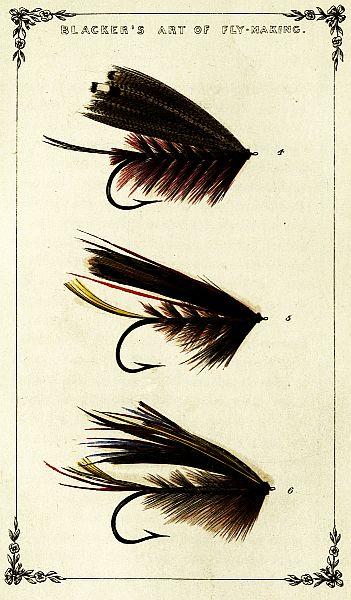
No. 5. A brown fly, a general favorite among
the "old ones," on every salmon river in Ireland
and Scotland, particularly the latter, and
in rivers a good way up from the sea, on a dark
day, with a good breeze blowing up the stream.
The following fly, No. 6, may be used in a
similar manner. The wings are made of the
golden pheasant tail that has the long clouded
bar in the feather, rather full, and two rather
broad strips of light brown white-tipped turkey
tail feather at each side; a good size peacock
harl head, and feelers of scarlet macaw feather;
tipped at the tail with gold tinsel—the tail a
small bright topping, and a tag of gold-colour
floss silk; the body is made of cinnamon, or
yellow-brown pig hair or mohair, ribbed with
double silver twist; over the body roll a real
brown red cock's hackle, and round the throttle
roll on a bright red-brown small-spotted grouse
hackle, or a brown mottled feather of the hen
Argus pheasant's neck or back. BB hook, or
a No. 8.
No. 6. A Silver Grey Fly, a great favorite
on the lakes of Killarney for Salmon and
Grilse, and at Waterville, in the County of
Kerry, for Sea and White Trout, made small
on a No. 10 hook, about the size of a No. 6
Trout hook of English make. The wings are
made of golden pheasant tail feather, mixed
with mallard, red macaw, blue and yellow body
feathers of the macaw, guinea hen, and golden
pheasant neck feathers, with feelers of blue
and yellow macaw, a black head; tipped at the
tail with silver and orange floss tag, the tail a
topping mixed with red and blue macaw feather,
(those blues that are found under the
wings of that bird which are of a very light
hue) and guinea hen: the body is made of the
silver dun monkey if it can be got, light dun
fox or squirrel fur, or dyed blue dun mohair
mixed with yellow,—all these are good for a
body, ribbed with broad silver tinsel, and a
hackle of a real dun cock that has a yellowish
motley shade throughout it, rolled up to the
head, and round the shoulder a bright orange
dyed hackle, underneath which tie in a little
orange mohair. It may be varied with a claret
hackle at the head, or a fiery brown one.
No. 9 hook. A small grilse or sea-trout hook,
for small rivers in either Scotland or Ireland,
and also in the rivers of Wales, where it is a
native dun colour among the anglers. It will
be found a "don" to rise them.
No. 7. A large dun palmer with a double
hook, which, will be observed, is of a tortuous
shape in the body, as it appears in the plate.
The shape may be obtained by tying the hooks
back to back, the top one to be tied about
quarter way down the shank of the end one,
and the gut tied tightly on each, (twisted gut
of course when you form a loop).
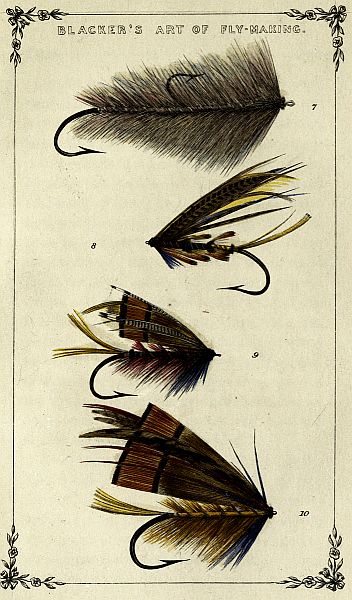
It will be found a "killer" in large pools
surrounded with trees in stormy weather, and
in rapid streams running into or near the sea,
where they take it most likely for a shrimp, as
it corresponds in color. The legs are composed
of about six hackles of a real blue dun old
cock-saddle feather, having a motley yellowish
hue, and peacock harl head, rather full; the
body is made of orange pig hair and yellow
mohair mixed, the former drawn out amongst
the fibres of the hackles, which must be struck
on two at a time, commencing at the tail, till
it is all built up to the head, where there may
be three hackles to make it fuller,—it would
be as well to have a small swivel at the head,
that it might spin gently round when moved in
the water. No. 9 hook, or small grilse size for
large trout. It may be varied with gold, old
dun cock's hackles, and red body.
No. 8 is a beautiful specimen of a gaudy fly.
The wings, which are finely mixed of rich
feathers, are made of the following sorts:—orange,
yellow, and blue macaw body feathers,
three strips of each; teal, bustard, and golden
pheasant neck feathers broken in strips; silver
pheasant tail, light brown golden pheasant tail
feather, and a topping over all a little longer;
a peacock harl head, and blue and yellow
feelers. The body is formed in three joints, a
tip of gold twist at the tail, a tag of peacock
harl, and a bright small topping for tail; first,
a joint of yellow floss, a joint of peacock, and
two feathers of the red-tipped feather of the
crest of the cock of the rock tied short above
the harl and ribbed with gold; the next is a
blue floss silk joint ribbed with gold, a peacock
harl rolled on close, and two feathers of the
crest of the cock of the rock tied close above
it; and the third is an orange floss silk joint,
a peacock harl tag, and ribbed with gold, two
of the red-tipped feathers tied on close as
above, and a blue jay round the shoulder.
No. 8 hook on B. This is a famous grilse fly.
No. 9 is another great beauty, and a capital
grilse or small salmon fly for any river under
the sun. The wings are made of two jungle-cock
feathers, and two shorter feathers of the
golden pheasant neck, the white ends of the
jungle-cock to show well beyond the golden
pheasant neck, two broad strips of wood-duck,
one at each side, and a topping or two extending
longer than the other feathers for feelers, a
black ostrich head; a tip of gold at the tail, a
tag of yellow-green silk, a tag of black ostrich,
and a bright topping for tail, above the ostrich
a blue tag, and the body made of claret floss
silk, ribbed with gold tinsel, and claret dyed
hackle struck over the body, with a blue jay
feather at the shoulder. The hook B or BB.
No. 10. This is a famous high water fly for
all salmon rivers, particularly in Scotland, and
is not unlike the once celebrated "Parson Fly,"
the favourite killer in all rivers of the Reverend
St. John's; there is no salmon can resist its
attractions in rapid pools in rivers near the sea.
The preceding fly, No. 9, will be found to kill
better a few miles higher up from the sea, as
all plain flies do. If the No. 9 is winged with
brown mallard or brown turkey tail feather, it
will be found just the thing.
The wings are made of two golden pheasant
neck feathers, with a broad strip of peacock
wing feather on each side, and a strip of scarlet
macaw tail feather, the latter to be a little
longer than the other feathers, a black ostrich
head with a full brilliant blue jay feather round
the shoulder. The body is made thus:—a tip
of silver twist, a yellow floss silk tag, two small
toppings for tail, the body is of golden yellow
pig hair or mohair, ribbed with silver twist,
with two golden yellow dyed hackles with a
black streak up the centre, rolled from the tail
to the head. No. 9 hook, B, or BB.
No. 11 is a fly that will kill grilse or salmon
in the light running rivers of the North of
Scotland, and in all rivers where the salmon
and its varieties haunt, and is made of different
sizes. The wings are made of a few fibres of
each of the following feathers: black and
white small spotted bustard rump feather, teal,
wood-duck, silver hen pheasant tail, and the
silver cock pheasant tail black and white
spotted feathers, the neck feather of the golden
pheasant, and the red spear feather of the
same bird, and at each side two small feathers
of the black and white jungle cock, a black
head, and topping. The body is made half
yellow and half purple pig hair or mohair, the
latter colour next the head, over which roll
close up two black heron feathers off the crest;
a tip of gold, and a small topping for tail, and
over the yellow or purple body roll double gold
twist. No. 7 hook, or BB.
The Sea-Trout Fly underneath No. 11 in the
same plate, will be found a killer either for
sea-trout or grilse, in the rivers in Scotland,
and the South of Ireland. The wings are
made of a dark brown grouse hackle that grows
on the rump of the bird, just above the tail,
mixed with a small quantity of light brown
turkey tail, or kite tail, which is the salmon tail
glede of the north, and two feelers of blue and
yellow macaw; a black head; the body is made
with a tip of silver twist at the tail, and a tag
of black ostrich; the tail is a mixture of golden
pheasant neck feather, and brown mallard, two
or three fibres of each; the body is blue floss
silk, rather light, with an old black cock's hackle
rolled over it, ribbed with fine silver twist;
round the shoulder roll a claret or scarlet
hackle. The hook No. 10, or C, double CC,
or B, for grilse. There may be three or four
varieties of this fly made thus:—body blue,
with blue jay, same wings, with a little neck
feather of the golden pheasant; orange body,
same coloured hackle, and same wings, blue
jay at head; a dun body, with fiery brown
hackle at the head; a claret body—a yellow
body, and small grouse; blue body, and guinea
hen; and a yellow body, with guinea hen; a
black body, black hackle, and the same wings
and tail; a black fly, with teal wings; a brown
body, brown hackle, and "glede" wings, two
fibres of the same for tail. All these are the
choicest colours for sea-trout and grilse flies in
every salmon river in the kingdom.
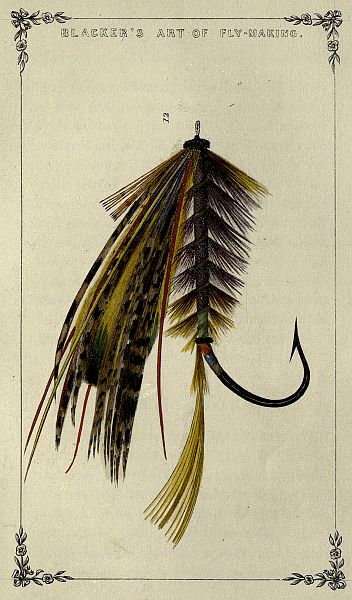
No. 12. Is a large Spring Fly used generally
in the Shannon, and the Tweed, when
the rivers are very high and rapid. It will be
found a magnificent specimen of a gaudy salmon
fly, and is the proper size for March and April,
when the fulness of the stream prevents the
fish from seeing smaller ones. This fly will
be seen to perfection in the Plate. With this,
I will describe three or four others of the same
size, of different colours, which came into my
possession from Castle Connell, on the Banks
of the Shannon.
The wings of No. 12 are made of the small
spotted brown Argus tail feather, golden pheasant
tail, and the black and white peacock wing
feather; scarlet and blue macaw, and in the
centre an orange macaw feather whole, those
that are tipped with blue and green—they are
found on the shoulders of the red macaw and
down the back; a tuft of broken neck feather
of the golden pheasant at the head, and feelers
of blue and yellow macaw; a black head; a
tip of gold at the tail, a tag of blue, another of
orange floss and black ostrich, a good sized
topping in the tail, and at its root a tuft of red
spear feather of the golden pheasant rump;
there is about half an inch body at the tail
end, made of yellow mohair, and yellow hackle
over it, ribbed with gold, the remainder of the
body is made of puce floss silk, with a dark
wine-purple hackle struck over it, ribbed with
silver twist and flat gold, and a yellow body
feather of the macaw rolled round the shoulder.
The hook, No. 2 or 3, large Salmon size.
SPRING FLIES.
The following fine large flies will be excellent
killers in the Shannon, the Tweed, the Thurso,
the Spey, and the Tay, in the spring season.
The bodies to be made small, the wings large.
No. 1. The body is made of sky blue floss
silk, ribbed with broad silver tinsel, tip of
silver, and orange tag; a dark blue hackle
from the tail up; two toppings in the tail, a
large yellow pig hair or mohair head (white
seal fur dyed yellow does well), a blue jay
round the shoulder; the wings are a large
yellow and a large blue feather of the macaw,
which grows on the back and under the wings
of that bird, two orange macaw feathers an inch
shorter on each side of them, two toppings, a
mixture of argus, bustard, scarlet and blue
macaw, good size strips of each. No. 1 hook,
full salmon size.
No. 2. The body is made of black floss silk,
tipped with silver, tag of orange, ribbed with
broad silver plate up the body, beside which a
claret hackle, and the tail two toppings; the
wings are made of a large red rump spear
feather of the golden pheasant in the centre,
four large toppings with a mixture of sprigging
at each side of the following: Argus pheasant
tail, bustard, blue and yellow macaw, blue jay
at the shoulder, and a large size head of puce
pig hair. Hook No. 1 or 2, Spring Salmon
size.
No. 3. The body is made of black floss silk,
ribbed with silver, orange tag, tip of silver, tail
a topping with a little red; the wings are made
of the whole yellow feathers of the macaw
which grow under the wings of the bird, two
tipped feathers mixed with bustard, Argus,
blue and scarlet macaw, and a blue head of
pig hair or mohair. No. 1 or 2 hook.
No. 4. The body is made of light puce floss
silk, ribbed with silver plate and gold twist, a
claret hackle over it, tipped with silver, a
topping for tail, and orange tag; the wings
are made of yellow macaw, a red spear feather,
four toppings, a mixture of bustard golden
pheasant tail, kingfisher's each side, and a
large blue head of mohair. (It cannot be too
large for the Shannon). No. 1 hook, large
Salmon size.
No. 5. The body is made of puce floss,
ribbed with broad silver and gold twist, purple
hackle over it, orange tag, tip of silver, and tail
a topping; the wings are made of two body
feathers of the yellow macaw, mixed with blue
macaw tail and Argus, two large toppings, and
a dark blue pig hair head. Salmon hook No. 2,
spring size.
No. 6. This is another excellent fly. The
wings are like the last named fly; a black floss
body, ribbed with silver, and yellow hackle over
it; a large blue head, picked out to hang down
like a hackle. No. 3 hook. This is a fly of
"The Ogormans," of Ennis, in the County of
Clare, see his Work on Angling. The two
Salmon Flies in the plate, with "picker," are
described for Killarney.