High jinks were in order as the Regional Science
Fair drew to a close in the big auditorium at
Poplar City, California. A board of judges had
selected prize-winning exhibits entered by high-school
students from Valley View, Poplar City and
other nearby communities. Now the winners were
blowing off steam while teachers who had supervised
the fair sat in quiet corners and fanned
themselves wearily.
“Step right up, ladies and gentlemen,” Pepper
March whooped like a circus barker as he strutted
in front of his First Prize winner, a glittering
maze of electronic equipment. “Broadcast your
voice over my beam of light. The very newest
thing in science. Built through the co-operation of
Valley View’s own Cavanaugh Laboratories. Step
right up.... Yes, miss?” A girl had approached
the exhibit, wide-eyed. “Please speak into this
microphone.”
8
“What do I say?” As she spoke, a quivering
pencil of light leaped from a black box in the
booth and her words thundered from a loudspeaker
in the balcony.
“Oh, recite ‘Mary Had a Little Lamb,’” suggested
the big blond boy, and grinned.
“‘Mary,’” boomed the girl’s voice from the
rear of the hall as Pepper twiddled a mirror that
deflected the light beam to a second loud-speaker,
“‘had a little lamb.’” (Those words seemed to
come out of the floor.) “‘Its fleece was white as
snow.’” (The last phrase blared from a chandelier.)
“Good old Pepper! Grandstanding again!”
muttered Sandy Steele as the crowd cheered.
Sandy stared glumly at a small sign reading
Honorable Mention that perched on the exhibit
which he and his pal Quiz Taylor had entered in
the fair. It wasn’t fancy-looking like Pepper’s, he
had to admit. It was just a mound of wet cardboard
sheets stuck full of pins, plus a homemade
control panel and some batteries. “Ours was
better,” he added.
9
“I agree,” Quiz sighed. “After all the work we
put into this thing! Molding sheets of cardboard
to the shape of underground rock layers. Soaking
them with salt water so they’ll carry electric
currents that imitate the direction in which oil
deposits flow.” He hooked a wire to one of the
pins and pressed a button. A flashlight bulb on
the control panel winked at him mockingly.
“We sure deserve something better than a Mention!”
“Step this way, folks,” Quiz called halfheartedly
to the passers-by. “Learn how petroleum can be
located, thousands of feet beneath the earth.”
Nobody paid any attention except one Valley
View boy who was pushing his way toward Pepper’s
booth, a phonograph record under one
skinny arm.
“Sour grapes,” jeered the boy. “You and Sandy
better forget that mess. Come over and watch
Pepper play this stereo record over his beam. It’ll
be something!”
“Shall we?” Sandy looked at his friend miserably.
“Unh-uh,” answered the short, round-faced
boy. “Here comes a customer—I think.”
A suntanned little man in faded blue shirt and
jeans had ambled up to their booth and was studying
the exhibit with his gray head tilted to one
side.
“A reservoir behavior analyzer, huh?” he said.
“Represents the Four Corners area. Right?”
10
“Why ... yes, sir.” Sandy stared at him,
openmouthed. “We built it to represent the geological
structure of the country where the boundaries
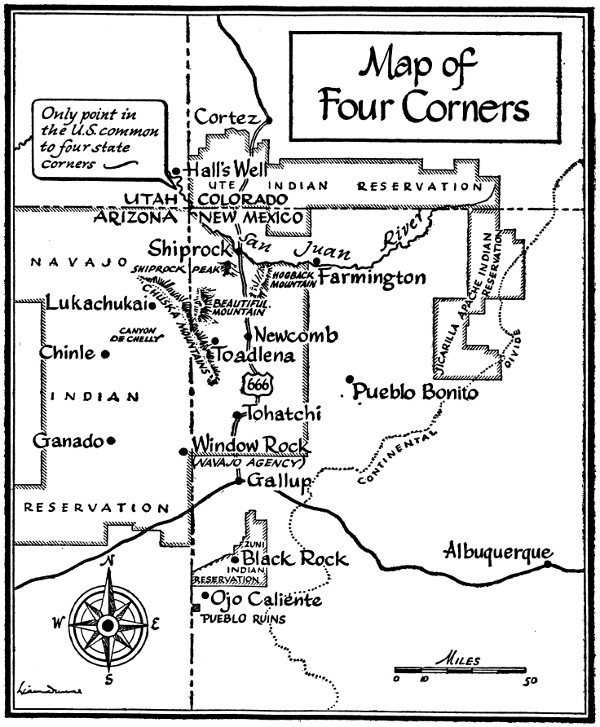
of Utah, Colorado, Arizona and New Mexico
meet. This map and card explain—”
“I know the Four Corners,” grunted the little
man as he sized up the tall, sandy-haired youngster.
“Is your gadget accurate?”
“As accurate as we could make it with the
survey maps we could find.”
“Hmmm.” Their visitor’s sharp eyes studied
the gray mound. “What happens if I should drill
an oil well here, in the northwest corner of the
Navajo Indian reservation?” He pointed with a
lean finger.
Sandy moved a pin to the spot he indicated,
connected it to the control panel with a length of
wire, and pressed a switch.
Nothing happened!
Quiz groaned. Why couldn’t the thing show off
when they wanted it to?
“If you drilled there, sir, you’d just have a dry
hole,” Sandy said with more confidence than he
felt. “That location must be on the far fringe of
the oil pool.”
“Right!” The little man grinned from ear to
ear, showing a fine white set of false teeth. “I did
drill a wildcat well there. She was dry as a bone.
My ninth duster in a row.... Now what
happens if I drill here, near the bed of the San
Juan River?”
11
This time a bulb glowed brightly when they
stuck their pin into the cardboard.
“We can’t be sure, sir,” Sandy hesitated. “We
don’t know too much about geology. Besides, oil
is like gold. It’s where you find it, and the only
way you find it is by drilling for it. But I’d guess
that, in the neighborhood you indicated, you’d
stand a chance of hitting a thousand barrels per
day.”
“Eight hundred and fifty barrels,” corrected the
man in the blue jeans. “The well I drilled on the
San Juan was the only thing that kept me out of
bankruptcy.”
A blare of jazz from Pepper’s loud-speakers,
now working in unison, cut off further conversation
and gave the boys a chance to study their
strange acquaintance.
“Why don’t you go over and take in that beam-of-light
exhibit?” Sandy said when Pepper had
brought the sound down to bearable levels. “It
won first prize.”
“That pile of expensive junk?” sniffed the little
man. “All the kid did was to borrow some apparatus
from Red Cavanaugh’s Valley View Laboratory.
If I know Red—and I do know the big
fourflusher well—he didn’t make the boy do a
lick of real research on it.... Oh!” Again that
wide grin. “You think I’m crazy and want to get
rid of me, don’t you? Here.”
12
He dug into his jeans and came up with a
greasy card which read:
The Four Corners Drilling Company
John Hall, President
Farmington, N. M.
“Guess I should have got dressed up for this
shindig,” Hall apologized, “but I just got in from
Farmington. I read about your analyzer in the
Valley View News when you won first prize at
your high-school science fair last month. Used to
live there. That’s why I still get the paper. Your
dingus should have received first prize here too,
instead of that voice-cast thing.”
“Say! You came all this way just to see our
exhibit? Thanks!” was all Sandy could think of
to say.
As the auditorium lights blinked to indicate
that the fair was closing, Hall added, “Got time
for a bite? I have a proposition I’d like to sound
you out on.”
At a nearby diner, the oilman ordered full
meals for all of them.
13
“Here’s my proposition,” he said when the boys
couldn’t eat another mouthful. “I’m a small wildcat
operator. That means I hunt for oil in places
that are so wild and woolly that only wildcats can
live there. Once or twice I’ve struck it rich.
Should have retired then, but there’s something
about oil exploration that gets in a feller’s blood.
So I went out, drilled some dry holes, and lost my
shirt.
“Right now I’m strapped until my new field
pays off—if it does. But I think I’m onto something
big in the Four Corners and I need help.
You boys must have a working knowledge of
geology to build an analyzer as good as that. How
about working for me this summer?”
“Sandy’s the rock hound,” Quiz said and hesitated.
“I ... I’ve only read up on it in books.”
“All I know is what Dad has told me,” Sandy
remarked. “I couldn’t have built the exhibit without
Quiz’s help.”
“Forget the mutual-admiration-society stuff,”
said Hall. “Would you both like to spend your
vacations in the Four Corners, working as roustabouts
and helping me out wherever else you can?
It won’t be easy. But when you get through you’ll
know a lot about oil, geology, how to get along
with Indians, and I don’t know what all.
“You’ll be out on the desert in all kinds of
weather. You’ll chip rocks, hold stadia rods,
sharpen tools and dig the trucks out of holes on
those awful roads. Everything you learn will come
in handy when you go to college.... You are
going, aren’t you?”
Sandy nodded but Quiz shook his head miserably.
14
“I doubt it,” he said, “unless things at Dad’s
restaurant pick up.”
“Nonsense,” Hall snorted. “You can get a
scholarship in geology if you’ve had experience in
the field. Tell you what: I know your father
slightly—he serves mighty good victuals. I’ll go
over to Valley View tomorrow and talk things
over with him. I’ll bet we can work something out
for you.
“Here’s another thing, though,” he went on
thoughtfully. “I’ve got almost every cent I own
tied up in oil leases right now. I can’t pay either
of you very much—say forty dollars a week. You
probably can do almost as well right at home.”
“I’d rather work with you than wait on table,”
Quiz declared.
“Or cut lawns and things,” Sandy added.
“It’s settled then.” Hall shook hands gravely.
“See you in Valley View.”
As they were leaving the diner, Pepper March
came charging in with a flock of admiring Valley
Viewers behind him.
“Wait up,” Pepper whooped, grabbing his defeated
rivals as they tried to dodge past him. “My
treat. Come have a Coke while I tell you about my
good luck.”
15
“Another Coke!” Sandy groaned. He had
practically lived on them during the science fair.
But curiosity got the better of him and he went
back to the counter, followed by Quiz. By the time
he found a stool, Pepper was holding forth.
“You know Mr. Cavanaugh, the man I got some
of the stuff for my voice-caster from?”
“The man from whom you borrowed all your
equipment,” Sandy corrected between his teeth.
“That’s what you think, Honorable Mention.”
Pepper turned to his admirers. “Anyway, he has a
sideline: spends his summers hunting uranium.
Also, he’s the same Red Cavanaugh who was All-American
quarterback for State U. in 1930. He’s
the fellow who ran three touchdowns against
California in the Thanksgiving game that year.”
“There was a Cavanaugh who made All-American,”
Quiz agreed as he scratched his round head,
“but I thought....”
“See!” cried Pepper. “Quiz knows all there is
to know about football. He’s heard about Red.
Well, Mr. Cavanaugh attends all the Valley View
games. Says he likes the way I run touchdowns.”
Pepper leered at Sandy, who was not always the
spectacular player that Pepper was. “Also, Mr.
Cavanaugh appreciates the plugs I gave to his
laboratory whenever I explained my voice-caster,
so what do you think...?”
“He’s going to install you as a loud-speaker in
one of his TV sets,” Quiz suggested.
16
“Nah!” Pepper stopped the laughter with a
lordly, upraised hand. “He’s giving me a summer
job. I’m going to help him hunt uranium.”
“Where?” Sandy gave his pal a stricken look.
“Where? Why, the place where there’s more
uranium than almost anywhere in the United
States. But you wouldn’t know where that is.”
“Oh, no,” groaned Quiz. “Not the Four Corners.
Not there! Ain’t there no justice?”
“What do you mean?” Pepper looked at him
doubtfully.
“I mean Sandy and I have jobs there too, and
Four Corners is going to be awfully crowded this
summer.”
“Oh.” Some of the wind went out of Pepper’s
sails. Then he brightened. “I’ll buy another round
of Cokes if either of you is going to get sixty
dollars a week,” he crowed.
17
CHAPTER TWO Kit Carson Country
“This sure isn’t my idea of a boom town!” Sandy
grumbled as he and Quiz got off the eastbound
Greyhound at Farmington, New Mexico, dropped
their dusty bags and stood watching the early
morning bustle on the little town’s wide streets.
“Yeah.” Quiz wagged his head. “The Wild West
shore ain’t what she used to be, pardner. No
twenty-mule-team wagons stuck in Main Street
mudholes. No gambling dives in evidence. No
false store fronts. No sheriff in a white hat walkin’
slowlike down a wooden sidewalk to shoot it out
with the bad man in a black hat. Ah, for the good
old days.”
“Oh, go fly a jet,” Sandy grinned. “Let’s look
up Mr. Hall. Funny, his giving us his home
address. He must have an office in town.”
18
They strolled along, noticing the new stores
and office buildings, the modern high school.
Farmington would never become a ghost town. It
was building solidly for the future.
Suddenly Quiz grabbed his friend’s arm.
“Look at that oilman who’s just made a strike,”
he said. “We’ll ask him if he knows Mr. Hall.”
“How do you know that he is, and has?” Sandy
demanded as they approached a lanky stranger.
“Because he’s wearing a brand-new Stetson and
new shoes, of course,” Quiz explained, as to a
child. “Drillers always buy them when their well
comes in.”
“Trust you to know something like that,”
Sandy said in mock admiration.
“Well now,” drawled the Farmingtonian when
they put their question, “you’d have to get up
earlier than this to catch John Hall in town. John
keeps his office in his hat. Might as well spend the
day seeing the sights, and look him up at his motel
when he gets back from the Regions tonight.”
“What sights?” asked Sandy when the oilman,
obviously a transplanted Texan, had stumped
away in high-heeled boots that must have hurt his
feet. “Those mountains, maybe? They look close
enough to touch. Let’s walk out to them.”
“Don’t let this clear, thin air fool you,” Quiz
warned. “Those mountains are probably twenty
miles away. We’d need a car to—”
19
A great honking and squealing of brakes behind
them made the boys jump for safety. As they
turned to give the driver what-for, Pepper March
stuck his curly head out the window of a new
jeep that was towing an equally new aluminum
house trailer as big as a barn.
“Welcome to our fair city,” Pepper shouted.
“Saw you get off the bus, so I prepared a proper
reception. How about a guided tour while I run
this trailer over to Red’s camp?”
“How long have you been here?” Sandy asked
as they climbed aboard.
“Red flew me over last Friday in his Bonanza.
I’ve got the hang of his entire layout already.
Nothing to it, really.”
As he headed the jeep for the mountains,
Pepper kept up a monologue in which skimpy
descriptions of the countryside were mixed with
large chunks of autobiography.
“Every square mile of this desert supports five
Indians, fifty sheep, five hundred rattlesnakes
and fifty thousand prairie dogs,” he joked as they
left the pavement for a winding dirt trail. They
bounced madly through clumps of sagebrush,
prairie-dog colonies, and tortured hills made of
many-colored rock.
“These roads wear out a car in a year, and you
have to put in new springs every three months,”
he added as they hit a chuckhole that made their
teeth rattle.
20
“Look at those crazy rock formations,” he said
later while the boys sweated and puffed to jack
up the rear end of the trailer so it could get
around a particularly sharp hairpin turn in the
trail. (Now they knew why Pepper had extended
his invitation for a tour!) “No telling what minerals
you might find if you used electronic exploration
methods on scrambled geology like this. Why,
only last night, while we were sitting around the
campfire at Elbow Rock, I said to Red: ‘Red,’ I
said, just like that—we’ve become real pals already,
you know—‘Red,’ I said, ‘why don’t we
branch out? Why don’t we look for oil as well as
uranium, now that we’re out here?’ And Red said
to me: ‘Pepper,’ he said—”
“‘—when did you get your Ph.D. in geology?’”
Sandy cut in.
“Nothing like that at all! ‘Pepper,’ he said,
‘you’re right on the electron beam. We’ll organize
the Red Pepper Oil Exploration and Contracting
Company and give John Hall and those other
stick-in-the-muds a run for their money.’ Oops!
Hope we didn’t break anything that time!”
The jeep’s front wheel had dropped into a pothole
with a terrific thump.
They found that the axle had wedged itself
against a rock. Thirty minutes later, while they
were still trying to get it loose, a rattletrap car
pulled up beside them and an Indian stuck his
flat, mahogany-colored face through its window.
21
“Give us a hand—please,” Pepper ordered.
The newcomer started to get out. Then his
black eyes settled on the lettering on the side of
the trailer:
Cavanaugh Laboratories
Farmington, N.M. & Valley View, Cal.
“Cavanaugh! Huh!” snorted the Indian. He
slammed the door of his car and roared off in a
cloud of yellow dust.
“Those confounded Indians,” snarled Pepper,
staring after him in white-faced fury. “I’d like to....
Oh, well. Come on, fellows. Guess we’ve got
to do this ourselves.”
They finally got the jeep back on the trail and
drove the twenty miles to Elbow Rock without
further mishap. There Pepper parked beside a
sparkling trout stream. They raided the trailer’s
big freezer for sandwich materials and ate lunch at
a spot overlooking a thousand square miles of
yellow desert backed by blue, snowcapped peaks.
Pepper was at his best as a host. For once in their
lives, Sandy and Quiz almost liked him. At least
here he seemed much pleasanter than he did at
home, lording it over everyone—or trying to.
22
In the cool of the afternoon—85 degrees in the
sun instead of the 110 degrees the thermometer
had shown at noon—they rode the jeep back to
Farmington by way of a wide detour that took
them within sight of the San Juan River gorge.
“I wanted to show you those two oil-well derricks
over yonder,” Pepper explained. “They’re
a mile and a half apart, as the crow flies. But,
because they’re on opposite sides of the river, they
were 125 long miles apart by car until we got that
new bridge finished a few months ago. Shows you
the problems we explorers face.”
“The San Juan runs into the Colorado, doesn’t
it?” Quiz asked as he studied the tiny stream at the
bottom of its deep gorge, under the fine new steel
bridge.
“Yep. And thereby hangs a tale. Mr. Cavanaugh—Red,
I mean—has found state documents down
at Santa Fe showing that the San Juan used to be
navigable. But the confounded dumb Indians
swear it can’t be navigated. If boats can go down
the stream, even during part of the year, the river
bed belongs to the Federal government. If the
stream can’t be navigated, the Navajos own the
bed. That’s the law! While the argument continues,
nobody can lease uranium or oil land near
the river. Red says that, one of these days, he’s
going to prove that—oops! I’m talking too
much!”
Pepper clammed up for the first time they
could remember. He said hardly a word until he
dropped them off at Hall’s motel.
23
“I don’t get it,” Quiz said to his chum as they
walked up a graveled path from the road to the
rambling adobe building.
“Don’t get what?” Sandy wanted to know.
“This uranium hunting business Pepper’s got
himself into. I read in Time a while back that the
Federal government stopped buying uranium
from prospectors in 1957. Since then, it has
bought from existing mills, but it hasn’t signed a
single new contract. Cavanaugh doesn’t own a
uranium mill. So why is he snooping around,
digging into state documents and antagonizing
the Indians?”
“I only met him once, when he snooted our
exhibit as a judge at the regional science fair,”
Sandy replied. “Can’t say I took to him, under the
circumstances.”
“There’s something phony about that man. If
only I could remember ... something to do
with football, I think.” Quiz scratched his head,
but no more information came out.
They found Mr. Hall, dressed as usual in faded
levis and denim shirt, sitting with several other
guests of the motel on a wide patio facing the
setting sun.
“Well, here are my roustabouts,” the little man
cried with a flash of those too-perfect teeth. “I
was beginning to be afraid that you had lost yourselves
in the desert.”
24
He introduced them to the owners of the place,
two maiden ladies from Minnesota who plainly
were having the time of their middle-aged lives
here on the last frontier. The Misses Emery, as
alike as two wrinkled peas, showed the boys to
their room, a comfortable place complete with
fireplace and an air conditioner.
“Supper will be served in half an hour,” said
one.
“Don’t be late,” said the other.
The newcomers scrubbed the sticky dust off
their bodies and out of their hair, changed into
clothes that didn’t smell of jeep, and were heading
for the dining room when Mr. Hall overtook
them.
“You may be wondering why I live out here on
the edge of the desert,” he said quietly. “One
reason is that I like the silence of desert nights.
Another is the good cooking. The most important
reason, though, is that some of the Farmington
places are pretty nasty to Indians and Mexicans.
Me, I like Indians and Mexes. Also, I learn a lot
from them when they let their hair down. Well,
here we are. You’ll find that the Misses Emery
still cook like Mother used to. I’ll give you a tip.
Don’t talk during supper. It isn’t considered
polite in the Southwest.”
“Why is that?” Sandy wondered.
25
“It’s a hang-over from cowpunching days. If
a ranch hand stopped to talk, somebody else
grabbed his second helping.”
After a silent meal, the guests gathered on the
patio to watch the stars come out.
“Folks,” said Mr. Hall, “meet Sandy Steele and
Quiz Taylor. They’re going to join my crew
this summer. Boys, meet Miss Kitty Gonzales,
from Window Rock, Arizona. She’s going north
in the morning to teach school in the part of the
Navajo reservation that extends into Utah. Her
schoolhouse will be a big trailer. Too bad you
can’t be her students, eh? But sixteen is a mite old
for Miss Kitty’s class.”
Kitty was slim, in her late teens, and not much
over five feet tall. She had an oval face, black hair
and eyes, and a warm smile that made the newcomers
like her at once.
“This is Kenneth White,” Hall went on. “Ken
works for the Bureau of Indian Affairs. When he
talks, you listen!”
The white-haired man gave the boys handshakes
that they felt for an hour.
“Chief John Quail, from the Arizona side of the
Navajo reservation,” Hall said next. “The chief
is here to talk over an oil lease.”
Chief Quail, a dark, heavily muscled Indian,
wore a light-gray business suit that showed evidence
of the best tailoring. He surprised the boys
by giving them the limpest of handshakes.
26
“And Ralph Salmon, boss of my drill crew,”
Hall concluded. “Ralph’s a southern Ute from
Colorado. Do exactly as he says this summer if
you want to learn oil.”
The lithe, golden-skinned young Indian
nodded, but did not shake hands.
“So you’re off to your great adventure in the
morning, Kitty,” White said to break the conversational
ice. He lighted a pipe and leaned
against the patio railing where he could watch
the changing evening light as it stole over the
desert.
“I’m so excited I won’t be able to sleep,” the
girl answered in a rich contralto voice. “It’s all so
wonderful. The oil lease money pouring in like
this, after long lean years when starvation for the
Navajos was just around the corner and it looked
as though their reservation might be taken from
them. Schools and hospitals being built all over.
My wonderful new trailer with books and maps
and even a kitchen and a shower for the children.
Oh, my Navajos are going places at last.” She gave
an embarrassed laugh at her long speech.
“One place your Navajos can go is to Salt Lake
City,” Hall growled. “Get the state of Utah to
settle that quarrel about who owns the land your
schools and hospitals are being built on. Then I
can get my hands on some leases up there.”
27
“I thought the Navajo reservation was in New
Mexico and Arizona,” Sandy said.
“A small part of it is in southern Utah,” Hall
explained. “That’s the part bounded by the San
Juan River.”
“The argument over school lands is less important
than our other disputes,” Chief Quail said
carefully. He spoke good English but his words
seemed to be tied together with string. Plainly,
he had learned the white man’s language not
many years ago. “The real problem—the one that
is, how do you say, tying up millions of dollars of
lease money—is to have a correct boundary drawn
around the Hopi reservation.”
“The chief means,” Hall explained for the boys’
benefit, “that the Navajo reservation forms a
large rectangle that completely surrounds a
smaller square of land in Arizona where the Hopi
Indians live.”
“Not a square, Mr. Hall,” Chief Quail objected.
“The Hopis really own only a small triangle.
Those primitive, stupid cliff dwellers claim
thousands of Navajo acres to which they have no
right. If I had my way in our Council, I
would....”
28
“The Navajos and the Hopis are all grandmothers,”
Salmon cut in angrily. “Squabbling
over money like palefaces! Spending their royalties
on things like schools and hospitals! When my
tribe, the southern Utes, got its first royalty
check, the Council voted to have some fun with
the money. We spent it to build a race track for
our fast horses!”
“Digger Indian!” The Navajo sneered at
Salmon without moving a muscle of his broad
face. “Fish eater! Soon you will waste all your
easy money. When the oil runs out you will be
running about naked again, living on roots and
fried caterpillars like you used to!”
“Oh, no, John.” The Ute’s grin was just visible
in the gathering darkness. “Maybe we’ll go on the
warpath and take what we need from you fat
Navajo sheep herders, as we did in the good old
days. Or—” he added quickly as the chief lunged
to his feet—“we’ll sing you to death. Like this!”
Salmon began a wailing chant that set everyone’s
teeth on edge. The Navajo stopped his
advance as if he had struck a wall. He clapped
his hands over his ears and, after a moment,
stalked out into the night.
“You shouldn’t have done that, Ralph,” Hall
said coldly. “Some day Chief Quail is going to
take you apart if you don’t stop baiting him.”
“Can you actually sing people to death, Mr.
Salmon?” Sandy said to break the tension.
29
“Of course not,” the Ute answered softly. “But
the chief thinks I can, and I wouldn’t spoil his
belief for anything. We have a set-to like this every
time we meet. Some of our medicine men can sing
people well, though. They chant awhile and then
pull the pain right out of your tooth, ear, or
stomach.”
“What does a pain look like?” Quiz asked, half
convinced.
“Looks just like a fingernail about two inches
long,” the Ute answered. “It’s bright red. If you
strike it, it goes tinnnggg, like the reed of a saxophone.”
“Stop your nonsense, Ralph,” White commanded,
“while I go out and smooth Quail’s ruffled
feathers.” He followed the chief and brought him
back five minutes later to receive an oily apology
from his ancestral enemy.
“You Indians will be broke again, one of these
days, if you keep quarreling among yourselves,”
Hall said then. “Crooked white men are hanging
around the Four Corners. They’re just waiting
for something like that so they can trick you out
of your oil and uranium rights, or even your reservations.”
Everyone had to agree that this was true, so the
little party settled down in reasonable harmony
to watch the giant stars come out. Salmon produced
a guitar after a while. Then he and Kitty
sang Indian and Mexican songs together. Sandy
particularly liked one that went:
30
I wander with the pollen of dawn upon my trail.
Beauty surrounding me, with it I wander.
“That’s a Navajo song,” the Ute said, grinning.
“We sing it in honor of Chief Quail. Here’s one
by a white man that I like:
Mañana is a lovely word we all would like to borrow.
It means ‘Don’t skeen no wolfs today wheech you don’t shoot tomorrow.’
An’ eef you got some jobs to did, of which you do not wanna,
Go ’head and take siesta now; tomorrow ees mañana!”
“Guess that’s a hint we’d better take our siestas,”
Hall said to the boys. “Big day ahead
mañana.”
“This country sort of grows on one,” Sandy
said to Kitty as they shook hands. “I’m beginning
to feel at home already.”
“Oh, you haven’t really seen anything yet,” the
girl answered. “If you and Mr. Taylor get up in
the neighborhood of my school, look me up. I’ll
show you some of the wildest and most beautiful
country on earth.”
31
“Mother said I’d fall in love with the place.”
Sandy took a last look across the sleeping desert.
“She was born not far from here. Met my father
when he was working for the U.S. Geological
Survey.”
“How interesting,” cried the girl. “Maybe my
folks know her. What was her maiden name?”
“It was Ruth Carson.”
“Oh!” Kitty snatched her hand out of his.
“She’s related to Kit Carson, isn’t she?”
“The general was my great-uncle,” Sandy said
proudly. “That’s why I’m so interested in this part
of—”
He stopped because Kitty had backed away
from him until her back pressed against the motel
wall. As he stared, she spat into the dust of the
patio in a most unladylike fashion before turning
and running toward her room.
“What did I do to her?” Sandy gasped, openmouthed.
“Kitty’s mother is a Navajo,” Chief Quail
answered. “Back in Civil War days, Kit Carson
rounded up the Navajos to take us away from our
reservation. We went on the warpath and retreated
into the mountains. Carson followed. His
soldiers shot several dozen of us, and slaughtered
all our sheep so we would either have to surrender
or starve. Even today, many of us would rather
eat fish as the Utes do than touch one of Kit
Carson’s descendants!” He turned his back and
marched off.
32
“Ouch!” Sandy groaned. “I certainly put my
foot into it that time.”
“Don’t worry too much about it,” said White.
“Fact of the matter is that Kit Carson made a
mighty good Indian Agent later on, and most
Navajos admit it. He was the man who insisted
that they all be returned to the reservation after
the rebellion was over. He eventually died from
overwork in behalf of ‘his Indians.’ Except for a
few diehards, the Navajos won’t hold your
mother’s name against you.”
“I certainly hope you’re right,” Sandy sighed as
he and Quiz said good night to the others and
headed for their room.
“What a mess,” his friend said. “Navajos
squabbling with Utes, Hopis and the state of
Utah. Crooks waiting to take advantage of them
all. Pains like fingernails! Cavalry heroes who
turn into villains. I suppose that’s why the biggest
oil field in the Four Corners is called the Paradox
Basin!”
33
CHAPTER THREE A “Poor Boy” Outfit
Hall routed Ralph Salmon and the boys out of
bed before dawn the next day. They ate a huge
pancakes-and-sausage breakfast cooked by the
sleepy-eyed but cheerfully clucking Misses Emery
and climbed into the company jeep just as the sun
was gilding the peaks of the mountains. Soon their
teeth were chattering in the morning cold as
Salmon roared off in a northwesterly direction
toward the San Juan River lease.
“I wouldn’t have come down to Farmington at
all this week,” Hall shouted above the wind which
made the jeep top pop and crack, “except that I
promised to pick up you boys, and Ralph had to
get our core drill repaired. That’s the drill you
hear thumping under the seat. We’re down a
thousand feet with our second well and I should
be riding herd on it every minute.”
34
“You’re a worrywart, boss,” chuckled the
Indian. “You know that Harry Donovan’s on the
job up there. He can handle things just as well as
you can.”
“You’re right,” Hall answered. “But somehow
it doesn’t seem right to have a geologist bossing
the drill crew. That’s a hang-over from my days
with a big spit-and-polish producing company, I
guess.
“Ours is what they call a ‘poor boy’ outfit here
in the oil country,” he explained to Sandy and
Quiz. “We make do with secondhand drill rigs
and other equipment. Sometimes we dig our
engines and cables out of junk yards.”
“Now, now, boss, don’t cry,” said their driver.
“It’s not quite that bad.”
“It will be if this well doesn’t come in.” Hall
grinned. “But we do have to make every penny
count, kids. We all pitch in on anything that needs
doing. What kind of jobs have you cooked up for
our new roustabouts, Ralph?”
“There’s a new batch of mud to be mixed,” the
Indian answered. “How about that for a starter?”
“Mud!” Quiz exploded. “What’s mud got to do
with drilling an oil well?”
“Plenty, my friend. Plenty,” Ralph answered.
“Mud is forced down into a well to cool the drill
bit and to wash rock cuttings to the surface. You
use mud if you have water, that is. In parts of this
country, water’s so short, or so expensive to haul,
that producers use compressed air for those purposes.
We’re lucky. We can pipe plenty of water
from the river.”
35
“Then you mix the water with all sorts of fancy
chemicals to make something that’s called mud
but really isn’t,” said Sandy, remembering tales
of the oil country that his father had told him.
“You’re forgetting that we’re a ‘poor boy’ outfit,”
said Hall. “Chemicals cost money. We dig
shale from the river bed and grind it up and use it
for a mix. You’ll both have a nice new set of
blisters before this day is over.”
They followed a good paved road to the little
town of Shiprock, which got its name from a huge
butte that looked amazingly like a ship under full
sail. Crossing the San Juan over the new bridge
that Pepper had pointed out the day before, they
turned northwest onto a badly rutted trail. Here
and there they saw flocks of sheep, watched by
half-naked Indian children and their dogs. Occasionally
they passed a six-sided Navajo house
surrounded by a few plowed acres.
“Those huts are called hogans,” Ralph explained,
placing the accent on the last syllable.
“Notice that they have no windows and that their
only doors always face toward the rising sun.
Never knock on a hogan door. That’s considered
bad luck. Just walk in when you go to visit a
Navajo.”
36
“Whe-e-ew!” Sandy panted when an hour had
passed and he had peeled out of his coat, shirt, and
finally his undershirt. “How can it get so hot at
this altitude?”
“Call this hot?” jeered Salmon. “Last time I
was down in Phoenix it was 125 degrees in the
shade, and raining cats and dogs at the same time.
I had to park my car a block from the hotel, so
I ran for it. But when I got into the lobby my
clothes were absolutely dry. The rain evaporated
as fast as it fell!”
“That,” said Hall, “is what I’d call evaporating
the truth just a leetle bit.”
“Mr. Salmon....” Quiz hesitated. “Could I
ask you a personal question?”
“You can if you call me Ralph,” answered the
tall driller as he slowed to let a Navajo woman
drive a flock of goats across the trail. She was
dressed in a brightly colored blouse and long
Spanish skirt, as if she were going to a party instead
of doing a chore, and she did not look up as they
passed.
“Well, how is it you don’t talk more—like an
Indian?” Quiz asked.
“How do Indians talk?” A part of the Ute’s
smile faded and his black eyes narrowed ever so
slightly.
“Why, I dunno—” the boy’s face turned red
with embarrassment—“like Chief Quail, I guess.
I mean ... I thought....”
37
“When you’ve served a hitch in the Navy, Quiz,
you get to talking just like everyone else, whether
you’re an Indian or an Eskimo.”
“Were you in Korea, Ralph?” Sandy asked to
break the tension.
“I was not! I served my time working as a
roustabout on oil wells in one of the Naval
Reserves.”
“And, since that wasn’t enough punishment,”
Hall said as he grinned, “Ralph came home and
took advantage of the GI bill to go to school in
Texas and became a driller.”
“Yep,” Salmon agreed. “And I soon found out
that an Indian oil driller is about as much in
demand as a two-headed calf.” He threaded the
car through the narrow crevice between two tall
buttes of red sandstone that stuck up out of the
desert like gnarled fingers. “I was just about down
to that fried caterpillar diet that Chief Quail
keeps kidding me about when a certain man
whose name I won’t mention gave me my first
job.”
“And you turned out to be the best all-round
oilman I ever hired,” said Hall as he slapped the
other on his bronzed, smoothly muscled back. “I
figured that if Iroquois Indians make the finest
steelworkers in the construction business, a Ute
should know how to run a drill rig. I wasn’t mistaken.”
38
Salmon was at a loss for words for once. His
ears turned pink and he concentrated on the road,
which was becoming almost impassable, even for
a jeep.
“That’s my reservation over there across the
Colorado line,” he said at last, turning his head
and pointing with outthrust lips toward the north
and east.
“Nice country—for prairie dogs. Although
the southern Utes are doing all right these
days from royalties on the big oil field that’s
located just over that ridge. They tell me, too,
that the reservation holds one of the biggest coal
deposits in the western United States.”
“Why didn’t you stay on the reservation, then?”
Quiz wanted to know.
“I like to move around. People ask me more
questions that way.”
“Oh.” Quiz stopped his questioning.
“Up ahead and to the left,” Ralph went on, “is
the actual Four Corners, the only place in the
country where the boundaries of four states meet.
It also is the farthest point from a railroad in the
whole United States—one hundred and eighty
miles or so, I understand. How about stopping
there for lunch, boss, as soon as we cross into
Utah? Nice and quiet.” He winked at Quiz to take
any sting out of his earlier words.
39
After they had eaten every one of the Misses
Emery’s chicken and ham sandwiches, Hall took
over as their driver and guide.
“My lease is up near the village of Bluff, on the
north side of the river,” he explained. “I’m
convinced, though, that most of the oil and
uranium is in Navajo and Hopi territory south of
the San Juan. I’ve had Donovan down there running
seismographic surveys and he says the place
is rich as Croesus. That’s why I’ve been talking
turkey to Chief Quail—trying to get him to get the
Navajo and Hopi councils together so we can
develop the area.”
“Is Quail chief of all the Navajos?” Sandy
asked. “He didn’t seem to be exactly....” He
stammered to a stop while Ralph chuckled.
“Oh, no,” Hall answered. “Quail is just a chief
of one of the many Navajo clans, or families. The
real power is held by the tribal council, of which
Paul Jones is chairman. But Chief Quail swings
a lot of weight on the reservation.”
“Hah!” Ralph snorted. “Chief Quail’s a stuffed
shirt. They made a uranium strike on his farm
last year, so what does he do?... Buys himself
a new pickup truck! I’d have celebrated by getting
a Jaguar.”
“A Jaguar is like a British Buick,” said Quiz,
suddenly coming into his element as the talk got
around to cars. “A Bentley would have been
better.”
40
“I know, I know,” Ralph answered. “Or a Rolls
Royce if he could afford a chauffeur. I read the
ads too.”
They followed the river, now deep in its gorge
and getting considerably wider, for another
twenty miles. They were out of the reservation
now and passed a number of prosperous farms.
The road remained awful, however, being a long
string of potholes filled to the brim with yellow
dust. The holes couldn’t be seen until the jeep
was right on top of them. Hall had to keep
slamming on his brakes at the risk of dislocating
his passengers’ necks.
“You should travel through this country when
it rains,” he said cheerfully. “Cars sink into the
mud until all you can see is the tips of their radio
antennas.”
“We’d get to the well before sunset if you drove
as well as you tell tall stories,” Ralph commented
dryly.
They finally made the field headquarters of the
Four Corners Drilling Company with two hours
of sunlight to spare. The boys looked at the place
in disappointment. An unpainted sheet-iron shack
with a sign reading Office over its only door
squatted close to the top of the San Juan gorge.
Not far from it was an odd-looking contraption of
pipes, valves and dials about as big as a home
furnace. There was no sign of a well derrick as
far as they could see across deserted stretches of
sand, sagebrush, and rust-colored rock.
41
“There she is—Hall Number One,” said their
employer. He walked over to the contraption,
patted it as though it was his best friend, and
stood, thumbs hooked in the armholes of his worn
vest, while he studied the dials proudly. “This is
my discovery well. It’s what buys the baby new
shoes.”
“But where are the derricks and everything?”
Quiz tried unsuccessfully to keep the disappointment
out of his voice.
“Shhh!” whispered Sandy. “They’ve skidded
the derrick to the new well site. This thing’s
called a Christmas tree. It controls the flow of oil
out of the ground.”
“Smart boy,” said Hall. “We’ve got our wildcat
hogtied and hooked into this gathering line.” He
pointed to a small pipe that snaked southward
across the desert. “The gathering line connects
with the big new pipeline to the West Coast that
passes a few miles from here. Number One is
flowing a sweet eight hundred and fifty barrels a
day.”
“But I don’t see any other well,” Quiz persisted.
42
“It’s over behind that butte.” Hall pointed
again. “Oh, I know what’s bothering you. You’re
remembering those old pictures that show derricks
in an oil field standing shoulder to shoulder,
like soldiers. We don’t do things that way any
longer. We’ve got plenty of room out here, so we
space our wells. Only drill enough of them to
bring up the oil without waste. Come on. I’ll take
you over and introduce you to the gang.”
A short ride brought them to a scene of whirlwind
activity. Drilling had stopped temporarily
on Hall’s second well so that a worn bit could be
pulled out of the hole and replaced with a sharp
one. But that didn’t mean work had stopped!
The boys watched, spellbound, while dripping
lengths of pipe were snaked out of the ground by
a cable which ran through a block at the top of
the tall derrick and was connected to a powerful
diesel engine. As every three lengths arrived at
the surface, two brawny men wielding big iron
tongs leaped forward and disconnected them from
the pipe remaining in the well. Then the 90-foot
“stand” was gently maneuvered, with the help of
another man, wearing a safety belt, who stood on
a platform high up on the derrick. When a stand
had been neatly propped out of the way, the next
one was ready to be pulled out of the well.
43
The crew worked at top speed without saying
a word until the mud-covered drill finally came in
sight. They unscrewed the bit from the end of
the last stand of pipe, and replaced it with a
sharp one. Then the process was reversed. Stand
after stand of pipe was reconnected and lowered
until all were back in the well. Then the engine
began to roar steadily. A huge turntable under
the derrick started spinning the pipe at high
speed. Down at the bottom of the hole the bit resumed
chewing into the rock.
“Nice teamwork, Ralph,” said Hall. “You
certainly have trained as good a crew as can be
found in the Regions.”
“Nice team to work with,” answered the driller
as he looked proudly at his men, who were about
equally divided between Indians and whites.
“Now let’s see if there’s any work for our two
tenderfeet before it’s time to knock off for supper.
Come on, fellows. The mud pit is slurping for
you.”
Two hours later, when the cook began hammering
on his iron triangle, Sandy and Quiz looked
like mud puppies.
“You’re a howling fright,” said the tall boy as
he climbed out of the big pit where a new batch
of goo was swirling and settling. He plastered
down his unruly cowlick with a slimy hand. For
once the hair stayed in place.
“And you look like a dirty little green man
from the swamps of the planet Venus.” Quiz spat
out a bit of mud and roared with laughter. “Lucky
thing we don’t have to get this muck off with
compressed air. Come on. I’ll race you to the
showers.”
44
Dinner was eaten in the same dogged quiet that
they had noted at the motel. It was a good dinner,
too, although it came mostly out of cans.
The boys were introduced all around after the
apple pie had been consumed to the last crumb,
but they were too tired and sleepy to sort out
names and faces. They did gather that four-man
shifts—or “towers,” as they seemed to be called—kept
the drill turning day and night until the
drill struck oil or the well had to be abandoned
as a “duster.”
The only person present who made a real impression
was Harry Donovan, Hall’s geologist.
He was an intense, bald, wiry fellow in his thirties
who kept biting his lips, as though he was just
about to impart a deep secret. But all he seemed
to talk about were mysterious things like electronic
log readings, core analyses, and the distance
still to be drilled before something called the
“Gallup Pay” would be reached.
Hall and Salmon were intensely interested in
Donovan’s report. Try as they would to follow
it, Sandy and Quiz soon found themselves
nodding. Finally they leaned their elbows on the
oilcloth-covered dinner table and snored gently.
45
Ralph shook them partially awake and showed
them their beds in a battered trailer. They slept
like logs despite the fact that, bathed in brilliant
white light provided by a portable electric generator,
the rig roared and clanked steadily throughout
the night as its bit “made hole” more than a
thousand feet underground.
46
CHAPTER FOUR Learning the Ropes
Sandy and Quiz spent the next two weeks picking
up a working knowledge of drilling, getting
acquainted with Hall’s outfit, and learning to
keep out from under the feet of the crew. Ralph
saw to it that their jobs varied from day to day as
they grew lean and brown under the desert sun.
“Used to have a lot of trouble keeping fellows
on the job out here next to nowhere,” he explained
with a grin. “The boys would get fed up
after a few weeks. Then they’d quit, head for
town, and I’d have to spend valuable time rounding
up replacements. Now I switch their work
around so they don’t have so much chance to
become bored. Let’s see ... you mixed mud
yesterday, didn’t you? Well, today I want you to
help Jack Boyd keep his diesel running.” Whereupon
the boys would spend a “tower” cleaning
the engine room, or oiling and polishing the
powerful but over-age motor that Boyd nursed
like a sick child to make it keep the bit turning steadily.
47
On other days they were assigned to drive to
Shiprock or Farmington for supplies, to help
Ching Chao in the cookhouse, or to learn the
abc’s of oil geology from Donovan. Sandy preferred
to do chores around the derrick and was
very proud when he finally was allowed to handle
one of the huge tongs used to grip the stands of
pipe so that they could be removed from the well
or returned to it.
Quiz, on the other hand, never tired of studying
the wavering lines marked on strips of paper by
the electric log that Donovan lowered into the
well at regular intervals. He soon got so that he
could identify the different kinds of rock layers
through which the bit was drilling, by the slight
changes in the shapes of those lines. Or he would
train a microscope on thin slices of sandstone
sawed from the yard-long cores that were hauled
out of the well from time to time. With his usual
curiosity, he had read up enough about geology to
recognize the different marine fossils that the
cores contained. He would become as excited as
Donovan did when the geologist pointed to a
group of minute shells in a slice of core and
whispered, “Those are Foraminifera, boys! We
must be getting close to the oil.” And he would
become as discouraged as his teacher when careful
study of another core showed no indication of
ancient sea creatures.
48
“I don’t get it,” Sandy would mutter on such
occasions. “How come those shells got thousands
of feet underground in the first place? And what
have they got to do with finding oil?”
Then the geologist would mop his bald head
with a bandanna handkerchief, take off his thick
horn-rimmed glasses and use them as a pointer
while he lectured the boys on his beloved science.
“All of this country has been deep under water
several times during the last few million years,”
he would explain patiently. “In fact, most of the
center of the North American continent has been
submerged at one time or another. When the
Four Corners region was a sea bottom back in the
Carboniferous era, untold generations of marine
plants and animals died in the water and sank to
the bottom.
“As the ages passed, those life forms were
buried by mud and silt brought down from surrounding
mountains by the raging rivers of those
days. The weight of the silt caused it to turn into
sandstone or limestone layers hundreds of feet
thick. This pressure generated a great deal of
heat. Geologists think that pressure and heat
compressed the dead marine creatures into particles
of oil and gas.
49
“Every time the land rose to the surface and
sank again, another layer or stratum of dead fish
and plants would form. All this heaving and
twisting of the earth formed traps or domes, called
anticlines, into which the oil and gas moved.
That’s why we find oil today at different depths
beneath the surface.”
“I understand that water and gas pressure keeps
pushing oil toward the surface,” Sandy said on one
occasion, “but then why doesn’t it escape?”
“Usually it gets caught under anticlines where
the rock is too thick and hard for it to move any
farther,” Quiz cut in, eager to show off his new
knowledge of geology. “But it does escape in some
places, Sandy. You’ve heard of oil springs. George
Washington owned one of them. And the Indians
used to sop crude petroleum from such springs
with their blankets and use it as a medicine or
to waterproof their canoes. Sometimes the springs
catch fire. Some of those still exist in parts of Iran.
I read an article once which said that Jason really
was looking for a cargo of oil when he sailed the
Argo to the Caucasus Mountains in search of the
Golden Fleece. The fleece was just a flowery
Greek term for a burning spring, maybe.”
50
“Maybe,” Donovan agreed as he stoked his
pipe and sent clouds of smoke billowing through
the laboratory. “There’s also a theory that Job
was an oilman. The Bible has him saying that
‘the rock poured me forth rivers of oil,’ you remember.
If you read the Book of Job carefully,
it almost sounds as if the poor fellow’s troubles
started when his oil field caught fire. However
that may be, we know that the Greeks of Jason’s
time used quite a bit of oil. The Arabs even refined
petroleum and lighted the streets of their
cities with something resembling kerosene almost
a thousand years ago.”
“Golly,” said Sandy. “It’s all too deep for me—several
thousand feet too deep. I think I’ll go
help Chao get dinner ready! I do know how to
cook.”
The one job around the derrick that the boys
never got a chance to handle was that of Peter
Sanchez, the platform man who worked on their
shift, or “tower.” Whenever the time came to replace
a bit, Peter would climb to his perch halfway
up the rig, snap on a safety belt, and guide
the upper ends of the ninety-foot stands of pipe
into their rack. There they would stand upright
in a slimy black bunch until it was time to return
them to the well.
51
Peter, who boasted that he had been an oilman
for a quarter of a century, worked effortlessly. He
never lost his footing on the narrow platform,
even when the strongest wind blew. Platform men
on the other shifts were equally sure-footed—and
very proud of their ability to “walk” strings
of pipe weighing several tons. And they took
things easy whenever they climbed down from
their dizzy perches.
Peter, in particular, was fond of amusing the
other crew members by telling them stories about
the oil fields in the “good old days.” His favorite
character was a driller named Gib Morgan. Gib,
he said, had come down originally from the
Pennsylvania regions when the first big strikes
were being made in Texas and Oklahoma, around
1900.
“You never heard of Gib?” Peter said one night
as the off-duty crews were sitting around a roaring
campfire after dinner. “Well, I’ll tell you....”
He rolled a cigarette with one hand, cowboy
fashion, while studying the young greenhorns out
of the corner of his eye. “Gib was a little feller
with a big mustache but he could put Davy
Crockett and Paul Bunyan in the shade when he
had a mind to. When he first came to Texas he
had a run of bad luck. Drilled almost a hundred
dry holes without hitting a single gusher. Got
down to his last silver dollar. Then do you know
what he did to make a stake?”
“No. What?” Quiz leaned forward eagerly.
52
“He pulled up all those dusters, sawed ’em into
four-foot lengths, and sold ’em to the ranchers for
postholes. That’s how it happens that all the
Texas ranges got fenced in with barbed wire,
son.”
When the laughter had died down and Quiz’s
ears had returned to their normal color, the platform
man went on: “That wasn’t the only time
that Gib helped out his fellow man. Back around
1900, just before the big Spindletop gusher came
in, oilmen in these parts were having a lot of
trouble with whickles—you know what a whickle
is, don’t you, Sandy?”
“It’s a cross between a canary bird and a
bumblebee, isn’t it?” Sandy was dimly remembering
a story that his father had told him.
“Well! Well!” Peter looked at him with more
respect. “That’s exactly right. Pretty little varmints,
whickles, but they developed a powerful
taste for crude oil. Soon as a well came in, they’d
smell it from miles away. That’s no great feat,
I’ll admit, for crude oil sure has a strong odor.
Anyway, they’d descend on the well in swarms so
thick that they’d darken the sky. And they’d
suck it plumb dry before you could say Jack
Robinson, unless you capped it quick.
53
“Well, Gib got one of his big ideas. He went
out to one of his dusters that he hadn’t pulled up
yet, poured several barrels of oil down it, and
‘salted’ the ground with more oil. Pretty soon,
here came the whickles. They lapped up all the
oil on the ground. Then a big whickle, probably
the boss, rose up in the air and let out a lot of
whickle talk about how he personally had discovered
the biggest oil highball on earth. After
that he dived into the well, and all the others
followed him, like the animals that went into the
ark. Soon as the last one was down the hole, Gib
grabbed a big wooden plug and capped the well.
We haven’t had any whickle trouble since.”
“Then all the poor whickles died?” Quiz rose
to the bait.
“Oh, no,” Peter answered with a straight face.
“They’re still buzzing around in that hole, mad
as hops. Some day a greenhorn like you will come
along and let ’em out.”
“Wonder what ever became of Gib,” said
Donovan, between puffs on his pipe.
“Last I heard he was up Alaska way,” Ralph
said. “Here’s a story about him that you may
want to add to your repertoire, Pete. Gib was
drilling near Moose Jaw in December when it got
so cold the mercury in the thermometer on the
derrick started shivering and shaking so hard that
it knocked a hole right through the bottom of the
tube. During January it got colder yet and the
joints on the drill pipe froze so they couldn’t be
unscrewed.
54
“Now Gib had a bet he could finish that well
in four months and he wasn’t going to let Jack
Frost faze him. He just rigged up a pile driver
that drove that frozen pipe on down into the
ground as pretty as you please. Soon as one stand
of pipe was down, the crew would weld on another
and keep driving. Course the pipe got compressed
a lot from all that hammering, but Gib couldn’t
see any harm in that.
“Time February came around it got real chilly—a
hundred or so below zero. He was using a
steam engine by that time because the diesel fuel
was frozen solid, but no sooner would the smoke
from the fire box come out of the chimney than it
would freeze and fall back on the snow. Wading
through that black stuff was like pushing through
cotton wool, and besides, the men tracked it all
over the clean bunkhouse floor. So Gib had to get
out a bulldozer and shove it into one corner of the
clearing where he had his rig set up.
“They were down about four miles on March
15 when an early spring thaw set in. First thing
that happened was that the smoke melted and
spread all over the place. Couldn’t see your nose
on your face. Fire wardens came from miles
around thinking the forest was ablaze. Gib was
in a tight spot so he did something he had never
done before—he looked up his hated rival, Bill
McGee, who was in the Yukon selling some
refrigerators to the Eskimos. He had to give skinflint
McGee a half interest in the well to get him
to help out. McGee just borrowed those refrigerators,
stuffed the smoke into them, and refroze it.
55
“No sooner was the smoke under control than
all that compressed drill pipe down the well
started to thaw out. It began shooting out of the
hole like a released coil spring. First it humped
up under the derrick and pushed it a hundred
feet into the air. Then it toppled over and
squirmed about the clearing like a boa constrictor.
“That was where Bill McGee made his big
mistake. Gib had told him the drill bit, which had
been dragged out of the well by the thrashing
pipe, had cuttings on it which showed there was
good oil sand only a few feet farther down. But
Bill figured that with the derrick a wreck, the well
was a frost. So he sold his half interest back to Gib,
who didn’t object, for a plug of good chewing
tobacco.
“Soon as McGee was out of sight, Gib headed
for the nearest U.S. Assay Office. He got the clerk
to lend him about a quart of the mercury that
assay men use to test the purity of gold nuggets.
“Morgan went back to camp, sat down beside
the derrick, lit his pipe and waited for the
freeze-up which he knew was bound to come
before spring actually set in. It came all right!
Puffing his pipe to keep warm Gib watched the
new alcohol thermometer he had bought in town
go down, down, and down until it hit a hundred
and ten below. Right then he dropped his quart of
solidified mercury into the well.
56
“Just as he figured, it acted the way the mercury
in the old thermometer had done—went right to
the bottom and banged and banged trying to
escape from that awful cold. Yes, sir, that hunk of
mercury smashed right through to the oil sand.
Pretty soon there was a rumble and a roar. Up
came a thick black column of oil.”
“Wait a minute,” cried Sandy, thinking he had
caught the storyteller out on a limb. “Why didn’t
the oil freeze too?”
“It did, Sandy. It did,” Ralph answered blandly.
“Soon as it hit the air, it froze solid. But it was
slippery enough so it kept sliding out of the
ground a foot at a time. Gib got his men together
and, until spring really came, they kept busy
sawing hunks off that gusher and shipping them
out to the States on flatcars!”
“You win, Ralph,” sighed the platform man as
he heaved himself to his feet. “I can’t even attempt
to top that tall one, so I guess I’d better go to bed.
Your story should keep us cool out here for at
least a week.”
57
After that mild hazing session, Sandy and Quiz
found themselves accepted as full-fledged members
of the gang. The crew members, who had kept
their distance up to that point, now treated them
like equals. Each boy soon was doing a man’s work
around the rig and glorying in his hardening
muscles.
As the end of June approached, Hall, Donovan
and Salmon got ready for their monthly trip to
Window Rock, Arizona, to submit bids for several
leases in the Navajo reservation.
“There’s room in the jeep, so you might as well
go along and learn something more about the oil
business,” Hall told the boys. “I’m pretty sure our
bids won’t be accepted, but the only thing we can
do is try.”
At that point trouble descended on the camp
in the form of a Bonanza bearing Red Cavanaugh
and Pepper March.
The husky electronics man clambered out of
his machine and came forward at a lope. He was
dressed only in shorts, and the thick red hair on
his brawny chest glinted in the sunlight. Pepper
trotted behind him like an adoring puppy.
“Howdy, Mr. Hall. Howdy, Donovan,” Cavanaugh
boomed as he reached the rig. “Heard
you’d been exploring down in the Hopi butte
section. Thought I’d bounce over and sell you
some equipment that has seismographs, magnetometers
and gravimeters beat three ways from
Sunday. The very latest thing. You can’t get along
without it.”
“Can’t I?” said Donovan mildly.
58
“Of course you can’t!” Cavanaugh clapped the
little man on the back so hard that he almost dislodged
Donovan’s glasses. “This is terrific! The
biggest thing that’s happened to me since I ran
those three touchdowns for State back in 1930.
I developed it in my own lab. You know how a
Geiger counter works...?”
“Well, faintly,” answered the geologist, who
had three of them in his own laboratory. “I
wasn’t born yesterday, Mr. Cavanaugh.”
“Well, don’t get sore, Mr. Donovan.” Cavanaugh
bellowed with laughter. “All I wanted to
say was that my new device uses scintillation
counters, which are—”
“—a thousand times more sensitive to atomic
radiation than Geiger counters,” Donovan interrupted.
“And you’re going on to tell me that
you can take your doodlebug up in an airplane
and spot a radiation halo surrounding any oil
deposit. Right? I read the trade papers, too, you
know. May I ask you a question?”
“Why, of course.” Cavanaugh’s chest and neck
had begun to sweat.
“Do you have a Ph.D. degree in electronic
engineering?”
“Why, uh, naturally.”
59
“Well, I don’t, unfortunately, Mr. Cavanaugh.
But I know enough about the science to understand
that the gadget you are selling isn’t worth a
plugged nickel unless it’s operated by an expert,
and unless it’s used in connection with other
methods of exploration. I have told you several
times at Farmington that this outfit can’t afford
another scientist at present, so I wish you would
please go away.”
“Now, Mr. Hall—” Cavanaugh turned to the
grinning oilman—“can’t you make your man
listen to reason?”
“He’s not my man. He’s my partner,” Hall
answered mildly. “What he says goes. Now, if you
and your, ah, man will have a bite of lunch with
us, I’d be mighty pleased, providing you stop this
high-pressure salesmanship.”
“Well ...” Cavanaugh seemed on the verge of
an explosion. “Well, thanks for your invitation,
but Mr. March and I are due up at Cortez in
half an hour. We’re delivering several of my
gadgets, as you call them, to smart oilmen. Come
on, Pepper.”
“John,” said Donovan after they had watched
Cavanaugh’s plane roar away, “I think I’ll have
to sock that big lug the next time I meet him.”
“He’d make mincemeat of you,” Mr. Hall
warned.
“I doubt it. He’s soft as mush. Anyway, I don’t
like him and I’ll have nothing to do with the
equipment he peddles. He knows that, so I think
the real reason he came here was to spy on us—to
find out whether our well had come in yet.”
60
“Oh, he’s not that bad,” Hall objected. “Boys,
you know something about him. What’s his reputation
in Valley View?”
“He acts rich,” Sandy answered after a moment
of deep thought.
“The people who work in his lab say he’s not
as smart as he makes out,” Quiz added. “I agree
with Mr. Donovan. There’s something phony
about him. I’ve a hunch it’s connected with those
three touchdowns he’s always bragging about. If
I could only remember.... Some day I will, I
bet.”
“Well, let’s all simmer down and forget him,”
said Hall. “It’s time for lunch.”
61
CHAPTER FIVE A Light in the Window Rock
The morning after Cavanaugh’s unwelcome
visit, Hall, Donovan, Salmon and the boys set out
on their 150-mile drive south to the town of
Window Rock. The jeep wallowed and bounced
as usual over the dusty trail to Shiprock. There
Ralph turned right onto US 666, pushed the accelerator
toward the floor board and relaxed.
“We don’t have a Bonanza, boss,” he said, “but
a loaded jeep on a good paved road is the next
best thing.”
“I’d prefer a helicopter, equipped with a supercharger
that could lift it over the ranges,” Hall
answered. “Maybe, if Number Two comes in, we
can buy a whirlybird, along with a portable drill
rig truck.”
62
“A portable rig sure would come in handy for
drilling test wells,” Ralph agreed. “Maybe we
could make it come true by putting an offering
on that Navajo wishing pile.” He nodded toward
a mound of small brightly colored stones that
stood where an Indian trail crossed the highway.
“Nuh uh,” the oilman said sharply. “And don’t
you ever try that stunt, boys. The Navajos don’t
want white men thinning out their luck by putting
things on their wishing piles. By the same token,
never take any object from the piles that you will
see scattered through the reservation. If you’re
caught doing that, you’ll be in for real trouble.”
“Yep. The braves will get mad as wet hens,”
Salmon said, chuckling.
“Ralph,” said Quiz, “why do you poke fun at
the Navajos?”
“Well, pardner, did you ever hear a UCLA
man say anything good about the Stanford football
team?”
“Oh, but that’s different. It’s just school
rivalry,” Sandy objected as he crossed his long
legs the other way in an effort to keep his knees
from banging against the dash.
63
“Well, you might say that the Navajos and Utes
have been traditional rivals since the beginning
of time. Nothing very serious, you understand.
We’ve raided each other’s cattle, and taken a few
scalps now and then, when a Navajo stepped on
a Ute’s shadow, or vice versa. The Navajos are
Athapascans, you see. They’re related to the
Apaches, and think they’re the lords of creation.
But Utes are Shoshoneans. We belong to one of
the biggest Indian ‘families’ in North America.
The state of Utah is named in our honor and
there are Shoshones living as far north as Alaska.
Maybe you’ve heard of Sacagawea, the Shoshone
‘Bird Woman,’ who guided the Lewis and Clark
Expedition all the way to the Pacific Coast.
“The Hopis are our brothers, and the Piutes
are our poor relations. The Piutes did eat fried
caterpillars and roots in the old days, I guess, but
that was only because they lived out in the western
Utah desert where there wasn’t much else to eat.
We southern Utes lived mostly on buffalo meat.
We were great hunters. Our braves would creep
right into the middle of a herd of buffalo and kill
as many as they wanted with their long knives,
without causing the animals to take fright and
stampede.”
“How could they do that?” Sandy asked.
“When they went on a hunt, they dressed in
buffalo hides, and made themselves smell like,
walk like and even think like buffalo. The animals
didn’t believe they were men.”
“Can you still do that—think like a buffalo, I
mean?” Quiz gasped.
“Oh, sure. Just find me a herd of wild ones and
I’ll prove it.”
“Ralph’s talents sure are being wasted on drilling
for oil,” Donovan said, knocking out his pipe
against the jeep’s side for emphasis.
64
“All very amusing,” Hall grunted. “But
crooked white men have taken advantage of your
sporting rivalry with the Navajo to rob both of
you blind during the past century. The same
thing will happen again, I warn you, if you don’t
stop playing Indian and begin working at it.”
“Yes, boss,” Ralph agreed shamefacedly.
“You’re absolutely right. But—I forget everything
you’ve said when that Quail character starts
getting under my buffalo hide!”
The car whined merrily down the road past
the little towns of Newcomb and Tohatchi while
Ralph sulked and Hall and Donovan talked shop
which the boys couldn’t understand. They turned
left on Route 68 in the middle of the hot afternoon,
crossed the line from New Mexico into
Arizona, and a few minutes later pulled into
Window Rock.
The town, made up mostly of low, well-kept
adobe and stone buildings, lay in a little valley
almost surrounded by red sandstone cliffs. It had
received its name, obviously, from one huge cliff
that had a round hole in it big enough to fly a
plane through. One of its largest buildings was
occupied by the Indian Service. Another, built
like a gigantic hogan, was the Navajo Tribal
Council, Hall told the boys. They passed a brand-new
hospital and a school and pulled up at a motel
where a large number of Cadillacs and less imposing
vehicles were parked.
65
“Looks as if everybody in the Southwest had
come to bid on or sell equipment,” said Mr. Hall
as he studied the array of cars and trucks. Some of
the latter bore the names of well-known companies
such as Gulf, Continental, Skelly and Schlumberger.
Others belonged to smaller oil and
uranium firms that Sandy had never heard of.
“Donovan, Ralph, and I had better go in and
chew the rag with them awhile,” the oilman
continued. “Why don’t you fellows look the town
over until it’s time for dinner? You’d just get
bored sitting around.”
The boys were drifting over toward the Council
Hall for a better look at the many Navajos in stiff
black hats and colorful shirts who clustered
around its doorway when they heard a familiar
shout.
“Wait up!” Pepper March dashed across the
dusty street and pounded them on their backs as
if they were his best friends. “Gee, it’s good to
see a white man you know.”
“You saw us only yesterday,” Sandy pointed
out rather coldly.
66
“Oh, but that was business. Come on. I’ll buy
a Coke. What have you been up to? How do you
like working for an old crank? What’s biting Hall’s
geologist? Boy, isn’t it hot? Did you know that
I’m learning to fly Red’s Bonanza? How’s your
well coming along?”
“Whoa!” cried Quiz. “Relax! We’ve been
working like sin. We like Mr. Hall. His geologist
is going to bite your Mr. Cavanaugh pretty soon,
I’m thinking. It is exactly 110 degrees in the shade.
We did not know you were learning to fly a plane.
And the situation at the well is strictly our own
affair.”
“Uh—” said Pepper, “you’re not sore about
what happened yesterday, are you? Red was only
trying to make a sale.”
“Nope. We’re not sore,” Sandy answered. “But
we’re beginning to take a dim view of your boss.”
“Why, Red’s the grandest guy you ever met. Do
you know what he’s got me doing?”
“There you go again, asking personal questions,”
said Quiz.
“I’m helping him set up a string of light beam
transceivers that will keep his camps here and at
Shiprock in constant communication with his
agent down at Gallup.”
“What on earth for?” Sandy almost choked on
his Coke in amazement. “What’s the matter with
the telephone, telegraph and short-wave radio
stations that are scattered all over this territory?
And how come Cavanaugh has to have a permanent
camp at Window Rock, and an agent in
Gallup?”
67
“Now who’s asking the questions?” Pepper said
smugly. “Have another Coke?”
“No, but we’ll buy you one,” Quiz replied, and
added with a wink at his pal, “It must be quite a
job, setting up one of your stations.”
“Sure is!” The blond boy expanded at this
implied praise. “It’s never been done before over
such long distances, Red says. You have to focus the
beam perfectly, or it’s no good. But, after you do
that, nobody can eavesdrop on you unless....”
He stopped short, and jumped off the diner stool
as though it had suddenly become hot. “Well, so
long, fellows. I’ve got to be getting back to camp.
See you around.” And he departed as abruptly
as he had come.
“Now what kind of business was that?” Sandy
asked as he paid the entire bill.
“Monkey business, I guess,” Quiz answered.
“I think Mr. Hall ought to know about those
stations, and maybe Mr. White, the Indian Agent,
should be told too.” He kicked at the dust
thoughtfully as they walked slowly down Window
Rock’s main street.
68
“Hmmm. You have to get a license from the
government to operate a short-wave station,” said
Sandy. “But I don’t suppose you need one yet
for a light-beam job. Now, just supposing that
Cavanaugh wanted to—”
“Wanted to what?”
“That’s what I don’t know. But I sure would
like to find out. Let’s be getting back to the
motel.”
They found themselves in the middle of a tense
scene when they entered the motel patio. Twenty
or thirty oil and uranium men were gathered
there, their chairs propped comfortably against
the adobe walls, while they listened to Cavanaugh
and Donovan argue the merits of the big man’s
electronic explorer.
“You all know, my friends, that uranium ore
can be, and has been, found with a one-tube
Geiger,” Red was booming. “But that’s like throwing
a lucky pass in a football game. To win the
game, you need power in the line—power that
will let your ball carrier cross the line again, and
again, and again, the way I became an All-American
by scoring those three touchdowns against
California back in 1930.”
“Oh, no!” Quiz whispered as he and Sandy
founds seats in a far corner. “This is where we
came in last time.”
69
“In searching for oil, or even for uranium
under a heavy overburden of rock,” Cavanaugh
went on, “you need at least the simplest scintillation
counter because it is sixty times as sensitive
as a one-tube Geiger. Better yet is the really professional
counter—as much as 600 times more
sensitive than the best Geiger built. Best of all is
my multiple scintillator—100 times more sensitive
than the best single tube. Even you won’t
disagree with that, will you, Mr. Donovan?”
“Not at all,” answered the bald man after
several furious puffs on his pipe. “I only say that,
in addition to the best possible electronic instrument,
you need an operator who thoroughly
understands radiation equipment. Also, you
should have a crew of geologists and geophysicists
who know how to balance radiation findings
against those established by other methods.”
“Nonsense,” shouted the ex-football player.
“Many of my customers have located oil-containing
faults and stratigraphic traps with my detector
where all other instruments had failed. You’re just
old-fashioned.”
“Maybe I am,” said Donovan, “and then maybe
I just don’t like to have wool pulled over my eyes,
or the eyes of men I consider to be my friends.”
“I’m not pulling wool. Halos or circles of radiation
can be detected on the surface of the earth
around the edges of every oil deposit. That’s a
proven fact.” Cavanaugh pounded on the arm of
his chair with a fist as big as a ham.
70
“Is it?” Donovan asked gently. “Jakosky, who
is an authority on exploration geophysics, says,
and I quote his exact words: ‘Atomic exploration
is still in its infancy.’ Let me tell you a story:
“Back in the early days of the oil business, a
number of people made fortunes by charging big
fees to locate petroleum deposits with the help
of split willow wands. They’d walk around with
the split ends of the wands between their hands
until, they said, some mysterious force pulled the
big end downward until it pointed to oil. A man
who helped Colonel Drake promote his original
oil well at Titusville, Pennsylvania, back in 1859,
actually located several profitable fields with the
‘help’ of a spiritualist medium.”
“He could hardly have failed,” one of the onlookers
spoke up. “In those days, oil was literally
bursting out of the ground along many Pennsylvania
creek beds.”
“That’s right, Tom,” Donovan agreed. “Oil
was everywhere, so those dowsers, or ‘creekologists’
as they often were called, did very well until the
search for oil moved west where deposits were
scarcer and much deeper underground.
71
“Around 1913, geologists had to be called in to
do the exploration. They’ve been responsible for
finding practically all the fields discovered since
then. But the creekologists didn’t give up easily.
They built pseudo-scientific gadgets called doodlebugs
and equipped them with lots of fancy dials
and flashing lights. One doodlebug even had a
phonograph in it. As it was carried across a field, a
ghostly voice would be heard saying, ‘Your sainted
Aunt Minnie bids me tell you to drill right here
and you will bring in a second Spindletop.’”
“You can’t call me a crook!” Cavanaugh, his
face scarlet with rage, lunged to his feet and
advanced on his tormentor.
“I’m not calling you a crook—yet.” Donovan
stood up too, knocked out his pipe and put it
into his pants pocket. “If you would just stop
making all of those wild-eyed claims for your
detector, though, you would make out better out
here.”
As Cavanaugh continued to advance he added
mildly, “I suppose I ought to warn you that I
studied judo when I was in college.”
“Excuse me for interrupting your fun, gentlemen,”
a quiet voice broke in. “Is there anyone
here named Quincy Taylor? An urgent telegram
for him was just relayed down from Farmington.”
Kenneth White, the Indian Agent, stood in the
motel doorway holding a yellow envelope.
Nobody answered for a moment, but Cavanaugh
took the opportunity to stomp out of the room
while Donovan sat down quietly and started
stoking his pipe.
“Hey, Quiz!” Sandy exploded at last. “Don’t
you recognize your own name? It’s for you!”
72
His friend blushed with embarrassment as he
accepted the wire, but his round face turned pale
as he read it.
“Mr. Hall,” he choked at last. “It’s from Dad.
He slipped and broke his leg in two places. I’m
to come home immediately and run the restaurant
while he’s laid up. Gee whiz!” He bit his lips to
keep back the tears.
“That’s tough, Quiz.” The oilman came over
and slipped a fatherly arm around the boy’s
shoulders. “Your father will be all right soon,
I’m sure, but we certainly will miss you up at the
well. Now the problem is to get you back to
Farmington quick so you can catch the midnight
bus. I’ll send your things on, soon as we get back.”
“One of my trucks is returning to Farmington
after supper,” spoke up the oilman named Tom.
“You can go in that.”
“Thanks,” gulped Quiz.
The ban about talking at mealtime was broken
that night. All the oil and uranium men were
agreed that Cavanaugh was a bad-mannered
blusterer, but they differed sharply about the
value of his electronic detector.
73
“He has made several good uranium strikes
with the thing,” a bearded prospector insisted,
“though what good they’re going to do him I
can’t imagine, with the government not buying
except from established mills. But don’t sell Red
Cavanaugh short. He has made millions out of
electronics, they say. He knows electronics. He’s
a smart operator. You keep an eye on the bids he
makes tomorrow and you’ll see what I mean.”
“Well, I’m not throwing my seismograph away
for a while yet,” Tom retorted. “I’ll put my money
on Don’s opinion any day.”
The boys tried to follow the conversation, but
Quiz’s heart was not in it, and he only picked
at his food. Finally he excused himself and headed
for the dining-room door with Sandy after him.
“It’s a tough break,” he said half an hour later
while he and his pal stood at the edge of town and
stared upward at that amazing natural bridge
called the Window Rock.
“It sure is,” Sandy agreed glumly. “Maybe you
can come back, though.”
“Not a chance. Dad will be laid up most of the
summer, and he can’t afford to hire a manager, the
way things are. There’s nothing I can— Hey!
Look!” He grabbed Sandy’s arm and pointed.
“See that point of light twinkling ’way up on top
of the Window Rock? That isn’t a star, is it?”
74
“Nuh-uh!” Sandy watched the faint flicker a
thousand feet above them. “That must be where
Cavanaugh has pitched his camp. He’s sending a
message of some kind over light beam. If it were
a heliograph transmitting in Morse code I could
read it. But that’s a modulated beam.... Say,
we’d better be moseying back to the motel. Must
be about time for your truck to leave.”
“Sandy,” Quiz said half an hour later after
they had shaken hands solemnly, “I’m going to do
everything I can, when I get home, to do some
detective work on Cavanaugh. If anything turns
up, I’ll let you know quick.”
“Do that, Quiz.” Sandy swallowed and his voice
broke. “Be seeing you.”
Quiz climbed slowly into the cab of the big tool
truck. As it roared off into the starlit desert night
he kept waving a forlorn farewell.
75
CHAPTER SIX Cliff Dweller Country
Sandy had expected that the opening of bids for
leases on thousands of acres in the Navajo reservation
would be an exciting occasion, something
like a country auction. Instead, he found it a
great bore.
Scores of bidders in their shirt sleeves lounged
on hard straight-backed chairs in the stuffy meeting
room of the Indian Service building, or
chatted, smoked and told jokes in the corridors.
Kenneth White and other representatives of the
Indian Service sat behind a long redwood table,
opened piles of envelopes, compared bids, held
long whispered conferences with grave, leather-faced
members of the Navajo Council and their
advisers, and very occasionally handed down
decisions.
76
“The bid of $3,900 per acre made for 200
Navajo acres in San Juan County, northeast,
southeast of Section 27-24 N-8 is accepted,” White
then would drone. Or: “A bid of $318 per acre for
125 acres of Section 18, 42 north, 30 east is rejected
by the Council because it’s too low. Another
bid may be made at the August meeting, if
desired.”
After an hour of this, Sandy was counting the
cracks in the floor, watching flies buzzing against
the windowpanes, and wondering whether he
dared ask Mr. Hall to be excused. He hesitated
about doing this because the oilman was following
the bidding with tense interest and making
endless notes on the backs of old envelopes that he
kept dragging out of his vest pockets.
“Ssst!” Ralph whispered from the seat behind
him. “This is murder. How about having a second
breakfast with me?
“We never should have come down here this
month when our well needs watching every
minute,” the young Indian added after they had
entered a nearly empty diner and ordered ham
and eggs which neither of them really wanted.
“The big companies have the big money, so they’ll
gobble up the best of the acreage, as usual. We
poor boys will get some small tracts, if we’re lucky.
And I don’t think John Hall’s outfit is going to be
lucky today.”
“Why is that?” Sandy asked.
77
“Because most of our bids are for land that’s
under dispute between the Navajos and Hopis.
They can’t be accepted until some sort of settlement
is reached between the tribes. I don’t know
why John keeps putting them in. Well—” Ralph
finished his coffee and slid off the stool and onto
his feet in one motion, like a big cat—“let’s go
back and learn the worst.”
There was a strange tenseness in the meeting
room when they entered. Cavanaugh and White
were standing facing each other across the table.
All eyes were riveted on them and not a sound
was being made by the onlookers.
“Mr. Cavanaugh,” the Indian Agent was saying,
“neither the Service nor the Council can understand
the meaning of the bids you have submitted.
Some of them are for small tracts around the Pinta
Dome area in Apache country where there has
never been the slightest show of uranium-bearing
ore. I don’t want to tell you your business,
but....”
“Thank you for that, Mr. White,” the redhaired
giant growled. “Let the bids stand.”
“Very well. They are accepted. But this other
bid—for a thousand acres in the bed of the San
Juan River. You must have made an error. It is
submitted directly to the United States government,
instead of to the Navajo Council. Do you
wish to correct it?”
78
“I do not,” snapped Cavanaugh.
“But it cannot be accepted, since the stream is
not navigable.”
“I challenge that statement, Mr. White. Under
the law it cannot be rejected until the stream is
proved not to be navigable. If you won’t accept it,
let it stand as a prior claim. Is there anything
else?”
“Nothing else whatsoever,” White answered
mildly, but between stiff lips.
“That suits me fine.” Cavanaugh lit a long
black cigar in defiance of a NO SMOKING sign, and
strutted out. All heads turned to watch him go
and a buzz of conversation started.
“Wheeuw!” Ralph said in Sandy’s ear. “That
Pinta Dome area had a big helium strike some
years back. Wells in that region are all closed in
now, and the government is very hush-hush about
the whole thing. What’s Cavanaugh up to?”
White picked up another bunch of bids and
called Hall to the table.
“You know, John, that bids on land in the
disputed Navajo-Hopi area can’t be accepted. I’ve
told you so again and again. So has Chairman Paul
Jones of the Navajo Council. Why do you keep
submitting them?”
79
“Because I’m a stubborn man, Ken.” Hall
grinned, tilting his gray head as he always did
when he was being stubborn. “And because I
think there’s oil under those lands. And because
I also think the tribes will get together soon. You
just let my bids stand and tell me where I can
locate Jones.”
“Hosteen Sandez, do you know where Mr. Jones
is today?” White asked a lean old Indian who sat
next to him.
“Gone to Chinle,” was the reply. “Two families
there having dispute—with shotguns—about irrigation
water. He trying to settle it before Navajo
police come.”
“Thank you,” said Hall. “I think we’ll just
mosey on up Chinle way.”
The jeep followed a good paved road as far
west as Ganado, but when it turned north toward
Chinle it got back once more on a trail made of
stones from which none of the corners had been
removed. They were driving through a wild
country of mesas, washes and canyons which made
conversation almost impossible.
“What do you expect to gain by talking to
Jones, John?” Donovan asked once when the road
became smoother for a few miles.
80
“I’ve been reading so much about summit
conferences,” Hall answered, “that it just occurred
to me we might set one up out here. I want
to suggest to Jones that we get some of the more
important chiefs of the two tribes to meet out
here in the desert somewhere, where there are
no reporters or members of the Land Resources
Association hanging around. I’ll bet we could
accomplish something.”
“Good idea,” Donovan agreed. “If the tribes
weren’t continually stirred up by white men with
axes to grind they’d soon be able to agree on that
boundary line.”
“Don’t mind me, palefaces,” said Ralph as he
spun the wheel to avoid a particularly hard-looking
stone. “But I doubt it. I know both tribes,
and....”
Crash! The jeep bucked like a pinto pony and
the motor roared.
“There goes the second muffler in three
months,” Ralph shouted, pointing backward to a
heap of junk on the trail.
After that, all conversation was impossible until
they pulled into the little town of Chinle—and
learned at the trading post that Jones had already
departed for Tuba City!
“Say, John,” Ralph said, as they were standing
around waiting for a “shade tree mechanic” to
dig a muffler that would fit out of a rusty pile of
spare parts that leaned against his hogan, “we
can’t possibly drive back to the well tonight.
Why don’t we put up at the Canyon de Chelly
camp so I can show Sandy where his great-uncle fit
the Navajos?”
81
“Good idea,” said his employer. “You’ll have
time to show Sandy the cliff dwellings tomorrow,
too. Chief Quail lives over in the Canyon de
Chelly neighborhood. I want to sound him out on
my idea for a summit conference.”
The sun was sinking in golden glory behind
thousand-foot-high red sandstone buttes when
they drove up to the Thunderbird guest ranch
at the entrance of the Canyon de Chelly National
Monument area. There they obtained two pleasant
double rooms furnished after the rugged style of
the Old West. When they had showered most of
the dust off themselves, they gathered for a fine
meal in the timbered mess hall. Then, in the cool
of the mountain evening, they went over to a big
campfire where a National Park Service Ranger
was lecturing to a group of tourists.
“These canyons housed one of the great centers
of the Anasazi, or Basket Maker, civilization,” the
Ranger was explaining. “During the first several
centuries of what we call the Christian era, Basket
Makers occupied the whole drainage basin of the
San Juan River. In addition to baskets, they made
fine pottery and woven sandals, but they used dart
throwers instead of the later bows and arrows.
They built peculiar circular homes with floors
sunk a foot or more into the ground. You’ll see
one of those tomorrow when you visit Mummy
Cave.
82
“When the Basket Makers vanished early in the
eighth century, Pueblo Indians occupied the
canyons. They built many-storied cliff dwellings
over the old caves. They were farmers, but they
also made beautiful pottery, cloth, stone tools, and
ornaments of copper and gold.
“Coronado, the Spanish Conquistador, may
have been looking for this place when he came up
from Mexico in 1540 to search for the fabulous
riches of El Dorado and the Seven Cities of Cibola.
He never found anything but thirst and
death.”
“Were the Pueblos and Basket Makers related?”
someone asked.
“Yes, they were both Shoshones, like the modern
Hopis,” answered the Ranger as he threw more
wood on the fire.
“More distinguished ancestors for us Utes,”
Ralph whispered to Sandy.
83
“Seven or eight centuries ago,” the Ranger
went on, “the Pueblos grouped their cliff dwellings
into large ‘apartment houses’ situated on sites
that could easily be defended. Tomorrow you’ll
visit White House, Antelope House, and Standing
Cow, which are their finest structures. Let me
warn you, though, that only people accustomed
to conditions in the canyons should drive cars into
them. The spring rains are late this year. There is
very grave danger from flash floods and quicksand.
In past years, many covered wagons and other
vehicles drove into the canyons, got caught in a
sudden storm, and were never found. I suggest
you rent a car and guide from the Thunderbird
Ranch operator.”
“What became of the Pueblos?” a tourist asked
in an awed voice.
“Nobody knows. Some people think a great
drought hit this part of the country and they had
to move to an area where there was more rainfall.
Others believe that an enemy—possibly the fierce
Aztecs—came up from Mexico and killed all the
inhabitants. Terrible battles were fought here,
we know, before the end. Sometimes Pueblo
mummies with weapons still in their hands are
found when a new cliff dwelling is explored. The
Navajos say the whole place was deserted when
they moved in, more than 200 years ago. Now,
I want to tell you about the troubles that they
had with the Spaniards and Kit Carson.”
“We’d better go to bed, I think,” Hall said to
the others in his group. “Ralph knows a lot more
about recent history than this fellow does. He’ll
tell you all about it in the morning.”
Sandy and Ralph crawled out of their bunks
shortly after sunrise, but they found that Hall
had already departed. A note under their door
read:
84
“Have located Chief Quail. Don and I have him
cornered and are trying to talk him over to our
side. You can use the jeep to explore the canyons
this morning but be back by lunchtime, so we can
hunt for Hopi Chief Ponytooth. He’s up in this
neighborhood, Chief Quail says. Happy cliff-hanging.”
After a brief argument with the Ranger, who
repeated his warnings about flash floods and quicksand,
Sandy and Ralph got under way.
“I know this territory like the palm of my
hand,” the driller said as he drove carefully into
dark gorges where the sun shone only around
noon. “There really are four separate canyons,
you’ll notice. From right to left they’re Monument
Canyon, the Canyon de Chelly proper,
Black Rock, and the famous Canyon del Muerto,
which means Death Canyon. That’s the one where
the Navajos made their last stand against Kit
Carson.”
“How did he ever drive them out of a place
like this?” Sandy marveled as he stared up at
towering cliffs that rose almost straight up from
the grass-covered canyon floor. “One man on a
cliff should have been able to stand off a regiment
by rolling rocks down on their heads.”
85
“That’s where your great-uncle was smarter
than General Custer,” answered his guide. “He
didn’t try to attack. If he had, the Navajos would
have massacred his troops. Instead, Kit sent small
raiding parties of cavalrymen down the centers of
the canyons where they were fairly safe from rocks
and arrows. They had orders to shoot every sheep,
goat and cow in sight. After they did that, they
retreated and blocked all exits to the canyons.”
“And the braves and their families just stayed
inside and starved?” Sandy was really shocked.
“What else could they do? See that big blue-and-white
picture of a cow drawn on the canyon
wall over the cliff dwelling to your left? That’s a
sort of monument which the poor old Navajos
made to remind them of their slaughtered herds.
After they finished it, they all came out and surrendered.”
“Gee whiz!” was all that Sandy could think of
to say.
“We have time to explore just one cliff house,”
Ralph continued. “It might as well be Standing
Cow. Come on.”
They climbed a swaying ladder to reach one of
the dwellings. This had been restored by archaeologists
and looked as though its Indian inhabitants
had departed the night before, instead of a long
400 years ago. There was the loom on which
they had woven their cloth. Graceful pottery with
decorations in glaze was stacked in a corner. A
bedboard rested on two timbers cemented into
the rear wall.
86
“These were de luxe apartments, probably occupied
by the chief,” Ralph explained. “They
have one big drawback—no hallways. You have to
go through the living quarters to get to the other
rooms. Come back here and I’ll show you one of
their kivas, or ceremonial rooms.”
He led the way into a much larger cave that had
a balcony overlooking a round hole some twenty
feet across by six feet deep. Light filtered into the
gloomy place through one small window in the
cliff face.
The driller turned a flashlight beam into the
hole. Sandy saw that its bottom could be reached
by steep stone stairways. A wide bench ran around
the sides of this strange pit. In its center stood
several stone tanks about the size of bathtubs.
“When the cliff dwellers wanted to talk to their
gods,” said Ralph, “they climbed down into a kiva
hole like this and stayed for days without eating,
drinking or sleeping. They practiced a kind of
self-hypnotism, I guess.”
“Maybe,” Sandy guessed, “they just went down
there to take their Saturday-night baths. I don’t
see any gods—idols, I mean.”
87
“These people didn’t have idols—just those
tub things,” Ralph answered. For a long time he
stood staring down into the kiva, as though he
were trying to picture his dead-and-forgotten
ancestors there, conducting their silent worship.
“We’d better be getting back to the ranch,” he
said at last, shaking his handsome head as though
to clear it of dreams.
“That was a pretty grim thing Carson did to the
Indians,” Sandy said as they drove back to
Thunderbird.
“It was better than a massacre. Only twenty or
so Navajos were actually killed by his troops,
remember. And you should not forget, either, that
Kit was acting under orders from Washington.”
“Those Nazi officers who killed innocent people
in German concentration camps said they were
acting under orders too,” Sandy pointed out
grimly.
“Oh, but Carson never tried to excuse his
actions. At first, he thought he was doing the right
thing to move the tribe onto a fine new reservation.
But as soon as he had herded several
thousand of them over to Bosque Redondo on the
Pecos River, he changed his mind. Bosque
Redondo means Round Forest in Spanish, but he
found there weren’t more than half a dozen trees
on the whole place, while good grazing grass was
almost as rare. It was a hellhole and the Navajos
hated it. They ran away or, if they weren’t able to
do that, they just sat down and pined. A thousand
of them died there from hunger and homesickness.
88
“So Carson climbed on a train, went to Washington,
and told the Great White Father just what
was happening. When he warned that all the
Navajos at Bosque Redondo would be dead in a
few years, nobody seemed to mind very much.
‘Good Indian: dead Indian,’ you know. When he
added that the government was spending a million
dollars a year just to help them die, a few ears
pricked up. But when he said that half the Navajos
had never left Arizona and that they were
threatening to go on the warpath to help their
imprisoned brothers, Carson got action. He was
ordered to return the tribe to its original reservation—this
one—and was given money to help
them get a new start.”
“I’d like to tell Miss Gonzales what you just
told me,” said Sandy. “I don’t want her to dislike
me because she thinks my great-uncle was a
monster.”
“Well, why don’t you? Her school trailer is
located only about twenty miles from our well.
Drop in on her when you get a day off.”
“Gee, I’d like to, Ralph,” said Sandy as they
approached the ranch gate where Hall, Donovan
and Chief Quail were waiting for them, “but she
seemed pretty angry that night at the motel.”
89
“Kitty’s a fine girl,” Ralph answered slowly,
“even though she tries to be more Navajo than
the Navajos. Fact is, I’ll let you in on a secret: My
last oil royalty check from the wells in the
Southern Ute reservation amounted to $12,000.
When I get a few more of them in my bank
account, so I can give her a big marriage gift, I’m
going to ask my uncle to ask her uncle if she’ll
have me for a husband.”
“What have uncles got to do with marriage?”
Sandy stared at Ralph in amazement, realizing for
the first time that he really was an Indian and had
ways of doing things that were hard to understand.
“It’s just an old Navajo custom.” Ralph
grinned uncomfortably. “And that reminds me:
If Kitty gets uppity about Carson again, you tell
her I said to be nice or I’ll ask my great-uncle to
step on her great-uncle’s shadow. That will make
her behave!”
90
CHAPTER SEVEN Back of Beyond
After a hurried lunch that ended with flabby
apple pie, as Sandy had discovered most lunches
usually did in the Southwest, the five men climbed
into Quail’s pickup truck. (The Chief insisted
that the jeep couldn’t possibly travel the trails
they would have to follow.) Then they set out for
the wild Dot Klish Canyon area, to the northwest
of Chinle, where the Navajo thought Chief Ponytooth
and his wife were “squatting,” as he put it.
Ralph chose to sit on a box in the bed of the
truck because, as he said frankly, “If I’m in the
cab with the Chief, we’ll quarrel.”
Sandy joined the driller on another box that
was scantily padded with a piece of blanket. Soon
both of them were hanging onto the truck body
for dear life as they bumped and blundered over
a road that made previous ones they had traveled
seem like superhighways.
91
Sometimes their way led through tall thickets
of mesquite and briars that threatened to tear
the clothes off their backs. Then they would ford
a stream so deep that water splashed over them.
The machine, though still fairly new, groaned
and knocked like a Model T at the torture it was
undergoing.
“This territory is what Australians call ‘back of
beyond,’” Ralph shouted at one point as he
dodged low-hanging tree branches. “We need a
covered wagon.”
At another, when they all had to get out and
push the machine from a gully into which it had
slid, he made sarcastic remarks about the driving
abilities of all unprintable Navajos.
Once he wiped the streaming perspiration from
his face and neck, pointed to a mass of black
clouds in the west and muttered, “Thunderstorm
weather. A good day to lie under a tree
and take siesta.” Mostly, though, the Ute gritted
his teeth and kept silent as the pickup fought its
lonely way across the fringes of the Painted
Desert.
It was midafternoon and the sticky heat was
stifling when they reached the great box canyon
where the Hopis were supposed to be living.
92
“I don’t like the feel of this place,” Quail said
as he stopped the truck on a high bank that overlooked
the trout stream pouring out of a narrow
cleft between two buttes. “Look at those thunder
clouds piling up. I should not wish to lose my car
in there.”
“We don’t matter, of course,” Ralph grunted.
“How far is it to Ponytooth’s place?”
“About half a mile, I think,” the Navajo
answered.
“Then let’s leave your precious hunk of junk
out here and walk in.” Ralph set off down a
faint trail at a fast lope that the others found
hard to match.
Around a sharp bend in the canyon they came
at last to a heap of sandstone ruins. The little
group of circular pueblos looked as old as the
surrounding hills. Most of the walls had crumbled
or been knocked apart in some strange manner.
Only one had a roof of pine or cottonwood beams,
light poles and bunch grass. In front of it a tiny
old woman sat smoking a long pipe.
Her face, brown as chocolate, was a mass of
wrinkles. But her black eyes, which peered out of
the folds of a heavy wool blanket, or manta, were
sharp with intelligence.
She made no answer to their questions in
English and Navajo. When Ralph spoke to her in
the basic Shoshonean language, however, she
pursed her lips and pointed up the canyon with
them.
93
“Ponytooth is probably up there hunting
somewhere,” Chief Quail said. “We’d better find
him before it gets too dark.”
Half a mile farther up the stream they found
the old Chief. He was stalking a jack rabbit with,
of all things, a bow and arrows. Slanting rays of
sunshine that broke through the gathering clouds
showed that he was dressed in the ancient Hopi
costume. It consisted of a woolen poncho, or
blanket, with a hole cut in the center, through
which he had thrust his white head, baggy trousers
slit up to the knees on the sides, deerskin
leggings wrapped round and round his spindly
shanks, and beautifully woven sandals. Only his
belt, which was mounted with large silver discs,
showed that he was a person of importance.
“I didn’t know that clothing like that existed
any more, except in museums,” Ralph said softly.
The Hopi shot the jack rabbit through the
heart, retrieved his arrow, and came toward them,
carrying the animal by its long ears. When Hall
went forward, with outstretched hand, the Hopi
showed no surprise whatever.
“No spikum English mush,” he said gravely in
return to the oilman’s greeting.
Chief Quail tried him in Navajo—and got a
cold stare in return.
“I think I can make him understand what we
want, if it’s O.K. with you, John,” said the driller.
94
At a nod from Hall he spoke at great length
in Shoshone clicks and gutturals.
Chief Ponytooth listened, at first politely, then
with a growing frown. At last he held up a hand
and replied with a torrent of words. As he spoke,
thunder rolled in the far distance.
“He says,” Ralph translated, “that he is an old
man. Soon his body will be placed in a crevice
in the rocks, and his spirit will go northward to
join those of his ancestors at a place called Sipapu.
Meanwhile, however, he has been ordered by the
Hopi Council to live here in the ruins of Awatobi,
a pueblo or village that was destroyed by the Spaniards
hundreds of years ago because the tribe had
killed all of their Christian missionaries.
“Although he knows that the Navajos claim
this territory as part of their reservation, he declares
that it is part of Tusayan, an ancient province
belonging to the Hopi and their cousins,
the Moqui. So long as he stays here, he believes,
neither Navajos nor palefaces will dare to steal
this land.”
“Tell him we don’t want his confounded
desert,” Hall said impatiently. “Tell him we
won’t kill a single jack rabbit or harm a piece of
sagebrush. Try to make him understand that all
we want to do is to remove oil from far beneath
the ground. In exchange we will give his people
money so they may build schools and hospitals.”
95
When this was translated, Ponytooth straightened
his bent back and glared at them defiantly.
His face, under its broad white hairband, took on
a haughty grandeur. Then he spoke again, waving
his skinny arms and beating his breast for
emphasis.
And the thunder rolled nearer with every sentence
he uttered.
“He says—” Ralph shrugged—“that neither the
Navajos nor the palefaces have ever given his people
anything. They have always taken things away—cattle,
wheat, the spirits of young warriors.
They are his enemies until the end of the world.
He is weak and old now, but you can only take
this land by killing him.”
A spatter of cold rain emphasized the Chief’s
meaning.
“We had better leave this place,” Quail said
as he gripped Hall’s arm. “It must be raining hard
farther up the canyon.”
“Not yet,” Hall snapped. “Ralph, tell the Chief
that we understand how he feels and that we will
go, if he wishes. But warn him that if he does not
accept the fair offer we wish to make him, other
men may come and take this land from him, as
they took other things from his ancestors. Try to
make him understand that we are his friends.”
The Chief understood the last English word.
96
“Frens!” he screamed. “Frens! Frens! Frens!”
In the rapidly gathering darkness the canyon
walls echoed with his shouts. “Paleface, Navajo,
never frens to Hopi!”
Chief Ponytooth, last of the Pony Clan, burst
into wild whoops of sarcastic laughter. At the
same moment, thunder rolled deafeningly above
their heads, lightning danced about the canyon
walls like angry spirits, and the rain began coming
down in bucketfuls.
“Out!” yelled Chief Quail. In his excitement
he forgot his careful grammar. “Water come. We
die!”
He spoke too late. A roaring sound had begun
far up the canyon. Before they could move, it
grew deafening. At the same time a five-foot wall
of yellow water swept down upon them like an
express train.
After that, things happened too fast to be described.
As he ran madly toward the canyon wall
with the idea of climbing out of reach of the flash
flood, Sandy slipped on a bank of wet clay and
fell headlong. Ralph grabbed him by the collar
and barely managed to drag him to safety.
97
Hall let out a wild yell as the dry sandbank on
which he had been standing a moment before
absorbed water like a sponge, turned to quicksand,
and began to suck at his legs. Just before
the wall of water struck, Donovan snatched up a
long branch and held it out. Hall grasped it and,
in turn, was pulled to comparative safety.
By this time the little trout stream had turned
into a raging torrent. A great pine tree in its bed,
roots torn loose by the tremendous sudden push
of the water wall, came crashing down. A branch
caught Ponytooth across the thighs and dragged
him from sight beneath the flood.
Chief Quail, who was nearest to the Hopi,
acted instinctively. He plunged into the frothing,
rock-filled water and fought it with all the power
of his massive shoulders. A moment later he was
tumbling downstream with the old man held
tightly in his arms.
While the others watched spellbound in the
gathering darkness, the Navajo fought the cloudburst.
Fifty yards downstream, he managed to
hook a leg around a rock that still held firm. His
face purple with effort, he finally succeeded in
pulling his apparently lifeless burden to the top
of a dry ledge.
Almost as quickly as it had come, the flood
subsided. Dripping, cold and shaken, the little
party headed back toward the pueblo ruins. Chief
Quail walked ahead, carrying the Hopi in his
arms.
98
An hour later Donovan rose from examining
the Chief and looked across a campfire at the rest
of them with a worried frown. The geologist
had found Ponytooth’s only apparent injury—a
broken leg—and had set it with expert fingers.
But the old man failed to return to full consciousness
thereafter. He threw his arms about
and shouted wildly. His cheeks burned with sudden
fever. When his little brown wife crept to
his side, he ordered her away in a frenzy.
“I can’t understand it,” said Donovan. “So far
as I can tell, he has no internal injuries. But the
life is running out of him like water out of a sack.
I’m afraid he may be dying.”
“He is dying,” Ralph spoke up softly. “I’ve
been listening to his ravings. He thinks he has
offended the water spirits by even talking to palefaces
and a Navajo and a Ute about the tribe’s
sacred boundary line. He thinks he must die to
make his peace with the spirits. And so, he will
die before the night is out.”
“Hosteen Quail,” said Hall, “Navajo chiefs are
medicine men as well, aren’t they? Can’t you
paint a sand picture or something, and cure Ponytooth
of his delusion?”
“No,” the Chief answered sadly. “Navajo magic
works only for Navajos.”
99
“Let me try,” Ralph said suddenly. He gripped
the Hopi’s shoulder to get his dazed attention,
and spoke to him for a long time in Shoshonean.
The old man shook his head back and forth in
disagreement, but he stopped picking at the moth-eaten
buffalo robe which Donovan had thrown
over him.
“I told him that the water spirits were not
angry,” the Ute said at last. “He said I lied. I
told him we are all his friends. He said to prove
it. So I told him I would prove it by singing him
well.” Ralph stood up slowly and paced around
the fire three times in a counterclockwise direction.
“My father was a medicine man,” he went
on. “As a boy I watched him sing people well, but
I never was allowed to try it, of course....
Well, here goes.... Wish me luck, Hosteen
Quail.”
He leaned his head back against the ruined
pueblo wall for a moment, as though gathering
strength from the ancient building. Then he began
to sing in his rich baritone.
100
At first the chant went slowly, slowly, like the
beat of buffalo hoofs on the open prairie. Then,
as Sandy held his breath to listen, the rhythm
became faster. The words meant nothing to the
boy, but somehow they painted pictures in his
mind: A wild charge of naked Indian horsemen,
dying in a hopeless effort to capture a fort from
which white rifle smoke wreathed. The thundering
rapids of some great northern river. Chirping
of treetoads in the spring. A love song on some
distant mesa. A bird call. The silence of a summer
night....
“There!” Ralph whispered at last, his broad
face dripping sweat.
He reached under Ponytooth’s robe and fumbled
there for several moments. Almost, he
seemed to be withdrawing some object from the
old man’s body—something red and wet—like a
fingernail!
The Hopi gave a long sigh. “Frens,” he murmured
as he sank into peaceful slumber.
“He’ll be all right now,” said the Ute, “providing
we take him to the hospital at Lukachukai
quick to get that compound fracture fixed.”
He stumbled out into the darkness, which now
was spangled with stars.
Her eyes round with faith and wonder, the
little brown woman followed him. She was carrying
a pot of steaming coffee.
The less said about that awful midnight drive
to Lukachukai, the better. Hall got them there
somehow, while Chief Quail and Ralph held
Ponytooth in their arms during the entire journey
to protect his leg.
101
Then they had to go all the way back to Chinle
for the jeep, but not before Chief Quail had made
a detour to toss a piece of yellow carnotite ore
on the wishing pile which stood near the entrance
to Canyon de Chelly.
“It’s not that I like Hopis any better than I do
Utes,” he said shamefacedly. “It’s just that I want
Ponytooth’s leg to get well quick so we can settle
the boundary dispute.”
“Well, here, I’ll chuck something on your silly
pile, too.” Ralph twisted a ring off his finger and
tossed it onto the big mound of stones. “Me Boy
Scout. Always do good turn.” But he turned away
so the others couldn’t see his face.
They got a few hours’ sleep at Thunderbird,
but a much-relayed telegram dragged them out
of bed before sunup. It was from Jack Boyd, the
diesel engine man at the well, and it read:
SHE’S ACTING UP STOP HAVE HER STUFFED FULL
OF MUD STOP HURRY
More dead than alive, they pulled onto Hall’s
property to find that things had calmed down.
Drilling was proceeding as usual, in fact, and
Boyd was covered with embarrassment.
As Ralph and Sandy stood outside the bunk
trailer, almost too tired to go in and take their
clothes off, the driller said lazily, “See that big
mountain there to the north? What does it remind
you of?”
102
Sandy blinked the sleep out of his eyes and
stared. The mountain in question had a big round
cliff at one end, a long high ridge in its center,
two branching ridges farther along, and sharply
pointed cliffs at its other end.
“Why,” he said at last, “it looks like a man lying
on his back.”
“Good boy. That’s what it is.” Ralph grinned.
“That mountain is called the Sleeping Ute. It’s
supposed to be a great warrior who will awake
some day, to unite all the Indians.... And do
you know what?”
“What?” Sandy yawned mightily.
“I thought I saw his big toe wiggle just a minute
ago.”
103
CHAPTER EIGHT Cavanaugh Shows His Colors
Long before sunup, the screaming of a siren on
the rig brought off-duty crewmen pouring out of
their bunks in all stages of undress. When Sandy
arrived at the brightly lighted well, the night
foreman was already halfway through his report
to Hall, Salmon and Donovan.
“She started rumblin’ an’ kickin’ at the drillpipe
just like she did yesterday.” The fat, oil-smeared
man was puffing. “I stepped up the mud
pressure an’ pulled the siren. She’s calmed down
now, but the blowout preventers are having all
they can do to hold her.”
“Good boy,” said Hall. “If you had pulled the
siren and waited for orders we might have a gusher
on our hands and pieces of derrick flying in all
directions. How far down are we?”
“Little over 5,500 feet, last time I checked.”
104
“That’s the Gallup Pay.” Donovan was dancing
with excitement. “I knew we’d hit it. Let’s
take a sample and see what we’ve got.”
The big old diesel roared for a moment. It
dragged a bar of iron called a “kelly” out of the
square hole in the turntable until the top of the
first section of drillpipe appeared.
After the pipe had been securely locked in the
turntable so that it could neither fall back into
the well nor shoot upward if the underground
pressure increased suddenly, two floormen
clamped their six-foot-long tongs, or monkey
wrenches, around the kelly and unscrewed it from
the pipe with great care.
They had eased it off only two or three turns
when a frothy mixture with the foul odor of
rotten eggs began to squirt from between kelly
and pipe.
Donovan caught some of this in his cupped
hands. He smelled it, rubbed it between his fingers
and then tasted it.
“Beautiful!” the geologist crooned. “This is
good, high-gravity oil. The sulphur content is
high, as you can smell, but refiners know how to
take that out. I’ll tell you more when I’ve run
a full analysis, but it sure looks as if we’ve licked
the law of averages. Two flowing wells in two
tries is ’way above par.”
105
The crewmen, who had been holding their
breaths for his verdict, let out wild rebel yells
and spun their battered hats into the air. Jack
Boyd and the night foreman hoisted Hall on their
shoulders and marched him around the derrick in
triumph.
“All right, fellows,” the oilman shouted to stop
the riot. “You all get new hats, new shoes and
bonuses!” As they started another cheer he
mounted the drill platform and held up his hand
for attention.
“But I’m going to ask you not to wear those
hats and shoes, or bank your bonuses, for a few
weeks yet. This has got to be a tight well.”
“Glory, Mr. Hall,” somebody called from the
edge of the crowd. “No celebration? That’s a lot
to ask.”
“I know it is, Bill. But look at it this way: With
this well under my belt, I can get a big bank loan
and hire several more rigs to work this property.
That will take me at least a month. If news gets
out about this strike in the meantime, what will
happen?”
“Cavanaugh and the oil companies that hold
adjoining leases will rush in and drill offset wells
just outside your boundaries before you can get
started,” Bill answered glumly. “They’ll drain
most of the oil out from under your land, like they
did up at Cortez last year.”
106
“Right!” said Hall. “I know things have been
tough these last few months. I’ve had to hold up
your pay several times, to make ends meet. But
you all hold stock in our company. If you hang
on a little longer, we’ll all be in clover. So I’m
sure you’ll keep your mouths shut when the spies
come prowling, as they will.”
A roar of agreement went up, but then someone
said, “How about the kid? He don’t own no
stock, does he?”
“I know Sandy, and I know his dad,” Hall
answered. “Also, his bonus is going to be twenty
shares of stock. I’ll vouch for him.” He slapped
the surprised boy on the back and added, “All
right, gang. Back to work. We’ll pull the string
and get the well cemented and closed in. Then
we’ll shut down here till I get that bank loan
arranged. Some of you have vacations coming.
Take them now. Don will put the rest of you
to work running surveys and drilling test wells
on our downriver lease. Tell any snoopers that
John Hall ran out of cash—which is no lie. I
closed out my balance at Farmington last week
so I could meet the payroll!”
After the drillpipe was withdrawn and stacked,
the combined crews spent the rest of the day
mixing an untold number of bags of cement with
water. This mixture was pumped down the well
to replace the mud that had filled it to the brim.
107
Once, when they heard a plane approaching,
most of the men faded into the trailers while the
others tried to look as unbusy as possible. The
ship was Cavanaugh’s Bonanza! It circled twice
and roared away.
When Salmon estimated that the hole was full
of cement, the diesel began pumping mud again.
This forced the cement out of the well and up to
the surface between the earth walls and the heavy
steel casing inside which the drillpipe had rotated.
“How do you ever reach the oil again?” Sandy
asked when the operation was completed.
“Easy.” Ralph yawned tiredly. “After the
cement has hardened, we’ll pump out the mud.
That will leave a cement plug twenty feet or so
thick in the well bottom to keep the pressure
under control. When we want to start producing,
we just drill through the plug and away we go.
Say, why don’t you go to bed instead of asking
foolish questions? You look as if you had been
dragged through a dustbin.”
“I was just thinking, Ralph. Since we’ll be
having some time off, why don’t we visit Miss
Gonzales’ school?”
“You go,” yawned the driller. “I’ve got to get
this well capped good and tight tomorrow and
then drive to Farmington and try to rent a portable
test rig—on the cuff. I’m going to act so poor-boyish
that it will break your heart. Casehardened
drillers will weep in their beer when they hear my
tale of woe.”
108
“Is that exactly honest?” Sandy tried to smooth
down his cement-whitened cowlick, as he always
did when he was thinking hard. “I mean—we
have struck oil.”
“We’ll have struck it for somebody else’s benefit
if we don’t play our cards close to our chests
and keep a close guard over our well and our
tongues.” Ralph looked at him shrewdly. “You’ll
see what I mean in a day or two. And here’s some
good advice: Watch your step, Sandy. There are
some mighty curly wolves in this oil game. Don’t
try playing Red Riding Hood with them.”
Learning that Jack Boyd was one of the men
assigned to guard the well from all intruders,
Sandy borrowed the engine man’s car the next
day and headed in the direction of Kitty’s school.
The going was rough, as usual, but the machine
was equipped with a heavy-duty transmission and
rear axle, double shock absorbers, an oversized
gasoline tank and other features which defied the
chuckholes. He made good time and found the
school trailer during the noon recess.
Twenty Navajo children of all ages were playing
what looked like a fast game of baseball as he
drove up. They flew into the trailer like a flock
of frightened chickens, and came out trying to
hide behind their teacher’s skirts.
109
Kitty greeted her visitor with considerable reserve,
but when he told her that Ralph had asked
him to come, she became much more friendly and
invited him to share her lunch.
He found that the roomy trailer was well
equipped for its purpose, with plenty of desks,
books, a blackboard and other facilities. It was
parked under tall pine trees near the first brook
that he had found since he left the well.
“A good place to study,” he said to make conversation
as he looked out of the big windows at
the nearby Chuska Mountains.
“But it’s the shower that attracts the children
at first,” she admitted. “I have a little pump in
the creek, you see, so we have all the water in the
world. They’ve never seen anything like it. Most
of them live in gloomy hogans where the only
light comes through the door and the smoke hole
in the center of the room, and where water has to
be brought in in buckets. Hot water is the greatest
luxury they’ve ever known. They’d stay under
the shower all day long, except that they are so
eager to learn their lessons.”
“Navajos really like to study?” He tried to keep
the surprise out of his voice.
“Of course they do. They’re bright as silver
dollars. Now that they have schools, they’re going
to surprise everybody with the speed at which
they learn.”
110
“Do you ever teach them about Kit Carson?”
he took the plunge.
“Why ...” she stared at him uncertainly. “I
mention his name when I have to.”
“I think you’re being prejudiced.” Sandy
smoothed his cowlick desperately. Would she
throw him out of the trailer for being so bold?
“So that’s why you came!” She startled him by
bursting into a merry peal of laughter. “That was
brave, after the—after the nasty way I treated
you at Farmington. Very well, teacher. Tell me
why you think Great-uncle Kit was a friend of the
Navajos.”
Sandy began haltingly, but soon warmed to his
subject while the Navajo children came in from
their play, gathered around him, and listened
intently. Remembering old stories his mother
had told him, Sandy related how Kit, an undersized,
sickly boy of fifteen, had learned to make
saddles so he could get a job with a wagon train
that was heading west from his home town in
Missouri.
111
He went on to tell how his great-uncle had overcome
endless hardships to become famous as a
hunter, trapper and scout with Frémont’s expedition.
He described how Kit had driven a flock of
6,500 sheep across the Rockies to prevent a famine
that threatened the early settlers in California.
He explained the happy ending to the blockade
of the Navajos in the Canyon de Chelly, and
wound up by telling how Carson had left his
deathbed to go to Washington and make one
more plea for government help for “his Indians.”
“That’s about all,” he concluded, “except that
a town and a river in Nevada, and an oil field in
New Mexico are named after Kit Carson. He must
have been a good man.”
“Perhaps he was,” the girl said softly while her
pupils smiled and nodded their dark heads. “I’ll
be kinder to him when I teach a history lesson
after this. He sounds a lot nicer than some of the
people I have met recently. That Mr. Cavanaugh,
for instance....” She turned up her snub nose
and let her voice trail off.
“Cavanaugh!” Sandy cried. “Has he been
prowling around here too?”
“Yes. He drove through here this morning in
a truck. Said he was making some sort of ax
minerals survey of school lands. Also said he’d
stop by again after school. Will you stay here
until he has gone, Mr. Cars—Mr. Steele? I can’t
bear him.”
“I will if you’ll call me Sandy,” the boy said
bashfully.
“All right, Sandy. And you may call me Kitty.”
“Cavanaugh certainly gets around,” Sandy
said. “Did he have anyone with him?”
112
“Yes, a young man who seemed to worship the
ground he walked on. He was nice enough, but,
well, sort of dewy-eyed, if you know what I mean.”
“I know,” Sandy grunted, “and not quite dry
behind the ears, either. That was Pepper March.”
“Well, time to get classes started.” Kitty
jumped up with a flutter of skirts and shooed
her children to their desks. For the next two
hours, while Sandy listened admiringly, she was
an efficient, understanding schoolma’am. As he
followed the recitation he had to admit that, as she
had said, the Navajo children were “bright as
silver dollars.” They displayed an eagerness to
learn that almost frightened him. Very few
youngsters showed that hunger for knowledge
back at Valley View High.
That got him to thinking about poor old Quiz.
How he would have enjoyed this visit. What tough
luck! But maybe he’d have a chance to get some
sort of line on Cavanaugh, the big lug.
The roar of an approaching truck jerked him
out of his reverie. Kitty quickly dismissed her
pupils and she and Sandy were alone in the trailer
when Cavanaugh strode in, closely pursued by
Pepper.
“Oh!” The big man frowned at the unexpected
visitor until Pepper rushed forward, shouting
Sandy’s name, and shook hands as though his
school rival were the best friend he had in the
world.
113
Then Cavanaugh turned on a smile as bright
as a neon sign and insisted on shaking hands too.
“I’ve heard a lot about you from Pepper,” he
boomed. “Wish you were on my team instead of
John Hall’s. Say! I heard you had a bit of luck at
your well. Is that right?”
“Luck?” Sandy stammered, wondering how on
earth he was going to get out of this one.
“Oh, sure. Everybody knows about the telegram
that brought you all tearing back from
Chinle. Did the well come in?”
“It.... We....” Sandy almost swallowed his
Adam’s apple and his face went white under its
tan. What on earth could he say?
Cavanaugh misunderstood the reason for his
hesitation and lost his momentary advantage by
rushing on.
“Oh, come on, son.” He pounded the boy’s
shoulder with a great show of affection. “You
don’t owe a thing to that old skinflint Hall. Give
me the real lowdown on the well and I’ll make
it very much worth your while.”
Sandy jerked away, his fists clenched in fury,
but Kitty stepped quickly between him and his
tormentor.
“Mr. Cavanaugh,” she said in a voice that
dripped ice water, “you’re new around the oil
regions, aren’t you?”
114
“What do you mean?” The electronics man
pulled in his dimpled chin as though the girl
had slapped him.
“Out here in the Southwest,” she said slowly,
“folks don’t pry into other folks’ business if they
know what’s good for them.”
“Well.... I.... You....” His face turned
scarlet. “You can’t talk to me....”
“I can, and will.” Her black eyes flashed fire.
“Your truck is trespassing on school property
belonging to the state of Utah. Remove it at
once!”
Cavanaugh opened and closed his mouth several
times, like a fish out of water.
“You’ll both be sorry for this,” he gritted like
a stage villain. “Come along, Pepper.”
“Do you....” Sandy spoke through a dry
throat after Cavanaugh’s truck had thundered
away. “Kitty, do you live here in the trailer?”
“Why, of course.” She looked at him oddly.
“There’s not the slightest danger.”
“I’m not so sure, now. Couldn’t you stay with
one of the Navajo families in the neighborhood
for a while?”
“Then who would protect the school? It’s more
important than I am.”
“But....”
115
“Don’t you worry, Sandy Carson Steele.” She
patted his arm. “The Navajos are my friends, and
they’re no friends of Cavanaugh. I’ll tell them
what’s happened and they’ll take good care of
me. Now you had better get back to the well as
fast as you can. The roads are completely impossible
after dark.”
116
CHAPTER NINE Fighting Fire with Fire
When he got back to the well Sandy found that
Hall had already set out on his fund-raising
campaign while Donovan had locked himself in
his trailer laboratory and was running analyses
on oil samples he had taken before the cement
was poured. Ralph had just finished welding a
heavy cap to the top of the casing.
“I defy anybody to find out what’s down there
until we’re ready to let them know,” he said as he
grinned at the tired and dirty boy. The grin
changed to a frown. “What have you been up to
this time, Sandy? You look like something the
cat refused to drag in!”
When he learned about the events at Kitty’s
school, the driller nodded grimly.
“I warned you about the curly wolves,” he said.
“Go get cleaned up and have some supper. Then
come over to the lab. We’ll talk to Don about
this.”
117
The geologist smoked thoughtfully while Sandy
reported. Then he knocked out his pipe and
said, “He’s impossible.”
“Who’s impossible?” Ralph asked.
“This man Cavanaugh. No man can spread
himself as thin as he has been doing. Look at it
this way.” He held up a long finger stained with
chemicals. “First, he’s bidding for helium leases
on land where he wouldn’t be allowed to drill.
Second—” another finger went up—“he’s bidding
for uranium leases although the government
isn’t buying ore from companies that don’t have
mills. Third, he’s spying on our well. Fourth, he’s
trying to lease land in the disputed San Juan
River bed. Fifth, he’s prospecting on school lands
without asking anyone’s permission. Hmmm! I’ll
run out of fingers pretty soon. Sixth, he’s peddling
electronic exploration equipment that isn’t worth
a hoot when used by itself. Seventh, he’s operating
an unlicensed light beam communications network.
Eighth—and here’s something I learned
when I drove over to Farmington with John and
we called Lukachukai to find out how Chief
Ponytooth is getting on—Cavanaugh flew down
there yesterday and almost pulled the hospital
apart trying to get permission to talk to the old
man.”
“That means he hopes to get in on the ground
floor if the Navajos and Hopis settle their
dispute,” said Ralph.
118
“Either that or he wants to hurt John by convincing
the Chief that the tribes shouldn’t get
together.”
“How is the Chief feeling?” Sandy asked.
“Just fine, the nurse told me. He’s tough as
shoe leather. Now, is there anything else about
Cavanaugh’s activities that we should consider?”
“Why does he work day and night to convince
people that he’s a heel?” Ralph contributed.
“Quiz thinks there’s something wrong with the
football stories he’s always telling,” said Sandy.
“All right,” Donovan went on thoughtfully.
“I suggest that a lot of the things Cavanaugh is
doing are meant to be camouflage. He’s throwing
up some sort of smoke screen to get people
confused about his true intentions. And, since
we’re the ones most likely to get hurt by whatever
he’s really up to, I also think we had better do a
little investigating. Does either of you have any
suggestions?”
“If he were sending up smoke signals instead of
talking on a light beam, I’ll bet I could soon find
out,” the Indian said.
119
“That’s an excellent idea, Ralph.” The geologist
fired up his pipe and sent clouds of smoke
billowing through the crowded lab. “Eavesdroppers
never hear anything good about themselves,
they say. Nevertheless, I think we should
fight fire with fire by listening in on him and
learning the worst.”
“But how can we listen in?” Sandy objected.
“Even if we got high enough to intercept his
beam—in a helicopter, let’s say—he would know
something had gone wrong when his receiving
station didn’t reply. He’d stop talking.”
“There’s another way to go about it,” Donovan
replied. “I’m a pretty good geophysicist as well as
a geologist, Sandy. I have to be out here, where
I may go out looking for oil and find a uranium
lode if I keep my eyes peeled and my Geiger
counter turned on.
“Over on that table—” he nodded toward a
small electric furnace and a collection of retorts,
chemicals and test tubes on one corner of his
work bench—“I have equipment so sensitive that
I can burn the branch of a pine tree, or even a
bunch of loco weed and find out whether the roots
of that tree or weed reach down into a uranium
ore deposit. With it, I can detect in the ash as
little as one part in a million of any radioactive
ore the plant has sucked up from underground in
its sap. Which reminds me that any time you run
across a patch of loco weed, let me know immediately.
The poisonous stuff seems to like to
grow on ground in the vicinity of uranium.
120
“All right. Any physicist understands the principles
of electronics, the properties of light, and so
on, doesn’t he?”
Sandy nodded with growing excitement.
“Also, you may have heard that the FBI has an
electronic gadget so sensitive that it can eavesdrop
on the conversations of crooks, even though they
may be sitting in a boat half a mile from shore.”
“I’ll bet the Shoshonean water spirits take a
dim view of that,” said Ralph, grinning.
Donovan waved him to silence with his pipe
and continued.
“Now my guess is that Cavanaugh is using a lot
of power from a portable generator to produce
a beam bright enough to be seen a hundred or so
miles away. And it’s a lot easier for him to modulate
that current so it will modulate the beam
than to use revolving mirrors or some other
mechanical means to do the job. There is bound
to be considerable leakage in a circuit of that
kind. I think I can go to one of the radio supply
stores in Farmington tomorrow and pick up
enough parts to make an electronic ‘ear’ that can
tune in on that leakage if we get it within a
hundred feet of Cavanaugh’s transmitter.”
121
“Sherlock Donovan,” said Ralph, “I take off my
hat to you.”
The haywire “ear” that Donovan built during
the next several days with what little assistance
Sandy was able to supply didn’t look like much.
It was just a collection of transistors, fixed and
variable condensers, coils and verniers mounted
on an old breadboard. But it had the advantage
of being light and portable. And, when they tried
it out with the help of their radio receiving set, it
worked!
They found that, with the set’s loudspeaker
disconnected, they could place their gadget several
hundred feet away and hear the programs
perfectly, either on the short-wave or regular
broadcasting channels.
“That does it,” Donovan finally said after a
careful series of night tests. “We don’t know the
frequency that Cavanaugh is using as a modulator,
but this thing is flexible enough to tune in on
practically any wave band. Now the question
becomes, when do we try it out?”
“Why not right now?” Ralph asked.
“Boyd has gone in to town, so I’m in charge of
keeping an eye on the well,” said the geologist.
“I can’t go with you tonight.”
“Sandy and I can handle it,” said the driller.
“We’ll take the jeep. If we get in a jam we’ll send
up a rocket or something.”
On the slow, twenty-mile drive to Elbow Rock,
Ralph spun old tales about Ute scouting expeditions
and buffalo hunts, but Sandy scarcely
listened. He was feeling miserable, and wished
for the first time that he was back home in Valley View.
122
“You don’t like what we’re doing, do you?”
Ralph said at last.
“Well, gee. Eavesdropping seems sort of sneaking.”
“I know it does, but don’t forget that we’re
dealing with a sneak. Tell you what: you stay in
the car. I’ll take the ear in.”
“No,” Sandy said firmly. “I’ll do anything I can
to help Mr. Hall. Besides, I helped build the ear
and know just how it works. I’ll carry it.”
They parked as close to Cavanaugh’s brightly
lighted trailer as they dared. Then Sandy strapped
the detector on his chest and walked slowly up the
mountain in darkness so intense and silent that it
could almost be felt. Remembering the lay of the
land from the time that he and Quiz had visited
the spot with Pepper, he managed to stay mostly
on the trail.
He was still several hundred yards from the
trailer when the night exploded in a blare of
savage noise. Several large dogs had started baying
furiously near the trailer. A door opened. Cavanaugh
shouted angrily at a pack of long-legged
animals that leaped and whined in the shaft of
light.
123
When quiet had been restored, Sandy inched
forward once more. But it was no use. The chorus
of barks rose louder than before and several of
the dogs started in his direction. With mixed
emotions of annoyance and relief, he returned to
the jeep and reported.
“Dogs!” Ralph growled. “That means Cavanaugh
really has something to hide. What did
they look like?”
“They had long legs, sharp noses and big white
teeth.”
“Doberman pinschers, I’ll bet. Say! Tim Robbins
breeds Dobermans over in Bluff. They make
better sheep tenders than shepherds, he claims.
Let’s pay him a visit, even if it is late.” He started
the jeep.
“What are you planning to do?” Sandy asked
sharply.
“If Utes could behave like buffalo, there’s no
reason why I can’t be a dog,” Ralph answered.
“But you don’t have a dog skin,” Sandy
objected.
“I’m going to get one.”
Old man Robbins was in bed when they arrived
at his home on the outskirts of the little mining
town. He came downstairs in his nightshirt when
he recognized Ralph’s voice, made coffee for his
visitors, and listened to their request without
surprise.
124
“Why, sure, I’ve got a few skins,” he said.
“Here’s one that belonged to poor Maisie. She
died of distemper last year. I was going to
upholster a chair with her, but you can have her
for a dollar.”
“Mind if I take a look around your runways
and kennels, Dad?” Ralph asked.
“Go ahead, but don’t get yourself bit, young
feller.” The old man shook his head at the strange
ways of all Indians.
Five minutes later they were headed back
toward Elbow Rock.
“Phooey!” said Sandy. “You smell like dog, all
right.”
“I rolled around a bit in the kennels.” Ralph’s
grin was just visible in the light from the dash
bulb. “Now I’ve got to start thinking like a dog.
Don’t bother me, human!”
When they arrived at their destination the
driller took a brief lesson in the operation of the
ear, slipped its harness over his shoulders, and
draped Maisie’s hide around his hips.
“Keep your fingers crossed and say a prayer to
the water spirits,” he whispered just before he
faded into the velvety darkness.
For long moments Sandy held his breath,
expecting a renewal of that wild barking. But it
didn’t come. High on the Elbow Rock the
aluminum trailer glowed undisturbed in the soft
light pouring from its picture windows.
125
A trout, leaping in the stream nearby, caused
the boy to start violently. He tried to relax but
that only made him listen harder. Once he
thought he heard a strain of music coming from
the trailer. Hours later, it seemed, an owl’s hoot
made his hair stir on his scalp. He smoothed down
his cowlick and then gripped the wheel of the
car with both hands to stop their trembling.
What if Dobermans didn’t always bark before
they attacked? What if Ralph was up there....
“I’m back.”
Sandy almost yelled with relief as his friend
materialized out of nowhere and climbed nonchalantly
into the car. “Wha ... what happened?”
gasped the boy, gripping the Indian’s arm to see if
he really was real. “You fooled the dogs?”
“Nothing happened. And your little friends
never batted an eyelash. I’m good, I guess.” He
removed the skin and tossed it into the rear of
the jeep.
“What do you mean, nothing happened? Didn’t
the ear work?”
“It worked perfectly.” He started the motor
and jammed the car into gear.
“What did you hear?”
“Music,” said the Ute disgustedly. “Highbrow
music. Bach and stuff.”
“Was it code of some kind?”
126
“Nah!” Ralph spat into the night. “Your friend
Pepper would say, ‘Come in, Gallup. I’ve got
something here that you’d like: the umpteenth
symphony by so-and-so.’ Then he’d play a record
and say, ‘How did that sound, Gallup?’ And
Gallup would answer, ‘Clear as a bell, kid. Keep
it up.’ Or Window Rock trailer would come in,
ask for a Belafonte number, and then say it was
fuzzy and to sharpen up the beam. Craziest
performance I ever heard.”
“Maybe they’re just lonesome, way up here,”
Sandy said with great relief.
“Maybe. But it’s a mighty expensive way to be
lonesome.”
“Or they could be testing,” the boy went on
with less assurance.
“That sounds more like it.”
“Or they’re killing time while they wait for a
message of some kind?”
“Now you’re cooking with LP gas. The
question remains: where is that message going to
come from? I don’t like this business, Sandy. It
gets screwier. I wish we could monitor his station
every night, but that’s impossible, of course. Well,
at least we know our ear works and that Cavanaugh
keeps a kennel. I wonder what John and
Don will make of this one.”
“When will Mr. Hall be back?” Sandy was glad
for a chance to change the subject.
127
“Next week, I think. Keep this under your hat,
but he has got his loan, and has flown down to
Houston to put some more rigs under contract.
Also, I wangled a portable drill rig when I was in
Farmington today. That means we’ll soon be
heading for the other lease to run some surveys.
And that’s a job that separates the men from the
boys, I can tell you.”
“After what happened tonight I feel as if I’d
already been separated.” Sandy yawned. “Gee,
don’t oilmen ever get any sleep?”
128
CHAPTER TEN Pepper Makes a Play
A huge truck carrying a light folding drill rig
and motor rumbled into camp from Farmington
two days after the Elbow Rock episode. Donovan
then set about organizing an exploration crew.
Since the need for secrecy had lessened, only five
of the older men were selected to act as a token
guard for the property. Ten others, who had had
experience in survey work, were directed to take
tarpaulins off the long-unused instrument and
“shooting” trucks, tune up their motors, and get
the trailers set for travel. After Ralph had checked
every item on the rented truck and Donovan had
made sure that his seismograph, magnetometer,
gravimeter and other scientific apparatus were all
in perfect working order, the little caravan rolled
westward toward Hall’s other San Juan River
lease.
129
“We may be going on a wild-goose chase,” the
geologist told Sandy, who was riding with him in
the jeep that now had the laboratory in tow. “I
had an aerial survey run on the property last fall.
It shows one anticline that may contain oil, but
I’ll have to do a lot of surface work before I
recommend that John spends money on a wildcat
well.”
“How do you make an aerial survey, Mr.
Donovan?”
“I’d like you to call me Don, if you will, Sandy,”
the geologist said. “And you ought to call John by
his first name, too. Oilmen don’t go in for formality
after they get acquainted.”
“Yes, sir ... Mr.—Don, I mean.” Sandy felt
a warm glow at this mark of friendship.
“One method of making an aerial survey is by
means of photographs taken from a plane or
helicopter,” the geologist explained. “A stereoscopic
color camera is used to provide a true
three-dimensional picture of the area in which
you are interested. Such photographs show the
pitch and strike of surface rock strata and give you
some idea of what formations lie beneath them.
In addition, prospectors use an airborne magnetometer.
You know what a magnetometer is, don’t
you?”
“It measures small differences in the earth’s
magnetic field.”
130
“Right! I see that you listened when your dad
talked about geology. Well, you fly a magnetometer
back and forth in a checkerboard pattern
over any area where photographs have shown
rock formations favorable for oil deposits. Heavy
basement strata are more magnetic than the sedimentary
rocks that cover them. So, when those
igneous basement rocks bulge toward the surface
of the earth, your magnetometer reading goes
up. That gives you a double check because, if the
basement bulges, the sedimentary rocks that may
contain oil have to bulge too. And such a bulge,
or anticline, may trap that oil in big enough
quantities to make it worth your while to drill
for it.
“Then, if your money holds out—aerial surveys
cost a young fortune—you may run a triple check
with a scintillation counter to see whether there’s
a radiation halo around the anticline. One complication
with that is that you have to remove the
radium dials from the instrument panel of your
plane to keep leakage from interfering with your
scintillation readings.”
A loud honking from the rear of the column
caused Donovan to stop the jeep. Going back,
they found that the new drill truck had slipped
into a ditch and was teetering dangerously.
131
Although they had been traveling through such
wild and arid country that it seemed impossible
that even prairie dogs could live there, quite a
crowd collected while they struggled and sweated
for half an hour to get the machine back on what
passed for a road. First came a wagon pulled by
two scrawny horses and carrying a whole Navajo
family—father, mother, two children and a goat.
An ancient truck with three more Indians aboard
pulled up in a cloud of dust. Then came two
Navajos on horseback.
Ralph recognized one of the riders and gravely
offered him a cigarette which he held crosswise
between his first and second fingers.
“Hosteen Buray, we need your help,” said the
driller after his gift had been accepted.
The rider said a few words to the other bystanders
and things began to happen. The riders
galloped away and came back dragging a small
tree trunk that could be used to raise the truck
axle. The children gathered sagebrush to stuff
under the wheels. The woman milked her goat
into a pan and presented the steaming drink to the
thirsty oilmen. Finally, everyone got behind the
machine and pushed with many shouts and grunts.
With Ralph’s expert hand at the wheel, the
truck struggled back onto the trail.
After receiving “thank yous” from all concerned,
the Navajos stood aside and waved in
silence as the column drove away.
This time, Sandy asked to ride with the driller
because, as he explained, “I’ve got a lot of
questions about things.”
132
“Shoot,” said Ralph.
“Why didn’t anyone offer to pay those people
for helping us?”
“They would have been insulted. That’s how
Cavanaugh got in bad with them in the first place—by
insisting that they take money for everything.
Navajos are proud. Next question.”
“Why did you hand out cigarettes in that
funny way, instead of just offering your pack?”
“You never point anything at an Indian. It
might be a gun.”
“Oh....”
“Anything else on your mind, Sandy?”
“Are all Navajos named Hosteen something-or-other?”
“Hosteen means ‘Mister.’ Most white men don’t
use the term. The Navajos resent that, too.”
“I guess I’ve got a lot to learn,” the boy sighed.
133
“You’re doing all right.” Ralph slapped him on
the knee.
They made camp in a forest of pines not far
from a dry wash that ran into the San Juan River
gorge, and started work at once. Donovan split the
party into two groups. One, which he headed,
loaded the heavy magnetometer and gravimeter
equipment into a truck and set out to check formations
revealed by the aerial studies. Ralph and
Sam Stack, a burly surveyor who had arrived
with the portable drill rig, took charge of a transit,
plane table and Brunton compass. They named
Sandy and three others to carry stadia rods and
help them make a careful surface survey of the
vicinity where the oil anticline was believed to
be.
Then began one of the hardest weeks of grinding
labor that Sandy had ever put in. All day long
he climbed over rocks and fought briary thickets
while moving his rod to spots where it could be
seen from the various transit positions. His experience
on Boy Scout geology field trips kept him
from getting lost and enabled him to chip a
number of rock formations for analysis. But it was
only after he returned to camp at night and
propped his tired eyes open with his fingers while
watching Don, Ralph and Stack plot lines on a
topographical map of the region, that he could
form any idea of what was being done.
Hall joined them on the third evening and
watched without comment as the work went on.
He looked gray and tired.
“You seem bushed, John,” said Donovan after
they had added the day’s data to the map. “Any
trouble?”
“Plenty, Don. At the last minute the bank
refused a loan. It said that two wells didn’t make
a profitable field, out here in the middle of nowhere.
I had to trade a two-thirds interest in the
other lease to Midray before I got my money!”
134
“That’s the way the oil squirts,” Ralph said
philosophically. “So we’re in partnership with a
big company.”
“I’m solvent, anyway.” Hall shrugged. “But we
won’t make our fortunes unless that first lease
turns out to have the largest field in San Juan
County. Of course, if this one pays off, too....”
His voice trailed away.
“I don’t know about that, John.” Donovan bit
his thin lips. “We’re finding some underground
anomalies, but, confound it, I don’t feel right
about the situation. For one thing, the plants that
usually grow in the neighborhood of a deposit
just aren’t in evidence. We’ve found an anticline,
all right, but I have a hunch there’s mighty little
oil in it.”
“Excuse me,” Sandy interrupted from his seat
at the end of the map table, “but if you find a
dome, or anticline, doesn’t it just have to hold
oil?”
“Not at all,” the geologist answered with a
wave of his pipe. “The oil might have escaped
before the bulge was formed by movements of the
earth’s crust. Or perhaps the top of the anticline
had a crack, or fault, through which the oil seeped
to the surface ages ago.”
“You are going to run a seismic survey, aren’t
you?” Hall asked.
135
“Yes, we’ll start tomorrow if the weather holds
out. The radio says thunderstorms are brewing,
though.”
“Do the best you can.” Hall rose and stretched.
“I’m going to turn in now. I feel lousy.”
Sandy didn’t sleep well, although he, too, was
so tired that his bones ached. He was up at sunrise—except
that there was no sunrise. The sky
looked like a bowl of brass and the heat was the
worst he had met with since his arrival in the
Southwest.
After a hurried breakfast they drove the portable
drill rig, instrument truck and shooting truck
to the anticline which lay, circled by tall yellow
buttes, about three miles from the camp site.
Once there, Ralph used a small diamond drill
to make a hole through surface dirt and rubble.
The rest of the crew dug a line of shallow pits
with their spades. These were evenly spaced from
“ground zero” near the hole Ralph had drilled to
a distance from it of about 2,000 feet. While two
men tamped a dynamite charge into the “shot
hole,” other crew members buried small electronic
detectors called geophones in the pits, and connected
them, with long insulated wires, to the
seismograph in the instrument truck.
Just as the job was finished, a roaring squall
sent everyone dashing for cover.
136
“We’re going to set off a man-made earthquake
in a moment, Sandy,” Donovan said when the
dripping boy climbed into the instrument truck.
“Watch carefully. When I give the word, Ralph
will explode the dynamite. The shock will send
vibrations down to the rock layers beneath us.
Those vibrations will bounce back to the line of
geophones and be relayed to the seismograph
here. Since shock waves travel through the ground
at different speeds and on different paths, depending
on the strata that they strike, they will
trace different kinds of lines on this strip of sensitized
paper. I can interpret those lines and get a
pretty good picture of what the situation is down
below.”
“You mean you can make an earthquake with
dynamite?” Sandy cried.
“A mighty little one. But it will be big enough
for our purposes. This seismograph measures
changes of one millionth of an inch in the position
of the earth’s surface.” He started the wide tape
rolling, and picked up a field telephone that connected
the three trucks.
“All ready, Ralph?” he asked. “Fine! I’ll give
you a ten-second countdown. Ten. Nine. Eight.
Seven. Six. Five. Four. Three. Two. One. Shoot!”
137
There was a subdued roar deep underground.
A geyser of earth and splintered rock spouted
from the shot hole. The seismograph pens, which
had been tracing steady parallel lines on the
paper, began tracing jagged lines instead.
“All right, Ralph,” Donovan spoke into the
phone. “If the rain lets up, have the boys string
another line of geophones and we’ll cross-check.”
They got in one more shot before the increasing
thunderstorm made further work impossible.
Then Ralph and Hall sprinted over from the
shooting truck and spent the next hour listening
while Donovan explained the squiggles on the
graph.
“So you’re not too happy about the situation,
Don?” the producer asked at last.
“I hate to say so, John,” the geologist answered,
“but things don’t look too good. We’ve found a
dome, all right, but I’m afraid it has a crack in its
top. Look at this.” He put away his magnifying
glass, lighted up, and pointed his pipe stem at a
sharp break in the inked lines. “I can’t take the
responsibility for telling you to spend a hundred
thousand dollars or so drilling five thousand feet
into a cockeyed formation like that.”
“Once a poor boy, always a poor boy, I guess.”
Hall shrugged.
“Oh, I haven’t given up yet,” said Donovan
grimly. “The aerial survey shows another possible
anomaly about three miles west of here. I’ll do
some work on that before we call it quits.”
138
“Take your time,” said his employer.
“Hey!” Ralph, who had been standing at the
trailer window, staring glumly into the sheets of
rain that swept toward them across the San Juan
gorge, spoke up sharply. “Take a look at that
river, will you?”
They joined him at the window and found that
the stream had doubled in size since the rain had
started. Now it was a raging yellow torrent that
filled the gorge from border to border.
“It beats me,” said Hall, “how it can rain cats
and dogs in this country one day and flood everything,
but be dry as dust the next. When the
government finishes building its series of dams
around here and all this water is impounded for
irrigation, you’ll see the desert blossom like the
rose, I’ll bet.”
“The rain all runs off and does no good now,
that’s a sure thing,” Donovan agreed.
“Look,” Ralph interrupted. “There’s a boat or
barge or something coming down the river.”
“You’re crazy,” said Donovan. “Nothing could
live in that—Say!” He rubbed mist off the
window and peered out into the downpour.
“Something is coming down. You’re right!”
139
They stood shoulder to shoulder and stared in
horror. Around a bend in the stream a heavily
laden homemade barge had plunged into view. A
vivid flash of lightning showed one man standing
upright in the stern. Blond hair flying, he was
struggling to steer the bucking craft with a long
sweep.
“That’s Pepper March!” Sandy shouted as
another flash spotlighted the craft. “He must be
trying to prove that the San Juan is navigable.”
“He won’t last five miles,” Ralph snapped.
“I’ve got to go after the young fool. Grab some
rope, Sandy, and come along.”
There was no rope in the truck, so Sandy
snatched up a coil of heavy wire cable used to
lower electric logs into test wells. With it over
his shoulder, he tore out into the storm after the
driller.
They got the jeep going after considerable
cranking and headed downstream. It was a nip
and tuck race since there was no trail along the
gorge. But Ralph put the car in four-wheel drive
and tore along over rocks and through flooded
washes while Sandy hung onto the windshield
frame for dear life. Finally they managed to pull
ahead of the tossing barge.
140
“There’s a rapids about five miles downstream,”
Ralph shouted above the thunder that rolled back
and forth like cannon shots among the buttes and
cliffs. “He’ll never go farther than that. The only
thing I can do is to stand by there and try to throw
him a line. It’s a long chance. Thank heaven and
the water spirits that I learned to rope horses
when I was a kid.”
They reached the rapids with only seconds to
spare. The Indian fastened one end of the cable
to the power takeoff at the rear of the jeep and
coiled the rest of it with great care at the edge of
the gorge. Then he stood, braced against the howling
wind, swinging the heavy log in his right
hand.
“Here he comes,” Ralph said. “What a shame
that damned fools often look like heroes. Your
friend is probably thinking he’s Lewis, Clark and
Paul Revere rolled into one. Stand by to start
the takeoff and reel him in if I hook him,
Sandy.... There he goes. There he goes!
Stand by!”
Pepper was fighting the rapids now, like some
yellow-haired Viking out of the past. It was no
use. Halfway through, the awkward barge hit a
submerged rock. Slowly its bow reared into the
air. The heavy pipe with which it had been loaded
started cascading into the boiling water.
141
Pepper had enough presence of mind to drop
the useless sweep, and scramble out of the path of
the lengths of pipe as they flew like jackstraws. As
he managed to grab the uptilting rail, Ralph’s
mighty arm swung back and forward. The end of
the cable carrying the log paid out smoothly.
Out and down it sped in a long arc.
It struck the boat and slid slowly along the
rapidly sinking rail. After one wild look upward,
Pepper understood what had happened. He
snatched the wire as it went by and looped it
twice around his waist.
“Haul away,” Ralph whooped to Sandy. “We’ve
caught our fish.”
As the jeep’s motor roared and the takeoff
spun, Pepper was snatched from his perch and
dragged helter-skelter through the wild waters.
Minutes later Ralph dragged him over the edge
of the cliff, choking and half drowned.
“No real damage except a few nasty bruises,”
the driller grunted after he had applied artificial
respiration with more vigor than was really
needed. “How do you feel, bud?”
“Awful!” Pepper groaned. Then he amazed
them by sitting up and glaring at them.
“That was ... a stinking trick,” he croaked
after he had spat out a mouthful of dirty water.
“Stringing cable ... capsizing my barge ...
I’d have made it.”
“Whaaat?” Sandy hardly believed his ears.
“I’d have made it, I tell you! I would have!”
Pepper wailed hysterically. “Then you ... then
you ...” He retched miserably.
142
“Listen, kid,” Ralph snapped as he half-carried
the boy to the jeep. “Your Red Cavanaugh
ought to be strung up for egging you on to try a
stunt like that.”
“No!” Tears dripped down Pepper’s dirty
cheeks. “My idea. He didn’t know.”
“Bunk! You mean he didn’t know you had
built a barge and loaded it with pipe? Don’t lie!
Your boss is a stinking, no-good, lowdown louse.”
“Oh, no!” Pepper tried to pull free, then leaned
against the side of the car and clung there like a
half-drowned monkey. “Red’s best boss a man
ever had. He’s ... he’s wonderful.... Likes
good music ... dogs ... Indians. I’d die for
Red.”
“That’s the point.” Ralph rummaged in the
back of the jeep, found Maisie’s mangy hide, and
wrapped it around the shivering boy. “You almost
did die. Cavanaugh’s next door to a murderer.”
Pepper stared at them as if he were waking
from a dream.
“You really believe that, Sandy?” he gulped
weakly.
“I know it, Pepper.” Torn between pity and
anger, Sandy gripped the blond boy’s arm.
“Cavanaugh’s a crook!”
“Crook?” Pepper babbled. “No, no!” His knees
sagged and they just managed to catch him as he
fell.
143
“A strange boy,” said Ralph as they drove back
to camp with the would-be Viking sleeping the
sleep of exhaustion between them. “He’s in
trouble, some way. Maybe he was trying to prove
himself, like young Indians once did before they
could become braves.”
144
CHAPTER ELEVEN Serendipity
Pepper was black, blue, stiff and somewhat
chastened when he ate breakfast with Ralph and
Sandy the next morning. Also, he was disturbed
by the fact that Cavanaugh’s plane had come over
at dawn, circled the wrecked barge in the rapids
for several minutes, and then scooted eastward
without landing.
“He must have known I planned to run the
river,” the blond boy admitted. “But why do you
suppose he didn’t stop to ask whether you folks
had seen me?”
“Probably was afraid to.” Ralph attacked a big
plate of ham and scrambled eggs. “Figures he may
be blamed for letting you drown, so he’s gone
home to frame an alibi. Won’t he be surprised
when you show up in one of our supply trucks!”
“Gee whiz! Do you really think he’s that bad,
Mr. Salmon?”
145
“I think he’s worse. See here, kid. Why don’t
you stop working for that heel and come over
here? I’m sure John will give you a roustabout
job.”
“No.” Pepper shook his head stubbornly. “I
signed a contract and I can’t go back on my word.
Besides, I haven’t seen him do anything really
bad. I’ll admit that some of the things he does
seem, well, sort of queer. But maybe you’re just
too suspicious.”
“Maybe.” Ralph washed down a hunk of Ching
Chao’s good apple pie with half a cup of steaming
coffee. “Well, it’s your funeral.”
“I’ll keep my eyes open after this.” Pepper rose
as a honk from the truck told him it was time to
get going. “Thanks for everything. And I really
do mean for everything.”
The Indian stood up and stretched like a lazy
panther as he watched their visitor depart. “Crazy
kid,” he said. “Well, it’s time for us to be getting
back to the mines, Sandy. Don’s staying here for a
few days to run some final tests. He has assigned
our group to start surveying the other structure.
So pick up your rock hammer and stadia rod.
Hike!”
The new location proved to be several miles
north of the river in a tumbled and desolate
region of weathered buttes and washes that
already were dry as bone.
146
“Geologists call those buttes ‘diatremes,’”
Stack, the surveyor, explained to the crew as they
unloaded equipment at a central spot. “They
stick up like sore thumbs because they’re really
vents from ancient volcanoes. The lava they’re
made of doesn’t erode much although the surrounding
sedimentary rocks have been worn away
in the course of ages. There are at least 250 diatremes
scattered through this Colorado Plateau
area, and some of them are rich in minerals. So
keep your eyes open while you’re prowling.”
“Prowling” was exactly the word for what the
crew did, Sandy decided after a few days in the
broiling sun. He had to admit that the territory
was beautiful, in its wild way, but he decided that
it was more fit for mountain goats than human
beings. More and more, as he slowly worked his
way from one rod location to another, measured
the slope of exposed strata with his Brunton
compass, or chipped rock samples for analysis
back at camp, he began to dream of the soft green
hills and winding streams near Valley View.
147
His homesickness grew worse when Hall
brought him a letter from Quiz.
Dear Sandy,
I sure do envy you, out there in God’s
country. Things are mighty dull around here,
although I do get some time for swimming and
tennis, now that Dad is able to hobble around
in his cast and help out at the restaurant.
Last Sunday we had a picnic out by the lake.
The fishing was swell. And there was a dance
at the pavilion afterward. I’m not much for
dancing, but I know you like to. Still, you must
be having plenty of fun out at the well.
“Fun!” Sandy exploded as he reread that
paragraph. He was bathing his blistered feet in
the first spring he had found that day and batting
at deer flies that seemed determined to eat him
alive. Then he read on:
I haven’t forgotten about Cavanaugh. Dad
says he’s a lone wolf and that nobody knows
much about him. He came here about two years
ago, flashed a lot of money around, and built
his lab. Joined the Country Club, Rotary, and
so on. Impressed a lot of people with his football
talk. Makes good equipment and has
several research contracts that take him to
Washington quite frequently. His employees
think he’s a stuffed shirt, too.
I tried to look up his sports record at the
library, but the newspapers that should tell
about his big game are missing from the files.
When Dad gets better, he says I can take a day
or two off and see what I can find in the San
Francisco library. I’ll let you know. Funny
about those newspapers, isn’t it?
Give my regards to the gang. I sure do wish
I was there instead of here.
As ever,Quiz
148
After he had finished reading Sandy sat for a
long time with his chin in his hands, thinking.
The survey wasn’t going well, he knew. Yesterday,
Hall and Donovan had paid them a visit and
shaken their heads at the map that Ralph and
Stack were drawing.
“This isn’t an anticline, John,” the geologist
had said. “What we have here is fault that has
caused a stratigraphic trap. That is, layers of rock
on one side of the fault line have been lifted above
those on the other side of the crack by some old
earthquake. The slip sealed off the upper end of
what may be an oil-bearing layer with the edge
of a layer of hard, impervious rock. If you drill
here—” he pointed with his pipe stem—“you
may hit a small pool. Nothing spectacular, you
understand, but it ought to more than pay expenses.”
“I don’t know whether I should take the
chance.” Hall had shaken his gray head. “I need
something better than this to gamble on, the way
things are. Tell you what, Don. There’s going to
be a bid session at Window Rock next Monday.
Keep the crew working here for a few days longer
while I drive down and see if I can shake loose a
better lease. Ralph, you’d better come along. I
hear that the Navajo and Hopi Councils will have
some sort of joint powwow at the Rock and I’ll
want you to keep an eye on it. You come along too,
Sandy, and bring the ‘ear.’ I have a hunch that a
lot of things are about to pop.”
149
“Will we have room for Kitty?” Ralph asked.
“I dropped over to see her after work yesterday
and she told me the school is closing Monday and
Tuesday because there’s going to be a big Squaw
Dance in the neighborhood. She wants to go home
and get her best clothes to wear to it. She could
drive her own car, of course....”
“Kitty’s good company,” Hall had replied. “I’d
be glad to have her along.”
A distant hail jerked Sandy out of his reverie.
He put on his shoes, picked up his rod, hammer
and compass, and started climbing over jagged
rocks to the top of a crumbling low butte that was
to be the next survey location. The going wasn’t
too bad because one side of the cone had collapsed,
thus providing a slope of debris up which
he could clamber with fair speed.
150
When Stack’s transit came in sight, Sandy
placed the stadia rod upright so that it could be
seen against the skyline and started the slow business
of moving it about in response to the surveyor’s
hand signals.
Several times he stopped and listened intently.
Off to his right, hidden in the underbrush that
choked the crater, he thought he heard some large
animal moving. A deer, probably, he tried to reassure
himself, although he remembered that one
of the other crewmen had had a nasty brush with a
bobcat several days previously.
“That’s it, Sandy,” the surveyor in the valley
bellowed through cupped hands at last. “Call it
a day.”
The boy was beating a quiet retreat down the
slope when a tired bleat stopped him in his tracks.
The animal in there was either a sheep or a calf,
and it seemed to be in trouble.
“Better take a look,” said Sandy. (He had got
into the habit of talking to himself these last few
lonely weeks. The noise seemed to keep the homesickness
away.)
It was a calf, he found, when he had fought his
way into the thicket. And it seemed to be sick.
First it would nibble at some plants where it
stood, then, lifting its feet high and putting them
down gingerly, it would move slowly to another
location and repeat the performance. Every so
often it let out that piteous bleat.
151
“Poor thing,” Sandy murmured. “Maybe I
ought to take it back to camp.”
He fished a length of cord out of his knapsack,
looped it around the calf’s neck and tugged. The
animal gave him a glassy stare and wobbled forward.
“Probably a Navajo stray,” he said. “Its owners
will be looking for it.”
When he reached the temporary camp half an
hour later, Ralph took one look at the calf and
let out an astonished whoop.
“Loco,” he shouted. “Hey, gang! Come look
what Sandy found.”
Men came running from all directions.
“Where did you find it?” Stack demanded.
“Up there. On top of that butte.” Sandy
pointed.
“Was it eating anything at the time?” Ralph
snapped.
“Yes. Some plants that looked sort of like ferns,
only they had little bell-like blossoms hanging
from stalks in their centers.”
“Locoweed,” the Indian crowed. “Astragalus
Pattersoni, Donovan calls it. Sandy, you may have
found just what the doctor ordered to get John
out of his pinch. I’ll get a Geiger counter. The
rest of you round up some flashlights, sacks and
spades. We’d better take a look at this right away.”
152
“What about my calf?” Sandy objected.
“Oh, stake it out somewhere and give it some
water. It may recover. It’s just drugged. Indians
used to chew locoweed when they went down in
their kivas, you know. They said it made them see
visions in which they talked to the spirits. Eat too
much of the stuff, though, and you’re a goner.”
Two hours later, after having dug up most of
the crater, the men tramped wearily back to camp
in the light of the rising moon. The sacks they
carried on their backs bulged with loads of black
earth mixed with yellow carnotite crystals that
made the Geiger chatter madly.
Hall was just driving into camp as they arrived.
“We’ve found a rich uranium lode or lens, I
think, John,” Ralph shouted to him. For once he
had lost his Indian calm and was almost dancing
with excitement.
“You don’t say,” yawned the producer as he
dragged himself out of the car.
“Well!” Ralph stared, openmouthed, at this
cool reception. “What’s the matter, boss? Don’t
you care?”
“Where are we going to sell the ore?” Hall
asked gently.
“Oh!” Ralph wilted. “I hadn’t thought of that.
The government only buys from people who have
mills.”
153
“Sure. A uranium strike these days is just like
money in a safe for which you have lost the combination.”
“Excuse me, Mr. Hall,” Stack interrupted, “but
doesn’t Midray own an interest in a uranium
mill?”
“Oh, yes.” Hall smiled grimly at the surveyor.
“Midray owns an interest in most everything. It
will be delighted to help me develop the lode—in
exchange for three-fourths of the profits.
“That’s better than nothing, though.” He
straightened his shoulders. “A uranium strike will
shorten the odds enough so I can take a chance
on drilling a well here. Why, what am I grousing
about? This could be a real stroke of luck. How
did you happen to find it?”
When he had heard the story, Hall slapped
Sandy on the back.
“That’s what’s called serendipity,” he said,
chuckling. “You remember the three Princes of
Serendip in the fairy story: on their travels they
always found things they weren’t looking for. Congratulations,
Sandy. You have the makings of a
real wildcatter.”
But, as the boy went off to take care of his sick
calf, he knew that his employer had been putting
on an act. Serendipity or no, John Hall was still
running a poor-boy outfit.
154
CHAPTER TWELVE Cavanaugh Makes a Mistake
Hall had completely recovered his good spirits
by the time that Ralph brought Kitty to camp
at dawn. Just as the sun rose the little party set
out for Window Rock in a holiday mood. Hall
made one stop for a brief conference with Donovan.
Then he drove on to his base camp, arriving
in time for breakfast.
Sandy could hardly recognize the place where
he had worked such a short time before. Number
Two well had been opened and connected to the
feeder pipeline through a Christmas tree, while
its derrick had been moved to a new location.
Three big new Midray rigs were being erected at
other spots on the property. Still more derricks
were going up on surrounding leases. This was
rapidly becoming an important field.
155
Hall had a short talk with the Midray superintendent,
a big man who reminded Sandy of Cavanaugh
and who acted as if he owned the place.
Then they were on their way again.
“The lease looks like Times Square,” Hall
grunted as he headed the jeep toward Shiprock.
“Makes me uncomfortable. I like to work where
there’s plenty of room to swing a wildcat.”
“I bet you still prefer to use a burro when you
go prospecting, you old sourdough,” Kitty teased
him.
“Well, a burro never runs out of gas or breaks
a spring, and it has a better horn than a jeep,”
Hall said, grinning. “When a burro brays, even
the mountains have to listen. That’s why he’s
called a Rocky Mountain canary, I suppose.”
They reached Route 666 in good time, turned
south between Shiprock Peak and Hogback Mountain,
and sailed down through the picturesque
Chuskas past road signs that beckoned toward far-off,
mysterious places like Toadlena, Beautiful
Mountain, Coyote Wash, Nakaibito, Pueblo Bonito
(Lovely Village) and Ojo Caliente (Hot Eye).
Kitty made the time pass quickly by singing the
praises of the desert, pointing out spots of historic
interest, and telling them Navajo legends.
156
“The Wind People, who ride the lightning,
own all of these box canyons and hilltops,” she
said half seriously. “No Navajo will build his
hogan near such places, or where lightning has
struck. If he did, he thinks the Wind People
would give him bad headaches.”
“It gives me a bad headache trying to understand
why your Navajos love a godforsaken place
like this,” Ralph said.
“Your Utes live here too!” Kitty’s eyes flashed.
“Only because white men drove us off our good
land farther north,” Ralph snapped. “We put up
a good fight before they expelled us, too. My
grandfather was one of Chief Douglas’ warriors,
back in 1879, when the Utes surrounded and almost
destroyed an entire U.S. Army detachment
that invaded our White River reservation.”
“The Navajos got their reservation back,” Kitty
pointed out.
“Don’t squabble, children,” Hall said and
added, to break the tension, “I heard a rumor
that you’re going to the Squaw Dance together
next week. Is that right?”
Kitty blushed and Ralph nodded.
“That’s the same as becoming engaged, isn’t it?”
“If our uncles approve,” Kitty admitted.
“Well, here’s a tip from an old bachelor: Don’t
bicker about things that happened long ago, and
don’t hold grudges. We’re all Americans today,
no matter how our skins are colored.”
“I’ll be good,” Kitty promised. “And that reminds
me. Will you all be good and come to dinner
with Mother and me tonight?”
157
When they pulled up to the motel at Window
Rock, an Indian wearing a Hopi hairband rose
from where he had been squatting near the entrance
and handed Ralph a message. The driller
read it and turned to the others with a frown.
“It’s from Chief Ponytooth,” he explained. “He
says the Hopis and Navajos are having a session
at the Council Hall tonight and he wants me
there as a representative of the Utes. Looks as if
I’ll have to eat and run.”
“Dinner will be early,” Kitty promised.
“Wait here till I make a quick visit to the Indian
Agency,” Hall said. “Then we’ll walk over
to your house. I’m tired of riding.”
Sandy had expected that Kitty might live in an
eight-sided wooden hogan such as he had seen in
other parts of the reservation. Instead, she took
them to a neat white cottage surrounded by palo-verde
trees.
Mrs. Gonzales was an attractive widow who
might have passed for Kitty’s older sister, except
that she was somewhat heavier and her skin was
much darker. She greeted the two older men as
if they were members of the family and made
Sandy feel at home immediately. First, she showed
them around the tiny forge and workshop where
she apparently earned a good living by making
lovely silver buckles and heavy medallions called
conchas which she sold to tourists. Then, after
learning that Ralph had to leave soon, she rushed
dinner to the table. It featured several highly
spiced Mexican and Indian dishes and was delicious.
158
After coffee, they stood under the stars for a
few minutes on a patio looking toward the great
black hole in Window Rock.
“What is the light that twinkles on the cliff
these days?” Mrs. Gonzales asked as she pointed
upward with pursed lips.
“Bad man!” she sniffed after Hall explained
that it was Cavanaugh’s light beam.
“What do you know about him, Mother?”
Ralph asked.
“Nothing good.” She crossed her arms in the
wide sleeves of her embroidered blouse to keep
the evening chill away. “He came here in the early
’50s, looking for uranium. Pablo, my poor husband,
was a prospector too in those days, and
knew every foot of this reservation. Cavanaugh
went into partnership with him, but somehow, he
never got round to signing a contract.
“They made a strike too—one of the biggest.
Cavanaugh sold the claim for much money, just
before the government stopped buying ore. He
forgot all his promises then, and went away.
Pablo’s heart broke when the man he thought was
his friend betrayed him.” She sighed deeply.
159
“Now Cavanaugh has returned,” she went on
at last, “like the Spaniards who used to descend
on us Indians like locusts when they needed more
money. He is not good for this country.”
“He certainly is riding a high horse today,”
Hall agreed. “When I was at the Agency he came
stalking in with Pepper behind him, leading two
of his big dogs on leashes. He looked just like the
cat that ate the canary as he submitted a pile of
sealed bids a foot high. I sure do wish I knew
what he was up to.”
“If I didn’t have to attend the Council meeting,”
Ralph said regretfully, “I could take the
‘ear’ up to his camp and find out, maybe.”
Kitty insisted on walking them back to town.
She and Ralph went arm-in-arm until Hall met
another oilman, got into a business discussion,
and called his driller back to take part in it. Sandy
and the girl continued on together.
Cavanaugh came out of the motel as they approached.
Quite evidently, the redhaired man had
had a few drinks.
“Well!” he said as he recognized them. “If it
isn’t the squaw who kicked me out of school, with
her little squaw man!” He stood in their path,
swaying ever so slightly.
“Get out of our way, please,” Sandy said, fighting
down his fury at the words.
160
For answer, Cavanaugh swung a brawny arm
and struck the boy across the mouth with the back
of a hairy hand.
Sandy staggered from the unexpected blow,
then charged, fists flying. He connected several
times, but he might as well have hit a brick wall.
His 155 pounds made no impression on Cavanaugh’s
200-plus.
“So you think you can fight the man who made
three touchdowns against California,” Cavanaugh
bawled drunkenly. “Well, take this for being an
Injun lover!” He swung a short right to the jaw
that snapped Sandy’s head back. “And this for
your Injun-loving boss!” He followed with a stunning
left. “And this for your snooty Ute!” He
swung a haymaker that smashed through the boy’s
weakened guard and hit his solar plexus like a
bolt of lightning.
As he lay in the gutter, gasping desperately for
breath, Sandy thought he heard the sound of running
feet.
“And this,” Cavanaugh said deliberately, “is
just part of what I owe Donovan for calling me a
liar. Won’t he look like a fool tomorrow if my
high sign comes through?”
Through bleared eyes, Sandy saw his enemy
push Kitty aside and swing a heavy boot at his
ribs.
161
At that moment, Ralph plunged into the little
circle of lamplight. The Indian gripped Cavanaugh
by one beefy shoulder and spun him
around.
“This,” he raged, “is for a skunk who picks on
people half his size and kicks them when they’re
down!”
He dealt the bully a smashing blow under the
ear.
“Fight! Fight!” somebody in the motel yelled.
In an instant the building poured forth a mob of
oilmen. They gathered in a circle around the combatants
and shouted encouragement. A few of
them egged Cavanaugh on, but the majority were
rooting for his opponent.
Sandy sat up groggily, dabbed at his bleeding
lips, and watched the battle with growing excitement.
Ralph was many pounds lighter than the
redhead, but he made up for that by being fast as
a rattler. He avoided the big man’s efforts to go
into a clinch that would give him time to clear
his head of that first murderous punch. He danced
about as his ancestors must have done at their buffalo
ceremonials. He struck again and again—short,
stabbing blows that soon cut Cavanaugh’s
face to ribbons and closed his right eye.
162
The bully was no coward though, Sandy was
surprised to discover. He fought doggedly, and
managed to get in some damaging blows to the
body that made his supporters cheer. But Ralph’s
long reach held him too far away. He could not
use his great strength to advantage. And it was
plain that he was badly out of condition. Before
three minutes had passed he was becoming
winded.
“Kill the big bum, Fisheater,” a Navajo
whooped from the edge of the crowd. “He asked
for it. Kill ’im.”
“With pleasure,” Ralph answered. “Watch this,
benighted Navajo. I learned it in Uncle Sam’s
Navy.”
He started a right, almost from the pavement.
Up and up it came, completely under Cavanaugh’s
guard. It landed on the point of his chin with a
crack like that of a whip!
The big man threw out his arms wildly, rocked
back on his heels, and came crashing down, as a
tree falls, into the gutter beside Sandy. He scrabbled
about there for a moment, managed to get
halfway to his knees, then slid forward on his face.
Out!
The Navajo threw his big black cowboy hat on
the street, jumped up and down on it in utter
joy, and sent warwhoop after warwhoop echoing
through the little town.
“Hand me my coat, John,” Ralph said to the
producer, who had been coaching him from the
sidelines. “If I don’t hurry, I’ll be late for that
meeting.”
163
Kitty, who had stood close beside Sandy
throughout the battle, alternately wringing her
hands and jumping up and down with excitement
as Ralph seemed to be getting the worst or best
of it, now ran forward. As the crowd cheered
again, she hugged her man until he had to beg
her to spare his bruised ribs.
“Kitty,” said Hall, when Ralph had been carried
away on the shoulders of admiring Navajos
and Hopis who had run over from the Council
Hall to witness the fracas, “will you take Sandy
home and patch him up? He has a pretty deep cut
on his cheekbone. Better drive him over in the
jeep, if he feels like he looks.
“I’ve got to talk to Ken White about Cavanaugh.
This situation is getting out of hand. I’ll
come over as soon as I can.”
Half an hour later, Sandy pushed aside the cold
compresses that Mrs. Gonzales had been applying
to his face and sat bolt upright on the couch where
he had been lying.
“Kitty,” he gasped. “I just thought! What was
it Cavanaugh said about a high sign or something?”
“When he was getting ready to kick you, you
mean?” she frowned.
“Yes. It had to do with Donovan, I think. I was
pretty groggy at the time.”
164
“Oh! He said something like ‘Won’t Donovan
feel like a fool tomorrow if my high sign comes
through!’”
“That’s it! That’s it!” Sandy yelled as he pushed
Mrs. Gonzales’ fluttering hands away and scrambled
to his feet. “It could only mean that he’s
expecting some sort of message tonight over his
light beam. Ralph’s tied up, so I’ve got to go up
there and try to find out what it is.”
“Don’t be silly,” said Kitty. “You’ve taken a
bad beating. You’re in no condition to go anywhere.”
“But I’ve got to go,” he pleaded. “This may
mean everything to John, and Don, and, yes, to
you and Ralph too. I’m the only one who knows
how to operate the ‘ear.’ I’m going right now. And
you’re going to help me!”
165
CHAPTER THIRTEEN Think Like a Dog
“But how do I go about feeling like a dog?” Sandy
groaned after he had explained his plan of action.
“You shouldn’t have any trouble about that.”
Kitty smiled tenderly as she patted the last strip
of bandage in place on his cheek. “You must feel
awful.”
“That’s not what I mean. When Ralph went
into Cavanaugh’s camp at Elbow Rock he wore a
dog skin and made himself smell like a dog. But
he said that wasn’t enough. He also had to feel and
think like one. There’s a skin in the jeep. And you
must know a kennel where I can roll around and
get the smell. But how about the rest of it?
“Of course I’ve read The Call of the Wild, but
that’s only Jack London’s idea of how dogs think.
What I’ve got to find out quick is how they really
feel.”
166
“I am an Indian,” Mrs. Gonzales spoke up suddenly.
“Indians are wise in the ways of animals.
You have heard that Indians of the old days were
the world’s best horsemen, although they used no
saddles, and sometimes no bridles. Why? I say it
was because they could talk with their horses. Yes,
and they honored their mounts as no other people
have ever done by printing what was called a
pat hand on the rumps of those who helped them
win battles.” She held up the palm of her hand
to show what she meant.
“Then there are our totems. Animals, all of
them. To be a member of the buffalo clan, a young
brave had to study the wild herds until he knew
their every thought—what frightened them, what
pastures they preferred, their mating habits. All
that.
“What of the great cattle and sheep herds in
which modern Navajos take such pride? They
thrive where it seems only jack rabbits could live
because their herdsmen understand their every
need, care for them as if they were children, and
weep, as for children, when they are injured or
die.
“And consider the Hopi snake dances. Why
should the rattlers not bite the dancers, except that
they are friends? You do not believe me, Sandy?”
“Well,” he gulped, “it’s just that I am not an
Indian....”
167
“But white men have been the friends of dogs
since time began. You can learn to remember how
a cave man felt when he and his dog slept back to
back to protect themselves against the howling
things outside in the night. You want to be among
dogs, Sandy? Very well, I will call them here.”
She closed her black eyes and sat swaying slowly
from side to side, making an almost inaudible
whining, snuffling noise through her nose.
A dog barked questioningly in the distance.
Another answered, nearer. Within minutes, three
scrawny mutts were scratching at the screen door
of the cottage.
“You must remember that dogs are always
hungry,” Mrs. Gonzales said as she let the animals
in and went to the kitchen to find scraps for them,
“so you must think of food at all times. You must
remember that they are loyal, even though their
master beats them, so you must not let your hatred
or distrust of Cavanaugh into your mind when
you approach his camp. You must be sleepy ...
oh so sleepy ... so that you do not wake them
from their dreams of chasing rabbits, or bigger
game.
168
“Also,” she said thoughtfully, “it would be wise
to remove all your clothing except the dog skin
before you approach. There will not be so much
man smell to overcome. Now play with these dogs
for a time to get their scent on you. Then Kitty
will drive you as near the camp as she dares.
And may the blessings of the good Jesus and Mary,
and the water and wind people, ride with you.”
Kitty was at the wheel as the jeep skirted the
town and headed up a steep trail that had been
chopped through the mesquite for the benefit of
tourists who liked to snap their everlasting
cameras from the top of the Rock. It was much too
late for tourists to be out, however, so they had the
road to themselves. This was a good thing, since
they dared not use the car lights and had to depend
on what little illumination was provided by a half-moon.
Sandy sat fingering Maisie’s hide nervously and
holding the “ear” on his lap to protect it from
bumps. From time to time, as they twisted and
turned, he got glimpses of Cavanaugh’s beam far
above. It twinkled without interruption and was
hard to distinguish among the stars.
“Pepper must be playing music,” he said softly
at last. “Ralph says the beam fades up and down
when a two-way conversation is going on. We’re
still in time.”
“Are you sure you ought to be doing this?”
Kitty asked unhappily. “John wouldn’t have let
you go if he had known about it, I’m certain.”
169
“That’s why I was in such a hurry to start before
he returned from the Agency. Ralph isn’t here, so
I’m the only person who knows how to operate
this gadget. I have to go through with it.”
“But why do you have to?” she demanded.
“Why not leave it up to the Agency and the
Navajo police?”
“Because I have only a hunch to go on—the
kind of hunch that Mother says Kit Carson used
to have. I haven’t any proof that Cavanaugh is
planning to play some sort of dirty trick on the
Indians tomorrow, or that his plans may depend
on what comes over the beam. The police would
laugh at me. I’ve got to do it my way.”
“I guess you do,” the girl agreed. “You’ll have
to walk the rest of the way,” she added, driving
the car off the trail and into a thicket as the lights
shining from Cavanaugh’s trailer showed up on
the skyline ahead.
When Sandy climbed out, strapped the “ear”
to his chest and started away, she called him back
sharply.
“Take your clothes off here and put them in the
back of the jeep,” she commanded. “You’d never
find them on the trail.”
“But....”
“Do as I say, silly. And hurry. I’m scared.”
“I’m scareder than you are, I’ll bet,” Sandy said
grumpily as he obeyed.
The cold night wind hit his bare skin and he
started shivering.
170
Well, he thought as he started away through
the darkness, that was all to the good. Dogs
shivered all the time, didn’t they? And the hide
offered some protection.
It seemed to take him an age to reach the
vicinity of the trailer. Once he stubbed his toe
badly, and once he cut his foot on a sharp rock.
Confound that Kitty! He needed his shoes. Still,
shoes did smell pretty strong sometimes. He
grinned in spite of himself.
A hundred yards from the trailer he got down
on hands and knees, started to crawl forward, then
stopped with a jerk.
Dogs usually didn’t take kindly to strangers of
their own kind! How many times had he seen
them set upon an outsider and send him yipping
for his life. Maybe the foreigner had come looking
for a fight, though! He, Sandy, would be the
friendliest doggy in seven states! He did his best
to imitate the low whimpering that Mrs. Gonzales
had used as he crept forward. If Ralph could get
away with this, there was no reason why Sandy
Carson Steele couldn’t!
He was only a few feet from the trailer when
three big brutes, who had been sleeping under
its wheels, rose and advanced toward him, stiff-legged.
This was it!
171
Desperately, Sandy tried to project the idea
through his soft whining that he was hungry, and
cold, and wet with dew, and only wanted a quiet
place where he could spend the night under the
protection of those splendid humans, Cavanaugh
and Pepper March.
For a moment, he thought he had got the idea
across. The dogs hesitated. They seemed to
confer among themselves. But they were not quite
satisfied. The lead animal bared his long white
teeth and barked a tentative challenge. The others
followed his example as they sidled toward this
strange creature who certainly smelled like a dog
but who looked—well, looked somewhat queer, to
say the least.
A quotation his father once had repeated
flashed through Sandy’s mind: The minds of dogs
do not benefit by being treated as though they were
the minds of men. As the barking grew louder, he
gathered himself and prepared to go away from
that place as fast as his bare feet could carry him.
The trailer door banged open. A shaft of light
illuminated the yard but mercifully did not reach
to the spot where Sandy crouched.
“Shut up, you idiotic mutts!” Cavanaugh
yelled. Then to Pepper, who appeared in the doorway
behind him, “Can’t you make those confounded
dogs keep quiet? They’re driving me
insane.”
“I’m sorry, Red,” Pepper answered. “You
brought the dogs here to guard the trailer.”
172
“‘Red. Red. Red,’” snarled the big man, who
plainly was feeling the effects of the beating Ralph
had given him. “I’m sick of your crawling and
fawning. Why weren’t you at Window Rock
tonight when the whole town ganged up on me?”
“When Andy quit today, you told me to stay
here and take care of the beam, Red,” Pepper
answered patiently. “I’m sorry, Red.”
“From now on, call me Mister Cavanaugh,”
his boss raged.
“Yes, Mister Cavanaugh ... sir.” Pepper’s
voice still was soft but Sandy could see his fists
clench.
“And stop that confounded record. Highbrow
music gives me the willies. Always has! Call Elbow
Rock and see if the message has come through.”
“Yes, sir. At once, sir.” The door slammed and
the voices became a mumble.
Sandy tried to still the beating of his heart as he
whined canine terror at this outburst. The
“other” dogs whimpered uncertainly. Finally they
crept back to their sleeping places. Evidently their
master didn’t approve of their warning. In that
case.... Sandy could almost feel them relax as
they turned round and round in their nests, trying
to find the most comfortable spots for slumber.
173
Carefully he edged forward until he was lying
among them. Then he turned the switch that fed
power from a series of flashlight batteries into the
transistors mounted on the “ear,” adjusted the
headphones, and listened.
“Come in, Elbow Rock!” Cavanaugh’s voice
barked through the phones. “Why don’t you
answer, Elbow Rock?”
“I read you, Window Rock,” a faraway voice
answered at last. “Something’s coming in from
Gallup. Stand by.”
“This is it!” Cavanaugh’s yell almost split
Sandy’s ears. “Get out of the way, can’t you, Pepper?
I’ll take this. Go to bed or something. It
makes me sick just to look at your silly face....
All right, Elbow Rock. I’m ready when you are.”
The minutes slid by while only the mutter of
static filled Sandy’s earphones. Beside him, he felt
the Dobermans flinch and shiver in their restless
sleep. The cold night wind seeped under the
bottom of the trailer and set his teeth to chattering
uncontrollably. Now he knew what the phrase
“a dog’s life” really meant.
“Elbow Rock calling Window Rock.” The
phones clattered into life. “Over.”
174
“I read you loud and clear, Elbow Rock,”
Cavanaugh’s voice replied. “What is the message
from Gallup?”
“You want it coded, like it was relayed from
Washington, or straight?” the distant voice inquired.
“Straight, you fool. Nobody listens in on a light
beam.”
“You never know,” said the man at Elbow
Rock. “Well, here’s your message, as well as I can
dope it out. It’s from your ‘keyhole man,’ Mr. —”
“Never mind his name,” Cavanaugh snapped.
“Just give me the message.”
“O.K.! O.K.! Take it easy, will you, boss? Here
’tis: Quote: Have picked up leak from strictly
official source. Next month U.S. government starts
buying uranium ore from all comers again. Expanding
space ship and power reactor program has
increased demand for atomic fuels to such an
extent that existing mills no longer can supply it—Are
you reading me all right, boss?”
“Clear as a bell,” Cavanaugh crooned. “This is
wonderful. Go on. Go on.”
“Here’s the rest of it: Quote: Announcement of
policy change withheld until middle of next
month so it won’t upset bids to be opened
tomorrow at Window Rock and similar places.
Happy hunting. Unquote. Over.”
175
“Whoopee!” Cavanaugh yelled the word into
the microphone so loudly that Sandy’s earphones
rattled. “Boy! This came through just in time.
Otherwise, I’d have had to cancel all of those high
bids I made today or go bankrupt tomorrow. Now
I’ll be in clover with most of the good leases sewed
up at rock-bottom prices before the boom starts.
Thank you, Elbow Rock. There’s a bonus for you
in this. Over and out.”
“Roger!” came the delighted answer.
“Did you hear all of that, Pepper?” Cavanaugh
asked.
“Was I supposed to, Mister Cavanaugh ...
sir?” Pepper answered off-mike. His voice was
bitter.
“Oh, don’t be sore, boy.” Cavanaugh roared
with laughter. “If you’d taken the beating I took
tonight from Hall’s gang of toughs, you’d have
been grouchy, too. And no more of that ‘Mister
Cavanaugh’ stuff. Just call me ‘Red.’ We’re pals.”
“Are we?”
“Sure we are. We’ll both get rich out of this.
And even better, we’ll do the Indian Agency and
the whole Navajo nation in the eye. If they accept
my bids—and they’ll have to, because they’re
higher than those of anyone else—we’ll get those
leases for a half, or even a third, of what’d they’d
sell for next month when the policy change is
announced.”
176
In his hiding place under the trailer floor,
Sandy was boiling with fury. Momentarily he had
forgotten all about being a dog. The Dobermans
sensed the difference instantly. Perhaps they
caught a subtle change in his body odor. His
anger was making him perspire despite the cold.
The lead dog barked sharply and scrambled
to its feet. The others followed suit. Sandy tried
to croon reassurance to them, but failed. They
were becoming thoroughly aroused and making
an awful racket. He had to get out of there—and
quickly—before Cavanaugh came to investigate.
He scrambled from under the trailer and
sprinted for the jeep. The dogs broke into full cry
now, and streaked after him. This was a human!
And an enemy human too! They were out to
make him pay dearly for his deceit.
The trailer door banged open as the bedlam
rose. Moments later, a spotlight picked up the
running boy and the dogs that leaped and snapped
at his bare heels.
“Stop, thief!” Cavanaugh yelled. “Stop or I’ll
fire!”
177
CHAPTER FOURTEEN Showdown
At that moment, Sandy tripped over a branch,
flung up his arms as he fell headlong. The rifle
bullet meant for his head merely creased him
instead, from shoulder to elbow.
He scrambled behind a large rock, managed to
get to his feet, and faced the gleaming eyes of the
oncoming dogs. Something that Quiz once had
read to him out of a sports magazine flashed
through his mind: “If attacked by vicious dogs,
hold out some object, such as your hat, at waist
height. They will hesitate while they decide
whether to leap over it or under it, thus giving
you an advantage.”
178
His left arm was numb from the shock of the
bullet, but he managed to use it to rip the dog
skin from around his waist and hold it forward.
As the dogs whined and tried to make up their
minds as to the best method of attack, he tore
the board on which the “ear” was mounted from
his chest with his good hand. Thank heaven, one
end of the plank had been whittled down into a
sort of handle, for easier carrying.
Then he charged, swinging the improvised club
like a demon.
Luckily, his first blow landed squarely on the
snout of a leaping dog!
Sparks flashed. Pieces of equipment flew in all
directions. The animal howled and rolled on the
ground, holding its nose with both paws. Its
companions backed away.
Sandy followed up his advantage. He struck
again and again. The dogs fled, howling, to a safe
distance.
To the right of him, the boy now heard the
pounding of human feet. Cavanaugh had abandoned
a frontal attack for the moment and was
sprinting to cut him off from the road leading
back to the village.
“Don’t kill him, Red,” Pepper was shouting.
“It would be murder.”
“Nobody’s going to kill anybody—yet,” Cavanaugh
yelled as he ran. “But we can’t let him get
away, after what he may have heard. Rig another
floodlight. Then come over here and help me.”
179
Forgetful of the thorns that tore his skin and
the rocks that cut his knees, Sandy wriggled,
Indian fashion, into a darker spot. In his bare
feet, he had no chance of reaching the road
ahead of Cavanaugh, or even of staying out of his
way. Keeping a wary eye on the dogs that still
followed, whining with uncertainty, he ripped
Maisie’s hide into pieces and bound them under
his feet. There. That would be better!
He made a feint for the road now—and ducked
as another bullet whispered overhead and smacked
into a nearby tree.
He was in a real spot! If he tried to cross the
bare top of the natural bridge that arched over
the hole in Window Rock, he would make an ideal
target, silhouetted against the moon. (Thank
all the little Navajo gods and demons that Cavanaugh’s
right eye must be swollen shut from
the beating Ralph had given him. He was in no
condition to shoot accurately even if he disregarded
Pepper’s warning.)
Sandy decided that his best strategy lay in hiding
among the mesquite and sagebrush thickets
under the pine trees that covered the side of the
rock nearest the village. Kitty must have heard
the racket. Perhaps she would understand what
was happening and head for town to get help.
A whoop of delight, followed by several quick
shots, made his heart sink.
180
“That jeep will never move again,” he heard
Cavanaugh yell. The next words made him feel
much better. “Come on out of the woods, driver,
and give yourself up. I’ve got you cut off from the
road.”
Sandy dithered in his hiding place. He was
feeling decidedly queer all of a sudden. The fact
that his left hand felt wet and slippery brought
him up short. He was bleeding steadily from that
wound in his shoulder. He tried dabbing sand on
the crease, but it didn’t stop the flow. Another
fifteen or twenty minutes and he would be so
weak, that he would fall easy prey to his pursuers.
“Bring flashlights out here,” Cavanaugh was
shouting to Pepper now. “We’ll beat the woods
for the driver first.”
Sandy bit his cold lips. Time was running out.
He had to act, and act fast, before he keeled over
from loss of blood. Should he throw himself on
Pepper’s mercy? But, even granted that his old
rival wouldn’t betray him, what good would that
do? Cavanaugh had the gun!
The sight of the blond boy walking reluctantly
into the woods through the floodlight glare, with
a heavy flashlight in either hand, gave him an idea.
Or was it Quiz who told him what to do? He
shook his head dazedly. Almost, he could hear
Quiz saying: “Where would Professor Moriarty
least expect to find you, Sherlock Holmes?”
“Elementary, my dear Dr. Watson,” he
whispered in reply. “In the trailer, of course.”
181
Gripping the breadboard in both hands, he
made a last weak lunge at the circling Dobermans.
They fled, yelping, from this blood-spattered
terror.
Then he crawled frantically toward the open
trailer door.
Safe inside, and with the door locked behind
him, he hung onto a table and stared about him
with eyes that were beginning to go out of focus.
He should find a cloth with which to bind up
his wound, he knew. But he had no time.
The glittering light-beam mechanism caught
his attention. That was the key to the whole
situation! It must project a million candle-power,
at least, to be seen at Elbow Rock. If he could
turn it on Window Rock it would light up the
village as bright as day.
There must be a wheel or something by which
the light could be moved.... There it was! On
the control board to the right!
He twisted the little chrome wheel frantically,
watching through a window as he did so. At first
his aim was wild. Then, every street and building
in Window Rock leaped into view, as though outlined
by a lightning stroke.
There! That would tell them something was
wrong up here.
182
He was sleepy and tired after all that effort. So
sleepy! He sank into a chair in front of the beam
console and pillowed his head on his bloody arms.
But something nagged him. What he had done
wasn’t enough. Kitty was out there alone in the
woods. Cavanaugh might come pounding on the
trailer door at any moment. He had to tell them
... tell them ... tell them what? Why, where
he was, and what was happening, naturally!
He jerked himself upright and started tearing
at the mass of wiring that ran to the light beam
modulator. Finally he got down to the heavy
insulated lead-in wires ... tore them loose.
The beam illuminating the village died away.
He slapped the leads together. The light
blinked on.
“SOS,” he heliographed in Morse code remembered
from Scouting field trips. “SOS. May
Day. May Day.”
Surely somebody at Window Rock would know
the code. Certainly Ralph did. He repeated the
international distress calls again and again.
“SOS. May Day!” he spelled out, his cold fingers
making many mistakes. “Sandy Steele and Kitty
on the Rock. Cavanaugh trying to kill us. Send
help. SOS. May Day! Sandy Steele and Kitty on
the Rock. Cavanaugh....”
He fell forward across the console.
The smash of some heavy object against the
door brought him back to semi-consciousness.
183
“Stop that!” Cavanaugh was yelling. “Stop it
or I will kill you. Stop it. Stop it!” The man
sounded completely insane now.
The door bulged, then broke loose from its
hinges under a rain of blows.
Cavanaugh stood in the entrance, his good eye
wild and rolling, his rifle pointed. Behind him,
Pepper appeared, still holding one of the heavy
flashlights.
“An Injun,” Cavanaugh gloated without recognition
as he took in Sandy’s dirt-smeared, blood-caked
body. “One of Hall’s dirty, stinking Injuns.
This will teach you!”
His finger tightened on the trigger.
“Pepper!” Sandy gasped with the last remnant
of his strength. “Don’t let him kill me, Pepper!”
He slid to the floor as the gun went off.
184
CHAPTER FIFTEEN The Fourth Touchdown — SANDY STEELE ADVENTURES
Sandy fought his way up from unconsciousness
like a diver rising from the bottom of a dark sea.
For a long time he lay without moving as he tried
to sort out the sounds around him. He was dead,
of course, he reasoned. Nevertheless, some of the
voices he seemed to hear sounded familiar.
He opened one eye experimentally, prepared to
snap it shut if he didn’t like what he saw. Mrs.
Gonzales was bending over him with one of her
eternal compresses. So was a man with a goatee
who had a stethoscope clipped around his neck.
Sandy opened the other eye and turned his
head, which seemed to weigh a ton.
He found that he was in bed and bandaged
right up to his chin. Kitty, her pretty face badly
scratched, was watching him too. So were John
Hall and ... yes, it was Pepper!
“But I ought to be dead,” Sandy whispered in
great surprise. “What happened?”
185
“I conked Cavanaugh with his own flashlight,”
Pepper said with pride. “Knocked him out. His
shot went wild.”
“Thanks a lot, Pepper. Shake.” Sandy tried to
hold out his hand but found he couldn’t quite
make it.
“Easy,” said the doctor.
“Am I badly hurt?” Sandy managed to say.
“Nothing worse than loss of a lot of blood. I’ve
pumped you full of plasma. You’ll be all right in
a few days, but you mustn’t exert yourself for a
while,” said the doctor as he started packing
instruments into his little black bag.
“But I’ve got to know what happened,” Sandy
said fretfully. “For Pete’s sake!”
“I called Kitty out of the woods after I hit
Cavanaugh,” Pepper explained. “We got you into
his car and brought you home as fast as we could.”
“And you’re all right, Kitty?” Sandy persisted.
“Just a few scratches and bruises.” She came
forward to prove it and patted his bandaged
shoulder.
“And ... and Cavanaugh?”
“The crazy fool is still up there,” Hall spoke
up. “Look.” He pointed through the bedroom
window.
Sandy worked his head around in that direction.
The great hump of the Window Rock
was lit up as bright as day.
186
“Floodlights,” Hall explained as he saw the
boy’s surprise. “They’re set up permanently to
illuminate the Rock on Frontier Day and for
other tourist events.”
“But....”
“The Navajo police turned them on. The
whole force, as well as most of the Indians who
attended the joint Council meeting, are up there
trying to flush Cavanaugh out of hiding.”
“Ralph too?” Sandy’s eyes were shining.
“Yes.”
“Did the Council meeting come to anything,
Mr.—John?”
“It broke up before any formal agreement was
signed when we got your message, but....”
“Gee, I’m sorry about that.”
“Forget it. I only had the chance to say a few
words to Ralph while they were organizing the
posse, but he told me the tribes understand each
other’s position now. It’s just a matter of ironing
out details before they agree to put those
boundary-line leases up for bids.”
“That’ll be great for you,” Sandy said, “but I
sure wish I hadn’t had to....”
“Forget it, I said.” Hall patted his shoulder too.
(Why did everybody have to pat him as if he were
a dog? Sandy wondered crossly. Then he burst
out laughing, although to do so hurt his face and
chest. Why, he almost was a dog, wasn’t he?)
187
“Young man, you’re getting much too excited,”
the doctor warned as he approached the bed,
hypodermic needle in hand. “I’d better put you to
sleep for a while.”
Sandy pushed him away.
“There’s something else,” he cried. “John, did
Pepper tell you about the message Cavanaugh
received from Washington?”
“I told him there had been a message, and what
Cavanaugh said to Elbow Rock,” Pepper spoke
up. “But I couldn’t hear the message itself.
Cavanaugh was wearing the earphones.”
“Better forget all this for a while and go to
sleep, Sandy,” said Hall. His face was gaunt with
worry.
“No! You must listen now.”
Sandy wanted desperately to go to sleep, but
he wouldn’t let himself give in. Slowly, forcing
each word out of his mouth as though it weighed
several pounds, he repeated the message to
Cavanaugh as well as he could remember it.
“Good Lord!” Hall gasped. “This changes the
whole picture. I must call Ken!”
He rushed to the telephone while Sandy’s eyelids
closed in spite of his efforts to keep them
open. He just had to have a few minutes’ sleep.
188
White’s arrival at the cottage jerked him awake
again. The Agent was wearing heavy boots and
carried a pair of binoculars slung over his pudgy
shoulder.
“What’s all this, John?” he demanded. “I was
just leaving from the Rock when you called. I
sent off an inquiry to the Department of Interior
immediately, of course. Then this message came
in from San Francisco. That’s what took me so
long getting here. The message is for you, Sandy.”
“Read it to me, please,” the boy said. “I’m too
weak to lift a finger.”
White ripped open the yellow envelope, got out
his glasses, and read:
FINALLY GOT HERE STOP NEWSPAPER FILES SHOW
THERE WAS CAVANAUGH ON STATE TEAM IN 1930
WHO MADE ALL-AMERICAN STOP BUT HE WAS CALLED
BRICK NOT RED STOP ALL SPORTS PAGE STORIES ON
BIG GAME SAY HE MADE FOUR TOUCHDOWNS REPEAT
FOUR TOUCHDOWNS AGAINST CALIFORNIA STOP QUIZ
TAYLOR
“Aw shucks,” Pepper said disgustedly. “That
proves our Cavanaugh isn’t an impostor after all.”
“Wait a minute! Wait a minute!” Sandy
dragged himself up on one elbow despite Mrs.
Gonzales’ efforts to make him lie still. “It proves
no such thing!”
189
“But if he did make those three touchdowns he
was always bragging about....” Pepper started
to protest.
“Four touchdowns, the telegram says,” Sandy
panted. “Now look, all of you. Maybe a real football
player might add a touchdown to his record
if he thought no one would catch him at it. But
who would subtract a touchdown? Nobody. That’s
who!
“Cavanaugh is a phony, I tell you. Whoever he
really is, he wanted to impress people, and keep
them from asking too many personal questions
when he went to Valley View and started building
his lab with the money he had stolen from Mr.
Gonzales. He remembered that there was another
Cavanaugh on the State team, so he took his
identity. But the game had been played so many
years ago that he got the details wrong, see? I’ll bet
that, if we start digging into his past, we’ll find
lots of other queer things.”
“We’ll need to do a lot of digging, too, to make
any charges stick against him after we catch him,”
White said grimly.
“What do you mean?” Hall exploded. “He’s
guilty of attempted homicide, defrauding the
Indians, disturbing the peace, and I don’t know
what all else.”
190
“Oh, he’s guilty all right,” the Agent agreed,
“but could you prove that to a jury, particularly
out here where so many people still think that the
only good Indian is a dead Indian?”
“Oh, you’re being an old woman, Ken,” the
oilman snapped.
“Maybe so, John. Maybe so. But I’ve been in
this business a long time. If Cavanaugh or whoever
he is hadn’t lost his head, he would have come
right down here and given himself up. Then his
lawyers could have claimed that he was only defending
his property from a prowler. No. No.
Shut up and listen to me. People are awful touchy
about property rights out here. Remember what
they used to do to cattle rustlers—still do, for that
matter, on occasion.
“And now about this message that Sandy heard:
Cavanaugh’s lawyers would say ‘Prove it!’ And
what real proof have we got? We’d be putting up
the word of a minor who did prowl—I’m not
blaming you, Sandy. You did the only thing
possible and your idea of using the light beam to
call for help was a stroke of pure genius—but, as
I say, the word of a minor against the word of an
established businessman who has a lot of friends
in these parts.”
“Then you don’t think....” Hall was really
shocked.
191
“I think we have a chance of making our
charges stick with the help of the information
Quiz has dug up, but I’m not even sure of that.
Frankly, if the government doesn’t act faster than
it usually does, I’m afraid all of Cavanaugh’s
uranium lease bids may have to be accepted
tomorrow. He can claim, you see, that he put
them in before the time that he is even accused
of having received his illegal tip.”
“Wow!” Sandy stared at his employer with
round eyes. “Well anyway,” he added, “the change
in policy will give you a chance to develop your
own uranium strike on the San Juan.”
“Fat lot of good that will do me if Cavanaugh
ties us up with a libel and defamation suit,” Hall
grunted. “Well, Ken, it looks as if we’re all in
trouble unless ... what was that?”
They all whirled toward the window.
Far up near the top of Window Rock, pinpoints
of light were flashing. The clean, thin sound of
rifle shots came down to them through the still
desert air.
White snatched at his binoculars and trained
them on the mountain. Long moments passed as
he fiddled with the focus.
“The idiot!” he almost whispered at last. “The
poor scared, hysterical fool. He’s making a run for
it across the top of the natural bridge!”
192
Hall snapped off the room light. Somehow,
Sandy managed, with Kitty’s help, to sit up where
he could get a view of the bare slab of rock where
he had almost been tempted to do what Cavanaugh
was now trying.
They all held their breath in the darkness as
they strained their eyes.
There he was! A tiny black shadow, bent
nearly double as he raced madly through the
floodlight glare.
“He’s going to make it. He’s going to make it!”
Pepper shouted, his old loyalty to his boss coming
to the fore. “Run, Red. Run!”
The fleeing man stumbled. He threw up his
arms and reeled to the edge of the narrow rock
bridge. Almost, he recovered his balance....
Then he fell, turning over and over slowly, for
a thousand miles, it seemed.
Kitty and her mother screamed together.
“It’s better so,” White murmured at last as he
put his glasses back in their case. “A clean death.
Cavanaugh made that fourth touchdown after
all.”
1. BLACK TREASURE
Sandy Steele and Quiz spend an action-filled summer
in the oil fields of the Southwest. In their search for oil
and uranium, they unmask a dangerous masquerader.
2. DANGER AT MORMON CROSSING
On a hunting trip in the Lost River section of Idaho,
Sandy and Mike ride the rapids, bag a mountain lion,
and stumble onto the answer to a hundred-year-old
mystery.
3. STORMY VOYAGE
Sandy and Jerry James ship as deck hands on one of
the “long boats” of the Great Lakes. They are plunged
into a series of adventures and find themselves involved
in a treacherous plot.
4. FIRE AT RED LAKE
Sandy and his friends pitch in to fight a forest fire in
Minnesota. Only they and Sandy’s uncle know that
there is an unexploded A-bomb in the area to add to
the danger.
5. SECRET MISSION TO ALASKA
A pleasant Christmas trip turns into a startling adventure.
Sandy and Jerry participate in a perilous dog-sled
race, encounter a wounded bear, and are taken as
hostages by a ruthless enemy.
6. TROUBLED WATERS
When Sandy and Jerry mistakenly sail off in a stranger’s
sloop instead of their own, they land in a sea of trouble.
Their attempts to outmaneuver a desperate crew are
intertwined with fascinating sailing lore.
PUBLISHED BY SIMON AND SCHUSTER
Transcriber’s Notes
Copyright notice provided as in the original—this e-text is public domain in the country of publication.
Silently corrected palpable typos; left non-standard spellings and dialect unchanged.
In the text versions, delimited italics text in _underscores_ (the HTML version reproduces the font form of the printed book.)