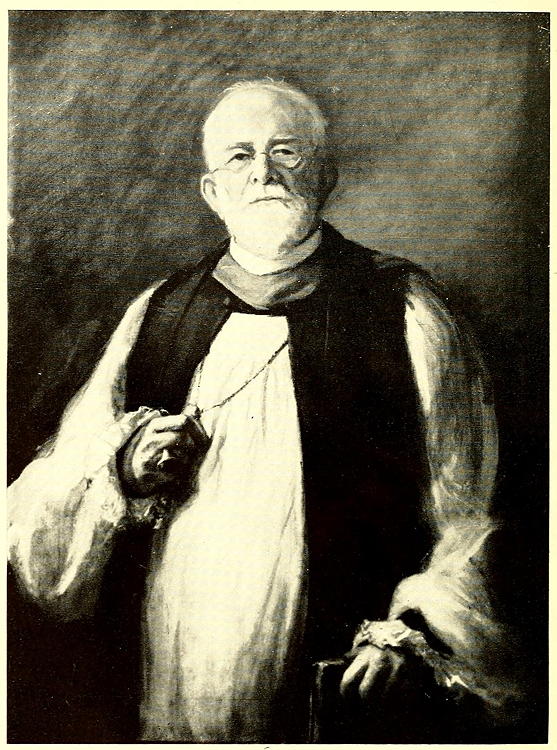
When Bishop Cheshire assumed the episcopal oversight
of the Diocese of North Carolina, he felt little confidence
in his ability to fulfill the duties of the office. He did feel
that by sincere and diligent application he could accomplish
much for the welfare of the church. When elected
assistant bishop he was, in his own words, "constrained to
accept the call, not from any sense of fitness in myself,
but simply because such a call seems to me to carry with
it an imperative obligation to accept, unless the hand of
God should plainly point in another direction: a dispensation
was laid upon me."[30] Notwithstanding his expressed
views, Bishop Cheshire was, in the opinion of most
churchmen, better fitted for his office by ability, temperament,
and training than any other man in North Carolina.
Bishop Cheshire met his first diocesan convention in
May, 1894, at St. Paul's Church, Winston. He opened his
annual address by saying: "I cannot bring into any order
or method in my own mind, much less can I put it into
words, the feelings which this occasion calls up. To no
one can it seem stranger than it does to myself that I
should occupy this place, and thus address you from the
chair of Ravenscroft, of Atkinson, and of him so lately
taken from us." He made no recommendations for important
changes in the policy or work of the church,
since he wished to become more thoroughly acquainted
with the problems and needs of the Diocese before doing
so. The Bishop urged upon the clergy then, as he was
to do many times in the future, the necessity of keeping
their parochial records in proper order, and observed that
no businessman would employ a clerk for a week if he
kept his books as many of the parish registers were kept.
In concluding his address, the Bishop touched on three
subjects which were to be collectively the theme of his
episcopate: namely, the importance of regarding the Diocese
rather than the parish as the unit of the church; the
necessity of supporting all diocesan institutions; and the
great need for continuing and expanding the missionary
work of the Diocese. Time and time again he drove home
the spirit and essence of these subjects, until the clergy
and laity alike caught some of the fire of his enthusiasm
and translated his ideas into living reality.
One of the first diocesan projects Bishop Cheshire undertook
was the revival of the old mission of Valle Crucis,
established by Bishop Ives about fifty years before. At
the same time he planned to revive the mission work
along the Watauga River. For this difficult work the
Bishop had one man in mind who he thought was eminently
qualified—Rev. Milnor Jones. His first meeting
with Jones had been at the convention of 1883. Shortly
afterwards, Bishop Lyman had asked Cheshire if he would
carry to Jones a sum of money which had been raised
to aid him in erecting a church at Tryon. The Bishop had
added that he hoped Cheshire would spend a few days
with Jones to observe his work. Cheshire complied with
the Bishop's request, and spent a few unforgettable days
with Jones, driving with him over the hills and valleys of
Polk County to visit his scattered missions. At the time,
he had been greatly impressed with Jones' influence with
the mountain people. When he began to plan the revival
of Valle Crucis, he remembered his experience with the
picturesque mountain missionary.
Milnor Jones, however, was in Oregon when the
Bishop was ready to commence his mountain work. In
January, 1894, Cheshire wrote asking him to return to
North Carolina. In replying to Bishop Cheshire, Jones
wrote this characteristically laconic letter: "Where do
you want me to go? What do you wish me to do? And
what salary will you give? Not that the amount of the
salary makes any difference; I only wish to know just
what I have to go on." The Bishop answered as concisely:
"I want you to go to Valle Crucis, on the Watauga River.
I want you to revive the old Valle Crucis Mission, as
your special work; and I give you for your field of operations
Watauga, Mitchell, and Ashe Counties, to do what
you can in them. I will give you six hundred dollars a
year, payable monthly."[31]
Milnor Jones was a rough, plain-spoken individual
with a remarkable faculty for understanding and winning
the confidence of the simple mountain folk. He had a
deeply religious nature, and a complete fearlessness in
preaching the Gospel as he understood it. Bishop Cheshire
found him an unusually effective man in laying the foundations
of missionary work, but from that point he
seemed to lack the power to build further.
Jones entered with enthusiasm upon his work in the
mountains of North Carolina. When the Bishop began
his visitations to the western counties in June, 1895, he
found that Jones had made a promising beginning. Bishop
Cheshire spent several weeks with him, visiting one mission
station after another in the counties of Mitchell, Watauga,
and Ashe. They preached, baptized, and confirmed
in the most out-of-the-way places and under the most
varied conditions. When they first visited Bakersville
they held services in the courthouse, but upon their return
for a second service some time later, they were refused
the use of the building on the grounds that the
courthouse was not safe for large crowds. The local
newspaper, however, gave as the reason for the refusal
the fact that the Methodists and Baptists held that "the
Episcopalians had been preaching uncomfortable doctrine."
The Bishop and Jones were not to be daunted;
they held their service on the street in front of the courthouse.
A large congregation gathered for the service.
When the Bishop began preaching he did not think his
voice would reach the assemblage, but after a few minutes
he felt as if he could make himself heard "a mile
away." He afterwards declared that "I never spoke with
more ease, freedom, and enjoyment, or with a greater
sense of the high privilege of being a servant and ambassador
of my Lord."[32]
Another interesting episode in Bishop Cheshire's mission
work in the mountains took place at Beaver Creek,
Ashe County, in the summer of 1896. Here the Bishop
and Jones were maintaining a mission school with two
teachers in a building which had been leased for two
years. When the Bishop went to the schoolhouse to hold
a service, he was met by a mob of more than fifty men
who "forcibly prevented" him from entering. The mob
declared that the reason they were preventing him from
holding his service was that they did not like "Mr. Jones'
doctrine" and they understood that he, the Bishop,
taught the same doctrine. In reporting the incident to the
convention of the Jurisdiction of Asheville, the Bishop
described it as "an experience which I certainly had never
thought a possibility in my native state of North Carolina."[33]
In reviving the old mission at Valle Crucis Bishop
Cheshire did not intend to follow the plan of Bishop Ives,
which had been to establish a boys' school and a training
school for the clergy. His primary motive was to
evangelize the people of the mountain counties. He
wanted to make Valle Crucis "an associate mission from
which preachers and teachers should go out and keep up
the work of evangelizing, instructing, and educating
wherever an opening might be found or made."[34]
Milnor Jones, carrying letters of introduction from his
Bishop, in the fall of 1895 visited the northern states to
raise funds for his mountain work. He was successful in
his efforts and, with the money thus raised, mission schools
were established at Valle Crucis and at Beaver Creek. In
the course of 1896 and 1897 a mission home, consisting
of an eight-room house, was erected at Valle Crucis at a
cost of twelve hundred dollars. It was built to accommodate
a missionary, a teacher, and several pupils attending
the mission school. Shortly after this constructive beginning
Milnor Jones gave up the work at Valle Crucis. He
confined his efforts to the small mission stations scattered
over Mitchell, Watauga, and Ashe counties. The Bishop
placed Rev. Samuel F. Adams in charge of Valle Crucis,
and under his guidance and that of his successors the
work progressed steadily.
Milnor Jones left North Carolina towards the end of
1897. He, with the assistance and encouragement of
Bishop Cheshire, had laid the foundations of a missionary
work which was to be a credit to the church. Referring
once to the character of Jones' work, the Bishop remarked:
"If I had a wild mountain country full of moonshiners,
I think I would like to have him, but for anything
more civilized he is too savage."[35] With all of Jones'
crudeness and faults, Bishop Cheshire believed him to be
"really a more Godly man than many an one whose life
is perfectly conventional and blameless." The Bishop
often remarked that the visits he made to Milnor Jones
in the mountains of North Carolina were among the most
interesting experiences of his career.
Coinciding with Bishop Cheshire's efforts to expand
and revive the missionary work of the church in the
mountains, a movement was initiated to create a missionary
district from the western counties of the Diocese of
North Carolina. At the diocesan convention of 1894 a
committee was appointed to study the advisability of requesting
the General Convention to organize the western
counties of the state into a missionary jurisdiction. It was
felt by many that the present Diocese was too large to be
adequately administered and supervised by one bishop. In
his address to the convention of 1895 Bishop Cheshire
substantiated this view when he reported that during the
past year he had been able to devote only nine weeks to
the western section of the state, which embraced nearly
thirty counties.
The Bishop was "in sentiment" strongly opposed to a
division of his Diocese, for he disliked seeing the church
in North Carolina divided further. Also, he had become
deeply interested in his mountain missions and was loath
to relinquish them. He realized, however, the impossibility
of properly serving such a large territory. Moreover,
he was determined not to make the mistake which he
thought Bishop Atkinson, in 1877, and Bishop Lyman,
in 1882, had made when they opposed the formation of
a new diocese. In his opinion, a bishop "makes a mistake,
when he opposes the well-settled convictions of his
clergy and people upon a matter affecting the development
of the Diocese."[36]
When the diocesan convention met in May, 1895, the
Committee on the Proposed Missionary Jurisdiction recommended
that the General Convention be requested to
set apart the western section of the Diocese of North
Carolina as a missionary jurisdiction. It was further recommended
that the line of division should be the eastern
boundaries of the counties of Alleghany, Wilkes, Alexander,
Catawba, Lincoln and Gaston. Bishop Cheshire
had suggested to the committee this territorial division.
Although it meant a great loss of strength to his own Diocese,
the Bishop believed that the missionary jurisdiction
should be made large enough to be of importance, and
that it should be created with the view of its becoming
a diocese at some future date. The convention adopted
the committee's recommendations, and instructed its deputies
to present them to the General Convention.
When this body met in the fall of 1895, Bishop Cheshire
presented in the House of Bishops the memorial of
the Diocese of North Carolina requesting the erection of
a missionary jurisdiction. The memorial was referred to
the Committee on Domestic Missions. A few days later
the Bishop of Florida, chairman of the committee, reported
the memorial unfavorably, stating that his committee
did not believe the reasons set forth were sufficient
to justify an affirmative action. He further reported that
the legal and constitutional requirements had not been
properly provided for. Bishop Cheshire then introduced
a resolution calling for the erection of a missionary district
and providing that it should be under the limited
jurisdiction of the Bishop and Convention of the Diocese
of North Carolina until such constitutional amendments
could be adopted to remove the objections advanced by
the Bishop of Florida. The House of Bishops adopted the
resolution with little discussion, and two days later it was
approved by the House of Deputies. Following this action
Bishop Cheshire moved that the House of Bishops
should proceed to the election of a missionary bishop for
the newly created district. His motion met with opposition
and was postponed to a future meeting of the House
of Bishops. The district, which was to be known as the
Jurisdiction of Asheville, was temporarily placed under
the episcopal care of Bishop Cheshire.
Only a few weeks after the close of the General Convention,
Bishop Cheshire, on November 12, 1895, met the
first convention of the Missionary Jurisdiction of Asheville.
He outlined to the clergy and laity what would be
expected of them as a missionary jurisdiction, and gave
much helpful advice on setting up the machinery for
carrying on their work. The Bishop called to their attention
the almost incalculable opportunities for extending
the influence of the church in the mountain counties. The
next year he greatly expanded this idea in a charge to
the clergy of the Jurisdiction. The Bishop pointed out
that nine-tenths of the work in the Jurisdiction of Asheville
was to evangelize people who were almost wholly
ignorant of the church. Such material aids as rectories,
schoolhouses, and even churches, while undoubtedly
helpful, were not necessary adjuncts to the primary
object of the church: "to catch men." He urged the
clergy to know the people, to preach to them in words
they could understand, and to make religion an integral
part of their lives.
After completing his first year in charge of the Jurisdiction
of Asheville, and after a careful study of the manifold
problems peculiar to it, Bishop Cheshire was convinced
that the erection of the missionary jurisdiction
was "an act of wise and prudent statesmanship." He
thought that a missionary who had the oversight of three
or four counties sorely needed regular visitations from
the bishop, and in his opinion the work could be more
effectively carried on if the bishop were able to remain
a week or more with each missionary. He pressed these
points upon the members of the House of Bishops in
strongly advocating the election of a bishop for the Jurisdiction.
Finally, in the fall of 1898, the House of Bishops
elected the Rev. Junius Moore Horner, a native North
Carolinian, as missionary bishop of the Jurisdiction of
Asheville. He was consecrated on December 28, 1898,
in Trinity Church, Asheville, with Bishop Cheshire as
the consecrator. After this service Bishop Cheshire formally
turned over to Bishop Horner the full administration
of the Jurisdiction.
Turning now to a wholly different phase of Bishop
Cheshire's work, we take up one of the most important
achievements of his long episcopate, the establishment of
St. Mary's School for girls as a church institution. This
school had been founded in Raleigh by Dr. Aldert Smedes
in 1842, and had been nurtured and maintained, through
good and hard times, by its founder and his son and successor,
Dr. Bennett Smedes. St. Mary's was not a church
school, but its two rectors had been Episcopal clergymen,
and thus the institution had been under the exclusive influence
of the Episcopal Church. By 1896 Dr. Bennett
Smedes was finding it very difficult to compete with publicly
supported and privately endowed schools. At this
time he made it known that he could no longer continue
St. Mary's as a private school.
The Alumnae Association of St. Mary's at once took
action to preserve the school for the church. It sent a
memorial to the diocesan convention of 1896, in which
it appealed to the Episcopal Church in North Carolina
"either to endow the School, or to erect for it suitable
buildings in Raleigh or elsewhere, and thus relieve it of
one great drain, its heavy rent." The appeal met with
sympathetic attention from Bishop Cheshire. Only the
year before, he had remarked to the convention: "I have
been, from earliest childhood, brought up to look upon
St. Mary's School, at Raleigh, as the most valuable of all
our church institutions or agencies in North Carolina....
I cannot too highly recommend this school to the confidence
of all the people of North Carolina."
After careful consideration of the St. Mary's Alumnae
memorial, the convention adopted a resolution providing
for the appointment of a committee of six, to include the
Bishop, with the authority to buy suitable buildings for
a girls' school or to purchase land and erect new buildings.
In direct reply to the memorialists, Bishop Cheshire
offered a resolution, which the convention adopted, assuring
the alumnae that the church in North Carolina
"will do all in its power to place St. Mary's School upon
a permanent foundation as an institution under the
charge and patronage of the Church throughout the entire
State...."
At the convention of 1897 the special committee on a
diocesan school for girls reported that it had procured a
charter of incorporation for the Board of Trustees of St.
Mary's School from the state legislature, and had turned
over to this corporation all further negotiations. The
newly constituted Board of Trustees, of which Bishop
Cheshire was chairman, then made its report. It recommended
that not less than one hundred thousand dollars
be raised for the purchase of a location, the erection of
buildings, and an endowment of St. Mary's School. The
Board announced that it had contracted to purchase for
fifty thousand dollars a site known as the St. Mary's
Tract. The convention adopted the report as it was made.
During the past year, at the request of the Trustees,
Bishop Cheshire had spent a month visiting many towns
throughout the state in an attempt to interest the people
of the church in the needs and potentialities of St. Mary's
School. His efforts met with gratifying success. He appealed
to the women of the state, and especially to the
alumnae of St. Mary's, to raise fifty thousand dollars for
an endowment which should be known as "The St.
Mary's Alumnae Association Fund." To stimulate the interest
and increase the activity of the women in this plan,
Bishop Cheshire organized the "Order of the Patrons and
Daughters of St. Mary's." He proposed to find fifty
women who would give five hundred dollars each towards
the endowment, and two hundred and fifty others
who would each contribute one hundred dollars. He reported
to the convention of 1897 that he had raised a substantial
amount in this way.
Thus, St. Mary's was established as the official school
of the Episcopal Church in North Carolina. The Diocese
of East Carolina and the Jurisdiction of Asheville had
agreed to contribute to the maintenance of the school
and were given representation on the Board of Trustees.
Dr. Bennett Smedes was retained as rector of the school
and continued in this position until his death in 1899. The
first year the school was under the control of the church
the number of boarding students increased fifty per cent.
To a great extent the enlarged enrollment was due to the
renewed interest which Bishop Cheshire had aroused.
In the course of his negotiations to establish St. Mary's
as a church school, the Bishop discovered that the churchmen
of South Carolina had been for some time loyal and
generous supporters of the school. After reflection upon
this fact, he determined to ask the Diocese of South Carolina
to co-operate in the maintenance and management
of St. Mary's. When he discussed the subject with the
Board of Trustees, it was decided to appoint a committee
of the Board to meet at Saluda to confer with representatives
from South Carolina. The conference was held in
August, 1898. After a friendly and constructive discussion,
the conference resolved that St. Mary's School
should be placed under the "control and patronage of
all the Carolina Dioceses."
Bishop Cheshire met with the convention of the Diocese
of South Carolina in the spring of 1899 and presented
the advantages and possibilities of St. Mary's as a
church institution. The resolution of the Saluda conference
was reported to the convention and was unanimously
adopted. Bishop Capers, two clergymen, and two laymen
were appointed to the Board of Trustees to represent
South Carolina. After patient and diligent work Bishop
Cheshire was able to unite the church of the two states
in the support of one church school for girls. In a comparatively
short time it was to become the largest Episcopal
school for girls in the United States.
In the winter of 1897 Bishop Cheshire suffered an irreparable
loss in the death of his wife. Their married life
of twenty-two years had been remarkably happy. Mrs.
Cheshire had been a great help to him in his work as
deacon and priest and later as bishop of the Diocese. She
gave him encouragement, devotion, and the benefit of her
sound common sense. The Bishop often spoke of how
much she meant to him in his work, and of their happy
life together.
It was a fortunate coincidence that the Lambeth Conference
came in the summer of 1897, for it enabled him
to have a complete change, removing him from those associations
which reminded him so strongly of his wife.
The Lambeth Conference, which convenes approximately
every ten years at Lambeth Palace, London, is composed
of all the bishops of the Episcopal Church throughout the
world. Bishop Cheshire decided to attend, believing it
would be broadening and an exceedingly worth-while
experience. The object of the Conference was to discuss
religious questions of world-wide interest. In the course
of its sessions it would be divided into groups which
would discuss problems relating to particular countries.
The Bishop sailed from New York on June 2, arriving
in England six days later. Since the Conference did not
commence until July 1, he spent the intervening time
sight-seeing. This was the summer of Queen Victoria's
Diamond Jubilee, giving an additional interest to his trip.
He attended the Jubilee service at St. Paul's, and remarked
that the Bishop of London preached "a good
sermon" for the occasion.
The Lambeth Conference was formally opened at
Westminster Abbey by the Archbishop of Canterbury,
who was to preside over its sessions. There were present
for the Conference one hundred and ninety-four bishops
from all parts of the world. Forty-nine of these represented
the Episcopal Church of the United States. The sessions
of the Conference continued through July 31. Bishop
Cheshire was a member of the committee on church
unity, and, as far as his journal reveals, this was the only
committee on which he served. Reporting upon the Lambeth
Conference to his diocesan convention the following
year, Bishop Cheshire said: "The first message which we
bring home from the Lambeth Conference of 1897 is
that God in His Providence is opening the world to us;
and to prepare us for the work we are to do, He is drawing
all parts of the world-possessing Anglo-Saxon race
into a closer union of common interest and sympathies,
and of mutual confidence." He declared that the American
bishops, while receiving much benefit from the Conference,
had also contributed constructively to its work.
Shortly after the Conference closed, Bishop Cheshire
visited the Archbishop of York for a few days. Upon
leaving York he spent about a month traveling in England,
Scotland, the Orkneys, and Ireland. In early September
he left England for the Continent, where he
visited in succession Antwerp, Brussels, and Cologne. Of
his reactions to the cathedrals of these three cities, the
Bishop observed that they "do not seem to me to be really
so full of interest and beauty as even the inferior English
cathedrals. They do not so abound with evidences and
symbols of their connection with the life and history of
the country and people, and so in spite of all their ornamentation
they have a barren look."[37] The Bishop did
some further sight-seeing in Germany, Switzerland, and
France. While in Switzerland he saw the famous Lion of
Lucerne, which he thought possessed "a dignity, nobleness,
and beauty about it which exceeds anything of the
kind I have ever seen before." Leaving from Southampton,
he arrived in New York on September 24, feeling
much refreshed and ready to return to the work of his
Diocese.
Two years after his visit to England Bishop Cheshire
married Miss Elizabeth Lansdale Mitchell, of Beltsville,
Maryland. She was the daughter of Rev. Walter A.
Mitchell, an Episcopal clergyman. The marriage proved
to be happy and successful in every way. Mrs. Cheshire
was a splendid mother to the Bishop's children, and they
all became devoted to her.
When a friend heard that Bishop Cheshire was to be
married, he remarked to the Bishop that with his large
family he needed a wife. With his characteristic honesty
the Bishop replied: "I don't need any such thing. My
daughters take the best care of me and want me to have
the best of everything. I don't need a wife; I am marrying
again just because I want to."[38]
From the General Convention of 1895 to that of 1931,
Bishop Cheshire attended every triennial meeting of this
body. In the first three or four conventions, he did not
take an active part in the discussions of the House of
Bishops. For that matter, he never participated as prominently
in its deliberations as some of the other bishops.
At the 1895 convention he was appointed to the committees
on the Admission of New Dioceses and on the Consecration
of Bishops, and at the next triennial meeting he
was made a member of the Joint Commission on the Revision
of the Constitution and Canons. This last appointment
pleased him, since it was the kind of work for
which he was well prepared. His legal training influenced
his partiality for this type of work. In 1904 he was appointed
to the Committee on Canons, on which he served
for almost every convention until his death. As a member
of this committee he made his most important contribution
to the work of the General Convention. It will
be recalled that it was in this capacity that he had done
his best work in the diocesan conventions. From time to
time he was made a member of other regular and special
committees.
When Bishop Cheshire assumed the office of bishop of
the Diocese of North Carolina, he felt it his duty to exercise
the full authority of that office. In deciding upon this
course of action he did not intend to be arbitrary or despotic
in administering the Diocese, although at times
some clergymen and laymen seemed to think so. But
when they became better acquainted with him and his
methods, they admired and respected him the more. The
Bishop had a forthright, and sometimes decidedly blunt,
manner of speaking, which, to those who did not know
him so well, seemed arbitrary or overbearing. He had disagreements
with his clergymen, but they felt that they
could always count upon receiving a fair hearing from
him. When the Bishop realized he was in error upon any
point, no one was quicker than he to admit it.
In 1895 Bishop Cheshire, for the first time in the history
of the Diocese, issued to the clergy "Visitation Articles,"
as called for by a canon of the church. After employing
them for a year he found they were useful and
"calculated to make the visitations of the Bishop of more
real value to the Clergy and to the people. The Bishop has
for so long a time ceased to exert any real influence or
control in the ordinary life and work of the parish in all
parts of the United States, that the assertion of that authority,
which in theory our Bishops are supposed to possess,
is perhaps impracticable at present."[39] He thought
that if the bishop would make himself acquainted with
the affairs of each congregation during his visitation, it
would strengthen the influence of the episcopate, and
would go far towards the "breaking up of our present
congregational parochialism." One of Bishop Cheshire's
customs which endeared him to his people was that of
calling upon the members of a congregation during his
visitation. Of this practice he once remarked: "People
like the attention and it makes Bishop and people feel
nearer together, but in most cases they do not want very
long visits."[40] The Bishop's keen understanding of human
nature was one of his most notable qualities.
Bishop Cheshire thought that southern bishops had a
great deal to be thankful for, particularly that in the
South "as much as anywhere in the world, I believe, the
Bishop may still be in some real and personal sense, the
pastor of his flock, can live in familiar and confidential
relations with his people." He deplored the tendency,
which seemed to be growing in some quarters, of making
the bishop simply an administrator of ecclesiastical affairs.
While Bishop Cheshire was in no sense a ritualist, or
what is commonly known as high church, he believed in
a strict adherence to the rubrics of the Book of Common
Prayer. He had a great reverence and admiration for the
services of the Prayer Book, and consequently little patience
with those clergymen who attempted to alter their
order or length. He was not a dogmatic formalist, but
was thoroughly convinced that the canons and rubrics of
the church should be obeyed and not disregarded by
those individuals who might take exception to them.
In a charge to his clergy on the subject of Public Worship,
Bishop Cheshire pointed out that the church was
established and is sustained by Christ for two purposes:
"first, to be the depository and source of spiritual Truth
and Power; and second, to bring men into living contact
with that spiritual Truth and Power." The Prayer Book
is a means by which the church can diffuse and extend
the truth, and it is also a means of developing and conserving
the influence of the church. In his opinion, extemporary
methods of worship had a tendency to weaken
and finally destroy the concept of common public worship.
The public worship of the Episcopal Church was
not left to individual whim or judgment, but was definitely
prescribed. He maintained that the participation
of the congregation in the services and sacraments of the
church is its principal means of cultivating its oneness
with Christ. The Bishop enjoined the clergy to follow
the services as they were set down in the Prayer Book,
and warned them that they would gain nothing, but
rather would injure the church by seeking to make their
services more attractive through short cuts or innovations.
In a Pastoral Letter to the clergy and laity of the Diocese,
Bishop Cheshire further developed the subject of
public worship and the use of the Prayer Book. He gave
much sound instruction as to how the minister and congregation
should conduct themselves in any of the
church's services, particularly emphasizing the importance
of correct kneeling and audible and intelligent responses.
He stressed the value which the clergy and laity
would receive from a regular observance of the feast
days and fast days. The Bishop expressed his strong disapproval
of decorating the church for any purpose other
than "for God's honor." The sacred character of the
church should not be sacrificed to gratify the vanity of
men and women. He referred particularly to the extravagant
excesses often indulged in when decorating the
church for weddings.
This Pastoral Letter is just as applicable to churchmen
today and is worthy of as much consideration from them
as when it was first issued in 1912. It would be of great
value to them to hear it read annually in the churches
of the Diocese.
Bishop Cheshire never went to extremes in anything.
In spiritual as well as in material matters he believed in
preserving a sense of proportion. He advised his clergy
to use practical judgment in the observance of Lenten
services. Very few clergymen were capable of preaching
good sermons for forty or more consecutive days and,
in his opinion, few congregations desired them. Even
in those cases where a preaching Lent had been successful,
he thought that a change would have a salutary effect
upon the people.
On the subject of church music he tried to preserve
an equilibrium of opinion. The Bishop was very fond of
good ecclesiastical music and thoroughly enjoyed singing
himself. While his standards of church music were high,
he did not at all approve of too elaborate arrangements of
the old chants and hymns. He wanted them sung properly,
but also in such a way that at least a part of the
congregation would be able to join in with the choir. On
several occasions he was known to have stopped the
organist and choir in the middle of a hymn or chant because
the tune was either too difficult or too decorative.
Bishop Cheshire's interest in domestic missionary
work was by no means limited to the zeal which he had
displayed when working in the mountains of North Carolina.
In his report on missionary work to the convention
of 1898, he made a strong appeal for domestic missions
and missionaries. He called to the attention of the convention
the fact that the growth of the church in the
Diocese was chiefly through its missions. Since there were
no large city parishes, its strength lay in the towns, villages,
and country districts. "In these," said he, "has been
our growth, and in these is our hope and strength for the
future." The missionary clergymen had presented for
confirmation during the past year more than half of the
total number of persons confirmed. He concluded these
remarks with an urgent plea for adequate salaries for the
missionaries.
Up to 1901 the administration of the diocesan missions
was in the hands of the Bishop and the Executive Missionary
Committee of the convention. Bishop Cheshire
reported that under this system the missionary work
usually showed an annual deficit of from four to five
hundred dollars, even after he had used funds for it which
should have been reserved for special work. With the
advice and approbation of Bishop Cheshire, the convention
of 1901 divided the missionary work of the Diocese
into three divisions—the Convocation of Raleigh, the
Convocation of Charlotte, and the Convocation for Colored
Work. These convocations, each with an archdeacon
at its head, were given full control of diocesan missions.
The archdeacons, under the supervision of the bishop,
had the direction and control of the missionaries in their
respective convocations. Under this new organization
the diocesan missions progressed steadily, and the treasurers
of the convocations seldom reported a deficit. Some
fifteen years after this plan was inaugurated, Bishop
Cheshire declared that the missionary work had been
"prosecuted with greater vigor and system than ever before
in my knowledge of the Diocese."
At the close of the first decade of Bishop Cheshire's
episcopate, a large number of clergy and laity gathered
at Good Shepherd Church, Raleigh, on the evening of
October 14, 1903, to celebrate the occasion. At this service
the Bishop made an address in which he reviewed his
work for the period. During the decade he had held more
than 4,000 services, preached 1,400 sermons, delivered
500 addresses, confirmed 4,400 persons, consecrated 27
churches and chapels, and ordained 27 clergymen. To
him the greatest achievement of the past ten years was
the acquisition of St. Mary's and its establishment as the
church school of all the Carolina dioceses. In 1897 his
Diocese had assumed in behalf of St. Mary's an obligation
of fifty thousand dollars to be paid in twenty years.
At the end of six years only eighteen thousand dollars of
the debt remained, and in addition ten thousand dollars
had been spent upon permanent equipment for the school.
Since the Diocese took over St. Mary's, the number of
boarding pupils had increased threefold. In conclusion,
he declared that they should not look too much to the
past but should press on to the future with the work of
the church.
Representatives of the clergy and laity congratulated
the Bishop upon his tenth anniversary, pledging their
loyalty and devotion to him, and expressing the appreciation
of their respective bodies for his splendid work.
Mr. Richard H. Battle, in behalf of a number of the
Bishop's friends, presented him with a beautiful pectoral
cross and a silk cassock. In acknowledging the kind expressions
and gifts, the Bishop remarked: "I have one
single desire, it is to serve God in this Diocese. It was
the interest that I took in the work here that brought me
into the ministry, and I have no desire to labor elsewhere.
I love my people, and I appreciate the kindness, sympathy
and aid that has been given me...."[41]
The following day the colored clergy and laity honored
the Bishop in a service at St. Ambrose Church, Raleigh.
Resolutions expressing the confidence and affection
of the colored churchmen were presented to Bishop
Cheshire by Rev. Henry B. Delany. Rev. Primus P.
Alston, on behalf of the colored clergy, gave the Bishop
a handsome stole, accompanying it with an address expressing
the gratitude of the colored people for his work
among them. Afterwards, the Bishop observed that nothing
during the past ten years had been more gratifying
to him than "the unvarying respect, courtesy and loyal
support" which he had received at the hands of his colored
clergy and laity.