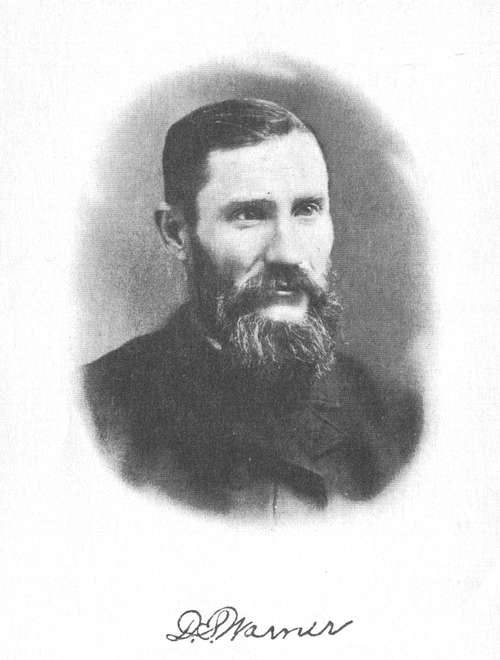
Birth of a Reformation — Publisher's Preface — Author's Preface
TRANSCRIBER'S NOTE
The cover image was created by the transcriber
and is placed in the public domain.
For consistency, all bible references have been made to have no spaces
in the numbers, for example 'Thess. 2:3,4' or 'Rev. 17:4-6'.
Obvious typographical errors and punctuation errors have been
corrected after careful comparison with other occurrences within
the text and consultation of external sources.
"It shall come to pass, that at evening time
it shall be light."
FAITH PUBLISHING HOUSE
P. O. Box 713
Guthrie, Oklahoma 73044
To the
Generations
Following
Year 1966
This volume, a reprint of the book originally published
in 1921 and out of print for many years, is in response
to a long felt need that this biography of D. S. Warner,
along with a brief mention of a few of his associate ministers
and gospel workers, should be available to the readers
of the present generation and those to follow, should
the Lord extend time.
The original book is herewith reproduced without alteration
or change, except a very few minor omissions, and
accounts of events and conditions existing after the period
of Bro. Warner's life.
The reader should bear in mind that Bro. Warner's
coming out of sectism was a gradual process over a period
of time leading to the climactic step, and any improper
or questionable action on his part while involved in sects
was merely a result of his lack of clear light and understanding
of God's Word. After the light broke through,
he himself renounced these practices.
In 1878 D. S. Warner wrote: "The Lord ... gave me
a new commission to join holiness and all truth together
and build up the apostolic church of the living God."
Bro. Warner and his associates, discerning the impossibility
of the true church existing within the framework
of denominationalism, declared their freedom from the
"sin of sectism and division" and instituted the "evening
light" restoration movement in the latter part of the nineteenth
century in direct fulfillment of Bible prophecy. See
Zech. 14:7. These vital Bible truths, especially on the
line of holiness and the nature of the church, which those
reformers proclaimed, are imperative today in preserving
the church after the apostolic pattern.
Many reformations have come to the religious world
since the decline of the apostolic church from its pristine
glory of the first century. Yet the nineteenth century reform
is more complete, radical and fundamental than any
previous movement. A historian has penned this significant
observation: "No sooner had D. S. Warner and
others begun to preach as men had not preached for time
out of mind than men saw in their message the grandest
truths the mind of man is capable of receiving. They saw
the church built up by Christ, led and organized by the
Holy Spirit, the names of whose members are in the Lamb's
book of life, which takes the Scriptures as its only discipline,
and fellowships every blood-bought soul. Here is
real Christian unity.
"Despised and rejected in 'religious' circles, these men
preached more real Bible truth in one sermon than one
would expect in months of the ordinary kind. They
preached profound truths; and it created a furor wherever
they went. Thousands received Scriptural light.
Many joyfully embraced the great truths they heard and
spared neither pains nor money to spread the message
everywhere."
In his book, "The Cleansing of the Sanctuary," Bro.
Warner wrote thus on the subject of exclusiveness: "Christ
is an exclusive Christ; there is none beside him. The
faith that he gave us is an exclusive faith; no other saves
the soul. The truth of God is exclusive in its nature;
everything contrary to it is false. The kingdom of Christ
is exclusive. It is a stone that breaks everything else to
pieces. The one church that Jesus founded and named,
and which is his own body, is also exclusive, for there is
only 'one body in Christ.' During the reign of pagan persecution
the rulers offered to stop the bloody martyrdom
and allow the Christians to worship God in freedom, if
they would confess that the pagan idols were also real
Gods. This they could not do, but chose rather to die.
And on this very point of exclusiveness is the present offense
of the cross. People would not seriously object to
God's ministers setting forth the church as contained in
the Scriptures, if we would recognize their earth-born institutions
as being also God's churches. But this we cannot do
and be honest before God and faithful to his Word.
"There is but one household of faith. Christ does not have
a plurality of wives. He has but one bride, and she has
no sisters. Thus saith her husband, 'My dove, my undefiled
is but one; she is the only one of her mother.' S. of
Sol. 6:9."
"Three score and ten" years ago Bro. Warner's earthly
career in the service of the Master was ended, yet God
in His infinite plan has preserved a holy remnant through
the intervening years which has retained and maintained
those precious original reformation truths. The two witnesses
(Rev. 11:11)—the Word and the Spirit—have resumed
their rightful positions as Governors of the church
in this "evening time" of the gospel day. Jesus Christ will
find His Church "without spot or wrinkle" when He comes
again for His Bride.
—THE PUBLISHERS
May, 1966
Year 1921
A quarter century has elapsed since the passing of
D. S. Warner from the scenes of his earthly activity, and
full forty years have gone since the beginning of the great
reform of which his labors constituted so large a part.
While there are many still living whose personal knowledge
of him and his ministry will suffice to them for an
encouraging testimony of Christian attainment and of
God's marvelous use of human instrumentality when permitted
to have his way, the time has come when the absence
of any published account of this remarkable man
begins to be felt. The rising generation and the generations
that follow should have access to a study of such an
example of Christian devotion and usefulness, as well
as of God's faithfulness to one who will fully trust him.
When it was announced that a biography was contemplated,
the proposition at once met with hearty approval
and encouragement.
That due to the lapse of years there should be some
difficulty in securing the necessary data with reference to
his early life is of course consequential. His brothers
and sisters are all deceased. A nephew and a niece and
some of his earlier acquaintances were interviewed, and
correspondence was had with other relatives and acquaintances.
The most valuable acquisition, however, was the
use of his diaries, kindly granted by his son, D. Sidney
Warner, now living in Canton, Ohio. These diaries do
not cover all of his early ministerial career, but the quotations
from them will reveal the Christian character of the
man as well as show considerable of his itinerancy and of
the facts of his life.
As to the source of information respecting the latter
period of his ministry, when his work took the character
of a reform, recourse has been had to the files of the
periodicals he edited and also to the personal recollections
of some who were pioneers with him in the movement.
Of these may be mentioned as giving particular information
Mrs. Allie R. (Fisher) Allen, Lansing, Mich.;
William N. Smith, North Star, Mich.; David Leininger,
Akron, Ind; Mr. and Mrs. J. N. Howard, Nappanee,
Ind.; Mrs. Anna J. Slagle, Bucyrus, Ohio; Mr. and Mrs.
B. E. Warren, Springfield, Ohio; and Mrs. Frankie
Warner, Anderson, Ind.
It was my privilege to have a personal acquaintance
with D. S. Warner and to be more or less closely associated
with him during the last five years of his life. To
one who never knew him personally no printed account
can afford an adequate conception of what it was to come
in contact with this wonderful ambassador of God, whose
presence wrought conviction in the unregenerate, and inspired
confidence and courage in the hearts of believers.
The divine manifestations in his preaching, his prayers,
and his ministrations can not be told. Many very striking
instances of physical healing which we have not space
to speak of attended his ministry; but that these pages may
reveal, if in no other light than the historical, that here
is an example of true consecration, devotion, courage,
diligence, humility, faith, patience, kindness, self-denial,
and the Christian graces generally, that is worthy of being
followed, is the earnest hope of
A glance over Christian era—Early church divinely
governed—Spiritual decline—A false
church—Reformations—Sixteenth century reformation—Human
rule—Characteristics of true
church—A final reformation—Evil of sects—Protestantism
in Revelation—Wondrous times
upon us—God's call to his people—D. S. Warner
a reformer—The correct attitude—Counterfeit
movements.
Emigration westward—Settlement in Ohio—David
Warner family—Born a weakling—Paternal
and maternal influences—Tributes to mother—Location
in Crawford County—A chosen vessel—His
boyhood character—Removal to Williams
County—A school teacher.
The question of religion—A Catholic and Lutheran
community—Tries to be an infidel—Conviction
by the Spirit—Attends dances—Conversion—Attends
Oberlin College—Preparation for
ministry.
Gifted as an evangelist—Marriage—Death of
wife and children—His physical description—New
Washington revival—Diary accounts—Prejudice
against sanctification—Meeting at Basswood—A
presentiment of death—Standing committee—Rebukes
youthful tobacco-user—Converses
with infidel—Reflections at end of year—Appointed
to Nebraska mission—Lessons on the
church—A farewell meeting.
The Nebraska field—The journey—Nebraska
scenes—Reflections on his bride-to-be—Builds
house—Returns to Ohio—Marriage—Resumes Nebraska
work—All night in dugout—Outlook
temporarily reversed—Long trips over prairie—Wife
lonely—Visit to Indian camp—Fast in snow-drift—Birth
of a daughter—Break in diary account.
On Ashland circuit—News of mother's death—Visits
penitentiary—A course of studies at Vermillion
College—Embraces the cause of holiness—Seeks
and obtains the experience.
Doctrine of sanctification—Widespread interest
in the subject—Prominent leaders—Holiness
bands—Doctrine opposed—Its advocates recede
on the church question—A remnant who walk in
the light—Holiness editors—Jacksonville convention.
A rather new field of activity—Writes for publication—Meets
with opposition—Tirade and
charges by fellow minister—Canton camp-meeting—Eldership
meeting at Smithville, faces charges—Assigned
to Stark circuit—Visits father and
place of conversion—Locates at Canton—Writes
covenant with God—Return to Upper Sandusky—Revival
at Findlay—Reflections on New Year's
Day—Expulsion from West Ohio Eldership—Meetings
at Dunkirk—Increasing vision of apostolic
church—A peculiar test—Work opens in Indiana—Death
of father and daughter—Attends
Ohio Holiness Camp-Meeting—Brought low with
affliction.
Locates at Rome City, Ind.—Writes book—Attends
various camp-meetings—Mob at Upper Sandusky—Remarkable
healings—Eldership seeks
union with Mennonites—Close of diary account—Becomes
editor of Herald.
Prophetic description of reformation movement—Old
Testament figures—Shakings incident
to divine visitations—New covenant complete in
entire sanctification—Prophecies that apply to
these times—Separation of wheat and chaff—Arguments
against sects—Entire sanctification a
remedy—Unity the hope of God's people.
Many world events foreshadowed in prophecy—God
has a design with man—Events of the
world grouped in periods—The four world empires—The
fourth given particular attention—The
little horn of Daniel 7—Time periods of
Romanism and Protestantism—Corresponding
prophecies in Revelation—What Babylon is—God's
people called out of her.
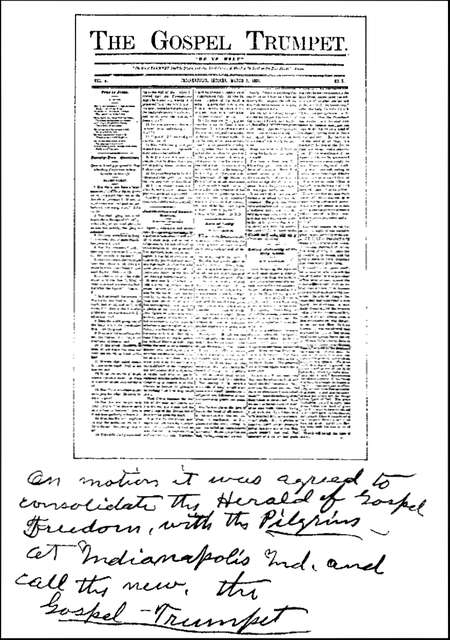
Consolidation of Herald of Gospel Freedom
with the Pilgrim, forming the Gospel Trumpet—Rome
City its birthplace—Move to Indianapolis—Difficulties
and privations—Paper issued irregularly—Printed
on hand-press—Move to Cardington,
Ohio, and later to Bucyrus—To Williamston,
Mich., in 1884, and to Grand Junction in 1886—Substantial
progress.
Unity effected only out of and away from sects—No
other alternative for God's people—Brother
Warner a reformer—His stand meets Satan's opposition,
but vindicated by Spirit of God-Extracts
from Gospel Trumpet—Declares himself
free from Northern Indiana Eldership—Same
stand taken by Michigan saints—Counterfeit doctrines—Trying
time at Bucyrus, Ohio—His wife's
estrangement—Comments by contemporary editors—Trouble
over donation by a Mrs. Booth—Letters
of sympathy and encouragement—Work
spreads into various States—Emma Miller's healing
of blindness—Other marvelous healings—Defection
of J. C. Fisher—How the reformation is
distinguished from all other movements.
Trip into Pennsylvania—Various healings—Attacked
by intoxicated man—Woman delivered
from devils—Visits Winebrennerian camp—An
incident of Beaver Dam assembly—Company of
singers formed—Wonderful meeting in Indiana—Storm
stayed in answer to prayer—Mob near Rising
Sun, Ohio—A Western tour—Strange manifestations
at St. James, Mo.—To Denver—Meetings
in Canada—In the Southern field—Mob element
in Mississippi—Visits Mammoth Cave—Visits
the church in California—Scenery of the Rockies.
Hoped for long life—Difficulty in combining
writing with evangelical work—Could not remain
long out of the field—Begins to write a book on
prophecy—Third marriage—Ohio River campaign—Last
New Year's greeting—A school on the
camp-ground—Last sermon—End of the journey.
ANDREW L. BYERS, Author of this Book
Office Editor Gospel Trumpet.
The Evening Light.
D. S. Warner. (Zech. 14:7.) H. R. Jeffrey.
1. Bright-er days are sweet-ly dawn-ing, Oh, the glo-ry looms in sight!
2. Mist-y fogs, so long con-ceal-ing All the hills of min-gled night,
3. Lo! the ran-somed are re-turn-ing, Robed in shin-ing crys-tal white,
4. Free from Ba-bel, in the Spir-it, Free to wor-ship God a-right,
5. Hal-le-lu-jah! saints are singing, Vic-t'ry in Je-ho-vah's might;
For the cloud-y day is wan-ing, And the eve-ning shall be light.
Van-ish, all their sin re-veal-ing, For the eve-ning shall be light.
Leap-ing shout-ing home to Zi-on, Hap-py in the eve-ning light.
Joy and glad-ness we're re-ceiv-ing, Oh, how sweet this eve-ning light!
Glo-ry! glo-ry! keep it ring-ing, We are saved in eve-ning light!
Chorus.
Oh, what gold-en glo-ry streaming! Pur-er light is com-ing fast;
Now in Christ we've found a free-dom Which e-ter-nal-ly shall last.
I INTRODUCTION — SPIRITUAL DECLINE — REFORMATIONS — HUMAN RULE INSTEAD OF DIVINE — CHARACTERISTICS OF TRUE CHURCH — A FINAL REFORMATION — ANOTHER VIEW OF SECTS — EVIL OF SECTS IN POSITIVE LIGHT — BEASTLY CHARACTER IN PROPHECY — PROTESTANTISM IN REVELATION 13 — A DISPENSATION OF GOD
The life and labors of D. S. Warner are so closely
associated with a religious movement that any attempt at
his biography becomes in part necessarily a history of that
movement. I have therefore chosen the term, Birth of a
Reformation, as a part of the title of this book. Brother
Warner (to use an appellation in keeping with the idea
of universal Christian brotherhood) was doubtless chosen
of God as an instrument for accomplishing a particular
work. What that work was, why it may be called a reformation,
and why, in particular, it may be considered
the last reformation, a few words of explanation by way
of introduction are offered the inquiring reader.
It will be necessary to take a brief glance over the Christian
era and review some of the important events and conditions.
We note the characteristics of the church in the
days of the apostles, which, by reason of its recent founding
and organization by the Holy Spirit, is naturally regarded
as exemplary and ideal. It had no creed but the
Scriptures and no government but that administered by
the Holy Spirit, who 'set the members in the body as it
pleased him'—apostles, prophets, teachers, evangelists,
pastors, etc. Thus subject to the Spirit, the early church
was flexible, capable of expansion and of walking in all
the truth and of adjusting itself to all conditions. It was
in very essence the church, the whole, and not a section or
part. The apostles and early believers did not restrict
themselves and become a Jewish Christian sect or any
other kind of sect. Peter's way of thinking would have
thus limited him, for as a Jew he declined any particular
interest in Gentile converts; but the Lord through a vision
changed his mind and advanced his understanding to
include the universality of the Christian kingdom. The
Holy Spirit in the heart was necessary, of course, to the
successful government of the church by the Spirit, otherwise
he could not have been understood. There were no
dividing lines, for it was the will of the Lord particularly
that there be "one fold and one shepherd." Jesus had
prayed in behalf of the disciples "that they all may be
one; as thou, Father, art in me, and I in thee, that they
also may be one in us: that the world may believe that thou
hast sent me" (John 17:21). These conditions of being
subject to the word and Spirit, of leaving an open door
through which greater light and truth might enter as was
necessary, and of possessing the love and unity of spirit
that cemented the believers together and carried them
through all their persecution, constituted the ideal and normal
status of God's church on earth as he gave it beginning,
of which it was ordained that there should be but one,
only one, as long as the world should endure. "There is
one body, and one Spirit, even as ye are called in one hope
of your calling" (Eph. 4:4).
It was possible, of course, for the church to decline from
her state of purity and thereby to forfeit her standing as
the church. So long as her conflict with paganism lasted
and the various forms of persecution tended to bring into
exercise those principles and qualities which distinguished
her from the world, she practically kept her first estate.
When, however, the tide turned, persecutions ceased and
Christianity came into favor and to be made the state
religion of the Roman Empire, there were presented conditions
favorable to every form of spiritual decline. Christians,
instead of being longer persecuted, were protected,
and to profess Christianity became popular and
easy. The divine features of the church, by which she
had been known for more than two hundred years, were
lost. Every form of corruption came in. Human rule
supplanted the divine, Holy Spirit, rule almost universally,
both in the East and the West. The bishop of Rome, in
particular, rose in prominence until he was made supreme
head—pope—of the Holy Roman church. The reader of
church history knows of the long eclipse of Christianity
that followed, of the darkness and ignorance that reigned
and gave to that period the name, Dark Ages. The true
church, impossible of representation by such a colossal
counterfeit as then appeared in her place and became in
turn a persecuting power, could continue only in fragmentary
form, in obscure places in the wilderness of the Roman
Empire. She could not be manifest in her evangelizing
capacity, but was persecuted. Millions of God's
people, who refused allegiance to this false system of
Christianity, were slain as heretics during this period.
Thus, in the historical foreground we see, not the pure
woman representing the church of God, but we see an
apostate woman seated "upon a scarlet-colored beast," the
Roman state.
"And the woman was arrayed in purple and scarlet
color, and decked with gold and precious stones and
pearls, having a golden cup in her hand full of abominations
and filthiness of her fornication: and upon her forehead
was a name written, Mystery, Babylon the Great, the
Mother of Harlots and Abominations of the Earth. And I
saw the woman drunken with the blood of the saints, and
with the blood of the martyrs of Jesus" (Rev. 17:4-6).
The Word and the Spirit, the two divine authorities,
were set aside. In the place of the former were the traditions
of the Roman Church, and for the latter was substituted
human rule and authority. These two divine
witnesses prophesied in sackcloth during those long centuries,
until such time as they should again function in
their proper sphere in the church—I say until such time:
for we are not to assume that in the design of God this
state of affairs should always continue. True Christianity
was not to perish from the earth. The book of
Daniel prophesies of the papacy, "And he shall speak
great words against the Most High, and shall wear out
the saints of the Most High, and think to change times
and laws: and they shall be given into his hand until a
time and times and the dividing of time" (Dan. 7:25).
(See the time-periods of the various epochs of the Christian
era in our chapter A Prophetic Time.) For this vast
agency of unrighteousness the time should come when the
cup of iniquity should be full and the judgments of God
should be executed and his people delivered. When
Christ comes, his bride will have made herself ready,
which implies that God's people will have been gathered
out of spiritual captivity and brought again to Zion. Light
and truth and the Holy Spirit rule will have been restored
as at the beginning.
Now the rise out of apostasy was expressed by a series
of reformations, not by gradual ascent corresponding to
the decline. The "mystery of iniquity," which crystallized
in the blasphemous "man of sin," had already begun
to work in Paul's day, and the drift into spiritual darkness
on the part of the professing church was without specific
opposition. But, on the other hand, to break away from
conditions apostate always means war with infernal powers.
The wrong is endured until a rising sentiment of protest
breaks out with stern denunciation. God raises up
instruments for this purpose. John Wyclif, in the fourteenth
century, denounced the errors of the so-called
church and the conduct of the monks and also had sufficient
light to see the papacy as the "man of sin" foretold
by the apostle Paul. His reform efforts, however, centered
mostly in the translation of the Bible into English,
which work, in spite of the attempt by Rome to destroy
it, God graciously caused to be preserved.
John Huss, a little later, took Wyclif's attitude against
the corruptions of the church and was burned at the stake
as a heretic. His martyrdom furnished the occasion
for him to utter this prophecy: "You are now going to
burn a goose [Huss meaning goose in the Bohemian language],
but in one hundred years there will arise a swan
whom you can neither roast nor boil." True to this prophecy,
in one hundred years came the intrepid Luther,
under whose leadership history records the great reformation
of the sixteenth century. Church and state were at
this time united, which gave this reformation a political
prominence, as it resulted in the change to Protestantism
of two strong nations, Germany and England. What the
sixteenth century reformation accomplished spiritually
was, among other things, the bringing to light of the Scriptural
doctrine of justification by faith in Christ instead of
by priestly absolution.
It could not have been expected that all the Scriptural
truths and principles should at any time or by any one
reformer be recovered from the rubbish under which they
had been buried for a thousand years. There have been
numerous reforms, bringing out various truths that had
been obscured by the apostasy. Thus Truth in her progress
upward to the Scriptural level, has arisen only by
successive steps, God having to use human instrumentalities
that were limited by the prevailing tendencies and beliefs
of the times. Each reformer naturally dealt with
conditions that were most conspicuous from his view-point
and was exercised in questions of truth that applied
only to such conditions. His reform work
was not final in character, inasmuch as it left some errors
still uncorrected. Hence the progress upward was by a
succession of reforms, each, as a general thing, springing
from a higher level of truth and spiritual attainment than
those preceding. With the great decline into apostasy
now in the past, the church of God was disposed to rise
out of confusion, her destiny being the attainment of her
original standing, when it could be said that her sun should
"no more go down."
The apostasy of the church, as one writer has expressed
it, came by "ecclesiastical ambition and degeneracy." The
human element got in the way where there should have
been only the divine. There is necessarily the human element
in the work of God, for Christian work is God and
man working together; but in the true relation man is God's
instrumentality and is altogether in subjection to the divine
Head, who rules over all. When the human element
supplants, gets in the way of, or acts in the place of, the
divine, we have a fundamental error that always results
in apostasy. This human ecclesiasticism, always more or
less intolerant, reached its autocratic perfection in the hierarchy
of the Roman Catholic Church and constituted
the "man of sin" who opposeth and exalteth himself above
all that is called God, or that is worshiped; so that he as
God "sitteth in the temple of God, showing himself that
he is God" (2 Thess. 2:3,4).
The spirit of human government in church affairs has
shown itself in, or has followed in the wake of, every reform
movement of the past. The Spirit of God worked in
the movement to accomplish good, but was always checked
by this baleful element. Luther meant well but was
himself dogmatic and intolerant. He held to many doctrines
of Catholicism whose wrongs he could not see.
He did not make proper allowance that others besides
himself might be right, or at least have some truth. Neither
did he or his associates or followers leave the way
open for God to lead into more truth, much less the whole
truth. Thus the reformation of the sixteenth century,
while it recovered from the debris of apostasy the doctrine
of justification by faith, became the occasion for
Protestant sects, human-ruled institutions, and these were
succeeded by other sects. Some of these have been as intolerant,
inflexible, and as unlike primitive Christianity as
the Roman Catholic Church itself.
Church government, as humanized in the sects, has
taken forms other than the hierarchic. We have the
episcopal, or rule by bishops; the presbyterian, or rule
by presbyters; the congregational, or rule by the local
brotherhood. Our object here is, not to discuss which of
these forms most nearly resembles or is most different
from the Scriptural, but merely to show that man rule
has manifested itself in various ways.
The true church of God, comprising all Christians,
has in her normal state under her divine head certain
essential characteristics which make her exclusively the
church, the whole and not a part. These might be expressed
as follows:
1. Possession of divine spiritual life. If the church
does not possess this she is not Christ's body and therefore
not the church. She must know the Spirit of God.
2. Disposition to obey all Scripture and to let the
Spirit have his way and rule. This constitutes her safety
in matters of doctrine and government.
3. An attitude receptive to any further truth and
light. This safeguards against dogmatism and a spirit
of infallibility and intolerance, against interpreting Christianity
in the light of traditions and old ideas.
4. Acknowledgment of good wherever found and
the placing of no barrier that would exclude any who
might be Christians. This makes salvation, a holy life,
and a Christian spirit the only test of fellowship, and
disapproves all human standards of church membership
and fellowship.
We repeat that these constitute the Scriptural standard
of the church and characterize her in her unity and integrity.
It is by lacking in one or more of these essentials
that a sect is a sect. In the rise of the church out of
apostasy any reformation that does not develop to the full
the essentials that characterize the church in her wholeness
and completeness must necessarily fall short of being
the final reformation and must leave a cause for further
reformation. This is the explanation of the existence
of the so-called Christian sects, viewing them in the most
charitable light. The Wesleys and their early associates
sought for deeper personal spirituality as well as better
spiritual association than was afforded in the state church
of England. They brought to light and gave particular
prominence to the doctrine of sanctification by faith and
the witness of the Holy Spirit. Their work was a reform;
but as in that day the question of division among Christians
was not prominent, nor was the question of the one
true church understood or appreciated, their work took
definite form in a body humanly organized and called
Methodist. The Campbells had considerable light on the
unity of the church, and proposed the Scriptures alone
as a basis on which all Christians could unite. But they
blindly shut themselves in on a point of doctrine by associating
entrance into the kingdom or church with the
act of immersion in such manner as to make a wall between
them and other Christians who should give evidence
of having received salvation and therefore church membership,
otherwise than through baptism. Thus they
made themselves a sect. John Winebrenner had the
correct idea of the church as comprising all the saved,
and his work was on an unsectarian basis. Lacking, however,
in the quality of letting the Spirit of God rule, eldership
organizations were soon set up, a man rule came in,
and they also became a sect. Inflexible as to doctrine,
they closed the door of progress on themselves, rejected
the truth on holiness, and became one of the most narrow
of sects, though bearing the Scriptural name, Church of
God.
It must follow, and the assumption is already established,
that a reformation which takes in full the characteristics
defining the church in her wholeness must thereby
reach the New Testament standard and therefore be
the last, or final, reformation. No reformation can make
good such claim if it does not proceed on whole-church
lines or principles. If a reform does progress on those
universal principles, we need look no farther for, nor await
future years to reveal, the final reformation resulting in
the restoration of all things to the Scriptural ideal.
The errors of the religious world are, and have been,
the failure to so preach salvation truth that people may obtain
and enjoy full deliverance from sin; failure to conform
to the divine standard on all lines; the human ecclesiastical
system, which hinders Holy Spirit organization
and government; and separation of God's people into
parties, thus making true church relation impossible. A
movement that comprehends a correction of all these,
and meets the Scriptural standard, must therefore fill the
measure of reform.
Reader, it is claimed for the movement represented
in the teaching and labors of D. S. Warner, that it possesses
these elements of finality, that by it God is bringing
his people "out of all places where they have been
scattered in the cloudy and dark day" of Protestant
sectism, and is restoring Zion as at first. It is not
assumed that Brother Warner was right on every point
of doctrine or in every application of a Scriptural text,
but that the movement, in addition to being based on
correct Scriptural principles otherwise, possesses that flexibility
and spirit of progress by which it adjusts itself as
God gives light.
1. It teaches the Scriptural process of salvation, by
which people may obtain a real deliverance from sin and
have the Holy Spirit as a witness to their salvation.
2. The truth only, and obedience thereto, is its motto;
and it recognizes the rule of the Holy Spirit in the organization
and government of the church.
3. It does not assume to possess all the truth, but
stands committed thereto, holding an open door to the
entrance of any further light and truth.
4. The spirit of the movement is to acknowledge
good wherever found and to regard no door into the
church other than salvation and no test of fellowship
other than true Christianity possessed within the heart.
Thus its basis is as narrow as the New Testament on
the one hand, and as broad as the New Testament on
the other. May it ever go forward on this line in the
spread of the truth to all the world.
In order to a clearer understanding of the reformation
which took definite form in the work of D. S. Warner,
as well as why he denounced the sectarian spirit in such
scathing terms, let us take further notice of the evil of
sect institutions.
In the first place, sects are confusing in that, while
necessarily bad as factions, they are associated more or
less with good. Many of them in their origin followed
reform movements which apparently had divine sanction
and were progressive in Christianity, and many of them
have upheld truth which when preached was productive
of good and brought salvation results. But here it should
be noted, that whatever of salvation work has been accomplished
has been directly by the Spirit of God in individuals,
quite apart from any sectarian agency. It must
be said, too, that whatever has resulted from Christian
endeavor or influence and expenditure of means, whether
in home or foreign lands, would have been in greater degree
had the church back of these efforts been one spiritual
whole instead of many sectarian divisions. So, when
we come to apply analysis to this question of sects, we
find that they are in no sense good. That they are called
churches is but the part of confusion, for in the popular
mind and in actual practise it tends to identify sects
with the divine church, whereas in Scripture church always
means something other than sects. Bodies that are
differentiated by the isms of men are not, and never can
be, Scripturally churches, for except in the local geographical
sense the church takes no plural form. There is a
distinction between the true people of God as constituting
the divine church and the human institutions called
churches that have divided them and placed them in unnatural
and unscriptural relations. The true church of
God, by virtue of comprising all the saved and therefore
being a unit, places sects in comparison only as false
churches. A commentator truthfully remarks, "False
Christendom divided into very many sects is truly Babylon,
that is, confusion." (Jamieson, Fausset, and Brown's
Commentary.) Thus sects, because they are a hindrance
to proper Christian activity and because they present a
spectacle of religious confusion, professing to be churches
when they can only be false, are bad.
This is no disparagement of the many noble men and
women of God who have been connected with sects and
have gone on to their heavenly reward, whose accomplished
good was from the divine source and not from the sectarian.
They may have honestly loved their sect, but in
this they were honestly misplacing their love. It was
the religious association with their fellow Christians that
they loved, and this, had they only known it, was not
enhanced but rather hindered by the sectarian distinction.
They will not find these distinctions in heaven. If they
really loved the sect, they had to leave that love behind,
for it could not be included with such Christian excellence
as entitled them to heaven. Thus our good parents
and grandparents and the long line of reformers and
Christian worthies receive their heavenly reward quite
independent of the sectarian institutions that divided them
here.
We have shown why sects are bad in rather a negative
light, as being confusion and therefore a hindrance to
proper Christian representation in the world. They are
evil in a more positive sense, and it was because of this that
God prompted Brother Warner and others in the reform
to utter such sharp judgment against them. Any body
of Christian people that arises and fails to qualify on all
principles that mark the church of God as a whole, that
proceeds to human organization and rule instead of recognizing
only Holy Spirit organization and government,
at once limits itself and becomes thereby a sect, a false
representation of the church. As a false church it is soon
a corrupt institution in which human pride and every
element contrary to God may exist and become active.
The human will, intended for the rule of our bodies and
things terrestrial, things which belong to man's province,
becomes sadly out of place when exercised in any sphere
or capacity that belongs to God. In such sphere it becomes
a rival of God, a monster evil of great proportions,
a distinctive satanic spirit, always opposing the true work
of God.
This man rule in a province to which God alone has
rightful claim (for indeed it exercises the prerogative of
God when it presumes to direct God's work and people)
has characterized all Protestant sectism just as it did
Roman Catholicism, only in milder aspect. Man rule is
represented in prophetic symbols by beastly character,
whether it applies to political or ecclesiastical government.
Thus in the 7th chapter of Daniel we have the symbols
of four great beasts, representing in their respective order
four universal kingdoms, as follows: Babylonia, Medo-Persia,
Greece, and Rome. These were temporal powers
that ruled the world. When a mere temporal power
is indicated the prophetic symbol used is a dumb beast.
If a beast or any part of such symbol is represented as
speaking or exercising human propensities, then the thing
indicated is also an ecclesiastical power. Thus the fourth
beast in Daniel 7, which represents the Roman Empire,
exercises first as a dumb animal; but directly a particular
horn appears among the horns of this beast, and is given
eyes to see and a mouth to speak great things, which indicates
ecclesiastical exercise, so that we have here Rome
first as a heathen power, and then as a so-called Christian
power speaking great things, making war against the
saints, etc.
In Revelation 13 we find this same Roman Catholic
power represented by a beast to whom was given "a
mouth speaking great things and blasphemies" and power
"to make war with the saints and to overcome them."
These anthropomorphic qualities given to a beast indicate
man rule in ecclesiastical matters, a thing which is at
once blasphemy in God's sight, utterly obnoxious and
foreign to him.
Beginning with the 11th verse of Revelations 13,
directly after the prophecy of the Roman Catholic hierarchic
power, we have the spectacle of a second beast,
having two horns like a lamb but speaking as a dragon.
The fact that he speaks gives him the quality of ecclesiastical
rule. In this beast we have man rule in the form
of Protestantism. He has a lamb-like aspect instead of
the vicious, threatening character of Rome in the days
of her power; but he has the voice of a dragon, which
betrays his diabolical spirit. He exercises as much power
in the world as Roman Catholicism did before him. He
deceives by doing "great wonders," displaying spiritual
manifestations. He causes people to worship the first
beast (Catholicism) by copying its standards and doing
reverence to a human ecclesiastical system; and an image
to the first beast is made whenever a sect is organized.
He causes the image to "speak" (exercise man rule)
and to persecute those who, instead of bowing to the sect
image, are disposed to exercise in their spiritual freedom
and give allegiance alone to God.
Thus we see so-called Protestantism as a particular
form of beast religion, a distinctive spirit that animates
and dominates the sectarian system. The beast element
is the man rule. We are not speaking merely of human
instrumentality, which God certainly uses in his church
when the will is wholly submitted to him and susceptible
to his Spirit, but of that exercise and dominance in ecclesiastical
matters which, as apart from God, is distinctly
human. Such prevails more or less as a system in all sects,
gives occasion for jealousy, pride, and emulation, wants
to be let alone, and opposes any reform that threatens it.
This is the element which naturally becomes disturbed at
the preaching of the truth that exposes it, and which became
a persecuting power against Brother Warner and
all who executed the divine judgment against false religion.
In this deceptive form of evil covering almost four
hundred years Satan has had his seat. When the present
reformation shall have resulted in bringing God's
people out of sectarian divisions and placing them on
the whole-church basis, Satan, driven to some new project,
will muster the Gog and Magog forces in a last conflict
against the saints, which shall end with the utter destruction
of those forces by the judgment fires.
We have, then, Protestantism represented in two aspects:
1. As a period during which truth by a succession
of reform movements has to a considerable extent
been recovered from apostasy and restored to God's people.
2. As a system of false religion, a form of spiritual
Babylon that is pervaded by a satanic spirit that deceives
the world and opposes any effort to restore the
church of God to her Scriptural unity, since such effort
naturally threatens the ecclesiastical element lying at the
base of organized sectarianism.
We apprehend, then, that wondrous times have come
upon us. Great ecclesiastical systems are crumbling and
are being left destitute as God's people make their escape.
This movement proceeds with no show of prominence in
the world. It causes no political disturbance, but works
only in the province of genuine Christianity, silently,
effectively, as the leaven in the meal. It is altogether
a spiritual movement and its discernment can therefore
only be spiritual. It may appear outwardly as only one
religious body among many; for it is only when judged
by the spiritual standard of God's word that its character
is seen. It is a call to those who are willing to be
led of God.
The dispensations of God are in their beginning often
insignificant and despised in man's eyes. God chooses
things that are not, to bring to naught things that are. The
fact that Brother Warner's work was done in comparative
obscurity counts for nothing against its being the work
of God. It is quality that counts. Brother Warner had
the right spiritual quality, the secret of which was letting
God have his way. His entire abandonment to God in
a complete consecration, together with his adaptable temperament
and gifts, made him suitable for God's use in
this great work, and God chose him. The time was at
hand. Others, contemporary with him and leaders in the
holiness movement, saw the evils of sects and deplored
them, but when it came to renouncing their sectarian
affiliations and coming out of the spiritual Babylon in
obedience to God's call, "Come out of her, my people,
that ye be not partakers of her sins, and that ye receive
not of her plagues," they drew back. This point of leaving
the sects, abiding in Christ alone and allowing God
to reestablish his church on the primitive basis, was the
real test. They longed for the time when God's people
should all be one, but chose to believe that the time was
not yet. And so they have been believing for forty years,
and are today in the greater confusion. They lacked the
spiritual equipment. One of Brother Warner's special
endowments was that of considerable light on the prophecies.
He saw that the sectarian denominations were of
the true spiritual Babylon in which God's people were
being held captive. He also had in the Spirit the prospective
vision of the pure church unruled by man. His
contemporary leaders who opposed him were too blind
spiritually to have such a vision; or, if they had it, were
disobedient to it.
But there were those, the humble ones, who were willing
to let God have his way. At the sound of the trumpet,
which God was giving through Brother Warner,
thousands have rallied to the standard of truth, and
through them the truth has been and is being vindicated.
If God has his way all Christians will be led out of sects,
all justified believers will be led into sanctification, the
church will be perfectly organized and governed by the
Holy Spirit, the whole truth will be preached uncompromisingly,
full salvation will be held out to the world, and
all will be led to cooperate and do their part. This is the
full measure of Christianity today, and is God's design
with his people. Here is true Christian unity. Such
unity can come only by absolute abandonment to God,
for he must be the one-making agent. Men may attempt
a unity through some Interchurch World Movement or
other plan, but no plan can represent the true Scriptural
unity unless God does the work himself. He must have
the full right of way in human hearts.
Brother Warner's mission was strictly that of a reformer.
It was his part to venture boldly with the truth
God had given him, with a willingness to run the gauntlet
of persecutions that were sure to greet him on the
right and left. His severe denunciation of all things sectarian
was consistent with his pioneer position. There
first had to be an awakening, a breaking up of old conditions,
particularly of the recognition (into which the
minds of people generally had settled) of the sects as
being the church of God. His work was the initial, or
birth, stage of the reform.
Following the initial stage has come the constructive,
which comprehends the reformation in the local sense,
the sense in which the Christian life and true ideal of the
church must be exemplified in the community as something
more than theory, something that will appeal as
being better than what is represented in the sects. The
constructive stage calls not so much for continual denunciation
of sects as for manifesting those essential principles
that characterize the church in her unity and entirety.
The responsibility is to make good the claim, and this
means much. Any tendency to establish traditions, or
to regard a past course as giving direction in all respects
for the future, or to become self-centered and manifest
a "we are it" spirit and bar the door of progress against
the entrance of further light and truth, or in any way to
refuse fellowship with any others who may be Christians,
would itself be sectarian, altogether unlike the true reformation,
which, if it be final, must necessarily be a
restoration and possess universal characteristics.
For proper representation everything depends upon
the understanding of, and the attitude toward, this great
movement. For any body of people to hold that the
reformation is entrusted to them, or that they have become
the standard for the world, is a self-centered
attitude, vastly different from that which regards the
reformation as something prophetically due, as having
come independent of man, and as being greater than the
people who have been favored with its light, and that it
is their part to conform to it in principle, doctrine, and
everything. The great movement is in the world, and any
attempt to "corner" it or to limit it to a particular body
of people could only result in making that body a sect,
or faction, while the movement itself would proceed independently.
The true spirit of the reformation will be, however,
with those who measure to its standard, whether they be
few or many, and God will manifest himself accordingly.
Satan has tried to becloud and defeat the movement by
counterfeit factions—bodies of people who profess to be
on the reformation line, but who misrepresent the truth
by denying some part of it, as, for instance, the doctrine
of entire sanctification in this life, or of the Christian
ordinances, or who misrepresent it by advancing erroneous
doctrine, such as the continuation of the Old Testmental
law and Sabbath, or the speaking in tongues as a
necessary evidence of having received the Holy Ghost.
Many are the counterfeit movements today. One must
ignore every influence of man and then rely on the witness
of both the Word and the Spirit in order to be guided
aright.
Brother Warner was a remarkable example of a man
possessing the Christian spirit and the Christian graces
wonderfully developed. While he could rebuke evil
and deceptive influences in the strongest terms, he was
one of the meekest and kindest of men. Christ-like, he
loved all men, even his persecutors. As a husband,
father, Christian brother and friend his love and respect
were genuine and reached to the very soul. And yet the
responsibility of his calling as a Christian and as a minister
of God's truth as it applied to his time, he held more
dear than all else, and to it he was wholly devoted. Not
with any object of exalting the man, but to illustrate
what God can accomplish in and through one who is so
devoted, we introduce him to our readers.
II ANCESTRY AND EARLY LIFE — BOYHOOD CHARACTERISTICS
Among those who fought in the second war against
Great Britain was one Adam Warner, who was born
in Virginia, and whose father was Christofel Warner.
In this period of our national history a great tide of emigration
from the Atlantic States was spreading itself
over what is now the Middle West. Adam Warner
seemed to catch the spirit of the times, and accordingly,
in 1815, he set out with his family for the new country
beyond the Alleghanies. He settled in Stark County,
Ohio, where, about the year 1845, he died, at ninety-three
years of age (a history of Williams County, Ohio,
says ninety-eight, and that he had a sister who lived to
the advanced age of one hundred and three). It is probable
that before moving west Adam Warner lived for a
while in Frederick County, Md., for there is where his
son David was born, June 6, 1803.
David Warner, after moving to Stark County, was
married, in 1823, to Leah Dierdorf, who was born in
York County, Pa., Feb. 6, 1805. In 1830 he moved
to Wayne County, Ohio, and a little later to Portage
County, then back to Wayne County in 1836, to a place
then called Bristol, where he kept a tavern for eight years.
Of the parentage of David and Leah Warner, at their
humble abode at Bristol, on June 25, 1842, amid the
environment of tavern life, was born Daniel S. Warner,
destined to be one of the principal instruments in God's
hands to produce a shaking in the ranks of spiritual Israel,
and to lead the hosts of the Lord back to Zion from their
wanderings in the wilderness of denominationalism.
The children of David and Leah, in order, were as
follows: Adam, Lewis, Joseph, John, Daniel, and Samantha.
John died at the age of twenty, leaving but the
five children. All are now deceased. A granddaughter
says that the family was Pennsylvania German. Evidently
the mother was. The father, as already noted,
was a Virginian.
It was the misfortune of Daniel S. to be frail, sickly,
and to a great extent unappreciated, from his very birth.
His lungs were weak and he was denied that stock of
vitality with which every child has the right to begin life.
Intoxicants were freely used in those days, and David
Warner had fallen an easy prey to intemperance. If
the affliction of this infant may not be ascribed to paternal
indiscreetness, possibly inebriety, it is not because
such instances were uncommon. Into how many homes
has the demon of strong drink entered to bring sorrow
to the wife and mother and to curse the unborn with the
blight of its baneful effects! In this case, at any rate,
the father was rough, and inconsiderate of his offspring.
While he exercised toward his family a degree of temporal
care, it seemed that the very frailty of this child,
which should have awakened compassion, met only his
frown and disfavor. In later years Daniel, in reflecting
on the circumstances attending his birth and childhood,
wrote the following lines, which are a part of his poem on
Innocence:
Conceived in sin, to sorrow born,
Unwelcome here on earth,
The shadows of a life forlorn
Hung gloomy o'er my birth.
A mother's heart oppressed with grief,
A father's wicked spleen,
Who cursed my faint and gasping breath,
Combine to paint the scene.
But life held on its tender thread,
Days unexpected grew
To weeks, and still he lived—
Why, Heaven only knew.
He lived, though life was bitter gain,
His youth a flood of tears,
His body doomed to cruel pain,
His mind to nervous fears.
In contrast with this paternal attitude, however, was
the constancy of a true-hearted mother. Blessed with this
and endowed with indelible memories of a mother's devotion,
what child growing up to cope with life's obstacles
may not, after all, hold a chance of succeeding,
however handicapped otherwise? If ever any planting
bears fruit in the human breast, or becomes a latent force
tending to guide one steadily through life's dangerous
rapids, it is that of a mother's love. Especially is this true
of the love of a Christian mother, coupled with her prayers.
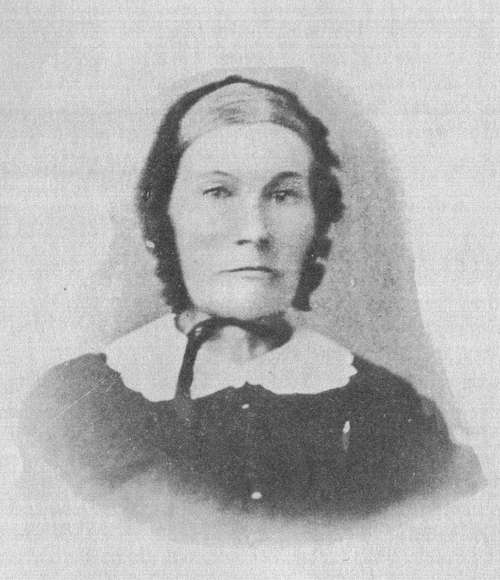
Mrs. Warner was an excellent woman. Her patient
and gentle bearing under disturbing conditions, her disposition
to make the best of disappointment and discouragement,
left an impress, not only upon the family, but
upon the neighborhood. Her kindness is referred to in
two other stanzas of the poem Innocence:
If angels blessed his thorny path,
It may be said in truth,
But two e'er showed their smiling face
In all his suffering youth.
One was his mother, ever kind,
A blessed providence;
The other, pure and lovely friend,
Was angel Innocence.
It has been true generally that great men have first
had great mothers. But what is a mother's greatness,
after all, but simple, unalloyed, Christian motherliness?
"I should have become an atheist but for one recollection,
and that was the memory of the time when my departed
mother used to take my little hand in hers and
cause me on my knees to say, 'Our Father, who art in
heaven.'"—John Randolph.
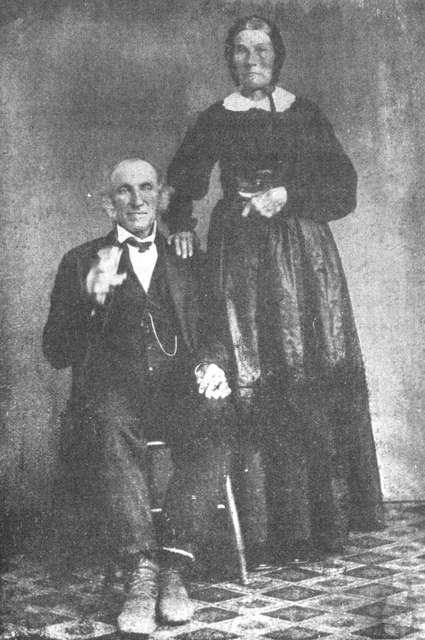
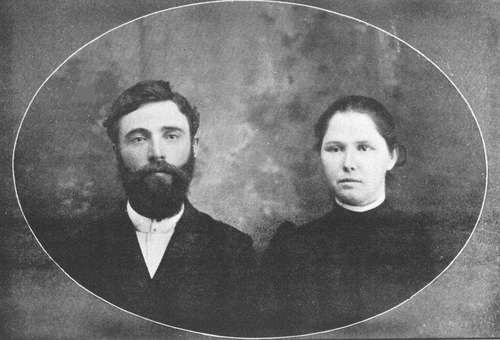
Parents of D. S. Warner. The father holds a whisky-glass
Mother of D. S. Warner
"All I am, all I hope to be, I owe to my angel mother—blessings
on her memory! I remember my mother's
prayers. They have always followed me. They have
clung to me all my life."—Lincoln.
"If my mother could rise in the dead of the night and
pray for my recovery from sickness, my life must be
worth something. I then and there resolved to prove
myself worthy of my mother's prayers."—Garfield.
"It is to my mother that I owe everything. If I am
thy child, O my God, it is because thou gavest me
such a mother. If I prefer the truth to all things, it is
the fruit of my mother's teachings. If I did not perish
long ago in sin and misery, it is because of the long and
faithful years which she pleaded for me. What comparison
is there between the honor I paid her and her
slavery for me?"—St. Augustine.
One more tribute. In his book Bible Proofs of the
Second Work of Grace, published in 1880, Daniel S.
Warner places the following dedicatory note: "To the
sacred memory of my sainted mother, whose tender affections
were the only solace in my suffering childhood,
and whose never-failing love, and whose pure and innocent
life were the only stars that shone in the darkness
of my youth, this volume is respectfully dedicated by the
author."
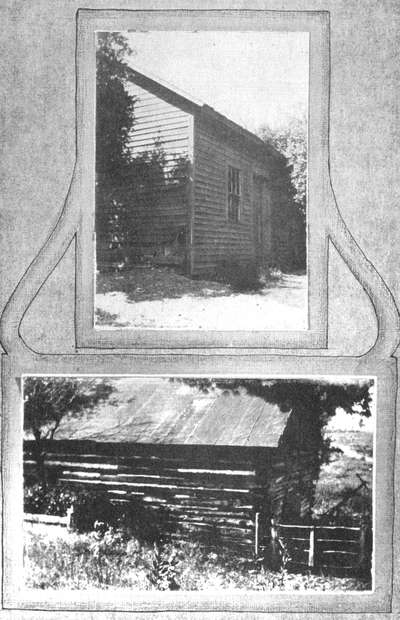
From Wayne County, David Warner brought his
family, in 1843, to a farm of 140 acres near New Washington,
Crawford County, Ohio. The house, built partly
of logs, stood three fourths of a mile southwest of the
village. It was here that Daniel spent his childhood.
Of this period he writes:
It seemed the special pleasure of
Another certain one
To quite demolish everything
He set his heart upon;
To chafe his spirit and extort
The flow of bitter tears
Out of a soft and pensive heart,
Through all his tender years.
He never knew that "Father" was
A sweet, endearing name;
Its very mention was a dread,
His life's most deadly bane.
The demon of intemp'rance there
Infused the wrath of hell,
And most upon this sickly head
The storm of fury fell.
Like chickens when the mother bird
Gives signal of a foe,
The little peeps are quickly hushed,
All chicks are lying low,
So, when returning from the town,
The dreaded steps we heard,
All ran and quickly settled down,
And not a lip was stirred.
O horrors of the liquor fiend!
We've seen thy hell on earth.
Thy serpent coils around us twined,
The moment of our birth.
O Rum! thy red infernal flame—
I witness to the truth—
Filled all my mother's cup with pain,
And swallowed up my youth.
The Warner family, though clever, straightforward,
and strictly honest, were but a simple rural folk and not
inclined to religion. That such a bright spiritual light
as was afterward exhibited in Daniel could come from
such a family, is one of the puzzling questions of blood
relation. Was it that in the family blood there was
latent quality which in his case only was near enough to
the surface to be called into action and developed by
higher influence? or should it be said that he represents
a variation in the strain, such as is sometimes seen in
biological observation? If the latter, the mystery remains;
for why do such things occur? Aside from natural
phenomena, we believe that Brother Warner was a
"chosen vessel" unto the Lord. He possessed such a
combination of qualities as made him capable of high
development in the divine graces. He was a Christian
than whom perhaps none other ever lived who was more
reverent, spiritual, and devoted; and God had a special
work for him.
In his boyhood Daniel early displayed a gift of entertainment
and of public speaking. The school in his
district was ungraded. On occasions of entertainment,
such as the last day of school, after the younger children
had spoken their "pieces" and the program began to
grow monotonous, a call would be made for Dan Warner.
Then he would take the floor and soon would have
them convulsing with merriment. Mischievousness and
clownishness were traits. The trouble he sometimes
caused the teacher was frequently such that the latter
could not locate it nor determine just who was to blame.
When he would be stood on the floor he would soon
have others with him. On one occasion he did something
for which he was sentenced to a scourging. When he
appeared at school the next morning he was prepared
for this contingency by having on two or three coats. He
was, however, bright in his studies and in a general way
sociable and well liked.
The community in which he lived was strongly democratic
in politics. His father, a staunch democrat, actually
had a degree of pride in his boy when the latter
would make stump speeches during a campaign. It was
natural for Dan to mount a storebox on the street or anywhere
and address a crowd on the issues of the day. In
later years, however, when he became a minister and
his oratorical abilities were directed in the channel of
preaching the gospel, his father was not pleased.
Among the sports in which he indulged was coon hunting.
On finding a coon tree at night he and his companion
would cover themselves with a coon robe and lie
under the tree until morning. He got to be rather wild,
and took particular delight in the dance, but never indulged
in the lowest forms of sin.
These are but brevities of his boyhood career. It is
difficult to prepare an account of this part of his life that
would be to any considerable degree full. One accident,
by which he was maimed for life, should here be noted.
He attempted to remove a bunch of grass that had clogged
the sickle of a mowing-machine. As he was in this
act the team started and the ends of two of his fingers,
the middle ones of the left hand, were suddenly clipped
off. Fortunately the loss of these members did not hinder
him in writing nor was it a disfigurement usually
noticed in his preaching.
There was one more move for the David Warner family,
and this was to Williams County, Ohio, the northwest
corner of the State, where, in Bridgewater Township,
about four miles north of the town of Montpelier, farm
life was resumed. Here the parents spent the rest of
their lives. The removal to this place was made in 1863,
during the Civil War. Joseph Warner was drafted for
the army. Being a man of a family, he desired to arrange
for a substitute. For this Daniel offered himself,
and accordingly became a private in Company C, 195th
Regiment, Ohio Infantry. Little is known of his army
experience. It is said that he found favor with the Captain
and was made his clerk, or secretary. At the close
of his term he was honorably discharged.
While living in Williams County, the occupation of
teaching school appealed to him, and for several terms
he was an instructor of the young in matters of common-school
education. He was now in his early twenties.
But here we shall close this chapter, and introduce him
in our next in a different aspect.
III CONVERSION, COLLEGE, AND CALLING — ATTENDS OBERLIN COLLEGE — FOOTNOTE:
It is natural that the question of religion should present
itself to a young man or woman when approaching
maturity. It is then that life is full of prospects, when
one plans and builds for the future. It is then that opinions
are formed, and there is an inclination to reach some
kind of decision, for the time being at least, regarding
every issue. One reaches this parting of the ways and
the question comes, "Which road shall I take?" The
answer, so far as religion is concerned, depends to some
extent on what one has observed in those who make a profession,
though it is true that the influence of the Holy
Spirit alone—that monitor who makes his appeal to the
inner consciousness—sometimes decides the question.
The community at New Washington, where the Warner
family lived, was strongly Catholic and Lutheran.
There was too much whisky and tobacco and too little of
genuine Christianity for a convincing testimony in favor
of the latter. As for Dan Warner, he thought to decide
the question of religion by trying to be an infidel. But
of course he had not considered that God might speak to
him and convince him against his will. He naturally
possessed a tender conscience, a capacity to exalt righteousness
and a susceptibility to right spiritual influence.
And so we find him on reaching the age of maturity
trying to believe there was nothing in Christianity; but
at this his success was poor. There were certain persons
within his field of acquaintance whose Christian piety
made its impression. Then again, there was the influence
of song. He had a good voice and found enjoyment
in engaging in song with the young people. On a
Sunday afternoon, at a neighbor's, where a number were
gathered and were singing gospel hymns, he became greatly
affected. God spoke to his conscience. His conviction
was so strong as to cause him for several months
to lose his love for the dance and to reflect seriously on
his course of life. It was his turning-point so far as
infidelity was concerned.[1]
But after a few months, when the conviction had worn
away somewhat, he began to renew his attendance at
dances and apparently to be more reckless than ever regarding
his spiritual well-being. His heart, however, was
yet tender from the wound made by the spirit of conviction.
One night during a severe illness of his sister he
attended a dance. After he had returned home at two
o'clock in the morning, his mother went to his room and
expostulated with her boy regarding his sinful career.
Here again is where a mother's part played effectively.
As she reasoned with him on his wrong conduct, his going
to a dance while his sister—his only sister—lay at the
point of death, and his offence against a just God, before
whom he must one day stand in judgment, the depths of
his heart were broken up and he fell on his knees and
called for mercy.
From that time he was deeply convicted though to his
companions he gave no evidence of a changed life, as he
had not received the new birth. With some young friends
he began to attend a protracted meeting in a schoolhouse
not far from his home. The meeting was one of power,
and sinners were made to reflect on the question of their
souls' salvation. On their way home one night his companions
were expressing their opinions as to religion, what
it was, etc. One of them, addressing Dan, said, "What
do you think it is?" He replied, "I am going to find
out." Knowing him to be prankish the others supposed
he meant to play some trick, and as they separated wondered
to themselves what Dan could have up his sleeve.
Not until he had gone forward to the altar the next evening
and they had seen him rise a changed young man
with the peace of God in his countenance did they take
his words and actions seriously.
The date of this, his conversion, was February, 1865.
He refers to the event some years later as follows:
"Passed once more the old schoolhouse where I gave my
heart to God (February, 1865). Thank God for that
step! Oh, how glad I am it was ever my lot to become
a Christian!"
Another item of interest relating to this time was his
engagement to Frances Stocking, reference to which in
his diary for June 11, 1874, the reader will find on another
page.
One quality that was manifest in Brother Warner's
early religious life as well as throughout his entire career
was earnestness. He was sincere and intense in his devotion
and his Christian work. We shall find as we read
the notes from his diary that his words breathe a spirit
of love and devotion, evincing a deep spirituality. When
he yielded to God, he meant it as the decision of his
very soul, and his conversion was for him an actual change
for time and eternity. Old things were passed away.
New propositions and prospects arose to occupy his
thoughts.
D. S. Warner a student at Oberlin College
What ideals and plans were his immediately after his
conversion we do not know. It was not long, however,
until he decided that a more advanced education was
needful. Nothing will give a young person nobler ambitions
and greater desire to rise to all that is good and
associated with usefulness than Christianity. On the 5th
of September of the same year of his conversion he
started to school at Oberlin College and enrolled for an
English preparatory course. The details of his study
at Oberlin and just how long he remained have not been
learned. An old memorandum of his accounts indicates
that he attended there only two months at first, and then
taught school through the winter at Corunna, Ind., returning
to Oberlin in the spring, and that he started again
with the new school year in September, 1866. It is
known, however, that his excellency of character shone
while he was at school and was the subject of remark.
He did not attend college as long as he had expected
to; for it was while he was there that he began to feel
God's hand upon him for the ministry. When he saw
how long it would take to complete his college work and
the need of laboring in the Lord's harvest while it was
day, he felt impressed that God wanted him to cut short
his college course and to prepare at once for the ministry.
He accordingly went home, arranged for a room in his
father's house, and spent one season there in applying
himself to prayer, Bible-study, and those other things
which he believed were directly necessary to his ministerial
preparation.
Preparation for the ministry is more successful when,
along with it, there can be more or less of actual practise.
We can believe that Brother Warner was spiritual enough
to keep in touch with God and to discern the divine leading
in the important matter to which he had committed
himself. At any rate, in connection with his work of
preparation he began to engage in ministering the gospel.
He preached his first sermon on Easter night, 1867, in a
Methodist Episcopal protracted meeting in the Cogswell
Schoolhouse, not far from where he lived. Text, Acts
3:18—"But those things, which God before had showed
by the mouth of all his prophets, that Christ should suffer,
he hath so fulfilled."
[1] The use of tobacco, was very common among the professors in
his community. It is related that he received an impression of
the evil of this habit when on attendance at a prayer-meeting
he saw one of those present attempt to take a chew secretly, by
hiding his face behind a chair.
IV CHURCH OF GOD (WINEBRENNERIAN) — ORGANIZATION OF ELDERSHIPS
At the time of his first effort in the ministry, which
occurred more than two years after his conversion, Brother
Warner had not as yet given his name to any religious
society. To join a sectarian denomination is never by
divine prompting, but is urged from human source. A
young convert possessing the spirit of Christ is naturally at
home in the Lord and with Christians anywhere. It is
foreign to that spirit for one to limit oneself by subscribing
to any particular creed of men. Accordingly, our
young brother was only "acting natural" when he manifested
no particular anxiety to "join the church." Representatives
of the denominations in his neighborhood proposed
to him and presented their articles of faith. The
fact that he referred the great question to the Scriptures
and could see no authority for joining anything not recognized
in the Scriptures shows that he was already poor
material for sectarian construction, at least so far as the
common arguments for sects go.
There was one society, however, by which he was
persuaded. The followers of John Winebrenner called
themselves the Church of God. As they professed to
hold to no creed but the Bible, repudiated sectarianism,
baptized by immersion, and observed as an ordinance
the washing of feet in conjunction with the Lord's Supper,
all of which seemed good to him, and especially as they
had the exact New Testament name for the true church,
he was constrained to unite with that body. The mark
of fellowship which differentiated them from other Christians
and constituted them a sect, was not apparent to
him, and so, even during the many years of his earlier
ministerial career, he identified this body with the true
church. He said in later years that he had more liberty
as a minister before he took that step than he had during
the years he belonged to the denomination, which after
all was but a sect.
The Church of God, spelled with a capital C, and more
fully denominated General Eldership of the Churches
of God in North America, was founded by John Winebrenner,
in 1830. Winebrenner had been baptized and
confirmed in the German Reformed Church (now the
Reformed Church in the United States), and was given
the pastorate at Harrisburg. He was a good man and
the work of the ministry became the uppermost desire of
his heart. He sought to raise the standard of true piety.
His earnest preaching resulted in a revival in which he
opposed theaters, dancing, gambling, lotteries, and racing.
Revivals of religion were new experiences in the
churches of that region, so that his ministry awakened
strong opposition, which resulted in official charges
against him. He severed his relations with the Reformed
Church but continued his ministry, extensive revivals
following.
Dr. C. H. Forney, in his History of the Churches of
God, says,
Winebrenner did not entertain the purpose of founding a
new denomination. These bodies he stigmatized as sects. Professor
Nevin called the United Brethren and like bodies "rolling
balls," and accused Winebrenner with "putting in motion a
similar ball, which continues rolling to this hour (1842), not
without abundance of noise." Winebrenner denounced this as
gross misrepresentation. "But, sir, I did not retire for the ignoble
purpose, as you have intimated, of putting another sectarian
ball in motion. No, not at all. I had seen, through mercy, the
great evil of these rolling balls, put in motion and kept in motion
by the cunning craftiness of men and devils, and how by their
repeated and unhappy collusions they hindered and marred the
work of God in the earth; and, therefore, I resolved to fall back
upon original grounds—to stand aloof from all these sectarian
balls, and to do the work of an evangelist and minister of Christ
by building up the church of God (the only true church) according
to the plan and pattern as shown us in the New Testament.
This is the high and firm ground we take. Our ball, therefore,
is not like your ball, nor similar to other human balls. Ours is
the Lord's ball. It was not cut out of the Romish Church by the
hands of Calvin and others as was yours. But it was 'cut out of
the mountain without hands.' The ball commenced rolling upwards
of eighteen hundred years ago, and it continues rolling
to this hour; yea, and it will never cease rolling till every other
man-made ball shall be either crushed or rolled up by it, and
until the sound of it shall be 'like the sound of many waters, and
as the voice of great thunder.'"
On the subject of organization the same writer continues,
Winebrenner was indisposed to begin the organization of
churches. The uniform testimony of his contemporaries is
that he "had not at the beginning the remotest idea of organizing
a distinct or separate body of people." But driven out of
the pulpit by the Reformed Church, ostracised and persecuted, he
was led to a closer personal investigation of church polity. He
went to the highest source for light. He applied himself with
singleness of purpose to the study of the Word of God. The result
was a material modification of his former views on ecclesiology.
As he himself testified later: "As the writer's views had
by this time materially changed as to the true nature of a
Scriptural organization of churches, he adopted the apostolic
plan, as taught in the New Testament, and established spiritual,
free, and independent churches, consisting of believers or Christians
only, without any human name or creed or ordinances
or laws." The local church was the unit. It possessed perfect
autonomy. It was wholly independent of every other unit. Each
such unit "possesses in its organized state," as Winebrenner expressed
it in 1829, "sufficient power to perform all acts of religious
worship and everything relating to ecclesiastic government
and discipline. Every individual church is strictly independent
of all others as it respects religious worship and the general
government of its own affairs." Fellowship between these "free
and independent" units there would be, but no higher organization
was then recognized by Winebrenner which could limit the
powers of the local church. Each of these local organizations
would accept no human name, creed, nor ordinances; but would
adopt the divine name and creed and ordinances. In his broad
platform he saw a basis of the union of all Christians and
churches. And so the imperative duty of cultivating union between
all believers was strongly urged. These views prepared the
way for Winebrenner to fall in with the growing demand for
local church organization. For the multitudes of converts had
"conceived the idea of, and began to talk about, organizing
themselves into churches founded on Bible doctrines and principles
even before Winebrenner had determined in his own mind
to do so."
Thus there were independent local churches organized
in and around Harrisburg, which Winebrenner denominated
simply Churches of God. Each assumed the
name of "Church of God at ——." The members of
these churches had equal rights, and elected and licensed
men to preach.
There was as yet no common bonds, no general organization
or directing authority. In order to effect this and
adopt a regular system of cooperation, a meeting was
held at Harrisburg in October, 1830, attended by six
of the licensed ministers. Of this meeting Winebrenner
writes, "Thus originated the Church of God, properly
so called, in the United States of America, and thus also
originated the first Eldership." This organized body
assumed no other name than Eldership, though later the
term General Eldership was used to distinguish this body
from the eldership of the local church. The term General
Eldership was, however, applied at first only to the presbyteries
or Elderships of sections or States, which held
their sessions annually. In October, 1844, Winebrenner
proposed a General Eldership for the transaction of all
business of a general nature affecting the various annual
Elderships. It was provided that this General Eldership
should hold its meetings triennially for the first twenty
years and after that every five years. Thus we see that
by this time Winebrenner's views of church government
were still further modified.
The work continued to grow and spread to adjoining
counties and to Maryland, western Pennsylvania, and
Ohio, where Elderships were organized.
Each local church elects its own elders and deacons,
who with the pastor constitute the church council and are
the governing power, having charge of the admission of
members and the general care of the church work. The
churches within a given district are associated together
for cooperation in general work. The pastors and other
ordained ministers within a district, together with an equal
number of lay members, constitute the Annual Eldership,
which appoints the ministers of the various charges. Each
local church votes for a pastor, but the Annual Eldership
makes the appointments within its own boundaries.
These Annual Elderships elect an equal number of ministerial
and lay delegates, who constitute the General
Eldership.
The Churches of God, as already stated, have no written
creed but assume to accept the Word of God as their
only rule of faith and practise. They hold the doctrine
of the Trinity, believe in human depravity, the atonement
of Christ, justification by faith, the resurrection, future
punishment, and are, in general, orthodox. Through these
articles of their faith, and the fact that they took the
Scriptural name, Church of God, the followers of Winebrenner
made their appeal to D. S. Warner. But they
were lacking in some very important particulars, without
which they could not possibly be, as was claimed, identical
with the New Testament church. Winebrenner
started out well, but on the subject of Holy Spirit organization
and government he was not sufficiently illumined
to avoid more or less of the human ecclesiastical authority
which crept into the body of his followers and constituted
them a sect. When holiness came they repudiated it,
thereby revealing their position as outside the Holy Spirit
control of believers. However, their teaching on the
church question was correct as far as it went, and it took
years of actual practise of obeying the lead of the Spirit
to discover to Brother Warner and others the clash between
the Holy Spirit rule and the rule of human authority.
D. S. Warner and wife (Tamzen Kerr)
V FIRST YEARS IN MINISTRY — FOOTNOTE:
Brother Warner had the right view of ministerial
qualification. He realized that in order to succeed he
must have the spiritual anointing, and that since it was
God's work it was needful that he be in that divine relation
by which it would be God in him accomplishing the
result. He held education to be very useful and it was
his endeavor throughout his life to add to his knowledge;
but he regarded the spiritual qualification as paramount.
He soon proved to be gifted as an evangelist and engaged
much in evangelistic work.
Before proceeding far in active ministerial work he
was married, on the 5th of September, 1867, to Tamzen
Ann Kerr. It is probable that he became acquainted
with this young woman while he was teaching school
in the vicinity of her home, which was near West Unity,
Williams County. She lived to enjoy his companionship
and to share his labors only about four and one half years.
Early in 1872 she gave birth to triplets, which lived only
a few hours. Nor did the mother long survive the ordeal,
as she died on May 26, after a succession of spasms.
A family record in an old Bible shows also the birth
of a son, on Dec. 29, 1868, but fails to record his death.
Brother Warner refers to this son once in his diary.
He was granted a license by the West Ohio Eldership,[2]
which met in its eleventh annual session at Findlay
in October, 1867. His reference to this event in his
diary is given in another part of this book. In this chapter
as well as in some of the succeeding chapters, the copious
extracts from Brother Warner's diary will give the reader
a better understanding of his character, his temperament,
his spirituality and devotion, and his work, than would
description by another. Unfortunately these journal
records for the first five years of his ministry (for it is
assumed that he kept such records), which no doubt
would be very interesting, are not available. All the
information to be obtained covering this period is from
those still living who had personal knowledge of the
events, and from references to this period in his later
records. In one of these he says he began traveling in
1868. In another he refers to having labored the first
year in Hancock County, at Blanchard Bethel, in connection
with Findlay.
During the first six years of his ministry his activities
covered practically all of northwestern Ohio and a small
portion of Indiana. Persons now living who were present
in some of his revivals during this period state that
they were remarkable for manifestations of God's power.
Hard-hearted sinners, some of whom had not attended
a meeting for years, would get under conviction and cry
audibly for mercy. He ranked high as an evangelist—above
the average of his day. In physical appearance
he was slightly above average in height, rather slender and
frail in build. His temperament was sanguine-nervous,
eyes blue, hair brown—a fine sensitive organization. He
wore a full beard, which in later years he kept shortly
trimmed. He had the perfect bearing of a minister of
the gospel, and his speech and conduct were fully consistent.
His mentality was keen. His lungs were weak,
but he wore well as a speaker. His voice was musical
and possessed good carrying quality. One of his earliest
revivals was held at New Washington, Crawford County,
the home of his boyhood. He refers to it under date of
Nov. 24, 1872, as follows:
This town had ever been abandoned to the mercies of Catholics,
Old Lutherans, and saloons, all of which were equally destructive
of all moral good. No protracted effort had ever been
made in the place. No conversions had ever been heard of. In
the fall of 1870 I was put upon the Seneca circuit, of which New
Washington was nearly in the center, and knowing the debauchery
and ignorance of the people in general, I determined to lift
up the standard of King Immanuel in that place. Accordingly
I settled in the place and rented a vacant building that used to
contain a drug store and saloon. The owner had speculative
motives, having asked quite a dear rent for the room. But during
the winter I and companion made special prayer to God for
his conversion.
The meeting was begun on the 17th of February, 1871. The
night before the owner slept not for deep conviction. As soon
as I arose in the morning he came to me in tears and confessed
his sins and asked my prayers. I directed him to look to Christ
for immediate pardon and deliverance. I gave him some of the
great promises of Christ. And there, standing in his own stable,
he looked to Christ and experienced a full pardon of all his sins.
This settled the rent for the house. The third night six came
to the altar. The meeting was attended with great power and
produced a great stir among the people, many of whom had never
seen the like. Fifty-six were converted, forty-six baptized, and
forty-six fellowshiped into the organization.
Among these converts were a number of his school-mates,
old acquaintances, and neighbors. George Pratt,
of Nappanee, Ind., an old schoolmate and a former resident
of New Washington, makes this statement concerning
this meeting: "The meeting was held in my father's
drug-store building. Brother Warner held the meeting
unaided. He stood there alone and preached while others
threatened. There were bad elements that rose in opposition,
the Lutheran being the worst and the Catholic
next. My father protected him. It was a wonderful
meeting and many were saved."
The earliest of his diary records so far available begin
in November, 1872, as follows, when he was on the
Seneca circuit and had his home with a Brother Wright,
in Crawford County, Ohio:
8. Brother P. Wright brought me to Bucyrus. Staid all night
with Bro. J. G. Wirt. The Methodists had a festival. I and a
few members of the same church (who repudiated these follies
and inconsistencies) met for prayer and the Lord was with us.
These brethren were much dissatisfied with their church relation.
9. Left Bucyrus at 7 A. M. Reached Lima at nine. Stopped
at the Burnet House till 1:20 P. M. Wrote a letter to my brother
and one to brother-in-law, L. W. Guiss.
10. Sabbath. A. M., prayer-meeting at Brother Dague's, P. M.,
heard a Lutheran minister in Milton. Evening, preached from
Isa. 28:16,17. I occupied the Presbyterian house. I preached
here some in the schoolhouse in 1868, the first year I traveled.
11. Took the train at 7:30 A. M. for Tontogany, with the design
of finding where God wishes me to labor as a missionary.
0 Lord, guide thy servant to the place thou canst best use him!
Walked from Tontogany to Brother Hardee's. Evening, went to
Evangelical meeting. Brother W—— preached. Heard a great
noise, but to the congregation it appeared as a tinkling cymbal
and sounding brass, evidently having no effect. Nearly all blew
loudly the horn of sanctification but manifested little of its fruits,
such as travail of soul for the sinner and sympathy for the one
soul at the altar, to whom none gave a word of encouragement,
but each in turn arose and boasted of his holiness. Oh the delusions
of Satan! How manifold they are!
In the entry just quoted the reader will notice his
prejudice, existing at that time, against the doctrine of
holiness, or sanctification. How strange it seems to those
who knew him afterward to be a whole-souled advocate
of the doctrine of holiness, that he should thus speak!
It was altogether a matter of light and understanding.
His heart was consecrated and he certainly was not unacquainted
with the Holy Spirit during his early ministry.
But as a definite experience to be believed for and testified
to, he knew nothing about sanctification as yet. Also,
it is possible that in its advocates whom he had met thus
far, the doctrine and experience had not been rightly
represented.
It will be observed also from these quotations from his
journal that he meant to stand, and believed he was standing,
free from sectarianism. He had considerable light
on the church question and spiritual Babylon.
The place referred to in the following entry was near
Holland, Lucas County.
13. Visited Father and Brother John McNut and Brother Irvin.
Eve, preached in the brick schoolhouse, on Jas. 1:27.
Here the Church of God had long been slandered and persecuted,
principally by the United Brethren Church. One of the epithets
they had for years called us is, "Johnny Cake Church."
Bro. Henry S. McNut lives here nearly alone. He and his wife
and their ancestors for generations past belonged to the United
Brethren, but in the fall of 1870, after a hard spell of sickness
in which he feared that he should die and be lost for not obeying
the truth, he came to the West Ohio Eldership and received
a license and began to preach amidst a storm of persecution from
the United Brethren Church. Even his own companion, though
an amiable woman, had been so poisoned against the Church
of God that she joined in to oppose him. But he was firm and
now commands the position. Every foe had fled and all that
truly fear God join in to encourage the truth. Some will doubtless
soon cut loose from sectarian bondage. Those that were
the bitterest enemies now confess that we are right and they
are wrong.
The Church of God, as we have seen, repudiated
sectarianism, and the assumption by that church that it
was the Scriptural one was a strong underlying principle.
In some respects it held the correct idea of the Scriptural
church. To some extent, therefore, Brother Warner's
membership in that denomination afforded him light that
naturally led to the full Scriptural standard which he
afterward taught. His affiliation with that denomination
in the first place was, as we have seen, because of a
disposition to be Scripturally right on this point.
14. Brother McNut and I went to Toledo to look for a place
in which to open a mission in that city.
15. Walked nearly all day in search of a place to open a mission.
No success. May God soon open the way for the establishment
of his church in this place.
In his diary Brother Warner recorded something for
each day. Every time he preached it was noted and
numbered and the text was given. The Eldership required
each minister to give a report of his work. It is
not necessary to quote all the shorter entries and items
from his diary, which are much the same and generally
speak of his visiting some one, making some trip, reading,
writing, preaching, praying, fasting, baptizing, etc. Only
the more interesting items, or such as are the most representative,
will be given.
22. Returned to Auburn. Meeting at Basswood still in
progress. The young men who made a start the last night I was
there have all found Jesus their Savior. Preached from Mal.
3:8. A deep seriousness pervaded the minds of all. The feeling
of that night shall not soon be forgotten. It was as solemn
as the grave. A sensation of dark and fearful forebodings of
some approaching calamity ran through every mind. Bro. H.
Caldwell arose and said he had a matter revealed to him that he
felt impressed to relate, and that was that before tomorrow's
sun should set some one in this community would suddenly be
killed. At his request we arose and pledged ourselves to offer
one more fervent prayer that night in behalf of poor sinners.
23. Spent the day at home in reading, meditation and
prayer. Brother Jenner preached in the evening. I labored hard
to bring penitents to the altar. Three came out, two of whom
were old acquaintances of mine, for whom I had felt a deep
interest. One found peace.
After meeting was dismissed we heard that Ezekiel R——, an
old man eighty-two or eighty-three years of age, who lived one
mile and a quarter east of the schoolhouse, had that day been
killed by the cars in crossing the track at Shelby. I knew
the man from my boyhood; he bought out my father in that
country in 1853. He was very wealthy. God had blessed him
with long life, prosperity, and good health. But he had no
thanks to offer to his divine Benefactor, having set his whole
heart upon the god of this world. There was no place for Christ
in his heart. He leaned toward Universalism, because congenial
to the carnal mind. He was filled with skepticism and was
always in the habit of speaking lightly of preachers and professors
of religion. I visited him twice during the meeting at
Auburn last winter and conversed with him on the subject of
religion. He acknowledged that there is one thing in the Bible
that caused him to study a good deal, and that is the new birth,
which he said, was perfectly dark to him. He told of having
once gone to hear one of the greatest champions of Universalism
preach on the subject. "But," said he, "I received no light
whatever." His case was a clear fulfilment of 1 John 2:11,
"Darkness hath blinded his eyes," and 2 Cor. 4:4, "The God
of this world hath blinded the minds of them which believe not."
He had a very large development of brain, of which firmness
was the largest developed organ. What a pity that the
devil perverted these faculties!
I was informed that he was going that day to close a mortgage
and take a widow's farm from her. His last words to his wife,
who cautioned him to beware of the cars at the crossing, were,
"I was not made to be killed by the cars." This is like one who
said to his soul, "Thou hast much laid up for many days; eat,
drink, and be merry." But God said "Thou fool! this night shall
thy soul be required of thee." He said "I was not made to be
killed by the cars." But God said, "Thou fool! this day shalt
thou be killed by the cars." His brains were dashed out and
strewn along the road. His body was much mangled. But his
poor soul has gone with all its guilt to where another rich
man opened his eyes in torment.
The entry for the 24th, which was Sunday, records his
preaching a farewell sermon to the congregation at New
Washington, and also his reference to the revival held
there in February, 1871. He had had the care of the
congregation there.
25. I and Bro. S. Kline came to Conlay's, near Annapolis,
Crawford County, Ohio, and began my first protracted effort
in the name of Christ. Preached from Psa. 85:6,7. A good
interest was manifested. Oh that God would visit the place in
power, save many precious souls, and raise up a people for his
name!
27. Started early for Bucyrus on our way to the Standing
Committee at Rock Run. Took train at 10 A. M., arrived there
at noon. I was chosen to fill a vacancy on the committee. Upon
us devolved the solemn and responsible duty of trying and dis-fellowshiping
Elder L. E—— for immoral conduct. Oh, what
a pity! May the Lord have mercy upon him and help him to
repent and be restored to the confidence of the people. May
he be saved in the day of wrath. Oh, how careful the man of
God, especially the minister of the gospel, should conduct himself
in this wicked world! Lord, deliver us from temptation.
The meetings referred to in the next few entries were
a protracted effort at the Conlay Bethel, near Annapolis,
now called Sulphur Springs, Crawford County, Ohio.
Dec. 4, 1872. Visited a sick saint, J. McEntire, who has been
afflicted for many years. He was near his last. Oh, what a
happy soul. The night before he was almost gone. Said he,
"I saw a convoy of angels around my bed waiting to carry my
spirit home. I thought I was going home. Here I am yet lingering
on the shores of time." Then a brother came in, to whom
he remarked, "Sister Polly has gone home. I thought I would
beat her, but I am left behind. All summer I and Cousin Patrick
and Aunt Polly have had a hard race, but they have both
crossed over and I am left to struggle on; but every gale wafts
my little ship nearer the shining shore." "Oh!" said he, "It
is all bright ahead, not a cloud do I see." After a little rest he
remarked, "Oh! Brother, I know that my spirit will not go down
into forgetfulness until the resurrection; but I am going to
Jesus, which is far better. Oh, how sweet the name of Jesus!"
I spent the day with this brother, sang and prayed with him.
Eve, preached from Acts 3:19.
9. Spent the day in fasting and in much wrestling and prayer
for poor souls under the guilt of sin. Preached from Luke 13:6-9.
One young lady came to the altar.
10. Under much discouragement during the day. Evening,
while singing the opening hymn I was greatly refreshed at the
coming in of Bro. William Burchard, from Auburn, who was
converted under my labors and baptized by me last winter. He
was a very wild, wicked man, but has become a model of piety
and earnest devotion. He has a brilliant intellect and has already
made great proficiency in preaching. Thank God for
such men of holy zeal. He being tired with the walk of eleven
miles, I preached, from Ezek. 33:11. The penitent of the previous
night came out and soon the good news went to heaven
that another soul was saved by grace. It was a glorious meeting.
One sister shouted. I got a great victory and was very
happy. Likewise testified the convert and all the rest who spoke.
17. Good day meeting. Rebuked a boy for trying to pollute
the house of God by spitting tobacco juice and quids on the
floor. I said nothing to him, knowing that I should be insulted
in return. But being filled with the Spirit I tried to encourage
the three little mourners (girls who had come to the altar) and
then addressed the brethren upon the importance of laboring for
the early conversion of children, stating that it is enough to
make the angels in heaven weep to see how the devil is leading
even the children to wallow in sin and "glory in their shame."
"Now, look at that poor boy," said I, pointing to him. "Ever
since he came in here he has been doing his best to defile the
house of God with his filthy tobacco. It was once said that
'He that doeth evil cometh not to the light lest his deeds be
reproved,' but the devil has so polluted poor souls that even
children in broad day-light do not blush to do such evil and
dirty work for the devil as that. Christ said, 'That which cometh
out of the mouth defileth the heart.' How defiled that heart
must be, all that stench having come out of his mouth! A
few nights ago a dog was accidentally shut in here and remained
until the next evening, but did not pollute the house one half
as much as that boy has done in half an hour." At this he grabbed
his hat and, "being convicted in his own conscience, went
out." God pity that boy and help older people to take a hint.
18. A. M., wrote most of the time. P. M., visited Brother
McEntire. Found him much cast down and depressed, being
overanxious to be absent from the body, in which 'tabernacle
we groan, being burdened.' I told him that he ought to wait
patiently till his "change cometh," knowing when he got home
once he would have long time to stay there, even through all
eternity; and the longer he should be tossed about upon the
dark and tempestuous sea of this troublesome life the greater
would be his joy when at last he should land in the peaceful
harbor of the great city of God. After reading and singing
and praying with him, he had great peace and perfect resignation
to God.
25. Another Christmas is here. O thou Child of Bethlehem,
may we this day bring the offering of a grateful heart! May
every tongue on earth and all the angels in heaven join together
to spread the glory of Jesus' name! Dear Lord, we thank thee
for the unspeakable gift of thy Son to man. Oh, may every
heart prepare him room! Dear Savior, draw poor sinners to
thee. Show them thy bleeding hands, temples, and side. Oh
that the star of hope would this day guide many poor wandering
souls to thee!
28. Came to the place of meeting. Distance thirteen miles.
Schoolhouse was full. Good attention. Went to Solomon B——'s,
an infidel. Talked till twelve at night.
29. Sabbath. Talked with Mr. B. until 10:30 A. M. He is
a very smart man. Has his excellent memory stored with the
writings of almost every wretch that ever dared to attack God and
his holy religion. He is one of the best readers I ever met.
What a pity that this noble intellect should be so basely employed!
His horrid utterances are enough to chill the blood
and heart of man and cause the angels of heaven to weep. He
claims to be "a smarter man than Christ." "The devil is a gentleman
compared with God." "Your God is not fit to be worshiped
by a dog." "All professors are either hypocrites or fools."
Oh, that God would pity that poor wretch who in the blindness
of his depraved heart dares to rush with violence upon the Almighty!
30. Spent the day in reading, writing, and prayer, at Brother
Conlay's. Eve, preached from Rom. 2:4. Good congregation.
Saw some omens of good.
31. This is the last day of another year. How swift the years
roll around and each brings us nearer eternity! Lord, help us
to redeem the time and so "number our days, that we may apply
our hearts unto wisdom," that at last it may not be said of us
that "we spend our years as a tale that is told." Oh that each
hour of my short life may bring some good account at last, when
life's conflict is o'er! Great and many have been the changes
of the last year. Yea,
"What countless millions of mankind
Have left this fleeting world!
They're gone, but where? oh, pause and see,
Gone to a long eternity!"
One there was, the dearest of my earthly friends, who a year
ago stood by my side, the joy of my life, the sweet, innocent
object of my fervent love. But she is gone, that dear companion
upon whose rosy cheek and harmless lips I used to impress
the kiss of burning, never-dying love. O Tamzen! thy heart
and life, as pure as the white and fleecy snow that this morning
covers thy peaceful resting-place, has reared an everlasting
monument in the hearts of all that knew thee on earth.
I have now seen thirty years pass into eternity. Not quite
eight years have been devoted to God. The year has been one
of God's goodness to me, notwithstanding the loss of my blessed
wife, which is her gain and God's glory, and therefore I am
willing to travel on a lone pilgrim in search of souls for Jesus'
sake.
'Twas very stormy. Wrote and read. Preached from Psa.
90:9, "We spend our years as a tale that is told." Tried to
show the folly of living in sin.
Jan, 1, 1873. This is the first day of the year. O my soul,
set out afresh for heaven! Lord help me to spend the year all to
thy glory if we live to the end. But if it is said of me, "This
year thou shall die," may I be ready to enter into rest.
7. Preached from Rom. 6:1. Told my dream, the subject
of which I thought was in the way of a score of souls.
8. Fasted today. Very solemn meeting at Brother Crim's.
All wept for poor sinners. O Lord, hear the prayers and groans
and bottle up the tears of thy children and bring thy salvation
nigh! Preached from Heb. 2:3. The meeting has received a
great backset. I fear the whole work is killed. Before I came
here I had a peculiar dream in which I saw a face that was
strange to me. There was much confusion in those features,
as in the midst of a council it stood out conspicuous, and there
was something in the position of the person that pierced my
heart. Last night I announced that I had recognized these
features since I came here. Mr. B., the infidel, arose and asked
whether he were the man. I said no. Tonight Esq. K., a
poor blind Lutheran, came to meeting, and before I closed he
arose and enquired if he were the man. While I was talking,
I was powerfully baptized by the Spirit of God and replied,
"Thou art the man." He was daunted, but stammered out a
denial; but before I had time to ask a question he confessed
that he had forbidden his family to come out to the altar. They
are five young men and one daughter, three of them were under
deep conviction and others serious. One of the boys is married
and his wife and all their associates were serious and some
anxious to come out, but all were prevented from coming to
Christ by this poor wretch, whose form of religion fitted him to
do this work for the devil.
In this attack I realized the fulfilment of the promise of
Christ. 'In that same hour it shall be given you what ye shall
answer, for it shall not be you but the Spirit that speaketh.'
I warned him of the fearful account he would have to give at
the judgment-bar of God.
9. Meeting at Samuel Shell's. We were all cast down and felt
the Spirit of God had been grieved out of the community. Eve,
preached from Jer. 28:16. Gave a farewell address and closed
the meeting because, first, the work was so stagnated that nothing
could be expected to be accomplished without a longer effort
than I could devote to the place and, second, because it was
highly probable that as soon as the work should break out again
Satan would stir up trouble again from some source. I gained
many warm friends and sowed seed which I trust will bring
fruit to God. Some of the young men that desired religion I
think will not give up the struggle. They sent me some money
and word that if I would hold a meeting somewhere in reach
that they would attend and seek religion, but there they had not
the heart to come out.
25. Visited Brother and Sister Chapman. She is an excellent
saint. Found her much afflicted. Brother C. had for many
years been a skeptic and Universalist, but a year ago he came
out at a meeting held by Bro. T. James and me. He is a faithful
brother. A neighbor of his by name of L——, who was the
means of breaking up the fore-mentioned meeting, dropped dead
in his tracks a few months ago.
Feb. 28, 1873. Good day meeting at Brother McClintock's.
[near Larue, Marion County]. Eve, preached from Eph. 2:2.
Four came to the altar and were blessed, one of whom had been
an avowed Universalist. Others doubtless would have come out
but the house was so densely filled that we could not crowd
the people back to get more room for penitents.
Mar. 1, 1873. Spent the day at Mother Melvin's. Wrote an
article for the Advocate. Brother Burchard preached. Four at
the altar. All were blessed, I think. House crowded and many
outside.
2. Sabbath. Speaking at ten. Preached on Church of God,
Acts 20:28. Eve, the house was packed and all the windows
were crowded on the outside. Preached, Jer. 13:16. By hard
work we got a little space at the altar and four presented themselves
for prayer.
5. Meeting at Brother Deen's. Fellowshiped twelve. P. M.,
because of the immense crowd that thronged the schoolhouse
we divided the meeting. I preached at Windfall, from Job 22:15-17.
Several rose for prayers. Brother Burchard preached
at the Ellen Schoolhouse, one and one half miles north.
9. Sabbath. Brother Small and I went to the Shertzer Schoolhouse,
where he preached at 11 A. M. on church matters, after
which we received in fellowship eleven members, most by letter
from the Methodist Episcopal and Presbyterian Churches. After
taking a hasty dinner we mounted our steeds and rode four
miles, partly through a woods, in the midst of a rain and severe
storm. Reached Windfall at 2:30 P. M. Eve, preached on
Acts 26:18. One at the altar.
10. Prepared a dam to baptize. Eve, Num. 10:28.
11. A. M., preached on sisters' right to speak and pray in
meeting, after which we had a speaking-meeting. Fellowshiped
fourteen members. House crowded and many on the outside.
One brother who was always opposed to women's speaking arose
and confessed his error. We then proceeded to the water,
where I baptized twenty-two converts in eleven minutes. It was
a glorious and beautiful baptismal service. All came out shouting
and praising God. Eve, preached on Luke 13:6-9. Several
rose for prayers, some of whom were old in sin. We had a
speaking-meeting. All that had been immersed said that it had
been a happy day for them and that they had turned a new
and brighter page in the history of their pilgrimage. Oh how
good it is to obey God! A good part of the number had been
sprinkled, some after making a profession of religion in adult
years. Great God, what a pity that the world is cursed by an unholy
sectarian ministry "who teach for doctrine the commandments
of men!"
12. Eve, preached on barren fig-tree. Matt. 21:18-22. Four
came to the altar, one blessed. Went home with Mr. William
Riser, who brought a horse for me to ride. It was a beautiful
light night, and a ride of some two miles winding through the
woods was somewhat pleasant. Did not retire until twelve
o'clock.
13. This morning I spent an hour rambling far out in the
dense, rolling forest to breath the pure air and to hold communion
with my God. At ten William Riser's house was filled with
brethren and sisters. We had a glorious meeting. All were
happy, many shouted. It was something very strange to have a
meeting in this house. All remarked that it was something they
had never expected to see. Mr. R. is a man of nearly fifty years
and a great sinner. His wife has been converted and I think
the Lord is striving with his heart and his brother's, who is still
older. Oh that God would raise them up as monuments of his
mercy! Eve, Luke 19:10. Two at the altar.
14. A. M., meeting at schoolhouse. P. M., just before preaching
I met with a few brethren who had been at variance, and
helped to form a reconciliation, which was a perfect success.
Preached on Matt. 22:21.
16. Sabbath. Preached one and three fourths hours on Ezek.
43:10,11, after which we fellowshiped and then baptized three.
Eve, Brother Crawford, Baptist minister preached. Closed the
meeting. Result, thirty-five converted, twenty-five immersed,
church formed of thirty-three members. Expect more additions
soon.
20. Eve, met the church at Windfall. Decided to build a
meeting-house. Preached on church officers. Elders and deacons
elected.
Apr. 3, 1873. Came to New Haven [Huron County]. Eve,
met a number of my dear spiritual children in prayer-meeting.
Had a good time and they exhorted me to meet them in heaven.
4. Beautiful day. How bright the sun shines! How the
heart is gladdened at the return of warm and sunny days after
such a long and hard winter as we have passed through! Oh,
how I appreciate the Savior's beautiful metaphor in the Song
of Solomon, where the present state of the church is represented
by the winter with its dark clouds and howling winds, fierce with
cold and hunger and hardship! But glory to God, the spring will
come; already the fig-tree is putting forth her leaves, the turtle
dove is heard in the land, and soon we shall hear the voice of
the bridegroom calling, "Rise up, my beloved, my fair one, and
come away; for the winter is past, and behold, thy beloved has
come for thee." What a happy time that will be when, rising
from the grave, we shall meet our dear friends and our Savior!
I am writing these lines in the beautiful cemetery near New
Haven, Ohio. Before me is the little mound which shows the
resting-place of my three little infants who a little over a year
ago passed in a few hours through this vale of tears, and their
little spirits are forever at rest with Jesus; and in one little box
their bodies await the Savior's coming. What a glorious morning
when all these graves shall burst open and the bodies shall
come forth! they that have done good to the resurrection of
life and glory, and they that have done evil to the resurrection
of shame. Oh, may I be among the former class! Lord, make
me a good man and keep me pure in heart. Farewell, sacred
spot. Farewell, little tomb, with thy three-fold treasure.
16. Went to Bryan [Williams County] and ordered a tombstone
for my wife's grave. The one selected cost fifty dollars,
has a Bible lying on it, and I gave the following epitaph:
How sweet and pure in social life,
As daughter, sister, friend, and wife!
Now done with cares below the sun,
She shines before the snow-white throne.
18. Came home. Found Father and Mother and Brother well.
23. Commenced an editorial on Islamism.
24. Wrote and studied phrenology alternately.
26. Sent my article on Islamism. Brother Cassel and other
preachers in Illinois send an urgent invitation for me to come
to that State.
27. Sabbath. Preached today from 2 Pet. 1:10 in the Cogswell
Schoolhouse [near his father's home], where I made my
first effort to preach the gospel, on Easter night, 1867. 'Twas
in a Methodist Episcopal protracted meeting. The text was
Acts 3:18. Never preached there since. In those six years I
have preached all over northwest Ohio and some in two counties
in Indiana, in all 1241 sermons. The number of converts
508, about the same number fellowshiped, some less baptized.
Thanks be to God for his blessings and his presence! Though
always of weak lungs, thought oft to be consumptive, yet my
health has been better since in the ministry than ever before.
Bless God for his goodness! I have never missed but one appointment
on account of health. The years have swiftly passed,
but, thank the Lord, I have enjoyed great peace and many rich
blessings from the Lord.
May 13, 1873. Visited Tamzen's grave. Disappointed in not
finding the monument up. Visited D. W. Dustin, one of my
scholars. Exhorted him to give his heart to Christ.
15. Prepared a sermon on the evidence of the divine origin
of the Bible.
16. Argument with Mr. Butler on the soul.
He attended, from the 21st to the 23rd, the meeting of
the Board of Missions. He does not indicate where this
meeting was held, but says in connection that he "preached
in the Smithville Bethel" and "had very poor liberty,
owing perhaps to the presence of many eastern ministers."
It was at this meeting of the Board of Missions that he
received his appointment to the mission in Nebraska, of
which he thus speaks:
23. Beautiful day. Business finished up at 5 P. M. Brother
Small was appointed to Chicago, I to Seward mission, Nebraska.
Again I lay all upon the altar of God. It is very hard for me to
leave my dearly beloved brethren of West Ohio. Thank God,
for the great Head of the church is with them and his cause
is greatly prospering here, and I must go help the cause in the
far West. We parted with tears and many farewells.
24. Brother Small and I took train at 7:14 A. M., he for
Marion, I for Larue, which I reached at 12 M. Received a letter
from my beloved brother Sol. Kline. All our dear spiritual children
are yet doing well on Seneca circuit. Wrote two letters.
Preached at Windfall, 2 Pet. 1:13. Great row after meeting.
28. These days I have been low spirited and much cast
down. It is the first anniversary of the death and burial of
my blessed companion. How lonely I feel! My bereavement
comes with all its weight upon me. Lord, be thou my comforter
in all my loneliness. In eve, preached in Larue on the Church
of God. Text, Eph. 1:10. I treated it as follows:
1. Notice the purpose of God.
2. "One" church.
3. Extent—heaven and earth.
4. Provisions for oneness:
(a) One church typified.
(b) One, bought, sanctified, made, built.
(c) One faith.
(d) One spirit to animate it.
(e) One head, Christ.
(f) One name, Church of God.
(g) One law to govern it.
5. Standard of oneness—"As I and the Father are one."
6. Time of this oneness.
7. To be visible, "That the world may believe," etc.
8. Object of oneness.
9. Apostasy and restoration of the church.
10. Illustrations:
The Lord gave me great liberty and boldness. Thank his holy
name!
29. Staid last night with Bro. L. Orr. Sister O. is afflicted;
prayed to the Lord for her recovery. Preached in Larue, eve,
Ezek. 43:10,11.
30. It had been announced in the Larue Citizen that I would
speak on the Church of God. This brought out quite a large
congregation. Both nights I spoke plainly and boldly against
the evil of sectarianism and other abominations. Many were
ill at ease. Some preachers were present. The Lord gave me
good liberty. Last night I diagramed my subject with chalk
upon the blackboard. 2 P. M., took train for Pentecost meeting
at Pleasant Hill.
Brother Warner became a strong exponent of the
prophecies. Note his reference to some reform near at
hand. This meeting was held at West Auburn, Crawford
County, after his return from Pleasant Hill.
June 8, 1873. Sabbath. Thank God for life and health and this
beautiful day! Behold the throngs pressing toward the house
of God! Speaking-meeting was to begin at half past nine. Ere
the time the house was filled. Others kept coming in continually,
much to the detriment of the interest of the meeting. After
all were seated that could be and the aisles were filled, there
were numbers yet without. The house had been purchased by
the Church of God from the Methodist Episcopal Church and
repaired in good style. At eleven, preaching began. Text,
Haggai 2:9, "The glory of this latter house shall be greater than
the former, saith the Lord of hosts."...
I then took up the text used in the forenoon and showed that
the destruction of the Temple and the Babylon captivity typified
the dark age. The different attempts to rebuild typified
the different reformations. Its final completion, i. e., all the so-called
churches arising in and growing out of the Dark Age, including
the sects, in which are many of God's people, who are,
however, commanded of God to "come out of her." Further
showed that according to the type and other Scriptures the church
of God must arise to a glory excelling that of the first age, and
that, owing to the fact that the world is near its end (of which
we gave some Scripture evidence), some great revolution must
be near at hand to bring about this prophesied glory of the
church.
Some remarks were made on the ordinances, after which we
engaged in the ordinances. Had a glorious time. A great many
brethren and sisters were present to engage in following the
Lord. Oh how I love those dear people! What a host of true
hearts! God bless them.
14. Traveled by buggy to the grove-meeting at Windfall,
four miles south of Larue. Brother Burchard preached an excellent
sermon.
17. Received letters from Brother Bolton requesting me to
come soon to my mission [in Nebraska] and one from Brother
Shoemaker requesting me to stop and preach over Sabbath in
Chicago.
19. Wrote out the record of the Church of God at New Washington.
Eve, preached at Union. Here the church have a peculiar
attachment to me. All wept much at my departure. A more
true and faithful band is hard to find. God bless them. They
are very dear to me. About half of the church are my converts.
20. Visited Brother E—— and Sister P——. They embraced religion
under my labors, and I joined them in marriage. Came
home and packed for my journey.
21. Finished matters up to start. Received a letter from a
kind friend. Went to New Haven in the evening. Farewell
meeting at New Haven.
22. Sabbath. Thank God for a beautiful day. Many brethren
came in from Union, New Washington, Auburn, and Liberty,
and Brother Mitchell and others from east Ohio. We had a
glorious meeting. I preached on Luke 13:29, "They shall come
from the east, and from the west, and from the north, and from
the south, and shall sit down in the kingdom of God."
After preaching, Brother Jenner baptized four souls, two of
whom had been converted here at New Haven, the other two
were from elsewhere. Thus out of eight souls converted only
two were baptized. This is the result of deferring to baptize
for six months. Evening, preached on John 6:66-68. Had a
good time in observing the ordinances. With many tears and
farewell greetings, we gave each other the parting hand. Oh
what friends are these! It tries the heart-strings to leave them.
What a glorious thing that there is a meeting that knows no
parting! What must it be to be there! May we all meet at last,
when the storms of life are over.
Before leaving for the West, a correspondence was
arranged with Sarah A. Keller, of Upper Sandusky.
She is doubtless the "kind friend" just referred to with
emphasis. Out of this correspondence there soon sprang
a glowing flame of love, the beginning of a companionship
that meant for him so much of both weal and woe.
[2] Dr. Forney, in the account of the Eleventh West Ohio Eldership
in his History of the Churches of God, refers to D. S. Warner
as being "later the leader in Ohio and westward of a body of
people who gave the brotherhood considerable trouble."
VI A NEBRASKA MISSION — FOOTNOTES:
The denomination known as the Church of God, founded
by John Winebrenner in Pennsylvania in 1830, soon
spread over western Pennsylvania and Ohio and gradually
extended its missionary effort into the States farther
west. Brother Warner's field of labor in Nebraska covered
more or less the counties of Seward, York, Polk,
Hamilton, and Fillmore. We shall again let him speak
for himself.
June 25, 1873. This is my birthday. Thirty-one years of
my hasty life have passed away. They have gone to eternity.
Their record has all been entered upon the book by the Scribe
of heaven. O Lord, whatever has not been set down to thy glory,
for Jesus' sake blot out in the blood of Christ! Only eight years
have been devoted to God and they crowded with many imperfections.
Great God, I thank thee that we have an advocate
to plead our cause and secure our pardon. Wash me, Lord,
and make me clean. Oh, keep me pure in heart, that the remainder
of life may all be given to God!
Took train at Upper Sandusky for Chicago. Ate dinner in
Fort Wayne. Stopped off at Warsaw and went to New Paris
to visit my brother-in-law. Found him and family well, thank
the Lord. Eve, heard Dr. Everitt lecture on phrenology.
26. Was examined by Everitt and received a chart of character
and instruction. I heard him deliver a course of lectures in
my schoolroom in Corunna, Ind. the fall of 1865. He lectured in
the evening on temperaments. Took notes.
28. Put in the day viewing the great city of Chicago. Nearly
all the burnt district is built again with enormous buildings.
It is wonderful to think that for miles we can walk streets built
up on either side with magnificent buildings of brick, stone, and
marble, from three to nine stories high, iron fronts, etc., all built
since the fire. It inspires the heart with wonder and admiration
to behold externally and internally the enormous hotels Sherman,
Palmer, Tremont, and Pacific, of which the latter is the largest.
It covers one half block and is nine stories high. Passed through
under Chicago River. Chicago is one of the wonders of the
world, a great city. Visited one of the parks. I was much interested
with all we saw.
29. Sabbath. I preached in the evening from these words:
"What do ye more than others?" Matt. 5:47. The day was
pleasantly spent. Brother Shoemaker has spent nine years in
trying to build up a Church of God here. Though the membership
is yet small, we have a good church property and some
good brethren here. I had the pleasure of seeing the wife, two
sons, and one daughter of Elder John Winebrenner, who are
members of the church here.
30. Took train at 10 A. M. on Chicago, Burlington, and Quincy
Railroad to Nebraska City. Crossed the Mississippi River.
July 1, 1873. In A. M. took train for Danville, distance thirteen
miles. Stopped at Bro. R. H. Bolton's. Found all well.
2. Enjoyed my visit very much with this lovely family. Received
many useful hints from Brother B. concerning the West
and the great missionary work.
3. Daylight found us at Creston. From there to Red Oak
the country is a beautiful rolling prairie. Very little is cultivated,
all grass. At Red Oak took branch road southwest to Nebraska
City through a beautiful prairie valley. Beautiful corn. At
Hamburg, eleven miles from Nebraska City, we came to a peculiarly
formed bluff, high and sharp, from which we can see the
city. Crossed the Missouri River at Nebraska City on the steamer
Lizzie Campbell. The river was high and ran swiftly.
4. This is a proud day for Americans, the anniversary of
American independence. There was quite an interesting celebration
in Nebraska City. Free dinner, band, thirty-seven
young ladies dressed in white with badges bearing the names of
the thirty-seven states, also the goddess of liberty. Judge Kinney
delivered a good speech on the occasion. A great crowd
of people were in attendance. The whole matter displayed skill
and ingenuity in its design and execution. Arrived at Seward
at 9:30 P. M. Walked out through the prairie two miles to
Bro. William Anderson's.
5. Visited Brother James Anderson. Walked across the country.
How sublime and beautiful the rolling prairie! There is a
strong breeze here nearly all the time, which makes the summer
pleasant and agreeable. The wind is from the east; a good part
of the time it is from the southeast.
6. Sabbath. At 4 P. M. I preached my first sermon in Nebraska,
in the Anderson Schoolhouse. Text, Isa. 62:6.
Here we have to pass over a period of eight months.
It is unfortunate that we do not have all of the books,
forming a continuous diary account. His notes written
during his first winter on the Western plain would have
been interesting. As it is, we have to pass over the fall
and winter of 1873 and begin again in March, 1874.[3]
By this time it seems that he had taken up a claim at
Wayland, Polk County. The Advocate he refers to
was the church paper, published at Harrisburg, of which
he was a correspondent. This chapter includes a temporary
absence from the State, occasioned by his marriage
and visit in Ohio, after which he returns with his help-meet
to his Western field. His reference to Sarah, his
bride-to-be, are, of course, full of tenderness. We shall
give but brevities from the diary, omitting many of the
details of sermons and texts, number converted, etc. The
meetings first mentioned were held near Seward.
Mar. 14, 1874. This is a rainy day, the first of any account
since the 22nd of November. Wrote two articles for the Advocate
and some letters.
15. Sabbath. Preached at eleven on the second advent of
Christ, two hours. Eve. Brother Robotham preached. 'Twas
dry and dead enough to take all the life out of a meeting. I
tried to exhort the people. Jesse Horton found peace to his
soul. Thank God for the salvation of the old gray-headed sinner.
Sister Anderson left her husband who sat by her side, and
came to the altar in much earnest, seeking the Lord. This is a
noble example. God bless the woman. I think her husband
will follow.
16. The air was damp today. Read Nelson on Infidelity.
Prayed and meditated. Eve, had some headache, but thank God
it did not grow worse and prevent my preaching, as it sometimes
does. The night was dark and damp. The congregation was
much smaller than usual. Had good liberty. A number of young
people were present, about all of whom were serious.
17. Had prayer-meeting at schoolhouse. Came home and
wrote a letter to my darling Sarah, then went to Seward. Received
a letter from Brother Shuler, treasurer, with post-office
order for fifty dollars.
19. Day meeting at half past ten. P. M., mounted a horse
and rode in company with Brother Figard to Mr. Pense's, two
miles. Talked to them on the important subject of their souls'
salvation. Returned with some headache. Was disappointed in
not having some one else there to preach, as Brother Combs,
of the Methodist Episcopal Church, had promised to be there
for the last two nights. Thank God, my headache abated and
I spake with liberty on the text, "My Spirit shall not always
strive with man."
21. Started for Fillmore County. Stopped a few minutes at
a store at Nickleville. Heard some poor sinners swearing horrible
oaths. Oh, how my heart was pained to hear them thus
insult the Author and Giver of all their blessings! Came to
Brother Witter's. Found all well and faithful to their Savior.
They were much joyed at my coming. The church has grown
in grace and influence.
22. Sabbath. Beautiful morn. Met at 10:30 A. M., heard
a number of the brethren and sisters speak. Went to Indian
Creek, where I had the pleasure of immersing the following
[names nine persons]. It was a glorious time. All were happy.
We felt that we were near heaven. At 3 P. M. started over to
Brother Moffit's. Passed a pond of some ten acres on which
were all of a thousand brants, a species of wild goose; they
are white, except a black streak across their wings. Reached
destination. Here are good prospects for gathering a church.
23. Quite cold this morn; 1 have to drive about thirty-five
miles against the wind. It was a hard day's ride. Came on to
the meeting and found that the work had not progressed in my
absence. I could not have remained, but now I have only two
nights and we must if possible see some poor sinners saved before
I leave. O God! in mercy hear us and bless our efforts.
27. Had to go forty miles today to an appointment. Called
on some of the brethren at Wayland. The day was cold.
30. Last night I had a precious dream of meeting my angel
love, Sarah. Oh, how happy I was to return to that kind family
and my precious companion, from whom I have been so long
separated, and with whom my soul longs to be! Now are only
seven Sabbaths until I start. Oh, how our hearts yearn to be
together! Lord, speed the time. Never did woman have purer and
stronger love for man than that of my dearest Sarah for me—yes,
even me. O Lord, what a blessing thou hast here bestowed
on thy unworthy servant! What a bliss to me, that I should
thus be loved, and that, too, by the very creature that I would
rather have love me than any fair female in all the world! O
Lord! this is thy doing and it is wonderful in our eyes. How
happy I would be this morning were my beautiful, virtuous, and
loving companion by my side! How hard it is to stay apart
so long! God give grace and strength of mind to endure this
torture of separation.
Apr. 3, 1874. What a bright and beautiful morn! I am
surrounded by beautiful scenery. The family live right on the
bank of a stream, tributary to the Blue. The house sits on the
edge of a bank about twenty feet on the north; on the south the
stream making a loop comes around just far enough from the
south side to make a nice little yard. To the east is a beautiful
large yard. To the west is quite a picturesque scene; the stream,
running very crooked, doubles around with but narrow, high
banks between, and all covered with timber, some of the largest
trees I have seen in the State, some oaks four feet across, yet
not one of them enough to make a rail cut, branching out a
few feet from the ground. The whole presents a romantic scene.
Brother Querry settled here five years ago, when there were
only a few families in the country. The settling up of the country
has far surpassed in rapidity the wildest imagination. Bro.
George Fellows and I went out on a hunt for prairie-chickens
and wild geese. We went in the buggy, by which we can approach
nearer to the chickens than otherwise. Had a few shots at wild
geese but killed nothing.
5. Sabbath. Easter. Bright, warm, and beautiful morning.
Preached at eleven on the Church of God, diagramed on black-board.
The truth was well received. There is a fine prospect for
the Church of God. Dr. Stone who is no professor of religion but
a thorough student of the Bible, and one whom I think will soon
give himself to the Lord, is one with us in sentiment. Another
good old Methodist Episcopal brother who preaches some sanctioned
my sermon all through, even my strongest denunciation of
creeds, sects, etc. Brother Stoner, a Disciple, was well pleased
with the church but took exceptions to feet-washing, reception of
the Spirit by faith before baptism, and the divine call to the
ministry. He invited me home with him and we talked over the
matter and he conceded my position on all these points. His
companion before held with us on all these points.
7. Came to Brother Hoffer's. Selected a place for my house
and staked off a yard, etc.
10. Wrote some letters. This was a warm and beautiful day.
Oh, how lovely the spring after the long, cold winter; emblem
of the time of the Lord's coming, the time of singing of birds!
The turtle-dove is heard in the land, all to remind us of the
Lord's coming.
The approach of summer also gladdens my heart because
it is bringing us near the happy time when I shall be joined in
holy matrimony with the pure and warm-hearted Sarah, whose
constant and ardent love is worth more to me than all the treasures
and honor of earth. Could I hold converse with that bright
luminary whose beams and gentle rays fall so graciously upon
the earth today, I would ask if the revolving earth brought another
creature under his shining light so pure, fair, and lovely as
my own blessed Sarah.
13. This morn is rainy. Drove to Wayland, fifteen miles, and
then worked all day at my house. Bros. H. and M. Hoffer and
Brother Berry had just got the lumber [hauled from Seward] on
the ground and begun the work. We worked through the damp
weather and got it finished, a stove up, and a bed by 10 P. M.,
when the brethren left, and I retired to sleep, the first night in
my life in my own house and on my own land. Thank God for
these blessings! May God help me to use it as not abusing it.
14. Returned to my house and made a stand. P. M., went to
Barber's, where I preached at night on the signs of the coming
of Christ. Had a house full of very attentive hearers. Spoke two
hours. All seemed highly interested.
15. In the eve drove about seven miles over into York County
and preached to a crowded house in the Parker Schoolhouse.
16. Went to Mr. Mahaffey's and had a good visit. He is
a lawyer, a smart man, well informed in the Bible. Agrees with
me on doctrine. He promised that he would give his heart to
Jesus. Wishes to borrow some of my books to inform himself
for the service of God. I pray God that he may be soundly
converted and become useful. I had left no appointment, but
several came together and begged me to leave another appointment
before going east. I never saw people more eager for the
gospel than here. Many have fallen in love with the Church of
God and desire me to form a church here. P. M., went home and
worked some at my house.
28. Drove to Bro. J. A. Mark's. The day passed off very
pleasantly. Spent the time in meditation and singing praise to
God. Drove about forty-five miles and reached destination about
6 P. M. There seemed to be no fatigue to me nor to my steed,
Mattie Blaze. The roads were beautiful and the day delightful.
How balmy the air! There perhaps never was another such delightful
country to travel in. Found no one at home at Brother
Mark's. Put up Mattie Blaze, compromised with the big dog,
Watch, and took possession of the house. Ere long the family
came home, having been at a neighbor's. They were well and
glad to see me.
May 1, 1874. Came to Grand Island, in Hall County, about
fifteen miles northwest of Brother Mark's. Found Bro. John
Kramer and family well. They are a very fine people, firm in the
principles of the Church of God. They have a beautiful place one
and one fourth miles from the city. All that is wanting is a Church
of God here. I feel sorry that they can not be supplied. But this is a
hard place to do anything unless we have a house of worship.
Brother K. could find no place in the city to have an appointment,
so he has an appointment in his own house for Lord's day.
Sectarian bigotry abounds here in the West; each sect, fearing
the rottenness of its own foundation, is not willing to have it
tried by the gospel.
2. Wrote, read, meditated, and prayed in a pleasant room
at Brother K's. How pleasant it is to have a place of solitary
retirement, so seldom enjoyed in the small sod houses of this
frontier country! This afternoon there was a good deal of excitement
in Grand Island on the occasion of breaking ground for a
new railroad, the St. Joseph and Grand Island Railroad. It is now
in operation from St. Joseph to Hastings. Grand Island is beautifully
situated on the Union Pacific Railroad and on the north side
of Platte River. It has a bright prospect for a large city and
important railroad center.
3. Sabbath. Rainy in A. M., hence no preaching. Spent the
day pleasantly with the kind Kramer family singing and talking
on Scripture.
5. Started this beautiful morn to Fillmore County. Took my
dinner and fed Mattie Blaze on Sec. 12, Twp. 9, Range 6 W.
Two miles east is the nicest railroad section I ever saw. I crossed
the South Blue River in a beautiful grove, which was quite
green. The place was so beautiful that I could not resist the
temptation to stop in the shade by the cool stream. I wondered
if I should ever have the pleasure of crossing through this beautiful
grove with my lovely Sadie, who of course is always brought
to my mind when I meet anything that is lovely and beautiful,
for she is the fairest and most lovely piece of God's creation.
Two graceful ducks were swimming in the water. This as well
as the cooing dove near by brought forcibly to my mind my beloved,
who is far away. The dove's cooing was an index to my
heart, that longed to be with her, so dear to me. Even the beautiful
stream suggested to me our two beings that were soon to
blend fully into one to follow on in everlasting love, like two
streams of water that mingle together and flow on in the same
channel.
These lines are being penned in this beautiful grove while many
feathered songsters are singing their sweet songs over my head.
Thank God for the beauties of nature and all that they have
brought to my mind.
6. Received a letter from Bro. J. A. Shuler, treasurer, with an
order in my favor for fifty dollars. Thank the kind Lord and all
who gave to this fund.
8. Came to Indian Creek. Found all well and anxious for my
coming. All seemed faithful.
10. Sabbath. Sabbath-school at ten. Preached on Gen. 28:12,13.
A strange brother arose and said he would like to speak
a few words. He remarked that for some time he had been searching
for the truth and the old paths and that he precisely agreed
with me that there is but one church, i. e., the church of God, so
named by the mouth of the Lord, governed alone by the Word of
God, including all who have the Spirit of Christ, by which they
are baptized into the body, the church. The brother talks some
to the people and accepted an invitation to preach in two weeks.
Thank God for more laborers to contend for the truth.
After this went to Indian Creek, where I had the great pleasure
of immersing [names seven persons]. At last baptizing Brother
Winters told me that he had been baptized by his parents when
a child, and now they were dead and gone, and out of respect
for them he would never be baptized again. I told him to read
his Bible and see whether that satisfied the demands of God upon
him. I further reminded him that religion was a personal matter.
He acted upon these suggestions and the result was he was anxious
to obey God. Oh how the commands of God are made void by
the traditions of men! The baptizing was one of great interest.
All were happy. Eve, had a good speaking-meeting. Some said
it was the happiest day of their lives. Preached on the ordinances
and had a heavenly time in observing them. Bade the brethren
and sisters farewell.
13. Was to have a breaking bee, but it rained all forenoon.
P. M., worked on my claim. Eve, preached from Acts 20:32.
We got lost going home with Brother Hoffer. Got home by eleven.
It was raining and very dark.
18. Went to Seward in the morning. Spent the day preparing
for my journey. Eve, preached in Seward and returned home.
19. The happy time has come at last that I start back to my
beloved Sarah. May God's kind care be over me by the way.
Took train at half-past nine at Seward. This is the morning
I have been thinking about so long. The hard labor of another
year is over. Since last July 4 preached one hundred and fifty-five
sermons.
20. Nebraska City. Visited a beautiful orchard of eighty
acres. Am enjoying my visit much with Bro. John F. Kimmel
and family. Took a pleasant ride.
21. Today the Board of Missions meets in Chicago. Wish
I could be there to report in person; but I sent out my report
yesterday. At 7:20 P. M. started on my journey. Came via
Hamburg, St. Joseph, and Kansas City, where I arrived at early
daylight.
22. Took the Missouri Pacific through the State of Missouri.
Train stopped for dinner at Jefferson City. Ran through tunnels,
under rocks. Many places the rocks stood a perpendicular
wall one hundred feet on one side of the cars and on the other the
Missouri River. Missouri in some parts seems to be a beautiful
State; but taking it altogether it falls far short of Nebraska as
an agricultural state. It is rather rough. Had three fourths of an
hour in St. Louis. Purchased a suit for thirty-five dollars, also
a small present for my beloved Sarah, a collar, $1.50, and cravat,
$1.50. Took train on Toledo, Wabash, and Western at 7 P. M.
Crossed the Mississippi on a transfer boat near the great iron
bridge, which is a wonderful structure. Took sleeping-car and
lay down with a heart full of gratitude to God for his protection
through the dangers of the day and humbly entreating his care
through the night.
23. Reached Fort Wayne at 7 A. M. Staid over till 12:30
P. M. Then came on with a light heart. Arrived at Upper Sandusky
at 4:50 P. M. Rode out to Brother Keller's with Brother
Hoffman. And now the long contemplated time of meeting my
beloved Sarah has come at last. Thank the kind Lord for his
care and protection over us through these eleven long months
that we have been so far, far apart.
This eve went to see Father Shriner, who is nearing the other
shore to dwell with the spirits made perfect. Had a season of
prayer. Returned with Brother Keller.
25. Father Shriner died at 4 A. M. yesterday, and at 11 A.
M. today Brother Small preached the funeral, followed by Brother
Updike and me. It was a very large funeral. Father S. was an
upright and godly man, firmly devoted to truth and right. Well
do I remember words that fell from his lips some four years ago
when, during his report, he remarked: "Brethren, I have always
tried to maintain a ministerial character." These words, backed
up by his exemplary life, had a great meaning and made a deep
impression on my mind. They inspired me with new determination
to live out the same character by the grace of God.
26. Spent the day pleasantly at Brother Keller's. Oh, how
happy I am to have the blessed company of my dearly beloved
Sadie! Surely I should be a happy and grateful man, having such
a rich treasure.
28. Took train for Crestline, where I am now writing these
lines, waiting for the train to Shelby. But here it comes!
Twelve o'clock, aboard the train. Oh, how convenient to the
great cause of God is the railroad! Reached Daniel Baker's,
at Shelby, at 1 P. M. We were happy to meet again.
Nearly one year has passed since my last visit here in company
with Bro. J. L. Jenner, who is now in eternity. Poor fellow, he
became insane last April and on the 25th cut his throat and abdomen,
from the effects of which he died some days later. From
the best information I could get his mind was overcome by an
unwillingness to preach the whole gospel of God, through a desire
to gain the applause of man. As ministers of God we should
take warning and fill our high calling in the fear of God.
29. Came to W. Auburn, where I met many of the dear brethren
beloved as children. Preached from Psa. 144:15. How
happy and grateful I am to meet with these beloved people!
30. This morn I went up into my old room at Bro. Peter
Wright's and looked over all my mementos of my dear departed
companion and sonny.
31. Sabbath. Had a good speaking-meeting. Preached on
the signs of the coming of Christ. The house was crowded. Eve,
Brother Awkerman preached on the ordinances, after which we
had a happy time in obeying them. Human language can not
express my joy.
June 3, 1874. Yesterday and today the women were busily
engaged in preparations for our wedding.
4. This is the happy day to which my mind has so often
soared ahead of time to embrace in sweet anticipation. Thank
God that the onward flight of time has brought the day in which
my angel Sarah and I shall be joined in holy wedlock. I was
out early to breathe the balmy air. At the rising of the sun there
was a heavy fog which all disappeared in a very short time, leaving
the morning bright and lovely. All nature seemed cheerful.
Never have I heard the birds sing so sweet and melodious as this
morn in the woods over the way from Father Keller's brick farmer's
home. It seemed that the dear little feathered songsters
were congratulating me for the rich fortune the day brings to me.
Went to Upper Sandusky in the morning. Weather hot. [Here
he mentions a list of the guests from Auburn, Tiffin, and elsewhere.]
At four the ceremony was performed, Brother Burchard
officiating. Brother and Sister Tomlinson groomsman and
groomsmaid. All passed off pleasantly. Received many warm
congratulations, after which we proceeded to partake of the rich
preparations in the dining room.
The evening was pleasantly spent sitting in the cool shade on
the east of the house. Now a new leaf is turned, a new era begun,
in the history of my life. O Lord, how can I thank thee
enough for the great gift of my own pure, amiable, fair, and lovely
Sarah! May God assist me to make her life happy as far as it
is in the power of man to do so. God bless our union and make
us together happy and useful.
5. This morning still bright and clear. We started for Brother
Wright's. Stopped at noon at Bucyrus. Reached my old home
at W——'s about four. Our arrival was greeted with ringing bells
and cheers from the boys. A rich infare supper was prepared.
The evening was pleasantly spent singing and with music from two
violins by Brothers Alvin Burch and Burchard.
Sarah (Keller) Warner
7. Sabbath. Good speaking-meeting in the grove [near New
Washington]. Preached on baptism. After speaking one hour a
small storm arose, which threw the congregation into confusion.
We dismissed the people to meet at three by the side of the Maumee
River. There being a grove there I proceeded to finish my
discourse and spake about an hour, after which I baptized the
following ten [names omitted]. Eve, I spoke on the washing of
the saints' feet, after which observed the same. This was a good
meeting. About a thousand people were present.
8. Took train for Bryan, where we were met by my brother,
who conveyed us to my parents, in Bridgewater township, Williams
Co. Thank God for a safe return to my parents once more.
11. Visited Brother Joseph. Eve, we took a walk to a beautiful
cemetery on my brother's place. A new grave was there
that awoke a train of interesting thoughts to my mind. It was
the resting-place of Frances Stocking. She was the object of
my affections and attentions at the time I gave my heart to
God (February, 1865). She was handsome and accomplished,
having a very strong mind and good education. Her father
was skeptical, and the dire disease was transmitted to Frank
and I think the whole family. Having talked matrimony together
and supposing she and I had the proper affections, I
supposed it my duty to marry her notwithstanding her infidelity
and her rapidly failing health. Out of sympathy for
her suffering, which she claimed would be removed by marriage,
I pledged her my heart and hand. But I asked to defer
our marriage until I pursued my studies a few years. Ere
many months had passed I began to doubt the existence of
the proper elements of union in our case. I took the matter to
the Lord and was soon confirmed in the belief that our marriage
was not ordained of God. Our attachments grew weaker
and soon correspondence ceased and she became married to
a rough young man by the name of Baker. They moved to
the West, ere long parted, and she came back a year ago.
When at home I learned that she was a spiritualist and by
spells was crazy, in which condition she was hurried to the
grave, a poor wreck, morally, mentally, and physically.
17. Passed once more the old schoolhouse where I gave
my heart to God (February, 1865). Thank God for that step.
Oh how glad I am that it was ever my lot to become a Christian!
A beautiful house of worship stands near the place, belonging
to the Church of God.
25. This is my birthday. Thirty-two years have passed
over my head. How the time has flown! Oh God! blot out
of my past years all that is wrong and help me give all that
remain to thee and thy cause.
July 8, 1874. This is my dear Sarah's birthday. She is
nineteen years of age.
24. Bro. Lewis Williams took us and our goods to New
Washington. Had a good talk at the depot with Brother A——.
He seemed very much dissatisfied with my having organized a
church in Upper Sandusky. Intimated that it would make me
trouble. Oh that God would save his preachers from envy and
vindictive cruelty in biting and devouring each other! Whatever
the Eldership may do in my case, I am certain that I did
what I have done through pure motives to the glory of God,
for the good of his cause, and I believe with his approbation.
30. This morn went to West Unity, thence to Father John
Kerr's in Fulton County. Eve, went to prayer-meeting. Heard
a good number of my scholars testify for Jesus, thank God.
Meeting was led by Bro. G. W. Dustin, who is a noble young
man. Since he attended my school, I have felt impressed that
God desired to make a minister out of him. I pray that God
may lead him into all truth.
August 11, 1874. Father, Mother and Brother Joseph
brought us to Bryan. Bade farewell to the friends once again.
Reached Goshen about four. Found Mr. Guiss, my brother-in-law.
Reached his home in New Paris about dusk. My sister's
health is poor.
15. Preached in New Paris from Matt. 24:3. Four young
brethren and two sisters were there from Syracuse.
16. Brother Keller came after us early this morning to convey
us out to Syracuse, where I preached at 10:30 A. M.;
Psa. 144:15. Went home with Charles Strombeck, whose
companion is sick. Prayed for her. She seemed strengthened.
Four brethren each put a dollar into my hand. Returned to
town. Eve, preached on Ezek. 43:10,11. Diagramed on the
board. House full. A collection was taken up for me. Never
did I find such overabundant kind and benevolent people. They
seem as near to me as though I had preached for years in
their midst. God will surely bless them and greatly reward
their kind liberality.
17. Took train at 10:20 A. M., reached Elkhart at eleven,
laid over until 4:13 P. M. Reached Chicago 8 P. M.; Brother
Shoemaker met us at the train and conducted us to his house.
18. In company with Brother S., visited the scene of the
late fire. Visited the great water-works, also the exposition
building, the largest building I was ever in. Walked through
the tunnel and visited the Union, Michigan, and Jefferson Parks,
where was much of interest. Traveled by street-car and on foot
about ten miles. Took train on the Burlington at 10 P. M.
19. Reached Red Oak, Iowa, 7 P. M. Put up at the
Tremont House. A lady was shot in the place tonight by
one whom she had opposed as a suitor for her daughter.
Four balls were fired, some of which took effect in the neck.
She may possibly recover. The assassin was arrested and
confined.
20. Took train for Nebraska City. Western Iowa is beautiful;
Sarah much admires it. Reached the Missouri River at
ten, and Brother Kimmel's in Nebraska City at eleven. Took
train for Seward. The country looks beautiful. One thing
strikes the mind as different from Iowa and Illinois, and that
is the great abundance of wheat on this side of the Missouri
River. Corn is raised in abundance in those States; but little
proportionately is raised here, and will be almost an entire
failure this year owing to the drought and grasshoppers. As
soon as we crossed the Missouri we landed among swarms of
those insects. Landed safely at Seward at 10 P. M. Thank
God for his kind care over us, permitting us safely to return to
my field of labor.
21. This morning Sarah and I walked over the prairie two
miles to Bro. William Anderson's.
22. P. M., we went out to visit a colony of prairie-dogs.
Eve, preached from 2 Pet. 1:3.
24. Went to Seward, Wife and I and Bro. J. W. K——. He
leaves on the train this morn for Ohio to take a wife, a dear
sister, Eliza T——, who was converted under my labors and is
a special friend of mine. About a year ago I introduced them
to each other, since which time they have corresponded and
now have pledged themselves to live in unison for life. I
pray God that their union may result in unbroken happiness
and usefulness.
26. Wife and I came to Polk County. Wife is pleased with
the home, but fears we shall not be able to build. I pray God
he may send help from some source.
29. Drove about twenty-three miles, to Fillmore. Preached
in the old sod schoolhouse. The brethren and sisters were glad
to see me, as I also was to see them. Brother Grigg has been
preaching for them during my absence. He does well and is
sound in the Scriptures. I am glad that I found him out before
I left.
31. At 3 P. M. started for Seward County, thirty-eight
miles. At sunset stopped and ate our supper by the way.
Turned out Mattie Blaze to pick grass. Then came on. The
curtains of night were soon thrown about us. It was cloudy,
and not being able to see my guiding stars we lost our way.
When I discovered the north star we traveled some distance
by it with no road at all. We went several miles out of our
way and landed at Bro. J. Anderson's after twelve.
Sept 4, 1874. Drove twenty-six miles to Polk County.
5. Went over to our house and found our goods; Brother
Fox had brought them from Seward. Found everything all
right. Read in the Testament. Finished it today. Had finished
and re-commenced it last Thanksgiving Day. Oh, that I had
more time, and would better improve in the future what I have,
to read the precious Bible!
10. Started to York Center. Rained. Turned in to Bro.
Samuel Marble's. No one at home. Soon he came. Left us
in search of his wife. Did not find her till between three and
four. We spent the time pleasantly in his old dugout. Instead
of being lonesome it was pleasant to be found alone—even
in an old wet dugout and on a dreary day. It appeared like
a small taste of the bliss that a home of our own would yield
us. The greatest difficulty was something to eat. Plums were
plentiful, else we could find nothing. When they returned they
felt very bad that they happened to be away from home. They
spared no pains to make us welcome and comfortable. Supper
was served, after which the rain and darkening shades of
night prevented our return.
12. Sabbath. Started early for Polk County. Received
some letters, one from Father and Mother Keller. All are
well but seem to have no sympathy for us here on the frontier,
not even a disposition to do justice by us. Lord, forgive them.
We will suffer all things for thy sake. O God, my heart is
bruised and crushed! We seem to meet with no sympathy
from friends or brethren. Many have grown cold. Brothers
H—— and O—— would not go to meeting. Went on to the Bense
Schoolhouse. Preaching time, but no one there. Two neighbors
came, no member of the Church of God. O Lord, the
waves are rolling over me! All things against us. Some are
offended because we will not recognize the devil's secret gods
with which they have been polluted. Others are backslidden.
Lord, the troubles of my heart are enlarged! It is more than
I can bear. I can not restrain my grief for the desolation of
Zion. The people are now gathering, but my tears prevent the
reading of a hymn. Companion and a few brothers and sisters
shed their tears with me.
14. Wrote for Advocate.
15. Sister Berry, Sarah, and I went to Lincoln Creek.
Got tub of plums.
18. Tried to get lumber on time, but could not. Felt very
much cast down. No money yet from the Board. Friends in
the East have no sympathy for us. Brethren here have no
means. Winter is coming on soon and no home for my dear
Sarah and me! With a heavy heart we started out to Bro.
J. H. Anderson's. Heard he was not at home. Went on to
Brother Green's. As soon as he found I could not build they
kindly invited us to move into their north room, which is a
pleasant room with bed-room above and cellar privileges.
Thanks be unto God! Behind a frowning providence, he hides
a smiling face.
19. Sabbath. Eve, preached at the Osborne Schoolhouse,
up Lincoln Creek, a new point. Stayed at Mr. O——'s, who is a
Campbellite. Had some talk, but a few Scriptures silenced
his doctrine.
20. Gathered some grapes for Sarah. Came home to
Brother Green's.
21. Sarah and I went to Polk County.
22. Spent in our house preparing to take things back to
Brother Green's, Seward County. Sarah and I slept in our
house all night.
23. Staid all day again at house. Bro. J. W. Figard
came to take our things.
27. Came to Seward County, Brother Green's. Stopped
at noon in the timber of the Blue River.
Oct. 1, 1874. Eldership meets in West Ohio. May God
bless their deliberations. Worked till noon. At 3:15 P. M.
started for York County, twenty-six miles. Could not reach it.
Stopped at Brother Everett's.
3. About this time the West Ohio Eldership has passed
through another session. I now begin another year's work.
5. Drove home. Found my dear companion well. How
happy we are to be alone this eve in our little home! How
sweet the home where love reigns! Oh the love that unites
our hearts! How pure and strong, and still increasing! How
happy I am! How blessed and favored!
6. Worked at cupboard and helped my dear wash.
7. Provided and arranged things for wife. Dear creature
wept this morn that I had to be away again so soon and long.
9. Came to Brother Berry's [Polk County]. P. M., in my
house. Wrote some letters. Preached in the Bense Schoolhouse,
2 Pet. 2:11-14. Staid in my house tonight.
10. Visited and talked with nearly all the members of the
church. Many are cold and indifferent. Many have strife
and bickerings. Oh shame! Great God, save this church, of
whose piety and devotion I have so often boasted. Some
are spiteful at me because I touched the god of this world.
Brother Mc—— raved and foamed over at me. God pity and
forgive the poor graceless man. Thank God for grace to endure
unruffled his abuse. Staid all night in my house.
12. Started for home, anxious to see my blessed wife.
This is the longest we have been apart since our marriage—five
days. How long the time seems to me, notwithstanding I have
been very busy! How lonely she must be! God bless her.
Came by way of Seward. Dear Sarah had been way out on
the prairie waiting for me.
20. Started for the Oliver Schoolhouse, about twelve and
one half miles to the northwest. Dear wife felt so bad to see
me leave. The dear creature wept bitterly. Oh, how it pained
my heart to leave her feeling so sad! Green's folks were absent,
which made it more lonely. O God, must I tear myself away
from the dear wife bathed in tears? But 'tis the cause of Christ
and I must go. O Lord, comfort her loving heart.
24. Started for Fillmore County. Drove against a very
heavy wind.
25. Sabbath. At 11 A. M. preached, Psa. 48:14. The old
sod was full of hearers.
26. Drove to Brothers ... and gathered quite a good load
of vegetables and feed that these good brethren gave us. Came
to Brother Weeter's, where the donation was increased and
Brother W. having business at Seward hauled it over for us.
God bless these kind people. I fed and ate my dinner on the
Blue River. Reached home 3 P. M., found dear wife well.
31. Spent the day at Brothers M—— and B——'s. Busy studying
sermon. Eve, preached on Isa. 9:6,7. Studied till twelve
at night on sermon for Sabbath eve.
Nov. 1, 1874. Sabbath. This morn arose early and prepared
a sermon on the subject of the Sabbath.
2. At three started home. Arrived at dark. Dear wife
was very lonesome and almost despaired of my coming home
that day. Thank God, we are blessed with a home and a thousand
domestic comforts. Oh what a blessing is home when
illuminated with the pure love of an affectionate companion!
3. Went to Seward, where were two barrels of apples sent
to me by a kind friend in Ohio. May the Lord bless his soul
and reward him. He not only donated the apples but paid
one dollar for the barrels and $1.25 freight to Chicago. The
cost here was $4.20. Not having the money to lift them we
let Brother Anderson have one barrel to lift them for us.
6. At 11 A. M., started for Crete. Stopped in a deep draw
at 1 P. M. to feed Mattie Blaze and eat our dinner. Sarah
and I ate a whole chicken, some bread and butter, and finished
off with an apple apiece. Went via Milford and Camden.
Passed through a very large colony of prairie-dogs. Enjoyed
a leisure visit among this brisk and numerous little folk.
7. Was glad to meet our dear and esteemed old Brother
Moore, of whom I had heard so much. He is a very intelligent
old pilgrim, greatly in love with the doctrines of the Church of
God. It was through his earnest appeals that missionaries were
sent to this part of Nebraska. At 4 P. M. we met in the Bethel
to take the preliminary steps to the formation of an Eldership
in Nebraska. Organized by the election of Bro. K. A. Moore
speaker and Brother McElwee and myself clerks.
9. Met at 9 A. M. for business. The day was passed off
very pleasantly. Love seasoned all our deliberations. According
to committee on program, I delivered a discourse on church
polity. Missionaries reported, and other business transacted.
Closed by a touching speech from Brother Moore and prayer
by me. The meeting was very edifying to us all and greatly
strengthened the brotherly ties.
10. Met early this morning in the Bethel for a social meeting.
Good time. Brother Moore left us for home. God bless
the old pilgrim and spare his life yet many years to bless his
cause. Brother McE. and I spent the day in transcribing the
minutes of the Eldership.
I preached in the Bethel, 1 Chron. 29:5. God blessed my
soul. This afternoon I had a special season of secret prayer
and communion with my God. Oh how near he came to his
poor servant! This eve I was unusually blessed in presenting
the thoughts he had given me on the text, "And who then is
willing to consecrate his service this day to the Lord?" A deep
interest prevailed. A Mr. B—— living six miles from town went
home with an arrow in his heart. I expect to hear of his early
conversion.
13. Made out program for Ministerial Association to be held
next spring in Seward.
14. Came home. Pretty cold. Captured a wild duck which
had its wing broken that day by some hunter. Reached home
at nearly dusk.
15. ... This was an earnest day's work. I pray God
that it may bring forth fruit to his glory.
Dec. 25, 1874. This is Christmas. At eleven preached on
the incarnation of Christ. Returned to Bro. M. Hoffer's, where
the kindred, companion, and I partook of a good feast. Roasted
fowls. All passed off pleasantly and in a Christian manner.
I was solemn and meditative. We sang some. Eve, spoke on
John 14:23. With solemn and feeling hearts and minds performed
the ordinances of feet-washing and the Lord's Supper.
27. Sabbath. I preached about two hours on the immortality
of man. Read twenty-three Scriptures speaking of the
Spirit and twelve of the soul, all positively declaring the spirituality
of man's nature. Also several places proving that the
soul came forth from the body at death and is as much more
important than the body as the man is than the tent in which he
lives. Proved also the conscious existence of a soul in an intermediate
state. When through, Mr. K——, a poor silly Adventist,
harangued some moments. How confused the wretched Adventist
doctrine!
Jan. 1, 1875. Another year has rolled into eternity. God is
still favoring us with his kind care and preservation. Oh, how
many souls are in eternity today who with light hearts enjoyed
friendly greetings and sumptuous festivities a year ago today!
Some, alas, we fear, have been "cut down out of time," who
had no Christ in the soul. Oh, what a mockery are all the
pleasures of the wicked! True and warm hearts wished them
a happy New Year one year ago today; but alas, their sins have
made it the year of their doom to eternal misery. O God! give
us grace to enable us to spend our years to thy glory. Companion
and I spent the day very pleasantly in Seward with....
The two ladies are sisters, and old friends and acquaintances
of Ohio. They had a sumptuous feast. We sang a few hymns,
read a chapter, and knelt in prayer to our Father in heaven.
Then came home.
2. Took Sarah to Brother Anderson's and started to visit
the church in Fillmore County, a distance of about thirty miles.
Stopped in Nickleville and fed Mattie Blaze. Warmed and ate
my dinner in a store. Reached Brother Weeter's a little after
dark. The brother was gone and I was so cold I could hardly
put my pony away. Sister W. soon got me some supper, and
after eating hastily I set out afoot one and one half miles to the
schoolhouse. Found three brethren there. No light. Gave
them a short discourse from Heb. 10:35.
3. Sabbath. Some brethren tried for two hours to get the
old sod schoolhouse warm, but the stove was so poor they failed.
They then came up to Brother Horton's, where I spoke to a
little band of brethren and sisters from Heb. 9:16,17. Started
for Brother Moffitt's. Quite cold and stormy. Stopped at Bro.
P. H. Griggs. Talked till a late hour on Scripture. The brother
is troubled with the no-organization doctrine advocated by Johnson,
editor of the Stumbling Stone. The brother confessed
that elders and deacons are authorized in the New Testament
as the completion of the local organizations, and in short the
polity of the Church of God is Bible.
5. Went to Seward. Got coal and a box sent by Father
and Mother Keller.
7. Helped Wife wash. Read Moral Philosophy.
8. Made apple butter of the frozen apples in the box sent
by father-in-law.
9. Very stormy and cold. Improved the time in mental and
religious improvement.
10. Sabbath. Strange to find myself at home with no appointment.
Meditated what to do. Having appointments here
a week from today, I concluded not to go this week to York
County, but hoping we would be favored with good weather I
dispatched Brother Green to circulate appointments for tonight
and during the week at Occidental. Eve, pretty good turnout.
18. Helped Wife wash. Read and wrote. Devotion was
sweet and precious this morn.
19. At 12:45 P. M. started for York County, about twenty-six
miles. Reached destination at 6 P. M. Small turnout.
21. This morn realized a precious nearness of Christ in
family worship. Spent two hours in private room reading
Testament and in prayer and meditation. It was a precious
season.
25. Praise God for the great triumphs in his cause! I am
spending many hours on my knees praising God and imploring
mercy for sinners. What a glorious work!
27. Started for home. Dear Wife was much cast down owing
to my stay being longer than I had intended. Dear affectionate
creature! My absence seems to rob her of all the happiness
of life. It would be none the less the case with me were it not for
the absorbing cause of God during my absence.
29. Strong wind from the west, and not feeling well I did
not go to York County. Read and wrote.
30. Quite stormy. Can not go to the meeting today. Spent
the day in reading and writing, prayer and meditation.
Feb. 12, 1875. Wife, I and [names several others] went to
visit about two hundred Omahas, camped on the Blue two miles
from Seward. They were on their return from their winter's hunt.
Were well-laden with robes and furs. It was an interesting visit.
The squaws were busily engaged in dressing and tanning buffalo
robes; the men stood and looked on. Poor creatures! They
seemed to be but servants for the men. How wrong and cruel
such a custom! We went into their wigwams; but few could, or
at least would, speak English. The little papooses were amusing
themselves by loading each other down with bundles of weeds,
etc., in imitation of their pack-ponies. They also had a tent
constructed out of blankets. One girl about twelve had a little
papoose but a few weeks old tied on a board and hung on her
back. Sometimes she would lay it down face up in the sun,
other times she had it on her back engaged in play with other
children. I could see a marked improvement in the rising generation
in the moral and intellectual organs. Their more frequent
contact with white people and a general tendency to improvement
in the tribe renders the children far superior to their
parents. Some I noticed were as well constituted as many white
children. One boy of about thirteen could spell quite well.
May the kind providence of God yet elevate this poor distressed
people to a higher plane of intellectual, moral, and religious
enjoyment. The Omahas are among our most honorable and
refined tribes. Bought a fine robe for ten dollars. Cost in Ohio
about nineteen.
16. Brother Mc. and I came to the Oliver Schoolhouse. It
was nearly enough to break my blessed wife's heart to have me
leave her. Oh Lord, comfort her heart! Were it not that "necessity
is laid upon me," I could not leave her. House nearly
full. Psa. 85:6-8. Came home with friend Mitchel. Turned cold.
17. The house being a small shell, I suffered much last night
with cold. Arose and got overcoat. Fared some better but ached
much and slept little. Spent the day till 4 P. M. at Mr. M's.
Talked much on religion. He acknowledged that he always read
the Bible to condemn religion till I preached here last fall.
He is not convicted. Hope he will soon yield to God.
18. I find that I have taken a severe cold from my cold
night's lodging. After dinner examined Brother Hibbard's head.
A meeting two and one half miles south has been in progress
some over two weeks and for a few nights there has been some
interest, hence I must go there.
21. Sabbath. Had good speaking-meeting. Preached on Jer.
6:16. Was sent for to visit a sin-sick soul one and one half miles
south. Brother Oliver and I went, found him, Bro. John Cowan,
scarcely able to be up, in great distress of mind. We read the
Word, talked, sang, and prayed until God blessed his soul, and
we all rejoiced. His mother shouted and anon praised God for
"Winebrennerian religion," declaring it was the old kind and as
good as Methodist Episcopal or any other. It was amusing to
see them all come down from deep-rooted prejudices. The brother's
feet and ankle-bones having received strength, and he having
eaten some, came with us to meeting.
22. Had family prayer-meeting at 11 A. M. Examined
Brother Mitchell and gave him a phrenological chart.
23. Stormy. A few of us met for prayer. Staid all day
at Brother Hibbard's. No meeting. Oh how I longed to be with
blessed companion this dreary day and night! Through the
night I spent hours listening to the muttering storm. Recalled
all the draws between there and home, wondered if any were
filled so as to be impassable. Determined to go home the next day
if the driving snow would allow me to see three rods.
24. Morning came and the storm nearly subsided. Started
for home. Mattie Blaze got into a snow drift in which she
could not reach the ground. Could not go through. Had to get
out and get her loose from the buggy. Took her to Brother
Hafer's, nearby. Warmed myself, then drew the buggy back,
hitched up, and drove out another way. Got home all right.
Saw Sarah's smiling face. Thank God, the dear creature is well.
March. 2, 1875. We had a glorious day meeting. How my
heart leaped with joy to see my beloved Brother Anderson
reclaimed again! He has been a special object of my prayers.
He is a brother I dearly love.
5. Good day meeting. Brother Briggs related how his little
step-daughter was blessed here yesterday. "She told her mother
that she felt the Spirit of God knocking at her heart. Then
Brother Warner came and took her by the hand and said, 'Give
your heart to Jesus,' and she said to Jesus, 'Take my heart.'
Then she felt so happy. She got up and spoke like a little soldier."
Sister Anderson also told of her little girl's singing Good News
Gone to Canaan last eve and she got happy and clapped her
hands for joy.
9. Went home with Bro. James A——. Tried to show the domestic
duties of religion. It is a delicate task, but the shepherd often
finds families that need plain talk on duties to each other and
to God in the family. Religion should find its most sacred altar
in the family circle. There should its holy affections glow with
the greatest warmth. If religion in all its tender affections and
holy fruits does not burn on the family altar, the world will
fail to see its light. God bless this family.
10. Last night and today a terrible cloud rested on us all.
We felt as though the devil had triumphed somewhere.
11. Staid at home. Read and prayed. Felt much depressed.
Something is wrong. Satan has a victory somewhere.
12. The dark cloud, thank God, is passing. Find what the
difficulty has been. Some of the young men who have been at
the altar have been loafing and visiting saloons. Last night
after meeting Sister Rebecca Anderson told them of their inconsistency,
which I think has broken the devil's chain, hence
we had a good meeting today.
14. Sabbath. Preaching at 11:30 A. M. Eph. 3:14,15.
Proved the oneness of Christians; the fact that this oneness is not
manifest to the world; that it should be; and how. After preaching
Brother S—— got up and harangued in favor of sects. He said
I had doubt of my sincerity. He believed I was a true Christian
if there was one in the world, but what I had preached got him
down in the heels. He made no attempt to prove nor even assert
that I had preached anything false. In fact, he never called up
the question whether I had preached truth or not, only that my
preaching made him and others feel bad. I told him that I had
no doubt of it, for Paul had told us long ago that the time would
come when men would not endure sound doctrine. Told him that
I sympathized very much with him, that I had been in the same
dread dilemma when I was not willing to accept the whole truth;
it always hurt me to hear it. In answer to questions I made
him acknowledge to the truth of all that I had preached before
the congregation. After meeting, Brother B——, another poor
sectarianized soul, pitched into me. The people crowded around.
I made him confess that Paul forbade Christians at Corinth to
divide into sects. Brother Riley, a fine man recently converted,
seemed highly elated to hear the glorious doctrine of the Word
defended. He will soon come into fellowship with the church.
Bro. Lewis Anderson, who has enjoyed the meeting very much,
staid away today and tonight. How fearful is a disturbed
conscience! Brother Hafer, who is a good man filled with the
Spirit, remarked a few days ago to Brother Houck that we were
having a good meeting but he feared Brother Warner would
spoil the good feeling by preaching on the church.
Brother H. told him that he need have no fears. If Brother W.
preached the truth, it should not hurt a Christian; if error,
it is too weak to hurt anything. He advised him to come
and hear for himself. He did so, sat with his head down,
doubtless felt the force of truth but was too honest to trifle
with it; confessed that I had preached nothing but Bible. Oh
that the world were freed from the curse of human creeds,
that men could be at liberty to obey God! We had a good and
pleasant meeting. My heart flowed with peace.
18. Dear Sarah very sick most of the afternoon. [Confinement].
I too felt nearly overcome at her suffering. Had a
season of prayer and was much comforted. Had the assurance
that she would get along well from this time. She was no
more so sick. At 6 P. M. the Lord delivered her of a large
daughter, 8 pounds. Thank God for his goodness!
And now, O Lord! another sacred charge is committed
to our trust. This day we acknowledge new responsibilities
laid upon us. Thou hast committed to our care a pure and
spotless soul. Give us grace and wisdom that we may bring up
this dear child sound in body and mind, pure and innocent in
heart and life, that thou, O God, its Maker, may be honored and
glorified by its life and career on earth. O God! thou author of its
being, this night I bow before thy throne and consecrate this precious
household gem to thee. Thou hast given it to us, and we wait
not for one sun to pass over its head until we lay it upon the
altar of consecration to God, that all its days may be thine. O
God! we solemnly vow to rear this child for thee. Shouldst
thou see fit to leave it to grow up under our care, we shall bless
thee for its angelic society; and shouldst thou rather choose
to take it to thyself in the dewy time of youth, O Lord! we
can not murmur; for thine it is and only entrusted to our care
till it seemeth good for thee to commit it to wiser and more
worthy care in a more congenial abode than this dreary, sinful
earth. God bless the dear little creature!
19. Took care of dear Wife.
20. After taking care of Wife and child, went to Seward.
When starting home Mattie Blaze stumbled, fell, and broke one
of the shafts. Took buggy back to shop, left it, and rode home.
Eve, preached at Occidental, returned at eleven greatly exhausted.
Great weakness of back from stooping continually over the bed
taking care of dear Wife and babe.
23. Sarah feeling rather worse. P. M., went to Seward.
Have taken a bad cold, being up so much of nights.
25. Am constantly taking care of dear Wife and child. They
are getting along fine, thank God. Quite warm. Birds are
singing. Summer appears; nature is awakening from her
long winter slumbers.
27. For some days I have had a severe conflict in my mind
concerning my leaving to fill appointments in Fillmore County.
'Twas hard to think of leaving dear Wife yet confined to her
bed, as our girl has made no attempts to take care of her or
child because I preferred to do it and she had no experience.
Hard as it seemed for dear Wife, duty seemed all along to
say I should go. I determined to do so. Preparations were
made to go, but when the moment was at hand Wife wept, and
fearing a want of care and too much anxiety might bring on
a relapse I felt it my solemn duty to stay and take care of her.
P. M., went to Seward and tried to get a place to preach
Sabbath eve, feeling that I dare not spend the Lord's day
without doing something for Christ; but I failed to get a
place to preach.
28. This is Easter Day. Spent the day in solitude with
dear Wife and daughter. Wife feeling pretty well; sat up
much of the day for the first except a short time yesterday.
Think this is the second Sabbath in eight years that I have not
preached the Word of God. The day was mostly spent in
reading and meditation. Felt ill at ease that I could not be
preaching somewhere.
31. Terrible storm all day. About five inches of snow fell.
Drifted much.
Apr. 2, 1875. Sister Sarah Anderson, our girl, became home-sick
and would stay no longer. Could not leave to fill appointments
in York and Polk Counties. Deeply regretted that I
could not be with the dear brethren, but could get no one to
take care of Wife and child; besides, the roads were almost
impassable.
3. Pitched into housework as usual. Did the cooking and
washed dishes. Sarah quite sick this A. M.
4. Sabbath. Did up the work this morn, and though late
I started for prayer-meeting, thinking I could get there in time
to have at least one prayer with the dear brethren. Found
they had just closed their prayer-meeting. I read a chapter,
talked some, and sang and prayed with them. My heart was
full. Having been kept at home from public worship for some
weeks, I felt as a bird set at liberty. Bless God for the privilege
of appearing in his courts to offer our sacrifice of praise!
Returned home. Found dear Wife and child asleep, both
feeling very well. The little creature slept right on till night.
Sarah and I spent the time pleasantly reading and talking of
our blessed hope of glory. My heart was light and happy.
Bro. David Figard today kindly invited me to move into his
house. Thank God for this kindness. The brethren know
that we have not a very pleasant place to live, yet I have no
room for complaints, but much occasion for thanks.
7. P. M., heavy rains. About a mile to the southeast of
Seward there was a great waterspout extending from a black
cloud to the earth. It was a grand and sublime sight. As it
followed a high ridge on the opposite side of the Blue River
valley from us we had a beautiful view of it. We could see
the water strike the ground and a dense spray arise around it
resembling smoke. I have learned that it tore one house and
a wagon to pieces.
9. Drove to Brother Figard's via Seward. Our ride of about
seven miles was the first for our dear little Levilla Modest.
12. About one last night I took quite sick with, I suppose,
cholera morbus. Sick all day. Sorry I could not go to Polk
County, but it is necessary that blessings disguised in affliction
come at times as well as the almost constant blessing of health.
Tonight, I think, is the third appointment in eight years that
I have missed through my physical disability.
13. Drove to York County. Called at Father Fenton's, a
United Brethren preacher, who is poorly. Found also another
aged pilgrim in the family, who desired me to bring him some
good books to read. Being anxious to bestow some kindness
on this good old Methodist father, I left a book with him that
I was taking home, having had it lent for some time. Had a
season of prayer and then some conversation on the hope of
the saints.
14. Found that my appointment which I had failed to reach
had proved a blessing after all, for they had a good prayer-meeting.
Appointed another for the following Sabbath eve,
which was a success also and resulted in the organization of
a Sabbath-school, which is under the officership of those who
hold with the church of God. Prospects are good here. A
railroad-station is expected close by. P. M., drove to Fillmore
County. How beautiful and pleasing, yea, charming, even to
making happy, the day and the landscape!
17. Brothers Figard and J. H. Anderson moved us today to
Brother F's.
20. Drove to Polk County. Distance, twenty-eight miles.
Found the brotherhood well and hungry for the gospel.
23. Wife and I drove to Indian Creek, Fillmore County,
distance, thirty-four miles.
26. Wife and I went to Seward. Asked for the Presbyterian
meeting-house for Ministerial Association in case we are refused
the Methodist Episcopal house. Found the latter wished
to reserve some of the time hence accepted the Presbyterian
house. Had programs printed.
27. Drove to Polk County and planted fruit trees.
28. Planted trees, potatoes, and garden seeds until after
4 P. M. At five minutes past five started for Wilson schoolhouse,
about fifteen and one half miles. Reached in time. 1 Pet. 1:13.
This is a new point, with good prospects. 'Tis only a half mile
from where it is said there will be a station on the Midland
Pacific, which is now being extended to York Center.
May 2, 1875. Sabbath. Stormy. Went home with Brother
Price, it being handy and the weather bad. Several came there
to spend the afternoon. The time passed off very pleasantly
singing, and I lectured some on moral and mental culture.
Examined some heads.
4. A. M., wrote letters. P. M., went to Seward. Completed
arrangements for Ministerial Association.
5. Sarah and I drove over to the Blue. Had a pleasant
time fishing. Caught a mess.
8. Visited Brother Mitchell's. Left Wife there and drove
over to visit Brother Lichty. He was one of our seekers when
I closed the meeting last winter. I was anxious to see him;
but he being from home, I was disappointed. Found them quite
poor. Large family of children. Live in dugout. Mrs. Lichty
quite unwell, which added to the distressful appearance of things.
Talked to the woman and children about Jesus and heaven.
Read, prayed, and sang with them. Distributed fifty cents
among the children.
13. Studied for Ministerial Association.
14. Ministerial Association began. Went early to town.
Glad to meet ..., but was very much disappointed to learn
that ... could not be with us.
15. I discoursed on the polity of the Church of God in lieu
of Brother Howard.
16. Sabbath. This is Pentecost day. Thank God for the
beautiful weather. All nature seems to be waking from its
long winter slumber to praise God. The beautiful prairie is
green with grain and pastures. The valleys are dotted with
herds of cattle, which, as well as they on a thousand hills,
are the Lord's. The beautiful streams are lined with plum-bushes
all in bloom. The groves are preparing to cheer the
heart of the prairie inhabitants with their pleasant shady foliage.
At eleven Brother Aller preached in the Methodist Episcopal
house and I preached the Pentecostal sermon in the Presbyterian
house. Acts 2:1-4. At 3 P. M. Brother Aller preached
a glorious and lovely sermon on the brotherhood of the saints.
Deep and lasting impressions were made. How powerfully
this dear brother preached for the unity of the saints of God,
with the eloquence of tears and overflowing love!
We parted with brotherly greetings at a quite late hour to
meet at Crete second Tuesday in September.
17. Went to Brother Green's. While there Brother S—— came
in. We were just ready to engage in prayer. The Lord
wonderfully blessed me in prayer. I prayed fervently for him,
though he has been acting the part of an open enemy to me and
the cause I represent. Went to Seward. Received fifty dollars
from the Board. Called on Bro. J. W. Figard, who is applying
himself vigorously to the pursuit of an education. Hope the
Lord will raise him up for an effectual minister of the gospel.
21. Made out report to the General Eldership.
23. Sabbath. This was a glorious and happy day's work
in the vineyard of the Lord. The Master was very near me
all day. Oh what liberty in speaking! what peace in my soul!
26. Up at daylight. Brothers Figard and Anderson moved
our things to homestead. We arrived about 1 P. M., they in the
eve. Unloaded, took supper, and staid all night in our house.
Here the record of Brother Warner's labors in the
Western field must end abruptly, as the succeeding portion
was in a separate book that has not been found. We
leave him with his little family just moved into their own
house in Polk County, having spent the winter near
Seward. Our next of the diary accounts begins in the
following December and finds him back in Ohio fields,
whither, probably by decision of the Board of Missions
or Eldership he was called to labor again. The daily accounts
which have been omitted for want of space show
him always active—traveling, preaching, visiting, praying,
etc. The selections that are given from his diary
are chosen in order to display the various sides and aspects
of his life and character. We have noticed his great zeal
for the work of preaching the gospel and caring for those
under his charge. The widely separated flocks meant
much traveling and exposure in that new country.[4]
We note his attitude and teaching on the church question.
In a large measure he had light on the true Bible
church, and he supposed he was not a member of any sect
when, as a matter of fact, he was. The benefits of his
knowledge and teachings of the one church were directed
in the interest of the so-called church of God, which he
was ignorantly laboring to build up. It was not until he
received the experience of perfect holiness and began to
teach the truth on the subject that he was made to feel his
limitations to human ecclesiasticism and thus discover the
pen he was in.[5] His teachings and applications of the
Scriptural church (there is but one) was possible only
among the followers of John Winebrenner or in some
similar body supposing themselves to be that one true
church. It is an interesting fact that upon the fulness of
time for God's people to throw off all human ecclesiastical
bondage and sever themselves from spiritual Babylon, the
lead was taken principally by those who had belonged to
the Winebrennerian following. Thus this denominational
body may be regarded as a sort of preparatory medium,
or half-way step, for the reformation which is now an
established thing. At any rate God had in Brother Warner
raised up a man particularly disposed to emphasize
the church question, and the denomination mentioned
seemed to be the only one he could affiliate with till more
advanced light and truth forbade his remaining longer
with them.
[3] Dr. Forney, in his History of the Churches of God, says of D.
S. Warner's mission work in Nebraska, that in February, 1874, he
organized a church at Fairmount, Fillmore County, of twenty-four
members. Also one at Cropsey, one at Evergreen, one in the
Anderson community, Seward County, of sixteen members, and one
other. He had fourteen preaching places.
[4] Dr. Forney says that in June, 1875, Brother Warner organized
a church in York County of thirty-one members, and further says
of his work in Nebraska that "to such an extent were the ministers
and churches encouraged that, they conferred together on
the advisability of organizing an Eldership in Nebraska." Brother
Warner notes in his diary account for Nov. 7, 1874, that a Preliminary
Eldership was organized at Crete, in Saline County. Application
was made to the General Eldership, which assembled in
Ohio in May, 1875, and an Eldership of the Church of God in
Nebraska was chartered. The first meeting of the Nebraska
Eldership was held at Cropsey, Oct. 1, 1875. Among the fifteen
names enrolled Brother Warner's does not appear, hence we conclude
that by that time he had left Nebraska.
[5] That his disposition to be freely led of God made him poor
material for a human ecclesiastical machine is evinced in the account
by Dr. Forney of the Eighteenth West Ohio Eldership, for
the year ending Sept. 30, 1874. He says: "The beginning of
trouble between D. S. Warner and the Eldership is foreshadowed in
an action on the adoption of his report, which stated that he had
'organized a church in Upper Sandusky contrary to the Rules of
Cooperation,' and regarding this as a 'schismatic movement,' highly
disapproved of his course in organizing said church."
VII BACK IN OHIO FIELDS — FOOTNOTE:
In his resumption of the work in Ohio we find Brother
Warner in charge, it seems, of the Ashland circuit, with
his home at Hayesville, Ashland County. Here, as was
characteristic of him everywhere, he was wholly absorbed
in spiritual labor, the salvation of sinners and the general
spiritual welfare of people everywhere within his reach.
In his diary for Dec. 21, 1875, he says:
Went out visiting and talking to the people. My soul was so
happy all day that I could hardly refrain from shouting. Oh,
how sweet it was to talk to sinners about Jesus and his love!
Found in shops and houses a number of precious souls that were
serious. I admonished them to repent. Some gave much hope
of a start.
The closing moments of the year 1875 were devoted to
a renewal of consecration of himself and others.
A few minutes before twelve we all bowed down and to the
service of God consecrated ourselves and vowed fidelity. God
accepted the offering and sealed our vows to him by the gift of
his Spirit. After affectionate New Year greetings and congratulations,
we went to our homes to rest.
Into his congregation at Shenandoah an Elder L——
had come and was poisoning the minds of the converts
by teaching the Campbellite doctrine of baptism as an
essential condition to the pardon of sin. He afterward
held a public discussion with this preacher.[6]
Feb. 19, 1876. Drove to Shenandoah. Found Elder L——
having a good time deluding and baptizing sinners. Found the
converts greatly strengthened by the wind of doctrine that had
been assailing them. However, a few had been corrupted by
the false doctrine and were inclined to go from the Church of
God, being carried by the wind of doctrine. With a mean, sneaking
look they applied for letters. I told them that I had not
taken them into the Church of God and could not dismiss them
from it, and there was only one way to get out and that was
through sin. This they could not deny, nor could they give
a reason for their course.
About this time he gradually came into the knowledge
of the truth respecting divine healing, and we find in his
accounts an occasional reference to his praying for the
sick and of their recovery.
He was sent for by his father-in-law to come to Upper
Sandusky, where sectarians were making inroads among
the converts.
April 2, 1876. The sectarians are making a stampede this
morning. They have been after about every convert to go to
their church and now this morning they have their conclave outside
and every convert is stopped and asked to join the Methodists.
An excitement is raised and the people's minds are bewildered,
and some who had said they would stick to the Church of
God are now standing back. Before closing, an old bigot, belonging
to the Methodists, took the liberty to get up and call
for all to raise their hands who wanted to go to Methodism.
Some responded. O Sectarianism! thou abomination of the
earth, thou bane of the cause of God, when will thy corrupt and
wicked walls fall to earth and cease to curse men to hell?
June 4, 1876. This is the second anniversary of our marriage.
Thank God for connubial and domestic happiness. May God
continue to bless us with love, peace, and sacred union.
July 18, 1876. Received the sad and startling news of the
death of my dear mother. She died July 13. The days of her
pilgrimage were seventy-one years, five months, and seven days.
Hers was a life of trouble and care. But, thank God, she has
gone to her sweet rest in heaven. Oh, how sacred the memory
of thy pure and virtuous life! "patient in tribulation," constant
and untiring in thy kindness and care for all under thy roof.
Oh, what love like a mother's! What mother like my own dear,
sainted mother? In all the ordeal of life thy calm and peaceful
spirit has never known a ruffle. Thy love has never once failed.
Thy sorely tried patience never was exhausted.
Dearest mother, in childhood and youth thou wast my all.
And when maturer years had launched my bark in the midst of
awful breakers, dark clouds, and tempestuous seas of corrupt
society, thy pure life was my only star of hope. Thank God,
thou shalt be honored in heaven with the salvation of one poor,
wayward son by thy holy influence. Praise the Lord for a good
and holy mother!
She was always strongly inclined to piety, the fear and reverence
of God. In October, 1870, she was fellowshiped by the
Church of God at South Bridgewater and the same day immersed
by me in the St. Joseph River. Though she was feeble and the
weather cold and the distance over three miles from home, she
chose to go home before changing clothes. She was a happy
soul, and the next day seemed quite improved in health. Now
she is gone. One of the dearest ties that bound me to earth now
attracts me to heaven. I can not lament her departure. I only
grieve that I was not informed of her affliction that I could have
been there to cheer her while approaching the river. Or, had I
only been apprized of her death that I could have seen once more
the face of my own dear mother before she was laid in the tomb!
But I shall see her not again until the heavens are no more and
the Son of God shall come to call the saints from the dust of the
earth. Farewell, dear mother. We soon shall meet again.
July 29. We visited the penitentiary [in Columbus]. Over
1,300 prisoners. All at work manufacturing nearly everything
in use. The extensive work was interesting, but the study of the
heads and faces of the workmen was much more so. One striking
characteristic was, almost invariably, great firmness. This
being perverted enabled them to execute their dark crimes. Conscientiousness
was low in every head. This left them without
moral restraint. Some I observed were very deficient in the social
group, especially was inhabitiveness almost entirely deficient.
This gave a rambling disposition, hence irresponsible and exposed
to bad society. A large majority exhibited a very good intellect,
many even above mediocrity. These intellectual powers, which
had they been sanctified to God would have been very useful,
being perverted were used only to devise crime.
Oct. 1, 1876. Eldership meeting at Findlay. I was much
overcome with emotion as I tried to speak of my meeting with
the Eldership for the first time in that house nine years ago.
Never shall I forget the solemn feelings I experienced at that
time. I had not expected a license; but how I trembled with
fear and dread when I learned that a license and a field of labor
were given me! I thought it all a mistake of the Eldership. I
repaired to the stable of Brother F——, where I poured out my
heart to God in prayer. Bless God, he heard me and comforted
my agonizing heart. I then received the assurance that he was
directing my way. My soul was unburdened and my peace flowed
like a river. And now my laboring soul and inmost heart would
give thanks to God who has upheld me in the arduous labors of
the past nine years. Having begun an invalid, supposed by many
to be a consumptive, my strength has gradually increased through
God's blessings and mercies.
30. Gathered some chestnuts this morning. Had a season of
prayer in the woods.
Nov. 30, 1876. This is Thanksgiving Day. Oh, that the whole
nation would indeed thank God for his goodness and mercy!
Brother Oliver and I each made a short discourse on the occasion.
P. M., read O. S. Fowler's Physiology, Animal and Mental. O
God, forgive me of the sin this book has convicted me of. By
the grace of God, from this day forth I will reform in quantity,
etc., of food as much as my irregular mode of life will allow.
How much I can improve the vigor of the mind and the fervor of
devotion! Thank God for this volume! Oh, that every one had
it who is suffering for want of its instruction!
Dec. 31, 1876. Sabbath. Arose early to go to my appointments.
Levilla ill. Mother Keller very sick with headache, unable
to be up. Was compelled to stay at home. Oh, what distress
of mind I was in this day through the fearful conflict of duty
to family and duty to the cause! How wretched I felt all day!
The day was pleasant and I know there were crowded houses to
hear the gospel. How I longed to preach to them!
January 7, 1877. Went to visit Mr. S——, who is suffering awful
distress. Was met by a young man who was coming after
us. We went with the hope that the poor, dying man was eager
to hear of Christ and his salvation; but oh, horror of horrors!
When we approached the house we heard the poor soul hollowing
out in wild strains: "I can't die; I can't die." I asked him
if we should pray for him. He hollowed out "No!" But I
thought he was delirious and concluded to sing and pray with
him, which I did with all my heart. After prayer I talked with
the family and learned that he had said he was a lost sinner, that
he could not be saved. I asked him if we should pray. He shook
his head. I talked to him of how Christ died for sinners and how
he loved and desired to save him; but there was a hideous look
in his eyes. He looked frightful, yet he was conscious, answered
every question we could ask him. I called for oil and said I
would do as the New Testament directed. So I bowed down,
anointed his forehead, and was about to anoint his breast when
he seized his shirt and drew it together. I laid one hand on his
head, the other on his body, and began to pray. He drew his
head forward and tried to get it under the cover. He shoved my
hand from under his head. I could pray but little. He told every
one present that he did not want us to come back. He said he
would die; was not prepared to die; did not believe that Christ
died for him; did not love Christ and did not want to. He
showed every appearance of being possessed by the devil. When
we kept our distance he would turn and look at us with fiendish
vengeance. When we approached he would turn his face to the
wall. Poor soul! soon he will be in eternity, I presume, and
yet raging mad against Christ and his people. I shall never forget
the horrors of this day. When we entered the first room we
met several women weeping. The old mother fainted away. He
was crying loudly in the other room.
In 1877, while on the Ashland circuit Brother Warner
arranged, in connection with ministerial duties, to take
some selective studies at Vermillion College, located at
Hayesville. This was a Presbyterian school of some
note at the time, enrolling three hundred to four hundred
students. It was founded in 1845. Dr. Sanders Diefendorf
became its head in 1849. Brother Warner and his
wife were invited to occupy rooms in the building, and
they did so, as they found they could live much cheaper
there than in Mansfield and would enjoy better privileges
of study. They engaged five rooms for the summer of
1877, which cost them six dollars a month. Among
Brother Warner's studies at this place were English
Analysis, Greek, German, and studies in the New Testament.
He took an active part in the literary society.
The year 1877 was a notable one in Brother Warner's
life. Already accomplished as he was in deep spirituality
and devotion, it would seem that these graces were
multiplied or intensified tenfold by an attainment that
from this year became his permanent possession. That
attainment was the experience of entire sanctification as
received definitely by faith and subsequent to regeneration.
He embraced the cause of holiness.
He had been for some years honestly prejudiced
against the doctrine; but he heard some truth by the holiness
advocates that set him to thinking. It was doubtless
largely through the influence of his father-in-law's family
that he began to be won to the doctrine. They had
become friends of the holiness cause and had received the
experience. His wife also was sanctified, and the change
in her was a test that he had no words to gainsay. A holiness
band had been formed at Upper Sandusky, where his
wife's people lived.
The one minister who perhaps more than any other led
him into the experience of holiness, was C. R. Dunbar, a
Baptist who was laboring in connection with the Holiness
Alliance. Brother Warner says of him, "He is a very
able man intellectually, but still more potent in faith and
gospel, Holy Ghost power." He was the musical author
of the song, now so common:
"I'll live for him who died for me,
How happy then my life shall be!
I'll live for him who died for me,
My Savior and my God."
The great holiness movement was sweeping over the
country at this time. Brother Warner was too loyal to
God and to the teaching of the Bible ever to be classed
among those who should reject holiness when brought
face to face with the issue. He and his wife gave their
names to the holiness band at Upper Sandusky, and he
quoted the words of the Psalmist: "I am a companion of
all them that fear thee, and of them that keep thy precepts."
At this time his impulsiveness led him to claim
the blessing at once, but he soon found that it could not
be picked up so readily; that for him, as well as for others,
there was a consecration to make and self to be crucified.
A little anecdote in this connection is told by a brother
who heard Brother Warner relate it of himself. He
(Brother Warner) had been attending some meetings of
the holiness people and had received some light. On returning
to his charge he preached a sermon on holiness
without having obtained the experience. Two sisters
who had received the experience knew that he did not
yet have it and urged that he get it before attempting to
preach it. At the altar service that followed he got down
as if to pray for others, but first prayed privately for his
own sanctification. Then audibly he began, "Lord, sanctify
us," whereupon one of the sisters said, "Brother Warner,
do not pray, 'Lord, sanctify us'; but say, 'Lord, sanctify
me.'" At this he wilted and came right out with
"Lord, sanctify me."
We shall quote freely from his diary, as his experience
at this time is best expressed by his own words.
April 13, 1877. Had much talk with Brother Dunbar on sanctification.
I have always believed in a full salvation, and agree
that it is usually obtained after the justified state. This was my
experience as well as that of all advocates of holiness; but I was
inclined to attribute the deficiency of the justified state to infantile
weakness, which through outward sinful influence, was not
able to carry out the pure nature fully in practise. But he and all
sanctificationists attribute it to the remaining depravity of nature.
16. Since I arose this morning my constant prayer to God
has been that he will lead me in all things. I pray God to take
me like an old sack and shake me until entirely empty, and then
fill me with the fulness of himself. O God! turn out every nook
and corner of my heart and purge me, soul, body, spirit, and
mind. I received a blessing about the time I entered the ministry
that seemed to correspond with the experience of sanctified
ones; but I have not always kept that state of perfect love, and
my God knows that I need a fresh blessing of sanctification power....
Though I experienced sanctification ten years ago, when
entering upon the work of the ministry, yet I want and need a
renewal of God's power, that my testimony for God may be more
effectual. Also, I know that I have not always lived in this glorious
liberty. I have this day examined my heart carefully and
feel assured that I accept the whole will of God and now stand
by faith upon the promise of God. I leave myself and all my concerns
in his hands. By faith I say, "I am the Lord's, and he is
mine."
Here Brother Warner quotes the poem, "Farther On."
How appropriate this was to his life at this point! How
much of his activity and accomplishment were enveloped
in the "farther on"!
"A soft, sweet voice from Eden stealing,
Such as but the angels sing;
Hope's cheering song is ever thrilling,
It is better farther on.
"I hear Hope singing, sweetly singing
Softly in an undertone,
And singing as if God had taught her,
It is better farther on.
"By night and day she sings the same song,
Sings it while I sit alone;
And sings it so the heart may hear it,
It is better farther on.
"She sits upon the grave and sings it,
Sings it when the heart would groan;
And sings it when the shadows darken,
It is better farther on.
"Still farther on, oh, how much farther?
Count the milestones one by one;
No, no! no counting, only trusting—
It is better farther on."
April 25, 1877. I was dull today. Study was a drag. I prayed
to God that if I am pursuing these studies for his glory he should
quicken my mind. I was, as oft before, convinced that I ate
too much, which stupefied my mind; hence resolved, as oft before,
to quit gormandizing to gratify appetite. I resolved in God's
name and in his strength to do this thing. I ate but a few spoonfuls
of graham mush for supper. Felt cheered by God's presence
in evening worship.
26. My mind was active today. Lessons were easily learned,
spirits cheerful, recitations more successful. O Lord, keep me in
the possession of a clear, active, and retentive mind, a pure
heart, and a consecrated life, devoted to God's service.
May 19, 1877. Had a very interesting meeting in the Excelsior
Society. M. J. Boyd and I conducted the main discussion on
the following question: Do We Suffer More from Real Than
Imaginary Evils? I affirmed.
27. Sabbath. Beautiful day. Arose early and, taking a testament
with me, I took a long walk, enjoying the precious pure
air, the beauties of nature, and communion with God through
his Word and Spirit. Read and meditated upon several chapters.
Precious season in family worship. Just when we were through
with breakfast the boy raised the cry that the house was on fire.
We ran to the bedroom and found the curtains and clothing
around the wall in a blaze. Great excitement prevailed. But
soon by means of a few pails of water and by throwing some of
the burning fabrics out, the fire was extinguished with the loss
only of some clothing. The fire was started by a small child, who
finding a match on the candlestick, struck it and then dropped it
on the end of the curtain that reached to the floor.
June 1, 1877. Prepared and delivered a lecture before the
Excelsior Society on the Interrelation between Mind and Body,
and their Mutual Dependence.
7. Built steps over the fence to avoid having the gate left
open, as much of my cabbage has already been destroyed. As
a consideration, Professor agreed to give me more ground to garden.
8. Worked on an essay for the Society tonight, also on a
composition for the Board, to be criticized. Eve, met with the
Excelsior Society and entered upon the duties of secretary.
There being few present, all other exercises were dispensed with
but a general discussion on the subject, Is Force More Effectual
in Government than Persuasion. I took the negative. Mr. W.
Diefendorf also spoke on the negative. The vote was almost
unanimous for the negative.
15. A. M., recitations as usual. P. M., prepared for Society.
Rained all afternoon and evening. No Excelsior meeting. Visited
the Philo Society. Participated in general discussion on the
following question: Is the Fear of Punishment a Greater Incentive
to Exertion than the Hope of Reward? Spoke on the negative.
Large majority in our favor on the final vote.
July 5, 1877. Met at half-past nine in the Bethel. After a
profitable season of prayer, reading the Word, testifying, etc.,
I presented myself at the altar to seek entire sanctification. I
enjoyed that blessing ten years ago, but I had all this time repudiated
the second work and accounted for the wonderful change
that God had wrought in me at that time to my yielding to the
call to preach the blessed gospel of Jesus, after being disobedient.
I had often been disgusted, too, with the fanaticism I saw mixed
with the professors of the second work; it had steeped me with
prejudice through and through.
Though I could not deny that the experience of these people
was in perfect harmony with my own, yet I strongly opposed their
views, claiming that God does not do his work by piecemeal, but
that he makes a full and complete finish of it at once. I attributed
the second experience to the fact that after conversion we are
weak infants and not able to carry into action the pure nature
that God has given us until we grow to that degree of strength
that we can successfully cope with outer temptation, and that
holy nature given to us in regeneration reaches a degree of development
in strength that it will no more be under subjection to
sin in the world around us.
Thus, while I did not doubt the truthfulness of their testimony.
I thought I comprehended the whole matter and saw the slight
mistake, as I supposed, in the basis of their experience.
But God having let Father and Mother Keller and the whole
family into this glorious experience, with my dear companion, I
began to search the Scriptures anew to see if I might not be
mistaken myself. I carefully reviewed my conversion and recollected
that I sought and asked of God only pardon of my past
sins and relief from my past guilt. That in ten years labor, in
which some seven hundred souls came to Christ, I never knew one
to seek for anything else but pardon for actual transgression; and
it is a fact that we do not ask of God that which we have not
apprehended the need of, and God does not give until we ask
for a thing.
Moreover, it is claimed that justification is not a partial but
complete work of itself, and sanctification, i. e., purification, another.
Since seeing every day the change in my dear wife I
thought I was beyond doubt of this second work. But, ah, the
devil is rallying his forces against me. Am I making a fool of myself
coming out here where I have invited and labored with sinners?
My old arguments would come up and I had powerful temptations
to settle back upon them and forever repudiate the second
work. I obtained no light.
P. M. We met at half-past two and held meeting till nearly five.
I labored at the altar. At night after Brother Burlison read a
Scripture lesson and talked for some time on holiness, we all
bowed around the altar; but I could do nothing, all was dark.
I came here fully believing in a second work of God in the soul;
but now, as I attempt to seek it, how thick the temptations of Satan
come up before me! how all my old arguments and objections
gather like rubbish, obstructing the light! Sometimes I was about
to conclude that this was all foolishness. I was ashamed to bow
at the altar and seek sanctification of "soul, body, and spirit"
after I had invited sinners to and labored with them at the same
altar.
6. Arose early this morning and searched the Scriptures and
asked God for light. I noticed whenever I felt resigned to God
and was willing to make any sacrifice to know the truth I was
strongly impressed to seek sanctification.
This morn I was directed to 1 Pet. 5:10 and Eph. 3:14-20.
Light is becoming brighter in the Word. Thank God. Met at
half-past nine. The foundation of faith was now becoming strong
in me. I arose and read some portions of the Word and boldly
declared my faith in the second work, and that I was resting in
the promises of God to my entire sanctification. Met again, at
2:30 P. M., having spent most of the interval in searching my
heart, and truly I found that it has not been as good as I before
supposed. Oh how much self there has been in all my past labors!
God of power, kill and cast out all of self. I reviewed my observations
of the past ten years' labor. About seven hundred souls
I have observed seeking salvation, and I can not recall any who
did not definitely seek for justification from past sins. It appears
that the condemned sinner can think of nothing else and does
not possess a capacity to grasp the idea that God is able to
destroy all evil in depraved humanity. "God, forgive my past sins
and help me in the future to keep from sin," is about as great a
blessing as the mind beclouded by guilt can conceive and ask
for. With a still more deep and fervent consecration I again
sought the blessing of perfect holiness. Glory to God, I was able
to claim the blessing by faith, though yet without the anointing
of power. After meeting I spent most of the time talking holiness
to several brethren, which I felt was pleasing to God.
Eve, Brother Burlison read 1 Corinthians 3, and talked a little;
then, an invitation being given, a good many surrounded the altar,
several of whom were seeking the blessing. Thank God, some
professed to receive the blessing. I am still standing, yea, resting
sweetly in the promise of God for entire and constant salvation
through the blood of Jesus.
7. Today we fasted all day. Met in the Bethel at 9 A. M. and
held meeting until after 4 P. M. without intermission. This day
I was the least conscious of a physical nature and my relations
with a corporeal world of any day in all my life. I seemed to be
entirely unconscious of passing time. Only the spirit seemed to
live, stir, feel, and take cognizance. Glory to the God of wonders!
Is this really but the foot-stool of God?
Mother Keller, Sarah, and I went to Brother L——'s for supper.
She (Mrs. L.) very soon began to pour out her bitter railing
against holiness and holy ones; but praise God, he kept our souls
in perfect peace. After my communing with God in secret for
some time, the Lord told me to go immediately to see a poor sick
girl near by. Mother accompanied me. Found her barely able
to sit up, having been suffering for nearly one year. She had
exhausted in vain all available medical aid. We spoke of the
Great Physician. She said she believed that he was able to heal
her. We called for oil, anointed her in the name of the Lord
and laid hands on, and prayed for her present restoration to
health. We entreated God with all the faith and earnestness of
our inmost soul and then left her in the hands of God, with a
comfortable degree of faith that God would raise her up again.
Eve, met at a quarter to eight. Mighty power filled the house.
The altar was filled from one side to the other. Several were
seeking sanctification. Glory to God, this night he began to
give me some of the evidences (besides my hitherto naked faith)
that I had got out of the wilderness into Canaan. Jesus, my
blessed Savior, just cut me off one bunch of the sweet grapes
of this "land." Oh, glory to God, once more I was a little
child! I felt the blood of Jesus flowing through my entire "soul,
body, and spirit." Heaven on earth! Halleluiah, it is done!
8. Sabbath. At five this morning a goodly number met in the
Bethel for prayers. The Spirit was with us. Returned to Brother
Bell's; ate a piece for breakfast, as we all felt that bodily wants
were simple and few while the soul was so dearly fed with the
bread of heaven. Met at half-past nine, and after many clear
testimonies were given in for Jesus Brother Dunbar preached the
word of life with great power and sweetness. Text, "For God
hath not called us unto uncleanness, but unto holiness." He read
much of the First Epistle to the Thessalonians, where this
glorious second work is brought out so clear and forcibly. My
soul was never before so wonderfully fed by the gospel in any
sermon I ever heard. Oh, how sweet and glorious the word of
life came to my renovated heart!
Mother, Sarah, and I went to Brother Furman's for dinner.
Returned to the two o'clock meeting. Among many clear witnesses
I testified today to the blood that cleanses from all sin
and also uncleanness of nature. The long altar was again
crowded and several found sanctification in the blood. Some
backsliders were restored. God is wonderfully at work. All
glory to his name!
At six we met again in the Bethel, after spending a long time
in the closet with God. The Spirit impressed me to talk to the
people on the commands of Jesus, and in simplicity I did so, using
John 14:15 as a text. I read the word of the Lord concerning
the duty of washing the saints' feet. Then we proceeded to
obey the Lord. God wonderfully blessed me in talking, but my
soul leaped for joy as I saw the dear sanctified ones come promptly
to the bench and joyfully obey Him whom they love. God
wonderfully blessed them, as they all testified the next day. Many
of them had never seen the holy ordinance of feet-washing observed
before. The Church of God brethren had said that if
these holiness people would obey these lowly commands then
they would have confidence in them. Thank God, true holiness
needs but to be tested to be proved genuine.
10. This morn had to miss prayer-meeting in order to take
Mother Keller and our dear Levilla to the train, as they go to
Upper Sandusky this morn. We will go by buggy at the close of
meeting. Sister Bell and Sarah went to the country today to
get berries. I wrote and prayed most of the forenoon. Then,
feeling very empty and destitute of the stirrings of the Spirit, I
sought God earnestly in secret and then started out to work for
him. Visited and prayed with two families, but still felt destitute
of the Comforter. Met at 2:30 P. M. at the house of God.
Several observed that I was being much tried. But I was eager
to defeat the enemy of my soul by testifying to the sanctifying
power of the blood of Jesus. I did so, declaring that the blood
of Jesus had washed from all sin. While I was talking, the
Lord showed me that I had now entered upon the path of perfect
trust in Jesus, and that as faith was eternal and unchangeable,
I had forever abandoned the up-and-down road of feeling.
I also (in an absent-minded manner) made the remark that
I had been cheated out of the morning prayer-meeting. But
quick as thought I saw that it was wrong, for it was either complaining
of or speaking lightly of God's providence. This remark
furnished a subject of meditation through the afternoon. I see
how entirely loyal to God's providence I now was. I felt that
the above remark and all similar ones, so common and admissible
in my past state, were not only wrong, but could not be
true, as I have given myself, all I have, to God, surrendered all
my ways, time, talents, means, influence, name, reputation, and
everything with which I am connected—wife, child, friends, my
destiny—all into the hands of God. I glorify in the blessed
truth that no being in the whole universe can cheat me out of
anything or do me the least harm. Glory to God forever! How
happy I am in accepting all the will and providence of God!
From the time of my testimony I realized the glorious river of
life flowing through my entire being. What a sweet sense of perfect
purity filled my mind and heart! Holiness was written
everywhere. My very body seemed sacred and pure, a temple
for the holy God. Glory to the cleansing power of the blood of
Jesus!
"Precious Jesus, thou hast saved me,
Thine and only thine I am.
Oh, the precious blood has reached me!
Glory, glory to the Lamb!
"Long my yearning heart was trying
To enjoy this perfect rest;
But I gave all trying over,
Simply trusting I was blessed.
"Glory to the blood that bought me,
Glory to its cleansing power,
Glory to the blood that keeps me,
Glory, glory evermore!
"Yes, I will stand up for Jesus;
He has sweetly saved my soul,
Cleansed me from inbred corruption,
Sanctified and made me whole.
"Oh, I can no longer doubt it,
Halleluiah, I am free!
Jesus saves me, soul and body,
And he sweetly dwells in me."
[6] Brother Warner was one of the principal debaters of the Church
of God. Dr. Forney mentions his debates as follows: In August,
1871 with the Reverend Mr. Baker, of the Disciple Church, the
proposition being, "The Church of God of which I am a member is
the only church of divine origin." In June, 1872, with Leonard
Parker, Methodist Episcopal Church, on the old subject of baptism.
On May 15, 1874, near Orton, Nebr., he defended the perpetuity
and public observance of feet-washing as an ordinance against
E. Evans, of the Disciple Church. At the Osborne Schoolhouse,
near Seward, Nebr., with C. L. Boyd, Adventist. The proposition
discussed was, "The first day of the week has been set apart by divine
authority as Sabbath or Lord's day." The discussion was
the outcome of a series of addresses by Boyd on the seventh day
Sabbath. So well did Warner defend the proposition, says Forney,
that at the close of the debate the congregation present voted
thirty-six to sixteen that he had established it. The debate continued
three evenings.
VIII THE HOLINESS AWAKENING
The decades of the sixties, seventies, and eighties of
the last century witnessed a special revival of the doctrine
of holiness, or sanctification. Sanctification was held as
being a work of God's grace wrought in the heart subsequent
to pardon, and accomplishing for the individual,
through consecration and faith in Christ, (1) restoration
of the soul from innate depravity and uncleanness, the
destruction of that carnal element which antagonizes the
godly purpose of the soul, and (2) the infilling and indwelling
of the Holy Spirit. In short, it was the doctrine
of Christian perfection, the state of loving God supremely
and of living victorious over every form of sin.
This doctrine was nothing more nor less than one of the
great Scriptural truths that had been obscured by the
apostasy. It had been taught by the Wesleys, but through
the denomination-building zeal of their followers it had
become to a great extent a dead letter in their articles of
faith. The bright spiritual lights of the world throughout
the gospel dispensation were generally individual men and
women who believed in and possessed the experience of
sanctification; but now the time came, in the unfolding of
God's plan, for holiness to be given specific attention on a
scale amounting to a general awakening in religious circles.
The various Protestant sects had about reached
the heyday of their deplorable rivalry, and it was but
natural that the unifying influence of holiness, appearing
in striking contrast to such rivalry, should appeal to all
true Christians. The movement did indeed, as a rule,
enlist the most spiritual members of the so-called churches.
This holiness awakening was a movement that should
introduce a prophetic day. It was of God. It was not
planned by human agency. Individuals here and there
of the more earnest and spiritual class of Christians were
led into the deeper experience altogether independent of
each other. For some reason they felt impelled to give
special emphasis to the doctrine of holiness. These tiny
flames were by some unseen hand fanned into a great conflagration
destined to sweep the country.
A few paragraphs from M. L. Haney's Inheritance
Restored, published in 1880, are on this point.
A number of Christian farmers feel strangely moved to aid in
the salvation of the perishing, and they plan a laymen's camp-meeting,
in which the fires of holiness break out. This leads to
the organization of a Laymen's Holiness Association, and results
in bringing many hundreds to the joys of pardoned sin and the experience
of holiness. Three or four ministers are mutually impressed
with the necessity of holding a holiness camp-meeting.
The seal of God's approval of the service is so manifest that they
are compelled to go farther. An association is formed for the
purpose of holding a number of camp-meetings for the promotion
of holiness. The work enlarges till many earnest inquirers
look to them for specific instruction on the subject of holiness.
To meet this demand, and remain true to God, they are compelled
to furnish these thirsting thousands with specific holiness
literature. Thus the unexpected springing up of a monthly magazine,
with books and tracts, all teaching the way of Christ's
cleansing blood.
One minister, comparatively illiterate, stands alone for years.
He preaches, and prays, and testifies, and sings, and shouts, as
here and there a soul is bloodwashed through his ministry. He
mourns the downward tendency, as the sympathy of his brethren
seems ofttimes withdrawn; but at last God brings one of them to
stand by his side. Another, and yet another is added, till God
has bound three or four souls in bonds of perfect love. The
obligation to disseminate the gospel of holiness among the people
of God in all the churches leads them, after much prayer on the
subject, to publish a paper which shall be the medium of instruction
on the special doctrine of holiness. Without a dollar, or
a subscription list, with nothing at the base but unshrinking faith
in the God who leads, they launch a weekly paper. But God
touches the heart of a wealthy layman, and gives him no peace till
he pledges three thousand dollars for the support of that paper....
"God works in a mysterious way, his wonders to perform."
When God determined to break the chains of slavery he revealed
to no man the time or methods of its accomplishment. In like
manner, in the holiness movement, his faithful servants have
gone "out, not knowing whither they went." The way has been
so rugged at times that many have turned aside; but God has
put two in the place of each faltering one, and the ranks of the
holiness army are steadily increasing.
We call attention to the remarkable fact that the holiness work
has sprung up simultaneously in different parts of the earth; in
the east, in the west, in the north, and the south; in the old
world, and in the new; among Arminians, and among Calvinists;
in cities, in towns, and in country places; indicating an unseen
hand and guiding power.
A mechanic, in Pennsylvania, receives a call from the chaplain
of King William's court to come to Germany and teach the
church of Martin Luther the way of holiness, and four hundred
learned ministers sit at the feet of a Presbyterian layman to learn
of holiness in the city of Berlin. A young minister, whom God
hath baptized with the Holy Ghost and with fire, completely
girds the earth with holy song, as he travels to regain his failing
health.
One of Wesley's mightiest sons, is sent to the other side of
the globe to receive this blessed experience, under the instruction
of a Presbyterian minister. Suddenly an organized army springs
up in Europe to spread holiness, and the power of Satan is broken
by its advancing legions.
A number of holy men and women are compelled by their convictions
to make the circuit of the earth, and are invited to preach,
and sing, and testify to holiness in the shadow of the Vatican.
Reader, who do you think has planned, and whose hand is guiding,
this movement?
The truth is, the holiness movement was a movement
prophetically due at this time as the introduction to the
great reformation (restoration) that now succeeds it, in
which God's people are not only embracing holiness, but
are taking their stand free and complete in Christ, distinct
from all humanly organized bodies called churches. The
reader of church history will observe that the progress of
Christianity has not been by gradual, steady increase of
light and truth, but by reformation after reformation in
which some special truth is emphasized and men's hearts
are stirred.
Among the early leaders of the movement in this country
were Dr. W. C. and Phoebe Palmer, of New York.
Mrs. Palmer, especially, was prominent in this respect.
She wrote a number of books on holiness and with her
husband held meetings in various openings in the East
and was otherwise very active in the cause. William
Macdonald, John S. Inskip, Daniel Steele, and J. A.
Wood were others who, both by preaching and the press,
gave prominence to the doctrine of entire sanctification as
a second, distinct work of grace. Holiness societies
sprung up, books were written on the subject, periodicals
were started, and holiness bands began to canvass the
country. Well does the writer remember of seeing when a
boy these holiness bands travel about the country in covered
wagons. They carried a spiritual fire that caught in
the hearts of the more fervent ones who, on the barren
plains of sect religion, were seeking for a higher and better
Christian experience. The activity on this line was not
on the part of the various denominations, as such, but on
the part of earnest Christians within the denominations.
Leaders, authors and editors, prominent in the holiness movement forty to fifty years ago,
contemporaries of D. S. Warner. (1) W. C. Palmer; (2) J. S. Inskip; (3) Wm. Macdonald;
(4) Daniel Steele; (5) Geo. Hughes, of the Guide to Holiness; (6) Isaiah Reid, of The Highway;
(7) T. K. Doty, of the Christian Harvester; (8) L. B. Kent, of the Banner of Holiness
Holiness, it must be remembered, is Scriptural, a part
of God's will to his children, and the movement must not
be regarded as being something new, but as a revival of
truth intended for man. Since the attainment of this
distinct higher experience requires a perfect consecration,
an entire abandonment, to God, it was but natural that
the doctrine should be opposed by the pleasure-loving
church members, those who were Christians only in name
and did not care for any advancement or improvement of
their spiritual status. These, of course, were greatly in
the majority. The holiness advocates were at once opposed
and often persecuted; but silently and surely, as
leaven works in the meal, the holiness agitation increased
and spread throughout the country. It was a very unwelcome
and disturbing element among the cold professors.
They said that sinlessness was not to be attained in
this life; that we could not be sanctified till death; etc.
But when shown by the Scriptures that it is indeed God's
will for Christians in this life, they would declare that it
is attained by growth, or perhaps would say they had
received it in conversion. They were opposed to having
any further spiritual obligation placed upon them.
But it was not alone the advocacy of an advanced
Christian attainment that might well make the holiness
movement distasteful to sect devotees. Holiness is unifying.
It makes Christians one, in accordance with our
Savior's prayer: "That they all may be one; as thou,
Father, art in me, and I in thee, that they also may be one
in us: that the world may believe that thou hast sent me"
(John 17:21). True holiness is destructive of divisional
elements. That is why the advocates of holiness in the
different denominations lost to a great extent their sectarian
bigotry and could join together in holiness associations
independent of their denominations. As a general thing
the holiness editors and teachers spoke against sectarian
divisions.
This brings us to the critical point. Would those espousing
holiness dissolve their sect relations? Here is
where many in the holiness movement compromised and
would not follow in the onward march of truth out of all
denominational confusion and into complete oneness in
Christ. Instead, holiness associations urged and even required
their members to maintain also a sect membership.
They seemed to believe sects were a necessary evil and
they opposed the idea of coming out of sects. This is as
far as the majority in the holiness movement would go.
They deplored sects, but seemed to think that to be outside
of all sects would be to have no church relation at
all. Had they walked in the light they would have comprehended
the true body of Christ and been led out of
sectarian entanglements; but failing to follow the true
leading of God, they receded, and their holiness degenerated
into what was mere sect holiness. To this day they
have their holiness associations and their conventions, but
fellowshiping as they do the sects and factions of almost
every description, they are left to grope in their own darkness
and confusion, still making an effort but accomplishing
nothing toward Christian unity.
Their confusion on the church question is illustrated
by the following quotation from the salutary address
adopted by the General Holiness Assembly held in Chicago
in May, 1901:
In respect to the matter of church fellowship we observe that
the church is the institution of Christ, having many members in
one body, himself being the living Head. He has redeemed it
with his blood, and engraven it upon the palms of his hands.
Membership therein is a precious privilege, and always to be
highly esteemed. Wherever practical, every saved man and
woman should be connected with some church.
The first two statements are clear in their reference to
the true Christian church as the one body of saved people
everywhere, redeemed by Christ's blood. But when in
the next breath they urge that "every saved man and
woman should be connected with some church," as if
such were not already in the church through redemption
by Christ's blood, they are talking about something else,
not the body of Christ. They perhaps do not realize their
own blindness; but to the one who spiritually discerns the
true church and its sufficiency for all the people of God,
their confusion is very apparent.
The writer had an interview not long since with one
of the holiness leaders who used to know D. S. Warner
and who still labors to bring about the unity of Christians
through a holiness that respects sectarian divisions. This
man was asked about the prospects for unity after so many
years of effort. His reply, in which he complained of the
bigotry existing among the denominations, was anything
but encouraging. He seemed to have no knowledge of
a way out of the trouble, and regarded the present true
church movement as only a sect, or faction, saying that
"a sect is any body of Christians joined together in the
same belief," etc. "But suppose a number of persons
come out from and leave the sects with which they have
been connected, and stand only on the Bible, independent
of sects—suppose they assemble together in a body;
would they be a sect?" he was asked. "Yes," was his
reply. "Then what about the body of Christ itself, the
whole, of which sects are regarded as cut-off factions—is
that a sect?" "Yes," was his answer. And then, as if
he could know nothing but sects, he referred to Paul as
calling the Christians in his day a sect, and assumed to
quote him thus: "For as concerning this sect, we know
that everywhere it is spoken against" (Acts 28:22).
He was told that these words were not spoken by Paul,
but by his opposers. "Well," said he, "I will look that
up."
Thus his conception of the subject makes the true
church impossible. When men have been forty years in
the ministry and in the holiness movement, and are just
as far from discerning the church as when they started,
and even suppose that Paul called the Christians a sect,
how blinding and confusing must be the darkness in
which they grope! Having failed to follow in God's way
when came the call, "Come out of her, my people," they
have been building with wood, hay, and stubble a structure
that only awaits the consumption at the last day.
But not so all who were engaged in the holiness movement.
God had a remnant whom he was leading entirely
out of spiritual Babylon, who were returning to
Zion over the highway of holiness, with singing and everlasting
joy in their hearts. Holiness led them to the
threshold of a brighter day, and they did not stop, but
passed over. Keeping in the light they retained true holiness
and all that God had given them. Thus, coming out
of the holiness movement and embodying its true elements,
is a movement that not only upholds holiness, but repudiates
sectarianism and represents the true Christian
unity that Christ prayed for. It holds and knows Christ
as the only head of the body, and as complete, in all
things, to the church.
It was through the workers in the holiness movement
that Bro. D. S. Warner was made to face squarely the
issue of holiness. His rejection of holiness in his earlier
ministry may have been because of its poor representation
on the part of professors; or, in other words, because his
introduction to it was not such as would cause him to
think seriously of its claims. When he comprehended
that it was the line on which God was particularly working,
he was not slow in being led into the light and experience
and becoming an ardent advocate of the doctrine.
Meeting with opposition from the so-called church of
God, to which he belonged, and finally being expelled
from the West Ohio Eldership, his associations were to
a great extent with the holiness bands and societies.
Among these he stood prominent.
Of the holiness editors who were contemporary with
Brother Warner were John P. Brooks, of the Banner of
Holiness, Bloomington, Ill.; George Hughes, of the
Guide to Holiness, New York; Isaiah Reid, of the Highway,
Nevada, Iowa; and T. K. Doty, of the Christian
Harvester, Cleveland. There were also a number of
others. Brother Warner himself came to be an editor
and to have an acquaintance with nearly all the editors
and prominent workers of his day.
As a delegate from Rome City, Ind., he attended the
Western Union Holiness Convention, held at Jacksonville,
Ill., Dec. 15-19, 1880. George D. Watson, who
was a prominent holiness leader and author, was president
of the convention. Brother Warner was appointed to the
committee on program, serving with four others. He was
slated for and delivered an address on the subject, The
Kind of Power Needed to Carry the Holiness Work.
At the close of the convention he was placed on a committee
of seven to confer and decide relative to the calling
of a future convention of holiness workers in the West,
with authority to issue a call for such a meeting, if they
deemed it necessary. Thus he stood prominent in the
holiness movement.
I Ought to Love My Savior.
D. S. Warner. J. C. Fisher.
1. I ought to love my Sav-ior, He loved me long a-go,
2. I ought to love my Sav-ior, He bore my sin and shame;
3. I ought to love my Sav-ior, Up-on the cross he died;
4. I ought to love my Sav-ior, He par-doned all my sin,
Looked on my soul with fa-vor, When deep in guilt and woe;
From glo-ry to the man-ger, On wings of love he came;
Be-hold the world's Cre-a-tor, "My God! my God!" he cried.
Then sanc-ti-fied my na-ture, And keeps me pure with-in;
And though my sin had grieved him, His Father's law had crossed,
He trod this earth in sor-row, En-dured the pains of hell,
Oh, lis-ten to these ac-cents Of love di-vine so free;
He fills me with his glo-ry, And bears my soul a-bove;
Love drew him down from heav-en, To seek and save the lost;
That I should not be ban-ished, But in his glo-ry dwell;
"'Tis fin-ished"—my sal-va-tion; Thine shall the glo-ry be;
This world, oh, won-drous sto-ry, 'Tis love, re-deem-ing love;
Love drew him down from heav-en, To seek and save the lost.
That I should not be ban-ished, But in his glo-ry dwell.
"'Tis fin-ished"—my sal-va-tion; Thine shall the glo-ry be.
This world, oh won-drous sto-ry, 'Tis love, re-deem-ing love.
The attainment of the experience of perfect holiness
led Brother Warner into a new and enlarged field of ministerial
activity. Since the time had come for a reformation
along the line of holiness, when it was the divine plan that
the subject be made prominent, we should expect Brother
Warner, as one of God's ministers, to make sanctification
his principal theme and at once to begin preaching it. He
began writing articles on sanctification for the Church Advocate,
the denominational organ. Also he began writing
with a view of publishing a tract or booklet on the subject
of sanctification. He was thus placed in a new field,
with a new issue to defend. New lines were drawn in his
ministerial relations, as there was opposition from many
along a line that had not existed before.[7]
As his diary covers the events of his life at this point
we will let him again speak for himself. The reader
will remember, of course, that these are but selections,
as he wrote something for every day and the accounts are
too full to quote in their entirety. He was at this time on
the Ashland circuit, with his home in the Vermillion College
building, near Hayesville. He had been taking a
special course of study at the College, but as he beheld
the need of the evangelistic field in greater proportion
than ever, he felt it his duty thereafter to give less attention
to study and more to his ministerial calling.
July 14, 1877. Wrote, meditated, and prayed most all day
with only the Lord present. Commenced article for the Advocate
on sanctification.
15. Quite sick this morn. As the holiness meeting [near
Upper Sandusky] was interrupted by an appointment by a Dunker
preacher this A. M., we all went to Rock Run to hear Brother
Smith, but he absolutely required of me that I preach for him.
I was very weak; but thinking it was of the Lord I committed
all to God and expected his aid. Text: "They shall not hurt
nor destroy in all my holy mountain, saith the Lord" (Isaiah 65).
The Lord helped me to show the dear people some of the Scripture
and reasons for the second work of grace, and that as soon
as we merged up into the holy mountain, love, union, and peace
prevailed without alloy. May God bless the truth. There was
great attention. Some questions were asked at the close of discourse,
all pleasantly, however. Oh, that God would lead the
dear people on to perfection!
20. The Ohio State Holiness Convention met last night in
Marion on the fair ground. Will continue several days. I should
be happy to attend, but the Spirit seems to direct us to return
and lift up the banner of holiness on our field of labor. Hence
we started this morn for home, the weather pleasant. Having
brought feed and dinner we stopped under a shade tree and ate
our dinner and enjoyed a pleasant rest and communion with God.
25. [At Hayesville.] School begins today. Busy at domestic
duties.
26. Wrote, read, and communed with the Lord.
27. Still writing on sanctification. The Lord is giving me
much light. Praise his name! Met with the Excelsior Society.
Read a lecture on pneumatics.
28. Finished my second article on sanctification.
29. Sabbath. Arose as soon as daylight. Spent some time
with the Lord. Started about seven for Mansfield. Met a few
hungry souls. The Lord wonderfully baptized my soul from the
time I entered his house. Glory! glory! glory! Oceans of love
flow through my soul. Oh, how inexpressibly sweet and joyful!
Read part of Acts 21. After giving myself anew into the hands
of God I proceeded to talk from Acts 21:14. The Lord so
greatly led me out on his work in us that I did not get to the last
two points, namely, his will done with us, and his will done by us.
Praise the Lord, he so abundantly fills my mouth with holiness
that I can not get to anything else to say.
Had a long talk with a sister of the Church of God who was
mortified over my going to the altar to seek sanctification. She
thought I must have been backslidden or something. I told her
that something was wanting, but I knew very well what ailed me.
I had been in need of the sanctifying power of God and, glory to
Jesus, I have found it. She thought that she was fully sanctified
when she was converted. I replied that if that were so her experience
differed from that of the first converts to Christ, as well
as that of the Corinthians, the Ephesians, the Thessalonians, etc.
To this she could make no reply but that it was to be attained by
growth, but I reminded her that God was to do the work.
Aug. 3, 1877. This morn went into the Lord's camp. Dr.
Steele, from New York, was reading his interesting Bible lessons,
giving the benefit of the Greek and Dean Alford. Very instructive.
Was happy to meet several brethren of my acquaintance
from Crawford County and elsewhere. Thank God, they are on
the holiness line.
4. Went out to camp at 5:30 A. M. Prayer-meeting in the
tabernacle. Stayed all day on the ground, or until afternoon
preaching by Brother Rice, who (probably unknown to the Methodist
Episcopal ministers) had his license taken from him two days
before by the Northwest Ohio Conference for preaching holiness.
He gave us a straight, close-hewing sermon on sanctification.
He did not preach holiness for the glory of Methodism, as some
others seemed somewhat inclined to do. Some were much displeased
at his exposure of the opposition to holiness in the Methodist
Episcopal Church. Came home this eve. Found dear Wife
and child well.
8. Sister Ella Snyder called on us. She was visiting at
Brother McKey's, who, by the way, is a strong opposer of entire
sanctification. Ella soon began talking on the subject and talking
somewhat differently from what she did on last Sabbath. We
think it probable that she had just been receiving the teaching
of some one outside of the second work. She treated the subject
with much lightness. Before she left we bowed in prayer, at
the close of which she fell powerless on the floor. I raised her
head, asked her if she was sick. She said not. Looked strange
and confounded. Prayed some and confessed that the hand of
God was upon her. Wife asked her if she was now sanctified.
She replied that she knew not where she was. She grasped my
hand very firmly. I raised her up, asked Sarah to support her; but
she would not loosen her hold. As I endeavored to give her over to
Wife, she gripped my hand the harder. We raised her up but
she could not stand. We dropped her into a rocking-chair and
soon kneeled again in prayer. She prayed constantly to God for
a "clean heart," "sanctification," etc. Her full consciousness had
hardly recovered when she said she had to go, as her party were
waiting on her. Sarah accompanied her a piece and left her
looking very solemn. I pray God to lead her to the cleansing
fountain.
12. Sabbath. Beautiful morn. Was up early and in counsel
with the Lord. Soon received my text, 1 Thess. 5:24. Observed
that this text forever took away all excuse of inability; that it
laid down a principle which converted all the commands of God
into promises; that every thing unto which the Lord called us he
would work in us. Applying the subject, as the apostle did, to
entire sanctification, I defended the distinct work by experience,
reason, and "thus saith the Lord." The Lord powerfuly blessed
the testimony of my dear wife before preaching, and I believe
that seed of truth has been sown in the hearts of the people.
Went home with Bro. Jacob Freed, Brother and Sister Long, and
others. We talked some on holiness. Brother Long opposed it
by denying inherited depravity, which he did after my discourse
today in the pulpit. Much of the afternoon was spent in the
closet and private walks with the Lord. Oh, how much I prefer
the company of the Lord to any other!
16. [At Eldership convention. Place not stated.] Met at
half-past eight. Half hour devotion. Topic: Proper Home Influence;
Duty of Parents to Their Children. The Spirit of the
Lord deeply impressed this subject upon the minds of all. Hearts
were melted. Tears flowed for unsaved children of ministers
and members. Unconverted souls and backsliders were deeply
affected. The Lord converted the convention wholly into an
effort to save souls. Fervent prayers were offered, exhortations
and tears, invitation hymns were sung (the organ was forgotten),
and all the congregation was deeply stirred. A few souls arose
and asked prayers. The unconverted children of Brothers ...
were especially prayed for. Oh, how I praised God that the dear
brethren were willing to let the Spirit lead the meeting! The
whole forenoon was given to devotion.
18. Spent the day in writing, reading, and prayer. P. M.,
long talk with Brother Mitchell and Sister Shriner on sanctification.
Brother M. talks reasonably; Sister S. is hostile to the
blessed truth, but of course it is through ignorance. She thought
I should leave the Church of God at once and not destroy it by
my doctrine of holiness, having actual fears of holiness. Oh, I
hope and pray to God to lead my dear brethren on to this heart-perfection.
Would to God they understood this blessed full salvation!
Nothing but wrong notions of perfect holiness or an evil
spirit can oppose entire sanctification, as it does not in the least
disturb or conflict with any doctrine of the church. It allows
all that the Bible or any man attributes to regeneration. Instead
of depreciating, it has greatly magnified justification.
19. Sabbath. At ten a funeral procession arrived from
Rome, bringing a sweet little angel form, Bertha Estella Curtis,
the only child of Z. H. Curtis, of Van Wert County. As their
parents reside at Rome, they brought the child back there for
burial. Brother Wilson preached an impressive discourse from
Job: "Man that is born of woman is of few days and full of
trouble." We laid the little form away and tried to comfort the
young parents and friends.
Came to Shenandoah. Brother Burchard preached from:
"Christ has left us an example that we should follow his steps."
With his usual earnestness he urged all to live a whole-hearted
Christian life. I wish the dear brother would learn to bring dear
souls to the blood that cleanses from all sin, instead of infusing
strength and zeal to fight inbred corruption. Recently I talked
with this brother on the subject of sanctification. I had a conviction
of mind that he knew something about it. He confessed
that after seeking for mercy for three days the load of guilt and
condemnation fell from his heart and he testified to the pardon
of his sins. (This I remember myself.) But soon he found himself
wanting before God. Then began another struggle for deliverance
from something (he knew not what, as he felt no more
guilt) that greatly disturbed his peace and shut out the smiles
of God's face. After one week's prayer, and dedication of self
and all he had to God, he "sank down in all the depth of humility
and nothingness that was possible for him to conceive of." God
wonderfully blessed him with perfect light, peace, and love.
What was this but entire sanctification? But for want of being
better taught he calls this his conversion. Strange confused theology.
The idea of pardon one week before conversion! I pray
God to show this brother his mistake and renew him in the blessing
of perfect holiness.
21. Sent out about twenty-five cards of invitation in the mail.
People began to come in to the reunion here at the College.
22. College yard filled. Some good speakers, but about all
chaff and vainglory, ministers and lawyers alike using their brains
to evolve some trashy nonsense to tickle the ears of the foolish.
I was quite unwell. Eve, much reduced, but went out to Vermillion,
where I met a few precious souls and preached that men
should "trust in the Lord," and in trying to do so myself I was
blessed with strength to preach about forty minutes.
26. Sabbath. The Lord helped me to set forth his great
power to save from all sin in this life. Went home with Bro.
David Donelson's. Conversed on holiness, spent much time in
secret prayer. Was impressed to preach on holiness, yet felt sure
that the church did not want to hear it; but I knew there was
some hungry soul there that did want it.... The church here
is quite strong numerically and there is much good material. Oh,
that all these vessels of the Lord would be purged, sanctified,
made fit for the Master's use, prepared unto every good work!
Drove home, arriving at nearly one o'clock.
27. Arose in good time, feeling greatly refreshed in the Lord.
Helped to get ready to go to Shenandoah.
28. Sister Shriner is boiling over with railing toward God's
pure little ones. Glory to God! he has "saved me from the
strife of tongues." Christ kept me, in imitation of his own example,
from answering a word. It were folly indeed to try to talk
holiness where there is no appetite but for carnal contention.
Thank the Lord for this wisdom.
29. Fasted and prayed today. Father N—— seems very cold
and unsociable toward us. Probably the enemy has put something
in his heart. I sank very deep down in the great ocean of God's
love and goodness this morning. Had inexpressible conceptions
of the wonders of salvation. Visited at Brother Kline's. I spent
about all the time on my knees in prayer, which I love most to
do.
30. Sold my mare and colt to Mother Wolf for $130.
Sept. 1, 1877. Elmer Wolf took me part of the way to Mansfield.
I gave up the faithful Mattie and little Billy to him.
Walked a few miles and was overtaken by a kind man who took
me in his buggy to town. Called at a few places. Spent much
of the time in prayer. Eve, preached the gospel of perfect salvation.
2. Met in a holiness prayer-meeting at 5:30 A. M. Took
some breakfast. Stayed much on my knees before God. At
10:30 A. M. met, and tried to talk to the people from Eph. 3:20.
Then we went to a small stream at the west side of the city and
had the happy privilege of immersing.... They all enjoy
entire sanctification. Never before did I feel the solemnity of the
ordinance as now. How unworthy I regarded myself to imitate
my blessed Master, especially in immersing those whom he had
led far out into the ocean of his perfect love! We sang a hymn,
then knelt down upon the green sod and called upon the Lord,
who was so very sensibly near to us. The day had been very
dark and dreary, the sun not having shone through the clouds
since early morn. But now the gentle hand of God brushed the
clouds aside and sent down upon us the most glorious and brilliant
streams of light that I ever witnessed. Sister F—— was
the last of the three. She has been walking with God upon the
strait highway of holiness for some years and her whole life is
swallowed up in God alone. Though the sun was shining brilliantly,
yet as she arose from the water I was impressed that a
light shone upon us "above the brightness of the sun." She
stood calmly gazing upward for a moment, with the light of God
beaming from her face. I gave way to the impression that the
occasion and circumstances had made on my mind and spoke of
the heavenly light, which I still supposed was natural; but she
afterward informed me that it was more than sunshine—rays
of glory. The whole assembly was awed into reverence, and a
strange feeling of sacredness pervaded all our minds. How
applicable the words of the prophet: "Arise, shine, for thy light
has come and the glory of the Lord is risen upon thee"!
3. Took train for Perryville to begin a holiness meeting at
the Brubaker Bethel. A pretty good crowd assembled. I tried
to teach them their rights in the gospel, taking special pains to
admonish the brethren and sisters not to allow the enemy of their
souls to stir up bitterness and hatred in their hearts against the
way of perfect holiness, assuring them that this way was so hated
by the devil that if possible he would overthrow the best of
Christians and set them foaming and raging mad against the pure
in heart and true holiness. I was surprized to learn that since
my last visit here the enemy had already begun to work, fearing
the destruction of his kingdom.
6. Meeting nearly all day. Satan still angry. Small stones
were thrown into the house from the door and windows. Two
brethren ventured to speak. The first took occasion to unload his
mind of many grievous objections and charges against the holiness
work, and sat down much humiliated when he saw that his
harsh speeches only elicited pleasant smiles and kind words from
the sanctified. The second said he did not endorse what his
brother had said, but still could not see this second work. Both
asked for "thus saith the Lord."...
7. Fasted and worshiped God all day. Met at 10 A. M. and
continued until 4 P. M. Just before closing we engaged in prayer
to God for my perfect healing. I was wonderfully strengthened
both in body and faith. Walked about one mile over hills to
find places for God's little ones, then drove to Loudonville and
Brother L—— and I ate some refreshment, about 5 P. M., at the
baker's, I not having eaten anything since the day before at noon.
Glory to God, I felt no weakness.
8. Drove back to the Ridge. Found God's little ones there
at noon and no food, and no encouragement to go anywhere for
dinner. We sent to Perryville and got some provisions, but before
it came we had begun afternoon meeting, and cared but
little for the bread that perisheth.
9. Sabbath. In the saving strength of the Lord, Wife, child,
and I walked to Vermillion. Went the two and one half miles
with scarcely any fatigue. Now began the eruption of a volcano
in the form of a preacher, even my beloved colleague [W. H.
Oliver]. The red-hot lava of scorn, scoff, and persecution, yea,
words of slang fit only for the worldly rabble, poured forth about
two hours, all against those whom the blood had washed whiter
than snow. Glory to God, I only added that I thanked my holy
Savior I was counted worthy to suffer persecution and reproach
for his name's sake. Praise God, he keeps me in a storm as well
as in the calm. We came to Brother Ford's. Sister Ella Snyder
came along, and after she and Sarah had a good talk, we had
prayer together, and, praise the Lord, he sanctified her soul and
body.
I came to Hayesville, where an appointment had been announced
for me at 3 P. M. By the help of the Lord I talked from
1 Thess. 5:24. Glory to God, the truth went home to the heart.
Rode most of the way back with Father McQ——. Poor old
man tried to pick a quarrel with me on baptism. I finally calmed
his nerves by singing The Precious Blood Has Reached Me.
Shut myself up with God until meeting. Found the church mostly
displeased with the harangue of the forenoon. Good speaking-meeting.
Wife testified boldly to the second work and admonished
the church. Sister Snyder, whom the Lord smote down in
my room some time ago, and who entered into rest this day, also
testified to her entire sanctification. I talked to the people about
twenty minutes from Acts 5:28-39. Oh, how sweetly the Spirit
led me and talked through me! Some shouting.
10. My soul was very happy today. It appears that I only
begin to realize the glorious work that God has done for me.
I do thank God for the test of yesterday. O Lord, try me in
every way and see if there is any evil way in me! I do praise the
Lord that I can not feel the slightest ill will in my heart against
the persecutor. May the Lord enlighten, humble, and save him.
I suppose he really thinks like Paul, the persecutor, did, that
he is doing God service.
13. I walked over to Sister Smith's and called to invite her
to the meeting. Had a season of prayer with her and family. As I
was about to start she asked if I did not wish to sell my buggy.
I told her I did. So she gave me a beast to ride to Shenandoah
and bring the buggy back on my return. Thank the Lord, this
is his kind dealing with me. Eve, abstained from supper, as I
commonly do when I have services. Good full house. Delivered
my farewell discourse to the people of Shenandoah. Acts 20.
Brother Oliver was present, and was so much annoyed when I
addressed the few little ones whom the Lord has perfected in love
that he could not compose himself and sit in one position three
seconds. God pity any one thus mad against the work of God.
14. Met a Brother and Sister Daily, from Morrow County.
I enquired of that country as a missionary field and heard of
some destitute localities, where the Lord may send me to win
souls for Jesus. Came to Shenandoah, thence to Brother M.
Bell's, south of town. Visited until 5 P. M. Poor man thinks
it impossible to get rid of the Adamic nature while we live. So
"because of unbelief they entered not in." Had a season of
prayer with the family and twice interviewed the Lord in the
pleasant woods near by. Glory to Jesus, he is near, yea, reigning
in me most preciously today. Came over to Paul's. Found
that they had been in expectation of me all day. Prayed with
and encouraged them to stedfastness.
15. Ate some breakfast this morn with the design of fasting
the rest of the day. Desired much to visit some, but felt the
importance of shutting myself up with the Lord, so I did, and
was greatly blessed. At 2 P. M. we met in the grove and had
a profitable little meeting. Brother Oliver, by my request, again
preached.
16. Sabbath. Early this morn I went to the beautiful grove
prepared for services. Spent a long time upon my knees there
in prayer and reading His Word. At ten people convened. Had
a good speaking-meeting. Then Brother Oliver preached on Eph.
3:14,15. Preached over an hour on Christian union. I am sick
of hearing union thrown at the people with the sling of depravity.
Might as well go into a drove of sheep and expect to get them
all into a solid mass by pounding them around with a club. It
can but scatter more.
I took dinner with Brother and Sister Ferguson on the ground,
then went off into the woods nearly a half mile and stayed with
the Lord alone until 2:30 P. M., the time for preaching. The
Spirit directed me to read and talk upon 1 Corinthians 13. Though
I said scarcely anything but what every true Christian can endorse,
yet Brother Oliver took occasion to put in about a half hour
opposing holiness as a distinct work of God. Poor soul, he is
greatly disturbed with the subject of perfect love. Went home
with Brother and Sister Tomlinson and Brother and Sister Crum.
They were anxious to learn of the way of holiness. Had prayer
together and some supper. I walked to the Bethel, found it full
and Brother Oliver preaching.
Brother O. took me in hand on holiness; asked me many
questions, made grievous charges, and wanted me to leave what
he termed "my theory." Asked me if I was going to continue
preaching as I have for the past months. I told him that I would
continue to teach all the light I had received and as much more
as the Lord would give. I patiently heard his long heckling
and thanked him. As he finished he drew from his pocket a paper
and handed it to me. My first impression was that it was a note
that someone had sent to me, but as soon as I took it I felt the
Spirit of God go through my whole being and I knew that it
was something from which God would bring great good to my
soul and his cause. I thanked him and put it in my pocket.
Came to Brother Stoner's and got my beast and buggy and drove
to Brother Wolfe's. Stopping for some things there I took a
moment to read the portentous paper I had received. I read as
follows:
September 15, 1877.
The following charges are preferred against Elder D. S. Warner:
First. For inviting a sect of fanatics calling themselves the
Holy Alliance Band to hold meetings in the local Churches of God
without consulting the elders or trustees or myself.
Second. For joining in with these said band and bidding them
God speed and thereby bringing schism and division among those
churches.
Third. For the accommodation of this professed holy band
that he invited to hold a meeting of ten days in the Church of God
chapel in Mansfield. Elder D. S. Warner did on the evening of the
8th of July in less than one hour hold the ordinances of washing
the saints' feet and the Lord's Supper attended to.
Fourth. For stating publicly in Shenandoah, about the 26th
of August, that he had been preaching his own doctrine prior to
seeking his so called holiness.
W. H. Oliver.
I thanked God and put the paper away without saying a word.
Bid all farewell, including Della Oliver, whom I invited to come
and visit us. I drove to Sister Smith's, twelve miles. The night
was beautiful and light, and my soul was happy. I praised God
all the way and was too happy to sleep when I retired about
12 o'clock. Of these charges I feel as Joseph told his brethren:
"Ye thought evil in your hearts, but God meant it all for good,
for you see how much people he hath saved from death by the
famine."
To the first charge I say: Thank God that calling people
hard names does not make them such, but only shows the depravity
of the accuser. No band was invited, but simply persons
from different localities who enjoyed holiness.
Second. The charge of schism is without the least shadow of
foundation. Through the mercy of God a few souls have been
sanctified from their pride, etc., and qualified to be useful in the
church.
[The answer to the third charge is omitted from the journal.
Perhaps an oversight.]
Fourth. This is a mistake. I simply said that on sanctification
I used to preach what I believed, but now I am able to
testify that I know.
21. [At Canton camp-meeting.] A. M., Brother Oliver
tried to preach, being very hoarse. After preaching a brother
presented a call for money for Brother Oliver's horse. I joyfully
took a paper and solicited for him with his paper of charges
in my pocket. Thank God for entire sanctification. P. M., I
addressed the people from 1 Thess. 4:1. By the help of God
a portion of the discourse was given to testifying and teaching
entire sanctification. Brother Petra followed in German with a
cross-fire. Brother James followed him with his mixed talk,
part of the time seeming to endorse me and the other Brother P.
Oh, how much waste of time for the want of seeking a definite
experience and then being able to "give the trumpet a certain
sound!" Brother James announced that in the evening he
would preach from, "This is the will of God, even your sanctification."
I prayed God to keep him from opposing the truth
and, thank His name, he talked only to sinners and said little on
the text.
24. [Canton camp-meeting.] I thank God that I came to
this meeting. I have never in all my life met so much good,
old-fashioned, plain, humble, Holy Ghost religion. What a
kind-hearted people! God bless them. After long time was spent
in sobs and farewell greetings around a large assembly of people
who were solemnly touched by the deepness of the feeling, we
marched around in single file again singing, "We are traveling to
the New Jerusalem." Then we gathered in front of the stand,
and as we stood singing, the Holy Spirit came upon us and there
was wonderful shouting in the camp by sisters, about all young,
single ones, who were carried entirely off in the Spirit. We
did not get away from the sacred altar until about 2 o'clock at
night, so greatly did the Spirit rest on the camp of the dear
saints.
25. Arose greatly refreshed. Went to the camp for breakfast
once more, after we all bowed in the tent to worship God. Had
a precious stroll and season of prayer out on the camp-ground.
Returning, met Bro. Milton S——, a very faithful young man.
I read in his face some very unfortunate misgivings, and told
him the same, to his surprize. I gave him nearly an hour's
lecture on the evils of violating and perverting physical laws,
also on self-culture and mental improvement. The dear brother
was lost for language to thank me for the favor. He was
wonderfully teachable, and urged me never to miss an opportunity
to instruct and admonish persons in his condition.
Brother James and I started for Middle Branch, where I had
an appointment. We stopped with Sister Lucy, ate a dish of
peaches and cream, and had a season of prayer. Rather small
congregation, and they rather sleepy from having been up so
late last night at camp-meeting.
On the 27th Brother Warner went to attend the Eldership
meeting at Smithville. He says that on account of
insufficient pure air in the house he did not remain in much
of the time. He also says, on the 28th, that "Brother
James was taken into the ecclesiastical mill today." On
the third day of the session Brother Warner was called
upon for his report of the year's work. He reported 203
sermons, 68 converts, 66 accessions, 40 immersed. There
were 164 members in good standing, whereas there were
75 when he took charge two years previous. Proceeding
in his journal, for the 29th he says:
Reported that God had fully saved and sanctified me, and that
I was under the necessity to preach that precious truth to the
glory of Jesus; that I desired to cooperate with the Church of
God; could not exchange truth for truth but must walk in all
the light of God. The Holy Spirit rested on me in power, and
tears flowed freely all over the congregation. Praise God for his
power and presence! Brother Oliver then arose and made
known to the body that he had charges against me. The
speaker appointed ... a committee to investigate my case. Brother
O. subpenæd a large number of witnesses, many of whom knew
absolutely nothing about the case. I told the body that I had
never informed but three persons about the charges against me,
had asked no witnesses but had committed my whole case to
God; however, if anyone felt directed by the Spirit to appear
in defense of the cause of God and holiness they should meet
with us. We went at once to Brother Z——'s office and began
the investigation.
I felt greatly impressed with the need of prayer and hoped
these dear old saints would not begin such a solemn work without
invoking the Holy Spirit's guidance. But I was disappointed,
as they opened the business at once. Even after investigation
began I felt that I must go to God on my knees; but
I did not, as I had no control of business. Yet I did wrong
in not demanding the right of prayer. I also lost power to conduct
myself with that calmness and sweetness that I had been
so ardently wishing from the Lord, though I felt no such thing
as a roiled temper for one second for all the hard aspersions
and carnal accusations thrown at me. Yet I did sometimes
speak when I should have kept silent, as my blessed Master did.
What was my astonishment when Elder O. read letters from
Vermillion and Brubaker's signed by about all the church,
charging me with insanity whenever I touched on sanctification,
also with causing division and schism in the churches and every
evil work imaginable! As I heard the names of the dear brethren
read over that were appended to those letters I had strange
feelings. I truly felt myself in a queer world. Never in my life
did my reasoning powers receive such a dreadful shock. I felt
myself sinking, then looked to Jesus and all was calm and peaceful
again. I asked Brother O. who had got up those letters.
"They are headed respectively from the Vermillion and Brubaker
churches to the Eldership, Please tell the Committee
whether the elders have written them or who." Brother O.
looked very much confused and refused to answer. I demanded
an answer. The Committee sustained me. Then with shame
and confusion he confessed that they were both written by him.
I told him that it was all right and thanked him for his trouble.
Brother Roller, elder from Vermillion, who confessed to me
that at the ordinance-meeting he was ashamed of Elder O's two-hour
harangue of abuse against the work of "perfecting the
saints," being present, was then called to the witness-stand.
After he stated in direct examination that I was insane on sanctification,
I asked him to inform the Committee what the manifestations
of my insanity were. He gave the following three
points, which I record to his shame:
First. "You hesitated to proceed to preach once at Vermillion,
stating that you wished to be led by the Spirit in the
selection of a subject and that if the Spirit wished you not to
preach you would read the Word, talk experience, or be silent,
as the Spirit directed."
Second. "You do not act as you used to. At our ordinance-meeting
you sat back, and I believe Brother Oliver had to invite
you forward." Brother O. concurred in this remark. But
I then appealed to them if it was not a fact that I came down
from the pulpit immediately after closing my remarks and led
In the preparation and observance of feet-washing. Then he
remarked that it was at the Brick, on Brother Lynn's charge,
and Brother O. was not there at all, and that it was after feet-washing
Brother Lynn stepped to me and asked me to assist
in the Lord's Supper (which was perfectly proper for me—to
wait for an invitation).
Third. "You do not preach as loud on sanctification as you
used to preach, but you are more low and calm."
These were his only reasons for the assertion of my insanity.
Brother Mitchell only stated that some young people asked him
"what ails Brother Warner, he does not preach as heretofore,"
hence concluded that I was partly insane. Brother O. said all
he could to taint the character of the holiness workers. Many of
his aspersions were never answered. It is of no use to give particulars,
only this, that I was grateful to God for these fiery
ordeals, and though the Lord kept me from an evil thought, yet
I was conscious of great weakness and must say to my shame
that I did not keep that perfect calmness and sweetness in the
midst of the storm of unexpected accusation. However, I came
out with another perfect evidence that 'the very God of peace had
sanctified me wholly.' I was entirely free from the least hard
feelings against any of my brethren. Glory to God, I felt good
toward them all. Looked upon their efforts to condemn me and
the holiness cause as springing entirely from ignorance, sin within,
and a blind zeal to protect the church. I went to my room a
happy soul. Related a few points of the many wonderful things
developed before the committee and then we concluded that it
did not minister grace to talk about them, hence we had a sweet
season of worship and lay down and slept sweetly until morn.
30. Sabbath. Arose early and sought the Lord. Spent
about all my time with God and my Bible until 10 A. M., then
went up to the Bethel to speaking-meeting, and heard Elder
T. Hickernel make a long speech of caution to brethren who
seemed to have been flinging at sanctified ones. He made this
sensible remark: "You who claim to have been fully sanctified
at conversion, be careful that you do not prove your claims
false by picking and persecuting those who have the second
experience." At half-past ten went to the Methodist Episcopal
house of worship, where a large congregation had assembled to
hear me speak on perfect holiness. I felt more like keeping
quiet in some small corner. A number of the brethren were present,
some to sit back and try to criticize. Yea, these were
preachers, and about all of them left before the sermon closed.
But there were several others who came to learn and who gave
close attention and were compelled to sanction the truth. The
Lord wonderfully baptized my soul and all the lovers of truth
and holiness. I believe I never before spoke with such power
and liberty. Glory to God, he so freely poured his Spirit upon
us that it filled the whole house. After services. Brother Oliver's
daughter came forward and told us that she enjoyed the blessing
of entire sanctification. She said she was wonderfully strengthened
and wished that her father were fully saved.
We went to Brother Baker's for dinner. Brother Torbet, the
Methodist minister, was also with us. We enjoyed a good season
in reading some good holiness works, such as Dr. Steele's Love
Enthroned, and prayer, then came to meet at the Bethel at
2:30 P. M. Went to the home of Brother Oliver's daughter.
Her father was to come also, but seeing us go there, or for some
other cause, went elsewhere. The poor woman is very unfortunately
married, but Christ is her only true companion. Eve,
Brother Updike preached with all his might (his usual style) on
Christ a teacher. We then observed the ordinances.
Oct. 1, 1877. Committee on my case reported "charges sustained,"
but recommended me favorably to the body for license
with this restriction only, that I do not bring holiness workers
or any outside elements to hold a meeting anywhere in the
Churches of God without their consent. This I readily consented
to, as a meeting thus appointed could do no good, or but
little. I also, unsolicited, apologized for the appointment of
some meetings in the past which to my surprize proved offensive
to the churches.
The report was adopted and my license renewed. Thank the
Lord! However, I had perfect peace on the whole matter, and
had my license been withheld I would equally have given God
thanks. Glory to Jesus!
Was out much of the day talking with brethren on perfect love,
etc. The brethren from Stark circuit again called me out and
consulted me about taking their circuit. I told them if they
could stand perfect holiness and all the counsel of God preached,
they might apply for me, and I would leave it all with the Lord
and the Eldership. This eve I gave a concise account of my experience
of justification and sanctification. At a late hour the
Eldership closed with a report of the Stationing Committee. I
was assigned to the Stark circuit, consisting of Canton, New
Berlin, Middle Creek, and Stump's Bethel. Thank the Lord!
His ways are not our ways. I had built much on free missionary
work, but he knows best. I committed it all to him, besought
him to prevent my appointment to a circuit if he did not wish
me to take one, even by cutting off my license if no other way;
and now I receive this appointment of the Lord, and by his
blessing and power I hope he will make his Word to run and be
glorified in the salvation of hundreds of souls.
Following this decision of the Stationing Committee,
Brother and Sister Warner had the task of changing their
place of abode, which in their work they had so many
times to do. Their belongings were certainly not many,
nevertheless the work of packing and the obtaining of some
means of conveying their goods to the station was left
generally for them to attend to. His literary society about
this time gave an entertainment at the College, but he
with Sister Warner preferred to attend a holiness meeting
about four miles distant. Of this meeting he thus speaks:
3. Met Brother Ackers, from Bucyrus, whom I had not met
before. He is a wonderful specimen of God's great salvation,
raised from the delirium tremens to perfect holiness and mighty
faith.
7. Brother Ackers testified for God that the happiest moment
he ever saw was when he found he had lost all his property and
had not a dollar left, though he had been a wealthy merchant
in Bucyrus. I was led to testify how the Lord had taken me
through some storms in great calmness. Eve, the church and
the large schoolhouse on the same corners were both filled.
I delivered a short sermon in the former on perfection, then went
over to the other house and gave an exhortation to sinners.
Before leaving for Canton, Brother and Sister Warner
decided to visit the latter's former home near Upper
Sandusky. From that place he went to visit his father,
at Bridgewater, Williams County.
11. This morning arose before daylight, started quite early
to Loudonville. Brother Eyer came to the station and brought a
quilt for us and a small one for Levilla, which the sisters of the
Brubaker Church had got up for us. I spent some hours in
packing things more securely to ship. Took train at 2:16 P. M.
for Upper Sandusky. Reached there after seven. Walked out to
Father Keller's. They had about given me up and were engaged
in family worship. With reverence and admiration I stood at
the window and looked in at that dear, affectionate family,
all "made perfect through the blood of the everlasting covenant,"
while bowed together in evening devotion. Father was praying
with a beaming face toward me. It appeared that the whole
house was illuminated with the presence of God. My heart was
made to burn with love and the Holy Ghost. When through
with prayer, I entered, and then we had a moment of joyful
greeting in the name of the Lord Jesus. My full heart then suggested
that we bow again in praise and thanksgiving to God,
which we all did. Oh how my poor heart tried to find utterance
for its weight of gratitude to our God of wondrous love and salvation!
Until quite late we talked of the kind dealings of God
to our souls. I praise thee, O my God and Father, that thou
hast ever connected me with this family. Through thy blessings,
we have been wonderful helps to each other.
13. I took train at about half-past five for my father's in
Williams County. Lay over about an hour at Toledo. Reached
Bryan about half-past one. Went up in the town and soon found
a man by the name of Faith, who could take me within one and
three fourths miles from Father's. Talked with the poor man
about his soul; but he had taken an oath to stick to the
Lutheran Church as long as he lived, and that oath must be kept
if he violates every obligation to Christ and loses his soul. Called
at Brother Dean's. Found the poor man much cast down over
the death of his dear wife. He wept as I alluded to her. Came
on home. Found Father pretty well and happy to see me.
As I came from Brother Dean's, I passed the old schoolhouse
where I surrendered to Jesus. It is no more used. I revered the
sacred spot. Approached the door and found that it was not
locked. I entered and kneeled as near as I could where I bowed
at the altar a penitent sinner twelve years ago last February.
I poured out my full heart of gratitude to the Father of mercies
that he ever sent his spirit to convict me of my sins and show me
my awful doom if I continued in sin. I truly thanked God that he
had there prevailed upon me to repent of all my sin. I praised
the great Shepherd of my soul that his grace had kept me those
years from the power of an enraged foe. My thanks ascended to
God for all the good he had done through this lump of unworthy
clay. There I reconsecrated to God, after a careful examination
of myself before him.
After some talk with Father, we bowed down together and I
earnestly prayed God to save my poor father from the dreadful
end of the wicked. For some time I have been unusually burdened
in heart for my poor old father. I trust God in his infinite
mercy will yet save him ere he goes to his long home. Before
retiring, in my bedchamber I continued long in prayer with my
blessed Savior.
14. Sabbath. Bro. Joseph Neil and I went to Madison
Bethel, where Brother Coblen (recently from the German Baptists)
had an appointment to preach. Brother C. spoke about
thirty minutes on Heb. 2:2. Did well. I then talked over thirty
minutes, mostly on the perfect escape from sin.
The church here are living in a high state of justification and
spirituality. They all sanctioned entire sanctification. We then
had a good speaking-meeting, when some of them acknowledged
their need of full salvation. Oh, what a pity this church could
not be led into the blessed land of perfect rest! But perhaps
the next preacher that comes along will try to turn them against
the truth. What a dreadful thing is an unsanctified minister!
O Lord! make haste to "purge the sons of Levi." Took dinner
with Brother Troxel. As soon as we arrived, Brother Neil began
to entertain some young people on the porch with stories, while
the disgraceful pipe protruded from his unsanctified lips. I
withdrew at once to the room, read a few chapters, then to the
bedroom and communed with my God until dinner was about
ready. After eating, the pipe presented itself again. The Lord
led me to rebuke such filthiness of the flesh. I told them that the
use of tobacco was positively a sin: First, because it was the
gratification of an unnatural and unholy appetite; second, it was
offensive to all who were not therewith corrupted; third, it was
a sinful appropriation of the Lord's means; fourth, it disqualified
for refined and pure society by its extreme filthiness. Brother
Neil then hitched up his beast, drove to the front, and called for
me. I told him to come in. I read a portion of God's Word and
then engaged in prayer. The Spirit led me into some very solemn
requests for my brethren, and I trust they will hereafter have a
more sacred conception of what it is to be holy in life, heart, and
"all manner of conversation." Came to Father's. Had a long
season of prayer in the chamber where I dwelt so much with
God at the beginning of my ministration of the Word. Then for
exercise and meditation I chose to walk to the meeting-house,
about one and one half miles. The house was densely crowded.
I was astonished that the word had spread so rapidly to such a
great distance in every direction. The Lord gave me glorious
liberty and power. 1 Thess. 4:1. Touched on sanctification,
and I saw in a moment that I had some hearers who were in the
land and others seeking the crossing, all members of the Church
of God. The Lord gave me a very solemn appeal to the sinner.
Many wept. My father was greatly melted down.
15. Father and I drove to Brother Joseph's. I walked to the
cemetery and communed with God beside the grave of my beloved
and revered mother. I knelt down there and thanked God for
having been brought into the world by such a pure and beloved
mother; for her tender and never-failing care for me when in
sickly childhood and youth; for the hallowed influence of her
constant life of love and patience and humble trust in God in the
midst of constant wickedness in this world; for her triumphant
death and the hope of meeting her in heaven. Though I began in
secret I soon forgot my surroundings and called loudly upon my
blessed Jesus, not only in thanksgiving, but for the salvation of
Father, Brother and friends.
16. Arose early. Communed with the Lord. Bathed, as my
custom is each alternate morning. Read a little tract on Joshua's
stopping the sun and moon, written by D. M. Bennett. While
reading the little bit of corruption the Lord gave me wonderful
light to expose it to my father. These facts flashed across my
mind: 1. The world was lost in ignorance of God and debased
in sin. 2. The first thing necessary in human salvation was for
God to make man sensible of His existence and power. 3. He
had to take mankind in the condition sin had placed him.
4. Man, possessing very little mental and less moral elevation and
energy, would not have been impressed with awe and reverence
before God had he manifested his perfections of wisdom and
holiness, any more than a base society would entertain peculiar
respect for a man who appeared among them with superior intellect
and morals. 5. As man's chief ideal of greatness consisted in
valor, heroism, and physical achievements, it is a fact that on
this low plane only could man be led to recognize the true greatness
and actual existence of God, by the manifestations of his
power in the manner he used in destroying those idolatrous
nations.
P. M., Father and I drove to Montpelier on a little business.
Father gave me five dollars, and one dollar in silver for Levilla.
He also gave me a small package of some of my revered mother's
clothes. How blessed her memory! Eve, Mr. Frisby (married
to my niece), my brother, and a large wagon-load accompanied
me to Madison, where I spoke to a full house. About the whole
church received the light of holiness.
On the 19th he took train on his journey toward Canton.
He stopped at Loudonville and visited the church.
Arrived at Canton on the 20th and proceeded immediately
to visit congregations on the circuit. Sister Warner and
child arrived on the 23d. The search for a house in
which to live extended over a period of several days.
There were good, faithful brethren who assisted them
with provisions, but yet to a considerable extent they were
left to provide the necessaries of life themselves. Of his
effort to procure wood and hay we observe, for November
6:
Cold. Snowed some last night for the first. Went to hunt
wood and hay. Found no wood or hay to spare. It seems
hard that a poor messenger of God must expose himself to drive
about sixteen miles through mud and very raw air to hunt those
necessaries. It seems a light thing nowadays to sow to the
people spiritual things, but a heavy thing to reap a few temporal
things, even when we try to live more simple and cheap than
our poor. Oh, how good it would have been for me to have had
this day in the warm with the Lord in my library! But glory
to Jesus, we still joy in sustaining sacrifice for his sake and feel
content with our lot. Only, dear Lord, give us a good supply of
the spirit of love, zeal, wisdom, and power.
Meetings in town were held from house to house until
a permanent place of worship could be opened. It was
not long, however, until they both felt the Lord leading
them to resign the circuit. Brother Warner had accepted
with submission and good grace the charge given him
(which, after all, was of man's appointment), but as a
preacher of holiness with an ever increasing interest in a
wider field, he doubtless felt that God wanted him to be
free to go and do as the Spirit directed. The following
is his entry for November 23:
This morn before daylight, when having morning devotion, the
Spirit of God spoke to both Sarah and me to fast today. Thank
God for such a precious Leader. Who would not obey such a
wise Counselor? Spent most of the day in reading the Word,
singing, and prayer. At ten A. M. we were both before the
Lord in silent prayer when we were both directed by the Spirit
to resign this circuit. Still on our knees, we made known the
orders received. We could but say amen, and the refreshings
from the presence of the Lord came upon our hungry souls. We
engaged in prayer and praise, when I was directed to proceed
at once to write my resignation.
This tried me, as I had never before been thrown among such
very kind brethren and sisters. It seemed hard that I must throw
up the circuit without as much as consulting them. But we dared
not disobey God, as some hesitancy to obey in the past had cost
me much power and sweet rest in God. Praise God, our hearts
were much lightened and we felt that we had now got back at the
beginning of the highway of holiness, which we had to some extent
missed. We could now sing, "He leadeth us." Eve, went
up to the office and received a card earnestly calling for our services
at Columbiana. Of this call I had an impression before
I went to the office, and believe it of the Lord. Glory to God!
My way has been hedged up ever since we came on the circuit.
At Columbiana he found a number whose hearts were
open to sanctification. His work there resulted in ten
persons receiving the experience and one sinner being
converted. Returning to his house in Canton on December
6, he became impressed with the idea of writing out
in somewhat itemized form the solemn covenant that constituted
his consecration to God.
8. I fasted today. Remained up with the Lord until after
11 o'clock at night. I was led by the Spirit to a deep self-examination.
I found myself utterly nothing in the sight of
God. I read with great interest the experience of Bro. R. Yeakel,
in the Living Epistles of 1873. As I read over the solemn written
covenant that this holy man entered into with God, I was
much impressed to do likewise, but feared that my impressions
came from a wish to imitate one of God's holy men rather than
to follow the Spirit.
Went to the office this eve and received a letter from Brother
Chambers, chairman of the Ohio Holiness Alliance. As soon
as I saw his name on the envelope the conviction of last Sabbath
that I should give myself up to be a holiness evangelist came
strongly to my mind, and as I walked home I promised God
that I would not lie down until I had reported myself to Brother
Chambers for this work. The Lord helped me to do so, and as I
wrote down my convictions and surrendered to the Lord, the
Holy Ghost graciously fell upon my soul.
13. The day was mild and fair. Took a walk in the woods
to commune with God. Thought much of the words of God,
"I will make a new covenant with the house of Israel" (Jer.
31:31). In Hebrews 8 and 10 I read that this covenant related
to the new dispensation, and the apostle, in Hebrews 10, actually
connects it with sanctification. I felt like entering more personally
and formally into this covenant with the Almighty. But
I thought, Can such a worm enter into an everlasting covenant
with the Holy God of the universe? God makes the proposition,
and with solemn reverence I venture to step out upon it.
And this I do in the name of the Lord Jesus, my only righteousness.
A covenant is an agreement of two parties in which both
voluntarily bind themselves to fill certain conditions and receive
certain benefits. God is the party of the first part of the contract,
and has bound himself.
1. "I will put my laws into their minds and write them in
their hearts."
2. "And I will be their God."
3. They "shall know me from the least to the greatest."
4. "I will be merciful to their unrighteousness."
5. "Their sins and their iniquities will I remember no more."
O thou Most High God, thou hast left this covenant in thy
Holy Book, saying, "If any man will take hold of my covenant."
Now, therefore, in holy fear and reverence I present myself as
the party of the second part and subscribe my name to the holy
article of agreement, and following thy example will here and
now write down the conditions on my part.
"They shall be my people." Jer. 31:33. Amen, Lord, I am
forever thine.
The vow is passed beyond repeal,
Now will I set the solemn seal.
Lord, thou hast been true to thy covenant, though I have been
most unfaithful and am now altogether unworthy to take hold of
thy most gracious covenant. But knowing that thou hast bound
thyself in thy own free offer to "be merciful to their unrighteousness,"
I take courage to approach thee and would most earnestly
beseech thee to fulfil thy wonderful offer to BE MY GOD; and
I do most joyfully yield myself entirely TO BE THINE.
Therefore this soul which thou hast made in thine own image is
placed wholly in thy hands to do with it as seemeth good.
This mind shall think only for thy glory and the promotion
of thy cause.
This will is thy will, O God!
The spirit within this body is now thine; do with it as thou
wilt, in life and death.
This body is thy temple forevermore.
These hands shall work only for thee.
These eyes to see thy adorable works and thy holy law.
This tongue and these lips to speak only holiness unto the Lord.
These ears to hear thy voice alone.
These feet to walk only in thy ways.
And all my being is now and forever thine.
In signing my name to this solemn covenant I am aware that
I bind myself to live, act, speak, think, move, sit, stand up, lie
down, eat, drink, hear, see, feel, and whatsoever I do all the
days and nights of my life to do all continually and exclusively
to the glory of God. I must henceforth wear nothing but what
honors God. I must have nothing in my possession or under
my control but such as I can consistently write upon, "Holiness
unto the Lord." The place where I live must be wholly dedicated
to God. Every item of goods or property that is under my
control is hereby conveyed fully over into the hands of God
to be used by him as he will and to be taken from my stewardship
whenever the great Owner wishes, and it is not my business
at all.
She whom I call my wife belongs forevermore to God. Use
her as thou wilt and where thou wilt, and leave her with me,
or take her from me, just as seemeth good to thee and to thy
glory. Amen.
Levilla Modest, whom we love as a dear child bestowed upon
us by thy infinite goodness, is hereby returned to thee. If thou
wilt leave us to care for her and teach her of her true Father
and Owner, we will do the best we can by thy aid to make her
profitable unto thee. But if thou deemest us unfit to properly
rear her or wouldst have her in thy more immediate presence,
behold, she is thine, take her. Amen and amen.
And now, great and merciful Father, thou to whom I belong,
with all that pertains to me, and thou who art mine with all
that pertains to thy fulness and richness, all this offering which
I have made would be but foolishness and waste of time were
it not for what I have in thee obtained to confirm the solemn
contract. For were it not that thou art my God, my promises
would be but idle words. I could fulfil nothing which my mouth
has uttered and my pen has written. But since thou, Almighty,
Omniscient, Omnipresent, and Eternal God, art mine, I have
a thousandfold assurance that all shall be fulfilled through thy
fulness.
My ignorance is fully supplied by thy own infinite wisdom.
My utter weakness and inability to preserve myself from sin is
abundantly supplied by thy omnipotence, to thy everlasting
praise.
Glory to thy holy name! Though I have solemnly pledged
all things to thee, yet, as thou art my "all and in all," I have
nothing to fear. Now, O Father! my God and Savior, I humbly
pray thee so to keep me that all my powers of soul, body, and
spirit, my time, talents, will, influence, words, and works, shall
continually, exclusively, and eternally glorify thy holy name
through Jesus Christ, my Lord and Savior. Amen and amen.
In covenant with the God of all grace and mercy, who has become
my salvation, my all, and whose I am forever, to the praise
of his glory. Amen.
Entered into by the direction of the Holy Spirit and signed
this Thirteenth day of December, in the year of our Lord
Eighteen Hundred and Seventy-Seven.
DANIEL SIDNEY WARNER.
I realized much strength by obeying the impressions of the
Spirit in writing out the foregoing covenant. God seemed present
as though I was making an agreement with a person whom
I could see by my side.
Eve, Romans 12. The Lord was there to make truth effectual,
and after preaching succeeded in getting about all the members
in the altar, and we had a solemn, heart-searching time. Then
we had speaking meeting. I urged the brethren and sisters to
confess what they felt to be their true condition and their wants.
About all confessed: "I have an evil nature within me which
I would like to get rid of if that can be." "I confess I have sin
in me." "Have carnality yet in me." Glory to God, this
brought the Lord very near. My soul seemed in heaven. Everything
seemed melting down before God and yielding to his
constraining love and sinners were serious.
16. Sabbath. Preached on Hebrews. Had a talk with Bro.
William Fuller on sanctification. He was critical and talked for
argument. The Spirit bade me leave him, but I did not obey
for some time, wishing to show my regards for the young brother.
I have learned, however, never again to disobey God out of
deference to man. When God says cease an argument, the cause
of holiness can only suffer by disobedience. I finally withdrew to
the closet and confessed my disobedience to the Spirit. After
coming out, Mr. W——, a poor sinner, attacked me, using some
insulting language. I read a little Scripture and left him.
Eve, read 1 Thessalonians and 1 John on perfect love. The
Lord's Spirit was there to melt hearts. Opposition began to
give way. Brother Fuller, after meeting, confessed that his eyes
were being opened to the truth; hoped I would return. Bro.
Abraham Whitmire confessed his convictions that unless this community
accepted holiness the cause of religion would greatly suffer
here. Others with tears asked our prayers. Glory to God,
good seed is sown here which will bring forth in the future.
On the 19th Brother and Sister Warner began packing
their goods to move to Upper Sandusky, the home of the
latter's parents. They had received word that a holiness
revival was desired in Findlay, where the seed had already
been sown. On arriving at Upper Sandusky they
found that they were already engaged for Findlay and
were to go there the following Monday. Of their work
in Findlay, in which they were assisted by Father and
Mother Keller, a few selected notes from the diary will
give a sufficient account.
24. Reached the Bethel in Findlay before preaching. Found
that God was wondrously at work here. Twenty-three sanctified.
Some of the old members fighting the work. The Lord blessed
me in preaching full salvation. His power rested on the people
and some came to the altar. Father and I went home with
Father Sherick. He had been opposed to holiness but, thank
God, he is now yielding and begins to confess his need of full
salvation. He is eighty years old and probably fifty years a
Christian—but has never grown out of depravity.
25. Today we celebrate the birth of Christ. Arose before
daylight, as usual, and after my daily bath Father and I had a
precious season of prayer and praises. Met at ten at the Bethel.
Had a prayer- and general experience-meeting. The "little ones"
testified straight and strong. Eve, house full. Was asked to
preach again. Felt much straightened. The elders were to let
us know about our having the Bethel for a holiness meeting,
and it was expected that tonight the meeting should be conducted
for sinners; but last night God showed me after preaching
that this must be a holiness meeting. So I was hedged up by
the church on one side and God on the other. Tried to preach
some time to sinners, but was absolutely abandoned to myself.
Oh, how empty and hollow all I said! I saw that this would not
do, so I proceeded to full salvation for believers. Glory to God,
I had some unction then, but felt the displeasure of some of the
church. Two mourners and three believers presented themselves
at the altar. One soul sanctified. After meeting a very intelligent
and pleasant sister came forward and said, "God gave me
the wonderful Christmas gift of entire sanctification while you
were preaching." Glory to God forever! We announced meetings
in the future on the holiness line.
26. Up before the family, bathed and prayed. A. M., wrote,
occasionally talked holiness to persons coming in seeking light.
All the city is in an uproar on holiness. Halleluiah! At half-past
two met at the Bethel. Brother Linsey led the meeting.
Satan made a dreadful rally today. All the old cold members
got in the back part of the house. Bro. Samuel Ferguson acted
as spokesman for the devil. He set out in a raging storm. Called
this work the judgment of the whore, the abomination that maketh
desolate. Called God to rebuke it, to smite it in the mouth
until the blood should fly out. He hollowed and stamped and
foamed like a madman. Glory to God, who kept his little ones
in perfect peace. God gave me great peace, and I could but
say thank God for the trial of his holy cause. I proceeded in a
calm spirit to show the people some of God's sacred truth that
they were rejecting. Brother Wilson arose on the opposition side
and asked some questions, threatening a call of the Standing
Committee. May the Lord help him to seek the cleansing blood.
A young man, member of the church, by the name of Teams
stepped out in the aisle and began to yell and stamp and walk
to-and-fro. He consumed about fifteen minutes in silly harangue
against perfect holiness by the blood of Christ. There was no
reason, sense, Bible, or even apparent civilization in his aspersions.
All the little ones were kept in perfect peace. Eve, Brother Updike
preached his farewell sermon to the church. He felt so directed
because of the recent abuses of his wife by some of the
church and because of the wicked opposition of the leaders of
the church to holiness. He declared his withdrawal from this
charge. The old and formal part of the church were aroused
most furiously. I followed by some remarks. A few came out
to seek purity.
27. Had meeting at 2 P. M. in the court-house, whither we
have moved because of the constant disturbance in the Bethel.
Eve, tried to preach to a good congregation at the court-house.
The Lord was with us in sweet peace and power. We felt we were
in a purer spiritual atmosphere.
30. Sabbath. Met at ten. Heb. 13:20,21. The Lord
helped me to show the people that perfection is commanded
and attained now; what it is and is not; that it is not attained
in conversion, but by a second work. At 2:30 P. M. met in
the court-house in a temperance meeting. Brothers Linsey and
Ackers both glorified God by testifying to their wonderful salvation
from drink and tobacco, both having had delirium tremens
several times. Brother A. called the tobacco habit a
twin sister to strong drink and claimed that it was the cause of
his becoming a drunkard. After they spoke, a Lutheran minister
arose and deprecated the springing of tobacco in the meeting
and palliated this abomination as consistent with perfect
consecration to God and piety. Shame! Shame!
A brother asked concerning our holiness. So we bowed together
and had a season of prayer, and as we afterward began
to talk he constantly interrupted me, would not let me finish a
point or connect the Scripture proofs of the two works. We
bowed again in prayer and he led. He asked God to purify his
heart and take all the evil nature out of him. After arising I
remarked that as he would interrupt all my efforts to give him
instruction I would now ask him some questions and learn. I
asked him what things we were allowed of God. Answer, "Such
things as he promises." Do you always pray for such only?
"Yes." Do you receive them? "Yes." Then you have just now
been sanctified, made pure, is it not so? "Yes." Then you
should hereafter not ask God to do what he has done! But
he contended that he should keep on making the same prayer.
Brother Larcomb suggested the equal propriety of continuing to
pray to God to convert him. Oh what confusion and ignorance!
Still they thought we had gone astray.
31. A. M., wrote. Eve, met at seven and continued the meeting
until after twelve. The house was crowded, the isles standing
full of people to the close of the meeting. Pretty good order
for the throng. Brother Updike preached. After some altar
work, we had good testimony-meeting. I then preached a short
discourse on Eph. 4:22-24. A few minutes before twelve the
altar was again filled with seekers and little ones. I read the
Christian consecration, and all said amen. The power of God
came upon us. Many shouts. A Mother Goodwin, of the M.
E. Church, was the subject of a wonderful work of grace tonight.
For eighteen years she had sought for this experience. She had
a dreadful death, turned perfectly white and shook like a leaf.
She hesitated to believe through the temptation of unworthiness.
I asked her if Christ was not worthy. Told her to believe for the
glory of his name. Then she took hold. She soon fully overcame
by the blood of the Lamb and the word of her testimony. It
was a wonderful work wrought by the power of God in one of
the most intelligent and pious ladies of Findlay, of about fifty
years of age. She was filled with wonder at the great change and
testified with a halo of glory beaming from her countenance. How
can such a marked work be doubted? What a reproach upon the
ministry that this dear saint should be kept eighteen years in the
wilderness longing for some Joshua to lead her over to the land
of perfect rest of soul from all sin!
Jan. 1, 1878. Praise God for the mercies of the past year.
I am so thankful that the old year witnessed the final death of
the old man in me, and now for the first time I enter upon the
New Year all renewed in the image of God. Glory to his name
in the highest! I am redeemed and washed in the blood of the
Lamb. O Canaan, sweet Canaan, surely here flows milk and
honey! God is my everlasting all, my satisfying portion. Oh,
wonders of redeeming love! Can it be that through the precious
blood of Christ I have "entered into the holiest" and am forever
shut in with God, and dead to the world! O God, I feel that I
can stand in thy holy presence! I tremble with awe and reverence.
O my God and Redeemer! keep me on thine altar and in
spotless purity lest I offend thy Holiness and die. I shall forever
dwell with thee, and through the riches of thy boundless grace
my whole being, every thought, word, feeling, emotion, appetite,
desire, wish, purpose, and action, yea my whole life, shall be a
continual offering to God, in the flames of his love. Amen. Almighty,
All-wise, and ever present God, fulfil this thy pleasure in
me. I am in thy hands. Amen and amen.
A. M., wrote some. Met at 10 A. M. and held meetings until
4 P. M.; the power of God rested upon us. Four, I believe, were
sanctified. The Lord gave me much light on the sanctuary as
setting forth the different degrees of grace (Heb. 10:19,22).
In chapter 8 the apostle compares the sanctuary and the temple
service with the present spiritual house or church. 9:9 shows
that the former temple service was typical of the church, also 10:11.
Now, as the temple all through the Bible typifies the church,
so also the tabernacle. We must make some application of its departments.
This the apostle does for us. The court represents
penitence or approach to the church, the sanctuary or "holy."
From this we have access into the "holiest." In the sanctuary
they are "brethren" and (v. 22) have "their hearts sprinkled from
an evil conscience." Were justified when they came into the holy,
and now are invited into the holiest, not into heaven but into a
state of purity through the blood of Christ.
2. Wrote some. Brother Doty came today. Thank the
Lord. Eve. Brother Doty preached on the difference between
justification and entire sanctification. (1) Inbred sin is not cognizable
to our consciousness when actual sin and guilt crowd the
conscience. (2) We need not lack wisdom, for such is Christ to
us; but may greatly lack knowledge. (3) Entire sanctification
takes away all vain curiosity. (4) Makes us simple in giving,
etc. (5) Leaves natural appetites the same, but removes unnatural.
Two were most gloriously sanctified, one an old mother over
eighty years of age. Oh, how wonderfully God blessed her! She
ran around as spritely as a young girl. The house, as usual, was
greatly crowded, the space on the floor about all occupied by
standers. The whole city is stirred. All the protracted efforts
in the place are without interest. All the elements are attracted
here. Sinners want this kind of religion that saves from all sin.
Glory to God forever! Some of the county officials, I presume, are
getting uneasy, hence concluded that we could no longer have the
court-house. Received the promise of the Reform house, at least
for the next evening.
3. God's power was with us. Three souls were sweetly sanctified,
one of whom, a sister Miller, was converted to God from
Catholicism last winter. They say her conversion was among
the most bright of the 150 converts and her life has been true.
Oh how calm and clearly she came out! Her testimony was sublime
and more than human. It was spoken by the Spirit. Praise
God! Another meeting was held in East Findlay. The Lord was
also there in power. A brother in the Church of God who had
rashly denounced holiness was sanctified at this meeting.
Eve, the promised house was not opened. The little ones were
scattered each not knowing where to meet the rest, and yet we
felt a great desire to be together. One company gathered and we
went to a United Brethren Church. As we passed along, crowds
gathered after us and asked where we were going to have meeting.
The people were much disappointed. Brother Engle, the pastor,
preached an earnest sermon to sinners from, "The way of the
transgressor is hard." I felt that the church was an iceberg between
this sanctified preacher and the sinners. We all prayed
fervently for the efficacy of the word. Some twelve arose for
prayer, among the number was Sister Wert's son, a very intelligent
young man with whom I called today. When I asked him
concerning his soul's interests, he said that he did not "go much
on religion." I calmly replied that I presumed he had none to go
on. I added that I did not go on religion either before I had any
to go on. This was God-sent, and he knew not how to express
himself again. I waited a few seconds then proposed prayer. We all
kneeled and I presented him to the mercy of God. After holding
his hand and giving him a few words I left him, praying
to God to bring him down to the cross. Praise God, I saw him
rise in the congregation.
Brother Linsey and I stayed up all night in prayer to God for
Findlay. God rolled upon our hearts a dreadful agony for souls
and gave us an awful sight of the wicked apostasy of the churches.
Like the old prophets, we groaned and cried to God for salvation
to come out of Zion.
27. Sabbath. Met at the United Brethren Church. Good
testimony-meeting. One sister said, "I do not believe in a second
work; would as leave you would hit me in the face as to speak
of it; it is like a dart to my heart to hear it." Just so the
"pure testimony put forth in the Spirit cuts," etc. Brother Engle
read a very interesting chapter of United Brethren history showing
the holiness revival in that church. Otterbein, Bishop Edwards,
Wilson, and many others of the most eminent ministers
professed and taught holiness as a distinct work.
At this point in his diary Brother Warner tells of his
expulsion from the West Ohio Eldership, and gives the
subject a special heading.
TRIAL AND EXPULSION FROM THE WEST OHIO ELDERSHIP
OF THE CHURCH OF GOD FOR PREACHING FULL
SALVATION; FOR FOLLOWING THE HOLY SPIRIT;
FOR HELPING TO SAVE OVER 150 SOULS IN
THIS PLACE
30. Standing Committee met in Findlay today. Principal
business to attend to was charges prefered by Bro. G. W. Wilson
against Bro. J. V. Updike and me—against him for maladministration
of the church here, deserting it, and turning church interests
over to the Holiness Alliance, etc.; against me for (1) transcending
the restrictions of the Eldership, (2) violating rules
of cooperation, (3) participating in dividing the church.
As to the first, it relates to an action of the body last Eldership
in which I was prohibited from springing the holiness meeting on
any church where they did not wish it. This charge was not sustained
by a single proof. The facts are as follows: Father Keller
was led by the Spirit to go to Findlay to procure a place for a
holiness meeting. He found a meeting in progress in the Church
of God, tried to get the house to begin as soon as they were
through, but they refused. He then engaged the Reformed house,
but left an offer still with the Church of God to occupy their
house if they concluded to let us have it. When we received
word that the meeting was about to close we went up and found
it still in progress, and as the holiness workers were there, we
wished to begin a meeting on the holiness line. We gave the
church the first offer to use their house, and they consented to
our using the house. However, this I think they did because they
knew that if we went to another house we would carry all the interests
from their house. And when the whole counsel of God was
presented they could not stand it, but gathered in the back end of
the house with wicked men and fought the work of God, so that
we soon saw that nothing could be done there, hence we removed
to the court-house. I had nothing at all to do with the
appointment of the meeting there and only did some of the
preaching after Father Keller and Brothers Ackers and Linsey
had got the use of the house from the elders and trustees, or a
majority of them.
Second charge, "Violation of rules of cooperation." The rule
cited was like this: No person shall go upon another's field of
labor to hold meetings, etc, without the consent of preacher and
church. When we announced meeting at the court-house, one of
the elders announced preaching there at the Bethel the next night.
Brother Wilson filled the pulpit and continued some four or five
nights with no success and small congregations. Now, because
I assisted in the meeting at the court-house while these church
services were continued in the same town, I am thus charged,
when these meetings were really appointed after and in opposition
to the real work of the Lord, where souls were daily being saved.
Third charge, "Dividing the church." I showed that the only
results of the holiness meeting were fifty-three sinners converted
and 118 believers sanctified, and that all the division and confusion
was caused by the carnal and wicked opposition on the
part of the rest of the church, just like the envious Jews stirred
up the people at Thessalonica and Berea (Acts 17) and interrupted
the apostles in their peaceable work of leading souls to
Jesus, as well as disturbed the peace of the city. The apostles,
of course, had to bear the blame, and like everywhere else they
went, bonds and prisons awaited them; and I, too, was ready to
suffer affliction with the people of God for the sake of Christ.
All Adam became aroused, so that I was stopped from reading
other Scriptures. [He had been reading and speaking from
Isa. 32:15.] When for the sake of the dear people calling
themselves the Church of God I was studying how to compromise
the two elements in the church here, the Lord gave me this
text, and the Spirit led me to preach it straight, although it conflicted
with what I had cherished, that is, a hope of fraternizing
the sanctified and the unsanctified.
Eve, Brother Updike's case was adjusted by the Committee,
the elders, and himself. They tried hard to bind him down to
abandon holiness as a definite work and to have no communion
with holiness workers. He agreed to some restrictions about
preaching holiness where it was not wanted. Received his license
and was placed on McComb circuit. Evidently they have some
hopes of leading him to a recantation. May the mercy and grace
of God keep him from coming down from the highway! Brother
Chambers was at our meeting in North Findlay this eve.
31. Was brought to the depot this morn in sled. Heavy
snow falling. After I had been riding some time in the train
with him in conversation, Brother Cassel, one of the Committee,
seeing that I was not enough concerned to ask him what disposition
they had made of my case, informed me that the
Committee had decided that the charges were sustained, and
that they had withheld my license.[8] I thanked him for their
decision and assured him that if I were to look upon the matter
from the mere human standpoint and consider my attachment
to the Church of God and her principles, I should regard their
action a dreadful calamity and intolerable to bear; but that
I had now that charity which "believeth all things" and "endureth
all things," and therefore I calmly rested in the promise
of God that "all things work together for good" to me, and the
sweet assurance that my dear Father, to whom I belonged, would
turn this and everything else (as long as I stay on the altar)
to my good and his glory. Praise his holy name! Reached
home about 2 P. M.
Up to the time of leaving Findlay there were 53 converted,
118 believers sanctified, including about all the 53 converts.
Many of them were sanctified at the next meeting after converted,
and a few the same meeting. Glory to God for full salvation!
Following the effort at Findlay, a series of holiness
meetings was held at Upper Sandusky in the early part
of February. Brother Dunbar and others assisted. On
the 9th, Brother Warner was called to spend Sunday at
Dunkirk, and was kept there for several days. While
at Dunkirk he was impressed by the Spirit to announce
that if any sick in the town would send for him he would
go in faith to pray for them to recover. A sister who had
been afflicted for years with catarrh in the head, which
had spread to the throat and lungs so that she was consumptive,
thought much about being healed. She had
strong faith and came to meeting the next day, and in
answer to prayer was gloriously healed, perfectly sound.
Another, a blacksmith in Dunkirk, was impressed to go
and pray for the healing of a young colored sister on the
verge of death from consumption. She was wonderfully
benefited, as for six weeks she had to be lifted from her
bed but now was able to arise and, assisted by the hand of
a sister, walk across the floor. She had been able only to
whisper, but now could sing praises to God.
Brother Warner felt that he should return to Upper
Sandusky to assist in the meetings that were being held
there. In a day or two after returning he was called back
to Dunkirk to preach the funeral of the young colored
sister. The brother who had prayed for her and a sister
who had strong faith believed that God would raise the
departed sister from the dead in answer to their prayers.
Brother Warner announced the funeral for 10 A. M.,
if the Lord did not direct matters otherwise. He prayed
and examined the scriptures relative to miracles and found
that (1) Christ aroused and inspired faith and admiration
in the people by miracles, (2) the final commission
teaches miracles, (3) they were the means of the success
of the apostles, (4) the gift is set in the church. Hence,
he concluded that miracles were to be a permanent factor
in the system of salvation. He does not say that he was
particularly impressed that God was going to work a
miracle in this case. He rather fell in with the idea as
urged by the sister who felt so impressed. At her home
she and her husband and Brother Warner waited in prayer
for some time, then went to the house where the corpse
lay. The two brethren kneeled in prayer while the sister
uncovered the body and commanded the departed to arise
in the name of Jesus. Their faith for some time was
wonderfully strong and they confidently expected to see
her arise. They held on with unwavering faith for half
an hour, when they all felt relieved and that the will of
the Lord had been done. Brother Warner preached
the funeral the next day. He writes that this incident
seemed only to increase their faith and that he believed
that God was well pleased with the effort to exert this
faith; that if not through them, God would through some
one else revive this element of apostolic power.
There was a report, intended to ridicule, and published
by some who opposed Brother Warner, that he with
others tried to bring a dead body to life by standing it
on its feet and commanding it to walk, etc. This of
course was untrue.
Remaining in Dunkirk for a few days, he held meetings
which resulted in about twenty conversions. He
found himself much attached to the brethren and sisters
here. They had come out of the United Brethren and
Methodist Episcopal denominations and had formed
themselves into a Wesleyan body. Many of them, however,
were not satisfied with a human church and creed
and there was a strong tendency to come to the apostolic
faith. Returning to Upper Sandusky he assisted in the
meetings there. In company with Father and Mother
Keller he visited the jail and prayed with the convicts.
One of those, by name, John Bristol, was gloriously converted.
Bristol said he did not care a cent to get out of
jail so long as Jesus stayed with him. He had been
badly abandoned and had followed shows, drinking,
balloon ascensions, etc. He once fell sixty feet from a
balloon, breaking an arm, a leg, splitting a hip socket,
etc. The sparing of his life was only by the mercy of
God.
For the 7th of March 1878 we quote the following:
Fellowshiped some fourteen souls in the Church of God
formed on a congregational basis, with holiness the principal
foundation-stone. On the 31st of last January the Lord showed
me that holiness could never prosper upon sectarian soil encumbered
by human creeds and party names, and he gave me
a new commission to join holiness and all truth together and
build up the apostolic church of the living God. Praise his
name! I will obey him.
In March an evangelistic effort was made in Tiffin, but
with difficulty. The denominational houses seemed to be
closed to holiness. A few meetings were held in a private
house and in a rented room. He states that at this place
Sister Warner was called to go to Mansfield to assist in
a holiness meeting. This was a peculiar test and he thus
speaks of it:
23. Sarah left today. The Lord tested our loyalty by requiring
us to labor apart. At first I disbelieved that it was the
order of God and was decidedly opposed to her going. So
were Father and Mother Keller. I thought it would give place
to the devil and hurt the sacred cause and endanger our domestic
happiness. But this morn I arose early and consulted the Lord.
I laid down all my understanding and the many seemingly plain
reasons for her not going and besought God to direct the matter,
and to my astonishment the Holy Spirit confirmed Sarah's call
by reminding me of my solemn covenant with God, that there
I had laid her on the altar and given her back to God to use
her where and as he saw fit. At the same time all unwillingness
vanished from my mind. In fact, a desire was at once
created within me for her to go.
O God, thy ways are not our ways, but we will walk in thy
ways all the days of our life. Season sad. Here she is greatly
needed; there is a strong old band. How would it look for
me to work for God here and she whom the Lord had joined
to me go elsewhere? Were I at home, not at all in a meeting,
then there could be no appearance of evil in her going. But ah!
I now see there would then be no test, which is just the thing
God intended. Abraham's faith would not have been half so
much tried and proved had not Isaac been the heir of the
promise. Father and Mother still strongly opposed her going,
so that doubtless she would have shrunk with a burdened heart
from the call had not God raised help in me.
On the 4th of April he received a letter from her stating
that the meeting at Mansfield was excellent for the
establishing and strengthening of God's little ones, and
that she had gone home.
During this time Brother Warner was getting much
light on the Scriptures concerning holiness and was writing
with the view of publishing a tract on the subject. The
matter he was accumulating, however, proved to be
enough for a book, which, as we shall see, was published
two years later. Also, he speaks of an effort at this time
to obtain more of the manifestation of God in his soul.
25. I set out this day to seek a more full and conscious
manifestation of the Father, Son, and the Holy Ghost in my heart.
Spent much time in the closet. Visited and prayed with a few
families.
30. Prayed much for a more perfect, full, constant, and
conscious manifestation of God in my soul. Had a glorious
victory. Yesterday Brother Lee was about to start to walk
home to Nevada, twenty-two miles. I thought it was too hard
a task with such muddy roads. How I wished for the means
to send him home by railroad! Recently, being without means to
send a letter, I took it to the Lord, and before I had the letter
written a kind sister gave me fifty cents. I had a quarter left
and I thought of giving it to Brother Lee if others would make
up the remainder. But then the tempter said, "You are dependent
yourself and should not give to others that which the
Lord has sent to meet your wants." I took it to the Lord and
the Spirit said, "Give and it shall be given." I gave the quarter
to Brother Lee. The dollar needed by him was soon made, and
he was able to stay until this morn. Praise God, this morn a kind
sister called and said the Lord had sent her to give me a
dollar. The Spirit kept his promise and gave four-fold.
Apr. 3, 1878. God is daily giving me more of his great fulness
and conforming me more and more to his glorious image.
This is because I am earnestly endeavoring to consecrate more
perfectly every moment of my time to him and because I spend
more time with God alone in the closet. I have on several
occasions besought God to conform me more perfectly to his
nature, and without any particular emotions that might indicate
the answer I claimed the desire of my heart and by faith
thanked Father that he had granted my petitions. To the glory
of God I can say that as I went on my way I found from hour
to hour that as my faith was so was it meted out to me. Oh,
how sweet it is to go to our heavenly Father for all our heart's
and soul's need, and in the name of Jesus ask for it rejoicing that
we know we have the desire of our heart! Surely "happy are
the people that are in such a case; yea, happy are the people
whose God is the Lord."
On his return to Upper Sandusky on April 9 he found
some urgent calls to go to Indiana, and he felt that the
Lord was in it. On Sunday the 14th, he conducted the
services in Upper Sandusky. The theme in the evening
was, Salvation from Church, using 1 Pet. 1:18,19
and 2 Pet. 1:3,4—deliverance from all that is human
and the reception of all that is of divine origin.
The Lord blessed me and greatly awakened my own mind
and I think opened the eyes of others to the importance of
abandoning all human and party creeds, party names, party
spirit, and party interests in order to maintain a life of perfect
holiness, as well as to the duty of returning to the "faith once
delivered to the saints" in its entirety.
It is interesting to note that at this time, coincident to
his receiving the call to Indiana, there came to his mind
the idea of using the printing-press as a means of publishing
the gospel truth he was so burdened to promulgate.
Recently I asked my heavenly Father to send means to meet
our wants, pay debts, and as soon as I was ready to print my
work on holiness, to furnish the means. I received gracious
answers by the Spirit, and the following night while lying in
meditation how I could better honor God in publishing full
salvation, the Lord opened a new field for me. The Spirit suggested
that my heavenly Father would provide me with a small
hand printing-press by means of which I could print my book
myself and scatter many holiness tracts as leaves of salvation.
Praise God, today I received a most cheering letter from
Eld. W. W. Roberts, of Missouri. He is in the land of Canaan,
and having seen my articles and the Standing Committee's action
in the Advocate he writes to encourage me in the good work;
and though he knows nothing of my circumstances he offers
to furnish me some money if I need it. Praise God, who is
faithful and always heareth his poor and needy little ones that
cry unto him.
Returning to Tiffin with his father-in-law, Keller, he
found the little ones in good spirits. All testified definitely
and boldly. He held three services there on the
following Sunday. He found there had come to be a
wonderful awakening in Tiffin among the denominational
churches on the subject of perfect holiness.
On the 22nd he took train for New Washington, the
place of his childhood home. Here seven years previous
he labored alone in a revival that resulted in the salvation
of about fifty souls. For one year they did well. A
good house of worship was built and twice a week it was
filled at prayer-meetings that were very lively and interesting.
But adversity came and there now remained but a
small force of faithful ones to tell the story of salvation.
Elder Oliver, who had preferred charges against him for
the preaching of holiness, was in charge of the work here
and of course had greatly prejudiced the people against
holiness. Two of the flock, however, had received the
experience.
At this place, through his brother Lewis, who lived in
the vicinity, he learned that his father was very poorly and
he at once became much burdened for his father's soul.
May 5, 1878. Sabbath. Met about 10 A. M. All the little
ones testified boldly in the Spirit to sanctification. Brother
Oliver and wife were much annoyed at the same. Brother
O. preached from Rev. 21:27. A good text to enforce holiness,
but alas, the time and opportunity were wasted in attacks
upon the Lord's work of full salvation. How my heart was
grieved that the dear brother was not led by the Spirit of God!
What a favorable opportunity and text to set forth the necessity
of holiness and the all-cleansing blood! But alas, how few
unsanctified preachers know what spirit they are of! Oh, how
little they value the worth of souls! How indifferent to the
solemn responsibilities of the ministry!
16. [At Upper Sandusky.] Preached the funeral of a poor
sinner who was accidentally shot dead with a revolver. He died
in fifteen minutes, calling upon God for mercy. He was married
one week ago today. Life is but a vapor.
On the 16th he left for Indiana. He reached Silver
Lake, Kosciusko County, the next day and was met by
Bro. F. Krause and conveyed seven miles through a heavy
rain to Beaver Dam. In spite of bad weather a fair congregation
assembled that evening to hear him preach.
About all manifested their desire for sanctification by rising
to their feet. In his sermon on Sunday he identified
the inheritance in sanctification with the promise made to
Abraham. At the afternoon service about fifteen were
at the altar seeking full salvation.
In this section of the country Brother Warner found
many warm hearts. They had read his articles on holiness
in the Church Advocate, and had doubtless heard
of his rejection by the Ohio Eldership. He held meetings
at Beaver Dam, Yellow Lake, and Silver Lake. His
diary gives the following account for Sunday, May 26,
at Yellow Lake.
Sabbath. This day was put in for God. From my waking
moments this morn I began to plead with God for the salvation
of the people. Had gracious answers to prayer. Was sure
God would save a number of souls. We had announced a fast
all day, and meeting to begin at 10 A. M. and continue until
4 P. M. The house was filled. Had a lively testimony-meeting.
Preached on the tabernacle (Hebrews). Several at the altar.
But there seemed to be a dulness. None grasped the blessings.
We had speaking-meeting, but the interest seemed to be moderate.
I was impressed that the dear little ones were hungry, and
Satan said we had better close. But, glory to God, I knew that
God would yet come and save souls, as he impressed me in the
morning, hence I held on to him. Preached a short discourse
on faith and gave another invitation. Several came to the
altar for sanctification and soon the holy fire fell on us from
heaven, and all were sanctified. Some that were not at the
altar received the blessing. The Holy Ghost filled the house,
and there was great rejoicing. A fellowship-meeting resulted
from following the Spirit; and as the dear ones went about
shaking hands many, yea, about all in the house, were melted
to tears. I gave another invitation and then friend Yocum
came out, also Brother Bear's daughter, and another young
lady for sanctification. She soon received a glorious baptism,
and Sister Bear was converted. Came home with Brother Bear.
We did not get to close until nearly five o'clock. Spent much
of the time until eve on my knees.
Eve, house crowded. People were there from a distance of
six and eight miles. I preached mainly to sinners. I had
announced a few nights ago that I had an impression to preach
to the unconverted, but I now see my mistake. I should have
made no such announcement. The Spirit seemed to be baffled
in giving me a subject. I did more preaching myself tonight
than I have for a long time, was conscious that Christ Jesus
was not preaching as much as usual. Thank the Lord for the
lesson learned. Three at the altar. Brother Yocum was greatly
smitten down by the Spirit; all physical strength was gone.
About 9:30 P. M. we dismissed the congregation, but Brother
Y. would not leave the altar. Several of us stayed until after
eleven. He was measurably blessed. He has been a very good
moral, benevolent, and honorable man, and thought heretofore
that he had but little sin and could easily get salvation when
he once came for it; but he found himself a great sinner under
the searching light of the Spirit.
Glory to God for this day's work! It was a high day for my
soul. Among the fourteen sanctified were two very fine young men
by the name of Smith. They are brothers, both school-teachers,
and I pray that God will make them both very useful.
He found a wide-spread awakening for holiness in this
part of Indiana. The time for the annual Eldership
Meeting of the Church was at hand, and he asked the
Lord whether he might not stay and attend the meetings
instead of going to the Eldership. As there were others
who could continue the meetings the Spirit seemed to relieve
his mind of all burden for that place, and he felt it
his duty to attend the Eldership.
June 1, 1878. Came home today. Found family well. At
the General Eldership I found that the leaven of full salvation
was working. Had many private talks. Found some in the experience,
but rather mute. Strengthened them. Many spoke of
my articles in the Advocate and said they were seeking light.
But the Eldership possesses little of the power of godliness. The
first night it made me mourn for Jerusalem. Here were assembled
the best elements of the whole church, and yet I could feel
no God in her. There was no spirit of devotion, no communion
with God. Pride and nearly every other manifestation of carnality
were manifest. God save the Church. Thank God for the
blessing of home and family. Dear Wife met me at the train.
9. Sabbath [at Findlay]. Awoke before day. Was much
pressed in spirit for Brother Burchard. Arose early and had a
gracious season of prayer. Was led out much for Brother B.
At 10:30 A. M. heard him preach. A dreadful death reigned
over the congregation. He spoke with a good deal of energy,
according to his pathetic temperament, but he surely had not help
by the Spirit. But I think he is honest, and if he had the
cloud of prejudice removed from his mind he would want full
salvation and would be useful. Oh, that God would lead him
into the light!
Feeling that he should visit his father, in Williams
County, he took train for Bryan, Ohio, on the 10th, arriving
there late in the evening. The account of the
death of his father and of the events that followed are
here given.
June 11. Arose early. After devotion and my usual morning
bath, I paid for lodging, went to the baker's and got a loaf of
graham bread, and started on my way. Got to ride about five
miles and footed the rest. Reached Father's about half-past ten.
Found him very weak, and failing. He was overcome by emotion
when I came in. His breathing is difficult. I soon sought
a private room and poured out my heart for his salvation.
Brother Joseph is staying with him all the time. Father can not
last long. Oh that God would be pleased to have mercy upon his
poor soul!
14. Father still failing.
15. Brother Lewis reached here about 5 P. M. Eve, went to
the Cogswell Schoolhouse to hear Bro. Henry Barckley, but he
having gone from home did not appear. I was asked to improve
the time. After prayer I began to look to the Lord for a message,
but nothing came to hand. Soon young Brother Wallace
came in. He came by request to fill the appointment. He had
only once before tried to preach. He was indisposed to go ahead;
but I told him that I thought it was the order of the Lord. He
consented. Did well enough, but needs the special unction of
the Holy Ghost. I talked some.
16. Sabbath. L. W. Guiss came at four o'clock this morning.
Father failing very fast this morning. At 10:30 A. M. met a
congregation at the Cogswell Schoolhouse. Heb. 7:25. God
blessed his precious word. Mr. Guiss, my brother-in-law, who has
become a bold infidel, was much affected by God's truth. Some
wept for clean hearts. I asked all who knew they were children
of God to hold up their hands. A good number responded. I
then asked all who could testify to perfect salvation from all sin
to hold up their hands, but there was no response. But when
I asked all who wished to be wholly the Lord's to hold up their
hands, a number responded, some with tears. Time would not
permit altar exercise.
Took dinner at Brother Joseph's and came back. Found
Father declining very fast. Poor man, he is near his end, yet
unsaved. O my God, must my poor father go into eternity bearing
all the sins of his past life! Oh the death of an immortal
soul! Since God has converted my soul and called me into the
ministry, I have often seen Father's heart touched by divine truth
and the Holy Spirit. Tears flowed freely, but he would not yield.
When I began to preach, twelve years ago, I spent a summer at
home, and he afterward told Mrs. Rang that my constant praying
gave him much trouble and that he was glad I was gone. I
marked the deep convictions that followed him all that summer
and hoped he would soon be brought to God, but he wore them
away. Two years ago this coming July my beloved mother
passed away gloriously saved. She held his hand and exhorted
him until he trembled. Not long after, I came home and spoke
in the Dean Church, when he was greatly melted down. I gave
an invitation to come to God, but again he refused Christ. Since
his last illness, I have daily implored the mercy of God upon his
poor soul. Since I have been with him I have talked to him
about his soul, but do not see that he was awakened to his condition.
I felt that all depended upon the blessed Holy Ghost to
discover to him his sin and awful danger. He asked my prayers
and songs of salvation. He shed tears over the wicked infidelity
of G., my brother-in-law; but when he made any reference to
his hope he based it all upon his principles of honesty and doing
right and that he had favored a good many persons in his life,
etc. He confessed some misgivings of conscience for not having
been confirmed in the Lutheran Church as he had promised his
parents he would when married; but said he, "I always felt some
way that I could not get religion." When conscious of much
distress he would wish he might die. Once he feared that he
might have to lie a long time, and when on a certain occasion
his throat seemed to be closed against food, he said, "I just believe
that it is my doom to lie here and waste away; that there is
nothing grown for me to eat any more." Frequently he expressed
a strong desire to get well; but I never heard him say
that if he did he would live a different life.
I went alone into the woods where so often I sought God and
his grace when a young convert. I had a long and precious communion
with God. Returned. Father is very rapidly approaching
his end. He can not live through another night. Once while
I was wetting his lips he looked very pitifully at me and said,
"If you could only give me something that would make me well!"
O my God, how hard it is to close a life that was not given to
thee! But it is appointed unto man once to die, and after this
the judgment. Joseph feels this stroke very much. I thought it
best not to go to the schoolhouse this eve.
9:30 P. M. Father is gone. He passed off with no struggles
or convulsions. His spirit has left the body. Probation is ended,
and a lifeless corpse only remains. I sensibly feel the cords of
love that bind my heart to my last earthly parent, but the gentle
breathings of the Spirit of God seemed so graciously to sustain
me that all was calm within. I felt a perfect loyalty to God and
all his providence that so sweetly over all prevailed and gave me
such perfect peace that I could not even weep. Oh, how tranquilizing
to my soul was the deep assurance that God doeth all
things well!
17. Brother Joseph is almost down sick with sorrow and loss
of rest. Poor father lies a corpse. Two brothers, L. W. Guiss,
and I wore away the long melancholy day as best we could.
18. Last night at twelve o'clock Mr. Double awoke me and
said there were some gentlemen without that had a telegram for
me. I arose and dressed, feeling a very calm peace keeping me.
The Holy Spirit brought these words to me: "He shall not be
afraid of evil tidings." The following was the dispatch: "Come
home, your child is very sick. L. W. Keller." I came in, examined
the papers and my railroad guide. Found that a train
left Bryan at 8 A. M. that made connection at Toledo, bringing
me to Upper Sandusky at 1 P. M., but if I waited for a later
train I should not reach home until late at night. What shall I
do? Here lay my father cold in death, to be buried this A. M.,
and should I stay or not? I had a season of communion with
the Lord, and the Spirit seemed to say go. I took my usual
morning bath, packed my valise, and started to my brother Joseph's,
bidding adieu to my brother Lewis and my lifeless father,
the latter of course to see no more until the heavens cease to be
and the earth shall flee away before the approach of the great
Judge of the human family.
I was conveyed to Bryan by David Warner, my nephew. Improved
the time in meditation and prayer. I recalled the feeling
that had rested upon me for some days, a deep solicitude
for my family. Both on Sabbath and yesterday I went out into
the woods where I used to seek the Lord when a convert and
besought God to preserve my dear family. I also felt led to ask
God to try us in any way he wished to. I felt the need of some
trial of our faith and loyalty to God.
In my deep meditation and fervent prayer to God the time
passed off swiftly with the fast gliding train, and at 1 P. M. we
reached Upper Sandusky. Leaving my valise, I walked out at
once and found the dear child very sick, having first taken down
with a sick stomach and then with the affliction developing in the
brain. The precious creature recognized me and made an effort
to embrace me with her loving little arms. Her sweet little lips
could responsively receive a father's kiss, but they were silent
for want of sufficient strength to articulate, A good number of
kind neighbors were in attendance, and I at once saw what was
threatening the very life of the poor little sufferer. She was exquisitely
fine in the texture of brain and her head measured nineteen
inches in circumference around her forehead, and she had
a very sensitive nervous temperament. Hence it was extremely
important that the most perfect silence should be maintained
in her presence, and with this strong nervous action, with
any sickness or weakness, much talk and noise would necessarily
draw the disease to the brain. I had her removed from the room
where the family mostly stayed and everybody came in, to a
more retired room; demanded silence and forbade more than two
at a time to be in the room. Sarah had seen the necessity of
such regulations, but many dear good old sisters, not knowing
their importance, were much inclined to sit around the lounge
and talk, and not being in her own house she had not been able
to enforce them.
19. Dear Levilla still low, but I had good hopes of her recovery.
Spent as much time as I could with the Lord. Left all
with him.
20. Dear child still dangerous, but we trust some better.
21. The doctor could see no improvement.
22. Wife and I thought Levilla better and still clung to the
Lord for her life if it be his will to restore her; but all others
had given up hope. We thought it impossible that we should do
without the company of this sweet little creature.
23. Sabbath. The doctor did not come as usual this morning.
I presume from the report last eve he supposed she was
dead; but all day she seemed better. P. M., sent for doctor. He
thought she had some symptoms for the better, which raised our
hopes. Eve, a number came in and despite our efforts to keep
them away they would crowd around the dear child. She grew
worse. She had had very light spasms all day but they did not
seem to hurt her; but now she began to fail fast. Phlegm began
to accumulate in her little throat, making it difficult to breathe.
24. Toward morning the poor little sufferer was compelled to
struggle hard to get her breath, and it became apparent that
unless God miraculously interposed, her suffering must soon end
in death. While we sorrowed for her suffering, we felt a calm
and sweet resignation to the will of God, to whom the dear child
belonged. We could say in truth, "Thy will be done." At five
o'clock in the morning her redeemed spirit was freed from its
earthly abode and taken away to be with Jesus and holy angels.
Now remained only the poor little emaciated body. As we
recalled the large, active, plump, and rosy-cheeked Levilla, we
could scarcely help but exclaim as we looked upon the reduced
and colorless form, "Is this Levilla? Can it be that this is our
child?" Since my return I had anxiously cherished a hope that
ere long I should hear those sweet lips utter words again; but
they are now silent in death, or rather the sweet and dreamless
sleep that shall pass off when the Lord comes to call us forth
from our earthly repose.
25. ... Brother Leay conducted services. We looked
for the last time upon our beloved child, whose sweet and innocent
little form was robed in its little white dress and skirts, with
a beautiful little bouquet of flowers protruding from her little
hands folded upon her heart. As my dear wife was deeply afflicted
with her departure, her sweet little face seemed to speak
forth from its little white coffin and say, "Weep not, dear mother,
for though your loss seems to be great, my gain is infinitely
greater. I have gone to the better land, where sickness, sorrow,
pain, and death never, never come."
We laid the dear and only child in the Mission Cemetery at
Upper Sandusky, near the road at the west side, between two
evergreens. There with sad, yet resigned, hearts we left her to
sleep beneath the angels' care until called forth at the last day.
Levilla Modest was born Mar. 18, 1875, near Seward, Nebr.
She passed from suffering to the society of angels June 24, 1878,
and was therefore three years, three months, and six days of age.
She was a child of more than ordinary mental ability. Her organic
quality was the very finest. Her temperaments were sanguine
and mental. Her brain measured nineteen inches. Though
of such great nervous activity, we had by careful diet imparted
to her a good, large physical structure. She measured three feet
five inches. She was very knowing about all kinds of work, and
ever eager to assist. For some months past she would stand upon
a chair beside her mother and wipe knives, forks, spoons, saucers,
etc., with the utmost care and perfection. She would do the most
of her dressing and undressing, and never failed to hang up or put
away every garment and everything she handled. She seemed
to have very fine taste and perfect order. Her causality was
wonderfully developed for a child.... She daily astonished us
with questions concerning everything she saw, and her remarkable
ability to anticipate what next was wanted, and with what
eagerness those little feet ran errands for mother and father, and
grandmother and grandfather. Since eighteen months old she
would sing parts of familiar tunes and hymns. I believe her
first was Happy Day. For some time past she would tread the
organ with one foot, place her little fingers upon the keys, and
sing loudly, "Halleluiah, 'tis done," "I am washed in the blood
of the Lamb," etc. She had a remarkable tendency to imitate
all that was pure and religious. She often had her little prayer-meetings
by herself, and would teach older children to engage
with her in her childish prayers and songs. After attending an
ordinance where she paid marked attention to the saints' washing
feet, the next day she called for a washbowl of water and
washed her feet, then took off her mother's shoes and stockings
and washed and wiped her feet and gave her a kiss. Every evening
she kneeled at her mother's knee and said her little prayer.
At the sight of the picture with raised hands she was sure to say,
"Man lift up hands and praise the Lord." In her sickness she
would sometimes sigh out, "O, praise the Lord!"... She
excelled all other peculiarities in the wonderful depth and fervency
of her affections. Her love seemed to possess the purity
and strength of one fully renewed in the image of God and yet
the innocence and simplicity of a child. As she placed those
precious little arms around our necks and gave the warm kiss,
we could not help but feel that this was real and not mere child's
play; and those embraces were free for all who sought them....
This is my birthday; a sad one: but still in the midst
of all the Lord supports me and comforts. Though we can not
understand this bereavement, yet God knows all about it and will
doubtless bring our highest good and his own glory out of it.
The Lord giveth and the Lord taketh away. Blessed is the name
of the Lord.
26, 27. Spent the time largely in communing with God. Wrote
some letters.
29. Wife and I drove to Tiffin. When about one mile from
the city our beast, that we thought very safe and quiet, began
to make efforts to run off. I held her, when she began to kick
desperately. I turned her to the side of the way and got her
stopped. Before this I was out. I told Sarah to get out behind
if she could. We had a top-buggy. The curtain was rolled up,
but she could not get out. The beast was loose from the buggy
all but the holdbacks. Sarah got out and stood a moment, when
she found that she was hurt. Some friends came up just then. I
gave the mare to one to hold and I helped Sarah to the fence,
where she sat upon a stone. We found that she had been hit
upon both limbs. On one the mare's hoof (she had no shoes)
cut through linen duster, dress, skirt, and stocking, and cut
a small wound to the bone. She had much pain. Three or four
men kindly tendered all the help they could. They took us in a
one-horse wagon to Tiffin, having fastened our buggy behind,
and one led the mare. We came to Sister Lewis'. A small congregation
gathered and I preached a short discourse, of course
on holiness.
July 2, 1878. Got a crutch for Sarah. She concluded that
she could go home by railroad. Took her to the train and committed
her to the care of the Lord. I drove the mare and buggy,
trusting in God for his protection from all harm by the way. The
Lord preserved me from harm. Found dear Wife had safely
made the trip.
4. Spent much of the day picking berries all alone with the
Lord. Meditated upon the goodness of God in continuing our
national blessings.
6. Spent the day in prayer, meditation, and reading. Impressed
with the duty of preaching against the enormous sin and
galling yoke of sectarianism.
7. Sabbath. God helped me and blessed me in exposing the
yokes of Satan by which God's children are brought under bondage.
On the 12th of July, 1878, Brother Warner, accompanied
by his wife, made a second trip to Indiana. He
stopped in Goshen with Mr. Guiss, his brother-in-law, on
the 18th. As the latter was a bold and reckless infidel,
he did not enjoy his visit there. He felt that he was staying
where the Savior was excluded and that he could be
admitted only apart from him.
He reached Yellow Lake on the 20th, and found that
the meetings had been carried on for a few evenings after
he left in May. Several had been saved. On the 23rd
his wife returned home to Ohio, while he went on to Auburn,
to Brother Lowman's, whom he found firmly established
in holiness. When he and Brother Lowman began
to open their minds to each other he found that both had
been impressed with the idea of together printing a holiness
and church paper, Brother Warner to edit the former
and Brother Lowman the latter department.
After discussing the publishing project with Lowman
he returned to Ohio, to Wood County, where he held a
number of meetings and assisted in a camp-meeting near
Rising Sun, and also attended a United Brethren camp-meeting
at Portage. He speaks thus of a manifestation
in his meetings at Rising Sun:
Aug. 22, 1878. Mr. Gay, a spiritualist, or rather a mesmerist
who possesses a superior mind and is believed to be possessed by
evil spirits, was present. He has attended for some time and has
at different times attempted to mesmerize me while preaching. At
a few of the last meetings his wife has been seeking sanctification,
and he has made some good speeches in favor of the gospel.
Today from the beginning of the meeting he began to maneuver
his spiritism. He made many strange motions; walked the floor
once and tried to dance. It is probable that this was all involuntary
on his part. But we all kept our minds on Jesus and God
through the Holy Spirit to take care of him. He began to show
signs of distress, got upon the floor, wept and cried out. A
stronger power than the indwelling one had taken hold of him.
His suffering became more intense. His wife brought him water
and he drank some. She fanned him for a long time, and he became
speechless and seemed nearly suffocated.
In September, Brother Warner attended the Ohio
Holiness Camp-meeting held on the fair-ground at Marion.
Of his experience there he records the following:
Sept. 8, 1878. Sabbath. I began to fast on Friday. Ate
but little yesterday and nothing this forenoon. The Lord came
very near to me. Oh, how he let me down to nothingness! I
saw and felt ashamed of the trouble the Lord has had with me.
I sank down into the dust before him, and instead of wondering
why God did not give the greater measure of power that the Spirit
impressed me I should have I was led to wonder that he had
intrusted me as much as he had. Oh, what shameful weakness
and many errors were disclosed by the more perfect light that
God has flashed into my soul! O God, let me be buried deeper
and more perfectly hid away with thee.
12. Came home. An incident in this camp-meeting should
be recorded to the glory of God. Brother Rudic took sick not
long after he came here. After lying in camp a few days he was
taken to Brother Kennedy's. Prayers were being offered for him,
still he grew worse. Last Saturday night he sent word to camp
that after meeting a few believers should get together and ask
God in faith for his recovery. They did so, and great power and
strong assurance came upon them. They claimed the answer to
their prayer, and some of the number were able to praise God
for the brother's restoration just as if he had been raised up before
their eyes. Sister Lea, who had taken violently sick that
eve, was also taken to the Lord with much assurance. The next
morn both were in camp perfectly healed. Brother R. suffered
so much during the night and was so reduced that he thought
he surely must die, and made some arrangements for his departure.
But early in the morning he began to look to God once
more, when his faith joined that of the party in the camp at eleven
in the night, and he arose, instantly made whole. All glory
to God!
Following the part just quoted there is a gap in his
diary until October 2, the entry for which will explain. In
this, one observes his humility, his deep self-examination
and his desire to exalt God alone.
Oct. 2, 1878. Today I resume my pen again, with an earnest
endeavor to record some of the mercies and blessings of God
upon my poor soul. After I returned from camp-meeting, the
Lord saw fit in his tender love to suffer affliction to befall me.
Yea, "I was brought very low, but he helped me." I had bilious
remittent fever and an attack of hemorrhage of the lungs. Friends
and even a physician were much alarmed and felt my work was
done. As soon as taken down, I ordered cards sent to the "little
ones" at different places to pray for me. I put my case in the
hands of the Lord and wished only his will. Dear Wife was
kept in great tranquility of mind through an unwavering faith in
God that he would raise me up again. My rest in God was so
deep and perfect that I hardly knew anything of my physical
condition. I thought myself but slightly ill, when others despaired
of my life. For a few days I talked only in a whisper, and
when I began to recover I was astonished to find myself reduced
to a mere frame and unable to stand.
During my afflictions, the Lord not only kept my mind in perfect
peace, but also taught me many precious lessons of my littleness
and his exalted greatness. Oh! let us praise and magnify
the name of the Lord. I saw myself but a speck of dust resting
upon an invisible grain of sand. Oh, how the eye of God
scrutinized my past life and showed me yet more than at the
camp-meeting my weakness and unworthiness! Oh, how vile I
had been in the sight of God! How many times Satan had succeeded
in resurrecting some self in me! The Spirit has plainly
shown me that I should never speak of having prayed for certain
persons in connection with their conversion, etc. Oh! I am so
ashamed of my folly and weakness in often relating such things.
I thought I was doing it all to the glory of God, but now I can see
that there was some self in it. O Lord! save me in the future
from such presumption and sin. I thank thee for this affliction,
for I know it is all for the good of my soul. Thou hast also
shown me that I have boasted too much of my health and ascribed
it too generally to my knowledge of and prudence in observing
natural laws. O God forgive me of this offense. I thank thee
that thou hast such a constant supervision over all thy works that
every good must be ascribed to thee and thanks be given to thee
just the same as if no means were used at all to convey them to
us. Blessed God, let me sink down forever out of self. I cried
unto thee and thou hast healed me. Thou hast brought up my
soul from the grave. Thou hast kept me alive that I should
not go down to the pit. Sing unto the Lord, O ye saints of his,
and give thanks at the remembrance of his holiness!
3. I have had a desire to attend the Northern Indiana Eldership,
which convenes tomorrow eve. But Wife and friends all
intreated that I should not venture from home in my present
weak condition, so this morning I went to my study to write a
letter to that body; but before doing so I consulted the Lord,
when he gave me a strong baptism of the Spirit to go and a
strong assurance that he would abundantly support me and
strengthen me. I said: Lord, I will go in thy name. I firmly
declared my intentions. Wife began to take the matter to the
Lord and soon felt resigned. Oft through the day as I thought
of going the Spirit would come upon me, and I increased in
strength with wonderful rapidity.
On the morning of the 4th he was conveyed to town
to take the train. The weather was unfavorable and
there was some rain, but he felt he was carrying out the
Lord's purpose and the Lord sustained him. From Ada,
Ohio, to Fort Wayne, Ind., he had the company of Bros.
S. Rice and C. E. Rowley, two prominent holiness evangelists.
He reached Silver Lake in the evening and was
conveyed to Beaver Dam, the place of the Eldership
meeting.
[7] His profession of holiness soon brought him to conflict with
the leaders in the church. Speaking of the period of 1875–80, Dr.
Forney says in his History of the Church of God: "During several
of these years the Eldership was contending against inroads of
heresies advocated by D. S. Warner. It had finally to resort to
the old remedy of excision in order to prevent the spread of the
disease and restore the body to good health."
[8] This trouble came up at the Eldership meeting the following
September. "The Warner case was indirectly revived when the
Committee on Resolutions adopted the following: 'That any minister
of this body that may presume to preach the dogma of a
second work for sanctification shall be deemed unsound in the
theology of the Church of God, and should not hold an ecclesiastical
relation as a minister in this Eldership.'"—From Dr. Forney's
History of the Church of God.
X NORTHERN INDIANA ELDERSHIP
The pagan system of Freemasonry began to make inroads
in the body of Christians known as the Indiana Eldership
of the Church of God. A storm of opposition
arose from some who were of the more spiritual element
of the Church when a number of the members became
affiliated with the Masonic Lodge. It appears that the
main body of the Eldership did not object to secret societies,
and the result of the agitation was that a number of
ministers who stood for the opposition and refused to fellowship
Freemasons were expelled from the Eldership
and were denied a renewal of their licenses. Others left
the body of their own accord. In consequence a new Eldership
was formed called the Northern Indiana Eldership.
Among those who constituted the original members of
the new Eldership were Elders J. Martin, J. S. Shock,
C. Clem, E. B. Bell, B. F. Bear, I. W. Lowman, and J.
W. Ray. The new body came into possession of most of
the church property and the best churches. They appointed
a Board of Publication, which took steps to begin publishing
a paper devoted to the interests of the cause for
which they stood. Accordingly there appeared in January,
1878, the first number of the Herald of Gospel Freedom,
a monthly periodical published from Wolcottville,
Ind., at fifty cents a year. It stood for the promotion of
gospel truth and freedom, opposition to all oathbound
secret societies, Freemasonry in particular, and loyalty
to God and conformity to his Word. I. W. Lowman
was editor.
At the Eldership meeting which convened at Beaver
Dam on Oct. 5, 1878, and which was the third annual
session, Brother Warner was voted a member. In his
diary for October 5 appears this account of the proceedings:
5. A good deal of time was given to prayer during the day.
Much unnecessary business usually gone through within the various
Elderships was dispensed with. All went off smoothly and
with love. Not a grating word or discordant note in all that was
said and done. No one was called to order; no one was materially
out of order. The manner in which business was done and
the good degree of devotional spirit with which it was pervaded
was a great stride from the carnal and formal wranglings of
Elderships of the present to the simplicity and spirituality of an
apostolic Eldership. Praise God, he is leading his children out
into the glorious freedom of the gospel.
The most of the time was devoted to the publishing interests.
A very important measure was enacted—that of enlarging the
Herald, issuing it semi-monthly and devoting a part of it to the
promotion of Bible holiness. Praise God for this glorious
movement. It is wonderful how he is controlling things for his
glory. Probably a large majority of the Eldership are not in the
experience of full salvation, and of course some are disbelievers
in it, among whom are some of the preachers. Brother Shock,
one of the number, the present speaker, is probably our most
talented man. But all glory to the name of God, he controlled
all these elements so that Satan could not move one to open
his mouth against this work of God, and this Eldership voted
to support holiness as a second experience. Trusting in God,
I can see glorious results from this project. It is bringing about
what the Lord showed me last winter; that is, a people straight
before God in holiness and truth. By this blessed little organ
God is going to bring the true church foundation and Bible truth
into the hands of holiness people, and holiness doctrine into the
hands of Church of God members, which must result in a divine
union of truth and holiness. And this is just what is wanted to
save the world. Holiness, the great lever of power, has since the
Reformation been weakened and encumbered by party names and
creeds and human traditions; whereas the Church of God, though
established upon eternal truth, has nevertheless been without
strength to accomplish her mission for the want of perfect holiness,
the divinely appointed power to bring the world to God.
At this session of the Eldership, as Brother Warner
says, special attention was given to the Eldership's paper,
the Herald of Gospel Freedom. During its first year it
had been a 10 by 15 four-column folio. It was now increased
in size to a five-column 13 by 20. It was made
a semi-monthly and its subscription price advanced to seventy-five
cents. Lowman was reelected editor and publisher
and Brother Warner was elected associate editor to
conduct a new holiness department. A number of special
contributors were chosen. A music department, already
established and conducted by Professor J. F. Kinsey, of
Cincinnati, was to be continued. The best exchanges
were secured, and with this prospect the paper started on
its second year, 1879. A portion of the prospectus for
that year is here given.
PROSPECTUS OF THE HERALD FOR 1879
This paper was started one year ago as the organ of the
Northern Indiana Eldership of the Church of God, a body of
Christian workers who were raised up through the following
circumstances:
Several ministers of the Church of God in Indiana through a
scrupulous regard for truth and righteousness refused to fellowship
men who were yoked together in the dark leagues of
secrecy. For thus reproving the works of darkness their licenses
were withheld. Accordingly through the providence of God and
the force of circumstances they formed themselves together as
an independent body, recognizing God as the founder of his own
Church and all true Christians as her real membership.
The Bible is their only creed, and Christian character their
only test of fellowship.
The labors of this little band have been signally blessed of
God, and their members increased.
The Herald, all things considered, has been a decided success.
At the recent session of the Eldership Eld. I. W. Lowman was
reelected Editor and Elder Warner was elected Associate Editor.
As heretofore, it shall be the aim of the Herald to "contend
earnestly for the faith once delivered to the saints," not a part,
but the whole faith of the gospel, ignoring the traditions of men,
reproving the works of darkness and enforcing all the will of
God.
It believes in raising men to the Bible standard of holy living
by leading them into the Bible measure of grace.
It advocates a salvation that lifts men above the regions of
mere duty and places them in such sweet and perfect harmony
with God that they delight to do his will; a salvation that constrains
to every good work by the infinite power of perfect love,
and not by the lash of the law.
Viewed from a human standpoint the Herald may appear to
possess two separate features; namely, that of an organ of the
Church of God and an advocate of holiness. But viewed from
a pure Bible standpoint these distinct features naturally blend
into one effort to restore and propagate the pure religion of the
Bible.
Church signifies "called out." The divinely given title, Church
of God, therefore denotes the called out of God or separated unto
God. Holiness means the same thing; that is, to be separated
from all sin and wholly given up to God.
The editors of the Herald firmly believe that apostolic truths
and Bible holiness can not be separated.
The work of holiness has been too long encumbered by human
creeds and disintegrated parties among its friends.
Though holiness as a distinct experience is the most precious
and important truth of the gospel, its wonderful triumphs have
been much limited and rendered comparatively unstable for the
want of being identified with all other Bible truths and divested
of human systems.
Upon the other hand, the Church, ever accepting the only infallible
and divinely authorized standard of discipline and wearing
the only church title that was "given by the mouth of the
Lord," is utterly disqualified to perform her appointed mission
in bringing the world to God unless she be girded with the invincible
power of perfect holiness and the full and distinct baptism of
the Holy Ghost.
Truth is mighty; but holiness, being the fulness of God in man,
is almighty. The union of these divine forces, we believe, will
make a complete conquest of this world for God.
To restore the divine plan in the harmonious action and the
spread of these elements of salvation is the primary object of the
Herald.
A part of the paper will therefore be devoted especially to that
doctrine and experience of entire sanctification, to be conducted
by the Associate Editor, the Editor-in-Chief being also fully in
line with holiness definitely through the blood.
With an unshaken trust in God, and confiding in the integrity
of our cause and the support of all lovers of truth and Christian
purity, we begin Vol. II of the Herald in the name of the Lord
Jesus.
I. W. Lowman,
Editor and Publisher.
D. S. Warner,
Associate Editor.
An entry from the diary, dated October 7, contains an
interesting item and will close this chapter.
As I arose this morning and approached the Lord I was led
to ask my heavenly Father for some means, as I was entirely
destitute, having been just able to pay my ticket fare here by
the addition of a postage-stamp which through the kind providence
of God I happened to have and the agent was kind enough
to take. I came down, washed, and took my little morning walk
for exercise and meditation, returned, and as soon as seated
Father M. said, "I feel impressed that I should give this brother
some money and I believe we all ought." He handed me a half
dollar and the several brethren all followed with half dollars
and quarters. Glory, honor, thanks, and praises be unto God our
Savior forever and ever! Oh, bless the Lord, my soul, who supplieth
all my needs according to his riches in glory in Christ
Jesus!
XI EDITOR AND AUTHOR
The difficulties and privations incident to Brother Warner's
years of faithfulness in the ministry, his persecutions
on account of holiness culminating in his expulsion
from the Ohio Eldership, his bereavements of some of
his nearest relatives—all were serving to draw him only
closer to the Divine and thereby fitting him for greater
responsibilities and usefulness. As we become acquainted
with his career and the mission to which God had
chosen him, we discern the hand of Providence leading
him to his appointed field.
On his return to Upper Sandusky from Tiffin on Apr.
9, 1878, he found some urgent calls to go to Indiana, and
he said, "I think the Lord is in it; expect to go next week."
At this time he became more fully awakened to the importance
of abandoning all party names and creeds and
returning to the "faith once delivered to the saints" in its
entirety. At this time, also, he began to have some conception
of the printing-press as an aid in publishing the
truth. The manuscript for a tract on the subject of holiness,
which he was writing, was growing to the proportions
of a book, and he began to pray for means to have it
published. He "received gracious answers by the Spirit,"
as he says, and the following night while he was lying
awake in meditation, the Lord opened up to him the new
field of publishing holiness by means of the printing-press.
Over the State line, in Wolcottville, Ind., the Lord had
prepared the opportunity. The little paper Herald of
Gospel Freedom, was in its first year, and its editor, I. W.
Lowman, was favorable to holiness and had been impressed
that Brother Warner should conduct a holiness
department in the paper. The appointment was made at
the Eldership meeting, as stated in our previous chapter.
As usual when undertaking any responsibility, Brother
Warner placed himself in entire dependence upon God.
He thus speaks of the project:
Oh, that God may endue us both with grace and wisdom to
discharge this solemn and important calling! O my God, I cry
unto thee for help! I am sure thou hast put me under this
solemn and responsible charge. Now thou must qualify thy poor
tool for the work. Be pleased, O Lord, to touch my heart and
all my intellect and religious powers afresh with the Holy Ghost.
Be thou thyself my qualification. I am so glad thou hast promised
to be my wisdom. Oh, give me also thy mind. Be thou the
fountain of all knowledge and goodness in me. Lord, I accept
thee for my ALL.
His holiness articles contributed to the Church Advocate,
the regular Church paper, had been effective and
had won for him openings and warm hearts in various
places. He possessed excellent gifts for writing as well
as for speaking. His discourse was entertaining and instructive.
He began his editorial duties in much physical
weakness, as, it will be remembered, he was just recovering
from a severe illness that laid low his naturally weak
frame.
Oct. 16, 1878. Feeling bad. Much fever. Called upon the
Lord. Fasted most of the day. Applied water frequently to my
head and back of my neck. Was compelled to do some writing
in order to be in time with my continued article. This greatly
increased my fever and pain in the head.
17. Gathered some apples for myself. Feeling better. Praise
the Lord!
18. At twelve Brother Lowman and I started to Wolcottville.
Undertook to me the enormous task of walking to Waterloo, a
distance of three and one half miles. The roads were muddy.
I soon felt that it was impossible for me to go through on my
strength and began to look to God. I took him for my strength.
All glory to God and the Lamb, when we reached the station I
felt stronger than when we started. Lay over some time in Kendallville.
Visited printing-offices, as we are contemplating the
purchase of press and type to run the Herald.
19. The Lord is opening the way for us to buy a whole
printing-office here very cheap. Praise his name!
On the 24th he visited Rome City in view of finding a
suitable place to reside. He felt directed to locate here,
and wrote his wife to come. On the 26th of November
they moved to their new location. He bought the south
half of lots 103 and 104 for $213.
The entry for the new year, Jan. 1, 1879, is of interest.
Since the last account my time has been closely devoted to
writing for the Herald and on my little book. This seems to have
been the order of the Lord, and he has most wonderfully blessed
me in the work. The Spirit is continually taking the things of
Christ and showing them to me. Glory to God for the new beauties
and blessed unfoldings of divine truth under the clear light
of the "anointing that abideth and teacheth of all things." The
luminous heavens of revelation seen through the all-searching
telescope of the Holy Ghost raise many texts that were but dim
and of doubtful application to the definite purifying grace, to their
true magnitude of absolute authority; while one beautiful, blazing
constellation of Bible truth after another is brought to view
until the adoring soul sees no end to the divine evidences of the
"second grace" save the end of revelation itself; and even there
the Spirit takes up the eternal theme and writes it all over the
soul, on the tablet of the heart and upon every fiber of our
conscious being; yea, writes it upon the "merchandise" of the
saints all over the entire universe of God's creation, on every
surrounding object. Even "upon the bells of the horses shall
there be HOLINESS UNTO THE LORD."
We can begin to see the effects under God of "praising the
beauty of holiness" in this place in our prayer- and class-meetings.
Many express a hunger for full salvation, and as we
frequently present our dear neighbors to God in prayer, the
Spirit seems to indicate a glorious harvest of souls in this place
in the near future. All glory to God!
And now, my soul, another year of thy earthly career and time
to work has passed away. Thank God, it was the first whole
year of my life that I have dwelt in the Canaan of perfect love
and sinless glory. All its events through God have indeed worked
together for good to my soul.
Rome City, Ind., in 1878. Birthplace of the Gospel Trumpet
11. Since last writing we have constantly shared the goodness
of God. The time has been closely devoted to writing on my
book and for the Herald. The Holy Spirit has greatly assisted.
The weather has been very cold, as much as twenty-four degrees
below zero. The first week of the new year was observed as a
week of prayer. The weather being severe, but few attended our
union prayer-meeting. Last night in the name of Jesus we began
a meeting here in the Methodist church-house on the line of
holiness.
The book he speaks of was the Bible Proofs of the Second
Work of Grace. It was printed and bound the next
year, 1880, at the E. U. Mennonite publishing house in
Goshen. Two thousand copies were printed. It contained
493 pages and was, it would seem, an almost exhaustive
treatise on sanctification as a second work of
grace as shown by the Scriptures. It was counted an
excellent book by the holiness people and leaders, and
doubtless accomplished much good. Copies of the book
may yet be found in individual libraries. This was the
first book of which Brother Warner was the author. He
became the author of a number of publications afterward.
27. Closed meeting tonight. A few souls have found Christ
a perfect Savior. The leading elements in the M. E. Church did
not come near during the meeting. Some did all they could
against it. The preacher in charge a week ago made a very
brave defense of sin in the flesh, justifying rather than condemning
it. Oh, the shameful clamor for sin! the dead and godless
condition of the Church! Surely her glory has departed. Some
who were longing for full salvation, when they saw the united
influence of an apostate church arrayed against this very fundamental
doctrine of their creed, were scared away from the good
purposes of their heart and away from the meeting. Poor souls!
Having lost a good conscience they can not look me in the face;
and vainly they talk of growing the remaining sin out of the
heart. Oh, that God would appoint salvation for this people!
Feb. 2, 1879. Have been very busy writing during the past
week. Brother Lowman moved the press here last Thursday.
Praise the Lord! He showed me by the Spirit that I should locate
here, and that the press would be located in this place, when
nothing had been thought or said about it. Oh, I am so glad
the Lord does lead his little ones! I can do much more for the
paper now. Oh, that God would keep Brother Lowman and me
straight on the line of holiness and continue to make the Herald
a real herald of gospel freedom! Our circulation is increasing,
thank the Lord!
10. It is wonderful how God takes care of his dependent little
ones. When we came here, kind friends bade us farewell with
some sadness, fearing that the holiness evangelistic work would
not support us here, where we had no friends and acquaintances.
But what a lesson our heavenly Father has taught us! He has
abundantly provided for us, even at home. I must record some
of his kindness.
Fuel is rather scarce here, wood quite high, and the weather
being quite severe I could not well see from whence we should be
supplied. But as we do not walk by sight I trusted all in the
hands of the Lord. We have a neighbor who is a very wicked
man, but no loving children of God could be more kind and
benevolent to us than the whole family are. They tell us by
word and action that we shall not want for any good thing while
they have it. Another very wicked young man had bought
twelve acres of timber about three miles from town. The best
timber and most of the nicest cord-wood timber had been taken
off. My kind neighbor asked him how much he would take for
all that remained, and to his utter astonishment he said, "I will
give it to you for five dollars." Neighbor and I had talked the
matter over before and he agreed to take me in partnership if
we could get the wood reasonable. He was true to this agreement,
and we both have wood enough to do us for two or three
years.
This is nothing else than the dealing of God. Oh, who would
not trust thee, blessed Father of mercies! Thou art all love and
boundless goodness. But thou art also perfect wisdom, therefore
will we trust thee when thy providence seems to be against our
wishes and inimical to our happiness; for we know that such can
only be in appearance, because of our ignorance. Oh, we thank
thee that we can rejoice in all thy righteous will; for as thou art
thyself love, nothing but love can proceed from thee.
11. Bro. L. Spencer and Brother Kimmel brought me home,
each bringing me a load of wood from my place of procuring fuel.
When arriving home, I found wife well as usual. Arrived at
one o'clock, and at two I was to preach the funeral of Miss
Sigler. Poor girl, I visited and prayed with her last Saturday
before leaving home. The family are not religious, the father is
quite wicked and intemperate; but Mary gave me satisfactory
evidence that God had forgiven her sins. However, when about
to die she was left in great distress of mind. Brother Newton,
residing near by, was sent for; he prayed for her. She obtained
the victory and closed life in peace.
The temperance meeting that was in progress when I left continued
with success until tonight. Over three hundred signed the
pledge, and a permanent organization was effected.
23. Sabbath. A. M., preached in Albion on faith. P. M.,
led the holiness meeting and organized a holiness band of sixty-six
members. Praise the Lord, they expect to work for the
Master in spreading holiness.
On the 11th of March he and Elder Lowman drew up
articles of agreement by which they were to be joint editors
and publishers of the Herald and all other papers,
books, etc., issued from their office. Brother Warner was
to pay Lowman $250 for a half interest in the paper and
office. Both were to bear half the expense of publishing
the Herald and any other publications. Both were to
share equally in all the income of the office except the
job-work, which Lowman was to do with his own press
and stock, and receive the proceeds. Brother Warner,
however, was to realize fifteen per cent from all the job-work
he should procure. All manuscripts written by or
donated to either party after the date of their agreement
were to be jointly published and owned, and all manuscripts
written by or donated to either party before the
date of agreement were to yield to the owner ten per
cent more than one half the proceeds.
From this time the diary entries are rather scattered,
until finally they cease altogether. This is owing to the
fact, doubtless, that the events of his life were associated
with evangelistic and editorial effort and went largely
into the paper as news items.
May 4, 1879. Sabbath. Went to hear Brother Allison,
United Brethren minister. He requested me to talk. I did so,
with great liberty and power of the Spirit. Brother A., who had
hitherto been an opposer of distinct holiness, was overwhelmed
by the power of God and truth, and confessed that it was Bible
doctrine. Another man, whose carnality was greatly stirred,
turned pale, grew nervous, and finally interrupted me with questions
and contradictions. Just then God sent an increased volume
of sweet love to my heart. Glory to God! Burning coals were
freely heaped upon his head, and soft words soon turned wrath
away, and after meeting he humbly apologized.
17. Brother and Sister Shock brought me to Syracuse. Being
late, Brothers Martin and Bell had left just a few moments
before. Brother and Sister S. began to lament their disappointment.
I began to praise God, for the Spirit seemed to say, "I
want thee with me alone today." I said I expected a glorious
time by the way. They looked astonished that I was so free from
complaint and regrets. They suggested that I should go by the
cars. I remarked that the conductor would probably put me off,
as I had no money. I praised the Lord that he would be my
strength to walk. They looked the more strangely as I started
off with praises to the Lord. I hope that God may convince
them of the blessedness of the rest of faith. Walked about sixteen
miles to Warsaw, and God did most wonderfully bless my
soul by the way. Reached Warsaw about 3 P. M., without
fatigue or hunger. Called at Brother Barber's a few moments.
Looked for a team that was going out south, but had to take the
train, the Lord having told Brother Barber to give me fifty cents
to pay fare. Brother Lowman was on the train. After reaching
Silver Lake we had three miles more to walk to Gospel Hill.
Praise God, he was my strength this day, even without food from
early morning till late in the eve.
18. Sabbath. Brother Bear and many dear holy ones came
from Yellow Lake and elsewhere. Glorious time in the Lord.
P. M., met at half-past two. I was urged again to lead the
meeting. The Spirit of the Lord was wonderfully upon me;
anointed me to preach the acceptable year of the Lord. Halleluiah!
The deep prejudices began to give way; opposition
ceased; God was triumphing.
Eve, Brother Lowman having the sore throat, Brother Martin
not being well, and Brother Bear having left, I was much humbled
before God in talking again to the people. I was brought low in
the dust at the thought of being too prominent among the brethren
in thus leading the meeting so much.
June 4, 1879. This is the fifth anniversary of our marriage.
Took early train for home. Found dear Sarah quite ill; may
the Lord bless the precious object of my strongest earthly love.
July 4, 1879. Sarah and I got a horse and buggy and went
out three miles and picked a fine lot of raspberries, and thus
escaped the throng and rabble that filled our little picturesque
city. Oh, how much more sweet and comfortable to get away
with the Lord alone!
6. Sabbath. At home. Unwell. The Lord sent a young
man here today, that I might have something to do for Him.
Some weeks ago I found the poor wayfarer at the lake, fishing.
Having learned that he was a stranger and without money I
brought him home for the night. He seems very teachable. I
tried hard to get him to call upon the Lord and be saved. This
is the second time he has been to see us, not having found us
at home the former time. He is a very intelligent Swede. Has
had some practise in type-setting, and has corresponded some for
papers.
Aug. 6, 1879. Came to Warsaw camp-meeting. The Lord
was at work, many being saved. About forty tents occupied.
Bishops Weaver, William Taylor and a host of preachers present.
Rejoiced to form the acquaintance of Brothers Lambert, Krupp,
and Low, of the New Mennonite Church. They are gloriously
saved and definite for Jesus. We found a wonderful affinity in
our hearts. If the Lord will, I shall attend their conference. I
pray God we may become one fold.
The Lord did not have his way fully in this meeting. Too
much looking to men.
Sept. 3, 1879. Took train for Upper Sandusky. Found Wife
and friends and many of the holiness workers already on the
camp-ground.
10. Meeting closed tonight. A mob of two or three hundred
of the baser sort were let loose by Satan upon us. They threatened
everything to Bro. W. T. Ellis, against whom they were
incensed by what appears to have been imprudent conduct of
his own. We finally succeeded in escorting him through the
surging, raging rabble to our quarters. Some eggs were fired
upon us. This Brother E. is indeed to me a mystery. His conduct
is very rough. He is truly a "new sharp threshing-instrument
having teeth." Notwithstanding he provokes malice from the
world and forfeits confidence of believers, he brings souls to God.
On Tuesday we had a faith meeting. Special faith and gifts
of healing were considered. All who had infirmities which they
believed the Lord desired them to be healed from presented themselves
before the Lord, and several remarkable healings were performed.
Sister Monnett, from Bucyrus, who walked upon
crutches, was made whole, and used them no more. Another
sister was healed by the Great Physician of a spinal affliction
which she had had from her youth. The next day she was surprized
to find that even the deformity had disappeared. Praise
God!
22. Came home via the Baltimore and Ohio.
24. Went out to the Mennonite conference in the Hawpatch,
about nine miles from here.
26. Bade these beloved brethren farewell, feeling that our
hearts are wonderfully knit together in love. They appointed
a delegate to our Eldership.
27. Met beloved companion this eve at our Eldership at
Yellow Lake Bethel, she having come directly from Ohio.
29. Sessions very pleasant, even spiritual. After leaving the
house, very strange feelings came over me. I felt sure that the
powers of darkness were about to make a desperate rally. We
stayed up at Brother Bear's and prayed until one o'clock. I then
lay down and took a short sleep, when the Spirit bade me arise
and go out in the woods. Oh, what wrestling and agony of soul!
What burden of heart and cries unto God for the salvation of
his cause in that lone place from about 4:30 till 6 A. M.! Received
some relief and victory. An evil spirit seemed to be upon
the session from the opening this morning. The foreseen darkness
was there. Business did not pass off so pleasantly. At noon
I spent all the time shut up with God, and received great relief
from the mountain that seemed to crush my heart. This was a
new and strange experience to my soul. Closed business at a
late hour at night. The Eldership purchased the office from
Brother Lowman and me.
Oct. 1, 1879. Sarah started home this morning. I felt led
to go to see the brethren in the Cook neighborhood and Warsaw
concerning the formation of a State Holiness Alliance.
14. Received an urgent call to go to Wakarusa. Was led
to go. Asked God for the means, and in less than one hour a
gentleman came and summoned me to affirm a small matter before
the court, which any of my neighbors could have done as
well.
21. [At Palestine.] Quite a good turn-out. Two quite zealous
Christians who disbelieved the second work of grace—a
father and son—both spoke. The first believed in sanctification
as a gradual work after pardon and consummated at death. The
latter testified that he received it in conversion. What incongruity
in the two, but harmony in all who have the fulness!
Eve, read prophecies of the present holiness movement. Exhorted
the many holy ones present to fill the Bible description of
God's holy army, moving out in every direction, setting the wilderness
on fire, invading every city, casting down every wall, staying
and burying Gog, beating the mountains fine, and blowing
the mass of chaff from the Lord's threshing-floor (Ezek. 38, 39).
23. Came home. Among the mail awaiting me was a card
stating that obligations to the amount of $45 must be paid at
once in Wolcottville. Blessed be the Lord, another letter contained
the precise amount of $45, that had been due me nearly
a year from Nebraska. Glory to God, he supplies all our needs.
How perfectly he meets all our wants!
Nov. 16, 1879. Sabbath. A glorious meeting was in progress
at Churubusko. Brother Wood, the leader, had taken sick and
the little ones were praying to the Lord to send some one to proclaim
the word of the Lord. We heard of the meeting and at
once were moved to go. We found the Methodist Episcopal
house crowded. A good band of holiness witnesses and singers
all had their eyes on the Lord to send a man to lead the host.
Praise his name, he anointed me for the work and a glorious
meeting ensued. Four or five fully saved.
17. This morning we found Brother Wood still quite sick.
The doctor anticipated a severe attack of bilious pneumonia fever.
We anointed him with oil and the Lord heard prayer in his
behalf and raised him up at once.
18. Brother Wood quite well and able to work in the meetings.
Held a special faith-meeting today. Prayed for the restoration
of the boy who is perfectly deaf. We were not at all discouraged,
but felt it our duty to continue in prayer from day to day just as
we often have to do with those seeking pardon and purification.
19. After our day meeting a brother and sister and I formed
one of the visiting committees. When nearly sundown we found
a poor suffering "woman who was a sinner," and blind for some
time, and afflicted with much pain. We told her that Jesus
could wash away her sins and heal and open her eyes. The Spirit
soon brought on conviction and new-birth labors. She was
gloriously converted, and giving a shout she sat down, and after
a few seconds composure said, "Glory to God, I can see! My
eyes are healed!" She then embraced her child and husband,
whom she had not seen for about two weeks. She had lost all
power to move her eyes, and they were both turned upward in
her head. She was very weak, having eaten but little for days,
and she sat with her hands over her eyes to exclude the light.
Now she had the lamp lit and proceeded at once to get supper.
All glory to the Great Physician! Twenty-seven sanctified souls
arose to join into a holiness band. Hallelujah! God is mustering
his host to the battle.
The accounts immediately following, in which he
speaks of consolidating the Eldership with the Mennonites,
show that he had not as yet gotten away from the
idea of an external union in addition to that which the
bonds of salvation alone can afford. He had already
made a trip to Goshen, and had met Brother Lambert
and others of the Mennonite faith.
Dec. 5, 1879. Am pushing my book to completion. Today
Sarah and I started for the joint meeting of our Standing Committee
and the Mennonite Quarterly Conference at Hawpatch.
6. Drove eight miles this morning to the place of meeting.
Was happy to meet with those beloved brethren once more. Had
a joint convention. The subject of consolidation was warmly
advocated from both sides, while our hearts glowed with the
unifying glory of Jesus Christ. The following preamble and
resolutions were adopted:
Whereas, the God of all grace has most emphatically taught us
in his Word that his church is one as the Father and Son are one,
and that a manifestation of this unity is to be the world-saving
salt of the church.
Therefore, we, as the professed sons of God and members of
the United Mennonite Church and the Church of God assembled
in the name of Jesus Christ in a joint meeting, do confess it our
duty to put away from us every accursed thing that might in the
least distract, divide, and alienate us in heart, or cause divergency
in practise; and for the sake of securing an answer to the
prayer of the adorable Savior, we do solemnly agree to abandon
anything not warranted by the Word of God and accept any and
everything it teaches. Therefore—
I. Resolved, That we joyfully consent to the will of our Lord
and Savior Jesus Christ and agree to unite in one body as soon
as in the providence of God the consolidation can be consummated,
and
II. Resolved, That we recognize the Word of God as the only
true basis of Christian union. Furthermore,
III. Resolved, That we believe that the truth as it is in Christ
Jesus is within our reach, hence, can be ascertained on all points
of difference, and that we are therefore morally bound to learn
and abide its decision.
14. [At home.] Preached at the Wesleyan house at 1 P. M.
on faith in relation to gifts of the Spirit. In the evening at the
United Brethren house on the philosophy of faith.
16. Though very stormy, quite a company of dear brethren
and young men turned out to chop and haul me wood. Oh, the
goodness of God!
Jan. 1, 1880. Last night after a very successful and powerful
meeting at Chambers' Schoolhouse we came to the watch-meeting
at Albion. The Spirit greatly moved us to come. On reaching
the house I dropped on my knees, when the Spirit gave me a
searching message for the people. We kept up until after twelve.
The old year passed away while we were on our knees in solemn
consecration to God.
This is the last quotation which we make from his diary.
By the first of the year he was given full charge of
the Herald, and any further record of his life-events must
be found in the papers which he was editing. Unfortunately,
from Jan. 4, 1880, the date of the last entry in his
diary, until the issue of the Herald for Nov. 7, 1880, is a
gap over which we must bridge with silence, as I have no
access to any copy of the Herald for that year other than
the one mentioned, nor have I been supplied with information
from any other source covering that period. In it
is also announced that the following resolution was passed.
"Resolved, That we are willing to consolidate the Herald
with any other paper that advocates the same gospel
principles."
In the number of the Herald referred to is printed the
decision of the Board of Publication to make the following
announcement: "Edited in the name of the Lord
Jesus Christ, by D. S. Warner, Rome City, Ind. Dedicated
to the God of the Bible and to the service of all
saints who desire to love God with a pure heart fervently,
and the holy Church he has established over eighteen hundred
years ago."
From his book Bible Proofs we have drawn material
for our next chapter.
XII A SPIRITUAL SHAKING — SEPARATION OF THE WHEAT AND CHAFF
In his book Bible Proofs of the Second Work of Grace,
Brother Warner devotes three chapters to the prophetic
description of the great work of restoration in the latter
times, when, through the preaching of holiness and the upholding
of the full Scriptural standard of truth, God
should bring his people into unity again. This chapter
is intended as an abridgement of the three chapters referred
to.
I wish to say by way of introduction that many of the
events in the history of ancient Israel are figures of and
have their counterpart in things occurring in the Christian
dispensation. And many of the utterances of the prophets,
associated primarily with the events of those times,
have their fulfilment as well in connection with the things
foreshadowed. To regard these prophetic writings as
referring only and finally to the literal affairs of the people
of the Old Testament is to stop far short of their intention
and use. The old dispensation was preparatory
of the new. It was full of types and figures of things to
be realized in the latter. Everything pointed forward in
anticipation of the fulness of times when God should establish
his new and better covenant with his people. Shall
we say then that the prophecies did not share this anticipation;
that they had to do only with the literal figures?
Nay, it was the spirit of prophesy more than anything else
that foretold of the times of the gospel dispensation, not
only by direct reference, but also in many of those passages
which touched first those immediate affairs in Israel's
career and through them those greater things farther
on. We note how the New Testament writers picked
up the Old Testament prophecies and applied them, with
such reference as "that it might be fulfilled which was
spoken by the prophet," or, "as it is written," etc.
But let us not suppose that the applications of prophecy
were to be confined to the days of Christ and the apostles.
Many things were said of David and other Old
Testament objects that had their extended and more important
fulfilment in Christ or in the establishment of the
church, but there were other utterances that had their
final import in the later affairs of the New Testament kingdom.
Those that cluster about the captivity of Israel in
Babylon and their reestablishment in their own land and
the rebuilding of Jerusalem are especially rich in secondary
application to the corresponding crises in the history
of the church.
It is thus that many of the prophecies have a two-fold
application, not that they mean two different things, but
that they apply to both the literal and spiritual phases of
the same thing. A sufficient proof of this lies in the fact
that in the Revelation, where their spiritual meaning is assumed,
we find the same Old Testament figures. There
is unity of purpose in God's system of types and figures
and in his plan throughout, and hence many of the prophecies
that pertained in the first place to events in the history
of Israel are used by the Spirit today in connection
with the antitypes of those events.
Great epochal events or changes in which God by some
particular institution unfolds his plan, or in which there
is involved the divine approach to man, whether for approval
or for judgment, are attended more or less by violent
manifestations in the earth or the elements. Thus on
the occasion of the giving of the law at Mount Sinai the
mountain shook and smoked and there were thunders and
lightnings, and the people trembled. At the crucifixion of
Christ, the central event in all history, the sun hid his face
and the earth shook, the rocks were rent and graves were
opened. The Pentecostal outpouring of the Holy Spirit
was with the sound of "a rushing mighty wind." When
the apostolic church prayed for the special endowment of
divine power, "the place was shaken where they were assembled
together, and they were all filled with the Holy
Ghost." When the imprisoned Paul and Silas prayed
and sang praises to God, the divine response came with a
great earthquake which shook the foundations of the
prison, opened all doors, and loosed every one's bands.
On the day of final judgment the very earth will be moved
out of her place and the elements will manifest the awful
day of God.
The shaking of things, as accompanying the divine visitation,
is also taken in the spiritual, or figurative, phase,
and it is this application of the idea of shaking as used in
the Scripture that Brother Warner employs in reference
to the great spiritual movement of these latter times. As
a key to the prophecies on this subject he uses Heb. 12:25-29,
which reads as follows:
"See that ye refuse not him that speaketh. For if they escaped
not who refused him that spake on earth, much more shall not
we escape, if we turn away from him that speaketh from heaven:
whose voice then shook the earth: but now he hath promised,
saying, Yet once more I shake not the earth only, but also heaven.
And this word, Yet once more, signifieth the removing of those
things that are shaken, as of things that are made, that those
things which can not be shaken may remain. Wherefore we receiving
a kingdom which can not be moved, let us have grace,
whereby we may serve God acceptably with reverence and godly
fear: for our God is a consuming fire."
We have here two distinct shakings. The first one, according
to the apostle's words beginning with verse 18,
plainly refers to the manifestation at Sinai when the first
covenant was given to Israel (Exod. 19). The second
shaking attends the voice which in this dispensation speaks
from heaven. The former was a literal shaking, while
the latter is of course spiritual, and attends the establishment
of the new covenant. "See that ye refuse not him
that speaketh" is in the present tense to this dispensation
and is an injunction for us.
Now, the new covenant involves the very highest standard
of relation between God and his people, a standard
much superior to that of the old Sinaitic covenant. It is
distinguished by the laws of God being written in our
hearts and comprehends our perfect obedience to them.
In this relation we become his people and he our God in
the very closest sense (see Heb. 8:10, and 10:16). This
relation is none other than entire sanctification, which to
attain requires the complete crucifixion of the self-life, the
destruction of every idol, and entire abandonment to God.
It is a close-girding covenant and admits of no sin either
in practise or in the heart. The words "yet once more"
refer to the shaking as final and to the standard of truth
as being perfect, ne plus ultra, and as therefore consisting
only of things unshakable.
It is the voice calling to this holiness standard of the
new covenant that produces the mighty shaking, causing
both earth and heaven to tremble. Whenever this voice
is heard, whether in the beginning of Christianity or in a
movement that effects the reestablishment of the new covenant
in the hearts of God's people today, the shaking occurs.
Both sinners and professors are made to tremble
at God's mighty truth and he who would obey the divine
appeal must suffer the shaking loose and consequent loss
of all things contrary to the divine will, however dear they
may be in the selfish affections. God has through grace
made it possible for one and all to measure to this standard,
so that for him who refuses the voice that speaks thus
from high heaven there is positively no escape.
Our quotation from Hebrews leads us back to the
prophet Haggai, whose words in chapter 2, verse 6, are
what the apostle doubtless refers to. This introduces us
to that field of prophecies relating to the captivity and
the return, so typical of the apostasy and of the final restoration
of the true church in these last days. It should
not be a thing incredible that the great spiritual events of
these epoch-making times should be in accordance with
prophetic utterance, nor that the Holy Spirit should lead
Brother Warner, as he testifies to having been led, into
these things as prophetic truth. Indeed the reader, if he
be a seeker after truth, should not be surprized to find the
Holy Spirit confirming to his own mind that these things
have a prophetic illumination. Brother Warner's reference
to these prophecies, and his comments, are here given.
Of Heb. 12:25-29 he thus speaks:
On the 30th of August, 1879, the Holy Spirit in a special
manner gave me the foregoing scripture. I had never clearly
comprehended its meaning and I felt impressed that the Lord was
about to lead me into a new vein of truth. I shut myself up with
God and the Bible, when "the Comforter, which is the Holy
Ghost," took most of the things that are contained in what follows
and showed them to me. Being fully assured that my mind had
been led into the pure light of truth, we published it from the
pulpit, much to the edification of the holy brethren. We feel
confident that the following chain of Scriptures, correlative with
our text, will conduct every meek and candid reader into the
same light it has your humble servant. We shall find the foregoing
words of the inspired apostle a key to the prophetic description
of the great work of holiness....
Let us examine the same declaration elsewhere in the Holy
Book. Haggai 2:5-7: "According to the word that I covenanted
with you when ye came out of Egypt, so my spirit remaineth
among you: fear ye not. For thus saith the Lord of hosts; Yet
once, it is a little while, and I will shake the heavens, and the
earth, and the sea, and the dry land; and I will shake all nations,
and the desire of all nations shall come: and I will fill this
house with glory, saith the Lord of hosts." The rebuilding of
the temple is the subject under consideration. This ancient abode
of the great Shekinah was such a marked figure of the church of
God that it is seldom spoken of by the holy seers but what the
spirit of prophecy flashes forth in interspersed references to the
"spiritual house." Says the prophet, "The glory of this latter house
shall be greater than of the former, saith the Lord of hosts: and
in this place will I give peace, saith the Lord of hosts" (v. 9).
Is it not in the midst of his church where God speaks peace to
thousands who seek his face? Let us also thank God for the
gracious intimation that the glory of the restored, latter-day
church shall exceed that which preceded the dark-age captivity.
It is quite evident that the words in verses 5-7 were in the
mind of the apostle when he wrote the words of our text. And
we find here additional evidence that the "once more shaking"
relates to the triumphs of the gospel, because it is associated
with the coming of Christ, not as Judge, but the "Desire [or
Savior] of all nations."...
God never designed that we should
"Roam through weary years
Of inbred sin and doubts and fears,
A bleak and toilsome wilderness."
If you have not passed through the Jordan, the death-convulsions
of the "old man" of sin, to the Canaan rest, it is because
you have either ignorantly or wilfully "refused him that speaketh,"
and "entered not in because of unbelief."...
"I will fill this house with glory." Here is the glory that
Christ gives: "The Spirit of glory and of God," that fills and
rests upon the church when inbred sin and all weights are
shaken out. What is here associated with the "once more" shaking
corresponds with entire sanctification.
The prophet Ezekiel gives us a very interesting chain of concurring
prophesy. Who with his spiritual eyes open can fail to
see the application of the 34th chapter of Ezekiel to the ministry,
in general, of this age? They "eat up the good pasture"—fare
sumptuously on fat salaries. 'Ye tread down the residue of your
pastures' and 'foul the waters with your feet.' They are the real
cause of spiritual famine instead of the means of refreshing the
flock. "Ye eat the fat, and ye clothe you with the wool." Make
a lucrative merchandise of your Christless sermons, instead of
administering the free gospel of salvation. "Ye kill them that
are fed: but ye feed not the flock." When any find their way
to the true Shepherd and receive food, life, and holy fire in their
souls, they annoy the dead and sleeping, who proceed at once to
kill them. This is no idle fancy. It is an undeniable fact that in
most of our present-day churches a real convert can scarcely
maintain spiritual life. The few that are not killed are usually
driven or thrown out. O ye shepherds, a crisis from the Almighty
is coming upon you. As the Lord liveth, the fires from heaven
shall sweep away your craft. "Howl, ye shepherds, and cry;
and wallow yourselves in the ashes, ye principal of the flock:
for the days of your slaughter and of your dispersions are accomplished"
(Jer. 25:34). Their time of feasting upon and dispersing
the Lord's flock will come to an end.
"I will deliver my flock from their mouth," and "they shall
no more be a prey" (Ezek. 34:10,22). "I will seek out my
sheep, and will deliver them out of all places [sectarian divisions]
where they have been scattered [into several hundred parties]
in the cloudy and dark day" (v. 12). We talk of the dark age as
in the past; but the seer of God declares that we are yet under
its lingering fogs, and shall be until holy fire from heaven shall
sweep away every partition-wall, human creed, and party name,
and purge out that infamous god, the sectarian spirit; the vile
"image of jealousy" which sits in all the thresholds of Babylon.
"And I will bring them out from the people, and gather them
from the countries, and will bring them to their own land, and
feed them" (v. 13). Yea, "I will feed them in a good pasture,
and upon the high mountains of Israel shall their fold be" (v.
14). "And I will set up one shepherd over them, and he shall
feed them, even my servant David [Christ—David was already
dead four hundred years]; he shall feed them, and shall be
their shepherd" (v. 23).
The perfect reign of the Messiah, and his love in the soul, is
to succeed the dark day of party confusion. The two are not
compatible with each other. "And I will make with them a
covenant of peace" (v. 25). Their own land, and this covenant-union
with God, is simply entire sanctification. See Jer. 23....
In Ezekiel 35 we have the judgment of mount Seir. Seir—rough,
shaggy—we presume is used [in the typical sense] to
denote the Catholic power.
It was inhabited by the Edomites, the descendants of Esau,
who were therefore brothers with Israel, the descendants of
Jacob; but the Edomites had a deep-rooted and perpetual enmity
against Israel, they harassed and distressed them by all possible
means, (See A. Clark.) "Behold, O mount Seir, I am
against thee, and I will stretch out mine hand against thee, and
I will make thee most desolate ... because thou hast had a
perpetual hatred, and hast shed the blood of the children of
Israel by the force of the sword in the time of their calamity, in
the time that their iniquity had an end." (vs. 3-5). Does not
this look like the record of the "beast that sits upon the seven
hills"? Martyrdom, it appears, is confined to such times when
God's people have reached an "end of sin."
As the spirit of prophesy uses mount Seir to represent Catholicism
in chapter 35, and the Caucasian mountains [Gog and
Magog, see Bible dictionary] to represent sectism in chapters 38
and 39, so in chapter 36:1 the "mountains of Israel" are used
to represent the true conscientious Christians. The Lord says,
"Set thy face against mount Seir," "against Gog," and "prophesy
against him;" but in reference to the mountains of Israel, the
order is changed to "prophesy unto," showing that the former
were rejected, but the latter accepted of the Lord; to these very
precious promises are made. In the latter part of the chapter we
have associated together salvation "from all uncleanness," the
gift of the Holy Spirit, and "bringing into the land," i. e., the
land of perfect holiness....
The spirit of prophesy now takes up another figure to set forth
the holiness crisis and the glorious effect in those "that abide the
day" of the Refiner's coming. "Moreover, thou son of man,
take thee one stick, and write upon it, For Judah, and for the
children of Israel, his companions: then take another stick, and
write upon it, For Joseph, the stick of Ephraim, and for all the
house of Israel his companions: and join them one to another into
one stick; and they shall become one in thine hand. And when
the children of thy people shall speak unto thee, saying, Wilt thou
not shew us what thou meanest by these? Say unto them, Thus
saith the Lord God; Behold, I will take the stick of Joseph, which
is in the hand of Ephraim, and the tribes of Israel his fellows,
and will put them with him, even with the stick of Judah, and
make them one stick, and they shall be one in mine hand" (Ezek.
37:16-19).
Who does not know that this never was really fulfilled in the
alienated sects of Jacob's literal seed? While it may apply to
the formation of the church in the beginning of the reign of
Christ, it was specially designed to typify the return of the church
to God and the mount of holy union after the "falling away" or
"cloudy and dark day." The figure does not properly suggest
the formation of a new church state, but the gathering again of
a divided and starved-out church under the pastorate of corrupt
and self-aggrandizing shepherds. "I ... will gather them on
every side, and bring them into their own land ... I will save
them out of all their dwelling-places, wherein they have sinned,
and will cleanse them, so shall they be my people and I will be
their God. And David [Christ, "the root and offspring of David"]
my servant shall be king over them; and they all shall have one
shepherd" (vs. 21-24). Nothing but entire sanctification can
unite the saints under the direct control, and headship of Christ,
through the Comforter.
"And they shall dwell in the land that I have given unto Jacob
my servant, wherein your fathers [in the day of the church's
purity] have dwelt; and they shall dwell therein, even they, and
their children, and their children's children forever: and my servant
David shall be their prince [even Christ, for him hath God
exalted to be a Prince and a Savior] forever. Moreover I will
make a covenant of peace with them; ... and the heathen shall
know that I the Lord do sanctify Israel, when my sanctuary shall
be in the midst of them forevermore" (vs. 25-28). Here is the
solution of the whole matter. The reception of the Spirit, uniting
into one, placing in the land, cleansing, and the "covenant
of peace" under the glorious reign of the "Prince of peace," is
all summed up and consummated in the sanctification of the
church through the indwelling of the Holy Trinity.
Instead of exterminating the idols and "Canaanites in the
house of the Lord of hosts," the "shepherds of Israel" have
catered to their unholy lusts. They have so long truckled to the
world in the church, so long fawned and pampered sin under the
cloak of religion, that a terrible conflict ensues whenever it is
attacked by the sword of the Spirit. This crisis is described in
the two following chapters, namely, Ezekiel 38, 39.
"Son of man, set thy face against Gog, the land of Magog,
the chief prince of Meshech and Tubal, and prophesy against
him, and say, Thus saith the Lord God; Behold, I am against
thee, O Gog" (38:2,3). The Bible dictionary applies Gog and
Magog to the Caucasian mountains, a chain that extends from
the Black Sea to the Caspian. The Scythians of those regions
were a fierce and warlike people. For many years they had
made their name a terror to the whole Eastern world. They
were finally conquered and driven out, B. C. 596, a few years
before the time of Ezekiel's prophesy. These events being fresh
in the mind of the ancient seer, the prophetic spirit employs Gog
and Magog to represent the acrid and intolerable spirit of sectarianism
and its final overthrow.
Meshech and Tubal, allies of Gog, are noticed in history as
"the remotest and rudest nations of the world." David, it is
probable, spoke prophetically of the same contentious, unsanctified
zeal: "Woe is me, that I sojourn in Meshech.... My
soul hath long dwelt with him that hateth peace. I am for peace,
but when I speak, they are for war" (Psa. 120:5-7).
In applying the army of Gog and Magog to the false, deceived,
and sectarian forces, the enemies of the Lord's true and holy
church, I am clearly sustained in Revelation 20:8-10, where
they are declared to have been deceived by the devil, therefore
have a spurious religion—are professors. "They compass the
saints on the breadth of the earth;" hence are diffused throughout
all nations and everywhere arrayed against the holy; but shall
be finally destroyed by fire from heaven. This vast army Ezekiel
represents as 'coming from their place out of the north parts'
(38:6,15; 39:2), indicative of a cold and heartless religion.
The attack upon the "land" by Gog, shall be in the "latter years,"
"the latter days," (38:8,11). This language all through the
prophets points to the last, or present, dispensation.
"In the latter years thou shall come into the land [the sanctified]
that is brought back from the sword [saved from the carnal,
sectarian "strife of tongues"], and is gathered out of many
people, against the mountains of Israel, which have been always
waste;" i. e., more or less destitute of the apostolic faith and
power.
God sets the testimony of his anointed against the worldly
churches. Gog in return makes war upon them. But being dead
to sin, and having a resurrected life, they are an invulnerable
army. "They shall dwell safely all of them" (v. 8).
"And it shall come to pass at the same time when Gog shall
come against the land of Israel, saith the Lord God, that my
fury shall come up in my face. For in my jealousy and in the
fire of my wrath have I spoken. Surely in that day there shall
be a great shaking in the land of Israel" (vs. 18, 19). When
the sword of the Almighty is unsheathed against self-righteous
orthodox sinners, there is soon war in the camp, and a general
commotion in the heavens and the earth. The two-edged sword
of definite testimony is now wielded in every church, which has
never been the case in any of the past holiness reforms....
Amen! Let the battle rage, though the heavens and the earth be
moved. Send down the fire, O Lord, send fire from heaven, and
burn every Gog-schism out of the church! Yea, saith the Lord,
"I will send a fire on Magog, and among them that dwell carelessly
in the isles: and they shall know that I am the Lord."
The burning of the weapons and burying of Gog is described
as the cleansing of the land—the church. Therefore it is the
special work of sanctification, and the heavens and the earth
are now shaken by the tread of God's holy army, who are 'severed
out to continual employment, passing through the land to cleanse
it.'
Let us now begin with 1 Pet. 4:17,18. "For the time is come
that judgment must begin at the house of God: and if it first begin
at us, what shall the end be of them that obey not the gospel of
God? And if the righteous scarcely be saved, where shall the
ungodly and the sinner appear?" Here is a trying ordeal, a
judgmental shaking of the church parallel with that described
in Hebrews. It is the execution of Christ's verdict of death to
sin in the flesh. "The time is come." Scriptures thus introduced
almost invariably refer to some previous prediction. In the prophecies
of Isaiah we find what is doubtless the antecedent of Peter's
words: "I will turn my hand upon thee, and purely purge
away thy dross, and take away all thy tin: ... afterwards
thou shalt be called, The city of righteousness, the faithful city.
Zion shall be redeemed with judgment, and her converts with
righteousness" (Isa. 1:25-27).
The judgment of Zion, the house of God, is her full redemption.
It is the hand of the Almighty 'purely purging away the
dross and all the tin' from his church, that it might be called the
"city of righteousness." This experience is not for the sinner,
nor is it confined to the aged and dying; but the "converts" in
Zion, saith the Lord, shall be redeemed from sin, by the spirit
of judgment and the spirit of burning. This purging is parallel
with the removing of those things that are shaken.
"In that day shall the branch of the Lord be beautiful and
glorious [i. e., 'sanctified and cleansed, a glorious church' (Eph.
5:26,27)], and the fruit of the earth shall be excellent and
comely for them that are escaped of Israel [have 'escaped the
corruption that is in the world']. And it shall come to pass,
that he that is left in Zion, and he that remaineth in Jerusalem,
shall be called holy, even every one that is written among the
living in Jerusalem: when the Lord shall have washed away the
filth of the daughters of Zion, and shall have purged the blood
of Jerusalem from the midst thereof by the spirit of judgment,
and by the spirit of burning" (Isa. 4:2-4). This explains the
words of Peter very clearly; the judgment of the house of God
is a divine washing and purging. The church, having passed
through the spirit of judgment and of burning, all that are left
therein "shall be called holy." Therefore, we understand the
words of Peter as having reference to the sin-consuming flames
of the Sanctifier, the baptism of the Holy Ghost, which corresponds
with the shaking of the church, of which Paul speaks
in Hebrews; for he concludes by saying, "Our God is a consuming
fire."
If ever there was a time when Peter's words were pertinent,
it is now. The hand of the Almighty is upon his church, and
he will smite and humble it with his judgments; shake it with
his voice from heaven, and consume it with the flames of his
Spirit until every foul spirit is driven out and all the "works of
the devil" destroyed; that nothing may remain but the pure,
unalloyed elements of the divine "kingdom, which can not be
shaken." No wonder the churches so often fear and dread the
coming of God's holy bands; yea, "a fire burns before them,"
which quite frequently closes all meeting-houses and every other
place where the sects can defeat their access. It is because they
know that they are but a collection of ecclesiastical stubble, which
can not abide the fire which accompanies the Lord's army of definite
witnesses. Here we also see that the charge that insisting upon
the definite experience of entire sanctification destroys the
churches is true only so far as they are composed of "wood, hay,
and stubble." Fire never destroys gold and silver....
In Joel we have the declaration: "The Lord also shall roar
out of Zion, and utter his voice from Jerusalem [the holy
church]; and the heavens and the earth shall shake" (3:16).
A church that has no voice to shake sinners and professors, no
voice that "turns the world upside down," that makes not the
wicked flee, the devil howl, and persecution rage—that church
may have "gods many," but has not the true God dwelling in her;
for, following the foregoing the prophet says: "So shall ye know
that I am the Lord your God dwelling in Zion, my holy mountain:
then shall Jerusalem be holy, and there shall no strangers pass
through her any more" (v. 17). The Lord wants his church so
holy that no stranger to God will pass through her, much less
dwell and carry on business in her....
Let us now trace the heaven- and earth-shaking hosts of the
Almighty in the prophet Isaiah. "Cry out and shout, thou inhabitant
of Zion: for great is the Holy One of Israel in the
midst of thee" (Isa. 12:6). Here is the power that does the
shaking. A church that has the great and Holy One in her midst
always produces a commotion in the world....
But who are required to do these things? Thus saith the Lord,
"I have commanded my sanctified ones, I have also called my
mighty ones for mine anger, even them that rejoice in my highness"
(chap. 13:3). The sanctified soul rejoices only in the
exaltation and glory of God; there is no principle left in the
heart that seeks self-aggrandizement. They even glory in being
abased, if God is thereby honored. Glory to his name!
Now observe the effect of lifting high the banner of holiness:
"The noise of a multitude in the mountains, like as of a
great people; a tumultuous noise of the kingdoms of nations gathered
together: the Lord of Hosts mustereth the host of the battle"
(v. 4). A commotion soon follows the definite testimony and
"lifting up of holy hands in the sanctuary" of the Lord: an
army springs into existence; God himself mustereth the host.
Halleluiah!
"Howl ye; for the day of the Lord is at hand; it shall come
as a destruction from the Almighty. Therefore shall all hands
be faint, and every man's heart shall melt.... Behold, the
day of the Lord cometh, cruel both with wrath and fierce anger,
to lay the land desolate: and he shall destroy the sinners thereof
out of it." (vs. 6, 7, 9). This conflagration from the Almighty
sweeps, with a besom of destruction, all sinners from the land—out
of the church. If, therefore, the holiness movement lays
waste some churches in its course, it is simply because they are
composed, in general, of sinners. This fact also proves that it is
the very crisis we are here tracing in the Bible. It does not destroy
true Christians nor spiritual churches; but, saith the Lord,
"I will cause the arrogancy of the proud to cease, and will lay
low the haughtiness of the terrible" (v. 11)....
The great war for the extermination of sin out of the heart,
or sinners out of the church is destined to sweep over all the
nations of the earth. "The isles saw it, and feared; the ends of
the earth were afraid, drew near, and came" (Isa. 41:5).
Thus saith the Lord: "Fear not, thou worm Jacob, and ye
men of Israel; I will help thee, saith the Lord, and thy redeemer,
the Holy One of Israel" (Isa. 41:14). When sin and self are all
destroyed there is barely enough left of Jacob to constitute a small
worm. But by thus reducing her to "naught," God has prepared
the church to exhibit his power in shaking the heavens
and the earth and bringing "to naught the things that are"—the
great things of the world.
"Behold, I will make thee a new sharp threshing-instrument
having teeth: thou shall thresh the mountains, and beat them
small, and shall make the hills as chaff. Thou shall fan them,
and the wind shall carry them away, and the whirlwind shall scatter
them: and thou shalt rejoice in the Lord, and shalt glory in
the Holy One of Israel" (Isa. 41:15,16). The characteristic of
God's church here portrayed is nearly lost sight of at present.
People think it is the business of the church to stand like a beggar
at the door of the devil's kingdom and politely coax his subjects
over; saying much about the duty and advantage of belonging
to church and little about their sin and the duty of repentance,
as though God were dependent, and the devil proprietor of
the universe. Satan, having thus stolen the spikes out of the
church—her power of execution—has distinguished himself in
helping to run the empty machinery. But he that sitteth in the
heavens will arise and bring to naught Satan's devices.
"The time is soon coming, by the prophets foretold,
When Zion in purity the world shall behold;
When Jesus' pure testimony will gain the day—
Denomination selfishness vanish away."
Already the Lord has begun to make Jacob new again; a sharp
instrument, reset with the spikes of its primitive power, the
"weapons of his indignation."
A church or ministry that is destitute of these teeth will
hurt no flesh, awake no persecution, thresh out no wheat, please
the devil, and give no glory to God. But spikes are not the only
essential to a first-class thresher. Anciently grain was threshed
with flails or trodden out by cattle and horses. Then a great
improvement was secured by the invention of what is called the
"old open machine." But, oh, the heaps of chaff that piled up,
and filled the entire floor! Then came the dreadful task of
cleaning up—of separating and removing the worthless heap.
Such have been the crafty open machines that have for years
imposed heaps of trash upon the Lord's threshing-floor. They
have not taken "forth the precious from the vile" (Jer 15:19).
"Her priests have violated my law, and have profaned mine holy
things: they have put no difference between the holy and profane,
neither have they showed difference between the unclean
and the clean" (Ezek. 22:26). "Ye have wearied the Lord
with your words ... when ye say, Every one that doeth evil
is good in the sight of the Lord, and he delighteth in them" (Mal.
2:17).
Is not this perfectly fulfilled at present by preachers who invite
sinners into their folds without requiring a particle of saving
grace, and who even flatter them that they are already pretty good,
and need but to come and join the church? And how many
of their poor, deluded victims remain in the church for years
and never hear the gospel preached straight enough to convict
them of their unregenerated hearts! The policy of these teachers
has been to "gather of all kinds," but the next thing in order—to
separate and "cast the bad away"—has been wholly omitted.
But as the Lord liveth, he is going to clear away this ecclesiastical
rubbish.
"Whose fan is in his hand, and he will thoroughly purge his
floor, and gather his wheat into the garner; but he will burn up
the chaff with unquenchable fire" (Matt. 3:12). Who would
accept as a gift a few bushels of wheat scattered through a
great heap of chaff and dirt? And think you that God will
accept the church in her present condition? No, indeed; the
gold must first be separated from the dross. The bride must
dissolve her unholy friendship with the world, in which she is
guilty of spiritual adultery in the sight of God (Jas. 4:4). She
must put away all her rival gods, and adorn herself in robes of
spotless white, before prepared as a bride for her husband. The
Bible most assuredly teaches that God will separate the chaff
from the wheat before he comes to garner home his church. To
accomplish this he is converting Jacob from an open machine to
a separator....
When the "rushing mighty wind" from heaven strikes the
gathered heaps of stubble and chaff and begins to "scatter them,"
people think the church is being ruined; but this fan is in the
hand of the Lord Jesus, and it will not carry a grain of wheat off
his floor, and why fret about that which is not meet for the Master's
use? "What is the chaff to the wheat? saith the Lord."
Let the wind from heaven drive it, and the fire consume it, "and
thou [even in this scatterment] shalt rejoice in the Lord, and
shalt glory in the Holy One of Israel."
In the prophet Micah, chapter 4, and verses 1, 2, we have the
mountain of the house of the Lord (the church) established, and
the law going "forth of Zion, and the word of the Lord from
Jerusalem." In the 10th verse we have recorded the captivity,
or "falling away" of the church—"Thou shalt go even to Babylon."
And, in order to restore her purity, the Lord commands
the following severe measures in verse thirteen: "Arise and
thresh, O daughter of Zion: for I will make thine horn iron, and
I will make thy hoofs brass: and thou shalt beat in pieces many
people: and I will consecrate their gain unto the Lord, and
their substance unto the Lord of the whole earth."
Threshing and separating, purging and consuming is the order
of God, in the day of the Refiner. Many think we must so temper
the gospel as to preserve peace in the church, notwithstanding
her sin and idols. But, "Suppose ye that I am come to give
peace on earth [peace with sin]? I tell you, Nay; but rather
division." So answers the Lord. His "fan is in his hand," and he
would rather blow the church to atoms and secure a little clean
wheat by itself than see it prosper in peace and multitudes and
under mortgage to Satan, and bearing his brand mark, i. e.,
spots of sin. For this purpose, says Jesus, "I am come to send
fire on the earth; and what will I, if it be already kindled? But
I have a baptism to be baptized with; and how am I straightened
till it be accomplished!" (Luke 12:49,50). Jesus intimates
that the work of refining the church with the Holy Ghost fire
could not begin until he himself had passed through the ordeal
of suffering and death.
"For, behold, the Lord will come with fire, and with his
chariots like a whirlwind, to render his anger with fury, and his
rebuke with flames of fire. For by fire and by his sword will
the Lord plead with all flesh: and the slain of the Lord shall
be many" (Isa. 66:15,16). Here is the fire, sword, and division
that Christ came to send on earth. Its shaking and purifying
power was first manifest on the day of Pentecost. This light
makes Israel see her condition and cry out, "My leanness, my
leanness, woe unto me!" "Wherefore glorify ye the Lord in the
fires, even the name of the Lord God of Israel in the isles of
the sea." "When thus it shall be in the midst of the land among
the people, there shall be as a shaking of an olive-tree, and as
the gleaning grapes when the vintage is done" (Isa. 24:15,13).
"And it shall come to pass, that he who fleeth from the noise
of the fear shall fall into the pit" (v. 18). There is no escape
from the sweeping fire of holiness but into the pit of sin; and
all that can not "abide his coming" are "like chaff, which the
wind driveth away."
But nowhere in the Bible is the line more clearly drawn between
the wheat and the chaff, the gold and the dross, than in our
key-note text to this entire subject. What shall remain after
the "once more" shaking? Nothing but the divine elements of the
"kingdom, which can not be moved," and which Paul represents
as "righteousness, and peace, and joy in the Holy Ghost" (Rom.
14:17). These only remain in the heart that has passed
through the crisis. Halleluiah! But what is thereby removed?
Answer: All "things that are shaken" and that "are made." By
the first class we understand everything that flinches and shakes
before the searching light and sin-exterminating gospel of Christ;
every vein of our nature, every motion "flesh and spirit," every
temper of the mind and habit in life that does not perfectly
harmonize with the "righteousness of God revealed" in the Bible,
will naturally shake beneath the voice of the Holy One, and must,
therefore, be removed. The second class—all "things that are
made"—denotes every thing that is not original: every phase of
our moral being that is not implanted by the hand of God. Or,
in other words, everything adhering to us that was produced by
Satan, sin, or the perversion of our moral being. As the Lord says,
"Every plant that my Father has not planted, shall be rooted
up." This includes inbred sin. We have all along assumed the
existence of this besetting foe. Yet we are aware that a very few
deny the fact. But we think David settles this matter in the 51st
Psalm, where he declares that, as fallen creatures, our very being
is "conceived" and "shapen" in the mold of sin and iniquity. Paul
also avers that we are "by nature the children of wrath" (Eph.
2:3); and that we are "cut out of the olive-tree [Adamic root]
which is wild by nature" (Rom. 11:24).
But why multiply texts? Observation must necessarily teach
everybody that children are possessed with a perverse nature
long before the knowledge of right and wrong is developed.
Justified Christians almost uniformly confess this same inward
trouble. The remaining question is, Can we get rid of it in this
life? To decide this, we have but to ascertain whether it is
original, or the result of the fall. That it formed no part of the
likeness of God in the soul, is very certain. It is therefore the
"works of the devil," and just what Christ "came to destroy."
It shakes, flashes out and roils up when pierced by the sword of
the Lord, and must, therefore, be removed from the soul.
But the words of Paul apply to the church, as well as to the
individual. It is designed to assay and remove the dross of the
whole body of Christ. Before the great holiness reform had shed
its benign influence upon the Christian world, and to some
extent raised the church out of the narrow rut of churchism
into a deeper and broader loyalty to God and unselfish love for
humanity, the idea of getting saved from "your church" would
have been regarded as blasphemy. But, thanks to the Lord!
a purer light and higher standard of truth now compel the
trumpeters of God all along the line of holiness to insist on
salvation from all "our churches." But it may be asked, What
is it that we must be saved from in "our churches"? Surely there
must be some way to discriminate between that which is pernicious
and that which is of God. Now, I know of no corner
from which to run off this line but the one that Paul points out:
"Other foundation can no man lay than that is laid," and, "This
word, Yet once more, signifieth the removing of those things
that are shaken, as of things that are made." God has founded
one body—one church, fold, or kingdom. In it he has placed
every element that is essential to its work, its prosperity, and its
perpetuity. His wisdom has adapted it to all ages of time and conditions
of men. Its faith was delivered to the saints once for all.
Its principles and precepts are the last testament, the final and
immutable will of the eternal God. This divine organization is
invested with such absolute symmetry and perfection that to attempt
the slightest modification of its divine unity or polity is
wicked presumption in the sight of its divine Founder, and incurs
the curses and forfeits all the blessings of God's Holy Book. Now,
since the work of entire sanctification is designed to elevate the
church to her normal and perfect condition in the sight of God,
it must shake out and purge away every existing element that
was not originally implanted by the hand of the Lord. This test,
I think, is one in which all true Christians agree. Indeed, if we
were to untie from this moorage we should soon be driven to sea
without compass or chart; we should virtually open the door for
every tradition of Rome and invention of error.
Starting, then, from this corner-stone of divine truth, established
at Jerusalem nearly nineteen hundred years ago, and with
the Bible as our compass and field notes, let us run off a line.
1. Between the true and false spirits in the church—let us
"try the spirits whether they are of God." "Now if any man
have not the Spirit of Christ, he is none of his." But the party
spirit, so prevalent in the churches, is not of Christ, hence must
be removed, purged out of the heart. A zeal that springs from
anything but pure, unmixed love for God and humanity, a spirit
that would even promote holiness, or the conversion of sinners,
partly to build up "our church," is badly mixed, is soon shaken
and can not survive the Refiner's fire. It is only when the "eye is
single" that the "whole body is full of light"—wholly sanctified.
A spirit which, out of deference to its own creed, wilfully disobeys
the divine word, is not of God, and can not coexist with a
pure heart. All these secondary motives, these mixed and unclean
spirits, "shake" at the voice of the "mighty God," and are
"removed" in the thorough work of entire sanctification.
2. The next thing I am compelled in the fear of God to speak
of, as included in the catalog of the devil's shaky works, the foul
smut and chaff of error, is the evil of sectarianism. This is the
most destructive bane that God has ever suffered the devil to sow
in his kingdom. It is the very mildew of hell, that spreads its
blasting curse over nearly all the precious fruit of the Lord's vineyard.
Here the words of Paul are an all-sweeping besom.
Oft the enlightened Christian's conscience inquires whether it
is right for the church to be divided thus into a plurality of sects
or denominations, with their respective human creeds and party
names. In the light of truth we are compelled to answer, No.
And for the simple reason that these parties are not of divine
origin. Christ is the source of all true union among his disciples,
and all divisions between them and the world; while the devil
is the instigation of divisions in the church, and of all union between
it and the world.
I quote the following from an editorial in the Christian Harvester.
"1. God has a church on earth. It is one and indivisible. It
is made up of all and singular who are born of the Spirit.
"2. Individual (local) churches, or congregations, are as Scriptural
as they are necessary.
"3. There is not one word in the Bible favorable to denominations
or sects. The only sect among Christians that is spoken of
in terms—the Nicolaitan—is severely condemned. There are indications
of sectish belief, against which John is supposed to labor
in the first chapter of his Gospel, and Paul withstood in the Judaizing
tendencies, even in a brother apostle. Denominations are
directly or indirectly the result of sin remaining in the great body
of professors. Thorough and wide-spread holiness would soon
destroy denominations.
"4. But the evangelical denominations of today contain the
mass of true Christians, with a multitude of mere professors. Because
of differences sects can not yet be abolished; and an effort
at abolition would result in a new one. Therefore sects are
a present necessity, until holiness more generally prevails.
"5. The possessor of perfect love of necessity overleaps denominations
in spirit, and so regards all the sanctified as perfectly
his brethren."
We are personally acquainted with the editor of the Harvester,
and believe him a holy man of God. We admire the frankness
with which he acknowledges that "there is not one word in the
Bible favorable to denominations or sects," and that "denominations
are directly or indirectly the result of sin remaining in the
great body of professors."
Such must be the honest verdict of every intelligent, God-fearing
man. It is no pleasant thing, we know, to look upon and
admit this monster evil, this fell destroyer of the purity, love, and
power of the Lord's Zion. Says Wm. Starr, "My heart has
groaned as, pen in hand, I have looked at this subject, arranged
my thoughts to present them to you." But for the love of truth
I am constrained to differ with the position that sects are a present
necessity. They originated from sin in the church; and
shall we admit that the fruit of sin is a necessity under any circumstances?
"Shall we do evil that good may come? God forbid."
Where the cause—sin in the church—is removed by full
salvation, should not its effects also disappear? But it is thought
that "because of differences sects can not yet be abolished." We
might say, with equal propriety, because of sects differences can
not be removed. They coexist and mutually support each other.
These divergent views, and party shibboleths, may have had their
root in carnality, but they are stereotyped and perpetuated by
sectarian parties and their man-made creeds. Therefore we have
no more right to palliate the sin of sects because of differences,
than to excuse the latter because of the former. One of the great
evils of sectarian divisions is, they prevent the return of the
church to the "faith once delivered to the saints"; and shall we
let the baneful tree stand until it ceases to bear its legitimate
fruit?
Again, it is thought that "sects are a necessity until holiness
more generally prevails." "Thorough and wide-spread holiness
would soon destroy denominations." Sects and holiness are antagonistic
to each other. This truth is clearly implied in the
above remarks. The fire of true holiness burns up all the fences
that Satan has placed between the saints. And shall we defeat
this its real mission, by not lifting up the sword of the Lord
against sects, and attempt to abolish the evil, until holiness prevails
more extensively? That is the same as saying that we
should make no attack on unholiness until holiness gains a certain
degree of ascendancy. Yea, it provides that we should give place
to the devil in the church to destroy holiness, until the church
becomes more holy. These are no trifling words. It is a solemn
fact that adherence in different denominations is the devil's wedge,
whereby the unity of the Spirit, so perfectly procured in the grace
of prefect love, is again destroyed. Party names, party creeds,
and party spirits almost of necessity go together; and the natural
return of this spirit, because of membership in a fragmentary
church, takes more souls off of God's altar than do everything
else together.
Let sects alone until holiness prevails! What a device of the
enemy! How can we expect to bring forth permanent fruits into
holiness, if we allow the plowshare of God's truth to slip over
this fallow ground of sin? Sects are the devil's "high places" in
the land, the groves of his own planting, and gods that he has set
up to corrupt Israel, and "provoke God." How many of the
kings Jehovah complains of because they did not, like Josiah,
"purge Judah and Jerusalem from the high places and the
groves" (2 Chron. 34:3)! Beware that we partake not of their
sins. Of Azariah it is said that "he did that which was right in
the sight of the Lord ... save that the high places were
not removed.... And the Lord smote the king [Azariah] so
that he was a leper unto the day of his death" (2 Kings 15:3-5).
Says W. H. Starr (a conscientious Presbyterian minister) after
quoting 1 Cor. 1:10-13 in his Discourses on Sectarianism: "It
would seem as if no man could read these words of the great
apostle without vividly seeing that party divisions among the people
of Christ were, in his view, a most astounding evil. 'Is Christ
divided,' he says, that ye who are all his, and who have been
'baptized by one Spirit' should be sundered one from the other by
party names?
"And he adjures them in the most solemn manner, he beseeches
them by an appeal the most sacred that words could utter, even
by the name of Christ, as it were for his sake, and for his bleeding
cause, to forsake these pernicious ways, and to be perfectly
joined together in the same mind."
Hear what this author thinks of promoting holiness over these
"high places," or sect walls.
"The divisions of the Christian church, as they now exist, are
a prominent cause of the low state of piety among believers; the
greatest single obstacle which now exists to the spread and triumph
of our religion in the world." "The moment you separate
the church of Christ into distinct divisions, you set up the
idol of party. Success or adversity will no longer affect the mind
simply as they touch the cause of Christ, but they will be felt,
also, as affecting 'our side' or 'our church.' It is not Christ and
his cause to which their whole thoughts and desires are now
turned; the idol of party has now been set up, and it claims, and
receives, part of their regard. The man, I think, is almost more
than human that can wholly avoid this influence, at least after
he has been long identified with any branch of the church. It
is an influence which is all the time at work. The idol has been
set up to divide the heart from the blessed Savior and his holy
service; and its influence is as ceaseless as the existence of the
cause. And this party feeling is, as we have seen, the essence of
all sin, so that sinful desire is blended continually in the heart
with its love to Christ, and pollutes the worship which it offers
him."
This is an honest and faithful description of this monster evil.
The party feeling is very sin. Yea, says this God-fearing man,
"It casts a millstone round the neck of those who are struggling
upwards to the image of their Redeemer. It mingles poison with
the streams of salvation that flow to the soul through the church,
and casts a blight upon its budding fruit."
Again, "Sectarianism is the greatest foe to the exhibition of
love which God has ever suffered Satan to beget. It hinders
brotherly love among Christians, and regard for the souls of men.
It is vain for brethren in Christ to talk about the duty of loving
one another, and to try to feel love for one another, while they
refuse to act as love dictates [by separating into parties]. Their
actions will control their hearts, as men's acts always do in the
end. The fences which they set up between them in fact will
become fences in feeling. And that is now even so, every Christian
knows.... The divisions of Christ's people beget and
stimulate continually that opposite spirit of rivalry and contention,
which is the spirit of the world.... Yes, I charge all
this mischief, the existence of which you all know, upon the
sectarian divisions of the people of Christ; and let him deny it
who can. It is in fact their legitimate fruit."
The division of the church into parties not only destroys the
power and holiness thereof, but is the greatest impediment to the
conversion of the world to God. Again we will hear Brother
Starr, and the blessed Redeemer himself. "Would that the church
of Christ might pause long enough from its sectarian strife to hear
the voice of its Redeemer and Lord pleading with God in prayer
on that sorrowful night ere the traitor came—'Holy Father, keep
through thine own name those whom thou hast given me, that
they may be one, as we are.... Neither pray I for these
alone, but for them also which shall believe on me through their
word; that they all may be one; as thou, Father, art in me, and
I in thee, that they also may be one in us; that the world may
believe that thou hast sent me.' The prayers of Christ were not
offered for a light matter, least of all that memorable petition
which the pen of inspiration has recorded for the church in
all ages to wonder and weep over, the prayer of its dying Lord.
The desirableness of that visible union of his people for which
Christ prayed as the means of impressing his truth on the world,
and the evils of those divisions against which the apostle so earnestly
exhorts, need to be better understood by the church....
May God grant you a disposition to look the evil fairly in the
face."
Oh, the thousands of souls that are being lost to all eternity
through the selfish, wicked, and carnal spirit of our churchism!
God is dishonored, yea, robbed of the purchase of his Son's
death, and infidelity stalks abroad; the result of a divided house.
It is said that "the possessor of perfect love of necessity overleaps
denominations in spirit." Does not this love prove that they
are in the way of the Spirit of Christ? And shall we compel the
Lord to drag his children together over these cursed walls, only
to have walls rise up again, and grieve away the Holy Spirit?
If it be true that "thorough holiness destroys denominations,"
then it follows that where they yet exist this genuine degree of
holiness has not been attained by the people. But I have not
quoted correctly: it is "thorough and wide-spread holiness." Ah!
here is the sticking-point—a condition put in by the enemy of souls.
It implies the following: "Though entire sanctification removes
all sectarianism out of my heart, I will still adhere to my sect until
people generally abandon their schismatic parties and creeds."
The devil is perfectly easy over these principles. Now, if this
evil is to be done away by popular sentiment, then it is not
through holiness; but if by the latter it does not depend upon
any foreign influence. The condition of the church in one State
does not rob the Word and Spirit of God of their virtue in another.
The power of holiness to destroy denominations in one
community does not depend in the least upon another. Judah
can burn down his groves and destroy his idols, whether Samaria
and Ephraim do it or not. Therefore, we repeat, where the professed
followers of Christ are divided into a plurality of sects,
they have not yet become thoroughly sanctified to God.
Can it be said of professors of holiness that they have "one
heart" and "one mind," while some have a mind to be Presbyterian,
others Baptists, others United Brethren, and others have
a mind to adhere to the several different sects of Methodism?
Have they "one heart and one way" when they rise from the solemn
altar in the holiness meeting and go, each one in his own
way, to the synagog of his own sect?
Now, I must confess that I can not see the necessity of this,
unless it be to please the devil, break the unity of the Spirit and
grieve away the heavenly Dove, bring to naught the divided
house of the Lord, and destroy the work of holiness as fast as it
can be built up; to this end alone it is necessary.
But let us come still closer home. I would lay the responsibility
of this enormous evil just where God places it and all
other sin. We shall not be judged by sects, States, nor even by
neighborhoods and towns, but "every one of us shall give account
of himself to God."
A revival of holiness in a community is the result of personal
consecration and faith; and its relapse will be in proportion to the
number of individuals that remove the sacrifice from the sanctifying
altar. There is no such thing as thorough holiness, except
as wrought by the Sanctifier in individual hearts; and if, as has
been said, and as I verily believe, thorough and widespread holiness
destroys denominations—burns up sectarian distinctions—it
must do it in your heart as an individual. And if this work is
done, the fruits must exhibit the fact; you will be 'saved by the
precious blood of Christ from all vain conversation, received by
tradition from your fathers'; such as "Your church," "Our
church," "Our preacher opened the doors of the church," "What
branch of the church do you belong to?" "You ought to join
some branch," "and if there be any other thing that is contrary
to sound doctrine"—that grew out of a "perversion of the right
ways of the Lord" and the gospel of Christ (Acts 13:10; Gal.
1:7). If the bitter root of sectism is entirely destroyed out of your
heart, you will ignore all sectional lines and party fences, the
dreadful curse of which Brother Starr has so honestly pointed
out. If you are a true, intelligent Bible Christian, a holy, God-fearing
man, you must cast off every human yoke, withdraw fellowship
from and renounce every schismatic and humanly constituted
party in the professed body of Christ. Instead of belonging
to some branch you will simply belong to Christ and be
a branch yourself in him, the true vine. Instead of remaining
identified with any sect, i. e., cut-off party, "directly or indirectly
the result of sin," you will claim membership in and fellowship
with the "one and indivisible church that God has on earth, and
that is made up of all and singular who are born of the Spirit."
On this broad and divinely-established platform, and here only,
can you stand clear of the sin of sectarianism and the blood of
immortal souls that perish through its pernicious influence. Are
you strictly loyal to God while you persist in adhering to a sect,
notwithstanding he says "there should be no schism [sects] in
the body" (1 Cor. 12:25)?
I am not advocating the no-church theory that we hear of in
the West, but the one, holy church of the Bible, not bound together
by rigid articles of faith, but perfectly united in love under
the primitive glory of the Sanctifier, "continuing stedfastly in
the apostle's doctrine and fellowship," and taking captive the
world for Jesus.
But it is thought that we should not fight against sects nor
attempt to abolish the evil at present, lest we thereby form another
sect. This is virtually saying we should go on sinning,
"lest a worse thing come upon us!"
An attempt to rally Israel under any of the many party names
and creeds might indeed result in a new sect. But this is not
what we contend for. Nay, but let us rather burn to ashes these
high places of Israel's corruption, and, returning to Jerusalem,
let us build "upon the foundation of the apostles and prophets,
Jesus Christ himself being the chief corner-stone." Let us abandon
the nonsense of ecclesiastical succession; cease to inflate our
pride and vanity by parading the good and long-since departed,
who innocently wore our party badges—the piety of our fathers
will not atone for the worldliness of the church at present. Let
us also quit flourishing our church creeds as though their excellency
were an essential supplement to the wisdom of inspiration.
Let us, we pray you, in the name of Jesus Christ, for the sake
of our holy and divine religion and a world that is lost in sin—oh,
let us put away these childish things, and return to Jerusalem,
not to form a new sect, but as the 'servants of the God of heaven
and earth let us build the house that was builded these many
years ago, which a great King of Israel [Jesus Christ] builded
and set up' (see Ezra 5:11).
Many say we need more union of hearts, but think a visible
organic union unnecessary; but remember that it was a visible
union that Jesus prayed for, such as the world could see and be
thereby convinced and saved. We quote once more from W. H.
Starr.
"They will say to me: Can not we have union of feeling without
external union [that is, with external disunion]? I answer
No, you can not, except in rare instances, and in an imperfect
degree. It is vain to be beating off the leaves of the tree while
you continually nourish its roots. And sectarianism is the "root
of bitterness," whose acrid and legitimate fruit of divided hearts,
and jealousy, and strife, doth continually grieve away the Spirit
of our God and Savior, and leave our churches in a comparative
poverty of grace and growth that methinks must make the very
heavens groan with sorrow as they look down upon our dying
world. Up, up! my brother, my sister in Christ, inquire of the
Lord concerning this thing! Why slumber ye here while Satan
has entered the fold of Christ, a wolf in sheep's clothing, and is
rending the flock? Oh, cry to God that he will direct you and all
the children of his grace, till the church of his holy Son shall be
purified and saved. Alas! it is now 'a house divided against
itself.' Oh, pray that the Lord would unite and build it up in
the truth; and that he would show you your duty in the matter.
The wants of the world require a holy and united Church."
From what has been said, and the uniform teaching of the
Bible, the following facts are very evident:
1. The division of the church into sects is one of Satan's most
effectual, if not the very greatest, means of destroying human
souls.
2. Its enormous sin must be answered for by individual adherents
to, and supporters of, sects.
3. The only remedy for this dreadful plague is thorough sanctification,
and this is wrought only by a personal, individual contact
with the blood of Christ through faith.
4. The union required by the Word of God is both a spiritual
and visible union.
5. The divisions of the church are caused by elements that are
foreign to it as a divinely constituted body, by deposits of the
enemy, which exist in the hearts and practises of individual members,
involving their responsibility and requiring their personal
purgation.
These facts make your duty plain. What you and I want, dear
reader, is "thorough and wide-spread holiness" in our individual
souls to destroy denominationalism there. Holiness, ever so thorough
and wide-spread around you, will not cleanse your heart;
neither can the sin of division in the hearts and lives of others
attach to you, unless you drink in their spirit and also become a
partisan. You need not waste time in planning general union
movements, or praying the Lord to restore the unity of his church,
until you go down under the blood and have every bone of contention
and cause of division purged out of your own heart; then
you may do something to influence others to do the same.
You are praying and longing for the happy time when God's
children shall all be one, but are you willing that the "once
more" shaking shall have its designed effect in your own case?
Do you, indeed, suffer the Holy Ghost fire to consume out
of your own life, heart, religion, and conversation, all the shaky
chaff and stubble the devil has made to divide the children of
God? Do you, indeed, withdraw from and ignore all churches,
so called, but the one Christ purchased "with his own blood" and
founded nearly nineteen hundred years ago, and to which the
"Lord added" you by regeneration (Acts 2:47)? Do you discard
every church title but that "which the mouth of the Lord
hath named" (Isa. 62:2), even the name of the Father, in which
Christ and the apostles kept the church (John 17:6,11,12;
Acts. 20:28; 1 Cor. 1:2; 1 Tim. 3:15)? Do you honor the divine
head of the church by rejecting every creed but the one that
"is given by inspiration of God;" every door that is opened and
shut by men; and every spirit but the Sanctifier; and every motive
but the love of God and humanity? If you, by the grace of
God, die to all these prime causes of sectism and their concomitant
sins, then, and not until then, will the Lord have "thoroughly
purged" so much of "his threshing floor" as you will have to answer
for in the day of judgment. Where this is not accomplished,
the grace of God is frustrated; holiness is not permitted
to reach the Bible standard of thoroughness, nor spread its healing
virtue to every part of the soul.
It may look foolish to many thus to blow the trumpet of the
Lord around the high and massy walls of sectarian glory and selfishness,
but the power of God with the faith and shouts of the
"holy people" will surely bring them down. Though the heaps
of sectarian chaff have reached the magnitude of mountains, God
has some wheat scattered through them, and he will have it separated
for his garner. Therefore he says to Jacob, "Fear not ...
thou shalt thresh the mountains, and beat them small, and thou
shalt make the hills as chaff. Thou shalt fan them, and the
wind shall carry them away, and the whirlwind shall scatter them."
The pure elements of God's church possess a wonderful inherent
attraction and cohesion; but the devil neutralizes the divine
cement by mixing in his chaffy and sloughy trash, thereby effecting
divisions; therefore, the Lord restores union by the "removing
of those things that are shaken, as of things that are made" by
the enemy, thus removing discord and schism. Glory to God!
Little Jacob has barely commenced threshing and separating.
Soon we shall see clouds of chaff driven by the "mighty rushing
wind from heaven."
Says Bro. I. Reed, in his paper, The Highway: "The great
holiness movement is shaking harder than ever. It is to be a real
moral earthquake yet. We have nothing to fear in that direction.
We have allied ourselves to the Power that does the shaking, and
feel a kind of holy joy at the falling walls, reeling Babels and
ecclesiastical fortifications that can not stand the grand holiness
shock. In anticipation we enjoy the grand smash-up of things
semi-religious—this half and half, linsey-woolsey type of 'Good
God, Dear Mammon,' kind of fashionable moral froth, too often
called 'religion'—that is coming some of these days. It is coming.
We hear the tread of the mighty army."
Amen. Let the conflict come. God will have a pure church.
He will shake the chaffy works of the devil out of his kingdom,
though all hell be moved in rage; though Gog and Magog surround
the camp of the saints on the breadth of the whole earth.
Dear reader, I am aware that I have here written things that
will be unwelcome to many, truths that will assail and stir up
many prejudices; but in doing so I have determined to cast from
me the fear of man, and clear my conscience in the sight of God.
It is, indeed, my honest conviction that the great holiness reform
can not go forward with the sweeping power and permanent
triumph that God designs it should until the gospel be so
preached and consecration become so thorough that the blood
of Christ may reach and wash away every vestige of denominational
distinction, and "perfect into one"—yea, one indeed and
in truth—all the sanctified.
I am aware that this will elicit storms of persecution, but in the
name of the Lord it must come. God will be glorified in the escape
of his holy children from all human enclosures into the
"one" and identical "fold of Jesus Christ." Oh! let us be honest
before God in this matter.
Prophetic Truth.
D. S. Warner. (Ezek. 34:12-14; Isa. 51:11.) B. F. Bear.
1. 'Twas sung by the po-ets, fore-seen in the Spir-it, A time of re-
2. We stand in the glo-ry that Je-sus has giv-en, The moon, as the
3. Now filled with the Spir-it and clad in the ar-mor Of light, and om-
4. The proph-et's keen vi-sion, trans-pierc-ing the a-ges, Be-held us to
5. The fig-tree is bud-ding, the "eve-ning" is shin-ing, We wel-come the
fresh-ing is near; When creeds and di-vi-sions would fall to de-mer-it,
day-spring doth shine; The light of the sun is now e-qual to sev-en,
nip-o-tent truth; We'll tes-ti-fy ev-er, and Je-sus we'll hon-or,
Zi-on re-turn; We'll sing of our free-dom, tho' Ba-by-lon ra-ges,
won-der-ful light! We look for the Sav-ior, for time is de-clin-ing,
And saints in sweet un-ion ap-pear.
So bright is the glo-ry di-vine.
And stand from sin Ba-bel a-loof.
We'll shout as her cit-y doth burn.
E-ter-ni-ty's loom-ing in sight!
Chorus.
Oh, glo-ry to Je-sus! we
hail the bright day, And high on our ban-ner sal-va-tion dis-play,
That many events of the world are foreshadowed in
the prophecies of the Bible is something which perhaps
the average reader does not pause much to reflect upon.
He rather inclines to regard the prophecies as a difficult
portion of the Sacred Writings, and in consequence of
their being passed by, ignorance generally prevails concerning
them. There is nothing inconsistent in the idea
that events in the world occur in accordance with prophetic
utterance. It does not necessarily give credence to the
doctrine of fatalism—that everything which happens
must happen. The affairs in man's life are largely subject
to his control. He has a scope of freedom all his
own. He can make his own choices and govern his own
career. He may do an act or he may not do it. An accident
occurs which may have been avoided had more care
been exercised. Nevertheless, from this free volitionary
scope which belongs to man we may not exclude God's
design; for he does exercise a controlling hand in the affairs
of man.
It may be said, however, of the greater things that occur
in the world, the trend of public thought, the drift of
conditions, the great political upheavals, things which are
rather beyond man's individual control, and which involve
mankind as a body and their destiny as a race—these
more particularly belong to God and are made the
subject of prophetic forecast. God did not create the
world and then abandon its processes. He created all
things according to design, and we may be assured that
he has design in the progress of things as well as in their
first creation. Nor will the grand play of the world's
events reach its conclusion without the decree of him
whose prerogative it is to say, "It is enough; time shall no
longer be."
Christ's coming into the world was freely prophesied
hundreds of years in advance of that event. This is so
plain that no student of the Bible, unless he means purposely
to be infidelic, will dispute the fact. Likewise, the
fulfilment of prophecies that went before concerning the
Jews and their city Jerusalem is much in evidence.
The events of the world naturally group themselves
into periods, or epochs. They are like panoramic scenes
that unfold in the theater of the universe. Thus we have
the two dispensations separated by the incarnation of
Christ, the grandest event in all history. And thus we have,
as divisions of the latter dispensation, the event of paganism
giving place to the papacy and ushering in a dark day
of apostasy, known in history as the Dark Ages; and the
Renaissance and the Reformation of the sixteenth century,
ushering in a period of Protestantism, which is also
an age of letters and invention.
In the interests of his church and the progress of his
truth God has shown in advance in prophetic vision the
periods and epochal events covering not only the Christian
dispensation, but also a considerable time previous to
it. These are for the Bible-student, the minister of God,
and for all Christians, to know and understand.
There is a prophecy in the 7th chapter of Daniel fore-shadowing
the four successive world empires—the Babylonian,
Medo Persian, Grecian, and Roman—and the
papal power, that grew out of the Roman. The book of
Revelation is but a series of panoramic displays of the
events of the entire Christian dispensation and the end of
the world.
And so we may expect that, inasmuch as the prophecies
served primarily the interests of the church, or the New
Testament kingdom, any marked advance for the church,
such as the deliverance of the saints from spiritual Babylon,
should have its foregleam in the utterance of the
seer. In our preceding chapter, Brother Warner has already
given quotations from the prophets relating to bringing
out a pure church through the preaching of holiness.
We wish to show by several other lines of prophecy that
this state of the church, as being free from the bondage of
human ecclesiasticism and enjoying her primitive glory,
marks a distinct prophetic time or period in this evening of
the dispensation.
Referring again to the 7th chapter of Daniel, where
four successive world kingdoms are represented by the
four beasts, we note that special attention is given to the
description of the fourth beast, which is the Roman
power in its pagan phase. It was a beast "dreadful and
terrible, and strong exceedingly; and it had great iron
teeth: it devoured and brake in pieces, and stamped the
residue with the feet of it: and it was diverse from all the
beasts that were before it; and it had ten horns. I considered
the horns, and, behold, there came up among
them another little horn, before whom there were three
of the first horns plucked up by the roots: and, behold, in
this horn were eyes like the eyes of man, and a mouth
speaking great things" (vs. 7, 8).
Daniel wished to know the truth respecting the little
horn that had eyes like the eyes of a man, and a mouth
speaking great things. He beheld that the "same horn
made war with the saints, and prevailed against them;
until the Ancient of days came, and judgment was given
to the saints of the Most High; and the time came that
the saints possessed the kingdom" (vs. 21, 22). Now this
horn that came up from among the other ten horns was
nothing other than the elements of Roman Catholicism,
developing into popery. It was the "man of sin," the product
of the substitution of man rule for the Holy Spirit rule,
the date for which change historians have fixed at about
the year 270 A. D. This horn was to "speak great words
against the Most High," and to "wear out the saints of
the Most High, and think to change times and laws: and
they shall be given into his hand until a time and times
and the dividing of time. But the judgment shall sit, and
they shall take away his dominion, to consume and to destroy
it unto the end. And the kingdom and dominion,
and the greatness of the kingdom under the whole heaven,
shall be given to the people of the saints of the Most High,
whose kingdom is an everlasting kingdom, and all dominions
shall serve and obey him" (vs. 25-27).
The "time and times and the dividing of time," marking
the period during which the elements of the papacy
should have full sway and should wear out the saints of
the Most High, etc., are interpreted as three and one half
years; a time in prophetic reckoning being one year, times
two years, and the dividing of time one half year. Three
and one half years would be forty-two months, or, if reduced
to days according to the Jewish reckoning of thirty
days to the month, twelve hundred and sixty days. Taking
each day for a year, which is proper prophetic counting,
we have twelve hundred and sixty years, and this
added to the year 270 brings us to the year 1530, the
date of the beginning of organized Protestantism, and the
end of the universal sway of the papacy. Following this,
"the judgment shall sit, and they shall take away his dominion,
to consume and to destroy it unto the end" (v.
26). Since her universal spiritual supremacy ended, the
judgment against Roman Catholicism has gradually proceeded
and her political power has waned. "And the
time came when the saints possessed the kingdom" (v.
22). The saints' possessing the kingdom is the culminating
point in this line of prophecy, and means nothing other
than the victory over human ecclesiasticism which the
saints now possess.
In the 11th chapter of Revelation we have the wearing
out of the saints expressed as treading under foot the holy
city, and the time-period of "a time and times and the
dividing of time" expressed as forty-two months (v. 2).
In v. 3 the same time-period is expressed as twelve hundred
and sixty days. During this time the two witnesses—the
Word and the Spirit—prophesy in sackcloth, which
represents the low estate to which they were relegated during
the dark age of popery. It will be remembered that
the twelve hundred and sixty days (years) end with the
year 1530. Following this comes three days and a half
(three centuries and a half) of Protestantism during
which the two witnesses (Word and Spirit) are, in the
governmental sense, operatively dead, the organized systems
of man rule having usurped the place of divine government
and authority which these witnesses originally
held. At the end of the three days and a half, three hundred
and fifty years (which, added to 1530, brings us to
the year 1880) "the Spirit of life from God entered into
them, and they stood upon their feet" (v. 11). They
ascended to their place in the ecclesiastical heaven, to the
true church, and were thus victorious. This brings us to
the present reformation. This is soon followed by the
sounding of the seventh angel, which represents the end
of time when the 'kingdoms of this world shall become
the kingdoms of our Lord and his Christ; and he shall
reign forever and ever' (v. 15). The curtain drops.
Another scene is presented in the 13th chapter, where
the rise of the papacy, or Roman Catholic power, is represented
by a leopard beast having the same "mouth speaking
great things" that appeared in the "little horn" of
Daniel seven. "And power was given unto him to continue
forty and two months" (v. 5), which is the same
time-period, again, of twelve hundred and sixty years.
Following this the period of Protestantism is represented
by a beast "coming up out of the earth; and he had two
horns like a lamb, and he spake as a dragon" (v. 11).
The length of the time-period of this second beast is here
omitted, but the sphere of its activity is succeeded (in
chap. 14) by a victorious church, the fall of Babylon, and
the present reformation work in which the everlasting gospel,
the gospel that really saves, is once more preached
"unto them that dwell on the earth." In connection with
this also is the judgment which Daniel says is "given to
the saints of the Most High;" that is, the judgment
against the false religions of spiritual Babylon.
In the 18th chapter, in connection with Babylon's fall,
we have God's people called out of her. "And I heard
another voice from heaven, saying, Come out of her, my
people, that ye be not partakers of her sins, and that ye
receive not of her plagues. For her sins have reached
unto heaven, and God hath remembered her iniquities.
Reward her even as she rewarded you, and double unto
her double according to her works: in the cup which she
hath filled fill to her double" (vs. 4-6). Thus the time
is come that 'judgment is given to the saints' and the 'saints
possess the kingdom.'
Spiritual Babylon represents Rome first, and Protestantism
second. In the Critical Commentary by Jamieson,
Fausset, and Brown, in the comments on Rev. 18:4,
we have the following quoted from Hahn in Auberlen:
"The harlot is not Rome alone (though she is preeminently
so), but every Church that has not Christ's mind and
spirit. False Christendom, divided into very many sects,
is truly Babylon, i. e., confusion." The literal Babylon
was an ancient city situated on the Euphrates River. In
it God's people Israel were held captive for seventy years,
or until liberated by the Persian king Cyrus. This is
used as a figure of the captivity of God's spiritual Israel
in spiritual Babylon. The word Babylon means confusion,
and it is fittingly applied to the confused religion as
represented by the whole picture of Roman Catholicism
and the Protestant sects.
In the 34th chapter of Ezekiel the gathering of God's
people and their deliverance from false relations is represented
by a shepherd seeking out his flock and delivering
them. "As a shepherd seeketh out his flock in the day that
he is among his sheep that are scattered; so will I seek out
my sheep, and will deliver them out of all places where
they have been scattered in the cloudy and dark day.
And I will bring them out from the people, and gather
them from the countries, and will bring them to their own
land, and feed them upon the mountains of Israel by the
rivers, and in all the inhabited places of the country. I
will feed them in a good pasture, and upon the high
mountains of Israel shall their fold be: there shall they lie
in a good fold, and in a fat pasture shall they feed upon
the mountains of Israel" (vs. 12-14).
The cloudy and dark day of Protestantism, when the
light of truth shines, not in its entire brightness, nor yet
as entirely obscured, is also referred to in the 14th chapter
of Zechariah. "And it shall come to pass in that day,
that the light shall not be clear, nor dark: but it shall be
one day which shall be known to the Lord, not day, nor
night: but it shall come to pass, that at evening time it
shall be light" (vs. 6, 7). Thank God, the day of mingled
light is past, and we are in the full light of the evening,
when the whole truth is once more preached in its fullness,
without hypocrisy and without reserve.
Thus we see that the present movement among God's
people toward holiness and unity, out of denominationalism,
is prophetically represented as a new epoch for the
church.
Louder, Louder.
D. S. Warner. Allie R. Fisher.
1. On-ward moves the great E-ter-nal In the or-der of his plan;
2. Since by sin this earth was blighted, God has whis-pered of his love,
3. Loud-er speaks his love in Je-sus, Heav-en sweet-ly chants his fame;
4. Yet the world is wrapped in slumber, Loud-er raise the trumpet's blast;
5. In the cag-es of de-cep-tion Souls are pin-ing to be free;
Loud-er, near-er rolls the thun-der Of his aw-ful word to man.
Dreams and vi-sions by his proph-ets Breathed of mer-cy from a-bove.
Earth re-ceives its glo-rious Sav-ior, Hal-le-lu-jah to his name!
Oh, in mer-cy let it thun-der, Ere the day of mer-cy's past.
Quick-ly sound the proc-la-ma-tion Of the glo-rious ju-bi-lee.
Chorus.
Loud-er, loud-er, hal-le-lu-jah! See the glo-rious foun-tain flow;
From the midst of heav'n pro-claim it, Oh, it makes me white as snow.
XIV THE GOSPEL TRUMPET — THE OPPOSITION PAPER — AN OFFICE FOR THE TRUMPET — HOW IT LOOKS TO OTHERS — THIS LITTLE TRUMPET — FOOTNOTES:
After the Board of Publication of the Northern Indiana
Eldership had passed the resolution in November,
1880, that they were willing to consolidate the Herald
of Gospel Freedom with any other paper that advocated
the same gospel principles, a consolidation was effected
with a small paper called The Pilgrim, published in Indianapolis,
by G. Haines. The Pilgrim was a monthly and
had been issued but about eight times. The Herald
equipment, it should be remarked, had been donated to
Brothers Warner and Haines by the Churches of God in
Indiana for the new paper.[9] The decision to effect this
consolidation was made in a joint meeting of the Board
of Publication and the Standing Committee held in Yellow
Lake Bethel, Kosciusko County, Ind., Dec. 23,
1880. In an old memorandum tablet of Brother Warner's
is recorded what is apparently a report of this meeting,
in his own handwriting. One paragraph, which
reads as follows, is of special interest:
"On motion it was agreed to consolidate the Herald
of Gospel Freedom with the Pilgrim, at Indianapolis,
Ind., and call the new the Gospel Trumpet."
Though he modestly does not say so, it was Brother
Warner himself who suggested the name Gospel Trumpet.
He felt impressed that the new paper should be
called by that name, the idea being associated with such
scriptures as the following:
"The great trumpet shall be blown, and they shall
come ... and shall worship the Lord in the holy mount"
(from Isa. 27:13). "The Lord God shall blow the
trumpet, and shall go with whirlwinds" (from Zech. 9:
14).
A scripture containing the word "trumpet" always appeared
in the heading of the paper. After a few years
the heading contained the design of a flying angel blowing
a trumpet from which was suspended a scroll containing
this inscription, taken from Zech. 5:2-4: "He said
unto me. What seest thou? And I answered, I see a
flying roll.... Then said he unto me.... Every one that
stealeth shall be cut off as on this side according to it;
and everyone that sweareth shall be cut off as on that side
according to it. I will bring it forth, saith the Lord of
hosts."
At a later date the design was changed, the angel was
reversed, and the following was substituted as an inscription
on the scroll: "All ye inhabitants of the world, and
dwellers on the earth, see ye, when he lifteth up an ensign
on the mountains; and when he bloweth a trumpet,
hear ye" (Isa. 18:3). For many years the heading design
contained one or more angels blowing the trumpet.
Brother Warner was a man wonderfully anointed of
God for a special work. Since he had received the experience
of sanctification, in 1877, the Lord had been gradually
revealing to him that the true and divinely intended
state of the people of God was not that of being scattered
in a multiplicity of sectarian divisions but of being perfectly
one in Christ, not only in spirit, but in name and in
visible aspect. He felt that the teaching of genuine holiness
would, in connection with the light of the prophecies
bearing on the subject, bring the church out into her pure,
undivided state. For such a reformation he was indeed
a chosen instrument of the Lord. It was God's truth he
was preaching. It led, of course, to a crisis in which he
received much persecution and was deserted by many.
The Trumpet, he realized, was a very effectual instrument
God had placed in his hands for accomplishing the
great reformation-work in this evening time of the Christian
era. The time was ripe. True saints of God in various
places, in whom was the Spirit of the Lord, were desiring
and anticipating a oneness for God's people, and
when the Trumpet appeared it was just what they were
wanting. The fact that it was considered insignificant
and ignored in popular religious circles proved its mission
none the less divine. God's work is frequently accomplished
by insignificant instruments. The Trumpet shared
Brother Warner's difficulties and deprivations. The description
of these in the spiritual phase will be reserved for
the next chapter. What we shall note here are some of
the mere facts of its history.
Fascimile of a copy of the Gospel Trumpet dated Mar. 1, 1881, the
oldest in the Company's files. A paragraph from Brother Warner's notes.
The oldest copy of the Gospel Trumpet now in the
files of the Publishing Office is of the issue of March 1,
1881. The paper began with January 1 of that year, at
Rome City, Ind. Two issues were printed there, then the
equipment was moved to Indianapolis. The removal occasioned
some delay, so that there was no paper printed
during the month of February. The new location was
over N. 70 North Illinois St. The paper started as a
semimonthly, at a subscription price of seventy-five cents
a year. Agents were allowed a commission of fifteen
cents on each subscription in clubs of five or upwards.
Its object was stated as being, "The glory of God in the
salvation of men from all sin, and the union of all saints
upon the Bible." It was a four-page, five-column paper
of about 13 by 19 inches in size. It at first contained considerable
matter on prohibition; but the thing that brought
it persecution and isolated it from the fellowship and sympathy
of nominal professors was its teaching against sectarian
divisions.
Financial privation was one of the handicaps that had
to be contended with from the start. On the moving of the
equipment to Indianapolis, new type to the amount of
$147 had to be purchased. At this time also a new
Prouty power-press costing $590 was contemplated, the
old press being a Washington hand-press. It was some
years, however, until a power-press was installed. In the
issue of May 15, 1881, appears the following editorial:
We are experiencing that it takes a man wonderfully burned
out for God to publish a paper that is simply true to Jesus and
up to the Bible standard of salvation from all sin. A thousand
points of expediency and policy must be disregarded, and the
eye fixed on God alone. O reader, you that love God and the
truth, do not forget to pray for us. We are here in the city
with a family to support, and publishing expenses to meet, and
many are withdrawing from us because we will not sanction
their idols; but God is always present, and we fear no evil.
Thus far, since the paper is all on God's altar, he has supplied
our needs. Glory to his name!
Another difficulty that had to be contended with almost
from the start was the unfaithfulness of some of those
associated with him. He was scarcely settled in Indianapolis
when the partnership with Haines had to be dissolved,
and the latter then started an opposition paper.
The following editorial from the June 1 number will explain:
No person that has the real cause of God at heart can fail
to deplore the fact that in this city two papers are now being
published, both claiming to be holiness papers, having of course
conflicting interests.
That this state of affairs must weaken and wound this sacred
cause, and hedge up its way by destroying the confidence of
the people in the great truth of holiness, is very apparent to all
thinking minds. This being true, fearful responsibilities rest somewhere,
and the people have a right to know where.
It is a painful task to refer to the reproach that is brought
upon the pure cause of holiness; but it is largely known, and can
be remedied only by a statement of the causes and terms of the
dissolution of the Trumpet firm. Two papers in the same place
with rival interests can not both be of God—there is no use
trying to smuggle the fact.
The blame must be located, and though its location exposes
personal character, it must be done. Paul wrote even with tears
of some whom he pronounced enemies of the cross of Christ.
Alas, how often the blessed Son of God is sacrificed at the shrine
of selfishness, and sold for a few pieces of money!
The office having been donated by the Church of God in
northern Indiana, for the use of the Trumpet, we entered into
a consolidation and partnership, agreeing that "each should do
one half of the labor, pay one half of the expenses, and receive
one half of the income."
We went to work in good earnest, published two papers at
Rome City, and then shipped the office to this city.
But before it arrived we found ourself bound to a chilling
iceberg, an austere, worldly, complaining, and mere money policy.
Though rather incongenial to our feelings, we thought it probably
all for the better and were willing to go ahead; but ere long
the Spirit of God clearly indicated to us that we should not
work with this man. We gave the matter all into the hands of
God, and told the Lord that if he wished a dissolution, he should
bring it about in his own time and his own way.
We had made no note of labors at Rome City, but thought when
we set up here we should be under the necessity of doing so; but
wishing to avoid every shadow of blame for the separation that
we knew was coming, we continued to waive our right in the
agreement, and went on working for the Lord, while partner
gave his time to the Cincinnati Times-Star, with the exception
of an occasional call of a few minutes at the office.
It pleased God to withhold a competent income from the
paper. This soon wrought a divine purpose, and partner proposed
to dissolve—offered to give or take one hundred dollars,
and the party taking the office pay all the debts on the firm.
Having the will of God clearly revealed to us, we could not,
without disloyalty to God and infidelity to the brethren who
donated the office, abandon it. We also had one hundred and
seventy dollars in the office that partner did not, having released
notes to that amount against those churches when they kindly
donated the office.
We remarked, however, that as the office had been given for
the use of the Trumpet, it was not right that, withdrawing from
the paper, he should ask that amount of money. But the answer
was that the Pilgrim field which had been merged into the
Trumpet was worth that to him. We therefore consented to pay
the one hundred dollars to satisfy him for the field. But when
we remarked that he of course would feel himself under obligations
not to start another paper here, both because of the
amount received for the field, and for shame's sake, as it could
only expose the cause to reproach, we were surprized that he
would not make a fair promise. We insisted upon it as our right,
and he remarked finally that he did not think he would start
another. Just then the Spirit said, "Trust it in the hands of the
Lord, God will himself manage the matter." From that time we
said no more about it....
We feel that our skirts are clear from the harm that holiness
must suffer from this bad example to the world. And if God can
bless the little opposition sheet (for such is the spirit of its first
issue) we shall be thankful.
Bless the Lord! We have nothing to fear, because we have
nothing to lose. The Trumpet is indeed all burned up for God;
but out of its ashes shall continue to rise honest, holy, God-fearing
pilgrims, instead of "happy pilgrims" who rejoice in unrighteous
gain. God is now on trial. He is our only resource.
On the other hand, a crafty policy slyly gets up a little paper,
changes the association meeting from home to Terre Haute, presents
it to the congregation, gets four votes in its favor, then
himself pronounces it adopted; is elated that he was "sharp"
enough to get the one hundred dollars and the field also, and
now boasts that he will take away the Trumpet subscribers. O
Lord, pity and save such a one for Christ's sake!
Just now we feel a deeper concern for his salvation than for all
we may suffer through his competition. Though doubtless we
shall lose some readers through this assumed organ of the State
association, a thing that lives only in name, and whose head,
professing to be called to labor in the vineyard of the Lord as a
gospel minister, prefers the vineyard of the worldly paper as more
lucrative, we are thankful that the Gospel Trumpet rests only
upon God and its own merits.
Our Father in heaven still owns the universe. Truth has not
lost its power, neither have the four votes cast at Terre Haute dethroned
the Almighty. Halleluiah! Jesus reigns.
After dissolution of partnership with Haines, Brother
Warner was supplied with a colaborer in J. C. Fisher, who
took a half interest, and was very effectual in starting the
work in Michigan, where he resided.[10]
Illustrative of the poverty of the Trumpet in its infancy
as well as the construction of the first publishing office,
is another editorial from the June 1 number here given.
The location of this new office was on Brother Warner's
lot at 625 West Vermont St., adjoining his residence.
As we have over a mile to walk to our office and have to pay
$5 a month for rent, we felt led of the Lord to build an office on
our lot. We had a small stable that would afford some material,
and, trusting that God would send help, we began to tear it down
in the name of the Lord. So the other day a dear old saint who
is a carpenter came to inquire what we had to build with. We
told him, when he said he had some lumber to add, also door and
plenty of windows, which he would give very cheap, and give
work also.
We are now looking to God for some means, perhaps thirty
dollars, to buy shingles and some other material. Now, dearly
beloved reader, as both our family duties and the necessity of
curtailing expenses, as well as saving time, require us to build
this office, it may be that on account thereof we shall not be
able to issue a paper for the 15th of June. Please remember
this and do not be disappointed if no paper reaches you. There
are two other reasons why it will be somewhat difficult to issue
the next number. First, we have a tabernacle in operation and
we desire to work all we can in these direct efforts to save souls.
And, second, we think of taking charge of the office and doing
most of the work on the paper ourself hereafter; and having
but a slight experience in compository work, we shall need to have
more time on the first paper. But withal we shall issue a paper
if possible. If the Lord has given you a few dollars for the office,
send it on. Amen.
In explanation of why he was not able to issue the paper
regularly he writes as follows for August 15 of that same
year:
The announcement that the paper would be on time would have
been carried out so far as the work on the paper is concerned,
but it did not please the Lord to send us the means to purchase the
paper, hence the delay. Well, we are willing that God should
stop the Trumpet altogether if he will. It belongs wholly to him,
and so do we, and, bless God, we have nothing to say about it.
Oh, how perfectly dead to all self in the matter! We will say to
our readers that the Trumpet shall only be issued as the Lord
furnishes the means; every two weeks if possible, if not, let all
know that it was not in our power to do so, and that all our subscribers
shall have the worth of the money paid. Owing to the
past delays and the fact that we are led to attend some camp-meetings,
we skip one number with the present issue.
In the November 1 number we notice more privation.
We did not move, neither were we able to plaster our office.
How then do you think we managed to get out this paper? We
will tell you. Dear Wife tendered her kitchen to the Lord for the
use of publishing salvation. Praise the Lord! By thus crowding
in a sufficient amount of the office to get along for the winter we
shall save fuel, and the expense of finishing the office until next
fall. Thank God, we are willing to get along any way for Christ's
sake, so that we may fulfil our mission and publish truth and
righteousness. We are not at all mortified at these humble
facilities from which the Trumpet goes forth to its readers. Christ
started his earthly mission from a manger. Oh no, we are not
ashamed to let all men know that the Trumpet is published in
the rear of a small cottage. God's presence makes the whole
domicil sacred. Oh, how wonderfully he pours out his glory
on our souls in this work!
On the other hand, there were others in whom God
had planted a love for the truth. Among these was Brother
Warner's faithful printer. God had preserved a few
who should contribute sufficient to the paper to keep it
going.
We know that many think it big to be an editor, hence before
and ever since we entered upon this work we have feared and
dreaded being actuated by such motives. When we go out to
work in the field and we just tell God to let the Trumpet stop
if it is his will and we will keep right on evangelizing, the Spirit's
voice soon compels us to return to this sacred charge.
Once when we had the office up in the city, God tried us thoroughly.
We had no money to pay the printer, and he was out
of meal-tickets, which must be paid in advance. We were sent
for to come to a meeting in Terre Haute. A brother wrote that
he would pay our fare, so we borrowed the money and went down
on Saturday morning. We told the Lord that if he did not want
the paper to continue, to let the printer leave and get work
somewhere else. As we walked from the depot to the office on
our return, Monday eve, we said, If that young man is in the
office it is the wonderful dealing of God. We entered and found
him cheerfully working away. On Saturday he ran the press all
day without a bite to eat. As he told us this our heart was
melted. We entered our little sanctum and poured out our
soul to God, and he sent the Spirit as the dews of heaven upon
our heart.
When we started for the Camargo camp-meeting, we had a
few dimes. Having been provided with a free pass, through the
kindness of Brother ——, who wrote that for months he had
not thought of the camp-meeting without seeing us on the program
and that we must be there without fail, we left with Wife
all our change but two nickels. Told our printer that as we had
no money to give him he might quit if he saw fit and hunt a position
where he could get his pay. We remarked that as the Trumpet
was not ours we had no choice whether it lived or died. Well,
it cost us five cents to reach the depot by street-car, and the other
nickel to carry us and baggage from the train to camp-ground,
so we just had enough. Praise God from whom all blessings
flow! Though we were brought there by the direction of God's
Spirit through Brother ——, the high priest in charge, probably
out of self-interest, gave us no place in the pulpit. But God gave
us a field to work in, and the hearts of the "people who do
know their God," and, blessed be his name, in that meeting he
gave us over sixty-one dollars. So the Trumpet still sends out the
certain sound. Here is a sample of many letters received the
last few months. It will show how others see the Trumpet in
relation to God's will and Satan's dread:
"Ah yes, Brother Warner, it is the Trumpet the devil wants
stopped. You may evangelize all you please, so the Trumpet
goes under, and the devil doesn't care. Do stand by the Trumpet
at all hazards."
Of course we know that all such expressions relate to the
awful and offensive truth of God that we give place to in the
Trumpet, and not to any ability we possess to write or conduct
a paper. We are too sorely and constantly pinched by a sense
of our own ignorance to think anything else.
In the November 15 number, under the heading, The
Trumpet Will Go On, we have the following:
God has blessed us with excellent health and strength. Praise
his holy name! We can work without apparent fatigue from
5 A. M. to 11 P. M., and we propose doing so, by the continued
help of God. We feel that the gates of hell can not stop the
truth. And if we can not issue the paper regularly every two
weeks, we will issue as often as we can, and give everybody his
or her full number of papers. The Lord holds us to this work,
and he can not forsake us in the work whereunto he has called
us. Let all the readers of the Trumpet obey the voice of the
Spirit of God, and there will be means both to enlarge and carry
on the paper for the glory of God. Oh, if the God of salvation
could but reach some who are blessed with means and draw out
about two hundred dollars it would pay all the Trumpet debts,
get the necessities to enlarge the paper, and provide a good
little stock of paper to start with. We will work, and pray, and
trust, and God and the dear people will provide the means.
At the beginning of the second year the price of the
Trumpet was raised to one dollar.
For some time before the Trumpet raised to one dollar, nearly
everybody sent us one dollar instead of seventy-five cents. Thus
the Lord has fixed the price, and he will provide for its enlargement.
The enlargement came with the first issue in February.
It was made a six-column, four pages—15 by 22. In the
first issue of the new size we find the following editorial:
We printed two thousand papers this issue. It is quite a task
on our hand-press; but, praise God, he gives us blessed health and
strength, and we are perfectly satisfied to work on with the
means the Lord has furnished, until he sees proper to give us
others.
Early in the autumn of 1882 the publishing office was
moved to Cardington, Ohio. Here was a congregation of
saints among whom the publishing work could be better
supported. A very pleasant office, warm and well lighted,
was rented for thirty dollars a year. Brother Warner
acknowledges his enjoyment of the great kindness,
love, and cooperation of the true saints there. It seems,
however, that even there the work did not make much
progress. The old press had by this time become very
unsatisfactory. Brother Warner sought to hire his printing
work done elsewhere, but his effort resulted in his having
to print the first issue of 1883 on a job-press, with the
paper reduced in size to a four-column 11 by 15. The price
was dropped to seventy-five cents, then to fifty cents.
The following editorial will give an insight to his situation:
Having had our last issue printed on our neighbor's steam-press,
we concluded it would pay us to trade our old press on
a jobber and have them print the paper regularly.
Our chief reason for so doing was this: in the time that it
would take us to print them on the slow old press, we could make
more on job-work than would pay the printing. But, behold,
when our neighbors learned that we were getting a job-press,
they seemed to think we were intruding on their territory, and
not having the utmost confidence in their typographical ability
they thought to make us pay a sort of royalty for the privilege
of doing job-work here, by raising the price of printing the
trumpet from four dollars to eight dollars an issue; and while we
conceded the perfect right to charge that price, we were happy
for the privilege of saving that amount and printing on our job-press.
Of course, we can print but one page at a time, which makes
four impressions for a folio; and if we print as large as the
Trumpet has been, it will take eight times running through the
press, which, after all, can be done in about the same time it
took to print it in two impressions on the old press, and takes
one to run instead of three.
When the paper comes to you only half the old size we will
call it but a half number, so we will not defraud our subscribers
in the least. But we desire to send you eight pages every two
weeks if we possibly can. When we can not, please bear with
us until the kind providence of God and the liberality of the
saints help us to get a paper-press.
The eight-page proposition did not then materialize.
About this time was adopted the motto, which was carried
for many years: "First pure, then valiant for the
truth." The home of the Gospel Trumpet was not long at
Cardington. Brother Warner was desirous of having
a permanent home for the Trumpet, where he would
not have to pay rent. When he moved to Cardington, he
did not feel that that would be the permanent place for
the paper. Kind brethren in Michigan made very liberal
offers and asked him to come there; but a place was opening
at Bucyrus, twenty miles distant, in Crawford County.
While he was in prayer pleading earnestly for God's
direction, three teams drove up. It was the brethren from
Bucyrus, who had come to move the office to that place
and also help it out of financial difficulties. There was
great joy in Brother Warner's heart as he realized that
God had answered prayer and sent help. One of these
brethren, D. D. Johnston, assisted in the matter of finances.
He purchased a lot and furnished material with which to
erect a building. His name appeared as publisher in August,
1883.
Brother Warner proceeded to build a small office on
the lot at Bucyrus. In the last number printed at Cardington
he writes as follows:
While you read this paper, the editor will be personally at
work erecting a house in which to carry on the work of the Lord.
If we were building a house for ourself we should want to count
the cost before commencing; but we are building this house unto
the Lord, and the earth and the fulness thereof are his, hence, we
need not stop to count since he says go forward. The undertaking
is wholly by faith. While at work with our hands we shall
pray without ceasing to our heavenly Father to send us the means.
We have had experience enough in our business to know that
we never can carry on the paper and pay rent. It is claimed that
a paper is not self-supporting with most any number of subscribers
without receiving advertisements. Just yesterday in the
office of a temperance paper we were told by an editor and publisher
that we ought to take in one thousand dollars every year
for advertisements, and he could not see how the paper could
be carried otherwise. But, beloved, it must be carried otherwise
or not at all. Neither do we wish to do any secular job-work
if we can help it. We shall dispose of our job-press and material
as soon as possible. Now, beloved, when we shall have obtained
a good paper-press (and it is already bought, thank God)
and a place free of rent, with much self-denial and care we shall
be able to send you a paper 22 by 32 every two weeks.
Some of our dear brethren have in love censured us occasionally.
We find generally these two points, sometimes in the same
letter, namely, "Why do you not send your paper out more frequently
and more regularly?" the other, "I think you have not
been on your guard enough to keep out of debt." Well, there it
is. We could have kept entirely out of debt if we had issued
fewer papers, and we might have issued every two weeks had
we gone more in debt. But no one of our experience could possibly
have issued more frequently, with our income and slow
facilities. Our dear brethren are without a knowledge of what
they are talking about. But now, beloved, as we are in this desperate
effort to get entirely out of debt and to get situated so
as to cut off much of our past expense, we hope that all will
send us the help they can.
The move to Bucyrus was made in May, 1883. About
that time the first good press was purchased. It was a
rebuilt Country Campbell, allowing either belt- or hand-power
to be used, and costing perhaps six hundred dollars.
The trying times through which the Trumpet had to
pass in its early years are known only to God. It was
perhaps his design that it should be tried as gold is tried.
There were always a few consecrated hearts who contributed
of their means. Some put everything they had into
the work. Thus the work was kept alive. Little did
Brother Warner realize, when he was located at Bucyrus
and the prospects looked good, that there he should go
through the bitterest trial of his life. The light of the
Trumpet came very near being snuffed out entirely. Bucyrus
was the narrows in the Trumpet's voyage, through
which it barely passed. This will be described in our next
chapter.
The office of the Trumpet remained at Bucyrus nearly
a year. Some brethren in Michigan were desirous of having
it moved to their locality. Progress had been made at
Bucyrus, but it was through the furnace of trial rather
than any extension of influence. But doubtless all this
experience was necessary as an equipment for greater usefulness.
The move to Williamston, Ingham County, Mich., was
made in April, 1884. A Mr. Horton, a business man of
Williamston, in whom the Lord had planted a love for
the truth, went to Bucyrus and had the office equipment
shipped. The saints in Michigan had in the meantime
obtained possession of a two-story building 28 x 84, and
they had it partitioned, or remodeled, to suit the need,
the upper story to be used for a hall or assembly-room,
the rear of the lower floor to be used for living rooms
and the front for an office. Brother Warner rejoiced
with tears when the work got started in its new and enlarged
quarters in Williamston. The first number of the
paper published there was dated April 15. From its columns
we quote the following greetings:
We are happy to greet your ears once more, beloved, with the
sound of the trump of God. The devil has spent all his infernal
powers in vain to crush this work of God. We have thoroughly
learned his attitude toward us. In his hellish clamor about us
for many days, saying, 'You must give up the Trumpet,' he has
clearly committed himself against this cause, and all who are
against this dissemination of the light of God we know are on
the devil's side, either wilfully or ignorantly. Oh, how hell has
poured forth upon us! Night after night we had to leave our
bed at two, three, and four o'clock, and go to the office and cry
unto God to drive away the hosts of hell that had encamped
against us. And every time the power of God dispersed these infernal
spirits of darkness, the Lord recommissioned us to blow the
Trumpet in Zion, and sound an alarm on his holy mountain, and
we were made joyfully conscious of his approving smile for not
having backed down before the legions of hell. But the devil
having drawn to his side the best agents he could ever expect to
use against us, was fierce and determined to hush the trumpet-sound
of freedom from all sin and Babylon yokes. Oh, halleluiah!
During this terrible combat with the powers of darkness, we
had to do more fighting than working, hence the work went on
slowly. We were ready to print about the first of February, then
the Lord called us by telegram to Kalamazoo, Mich. The next
day our printer accidentally spoiled the rollers, so that he could
not print. So the work lay until our return. After looking to
the Lord until he assured us that the office would be cleared from
the mortgage, we ordered new rollers, and went to work again in
the name of the Lord. About the time we were ready to print,
God sent Bro. Thomas Horton, from Williamston, Mich., who
paid off the five hundred-dollar mortgage, some other debts,
chartered a car, loaded us up, and moved office, household goods,
Master Willie, and ourself to this place. Wife and child having
remained behind to visit with friends. Moving just at the time
caused a few days delay in this issue, but now we expect to
greet you regularly. Praise the Lord! "The Lord giveth, and
the Lord taketh away, blessed be the name of the Lord!" So
said Job. If it was the devil that took it away, he had to get
a permit from God before he could do it, therefore it was of the
Lord, and "blessed be the name of the Lord"; for when he
permits the devil to take anything away he has given to his
children, he always returns fourfold. We have understood this
principle long ago, and have thrown it in the face of the devil
every time he has shown his teeth at us. Blessed be God forever
and ever! And thus hath God done unto us again. We left an
office where we were hampered up in 14 × 26 feet, and here has
God furnished a building two stories high, 28 × 84 feet, all of
which is dedicated to the Lord. It contains a large meeting-hall,
and plenty of room for office and all families connected
with it. It is, however, under repairs, and we have taken temporary
quarters for a few weeks.
Every change that was made gave occasion for new
hopes for the advancement of the publishing work. Accordingly
we read in the first issue at Williamston: "After
one more issue we expect steam-power, and there is no telling
what God will yet do for the Trumpet if the devil
doesn't quit his hellish opposition." An engine was purchased
during the first year at Williamston. It was of
three horse-power and cost two hundred dollars. Thus,
after the trying times of the first four years of its life, the
Trumpet work began to make substantial progress and the
reformation cause to expand and become permanent.
The next move for the Gospel Trumpet was in the
summer of 1886. Near Bangor, in Van Buren County,
was a yearly camp-meeting. There were many saints in
the vicinity and near Grand Junction, seven miles north.
At the Bangor camp-meeting in June, 1886, the subject
of moving the Trumpet Office to that part of the State
was considered. It seemed to be the mind of the Spirit
and of all the saints that the removal should be made.
A commodious and substantial building in the town of
Grand Junction was offered for eight hundred dollars, or
about half its worth. The saints agreed to purchase the
property, and money was raised to pay moving-expenses.
An encumbrance of five hundred dollars on the machinery
was also paid off. Accordingly it was decided to move.
One freight-car held the entire outfit of office material,
machinery, and household goods.
Grand Junction, "where two lightning tracks lay crossing,"
was a small town of a few hundred inhabitants, the
junction of the Chicago and West Michigan (now the
Pere Marquette) and a branch of the Michigan Central
Railways, ten miles from South Haven on the lake and
thirty miles west of Kalamazoo. This became the permanent
home of the Gospel Trumpet during twelve years
of its history.
Before the move to Grand Junction, Bro. S. Michels,
of South Haven, assumed with his means a portion of
the financial responsibility. Being thus directly connected
with the publishing work, his name appeared as publisher,
which position he held till relieved by N. H. Byrum, in
1895.
About a year after the publishing office was located at
Grand Junction, the publishing work, and the church as
well, suffered the defection of J. C. Fisher, who had been
on the editorial staff and had been useful in the ministry.[11]
He was succeeded as assistant editor by E. E. Byrum,
who remained on the staff for many years, and after Brother
Warner's death became editor.
The Gospel Trumpet was a mighty factor in the
reformation work, a very effectual means of spreading
the truth. At Grand Junction the Office grew to a substantial
printing-plant, sending out tons of literature.
Books were printed, a children's paper was started, and
the Trumpet became a weekly. It was here that Brother
Warner's death occurred, in 1895. We close this chapter
with the publishing work located at Grand Junction.
Brief reference to its present status will be made in another
chapter.
Office and Home of the Gospel Trumpet.
Grand Junction, Mich., 1889
[9] It seems the idea prevailed within the Eldership that "every
member should be under the control of Christ alone in the performance
of work appointed him." They said, "We believe that
the Lord wishes not his church burthened and perplexed with
financial cares. Therefore, Resolved That it is not good that she
should own and control a printing-office." They said further, "We
are willing to assist and support these two brethren in the joint
publication of the Gospel Trumpet provided they are permitted
to have full control of the same and so long as they keep themselves
and the paper wholly in the Lord's hands and to his glory."
They, of course, did not understand that by means of a corporation,
board of trustees, or other legalized body, the church could
control its printing business and yet not be "burthened and perplexed
with financial cares."
XV THE CRISIS [12] — BRANCHES — THAT YE BREAK EVERY YOKE — SQUARE COME-OUTISM — QUESTIONS ANSWERED (Aug. 15, 1881.) — THE SHAFTING GIVING WAY (Nov. 1, 1881.) — SOUL PROSPERITY WITHOUT THE PENS — NEW YEAR'S GREETING — TO OUR CONTEMPORARIES — THAT'S RIGHT — BACKSLIDDEN — A DESTRUCTIVE HERESY By D. W. M'Laughlin — SALT IN CARDINGTON — COME-OUTISM RENOUNCED — APOSTASY OF FISHER — RULING AUTHORITY OF THE HOLY GHOST By D. W. M'Laughlin
True to prophetic fulfilment, the time was at hand for
the restoration of the church to her normal state of unity
and holiness. The scattered condition of God's people
in the various sectarian denominations was not always
to continue, for such could not be the ideal state of the
church; it could not be her final state in which Christ
could expect to receive her as his bride. For her there
was a better day at hand. From Romish night to the
light of justification by faith, possessed among Protestant
sects generally since the sixteenth century reformation,
had been a great step upward. Also the Wesleyan
reformation, bringing in the light of perfect holiness as
a Christian attainment subsequent to regeneration, marked
an advance for the truth in its progress by stages unto
the end of time. There needed to be yet another step,
another reformation, which should bring the church to her
fulness of glory, and visualize her unity and solidarity.
It would seem that the holiness movement that arose
in the sixties and seventies should have accomplished this,
but it served only as an approach to it. True holiness
indeed destroys the elements of sectarianism, and forbids
a continued state of division among Christians. But the
holiness movement, as such, came to have holiness only
nominally for its object. It undertook no antagonism to
sectarian divisions, though it deplored them. It stood for
nothing more than holiness as a subject to be taught and
experienced, and satisfied itself as best it could to remain
within the denominations. It drew back when the real
issue came, and in consequence it has long been dissipated
in the sects, having for forty years accomplished little or
nothing toward bringing God's people into unity.
Christian unity can never be brought about within
the sects nor in connection with any recognition of allegiance
to them. It absolutely can be effected only out of
and away from the sects, by obedience to God and a
severance of sectarian ties. Since true Christian unity
is incompatible with sects, and since coming out of sects
is opposed by the sect spirit and invites persecution by the
sects, the only course for the people of God to take who
have received the light on the true church is to cut loose
from human institutions and abide in Christ alone, even
though it places them in a relation hostile to the so-called
churches. For those first leaving the sects there was no
body of saints already called out to which they could be
added. What could it mean to them but a crisis? And
what would it constitute in the progress of events but a
reformation? But the Spirit of the Lord was thus leading.
Since sects are hostile to the movement out of sects, the
Spirit of the Lord becomes necessarily hostile to them;
for he indeed leads his people out of sects. But the time
had come. God's spiritual ones were looking and longing
for some development or other by which they would
cease to be divided in sectarian bodies. No one had put
it into their minds; their anticipation of it was prompted
by the Spirit of God, which was in them. There needed
some one to sound the trumpet of the Lord, some one to
take the lead and make a positive declaration against the
sin of division, some one through whom God could voice
the call, "Come out of her, my people, that ye be not
partakers of her sins, and that ye receive not of her
plagues" (Rev. 18:4).
God had in Brother Warner prepared just such an instrument.
His was the spirit of a reformer. He shunned
not to declare God's judgments. His ministry had a
definite message, and represented the burden of God for
the purity and unity of his church. Looking back upon
Brother Warner's career it would seem, as the writer
has already intimated, that his connection with the Church
of God (Winebrennerian), which assumed to have no
creed but the Bible and to be indeed the true church of
God, had doubtless served to emphasize to him the true
church ideal and to shape his course along right lines.
And his rejection by the Ohio Eldership for the preaching
of holiness awakened him to see that that body was
not what it claimed to be, but was, after all, only a
humanly ruled institution, only one sect among the many.
The light he already had on the church was sufficient to
forbid his reuniting with them. Thus the so-called Church
of God had contributed to him the right idea of the
church, and the holiness movement had brought to his
understanding the line on which God would bring out
a pure church, namely, the line of holiness; and thus was
the divine Hand leading him and fitting him for the work
to which he was called.
We can only imagine what it meant to step out on God
alone and preach the divine judgments against the apostate
religions of the day, to decry the evils of denominationalism,
and to undertake on that same line the publication
of a paper. That his work was despised and that
Satan undertook to crush it in its very beginning can not
be wondered at. Its humbleness and apparent insignificance
looked uninviting to the worldly-minded; but the
deep spirituality and divine manifestations that characterized
it were a sufficient vindication to those who were
capable of spiritually discerning the truth. There was
something that said, "This work is of God." There was
a sense of spiritual freedom and of love and Christian
fellowship that bore convincing testimony to those who
would but listen to the dictation of the Spirit that this
is indeed the truth.
But Brother Warner was not alone. God had reserved
his thousands who no longer were bowing the
knee to Baal. From them he received encouragement and
support, though for a few years it seemed his work had to
go through the crucible of trial. Accordingly we trace
his difficulties and sorrows, as well as his victories, until
the cause becomes fully established in the earth.
From what we learn of Brother Warner's earlier views
and attitude, he never had a party spirit; he never was a
sectarian. Even from his early ministry the love and
fellowship that exists among the people of God he recognized
as the paramount bond of Christian union.
After his conversion, when dealing with the question of
what church he should join, he is found casting about
to determine which one represented the real church of God.
As the followers of Winebrenner had the right name, and
seemed to him to be correct in doctrine, he was led into
that denomination. With the insufficient light he then
possessed he probably failed to see the man rule that
prevailed, instead of the Holy Spirit rule that characterizes
the divine, theocratic government in the true church
of God. He discovered, of course, the clash of this
man rule with the free, independent inclination of the
Holy Spirit, by which he preferred to be led. But he
bore with it patiently, believing that he was in the true
church; and it took years to discover to him that the body
to which he belonged was but a sect.
It was through the attainment of the Bible standard
of holiness that he was gradually led into the truth
respecting the church and sects. Early in 1878 he wrote:
"The Lord showed me that holiness could never prosper
upon sectarian soil encumbered by human creeds and
party names, and he gave me a new commission to join
holiness and all truth together and build up the apostolic
church of the living God." He soon began to receive
light on the Scriptures, which revealed to him that the
church was to be restored to her primitive glory in the
evening of the dispensation. The chapter on a Spiritual
Shaking, taken from his book, clearly shows that when the
chapter was written (1879) he understood that God
was going to bring out a pure church. He published this
in 1880, which became the date from which the present
epoch of the church may be reckoned.
It should be remembered that during this time he was
connected with the Northern Indiana Eldership; but as
this was a body already separated from the old Eldership
because of their purpose to keep on the Scriptural basis,
he really believed that this body was the true church, for
that was its claim. Thus he was really out of sectism in
heart and was associated with a body claiming to be
the church of God. During the last year (1880) of the
Herald of Gospel Freedom, when it was fully under
his editorial charge, its columns, while teaching holiness,
breathed the principles of the one true church. One of
its stated objects was "the union of all true believers in
the Spirit of God and upon the inspired Word." Because
of insufficient light on the governmental aspect of
the true church, he was slow to discover that even the
new Eldership was only a body ruled by men. As light
came on the Holy Spirit government, he looked upon
the man rule elements in the Eldership as inconsistencies
that needed removal. It was human machinery that he
thought needed to be dispensed with. We must concede,
therefore, that in the meantime he was, to all intents and
purposes, out of sects.
We speak of this period as the crisis because he took
such a bold, uncompromising stand against sects and
taught holiness and the principles of the church with such
thoroughness that it seemed to awaken every satanic element
that had been slumbering under the guise of false
profession. People had either to accept the truth or go
into darkness. To him it meant the break-up of old relations,
the drawing of new lines of fellowship, exposure
to persecution, and everything that might befall the career
of a reformer. As the teaching of the resurrection and
the repudiation of circumcision constituted the offence of
the cross in Paul's day, so the preaching of the Bible
standard of holiness and the renouncement of all sects
became the offence of the cross at this time. We shall
give several selections from the earlier issues of the Trumpet
that are representative of its teaching. In the issue of
Mar. 1, 1881, we have the following:
Where in the Bible do we find the idea of sects being branches,
as people talk about? "What branch of the church do you belong
to?" is a common expression in these times of antiscriptural
language and practise. Why do not people read their Bibles
better and learn that every individual believer is a branch in
Christ—John 15?
If a whole sect is a branch, then the individual must be a sub-branch;
but this would make each one dependent upon the sect
for his union with, and life from, Christ. This would be second-hand
salvation. We should not like to risk the coupling—I prefer
a direct union with Christ.
Taking Christ's parable of the Vine and Branches, there is but
one way to represent branch sects; that is, imagine the branches
adhering directly to the vine but pressed together and tightly
bound into several bunches. Thus drawn together each bundle
would have the appearance of a branch; but upon closer
examination it would be found to consist of many branches each
adhering to the vine, except a good many dead sticks, that had
been killed by the unnatural confinement, and had rotted loose
from the trunk.
We think it is the great business of the pure gospel sword of
holiness to cut those soul-killing chords, that the Father may
purge the several branches, and that they may all straighten out
in natural position—live, grow, and bear fruit unto holiness.
His account of how he was led to sever his connection
with the holiness association, which he began to see was
but a milder form of sectism, is given in an editorial for
June 1, 1881.
Saturday, April 22, the hand of the Lord was heavily upon
our soul, had no relish to converse with any one but God. Finally
in company with two brethren we went into the house of
God at Hardinsburg, Ind., and placed ourselves under the searching
eye of God, when the Spirit of the Lord showed me the inconsistency
of repudiating sects and yet belonging to an association
that is based upon sect recognition. We promised God to
withdraw from all such compacts. But being dearly attached
to the holiness work, we attended the Association at Terre Haute,
and tried to have the sect-endorsing clause removed from the
constitution. Its substance is as follows, speaking of local associations:
"It shall consist of members of various Christian organizations
and seek to work in harmony with all these societies."
We offered the following substitute: "It shall consist of, and
seek to cooperate with, all true Christians everywhere."
We had supposed that fellowship and cooperation should not
exclude any person or truth that is in Christ Jesus, and that we
should not be compelled to bow down to anything not in, nor
of, Christ Jesus.
We were positively denied membership on the ground of not
adhering to any sect. And now we wish to announce to all that
we wish to cooperate with all Christians, as such, in saving souls—but
forever withdraw from all organisms that uphold and endorse
sects and denominations in the body of Christ.
In the same issue (June 1) he reviews a position taken
by T. K. Doty, the editor of the Christian Harvester.
We present this article, and also two others, in order to
show his argument on the question of the church and
sects.
"Probably this means the doctrine of coming out of all the
sects, and giving the church of Christ no visible organization."—Christian
Harvester.
I wish to ask the editor of the Harvester if human sects are
essential to the visible organization of Christ? The above language
so implies.
Then, according to this statement, the church of Christ was
without a visible organization hundreds of years, until the present-day
sects arose. And if the visible organization thus provided
is a necessary adjunct to the church, then the apostle Peter
made a mistake when he said that God had already "given unto
us all things that pertain unto life and godliness."
Again, if the formation of sects gives the church of Christ a
visible organization, will the Harvester please point out the time,
in the history of the church, when that important event occurred?
Was it when the first sect was formed, namely, the Roman
Catholic sect, in the beginning of the apostasy? Did she give the
church of Christ a visible organization? If so, what need of
subsequent efforts at organization?
We presume that the Harvester does not admit that this corrupt
hierarchy is the church of Christ. So there was one sect
formed, and Christ's church still not visibly organized.
Out of her came the Church of England. She claims to be the
identical church of Christ. Does the Harvester admit the assumption?
If not, then he must admit that a second sect failed
to organize and represent the Church of Christ.
Again, from the old mother of sects came forth the Lutheran
sect and her daughters—granddaughters of Rome. Did any of
them organize the visible church of Christ? If so, which one?
Or was it left for John Wesley to organize the church of
Christ in the formation of the Methodist Episcopal sect? If that
sect is really the identical church of Christ, then the editor of
the Harvester is in a hopeless condition, since severed from that
body; but we presume that he still felt that he was in the church
of Christ after dismembered from that great sect, therefore it is
not identical with the church of Christ, and her organization was
not the organization of Christ's church at all.
Having now followed two branches of Rome to the second
generation without finding in any of these sister denominations
the identical church of Christ, we must pass on to the third generation.
Is any of the sects that have branched out from the Methodist
Episcopal sect the church of Christ? If so, will the Harvester
point out the one? Will he assume that the one he represents
is the church of Christ? If so, then he has been without Christ's
church until recently. If not, then the founding of the Wesleyan
Methodist sect was not the organization of the body of Christ.
It is a fact which no man of intelligence will deny, that no one
sect on earth is the identical church of God.
But it may be claimed by some that all the sects taken together
constitute the true church in her visible organization. This
is also a great mistake. How can all these bodies sum up the one
organic visible church of God, when they have no organic relation
to each other? In what a disgraceful light sectism presents the
church! Does that look like a divine and heaven-born family,
that is composed of numerous, rival, jealous, independent, and
conflicting organisms? Oh, I beseech you for Christ's sake, do
not dishonor God by confounding his church with Babylon confusion!
Instead of sects giving the church of Christ a visible organization
they mar and destroy the visible organization and unity of
the church of Christ. A striking want of identity in the membership
of God's church and human sects also proves conclusively
that no sect, nor yet all sects together, constitutes the divine
fold. Their walls are not the walls of God's house at all, neither
are "their thresholds" his threshold. Many are in them who
never entered God's church, and, thank God, many have entered
by Christ the door who have never attached themselves to any
of the factions that are not of God, but the result of sin. If, then,
the constituent elements of sects are not identical with the elements
of God's church, sects themselves are not identical with
her, and consequently their organization is not her organization.
First: "Does the come-out element constitute the true church
of God?"
Answer: All true Christians in heaven and earth constitute
the true church of God. Eph. 3:15.
Second: "In what particular is the separationist, or come-out
church, better than the Wesleyan Methodist Church?"
Answer: This language places antisect Christians in a false
light. They never teach such a thing as a new sect, whose distinguishing
characteristic is simply the coming out of all other
sects; such is the impression made by the question, and it is a
false one. The Christians branded "come-outers" have founded
no church or sect, nor do they intend to; but, on the contrary,
they have abandoned all sects to live in the one church that
Christ founded, and into which we were inducted by regeneration.
This fact is known by hundreds who nevertheless misrepresent
them continually: this goes with them. God's church is composed
altogether of "come-outers." The word "church" (ecclesia)
means the "called out," they are called out of the world, out
of heathen religions, and all corrupt and bogus Christianity.
But while the come-out element is embodied in the very word
"church," she is not to be called "Come-out" church. She embodies
water baptism, but is not a Baptist church. She teaches
the Sabbath, and the second advent, but is not a Sabbatarian
nor Adventist church. Her members are all brethren, and united,
but she is not the United Brethren church. The sin of all this
is in making one of the subordinate elements of the system the
center, and not God in Christ Jesus. But to the question. The
Wesleyan Methodist sect is an organized party in Christendom,
a schismatic, or cut-off party, all of which is condemned in the
Bible. "There should be no schisms in the body." The origin
of all such disintegrating factions, whether for Paul, Peter, or
Wesley, is carnality, as the Word of God teaches, "the result of
sin," says the Harvester. The Wesleyan Methodist sect is human,
fragmentary, and earthly, and will be utterly annihilated at the
coming of Christ, with every other schismatic party. The church
of the living God, in which "come-outers" inhere, to the exclusion
of all human organisms, was purchased, built, and sanctified
by Christ Jesus, who is its head, door, and foundation. It is the
"pillar and ground of the truth," and will stand through all
eternity, that's the difference.
Fourth: "Wherein does the come-out church excel the Wesleyan,
and manifest its divine origin?"
Answer: This is virtually a repetition of the question above
answered. We have often said, Why do not opposers of holiness
go to the standards of the doctrine and controvert what they
say? They never do. Again, we ask, Why do not sect apologists
attack what "come-outers" teach? They teach the one true
and catholic church of the Bible—this can not be overthrown,
therefore sect worshipers seek to hide their sin in misrepresenting
all who abandon sects. Come out of Babylon, brother, then you
can see much clearer.
If it were not such a solemn thing, it were really amusing to
see how many are floundering about on the question of organized
divisions in Christendom. They admit them evil, predict
their downfall, and then, shrinking from the result of their own
admissions, they fly to their protection and raise the hue and
cry against those who bring the gospel of God to bear upon these
ramparts of sin.
L. Hawkins, of the Banner of Holiness, admits the design of
Christ is the spiritual and organic unity of all believers, and
that an advanced degree of holiness would demolish these walls
of separation, and then, as if alarmed at their fall, he pleads
for their toleration at present.
The Harvester adds, "Then let us hail every sign of real unity
as from the Lord, and, as holiness laborers, not be afraid when
the temporary shafting of denominationalism begins to give way."
So it is admitted that denominationalism is bolstered up with
temporary shafting. This reminds us of a pamphlet we read
some years ago, in defense of sect organizations. The writer
confessed that the denominations were not the real "house of
God which is the church of the living God," but that they were
necessary scaffolds for the erection of the house, and that when
the house shall have been completed, the scaffolds will all be
taken down. Well, in view of the prospects of Christ's speedy
coming we prefer to keep off of these old rickety, rotten-timbered
scaffolds that are destined so soon to tumble down and be consumed
with all the rubbish of Satan's invention. For our part we
are ready for the sect shafting to give way any day; for we are
builded into the house of God itself, and have nothing to lose
or to fear. But many are not ready for the catastrophe. While
fearing and even predicting the fall of those Dark-Age structures,
they are unwilling to abandon them. They sit trembling upon
their lofty but narrow Methodist, Baptist, United Brethren, or
Presbyterian plank, while with one hand they try to hold onto the
walls of God's church. We can always tell whether a man is
resting upon one of these scaffolds or whether he is building
only on Christ, the sure foundation. If on the latter, he has
nothing to fear; if on the former, he is sure to command a halt
when he sees the true priests of God blowing the trumpets about
these walls. Such always think the time has not yet come to
abolish sects and denominations. "Oh! no! do not push against
our scaffold poles yet; be careful down there! Please don't
lean against that shafting, there is danger of its falling!"
One dear minister took us aside at the Alvan (Ill.) camp-meeting
last summer and inquired of our views. We told him,
of course, that we believed in no church but the body of Christ,
etc. He conceded about all we contended for, but, unwilling to
abandon his elevated plank, he humbly besought us not to be so
hard on them. Poor fellow! We think all had better climb
down from these shaky concerns; for God has announced her
fall. "Babylon the great is fallen, is fallen, and is become the
habitation of devils, and the hold of every foul spirit, and a cage
of every unclean and hateful bird. And I heard another voice
from heaven, saying, Come out of her, my people, that ye be not
partakers of her sins, and that ye receive not of her plagues"
(Rev. 18:2,4). "Then let us hail every sign of real unity as
from the Lord, and not be afraid when the temporary shafting
of denominationalism begins to give way." This is good advice,
but does Brother Doty walk in it? Does he hail as from the Lord
those whom the Spirit of God has led out of those cut-off parties,
which divide the people of God, and who stand in the "one fold"
and body of Christ? or has he not done his best to represent them
as teaching "no church," "no organization," and as building
another sect, etc.? Is it consistent to admit that sects are without
a warrant in God's Word, and that they are the "result of sin
in the body of believers," and express a hope for the unity of
God's people, and then join with all the popular holiness journals
in opposing those who have abandoned all those unscriptural
schisms? Is it consistent to say, "We don't want an ism gospel,"
and yet adhere to and stuff the Harvester full of the gospel of
Wesleyan Methodist ism?
Church building in which D. S. Warner and five others severed their relation with the
Northern Indiana Eldership in 1881. It is located at Beaver Dam, three miles north of
Akron, Ind.
Group of Individuals, former members of the Northern Indiana Eldership, who
with Brother Warner severed their connection with the Northern Indiana Eldership
in 1881. At top, Mr. and Mrs. F. Krause; center, D. Leininger; bottom,
Mr. and Mrs. W. W. Ballenger
An event that had to occur sooner or later was Brother
Warner's separation from the Northern Indiana Eldership.
At the Eldership meeting which convened at
Beaver Dam, Kosciusko County, Ind., in October, 1881,
he proposed some measures by which that body might
be made to conform more perfectly to the Bible standard
with reference to government. In this he would not be
heard, and on their rejection of his reform measures he
realized, probably for the first time, that the new Eldership,
bent on continuing their human organization, was a
sect with which he must sever his connection, and he then
and there did so. This event does not properly mark
his coming out of spiritual Babylon, as some have supposed.
In heart he had already been out, and had
preached against sects. But he ignorantly supposed that
the Northern Indiana Eldership of the Church of God
was not a sect and therefore that he was keeping clear of
sects. Thus his act at Beaver Dam was a keeping out of
Babylon as much as a coming out. It was the latter only
in the outward sense, but of course it emphasized and
gave more definite character to the anti-sectarian stand
he had previously taken.
There were others in attendance at the Eldership meeting
who had heard his preaching against spiritual Babylon
and who also took the same step with him. They
were David Leininger, William Ballenger and wife, and
F. Krause and wife. We give their names and also
their pictures as being of those originals who declared
themselves free from all outward forms of Babylon.
A similar thing occurred in Michigan. About the same
time the Northern Indiana Eldership was formed, there
originated near Pompeii, Gratiot County, Mich., the
Northern Michigan Eldership of the Church of God.
This body was formed because its members had been
isolated from and generally dissatisfied with the old Eldership,
which sanctioned secrecy and was steeped in tobacco.
About the fall of 1878 there joined this new Eldership
J. C. Fisher and his wife, Allie R. They had never
heard of Brother Warner at that time. In the spring of
1880, J. C. Fisher had occasion to visit Indiana on business,
and it happened that while there he heard Brother
Warner preach, and he accepted the doctrine of holiness
and received the experience. The following autumn the
Fishers sent for Brother Warner to come up to that part
of Michigan and preach holiness. It was then that Allie
R. consecrated for and also received the experience of
sanctification.[13]
A year later, just before the annual meeting of the
Eldership (October, 1881), the Fishers and others,
thinking to get the Eldership to accept holiness and thus
make good the claim of being the true church, started a
holiness meeting at Carson City, where the Fishers lived,
and again had Brother Warner present. This was right
after the meeting in Indiana where Brother Warner had
declared his separation from the Northern Indiana Eldership.
The situation was similar to what it had been in
Indiana. Brother Warner had been preaching on the
true church and setting forth its divine government, and
the hope of these Michigan saints was that if they could
get the Eldership to accept holiness they might get them
to do away with the human machinery and fill the true
church requirement. In this they were disappointed.
Before the holiness meeting was over the Eldership
showed its opposition. Upon this the Fishers and a good
number of others, nearly twenty in all, withdrew from the
Eldership.
Joseph C. and Allie R. Fisher
Group of Michigan saints, some of the first to declare their freedom from
sectarian relations. Above, Mr. and Mrs. Frank B. Reeves; center, Mrs.
C. E. Reeves; below, Mr. and Mrs. John T. Lyon
Thus there were two centers where a stand of independence
with regard to the Eldership and human ecclesiasticism
had been taken. These two congregations of
saints—at Beaver Dam, (Ind.), and Carson City,
(Mich.),—were the earliest in the United States (so far
as the author knows) who had stepped completely out of
Babylon and had taken for their basis that of the New
Testament church alone. An annual camp-meeting was
established at each place.
The Michigan saints in order to express in definite
form their position and intentions drew up the following
resolutions:
Whereas we recognize ourselves in the perilous times of the
last days, the time in which Michael is standing up for the deliverance
of God's true saints (Dan. 12:1), the troublesome times in
which the true house of God is being built again, therefore,
Resolved, That we will endeavor by all the grace of God to
live holy, righteous, and godly in Christ Jesus, "looking for, and
hastening unto the coming of the Lord Jesus Christ," who we
believe is nigh, even at the door.
Resolved, That we adhere to no body or organization but the
church of God, bought by the blood of Christ, organized by the
Holy Spirit, and governed by the Bible. And if the Lord will,
we will hold an annual assembly of all saints who in the providence
of God shall be permitted to come together for the worship
of God, the instruction and edification of one another, and
the transaction of such business as the Holy Spirit may lead
us to see and direct in its performance.
Resolved, That we ignore and abandon the practise of
preacher's license as without precept or example in the Word of
God, and that we wish to be "known by our fruits" instead of
by papers.
Resolved, That we do not recognize or fellowship any who
come unto us assuming the character of a minister whose life
is not godly in Christ Jesus and whose doctrine is not the Word
of God.
Resolved also, That we recognize and fellowship, as members
with us in the one body of Christ, all truly regenerated and
sincere saints who worship God in all the light they possess, and
that we urge all the dear children of God to forsake the snares
and yokes of human parties and stand alone in the "one fold"
of Christ upon the Bible, and in the unity of the Spirit.
It should be noted that even at this time, while they
could see the evils of human machinery in the church, they
had not as yet a perfect knowledge of how the divine
government would be. They wondered whether they
should form a new Eldership or whether they had anything
at all to do in the new procedure, cut loose as they were
from all human organizations. At this time Sister Fisher
was given a vision. It was of a tower which she and
others were constructing with stones that were piled about
them in heaps. The foundation was already laid and
they were engaged on the superstructure, their work
being to polish the stones and fit them for the tower.
When polished, the stones were clear as crystal. They
were asked where they got such beautiful stones. She
replied that they were simply such stones as could be
found anywhere. Their beauty was brought out through
the work that was put upon them. The capstone, or
headstone, was also perfectly clear, but it had a blood-red
spot in the center which shone and which shed rays
of light like streaks of blood down through all the tower.
The vision seemed to her so wonderful. She awoke
to a full consciousness and said, "Lord, what is it?" He
answered, "This is my church." Immediately the
Scriptures in 1 Cor. 3:11-18; Eph. 2:20-22; and 1 Cor.
3:9 came to her mind. She then understood that the
church was organized by God, and that it was man's part
to work with him, and let him be Leader and Foreman,
and that Jesus was the head of the body.[14]
They soon learned to be led of the Spirit and that they
were complete in Christ in matters of government as well
as everything else. Conscious of their freedom from the
bondage in which they had been held and that they had
taken their stand on God alone, they were blessed with
the Spirit of God upon them and their assemblies in a remarkable
manner. The joy of the Lord was their portion
and they were satisfied. Thus the reformation had
taken complete form. The light began to spread and the
work became established in various places. A sister
Harris, living near Bangor, in the southwestern part of
Michigan, was called up to Gratiot County in July, 1882,
to attend the funeral of a niece. While there she heard
J. C. Fisher preach and she invited him down to her part
of the State. He went the following October and held
meetings there, which were very successful, resulting in
a number getting saved. An annual camp-meeting was
started there the next year. This camp-meeting has been
continued ever since, though it was taken to Grand Junction,
seven miles north, in 1892. Thus this part of the
State was one of the first sections where the work of the
reformation was established, and Grand Junction became,
at a later date, the home of the publishing plant for a
number of years.
That God was working on a similar line in other parts
of the world may be seen from a letter written from England
and quoted in the Gospel Trumpet from the Christian
Harvester.
We extract the following from a letter in the Christian Harvester
from E. Morgan, Maidstone, England:
"We have a number of people who enjoy holiness, men and
women, old and young, who do not belong to any sect. They
have the presence of the Holy Spirit with them in a much richer
and more powerful way than the friends in the churches. This
seems to indicate that the Lord will raise up an army to do his
work, and perfect love will be the uniting power that will keep
them one."
It is not at all to be wondered at that those who have obeyed
God and come out of all human sects should have a superior degree
of God's grace and Spirit with them, who are free from the
oppression and interdiction that we hear so much of in all our
holiness papers. Yes, God is now raising up that holy army who
stand free in Christ, bound only by the truth and the love of God.
From the above, we see, as well as from the testimony of hundreds
in this country, that the assertion that coming out of sectism
results in spiritual death is a groundless falsehood. The result
is always the opposite, unless it be in some instances where souls
have been overwhelmed with the hellish rage and deceitful, persecuting
spirit of the sects, which has induced a superindignation.
Brother Warner's separation from the Northern Indiana
Eldership was the subject of comment by his contemporary
editors and others. His reply to a letter on
the subject of his leaving the church is here given.
A dear brother writes to us as follows: "I think you have erred
in leaving the Church of God, and yet God is blessing you and
the Trumpet."...
To talk about "leaving the church of God and yet receiving the
blessing of God," is Babylon confusion. There is absolutely no
way given under heaven and among men whereby we can leave
the church of God but by ceasing to live by faith in and obedience
to Jesus Christ, or falling into and continuing in sin; in which
case God does not and can not continue his blessings upon that
soul as before. Therefore, when certain preachers in Ohio published
that I had left the church (which was false, for they themselves
cast me out of their synagog for the crime of preaching
real experimental holiness), they declared the fact that what
they worship in the name of the "Church of God" is only a
"creature" of men, to which they invite members and report
"accessions" through a different process than that of regeneration,
which is the only means of accession to God's church. And when
people talk of our having left the church, because we withdrew
last fall from a human corporation called the "Northern Indiana
Eldership of the Church of God," they simply show that the
devil's counterfeits still pass current with them; they call that the
church which does not answer the Bible description of the church.
Oh, how hard it is to get rid of the marks of the beast, and the
number of his name!
The Bible speaks of churches of God in Galatia, in Achaia, in
Asia, etc., but we do not read of any northern, southern, eastern
or western Galatian, Achaian, or Asiatic Elderships of the church
of God. You see this thing—Northern Indiana Eldership of the
Church of God—is too long for any use, so we just take the broad-ax
of God's Word and chop it in two between "of" and "the"
and throw the first part to the moles and bats, according to the
sayings of the prophet. Then we have the church of God left,
which is the body of Christ, "the fulness of him that filleth all in
all." Glory to God and the Lamb, "we are complete in him"!
If some more would suffer the excision of this useless appendage,
there would be quite a vacuum made for the reception of
this "fulness." The term "Eldership" as used in this case, is both
contradictory in itself and a perversion of God's Word. Where
the apostle Paul speaks of "laying on of the hands of the presbytery,"
the Bible Union and some other versions render "hands
of the eldership," and I think correctly, too. So I accept the
word "eldership" as a Biblical term. But what is its obvious
meaning? Simply the elders of the church in one locality, or in
a district, or country, as the case may be. To apply it therefore
to an organized corporation is a misapplication, a perversion of
one of the words of God's Holy Book. It is contradictory, and
asserts a falsehood, because the corporate "body" to which it is
applied is not composed of elders, but of brothers and sisters, a
few elders, and without doubt some sinners and backsliders; so
this use of the word changes the truth of God into a lie. Like
every other body that is not identical with the body of Christ,
this "new Eldership," as it is often called, is a rival of the body
of Christ, and is used by the devil to generate party spirit and
sectish bigotry. Nothing is more natural than the disposition of
carnality to want to get up something besides the glorious church
of the Firstborn.
The reason is obvious. Christ built his own church, adds the
members, and spews out the unworthy; 'He is head over all to his
body, the church,' the only real ruling power, except as he chooses
to execute his will through some of the members. Hence this
gives no place to aspirants who wish to work up something that
men can build, so as to receive the glory, and become lords over
the work of their hands. As Sister M'Creery says in her history
of the origin of the Free Methodists—during the six years that
they were contented to work with a single eye, and let God build
up his own church, and receive all the glory, the Spirit was with
them in mighty power to save souls, because they had no craft
to look after; but after they set up the Free Methodist idol, it
was all, "He 'o he, go up Free Methodism!" And ceasing to
work exclusively for God's kingdom of righteousness, peace, and
joy in the Holy Spirit, and founding another sect, that they call
"Our Church," they necessarily became double-eyed, and lost the
real power of God. So after our meeting last fall we heard the
call to rally up the party spirit; and to apologize for the addition
of this sect corporation to the several hundred already in the
mazes of Babylon, it was called the "Northern Indiana Eldership
of the Church of God, opposed to Secret Societies." Just as
though the church that Christ himself founded did not oppose
secret societies, therefore it is necessary to form another "body"
for that purpose. Thus every sect on earth is an insult to God;
even their formation implies that we are not complete in Christ,
hence the "necessity," as B. T. Roberts said, of our organizing
another sect.
The Trumpet's New Year's greeting, at the dawn of
its second year, has an interesting tone.
To all who may read this Trumpet, and especially to all who
love the truth, we send you our brotherly greeting, a "Happy New
Year," and a heartfelt "God bless you." Our heart overflows
with love and gratitude to God, and all his loving saints, for all
the benefits and mercies that filled the expiring year. Dearly
beloved friends and patrons of the Trumpet, and lovers of its
hated truth, we are happy to report from this watch-tower of
Zion that we see nothing but success, victory, and glory. A beloved
father in Israel in New York on first seeing the Trumpet
recently wrote us of his inexpressible gratitude, and he remarked
that he had tried to have one established in Chicago, but says
he, "There was no one interested in the truth, that seemed to
have sufficient means to undertake the project." Well, glory
to God. He has chosen the weak things, and the moneyless, to
carry on a work which to all human appearances, in this sect-loving
and idolatrous age, could not be accomplished without
considerable capital, and on a free basis—the wonderful work
of God. How has he "surprized the hypocrites," and confounded
the prophets of Babylon! G. D. Watson but uttered the predictions
and carnal prayers of thousands when he said through an
antichrist sheet in this place, "Brother Warner can not succeed
in that line." What is this but a thrust at Jesus Christ! It
virtually says to the Son of God: "In the prosperity of our churches,
there can be nothing but failure in the attempt to build up
'God's Church.'" Oh, these devotees of Babylon would blot
out of existence, if they could, the church that Christ founded
over eighteen hundred years ago, to augment the glory of our
"great Methodist Church" founded less than a hundred and
fifty years ago!
Well, Brother Warner may have failed in many respects; but
no man that reads the Trumpet can deny the fact that God and
truth have most gloriously triumphed. And the Trumpet, too,
through the God-approved truth it holds forth, has proved a
glorious success, notwithstanding the different measures Satan has
devised to hedge up its way. One poor whited sepulcher had the
impudence to say with a satanic chuckle, "We will crush the
Trumpet" and "take all Brother Warner's subscribers." A gentleman
in this city when asked to take the chaff, and baby-soap,
sheet, remarked, "If you succeed with this paper will it not break
down the Trumpet?" and received the following reply: "That's
just what we want to do." He told a brother this, and said he did
not think there was much holiness in that, and did not want the
paper. Yet one, M. L. Haney, who was canonized at the Jacksonville
convention as "the Patriarch of Holiness in the West"
and everywhere else, is so blind that he has twice presumed to
intimate that that enterprise might be of God, saying "If your
paper is of God." Nearly all the professed holiness periodicals
have been hauling barrels of water and pouring on the altar of
God's truth and filling up the trench round about; but God is all
the more glorified in this test between the Trumpet and the
prophets of sects. Praise his name!
The Gospel Trumpet has proved Satan false in more than one
way. In all love, we suggest to all those papers and preachers
that have been in the habit of telling the people that "separation
from the sects invariably results in spiritual death" to read the
Trumpet, then shut their mouths, and cease their lying against the
truth. There is not a sect-endorsing paper in the land that presents
as strong array of testimony to clear definite holiness, Holy
Ghost power, wonder-working faith, and fruitful lives. And we
have abundance of live, glowing reports and experiences that
we have not had space to use, and nearly all have spared us the
necessity of telling you that the writers are without the camp of
creed factions. We have published numerous expressions of
appreciation, because, by their strong relish for the truths of the
Trumpet coupled with their vigorous spiritual health and usefulness
in Christ, they condemn all who reject the food we issue,
as perverted and spiritually diseased. To the former class the
Trumpet is heavenly music; but to the latter, it is an annoying
sound, because their hearts and ears are not sufficiently circumcised
to endure sound doctrine. The Trumpet has demonstrated
the fact that God is able to carry a war against the devil in his
strongest, last, and most desperate fortress.
God has in a remarkable manner heard and answered our
prayers; not always however in the way we expected, but far
better than we imagined. Last spring we prayed the Lord for a
more speedy press, but the furnace of trial through which he
brought us was better for our soul than a hundred presses and ten
thousand subscribers. Glory to the God of Daniel, and the
Hebrews! Oh, what lessons we have learned in the salt and fire
school of Christ! We would gladly pull the lever of the Lord's
good old hand-press for forty years to come, rather than have
missed those furnace-wrought visions of God, of his church, and
of the great sect abomination. To all the patrons of the Trumpet,
we would return many thanks for the means you have
furnished the Lord's cause, and the many appreciated contributions
you have sent us by the inspiration of the Holy Spirit.
You have largely made the paper what it is, and by your continued
labor of love and sacrifice for Christ's sake you will continue
to improve and enlarge the paper and extend its sphere of
usefulness. We regard the real testing-point in the Trumpet as
past; God has established the work of our hands. Our circulation
is steadily increasing; we have been printing sixteen hundred
papers each issue, sixteen fifty this time, and we do not have
fifty papers left when we get through mailing. The demand for
canvassing and sample copies continually increases.
To Babylon and all her concomitants, we promise nothing but
fire, sword and hammer, and confounding blasts from the armory
of God's Word. We have scarcely begun the bombardment of
the wicked harlot city. By the grace of God, we expect to deal
with sin and sinners as we never yet have done. Some have intimated
to us that we have been too personal in rebuking Church
sinners: but, before God, we are ashamed of and repent for our
mildness and want of personality in the past. And now we give
fair warning to hypocrites, and all whose walk has not been upright
before God, that if you don't repent and publish your confession
of sin, the Lord has made it our duty, so far as we know,
to expose and rebuke you before all. We know no man after the
flesh, and we seek to please no man. If God can not carry on
the paper by us seeking only to please Him, the Trumpet will
surely be discontinued. But God is our sufficiency. "I shall not
want." "For the Lord God will help me; therefore shall I not be
confounded; therefore have I set my face like a flint, and I know
that I shall not be ashamed" (Isa. 50:7).
While it is our duty to reprove all outward sin, we must keep
the fact prominent that all reform must begin at the heart, which
God only can change; inward transformation is only upon the
condition of faith, and, therefore, must be definitely presented in
the Scriptural order of pardon and adoption to the sinner, and
entire sanctification to the believer. We regret that some attempt
to beat down the ice-mountain of sect by the hammer of the
Word, without the melting fire of the Holy Spirit. Getting people
out of the sects any other way than by leading them to Christ
for heart purity and the reception of the Comforter, which leads
the soul from all sects and into all truth, is but enlisting men
into carnal crusade against Babylon, and can result in little
good, and has, in some instances, hedged up the way and turned
back the tide of God's truth more than it will be able to advance
it. Because the Bible experience of entire sanctification is the
true objective of Christ's atonement and shed blood, and because
thorough holiness destroys sects and denominations, as frost
would disappear under the beams of the June sun, and as the
promotion of true holiness is the only remedy for schisms and
every other form of sin in the body of professed Christians,
therefore the Gospel Trumpet shall continue to "praise the beauty
of holiness" and proclaim the power of the blood of Christ on
the gospel line of definite holiness and perfect heart-purity. We
ask the cooperation and prayers of all true saints of God, who
love the freedom of Christ Jesus our Savior.
The truths of the reformation were disseminated largely
by the Gospel Trumpet, and in many parts of the country
there were those with whom its teachings found a hearty
welcome. A few bits of correspondence addressed to
Brother Warner and taken from the Trumpet of early in
1882 are here presented.
I like the Trumpet very well; hope it may sound out long,
loud, and clear to call the people back to the old paths, the
good way. Yes, truly it is the good way, the strait and narrow
way, the new and living way, and the high and holy way. You
may count me a subscriber as long as the Trumpet sticks to the
Bible. Your brother purified and being tried,E. B. B.
He keeps them that put their trust in him. I pray God the
time may soon come when Christians shall be united as one in
Christ Jesus, the living Head, and throw away all divisions, taking
Christ for their head and having their names enrolled on
God's book in heaven. May the Lord bless all the saints. May
God bless you, Sister Warner, in giving up part of your house in
order that the Gospel Trumpet may still be printed. Oh, we can't
give up the Trumpet! Oh, that I could do something! I will
do what I can to help you. The Trumpet must go on. Enclosed
find the widow's mite.L. B.
We are strangers, never have seen each other, yet we know
each other by the Spirit that is given us. I am glad you have
grace enough to run the Gospel Trumpet without any visible
means. They that overcome inherit all things. The Lord will
not forsake you in the work. He will help you to carry it
through. I gladly send you one dollar and would gladly send
you more if I could at present. I have no love for sects in my
soul.L. M.
Success crown your labor of love in the kingdom and patience
of Jesus.
May sectarianism totter and fall to its very base, and glory
and unity fill God's kingdom of peace and righteousness.
God grant that the trumpet of salvation may continue to sound
its certain blasts, until Babylon be overthrown by the power of
God and truth.Mrs. L. L. and Eld. J. M.
God bless you abundantly. Amen. My heart is with you to
do the whole will of God, regardless of great or small men,
bigots, or devils.T. F. D.
I have received two numbers of the Trumpet; the sentiments
therein taught are mine and have been for fifteen years. My
wife stands with me. Let the Trumpet continue to sound louder
and louder, until the walls of sectarian Jericho fall.J. C. A.
The more I deepen in Christ, the better I understand the doctrine
Brother Warner advocates; and the more I understand
the doctrine advocated and acquaint myself with the early history
of the Friends, the greater similarity I find between the two.
He does not insist upon entire separation from the world in
every form stronger than they did.F. W.
God bless you and yours and the great and glorious work in
which you are engaged. Would like to help you scatter pure gospel
truth without isms or man-made walls. The Lord hasten
on the day when they shall all fall to rise no more. Glory to
God! Yours saved,J. L. K.
In the issue of Jan. 16, 1882, Brother Warner answers
a number of criticisms by contemporary editors.
"Modern come-outism, or, better said, no-churchism." We
hold that uniting with the people of God in church fellowship,
even of our own choice, does not necessarily constitute us sectarians.—Gospel Banner.
In all love we would ask our kind Brother Brenneman to inform
us of those modern "no-church" men of whom he speaks; give
us the address of any man professing godliness who believes in
and claims membership in no church.
Second. Is the body of Christ no church?
Third. If there is any way to get into the church besides
Christ and through the Holy Spirit—if the church is something
that men open the door of and admit members into—please give
us "thus saith the Lord" for it.
Fourth. If uniting with one party or sect of the professed
people of God does not constitute one a sectarian, then why
should union with a Masonic lodge constitute a man a Freemason?
Fifth. If a person is in Christ Jesus, is he not in the church,
and is he not already joined to all others that are joined to the
Lord?
Pure Religion very smartly, as she supposes, ranks "come-outers"
with "all other sects," by which she virtually admits that
they are as good as the others, and then says that it takes the
following elements to make a good "come-outer": 1. It is
necessary that the person be "turned out of some church," meaning
of course one of those "other sects," for a little sober, candid
reflection upon the Bible will show any person that such remarks
can not apply to the true church at all; for "the Lord added to
the church daily such as should be [or, were being] saved," and
'no man [or ecclesiastical court] can pluck them out of his hand.'
If the editress of Pure Religion were half as zealous to know
what the Bible teaches as she is to exhibit her wit, she would
doubtless have learned that the church is not something that men
organize and admit members into, but that it is "a holy temple
in the Lord," "God's building, God's husbandry."
2. The editress thinks that to be a good "come-outer" the
person should have a small stock of religion and "quite a good
stock of ignorance." We presume that she did not consider
that in those words she condemned as nearly graceless and very
ignorant such men as Luther, Melancthon, Fox, and Wesley, who
at the very time when they stood out of and condemned all
sects and did not contemplate joining or forming any, wielded
their greatest power for God.
The Good Way recently informed us that Wesley never contemplated
the forming of a sect. What was he then but a "come-outer"?
It is an undeniable fact upon record that he deplored
the unhappy divisions and parties of Christendom.
It is the uniform testimony of the history of the Reformation
that every reform effort was attended by a much greater power
and demonstration of the Spirit of God before it culminated in
a new sect than ever was manifest in that sect afterward. I
think I can safely challenge a single exception to this fact.
During ten years labor in the denomination that grew out of the
labors of J. Winebrenner and his coworkers, it was the constant
admission of the old fathers and mothers that no such power
of God had been witnessed in that body as was before they assumed
and received the name of another religious denomination.
The same is true of early Methodism, and in a remarkable
manner is it true of the Free Methodists. Let me give you a
few extracts from the "History of the Origin of Free Methodism,"
by Sister Sidney M'Creery, who with her husband, Joseph
M'Creery, was associated with B. T. Roberts and William Kendall
from the beginning of the great holiness revival that resulted
in their separation from the Methodist Episcopal sect. Hence
she testifies what she knows and declares what she has seen.
The record is that for six years they worked and prospered
wonderfully under the power of God and freedom from all sect
yokes, and that from the formation of a new sect by B. T. Roberts
the glory departed from the Nazarites, as they had been called.
She says:
"B. T. Roberts in his discipline says the Free Methodist organization
was a necessity. Was it? Let the hundreds testify who
were so wonderfully and lovingly united together in the Holy
Ghost. The truth is this: God's heritage and work were spoiled
by the laying on of man's hands.
"While enjoying this spiritual fellowship all was peace and
harmony and the work of conversion went on, the saints rejoiced,
and the sectarian devil was mad, sinners in Zion were afraid
and trembled as they saw the weakest saint upon his knees.
"B. T. Roberts started out with a trap in hand, making a new
test of fellowship. He visited far and wide among the live
pilgrims, preaching sect fellowship as the one thing needful,
and that they could go no further without it.
"In most cases it took them by surprize. They examined themselves
and reasoned thus: We are already in fellowship with
the Father, Son, and Holy Ghost, and in holy spiritual fellowship
with the saints, and God has given us the victory again and
again while fighting against the unholy sects. What can the
sect yoke do for us? We are now free to go everywhere preaching
and teaching in the name of Jesus. Thus many stood out for
a while. Oh, what robbery, what treachery, to pervert and use
this work of God, which began so gloriously, to the building up
of a carnal and selfish organism! At every gathering, large or
small, the sect yoke was presented and held forth as 'the cross'.
"My husband was satisfied with God's way of ordering the
battle; yea, more than satisfied; he rejoiced and was exceeding
glad to see the prosperity of Zion in our midst. While B. T. R.
said in action by the formation of his sect, 'I have suffered
enough reproach and shame; I will number Israel and become
as other nations,' then the work of building up 'our church'
commenced. How the enemy triumphed! At all the gatherings
the spirit of sectarian zeal was worked up to the highest pitch,
and so fulfiling the scripture which saith, 'Who changed the truth
of God into a lie, and worshiped and served the creature more
than the Creator, who is blessed for ever.'... "And today he
(B. T. R.) has no more influence than any other sect bishop,
whereas he was once a terror to evil-doers and a praise to them
who did well. From this time the battle of the Lord ceased and
the enemies rejoiced. Some who remember the former days of
liberty and power ask B. T. R. why the same power is not manifested
now as formerly. He answers on this wise: God then gave
the people a special blessing for a special work. Very good; but
why not continue under these special blessings and in this special
work? What an absurdity, what inconsistency to build another
sect in order to go through the same variations and evolutions of
its predecessors! Was it pleasing in the sight of God to manufacture
another class of backsliders? Was it a necessity? Wherever
I go I find the burden of Free Methodist preaching is to
backslidden membership, whereas before its formation—while they
remained in God's order, where he placed them—every man,
woman, and child was able to do a full day's work. In visiting
many places I find them (the F. M.'s) nearly, if not quite, extinct.
In missionary fields the work takes well for a season, but when
they begin proselyting and making it a 'necessity' to gather them
into their peck measure, then the Lord leaves them to themselves.
As I am passing through the land I often meet with those with
whom I was acquainted during the war of the Lord, and immediately
they refer to the former days of power and salvation and
say, 'We don't have such meetings nowadays; I would go a long
distance to enjoy such privilege.'"
We might multiply quotations, but these will suffice to show the
fact that the formation of sects is the destruction of Christianity.
Thus it is an undeniable fact, that when men enjoyed the stigmatized
"come-out" "stock of ignorance," they have been used
of God far more than after they suddenly became wise (?) in
building up a wall about themselves or entering a sect pen built
by some one else.
The Vanguard calls coming out of Babylon "a kind of spiritual
rash"; and Pure Religion and Gath Rimmon both think that very
smart, and serve it up to their readers. May the Lord forgive this
lightness. Had we not better look into the Word of God and
see what the Lord saith, than to indulge in mere witticisms?
Does the Word of God teach that it is a "spiritual rash" to belong
to Christ alone and hold only to him, "the head over all
things to the church, which is his body, the fulness of him that
filleth all in all"? Was Christ afflicted with a spiritual rash
when he said, "There shall be one fold and one shepherd"?
Was that the infirmity that Paul had when he said 'there should
be no schisms in the body'—no Methodist schism, no Wesleyan
schism, no Free Methodist bond schism, nor United Brethren;
yea, no schism?
Now, brethren, if you dare drop the scales from your eyes
and look squarely at the Holy Bible, you must admit that every
one of those sect organizations which you call churches are
schisms, just what God condemns and forbids. Unless you are
shamefully blind, you know it to be the truth and nothing but the
truth, and your slurs and sarcasms can not revoke that truth
nor enable you to stand when you are judged by it.
There are other exchanges that have uttered hard things against
the Rock on which I stand. Now, I simply want you to know
what you are doing, then if you wish to continue kicking against
the goads, you may do so. Do you believe that Christ purchased
and founded one church of the living God? Do you believe that
the "body of Christ" is the church? Do you believe that Christ
is the only door to the church, and that "by him if any man
enter he shall be saved"? Do you believe that the Holy Spirit
sets the members in the body, the church? Do you believe there
should be "no schisms in the body"? Do you believe that believers
are "made perfect in one" and that "thorough holiness
destroys sects and denominations"? Do you believe that 'divisions
and offences are contrary to the doctrine we have received'
of Christ? Do you believe that Christians should not be "unequally
yoked together with unbelievers"?
In the name of our Lord Jesus Christ I ask any paper to speak
out and tell me which of these points you dispute. And if you
say you believe them all, as some of you have, then I ask, Why
do you object to my believing the same? for that is just what I
believe. The only difference is, I act consistently with my faith,
while you say and do not.
You admit there is but one church of God, still you think hard
of me for not allowing that all your "churches" are of God.
This is God's truth and you can not deny it. You say that sects
are wrong, but advise God's children to continue in the wrong.
I claim that sects are wrong, and therefore say, Come out from
among them, as saith the Lord. Men professing godliness should
act consistently with their belief.
If you believe that Christ is divided and there are many folds,
many bodies, many Lords, many faiths, instead of "one fold,"
"one body," "one Lord," and "one faith," then you may consistently
with your faith antagonize the Gospel Trumpet; but you
must abide the consequences of fighting against God's Word.
And remember this, that in the day of judgment it will do you no
good to have put false colors on the truth you are opposing.
You will not plead before the bar of God that I taught "no-churchism,"
"no organization," etc.
If you are ignorant of the Trumpet's teaching, you will be condemned
before God for opposing and speaking evil of the things
you do not understand. You should hold your peace until you
know what you are talking about.
If you do know what we—myself and contributors—teach,
you know that every paper insists on organization, the very
organization set forth in the New Testament, and you do know
that we all advocate the church, and never have encouraged anybody
to leave her; but we chose to learn from the simple Word
of God what the church is, and not from your Dark Age creeds
and confused tongues. Now, all you who have lifted up your heel
against Christ and his body, the only true church in heaven and
earth, have done so because you have some sect idol in your heart
and can not receive the truth or endure sound doctrine, or else
you have not the moral courage to assault the devil in his
stronghold of divisions. What does Satan care for your clamor
against the "sin in the sects" so long as you give him the best
means of bringing God's house or kingdom to naught—the sin of
sects? I pity your sad confusion. May God give you all repentance
to the acknowledging of the truth.
An editorial in the July 25 number answers an objection
by the editor of the Sword.
Brother Dolan makes a sweeping cut with his Sword like this:
"Sectism is of the devil, and no-sectism is of the devil."
Amen. That's true. An ism spirit may attach itself to any
principle, false or true.
As many sects have been developed by making a center of
some subordinate point of the Christian system as by rallying
upon some mere human tradition.
Whether men worship the moon or an idol of their own make,
it is an equal insult to God; and whether men worship a gospel
principle, or a doctrine of devils, is of little if any difference in
the sight of God. Either case is idolatry; because Christ is supplanted
as the center by something else either subordinate or
foreign. When men get a chronic lopsidedness, so that they will
scan greedily over a paper and drop it as soon as they see nothing
on their hobby, whether it be sect or antisect, Sabbath or
antisabbath, or anything else, notwithstanding it may contain
much good, pure food, many blessed thoughts about Jesus, they
have put something else in the place of Christ, and their religion
runs about like a grindstone with its axis near the outer circumference
and passing diagonally through the stone.
We once heard a Disciple preacher say that every sect that
holds some truth that no other sect holds, has a right to its
existence. This provides for as many sects as there are truths
in the religion of Christ; but God allows no "schism in the body."
Nothing but the exclusive 'holding the Head,' 'seeing Jesus only,'
and the full enjoyment and constant "praising of the beauty of
holiness," can keep us from all isms.
A selection from the Vanguard, copied in the Trumpet
shows the spiritual state into which a number of leading
holiness editors had by this time drifted because of a
failure to follow as God was leading.
Brother Brooks in the last number of the Banner (and his
authority as the oldest holiness editor in the country can not be
doubted) says that the aggressiveness has gone out of the holiness
movement, and ceasing to be aggressive it is a dying thing. In
most places its numbers are decreasing, only a few accessions.
Well, he tells the truth. The holiness people as a general
thing through the country are backslidden from God. A large
per cent of them never had anything but a reclaimed backslidden
experience to leave. They got back to God and called it by the
new name of holiness, taught to do so by superficial teachers
that wanted to swell the Banner reports.
The chief cause of this awful declension that has rolled back
the tide of the salvation of the world a decade is that the editors
and evangelists, failing to become more and more aggressive at
every point against sin in the church and out, especially among
holiness people, have backslidden as a class....
Brother Brooks told me he could not put radical truth into the
Banner without Brother Haney and Brother Kent and other such
temporizers writing and denouncing him; so Brother Brooks
would yield and backslide from Holy Ghost power.
Bro. Isaiah Reid told Brother Sherman he did not want anything
in his paper that would indicate that the holiness people
were not all right; he was planning to have the Highway as a
support for his old age. A year ago he called for a thousand
"firemen" in the holiness work as the only thing needed. He
has spent his energies this year in regulating the fiery come-outers
from wrecking the train, and evidently wants the oaks of Bashan
slashed down with a little hatchet, and not with a broadax.
Rams' horns, goad sticks, and the unsectarian "jaw-bone of an
ass" Philistine-killer, he evidently does not take much stock in.
Brothers Inskip and Macdonald are not square on the Freemason
question and are churchy. While the shell remains in part of radical
holiness, that only is the real thing, much of the spirit is gone.
You may call it fault-finding, sour godliness, or whatever you
please, these are God's facts about your case. You know the
whole batch of you are afraid to throw red-hot truth uncompromisingly
everywhere. We except from this catalog Baker and
Arnold of the Free Methodist, Warner of the Trumpet, Johnson
of the Stumbling Stone (if he had the Holy Ghost), and the
Sword, and some others.
Now Brother editors and evangelists, suffer the word of exhortation
from a "jaw-bone," break up your fallow ground, do your
first works, burn up Haney's chapter on dress, not resolve against
it; pay your debts, or go and acknowledge them at least; cease
to print such dawdle as Brother Bryant's church holiness writings;
seek for and get the Holy Ghost again; and lead the people
up into the land.—Vanguard.
Satanic forces were arrayed against the reformation
work in every conceivable way, not only by mobs and
undisguised, professional evil (though this form of attack
was usually instigated by the sectarian element), but also
by deception—by teachers and editors who were apparently
right on some main question in order to deceive, but
wrong on some other vital points. A writer in the Trumpet
points out one of these destructive agencies.
There is an eternal antagonism between true holiness and fanaticism
in all its phases, and the individual possessed of the fulness
of the Holy Ghost will be able to detect fanaticism in others
whether it be in outward act or deportment or in the more subtle
form of heretical teaching. The Spirit and the Word agree, and
the Holy Spirit moves and works in harmony with the written
Word and never contrary thereto.
The writer has been receiving from time to time during the last
four years copies of the Stumbling Stone, and while much truth
is found in its columns as to the evils of sect divisions, the destructive
heresy of Count Zinzendorf (that sanctification is not
subsequent to regeneration) is held with inveterate opposition
to the gospel order. Consequently, from this standpoint, the holiness
movement is of the devil, and the second-grace Christians
are in need of the first grace. The Stumbling Stone seems to attack
every movement extant, even to the Salvation Army, as well
as all holiness associations and bands for the promotion of entire
sanctification. Even the position of the Gospel Trumpet he calls
a holiness schism, because the editor makes a distinction between
justified and sanctified believers. And he proposes to "kick
Brother Warner's justification cobhouse into pi," by which he
exhibits his ignorance of the real plan of salvation. He might
as well talk of kicking God's Word into pi as to overthrow the
two distinct works of grace, justification and sanctification....
By the above and similar remarks the Stumbling Stone editor
reveals the antagonism in his heart to the "second grace" in the
Bible economy of salvation. Now, my honest conviction is that
a come-outism that sets itself squarely against holiness as a definite
experience subsequent to pardon, is surely of the devil. It
is a fact that wholly saved souls who are spiritual and discerning
men detect at once the carnality in such persons, and, quite naturally,
are led to conclude that "if such spirits are the fruits of
come-outism I will have nothing to do with it." Thus, this
spurious antiholiness come-outism is a snare of Satan to deter
honest souls from separating from sectism, leaving them under the
pressure of unholy corporations, which often results in compromise
and the loss of the Spirit of God. A come-outism that sets itself
to fighting the sects in a vindictive spirit, condemning and unchristianizing
all who do not at once come out, can not be of
God. Let us lead the children of God to the true apostolic unity,
but never attempt to drive them out of Babylon; and, above all
things, let us keep sweet and deal kindly with persons who, under
the blinding influence of sectarian education, can not yet see the
sin of sects, and the true church of God.
Sound teaching, in connection with the come-out movement,
is of the utmost importance. False doctrinal theories and extravagant
notions cause untold disaster to the cause we represent....
In the issue of May 1, 1883, when the Trumpet was
yet printed at Cardington, Ohio, Brother Warner speaks
of how the cause was sifted at that place.
God's cause has passed through a terrible sifting in this place.
All the powers of darkness and of Satan's hellish rage have been
let loose upon the few loyal, holy little ones here. Wicked sect
members have boasted that this cause was crushed out. One
Methodist son of Belial, steeped in tobacco and the poison smoke
of his torment, has even boasted through the secular press that
he had succeeded in putting down holiness. A Quaker preacher
and family have let their tongues run with the base, vulgar, and
profane of the place in speaking against this way. But bless God,
the devil is sadly mistaken. Several souls have recently become
established, unblameable in holiness. The Lord is with us in
power, the hidden ones have four meetings every week, and God
is wonderfully blessing us.
In the chapter on the Gospel Trumpet we have already
referred to the trying ordeal through which Brother
Warner had to pass while the Publishing Office was in
Bucyrus, Ohio, in 1883. A general assembly of the
saints in Ohio was announced to be held on Friday,
November 9. The place was Annapolis (now called
Sulphur Springs), seven miles northeast of Bucyrus. In
Brother Warner's call to this first general assembly in
Ohio he wrote as follows:
We expect to see a large turnout of the saints of the living
God from Van Wert, Paulding, and Wood Counties, and some
from eastern Ohio; and come ye, dear ones, from Pennsylvania.
Come, O ye sanctified hosts of the Lord! Let us eat together in
the name of our Chief Shepherd and only Head and Leader.
Come in the power of the Spirit; come to have the spiritual
gifts stirred up and strengthened; come to sharpen each other as
iron sharpeneth iron and to have the faith once delivered to the
saints developed in us up to the Bible standard; come to make a
more perfect consecration. Come, O ye lame and halt and blind
and deaf, for the power of the Lord will be present to heal all
who believe on him. Come, O ye sufferers, and give yourselves
up to the mighty God and be made whole. Come, poor sinners,
and be saved in the day of his power. Come, O ye poor and
wayward Christians, and have your hearts established unblameable
in holiness. Come, ye who are in bondage of sect captivity,
and learn your way out of the wilderness unto the city that is
set upon a hill, which hath foundations, and whose builder and
maker is God. Come from far and near, whoever seeks the old
paths and the peace of Jerusalem. Come, for the little ones will
make you welcome; yea, the Spirit and the bride say, Come, and
whosoever will, let him take of the water of life freely.
Little did he realize, when giving this invitation and
bold promise of such benefit to all who should have any
need of the divine favor, that Satan would come also
with various forms of deception and attempt to divert
the reformation movement into false channels and to so
confuse the truth with clouds of error and fanaticism that
men may not see it.
The meeting began on Friday evening at Conlay
Bethel, some distance in the country from Bucyrus.
Saturday, the second day, was appointed a fast day.
The first conflict came with some elements of fanaticism
manifested by three men from Van Wert and Paulding
Counties, who believed it wrong to wear collars, collar
buttons, lace, eye-glasses, etc., and confessed that they
came to the meeting purposely to make Brother Warner
and the other saints take off these things. They were a
great interruption of the meeting until Brother Warner
finally rebuked them. After this they feigned great
humility. They prostrated themselves on three sides of the
table behind which Brother Warner was preaching, and
would moan and groan during his discourse.
On Saturday evening the meeting was moved to the
hall at Annapolis. Here another element was met.
L. H. Johnson, who published in Toledo a paper called
the Stumbling Stone, had arrived and even before the
evening service began had mounted a wagon and begun
to teach his false doctrine. He rejected the New Testament
ordinances and also opposed sanctification as a
second work of grace, though he was also on the anti-sectarian
line. He was very bold to break in on the
meeting with his harangue against the true way, which
he did particularly on Sunday. On Sunday evening the
saints, wishing to get away from the confusing and delusive
elements, withdrew to a private house where they
felt they had escaped from the atmosphere impregnated
with devils, and where the meeting continued victoriously
all night—until 5 A.M. On the next day, Monday, at
1 P.M. the meeting was held at another private house.
This time the deceiving elements appeared and undertook
to get the upper hand. The saints, being forbidden
in the Scriptures to have any fellowship with devils, withdrew
to another room, where the meeting progressed
peacefully. One sister ventured to stay in the room
occupied by the false teachers. She was suddenly seized
by the awful powers of darkness and she felt she was lost.
To a sister who came to her she said, "Oh, I feel so bad;
take me to the altar!" She was led to the saints' apartment,
where she bowed at the altar and soon began to
manifest a frightful appearance. She jerked and cried,
"I have a devil; stay away from me!" Her face
blackened and twitched with frightful contortions, her
eyes glared, her tongue darted out like a serpent's, and
when any one approached her, she would spit and claw
furiously. Hands were laid on her and she was instantly
delivered and clothed in her right mind.
This was but one of the many remarkable manifestations.
The meeting ended on Tuesday evening, and on
the whole with victory on God's side, but it had been a
trying time indeed. Brother Warner devoted a whole
page of the Trumpet to the report of this Assembly.
We quote the beginning of the report:
We have never been called upon to portray any meeting that
so transcends our powers of description. We can now better
understand the language of John when he said that "if all the
works of Christ had been written, I suppose the world could not
contain the books." A full account of the meeting would make
quite a volume. For some time we felt that the meeting would
be one of unusual interest. As we received intelligence of the
saints' coming from time to time, the Spirit of God was poured
upon our soul, insomuch that we could not restrain the praises
of God as we walked the streets. And their coming was as the
heavens bowed to earth. Our little habitation was thronged most
of the day on Friday, and in the evening we all went to the
Conlay Bethel, where the meeting began. Since the first assembly
in Michigan, where Satan was also loosed and a terrible conflict
ensued, resulting in his being cast out, all the meetings of the
sanctified and free saints of God that we have attended have been
blessed with great unity and peace; and as there were such a host
coming to this assembly, all of which we knew were of one mind
and one heart in the truth and Spirit of Christ, and most of whom
had never met before, we looked for a meeting that would be a
sample of the reign of heaven. How apt we are to forget that
we are still in the field of battle, and that Satan is now loosed for
a little season, having great wrath because he knows his time is
short! In the very first meeting we felt that Satan had also
gathered his angels together where the sons of God came to worship
the God of the Bible (Job. 1:6).
Certain of the brethren and sisters had been previously
shown by visions some of the things that occurred at this
meeting. The Lord was on the side of his saints and
vindicated the righteousness of his cause by manifesting
himself in their meetings as well as to their spiritual consciousness.
Outwardly, of course, the meeting bore an
aspect of confusion; but Brother Warner learned to see
the good in everything. Referring, at a later date, to
this assembly, he said:
This providential bringing together of the children of light and
the powers of darkness has proved a great blessing to the saints
in that it has clearly brought to light which side men occupy.
The Bucyrus assembly was but one engagement with
the forces that at this time had gathered to oppose and
overthrow the reformation work which Brother Warner
and the Trumpet had begun. Other instruments were to
figure in the struggle, and another terrific battle was soon
to follow. There were two prominent holiness teachers
who were not in sympathy with Brother Warner's position
regarding sects. They opposed the coming out from
denominationalism. R. S. Stockwell was a young minister
who had helped in the meetings and who had been
loved and respected by both Brother Warner and Sister
Warner, but had become exalted in himself and deceived,
and had sprung a very pernicious doctrine, the doctrine
of marital celibacy. He held that the sex relation was
carnal; that when a person was fully cleansed, the love
for a husband or wife was no more than the love for
any one else; especially, that if a husband and wife were
not in harmony it would be wrong for them to maintain
the conjugal relation or be to each other anything more
than to any one else; and that they would have more
love for others with whom they were in harmony than for
their own companion, etc. The attainment along this
line was an advanced experience, a sort of third work of
grace.
Sister Warner was a splendid woman and had been
a faithful companion to her husband. She had borne
her part well in the arduous duties of their evangelical
career. But there had come in some disorder that had
begun to affect their fellowship. Brother Warner mentions
it thus in his "Meditations."
First there appeared mysteriously withal,
Some leprous spots on our domestic wall.
The plague soon marred our holy fellowship,
Then ate like moth the threads of love that knit
Our hearts and souls in sweet connubial bliss,
And made us one in sympathetic flesh.
It is probable that this would have been but temporary
had not deceiving forces combined to turn her mind and
estrange her from her husband. She came from a well-to-do
family, and it is possible that the contrast of a life
more or less destitute of physical comfort had some weight
with her at this time and made her susceptible to the
suggestion that perhaps the Trumpet could be more successfully
managed in the hands of some one else. There
were those who were desirous of taking it over and had
the means to invest in it. Under Stockwell's instruction
she endeavored to consecrate for the "third work," and
under his enamoring influence the enemy took advantage
of her state of mind, and she came into affinity with
spirits that antagonized the work that the Lord had been
accomplishing through her and her husband. Once in
the hands of these enemies, the "flying roll," which had
begun to carry messages of salvation to thousands, would
of course have to cease its mission. A league of babel
spirits, though dissimilar in character, comprising free-love,
antiordinance, anti-second-work, and anti-come-out
elements, had united against Brother Warner.
In a meeting at a private house in Bucyrus, Stockwell,
who had begun to assume a papal-like authority, gave
those assembled about an hour's harangue, which was
like a gathering storm about to break on Brother Warner.
There were peculiar manifestations at this meeting. On
a lounge lay a woman of frightful appearance, her face
drawn, her eyes sunken, and she was uttering moans.
Another, a man with distorted limbs and scowling countenance,
also gave evidence of an attack upon his body
by some supernatural power. It was claimed by Stockwell
that these were divine evidences that some one
needed to be set right; just who, the Lord would make
known. Each began to say, "Lord, is it I?" Brother
Warner had been asking the Lord for wisdom and had
been shown that after some trial of suffering he would
be able to take God himself for his wisdom. Now,
since his wife had taken sides with others who held that
he was not right, and since he was ready to suspect himself
as being in error rather than his wife, he felt that
possibly they were right in their contention that the error
lay with him. In his intense eagerness to be right with
God and have the blessing of fellowship restored in his
family, he became a victim. He bowed before them
A suppliant, in that infernal maze,
To evil spirits' much elated gaze.
His critics gathered around him and waited with agonizing
groans while Stockwell pried into his consecration
and asked whether he was willing to sell the Gospel
Trumpet. They said they felt that such was God's will
and that if he was not able to see it he should be wise and
act upon their judgment, and that his soul would be
blessed in so doing. Brother Warner consented, but
reserved one condition—that should God, ere the transfer
be made, interdict the order and show him differently,
he of course would obey God. They said, "No, but
that 'if' you must leave out." Finally he was persuaded
to drop the if. Then the agonies of those who, it was
claimed, were groaning for him, ceased and gave
place to fiendish laughter, as they supposed God's "flying
roll" was taken. This was the crisis that had come upon
his soul; this the price he had to pay for a decision to
preach uncompromisingly the truth that should create a
shudder in the ranks of hell and work a reformation in
the world. Opposing forces had succeeded in getting
him to consent to give up the Trumpet and yield to the
suggestion that he was not right.
But the promised blessings did not come to his soul;
on the contrary he was plunged into spiritual darkness.
He had weakened and given over his sacred trust. What
a night of suffering followed! Only with the morning
that swept away the horrors of night came a spiritual
illumination and consequent victory. His very disappointment
had brought reason to its throne and changed the
aspect of the situation. And the Lord broke the satanic
spell, filled his soul with peace, and enlightened his
understanding as to the devilish powers that had been
seeking to crush his soul. He went to the little publishing
office, bowed in thankfulness, renewed his covenant,
and was swallowed up completely in God once more.
He then felt that he could henceforth take the Lord for
his wisdom against all the suggestions of men or devils
transformed as angels of light.
But now he began to realize that his trueness to God
would mean the sacrifice of his own bosom companion.
This, then, should be the lingering phase of his sorrow.
For about one week the battle alternated between victory
and the attacks of hell. Morning would bring apparent
release, and Satan's hosts would flee, only to renew the
conflict when the shadows of evening gathered around
him. His strength wore away. He prayed that he
might be comforted by some friend, if one were left.
There was a brother, a John N. Slagle, whom God had
reserved and who had expressed to Brother Warner a
forewarning of some trouble. This brother came to him
and took him to his home, seven miles in the country,
where was enjoyed a sweet sleep and a respite from the
storm's rage. The poem Meditations on the Prairie, is
very touching in its description of these experiences.
What this humble servant of God had to pass through in
this trying ordeal only One can know. In one long
sleepless night of parching fever and inward pain a portion
of his hair suddenly turned grey. What wonder
that the Trumpet during this period was sometimes late
in reaching its readers or that for four months it failed
to appear at all!
John N. Slagle, befriender of D. S. Warner
Sidney, only living child of D. S. Warner
With repeated endeavor Brother Warner tried to win
back his alien wife. They had one child, a boy of three
years. He had fears that he should have to be separated
from the child also; but it seemed the mother's affection
for both husband and child had forever flown. She wrote
her husband that he could come and get the child for
aught she cared.
The train that bore us onward to that son
Seemed slow that day, so very slow to run.
We met, and lo, upon his little face
A famine of parental love we trace.
Three days we tarried there in strong appeal
That God would make that woman's heart to feel
One touch of love, yea, but one precious beam
Of fond affection where a living stream
Once issued forth to bless our happy home,
But now, alas, congealed in icy zone.
In vain was wished one moment's private talk;
At last 'twas begged that we together walk
Outside the city, where repose the dead,
In silence slumb'ring in their narrow bed,
And where, between two virgal evergreens,
A little mound more dear than any seems:
The grave of our Levilla Modest child,
On whose sweet brow but three bright summers smiled.
She was her mother's idol and firstborn,
Her childish virtues memory still adorn.
But this request she coolly yet declined,
As if no love to living or dead remained.
Then, taking that one warm and little hand,
We slowly walked to where cold marbles stand.
Dear Sidney chatted merrily on the way
Not knowing what within our bosom lay:
'Twas hard to answer to his prattling words
With but the tearful tribute grief affords.
Poor child! God bless him! We devoutly pray
He ne'er may feel what father felt that day.
We came to where there had been laid to rest
The form, now cold, that we had known was blessed
To hold a pure and lovely spirit-bud
That went to blossom in the home of God.
And there beside the foot of that small mound
We knelt in prayer upon the turfy ground.
Dear Sidney—bless the child—rememb'ring how
In family worship he was wont to bow
Close to our side in sweet becoming grace,
He gently came and now resumed his place.
His tender heart beat with devotion there
As soft his name was breathed in fervent prayer.
But oh, that hour! what deep emotions rose!
No earthly language could our heart disclose.
For our child's dear sake some feeble words were used,
But they failed to carry what was inward mused.
Oh! how our heart longed for the poet's flight
To sing relief to deep affection's blight.
When touched emotions ripe like a swelling flood
And merge the soul, oh! it is then we would
That some kind angel could but lend his harp
To start the flowing of a surcharged heart.
But mundane language gave no wings to thought;
Our feelings could in tears alone flow out.
Brother Warner endeavored to regard this alienation
of his wife as Providential. He took it all for good and
felt that by it he would experience all the more of
Heaven's riches in his soul.
Through the kindness of a brother who happened to
have a copy of the Christian Harvester of May 1, 1884,
we are able to give to the readers the article by Mrs.
Warner in which she renounced the movement which
she brands Come-outism.
The following communication pretty fully explains itself. It
was written by Sister Warner, the wife of D. S. Warner, the
Come-out leader, and editor of the Gospel Trumpet. Those who
know Sister W. generally, among the straight holiness people,
have confidence in her integrity. God bless her, and may she
save her husband from his strong delusions. She desires the
holiness papers to copy her article:
Dear Brother Doty: My soul praises God today for a perfect
salvation in Jesus. He sweetly abides in my heart, and I do
know that his Word is true. His promises to save from all sin
and keep in perfect peace are most wonderfully verified in my
case; praise his name! Salvation is sweeter to my soul every
day I live.
"And how sweetly Jesus whispers,
Take the cross, thou needst not fear;
For I've trod this way before thee,
And the glory lingers near."
Yea, praise God for the cross, and the glory that always follows.
I feel it my duty to say to all God's children, that he has
opened my eyes to see the evils of come-outism. I am free from
it, and forever renounce it and praise God that he has so completely
delivered me from the spirit of it. I am thoroughly convinced
that this effort to unite God's people by calling them out
of the churches is not God's plan of unity. It simply cuts off a
few members by themselves, who get an idea that none are clearly
sanctified unless they see as "we" do; and, then, they have a
harsh grating that is the very opposite of love. I have found that
the predominant spirit of the come-out movement is the same self-righteous,
pharisaical spirit that Christ rebuked when he was here
on earth. They hold and teach that no one can be entirely sanctified
and belong to a "sect."
It is not necessary for me to speak of the fanaticism and absurdities
connected with this movement; but I am not at all surprized
to hear of men losing their minds after passing through
such a meeting as the assembly at Sulphur Springs last November.
I have seen more Babylon confusion outside the churches than in.
I know whereof I speak, for I have been connected with the
movement from its beginning, and, as you all know, at the very
head of it. And while I believe it my duty before God to renounce
it, and stand aloof from it, I have all charity for those
connected with it. I am confident that I have nothing in my
heart but love toward them all, and love to my husband; nor do
I reject him, but I can not endorse either the movement or its
organ, the Gospel Trumpet. I must obey God, and walk in the
light he has given me, or forfeit salvation, which I can not afford
to do. I have suffered the loss of all things, but rejoice to know
that I am counted worthy to suffer for Jesus' sake.
In taking this step for God I have not been hasty. I have
been convicted of this duty for some time. Circumstances and
the manifestations of the spirit of this movement have been such
for several months past that I fear further delay on my part
would be disastrous to the cause of Christ and my own soul. I
humbly ask the prayers of all God's children that he will keep
me firm and sweet while passing through the furnace.
Mrs. S. A. Warner.
Upper Sandusky, Ohio, Apr. 22, 1884.
Brother Warner deplored his wife's going into print
with their trouble. A number of the so-called holiness
papers made remarks that were reflective on Brother Warner
and the cause of truth. On account of this, he felt
it necessary to make some reply in the Trumpet and set
forth the facts concerning his wife. In the issue of July
15, 1884, he made a very clear delineation of the whole
affair. He showed the sad deception into which his wife
had fallen, how it had affected her conduct, and hardened
her conscience to do things she was never known to do
before, even to being untruthful, and yet publish her
testimony abroad that she was more sweetly saved than
ever. Near the close he says:
And this is the kind of holiness the sectarian sheets have such
a jubilee over. This work of the devil which has at present
broken up a family, brought a reproach upon the cause of holiness,
robbed us of our sweet child for over three months past, and
which has filled all hell with a jubilee, the Highway of Holiness
says "should be received with thankfulness." Yes, it is received
in hell with thankfulness, and just to the extent that Babylon
glories in the same she proves that she is in league with hell.
While our heart is sad for the sake of our dear companion, we
have great reason to give everlasting thanks to God for the glorious
fruits of these furnace flames. Oh, how our weaknesses
have been searched out and our patience perfected!
We would not cast away the gold
We've gathered in the furnace flame.
Nor would we wish again the dross
Here purged in our Redeemer's name.
In the Trumpet of July 1, 1884, a quotation is made
from the writings of John Bunyan in which are recalled
the persecutions that culminated in his imprisonment. He
tells of how Satan, failing in one plan to overthrow his
work and make it ineffectual, tries another, which was to
stir up the minds of the ignorant and malicious to load him
with slanders and reproaches, and finally to have him arraigned
and put in jail. With this quotation Brother
Warner makes the following comparison:
In all these sufferings Bunyan had, besides the grace of God,
the consolations of a true wife to sustain and comfort him.
With his great heart glowing with love for the truth, and deep
affection for her that had been such a true friend in the past,
just suppose for a moment the devil had in the time of his greatest
persecution from sectarian idolaters, overthrown his faithful
Elizabeth, and so blinded and deceived her as to make it appear
her duty to renounce him and the truth he was devoted to, in all
the papers of that day. Suppose he had found her all at once
fellowshiping his persecutors and slanderers, and receiving the
friendship and applause of the popular sects of that time, rather
than suffering persecution with her husband for Christ's sake;
do you not believe that such a trial would have more cruelly
"pulled the flesh from his bones" than twelve years' imprisonment
with a good and faithful wife at home sharing his reproach and
offering her daily prayers to God on his behalf?
Of course the woman could not have published any sin of the
man of God, nor would it have been necessary. All that she
would have needed to do would have been to renounce him and
the "come-out movement" that he was engaged in under God,
and remind them that she "had been connected with the movement
from its beginning, as you all know, and at the very head
of it," and then throw out a few hints that she had "suffered"
a great many things, and that "circumstances and the manifestation
of the spirit of this movement have been such for several
months past that I fear further delay on my part would be disastrous
to the cause of Christ and my own soul." This were sufficient
to confirm all the vile slanders that Satan had sent out
against her husband, with all who hated the truth he taught. Oh,
yes, that would settle the matter. Yes, yes, you know all the terrible
things that are reported of this awfully deluded man, and
now his wife comes out against him, which proves that these
things are true. And if the devil were as smart then as he is
now, he would have led the poor apostate guilty woman to put on
a very lovely aspect in her public comforters, to the idolaters of
those times, in order to have the more influence. Yea, doubtless,
while selling her husband to the devil for the friendship of his
enemies, and selling Christ, whose truth he dared to speak, she
would have hypocritically said, "I love my husband," and "Jesus
sweetly abides in my heart." Oh, what a record the day of
judgment will unfold! But God be praised that Bunyan was
blessed with a true companion; but let him whose lot is otherwise
"bind this to him as an ornament," as Bunyan did the vile
slanders heaped upon him.
After a few years there appeared in the Trumpet, in
the issue of Jan. 7, 1892, the following statement, from
a person who knew Mrs. Warner from her youth and who
here speaks of her divorce and remarriage:
Nothing has ever been more surprizing to me than the steps
she has taken. It may not be generally known that she got a
bill through the court at Upper Sandusky, Ohio. The grounds
upon which she filed her complaint betray a dreadful absence of
conscience and the fear of God, stating that she had "been a
faithful wife to him ever since married," and that "he had been
wilfuly absent from her for over three years"; when the facts are,
she had wilfully abandoned him over six years before, during
which time he twice visited her and wrote many letters kindly
urging her to return and that without any conditions. And she
was so far from being a faithful wife that she did not even answer
his letters.
Brother Warner did not feel led to appear against her, but
faithfully admonished her for her soul's sake not to put on record
in the county court and the high court of heaven statements that
she knew to be so directly opposite to the truth. And, worse yet,
the woman has recently shown her disregard for the counsel of
the Bible by marrying another man.[15] We insisted that these
few words of explanation be published to cut off all occasion for
unreasonable men to speak against the cause of Christ and against
his servant.—E. J. Hill.
In the Trumpet of June 1, 1893, an editorial speaks
of her death, as follows:
While holding meetings in Portland, Ind. on Wednesday, May
24, we were informed that there was a telegram at the office for
us. On going there we were startled with this brief dispatch:
"Sarah died this morning in Cincinnati. Signed, L. F. Keller."
He is a brother of the one we ought to be able to call our
wife, and this fact rendered the familiar name "Sarah" all sufficient
in the dispatch. O my Lord, is it possible that she is cut
off in the midst of her days! She who seemed so fresh and well
is suddenly called to be the first to break the circle of six children,
all of whom were early instructed in the fear of the Lord. Ah,
we can not help the conviction that had the dear woman never
been alienated by the adversary to break her solemn vows, and
held by a blind and erring influence from returning to the obligations
of a mother and wife, yea, and had she not been by that
influence led to obtain a bill, and that on absolutely false grounds,
she would be alive, well, and happy today. But alas, all is past
now....
We wrote immediately to our friend who had kindly informed
us of the departure of the one who once so filled the vision of
our heart, for the particulars of her death, and received a prompt
reply that she died with acute typhoid fever, to which was added
peritonitis, and that she did not express herself about the future.
Out of a full heart we would love to say much, but we have
space only for these thoughts. May God comfort the sorrowing
mother, brothers, and sisters.
The unhappy woman, having forsaken her God, her husband,
and child, became married over a year ago to another man. But
alas, how often the path that leads from God is cut short!
As to what became of Stockwell, the author has found
no trace. When Brother Warner recovered his spiritual
poise, after the terrible conflict at Bucyrus, he renounced
Stockwell, and the latter at once dropped all profession.
An incident that occurred at Medina, Ohio, before
Stockwell's defection, gave Brother Warner some trouble.
A Mrs. Booth had had a vision in which she saw herself
caught up with a thousand-dollar note. Stockwell, who
was at that time apparently in sympathy with the Trumpet,
interpreted her vision to her as meaning that she
should give the one thousand dollars to the Trumpet. She
then decided to do so and threw the money into the lap of
Sister Warner, who refused to accept it. Stockwell then
said he would take it, which he did, and with it paid off
the debt against the Trumpet office. After this was done,
Mrs. Booth came to Brother Warner one day in company
with an attorney for the purpose of recovering the money,
whereupon Brother Warner adjusted the matter by mortgaging
the Trumpet equipment for one half the amount
and giving a note for the balance. The report got out in
some manner that he had fraudulently taken the money
from Mrs. Booth. In explanation he speaks of the matter
as follows:
We feel rather like treating with silent contempt the wicked
aspersions that have gone through many papers, secular and religious,
against our character; but as friends demand it of us we
will just say that the report that we fraudulently took from a Mrs.
Booth a thousand dollars by mesmeric influences is wholly and
basely false. If we have been correctly informed, it was fabricated
by a lying infidel in Bucyrus and furnished to a Cincinnati
Enquirer reporter by him. That paper, after consulting more reliable
parties in Bucyrus, on the 15th of last February published
an article refuting all the reflections that had been cast upon us.
The Church Advocate, having published the Enquirer's slanders,
also took back the charges against us. The fact is, we never
had any hand in obtaining that money. We were at our home
and knew not that the woman had a thousand dollars or any
money at all, until a letter was sent me stating she had given the
same. We also have letters from her stating that she had cheerfully
and deliberately given the money; that God had called her
to do so and that she did not regret the step she had taken.
But subsequently she fell through the opposition of her husband
and Satan, and we gave security for the money because it was
demanded, though we were under no legal or moral obligation
to do so.
One can imagine that during his severe trial at Bucyrus
Brother Warner felt very much forsaken. But God had
many others who were ready to stand with him. There
were those who were solicitous with reference to his welfare.
In one of the issues of the Trumpet we find this
little note:
A brother writes thus, inquiring of us, "O Daniel! is thy God
continually able to deliver thee?" Through the amazing grace of
God we are able to answer from the lion's den and from the
seven-times-heated furnace, Yes. Glory to the God of our salvation,
he keeps our soul above the world, the flesh, and the devil,
and from all sin. He keeps us from these two opposite regions
of death, namely, the cold, hard-hearted, grating, fruitless spirit
of carnal sect-hatred on one side; and from the soft, spurious,
self-soothing, carnality-pleasing, and sect-compromising, all-bogus
love delusion on the other. God helping us we shall never move
out of Mic. 3:8 and Psa. 149:6-9.
He received many letters from those who were sympathetic
and who were thankful for the Trumpet. The
following are a few:
I am so glad to get the Gospel Trumpet. I think it is the best
paper I ever read. It speaks the Bible truth.
May the Lord bless you in the good work, and give you grace
and strength to withstand all the fiery darts that Satan and his
hosts can hurl at you. God and Christ shall be for walls of salvation
about you. Whom shall we fear when God is our friend? I
am trusting in Jesus for a full and free salvation. 'Without
holiness no man shall see God.' It does my soul good to read the
testimonies of how God is healing both soul and body, I believe
he is willing to manifest as much power on earth today as he
did when Christ was here in the flesh. Your sister, saved through
the blood,L. B.
We are continually praising God for the way he is keeping
you through every severe trial. When we understood the reality
of your trials we all wept as if we had been at a funeral. How
our hearts go out in sympathy for you! O dear brother, hold on
to God; he will not forsake those that trust in him. You must
come to our camp-meeting without fail, for we know God wants
you here; but the sect people are hoping you will not come.
Your sister,M. J. F.
May God reward you in your great work. Some good friend is
sending me the Trumpet, and I do love to read it, because it has
the right ring. It sounds as if it had been baptized in the Holy
Ghost and with fire. I never saw until I was baptized with the
Holy Ghost the corruption of sectism. I am so glad that there
are a few that do stand for Christ and him alone. Your brother,H. B. C.
My prayer is that you may continue blowing the Trumpet, and
that it may always give a clear and certain sound. I had a pretty
sharp discussion with a minister today on the subject of sanctification.
By the grace of God I was under the necessity of telling
him that he was not a competent witness on the subject, having
never received the experience. Oh, why will men attempt to
explain and preach that of which they know nothing! May the
God of all grace be continually your refuge and your exceeding
great reward.M. M.
That the Trumpet had the right ring was a fact recognized
wherever there were spiritual Christians who had
felt the oppression and seen the evils of human control
in the so-called churches, and of course that meant in all
parts of the country. There were many ready to fall in
line with its teachings. Besides Beaver Dam, in Kosciusko
County, Ind., and Carson City, in Michigan, as
original centers, there had come to be congregations in
other parts of the States named, and in Ohio, Pennsylvania,
Missouri, Iowa, Kansas, and others. The reformation
was in all places marked with spiritual vigor, enthusiasm,
joy, love, fellowship, confidence, and activity.
People who came in contact with it and who were not
already prejudiced by sectarianism, were made to feel,
by a spiritual discernment, that "this is the way" and
"these people have the truth." A spirit of victory pervaded
the work everywhere. God manifested himself by
the outpouring of his Spirit and by miraculous healings
and answers to prayer.
A remarkable instance of healing occurred at the first
camp-meeting held near Bangor, in southwestern Michigan,
in June, 1883. Emma Miller, who lived in Battle
Creek, had been an invalid for nearly three years. Her
eyes had become affected and she had to be led about.
For nearly the whole period of three years (or, lacking
one month) she had not read a line of print. After her
conversion, which occurred nine months previously to her
healing, she was plainly shown by the Lord that she
would be healed. On being invited to the camp-meeting
she was again shown, in answer to her prayer, that she
would be healed. She requested her friends to provide
her with paper and envelopes, promising to write to them.
In this confidence she went to the meeting.
On the fourth morning of the meeting, after continued
prayer had been offered, she was impressed she would be
healed that day. Brother Warner had been called away
from the meeting, but J. C. Fisher and others were present.
Here was a case of blindness. Her eyes were covered
with a film and the lids were closed through paralysis
and she could not open them. But nothing daunted
the little body of spiritual workers here assembled. Fasting
and importunity characterized the earnest prayer.
About 5 P. M. of the day mentioned, while Sister Miller
was seated on the rostrum, where she had been requested
to sit that all might see, suddenly her eyes were opened
and she gazed upon the audience and praised the Lord.
The people were amazed. Some fell to shouting, which
was heard two miles away. Others trembled and cried.
After praising God for an hour or more Sister Miller went
out into the bright sunlight without any unpleasant sensation,
the first time for nearly three years, and wrote two
postal cards. Her eyes became bright and strong. Sister
Miller (now Mrs. A. B. Palmer) is still living and
has had her sight ever since.
Marvelous healings were common, but as this one was
a healing of complete blindness and was one of the earliest
cases, it is here mentioned. Another divine manifestation
was the power given to the ministry over devils.
Since the early centuries it has not been characteristic of
any spiritual movement prior to this one, so far as the
author has learned, that devils were in such subjection and
had to come out of those possessed.
By this time quite a force of ministers had been raised
up in various portions of the country. Over in Missouri
was a man named Jeremiah Cole, who had been led into
the light independent of any human instrumentality. He
had suffered from dyspepsia for twelve years; he had been
so bad he could eat only specially prepared articles of
food. He was instantaneously and wonderfully healed
in answer to his own importuning prayer, so that he could
eat all ordinary foods without discomfort. His own healing
led to the healing of his sister, Mary, who had been
an invalid all her life. She began to have spasms at two
years of age, and later dyspepsia and other ailments, until
her life was one of continual suffering. Through her
own prayer and that of her brother, she also was led to
claim her healing, and the work was done. Both of these
persons became effective ministers in the reformation.
In northwestern Ohio God had raised up several persons
(among whom were A. J. Kilpatrick, William N.
Smith, J. N. Howard, and Sarah Smith) who also became
prominent workers. In western Pennsylvania was
G. T. Clayton, and in yet other parts of the country, far
and near, were those who had received light on the church,
in some cases without any teaching from any one, and who
were by the Spirit of God added to the ministry.
A sad defection from the ranks of those who had been
active in the reformation work was that of J. C. Fisher,
which has been already referred to. He was a very effectual
preacher. It was through his efforts that the original
company was raised up at Carson City, Mich., where
he lived at the time. Also it was through his instrumentality
that the work was started in southwestern Michigan
and in some other parts of the country. Through a lack
of his consecration, sad to say, he became unfaithful in
his marriage relation and found affinity with another.
After being patiently and faithfully counseled by Brother
Warner and others, and after it became evident that he
was rejecting all admonitions, and in fact had married
another woman, he had to be renounced and cut off from
the fellowship of the saints.
This was a distinct loss to the cause, for Fisher had
been a very successful evangelist, and had a great influence.
His error, however, was plain, and there were
scarcely any who were sufficiently in sympathy with his
actions to be to any extent drawn away with him.
As a part of this chapter, we wish to include an article
from one of the earlier Trumpets, written by a contributor,
which touches the central principle of the reformation,
the principle which distinguishes it from all other movements.
It is on this line, the ruling authority of the Holy
Ghost, that the reformation proceeds.
Notwithstanding the apostasy of the Romish Church, her utter
departure from the faith because of the substitution of a man-made
system of ecclesiasticism for the personal presence and
authority of the Holy Ghost, Protestants have not profited (but in
part) by her fall; they have very generally fallen into a like
snare.
The apostolic church fully recognized the personal presence
and authority of the Holy Ghost. He was fully accepted as their
teacher and guide. They fully embraced the words of Jesus:
"When he, the Spirit of truth, is come, he will guide you into all
truth"—yea, "teach you all things," even the "deep things" of
God. Hence, we hear Peter saying unto Ananias, "Why hath
Satan filled thine heart to lie to the Holy Ghost?" The presence
of the divine Spirit was to them a certainty.
In Acts 13:2 we read, "As they ministered to the Lord, and
fasted, the Holy Ghost said, Separate me Barnabas and Saul for
the work whereunto I have called them." Here the authority of
the Holy Ghost is recognized. Thus we see that the early church
needed no man-made system; being filled with the Holy Ghost
they fully accepted him as their teacher and guide. But in process
of time the church lost her primitive power; the presence of
the Holy Ghost seemed less real. The necessity of a teacher and
guide was felt; hence the absence of the Holy Ghost necessitated
the substitution of another teacher and guide, a "dead ecclesiasticism,"
called the Holy Catholic Church (?), with the prerogative
of the divine Spirit—thus priesthood was exalted and invested
with power to forgive sins; and the pope made the "visible head
of the church," or the vicar of Jesus Christ upon earth. But the
church felt the need of an "infallible teacher"; the loss of the
divine Paraclete necessitated a substitution, if the resemblance
of the apostolic church be maintained; hence the system must
supply the lack. Thus the dogma of infallibility was conceived,
ending in the exaltation of the pope of Rome above all that is
called God, or that is worshiped—the "man of sin" "sitting in
the temple of God, shewing himself that he is God."
Any man-made system of ecclesiasticism must necessarily be
lifeless and powerless, just in proportion as it fails to recognize
the personal presence and authority of the Holy Ghost, and sets
up its own order and authority.
Indeed the modern church has so far lost sight of the veritable
presence and authority of the personal Holy Ghost, that everything
seems reduced to man-ordered system—yea, an endless
treadmill of works. The form of religion takes the place of vital
godliness, and the people seem to have forgotten that there is
any Holy Ghost.
It is said history repeats itself; let us consider what meaneth
the cry of "fanatic" now so prevalent in the sects as used against
the holiness movement. Perhaps we may learn a lesson from
Rome—why did the Romish hierarchy persecute the Reformers?
Simply because there had been substituted a wire-bound ecclesiasticism
(a man-made system) for the presence and authority of
the personal Holy Ghost; a lifeless system—yea, a dead ecclesiasticism
was thought to be the one holy catholic church. It was
not allowed that any could be loyal to God unless loyal to the
system, hence the cry of "heretic," which today finds its counterpart
in the term "holiness fanatic" as used by the dominant
sects against holiness men. In their devotion to churchism they
lose sight of the personal Holy Ghost, and exalt the system. We
must go back to apostolic ground; the presence and power of
the Holy Ghost must mark (or make manifest) the church. The
blinding power of churchism will deceive nominal professors in
the Protestant sects just as effectually as it did in the Roman
Church. It is eternally true that the natural man perceiveth not
the things of the Spirit of God. The great Sanhedrin judged it
right that Jesus Christ, the Lord of glory, judged to be a vile deceiver,
should be crucified between two thieves; the Romish
Church considered it right to burn "heretics"; and in all ages the
mystic Babylon of Revelation has persecuted the true saints of
God.
Thus it will be till the time of the end.
THE ONE CHURCH
Through the night of doubt and sorrow
Onward goes the pilgrim band,
Singing songs of expectation,
Marching to the Promised Land.
One the object of our journey,
One the faith that never tires,
One the earnest looking forward,
One the hope our God inspires.
One the strain that lips of thousands
Lift as from the heart of one;
One the conflict, one the peril,
One the march in God begun.
One the gladness of rejoicing
On the far eternal shore,
Where the one Almighty Father
Reigns in love forevermore.
Onward therefore, pilgrim brothers,
Onward with the Cross our aid!
Bear its shame, and fight its battle,
Till we rest beneath its shade.
—Sabine Baring-Gould.
Perishing Souls.
D. S. Warner. A. L. Byers.
1. Per-ish-ing souls at stake to-day! Says the banner of Christ unfurled; Pleading in
2. Per-ish-ing souls at stake we see, Yet the Sav-ior has died for all; Go and in-
3. Per-ish-ing souls at stake, go tell What the Savior has done for you; How he re-
4. Per-ish-ing souls at stake to-day, Can you tar-ry for earthly dross? Fly to the
love for help to save Blood-bo't sinners all o'er the world.
vite them earnestly, Some will sure-ly o-bey the call.
deemed thy soul from hell, And is a-ble to save them too.
res-cue, don't de-lay, Bring the need-y to Je-sus' cross.
Chorus.
Per-ish-ing souls at
stake, my brother, What is all this world be-side? Per-ish-ing souls at stake, my
brother, Souls for whom the Sav-ior died; Per-ish-ing souls, (Perishing souls,)
Per-ish-ing souls (at stake to-day,) Oh, who will help to save the lost?
The responsibility of publishing the Trumpet required,
of course, that the editor spend a good portion of his time
at the Publishing Office. But Brother Warner's zeal for
the evangelistic work, as well as the demand for his services
here and there in the field, took him forth a good
deal on various tours. An account of the principal tours
he made, and the events in connection therewith, is sufficient
for a chapter by itself.
For the first few years after the Trumpet started, he
made frequent trips. Of these we shall give no account,
but shall begin the chapter with a trip into western Pennsylvania
in the summer of 1884. A camp-meeting was to
be held two miles south of Sandy Lake, in Mercer
County, beginning August 23. This was the second
meeting for that place, as one had been held there the
previous year. He planned to attend this meeting after
holding a grove-meeting in Medina County, Ohio, and
he accordingly announced there would be no Trumpet
issued for August 15, since he expected to make this tour.
Portions of his report of the Sandy Lake meeting are here
given. Quotations direct from Brother Warner will enable
the reader the better to comprehend the man and to
feel the touch of his saintliness; for there breathes out
from his words such a spirituality and devotion as is possessed
only by those who are thoroughly abandoned to
God.
Glory be to the God of salvation-power! These words seem
best fitted to begin our report of this heavenly convocation. We
were met by conveyance at Stonesboro, and the very instant we
entered the precious grove of the saints' encampment we felt the
presence of God. Indeed it was wonderful. We were engaged
in conversation as we drove in and were not thinking of or expecting
such a glorious manifestation of God, when we were suddenly
filled with the consciousness of his holy presence, impressing
heart and lips in praises to his holy name....
We had been unwell some days in the city, and felt half sick
on the train; but as soon as we breathed the God-pervaded atmosphere
of that beautiful pine-grove, all our infirmities fled away
and we could shout the praises of God in a sound body. How
hallowed and sweet the recollections of God's blessings upon
that ground one year ago! How dear to our heart the precious
chambers in Brother and Sister Carmichael's tent, where we often
spent much of the brief interval between the three daily services,
in nearly all of which the Lord used us to read and teach his
Holy Word to the dear saints. In that precious retreat he daily
filled our soul and recuperated the wasted energies of our body
and mind so that we could stand and feed the Lord's sheep.
Praise God, we found the same little sanctum prepared for us
again. Thank God, there were plenty to share the work of the
gospel ministry this year.
The blessed Holy Spirit wrought in the hearts of the people
from the first service to the close of the meeting. On Tuesday
we went to the stream a mile from the camp and immersed fourteen
of the dear, happy saints of God. It was a glorious and
wonderful time. The Spirit of the living God was poured out
in mighty power. Some went down into the water shouting the
high praises of God, and nearly all leaped and shouted as they
came forth from the symbolic grave. What glory shone in the
faces of those blood-washed ones! The place was one of beautiful
scenery. On either side the stream stood the dense and lofty
pines. As this blood-washed company faced the stream, with
their eyes lifted toward God and their faces all lit up with
heaven's glow, and sang the sweet songs of redemption, we were
reminded of Bunyan's company of pilgrims that stood in white
robes awaiting their invitation to cross to the celestial paradise....
Do we astonish you when we say that while sinners were melted
to tears by the power of God during the baptism, and said, "This
is the right way. This is the right way," an apostate and
hypocrite preacher by the name of —— stood back and
spake against "this way" of the Lord? Woe unto such empty
clouds, wandering stars, wells without water!...
Brother Fisher was quite sick when we reached the grove, and
after having been strengthened several times to preach the word
he was finally and instantaneously healed by faith and the laying
on of hands. The next evening the healing power was mightily
upon him, and four of the dear saints were healed of various
diseases and old complaints. In the early part of the meeting
Brother and Sister Frost's little girl was healed of a very bad
case of catarrh. The morning Brother and Sister Fisher left, the
Lord woke us between three and four o'clock in the morning and
led us forth into the woods to commune with him. Our mind
was led to ask for a more perfect faith. Praise God, he gave it.
Early we walked to Brother Farrah's house, where we found
Sister Clayton very sick with sick-headache. In the name of the
Lord we laid hands on her head, and she was immediately healed
by faith in Jesus. Several others of the saints were healed that
day....
One evening in company with Brother and Sister Fisher we
went home with Brother and Sister Frost. Sister Owen lives a
close neighbor to them. Her daughter had two days before been
taken sick. That night she was taken very bad, and she suffered
extremely. Mr. Owen wished to go for the doctor, but Lula
begged her pa to send for us. Though he had been extremely
prejudiced against us by some ungodly sectarian neighbors, he
could not refuse the wish of his suffering child. He gave his consent,
and at two o'clock we were called up, and went to the
house in the name of the Lord. Lula had been praying the Lord
to forgive her sins, and seemed to have found pardon, but she
was in great suffering. Brother Fisher and I laid hands upon
her, and in less than a minute her intense suffering ceased, and
she rested until morning. Her body gradually recovered strength,
and two days later she was out to the meeting. Praise the Lord,
O my soul! The power of God since then so softened the heart
of Brother Owen that he has turned to serve the Lord. His heart
is so changed that he not only loves God but us also. May God
bless the dear brother.
Praise the Lord for the wonderful bond of love that binds
our hearts together in the Son of God! Blind sectarians ask us,
"What have you got to bind you together?" We reply by asking
them, "What have you got to part us asunder?" Oh, bless God
for the balm in this union! We never know the strength of the
divine bonds of love until all the sect bonds of the devil are cast
away and we are led to suffer together for the gospel of God and
the name of Jesus. Oh, happy bond of perfect love, which binds
all the pure in heart to God and to each other!
After the close of the Sandy Lake meeting he went by
invitation to Greenville, in the same county. He first
held an evening service on the streets, in which he spoke
to a large audience. This was on Friday evening, September
5. The rest of the services at Greenville were in
a grove in the country. In his report he tells of his being
mercilessly beaten by a drunken man and of his wonderful
escape from injury because of divine protection.
We praise God for having sent us here. We are confident that
much good was done. One brother, who had been wonderfully
converted and blessed, had actually made an appointment at a
schoolhouse and talked to the people by the Holy Spirit. People
were moved, and asked the man to speak again. But he consulted
his Methodist priest, who told him it would never do in
the world for him to attempt to speak and exhort without license,
and that if he did so he would be brought up and tried. The
poor man was scared down and was on back ground; but he
promised us to rededicate himself to God and go straight forward
in God's will. May God bless and help him. Such is the pernicious
work of the devil under the mask of what he calls "our
church." We hope in the providence of God to return to Greenville
again. A sister told us that we would receive persecution for
pay. Well, praise God, we were well remunerated in that kind
of currency for Christ's sake. It has brought the "leap and
rejoice" with "the spirit of glory and of God" in our soul. After
the grove-meeting we spoke again on the streets of Greenville
to a very large crowd of attentive hearers....
After preaching in the grove Saturday night, we walked a mile
and a half to find rest for the night. The mother and two of the
family are fully saved. But the husband is intemperate and
desperately wicked. He does not often stop with the family, as
the little home belongs to one of the sons, who, with his brothers,
affords protection to their mother against the father's abuse.
The wretched man had been drinking liquor through the day,
and was also well filled with the wine of Babylon's wrath received
from his sectarian neighbors, who hate any child of God that
lives godly in Christ Jesus outside of her pales. He seems to
have come liquored up on purpose for a row. After entering the
house, the frenzied man assaulted us with shocking oaths and
threats. He was desperate, just in that state of intoxication in
which he had more than his usual strength, and maddened beyond
all reason. He soon struck me with all force in the forehead,
but through God his blow was not more than a ball of cotton.
We praised the Lord. Feeling a deep concern for the
wicked man's soul, we dropped upon our knees in the middle of
the room, raised our bands, and began to pray for him. But
this enraged Satan more than ever. He seized a large rocking-chair
and slammed it down on us with all vengeance, but through
the Lord Jesus Christ our uplifted hands turned it off with ease.
The storms of oaths and slamming of furniture was terrific. It
looked as though there would not be a whole piece left in the
room. The infuriated man grabbed a common wood-bottom
chair by the back and struck down twice or three times at our
head, which was safely shielded by the hand of the Lord. Glory
to God in the highest! Our soul was filled with great peace in
the midst of the storm; we had not the slightest fear of suffering
harm.
The kind wife and a daughter, who were gloriously sanctified
at the Sandy Lake meeting, tried to protect us, when the latter
received a heavy blow on the shoulder from the chair, the legs
having been threshed off by previous blows, making it all the
better to maul with. Seeing that they were in danger of being
hurt in our protection, we arose and began to retreat. The
savage monster followed us out of the yard and some rods on
the road with awful curses and open threats that he would kill
us. Glory to the God of our salvation! There was not a hair
of our head hurt, not a scratch or mark upon our body. The
next morning we felt our right wrist was slightly sprained by
stopping the terrible blows, but it soon disappeared. The man
soon left, shortly after which his large son came, whose delay
furnished the intoxicated man his opportunity for an onslaught.
Praise God, the Lord led me to do just as I had preached
what a holy man should do when thus assaulted—commit our
life to God, fear no evil, and let him be glorified in our death
or deliverance, as he shall choose. Fearing the man might return
that night and our presence excite to deeds of violence upon the
family, one of the boys and I went to the barn to sleep, but I
spent the night in thanksgiving to God for his sweet deliverance.
Surely it is safe to trust God always.
It was while he was in western Pennsylvania that he received
word from his wife that he could come and get their
boy, Sidney, then a little more than three years of age.
Accordingly he returned home by way of Upper Sandusky,
Ohio, and got the boy. He then made a visit to
the saints at Jerry City, Wood County, of which he thus
speaks:
Then, following the apostolic example, we "declared what
miracles and wonders God had wrought" where we have gone
about preaching the kingdom of God's grace, and assured the
dear saints as he did "that we must through much tribulation
enter the kingdom of heaven." And the hearing of all the
gracious dealing of God with our soul and in many hearts "caused
great joy unto all the brethren." Many tears of sympathy and
holy love flowed from the eyes of the beloved.
He arrived home at Williamston in time for the annual
assembly; for which the large hall, 28×84, on the second
floor of the Office building afforded a splendid place. It
was a wonderful gathering of the saints. A number were
ordained to the ministry, and among these he included
himself, as where so many were assembled he probably
decided that his call to the work should be solemnly recognized
and confirmed by the laying on of hands of the
elders present. As was evidenced by the success of this
assembly, the work of the reformation seemed by this
time to be taking a forward move. Since the Ohio assembly
at Bucyrus, one year before, Brother Warner
had learned to take a more fearless, unyielding attitude
against deceiving elements such as had encompassed him
there.
We shall ever have reasons to thank God for the benefit derived
from the Ohio assembly last fall. Though much of the
good anticipated was not realized because of the evil powers that
were permitted to "encompass the beloved saints," yet the lessons
learned as a result have furnished a protection against the devil
in all subsequent meetings. The fact is, we were delivered from
priestcraft and had a solemn abhorrence of everything that savored
of lordism. Hence we declared the meetings free; yes, free
for heretics, false prophets, and virtually for the devil himself.
In our zeal to avoid all dragon authority we had also lost sight
of the divine authority, and God had to permit that victorious
conflict with the powers of hell to teach us the necessity of using,
not lordism, but, the double-edged sword of the Almighty
upon everything that is not clean and straight before God.
Since "we know that we are of the truth, and shall assure our
hearts before God," "we know that we are of God, and he that
heareth us not is not of God." And the only sense in which we
give place to such as are deformed and darkened by antichrist
traditions and "doctrines of devils," is in this wise: "We give place
for them at the altar, where, by entire consecration, and faith
in the blood of Christ they may be cleansed from sin and all foolish
conversation received by tradition from the fathers." Glory be
to God, there is now a flaming sword in the assembly of his
saints, that can be endured only by those who know and do the
truth, and such as honestly wish to know and obey the truth as
it is in Christ Jesus. We believe that all future time and eternity
will not erase the glory of this [Williamston] assembly from the
memory of the redeemed.
After the assembly he held a meeting in Battle Creek,
Mich. The following is a portion of his account of a
woman's deliverance from devil-possession, which occurred
while he was there. Such instances were found
from time to time. For an example we give but this one:
For some months past Mrs. Samuel Worden, of Battle Creek,
Mich., has created quite an excitement in the papers throughout
the country by the exercise of a supernatural power of healing.
People have come from a considerable distance to be treated, and
letters have poured in from every direction. Some cases of healing
were actually performed.
The woman and her husband, hearing of our meetings, came
to hear the gospel and seemed willing to receive the truth. She
confessed that they were not fully saved and filled with the Spirit
as they should be, although she claimed to heal in the name of
Christ and by the power of God. She soon came to the altar.
God enabled us to see her condition pretty correctly. We told
her she was in the "gall of bitterness and the bonds of iniquity."
She acknowledged the fact and desired deliverance. In the
course of a few days she professed to have found salvation.
There seemed to be a change; but still there was something in
her from which the Spirit of God in our heart recoiled. She
tried to consecrate for sanctification, but could not claim that
grace.
On Sabbath afternoon, October 26, the power of God was
upon our little meeting. There were four cases of healing by the
laying on of hands. Sister Worden said that she had suffered
for many years in an awful manner with what she called a confused
headache. She had hands laid on her for the healing. The
Spirit came on us and her in mighty power. She claimed what
had been prayed for, a complete healing of her body. Presently
there were strange manifestations, which the most of us at once
recognized as the writhing of evil spirits in her. We asked God
to show her just what it was. Presently she said, "Brother
Warner, pray for me." We asked her what she wanted. She replied,
"That the devil might be cast out." This was the confession
we desired to draw out of her. Hands were laid on her
head, and the demons were commanded to come out of her in the
name of Jesus Christ. The poor victim was soon convulsed and
choked by the hellish spirits, which had to come out by the power
of God. She obtained relief, sat up, but did not look clear. We
all kept looking to God to complete the work. Hands were laid
on again in the name of Jesus. Another struggle ensued. Then
we perceived that to get complete deliverance there had to be
a more perfect consecration, confession, and mortification. We
proceeded to use the sword of the Spirit in every possible manner.
But a miserable don't-care devil answered to every point of
consecration.
Oh, what an awful condition the poor woman was in! How
discouraging! The devils had so long held possession of her
that they had almost taken possession of her own will and
thoughts. And this awful enemy had so tortured her head that
she had had a hard struggle to keep out of the asylum; so when
he was pressed by the power of God he caused such distress and
confusion in her head that he could use her mind and organs of
speech. But by the grace and mercy of God conviction reached
her conscience. The poor woman made some humiliating confessions,
was humbled down, and wept. She confessed her association
with Spiritualists, which Satan had tried to conceal before.
Glory to God, his chief nest was now revealed. The
Spiritualism devil was commanded to come out of her in the
name of Christ. Oh, how he tortured the poor woman! Her
throat became greatly swollen. How the legions of hell struggled
against the power of God! She was pretty thoroughly decided
for God; declared she would have every last evil spirit cast out
if it killed her. Glory to God for the mighty Deliverer! Relief
came by the hand of Jesus. A great measure of peace filled
her soul. She sat up in the rocking-chair and her hands were
raised while we sang songs of victory for the space of an hour.
Two days later she discovered that there was still in her heart
something that was not right, and a close examination discovered
that she had some lingering love for Spiritualists. She confessed
it, when she soon found that more evil spirits were revealed.
By the laying on of hands and the power of God she was fully
delivered, after which she consecrated wholly and entered the
sacred rest of entire sanctification.[16] On Saturday hands were
laid upon her for healing. The mighty power of God came upon
her and filled her soul and body, and she was perfectly healed
from the awful tortures Satan had inflicted upon her for many
years. Praise God for his wonderful mercy to the oppressed
children of men! For years this poor woman had struggled
hard to keep out of the insane asylum; now she says, "I am
'clothed and in my right mind.'" Her neighbors see the great
change in her countenance. One woman looked upon her with
astonishment, and said, "Why, how your face and voice are
changed! surely these meetings are the true work of God."
The months of February and March, 1885, he spent
in a tour to southeastern Iowa, and northeastern Missouri.
He refers to his leaving home as follows:
In the kind providence of God we were permitted to start forth
on this long-expected tour January 28. God bless the beloved
ones we left behind in the Trumpet Office. Oh, how our hearts
are knit together in the pure love of Jesus! Bless God for those
he has given to be with us in the glorious work of the Lord!
But the hardest of all was to leave my precious little Sidney, not
expecting to see the dear child again for some three months. But
praise God for the very kind provision he has made for the poor
boy in the devout family of Brother and Sister William Crandall,
residing at the edge of our town. Here he is taught to pray
daily, and his little heart is developed only in the pure spirit of
love and obedience. He is my only living child, three years old
the 24th of last June. Though he has a happy home and two
little playmates, still, as may be imagined under the circumstances,
his dear little heart clings to his father with the most fervent love
that a child is capable of possessing, as ours also does to him.
But since God so lovingly cares for him, we must leave the blessed
little angel in his charge and go forth to win to Christ souls that
are lost in sin.
He was gone nearly three months. The meetings in
Iowa and Missouri resulted in good, yet nothing of unusual
interest attended them. Early in June he made a
trip to Daviess County, Ind. He had found in his evangelistic
work that preaching on the street was a very effectual
way of reaching the people. When he lived in
Indianapolis, a few years previously, he and the saints in
that place engaged frequently in preaching on the streets
and in the parks. One Sunday afternoon, while preaching
in Central Park, a man came to him and gave the
names of persons in southern Indiana to whom he requested
the Trumpet sent. Thus the Trumpet became
the forerunner of his visit to Daviess County.
As we passed through the village of Odon, we notified the
people that we would preach the gospel on their streets the next
afternoon. Not being accustomed to such services, there was
quite an interest. The people began to collect some time before
the hour arrived. Store-boxes, sidewalks, etc., were converted
into pews, and we had one of the best hearings we ever had on
the streets. God mightily helped us by his Spirit to testify the
gospel of his perfect salvation for an hour and thirty-eight minutes.
Bless God, the truth swept all the sinnership religion into
the pit, from whence it came. Though real Bible holiness had
scarcely ever been preached in that place, and no holiness meetings
ever held there, so far as we learned, yet every hearer, even
lawyers, doctors, and preachers, acknowledged the practicability
of perfect salvation and preservation from all sin through Christ
Jesus. A Baptist preacher by the name of W—, who had been
preaching to the people that no one can or does live without
sinning in this world, and that all men sin day and night, sat
close by us, and was convinced of the truth of the gospel and
convicted of his sins. He sanctioned the word and acknowledged
to others that it was all truth. We saw the tears in his eyes, and
hoped he would become saved and qualified to preach for Jesus,
instead of for sin and the sect.
Sabbath, the seventh, we held services in a grove near old
Shiloh Bethel, south of Odon. As the appointment was circulated
only after our arrival, there was not a large turnout. The
Baptist preacher sat near us while preaching in the forenoon,
and looking into his face during the discourse, our soul was
pained to see that he had shut his heart against the truth and
salvation of God. Instead of coming down to an equality with
Christ, he chose to have a reputation among men, to indulge
the lusts of the flesh and enjoy the friendship of the world.
From that moment his "face gathered blackness." During the
afternoon preaching he showed every disposition to avoid listening
to the gospel of God. He came to some of the meetings
afterward, just as the ungodly Pharisees followed Christ, to
"catch something out of his mouth." On Wednesday evening
Bro. O. Allen met and spoke to this priest of Baal, standing in a
public place of the village, burning incense to the devil in gratification
of the filthy lust for tobacco.
He later made another trip into Pennsylvania and attended
the third annual camp-meeting at Sandy Lake.
At the close of this meeting he, in company with others,
drove about twelve miles to attend a Church of God
(Winebrennerian) camp-meeting, held near Barkerville.
His description under the title A Night in Babylon, is
here given in part.
On the way we met a good many people returning from the
camp, and we were no little astonished to see so many of them
smoking cigars. Finally the thought forced itself on our mind,
"Can it be possible that they are selling such things on the camp-ground?"
But considering that it was the Sabbath-day and the
people holding the camp-meeting professed to be the "Church
of God," such a thing surely could not be. The very thought
was shocking and preposterous. When a half mile away we
saw a smoke ascending at the camp. As we entered the ground
we observed a crowd of sinners standing about a building with a
sign, Boarding-Tent, and the smoke from their many cigars
blended into a cloud, that we had seen from a distance. Soon
after landing, we said to a brother, "Let us walk up and see
what they have to sell there." We did so, and adventuring into
the poison-fog we walked the whole length of the long building,
all opened in front, displaying a large stock of every variety of
ware that would be necessary to satisfy the pride, vanity, and
lust of the horse-race or any vanity-fair throng of this ungodly
world.
We were shocked and amazed at this horrible traffic. The chief
sale was tobacco. There the nasty, filthy stuff was piled up from
one end of the building to the other. The vile curse of the earth,
in every form and shape the devil ever invented, freely sold on
a—oh, the blasphemy!—"Church of God" camp-ground!...
It was all licensed by the preachers in control of the meetings.
And such men have the wicked presumption to call themselves
ministers of Christ! One of the "merchants of these things which
were made rich" by the "abundance of the delicacies," though
we understand he makes no profession of Christ, was ashamed of
the unhallowed traffic, and though his contract included another
year, he said he would never come back again. He confessed
that if he were to open up such traffic on Sabbath at his place of
business in town he would be prosecuted; but the superabundance
of righteousness (?) of these tobacco-soaked preachers, it would
appear, was to atone for the same sins on their camp-ground.
Surely it has come to pass what is written in the prophets, "They
overpass the deeds of the wicked" (Jer. 5:28).
After taking some refreshment and having obtained permission
to praise God, we engaged in our evening devotion, with singing
and prayer, to the God of our salvation. Our doors were
soon crowded with young folks to hear the singing.
The tobacco-smoke was so dense that we could scarcely endure
it without getting sick. But after a few songs and prayers were
offered, every one cast his cigar away and listened with seriousness.
This they did without a word said by any of us....
The meeting had been in progress four days, and no soul had
been saved. Not a seeker. Not even a place for a penitent to
kneel, no straw on the ground. The pulpit was the only place
to kneel in the congregation; as though they did not expect a
poor penitent to seek God, and that the preacher should do all
the praying.
On Monday morning, the services were made later than the
usual hour. The preachers were doubtless perplexed how to
perform in the deadness of their souls. "The sinners in Zion
are afraid; fearfulness hath surprized the hypocrites" (Isa. 33:14).
Not one of them would venture to preach. The services
were confined to one hour. After reading a psalm, the preacher
announced that all should be free to serve God by prayer, and
testimony, and song, requesting brevity of each. So, as our
heart was "springing up" full of the love of God, we opened
our mouth to praise the Lord in singing a verse occasionally.
After several had spoken we arose and testified to the great "salvation
we have in Christ Jesus with eternal glory." We aimed
to be very brief, but occupied seven minutes by the watch, when
they began to sing. But they being but a few and "feeble folk,"
their song would not have interfered materially with our remarks.
However, we struck in to sing until they stopped, and then sat
down....
After the services were dismissed we were ordered to leave
the ground as soon as we could pack up and depart; and forbidden
to sing, pray, or preach, within one mile of their tobacco-soaked
camp.
When asked why they would not allow us to worship God there,
the president said it was because we held a second work of
grace, which they did not believe. Why should they fear to
hear the testimony? If they really believed that there is no
"second grace," they need not fear that any of their flock would
obtain it. According to their position, they were afraid of the
thing that does not exist. What brave soldiers!
One of the preachers arose in the speaking-meeting and said,
"According to the little bit of information I have received concerning
Christ's salvation, it is all received at once." Certainly a
man that has only "a little bit of information respecting Christ's
salvation" has only a little bit of salvation, and that little bit
of salvation was doubtless all obtained at once, for it was so little
it could not have been divided. And when that very "little bit"
is analyzed it is seen to consist in a mere "name to live," a
"form of godliness," anointed by love of self and love of
sect....
The preacher who led the meeting is saturated with tobacco
and addicted to horse-trading and worldly foolish jesting. In
his remarks he said we should "exemplify Christ," that is, our
lives should be like his. The Lord led us to ask him if he regarded
himself an example of Christ's character; whether he
could consistently say to boys and men generally, "Follow the
example I set before you." Not having 'sanctified the Lord
Jesus in his heart,' he was not ready to give an answer. He
paced the pulpit, being speechless. We repeated the question, including
both him and the president. Neither answered. We
then told the latter something about their being of the same spirit
the old Jews and pagans were of, who forbade the apostles
preaching any more in their towns. We also called their attention
to the abominable and wicked traffic we saw on their ground on
the Lord's day, which was licensed by them and sanctioned by
their filthy habit. They could allow that corrupting bane of
society; but of a few little children of God who have obtained
pure hearts and desired to "worship God in the beauty of holiness,"
they said, "Away with them"!...
Well, we are compelled to give the manifestations at that camp
the credit of being the filthiest and vilest form of Babylon we
have ever met. An unconverted man who was there and witnessed
the scene said to them, "God deliver me from such a
sect." They are destitute of God's grace. 'For the grace of God
that bringeth salvation ... teacheth us, that denying ungodliness
and worldly lusts, we should live soberly, righteously,
and godly in this present world' (Tit. 2:11,12). But these
live in the filth of the world, "walking after their ungodly lusts."
In a report written from this part of Pennsylvania
three years later, he refers to his visit to the Winebrennerian
camp, as just described, and says, "Well, that was the
last camp-meeting held on that ground. Their doleful
tents are rotting to the ground, and are the habitation of
owls and bats."
THE FLOATING BETHEL, USED FOR SEVERAL YEARS ON THE OHIO RIVER FOR EVANGELISTIC WORK BY
G. T. CLAYTON AND COMPANY. BURNED DEC. 16, 1898.
Brother Warner felt that he needed, and that the Lord
was going to provide, a company of singers to go with him
in the evangelistic field. It was about this time that the
company who should travel with him for more than five
years began to be formed. It was at the Williamston
assembly that summer that Brother Warner said to Nannie
Kigar, of Payne, Ohio, and to Frances Miller, of
Battle Creek, who attended the meeting, that he felt impressed
they would form a part of his company to help in
singing and other gospel work. Their voices were soprano
and alto respectively. They, with a number of
other saints, accompanied Brother Warner to the Beaver
Dam assembly. On their way, as they changed cars at
Ft. Wayne, they met and were joined by Sarah Smith,
of Jerry City, Ohio. While they were at Beaver Dam
the Lord added Sister Smith to the company. Her voice
furnished a high tenor. She was an elderly lady and she
was called the "mother" of the company. Bro. John U.
Bryant and Bro. D. Leininger, from the Beaver Dam
neighborhood, also traveled in the company for a time.
After the Beaver Dam meeting, Brother Warner made
a short visit to Illinois and Iowa, while the rest of the
company remained at Beaver Dam and were soon engaged
in a protracted meeting at the Hans Schoolhouse,
where about fifty souls were saved and a great interest was
created.[17] While on this trip he was healed of an affliction
of the eyes. He thus speaks of it:
During the Williamston assembly in September, Satan began
to afflict our eyes. At the beginning we were impressed that it
was an attack of the enemy. They grew worse until we were
scarcely able to read or write. The next morning after our arriving
in Iowa, the Spirit impressed a sister that it was Satan
who had afflicted our eyes to prevent our labors in writing, etc.
Instantly recollecting the same impression in our mind at the beginning
of the attack, we knew it was of God.
Our vehement faith in God and indignation against the devil
were instantly aroused. We fell upon our knees and asked God
to deliver us, rebuking Satan in the name of Jesus Christ. Praise
God, the pain all ceased, and we were able to do a pretty good
day's work. And our eyes have been well ever since. God suffered
the attack doubtless to teach us a lesson concerning the
origin of much of the suffering of the afflicted.
In the latter part of January he with his company of
singers and coworkers went to Deerfield, Randolph
County, Ind., arriving on a Saturday evening. The next
morning they attended a meeting where a nominal Christian
preacher had the service. They sang some of the
sweet songs of victory; but this so confounded the
preacher that he could not find anything in his Bible to
preach, and after he had taken the pulpit he invited
Brother Warner to preach. The latter preached a burning
message. He had hoped for the use of the house, but
it could be seen that the preacher intended to control the
house that week, for he proposed that he and these people
use it alternately. He was soon told that they were out
on the blood and fire line, that they could not yoke up with
the dead priests of Babel and would go elsewhere.
They went over into the edge of Jay County and began
meetings in a United Brethren house called Prospect.
Here the preaching created a furor among those who were
joined to their sectarian institution and felt that it was in
danger. It was like a thunderbolt in the community. The
singing drew the crowds. The trustees became fearful.
One of them went into the woods to pray to know what
to do to get rid of these people who seemed to be taking
things. The heavenly songs seemed to follow him. He
felt he should attend all the meetings to see what occurred.
He soon found that these people had something
more than the United Brethren had. He was one of two
trustees who embraced the truth, and of course desired
that the meetings continue. Threats were made. A
woman was heard to say, "They ought to be driven out
of the country with shotguns." A Baptist preacher who
came into the neighborhood said that they ought to be put
in jail, and offered his service as one to help in the matter.
The United Brethren minister had been holding meetings,
with but little success. A Mrs. R——, one of their
number, had been praying the Lord to send somebody
who would preach the truth in such a way that God
would get unto himself a people who would serve him.
She and a Mrs. W—— went to the altar together, with
others. Brother Warner asked them whether they would
be willing to separate themselves from denominationalism
if the Lord should show them that duty. Sister W—— said
in her heart, yes. Sister R—— turned over to her and
said, "Now, they are trying to tear down the church, so
let us just stick." There she turned bitter, and the very
thing she had prayed for she was rejecting. She walked
up and down the aisle wringing her hands and crying,
"My church! my church!" Another woman said,
"These people are either awfully good people or else they
are desperately wicked." Once during the meeting flying
missiles crashed through the windows. Glass flew across
the room, striking a woman on the head and drawing
blood.[18] Said Brother Warner:
People have dealt in cheap, shoddy religions so long that they
feel like stoning us when we state the cost of that we are commissioned
of Christ to offer the people; nevertheless, when men consent
to pay the price they are always highly pleased with the
results.
Such a display of sectarian idolatry was a good exhibition
for some who had come out of Babylon, for they
saw what they had been yoked up with. About eight
persons made their escape in this meeting.
There were in attendance, as was usual in the meetings
everywhere, people who gloried in hearing the sects
spoken against. Such people, of course, while adding
force in the start, were no substantial credit to the movement,
as they were not genuine representatives.
During the winter the evangelists went to Marshall
County, into a neighborhood that seemed very dark spiritually.
After one of the evening meetings there, in
which he had preached with marvelous power, Brother
Warner was passing out the door when a young rough
gave him a kick. He turned and thanked the fellow and
said he always praised God when he received such treatment.
As he started on he received another kick, for
which he also praised God aloud. At the house where
he was stopping the sister had two very wicked sons. On
the night the kicking occurred one of these young men, instead
of retiring to bed, sat in his chair at the fireplace, his
face in his hands, groaning. When asked what was the
matter, he referred to what had happened that evening
and said he felt sorry for Brother Warner, for surely he
was a godly man, etc. When he saw how Brother Warner
received such abuse, his heart was touched, and he
was much pained. He and his brother had both mistreated
Brother Warner and those with him and had in
their presence cursed his mother for feeding them. When
they saw the love manifested their hearts melted, and they
became warm friends to the saints of God.
Evangelistic company, 1886–1891
B. E. Warren
Nannie Kigar
Frankie Miller
D. S. Warner Sarah Smith
B. E. WARREN, SPRINGFIELD, O.
From Marshall County the company went up into
Michigan, into Van Buren County. Here, at Geneva
Center lived a young man whom the Lord had saved
and was calling into the gospel work, Bro. Barney E.
Warren. The fact that he was under twenty-one years
of age and that his father was unsaved and was opposed
to his going into the ministry, was an obstacle. But his
father, who was a very wicked man, became very much
convicted during the meetings held in a schoolhouse in
the vicinity. He was seized with such trembling that
in his attempt to steady himself by holding to the seats he
shook the very floor of the building. Finally, in a consecration-meeting
in Bro. Joseph Smith's house, near Lacota,
he rebelled against the Lord and started to leave the
room. Before he reached the door the strength of his
legs gave way and he sank instantly to the floor, and was
unable to go farther. He then yielded. Brother Warner
asked him if he was willing to let Barney go into the
gospel work. His reply was, "Barney is the Lord's."
The way was then opened for the young Brother Warren,
and in the following April he became a part of the little
singing company that should travel with Brother Warner
for the next five years, and should consist of, besides
Brother Warren, who was a base singer, Sisters Nannie
Kigar, Frances Miller, and Mother Smith. This constituted
a complete quartet, with Brother Warner often
reenforcing the tenor.
There had come to be many saints gathered in the one
fold in this part of Michigan. Bros. A. B. Palmer, S.
Michels, W. B. Grover, and S. L. Speck were ministerial
workers whom God was using in this vicinity. At this
time Brother Warner was called to Williamston to help
get out the second edition of the Songs of Victory, the first
song-book published at the Gospel Trumpet Office. Of
the first edition there were over fifteen hundred copies
sold in less than three weeks. Holy song exerted a
wonderful influence in the reformation. With reference
to his return to Williamston we include a paragraph from
his report.
The day we arrived at home a good steam-engine was brought
into the Trumpet Office, by the kind blessing of God, Brother
Fisher having previously engaged it. Thank God that we live to
see this day. The glorious work is spreading like fire in the earth.
Glory to God and the Lamb! Oh, what hosts of fire-baptized
saints we have met! With the increase of numbers there is a
continual advancement in clearness and power.
Thus there was a long day of waiting before a steam-engine
was used in the Trumpet Office. Every improvement
of this kind was always an occasion of much rejoicing
for Brother Warner.
By this time the truths of the reformation were being
extensively scattered. Besides the workers named in
southwestern Michigan, there were G. T. Clayton in
western Pennsylvania, C. Z. Lindley in Iowa, J. P.
Haner in Kansas, and W. N. Smith and others in Ohio.
The Lord was raising up ministers in various places, and
many people were accepting the truth.
The first engagement for Brother Warner and his
company, after the latter had been definitely formed,
was at Walkerton, Ind., in April, 1886. They remained
two weeks, and a few souls came out on the clear Bible
line. There was a little persecution here, as was usual.
They found the place dark with prejudice. Over forty
of the professors in the place were joined in a holiness
band. They professed sanctification, but most of them
were connected with sects.
We went to their meeting on Tuesday night before we began
operations in the hall. Being held in the United Brethren house,
the meeting was led by Pastor S—, of that sect. God powerfully
baptized our soul, and we praised him in prayer and testimony,
which made the sect priest grow black in the face. He afterward
tried to make out that we had come there and interrupted their
meeting, and actually caused a report of that kind to go out.
He spared no pains to fill the place with all manner of evil
against us. Like Demetrius, the silversmith, his craft was in
danger....
The Methodist priest delivered a lecture on Monday night in
favor of secret societies; he labored especially to make a good
character for the Odd Fellows. The Holy Spirit put it upon us
to rebuke such agents of the devil. This the class-leader of that
sect said made his blood boil. So he went about the town
breathing out his venom against us and enlisting as many as possible
in an effort to induce the proprietor of the hall to break
his contract and close the hall. They succeeded in so influencing
him; but the power of God turned his mind right around,
and he not only gave the hall cheerfully to the extent of the time,
but offered it as much longer as we wanted it or at any time
we might return.
Threats were made, eggs were thrown, and there was
considerable disturbance. But the effect of such abuse
was the raising up of many friends for the truth and the
salvation of a few souls. Brother Warner was again
called home, and the company returned to Beaver Dam.
The next trip for the company was to the Prospect
neighborhood, in Jay County, where the truth had been
planted the previous winter. This was in May. Brother
Warner and Brother and Sister Fisher went directly to
Portland by train, while the company, including S. L.
Speck and Clara Morrison, were conveyed from Beaver
Dam in a wagon. Of this trip across the country in a
wagon, Sister Frances Miller wrote an account in her
diary. It is interesting reading in these days of automobiles,
when such a trip can be made in a few hours, and
we here include it as she wrote it.
The brethren from Beaver Dam carried our little company
from that place to Sweetser, Grant County, by lumber-wagon.
We started at 5 A. M., and reached our destination about 9 P.
M. We had a glorious time by the way, praising God and singing
those beautiful songs. About two miles beyond Roann we drove
in at the edge of a beautiful piece of woods and stopped for
dinner. We placed the seats in a circle and spread our dinner
upon Father's green carpet, then thought we would praise him
with a song, supposing we were alone in the woods.
In a few moments we were surrounded with cattle. There
must have been at least twenty-five or thirty, with their eyes wide
open, gazing at us. We felt that God had put the love of music
in these dumb animals, and we sang two or three songs for their
benefit.
Mother Smith then asked God to bless the food, and we all
thanked him for it, in our hearts. After the horses had finished
their dinner we pursued our way, rejoicing because we had Jesus
in our souls, and he made melody through us to the Father.
The next morning the Beaver Dam brethren returned home,
and brethren at Sweetser brought us to Prospect, Jay County. We
started at 7 A. M. It was a beautiful morning. The recent
rains had laid the dust, and we had pike roads most of the way,
making traveling delightful. In the afternoon the clouds began to
gather blackness, and in a short time a terrible storm was upon
us. The rain came down in torrents, drenching us through and
through. The wind was furious. It seemed almost every moment
as though it would take us up. Then the hailstones came down so
thickly the horses refused to go. We were seemingly in the midst
of an ocean of water. The recent heavy rains had flooded the
country, washing away several bridges.
We had quite an adventurous trip; forded one river, and the
horses, while pulling us through a deep creek, pulled loose from
the wagon, leaving us in the water. We were able to get to land,
however. This was about two hours after the storm, and while
the brethren were repairing the wagon we gathered hailstones
by the handful in the fence corners.
Well, I am satisfied that none but the pure in heart could relish
such a storm. We did enjoy it; and God so filled our hearts that
we praised him through it all. And when the wind was blowing
the thickest, the calmness in our souls was indescribable. We
knew God had power to prevent the storm; but in his wisdom
he saw it was just what we needed, and his will being ours, we
thanked him for it and left the consequences of our becoming wet
in his hands, knowing all would work out for our good.
After the storm, it turned quite cold. We had thirty miles yet
to drive; but we had the holy fire burning within us. We
reached Brother Key's about twelve o'clock that night, waking
Brother and Sister Key with the song, "Oh, 'twas love, 'twas love,
that found out me!" The next morning, Saturday, May 15, we
arose feeling refreshed after a few hours' rest, not one of us
feeling any the worse after our exposure of the previous day.
Oh, what a wonderful God! Let us praise him for his goodness
and for his wonderful works to the children of men. We
drove out to Prospect that morning, six miles, and to our surprize
and joy met Brother and Sister Fisher, who had come with
Brother Warner. Our hearts were made to rejoice to meet the
dear saints at Prospect, with whom we had labored in the Lord
last January. We had a glorious time and witnessed the salvation
of many precious souls.
This second meeting at Prospect was to be held in a
grove; but on account of the weather being cold and
damp, and the meeting-house being refused, the meetings
were held most of the time in a granary building owned
by a brother, Jesse Wickersham. This brother had
given the land on which the Prospect meeting-house stood,
and had contributed largely to its erection, with the understanding
that the house should be open to all true worshipers
of God. But here the sect refused the house,
the preaching of the truth on the former occasion having
been too much for them.[19]
In August of this year (1886) was held the first of the
annual grove- or camp-meetings in the Beaver Dam vicinity.
It was in W. W. Ballenger's grove. For the next
five years the annual camp-meeting was held in J. Kuhn's
woods; and then, beginning in 1892, it was held for five
years in D. Leininger's woods. Beginning with 1897
this meeting has since been held on the beautiful ground
overlooking Yellow Lake.
Before attending the Indiana grove-meeting in August,
Brother Warner felt impressed that from that meeting
he should labor on a line eastward from that place. In
conjunction with this came urgent calls from that direction,
and brethren even made preparation for his coming
before asking him. The first place was Arcola, Ind.
We quote from his report in which he speaks of this part
of his trip:
On Friday morning, August 13, with our heart melting with
pure parental love for our child, we kissed his innocent cheek
and left him in silent slumber, not daring to wake him lest his
little heart should break with grief at our departure, and our
soul also be filled with sorrow at his pitiful tears. O God, thou
knowest the abundance of thy grace that enables us to tear away
from this affectionate child! The poor boy has recently been
sick insomuch that many of the saints despaired of his life. O
Lord, only thou knowest the great trial of our soul when we felt
the awful sickness of our boy, by the Spirit of God, while we
were making up the last Trumpet at Williamston, and packing
the Office, which none of our company had any experience in!
Our presence was much needed, so that we did not feel permitted
to go, though we keenly felt his sickness and told some
of the saints that we felt he was sick. After suffering those
feelings a week, we received a letter stating that he had been very
low but was better. This took a great load off our heart, and a
few days later a second letter stated that through the laying on
of hands in prayer the Lord had gloriously healed the poor little
fellow.
Oh, praise our God for his great mercy toward us, that he
has spared our soul the great sorrow of such a bereavement as
would have been the departure of this last and dear-beloved
friend in the flesh! And yet we know that had the blessed Lord
seen fit to take him, as in all the trials of the past we would
have been "exceeding joyful in all our tribulations." This trial
of our faith was a great blessing to us. It gave us a sure evidence
that notwithstanding our intense love for the child we could leave
him in the hands of God, and feel sweetly resigned to his will who
had worked for us elsewhere. We found the precious boy feeling
well, but still so slim and poor that it touched our heart to look
upon his lean face. The Lord bless Brother Leininger's family,
with whom the child was staying during his sickness, and all the
beloved saints who did all they could for the comfort and help
of the dear boy.
We started at three o'clock in the morning, the Lord having
sent a glorious shower before us to cool the air and put away the
dust. As the day began to break, we were blessed in looking
at the sublime and beautiful clouds which Father piled up in
the heavens, of every shape, tint, and hue. Looking to the north
we saw the perfect form of a great hand pointing to the East, and
the Spirit of God filled our heart as we acknowledged it the hand
of our Father, and that we were going in the direction Father was
pointing. We felt something like Nehemiah must have felt when
he said, "The hand of the Lord is good upon me."
Two of the "homes" where Brother Warner and the earlier evangelists
and workers always found a welcome. The upper residence is
that of Joseph F. Smith, near Grand Junction, Mich.; the lower one
that of David Leininger, near Beaver Dam, Ind.
These two old buildings, now crumbling to decay, were used thirty-five
years ago as houses of worship by the saints at and around Grand Junction,
Mich. The one in the upper picture, known as "Smith's," is about
three and one half miles northwest of Grand Junction; and the other,
known as the "log house," is about the same distance northeast.
We sang the praises of God much of the way, and the gentle
breezes carried the sweet sound over the surrounding country.
Once we finished a hymn just as we were ascending a hill. At
the top of the hill, to our right, stood a house. The song had
sounded on ahead of us and found an echo in the heart of a
blessed old mother in Israel, who was clapping her hands and
shouting the praises of God, and who waved her hand and
nodded her head toward us as we came opposite the house, as
good as to say, "I felt the Spirit of God in the song and it has
set my soul on fire." Oh, how it stirred our soul, as we saw the
joyful demonstrations of the dear old sister! We reached our
destination in good time and had a blessed meeting that night.
That his frail body should endure the strenuous evangelistic
work—the much travel, loss of sleep, and the
strain of preaching and laboring for souls—as well as
editing and writing for the Trumpet, is in itself a miracle.
On more than one occasion, when he was exhausted, he
was miraculously strengthened by the power of the Spirit.
The following is a portion of his account of the meeting at
Antwerp, Ohio, held while on this tour:
Having labored hard all day in the Lord, our body was so worn
that we felt scarcely able to stand on our feet, so closed the
meeting about dark. But finding some unsaved souls had just
come who seemed concerned about salvation, we asked God to
touch our body with renewed strength. Praise God, he did as we
asked. We called the people to order and renewed the battle
of the Lord for the rescue of perishing souls at stake. Praise
God, a rich harvest of souls followed. We labored on until after
ten o'clock. Two or three times we announced the meeting
closed, when other souls were found under conviction and were
constrained by the Spirit of God to yield. About eight were converted
and a few sanctified through the blood. The work was
wrought in mighty power. Strong men shouted in their new-born
joys sent down from heaven by the sweet Spirit of adoption. Oh,
what a heavenly sight! Even little boys, who had just found the
Lord, were so powerfully blessed of God that they clapped their
hands and leaped with the glory. In twenty years of labor for
God we never saw anything like it. It verily seemed their
little bodies must burst asunder by the power of the Spirit....
Every meeting is getting richer and more wonderful. O my
Lord, whereunto will this great kingdom yet grow? Truly the
saints of the Most High have taken the kingdom and the dominion
and the greatness of the kingdom under the whole heaven.
Leaving his company at Jerry City, Ohio, he returned
to Van Buren County, Mich., long enough to attend the
assembly at Geneva Center where saints from over an
extensive territory were gathered. He makes the following
reference to this meeting:
Tuesday afternoon, the great day of the feast, near the beginning
of the service, we sang, Perishing Souls at Stake, when the
Holy Spirit overwhelmed all our souls with the awful condition of
this dark world and the worth of millions of souls who would
receive the pure gospel and be saved if it were brought to them.
Oh, how all our hearts were melted in sympathy for "perishing
souls at stake today!"
Up to that time we had been looking for one of the dear
ministerial brethren to work with us; but then we said, O Lord,
send them everywhere, and we will trust thee to 'make all grace
abound unto us, so that we always, having all sufficiency in all
things, may abound unto every good work.' Through the Lord
Jesus Christ we feel abundantly able to do as much preaching
and laboring with souls as one man would be supposed to perform,
and also one man's work with the pen....
How beautiful the sight of God's host, all mustered to the
battle by the Lord himself! No jealousy, strife, and selfish
manipulation for the best places and fattest fields. Every soul
feels that he has the very best place while he abides in Christ
and Christ abides in us. Oh, what fools the devil has made of
poor blind Babylonians whose backs are galded by the sect
harness and whose hearts are often crushed beneath the sect
machinery! We speak from experience. For ten years we felt
this cold, heartless heel of selfish oppression. More than once
we wet our pillow with the tears that the accursed Baal-idol
pressed from our wounded heart. By the grace of God we shall
"render unto her double," as God hath commanded us.
Instead of wire-pulling and ungodly plotting against one
another, and each one greedily looking for his meat from his
quarter, each worker in the Lord's vineyard is looking to the
Lord to guide his feet in the paths of His own will. And all
go out in perfect freedom whither the Lord will and yet all
work in perfect harmony, under the sweet and heavenly management
of the Holy Spirit.
Of his return to Ohio and of an attempt by a mob to
capture and mistreat him we have his account in the
Trumpet of Nov. 1.
After the assembly of the saints in Michigan, we returned
to our little company of fellow workers in Ohio; found them all
together at dear Brother and Sister Miller's, at Jerry City.
Praise God, it was joyful to our souls to meet all well again.
How all hearts praised God for the tidings of his wonderful
works in the assembly! Of course dear Brother Barney began
to bound like a rubber ball, almost to the ceiling, when he
learned of the salvation of his brother William. Doubtless
angels in heaven took a part in the celebration of God's holy
praises....
October 1 we came to Bro. S. Phillips', near Rising Sun. We
held some meetings in a house on his place. We enjoyed
preaching the glorious gospel of Christ to the people that came
together there....
October 7, we moved a few miles farther east and one mile
north, to the house of dear Bro. Daniel Roush, where we invited
the neighbors together to hear the word of the Lord. The room
soon proved too small, and the weather being pleasant, we
obtained a tent from Brother Phillips, that covered about 18×20
feet, which we attached to one end of a large porch; these
together made quite a good meeting-room. The Lord helped
us to preach the glorious gospel of Christ, and we poured out
the vials of God's wrath upon every evil way. The Lord worked,
and souls were saved almost every day.
Thursday, October 14, the Lord sent a very strong wind
and we had to take the tent down. That night we held the
meeting in the house. The night being dark and rainy, the
congregation was not very large. While we were preaching the
word, suddenly in rushed
About fifteen or more of the baser sort, who were drunk and
mad on the wine of Babylon, with their faces blackened, sprang
into the room and seized upon us and started to take us out.
Brethren quickly saw the situation and were not slow in our
help. But the room being seated with backed seats, and the
space between us and the door being all occupied by the sons
of Belial, not many saints could get near us. The enemies
of the Lord all having hold of each other and the front ones
hold on us, we were pretty rapidly drawn to the door. But a
few of the little ones were pulling back with all their might.
Brother Barney and Sister Frankie Miller were in the hottest
of the fight! Mother and Nan could not get to us.
Halleluiah! We praised God every step and felt the perfect
peace of God in our souls. Bro. George Roush had hold on our
left arm and was our principal stay. The black clan, knowing him
as a very strong man, thought to beat him loose from his hold
on us; but he received the blows on his face without slacking
his hold. God bless that brother. The Lord did not suffer him
to be hurt to amount to anything. One of the black clan
brought with him a pretty wieldy little cudgel, which Bro. Jacob
Roush grabbed and wrested out of his hands. And being an
officer of the law, of whom the Word of the Lord says, "He beareth
not the sword [or club] in vain," he began to apply it vigorously
on the black heads. Up to this second the contest stood
in breathless uncertainty. We were hauled to the very threshhold,
and all the desperadoes were determined to have their victim.
Once the threshold crossed, we were to be dragged out
into the dark night to suffer all that Satan might dictate in
the hearts of fiendish Catholic sect idolaters and wicked sinners.
But all at once the Spirit said to our soul, "I will not leave
thee in the hands of the wicked." Almost immediately every
black hand let go and fled. Glory be to our God, he always
causes us to triumph through Christ Jesus.
The little ones said it looked as though we should be pulled
to pieces, but, praise God, not a hair of our head was harmed,
not a muscle strained, and not a thread of our clothes torn.
Glory to Jesus for his precious deliverance of us out of the
jaws of the fierce beasts! It was reported that their intention
was to strip us and give us a good lashing with whips and then
serve us with a dessert of rotten eggs. We praised God for
their defeat, but believe we should have praised him and leaped
still more with the glory in our soul had he seen fit to let the
wicked accomplish their end. After the struggle we sang a
hymn of praise to God and resumed our discourse in the Spirit
of the Lord.
Before we came to the place, our eyes rested on 1 Thess. 2:1,
2, and as we read, the Spirit gave us the words as descriptive of
what we should meet. Praise God, we were willing to be
shamefully entreated for Christ's sake and were none the less
"bold in our God to speak unto you the gospel of God with much
contention," "knowing that our entrance in unto you was not
in vain."
The night before the black mob came we dreamed of fighting
black dogs, which finally fled from before our face. Some were
apprehensive they would repeat the attack, and there were all
kinds of "rumors of wars." Had we not been saved above all
fears we should have escaped out of that place as soon as
possible, but we remained over the following Sabbath.
From Ohio the course of our little company of evangelists
turned westward again. While they were holding
meeting at Payne, Ohio, Brothers Williams and Yoder,
from LaGrange County, Ind., arrived to convey them
seventy-two miles back to Brushy Prairie, Ind. On their
return they reached a point near Antwerp, Ohio, the first
evening. As soon as they came into the neighborhood
the news was sounded out, and the house where they
were stopping was quickly filled with people who had
come to hear the words of eternal life.
When we landed there, we began to think of our bodies, and
felt sorry the word had gone out announcing a meeting. We
had been up, some until twelve, and others until two o'clock,
the night before, and wishing to start by daylight on a fifty-five
mile drive the next day, it seemed that the rest was a matter
of necessity. But as the people came together, our hearts,
burdened for lost souls, soon forgot circumstances, and the meeting
continued till eleven o'clock. All glory to our God, who is
'able to make all grace abound unto us, so that we always having
all sufficiency in all things may abound unto every good work.'
Meetings were held in LaGrange County, Ind., after
which the company were conveyed in a two-days journey
by lumber-wagon, to Beaver Dam.[20] While engaged in
meetings in this part of the State he was called home to
the Office again, to assist with the third edition of the
song-book. The Publishing Office by this time had been
moved to Grand Junction, Van Buren County, Mich.
Brother Fisher, having gone to the Office, wrote for us to
come also, as we were needed. The interest of the meeting
was such that we thought we should by no means leave. But
as we fasted and prayed, the Spirit of God bade us go immediately,
assuring us that he would put his Spirit on dear Bro. Barney
Warren and cause him to preach the word to the people....
Though the little ones were loath to have us leave so suddenly,
the grace of God enabled all to say, "Amen," and in a few
moments we were on our way to the station, and several hours
ride on Father's swift chariots landed us at the Trumpet Office
once more, after an absence of five months.
Oh, praise God for his glorious blessings upon our soul and
body! Having had no ministerial help, preaching nearly all
the time twice a day, with much altar-work, singing, etc., besides
doing one man's writing keeping the Trumpet filled and attending
to a large correspondence, hymn-writing, etc., it is wonderful,
a constant miracle, how God can do so much through a poor,
naturally frail body. We scarcely get six hours sleep out of
twenty-four. Glory to God, we do love this holy war for our
God against the powers of hell and for the rescue of perishing
souls. If the Lord saw fit to keep us working the whole time
day and night, and sustained us, we should say, Amen.
Oh, how glad we were to see the beloved little ones at home
once more! God bless their souls. How grateful we are to
God for the faithful labors of these dear ones. Truly they
endure all things for the elect's sake, that their fingers may
send forth the bread of heaven to the hungry souls. Dear
brethren, when you read the Trumpet so eagerly do not forget
to pray for those blessed children who are so devoted to this
great work. We were in hopes that God would give us the
sweet luxury of some nights' rest with the little ones at home.
But lo, here came the dear saints from every direction wishing
Brother Joseph and us to come here and there to preach for
them....
When we left our little company we expected to return soon
again, but as the second edition of Songs of Victory is nearly
exhausted we have to remain here to help print the third edition
soon.
Praise God, nearly thirty-five hundred books have gone forth
singing the praises of God. May God speed all his flying angels
with the everlasting gospel to this dark and wretched world, so
near its awful doom. Amen.
Brother Warner remained at the Office until early in
March, when, by agreement, he met his little company
again at Walkerton, Ind., where they had held meetings
almost a year before. Frankie Miller refers in her diary
to their meeting in Walkerton on the night of their arrival
there.
That night we all met at Brother Barden's to worship God.
After the meeting had nicely begun, in walked Brother Warner.
Well, it is needless to say we were all very thankful to see his
dear face again. He said that this was the second time he had
been mobbed. The first time was by the black mob near Rising
Sun. Ohio, and the second time was this time by the White
Horse Cavalry.
Sister Miller also relates an instance of healing that
occurred before they left Walkerton.
Wednesday morning, the 13th, Brother Wolfenberger came
out to Brother Barden's, where we were, before breakfast. His
little boy five years old was very sick with spinal disease and had
high fever. The doctors held a council over him the day before.
We all went over about nine o'clock. The doctor was there.
The little fellow was crying, and burning up with fever. He
had not eaten anything but a little scraped apple since Saturday.
The doctor tried to open his eyes, and wanted to put a fly
blister on his spine. Brother Warner told the parents that
if they wanted to put the case in God's hands they must drop
the doctor and his medicines and take Christ alone for their
physician. They were both willing, and said they believed God
would heal the child. After looking to God in prayer, Brother
Warner anointed the child in the name of Jesus, and we
laid on hands, and God healed the little sufferer. Oh, praise
God for his goodness! The fever was broken, and he sweat
freely and opened his eyes very bright and asked for a cookie.
He ate two cookies and some bologna very greedily, and teased
to be dressed and go to the depot with his papa after his sister's
satchel.
The daughter had been attending school in Auburn, and they
telegraphed for her, thinking the child could not live. Before
we reached the place, the daughter had gone to God in prayer
asking him to pardon her sins and to save her little brother.
After the child was healed, a young woman working in the family,
who had been bitter against the power of God and against us,
fell on her knees and cried to God for mercy, and she received
the spirit of adoption. She was a member of the United Brethren
without a spark of salvation.
We present extracts from Brother Warner's report
of this second meeting at Walkerton.
Here we set the battle in array last April in a two weeks
siege. Hell was moved to the bottomless pit. Babylon foamed
and howled, and, like the ancient Pharisees, stirred up the people
to "shamefully entreat us," as they did Paul at Philippi. But,
thank God, in the fires of persecution and storms of opposition
God saved a few souls, and these we find standing fast; and a
few others the Lord has added to his own church, who are praising
God for the great salvation. We soon found that the gospel
of Christ had grown much in the favor of the people. The
Lord God of power had greatly turned the minds and hearts of
the people to endorse and love the truth. Men of principle
gave all to understand that if they attempted to disturb our
meetings again as they had before they must suffer the application
of the law. Praise God, the people heeded the warning,
and God also inclined them to give good attention.
We occupied a very large hall for two weeks and had it well
filled with hearers. Multitudes were under deep conviction,
but were unwilling to pay the price of real salvation. Several,
however, were saved by the power and grace of God, converted
and sanctified, and a few made their escape fully out of Babylon
and were wonderfully blessed of the Lord. Were it not for
shoddy holiness and stagnant pools of sectish religion in the way
of God's salvation, a great harvest of souls could be brought to
Jesus. But the corrupt preachers in this place will have to
answer for the awful influence that is damning multitudes of
poor sinners, both in and out of their sect enclosures. On the
last two nights of our meeting, there was also meeting in the
Methodist house in the town. Some of that sect were greatly
convicted to escape out of her; but we could feel the influence
of those meetings as sensibly as if the Holy Spirit were incarnate
and were being literally crucified in the town, as the Spirit
and Word were killed "in the streets of the great city, which spiritually
is called Sodom and Egypt" (Rev. 11:8). Oh, how sensibly
we felt the "fellowship of the suffering" of Jesus Christ! While
the sweet peace of God flows a deep, everlasting undercurrent
in our souls, we often feel the slaughter of immortal spirits in the
streets of Babylon until our heart sickens and we long to leave
this world and be with Jesus. But like the apostle, we always
conclude that "for us to live is Christ"; and the rescue of
perishing souls from the brink of hell fires us with a willingness
to expose our soul to the hatred and jeers, violence and murder
in hearts that are drunk on the wine of beast religion. The
United Brethren preacher at this place, whom Satan used with
such diligence against the work when we were here last year,
was much tormented by our return. "The wine of the wrath
of her fornication" so foamed in his heart that, we were told by
good authority, he said that he wished we were stripped, tarred
and feathered, and then set on fire, and added that he would
like to touch the match himself. And this wretched priest of
Baal professes sanctification, and frequently leads the Babylon
holiness band's meetings. Today we were told that he regretted
much that his words came to our ears. That is like the thief
that repented bitterly, not of his theft, but that he was caught in
the deed.
A sister came in from the country and received full salvation.
There being a union meeting-house in the community, she and
others desired us to come there and preach the gospel. We
agreed to do so on Sabbath evening if the house could be obtained.
She thought there would be no difficulty. But as soon
as the matter became known, a Methodist local preacher of the
vicinity began to rage. He came to Walkerton on Saturday and,
"foaming out his shame" before the people, declared that if we
attempted to enter that pulpit he would "break our head," "break
our neck," "kill us," etc.
Bishop Foster speaks of his M. E. sect as follows: "Oh, how
changed! A hireling ministry will be a feeble, a timid, a truckling,
a time-serving ministry, without faith, endurance, and
holy power." Through this corrupt ministry "worldly socials,
festivals, concerts, and such like, have taken the place of the
religious gatherings, revival meetings, class- and prayer-meetings
of the past. Oh, how changed!" Yes, saith the prophet,
"How is the faithful city become an harlot! it was full of judgment;
righteousness lodged in it; but now murderers. Thy
silver is become dross, thy wine mixed with water: thy princes
are rebellious, and companions of thieves: every one loveth
gifts, and followeth after rewards" (Isa. 1:21-23).
Surely we have come to the last days. For, "this know
also, that in the last days perilous times shall come. For men
shall be lovers of their own selves, covetous, boasters, proud,
blasphemers, disobedient to parents, unthankful, unholy, without
natural affection, trucebreakers, false accusers, incontinent, fierce,
despisers of those that are good, traitors, heady, highminded,
lovers of pleasure more than lovers of God; having a form of
godliness, but denying the power thereof: from such turn away"
(2 Tim. 3:1-5).
Yea, "Babylon the great is fallen, is fallen, and is become the
habitation of devils, and the hold of every foul spirit, and a
cage of every unclean and hateful bird."
Oh, the rottenness, fierce hatred, and soul-murdering wickedness
of sect Babylon! If there were only one hundred professors
of Christ in the United States, and they all holy men
and women of God, filled with faith and the Holy Spirit, walking
unto all pleasing before God and exemplifying the pure life of
Christ before men, and this generation had never known any other
kind of professors of Christ, the masses of the people could
be rapidly reached by the gospel of Jesus and saved from sin.
But the devil has the world piled up with corrupt, proud,
filthy, sectish religionists, 'professing that they know God; but in
works they deny him, being abominable and disobedient, and
unto every good work reprobate' (Tit. 1:16).
And because God has given us an honest heart to confess
the sins of the professed Christendom and show the people
that Christ is not the author of this mass of spiritual whoredom
and abominable wickedness, which has filled hell with lost souls
and covered the earth with blackness and infidelity, the devil
howls and rages in his sectish priests, who are ready to murder
us as the Jews did Christ, Stephen, and thousands of other
martyrs who testified against them and their evil deeds.
As we shall have to meet the people of Walkerton and surroundings
face to face in the day of judgment, God holds us responsible
to tell them that the greatest obstruction to the salvation
of souls is their shoddy, sectish holiness and their abominable,
worldly religion.
Up to the summer of 1887 the evangelistic efforts of
Brother Warner and his company were confined to the
States of the Middle West. But now came a more
extensive tour, that should take them as far West as Denver,
Colo. On June 24 they left the Office and after
a few meetings in LaGrange and Jay Counties, Ind., departed
for the West. They stopped at Gilman and
Onarga, Ill., and Hayesville, Iowa. From Keokuk,
Iowa, they traveled by steamboat to St. Louis, where the
following report was written:
"Oh, praise the Lord with me, and let us exalt his name together!"
We have just landed here from the steamboat Sidney,
having had a very delightful trip down the Mississippi from
Keokuk. We made the trip of two hundred miles in twenty hours.
The river being very low at this time, much caution was necessary
to avoid running aground. Doubtless one hundred miles were
traveled in passing from one side of the river to the other to
keep the deepest channel.
We were a day and a night at Keokuk, waiting the coming
of the boat. The Gem City was to have reached Keokuk the
first day and then return down the river; but being late she
turned around at Quincy and started back, leaving us to wait
until the next day. Praise God, we confessed his all-wise hand
in the matter and thanked him for the prolonged wait, believing
it was all ordered of him. This morning about daybreak we
passed the Gem City, she having stuck fast in the sand. So the
Lord was good to his little ones and gave us a safe and very
joyful voyage. Oh, the goodness and wisdom of God our
heavenly Father for placing the great rivers and lakes in the
earth as a beautiful means of travel! It is so much more
pleasant than by railroad. Though the speed is not more than
half so great, we can very pleasantly improve the time reading
and writing. However, this trip was so wonderfully enjoyed
by us that we could do no more than feast upon the beauties
of nature and praise the Lord. The river abounds in beautiful
green islands, and all her verdant banks are delightful. Just
below the mouth of the Illinois river, for a few miles, the hand
of God has skilfully carved out of the high rocky shore very
beautiful scallops and great piers and towers, and even some
appearances of partly ruined mansions and rustic stone buildings.
No one else on board the vessel seemed to be delighted
with these vast and beautiful works as were our company, because
unacquainted with our dear Father, whose hand of love has
formed them all. Oh, how blessed the pure in heart who see God
all along the voyage of life! What a vastly different aspect
everything wears when looked at in the light of God! Oh, how
poor and meager the pleasures of the children of this world!
How utterly tasteless and empty their thoughts and conversation!
No place on earth serves better to call out the glories of a life
hid with Christ in God in its striking contrast with the dark
minds and almost senseless twaddle of the aliens than the deck
of a steamboat. Even the more elevated seldom have a worthy
thought on immortal mind; while every object our eyes lighted
upon in the passing panorama of nature inspired our souls with
joyful acknowledgments of God, and moved our hearts and
lips to praise his name. Oh, what a rapturous and heavenly
kingdom we live in, all flashing with glory and yet hidden
from the blinded sinners! Having lost our lives for Christ's
sake we are raised to the heavenly joys of the life of God in us,
a life of bliss, that already transcends the sinner's loftiest ideal
of heaven itself. Oh, the beauties of holiness! "Out of
Zion the perfection of beauty, God hath shined." Never in all
past experience has our heart flowed out more in gratitude to
God for the inexpressible bliss of a pure conscience, a pure
heart through the blood of Christ, an innocent life through grace
divine, a conversation in heaven flowing from a good treasure
in the heart, and, above all, a soul illuminated and inspired to
see and enjoy God in every bright sunbeam that gleams on earth
and sparkles in the silvery stream and every object upon the
footstool of God.
God is love; the angels know
That Father dearly loves us so.
But, oh, the ransomed feel within
The burning love we try to sing!
This evening we start for St. James, Mo., the Lord willing,
where we expect to meet once more our dear Bro. J. Cole, and
many others dear to our hearts by the fellowship of the Spirit
whose faces we have never seen. And best of all, we are expecting
a glorious harvest of souls turned to righteousness by the
mighty power and love of God.
The next report was written from St. James, Crawford
County, one hundred miles west of St. Louis. Bro.
B. E. Warren says that after buying their tickets for
St. James they had but seven cents left, and that after
arriving at the latter place Brother Warner went to the
post-office and received a letter containing five dollars
from S. L. Speck, who felt led of the Lord to send that
amount. Brother Warner's account of their reception in
St. James, as follows, is interesting:
The night following our last report, which was from St. Louis,
Mo., we landed at St. James, at 12:30 A. M. The Lord directed
us to a friendly inn, where we rested until the morning. As we
sat at the breakfast-table our grateful hearts flowed out in our
sweet little table thanksgiving song. The Lord wonderfully
blessed that sweet offering of praise. It rang out and greeted
the ears of all in hearing as the music of heaven. After meal,
requests soon came in for songs. The Holy Spirit gloriously
inspired our voices to sing his praises. Many people soon collected
in front of the room and some came in. After a few
hymns, we had family worship. We invited all that would come
to come in and bow with us in prayer. Some did so. The Lord
blessed our souls. Soon Bro. J. H. Morrison came into town,
and seeing the throng in front of the hotel he asked the cause,
and was told that "your people have come to town." He came
into the waiting-room and introduced himself, and the Spirit of
God gave us a joyful meeting. Sinners looked on with wonder
and amazement, and were led to say, "These are truly the real
children of God, and this is the right way," according to the
words of our Savior, "By this shall all men know that ye are
my disciples, if ye have love one for another." Many seemed
quite serious. Had we tried to respond to the requests of the
people we should have kept singing all day without cessation.
The people desired Brother Morrison to keep us right there
and have a meeting that night in town, saying they would see
that all our expenses there should be paid. The landlady and
family were also very anxious we should stay, and treated us
with much kindness. The Lord reward them. The Methodist
preacher also came to see what this Pentecost fire was that had
come to town. When asked if we could have their meeting-house
that night he replied that he was going to "begin a protracted
meeting tonight." Suddenly the preacher concluded a protracted
meeting was needed in his charge. Whoever heard of a Methodist
minister commencing a protracted meeting in the month of
July in the latitude of central Missouri, especially since that
sect has gone spiritually to the frigid zone where, as their oldest
living bishop says, "spirituality is frozen to death"? Quite a
capacious hall was procured and well filled, and we enjoyed
preaching the precious gospel to the people. About all received
the word. The M. E. meeting consisted of three or four women,
and was not further protracted.
The day of our arrival here came also dear Bro. C. C. Knight,
from Fulton, Ill., with tent and equipment to accompany us on
our Western campaign. He is full of faith and the Holy Ghost
and is a good help in the work.
The next day we moved out to the camp-ground, which is
about ten miles from St. James and near the Merrimac River.
Here we met our dearly beloved Brother Cole, who spent a year
with us in Michigan a few years ago; also his sister Mary, a
chosen and anointed instrument of God to preach and testify the
gospel of the grace of God.
At this camp-meeting the little company were to encounter
a new problem. As soon as they arrived at the
place of meeting they were accorded a strange reception.
Those who were supposed to be saints at that place came
to meet them, some dancing on one leg, some rolling their
eyes in their head, others gibbering in tongues, or jerking,
or falling stiff, etc. At first they did not know what
to make of the strange performance. At this place also
was another attempt by a mob to capture Brother Warner.
His report continues:
We met also a much larger host of saints than we had expected
to find in this country. Praise God for this! But oh, how soon
we saw and felt that Satan, the deceiver, had passed a dreadful
network of deception over them, or nearly all of them! Unseemly
and even hideous operations and contortions were carried
on and called the manifestations of the Spirit and power of God.
We began at once to rebuke it in the name of the Lord Jesus.
God gloriously blessed our souls in preaching his word and
assured us that he had much people there who were honest and
sincere at heart and who would be delivered by the presentation
of his word. The supposed gift of tongues was alarmingly increasing.
Indian war-dances, etc., had turned the church of
God into something quite different, a disgusting maze of confusion.
We were helped of God in teaching them "how they ought
to behave themselves in the house of God, which is the church
of the living God."
A terrible nervous jerking had seized upon many in the meetings,
which in some cases resembled much St. Vitus' dance. We
speak of these things in order to give the saints of God everywhere
the benefit of what these precious souls have learned in
the dear school of experience. We had never seen such manifestation
except in persons possessed with devils, and yet the
Spirit of God showed us these were not so possessed, but were,
for the most part, still owned of the Lord. We read 1 Cor. 12,
13, 14, and showed the beautiful harmony of the church under
the control of the Spirit of God; that 'love does not behave itself
unseemly'; that the gift of tongues was not of general usefulness,
and was a sign to the Jews, not generally edifying to the church;
that other gifts should be sought in preference, and unless he or
some one else interpret, the person having the gift should keep
silent or speak to himself; that 'five words with the understanding
is better than ten thousand in an unknown tongue'; that spasmodic
jerking is not mentioned in the Bible as a manifestation
of God's Spirit, but is ascribed to a malignant spirit.
We renounced that working as of the devil. It seems that
one brother who had been powerfully charged by the Holy Spirit
had become puffed up, which gave place to this satanic working.
Then Satan made it the standard of being filled with the Spirit
and power of God; therefore many earnestly prayed for it.
They forgot that the Holy Spirit makes intercession for us only
according to the will of God, and whatsoever one prays for outside
the will of God must be suggested by some other spirit. And
as God has not promised to answer such a prayer, the devil steps
in and answers it. And now, since delivered, the dear saints see
and confess that the incoming of this power dimmed their faith,
joy, and peace. It was nothing less than Satan touching and
playing upon their nerves and upon their imaginations. Their
motives having been good, namely, to seek the real power of
God, their consciences were not defiled—at least, with most of
them. But some were much blinded and puffed up of the devil.
Satan had free access to their minds under the cloak of the
Spirit of God. Those who were not affected by the foolish jerking
of the devil were judged by the devil and made to believe
they did not have the Spirit of God because they did not jerk.
Thus all were under depression and more or less bewildered. Oh,
how our souls were saddened at the sight! O dear saints of
God everywhere, do not ascribe to the Spirit of God ludicrous
and unbecoming conduct, such as chattering like a coon or
barking like a dog, and all hideous looks!
Well, praise God, the word of God was received. Some at first
resented, but God soon convicted them and they became teachable.
Nearly all the foolish stuff was rid out of the camp after
one discourse explaining and renouncing it. Intelligent sinners
respected the truth of God that exposed the devil's counterfeit,
and some who loved the true church wept for joy to see the
abomination put away. From that time God led one after another
to confess that spiritual joy and true faith began to depart
out of their hearts from the time of receiving the jerks. Many
came bowing at the altar, and the glorious work of cleansing
went forward.
The truth of God was published against all the works of the
devil by the power of the Holy Spirit. Some sect preachers,
filled with the beast spirit and the very devil himself, were very
much enraged against the word of the Lord, which had laid open
the rottenness of their hearts. Hence they spewed out their
shame and foamed exceedingly. On Tuesday night, after meeting,
we all lay down to rest, being wearied with the arduous
labors of the day. A masked mob aroused us from our much-needed
sleep and ordered all to pack up and leave the grounds
in half an hour. They were armed with staves and rocks. Well,
the saints arose and packed up, praising God for peace and
comfort in their souls, not fearing the poor set of sinners who
knew not that they were persecuting the Savior. They made
diligent inquiry for us all about the camp. We were doubtless
the special victim marked by their rankling hatred; but the Lord
delivered us out of their hands. Oh, praise the Lord with me
and let us exalt his name together!
The next morning early some saints drove back to the ground
to get some things that had been left, and there came the
preachers who had been howling with torment and sorrow because
of the sword of the Lord, and even gnawing their tongues
for pain, and who were generally believed to have been in the
clan the night before, and one of them even recognized. They
asked with much affected surprize what had happened, and
began to declare and even to swear in the presence of God that
they knew nothing of the movement and were not in it, though
one of them confessed he was glad of it. This they did without
having been accused. One brother said, "A guilty conscience
needs no accuser; you plead guilty before accused."...
Well, praise God, the next morning, after a few hours' sleep,
we were called up to join some little ones in asking God to heal
a child that was suffering with the croup. The good Lord
instantly did the work. Others followed, some for healing, others
for complete deliverance from every taint of the devil. God
himself gathered the saints at that place, and the day was devoted
to salvation work. Probably twenty-five or thirty souls
were delivered from all the works of the devil and filled with the
Spirit of God. Oh, what a mighty change has taken place here!
Instead of gloomy and hideous looks, now shines the glory and
beauties of holiness, upon the joyful faces of the redeemed, and
clear, ringing shouts of praises are pleasing to God.
No meeting was announced for the next day, but the Lord
gathered quite a number together again, and salvation work was
resumed. On both days God so filled and possessed the meetings
that there was not time for the slightest allusion to the mob
workers of the devil. A stranger might have sat in the meeting
the whole day and not received the faintest information of what
had happened two nights ago. Praise God, these two days after
driven out of camp were the most glorious and fruitful of all
that we spent in these wild thickets. In spite of all that poor,
pitiable ruffians could do, hissed on by wicked Babylonians, we
are filled with joy unspeakable and full of glory.
We are now holding meetings a few days in the village of
St. James. A large hall is crowded with attentive hearers, and
the truth is mightily prevailing. Let all the saints of God pray
for us. We will continue to preach the whole truth and rebuke
the works of the devil, even if this tour should end in heaven.
Halleluiah!
Of these strange manifestations Bro. T. E. Ellis, who
was one of those living in the vicinity and affected by the
peculiar power that possessed the saints there, says:
We were under an influence similar to what the modern
tongues people are under. We had different manifestations.
Some would jerk spasmodically, some would fall and become
stiff, some would dance, some would seem to have a kind of
trance and a vision. Healing was claimed and the work seemed
to be done. We had what we called the "unknown tongue" and
an interpreter. A few talked similarly to the way modern
tongues people talk nowadays.
From St. James the company continued their tour to
Carthage, in the southwestern part of the State. They
also held meetings at a number of different points in southern
Kansas and in southeastern Nebraska, The first
paragraph of his report from Chanute, Kans., was written
while he was sick. We quote the first two paragraphs:
It seems as distance stretches out between us and the dear
loved ones with whom we have so often and joyfully worshiped
God, that the love of God in our hearts is drawing us nearer
together. I have never before felt the blessed, pure love of
God burning so intensely in my heart for the dear household of
God as lately. I can scarcely write to the beloved saints without
tears dimming my eyes. O dearly beloved, we can feel your
daily fervent prayers in our behalf, and all our company desire
to thank you, for them.
We want to testify to the goodness of God. The foregoing
lines were written by a very sick man, but now we continue
writing, a well man. Oh, praise the Lord with me and let us
exalt his name together! From early morn until 3 P. M. today
we were very sick, unable to eat. Tried to write, but had to
take the bed. Finally the Lord impressed us with earnest prayer.
We called the little company and kneeled before God, and oh,
our dear heavenly Father instantly healed our body, took away
all bad feeling, raised our voice from the faint tones of a person
just beginning to rise from a hard sick spell to clear loud shouts
of praise! He also sent through our entire system the strength
of high leaps, as well as the high praises of God.
In a later report he shows how his health was maintained
by faith.
For some time we have felt called of God to devote ourself
more especially to the great duty of writing some works of present
truth, and we expect to do so after the present tour. With
this fact coming oft before our mind, we began unconsciously
to relax our faith by which in our natural frailty we kept up
sufficient strength for field labor. The presence of the ministerial
brethren with us for some time also helped ease up our mind and
drop our shield of faith by our side. The result was the devil
had afflicted our poor weak body for several weeks. But, praise
God, the Lord having in answer to prayer shown us what the
trouble was, last Sabbath we rebuked the devil in the name of
the Lord Jesus with a holy vehemence, and our soul and body
sprang forth with a shout of victory, and, glory to our God, we
have been wonderfully well and spiritually glorious ever since.
From Waco, Nebr., the company traveled westward
to Denver. The following are extracts from his report
at that place:
We stopped over a few hours in Lincoln, the capital of the
State. We viewed with surprize the young city. Fourteen years
ago when we visited the place it was small—now it numbers
over twenty thousand inhabitants, more than double the size of
Lansing, Mich.
That night, for the first time in all our travels, an accident
occurred to our train, a slight collision with a freight-train
several miles out of Lincoln. The engine being injured, we had
to wait some hours until another was brought from the city.
During this time there was a very violent wind. The car rocked
on its springs like a load of hay passing over a rough road. But
we lay down and slept sweetly, committing ourselves unto the
Lord. That evening dear Bro. E. E. Byrum, at the office, had
a great burden for our safety, as he wrote us the next day. But
he prayed for us until the Lord by the Spirit answered him that
we should be delivered from all harm. Oh, praise the Lord for
his goodness and mercy toward us! For our safety he placed
a burden on one nearly a thousand miles away, but allowed not
the slightest anxiety on our minds....
Tuesday evening, December 6, our little company took train
for Denver, five hundred miles more toward the setting sun.
That night we stopped over and had a good night's rest at
McCook, Nebr. Took train again at 7 A. M. and went flying over
the prairie at a swift rate. Oh, what vast expanse of the broad
prairie! Some parts are rough and broken, but the larger portion
is beautiful and even and wanting only showers or irrigation
to make a beautiful farming-country....
When about fifty miles from Denver, we observed strange blue
banks to the west, which we first took to be dark clouds, but
which we soon perceived were distant foot-hills of the Rocky
Mountains. Plainer and higher they loomed up before our eyes
as our swift train kept darting like an arrow toward the base.
How beautiful and sublime the sight! Here at Denver we are
twelve miles from the foot-mountains. They seem but a very
short distance, especially when the morning sun shines brightly
against their eastern sides. It seems impossible that they can
be more than a mile and one half away. A person would surely
suppose that he could walk over and back before breakfast. The
foot-hills, rather mountains, are of a dark color, being covered
by timber, and to all appearance just beyond them rise up the
beautiful snow-covered range. To our astonishment we are
told that fifty miles stretch out between them and that there is
a fertile valley there with towns, etc. The snowy range being
so much farther off seems to be but a little higher than the
foot-mountains, and both ranges seem to stand together. In
the morning they all seem so close that one would surely suppose
a man could be seen if standing there in the snow....
It was quite a novelty to the company to see the many sod-houses
we passed and dugouts in the hillsides. Sometimes there
was scarcely anything to attract attention but a window door in
a steep little hill. Sometimes we saw upon the level ground a
roof about eight by ten covering a little underground house.
Most of such were but herdsmen's dens. We have not yet begun
to work here. Let all the saints pray earnestly for the work of
salvation.
The company remained in Denver ten weeks, holding
meeting in various places. When they went to that city
there were only four persons who were in the light of
the truth, but they left a congregation of about forty
who had taken their stand for the truth. Returning eastward
they stopped in York County, Nebr., where Brother
Warner had labored in his Nebraska mission in 1873–4.
A portion of his report from Wayland reads as follows:
We preached and lived in this community thirteen and fourteen
years ago, then a member of the sect wearing the stolen name of
Church of God. The Lord blessed our labors in the salvation
of some souls from their sins, and we had good meetings. There
were very dear brethren and sisters here. But since our departure
the work has retrograded. Some of their preachers became
horse jockeys, others jealous-hearted, dead formalists, too cold
and dry to keep men awake, much less awaken and get any one
converted. The one on the work up to the time of our coming
here has preached here four years without the conversion of a
single soul. During our meeting he resigned his charge, and we
are told he has now hired himself to preach for the Christian
sect at Wayland, some of the members of which were the most
malignant enemies and opposers of the work of grace. An unsaved
citizen declared the other evening that about all the bad
behavior and interruption he had seen during our meetings was
by the sinners of the sects.
From Wayland the company went by way of Meriden
and Atchinson, Kans., to Whiteside County, Ill., where
they held meetings near Albany and also near Fulton.
The following is the report, in part, from Albany:
We were happy to meet our dear beloved Brother Knight at
his prairie home, four miles east of Fulton, and he leaped and
skipped like a lamb to see us. The next day we all came eleven
miles south to Bro. A. Byers', whose house is a happy home for
the war-worn pilgrims. The people are receiving the word with
much interest. After several days' work here and as long at
Brother Knight's neighborhood we go on homeward, for there is
a great deal to do at home, some small works to print and the
new song-book, Anthems From the Throne. Praise God for the
precious and glorious songs he is sending us! The music is
nearly all written by Brother Barney, whose inspiration in this
gift is a marvel....
O beloved, will you help us? A great responsibility rests upon
us. While we are praising God for the precious light of heaven
let us not forget others in darkness and exposed to the numerous
pitfalls now threatening souls for whom Jesus died. Let no spirit
of the devil nor any of his children tell you that we have any
selfish motive in enlisting all willing and obedient hearts and
hands in doing our duty in the rescuing of souls from Satan in
every possible way. In the name of Jesus we spurn such meanness.
God knows we do not draw a breath for self, but 'for us
to live is Christ.' Are we seeking self-interests, as wicked men
have belied us? Where can any facts be cited upon which to
base such an unkind assertion? On the present tour of nearly a
year we have used about every cent we have received from the
sale of books to supply the needs of ourself and little company.
So we go forth preaching night and day, exposing this poor frail
body to the cruel, biting frosts and beating storms, and toiling
about every moment with the pen except when in meetings or
going to and from, and in about six hours sleep, asking nothing
for our labors either from God or man but the salvation of souls
and the glory of God....
Life will soon be over. You must leave your earthly treasures
in the hands of others. Whether they will leave it to serve God
or the devil is not yet known. Therefore, had you not better
put a little of it at least into God's bank, laying it up in heaven,
where thieves do not break through and steal and where moth
and rust do not corrupt? As we return home from this long tour
we feel impressed of the Lord to devote ourself more fully to
the preparation of matter for the press; and we shall pray God
with all our soul to move men and women to provide the means
to purchase paper and other supplies to send it forth. There
should be some works sent forth by the million, free of cost. We
feel sure that God will find willing hearts to help in the work,
and shall toil on in full assurance that when we breathe our last
we shall have this consolation, that we have done what we could
to enlighten and save souls, for whom Jesus died upon the cross.
The company arrived at Grand Junction, Mich., on
April 25. Thus ended their Western tour, in which
seed was sown in many hearts to spring up and bear
fruit for God.
Sister Frankie Miller said of this tour that it was
marked by wonderful answers to prayer for rain. It
seemed that wherever the company stopped on their
way West in Illinois, Iowa, and the other States the
country was suffering on account of drought. At every
place their visit was either attended or followed by copious
showers. At one public service Mother Smith
prayed earnestly for rain. There was not a single indication
of rain, but before the service was over the heavens
blackened and rain fell in abundance. Thus all along
their course the drought was broken.
The summer of 1888 was spent in attending camp-meetings
and visiting the churches in various places in
Michigan, Indiana, Ohio, and Pennsylvania. Early in
the winter a tour was made into Ontario. They found a
good many souls in that country who had come out for
the truth. Their labors there were blessed in the salvation
of others and in the sowing of the good seed. Of
the country and people Brother Warner had this to say:
We can say that we find a moderately fair farming-country,
and we can not observe the slightest difference between the people
here and in the States. More than ever we have learned
that so long as governments allow a free, conscientious worship
of God, their form is quite immaterial. We do not see that people
have any special advantages by living in the States over
what are enjoyed here. If any difference, farmers do not pay as
heavy taxes here as in the States. Local option temperance laws
are given to the people, and some counties have no saloons.
And one blessed thing Canada has reason to thank God for is the
fact that all liquor-selling establishments are strictly compelled
to close early Saturday evening and not open until Monday morning.
This law enforced cuts off nearly one half the mischief of
the nefarious business. Sabbath-observance is also far more
complete here than in the States. We were blessed with good
order and find the way open for the gospel freely.
In August of the year 1889, the company again made
their way Westward, going as far as Nebraska and returning
through Kansas and Missouri. They held meetings
again at St. James, Mo., where a mob had given
trouble two years before. Some of those who were guilty
of that disturbance had become friends to the truth. One
old preacher, however, continued to abuse the saints in
his preaching until one Sunday evening, after expressing
his usual opposition to the saints, he went home and
dropped dead near his gate. Before this second visit of
Brother Warner to this place one of the Baptist Church
members made it known that he intended to break up
this meeting also. It was reported that he actually began
to work up a mob; but his child had a bean to lodge in its
windpipe and died, and this put a stop to the carrying
out of his evil design.
Brother Warner intended to spend the winter in Missouri,
but he felt drawn back to Indiana. Having a
great desire to settle down for a while, he wrote as follows,
in December, 1889:
For a long time we have felt the call of God to shut ourself
away with him for a while and let him teach us the deep things
of God, that we may be able more perfectly to follow out the
glorious lines of present truth. We have a great desire to do so,
and yet when hungry souls in every direction are calling for the
saving truth of God it is hard for us to keep from running; but
if the Lord will, we shall pass the calls around to the many able-bodied
and warm-hearted soldiers of the "white horse" cavalry,
who are ready to rush to the battle wherever he leads. We began
preaching, a poor, frail invalid, over twenty-two years ago, and
God has sustained us in a most remarkable manner during all
these years of intense labor and great exposure. Oh how grateful
we feel to our heavenly Father that we are blessed with such
good health! But nevertheless we feel that more regular diet,
sleep, etc., for a season will prove a great blessing, and increase
and prolong our usefulness on earth. We shall devote ourself
principally to Bible-study and poetical labor.
By the close of the year 1889, it was seen that the
work had been almost doubling itself annually. That
year there had been held twenty-five grove-meetings,
fourteen camp-meetings, besides several general assemblies.
Quite a strong working force was by this time in
the field, and evangelists were scattered out in the more
distant parts of the country.
The next tour of any considerable extent was one
that took them into the Southland. This trip was made
in November, 1890. They intended to make the trip
by boat down the Mississippi, but found the water at a
low ebb and traveling very slow. They took a steamer
at Cincinnati, but had to wait two days before it started;
and then it took them four days to reach Cairo. After
waiting three days for a boat overdue from St. Louis, they
made the rest of the journey by rail, and landed at Meridian,
Miss. In this part of the country Brothers Bradley
and Bozeman and others had opened up the work. The
people were very hungry for the preaching of the word.
Brother Warner and the company spent several weeks in
the eastern part of the State. His bold manner in uncovering
sin and false religion occasioned considerable
opposition from various sectarian sources. The country
was cursed with a false holiness element called "Straight
Holiness," representing the Good Way, a paper then
published at Fort Scott, Kans. Its teachers failed in the
South to be uncompromising against tobacco and other
evils and they incited no little opposition and prejudice
against the New Testament standard held by Brother
Warner. At Beech Springs, Miss., the mob element was
encountered, as is shown by the portion of Brother Warner's
report here given:
At that place there are a few Babylon hearts of the most
pernicious hue, men steeped and dyed in tobacco and drunk on
Babylon's worst wine, the wrath of which they infuse into the
baser sort. Brothers Bradley and Bozeman have both been
threatened in that place with violence and, we believe, even with
murder, and we could expect the same animus toward us. Hence,
the second night several pieces of brick and clubs came crashing
through the window, all doubtless hurled in wrath at us. Nearly
half of the sash was broken in and the glass flew over the house.
The unsaved were much frightened, and the whole house was
thrown into confusion. The glory of God was greatly upon us
through all the evening, and with the cowardly onslaught the
heavenly tides so wondrously swelled in our soul that we had to
leap for joy in the midst of the uproar. Oh, the mighty river of
peace and joy! The excellent tide of glory only subsided into
sleep at a late hour, and it arose again with our waking in the
morning. We stood only about seven feet from the window
and nearly opposite; but the hand of God protected us from
serious harm. However, the Lord saw he could overrule a slight
glancing wound on the side of our face and nose for his glory,
and so permitted the same. It was very evident in the meeting
the next day that either Satan had made a great mistake or else
his children were more wicked than he wanted them to be, so
that he could not restrain them from their wicked deed, which
proved a great blessing to the cause of Christ. All the saints
were able to see more clearly than ever before the track that
Christ and his primitive saints had trod. And about all testified
that they had reached a clearer experience, stronger faith, and
more joy in the Lord through the last night's meeting than ever
before. The meeting that day was indeed very glorious.
The spiritual condition of the people as countenanced
by the "Straight Holiness" teachers in that part of the
South is set forth in the report written from Spring Hill,
near Meridian:
Our last report was from Oak Grove neighborhood. When we
entered there we found the powers of darkness and wickedness
fierce and black. Threats were breathed about and written notices
deposited in the dark. After one night's meeting in the old
meeting-house, which is a neighborhood building, it was locked
up. We went into the small schoolhouse near by and the Lord
most wonderfully blessed our souls. Satan then had the schoolhouse
locked, and though certain citizens had jerked the staples
out of the old meeting-house and the doors stood wide open,
and the Methodist class-leader, being in favor of the right and
truth, invited us to enter, yet because others were raging we
preferred to hold a little service in the public road, in the bright
moonlight. God blessed the songs, prayer, and a few words of
exhortation, and all the people seemed touched. Nearly every
person present kneeled during prayer.
All these circumstances God overruled to the good of the people
and the cause of Christ. The schoolhouse was again opened,
and we went on a few nights longer, with glorious victory. Only
a few sought the Lord; but there was a general blessing effected
on the community in the removal of prejudice and hatred out
of many hearts that had been influenced through lies and slanders,
such as of promiscuous kissing, free-love, etc., propagated
chiefly by the little Fort Scott-creed sect.[21]
It is a bad and fallacious cause that depends upon defamation
of others. The course these schismatics resort to occasions some
persecution and no little hatred, and even danger of violent treatment,
which they will have to answer for in the day of judgment.
But the cause thus bolstered up can not stand, and truth crushed
down by foul means is sure to rise again; and just in proportion
as there has been evil-speaking against the truth will it enlist the
hearts of the honest, and at the same time forfeit all confidence
in and elicit contempt for such as have defamed it and its lovers.
In accordance with these principles truth rose triumphant at Oak
Grove. The people saw we had been slandered, yea and Jesus
Christ also.... The Lord has raised up many friends for the
whole truth in that place, and could we have remained long
enough to make a thorough effort, doubtless a number of souls
would have been saved. But the way is opened for the true work
of God to prosper there. Some who were much prejudiced when
we went there, seeing that the truth of God is in us, had their
minds changed, and their countenances were divested of the sour
and took on the pleasant. God bless the people of that community.
From that place we came to Spring Hill, several miles east....
Here were a few pure children of God, whom we found
yoked up with a majority who were professing salvation and yet
"walking after the flesh in the lust of uncleanness." In our lifting
the standard of God's Word against such inconsistencies, the
wicked spirits were stirred in the baser sort, so that many threats
of violence were blown about in the neighborhood. But the hand
of God being over us, we suffered no harm....
Oh, how our soul longs to be excused of this most unpleasant
task of lifting the gospel standard of holiness where profession
has been countenanced in lives of filth and idolatry! The
preacher that simply tells the people he could not use tobacco,
and even earnestly admonishes men to quit, and yet receives the
testimonies of men who use it, sets at naught the Word of God,
pampers men in their sins, and prepares a storm of persecution
to fall on the head of the man who comes after him showing the
real Bible line between the works of God and the works of the
devil, between real holiness of heart, soul, spirit, and body on the
one side, and all filthiness of the flesh and spirit on the other.
If holiness-teachers, on going into a new field where people know
nothing about the doctrine and experience, would faithfully tell
them at once that entire sanctification, the second work of grace,
cleanses out of man all filthiness of the flesh and spirit, which
includes all unholy tempers and appetites, that it can be obtained
only by abandoning every sinful and unclean habit and
giving the whole man—soul, body, and spirit—up to God for
perfect purity of life and being, no person is prepared to contradict
him, and such as conclude to seek that grace will expect to
pay the full price....
But when men are allowed to profess holiness without contradiction
and yet practise the sin of tobacco-using or anything else
contrary to godliness, they, in imagining themselves holy while
living in unholiness, as well as sinners in general, learn to associate
holiness and filth, and the difficulties in rooting out the
abomination, are many times increased. Men, by getting a degree
of blessing of God upon their souls in consequence of abandoning
some evils, or at least imagining themselves blessed, take the
same as an endorsement from God upon the filth they yet continue
in. The longer they continue in their delusion the more they
are confirmed in it and the more they will fight for their idols.
And their practise justifying the lusts of the wicked, these are
ready to assault and abuse God's ministers, who must declare the
whole counsel of God. And so a lax preacher gives place for the
devil and wrath of men to assault the faithful herald of God that
follows him. So by the fruits of the devotees of rehashed Methodism
in the Fort Scott creed, which has cursed the South and filled
hearts with bitter hatred toward all who follow Christ, and by
their strife and contentions having brought a general contempt
upon the name of holiness, and also by their lack of radicalness
against sin in every form, our work here is beset with dark mountains,
which God alone can remove, but which, thank his holy
name, have been much obliterated in all places where we have
labored.
Later, at Spring Hill, the mob element was further
encountered. Here, as was always the case where a
mob gathered to do violence to Brother Warner, the chief
instigators were sectarian preachers and professors who
were incensed by the preaching of the truth that condemned
them.
From Spring Hill meeting-house, where we last wrote, we
went about seven miles to the southeast through a wild and almost
mountainous woods, to the house of Brother and Sister
Irby, in whose dwelling we remained and held meeting about one
week.... A goodly number of hearers came out through the
wet weather, and the dear Lord was pleased to pour his Spirit
upon us gloriously. It seemed that God had taken us up upon the
Delectable Mountains. The leaps in our soul were too high for
the height of the room, as the house had a ceiling, whereas,
nearly all the country houses here have nothing overhead but the
roof, and never has a whitewash brush touched the walls.
Scarcely one out of ten of the houses in the country has a pane
of glass in it. The sisters talked with some women who did not
know what a carpet is. We have seen no such thing here. The
people in the South seem contented with fewer domestic comforts
than any people we ever before met. As one sister remarked
the other day, "they take it out in tobacco." There is
much truth in this statement. That weed deprives them of nearly
all comforts and many actual necessities of life. Of course, there
is not the same need of carpeted floors here as in the North;
but how people can live for years in a house without a window is
a mystery.
Well, our stay at Brother and Sister Irby's seemed to my soul
like old Brother Elijah's hiding-place in the wilderness, where he
dined on food brought by angels. We also feasted on heavenly
manna, and shall never forget it. Some came to the altar, and a
few cast away their filthy idol; but we hope the day of judgment
will reveal much more good done than was manifest....
Some of God's little ones came over from Spring Hill, who informed
us that some were anxious for our return to that place.
Now, at that place is where Satan's seat is. Before we left there
we were much impressed that the mob spirit was at work, and
one night when the rain prevented our going to the place, a disguised
crowd was seen going there. But now, hearing that some
souls were hungry for salvation, we ventured back in the name
of Jesus.
When reaching the neighborhood, we were joyfully surprized
by the coming of our dear young brother Andrew L. Byers, from
Illinois, who has come to join our little company. Having had a
great deal of trouble and several days' ramble before he found us
he was reminded of Stanley in search of Livingstone. Truly
our hearts were mutually refreshed by his arrival.[22]
The first night of meeting three souls came to the altar, two
consecrated for entire sanctification and one was gloriously pardoned.
The next night the fierce powers of hell were fully awakened
from their brief slumber occasioned by our absence. A
couple of lead balls called buckshot were thrown through the
open window by means of a rubber concern that we are told is
even dangerous to life. These wicked wretches also threw stones
with slings at some of God's saints on their way home that night,
even regardless of women and children in the crowd. One
woman was hit. That was a little the lowest and most cowardly
work we have ever yet met with. The next day four of Satan's
chief servants rode out in four directions five and seven miles to
enlist by his lies and slanders such as were base enough in a
great mob to assault us that night. During the day we learned all
about the movement, and at a meeting at a brother's house we
recalled the meeting for night, seeing no possible chance of doing
good.
Hear O heavens, and be ashamed O Babylon, when we tell you
that one of the four spirits that went forth to gather together
Gog and Magog was of the Fort Scott creed, or the Good Way
sect, and the father of the only family of that sect in the neighborhood.
And at his cotton-gin was the appointed place for the
mob to meet. Some five miles away he called on some young
men who are reputed pretty wicked and invited them to join the
mob, telling them base lies. But they, having more principle
than he, said they would have nothing to do with it. They also
came and informed some friends of the Lord all about the plot.
These told the Fort Scott man to his face what he was guilty of,
and he said he did not deny it.... We expected to meet that
creed with the Word of God and had hopes of seeing some saved.
But they shun Scripture investigation as a wolf shuns daylight.
Brother Bradley invited the editor and two of the leading preachers
to meet him in discussion, but they have failed to do so; and
now we have discovered their tactics. They seem to regard slandering
and mobbing as better calculated to subserve their cause
than would honest discussion. While we are happy to think that
most of them in person would not condescend to mobbing, it is
only too true that many of them have given their tongues to
slander whereby the other measures have been infused in the
baser sort. May God forgive them for Christ's sake.
There being no meeting at which the mob could assault us,
they beset the house where we stayed until about twelve o'clock at
night. They reported their number between seventy-five and one
hundred. They were armed with guns and revolvers. There
were in the crowd a Methodist preacher, a class-leader with his
axe, many old gray-haired sectarians, men recently out of jail;
the basest men in the country mixed up with a majority of
sectites—so we were informed by brethren that knew the majority
that came up to the house, for a part kept in reserve with most
of the guns. They stated that their object was only to give us
orders to leave the country next day. A brave army, about a
hundred strong, gathered from several miles around, just to tell a
few little children of God to leave the next day, after we had
announced in the meeting that we were going at that time!
There were a few fearless souls present who told them to their
face that they were actuated to their dark work by the lies of
Satan and the wickedness of their hearts, and shamed the Babylon
professors there mixed up in common cause with base outlaws.
The mob hung around until about midnight, clamoring for us
to come out, stating they would not hurt us, etc. But when men
are low down enough to fling buckshot into a congregation and
rocks into a promiscuous crowd, you might as well tell us that
wolves and hyenas do not care for meat as to say that such did
not want to hurt us. Doubtless some in the crowd did not, and
for what we know such as said so did not; but judging the mob
by what we had seen in the past we had good sense enough to
avoid such beasts....
After all left the house, not a great way off, they fired off
their pieces, which, for a few seconds, mimicked the din of war.[23]
May God ever bless and keep the few pure children of God in
that wicked region; and may he reward their kindness to us and
also that of the few non-professors, whom we shall not soon forget
and for whom we shall pray that God may bless and reward
them with his great salvation.
Following the campaign in eastern Mississippi, meetings
were held in northern Alabama, near Hartsells and
near Athens, after which the company returned northward,
Brother Warner into Indiana and the others into
Ohio.
In a report written from Markleville, Ind., he tells of a
visit to Indianapolis, where the Trumpet passed through
the first year and a half of its existence.
We came on to Indianapolis, where we began the blasts of the
Gospel trumpet. We remained all night, and early in the morning
walked out to the spot where we labored and prayed and
trusted God nearly two years in great trials. Abandoned and
hated of all the world, opposed by all of Babylon and rejected
by the sectish associated holiness forces, we were forced out upon
the promises of God and endured a great fight of faith. All
the earth seemed dark as midnight, and growling letters came thick
and fast and friendly ones few and far between. We were where,
a stranger in a city, without money, friends, or credit, "give us
this day our daily bread," was not a mere formal prayer. Oh,
the riches of the goodness and the wonders of the mercy of God!
Surely he hath never yet forsaken the righteous. Here we labored
and prayed in intense poverty, while the word of the Lord
tried us; but his strong arm hath gotten him the victory over all
the powers of hell and earth. Here we had a temporary summer
office on our lot and occupied a room of the house, about 10×14,
in winter. Now a large two-story building is occupied with the
business, and the circulation is rapidly enlarging.
We went back to the room we had occupied through the night
and cast ourself down on the carpet in gratitude to God. Glory
be to God for the triumph for his mighty present truth!
LENA SHOFFNER. HATTIE RUPERT. J. H. RUPERT.
THE GOSPEL VAN, BIRKENHEAD, ENGLAND.—1894.
The tour into the Southern States was the last tour
Brother Warner made in company with his little band of
singers and helpers. After holding a couple of grove-meetings
in Ohio and attending the Beaver Dam meeting
in Indiana, during the summer of 1891, the company
did not travel together any longer. Brother Warner
visited the churches in Pennsylvania and Ontario and then
spent the following winter, or most of it, at the publishing
office. In April, 1892, came a visit to the churches in the
West, including the one at Denver. Before leaving home
for this trip he suffered from a severe attack of rheumatism,
and recovered only by a constant fight of faith. His
report from Denver furnishes an example of how he
frequently had to contend with afflictions and how he
found his victory only in the Lord.
Through exposure in a cold rain at Kenesaw, Nebr., I was
taken with a bad lung-trouble; was quite poorly and had lost
about all appetite. But, thank God, we held on by faith in him
and he raised me up. I was rapidly regaining strength when we
left there. But an apparently congested state of my lungs seemed
still to oppress my being. As the onward-flying train carried us
higher and the air consequently became more and more light, the
difficulty of breathing increased. I also found myself under a
fever and lay one day very weak.
Oh, how my poor soul cried out all the day long for the
blessing of health and strength once more to this frail temple that
had been so long crushed down with one affliction after another!
But there was searching of the heart and consecration as well as
prayer. I realized a sweet willingness to suffer on more and more
all the days of my life, and almost more than a willingness to
quit the theater of this life and of this dark world, which had
pressed so many bitter cups of tribulation to my lips. I did not
know, indeed, but that I had come here to join the dark train that
moves silently and almost constantly out of this city to the
large city of the dead, where thousands who come here to regain
health are furnished a grave instead of health. But these
thoughts brought no gloom to my redeemed soul. Three glorious
things lit all up brightly:
First, I knew my soul was all arrayed in the pure righteousness
of God, without spot, and that by the grace of God I had kept the
faith, obeyed God, and done what I could to glorify his holy
name on earth.
Second, whether we wake—remain in the body—or sleep—leave
the body—we shall live together with the Lord. I shall
still have a conscious and joyful existence in a more near and
blissful presence of the Lord after leaving this clay house.
Third, this mortal body also shall put on immortality and be
fashioned like Christ's glorious body. Oh, bless God for the
beautiful hope of a child of God!
Before sundown I awoke from a short sleep, and instantly felt
heavenly sweetness in my soul and comfort in body. Behold, the
Lord had taken away all the fever! That night some of the beloved
came together and anointed me for complete healing. We
believed the Lord granted the petition, and after much trial
of my faith I am now feeling well in body once more and rapidly
gaining strength.
His account of his visiting the natural wonders at Colorado
Springs is interesting and shows his love for the
handiwork of God.
Yesterday we all improved the time in visiting some of God's
wonderful works about Manitou and what is called the Garden of
the Gods. Here we praised and worshiped the true God and
creator of all things in heaven and earth, when we beheld the
wonderful works that his hands had wrought. Here rise from a
level surface, or, rather, project out of the earth, yellow rocks
to the height of over three hundred feet. Some of them look
like a great castle, others are a few thin slabs standing side by
side with very fine crevices, between which were doubtless at one
time veins of rock more soft than the rest, and the stream of time
has worn them out. Some of these majestic formations could be
ascended to a considerable height from one side. On these elevations
we shouted the praises of God, feeling his presence with
us. Many smaller rocks of very peculiar shape are seen in this
romantic region.
From here we proceeded to the town of Manitou, which is a
small but very attractive town in a deep passage of the mountains.
Here we found a family that was interested, in full salvation.
We talked with them and prayed with them, and perhaps
they will find a door open for Jesus in that place. We then
drove about one mile beyond up the Ute Pass to Rainbow Falls,
after which we visited the celebrated Iron Springs. The water
is so highly charged with mineral substances that it is nearly as
strong as hard cider; and yet it has what most pronounce no
unpleasant flavor. It tastes like strong soda-water. It is very
electrifying to the system, and the constant tide of visitors goes
there to drink the healing waters. Near the upper springs is the
beginning of the cog railroad that transports travelers up to the
summit of Pike's Peak. The distance up the mountain is about
nine miles.
Returning to Manitou we stopped and drank freely of the soda
spring, of which soda-water is a good imitation. Visitors may
freely drink of all these springs and each may carry away one
quart of the precious water. We brought some home, and by
adding sugar and lemon-juice the water foamed up and made a
delicious drink.
Here we sit and write in Colorado Springs on a plain that rises
nearly six thousand feet above the place of our home. How
pure and light the atmosphere is! And Pike's Peak near by us
lifts its snow-covered summit over eight thousand feet still higher
in the skies.
His return to Michigan was in time to attend the
general camp-meeting, which this year was held on the
new ground at Grand Junction. Before the summer was
over he received an urgent call to go to the Pacific Coast
and to attend the tabernacle-meeting at Los Angeles, Cal.,
in October. Feeling it the will of the Lord that he go he
started on this journey in August. After a few meetings
in Missouri, Iowa, and Kansas, he proceeded to Los
Angeles, which he reached in time to attend the meeting
appointed there. His first report from the Coast, written
at National City, is in part as follows:
We were three days and nights making the trip, with very
little stopping. We came over the Santa Fe system. We passed
over much wild and mountainous scenery, but the lofty peaks
called The Needles we passed at night and failed to see. Our
chariot brought us over one thousand miles of desert. The awful
blank was broken only by an occasional Indian camp or
village, or a mining-point. For perhaps a hundred miles or more
the earth was as bare as the paved streets of a city, and for
many hundred miles nothing but tumbleweed had ventured life
upon the dry region. But it is believed that nearly all that
lifeless desert would be productive if irrigated or blessed with
summer showers. One thing that broke the awful monotony
of the long, weary plains was the fact that we were seldom out
of sight of mountain ranges. In Arizona we reached a very high
altitude. The morning found the ground covered with snow and
the temperature quite cold. In eastern California we traveled for
hundreds of miles in the midst of a wild mountainous scenery,
much of the time running on or near the summit, giving us a
grand and awful view of the mountains for a vast distance
around. Finally, fertile nooks, little houses, and orchards made
their welcomed appearance, which began to relieve the mind
wearied with the long scene of barren emptiness. At San Barnardino
everything began to look as though we had returned to
the land of the living.
A few hours more through almost perpetual vineyards, lemon,
orange, and fig orchards, etc., brought us into Los Angeles, and
seeing our dear Bro. J. W. Byers through the window, we felt
like climbing over the slow-moving people to reach the door.
Oh, praise God for the privilege of greeting our dear fellow laborer
in the gospel of God! We found him and family well,
and he and Sister Byers wonderfully devoted to their calling,
laboring day and night with unwearied zeal for the salvation of
lost men and women, who are on the brink of everlasting ruin.
Praise God, we soon saw that their labors have been owned and
blessed of God. We found a precious and very zealous church
in Los Angeles....
Truly dear Brother and Sister Byers have been working the
richest mine of gold ever opened in California. Their toils have
known no moderation. They have indeed, according to apostolic
example, "given themselves continually to prayer and to the
ministry of the word." And, thank God, there are those in Los
Angeles who labored with their hands for the direct object of
saving lost men and women, using only enough to supply nature's
wants. Oh, that everybody who professes consecration of self
and all to God would show it forth by a life wholly devoted to the
spread of the pure gospel of Christ and the deliverance of the
lost!...
His stay in California was confined to the southern
part of the State, where he spent two and one half months
laboring in various places. On his return he wrote from
Denver and described some of the sublime scenery he
witnessed on the line of the Denver and Rio Grande
Railroad.
Some of the most sublime scenery was passed in the night.
At Glenwood Springs the train stopped an hour and a half, giving
passengers a much-appreciated relief from long confinement and
a very much enjoyed ramble amid the beautiful scenery of the
little city, which lies in a small glen, surrounded by towering
mountains on all sides. Here, for the first time in our life, we
saw hot springs. The weather was cold and snow was on the
ground, and the many stony springs and the great hot-water
reservoir caused a steam to arise that made a person feel as if
the infernal fires were not far off. A stone wall separates between
two large pools, in one of which arise many cold springs,
and just over the wall the hot water boils up. At this place is
the junction of the Grand River and the Roaring Fork. Our line
followed up the Grand River, the canyon of which was very delightful.
The great red, stone mountains towered up on both
sides in the form of large old castles, many of them nearly square
and others oblong but with square corners like a building. Finally
we left the Grand River and followed the winding course of
a tributary. Now the scene became yet more wildly grand, which
we greatly enjoyed.
At some time past eleven at night we reached the Royal Gorge.
Having requested the porter to notify us, we lay down without
undressing, and so, blessed with good starlight, we were enabled
to behold one of the most sublime and awful scenes we ever
witnessed in all our travels. Here the almighty hand of God had
cleaved a narrow passage through the rocks, which tower up
thousands of feet on either side. On our left we passed close to
the base of the mighty wall; on our right only a small stream
lay between our track and the awful elevation. This indescribably
awful gorge extended perhaps for two or three miles. We
stood upon the platform of the car, at first turning our eyes right
and left, beholding with solemn wonder the vertical cliffs that
seem almost to touch the stars. Finally we had but to direct our
eyes straight up between the two cars and behold, by one straight
upward gaze, the cliffs on both sides as their proud summits
seemed to draw together. As we stood on the platform nearest
the rocks we frequently saw the great peaks leaning directly
over our heads. We could not refrain from crying out, Oh! oh!
wonderful! wonderful! Never shall we forget that impressive
sight! It seems to us that we would have but to make that trip
by daylight to be satisfied that nothing more sublimely awful and
inspiring need be looked for amid all the wonders of this creation
of God. We would not have missed it for a great deal, and hope
it may please God to let our eyes behold the same by daylight.
On the previous afternoon we passed a freight-train that had
the day before been wrecked by running upon a heap of earth
and rocks that had broken loose perhaps a thousand feet up the
sloping mountains and, rushing down, covered the track. The
engine and tender were pitched down the hill and lay upside
down, under which, alas, the fireman had met his death, or rather
he lay with his limbs crushed beneath the engine for over four
hours and expired a short time after being taken out.
But as we went flying along under the lofty cliffs and around
the short curving niches that were cut out of the solid rocks,
sometimes at a height that made one feel giddy to look down,
we thought how the strength of the everlasting hills is our Father's,
and that his wings overshadowed us by the way. We felt
no fear of harm.
His poem Good-by, Old Rockies, was written at this
time. He arrived home February 16. With the portion
of his report written after he had returned from his California
tour we close this chapter.
Never in all our past journeyings did our soul seem so thankful
and joyful before God for the privilege of greeting all the dearly
beloved ones at home once more. Oh, bless the name of the Lord.
We knew not how to thank God enough nor scarcely how to act
for the great joy of our heart. Let all the dear saints help us bless
the name of the Lord for his wonderful care over us during the
travel of over ten thousand miles since our departure last July.
Our flying abroad has not been in vain. All along the line of
our tour God has been with us and saved souls at every stopping-place,
with perhaps two exceptions. Thank Heaven also for
the blessing of good health! How wonderfully he strengthened
us to preach his everlasting gospel, often twice a day and sometimes
on Sabbath three times, putting in as much as eight hours
swift talk in one day, added to which was the earnest altar service
and the care for immortal souls! We feel especially thankful
to God for the grace of our Lord and Savior that we find resting
upon all the beloved family.
[12] Desiring to trace the earlier history of the Gospel Trumpet, I
have permitted the preceding chapter to overlap this one a few
years.
[13] She relates that her consecration occurred in the house of an
Elder Walker, and that so great was the power and manifestation
of God in Brother Warner while he was praying for her that
Walker and his wife through fright fled into another room, where
he was found squatted in a corner. In Brother Warner's report
of this trip he speaks of a meeting near Lacey's Lake (in Eaton
or Barry County) as follows: "Was happy at this place to meet
a people who have come out of various denominations, ignoring
human creeds and sects and endeavoring to walk in the oneness
of the Spirit."
[14] This vision is very similar to the one recorded in the Shepherd
of Hermas, in the second century. It was a remarkable coincidence
that while Sister Fisher had never heard of the vision of the
Shepherd of Hermas, she and her husband had ordered the set of
books known as the Apostolic Fathers (in which the Shepherd of
Hermas is included), and on the same day of her vision the books
were received and unpacked, and on looking into them her husband
opened right at the vision in the Shepherd of Hermas. They were
astonished to find that her vision was there recorded and explained
as the church.
[15] Once after her second marriage, while living in Cincinnati, she
wrote a letter to her boy, Sidney, who was in the care of his
father. Brother Warner had been to visit her twice since their
separation, and he was constrained to go again. So he took the boy
and went to the city address as given in her letter. She happened
not to be at the house just then. So the two walked about leisurely
until she should return. While on the opposite side of the
street from her house they saw her returning. She reached the
house first and entered the hall and stood waiting for them. When
they reached the door she railed out in terrible abuse on her former
husband. That was his only reception. He had on his former
visits to her felt the Spirit dictating that there was no hope of a
reconciliation; and likewise on this occasion, as his child clung
the closer to him, the Spirit said, "It is enough; leave off thy fond
pursuit."
[16] In reference to this apparent instance of a person's being in a
justified state while at the same time in possession of evil spirits it
can be said, without attempting an explanation of whether such
might be possible, that Brother Warner was always very particular
to insist on justification as an essential condition to sanctification,
and that if we knew all the circumstances in this case (allowing
that the account may not be full) there probably would be no
question in our minds.
[17] Brother Leininger relates that at this meeting a Dunkard minister
drew his fist to strike him. A daughter of this preacher was
a hired helper in Brother Leininger's family. She had obtained
the experience of sanctification, which angered her father. As
Brother Leininger was going out of the meeting-house, this man
stood at the door ready to do violence to him. He drew back his
fist to strike, but it seems his blow was rather misdirected, as his
thumb nail grazed his own nose and tore loose a bit of skin, so
that he went home bleeding and discomfited.
[18] A man who lived in the neighborhood said in one of the meetings
that he was going to kick Brother Warner. As the latter was
among the last to pass out of the building, this man lingered at
the door, while the crowd was waiting to see him do the deed.
As Brother Warner passed out he raised his foot to kick, but he
did not kick. He was asked why he did not. His reply was, "I
was afraid the Lord would kick me". This man accepted the
truth and became one of the permanent fixtures in the church
in that place.
[19] On the second Sunday the meeting was held in the grove.
After the people had assembled a very frightful storm threatened,
and people began to leave. Brother Warner stopped in the midst
of his preaching, and with his hand lifted to heaven prayed God
to scatter the storm and not let it hinder the meeting. He assured
the people that they need not leave, that it would not rain. Some
had begun to depart but stopped to see whether his prayer would
be answered. It did not rain. There were other instances of this
kind in Brother Warner's career.
[20] An interesting episode in connection with this trip is related by
Bro. D. Leininger, of Beaver Dam, whose mother, known as Mother
Krause, was at this time not expected to live. Mother Krause had
for some cause held a slight grievance against Brother Warner.
Early in December, on the night before she died, she declared she
must see Brother Warner and begged to have him sent for. She
was told that Brother Warner was over in LaGrange County,
quite a distance away, and that if the Lord wanted her to see him
he would spare her life until she should have that opportunity.
Scarcely had this been said when Brother Warner arrived, to the
surprize of all.
Two days before, where he had been holding meetings, he expressed
the conviction that the Spirit bade him go to Beaver Dam.
Accordingly it was decided to go, and he resumed his writing, at
which he had been engaged, until the time to start. Perceiving
that no preparations were being made he dropped his pen and asked
the cause. He was told that the weather was inclement and that
traveling would be disagreeable. He said, "Never mind the
weather; the Lord can take care of that. The Lord says, 'Go to
Beaver Dam'." Thus it was that he and his company were
prompted to make the trip. Landing at Bro. William Ballenger's,
they stayed over night. In the latter part of the night Brother
Warner awoke Brother Ballenger and said he must go to see Mother
Krause immediately.
Mother Krause died the following evening, but not before she
was comforted by the presence of Brother Warner.
[21] In addition to this a letter had been received in the community,
from Carthage, Mo., written by an opposer who misrepresented the
saints as believers in amalgamation with the colored people, the
purpose of the letter being, of course, to stir up prejudice.
[22] These meetings in the vicinity of Spring Hill were almost the
author's first experience in gospel work. I was asked to join the
company to supply a missing part in song, Mother Smith having
dropped out previously. After arriving at Meridian it was some
time before I could locate Brother Warner.
[23] To one unaccustomed it was hard to realize that opposition to
the truth would take the form of a mob. We were quartered at
the house of a Brother Smith. When the mob first came, Brother
Warner asked if I wished to join him in his escape from the house.
I then accompanied him to the pine woods some distance from the
dwelling, and we remained there until we could hear that the mob
had left. Bro. B. E. Warren had found a hiding-place under the
house. The first company of men that came proved to be only a
detachment, and the mob afterward came in greater force. This
second time I remained in the house with the women folks, while
Brothers Warner and Warren took the hiding under the building.
The men wanted Brother Warner and lingered at the gate for some
time talking with Brother Smith, who would not allow them within
the gate except to see for themselves that Brother Warner was not
in the house. Finally, after learning that I was present, they
asked to see me, whereupon I went out and talked with them from
the porch. They asked a number of questions and then left.
Trumpet Family, 1895, at Grand Junction, Michigan
Sing It Again.
D. S. Warner. B. E. Warren.
1. Let us sing the name of Jesus, oh, that name we love so dear! Sweetest anthem
2. Sing the love-ly name of Jesus, oh, the precious Lamb of God! Lo, he died our
3. Sing, oh, sing the name of Jesus, he is wor-thy, he a-lone, Glo-ry, hon-or,
4. We will sing the name of Jesus all a-long the path of life, We will sing it,
earth or heaven ever breathed on mortal ear; In that name we have salvation, oh, how
souls to ran-som, he redeemed us by his blood; Let the joy-ful o-ver-flow-ing of our
and salvation, chant with angels round the throne; Sing it soft-ly in the Spir-it, sing it
hal-le-lu-jah, 'mid the battle and the strife; We will sing it all to-geth-er when we
pre-cious is the flow! Sing, oh, sing the name of Jesus, for it makes us white as snow.
hearts so full of love, Sound aloud the name of Jesus with the might-y host a-bove.
loud as thunders roll, Sing with rapture, hallelujah, to the Lamb that saved my soul.
meet upon that shore, Oh, we'll sing the name of Jesus, blessed name forevermore.
Chorus.
Sing it a-gain,... sing it a-gain,... Sweetest of all the names that The precious name, the precious name,
an-gels sing a-bove,... Jesus, thy name's a fountain of redeeming love....
Scarcely a spiritual movement in the history of Christianity
has been without its service of song. The emotions,
whether of victory or of devotion or of interest in
the salvation of the lost, naturally flow out in singing.
Far back in Biblical history we find songs of victory
attending the triumphs of the people of God.
The Wesleyan reformation, through its gifted hymn-writer,
Charles Wesley, furnished many of the standard
spiritual hymns that are in use today. Witness also the
immortal gospel hymns that originated with the Moody
and Sankey revivals of the last century. Likewise the
holiness movement of forty and fifty years ago was
characterized by its holiness songs. And so in these last
times, when we have come to the full standard of truth
and the full development of the church independent of
human creeds, when the "ransomed of the Lord" are
returning over the "highway" prepared, what wonder is
it that they should "come to Zion with songs and everlasting
joy upon their heads" (Isa. 35:10)? In no
respect was the inception of the present reformation more
marked than in its ministry of holy song.
For the writing of spiritual hymns Brother Warner had
a wonderful endowment. It seems that the development
of this gift came, however, only with his entrance upon the
special work of the reformation. In his earliest writings
we find no examples of hymns or poems of any merit.
A few verses in his diary betray a lack of familiarity with
the principles of prosody, or hymn-writing. Considering
the little time he had to devote to the study of those
principles, it is marvelous that he produced so many useful,
and we may say excellent, hymns during the few short
years of his intensive ministerial labor.
His first effort appears to have been the adaptation of
existing hymns either by rearrangement of the words or by
composing new words to fit the tunes. Thus we have the
Glory, Halleluiah song with new words appearing in an
early copy of the Gospel Trumpet. The chorus is familiar
to all and we omit it.
On the mountain top of vision what a glory we behold!
Eighteen hundred years of victory are tinging earth with gold;
For the saints are overcoming with their testimony bold,
The truth is marching on.
For the glory of the Father Jesus taught in Galilee,
And preached the great salvation that delivers you and me;
And a million voices shout it, "Redemption's full and free,"
The truth is marching on.
From the cabin on the prairie, from the vaulted city dome,
From the dark and briny ocean where our sailor brothers roam,
We hear the glad rejoicing like a happy harvest-home,
Salvation's rolling on.
Eighteen hundred years of marching, eighteen hundred years of song,
The Conqueror advances, and the time will not be long,
When he shall come in glory and overthrow the wrong,
Our God is marching on.
Nahum's chariots are speeding as the lightning on their way,
And their flying torches tell us 'tis the preparation day;
For the bride is getting ready and the Lord will not delay.
The marriage feast is near.
Precious knowledge is increasing, evening light begins to glow,
With the trump of full salvation many running to and fro;
And the song of glory echoes, Christ has washed us white as snow,
All glory to his name!
The long dispersed remnant of Jehovah's chosen race
Are flying from all nations to their ancient dwelling-place;
And the sinful world is surely in its closing-day of grace,
The Lord is just at hand.
In the valley of decision there's a battle drawing near,
Sectish Gog and Magog powers round about the saints appear;
But our God is our munition and our hearts shall never fear,
The victory is sure.
On the blissful heights of glory we will shout the battle o'er,
And in the golden city we will join the Conqueror,
And when the war is over, with the saints forevermore
And crown him with all praise.
On the subject of the church—a prominent subject
with him—we have Brother Warner's arrangement of
Frances Ridley Havergal's poem, Church of God. We
give but two stanzas.
Church of God, thou spotless virgin,
Church of Christ for whom he died,
Thou hast known no human founder,
Jesus bought thee for his bride.
Sanctified by God the Father,
Built by Jesus Christ the Son,
Tempered by the Holy Spirit,
Like the Holy Three in one.
God himself has set the members
In his body all complete,
Organized by Jesus only,
Oh, the union pure and sweet!
Church of God, the angels marvel,
At the music of thy song;
Earth and hell in terror tremble
As thy army moves along.
Another of the class of adapted hymns was one on the
exercise of faith for sanctification, sung to the tune of
Beulah Land.
Why should a doubt or fear arise,
As this poor little all of mine
I lay a living sacrifice,
All on the altar, Christ divine.
Chorus
I'm fully thine, yes, wholly thine,
All on the altar, Christ divine.
The word of Jesus I believe,
The Sanctifier I receive;
All on the altar I abide,
And Jesus says I'm sanctified.
Ah, not a moment more I'll doubt,
And not a moment longer wait;
He shed his blood to sanctify,
He suffered death without the gate.
By faith I venture on his Word,
My doubts are o'er, the vict'ry won;
He said the altar sanctifies,
I just believe him, and 'tis done.
Through all my soul I feel his power,
And in the precious cleansing wave
I wash my garments white this hour,
And prove his utmost power to save.
Still another was The Hand of God on the Wall, of
which we quote but two verses.
See, the great king of Babel in these latter days of time
Makes a feast that's universal, all the nations drink her wine;
As they eat, drink, and revel in her lofty steepled hall,
God proclaims her desolation by his hand upon the wall.
How the nations are drunken and are sporting in their shame!
Even scoffing at our Savior and profane his holy name;
Far more blind than Belshazzar, who so trembled with appal,
They still riot on to judgment, with their doom upon the wall.
Brother Warner was not gifted in writing tunes. This
necessary counterpart was supplied in J. C. Fisher and
his wife, Allie R., also in H. R. Jeffrey, a brother who
lived in northern Indiana. Fisher frequently wrote both
words and music, as did also Jeffrey. One of the first
hymns of which both words and music were original with
this reformation was The All Cleansing Fountain, by J.
C. Fisher. The first stanza and chorus are as follows:
There's a fountain opened in the house of God,
Where the vilest of sinners may go
And all test the power of that crimson flood,
Of the blood that makes whiter than snow.
Chorus
Praise the Lord, I am washed
In the all-cleansing blood of the Lamb,
And my robes are whiter than the driven snow,
I am washed in the blood of the Lamb.
Another early one was H. R. Jeffrey's Songs of Victory,
of which the first stanza and chorus will also here
suffice.
Songs of victory bringing
Unto the Lord most high,
Victory, victory singing,
Let all the saints draw nigh;
For there can be no failure
While Jesus leads the van,
And victory, victory, victory,
Is heard on every hand.
Chorus
Vict'ry shall be the chorus,
Vict'ry our watchword and song,
Jesus is marching before us,
Leading his army along.
A hymn that breathes a deep spirit of devotion was
Brother Warner's I Ought to Love My Savior, music by
Fisher. There were five stanzas in all. We give it with
music at the beginning of Chapter IX of this book.
I ought to love my Savior,
He loved me long ago,
Looked on my soul with favor,
When deep in guilt and woe;
And though my sin had grieved him,
His father's law had crossed,
Love drew him down from heaven
To seek and save the lost.
I ought to love my Savior,
He bore my sin and shame;
From glory to the manger,
On wings of love he came.
He trod this earth in sorrow,
Endured the pains of hell,
That I should not be banished,
But in his glory dwell.
We shall refer, in what follows, only to Brother Warner's
hymns. One that sung of the times as being prophetic
was entitled Prophetic Truth, and is shown with
music at the beginning of Chapter XIII.
'Twas sung by the poets, foreseen in the Spirit,
A time of refreshing is near;
When creeds and divisions would fall to demerit,
And saints in sweet union appear.
Chorus
Oh, glory to Jesus! we hail the bright day,
And high on our banner salvation display,
The mists of confusion are passing away.
We stand in the glory that Jesus has given,
The moon as the dayspring doth shine;
The light of the sun is now equal to seven,
So bright is the glory divine.
Now filled with the Spirit, and clad in the armor
Of light and omnipotent truth,
We'll testify ever and Jesus we'll honor,
And stand from sin Babel aloof.
The prophet's keen vision, transpiercing the ages,
Beheld us to Zion return;
We'll sing of our freedom, though Babylon rages,
We'll shout as her city doth burn.
The fig-tree is budding, the "evening" is shining,
We welcome the wonderful light!
We look for the Savior, for time is declining,
Eternity's looming in sight.
As he saw the church of God emerge out of confusion
into the brightness which should characterize the evening
of time, he wrote the following, which is given with music
at the beginning of Chapter I.
Brighter days are sweetly dawning,
Oh the glory looms in sight!
For the cloudy day is waning,
And the evening shall be light.
Misty fogs, so long concealing
All the hills of mingled night,
Vanish, all their sin revealing,
For the evening shall be light.
Lo, the ransomed are returning,
Robed in shining crystal white,
Leaping, shouting, home to Zion,
Happy in the evening light.
Free from Babel, in the Spirit,
Free to worship God aright,
Joy and gladness we're receiving,
Oh, how sweet this evening light!
Halleluiah! saints are singing,
Vict'ry in Jehovah's might;
Glory, glory, keep it ringing,
We are saved in evening light.
Another hymn of the return, and also embodying
Sister Fisher's vision of the stone tower, was the following:
We are coming, halleluiah! we are coming home to God;
Jesus only we're beholding, who has washed us in his blood:
We are marching back to Salem at the trumpet's joyful sound,
And we're building God's own temple on it's ancient holy ground.
Chorus
We are coming, Oh, we're coming, with the glory in the soul!
Grace we're shouting as we're bringing Christ, the headstone we extol;
Though as captives long we've suffered, we do feel the royal blood,
And we're rising to our freedom in the fulness of our God.
While we're working, we are fighting all the mighty foes around;
Tho' in wrath they do oppose us we will not desert the ground.
O my God, do thou remember all those wicked plotting crews,
Hear them saying in derision, "Now what do these feeble Jews?"
Thou art coming, mighty Jesus, in the power of thy grace;
Now our souls break forth in singing at the smiling of thy face:
Fear of sect, a mount of terror, thou hast made an open plain,
And the misty fogs of error all have vanished in thy name.
Our foundation strong is Jesus, he the topmost, crowning stone;
Halleluiah! we adore him, king upon his living throne:
And his crimson glory streaming through each crystal stone below
Tints the whole ecstatic temple with the beauty of its glow.
Oh, the glory of this temple far exceeds the former one!
All its stones are bound together in Love's dear eternal Son:
In this building, what a wonder! there's a dwelling-place for me;
Yes, thy beauty, O my Savior! I shall here forever see.
Many of his hymns, as is usually the case with hymn-writers,
were prompted by some particular occasion or
suggestion. Thus in connection with the terrific furnace
trials at Bucyrus, Ohio, in 1883, he wrote:
Why should a mortal man complain
At his trials in this wicked world?
Nay, let us thank God's holy name
For all his love o'er us unfurled.
Chorus
O Jesus, bear our souls above
Each wave of trouble that we meet!
Then in the furnace of thy love
We'll sing thy praise with joy complete.
Oh, why should any one oppressed
Forget the promise of our God!
To thee each providence is blessed
If in love thou bear the chastening rod.
Oh, who would cast away the gold
We have gathered in the furnace flame!
And who would wish again the dross
Here purged in our Redeemer's name?
Once when a new printing-press was installed in the
Office (he always rejoiced when there was an increase of
printing equipment), he wrote the following in anticipation
of the Trumpet's being raised to louder blasts. See
the music at the beginning of Chapter XIV.
Onward moves the great eternal
In the order of his plan;
Louder, nearer rolls the thunder
Of his awful word to man.
Since by sin this earth was blighted
God has whispered of his love.
Dreams and visions by his prophets
Breathed of mercy from above.
Louder speaks his love in Jesus,
Heaven sweetly chants his fame;
Earth receives its glorious Savior,
Halleluiah to his name!
Yet the world is wrapped in slumber;
Louder raise the Trumpet's blast;
Oh, in mercy let it thunder,
Ere the day of mercy's past!
In the cages of deception
Souls are pining to be free;
Quickly sound the proclamation
Of the glorious jubilee.
The hymn, Perishing Souls at Stake, was one of the
early productions. We quote this hymn and its history
as it appeared in the Trumpet of Dec. 15, 1885. The
music will be found at the head of Chapter XVI.
Perishing souls at stake today!
Says the banner of Christ unfurled;
Pleading in love for help to save
Blood-bought sinners o'er all the world.
Perishing souls at stake we see,
Yet the Savior has died for all;
Go and invite them earnestly,
Some will surely obey the call.
Perishing souls at stake today,
There's a famine in all the land;
Many are dying for the bread
Freely given by Jesus' hand.
Perishing souls at stake, go tell
What the Savior has done for you,
How he redeemed your soul from hell,
And is able to save them, too.
Perishing souls at stake we know,
Oh, do pity the sinner's fate!
Brother and sister, will you go,
Give them warning before too late.
Perishing souls at stake today,
Can you tarry for earthly dross?
Fly to the rescue, don't delay,
Bring the needy to Jesus' cross.
The foregoing song was suggested to our mind by a solemn
vision given to Bro. C. Ogan, of Latty, Ohio, on the night previous
to September 19. He saw Christ displaying a banner upon
which was written these words: "Perishing Souls at Stake."
That day we had a very solemn meeting at Jerry City, Ohio. The
Spirit of God was present, making imperative calls for workers
in the vineyard. Our soul was burdened with an awful sense
of perishing souls at stake. All hearts were melted before the
Lord. A number acknowledged the solemn commission. Dear
Brother Ogan was one of them, relating this solemn and beautiful
vision.
We pray that all who that day confessed the call of God may
go forward, lest that "woe is me" be upon them, and perishing
souls be lost for whom the blessed Savior died. In about all the
meetings this fall the same great burden has come upon our soul
for men and women of God to go forth and hold up the light of
his saving truth. O ye that have the real fire of God in your
souls, can you tarry at home to watch a few earthly effects, when
there is such a sore famine in all the land! And you who have
found the true salvation of Christ Jesus are the only ones that
can bring the living bread to others. College bread will not do.
'Dumb dogs can not bark'; Babylon priests are full of darkness,
and souls are dying all around. Oh! if you have any gratitude
in your hearts for what Christ has done for you, go and tell others,
and some will surely receive the joyful tidings. Oh, how
sad this world with no gospel but the wretched stuff given by
Babylon priests! And most everywhere there are at least one
or two honest souls who long for the light. Can you stay at home
for the sordid dust of earth and let them perish? Oh, fly to the
rescue, don't delay; bring the needy to Jesus Christ!
After a few years both Fisher and Jeffrey dropped out
of the ranks and ceased to contribute their melodies to
Brother Warner's hymns. In their place God provided
Brother B. E. Warren. No sooner did this young brother
become a part of Brother Warner's company than he began
to display a marvelous gift for writing melodies. In
the years that followed he filled a large place as a writer
of music, and he also learned to write the words as well.
When the company were on their Western trip in the
autumn of 1887, Brother Warner wrote the hymn Sowing
the Seed, in anticipation of their having to brave the
chilling blasts of the winter which was before them.
Unheeding winter's cruel blast,
We venture heaven's seed to cast;
Both late and early plant the truth
In aged hearts and tender youth.
Shall we be found with only leaves
When Jesus comes to gather sheaves?
Nay, sowing daily o'er the land,
We'll come with joyful sheaves in hand.
Nor is the precious labor hard,
Its glory is its own reward;
We plant in hearts of grim despair
A life that blooms as Eden fair.
Oh, were this life the utmost span,
The closing destiny of man.
No toil could half so blessed prove
As sowing seeds of peace and love.
But heaven's bright eternal years
Have bottled up our sowing tears;
There we shall greet in holy bliss
The souls we turned to righteousness.
Then sow the seed in every field,
And grace will bring the golden yield;
We soon shall sing the joyful song,
And shout the blessed harvest-home.
The song Who Will Suffer With Jesus? had its origin
while the company were in the South in the winter of
1890–91. It was written at the time a mob assaulted
the house in which Brother Warner was preaching and
a sharp, flying missile struck him on the side of the face,
causing it to bleed.
Who will suffer with the Savior,
Take the little that remains
Of the cup of tribulation
Jesus drank in dying pains?
Who will offer soul and body
On the altar of our God;
Leaving self and worldly mammon,
Take the path that Jesus trod?
Who will suffer for the gospel,
Follow Christ without the gate;
Take the martyrs for example,
With them glory at the stake?
Oh, for consecrated service
'Mid the din of Babel strife!
Who will dare the truth to herald
At the peril of his life?
Soon the conflict will be over,
Crowns await the firm and pure;
Forward, brethren, work and suffer,
Faithful to the end endure.
Lord, we fellowship thy passion,
Gladly suffer shame and loss;
With thy blessing pain is pleasure,
We will glory in thy cross.
One of the prominent features of the reformation was
the sweet, heavenly singing of the saints. Wherever
Brother Warner's company went the people were attracted
by the singing. They were not what the world
would call "trained singers"; they were not even adept
at reading music. But God blessed the singing, so that
the songs, sung in the element of the Spirit, were simply
heavenly. At the time the company held the first meeting
at Walkerton, Ind. a theatrical troupe came to the town.
So many people had flocked to Brother Warner's meetings
that the house was packed and there were not many
left to attend the theatrical concert. The troupe, not
having a sufficient audience, came to the place of meeting
and gave some instrumental music just outside in order
to attract the people. Of course it interfered with the
preaching. Brother Warner said, "Sing a song." Sister
Nannie Kigar, who was the soprano of the company and
always ready with a suitable selection, started a song.
The people decided to remain. Many and powerful
were the effects of these heaven-inspired songs.
Mention has been made already of the instance where
the cattle listened and gazed with wonder when Brother
Warner's company were singing at a place where they
had stopped in the edge of the woods for dinner. Brother
Warren says that once when they were traveling on the
road and singing they were passing a field where there
were cattle, horses, and other live stock, and that all of
these followed along inside the fence until they reached
the corner of the field, seeming to be attracted by the
wonderful charm of the singing.
At the time the company visited St. James, Mo., on the
second Western tour, Brother Warner wrote the hymn
Sing it Again, at a place where they were stopping in
the country. Brother Warren then composed the music,
and they began singing it. When the time came for them
to be taken to the train to leave that part of the country,
it was decided that they should be conveyed to Jefferson
City in order to afford a little country ride for a change.
They camped out the first night, and reached Jefferson
City the second day, early in the afternoon. They decided
to visit the State prison, and as the weather was
warm they left their wraps in the baggage-room of the
railroad-station until they should return. When they
came back the baggage-room was locked, and the temperature
was falling and becoming just a little chilly.
Everything was quiet around; not a sound could be heard
except the clicking of the telegraph instrument in the office.
The train they were to take would not be due until in the
night, and as the waiting-room was open they gathered
a little fuel and built a fire. When this was done Brother
Warner gave a little jump (he always seemed happy
enough to jump at any time) and said, "Let us have a
song." Naturally enough they sang the new song, Sing
it Again. Soon the door opened and in came the operator,
and then shortly, almost before they were aware of it, a
number of others had gathered and were listening intently.
When the song was ended, the operator said, "This reminds
me of my childhood days; won't you sing that song
again?" They sang it again, and then Brother Warner,
as his manner frequently was, took out his Bible and said,
"Perhaps you would not object to a little of the Word of
God." The operator had to attend to his office duties,
but the others listened. Next testimonies were proposed.
And so they had a precious little meeting in the waiting-room
of the railroad-station, and the new song had already
begun to be useful. We here reproduce the words.
The music is given at the head of Chapter XVII.
Let us sing the name of Jesus, oh, that name we love so dear!
Sweetest anthem earth or heaven ever breathed on mortal ear;
In that name we have salvation, oh, how precious is the flow!
Sing, oh, sing the name of Jesus, for it makes us white as snow!
Sing the lovely name of Jesus, oh, the precious Lamb of God!
Lo, he died our souls to ransom, he redeemed us by his blood:
Let the joyful overflowing of our hearts so full of love
Sound aloud the name of Jesus with the mighty host above.
Sing, oh, sing the name of Jesus, he is worthy, he alone,
Glory, honor, and salvation chant with angels round the throne;
Sing it softly in the Spirit, sing it loud as thunders roll,
Sing with rapture, halleluiah, to the Lamb that saved my soul.
Yes, we'll sing the name of Jesus, 'tis the only name that's giv'n
That can save a guilty sinner, and no other under heav'n.
Oh, we love the name of Jesus, his salvation we adore!
Blessed be the name of Jesus, we will sing it more and more.
We will sing the name of Jesus all along the path of life,
We will sing it, halleluiah, mid the battle and the strife;
We will sing it all together when we meet upon that shore,
Oh, we'll sing the name of Jesus, blessed name forevermore!
I shall never forget the time when Brother Warner
and his company first came to my father's home in northwestern
Illinois. I have always considered it the brightest
event in my life's career. Today, as memory carries me
back to that time, and I imagine myself in that same
situation, I have indescribable feelings. They arrived on
a Saturday afternoon in the spring of 1888. My father
and I had gone to engage a schoolhouse for the meetings
when the company arrived. My sister had been converted
the previous year; but during her attendance at
school through the winter she had become somewhat cold
spiritually and so had no particular pleasure in anticipating
the coming of "Warner's band," as she had heard
them called. When the company arrived in the house,
wearied with much travel, they seemed particularly to
enjoy the sense of home, and they sang the hymn,
Home, home, brightest and fairest,
Hope, hope, sweetest and best.
My sister simply melted. That song introduction was
enough. Then they had prayer, and their hearts welled
up in thankfulness to God for his blessings and care over
them. If there ever were men who could pray, Brother
Warner was one of them.
After my father and I returned home, my sister and
mother wanted me to hear the company sing, and of
course another song was requested. They sang this time,
The All-cleansing Fountain, and it seemed to be the
sweetest singing I had ever heard. During their stay in
our home Brother Warren did some composing at the
organ, and this seemed wonderful to me. I had never
seen such people, whose countenances were aglow with
the victory of salvation and who were so filled with praise
and song.
While the company were at our home we decided to
give them a little outing by taking them across the Mississippi
to the city of Clinton, Iowa, then remarkable for its
lumber trade, and for having eight large sawmills, one of
them the largest sawmill in the world. As we were driving
along the road and singing The All-cleansing Fountain,
a neighbor who was working in a field near by but who on
account of an intervening ridge could not see us, heard the
song. Not knowing from whence the sound came he concluded
it was angel music, and when he went to his house
he declared to his wife that he had heard the angels sing.
A large class of songs that were used were such as expressed
victory and worship. Another large class were
those of invitation and warning to sinners. In the later
books, about all topics that are useful in Christian work
were represented.
Songs of Victory was the name of the first book published.
It was issued in 1885. This was followed in
1888 by Anthems from the Throne. The third book
was Echoes from Glory, published in 1893. Following
these a new book of songs has been issued about every
four to six years.
XVIII POETIC INSPIRATIONS
To reflect on Brother Warner's career is to marvel at
the accomplishment that was crowded into a few short
years. He was active in several callings at one time. As
a minister with the heavy burden of the gospel upon him
he labored hard, preaching often and being everywhere in
demand. On occasions he preached for three and even
four hours in one discourse, the audience as well as the
preacher forgetful of the passing time. Though in physical
endurance he was weak, yet there were perhaps few
speakers who could wear so well in the labor of the pulpit.
His private work of instructing seekers, and his ministrations
for the sick, requiring the exercise of prayer and
faith, absorbed his strength and occupied much time. As
editor of the paper, to which he contributed articles, many
of them doctrinal and requiring study, and for which he
had to edit articles written by others, it was necessary
that he spend much time with the pen. His correspondence
also was considerable, and as stenographers were
not so available then as now he had to do his writing with
his own hand. Where would he get time for study and
prayer, and for writing hymns or poetry? And yet he
accomplished all of these.
In the latter years of his life he apparently was declining
to some extent in ministerial vigor; but as a writer his
productions seemed only to grow richer with his years.
Had his life been prolonged to the full period of what
is commonly expected of man, he would have given to
the world some of the finest poetical productions. His
poems are not at all inferior, though written during a strenuous
career.
In 1890, he collected and published his poems in a
book entitled Poems of Grace and Truth. It contained
343 pages. With the exception of a small book entitled
Bible Readings, and the limp-cover binding of a song-book,
this book of poems was the first cloth-bound book
ever made at the Gospel Trumpet publishing office. The
press-work is imperfect owing to the poor stereotyped
plates from which it was printed. A number of beautiful
poems were written since the publication of this book
and therefore were not included in it.
His longest poem was his Meditations on the Prairie.
It occupies eighty-four pages of the book mentioned and
is written in ten-syllable iambic verse. It touchingly describes
with beautiful imagery the author's acquaintance
with and his subsequent marriage to Sarah A. Keller,
and the circumstances that led to her deception and separation
from him. His own description of its origin, as
given in the preface to the poem, is as follows:
In the summer of 1873, the author took a mission-field in
Nebraska, much of which had just been settled the previous year.
My companion had died one year previously. Just before going
West a correspondence was arranged with Sister Sarah A. Keller,
which soon kindled into a glowing flame of love. A year later
I returned and we were happily joined in marriage. With her
precious company I came again to this blooming plain, where one
year was sweetened with the most transporting conjugal bliss.
In 1875 we returned to Ohio, where life and labors flowed on in
uninterrupted happiness, until in 1884 the dear object of our
love was deceived by the wily foe and torn from our soul, a crisis
that threatened our frail life, and which we survived only by the
grace of God.
In the fall of 1887, while on an extensive Western tour, we
came into a new part of the great prairie, which strikingly reminded
us of our travels on the new plains twelve and thirteen
years before. There the Spirit touched our mind with vivid
recollections of that cherished one, who made for us this prairie
a blissful Eden. An inspired imagination also portrayed what
dire wreck of our own life might have ensued from the crisis of
broken love had not the grace of God averted the sad issue.
This cast us on the sod beneath a load of gratitude, where the
poem was inspired as our heart's humble tribute for Heaven's
pity and sustaining arm.
A quotation from this poem appears in Chapter XV
of this book.
Brother Warner was a great admirer of nature as the
handiwork of God, and several of his poems are on nature
subjects. What we give here are in most cases but selections
from the poems named, the omissions being indicated
by stars.
AUTUMN
Gone is the spring with all its flowers,
And gone the summer's verdant show;
Now strewn beneath the autumn bowers,
The yellow leaves await the snow.
Behold, this earth so cold and gray
An emblem of our life appears;
Its blooming robes sink to decay,
To rise again in round of years.
Earth cheers its winter sleep with dreams
Of springtime's warmth and gentle rain,
When she shall wake to murmuring streams
And songs of merry birds again.
So we come forth like springtime flowers,
Soon into manhood's summer go,
Then, like the leaves of autumn bowers,
Lie down beneath the winter's snow.
And there our bodies slumb'ring wait
Till time's short winter day has fled,
And Christ, our Lord and Advocate,
Shall come again to wake the dead.
Then winter's storm and summer's heat
Shall end in everlasting spring,
And all immortal we shall meet,
And round the throne of glory sing.
NEW YEAR'S GREETING
January 1, 1890
Another year has come and gone
So swiftly flows unceasing time.
Forever on and on and on,
With sorrow's groan and merry chime.
Commingled in its surging tide,
Time bears along upon its flood
Poor human wrecks by sin destroyed;
Yet o'er its stream, the hand of God
Still bends his bow of hope divine;
Its hues of love in beauty shine.
Another year of hope and fear
Has swept around its dial-plate,
And with it thousands disappear
To higher bliss or awful fate.
God grant to us who yet survive
A heart of fervent gratitude,
And grace that we may wholly live
To glorify the Source of good;
Then, should this be our final year,
We'll sink to rest without a fear.
Another year hath brought its store
In rich profusion at our feet,
That we should, heart and soul, adore
Our Maker's love so broad and deep.
And have you cast your bread upon
The waters of the passing year,
In hope that what your hands have done
Will in much future good appear?
Then as thy faith so shall it be;
In coming days thine eyes shall see.
The poem To the Alien, is addressed to his wife,
Sarah, who, early in the year 1884, through the influence
of a spiritual deceiver, as already stated, left her husband.
TO THE ALIEN
Three years have fled since billows wild
Wrecked our domestic bark,
And chilled your love for husband, child,
Mid waters cold and dark.
"How wonderful the mystery,"
Astonished men exclaim,
"That hearts so knit in unity
Could ever part in twain!"
We suffered some adversities,
A portion all must find,
When compassed round by devotees
Whose creeds we'd left behind.
When pressing to the harvest-field
Of everlasting truth,
And just before the golden yield,
Alas! you turned aloof.
Oh, how I wish that you could share
In these ecstatic days,
Enjoy the light of God so pure,
And help to sing his praise!
My soul had longed for more of God,
More glory in the cross;
But never dreamed that it must come
Through such a bitter loss.
I can not chide his providence,
But count it all the best;
For in each storm of violence
I sink to sweeter rest.
'Twas not a rival filled thine eyes
With colored fancies rare;
But Satan came in deep disguise,
And wrought the dread affair.
We still are joined in Eden's bond
Of matrimony true;
While life endures, yet undissolved
It binds my heart to you.
No court of man nor Satan's power
Can disannul the tie;
Though spirits rent, in evil hour,
"One flesh" are you and I.
No face so fair, no heart so warm,
Upon this verdant sod,
Shall alienate with rival charm
The wife received of God.
So I will walk with God alone,
And bless his holy name,
Till he shall bring the alien home
To dwell in love again.
In vision of the night I saw—
And woke to joyful praise—
True nature reimprint her law
That ruled thy former days.
From nature's pure affections then
Grace led to love divine;
Then heaven's bliss alone can bound
Our mutual joy sublime.
God grant that this may real prove
Through coming years of time,
And in his shining courts above,
An endless crown be thine.
The hand of God alone can take
The broken chords of love
And knit them in a union sweet
As love's pure reign above.
Here I will close my present rhyme;
But ever pray for you,
That God may give you back again
The heart of woman true.
Then touched by sweet seraphic strains,
With all the heavenly throng,
I'll shout aloud my Savior's praise,
And sing another song.
TO MY DEAR SIDNEY
The heart that feels a father's love
And swells with love's return,
Will kindly bear this overflow
Toward my only son.
Yes, Sidney's love so blent with mine,
A poem shall employ—
A token left to coming time
That father loved his boy.
One gentle vine—thy tendrils sweet
Around my soul entwine;
A comfort left in sorrows deep,
One heart to beat with mine.
Thy life has dawned in peril's day.
Mid wars that heaven shake;
Thy summers five, eventful, they
Like surges o'er thee break.
Thy little soul has felt the shock
Of burning Babel's fall,
When hell recoiled in fury black
And stood in dread appal.
But wreaking out his vengeance now,
Like ocean's terror dark,
Hell's monster came athwart the bow
Of our domestic bark.
Thy guardian angel wept to see
This brunt of fury sweep
The girdings of maternity
From underneath thy feet.
But pity still her garland weaves
Around thy gentle brow,
And angels on thee softly breathe
Their benedictions now.
They soothe and bless thy manly heart,
And wipe away thy tears;
So tempered to thy bitter lot,
The bitter sweet appears.
An exile now is each to each,
As banished far at sea;
A martyr on his island beach,
I daily think of thee.
And stronger love has seldom spanned
The mocking billows wild,
Than are the chords that ever bind
To my beloved child.
Though sundered not by angry main,
Compelled from thine embrace,
We flee abroad in Jesus' name
To publish Heaven's grace.
Thy little heart can not divine
Why Papa stays away,
But coming years will tell, if thine,
The great necessity.
When sickness crushed thy little form,
I knew my boy was ill;
I heard thee in my visions call,
But duty kept me still.
A trial deep, to feel thy pain,
And yet debarred from thee,
To show that sinners lost are in
A greater misery.
Oh, may this lesson speak to thee
When Father's work is done!
And highest may thy glory be,
A soul for God is won.
And now, my son, attentive hear
My benediction-prayer,
And ever tune thy heart and ear
To heaven's music rare;
For ere the light of day had shone
In thy unfolding eyes,
We gave thee up to God alone,
A living sacrifice;
And oft repeated when a babe,
To God our child was given;
And Jesus heard the vow we made,
And wrote it down in heaven.
So, like a little Samuel, you
Must answer, "Here am I";
Give all your heart to Jesus, too,
For him to live and die.
Like Samuel, serve the living God,
His temple be thy home;
In love obey his holy Word,
Thy gentle heart his throne.
The Lord is good, my darling boy;
He made thy body well,
And he will bless thee evermore,
If in his love you dwell.
A new edition may you be
Of Father's love and zeal,
But yet enlarged so wondrously
That earth thy tread may feel.
The poem Throwing Ink at the Devil, refers to the
printing and publishing of the Gospel Trumpet. The
place "where two lightning tracks lie crossing" is Grand
Junction, Mich., where the publishing office was then
located.
At Wartburg Castle sat a son of thunder
Dealing heaven's dynamite,
When, lo! before him 'peared an apparition,
Fury-threatening demon sight.
The piercing words of truth, so long besmothered
Flashed the burning wrath upon
The devil's patent monk and pope religion,
Which confronts the dread reform.
Before the dauntless, lion-hearted Luther
Forth the hellish monster stood,
Drawn from his prison by the scattering theses
'Gainst the Romish viper brood.
He lifted up his eyebrows knit with thunder,
To the hellish specter said,
With stern address, "Du bist der wahre Teufel!"—
Hurls an inkstand at his head.
The doctor's splattering missile, proving potent,
Drove old Satan from his door;
But ink he threw on paper at the devil
Battered down his kingdom more.
Not now, as did the sturdy Wittenberger
Fling an inkstand at the foe,
But by the mighty force of steam, much faster
We the battle-ink can throw.
Just at a point where lightning tracks lie crossing,
Northward, southward, east, and west,
The Lord has planted his revolving cannon,
Firing ink at Satan's crest.
Not only toward the main forewinds of heaven
Sin-consuming ink is shot,
But right and left in force, 'tis outward given,
Striking sin in every spot.
When round "Mansoul" Immanuel plants his army,
To retake the famous town,
On "eye-gate" hill he plants this mighty engine,
Till surrendered to his crown.
If chance a pilgrim's shield of faith is drooping,
And his heart with fear oppressed,
Then comes the ink-winged angel, trumpet sounding,
And his soul anew is blessed.
TRUTH
"And what is truth?" asked Pilate, sober.
Immersed in deep perplexity,
And trembled while in judgment over
The One his final judge must be.
He asked, but waited not the answer;
For in his majesty there stood
The Truth himself at his tribunal—
Yea, the incarnate Truth of God.
Shine on with all thy constellation,
The precious attributes of God,
Love, mercy, justice, and compassion;
For second in thy magnitude
Thou only art in love's effulgence.
"I am the truth." and "God is love";
From both in one omnific fulness
Proceed the streams of truth above.
High honored and from everlasting
Thou art, O Truth, a pillar strong,
Upholding justice, faith, and virtue.
Before the stars together sang
Our ill-doomed planet's new creation,
Thy hand didst hold, on heaven's throne,
The balance weighing every nation,
Upon the worlds that round thee shone.
Thou art the firm and deep foundation
Of hope and universal good,
And on thy broad eternal bosom
Is based the awful throne of God.
The myriad stars that gem the ocean
Of boundless space, at thy command
Pursue their even-tenored motion,
And are supported by thy hand.
AUTUMN LEAVES
A mournful sermon greets my ear!
The pensive season of the year
Now preaches in a muffled tone,
From nature's fast-decaying throne.
Come to the woodland's cold retreat;
The leaves that rustle at thy feet,
With all that linger o'er thy head—
Commingling, yellow, green, and red—
And all that, trembling, leave their place
And softly greet their mother's face,
As sailing from their lofty top
They in your presence mournful drop,
Remind the thoughtful passer-by,
Thy falling autumn, too, is nigh.
Life has its gay and happy spring,
When birds of every feather sing;
Its warm and verdant summer, brief,
Which hastens to the yellow leaf,
Soon winter's icy hand will lie
Upon our cold and lifeless clay.
But oh! our soul—where will it be
Throughout the long eternity?
How can this question pass your mind
As falling leaves drift in the wind?
Ah! there's a sweet and sacred spell
That draws me to the shady dell;
Here could my soul with God remain
In meditation's holy frame.
Ho! all ye men that know not God,
Come seek him in the shady wood;
And, all ye saints of feeble love,
When will ye come and wisely prove
The blessedness that crowns the hour
That's spent with God in leafy bower?
If only heard your prayers ye say,
Then unto God ye never pray;
For did ye truly seek his face
And pray to win his saving grace
You'd pray when mortals are not near,
Right in your heavenly Father's ear.
In public, too; yea, everywhere,
But most of all with secret prayer;
Where only silent leaves applaud,
There would ye bow and worship God.
Then in the hush of solitude
Come listen to the voice of God;
Come oft, and he shall teach thine ear
His gentle words of love to hear.
There is no place on earth so sweet
As forest shades, where streamlets meet
And sing aloud their rocky ways,
With birds, and universal praise.
Do not the lover and his maid,
Delighted, walk the balmy shade,
And there unlock, with words so blest,
The pent-up love within their breast?
The crazy-quilt spread on the ground,
Of beauty-tinted leaves around,
Each bright sunbeam and fragrant flower,
And nature's music in the bower—
But, most of all, the cooing dove—
Lend inspiration to their love.
And does not nature's solitude
Inspire a soul to worship God?
Behold, he framed her majesty,
Cast up her hills, and carved the way
For babbling brooks that flow between
And tread the winding valley's green.
The many lovely trees that spread
Their sheltering wings above our head,
Rose up by his supreme behest,
With all their nuts and fruitage blest,
He taught the vine their trunks to climb,
Like cords of love their boughs entwine.
Hear thou, O man, our autumn chant
While sunbeams coldly o'er us slant,
And mournfully we fall so low
To don our winding sheet of snow,
There doomed in silence to decay.
So, too, thou, man, must pass away;
Thy springs of love shall lower run
Until thy life's last setting sun;
Then in thy grave-suit, coldly wound,
Like us return to mother ground.
But we are not without a seed,
From which anew there may proceed
Our kind to grow and multiply,
As round and round the seasons fly.
So, man, within thy mortal breast
There is a soul, immortal quest,
That shall reanimate thy clay,
And both, immortal, live for aye.
Thou shalt from winter's sleep arise,
And meet thy Savior in the skies.
With this blest hope so sure and bright
All seasons beam with golden light,
In winter's storm and summer's heat
The pure in heart have joys complete;
And when the close of life appears,
Their pleasures ripen with his years—
Unlike the sinner, dark and cold
Who graceless, godless, hopeless, old,
Sits lowly down in autumn's vale,
His life all fruitless to bewail.
Each falling leaf his conscience stings
And thoughts of future judgment brings;
Yea, warns him that the time is nigh
When he in black despair must die.
Unlike the life in folly spent,
And now with sinful years is bent
Low at the grave with dismal moan;
Nay, "for the righteous light is sown,"
Yea, light that brightens in the vale
Of falling leaves, where he can hail
The glories of another world;
Where mortal shafts are never hurled,
Nor cruel frosts can ever sting.
There life begins another spring
To flourish in eternal green,
In heaven's high celestial scene.
BEAUTIFUL SPRING
Ah, gentle spring, thy balmy breeze,
New chanting 'mid the budding trees,
A glorious resurrection sings!
And on thy soft, ethereal wings
Sweet nectar from ten thousand flowers,
That bloom in nature's happy bowers
Thou dost as holy incense bring
To Him who sheds the beams of spring.
Far in the South thy bloom appeared,
And all our journey northward cheered;
A thousand miles in sweet embrace,
We northward held an even race;
Or if by starts we did outrun
Thy even tenor from the sun,
Ere long we blessed thy coming tread
And quaffed the oders thou didst spread.
O brightest, sweetest of the year!
When all is vocal with thy cheer,
Thy lily-cups and roses red
With us some tear-drops also shed.
The cherry-trees, in shrouds of white,
Bring back to mind a mournful sight—
A coffined brother 'neath the bloom,
Just ere they bore him to the tomb.
Ah, yes, thou sweet, beguiling spring,
Of thee, my inmost heart would sing.
"The time of love," all bards agree
To sing in merry notes to thee.
Yea, such thou art, and happy they
Who walk in love's delightful day
Along the path thy flakes hath strewn,
And know indeed her constant boon.
But what of him who walks alone,
With past love fled and turned to stone?
Shall not the springtide music's roll
Mock withered joys and sting the soul?
Not in the heart embalmed in love
Transported from the worlds above,
Nor seasons, no, nor else can bring
Heartaches where only God is king.
That soul an endless spring enjoys
Where life the will of God employs.
He 'mid the fields of bliss may tread,
And feast on joys that long have fled,
By sacred memories' glowing trace
More than the heart untouched by grace,
Can drink from full fruition's stream,
Or paint in fancy's wildest dream.
O God! thou art the life of spring,
The source of all the seasons bring,
The soul of all the joys we know,
The fountain whence our pleasures flow.
While nature wakes from winter's sleep,
And gentle clouds effusive weep,
We join creation's grateful lays,
And celebrate our Maker's praise.
The deaths of individuals furnished inspiration for
many a verse from Brother Warner's pen. Celia Kilpatrick
Byrum was one of the early workers in the Gospel
Trumpet Office, when the paper was published at Grand
Junction, Mich. Her death occurred on the 11th of December,
1888.
And is she gone—dear Celia gone?
Such news would tax credulity
Did not the Spirit's previous tone
Toll in our bosom mournfully
The thought, "She's left this mortal clime,
And we shall see her face no more
Until we pass the bounds of time
And meet upon celestial shore."
'Twas in our heart to tune our lyre
To sing thy cheerful wedding-day;
But debts are made by fond desire,
More than our fleeting time can pay.
So now we sing our mournful lay—
Another epoch followed soon
To thy poor soul, a brighter day
Than that when blessed beside thy groom.
The Author of these feeling hearts
Chides not affection's flowing tears;
But with them soothing balm imparts,
And in his arms of love he bears
Poor nature's heavy burden up:
So when bereavements press our mind,
Grace drops such sweetness in the cup
That even then we comfort find.
But is she gone whose heart e'er burned
With such devoted, fervent zeal?
To bless mankind her spirit yearned,
Wished every heart God's love might seal.
She thought no sacrifice too dear,
No painful toil and care too great,
That all this world the truth might hear
And gain redemption's blissful state.
O sister, while thy eyes beheld
Whate'er thy willing hands could do,
No needed rest thy footsteps held,
No moderation couldst thou know;
Regarding not thy slender frame—
To pious toil so passionate—
Till thy enfeebled limbs refrained
To execute thy heart's mandate.
When sickness had already cast
Its waning paleness on thy cheek,
God folded thee within the breast
Of love, connubial, warm and deep.
Thank heav'n for this provision kind,
To bless, support, and comfort thee;
On those strong arms thy life declined
Till from thy suffering body free.
Dear Celia's gone! How sad the news,
Dear saints, this mourning Trumpet brings!
The hands that dropped refreshing dews
Upon its flying-angel wings
And toiled so hard to set the lines
That burned upon your hearts with love,
Inspired your souls a thousand times,
Has gone to blissful toils above.
Ah! now invert the column rules,
And dress the Trumpet sad with crape,
That all who read may know it feels
And weeps the loss of friend so great.
Her artful fingers shall no more
Set up its many vocal peers,
Nor shall her anxious heart yet pour
Upon its sheets her moist'ning tears.
Her gentle voice, so fine and sweet
The Trumpet organ's highest key
Is singing now, at Jesus' feet,
With heaven's joyful minstrelsy.
Oh! could we near the pearly gate
And listen to her ransomed song,
Our souls would more felicitate
The bliss of that immortal one.
The poem The Marriage of a Mr. Hope, is a play on
the word "hope" and has a slight touch of the humorous.
It appeared that Mr. Hope,
Entertained the pleasing hope
That some hopeless one among the fair
Was seeking hope from life's despair,
And was pleased with Hope to share,
The cheerful name of Hope to wear.
And so good Hope went smiling 'round
Till the object of his hope was found;
Then sitting by the fair one's side,
Hope beamed with prospects of a bride.
The question asked, the prompt decision
Turned hopeful's hope to full fruition,
And so it happened very soon,
The beau of hope became a groom.
Then hopeless changed to Hope by name,
And two hopes but one Hope became.
Their bark now launched on the stream of hope,
May all the blessings hope bespoke
Their voyage crown along the way
Of hope's uncrowded blissful day,
And may their happy little bark afford
A lively crew of sunny Hopes aboard;
And when to anchor in the harbor driven
May all their hopes be realized in heaven.
An interesting imaginative story of some length is his
poem Soul Cripple City, in which he represents sectarian
religion as a city wherein the inhabitants walk on crutches.
The following is the first stanza.
Not a mere imaginary
Object, borne on fancy's wing,
Is the city of this story,
But a real historic thing.
Though by troupes and proper figures
We delineate her fame,
Though she has some mystic features,
She's an entity the same.
He takes up the different denominations as particular
brands of crutches on which people hobble.
But whereunto shall we liken,
Or with what similitude,
Paint this foolish generation?
Ah! behold the sinful brood!
All within that mystic city
Walk not upright on their feet,
But on crutches play the cripple—
'Tis a custom they must keep.
Not a man in all Soul Cripple,
Not a woman, girl, or boy,
But must go it on quadruple,
Must the wooden legs employ.
Not one ever tried it walking
On created feet alone;
Not on crutches to be stalking
Were a scandal to the town.
Next appeared the English crutches,
And the High Episcopal.
Thence the mania fast increases,
Every style conceivable.
Wycliffe crutches, Calvin crutches,
Quaker, Shaker, Mennonite,
Wesley crutches, twenty branches,
M. E. crutches, black and white.
Then there are the Baptist crutches,
Hard-shelled and inflexible,
Free-will Baptist, bond-will Baptist,
And the creed Six Principle.
There are Baptists called Ephrata,
Saturnarian Baptists, too,
Anabaptist, Calvinistic
Baptist crutches we'll undo.
In this mart of vain religions
You will find on Water Street,
And at all her river stations,
Crutches vaunted as complete.
But the clubs that they are vending,
Are as hollow as a horn;
They that buy need no repenting,
In cold water they are born.
All these bapto 'sociations
Have a god of water made,
Leaving fire and salvation
And the blood without the trade,
More than all the sects who clamor,
Just to make the sinner wet,
Who have swallowed down a Campbell,
And are straining at a gnat.
He allots special "Additions" to the city for Adventism,
the Salvation Army, Russellism, and Lyman Johnson
of the Stumbling stone. The last of the poem is devoted
to God's call to his people to come out of Babylon.
We give but three stanzas.
But adieu, for we must travel
With the remnant who return,
Fleeing from the fall of Babel,
To the new Jerusalem.
Hark! a noise like many waters!
'Tis the captive's jubilee,
Like the voice of mighty thunders,
Halleluiah! we are free!
Jesus is our head and ruler,
And his Word our only guide,
And his gentle Spirit leader,
He our peace, a constant tide
Flowing in our tranquil bosom,
Where is reared the mystic throne
Of the King of peace eternal,
Where he dwells and reigns alone.
Oh, the glorious hope of Zion!
Oh, the riches of her grace!
Ever happy are the people
Who abide in such a place.
God is over all in glory,
And is through them great and small,
And he's in them by his Spirit,
Jesus, Jesus, all in all.
The Crusades of Hell is the title of a serial poem describing
the fall of man, the plan of salvation, and the
different epochs of Christian history. It shows how Satan
attempted to destroy the church by martyrdom and, failing
in that, next attempted counterfeiting the church by
making false churches.
His poems To the Ocean and Good-By Old Rockies
were written on his Pacific Coast trip in the autumn of
1892.
TO THE OCEAN
Help me, O sweet voice of inspiration,
Help me sing one gentle lay
To the ocean's wide and deep creation,
Singing for us night and day.
And thou restless sea, with all thy wonders,
Touch my heart with melody;
For no bard can sing thy awful numbers
Uninspired indeed by thee.
'Twas a balmy evening in October,
As our train sped on its time,
That we came in sight of God's great ocean,
To the old Pacific brine.
Swiftly gliding down its ancient orbit,
The great monarch of the light
Dropped his golden smiles upon the water
Ere he bid us all goodnight.
Thou a preacher art to all the ages,
And thy audience all the world;
Lo! we read thy sermon on the pages
Of the book that God unfurled.
And to all that tread thy sand evirons
Thou dost thunder, yea, and show
How the human heart in sin's dominion
Never, never peace can know.
As thy waves in ceaseless turmoil labor,
And in fury beat the shore,
As they writhe and moan and dash asunder,
Rise and fall for evermore,
So the blasting hopes and guilty terrors
Of the sinner's wretched heart,
Restless, fearful, and despairing ever,
From his bosom never part.
Only One has sailed upon the bosom
Of the tempest-troubled sea,
Who could hush the winds and calm the billows—
He who spoke to Galilee.
Only he can break the storms of passion,
And rebuke the fears of hell;
Only he can calm the struggling spirit,
Speak the word, Be still, be still.
Oh, I bless thy kindness, friend Pacific,
For thy temporizing breath;
For the climate wafted from thee truly
Is an enemy to death.
Sweet and soft and balmy are thy breathings,
Keeping winter blasts away;
And I thank thee, Providence, that brought me
Here to San Diego Bay.
On this seacoast I would fondly linger,
Where the zephyrs gently breathe
O'er the vineyards vast, and lemon orchards,
Where the bright pomegranates wave;
And the golden orange, figs, and guavas,
Apples, pears, and prunes abound;
With delicious nectarines and peaches,
Blessing all the season round.
Where the ocean moans its solemn numbers,
And the sun outpours its gold
On the clouds which hang, while twilight lingers,
O'er the sea-waves rising bold.
And the glorious king of day, descending,
Bids the vintage toilers rest,
While he cools his fevered brow each evening
On the great Pacific breast.
GOOD-BYE, OLD ROCKIES
I love your wild, romantic beauties,
Ye forms that seem to vie
Each with the summit of his neighbor,
And pierce the giddy sky.
Old Rockies, now to you
I bid adieu, adieu,
But hope we part not here forever.
I leave you as I found you, covered
With winter's chilly shroud,
Reaching toward the starry heavens,
And manteled in the cloud.
While I God's mercy preach,
And you his greatness teach,
We jointly glorify our Maker.
I read upon your lofty bulwarks
The might of nature's God,
What fortresses thy hands have builded
Where human feet ne'er have trod!
The strength of these are thine,
And round their apex shine
Jehovah's bright creative glory.
Divine Guidance was a poem of his later years in which
he reflects on the kind hand of God upon his whole life.
I own a providence supreme, divine,
Has ruled and overruled this life of mine,
Yes, ruled in all that heaven's love bestows,
O'erruled in that from ill-intending foes.
But oh, what mystery
Veiled all his policy,
And made this life a solemn wonder!
To trace the mystic path my feet have trod,
And note how every step is marked of God,
How mercy hovered o'er my single blank
Till at Love's throne my haughty spirit sank,
And saw my pardon free
Flow down from Calvary,
Unlocks my bosom's grateful fountain.
But greater, wider, higher, O my Lord,
My humble walk with thee unfolds thy Word,
Unfolds thy plenitude of love and grace,
And helps thy hand in providence to trace.
And yet high o'er my soul,
Like ocean billows roll,
Unsolved, ten thousand sacred wonders.
I bless thee, O thou wise and loving Guide,
That thou didst lead to full salvation's tide,
And there my heart didst wash in crimson blood,
Restore into the image of my God.
Thenceforth my soul hath been
The palace of a King;
The joyful place of royal banquet.
And I, who kingly honors never dreamed,
Am raised with him who hath my soul redeemed,
To jointly reign On Love's eternal throne,
His peace and joy and glory all my own.
O mystery Providence!
Why lavishly dispense
Thy gifts on one so meanly suited!
Lord Jesus, when I retrospect my life
Down through the varied scenes of mortal strife,
At every change I stand in wonder wrapt,
How thou hast saved and used and blessed and kept,
And by thy blood hast bought
A thing of utter naught;
And well may all the angels marvel.
Besides the foregoing were a number of short poems,
also a lengthy poem on Faith, which covers over sixty
pages in his book. His poem on Innocence is referred to
in our first chapter.
XIX LAST YEARS
During the last years of his life Brother Warner's time
was devoted in greater proportion to writing than during
the preceding years of more active ministerial work in the
field. Possessing a weak physical constitution he aged
rapidly and seemed elderly at fifty. Due to an earnest
desire to accomplish much for the cause of God he had,
however, a hope that the Lord would 'satisfy him with
long life,' as the Psalmist expresses it. Whether he had
any idea that his life might soon draw to a close, it is
not known, but at any rate he felt prompted, after the
few years he spent in evangelistic tours, to devote more of
his time to writing on specific lines of truth. He wished
in particular to write a book on prophetic subjects.
He spent the winter of 1891–92 mostly at home writing,
but he was not altogether satisfied to be out of the
field entirely. He desired in some manner to combine
writing with field work.
We have been very desirous that God should manage this poor
frail temple so as to get the most effectual service and highest
degree of glory. That he has enabled us to preach the gospel for
twenty-six years through constant weakness and many infirmities
has been a marvel of divine grace and a miracle of divine power.
Should any one ask why he did not heal us up soundly, we answer.
Many years ago as we cried to God to remove this thorn
from our flesh, he taught us that he had weighty responsibilities
to lay upon us, and that our afflictions would contribute to that
humility and utter dependence upon God that were necessary
to fill our calling; that in our weakness he would manifest his
own power. So the Lord chose to display his power in upholding
us in our afflictions rather than in utterly removing them. So we
with the apostle 'glory in afflictions, that the power of Christ may
rest upon us.'
Of late years our experience has been something like this:
When out in the gospel field and spending our time between meetings
chiefly in conversation with the dear brethren, who are always
eager to talk about the good Lord and his dealings, an uneasiness
would arise in our heart, a conviction that could we be
away quietly with the Lord writing the precious things he has
given us to set forth, time would be better used and God more
glorified. These feelings created a longing to retire to our editorial
sanctuary.
But remaining at home this winter, our mind has not yet been
exactly satisfied, owing to the many earnest calls to the field.
Last fall in Wooster, Ohio, we were kindly provided with a room
to ourself. It being only a few moments walk from the hall, we
could retire in good time, arise about three in the morning, have
a good long time to wait before God, and yet get an early start
to work. During that time the Lord blessed us in preaching
daily, and we got more writing done, it seems to us, than if at
home. Ever since, that arrangement has appeared to my mind as
the best possible plan for effectual service to God. Since the
Spirit seems to stir our heart to go forth and preach the word
and at the same time requires our time uninterrupted by surrounding
company and conversation, except when we can be a
special help to some soul, we can see no way but to labor chiefly
in towns and cities and have a retired place to spend the intervals
between meetings before the Lord. This will enable us to
make the best use of our time and also avoid the exposure and
fatigue of going about from place to place. God knows it is not
because we are not willing to endure hardness as a good soldier
of Jesus Christ, but only for the glory of God, that we may do
more good in this short life.
Facsimile of D. S. Warner's handwriting
The family, as it last appeared
He never could remain long out of the gospel field. It
was not his privilege, however, to carry out the plan of
working in cities while engaging in writing. He rather
had to be subject to calls as they came. To remain in
one place very long and engage in writing he found to
be weakening, due to the fact that he was likely not to
take sufficient exercise. We have already noted his illness
with rheumatism just before making the trip to Denver
in the spring of 1892, and his sickness he had during
that trip. He was not at home long after this trip until
he was called to the Pacific Coast. While on the latter
tour he spent two weeks, during the holiday season, at
Farmersville, Cal., writing on his book on prophecy, The
Cleansing of the Sanctuary. He returned in February
and attended some of the camp- and grove-meetings during
the summer. In the latter part of the following winter
he spent some time in the home of Bro. B. E. Warren,
in Springfield, Ohio, writing hymns for a new song-book
he was helping to edit. This book, Echoes from Glory,
was ready by the time of the June camp-meeting at
Grand Junction.
On Aug. 12, 1893, he was married to Frances Miller.
This was his third marriage, his second wife having died
in Cincinnati some time previously. During the summer
Brother and Sister Warner made a tour to Illinois and
Missouri, and later to Pennsylvania.
In the New Year's Greeting, in the Trumpet, for 1894
he expressed a desire to make a world tour. He thought
seriously of doing so, but concluded later that his health
would not permit. His years were drawing to a close.
At the end of the Greeting he wrote the following verses:
My years of time all flee away,
And, swifter than an arrow,
I glide along my pilgrim way,
And hasten to the morrow.
Away, away, see the moments fly,
We can not hold them waiting;
Then on their pinions let us try
To drop a future blessing.
My years of time, how fast they flee!
And yet the scribe of heaven
Records whate'er my actions be,
The thoughts my life has given.
Thanks be to God for his boundless grace
That keeps the record holy;
Just ready, Lord, to see my face,
And enter into glory.
My years of time are meted out,
A moment of probation,
Upon which hangs the awful weight
Of endless destination.
Press on, press on, O my soul, and seek
Eternal life's fruition,
Since everlasting ages reap
The fruits of short duration.
My years of time run on in peace,
All seem a golden summer;
And each one, blessed with heaven's grace,
Shines brighter than the former.
O God, thou crownest the happy years
With thy unbounded goodness,
Thy wondrous love has changed my tears
To songs of joy and gladness.
My years of time will close ere long
Where blooms an endless spring,
Where all the ransomed swell the song
The angels can not sing.
Roll on, sweet years, for I know my last
Will end high up in glory,
The toil I love will sweeten rest
And gem my crown of duty.
In the meantime there had opened up a rather unique
method of evangelistic work. Bro. G. T. Clayton, who
had been engaged in the Eastern field, had planned an
Ohio River campaign. He had purchased a boat 26 × 80
and fitted it up for a dwelling and a meeting-hall. The
plan was to float down the Ohio and tie up at every town
on each side of the river and hold meetings for a season.
January and February of 1894 were spent on this Floating
Bethel, as it was called, with Brother and Sister
Clayton. By this means he could do writing and at the
same time hold meetings.
Late in May, 1894, he held a discussion with an
Adventist leader. He attended during this summer, as
usual, the general camp-meetings and grove-meetings.
He began the erection of a house on the camp-ground
near Grand Junction and by the following winter it was
sufficiently completed that it could be occupied.
We are making some quotations from his New Year's
Greeting for 1895. Little did he know that this would
be his last message of this kind. He died in December
of that year.
To all our dear friends and readers we devoutly wish a happy
New Year. May each of you enter the year with a holy zeal to
glorify God in your soul and body, which are the Lord's. Nothing
better can we wish you than the meekness of Christ in your
heart and life and the omnipotence of faith in your work for him.
How solemn and awful the place where we stand today! We
have been carried down the stream of time until we approach its
very outlet into the boundless expanse of eternity. Upon us have
fallen the ends of the world. We are called in the providence
of God to take a part in the last great struggle against the principalities
and wicked powers of this sin-stricken earth. Oh, how
significant to us are the words of John, "Beloved, it is the last
time"! The harmonious testimony of all truth and of current
facts on earth show us that we are rapidly approaching the last
day of the last days.... But we know nothing with any degree
of certainty. God alone knows the awful day and hour, and we
may err even in naming the approximate time. Yea, before another
New Year's bells ring on earth the trump of God may proclaim
the death of time. One thing is sure, the Lord's coming is
not very far off, and men of all creeds and faiths seem to agree
in this....
... In great weakness of body we began the erection of a
house last September. Bless God, he has in every way wonderfully
blessed us in this work; and now we expect in a couple of
weeks to move into our house on the camp and take up the
writing of prophetic truth with a physical and consequent mental
energy we never before possessed.
We were consecrated to go to the foreign lands, and indeed
thought the Lord would soon send us forth. But he showed us
we were physically unfit. However, we may yet go. Our only
wish is that God may get the greatest possible glory out of all
our remnant of time and feeble abilities, coupled on to his omnipotent
power and infinite wisdom.
At the close of the Grand Junction camp-meeting of
that year, the last year of his life, he wrote the poem
After the Battle.
Lo, they are gone; that armored host
Whose feet have daily pressed
These grounds have fled their several ways,
And all is hushed to rest.
But hark! the leaves upon the trees
In echoes lisp their song,
And on the wings of every breeze
Salvation floats along.
Oh, sacred ground! oh, honored site!
Behold, Jehovah's feet
Have stood among us here, and light
Eternal, pure, and sweet
Has glittered from his sword of truth,
And from his awful eyes
Two fiery streams have issued forth,
Revealing sin's disguise.
No battle-field where armies stood
In rank, with musketry,
And garments dyed in human blood,
Achieved such victory,
Or turned a scale of destiny
Of such momentous weight,
Or ever reared a monument
Of liberty so great.
Not with the cannon's roar of death,
Nor din of battle wild,
But by the burning fuel of fire
Salvation won the field.
'Twas not a crown of earthly state,
Nor freedom's empty boast,
But souls upon an awful brink
Called forth this mighty host.
The thrones of earth must crumble down,
All nations fade away;
Dominions of antiquity
Can not abide for aye:
But spirits captured here from sin,
And marshalled with the free,
Shall live and reign and sing and shine
Through all eternity.
But they are gone, those heralds strong,
Who stand within the sun,
And all that army dressed in white
To other fields have run:
And from this holy battle-field
New waves of glory roll,
And these, in turn, will others wake,
To spread from pole to pole.
Amen! amen! let heaven shout,
And earth break forth in song!
A thousand camps, ten thousand groves,
In every city throng.
Along the rivers, o'er the sea,
In Jesus' mighty name,
The present truth that set us free,
To all aloud proclaim.
This was his last poem, so far as is known, excepting a
few verses he wrote in connection with obituaries. He
assisted in meetings in the northern part of the State
during the summer. In this series of meetings he obtained
very little rest or time for writing, which emphasized the
desire to devote more time to pen preaching at home. It
was always hard for him to deny himself the glory of
the field work, for he enjoyed it; but he felt he must
settle down to write.
Library and home, Grand Junction, Mich.
Camp-ground and lake, near Grand Junction, Mich.
Besides some other small works, he prepared a new
tract showing the fallacy of the millennium tradition, revised
the tract on Marriage and Divorce, and wrote a
book entitled, Salvation, Present, Perfect; Now or
Never. His major work, however, to which he had for
some time given attention, was his book on prophecy, The
Cleansing of the Sanctuary. Of this he had written
nearly four hundred pages.
By this time a children's school was started on the
camp-ground, near Grand Junction. He took quite an
interest in the school. Among the last things that engaged
his mind was the arranging of a system of Bible-study.
It is evident that he had in mind some sort of
training-school, for he had planned courses in history,
music, penmanship, etc., in addition to Bible-study.
And now we come to the end of the journey of life
for Brother Warner. That frail body which had often
been so wondrously touched and sustained by divine
power was to be left in the grip of an affliction that should
end his earthly career. His work was done. The purpose
to which God had called him had been accomplished.
He was to give place to others. This wonderful
man of God, whose physical temple had so often
by the Holy Spirit been quickened to new life when about
to fall, and through whose touch the same divine power
had many times brought help to the afflicted bodies of
others, must himself now succumb to the hand of Death,
for in this world all must die. His vitality, always weak,
and now declining, had but slight resisting power against
the forces of disease and decay that humanity is subject
to in this life. An undermining affliction seemed to be
at work in his body. On Sunday, Dec. 1, 1895, he
preached a sermon on Christian Growth in the schoolhouse
(also used for a chapel) on the camp-ground.
That he should preach while physically weak was no
uncommon thing and no one realized that he was so near
the end. That discourse was his last.
The following Sunday he suffered very much from
an attack of lung trouble and was unable to speak above
a whisper. But after prayer was offered he arose, walked
across the room, and praised God aloud, also joining in
singing. Thus he fought the fight of faith till the very
last. His illness soon developed into pneumonia, and he
went down rapidly. About midnight on the night of
December 11 his watcher, noticing that he seemed to be
resting easy, left the room to have his midnight lunch;
but ere he returned the spirit of Brother Warner silently
took its flight to the glory world above. Thus he died
in solitude, at about 12:30 A. M. Thursday, December
12.
"Our friend and brother dear, whose life
Made bright this world of ours,
Has passed away mid early snow,
Soon after Autumn's flowers.
No days of lingering sickness came
To warn us of his death;
No vision from the silent land
To tell of parting breath."
A post-mortem examination revealed an enlarged heart
but no trace of tuberculosis, which he had in his younger
days and from which he was miraculously healed and
preserved.
His spirit was very tenacious of life. As ill as he
was, he arose every morning at his regular early hour,
and through the day engaged to a slight extent in writing.
Even the day before he died he was on his feet a part
of the time.
The funeral was held on the camp-ground on Sunday,
the 15th. A brief notice of his death was inserted in the
Gospel Trumpet of December 12. In the succeeding
issue the obituary appeared in full between draped column
rules.
Of the last hymn he attempted he completed only the
first stanza, one half of the chorus, and the first line of
the second stanza, the hymn as he left it appearing thus:
Shall my soul ascend with rapture
When the day of life is past?
While my house of clay shall slumber,
Shall I then with Jesus rest?
Chorus.
O my soul, press on to glory,
Worlds of bliss invite thee on.
Oh, shall my immortal spirit
This hymn was afterward completed by Sister Georgia
Elliot. Music was composed for it, and it appears as
Number 365 in Select Hymns.
XX AS OTHERS KNEW HIM — FOOTNOTE:
The following statements by individuals who knew
Brother Warner personally are of interest.
Our home was at Lindsey, Ohio, when we first met Brother
Warner. We were then members of the Evangelical Association.
We were both sanctified, but were dissatisfied with the formality
of sectism. We attended the regular appointments faithfully;
but we craved for deeper spiritual devotion and felt the need of
special services where we could talk freely of the glorious doctrine
of sanctification. When the people throughout the country
heard what we taught, many doors opened among the denominations
and many were converted. This stirred the ministers with
envy, and they tried to stop the work, but failed, because it was
God's work.
This continued for five years. We felt we should be better out
of the Church than in it, and often wished to withdraw, but did
not know where to go. We made this a subject of special prayer
and meditation. We were assured God would bring us and
lead us in a way we did not understand.
We had not known Brother Warner, but had heard that he
was a deceiver and that everywhere he went he caused the most
spiritual to believe his doctrine. We received a card from him
stating that he had just closed a meeting and that the Lord was
directing him north for the next meeting. He said if we could
furnish a place for meeting, either public or private, he with his
company should be glad to visit our place.
I asked husband what to do. He said, "Mother, do you know
this is the man that we were warned against?" I said, "Yes, I
know, but we are praying for God to send us a man who will
preach and practise the whole truth. Now, if this man is of God
we must receive him." I went to the Lord with the matter and
said, "Lord, if thou dost want these people to come and hold a
meeting and can use them here, send them right on, without my
answering this card." This was on Monday morning. At one
o'clock a load of six drove up to the gate. Brother Warner came
to the door and knocked. When I opened he said, "Peace be
unto this house." I can not tell my feelings, but after I gave
them a hearty welcome I was conscious they were of God and decided
they should stay as long as God could use them.
While I was preparing the noon meal for my new guests and
my family, they sang numbers 43 and 72 out of Songs of Victory.
[These songs were, 'Twas Love that Found Out Me, and, The
Hand of God on the Wall, respectively.] We never before heard
such heavenly music. The tears streamed down husband's cheeks.
My daughter was so affected she left the house; it made such an
impression on her she afterward gave her heart to God.
God used Brother Warner to help us discern the one body of
Christ and the evils of sects. We rented a hall. Sometimes it
was crowded with earnest listeners, and I am sure much good
would have been done had it not been for the five ministers who
lived in our town. One night Brother Warner preached with
such power one of the preachers said, "This is too strong for
me," and went out. The hall was closed against us and we held
our meetings in private homes. On occasions rotten eggs, gravel-stones,
and mud balls were thrown at us, and through it all
Brother Warner praised God and manifested such a calm and
gentle spirit one could not help but feel he was a man of God.
During these meetings some walked thirty miles to hear the truth.
Brother Warner had been undergoing the great trial of his
wife's separation from him, and many earnest prayers went up
for her. He gave us some of his letters to read, which he wrote
to her, and oh! the gentle spirit, and the kind pleadings which he
wrote, were enough to break any heart of stone.
Later we moved to St. Louis, Mich., and it was our privilege
to have him in our home often. He always preached with power.
I can say his life and conduct were worthy of imitation.
Mrs. Elizabeth Walter,
St. Louis, Mich.
The first time I met Brother Warner was in February, 1883.
He came to our home and assisted in cottage-meetings. He was
a very humble man of faith and one I dearly loved. At the
first camp-meeting at Bangor, Mich., in 1883, he was called away,
and I took him to the train. As he stepped from the vehicle I
handed him eleven dollars. He raised both hands and praised
God, as he had had no money for car-fare.
I was with him one time in Chicago in search of a printing-press.
At the breakfast-table in a restaurant he poured out his
heart to God in deep, earnest prayer and thanked God for the
food, which drew the attention of many listeners. At noon we
bought a lunch, so as to save the Lord's money. In an alley just
off a busy street we found a dry-goods box, which served as a
place for our meal. Here he again lifted up his hands and in
a deep sense of gratitude gave thanks to God.
S. Michels,
South Haven, Mich.
In October, 1881, I was visiting in North Eagle, Michigan,
at my father's, Daniel B. Howe. A brother sent us a Trumpet,
the first we had seen. In a few days J. C. Fisher and wife came
there. Father asked him to come and hold a meeting, which he
did in December, and was there all winter. Many received the
light. In October, 1882, Brother Warner came and some others,
and held a meeting lasting several days. That was a wonderful
meeting to us. When Brother Warner came he seemed to be under
a heavy trial on account of some difficulty that had come into
his life, and was very sad, apparently unreconciled.
He stayed at our house, and while there God wonderfully
blessed him and the clouds began to lift. When he was preaching
on Sunday morning, the power of God came down on him and
on the people. All wept and shouted. He leaped up a foot or
more, turned completely around, and came down facing the
audience. From that time the sorrow and sadness were gone.
I did not see him again until in 1894 at the June camp-meeting
at Grand Junction. I went to where he was staying at the Trumpet
Family residence and met him at the breakfast table. He
asked me how the people were at North Eagle. I told him all
were well. He put his elbow on the table, his face in his hand,
and wept like a child for a few moments. Then he said, "Pardon
me, I have to think of how the Lord blessed me there. I never
knew that the Lord could bless a mortal man as he blessed me
at that meeting."
In 1895, in March, he came to preach my father's funeral.
While he was waiting for the train at Grand Ledge he wrote a
poem and read it at the funeral. I next saw him at a grove-meeting
south of Eagle. He preached a great sermon on the
Church. He said nothing of other ministers or denominations,
but his discourse when finished left no place for any other
church, no possibility of there being another. I never saw him
again, as he died the following December.
In my estimation, there never lived a more holy or godly man
than he. I doubt whether any other reformer was any more devoted
to the cause of Christ than he, or ever preached sermons
that were more deep or soul-stirring than his. He lives in the
hearts of the people today, and in his writings will be heard
until the end of time.
Julia M. Cheeseman,
Liberty Center, Ohio.
Brother Warner was one of the most godly men I ever met;
he was so consecrated and devotional. He had great power with
God and men; was very humble, and all persons, regardless of
rank or position, could approach him for help.
I was at a meeting at Carthage, Mo., where he was preaching.
An awful storm came up, and we were in its path with a cloth
tabernacle. At the roar of the wind people became alarmed and
began to run. Brother Warner cried out, "Stay in the tent;
not one shall be hurt." Lifting his eyes and raising his hand
heavenward, he said, "Father, calm this storm so thy word can
be preached." The storm ceased within a short distance, not
more than a block, away. Much damage was done to buildings.
The top was blown off the large woolen-mill and box-cars were
thrown from the track. I was amazed and said, "What manner
of man is this that even the winds obey?"
At another time some boys whose people opposed the truth
gathered in a body and began to drink, and finally came to disturb
the meeting. They did this on two nights. On the third
night, when Brother Warner was preaching he heard them coming.
He said, "Father, rebuke the devil in these carousing
boys." That was the last of their disturbance. He was a man
of faith and was always praising God, even in the deepest trials.
He was a reformer indeed.
Lena L. Matthesen,
Moore, Okla.
My memory is poor and I now recall but a few instances. At
one time while Brother Warner was preaching a terrible storm
came up. The heavens were black. The congregation was becoming
uneasy and fearful. He told them to remain seated;
that God had given him a message and would not let it rain.
He asked God to hold the rain till he had delivered the message.
I do not know how long he was preaching, but it was unusually
long. God surely held the rain, for when he had finished and
the people reached their homes the rain poured down tremendously.
Once when sectarians were framing all manner of falsehoods
and sending them broadcast over the country, some of his friends
came to him saying, "How can you stand all this?" He paused
a moment and then said, "This all came about since I died."
William N. Smith,
North Star, Mich.
Once when he was away from home holding meeting, Brother
Warner felt a strong impression that he should return home.
Some one offered to take him to the train, though the time was
short till the train was due. Brother Warner was praying the
Lord to hold the train. When they came in sight of the station,
the train was there and soon began to move off. He cried aloud,
"My God, stop that train for me." The train slowed down. The
conductor signaled to back-up and stop, and took him on. He
expressed his gratefulness to God and to the railroad men and
confessed God in it.
He told me that at one time he received a telegram from the
West requesting him to come in haste. He went to his room and
placed the matter before the Lord. He had no means; but the
Lord told him to go, doubting nothing, that all things were possible
with Him. He then packed his grip and hastened to the
depot. When he arrived there he continued in supplication to
God. People began to gather to take the train. All at once
his eye caught sight of a man hurrying toward the station. The
man came in, and when he saw Brother Warner, rejoiced, and
said, "Well, I see you are packed to go." "Yes, I received my
orders from God to go on a Western trip." "Well, a man needs
money to travel on," the man replied, and then handed him a
bunch of money. After he had purchased his ticket he noticed he
had plenty of change left to defray all necessary expenses, and he
went on his way rejoicing. He arrived at his destination and had
success. When he was ready to return and was in a conveyance
to go to the depot, an old sister called to him to stop and said,
"Here is a little budget; take this." As he was in a hurry he
just put it in his pocket. Later, when he opened it, he found
one hundred dollars in gold. He came home rejoicing, like the
disciples when they were sent out without purse or scrip.
A. J. Shelly,
Alma, Mich.
I was much impressed with Brother Warner's remarkable patience
under trying circumstances, and when his frail body was
racked with pain. On one occasion he and I were on our way
to a tent-meeting on the north side of Denver. Being quite late
on account of having gone to pray for the sick, we were waiting
for a car at a transfer-point, and it seemed to me the car never
would arrive. I became anxious and paced up and down the sidewalk
(as though in so doing I could hurry up the car), because
it was then time for meeting to begin. But to my astonishment,
Brother Warner was humming a song and 'making merry in his
heart to the Lord.' I said, "Brother Warner, do you ever become
impatient?" "Impatient!" he replied, "I have not felt impatient
for fifteen years." I believed it then and I believe it now and
have ever since that evening. I was striving to overcome anxiety
and restlessness because of pain, delay, or opposition, and have
succeeded to a great extent in submitting all to the One who is
able to cause all things to work together for our good.
John E. Roberts,
3830 Stuart St.,
Denver, Colo.
A TRUE EXAMPLE OF HUMILITY
One of the most striking examples of true humility that I
ever saw was on the day I first met and became acquainted with
Brother Warner. With his company of workers, he came to the
place where I was expected to preach that day. I was just beginning
in the ministry, and had a very high ideal of a minister,
to which I was trying hard to attain. When I arrived at this
place, the company had already come, and we simply met and
were introduced before the Sunday-school began. After the
exercises were over, and before time to begin preaching, Brother
Warner came to me and said he understood that I was expected
to preach that day. I answered yes, but not when a man of such
reputation and ability as he was present. He insisted that I go
ahead, as he was very tired from the labors he had been in and
from the trip which they had just made from the West. I answered
that I could not preach much yet, and if he would speak
only a little while, it would be a treat to the congregation and
me. He still insisted that I should preach, and did not seem to
care to take the pulpit. I plead with him to do so, and said,
"Brother Warner, I simply could not preach in the presence of
such a great man as you are." He came up to me and placed
his arm around my neck and his head on my shoulder, and said,
"God bless you, my brother, I am only one of God's little ones."
This action seemed very strange to me, as I was not acquainted
with such a spirit in a man of such reputation; but I kept insisting
that he take the pulpit, if not for more than but a few
minutes. He then said, "Well, then, if you feel that way, I will;
but I need your prayers." He really did look weary, and seemed
so frail in body that for a moment I feared I did wrong in urging
him so hard.
Well, he began, and I felt that I should be prepared to follow
him in case he should stop suddenly, and I would finish the sermon.
He preached on the subject of sanctification, and I was so
desirous that he might be able to give us a full sermon on this
precious subject. Well, he had hardly begun when he seemed
to change into another man, and my fears were soon gone that he
might have a physical breakdown before the close. That weary
look and the appearance of frailty soon disappeared, and the
wonderful words that he spoke were full of power and authority.
I was soon lost in the glorious truths of the sermon and was unconscious
of my surroundings. When he sat down, we were
surprized to find that he had preached just three hours, which
seemed such a short time to all of us.
The deep impression of the humility of this man of God and
the divine power with which he preached had this effect upon my
heart: If this is "but one of God's little ones," where will there
ever be a place for such an ignorant beginner as I? My ideal
of a minister was wholly changed, and it was for some time that
I had great difficulty to believe there was a place for me. But
having the privilege of sitting at Brother Warner's feet in a
series of meetings following that day, I was greatly helped to try
to sink into deeper humility, and through the grace of God find
my place in the body, the church. This impression of humility
has remained with me these years, and has often been a protection
when at times there would be presented temptations to self-exaltation.
A WISE ANSWER
In one of the meetings that Brother Warner and his company
held in our home neighborhood my older brother had become
very much interested in the good singing of this company. He
was passionately fond of good singing, and though working hard
all day, could not stay away from the evening meetings. But
he had become backward in his spiritual life, and knew he was
living far below the standard that Brother Warner was holding
up. At the close of one of the evening services Brother Warner
met my brother and asked him how it was with his soul. The
answer was this: "I simply confess to you that I don't have
enough brains to understand sanctification." These words were
spoken in a spirit of resistance and self-justification. Brother
Warner looked into his face with a kindly and humble smile and
said: "God bless you, Brother John, it doesn't take brains."[24]
HOW A VICTORY WAS WON BY PRAYER
While Brother Warner was with us in San Diego, Cal., he gave
a series of lessons on the Revelation, and preached hard against
the errors of Millennialism. A man who had come amongst us,
who was a preacher, and seemed to be accepting the truth very
well, but had not received the light on this line, became very
much offended at the sermon Brother Warner preached that evening.
He seemed to lose his patience altogether, and manifested
anger. He came forward to Brother Warner before the congregation
had left the hall and in a loud voice and with a face expressing
real bitterness said, "The Lord shows me that you are of the
devil." He had hardly finished his words when Brother Warner
fell on his knees and began to pray, right at the feet of his
accuser.
I never before heard such a pitiful prayer, as he poured out his
heart to God for this dear man who had brought such a charge
against the servant of the Lord. He prayed that the man might
be able to see his wrong, that God would reveal the truth to his
understanding, and also bless the people who were standing and
looking on at this scene of Christian discourtesy, etc. We were
all so shocked at the unusual act that it was hard to know just
what to do but stand there, which we did, until the prayer was
over. After finishing the outpouring of his soul in prayer, he
quietly rose from his knees, and went away.
The accuser was one of the most surprized people I ever saw.
During the prayer he stood as though riveted to the floor, his
deathly pale face turned down toward Brother Warner. His
hands hung by his side, and he had the appearance of one paralyzed.
For a while after Brother Warner had risen from his
knees, the man remained fastened to the spot. The congregation
began going out, and finally the man also took his hat and left,
without one word.
The next night, in the presence of a large audience, this man
arose and came forward to Brother Warner, weeping and humbly
asking that he might be forgiven for the great offence toward him
and the people. He said the Lord had shown him that Brother
Warner was right, and he did all that could be expected to right
himself with God. From that time he was a strong advocate of
the truths of the reformation.
The wisdom of God that was manifested in this moment of
sudden surprize, in this critical condition, had a wonderful effect
upon the people.
J. W. Byers,
618 Palm Ave., Fresno, Cal.
Very early in my experience in the reformation I was staying
at the home of Brother and Sister Fry, in Michigan. I had been
under accusation for some time. Brother Warner was coming to
hold a tabernacle-meeting right near their home. I determined
that when he came I would go to him and tell him I was backslidden
and ask him to pray with me. I did not go to see him
until just before he arose to preach, hence said nothing to him
regarding my condition; but I shall never forget that sermon.
He arose, and with his eyes filled with tears he broke the bread
of life, and my accusations were swept into oblivion, and my
soul received a glorious refreshing. It made one think of the saying
of Jesus, "Feed my sheep."
At another time, on the old Deerfield (Ind.) camp-ground, I
fallowed him to the meeting one morning, and though he was always
frail it seemed he was worse that day, so that he almost
reeled as he walked. After singing, we all knelt in prayer, and
Brother Warner prayed, "Now, Lord, thou hast laid this message
upon me; give me strength." He sprang to his feet and leaped
all over the floor. He preached for a long time. That made a
lasting impression upon me, for I knew he received help directly
from heaven.
J. W. Daugherty,
Glenville, Nebr.
It would require much more space than is at my disposal to narrate
even half of the things that stand out prominently in my
memory concerning the life of D. S. Warner and its influence
upon me. As his last years were spent in my home community,
and he was often in the home of my parents, I was intimately
acquainted with him from my childhood's earliest recollection
until I was past fifteen years of age, when he died. This association
being at the impressionable period of my life, multitudes of
events were stamped indelibly upon my memory.
I shall mention but three of these incidents. The first occurred
in the autumn of 1890. An assembly was being held at Geneva
Center, a short distance southwest of Lacota, Mich. One day
while a special service for children was being held I sat upon the
front seat, listening to the kind, persuasive words of instruction
and admonition being given by Brother Warner. At the close
of a short talk he asked, "How many of you children want to
give your hearts to the Lord?" and then without waiting for a
reply he turned to me, and with love and tenderness beaming from
his kindly eyes, asked, "Do you not want to get saved now?"
Instantly my heart was stirred. I knelt at the altar and Brother
Warner came and prayed for me. Laying his hands upon my
head, he said, "Lord, give this boy a new heart; take away from
him the stony heart and give him a heart of flesh." I felt immediately
the touch of God. I was born of the Spirit. My young
heart was filled with holy joy. Can I ever forget that glad moment?
Not so long as I have a being. When time, as we know
it, has ended, when old earth itself has grown weary and ceased
to go round, and when all the stars of the heavens have forgotten
to shine, I shall still praise God for the revelation of divine life
that thrilled my soul on that glorious morning. And when I
wander over the green fields of the heavenly paradise, or sit down
with my Lord in the city of God, I want to renew that association
with Brother Warner and thank him for what he did for me.
Brother Warner's preaching always possessed for me an irresistible
charm. His doctrinal sermons took hold upon me, especially
those devoted to prophetic subjects. I remember distinctly
one sermon on prophecy, delivered at the camp-ground,
near Grand Junction, Mich. It created a lasting impression upon
my mind. Although he preached for four hours and ten minutes,
the time did not seem long. I have no doubt that my later
interest in doctrinal themes is due, in a great measure at least,
to those early impressions, when the Spirit of God stamped the
truths of his Word upon my soul.
The third incident that I shall mention was a sermon preached
by Brother Warner, just a short time before his death. It was
delivered at the camp-ground. The subject was Heaven. So
inspiring was this message that it created in me an intense longing
to go to that place of light and life—a longing that abides
with me still.
F. G. Smith,
Anderson, Ind.
I can not find words to express the help and comfort Brother
Warner was to me. I well remember the bitter persecutions he
and his company met while here in the South. His pure, holy
life and the radical preaching are still living in the South. I
remember hearing him preach one night, in a private house, on
the oneness of God's people. He was so filled with the Holy
Spirit he would leap and praise God. The ceiling overhead was
very low. He said the leaps in his soul were higher than the
ceiling of that house. I thought every time he left the floor he
would hit the ceiling. He and his company were in our house at
Spring Hill when the angry mob came after him; but the Lord
took care of him.
Mrs. Demaris (Smith) Vance,
Meridian, Miss.
Brother Warner was the man under whose preaching I was
convicted for salvation. I had gone fifteen miles to hear him, and
when I arrived on the ground I was met by an old friend of mine
who had been one of the worst men I have ever known. He said
to me, "Praise God, I am glad you are here." This made me
feel that after all there might be a chance for me to obtain freedom,
from the sins that held me. When I went to meeting that
night and Brother Warner was pointed out to me, I thought to
myself, "I fear there is not much to him." But they sang and
Brother Warner began preaching. I never had heard a man
preach as he did. After the meeting, several were prayed for
and healed. Something came over me as I stood and seemed to
go off the ends of my fingers, and I said to myself that this was
the first camp-meeting I ever attended that was not ruled by
Satan, and that if I could get this religion I could keep out of
hell.
One day some one arose and testified that he was still "chawing"
tobacco and asked all to pray that he might hold out.
Brother Warner remarked that all the saints were testifying for
Jesus but this man got up and testified for his tobacco. This was
a new kind of talk to many of us. Brother Warner was one of
the greatest preachers I ever heard. God was with him in such
power as no one else seemed to have in those days.
R. H. Owens,
Mt. Pleasant, La.
At a grove-meeting near Antwerp, Ohio, some roughs came to
break up the meeting. They divided into two squads, one to pass
to the one side of the congregation and the other to the other
side. They were prepared to throw eggs, but the leaders of the
two squads said, "Don't throw until something is said to justify."
They marched to their places and waited. Brother Warner was
preaching with wonderful anointing, and shouting. Finally the
leader on one side said, "There shall be nothing thrown at that
man by my consent. He is preaching the truth; he is a man of
God." So they started back. Strange to say, those on the other
side did the same, and the two parties met. One said, "Why
didn't you throw?" The other said, "Why didn't you?" The
leader repeated as before remarked. Finally one big fellow said,
"Well, I am going to take one shot, anyway," and he threw
an egg right into the congregation. There was a man sitting
near the front who was a sectarian; the egg struck him directly
in the face and broke over him. He made quite a splutter.
At a meeting at Rising Sun, Ohio, Brother Warner was
praying in an opening service when some one threw a pack of
cards over their heads. After the preaching the people were
gathering up the cards. He said, "Amen, gather them up; the
devil has surrendered; he has given up his testament."
J. N. Howard,
Nappanee, Ind.
It was in the spring of 1891, in southern Indiana, that I first
met Brother Warner. I shall never forget the impression he
made on me as he stepped into our home. I felt so sensibly
the presence of God with the man. He held a two weeks' meeting
at our place at that time. A number of souls were saved.
Opposition ran high. The meeting was held in the schoolhouse
near to a sectarian meeting-house. The preacher who preached
at this place tried to get a revival started, but failed. One
minister rode all day on a Sunday trying to gather up a mob
to drive the brother out of the country; but the people so
much enjoyed his preaching and were so won to the man by his
gentleness and the clearness of his teaching that they would
not rally to the opposers' standard.
I had the pleasure of having him in our home at a later
time for about three months. It was at this time that we
learned more about his prayer-life. My father-in-law once drove
him out of the woods where he had gone for prayer. Those
prayers, however, and his patience and calmness while being
driven out of the woods resulted in my mother-in-law's salvation.
He had a great, sympathetic heart and consequently could
comfort the sorrowing as few men could. He preached the
funeral of my little boy, and his words of comfort were as a
healing balm. He and I roomed together at one time, when
he held a ten nights' debate with a Seventh-day Adventist
preacher. Here he again impressed me with his mighty prayers.
After going to our room he would wrestle long and earnestly
with God in prayer before retiring. I have always felt much
indebted to him for his example in prayer and holy living.
C. E. Orr.
Everett, Wash.
For about seven years we traveled with Brother Warner in
the ministry. Our work was incessant, winter and summer.
My intimate association with him impressed me with his deep
devotion and sterling Christian character. He was a student
of rare ability and an efficient New Testament minister and
writer. He was not given to lightness, sentimentality, or idle
words. He was sober, serious, and impressive in both words
and actions. No one could enjoy his presence and association
unless he, like him, would live spiritual and close to God. His
whole life and ambition were the spread of the pure gospel and
the well-being of souls. He used no empty words in his manner
of preaching. His messages were weighty and impressive.
I remember one time in Canada where God's presence was
so manifest in one of his sermons that when he was through
preaching the entire congregation to an individual knelt in
prayer and sought the Lord for pardon and peace. He was a very
busy man. He was up early in the morning and late at night
studying, writing, preaching, or helping some needy soul. He
was charitable, sympathetic, hospitable, and self-denying. His
life was full of constant peace and victory. I can not estimate
the value and worth to me of my intimate association with him
through those years.
He was evidently chosen of God as a great reformer. While
he was meek, mild, and gentle, he was heroic and fearless
as a Martin Luther. We shall do well to preserve his words of
writing and to remember his example, for we shall thereby be
worth more to God and souls.
B. E. Warren,
Springfield, Ohio.
It is indeed a pleasure to me to contribute a few lines of
kindly remembrance of our departed brother D. S. Warner. It
was the good pleasure of our heavenly Father that my dear
wife and I live with Brother and Sister Warner as members of
their household for some fifteen months before he died. I can
say with all truth that the gospel he preached he lived. He was
always cheerful, kindly, and affectionate in brotherly love to all
about him, ready to give wise and fatherly advice and counsel.
He was very devoted and much given to prayer in his home. He
spent much time in his library with his books and translations
of the Scriptures, and did much writing and correspondence, his
wife assisting him much. The book Salvation; Present, Perfect;
Now or Never, he wrote at this time and he read the manuscript
to us before it was printed.
He loved to talk of God's dealings with him; how God led
him step by step out of error and confusion and many deep
difficulties, how he was violently persecuted by false brethren,
how his wife became deceived and separated from him, etc. He
would tell of how God revealed to him the sect Babylon of the
Revelation and gave him to understand that he must cry out
against her and expose her sins; how Babylon loomed up before
him as a great black mountain, and that God was taking him
as a worm to thresh it, and how he shrunk back at the thought
of being thrown against such a seemingly impregnable wall,
"God made me see," he said, "that I was nothing but a little
mouse, but that he had his hand over me," then he would feel
encouraged.
What God accomplished through him some of us know something
about, and the results are glorious. Verily he being dead
yet speaketh!
Curtis W. Montgomery,
27 Chestnut St.,
Marcus Hook, Pa.
In the winter of 1888–89 Bros. Geo. T. Clayton and Charles
Koonce came to our community, near Cochran's Mills, Armstrong
Co., Pa., preaching what was generally termed "a new doctrine,"
a "turning the world upside down." I was a boy sixteen years
old, and the first night of the service walked four miles to the
meeting. The first sermon made a deep impression on my mind.
During that meeting quite a congregation was raised up for the
truth.
A few weeks after the close of this meeting, Brother Warner
and company came. They arrived in spring wagons from Blanco,
Pa., a distance of about thirty miles. I was working with my
father in the field when they passed down the road, singing
The River of Peace, and shouting, "Halleluiah!" We never
witnessed such a scene. Singing and shouting along the public
road was characteristic of Brother Warner's company in those
days. At night people would rush to their windows to hear
the singing, and remark, "The angels are coming."
In this meeting Brother Warner's preaching was all doctrinal.
It was all new to us; but I never was able to shake off the
convictions that fastened on my heart that these people had the
truth. I said I wanted their kind of religion.
In August of 1892 we attended the Perryville (Pa.) camp-meeting.
I well remember going to the depot from the camp-ground
for some baggage, and of meeting on the way Brother
Warner and company, who had just arrived. At first they did
not recognize me; but when I said, "Praise the Lord," Brother
Warner arose in the spring wagon and lifting his hand to heaven
shouted at the top of his voice, "Halleluiah! praise our God
for eternal salvation!" and all the company joined with loud
amens and, "Glory to God!"
At this meeting also Brother Warner's preaching was about
all doctrinal. The great fundamental truths of full salvation,
holiness, the church, unity, the downfall of sect Babylon, and
the command to come out of her, the great apostasy, the last
reformation, divine healing, etc., were preached uncompromisingly.
I will say, brethren, this kind of preaching confirmed
the saints and brought out clearly the holy remnant from the
folds of confusion and drew the line in the manner that people
knew the way to Zion and rejoiced in their freedom. Sinners
were soundly converted under this preaching. They were not
born dead. People usually came through at the altar shouting.
It was not unusual during a sermon to see one hundred saints
on their feet shouting and Brother Warner leaping and crying,
"Fire! fire!" We all got this inspiration, and leaping and
shouting were characteristic of most of the early preachers
in the pulpit.
In the summer of 1893, wife and I attended the Grand Junction,
(Mich.), camp-meeting. When the train from South Haven
stopped at the station I heard a great shout, and looking over
near the Trumpet Office saw Brother Warner leaping and shouting,
crying at the top of his voice as the saints were getting off
the train, "The holy remnant is pouring in." That was a great
meeting, the most powerful I ever attended. Miracles were
wrought and devils "crying with a loud voice, came out of many
that were possessed with them."
Brother Warner impressed me as a man of deep piety and
spirituality. He was very humble and tender-hearted. Many
were the warm-hearted counsels and admonitions he gave to
the younger ministers, and these were delivered in tears, with
a, "God bless you, my dear brother." He was a very able man
in the Scriptures, and one of the deepest in prophecies I have
ever heard. He was slow to see the faults of others; but able to
expose wrong-doing when he clearly discerned it in any one. He
was very definite and radical in his preaching, and eternity
alone will reveal what he suffered because of his bold defense
of what he believed to be the truth. We who knew him best
would never question his sincerity. He was a reformer in
every sense of the term. The influences of his life and ministry
will sweep onward till time shall end. The principles he advocated
are more and more being recognized by spiritual people
everywhere, and the fires of reformation are destined to sweep
the earth until
"We girdle the globe with salvation,
And holiness unto the Lord;
Till light shall illumine each nation,
The light from the lamp of his word."
H. M. Riggle,
Akron, Ind.
As a young worker in Brother Warner's company for a few
months I was deeply impressed with his kindness, courtesy, and
humility. He often exhorted the young ministers and workers
to seek humility of heart, and often related an incident of his
personal experience in talking with the Lord, when the Lord
said to him, "Be humble, my child, be humble."
He had a great burden for the gathering of God's people, the
prosperity of Zion, and the salvation of the lost. To this end
he dedicated his time, talents, and means, and was so self-denying
that he would share his last penny with those in need.
He said, when he finished a Bible subject or outline for a sermon,
"There's the skeleton, I'll trust the Lord to put the meat on it."
I heard him say, "Satan puts us in his sieve that he may sift
all the good out of us; God puts us in his sieve that he may
sift all the bad out of us."
Brother Warner was a son of thunder in delivering truth
against false religions, but as wise as a serpent and as harmless
as a dove in dealing with the erring ones.
Nora Hunter,
San Diego, Cal,
I also wish to bear personal testimony of Brother Warner.
The first time I met him was on Apr. 7, 1888, at
our family home, near Albany, Ill. He with his company
were on their return from their Western tour. I had
been teaching school in Iowa during the previous winter
and had also engaged myself for the spring term, but had
a two weeks' intermission for vacation, which I decided
to spend at my home. How wonderful that the course of
life may turn on a mere decision, which at the time may
seem to involve no particular consequence. It was during
that two weeks' interval that I met Brother Warner
and came in contact with the reformation movement.
On the date mentioned, the little company of evangelists
arrived at our house. They were brought thither
by Brothers Knight and Daniels from the former's home,
near Fulton, where they had arrived the day before. My
father and I had gone to engage a schoolhouse for meeting.
When we returned two men were standing at our
front gate conversing, one of whom was Brother Warner.
My father made himself acquainted and then introduced
me, informing Brother Warner that I had been converted
only a short time before. As he reached to shake my
hand he said, so appreciatingly, "Well, that's good
news," and there beamed out of those soft blue eyes a
Christian love and tenderness that made a lasting impression
on me. That he should so rejoice in spirit at the
knowledge of my conversion seemed to give me a spiritual
uplift and to place my appreciation of things spiritual on
a higher level. It seemed that during that week when
Brother Warner and company were with us our home was
a heavenly paradise. I regard that week as the brightest
and most full of destiny to me in all my life's history.
There was something about the happy, victorious spirit
of those dear saints that exalted Christianity in my conception
and made it a thing very much to be desired.
The impression made upon my young heart at that time
can never be erased.
My mother had been reading the Trumpet and had
formed the opinion of Brother Warner that he was a
great and wonderful man. So when she met him she exclaimed,
"And is this Brother Warner!" His reply was,
"Yes, and he is the least man you ever saw."
In the meeting that followed he instructed me in my
consecration for sanctification. As I arose, ready to
venture on God's promise, he discerned my faith and
broke the way before me by claiming the promise with
me.
When my mother died, in July, 1894, I was engaged
in the publishing work at Grand Junction. The telegram
notifying me of her death said also, "Bring Brother Warner."
This message was received late in the evening, and
Brother Warner had retired. I went to his room and informed
him of the request. He was feeling bad physically
and wondered if Brother —— could not go instead.
I knew that no other person available could give the
satisfaction Brother Warner could, and so expressed myself
to him. Finally he consented. Although he was
weak and tired he arose from his bed and prepared to go.
It was never in him to shirk what might be interpreted as
duty. He believed in taking the Lord for his sufficiency,
and the Lord did not disappoint him. We had to take
a night train for Chicago, and before we reached the city
he said he felt stronger than when he started, and this in
spite of his having been deprived of rest. He preached
the funeral discourse, wrote quite a lengthy obituary and
poem, and even responded to a request to preach in an
evening service. It was wonderful how he could take
God for his strength and his every need. His life seemed
to be a constant miracle.
I have traveled with him, slept with him, taken part in
his meetings, and have been associated with him in editorial
work, and thus have known him at close range and he
was always God-fearing, humble, loving, devoted, full of
faith, and possessed of singleness of heart, to a degree
rarely known among men. His life, so exemplary, was
an object lesson of Christian attainment and of what God
can do for and through weak humanity. It was an inspiration
to feel the touch of his Christian spirit. And
thus we exalt, not the man—for apart from the divine influence
that ruled his life he would have been very commonplace—but
we exalt the God who can take such
humble instrumentality and by a transformation of being
use it to accomplish his work in the earth. It is the Christ
in man that we are to exalt and to follow.
Grave of D. S. Warner, near Grand Junction, Mich.
The new monument
The body of D. S. Warner lies, near where it fell, in
a rather lonely spot some distance off the thoroughfare,
in the sparsely-wooded edge of the camp-ground near
Grand Junction, Mich. This place, where are situated
a few other graves and where the proximity to the empty
cottages on the camp-ground gives an aspect of desertion,
is a place for reflection. Here nature undisturbed,
through the succession of bursting buds of spring, refreshing
dews of summer, sighing breezes and gently falling
leaves of autumn, and rigorous storms of winter covering
all with a shroud of snow, is heard to speak silently but
eloquently of the brief cycle of life on this earth, of the
grave as our last resting-place, and of the fact that "here
we have no continuing city, but we seek one to come."
One thinks, when standing beside this grave, of the wonderful
accomplishment crowded into that short career,
and of the reward of a life of faithful service. And one
feels springing from the depths of the heart this choice,
that come what may of toil and self-sacrifice in the Christian
service, come what may of reproach and persecution
for Christ's sake, "let me die the death of the righteous,
and let my last end be like his."
[24] It was characteristic of Brother Warner to give ready and wise
response and oftentimes to answer an objector on his own ground
or in his own terms. It is related that in a certain meeting
after he had preached on holiness an opposer arose and vociferously
denounced the doctrine, saying in his closing remarks, "I
pray God to scatter this old holiness doctrine to the four winds
of the earth." Immediately Brother Warner responded with a
shout of "AMEN"! The effect was terrific, and the opposition
was confounded.
END OF ORIGINAL BOOK
ON THE FOLLOWING PAGES are added pictures
of ministers for this reprint edition, most of whom
were co-workers with Bro. Warner in the Reformation.
Supplement for this Reprint Edition
E. E. BYRUM.
Editor of Trumpet after Warner's death
MARY COLE. GEO. L. COLE.
Superintendents Faith Missionary Home, Chicago, Ill.
F. G. SMITH, LACOTA, MICH.
J. W. BYERS, LODI, CAL.
JENNIE BYERS, WIFE OF J. W. BYERS.
S. M. HELM, STAFFORD, KANS.
ELLA AND DRUSILLA TRENT.
C. A. AND S. S. SUNDERLAND, GRANBY, MO.
WM. G. SCHELL, MOUNDSVILLE, W. VA.
GEO. E. BOLDS, BRICE, MO.
R. H. OWENS, SHERWOOD, LA.
JULIA MYERS, ST. JAMES, MO.
LENA L. (Shoffner) MATTHESEN
OSTIS B. and MATTIE (Bolds) WILSON
F. M. WILLIAMSON, HAMMOND, LA.
ELDER H. M. RIGGLE
Ministers at Church of God Camp-meeting, Carthage, Missouri in 1905
CORNELIA BATEMAN, WICHITA, KANS.
Names of Known Ministers Appearing in the
Picture on the Opposite Page
W. J. and Luella Henry
Drusilla and Ellen (Trent) Porter
Cornelia A. Sunderland
George W. Johnson
E. M. Zinn
Sam McAlister and wife
J. W. Youngblood
George E. Harmon
Henry W. White
Clara (McAlister) Brooks
Mabel Hale
W. H. Shoot
L. L. Porter and wife
Willis M. Brown
S. G. Bryant
J. B. Peterman and wife
Samuel M. Helm
George E. Bolds
J. D. Ferrill
Hugh Caudell
George Cole
Fred Rapp
S. M. Rich
James Trask
Charles Mansfield
Charles Williams
W. H. Smith
Grant Teter
W. T. Seaton
A. D. Seaton
C. W. Seaton
A. C. Bennett
R. B. Stafford
Frank Porter
A. L. Hutton
M. L. Hutton
Annie Shipley
Claudine Heald
Sister Pearce
Bro. Keeran
The other ministers
have not been identified.
WILLIS M. BROWN, HICKMAN, KY.
CHAS. E. ORR, FEDERALSBURG, MD.
CHARLES E. and SADIE ORR
In 1928 at Guthrie, Okla.
Bro. Charles E. Orr, co-worker with Bro. D. S. Warner,
began about 1910 the publication of the paper, Herald of
Truth, contending for the reformation truths and against
the worldly innovations that had been accepted in the
movement by the majority. Also, many other ministers
and saints would not bow to the goddess of this world, so
the "holy remnant" continued in "the old paths" and "the
good way." Jer. 6:16,19. However, this paper was suspended
in the early 1920's. Then in 1928 Bro. Orr began
editing The Path of Life, a paper especially for children
and young people. He continued this publication until
1932, when he merged it with the Faith and Victory (begun
in 1923), and assumed the editing of six pages of this
monthly paper until his death in Sept., 1933. Now in its
44th year of publication, the Faith and Victory stands for
the teachings of the Reformation prior to 1910 and open
for more light on God's Word, but not the "new light"
which hides or eclipses the precious truth which brought
forth this "evening light" Reformation in fulfillment of
Bible prophecy.
We quote and emphasize the exhortation by Bro. Orr
in 1932: "Let us unite our efforts in upholding those glorious
truths and keep this reformation moving on in purity
and power."—Lawrence D. Pruitt, Editor
Faith Pub. House, 920 W. Mansur, Guthrie, Oklahoma
TRANSCRIBER'S NOTE
For consistency, all bible references have been made to have no spaces
in the numbers, for example 'Thess. 2:3,4' or 'Rev. 17:4-6'.
Obvious typographical errors and punctuation errors have been
corrected after careful comparison with other occurrences within
the text and consultation of external sources.
Except for those changes noted below, misspelling in the diary
quotations, and inconsistent or archaic usage, have been retained.
For example: powerfuly; fellowshiped; fulness; galded; backset;
bedroom, bed-room; bloodwashed, blood-washed; fourfold, four-fold.
Pg 32. 'attemp' replaced by 'attempt'. Pg 93. 'tweny-three' replaced by 'twenty-three'. Pg 120. 'p. m.' replaced by 'P. M.'. Pg 158. 'conseration' replaced by 'consecration'. Pg 195. 'dairy' replaced by 'diary'. Pg 267. 'VanBuren' replaced by 'Van Buren'. Pg 278. 'langguage' replaced by 'language'. Pg 278. 'conditon' replaced by 'condition'. Pg 305. 'agressiveness' replaced by 'aggressiveness'. Pg 340. 'word form' replaced by 'word from'. Pg 354. 'consisit' replaced by 'consist'. Pg 360. 'Brothey Key' replaced by 'Brother Key'. Pg 366. 'Sprit' replaced by 'Spirit'. Pg 369 {Footnote 20}. 'La Grange' replaced by 'LaGrange'. Pg 370. 'tweny-four' replaced by 'twenty-four'. Pg 372. 'Phillipi' replaced by 'Philippi'. Pg 403. 'canon' replaced by 'canyon'.