The dainty water-colour paintings executed
by Birket Foster probably appeal to the
majority of the British public more than the
work of any other artist.
For many years during the early part of his
career he was engaged in drawing on wood-blocks
for the engraver, from which he acquired
a minuteness in detail that continued to pervade
his paintings in later life. The result was that
he produced scenes from Nature with an exactness
that the most uninitiated in art are able to
understand and appreciate. The chief features,
however, in Birket Foster's paintings are the
poetic feeling with which he indued them, and
the care and felicity with which his compositions
were selected. These qualities lend a great
charm to his drawings, and especially to those
representing the homely scenes, so frequently
selected from that picturesque part of Surrey,
where he lived for many years. He revelled in
sunny landscapes, with sheep roaming in the
distance and with rustic children playing in the
foreground; he was also attracted by peaceful
red-brick cottages covered with thatch, and
enlivened by domestic scenes. It is perhaps by
these rural paintings that the artist is best known.
He, however, wandered far afield in search of
the picturesque; he was an indefatigable painter,
and produced works selected from all parts of
England, Wales, and Scotland. Birket Foster
was especially partial to the Northern counties
and the district surrounding his native town in
Northumberland. His rambles were not confined
solely to his own country; he travelled
frequently on the Continent; Venice, as well as
the Rhine, had its charms for him. The picturesque
scenery of Brittany has also been portrayed
by his brush, and on one occasion he went as far
as Spain and Morocco in pursuit of his art.
Birket Foster, as he is generally known, or
Myles Birket Foster, to give him his full name,
was born at North Shields on February 4, 1825.
His ancestors held good social positions for
many generations in the North Country, and
were staunch members of the Society of Friends.
One, Sarah Forster, as the family name was
originally spelt, married a descendant of Margaret
Fell of Swathmoor Hall, who, after the
death of her first husband, Judge Fell, was united
to George Fox, the founder of the Quakers.
In 1830 the artist's father migrated with his
family to London, voyaging all the way by sea.
He took up his residence at 40 Charlotte Street,
Portland Place, and founded the well-known
firm of M. B. Foster and Sons.
Quitting school at an early age, young Birket
Foster was at first placed in his father's business;
but, owing to an accident, he did not remain long
in that position.
As the youth showed a decided tendency
towards art, his father consulted a Mr. Stone, a
die-engraver, with whom he had a slight acquaintance,
and it was arranged that the son should
be apprenticed to him. Before, however, the
articles of apprenticeship could be signed, Mr.
Stone unfortunately committed suicide. In his
dilemma the father next sought the assistance of
a fellow-townsman, Ebenezer Landells, who
at that time had established his reputation as a
wood-engraver. He offered to take the boy
into his business to see whether the work would
suit him. The offer was accepted, and the day
on which Birket Foster entered Landells' office
may be said to be the commencement of his
artistic career.
In 1841 Landells, in conjunction with Henry
Mayhew, Mark Lemon, and others, started
Punch. Most of the early woodcuts for this
publication were produced in Landells' office;
Birket Foster was employed to draw and cut numerous
initial letters, and on one occasion he was
entrusted to make a full-page political cartoon
representing Lord John Russell as Jack Sheppard.
When The Illustrated London News was
commenced by Herbert Ingram in 1842, Landells
was engaged to produce many of the illustrations,
and Birket Foster was employed by him in
making drawings for them. This he continued
to do for many years after he left Landells'
establishment. The most characteristic works of
Birket Foster for this periodical were the charming
engravings which appeared in the musical supplements
and the Christmas numbers. He also
made many drawings for The Illustrated London
Almanack for 1848 and subsequent years.
At this period our artist was greatly sought
after by publishers to execute pencil drawings
for wood-engravings for books, and from the
year 1847 to 1863 more than eighty different
volumes, produced by various firms, were illustrated
by dainty engravings after his drawings.
After the year 1858 Birket Foster practically
abandoned the drawing on wood-blocks, and
devoted himself almost entirely to water-colour
painting. He received little or no instruction in
the art, and in later years, when he was frequently
pestered by persons asking him to give
them lessons in painting, he used to say that he
never received any lessons, so he never gave
them, believing the best instruction to be obtained
from studying the great masters. He was a profound
admirer of Turner and Clarkson Stanfield,
and it is probable that he was more influenced
by the latter's works than by those of any other
artist, especially with regard to composition. He
delighted to surround himself with paintings by
these and other artists.
With regard to his method of working, Birket
Foster's early training for drawing on wood-blocks
considerably influenced his water-colour
work, which was very dissimilar to the "wash"
methods of the early school of water-colour
painters. He, indeed, worked with his brush as
dry as it well could be, and probably no artist in
using the medium of water-colours ever used so
little water. Of course, all painting may be said
to be drawing with a brush, but Birket Foster's
was practically drawing to a peculiar degree, not
washing with a brush. He used a very fine brush
with very little paint in it, and owing to his habit
of frequently putting it between his lips to make
the point of it as fine as possible, it used to be
said that the paint came out of the artist's head.
Birket Foster worked very rapidly in his own
way of obtaining the effects he desired, and his
remarkable gift for composition enabled him to
people his scenes with wonderful facility and
felicity. He never engaged a professional model;
his children were all sketched from the rustic
boys and girls, whom he found in the course of
his wanderings.
In 1860 Birket Foster was unanimously elected
an associate of the Old Water-Colour Society,
and became a full member two years afterwards.
He greatly appreciated the honour conferred
upon him, and thoroughly gave his best interests
to the Society.
He was a most prolific worker, and beside
the large number of water-colour paintings
exhibited at the Old Society, to which he contributed
more than four hundred and fifty, many
of his drawings were bought by the picture-dealers
straight from his studio, and in some
cases he received direct commissions for paintings
from collectors.
Birket Foster, like many other water-colour
artists, turned his attention to painting in oils,
and for the nine years, 1869 to 1877, he regularly
contributed oil paintings, thirteen in all, to the
Exhibitions at the Royal Academy, but after
that period he abandoned this medium, as he
found that his little water-colour gems were far
more appreciated by the public. In 1876 Foster
was elected a member of the Royal Academy of
Berlin.
Although the rural scenery of his native
country had its peculiar charms for his pencil,
still Birket Foster was greatly attracted by the
grander views to be obtained on the Continent.
His early visits were made to the Rhine, but
subsequently the Italian lakes and Venice were
his favourite hunting grounds in search for "bits"
to sketch. The word "bits" is particularly applicable
in the case of Birket Foster, for he
almost invariably preferred to make a drawing
of some detail rather than a broad landscape.
He used to say that the mountain scenery of
Switzerland was too panoramic and had no
attractions for him. It is somewhat remarkable
that whilst he relied to a great extent on lanes
and fields, and hedgerows and rustic children, for
his English drawings, the views for his Continental
paintings were largely selected from towns
with architectural details introduced into them.
The first visit made to the Continent by Birket
Foster was in 1852, when he was commissioned
by a publisher, who was bringing out an illustrated
edition of "Hyperion," by Longfellow, to
follow in the footsteps of Paul Flemming, and to
depict on the spot the varied scenes amid which
the poet had laid the incidents of his story. Paul
Flemming, as is well known, was Longfellow
himself, and the romance was a passage in the
author's own life.
From that date Foster made almost annual
tours along the Rhine and through Switzerland,
but it was not until the year 1868 that he was
first able to feast his eyes upon the beauties of
Venice, and afterwards he made numerous subsequent
trips to Italy.
Our artist for many years resided at St. John's
Wood, and when he took seriously to water-colour
painting he at first selected his subjects
from the fields about Hampstead and Highgate.
He soon, however, wandered farther afield, and
was attracted by the picturesque scenery of
Surrey. During his wanderings in this delightful
county he found himself at Witley, near
Godalming, and he resolved to have a residence
there.
It cannot be said that Witley was "discovered"
by Birket Foster, for other artists were there
before him. J. C. Hook, R.A., had already
built himself a residence and studio upon an
eminence with a beautiful view overlooking the
Weald of Surrey. There can, however, be no
doubt that the genial disposition and the liberal
hospitality of the owner of "The Hill" afterwards
attracted many of his fellow-artists to the
neighbourhood.
Witley station stands at a spot where the railway
emerges from a deep cutting with pine
woods on either side, and at this period there
were but few houses or even cottages in the
vicinity, for the village itself lies a mile and a
quarter to the northward; but Birket Foster
managed to secure the possession of a picturesque
cottage called "Tigbourne," situated by the
corner of the road leading to Hambledon at the
foot of Wormley Hill, and resided there during
the summer months.
Birket Foster eventually became so pleased
with the neighbourhood that he determined to
take up his permanent abode at Witley. After
lengthy negotiations, he secured a beautiful site,
between Wormley Hill and the railway station, on
which he erected a house which was called "The
Hill," and finally quitted St. John's Wood. He
was practically his own architect, and residing
near by at his cottage, he was enabled personally
to superintend the erection of the entire building.
In order that its newness should not offend the
artistic eye, he purchased as many weather-worn
tiles off the old cottages in the neighbourhood as
possible, and placed them on the roof of his house.
A great amount of care was bestowed on the
internal decorations. William Morris was consulted,
and Burne-Jones painted seven canvases
illustrating the legend of St. George and the
Dragon, which formed a frieze round three sides
of the dining-room. Burne-Jones was also commissioned
to make many other designs for the
adornment of "The Hill"; the decorated tiles
round the fire-places and stained glass in the
windows were all designed by him. He also
painted a large screen of eight folds, upon which
were sixteen events of the life of St. Frideswide.
These scenes were afterwards reproduced in the
windows of Christ Church Cathedral at Oxford.
"The Hill" was an open house to all Birket
Foster's friends, and particularly to his brother-artists.
He was never more pleased than
when he was entertaining his guests, and
being specially fond of music, many of the
social gatherings were enhanced by musical
performances.
One of the most frequent visitors was Frederick
Walker, A.R.A.: he was a special favourite, at
all times welcome, and was one of the few who
had an influence on Birket Foster's painting,
especially his figures. He was in the habit of
going to Witley whenever he felt inclined, without
waiting for an invitation, a bedroom known
as "Freddy's room" being reserved for him.
Walker had an immense love for the place,
which he called "Paradise," and greatly regretted
that he had not sufficient money to purchase
a cottage which J. C. Hook, R.A., had
built near his house, the situation of which
Walker considered "romantic—such a sweep
of glorious country."
Another constant visitor was Charles Keene,
the celebrated black and white artist of Punch.
After Birket Foster had removed from "Tigbourne
Cottage" he still rented it that he might
make sure of the presence of an agreeable and
congenial occupant, and persuaded Keene to
become a tenant. Keene was greatly delighted
with this retreat, of which he wrote:—
"The stillness here after London is delicious. The
only sound is the ring of the village blacksmith's
hammer in the distance or the occasional cluck of a
hen, and the wind roars through the trees of a night,
which lulls me pleasantly to sleep."
As may be seen by glancing through the titles
of his exhibited paintings, the neighbourhood
around Witley had a great charm for Birket
Foster, and drawings made on Hambledon Common
and in the village of Chiddingfold—with
their picturesque cottages roofed with thatch or
red tiles, now fast disappearing, and their leafy
lanes with happy children gathering wild-flowers,
or the beautiful view from his own residence
overlooking the Surrey Weald, with Hindhead
and Blackdown in the distance and glimpses of
the Brighton Downs beyond—are most appreciated
by the public, and it is by these paintings
he is best known.
Birket Foster, as already stated, made very
many tours through different parts of England
and Scotland, and although he was not what
may be termed a seascape artist, he was fond of
making drawings of children playing on the seashore.
Later in life he revisited many of the
watering-places which he depicted for The
Illustrated London News in his early days,
and instead of sketches for wood-blocks, he
painted many charming little scenes.
Another phase of Birket Foster's art was his
love for painting fruit and flowers. He was
greatly attracted by William Hunt's work. As
may be expected, the same stippling in paintings
by Hunt appears in works of Foster; but whilst
the former nearly always painted his fruit pieces
the same size as in Nature, the latter produced
almost miniature representations of them.
In 1893 Birket Foster was attacked by a serious
illness, and yielding to the pressure of medical
advice, he was obliged to abandon much of his
work and reluctantly to give up "The Hill."
He removed to "Braeside," Weybridge, and
here he resided quietly, devoting himself to his
painting as much as possible, until his death,
which occurred six years later. He was buried
in Witley churchyard; a Celtic cross, with the
simple inscription, "In memory of Birket Foster.
Born Feb. 4th, 1825. Died March 27th, 1899,"
marks the spot where lie the remains of this
great water-colour artist, who painted English
landscape with such a pure feeling and high perception
of the beauty of Nature.
Birket Foster was twice married—firstly, in
1850, to his cousin, Ann Spence, by whom he
had five children, three sons and two daughters;
and secondly, in 1864, to Frances Watson, a sister
to John Dawson Watson, the well-known painter
and member of the Old Water-Colour Society.
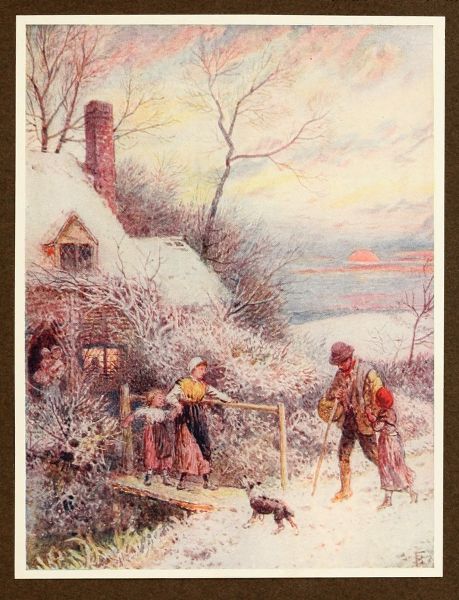 Going Home
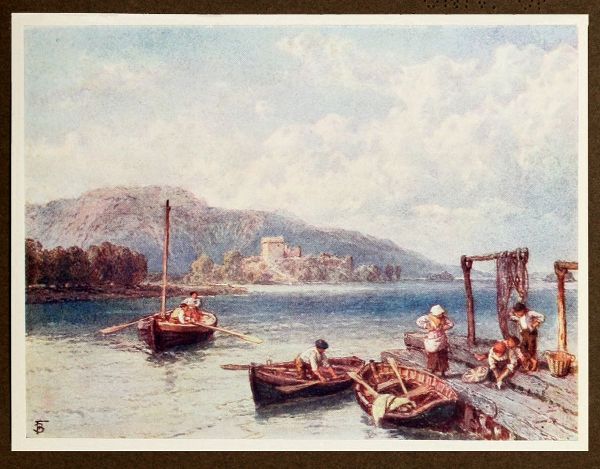 Loch Leven Castle
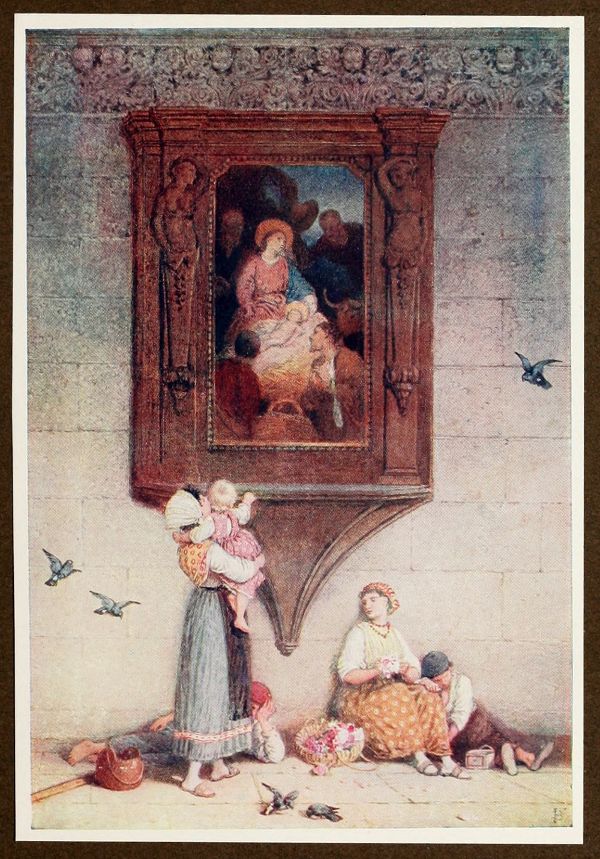 Shrine at the Entrance of the
Courtyard of the Ducal Palace, Venice
Shrine at the Entrance of the
Courtyard of the Ducal Palace, Venice
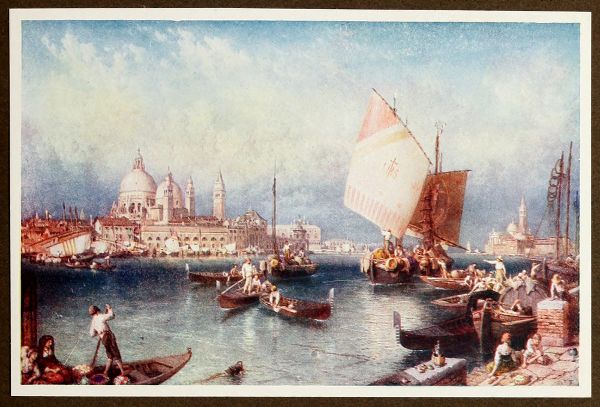 Entrance to the Grand Canal, Venice
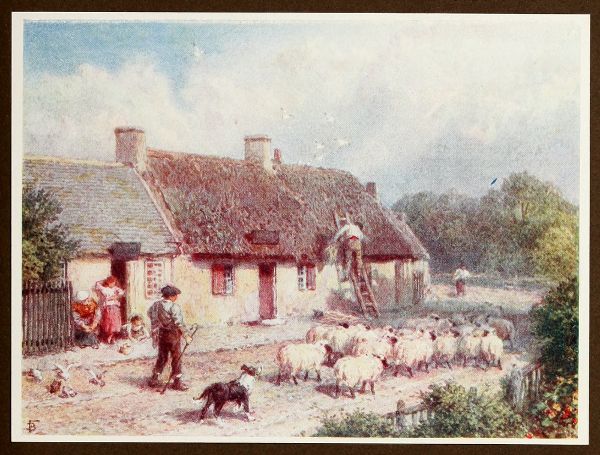 Birthplace of Burns, near Ayr
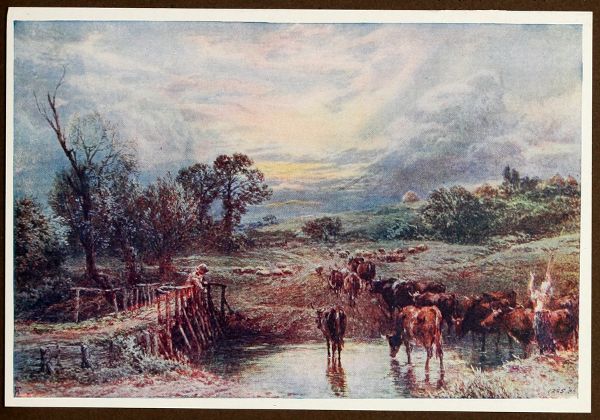 Sunset with Cattle
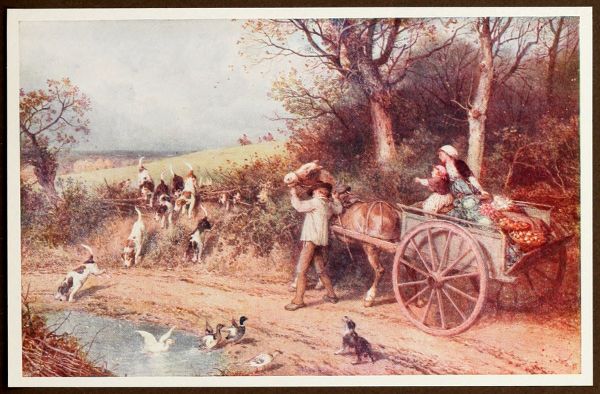 In Full Cry
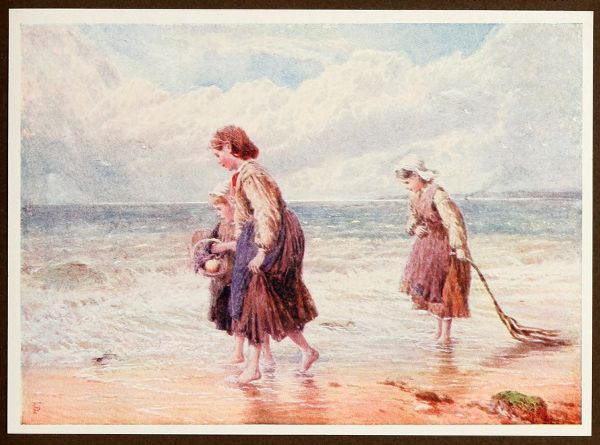 Children by the Sea
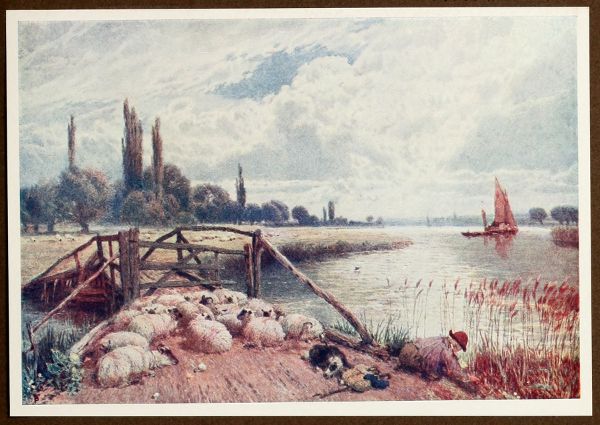 By the Thames
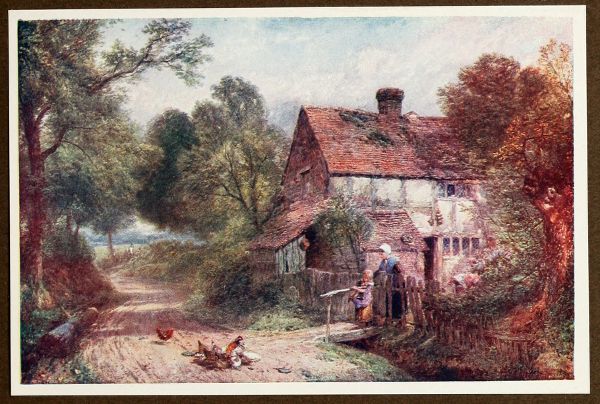 A Surrey Cottage
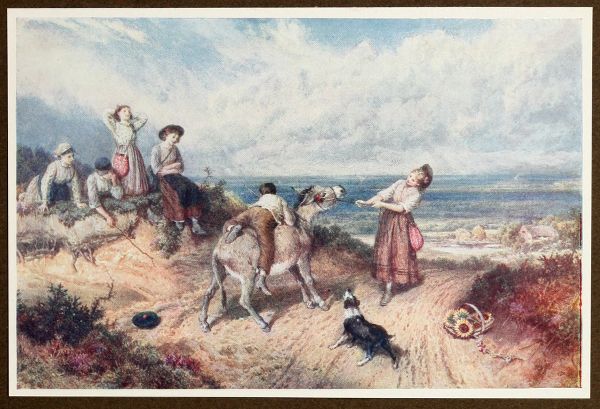 The Donkey that would not go
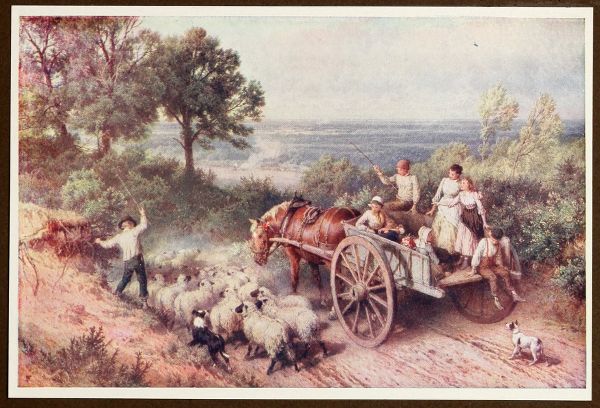 Passing the Flock
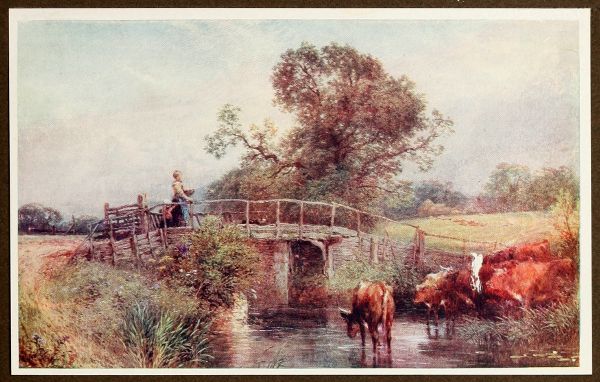 Near Godalming
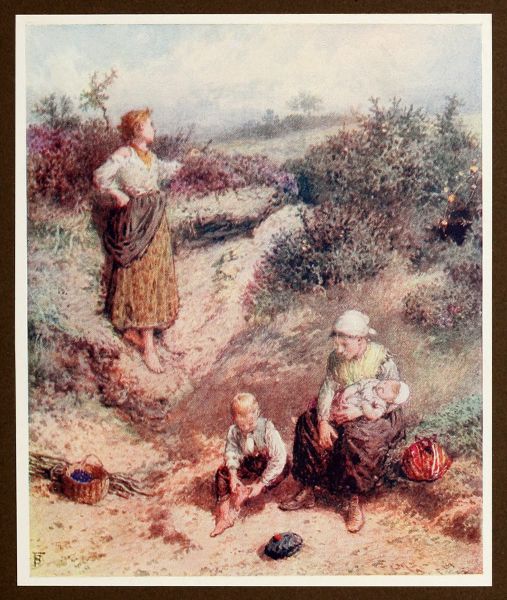 The Blackberry Gatherers
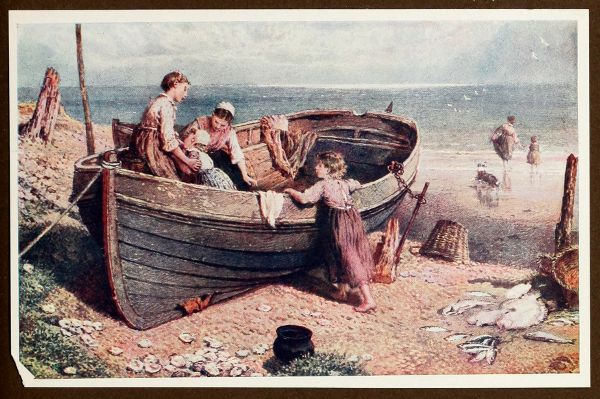 The Happy Time of Life
Transcriber's Note
Captions were added to the plates for convenience.