“Kirchup! Kirchup! among the wheats
Partridge distant partridge greets,
Beckoning hints to those that roam
That guide the squandered cover home.”
Clare.
IT is easy, taking a score of birds, to construct a bird-calendar, a
zodiac of birds, that comes very near the actual truths, and almost
exhausts the list of more notable land-fowl. There are some, like the
heron or the bittern, the curlew, the woodpecker, or the coot, that are
not significant of any particular time and season, because they are not
sufficiently familiar.
It is only by some fortunate accident and in particular places that you
may hear the lonely cry of
“the heron as he spreads his wing,
By twilight o’er a haunted spring;”
or the bittern
“bellowing harsh,
To its dark bottom shake the shuddering marsh.”
It is a very quaint and ancient myth that the “mire-dromble” or
“mere-drum” fixed its beak in a hollow reed or in the bog, and by
“snoring,” “booming,” or “bellowing” through it made, as Burns says,
“the quagmire reel.” Several poets refer to the bittern “shaking the
solid ground,” Thomson among them, in the absurd lines, “The bittern
knows his time, with bill ingulpht, to shake the surrounding marsh.” But
they are all to be traced back to Michael Drayton’s description of how
“The buzzing bitter sits, while through his hollow bill
A sudden bellowing sounds, which many times doth fill
The neighbouring marsh with noise, as though a bull did roar.”
It is altogether a delightful bird in poetry and folk-lore, this
“bog-bumper” or “betowre,” or whatever name we choose to know it by.
The curlew again, a bird of the coast and the northern uplands, is
familiar only to those who live near marsh and moor, though its weird,
wild clamour, as it passes overhead in the night, is the source of a
superstition, which, as “Gabriel’s hounds,” “The Seven Whistlers,” “The
Wild Huntsman,” is common to all Northern Europe, and is probably the
origin of that fearful wild-fowl that was the “trump of doleful drere,”
“the whistler shrill that whoso hears doth die,” to which Wordsworth
alludes:
“He the seven birds hath seen that never part,
Seen the seven whistlers in their nightly rounds,
And counted them;”
and Moore:
“Oh! did you hear a voice of death?
And did you not mark a paly form,
Which rode on the silver mist of the heath,
And sang a ghostly dirge in the storm?”
All this, and ever so much more of quaint and interesting tradition, has
its source in the impressive uncanny cries with which the curlews,
flying by night, keep their company all safely together. The woodpecker
again, Tennyson’s “garnet-headed yaffingale,” the bird of Picus the
augur, which breaks with his crazy ringing laugh so suddenly upon the
solitude, is familiar only to those who live near woods. Marvel has some
excellent but little-known lines on the “hewel,” as he calls this bird
of many aliases:
“He walks still upright from the root,
Measuring the timber with his foot,
And all the way to keep it clean
Doth from the bark the wood-moths glean.
He with his beak examines well
Which fit to stand and which to fell.
The good he numbers up and tracks,
As if he marked them with an axe;
And when he, tinkling with his beak,
Doth find the hollow out to speak,
That for his building he designs,
And through the tainted hide he mines.”
The coot, too, is a bird only familiar to such as dwell near quiet
waters—a whimsical and odd-mannered amphibian, that gives a very
pleasing animation to the sequestered places it frequents, for whether
diving and ducking in the water, or moving with flicking tail about the
banks, in that “jerky, high-stepping manner” which Dudley Warner
disliked so delightfully in his neighbours’ hens, it is a fowl of
pantomimic behaviour that is very diverting to watch.
Other birds, again, are too common to be significant of time or of
season, though, among them are many of the most popular of our feathered
folk—the beautiful and merry chaffinch, the roadside yellowhammer, the
linnets that are everywhere, the delightful goldfinch and bullfinch, the
sweet-song hedge-sparrow, the handsome monotonous greenfinch, the
ubiquitous sparrow—“meanest of the feathered race,” as Cowper unkindly
calls it—and the dainty water-wagtails that

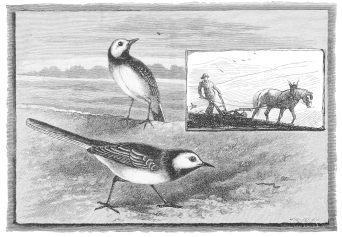 “One of the ploughman’s companions”
everybody likes. Some of the wagtails stay with us all the year round,
but most move southward as winter approaches, and when the weather
becomes severe, cross the Channel to seek a warmer climate. In Spring
they are one of the ploughman’s companions, for often it is only in the
freshly-turned furrows that they can then find the insect food they
need, but later on they seek the neighbourhood of water where winged
things assemble, and there love to paddle in the shallows. Often, too,
they take flights inland, searching the meadows and garden-lawns for
“such small deer” as they live upon, hawking for flies among the
haycocks or amongst the cattle that are standing at ease by the pond, or
following them in quest of the insects which, as they graze, they
disturb from the herbage. I know no bird that is more “bird-like” than
the wagtail; more dainty, delicate, and elegant: in its every movement
it is airy, the embodiment of buoyant grace: whether on the ground or
a-wing it is fairy-like, volatile, and wayward: running, fluttering, and
flitting impulsively as if it were too happy to stop to think, like a
child in a meadow full of flowers: a sylph among the birds, so slim and
so sweetly-proportioned as to make its little companions look burly and
thick-set: so prettily timid in its demeanour that the rest seem almost
aggressive; in a word, a bird of birds.
But between the familiar and unfamiliar there are just enough birds,
well known to all of us, that fit the seasons and the months with a
rather special appropriateness. For the months there is the fieldfare
for January, the rook for February, the thrush for March, the swallow
for April, the nightingale for May, the dove for June, the kingfisher
for July, the grouse for August, the partridge for September, the
pheasant for October, the woodcock for November, and “the wren, the
wren, the king o’ the birds,” for December.
“A Winter such as when birds die
In the deep forests.”
Shelley.
“Now various birds in melting concert sing,
And hail the beauty of the opening Spring.”
Savage.
The fieldfares comes to us late in the year, and in January, if the
weather be very hard, are often the most conspicuous wild birds of the
month. Most people mistake them for missel-thrushes, as they travel
about in companies over the snow-covered fields, ransacking the hedges
in such methodical fashion for the hawthorn berries, or scattering over
open patches of ground in quest of seeds or insects. This mistake,
doubtless, saves many of their lives, for those who would not shoot our
native missel-thrushes in the snow, might have no compunction in bagging
the strangers from abroad, who bring with them such a reputation for
the table as the fieldfares, and who, it might be urged, are poaching on
the scanty winter-provisions of thrush and blackbird—“the hawthorn’s
berries red, with which the fieldfare, wintry guest, is fed,” and which,
if it had stayed at home, would help to keep our own song-birds alive
through the pinch of the year.
In February the rooks have repossessed themselves of their old haunts:
“His airy nursery in the neighbouring elm
Constructs the social rook, and makes the grove
That girds the crumbling edifice around,
And every angle of its ruined pile,
With the bass note of his harsh love resound.
Hurdis.
“Lofty elms and venerable oaks
Invite the rook, who high amid the boughs
In early Spring his airy nursery builds,
And ceaseless caws amusive.”
Thomson.
“Soothed by the genial warmth, the cawing rook
Anticipates the Spring, selects her mate,
Haunts her tall nest-trees, and with sedulous care
Repairs her wicker eyrie tempest-torn.”
Gilbert White.
And so to March and “the throstle with his note so true”; and April,
when “the swallow knows her time, and on the vernal breezes wings her
way, o’er mountain, plain, and far-extending seas, from Afric’s torrid
sands to Britain’s shore, before the cuckoo”; and May, “with the darling
of the Summer’s pride, fair Philomel,” “the dear good angel of the
Spring, the nightingale,” and
“All vital things that wake to bring
News of buds and blossoming.”
With the swallow and the nightingale, many other birds “transmigrating
come, unnumbered colonies on foreign wing, at Nature’s summons.”
From every quarter the aliens, if birds bred on British soil by
British-born parents can be called such, converge upon our coasts, just
as if England were the centre of a circle at which all the birds who
spend the rest of the year upon its circumference congregate for the
nesting season, reaching the same point at the same time, but
travelling, each company, on a radius of its own.
I have often wondered that migration is not more often looked at through
the other end of the telescope, and Great Britain called the “home,” for
instance, of the nightingale. What makes “home” for a bird? Is it not
the place where the nest is built and the young are reared? For the rest
of the year the families travel “abroad,” returning “home” for all that
makes life important and domestic. Their fixed addresses are in England,
their names are in British directories as residing there. But their
doctors will not let them winter “at home,” and so they have to go on to
the Continent, or to even warmer latitudes, for the colder months of
the year. I myself entertain, and often express, a grudge against the
“migrants” for staying only so long as it is fine; but as often as I do
so, my conscience reproaches me, for, after all, the nightingale shows
its affection for its birthplace by coming back to it; and, “in spite of
all temptations to belong to other nations,” remains a true-born English
bird. What more could it do? It might certainly stay and freeze to
death. But why should we expect nightingales to do more than we expect
men and women to do? Which of us, if warned by doctors against the
English winter and possessing the means to go abroad, would stop at home
to die here, just to show that we are lovers of our country? So it would
be quite in keeping with the sympathetic and kindly tendency of
contemporary natural history, if we looked upon the birds when they
come, as our own birds coming home, and when they go, as going abroad
under the inexorable compulsion of health; if we welcomed them in Spring
as returning fellow-countrymen, and bade them god-speed in Autumn, as
delicate folk who would, if they could, but dare not, stop in Britain
all the year round. And who can blame the birds, apart from necessities
of life and death, for leaving our shores? Think of the climate they can
always, by a morning’s flight, enjoy, year in and year out, “in foreign
countries”; what range of space, what perennial abundance of food, and
then calculate the force of inherited affection for the place of their
birth that urges them, hosts of little feeble people, to dare the
appalling journey “home,” to risk the truly awful perils of return to
their native land. Had they human intelligence, and did they live by
reason, not one of them would think of coming here.
What human parents would think of wintering in, say, Cairo, if they knew
that the railway companies meant to destroy them wholesale as they
travelled down to Dover; that the coast-guard and along-shore rabble
were all on the look-out for them to take their lives; that the Channel
steamer owners were in conspiracy to kill them; that the quays at Calais
were swarming with avowed murderers of British travellers; that every
Continental line was run by bandits and brigands sworn to shed their
blood, and every hotel and resting-place an ambush of assassins? What
British pater-familias would “winter in Cairo” under such conditions of
travel? Yet these are the conditions under which the nightingales come
and go. Only they do not know it. If they did, “the instinct of
self-preservation” would surely triumph over “love of country,” and we
should never see any nightingales in England, nor any turtle-doves—one
of the most beautiful of our birds. But more of turtle-doves by-and-by.
“The Ring-dove in the embowering ivy yet
Keeps up her love lament.”
Shelley.
“Summer hath spoken soothingly to each nested Finch.”
Keats.
Their larger and more beautiful relative the ring-dove or wood-pigeon we
have with us always, and I think it is conspicuously the bird of June.
The young are then on the wing, and it is impossible, passing near their
haunts, not to be attracted by this ornamental bird, which, whether
flying or at rest, adds a grace to every scene. Above all, it is
beautiful when it beats its way up into the air to a height, and then,
expanding its wings, comes floating down again. This exquisite
performance may be seen at almost any time, for the ring-dove sometimes
has three broods in the year, and if, as is supposed, it is a part of
the bird’s courtship, is as appropriate in October as in March. Both
birds may sometimes be seen executing this graceful “manœuvre”
together; and it is, I think, the most prettily significant of all
bird-gestures. Throughout June may be heard “the deep mellow crush of
the wood-pigeon’s note, making music that sweetens the calm” of the
summer woodlands or the sudden clapping when the startled bird, “on
loud-applauding wing,” quits its perch. Hardly a country walk can then
be taken without seeing, either feeding on the ground, at rest, or on
watch upon the trees or flying overhead, the handsome bird, in its
plumage of lavender-blue, that seems so wild, and yet can be tamed
sooner almost than any bird but the robin.
It is an odd fact that the civilised sparrow, the most coolly familiar
of birds, is the most difficult to make tame. The fact is, it is
naturally vulgar, and no gentle influences can ameliorate the naturally
vulgar. When at liberty, it will take all the liberties it can and
dares; when shut up, even if from the nest, it develops into a voracious
idiot; never amenable to kindness, always ferocious for food.
Yet the wood-pigeon, one of the wildest and shyest of birds, will soon
become tame, will feed from the hand, and when the miserable, suspicious
sparrow rushes into hiding, will sit in the aviary unconcerned and
confident of friendship.
But note this curious difference. The sparrow in an aviary will breed,
lay its eggs, and bring up its young ones, without any difficulty. The
ring-dove may walk about at nesting-time with twigs in its mouth, may
lay eggs, but let the aviary be never so large, it will not hatch its
eggs.
This contradiction in character is very extraordinary, and yet, if
considered, there is no irregularity in it. The sparrow builds simply
because it will build anywhere, and is accustomed to the neighbourhood
of men. But it never becomes in the least friendly: never even lays
aside a suspicion which would be unbecoming in a Central African finch.
The ring-dove, on the other hand, recognises at once a benevolent
intention, becomes quite tame, and yet, during the nesting-season,
cannot accommodate itself to conditions so outrageous to its nature. For
it loves to build its platform in the most secluded spots, not always
far from human habitation, but as far as possible out of sight.
Again, in protecting its young, this timid bird becomes very bold. I
remember taking a young cushat from a tree and trying to rear it by
hand, but it was almost full-grown, well-feathered, and too old for the
purpose. After two days’ very unsuccessful experiments, I took it out on
the lawn in a basket, on the chance of its parents being about, and the
result was certainly as surprising as it was unlooked-for. The young
bird, when we had all retired, began to show signs of excitement,
stretching its neck up, and looking all round it vaguely; then it
perched on the rim of the basket, and thoroughly searched the tree-tops,
and all of a sudden it either saw or heard something that we did not,
for it brightened up, stretched its neck to the utmost, looking
excitedly in a particular direction, and then flew its first flight,
heavily, but straight, to the top of an arbour. Scarcely had its feet
touched the roof when, as if by magic, one of the old birds appeared at
its side and began at once to feed it. None of us stirred, and, as soon
as the meal was finished, the old bird hopped up to an overhanging
branch, the young one following, and so up into the tree, and from that
one to the next, and the next, till, in a few minutes, it had travelled
along the tree-tops a hundred yards away. Now, the old birds must have
been waiting about the house all the two days, for it is hardly likely
that the taking out of the young one on to the lawn could have
accidentally coincided with the coming of the old one to the same spot.
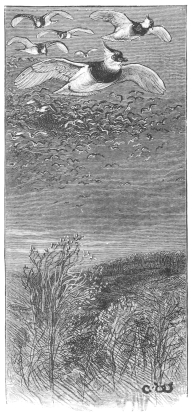 “The plovers scatter o’er the heath”
However, it is a curious, and really baffling, commentary on the whole
incident that thereafter two old wood-pigeons and a young one, before
the household was up in the morning, and off and on during the day, used
to come down upon the lawn and examine the spot where the captive’s
basket had stood, and which, after the young bird’s flight, we had
shaken out on the spot, scattering all the peas and food that was in it
upon the grass. Every day a handful of crumbs or maize used to be thrown
there, and every day the family came for it. By what process of
“instinct” could wild birds be led to behave so unreasonably? Did they
separate in their “minds” the incidents of capture and of release, and
being unable to put one and one together, consider the latter as an
isolated act of benevolence apart from, and quite unconnected with, the
former, and so behave with gratitude in consequence? Did they look on us
only as the good Jack Stout who pulled Pussy out, forgetting that we
were also the naughty Tommy Green who put Pussy in? But the workings of
“instinct” are not to be followed out by “reason,” or what shall we say
of all the other birds who, until we find their nests, are full of
artifice to mislead us, and apparently most anxious that their secret
should not be known, but who, once their nest is found, appear to lose
all concern about the matter, and move to and fro as if it were the most
natural thing in the world to treat us with confidence and be thoroughly
aboveboard with us?
Take the delightful dotterel, for instance. It will go through all the
deceptive performances of a lapwing, and weary out your patience with
anxious devices for leading you astray; and yet, when you at last
discover its beautiful eggs, olive, with rich dark markings, or its
downy little ones, almost the same colour as the eggs, cuddled together
in a small hollow, the old birds seem almost to congratulate you upon
your sagacity, and come close, as much as to say, “Yes, these are our
eggs; we were trying to show them to you all the time; and this is the
way we sit down on them. Like to see us catch a fly? There! That’s the
way we do it. See us run.” Then they droop one wing and begin to flutter
along the ground, as if hurt—just to show you how it is done; and, in
fact, before you go (and over your going they unreservedly and
unmistakably rejoice), will sometimes go through such a series of
performances as justifies their proverbial reputation for semi-idiotcy:
“The dotterell which we think a very dainty dish,
Whose taking makes such sport as man no more could wish,
For as you creep or cower, or lie or stoop, or go,
So marking you with care, the apish bird doth so,
And acting everything doth never mark the net
Till he be in the snare which men for him have set.”
This was written three centuries ago; but foolish or not, the dotterel
is a very engaging little bird, and to those who live near its summer
haunts one of the prettiest details of bird-life
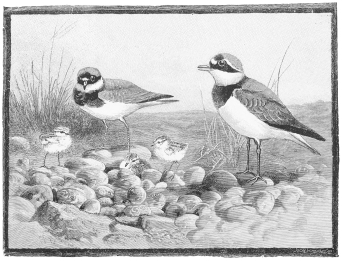 “THE DELIGHTFUL DOTTEREL”
in June. Long after dusk, its plaintive note can be heard, now here, now
there, among the tussocked grass, as the birds reply to one another from
their sleeping-places. And the mist comes creeping up on to the moorland
from the reedy mere beyond, and in the distance may be heard the voices
of the water-birds settling down for the night among the plumy sedges,
where the grey heron, perched upon the skeleton of some water-logged
boat, seems to act as timekeeper to the ducks and widgeon that live hard
by, and are under orders to be “within doors” by nightfall.
Listening to the twilight voices of birds, the most notable by far, that
which holds the attention longest, though it may not be the first to
catch the ear, is the fern-owl, whirring to his mate as she hawks
backwards and forwards over the undergrowth, and turning in the air as
she flies with queer sweep of the wings. Where there is one pair there
are generally more, and the sound seems continuous, one bird taking it
up from the other, or more than one “churring” at the same time. No bird
of its size performs more curious antics on the wing than the “nightjar”
or “goatsucker,” and it is almost incredible that the creature, flapping
and tumbling in such ungainly fashion through the air, when startled
from its sleeping-place in the day-time, is the same that one sees
sailing and sliding so gracefully after nightfall.
I know a beautiful orchard where these birds haunt,
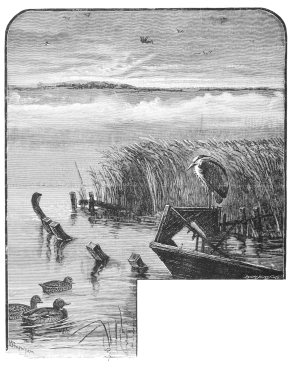 “Seems to act as timekeeper to the ducks”
and have often seen them lie crouched along the boughs, cowering so
close that one day, going to sling a hammock, I nearly put my hand upon
the bird. It slipped off the bough and, with a flight like a woodcock’s,
sawing from right to left, it swooped under some gooseberry-bushes and
vanished from sight. In the day-time, this power of sudden
disappearance is the poor fern-owl’s chief protection from its
persecutors, for, starting as if for long flight, it drops upon the
ground with a single instantaneous movement, and where it drops there it
lies quite motionless—and everybody overruns the spot. Its wonderfully
beautiful colouring fortunately assimilates both with the bark of trees
and the bare ground, and the cleverest of dogs will overshoot it without
discovery. If flushed a second time, it as often as not flies back to
the spot, or near it, where it was first startled. At night, when it is
feeding, coursing up and down above the heather and the brackens, it has
a beautiful flight, and should an owl suddenly drop over the birches and
begin to beat their ground, the evolutions of the nightjars in silent
protest are as exquisite as any sea-bird’s.
To July belongs the skylark, a bird really of all the year, but most
intimately somehow the genius of the meadow. The hay has been cut, the
first brood of young are flown, and the larks are again building,
renewing the Spring with the aftermath of grass. The glorious growth of
the meadow, spangled with ox-eye daisy and corn-flower, has been laid
low, and the scented harvest has been carted, and the larks are busier
than ever in the smooth-shorn field, while the sky seems never so full
of their song as when the hay-makers are afield. The scythe and the
terrible machine, and the tramp of feet behind them, are fatal to many a
brood, but the majority escape, being on the wing, or, at any rate,
running with their parents safely out of danger, by the time that the
mowers come.
“And the glossy finches chatter
Up and down, up and down,
And the chaffinch idly sitteth
With her mate upon the sheaves,
And the wistful robin flitteth
Over beds of yellow leaves.”
“The Moorcock springs on whirring wings
Among the blooming heather.”
Burns.
August is, by sad right, the month of the grouse—a month of
catastrophe, for it is then in the best of its health, enjoying the best
of the moor and harvest, when the fateful Twelfth comes round; and after
the day is over, horrid with perpetual guns,
“at the close of eve
She gathers in, mournful, her brood dispersed
By murderous sport, and o’er the remnant spreads
Fondly her wings.”
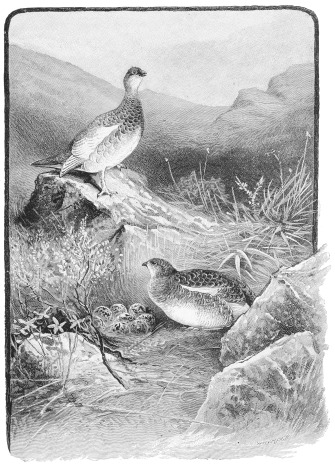
It is now, too, that the ptarmigan collect into large parties, and,
forsaking the highlands, wander lower in search of more varied food:
unwise in their generation, for in the higher altitudes they were
comparatively safe from many of the perils that beset the grouse. True,
when they were up among the clouds they were in the demesnes of the
eagle, who thinned their company as they fed upon the shoots of heather
and ling growing in tufts among the rocks or in broad patches down some
sunny slope—
“Where the grouse lead their coveys
Thro’ the heather to feed.”
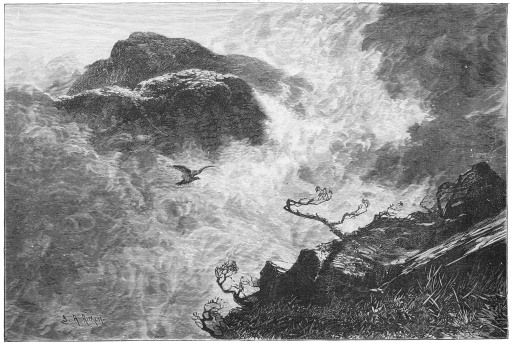
How silently and swiftly the birds of prey come wheeling round the curve
of the cliff, and, skimming the ground, pick up and carry off one of a
covey before even its companions can collect their wits to raise an
alarm. So in India I have seen the laggar falcon take up a quail and
pass on like some shadow, without disturbing the rest, as silent,
literally, as the wind, and with an incredible speed. Yet to watch an
eagle beating round the base of a hill there seems too much
leisureliness for speed. But time its flight, and you will find that
though the beats of its wings seem at long intervals it is really going
by with great velocity. Its home, and its favourite watchtower, for
birds of prey have always some one spot to which, when they wish to be
idle, they find their way, is some lofty crag. There seated aloft, they
overlook the lowlands where they find their food, without danger of
molestation while in repose. For it is always up on the peaks, sometimes
looking seaward over the nations of the sea-fowl, but generally inland,
where, when the clouds leave it an unbroken prospect, it can sit, like
some fierce old warden of the marches, to control the tribes of the
valley. It feeds by choice upon lambs, on fawns and hares; so that,
though the ptarmigan and grouse pay tribute, they are not harried by the
eagle.
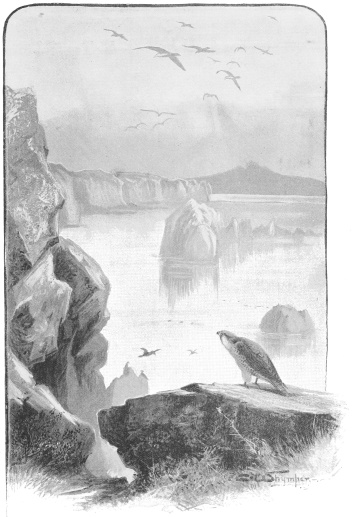
When they wander lower down the slopes the game-birds come within the
earldom of the falcon, the peregrine, a terrible bird, as fierce as it
is swift, and for ever ranging the moors in quest of food. I have known
it, in India, chase its quarry right among the tents of the camp, kill
it within a few feet of the tethered horses and their attendants, and
carry off its prey before there was sense enough among the onlookers to
snatch up a gun. When trained they are still as highly prized as of old
in England, and at Dholpur I have seen it flown, from the hand, at both
egret and duck, and marvelled, the last time as much as the first, at
the terrific velocity of its swoop. It seems, too, as if the bird struck
its prey with its beak, whereas it always strikes with its talons,
striking and clutching almost simultaneously. The fearful impact breaks
the quarry’s back, and enables the falcon, if it chooses, to continue
its flight with the dead bird in its grasp, without coming to the ground
at all.
In England, owing to increased cultivation and the enclosure
 “IN THE EARLDOM OF THE FALCON”
of land, falconry is virtually an extinct form of sport, and the few
rich men who still keep the flame alive have mitigated the horrors which
aroused the indignation of Gifford. “Humanity,” says he, “has seldom
obtained a greater triumph than in the abolition of this execrable
pursuit.” ... “The blood runs cold while we peruse the calm instructions
of the brutal falconer, to impale, tie down, fasten by the beak, break
the legs and wings of living pigeons, herns and herons, for the hourly
exercise of the hawk, who was thus enabled to pull them to pieces
without resistance.”
At one time, being protected, all “British” hawks were common in
England, and showed no more fear of man than they do at the present day
in India. Indeed, they seemed to display rather a preference for his
neighbourhood, following him when in the field, breeding familiarly in
buildings, and making dove-cots and poultry-yards their feeding-ground.
But now, having learned by a couple of centuries of persecution that
they have become unpopular, the hawks avoid humanity and all its ways.
Even the common species keep out of sight as much as possible, and some
have left the country altogether, or retired to the wildest portions of
the islands. The peregrine, for instance, is found at times only here
and there in Scotland—and occasionally on cliffs on the Cornish, Welsh,
or Cumbrian coasts—and its eyrie is there, as a rule, in the midst of
the most desolate scenery. Like the eagle, it has its favourite “post
of observation,” and when full-fed and at its ease loves to bask there,
and from its elevated seat survey the proceedings of the dwellers at
meaner altitudes, upon whom it makes regular forays, and who, strange to
say, seem to submit to this assertion of manorial rights with the
minimum of protest and disturbance—very much like the unfortunate
villeins and vassals in “the good old feudal days” of baronial England.
Ah, nut-brown Partridges! Ah, brilliant Pheasants!
Byron.
September is, of course, by long prescription, the partridge’s month,
and October the pheasant’s, than which there are no two birds probably
in all England that invest a country scene with a more immediate
interest and charm. In a certain field through which I used often to
pass in the evening, there used to be near a gate a large square patch
of ground upon which the farmer had once stacked manure, and the hay
never grew on it, only a wonderful crop of chickweed and plantain, with
fumitory and other weeds. And every evening, if I walked carefully, I
could surprise the partridges with their young brood busy after food on
this open plot. As the fancy took them, they would be alarmed by my
 WHERE THE EAGLE IS AT HOME
approach, vanishing through the surrounding wall of tall meadow-grass in
a twinkling, or they would cluck and crane their necks to look at me,
and then go on feeding—all except the cock-bird, who invariably fled,
and from his hiding-place would keep on making nervous remarks to his
wife, who kept as regularly reassuring him with little comfortable
clucks that all was right. A little scattered chicken-food brought them
very soon through the gate into the garden, and from the garden on to
the terrace, where they came at last to feed as regularly and happily as
ordinary pigeons. But when September came, and the guns were busy in the
farmers’ fields that lay outside their garden-asylum, the covey
gradually dwindled away till, out of the nine, only four survived the
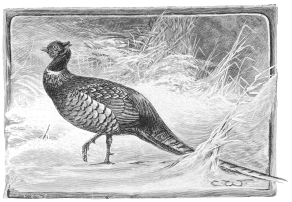
season. The pheasants, too, were free of the grounds, and they were
always in evidence. The carnations had all to be fenced in wherever
growing, for the pheasants would not leave them alone, and they were
very fond, too, of parading along the wall, and pecking off all the
jessamine buds and tips they could reach; but with jessamine we could
afford to be liberal, and the birds were allowed to eat all they could.
Not all that they would though. For one day, while sitting in a
greenhouse, I saw an old cock, the most absurdly vain old bird
imaginable, fall off the wall. He tried to reach a tuft of jessamine
that was exactly impossible, and after many half tumbles and recoveries
of balance with much wing-flapping, he at last made one more desperate
effort, just a little more desperate than before, and just too much for
his balance, for down he came with a kind of somersault into the garden.
And to see him on the ground, how he shook himself and looked round; how
affronted he was, and how pompous! If he walked stiffly before, he was
now positively on wires. If haughty in demeanour at all times, he was
now as superciliously superb as Tamburlane. He moved, like Shakespeare’s
peacock, with “a stride and a stand,” the very personification of
magnificence embarrassed. And in obedience to his call the two hens, who
had been staring from the top of the wall, astonished at the sudden
falling-off in stateliness of their dandified emperor, flew down, and he
led them off, loftily explaining as he went his reasons for his new
method of getting down from a wall, and the advantages that the
intelligent derived from such originalities of procedure.
“Firm on her perch
Her ancient and accustom’d seat, she sits
With wing-couched head.”
Grahame.
“When first the vales the Bittern fills
Or the first Woodcock roams the moonlit hills.”
Wordsworth.
“Beside the Redbreast’s note, one other strain,
One summer strain, in wintry days is heard—
Amid the leafless thorns the merry Wren
Pipes her perennial lay.”
Bloomfield.
“Of various plume and chirp the shiv’ring birds
Alight on hedge or bush, where late concealed
Their nests now hang apparent to the view.”
Grahame.
To November we ought to give the woodcock, the aristocrat among our
winter visitors. To see one in a winter’s walk makes the walk memorable;
we speak for ever so long afterwards of “the day we saw that woodcock.”
An old book says: “Of woodcocks especially, it is remarkable that upon a
change of the wind to the east, about Allhallows-tide, they will seem to
have come all in a night; for though the former day none are to be
found, yet the next morning they will be in every bush.” This was three
hundred years ago, and woodcocks are not now to be found “in every
bush,” even though the wind (as it too often is) be east “about
Allhallows-tide,” although that “they seem to have come all in a night”
is strictly true, as woodcocks migrate by night, and guns out one day
in October that have not flushed a single cock, will the next day make a
bag. At one time the bird was so common that weather forecasts were made
from its habits, as in Grahame’s “sure harbinger when they so early
come, of early winter, tedious and severe,” and Phillips’ “the woodcocks
early visit and abode, of long continuance in our temp’rate clime,
foretell a lib’ral harvest.” Earlier still, it was another name for a
fool, and in Elizabethan authors this synonym for a stupid person occurs
with other bird-nicknames with tedious frequency—gull, rook,
cormorant—and they are to be collected by the score without difficulty
from, say, Nash and Ben Jonson, showing how colloquial in Shakespeare’s
day was the general familiarity with birds and their supposed
characteristics. When smoking was introduced into England, one of the
first names for the pipe was “the woodcock’s head,” the stem being the
beak. But why the bird should have become a synonym for a witless person
is nowadays difficult to understand, for—except that it comes and goes
as a rule on the same tracks to and from its feeding-grounds, and thus
tells the trap-setter where to place his snares with deadliest
effect—it is a singularly wary bird, and never taken off its guard.
And so we come to December, “the king of the months,” and its wren, “the
king of the birds.” Why king? Because it was once decided in a
parliament of the birds, that the one
 THE OLD COCK PHEASANT
that flew highest should be king. The wren hid itself on the eagle’s
back, and when the eagle had flown its highest, the wren flew up a
little higher still. And “regulus” it remained, even in science, till
quite lately, when some ridiculous fustilarian rechristened it
“troglodytes.” Imagine the wren being “troglodytes,” the same,
scientifically, as the gorilla! What a poverty it betrays in
nomenclature, what a pitiful “superiority to imagination” to find that
the wren and the gorilla are undistinguishable to the eye of a
Professor. “Diabolus” would have been even better, for science has got
no devil now, so the English wren could never have been mistaken for the
great man-ape, and besides, in our folk-lore the wren is a very
necromantic and wicked little person. The Evil One, it is said, once
took possession of its body to serve his evil ends, and infamous
enchanters have done the same. So it came to pass that people said it
was a good deed and pious to kill wrens, and it is hunted to this day in
many places:
“The wren, the wren, the king of the birds,
St. Stephen’s day was caught i’ the furze,
Sing holly, sing ivy, sing ivy, sing holly,
Sing heigh! sing ho! to scare melancholy.”
This is the wren, troglodytes, in its “demoniacal aspect,” to use the
language of Gubernatis. In its benign aspect, “the tiny woodland dwarf,”
“the wren with little quill,” is a bird of some sanctity:
“Malisons, malisons mair than ten
Wha harries the queen of heaven’s hen.”
for, as everybody knows:
“The robin and the wren
Are God Almighty’s cock and hen.”
And it is in its connection with that other famous bird of December, the
robin-redbreast, that the wren, “Jenny Wren,” is, perhaps, most popular.
Indeed, it is almost impossible to think of one without the
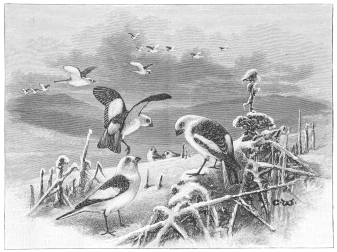 “Like snow-birds that are happy without sun”
other, for they have been sweethearts ever since English was spoken:
“‘Ah! Robin,
Joly Robin!
Tell me how thy leman doeth,
And thou shalt knowe of myn.’
‘My lady is unkinde, perdé.’
‘Alacke why is she so?’
‘She loveth another better than me,
And yet she will say no.’”
What an enchanting entanglement it is, this of the robin and the wren,
and yet we know that it was approved, for when Cock Robin died, all the
birds in the air, in sympathy for the dead and for Jenny—
“Fell a sighin’ and sobbin’.”


 IF we had to distribute the Seasons among the birds that
are called “British,” selecting a notable fowl to represent each, we
could hardly overlook the claims of the cuckoo, the nightingale, and the
swallow to distinction. But, after all, these are not “thorough
Britons.” They only come to us for our summer, and when that goes they
follow it. Though great numbers of them are British-born, they are at
best only Anglo-Continental, Anglo-Asiatic, Anglo-African, and
Inter-Oceanic. But our resourceful little islands give us native birds,
all our own, that amply serve the Seasons, and represent, with sufficing
charm, the changing Four. We have the thrush, the blackbird, the
skylark, and the robin, four of the sweetest birds that the round world
can show—
IF we had to distribute the Seasons among the birds that
are called “British,” selecting a notable fowl to represent each, we
could hardly overlook the claims of the cuckoo, the nightingale, and the
swallow to distinction. But, after all, these are not “thorough
Britons.” They only come to us for our summer, and when that goes they
follow it. Though great numbers of them are British-born, they are at
best only Anglo-Continental, Anglo-Asiatic, Anglo-African, and
Inter-Oceanic. But our resourceful little islands give us native birds,
all our own, that amply serve the Seasons, and represent, with sufficing
charm, the changing Four. We have the thrush, the blackbird, the
skylark, and the robin, four of the sweetest birds that the round world
can show—