A handbook of London birds considered—Reasons for not
writing it—Changes in the character of the wild bird
population, and supposed cause—The London sparrow—Its
abundance—Bread-begging habits—Monotony—Its best
appearance—Beautiful finches—Value of open spaces—The
sparrows’ afternoon tea in Hyde Park—Purpose of this book.
Among the many little schemes and more or
less good intentions which have flitted about my
brain like summer flies in a room, there was one
for a small volume on London birds; to contain,
for principal matter, lists of the species resident
throughout the year, of the visitants, regular
and occasional, and of the vanished species
which have inhabited the metropolis in recent,
former, or historical times. For everyone, even
the veriest Dryasdust among us, has some glow
of poetic feeling in him, some lingering regret
for the beautiful that has vanished and returneth
not; consequently, it would be hard in treating
of London bird life not to go back to times
which now seem very ancient, when the kite
was common—the city’s soaring scavenger,
protected by law, just as the infinitely less
attractive turkey-buzzard is now protected in
some towns of the western world. Again,
thanks to Mr. Harting’s researches into old
records, we have the account of beautiful white
spoonbills, associated with herons, building their
nests on the tree-tops in the Bishop of London’s
grounds at Fulham.
To leave this fascinating theme. It struck
me at first that the book vaguely contemplated
might be made useful to lovers and students of
bird life in London; and I was also encouraged
by the thought that the considerable amount of
printed material which exists relating to the
subject would make the task of writing it comparatively
easy.
But I no sooner looked attentively into the
subject than I saw how difficult it really was,
and how unsatisfactory, and I might almost add
useless, the work would prove.
To begin with, what is London? It is a
very big town, a ‘province covered with houses’;
but for the ornithologist where, on any side,
does the province end? Does it end five miles
south of Charing Cross, at Sydenham, or ten miles
further afield, at Downe? Or, looking north, do
we draw the line at Hampstead, or Aldenham?
The whole metropolitan area has, let us say, a
circumference of about ninety miles, and within
its outermost irregular boundary there is room
for half a dozen concentric lines, each of which
will contain a London, differing greatly in size
and, in a much less degree, in character. If the
list be made to include all the birds found in
such rural and even wild places—woods, thickets,
heaths, and marshes—as exist within a sixteen-mile
radius, it is clear that most of the inland
species found in the counties of Kent, Surrey,
Middlesex, Hertfordshire, and Essex would be
in it.
The fact is, in drawing up a list of London
birds, the writer can, within limits, make it as
long or short as he thinks proper. Thus, if he
wishes to have a long list, and is partial to
round numbers, he will be able to get a century
of species by making his own twelve or thirteen
mile radius. Should he then alter his mind,
and think that a modest fifty would content him,
all he would have to do to get that number
would be to contract his line, bringing it somewhere
near the indeterminate borders of inner
London, where town and country mix or pass
into each other. Now a handbook written on
this plan would be useful only if a very exact
boundary were drawn, and the precise locality
given in which each resident or breeding species
had its haunts, where the student or lover of
birds could watch or listen for it with some
chance of being rewarded. Even so, the book
would not serve its purpose for a longer period
than two or three years; after three years it
would most certainly be out of date, so great and
continuous is the growth of London on all sides.
Thus, going round London, keeping to that
partly green indeterminate borderland already
mentioned, there are many little hidden rustic
spots where in the summer of 1897 the woodpecker,
green and spotted, and the nuthatch and
tree-creeper bred; also the nightingale, bottle-tit,
and wryneck, and jay and crow, and kestrel
and white and brown owl; but who can say
that they will breed in the same places in 1899,
or even in 1898? For these little green rustic
refuges are situated on the lower slopes of a
volcano, which is always in a state of eruption,
and year by year they are being burnt up and
obliterated by ashes and lava.
After I had at once and for ever dropped,
for the reasons stated, all idea of a handbook,
the thought remained that there was still much
to be said about London bird life which might
be useful, although in another way. The subject
was often in my mind during the summer
months of 1896 and 1897, which, for my sins, I
was compelled to spend in town. During this
wasted and dreary period, when I was often in
the parks and open spaces in all parts of London,
I was impressed more than I had been before
with the changes constantly going on in the
character of the bird population of the metropolis.
These changes are not rapid enough to
show a marked difference in a space of two or
three years; but when we take a period of
fifteen or twenty years, they strike us as really
very great. They are the result of the gradual
decrease in numbers and final dying out of many
of the old-established species, chiefly singing
birds, and, at the same time, the appearance of
other species previously unknown in London,
and their increase and diffusion. Considering
these two facts, one is inclined to say off-hand
that the diminution or dying out of one set of
species is simply due to the fact that they are
incapable of thriving in the conditions in which
they are placed; that the London smoke is fatal
in the long run to some of the more delicate
birds, as it undoubtedly is to the rose and
other plants that require pure air and plenty
of sunshine; and that, on the other hand,
the new colonists that are increasing are species
of a coarser fibre, greater vitality, and able, like
the plane-tree in the plant world, to thrive in
such conditions. It is really not so: the tits
and finches, the robin, wren, hedge-sparrow,
pied wagtail, some of the warblers, and the
missel-thrush, are as vigorous and well able to
live in London as the wood-pigeon. They are,
moreover, very much more prolific than the
pigeon, and find their food with greater ease.
Yet we see that these lively, active species are
dying out, while the slow, heavy dove, which
must eat largely to live, and lays but two eggs
on a frail platform of sticks for nest, is rapidly
increasing.
Here
then, it seemed, was a subject which
it might be for the advantage of the bird-lovers
in London to consider; and I write in the conviction
that there are as many Londoners who
love the sight and sound of wild bird life as
there are who find refreshment in trees and
grass and flowers, who are made glad by the
sight of a blue sky, to whom the sunshine is
sweet and pleasant to behold.
In going about London, after my mind had
begun to dwell on this subject, I was frequently
amused, and sometimes teased, by the sight and
sound of the everywhere-present multitudinous
sparrow. In London there are no grain-growers
and market-gardeners, consequently there is no
tiresome sparrow question, and no sparrow-clubs
to vex the tender-hearted. These sparrows were
not to be thought about in their relation to
agriculture, but were simply little birds, too
often, in many a weary mile, in many an
unlovely district, the only representatives of the
avian class, flying to and fro, chirping and
chirruping from dawn to dark; nor birds only:
I had them also for butterflies, seen sometimes
in crowds and clouds, as in the tropics, with no
rich nor splendid colouring on their wings; and
I had them for cicadas, and noisy locusts of
arboreal habits, hundreds and thousands of them,
whirring in a subdued way in the park trees
during the sultry hours. They were all these
things and scavengers as well, ever busy at their
scavengering in the dusty and noisy ways;
everywhere finding some organic matter to
comfort their little stomachs, or to carry to
their nestlings.
At times the fanciful idea would occur to
me that I was on a commission appointed to
inquire into the state of the wild bird life of
London, or some such subject, and that my
fellow commissioners were sparrows, so incessantly
were they with me, though in greatly
varying numbers, during my perambulations.
After all, the notion that they attended or
accompanied me in my walks was not wholly
fanciful. For no sooner does any person enter
any public garden or park, or other open space
where there are trees, than, if he be not too
absorbed in his own thoughts, he will see that
several sparrows are keeping him company,
flying from tree to tree, or bush to bush, alighting
occasionally on the ground near him, watching
his every movement; and if he sit down on a
chair or bench several of them will come close
to him, and hop this way and that before him,
uttering a little plaintive note of interrogation—Have
you got nothing for us? They have come
to look on every human being who walks among
the park trees and round the garden-beds as a
mere perambulating machine for the distribution
of fragments of bread. The sparrow’s theory or
philosophy of life, from our point of view, is
very ridiculous, but he finds it profitable, and
wants no better.
I remember that during those days, when
the little creatures were so much with me,
whether I wanted them or no, some person
wrote to one of the newspapers to say that he
had just made the acquaintance of the common
sparrow in a new character. The sparrow was
and always had been a familiar bird to him, but
he had never previously seen it gathered in
crowds at its ‘afternoon tea’ in Hyde Park, a
spectacle which he had now witnessed with
surprise and pleasure.
If (I thought) this innumerous feathered
company could only be varied somewhat, the
modest plumage retouched, by Nature, with
harmonious olive green and yellow tints, pure
greys and pure browns, with rose, carmine, tile
and chestnut reds; and if the monotonous little
burly forms could be reshaped, and made in
some cases larger, in others smaller, some
burlier still and others slimmer, more delicate
and aërial in appearance, the spectacle of their
afternoon tea would be infinitely more attractive
and refreshing than it now is to many a
Londoner’s tired eyes.
Their voices, too—for the refashioned mixed
crowd would have a various language, like the
species that warble and twitter and call musically
to one another in orchard and copse—would
give a new and strange delight to the
listener.
No doubt the sparrow is, to quote the letter-writer’s
expression, ‘a jolly little fellow,’ quite
friendly with his supposed enemy man, amusing
in his tea-table manners, and deserving of all
the praise and crumbs we give him. He is even
more. To those who have watched him begging
for and deftly catching small scraps of bread,
suspended like a hawk-moth in the air before
the giving hand, displaying his conspicuous
black gorget and the pale ash colour of his under
surface, while his rapidly vibrating wings are
made silky and translucent by the sunlight
passing through them, he appears, indeed, a pretty
and even graceful creature.
PARK SPARROW
BEGGING
But he is, after all, only a
common sparrow, a mean representative
of bird life in our midst; in
all the æsthetic qualities which make
birds charming—beauty of form and
colour, grace of motion, and melody—less
than the least of the others.
Therefore to greatly praise him is to publish
our ignorance, or, at all events, to make it
appear that he is admired because, being
numerous and familiar with man, he has been
closely and well looked at, while the wilder and
less common species have only been seen at a
distance, and therefore indistinctly.
A distinguished American writer on birds
once visited England in order to make the
acquaintance of our most noted feathered people,
and in his haste pronounced the chaffinch the
‘prettiest British songster.’ Doubtless he had
seen it oftenest, and closely, and at its best; but
he would never have expressed such an opinion
if he had properly seen many other British
singing birds; if, for instance (confining ourselves
to the fringilline family), he had seen his
‘shilfa’s’ nearest relation, the brambling, in his
black dress beautifully variegated with buff
and brown; or the many-coloured cirl-bunting;
or that golden image of a bird, the yellowhammer;
or the green siskin, ‘that lovely little
oddity,’ seeking his food, tit-like, among the
pine needles, or clinging to pendulous twigs;
or the linnet in his spring plumage—pale grey
and richest brown and carmine—singing among
the flowery gorse; or the goldfinch, flitting
amidst the apple-bloom in May, or feeding on
the thistle in July and August, clinging to
the downy heads, twittering as he passes from
plant to plant, showing his gay livery of crimson,
black, and gold; or the sedentary bullfinch, a
miniature hawk in appearance, with a wonderful
rose-coloured breast, sitting among the
clustering leaves of a dark evergreen—yew or
holly.
Beautiful birds are all these, and there are
others just as beautiful in other passerine
families, but alas! they are at a distance from
us; they live in the country, and it is only that
small ‘whiff of the country’ to be enjoyed in a
public park which fate allows to the majority of
Londoners, the many thousands of toilers from
year’s end to year’s end, and their wives and
children.
To those of us who take an annual holiday,
and, in addition, an occasional run in the
country, or who are not bound to town, it is
hardly possible to imagine how much is meant
by that little daily or weekly visit to a park.
Its value to the confined millions has accordingly
never been, and probably cannot be, rightly
estimated. For the poor who have not those
periods of refreshment which others consider so
necessary to their health and contentment, the
change from the close, adulterated atmosphere
of the workshop and the living-room, and stone-paved
noisy street, to the open, green, comparatively
quiet park, is indeed great, and its benefit
to body and mind incalculable. The sight of
the sun; of the sky, no longer a narrow strip,
but wide, infinite over all; the freshness of the
unconfined air which the lungs drink in; the
green expanse of earth, and large trees standing
apart, away from houses—all this produces a
shock of strange pleasure and quickens the tired
pulse with sudden access of life. In a small
way—sad it is to think in how small a way!—it
is a return to nature, an escape for the
moment from the prison and sick-room of unnatural
conditions; and the larger and less
artificial the park or open space, and the more
abounding in wild, especially bird, life, the more
restorative is the effect.
It is indeed invariably the animal life which
exercises the greatest attraction and is most
exhilarating. It is really pathetic to see how
many persons of the working class come every
day, all the year round, but especially in the
summer months, to that minute transcript of
wild nature in Hyde Park at the spot called the
Dell, where the Serpentine ends. They are
drawn thither by the birds—the multitude of
sparrows that gather to be fed, and the wood-pigeons,
and a few moorhens that live in the
rushes.
‘I call these my chickens, and I’m obliged
to come every day to feed them,’ said a paralytic-looking
white-haired old man in the shabbiest
clothes, one evening as I stood there; then,
taking some fragments of stale bread from his
pockets, he began feeding the sparrows, and
while doing so he chuckled with delight, and
looked round from time to time to see if the
others were enjoying the spectacle.
To him succeeded two sedate-looking
labourers, big, strong men, with tired, dusty
faces, on their way home from work. Each
produced from his coat-pocket a little store of
fragments of bread and meat, saved from the
midday meal, carefully wrapped up in a piece
of newspaper. After bestowing their scraps on
the little brown-coated crowd, one spoke:
‘Come on, mate, they’ve had it all, and now let’s
go home and see what the missus has got for
our tea’; and home they trudged across the park,
with hearts refreshed and lightened, no doubt,
to be succeeded by others and still others,
London workmen and their wives and children,
until the sun had set and the birds were all
gone.
Here then is an object lesson which no
person who is capable of reading the emotions
in the countenance, who has any sympathy with
his fellow-creatures, can fail to be impressed by.
Not only at that spot in Hyde Park may it be
seen, but at all the parks and open spaces in
London; in some more than others, as at St.
James’s Park, where the gulls are fed during
the winter months, and at Battersea and Regent’s
Parks, where the starlings congregate every
evening in July and August. What we see is
the perpetual hunger of the heart and craving
of those who are compelled to live apart from
Nature, who have only these momentary glimpses
of her face, and of the refreshment they experience
at sight of trees and grass and water,
and, above everything, of wild and glad animal
life. How important, then, that the most should
be made of our few suitable open spaces; that
everything possible should be done to maintain
in them an abundant and varied wild bird life!
Unfortunately, this has not been seen, else we
should not have lost so much, especially in the
royal parks. In some of the parks under the
County Council there are great signs of improvement,
an evident anxiety to protect and
increase the stock of wild birds; but even here
the most zealous of the superintendents are not
fully conscious of the value of what they are
themselves doing. They are encouraging the
wild birds because they are considered ‘ornaments’
to the park, just as they plant rhododendrons
and other exotic shrubs that have big
gaily-coloured flowers in their season, and as
they exhibit some foreign bird of gorgeous
plumage in the park aviary. They have not
yet grasped the fact—I hope Mr. Sexby, the
excellent head of the parks department, will
pardon my saying it—that the feathered inhabitants
of our open spaces are something more
than ‘ornaments’; that the sight and sound of
any wild bird, from the croaking carrion crow
to the small lyrical kitty wren or tinkling tomtit,
will afford more pleasure to the Londoner—in
other words, conduce more to his health and
happiness—than all the gold pheasants and
other brightly-apparelled prisoners, native and
foreign, to be seen in the park cages.
From the foregoing it will be seen that this
little book, which comes in place of the one I
had, in a vague way, once thought of writing,
is in some degree a book with a purpose.
Birds are not considered merely as objects of
interest to the ornithologist and to a few other
persons—objects or creatures which the great
mass of the people of the metropolis have really
nothing to do with, and vaguely regard as something
at a distance, of no practical import, or as
wholly unrelated to their urban life. Rather
they are considered as a necessary part of those
pleasure- and health-giving transcripts of nature
which we retain and cherish as our best possessions—the
open sun-lit and tree-shaded spaces,
green with grass and bright with water; so important
a part indeed, as bringing home to us
that glad freedom and wildness which is our
best medicine, that without it all the rest would
lose much of its virtue.
But on this point—the extreme pleasure
which the confined Londoner experiences in
seeing and hearing wild birds, and the consequent
value of our wild bird life—enough has
been said in this place, as it will be necessary
to return to the subject in one of the concluding
chapters.
- 20 -
A short general account of the London crows—The magpie—The
jay—London ravens—The Enfield ravens—The Hyde
Park ravens—The Tower ravens—The carrion crow, rook,
and jackdaw.
There are not many crows in London; the
number of the birds that are left are indeed few,
and, if we exclude the magpie and jay, there are
only three species. But the magpie and jay
cannot be left out altogether, when we find both
species still existing at a distance of six and a
half to seven miles from Charing Cross. The
magpie is all but lost; at the present time there
are no more than four birds inhabiting inner
London, doubtless escaped from captivity, and
afraid to leave the parks in which they found
refuge—those islands of verdure in the midst of
a sea, or desert, of houses. One bird, the survivor
of a pair, has his home in St. James’s Park,
and is the most interesting figure in that haunt
of birds; a spirited creature, a great hater and
persecutor of the carrion crows when they come.
The other three consort together in Regent’s
Park; once or twice they have built a nest, but
failed to hatch their eggs. Probably all
three are females. When, some time ago,
the ‘Son of the Marshes’ wrote that the
magpie had been extirpated in his own
county of Surrey, and that to see it he
should have to visit the London parks, he made
too much of these escaped birds, which may be
numbered on the fingers of one hand. Yet we
know that the pie was formerly—even in this
century—quite common in London. Yarrell, in
his ‘British Birds,’ relates that he once saw
twenty-three together in Kensington Gardens.
In these gardens they bred, probably for the last
time, in 1856. Nor, so far as I know, do any
magpies survive in the woods and thickets on
the outskirts of the metropolis, except at two
spots in the south-west district. The fate of
the last pair at Hampstead has been related
by Harting, in Lobley’s ‘Hampstead Hill’
(London, 1889). For several years this pair had
their nest in an unclimbable tree at the Grove;
at length, one of the pair was shot by a local
bird-stuffer, after which the surviving bird twice
found and returned with a new mate; but one
by one all were killed by the same miscreant.
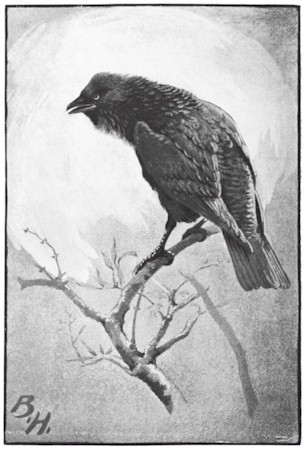
THE LAST RAVEN
It would be easy enough for any person to
purchase a few magpies in the market and
liberate them in St. James’s and Regent’s Parks,
and other suitable places, where, if undisturbed,
they would certainly breed; but I fear that it
would not be an advisable thing to do at present,
on account of the very strong prejudice which
exists against this handsome bird. Thus, at St.
James’s Park the one surviving bird is ‘one too
many,’ according to the keepers. ‘One for
sorrow’ is an old saying. He is, they say, a
robber and a teaser, dangerous to the ornamental
water-fowl in the breeding season, a great persecutor
of the wood-pigeons, and in summer
never happy unless he has a pigeon’s egg in his
beak. It strikes one forcibly that this is not a
faithful portrait—that the magpie has been
painted all black, instead of black and white as
nature made him. At all events, we know
that during the first two or three decades of the
present century there was an abundant and
varied wild bird life in the royal parks, and that
at the same time the magpies were more
numerous there than they are now known to
be in any forest or wild place in England.
The jay does not inhabit any of the inner
parks and open spaces; nor is there any evidence
of its having been a resident London species at
any time. But it is found in the most rural
parts and in the wooded outskirts of the metropolis.
Its haunts will be mentioned in the chapters
descriptive of the parks and open spaces.
There is no strong prejudice against the jay
among the park keepers, and I am glad to know
that, in two or three parks, attempts will be
made shortly to introduce this most beautiful
of British birds. It is to be hoped that when we
have got him his occasional small peccadilloes
will not be made too much of.
The raven has long been lost to London, but
not so long as might be imagined when we
consider how nearly extinct this noble species,
as an inland breeder, now is in all the southern
half, and very nearly all the northern half, of
England. It is not my intention in this book to
go much into the past history of London bird
life, but I make an exception of the raven on
account of an extreme partiality for that most
human-like of feathered creatures. Down to
about the middle of last century, perhaps later,
the raven was a common London bird. He
was, after the kite had vanished, the principal
feathered scavenger, and it was said that a
London raven could easily be distinguished from
a country bird by his dulled or dusty-looking
plumage, the result of his food-seeking operations
in dust and ash heaps. A little way out
of the metropolis he lingered on, as a breeding
species, down to within a little more than half
a century ago; the last pair, so far as I can
discover, bred at Enfield down to about 1845.
The original ‘raven tree’ on which this pair had
nested for many years was cut down, after which
the birds built a nest in a clump of seven elm-trees,
known locally as the ‘seven sisters,’
five of which are still standing.
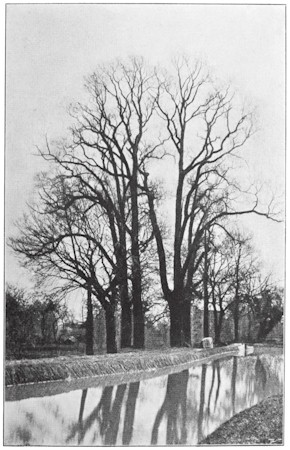
‘THE SEVEN SISTERS’
In London the last pair had ceased to breed
about twenty years earlier; and of a hundred
histories of ‘last ravens’ to be met with in all
parts of the country, that of these London birds
is by no means the least interesting, and is
worth relating again.
Down to about 1826 this pair bred annually
on one of the large elms in Hyde Park, until it
entered into the head of one of the park keepers
to pull down the nest containing young birds.
The name and subsequent history of this injurious
wretch have not been handed down. Doubtless
he has long gone to his account; and let us add
the pious wish that his soul, along with the souls
of all those who were wanton destroyers of
man’s feathered fellow-creatures, is now being
driven, like a snow-flake, round and round the
icy pole in that everlasting whirlwind described
by Courthope in his ‘Paradise of Birds.’
The old ravens, deprived of their young,
forsook the park. One of the young birds was
successfully reared by the keeper; and the
story of this raven was long afterwards related
by Jesse. He was allowed the fullest liberty,
and as he passed a good deal of his time in the
vicinity of the Row, he came to be very well
known to all those who were accustomed to
walk in Hyde Park at that time. He was fond
of the society of the men then engaged in the
construction of Rennie’s bridge over the Serpentine,
and the workmen made a pet of him. His
favourite amusement was to sidle cunningly up
to some passer-by or idler, and, watching his
chance, give him or her a sharp dig on the
ankle with his beak. One day a fashionably
dressed lady was walking near the bridge, when
all at once catching sight of the bird at her
feet, on feeling its sharp beak prodding her heel,
she screamed and gave a great start, and in
starting dropped a valuable gold bracelet from
her wrist. No sooner did the jewel touch the
ground than the raven snatched it up in his
beak and flew away with it into Kensington
Gardens, where it was searched for, but never
found. It was believed that he made use of
one of the hollow trees in the gardens as a
hiding place for plunder of this kind. At length
the raven disappeared—some one had stolen
him; but after an absence of several weeks he
reappeared in the park with clipped wings. His
disposition, too, had suffered a change: he moped
a good deal, and finally one morning was found
dead in the Serpentine. It was surmised that
he had drowned himself from grief at having
been deprived of the power of flight.
A few ravens have since visited London. In
1850 a keeper in Regent’s Park observed two of
these birds engaged in a savage fight, which
ended in the death of one of the combatants.
In March 1890 a solitary raven appeared in
Kensington Gardens, and remained there for
several weeks. A keeper informed me that it
was captured and taken away. If this unfortunate
raven had known his London better, he
would not have chosen a royal park for a
residence.
Was this Kensington raven, it has been
asked, a wild bird, or a strayed pet, or an escaped
captive? I believe the following incident will
throw some light on the question.
For many years past two or three ravens have
usually been kept at the Tower of London.
About seven years ago, as near as I can make
out, there were two birds, male and female,
and they paired and set to work building a
nest on a tree. By and by, for some unknown
reason, they demolished the nest they had made
and started building a new one in another place.
This nest also failed to satisfy them and was
pulled to pieces like the first, and another
begun; and finally, after half a dozen such
attempts, the cock bird, who was a strong
flyer, abandoned the task altogether and took
to roaming about London, possibly in search of
a new mate with a better knowledge of nest-building.
It was his habit to mount up to a
considerable height in the air, and soar about
above the Tower, then to fly away to St. Paul’s
Cathedral, where he would perch on the cross
above the dome and survey the raree-show
beneath. Then he would wing his way to the
docks, or in some other direction; and day by
day his wanderings over London were extended,
until the owner or owners of the bird were
warned that if his wings were not clipped he
would, soon or late, be lost.
But when it was at last resolved to cut his
wings he refused to be caught. He had grown
shy and suspicious, and although he came for
food and to roost on one of the turrets every
evening, he would not allow any person to come
too near him. After some weeks of this semi-independent
life he finally disappeared, having,
as I believe, met his end in Kensington Gardens.
His old mate ‘Jenny,’ as she is named, still
lives at the Tower. I hear she has just been
provided with a new mate.
Three other crows remain—the carrion crow,
rook, and jackdaw, all black but comely,
although not beautiful nor elegant, like the
bright vari-coloured jay and the black and
white pie. Unfortunately they are a small
remnant, and we are threatened with the near
loss of one, if not of all. The first-named of
this corvine trio is now the largest and most
important wild bird that has been left to us;
if any as big or bigger appear, they are but
casual visitors—a chance cormorant in severe
weather, and the heron, that sometimes comes
by night to the ornamental waters in the parks
in search of fish, to vanish again, grey and
ghostlike in the grey dawn.
It is curious to find that the big, loud-voiced,
hated carrion crow—so conspicuous and aggressive
a bird—has a firmer hold on life in the
metropolis than his two relations, the rook and
daw; for these two are sociable in habits and
inclined to be domestic, and are everywhere
inhabitants of towns. Or, rather, it would be
strange but for the fact that the crow is less
generally disliked in London than out of it.
Now, although these our three surviving
crows are being left far behind in actual
numbers by some other species that have only
recently established themselves among us, and
are moreover decreasing, and may be wholly
lost at no distant date, they have been so long
connected with London, and historically, as
well as on account of their high intelligence and
interesting habits, are so much more to us than
the birds of other families, that I am tempted
to write at considerable length about them,
devoting a separate chapter to each species. I
also cherish the hope that their threatened loss
may yet be prevented; doubtless every Londoner
will agree that it would be indeed a pity to lose
these old residents.
It is a fact, although perhaps not a quite
familiar one, that those who reside in the metropolis
are more interested in and have a kindlier
feeling for their wild birds than is the case in
the rural districts. The reason is not far to
seek: the poorer we are the more do we prize
our small belongings. A wind-fluttered green
leaf, a sweet-smelling red rose, a thrush in song,
is naturally more to a Londoner than to the
dweller in mid-Surrey, or Kent, or Devon.
- 32 -
The crow in London—Persecuted in the royal parks—Degradation
of Hyde Park—Ducks in the Serpentine: how they are
thinned—Shooting a chicken with a revolver—Habits of the
Hyde Park mallard—Anecdotes—Number of London crows—The
crow a long-lived bird; a bread-eater—Anecdote—Seeks
its food on the river—The crow as a pet—Anecdotes.
The carrion crow has probably always been an
inhabitant of the central parks; at all events it
is well known that for a long time past a pair
bred annually in the trees on the north side of
the Serpentine, down to within the last three
years. As these birds took toll of the ducks’
eggs and ducklings when they had a nest full of
ravenous young to feed, it was resolved that
they should no longer be tolerated; their nests
were ordered to be pulled down and the old
birds shot whenever an opportunity offered.
Now it is not the Hyde Park crows alone that
will suffer if this policy be adhered to, but the
London crows generally will be in danger of
extermination, for the birds are constantly
passing and repassing across London, visiting
all the parks where there are large trees, on
their way to and from their various feeding-grounds.
Hyde Park with Kensington Gardens
is one of their favourite stopping places; one or
more pairs may be seen there on most mornings,
frequently at noon again on their return to
Richmond, Kew, and Syon Park, and to the
northern heights of London. On the morning
of October 10, 1896, I saw eight carrion crows,
in pairs, perched at a considerable distance apart
on the elm-tops near the palace in Kensington
Gardens. After calling for some time on the
trees, they began to pursue and buffet one
another with violence, making the whole place
in the meantime resound with their powerful,
harsh, grating cries. Their mock battle over,
they rose to a considerable height in the air
and went away towards Hammersmith. It
seemed to me a marvellous thing that I had
witnessed such a scene in such a place. But it
is not necessary to see a number of carrion
crows together to feel impressed with the
appearance of the bird. There are few finer
sights in the wild bird life of London than one
of these visitors to the park on any autumn or
winter morning, when he will allow you to come
quite near to the leafless tree on which he is
perched, to stand still and admire his massive
raven-like beak and intense black plumage
glossed with metallic green, as he sits flirting
his wings and tail, swelling his throat to the size
of a duck’s egg, as, at intervals, he pours out a
succession of raucous caws—the cry of a true
savage, and the crow’s ‘voice of care,’ as
Chaucer called it.
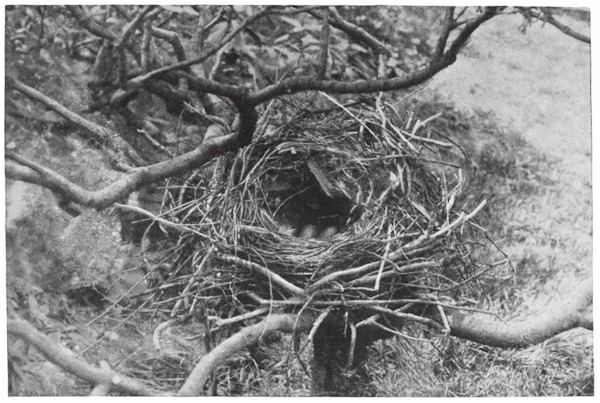
CARRION CROW’S NEST
The crow is, in fact, the grandest wild bird
left to us in the metropolis; and after corresponding
and conversing with a large number
of persons on the subject, I find that in London
others—most persons, I believe—admire him as
much as I do, and are just as anxious that he
should be preserved. It may be mentioned here
that in two or three of the County Council’s
parks the superintendents protect and take pride
in their crows. Why, then, should these few
birds, which Londoners value, be destroyed in the
royal parks for fear of the loss of a few ducklings
out of the hundreds that are annually hatched
and reared?
The ducks in the Serpentine are very
numerous; many bucketfuls of food—meal and
grain—are given to them every day when they
congregate at the boat-house, and they get
besides large quantities of broken bread cast
to them by the public; all day long, and every
day when it is not raining, there is a continual
procession of men, women, and children bringing
food for the birds. Is it permissible to ask for
whose advantage this large number of ducks is
reared and fattened for the table at so small a
cost? Hyde Park is maintained by the nation,
and presumably for the nation; it is a national
as well as a royal park; is it not extraordinary
that so noble a possession, the largest and most
beautiful open space in the capital of the British
empire, the chief city of the world, should be
degraded to something like a poultry farm, or
at all events a duck-breeding establishment, and
that in order to get as much profit as possible
out of the ducks, one of the chief ornaments of
the park, the one representative of noble wild
bird life that has survived until now in London,
should be sacrificed?
Let us by all means have ducks, and many
of them; they are gregarious by nature and look
well in flocks, and are a source of innocent
pleasure to numberless visitors to the parks,
especially to children and nursemaids; but let
us not have ducks only—a great multitude of
ducks, to the exclusion of other wilder and
nobler birds.
Personally, I am very fond of these ducks,
although I have never had one on my table, and
believe that I am as well able to appreciate
their beauty and feel an interest in their habits
as any of the gentlemen in authority who have
decreed that the carrion crow shall go the way
of the raven in Hyde Park. I love them because
they are not the ducks that have been made
lazy and fat, with all their fine faculties dulled,
by long domestication. They are the wild duck,
or mallard, introduced many years ago into the
Serpentine. Doubtless they have some domestic
taint in them, since the young birds reared
each season exhibit a very considerable variation
in colour and markings. Those that vary in
colour are weeded out each winter, and the
original type is in this way preserved; but not
strictly preserved, as the weeding-out process is
carelessly—I had almost said stupidly—performed.
The thinning takes place in December, and at
that season people who live in the vicinity of the
park are startled each morning by the sound of
firing, as at the covert side. The sub-ranger and
his friends and underlings are enjoying their big
annual shoot. And there is no reason why they
should not have this sport, if it pleases them,
and if by this means the object sought could
be obtained. But it is not obtained, as anyone
may see for himself; and it also seems a trifle
ridiculous that any man can find sport in
shooting birds accustomed to walk about among
people’s legs and feed out of little children’s
hands.
Once upon a time, in a distant country, I
came with a companion to a small farmhouse.
We were very much in want of a meal, but no
person was about, and the larder was empty,
and so we determined to kill and broil a chicken
for ourselves. On our making certain chuckling
noises, which domestic birds understand, a
number of fowls scattered about near the place
rushed up to us, expecting to be fed. We made
choice of a very tall cockerel for our breakfast;
so tall was this young bird on his long, bright
yellow stilt-like shanks that he towered head
and neck above his fellows. My companion,
who was an American, had a revolver in his
pocket, and pulling it out he fired five shots at
the bird at a distance of about six yards, but
failed to hit it. He was preparing to reload his
weapon, when, to expedite matters, I picked up
a stick and knocked the chicken over, and in
less than fifty minutes’ time we were picking his
bones.
I doubt if the Hyde Park sportsmen will see
anything very amusing in this story.
The mallard is an extremely handsome
fowl, and it is pleasant to see such a bird in
flocks, at home on the ornamental waters, and
at the same time to learn that it is, in a sense, a
wild bird, that in the keenness of its faculties,
its power of flight, and nesting habits it differs
greatly from its degenerate domestic relation.
By day he will feed from any person’s hand;
in the evening he returns to his ancient wary
habit, and will not suffer a person to approach
him. He is active by night, particularly in the
autumn, flying about the park and gardens in
small flocks and feeding on the grass. It is a
curious and delightful experience to be alone on
a damp autumn night in Kensington Gardens.
One is surrounded by London; its dull continuous
murmur may be heard, and the glinting of
distant lamps catches the eye through the trees;
these fitful gleams and distant sounds but make
the silence and darkness all the more deep and
impressive. Suddenly the whistling of wings is
heard, and the loud startled cry of a mallard,
as the birds, vaguely seen, rush by overhead;
the effect on the mind is wonderful—one has
been transported as by a miracle into the midst
of a wild and solitary nature.
Both by day and night there is much going
to and fro between the Serpentine and the Round
Pond, but each bird appears to be faithful to
its home, and those that have been reared on the
Round Pond breed in its vicinity on the west
side of the gardens. Where their eggs are
deposited is known to few. Strange as it may
seem, they nest in the trees, in holes in the
trunks of the large elms, in many cases at a
height of thirty feet or more from the ground.
Some of the breeding-trees are known, of others
the secret has been well kept by the birds.
Not a few ducks breed in Holland Park, and
find it an exceedingly difficult matter to get
their broods into the gardens. More than once
the strange spectacle of a duck leading its newly-hatched
young along the thronged pavements
of Kensington High Street has been witnessed.
When the young have been hatched in a tree
the parent bird takes them up in her beak and
drops them one by one to the ground, and the
fall does not appear to hurt them. Last year a
duck bred in a tree broken off at the top near
St. Gover’s Well, in the gardens. One morning
she appeared with four ducklings, and leaving
them near the pond went back to the tree and
in time returned with a second lot of four. Still
she was not satisfied, but continued to go back
to the tree and to fly round and round it with a
great clamour. A keeper who had been watching
her movements sent for a man with a ladder to
have the tree-top examined. The man found
the broken stem hollow at the top, and by
thrusting his arm down shoulder-deep was able
to reach the bottom of the cavity with his hand.
One duckling was found in it and rescued, and
its mother made happy. That she had succeeded
in getting all the others out of so
deep and narrow a shaft seemed very astonishing.
An extraordinary incident relating to these
Kensington ducks was told to me by one of the
keepers, who himself heard it by a very curious
chance. One dark evening, after leaving the
gardens, he got on to an omnibus near the
Albert Hall to go to his home at Hammersmith.
Two men who occupied the seat in front of him
were talking about the gardens and the birds,
and he listened. One of the men related that
he once succeeded in taking a clutch of ducks’
eggs from the gardens. He put them under a
hen at his home in Hammersmith, and nine
ducklings were hatched. They were healthy
and strong and grew up into nine as fine ducks
as he had ever seen. Such fine birds were they
that he was loth to kill or part with them, and
before he had made up his mind what to do he
lost them in a very strange way. One morning
he was in his back yard, where his birds were
kept, when a crow appeared flying by at a considerable
height in the air; instantly the ducks,
with raised heads, ran together, then with a
scream of terror sprang into the air and flew
away, to be seen no more. Up till that moment
they had never seen beyond the small back yard
where they lived—it was their world—nor had
any one of them ever attempted to use his
wings.
Let
us now return to the nobler bird, the
subject of this chapter.
It would not, I imagine, be difficult for one
who had the time to count the London crows;
those I am accustomed to see number about
twenty, and I should not be surprised to learn
that as many as forty crows frequent inner
London. But with the exception of two, or
perhaps three pairs, they do not now breed in
London, but have their nesting-haunts in woods
west, north, and east of the metropolis. These
breeders on the outskirts bring the young they
succeed in rearing to the parks, from which they
have themselves in some cases been expelled,
and the tradition is thus kept up. Most of the
birds appear to fly over London every day,
paying long visits on their way to Regent’s Park,
Holland Park, the central parks, and Battersea
Park. As their movements are very regular it
would be possible to mark their various routes
on a map of the metropolis.
Mr. W. H. Tuck, writing to me about the
carrion crow, says: ‘For many years, when
living in Kensington, several pairs of crows
going from N.E. to S.W. passed at daybreak
over my house on their way to the Thames
banks at Chelsea, and I could always time them
within a minute or two.’ These birds come on
their way from the northern heights to the river
at Chelsea; the crows that breed in the neighbourhood
of Syon Park and Richmond fly over
the central parks to Westminster, and then follow
the river down to its mouth.
The persistency with which the carrion crow
keeps to his nesting-place may be seen in the
case of a pair that have bred in private grounds
at Hillfield, Hampstead, for at least sixty years.
Nor is it impossible to believe that the same
birds have occupied the site for this long period,
the crow being a long-lived creature. The
venerable author of ‘Festus,’ who also has the
secret of long life, might have been thinking of
this very pair when, more than half a century ago,
he wrote his spirited lyric:—
The crow! the crow! the great black crow!
He lives for a hundred years and mo’;
He lives till he dies, and he dies as slow
As the morning mists down the hill that go.
Go—go! you great black crow!
But it’s fine to live and die like a great black crow.
Many persons might be inclined to think
that it must be better for the crow to have his
nest a little way out of the hurly-burly, or at
all events within easy reach of the country;
for how, they might ask, can this large flesh-eating,
voracious creature feed himself and rear
a nest full of young with cormorant appetites in
London?
Eliza Cook, whose now universally neglected
works I admired as a boy, makes the bird say,
in her ‘Song of the Crow’:—
I plunged my beak in the marbling cheek,
I perched on the clammy brow;
And a dainty treat was that fresh meat
To the greedy carrion crow.
The unknown author of ‘The Twa Corbies’
was a better naturalist as well as a better poet
when he wrote—
I’ll pick out his bonny blue een.
But this relates to a time when the bodies of
dead men, as well as of other large animals,
were left lying promiscuously about; in these
ultra-civilised days, when all dead things are
quickly and decently interred, the greedy carrion
crow has greatly modified his feeding habits.
In London, as in most places, he takes whatever
he finds on the table, and though not in principle
a vegetarian, there is no doubt that he feeds
largely on vegetable substances. Like the
sparrow and other London birds, he has become
with us a great bread-eater.
Mr. Kempshall, the superintendent at Clissold
Park, relates a curious story of this civilised
taste in the crow. The park for very many
years was the home of a pair of these birds.
Unfortunately, when this space was opened to
the public, in 1889, the birds forsook it, and
settled in some large trees on private grounds
in the neighbourhood. These trees were cut
down about three years ago, whereupon the
birds returned to Clissold Park; but they have
now again left it. One summer morning before
the park was opened, when there were young
crows in the nest, Mr. Kempshall observed
one of the old birds laboriously making his way
across the open ground towards the nesting-tree,
laden with a strange-looking object. This
was white and round and three times as big
as an orange, and the crow, flying close to the
ground, was obliged to alight at short intervals,
whereupon he would drop his pack and take a
rest. Curious to know what he was carrying,
the superintendent made a sudden rush at the
bird, at a moment when he had set his burden
down, and succeeded in getting near enough to
see that the white object was the round top
part of a cottage loaf. But though the rush had
been sudden and unexpected, and accompanied
with a startling shout, the crow did not lose his
head; striking his powerful beak, or plunging it,
as Eliza Cook would have said, into the mass, he
flopped up and struggled resolutely on until he
reached the nest, to be boisterously welcomed
by his hungry family. They had a big meal,
but perhaps grumbled a little at so much bread
without any ghee.
Probably the London crows get most of their
food from the river. Very early every morning,
as we have seen, they wing their way to the
Thames, and at all hours of the day, when not
engaged in breeding, crows may be seen travelling
up and down the river, usually in couples,
from Barnes and Mortlake and higher up, down
to the sea. They search the mud at low tide
for dead fishes, garbage, bread, and vegetable
matter left by the water. Even when the tide
is at its full the birds are still able to pick up
something to eat, as they have borrowed the
gull’s habit of dropping upon the water to pick
up any floating object which may form part of
their exceedingly varied dietary. It is amusing
to see the carrion crow fishing up his dinner in
this way, for he does not venture to fold his
wings like the gull and examine and take up the
morsel at leisure; he drops upon the water
rather awkwardly, wetting his legs and belly,
but keeps working his wings until he has secured
the floating object, then rises heavily with it in
his beak. Another curious habit of some London
crows in the south-west district, is to alight,
dove-like, on the roofs and chimney-stacks of
tall houses.
In an article on this bird which appeared in
the ‘Fortnightly Review’ for May 1895, I wrote:
‘It sometimes greatly adds to our knowledge of
any wild creature to see it tamed—not confined
in any way, nor with its wings clipped, but free
to exercise all its faculties and to come and go
at will. Some species in this condition are very
much more companionable than others, and
probably none so readily fall into the domestic
life as the various members of the crow family;
for they are more intelligent and adaptive, and
nearer to the mammalians in their mental character
than most birds. It is therefore curious
to find that the subject of this paper appears to
be little known as a domestic bird, or pet. A
caged crow, being next door, so to speak, to a
dead and stuffed crow, does not interest me.
Yet the crow strikes one as a bird with great
possibilities as a pet: one would like to observe
him freely associating with the larger unfeathered
crows that have a different language, to learn
by what means he communicates with them, to
sound his depths of amusing devilry, and note
the modulations of his voice; for he, too, like
other corvines, is loquacious on occasions, and
much given to soliloquy. He is also a musician,
a fact which is referred to by Æsop, Yarrell, and
other authorities, but they have given us no
proper description of his song. A friend tells
me that he once kept a crow which did not
prove a very interesting pet. This was not
strange in the circumstances. The bird was an
old one, just knocked down with a charge of
shot, when he was handed over in a dazed condition
to my informant. He recovered from his
wounds, but was always a very sedate bird. He
had the run of a big old country house, and was
one day observed in a crouching attitude
pressed tightly into the angle formed by the
wall and floor. He had discovered that the
place was infested by mice, and was watching a
crevice. The instant that a mouse put out a
head the crow had him in his beak, and would
kill him by striking him with lightning rapidity
two or three times on the floor, then swallow
him. From that time mouse-catching was this
bird’s sole occupation and amusement, and he
went about the house in the silent and stealthy
manner of a cat.
‘I am anxious to get the history of a tame
crow that never had his wing-feathers clipped,
and did not begin the domestic life as an old
bird with several pellets of lead in his body.’
Curiously enough, not long after this article
appeared another bird-lover in London was
asking the same question in another journal.
This was Mr. Mandeville B. Phillips, of South
Norwood, then private secretary to the late
Archbishop of Canterbury. By accident he had
become possessed of a carrion crow, sold to him
as a young raven taken from a nest at Ely.
This bird made so interesting a pet that its
owner became desirous of hearing the experiences
of others who had kept carrion crows.
Mr. Phillips, in kindly giving me the history of
his bird, says that at different times he has kept
ravens, daws, jays, and magpies, but has never
had so delightful a bird friend as the crow.
It was a revelation to him to find what an interesting
pet this species made. No other
bird he had owned approached him in cleverness
and in multiplicity of tricks and devices:
he could give the cleverest jackdaw points and
win easily. If his bird was an average specimen
of the race, he wondered that the crow is not
more popular as a pet. This bird was fond of his
liberty, but would always come to his master
when called, and roosted every night in an outhouse.
Like the tame raven, and also like
human beings of a primitive order of mind,
he was excessively fond of practical jokes, and
whenever he found the dog or cat asleep he
would steal quietly up and administer a severe
prod on the tail with his powerful beak. He
would also fly into the kitchen when he saw the
window open, to steal the spoons; but his chief
delight was in a box of matches, which he would
carry off to pick to pieces and scatter the
matches all over the place. He was extremely
jealous of a tame raven and a jackdaw that
shared the house and garden with him, and
which he chose to regard as rivals; but this
was his only unhappiness. The appearance of
his master dressed in ‘blazers’ always greatly
affected him. It would, indeed, throw him
into such a frenzy of terror that Mr. Phillips
became careful not to exhibit himself in such
bizarre raiment in the garden. My informant
concludes, that he is not ashamed to say that he
shed a few tears at the loss of this bird.
I may add that I received a large number of
letters in answer to my article on the carrion
crow, but none of my correspondents in this
country had any knowledge of the bird as a pet.
In several letters received from America—the
States and Canada—long histories of the common
crow of that region as a pet bird were sent to
me.
- 52 -
Rarity of the daw in London—Pigeons and daws compared—Æsthetic
value of the daw as a cathedral bird—Kensington
Palace daws; their disposition and habits—Friendship with
rooks—Wandering daws at Clissold Park—Solitary daws—Mr.
Mark Melford’s birds—Rescue of a hundred daws—The
strange history of an egg-stealing daw—White daws—White
ravens—Willughby’s speculations—A suggestion.
It is somewhat curious to find that the jackdaw
is an extremely rare bird in London—that, in
fact, with the exception of a small colony at one
spot, he is almost non-existent. At Richmond
Park, where pheasants (and the gamekeeper’s
traditions) are preserved, he was sometimes shot
in the breeding season; but in the metropolis,
so far as I know, he has never been persecuted.
Yet there are few birds, certainly no member of
the crow family, seemingly so well adapted to a
London life as this species. Throughout the
kingdom he is a familiar town bird; in one
English cathedral over a hundred pairs have
their nests; and in that city and in many other
towns the birds are accustomed to come to the
gardens and window-sills, to be fed on scraps
by their human neighbours and friends.
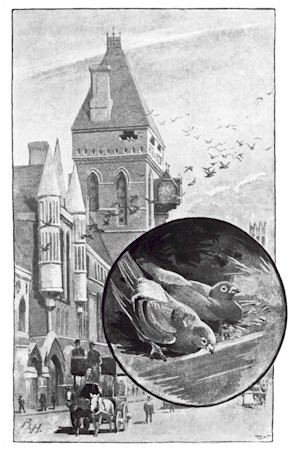
PIGEONS AT THE LAW COURTS
While the daw has diminished with us, and
is near to vanishing, the common pigeon—the
domestic variety of the blue rock—has increased
excessively in recent years. Large colonies of
these birds inhabit the Temple Gardens, the Law
Courts, St. Paul’s, the Museum, and Westminster
Palace, and many smaller settlements exist all over
the metropolis. Now, a flock or cloud of parti-coloured
pigeons rushing up and wheeling about
the roofs or fronts of these imposing structures
forms a very pretty sight; but the daw toying
with the wind, that lifts and blows him hither
and thither, is a much more engaging spectacle,
and in London we miss him greatly.
I have often thought that it was due to the
presence of the daw that I was ever able to get
an adequate or satisfactory idea of the beauty
and grandeur of some of our finest buildings.
Watching the bird in his aërial evolutions, now
suspended motionless, or rising and falling, then
with half-closed wings precipitating himself
downwards, as if demented, through vast
distances, only to mount again with an exulting
cry, to soar beyond the highest tower or pinnacle,
and seem at that vast height no bigger than a
swift in size—watching him thus, an image of
the structure over and around which he disported
himself so gloriously has been formed—its vastness,
stability, and perfect proportions—and has
remained thereafter a vivid picture in my mind.
How much would be lost to the sculptured
west front of Wells Cathedral, the soaring spire
of Salisbury, the noble roof and towers of York
Minster and of Canterbury, if the jackdaws
were not there! I know that, compared with
the images I retain of many daw-haunted cathedrals
and castles in the provinces, those of the
cathedrals and other great buildings in London
have in my mind a somewhat dim and blurred
appearance. It is a pity that, before consenting
to rebuild St. Paul’s Cathedral, Sir Christopher
Wren did not make the perpetual maintenance
of a colony of jackdaws a condition. And if he
had bargained with posterity for a pair or two
of peregrine falcons and kestrels, his glory at the
present time would have been greater.
There are, I believe, about sixteen hundred
churches in London; probably not more than
three are now tenanted by the ‘ecclesiastical
daw.’
On the borders of London—at Hampstead,
Greenwich, Dulwich, Richmond, and other points—daws
in limited numbers are to be met with;
in London proper, or inner London, there are
no resident or breeding daws except the small
colony of about twenty-four birds at Kensington
Palace. Most of these breed in the hollow elms
in Kensington Gardens; others in trees in
Holland Park. There is something curious
about this small isolated colony: the birds are
far less loquacious and more sedate in manner
than daws are wont to be. At almost any hour
of the day they may be seen sitting quietly on
the higher branches of the tall trees, silent and
spiritless. The wind blows, and they rise not
to play with it; the graceful spire of St. Mary
Abbott’s springs high above the garden trees
and palace and neighbouring buildings, but it
does not attract them. Occasionally, in winter,
when the morning sun shines bright and melts
the mist, they experience a sudden return of the
old frolicsome mood, and at such moments are
capable of a very fine display, rushing over and
among the tall elms in a black train, yelping
like a pack of aërial hounds in hot pursuit of
some invisible quarry.
A still greater excitement is exhibited by
these somewhat depressed and sedentary Kensington
birds on the appearance of a flight of
rooks; for rooks, sometimes in considerable
numbers, do occasionally visit or pass over
London, and keep, when travelling east or west,
to the wide green way of the central parks.
Now there are few more impressive spectacles in
bird life in this country than the approach of a
large company of rooks; their black forms, that
loom so large as they successively appear, follow
each other with slow deliberate motion at long
intervals, moving as in a funeral procession, with
appropriate solemn noises, which may be heard
when they are still at a great distance. They
are chanting something that corresponds in the
corvine world to our Dead March in ‘Saul.’
The coming sound has a magical effect on the
daws; their answering cries ring out loud and
sharp, and hurriedly mounting to a considerable
height in the air, they go out to meet the processionists,
to mix with and accompany them a
distance on the journey. It is to me a wonderful
sight—more wonderful here in Kensington
Gardens, which have long been rookless, than in
any country place, and has reminded me of the
meeting of two savage tribes or families, living
far apart but cherishing an ancient tradition of
kinship and amity, who, after a long interval,
perhaps of years, when at last they come in
sight of each other’s faces rush together, bursting
into loud shouts of greeting and welcome. And
one is really inclined to believe at times that
some such traditional alliance and feeling of
friendship exists between these two most social
and human-like of the crow family.
Besides this small remnant of birds native to
London, flocks of jackdaws from outside occasionally
appear when migrating or in search of
new quarters. One morning, not long ago, a
flock of fifteen came down at Clissold Park.
They settled on the dovecote, and amused themselves
in a characteristic way by hunting the
pigeons out of their boxes; then, having cleared
the place, they remained contentedly for an hour
or two, dozing, preening their feathers, and
conversing together in low tones. The bird-loving
superintendent’s heart was filled with joy
at the acquisition of so interesting a colony;
but his rejoicing was premature, the loud call
and invitation to fly was at last sounded, and
hastily responded to—We have not come to stay—we
are off—good-bye—so-long—farewell—and
forthwith they rose up and flew away, probably
in search of fresher woods and less trodden
pastures than those of Clissold Park.
There are also to be met with in London a
few solitary vagrant daws which in most cases
are probably birds escaped from captivity.
Close to my home a daw of this description
appears every morning at the house of a friend
and demands his breakfast with loud taps on the
window-pane. The generous treatment he has
received has caused him to abandon his first
suspicious attitude; he now flies boldly into the
house and explores the rooms, and is specially
interested in the objects on the dressing-table.
Articles of jewellery are carefully put out of sight
when he makes a call.
My friends, Mr. and Mrs. Mark Melford, of
Fulham, are probably responsible for the existence
in London of a good number of wandering
solitary jackdaws. They cherish a wonderful
admiration and affection towards all the members
of the crow family, and have had numberless
daws, jays, and pies as pets, or rather
as guests, since their birds are always free
to fly about the house and go and come at
pleasure. But their special favourite is the
daw, which they regard as far more intelligent,
interesting, and companionable than any other
animal, not excepting the dog. On one occasion
Mr. Melford saw an advertisement of a hundred
daws to be sold for trap-shooting, and to save
them from so miserable a fate he at once purchased
the lot and took them home. They were
in a miserable half-starved condition, and to
give them a better chance of survival, before
freeing them he placed them in an outhouse in
his garden with a wire-netting across the doorway,
and there he fed and tended them until
they were well and strong, and then gave them
their liberty. But they did not at once take
advantage of it; grown used to the place and
the kindly faces of their protectors, they remained
and were like tame birds about the
house; but later, a few at a time, at long
intervals, they went away and back to their
wild independent life.
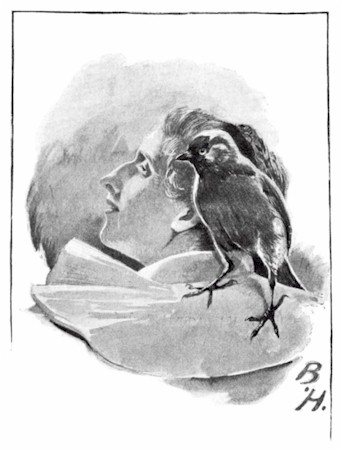
Of the many stories of their pet daws which
they have told me, I will give one of a bird which
was a particular favourite of Mrs. Melford’s.
His invariable habit was, on returning from an
expedition abroad, to fly straight into the house
in search of her, and, sitting on her head, to
express his affection and delight at rejoining her
by passing his beak through her hair.
THE LADY AND THE DAW
Unfortunately, this bird had a weakness for
eggs, which led him into many scrapes, and in
the end very nearly proved his undoing. He
was constantly hanging about and prying into
the fowl-house, and whenever he felt sure that
he was not observed he would slip in to purloin
an egg. His cunning reacted on the fowls and
made them cunning too. When he appeared
they looked the other way, or walked off pretending
not to see him; but no sooner would he
be inside exploring the obscure corners for an
egg than the battle-cry would sound, and then
poor Jackie would find it hard indeed to escape
from their fury with nothing worse than a sound
drubbing. In a day or two, before his many
sores and bruises had had time to heal, the
cackling of a hen and the thought of a new-laid
egg would tempt him again, and at length one
day he could not escape; the loud cries of rage
and of vengeance gratified attracted some person
to the fowl-house, where Jackie was found lying
on the ground in the midst of a crowd of fowls
engaged in pounding and pecking his life out,
scattering his hated black feathers in all directions.
He was rescued more dead than alive,
and subsequently tended by his mistress with
loving care. He lived, but failed to recover
his old gay spirits; day after day he moped
in silence, a picture of abject misery, recalling
in his half-naked, bruised, and bedraggled appearance
the famous bird of Rheims, the stealer
of the turquoise ring, after the awful malediction
of the Lord Cardinal Archbishop had taken effect:
On crumpled claw,
Came limping a poor little lame jackdaw,
No longer gay
As on yesterday;
His feathers all seemed to be turned the wrong way;
His pinions drooped, he could hardly stand,
His head was as bald as the palm of your hand;
His eye so dim,
So wasted each limb,
That, heedless of grammar, they all cried ‘That’s him!’
By-and-by, when still in this broken-hearted
and broken-feathered state, a sight to make his
mistress weep, he disappeared; it was conjectured
that some compassionate-minded neighbour,
finding him in his garden or grounds, and
seeing his pitiable condition, had put an end to
his misery.
One day, a year later, Mrs. Melford, who
was just recovering from an illness, was lying
on a sofa in a room on the ground floor, when
her husband, who was in the garden at the back,
excitedly cried out that a wild jackdaw had just
flown down and alighted near him. ‘A perfect
beauty!’ he exclaimed; never had he seen a jackdaw
in finer plumage! The lady, equally excited,
called back, begging him to use every device to
get the bird to stay. No sooner was her voice
heard than the jackdaw rose up and dashed into
the house, and flying the length of three rooms
came to where she was lying, and at once
alighted on her head and began passing his
beak through her hair in the old manner. In
no other way could this wild-looking and
beautified bird have established his identity.
His return was a great joy; they caressed and
feasted him, and for several hours, during which
he showed no desire to renew his intercourse
with the fowls, he was as lively and amusing
as he had ever been in the old days before he
had got into trouble. But before night he left
them, and has never returned since; doubtless
he had established relations with some of the wild
daws on the outskirts of London.
Before ending this chapter I should like to
say a word about white jackdaws. It is a
mystery to me where all the albinos occasionally
to be seen in the London bird markets
come from. I have seen half a dozen in the
hands of one large dealer, two at another
dealer’s, and several single birds at other shops;
altogether about sixteen or eighteen white daws
on sale at one time.
One often hears of and occasionally sees a
white blackbird or other species in a wild state,
but these uncoloured specimens are rare; they
are also dear to the collector (nobody knows
why), and as a rule are not long permitted to
enjoy existence. Besides, in nine cases out of
ten the abnormally white birds are not albinos.
They are probably mere ‘sports,’ like our
domestic white pigeons, fowls, and ducks, and
would doubtless be more common but for the
fact that their whiteness is a disadvantage to
them in their struggle for life. It is rather
curious to find that among wild birds those that
have a black plumage appear more subject to
loss of colour than others. Thus we find that,
of our small birds, whiteness is more common
in the blackbird than in any other species.
Within the last twelve to eighteen months I have
known of the existence of seven or eight white
or partly white blackbirds in London; but
during the same period I have not seen nor
heard of a white thrush, and have only seen one
white sparrow. My belief is that the species
most commonly found with white or partly
white plumage are the blackbird, rook, and
daw. When carrion crows and ravens were
abundant in this country it was probably no
very unusual thing to meet with white specimens.
The old ornithologist, Willughby, writing over
two centuries ago, mentions two milk-white
ravens which he saw; but the fact of their
whiteness is less interesting to read at this
distant date than the old author’s delightful
speculations as to the cause of the phenomenon.
He doubts that white ravens were as common
in this country as Aldrovandus had affirmed
that they were, and then adds: ‘I rather think
that they are found in those mountainous
Northern Countries, which are for the greatest
part of the year covered with snow: Where also
many other Animals change their native colours,
and become white, as Bears, Foxes, Blackbirds,
&c., whether it proceeds from the force of imagination,
heightened by the constant intuition of
Snow, or from the cold of the Climate, occasioning
such a languishing of colour; as we see in old
Age, when the natural heat decays, the hair
grows grey, and at last white.’
To return to the subject of the beautiful
albino daws, and the numbers sometimes seen in
our bird markets. One can only say that the
monster London throws its nets over an
exceedingly wide area, capturing all rare and
quaint and beautiful things for its own delight.
Thinking of these wonderful white daws, when
I have cast up my eyes to the birdless towers
and domes of our great London buildings, it has
occurred to me to ask the following question:
Is there not one among the many very wealthy
men in London, who annually throw away
hundreds of thousands of pounds on their
several crazes—is there not one to give, say,
fifty or sixty pounds per annum to buy up all
these beautiful albinos, at the usual price of
one or two guineas per bird, for three or four
years, and establish a colony at Westminster, or
other suitable place, where thousands of people
would have great delight in looking at them
every day? For it would indeed be a strange
and beautiful sight, and many persons would
come from a distance solely to see the milk-white
daws soaring in the wind, as their custom
is, above the roofs and towers; and he who
made such a gift to London would be long and
very pleasantly remembered.
- 68 -
Positions of the rook and crow compared—Gray’s Inn Gardens
rookery—Break-up of the old, and futile attempt of the
birds to establish new rookeries—The rooks a great loss
to London—Why the rook is esteemed—Incidents in the
life of a tame rook—A first sight of the Kensington Gardens
rookery—The true history of the expulsion of the rooks—A
desolate scene, and a vision of London beautified.
We have seen how it is with the carrion
crow—that he is in the balance, and that
if the park authorities will but refrain from
persecuting him he will probably be able to
keep his ancient place among the wild birds of
London. To what has already been said on the
subject of this bird I will only add here that
there is, just now, an unfortunate inclination in
some of the County Council’s parks to adopt the
policy of the royal parks—to set too high a
value on domestic and ornamental water-fowl,
which, however beautiful and costly they may
be, can never give as much pleasure or produce
the same effect on the mind as the wild bird.
The old London crow is worth more to London
than many exotic swans and ducks and geese.
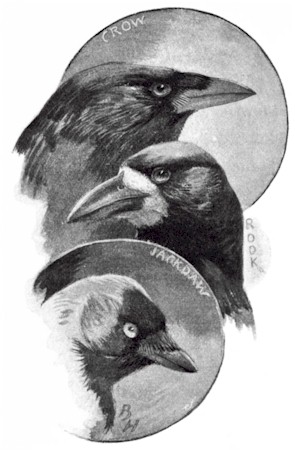
LONDON CROWS
We have also seen that the case of the jackdaw
is not quite hopeless; for although the
birds are now reduced to an insignificant
remnant, the habits and disposition of this
species make it reasonable to hope that they
will thrive and increase, and, in any case, that
if we want the daw we can have him. But the
case of the rook appears to me well nigh hopeless,
and on this account, in this list of the
corvines, he is put last that should have been
first. There are nevertheless two reasons why a
considerable space—a whole chapter—should be
given to this species: one is, that down to
within a few years ago the rook attracted the
largest share of attention, and was the most
important species in the wild bird life of the
metropolis; the other, that it would be well that
the cause of its departure should not be forgotten.
It is true that in the very heart of the metropolis
a rookery still exists in Gray’s Inn Gardens, and
that although it does not increase neither does
it diminish. Thus, during the last twenty years
there have never been fewer than seventeen or
eighteen, and never more than thirty nests in a
season; and for the last three seasons the numbers
have been twenty-five, twenty-three, and
twenty-four nests. Going a little farther back
in the history of this ancient famous colony, it
is well to relate that, twenty-three years ago, it
was well-nigh lost for ever through an unconsidered
act of the Benchers, or of some ignorant
person in authority among them. It was thought
that the trees would have a better appearance
if a number of their large horizontal branches
were lopped off, and the work was carried out
in the month of March, just when the rooks
were busy repairing their old and building new
nests. The birds were seized with panic, and
went away in a body to be seen no more for
the space of three years; then they returned to
settle once more, and at present they are regarded
with so much pride and affection by the
Benchers, and have so much food cast to them
out of scores of windows, that they have grown
to be the most domestic and stay-at-home rooks
to be found anywhere in England.
With the exception of this one small colony,
it is sad to have to say that utter, irretrievable
disaster has fallen on the inner London rookeries—those
that still exist in the suburbs will be
mentioned in subsequent chapters—and although
rooks may still be found within our gates, go
they will and go they must, never to return.
The few birds that continue in constantly
diminishing numbers to breed here and there
in the metropolis, in spite of its gloomy atmosphere
and the long distances they are obliged
to travel in quest of grubs and worms for
their young, are London rooks, themselves
hatched in parks and squares—the town has
always been their home and breeding place; and
although it is more than probable that some of
these town birds are from time to time enticed
away to the country, it is indeed hard to believe
that rooks hatched in the rural districts are ever
tempted to come to us. During the last dozen
years many attempts at founding new colonies
have been made by small bands of rooks. These
birds were and are survivors of the old broken-up
communities. All these incipient rookeries,
containing from two or three to a dozen nests
(as at Connaught Square), have failed; but the
birds, or some of them, still wander about in an
aimless way in small companies, from park to
park, and there is no doubt that year by year
these homeless rooks will continue to decrease
in number, until the ancient tradition is lost,
and they will be seen no more.
It is no slight loss which we have to lament;
it is the loss to the millions inhabiting this city,
or congeries of cities and towns, of a bird which
is more to us than any other wild bird, on
account of its large size and interesting social
habits, its high intelligence, and the confidence
it reposes in man; and, finally, of that ancient
kindly regard and pride in it which, in some
degree, is felt by all persons throughout the
kingdom. The rook has other claims to our
esteem and affection which are not so generally
known: in a domestic state it is no whit behind
other species in the capacity for strong
attachments, in versatility and playfulness, and
that tricksy spirit found in most of the corvines,
which so curiously resembles, or simulates, the
sense of humour in ourselves.
I recall here an incident in the life of a tame
rook, and by way of apology for introducing it
I may mention that this bird, although country
bred, was of London too, when his mistress
came to town for the season accompanied by
her glossy black pet. I will first relate something
of his country life, and feel confident that
this digression will be pardoned by those of my
readers who are admirers of the rook, a bird
which we are accustomed to regard as of a more
sedate disposition than the jackdaw.
He was picked up injured in a park in
Oxfordshire, taken in and nursed by the lady
of the house until he was well and able to fly
about once more; but he elected to stay with
his benefactress, although he always spent a
portion of each day in flying about the country
in company with his fellows. He had various
ways of showing his partiality for his mistress,
one of which was very curious. Early every
morning he flew into her bedroom by the open
window, and alighting on her bed would deposit
a small offering on the pillow—a horse-chestnut
bur, a little crooked stick, a bleached rabbit
bone, a pebble, a bit of rusty iron, which he
had picked up and regarded as a suitable
present. Whatever it was, it had to be accepted
with demonstrations of gratitude and affection.
If she took no notice he would lift it up and
replace it again, calling attention to it with
little subdued exclamations which sounded like
words, and if she feigned sleep he would gently
pull her hair or tap her cheek with his bill to
awake her. Once the present was accepted he
would nestle in under her arm and remain so,
very contentedly, until she got up.
Here we get a delightful little peep into the
workings of the rook’s mind. We ourselves,
our great philosopher tells us, are ‘hopelessly’
anthropomorphic. The rook appears to be in as
bad a case; to his mind we are nothing but
bigger rooks, somewhat misshapen, perhaps,
featherless, deprived by some accident of the
faculty of flight, and not very well able to take
care of ourselves.
One summer day the rook came into the
daughter’s bedroom, where she was washing
her hands, and had just taken off a valuable
diamond ring from her finger and placed it on
the marble top of the washing-stand. The rook
came to the stand and very suddenly picked up
the ring and flew out at the open window. The
young lady ran down stairs and on to the terrace,
calling out that the bird had flown away with her
ring. Her mother quickly came out with a field
glass in her hand, and together they watched the
bird fly straight away across the park to a
distance of about a third of a mile, where he disappeared
from sight among the trees. The ring
was gone! Two hours later the robber returned
and flew into the dining-room, where his mistress
happened to be; alighting on the table, he
dropped the ring from his beak and began
walking round it, viewing it first with one, then
the other eye, uttering the while a variety of
little complacent notes, in which he seemed to
be saying: ‘I have often admired this beautiful
ring, but never had an opportunity of examining
it properly before; now, after having had it for
some time in my possession and shown it to
several wild rooks of my acquaintance, I have
much satisfaction in restoring it to its owner,
who is my very good friend.’
During his summer visits to London this
rook met with many curious and amusing
adventures, as he had the habit of flying in at
the open windows of houses in the neighbourhood
of Park Lane, and making himself very
much at home. He also flew about Hyde Park
and Kensington Gardens every day to visit his
fellow-rooks. One day his mistress was walking
in the Row, at an hour when it was full of
fashionable people, and the rook, winging his
way homewards from the gardens, spied her,
and circling down alighted on her shoulders, to
the amazement of all who witnessed the incident.
‘What an astonishing thing!’ exclaimed some
person in the crowd that gathered round her.
‘Oh, not at all,’ answered the lady, caressing
the bird with her hand, while he rubbed his
beak against her cheek; ‘if you were as fond of
the birds as I am, and treated them as well,
they would be glad to come down on to your
shoulders, too.’
This happened when the now vanished rooks
had their populous rookery in Kensington Gardens,
where they were to be seen all day flying to
and from the old nesting-trees, and stalking over
the green turf in search of grubs on the open
portions of Hyde Park. And we should have
had them there now if they had not been driven
out.
The two largest London rookeries were
those at Greenwich Park and Kensington
Gardens. In the first-named the trees were all
topped over twenty years ago, with the result
that the birds left; and although the locality
has much to attract them, and numbers of rooks
constantly visit the park, they have never
attempted to build nests since the trees were
mutilated. This rookery I never saw; that of
Kensington Gardens I knew very well.
Over twenty years ago, on arriving in
London, I put up at a City hotel, and on the
following day went out to explore, and walked
at random, never inquiring my way of any
person, and not knowing whether I was going
east or west. After rambling about for some
three or four hours, I came to a vast wooded
place where few persons were about. It was a
wet, cold morning in early May, after a night
of incessant rain; but when I reached this
unknown place the sun shone out and made the
air warm and fragrant and the grass and trees
sparkle with innumerable raindrops. Never
grass and trees in their early spring foliage
looked so vividly green, while above the sky
was clear and blue as if I had left London
leagues behind. As I advanced farther into
this wooded space the dull sounds of traffic became
fainter, while ahead the continuous noise of
many cawing rooks grew louder and louder. I
was soon under the rookery listening to and
watching the birds as they wrangled with one
another, and passed in and out among the trees
or soared above their tops. How intensely black
they looked amidst the fresh brilliant green of
the sunlit foliage! What wonderfully tall trees
were these where the rookery was placed! It
was like a wood where the trees were self-planted,
and grew close together in charming
disorder, reaching a height of about one hundred
feet or more. Of the fine sights of London so
far known to me, including the turbid, rushing
Thames, spanned by its vast stone bridges, the
cathedral with its sombre cloud-like dome, and
the endless hurrying procession of Cheapside,
this impressed me the most. The existence of
so noble a transcript of wild nature as this tall
wood with its noisy black people, so near the
heart of the metropolis, surrounded on all sides
by miles of brick and mortar and innumerable
smoking chimneys, filled me with astonishment;
and I may say that I have seldom looked on a
scene that stamped itself on my memory in more
vivid and lasting colours. Recalling the sensations
of delight I experienced then, I can now
feel nothing but horror at the thought of the
unspeakable barbarity the park authorities were
guilty of in destroying this noble grove. Why
was it destroyed? It was surely worth more to
us than many of our possessions—many painted
canvases, statues, and monuments, which have
cost millions of the public money! Of brick
and stone buildings, plain and ornamental, we
have enough to afford shelter to our bodies, and
for all other purposes, but trees of one or two
centuries’ growth, the great trees that give
shelter and refreshment to the soul, are not
many in London. There must, then, have been
some urgent reason and necessity for the removal
of this temple not builded by man. It could
not surely have been for the sake of the paltry
sum which the wood was worth—paltry, that is
to say, if we compare the amount the timber-merchant
would pay for seven hundred elm-trees
with the sum of seventy-five thousand
pounds the Government gave, a little later, for
half a dozen dreary canvases from Blenheim—dust
and ashes for the hungry and thirsty!
Those who witnessed the felling of these seven
hundred trees, the tallest in London, could but
believe that the authorities had good cause for
what they did, that they had been advised by
experts in forestry; and it was vaguely thought
that the trees, which looked outwardly in so
flourishing a condition, were inwardly eaten up
with canker, and would eventually (and very
soon perhaps) have to come down. If the trees
had in very truth been dying, the authorities
would not have been justified in their action.
In the condition in which trees are placed in
London it is well nigh impossible that they
should have perfect health; but trees take long
to die, and during decay are still beautiful.
Not far from London is a tree which Aubrey
described as very old in his day, and which has
been dying since the early years of this century,
but it is not dead yet, and it may live to be
admired by thousands of pilgrims down to the
end of the twentieth century. In any case,
trees are too precious in London to be removed
because they are unsound. But the truth was,
those in Kensington Gardens were not dying
and not decayed. The very fact that they
were chosen year after year by the rooks to
build upon afforded the strongest evidence
that they were the healthiest trees in the
gardens. When they were felled a majority of
them were found to be perfectly sound. I
examined many of the finest boles, seventy and
eighty feet long, and could detect no rotten spot
in them, nor at the roots.
The only reasons I have been able to discover
as having been given for the destruction were
that grass could not be made to grow so as to
form a turf in the deep shade of the grove; that
in wet weather, particularly during the fall of
the leaf, the ground was always sloppy and
dirty under the trees, so that no person could
walk in that part of the grounds without soiling
his boots.
It will hardly be credited that the very men
who did the work, before setting about it,
respectfully informed the park authorities that
they considered it would be a great mistake to
cut the trees down, not only because they were
sound and beautiful to the eye, but for other
reasons. One was that the rooks would be
driven away; another that this tall thick grove
was a protection to the gardens, and secured
the trees scattered over its northern side from
the violence of the winds from the west. They
were laughed at for their pains, and told that
the ‘screen’ was not wanted, as every tree was
made safe by its own roots; and as to the rooks,
they would not abandon the gardens where
they had bred for generations, but would build
new nests on other trees. Finally, when it came
to the cutting down, the men begged to be
allowed to spare a few of the finest trees in the
grove; and at last one tree, with no fewer than
fourteen nests on it: they were sharply ordered
to cut down the lot. And cut down they were,
with disastrous consequences, as we know, as
during the next few years many scores of the
finest trees on the north side of the gardens
were blown down by the winds, among them the
noblest tree in London—the great beech on the
east side of the wide vacant space where the
grove had stood. The rooks, too, went away,
as they had gone before from Greenwich Park,
and as in a period of seventeen years they have
not succeeded in establishing a new rookery, we
may now regard them as lost for ever.
Seventeen years! Some may say that this is
going too far back; that in these fast-moving
times, crowded with historically important events,
it is hardly worth while in 1898 to recall the fact
that in 1880 a grove of seven hundred trees was
cut down in Kensington Gardens for no reason
whatever, or for a reason which would not be
taken seriously by any person in any degree
removed from the condition of imbecility!
To the nation at large the destruction of this
grove may not have been an important event,
but to the millions inhabiting the metropolis,
who in a sense form a nation in themselves, it
was exceedingly important, immeasurably more
so than most of the events recorded each year
in the ‘Annual Register.’
It must be borne in mind that to a vast
majority of this population of five millions
London is a permanent home, their ‘province
covered with houses’ where they spend their
toiling lives far from the sights and sounds of
nature; that the conditions being what they are,
an open space is a possession of incalculable
value, to be prized above all others, like an
amulet or a thrice-precious gem containing
mysterious health-giving properties. He, then,
who takes from London one of these sacred
possessions, or who deprives it of its value by
destroying its rural character, by cutting down
its old trees and driving out its bird life, inflicts
the greatest conceivable injury on the community,
and is really a worse enemy than the
criminal who singles out an individual here and
there for attack, and who for his misdeeds is
sent to Dartmoor or to the gallows.
We give praise and glory to those who
confer lasting benefits on the community; we
love their memories when they are no more, and
cherish their fame, and hand it on from generation
to generation. In honouring them we
honour ourselves. But praise and glory would
be without significance, and love of our benefactors
would lose its best virtue, its peculiar
sweetness, if such a feeling did not have its
bitter opposite and correlative.
In conclusion of this in part mournful
chapter I will relate a little experience met
with in Kensington Gardens, seventeen years
ago. I was in bad health at the time, with no
prospect of recovery, and had been absent from
London. It was a bright and beautiful morning
in October, the air summer-like in its warmth,
and, thinking how pleasant my favourite green
and wooded haunt would look in the sunshine,
I paid a visit to Kensington Gardens. Then I
first saw the great destruction that had been
wrought; where the grove had stood there was
now a vast vacant space, many scores of felled
trees lying about, and all the ground trodden
and black, and variegated with innumerable
yellow chips, which formed in appearance an
irregular inlaid pattern.
As I stood there idly contemplating the sawn-off
half of a prostrate trunk, my attention was
attracted to a couple of small, ragged, shrill-voiced
urchins, dancing round the wood and
trying to get bits of bark and splinters off, one
with a broken chopper for an implement, the
other with a small hand-hatchet, which flew off
the handle at every stroke. Seeing that I was
observing their antics, one shouted to the other,
‘Say, Bill, got a penny?’ ‘No, don’t I wish I
had!’ shouted the other.
‘Little beggars,’ thought I, ‘do you really
imagine you are going to get a penny out of
me?’ So much amused was I at their transparent
device that I deliberately winked an eye—not
at the urchins, but for the benefit of a
carelessly dressed, idle-looking young woman
who happened to be standing near just then,
regarding us with an expression of slight interest,
a slight smile on her rosy lips, the sunshine
resting on her beautiful sun-browned face, and
tawny bronzed hair. I must explain that I had
met her before, often and often, in London and
other towns, and in the country, and by the sea,
and on distant seas, and in many uninhabited
places, so that we were old friends and quite
familiar.
Presently an exceedingly wasted, miserable-looking,
decrepid old woman came by, bent almost
double under a ragged shawl full of sticks and
brushwood which she had gathered where the
men were now engaged in lopping off the branches
of a tree they had just felled. ‘My! she’s got a
load, ain’t she, Bill?’ cried the first urchin
again. ‘Oh, if we had a penny, now!’
I asked him what he meant, and very readily
and volubly he explained that on payment of a
penny the workmen would allow any person to
take away as much of the waste wood as he
could carry, but without the penny not a chip.
I relented at that and gave them a penny, and
with a whoop of joy at their success they ran
off to where the men were working.
Then I turned to leave the gardens, nodding
a good-bye to the young woman, who was still
standing there. The slight smile and expression
of slight interest, that curious baffling expression
with which she regards all our actions, from
the smallest to the greatest, came back to her
lips and face. But as she returned my glance
with her sunny eyes, behind the sunniness on
the surface there was a look of deep meaning,
such as I have occasionally seen in them before.
It seemed to be saying sorrowful and yet
comforting things to me, telling me not to grieve
overmuch at these hackings and mutilations of
the sweet places of the earth—at these losses to
be made good. It was as if she had shown me a
vision of some far time, after this London, after
the dust of all her people, from park ranger to
bowed-down withered old woman gathering
rotten rain-sodden sticks for fuel, had been
blown about by the winds of many centuries—a
vision of old trees growing again on this
desecrated spot as in past ages, oak and elm,
and beech and chestnut, the happy, green homes
of squirrel and bird and bee. It was very
sweet to see London beautified and made healthy
at last! And I thought, quoting Hafiz, that
after a thousand years my bones would be filled
with gladness, and, uprising, dance in the
sepulchre.
- 89 -
The wood-pigeon in Kensington Gardens—Its increase—Its
beauty and charm—Perching on Shakespeare’s statue in
Leicester Square—Change of habits—The moorhen—Its appearance
and habits—An æsthetic bird—Its increase—The
dabchick in London—Its increase—Appearance and habits—At
Clissold Park—The stock-dove in London.
Of the species which have established colonies
in London during recent years, the wood-pigeon,
or ringdove, is the most important, being the
largest in size and the most numerous; and it is
also remarkable on account of its beauty, melody,
and tameness. Indeed, the presence of this
bird and its abundance is a compensation for
some of our losses suffered in recent years. It
has for many of us, albeit in a less degree than
the carrion crow, somewhat of glamour, producing
in such a place as Kensington Gardens
an illusion of wild nature; and watching it
suddenly spring aloft, with loud flap of wings, to
soar circling on high and descend in a graceful
curve to its tree again, and listening to the
beautiful sound of its human-like plaint, which
may be heard not only in summer but on any
mild day in winter, one is apt to lose sight of the
increasingly artificial aspect of things; to forget
the havoc that has been wrought, until the
surviving trees—the decayed giants about whose
roots the cruel, hungry, glittering axe ever flits
and plays like a hawk-moth in the summer
twilight—no longer seem conscious of their
doom.
Twenty years ago the wood-pigeon was
almost unknown in London, the very few birds
that existed being confined to woods on the
borders of the metropolis and to some of the
old private parks—Ravenscourt, Brondesbury,
Clissold and Brockwell Parks; except two or
three pairs that bred in the group of fir trees on
the north side of Kensington Gardens, and one
pair in St. James’s Park. Tree-felling caused
these birds to abandon the parks sometime
during the seventies. But from 1883, when a
single pair nested in Buckingham Palace Gardens,
wood-pigeons have increased and spread
from year to year until the present time, when
there is not any park with large old trees, or
with trees of a moderate size, where these birds
are not annual breeders. As the park trees no
longer afford them sufficient accommodation
they have gone to other smaller areas, and to
many squares and gardens, private and public.
Thus, in Soho Square no fewer than six pairs
had nests last summer. It was very pleasant, a
friend told me, to look out of his window on an
April morning and see two milk-white eggs,
bright as gems in the sunlight, lying in the frail
nest in a plane tree not many yards away. In
North London these birds have increased greatly
during the last three years. Sixteen pairs bred
successfully in 1897 in Clissold Park, which is
small, and there were scores of nests in the neighbourhood,
on trees growing in private grounds.
Even in the heart of the smoky, roaring City
they build their nests and rear their young on
any large tree. To other spaces, where there
are no suitable trees, they are daily visitors; and
lately I have been amused to see them come in
small flocks to the coal deposits of the Great
Western Railway at Westbourne Park. What
attraction this busy black place, vexed with
rumbling, puffing, and shrieking noises, can have
for them I cannot guess. These doves, when
disturbed, invariably fly to a terrace of houses
close by and perch on the chimney-pots, a newly
acquired habit. In Leicester Square I have
seen as many as a dozen to twenty birds at a
time, leisurely moving about on the asphalted
walks in search of crumbs of bread. It is not
unusual to see one bird perched in a pretty
attitude on the head of Shakespeare’s statue
in the middle of the square, the most commanding
position. I never admired that marble
until I saw it thus occupied by the pretty dove-coloured
guest, with white collar, iridescent neck,
and orange bill; since then I have thought
highly of it, and am grateful to Baron Albert
Grant for his gift to London, and recall with
pleasure that on the occasion of its unveiling I
heard its praise, as a work of art, recited in
rhyme by Browning’s—
Hop-o-my-thumb, there,
Banjo-Byron on his strum-strum, there.
I heartily wish that the birds would make use
in the same way of many other statues with
which our public places are furnished, if not
adorned.
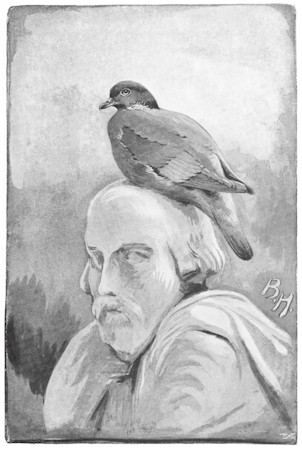
WOOD-PIGEON ON SHAKESPEARE’S STATUE
So numerous are the wood-pigeons at the
end of summer in their favourite parks that it is
easy for any person, by throwing a few handfuls
of grain, to attract as many as twenty or thirty
of them to his feet. Their tameness is wonderful,
and they are delightful to look at, although so
stout of figure. Considering their enormous
appetites, their portliness seems only natural.
But a full habit does not detract from their
beauty; they remind us of some of our dearest
lady friends, who in spite of their two score or
more summers, and largeness where the maiden
is slim, have somehow retained loveliness and
grace. We have seen that the London wood-pigeon,
like the London crow, occasionally
alights on buildings. One bird comes to a ledge
of a house-front opposite my window, and walks
up and down there. We may expect that
other changes in the birds’ habits will come
about in time, if the present rate of increase
should continue. Thus, last summer, one pair
built a nest on St. Martin’s Church, Trafalgar
Square; another pair on a mansion in Victoria
Street, Westminster.
Something further will be said of this species
in a chapter on the movements of birds in
London.
Next
to the ringdove in importance—and a
bird of a more fascinating personality, if such a
word be admissible—is the moorhen, pretty
and quaint in its silky olive-brown and slaty-grey
dress, with oblique white bar on its side,
and white undertail, yellow and scarlet beak
and frontal shield, and large green legs. Green-legged
little hen is its scientific name. Its motions,
too, are pretty and quaint. Not without a
smile can we see it going about on the smooth
turf with an air of dignity incongruous in so
small a bird, lifting up and setting down its feet
with all the deliberation of a crane or bustard.
A hundred curious facts have been recorded of
this familiar species—the ‘moat-hen’ of old
troubled days when the fighting man, instead of
the schoolmaster as now, was abroad in England,
and manor-houses were surrounded by moats, in
which the moorhen lived, close to human beings,
in a semi-domestic state. But after all that has
been written, we no sooner have him near us,
under our eyes, as in London to-day, than we
note some new trait or pretty trick. Thus, in
a pond in West London I saw a moorhen act in
a manner which, so far as I know, had never
been described; and I must confess that if some
friend had related such a thing to me I should
have been disposed to think that his sight had
deceived him. This moorhen was quietly feeding
on the margin, but became greatly excited on
the appearance, a little distance away, of a second
bird. Lowering its head, it made a little rush
at, or towards, the new-comer, then stopped and
went quietly back; then made a second little
charge, and again walked back. Finally it
began to walk backwards, with slow, measured
steps, towards the other bird, displaying, as it
advanced, or retrograded, its open white tail, at
the same time glancing over its shoulder as if to
observe the effect on its neighbour of this new
mode of motion. Whether this demonstration
meant anger, or love, or mere fun, I cannot say.
Instances of what Ruskin has called the
moorhen’s ‘human domesticity of temper, with
curious fineness of sagacity and sympathies in
taste,’ have been given by Bishop Stanley in his
book on birds. He relates that the young,
when able to fly, sometimes assist in rearing the
later broods, and even help the old birds to
make new nests. Of the bird’s æsthetic taste
he has the following anecdote. A pair of very
tame moorhens that lived in the grounds of a
clergyman, in Cheadle, Staffordshire, in constantly
adding to the materials of their nest
and decorating it, made real havoc in the
garden; the hen was once seen sitting on her
eggs ‘surrounded with a brilliant wreath of
scarlet anemones.’ An instance equally remarkable
occurred in 1896 in Battersea Park.
A pair of moorhens took it into their fantastic
little heads to build their nest against a piece
of wire-netting stretched across the lake at
one point. It was an enormous structure,
built up from the water to the top of the
netting, nearly three feet high, and presented a
strange appearance from the shore. On a close
view the superintendent found that four tail-feathers
of the peacock had been woven into its
fabric, and so arranged that the four broad tips
stood free above the nest, shading the cavity
and sitting bird, like four great gorgeously
coloured leaves.
The moorhen, like the ringdove, was almost
unknown in London twenty years ago, and is
now as widely diffused, but owing to its structure
and habits it cannot keep pace with the
other bird’s increase. It must have water, and
some rushes, or weeds, or bushes to make its
nest in; and wherever these are found, however
small the pond may be, there the moorhen will
live very contentedly.
A very few years ago it would have been a
wild thing to say that the little grebe was a
suitable bird for London, and if some wise
ornithologist had prophesied its advent how we
should all have laughed at him! For how
should this timid feeble-winged wanderer be able
to come and go, finding its way to and from its
chosen park, in this large province covered with
houses, by night, through the network of
treacherous telegraph wires, in a lurid atmosphere,
frightened by strange noises and confused
by the glare of innumerable lamps? Of
birds that get their living from the water, it
would have seemed safer to look for the coming
(as colonists) of the common sandpiper, kingfisher,
coot, widgeon, teal: all these, also the
heron and cormorant, are occasional visitors to
inner London, and it is to be hoped that some
of them will in time become permanent additions
to the wild bird life of the metropolis.
The little grebe, before it formed a settlement,
was also an occasional visitor during its spring
and autumn travels; and in 1870, when there
was a visitation on a large scale, as many as one
hundred little grebes were seen at one time on
the Round Pond in Kensington Gardens. But
it was not until long afterwards, about fifteen
years ago, that the first pair had the boldness
to stay and breed in one of the park lakes,
in sight of many people coming and going
every day and all day long. This was at St.
James’s Park, and from this centre the bird
has extended his range from year to year to
other parks and spaces, and is now as well
established as the ringdove and moorhen. But,
unlike the others, he is a summer visitor, coming
in March and April, and going, no man knows
whither, in October and November. If he were
to remain, a long severe frost might prove fatal
to the whole colony. He lives on little fishes
and water insects, and must have open water
to fish in.
He is not a showy bird, nor large, being less
than the teal in size, and indeed is known to
comparatively few persons. Nevertheless he is
a welcome addition to our wild bird life, and
is, to those who know him, a wonderfully
interesting little creature, clothed in a dense
unwettable plumage, olive, black, and chestnut
in colour, his legs set far back—‘becoming
almost a fish’s tail indeed, rather than a bird’s
legs,’ the lobed feet in shape like a horse-chestnut
leaf. His habits are as curious as his
structure. His nest is a raft made of a mass
of water-weeds, moored to the rushes or to a
drooping branch, and sometimes it breaks from
its moorings and floats away, carrying eggs and
sitting bird on it. On quitting the nest the
bird invariably draws a coverlet of wet weeds
over the eggs; the nest in appearance is then
nothing but a bunch of dead vegetable rubbish
floating in the water. When the young are out
of the eggs, the parent birds are accustomed to
take them under their wings, just as a man
might take a parcel under his arm, and dive into
the water.
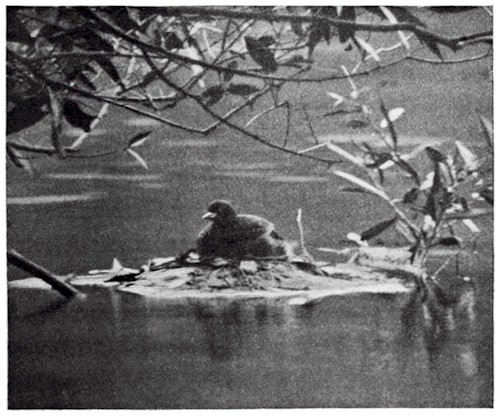
DABCHICK ON NEST
Another curious habit of the dabchick was
discovered during the summer of 1896 in Clissold
Park, when, for the second time, a pair of these
birds settled in the too small piece of water at that
place. Unfortunately, their nest was attacked
and repeatedly destroyed by the moorhens, who
took a dislike to these ‘new chums,’ and by
the swans, who probably found that the wet
materials used by the little grebe in building its
nest were good to eat. Now, it was observed that
when the nest was made on deep water, where the
swans could swim up to it, the dabchicks defended
it by diving and pecking at, or biting, the webbed
feet of the assailants under water. It was a
curious duel between a pigmy and a giant—one
a stately man-of-war floating on the water, the
other a small submerged torpedo, very active
and intelligent. The swans were greatly disconcerted
and repeatedly driven off by means of
this strategy, but in the end the brave little
divers were beaten, and reared no young.
The moral of this incident, which applies
not only to Clissold but to Brockwell, Dulwich,
and to a dozen other parks, is that you cannot
have a big aquatic happy family in a very small
pond.
But it is extremely encouraging to all those
who wish for a ‘better friendship’ with the
fowls of the air to find that this contest was
watched with keen interest and sympathy with
the defenders by the superintendent of a London
park and the park constables.
It is curious to note that the three species
we have been considering, differing so widely
in their structures and habits, should be so
closely associated in the history of London
wild bird life. That they should have established
colonies at very nearly about the same
time, and very nearly at the same centre, from
which they have subsequently spread over the
metropolis; and that this centre, the cradle of
the London races of these birds, should continue
to be their most favoured resort. Seeing the
numbers of wood-pigeons to-day, and their
tameness everywhere, the statement will seem
almost incredible to many readers that only
fifteen years ago, one spring morning, the head
gardener at Buckingham Palace, full of excitement,
made a hurried visit to a friend to tell
him that a pair of these birds had actually built
a nest on a tree in the Palace grounds. Up
till now the birds are most numerous in this
part of London. The moorhen, I believe, bred
first at St. James’s Park about seventeen years
ago; a few days ago—January 1898—I saw
twelve of these birds in a little scattered flock
feeding in the grass in this park. In no other
public park in London can so many be seen
together. The dabchick first bred in St. James’s
Park about fifteen years ago, and last summer,
1897, as many as seven broods were brought
out. In no other London park were there
more than two broods.
The three species described are the only permanent
additions in recent years to the wild bird
life of the metropolis. But when it is considered
that their colonies were self-planted, and have
shown a continuous growth, while great changes
of decrease and increase have meanwhile been
going on in the old-established colonies, we find
good reason for the hope that other species,
previously unknown to the metropolis, will be
added from time to time. We know that birds
attract birds, both their own and other kinds.
Even now there may be some new-comers—pioneers
and founders of fresh colonies—whose
presence is unsuspected, or known only to a
very few observers. I have been informed by
Mr. Howard Saunders that he has seen the
stock-dove in one of the West-end parks, and
that a friend of his had independently made the
discovery that this species is now a visitor to,
and possibly a resident in, London. One would
imagine the stock-dove to be a species well
suited to thrive with us, as it would find
numberless breeding-holes both in the decayed
trees in the parks and in big buildings, in which
to rear its young in safety. I should prefer to
see the turtle-dove, a much prettier and more
graceful bird, with a better voice, but beggars
must not be choosers; with the stock-dove
established, London will possess three of the
four doves indigenous in these islands, and the
turtle-dove—at present an annual breeder in
woods quite near to London—may follow by-and-by
to complete the quartette.
- 104 -
Number of species, common and uncommon—The London
sparrow—His predominance, hardiness, and intelligence—A
pet sparrow—Breeding irregularities—A love-sick bird—Sparrow
shindies: their probable cause—‘Sparrow chapels’—Evening
in the parks—The starling—His independence—Characteristics—Blackbird,
thrush, and robin—White blackbirds—The
robin—Decrease in London—Habits and disposition.
There are not more than about twenty species
of small passerine birds that live all the year in
London proper. The larger wild birds that
breed in London within the five-mile radius are
eight species, or if we add the semi-domestic
pigeon or rock-dove, there are nine. Of the
twenty small birds, it is surprising to find that
only five can be described as really common,
including the robin, which in recent years has
ceased to be abundant in the interior parks, and
has quite disappeared from the squares, burial
grounds, and other small open spaces. The five
familiar species are the sparrow, starling, blackbird,
song-thrush or throstle, and robin, and in
the present chapter these only will be dealt with.
All the other resident species found in London
proper, or inner London—missel-thrush, wren,
hedge-sparrow, nuthatch, tree-creeper, tits of
five species, chaffinch, bullfinch, greenfinch, and
yellowhammer, also the summer visitants, and
some rare residents occasionally to be found
breeding on the outskirts of the metropolis—will
be spoken of in subsequent chapters descriptive
of the parks and open spaces.
Here once more the sparrow takes precedence.
‘What! the sparrow again!’ the
reader may exclaim; ‘I thought we had quite
finished with that little bird, and were now
going on to something else.’ Unfortunately, as
we have seen, there is little else to go on to
until we get to the suburbs, and that little bird
the sparrow is not easily finished with. Besides,
common as he is, intimately known to every
man, woman, and child in the metropolis, even
to the meanest gutter child in the poorest
districts, it is always possible to find something
fresh to say of a bird of so versatile a mind, so
highly developed, so predominant. He must
indeed be gifted with remarkable qualities to
have risen to such a position, to have occupied,
nay conquered, London, and made its human
inhabitants food-providers to his nation; and,
finally, to have kept his possession so long
without any decay of his pristine vigour, despite
the unhealthy conditions. He does not receive,
nor does he need, that fresh blood from the
country which we poor human creatures must
have, or else perish in the course of a very few
generations. Nor does he require change of air.
It is commonly said that ‘town sparrows’
migrate to the fields in summer, to feast on
corn ‘in the milk,’ and this is true of our birds
in the outlying suburbs, who live in sight of the
fields; farther in, the sparrow never leaves his
London home. I know that my sparrows—a
few dozen that breed and live under my eyes—never
see the country, nor any park, square, or
other open space.
The hardiness and adaptiveness of the bird
must both be great to enable it to keep its
health and strength through the gloom and
darkness of London winters. There is no doubt
that many of our caged birds would perish at
this season if they did not feed by gas or candle
light. When they do not so feed it is found
that the mortality, presumably from starvation,
is very considerable. During December and
January the London night is nearly seventeen
hours in length, as it is sooner dark and later
light than in the country; while in cold and
foggy weather the birds feed little or not at all.
They keep in their roosting-holes, and yet they do
not appear to suffer. After a spell of frosty and
very dark weather I have counted the sparrows
I am accustomed to observe, and found none
missing.
But the sparrow’s chief advantage over other
species doubtless lies in his greater intelligence.
That ineradicable suspicion with which he
regards the entire human race, and which one is
sometimes inclined to set down to sheer stupidity,
is, in the circumstances he exists in, his best
policy. He has good cause to doubt the friendliness
of his human neighbours, and his principle
is, not to run risks; when in doubt, keep away.
Thus, when the roads are swept the sparrows will
go to the dirt and rubbish heaps, and search in
them for food; then they will fly up to any
window-sill and eat the bread they find put
there for them. But let them see any rubbish
of any description there, anything but bread—a
bit of string, a chip of wood, a scrap of paper,
white or blue or yellow, or a rag, or even a
penny piece, and at the first sight of it away
they will dart, and not return until the dangerous
object has been removed. A pigeon or starling
would come and take the food without paying
any attention to the strange object which so
startled the sparrow. They are less cunning.
Without doubt there are many boys and men in all
parts of London who amuse themselves by trying
to take sparrows, and the result of their attempts
is that the birds decline to trust anyone.
In this extreme suspiciousness, and in their
habits generally, all sparrows appear pretty
much alike to us. When we come to know
them intimately, in the domestic state, we find
that there is as much individual character in
sparrows as in other highly intelligent creatures.
The most interesting tame sparrow I have known
in London was the pet of a lady of my acquaintance.
This bird, however, was not a cockney
sparrow from the nest: he was hatched on the
other side of the Channel, and his owner rescued
him, when young and scarce able to fly, from
some street urchins in a suburb of Paris, who
were playing with and tormenting him. In his
London home he grew up to be a handsome
bird, brighter in plumage than our cock
sparrows usually seem, even in the West-end
parks. He was strongly attached to his mistress,
and liked to play with and to be caressed by
her; when she sat at work he would perch contentedly
by her side by the half-hour chirruping
his sparrow-music, interspersed with a few notes
borrowed from caged songsters. He displayed a
marked interest in her dress and ornaments, and
appeared to take pleasure in richly coloured
silks and satins, and in gold and precious stones.
But all these things did not please him in the
same degree, and the sight of some ornaments
actually angered him: he would scold and peck
at the brooch or necklace, or whatever it was,
which he did not like, and if no notice was
taken at first, he would work himself into a
violent rage, and the offensive jewel would have
to be taken off and put out of sight. He also
had his likes and dislikes among the inmates
and guests in the house. He would allow me
to sit by him for an hour, taking no notice, but
if I made any advance he would ruffle up his
plumage, and tell me in his unmistakable
sparrow-language to keep my distance. Once
he took a sudden violent hatred to his owner’s
maid; no sooner would she enter the room
where the sparrow happened to be than he
would dart at her face and peck and beat her
with his wings; and as he could not be made to
like, nor even to tolerate her, she had to be
discharged. It was, however, rare for him to
abuse his position of first favourite so grossly as
on this occasion. He was on the whole a good-tempered
bird, and had a happy life, spending
the winter months each year in Italy, where his
mistress had a country house, and returning in
the spring to London. Then, very unexpectedly,
his long life of eighteen years came to an end;
for up to the time of dying he showed no sign
of decadence. To the last his plumage and disposition
were bright, and his affection for his
mistress and love for his own music unabated.
After all, it must be said that the sparrow,
as a pet, has his limitations; he is not, mentally,
as high as the crow, aptly described by Macgillivray
as the ‘great sub-rational chief of the
kingdom of birds.’ And however luxurious the
home we may give him, he is undoubtedly
happier living his own independent life, a
married bird, making slovenly straw nests under
the tiles, and seeking his food in the gutter.
Many years ago Dr. Gordon Stables said, in
an article on the sparrow, that he felt convinced
from his own observation of these birds that
curious irregularities in their domestic or
matrimonial relations were of very frequent
occurrence, a fact which the ornithologists had
overlooked. Last summer I had proof that such
irregularities do occur, but I very much doubt
that they are so common as he appears to
believe.
I had one pair of sparrows breeding in a
hole under the eaves at the top of the house,
quite close to a turret window, from which I
look down upon and observe the birds, and on the
sill of which I place bread for them. This pair
reared brood after brood, from April to November,
and so long as they found bread on the
window-sill they appeared to feed their young
almost exclusively on it, although it is not their
natural food; but there was no green place near
where caterpillars might be found, and I dare
say the young sparrow has an adaptive stomach.
At all events broods of four and five were
successively brought out and taught to feed on
the window-sill. After a few days’ holiday the
old birds would begin to tidy up the nest to
receive a fresh clutch of eggs. In July I noticed
that a second female, the wife, as it appeared, of
a neighbouring bird, had joined the first pair,
and shared in the tasks of incubation and of
feeding the young. The cast-off cock-sparrow
had followed her to her new home, and was
constantly hanging about the nest trying to
coax his wife to go back to him. Day after day,
and all day long, he would be there, and sitting
on the slates quite close to the nest he would
begin his chirrup—chirrup—chirrup; and
gradually as time went on, and there was no
response, he would grow more and more excited,
and throw his head from side to side, and rock
his body until he would be lying first on one
side, then the other, and after a while he would
make a few little hops forward, trailing his
wings and tail on the slates, then cast himself
down once more. Something in his monotonous
song with its not unmusical rhythm, and his
extravagant love-sick imploring gestures and
movements, reminded me irresistibly of Chevalier
in the character of Mr. ’Enry ’Awkins—his whole
action on the stage, the thin piping cockney
voice, the trivial catching melody, and, I had
almost added, the very words—
So ’elp me bob, I’m crazy!
Lizer, you’re a daisy!
Won’t yer share my ’umble ’ome?
Oh, Lizer! sweet Lizer!
And so on, and on, until one of the birds in the
nest would come out and furiously chase him
away. Then he would sit on some chimney-pipe
twenty or thirty yards off, silent and solitary;
but by-and-by, seeing the coast clear, he would
return and begin his passionate pleading once
more.
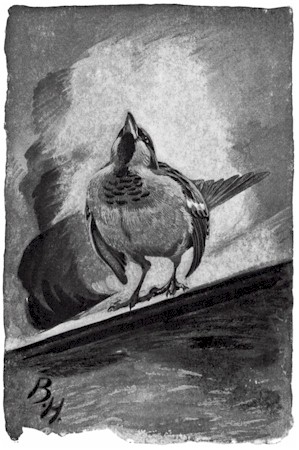
LOVE-SICK COCK SPARROW
This went on until the young birds were
brought out, after which they all went away for
a few days, and then the original pair returned.
No doubt ’Enry ’Awkins had got his undutiful
doner back.
The individual sparrow is, however, little
known to us: we regard him rather as a species,
or race, and he interests the mass of people
chiefly in his social character when he is seen in
companies, and crowds, and multitudes. He is
noisiest and attracts most attention when there
is what may be called a ‘shindy’ in the sparrow
community. Shindies are of frequent occurrence
all the year round, and may arise from a variety
of causes; my belief is that, as they commonly
take place at or near some favourite nesting or
roosting site, they result from the sparrow’s sense
of proprietorship and his too rough resentment
of any intrusion into his own domain. Sparrows
in London mostly remain paired all the year,
and during the winter months roost in the
breeding-hole, often in company with the young
of the last-raised brood. Why all the neighbours
rush in to take part in the fight is not so easy to
guess: possibly they come in as would-be peace-makers,
or policemen, but are themselves so
wildly excited that they do nothing except to
get into each other’s way and increase the
confusion.
Of more interest are those daily gatherings
of a pacific nature at some favourite meeting-place,
known to Londoners as a ‘sparrows’
chapel.’ A large tree, or group of trees, in
some garden, square, or other space, is used by
the birds, and here they are accustomed to
congregate at various times, when the rain is
over, or when a burst of sunshine after gloomy
weather makes them glad, and at sunset. Their
chorus of ringing chirruping sounds has an
exceedingly pleasant effect; for although compared
with the warblers’ singing it may be a
somewhat rude music, by contrast with the noise
of traffic and raucous cries from human throats
it is very bright and glad and even beautiful,
voicing a wild, happy life.
It is interesting and curious to find that this
habit of concert-singing at sunset, although not
universal, is common among passerine birds in
all regions of the globe. And when a bird has
this habit he will not omit his vesper song, even
when the sun is not visible and when rain is
falling. In some mysterious way he knows that
the great globe is sinking beneath the horizon.
Day is over, he can feed no more until
to-morrow, in a few minutes he will be sleeping
among the clustering leaves, but he must sing
his last song, must join in that last outburst of
melody to express his overflowing joy in life.
This is a habit of our sparrow, and even on
the darkest days, when days are shortest, any
person desirous of hearing the birds need only
consult the almanac to find out the exact time
of sunset, then repair to a ‘chapel,’ and he will
not be disappointed.
In some of the parks, notably at Battersea,
where the birds are in thousands, the effect of so
many voices all chirruping together is quite
wonderful, and very delightful.
The time will come, let us hope, when for
half a dozen species of small birds in London we
shall have two dozen, or even fifty; until then
the sparrow, even the common gutter-sparrow,
is a bird to be thankful for.
The starling ranks second to the sparrow in
numbers; but albeit second, the interval is very
great: the starlings’ thousands are but a small
tribe compared to the sparrows’ numerous
nation.
It has been said that the starling is almost
as closely associated with man as the sparrow.
That is hardly the case; in big towns the sparrow,
like the rat and black beetle, although not
in so unpleasant a way, is parasitical on man,
whereas the starling is perfectly independent.
He frequents human habitations because they
provide him with suitable breeding-holes; he
builds in a house, or barn, or church tower,
just as he does in a hole in a tree in a wild
forest, or a hole in the rock on some sea-cliff,
where instead of men and women he has puffins,
guillemots, and gannets for neighbours. The
roar of the sea or the jarring noises of human
traffic and industry—it is all one to the starling.
That is why he is a London bird. In the
breeding season he is to be found diffused over
the entire metropolis, an astonishing fact when
we consider that he does not, like the sparrow,
find his food in the roads, back gardens, and
small spaces near his nest, but, like the rook,
must go a considerable distance for it.
Two seasons ago (1896) one pair of starlings
had their nest close to my house—a treeless
district, most desolate. When the young were
hatched I watched the old birds going and
coming, and on leaving the nest they invariably
flew at a good height above the chimney-pots
and telegraph wires, in the direction of the
Victoria Gate of Hyde Park. They returned
the same way. It is fully two miles to the park
in that direction. The average number of eggs
in a starling’s nest is six; and assuming that
these birds had four or five young, we can
imagine what an enormous labour it must have
been to supply them with suitable insect food,
each little beakful of grubs involving a return
journey of at least four miles; and the grubs
would certainly be very much more difficult to
find on the trodden sward of Hyde Park than
in a country meadow. I pitied these brave
birds every day, when I watched them from my
turret window, going and coming, and at the
same time I rejoiced to think that this pair, and
hundreds of other pairs with nests just as far
from their scanty feeding-grounds, were yet
able to rear their young each season in London.
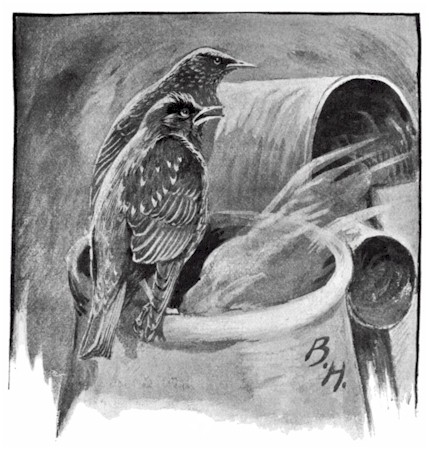
LONDON STARLINGS
For the starling is really a splendid bird as
birds are with us in this distant northern land—splendid
in his spangled glossy dress of metallic
purple, green, and bronze, a singer it is always
pleasant to listen to, a flyer in armies and
crowds whose aërial evolutions in autumn and
winter, before settling to roost each evening,
have long been the wonder and admiration of
mankind. He inhabits London all the year
round, but not in the same numbers: in the
next chapter more will be said on this point.
He also sings throughout the year; on any
autumn or winter day a small company or flock
of a dozen or two of birds may be found in any
park containing large trees, and it is a delight
that never grows stale to listen to the musical
conversation, or concert of curiously contrasted
sounds, perpetually going on among them. The
airy whistle, the various chirp, the clink-clink
as of a cracked bell, the low chatter of mixed
harsh and musical sounds, the kissing and
finger-cracking, and those long metallic notes,
as of a saw being filed not unmusically, or (as a
friend suggests) as of milking a cow in a tin
pail;—however familiar you may be with the
starling, you cannot listen to one of their choirs
without hearing some new sound. There is
more variety in the starling than in any other
species, and not only in his language; if you observe
him closely for a short time, he will treat
you to a sudden and surprising transformation.
Watch him when absorbed in his own music,
especially when emitting his favourite saw-filing
or milking-a-cow-in-a-tin-pail sounds: he trembles
on his perch—shivers as with cold—his feathers
puffed out, his wings hanging as if broken, his
beak wide open, and the long pointed feathers
of his swollen throat projected like a ragged
beard. He is then a most forlorn-looking object,
apparently broken up and falling to pieces;
suddenly the sounds cease, and in the twinkling
of an eye he is once more transformed into the
neat, compact, glossy, alert starling!
Something further may be said about the pair
of starlings that elected to breed the summer
before last in sight of my top windows, in that
brick desert where my home is. When they
brought out and led their young away, I
wondered if they would ever return to such a
spot. Surely, thought I, they will have some
recollection of the vast labour of rearing a
nestful of young at such a distance from their
feeding-ground, and when summer comes once
more will be tempted to settle somewhere
nearer to the park. The Albert Memorial, for
instance, gorgeous with gold and bright colour,
might attract them; certainly there was room
for them, since it had in the summer of 1896
but one pair of starlings for tenants. It was
consequently something of a surprise when, on
March 23 last spring, early in the morning, the
birds reappeared at the same place, and spent
over an hour in fluttering about and exploring
the old breeding-hole, perching on the slates and
chimney-pots, and clinging to the brick wall,
fluttering their wings, screaming and whistling
as if almost beside themselves with joy to be at
home once more.
Brave and faithful starlings! we hardly deserve
to have you back, since London has not been
too kind to her feathered children. Quite lately
she has driven out her rooks, who were faithful
too; and long ago she got rid of her ravens;
and to her soaring kites she meted out still worse
treatment, pulling down their last nest in 1777
from the trees in Gray’s Inn Gardens, and cutting
open the young birds to find out, in the interests
of ornithological science, what they had
eaten!
Between the starling and the next in order,
the blackbird, there is again a very great
difference with regard to numbers. The former
counts thousands, the latter hundreds. Between
blackbird and song-thrush, or throstle,
there is not a wide difference, but if we take
the whole of London, the blackbird is much
more numerous. After these two, at a considerable
distance, comes the robin. In suburban
grounds and gardens these three common
species are equally abundant. But in these
same private places, which ring the metropolis
round with innumerable small green refuges,
or sanctuaries, several other species which are
dying out in the parks and open spaces of inner
London are also common—wren, hedge-sparrow,
blue, cole, and great tits, chaffinch, and greenfinch—and
of these no more need be said in this
chapter.
As we have seen, there is always a great
interest shown (by the collector especially)
in that not very rare phenomenon, an abnormally
white bird. But in London the bird-killers
are restrained, and the white specimen
is sometimes able to keep his life for a few or
even for several months. Recently (1897) a
very beautiful white blackbird was to be seen
in Kensington Gardens, in the Flower Walk,
east of the Albert Memorial. He was the
successor to a wholly milk-white blackbird that
lived during the summer of 1895 in the shrubberies
of Kensington Palace, and was killed
by some scoundrel, who no doubt hoped to sell
its carcass to some bird-stuffer. Its crushed
body was found by one of the keepers in a thick
holly-bush close to the public path; the slayer
had not had time to get into the enclosure to
secure his prize.
The other bird had some black and deep
brown spots on his mantle, and a few inky black
tail and wing feathers—a beautiful Dominican
dress. But when I first saw him, rushing out
of a black holly-bush, one grey misty morning
in October, his exceeding whiteness startled me,
and I was ready to believe that I had beheld a
blackbird’s ghost, when the bird, startled too,
emitted his prolonged chuckle, proving him to
be no supernatural thing, but only a fascinating
freak of nature. He lived on, very much
admired, until the end of March last year (1897),
having meanwhile found a mate, and was then
killed by a cat.
The robin, although common as ever in all
the more rural parts of London—the suburban
districts where there are gardens with shrubs
and trees—is now growing sadly scarce everywhere
in the interior of the metropolis. In
1865 the late Shirley Hibberd wrote that this
bird was very common in London: ‘Robins
are seen among the hay-carts at Whitechapel,
Smithfield, and Cumberland Markets, in all the
squares, in Lincoln’s Inn, Gray’s Inn, and
other gardens, in the open roadway of Farringdon
Street, Ludgate Hill, the Strand, and
Blackfriars Road; nay, I once saw a robin on
a lovely autumn afternoon perch upon the
edge of a gravestone in St. Paul’s Churchyard
and trill out a carol as sweetly as in any rural
nook at home.’
Now the robin has long vanished from all
these public places, even from the squares that
are green, and that he is becoming very scarce
in all the interior parks I shall have occasion to
show in later chapters. It is a great pity that
this should be so, as this bright little bird is a
universal favourite on account of his confidence
in and familiarity with man, and his rare beauty,
and because, as becomes a cousin of the nightingale,
he is a very sweet singer. Moreover, just
as his red breast shines brightest in autumn and
winter, when all things look grey and desolate,
or white with the snow’s universal whiteness, so
does his song have a peculiar charm and almost
unearthly sweetness in the silent songless season.
It is not strange that in credulous times man’s
imagination should have endowed so loved a
bird with impossible virtues, that it should have
been believed that he alone—heaven’s little
feathered darling—cared for ‘the friendless
bodies of unburied men’ and covered them with
leaves, and was not without some supernatural
faculties. Nor can it be said that all these
pretty fables have quite faded out of the rustic
mind. But, superstition apart, the robin is still
a first favourite and dear to everyone, and some
would gladly think he is a better bird, in the
sense of being gentler, sweeter-tempered, more
affectionate and human, than other feathered
creatures. But it is not so, the tender expression
of his large dark eye is deceptive. The late Mr.
Tristram-Valentine, writing of the starling in
London, its neat, bright, glossy appearance, compared
with that of the soot-blackened disreputable-looking
sparrow, says ‘the starling always
looks like a gentleman.’ In like manner the
robin will always be a robin, and act like one,
in London or out of it—the most unsocial,
fierce-tempered little duellist in the feathered
world. Now I wish to point out that this
fierce intolerant spirit of our bird is an advantage
in London, if we love robins and are
anxious to have plenty of them.
It is a familiar fact that at the end of
summer the adult robins disappear; that they
remain in hiding in the shade of the evergreens
and thick bushes until they have got a new
dress, and have recovered their old vigour; that
when they return to the world, so to speak,
and find their young in possession of their
home and territory, they set themselves to reconquer
it. For the robin will not tolerate
another robin in that portion of a garden,
shrubbery, orchard, or plantation which he
regards as his very own. A great deal of
fighting then takes place between old and young
birds, and these fights in many instances end
fatally to one of the combatants. The raven
has the same savage disposition and habit with
regard to its young; and when a young raven,
in disposition a ‘chip of the old block,’ refuses
to go when ordered, and fights to stay, it
occasionally happens that one of the birds gets
killed. But the raven has a tremendous
weapon, a stone axe, in his massive beak; how
much greater the fury and bulldog tenacity of
the robin must be to kill one of his own kind
with so feeble a weapon as his small soft bill!
At the end of the summer of 1896 two robins
were observed fighting all day long in the
private gardens of Kensington Palace, the fight
ending in the death of one of the birds.
Finally, as a result of all the chasing and
fighting that goes on, the young birds are
driven out to find homes for themselves. In
London, in the interior parks, not many young
robins are reared, but many of those that
have been reared in the suburban districts drift
into London, and altogether a considerable
number of birds roam about the metropolis in
search of some suitable green spot to settle in;
and I will only add here, in anticipation of what
will be said in a later chapter, that if suitable
places were provided for them, the robins would
increase year by year from this natural cause.
There are other movements of robins in
London which it will be more in order to notice
in the next chapter.
- 129 -
Migration as seen in London—Swallows in the parks—Fieldfares—A
flock of wild geese—Autumn movements of resident
species—Wood-pigeons—A curious habit—Dabchicks and
moorhens—Crows and rooks—The Palace daws—Starlings—Robins—A
Tower robin and the Tower sparrows—Passage
birds in the parks—Small birds wintering in London—Influx
of birds during severe frosts—Occasional visitors—The
black-headed gull—A winter scene in St. James’s Park.
The seasonal movements of the strict migrants
are little noticed in London; there are few such
species that visit, fewer still that remain any
time with us. And when they come we scarcely
see them: they are not like the residents,
reacted on and modified by their surroundings,
made tame, ready to feed from our hands, to
thrust themselves at all times upon our attention.
Nevertheless we do occasionally see something
of these shyer wilder ones, the strangers and
passengers; and in London, as in the rural
districts, it is the autumnal not the vernal
migration which impresses the mind. Birds are
seldom seen arriving in spring. Walking to-day
in some park or garden, we hear the first willow-wren’s
delicate tender warble among the fresh
April foliage. It was not heard yesterday, but
the small modest-coloured singer may have been
there nevertheless, hidden and silent among the
evergreens. The birds that appear in the
autumn are plainly travellers that have come
from some distant place, and have yet far to go.
Wheatears may be seen if looked for in August
on Hampstead Heath, and occasionally a few
other large open spaces in or near London. In
September and October swallows and martins
put in an appearance, and although they refuse
to make their summer home in inner London,
they often come in considerable numbers and
remain for many days, even for weeks, in the
parks in autumn.
It has been conjectured that the paucity of
winged insect life in London is the cause of the
departure of swallows and house-martins as
breeding species. Yet in the autumn of 1896,
from September to the middle of October,
hundreds of these birds lived in the central and
many other parks in London, and doubtless they
found a sufficiency of food in spite of the cold
east winds which prevailed at that time.
Among the winter visitors to the outskirts
of the metropolis, the fieldfare is the most
abundant as well as the most attractive. During
the winters of 1895-6 and 1896-7 I saw them
on numberless occasions at Wimbledon, Richmond,
Hampstead Heath, Bostell Woods, Hackney
Marsh, Wanstead, Dulwich, Brockwell Park,
Streatham, and other open spaces and woods
round London. In the gardens of the outer
suburbs there is always a great profusion of
winter berries, and the felts seen in these places
are probably regular visitors. Certainly they
are tamer than fieldfares are apt to be in the
country, but they seldom penetrate far into the
brick-and-mortar wilderness. I have seen a few in
Kensington Gardens, and in November, 1896, a
few fieldfares alighted on a tree at the Tower
of London. Stranger still, in February 1897 a
flock of wild geese was observed flying over the
Tower: the birds went down the river flying
low, as it was noticed that when they passed
over the Tower Bridge they were not higher
than the pinnacles of the two big towers.
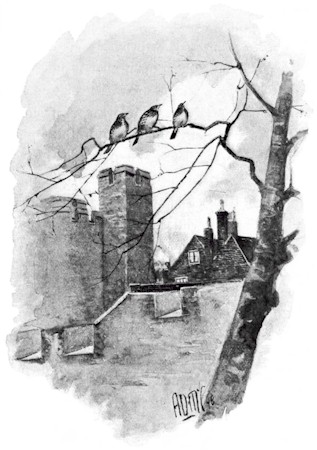
FIELDFARES AT THE TOWER
The birds that are strange to London eyes
are very nearly all seen in the autumn, from
September to November. At this mutable season
a person who elects to spend his nights on the
roof, with rugs and an umbrella to keep out
cold and wet, may be rewarded by hearing far-off
shrill delicate noises of straggling sandpipers
or other shore birds on passage, or the mysterious
cry of the lapwing, ‘wailing his way from cloud
to cloud.’
All these rare sights and sounds are for the
very patient watchers and listeners; nevertheless
they are the only ‘authentic tidings’ the
Londoner receives of that great and wonderful
wave of life which travels southward over half
the globe in advance of winter. This annual
exodus and sublime flight to distant delectable
regions beyond the sea is, however, only taken
part in by some of the feathered people; meanwhile
the others that remain to brave the cold
and scarcity are also seen to be infected with a
restless spirit and desire of change. The starling,
missel-thrush, larks and pipits, and other kinds,
alter their way of life, uniting in flocks and
becoming wanderers over the face of the country.
Finches, too, go a-gypsying: the more sedentary
species leave their breeding-haunts for suitable
winter quarters; and everywhere there is a great
movement, a changing of places, packing and
scattering, a hurrying to and fro all over the
land.
The
London birds are no exception, although
their autumnal movements have hitherto attracted
little attention. These movements are
becoming more noticeable, owing to changes
going on in the character of the metropolitan
bird population. The sparrow, as we have seen,
does not leave home, but recently there has been
a great increase in the more vagrant species, the
starling and wood-pigeon especially. During the
last few years the wood-pigeon has been growing
somewhat more domestic, and less inclined to
leave town than formerly, but from time to time
the old wandering instinct reasserts itself, and
it was observed that during the autumn of 1896
a majority of the birds left London. At Lincoln’s
Inn Fields there were thirteen birds down to the
end of September, then all but one disappeared.
This solitary stayer-at-home had been sprung
upon and injured by a cat some time before
the day of departure.
Last year, 1897, the autumnal exodus was
even greater. Thus, on October 25 I walked
the whole length of the three central parks, and
saw no pigeons except one pair of young birds
not long out of the nest, in Hyde Park, and one
parent bird feeding them. The other parent
had probably gone away to the country, leaving
his mate to rear this very late brood as best she
could. Doubtless many of these wanderers from
the metropolis get killed in the country, but in
December and January the survivors return to
the safety of the parks, and to a monotonous diet
of stale bread.
It is probable that with the change of temperature
in September and October the London
wood-pigeons, like so many birds, are seized by
a restless and roving spirit; but I am inclined
to believe that the taste of wild nuts and fruits,
which they get in the parks at that season, is
one cause of their going away. They do not get
much of this natural food; they first strip the
oaks of their acorns almost before they are
quite ripe, depriving the London urchins of
their little harvest, and then attack the haws
and holly-berries; and when this small supply
has been exhausted the birds go further afield in
search of more.
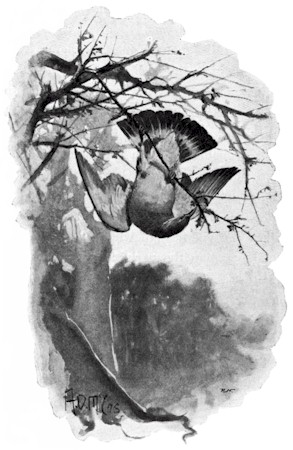
WOOD-PIGEON FEEDING ON HAWS
On the evening of August 26, 1897, I saw
a number of wood-pigeons feeding on the haws
in a manner quite new in my experience. There
were twelve or fourteen birds on a good-sized
thorn-tree growing in Buckingham Palace
grounds; but the berries on this tree grew at
the tips of long slender branches and could not
have been reached by the birds in the ordinary
way. The pigeons would settle on a branch and
then begin moving cautiously towards the points,
the branch bending beneath the weight more
and more until the bird, unable to keep any longer
on the branch, would suddenly turn over and remain
hanging head down, suspended by its clinging
feet. In this position, by stretching its neck it
would be able to reach the berries, which it would
then leisurely devour. As many as four or five
birds were seen at one time hanging in this way,
appearing with wings half-open like dead or
wounded birds tied by their feet to the branchlets,
from which they were suspended. Since
witnessing this curious scene I have been told
by Mr. Coppin, the superintendent at Battersea
Park, that he has seen the wood-pigeons at that
place acting in the same way. It is probably a
habit of the birds which has hitherto escaped
notice.
The dabchicks leave London in the autumn
and return in spring: they may be looked for
in the ornamental waters as early as the third
week in March. The moorhens formerly disappeared
from London in winter; they are now
residents throughout the year in a few of the
parks where there is shelter, and during severe
frosts they feed at the same table with the
ornamental water-fowl. From all the smaller
lakes which they have recently colonised they
vanish in cold weather. In autumn they wander
about a good deal by night; any small piece of
water will attract them, and their cries will be
heard during the dark hours; before it is light
they will be gone.
Crows and rooks are most often seen in
London during the winter months. Many rooks
have their winter roosting-place in Richmond
Park, and small bands of these birds visit the
central parks and other open spaces. On the
morning of February 3, 1897, about fifty rooks
visited Kensington Gardens and fed for some
hours on the strip of grassed land adjoining the
palace. The whole jackdaw colony, numbering
twenty-four birds, fed with them, and when,
about twelve o’clock, the visitors rose up and
flew away, the daws, after seeing them off,
returned in a body to the tree-tops near the
palace, and for the rest of the day continued in
an excited state. From time to time they would
rush up with a loud clamour, then return to the
tree-tops, where they would sit close together
and silent as if expecting something, and at
intervals of a minute or two a simultaneous cry
would burst from them.
I have observed that on winter evenings
these daws fly away from the gardens in a north-westerly
direction: where their winter roosting-place
is I have not discovered.
The starling is the most interesting London
bird in his autumn movements. It is only at
the end of July, when they are gathered in large
bodies, that some idea can be formed of their
numbers. Flocks of a dozen to forty or fifty birds
may be seen in any park and green space any
day throughout the winter; these are the birds
that winter with us, and are but a small remnant
of the entire number that breed in London.
At the end of June the starlings begin to congregate
every evening at their favourite roosting-places.
Of these there are several, the most
favoured being the islands in the ornamental
water at Regent’s Park, the island in the
Serpentine, and at Buckingham Palace grounds
and Battersea Park. The last is the most important.
Before sunset the birds are seen
pouring in, flock after flock, from all quarters,
until the trees on the island are black
with their thousands, and the noise of their
singing and chattering is so great that a person
standing on the edge of the lake can hardly
hear himself speak. These meeting places are
evidently growing in favour, and if the autumn of
1898 shows as great an increase as those of 1896
and 1897 over previous years, London will have
as compensation for its lost rookeries some very
fine clouds of starlings. At the beginning of
October most of the birds go away to spend the
winter in the country, or possibly abroad. In
February and March they begin to reappear in
small flocks, and gradually scatter over the
whole area of the metropolis, each pair going
back to its old nesting-hole.
The annual scattering of robins at the end
of summer, when, after the moult, the old birds
attack and drive away the young, has been
described in the last chapter. This habit of the
bird alone would cause a good deal of moving
about of the London robins each year, but it is
also a very general belief of ornithologists that
at this season there is a large migratory movement
of young robins throughout the country.
At all events, it is a fact that in August and
September robins go about in London a good
deal, and frequently appear in the most unlikely
places. Some of these are no doubt birds of
the year hatched in London or the suburbs,
and others may be migrating robins passing
through.
At the Tower of London robins occasionally
appear in autumn, but soon go away. The
last one that came settled down and was a great
favourite with the people there for about two
months, being very friendly, coming to window-sills
for crumbs, and singing every day very
beautifully. Then one day he was seen in the
General’s garden wildly dashing about, hotly
pursued by seven or eight sparrows, and as he
was never seen again it was conjectured that
the sparrows had succeeded in killing him.
The robin is a high-spirited creature, braver
than most birds, and a fair fighter, but against
such a gang of feathered murderous ruffians,
bent on his destruction, he would stand no
chance.
The Tower sparrows, it may be added,
appear to be about the worst specimens of their
class in London. They are always at war with
the pigeons and starlings, and would gladly
drive them out if they could. It is a common
thing for some foreign bird to escape from its
cage on board ship and to take refuge in the
trees and gardens of the Tower, but woe to the
escaped captive and stranger in a strange land
who seeks safety in such a place! Immediately
on his arrival the sparrows are all up against
him, not to ‘heave half a brick at him,’ since
they are not made that way, but to hunt him
from place to place until they have driven him,
weak with fatigue and terror, into a corner
where they can finish him with their bludgeon
beaks.
This violence towards strangers of the Tower
sparrow is not to be wondered at, since this
unpleasant disposition or habit is common to
many species. The prophet Jeremiah had
observed it when he said, ‘Mine heritage is
unto me as a speckled bird, the birds round
about are against her.’ To the Tower sparrows
every feathered stranger is conspicuously
speckled, and they are against her. The wonder
is that they should keep up their perpetual little
teasing warfare against the pigeons and starlings,
their neighbours from time immemorial. One
would have imagined that so intelligent and
practical a bird as the sparrow, after vainly trying
for several centuries to drive out his fellow tenants,
would have made peace with them and found
some more profitable outlet for his superabundant
energies. Possibly the introduction of a few
feathered policemen—owls, or magpies, or
sparrow hawks—would have the effect of
making him a less quarrelsome neighbour.
In autumn and in spring a variety of summer
visitants, mostly warblers, pass through London,
delaying a little in its green spaces. In September
we are hardly cognisant of these small
strangers within our gates, all but one or two
being silent at that season. In April and May,
in many of the parks, we may hear the chiffchaff,
willow-wren, blackcap, sedge-warbler, the
whitethroat, occasionally the cuckoo, and a few
other rarer species, but they sing little, and soon
leave us to seek better breeding-sites than the
inner parks offer.
While some of our birds, as we have seen,
forsake us at the approach of cold weather,
some for a short period, others to remain away
until the following spring, a small contrary
movement of birds into London is going on.
These winterers with us come not in battalions
and are little remarked. They are to be found,
a few here and a few there, all over London,
wherever there are trees and bushes, but less
in the public parks than in private grounds,
cemeteries, and other quiet spots. Thus, during
the last two exceptionally mild winters a few
skylarks have lived contentedly in the comparatively
small green area at Lambeth Palace.
Nunhead Cemetery is a favourite winter resort
of a number of small birds—starlings, chaffinches,
and greenfinches, and a few of other
species. Chaffinches are found in winter in
several of the open spaces where they do not
breed, and among other species to be found
wintering in the quiet green spots in small
numbers are linnets, goldfinches, pipits, and the
pied wagtail.
In exceptionally severe winters birds come
into London in considerable numbers—rooks,
starlings, larks, blackbirds and thrushes, finches,
and other small species—and they then visit
not only the parks but all the squares and
private gardens. During the big frost of
1890-1 skylarks were seen every day searching
for food on the Thames Embankment. These
strangers all vanish from London on the break-up
of the frost.
During
the late autumn and winter months
a few large birds occasionally appear—heron,
mallard, widgeon, teal, &c. As a rule they
come and go during the dark hours. The sight
of water and the cries of the ornamental water-fowl
attract them. They are mostly irregular
visitors, and cannot very well be included in
the list of London birds.
The case of the black-headed gull is different,
as this species may now be classed with the
regular visitors, and not merely to the outlying
spaces, like the fieldfare, but to the central
parks of the metropolis, where, like the wood-pigeon,
he looks to man for food.
The black-headed gull has always been a
winter visitor in small numbers to the lower
reaches of the Thames, coming up the river as
far as London Bridge. In severe winters more
birds come; thus, in the winter of 1887-8 they
appeared in great numbers, and ranged as high
up as Putney. The late Mr. Tristram-Valentine,
in describing this visitation, wrote: ‘It is seldom,
indeed, that these birds appeared in such
numbers in the Thames above London Bridge
as they have done lately, and their appearance
has, from its rarity, caused a corresponding
excitement among Londoners, as is proved by
the numbers of people that have crowded the
bridges and embankments to watch their movements.
To a considerable portion of these, no
doubt, the marvellous flight and power of wing
of the gull came as an absolute revelation.’
Gulls came up the river in still greater force
during the exceptionally long and severe frost
of 1892-3. That was a memorable season in
the history of the London gulls. Then, for the
last time, gulls were shot on the river between
the bridges, and this pastime put a stop to by
the police magistrates, who fined the sportsmen
for the offence of discharging firearms to the
public danger. And then for the first time, so
far as I know, the custom of regularly feeding
the gulls in London had its beginning. Every
day for a period of three to four weeks hundreds
of working men and boys would take advantage
of the free hour at dinner time to visit the
bridges and embankments, and give the scraps
left from their meal to the birds. The sight
of this midday crowd hurrying down to the
waterside with welcome in their faces and food
in their hands must have come ‘as an absolute
revelation’ to the gulls.
During
the memorable frost of 1894-5 the
birds again appeared in immense numbers, and
would doubtless have soon left us, or else
perished of cold and hunger on the snow-covered
hummocks of ice which filled the Thames
and gave it so arctic an aspect, but for the
quantities of food cast to them every day. As
in previous years when gulls have visited the
Thames in considerable numbers, many of the
birds found their way into the parks, and were
especially numerous in St. James’s Park, where
they formed the habit of feeding with the
ornamental water-fowl.
We have since experienced three exceptionally
mild winters, so that the gulls were not driven
by want to invade us; but they have come to
us nevertheless, not having forgotten the generous
hospitality London extended to them in the
frost. St. James’s Park has now become the
favourite wintering place of a considerable
number of birds, and their habit is to spend the
day on the lake, feeding on the broken bread
and scraps of meat thrown to them from the
bridge, and leaving about sunset to spend the
night on the river. In the autumn of 1896,
three or four days after the gulls began to
appear on the Thames, a body of two or three
hundred of these birds settled down in the
park water, and fed there every day and all
day long until the following spring—March
1897.
A favourite pastime of mine during the
winter months was to feed these park gulls with
sprats, which were plentiful and could be bought
anywhere for one penny a pound, or in quantities
for about a farthing the pound. Gulls cannot
live by bread alone; it is true that even in
London they do not, like the blubber-eating
Greenlander, spew it out of their mouths, for
they will eat almost anything, but it is not
partaken of with zest, and even with a crop-full
they do not feel that they have dined. However
much bread they had had, no sooner would
they see the silvery gleam of a little tossed-up
sprat than there would be a universal scream of
excitement, a rush from all sides, and the whole
white vociferous crowd would be gathered before
me, almost brushing my face with their wings,
sweeping round and round, joyfully feasting on
the little fishes, cast to them in showers, to be
deftly caught before they touched the water.
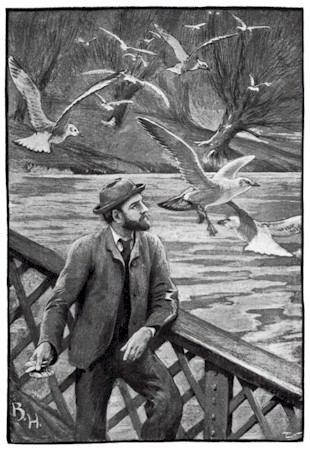
FEEDING THE GULLS IN ST. JAMES’S PARK
Some of the birds, bolder or more intelligent
than their fellows, would actually take the
sprats from the hand.
A very few days before writing this chapter
end, on January 30, 1898, I passed by the
water and saw the gulls there, where indeed
they have spent most of the daylight hours
since the first week in October. It was a rough
wild morning; the hurrying masses of dark
cloud cast a gloom below that was like twilight;
and though there was no mist the trees and
buildings surrounding the park appeared vague
and distant. The water, too, looked strange in
its intense blackness, which was not hidden by
the silver-grey light on the surface, for the surface
was everywhere rent and broken by the
wind, showing the blackness beneath. Some of
the gulls—about 150 I thought—were on the
water together in a close flock, tailing off to a
point, all with their red beaks pointing one way
to the gale. Seeing them thus, sitting high as
their manner is, tossed up and down with the
tumbling water, yet every bird keeping his place
in the company, their whiteness and buoyancy
in that dark setting was quite wonderful. It
was a picture of black winter and beautiful wild
bird life which would have had a rare attraction
even in the desert places of the earth; in
London it could not be witnessed without feelings
of surprise and gratitude.
We see in this punctual return of the gulls,
bringing their young with them, that a new
habit has been acquired, a tradition formed,
which has given to London a new and exceedingly
beautiful ornament, of more value than
many works of art.
- 151 -
A general survey of the metropolitan parks—West London—Central
parks, with Holland Park—A bird’s highway—Decrease
of songsters—The thrush in Kensington Gardens—Suggestions—Owls
in Kensington Gardens—Other West
London open spaces—Ravenscourt Park as it was and as
it is.
Our ‘province’ of London is happily not entirely
‘covered with houses,’ and in each of its six large
districts—West, North-west, North, East, South-east,
and South-west—there are many hundreds
of acres of green and tree-shaded spaces where the
Londoner may find a moderate degree of refreshment.
Unfortunately for large masses of the
population, these spaces are very unequally
distributed, being mostly situated on or close
to the borderland, where town and country
meet; consequently they are of less value to
the dwellers in the central and densely peopled
districts than to the inhabitants of the suburbs,
who have pure air and ample healthy room
without these public grounds.
Before
going the round of the parks, to note
in detail their present condition and possibilities,
chiefly with reference to their wild bird life, it
would be well to take a rapid survey of the
metropolitan open spaces generally. To enable
the reader the more closely to follow me in the
survey, I have introduced a map of the County
of London on a small scale, in which the whole
of the thickly built-over portion appears uncoloured;
the surrounding country coloured
green; the open spaces, including cemeteries,
deep green; the small spaces—squares, graves,
churchyards, gardens, recreation grounds, &c.,
as dark dots; the suburban districts, not densely
populated, where houses have gardens and
grounds, pale green.
RAVENSCOURT
PARK
Now the white space is not really birdless,
being everywhere inhabited by sparrows, and in
parts by numerous and populous colonies of
semi-wild pigeons, while a few birds of other
species make their homes in London gardens.
Shirley Hibbert, writing of London birds in
1865, says: ‘London is, indeed, far richer in
birds than it deserves to be.’ He also says: ‘A
few birds, however, appear to be specially
adapted not merely for London as viewed from
without, but for London par excellence, that is
to say for the noisy, almost treeless City; with
these for pioneers, nature invades the Stock Exchange,
the Court of Aldermen, the Bank, and all the railway termini, as
if to say, Shut us out if you can.’ But
with the exception of these few peculiarly
urban species we may take it that the London
birds get their food, breed, and live most of the
time in the open spaces where there are trees and
bushes. Even the starling, which breeds in
buildings, must go to the parks to feed.
It must also be borne in mind that birds that
penetrate into London from the surrounding
country—those that, like the carrion crow, live
on the borders and fly into or across London
every day, migrants in spring and autumn,
young birds reared outside of London going
about in search of a place to settle in, and
wanderers generally—all fly to and alight on the
green spaces only. These spaces form their
camping grounds. As there is annually a very
considerable influx of feathered strangers, we
can see by a study of the map how much easier
to penetrate and more attractive some portions
of the metropolis are than others. It would
simplify the matter still further if we were to
look upon London as an inland sea, an archipelago,
about fifty miles in circumference, containing
a few very large islands, several of a
smaller size, and numerous very small ones—a
sea or lake with no well-defined shore-line, but
mostly with wide borders which might be
described as mixed land and water, with promontories
or tongues of land here and there
running into it. These promontories, also the
chains of islands, form, in some cases, broad
green thoroughfares along which the birds come;
the sinuous band of the Thames also forms to
some extent a thoroughfare.
I believe it is a fact that in those parts of the
suburbs that are well timbered, and where the
houses have gardens and grounds, the bird
population is actually greater (with fewer
species) than in the country proper, even in
places where birds are very abundant. In parts
of Norwood, Sydenham, and Streatham, and the
neighbourhoods of Dulwich, Greenwich, Lee,
Highgate, and Hampstead, birds are extremely
abundant. Going a little further afield, on one
side of the metropolis we have Epping Forest,
and on the opposite side of the metropolis
several vast and well-wooded spaces abounding
in bird life—Kew Gardens, the Queen’s private
grounds, Old Deer Park, Syon and Richmond
parks, Wimbledon, &c. From all these districts
there is doubtless a considerable overflow of
birds each season on to the adjacent country,
and into London, and some of the large parks
are well placed to attract these wanderers.
In
going into a more detailed account of the
parks, it is not my intention to furnish anything
like a formal or guide-book description, assigning
a space to each, but, taking them as they come,
singly, in groups and chains, to touch or dwell
only on those points that chiefly concern us—their
characters, comparative advantages, and
their needs, with regard to bird life. Beginning
with the central parks and other parks situated
in the West district, we will then pass to the
North-west and North districts, and so on until
the circle of the metropolis has been completed.
The central parks, Kensington Gardens and
Hyde Park, Green Park, and St. James’s Park,
contain respectively 274, 360, 55, and 60 acres—in
round numbers 750 acres. Add to this
Holland Park, the enclosed meadow-like grounds
adjoining Kensington Palace, Hyde Park Gardens,
St. George’s burial-ground, and Buckingham
Palace Gardens, and we get altogether a total of
about nine hundred to one thousand acres of
almost continuous green country, extending
from High Street, Kensington, to Westminster.
This very large area (for to the eyes of the flying
bird it must appear as one) is favourably situated
to attract and support a very considerable
amount of bird life. At its eastern extremity
we see that it is close to the river, along which
birds are apt to travel; while three miles and a
half away, at its other end, it is again near the
Thames, where the river makes a great bend
near Hammersmith, and not very distant from
the more or less green country about Acton.
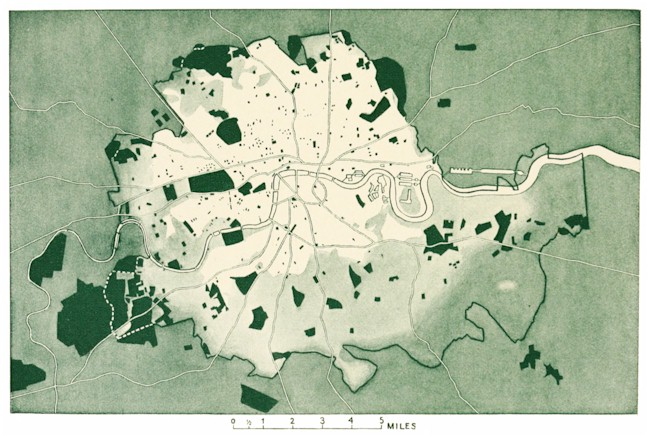
There is no doubt that a majority of the
summer visitants and wanderers generally that
appear in the central parks come through
Holland Park, as they are usually first observed
in the shrubberies and trees at Kensington
Palace. Holland Park, owing to its privacy and
fine old trees, is a favourite resort of wild birds,
and is indeed a better sanctuary than any public
park in London. From the palace shrubberies
the new-comers creep in along the Flower Walk,
the Serpentine, and finally by way of the Green
Park to St. James’s Park. But they do not
stay to breed, the place not being suitable for
such a purpose. It is possible that a few find
nesting-places in Buckingham Palace Gardens,
and that others drift into Battersea Park.
Another proof that these parks—so sadly mismanaged
from the bird-lover’s point of view—are
situated advantageously may be found in
the fact that three of the species which have
established colonies in London within the last
few years (wood-pigeon, moorhen, and dabchick)
first formed settlements here, and from this
centre have spread over the entire metropolis,
and now inhabit every park and open space
where the conditions are suited to their requirements.
These three needed no encouragement:
the summer visitors do certainly need it, and at
Battersea, and in some other parks less than one
fourth the size of Hyde Park, they find it, and
are occasionally able to rear their young. Even
the old residents, the sedentary species once
common in the central parks, find it hard to
maintain their existence; they have died or are
dying out. The missel-thrush, nuthatch, tree-creeper,
oxeye, spotted woodpecker, and others
vanished several years ago. The chaffinch was
reduced to a single pair within the last few
years; this pair lingered on for a year or a little
over, then vanished. Last spring, 1897, a few
chaffinches returned, and their welcome song
was heard in Kensington Gardens until June.
Not a greenfinch is to be seen, the commonest
and most prolific garden bird in England,
so abundant that scores, nay hundreds, may
be bought any Sunday morning in the autumn
at the bird-dealers’ shops in the slums of
London, at about two pence per bird, or
even less. The wrens a few years ago were
reduced to a single pair, and had their nesting-place
near the Albert Memorial; of the pair I
believe one bird now remains. Two, perhaps
three, pairs of hedge-sparrows inhabited Kensington
Gardens during the summers of 1896
and 1897, but I do not think they succeeded
in rearing any young. Nor did the one pair in
St. James’s Park hatch any eggs. In 1897 a
pair of spotted flycatchers bred in Kensington
Gardens, and were the only representatives of
the summer visitors of the passerine order in all
the central parks.
The robin has been declining for several
years; a decade ago its sudden little outburst
of bright melody was a common autumn and
winter sound in some parts of the park, and in
nearly all parts of Kensington Gardens. This
delightful sound became less and less each
season, and unless something is done will
before many years cease altogether. The blue
and cole tits are also now a miserable remnant,
and are restricted to the gardens, where they
may be seen, four or five together, on the high
elms or clinging to the pendent twigs of the
birches. The blackbird and song-thrush have
also fallen very low; I do not believe that there
are more than two dozen of these common birds
in all this area of seven hundred and fifty acres.
A larger number could be found in one corner
of Finsbury Park. Finsbury and Battersea
could each send a dozen or two of songsters as
a gift to the royal West-end parks, and not miss
their music.
Of all these vanishing species the thrush is
most to be regretted, on account of its beautiful,
varied, and powerful voice, for in so noisy an
atmosphere as that of London loudness is a very
great merit; also because (in London) this bird
sings very nearly all the year round. Even at
the present time how much these few remaining
birds are to us! From one to two decades ago
it was possible on any calm mild day in winter
to listen to half a dozen thrushes singing at
various points in the gardens; now it is very
rare to hear more than one, and during the
exceedingly mild winter of 1896-7 I never
heard more than two. Even these few birds
make a wonderful difference. There is a
miraculous quality in their voice. In the best
of many poems which the Poet Laureate has
addressed to this, his favourite bird, he
sings:
Hearing thee first, who pines or grieves
For vernal smiles and showers!
Thy voice is greener than the leaves,
And fresher than the flowers.
Even here in mid-London the effect is the same,
and a strange glory fills the old ruined and
deserted place. But, alas! ’tis but an illusion,
and is quickly gone. The tendency for many
years past has been towards a greater artificiality.
It saves trouble and makes for prettiness
to cut down decaying trees. To take
measures to prevent their fall, to drape them
with ivy and make them beautiful in decay,
would require some thought and care. It
is not so long ago that Matthew Arnold composed
his ‘Lines written in Kensington Gardens.’
It seems but the other day that he died; but
how impossible it would be for anyone to-day,
at this spot, to experience the feeling which
inspired those matchless verses!
In this lone, open glade I lie,
Screened by deep boughs on either hand;
And at its end, to stay the eye,
Those black-crown’d, red-boled pine-trees stand!
Birds here make song, each bird has his,
Across the girdling city’s hum.
How green under the boughs it is!
How thick the tremulous sheep-cries come!
Sometimes a child will cross the glade
To take his nurse his broken toy;
Sometimes a thrush flit overhead
Deep in her unknown day’s employ.
Here at my feet what wonders pass,
What endless, active life is here!
What blowing daisies, fragrant grass!
An air-stirr’d forest, fresh and clear.
· · · · ·
In the huge world, which roars hard by,
Be others happy if they can!
But in my helpless cradle I
Was breathed on by the rural Pan.
· · · · ·
Calm soul of all things! Make it mine
To feel amid the city’s jar,
That there abides a peace of thine,
Man did not make, and cannot mar.
The will to neither strive nor cry,
The power to feel with others give!
Calm, calm me more! nor let me die
Before I have begun to live.
In these vast gardens and parks, with large
trees, shrubberies, wide green spaces, and lakes,
there should be ample room for many scores of
the delightful songsters that are now vanishing
or have already vanished. And much might be
done, at a very small cost, to restore these
species, and to add others.
One of the first and most important steps to
be taken in order to make the central parks a
suitable home for wild birds, especially of the
songsters, both resident and migratory, that
nest on or near the ground, is the exclusion of
the army of cats that hunt every night and all
night long in them. This subject will be discussed
more fully in another chapter.
Proper breeding-places are also greatly
wanted—close shrubberies and rockeries such
as we find at Battersea and Finsbury Parks.
The existing shrubberies give no proper shelter.
In planting them the bird’s need of privacy was
not considered; the space allowed to them
is too small, the species of plants that birds
prefer to roost and nest in are too few. It
would make a wonderful difference if in place of
so many unsuitable exotic shrubs (especially of
the ugly, dreary-looking rhododendron) we had
more of the always pleasing yew and holly; also
furze and bramble; with other native plants to
be found in any country hedge, massed together
in that charming disorder which men as well as
birds prefer, although the gardeners do not
know it. There are several spots in Kensington
Gardens where masses of evergreens would look
well and would form welcome refuges to scores
of shy songsters.
The more or less open ground north of the
Flower Walk forms a deep well-sheltered hollow,
where it would be easy to create a small pond
with rushes and osiers growing in it, which
would be very attractive to the birds. It would
be easy to make a spot in every park in London
where the sedge-warbler could breed.
Another very much needed improvement is
an island in the Serpentine, which would serve
to attract wild birds. The Serpentine is by a
good deal the largest of the artificial lakes of inner
London, yet with the exception of a couple of
moorhens, and in winter a stray gull or two
seen flying over the water, it has no wild bird
life, simply because there is no spot where a
wild bird can breed. The existing small island,
close to the north bank and the sub-rangers’
village, is used by some of the ducks to breed
in. Something might be done to make this island
more attractive to birds.
With one, perhaps two, exceptions, the comparatively
large birds in the central parks have
been so fully written about in former chapters
that nothing more need be said of them in this
place. It remains only to speak of the owls in
Kensington Gardens.
It is certainly curious to find that in these
gardens, where, as we have seen, birds are not
encouraged, two such species as the jackdaw
and owl are still resident, although long vanished
from all their other old haunts in London. Of
so important a bird as the owl I should have
preferred to write at some length in one of the
earlier chapters, but there was very little to say,
owing to its rarity and secrecy. Nor could it
be included in the chapters on recent colonists,
since it is probable that it has always been an
inhabitant of Kensington Gardens, although its
existence there has not been noticed by those
who have written on the wild bird life of London.
It is unfortunate that we have no enjoyment of
our owls: they hide from sight in the old hollow
trees, and when they occasionally exercise their
voices at night we are not there to hear them.
Still, it is a pleasure to know that they are there,
and probably always have been there. It is
certain that during the past year both the brown
and white owl have been living in the gardens,
as the night-watchers hear the widely different
vocal performances of both birds, and have also
seen both species. Probably there are not more
than two birds of each kind. Owls have the
habit of driving away their young, and the stray
white owls occasionally seen or heard in various
parts of London may be young birds driven from
the gardens. Some time ago the cries of a white
owl were heard on several nights at Lambeth
Palace, and it was thought that the bird had
made its home in the tower of Lambeth Church,
close by. In the autumn of 1896 a solitary
white owl frequented the trees at Buckhurst
Hill. An ornithological friend told me that he
had seen an owl, probably the same bird, one
evening flying over the Serpentine; and on
inquiring of some of the park people, I was
told that they knew nothing about an owl, but
that a cockatoo had mysteriously appeared every
evening at dusk on one of the trees near the
under-ranger’s lodge! After a few weeks it was
seen no more. I fancy that this owl had been
expelled from the gardens by its parents.
Directly in line with the central and Holland
parks, about a mile and a quarter west of Holland
Park, we have Ravenscourt Park—the last
link of a broken chain. To the birds that come
and go it occupies the position of a half-way
house between the central parks and the country
proper. Unhappily West Kensington, which
lies between Holland and Ravenscourt Parks, is
now quite covered with houses—a brand-new
yet depressing wilderness of red brick, without
squares, gardens, boulevards, or breathing spaces
of any description whatsoever. Away on the
right hand and on the left a few small green
spaces are found—on one hand Shepherd’s Bush
Green, and on the other Brook Green, St. Paul’s
Schools ornamental grounds, and Hammersmith
Cemetery and Cricket Ground. But from West
Kensington it is far for children’s feet to a spot
of green turf.
Ravenscourt, though not large (32 acres), is
very beautiful. With Waterlow, Clissold, and
Brockwell Parks it shares the distinction of
being a real park, centuries old; and despite the
new features, the gravelled paths, garden-beds,
iron railings, &c., which had to be introduced
when it was opened to the public, it
retains much of its original park-like character.
Its venerable elms, hornbeams, beeches, cedars,
and hawthorns are a very noble possession.
To my mind this indeed is the most beautiful
park in London, or perhaps I should say that it
would be the most beautiful if the buildings
round it were not so near and conspicuous. It
may be that I am somewhat prejudiced in its
favour. I knew it when it was private, and the
old image is very vivid to memory; I lived for
a long time beside it in sad days, when the
constant sight of such a green and shady wilderness
from my window was a great consolation.
It was beautiful even in the cold, dark winter
months when it was a waste of snow, and when,
despite the bitter weather, the missel-thrush
poured out its loud triumphant notes from the
top of a tall elm. In its spring and summer
aspect it had a wild grace and freshness, which
made it unlike any other spot known to me
in or near London. The old manor house inside
the park was seldom occupied; no human
figure was visible in the grounds; there were
no paths, and all things grew untended. The
grass was everywhere long, and in spring lit
with colour of myriads of wild flowers; from
dawn to dusk its shady places were full of the
melody of birds; exquisitely beautiful in its
dewy and flowery desolation, it was like a home
of immemorial peace, the one remnant of
unadulterated nature in the metropolis.
The alterations that had to be made in this
park when the County Council took it over
produced in me an unpleasant shock; and the
birds were also seriously affected by the change.
When the gates were thrown open, in 1888, and
a noisy torrent of humanity poured in and
spread itself over their sweet sanctuary, they
fled in alarm, and for a time the park was
almost birdless. The carrion crows, strange to
say, stuck to their nesting-tree, and by-and-by
some of the deserters began to return, to be
followed by others, and now there is as much
bird life as in the old days. It is probable,
however, that some of the summer visitors have
ceased to breed. At present we have the
crow, wood-pigeon, missel-thrush, chaffinch,
wren, hedge-sparrow, and in the summer the
pied wagtail and spotted flycatcher and willow-wren.
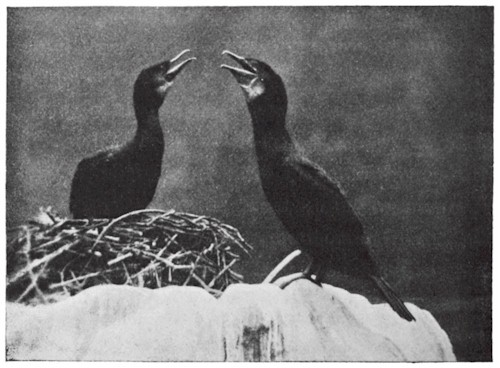
CORMORANTS AT ST. JAMES’S PARK
- 171 -
Open spaces on the border of West London—The Scrubs, Old
Oak Common, and Kensal Green Cemetery—North-west
district—Paddington Recreation Ground, Kilburn Park,
and adjoining open spaces—Regent’s Park described—Attractive
to birds, but not safe—Hampstead Heath: its
character and bird life—The ponds—A pair of moorhens—An
improvement suggested—North London districts—Highgate
Woods, Churchyard Bottom Wood, Waterlow Park, and
Highgate Cemetery—Finsbury Park—A paradise of thrushes—Clissold
Park and Abney Park Cemetery.
Before proceeding to give a brief account of
the parks and open spaces of North-west and
North London it is necessary to mention here a
group of open spaces just within the West
district, on its northern border, a mile and a
half to two miles north of Ravenscourt Park.
These are Wormwood Scrubs, Little Wormwood
Scrubs, Old Oak Common, and Kensal Green
Cemetery. As they contain altogether not far
short of three hundred acres, and are in close
proximity, they might in time have been thrown
into one park. A large open space will be
sadly needed in that part of London before
many years are passed, and it is certain that
West London cannot go on burying its dead
much longer at Kensal Green. But it is to be
feared that the usual short-sighted policy will
prevail with regard to these spaces, and a good
deal of the space known as Old Oak Common
has already been enclosed with barbed-wire
fences, and it is now said that the commoners’
rights in this space have been extinguished.
Beyond these spaces are Acton and Harlesden—a
district where town and country mix.
From Wormwood Scrubs to Regent’s Park
it is three miles as the crow flies—three miles of
houses inhabited by a working-class population,
with no green spot except the Paddington
Recreation Ground, which is small (25 acres),
and of little or no use to the thousands of poor
children in this vast parish, being too far from
their homes.
Crossing the line dividing the West from the
North-west district near Kensal Green, we find
the following four not large open spaces in
Kilburn—Kensal Rise, Brondesbury Park (private),
Paddington Cemetery, and Kilburn or
Queen’s Park (30 acres).
All this part of London is now being rapidly
covered with houses, and the one beautiful open
space, with large old trees in it, is Brondesbury
Park. How sad to think that this fine park will
probably be built over within the next few years,
and that the only public open space left will be
the Queen’s Park—a dreary patch of stiff clay,
where the vegetation is stunted and looks tired
of life. Even a few exceptionally dirty-looking
sparrows that inhabit it appear to find it a
depressing place.
Two miles east of this melancholy spot is
Regent’s Park, which now forms one continuous
open space, under one direction, with Primrose
Hill, and contains altogether 473 acres. It is far
and away the largest of the inner London parks, its
area exceeding that of Hyde Park by 112 acres.
Its large extent is but one of its advantages.
Although not all free to the public, it is all open
to the birds, and the existence of several more
or less private enclosed areas is all in their
favour. On its south, east, and west sides this
space has the brick wilderness of London, an
endless forest of chimneys defiling the air with
their smoke; but on the north side it touches
a district where gardens abound, and trees,
shrubs, and luxuriant ivy and creepers give it
a country-like aspect. This pleasant green
character is maintained until Hampstead Heath
and the country proper is reached, and over this
rural stretch of North-west London the birds
come and go freely between the country and
Regent’s Park. This large space should be
exceedingly attractive to all such birds as are
not intolerant of a clay soil. There are extensive
green spaces, a good deal of wood, and
numerous large shrubberies, which are more
suitable for birds to find shelter and breed in
than the shrubberies in the central parks. There
is also a large piece of ornamental water, with
islands, and, better still, the Regent’s Canal
running for a distance of nearly one mile
through the park. The steeply sloping banks
on one side, clothed with rank grass and shrubs
and crowned with large unmutilated trees, give
this water the appearance of a river in the
country, and it is, indeed, along the canal
where birds are always most abundant, and
where the finest melody may be heard. All
these advantages should make Regent’s Park as
rich in varied bird life as any open space in the
metropolis. Unfortunately the birds are not
encouraged, and if this park was not so large,
and so placed as to be in some degree in touch
with the country, it would be in the same
melancholy condition as Hyde Park. The
species now found are the blackbird and thrush,
greenfinch (rare) and chaffinch, robin, dunnock,
and wren (the last very rare), and in summer
two or three migrants are added. But most of
the birds find it hard to rear any young owing
to the birds’-nesting boys and loafers, who are
not properly watched, and to the cats that
infest the shrubberies. Even by day cats have
the liberty of this park. Wood-pigeons come in
numbers to feed in the early morning, and a
few pairs build nests, but as a rule their eggs are
taken. Carrion crows from North London visit
the park on most days, and make occasional
incursions into the Zoological Gardens, where
they are regarded with very unfriendly feelings.
They go there on the chance of picking up a
crumb or two dropped from the tables of the
pampered captives; and perhaps for a peep at
the crow-house, where many corvines from
many lands may be seen turning their eyes
skyward, uttering at the same time a cry of
recognition, to watch the sweeping flight of
their passing relatives, who ‘mock them with
their loss of liberty.’
The water-birds (wild) are no better off in
this park than the songsters in the shrubberies,
yet it could easily be made more attractive and
safe as a breeding-place. As it is, the dabchick
seldom succeeds in hatching eggs, and even
the semi-domestic and easily satisfied moorhen
finds it hard to rear any young.
The other great green space in the North-west
district is Hampstead Heath, which contains,
including Parliament Hill and other
portions acquired in recent years, 507 acres.
On its outer border it touches the country, in
parts a very beautiful country; while on its
opposite side it abuts on London proper, forming
on the south and south-east the boundary of an
unutterably dreary portion of the metropolis,
a congeries of large and densely-populated
parishes—Kentish and Camden Towns, Holloway,
Highbury, Canonbury, Islington, Hoxton:
thousands of acres of houses, thousands of miles
of streets, vast thoroughfares full of trams and
traffic and thunderous noises, interminable
roads, respectable and monotonous, and mean
streets and squalid streets innumerable. Here,
then, we have a vast part of London, which is
like the West-central and East-central districts in
that it is without any open space, except the
comparatively insignificant one of Highbury
Fields. It is to the Heath that the inhabitants
of all this portion of London must go for fresh
air and verdure; but the distance is too great
for most people, and the visits are consequently
made on Sundays and holidays in summer.
Even this restricted use they are able to make
of ‘London’s playing ground,’ or ‘Happy
Hampstead,’ as it is lovingly called, must have
a highly beneficial effect on the health, physical
and moral, of the people.
VIEW ON HAMPSTEAD HEATH
To come to the bird life of this largest of
London’s open spaces. Owing to its very openness
and large extent, which makes it impossible
for the constables to keep a watch on the
visitors, especially on the gangs of birds’-nesting
boys and young men who make it a happy
hunting-ground during the spring and summer
months, the Heath is in reality a very unfavourable
breeding-place for birds. Linnets, yellowhammers,
chaffinches, robins, several warblers,
and other species nest every year, but probably
very rarely succeed in bringing up their young.
Birds are nevertheless numerous and in great
variety: the large space and its openness attract
them, while all about the Heath large private
gardens, woods, and preserves exist, which are
perfect sanctuaries for most small birds and
some large species. There is a small rookery
on some elm-trees at the side of the High Street;
and another close to the Heath, near Golder’s
Hill, on the late Sir Spencer Wells’s property.
And in other private grounds the carrion crow,
daw, wood-pigeon, stock-dove, turtle-dove, white
owl, and wood owl, green and lesser spotted
woodpecker still breed. The corncrake is
occasionally heard. The following small birds,
summer visitors, breed on the Heath or in the
adjacent private grounds, especially in Lord
Mansfield’s beautiful woods: wryneck and
cuckoo, grasshopper-, sedge- and reed-warblers,
blackcap and garden warbler, both whitethroats,
wood and willow wrens, chiffchaff, redstart,
stonechat, pied wagtail, tree-pipit, red-backed
shrike, spotted flycatcher, swallow, house martin,
swift, and goldfinch. Wheatears visit the Heath
on passage; fieldfares may be seen on most days
throughout the winter, and occasionally red-wings;
also the redpole, siskin, and the grey
wagtail. The resident small birds include most
of the species to be found in the county of
Middlesex. The bullfinch and the hawfinch
are rare.
My young friend, Mr. E. C. H. Moule, who
is a keen observer, has very kindly sent me his
notes on the birds of Hampstead, made during
a year’s residence on the edge of the Heath, and
taking his list with my own, and comparing them
with the list made by Mr. Harting, published in
Lobley’s ‘Hampstead Hill’ in 1885, it appears
that there have been very few changes in the
bird population of this district during the last
decade.
It would be difficult to make the Heath itself
a safer breeding-place for the birds, resident
and migratory, that inhabit it. The only plan
would be to establish small sanctuaries at suitable
spots. Unfortunately these would have to
be protected from the nest-robbers by spiked iron
railings, and that open wild appearance of the
Heath, which is its principal charm, would be
spoiled.
With the ponds something can be done.
There are a good number of them, large and
small, some used for bathing in summer, and
all for skating in winter, but so far nothing
has been done to make them attractive to the
birds; and it may be added that a few beds of
rushes and other aquatic plants for cover, which
would make them suitable habitations for several
species of birds, would also greatly add to their
beauty. How little would have to be done to
give life and variety to these somewhat desolate-looking
pieces of water, may be seen on the
Heath itself. One of the smallest is the Leg
of Mutton Pond, on the West Heath, a rather
muddy pool where dogs are accustomed to
bathe. At its narrow end it has a small bed
of bulrushes, which has been inhabited by a
pair of moorhens for several years past. They
are very tame, and appear quite unconcerned
in the presence of people standing on the margin
to gaze at and admire them, and of the dogs
barking and splashing about in the water a few
yards away. There is no wire netting to divide
their own little domain from the dogs’ bathing
place, and no railing on the bank. Yet here
they live all the year round very contentedly,
and rear brood after brood of young every
summer. Here, as in other places, it has been
observed that the half-grown young birds assist
their parents in building a second nest and in
rearing the new brood, and it has also been remarked
that when the young are fully grown
the old birds drive them from the pond. There
is room for only one pair in that small patch of
rushes, and they know it. The driven-out young
wander about in search of a suitable spot to
settle in, but find no place on the Heath. Probably
some of them spend the winter in Lord
Mansfield’s woods. A gentleman residing in the
neighbourhood told me that at the end of the
short frost in January 1897, when the ice was
melted, he saw one morning a large number of
moorhens, between thirty and forty, feeding in
the meadow near the ponds in Lord Mansfield’s
grounds.
I have been told that no rushes have been
planted on the Heath, and nothing done to encourage
wild birds to settle at the ponds, simply
because it has never occurred to anyone in authority,
and no person has ever suggested that it
would be a good thing to do. Now that the suggestion
is made, let us hope that it will receive
consideration. I fancy that every lover of nature
would agree that a pair or two of quaint pretty
moorhens; a pair of lively dabchicks, diving,
uttering that long, wild, bubbling cry that is
so pleasant to hear, and building their floating
nest; and perhaps a sedge-warbler for ever playing
on that delightful little barrel-organ of his,
would give more pleasure than the pair of
monotonous mute swans to be seen on some of
the ponds, looking very uncomfortable, much too
big for such small sheets of water, and altogether
out of harmony with their surroundings.
With the exception of this omission, the
management of the Heath by the County
Council has so far been worthy of all praise.
The trees recently planted will add greatly to
the beauty and value of this space, which contains
open ground enough for all the thousands
that visit it in summer to roam about and take
their sun-bath.
Near the Heath, on its east side, in the
North London district, we have a group of four
highly attractive open spaces. They are ranged
in pairs at some distance apart. One pair is
Highgate Woods (70 acres) and Churchyard
Bottom Wood (52 acres), not yet open to the
public; the second pair is Waterlow Park (26
acres) and Highgate Cemetery (40 acres). The
two first have a special value in their rough, wild,
woodland character, wherein they differ from all
other open spaces in or near London. But
although these spaces are both wildernesses,
and so close together as to be almost touching,
they each have an individual character. A very
large portion of the space called Highgate
Woods is veritably a wood, very thick and
copse-like, so that to turn aside from the path
is to plunge into a dense thicket of trees and
saplings, where a lover of solitude might spend
a long summer’s day without seeing a human
face. Owing to this thick growth it is impossible
for the few guardians of this space to keep
a watch on the mischievous visitors, with the
result that in summer birds’-nesting goes on
with impunity; the evil, however, cannot well
be remedied if the woods are to be left in their
present state. It would certainly greatly add
to their charm if such species as inhabit woods
of this character were to be met with here—the
woodpeckers, the kestrel and sparrow-hawk
and the owls, that have not yet forsaken this
part of London; and the vociferous jay, shrieking
with anger at being disturbed; and the
hawfinch, with his metallic clicking note; and
the minute, arrow-shaped, long-tailed tits that
stream through the upper branches in a pretty
procession. But even the warmest friend to
the birds would not like to see these woods
thinned and cut through with innumerable
roads, and the place changed from a wilderness
to an artificial garden or show park.
The adjoining Churchyard Bottom Wood
is the wildest and most picturesque spot in
North London, with an uneven surface, hill and
valley, a small stream running through it, old
unmutilated trees of many kinds scattered about
in groups and groves, and everywhere masses
of bramble and furze. It is quite unspoiled, in
character a mixture of park and wild, rough
common, and wholly delightful. Indeed, it is
believed to be a veritable fragment—the only
one left—of the primæval forest of Middlesex.
It is earnestly to be hoped that the landscape
gardener will not be called in to prepare
this place for the reception of the public—the
improver on nature, whose conventional mind is
only concerned with a fine show of fashionable
blooms, whose highest standard is the pretty,
cloying artificiality of Kew Gardens. Let him
loose here, and his first efforts will be directed
to the rooting up of the glorious old gorse and
bramble bushes, and the planting of exotic
bushes in their place, especially the monotonous
rhododendron, that dreary plant the sight of
which oppresses us like a nightmare in almost
every public park and garden and open space
in the metropolis.
Waterlow Park, although small, is extremely
interesting, and contains a good amount of
large well-grown timber; it is, in fact, one of
the real old parks which have been spared to us
in London. It is indeed a beautiful and refreshing
spot, and being so small and so highly
popular, attracting crowds of people every day
throughout the summer months, it does not
afford a very favourable breeding-place for birds.
Nevertheless, the number of songsters of various
species is not small, for it is not as if these had
no place but the park to breed in; the town in
this district preserves something of its rural
character, and the bird population of the
northern portion of Highgate is, like that of
Hampstead, abundant and varied. There is
also the fact to be borne in mind that Waterlow
Park is one of two spaces that join, the park
being divided from the cemetery by a narrow
lane or footpath. To the birds these two spaces
form one area.
Of Highgate Cemetery it is only necessary
to say, in passing, that its ‘manifest destiny’ is
to be made one open space for the public with
its close neighbour; that from this spot you have
the finest view of the metropolis to be had from
the northern heights; and when there are green
leaves in place of a forest of headstones, and a
few large trees where monstrous mausoleums
and monuments of stone now oppress the earth,
the ground will form one of the most beautiful
open spaces in London.
There are two little lakes in Waterlow Park
where some ornamental fowls are kept, and of
these lakes, or ponds, it may be said, as of the
Hampstead ponds, that they are too small for
such a giant as the mute swan. On the Thames
and on large sheets of water the swan is a great
ornament, his stately form and whiteness being
very attractive to the eye. On the small ponds
he is apt to get his plumage very dirty and to
be a mischievous bird. He requires space to
move about and look well in, and water-weeds
to feed on. It is not strange to find that our
small, interesting, wild aquatic birds have not
succeeded in colonising in this park.
A mile and a half east of Waterlow Park
there is the comparatively large park, containing
an area of 115 acres, which was foolishly misnamed
Finsbury Park by the Metropolitan
Board of Works. It is the largest and most
important open space in North London, and
with the exception of that of Battersea is the
best of all the newly-made parks of the metropolis.
It promises, indeed, to be a very fine
place, but its oldest trees have only been planted
twenty-eight years, and have not yet attained to
a majestic size. There is one feature which will
always to some extent spoil the beauty of this
spot—namely, the exceedingly long, straight,
monotonous Broad Walk, planted with black
poplars, where the trees are all uniform in size
and trimmed to the same height from the
ground. Should it ever become necessary to cut
down a large number of trees in London for fuel,
or for the construction of street defences, or
some other purpose, it is to be hoped that the
opportunity will be seized to get rid of this unsightly
avenue.
The best feature in this park is the very
large extent of well-planted shrubberies, and it
is due to the shelter they afford that blackbirds
and thrushes are more abundant here than in
any other open space in the metropolis, not even
excepting that paradise of birds, Battersea Park.
It is delightful to listen to such a volume of
bird music as there is here morning and evening
in spring and summer. Even in December and
January, on a dull cold afternoon with a grey
smoky mist obscuring everything, a concert of
thrushes may be heard in this park with more
voices in it than would be heard anywhere in
the country. The birds are fed and sheltered
and protected when breeding, and they are
consequently abundant and happy. What
makes all this music the more remarkable is the
noisiness of the neighbourhood. The park is
surrounded by railway lines; trains rush by with
shrieks and earth-shaking thunder every few
moments, and the adjoining thoroughfare of
Seven Sisters Road is full of the loud noises of
traffic. Here, more than anywhere in London,
you are reminded of Milton’s description of the
jarring and discordant grating sounds at the
opening of hell’s gates; and one would imagine
that in such an atmosphere the birds would
become crazed, and sing, if they sang at all, ‘like
sweet bells jangled, out of tune and harsh.’ But
all this noise troubles them not at all; they sing
as sweetly here, with voices just as pure and
rapturous, as in any quiet country lane or wood.
DABCHICK FEEDING ITS YOUNG
The other most common wild birds are the
robin, tits, starling, dabchick, and moorhen. The
chaffinch, greenfinch, hedge-sparrow, and wren
are less common.
Half a mile to the east of Finsbury Park
we have Clissold Park (53 acres), comparatively
small but singularly attractive. This is one of
the old and true parks that have remained to
London, and, like Ravenscourt and Brockwell,
it has an old manor house standing in it; and
this building, looking upon water and avenues
of noble elms and wide green spaces, gives it the
appearance of a private domain rather than a
public place. Close by is Abney Park Cemetery,
which is now so crammed with corpses as to
make it reasonable to indulge the hope that
before long it will be closed as a burial place,
only to be re-opened as a breathing space
for the living. And as the distance which
separates these two spaces is not great, let us
indulge the further hope that it may be found
possible to open a way between them to make
them one park of not less than about a hundred
acres.
Clissold Park is specially interesting to bird
lovers in London on account of the efforts of
the superintendent and the park constables in
encouraging and protecting the bird life of the
place. In writing of the carrion crow, the
jackdaw, and the little grebe, I have spoken of
this park, and shall have occasion to speak of
it again in a future chapter.
South of Clissold, with the exception of the
strip of green called Highbury Fields, there is
no open space nearer than St. James’s Park, four
miles distant. Highbury Fields (27 acres) was
opened to the public about twelve years ago,
and although small and badly shaped, it is by
no means an unimportant ‘lung’ of North
London. To the inhabitants of Highbury,
Canonbury, and Islington it is the nearest open
space, and though in so vast and populous an
area, is a refreshing and pretty spot, with good
shrubberies and healthy well-grown young trees.
A few years ago a small rookery existed at the
northern extremity of the ground, where some
old trees are still standing, but the birds have
left, it is said on account of the decay of their
favourite tree. Skylarks also bred here up to
the time of the opening of the ground to the
public. The only wild birds at present, after the
sparrows, are the starlings that come in small
flocks, and a few occasional visitors. A few
years ago it was proposed to make a pond: I
fear that the matter has been forgotten, or that
all the good things there were to give have been
bestowed on the show parks, leaving nothing for
poor Highbury and Islington.
- 192 -
Condition of the East district—Large circular group of open
spaces—Hackney Downs and London Fields—Victoria Park
with Hackney Common—Smoky atmosphere—Bird life—Lakes—An
improvement suggested—Chaffinch fanciers—Hackney
Marsh with North and South Mill Fields—Unique
character of the Marsh—White House Fishery—The vanished
sporting times—Anecdotes—Collection of rare birds—A
region of marshes—Wanstead Old Park—Woodland character—Bird
life—Heronry and rookery—A suggestion.
Judging solely from the map, with its sprinkling
of green patches, one might be led to suppose
that East London is not worse off than other
metropolitan districts in the matter of open
spaces. The truth is that it is very much worse
off; and it might almost be said that for the
mass of East-enders there are practically no
breathing spaces in that district. The population
is about a million, the greatest portion of
it packed into the parishes which border on the
river and the East Central district; that is to
say, on all that part of London which is most
destitute of open spaces. In all this poor and
overcrowded part of the East the tendency has
been to get more and more housing-room out of
the ground, with the result that not only have
the old gardens vanished but even the mean
back-yards have been built over, and houses
densely packed with inmates stand back to back,
or with little workshops between. One can but
wonder that this deadly filling-up process has
been permitted to go on by the authorities. It
is plain that the people who live in such conditions,
whose lives are passed in small stuffy
rooms, with no outside space but the foul-smelling
narrow dusty streets, are more in need of open
spaces than the dwellers in other districts; yet
to most of them even Victoria Park is practically
as distant, as inaccessible, as Hyde Park, or
Hampstead Heath, or the country proper. If
once in many days a man is able to get away for
needed change and refreshment, he finds it as
easy to go to Epping Forest as to Victoria Park
and Hackney Marsh; but it is not on many
days in the year, in some cases not on any day,
that he can take his wife and children.
The open spaces of the East district, which
(excepting those distant spaces situated on the
borders of Epping Forest) are all near together
and form a large circular group, are Hackney
Downs, London Fields, Victoria Park with
Hackney Common, and Hackney Marsh with
South and North Mill Fields—about 730 acres
in all. These grounds, as we have seen, are too
distant to be of much benefit to the larger part
of the population, and, it may be added, they
have not the same value as breathing spaces as
the parks and commons in other London districts.
Victoria Park does not refresh a man like
Hampstead Heath, nor even like Hyde Park.
The atmosphere is not the same. You are not
there out of the smoke and smells and gloom
of East London. The atmosphere of Hackney
Marsh is better, but the distance is greater, and
the Marsh is not a place where women and
children can rest in the shade, since shade there
is none.
To begin with the spaces nearest to the
boundary line of North London: we have the
two isolated not large spaces of Hackney Downs
(41 acres) and London Fields (26 acres). These
are green recreation grounds with few trees or
shrubs, where birds cannot breed and do not
live. Hackney Downs is, however, used as a
feeding ground by a few thrushes and other
birds that inhabit some of the adjacent private
gardens where there are trees and shrubs.
Victoria Park contains 244 acres, to which
may be added the 20 acres of Hackney Common,
and is rather more than two-thirds as large as
Hyde Park. Having been in existence for
upwards of twenty years, it is one of the oldest
of our new parks, and is important on account
of its large size, also because it is the only park
in the most populous metropolitan district.
If it were possible to view it with the East-enders’
eyes—eyes accustomed to prospects so
circumscribed and to so unlovely an aspect of
things—it might seem like a paradise, with its
wide green spaces, its groves and shrubberies,
and lakes and wooded islands. To the dwellers in
West and South-west London it has a somewhat
depressing appearance, a something almost of
gloom, as if Nature herself in straying into such
a region had put off her brilliance and freshness
to be more in tune with her human children.
The air is always more or less smoke-laden in
that part. That forest of innumerable chimneys,
stretching away miles and miles over all that
desolate overcrowded district to the river, and
the vast parishes of Rotherhithe, Bermondsey,
and Deptford beyond it, to the City and
Islington and Kingsland on the north side, dims
the atmosphere with an everlasting cloud of
smoke; and Victoria Park is on most days
under it. On account of this smokiness of
the air the trees, although of over twenty years’
growth, are not large—not nearly so large as
the much younger trees in Battersea Park.
Trees and shrubs have a somewhat grimy
appearance, and even the grass is not so green
as in other places.
Among the recent bird-colonists of London,
we find that the moorhen and ringdove have
established themselves here, but in very small
numbers. There are two good-sized lakes
(besides a bathing-pond), and the islands might
be made very attractive to birds, both land and
water. They are planted with trees, the best
grown in the park, but have no proper cover
for species that nest on the ground and in low
bushes, and no rushes or other aquatic plants on
their edges. It is a wonder that even the moorhens
are able to rear any young. The lakes are
much used for boating, and this is said to be in
the way of providing the birds with proper
refuges in and round the islands; but there is
no lake in London more used for boating exercise
than that of Battersea, yet it has there been
found possible to give proper accommodation
and protection to the water-birds in the breeding
season.
It is melancholy to find that the songsters
have been decreasing in this park for some years
past. Birds are perhaps of more value here than
in any other metropolitan open space. Thrushes,
blackbirds, and chaffinches are still not uncommon.
The robin, titmouse, and dunnock
are becoming rare. The greenfinch and (I
believe) the wren have vanished. The decrease
of the chaffinch is most regretted by the East-enders,
who have an extraordinary admiration
for that bird. Bird fanciers are very numerous
in the East, and the gay chaffinch is to them
the first of the feathered race; in fact, it may
be said that he is first and the others nowhere.
Now the value of the chaffinch to the bird
fancier depends on his song—on the bird’s readiness
to sing when his music is wanted, and the
qualities of his notes, their strength, spirit, and
wildness. In the captive state the song
deteriorates unless the captive is frequently
made to hear and sing against a wild bird. At
these musical contests the caged bird catches
and retains something of the fine passion and
brilliancy of his wild antagonist, and the more
often he is given such a lesson the better will it
be for its owner, who may get twenty to fifty
shillings, and sometimes much more, for a good
singer. Victoria Park was the only accessible
place to most of the East-enders who keep
chaffinches for singing-matches and for profit,
to which their birds could be taken to get the
necessary practice. To this park they were
accustomed to come in considerable numbers,
especially on Sunday mornings in spring and
summer. Even now, when the wild birds are so
greatly reduced in numbers, many chaffinch
fanciers may be met with; even on working
days I have met as many as a dozen men slouching
about among the shrubberies, each with a
small cage covered with a cotton handkerchief
or rag, in quest of a wild bird for his favourite
to challenge and sing against. They do not
always succeed in finding their wild bird, and
when found he may not be a first-rate singer,
or may become alarmed and fly away; and as
it is a far cry to Epping Forest and the country,
most of the men being very poor and having
some occupation which takes up most of their
time, the decline of Victoria Park as a training
ground for their birds is a great loss to
them.
I have tried, but without success, to believe
that there was something more than the sporting
or gambling spirit in the East-ender’s passion
for the chaffinch. Is it not probable, I have
asked myself, that this short swift lyric, the
musical cry of a heart overflowing with gladness,
yet with a ring of defiance in it, a challenge to
every other chaffinch within hearing, has some
quality in it which stirs a human hearer too,
even an East-ender, more than any other bird
sound, and suddenly wakes that ancient wild
nature that sleeps in us, the vanished sensations
of gladness and liberty? I am reluctantly compelled
to answer that I think not. The East-ender
admires the chaffinch because he is a
sporting bird—a bird that affords good sport;
just as the man who has been accustomed to
shoot starlings from traps has a peculiar fondness
for that species, and as the cock-fighter
admires the gamecock above all feathered
creatures. Deprive the cock-fighter of his sport—the
law has not quite succeeded in taking it
away yet—and the bird ceases to attract him;
its brilliant courage, the beauty of its shape, its
scarlet comb, shining red hackles and green
sickle plumes, and its clarion voice that proclaims
in the dark silent hours that another day has
dawned, all go for nothing.
It is unhappily necessary to say even more
in derogation of the East-end chaffinch fancier,
who strikes one as nothing worse than a very
quiet inoffensive person, down on his luck, as
he goes softly about among the shrubberies
with the little tied-up cage under his arm. He
is not always looking out for a wild chaffinch
solely for the purpose of affording his pet a little
practice in the art of singing; he not unfrequently
carries a dummy chaffinch and a little
bird-lime concealed about his person, and is
quick and cunning at setting up his wooden
bird and limed twigs when a wild bird appears
and the park constable is out of sight.
In some of the parks, where the wild birds
are cared for, the men who are found skulking
about the shrubberies with cages in their hands
are very sharply ordered out. It is not so
in Victoria Park, and this may be the reason
of the decrease in its wild bird life.
In Victoria Park I have met with some
amusing instances of the entire absorption of
the chaffinch votaries in their favourite bird,
their knowledge of and quickness in hearing
and seeing him, and inability to see and hear
any other species. Thus, one man assured me
that he had never seen a robin in the park,
that there were no robins there. Another
related as a very curious thing that he had
seen a robin, red breast and all, and had heard
it sing! Yet you can see and hear a robin in
Victoria Park any day.
We now come to the famous Marsh. Victoria
Park is in shape like a somewhat gouty or
swollen leg and foot, the leg cut off below the
knee; the broad toes of the foot point towards
London Fields and the north, the flat sole
towards Bishopsgate Street, distant two miles;
the upper part of the severed leg almost touches
the large space of Hackney Marsh. The Marsh
contains 337 acres; the adjoining North and
South Mill Fields 23 and 34 acres respectively—the
whole thus comprising an area of nearly
400 acres. It was acquired by the London
County Council for the public in 1894, but
before its acquisition the East-end public had
the use of it, and, no doubt, some right in it, as
the owners of ponies and donkeys were accustomed
to keep their animals there. It was a
kind of no-man’s-land in London, and it is
indeed with the greatest bitterness that the old
frequenters of the Marsh of (to them) pleasant
memories recall the liberty they formerly
enjoyed in following their own devices, and
compare it with the restrictions of the present
time. There is no liberty now, they complain.
If a man sits down on the grass a policeman
will come and look at him to see if he is doing
any damage. The County Council have deprived
the public of its ancient sacred rights. It must
be borne in mind that the ‘public’ spoken of
by the discontented ones means only a small
section, and not the most reputable section, of
the very large population of East London.
To those who know Hackney Marsh from
having looked upon it from a railway carriage
window (and most of the dwellers in other
districts know it only in that way) it is but a
green, flat, low piece of land, bounded by
buildings of some kind in the distance, a featureless
space over which the vision roams in vain
in search of something to rest upon, utterly
devoid of interest, to be seen and straightway
forgotten. Yet I have experienced a pleasing
sense of exhilaration here, a feeling somewhat
differing in character from that produced in
me by any other metropolitan open space. And
this was not strange, for there is really nothing
like Hackney Marsh in London. Commons,
indeed, of various aspects we have in plenty,
parks, too, natural, artificial, dreary, pretty; and
heaths, downs, woods, and wildernesses; but the
Marsh alone presents to the eyes a large expanse
of absolutely flat grassy land, without a bush,
stick, or molehill to break its smooth surface.
A mile or a mile and a quarter away, according
to the direction, you see an irregular line of
buildings forming the horizon, with perhaps a
tapering church spire and a tall factory chimney
or two; and if this extent of green waste seems
not great, it should be borne in mind that a man
standing on a flat surface has naturally a very
limited horizon, and that a mile in this district
of London is equal to two miles or more in the
country, owing to the blue haze which produces
an illusive effect of distance. Walking about
this green level land in pleasant weather, I have
experienced in some degree the delightful sensation
which is always produced in us by a
perfectly flat extensive surface, such as we find
in some parts of Cambridgeshire, Lincolnshire,
and Norfolk. This is the individual character
and peculiar fascination of Hackney Marsh.
And it is possible that this feeling of liberty and
ease, which mere flatness and spaciousness
give, was an element in the attraction which
the Marsh has always had for the East
Londoner.
Here on a windy day at the end of February
I have been tempted to exclaim (like a woman),
‘What a picture I could make—if I only knew
how to paint!’ The rains and floods and spring-like
warmth of the winter of 1896-7 had made
the grass look preternaturally green; the distant
buildings, ugly perhaps when viewed
closely, at the distance of a mile, or even half
a mile, were looking strangely picturesque in the
pale smoky haze, changing, when the sun was
obscured by a flying cloud and again burst
forth, from deep blue to bright pearly grey; and
the tall chimneys changed, too, from a darkness
that was almost black to glowing brick-red.
The wind was so strong that it was a labour to
walk against it; but as I walked along the river
I came on a solitary swan, and as though
alarmed he rose up and flew away before me
with a very free powerful flight in the face of
the wind; but he flew low, and for a distance of
a quarter of a mile his white wings shining in
the sun looked wonderfully bright and beautiful
against the vivid green expanse. The swans in
this part of the River Lea are the property of
the Water Company, but they fly about very
freely, and are like wild birds. Larks, too,
were soaring to sing on that day in spite of the
wind’s violence; first one fluttered up before
me, then a second, then a third, and by-and-by
I had four high overhead within hearing at the
same time. It struck me as a great thing to
hear four larks at one time in a metropolitan
open space, for the lark is fast dying out in the
neighbourhood of London. I greatly doubt if
these birds on the Marsh ever succeed in bringing
off any young; but the large green space is
a great attraction, and it is probable that a few
stragglers from the country settle down every
spring, and that the numbers are thus kept up.
The skylark, starling, and sparrow are the
only common resident species. A kestrel hovering
above the Marsh is a common sight, and
lapwings at certain times of the year are frequent
visitors. The resident species are indeed
few, but there is no spot near London where
anything like so great a variety of waders and
water-fowl appear during the autumn and spring
migrations, and in severe weather in winter.
There is a great deal of running water in
Hackney Marsh, and most of the ground lies
between two large currents—the East London
Waterworks canal on the west side and the
sinuous River Lea on the other side. Midway
in its course over the Marsh the river divides,
the lesser stream being called Lead Mill Stream;
lower down the currents reunite: thus the land
between forms a long, green, flat island. On
this island stands the White House, or White
House Fishery, close to the bridge over the Lea,
a favourite house for anglers in the vanished
days when the Lea was a good river to fish in.
The anglers have long forsaken it; but it is a
pretty place, standing alone and white on the
green level land, surrounded by its few scattered
trees, with something of the air about it of a
remote country inn, very restful to London
eyes. It is also a place of memories, but these
are not all of sweet or pleasant things. The
White House was the centre and headquarters
of the Hackney Marsh sportsmen, and the sports
they followed were mostly of that description
which, albeit still permissible, are now generally
regarded as somewhat brutal and blackguardly
in character.
WHITE HOUSE FISHERY, HACKNEY MARSH
Rabbit coursing, or rabbit worrying, with
terriers; and pigeon, starling, and sparrow
shooting from traps, were the favourite pastimes.
The crowds which gathered to witness these
matches were not nice to see and hear, nor
were they representative of the people of any
London district; they were, in fact, largely composed
of the lowest roughs drawn from a population
of a million souls—raucous-voiced, lawless,
obscene in their language, filthy in their persons,
and vicious in their habits. Yet you will find
many persons, not of this evil description, who
lament that these doings on the Marsh have been
abolished, so dear is sport of some kind, involving
the killing of animals, to the natural man!
Others rejoice at the change. One oldish man,
who said that he had known and loved the
Marsh from boyhood, and had witnessed the
sports for very many years, assured me that
only since the County Council had taken this
open space in hand was it possible for quiet and
decent folks to enjoy it. As to the wild bird
shooting, he was glad that that too had been
done away with; men who spent their Sundays
shooting at starlings, larks, and passing pigeons
were, he said, a rough lot of blackguards. Two
of his anecdotes are worth repeating. One
Sunday morning when he was on the Marsh a
young sportsman succeeded in bringing down a
pigeon which was flying towards London. The
bird when picked up was found to have a card
attached to its wing—not an unusual occurrence
as homing birds were often shot. On the card
in this case was written the brief message,
‘Mother is dead.’ My informant said that it
made him sick, but the young sportsman was
proud of his achievement.
The other story was of a skylark that made
its appearance three summers ago in a vacant
piece of ground adjoining Victoria Park. The
bird had perhaps escaped from a cage, and was
a fine singer, and all day long it could be heard
as it flew high above the houses and the park
pouring out a continuous torrent of song. It
attracted a good deal of attention, and all the
Hackney Marsh sportsmen who possessed guns
were fired with the desire to shoot it. Every
Sunday morning some of them would get into
the field to watch their chance to fire at the
bird as it rose or returned to the ground; and
this shooting went on, and the ‘feathered frenzy,’
still untouched by a pellet, soared and sung,
until cold weather came, when it disappeared.
To return to the White House. This has for
the last ninety years been in the possession of a
family named Beresford, who have all had a
taste for collecting rare birds, and their collection,
now split up and distributed among the
members of the family, shows that during the last
four or five decades Hackney Marsh has been
visited by an astonishing variety of wild birds.
The chief prize is a cream-coloured courser, the
only specimen of this rare straggler from Asia
ever obtained in the neighbourhood of London.
It was shot on the morning of October 19, 1858,
and the story is that a working man came full
of excitement to the White House to say that he
had just seen a strange bird, looking like a piece
of whity-brown paper blowing about on the
Marsh; whereupon the late Mr. George Beresford
took down his gun, went out, and secured the
wanderer.
It may be seen on the map of London that
Hackney Marsh lies in that broad belt of low
wet ground which forms the valley of the Lea,
and cuts obliquely through North-east and East
London to the Thames at Bugsby’s Reach, as
that part of the river between Woolwich and
the Isle of Dogs is beautifully named. Leyton
Marsh, Hackney Marsh, Stratford Marsh, West
Ham Abbey Marsh, and Bromley Marsh are all
portions of this low strip, over and beyond
which London has spread. This marshy valley
is not wholly built over; it contains a great deal
of mud and water, and open spaces more or
less green; but on account of the number of
factories, gasworks, and noisy industries of
various kinds, and of its foul and smoky condition,
it is not a home for wild bird life.
Some distance beyond or east of this marshy
belt—seven miles east of St. Paul’s in the City—there
is Wanstead Park, or Wanstead Old Park,
and this is the last and outermost public open
space and habitation of wild birds belonging
to East London to be described here. Epping
Forest (with Wanstead Flats), although quite
close to Wanstead Park at its nearest end, runs
far into Essex, and lies in a perfectly rural
district. Wanstead Park itself may seem almost
too distant from London to be included here;
but Wanstead village and Snaresbrook are all one,
and Snaresbrook and Leytonstone extend loving
tentacles and clasp each other, and Leytonstone
clasps Leyton, and there is no break in spite of
the mud and water; and the only thing to be
said is that east of the Lea it is Bethnal Green
mitigated or ruralised.
‘I was in despair for many days,’ some old
traveller has said, relating his adventures in
uninhabited and savage places, ‘but at length, to
my great joy, I spied a gibbet, for I then knew
that I was coming to a civilised country.’ In
like manner, at Snaresbrook and Leytonstone
many things tell us that we are coming to, and
are practically in, London. But Wanstead
Park itself, and the open country adjoining it,
with its fine old trees, and the River Roding,
when the rains have filled it, winding like a
silver serpent across the green earth, is very
rural and beautiful and refreshing to the sight.
The park (182 acres) is mostly a wood,
unlike Highgate, Churchyard Bottom, Wimbledon,
or any other wood open to the public near
London. It has green spaces and a great deal
of water (the lakes and the Roding, which runs
through it), and is very charming in its openness,
its perfect wildness, and the variety of sylvan
scenery contained in it. As might be supposed,
this park is peculiarly rich in wild bird life, and
among the breeding species may be mentioned
mallard and teal, ringdove and turtle-dove,
woodpecker, jay, hawfinch, and nightingale.
But the chief attraction is the very large rookery
and heronry contained on one of the two large
wooded islands. It has sometimes happened
when rooks and herons have built on the same
trees, or in the same wood, that they have
fallen out, and the herons have gone away in
disgust to settle elsewhere. At Wanstead
no disastrous war has yet taken place, although
much quarrelling goes on. The
heronry is probably very old, as in 1834 it
was described as ‘long established and very
populous.’ The birds subsequently abandoned
their old quarters on Heron Island and established
their heronry on Lincoln Island, and in
recent years they appear to have increased, the
nests in 1896 numbering fifty or fifty-one, and in
1897 forty-nine.
In conclusion, I wish to suggest that it
would be well to make Wanstead Park as far as
possible a sanctuary for all wild creatures. A
perfect sanctuary it could not very well be made—there
are certain creatures which must be
kept down by killing. The lake, for instance, is
infested by pike—our crocodile, and Nature’s
chief executioner in these realms. I doubt
if the wild duck, teal, little grebe, and moorhen
succeed in rearing many young in this most
dangerous water. Again, too many jays in this
limited space would probably make it very uncomfortable
for the other birds. Finally, the
place swarms with rats, and as there are no
owls, stoats, and weasels to keep them down,
man must kill or try to kill them, badly helped
by that most miserable of all his servants, the
ferret.
But allowing that a perfect sanctuary is not
possible, it would be better to do away with the
autumn and winter shooting. It is as great a
delight to see wild duck, snipe, ringdoves in
numbers, and stray waders and water-fowl as
any other feathered creatures; and it is probable
that if guns were not fired here, or not
fired too often, this well-sheltered piece of wood
and water would become the resort in winter of
many persecuted wild birds, and that they would
here lose the excessive wariness which makes
it in most cases so difficult to observe them.
A word must be added concerning the rook-shooting,
which takes place in May, when there
are still a good many young herons in the nests.
At Wanstead I have been seriously told that the
herons are mightily pleased to witness the
annual massacre of their unneighbourly black
neighbours, or their young. My own belief,
after seeing the process, is that the panic of
terror into which the old herons are thrown may
result some day in the entire colony shifting its
quarters into some quieter wood in Essex; and
that it would be well to adopt some other less
dangerous method of thinning the rooks, if they
are too numerous, which is doubtful.
WANSTEAD OLD PARK: EARLY SPRING
For the rest, the Corporation are deserving
of nothing but praise for their management of
this invaluable ground. Here is a bit of wild
woodland nature unspoiled by the improving
spirit which makes for prettiness in the Royal
Parks and Kew Gardens and in too many of the
County Council’s open spaces. The trees are
not deprived of their lower branches, nor otherwise
mutilated, or cut down because they are
aged or decaying or draped in ivy; nor are the
wind-chased yellow and russet leaves that give
a characteristic beauty and charm to the winter
woodland here swept up and removed like offensive
objects; nor are the native shrubs and
evergreens rooted up to be replaced by that
always ugly inharmonious exotic, the rhododendron.
- 216 -
General survey of South London—South-east London: its most
populous portion—Three small open spaces—Camberwell
New Park—Southwark Park—Kennington Park—Fine
shrubberies—Greenwich Park and Blackheath—A stately
and depressing park—Mutilated trees—The extreme East—Bostell
Woods and Heath—Their peculiar charm—Woolwich
and Plumstead Commons—Hilly Fields—Peckham Rye and
Park—A remonstrance—Nunhead and Camberwell Cemeteries—Dulwich
Park—Brockwell Park—The rookery.
South London, comprising the whole of the
metropolis on the Surrey and Kent side of the
Thames, is not here divided into two districts—South-east
and South-west—merely for convenience
sake, because it is too large to be dealt
with in one chapter. Considered with reference
to its open spaces and to the physical geography
of this part of the metropolitan area, South
London really comprises two districts differing
somewhat in character.
Taking London to mean the whole of the
area built upon and the outer public open
spaces that touch or abut on streets, or rows of
houses, we find that South London, from east
to west, exceeds North London in length, the
distance from Plumstead and Bostell to Kew and
Old Deer Park being about nineteen miles as the
crow flies. Not, however, as the London crow
flies when travelling up and down river between
these two points, as his custom is: following
the Thames in its windings, his journey each way
would not be a less distance than twenty-seven
to twenty-eight miles. At the eastern end of
South London we find that the open spaces, from
Bostell to Greenwich, lie near the river; that
from Greenwich the line of open spaces diverges
wide from the river, and, skirting the densely
populated districts, extends southwards through
a hilly country to Brockwell and Sydenham.
On the west side, or the other half of South
London (the South-west district), the open
spaces are, roughly speaking, ranged in a
similar way; but they are more numerous,
larger, and extend for a much greater distance
along the river—in fact, from Richmond and
Kew to Battersea Park. There the line ends, the
other open spaces being scattered about at a
considerable distance from the river. Thus we
have, between the river on one side and the retreating
frontier line of open spaces on the other,
a large densely-populated district, containing
few and small breathing-spaces, but not quite
so badly off in this respect as the most crowded
portion of East London.
The Post-Office line dividing the Southern
districts cuts through this populous part of
South London, and has a hilly country on the
left side of the line and a comparatively flat
country on the right or west side. The west
side is the district of large commons; on the east
side the open spaces are not so many nor, as a
rule, so large, but in many ways they are more
interesting.
All that follows in this chapter will relate
to the open spaces on the east side of the line.
The most densely populated portion of
South-east London lies between Greenwich and
Kennington Oval, a distance of about four
miles and a half. This crowded part contains
about twelve square miles of streets and houses,
and there are in it three open spaces called
‘parks,’ but quite insignificant in size considering
the needs of so vast a population. These
three spaces are Deptford Park, a small space
of 17 acres opened in 1897, Southwark Park,
Kennington Park, and Myatt’s Fields; the last
a small open space of fourteen acres, a gift
of Mr. William Minet to the public; formerly
the property of one Myatt, a fruit-grower, and
the first to introduce and cultivate the now
familiar rhubarb in this country.
Southwark Park (63 acres) is the only
comparatively large breathing-place easily
accessible to the working-class population
inhabiting Deptford, Rotherhithe, and Bermondsey.
How great the craving for a breath of fresh
air and the sight of green grass must be in such
a district, when we find that this comparatively
small space has been visited on one day by
upwards of 100,000 persons! An almost incredible
number when we consider that less
than half the space contained in the park is
available for the people to walk on, the rest
being taken up by ornamental water, gardens,
shrubberies, enclosures for cricket, &c. The
ground itself is badly shaped, being a long
narrow strip, with conspicuous houses on either
hand, which wall and shut you in and make
the refreshing illusions of openness and distance
impossible. Even with a space of fifty or sixty
acres, if it be of a proper shape, and the surrounding
houses not too high to be hidden by
trees, this effect of country-like openness and
distance, which gives to a London park its
greatest charm and value, can be secured.
Again, this being a crowded industrial district
full of ‘works,’ the atmosphere is laden with
smoke, and everything that meets the eye, even
the leaves and grass, is begrimed with soot.
Yet in spite of all these drawbacks Southwark
Park is attractive; you admire it as you would
a very dirty child with a pretty face. The trees
and shrubs have grown well, and there is a
lake and island, and ornamental water-fowl.
The wild bird life is composed of a multitude of
sparrows and a very few blackbirds and thrushes.
It is interesting and useful to know that these
two species did not settle here themselves, but
were introduced by a former superintendent,
and have continued to breed for some years.
Kennington Park (19 acres) is less than a third
the size of Southwark Park; but though so
small and far from other breathing-spaces, in
the midst of a populous district, it has a far
fresher and prettier aspect than the other. It
resembles Highbury Fields more than any other
open space, but is better laid out and planted
than the miniature North London park. Indeed,
Kennington Park is a surprise when first seen, as
it actually has larger and better-grown shrubberies
than several of the big parks. The shrubberies
extend well all around the grounds, and have
an exceptionally fine appearance on account of
the abundance of holly, the most beautiful of
our evergreens. With such a vegetation it is
not surprising to find that this small green spot
can show a goodly number of songsters. The
blackbird, thrush, hedge-sparrow, and robin are
here; but it is hard for these birds to rear their
broods, in the case of the robin impossible I
should say, on account of the Kennington cats.
Here, as in the neighbourhood of the other open
spaces in London, the evening cry of ‘All out!’
is to them an invitation to come in.
Two things are needed to make Kennington
Park everything that so small a space might and
should be: one is the effectual exclusion of the
cats, which at present keep down the best
songsters; the other, a small pond or two
planted with rushes to attract the moorhens, and
perhaps other species. It may be added that
the cost of making and maintaining a small
pond is less than that of the gardens that
are now being made at Kennington Park,
and that the spectacle of a couple of moorhens
occupied with their domestic affairs in their
little rushy house is infinitely more interesting
than a bed of flowers to those who seek refreshment
in our open spaces.
From these small spots of verdure in the
densely-populated portion of South-east London
we must now pass to the larger open spaces in
the outer more rural parts of that extensive
district. The more convenient plan will be to
describe those in the east part first—Greenwich,
Blackheath, and eastwards to Bostell Woods
and Heath; then, leaving the river, to go the
round of the outer open spaces that lie west of
Woolwich.
Greenwich Park and Blackheath together
contain 452 acres; but although side by side,
with only a wall and gate to divide them, they
are utterly unlike in character, the so-called
heath being nothing but a large green space
used as a recreation ground, where birds settle
to feed but do not live. Greenwich Park contains
185 acres, inclusive of the enclosed grounds
attached to the ranger’s lodge, which are now
open to the public. But though not more than
half the area of Hyde Park, it really strikes one
as being very large on account of the hilly
broken surface in parts and the large amount
of old timber. This park has a curiously aged
and somewhat stately appearance, and so long
as the back is kept turned on the exceedingly
dirty and ugly-looking refreshment building
which disgraces it, one cannot fail to be impressed.
At the same time I find that this
really fine park, which I have known for many
years, invariably has a somewhat depressing
effect on me. It may be that the historical
associations of Greenwich, from the effects of
which even those who concern themselves little
with the past cannot wholly escape, are partly
the cause of the feeling. Its memories are of
things dreadful, and magnificent, and some
almost ludicrous, but they are all in some
degree hateful. After all, perhaps the thoughts
of a royal wife-killing ruffian and tyrant, a
dying boy king, and a fantastic virgin queen,
affect me less than the sight of the old lopped
trees. For there are not in all England such
melancholy-looking trees as those of Greenwich.
You cannot get away from the sight of
their sad mutilated condition; and when you
walk on and on, this way and that, looking
from tree to tree, to find them all lopped off
at the same height from the ground, you
cannot help being depressed. You are told that
they were thus mutilated some twenty to twenty-five
years ago to save them from further decay!
What should we say of the head physician of
some big hospital who should one day issue an
order that all patients, indoor and outdoor, should
be subjected to the same treatment—that they
should be bled and salivated with mercury in
the good old way, men, women, and children,
whatever their ailments might be? His science
would be about on a par with that of the
authors of this hideous disfigurement of all the
trees in a large park—old and young, decayed
and sound, Spanish chestnut, oak, elm, beech,
horse-chestnut, every one lopped at the same
height from the ground! We have seen in a
former chapter what the effect of this measure
was on the nobler bird life of the park.
Of all the crows that formerly inhabited
Greenwich, a solitary pair of jackdaws bred
until recently in a hollow tree in the ‘Wilderness,’
but have lately disappeared. The owls,
too, which were seen from time to time down to
within about two years ago, appear to have left.
The lesser spotted woodpecker and tree-creeper
are sometimes seen; nuthatches are not uncommon;
starlings are very numerous; robins,
hedge-sparrows, greenfinches, chaffinches,
thrushes, and blackbirds are common. In
summer several migrants add variety to the
bird life, and fieldfares may always be seen in
winter. In the gardens and private grounds
of Lee, Lewisham, and other neighbouring
parishes small birds are more numerous than
in the park.
London (streets and houses) extends along or
near the river about five miles beyond Greenwich
Park. Woolwich and Plumstead now form one
continuous populous district, still extending
rows of new houses in all available directions,
and promising in time to become a new and not
very much better Deptford. Plumstead, being
mostly new, reminds one of a meaner West
Kensington, with its rows on rows of small
houses, gardenless, all exactly alike, as if made
in one mould, and coloured red and yellow to
suit the tenants’ fancy. But at Plumstead,
unlovely and ignoble as it is in appearance, one
has the pleasant thought that at last here, on
this side, one is at the very end of London, that
the country beyond and on either side is, albeit
populous, purely rural. On the left hand is the
river; on the right of Plumstead is Shooter’s
Hill, with green fields, hedges, woods, and preserves,
and here some fine views of the surrounding
country may be obtained. Better
still, just beyond Plumstead is the hill which
the builder can never spoil, for here are Bostell
Woods and Heath, the last of London’s open
spaces in this direction.
The hill is cut through by a deep road; on
one side are the woods, composed of tall fir-trees
on the broad level top of the hill, and oak,
mixed in places with birch and holly, on the
slopes; on the other side of the road is the
Heath, rough with gorse, bramble, ling, and
bracken, and some pretty patches of birch wood.
From this open part there are noble views of the
Kent and Essex marshes, the river with its steely
bright sinuous band dividing the counties.
BOSTELL HEATH AND WOODS
Woods and heath together have an area of
132 acres; but owing to the large horizon, the
broken surface, and the wild and varied character
of the woodland scenery, the space seems
practically unlimited: the sense of freedom,
which gives Hampstead Heath its principal
charm and tonic value, may be here experienced
in even a greater degree than at that favourite
resort. To the dwellers in the north, west, and
south-west of London this wild spot is little
known. From Paddington or Victoria you can
journey to the end of Surrey and to Hampshire
more quickly and with greater comfort than to
Bostell Woods. To the very large and increasing
working population of Woolwich and Plumstead
this space is of incalculable value, and they
delight in it. But this is a busy people, and on
most working days, especially in the late autumn,
winter, and early spring months, the visitor will
often find himself out of sight and sound of
human beings; nor could the lover of nature
and of contemplation wish for a better place in
which to roam about. Small woodland birds
are in great variety. Quietly moving about or
seated under the trees, you hear the delicate
songs and various airy lisping and tinkling
sounds of tits of several species, of wren, tree-creeper,
goldcrest, nuthatch, lesser spotted
woodpecker, robin, greenfinch and chaffinch,
and in winter the siskin and redpole. Listening
to this fairy-like musical prattle, or attending
to your own thoughts, there is but one
thing, one sound, to break the illusion of
remoteness from the toiling crowded world of
London—the report at intervals of a big gun
from the Arsenal, three miles away. Too far
for the jarring and shrieking sounds of machinery
and the noisy toil of some sixteen to eighteen
thousand men perpetually engaged in the manufacture
of arms to reach the woods; but the dull,
thunderous roar of the big gun travels over wide
leagues of country; and the hermit, startled out
of his meditations, is apt to wish with the poet
that the old god of war himself was dead, and
rotting on his iron hills; or else that he would
make his hostile preparations with less noise.
At the end of day, windless after wind, or
with a clear sky after rain, when the guns
have ceased to boom, the woods are at their
best. Then the birds are most vocal, their
voices purer, more spiritual, than at other
times. Then the level sun, that flatters all
things, fills the dim interior with a mystic
light, a strange glory; and the oaks, green
with moss, are pillars of emerald, and the tall
red-barked fir-trees are pillars of fire.
Some reader, remembering the exceeding
foulness of London itself, and the polluting
cloud which it casts wide over the country,
to this side or that according as the wind
blows, may imagine that no place in touch
with the East-end of the metropolis can be
quite so fresh as I have painted Bostell. But
Nature’s self-purifying power is very great.
Those who are well acquainted with outer
London, within a radius of, say, ten miles of
Charing Cross, must know spots as fresh and
unsullied as you would find in the remote
Quantocks; secluded bits of woodland where
you can spend hours out of sight and sound
of human life, forgetting London and the
things that concern London, or by means of
the mind’s magic changing them into something
in harmony with your own mood and
wholly your own:
Annihilating all that’s made
To a green thought in a green shade.
Bostell Woods is a favourite haunt of birds’-nesting
boys and youths in summer, and as it is
quite impossible to keep an eye on their doings,
very few of the larger and rarer species are able
to breed there; but in the adjoining wooded
grounds, belonging to Christ’s Hospital, the jay,
magpie, white owl and brown owl still breed,
and the nightingale is common in summer.
Not far from Bostell we have the Plumstead
and Woolwich Commons, together an
area of about 450 acres; but as these spaces
are used solely as recreation grounds, and are
not attractive to birds, it is not necessary to
describe them. West and south-west of Greenwich,
in that rural portion of the South-east
district through which our way now lies, the
first open space we come to is the Hilly
Fields (45 acres) at Brockley; a green hill
with fine views from the summit, but not a
habitation of birds. A little farther on, with
Nunhead Cemetery between, lies Peckham Rye
and Peckham Rye Park (113 acres). The Rye,
or common, is a wedge-shaped piece of ground
used for recreation, and consequently not a
place where birds are found. From the
narrow end of the ground a very attractive
prospect lies before the sight: the green wide
space of the Rye is seen to be bounded by a
wood (the park), and beyond the wood are
green hills—Furze Hill, and One Tree, or Oak
of Honor, Hill. The effect of distance is produced
by the trees and hills, and the scene is,
for this part of London, strikingly rural. The
park at the broad extremity of the Rye, I
have said, has the appearance of a wood; and
it is or was a wood, or the well-preserved fragment
of one, as perfect a transcript of wild
nature as could be found within four miles of
Charing Cross. This park was acquired for the
public in 1891, and as the wildest and best portion
was enclosed with an iron fence to keep
the public out, some of us cherished the hope
that the County Council meant to preserve it in
the exact condition in which they received it.
There the self-planted and never mutilated trees
flourished in beautiful disorder, their lower
boughs mingling with the spreading luxuriant
brambles; and tree, bramble, and ivy were
one with the wild grasses and woodland
blossoms among them. If, as tradition tells,
King John hunted the wild stag at Peckham, he
could not have seen a fresher, lovelier bit of
nature than this. But, alas! the gardeners, who
had all the rest of the grounds to prettify and
vulgarise and work their will on, could not keep
their hands off this precious spot; for some time
past they have been cutting away the wild
growths, and digging and planting, until they
have well nigh spoiled it.
There is no doubt that a vast majority of the
inhabitants of London, whose only glimpses of
nature can be had in the public parks, prefer
that that nature should be as little spoiled as
possible; that there should be something of
wildness in it, of Nature’s own negligence. It is
infinitely more to them than that excessive
smoothness and artificiality of which we see
so much. To exhibit flower-beds to those who
crave for nature is like placing a dish of
Turkish Delight before a hungry man: a
bramble-bush, a bunch of nettles, would suit
him better. And this universal feeling and
perpetual want of the Londoner should be
more considered by those who have charge of
our open spaces.
Small birds are abundant in Peckham Park,
but there is no large species except the now
almost universal wood-pigeon. A few rooks,
in 1895, and again in 1896, tried to establish a
rookery here, but have now gone away. The
resident songsters are the thrush, blackbird,
robin, dunnock, wren, tits, chaffinch, greenfinch,
and starling. Among the blackbirds there are,
at the time of writing this chapter, two white
individuals.
Close to Peckham Rye and Park there are
two large cemeteries—Nunhead on one side
and Camberwell Cemetery on the other. Both
are on high ground; the first (40 acres) is an
extremely pretty spot, and has the finest trees
to be seen in any metropolitan burying-ground.
From the highest part of the ground
an extensive and charming view may be had
of the comparatively rural district on the south
side. Small birds, especially in the winter
months, are numerous in this cemetery, and it
is pretty to see the starlings in flocks, chaffinches,
robins, and other small birds sitting on the
gravestones.
Camberwell Cemetery is smaller and newer,
and has but few trees, but is on even higher
ground, as it occupies a slope of the hill
above the park. If there is any metropolitan
burying-ground where dead Londoners find
a post-mortem existence tolerable, it must, I
imagine, be on this spot; since by perching or
sitting on their own tombstones they may enjoy
a wide view of South-east London—a pleasant
prospect of mixed town and country, of
houses and trees, and tall church spires, and
green slopes of distant hills.
It is to be hoped that when this horrible
business of burying our dead in London is
brought to an end, Nunhead and Camberwell
Cemeteries will be made one large open space
with Peckham Rye and Park.
A mile from the Rye is Dulwich Park
(72 acres); it is laid out more as a garden
than a park, and may be said to be one of
the prettiest and least interesting of the metropolitan
open spaces. I mean ‘prettiest’ in the
sense in which gardeners and women use the
word. It lies in the midst of one of the most
rural portions of South-east London, having on
all sides large private gardens, park-like grounds,
and woods. The bird life in this part is
abundant, including in summer the blackcap,
garden-warbler, willow-wren, wood-wren, redstart,
pied wagtail, tree pipit, and cuckoo. The
large birds commonly seen are the rook, carrion
crow, daw, and wood-pigeon. The park itself,
being so much more artificial than the adjacent
grounds, has comparatively few birds.
A mile west of Dulwich Park, touching the
line dividing the South-east and South-west
districts, is Brockwell Park (78 acres). Like
Clissold and Ravenscourt, this is one of the old
private parks of London, with a manor house in
it, now used as a refreshment house. It is very
open, a beautiful green hill, from which there
are extensive and some very charming views.
Knight’s Hill, not yet built upon, is close by.
The elm-trees scattered all about the park are
large and well grown, and have a healthy look.
On one part of the ground is a walled-round
delightful old garden—half orchard—the only
garden containing fruit-trees, roses, and old-fashioned
herbs and flowers in any open space
in London. Another great attraction is—I fear
we shall before long have to say was—the
rookery. Six years ago it was the most populous
rookery in or near London, and extended
over the entire park, there being few or no large
trees without nests; but when the park was
opened to the public, in 1891, the birds went
away, all excepting those that occupied nests on
the large trees at the main gate, which is within
a few yards of Herne Hill station. They were
evidently so used to the noise of the trains and
traffic, and to the sight of people in the
thoroughfare on which they looked down, that
the opening of the park did not disturb them.
Nevertheless this remnant of the old rookery
is becoming less populous each year. In the
summer of 1896 I counted thirty-five occupied
nests; in 1897 there were only twenty nests.
Just now—February 1898—eight or ten pairs
of birds are engaged in repairing the old nests.
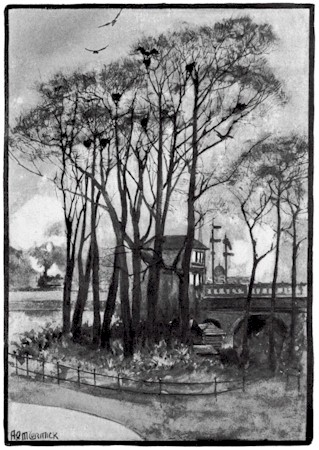
THE ROOKERY, BROCKWELL PARK
It is very pleasant to find that here, at all
events, very little (I cannot say nothing) has so
far been done to spoil the natural character
and charm of this park—one of the finest of
London’s open spaces.
- 237 -
Introductory remarks—Comparative large extent of public
ground in South-west London—Battersea Park—Character
and popularity—Bird life—Clapham Common: its present
and past character—Wandsworth Common—The yellowhammer—Tooting
Common—Tooting Bec—Questionable
improvements—A passion for swans—Tooting Graveney—Streatham
Common—Bird life—Magpies—Rookery—Bishop’s
Park, Fulham—A suggestion—Barn Elms Park—Barnes
Common—A burial-ground—Birds—Putney Heath,
Lower Putney Common, and Wimbledon Common—Description—Bird
life—Rookeries—The badger—Richmond
Park—Its vast extent and character—Bird life—Daws—Herons—The
charm of large soaring birds—Kew Gardens—List
of birds—Unfavourable changes—The Queen’s private
grounds.
In the foregoing chapters the arbitrary lines
dividing the London postal districts have not
been always strictly kept to. Thus, the Green
Park and St. James’s Park, which are in the
South-west, were included in the West district,
simply because the central parks, with Holland
Park, form one group, or rather one chain of
open spaces. In treating of the South-west
district it will again be found convenient
to disregard the line at some points, since, besides
excluding the two parks just named, I
propose to include Kew Gardens, Richmond
Park, and Wimbledon Common—large spaces
which lie for the most part outside of the Post-Office
boundary. These spaces do nevertheless
form an integral part of London as it has been
defined for the purposes of this book: they
belong to the South-west district in the same
way that Hampstead Heath does to the North-west,
Hackney Marsh and Wanstead Old Park
to the East, Plumstead and Bostell to the South-east.
All these open spaces touch London,
although they are not entirely cut off from the
country. Again, for the same reason which
made me exclude Epping Forest, Ham Common,
&c., from the East district, I now exclude
Hampton Court Park and Bushey Park from the
South-west. It might be said that Richmond
Park is not less rural than Bushey Park, or even
than Epping Forest; that with regard to their
wild bird life all these big open spaces on the
borders of London are in the same category;
but the line must be drawn somewhere, and
having made my rule I must keep to it. Doubtless
before many years the tide of buildings will
have completely encircled and flowed beyond
the outermost open spaces described in this and
the preceding chapters.
Within these limits we find that the South-west
district, besides being the least densely
populated portion of London, is immeasurably
better off in open spaces than any other. There
is, in fact, no comparison. The following is a
very rough statement of the amount of space open
to the public in each of the big districts, omitting
the cemeteries, and all gardens, squares, greens,
recreation grounds, and all other open spaces
of less than ten acres in size. West London,
including Green Park and St. James’s Park, has
about 1,500 acres. North London (North-west
and North districts), which has two very large
spaces in Regent’s Park and Hampstead Heath,
has about 1,300 acres. East London, excluding
Epping Forest, Wanstead Flats, and Ham Common,
has less than 1,000 acres. South-east
London, 1,500 to 1,600 acres. South-west
London has about 7,500 acres, or 2,200 acres
more than all the other districts together. This
does not include Old Deer Park, which is not
open to the public. If we include Green,
St. James’s, Bushey, and Hampton Court Parks,
the South-west district would then have about
8,650 acres in large open spaces. All the rest
of London, with the whole vast space of Epping
Forest thrown in, would have 7,500, or 1,150
acres less than the South-west district.
The large open spaces of South-west London,
although more scattered about than is the case
in other metropolitan districts, do nevertheless
form more or less well-defined groups. Battersea
Park is an exception: it is the only open
space in this district which has, so to speak,
been entirely remade, the digging and planting,
which have been so vigorously going on for
several years past, having quite obliterated its
original character. Coming to speak of the
open spaces in detail, I propose first to describe
this made park; to go next to the large
commons south of Battersea—Clapham, Wandsworth,
Tooting, and Streatham; then, returning
to the river-side, to describe Bishop’s Park,
Fulham, and its near neighbour, Barnes Common;
and, finally, to go on to the large spaces
at Kew, Putney, Wimbledon, and Richmond.
Battersea Park (198 acres), formerly a marsh,
has within the last few years been transformed
into the most popular open-air resort in the
metropolis. The attempt to please everybody
usually ends in pleasing nobody; at Battersea
the dangerous experiment has been tried with
success; for no person would be so unreasonable
as to look for that peculiar charm of wildness,
which still lingers in Bostell Heath and Wimbledon
Common, in a garden planted in a marsh
close to the heart of London. The ground has
certainly been made the most of: the flat
surface has been thrown into mounds, dells,
and other inequalities; there are gardens and
rockeries, large well-grown trees of many kinds,
magnificent shrubberies, and, best of all, a pretty
winding lake, with an area of about 16 acres,
and large well-wooded islands on it. Besides the
attraction which the beautiful grounds, the
variety of plants and of ornamental water-fowl
and other animals have for people generally,
crowds are drawn to this spot by the facilities
afforded for recreations of various kinds—boating,
cycling, cricket, tennis, &c. This
popularity of Battersea is interesting to us
incidentally when considering its wild bird life,
for it might be supposed that the number of
people and the incessant noise would drive away
the shyer species, and that the birds would be
few. This is not the case: the wild bird life is
actually far more abundant and varied than in
any other inner London park. Mere numbers
and noise of people appear to have little effect
on birds so long as they are protected.
Battersea Park has a good position to attract
birds passing through or wandering about
London, as these are apt to follow the river;
and it also has the advantage of being near the
central parks, which, as we have seen, serve as
a kind of highway by which birds come into
London from the west side. In the park itself
the lake and wooded islands, and extensive
shrubberies with dense masses of evergreen,
tempt them to build. But it must also be said,
in justice, that the superintendent of this park
fully appreciates the value of the birds, and
takes every pains to encourage and protect
them. A few years ago, when he came to
Battersea, there were about a dozen blackbirds;
now as many as forty have been counted feeding
in the early morning on one lawn; and in spring
and summer, at about four o’clock every morning,
there is such a concert of thrushes and blackbirds,
with many other bright voices, as would
be hard to match in any purely rural district.
It is interesting to know that the wren, which is
dying out in other London parks, has steadily
increased at Battersea, and is now quite
common. Robins and hedge-sparrows are also
more numerous than in our other open spaces.
A number of migrants are attracted to this spot
every summer; of these the pied wagtail, lesser
whitethroat, reed-warbler, and cuckoo bred
last season. The larger birds are the wood-pigeon,
moorhen, dabchick, and to these the
carrion crow may now be added as a breeding
species.
Clapham Common (220 acres) is the nearest
to central London of that large, loose group of
commons distinctive of the South-west district,
its distance from Battersea being a little over a
mile, and from Charing Cross about three miles
and a half. Like Hackney Downs, it is a grassy
space, but flatter, and having the appearance of
a piece of ground not yet built upon it may be
described as the least interesting open space in
the metropolis. To the smoke and dust breathing,
close-crowded inhabitants of Bethnal Green,
which is not green nor of any other colour
found in nature, this expanse of grass, if they
had it within reach, would be an unspeakable
boon, and seem to their weary eyes like a field
in paradise. But Clapham is not over-crowded;
it is a place of gardens full of fluttering leaves,
and the exceeding monotony of its open space,
set round with conspicuous houses, must cause
those who live near it to sigh at the thought of
its old vanished aspect when the small boy
Thomas Babington Macaulay roamed over its
broken surface, among its delightful poplar
groves and furze and bramble bushes, or hid
himself in its grass-grown gravel-pits, the world
forgetting, by his nurse forgot. These grateful
inequalities and roughnesses have been smoothed
over, and the ancient vegetation swept away
like dead autumn leaves from the velvet lawns
and gravel walks of a trim suburban villa.
When this change was effected I do not know:
probably a good while back. To the Claphamites
of the past the furze must have seemed
an unregenerate bush, and the bramble something
worse, since its recurved thorns would
remind them of an exceedingly objectionable
person’s finger-nails. As for the yellowhammer,
that too gaily apparelled idle singer, who painted
his eggs with so strange a paint, it must indeed
have been a relief to get rid of him.
At present Clapham Common is no place for
birds.
Wandsworth Common (183 acres) is a very
long strip of ground, unfortunately very narrow,
with long monotonous rows of red brick houses,
hideous in their uniformity, at its sides. Here
there is no attempt at disguise, no illusion of
distance, no effect of openness left: the cheap
speculative builder has been permitted to spoil
it all. A railway line which cuts very nearly
through the whole length of the common still
further detracts from its value as a breathing-space.
The broadest part of the ground at
its western extremity has a good deal of furze
growing on it, and here the common joins
an extensive piece of ground, park-like in
character, on which stands an extremely picturesque
old red brick house. When this green
space is built upon Wandsworth will lose the
little that remains of its ancient beauty and
freshness.
Among the small birds still to be found here
is the yellowhammer, and it strikes one as very
curious to hear his song in such a place. Why
does he stay? Is he tempted by the little bit of
bread and no cheese which satisfies his modest
wants—the small fragments dropped by the
numberless children that play among the bushes
after school hours? The yellowhammer does
not colonise with us; he goes and returns not,
and this is now the last spot in the metropolis
within four miles and a half of Charing Cross
where he may still be found. He was cradled
on the common, and does not know that there
are places on the earth where the furze-bushes
are unblackened by smoke, where at intervals
of a few minutes the earth is not shaken by
trains that rush thundering and shrieking, as if
demented, into or out of Clapham Junction.
I fear the yellowhammer will not long
remain in such a pandemonium. The people
of Wandsworth are hardly deserving of such a
bird.
Tooting Common is the general name for
two commons—Tooting Bec and Tooting
Graveney, 144 and 66 acres respectively. A
public road divides them, but they form really
one area. Tooting Bec has a fair amount of
gorse and bramble bushes scattered about, and
a good many old trees, mostly oak. The
number of old trees gives this space something
of a park-like appearance, but it is not exhilarating;
on the contrary, its effect on the mind is
rather depressing, on account of the perfect
flatness of the ground and the sadly decayed
and smoke-blackened condition of the trees.
An ‘improvement’ of the late Metropolitan
Board of Works was the planting of a very long
and very straight avenue of fast-growing black
poplars, and this belt of weed-like ungraceful
trees, out of keeping with everything, has made
Tooting Bec positively ugly.
Another improvement has been introduced
by the County Council; this is the usual small
pond and the usual couple of big swans.
The rage for putting these huge birds in
numberless small ponds and miniature lakes can
only proceed from a singular want of imagination
on the part of the park gardeners and park
decorators employed by the Council; or we
might suppose that the Council have purchased
a big job lot of swans, which they are anxious
to distribute about London. These dreary little
ponds might easily be made exceedingly interesting,
if planted round with willows and rushes
and stocked with a few of the smaller pretty
ornamental water-fowl in place of their present
big unsuitable occupants.
Tooting Graveney has a fresher, wilder aspect,
and is a pleasanter place than its sister common.
Its surroundings, too, are far more rural, as it
has for neighbours Streatham Park and the
wide green spaces of Furze Down and Totterdown
Fields. Tooting Graveney itself is in
the condition of the old Clapham Common
as Macaulay knew it in his boyhood. Its
surface is rough with grass-grown mounds, old
gravel-pits, and excavations, and it is grown
over with bushes of furze, bramble, and brier,
and with scattered birch-trees and old dwarf
hawthorns, looking very pretty. Wild birds
are numerous, although probably few are able
to rear any young on the common. The missel-thrush,
now very rare in London, breeds in
private grounds close by.
Streatham Common (66 acres) is the least as
well as the outermost of the group of large
commons; it is but half the size of Clapham
Common. But though so much smaller than
the others, it is the most interesting, owing to
the hilly nature of the ground and to the fine
prospect to be had of the country beyond. It
forms a rather long strip, and from the highest
part at the upper end the vision ranges over the
beautifully wooded and hilly Surrey country to
and beyond Epsom. This upper end of the
common is extremely pretty, overgrown with
furze and bramble bushes, and pleasantly shaded
with trees at one side. Birds when breeding
cannot be protected on the common; the wild
bird life is nevertheless abundant and varied, on
account of the large private grounds adjoining.
It is pleasant to sit here on a spring or summer
day and watch the jays that come to the trees
overhead; like other London jays and the
London fieldfares, they are strangely tame compared
with these birds in the country. Out in
the sunshine the skylark mounts up singing;
and here, too, may be heard the nightingale.
He does not merely make a short stay on his
arrival in spring, as at some other spots in
the suburbs, but remains to breed. Yet here
we are only six and a half miles from Charing
Cross. It is still more surprising to find the
magpie at Streatham, in the wooded grounds
which join the common. Rooks are numerous
at Streatham, and their rookery close to
Streatham Common station is a singularly interesting
one. It is on an avenue of tall elms
which formerly stood on open grass-land. A
few years ago this land was built over, rows of
houses being erected on each side of and
parallel with the avenue, which now stands
in the back gardens or yards, with the back
windows of the houses looking on it. But
in spite of all these changes, and the large
human population gathered round them, the
birds have stuck to their rookery; and last
summer (1897) there were about thirty inhabited
nests.
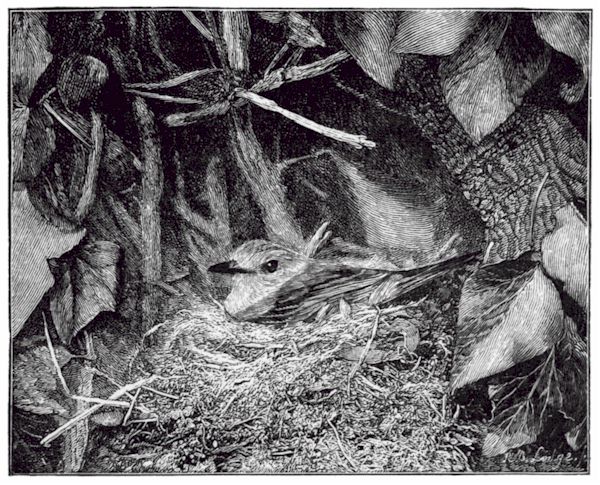
NIGHTINGALE ON ITS NEST
From Streatham we go back to the river, to
a point about a mile and a half west of Wandsworth
Common, to Fulham Palace grounds on
the Middlesex side, and the open spaces at
Barnes on the Surrey side.
Bishop’s Park, Fulham, of which about 12
acres are free to the public, is one of London’s
rare beauty-spots. A considerable portion of
the palace grounds is within the moat, and the
moat, the noble old trees, and wide green
spaces, form an appropriate setting to the
ancient stately Bishop’s Palace. The lamentable
mistake has been made of placing this open space
in the control of the Fulham Vestry; and, as might
have been expected, they have been improving
it in accordance with the æsthetic ideas of the
ordinary suburban tradesman, by cutting down
the old trees, planting rows of evergreens to hide
the beautiful inner grounds from view, and by
erecting cast-iron painted fountains, shelters, and
other architectural freaks of a similar character.
That the inhabitants of Fulham can see unmoved
this vulgarisation of so noble and beautiful a
remnant of the past—the spot in London which
recalls the moated Bishop’s Palace at Wells—is
really astonishing.
To the bird-lover as well as to the student
of history this is a place of memories, for here
in the time of Henry VIII. spoonbills and herons
built their nests on the old trees in the bishop’s
grounds. At the present time there are some
sweet songsters—thrush, blackbird, robin, dunnock,
wren, chaffinch, and a few summer visitants.
Here, too, we find the wood-pigeon, but
not the ‘ecclesiastical daw’ or other distinguished
species, and, strange to say, no moat-hen
in the large old moat. How much more
interesting this water would be, with its grass-grown
banks and ancient shade-giving trees,
if it had a few feathered inhabitants! Simply
by lowering the banks at a few points and
planting some reeds and rushes, it would quickly
attract those two very common and always
interesting London species, the moorhen and the
little grebe. The sedge-warbler, too, would perhaps
come in time.
I have been informed that London Bishops
care for none of these things.
Looking across the river from Fulham
Palace grounds, an extensive well-wooded space
is seen on the south bank; this is Barn Elms
Park, now occupied by the Ranelagh Sporting
Club. It is one of the best private parks in
London, with fine old elm-trees and a lake, and
would be a paradise of wild birds but for the
shooting which goes on there and scares them
away.
Close to Barn Elms is Barnes Common (100
acres), a pleasant open heath, not all flat, grown
with heather, and dotted with furze and bramble
bushes and a few trees. One of its attractions
is Beverley Brook, which rises near Malden,
about eight miles away, and flows by Coombe
Woods, Wimbledon, through Richmond Park,
and, finally, by Barnes Common to the Thames:
the brook and a very pretty green meadow
separate the common from Barn Elms Park.
The London and South-Western Railway
Company have been allowed to appropriate a
portion of this open space; but that indeed
seems a very small matter when we find that the
parishes of Barnes and Putney have established
two cemeteries on the common, using a good
many of its scanty 100 acres for the purpose.
What would be said if the Government were to
allow two cemeteries for the accommodation of
the parishes of Kensington and Paddington to
be made in the middle of Kensington Gardens?
I fail to see that it is less an outrage to have
turned a portion of Barnes Common into hideous
walled round Golgothas, with mortuary chapels,
the ground studded with grave-stones and
filled with putrefying corpses. It is devoutly to
be hoped that before very long the people of
London will make the discovery that it rests
with themselves whether their house shall be
put in order or not; and when that time comes
that these horrible forests of grave-stones and
monuments to the dead will be brushed
away, and that such bodies as the Barnes Conservators
and the Fulham Vestry will for ever
be deprived of the powers they so lamentably
misuse.
It would be difficult for any bird, big or
little, to rear its young on a space so unprotected
as this common; many birds, however,
come to it, attracted by its open heath-like
character. Here the skylark and yellowhammer
may be heard, as well as the common resident
songsters found in other open spaces. The
carrion crow is a constant visitor, and very tame,
knowing that he is safe. Beverley Brook has
no aquatic birds in it, but it would be easy to
make a small rushy sanctuary in the marshy
borders, protected from mischievous persons,
for the moorhen, sedge-warbler, and other
species. I have seen a small boy with an earthworm
at the end of a piece of thread pull out
thirty to forty minnows in as many minutes.
Little grebes and kingfishers would not want for
food in such a place.
South and west of Barnes Common, London,
as we progress, becomes increasingly rural, with
large private park-like grounds, until we arrive
at the open spaces of Putney Heath, Lower
Putney Common, and Wimbledon Common,
which together form an area of 1,412 acres, or
nearly three times as large as Hampstead Heath.
It seems only appropriate that the most rural
portion of the most rural district in London
should have so large an open space, and that in
character this space should be wilder and more
refreshing to the spirit than any other in the
metropolis. It has the further advantage (from
the point of view of the residents) of not being
too easy of access to the mass of the people.
This makes it ‘select,’ a semi-private recreation
ground for the residents, and a ‘Happy Hampstead’
to a limited number of cockneys of a
superior kind. Here the fascinating game of
golf, excluded from other public spaces, may
be practised; and the golfer, arrayed like the
poppies of the cornfield and visible at a vast
distance, strolls leisurely about as his manner
is, or stands motionless to watch the far flight
of his small ball, which will kill no one and hit
no one, since strangers moving about on the
grounds are actually fewer than would be seen
on the links at Hayling, or even Minehead.
It is a solitary place, and its solitariness is
its principal charm. A wide open heath, with
some pretty patches of birch wood, stretches of
brown heather, dotted in places with furze-bushes
like little black islands; but on that
part which is called Putney Heath furze and
bramble and brier grow thick and luxuriant.
One may look far in some directions and see
no houses nor other sign of human occupancy
to spoil the effect of seclusion and wildness.
Over all is the vast void sky and the rapturous
music of the skylark.
At Wimbledon one has the idea of being at
a considerable elevation; the highest point is
really only 300 feet above the sea level, but it
is set in a deep depression, and from some points
the sight may range as far as the hills about
Guildford and Godalming. There are persons
of sensitive olfactories who affirm that when the
wind blows from the south coast they can smell
the sea-salt in it.
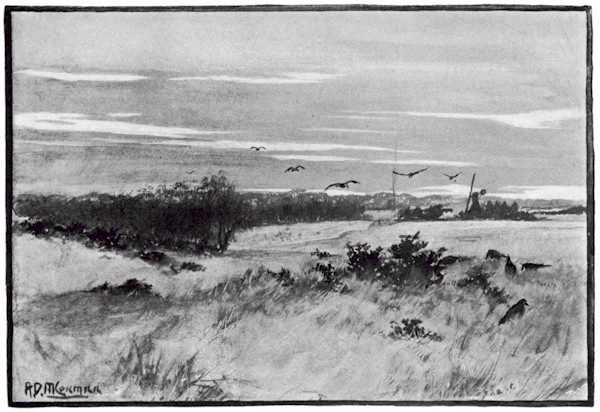
WIMBLEDON COMMON
But Wimbledon is not all open heath and
common; it has also an extensive wood, delightfully
wild, the only large birch wood near
the metropolis. The missel-thrush, nuthatch,
and tree-creeper breed here, and the jay is
common and tame; I have seen as many as
six together. In this wood a finer concert of
nightingales may be heard in summer than at
any other place near London. In winter fieldfares
and pewits are often seen. Carrion crows
from Coombe Woods and other breeding-places
in the neighbourhood are constantly seen on the
common in pairs and small parties, and are
strangely familiar. Rooks, too, are extremely
abundant. Richmond Park is their roosting-place
in winter, and there are numerous
rookeries, large and small, in the neighbourhood—at
Sheen Gate, at various points along the
Kingston road, at Norbiton and Kingston, on the
estate of the late Madame Lyne Stevens, at
Coombe Woods, and at Wimbledon itself, in
some large elms growing at the side of the High
Street on Sir Henry Peek’s property. Concerning
this rookery there is an interesting fact to
relate. About six years ago the experiment of
shooting the young rooks was tried, with the
very best intentions, the rookery being greatly
prized. But these rooks were not accustomed
to be thinned down (for their own good) every
summer, and they forsook the trees. Everything
was then done to entice them back; artificial
nests were constantly kept on the tree-tops,
and in winter food in abundance was placed
for the birds; but though they came readily
enough to regale on bread and scraps they
refused to settle until last spring (1897), when
they returned in a body and rebuilt the rookery.
This book is mainly about birds, but I cannot
help mentioning the fact that in the wood at
Wimbledon that rare and interesting mammal,
the badger, found at only one other spot on the
borders of London, is permitted to spend his
hermit life in peace.
Here, in solitude and shade,
Shambling, shuffling plantigrade,
Be thy courses undismayed.
It may seem almost absurd in writing of a
London wild animal to quote from Bret Harte’s
ode to the great grizzly in the Western wilderness!
Nevertheless Wimbledon may be proud to
possess even the poor little quaint timid badger—cousin,
a million times removed, to the mighty
bear, the truculent coward, as the poet says,
with tiger claws on baby feet, who has a
giant’s strength and is satisfied to prey on
wasps’ nests.
Recently, on one of the largest estates in
England, in a part of the country where the
badger is now all but extinct, it was reported at
the big house that a pair of these animals had
established themselves in the forest, which, it
may be mentioned, is very large—about eighteen
miles round. A grand campaign was at once
organised, and a large number of men and boys,
armed with guns, spades, hatchets, pitchforks,
and bludgeons, and followed by many
dogs, went out to the attack. Arrived at the
den, at the roots of a giant beech-tree, they
set to work to dig the animals out. It was a
huge task, but there were many to help, and
in the end the badgers were found, old and
young together, and killed.
Let us imagine that when this business
was proceeding with tremendous excitement
and noise of shouting men and barking dogs,
some person buried at that spot in old Palæolithic
times had been raised up to view the
spectacle; that it had been explained to him
that these hunters were his own remote descendants;
that one of them was a mighty
nobleman, a kind of chief or king, whose
possessions extended on every side as far as
the eye could see; that the others were his
followers who served and obeyed him; and that
they were all engaged in hunting and killing the
last badger, the most terrible wild beast left in
the land! I think that the old hunter, who,
with his rude stone-headed spear had fought
with and overcome even mightier beasts than
the grizzly bear, would have emitted a strange
and perhaps terrifying sound, a burst of primitive
laughter very shrill and prolonged, resembling
the neigh of a wild horse, or perhaps deep, from
a deep chest, like the baying of a bloodhound.
Richmond Park (2,470 acres) both in its vast
extent and character is unlike any other metropolitan
open space. The noblest of the breathing-spaces
on our borders, it is also the most
accessible, and more or less well known to tens
of thousands of persons; but it is probably
intimately known only to a few. Speaking for
myself, I can say that after having visited it
occasionally for years, sometimes to spend a
whole day in it, sometimes to get lost in it,
both in fine and foggy weather, I do not know
it so well as other large open spaces which have
not been visited more often. Any person well
acquainted with the country would probably
find it easy at a moment’s notice to name half a
dozen parks which have pleased him better
than this one, on account of a certain monotony
in the scenery of Richmond, but in size it would
surpass most or all of them. So large is it that
half a dozen such London parks as Clissold,
Waterlow, and Ravenscourt might easily be
hidden in one corner of it, where it would
not be easy to find them. There are roads
running in various directions, and on most days
many persons may be seen on them, driving,
riding, cycling, and walking; yet they all may
be got away from, and long hours spent out of
sight and hearing of human beings, in the
most perfect solitude. This is the greatest
attraction of Richmond Park, and its best
virtue. Strange to say, this very quietude and
solitariness produce a disturbing effect on many
Londoners. Alas for those who have so long
existed apart from Nature as to have become
wholly estranged, who are troubled in mind at
her silence and austerity! To others this green
desert is London’s best possession, a sacred place
where those who have lost their strength may
find it again, and those who are distempered
may recover their health.
The largeness and quietness of Richmond,
its old oak woods, water, and wide open spaces,
and its proximity to the river, have given it
not only an abundant but a nobler wild bird
life than is found at any other point so near to
the centre of the metropolis. Here all the best
songsters, including the nightingale, may be
heard. Wild duck and teal and a few other
water birds, rear their young in the ponds. Our
two most beautiful woodland birds, the green
woodpecker and the jay, are common. Rooks
are numerous, especially in winter, when they
congregate to roost. Here, too, you may hear
the carrion crow’s ‘voice of care.’ Jackdaws
are certainly more plentiful than anywhere
within one hundred miles of London. One day
I counted fifty in a flock, and saw them settle
on the trees; then going a little distance on I
saw another flock numbering about forty, and
beyond this lot from another wood sounded
the clamour of a third flock. Even then I had
probably not seen all the Richmond daws;
perhaps not more than half the entire number,
for I was assured by a keeper that there were
‘millions.’ He was a very tall white-haired old
man with aquiline features and dark fierce eyes,
and therefore must have known what he was
talking about.
Best of all are the herons that breed in the
park, and appear to be increasing. One fine
evening in February last I counted twenty
together at Sidmouth Wood. A multitude of
rooks and daws had settled on the tree-tops
where the herons were; but after a few minutes
they rose up with a great noise, and were
followed by the herons, who mounted high
above the black cawing crowd, looking very
large and majestic against the pale clear sky.
It was the finest spectacle in wild bird life I had
ever seen so close to London.
It is a great thing for Richmond to have the
heron, which is no longer common; and now
that the kite, buzzard, and raven have been lost,
it is the only large soaring inland species which,
once seen, appears as an indispensable part of
the landscape. Take it away, and the large
comparatively wild nature loses half its charm.
In a former chapter I have endeavoured to
show how great the æsthetic value of the daw is
to our cathedrals. The old dead builders of
these great temples owe perhaps as much to
this bird as to the softening and harmonising
effects of time and weather. Again, every one
must feel that the effect of sublimity produced
on us by our boldest cliffs is greatly enhanced
by the sea-fowl, soaring along the precipitous
face of the rocks, and peopling their ledges, tier
above tier of birds, the highest, seen from below,
appearing as mere white specks. A similar
effect is produced by large soaring birds on any
inland landscape; the horizon is widened and
the sky lifted to an immeasurable height. Some
such idea as this, of the indescribable charm of
the large soaring bird, of its value to the artistic
eye in producing the effect of distance and
vastness in nature, was probably in our late
lost artist-poet’s mind when he painted the
following exquisite word-picture:—
High up and light are the clouds; and though the swallows flit
So high above the sunlit earth, they are well a part of it;
And so though high over them are the wings of the wandering hern,
In measureless depths above him doth the fair sky quiver and burn.
Speaking for myself, without the ‘wandering
hern,’ or buzzard, or other large soaring species,
the sky does not impress me with its height and
vastness; and without the sea-fowl the most
tremendous sea-fronting cliff is a wall which may
be any height; and the noblest cathedral without
any jackdaws soaring and gamboling about its
towers is apt to seem little more than a great
barn, or a Dissenting chapel on a gigantic scale.
Kew Gardens, with the adjoining spaces of
Old Deer Park and the Queen’s Private Grounds,
comprising an area of about 600 acres, with a
river frontage of over two miles, is in even
closer touch with London than its near neighbour,
Richmond Park. From the heart of the
city two principal thoroughfares run west, and,
uniting on the farther side of Hammersmith,
extend with few breaks in the walls of brick
and glass on either side to Kew Bridge. The
distance from the Mansion House to the bridge
is about ten miles, and the few remaining gaps
in the westernmost portion of this long busy
way are now rapidly being filled up. What
was formerly the village of Kew is now an
integral part of London the Monotonous, in
appearance just like other suburbs—Wormwood
Scrubs, Kilburn, Muswell Hill, Green Lanes,
Dulwich, and Norwood.
Kew Gardens (251 acres) is, or until very
recently was, one of the three or four spots on
the borders of the metropolis most favoured by
the birds. They were attracted to it by its
large size, the woodland character of most of
the ground, and its unrivalled position on the
river in the immediate vicinity of several other
extensive open spaces. The breeding place of
most of the birds was in the Queen’s Private
Grounds, a wedge of land between the Gardens
and Old Deer Park, a wilderness and perfect
sanctuary for all wild creatures. In this green
wooded spot and the adjoining gardens the
following species have bred annually: missel-thrush,
throstle, blackbird, redstart, robin,
nightingale, whitethroat, lesser whitethroat,
blackcap, garden-warbler, chiffchaff, willow-wren,
wood-wren, sedge-warbler, dunnock, wren,
great, coal, blue, and long-tailed tits, nuthatch,
tree-creeper, pied wagtail, tree-pipit, spotted
flycatcher, swallow, house-martin, greenfinch,
common sparrow, chaffinch, starling, jay, crow,
swift, green and lesser woodpecker, wryneck,
cuckoo, pheasant, partridge, wood-pigeon, moorhen,
dabchick—in all forty-three species. Besides
these there is good reason to believe that
the following six species have been breeders in the
Queen’s grounds during recent years: goldcrest,
marsh tit, goldfinch, hawfinch, bullfinch, and
magpie.
This list will prove useful to London naturalists
in the near future, as many changes in the
bird life of Kew may shortly be looked for.
With the opening of the Queen’s grounds the
partridge and pheasant will cease to breed there;
the crow is not now allowed to build in the
gardens; the nightingales have decreased to
a very few birds during the last three or four
seasons; and last summer (1897) the wood-wren
failed to put in an appearance. To say that
there will be other and greater changes is
unhappily only too safe a prophecy to make.
For several years past tree-felling has been
vigorously prosecuted in the gardens to give
them a more open park-like appearance; new
gravelled roads have been laid down in all
directions, and the policy generally has been
that of the landscape-gardener which makes for
prettiness, with the result that the aspect and
character of this spot have been quite altered,
and it is fast becoming as unsuitable a breeding
place for the summer warblers and other shy
woodland species as any royal west-end park.
Up till two months ago, it was some consolation
to those who grieved at the changes in
progress in Kew Gardens to think that the
Queen’s private grounds adjoining were safe
from the despoiler. This area is separated
from the gardens by nothing but a wire fence;
one could walk the entire breadth of the grounds
with that untrimmed, exquisitely beautiful
wooded wilderness always in sight; many acres
of noble trees—oak, ash, elm, beech, hornbeam,
and Spanish chestnut; a shady paradise, the
old trunks draped with ivy, or grey and emerald
green with moss; masses of bramble and brier,
furze and holly, growing untouched beneath;
the open green spaces a sea of blue in spring
with the enchanting blue of the wild hyacinth.
There was not anywhere on the borders of
London—that weary circuit of fifty miles—so
fresh and perfect a transcript of wild woodland
nature as this, with the sole exception of Lord
Mansfield’s private grounds at Hampstead.
Unhappily just before the announcement
was made early in 1898 that the Queen had
graciously decided to admit the public to this
lovely ground, a gang of labourers was sent in
to grub up the undergrowth, to lop off lower
branches, and cut down many scores of the
noblest old trees, with the object apparently of
bringing the place more into harmony with the
adjoining trim gardens. It is earnestly to be
hoped that nothing further will be done to ruin
the most perfect beauty-spot that remains to
London.
Here our survey ends.
- 270 -
Object of this book—Summary of facts contained in previous
chapters—An incidental result of changes in progress—Some
degree of protection in all the open spaces, efficient protection
in none—Mischievous visitors to the parks—Bird
fanciers and stealers—The destructive rough—The barbarians
are few—Two incidents at Clissold Park—Love of
birds a common feeling of the people.
The most serious portion of my work still remains
to do. In the introductory chapter I
said that this was a book with a purpose, and,
as the reader knows from much that has gone
before, the purpose is to point out how the wild
bird life we possess may be preserved, and how
it may be improved by the addition of other
suitable species which would greatly increase
the attractiveness of the parks.
Before going into this part of my subject it
would be useful to briefly summarise the main
facts disclosed in the foregoing chapters.
1. Many species formerly resident throughout
the year in London have quite died out;
thus, in the present century the following large
species have been lost: raven, magpie, peregrine
falcon, and kestrel. In very recent years the
following small resident species have disappeared
from inner London, but are still found in a few
localities on the outskirts: missel-thrush, nuthatch,
tree-creeper, oxeye, and lesser spotted
woodpecker.
2. Some resident species are reduced to
small remnants and are confined to one or to
a very few spots; in this category we must
place the rook, the jackdaw, and the owl.
3. Several other resident species, formerly
common, have greatly decreased in numbers,
and in some of the open spaces appear to be
dying out. Among these are the thrush, blackbird,
robin, wren, hedge-sparrow, greenfinch,
chaffinch, goldfinch, bullfinch, linnet, and lark.
Two of these species, thrush and blackbird, are
now increasing in several of the open spaces
under the County Council, and here and there
two or three of the other species named are also
increasing.
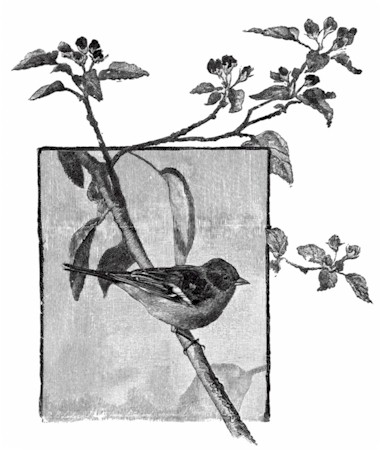
CHAFFINCH
4. The decrease has been in most, but not
all, of the old residents. So far the carrion
crow does not appear to have suffered. Two
small birds, sparrow and starling, have undoubtedly
greatly increased.
5. At the same time that some of the old
residents have been decreasing or dying out, a
few other species have come in from the outside,
and have greatly increased—namely, the ringdove,
moorhen, and dabchick.
6. During the season when birds migrate,
or shift their quarters, many birds of various
species drift into or pass through London: of
these some that are summer visitors bred
regularly in London up to within a few years
ago. Of all these visitors it may be said that
they have been decreasing for several years
past, and some of them no longer attempt to
breed in the inner London parks. At the same
time, in a few favoured localities these visitors
do not show any falling off, and in one or two
of the open spaces they may be actually
increasing.
To sum up. For many years there have
been constant changes going on in the bird
population, many species decreasing, a very few
remaining stationary, and a few new colonists
appearing; but, generally speaking, the losses
greatly exceed the gains.
One incidental result of all these changes,
and of the variety of conditions existing and the
different degrees of protection given, is that
some of the open spaces are now distinguished
by the possession of species which are found
in no other spot in the metropolis, or which
have elsewhere become exceedingly rare. Thus,
Kensington Gardens alone, of all the interior
parks, possesses the owl and the jackdaw; St.
James’s Park is distinguished by its large number
of wood-pigeons and its winter colonies
of black-headed gulls; Battersea Park by its
wrens and variety of small delicate songsters,
both resident and migratory, and its vast congregation
of starlings in late summer and early
autumn; Wandsworth Common by its yellowhammers;
Gray’s Inn Gardens and Brockwell
Park by their rookeries; Streatham by its
nightingales, magpies, and jays; Ravenscourt
Park by its missel-thrushes; Finsbury Park by
its large numbers of thrushes and blackbirds.
In Kew Gardens the tree-pipit, pied wagtail,
and wryneck are more common than elsewhere;
Richmond Park has its heronry and a vast
multitude of daws; Wanstead has the turtle-dove
and hawfinch, and with its land and water
birds of all sizes, from the goldcrest to the
heron, mallard, and rook, may claim to possess
in its narrow limits a more abundant and varied
wild bird life than any other metropolitan open
space.
The conclusion I have come to, after a careful
study of the subject, is that wild birds of all
the species remaining to us, and many besides,
are very well able to thrive in London; that
many species have been and are being lost
solely on account of the indifference of the park
authorities in the matter; that the comparative
abundance and variety of wild bird life in the
different open spaces depends on the degree of
protection and encouragement the birds receive.
And by encouragement I mean the providing
them with islands, shrubberies, and such cover
as they require when breeding. Thus, we see
that in so vast a space as Hyde Park, where
there is practically no protection given and
nothing done to encourage wild birds, the
songsters are few and are decreasing; while in
some comparatively small open spaces constantly
thronged with visitors the bird life is abundant
and varied, and increasing. It should not be,
but certainly is, the case that it depends on the
person who is in charge of the open space
whether anything shall be done to encourage the
birds; if he takes no interest in the matter those
who are under him will not concern themselves
to save the birds. We have seen that veiled
bird-catching is permitted in some of the parks;
park constables and park labourers have also
been allowed to take nests of thrushes and other
songsters containing young birds, for their own
pleasure or to dispose of to others.
We have seen that the differences between
park and park, with regard to the abundance of
bird life, are very great; but despite these differences,
which depend on the amount of encouragement
and protection given, consequently
to a great extent on the personal feeling in the
matter of the superintendent, it must be said that
sufficient protection has not yet been given in any
public space in London. All the open spaces are
alike infested by cats, the deadliest enemy of
the birds which are of most value—the resident
species that sing most of the year, and that nest
in low bushes or close to the ground. And so
long as cats are allowed to range about the
parks these species cannot be said to be
properly protected. This last point being of
great importance will be treated separately and
fully in the next chapter; the rest of this
chapter will be occupied in discussing an enemy
to the birds less difficult to deal with—the
mischievous individuals of our own species
who kill and capture birds and take their eggs
and young.
The damage done by the ordinary boy, who
throws stones and cannot resist the temptation
to take a nest when he has the chance, is hardly
appreciable in the parks where there is any real
desire on the part of the superintendents and
keepers to protect the birds. On some of the
large open spaces on the outskirts of London,
such as Hampstead Heath and the commons in
the South-west district, the keepers are too few
to protect the nesting birds, and the eggs are
very nearly all taken. A much more serious
injury is inflicted by the bird fancier from the
slums, who visits the parks with the object of
stealing the birds, adults and young, and by the
worst kind of blackguard or rough, who kills
and smashes when he gets the chance solely for
the pleasure of destroying something which
others value, or, to quote Bacon’s phrase,
‘because he can do no other.’
As to the bird fancier who is a bird stealer,
I have said enough in a former chapter to show
that he can very easily be got rid of where
there is any real desire to protect the birds.
It remains to say something concerning the
rough who delights in destruction. That a man
should find pleasure in stoning a valuable park
bird to death or in trampling down a flower-bed
may seem an astonishing thing, when we see
that the objects destroyed are solely intended for
the people’s pleasure, that they are paid for by the
people, and are, in a sense, the people’s property.
It may even seem inexplicable, since the rough
is a human being and must therefore have the
social instinct. But there is really no mystery
in it; by inflicting injury on the community he
is after all only following other instincts common
to man, which are quite as strong and sometimes
stronger than the social. He is prompted by
the hunting instinct, which is universal and
doubtless in him is to some extent perverted;
also the love of adventure, since by doing wrong
he runs a certain risk, and wins a little glory of
a low kind from his associates and others who are
of like mind with him; and finally, he is actuated
by the love of power, which in its degraded
form finds a measure of gratification in hurting
others, or in depriving them of a pleasure.
But after all said, these injurious persons are
in an exceedingly small, an almost infinitesimal,
minority, and the damage they do is little and
annually becomes less; so little is it where any
vigilance is exercised, that it would not have
been worth while to write even these few paragraphs
but for the opportunity it gives me of
returning to a subject dwelt upon in the opening
chapter; for this destructiveness on the part of
a few but serves the more fully to illustrate the
contrary spirit—the keen and kindly interest in
the wild bird life of our open spaces which is
almost universal among the people. In the
volume dealing with East London, in his enormous
work on the ‘Life and Labour of the
People,’ Mr. Charles Booth has the following
significant passage: ‘The hordes of barbarians
of whom we have heard, who, issuing from their
slums, will one day overwhelm modern civilisation,
do not exist. There are barbarians, but
they are a handful, a small and decreasing
percentage, a disgrace but not a danger.’ A
more absolute confirmation of the truth of these
words than the general behaviour of the people
who visit the parks, even in the poorest and
most congested districts, could not be found.
As a rule, when a small park is first opened in
some densely populated district, where no public
open space previously existed, the people rush
in and act as if demented; they are like children
released from long confinement who go wild with
the first taste of liberty: they shout, climb trees,
break off branches, pluck the flowers; but all
this is purely the result of a kind of mental
intoxication. They are not ‘barbarians’ or
‘yahoos,’ as they are sometimes described by
onlookers at the first opening of a new park;
they are nothing more than excited young
people; the excitement passes, and after a short
time the damage ceases, and the place becomes
so orderly, and so seldom is any damage done,
that the park could almost be left to take care
of itself.
I am here tempted to relate two incidents
which have occurred at different times in one
small open space—Clissold Park. Some tame
rooks were kept with the object of establishing
a rookery (of which more in a later chapter), and
one day last year some young miscreants, who
subsequently made their escape, stoned three of
the birds to death. The second incident relates
to a chaffinch and its nest. The nest was
built on a stunted half-dead thorn-bush, very low
down and much exposed to sight. Just at the
time when the nest was being built some forty
or fifty labourers were called in and set to work
to form a pond at this very spot, and it was
determined to leave a few yards of ground with
the thorn-bush standing on it as an island in the
middle of the excavation. When the digging
began the first eggs had been laid in the nest, but
in spite of the crowd of men at work every day and
all day long round the bush, and the incessant
noises of loud talking and of shovelling clay into
carts and shouting of carters to their horses, the
birds did not forsake their task; the eggs were all
laid, sat on, the young duly hatched and successfully
reared amidst the tumult; and during all
this time the men engaged on the work were so
jealous of the birds’ safety that they would not
allow any of the numberless visitors to the park
to come near the bush to look closely at the
nest. So long as the young were in the nest
the workmen were the chaffinch’s bodyguard.
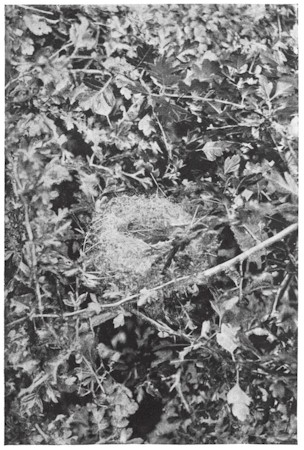
NEST OF CHAFFINCH
Judging from personal knowledge of the
people of London, I should say that these workmen
showed in their action the feeling which the
people have generally about the wild birds in the
parks, and that the rook-slayers mentioned
above were rare exceptions, the small percentage
of ruffians which we always have to count with,
just as we have to count with lunatics and
criminals. Doubtless some readers will disagree
with this conclusion. I know it is a common
idea—one hears it often enough—that love of
birds is by no means a general feeling; that it is,
on the contrary, somewhat rare, and consequently
that those who experience it have some reason
to be proud of their superiority. To my mind
all this is a pretty delusion; no one flatters
himself that he is in any special way a lover of
sunshine and green flowery meadows and running
waters and shady trees; and I can only
repeat here what I have said before, that the
delight in a wild bird is as common to all men
as the feeling that the sunshine is sweet and
pleasant to behold.
One word more may be added here. We—that
is to say, our representatives on the County
Council—annually spend some thousands of
pounds on gardening, in laying out beds of
brilliant tulips, geraniums, and other gay flowers,
but, with the exception of the cost of the little
food given to the birds in frosty weather in some
of the parks, not one pound, not one penny,
has been spent directly on the birds; and yet
there is no doubt that the birds are more to most
people than the flowers; that a gorgeous bed of
tulips that has cost a lot of money is regarded
by a majority of visitors with a very tepid
feeling of admiration compared with that which
they experience at the sight or sound, whether
musical or not, of any wild bird.
- 284 -
The cat’s unchangeable character—A check on the sparrows—Number
of sparrows in London—What becomes of the
annual increase—No natural check on the park sparrows—Cats
in the parks—Story of a cat at Battersea Park—Rabbits
destroyed by cats in Hyde Park—Number of cats in London—Ownerless
cats—Their miserable condition—How cats are
made ownerless—How this evil may be remedied—How to
keep cats out of the parks.
As it will be necessary to show that, sooner or
later, the cat question will have to be dealt with
in a manner not pleasant for the cats, it may be
well to say at once that I have no prejudice
against this creature; on the contrary, of all the
lower animals that live with or near us I admire
him the most, because of his incorruptibility, his
strict adherence to the principle ‘to thine own
self be true.’ He lives with but not exactly in
subjection to us. The coarser but more plastic
dog we can and we do in a sense unmake and
remake. Not so with the cat, who keeps to the
terms of his ancient charter, in spite of all
temptations to allow of a few of the original
lines being rubbed out and some new ones
written in their place. Old Æsop’s celebrated
apologue is as true of to-day as of his own distant
time; and thousands of years ago the worshippers
of Pasht who had tender hearts must
have been scandalised at their deity’s way with
a mouse. It would not, perhaps, be quite in
order to conclude this exordium without a
reference to the poet’s familiar description of the
cat as a ‘harmless necessary’ animal. The Elizabethan
was doubtless only thinking of rats and
mice; in the London of to-day the cat has
another important use in keeping down the
sparrows. But for this check sparrows would
quickly become an intolerable nuisance, fluttering
in crowds against our window-panes, crying
incessantly for crumbs, and distressing us with
the spectacle of their semi-starved condition.
Much has already been said of the sparrow
in this work, but the lives of cat and sparrow
are so interlaced in London that in speaking of
one it becomes necessary to say something of
the other. Let us try to get a little nearer to
the subject of the connection between these
two creatures. When we consider the extreme
abundance of the sparrow in all favourable
situations and his general diffusion over the entire
metropolis; that he inhabits thousands of miles
of streets, often many scores of birds to the
mile; and that besides all the birds that breed
in houses others nest in trees and bushes in
every garden, square, park, and other open
space, we cannot suppose that there are less
than a million of these birds. One day in April,
while walking rapidly the length of one walk in
a London park I counted 118 nests. There
could not have been fewer than 1,000 nests
in the whole park. The entire sparrow population
of London may be as much as two or
three millions, or even more. Putting it as low as
one million, the increase of half a million pairs,
breeding say four times a year, and rearing at
least twelve young (they often rear double that
number), we have an annual increase of six
millions. Most of this increase goes to the cats;
for the cat is the sparrow’s sole enemy, but a
really dangerous one only when the bird is just out
of the nest; for the young bird very soon becomes
strong of wing and alert in mind, and is thereafter
comparatively safe from the slayer of his kind.
The first instinct of the young urban sparrow,
once he has been coaxed by his parents or
impelled by something in him to use his wings,
is to fly feebly, or rather to flutter downwards to
the earth; and there, under a bush in a back
garden, or behind a pillar, or in an angle of the
wall, or in the area, the cat is waiting. The inexperienced
birdling, surprised and probably
frightened at a new and strange sensation, trying
to balance himself and to come down softly,
touches the ground and is struck by sudden
death. I have seen successive broods from one
nest come forth, and bird by bird at odd times
flutter down in this way, seeking a safer spot to
rest upon than the sloping roof and narrow
ledges and cornices on the walls, and finally
touch the earth only to be instantly destroyed.
But here one interesting question
arises. How, if the facts are as stated, it may
be asked, does it happen that the young sparrow
so frequently makes this fatal mistake, in spite
of his inherited knowledge? I believe the
explanation is that the sparrow is essentially a
tree bird, notwithstanding his acquired habit of
sitting contentedly on buildings in towns. A
percher by nature, he is yet able to rub along
for most of the time without a perch; but we
see that even in districts where trees are few
and far between the sparrows’ meeting-place
or ‘chapel’ is invariably a tree. The young
sparrow has not yet acquired this convenient
habit of the adults; he is a tree sparrow,
incapable of sitting quietly, like the young
swallow or martin, on a roof or ledge to be fed
there by the parent birds. His perching feet
must lay hold of something; and when he cannot,
so to speak, anchor himself he is ill at ease,
even on the wide surface of a flat roof, and
fidgets and hops this way and that, possibly
experiencing a sensation as of falling or of
being thrown off his stand. It is to escape
from this unsuitable flat surface that he flutters
or flies off and comes down. This happens
when no tree stands conveniently near; when
there is a tree beneath or close by the young
sparrow makes for it instinctively, as a duckling
to water; and if he succeeds in reaching it he
shows at once that he has found relief, and is
content to remain where he is. It is most
interesting to watch a brood of young sparrows
just out of the nest settling down on the topmost
twigs of a tree, which they have been
lucky enough to reach, and remaining there for
hours at a stretch, dozing secure in the sun and
wind, even when the wind is strong enough
to rock the tree, and only opening their eyes
and rousing themselves at intervals on the
appearance of one of the parent birds with food
in its bill.
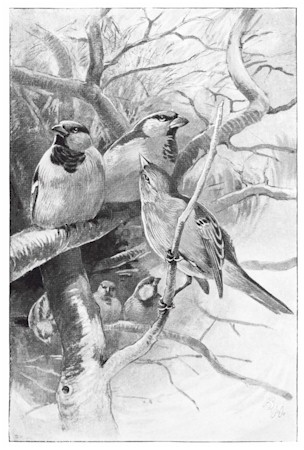
PARK SPARROWS
In a large majority of cases the London
sparrow has no tree growing conveniently near
to the breeding hole, and the consequence is
that an incredible number of broods are lost.
The parent birds, when a whole brood has thus
been snapped up, after a day or two of excitement
cheerfully set to work relining the old
nest with a few straws, feathers, and hairs.
From March to August, some to October,
they are occupied with this business, and
I do not think that more than two young
birds survive out of every dozen of all the
sparrows that breed in houses; for with the
park birds the case is different. As it is, the
birds that escape their subtle enemy are more
than enough to make good the annual losses
from all other causes. In the streets, back-yards,
and gardens an ailing sparrow is, like the inexperienced
young bird, quickly snapped up. In
the parks at all seasons, but particularly in
winter, ailing sparrows are not very rare;
occasionally a dead one is seen.
The duck and the drake
Are there at his wake,
but the cat comes not in the daylight hours to
bury him. When the young park sparrows
flutter down from their high nests there is no
enemy lying in wait: they get their proper
exercise, and in short flights over the turf learn
the use of their wings; in the evening they go
back to their hollow tree or inaccessible nest.
When they are asleep in their safe cradles the
cats come on the scene to hunt in the shrubberies,
to capture the thrush, blackbird, robin,
dunnock, and wren, and in fact any bird that
nests in low bushes or on the ground. The
noisy clang of the closing park gates is a sound
well known to the cats in the neighbourhood;
no sooner is it heard than they begin to issue
from areas and other places where they have
been waiting, and in some spots as many as half
a dozen to a dozen may be counted in as many
minutes crossing the road and entering the park
at one spot. They can go in anywhere, but cats
that are neighbours and personally known to
one another often have the habit of going in at
one place. All night long they are at their
merry games; you may sometimes see them
scampering over the turf playing with one
another like wild rabbits, and in the breeding
season they sup on many an incubating bird
caught on its eggs, and on many a nest full of
fledglings. In the early morning they are back
at their houses, if they are not of the homeless
ones, innocently washing their faces in the
breakfast room, waiting for the customary
caress and saucer of cream. But these luxuries
do not alter the animal’s nature: his ‘fearful
symmetry’ was for all time, the sinews of his
heart cannot be twisted in any other way, and
his brain is as it came from the furnace.
The following incident will serve to show
the spirit that is in a London cat. Some time
ago it was discovered that a very big and a very
black one had established himself on an island in
the lake at Battersea Park. ‘Then he must
have crossed over in a boat, as cats don’t swim,’
cried the superintendent. On going to the
place it was found that the cat had killed
and partly devoured one tufted duck and two
sheldrakes. To dispose of him a company of
eighteen workmen and a good hunting dog were
sent over to the island. The cat, driven from his
hiding-place in the bushes, quickly ascended the
tallest tree in his territory. A youth who was
a good climber went up after him, and the other
men, armed with stout sticks, gathered round the
tree to receive the animal on his coming down.
The cat quickly made up his mind how to act:
down he swiftly came from branch to branch,
and in less than two seconds was frantically
tearing about among the legs of his adversaries,
and bursting through the cordon was quickly in
the water swimming for life. Immediately there
was a rush for the boats, but before the men
could get on to the water the cat had reached
the shore and vanished in the thick shrubbery.
The men were then disposed in line like beaters
and advanced, but in the end the creature escaped
from the park and was lost. This animal deserves
honourable mention on account of the splendid
courage and resource he displayed; but the
injury he had caused and the desperate and
successful fight for life he made against such
tremendous odds show that cats ought not to be
allowed in the parks. The loss of the pair of
sheldrakes is felt to be a serious one, and I
agree that when unpinioned the bird is very
beautiful, and when it shows itself flying over
the ornamental waters of a park, I can admire
it almost as much as when seeing it on the
coasts of Somerset or Northumberland. But
a blackcap, a nightingale, a kingfisher destroyed
by cats in any park would be as great or even a
greater loss to London; and I may add that a
few days before writing this chapter, in the
summer of 1897, the three wild birds I have
just named were to be seen at the very spot
where the sheldrakes were killed.
So far as I know, the park cats can only be
credited with one good deed. Two or three
years ago a number of rabbits were introduced
into Hyde Park, and quickly began to increase
and multiply, as rabbits will. For a time the
cats respected them, being unaccustomed to see
such animals, and possibly thinking that they
would be dangerous to tackle. But they soon
found out that these strangers were the natural
prey of a carnivore, and, beginning with the
little ones, then going on to those that were
grown up, eventually devoured them all. Two
big old buck rabbits survived the others for a
couple of months, but even these were finally
conquered and eaten. I for one am very glad
at the result, for it really seemed too ridiculous
that our great national park should be turned
into a rabbit warren as well as a duck-breeding
establishment.
The extraordinary rapidity with which the
rabbits were destroyed will serve to give some
idea of the numbers and destructiveness of the
cats that nightly make the open spaces of
London their hunting grounds. How many
cats are there in London? Not a word that I
am aware of has been written on the subject, and
as there is no tax on them there is no possibility
of finding out the exact truth. Nevertheless, in
an indirect way we may be able to get a proximate
idea of their numbers.
The number of dogs in London is supposed
to be about two hundred thousand; no doubt it
is really greater, since many dogs escape the
tax. Cats in London are very much more
numerous than dogs. Thus, in the streets I
know best, in the part of London where I live,
there are about eight cats to every dog; in some
streets there are ten or twelve, in others not more
than six. If a census could be taken it would
probably show that the entire cat population
does not fall short of three-quarters of a million;
but I may be wide of the mark in this estimate,
and should prefer at present to say that there are
certainly not less than half a million cats in
London. Even this may seem an astonishing
number, since it is not usual for any house to
have more than one, and in a good many
houses not one is kept. On the other hand there
is a vast population of ownerless cats. These
cannot well be called homeless since they all
attach themselves to some house, which they
make their home, and to which they return as
regularly as any wild beast to its den or lair.
Judging solely from my own observation, I do
not think that there can be less than from eighty
thousand to one hundred thousand of these
ownerless cats in the metropolis. Let me take
the case of the house I live in. No cat is
kept, yet from year’s end to year’s end there
are seldom less than three cats to make use
of it, or to make it their home. At all hours
of the day they are to be seen in the area, or
on the doorsteps, or somewhere near; and at
odd times they go into the basement rooms—they
get in at the windows, or at any door that
happens to be left open, and if not discovered
spend the night in the house. There are
scores of houses in my immediate neighbourhood
which have no smell of valerian about
them and are favoured in the same way.
It is not possible at all times of the year
to distinguish these ownerless or stray cats
from those that have owners; but there are
seasons of scarcity for the outdoor animals
during which they differ in appearance from
the others; and at such times, with some practice,
one may get an idea of the number of strays
in his own neighbourhood. It is in the winter,
during long and severe frosts, that the ownerless
ones suffer most, and on a bright day in a
walk of a quarter of a mile you will sometimes
see as many as a dozen of these poor wretches
sunning themselves on one side of the street.
On coming close to one of these cats he invariably
looks at you with wide-open startled eyes,
and so long as you stand quietly regarding him
he will keep this look. The moment you speak
kindly to him the alarm vanishes from his eyes,
he knows you for a friend, and is as ready as
any starving human beggar to tell you his
miserable story. He mews piteously; but
sometimes when his mouth opens no sound
issues from it—he is too feeble even to mew.
His fur has a harsher appearance than in other
cats, the hairs stand up like the puffed-out
feathers of an owl, and hide his body’s excessive
leanness; but when you lift him up you are
astonished at his lightness—he is like a wisp of
straw in your hand. The marvel is that when
he has got to this pass he can still keep alive
from day to day; for in the bleak streets there
is no food for him, and the people of the houses
he hangs about have hardened their hearts
against him on account of his thieving, or
because if they give him an occasional scrap of
food he will never go away, and their only wish
is to see the last of him. Many of these stray
cats get most of their food in dust-bins, into
which they slink whenever the door is left open
for a few minutes. They find a few scraps to
keep them alive, and at rare intervals capture a
mouse. Sometimes they jump out when ashes
are shot into their hiding-place; but the cat who
has got hardened merely shuts his eyes against
the stinging cloud, crouching in his corner,
and is satisfied to remain for days shut up in his
dreary cell, finding it more tolerable than the
wintry streets and inhospitable areas. It is
related of La Fontaine, the fabulist, that he was
passionately fond of strawberries, on account
of the effect which this fruit had in annually
restoring him to comparative health and some
pleasure in life; and that during the winter and
spring his only wish was that the strawberry
season when it came round again would find
him still living, since if it delayed its coming
he would lose all hope. In like manner these
ownerless cats, if they have any thought about
their condition, must long for the change in the
year that will once more call forth the black-beetles
in areas and basements, and bring the
young sparrows fluttering down from their
inaccessible nests.
How does it happen that there are so many
of these strays in London? For cats do not leave
their homes of their own accord, except in rare
instances when they have been enticed or encouraged
to take up their quarters in some other
neighbourhood. As a rule the animal prefers
its own home with poverty to abundance in a
strange place. I believe that a vast majority
of these poor ones come from the houses or
rooms inhabited by the poor. Most persons are
extremely reluctant to put kittens that are not
wanted to death. In the houses of the well-to-do
the servants are ordered to kill them; but
the poor have no person to delegate the dirty
work to; and they have, moreover, a kindlier
feeling for their pet animals, owing to the fact
that they live more with them in their confined
homes than is the case with the prosperous. The
consequence is that in very many cases not one
of a litter is killed; they are mostly given away
to friends, and their friends’ children are delighted
to have them as pets. The kitten
amuses a child immensely with its playful ways,
and is loved for its pretty blue eyes full of fun
and mischief and wonder at everything. But
when it grows up the charm vanishes, and it is
found that the cat is in the way; he is often on
the common staircase where there are perhaps
other cats, and eventually he becomes a nuisance.
The poor are also often moving, and are not well
able to take their pet from place to place. It is
decided to get rid of the cat, but they do not
kill it, nor would they like to see it killed by
another; it must be ‘strayed’—that is to say,
placed in a sack, taken for some miles away from
home at night and released in a strange place.
Now this very painful condition of things
ought not to continue, and my only reason for
going into the subject is to suggest a remedy.
This is that the metropolitan police be instructed
to remove all stray cats and send them to a
lethal chamber provided for the purpose. The
ownerless cats, we have seen, do not roam about
the town, but have a home, or at all events a
house, to which they attach themselves, and which
they refuse to leave, however inhospitably or even
cruelly they may be treated. On making some inquiries
at houses in my own neighbourhood on the
subject, I find that most people are anxious to
get rid of the stray cats they may happen to have
about the place, but are at a loss to know how
to do it. In some instances they succeed in
straying them again, but the cats are no better off
than before, and the starving population is not
diminished. But it would be a simple way out
of the difficulty if they could have them removed
by reporting them to the nearest policeman. We
have seen, as a result of the muzzling order
imposed by the County Council, that upwards
of forty thousand unclaimed dogs have been
destroyed in the course of a year (1896), and
the presumption is that these dogs were little
valued and not properly cared for by their
owners. The harvest of stray cats would probably
not be less than sixty or seventy thousand
for the first year.
To return to the parks. The question is
how to exclude the hunting cats that frequent
them at night. I have conversed with perhaps
a hundred superintendents, inspectors, and
keepers on the subject, and invariably they say
that it is impossible to exclude the cats, or that
they do not see how it is to be done. And yet
in many parks they are always trying to do it;
they hunt them at night with dogs, they shoot
them with rook rifles, and they poison them:
but all these measures produce no effect, and
are, moreover, employed with secrecy and with
fear lest the paragraph writer and public should
find out, and an outcry be made. It is plain
that the cats can only be kept out by means
of a suitable fence, or net, or screen of wire.
Rabbit wire netting is hardly suitable, as it is
unsightly and is not an efficient protection.
The most effectual form would be a plain wire
fence in squares, the cross wires tied to the
uprights with wire thread, the top of the fence
made to curve outwards to prevent the
animals from climbing over it. This screen
could be placed inside of the park railings at a
distance of about three or four feet from them.
A fence or screen of this pattern has a handsome
appearance, but it is expensive, the cost
being about fourpence to fivepence the square
foot. Probably some other cheaper and equally
effective wire protection could be designed. I
have consulted some of the large dealers in wire
netting and fencing of all kinds, and they tell
me that a fence to keep out cats from parks has
yet to be invented. Very likely; at the same time
there are probably very many ingenious persons
in England who would quickly invent what is
wanted if it was made worth their while. It
simply comes to this: if the park authorities
really wish to keep out the cats they can do so
at a moderate cost, and it is not likely that even
their worst critics would venture to blame them
for spending a few hundreds for such an object.
We must look to the County Council to take
the lead in this matter. It is my conviction—there
is much even now going on in some of the
parks to show how well founded it is—that
once the chief destroyer of our valuable birds is
excluded, a great and rapid improvement in the
character of our bird population will ensue.
The number of the species we value most would
be relatively larger. The change for the better
would come about without any direct encouragement
and protection being given; at the same
time it would be an immense help if those who
are in charge of open spaces could be brought to
see that wild bird life is very much more to the
people of London than all the pleasant and
pretty things in the way of bands of music,
exotic flowers, and brick and stone and metal
ornaments, which they are providing at a very
considerable cost.
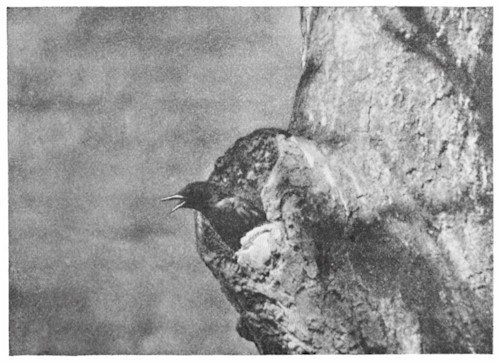
STARLING AT HOME
- 304 -
Restoration of the rook—The Gray’s Inn rookery—Suggestions—On
attracting rooks—Temple Gardens rookery—Attempt
to establish a rookery at Clissold Park—A new colony of
daws—Hawks—Domestic pigeons—An abuse—Stock-dove
and turtle-dove—Ornamental water-fowl, pinioned and
unpinioned—Suggestions—Wild water-fowl in the parks—Small
birds for London—Missel-thrush—Nuthatch—Wren—Loudness
a merit—Summer visitants to London—Kingfisher—Hard-billed
birds—A use for the park sparrows—Natural
checks—A sanctuary described.
My purpose in this chapter is to make a few
suggestions as to the species which may be
introduced or restored with a fair prospect of
success, and which would form a valuable addition
to the metropolitan wild bird life. The
species to be mentioned here have very nearly
all been resident, some of them very common, in
former years; most of them survive on the
borders of London, and some still linger in
diminished numbers in a few of the interior open
spaces.
Most persons would probably agree that of
all the large birds that were once common in
London, the rook would be most welcome. In
the chapter on this bird I said that irretrievable
disaster had overtaken the London rookeries,
that the birds had gone, or were going, never to
return; nevertheless, I believe that it would be
possible, although certainly not easy, to reintroduce
them. We have not wholly lost the rook
yet; he is to be found in many places on our
borders; and the continued existence of the
ancient colony at Gray’s Inn is a proof that rooks
can live in London, and would doubtless be able to
thrive in some of the parks where there are large
trees, and from which the birds would not have
to travel so far in search of food for their young.
With regard to the Gray’s Inn rooks, which
are greatly valued by the Benchers and by
very many others, I will venture to make
a suggestion or two, which, if acted on, may
produce good results. Probably no bird from
outside is ever attracted to this colony,
confined to so small an open space in the
very heart of London, and it is possible that
through too much in-and-in breeding for many
generations, the birds have suffered a considerable
loss of vigour. It would be a very easy
matter to infuse fresh blood into it by
substituting eggs from some country rookery
for those in the nests. This experiment would
cost nothing; and it would also be worth while
to provide the birds with suitable provender,
such as meal-worms, at the season when the
young are growing and require more food than
the parents are probably able to give them.
No doubt some readers of this book will
say at once that the reintroduction of the
rook into London is impossible, since even in
the rural districts, where all the conditions are
favourable, it is found extremely difficult to induce
the birds to settle where they are wanted. A year
or two ago my friend Mr. Cunninghame Graham,
writing from his place in the north, told me that
he had long desired to have rooks in his trees,
and that he had written to an eminent ornithologist,
with whom he was not personally acquainted,
asking for advice in the matter. The
naturalist replied at some length, pointing out
the fallacies of Socialism as a political creed,
but saying nothing about the rooks. Probably
he had nothing practical to write on the subject,
but he might at least have informed his correspondent
that Mr. Hawker, the famous parson
of Morwenstow, had got his rooks by praying for
them. He prayed every day for three years,
and his importunity was then rewarded by
the birds coming and settling on the very trees
where they were wanted.
We have an account of the curious origin
of the Temple Gardens rookery, one of the best
known and most populous of the old London
rookeries. In the ‘Zoologist,’ vol. xxxvi. p. 196,
Mr. Harting relates that it was founded in
Queen Anne’s time by Sir Richard Northey, a
famous lawyer at that period, who brought the
first birds from his estate at Epsom. A bough
was cut from a tree with a nest containing two
young birds, and conveyed in an open waggon
to the Temple, and fixed in a tree in the gardens.
The old birds followed their young and fed them,
and old and young remained and bred in the
same place. The following year a magpie built
in the gardens; her eggs were taken, and those
of a rook substituted; these in due course
were hatched and the young when reared became
an addition to the colony.
Professor Newton has said of this pleasant
story that he would gladly believe it if he could,
and it has been discredited by the discovery
that a rookery existed at the Temple prior to
Queen Anne’s time. Aubrey’s statement, which
has been quoted in disproof of the Northey
legend, is that the rooks built their nests there
in the spring after the plague, 1665. My
inference is that the rookery was an old one,
which the birds abandoned during the plague,
and afterwards reoccupied. We may then
suppose that later on the birds went away again
for good; and that Northey, knowing that a
rookery had formerly existed at the Temple,
and inspired by a lawyer’s very natural admiration
for the grave, black-coated, contentious
bird, succeeded in restoring it in the manner
described. In any case, it is not probable that
such a story would have been told of the
Temple rookery if the plan attributed to Northey
had not been successfully employed somewhere
and somewhen. It is well worth trying again.
I should like very much to see the experiment
made by Lord Ilchester, who has long desired to
see the rooks back in Holland Park; he would
not have to bring the young birds in their nests
in open waggons all the way from Melbury or
Abbotsbury, as there are several rookeries where
young birds in the nests could be had within
five or six miles of Holland House.
Another more promising plan is to get the
young birds and rear them in the park where
they are wanted. This plan has already been
recently tried, not by any person of means, but
by a humble park sergeant at Clissold Park.
Sergeant Kimber is an interesting man, and
deserves to be highly thought of by all bird-lovers
in London; he has during most of his
life been a gamekeeper, but knows a great deal
more about birds and loves them better than
most men who have that vocation. With the
permission of the County Council, he obtained
about a dozen young rooks from the country,
some from Yorkshire and others from Wales;
the birds were placed in an enclosure with a
good-sized tree growing in it with branches
drooping to the ground, so that they were able
to ascend and descend at pleasure. Unfortunately
their wing feathers were cut, which prevented
them from learning to fly for about a
year; even after two years the survivors are still
unable to fly as well as wild birds. Six birds
remained up to the spring of 1897; one
only of these appeared to be a male. This
bird paired and a nest was built, but after its
completion the pair flew away together one
morning to some open ground on the outskirts
of North London where they were accustomed
to feed, and never returned. Doubtless they
had been shot by the sportsmen who still infest
the waste lands and marshes on that side of the
metropolis. Sergeant Kimber now thinks that
it was a mistake to clip his rooks’ wings, and
hopes to succeed better next time.
This experiment with tame rooks has incidentally
resulted in a gain to the bird life of
North London. In the aviary at Clissold Park
a tame female daw was kept; there she formed
a very close friendship with a parrot, who had
the original way of manifesting, or perhaps I
should say dissembling, his love by pulling out
her feathers. No doubt she was very much
enamoured of the green bird with his foreign
ways and commanding voice, as she was always
at his side and never in the least resented his
ungentle treatment. The poor bird’s breast
was at last quite denuded of its covering, and the
whole plumage was in such a thin and ragged
condition that it was thought best to separate
the friends, even at the risk of breaking their
hearts; accordingly the daw was taken away
and placed with the tame rooks. The rooks
treated her very well, and in their society she
probably soon forgot her foreigner. And by-and-by
a wild daw was attracted to the tree
and joined the company: this was a male bird
in fine plumage, and Sergeant Kimber conceived
the idea that it would be a good stroke to catch
it and clip its wing-tips to prevent it from going
away. The wild daw was very cunning; by
day he would remain most of the time with the
rooks and his ragged friend, but at night he
invariably retired to roost in some tall trees in
another part of the park. In spite of his
cunning he was eventually caught and placed
on the rooks’ tree with just the tips of his wings
clipped. From that time the two daws were
inseparable, and their romantic attachment
promised to end in a lasting and happy union;
but after a few weeks a second wild daw, this
time a female, was attracted to the tree and
joined the little community. This was a fine
glossy bird, and no sooner had she come than
the male daw began to make up to her, coolly
throwing over his first love. By this time he
had recovered his power of flight, and after
pairing with the new-comer the two went away
to spend the honeymoon and look for a suitable
residence in the country. The ragged daw lived
on with the rooks for a few weeks longer, then
she too disappeared, being now able to fly. Three
or four weeks later, to everybody’s astonishment,
they all came back together accompanied by
a fourth bird, a male, with which the ragged one
had paired. Somewhere roaming about outside of
London they had all met, and the ragged female
had probably persuaded them to forget past
unpleasantnesses and return to the park; at all
events they all seemed very friendly and happy.
During the summer of 1897 both pairs bred,
one in the upper part of the tall spire of St.
Mary’s Church, Stoke Newington, which stands
close to the main entrance to the park; the other
in a building close by.
We see from this that wandering and apparently
homeless daws often visit London, and
are quickly attracted by any tame unconfined
bird of their own species; and that where daws
are wanted, an excellent plan is to use a tame
bird as a decoy.
It is exceedingly improbable that any of
the raptorial species which formerly inhabited
London—peregrine falcon, kestrel, and kite—will
ever return, but we could have these birds
by rearing them by hand from the nest, and
allowing them to be unconfined. If well and
regularly fed they would remain where they were
reared, or if they went away for a season they
would most probably return. It would be a
great pleasure to see them soaring above or
about our buildings, and they would also be
useful in keeping down the domestic pigeons,
which are now much too numerous and are fast
becoming a nuisance in some of the parks, where
they devour the food originally intended for the
wood-pigeons. The domestic pigeons have a
pretty appearance at St. Paul’s Cathedral, Westminster
Palace, and other large public buildings;
in the grassy parks they are out of place and do
not look well; furthermore, when we find most,
if not all, of these park-haunting birds come from
big private houses in the neighbourhood, where
they are bred for the table, it is surprising that
the park authorities should continue to feed
them at the public expense. Let us hope that
this abuse will soon be put an end to; also that
it will be recognised by the authorities that it is
a mistake to keep dovecots in the public parks.
The stock-dove could easily be introduced
into London by placing its eggs, which can be
obtained at a trifling cost, under both the
domestic pigeon and wood-pigeon. It may be
that the wood-pigeon would also prove a suitable
foster-parent to the turtle-dove. This species is
a strict migrant, but if bred in the parks it would
no doubt come back annually from its journeys
abroad. In any case the experiment is well
worth trying.
Before going on to the small birds which
may be introduced or encouraged to settle,
something need be said about the ornamental
water-fowl of the parks, which might be made
more than they are to us, and put to a new use.
There is no doubt that just as one daw attracts
other daws so do these water-birds attract
any of their wild relations which may be
passing at night. Mallards, widgeon, and teal,
supposed to be wild birds, have been known to
appear in some of the parks to pair with the
park birds and remain to breed; in a few
instances some of these strangers have actually
been captured by the keepers and pinioned to
prevent them from leaving. This was a great
mistake; for assuming that the birds really were
wild, it is probable that after going away for the
winter they would have returned, and might
even have brought some of their wild fellows.
I believe that our ornamental water-fowl ought
never to be pinioned except in the cases of a
few rare exotic species. When a bird is
pinioned its chief beauty and greatest charm
are lost; it is then little more than a domestic
bird, or a bird in a cage. Sheldrakes, both
common and ruddy, are infinitely more beautiful
when flying than when resting on the water;
and all wild ducks are seen at their best when,
before alighting, they sweep along close to the
surface, with wings motionless and depressed,
showing the bright beauty-spot. There are, in
fact, many unpinioned fowls on the park waters,
and some of these birds not only fly about their
own ponds, but they occasionally visit the
waters of other parks, especially by night, and
are well able to find their way back to their
own ponds. In some cases they make prolonged
visits to other parks. In one London park for
the last three years a number of tufted ducks
(from eight to a dozen) have made their appearance
on the ornamental water each spring, and
have remained until the autumn, then disappeared;
it is not known where they spend the
winter. In the same park a pair of pinioned
ruddy sheldrakes were kept. In April 1897
they were joined by a third bird, a drake, in
very beautiful plumage. After being two or
three days in their company, he attacked the
pinioned drake with great fury and drove
him off, and took possession of the duck.
The ornamental water of another park has
been visited at odd times by several Egyptian
geese, sometimes appearing regularly every
morning and departing in the evening, at other
times making long stays; and I have heard of
many other instances of the kind.
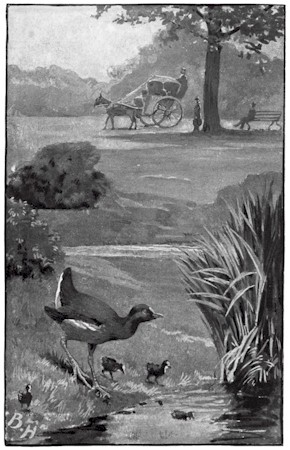
MOORHEN AND CHICKS
There are many and good reasons for
believing that water-fowl hatched and reared in
the parks would, if they went away for a period
in autumn and winter, return in spring to breed.
A fair trial might be made by giving the eggs
of wild birds—widgeon, teal, gadwell, shoveller,
and other suitable British species, to the park
ducks when breeding. In this way a London
race of each or of a few of these species might
be established; like our black-headed gulls,
moorhens, and dabchicks, they would be wild
birds, although not shy, and they would certainly
be more beautiful and vigorous and give us
more pleasure than their pinioned relations.
Coots hatched and reared by the moorhens
would give us another wild bird well suited to
thrive in the park lakes; and I will venture to
add that we might even get the great crested
grebe, by placing its eggs in the dabchicks’
nests. The breeding habits of these two species
are identical; they differ very considerably in
size, but there is not so great a disparity between
little grebe and great grebe as there is between
the cuckoo and its foster-parent.
Of small birds, or songsters, it will not be
necessary to mention more than a few of the
species which might be introduced with advantage,
since little can be done so long as the
bird-killing cats are free of the parks, and little
will need to be done once the cats are excluded.
Such species as the robin and hedge-sparrow
require protection when breeding; they are now
dying out for want of it, and will undoubtedly
increase again whenever the park authorities
think proper to give it.
The quickest and most effective plan to add
to the number of our species is to procure the
eggs of suitable wild birds, to be hatched in the
nests of the park birds. Thus, the missel-thrush
might easily be got back by placing its eggs in
the nests of blackbirds and thrushes. The large
size and handsome plumage of the missel-thrush,
or storm-cock, his dashing motions and loud
winter song, would make him one of our most
attractive birds; and that he is well able to
thrive in London we have already seen.
Another bird which no one is ever tired of
seeing and hearing, and would be a great acquisition,
is the nuthatch; this species, although
not uncommon on the wooded borders of London
and in some of the outlying parks, would no
doubt have to be introduced by man. The
nuthatch is a difficult bird to manage, on account
of its violent temper and impatience of confinement;
but it is possible that the starling, which,
like the nuthatch, breeds in hollow trees, and
feeds its young on much the same kind of food,
might make a suitable foster-parent. At all
events, the experiment is worth trying. It
should be easy to procure its eggs, as the bird
is very common in many well-timbered parks
and open oak woods within a short distance of
London. There are, I imagine, few small birds
more fitted to give pleasure to Londoners than
the nuthatch, on account of his quaint figure
and pretty plumage, his sprightliness and amusing
squirrel-like movements on a trunk or
branch of a tree. Though not strictly a songster,
his various clear penetrative call-notes are very
delightful to hear; and he is most loquacious in
late winter and early spring, when bird-voices
are few. Furthermore, of wild birds that may
be taught to come to us for food he is one of the
quickest to learn, and will follow his feeder, or
come at call, and deftly catch the nuts and
crusts and fragments of any kind that are thrown
to him.
Two other small birds with loud bright voices—both
London species, but now very nearly
vanished, as we have seen—are the oxeye and
wren. I think the best plan with regard to
these two—and the same plan might be tried
with the nuthatch in the event of the starling’s
failure as a foster-parent—would be to catch the
young birds shortly after leaving the nest, and
release them as soon as possible in the parks.
All these three have the habit of roosting in
families, old and young together, in a hole or
other sheltered place; and if taken at night and
released the following day where they were
wanted, they would probably soon adapt themselves
to their new surroundings.
The wren, indeed, appears to have more
adaptiveness than most birds, being universal in
the British Islands, and able to survive the cold
and scarcity of the long northern winters, even
in the most bleak and barren situations. That
he is well able to thrive in London we know, in
spite of the fact that he has now all but vanished
from most of our open spaces; for we have
seen that in one park, within two miles of
Charing Cross, where he is more encouraged and
better protected than elsewhere, he is actually
increasing in number. He is a delightful little
bird, a very general favourite, and is a winter
singer with a bright, beautiful, lyrical song,
wonderfully loud for so tiny a creature. I was
never more impressed with the loudness of its
song than on one Sunday afternoon in the
spring of 1897 in Battersea Park. I was walking
with the park superintendent round the
lake, listening for some new summer voice, but
for some time no bird sound reached us. Fifty
or sixty boats full of noisy rowers were on the
water, and the walks were thronged with loudly
talking and laughing people, their numberless
feet tramping on the gravel paths producing a
sound like that of a steam roller. My companion
exclaimed impatiently that it was impossible
to hear a bird-note in so much noise. He
had scarcely spoken before a wren, quite fifty
yards away, somewhere on the island opposite
to us, burst out singing, and his bright lyric
rang forth loud and clear and perfect above all
that noise of the holiday crowd.
It would be extremely difficult, perhaps
impossible, to introduce by artificial means any
of the summer visitants in the absence of soft-billed
birds to play the part of foster-parents.
The hedge-sparrow, the best bird for such a
task, is too rare; should he increase again, the
case will be different. At the same time it may
be said that the better protection which alone
would cause the hedge-sparrow and robin to
increase would also attract the migrants to breed
in the parks. At present, the summer songsters
that come regularly to breed in various spots on
the borders of London are the following: whinchat,
stonechat, redstart, nightingale, whitethroat,
lesser-whitethroat, blackcap, garden
warbler, chiffchaff, willow-wren, wood-wren,
sedge-warbler, reed-warbler, pied wagtail, and
tree-pipit. All these species, excepting the wood-wren,
visit the open spaces of inner London on
migration in spring. The chats, redstart, and
tree-pipit are much rarer than the others; but of
the fourteen species named, at least eight can be
seen or heard by any person who cares to spend
two or three days in the parks, to watch and listen
to the birds, after the middle of April. This list
is limited to the species which I have no doubt
would breed in the parks if encouraged; the three
species of swallows, the wheatear, yellow wagtail,
and other summer visitants are also seen in April
in London, but these are simply passing through.
The kingfisher, singly and in pairs, has been
a rather frequent visitor to the parks during the
last two years, and in some instances has made
a long stay: there is no doubt that the abundance
of minnows in the ornamental waters and the
shelter of the wooded islands are a great attraction.
No instance of its attempting to breed
has yet occurred, but this may be due to the
want of a suitable place to nest in. It is possible
that the noise of the Saturday and Sunday
boating people in the larger lakes, and the
persecution of the sparrows, who hate him for
his brilliant dress, may drive him away; still, it
would be a good plan to construct an artificial
bank or rockery, with breeding holes, on one of
the islands at a suitable place like Battersea.
The hard-billed birds would no doubt be the
easiest to introduce, owing to the large number
of sparrows that nest in the park trees, from
which the eggs could be taken and those of
other species substituted; and if by acting as
foster-parents to other finches the sparrows
would only be breeding crows to pick their own
eyes out, as the proverb says, so much the better.
Chaffinches and greenfinches have been successfully
reared by sparrows; and to these two
other equally desirable species might be added:
yellowhammer, corn-bunting, reed-bunting, bullfinch,
goldfinch, and linnet. These are charming
birds and good songsters; even the corn-bunting,
although generally belittled by its
biographers, is, compared with the sparrow, an
accomplished musician. They are furthermore
all exceedingly hardy, and probably as well
able to thrive in London as the sparrow itself,
although not so prolific and pushing as that
sometimes troublesome bird. It is, indeed, on
account of their hardiness that they, or those
of them that have the best voices, are so much
sought after; for they will live and be lively,
and sing, for a period of ten or a dozen years,
even in the miserable prison of a little cage in
which they are kept by those who love them.
The excessive numbers of sparrows in the
parks, where, as we have seen, there is no natural
check on their increase, is a question difficult to
deal with, and no remedy that is not somewhat
unpleasant to think of has yet been tried or
suggested. In some of the parks the nests are
pulled down by the hundred; but where this
plan is followed it is said to be of little avail,
owing to the energy and persistence of the birds
in making fresh nests. In other parks the birds
are, or have been, netted at night in the bushes,
where they roost in crowds. Poisoning the
sparrows has also probably been tried; at all
events, in one park I have found the sparrows
looking sick and languishing, and many dead
birds lying about, as if an epidemic had broken
out among them; but as no signs of disease
could be detected in the birds outside the park,
it could not very well have been an epidemic.
Now since all these methods, which, like the
little spasmodic attempts to kill the cats in some
of the parks, are practised in secrecy and fear
lest the public should hear of them, have so far
proved ineffectual, would it not be best to take
a lesson from Nature, and restore some of the
natural checks which we have taken away?
Let us in the first place make use of the park
sparrows in establishing colonies of as many new
or greatly diminished species as possible; and
when we have done this, let us further introduce,
in moderate numbers, such species as prey on
small birds and their eggs and young—peregrine
falcon, kestrel, sparrow-hawk, owl, crow, daw,
magpie, and jay.
However successful we may be in adding to
the number of our songsters, the sparrow will
always be more numerous than all the other
species together, and on account of his abundance
he will be more preyed upon; furthermore,
his big, conspicuous, slovenly nests will
be more subject to attack than the nests of
other species. It has been shown that millions
of sparrows are yearly destroyed by cats in
London; yet so quickly are they snapped up
by their subtle enemy that we really see nothing
or very little indeed of the process. The young
birds flutter out of their nests and drop lightly
down, only to vanish like snowflakes that fall
on the water. Here we see that even in London,
with but two species to act upon, Nature, left a
little to herself, has succeeded in establishing
something like that balance of forces and
harmony which exists everywhere in her own
dominion. Would it not be better to leave it to
Nature in the parks, too, to do her own killing
in her own swift and secret manner? In streets
and houses cats are of the greatest service, doing
for us, and unseen by us, that which we could not
effectually do for ourselves: in the parks their
presence is injurious; there we rather want
Nature’s feathered executioners, who are among
her most beautiful and interesting creatures.
How effective and salutary her methods are,
how beautiful in their results, may be seen in
such places as have been made sanctuaries
for all wild animals, innocent and rapacious.
Even on the borders of London we have such
places, and perhaps it would be hard anywhere
in the rural districts to find a more perfect
sanctuary in a small space than that of Caen
Wood, at Hampstead. Although at the side of the
swarming Heath, it is really wild, since for long
years it has been free from the landscape gardener
with his pretty little conventions, and the
gamekeeper and henwife with their persecutions
and playing at Providence among the creatures.
If it were possible for a man to climb to the top
of one of its noble old trees—a tall cedar, beech,
or elm, with a girth of sixteen to eighteen feet—he
would look down and out upon London: leagues
upon leagues of houses, stretching away to the
southern horizon, with tall chimneys, towers, and
spires innumerable appearing above the brooding
cloud of smoke. But the wood itself seems
not to have been touched by its sulphurous
breath; within its green shade all is fresh as
in any leafy retreat a hundred miles from town.
And here the wild creatures find a refuge.
Badgers—not one pair nor two, but a big colony—have
their huge subterraneous peaceful village
in the centre of the wood. The lodge-keeper’s
wife told me that one evening, seeing her dog,
as she imagined, trotting from her across the
lawn, she called to him and, angered at his disregard
of her voice, ran after him for some distance
among the trees, and only when she was
about to lay her hands on him discovered that
she was chasing a big badger. The badgers have
for neighbours stoats and weasels, carrion crows,
jays, and owls. Even in the daytime you will find
the wood-owl dozing in the deep twilight of a
holly-bush growing in the shade of a huge oak
or elm. High up on the trees at least half a
dozen pairs of carrion crows have their nests;
and occasionally all the birds gather at one
spot and fill the entire wood with their tremendous
excited cries. A dozen of these birds,
when they let themselves go, will create a greater
uproar than a hundred cawing rooks.
Here, too, the rabbit keeps his place in spite
of so many enemies; and to those named must
be added the domestic cat. I myself have seen
puss returning to the house carrying a half-grown
young rabbit to her kittens.
The moorhen and wood-pigeon also flourish,
and in a still greater degree the missel-thrush,
throstle, and blackbird. In this wood I
have counted forty-three breeding species; and
not only is the variety great, but many of our
best songsters, residents and migrants, are so
numerous that at certain times in spring, when
birds are most vocal, you may hear at this spot
as fine a concert of sweet voices as in any wood
in England.
Sanctuaries like that of Caen Wood the
Metropolitan parks can never be. Only in a
few of the most favourably situated open spaces
on the borders of London could we have anything
approaching to the richness and harmony
seen in this perfect transcript of wild nature.
But it should be our aim to have all the
parks, even to the most central, as nearly
like sanctuaries as such small isolated urban
spaces, inhabited by so limited a number of
species, may be made.
DABCHICK’S FLOATING NEST: ST. JAMES’S PARK
- 330 -