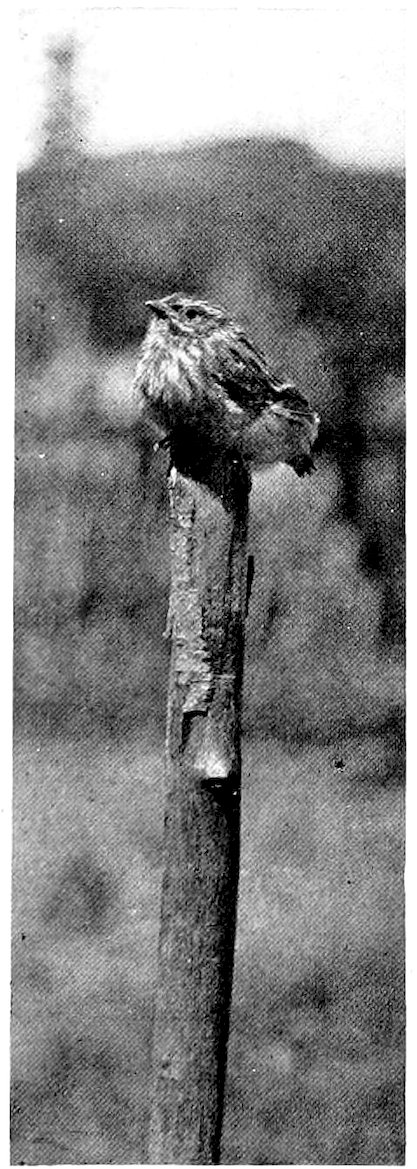
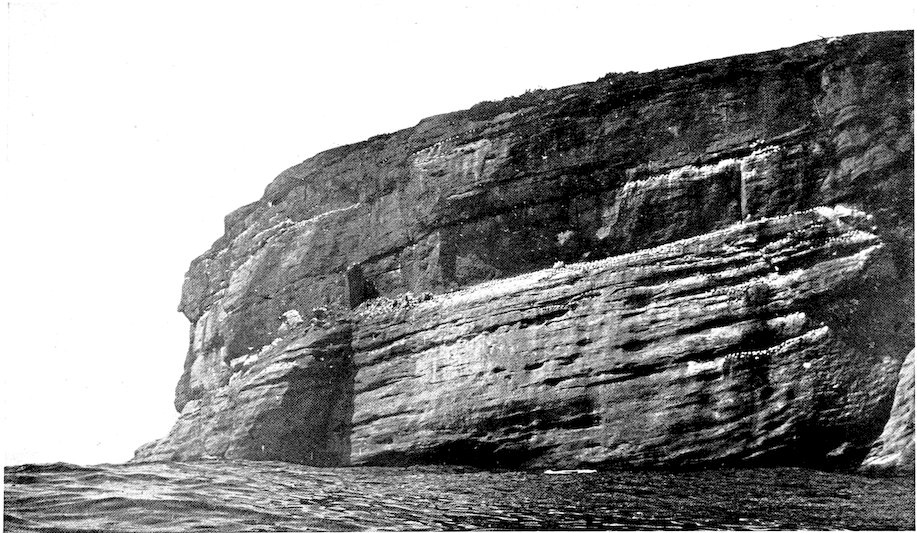
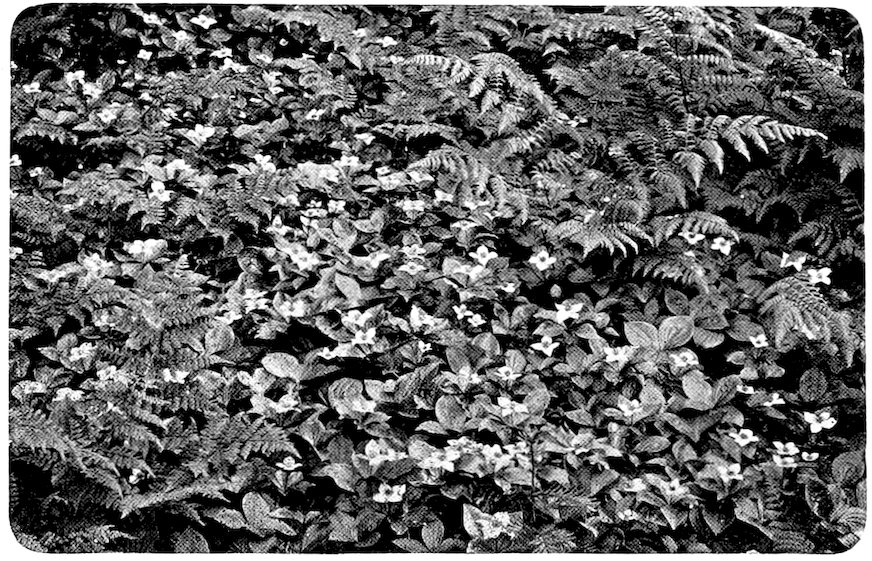
BIRD STUDIES WITH A CAMERA WITH INTRODUCTORY CHAPTERS ON THE OUTFIT AND METHODS OF THE BIRD PHOTOGRAPHER
Transcriber’s Note:
New original cover art included with this eBook is granted to the public domain.
BIRD STUDIES WITH A CAMERA
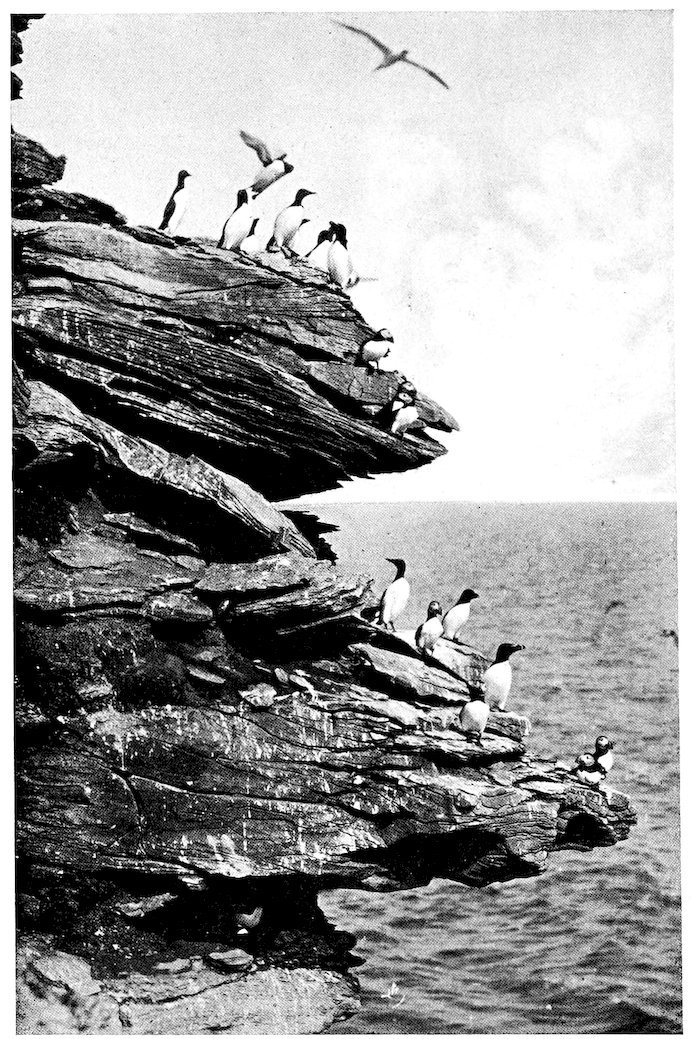
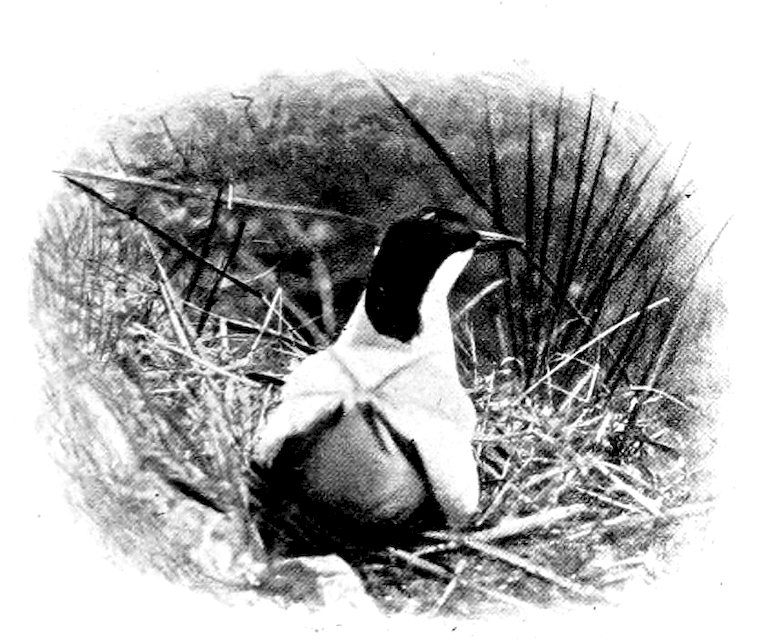
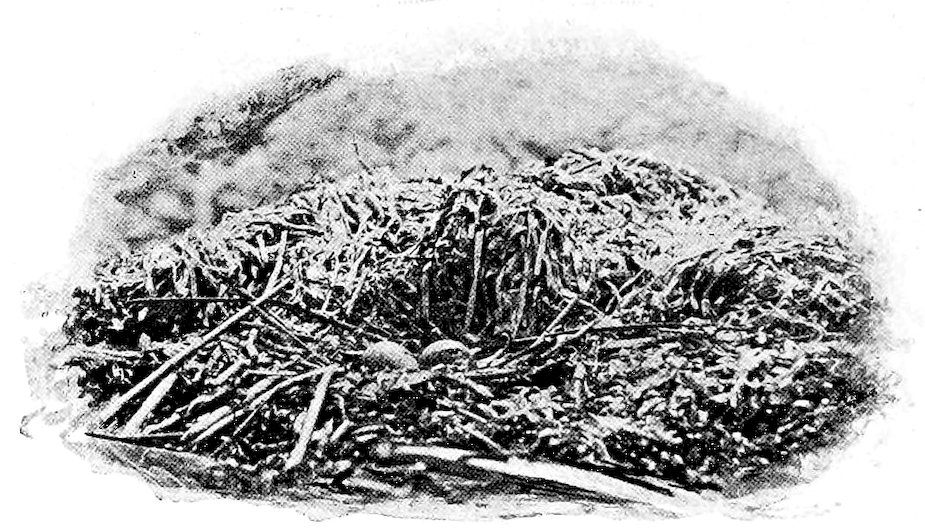
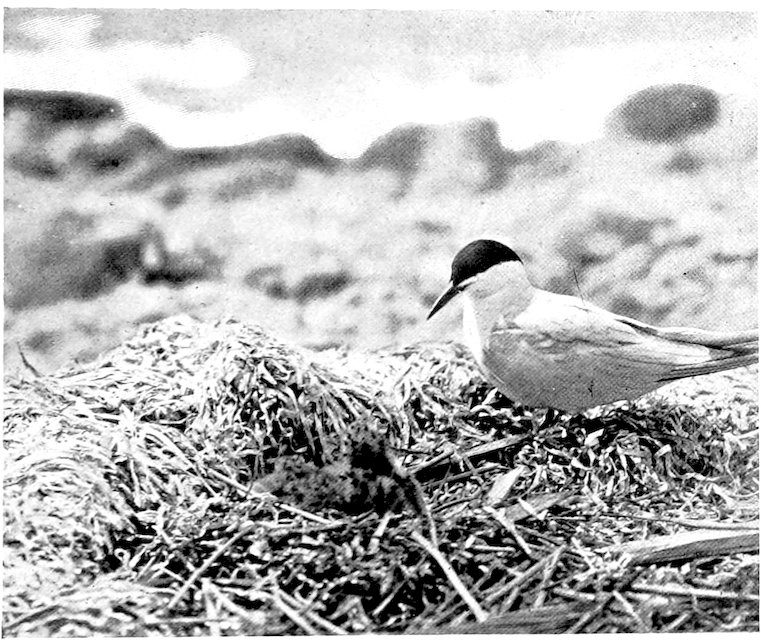
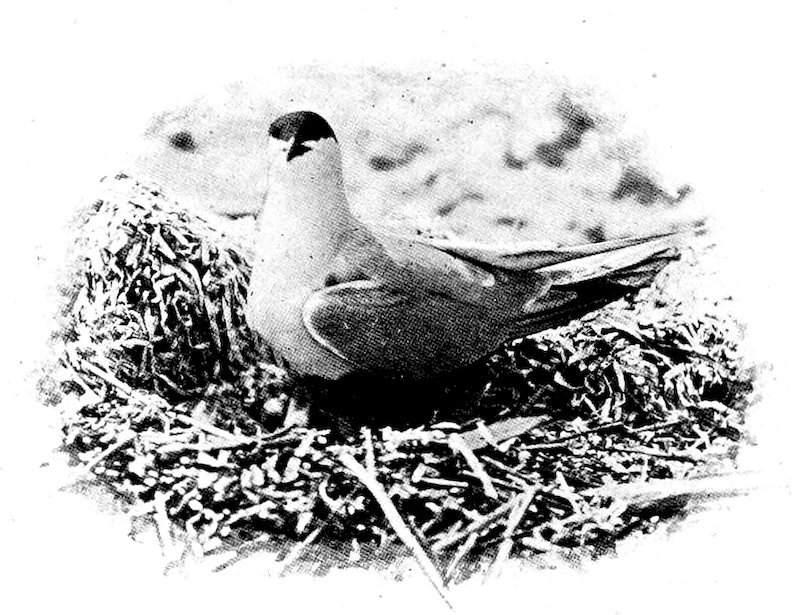
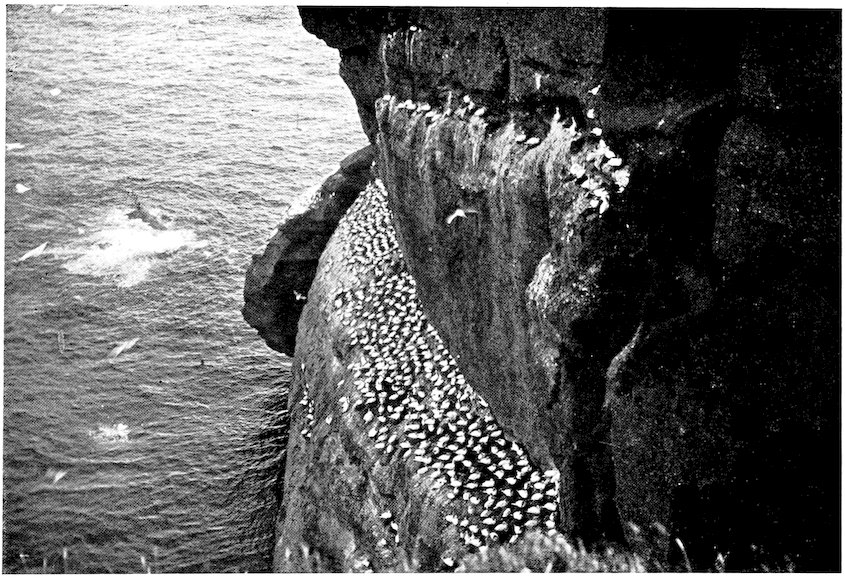
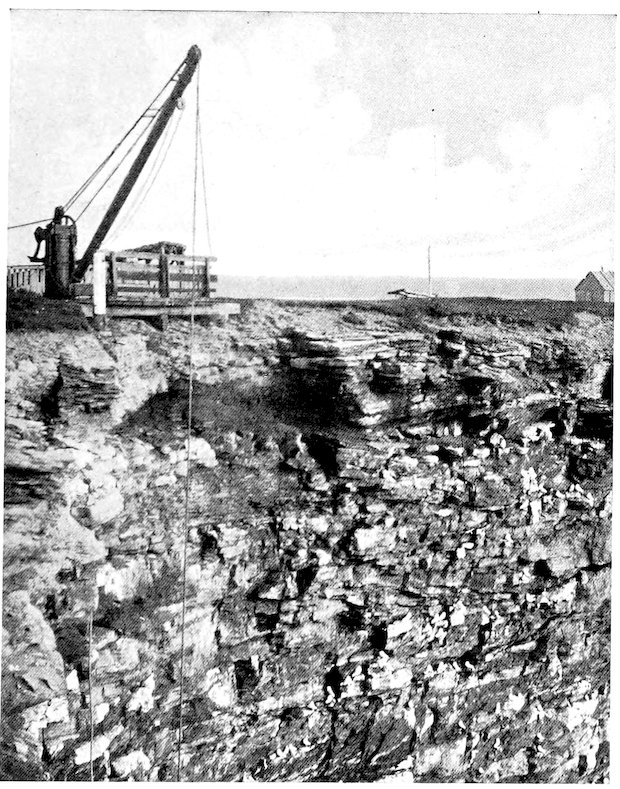
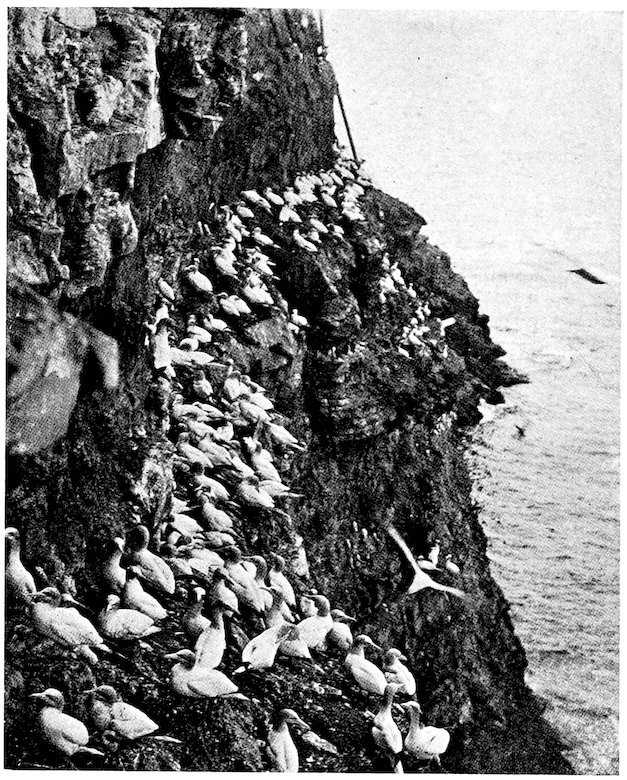
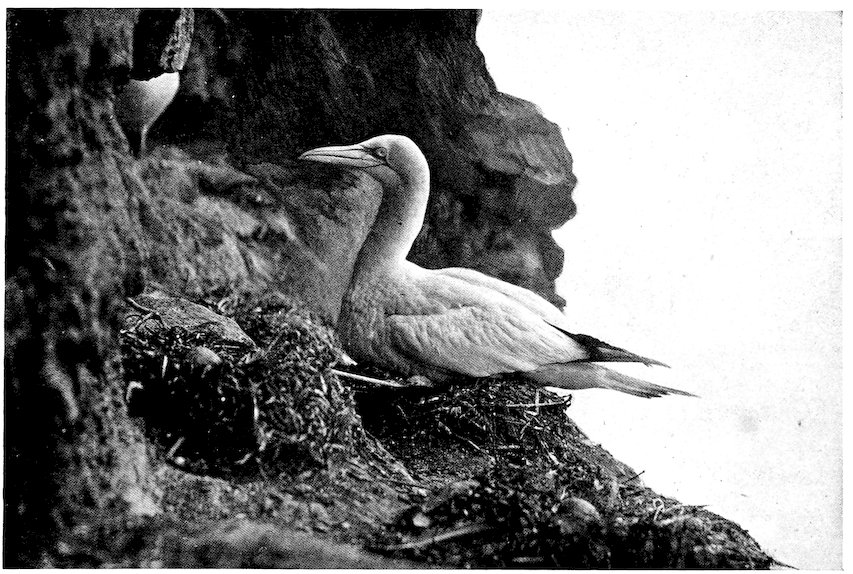
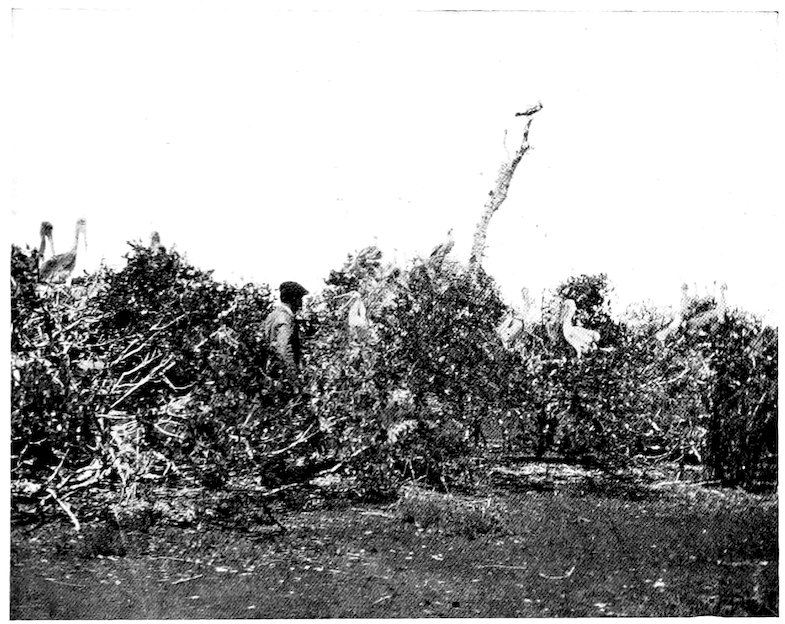
1. Gannet (flying over), Murres, Puffins, and Razorbilled Auks.
By FRANK M. CHAPMAN
ASSISTANT CURATOR OF VERTEBRATE ZOÖLOGY IN THE AMERICAN MUSEUM OF NATURAL HISTORY, AND AUTHOR OF HANDBOOK OF BIRDS OF EASTERN NORTH AMERICA, BIRD-LIFE, ETC.
WITH OVER ONE HUNDRED PHOTOGRAPHS FROM NATURE, BY THE AUTHOR
NEW YORK
D. APPLETON AND COMPANY
1900
Copyright, 1900,
By FRANK M. CHAPMAN.
All rights reserved.
THIS BOOK
IS DEDICATED TO
MY WIFE,
WHO, BOTH AT HOME AND AFIELD, IS EVER
“MY BEST ASSISTANT.”
You have learnt from the Birds and continue to learn,
Your best benefactors and early instructors.
Frere’sAristophanes.
PREFACE
vii
The practice of photographing birds in Nature
is of too recent origin in this country to permit of
its being treated authoritatively. The methods
which may be employed are so numerous, the field
to be covered so limitless, that many years must
elapse before the bird photographer’s outfit will
meet his wants, while the constantly varying details
which surround his subjects almost prohibit duplication
of experience.
But it is these very difficulties which render all
the more imperative the necessity of conference
among workers in this fascinating and important
branch of natural history. The causes of both
success and failure should, through the medium of
books and journals, be made accessible to all, thereby
shortening this experimental stage of the study
of birds with a camera, and hastening the day when
the nature of the outfit and methods shall have been
settled with more or less definiteness.
It is as a contribution toward this end, and as a
means of answering the queries of numerous correspondents,
that the following pages, embodying the
results of my own experiences, are offered. It is
sincerely hoped that they may increase the interest
viiiin the study of birds in Nature, and at the same
time furnish a more profitable and delightful outlet
for the hunting instinct than is afforded by the
shotgun or rifle.
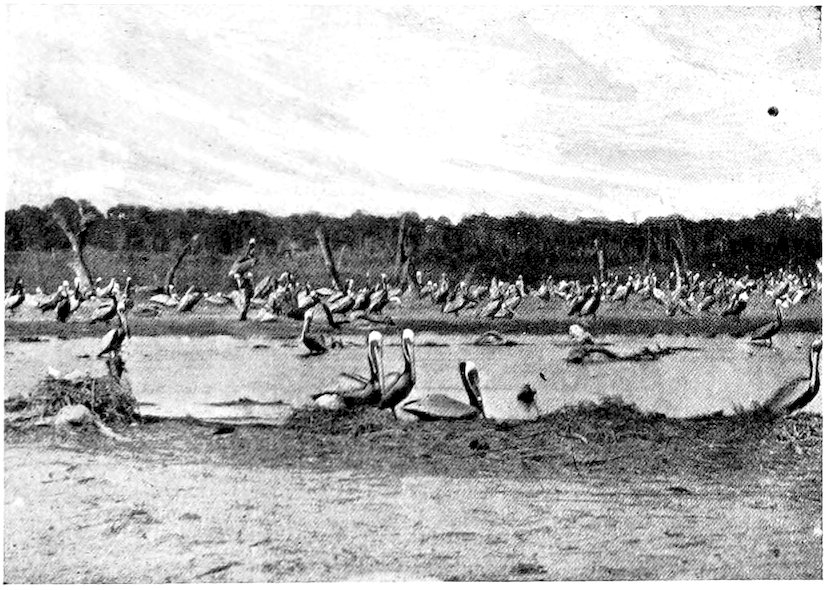
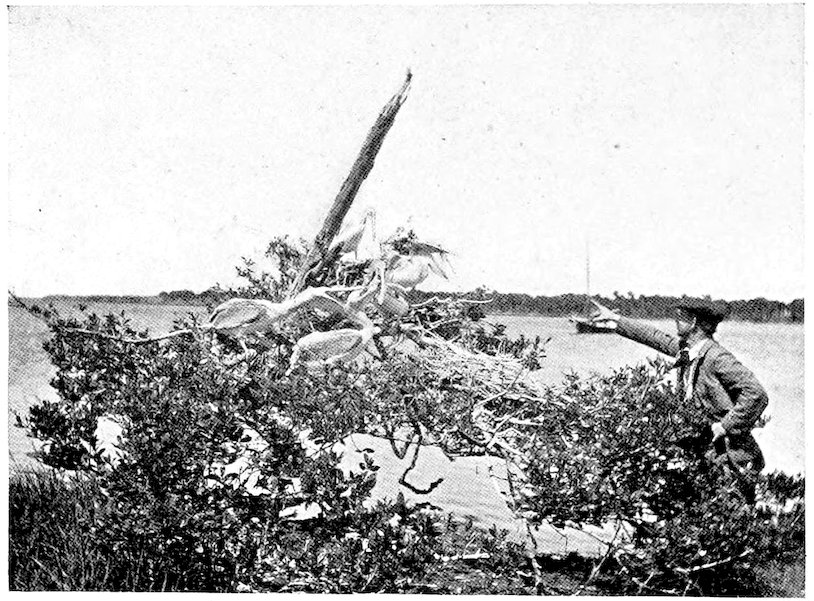
A large proportion of the Bird Rock pictures and
several of those from Pelican Island have appeared
in the Century and St. Nicholas respectively, and
are here reproduced by the courtesy of the editors
of those magazines; others have been previously
published in Bird-Lore.
WITH INTRODUCTORY CHAPTERS ON THE OUTFIT AND METHODS OF THE BIRD PHOTOGRAPHER
1
What is Bird Photography?—Bird photography,
as I would encourage its practice, does not mean
simply photographing birds; it means the use of
the camera as an aid in depicting the life histories
of birds. A picture of the bird itself is, of course, of
the first importance, but any fact in its biography
which the camera can be employed to portray is
within the province of bird photography.
The Scientific Value of Bird Photography.—There
are certain matters, such as a bird’s song, its time of
migration, etc., which must be set forth with the
pen; there are others, such as its haunts, nesting
site, nest, eggs, the appearance and development of
its young, where the camera is so far ahead of the
pen in its power of graphic representation that it
is a waste of time to use the former when circumstances
permit the utilization of the latter.
A photograph of a marsh or wood showing the
favorite haunts of a species is worth more than
pages of description. A picture of a bird’s nesting
site conveys a better idea of the situation than
words can possibly give, while in place of such
vague phrases as “nest of coarse grasses, weed
2stalks, rootlets, etc., lined with finer materials,” we
have a faithful delineation of the nest itself. The
shape and pattern of markings of the eggs may also
be well shown with the camera, while the appearance
of the young at birth, their development, and
often the manner in which they are fed, may all be
portrayed by the camera with a realism which convinces
one of the truthfulness of the result.
By the exercise of much patience and ingenuity
we may also photograph the adult bird, showing it
at rest or in motion, brooding its eggs or caring for
its young. Under favorable conditions such pictures
may possess an exactness of detail which
makes them perfect representations of the original,
giving not alone position and expression, but the
arrangement of the feathers, and they then have
scientific value unequaled by the best productions
of the artist’s brush or pencil.
From the nature of the case, perfection in this
branch of bird photography is not always attained;
nevertheless, even pictures which are failures from
a photographic standpoint may be of interest to
the naturalist. They may be lacking in detail and
still give pose, thus furnishing models from which
drawings containing all structural essentials may
be made.
The camera may also supply us with graphic
records of the few large colonies of birds yet existing
in this country, thereby preserving for all time
definite impressions of conditions which are rapidly
becoming things of the past.
What an invaluable addition to the history of
the Great Auk would be a series of photographs
3from Funk Island, taken during the period of its
existence there!
Of what surpassing interest would be photographs
of the former flights of Wild Pigeons, which
the younger generations of to-day can with difficulty
believe occurred!
The Charm of Bird Photography.—As a onetime
sportsman, who yielded to none in his enjoyment
of the chase, I can affirm that there is a fascination
about the hunting of wild animals with a
camera as far ahead of the pleasure to be derived
from their pursuit with shotgun or rifle as the sport
found in shooting Quail is beyond that of breaking
clay “Pigeons”. Continuing the comparison, from a
sportsman’s standpoint, hunting with a camera is
the highest development of man’s inherent love of
the chase.
The killing of a bird with a gun seems little
short of murder after one has attempted to capture
its image with a lens. The demands on the
skill and patience of the bird photographer are endless,
and his pleasure is intensified in proportion
to the nature of the difficulties to be overcome, and
in the event of success it is perpetuated by the infinitely
more satisfactory results obtained. He does
not rejoice over a bag of mutilated flesh and feathers,
but in the possession of a trophy—an eloquent
token of his prowess as a hunter, a talisman which
holds the power of revivifying the circumstances
attending its acquisition.
What mental vision of falling birds can be as
potent as the actual picture of living birds in their
homes? And how immeasurably one’s memories are
4brightened by the fact that this is not a picture of
what has been but of what is!
The camera thus opens the door to a field of sport
previously closed to those who love birds too much
to find pleasure in killing them; to whom Bob-White’s
ringing whistle does not give rise to murderous
speculations as to the number in his family,
but to an echo of the season’s joy which his note
voices. They therefore have a new incentive to take
them out of doors; for however much we love Nature
for Nature’s sake, there are few of us whose
pleasure in an outing is not intensified by securing
some definite, lasting result.
We are not all poets and seers, finding sufficient
reward for a hard day’s tramp in a sunset glow or
the song of a bird. Enjoy these things as we may,
who would not like to perpetuate the one or the
other in some tangible form?
And here we have one of the reasons for the collecting
of birds and eggs long after the collector’s
needs are satisfied. He goes on duplicating and
reduplicating merely to appease the almost universal
desire to possess any admired although useless
object. Once let him appreciate, however, the pleasure
of hunting with a camera, the greater skill required,
and the infinitely greater value of the results
to be obtained, and he will have no further use for
gun, climbing irons, and egg drill.
Furthermore, the camera hunter possesses the advantage
over the so-called true sportsman, in that all
is game that falls to his gun; there is not a bird too
small or too tame to be unworthy of his attention;
nor are there seasonal restrictions to be observed,
5nor temptations to break game laws, but every day
in the year he is free to go afield, and at all times
he may find something to claim his attention.
Finally, there is to be added to the special charm
of bird photography the general charm attending
the use of the camera. Thousands of people are
finding pleasure in the comparatively prosaic employment
of photographing houses, bridges, and
other patiently immovable objects wholly at the
camerist’s mercy. Imagine, then, the far greater
enjoyment of successes not only of real value in
themselves, but undeniable tributes to one’s skill
both as photographer and hunter.
Nor should this introduction be closed without
due acknowledgment to the educational value of
photography, to its power to widen the scope of our
vision, and to increase our appreciation of the beautiful.
There is a magic in the lens, the ground glass,
and the dark-cloth which transform the commonest
object into a thing of rarest interest.
THE OUTFIT AND METHODS OF THE BIRD PHOTOGRAPHER — THE BIRD PHOTOGRAPHER’S OUTFIT
6
The beginner must not suppose that
good bird photographs can be
made only with expensive apparatus.
Under favorable conditions
there is no great difference in the
results secured with the ordinary
camera and lens of any reputable
maker and those of the highest class. My own
work has for the greater part been done with an
outfit costing about thirty dollars; and although
the best lens is, of course, to be desired it is not a
necessity, and cost therefore is no more an obstacle
to the hunting of birds with a camera than it is
to their pursuit with a gun.
The Camera.—Individual taste will doubtless
govern the size of the camera chosen, but most naturalists
and sportsmen consider the camera carrying a
plate four by five inches as the one best adapted to
their wants, and with this decision I heartily agree.
The advantages of size, weight, and economy, both
as regards the camera, its holders, and plates, are all
in favor of the 4 × 5, while as far as the bird photographer
is concerned, it is not often that he has
need of anything larger. The image of a bird will
rarely be without adequate setting in a space four
7by five inches, which will also be found to be large
enough for the portrayal of nests and eggs.
The 4 × 5 also reduces proportionately in making
lantern slides, and if the picture is made the long
way of the plate—that is, higher than broad—it can
be easily adapted for illustrative purposes in duodecimo
or octavo books. When a larger picture is
desired it can readily be made by enlargement, an
increase in size of three diameters, or six times the
area, being possible from a sharp negative without
undue loss of definition.
For use from a tripod any one of the several excellent
long-focus cameras now on the market will
be found to answer every requirement. If it is proposed
to employ a telephoto lens, care should be
taken to select the camera combining greatest bellows
length with rigidity. A reversible back increases
the size somewhat but adds to the length of
bellows, and will be found serviceable in the many
awkward situations in which the bird photographer
is often placed by the nature of his subjects.
The Kearton brothers have an “adjustable miniature”
on the top of their camera, which they state
“is used as a sort of view finder when making studies
of flying birds. When fixed in position and its
focus has been set exactly like its working companion
beneath it, both are racked out in the same
ratio by the screw dominating the larger apparatus.”[A]
The purposes of this attachment, however,
8will, it seems probable, be better served by the reflecting
camera described below, while as a finder
alone its place may be taken by the “iconoscope”
and other of the prism finders, the brilliant image
cast by which is such a striking and satisfactory
improvement on the hazy outlines given by the
average so-called “finder.”
A. From Wild Life at Home, how to Study and Photograph It,
by R. Kearton, illustrated by C. Kearton; a work of the utmost
interest to the animal photographer, who should also read With
Nature and a Camera, by the same authors (Cassell & Co.).
For use as a hand-box only two kinds of camera
are available, for it must be borne in mind that
the set-focus or short-focus, wide angle “snap-shot”
cameras, so popular among the button-pressing fraternity,
are not adapted to the wants of the bird
photographer, who must therefore avail himself of
either a twin-lens or a reflecting camera.
Twin-lens cameras are manufactured by several
well-known firms, but the trade size is of too short
focus to be desirable. In this type of camera two
lenses of equal foci are employed. They are set one
above the other in bellows, which move as one. The
lower lens makes the picture, the upper projects a
duplicate of the image cast by the lower lens to a
mirror set at an angle of forty-five degrees to the
plane of the plate, whence it is reflected upward to
a ground glass, which is protected by a hood, on top
of the camera.
To focus perfectly the lenses should be “matched”
or “paired”—in short, interchangeable—thereby
greatly increasing the cost of the camera, which is
also rendered objectionable by its large size.
The reflecting camera possesses all the advantages
of the twin-lens, but requires only one lens,
and when in use is not materially larger than the
ordinary 4 × 5 long-focus box.
9The reflecting camera now in my possession was
designed and made by John Rowley, of the American
Museum of Natural History, and was fully described
and illustrated by him in Bird-Lore for
April, 1900. It resembles the upper half of the twin-lens
camera in that a mirror, set at an angle of
forty-five degrees to the plate, is interposed between
the latter and the lens, and reflects its image to a
ground glass on top of the camera. This mirror,
however, is movable, and the desired object appearing
in focus on the ground glass, a lever is pressed
downward which raises the mirror to the top of the
box, where it automatically releases a focal-plane
shutter (see beyond, under The Shutter) directly in
front of the plate, when the image-bearing rays, before
intercepted and reflected by the mirror, are
registered on the plate, from which the slide had
previously been drawn.
When the focal-plane or curtain shutter has been
set and the slide drawn from the plate holder, this
camera is like a cocked gun, which may be fired the
moment it is sighted; or, in other words, the exposure
may be made the instant focus is secured.
With this camera one may take advantage of any
offering opportunity to secure a picture of a bird
or beast when afield, and this fact, by increasing
the possibilities of an outing, adds greatly to its
pleasure.
Mr. Rowley has so designed this camera that it
may be used from a tripod as well as in the hands;
but when the tripod camera is to be left, perhaps
for hours, hidden near some bird’s nest, I prefer to
employ the long-focus for this purpose, and retain
10the reflecting camera for possible use on the birds
that so often approach closely when one is in hiding.
The advantages possessed by this camera are so apparent
that it doubtless will soon be placed on the
market.
The Lens.—Professional photographers differ so
widely in their opinions of the relative qualities of
the various makes of lenses now on the market, that
I approach this subject with diffidence, and, without
presuming to offer advice, present the results of my
experience both as to lenses and the requirements of
the bird photographer. In regard to the latter phase
of the much-discussed question of “What lens shall
I use?” I may speak with more confidence. For
nests with eggs or young birds—subjects which may
be approached closely—a six- to eight-inch-focus lens
forms a large enough image, and at the same time
gives depth of focus and sharpness of definition
without the use of the smaller diaphragms. In photographing
birds, however, it is generally difficult
to get within “shooting” distance, and at least a
fourteen- to sixteen-inch lens is needed in order to
secure an image of sufficient size. Depth of focus
is here, in my opinion, not desirable, and the focal
point—the bird—is brought out more clearly by the
fusion of all the objects back of it into a uniform
background.
When a bird, either young or old, is the subject,
great speed may be required, and sometimes under
light conditions which severely test the qualities of
the lens. To fully meet these demands of distance
and time two lenses would be needed; but, aside
from the increased cost and the inconvenience of
11using two lenses, the great size and weight of a
long-focus lens are drawbacks. These objections are
largely overcome by the use of the symmetrical
lenses placed in most of the long-focus boxes, or, if
expense be not considered, by a “convertible” lens.
For several years I have used a “Victor” lens,
sold with the “Premo” long-focus camera. The
combined focus of the front and back lenses is seven
and a half inches, of either of the lenses alone, fifteen
inches. The single lens therefore, the distance
being the same, gives an image double the size of
that cast by the two lenses together.
This lens has been thoroughly tested, and many
of the pictures given in this book were made with it.
When the conditions are favorable and the subject
not extremely difficult it yields satisfactory results.
The “convertible” lenses of various makers are
also separable, and where the rear and front lenses
are of different foci three focal lengths are obtainable.
These lenses are of the highest grade, and
consequently expensive. In a bright light, or where
great speed is not required, they do not seem to be
as superior to the trade lens as the much higher
price would lead one to expect. But in dull days, or
in the shadow, or where extremely rapid exposures
are necessary, their superior qualities become evident.
My experience with these convertible lenses
has been limited to the Zeiss Anastigmat, Series
VII a, of which I am now using a No. 10 with a
combined focus of eight inches, the front and rear
lenses both having a focal length of fourteen inches.
This combination is preferred to one in which the
component lenses are of different foci, because of the
12greater speed of the two when combined, and furthermore,
because, being of the same focus, they
could, if occasion arose, be used in a twin-lens box.
The speed of the combination is registered at F. 6.3;
that of the single lenses at 12.5. With the former
the most rapid exposures can be made successfully,
while the latter are sufficiently fast to permit of
ordinary instantaneous work. This lens is stated
to cover a 5 × 8½ plate, and when in use on a 4 × 5
camera gives a high degree of illumination and perfect
definition.
The telephoto lens may be employed in certain
kinds of bird photography with not unsatisfactory
results. Its disadvantages are lack of speed, an exposure
of at least one half a second to a second being
required at F. 8 in bright sunlight, the necessity
of extreme care in focusing, and of absolute rigidity
of the camera at the time of making the exposure.
In short, the telephotographer needs more time,
both before and after pressing his bulb, than the
bird photographer is often accorded. However, with
such subjects as nests high in trees or on cliffs,
Herons and other shore-inhabiting birds, Ducks on
the water or Hawks perched in leafless trees, the
telephoto will be found serviceable.
Negatives are frequently secured in which the
figure of the bird, while small, is sharp, when, by
enlargement, a desirable picture can be made of
what in the original was too small to be easily distinguishable.
An increase in size of two diameters
is possible from any fairly sharp negative, but if the
object be in perfect focus an increase of four diameters
may be made.
13These enlargements may be made with an enlarging
camera or with the aid of a Nehring enlarging
lens, which is placed between the front and back
lenses of the view lens, when, with the ordinary
long-focus camera, a magnification of about four
diameters may be obtained, the image being thrown
on to a piece of bromide paper in the plate holder.
Through enlargement many apparently worthless
negatives become of value, and in some instances
pictures can be made from different parts of
the same negative. From the sportsman-photographer’s
standpoint there is, however, one objection
to the use of a magnifying lens. It gives deceptive
results, and those who are not familiar with its
powers are apt to accord the photographer undue
praise for his apparent skill in successfully approaching
some bird or beast which may have been
far out of range. A not wholly unrelated kind of
enlargement is sometimes applied to the contents of
creels and game bags!
But the animal photographer is so heavily handicapped
that in this case the end assuredly justifies
the means. As a matter of information, however, it
seems eminently desirable to accompany all enlarged
pictures by a statement of the extent of their magnification,
and throughout this book this plan is followed.
Consequently, when there is no mention of
enlargement, it may be accepted as a fact that the
print from which the reproduction was made was
obtained from the negative by contact.
In illustration of these suggestions in regard to
the proper lenses for bird photography, a series of
pictures is presented which shows the results to be
14obtained under the same conditions with different
lenses.
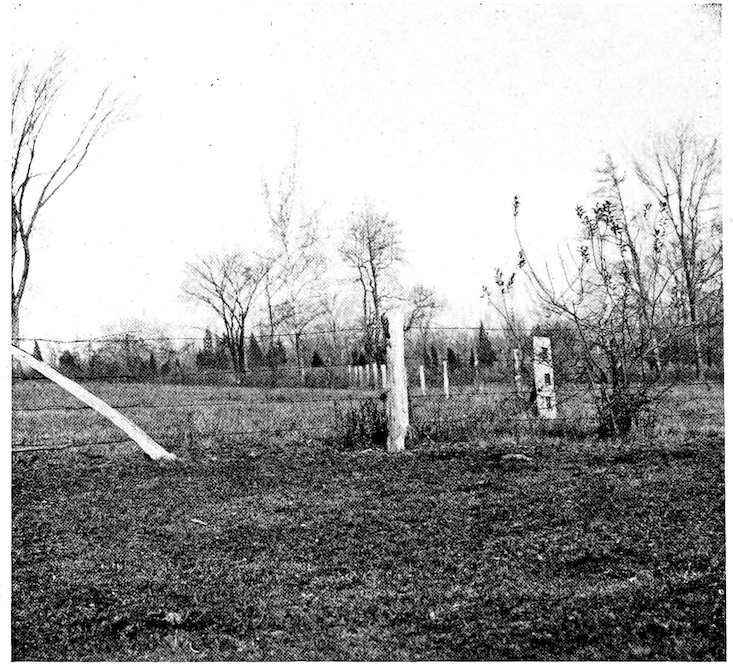
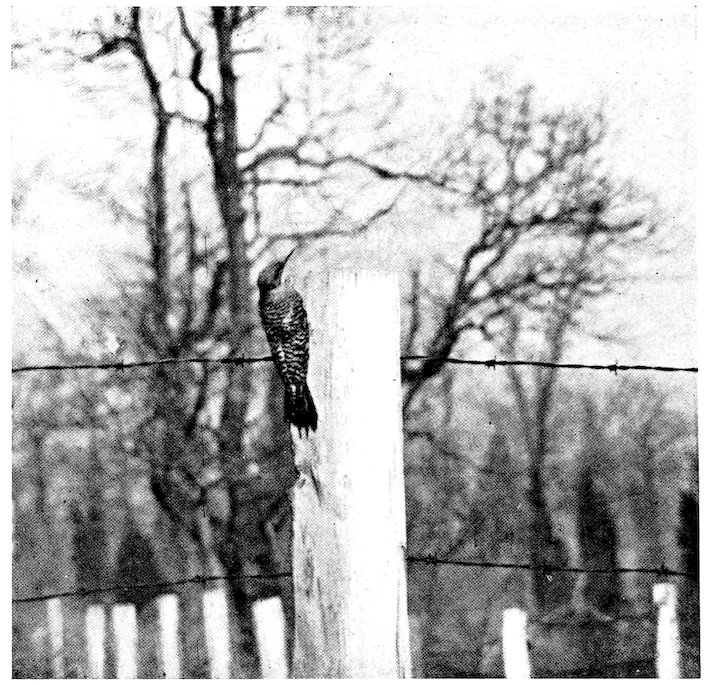
2. Lens Test No. 1. Mounted Flicker on fence post, distance fifty feet. Eight-inch focus, Zeiss Convertible, No. 10, Series VII a lens; diaphragm F. 8, ¹⁄₂₅ second; Cramer “Crown” plate. Photographed at noon, in sunlight, November 30, 1899.
15
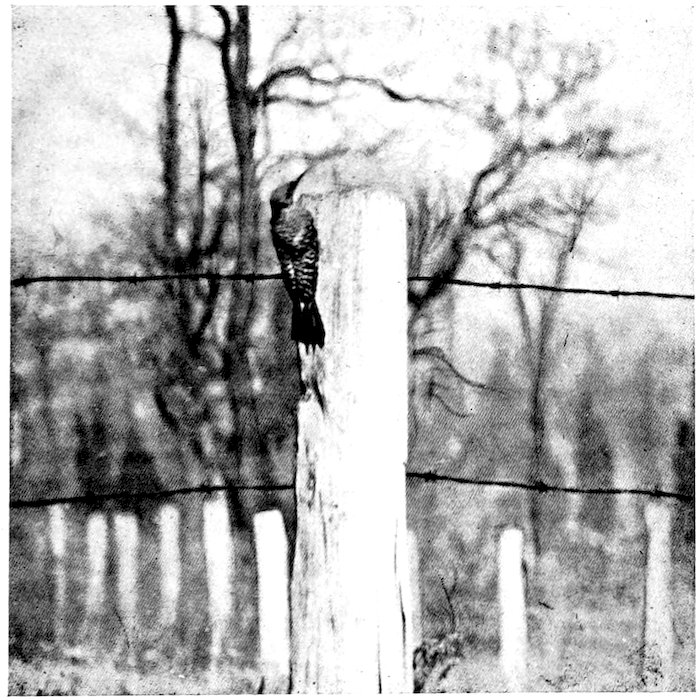
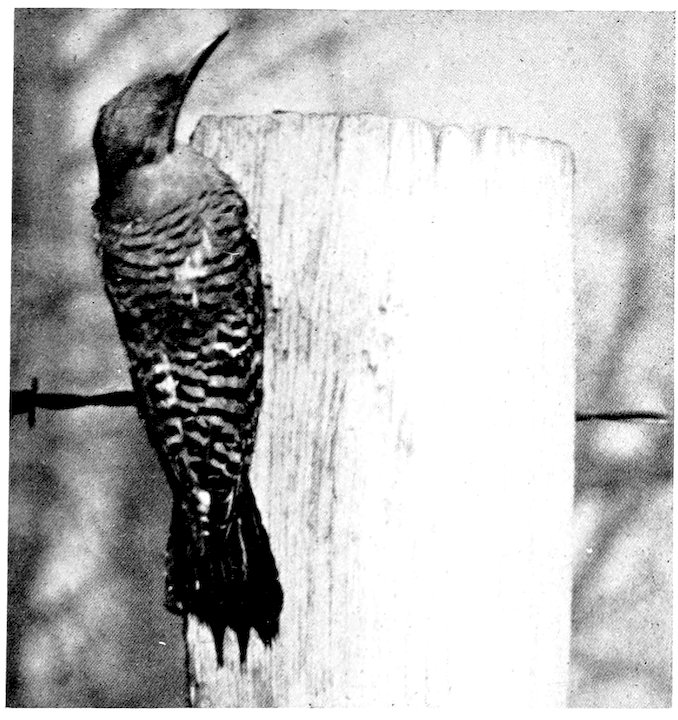
3. The bird in Test No. 1 enlarged about three diameters.
Placing a mounted Flicker (Colaptes auratus) on
a fence post, and setting up my tripod at a measured
distance of fifty feet, a series of test exposures was
made, of which three are presented as follows: First,2
eight-inch lens (Zeiss Convertible Series VII a, No.
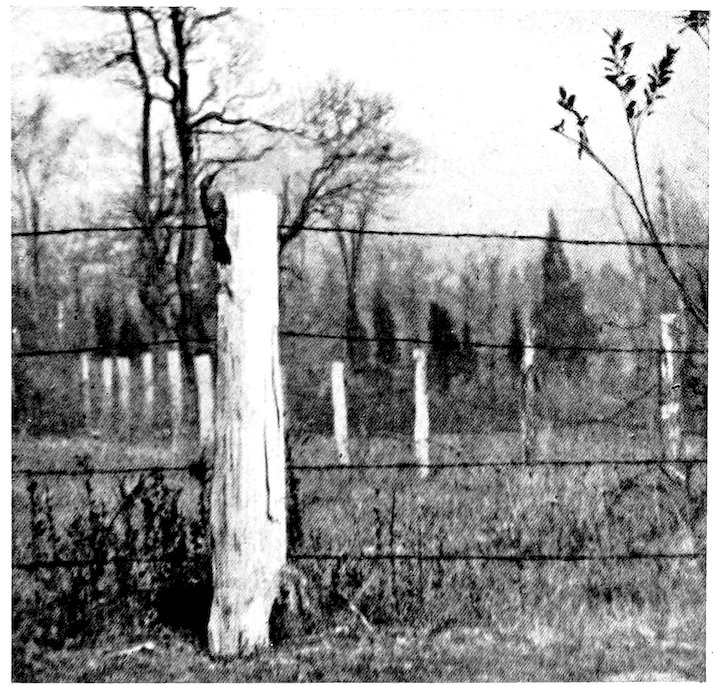
10), stop F. 8, time ¹⁄₂₅ second; second,4 fourteen-inch
front lens of the combination, stop F. 16 (equivalent
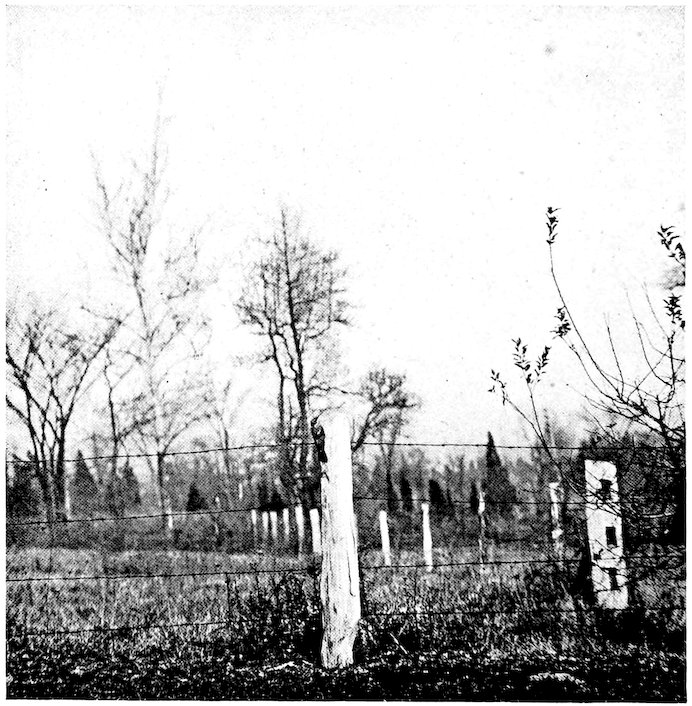
to F. 4 of the eight-inch); third,6 telephoto attachment
with eight-inch lens, twenty-one-inch bellows,
stop F. 8 of the eight-inch, time one second. Commenting
on the results of these tests it may first be
mentioned that in the “Unicum” shutter employed
exposures of a so-called “¹⁄₁₀₀” and “¹⁄₂₅” seconds gave
exactly the same results both with the combined
eight-inch lens and the front fourteen-inch lens; the
actual time, however, was doubtless not far from ¹⁄₂₅
of a second. The negatives, therefore, show, in the
first place, that the long-focus lens is capable of
doing fairly rapid work. Continuing our comparison,
16we observe that the eight-inch gives a fairly
wide field, excellent depth of focus, but a very small
image of the bird, for which alone the picture has
been made. With the fourteen-inch we decrease the
extent of the field nearly one half and almost double
the size of the object pictured. This, however, has
been done at the loss of depth of focus, not even the
first of the line of posts running directly into the
background being sharply defined, while with the
eight-inch all are in focus.
4. Lens Test No. 2. Same subject, distance, plate, and date as Test No. 1. Front lens (fourteen-inch focus) of Zeiss Convertible, No. 10; diaphragm F. 16; ¹⁄₂₅ second.
17
5. The bird in Test No. 2 enlarged about three diameters.
The telephoto gives an enlargement of about six
diameters of the image thrown by eight-inch lens,
and three diameters increase of that of the fourteen-inch
lens. It practically restricts the picture to the
immediate surroundings of the bird, and is without
focal depth.
18
6. Lens Test No. 3. Same subject, distance, plate, and date as Tests Nos. 2 and 3. Eight-inch Zeiss Convertible, Series VII a, No. 10, with telephoto attachment; diaphragm F. 8; twenty-one-inch bellows; one second (½ second was later found to be full time).
Having now made three good negatives in the
field, we may, by enlargement, improve on the image
of the bird obtained. The possibilities in this direction
are clearly shown by the three enlargements
accompanying the contact prints from their respective
negatives. In each instance the enlargement is
about three diameters, and the telephoto negative
of course furnishes the most satisfactory picture.
When the difficulties of telephotography are considered,
however, and the ¹⁄₂₅-second exposure of the
fourteen-inch lens, which permits of hand work, is
compared with the one second of the telephoto, we
believe that for general work in photographing
19birds a lens having a focal length of at least fourteen
inches will be found the most satisfactory.
It should be added that, in order to make them
wholly comparable, the three contact prints as well
as the enlargements were made on enameled bromide
paper.
7. The bird in Test No. 3 enlarged about three diameters.
The Shutter.—For fairly rapid, slow, and time
exposures, a lens shutter, such as is sold with trade
cameras, will be found suitable. Simplicity and
noiselessness are the chief requirements in this kind
of a shutter. The “Iris Diaphragm” shutter is noiseless
20when used for slow exposures of two or three
seconds, a matter of much importance in making
time pictures of sitting birds, who are apt to turn
their head if they hear the click of the shutter. This
shutter, however, does not respond quickly in slow
exposures and is very heavy, a disadvantage in telephotography.
The “Unicum” shutter is lighter, responds quickly,
has a lever to which a thread may be attached
for making exposures from a distance, can be easily
diaphragmed from the rear, but is not wholly noiseless.
There are also other shutters, each possessing
good points of its own, and the selection of any one of
them for use in medium rapid, slow, or time work
can be left to the photographer, who should, however,
remember that the time scales on these shutters
represent degrees of difference and not exact measurements
of time, and that there is great variation
in the exposures of different shutters of the same
make when similarly adjusted. Thus the “one fifth
of a second” of one shutter may be equivalent to
the “one second” of another. The scale on most of
these shutters calls for a speed not exceeding a ¹⁄₁₀₀
part of a second, but this is far too slow an exposure
to successfully photograph a flying bird at short
range where a speed of at least ¹⁄₅₀₀ of a second is
required.
For very rapid work the choice is limited to one
kind of shutter—that is, the focal-plane, which in
effect is a curtain with an adjustable slit which is
placed directly in front of the plate. Great speed
with this shutter is in part secured by increasing
the tension of the spring, which acts as its motive
21power, but more particularly by decreasing the
width of the slit. Assuming, therefore, that it
takes one second for the slit to pass from top to bottom
of a plate four inches high, and that the slit is
one inch in width, it follows that each portion of
the plate is exposed to the light for a quarter of a
second. Decreasing the width of the slit one half,
proportionally reduces the time of the exposure,
and by this means, in connection with an increase in
the speed with which the curtain is moved, an exposure
of ¹⁄₁₀₀₀ of a second is possible.
In addition to possessing the advantage of great
speed, this shutter also passes a higher percentage of
light than a lens shutter even when the actual time
of the so-called exposure is the same. This is due
to the fact that the lens opening is in no way affected,
it being the same throughout the exposure.
With a lens shutter, on the contrary, the full value
of the opening is given for only a fractional part of
the exposure, the parts of the shutter more or less
filling the opening during the rest of the time.
With a focal-plane shutter, therefore, one may do
rapid work under conditions where a lens shutter
could not be successfully employed; time exposures,
however, can not be made with the focal-plane
shutter, and for all-around work the camera
should be fitted with both a lens and a focal-plane
shutter.
The reflecting camera, as before stated, is fitted
with a focal-plane shutter, and, as described, it is
released by pressing the lever, which raises the mirror.
Lens shutters, however, are released by a
pneumatic bulb, or in some cases by a thread or
22string. When the exposure is to be made from a
distance as much as one hundred feet of tubing may
be employed. With any length of over twenty-five
feet an extra large bulb is required. The ordinary
tubing sold by photographers will not be found so
well adapted to long-distance work as a less elastic
kind, which does not so readily yield to pressure and
transmits a larger portion of the force applied when
squeezing the bulb.
The Tripod.—A stout two-length tripod is to be
preferred to one of the slender multifolding type, in
which stability is sacrificed to weight and size. The
legs, except the inner sides of the upper section into
which the lower section slides, and brass work should
be painted bark color in order to make them as inconspicuous
as possible. For use in the water a
metal tripod will prove more serviceable than one
of wood.
A very useful substitute for a tripod is the
“Graphic” ball-and-socket clamp designed more
especially for bicycle camerists. With it a camera
can easily be attached to the limb of a tree, rung of
a ladder, or, by screwing a block on to the head of
the tripod, it may be employed in connection with
the tripod—in fact its applicability will be evident
to every one using it.
Plates.—Among the many excellent brands of
plates now offered to photographers there is really
very little difference. However, it is advisable to
select the one you think the most rapid and use it
to the exclusion of all others. Under certain circumstances—in
photographing Robins, for instance—isochromatic
plates will be found desirable, and
23where a strong head light can not be avoided nonhalation
plates may be employed.
So much industry, skill, and patience are generally
required of the bird photographer before he
makes an exposure that he should guard against all
chances of failure from the photographic side. It is
therefore advisable to thoroughly test plates which
it is probable may be exposed on a very difficult
subject. Under no circumstances should the plate
holders be needlessly exposed to the light, and when
the camera is to be left for an indefinite period with
the slide drawn from the holder and plate ready to
expose, it should be carefully wrapped in the dark-cloth.
Blinds.—As the sportsman constructs blinds in
which he may conceal himself from his prey, so the
bird photographer may employ various means of
hiding from his subjects. The Keartons recommend
an artificial tree trunk for use in wooded places and
an artificial rubbish heap for open fields. The former
may be made of light duck, painted to resemble
bark, and placed over a frame.
The frame of the Keartons’ is of bamboo, but I
find white pine answers very well, the main things
to be considered being lightness and portability.
The frame should therefore be collapsible in order
that it may be easily packed.
The Keartons’ field blind or “rubbish heap” consists
of an umbrella, to each of the ribs of which
strips of bamboo four feet in length are tied. This
is then covered with light brown holland and wisps
of straw tied over it in such a way as to “virtually
thatch the whole structure.” Doubtless cornstalks
24properly arranged would make an excellent field
blind.
It is difficult to carry one of these blinds in
addition to a camera, etc., without assistance, and
I fear that the inconvenience attending their use
will restrict them to the few enthusiasts who count
neither time, labor, nor cost in attaining a desired
end.
For my own part, I prefer, when possible, to conceal
my camera and make the exposure from a distance
rather than to weight myself with a portable
blind and to endure the discomforts of being confined
within it.
Sundries.—The bird photographer will find that
he requires numerous articles not usually to be found
in the regulation photographic outfit, as, for example,
climbers for ascending trees and stout cords for
hauling the camera up after him; a dark-cloth, green
in color, to aid in disguising the camera, and a mirror.
The latter should be of plate glass, and measure
at least twelve by ten inches. A good plan is to
buy a piece of glass of desired size and frame it simply
in white pine. It may then be attached to a
limb, a stick driven in the ground, or other convenient
object, by means of the ball-and-socket clamp
mentioned under Tripods, which may be screwed into
the back or the outer border of the frame. Such a
mirror will reflect sunlight many yards to shaded
nests, where, in photographing old or young birds, a
quick exposure is necessary. A vest-pocket mirror,
for use in reflecting the reading of the diaphragms
or time on the shutter, will permit one to make the
desired changes from the rear, and thus prove helpful
25when conditions do not permit one to work in
front of the camera.
A device which might be arranged on the principle
of a trap, the trigger to be sprung and exposure
made when the bait is taken, would doubtless capture
some interesting pictures. An apparatus connected
with an automatically fired flash-light, has
been employed by Mr. G. A. Shiras, of Pittsburg, in
photographing deer at night, with phenomenal success.
The connection with the camera shutter was
so made that the deer, in walking, touched a cord
which exploded the flash-light, and, at the same moment,
made the exposure. The light weight of most
birds, however, requires a much more delicate apparatus,
while an even greater difficulty is found in
the movement caused by the release of the trigger,
which startles the bird just as the exposure is
made.
Thus far in my experiments I have been unable
to overcome these objections, but I trust some other
bird photographer will be more successful.
Those who are ambitious in the direction of cliff
photography I would refer to the Keartons’ admirable
treatise on the subject in their Wild Life at
Home, for a description of the paraphernalia needed
and the manner in which it should be used. My
own experience in this line is limited, and I confess
to the utter absence of a desire to increase it!
THE METHODS OF THE BIRD PHOTOGRAPHER
26
Claiming no special knowledge of
the technique of pure photography,
I would refer the beginner to
any of the several excellent books
designed to explain the rudiments
of optical and chemical photography,
and to instruct in regard to
the matters of exposing, developing, printing, etc.
Only such suggestions are given here, therefore, as
relate directly to the manner in which birds, their
nests, eggs, and haunts may be photographed.
Haunts.—Photographs of the characteristic
haunts of birds should show not alone general topography,
but should also be made with special reference
to the bird’s feeding habits, which, more than
anything else, govern the nature of the locality
selected. Thus, a photograph of the home of the
Woodcock would have added value if, in the immediate
foreground, the “borings” made by this bird
in probing the earth for food were evident; or a
marsh scene, in which wild rice was conspicuous,
would tell something of both the haunts and the
food habits of the Reedbird and Red-winged Blackbird
in August and September. In a similar way,
pictures of wild cherry and dogwood trees, of bayberries
and red cedar, which show both fruit and
27surroundings, are of interest in connection with the
biographies of many birds.
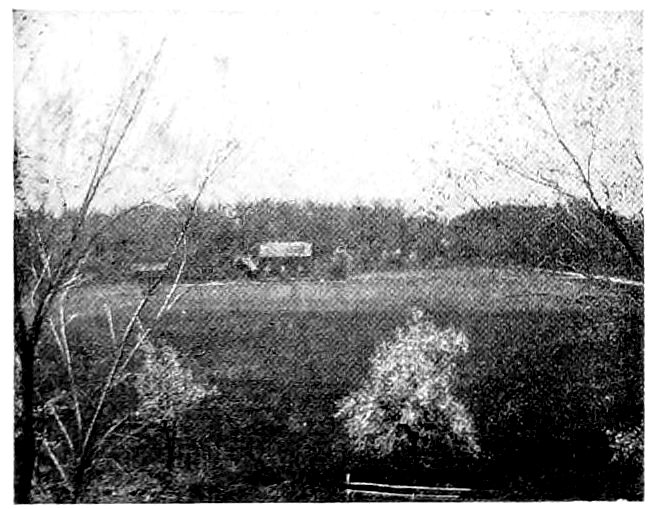
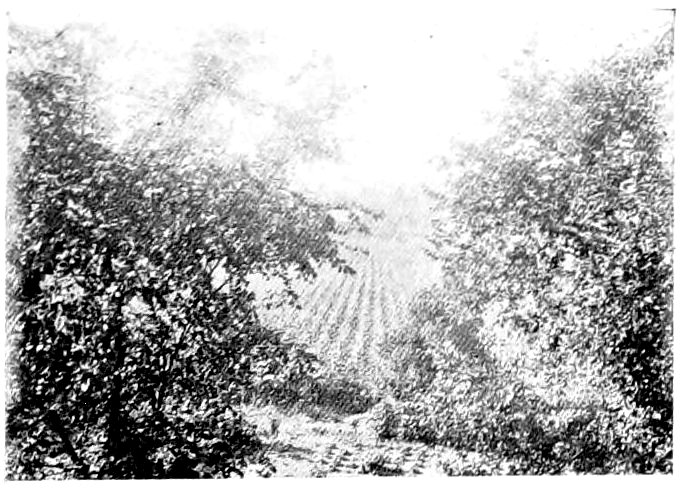
8. Spring.
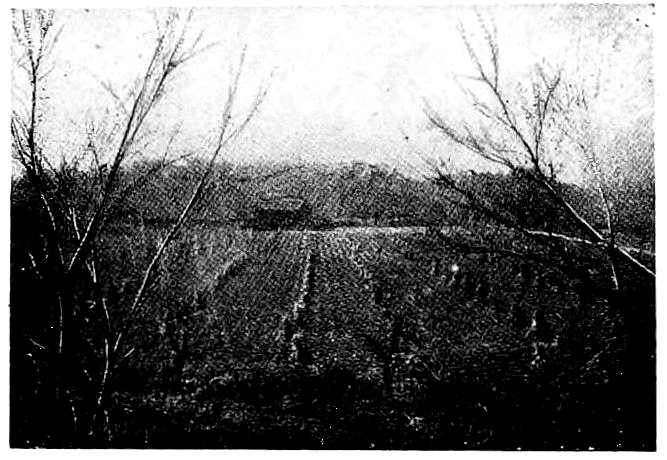
9. Summer.
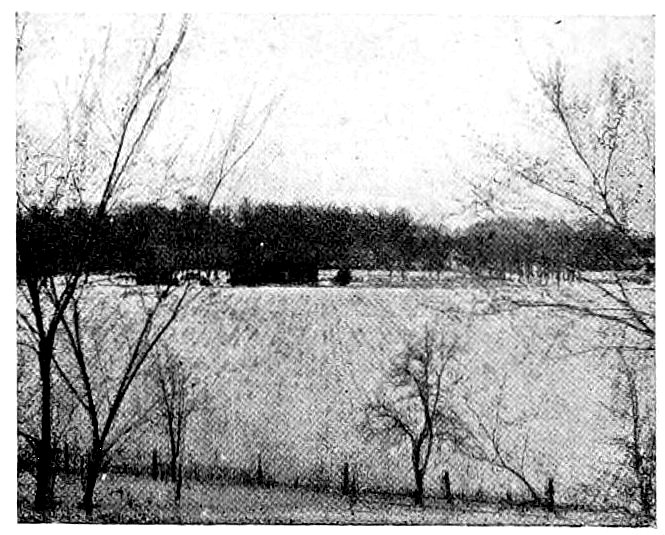
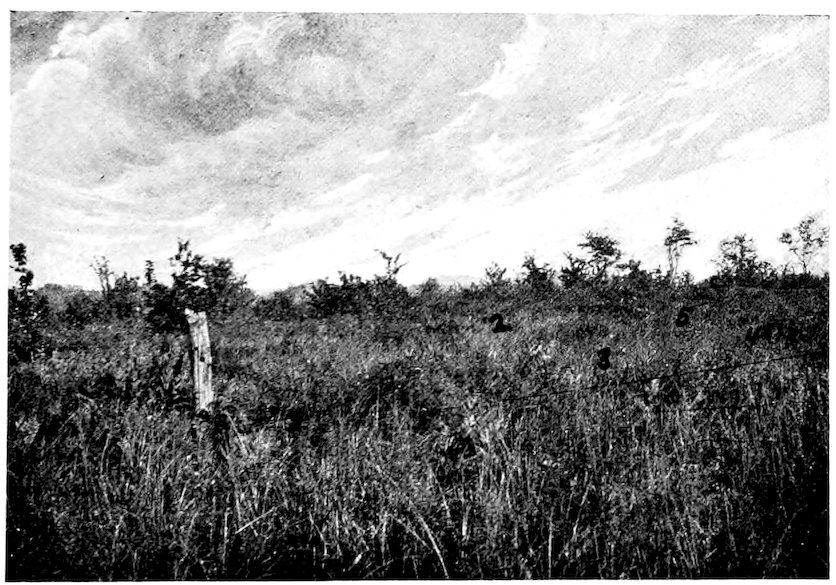
Seasons.—The camera permits us to make so exact
a record of the rise and fall of the year, as it is
registered by vegetation,
that we can actually
compare existing
conditions with those
which prevailed at any
previous time. Compare,
for example, the
series of four pictures8–11
here presented,
all made from the same
point of view, in order
to appreciate how graphically seasonal changes may
be shown by the camera. In this instance, photography
is of more service to the botanist than to the
ornithologist; but every student of migration knows
how closely related are
the appearance of certain
birds and flowers,
and will readily
appreciate, therefore,
the value of a series
of photographs of several
different subjects,
taken at short intervals,
and showing the
changes in vegetation due to the approach of summer
or winter. In connection with such related
phenomena as temperature, rainfall, and weather,
these pictures form as accurate a record of the seasons
28as it is possible to make, and if data of this
kind could be brought together from many selected
localities, we should have an admirable basis for the
intelligent study of certain phases of bird migration.
10. Autumn.
Nests and Eggs.—The
photographing of
nests is one of the simpler
forms of bird photography,
but in many
instances success is
achieved only through
the exercise of much
patience and ingenuity.
11. Winter.
It should constantly
be borne in mind, in photographing nests, that what
is desired is not so much a picture of the nest alone
as one which shows it in relation to its environment—in
short, a picture of the nesting site is of more
value than one of the
nest only. It is advisable,
however, to make
at least three pictures,
two12, 13 of which shall
show the nature of the
locality chosen, the
other14 the character
of the nest and its immediate
surroundings.
When the nest is not
above five feet from the ground, little difficulty will
be experienced in securing the desired picture.
When on the ground it will sometimes be found
helpful to put what naturally would be the rear
29leg of the tripod forward, between the other two,
when it will serve as a brace from in front, and permit
the camera to be tilted well downward without
danger of its falling.
Nests at an elevation of seven or eight feet, in
saplings, may be photographed by lengthening the
tripod with short legs, each supplied with two staples
or collars into which the ends of the tripod may
be slipped; or a ladder or light scaffolding will
sometimes be found necessary.
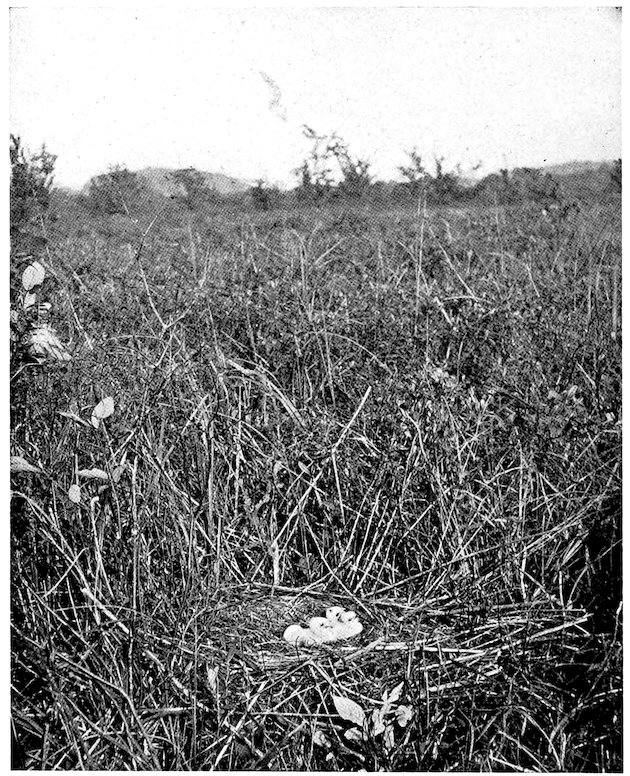
12. To show nest locality of: 1, Tree Swallow; 2, American Bittern; 3, Song Sparrow; 4, Maryland Yellow-throat; 5, Marsh Hawk, of which nesting site, nest, and young are shown in the two following pictures, Nos. 13 and 14. Meridian, N. Y., June 8, 1898.
For photographing nests in trees the “Graphic”
ball-and-socket clamp is of great assistance. With
it the camera may be attached to a limb, or, if the
limb is too large, a block may be nailed to it, thus
30furnishing a grip to which the clamp may be fastened.
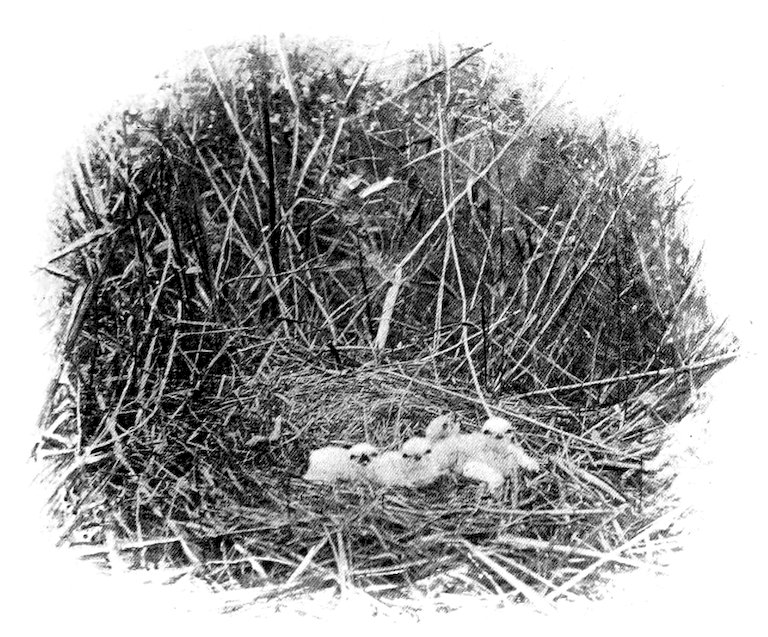
13. Nesting site, nest, and young of Marsh Hawk.
Nests should be photographed from the side, but
eggs should be photographed from above in order
to show their position in the nest as they were arranged
by the incubating bird. The nest should
31therefore never be tipped, nor should the eggs be
touched, lest the value of the subject be destroyed.
The markings of most birds’ eggs are already well
known, but if photographs of them are desired they
can be made from the thousands of eggshells with
which ill-directed effort has stocked the cabinets of
misguided oölogists.
14. Young Marsh Hawks and nest.
It is not advisable to make photographs of nests
in the sunlight, a diffused light giving greater detail.
A screen of some thin white material should
therefore be used as a shade when photographing
nests exposed to the direct rays of the sun. This,
however, will not be found necessary if the picture
be made within two or three hours after sunrise,
32when the light is soft and the foliage comparatively
motionless, permitting the use of a small diaphragm
and a long exposure.
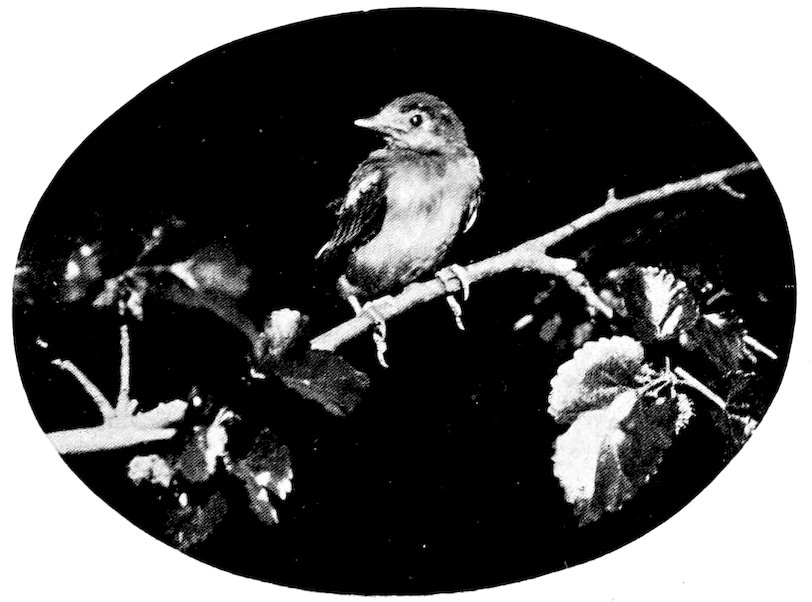
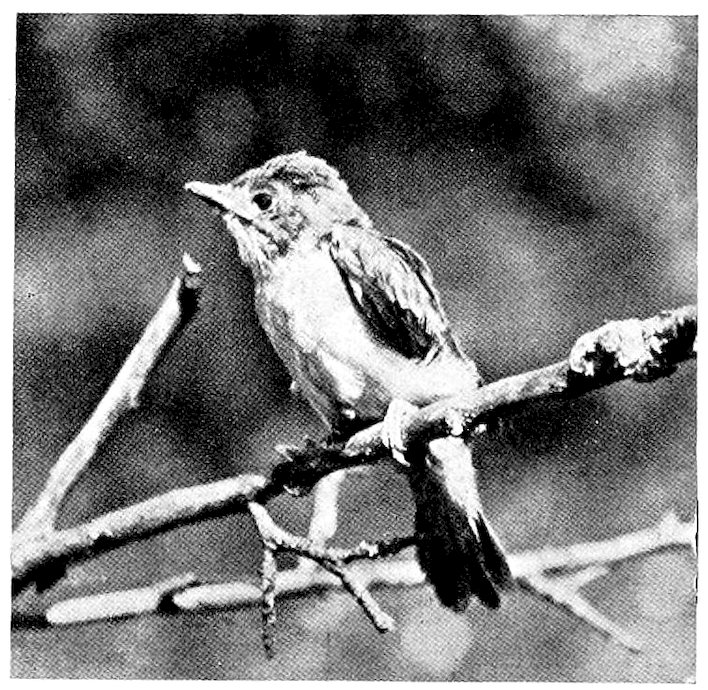
15. Young Great-crested Flycatcher.
Young Birds.—The ease with which photographs
of young birds may often be secured, the fact that
with the camera their appearance and development
may be more satisfactorily recorded than in any
other way, makes their study by the photographer
of exceeding importance. Photographs of young
birds should of
course be accompanied
by notes on
food, calls, special
actions, etc., which
the camera can not
well portray.
The young bird
is a worthy subject
from the moment
it leaves the shell
until, as far as
flight is concerned,
it deserves to be
ranked with its elders. When possible, series of
pictures should be made showing the rate of growth
of the same brood from the period of hatching to
the date when the nest is deserted. Circumstances
do not, however, often permit of the forming of
these ideal series, and we must therefore photograph
the young bird as we find him, either before or
after15 he has made his initial flight, or as he is
preparing for it.16
The suggestions made under the head of Birds’
33Nests and Eggs will apply in a general way to photographing
young in the nest; but even when at
rest in other respects, the rapid respiration of nestlings
requires a quick exposure to insure sharpness
of outline, and, when in the shadow, sufficient illumination
can be secured only with the aid of a
reflector.
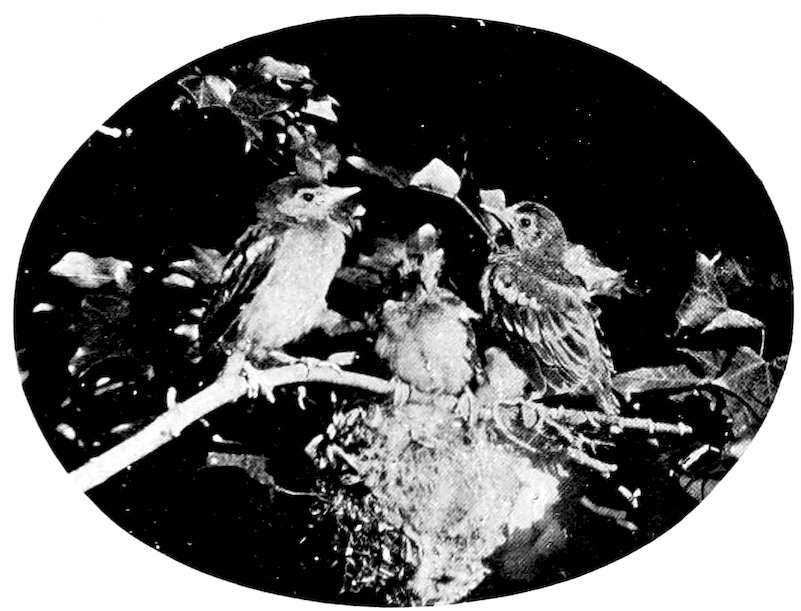
16. Young Baltimore Orioles and nest.
Adult Birds.—It is in photographing birds in the
full possession of the powers of maturity that the
bird photographer’s skill and patience are put to
the most severe tests. It might be said that, from
a strictly ornithological point of view, the results
obtained do not in many instances justify the time
expended. Success, however, in this field, as in many
others, is not to be measured by the attainment of a
certain end, but often by the experience gained in
what, to one having only the ultimate object in
view, may seem to have been fruitless effort.
34In matching one’s ability as a hunter against the
timidity and cunning of a bird, relations are established
between the photographer and his subject
which of necessity result in their becoming intimately
associated.
17. Wood Thrush on nest.
Doubtless we shall never know just what birds
think of the peculiar antics in which the camera
enthusiast sometimes indulges, but certain it is that
an attempt to photograph some of the most familiar
and presumably best-known birds will open the
photographer’s eyes to facts in their life histories
of which he was previously in utter ignorance.
35As a known and fixed point to which the bird
may be expected to return, the nest offers the best
opportunity to the bird photographer, and photographs
of adult birds on or at their nests are more
common than those taken under other conditions.17, 18
18. Chestnut-sided Warbler on nest.
Birds vary greatly in their attitude toward a
camera which has been erected near their homes;
some species paying
little attention to it,
and, after a short
time, coming and going
as though it had
always been there,
while others are suspicious
of any object
which changes the
appearance of their
surroundings.
With the latter
special precautions
are necessary, and
unusual care should
be taken in working about their nests lest they be
made to desert it. The long-focus lens is here of
great service, for it enables one to secure a sufficiently
large image from a distance of ten or twelve
feet. Even then it will often be necessary to conceal
or disguise the camera by covering it with the
green dark-cloth, vines, and leaves. A rubber tube
or thread of requisite length is then attached and
the exposure is made from a distance.
A dummy camera, composed of a box or log
wrapped in a green cloth and placed on a tripod
36made from saplings, may sometimes be erected to
advantage several days before one expects to attempt
to photograph the bird, who in the meantime becomes
accustomed to it and quickly returns to the
nest after the real camera has been substituted.
The artificial tree trunk would doubtless be of
assistance in some kinds of bird-at-the-nest photography,
especially when one desired to secure pictures
of the old bird feeding its young, and was obliged
therefore to make the exposure at just the proper
moment. In most instances, however, there is sufficient
undergrowth in the immediate vicinity to
afford concealment, from which with the aid of a
glass one may take note of events.
With the reflecting camera one may stalk birds
on foot or with a boat, or “squeak” them into range
by kissing the back of the hand vigorously, a sound
which, during the nesting season especially, arouses
much curiosity or anxiety in the bird’s mind.
The decoys, blinds, batteries, sneak boxes, etc., of
the sportsman are also at the disposal of the hunter
with a camera, though I must admit that my one
outing to photograph bay birds over decoys resulted
in an empty bag. It was in the spring, however,
when the bay birds surviving had experienced two
shooting seasons and were exceedingly wild. In the
fall, with birds born the preceding summer, one
might be more successful.
Birds may be sometimes brought within range
of the camera by baiting them with food, and, after
they have learned to expect it, placing the camera
in suitable position. This may be most easily
done when there is snow on the ground, at which
37time hunger makes most birds less suspicious of
danger.
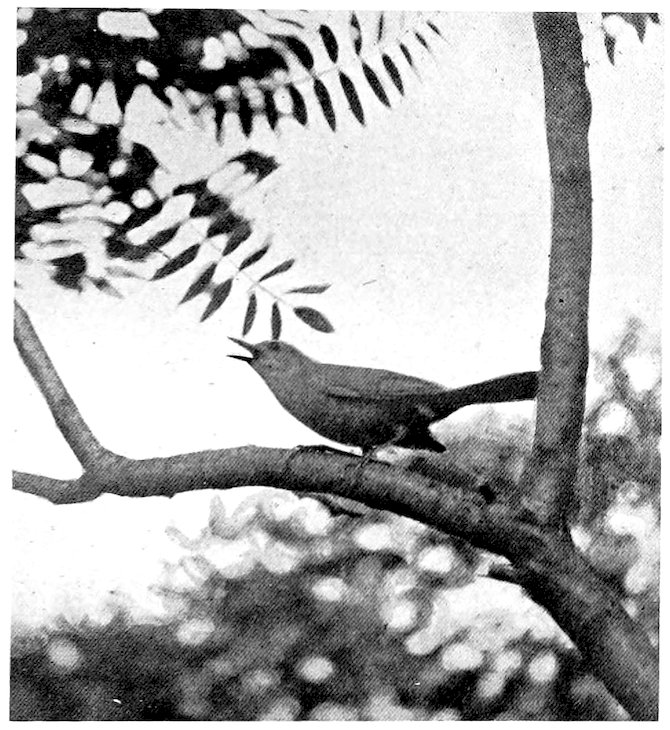
19. Catbird scolding.
From a considerable experience which, through
poor equipment, has not yielded adequate return, I am
convinced that one may secure excellent pictures of
many birds by decoying them with either a mounted
or living Owl; doubtless the latter would be preferable,
though I have never tried it. With a poorly
mounted Screech Owl, however, I have had some
excellent opportunities to photograph. My plan is
to select some spot where birds are numerous, preferably
near the home of a Catbird,19 place the Owl in
a conspicuous position, and erect near it a “scolding
perch,” from which the protesting bird may conveniently
38vituperate the poor unoffending little
bunch of feathers with its staring yellow eyes. The
camera is then focused on the scolding perch and
the photographer retires into the undergrowth, and,
bulb in hand, waits for some bird to take the desired
stand.
A Catbird’s domain is chosen for the reason that
this species is the alarmist of whatever neighborhood
it may inhabit, and once its attention has been
attracted to the Owl by “squeaking” or uttering
the alarm notes of other birds, the photographer
may subside and let the Catbird do the rest.
The bird’s rage is remarkable, its fear painful.
Should the Owl be near to the Catbird’s nest it will
utter notes in a tone of voice I have never heard
it use on other occasions. It loses all fear of the
camera, and from the scolding perch screams at the
Owl with a vehemence which threatens to crack its
throat. One is glad to remove the offending cause.
Other birds in the vicinity are of course attracted,
and hasten to learn the meaning of the
uproar. Often a bit of undergrowth, of which the
Catbird was apparently the only feathered tenant,
will be found to possess a large bird population. It
is interesting to observe the difference in the actions
of various birds as they learn the reason of the disturbance.
On the whole, each species displays its
characteristic disposition in a somewhat accentuated
manner. The Blue-winged Warblers flit to and fro
for a few moments and then are gone; the Chestnut-sided
Warbler is quite anxious; the Maryland Yellow-throat
somewhat annoyed; the Ovenbird decidedly
concerned; the Towhee bustles about, but
39seems to pay no especial attention to the Owl; the
Wood Thrush utters its sharp pit-pit, but is content
to let well enough alone if its own nest be not
threatened; and the Yellow-throated, Red-eyed, and
White-eyed Vireos, particularly the latter, add their
complaining notes to the chorus of protests. Not
one, however, approaches the Catbird in the force
of its remarks, nor does the bird cease to outcry so
long as the Owl is visible.
It is felt that in the foregoing suggestions the
methods which may be employed by the bird photographer
are very inadequately described, but, as
was remarked in the preface of this volume, the constantly
varying circumstances attending his work
practically prohibit duplication of experience.
In truth, herein lies the great charm of animal
photography. We have not to follow certain formulæ,
but each subject presents its own individual
requirements, making the demands on the naturalist’s
skill and patience limitless and success proportionately
valuable.
BIRD STUDIES WITH A CAMERA — BIRD PHOTOGRAPHY BEGINS AT HOME
40
The influence exerted by the camera
in creating new values for the
bird student is perhaps nowhere
more evident than in the immediate
vicinity of one’s home.
Even the view from our windows
possesses fresh significance as we
speculate on the probability of securing a desirable
picture from this or that point of vantage, while
birds to which long familiarity has partially
dimmed our vision now become possible subjects
for our camera, and we find ourselves observing
their movements with an alertness before unknown.
In my own case, I have learned almost to tolerate
the House Sparrows, with which I have been at war
as long as memory serves me, for the pleasure found
in attempting to outwit these shrewd, independent,
impudent rats among birds; and, on closer acquaintance,
they prove such interesting subjects for study
that, if their vocal ability equaled their intelligence,
they might be as generally liked as they are hated.
So much for the magic of a sweet voice. As it is,
they possess a greater variety of notes than they are
generally credited with, and their conversational
powers undoubtedly exceed those of many accomplished
41singers. In addition to the insistent, reiterated
chissick, chissick, which constitutes the song of
the male, one soon learns to recognize calls of warning,
alarm, flight, battle, and the soft whistle which
the bird utters when it approaches its nest—the only
musical note in its vocabulary.
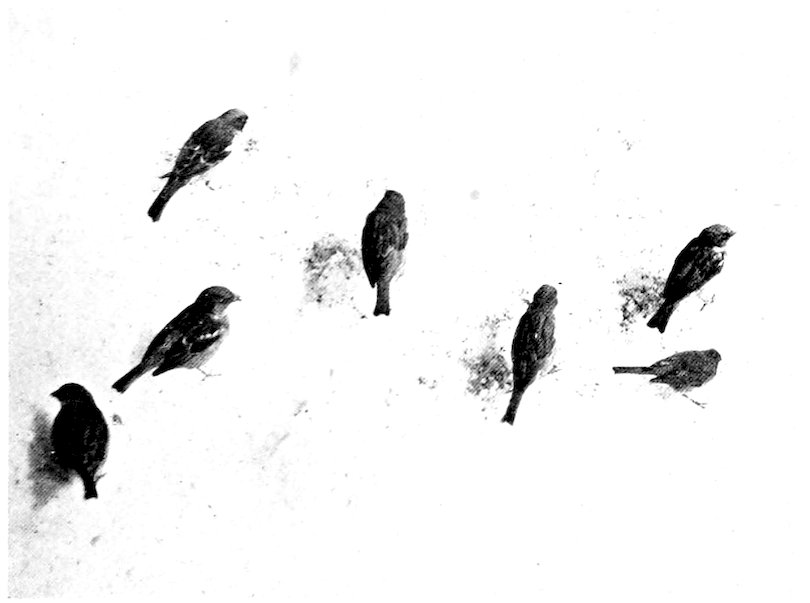
20. House Sparrows and Junco.
Quick to notice the slightest deviation from normal
conditions, House Sparrows are difficult birds
to photograph. They seem to be constantly on the
watch for some sign of danger, and an unusual arrangement
of blind or shade at once arouses their
suspicions. After a heavy fall of snow, however,
hunger dulls the edge of their fears, and by scattering
food near a suitable window the birds may be
decoyed within photographing distance.20 It will be
found necessary, even then, to conceal the camera,
42which they evidently distinguish from familiar
pieces of furniture and regard with alarm.
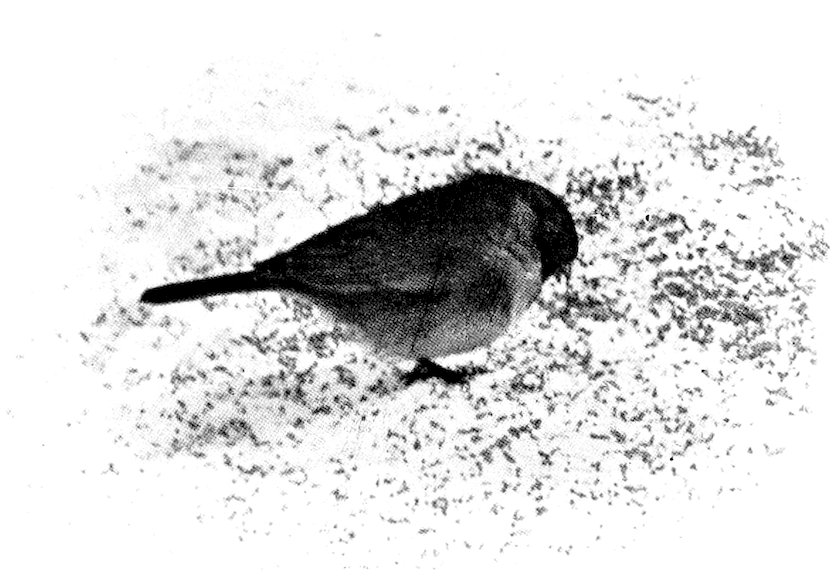
This, too, is the best time to secure pictures of
Juncos,21 Chickadees, Nuthatches, Downy Woodpeckers,
Blue Jays, and less common winter birds. The
four last named are rarely or never seen about my
home in winter. Doubtless the abundant and surrounding
woodlands afford them a more congenial
haunt, from which they are not to be enticed by suet,
bones, or grain; or, more likely still, the custom of
putting out food for birds is so unusual in the region
about New York city that they have not yet learned
to expect it. It is a most pleasing surprise to the
resident of this section to observe the numbers and
familiarity of winter birds in the environs of Boston,
where a feast seems spread for them in nearly every
dooryard.
21. Junco. × 3.
43
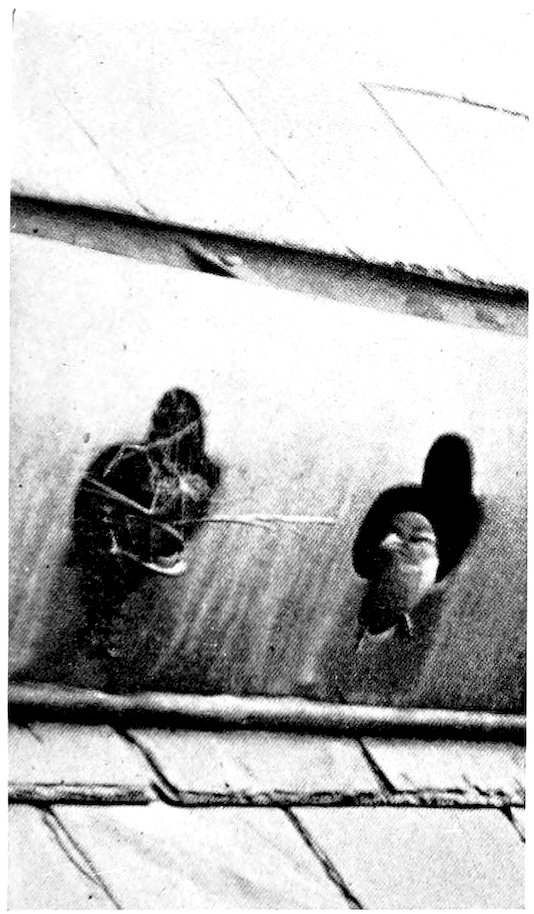
22. Female House Sparrow and nest. × 3.
To return to the Sparrow. The bird’s nest also
provides a focal point for the camera, but, as elsewhere,
the greatest
precautions must be
taken, and I have
succeeded in securing
a picture only
when some advantageously
situated
window afforded a
natural blind. One
of the pictures thus
obtained shows a
nest in the ornamental
part of a
gutter, with the female
looking from
an adjoining opening.22
This gutter
seems especially designed
to furnish
lodgings for Sparrows,
and no argument
that I have
thus far advanced has convinced them that it was
not erected for their use. During the early part
of their occupancy, a rap on their roof promptly
brought them out to perch in the branches of the
neighboring trees, where their chattering protest was
soon interrupted by a gunshot; but the survivors
quickly learned the meaning of the roof tap, and now,
without a moment’s pause, they dive downward from
their doorway and fly out of range at topmost speed.
44
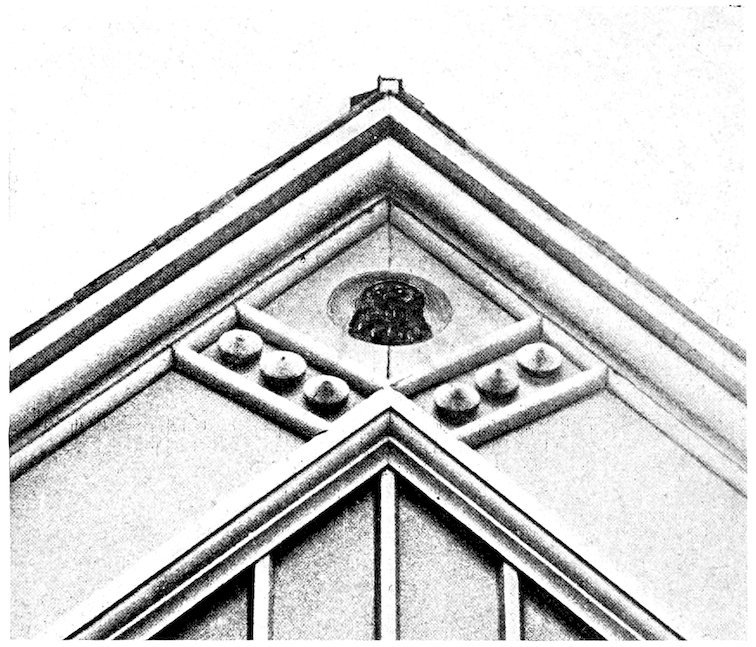
23. Screech Owl. × 3.
More welcome tenants than the House Sparrows
are a pair of Screech Owls, who for years have
reared their broods in a dovecotelike gable, where
they are beyond the reach of nest robbers of all
kinds. During the winter they apparently are absent,
nor indeed are they seen until June, when, each
evening at sundown, one of the pair, probably the
male, takes his post at the entrance to its home and
gives utterance to the crooning refrain which sometimes
follows the so-called tremulous “screech.”
But the latter I never hear at this season. In spite
of the poor light prevailing at this hour, the bird’s
stillness has tempted repeated trials to secure its
picture, and the most successful, made with a fourteen-inch
45lens and an exposure of fifteen seconds, is
here shown.23 Telephotos have thus far been underexposed.
As a means of making the exposure as soon as
possible after the Owl appeared, I have on a number
of occasions placed my camera in position, focused
and otherwise made ready some minutes
before he was expected, and I recall with amusement
the incredulity of a friend whose surprise at seeing
me point my camera skyward without ostensible
purpose was in no way lessened when I told him
that I had an appointment with an Owl, who was to
take his stand shortly in the hole toward which the
camera was directed; and fortunately the bird was
on time!
From the perch, some forty feet aloft, the grave
little creature surveys the scene below with an expression
of combined wisdom and thoughtfulness
which makes a laugh seem wanton foolishness. At
the border of dusk and dark he flies out to feed,
often descending to the ground and remaining there
for some moments while catching insects. Occasionally
he takes his prey from the tree trunks, perhaps
a cicada struggling from its shell, and on several
occasions I have thought he captured food on
the wing. Sometimes the supper hunt leads him to
the edge of the croquet lawn, where from the earth
or the back of a garden bench he becomes an interested
spectator of the last game. When the young
appear, later in the month, the evergreens seem alive
with Owls, who flit about and utter querulous little
calls difficult of description. Toward the end of
July, doubtless after the molt is completed, presumably
46the adults—for never more than two are heard—begin
to sing; and this habit of post-nuptial singing
seems not to be confined to the Screech Owl, for
about this time the deep-toned, resounding notes of
the Barred Owl come up from the woods. Throughout
August and September the wailing whistle,
which is ever welcome for its spirit of wildness, is
heard nightly, and as the plaintive notes tremble on
the hushed air we invariably say, “Hark, there’s
the Owl!”
My experience as bird photographer about home,
I must admit, has consisted chiefly in a series of encouraging
failures which have borne no tangible
results. Let us hope, however, that the few pictures
here presented will prove as suggestive to the reader
as they are to their maker, who, although he offers
such inadequate proof in support of his belief, is far
too well convinced of the possibilities of home photography
to go afield without saying at least a word
in its behalf.
THE CHICKADEE A Study in Black and White
47
Very early in my experience as a
hunter I became acquainted with a
small black-and-white bird, who
not only announced himself with
unmistakable distinctness, but did
so at such close range that one
could form a very clear idea of his
appearance; and thus because of his notes and trustfulness
I learned to know the Chickadee by name
years before I was aware that the woods were
tenanted by dozens of other more common but less
fearless birds.
With regret for the universality of the instinct,
I found that to see was to desire. I had felt exactly
the same longing in regard to other birds, and had
thrown many a stone in a fruitless effort to get possession
of the half-mysterious wild creatures which
always eluded me; but the Chickadee came within
range of my bean-shooter and soon paid the penalty
of misplaced confidence. The little ball of flesh and
fluffy feathers was perfectly useless, so after a day
or two, the length of time depending on the temperature,
it was thrown away.
My curiosity concerning the Chickadee being
satisfied, and the bird’s tameness making it too easy
48a mark even for a bean-shooter, I entered on a new
phase of Chickadee relations. Strangely enough,
the killing of the bird seemed, from my point of
view, to constitute an introduction to a creature
which before I had known only imperfectly, and
my acquaintance with the Chickadee may be said
to have begun when I picked up the first bird that
fell before my aim. However the Chickadee may
have regarded my somewhat questionable manner
of gaining his friendship, he has since given unmistakable
evidences of his approval of my treatment
of his kind. He always replies to my greeting, often
coming many yards in answer to my call, and on a
number of occasions he has honored me above most
men by alighting on my hand.
When, in more recent years, the gun which succeeded
the bean-shooter was in turn replaced by a
camera, I found that the Chickadee’s tameness made
him a mark for my later as he had been for my
earlier efforts in bird hunting. Now, however, I
believe I may speak for him as well as for myself,
and say that the results obtained are more satisfactory
to us both. It was in Central Park, New York
city, in February, 1899, that I went on one of my
first Chickadee hunts with a camera. Incidentally
the locality gave emphasis to the advantages of the
camera over any other weapon. Imagine the surprise
of the park police had I ventured on their precincts
with a gun on my shoulder! But with a camera
I could snap away at pleasure without any one’s
being the wiser—many of my “snaps,” I confess
being attended by exactly this result. At this time,
through the efforts of an enthusiastic and patient
49bird lover, who had improved on the bird-catching
legend by using nuts instead of “salt” and by substituting
bill for “tail,” three Chickadees in the
Ramble had become so remarkably tame that they
would often flutter before one’s face and plainly
give expression to their desire for food, which they
took from one’s hand without the slightest evidence
of fear. Sometimes they even remained to pick the
nut from a shell while perched on one’s finger, anon
casting questioning glances at their host; but more
often they preferred a perch where they could give
their entire attention to the nut which was held
between their feet, and pecked at after the manner
of Blue Jays.
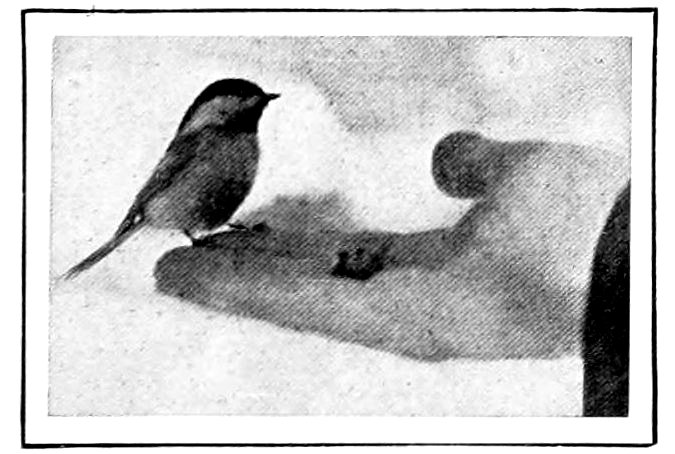
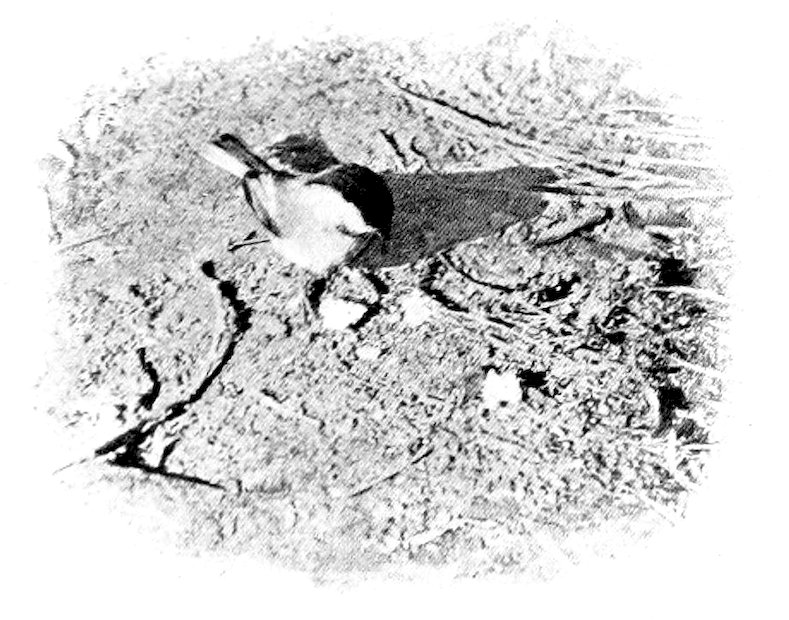
24. Chickadee on ground.
In spite of the ease with which one could approach
these Chickadees, they made difficult marks
for the camera. I was armed with a “Henry Clay”
5 × 7 and a twin-lens camera of the same size, but
50so active were the little creatures that not one of
many exposures proved to be perfectly focused.
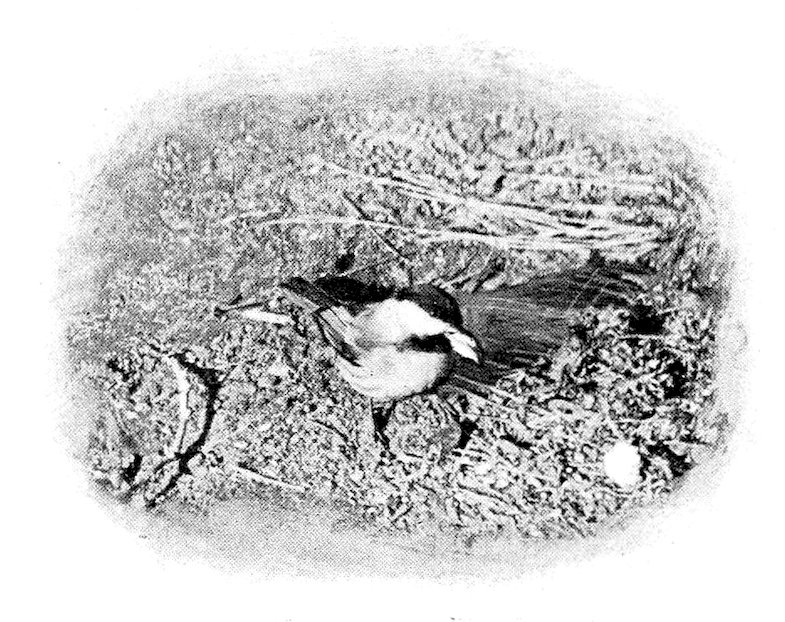
Finally I tried decoying the birds to a bone or bit
of bread in the bushes, but somehow they did not
succeed in discovering these baits until they were
placed on the ground.24, 25 Then they responded so
quickly that often the bread had disappeared while
my head was concealed by the dark-cloth, and frequently,
while focusing, the birds would alight on
the tripod of the camera. I was forced, therefore,
to focus on a stone, and, when ready to make
the exposure, lay a bit of bread on or near the
focal point, the two pictures given being thus obtained.
25. Chickadee taking piece of bread.
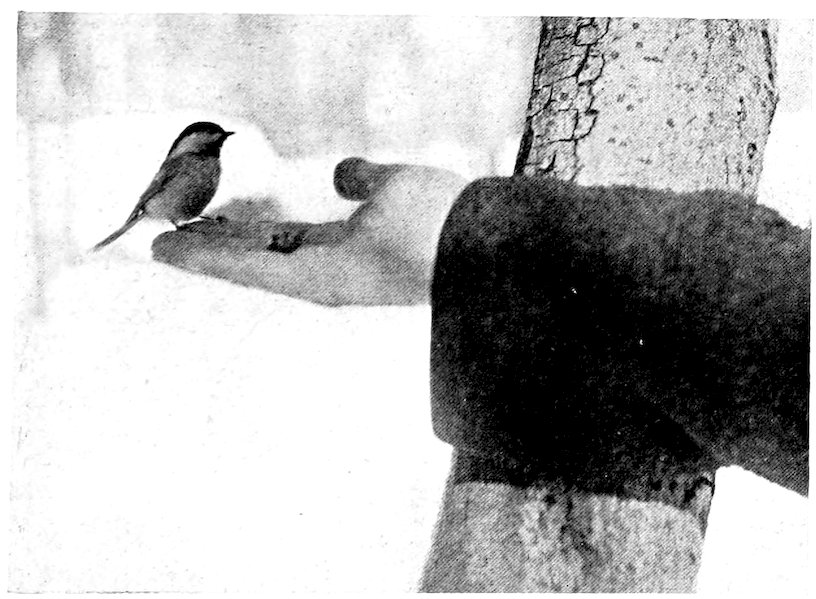
Various experiences with these unusually tame
birds finally led to what at first thought would have
been considered the wholly unreasonable ambition
of photographing one of them in my hand. The
camera was therefore erected at a suitable point and
51focused on the trunk of a tree, the shutter set, and
slide drawn.
26. A bird in the hand.
Now to get the bird. None was in the immediate
vicinity, but a whistle soon brought a response
from some neighboring tree tops, and going beneath
them I shortly had called the bird down to a nut in
my palm, and with him on my finger started to walk
the eighty or more feet to the camera. This, however,
was asking too much, and the bird abandoned
his moving perch for a bordering row of evergreens,
from which one or two more trials brought him
within a short distance of the desired spot, and resting
my arm against the tree trunk and with the
other hand on the trigger of the shutter I called
again the two plaintive notes. The bird’s faith was
still strong. Almost immediately he took the desired
52position, when a click announced the realization
of a bird photographer’s wildest dream.
Fortunate is the bird photographer who discovers
an advantageously situated Chickadee’s nest.
Dr. Robert’s charming description in Bird-Lore of
his experience with a family of Chickadees stimulated
my desire to make a camera study of this species.
The first nest found, however, was claimed by
a band of roving boys, who in pure wantonness
pushed down the stub from which a few days later
the young would have issued.
A second time I was more fortunate. It was on
the morning of May 29, 1899, at Englewood, N. J.,
that in going through a young second growth I
chanced to see a Chickadee, who in arranging her
much-worn plumage gave unmistakable evidence of
having recently left her nest. At once I looked
about for a partly decayed white birch, a tree especially
suited to the Chickadee’s powers and needs.
The bark remains tough and leathery long after the
interior is crumbling, and having penetrated the
outer shell the Chickadee finds no difficulty in excavating
a chamber within.
A few moments’ search revealed a stub so typical
as to match exactly the image I held in my mind’s
eye, with an opening about four feet from the
ground. The interior was too gloomy to enable one
to determine its contents, but, returning in half an
hour, I tapped the stub lightly, when, as though I
had released the spring of a Jack-in-a-box, a Chickadee
popped out of the opening and into a neighboring
tree. I wished her good morning, assured her that
53my intentions were of the best, and promised to
return and secure her portrait at the first opportunity.
Four days later I set up my camera before the
door to the Chickadee’s dwelling, and, without attempting
to conceal it, attached thread to the shutter
and retreated in the undergrowth to a distance of
about twenty-five feet.
After having had most discouraging experiences
with several birds, who had evidently regarded the
camera as a monster of destruction, and had refused
to return to their nests as long as the evil eye of the
lens was on them, it was consoling to find a bird
who had some degree of confidence in human nature
as represented by photographic apparatus.
It is true that the female—and throughout this
description I assume that the bird with much-worn
plumage was of this sex—promptly left the stub at
my approach; but when I retired to the undergrowth
there was no tiresome wait of hours while the bird,
flitting from bush to bush, chirped suspiciously, but
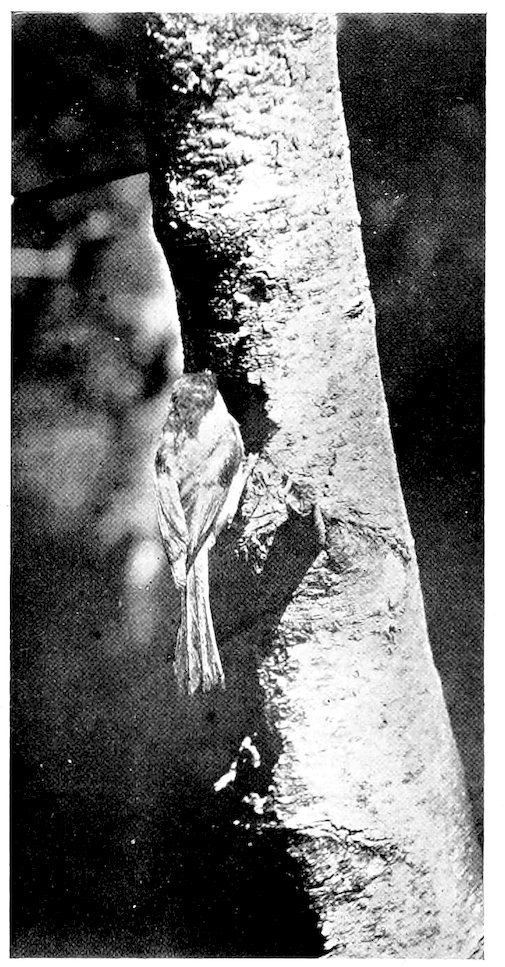
almost immediately she returned to her home.27 The
camera was examined, but clearly not considered
dangerous, its tripod sometimes serving as a step to
the nest entrance. The click of the shutter, however,
when an exposure was made as the bird was
about to enter its dwelling, caused some alarm, and
she flew back to a neighboring tree, and for some
time hopped restlessly from limb to limb.
The male, who had previously kept in the background,
now approached, and, as if to soothe his
troubled mate, thoughtfully gave her a caterpillar.
She welcomed him with a gentle, tremulous fluttering
54of the wings—a motion similar to that made by
young birds when begging for food. He, however,
made what appeared to be precisely the same movements
when she perched beside him.
27. Chickadee at nest hole.
It was not long
before the female became
so accustomed
to the snap of the
shutter that in order
to prevent her from
entering the nest I
was forced to rush
out from my hiding
place; but at last,
apparently becoming
desperate, she succeeded
in returning
to her eggs in spite
of my best efforts to
prevent her.
There now ensued
a very interesting
change in the bird’s
action. It will be
remembered that at
first she had left the
nest on hearing me
approach, while a
light tap brought her through the opening with
startling promptness. But now, evidently realizing
that a return to her duties of incubation could
be made only at great risk, she determined under no
conditions to leave her eggs. In vain I rapped at
55her door and shook her dwelling to its foundations;
no bird appeared, and not believing it possible that
under the circumstances she would remain within
the stub, I felt that she must have left without my
knowledge, and therefore
retired to await
her reappearance.
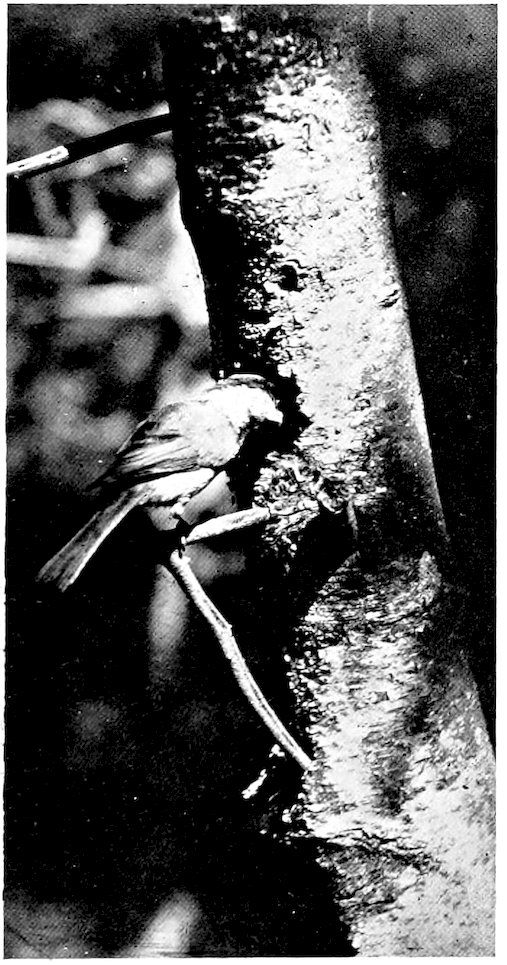
28. Chickadee at nest hole.
At the end of several
minutes the male,
with food in his bill,
advanced cautiously,
and clinging to the
rim of the nest opening,
hung there a moment
and departed
minus the food. This
was surprising. Could
there be young in the
nest? or was the bird,
in imitation of the
Hornbill, feeding his
imprisoned mate? I
rapped again, and this
time, perhaps taken
unawares, the female
answered my question
by appearing.
On June 3d a family arrived in the Chickadee
villa, and both birds were found actively engaged in
administering to its wants.
As a return for the inconvenience to which they
had been subjected, a perch was erected by way of a
step at their door. The female was appreciative and
56at once availed herself of this means of entering her
home.28 The male, however, as before, was more
wary. He had braved the camera to bring food to
his mate, but his offspring had apparently not so
strong a claim upon him. He would fly off in search
of food and shortly return with a caterpillar, then
perch quietly for several minutes a few yards from
the nest, when, repelled by the camera and attracted
by the food in his bill, he yielded to temptation, devoured
the caterpillar, vigorously wiped his bill, at
once started to forage for more food, and returned
with it only to repeat his previous performance.
Occasionally he uttered a low whistle, addressed
presumably to the female, and at times a chickadee-dee-dee,
which I interpreted as a protest to me, and
both notes were also uttered by the female.
The latter took so kindly to the doorstep that it
was determined to give her a door, and to this end a
leaf was pinned over the entrance to her home in
such a manner that it swung to and fro, like the
latch to a keyhole. This clearly did not meet with
her approval, and at first she seemed puzzled to account
for the apparent disappearance of the nest
opening. But in less than a minute she solved the
mystery, pushed the leaf to one side, and disappeared
within.
Returning to the nest on June 12th, nothing was
to be seen of either parent, and I feared that they or
their offspring had fallen victims to the countless
dangers which beset nesting birds and their young.
Looking about for some clew to their fate, I found
on the ground, near the nest stub, the worn tail-feathers
of the female bird. The molting season had not
57yet arrived, nor would she have shed all these feathers
at the same moment. There could therefore be
only one interpretation of their presence. Some foe—probably
a Sharp-shinned or Cooper’s Hawk, since
the predaceous mammals for the most part hunt at
night, when the Chickadee would be snugly sleeping
in her nest—had made a dash and grasped her
by the tail, which she had sacrificed in escaping. A
moment later the theory was supported by the appearance
of a subdued-looking Chickadee, sans tail,
and I congratulated her on her fortunate exchange
of life for a member which of late had not been very
decorative, and of which, in any event, Nature would
have soon deprived her.
The young proved to be nearly ready to fly, and,
carefully removing the front of their log cabin, a
sight was disclosed such as mortal probably never
beheld before and Chickadee but rarely.
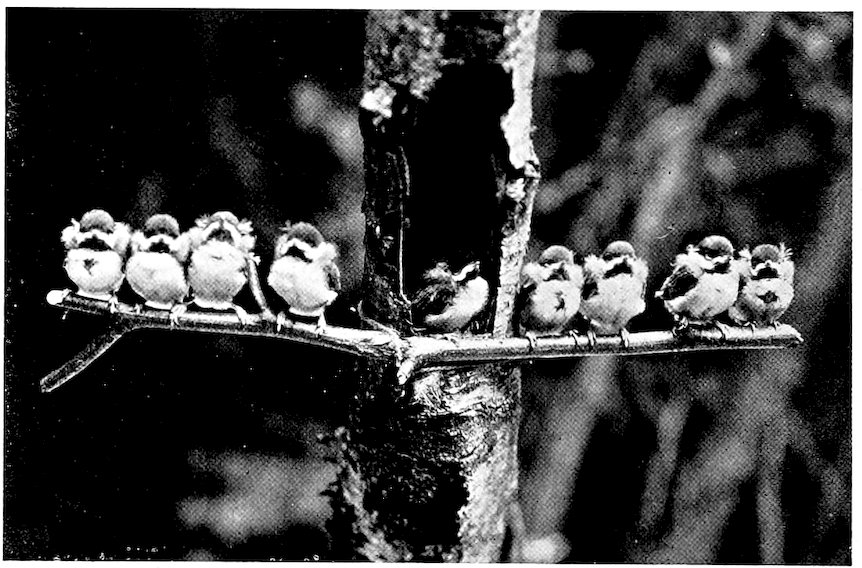
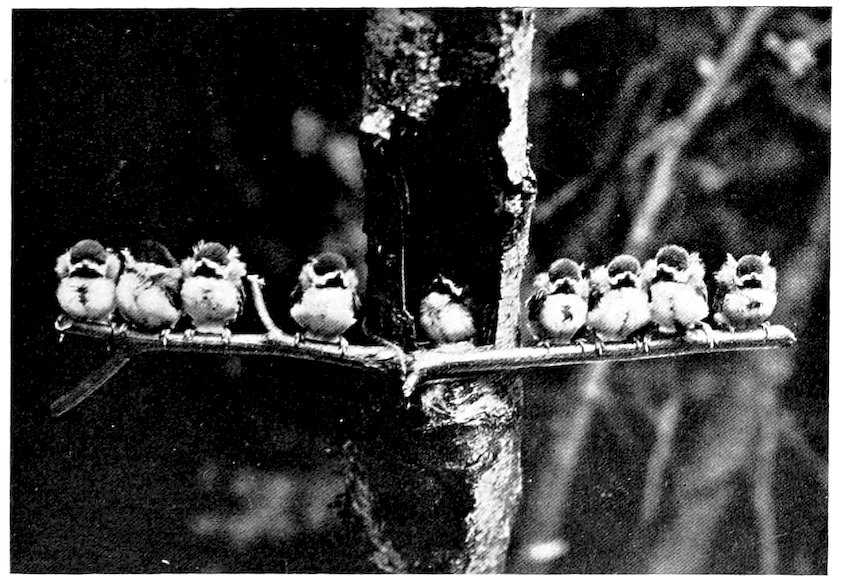
Six black-and-white heads were raised and six
yellow-lined mouths opened in expressive appeal for
food. But this was not all; there was another layer
of Chickadees below—how many it was impossible
to say without disentangling a wad of birds so compact
that the outlines of no one bird could be distinguished.
A piazza, as it were, was built at the
Chickadees’ threshold in the shape of a perch of
proper size, and beneath, as a life net, was spread a
piece of mosquito bar. Then I proceeded to individualize
the ball of feathers; one, two, three, to
seven were counted without undue surprise, but
when an eighth and ninth were added, I marveled
at the energy which had supplied so many mouths
with food, and at the same time wondered how many
58caterpillars had been devoured by this one family of
birds.
Not less remarkable than the number of young—and
no book that I have consulted records so large
a brood—was their condition. Not only did they all
appear lusty, but they seemed to be about equally
developed, the slight difference in strength and size
which existed being easily attributable to a difference
in age, some interval doubtless having elapsed
between the hatching of the first and last egg.
29. A Chickadee family.
This fact would have been of interest had the
birds inhabited an open nest, or a nest large enough
for them all to have had an equal opportunity to
receive food; but where only two thirds of their
number could be seen from above at once, and where
a very little neglect would have resulted fatally, it
seems remarkable that one or more, failing to receive
his share of food, had not been weakened in consequence
59and crushed to death by more fortunate
members of the brood. Nor was their physical condition
the only surprising thing about the members
of this Chickadee family: each individual was as
clean as though he had been reared in a nest alone,
and an examination of the nest showed that it would
have been passed as perfect by the most scrupulous
sanitary inspector. It was composed of firmly padded
rabbit’s fur, and, except for the sheaths worn
off the growing feathers of the young birds, was
absolutely clean. Later, I observed that the excreta
of the young were inclosed in membranous sacs,
which enabled the parents to readily remove them
from the nest.
30. A Chickadee family.
The last bird having been placed in the net, I attempted
to pose them in a row on the perch before
their door. The task reminded me of almost forgotten
60efforts at building card houses, which, when
nearly completed, would be brought to ruin by an
ill-placed card. How many times each Chickadee
tumbled or fluttered from his perch I can not say.
The soft, elastic net, spread beneath them, preserved
them from injury, and bird after bird was returned
to his place so little worse for his fall that he was
quite ready to try it again. Finally, eight birds
were induced to take the positions assigned them;
then, in assisting the ninth to his allotted place, the
balance of a bird on either side would be disturbed,
and down into the net they would go.
These difficulties, however, could be overcome,
but not so the failure of the light at the critical time,
making it necessary to expose with a wide open lens
at the loss of a depth of focus.
The picture presented, therefore, does not do the
subject justice. Nor can it tell of the pleasure with
which each fledgeling for the first time stretched its
wings and legs to their full extent, and preened its
plumage with before unknown freedom.
At the same time they uttered a satisfied little
dee-dee-dee, in quaint imitation of their elders.
When I whistled their well-known phe-be note, they
were at once on the alert, and evidently expected to
be fed.
The birds were within two or three days of leaving
the nest, and, the sitting over, the problem came
of returning the flock to a cavity barely two inches
in diameter, the bottom of which was almost filled
by one bird.
I at once confess a failure to restore anything
like the condition in which they were found, and
61when the front of their dwelling was replaced,
Chickadees were overflowing at the door. If their
healthfulness had not belied the thought, I should
have supposed it impossible for them to exist in such
close quarters.
A few days later their home was deserted, and,
as no other Chickadees were known to nest in the
vicinity, I imagine them to compose a troop of birds
which is sometimes found in the neighborhood.
THE LEAST BITTERN AND SOME OTHER REED INHABITANTS
62
My experience with the Least Bittern
leaves the eerie little creature a
half-solved mystery, and I think of
it less as a bird than as a survivor
of a former geological period, when
birds still showed traits of their
not distant reptilian ancestors.
The Bittern’s home is in fresh-water, cat-tail
marshes, and he wanders at will through the thickly
set forest of reeds without of necessity putting foot
to the water below or flapping wing in the air above.
His peculiar mode of progression constitutes one of
his chief characteristics. The reeds in which he
lives generally grow in several feet of water, far too
deep, therefore, to permit of his wading; while his
secretive disposition makes him averse to appearing
in the open, except after nightfall. It is impossible
to fly through the cat-tails, and so the bird walks
and even runs through them, stepping from stem to
stem with surprising agility. I had heard of this
habit, but the description conveyed as little idea of
the bird’s appearance as it is feared this one will,
and when for the first time a Least Bittern was seen
striding off through the reeds about three feet above
the water, the performance was so entirely unlike
63anything I had ever seen a bird do before, I marveled
that his acrobatic powers had not made him
famous.
The feathered gymnast’s slender body—or perhaps
one should say neck, for the bird is chiefly
neck and head—seemed to be mounted on long stilts,
with the aid of which he waded rapidly through the
water, his head shooting in and out at each stride.
The Least Bittern’s notes appear to be less known
than his habits. Nuttall, that exceptionally keen-eared
bird student, was familiar with them, but
most writers have restricted themselves to the statement
that, when flushed, the bird utters a low qua,
while some have even said he was voiceless.
I should not be in the least surprised to learn that
this uncanny inhabitant of the reeds had a call fully
as remarkable as the vocal performance of his large
relative, the American Bittern, but thus far in my
slight acquaintance with him he has been heard
to utter only four notes: A soft, low coo, slowly
repeated five or six times, and which is probably
the love song of the male; an explosive alarm
note, quoh; a hissing hah, with which the bird
threatens a disturber of its nest; and a low tut-tut-tut,
apparently a protest against the same kind of
intrusion.
64
31. Least Bittern’s nesting site, showing reeds bent over nest. One of four eggs can be seen.
It was the markedly dovelike coo which first introduced
me to this species. With William Brewster
I was at the Fresh Pond marshes, listening for
the repetition of some strange calls which had excited
the curiosity of Cambridge ornithologists, and
which proved to belong to a Florida Gallinule,[B]
when we heard the soft notes of a Least Bittern,
who soon rose from the marsh near by. A few days
later the Bittern was found in full song—if the coo
be its song—in the marshes of Presque Isle in Erie
65Bay; but it must be confessed that a desire to secure
specimens of this, to me, strange bird left no opportunity
to study its habits, and the species was not
again observed until June, 1898, in the northern
part of Cayuga County, New York. Here, under
the guidance of an observing local ornithologist,
Mr. E. G. Tabor, an encounter was had with a Least
Bittern which made a unique page in my experience
as a bird student.
It was on the border of Otter Lake, where the
Least Bitterns nest in small numbers in low bushes,
or a mass of drift, or more often in the fringe of cat-tails.
The trail of a boat through the reeds and
empty nests, which before had held from three to
five eggs, marked the ill-directed work of the boy
oölogists whose misspent zeal has resulted in such
a vast accumulation of eggshells and such an absence
of information about the birds that laid them.
A visit to a more distant part of the lake, where
even thus early in the year the cat-tails were five
feet above water of over half that depth, saved the
day, as far as Least Bitterns were concerned. Paddling
close to the reeds, a practiced eye could distinguish
the site of a Bittern’s nest, when the nest
itself was invisible, by the bowed tips of the reeds
which the bird invariably bends over it.31 The object
of this habit is perhaps to aid in concealing the eggs
from an enemy passing overhead—a Crow, for example—an
attack by boat evidently not being taken
into consideration.
Certainly our appearance was in the nature
of a surprise to a pair of birds who had just
completed their platformlike nest and were apparently
66discussing future steps in their domestic
affairs.
32. Least Bittern’s nest; reeds parted to show eggs.
As we approached, the female, who even before
the eggs are laid seems to have the home love more
strongly developed than the male, bravely stuck to
67her post, while the male marched off through the
reeds in the manner which has been described as so
remarkable. When he paused, with either foot
grasping reeds several inches apart or clung to a
single stalk with
both feet, he resembled
a gigantic,
tailless Marsh
Wren.
33. Least Bittern on nest mimicking its surroundings.
The actions of
the female were interesting
in the
extreme. Her first
move was an attempt
at concealment
through protective
mimicry—a
rare device among
birds. Stretching
her neck to the
utmost, she pointed
her bill to the zenith,
the brownish
marks on the feathers
of the throat became
lines which,
separated by the
white spaces between
them, might easily have passed for dried
reeds, and the bird’s statuelike pose, when almost
within reach, evinced her belief in her own invisibility.33, 34
The pose recalled Hudson’s experience with a
68wounded Least Bittern (Ardetta involucris, a near
relative of our bird) in the marshes of La Plata,
where a bird at his feet, in the same position as the
one before me, was discovered only after careful
search, and which, to the naturalist’s amazement,
slowly revolved as he walked around it, with the
presumable object
of keeping its protectively
colored
breast turned
toward him.
34. Least Bittern on nest mimicking its surroundings.
My bird, however,
was among
fresh reeds, and
while one can not
doubt the effectiveness
of its attitude
and color,
when seen among
dead reeds or
grasses, neither
were of value
among its green
surroundings.
With the light
on the wrong side and the reeds swaying violently
in the wind, we essayed to picture the bird, and the
best of several attempts made under these adverse
conditions are here given.
Covering my hand with my cap I held it toward
her, when, convinced that her little trick had failed,
she adopted new tactics, and struck at me with force
and rapidity, which made me thankful that my hand
69was protected. Her bright yellow eyes glared with
the intensity of a snake’s, and her reptilelike appearance
was increased by the length and slenderness of
her head and neck. Her courage was admirable;
she not only displayed no fear, but was actually
aggressive, and with a hissing hah struck viciously
at my hand each time it was placed near the nest.
As I quickly retreated on each occasion, and at
length made no further move toward her, she decided
to withdraw, perhaps to join her cautious mate,
who from the reeds had been uttering a warning tut-tut-tut
at intervals. Very slowly and watchfully she
left the nest, and when she had advanced a few feet
through the reeds I again ventured to touch her
platform home, putting my hand, however, under
it; but the motion instantly attracted her attention,
and, darting back to her post, she was on guard in a
moment. Then I left her, retiring from the field
fairly vanquished in my first hand-to-bill encounter
with a wild bird. I hope she laid a full complement
of five eggs and from them reared five birds worthy
representatives of their mother.
A desire to renew my acquaintance with—or perhaps
I should say advances toward—this unbirdlike
feathered biped, and to meet it under conditions
more favorable for the camera hunter, brought me
the following year (June 17, 1899), to the Montezuma
marshes at the head of Cayuga Lake. Here are
endless forests of cat-tails in which dwell not only
Bitterns, Long-billed Marsh Wrens, and Red-winged
Blackbirds, but also numbers of Pied-billed Grebes
and Florida Gallinules.
70There is a mystery about a marsh akin to that
which impresses one in a primeval forest. The possibilities
of both seem limitless. One hears so much
and sees so little. Birds calling from a distance of
only a few yards may remain long unidentified. A
rustling in the reeds arouses vague expectations.
The notes of marsh-inhabiting birds are in keeping
with the character of their haunts. They are
distinctly wild and strange, and often thrilling. The
Rails, for example, all have singular, loud, startling
calls. The American Bittern is a famous marsh
songster, but although several of his common names
are based on his calls, it is only recently that he has
actually been seen uttering them. The Gallinule resembles
the hen in the character, volume, and variety
of its notes, and to it and not the Clapper Rail
should be given the name “Marsh Hen.” Indeed,
its European relative, from which it can scarcely
be distinguished, is known as the Moor Hen or
Water Hen.
But of all this marsh music none to my ear is
more singular than the call of the Pied-billed
Grebe. It is mentioned in few books, and has won
the bird no such fame as the Loon’s maniacal laughter
has brought him, though as a vocalist the Grebe
fairly rivals his large cousin. Like most bird calls
it is indescribable, but perhaps sufficient idea of its
character may be given to lead to its identification
when heard. It is very loud and sonorous, with a
cuckoolike quality, and may be written cow-cow-cow-cow-cow-cow-cow-cow-cow-uh,
cow-uh, cow-uh,
cow-uh. These notes vary in number, and are sometimes
followed by prolonged wailing cows or ohs71almost human in their expressiveness of pain, fear,
and anguish.
This is the love song of the male, and when he
has won a mate she joins him in singing, uttering,
as he calls, a rapid cuk-cuk-cuk, followed by a slower
ugh, ugh, ugh, ugh.
The Gallinules were cackling in the reeds, where
a nest with three hatching eggs was found, but not a
bird was seen. Red-winged Blackbirds were chattering
with excitement as they guided the first wing
strokes of their young, who perched on the reeds
begged eloquently for food rather than for lessons
in flying.35
35. Young Red-winged Blackbirds.
In a small island of cat-tails a pair of Grebes was
calling, and after the most careful stalking my companion
saw the female respond to the voice of her
mate.
72It was in this island—if a patch of cat-tails growing
in three feet of water can be called an island—that
we found the first two of numerous Least Bitterns’
nests, and here our camera studies were made.
These nests were typical in form and site; one contained
five and the other four32 eggs, from which
the birds had apparently departed as we pushed our
boat toward them.
Less than twenty minutes later we again passed
these nests and found, to our surprise, that in one
all four, and in the other two eggs had been punctured,
as if by an awl. Here was a mystery which
my companion, who was examining the second nest
while I was studying the first, quickly solved by
seeing a Long-billed Marsh Wren actually make an
attack on the remaining three eggs, and a little
later a bird of the same species—perhaps the same
individual, since the Bitterns’ nests were not more
than twenty yards apart—visited the first nest
to complete its work on the five already ruined
eggs.
Our attempt to photograph the energetic little
marauder failed, nor did we succeed in learning the
real cause of its remarkable destructiveness. However,
the fact that in one nest alone it drove its
needlelike bill into all five eggs without pausing to
feast on their contents, would imply that it was not
prompted by hunger, and, much against our will, we
were forced to attribute the bird’s actions to pure
viciousness; though, it is true, there may have been
another side to the story, in which the Bittern was
the culprit.
The owners of the four eggs did not return while
73we were present, and the following day we found
their nest empty—a mute protest against fate.
36. Least Bittern eating her eggs.
The female of the second nest discovered, in which
only two of the five eggs had been injured, proved to
be a bird of character.
74
37. Least Bittern on nest.
While we waited in our boats at a distance of
fifteen feet, and with cameras erected on tripods
at a third of the distance, she came walking through
the reeds uttering occasionally an explosive quoh!75After circling about us several times she climbed
to her nest, and at once proceeded to investigate the
condition of its contents. Soon she gave evidence of
the possession of both a philosophic and economic
disposition, not to mention other housewifely qualities,
notably cleanliness. Philosophy she exhibited
by making the best of things as she found them;
economy by carefully eating36 the two broken eggs,
which a more thoughtless bird would have deserted
or quickly discarded; and cleanliness by carefully
dropping over the edge of the nest the shells remaining
from her peculiar feast, and following them by
bits of nest lining which had been soiled by portions
of the egg. This task accomplished to her satisfaction,
she gave further evidence of the possession of
a well-ordered mind by descending to the water,
washing her bill, drinking, and then returning to
her remaining three eggs, on which she settled
herself37 as complacently as though she had met
with no loss, and there we left her in well-deserved
privacy.
TWO HERONS
76
In this age of death and destruction
to all living creatures, which, because
of their size or edible qualities,
the so-called sportsman is
proud to exhibit as evidence of his
skill afield, it is remarkable that
there should exist within twenty
odd miles of New York’s City Hall
a colony of Herons which would do credit to the
most remote swamp of Florida.
Three factors have combined to render this rookery
possible: first, its isolation; second, the habits
of its occupants; and third, the protection which is
afforded it by the owner of the land on which it is
situated. Of these, the first is by far the most important,
and I may be pardoned, therefore, if I do
not betray the birds’ secret; for, much as I desire to
encourage American industries, I must on this occasion
withhold information of undoubted value to
the feather trade.
The birds’ habits contribute toward their preservation,
because they are largely nocturnal, “Night”
being the specific name applied by the text-books to
this particular kind of Heron; but to those who
know him in nature, he is generally spoken of as
“Quawk,” this being an excellent rendering of his
common call.
77The Night Heron or Quawk belongs among the
birds for whom the setting sun marks the beginning
of a new day—a fact which protects him from man
and permits his existence in numbers where others
of his family are rarely seen. Doubtless many of
the residents of Heronville know their feathered
neighbors only as a voice from the night, which
comes to them when the birds, in passing over, utter
their loud and startling call.
Finally, to the protecting influences of a love for
seclusion and darkness must be added the unusual
position assumed by the proprietor of the land, who
will not permit any one to kill the birds, and,
stranger still, does not kill them himself!
Thus it happens that any day in May or June,
the months during which the Herons are at home,
one may leave the crowded streets of New York and
within an hour or so enter an equally crowded but
quite different kind of town.
If after leaving the train you secure the same
guide it was my good fortune to have, your way will
lead over shaded roads, pleasant fields, and quiet
woodland paths, and, if the sun is well up in the
trees, you may enter the outskirts of the rookery
and be wholly unaware, unless you approach from
the leeward, that between two and three thousand
Herons are within a few hundred yards of you.
One may gain a far better idea of Heron life,
however, by visiting the rookery while the foliage
is still glistening with dew. Then, from a distance,
a chorus of croaks may be heard from the young
birds as they receive what, in effect, is their supper.
Old birds are still returning from fishing trips, and
78the froglike monotone of the young is broken by
the sudden quawks of their parents.
The rookery is in a low part of the woods which
evidently is flooded early in the year, a fact which
may have influenced the Herons in their selection
of the locality as a nesting site. At the time of
our visit the swamp maples, in which the nests are
placed, were densely undergrown with ferns, and
as we approached the whitened vegetation, which
clearly marked the limits of the rookery, a number
of Herons with squawks of alarm left the vicinity
of their nests, and soon the rookery was in an uproar.
The common quawk note was often heard,
but many of the calls were distinctly galline in
character and conveyed the impression that we had
invaded a henroost.
The trees in which the nests were placed are very
tall and slender, mere poles some of them, with a
single nest where the branches fork; while those
more heavily limbed had four, five,38 and even six of
the platforms of sticks, which with Herons serve as
nests, but in only a single instance was one nest
placed directly below another. A conservative count
yielded a total of five hundred and twenty-five nests,
all within a circle about one hundred yards in diameter,
nearly every suitable tree holding one or more,
the lowest being about thirty feet from the ground,
the highest at least eighty feet above it.
While the limy deposits and partially digested
fish dropped by the birds seemed not to affect the
growth of the lower vegetation, it had a marked
influence on certain of the swamp maples, the development
of the trees which held a number of nests
79being so retarded that, although it was June 13th,
they were as yet only in blossom.38 The comparative
absence of foliage permitted one to have a far
better view of what was going on above than if
the trees had been thickly leaved, and on entering
the rookery our attention was at once attracted by
the nearly grown Herons, who, old enough to leave
the nest, had climbed out on the adjoining limbs.
There, silhouetted against the sky, they crouched in
family groups of two, three, and four.39
38. Five Herons’ nests in swamp maple, at an average height of seventy feet. The upper right-hand nest with young shown in Nos. 41 and 42.
80
39. A view in the Heron rookery, looking upward from the ground to nests and young, about eighty feet above.
Other broods, inhabitants of more thickly leaved
trees, made known their presence above by disgorging
a half-digested eel, which dropped with a thud
at our feet and occasionally nearer, suggesting the
advisability of carrying an umbrella. The vegetation
beneath the well-populated trees was as white
as though it had been liberally daubed with whitewash,
and the ground was strewn with blue-green
eggshells neatly broken in two across the middle;
fish, principally eels, in various stages of digestion
81and decay; and the bodies of young birds who had
met with an untimely death by falling from above.
It was not altogether a savory place!
40. Black-crowned Night Herons feeding. Telephoto, × 2 at a distance of about one hundred and fifty feet.
Seating ourselves at the base of an unoccupied
tree, we had not long to wait before the normal life
of the rookery was resumed. The young, who while
we were observed had been silent, now began to
utter a singular, froglike kik-kik-kik in chorus, and
the old birds one by one returned. When food was
brought an increased outcry was heard from the
expectant youngsters about to be fed. At intervals
a resounding thump announced the fall of some too
eager bird, but, in the cases which we investigated,
the Heron, if fairly well grown, seemed to be little
the worse for his tumble of from fifty to seventy feet,
82and with lowered head ran through the undergrowth
with surprising quickness. With those which were
younger, however, the mortality had evidently been
great, and, seeing the dozens of dead birds on the
ground beneath the nest trees from which they had
fallen, one questioned whether this habit of nesting
high in trees had not, for protective reasons, been
recently acquired by a species the young of which
would seem much more at home nearer the ground.
41. Young Night Herons in nest. Same as No. 42.
It was with a delightful sense of companionship
with the birds that I observed them going and coming,
feeding their young, or resting after the night’s
83labors, wholly undisturbed by my presence. Almost
I seemed to be a guest of the rookery, and I longed
for power to interpret the notes and actions of the
birds so abundant about me.
42. Young Night Herons leaving nest. Nesting tree shown in No. 38.
So I should like to have passed the day with
them, becoming for the time being a Heron myself;
but the desire to picture the birds was stronger than
the wish to be a Heron, and the situation was considered
from the standpoint of the bird photographer.
The rookery proved to be a difficult subject. No
single view would convey an adequate idea of its
appearance, and I therefore selected representative
tree tops and photographed their nests and young
birds. A visit to a neighboring pond resulted in
84securing, with the aid of a telephoto, a picture40 of
two adult birds feeding well out of gunshot, and
with the assistance of climbers I reached the upper
branches of a tree some seventy feet in height containing
five nests whose contents ranged from eggs
to nearly grown young. With the ball-and-socket
clamp the camera was
fastened to favoring
limbs, and after three
hours’ work several
satisfactory pictures of
young in the nest and
on the adjoining branches
were secured.41–43 Although
well able to defend
themselves, the
young assumed no such
threatening attitudes as
the American Bittern
strikes when alarmed,
from which perhaps we
may argue that they are
happily ignorant of the
dangers which beset
their ground-nesting relative.
43. Young Night Herons on branches near nest, seventy feet from the ground.
As the sun crept upward
and the last fishers
returned, the calls of both old and young birds were
heard less and less often, and by ten o’clock night
had fallen on the rookery and the birds were all
resting quietly. Four o’clock in the afternoon was
evidently early morning, and at this hour the birds
85first began to leave the rookery for their fishing
grounds. Some went toward the north, others to
the south, east or west; each bird no doubt having
clearly in mind some favorite shore, perhaps a dozen
miles away, where he before had had good luck
a-fishing; and of all the varied phases of rookery life
the thought of this regular nightly expedition of
hundreds of winged fishers, is to me the most attractive.
Our largest Heron as well as our largest bird is
the Great Blue. “Crane” he is popularly called;
but, aside from other differences, the bird’s habit of
folding its neck back on its shoulders, when on the
wing, will distinguish it from true Cranes, who fly
with neck extended to the utmost.
The Great Blue Heron is not edible, but its size
makes it a desirable prize to most gunners and it is
considered an especially fit mark for a rifle. The
temptation is strong to condemn as an outlaw the
man who kills one of these noble birds for what he
terms sport, or perhaps for the purpose of what he
would call having it “set up.” He, however, is acting
according to his light, which is quite as bright
as that which shines for most of his neighbors. The
Heron is exceedingly wild, and its capture is eloquent
evidence of the hunter’s prowess, while his
desire to have its stuffed skin adorn his home is,
from his point of view, positively commendable.
That the bird is infinitely more valuable alive than
dead, that its presence adds an element to the landscape
more pleasing to some than could be imparted
by any work of man, and that in depriving others
86of the privilege of observing its singularly stately
grace of pose and motion he is selfish beyond expression,
does not even vaguely occur to this so-called
“sportsman,” who belongs in the class to whom a
majestic cliff is a quarry, a noble tree, lumber. Until
he has been educated to properly value the beauties
of Nature, or at least realize the rights of others in
them, he must be restrained by law, to the force of
which even he is not blind.
Only the Great Blue Heron’s extreme wariness
and habit of frequenting shores and marshes where
it can command an extended view of its surroundings
has preserved it from extinction; but when
nesting it is compelled to visit woodlands where its
human enemies have better opportunities to approach
it, and its only chance for safety during the
breeding season is to select a retreat remote from
the home of man. For this reason Great Blue Heron
rookeries are exceedingly uncommon in more settled
parts of the bird’s range, and north of Florida I
have seen their nests in only one locality.
It was the week after my visit to the Night
Herons that, in northern Cayuga County, New
York, I was led by a local ornithologist through one
of the heaviest pieces of timber I have ever seen
north of a primeval tropical forest, in search of a
Great Blue Heron rookery which he knew to exist,
and only my confidence in his woodsmanship gave
me courage to follow him over fallen trees and
through the season’s dense undergrowth, from which
our passage raised such a host of mosquitoes that
every step was a battle. If the vicious little insects
had lived only to protect the Herons, they could not
87have disputed our progress more valiantly, and on
reaching the birds’ stronghold, where the comparative
absence of undergrowth deprived our winged
foes of shelter, I congratulated myself on what, for
the moment, seemed to be no insignificant feat.
The eleven nests which my guide had seen on a
previous occasion were found occupying their former
positions, at least one hundred feet from the
ground in dead trees, one of which held five of the
eleven. During the many years which the birds
have nested in the place their number has not
varied, and one wonders what becomes of the from
thirty to forty young who doubtless each year leave
the parental trees. No other Herons of this species
are known to nest in the vicinity, and it is not probable
that the progeny of each year would seek a
nesting site in some far distant rookery; consequently,
as an alternative explanation, we can only
suppose that the yearly product of the rookery balances
its losses by death.
The young birds were now nearly half grown,
but, unlike the Night Herons, they did not venture
outside their nests, from which they uttered harsh
croaks in evident supplication to their parents for
food. The sight of the trees in which the nests
were placed effectually controlled whatever ambitions
I had entertained toward camera studies at
short range, and I contented myself by making telephotos
from the ground, in one of which an adult
bird and two nests, each with a young bird appearing
above its edge, may be seen.44
Time was lacking in which to observe these birds,
and the value of my visit to their retreat is not to
88be expressed in words. The wildness of their home
seemed in perfect accord with their nature, and their
apparent safety from intrusion brought a sense of
satisfaction which colors my memory of the whole
experience.
44. Looking upward from ground to nests and young and adult bird of Great Blue Heron at a height of over one hundred feet. Telephoto.
WHERE SWALLOWS ROOST
89
Contributing little to the material
wealth of the nation, the
Hackensack marshes of northern
New Jersey are usually regarded
as “waste land.” By the
farmer they are termed “salt
medders,” and their waving
grasses are of value to him only as “bedding” for
cattle. In winter the muskrat hunter reaps a harvest
of pelts there. The down of the “cat-tails” is
gathered for cushion stuffing, and the bladed leaves
for chair bottoms. To the gunner they are the
resort of Ducks, Snipe, Rail, and Reedbirds, which
each year visit them in decreasing numbers; while
to the thousands who daily pass them on the encircling
railroads they are barren and uninteresting.
But if beauty is a sufficient cause for being, then
these marshes may claim a right to existence.
In preglacial times this region was probably forested,
but now the forest is buried beneath the drift
of the glacier which deposited fragments of Palisade
and Orange Mountain trap rock on Staten Island.
During the depression of the land which occurred as
the ice gradually receded, the waters of the sea
doubtless passed up here and the meadow was a
larger “Newark Bay.” Then commenced their slow
filling up by the silt brought down by the Hackensack
River. The river has preserved a right of
way, but the bay has given place to a sea of reeds
and grasses.
90
45. Hackensack marshes in August.
91On a bright August morning I mount a spur of
trap rock which reaches out from the western base
of the Palisades, and from this elevation have an
uninterrupted view over the meadows. The cool, invigorating
air foretells the approach of autumn; it
is brilliantly clear. The Orange hills stand out
with the distinctness of Western mountains. The
sun is at my back, and the light shows the meadows
to the best advantage. At this distance I get the
effect of only the masses of color; tracts of yellowish
green meadow grass tinged with copper, and in
places thickly sprinkled with the white flowers of
the water hemlock and water parsnip; streaks of
light green wild rice, and sharply defined areas of
dark green cat-tail flags. The grass grows on the
drier land, the wild rice in the small sloughs and
creeks which are bordered by the flags. In the
spring the wind blows the pollen from the cat-tail
blossoms, and a shifting greenish vapor floats over
the marsh; in the autumn a heavy westerly wind
raises the seed-bearing down high in the air, carries
it over the Palisades, across the Hudson, and it descends
like a fall of fleecy snow on wondering New
York.
The marsh is a vast arena inclosed by the Palisades
and Passaic hills; it is a great plain, with blue
stretches of the winding river appearing here and
there, and the haystacks are the huts of aborigines.
I half close my eyes, and it is a copper-yellow sea.
92The grasses roll in undulating waves, capped by a
white crest of parsnip and hemlock blossoms; the
dark irregular patches of flags are the shadows of
clouds, the light streaks of wild rice are shoals, a
hovering Marsh Hawk is a Gull. A stately white-winged
schooner45 comes up the river; her hull is
hidden by the meadow grasses; she is sailing through
the sea of my fancy.
This is an impressionist’s view of the meadows.
Now let us leave our rocky lookout and examine
them more in detail. The meadow we are leaving is
a meadow of all summer; the one we are approaching
is a meadow clad in all the glory of its August
flowers. One might think Nature was holding a
flower show here, so gorgeous is the display. The
railway track at the edge of the marsh is apparently
an endless aisle bordered by a rich exhibit of flowers.
Clusters of thoroughwort and purple loose-strife
grow so abundantly they give color to the foreground,
through which wild sunflowers make streaks
of gold. There are solid beds of purple asters on
the drier land, and delicate snow-white saggitarias
in the sloughs. Jewel flowers sparkle through the
flags, and convolvulus hangs from the reeds, its own
foliage scarce showing, or, growing with the fragrant
climbing hempweed, it forms banks of dense
vegetation. The scarlet lobelia darts upward like a
tongue of flame, startling in its intense brilliancy.
There are burnet, vervain, gerardia, and running
groundnut. But it is the marsh46 mallow which,
more than any other flower, gives beauty to the
meadow. It grows here with wasteful luxuriance,
and the dark masses of flags serve as a frame for
93this floral picture. Out in the marsh it grows in
equal profusion; the meadow is hung with small
pink lanterns, as if for a fête. A single flower of
the marsh mallow commands the attention of the
most unobservant, and when growing in abundance
it excites enthusiastic admiration.
46. Marsh mallows.
Nor is the animal life of the marsh less interesting
than its flora. Meadow mice nest beneath the
haycocks. Were it not for the minks and Hawks
which prey on them, they might become a scourge
throughout the surrounding country. Muskrats are
94living in peaceful security in their snug summer
homes, hollowed from the banks of the streams.
They are the true villagers here, and pass the winter
in icy huts, like Eskimos. Out in the grasses
Short-eared Owls are hiding. Their day begins
when the sun disappears behind the Orange hills;
then one may hear
the “quawk” of
the Night Heron.
Red-winged Blackbirds
nest here, and
in the autumn they
gather in great
flocks and feed on
the wild rice.
47. Wild rice.
Long-billed
Marsh Wrens—small,
nervous, excitable
bits of
feathered life—are
abundant in the
flags, and to them
they attach their
large woven nests.
Except for a harsh,
scolding note they
are silent now, but
earlier in the year
the marsh is musical
with their rippling
songs. The fervor of the love season overcomes
their fondness for the dark recesses of the
flags, and, singing, they rise into the air as if driven
95upward by the mine of melody which explodes within
them.
Swamp Sparrows are common, and their clear
trill is one of the few August songs. Bobolinks,
traveling in disguise and under the assumed name
of “Reedbird,” pause here to feed on the ripening
wild rice.47 Some of them have not yet completed
their change of costume and appear in a spotted suit
of black and yellow. Occasionally one hears a suppressed
burst of the “mad music” of June, but their
common note is a metallic chink. At night this
note is heard from high in the air, as the birds continue
their journey to the cultivated rice fields of
South Carolina and Georgia, there to remain until
September or October, when they leave for their
winter home south of the Amazon.
The Sora Rails, beloved of sportsmen and epicures,
are also attracted to the marshes by the wild
rice. On their arrival in early August they are indeed
“as thin as a rail,” but an abundance of food
soon rounds their bodies into comparative plumpness.
The 1st of September is a black day in their
calendar. Then they are outlawed, a price is set on
their bodies, and at high tide each day during this
sad month one sees numerous puffs of smoke arise
from the tall grasses and dull reports come booming
over the marsh with fateful frequency.
But the characteristic birds of the marshes at this
season are Swallows. They outnumber many times
all the rest of the marsh birds together—in fact, are
present in such myriads that their gatherings are
one of the most interesting and impressive phenomena
of the bird life of this region.
96Five species are represented. Named in the order
of their abundance they are the Tree, Bank,
Barn, Eave, and Rough-winged Swallows. The last
are comparatively rare, while the Tree Swallows are
so in excess of all the species named that the following
remarks relate largely to them alone.
Although Tree or White-breasted Swallows nest
locally throughout North America, from the tableland
of Mexico to Labrador and Alaska, there are
but few instances of their breeding in the lower
Hudson River valley, where they appear only as
migrants or transient visitants. They arrive from
the south early in April, and their northward migration
is not concluded until about June 1st. During
June they are rarely seen, but between the 1st and
the 5th of July they begin their journey to their
winter homes—a movement which inaugurates the
fall migration.
This stage of their journey takes them only to
certain marshes, which become stations on their line
of travel where countless numbers of their kind,
impelled by the flocking impulse, gather to roost
in the reeds. Their numbers increase steadily
through July and August, the maximum of abundance
being reached about September 1st; then they
gradually become less numerous, and by October 10th
comparatively few remain, though if the weather be
favorable, they may be observed daily until late in
the month.
Throughout this period—from July to October—the
marsh is used only as a dormitory, the reeds evidently
offering suitable perches to these weak-footed
birds, who in the morning radiate throughout the surrounding
97country and in the evening return to the
marsh to sleep. In the evening they fly low, and
the altitude and time of their flight make them conspicuous.
In the morning they fly high, as though
bound to some distant feeding ground, and at so
early an hour that they usually escape observation.
The evening flight, therefore, is generally considered
as truly migratory, when, in fact, the same birds
doubtless pass over a given locality night after
night, perhaps for weeks, in returning to their
roosts in the marshes.
48. “Bird notes”—Tree Swallows.
These evening flights begin about two hours and
a half before sunset, when the birds, after resting
during the late forenoon and early afternoon, usually
on some telegraph wire,48 begin to wheel and
98circle over the fields in pursuit of their evening
meal, when one might imagine they were resident
birds, but observation will show that the general
trend of their movement is toward the roost.
This continues for an hour to an hour and a half,
a cloudy evening hastening their actions, when their
flight becomes more direct. Few birds pause to feed,
but hurry on to the roosting places, and as the light
fades the last birds rush through the gloom with
arrowy speed and directness. The birds pass in
straggling flocks, and periods of abundance are succeeded
by intervals of scarcity, as though the individuals
which had been associated during the day
were journeying home together.
Thus the Swallow’s evening flight may be observed
throughout the region surrounding the
marshes; even in New York city they may be seen
feeding above the houses, and after sunset flocks of
swift-flying birds are often confused by the telegraph
wires, which, however, their dexterity of wing
permits them to pass without serious harm.
In the marshes the first birds are seen about two
hours before sunset. Many follow the course of the
river, and if one be at its border splash after splash
is heard as the birds dip lightly into the water, followed
by soft fluffs as arising from the stream they
shake their plumage. Soon the air is filled with
Swallows, all streaming toward the roost with increasing
swiftness.
Many birds, however, as though waiting for some
tardy comrades, rest by the way, perching on telegraph
wires should they cross the marsh, or when
these are wanting, on the tips of the reeds. They
99invariably face the wind, and when it is from the
west the last rays of the sun striking their white
breasts make them appear like snowy flowers crowning
the reeds. Suddenly, with a rush, they whirl
onward to the roost.
Thus far the exact location of this roost has defied
my search. I have, however, roughly defined
the bounds of that section of the marsh in which it
is placed by observation stands at which the Swallows
flew north and south respectively, and somewhere
between the two I still hope to discover the
Swallows’ sleeping haunts.
The following description of their departure
from the marshes in the morning is abstracted from
my journal, under date of August 15, 1886: “A cool,
clear morning, with a light northwesterly wind. I
reached the marshes shortly before five o’clock,
when they appeared to be deserted, not a Swallow
being in sight. At two minutes of five the first
birds were observed, then flock after flock they
came until at five the air was filled with hurrying
forms, flying at varying altitudes toward the
north.
“Suddenly, from the meadows near me there
arose a vast cloud of Swallows, doubtless birds
which had come from farther south in the marsh
before my arrival. Steadily they mounted upward,
until having attained a height where with a strong
glass they appeared faint dots against the sky, they
slowly winged their way northward.
“All the time the meadows were alive with birds
feeding in every direction; gradually they passed to
the north, when another huge flock arose from the
100marsh, and after gaining an immense height disappeared,
this time toward the east.
49. Tree Swallows in tree.
“As the sun rose over the Palisades few birds
were on the wing, but great flocks were perched in
the reeds on the banks of the creek, and as in my
canoe I drifted slowly
up to them, they seemed
unmindful of my presence,
when, as though at
a signal, they arose as
one bird, and after hovering
lightly overhead
returned to the reeds.
“The tide was low,
and along the shore several
Sora Rail were feeding,
and, as carried by
the tide I floated noiselessly
by, they paused in
their search for food, and
with tails upraised regarded
me with evident
astonishment. A mink
approached the shores of
a small inflowing stream,
hesitated, then plunged
in, crossed, and disappeared
in the tall grasses on the opposite side. The
air was vocal with the calls of Red-winged Blackbirds,
the chink of Bobolinks, and the rattle of
Swamp Sparrows.
“On a reed-grown point below was another great
army of Swallows. With surprising regularity a
101detachment left it every fifteen minutes; thus, birds
left at 6, 6.15, 6.30, and 6.45, when the reeds were
deserted. The departing birds did not arise alone,
but the entire flock arose at once, then divided into
two flocks, one of which flew northward while the
other returned to the reeds. Many of the departing
birds alighted on the reeds farther up the creek;
their numbers constantly received additions from
the ranks of passing birds, and thus new flocks were
formed.
“At eight o’clock the last Swallows had left the
reeds in my vicinity, but birds were constantly passing
toward the north, and this straggling flight continued
until nine o’clock, when again the marshes
appeared deserted.”
Subsequent observations have been made largely
from a road crossing the marsh, the telegraph and
electric-light wires which border it being the resting
place of vast numbers of Swallows, both at night
and in the morning. Particularly do they throng
the wires near the creek, which flows north and
south through the marsh, and which, it is interesting
to observe, forms a natural highway for the
Swallows as they go to and from their roosts.
On the sides of this road are several small maple
trees, to which the Swallows often resort in such
numbers that their foliage trembles as though in a
strong breeze, it not being the birds’ object to perch
in the trees, but to flutter among the dew-laden
leaves, and apparently bathe in the moisture they
contain, while between the baths they rest on the
smaller terminal twigs, when they are very difficult
to observe.49 This habit does not appear to have
been previously recorded, and I am by no means
certain that the explanation offered is the true
one.
102
50. Tree Swallows on wire and nest hunting about pile.
103Frequently one or more flocks, varying in size
from eight or ten to several hundred birds, may be
seen in the road, where I at first supposed they were
“dusting,” but soon noticed that most of the birds
after alighting in the road were motionless. They
did not move about as though searching for food,
but occasionally the actions of a pair enabled one
apparently to determine the sex of each individual,
and more often a bird would pick up a bit of dried
grass and fly up into the air with it. Sometimes it
was carried fifty yards or more and then dropped;
at others, the birds would carry it to the telegraph
wires above, and drop it after perching a moment.
Without exception, all the birds seen to alight in the
road were in the dull, immature plumage of birds of
the year, and in their actions, as Mr. William Brewster
has remarked (The Auk, 1898, p. 194), they evidently
gave a premature exhibition of the procreative
and nest-building instincts.51
Additional evidence of the possession of inherited
knowledge was apparently given by many Tree
Swallows, who were frequently seen hovering about
a pile standing in the creek.50 At first it was supposed
that these birds were feeding on insects which
had alighted on the pile; but the number of birds—often
a dozen or more—seen fluttering about it, and
the persistency with which they remained there,
forced the conclusion that in a wholly unreasoning
way they were looking for a nesting site.
104Swallows are not known to migrate by night,
and, so far as I am aware, no single Swallow has
ever been found among the thousands of night-flying
birds which have perished by striking lighthouses.
The Swallows, therefore, when migrating
probably leave the marsh during the day, but in
what manner who can say?
51. Immature Tree Swallows gathering nesting material.
Several times when crossing the marshes on the
cars I have observed gatherings of Swallows which
made the immense flocks observed daily in August
105and September seem little more than a family of
birds. They appeared in the distance like a vast
swarm of gnats; it was as though all the Swallows
in the marsh had collected in one great storm of
birds. The significance of this movement I have
never had the fortune to determine, but it seems
highly probable that it is connected with the inauguration
of an actual migration toward the birds’
winter quarters.
TWO DAYS WITH THE TERNS
106
Terns are useless for food, and can
not therefore be classed as “game
birds.” So far as we know they
are of no special economic value.
Consequently, when one protests
against their practical annihilation
for millinery purposes, he is
not infrequently answered: “Well, what good are
they?” The question exposes so absolute a failure
to appreciate the bird’s exquisite beauty and unexcelled
grace—such a discouraging materialism—that
one realizes the hopelessness of replying.
I confess I find it impossible to describe satisfactorily
just what the presence of Terns along our
coast means to me. It is not alone their perfection
of color, form, and movement which appeals to one,
but also the sense of companionship they bring; and
doubtless this feeling is emphasized by the impressive
loneliness of the sea, which makes anything
alive doubly welcome. And so the coming of a
single one of these beautiful creatures changes the
character of the bay or shore. With unfailing
pleasure one watches its marvelously easy flight, its
startling darts for its food of small fish, and when
it disappears the scene loses a grateful element of
life.
107A milliner’s hunter or fisherman, however, might
have made a very different reply to the unimaginative
individual who asked the value of Terns. The
former would have told him that they were worth
about ten cents each for hat trimmings; the latter
would have said that their eggs made excellent
omelets; and each has done his best—the one to
lay all Terns on the altar of Fashion, the other
to see that none of their eggs escaped the frying
pan.
In the meantime a number of bird lovers have
taken up the battle for the Terns in their few remaining
strongholds, and the brief history of Tern
destruction and protection is full of suggestive incidents.
It was about twenty years ago that Terns first
found favor in woman’s eyes, and during the few
succeeding years hundreds of thousands of these
birds were killed on the Atlantic coast for milliners.
Cobb’s Island, on the coast of Virginia, is credited
with having supplied forty thousand in a single
season, and, as one of the killers recently confessed
to me that he knew of fourteen hundred being killed
in a day, the story is doubtless true. Their delicate
white and pearl-gray feathers were, of course, badly
blood-stained; but good and bad, the skins were
washed and then thrown into a barrel of plaster,
which was rolled up and down the beach until the
moisture was absorbed from their plumage. A
Long Island taxidermist used a patent churn for
this purpose.
The destruction at other favorable points was
proportionately great, and in two or three years one
108looked in vain for the Terns which had previously so
enlivened our shores.
The protection afforded by an insular existence
was now given a practical and striking illustration.
The Terns which nested on the mainland or nearlying
sand bars were soon extirpated, but on certain
less accessible, uninhabited islets, they still survived.
Thus all that were left of countless numbers of
these birds which once inhabited the shores of Long
Island were to be found on the Great Gull Island,
while Muskeget and Penikese, off the Massachusetts
coast, contained the only large colonies of Terns
from Long Island to Maine. The existence of the
Gull Island colony being threatened by collectors,
the influence of several bird lovers secured the appointment
of the keeper of the lighthouse on the
neighboring islet, Little Gull, as a special game
warden to enforce the previously useless laws supposed
to protect the Terns.
The result was both encouraging and instructive.
In two years it is estimated that the colony increased
from two thousand to four thousand, and it was hoped
that it might prove a nucleus from which the adjoining
shores would eventually be restocked with
Terns. But the Government at Washington selected
Great Gull Island as a desirable point for fortifications,
and before even this suggestion of war the
poor Terns disappeared. For one season the laborers
employed by the Government feasted on Terns’
eggs; then the gradual occupancy of the eighteen
acres composing the islet forced the birds to seek
homes elsewhere.
109Hence it follows that if one would see Terns in
numbers on the middle Atlantic coast to-day, he
must journey to two small islets off Massachusetts,
which thus far have afforded them a refuge. Interesting
it is to recall that on Martha’s Vineyard, lying
between the two, are found the only living representatives
of the Heath Hen, or Eastern Prairie
Hen, which was once locally abundant in certain
parts of the Eastern and Middle States.
In 1889 I visited the Terns of Great Gull Island,
and a desire to be again surrounded by these birds,
and perhaps secure photographs of them and their
way of living, brought me on July 16, 1899, to
Wood’s Holl, Massachusetts, en route to whichever
Tern headquarters it might prove most convenient
to reach.
Quite unexpectedly there proved to be a small
colony of Common and Roseate Terns on three islets,
known as the Weepeckets, standing in Buzzard’s
Bay, near the entrance to Wood’s Holl. In all, there
were probably between three and four hundred
birds, of which by far the greater number appeared
to be domiciled on the largest of the three islands.
This contains from ten to twelve acres of sand,
grown with beach grass, scrub sumach, bayberries,
and a few stunted pines about two feet in
height.
On this apparently uninviting bit of land I passed
two delightful days alone with the Terns. The accompanying
photographs tell far more of the birds
than pen can well express, but they convey no suggestion
of the pleasure I experienced in again finding
myself among them.
110
52. Nesting site, nest, and three eggs of Common Tern. A nearer view of nest with sitting bird is shown in Nos. 63 and 64.
The birds were nesting on the upland, on the
sloping grass bank, on the northwest side of the island,
and on the rocky beach52 at its base. In the two
first-named locations most of the nests were lined
with grasses, but occasionally they consisted of only
a slight, bared depression in the earth; while the
eggs along the beach were, as a rule, deposited on
wisps or piles of driftweed. There were perhaps six
or eight Roseate Terns, the others were apparently
111all Common Terns, but as I am unfamiliar with the
very similar Arctic Tern, it is possible that this
species may have been present.
53. Tern hovering above nest.
A Tern colony is in some respects a unit. The
alarm of one bird is shared by all, and before the
boat’s keel grated on
the sandy beach of the
largest Weepecket, the
snowy-breasted birds,
which in a group were
resting there, had taken
flight, and with their
singular call told all the
other Terns on the island
of my invasion.
At once the birds gathered
and, hanging in a
flock overhead, protested
most vigorously
against my intrusion with their purring, vibrant
te-a-r-r-r. This cry never ceases so long as one
remains near their home; it rings in the ears for
days afterward, and one need only to recall it to
form a clear mental picture of a sky full of hovering
Terns. Occasionally this monotone was punctuated
by a loud, reedy cack as a Roseate Tern
dashed by, or as some half-distracted bird, whose
nest was doubtless near, screaming, dived close to
my head with a sudden, startling swish. It seemed
almost as though the bird would pierce me with its
sharply pointed bill; and if it could have managed
to go through the rim of my hat without damage to
either of us, I should have been very glad to have
112sacrificed that article of apparel to such an exhibition
of bravery.
54. Nest and eggs of Tern on upland.
As I advanced I began to discover nests. Some
were on the upland, snugly placed in the grass or
near a large stone,54 and with pretty surroundings of
yarrow, sumach, or bending grasses; others were on
the little shelves of the steep westerly bank of the
islet; and others still on bits of seaweed among the
pebbles and rocks which here formed the beach.55
No attempt was made
to take advantage of
the concealment offered
by the groups
of bowlders scattered
along the beach, and
beneath which the
birds might have hidden
effectively, it being
presumably their
object to select a
site from which they
could readily detect
any cause for alarm.
As a rule, their nests
contained one or two
eggs, only a single nest being seen with three.
Although by this time birds of the year should
have been on the wing, few young of any age were
seen—a condition which was doubtless explained by
the fact that the birds, thus far, had been too much
occupied furnishing the members of boating parties
with souvenirs of their day’s outing, to give attention
to their own household affairs.
113
55. Tern’s nest and eggs in drift débris.
However, the few young that were seen gave
a most interesting exhibition of their instinctive
appreciation of the value of both their protective
colors and the power of their legs. As long as they
believed themselves unobserved they trusted in the
former; but the moment they became convinced that
a further attempt at concealment was useless, they
transferred their faith to their pedal extremities, on
which they pattered off as far and as fast as their
strength permitted. This observation was verified
later on Penikese,57 where young were numerous, and
the habit was well shown by the young bird figured.56
He was discovered squatting among the rocks, where
he remained, practically at my feet, while I set up
my tripod and deliberately made his picture—during
which operation so inconspicuous was he that I invariably
had to hunt for him each time I removed
my eyes from the exact spot in which he was crouching.
Wishing now to show him to better advantage,
he was picked up and placed on a wisp of driftweed.
114At once his manner changed. My touch had
broken the spell; what could be felt could be seen,
and, whereas before he had been as motionless as the
pebbles about him,57 his one object now was to get
out of sight as speedily as possible. Consequently,
time after time, the moment I took my hand from
him he was off, and it was only by squeezing the
bulb the moment he was released that I succeeded
finally in securing his picture on the seaweed.
56. Young Tern hiding on rocky beach.
Young Terns, apparently, spend at least two
days in the nest, during which time they are brooded
by the parents; then they wander about within a
limited space seeking the shade of a stone or bit
of driftwood, always of course under the parental
care. At Penikese, young of the year were seen on
115the wing, and the series of pictures shown represents
the stages of growth from the egg to the age at
which the bird takes flight.
57. Young Tern hiding in the grass.
Both the nature of the bird’s haunts and the
manner in which the members of a colony spread an
alarm make it practically impossible to surprise a
Tern upon its nest. But by lying prone upon the
ground one attracts far less attention than when
standing. The hovering flock of birds gradually
disperses, and those which are incubating soon return
to the vicinity of their nests, hanging over
them and dropping nearer and nearer,53 until at the
end of fifteen or twenty minutes they swoop down
beside them, raise their wings high over their backs,
then fold them gently and settle upon their eggs.58
On a second visit to the island a bit of old sail
was brought, which I drew over me when lying on
the ground—a plan resulting in my practical disappearance,
as far as the Terns were concerned.
116
58. Tern alighting on nest. Same nest as Nos. 60–62.
Obviously the only manner in which photographs
of the Terns on their nests could be secured was to
conceal one’s camera near the nest and retire, with a
tube or thread, to a distance of a hundred feet or
more. A nest was therefore selected about halfway
up the bank on the westerly side of the island, the
camera staked to the ground with long iron pins,
and completely covered with the dried seaweed
abundant on the beach below. I then attached a
black linen thread to the shutter and retired about
one hundred feet to the top of the bank. Almost as
soon as I lay down the tumult overhead ceased, the
birds scattered, and the rasping te-a-r-r-r note of
117alarm was replaced by a variety of calls, showing
these birds to be possessed of an unexpectedly extended
vocabulary. One call was a chirp not unlike
the White-throated Sparrow’s, a second might be
written tue, tue, tue, and was uttered when one bird
was in pursuit of another.
59. Tern on hillside nest.
The seaweed not only concealed the camera perfectly,
but was so abundant near the bird’s nest that
the appearance of a fresh mound apparently did not
even excite the bird’s curiosity, and within twenty
minutes it had returned to its eggs. It happened,
however, that the nature of the site chosen induced
the bird to face the water, and as the camera was
above, and consequently behind it, the view presented
did not show it to advantage, but after several
unsuccessful trials the attempt to secure a more
flattering view was abandoned.59
A bird was now chosen who was incubating two
eggs placed in a depression in a little mound of seaweed
on the beach. On this occasion the camera was
118placed on a driftwood box, weighted with stones,
and completely covered with seaweed. These eggs
were hatching, and the bird soon returned to them;
but before it had come back, another bird in darting
by had flown into the thread, springing the shutter,
and making the picture60 of the nest and eggs here
given quite as effectively as many a similarly inexperienced
photographer could have done.
60. Tern’s nest and hatching eggs in seaweed.
The day but one following—July 20th—these eggshells
had disappeared, and the nest was occupied
by two young birds with just enough strength to
crawl toward the parent bird when it appeared with
food.61 And when their appetites were appeased the
parent bird took her place on the nest and brooded
them with the care of an anxious hen.62
A few yards from this new family were two
young who could not have been over four days old,
but who had left the nest for the shade of a piece of
driftwood. Here they were fed by two birds—doubtless
both parents—whom they seemed to recognize
among the other Terns hovering above them. They
119were apparently fed on small fish, which the parent
bird placed in their open mouths while standing just
within reaching distance. None of the several pictures
of these birds were wholly successful, but in
all of them the old birds seem to be much more
graceful in form than the parent of the newly
hatched young in the seaweed.
61. Tern about to feed young. Same nest as No. 60.
A less experienced Tern had placed its nest of a
few bits of seaweed among the pebbles, almost
within reach of the waves. This bird was singularly
restless, turning its head from side to side
so constantly that its picture was secured only by
pulling the long thread the moment after the bird
moved.63, 64 Like all the birds photographed on the
120nest, it showed no alarm at the click of the shutter
as the exposure was made. This surprised me not
a little. The camera was usually about three feet
from the bird, the exposure was necessarily rapid
(¹⁄₂₅ second and stop 8), the snap of the old-style
“Henry Clay,” used on the first day, or even of the
less loud Iris diaphragm, could be plainly heard at
a distance of several yards, and its failure to startle
these nervous, easily frightened birds makes one
suspect that their hearing is deficient.
The nests of the Terns that chose the upland for
a home were often picturesquely surrounded by
stunted sumach or blooming yarrow, but the birds
here were far less easy to photograph because of
the difficulty of thoroughly concealing one’s camera.
The owner of an especially pleasing nesting site kept
me beneath my bit of sail for somewhat over two
hours, while she—if it was she—hung in the air just
121over her eggs, on which I momentarily expected
to see her settle.65
63. Tern on nest. Site shown in No. 52.
64. Tern on nest. Site shown in No. 52.
In the meantime the tide had arisen and floated
my boat, which was carried by the wind across to
Naushon, and I might
have passed the night
with the Terns, had
not the Fish Commissioner’s
launch taken
me off in the afternoon.
It would not have
been an unwelcome experience.
There was
an abundance of dry
seaweed for a couch—a
nest, I had almost
said—and some cavernlike
openings beneath
the piles of great bowlders
had a very snug and cozy look, which probably
would have disappeared shortly after sunset.
122
65. Tern on upland nest.
Two days later I went to Penikese, and my dominant
thought on recalling the experience is an intense
desire to repeat it. Penikese, or at least its
northern part, is an island of Terns. On the rocky
beach, from which the sides of the bank lead to the
rolling upland above, whichever way I looked was
a Tern’s nest with its two, or, rarely, three eggs.
Less frequently young Terns were seen, varying in
age from those just emerging from the shell to
others almost ready to fly, while overhead was a
123countless multitude of hovering, darting Terns,
whose voices united in one continuous, grating
te-a-r-r-r made the air tremble. There was an occasional
vibrant cack from a Roseate, but not more
than a dozen birds of this species were heard. Asked
to estimate the number of birds present I should
have said ten thousand, though I should not have
been surprised to learn that there were twenty thousand.
However, Mr. George H. Mackay, of Nantucket,
who may be regarded as a Tern specialist,
placed the number of Terns on Penikese, in 1896, at
“six or seven thousand,” and with the assistance of
Mr. R. H. Howe, Jr., counted 1,416 nests containing
2,055 eggs (Auk, xiv, 1897, p. 283).
66. Young Terns; first stage, about four days old.
A small flock of sheep shared this part of the
island with the Terns, and their presence accounted
for the short grass which made the upland resemble
a closely cut lawn, and permitted one readily to see
124the Tern’s eggs when several yards distant. For
the same reason the birds could be seen even more
plainly, and my most pleasing memory of Penikese
is the greensward dotted with the white forms of
breeding birds, who had returned to their nests after
I had partially concealed myself behind a bowlder.
67. Young Tern, about a week old.
68. Young Tern; third stage, second plumage appearing.
125In or near the nests many dead young birds were
seen. The cause of their death was not evident,
unless it may be attributed to the unguarded footsteps
of the grazing sheep. If this be true, the
parent birds seemed in no way to resent the sheep’s
carelessness, but accepted their presence without
protest; one bird even exhibited a sign of good
fellowship by perching on a sheep’s back, and the
length of time it remained there showed that it was
by no means an unwelcome visitor.
69. Young Tern, fourth stage.
My time on Penikese was too short to more than
show what an admirable opportunity is here offered
the ornithologist who desires to make a close study
of the home life and social relations of Terns. The
126present owners of the island, the Messrs. Homer, of
New Bedford, take a greatly to be commended interest
in the welfare of their feathered tenants, and,
through posters and the agency of their representative
on the island, aim to afford the birds a much-needed
protection.
What an enviable possession! What a privilege
to be able to give a refuge to so large a proportion
of the remaining survivors of these persecuted
birds!
70. Young Tern, stage before flight.
With no desire to underrate the services to the
Commonwealth of these gentlemen, I still could wish
the Terns more stable protectors. Not the State,
127whose record as a Tern protector does not invite our
confidence, but a society of bird lovers—the Nuttall
Club of Cambridge, or the Audubon Society of Massachusetts.
Would it not be a fitting act for one of
these organizations to ask from woman, the Tern’s
chief enemy, contributions to a fund for the purchase
of an asylum for her victims. Can no one so
plead the Terns’ cause that many a feather-bedecked
woman will be glad to send her conscience money
to aid in securing their protection?
But in addition to being a home of the birds,
Penikese has other claims upon Nature lovers.
Here Agassiz, through the medium of his summer
school, brought his pupils into direct contact with
Nature, and the scene of his labors is fraught with
associations to every one familiar with the inspiring
history of his life. Let us keep this island sacred to
his memory and the Terns.
THE BIRD ROCKS OF THE GULF OF ST. LAWRENCE — PERCÉ AND BONAVENTURE
128
The naturalist realizes with the utmost
sadness that the encroachments
of civilization are rapidly
changing the conditions of animal
life on this small sphere of ours,
and that soon he may find Nature
primeval only in its more remote
or inaccessible parts.
Forest life vanishes with the demand for timber,
which sends the axeman in advance of the agriculturist.
The tillable plains, prairies, and bottom
lands are transformed by the plow. The sandy
beaches suffer with an eruption of summer hotels
and cottages, and within the confines of civilization
only such useless portions of the earth’s surface as
the arid deserts and barren mountain tops, marshy
wastes and rocky or far-distant islets, have been unaltered
by man.
It is especially to the preserving influences of
island life that we owe the continued survival of
many animals which have greatly decreased or become
exterminated on the mainland, as has been
remarked of the Terns and Heath Hen—two illustrations
129among hundreds that might be given. Certain
animals, therefore, are not only more abundant
on islands, but, if their home be not shared by man,
they exhibit a tameness surprising to one who has
known only the timid, man-fearing creatures of the
mainland.
On several uninhabited West Indian islets the
sailors of Columbus killed Pigeons and other birds
with sticks, or caught them in their hands. Darwin
writes of the “extreme tameness” of the birds
of the Galapagos, and tells of pushing a Hawk off
its perch with the muzzle of his gun. Moseley, on
Inaccessible and Kerguelen Islands, had similar experiences.
The Albatrosses of the Laysan Islands show far
less fear of man than do barnyard fowls—in short,
if it were necessary, hundreds of instances might be
cited to show that distrust of man is an acquired
and not a natural trait of animals.
Having these facts in mind, therefore, I bethought
me of some island or islands which were
neither at the antipodes nor either pole, and where
birds were not only abundant, but in such happy
ignorance of man that no difficulty would be experienced
in securing their photographs. These would
not only have a present interest and value, but would
also form permanent records of conditions already
threatened by the destructive tendencies of the age.
After carefully considering all the more easily
reached islets of the Atlantic and Pacific coasts, my
choice fell on certain of the bird rocks of the Gulf
of St. Lawrence. The name bird rock is used in
both a general and a special sense. In the former it
130may be applied to many of the rocky islets of the
gulf, in the latter it relates exclusively to the Bird
Rocks at the northeastern end of the Magdalen
group.
Percé Rock, Bonaventure Island, the Magdalens,
and the Bird Rocks themselves seemed to offer the
best opportunities to the bird photographer, and,
accompanied by my best assistant, I departed for the
first named on July 2, 1898.
Percé Rock71 (so named because its base has been
pierced by the action of the waves) lies about three
hundred feet off the land at the town of Percé, on
the west side of the Gulf of St. Lawrence.
A semiweekly steamer from Dalhousie, near the
head of Bay of Chaleur, furnishes the regular means
of communication with Percé, and the town at once
possesses a distinction over any place on the line of
a railway. For, aside from every other reason, there
is a pervasiveness about the smoke of a railway
locomotive which contaminates the atmosphere and
robs local influences of half their potency. Doubtless
there are persons who would be glad to change
the aroma of Percé’s fishyards for the stifling air of
a railway tunnel, but give me the pungent odor of
Percé’s drying cod unadulterated.
Even the steamer does not touch Percé, and we
were landed by a boat in a sea just rough enough to
make the experience interesting. At the pier no
hotel agent greeted us, for Percé possesses neither
hotel nor boarding house, and summer resorters are
almost unknown. This was a delightful discovery.
We had come in search of an isolated colony of
birds, and we found also an isolated colony of man—quaint
fisher folk whose patois French had a
gratefully foreign sound.
131
71. Percé Rock from the north.
132Lodgings were secured at the home of a retired
fisherman, and immediately we sallied forth to pay
tribute to the Rock from the nearest point on the
mainland. Its size and precipitousness were both
surprising and impressive. Seen from the land it
seemed like the hull of some great ship which had
gone ashore here in the age of the Titans. Nearly
three hundred feet high at the bow, with a beam of
about one hundred, and a length over all of twelve
hundred feet, it was not likely to be boarded by the
most nimble seaman.
Doubtless an expert climber, properly equipped
with ropes and assistants, might reach the summit;
but as the last man to make the attempt, some fifty
years ago, lost his life, the town authorities have imposed
a fine of five pounds on any one who shall be
found guilty of scaling or trying to scale the Rock,
and the law, incidentally, protects the birds as well
as man.
The top of the Rock is occupied by a colony of
probably between two and three thousand Herring
Gulls and Double-crested Cormorants. The guidebooks
array these birds in picturesque cohorts which
make the Cormorants’ part of the Rock black, the
Gulls’ white; and they further state that should a
black bird chance to trespass on the Gulls’ territory,
he is immediately surrounded by a consuming white
cloud, and vice versa. But be it said to the disgrace
of man and the credit of birds, that the Cormorants
and Gulls nest side by side apparently on terms of
the greatest amity.
133At this point it should be stated that my photographic
outfit consisted of an ancient but useful
4 × 5 “Waterbury Detective,” containing a wide
angle, short-focus lens, and designed for general
handwork; a 4 × 5 long-focus “Premo” with a 6½-inch
trade lens and Unicum shutter, for use from a
tripod or in photographing nests, landscapes, etc.,
and a 5 × 7 twin lens with a 10-inch lens and Prosch
shutter, a camera made especially for animal photography,
but which was undesirably bulky.
None of these was of service in photographing
the inhabitants of Percé Rock from the land, nor
could a telephoto be used to advantage, the Rock
being so much higher than the adjoining mainland.
From a boat near the base of the southeast side of
the Rock a better opportunity is afforded for photographing
its summit, and the best of several attempts
made at this point is here presented.72 Examined
under a glass it conveys some idea of the
number of birds occupying the top of the Rock; and
while one regrets that the camera does so little justice
to the subject, one can not but rejoice that here,
at least, is one place to which probably for all time
birds may return each year and rear their young in
perfect security.
In crevices in the face of the Rock numbers of
Guillemots nest, and directly above the pierced
opening dwell a colony of about thirty Kittiwakes,
who have apparently taken up their residence in the
Rock within comparatively recent years, since none
were here in 1881 when Mr. William Brewster visited
Percé.
134
72. Percé Rock from southeast end. The Cormorants and Gulls may be dimly seen on the summit of the Rock.
135Wherever one be about Percé, in the town or
out, the Rock is the prominent feature of the coast
line. It dominates its surroundings as a snowcapped
mountain rules its dependent ranges. To
the bird lover it possesses a double fascination, and
one is constantly attracted by the ceaseless cries
of the throng of hovering birds, who in some indescribable
way seem to invest their home with a sense
of the charm, the freedom, the wildness of a sea-bird’s
life. It is a true bird rock; man has no part
in it.
At sunset this bond between the Rock and its
inhabitants seemed especially strong and real.
Through a notch in the western hills the last rays
of the sun fell squarely upon the Rock, illuminating
it and the ever-present soaring Gulls after the land
and the sea were in shadow. Slowly the light left
the Rock, until it, too, was of the same gray-blue as
its surroundings; then, like the beams from a searchlight,
it struck the circling mass of Gulls, making
them seem a flurry of snowflakes descending into
the gloom below.
The pilgrim to Percé Rock will find that the
object of his journey not only exceeds in grandeur
his brightest imagination of it, but he will be further
rewarded by discovering Percé itself and the
country round about to be of exceptional interest
and beauty. It was the season of codfishing, and
every morning a fleet of a hundred or more stanch
little boats, each with two men, put out into the bay
for a day’s fishing. Their return, late in the afternoon,
was an eventful part of the day. Then the
beach was the center of attraction as boat after boat
came in, the men depositing their catch on the sands,
136then setting up their tables and “splitting” the cod
with surprising dexterity.73
73. Splitting cod on Percé beach. Percé Rock in the distance.
This industry resulted in a singular habit among
the Herring Gulls, which, when first seen, I was at a
loss to explain. In a cultivated hillside bordering
the town a flock of about fifty Gulls was observed
eagerly devouring some food, which was apparently
abundant. “Grasshoppers,” I thought, but on investigation
the grasshoppers proved to be entrails,
heads, vertebræ, etc., of codfish, which had been
strewn over the fields as fertilizer. The Gulls took
wing at my approach, and perched in long rows on
the fences; a curious sight, of which I tried, but
failed, to secure a picture.
It was through these fields, and along the crests
of the red sandstone cliffs northwest of the town,
137that my walks oftenest led me. A few Herring
Gulls nested on the ledges, and Mr. Kearton might
have succeeded in securing the photographs of them.
But I freely confess to an absence of both taste and
talent as a cliffman, and was quite content, under
the circumstances, to view the
birds from above. They, however,
had no scruples about
approaching me, and uttering
a threatening ka-ka-ka, which
suggested the voice of a gigantic
katydid, circled about my
head or, with an alarming
swish, swooped down so near
me that I invariably was surprised
into “ducking.” Here
also were croaking Ravens, who
seemed by no means shy, and
on nearly every fence post was
a Savanna Sparrow, by all odds
the most abundant land bird
observed.
74. Young Savanna Sparrow.
Turning from the cliffs, one
soon reached the spruce and
balsam forests, with their twittering
Juncos, sweet-voiced
White-throated Sparrows, Pine
Finches, and numerous Warblers,
and following the gently
ascending lanes and pathways leading through the
fragrant woods, arrived at the shrine-crowned summit
of Mount St. Anne, twelve hundred feet above
the gulf.
138It is a superb view of boundless sea and forest
which greets one from this vantage point—a striking
combination of the charms of land and water.
To the south, the Bay Chaleur with its broken coast
line; to the west, a grand panorama of mountain
and valley, all densely wooded—the home of bear,
and deer, and caribou; to the north, a foreground
of red cliffs and blue water, and, in the distance,
Gaspé; to the east, the apparently limitless gulf and,
seemingly beneath one, Bonaventure Island, Percé,
and the Rock.
It was a view to remember; one, I trust, I may
be privileged to behold again. I longed for time to
explore the surrounding woods, but Bonaventure
with its Gannets wielded a stronger fascination, and
two days after our arrival we chartered a cod boat,
with its crew, for the voyage to the Gannet rookeries
on the eastern side of Bonaventure, distant about
four miles.
The evident great strength of our craft in proportion
to its size made it seem like a stunted vessel,
and her captain and the crew, of one man, seemed
built on the same lines. During the winter they
were lumbermen in the region north of Ottawa, in
the summer codfishers. It is doubtful if they could
have selected occupations requiring greater endurance.
They seemed as tough as rawhide, and as
rough as pirates.
My good assistant they invariably spoke of as
“the woman,” but both proved true men at heart,
and as solicitous for our welfare as though their own
lives of exposure had not trained them to laugh at
hardship.
139I may seem to give undue attention to the boatmen
of a day; but there are days and days in our
lives, and with neither my companion nor myself
will time dim the memory of the day off Bonaventure.
There had been a heavy blow from the east the
night before, the tide was ebbing, and ere we had
passed the Rock, and while still under the lee of
Bonaventure, our boat began to toss in a very disquieting
manner. As we rounded the southwest end
of Bonaventure we were more exposed to the action
of the waves, but my physical balance was sustained
by the anticipation of seeing “two, tree million of
bird,” which the men declared would soon be visible
on the cliffs.
The farther we advanced the less shelter had we
from the land, and finally, passing the northwest
end of the island, we were at the mercy of the full
force of a long rolling sea, which made it impossible
to stand, or even sit, without clinging to one’s surroundings.
At this point, I believe, the promise of
the most wonderful sight in the bird world would not
have induced me to continue on our course another
minute; but fortunately no promise was required,
the sight itself existed, and under its inspiration I
battled with weak nature for the next half hour
with a courage born of enthusiasm and a desire to
picture the wonders of the scene before me.
140
75. The Gannet cliffs of Bonaventure.
141On the ledges of the red sandstone cliffs, which
rose sheer three hundred feet above the waves at
their base, was row after row of snow-white Gannets
on their nests.75 Their number was incredible,
and as we coasted slowly onward, the red walls above
us were streaked with white as far as one could see
in either direction, and the hoarse cries of the birds
rose in chorus above the sound of the beating waves.
It was a wild picture, which the majesty of the cliffs
and the grandeur of the sea rendered exceedingly
impressive.
How I longed for the internal composure of my
boatmen! One moment I bowed to the waves, the
next propped myself against the mast and, held by
the captain, attempted to use the twin-lens camera.
Water, cliff, and sky danced across the ground glass
in bewildering succession, as, like a wing-shot, I
squeezed my pneumatic bulb and snapped at the
jumping sky line.
One or two exposures were followed by collapse,
and in time by partial recuperation, which permitted
fresh efforts. In the picture presented the cliff is
well shown, but the birds are not so numerous as in
others less successful photographically. And during
this time how fared my assistant? Charity forbids
a reply. I will only say that, in response to a
hail from a passing fisherman, our captain shouted,
“Son malade!”
The supply of 5 × 7 plates exhausted, we came
about, and sailing before the wind quickly reached
the leeward side of the island, where, under the reviving
influence of calmer water, we determined to
revisit the Gannets, this time, however, by land.
Disembarking at the fishing village, which is
situated on the west side of Bonaventure, we were
soon in the spruce and balsam forests, which occupy
all but the borders of the island, here about a mile
and a half in width. The change from the turmoil
142and vastness of the sea to the quiet and seclusion
of the forest made the previous hour’s experience
seem distant and unreal. The wind which had
roared through our rigging now breathed peacefully
through the tree tops; the heaving, frothy sea was
replaced by stable earth, wondrously carpeted with
snow-white cornel and dainty twin-flowers;76 instead
of the harsh cries of the Gannets, we heard the Ave
Maria of the White-throated Sparrow. Rarely have
the woods seemed so beautiful. Approaching the
eastern cliffs, the trees became dwarfed and singularly
malformed by the winds. Finally they disappeared
altogether, and were succeeded by fields blue
with iris. Never have I seen this plant so abundant.
There were acres of flowers reaching to the very
edge of the cliffs, where, with only a change in the
tint, the blue of the iris faded into the blue of
the sea.
76. Cornel or bunchberry.
143We were now nearing the Gannets; desiring to
secure a picture of a fully occupied ledge, I urged
due caution, and advanced quietly to the edge of
the cliff. The point was well chosen—almost directly
beneath us, and about halfway down to the
sea, there being a broad, rocky shelf so thickly
dotted with nesting Gannets that every bird in the
group was within reach of his immediately surrounding
fellows.77 It was an astonishing picture
of bird life, but only a fragment of what we had
beheld from the sea. Under the circumstances,
however, this fragment brought more satisfaction
than had been before received from the entire Gannet
colony.
The 4 × 5 “Premo” was now erected, care being
taken to make no move which would alarm the
birds, and several exposures were made at leisure.
Then changing the lens to an old “Henry Clay,”
and attaching several elastics to the shutter, I prepared
to make a flight picture of the birds as, at the
report of my gun, they left their nests. All ready,
I took firm hold of the bulb and gave the word to
the captain to fire.
The result may fairly be called a failure. As far
as we could determine, the birds gave no evidence
of hearing the shot or the others which followed, and
our best efforts did not succeed in making a single
Gannet leave its nest. Like Darwin’s Hawk and
Moseley’s Penguins, these birds seemed happily
ignorant of man and his ways. One could doubtless
descend to their ledge without causing them to
leave it.
144
77. A ledge of nesting Gannets. About four hundred birds are shown in this picture.
145It is conceivable that the wearing of Gannets’
heads, or feet, or wings may some day become fashionable,
but unless the demand be urgent and the
price sufficient to tempt men to risk their lives, the
Gannets will long continue to nest on the cliffs of
Bonaventure.
THE MAGDALENS
146
From Percé to the Magdalens by sea
is about a hundred and twenty
miles, but lacking a proper vessel
we were forced to return to Dalhousie
and there take the International
Railroad to Pictou, where
a weekly steamer leaves for Prince
Edward Island and the “Madalenes,” as the natives
call them.
The journey is possessed of both present and
historic interest, and the hospitality for which the
residents of Pictou are noted assures one of a pleasant
stay in their picturesque little town. Here I
met a veteran ornithologist—James McKinlay—who,
although over threescore and ten and isolated from
others of kindred tastes, still possesses the enthusiasm
of the genuine naturalist. His collection, the greater
part of which he has presented to the Pictou Academy,
contains, among other birds, a Brown Pelican,
a Corncrake, and a Chuck-will’s-widow—all shot in
the vicinity.
The Magdalen steamer is neither a yacht nor an
ocean greyhound, but answers very well for the
short voyage of a hundred and fifty miles across
the gulf. Pictou was left at noon, and the following
morning we awakened to find the steamer at anchor
147off an island with red sandstone cliffs, and green
fields rising gently into hills clad with stunted
spruce forests. This was at the southern end of the
long sand bar which joins these so-called islands; and
our destination, Grand Entry, near the northern end
of the chain, was reached late in the afternoon.
At this point we embarked in a small sailboat,
and in a driving rainstorm flew before the wind
across a bay two miles in width, and up an arm a
mile or so in length, to the settlement of Grosse Isle,
on the island of the same name. The tide was out;
Black-backed Gulls were feeding on the flats, and
Gannets fishing in the deeper water; Guillemots rose
before the boat; a seal showed itself for a moment
and disappeared—moving figures in a picture which
impressed itself very vividly on my memory. A
landing was made with difficulty, and a walk of
nearly a mile through the scrubby spruces brought
us to the home of the fisher folk, who had agreed to
take us in.
If Percé is isolated, Grosse Isle is in another
sphere. Even the weekly steamer which plies between
Pictou and the Magdalens from May to November
comes no nearer than Grand Entry, and its
arrival seemed a rather vague incident, made real
only by the appearance of mail.
The lobster season had just closed, the “pots”
were piled in heaps on the beaches, and mackerel
fishing was now the presumable industry of the male
population of Grosse Isle. But few fish were running,
and each day boat after boat of glum-looking
men came in from the sea with often only a few cod
to show for their labor. This, however, was midsummer,
148and the Grosse Isle “season” was in full swing.
There was a school picnic one day; on another, service
was held in the little white church on the hillside;
but, as I considered the deathlike quiet which,
as a rule, reigned in the village, I wondered what
life must be there in winter. Then the entire Magdalen
group is frozen in a sea of ice, which renders
communication with the mainland (except by cable,
generally out of
repair) impossible.
When the
ice breaks in the
spring, seals appear
and furnish
a hazardous occupation
to those
who are venturesome
enough to
go in pursuit of
them—a form of
sport which I imagine
is eagerly
welcomed after
the lethargy of
winter. With us
the Magdalens
were only a stepping-stone
to
Bird Rock, but
while preparing for the continuation of our journey
to that point we took some note of our surroundings.
78. Nest and eggs of Fox Sparrow.
The Magdalens have an interesting avifauna, but
149it was now the latter half of July and the song season
of most species was over. Fox Sparrows, however,
were still singing, and their clear, ringing
whistle came from the spruces all about. The fogs,
so characteristic of the region, seemed in no way to
dampen their spirits, and when the gray mists closed
in thick about us their notes rang out as cheerily as
though the sun shone from a blue sky.
My short excursions, however, were largely made
along the beaches in search of some sea waif, and
for the shore birds that would soon migrate through
these islands in large numbers, or to the cliffs where
the Guillemots were nesting. The latter were comparative
strangers to me, and I had not become
accustomed to the plump, black, white-winged, little
birds that sat so lightly on the water. They nest in
scattered pairs, in crevices, in the face of the cliffs,
where my guide, Mr. Shelbourne, a resident collector,
was particularly apt at discovering them.
Grosse Isle is not beyond the range of the nestrobbing
small boy, and only the few Guillemots that
had contrived to escape him now had young. They
were feeding them on sand eels, and with bills full
of their shining prey made frequent visits to their
nests. The young varied in development from those
as yet covered only with the scanty natal down to
others half grown and with the black and white
second plumage appearing beneath. They were active
enough to test the temper of the most patient
bird photographer, and the accompanying picture
was secured only after many trials.79
150
79. Young Guillemots.
In the meantime we were endeavoring to make
some arrangements for our voyage to the Rock,
which on clear days could be seen from the tops of
the higher hills—a hazy dot in the sea. Imagination
peopled the view with Cartier, Audubon, and his
successors, and I could scarcely believe that the
scene of the wonders they had described was actually
on my horizon. But, although only twenty
miles away, Bird Rock now seemed more distant
than before we had taken the first step of our journey.
This in a measure is due to the uncertainty of
gulf weather, the strong tides, the sudden and severe
151squalls, the prevalence of fogs, and the surprising
rapidity with which the latter change a sunlit horizon
to closely crowding gray walls—all of which
make navigation in these waters more than usually
dangerous. Furthermore, it is to be remembered
that Bird Rock is not a port in which one could seek
safety from a storm, but a spot to be approached
only in the calmest weather. One might therefore
start for the Rock under the most favorable conditions,
be caught in a squall and, as a result, find one’s
self at sea with the recently desired haven changed
to an element of danger.
With the Rock glimmering in the sunlight and
apparently almost within reach, it was not easy to
believe tales of disaster which had befallen those
who in small boats had attempted to reach it, and I
was more impressed with its inaccessibility by the
fact that only one of the many fishermen with whom
I talked, had ever landed on this inhospitable resort
of sea birds.
This man proved a friend in need—one Captain
Hubbard Taker, of the thirty-ton schooner Sea Gem.
I commend him to every visitor to the Magdalens
as a man and a sailor. It was when the difficulties
of reaching the Rock by small boat appeared insurmountable
that Captain Taker returned from a fishing
trip to the Labrador coast. He proved to be
one of those rare but exceedingly satisfactory individuals
with whom anything is possible, or at least
who believes it is until the contrary is shown. Could
he take us to Bird Rock? “Why, of course; and
whenever you are ready.” So without delay we
boarded the Sea Gem.
BIRD ROCK
152
If as a result of a conference between
the birds and the Audubon
Society a home were to be selected
which should prove a secure retreat
for certain of the feathered
kind, I imagine that Bird Rock,
in its primal condition, would
have admirably filled the requirements set forth by
both conferees.
With precipitous, rocky walls weathered into
innumerable ledges, shelves, and crevices—all fit
nesting sites—one might think of it as a colossal
lodging house for the countless sea-bird tenants who
find here not only a suitable place for the reproduction
of their young, but in the surrounding waters
an abundant and unfailing supply of food. Add
to these conditions the Rock’s isolation and inaccessibility,
its shoreless outline, and the difficulty
with which it may be ascended, and we have indeed
an ideal refuge for sea fowl, one in which, unless
they were subjected to special persecution, they
might have continued to exist for centuries, had not
the transforming influences of civilization reached
even to this isle of the sea.
Bird Rock is about fifty miles northwest of Cape
Breton, the nearest mainland, and twelve east of
153Bryon Island, its next neighbor in the Magdalen
group, to which it belongs. It is three hundred and
fifty yards long, from fifty to one hundred and forty
yards wide, and rises abruptly from the sea to a
height of from eighty to one hundred and forty feet.
Its outline, the nature of its base, sides, and summit
are well indicated by the accompanying pictures.
80. Bird Rock from the southwest; distant about one half a mile.
Three quarters of a mile northeast of Bird Rock,
or Great Bird, as it is more specifically called, lies
Little Bird, a red sandstone rock which at high tide,
or from a distance, appears as two. The shallow
water between Great and Little Birds suggests the
154possibility of a past connection and the probability
that in some future geological age the waves will
have completed their work of destruction, when both
islands will have disappeared.
The history of these bird-inhabited islands is
interesting, and gives us some information of the
changes which man has wrought in their bird life.
It begins with the account given by Jacques Cartier
of his voyage to Canada in 1534. Of the Bird Rocks
he wrote: “We came to three islands, two of which
are as steep and upright as any wall, so that it was
not possible to climb them, and between them is a little
rock. These islands were as full of birds as any
meadow is of grass, which there do make their nests,
and in the greatest of them there was a great and
infinite number of those that we called Margaulx,
that are white and bigger than any geese, which
were severed in one part. In the other were only
Godetz, but toward the shore there were of those
Godetz and great Apponatz, like to those of that
island that we above have mentioned. We went
down to the lowest part of the least island, where
we killed above a thousand of those Godetz and
Apponatz. We put into our boats as many as we
pleased, for in less than one hour we might have
filled thirty such boats of them. We named them
the islands of the Margaulx.”
Concerning this quotation Mr. F. A. Lucas remarks
(The Auk, v, 1888, page 129): “While this
description, as well as the sentences which immediately
precede it, contains some statements that
apparently are at variance with existing facts, there
is nevertheless good reason to believe that Cartier
155here refers to the Bird Rocks in the Gulf of St. Lawrence.
The birds called Margaulx, which bite even
as dogs, were Gannets, whose descendants, in spite
of centuries of persecution, are to be found to-day
nesting where their ancestors did before them.
“That Cartier’s description does not accord with
their present appearance is not to be wondered at.
The material of which they are composed is of a
soft, decomposing, red sandstone that succumbs so
easily to the incessant attacks of the sea that Dr.
Bryant’s description of them in 1860 does not hold
good to-day. If, then, the Bird Rocks have undergone
visible changes in twenty-five years, it is easy
to imagine how great alterations the islets may have
undergone during three and a quarter centuries.”
Examination of the narratives left by other early
voyagers in this region would yield further information
concerning the Rocks and the destruction
of its inhabitants; but passing to records of greater
ornithological value, we find that Audubon, whose
energy in exploration no ornithologist has ever surpassed,
was the first naturalist beholding Bird Rock
to leave us a description of its wonders. It was
during his cruise to Labrador in the schooner Ripley
that he wrote in his journal, under date of June
14, 1833, the following graphic account of the day’s
experiences:
156
81. North side of the Rock, west of the crane.
157“About ten a speck rose on the horizon, which
I was told was the Rock. We sailed well, the breeze
increased fast, and we neared this object apace. At
eleven I could distinguish its top plainly from the
deck, and thought it covered with snow to the depth
of several feet; this appearance existed on every
portion of the flat, projecting shelves. Godwin
said, with the coolness of a man who had visited this
Rock for ten successive seasons, that what we saw
was not snow, but Gannets. I rubbed my eyes, took
my spyglass, and in an instant the strangest picture
stood before me. They were birds we saw—a mass
of birds of such a size as I never before cast my
eyes on. The whole of my party stood astounded
and amazed, and all came to the conclusion that
such a sight was of itself sufficient to invite any one
to come across the gulf to view it at this season.
The nearer we approached the greater our surprise
at the enormous number of these birds, all calmly
seated on their eggs or newly hatched brood, their
heads all turned to windward and toward us. The
air above for a hundred yards, and for some distance
around the whole Rock, was filled with Gannets
on the wing, which, from our position, made it
appear as if a heavy fall of snow was directly above
us.” (Audubon and his Journals, i, p. 360.)
From his pilot, Godwin, Audubon secured some
information concerning the Gannets that then
nested on the top of the Rock. He writes: “The
whole surface is perfectly covered with nests, placed
about two feet apart, in such regular order that you
may look through the lines as you would look
through those of a planted patch of sweet potatoes
or cabbages. The fishermen who kill these birds to
get their flesh for codfish bait ascend in parties of
six or eight, armed with clubs; sometimes, indeed,
the party comprises the crews of several vessels.
As they reach the top, the birds, alarmed, rise
with a noise like thunder, and fly off in such a
158hurried, fearful confusion as to throw each other
down, often falling on each other until there is a
bank of them many feet high. The men strike
them down and kill them until fatigued or satisfied.
Five hundred and forty have been thus murdered
in one hour by six men. The birds are skinned
with little care, and the flesh cut off in chunks; it
will keep fresh about a fortnight. So great is the
destruction of these birds annually that their flesh
supplies the bait for upward of forty fishing boats
which lie close to Bryon Island, each summer.”
This slaughter was evidently attended by some
danger, for not only did the sitting birds bite viciously,
but old fishermen in the Magdalens state
that if the invader of the Gannets’ domain on the
summit of the Rock should have happened to be
caught in a rush of stampeded birds, he could with
difficulty have avoided being carried off the edge of
the cliff.
In concluding his description of the Rock, Audubon
says: “No man who has not seen what we have
this day can form the least idea of the impression
the sight made on our minds.” One need not be a
naturalist, therefore, to realize the depth of his disappointment
when the pilot told him that the wind
was too high to permit them to land on the Rock.
However, they did not leave without at least making
an attempt. A boat was launched, manned by
the pilot, two sailors, Audubon’s son John, and Tom
Lincoln, for whom Lincoln’s Finch, discovered subsequently
in Labrador, was named; but after an
hour’s absence they returned without having made
a landing, and the increasing force of the wind compelled
159them to continue their voyage to the northward.
Apparently the first naturalist to set foot on
Bird Rock was Dr. Henry Bryant, of Boston, who
landed there June 23, 1860. This was before the
days of the lighthouse, and Dr. Bryant reached the
top of the Rock only after a climb which he characterizes
as both “difficult and dangerous.” In addition
to the Gannets, which he found resting on the
ledges on the face of the Rock, he found these birds
nesting over the entire northerly half of the summit,
and after measuring the surface occupied by
them, he estimated that this one colony alone contained
no less than one hundred thousand birds,
while the number living on the sides of the Rock
and Little Bird he placed at fifty thousand.
The position of the Rock, at the gateway to
Canadian ports, makes it particularly dangerous to
vessels plying in these waters, and in 1869 a lighthouse
was erected on its summit. While constructing
the light keeper’s dwelling and storehouses, the
Government built two cranes—one on the northerly,
the other on the southerly side of the Rock—for
use in hoisting supplies. There are also now three
other places where by means of ladders and ropes
one may ascend. The top of the Rock was thus
made more accessible, and the birds were consequently
less protected from the attacks of fishermen.
It is said, also, that the light keepers did not
appreciate the companionship of the Gannets, and
made special efforts to drive the birds from the
nesting site which they so long had held undisturbed.
160
82. A corner of the Rock.
Hence, when Mr. C. J. Maynard visited the Rock
in 1872, he found that the colony of Gannets on its
summit contained only five thousand birds, which,
nine years later, Mr. William Brewster reports had
decreased to fifty pairs. Mr. Brewster also noted a
fresh cause for the destruction of the eggs of the
birds nesting on the sides of the Rock, in the shape
of a cannon which had been introduced shortly before
his visit. He writes: “At each discharge the
frightened Murres fly from the Rock in clouds,
161nearly every sitting bird taking its egg into the air
between its thighs and dropping it after flying a
few yards. This was repeatedly observed during our
visit, and more than once a perfect shower of eggs
fell into the water about our boat.” While the
birds have become comparatively accustomed to the
report of the guncotton bomb, which has succeeded
the cannon, large numbers still leave the Rock each
time a bomb is exploded, so that it continues to be a
means of destroying not only eggs but young birds,
which are carried off the narrow ledges by the precipitous
flight of their parents.
Since that date (1881) Cory, Lucas, Palmer, Bishop,
and doubtless others, have visited Bird Rock,
but with the entire disappearance of the Gannets
from its summit no attempt has been made to estimate
the further decrease in the number of its
feathered inhabitants.
In spite of the great diminution which this outline
of its history shows to have occurred in Bird
Rock’s population, the casual observer of to-day
will believe with difficulty that it could ever have
been more densely inhabited. It is still one of the
ornithological wonders of our Atlantic coast, and,
comparatively speaking, as well worth visiting as in
the time of Audubon.
Writing now in the light of experience, I anticipate
a return to Bird Rock with even more enthusiasm
than I felt when after the discouraging uncertainties
of delay we boarded the Sea Gem on the afternoon
of July 23d, and with a fair wind set sail for Bryon,
where we were to anchor for the night.
What a stanch, powerful vessel the little schooner
162seemed when compared with the fishing boats in
which we had at first prepared to make the voyage!
Investigation below, however, did not seem to offer
prospects of undisturbed repose, and reaching Bryon
late in the afternoon we decided to go ashore and
apply to the island’s owner for a night’s lodging.
Bryon Island, with its several thousand acres of
stunted spruce and balsam forests, its rolling pasture
lands and grazing cows and sheep, its precipitous
red sandstone cliffs rising to a height of two hundred
feet from the sea and furnishing a home for a few
Murres and Puffins, is the property of one man, who
purchased it from the Government for a nominal
sum. A lobster cannery furnishes employment for
twoscore or more itinerant fishermen and laborers,
who after the lobstering season ends in July remain
for the mackerel fishing. When they have departed
the population of Bryon is reduced to about half a
dozen families, over whom the owner reigns supreme.
We landed at the cannery and wended our way
over a path through the stunted forests, which at
the end of a mile or more led us to the monarch’s
home—a small frame house adjoining large barns.
The ruler of Bryon proved to be absent in the
Magdalens, but his wife made us both welcome and
comfortable. We recall with pleasure the night
passed beneath her roof, and the magnificent view
of the setting sun from Bryon’s red cliffs.
We awoke in the clouds, gulf clouds, which so
often in swift-spreading banks envelop both sea
and land in this region. It was ten o’clock before
the sun could force its way through them, and when
163we returned to the Sea Gem we found the captain
impatient at our tardiness. We explained that of
course we did not suppose that he would care to
start in so dense a fog, but he laughed at us. “Fog!”
What had fog to do with sailing when the wind was
favorable? Later he gave us an exhibition of seamanship
in a fog which deeply engraved the name
of Captain Taker on our memories.
However, the wind still held from the right quarter
not only for the run to the Rock, but for a
landing on its one bit of beach, and we quickly
hoisted sail for this last stage of a long journey.
For two hours we watched the Rock grow slowly
larger, then its outlines more rapidly assumed individuality,
the lighthouse and other buildings on its
summit took definite form, its rocky ledges were
seen to be lined with rows of white Gannets, and
Bird Rock became for us a reality. The storm of
circling birds which Audubon described is not to
be seen to-day, but enough are left to quickly exhaust
our stock of adjectives.
A British flag was displayed from the tall staff
near the lighthouse. If it had been marked with
stars and bars it would have looked less like a signal
set as a greeting from the island’s keeper to his
unknown guests.
A figure on the rock now vigorously motioned us
toward its only landing place, and heaving to the
schooner we dropped a dory overboard and sent
Captain Taker ashore as our emissary to treat with
the representative of the Canadian Government, and
explain to him that through the courtesy of his
chief, the Hon. J. U. Gregory, we were empowered
164to invade the territory under his control. At the
end of half an hour a large dory, manned by two
oarsmen, appeared from behind the Rock and headed
for the schooner. In the stern was Captain Taker,
in the bow a stranger whose face was eloquent with
an unspoken welcome. This was Keeper Captain
Peter Bourque. If we had been at the head of the
Lighthouse Board itself, he could not have received
us more cordially. What a hunger he had for news!
Nearly two months had elapsed since he had heard
from the world—months rich with the history of the
defeat of Cervera and surrender of Santiago.
83. The landing at the base of the Rock, showing crate.
165
84. The landing on top of the Rock, showing crane. The Kittiwakes at the bottom of the picture are shown in No. 85.
Our outfit was speedily placed in the dory, and
with the Rock and its birds now looming high above
us, we pulled for the bit of rock-fringed beach which
constitutes the only available landing place. It was
already evident that the island offered endless opportunities
to the bird photographer, and as each
166stroke of the oars brought us nearer I felt a sense
of exultation, such perhaps as a miner experiences
when he discovers that his claim promises an assured
fortune. The boat was beached with a rush,
and landing at the base of the cliff,83 which rose like
a wall somewhat over one hundred feet above us
one could realize the danger attending an attempt
to land here in anything but the calmest weather.
We were now introduced to the car or basket in
which we were to make actually the final stage of
our journey. It seemed a frail, cratelike affair of
light strips of wood, and measured about two and a
half feet square and three feet high. After our
cameras, plates, gun, ammunition, etc., had been
snugly stowed, we obeyed the direction to enter the
crate and take seats on bits of board placed across
opposite corners. The end of the long, dangling
rope was attached, in response to Captain Bourque’s
roaring “Hoist away!” a faint reply came from the
tiny figure which in a sickening way had been leaning
over the edge of the rock above, watching our
proceedings, and a moment later the rope tightened,
strained, and we were clear of the ground and slowly
rising. A long experience in elevators had made me
anticipate this part of the Bird Rock journey without
concern, but the instant after the ascent began I
discovered that we were not only going up but
around as well, and the twisting motion was so
novel, so unlike anything to which I had previously
been accustomed, that I confess to a feeling of surprise,
to say the least. The sudden jars, as the rope
in winding slipped off the preceding coil and dropped
suddenly, perhaps an inch, gave us a sufficiently
167clear idea of the feelings which would attend the
beginning of a fall, and it was with a decided sense
of having had a narrow escape that, on being hoisted
slightly above the level of the summit of the Rock,
we saw the arm of the crane84 pulled inward, bringing
the crate over the land, to which we were gently
lowered.
The twenty years which have elapsed since
Cory visited the Rock have reduced the time required
for the ascent from twenty-seven to six
minutes. The world moves, therefore, even at Bird
Rock.
To a naturalist this slow passage through the
air, about six feet from ledge after ledge, crevice
above crevice, filled with Kittiwakes,85 Murres, and
Razorbills, with great white banks of snowy Gannets
on either side, possesses an almost stupefying
fascination. The birds were so abundant and
showed such entire lack of fear, I seemed to have
reached, if not the heart, at least one of the most
important centers of the bird world.
Alighting from the crate, we were greeted by
Mr. Bourque’s two assistants and his daughter, a
girl of sixteen, who, with a third assistant, now
absent on leave, completed the population of the
island. There should be added, however, one cow—an
important member of the Rock colony, who had
reached her elevated position in life by means of the
same apparatus with which we had just gratefully
parted company. Numerous buildings,86 which we
had barely noticed from the sea, were found to form
a miniature village on the grassy, nearly level summit
of the Rock, giving to the scene an atmosphere
of comfort and homeliness which strongly emphasized
one’s sense of isolation.
168
85. Kittiwakes and young on nests. From the crate.
169
86. The lighthouse, keeper’s dwelling, and other buildings.
The favorable light prevailing at the time of our
arrival was far too valuable to be used for anything
but photography. No sooner, therefore, was our
luggage removed from the crate than, without waiting
to inspect our quarters, I made ready the cameras
and plate-holders. The latter, numbering
twenty-one, furnished forty-two glass plates. I
wished for twice that number before the day ended.
Going to the western end of the Rock, now brightly
illumined by the afternoon sun, I found that the
jutting, shaly ledges permitted one to descend easily,
and in a moment I was in the midst of groups1
of Puffins, Razorbills, Brünnich’s and Common
Murres, who apparently regarded me with as much
surprise and interest as I did them, and exhibited
170an astonishing confidence in mankind. In fact, I
was at times vigorously scolded by some Murre
parent, who waddled toward me, bobbing her head,
and uttering a series of protesting murres in a tone
so like that of a bass-voiced man, I half expected a
larger biped to appear.
87. Razorbilled Auks and “Ringed” Murre. × 3.
The Razorbills were fully as tame, sometimes
leaving their crevices in the cliff and, with a hoarse
croak, almost flying in my face, while the Puffins
exhibited a spirit of combined indifference and independence,
which plainly said, “This Rock is ours.”
I sat down on a convenient ledge, and as the
birds gathered about me in rows and groups on the
border of the cliff, its ledges and projections, I
seemed almost to be on speaking terms with them.
171So unusual and pleasing was this experience of having
birds admit me at once to the inner circles of
their society that I felt as though I had indeed been
initiated into their ranks; and my enjoyment of the
strange scene was heightened tenfold by the knowledge
that I could satisfactorily record it. So I prepared
the twin-lens—a camera exactly adapted to my
present needs—and at a distance of twenty feet or
thereabouts loaded and fired as many times as I
pleased, with the birds none the wiser, and offering
me each moment some new picture differing in composition
from the last. Here was a triumph for the
bird photographer. Who so nearly could have done
justice to the subject? The taxidermist? One shot
would have broken the spell? The artist? Whose
pencil could compete with the lens in the convincing
realism of its impression?
But as yet I had seen only a fragment of the
Rock. Climbing, therefore, from ledge to ledge, I
reached a corner where an abrupt turn exposed a
great expanse of perpendicular wall so inaccessible
to man that it had become a favorite nesting site for
the birds.82 Here were gathered Gannets, Murres,
Razorbills, and Kittiwakes, distributed singly or in
rows, according to the nature of the shelves or ledges
on which they were nesting, the Gannets taking the
widest, the Murres and Kittiwakes the narrowest
ledges, while the Razorbills sought the more sheltered
crevices.
What noise and seeming confusion were here!
A never-ceasing chorus in which the loud, grating
gor-r-r-rok, gor-r-rrok of the Gannets predominated,
while the singularly human call of the Murres and
172the hoarse note of the Razorbills formed an accompaniment.
Occasionally the Kittiwakes found cause
for excitement, and hundreds of birds swooped downward
from their nests and circled about, calling their
rapidly uttered, distinctly enunciated kít-ti-wake, kít-ti-wake.
88. Puffins. × 2.
In addition to the great number of birds resting
or nesting on the Rock, an endless procession of Gannets,
Puffins, and Razorbills were flying around, but
never over it. Unconsciously one expected a pause
in this whirling throng, but although its numbers
fluctuated, birds were always passing. The exposure
of my last plate recalled me to a sense of other
duties, and when I had returned to the little group
173of buildings with their inhabitants, I seemed to have
been in another sphere.
My object in visiting Bird Rock was not only to
secure pictures of its bird life, but a certain number
of birds for the American Museum of Natural History,
where it is proposed to represent a portion of
the Rock with its tenants. During my absence in
the world of birds my good assistant had turned one
of the supply houses into a laboratory, and was
already at work preparing specimens with which
the active Shelbourne and attentive keepers had
plentifully supplied her.
A gun was necessary only in securing Gannets
and Kittiwakes, the Murres and Razorbills being
caught in a dip-net by the keepers; one of whom,
having a rope about his waist which was held by his
associate, advanced to the edge of the cliff or “cape,”
as it is termed locally, and looked cautiously over in
quest of the birds resting on the ledges immediately
below. Having learned their position the net was
thrust quickly downward, and the birds, in attempting
to escape, often flew directly into it and became
entangled in its meshes. Puffins were captured on
their nests in crevices in the face of the Rock or in
the holes they had burrowed in the earth on the
top. The latter were sometimes shared with Leach’s
Petrel, who also occupied small burrows of their
own.
The schooner had dropped anchor near the Rock,
but the wind increasing in strength, Captain Taker
set sail for the lee of Bryon, and at midnight, when
we concluded our day’s work, there was a promise of
a stormy morrow, which daylight fulfilled. The
174wind drove the waves to the rock-set base of our
islet with terrific force, making landing or departure
out of the question. We had come just in time.
The light prohibited successful photography, and
the day was devoted to collecting and preserving
specimens and exploring the Rock.
89. Murre’s egg.
We had arrived in the height of the nesting season,
all of the seven species breeding on the Rock
having eggs and young in various stages of development.
It was evident, however, that the number of
eggs and young was small as compared with the
number of adults, a condition which was explained
by Captain Bourque’s statement, that he thought
about five thousand eggs had been taken from the
Rock by fishermen that year. These were the eggs
of Murres and Razorbills,
the former being
the most abundant
birds on the Rock.
Both the Common
and Brünnich’s Murre
were present, but I am
unable to say which
was the more numerous.
There were also a
few of the singular, so-called
“Ringed” Murres,87
a bird whose
standing is in doubt,
some ornithologists regarding it as a distinct species,
others as an individual variety.
Both species of Murre laid their single peculiarly
marked eggs on the bare shelves or ledges in the
175most exposed situations;89 and seeing them now for
the first time in Nature, I was quite willing to accept
the theory which has been advanced to account for
their markedly toplike or pearlike shape. A round
or elliptical egg, laid in the situations often chosen
by the Murres,
would, when
moved by the
wind or incubating
bird, readily
roll from its precarious
position,
but the pointed
egg of the Murre
when disturbed
describes a circle
about its own end.
Thus, like a diplomat,
it seemingly
yields to superior
force while
retaining its original
position. The
eggs vary in color from greenish blue to buff, and
are strikingly scrawled and blotched with shades
of chocolate. No two are alike, a fact which it is
supposed may aid the parent Murre in distinguishing
her own egg among the dozens with which it
may be placed.
90. Young Murres and egg.
The few eggs seen were doubtless laid by birds
which had been robbed earlier in the season, but
young were found in every stage, from the newly
hatched downy chick,90 who sat on his narrow ledge
176vigorously screeching for food, to others half grown
and with the natal down almost entirely replaced by
the first winter plumage. The parents were still in
attendance on the oldest birds, and no young were
seen in the water.
91. Kittiwakes and young on nest. From the crate. × 2. An enlarged detail of No. 85.
Razorbills, perhaps because the Rock contained
comparatively few of the sheltered nooks they require
for nesting sites, were less abundant than
Murres. Their downy young were much lighter in
color than the young of the Murres, and their high
squealing whistle could easily be distinguished from
the screech of the young Murres. Of two specimens
which had nearly completed the acquisition of their
winter plumage, one had the white line from the eye
to the bill so characteristic of the adult fully developed,
while in the other it was wholly wanting—a
177variability in marking which suggests that the
white stripe of the Ringed Murre is a similar individual
peculiarity.
Next to the Murres the Kittiwakes are probably
the most numerous birds on the Rock. Doubtless
for the reason that they select the less accessible
ledges where their eggs can not be so readily taken,
their young were more advanced than those of any
other of the birds breeding here. Their nests, rather
bulky structures of seaweed, which often projected
well over the edge of the ledge on which they were
built, contained only young with their parents, one
or two birds constituting a brood.91
92. Entrance to Puffin’s burrow.
Kittiwakes were never observed perching on the
upper ledges or rim of the Rock in the situations
commonly selected by Murres, Razorbills, and Puffins.
The last-named species, in fact, was never seen
resting far from the top of the Rock, and its nests
were placed in burrows excavated on the summit of
the Rock, at the west end. Occasionally advantage
178was taken of an opening beneath a ledge, but generally
the bird excavated a hole,92 about four inches
in diameter and three or four feet in length, at the
end of which we found the nest of grasses and feathers,
with its single elliptical white egg93 and sitting
bird, or a sooty, down-covered nestling.94
93. Puffin’s nest and egg at the end of excavated burrow.
Woe to the unsuspecting person who thrusts his
hand into the jaw, one might say, of an incubating
Puffin. Nature has not only provided the bird with
an uncommonly powerful and efficient pair of mandibles,
but also with a disposition which prompts it
to use them to the best advantage. Never have I
seen anything in the shape of a bird so diabolically
vicious as a Puffin. An individual which we captured
alive and attempted to study in our workroom,
proved altogether too fierce a creature to have
179about, and its hoarse voice—half grunt, half groan—added
to its unattractiveness.
94. Young Puffin on nest at the end of burrow.
In Nature, however, their trim appearance was
very pleasing; Paroquets, the French-Canadians call
them, and one has only to see the bird in life to appreciate
the applicability of the name. It is not
alone their looks but also their actions which suggest
the Parrot. Unlike the Murres and Razorbills, they
do not rest on the whole foot, but stand quite erect
on the toes alone, and
run about with the
characteristic pattering
steps of Parrots. When
the wind blew fresh
from the sea they often
faced it, hovering a
foot or two above the
rocks on outstretched,
motionless wings, and
retaining for several
seconds this perfect balance
between gravity
and air pressure.
It is quite possible
that I may have wholly
misjudged the Puffin’s
character, and that
when unmolested their
nature is peaceable in
extreme. At any rate,
they seem to be not only on excellent terms with
their own kind, but with the very distantly related
Leach’s Petrels, with which they sometimes
180shared their underground homes, one bird’s nest
being at the end of the burrow, the other about half
way to the entrance. The Petrels also occupied
burrows of their own, which, judging from the
actions of the birds found in them, they had excavated
by the aid of their toes.95
95. Leach’s Petrel on nest at end of excavated burrow.
The Petrel’s nests were composed of fine grasses
and a few feathers, and one nest contained two bits
of white birch bark, the presence of which raised
the question as to whether these gleaners of the sea
do not gather suitable nesting material when they
find it floating on the surface of the water. Two of
the eight or ten Petrels’ nests examined contained a
single white egg; one egg constituting a full set
with this species, as with all the other rock-nesting
birds, except the Kittiwake. The remaining nests
181were each occupied by a newly hatched young bird—a
gray ball of down, so unlike anything in feathers
I had ever seen that, if it had not been for their
tiny, young chickenlike
peep, I
should have been
inclined to pass it
by as a wad of gray
cotton.96 Never
more than one of
the parent birds,
either the male or
female, was found
on the nest, nor was
a single Petrel seen
about the Rock
during the day.
96. Young Leach’s Petrel removed from burrow with nesting material.
The Puffins and Petrels are now the only birds
nesting on the summit of the Rock, not a single descendant
of the one hundred thousand Gannets which,
according to Bryant, occupied the top of the Rock
in 1860 now being found there. To-day this species
nests only on the less accessible border ledges on
the face of the Rock, where they are grouped in
colonies. Most of them were incubating, but several
were brooding their young, which ranged in
size from the naked, black-skinned, newly hatched
chick to those that had acquired the white, swan’s-downlike
first plumage.97
With the exception of two white, black-spotted
birds, all the Gannets seen, both on Bird Rock and
Bonaventure, were in the adult white plumage, and
if, as has been stated, this plumage is not gained
182until the bird is two years old, the question arises,
What becomes of the immature birds during the
nesting season?
97. Young Gannet.
An estimate of the number of individuals representing
the seven species just mentioned as nesting
on the Rock, is perhaps not warranted by my brief
experience, nor should I attempt to give one, did not
my photographs permit me to count with a fair degree
of accuracy the number of birds in view on that
part of the Rock shown in these pictures. Time
was lacking to make, from a boat, a series of photographs
of the Rock which would include all its
bird-inhabited portions, and the appended estimates
are based on the results of a count of the birds in
photographs of about one half the occupied area.
Murres, Razorbills, and Puffins can not be distinguished
183in these pictures and are therefore grouped
under one head, it being calculated that about from
fifteen hundred to two thousand individuals of these
species make the Rock their home. Of this number
probably not more than one hundred are Puffins,
while the Common and Brünnich’s Murres (Uria
troile et U. lomvia) outnumber the Razorbills at
least four to one.
98. Gannets. × 3. An enlarged detail of No. 99.
The Kittiwake population of the Rock probably
numbers between six hundred and eight hundred
birds; of Gannets, there are perhaps left only fifteen
hundred of the more than one hundred thousand
184birds which Dr. Bryant writes of as living on the
top of the Rock alone; and of Petrels, not more than
fifty.
When on the Rock I should have said that it
was tenanted by at least ten thousand birds, and I
was not a little surprised to find that the evidence
furnished by my photographic records gave a total
of about four thousand birds. However, the sight
of four thousand birds domiciled in one small islet
is sufficiently impressive to increase the pulse beat
of the most phlegmatic traveler; and even if this
estimate be too large, the Rock’s merits as a bird
resort are too substantial to be affected by any
decrease in it which truth demands.
To return to an account of the day’s doings, the
light, as has been said, was unfavorable for photography,
and the time was devoted to collecting and
preparing specimens and making a hurried survey
of the bird rookeries on the Rock, with results
briefly set forth above; but late in the afternoon
the sun gave indications of its whereabouts behind
the clouds, and I immediately substituted the camera
for the scalpel, and had Keeper Bourque lower
me in the crate in order that I might secure photographs
of the birds observed on our ascent.
Neither the stability of the crate nor its constant
turning were conditions which a photographer
would choose, and, without the twin-lens it would
have been impossible to secure pictures of the Kittiwakes85
and Murres, who in a surprised but unalarmed
manner regarded me from their nests on
the Rock, in some instances at a distance of not
more than six feet.
185At ten o’clock at night I visited the west end of
the Rock to see and hear the Petrels that nest there.
The casual visitor to Bird Rock would be quite
unaware of the presence of these birds; indeed, one
might live there for years without knowing that
Petrels made it their home. As far as the Rock is
concerned, the birds are strictly nocturnal; but as
usually only one bird—either male or female—is
found on the nest, it is supposed that its mate is at
sea feeding. If this supposition be true, I am at a
loss to account for the entire absence of the birds
during the daytime. Why should they not return
to their nests before nightfall? And if, as stated,
the sea bird takes the place of the nest bird, does
the latter always feed at night and the former by
day, or do they sometimes change about, thus making
the same individual both nocturnal and diurnal
in habit?
However this may be, I had no sooner reached
the part of the Rock tenanted by the Petrels than I
was given the most surprising evidence of their
activity during the night. From the ground at my
feet and on every side there issued the uncanny
little song—if I may so call it—of birds doubtless
sitting at the mouths of their burrows. It was not
like the cry of a sea bird, but a distinctly enunciated
call of eight notes, possessing a character wholly its
own, and not to be compared to the notes of any
bird I have ever heard, though at the time it
impressed me as having a certain crowing quality.
Such a call might be uttered by elves or brownies.
Occasionally I saw a blur of wings as a bird passed
between me and the lighthouse.
186
99. Gannets on nests.
Later, the fog, which had been scudding over us
in wisps and ribbons, closed in, and through the
medium of a guncotton bomb the Rock gave notice
of its presence to the mariners who might be in the
surrounding waters. Captain Taker heard the dull,
booming voice as with disappointing promptness he
187came to take us from the Rock, and early in the
morning we heard his fog horn from the gray bank
below telling where the Sea Gem, as yet unseen, was
anchored.
In the hope of better weather I deferred photographing
the Gannets, the only accessible colony of
which was on the north side of the Rock; but forced
now to make the best of the existing conditions,
I took the twin-lens, fastened one end of a rope
about my waist, and gave the other end to Captain
Bourque, in order that, unhampered by thought of
fall, I might creep along the slippery ledges where
the birds nested.99
The fog had lifted, but the day was gloomy, and
only the white plumage of the birds and a wide-open
lens yielded successful photographs.
It was my first visit to the big white birds, who,
in spite of persecution, have as yet acquired but little
fear of man, and as with hoarse croaks and a dashing
of wings they pitched onto the narrow ledges
near me, their size and boldness, in connection with
my somewhat insecure footing, aroused in me a feeling
which I had not experienced when surrounded
by the smaller Murres, Auks, and Puffins. The
main nesting ledge was out of reach below, but
small groups of birds were nearer, and these I photographed
at a distance of about ten feet.100
These Gannets are magnificent birds, and when
on the wing exhibit a combination of power and
grace excelled by no other bird I have seen. They
are most impressive when diving, as with half-closed
wings, like great spearheads, they descend from a
height of about forty feet with a force and speed
that takes them wholly out of sight, and splashes the
water ten feet or more into the air. Cory graphically
compares the sight of a distant flock of Gannets
diving at a school of fish, to a continuous stream of
beans poured from a pail.
188
100. Gannet on nest. Two nests in foreground.
189Captain Bourque tells me that Gannets are no
longer used for bait by the codfishers; but when one
realizes that only two colonies of these grand birds,
comprising a few thousand individuals, are all that
are left of the species in this hemisphere, one could
wish for these survivors something more than negative
protection.
In the afternoon the weather gave promise of
clearing, and entering the crate we were swung out
over the edge of the Rock on the first stage of our
homeward journey. The collections and outfit were
placed aboard the schooner, while in a dory we
attempted to visit Little Bird; but before we had
rowed a quarter of a mile the fog crept back, Great
Bird slowly disappeared from view and became only
a periodic boom in the gray wall, and we returned
to the schooner without delay.
The sail to Bryon, where we passed the night, apparently
demonstrated Captain Taker’s possession of
the sense of direction. In spite of a head wind,
violent squalls, and a strong tide, he made his way
through the fog with perfect assurance and dropped
anchor at a particular lobster buoy, visible less than
fifty yards from the schooner, but which in effect he
appeared to have seen before we left the Rock. It
was a remarkable bit of seamanship.
In Bird Rock the Canadian Government possesses
an object of surpassing interest, one which, south of
190Greenland, is unique in eastern North America. It
is the obvious duty of the proper authorities to preserve
it, and the ease with which this can be done
makes further neglect inexcusable. The appointment
of the light keeper as a game warden is the
only step required to make Bird Rock a safe retreat
for sea fowl, until, in some future geologic age, it
shall have yielded to the relentless attack of the
waters.
LIFE ON PELICAN ISLAND, WITH SOME SPECULATIONS ON THE ORIGIN OF BIRD MIGRATION
191
The study of isolated colonies of
birds, particularly of those situated
on islands, throws much light
on several as yet little-understood
problems of bird migration.
With mainland birds of general
distribution—the Robin, for example—the
individual is, except when nesting, lost in
the species, and unless the bird be peculiarly
marked who can say whether the Robins which
nest with us one year are the same as those of
the preceding season—where our summer Robins
winter, or our winter Robins summer? and who can
tell whether the first Robins to come in the spring
are our summer resident birds, or early migrants
en route to more northern nesting grounds?
In the case of certain island-inhabiting birds,
however, some of these questions may be answered
with a fair degree of certainty. Thus Ipswich Sparrows
are known to nest only on Sable Island, off the
Nova Scotia coast, and we are warranted in believing
that the same birds, fate permitting, return to
their sandy home year after year. Gannets (Sula
bassana) nest in the western hemisphere only on
three islets in the Gulf of St. Lawrence, and it is
192probable that the surviving individuals return each
year to their former breeding grounds. The Terns
of Muskeget and Penikese, forming the only two
large colonies of these birds remaining on the Atlantic
coast, return to their island retreats every
spring; and actuated by this same love of home, the
Brown Pelicans of the Indian River region of eastern
Florida annually repair to a certain small island
for the purpose of rearing their young. Many similar
cases might be cited in confirmation of the belief—supported
also by isolated observations on the
mainland—that birds nest in the same locality
throughout their lives, and, on occasion, may even
occupy their previous season’s nest.
As regards the manner in which these island-inhabiting
birds arrive at the nesting grounds, as
far as our recorded information goes, it seems that
without relation to latitude they appear each spring
with remarkable regularity, not straggling back a
few at a time, but sending on an advance guard,
which usually remains only a short time and is followed,
a few days later, by apparently the entire
colony.
Thus, Mackay writes of the Terns of Penikese:
“In 1893 the Terns arrived on May 10th, in the night,
an advance guard of several hundred being noted
early the following morning at daylight; these all
left before noon of the 11th, and on the morning of
the 12th, before daylight, immense numbers had
again arrived.... In 1896 the Terns commenced to
arrive during the night of May 9th; they were in
evidence at daylight on the 10th, and continued to
arrive all day, and on the morning of the 11th the
193usual colony had taken possession of the island.”
(Auk, xiv, 1897, p. 284.)
The migration of the island-nesting Terns in the
tropics is apparently no less regular. Scott states
that the Noddy arrived in the Tortugas “on April
20th in large numbers, but remained only two days;
after inspecting their breeding grounds, all departed
to return about a week later in greatly increased
numbers, when breeding was almost at once commenced.”
(Auk, vii, 1890, p. 306.)
These insular colonies, however, not only throw
much light on certain existing phases of bird migration,
but they also furnish us with a clew to the
origin of migration itself. This is especially true of
those species whose lives are passed in the tropics
or subtropics, and which we are accustomed to class
as nonmigratory or as “permanent residents,” but
which are as regularly migratory, in the real meaning
of the word, as if they summered within the
arctic circle and wintered south of the equator.
Their movements are apparently in no way influenced
by climate nor, at this season, are they
governed by the food supply, but prompted solely
by the annually recurring physiological change
which fits both sexes for reproduction, they repair
to a certain islet, perhaps in the heart of their range,
with the one object of finding a suitable nesting site
in which their eggs may be laid and young reared in
safety; and this object accomplished, they desert the
locality, where they may be unknown until the following
spring.
Divested, therefore, of the complications which
ensue when in studying the migration of birds the
194questions of food and climate must be considered,
we have here the problem reduced to its simplest
terms; and in the desire for seclusion during the
breeding season which induces birds to conceal their
nests, if possible perhaps near by, but if necessary
after a journey of varying length undertaken especially
for the purpose, we have a good and sufficient
cause for the origin of bird migration.
An attempt to explain the present manifestation
of the migratory movement involves a study of the
climatic changes to which our globe has been subjected.
No doubt many birds controlled by “heredity
of habit” make semiannual journeys which
at one time were necessary, but under existing circumstances
are no longer required. Why, for example,
should the Bobolink winter south of the
Amazon, while its ally, the Red-winged Blackbird
(Agelaius phœniceus), does not leave the eastern
United States? I have, however, no intention of
writing an essay on bird migration, and these
thoughts are presented merely as preliminary to a
study of the life of Pelican Island, of a visit to
which they are in part the outcome.
Pelican Island is situated midway between the
northern and southern extremities of Indian River,
near the eastern shore of a key which here makes
the river about three miles wide. It is triangular
in shape and contains about three acres of ground,
on which grow a few black mangroves, a cabbage
palm or two, and great patches of grass; but at
least one fourth of its surface is bare ground.
On one of the islands of the near-by Narrows a
few pairs of Brown Pelicans are said to have nested,
195but, with this exception, Pelican Island doubtless
forms the nesting ground of all the Pelicans of Indian
River.
The question why the birds should select this
particular island in preference to the scores of
others which, to the human eye, appear to be
equally well suited to their needs, is a difficult one
to answer. Perhaps no true selection is shown by
the existing birds, which, as with many other island-inhabiting
species, may be the survivors of a once
more widely distributed species, who have been preserved
by the protection afforded by their island
home. Such a colony might owe its beginning to a
pair of birds who were the true selectors of the site
of the future colony. The preserving influences of
the situation were potent from the beginning. The
first brood reached maturity without mishap, and
in response to the instinct which prompts a bird to
return to the region of its birth, they, with successive
generations, came back and eventually established
the prevailing conditions.
The attachment of these Pelicans for their home
affords a remarkable illustration of the power of
habit. Ever since the Indian River region has been
subject to annual invasion by tourists, among whom
the man with the gun is conspicuous both by numbers
and actions, the inhabitants of Pelican Island
have been wantonly and, on occasions, brutally persecuted.
Scarcely a day passes during February
and March that one or more boat loads of tourists,
perhaps from the mainland or a passing yacht, do
not land on Pelican Island and thoughtlessly cause
the death of many young birds by driving them
196from the vicinity of their nests; or, by frightening
the brooding birds, they expose the newly hatched
and naked nestlings to the roasting rays of the sun.
The harm caused by these visitors, however, is not
to be compared to that wrought by so-called
“sportsmen,” who, in defiance of every law of manhood,
have gone to Pelican Island and killed thousands
of the birds simply because they afforded a
ready mark for their guns. They had not even the
excuse of a demand upon their skill, and must
indeed have been very near the level of the brute
to have found pleasure in killing birds which the
merest novice with a gun would find it difficult to
miss.
Perhaps even worse than this exhibition of pure
savagery are the raids of the self-styled “oölogists,”
who, in the name of science—save the mark!—have
journeyed to Pelican Island with the express purpose
of taking every egg they could lay their insatiable
fingers upon, afterward to boast, in some
journal devoted to reporting similar crimes, of the
hundreds they had collected in so many hours.
So persistently have the Pelicans been molested
that at times they have been foiled to desert their
beloved island; but they have exhibited their attachment
for it by establishing themselves on the
nearest available islet, and on the first opportunity
have returned to their native land.
It was in March, 1898, that my best assistant and
I boarded the little sloop which was to take us to
Pelican Island. Fortunately the birds were now in
possession of their ancestral domain, and, as we
approached, files of Pelicans were seen returning
197from fishing expeditions, platoons were resting on
the sandy points, some were bathing, others sailing
in broad circles high overhead. Soon we could hear
the sound of many voices—a medley of strange cries
in an unknown tongue. Arriving and departing on
wings, the inhabitants of Pelican Island have little
need of deep water harbors, and we were obliged to
anchor our sloop about a hundred yards from the
island and go ashore in a small boat.
101. Pelicans on ground nests.
No traveler ever entered the gates of a foreign
city with greater expectancy than I felt as I stepped
from my boat on the muddy edge of this City of
the Pelicans. The old birds, without a word of protest,
deserted their homes, leaving their eggs and
young at my mercy. But the young were as abusive
and threatening as their parents were silent and
198unresisting. Some were on the ground, others in
the bushy mangroves, some were coming from the
egg, others were learning to fly; but one and all—in
a chorus of croaks, barks, and screams, which
rings in my ears whenever I think of the experience—united
in demanding that I leave the town. If I
approached too near, their cries were doubled in
violence and accompanied by vicious lunges with
their bills, which were snapped together with a
pistol-like report.102 As I walked from tree to tree,
examining the noisy young birds that were climbing
about the branches, I seemed to be passing from
cage to cage in a zoölogical garden; and as I entered
that part of the island where the nests were
on the ground,101 every bird that could walk left
its home, and soon I was driving a great flock of
young Pelicans, all screaming at the tops of their
voices.
102. Interviewing a group of young Pelicans.
199
103. Among the Pelicans.
The old birds, in the meantime, were resting on
the water. They might have been unpleasant foes,
but in their stately, dignified way they accepted the
situation, and waited in silence for us to retire.
Then they at once returned to their nests, and in a
short time comparative quiet was restored on the
island.
This is a sketch of life in the Pelicans’ metropolis
as one sees it during a brief visit, and all the
accounts of the island I have seen were based on
just such an experience. Consequently, I shall
relate here what was learned of the Pelicans and
their home during four days passed with them.
200
104. Head and pouch of Brown Pelican. From a fresh specimen.
During no hour of the twenty-four did silence
reign on Pelican Island; if I went on deck at midnight,
the notes of some complaining or pugnacious
young Pelicans, who in their sleep had
come into too close quarters, were sure to be
heard. But the Pelicans’ day began at early dawn,
when I could distinguish the diagonal files of
from two to a dozen birds solemnly and silently
starting out for the fishing grounds. One might
think that, like a boat’s crew, their strokes were
controlled by a coxswain, as in perfect unison
they all flapped their broad wings for about ten
201beats, and then spread them and sailed for as many
seconds.
105. Same as No. 104, seen from above, to show extent to which sides of the lower bill are spread.
Generally they headed for the ocean, there to
follow the line of the beach, sometimes high in the
air, at others low over the curling surf, as their
progress was aided or retarded by the wind. How
far they went I can not say, but at a point ten miles
north of Pelican Island
many have been seen still
winging their way to the
northward, doubtless to
some point where fish
were abundant. Not
once during the four
days passed off Pelican
Island did I see a Pelican
fishing over the surrounding
waters. It was
not because they were
lacking in fish, for they
contained a plentiful supply
of food; and I could
explain the unexpected
abstinence of the birds
only on the supposition
that the fish in the immediate
vicinity of the
nesting ground were left
for the early efforts of the
young birds before they were strong enough of wing
to accompany their parents to distant fishing grounds.
Brown Pelicans fish at a height of from twenty
to thirty feet above the water, not hovering, but
202flying slowly about, and without a moment’s pause
plunging on their prey with a force which would
produce serious results if the bird’s breast were not
well padded with cellular tissue between the skin
and the flesh.
I observed that when the young birds struck at
me the movement was accompanied by a widening
or bowing out of the sides of the lower mandible,
and it is doubtless the same muscular effort which
turns the pouch of the diving Pelican into a scoop
net, as it were, with an elliptical ring.105
By sunrise most of the fishers appeared to have
departed, and at this time, whether because of the
absence of so many of the adults or because it was
their breakfast hour, a swarm of Fish Crows came
from the mainland, apparently from both sides of
the river, seeking what they might devour in the
way of eggs or young Pelicans, and departing after
several hours’ feasting.
About eight o’clock the fishers began to appear,
coming, as they went, in dignified lines, which broke
up as they reached the island, each bird going to its
young. Then the outcry began, and the ensuing two
hours were the noisiest of the day.
Pelicans are so well able to supply the wants of
their families that, unlike smaller birds who bring
to their ever-hungry broods only a mouthful at a
time, they are not forced to feed their young at short
intervals throughout the day, but the morning meal
concluded, they do not again have to provide for
their nestlings until afternoon. Immediately after
breakfast, therefore, the parent birds went out
into the bay to bathe, and the flapping of their
203wings as they dashed the water over themselves
could be heard at a great distance. The bath
concluded, the birds gathered in rows on the sand
bars jutting out from the island, to vigorously
preen their feathers, and doze in the sun; and then,
at irregular intervals, bird after bird, prompted apparently
purely by a love of exercise, or tempted
by a possible resulting exhilaration, mounted
slowly into the air until they had attained a great
height, when, spreading their wings, they sailed
majestically about on broad circles for hours at
a time. I was at first inclined to connect this
habit with the season of courtship, but observing
several birds of the year, who had but recently
learned to fly, join their elders, I came to the conclusion
that the habit had no sexual significance,
and was indulged in solely because the birds enjoyed
it.
In the afternoon the fishing parties again started
out, and after the resulting catch had been delivered
to the clamoring young, the Pelican’s day’s work
was concluded, and he betook himself to his favorite
roost for the night. At dark a few Cormorants
returned to the branches of a dead tree, a single
Frigate, after carefully and repeatedly reconnoitering
the situation, decided to take lodgings on a
neighboring stub, and a Pelican Island day was
ended.
Whether, as in the case of the Terns and Gannets
previously mentioned, the Pelicans all return to
their island on a certain day I can not say. Probably,
however, the short duration of their migratory
journey, and the fact that they come from both the
204north and the south, prevents them from joining
many other birds en route. However, apparently
most of the birds are warned at nearly the same
time by a physiological change that the season has
come for them to return to their nesting grounds.
This is evidently in January, since in March a large
number of the young on the island were found
almost ready to fly, while some, as has been said,
were already on the wing. There was, it is true, a
great variation in the development of the young
found, and indeed the birds were still laying, but I
believe that the parents of these later broods had
been robbed of their eggs by tourists.
A careful count yielded a total of 845 nests,
which had evidently been built during the season,
but only 251 of them were occupied. Most of the
vacant nests were on the ground, and had been
deserted by their tenants, who were now running
about the island.
The 251 occupied nests contained eggs or young,
as follows:
55
nests
with
1
egg
each;
63
„
„
2
eggs
„
23
„
„
3
„
„
63
„
„
1
young
each;
46
„
„
2
„
„
1
nest
„
3
„
„
Incubation was found to be well advanced in
eggs which were alone in their nest, showing either
that one egg sometimes composes the set, or that the
other eggs of the set had been destroyed. The fact
that one nest was found with three young while
twenty-three were found each containing three eggs,
205would indicate a high mortality among the young
birds; and, indeed, no less than 94 dead young were
counted. Most of these, however, were birds which
were old enough to leave the nest, and death was
doubtless due to the thoughtlessness of tourist visitors,
who chase the young about until they fall
from exhaustion, or are driven too far to find their
way home.
Estimating the number of young birds which
had left the 594 deserted nests at 891—which would
be an average of one and a half birds to the nest—and
adding two parent birds to each nest, we have
2,581 birds on wing and on foot. But this number is
to be increased by the 152 young that were still in
their nests, making the probable total population of
Pelican Island 2,736. This calculation, however,
does not take into account the eggs, from which
almost hourly came new inhabitants of the island;
and it is with these eggs, or rather with the nest in
which they are placed, that we may begin a brief
outline of the young Pelican’s development.
The Pelican, although a low type of bird, is
altricial, the young, unlike the offspring of Gulls,
Ducks, or Snipe, being hatched in a helpless condition.
The nest, therefore, is not only an incubator
where with heat from the parent bird the eggs are
hatched, but it is a cradle for the young. Consequently,
Pelicans’ nests are unusually complicated
structures as compared with the dwellings of other
birds equally low in the evolutionary scale.
There was a very interesting and constant relation
between the character of the nest and its site,
ground nests being composed largely or entirely of
206long grasses, while those nests which were placed in
the trees were made of sticks and were lined with
grasses, the nest proper being erected on a platform
of larger sticks laid from crotch to crotch in the
bushes in such a manner as to form a broad, firm
foundation, though, structurally, it was not a part
of the nest, which could be lifted without removing
the platform.
106. Newly hatched Pelicans. Ground nest.
The difference between the nests of straw106 and
those of sticks107 were so marked that it seems probable
their makers regularly selected sites on the
207ground or in the trees respectively. Or, assuming
that the same individuals might build a stick nest
in the bushes one year and a straw nest on the
ground the next, we have an unusual variation in
the character of the nest of the same species. In
the case of the Fish Hawks of Plumb Island the
birds evinced an appreciation of the protection
afforded them by the owner of the island by often
placing their nests on the ground. Photographs
of these nests, however, made by Dr. C. S. Allen,
show that the birds employed as much material
when nesting on the ground as when nesting in
trees, the eggs on the ground being surrounded by
a useless mass of large sticks. Certain of the
birds, therefore, in response to new conditions, had
chosen new nesting sites, but had not as yet made
corresponding changes in the character of their
nests.
When the nest is completed, as we have seen,
from one to three eggs are laid. The period of incubation
is probably about four weeks, and a careful
listener may detect the presence of a hatching egg
by the choking bark which the young Pelican begins
to utter as soon as he has made an opening in the
shell which holds him. When he has finally freed
himself and appears in the world, he is about as
unattractive a bit of bird life as can well be conceived.106
His dark, purple skin is perfectly naked,
he is blind, and when he is deprived of shade provided
by the brooding parent, he twists restlessly
about in the nest, uttering the same choking bark
with which he first greeted the light.
Even at this early age he displays one of the
208strong characteristics of the immature Pelican—a
pugnacious disposition. Almost before his eyes are
open he bites at his nest mates for apparently no
other reason than that they come within reach of
his bill. Soon his eyes open and within a few days
a wonderful change begins to take place in his
appearance.107 Little bunches of white down sprout
all over his body, and, growing rapidly, transform
the ugly, purple-black nestling into a snowy creature
clad in softest down.
107. Young Pelican in tree nest, showing first appearance of white down.
At the same time he has been growing much
stronger; he is able to sit up,108 his fighting abilities
have greatly increased, and his voice, after passing
through a rasping k-r-r-r-ing stage, has become a
high, piercing cry very closely resembling the scream
of a child in extreme pain. Young Pelicans uttering
this call chiefly made up the chorus one could
209hear all day and at intervals during the night on
Pelican Island.
Pelicans of the same nest never seem to recover
from the mutual enmity with which they begin life.
Quarreling is the normal condition of affairs among
the children of a Pelican family, and as they always
scream loudest when fighting, one cause for the continuous
uproar is evident. Another is the question
of food, and just at this point I may pause a moment
to describe the manner in which the young Pelicans
are fed.
108. Young Pelican, downy stage.
So far as I know, Pelicans live wholly on fish,
210and the difference between the fare of a young Pelican
and that of its parent is in the size of its finny
food. I have seen fish twelve inches long in the
throat of an old Pelican, while the pouch of a very
young bird contained several fishes less than an
inch in length.
It is plain to be seen, therefore, that when an old
Pelican goes fishing for his family he must keep
constantly in mind the size of his offspring and
bring home little fish for little birds, larger fish for
larger ones.
Immediately after the parent returns from its
fishing expedition, the young cluster about it and
the outcry begins. But the old one takes it very
patiently, sitting quite still until ready to open its
creel, as it were. Then he takes a stand if possible
a little above the young, drops his lower bill with its
pouch, when at once the young thrust in their heads
to secure their morning’s catch. On one occasion I
saw three half-grown Pelicans with their heads and
necks entirely out of sight in the parent’s pouch,
and all were prodding about so vigorously that one
would have thought it would be damaged past
mending.
Having been fed, one might suppose that for a
time peace would reign in the Pelican household;
but, after emptying their parent’s pouch, the young
immediately begin to squabble over the contents of
their own. Here is real cause for war, and they
grasp each other by the bill and twist and turn like
athletes in a test of strength, seldom, however, with
serious results.
211
109. Young Pelican, wing quills appearing.
Returning to our sketch of the young Pelican’s
growth: shortly after the acquisition of the white
down, the wing feathers begin to grow. As yet
the sprouting feathers are useless, but with them
come strength and courage to leave the nest and to
clamber about in search of the foes who perhaps
have been mocking him for days, from their nest on
an adjoining limb. In spite of his broadly webbed
toes, he manages to climb about in the bushes with
more or less ease;109 but in this climbing he is
greatly aided by his bill. Indeed, if it were not
for the safety hook made by the bill, head, and
neck, many a young Pelican would have a premature
212tumble. As it is, this hook is often the only
thing that saves him if he chances to lose his footing;
catching by the bill and neck he hangs for a
moment, and then, like a gymnast, hauls himself up
by the aid of his toes.
110. Young Pelicans, stage preceding flight.
If the young Pelican’s home is on the ground, at
this age he waddles about playing by himself or
fighting all comers. He dabbles in the shallow
water, filling his pouch with mud and water, bits of
213sticks, shells, and weeds; then dropping the point of
his bill downward so that the mud and water ooze
out, he carefully examines the remainder, piece by
piece, as if to see whether it is palatable. Even
when alone he sometimes loses his temper. I saw
one evidently much annoyed by the appearance of a
displaced feather in his wing, and in a vain effort to
catch it he whirled about like a kitten chasing its
own tail.
But the fast-growing wing plumes soon seem to
be a source of inspiration, rather than of annoyance.
The young Pelicans feel a new and strange power
coming to them, and they stand in the nest and aimlessly
wave their now nearly grown wings, until
some day an impulse prompts them to spring into
the air.110 The immediate result is a humiliating
tumble, for Pelicans, unlike smaller birds, must
learn to fly. Once on the ground he has a safer
place to practice, and with a hop, skip, and a flap,
he makes brave efforts to mount skyward. Finally
he succeeds, and the awkward nestling becomes a
creature of power and grace, sailing away on broad
pinions to join its elders.
With this wonderful gift of flight comes a complete
change in the Pelican’s character and behavior.
From a noisy, quarrelsome fledgeling, whose days
were passed in screaming and squabbling, he is
transformed into a dignified, patriarchal-like bird
so absolutely voiceless that I have never heard a
wild Pelican utter a sound, nor do I know of any
one who has; while in disposition he has become so
peaceful that under the strongest provocation he
shows no desire to protest.
214Just what has influenced him—who can say? It
is one of Nature’s mysteries. But let us hope that
the same charm may be exerted on every noisy,
quarrelsome creature.
Bird Studies with a Camera. With Introductory Chapters
on the Outfit and Methods of the Bird Photographer.
By Frank M. Chapman, Assistant Curator of Vertebrate
Zoölogy in the American Museum of Natural History;
Author of “Handbook of Birds of Eastern North America”
and “Bird-Life.” Illustrated with over 100 Photographs
from Nature by the Author. 12mo. Cloth, $1.75.
Bird students and photographers will find that this book possesses for
them a unique interest and value. It contains fascinating accounts of
the habits of some of our common birds and descriptions of the largest
bird colonies existing in eastern North America; while its author’s phenomenal
success in photographing birds in Nature not only lends to the
illustrations the charm of realism, but makes the book a record of
surprising achievements with the camera. The book is practical as well
as descriptive, and in the opening chapters the questions of camera,
lens, plates, blinds, decoys, and other pertinent matters are fully discussed,
making the work an admirable guide for the camera hunter.
Bird-Life. A Guide to the Study of our Common Birds.
With 75 full-page Plates and numerous Text Drawings
by Ernest Seton-Thompson. Library Edition, 12mo,
cloth, $1.75; Teachers’ Edition, same as Library Edition,
but containing an Appendix, with new matter designed
for the use of teachers, and including lists of birds
for each month of the year, 12mo, cloth, $2.00. Edition
with 75 Colored Lithographic Plates, 8vo, cloth, $5.00.
TEACHERS’ MANUAL. To accompany Portfolios of Colored
Plates of “Bird-Life.” Contains the same text as the Teachers’ Edition
of “Bird-Life,” but is without the 75 uncolored plates. Sold only with
the Portfolios, as follows: Portfolio No. I. Permanent Residents and
Winter Visitants. 32 plates. Portfolio No. II. March and April
Migrants. 24 plates. Portfolio No. III. May Migrants, Types of
Birds’ Eggs, and 9 half-tone plates showing Types of Birds’ Nests.
34 Plates. Price of Portfolios, each, $1.25; with the Manual, $2.00;
the three Portfolios, with the Manual, $4.00.
Handbook of Birds of Eastern North America.
With Keys to the Species, Descriptions of their Plumages,
Nests, etc., and their Distribution and Migrations.
With over 200 Illustrations. 12mo. Library Edition,
$3.00; Pocket Edition, flexible covers, $3.50.
D. APPLETON AND COMPANY’S PUBLICATIONS.
FAMILIAR LIFE IN FIELD AND FOREST.
By F. Schuyler Mathews. Uniform with “Familiar Flowers,”
“Familiar Trees,” and “Familiar Features of the Roadside.”
With many Illustrations. 12mo. Cloth, $1.75.
The great popularity of Mr. F. Schuyler Mathews’s charmingly illustrated
books upon flowers, trees, and roadside life insures a cordial reception for
his forthcoming book, which describes the animals, reptiles, insects, and
birds commonly met with in the country. His book will be found a most
convenient and interesting guide to an acquaintance with common wild
creatures.
FAMILIAR FEATURES OF THE ROADSIDE.
By F. Schuyler Mathews, author of “Familiar Flowers of
Field and Garden,” “Familiar Trees and their Leaves,” etc.
With 130 Illustrations by the Author. 12mo. Cloth, $1.75.
“Which one of us, whether afoot, awheel, on horseback, or in comfortable carriage,
has not whiled away the time by glancing about? How many of us, however, have
taken in the details of what charms us? We see the flowering fields and budding woods,
listen to the notes of birds and frogs, the hum of some big bumblebee, but how much do
we know of what we sense? These questions, these doubts have occurred to all of us,
and it is to answer them that Mr. Mathews sets forth. It is to his credit that he succeeds
so well. He puts before us in chronological order the flowers, birds, and beasts
we meet on our highway and byway travels, tells us how to recognize them, what they
are really like, and gives us at once charming drawings in words and lines, for Mr.
Mathews is his own illustrator.”—Boston Journal.
FAMILIAR TREES AND THEIR LEAVES.
By F. Schuyler Mathews, author of “Familiar Flowers of
Field and Garden,” “The Beautiful Flower Garden,” etc.
Illustrated with over 200 Drawings from Nature by the Author,
and giving the botanical names and habitat of each tree
and recording the precise character and coloring of its leafage.
12mo. Cloth, $1.75.
“It is not often that we find a book which deserves such unreserved commendation.
It is commendable for several reasons: it is a book that has been needed for a
long time, it is written in a popular and attractive style, it is accurately and profusely
illustrated, and it is by an authority on the subject of which it treats.”—Public Opinion.
FAMILIAR FLOWERS OF FIELD AND
GARDEN. By F. Schuyler Mathews. Illustrated with
200 Drawings by the Author. 12mo. Library Edition, cloth,
$1.75; Pocket Edition, flexible morocco, $2.25.
“A book of much value and interest, admirably arranged for the student and the
lover of flowers.... The text is full of compact information, well selected and interestingly
presented.... It seems to us to be a most attractive handbook of its kind.”—New
York Sun.
THE ART OF TAXIDERMY. By John Rowley,
Chief of the Department of Taxidermy in the American
Museum of Natural History. Illustrated. 12mo. Cloth, $2.00.
Mr. Rowley has introduced new features into the art which have not been described
in print before, and his book represents the latest advances in taxidermy as an art and
as a science. He takes a hunting party to the Canadian woods in his opening chapter,
and gives a series of vivid pictures of actual field work. This is followed by a series of
careful explanations of the proper treatment of animals, large and small, of birds, and
heads. The many lovers of outdoor sport who are interested as amateurs in the various
phases of taxidermy will find their requirements fully met, while to professional taxidermists
this important and comprehensive work will be indispensable. It is elaborately
illustrated.
INSECT LIFE. By John Henry Comstock, Professor
of Entomology in Cornell University. With Illustrations
by Anna Botsford Comstock, member of the Society of
American Wood Engravers. 12mo. Library Edition, cloth,
$2.50; Teachers’ and Students’ Edition, $1.50.
“Any one who will go through the work with fidelity will be rewarded by a
knowledge of insect life which will be of pleasure and benefit to him at all seasons, and
will give an increased charm to the days or weeks spent each summer outside of the
great cities. It is the best book of its class which has yet appeared.”—New York
Mail and Express.
“The arrangement of the lessons and experiments and the advice on collection and
manipulation are only some of the very admirable features of a work that must take
first place in the class to which it belongs.”—Philadelphia Press.
“The volume is admirably written, and the simple and lucid style is a constant delight....
It is sure to serve an excellent purpose in the direction of popular culture,
and the love of natural science which it will develop in youthful minds can hardly fail
to bear rich fruit.”—Boston Beacon.
OUTLINES OF THE EARTH’S HISTORY.
By Prof. N. S. Shaler, of Harvard University. Illustrated.
12mo. Cloth, $1.75.
“Any one who reads the preliminary chapters will not stop until he has read the
entire book. The subject is certainly one of supreme interest, and it would be hard to
find any one more competent to write about it than Professor Shaler.”—New York
Herald.
“Professor Shaler fortunately possesses a popular style, and what he writes on a
scientific topic is entertaining as well as instructive. This book is illustrated with a
number of splendid full-page cuts, which admirably illuminate the work.”—Boston
Globe.
“Professor Shaler, of Harvard, in the well-worded text and the handsome illustrations,
presents an interesting and instructive volume to the students of physiography.
It is a simple study of the earth’s history, revealing Nature’s processes and its continuous
and increasing, unceasing energies. It is well calculated to arouse an interest in
geological study, as it furnishes the key to unlock some of the great mysteries the student
meets in this broad field of science.... He explains many curious phenomena.
The work is very free from technicalities, and is so plainly told as to be easily understood
by every intellectual reader.”—Chicago Inter-Ocean.
APPLETONS’ HOME-READING BOOKS.
Edited by W. T. HARRIS, A. M., LL. D., U. S. Commissioner of Education.
CLASSED IN FOUR DIVISIONS, AS FOLLOWS:
The First comprises natural history, including popular treatises on plants and animals,
and also descriptions of geographical localities, all of which pertain to the study
of geography in the common schools. Descriptive astronomy, and anything that relates
to organic Nature, comes under this head.
The Second includes whatever relates to natural philosophy, statics, dynamics,
properties of matter, and chemistry, organic and inorganic.
The Third covers history, biography, ethnology, ethics, civics, and all that relates
to the lives of individuals or of nations.
The Fourth, works of general literature that portray human nature in the form
of feelings, emotions, and the various expressions of art and music.
Net.
The Story of the Birds. J. N. Baskett
$0.65
The Story of the Fishes. J. N. Baskett
.75
The Plant World. Frank Vincent
.60
The Animal World. Frank Vincent
.60
The Insect World. C. M. Weed
.60
The Story of Oliver Twist. Ella B. Kirk
.60
The Story of Rob Roy. Edith T. Harris
.60
In Brook and Bayou. Clara Kern Bayliss
.60
Curious Homes and their Tenants. James Carter Beard
.65
Crusoe’s Island. F. A. Ober
.65
Uncle Sam’s Secrets. O. P. Austin
.75
The Hall of Shells. Mrs. A. S. Hardy
.60
Nature Study Readers. J. W. Troeger.
Harold’s First Discoveries. Book I
.25
Harold’s Rambles. Book II
.40
Harold’s Quests. Book III
.50
Harold’s Explorations. Book IV
Harold’s Discussions. Book V
Uncle Robert’s Geography. Francis W. Parker and Nellie L. Helm. Playtime and Seedtime. Book I
.32
On the Farm. Book II
.42
Uncle Robert’s Visit. Book III
.50
Rivers and Winds. Book IV
Mountain, Plain, and Desert. Book V
Our Own Continent. Book VI
News from the Birds. Leander S. Keyser
.60
Historic Boston and its Neighborhood. Edward Everett Hale
.50
The Earth and Sky. Edward S. Holden
.28
The Family of the Sun. Edward S. Holden
.50
Stories of the Great Astronomers. Edward S. Holden
.75
About the Weather. Mark W. Harrington
.65
Stories from the Arabian Nights. Adam Singleton
.65
Our Country’s Flag and the Flags of Foreign Countries. Edward S. Holden
.80
Our Navy in Time of War. Franklin Matthews
.75
The Chronicles of Sir John Froissart. Adam Singleton
.65
The Storied West Indies. F. A. Ober
.75
Uncle Sam’s Soldiers. O. P. Austin
.75
Others in preparation.
THE LIBRARY OF USEFUL STORIES.
Illustrated. 16mo. Cloth, 40 cents per volume.
NOW READY.
The Story of the Alphabet. By Edward Clodd.
The Story of Eclipses. By G. F. Chambers.
The Story of the Living Machine. By H. W. Conn.
The Story of the British Race. By John Munro, C. E.
The Story of Geographical Discovery. By Joseph Jacobs.
The Story of the Cotton Plant. By F. Wilkinson, F.G.S.
The Story of the Mind. By Prof. J. Mark Baldwin.
The Story of Photography. By Alfred T. Story.
The Story of Life in the Seas. By Sidney J. Hickson.
The Story of Germ Life. By Prof. H. W. Conn.
The Story of the Earth’s Atmosphere. By Douglas Archibald.
The Story of Extinct Civilizations of the East. By Robert Anderson, M. A., F. A. S.
The Story of Electricity. By John Munro, C. E.
The Story of a Piece of Coal. By E. A. Martin, F.G.S.
The Story of the Solar System. By C. F. Chambers, F. R. A. S.
The Story of the Earth. By H. G. Seeley, F.R.S.
The Story of the Plants. By Grant Allen.
The Story of “Primitive” Man. By Edward Clodd.
The Story of the Stars. By G. F. Chambers, F. R. A. S.
OTHERS IN PREPARATION.
THE CONCISE KNOWLEDGE LIBRARY
Each, small 8vo, half leather, $2.00.
The History of the World,
From the Earliest Historical Time to the Year 1898. By
Edgar Sanderson, M. A., author of “A History of the British
Empire,” etc.
The Historical Reference-Book.
Comprising a Chronological Table of Universal History, a
Chronological Dictionary of Universal History, and a Biographical
Dictionary. With Geographical Notes. For the use of
Students, Teachers, and Readers. By Louis Heilprin. Fifth
edition, revised to 1898.
Natural History.
By R. Lydekker, B. A.; W. F. Kirby, F. L. S.; B. B. Woodward,
F. L. S.; R. Kirkpatrick; R. I. Pocock; R. Bowdler
Sharpe, LL. D.; W. Garstang, M. A.; F. A. Bather, M. A.,
and H. M. Bernard, M. A. Nearly 800 pages, and 500
Illustrations drawn especially for this work.
Astronomy.
Fully illustrated. By Agnes M. Clerke, A. Fowler, F. R. A. S.,
Demonstrator of Astronomical Physics of the Royal College of
Science, and J. Ellard Gore, F. R. A. S.
ALASKA AND THE KLONDIKE.
BY ANGELO HEILPRIN.
A Journey to the New Eldorado. With Hints to the Traveler
and Observations on the Physical History and Geology of the
Gold Regions, the Condition of and Methods of Working the
Klondike Placers, and the Laws Governing and Regulating Mining
in the Northwest Territory of Canada. By Angelo Heilprin,
Professor of Geology at the Academy of Natural Sciences
of Philadelphia, Fellow of the Royal Geographical Society of London,
Past-President of the Geographical Society of Philadelphia,
etc. Fully illustrated from Photographs and with a new Map of
the Gold Regions. 12mo. Cloth, $1.75.
“Will take and retain immediate rank as a contribution of essential value
not only to the literature of travel, but to that of American commercial and
political development.... Should be in the hands of every person interested
either in fact or in prospect in Alaska and the Klondike.”—Brooklyn Standard-Union.
“For the first time the new gold fields of the North have been dealt with
by a scientific man capable of weighing evidence.”—Chicago Evening Post.
“Presents for the first time a plain, straightforward story of what he saw,
how he saw it, the men and things he met, what the hardships were and how
he overcame them. The book is fully illustrated. It is replete with valuable
hints and instruction, and students of the gold problem in Alaska ought to appreciate
it. The entire subject has been developed with extreme care and great
thoroughness.”—Boston Globe.
“It is among the practical books, everywhere bearing evidence of its reliability.
The story of the journey is told with enough of personal incidents and
accidents of travel to make every page interesting to the general reader, and it
will be found of practical value to those intending to make the hard journey.”—Chicago
Inter-Ocean.
“Mr. Heilprin observed Dawson with the eyes of a student of great scientific
attainments, who had little in common with the crowd of elemental and
uncouth men gathered there, or with their life; and he noted many things
which they themselves probably accepted as matters of course, besides writing
an important scientific treatise.”—Boston Herald.
“It is noticeably fair-minded in its presentation of facts—the work of a
clear-minded and well-trained observer.”—New York Outlook.
“The first adequate presentation of the Klondike gold problem made by a
geologist.”—New York Mail and Express.
D. APPLETON AND COMPANY, NEW YORK.
TRANSCRIBER’S NOTES
Typos fixed; non-standard spelling and dialect retained.
In the HTML version of this e-book, you can click on the [Listen] link to hear an mp3
audio file of the music. Click on the [MusicXML] link to download the notation in
MusicXML format. The music files are the music transcriber’s interpretation of the
printed notation and are placed in the public domain.