Wood is the material par excellence for the bird house,
the only material which can be unreservedly recommended.
Substitutes have been used with varying degrees
of success or failure. What glass is for the window,
wood is for the bird house. First, the birds are habituated to it. It is
a good nonconductor of heat, it resists rain and extremes of temperature,
and it can be made to harmonize with its setting. Over a long period of
time it improves, rather than suffers, from exposure to the weather.
Soft wood with straight grain, such as pine or spruce, is preferable. It
is easily worked, may be nailed with little danger of serious splitting, and
is sufficiently durable. Slab wood, with or without the bark, and old fence-boards
make the most generally effective bird houses. If new lumber is
used, it should be rough, not planed; whether rough or planed, it should
be treated with gray, olive, or dull brown stain of a medium shade. There
are numbers of suitable oil stains on the market. The stain should permeate
the grain of the wood, without actually coating it as paint does.
Thickness of the boards should not be far from 1 inch. If slab wood is
used, it may be anywhere from ⅜ inch at the edge, up to about 2 inches
in the thickest part.
Leave the matter of materials for the nest itself entirely to the birds.
Not only is it quite unnecessary to place twigs, straws, strings, or even
choice feathers or other fluffy bits on or near the bird house, but such
action tends actually to defeat its own purpose. The prospective tenants
often seem to regard these well-meant efforts as evidence of a competitor
who has the advantage of priority. This is especially apt to be the case
when the materials are placed inside the house. Birds will sometimes
steal nesting sites and even the raw materials of others but may choose
to avoid the clash which such piracy entails, provided there are other
sites and materials not too far to seek.
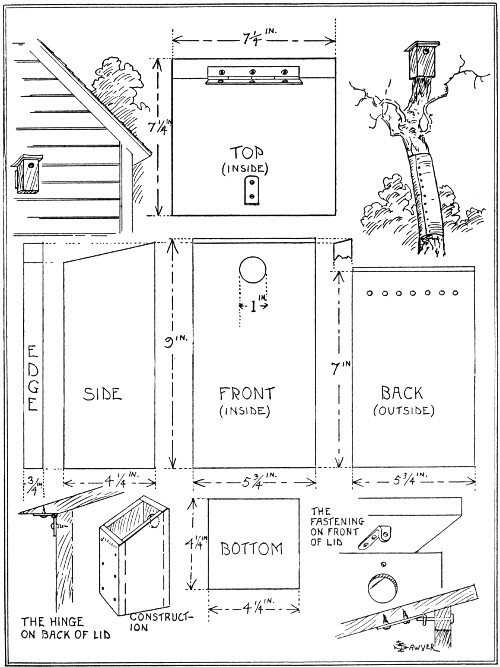
There is always danger of the wood splitting when too large an auger
hole is attempted. Before assembling the bird house, make an entrance
in the front board. Start by drawing a circle the exact size of the doorway-to-be.
Then, just inside this circle, bore four holes at equal intervals, using
a bit not larger than ⅜ inch for the smaller entrances; not larger than
¾ inch for the larger entrances. It will now be not too difficult, by use of
a keyhole saw or pocketknife and wood-rasp, to remove the wood still
remaining inside the drawn circle. Placing the board horizontally in a
vice will further insure against splitting while the holes are being bored.
12
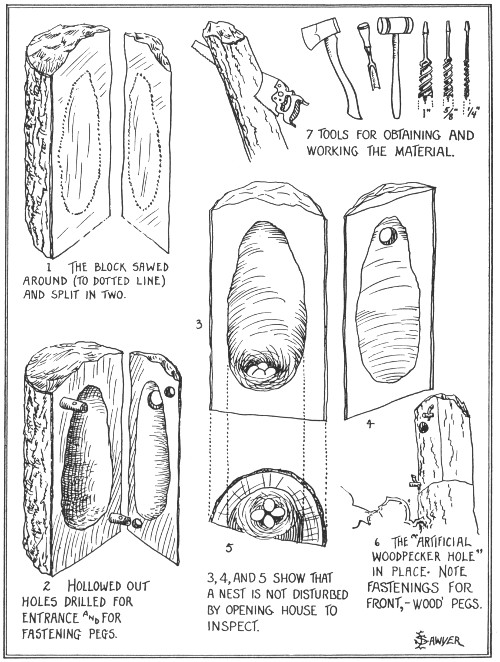
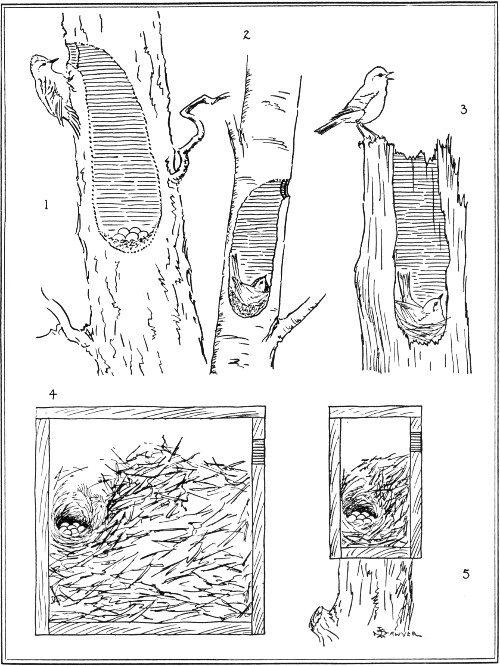
Plate II. The Best and Most Simple Form of Artificial Nesting Site
With dimensions appropriate to the species, this is the most generally attractive
type of house for all species excepting the Purple Martin. It is the type especially
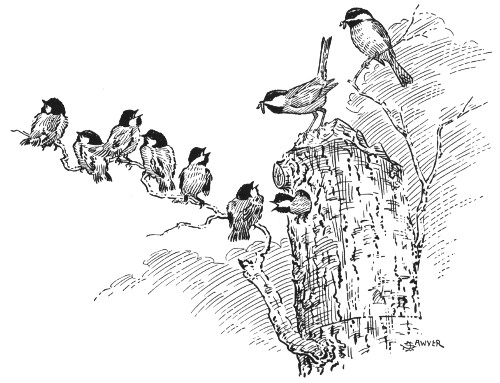
suited for the chickadee, nuthatch, and Tufted Titmouse.
- 1 THE BLOCK SAWED AROUND (TO DOTTED LINE) AND SPLIT IN TWO.
- 2 HOLLOWED OUT HOLES DRILLED FOR ENTRANCE AND FOR FASTENING PEGS.
- 3, 4, AND 5 SHOW THAT A NEST IS NOT DISTURBED BY OPENING HOUSE TO INSPECT.
- 6 THE “ARTIFICIAL WOODPECKER HOLE” IN PLACE. NOTE FASTENINGS FOR FRONT,—WOOD PEGS.
- 7 TOOLS FOR OBTAINING AND WORKING THE MATERIAL.
13
When a bird house is fastened to a support by the “toe-nail” method
(by driving nails at a slant through the sides and bottom), it is a good
point first to drill holes of the right diameter to fit the nails tightly;
otherwise splitting of the sides or bottom of the house may result. Use
flat-headed nails.
When slabs are used in house-building, the upright pieces may be
fastened to each other, at intervals of several inches, with a wire staple
having ¾-inch prongs one inch apart. These should be on the outside
of the house, where rust will color them to conform with the rustic wood.
For inspecting the nest and, at the end of the season, for cleaning out
the old nest material, the top or some other section of the house should
always be easily removable. Exceptions to this rule are houses for ducks
and other larger birds, for which the entrance may be large enough and
the depth not too great for all such purposes. Do not open a house in
the owner’s presence. The more brief and infrequent your inspections,
the less they will disturb the birds.
Bird houses erected on poles are safer from predators than those placed
in trees. Houses for Purple Martins, in particular, need to be at a distance
from trees and buildings, and if possible near water.
Place your bird house where the sun will reach it during part of the
day, and turn the entrance away from the prevailing winds.
14
It seems hardly necessary to emphasize that, if possible, the bird house,
as well as the bird bath and feeding station, should be placed in full
view of a convenient window. To watch birds in their building and other
activities will prove a fascinating pleasure.
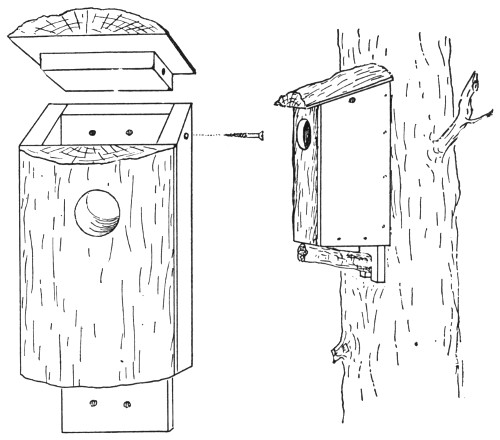
The author once with complete success contrived and operated a mechanical
“bouncer” to meet a particular and aggravated instance of bird
trespassers. In case of interference with any desired tenant or prospective
tenant by rivals for the same bird house, the interfering birds may be
driven away by this device.
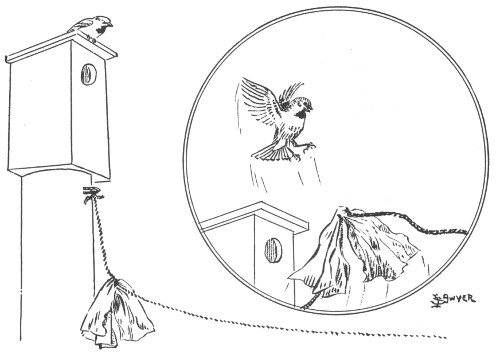
Figure 1. Discouraging the Uninvited Guest.
One end of a stout cord is attached at some point close below the
bird house. To this cord a rag or a piece of waxed paper about man’s-handkerchief
size is tied as conspicuously as possible at a distance from
the fastened end of the cord about equal to the height of the bird house.
The cord’s free end is then carried through a window of your own house
from which there is a convenient view of the bird box. The end of the
cord is fastened inside the window where it can be easily reached and
15
jerked, enough slack being allowed to let the rag at the other end hang
down. If the unwanted birds appear on or too close to the bird house,
the cord is given a sharp pull which will cause the rag to jerk upward and
frighten the intruder away. Repeat as often as occasion requires.
Care should be taken to work the bouncer when only the undesired
birds are within effective distance. However, should the contending birds
actually come to bodily grips on or beside the nesting site, the fight may
be broken up by vigorous operation of the alarm. The author found that
this device, exercised as occasion required, in two days ended a week-old
continuous struggle between a Bluebird and a pair of Tree Swallows in
which the Bluebird had entirely defeated the daily efforts of the Swallows
to start a nest. The Swallows were left in possession, quickly built their
nest, and duly raised their brood.
Obviously, this device and procedure may be applied against Starlings,
English Sparrows, or other birds, regardless of species, which for any
reason one desires to discourage from building in a given bird house or
other nesting-site.
The use of a rag or similar object, instead of a bell or other noisemaker,
is advised because the range of alarm is thereby limited to the
immediate location of the bird house, so that the desired tenants will not
be frightened by the operation of the alarm when they are within hearing.
“Reserves” of the favorite environment are as much a need for some
species as bird houses are for others. Widespread “improvement” and
“beautification” along roadsides is destroying the thicket, the favored
haunt of Song Sparrows, Catbirds, certain warblers, quail, and other
desirable species. A “reserve” thicket may be located in a secluded part
of the home grounds, hidden by a hedge if considered unsightly. It may
be almost any shape, but not less than 20 feet in average diameter or
much less than 400 square feet in area. Here weeds, tall grass, briars,
and dense bushes are allowed to grow wild, forming a tangle as they will.
If the bushes include such kinds as hackberry, hawthorn, sumac, elderberry,
and chokecherry, the thicket’s annual period of usefulness will be
extended. Including such a winter food tree as the mountain ash will
invite Purple Finches, Pine Siskins, grosbeaks, waxwings, and perhaps
crossbills.
16