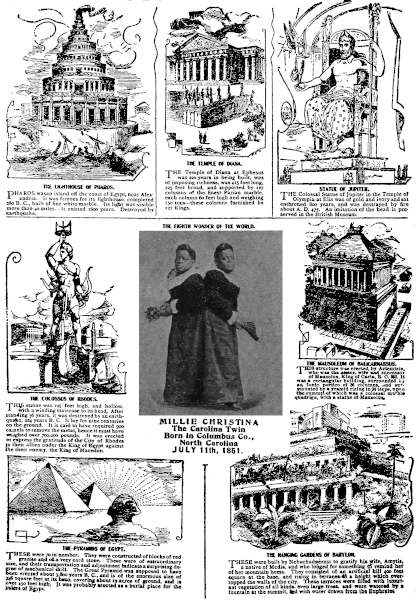
Biographical Sketch of Millie Christine — EIGHT WONDERS OF THE WORLD. — THE LIGHTHOUSE OF PHAROS. — THE TEMPLE OF DIANA. — STATUE OF JUPITER. — THE COLOSSUS OF RHODES. — THE EIGHTH WONDER OF THE WORLD. — THE MAUSOLEUM OF HALICARNASSUS. — THE PYRAMIDS OF EGYPT. — THE HANGING GARDENS OF BABYLON. — Railway Correspondence — Title Page — Railway Correspondence
Pharos was an island off the coast of Egypt, near Alexandria.
It was famous for its lighthouse, completed
280 B. C., built of fine white marble. Its light was visible
more than 40 miles. It existed 1600 years. Destroyed by
earthquake.
The Temple of Diana at Ephesus
was 220 years in being built, was
of imposing richness, was 425 feet long,
225 feet broad, and supported by 127
columns of the finest Parian marble,
each column 60 feet high and weighing
150 tons—these columns furnished by
127 Kings.
The Colossal Statue of Jupiter in the Temple of
Olympia at Elis was of gold and ivory and sat
enthroned 800 years, and was destroyed by fire
about A. D. 475. An imitation of the head is preserved
in the British Museum.
This statue was 105 feet high, and hollow,
with a winding staircase to its head. After
standing 56 years, it was destroyed by an earthquake,
224 years B. C. It lay for nine centuries
on the ground. It is said to have required 900
camels to remove the metal, hence it must have
weighed over 700,000 pounds. It was erected
to express the gratitude of the City of Rhodes
to their allies under the King of Egypt against
their enemy, the King of Macedon.
MILLIE CHRISTINA
The Carolina Twin
Born in Columbus Co.,
North Carolina
JULY 11th, 1851.
This structure was erected by Artemisia,
who was the sister, wife and successor
of Mausolus, King of Caria, B. C. 353. It
was a rectangular building, surrounded by
an Ionic portico of 36 columns, and surmounted
by a pyramid rising in 24 steps, upon
the summit of which was a colossal marble
quadriga, with a statue of Mausolus.
These were 70 in number. They were constructed of blocks of red
granite and of a very hard stone. These were of extraordinary
size, and their transportation and adjustment indicates a surprising degree
of mechanical skill. The Great Pyramid was supposed to have
been erected about 3,800 years B. C., and is of the enormous size of
746 square feet at its base, covering about 12 acres of ground, and is
over 450 feet high. It was probably erected as a burial place for the
rulers of Egypt.
These were built by Nebuchadnezzar to gratify his wife, Amytis,
a native of Media, and who longed for something to remind her
of her mountain home. They consisted of an artificial hill 400 feet
square at the base, and rising in terraces to a height which overtopped
the walls of the city. These terraces were filled with luxuriant
vegetation of all kinds, even large trees, and were watered by a
fountain at the summit, fed with water drawn from the Euphrates.
Southern California Railway Company. Passenger Department.
H. G. Thompson, Gen’l Pass. Agt. H. K. Gregory, Ass’t Gen’l Pass. Agt.
Los Angeles, Cal., Jan. 30, 1895.
To Conductors, Los Angeles to Santa Ana, San Bernardino via Orange,
San Bernardino to Redlands, and Redlands to Los Angeles:
It is customary for Millie Christine, the dual woman, to require but one
ticket. Please be governed accordingly when Millie Christine is making a trip
over any of our lines as above indicated.
Yours truly,
H. G. THOMPSON, G. P. A.
The Pennsylvania Railroad Co. Phila., Wilmington & Balt. R. R. Co. Alexandria & Fredericksburg Railway Co. Camden & Atlantic Railroad Co. Northern Central Railway Co. Baltimore & Potomac R. R. Co. West Jersey Railroad Co. Office, 233 South Fourth Street. Passenger Department.
J. R. Wood, Gen’l Pass. Agent. Geo. W. Boyd, Asst. Gen’l Pass. Agent.
Philadelphia, June 10, 1894.
Subject: Refunding extra fare.
J. P. Smith, Esq., Grand Central Hotel, New York City.
Dear Sir:
Referring to your call at this office a few days since I enclose herewith
order No. 25286 on our Treasurer for $4.71, covering refund of extra fare paid
from Washington, D. C. to Philadelphia, June 4th, by Millie Christine, the dual
woman, in connection with one first-class ticket between same points, which
the conductor lifted on the ground that two fares were necessary to cover
passage.
Please sign and return enclosed form of receipt, and oblige,
Very truly,
GEO. W. BOYD, A. G. P. A., Wash.
Baltimore & Ohio Southwestern Railroad.
Passenger Department.
City Office, Southeast Corner Fourth and Vine Streets.
O. P. McCarthy, General Passenger Agent.
Chas. H. Koenig, District Passenger Agent.
Cincinnati, O., April 13, 1892.
Conductors B. & O. S W. and connecting lines:
This is to certify that Manager Smith has purchased three (3) tickets,
Cincinnati to New York, in connection with Millie Christine, the dual woman,
this person being included. It is customary to require but one ticket for
her passage. Kindly be governed accordingly.
CHAS. H. KOENIG, D. P. A., B. & O. S W.
Treasurer’s Office, T. H. Gibbs, Treasurer. Columbia, Newburg & Laurens Railroad Company.
Columbia, S. C., Sept. 8, 1893.
Conductors S. A. Line and connecting lines:
This is to certify that J. P. Smith, Esq., has purchased three (3) tickets
from Columbia, S. C. to Lincoln, Nebraska, in connection with Millie Christine,
the dual woman, this person being included. It is customary to require one
ticket for her passage.
B. F. F. LEAPHART, Ticket Agent, C. N. & L. R. R.
Burlington, Cedar Rapids and Northern Railway.
Local Freight and Ticket Office.
A. F. Pilcher, Agent.
Sioux Falls, So. Dak., Oct. 5, 1895.
To Conductors:
It is customary to carry Millie Christine on one ticket.
Respectfully,
A. F. PILCHER, Agt.
BIOGRAPHICAL SKETCH OF MILLIE CHRISTINE, THE CAROLINA TWIN, SURNAMED THE TWO-HEADED NIGHTINGALE, AND THE EIGHTH WONDER OF THE WORLD.
“None like me since the days of Eve—
None such perhaps will ever live”—Except Christine Millie.
At each Levee Millie Christine will sing some of the songs
and duets which will be found at the end of the book.
Hennegan & Co., Print. Cincinnati. O.
SOUTHERN RAILWAY COMPANY,
Office of Division Passenger Agent.
R. W. Hunt, D. P. A.
S. H. Hardwick, G. P. A., Washington, D.C.
W. H. Tayloe, A. G. P. A., Atlanta, Ga.
Charleston, S. C., December 13, 1902.
To Conductors:—It is customary for Millie Christine, the dual woman,
to travel on one ticket. Please be governed accordingly when she is traveling
over the Southern Railway.
Yours very truly,
R. W. Hunt, D. P. A.
ATLANTIC COAST LINE,
Traffic Department.
T. H. Emerson, Traffic Mgr.
H. M. Emerson, G. F. & P. A.
Wilmington, N. C., December 10, 1897.
To Conductors:—Millie Christine, the dual woman, is transported over
these lines for one ticket, notwithstanding the fact that she has two heads.
Yours truly,
H. M. Emerson, G. P. A.
BALTIMORE AND OHIO RAILROAD,
Passenger Department.
John K. Cowen and Oscar G. Murry, Receivers.
S. B. Hege, D. P. A.
H. R. Hoser, Ticket Ag’t, 619 Pennsylvania Ave.
Washington, D C., June 9, 1898.
Conductors B. & O. R. R.:—This is to certify that Manager Smith has
purchased four tickets Washington, D. C. to Zanesville, Ohio, in connection
with Millie Christine, the dual woman, this person being included. You
will accept one ticket for the passage of Millie Christine.
Yours truly,
Per S. B. H., D. P. A.
J. M. Schryver, G. P. A.
PLANT SYSTEM OF RAILWAYS.
B. W. Wrenn, P. T. M.
Savannah, Ga., November 22, 1900.
To Conductors:—It is customary for Millie Christine, the two headed
woman, to travel on one ticket. You will please govern yourselves accordingly.
Yours truly,
B. W. Wrenn, P. T. M.
SEABOARD AIR LINE RAILWAY.
To Conductors:—It is customary for Millie Christine, the two headed
woman, to travel on one ticket. You will please govern yourselves accordingly.
Yours truly,
A. O. MacDonell, A. G. P. A.
ATLANTIC VALDOSTA & WESTERN RAILWAY,
Traffic Department.
Smith D. Pickett, G. F. & P. A.
Jacksonville, Fla., November 30, 1900.
To the Conductors, A. V. W. Ry.:—It will only be necessary for Millie
Christine, known as the Dual Woman, to present one ticket for her passage
over our line.
S. D. Pickett, G. P. A.
SOUTHERN RAILWAY COMPANY,
Office of Traveling Passenger Agent.
W. A. Turk, G. P. A., Washington, D. C.
C. A. Benscoter, A. G. P. A., Chattanooga, Tenn.
John C. Lusk, T. P. A.
Selma, Ala., January 11, 1901.
To Southern Railway Conductors:—It is the custom for Millie Christine,
the dual woman, to travel on one ticket. Please be governed accordingly.
Yours very truly,
J. O. Lusk, T. P. A.
SKETCH OF THE LIFE OF — Railway Correspondence
THE CAROLINA TWIN.
The Two-Headed Lady, the Double-Tongued Nightingale,
the Eighth Wonder of the World, the Puzzle of Science,
the Despair of Doctors, the Dual Unity.
All of these names has she earned at various times, with the final
title which we claim for her in defiance of any other or others:
The Most Wonderful Being Alive.
There are giants and giants, dwarfs and dwarfs, fat men and women,
living skeletons of both sexes, hirsute monsters and baldheads by the
century; there are marvels of nature, science and art, of all which the
world knows; but there can only be one Nonpareil, one Unequalled,
and that is the subject of our brief sketch, for only one living creature
is like Millie Christine, and her name is Christine Millie.
But, says the curious reader, was there ever such another heard of
before?
Only one is on record, attested as a fact, and leaving out of the
question fabulous monsters. The first year of the eighteenth century
witnessed the birth of a similar phenomenon in Hungary, the sisters
Helen and Judith, born in the year 1701. These girls were united at
the lower part of the body only, and were perfectly distinct beings in
every way. Helen was larger, stronger, and better-looking than Judith,
besides being much more active and intelligent. These girls lived to
their twenty-second year, when Judith fell sick and died, Helen following
her within a few minutes of her demise. And all this, you remember
happened more than a century since, so that it takes Nature a
hundred years at least to produce such a marvel again. Helen and
Judith died at twenty-two years of age, while Millie Christine still
lives, healthy and happy, at thirty-eight, and bids fair to attain a ripe
old age as easily as less wonderful beings. The following pages, confined
to a simple record of the facts in her career, will therefore prove
of interest and value.
Miss Millie Christine, or Christine Millie, was born of slave parents,
on the plantation of Mr. Alexander McCoy, near the town of Whiteville,
Columbus County, North Carolina, on July 11, 1851. At her
birth her mother was in her thirty-second year. She was a handsome
woman, finely formed and in excellent health. Millie Christine’s
father, of Moorish descent, slender and sinewy, with the powerful
activity characteristic of his race. Prior to the birth of Millie Christine,
her mother had borne seven other children, five boys and two girls, all
of ordinary size, with no peculiarities of conformation, and some of
them are still alive.
The wonder of the family, Millie Christine, weighed seventeen
pounds when she entered the world, and, although her mother was
only attended by a colored midwife, no serious consequences attended
such a remarkable birth.
But, when the child was once fairly in the world, how rumor flew
about the township of Whiteville, and spread from thence over the
whole country! “Have you seen the girl?” was the first question
asked of every one by every one, and pilgrimages to visit her became
all the rage in the country side.
The old nurse who had superintended her introduction into this
world was doubtless awestruck at the anomalous and wonderful addition
she had made to her master’s property, and not unnaturally prided
herself on having assisted Nature to produce a phenomenon; but the
master himself, and his amiable lady, without stopping to question the
designs of Providence, immediately surrounded the extraordinary infant
with such care and attention as enabled it to thrive and grow. The
dual-headed child was taken from the cabin to the mansion, and Mr.
McCoy’s family commenced then a course of care and attention to her
health and welfare.
During the first eighteen months of her life nothing of importance
occurred to Millie Christine worthy of note. She grew as other girls
grow, learned to walk at twelve months old, was of a lively and agreeable
disposition, and at fifteen months began to talk with both her
mouths. She was cheerful and active as any girl of her age, with every
appearance of robust health. Her vivacity and goodness, together, no
doubt, with her peculiar formation, rendered her the almost idolized
of the mother and a general favorite of both old and young, and
every attention and kindness was bestowed upon her.
At this time Mr. McCoy, being a man in very moderate circumstances,
a plain farmer, thinking the girl would become a burden to
him, and annoyed with the frequent visits of strangers to see her, determined
to dispose of her. He was not long in finding for her a purchaser,
a person of the name of Brower, who offered $10,000 for her,
seeing the possibilities of the child in the way of an exhibition. But
inasmuch as this Brower was not possessed of the requisite cash to back
his faith, and only offered to give a note of hand for the purchase
money, Mr. McCoy naturally desired some responsible person to whom
to look for the money in case of the non-payment of the note when
due. This person was ultimately found by Brower in Joseph P. Smith,
of Wadesboro, North Carolina, and Mr. McCoy finally parted with
Millie Christine, in consideration of Brower’s note for $10,000, endorsed
by Mr. Smith.
The happy Brower, in full possession of his prize, at once departed
for New Orleans, in obedience to a request from the medical faculty
of that city asking that she be brought there for a scientific examination.
Rooms were taken and every preparation made for the contemplated
examination, after which she was to be placed on public exhibition.
It had been arranged, prior to their leaving home, that their
presence in the city should be kept as quiet as possible, as the desire
to see her would undoubtedly be very great and might interfere with
the examination. This precaution was not strictly regarded, and soon
the rooms and the passages leading thereto were literally besieged with
anxious crowds of people eager to get a sight of her.
The examination, however, at length took place and proved most
satisfactory, every physician in attendance concurring in pronouncing
her Nature’s greatest wonder. Being endorsed by the medical faculty,
she was now put on public exhibition, but from want of proper management
she succeeded but indifferently.
Mr. Brower, being quite ignorant of the business he had undertaken,
despaired of success after a few more efforts. About this time
he became acquainted with a certain adventurer who hailed from
Texas and boasted of his immense tracts of land in that State. This
swindler proposed to purchase the girl by giving for her lands, at a
fair market valuation, to the amount of forty-five thousand dollars,
and Brower, having full confidence in the would-be millionaire, concluded
the bargain by giving possession of the girl, and was on the
following day to receive the deeds in due form. The day arrived, but
neither the Texan nor the deeds were forthcoming, and then for the
first time the unpleasant fact broke upon him that he had been completely
duped. To gain some knowledge of her whereabouts was now
his first effort; but so adroitly was everything pertaining to her abduction
managed that no clue to her, or even the direction she had been
carried, could be gained, and every effort for a time to learn anything
of her proved futile.
Mr. Brower, after weeks of useless search, becoming convinced
that, for the present, further efforts to regain her would only prove
useless, determined to return to North Carolina and impart to Mr.
Smith his loss, and to the mother the sad intelligence of the abduction
of her daughter. Words are inadequate to describe the anguish of the
parent on learning the fate of her child. For a time she was perfectly
frantic, during six days refusing food and for the same number of
nights her eyes did not close in sleep. Her excellent character, uniform
kindness and amiable disposition had made her a general favorite, so
that everything that could be was cheerfully done to comfort and
soothe her mind. She was promised that no amount of money should
be spared, no effort left untried to procure her much-cherished child.
How truly this promise was kept the sequel will prove. Brower and
partner were bankrupt, and Mr. Smith expected no assistance from
them. But before anything could be done to recover the child it was
necessary that her original owner should be compensated for his loss
in the transaction. Christine Millie had been spirited away to parts
unknown, and all that Mr. McCoy had to show for her was Brower’s
note for $10,000; and as Brower could not pay this money his endorser,
Mr. Smith, became the responsible party and accepted the
responsibility. He at once paid the purchase money in full to Mr.
McCoy, and took from him a deed which made him the exclusive
owner, under then existing laws, of the person of Millie Christine.
The proviso, “wherever he could find her,” was of course understood,
and in order to quiet the mind of her mother and convince her that,
whenever found, the child would be restored to her care, Mr. Smith
at the same time purchased the father, mother and seven children, a
transaction of course involving a large sum of money, all of which was
dependent for its recovery on the recovery of Millie Christine herself.
The question then arose, where was she, and if found, how was she
to be recovered, if at all?
Mr. Smith found in the person of Mr. T. A. Vestal of Selma, Alabama,
one of the shrewdest detectives in the country, and Vestal at once
commenced operations, with the assistance of two other detectives, and
ultimately gained intelligence of her in the city of Philadelphia, though
not before the lapse of some fifteen or eighteen months.
Vestal heard from a negro barber, whose confidence he had obtained,
that about a year ago a child answering her description had been in
the city, and for a time had been secreted in a cellar on Pine Street.
The cellar was found, and, through the influence of bribes, it was
ascertained from an old woman still living in a portion of the house
to which the cellar belonged that the child had been carried to New
York. The next day Mr. Vestal started for that city to prosecute his
search, and remained there five weeks. Every effort was made, but
no further intelligence of her could be learned. If any one knew of
her or had seen her there, their mouths were sealed to the influence of
money or persuasion. Mr. Vestal began almost to despair, yet determined
not to yield his cherished object. He had every reason to
believe she was alive, for when taken from New Orleans she was in
excellent health. The papers had been watched closely by him, and
no account of the death of any one answering her description had been
noticed, which certainly would have been the case had she died. From
New York he proceeded to Boston; from thence to Philadelphia, and
ultimately to Newark, New Jersey. There, for the first time, he got
definite information of her. He learned from a man then keeping a
drinking house that at one time, when engaged as a cabman in the
city of New York, he had been hired to convey a girl answering her
description to a sailing vessel, the name of which he did not remember,
bound for and ready to sail for Liverpool; that he had seen the
vessel depart, and knew the child was aboard of her when she sailed.
Acting on this valuable information, Mr. Vestal immediately returned
to North Carolina and urged on Mr. Smith the necessity of following
her. Mr. Smith determined to make the attempt, and accordingly
prepared for the journey. Accompanied by the mother of Christine
Millie, he reached New York, took the steamship Atlantic, and after a
pleasant voyage reached Liverpool. There they learned that the child
had been on exhibition in that city; also in London, Leeds and other
places.
Seated in a promiscuous crowd of traders and traveling clerks one
evening, in front of his hotel, her name was introduced, and he learned
that a short time before she had been on exhibition in Glasgow, Scotland.
Immediately they started for that city, but on arrival found that
a short time before she had been taken back to England, and was then
in Birmingham. So to that city they posted, and on their arrival, to
their joy, found she was then on exhibition. It now became necessary
that extreme caution should be used, lest their long-cherished object
would be frustrated on the very eve of consummation. The impatience
of the mother knew no bounds: scarcely could she be restrained from
rushing to the exhibition room and defiantly claiming her child, supposing
the party who then had possession of it would recognize her
claim. She was, however, at length convinced of the imprudence of
such a course, and submitted until the case had been placed in the
hands of the proper officers. Accordingly the Chief of Police and a
select body of assistants were called and a true statement of the affairs
given. The American Consul was also waited upon and consulted.
He immediately took a lively interest in the matter, and advised that
the arrival of the American party be kept unknown to the exhibitor until
they, in company with a protective force of police, should enter the
hall that evening; and should the child recognize the mother among
the audience, it would be prima facie evidence of the facts attempted
to be established by them, and used as such in case of litigation.
Accordingly, the impatience of the mother was restrained until
the hour of the gathering of the visitors, when a portion of the police
(selected for the purpose and disguised) Mr. Smith and the mother
procured tickets of admission and entered the hall, as casual visitors
impelled only by the general curiosity. No sooner, however had the
keen eye of the mother caught a glimpse of her long-lost child than
she uttered a scream of such heart-rending pathos that the audience
simultaneously rose to their feet, wondering and astonished. The
mother, overpowered, fell fainting to the floor. When resuscitated
she wildly threw her arms about, crying in most piteous tones. “My
own child! O! give her to me! Do not take her away again; she
needs my care! Where is she? Where is she?” While this scene of
excitement was going on, the exhibitor attempted to secrete the girl in
an adjoining room; but an honest Scotchman, divining his intentions,
placed his back against the door, and bringing himself into a position
that would have delighted a pugilist, cried out: “Ye’ll nae tak’ the
bairn ayant the door, maun ye wallop me first, and I’m nae thinkin’
ye’ll soon do that.”
Such a scene of excitement as this denouement created has seldom
been witnessed. The women fainted, and the men, learning the true
state of affairs from the Chief of Police, who mounted the stage for the
purpose, threatened with immediate and summary punishment the sordid
villain who had stolen, for the purpose of gain, a helpless child.
He managed, however, to escape by jumping from the second story
window, which hazardous feat alone, for the time, saved him from certain
and well-merited punishment.
The mother, recovering, took the child, and they were conveyed to
the hotel, where, for the first time in three years, she slept with it in
her arms, forgetting, in the possession of the fondly-loved and long-lost
one, the days and nights of anguish she had spent during its
absence, and dreamed of naught save happiness and pleasure to come.
But her troubles were not to end here. The prize was too rich to be
thus easily given up by interested ones. So, on the following morning,
a writ of habeas corpus was served upon them, requiring the appearance
of mother and child before the Court of Admiralty, to show cause
why she was taken from the custody of the exhibitor. Here the Consul
again proved a friend and true American by demanding the child
as an American citizen, and requiring it, as a minor, to be placed in
charge of the mother, and that protection be given her to maintain her
maternal rights.
Voluminous proofs, giving an accurate description of mother and
child, together with all necessary facts bearing upon the case, had been
carefully procured and carried there, in case of necessity. Upon these
the Consul spoke a short time, when the judge, arising, declared it
useless to occupy more time, for from the opening of the court the
case had been decided by the Bench. “The child should be given
into the custody of its lawful mother. If it was not the child of the
defendants, then mother never bore a child. Every lineament, every
feature, every look betokened it; every spectator in his inmost heart
felt, yes, knew it to be her child, almost as certainly as though they
had seen it every hour since its birth.” A long and hearty shout of
approbation at this decision ascended to the dome of the stately old
building.
As soon as order was restored, the plaintiff determined to make
one more effort; so, calling the attention of the Court to the fact of
his ability to perform all he promised, he said he was ready then and
there to settle upon the mother the sum of ten thousand pounds
sterling, and deed to her an elegant house, in which she could spend
the rest of her days in luxury and comfort if she would remain in
England and give him possession of the child until she was eighteen,
to all of which flattering offers she only turned a deaf ear, preferring, as
she said, “to return and live, as she had done, in the land of her
birth, with those she had known from infancy, and among her kindred
and her friends.”
It should have been remarked before that the Texan, although
shrewd enough to dupe Brower, was in turn made a dupe himself.
Arriving in Philadelphia, on their way from New Orleans, he fell in
with two showmen, Thompson and Miller, who soon succeeded in
getting possession of the girl, and it was they who had carried her to,
and in whose possession she was found, in England. As Thompson
and Miller had been most successful in their exhibitions of her (in the
course of three years arising from poverty to comparative affluence), it
was not to be presumed they would willingly abandon the hope of again
possessing her, be the means of possessing what they would.
Mr. Smith, the mother and the subject of our sketch, being now
free to depart, made their preparations openly to return. The Atlantic
had made a return trip and was then at the Liverpool docks. The
now happy party again took passage upon her, and after a prosperous
voyage reached New York. There they took the cars and were soon
landed safely in the good old State of North Carolina.
Astonishing as it may appear, scarcely had the party reached home
when those who had caused so many sleepless nights and days of
anguish and trouble made their appearance in Charlotte, distant from
the girl’s home fifty-five miles, evidently intent upon another attempt
to regain the rich prize they so fraudulently had possession of for a
time, but now wrested from their avaricious grasp. The citizens of
Charlotte, learning of their presence and intentions, concluded to give
them an admirably fitting suit, composed of good tar and excellent
feathers, and the freedom of the streets for promenading, with the
company of a lusty negro to keep time to quickstep on the end of a
large tin kettle.
Thompson and Miller, by accident, learning the intentions of the
Charlottins, concluded “discretion was the better part of valor” and
decamped by night, and since then nothing has been heard of either
in North Carolina, and the only thing to remind you of their visit to
that section is the chorus of a negro song heard at the corn shuckings:
Massa Tomsin run a race;
Oh! oh! o-o-o yah!
He beat de fastest hoss in de place;
Yah, oh yah! O La!
Millie Christine grew and flourished, when Mr. Smith, yielding to
the earnest solicitation of friends who knew him to be possessed of the
world’s greatest marvel, allowed her to be taken upon a tour through
the States of South Carolina, Florida, Georgia and Louisiana. At the
close of that tour, in the City of New Orleans, an incident occurred
which, for a short time, made shipwreck of the happiness of Millie
Christine, and which, but for the affection of Mr. and Mrs. Smith, and
the persistence which that affection inspired, would probably have
altered the whole life of the child for the worse. She was again kidnapped
and for months was hurried over the country, from place to
place, and deprived of the fostering care of her natural guardians.
Ultimately, however, Mr. Smith’s anxiety and determination were
rewarded, and the child was restored to the arms and heart of Mrs.
Smith, whom it soon came to regard and denominate its “white
mamma.” Under her care the girl was reared to regard with reverence
and love the Supreme Father of all mankind, and speedily grew up into
an intelligent Christian child. She not only became proficient in elementary
education, but, showing a high appreciation and taste for
music, soon became an object of great interest to all visitors at Mr.
Smith’s home by the rapid progress she made in that accomplishment.
The year 1860, the dreadful year which brought so much pain and
suffering to the United States of America, brought its own individual
sorrow to the home of Millie Christine. Mr. Smith, after a few weeks
of suffering, passed quietly away to a better world, mourned by all who
knew him, and by none more than those who called him master.
Indeed, it is only due to Mr. Smith and his wife to state, and Christine
Millie desires particularly that it be inserted in this sketch of her life,
that she experienced at his death rather the affliction of one who had
lost a beloved father rather than a master. Not only this, but other
families on estate of the Smiths, while calling the owner and his wife
master and mistress, always regarded them in the light of protecting
parents.
But the war came on, and with it came those heavy losses which
prostrated the fortunes of the Smith family, making of the once prosperous
plantation an untilled waste, over which the restless hand of the
armed spoiler worked its will. It was then that the kindness of the
past found its fruit in the devotion displayed by Millie Christine towards
her only living protector, Mrs. Smith, whom she regards with filial
affection, and from whom she was fully determined never to separate
herself. To retrieve the fallen fortunes of the family she, now free,
consented to place herself on exhibition, and afford the world the
opportunity of seeing the most marvelous physical development which
has ever existed in the human family.
It may be mentioned here as an interesting fact, showing the strange
mutability of human fortunes, that Jacob, the father of this wonderful
being, once the slave of the planter McCoy, now owns, with his wife
Monemia, the very plantation on which he was once a bondman, and
on which Millie Christine first saw the light of day, the same having
been purchased by her with the proceeds of her exhibitions as a present
to her father and mother.
It will be necessary to append to this sketch a few of the medical
and surgical reports on Millie Christine’s physical organization; but it
may not be uninteresting to give a brief description of her as she strikes
the mind and eye of a familiar friend. Millie Christine, physically,
has but one existence; mentally, she has two, perfectly developed.
From the middle of the single spine grow two perfectly developed
busts, each of which has a pair of fine arms, and terminates in an interesting
head. Both heads are adorned with curling black hair; each
has a pair of sparkling black eyes, constantly lit up by intelligence,
which, at any outburst of fun and humor, seem literally to dance with
glee; while each mouth is adorned with a set of brilliant teeth. The
two faces are bright and interesting, but differ materially in features,
one resembling Jacob, the father, the other Monemia, the mother.
There is very little distinction to be made in the two developments.
The two sets of brains always agree in forming the same conclusions;
equally amiable, and equally agreeable in character, they never form
different ideas on the same subjects, and the thoughts of each are characterized
by that independence which is usually exhibited by natives
of America. The tastes and habits of the two are alike; both are fond
of music and dancing, both take interest in the same amusements;
indeed, this marvelous organization shows its wonder in nothing more
evidently than its perfect happiness. The two minds can converge
each through its own lips. The being is never at a loss for society or
for company, for each has, attached to itself, another existence; and
yet in no single instance has a particle of disagreement ever occurred
to conflict with the happiness or comfort of either. If the one mind
formed the fancy to be in London, and the other desired its body to
proceed to Paris, a conflict might ensue; providentially, this seems
impossible, and has never occurred. Christine has a soprano voice,
Millie a contralto; and they sing duets together with exquisite taste
and sweetness. Their natural taste for music has been conscientiously
and carefully cultivated by their kind protectress, and the public will
not be slow to discover that they have as much power to please and
amuse as a very large number of artistes of established reputation. It
should now be stated that Millie Christine has four legs, on which she
walks with grace and ease; but she can use the outer ones only for
purposes of locomotion. She is a very graceful dancer, and executes
the schottische, polka or waltz with equal ease. Her manners in the
presence of strangers are most engaging. She does not object to speak
of herself or her own peculiarities, and her two minds are always as
one on these points. The two minds composed some verses descriptive
of herself, which the two voices repeated in unison, and, although of
no great literary merit, they are simple and expressive. The verses are
as follows:
’Tis not modest of one’s self to speak;
But, daily scanned from head to feet,
I freely talk of everything,
Sometimes to persons wondering.
Some persons say I must be two,
The doctors say this is not true;
Some cry out humbug till they see,
When they say—great mystery!
Two heads, four arms, four feet,
All in one perfect body meet;
I am most wonderfully made
All scientific men have said.
None like me since the days of Eve—
None such, perhaps, will ever live—
If marvel to myself am I,
Why not to all who pass me by?
I’m happy, quite, because content,
For some wise purpose I was sent;
My maker knows what he has done,
Whether I’m created two or one.
The medical reports on the anatomical construction of this extraordinary
phenomenon are published separately for the benefit of the
scientific and the gratification of the curious, but sufficient may be
here stated to satisfy the ordinary interest of the public. A number of
gentlemen connected with Jefferson Medical College, in the city of
Philadelphia, examined Christine Millie. Among them were Drs.
Pancoast, Meigs, Bidde, Wallace and Dickson, all well known in the
medico-scientific world. Forney’s Press contains the following report
of the clinic:
At a special clinic recently held at the Jefferson Medical College, “Christine
Millie” was submitted to a scientific anatomical examination.
Assembled at the clinic we found Professors Pancoast, Ormsby, Rand and
Gross, and Drs. Meigs, W. H. Pancoast, Gardette, Ray, Turnbull, Atkinson,
Barson, Bache, Dickson, Cohen, Atlee, Andrews and others, well known to surgical
fame.
The double-headed girl was introduced by Dr. William H. Pancoast, the
demonstrator of anatomy at the College, and a general feeling of astonishment
was felt when it was discovered that, instead of a monstrosity there was exhibited
to the professional talent assembled a well-educated, intelligent, quick-witted
girl, with nothing about her that was repulsive or calculated to offend the
most fastidious, but which at once stamped her as a wonder and a source of scientific
information to those learned in anatomy.
Dr. Pancoast stated that the body had been placed under his professional
care, and, owing to the important questions involved, a private examination had
been made by Professors Pancoast and Gross, and Drs. Sevie and Andrews, which
had verified all the opinions expressed as to her duality.
It was then stated that this remarkable freak of nature was united at the lateral
posterior portion of the pelvis, while above that point they were separated—had
separate chests, two pairs of fully developed arms, but only one trunk.
The double-headed possessed separate intellectual faculties as entirely distinct
as was the brain power of two different individuals, while their faces indicated,
to a remarkable degree, intelligence of a high order and amiability. The lower
portion of the body had inclined outwards from each side, and the lower limbs
were inferior, and not so fully developed as the arms.
A series of experiments was then made under the direction of Professors
Pancoast, Atlee, Maury, and others, calculated to demonstrate the construction
of the nervous system, which showed that while above the junction the sense of
feeling was separate and distinct in each, below the union it was in common. A
touch upon the foot of one would be instantly detected by the other, while a hand
placed upon either shoulder was only noticed by the one touched.
The pulse of Millie was found to be about four beats slower than that of
Christine, while the beat of the two hearts was nearly the same.
An impromptu performance was given at the clinic in order to show the agility
of the girl, and, to the astonishment of the audience, dances were executed, conversations
carried on between the two heads, and conversations with two different
persons at one and the same time. They stood upon their outer limbs,
walked about with a pleasing undulating motion, and Christine lifted the other
by the ligature at the pelvis merely by inclining her body to one side. To cap
the climax, a duet was executed by the girl, displaying musical knowledge, culture,
perfect time and tune, one head taking the soprano and the other the alto;
and then, in order to show the sympathetic nature of their voices, “Sweet Spirit,
Hear my Prayer,” was given in admirable style.
Some of the leading statesmen in Washington manifested great interest
in the case, and two of the most eminent physicians in the city
wore afforded an opportunity to make an examination. Respecting it,
the Washington Republican says: “The examination by Dr. Bliss and
Dr. Borland was most satisfactory, and revealed the fact that the representations
made by the young lady’s guardians are entirely correct, the
girl being but of one body, with two heads, four arms, four feet, two
sets of lungs, two hearts, but only one physical organization. The
doctors express themselves as entirely satisfied that the young lady is
the most wonderful human being on the face of the earth.”
The Baltimore Sun, a paper of very high standing in Maryland,
says: “There is, at the juncture of the trunk, but one spinal column.
The nervous system seems to be identical, but each possesses individual
consciousness, and each head does its own thinking. On the other
hand, the appetite is the same; when one is hungry the other is the
same. The digestive organs are independent. As she moves about
she looks like two bright young copper-colored girls tied together in
the middle, in the same dress, which is cut short so as to display the
movements of four feet. The busts of each are very nearly symmetrical;
the heads and necks, shoulders and arms, are perfect. The
faces are round, bright and intelligent; eyes large and clear; hair
black and glossy.”
The press of all the large cities in America bore similar testimony.
During the past few months Millie Christine has received an enormous
number of visitors. Christine Millie’s receptions have always
been attended by great numbers of people. In the city of Washington,
during a fortnight’s stay, thirty thousand persons attended her
receptions; in Philadelphia, during eight weeks, a hundred and fifty
thousand visited her; in Boston, seventy thousand in three weeks;
and in New York, in a single day, ten thousand persons flocked to see
her. Christine Millie has made an extensive tour of Europe, and
remained there several years. The Liverpool Mercury has the following
regarding her.
EXTRAORDINARY PHYSICAL PHENOMENON.
Since the days when the Siamese twins arrived in this country and occasioned
so much excitement in medical circles, no illustration of the freaks of nature
has been found at all approaching in its remarkable character to that given
in the person of Christine Millie, a native of North Carolina, who arrived at this
port on Tuesday, per City of Brussels, from New York. The young person
who is about to proceed to London for exhibition, is the child of parents formerly
slaves in North Carolina, still living, and having several other children,
and was herself born a slave. It is scarcely possible by a written description
to convey anything like an adequate idea of the marvelous physical organization
of this extraordinary being. In figure, Christine Millie, who is 19 years
of age, is rather short, and possesses two heads upon one body, with two well-developed
chests and four arms. This portion of the frame is as perfectly distinct
in each figure as if the upper part were the heads of two persons; but at
the lateral posterior portion of the pelvis there is but one body, with one spine,
the lower parts of which gradually incline outwards from each side, and terminate
with four legs. The faces are of the African type, with thick lips and large
mouth, denoting the race from which the girl has descended; but in conversation
the countenances brighten with intelligence, and those who have had the
opportunity of seeing the girl could not fail to be pleased with the geniality of
her manner and with the store of information which she has at her command. The
question which naturally arises, and which it seems difficult to solve, is, whether
this is one being, or whether, in some extraordinary manner, two persons have
thus marvelously joined together. A very careful anatomical examination, made
by the professors at Jefferson Medical College, America, has led to the discovery
that the lungs, heart, and functions of digestion are those of two persons, apparently
perfect and healthy in each, but that the whole of the lower organization
of the body is that of one female, with the exception of the four legs. Each
head is said to possess separate intellectual faculties, as entirely distinct as the
brain power of two different individuals, and the volitions of the will are independent,
but very much in harmony with each other. In proof of this the two
mouths will at the same time converse with different persons upon topics of a
widely different character, and will join in singing a duet, one taking the soprano
and the other the contralto part. Experiments have been tried with a view
to demonstrate the nervous system, which showed that whilst above the junction
the sense of feeling was separate and distinct in each, below the point of
union it was common. Thus, a hand placed upon the shoulder of either was
noticed only by the one touched, but a pressure of the foot was instantly felt
by each.
Yesterday a private party of ladies and gentlemen had an interview with
this extraordinary person at the Washington Hotel, and were both astonished
and pleased. She seems remarkably cheerful, suffers no inconvenience or pain
from peculiar physical organization, dances with freedom, and, for one of her
race, sings with considerable taste and expression. * * * * *
The editor of the Liverpool Daily Post says:
THE NEW PHENOMENA.
A numerous party assembled yesterday at the Washington Hotel to
“interview” a most extraordinary natural Phenomena who is about to be
exhibited in London as the “Two-Headed Nightingale.” * * * *
Christine Millie is a phenomenon of the Siamese twin order, but far
more wonderful, for instead of two bodies connected with a ligature,
there is only one torso, the body separating a little above
the waist. There are two distinct busts and pairs of shoulders, two
heads, four arms, and four legs. Anatomical examination has proved
that the young lady—she is nineteen years of age—has two sets of
lungs, and two digestions. It is certain there are mentally two perfect
individualities, for conversations may be carried on with each of the
two persons so mysteriously blended in one; and, each having a very
pretty gift of singing, they perform duets in parts. Christine Millie
also dances very gracefully, and appears to have no difficulty in
moving about, and in no way differs in appearance from two animated and
engaging young negresses, who for sport have agreed to pass an hour
tied together nearly back to back. The exceedingly amiable and merry
disposition of the mysterious pair deprives the exhibition altogether
of that painful element which was present even in the case of those
practical philosophers, the Siamese Twins. Christine Millie “first
saw the light” as a slave in North Carolina, and the lady on whose
estate she was born, and by whom she has been most affectionately
and successfully educated, accompanied her to England. All who met
Christine Millie yesterday must have felt interested in her fortunes,
and well disposed to meet her again.
From the Liverpool Daily Courier:
ARRIVAL OF CURIOSITIES OF NATURE.
Amongst the visitors who arrived at Liverpool from New York on Tuesday
in the Inman steamer City of Brussels, was a party of ladies and gentlemen,
whom the indefatigable Mr. Barnum, of showman notoriety, has nothing to do
with, though here for the edification of the curious.
The most singular and physiologically interesting member of the party is a
young lady, between eighteen and nineteen years of age, or rather, two young
ladies rolled into one, who is certainly a rival to the famous Siamese Twins, and
very much more attractive in appearance than Messrs. Chang and Eng. Those
who saw the Siamese Twins during their presence in England will have a vivid
recollection of the painful look that their features bore, and the constrained movements
of their bodies while walking in any direction. There is a total absence
of this in the young lady who bears the name of Miss Christine Millie, whose
four bright black eyes and dazzling rows of pearly-white teeth light up a fair
Creole complexion with an animation that is really attractive. This singular lusus
naturæ is the offspring of parents who were slaves in North Carolina previous to
the American civil war, and has several brothers and sisters who are like ordinary
humanity. During the struggle the family suffered considerable privation; but
as a curious illustration of the changes which have taken place in Southern society,
through the war and the declaration of freedom from slavery, it may be
mentioned that the father of Christine Millie is now the owner of the plantation
on which he was once a slave. As to the young lady herself—for we have surgical
authority for describing her—she has bodily only one person, though possessed
of two heads, two pairs of shoulders, four arms, and two pairs of legs, amalgamated
curiously with one trunk. We can only say that an hour’s audience with
her yesterday afternoon proved her to be a cultured, self-possessed and accomplished
person, who had a most singular attribute of being able to hold two
totally distinct conversations at the same time with different persons, or the
same person, can sing a duet very tastefully and tunefully in two voices, soprano
and contralto, and can dance a mazourka with singular grace and facility.
There was no difficulty made in exhibiting the upper portion of the dorsal connection,
and it was done without any infringement of modesty.
From the Liverpool Leader
“MOST EXTRAORDINARY.”
In the steamship City of Brussels, from New York, on the 2d of May, 1871,
arrived a cargo which, in the words of Mr. Toole, may be termed “most extraordinary.”
Of all the curiosities ever unearthed by the immortal Barnum,
none can compare in the most minute degree with Millie Christine, a daughter
or daughters—whichever the fastidious please—of the State of North Carolina.
They first saw the light nineteen years ago, and the mother is presumably the
founder of that gigantic Woman’s Rights Association in America, which has lately
made formidable inroads upon English society. Here we have a young lady with
one body, but two distinct minds, borne by two separate heads. All the intelligent
men who saw her at the Washington Hotel the other day, can bear witness
to the marvellous intelligence which predominates in both brains; the conversational
powers of the two heads at once in communication with two different
persons; upon different topics, would sufficiently testify it. But the marvel did
not stop here; some of the sweetest duets in the language of music were sung by
a high soprano and a pure contralto. The notes issued from two heads, and yet
but one trunk supplied the verve. It may now be added that this extraordinary
trunk has two pairs of perfect legs, terminating in symmetrical and very pretty
feet, and that, moving upon their pedal extremities, the trunk exhibits the very
poetry of motion. The polka, the mazourka, the schottische, are delineated by
these two pairs of pretty feet, in perfect time and harmony, and the spectator is
rewarded not by one smile, as in the case of ordinary young ladies, but by two
distinct smiles, winked at you by two pairs of sparkling and roguish eyes, and
thrown at you by two different sets of the purest ivory that ever adorned the
mouth of an Indian Sultana. There are a lot of people here, or elsewhere, always
ready to strain at the smallest gnat and swallow the biggest camel, who will doubtless
put this young lady down as outside the pale of ordinary humanity. If this
prejudice should carry one so far as to avoid her, they alone will be the losers.
We can testify that no person of ordinary intelligence can be in her company for
half an hour without yielding to the charm of her manner and the fascination of
her double smiles. She has you on both sides. If you remove your head from
one position you are immediately the victim of another pair of eyes, which fix
you and, in fact, transfix you. We candidly admit that we were fascinated, and
that we immediately lost sight of the phenomenon and became overpowered by
the influence of this dual brain. The young lady will shortly hold levees in London,
and the public of Liverpool may hope to see her by-and-by. The eminent
medical men of the United States testify that this remarkable freak of nature is
united at the lateral posterior portion of the pelvis, while above that portion
they are separated, have separate chests, two pair of fully developed
arms, but only one trunk. With the double head they possess separate
intellectual faculties as entirely distinct as in the brain power of two different
individuals, while their faces indicate to a remarkable degree intelligence of a
high order and great amiability.
VISIT OF EMINENT MEN IN LIVERPOOL TO MILLIE CHRISTINE.
On the 4th of May a reception for medical men was held at the Washington
Hotel, Liverpool, and was attended by the following eminent members of that
faculty: Dr. Nevins, Dr. Bickersteth, Dr. McGregor, Dr. Greegan, Dr. Slack,
Dr. Gorst, Dr. Steele, Mr. T. Bickerton, F.R.C.S., etc.; Mr. Edgar Browne,
M.R.C.S.; Mr. Jas. Pen Harris, Mr. W. H. Manifold, etc. Having had an opportunity
of explaining the bond of union, these eminent men were unanimously of
the opinion that Millie Christine is the most extraordinary phenomenon the
world has ever seen.
THE TWO-HEADED GIRL.
LAUGHABLE ACCOUNT OF THE TWO-HEADED GIRL BY A WESTERN EDITOR.
“Girls in this city are divided into two classes—single-headed girls and
double-headed ditto. The single-headed ones are certainly the most numerous,
but the double-headed ones appear to be the most attractive. This is evident
from the fact, that while we can see a single-headed girl almost any time, we
have to pay in order to be introduced to the maid with the duplex cranium. We
say ‘maid’ because the last double-headed girl we saw was not married. There
was one man who courted her successfully, as he thought, for a time, but before
popping the question he kissed one face first, and could never get the consent of
the other head. She is now waiting till a two-headed man comes along, and is
gay with hope.
“This duplex girl, however, must be in every way a desirable match.
Though the assurance given that she eats with both heads may tell against her
with parsimonious wooers, yet the fact that she buys dresses for one only must
be an immense advantage. The same with her talking. The two-headed girl
must be extremely circumspect, not only in her walk, but in her conversation.
As she can never have a secret, she can have no opportunity to go around telling
it. Neither will any one ever tell a secret to one head for fear that the other
would split upon it.
“The fact of having two tongues should not militate against her, as, if she
had only one, she would probably keep it going all the time, while, if she uses
two, the one deadens the sound of the other. Whichever way we look at the
two-headed girl we see her to advantage, though we don’t mean to say the least
that should be understood to disparage a girl because she happens to be born
with only one head.”
After an absence of eight years Christine Millie returned to her
native land on October 1st, 1878. Her tour abroad was a continued
ovation of success. She visited the principal cities and towns in England,
France, Germany, Belgium, Italy, Hungary, Austria, Holland
and Russia. At every point the young lady was commanded to appear
before the nobility and rulers of these great countries. Kingly
presents and valuable jewels were given as tokens of appreciation not
only of her as a remarkable curiosity, but of her graceful bearing, her
contented disposition and of her artistic musical abilities. Before she
had landed, upon her arrival, a representative of the New York Herald
greeted her, and the next morning that journal gave forth to the whole
United States the return of one of its children, who had fully established
herself to be the greatest curiosity of the greatest country in the
world. Since her return she has exhibited to thousands in the cities
of Boston, Philadelphia and New York. While in Philadelphia she
again appeared before the professors and students of the Jefferson
Medical College. Professor Pancoast for the second time examined
her. A portion of his lecture is extracted from the Philadelphia Evening
Telegraph.
This afternoon, at 1 o’clock, Millie and Christine were given a scientific examination
by Professor W. H. Pancoast, at his clinic, at the Jefferson Medical
College Hospital. The well-like room was crowded, and Professor Pancoast busy
removing a cancer from a patient when the reporter arrived. During the operation
Baron Littlefinger and Count Rosebud, two most intelligent dwarfs—perfect
little men in figure—were present, and appeared interested spectators of the operation.
In introducing Millie and Christine, the Professor said that he considered
them the most interesting personages that have ever come under the notice of
scientific men, far more interesting than the Siamese Twins. In the midst of his
discourse the young ladies entered, clad in green silk on their two bodies, pretty
little bronze boots on the four feet, white kids on their four hands. They moved
forward like an expanded V, with a crab-like movement that was not ungraceful.
Born back-to-back, the Professor explained that the natural desire of each to
walk face forward had twisted them in their present position. Separate entities,
separate individualities, each can pursue separate lines of thought and conversation
independent of the other. From habit their appetites call for food and drink
at the same time. All the ills of flesh are not, however, necessarily theirs in
common. One may have the toothache and the other be free from any ache.
But in the examination conducted to-day the Professor discovered a remarkable
development of sensibility since his previous examination eight years ago.
Touching them on any extreme of the body, on any foot for example, both in
common were conscious of the touch. Christine has been and is now the larger
and stronger of the two. As children they used to have little struggles and quarrels
for supremacy, but, as they could not get away from each other, they early
concluded that the best way to get along in their novel path through life was to
yield to each other. Their present happiness and affection for each other is an
example for couples who are yoked together in marital bonds. Sometimes Christine
rolls over Millie in bed without awakening her. Both can sleep separately.
They can stand and walk on their outside legs, but they prefer to walk on all
fours. Millie cannot lift up Christine’s legs, or Christine Millie’s legs. Since the
Hungarian sisters, there has been no similar case reported reaching adult life for
170 years. The bond of union between these, which is just above the bones of
the spine, is chiefly cartilaginous, but the spines are so closely approximated that
there is an osseous union between them. To the question by Professor Pancoast,
whether either was engaged to be married, each denied the soft impeachment
with decision, though the Professor explained that physically there are no serious
objections to the marriage of Her or Them; but morally there was a most decided
one. During the Professor’s lecture the Misses Christine Millie and Millie Christine
appeared very much interested in the diagnosis of their singular condition,
and evidenced their superior intelligence by their apt and ready answers.
While abroad Millie Christine made herself mistress of the French,
German, Italian, and Spanish languages. Always industrious, she
makes her entire wardrobe, even to her dresses, for exhibition purposes.
She dresses herself without trouble. Having lived thus long
together, they express no desire to be parted and hope to leave this
world as they came into it—together.
THE MISSOURI PACIFIC RAILWAY COMPANY,
St. Louis, Iron Mountain & Southern Railway Co.
and
Leased, Operated and Independent Lines.
August Sundholm, P. & T. A.
G. H. Richie, Guy E. Thompson, Ass’ts.
S. W. Cor. Markham & Louisiana Sts. & Union Depot.
Little Rock, Ark., February 19, 1899.
Conductors S. L., I. M. & S. Ry. and Connecting Lines:—It is customary
to carry Millie Christine on one ticket.
Respectfully,
August Sundholm, P. & T. A.
NORFOLK & WESTERN RAILWAY CO.,
Norfolk & Richmond Vestibuled Limited.
Fastest Train in the South.
VIRGINIA AND OHIO LINE.
West and North-West.
C. H. Bosley, D. P. A.,
Jno. E. Wagner. C. P. & T. A., 838 Main St., Richmond, Va.
W. E. Hazlewood, P. A., 93 Granby St. under Monticello Hotel, Norfolk, Va.
Norfolk, Va., April 25, 1903.
To Conductors, Norfolk and Western Railway Company.
Gentlemen:—For your information I beg to advise that manager of
Millie Christine, a dual woman, is in the habit of only purchasing one
ticket for her. This custom has been adhered to and recognized by all
lines.
Yours truly,
W. E. Hazlewood, P. A.
Certificates of Eminent Medical Men — ROYAL GUEST.
Hundreds of certificates might be given, but the following are
sufficient:
I have examined Millie Christine and consider her a more interesting anatomical
curiosity than the Siamese Twins, on whose bodies I made (assisted by a
colleague) a post-mortem examination. I consider the union of the Carolina Twin
more curious even than the famous Hungarian Sisters, who were born October
26th, 1701. Millie Christine is joined by the sacrum and coccyx. The lower part
of the spinal cords are united together. There are separate bladders, but one
common vagina, one uterus to be recognized, and one perfect anus. The bond
of the union at this date measures 26 inches in circumference.
I have had the opportunity (in conjunction with Professors Gross and Pancoast)
of examining very carefully the celebrated Carolina Twin. She and they
are simply wonderful in their anatomical construction—far more so than the
Hungarian Sisters or the Siamese Twins. Intellectually they are separate and
distinct, sexually but one. Rectum and vagina in common and possessing but
one uterus.
T. H. ANDREWS, M.D.
New York City, August 5th, 1871.
The undersigned were among those who were invited to visit Millie Christine
to-day, heartily concurring in all former medical reports relative to she and they
being both two and yet but one person, stamping her as the world’s greatest and
most interesting personage:
Dr. Anderson,
Dr. Davidson,
Dr. Bruce,
Dr. Crompton,
Dr. Chadsey,
Dr. Cooper, University Medical College.
Prof. Carmichael,
Dr. E. B. Belden,
Dr. Wooster,
Dr. Beach,
Dr. C. H. Brown,
Dr. J. C. Boulle,
Dr. I. C. McCoy,
Dr. S. W. David,
Dr. Barker,
Dr. Demarest.
Lancet, Medical Journal of England.
The following prominent scientific men of Great Britain are among the few
who vouch for the genuineness of the marvelous Two-Headed Nightingale:
Sir JAMES PAGET, Bart, Pres. R.C.S., F.R.S., &c. Sir W. W. GULL, Bart, M.D., F.R.C., &c. Sir W. FERGUSON, Bart, M.D., F.R.C.S., &c. Sir HENRY THOMPSON, F.R.C.S., M.D.
HENRY FEE, F.R.C.S., &c.
And leading surgeons and medical men of Russia, Austria, Switzerland, Germany,
Spain, France, Italy and Belgium fully concur and endorse the statements
above given.
15 South Charloot St., 11th Jan., 1856.
I have this day examined Millie Christine, and find that the band of union
is between 15 and 17 inches in circumference, involving at least the bones of the
sacrum and coccyx immovable, uniting the sacral nerves and spinal cord, so as to
constitute one individual, or two girls in one nervous system. I also find both
heads sprightly and intelligent, and deem her a much greater curiosity than the
Siamese Twins.
(Signed.)
JOHN LEZARS,
Professor of Surgery to the Royal College of Surgery, and Senior Operating Surgeon in the Royal Infirmary of Edinburgh.
New Orleans, 10th Feb., 1858.
I have this day examined the “Two-Headed Girl,” and find her to be a very
remarkable anatomical curiosity. The spines are united, having rectum and
vagina in common.
J.C. NOTT, M.D.
I fully concur in the above opinion.
THOS. HUNT, M.D.
St. Louis, Mo., May 28th, 1858.
We, the undersigned, having made a critical examination of the lusus naturæ,
known as the “Two-Headed Girl,” now being exhibited in our city by Mr. Vestal,
would beg leave to state that this wonder, as regards the pelvic arrangements
is, in our opinion, one; in all other particulars double.
JOHN B. McDOWELL, M.D.,
B. F. EDWARDS, M.D.,
WM. CARR LANE, M.D.,
J. M. SCOTT, M.D.
St. Joseph, Mo., July 13th, 1858.
The undersigned, physicians of St. Joseph, having been invited to see the
lusus naturæ now on exhibition in the city, fully concur in the statement that it
is the greatest wonder of the age, having two heads, four legs, four arms and but
one body, and one consolidated pelvis, and perfect sympathy of desire.
W. I. HEDDEW, M.D.,
J. H. CRAND, M.D.,
J. A. CHAMBERS, M.D.,
O. B. KNODE, M.D.,
C. CATLETT, M.D.
THE FAMOUS
Four Times by Command before the Royal Family.
Thrice before the Prince and Princess of Wales and also before
all the Crowned Heads of Europe.
A Royal Guest.—By Royal Command, Mlle. Millie Christine, the
marvelous “Two-headed Nightingale,” visited her Majesty the
Queen at Buckingham Palace.—London Times.
Mlle. Millie Christine, the famous “Two-headed Nightingale,”
had the honor of appearing (by command) before H. R. H. the
Princess of Wales, at Marlborough House.—Pall Mall Gazette.
H. R. H. the Prince of Wales, accompanied by Prince John of
Glucksburg and Mr. Paget, attended by Col. Keppel and H. I. H.
the Grand Duke Wladimar of Russia and Suite, attended by Col.
Ellis, paid a visit to the exhibition of the “Two-headed Nightingale”
at Willis’s Rooms.—Morning Post.
So much pleased was Her Royal Highness the Princess of Wales
with the “Two-headed Nightingale,” on her departure for the continent,
she left orders that a couple of brooches should be presented
to the two-in-one young ladies.—The Standard.
They have been well educated, and appear happy, lively, and
good tempered.—London Times.
The “Two-headed Nightingale” sings popular duets very sweetly
and cleverly.—Daily Telegraph.
Her care will no doubt be regarded with great interest.—London
Daily News.
The Carolina Twin, Christine Millie, is the owner of a most valuable
brooch, presented to her by H. M. G. Queen Victoria.
Millie Christine a Royal Favorite.—Piccadilly Hall was closed
last night, for Millie and Chrissie were commanded to appear at
Marlborough House—her third time there.—London Times.
MUSICAL ENTERTAINMENT BY MILLIE CHRISTINE, THE TWO-HEADED NIGHTINGALE. — O’ER THE WAVES WE FLOAT. — Press Cuttings — WHIP-POOR-WILL’S SONG. A Ballad. — Press Cuttings — PUT ME IN MY LITTLE BED. — Press Cuttings — LITTLE FOOTSTEPS. — Press Cuttings — UNDER THE DAISES. — Press Cuttings — MOTHER WOULD COMFORT ME. — Press Cuttings — WATCHING THE DAYLIGHT FADE. — FROM OUR MERRY SWISS HOME. — THE DEAR, DEAR FRIENDS AT HOME. — WARBLING WATERS. — STRANGERS YET. — WANDERING IN THE MAY-TIME. — Press Cuttings — Railway Correspondence — THE WONDERS OF THE WORLD. — Transcriber’s Note.
Selections from the following, and many other songs, will be sung as Duets
by Millie Christine, at each reception.
Words by J. E. Carpenter. Music by Stephen Glover.
O’er the waves we float, we float,
Fairies two, in our fairy boat,
Fanned by the breezes, rocked by the tide,
In our nautilus barque we glide, we glide.
When the strong cordage snaps in the gale,
Safe o’er the surges we sail, we sail;
In the bright calm we rest on the deep,
And, lulled by the zephyrs, we sleep, we sleep.
Cast by the winds from shore to shore,
A moment you view us, and then no more.
The nautilus shell, by human eyes,
Is seen on the waters, that sink and rise,
Over the billows away and away;
Ours is the freedom that knows no decay.
Braving the tempest, and stemming the tide,
In safety forever, we glide, we glide.
“As for Millie Chrissy, the two-headed girl, she is a perfect little gem or
gems, or a gem and a half, we don’t know which. She sings with one or two
voices very sweetly, and in dancing we never saw any one more graceful. We
expected to see a monstrosity, but were agreeably disappointed; on the contrary,
we found her pleasing in appearance, agreeable in her manners, and endowed
with good conversational powers. Great care and attention must have been bestowed
upon her education.”—New York Times.
“Take the children and go to Odd Fellow’s Hall, and see the wonderful two-headed
girl combination while you have an opportunity, and you will thank us
for the advice.”—Washington Republican.
Composed by H. Millard.
Oh, meet me when daylight is fading,
And is darkening into the night,
When song-birds are singing their vespers,
And the day has far vanished from sight;
And then I will tell you, darling,
All the love I have cherished so long,
If you will but meet me at evening,
When you hear the first whip-poor-will’s song.
Chorus.
Oh meet me, oh meet me,
When you hear the first whip-poor-will’s song.
’Tis said that, whatever sweet feelings
May be throbbing within a fond heart,
When listening to whip-poor-will’s singing,
For a twelvemonth will never depart;
So then we will meet in the woodland,
Far away from the hurrying throng,
And whisper our love to each other,
When we hear the first whip-poor-will’s song.
Whip-poor-will, &c.
And in the long years of the future,
Though our duties may part us awhile,
And on the return of this evening,
We be severed by many a mile;
Yet deep in our bosoms we’ll cherish
The affection, so fervent and strong,
We pledged to each other this evening,
When we heard the first whip-poor-will’s song.
Whip-poor-will, &c.
“There are a lot of people in England, as elsewhere, always ready to strain
at the smallest gnat and swallow the biggest camel, who will doubtless put this
young lady down as outside the pale of ordinary humanity; if this prejudice
should carry any so far as to lead them to avoid her, they alone will be the
losers.”—Liverpool Leader.
“This wonderful exhibition is of the most chaste character, and we can
safely recommend it to fathers, mothers, sons and daughters.”—Boston Transcript.
Words by Dexter Smith. Music by C. A. White.
Oh, birdie, I am tired now;
I do not care to hear you sing;
You’ve sung your happy songs all day,
Now put your head beneath your wing.
I’m sleepy, too, as I can be;
And, sister, when my prayer is said
I want to lay me down to rest,
So put me in my little bed.
Chorus.
Come, sister, come,
Kiss me good-night,
For I my evening prayer have said,
I’m tired now, and sleepy too,
Come put me in my little bed.
Oh, sister, what did mother say
When she was called to heaven away?
She told me always to be good,
And never, never go astray;
I can’t forget the day she died,
She placed her hand upon my head,
She whispered softly, “Keep my child,”
And then they told me she was dead.
Come, sister, come, &c.
Dear sister, come and hear my prayer,
Now, ere I lay me down to sleep
Within my Heavenly Father’s care,
While angels bright their vigils keep.
And let me ask of Him above
To keep my soul in paths of right,
Oh! Let me thank Him for His love,
Ere I shall say my last “good-night.”
Come, sister, come, &c.
“Millie Christine dances very gracefully, and appears to have no difficulty
in moving about, and in no way differs in appearance from two animated and
engaging young mulatto ladies, who, for sport, have agreed to pass an hour tied
together nearly back to back.”—Liverpool Daily Post.
“Each head is said to possess separate intellectual faculties, as entirely different
as the brain power of two individuals, and the volitions of the will are independent,
but very much in harmony with each other.”—Liverpool Daily Mercury.
Song and Chorus by J. A. Barney.
Little footsteps, soft and gentle,
Gliding by our cottage door,
How I love to hear their trample,
As I heard in days of yore.
Tiny feet that traveled lightly
In this weary world of woe,
Now silent in yonder churchyard,
Neath the dismal grave below.
Chorus.
Little footsteps, soft and gentle,
Gliding by our cottage door.
She sleeps the sleep that knows no waking,
By the golden river’s shore;
And my heart it yearns with sadness,
When I pass that cottage door.
Sweetly, now, the angels carol
Tidings from our loved one, far,
That she still does hover o’er us,
And will be our guiding star,
Chorus.
She sleeps the sleep that knows no waking, etc.
Little footsteps now will journey
In the world of sin no more;
Ne’er they’ll press the sandbanks lightly,
By the golden river’s shore.
Mother, weep not; father, grieve not,
Try to smooth your trouble o’er,
For I’ll think of her as sleeping,
Not as dead, but gone before.
Chorus.
Little footsteps now will journey, etc.
“All the intelligent men who saw her at the Washington Hotel, the other
day, can bear witness to the marvelous intelligence which predominates in both
brains.”—Liverpool Leader.
“The exceedingly merry and amiable disposition of the mysterious pair
deprives the exhibition altogether of that painful element which was present
even in the case of those practical philosophers, the Siamese twins.”—Liverpool
Daily Post.
“As to the young lady herself—for we have surgical authority for saying
so—she has bodily only one person, though possessed of two heads, two pairs
of shoulders, four arms, and two pairs of legs, amalgamated curiously with one
trunk.”—Liverpool Daily Courier.
A Ballad, by H. Millard.
I’ve just been learning the lesson of life,
The sad, sad lesson of loving,
And all of its powers, of pleasure or pain,
Been slowly and sadly proving;
And all that’s left of the bright, bright dream,
With its thousand brilliant phases,
Is a handful of dust, in a coffin hid,
A coffin under the daisies.
The beautiful, beautiful daisies,
The snowy, snowy daisies.
And thus, forever, throughout the wide world
Is love a sorrow proving;
There are still many sorrowful things in life,
But the saddest of all is loving.
The life of some is worse than death,
For fate a high wall oft raises,
And far better with two hearts estranged,
Is a low grave starred with daisies.
The beautiful, beautiful daisies,
The snowy, snowy daisies.
And so ’tis better we lived as we did,
The summer of love together,
And that one of us tired, and laid down to rest,
Ere the coming of wintry weather.
For the saddest of love is love grown cold,
And ’tis one of its surest phases,
So I bless my lot, though with breaking heart,
For that grave enstarred with daisies.
The beautiful, beautiful daisies.
The snowy, snowy daisies.
“There was no difficulty made in exhibiting the upper portion of the dorsal
connection, and it was done without any infringement of modesty.”—Liverpool
Mercury.
“All who met Millie Christine yesterday must have felt interested in her
fortunes, and well disposed to meet her again.”--Liverpool Daily Post.
“The two-headed girl would be a good juror—she could look at both sides
of the case at the same time.”—Cincinnati Enquirer.
“Their reception at the Masonic Temple has been attended by thousands of
our best citizens.”—Baltimore American.
Words and Music by C. C. Sawyer.
Wounded and sorrowful, far from my home,
Sick among strangers, uncared for, unknown,
Even the birds, that used sweetly to sing,
Are silent, and swiftly have taken the wing.
No one but mother can cheer me to-day,
No one for me could so fervently pray.
None to console me, no kind friend is near;
Mother would comfort me if she were here.
CHORUS.
Gently her hand o’er my forehead she’d press,
Trying to free me from pain and distress;
Kindly she’d say to me, “Be of good cheer,
Mother will comfort you; mother is here.”
If she were with me, I soon would forget
My pain and my sorrow; no more would I fret;
One kiss from her lips, or one look from her eye,
Would make me contented, and willing to die!
Gently her hand o’er my forehead she’d press,
Trying to free me from pain and distress;
Kindly she’d say to me, “Be of good cheer;
Mother will comfort you, mother is here!”
Chorus.—Gently her hand, &c.
Cheerfully, faithfully, mother would stay,
Always beside me, by night and by day;
If I should murmur, or wish to complain,
Her gentle voice would soon calm me again.
Sweetly a mother’s love shines like a star,
Brightest in darkness, when daylight’s afar;
In clouds or in sunshine, pleasure or pain,
Mother’s affection is ever the same.
Chorus.—Gently her hand, &c.
“She has you on both sides; if you remove your head from one position,
you are immediately the victim of another pair of eyes, which fix you; in fact,
transfix you.”—Liverpool Leader.
We sigh not for wealth, from its cares we are free,
For wealth cannot happiness give.
Chorus.—From our merry, &c.
Written and Composed by Professor W. Wilson, expressly for Miss
Millie Christine.
What cheers us when we are far away
From home and all we love;
When storm and danger hedge us round,
And all is dark above?
When lightnings flash and thunders roar
O’er ocean’s seething foam?
It is the thought that heaven hears
The prayers of friends at home.
Chorus.
The dear, dear friends at home,
The dear, dear friends at home,
Kind heaven will surely hear the prayers
Of our dear friends at home.
Our father, with his silvery hair,
Our mother, kind and fond,
Our sisters, and our brothers dear,
The same kind thoughts respond.
The wind blows fair, our vessel sails
Right gaily o’er the foam,
And soon again we hope to greet,
The dear old friends at home.
Chorus. —The dear, dear, &c.
Where the warbling waters flow,
And the zephyrs gently blow;
Where the warbling waters flow,
And the zephyrs gently blow.
The fairies dwell; the fairies dwell
In grassy dell, in grassy dell,
Where the forest flowers grow,
And the zephyrs gently blow,
Where the forest flowers grow,
And the zephyrs gently blow.
Solo, 1st Voice—
And a joyous home is theirs,
For it knows not mortal care,
Solo, 2d Voice—
And its only tear
Is the dewdrop clear
That the bending lily bears.
Duet—
And its only tear is the dewdrop clear
That the bending lily bears;
And its only tear is the dewdrop clear
That the bending lily bears,
That the bending lily bears,
That the bending lily bears.
Strangers yet, after years of life together,
After fair and stormy weather;
After travels in far lands; after touch of wedded hands,
Why thus joined, why ever met, if they must be strangers yet.
Strangers yet, strangers yet.
After childhood winning way; after care and blame and praise;
Counsel asked and wisdom given - after mutual prayers to heaven;
Child and parent scarce regret, when they part are strangers yet.
Strangers yet, strangers yet.
Will it evermore be thus, spirits still impervious?
Shall we never fairly stand, soul to soul, as hand to hand?
Are the bounds eternal set, to retain us strangers yet?
Strangers yet, strangers yet.
Wandering in the May-time, sweet it is to rove,
Just before the hay-time, through the leafy grove;
When the grass is bending, wave-like in the breeze,
And the white-thorns sending perfumes from the trees,
And the white-thorns sending perfumes from the trees.
Solo.—First Voice.
Spring she is a maiden, waiting to be wooed,
Hiding blossoms laden in her solitude;
Coy she is, and meeker than the summer fair,
But for those who seek her, gifts she has more rare,
But for those who seek her, gifts she has more rare.
(Repeat 1st verse.)
Solo.—Second Voice.
Yes, her sweets will rifle all her brightest flowers—
Of her wealth a trifle, they shall soon be ours;
When the birds are singing welcome to the May,
When the flowers are springing, we’ll be there to-day.
Duet.
Just, just before the hay-time, birds begin to sing,
Wandering in the May-time, welcome to the Spring;
Just before the hay-time, sweet it is to rove,
Wandering in the May-time, through the leafy grove,
Wandering in the May-time, through the leafy grove.
Just before the hay-time, sweet it is to rove,
Wandering in the May-time, through the leafy grove;
Wandering in the May-time, wandering in the May-time,
Through, through, through the leafy grove.
Among the millions of human beings inhabiting the globe there is but one two-header.
Every one should see her, talk to her, hear her sing and see her dance.
Nashville, Chattanooga & St. Louis Railway.
W. L. Danley, Gen’l Pass. and Ticket Agent.
Nashville, Tenn., Oct. 20, 1892.
Conductors N., C. & St. L. Ry.:
This is to certify that Manager Smith is authorized to purchase one ticket
good for ten seats Nashville to Atlanta, in connection Millie Christine, the dual
woman, this person being included. It is customary to require but one ticket
for her passage. Kindly be governed accordingly.
W. L. DANLEY, G. P. & T. A.
Chicago, Milwaukee & St. Paul Railway Co.
office of
Division Freight and Passenger Agent.
425 Pierce St., Iowa Savings Bank Building.
Sioux City, Iowa, Sept. 30, 1895.
To Conductors:
It is customary for Millie Christine, the two headed woman, to travel on
one ticket. You will please govern yourself accordingly.
Yours truly,
E. W. JORDON, D. P. A.
The Philada. & Reading Railroad Co.
Wilkesbarre, B. Station, Jan. 22, 1893.
To Conductors:
It is customary for Millie Christine, the dual woman, to require but one
ticket. Please be governed accordingly.
S. S. CHASE, C. T. A.
Old Dominion Steamship Co.
S. S. “Jamestown,” Oct. 4, 1897.
The dual woman, Millie Christine, travels on this steamer on one ticket as
one person.
This is to certify that J. P. Smith, Esq., has purchased three (3) tickets St.
Louis to Columbia, S. C., in connection with Millie Christine, the dual woman,
this person being included. It is customary to require but one ticket for her
passage. Kindly be governed accordingly.
Very truly yours,
JOHN W. MASS, D. P. A.
Central Railroad and Banking Company of Georgia. H. M. Comer, Receiver.
Macon, Ga., Nov. 3, 1892.
Conductor No. 1:
It is customary for Millie Christine, the dual woman, to require but one
ticket. Please be governed accordingly.
J. C. HAILL, G. P. A.
Northern Pacific Railroad Company. Thomas F. Oakes, Henry C. Payne. Henry C. Rouse, Receivers. Traffic Department.
I. A. Nadeau, General Agent.
Seattle, Wash., July 28, 1895.
Conductors:
It is customary for Millie Christine, the dual woman, to require but one
ticket. Please govern yourself accordingly.
I. A. NADEAU, Gen’l Agent.
The Pyramids first, which in Egypt are reared;
Then Babylon’s Gardens and Ramparts appeared:
Next Mausola’s Tomb of affection and gilt,
With the famed Diana in Ephesus built,
The Colossus of Rhodes made in brass for the sun,
And Jupiter’s Statue, by Phidias done.
Some the Tower of Pharos place next, we are told,
Some the Palace of Cyrus, cemented with gold.
Last—but not least—is Millie Christine.
The Two-headed Nightingale, alive to be seen.
Who will sing, who will dance, who will walk on two feet
And delight all beholders whoe’er she may meet.
Miss Millie Christine, the eighth, has spent
nearly eight years in Europe, during which time she
visited all the principal towns and cities of England,
Russia, Germany, Austria, Hungary, Italy, Belgium,
Holland and France, and in all those countries was
honored by command from the Royalty to visit them.
Miss Millie Christine speaks English, French and
German.
Variant spelling, and inconsistent hyphenation have been retained.
Some characters in this booklet did not print fully, a few did not print at all.
These have been silently corrected.
Missing opening quotation marks have been added;
opening quotation marks, printed as closing ones, are here corrected
to opening quotation marks;
superfluous periods removed;
and commas printed after abbreviations instead of periods have
been corrected.
The songs are kept as printed, except the position of the name of the person
singing the next verse has been standardized to always appear above the verse.
Other changes made are:
On the opening “Eight Wonders of the World” page, in the description of
the Colossus of Rhodes, the word “the” has been removed from “against
the their enemy”; in the description of the Pyramids of Egypt “eard stone” has been changed to “hard stone”.
On page 7 the first occurrence of “cellar” was originally printed as “celler”.
On page 10 “sleepleess” has been changed to “sleepless”.
On page 16 “featurs” has been changed to “features”, and “strugle” to “struggle”.
On page 24 “zyphyrs” has been changed to “zephyrs”.