THE place Billy called the Fo’castle was a
tiny room in the sloping windmill tower.
It was level with the second floor of the house,
and a narrow, railed bridge connected it with a
door in his mother’s room. Under it was the
above-ground cellar, overhead the big tank. Still
higher whirled the great white wings that
pumped the beauty-giving water to lawn and
gardens.
The little room was rude and bare, but Billy
loved it. He thought the massive beams like
the ribs of a ship, and planned to hang between
them all his ship pictures. Anything relating
to the sea fired his imagination. It gave him
a sense of manliness to sleep there alone; and
when the heavier gusts of night wind rocked
the tower, and each revolution of the big wheel
splashed the water against the tank, as waves
lap a ship’s side, he dreamed himself on the
ocean, called himself “Captain.”
He woke early the next morning. This was
rare for him; he usually slept like a bear in
midwinter. Perhaps the creaking of the windmill
all through the night made his slumber
light. Another noise had disturbed him, the
sewing machine. Its whirr had come up to
him from the open window of the living-room.
He knew mother and sister were sewing hard,
that on the morrow the poor little stranger
might be suitably clad. He had brought upon
them this extra work! And this was only the
beginning. If the child’s mother was not
found they must buy clothes as well as food;
and this would take a lot of his sister’s money.
“Jiminy! If they don’t let me work this
vacation, I’ll have to run away,” he thought
as, through the uncurtained window, he watched
the evening star sink below the western hills.
While he was wondering if people lived in the
star he fell asleep; yet waked later to hear the
busy machine.
“Golly! They’re working all night. I—ought
to—help—to-morrow. I—” He slept
again with his good resolution half made.
Yet the impression of the night had been
deep enough to wake him before the sun rose.
He dressed quickly, astonished the chickens
with an early breakfast; put fresh sand in the
coop; climbed the windmill tower to oil the
bearings of the big wheel; and put the lawn
mower in order, but remembered in time that
to use it would wake the sleepers.
What more might he do to hasten the Saturday
work? He could not chop the kindling
or fill the wood boxes. The weeding! It was
behind. Both mother and sister had reminded
him repeatedly, but he had forgotten. Only
yesterday his sister had made tidy the flower
beds that flanked the house; but the melons,
the vegetables,—they were not done, and that
would make no noise.
The Bennetts’ was one of the oldest places in
town, and the most beautiful. It was near the
heart of the growing village ambitiously calling
itself a city. Level lawns protected by high
hedges and shaded by many trees, spread amply
around the house and back to the first terrace,
where a tangle of berry vines covered trellises
that shut off a lower level devoted to vegetables.
Beyond this was the chickens’ domain, rock-dotted
acres that sloped sharply to where
Runa Creek boiled over its stony bed. Here
mother hens fluttered and scolded while web-footed
broods paddled in the edges of the stream.
Once Billy’s attention was fixed he was as
earnest at work as at play. He slaughtered
the weeds rapidly, and had several clean beds
behind him when his mother called him to
breakfast.
“What happened to you, Billy?” she asked
when he entered the kitchen. “For a second
I was frightened when I went to wake you and
found you gone.”
“Thought I’d eloped? I ought to when
I’ve brought you an extra mouth to feed.”
He was splashing and spluttering in the lavatory
off the kitchen.
“Never mind, son; we expected to take some
one.”
“Yes; but some one who could take care of
himself. And you didn’t expect to open
dressmaking parlors.”
“No matter, Billy. I think she was sent to
us; and we shall find a way. Are the chickens
fed?”
“Yes, long ago. And, mamma, you needn’t
ask me that every morning; I’m going to
remember. Truly!” he added, as he came
toward her, rosy and shining, and saw her
doubtful smile. “The vegetables are most
weeded, too.”
Mrs. Bennett put down the pan of batter-cake
dough and gave him his good-morning
kiss. His head was level with hers. “Thank
you, my big boy. Mother will soon have a man
to look to. Go in and get your breakfast; you
must be nearly famished.”
“Yes, I could eat a graven image.”
“I hope my breakfast won’t be quite so—”
“Rocky?” he interrupted. “You bet not.
It’ll be just bully, that’s what!”
“Oh, Billy!” she said, despairingly; and he
knew in spite of her smile that she disliked his
words. “The little girl is looking for you.
She is lonely; you must amuse her.”
Billy was suddenly overcome with bashfulness
when the child, quite composed, came
forward to meet him. A bath, a shampoo, and
new clothes had transformed her from a tangled,
smudged little girl to a lovely miss with a
high-bred air foreign to the childish manners
Billy understood. He recognized Edith’s gown
in the pretty frock mother and daughter had
sat late to make over; but the neat ties and
hose, all the little things it takes to make a girl
look pretty, where had they come from?
“Aren’t you going to say ‘Good-morning’
to me, Billy?” She put out the slenderest
little white hand, and looked into his face
appealingly.
“Of course I am,” he replied promptly, with
a squeeze of her hand that made her wince.
“At first I was scared; I thought you must be
a fairy.”
“Oh, no, not a fairy; only Cinderella. Last
night I was the poor little cinder girl; now my
fairy godmothers, two, have touched me with
their wands, needles, and I’m so fine even the
Prince didn’t know me.”
“Well, the Prince will see that the glass
slipper’s tied fast. He’s got no ‘Ho, minions!’
to hunt for you if you turn Cinderella again.”
He stooped and fastened her tie.
She clapped her hands. “Oh, I’m glad you
like fairies, too. Do you know about Bagdad
and Semiramide and Good King Arthur and
Ivanhoe, and all the other beautiful things in
the world?” she asked, breathlessly.
“Dear me, mother,” Edith said when Mrs.
Bennett came in with hot cakes, “what shall
we do with two children in dreamland?”
Edith had not touched her breakfast, but was
waiting on the others.
“Three you should say. Don’t you live in
the dreamland of music? Eat your own breakfast,
or you’ll be late for the train.”
“Train? Is she going away?” The small
girl’s face grew sorrowful.
“Only for a day, dear. I’ll be back to-night.”
“She has a music class in Loma; and it isn’t
dreamland, either, teaching; but she has to
earn grub for me, sister does.” The frank
statement of a truth he had grown accustomed
to this morning roused a feeling of shame, and
he gazed steadily at his plate.
“Don’t look so, brother,” Edith said as she
kissed him good-bye; “the ‘grub’ is making a
fine boy, and I’m proud of him.” Yet as she
tied her veil at the mirror she saw the cloud
still lingering on his face.
“Let him play to-day, mother,” she pleaded,
when the two stepped into the hall; “he can
be a boy only once.”
“But you work hard, and he should do his
part. You are spending your youth for us,
and I’m glad he begins to see it.” They spoke
softly, yet Billy knew partly what they said;
and it made him still more thoughtful.
“You and Edith are fairies,” he said when
his mother came again to the room, “to rustle
such pretty togs for the new sister in a night.”
His mother was piling his plate again with
griddle cakes.
“My conscience! You can’t eat all—”
May Nell stopped, conscious of an unkindness.
But the boy only laughed; he was used to comments
on his appetite.
“Good hearts need no fairy wings,” Mrs.
Bennett replied to Billy while she smiled at the
little girl. “Jean told her mother about our
May Nell, and Mrs. Hammond came over with
a generous lot of outgrown things.”
“But Jean’s two times as big as May Nell.”
“Yes, now. Once she must have been about
the same size, you know.” She stood behind
the child caressing her cheek.
“What is the matter with your hand?” May
Nell asked as she drew the work-worn hand
down and patted it. “It doesn’t feel like my
mama’s. And you have only one ring, a plain
one. Are your others in the bank? My mama
has ever so many,—diamonds, rubies, and such
a big sapphire, perfectly exquisite! And they
look elegant on her hand,—she has a perfectly
beautiful hand.”
“There are other things besides gems, little
girl.” Mrs. Bennett smiled and began to clear
the table.
“Her hand would be as pretty as any one’s if
she didn’t have to work so hard,” Billy thought
loyally; and promised himself again that the
first money he earned should buy his mother a
diamond ring.
“Take May Nell into the garden with you,
Billy,” Mrs. Bennett said; “I shall be busy
with the Saturday work, and she will be happier
in the sunshine. And don’t speak of the earthquake,”
she warned him aside; “she must
forget that as fast as possible.”
Outside the spring warmth and fragrance
enfolded the children as a mantle, opening their
hearts to each other. Billy showed his flock
of pigeons, his white chickens and the house
where they roosted and brought forth their
fluffy broods. Old Bouncer barked and capered
about them; and the little girl tried to decide
which cat was the prettiest, white Flash watching
for gophers in the green alfalfa, or Sir
Thomas Katzenstein, his yellow mate, basking
in the sun. “He isn’t yellow like any other
cat I ever saw; he’s shaded so beautifully.”
“Yes, sister says he’s rare, Persian or something;
but I guess he’s only a plain cat. He’s
a lazy thing.”
“Why doesn’t your mama have a man to
take care of the grounds?” she questioned after
she had told him something of her parents
and home.
“She can’t, you know; she and sister have to
work hard to make what we spend now. I
don’t do half enough myself.”
“Giving music lessons isn’t work. I’d love
to do that.”
“You bet it’s work! ’Specially when she
gets hold of a cub like me.”
“‘You bet’ isn’t nice,” the child chid
gently, and waited a moment before continuing.
“My papa won’t let my mama work. He went
to South America to get rich. When he comes
back, he wrote in a letter to me, I shall be as
rich as a princess.”
“My father didn’t let my mother work when
he was alive; but he—he died.” Billy bent
lower over his weeding, and both were quiet.
It was May Nell who first broke the silence.
She had been thinking. “It isn’t so very bad
to have to work, is it? Your mama looks happier
than my mama does. She said she’d
rather wear calico and work ever so hard, and
have papa at home, than be the richest, richest
without him. She cries a lot—my mama
does. And now—she’s crying—for me.”
The last word was a sob.
“Here, here! You mustn’t do that,” Billy
gently coaxed, rising and taking her hand.
“You’ll make me draw salt water, too. And
it don’t help, you know. I’ll tell you what—you
can work some, gather the flowers. I’ll
show you how. Mother puts ’em fresh in all
the rooms for Sunday.” He bustled her up
the terrace steps, brought scissors and basket,
and, starting her on her pleasant task, began
to mow the lawn.
“All over the house does she put them?”
the child asked after she had snipped a fragrant
heap.
“Yes. You see, she rents some of the rooms,
and she says they must look extra nice on Sunday
so the men won’t mosey off to the saloons.”
“‘Mosey’? Does that mean ‘little Moses’?”
He had hardly recovered from his laugh when
two little girls appeared at the gateway.
“There’s Twinnies! Come in, Kiddies, and
see my new sister,” he called, as they hesitated.
“We came—we came to bring these,”
one ventured timidly, and lifted one end of the
basket they carried between them.
Billy peeped under the cover, not heeding
the little girls’ protest. “Golly, May Nell!
The Queen of Sheba won’t be in it ’long side of
you.”
Mrs. Bennett heard anxiety in the voices of
the visitors, and came out.
“Mrs. Bennett, you must unpack it alone,
mamma said.”
“Alone, mamma said,” came the second
voice.
Mrs. Bennett seemed to know exactly what
to do. She took out and displayed to May Nell
some of the generous gift of child’s wear sent
by Mrs. Dorr from the wardrobe of the twins,
placed the basket within the door, and introduced
the children. Billy wondered what else
might be in the basket that made it “act so
heavy; it couldn’t be shoes.” He looked
critically at May Nell’s small feet.
“This is Evelyn Dorr, and Vilette, her sister,”
Mrs. Bennett was saying.
Billy laughed. “Mixed again, mamma.
This is Vilette,” he drew one bashful little girl
nearer the stranger, “and this is Evelyn, Echo,
we call her.”
Mrs. Bennett smiled at her mistake and went
in, while Billy took up his mower. The girls
looked at one another in the mute scrutiny
children bestow on newcomers, May Nell the
least embarrassed of the three.
“Are you as old as us? We’re seven,”
Vilette said a bit loftily, as she discovered herself
taller than May Nell.
“We’re seven,” came the echo.
“Last November.”
“Last November,” piped Evelyn.
“I was ten in January, the twelfth,” May
Nell replied, with no pride in her tone; she was
always older than those of her size. Yet she
was not prepared for the gasps and backward
movement of the twins.
“Ten? You won’t think of playing with us,
then. Ma thought you’d be just our age.”
“Just our age.”
The little stranger girl smiled winningly. Her
childish companions had not been numerous
enough to justify her in drawing such close
lines; and she liked the sweet, half timid faces
that always looked so earnestly into her own.
“Surely, I’ll play with you. I’ll come to
see you some time when Mrs. Bennett says
I may.”
A whoop startled her and she turned to see
a handsome boy racing up on a brown pony,
also carrying a basket.
“Hello, Billy To-morrow! Why didn’t you
do that mowing last night? You said you were
going to.” He dismounted, tied the pony to
the post, and went inside; and one saw that
in spite of jeers the boys were friends.
“Something my mother sent yours. You
mustn’t touch it,” he warned, as Billy made a
reach for it. “I was to land this safe in Mrs.
Bennett’s hands; and here goes!” He sprang
from Billy’s outreached arms, ran into the house
and out again, before Billy had time to resume
his mowing.
“Say, it’s a donation party, isn’t it?”
Billy did not see Harold wink at the twins, but
picked up his mower and started across the
lawn at a trot.
“Here, let me do that,” Harold commanded;
“you go and do the rest of your work. We
won’t get to play in all day. The Gang coming?”
“Said so, but they’re late. We’ve got an
addition, the little earthquake girl.” This last
was a sibilant aside.
Harold turned and looked to where May Nell
stood with the twins, sorting her flowers. “Isn’t
she a daisy, though? Little—why, she’s only
a baby.”
“Look out! She’s ten, an’ never been to
school; but she’s read more things ’n you ’n
me put together, Pretty. Knows ’em, too.”
Billy introduced the two in characteristic fashion
and went within.
“Mamma, Pretty’s finishing the lawn for me;
can’t I rub the floors right now? The Gang’s
coming and we want to do a lot to-day.”
“Never mind the floors, Billy. You’ve
worked hard already; run off and have a good
time.”
Another time he would have gone quickly
enough, for he liked work as little as the average
boy, often shirked it; though when he forgot
himself in his task, the joy of doing it well
held him to it. But May Nell’s coming and
the added expense still troubled him; and it
was a resolute face he turned to his mother.
“No, mamma, you shan’t get down on your
marrow bones to these old floors. It’s only me
that needs to go on the knees, you know.” His
eyes twinkled.
He knew it was he and his friends who were
never denied “the run of the house,” that
brought in most of the gray film that settled
so quickly on the dark floors; it was not fair
to leave this back-aching task to his mother.
He hustled out the rugs, found dusting cloth,
wax, and rubber, and set vigorously at it,
working so fast that he was nearly finished when
she returned to the room.
“That’s enough, Billy. Jimmy Dorr and
George Packard are coming.” She was a
sensible woman, yet she disliked to expose her
boy to Jimmy’s caustic tongue. But Billy
was equal to more than Jimmy.
“Let ’em come. What do I care for Sour ’n
Shifty? I’ll never desert Micawber this near
success.” He rubbed on calmly, and the two
boys came in at the open door.
“Hello, Billy! You washin’ floors?” There
was a sneer in Jimmy’s voice.
“Sure.” Billy looked up from all fours and
grinned. “I haven’t got two able-bodied sisters
like Vilette an’ Echo to work for me; and you
wouldn’t have me see my mother do it, would
you?”
Mrs. Bennett did not know, as her son did,
that the retort touched a sore fact. Jimmy’s
eyes darkened with the look that had earned
for him the name of “Sour.” Yet in spite of
this he had a fine, strong face.
Billy went on with his rubbing, and his next
words were comically resigned. “Besides, I
suppose I’ll have to get married some day;
of course she’ll be a new woman; might as
well learn housework now.”
Jimmy’s face lost its scorn. Someway the
sting of his sarcasm never seemed to touch
Billy, who could always strike back a surer if
less venomous blow. Perhaps that was the
very reason why Jimmy, though larger and
older, sought Billy and heeded him as he did
no other save his own stern father.
“You don’t catch Billy asleep,” said George,
siding with the victorious.
“We must go right back,” Jimmy declared,
turning to the door of the kitchen and thrusting
a package within.
“Tremendous long visit,” Billy taunted;
“what’d you come for? Another donation
for my new sister?”
George nudged Jimmy. “Hit again, Sour.
Come on.” The two boys went out, mysteriously
embarrassed.
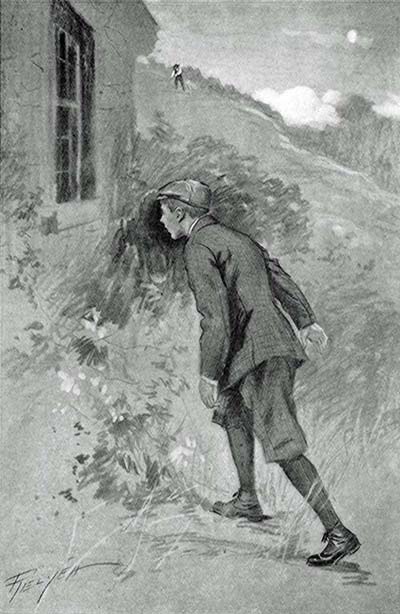
Billy went to the door and looked after them.
No one was in sight. Harold, the twins, and
May Nell, too, were gone. What could it
mean? He looked back at the clock. Nearly
ten. Usually the Gang gathered earlier than
this, hung around and hurried him with his
work, many putting in lusty strokes, that Billy,
the favorite, might the sooner be released.
But now even Jean, his stanch second in all
the fun going, was late. He had expected to
be late himself; he always was. But he, who
planned most of the sport in spite of doing more
work than any of them, had this day expected
his schemes to be well launched before he could
join in them.
He was standing disconsolate, looking up the
street for stragglers, when his mother came in
again.
“What’s the matter, Billy? Why don’t
you go and play? You surely deserve a fine
holiday, my big, big son.” She put her arm
around him tenderly; and he saw that she
remembered. He would be thirteen to-morrow.
He had been counting the days; but he thought
mother and sister had been too busy to think
of it. It was coming—to-morrow, Sunday! If
he didn’t have a good time to-day it wouldn’t
be any birthday at all.
“What’s the matter with Billy To-morrow?”
“Why doesn’t the Gang come, mamma?”
he asked, returning the kiss he knew was one
ahead for his natal day.
“Suppose you go down to the creek,” she
replied with a peculiar smile. “May Nell and
the twins went there some time ago. Harold,
too.”
Billy ran off full of vague expectation born of
his mother’s smile. No one in all the country
round, not even Harold Prettyman, whose
father had the finest farm in Vine County, had
such a splendid place to play as the Bennetts’
back lot that sloped down to Runa Creek. As
Billy slammed the gate and bounded out on a
huge boulder that hung over the creek, a sounding
cheer greeted him from below.
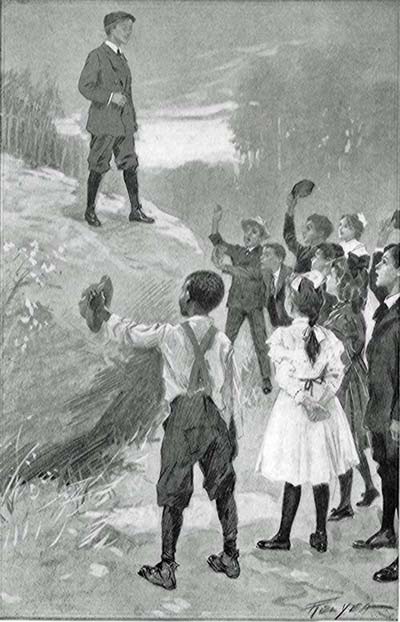
“Hooray, Billy! Thirteen to-morrow! But
this is the day we celebrate!”
There they all were; those who had come
first to the house, and many others: Jean, Bess
Carter, Charley Strong, Max Krieber, Jackson
Carter, the little colored boy, standing aloof,
and others, large and small. All in a line they
stood, and shouted up at him:
“What’s the matter with Billy To-morrow?
He’s thirteen! Three and ten! Most a man!
He’s all right!”
For a minute Billy stood, dazed, his heart
thumping hard. Then he threw his cap in the
air, sang out, “Bully for the Gang! This time
it’s Billy To-day!” and raced down the hill to
join them.