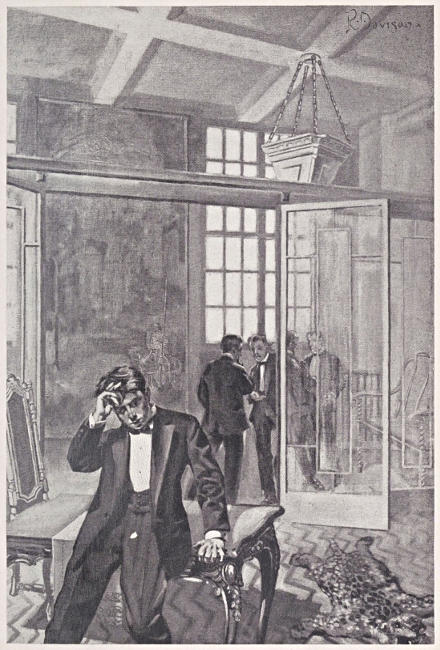
That furtive, rustling noise in Mr. Buckman’s
dimly lighted hall haunted Max for
days, filling him with a vague uneasiness he called
foolish, but could not forget. Yet after a time
youth and returning health relegated the memory
to some niche in the mind’s storehouse; and life
became full of interest and wholesome occupation,
driving out apprehension.
A little more than a week after his engagement
at the “show house” had terminated, and
he had made the senior class at the “Fifth
Avenue High,” Billy Bennett’s ringing voice
came over the wire.
“Is Mumps there?” it asked, and Sydney
heard it across the room.
“Tell your friend a better name to call you;
that is a sick one. I smell the drug store now!”
Mrs. Schmitz laughed as she put down the
receiver and started out.
“Billy To-morrow can call me any old name;
he’s all right!” Sydney shouted after her; and
into the telephone he cried, “Hello, Billy To-morrow!
What’s up today?”
“The Queen says you’ve turned her down.
She’s all fussed up because you refuse to come
to her party. She can’t think what she’s done to
disquiet you.”
The Queen, otherwise Bess Carter! The one
girl of all girls for Sydney. Yet he could never
hold up his head when she spoke to him; and if
he saw her coming he always edged away.
“She’s done nothing but all right, Billy.
She’s always to the good; but I—I—oh, hang
it! You know, Billy, I’m no girl’s guy.”
“Rats! You don’t have to be a girl’s guy to
go to her party. Haven’t we all played together
as kids? Roughed it together at camp, and
worked together at the school rallies? It’s just
a chin-fest along the same old lines with a little
music and dancing thrown in; a lot rather. And
she wants the quartette.”
“Gee!” Sydney said no more, but his inflection
carried assent.
“All right. I thought you’d see it that way.”
“I haven’t said I’d go,” Sydney broke in.
“Oh, yes, you have. You’re not the laddie
to spoil the Queen’s evening by breaking up the
quartette, the feature she’s most counting on,
she says.”
“If I go will you help me to ask a question of
Bess?”
“Sure, what is it?”
“I’ll tell you when I see you.”
Billy did not misjudge his friend, though he
could have no conception of the agony of bashfulness
Sydney endured at merely the thought of
meeting a lot of girls in their evening frocks.
“You know I’ve no glad rags for evening,
Billy.”
“No matter. You have good enough. None
of us are going in for opera hats and patent
leathers; that is, only the Fussers. Will you
come to dinner with me tonight and stay for
rehearsal?”
“All right. Thank you. Say, Billy! Hello,
Billy!”
“Hi, there! Thought you had finished,” Billy
returned after a slight wait. “Hello!” he called
again as Sydney did not answer.
In that hesitant moment Sydney decided to
abandon his intention of asking an invitation for
Max. With his airy, sophisticated manner, his
good looks, his playing, Max would be sure to
win the heart of every one present. And then
his cough—really he was not well enough.
Thus jealousy argued; but in that flashing
instant between Billy’s first and second “Hello,”
Sydney caught himself up; called himself a
selfish, “pin-minded brute!”
“Jealous! That’s what I am. Because I’m
short and thick instead of slender and elegant as
Max is; have mud-colored hair and no-colored
eyes instead of a face clear and dark, with eyes
that can talk without help from lips or tongue,
as his can, I’ll cut him out of a good time!
Mumps, you’re a last season’s egg!”
“What’s that you’re rumbling. Is your
tongue weak today?”
“Nothing, Billy. I was giving myself a dose
of mental ipecac, had something N. G. in my system,
but it’s out now.”
“Well, in your state of good health what’s
next?”
“We’ve got a—I mean I’ve got a friend
here, you met him, Max Ball. He’s a violinist,
a regular high C, Mrs. Schmitz says, a good
looker and actor. May I bring him along?”
There was a word in reply, a short wait, and
Billy’s voice came again. “It’s all right.
Marms says bring him along, and sister says tell
him to bring his violin.”
Max received his invitation in silence; a silence
that piqued Sydney. “If you don’t care to
meet my friends, say so. I’ll tell Billy to count
your plate off,” he said roughly.
“Don’t take it that way. I appreciate the
courtesy, believe me. Yet—ought I to accept?
Suppose they knew—all about me, would they
ask me just the same? Is it fair to them for you
to take me?”
“Gee! I never thought about that,” Sydney
mused, glancing at Max with new respect.
“Does Mrs. Schmitz know your friends?”
“Yes. She thinks they’re fine folks.”
“Then we’ll ask her.”
Questioned, she too, thought a moment before
replying, her eyes fixed on the doubting one.
“Max,” she began seriously, “I have belief in
you. I feel sure you will make goot. Sydney
shall tell his friends that you are one dear friend
of me. I stand for you.”
Max gazed steadily back at her a second, then
laid his hand on hers. “Thank you. I shall not
shame you.” The words were simple but Sydney
felt the earnestness in them; saw the moisture
in the dark eyes, and turned aside to hide
his own. He, too, was won, and promised himself
to believe in Max always.
This was Max’s introduction to the delightful
home where Billy Bennett and his mother lived
with his married sister Edith and her husband,
Mr. Wright.
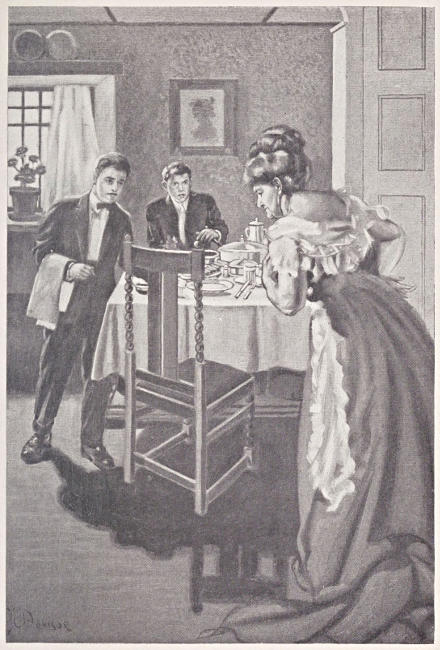
Through the dinner, which was perfectly
served, Sydney watched Max with an envy he
despised but could not conquer. Every word
and move of the stranger lad proved that he had
found his own. The way he spoke to the ladies,
the confident, unconscious but correct use of the
silver, a matter that made Sydney turn red with
anxiety; Max’s low and different yet kind tone to
the maid; his easy yet modest attitude toward
Mr. Wright—everything was just right, Sydney
acknowledged to himself.
How did he come by it? Sydney felt he could
not in a thousand years acquire such a manner;
and at the same time it seemed just then the one
thing on earth worth having. Poor Sydney did
not know that many boys, even some reared in
comfortable homes, are harassed in their years of
development by a similar diffidence. He thought
it was caused entirely by his lack of training.
He could see that Max won them all, especially
Mr. Wright, with whom he talked intelligently
on current topics; and Mrs. Wright when they
touched upon music, as well as Billy’s mother
when she asked of Max’s own, and he replied that
she was dead. Sydney could remember his own
mother only dimly. He had not such a passionate
love for her as he detected in Max’s low reply
that was in no different tone from his other
words; yet its indefinable intensity told volumes
about his heart feeling.
After dinner Billy’s sister carried Max off to
the piano and they had what Billy called an orgy
of music, neither paying much attention to the
rest in the room.
Mr. Wright went to his den, and Mrs. Bennett
disappeared, leaving Sydney alone with Billy.
They settled among the cushions on a window
seat where twinkling lights on the Sound below,
as well as sharp little whistles, revealed the coming
and going of many small steamers, part of
the Mosquito Fleet that connects a thousand
miles of Sound shore with the metropolis, the
City of Green Hills.
The moon sent a silver track across the dark
water, and the distant, fir-fringed shores outlined
dimly against the starlit west seemed the shadowy
ramparts of fairyland.
Probably Billy appreciated the scene more
deeply than Sydney, yet he saw it often, and
consequently was the first to speak.
“What’s the trick you want me to turn for
you with Bess?”
At the telephone asking this favor from Billy
had seemed a little thing; now that the moment
had come it was all but impossible. Yet he had
delayed too long. It was nearly a month since
the night of Max’s coming, the night when Sydney
had determined to “do something for Ida”;
but he had let the days pass in inaction. This
moment he was in for it.
“It’s about Ida Jones. Do you know her?”
“Just to bow; she isn’t in any of my classes.”
“She was in mine last year; when I moved up
a grade at the beginning of this semester I left
her back there in the juniors.”
“What about her? Evidently you have her
beaten in the highbrow race.”
“It wouldn’t have been so if I had been
obliged to work all summer as she did. You
know the good old Pop fixed it for me. That’s
how I was able to study in vacation and make a
class ahead.”
“Yes. But return to Miss Jones. And to
Bess; what’s the relation?”
“I wish you’d ask the Queen to invite Ida
to her party. It would put her easy with her
class if a senior, and such a senior as Miss Bess
Carter, asked her to a party.”
Billy laughed. “Is that all? Ask her yourself.
You carry good weight with her.”
“Billy! Billy To-morrow! I’ll never turn the
trick in the world! You know I’m tongue-tied
when a girl shows up.”
“Surely not so in the case of Miss Jones,”
Billy chaffed. “How did you learn her
troubles? You must have chinned some with
her.”
“She never told me her troubles. I haven’t
spoken ten minutes with her altogether. But I
can see—and hear.”
“What?”
“That all the girls nod coldly when she passes;
that none of them run up and make love to her,
or—”
“Make love? Girls? What do you mean?”
“Don’t you see it all the time? Almost every
girl in school is either on her knees in adoration
of some other one, or is herself the adored one.”
“Mumps! You’re getting classy! Both in
language and in the matter of observation.”
Billy clapped his friend on the shoulder in true,
young-mannish fashion, a caress that would have
floored one less sturdy. “What do you hear?”
“Oh, scraps of conversation spoken between
chums, yet to the world in general. You know
how it is with a certain kind of rich girl, she
talks loud, as if she owned the earth and wanted
all to know it.”
“Not all the rich ones though. May Nell
Smith is the richest girl in school, but you can’t
call her loud.”
“Surely not. And there are others of course.
Perhaps I should have said the girl who wishes
to be thought rich, or those who haven’t been
so very long.”
“That’s it. You can spot ’em. Father worth
half a million, half a pound of extra hair. Father
worth—by report—twenty thousand, two
pounds of the most startling hair.”
Sydney took up the comparison. “Father
worth many millions and mother a lady, just her
own hair worn—worn—Well, that’s where I
fall down. Billy, how does Miss Smith wear
her hair?”
Billy laughed. “And how does Miss Jones?”
“Oh, I don’t know. It looks awfully easy.
It’s not bandaged like a broken head, and it’s
nicer than all those buns and cart wheels and
things. It’s curly.”
“How do you know that?”
“Because often she wears no hat, and the
more it rains the curlier it gets. That’s the way
with Max’s.”
Billy sent a glance to the other visitor.
“There’s surely some class to him.” He stared
at Max a moment but came abruptly back to the
question. “Who is Miss Jones’ father?”
“She has neither father nor mother. She just
takes care of herself; works right along for her
board.”
Billy whistled. “That’s the little joker that
turns up the other girls’ noses.”
“But why? I work for my board. Everybody
knows I was a stowaway on the San Francisco
steamship, or can know it; I never tried to
hide it. Did it make any difference with you fellows?
With you or Reg Steele and your cousin
Hec Price, who belong to the best people in the
city, and the richest? No. You took me in the
same as you took in Redtop and Sis Jones; and
there’s more class to any of the fellows in your
set than to me. Don’t I know that?”
“That’s where you’re off the boulevard, old
chap. You’re in the class that has pluck and
honesty and the capacity for friendship. That’s
a class by itself. You notice Walter Buckman
doesn’t figure large in high jinks engineered by
Bess Carter or May Nell.”
“But why don’t the girls take in a friendless
girl as you fellows took me?”
“Oh, I don’t know. Girls are different.”
Billy could not answer that question. It was too
large for him. It is too large for most people.
We see a sweet young thing making herself
ridiculous over the sufferings of a pampered cat,
who yet will calmly stab to the heart with a cold
stare some struggling girl who wears a last year’s
frock and earns the bread she eats.
“I give it up,” Billy said after awhile. “But
I’ll tell you one thing; if Miss Jones is O. K.
otherwise, working for her board won’t make any
difference to Bess Carter, nor to May Nell.”
“I know that. It’s why I am so anxious for
Bess to invite her. Will you do it—get Bess
to ask her?”
“Yes. That is, I’ll tell Bess about her, and
May Nell too.”
“Thank you.”
“Gee! What a lever money is.”
“Yes, for good or bad.”
“There’s May Nell Smith. As soon as she
grew strong enough to stand the strain of public
school her father put her there because he wanted
her to come in touch with all sorts of children;
and see what she can do. She’s just as sweet as
ever, and her nod is law to the girls.”
“You’d never know she was a rich man’s
daughter by the way she dresses, Ida says.”
“You’d know she was the daughter of a
sensible woman though.”
Sydney agreed, his heart quite at rest about
Ida; and both sat quietly listening to the music.
Neither realized the secrets of the great social
fabric they had grazed, though Sydney continued
in thought to follow the puzzle that provoked
his question to Billy; why do girls—young
women—treat each other as they do?
This led back to the day many months earlier
when a couple of squabbling boys, turning the
high school corner, ran against a girl, almost
knocking her over, and sending her books flying
on the wet walk. They were too occupied to
notice their rudeness; but Sydney was in time to
prevent her from falling and to restore her books.
This was Ida Jones. Bashful as Sydney was,
her gratitude unlocked his speech; and walking
home with her he learned a little of her loneliness
and struggle for an education. She probably
told Sydney more of her life than she would
have told another, because his own life was so
similar. And ever since there had been this bond
of sympathy between them, though they rarely
were together.
Mrs. Wright’s enthusiastic voice recalled Sydney
from his reveries. “Mr. Ball plays! Makes
real music! Sydney, you should be glad to live
in the same house with him.”
Sydney wondered if he was grateful. Again
the mean little yellow fiend of envy stuck up its
head, and he had his fight all over.
“I have persuaded him to play with the quartette;
it will be a splendid addition,” Mrs.
Wright continued.
Billy rose and shook hands with him, boy
fashion, for Billy was still a boy at heart in all
he did, yet a very lovable boy. “That’s all to
the good. Welcome to the jolly six—jolly
seven it will be, now you have joined.”
“You must bring Mrs. Schmitz over to some
of the rehearsals. I shall call on her very soon.
Do you think she’d have time for me, Sydney?”
He was sure of it.
“And we shall drop the Mister and call you
just plain Max, may we?” Billy questioned.
“No one is allowed a handle to his name but her,
my sister here. We have to permit that because
she’s married.” Billy nudged his sister, mischief
in his eyes.
Max bowed gravely. “I shall be honored by
your kindness.”
Billy, a trifle awed by Max’s seriousness,
could not know that the newcomer was feeling
the weight of his responsibility; was wondering
if they would accept him so cordially if they
knew all.
The other boys came, Charles Harper called
Redtop because of his “smiling” hair, a fine fellow,
well grown and with eyes that looked
straight at his listener; and “Sis” Jones, Cicero
really, but “Sis” in his set since the day he had
been caught embroidering a pattern on the sail
of the “Miss Snow,” Hector Price’s sailboat.
Young Jones was as old as any of them and as
plucky; but he was slender, blond, not very tall,
and gave the impression of effeminacy. Yet certain
ones who knew said those small hands could
grip like iron.
His voice was the sweet, haunting tenor, while
Sydney was second tenor. Charles sang a deep,
rich bass, and Billy second bass. All-round
utility man Billy called himself, since his voice
was adaptable, and if his sister was prevented it
was Billy who accompanied on the piano. He
was also librarian, sent out meeting notices, and
otherwise, “bossed the job,” to use his own words.
The other member was Hugh Price, “Squab,”
Billy’s short fat cousin. He had grown since
the happy camping days at Lallula, but it seemed
all laterally. His anxiety to gain height was
well known, and the most acceptable compliment
one could pay him was to say, “You’re taller.”
He played the flute—played it well.
All welcomed Max cordially, and still more
enthusiastically when they had heard him play.
And rapidly the two hours of practice passed;
as a breath to Sydney, who not only loved to
sing, but lived his happiest hours, in this
household.
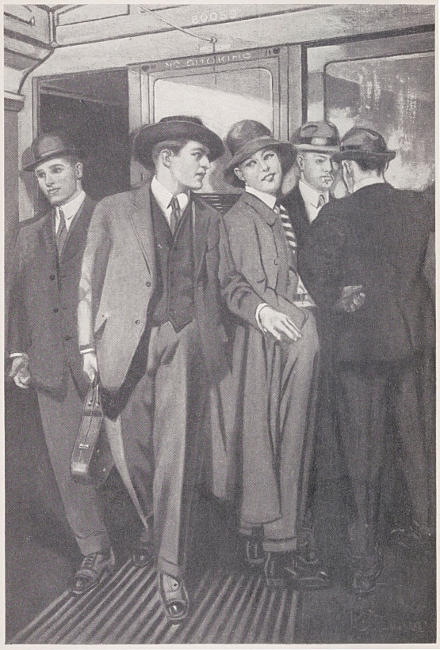
On the way home when the two boys, Max and
Sydney, changed cars at a busy junction, they
found the second car crowded at the rear end
with high school students. They had evidently
been somewhere in a body, and were noisy and
restless, obstructing the passage way, playing
rough pranks, and acting as if they owned the
car.
“Move up forward!” the conductor repeated
with no effect.
The two edged slowly through, hindered by
the wedged mass, and slyly tripped by a hidden
foot. All knew Sydney and greeted him by his
nickname; but only one spoke to Max.
“Hello, young feller! What are you out of
quod for?” sneered that one in his ear.
Max knew him. It was Walter Buckman, who
had opened the door to him the night he went to
pay for his stolen supper. As Max, trying to
obey the conductor, pressed forward, one, instigated
by Walter, pushed Sydney aside and
jerked Max against a lady so adroitly that it
seemed entirely Max’s fault.
He righted himself, apologizing earnestly.
But he had torn her dress and she was not very
gracious.
“Aw, you have to excuse a drunken man,
lady,” a noisy one called out, and again began
the pushing and scuffling.
“Move up front there or I’ll put you off!”
the conductor ordered more sternly.
“I’d like to see you do it!” one of the bolder
threatened.
Sydney saw Walter secretly urge the big fellow
on.
The conductor was not afraid. He stopped
the car right there, opened the gates, and collared
the aggressor.
But the students stood by their mate, and it
would have gone hard with the conductor if one
or two men had not risen quickly and faced them.
“You get off the car or we’ll help him put
you off!” said one, a well known banker, a man
of power in the city.
The big fellow, seeing opposition was useless,
stepped down, calling to the others to follow; but
the conductor shut the gates, rang two bells, and
again ordered the young men forward.
“Buckman, you get forward there,” the same
authoritative passenger ordered. “You’re the
ringleader.” And to the lady of the torn dress
he said, indicating Max, “This young man is not
at fault; it was those behind him. I saw them.”
“Stop at the next corner,” ordered Walter.
The conductor was about to ring when the
same man of authority said, “Conductor, go
on.” And to the boys, “You young ruffians, get
up forward there as ordered!”
“You can’t do that,” Walter began; “we’ll
have an action against the company. You can’t
prevent a passenger getting off at any street he
wants.”
“Very well. Bring your action. I’m president
of the company, and I think, Walter Buckman,
that your father will not care to sue for
you, not with these witnesses.” He whipped out
a notebook and took the names and addresses of
some of the passengers, the lady’s whose dress
had been torn, and of one or two well-known men.
Sullenly the squad of trouble makers moved
up the aisle. And as they passed Max, Walter
leaned over and whispered in his ear, “I’ll get
even with you for this.”
Sydney heard the words. “Don’t get fussed
up,” he said to Max. “There’s a few coming to
him. That bunch isn’t out for any good, and
Walt Buckman ought to be headed the other
way this time of night. He lives the second door
from Billy.”
Max made no reply. Through the rest of the
ride and while the two walked the block between
the car line and the nursery, he was wondering
what form Walter’s threat would take. And
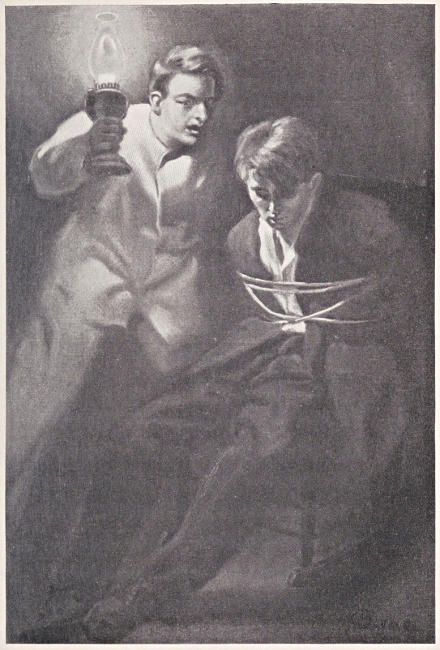
while he prepared for bed, and still more in
troubled dreams, his imagination conjured gruesome
pictures.