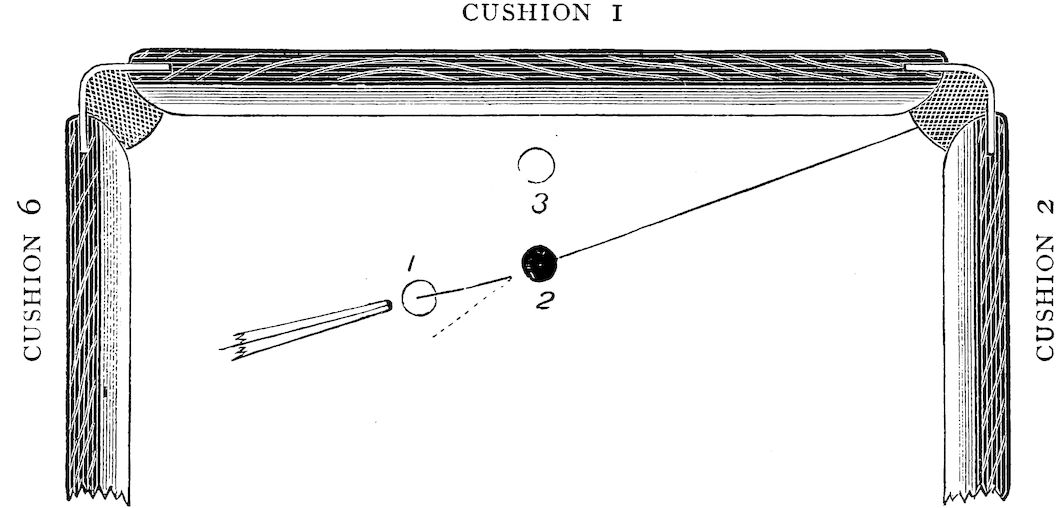
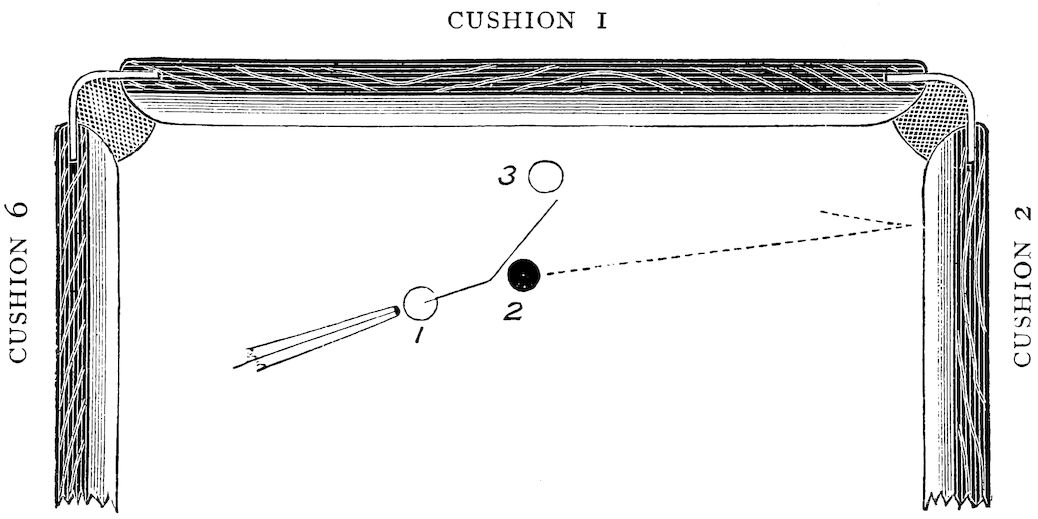
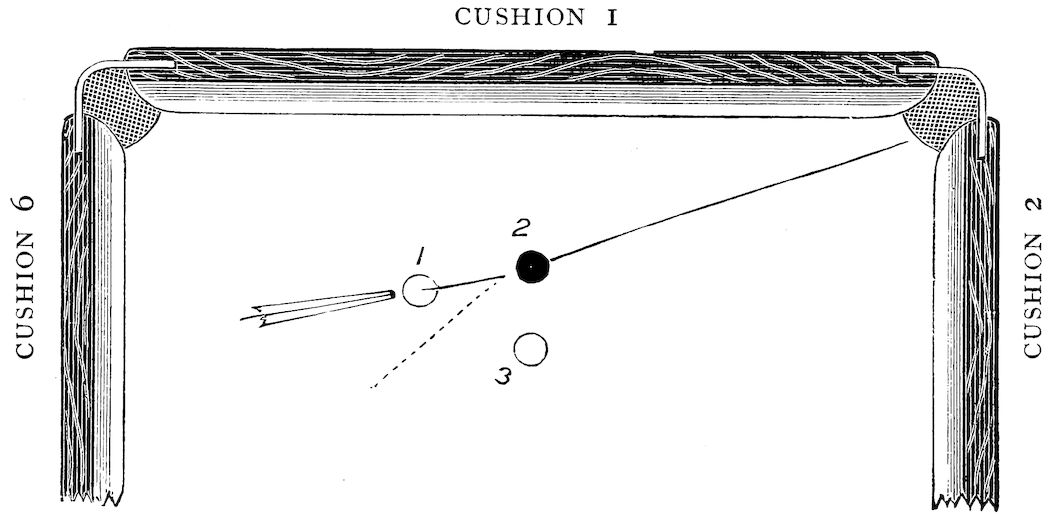
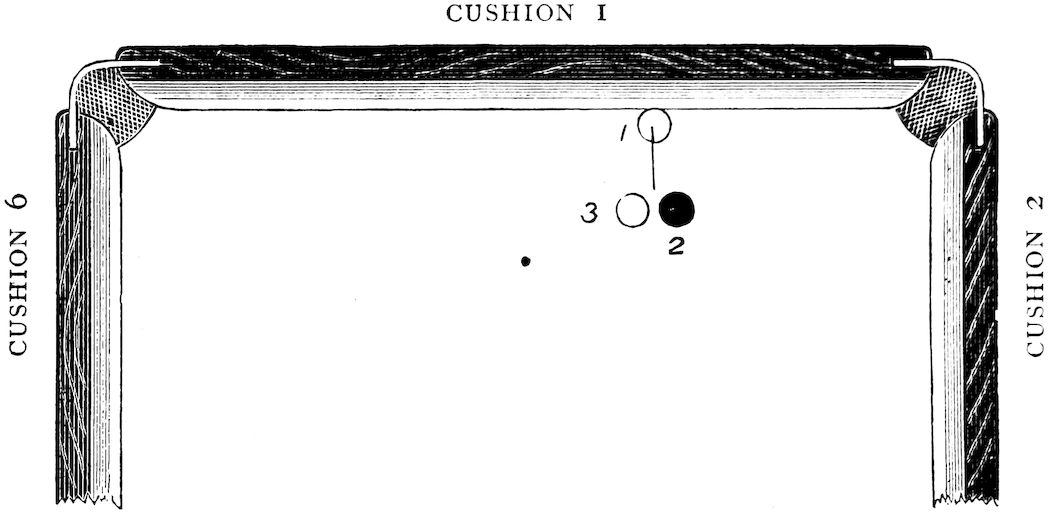
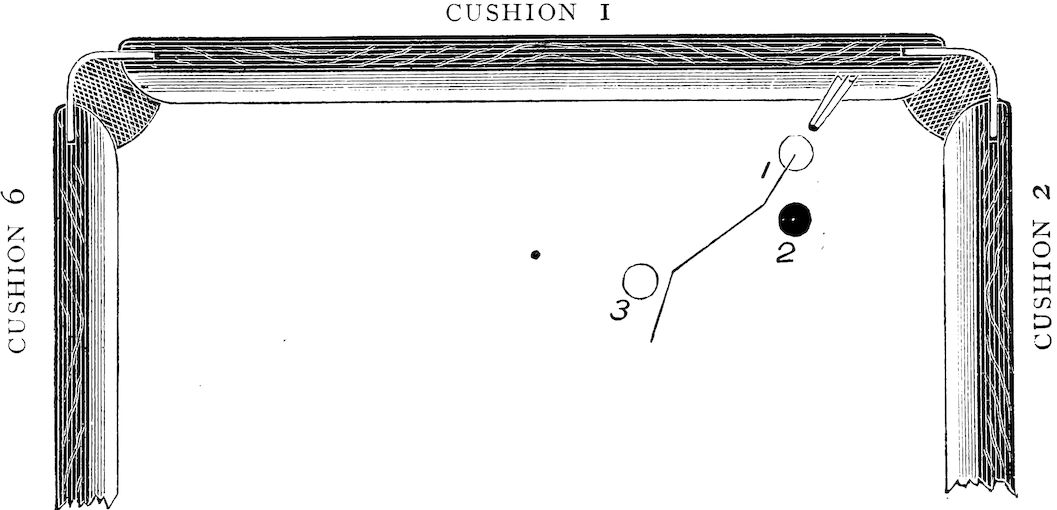
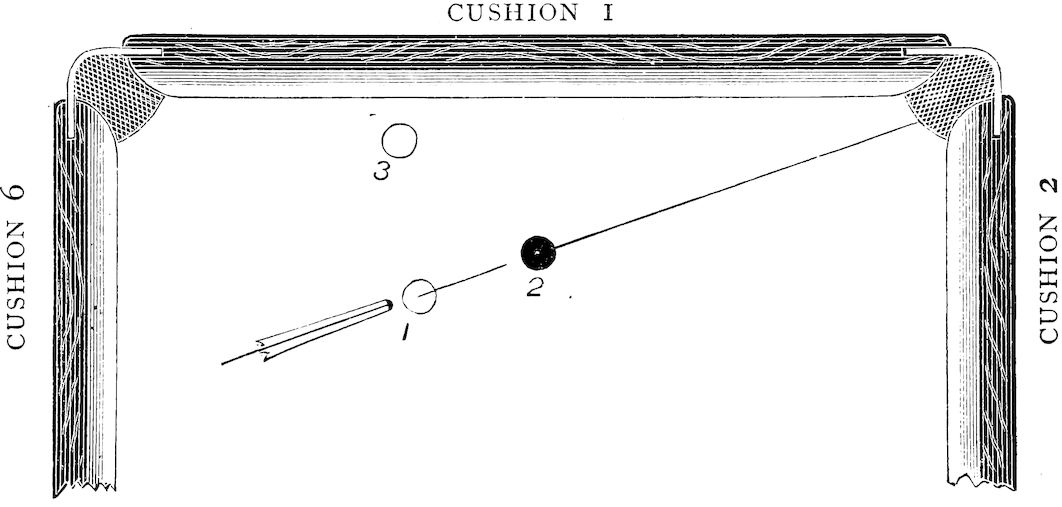
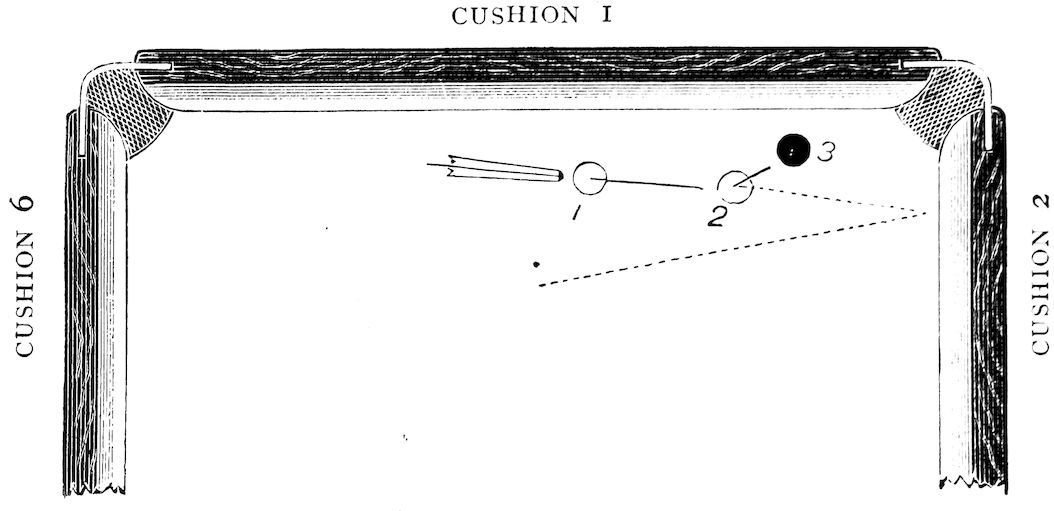
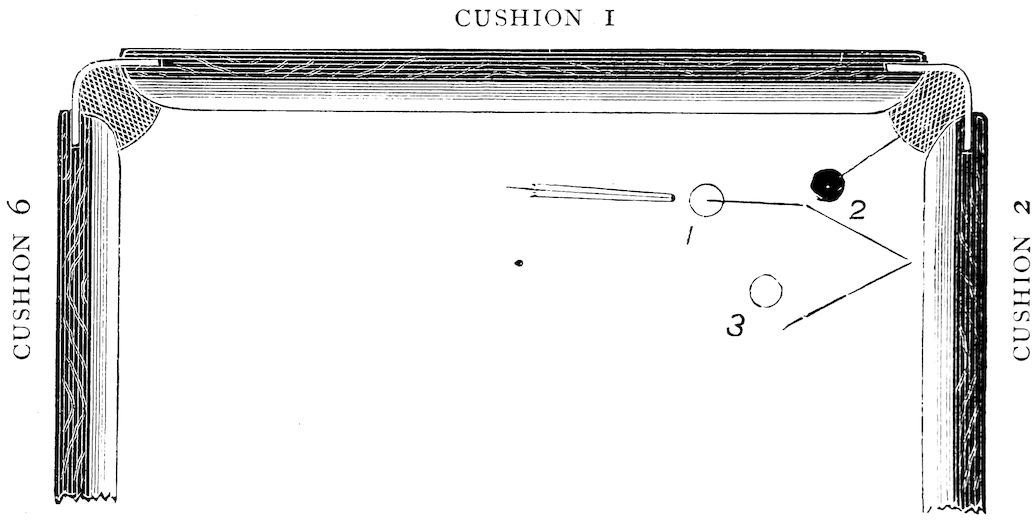
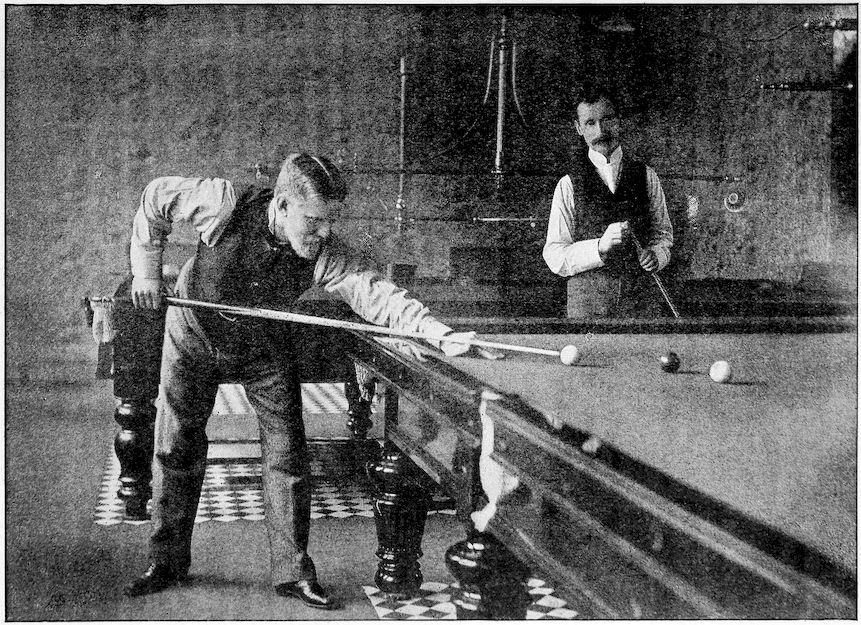
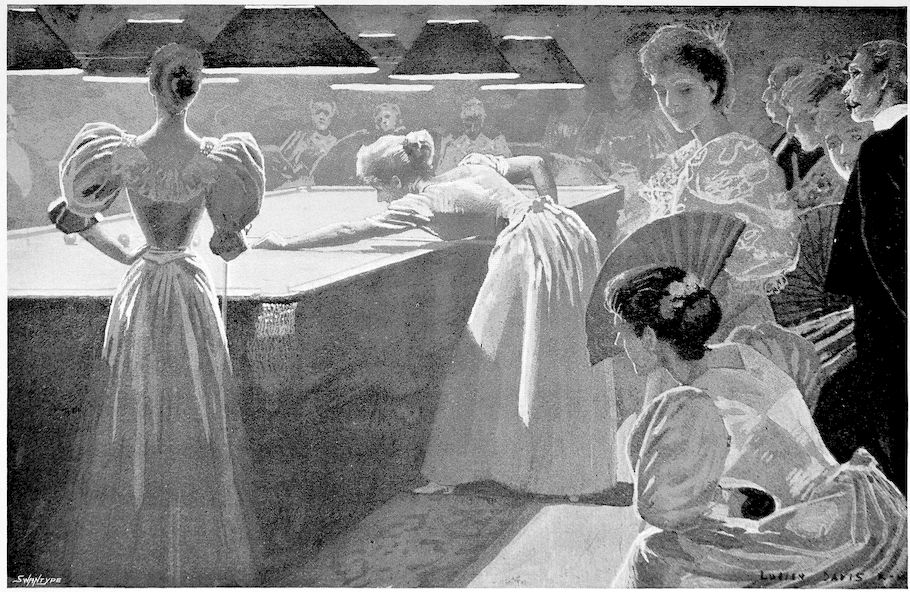
The cover image was created by the transcriber and is placed in the public domain.
The Badminton Library
OF
SPORTS AND PASTIMES
EDITED BY
HIS GRACE THE DUKE OF BEAUFORT, K.G.
ASSISTED BY ALFRED E. T. WATSON
BILLIARDS
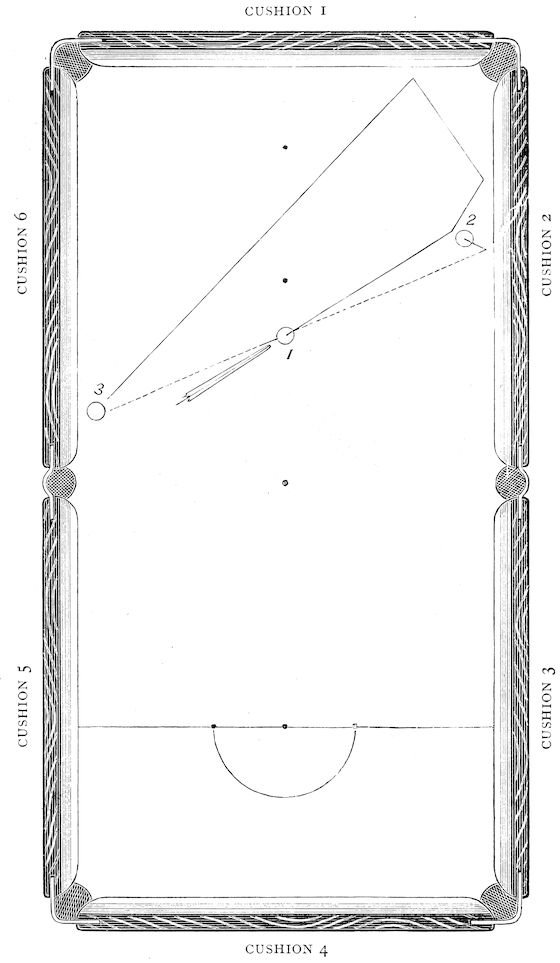
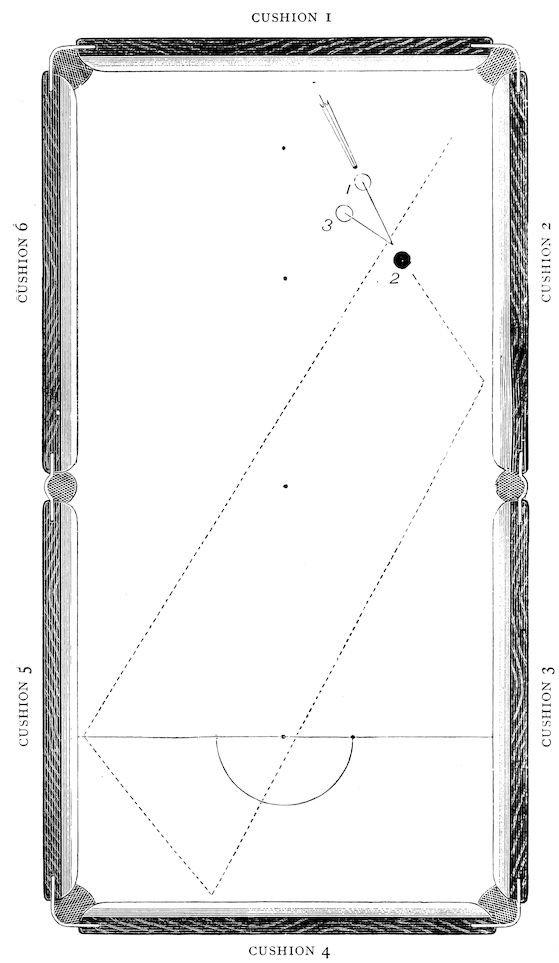
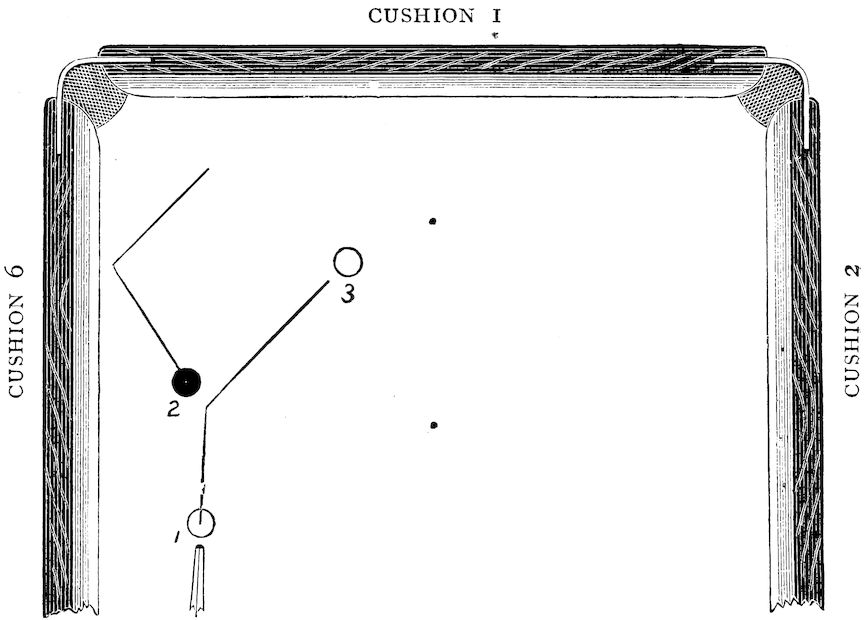
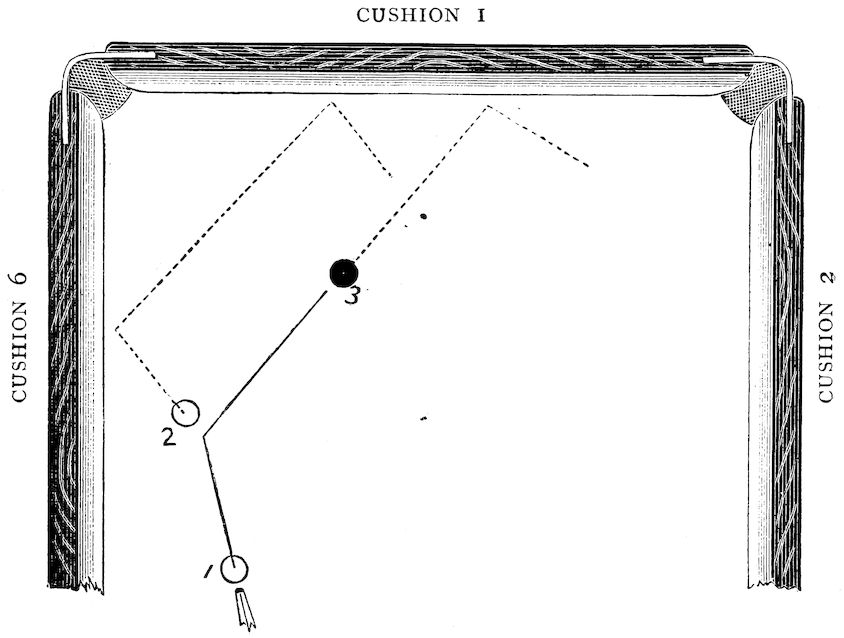
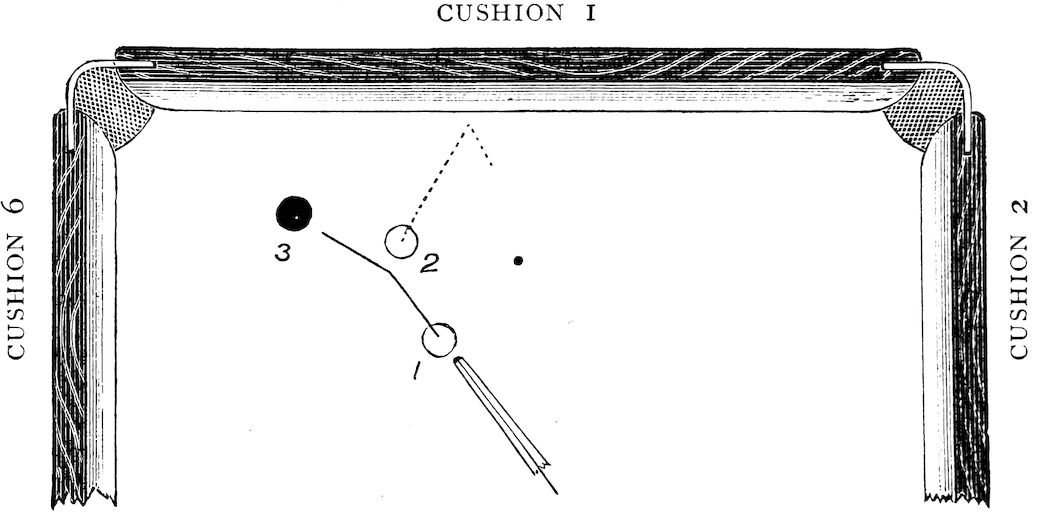
A Screw Losing Hazard.
BY
MAJOR W. BROADFOOT, R.E.
WITH CONTRIBUTIONS BY
A. H. BOYD, SYDENHAM DIXON, W. J. FORD, DUDLEY D. PONTIFEX, RUSSELL D. WALKER, & REGINALD H. R. RIMINGTON-WILSON
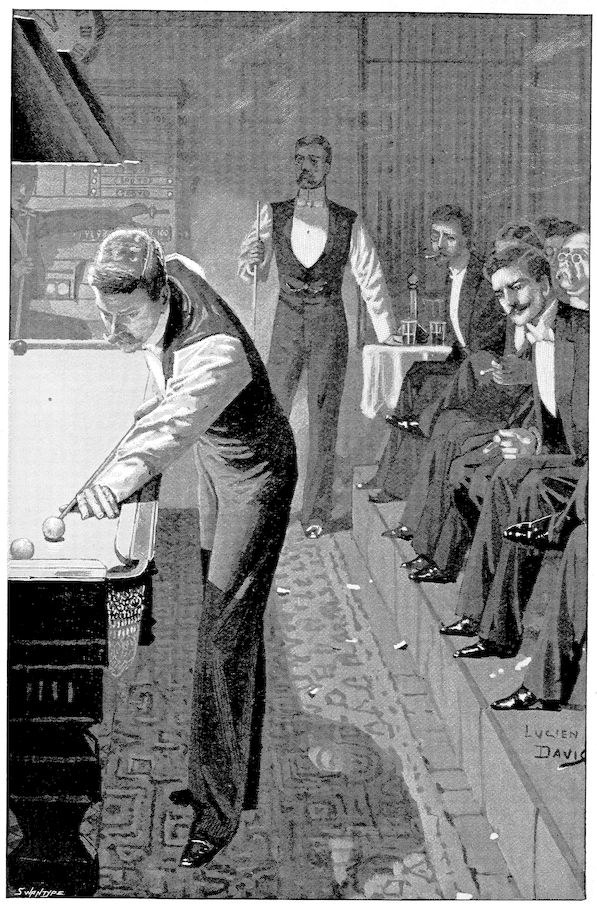
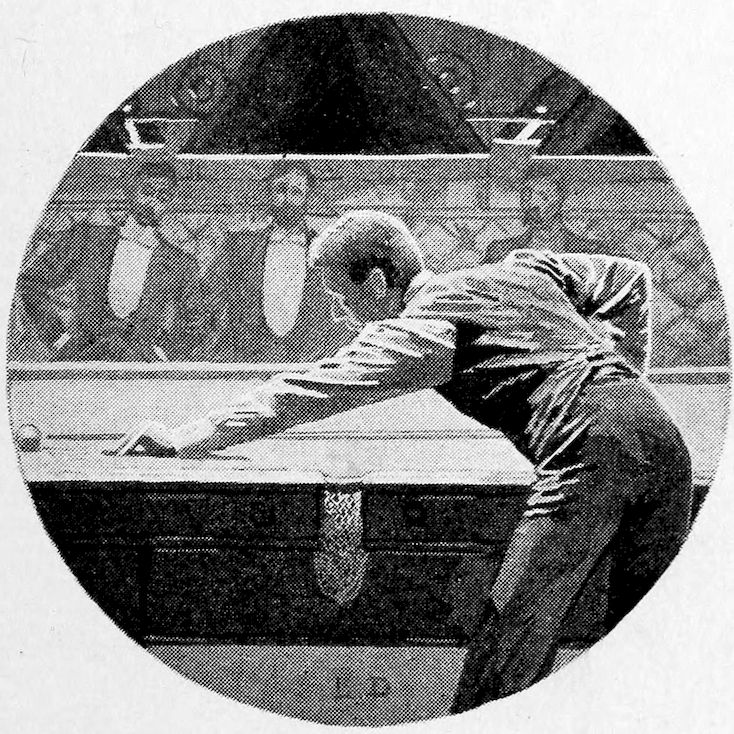
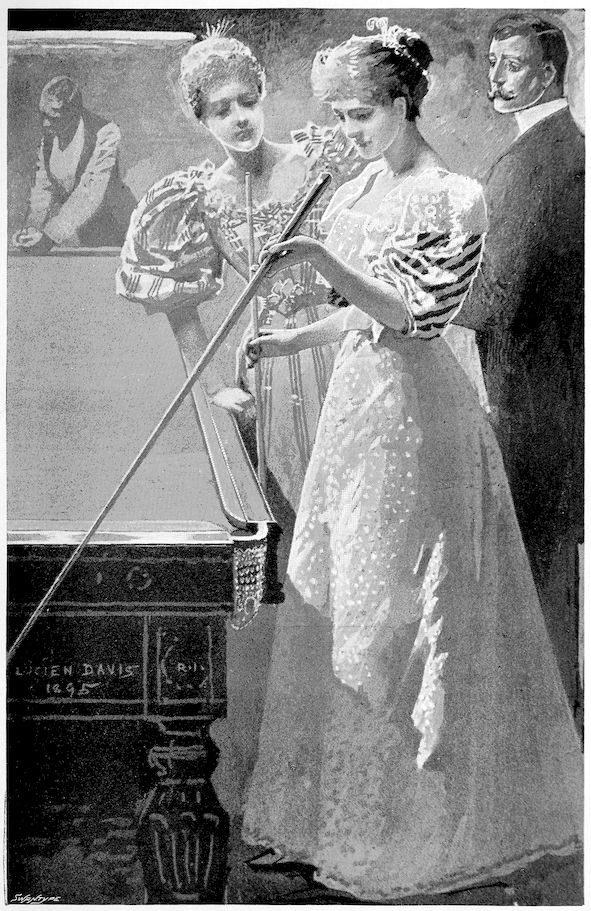
ILLUSTRATED by LUCIEN DAVIES, R.I., and from PHOTOGRAPHS also by numerous Diagrams and Figures
LONGMANS, GREEN, AND CO.
LONDON AND BOMBAY
1896
All rights reserved
DEDICATION TO H.R.H. THE PRINCE OF WALES
v
Badminton: May 1885.
Having received permission to dedicate these volumes,
the Badminton Library of Sports and Pastimes,
to His Royal Highness the Prince of Wales
I do so feeling that I am dedicating them to one of the
best and keenest sportsmen of our time. I can say, from
personal observation, that there is no man who can
extricate himself from a bustling and pushing crowd of
horsemen, when a fox breaks covert, more dexterously
and quickly than His Royal Highness; and that when
hounds run hard over a big country, no man can take a
line of his own and live with them better. Also, when
the wind has been blowing hard, often have I seen
His Royal Highness knocking over driven grouse and
partridges and high-rocketing pheasants in first-rate
viworkmanlike style. He is held to be a good yachtsman,
and as Commodore of the Royal Yacht Squadron is
looked up to by those who love that pleasant and
exhilarating pastime. His encouragement of racing is
well known, and his attendance at the University, Public
School, and other important Matches testifies to his
being, like most English gentlemen, fond of all manly
sports. I consider it a great privilege to be allowed to
dedicate these volumes to so eminent a sportsman as
His Royal Highness the Prince of Wales, and I do
so with sincere feelings of respect and esteem and loyal
devotion.
BEAUFORT.
vii
BADMINTON
PREFACE
A few lines only are necessary to explain the object
with which these volumes are put forth. There is no
modern encyclopædia to which the inexperienced man,
who seeks guidance in the practice of the various British
Sports and Pastimes, can turn for information. Some
books there are on Hunting, some on Racing, some
on Lawn Tennis, some on Fishing, and so on; but one
Library, or succession of volumes, which treats of the
Sports and Pastimes indulged in by Englishmen—and
women—is wanting. The Badminton Library is offered
to supply the want. Of the imperfections which must
be found in the execution of such a design we are
viiiconscious. Experts often differ. But this we may say,
that those who are seeking for knowledge on any of the
subjects dealt with will find the results of many years’
experience written by men who are in every case adepts
at the Sport or Pastime of which they write. It is to
point the way to success to those who are ignorant of
the sciences they aspire to master, and who have no
friend to help or coach them, that these volumes are
written.
To those who have worked hard to place simply and
clearly before the reader that which he will find within,
the best thanks of the Editor are due. That it has been
no slight labour to supervise all that has been written, he
must acknowledge; but it has been a labour of love, and
very much lightened by the courtesy of the Publisher,
by the unflinching, indefatigable assistance of the Sub-Editor,
and by the intelligent and able arrangement
of each subject by the various writers, who are so
thoroughly masters of the subjects of which they treat.
The reward we all hope to reap is that our work may
prove useful to this and future generations.
Justification for the appearance of a volume on the game of
billiards as it is played early in 1896 is ample, for no treatise
or manual exists in which modern developments are considered.
Though this is so, it does not follow that the instruction in older
works is unsound; much may be learnt from some of them,
specially about plain practice strokes, but the science of playing
breaks has been completely changed since they were published.
If, however, further warrant were needed, it is supplied
in the neglect of most players, whether professional or amateur,
of elementary facts concerning the motion of balls on a table;
and this, though ameliorated as regards professional players by
constant practice and observation, obstructs both classes more
than they think in the race for distinction. The best French
players, from whom we have much to learn, recognise that the
closer and more intelligent the study of the game, and the more
nearly the implements reach perfection, the nearer do scientific
theory and actual practice conform. Hence in this book considerable
space is devoted to matters which may seem elementary
and self-evident, but which are really the bases of sound knowledge,
and of which amateurs (for whom the volume is primarily
written) are for the most part completely ignorant. When the
2behaviour of a ball under various influences is described endeavour
is made to use the simplest language; mathematical
terms not generally understood are as far as possible avoided.
Several matters of importance to the game and in need of
reform are discussed, the opinions of experts, amateur and professional,
being occasionally quoted; sometimes opposite views
are stated, and efforts are made to consider duly those of all
shades.
It is usual, and most of the contributors have not failed to
conform to the fashion, to insist on the fact that more can be
learnt from a player in an hour than from a book in a year, that
an ounce of practice is worth a ton of theory, or some similarly
original sentiment. Certainly no man can be made a billiard-player
solely by the study of books any more than skill in
shooting, fishing, or other sport, can be so attained; but much
may be learnt from a good manual, both by a beginner and by
his instructor. By conforming to the arrangement of a book a
system of teaching will be followed, and this, if sound, must
help master and pupil.
The amateur who has played for years and acquired a bad
style is more difficult to assist; he is apt to find, whilst trying
to correct faults and to play breaks, that he has lost his old
certainty, and scores worse after than before instruction—a result
which causes many to lose heart. But there is no need to
do so; the chance of improvement depends greatly on modesty
and perseverance, whilst the case is hopeless in proportion to
the presence of presumption and conceit. Some give in at
this stage and revert to their former methods, others more
resolute persevere and improve; but it is hoped that both classes
will find this book of service. Those who devote their whole
attention to making the immediate stroke will be assisted by
the practice recommended; whilst the more ambitious will find
advice which may in time enable them to play real breaks and
thus derive fresh pleasure from the game.
Personal qualifications have so important an influence in
billiards, that too precise definition of the stroke to be played
3for is avoided. What is the game for one person is not necessarily
the game for another, and each must use his own discretion.
The qualities usually found in fine players are good nerve,
quick and sound judgment, resolution, and temper under control,
accompanied by fair sight, a fine touch, and sympathy
between eye and hand. Of these some are the gifts of nature
and cannot be acquired; others may be improved by careful
training. Nerve is little understood, but is strengthened by
gaining certainty of play, which creates confidence; yet there
is always that which we cannot explain, but may call the
‘personal equation.’ It is perplexing, but must not be ignored,
and persons of the most slender experience will admit that
they play better with one man than with another, though they
cannot always account for the fact.
Much care and time have been spent on the diagrams and
figures, but absolute accuracy is not to be expected; indeed, it
cannot be attained, for the size of the table must be limited by
that of a page, whilst for the sake of clearness the balls are
shown on a larger scale, a consequence being some imperfection
in the delineation of their indicated paths. In the final
chapter many matters connected with billiards are briefly
noticed, amongst which are: the suitability of the game for
ladies; the French or cannon game, which possesses advantages
on account of the smaller size of table on which it is played;
and the duties of marker and referee. The observations
about etiquette are specially commended to the careful consideration
of readers. It is beyond doubt that the vastly inferior
play of amateurs compared with professionals is in no small
measure owing to laxity in behaviour, whereby attention is
distracted from the game. If billiards is ever to be played
finely in ordinary clubs, as strict order must be maintained as
is usual in the card-room.
Obligations must be expressed to Mr. Boyd, Colonel Allan
Cunningham, R.E., Mr. Dudley Pontifex, and Mr. Russell
Walker for assistance in various ways; and to M. Vignaux,
whose admirable manual of the French game has been of special
4service. To a less extent the volume is indebted to the works
of Joseph Bennett and of other players; but beyond all it owes
much of whatever merit it may have to the assistance and advice
of Mr. R. H. R. Rimington-Wilson. It is indeed impossible to
overestimate the value of this aid, for his knowledge of the
game and practical skill are united to a singularly sound judgment,
and his help is enhanced by the kindness and courtesy
with which it has invariably been accompanied. Acknowledgment
is further due to Messrs. Burroughes & Watts and Messrs.
Peall and Walder for practical help of great value.
The preparation of this manual was a difficult task which
the writer would not have attempted without the co-operation
just acknowledged; and readers are besought to recollect, if
disposed to resent an air of authority in giving advice, or a too
evident want of respect for their knowledge and skill, that on
every question of importance the recorded conclusions are
the result rather of careful consideration by experts than an
expression of personal opinion.
Passing on from these preliminary observations and acknowledgments,
it should be at once said that no laborious
compilation of the results of research is here given on the
subject of the origin of the game of billiards, for the reason
that this is obscure in the extreme. Many attempts have been
made to trace its ancient history, but little success has resulted.
In most books about it, reference is made to the well-known
quotations from Spenser and Shakespeare; whilst in ‘Modern
Billiards,’ the American text-book, the historian plunges deeper
into the mystery of the past, and tells how Cathire More, King
of Ireland, who died A.D. 148, left ‘fifty billiard balls of brass,
with the pools and cues of the same materials.’ Besides this,
he refers to ‘the travels of Anacharsis through Greece, 400 B.C.,’
during which a game which might have been early billiards
was seen.
We may, perhaps, safely assume that the game is of considerable
antiquity, a development from some primitive form
played with balls on the ground. It may, therefore, have been
5evolved simultaneously in many countries, and have assumed
minor differences as it grew older. Then, as intercourse
became easier, one country may have borrowed from another
what was thought desirable, with the general result that the
similarities of the games of various countries are greater than
the differences.
Undoubtedly, in 1896 the two great games are the English
and the French, and each is indebted to the other.
From the lawn or courtyard the game was promoted to a
table indoors, the bed was wooden, the cushions were stuffed
with cotton, and there were pockets. The balls, of ivory or of
wood, were propelled by wooden maces tipped with ivory,
silver, or brass. Such a table is depicted in ‘The Compleat
Gamester,’ by Charles Cotton (1674). Improvement for a
long time after this date seems slow to those who contrast the
strides made during the last half of the nineteenth century.
The first step of importance was the substitution of the cue
for the mace, and the invention of the leather tip by Mingaud,
a French player, who early in the century was, it is said, imprisoned
for a political offence, and during his imprisonment
made the important discovery. Next came the application
of chalk, with which Carr, who had some title to be called
the first champion player of England, is generally credited.
He was, moreover, a player of the spot stroke, in those days
(about 1825) probably a recent invention. Position was maintained
by a screw back or by follow, as the slow cushions did
not admit of use after the modern manner. Carr is referred
to in the following chapter.
CHAPTER I HISTORY OF BILLIARDS
6
By Sydenham Dixon
Just as there were ‘brave men before Agamemnon,’ so,
doubtless, were there good billiard-players prior to Kentfield;
but we hear very little about them. One of the few whose
name has been handed down to posterity is John—generally
known as Jack—Carr. He was originally marker for Mr.
Bartley, the proprietor of the billiard-tables at the Upper
Rooms at Bath. When business there was slack, Mr. Bartley
and Carr used occasionally to amuse themselves by placing
the red ball on the centre spot, and attempting to screw off it
into one of the middle pockets without bringing the red ball
back into baulk. Such a stroke would be easier under the
conditions then existing of slow list cushions and rough baize
cloths than it is now, and for a long time Mr. Bartley was the
only person who could accomplish it. At last he confided to Carr
that he did it by striking his own ball upon its side. It seems
pretty clear, therefore, that Mr. Bartley was the inventor of the
side stroke and screw; but he appears to have made very little
practical use of his great discovery; whereas Carr, who soon
outstripped his instructor in proficiency at this particular stroke,
turned his knowledge to excellent account, and fairly astonished
and mystified the frequenters of the billiard-room at Bath by
the ease and certainty with which he brought off apparently
impossible strokes. They were naturally anxious to learn the
secret, and, after Carr had artfully roused their curiosity to its
highest pitch by remaining obstinately silent on the subject
7for a considerable time, he gravely informed them that his
wonderful powers were entirely due to the use of a certain
‘twisting chalk’ that he had recently invented, and had then
on sale. The demand for small pill-boxes filled with powdered
chalk at half a crown per box was naturally enormous, and for
a long time the wily marker reaped a rare harvest. If, as some
have supposed, this was the first introduction of the custom of
chalking the tip of a cue, the half-crowns were well invested;
but, unfortunately, the weight of evidence goes to show that
chalk had been in common use for this purpose for some
time prior to Carr’s smart stroke of business, and that he
economically filled his valuable pill-boxes by grinding up
some of the chalk provided by Mr. Bartley for the use of his
customers.
What with the brisk sale of the famous ‘twisting chalk,’
and the immense advantage that his knowledge of the power
of screw gave him over all rivals, Carr must have been making
a great deal of money about this time. Unhappily for his
own prosperity, however, he was a desperate and confirmed
gambler, and all that he made out of ivory in one form was
lost through ivory in another. He never could resist ‘flirting
with the elephant’s tooth,’ and every shilling that he made
was promptly lost at hazard. At last, fairly tired out by
incessant losses scarcely broken by a single run of luck, and
discontented with circumstances immediately connected with
his professional pursuits, he determined to leave England and
try his fortune in Spain. It might have been imagined that
the latter country would have proved anything but a happy
hunting-ground, and that the Dons, on falling victims to Carr’s
powers of screw, might have taken it into their heads to lay
down their cues and to finish the game with knives. However,
the Bath marker was evidently an excellent man of
business, and the Spanish billiard-rooms proved veritable El
Dorados to him. He made a tour of the principal towns, and
succeeded in easily beating everyone with whom he played.
The feats he performed by means of the ‘side twist’—as the
8screw stroke was formerly termed—amazed all who saw him
play, and he managed to amass a considerable sum. Still, the
old passion was as strong as ever, and once more proved his
downfall. Spain was even more amply furnished with gambling-houses
than England, and, as Carr’s usual ill luck pursued him,
all his doubloons vanished even more rapidly than they had
been acquired; he was compelled to return home, and finally
landed at Portsmouth almost in rags. ‘Whether’—to use
Mr. Mardon’s own words, and it is to his excellent book that
I am indebted for much of my information as to these early
exponents of the game—‘players of those days were less
particular than persons of the present period is not for me to
determine; but it is no less strange than true that, even in so
deplorable a garb, he no sooner made his appearance at the
billiard-table than he met with a gentleman willing to contend.’
In the ‘gentleman willing to contend,’ Carr, in his hour of direst
need, must have found a very foolish person, for no man of
average sense would have lost seventy pounds to an individual
whose appearance loudly proclaimed that he did not
possess the same number of pence, and who, therefore, could
not possibly have paid had the issue of the games gone the
other way.
The dénouement of this little episode fully confirms this idea.
Quitting the room with the money in his pocket, Carr immediately
proceeded to get himself fully rigged out in ‘a blue coat,
yellow waistcoat, drab small-clothes, and top-boots.’ A little
advice from the local Polonius was evidently sadly needed; the
attire was probably ‘costly’ and may have been ‘rich,’ but
it was certainly ‘express’d in fancy,’ and decidedly ‘gaudy.’
Arrayed in all this magnificence, Carr paid another visit to
the same billiard-room on the following day, when he again
encountered his victim. The latter being, according to Mr.
Mardon, ‘a fine player and devoted to the game,’ lost no time
in challenging the stranger to play. This match naturally
resulted as the other had done, and Carr again won a considerable
sum. When play was over the gentleman remarked that
9‘he was truly unfortunate in having met with, on succeeding
days, two persons capable of giving him so severe a dressing.
Carr, making himself known, thanked the gentleman for the
metamorphosis his money had occasioned, and wished him a
good morning.’
In 1825, Carr played a match against ‘the Cork Marker,’ at
the Four Nations Hotel, in the Opera Colonnade. The latter
was considered a very fine player in his day, and it is curious
that no one seems to have known his name, for he is invariably
alluded to under this somewhat vague designation. They
played three games of 100 up, and, although Carr won all three,
he was evidently encountering a foeman worthy of his steel, as
‘the Cork Marker’ reached 92 in the first game, and 75 in the
third. In the second, however, he only got to 49, as Carr
suddenly astonished the spectators by making twenty-two consecutive
spot strokes. This was naturally considered a most
extraordinary feat, and, as an offer was at once made to back
Carr against all comers for a hundred guineas a-side, he can
fairly lay claim to being considered the first champion of
billiards, or, at any rate, the first whose claim to the title rests
upon anything like a solid foundation. Pierce Egan, in his
‘Annals of Sporting and Fancy Gazette,’ writes of him as the
‘father of the side stroke;’ and though, as I have previously
narrated, Mr. Bartley was the discoverer of the stroke, Carr
was undoubtedly the first man who realised its importance and
turned it to practical account.
I have been unable to satisfy myself whether Bedford and
Pratt, two fine players who flourished in the first half of the
present century, were contemporaries of Carr, or belonged to a
somewhat later period; this, however, is a matter of small consequence.
According to Mr. Mardon, ‘each was celebrated
for quietude of demeanour and elegance of style,’ and Bedford
was ‘graceful and unassuming, excelling in winning hazards,
whilst all [strokes?] are made without apparent effort;’ his
best break was 159. The same author gives the following
amusing anecdote of Pratt, which will well bear repetition:
10One evening, when most persons were enjoying their claret by
the fireside, a gentleman presented himself in the billiard-room,
where Pratt was seated alone. To a request whether he was
desirous of playing, he replied in the affirmative. The lights were
placed, and the parties took their stations at the table. ‘What
game, sir, would you wish to play?’ ‘I will play,’ replied the
stranger, ‘the game of 100 up; and, as it is my desire that you
should be rewarded for your trouble, I will play for sixpence!’
The game commenced; and, after the gentleman had once or
twice struck the balls, he left his opponent’s ball near the red,
which, fortunately for Pratt, being on the spot, he continued to
hole in the two corner pockets four-and-thirty times, beating his
liberal antagonist a love game, 100 up!
To return, however, to Carr. His challenge was soon taken
up by Edwin Kentfield, of Brighton (better known as Jonathan);
but Carr fell ill, and the proposed match never came off.
Kentfield then assumed the title of champion, his claim to
which was not disputed for four-and-twenty years. There is
no doubt that Edwin Kentfield, who died in 1873, was very
superior to most of his profession. He was a man of refined
tastes, passionately devoted to horticulture, with which he was
thoroughly conversant, and he had the shrewdness to see that
the tables and all the accessories of the game which were in
use when he began to play were very crude and imperfect, the
tables having list cushions, wooden beds, and coarse baize
coverings. He spent many years in improving tables, cushions,
balls, cues, &c., and, thanks to his energy, and to the acumen
of Mr. John Thurston—the founder of the present well-known
firm of billiard-table makers, who thoroughly believed in Kentfield,
and was always ready to support his views and carry out
his suggested improvements—the old order of things was
gradually superseded by rubber cushions, slate beds, and fine
cloths.
All the newest improvements were naturally to be found
in Kentfield’s Subscription Rooms at Brighton, the appointments
of which were wonderfully perfect, considering the date.
In 1839 he published ‘The Game of Billiards: Scientifically
11Explained and Practically Set Forth, in a Series of Novel and
Extraordinary, but Equally Practical, Strokes.’ In his well-written
and modest preface, Kentfield alludes to the ‘many
alterations and improvements that have been successfully
introduced, and which have so greatly contributed to the state
of perfection to which this noble amusement has at length
arrived.’ Compared with the tables that were in vogue before
Messrs. Kentfield and Thurston began their improvements,
their joint production did doubtless seem wonderfully perfect;
yet this extract reads curiously in 1896, in the face of
the extraordinary developments of everything connected with
the game that have taken place within the last ten or fifteen
years.
Kentfield was acquainted with the spot stroke, and played it
well, considering the then existing conditions. He devotes a
very short chapter in his book to it, and describes four different
methods by which it can be made. There are now nine entirely
different strokes which may be brought into use in the course
of a long spot break; but doubtless, in his day, several of the
varieties of the stroke were absolutely impossible, owing to the
comparative slowness of the tables. He did not, however,
approve of the spot stroke, nor consider it billiards, and on
this point was evidently of the same mind as the younger
Roberts, who has recorded his opinion that a constant succession
of big spot breaks ‘would very soon kill the popularity and
destroy the artistic position billiards has attained.’ The thoroughly
genuine nature of Kentfield’s feelings on the subject
may be judged from the fact that he caused the pockets of the
tables in his rooms at Brighton to be reduced to three inches,
in order to prevent spot strokes being made; and this, unless
he materially increased the charge for each game, must have
meant a considerable annual pecuniary loss to him. The table
on which Kentfield constantly played is thus described: ‘The
table in the Subscription Room is extremely difficult. It is,
perhaps, the fastest in England, and has pockets of the smallest
dimensions (three inches). The spot for the red ball is barely
12twelve inches from the lower cushion; the baulk circle only
eighteen inches in extent. On many tables the spot is thirteen
inches from the cushion; the baulk twenty-two.’ It seems
singular that, quite thirty years before the first championship
table was manufactured, Kentfield should have put up almost
a fac-simile of it in his Brighton rooms; but probably John
Roberts, senior, saw it there, possibly played upon it, and derived
from it the idea of the table on which, in 1870, the
championship was decided.
It is almost impossible, after this lapse of time, to form any
trustworthy opinion as to the real strength of Kentfield’s game,
and it would be manifestly unfair to draw comparisons between
him and any player of more recent date than the elder John
Roberts. Let us first take the evidence of Mr. Mardon on
the subject; and I may here remark that Mr. Mardon’s book—which
was a very great improvement on any of its predecessors
dealing with billiards—appears to have been primarily
written with the view of giving immortality to the author’s great
game of 500 up with a Mr. Porker. This was played in Kentfield’s
rooms. Mr. Porker, who conceded a start of 25 points,
reached 495 to 475, and then Mr. Mardon ran out. A break
of 25, even at the end of a game, does not seem such a
very startling feat; still, it was evidently considered as such in
those days, and a diagram is given of each of the nine strokes
which were comprised in this historical effort. One or two of
these were somewhat singularly played according to modern
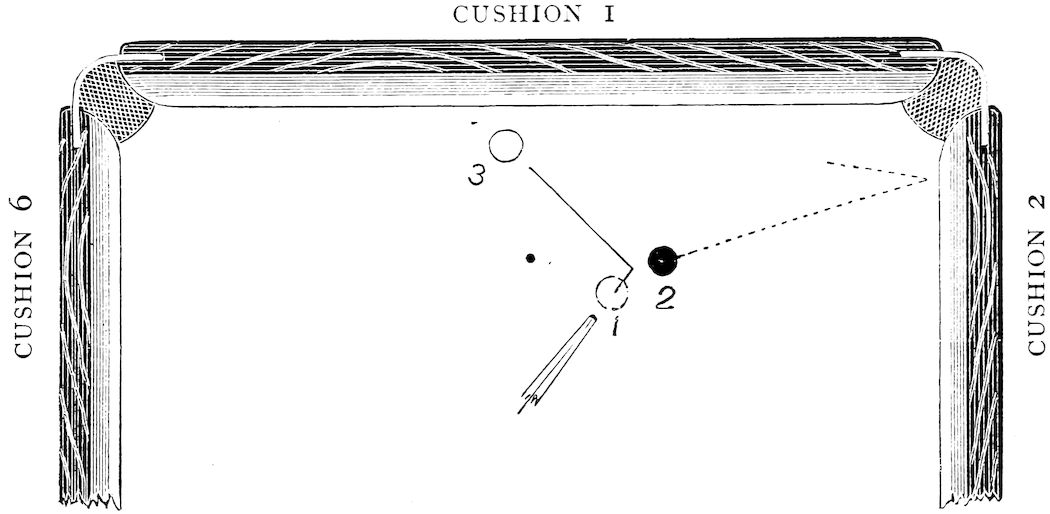
ideas. In one of them, for example, the red ball was near the
left top pocket, into which it was very easy to screw, and his
opponent’s ball was nicely placed about the middle of the table.
Instead of making the losing hazard with a slow screw, which
would have just brought the red ball down to the white, and
left a capital chance of a good break, Mr. Mardon had a regular
bang at it, doubled the red ball right down the table and up
again, and, probably more by luck than judgment, finally left
it almost in the jaws of the right-hand top pocket. This, however,
is ‘another story,’ and I am keeping Mr. Mardon waiting
13an unconscionably long time in the witness-box to give his testimony
as to Kentfield’s abilities as a player. He writes:
Were I to relate all the extraordinary performances of Mr.
Kentfield at the period when list cushions and pockets of large
dimensions were in vogue, the reader would imagine I was bordering
on romance. On one occasion, when playing the winning
game, 21 up, Mr. Kentfield gave his opponent 18 points, and won
sixteen successive games. In playing the winning and losing game,
24 up, he won ten games, his adversary never scoring! The games
were thus played: Mr. Kentfield, in playing off, doubled the red
ball for one of the baulk corner pockets, placing his own ball under
the side cushion. His opponent played to drop it into the corner
pocket, failed, and left on each occasion a cannon; that was made,
and the games were all won off the balls! At another time he
was playing the non-cushion game, 16 up. On going off he twisted
his ball into the corner pocket from the red and won in that manner
six games, his adversary not having a stroke! Desirous of ascertaining
how many games of 24 up could be played within the hour,
he commenced the task with a player of considerable eminence;[1]
and they completed thirty games within the specified time. Forty-seven
games of 100 up were also played in eight and a half hours.
In a match that did not exceed two hundred games, he beat his
opponent eighty-five love games.
Even allowing that the ‘player of considerable eminence’
was out of form, and that Kentfield had the table virtually to
himself, 720 points in an hour was amazing;[2] and even the
longer test, which works out at the rate of about 550 points per
hour, does not compare at all badly with the rate at which our
best players score at the present day; so it seems curious that a
performer of such ability should have continued for years playing
games of 21 and 24 up, in which, as was almost sure to be the
case, his opponent frequently never had a stroke. When John
Roberts, senior, was fast coming into note as a great player, and
14people were beginning to compare his powers with those of Kentfield,
Mr. Mardon thus expressed his opinion on the subject:
I have been given to understand, within the last few months,
that Mr. Roberts, superintendent of the billiard-rooms at the Union
Club in Manchester, is considered by his friends of that neighbourhood
to be equal to any player in England; and, in order to afford
me an opportunity of judging of his skill, balls have been placed
in situations of considerable difficulty, and I have been assured
that hazards thus presented came quite within his power of cue.
I have also been informed that, in playing a game of 100 up, his
opponent, aware of, and dreading, his ability, ran a coup at 96 love,
hoping, by so prudent and cautious a proceeding, to ensure winning
the game. Mr. Roberts, playing from the baulk circle, twisted into
one of the corner pockets from the ball upon the spot, and made
from a break so unpromising 102 points from the red ball alone!
Admitting, however, this information to be correct, still, wonderful
and surprising execution does not constitute either a sterling or a
successful player; and when I take into consideration the advantages
to be derived from playing the game called ‘One pocket to
five,’ and learn that Mr. Kentfield has played upwards of fifty
thousand games with one gentleman alone, I cannot but imagine
that an experience so great, united with his matchless skill, must
not only elevate him above all other players, but fully entitle him
to the paramount laudatory remarks with which his name will be
found to be associated. When I call to mind, and reflect upon,
the wonderful execution displayed while playing the commanding
game over the table, and the game of one pocket to one pocket
commanded, I have no hesitation in saying that on such occasions
his power of cue has gone beyond what even the imagination could
embrace. I have seen him, like a man inspired, accomplish stroke
after stroke, hazards and cannons, against which I, with my knowledge
of the game, would have laid fifty to one! From his cue
I have witnessed that which I am confident I shall never see
again; and, although luminaries may shine forth in other spheres,
Mr. Kentfield, the electric light of mine, must, I think, dim their
lustre and keep them in the shade.
The only other witness I shall call is John Roberts, sen.,
who has left on record his opinion that Kentfield ‘played a
very artistic game, but possessed very little power of cue. He
15depended on slow twists and fancy screws, and rarely attempted
a brilliant forcing hazard. He gave misses, and made baulks
whenever they were practicable, and never departed from the
strict game.’ This was not written until many years after all
rivalry between the two men had ceased, and may, therefore,
probably be accepted as a calm and unprejudiced opinion. At
first sight it is difficult to reconcile the entirely opposite views
of Mr. Mardon and Roberts with regard to Kentfield’s power
of cue. The truth probably lies between the two extremes, for
the former’s judgment may have been slightly warped by intense
admiration for his idol, whereas Roberts was possibly
comparing Kentfield’s power of cue with his own, which was
almost phenomenal. The highest break that Kentfield ever
made was one of 196, and his best spot break 57 consecutive
hazards. It may be taken for granted that neither of these
breaks was made on his three-inch pocket table; nevertheless,
they may still be regarded as very excellent performances. If,
however, there are diverse views as to Kentfield’s powers as a
player, I have only been able to discover one opinion as to his
merits as a man. Whether or not we may feel inclined to
accept the dictum that genius is ‘an infinite capacity for
taking pains,’ I think there is little doubt that Edwin Kentfield
was a genius at billiards, whilst in other respects it is quite
certain that he set a brilliant example to the players who followed
him.
During the last few years of Kentfield’s long and peaceful
career, the fame of John Roberts was rapidly growing, especially
in and near Manchester, and it became evident that at
last, for the first time for four and twenty years, the champion
would be called upon to defend his title. Roberts was born
about 1815, and, as is bound to be the case with a really great
player, had a cue in his hand long before he was tall enough to
reach the table properly. Indeed, he was only nine years old
when he began to play upon an old-fashioned table by Gillow,
with a wooden bed and list cushions. This was at the old
Rotunda, Bold Street, Liverpool, and he showed such remarkable
16aptitude for the game that in six months he could give
points to most ordinary players. His precocious ability appears
to have been unknown to his father, until one day the
two played three or four games together, and the youngster
won by many points. Instead of being delighted with this
display of juvenile talent, the old man, who was possibly a
bad loser, concluded that his son must have been devoting
far too much time to the game, and, lacking the shrewdness
to perceive the possibilities that lay before so skilful a lad,
apprenticed him to a carpenter. The boy stuck to this trade
for a couple of years; but his passion for billiards remained as
strong as ever, and at the end of that time he ran away, thenceforth
devoting himself entirely to what was unquestionably his
proper vocation. His first engagement was as marker at Oldham,
and it is evident that he must have improved very rapidly while
there, for he could not have been more than fourteen years old
when he played home and home matches with ‘Pendleton
Tom,’ a professional player with considerable local reputation,
and beat him in both. When he left Oldham he obtained a
situation in Glasgow, and in 1844 played a match against John
Fleming, a well-known billiard-table maker of that day, for
100l. a-side; and here he met with his first reverse of any
importance. They were playing 500 up, and when the game
was called ‘485 all,’ Fleming tried for a cannon and missed it,
but fluked a six stroke and went out. Roberts then defeated
Tom Broughton of Leeds, and this appears to have been his last
match of any note during his sojourn in Glasgow. This ended
in 1845, when he became manager of the billiard-rooms of the
Union Club at Manchester, a position which he retained for
seven years. This was very fortunate for him, as he no doubt
had far more opportunities for practice than he had ever previously
enjoyed, and it was while there that he learnt the spot
stroke. The popular idea that he invented the stroke is, of
course, an entire fallacy, for Kentfield, Carr, Pratt, and others
were in the habit of playing it. It was taught to Roberts by
Mr. Lee Birch, a member of the Union Club, who had seen it
17played in London, and, being one of the best amateur players
of the day, soon mastered it to the extent of being generally
able to make a dozen or fifteen consecutive hazards. It is
curious, by the way, how many amateur players attain this
standard of excellence and never get any farther. If a man
can habitually make this number of spot strokes, nothing but
steady practice is required to enable him to make runs of fifty,
seventy, a hundred, or even more; yet not one in a thousand
has the resolution or perseverance to take this necessary
practice. With Roberts it was entirely different. He at once
realised that the stroke must give an enormous advantage to
any man who could play it with something like certainty. For
six months, therefore, he devoted himself almost entirely to it,
and spent hundreds of hours at the top of the table.
When a man who united a natural genius for the game
with indomitable perseverance thus set himself to master a
particular stroke, there could be only one result, and I should
fancy it was then—strong in the confidence engendered by his
ability to play this deadly stroke—that he first conceived
the idea of bearding Kentfield in his den, and challenging his
long-undisputed supremacy. Mr. Mardon’s account of the first
meeting of the rivals is as follows: ‘Arriving in Brighton,
Roberts called on Kentfield. He informed him at once, in a
manly, straightforward manner, who he was, and expressed a
desire of playing a friendly game. He neither sought disguise
nor secrecy, and would willingly have shown the strength of
his game to all who might have approached. Kentfield, on
the other hand, was very desirous of avoiding publicity, and,
taking Roberts into an adjoining room, locked the door and
began a game.’ Then follow a few more lines in Mr. Mardon’s
usual rather high-flown style, the meaning of which, translated
into the vulgar tongue, is that Roberts speedily discovered that
his opponent was not really doing his best. This did not at all
suit the man who had come from Manchester on a voyage of
discovery, and Mr. Mardon tells us that he thus expressed his
opinion on the subject: ‘This, Mr. Kentfield, cannot be your
18game; to play such as this I can give forty in a hundred. If
you are withholding your powers for the purpose of obtaining a
bet, I am willing to recommence the game and to play you for
five pounds.’ Those who knew the elder Roberts intimately
may possibly accept this as the general purport of his remarks,
but will entirely decline to believe that he did not express himself
in far more vigorous and forcible language. As, however,
Mr. Mardon states that the door of the room was locked, and
that no one was present excepting the two principals, he could
only have written his account of the scene from hearsay, and it
differs considerably from Roberts’s own version of the interview.
This, given in ‘Roberts on Billiards,’ runs as follows:
I remember perfectly my first meeting with Kentfield, better
known as ‘Jonathan.’ It was in the beginning of 1849, at Brighton,
where I went on purpose to see him play. On entering his rooms
I met John Pook, the present proprietor of the Cocoa-tree Club,
who was at that time his manager. After sending up my name,
Kentfield came in and inquired my business. I told him that I
was admitted to be the best player in Lancashire, whence I had
come to find out if he could show me anything. He inquired if I
wanted a lesson. I told him I did not, and asked him how many
in 100 would be a fair allowance from a player on his own table to
a stranger, provided they were of equal skill. He replied ‘15;’ I
told him I thought 20 would be nearer the mark, but I was contented
to try at evens. He said: ‘If you play me, it must be for
some money;’ on which, not to be frightened, I pulled out a 100l.
note, and told him I would play him ten games of 100 up for 10l.
a game. He laughed, and said I was rather hasty; and eventually
we knocked the balls about, and then commenced a friendly
100 on level terms. He had the best of the breaks, and won by
40. In the second game I pulled out a few north-country shots
and won by 30, but he secured the third. Then he put down his
cue, and asked if I was satisfied he could beat me. I said: ‘No;
on the contrary, if you can’t play better than this, I can give you
20 in 100 easily.’ He replied: ‘Well, if you want to play me, you
must put down a good stake.’ I asked how much, and he answered
1,000l. I said: ‘Do you mean 1,000l. a-side?’ Upon which he
told me he thought I was a straightforward fellow, and he would
19see what could be done. He then sent Pook back to me, and
I explained to him how things stood. He replied: ‘You may as
well go back to Lancashire; you won’t get a match on with the
governor.’
Accepting Roberts’s version of this historical meeting, one
is forced to the conclusion that, if one of the two was not trying
to win, it certainly was not Kentfield; for when a man loses two
games out of three on level terms, and then calmly tells his
victorious opponent that he can easily give him 20 in 100, it is
certain that the loser must have been keeping a very big bit up
his sleeve. Evidently Kentfield was fully alive to this, for all
efforts to get him to make a match proved fruitless.
The fact of the matter undoubtedly was that Kentfield, who
was many years the senior of the pair, felt that the coming man
was too strong for him, realised that he had everything to lose
and very little to gain by risking a contest, and preferred the
title of ‘retired champion’ to that of ‘ex-champion.’
John Roberts, therefore, attained the first position in the
world of billiards in 1849, and the following year, whilst he
was still manager of the billiard-rooms at the Union Club,
Manchester, played a great match of 1,000 up with Starke, an
American. The latter was a remarkably fine nursery cannon
player, and, getting the run of the balls in the early part of the
game, reached 600 to 450, thus securing a formidable lead.
Then it was that Roberts first reaped the reward of all the
time and patience he had expended on the practice of the spot
stroke. Wisely abandoning the all-round game, he devoted
his energies to getting position at the top of the table; a break
which included thirty-nine consecutive ‘spots’ took him to the
front again, and another fine run of thirty-six red hazards gave
him an easy victory. In a letter to ‘Bell’s Life’ on the subject
of this match, one of the best contemporary judges of the game
gave it as his opinion that ‘Kentfield showed good judgment
in declining a match with Roberts, for, had they played upon
a neutral table, he would have been defeated to a certainty.’
Even Mr. Mardon completely altered his mind with regard to
20the respective merits of the two players, and to his second
profession of faith he probably remained steadfast until the day
of his death; for, as comparatively recently as the early part of
1874, he wrote a letter to the ‘Sporting Life’ on the subject of
billiards, in which he strongly maintained the superiority of old
John over his son, William Cook, and Joseph Bennett.
It is doubtful whether, at the period of which I am now
writing, the title of champion was of much pecuniary value
to its possessor. He could only get an occasional match for
money by giving a very long start, whilst such things as exhibition
games seem to have been of very rare occurrence. In
glancing over the files of ‘Bell’s Life’—the only sporting paper
then in existence—of some forty years ago, one cannot fail to
be struck with the way in which billiards is practically ignored;
in fact, it was some time before I could find any allusion to the
game. At last, in the issue dated February 22, 1852, I discovered
the following announcement: ‘A silver snuff-box will
be given by the proprietor of the Shakspere’s Head, Wych
Street, Strand, to be played for by eight of the best players in
London, on Tuesday next, at six o’clock. A gentleman from
the country will be in attendance to play any man in London
for from 25l. to 50l. the same night.’ The most rigid examination
of the issue of the following week—in those days sportsmen
had to content themselves with one sporting paper, which
came out once a week—failed to discover the smallest record
of the doings of ‘eight of the best players in London’ on that
Tuesday evening, and the destination of the silver snuff-box
might have been for ever lost to posterity but for the appearance
of the following challenge: ‘Mr. John Dufton will play Mr.
Farrell, the winner of the snuff-box at the Shakspere’s Head,
Wych Street, on Tuesday last, a match at billiards, from 100
to 1,000 up, for 10l. or 20l. a-side. Money ready any evening
at the above-named place.’ It is probable that the challenger
was a relation of the well-known William Dufton, ‘tutor to the
Prince of Wales,’ as he always proudly styled himself, though I
must candidly confess that I had never previously heard either
21of him or of Farrell, entitled as each may have been to rank
amongst the eight best players in London. It was not, however,
the battle for the snuff-box that interested me. I was
anxious to know how the countryman fared on his adventurous
crusade, and had a suspicion that he may have turned out to
have been no less a personage than the champion himself, this
being just the sort of little joke that John Roberts always
enjoyed. However, my curiosity on this point had to remain
unsatisfied, and I ceased to be surprised that it should be so
when I found that in the same issue of ‘Bells Life’—which in
those days was supposed to devote a good deal of its space to
events of general interest other than sporting—the death of
Tom Moore, the sweetest singer Ireland ever produced, was
dismissed in exactly five lines!
In this same year (1852) Roberts resigned the management
of the billiard-rooms at the Union Club, which he had held for
seven years, and took the Griffin Hotel in Lower Broughton, a
suburb of Manchester. Soon after this he played two more
matches with Starke at the American game, each of them being
for 100l. a-side. It is noteworthy, as marking the rapid
manner in which he had ‘come on’ in his play, that whereas,
only two years previously, Starke had played him upon even
terms, and at one stage of the game looked very much like
beating him, it was now thought good enough to back Roberts
to give a start of 300 in 1,000. This proved rather too big a
concession; nevertheless, little mistake had been made in
estimating the respective merits of the two men, for in the
return match, in which the start was reduced to 275, the
champion won very easily. The billiard history of the next
few years is singularly uneventful, and there appear to have
been few players good enough to have any chance with Roberts,
even when allowed a long start. He, however, did not retain
the Griffin Hotel very long, and, after leaving it, took billiard-rooms
in Cross Street, Manchester. He must have been living
there in 1858, when he played a match with John Herst in
Glasgow, in the course of which he made a break of 186, which
22included a run of 55 consecutive spot strokes. Herst was a
brilliant winning hazard striker, and played in very pretty and
finished style. Great things were expected of him, and there
is every reason to suppose that these expectations would have
been realised, but he died almost at the outset of his career.
In 1861 Roberts at length left Manchester, to become lessee of
Saville House, Leicester Square, and he had not been there
many weeks when he played a match with Mr. Downs, an
amateur, to whom he conceded a start of 700 in 1,000. In the
course of this game, which he won by 93 points, he made
two very fine breaks of 195 (53 ‘spots’) and 200 (64 ‘spots’),
and scored his thousand points in 2 hours 11 minutes, an
excellent performance, notwithstanding the fact that he must
have had the table virtually to himself. A rather curious
episode occurred in the course of this game. Mr. Downs, in
lieu of giving the customary miss at the beginning of the play,
ran a coup, expecting that Roberts would give a miss, and
very probably calculating that, with his big start, to give
three and receive one was really judicious. The champion,
however, instantly grasped the situation, and, without a
moment’s hesitation, played hard at the red, and sent it and
his own ball flying to the other end of the room. In those
days there was no penalty for knocking a ball off the table, so
Mr. Downs’s carefully calculated and promising scheme of running
a succession of coups and receiving a series of misses was
summarily nipped in the bud. It was at Saville House in
March 1862 that Roberts made his famous break of 346,
mainly composed of a series of 104 spot hazards. William
Dufton was his opponent, and Roberts won the game in the
remarkably fast time of an hour and three-quarters. This
break was more than a nine days’ wonder, and never before or
afterwards did Roberts make 300 off the balls in public—a
feat that is now well within the compass of plenty of men who
do not play well enough to get a couple of engagements per
season in exhibition matches.
Two of the most prominent players in the ‘fifties’ and early
23‘sixties’ were Alfred Bowles and Charles Hughes. Roberts
considered the former to be the best player he ever met, and
records that ‘no one yet has ever held me at the points as
Bowles used to do.’ The points alluded to were 300 in 1,000;
but it must not be forgotten that these remarks were written
before William Cook, John Roberts, jun., and Joseph Bennett
had come to the front. I never saw Bowles play until he
challenged the younger Roberts for the championship and
suffered an easy defeat. This was in May 1870, when the
Brighton man had possibly seen his best day. He played a
steady, old-fashioned game, but was hopelessly out-classed by
young John, and, though he could play the spot stroke well, of
course he had no opportunity of doing so on a championship
table. From what I saw of the play of the two men, I should
unhesitatingly place Charles Hughes before Bowles; but it
would be ridiculous, with the very limited opportunities I had
of forming an opinion, to oppose my judgment to that of
Roberts; and certainly the results of two matches that were
played in the early part of 1864 point strongly to the superiority
of Bowles. In January of that year Roberts gave Bowles 300
in 1,000 for 100l. a-side—in those days 100l. a-side meant 100l.
a-side, not that each man went through the solemn farce of
staking his money, and received it back again at the end of
the game, whatever the result might be—and was beaten by
109 points; whilst, two months later, the champion conceded
Hughes 350 in 1,000, and beat him by no fewer than 243
points. There can be no doubt, however, that Hughes improved
wonderfully between the date of this match and 1869,
when he sailed for Australia. The weak point in his game was
an irresistible inclination to go out for fancy cannons. He
would be apparently well set for a really good break when he
would neglect a comparatively simple shot for some elaborate
cannon off three or four cushions, which he would either
just miss or perhaps bring off, with the result of leaving the
balls in an almost impossible position for a further score. He
was gradually, however, getting over this propensity towards the
24close of his career, and undoubtedly played a very good game
indeed at the time that he left England. Just prior to sailing
he ran into the last three of a great professional handicap which
took place at the ‘Nell Gwynne,’ Strand, in which, together
with Cook and Roberts, jun., he started at scratch, whilst the
champion owed 50 points, and, as there were as many as forty
players engaged, this was a capital performance. He also won a
handicap of 200 up, which was played to celebrate the opening
of the Bentinck Club, upon the site of which the Vaudeville
Theatre now stands. In this he received a start of 30 points,
the champion owed 20, whilst his son and Cook had 20
each. The best thing he ever did, however, was accomplished
in the last game he played in England. He sailed from
Liverpool, and, as Roberts had gone down to see him off, the
pair took advantage of the opportunity to play 1,000 up at the
‘Golden Lion,’ Deansgate, Manchester. Roberts, as usual,
gave a start of 300, and had reached 736 against 794, when
Hughes went out with a break of 206, which included 62
consecutive ‘spots.’ Being asked to finish the break, he added
21 more red hazards, and this 269 was a bigger run than
anyone had put together since the champion had made his
famous 346 about seven years previously. I can find no
record of Hughes’s achievements in Australia, but he did not
long survive his arrival in that country. As has been the
case with too many other fine players, he lacked the resolution
and strength of mind to take proper care of himself,
and the lavish colonial hospitality which was thrust upon him
at every turn speedily killed him.
In the limited space at my disposal it is manifestly impossible
to follow the game closely, year by year, and I think the
better plan will be to give a sketch of all the principal players,
including some account of the most important matches that
have taken place since 1870, at nearly all of which I have been
fortunate enough to have been present. In ‘Roberts on
Billiards,’ which was written towards the close of the author’s
twenty-one years’ tenure of the championship, he names Charles
25Hughes, John Herst, Joseph Bennett, William Cook, and John
Roberts, jun., as candidates for the title of second-best player,
and adds, ‘probably the two best are William Cook and my
eldest son.’ The first and second I have already dealt with;
the other three, who kept the championship entirely between
them during fifteen years, naturally demand more extended
notice, as their doings really form the greater part of the history
of billiards from 1870 onwards. Before coming to them, however,
it will be better to dispose of what Roberts terms the
third class, in which he includes William Dufton, L. Kilkenny,
W. D. Stanley, W. E. Green, George Mulberry, Alfred
Hughes, George Davis, W. C. Hitchin, Tom Morris, Harry
Evans, and John Smith, ‘to any of whom I have been in the
habit of allowing 350 in 1,000.’ Of these, I never saw Stanley—who,
I fancy, was an elder brother of D. Richards and S. W.
Stanley—Mulberry, Davis, Hitchin, or Smith play, and will not,
therefore, write anything about them. With respect to Dufton,
I feel bound to say that, in my opinion, he was a much overrated
man. As I saw him perform for the first time in 1866, when
it is possible that he may have been going off, I should have
hesitated to write so plainly, had not my view of his lack of
ability been fully confirmed by one who constantly played with
him, and for whose judgment I have the highest respect. His
long ‘jennies,’ on the making of which his reputation almost
entirely rested, are now easily within the compass of any professional
player, and he would never have made the name he
did but for confining his play almost entirely to exhibition
games with Roberts. These exhibition matches would naturally
have lost much of their attraction if the champion had
invariably won, so Dufton had his share of successes, and
came to be regarded as being able to play Roberts with 350
points in 1,000; whereas it is perfectly certain that a start of half
the game would not have brought them together when the
scratch man was doing his best. L. Kilkenny kept pace
fairly well with the remarkable development of the game that
took place between 1870 and 1880, and managed to hold his
26own with a reasonable start from the rising stars. He possessed
little power of cue and no brilliancy of execution, but played
a sound, steady game, and, before spot-barred games became so
universal, could generally be relied upon for a pretty good run
of ‘spots’ when he obtained a favourable position. Deprived
of the strongest part of his game, however, he soon fell out of
the ranks. Alfred Hughes was a player of no class compared
with his brother Charles, and Tom Morris, a left-handed man,
with a somewhat flashy style, was only moderate. Harry
Evans, on the contrary, was a thoroughly sound performer, who
played an excellent all-round game, and, if he did not go out
for gallery strokes, seldom or never missed an ordinarily simple
one. Soon after his arrival in Australia he suddenly came out
as quite a phenomenal spot stroke player, though he had never
so distinguished himself in England, and he held the championship
of that colony for many years, till quite recently deprived
of it by Charles Memmott.
About 1866 John Roberts, jun., William Cook, and Joseph
Bennett began to draw away from the ruck of billiard-players,
and it did not require much foresight to predict that old John
would shortly find a dangerous rival or two, though it was difficult
at the time to believe that anyone would have the temerity
to meet him upon even terms. In the October of that year a
great four-handed match took place, the champion and Dufton
attempting to give 200 in 1,000 to Charles Hughes and Joseph
Bennett for 200l. a-side, an attempt in which they failed
lamentably, being beaten by no fewer than 344 points.
Though Hughes scored 497 points during the game, whilst
Bennett only contributed 281, the major portion of the credit
of the victory must be given to the latter, who, by the way,
is the only surviving member of the quartet. Always remarkable
for his fine generalship and wonderful knowledge of the
game, Bennett never displayed these qualities to more advantage
than on this occasion. He played in front of Roberts,
and, although he made a few breaks of twenty or thirty, his
sole mission was never to allow the champion a fair opening.
27Directly he had a stroke which it was not three to one on
his making, he at once abandoned the break, and either put
down the white and left a double baulk or else gave a miss.
Roberts’s game, in fact, was so utterly cramped from start to finish
that it was a remarkable feat on his part to make 488 points
during the evening. In the meantime Hughes was thoroughly
enjoying himself. Having only Dufton to follow him, and
well knowing that it did not much matter what sort of a game
he left on, he went out for everything, brought off all sorts of
fancy cannons, and scored the fastest of the party. Poor
Dufton’s show was a very lamentable one. From the style of
game that Hughes was playing, he naturally left any number of
good openings, but all that Dufton could total during the
evening was 136. By Bennett’s clever strategy the four-handed
match was virtually reduced to a single-handed battle between
Hughes and Dufton, and this could only have had one result,
even had they played upon level terms.
It was at the end of 1868 that William Cook and John
Roberts, jun., between whom there was destined to be such
keen rivalry for the next twelve or fifteen years, played their
first match for money, Cook being at that time just nineteen
years of age and his opponent two years older. The match
took place at the Bentinck Club, and produced a very large
amount of speculation. It is quite needless to give any description
of the game, which Roberts won by 92 points, but it
is noteworthy that his best breaks—at the all-in game, be it
remembered—were 120 and 99, whilst Cook’s highest effort
only reached 92. This contrasts very curiously with the state
of affairs early in 1896, when, in a spot-barred game of 1,000
up, it would be quite safe to back a player of the calibre of D.
Richards or H. W. Stevenson to make three breaks of upwards
of a hundred each. In spite of this defeat, Cook’s friends did
not lose faith in him, and, in his inmost heart, I believe that
Roberts, sen., always rated Cook’s play at a higher level than
that of his son. I remember having a chat with the old man
on this subject at the Bentinck Club. Young John had just
28beaten Cook pretty easily in their heat of the handicap with
which the opening of the club was celebrated, and this, coupled
with his recent success in the match just referred to, led me to
remark that there could be little doubt as to who would be
future champion. ‘I’m not so sure of that,’ said the veteran
with a shake of the head; ‘we’ve not seen the best of Cook
yet.’ Before the end of that year his opinion was amply
justified. In March a return match was played, in which,
though the breaks on both sides were very small, Cook beat
Roberts, jun., by 323 points, and when the former began
playing again after the summer recess the improvement he
exhibited was simply extraordinary. His beautiful delicacy of
touch was more striking than ever, and he ‘nursed’ the balls
with even more than his old skill; but in his anxiety to secure
position he did not so frequently miss the immediate stroke,
which had formerly been the weak point in his game. Then
he had attained a proficiency in playing the spot stroke that
entirely eclipsed anything that had previously been witnessed
in this line, and three times in one week, with young Roberts
as an opponent, he made upwards of three hundred off the
balls. Two of these breaks—351 at the Royal Hotel, Dale
Street, Liverpool, and 359 at the Prince of Wales’s Hotel,
Moss Side, Manchester—beat the champion’s 346, which for
seven years had been considered quite unapproachable. After
this, Cook seldom played two games of 1,000 up without
making a break of 300 in one of them, and left his old rival,
John Roberts, jun., completely in the rear. There could only
be one end to this series of remarkable performances, and
in the autumn of 1869 Cook issued a challenge to play the
champion, on or before January 1, 1870, a game of 1,000 or
2,000 up, level, for 500l. a-side. Some little time elapsed
before the two men came to terms, and it was decided by a
committee of the leading players of the day that matches for
the championship should be played on a table with three-inch
pockets, and with the spot 12½ inches from the top cushion,
instead of 13¼ inches, the then customary distance. As Cook
29was a member of the committee which decided on this radical
alteration in the table, it seems strange that he did not protest
strongly against a measure which nearly every expert at once
realised must deprive him of the strongest feature of his game—the
spot stroke—but the reason was that he apparently did
not realise the fact. Cook was then barely twenty-one years
of age, but he ought to have had sufficient experience to have
saved him from such a mistake. Before he had been playing
on the new table for an hour, his error must have been brought
home to him in very unpleasant fashion.
Just as the great battle at Farnborough between Sayers
and Heenan was read about and eagerly discussed by all
sorts and conditions of men who had previously professed the
greatest disgust for prize-fighting, so the match between the
veteran and his pupil excited intense interest, even amongst
people who could scarcely define the difference between a
winning and losing hazard. The Prince of Wales was present
at St. James’s Hall, and, as no such scene had ever previously
been witnessed at a billiard match, and may never be seen
again, I need not apologise for reproducing part of a sketch
of the memorable night contributed by myself at the time to
one of the last numbers of the famous old ‘Sporting Magazine,’
which ceased to exist at the end of 1870:
For the last five or six years the champion has made no very
long break nor any great number of successive ‘spots,’ whilst his
son, Joseph Bennett, and Cook, especially the last-named, have
frequently put together a very big score off the balls. People at
last began to realise the idea that the title of ‘second-best player
in England’ would not long satisfy one or two of the colts, and
were not altogether surprised when Cook challenged his old master
for 500l. a-side. Roberts took a long time to reply to this cartel,
and it was believed that another walk-over would take place—for
as yet there had never been a match for the championship; but at
length he made up his mind for one effort to retain his place, and
they agreed to play on February 11. Prior to that day a meeting
of the leading professionals was held. Rules were drawn up for
future contests ... and some important alterations were made in
30the construction of the tables to be used in matches for the championship,
with what results we shall presently see.
The match was played in the large concert room at St.
James’s Hall.
Just before eight o’clock the spectators settled down into their
places, and the scene was a truly remarkable one. The table,
which looked very small in such a huge hall, was of course placed
in the centre, and, about three yards from it, a cordon was formed
by a scarlet rope, so that a ‘clear course’ was secured for the combatants,
even if ‘no favour’ could not be guaranteed. Outside this
rope the tiers of benches began, and sloped up to the galleries.
Every seat was occupied, and the galleries themselves accommodated
a very large number of spectators, many of whom had provided
themselves with opera glasses, anew concomitant to a billiard
match, but a very necessary one on this occasion. Shortly after
eight o’clock the calls of ‘time’ became very loud and impatient,
and, with a view of creating a diversion, someone who appeared
to have the chief management of the affair began to weigh the balls.
He spun out this operation in very clever fashion, and kept the
people quiet for nearly ten minutes; but at last they grew tired of
seeing him hold up the scales, and remain immovable, apparently
wrapped in astonishment that the balls should exactly balance each
other, and the noise became worse than ever. At length the two
men appeared, without their coats, and apparently ‘eager for the
fray.’ They were received with uproarious applause, which seemed
to delight Roberts immensely.
At the beginning of the game caution prevailed, and the
tight pockets puzzled both men.
At 127 Cook made six ‘spots,’ the longest run of the evening;
but the new-fashioned table seemed to have quite destroyed his
pet stroke. The red ball required to be played with the greatest
care, or it did not go in, and, owing, we imagine, to the change in
the locality of the spot, it seemed almost impossible to secure position
for the second stroke, even if the first came off. Both men
had several tries at it; but they could make nothing of their old
friend, and the last half of the match was practically played ‘spot
hazard barred.’ The contrast in the style of the two was very
noticeable, Roberts’s being as clumsy and awkward as Cook’s was
31pretty and elegant, the latter playing, as someone near us observed,
‘a very genteel stroke.’ The men were very level at about 450, and
then the champion got in, with Cook’s ball and the red almost
touching each other, and quietly dribbled them down the table,
making six or seven very pretty cannons in succession. He followed
this up with a regular ‘gallery’ stroke, potting the red at railroad
pace, and making a cannon off two or three cushions, which brought
down the house. A break of 22 by Roberts made his score 494
against 495. The announcement of ‘517 all’ produced great cheering;
however, 44 and 49 by Cook soon placed him in front again,
and, as soon as he passed 600, there was a short interval.
The men soon came back, Roberts decorated with a cross,
‘wearing it for the last time,’ as one of Cook’s backers grimly remarked.
A magnificent ‘all round’ 80 took the young one to 785.
The knowledge of strength shown in this break was truly wonderful,
and there was a thin ‘loser’ in it which even Roberts felt compelled
to applaud. There was soon a gap of a couple of hundred
points between them, and the champion kept looking up mournfully
at the figures at the end of the hall. He never lost heart, however,
and, laying himself down to his work, began to creep up again.
Cook’s score stood still for some little time, and the old man’s
backers got very excited. Roberts now made 62, his longest break
during the game, and two or three other good runs brought him
close to Cook, whom he passed, the score being called 1,041 to
1,037 in favour of Roberts: but a 31, finished with a double baulk,
placed Cook well in front again, and, when his score stood at 1,133,
he made a horribly fluky cannon, and ran right out, with a succession
of the easiest and prettiest strokes we ever saw, a winner by 117
points.
Here I prefer to take leave of John Roberts, sen.; for,
although he occasionally played in public for several years
after, he never again exhibited anything approaching his
best form. It almost seemed as though he had wound
himself up for one great effort to retain his supremacy,
and that he never recovered from the consequent reaction:
added to which he was then fifty-five years of age, and had
consequently seen his best day. In his prime he was a
man of extraordinary strength of constitution, and performed
several feats of endurance which probably no professional
32player of the present day could approach. Perhaps the most
remarkable of these was accomplished in 1846, when he had
rooms in Glasgow, and an amateur, who was in the habit of
frequenting them, made a match to play him on the following
conditions: Roberts was to concede sixty points in each
hundred, mark the game, hand the rest, spot the red, take the
balls out of the pockets, &c., and in fact do the work of both
player and marker. They were to continue playing until one
of them stopped voluntarily or through exhaustion; but I have
been unable to ascertain whether or not they were allowed to
eat and drink during the progress of the match, though the
probability is that there were no restrictions in this respect.
The stakes were ten shillings per game: whoever gave in first
was to forfeit 25l. and all claim to anything he might have won.
Roberts was at that time in full play, and doing strong work
round the table for several hours in each day; but his
opponent could not have been far behind him in this respect,
and must have been a remarkably game man into the bargain,
for he struggled on for forty-three consecutive hours before
Nature gave way, and he fainted from exhaustion. In that
time no fewer than 125 games were played, and Roberts won
a good stake, every penny of which he had certainly earned.
Differing entirely from Kentfield in this respect, he possessed
extraordinary power of cue and a wonderfully strong wrist,
which enabled him to perform all sorts of curious feats, such
as knocking both balls off the table and making them reach
the end of a long room before touching the floor. His worst
fault was a too flashy style of play, and I shall always believe
that he would just have beaten Cook in the great match for
the championship if he had kept himself a little quieter during
the game; but he could not resist incessantly chaffing his
friends, chalking bets on the floor, &c. Comparison between
Roberts’s form and that of the leading players of the present
day would be most unfair to the old man. Had he lived fifty
years later than he did, and enjoyed all the advantages of
the improvements that have been made in the accessories of
33the game, as well as the opportunities that leading players
enjoy of constant practice, it is certain that he would have been
found right in the front rank. He had a real genius for the
game, and was a great player.
Immediately after winning the championship Cook had a
very busy time of it. He played John Roberts, jun., the best
of twenty-one games of pyramids, the result being that, after
they had won nine games each, Roberts secured the next two
and won the match, which virtually decided the championship
at pyramids. Then Cook toured for a few weeks, and, in the
course of an exhibition game with S. W. Stanley at Totnes,
made the hitherto unparalleled break of 512. On April 14,
1870, just two months after he had wrested the championship
from the elder Roberts, Cook lost it to Roberts, jun. The
length of the game was wisely reduced from 1,200 points to
1,000, and Cook was beaten by very nearly half the game.
This is one of the few contests for the championship that I
did not witness, and I have never been able to understand the
result; for, although Roberts won by 478 points, and scored his
thousand in three hours and four minutes, which was the
fastest time recorded for a three-inch-pocket table until the
last match ever played for the championship fifteen years later,
a 47 was the best break he made during the whole evening!
Of course, it must be remembered that the winner had the
table virtually to himself, for Cook must have been utterly
and hopelessly out of form. Six weeks later, Alfred Bowles,
of Brighton, a contemporary of Roberts, sen., challenged the
winner. It is probable that Bowles, though I believe he is
still alive, had then passed his best day, for the result of his
plucky challenge was disastrous. He played a good, sound
old-fashioned sort of game, devoting himself chiefly to runs
of losing hazards in the middle pockets, but had not the
smallest pretensions to meet a man of the class of Cook or
Roberts on even terms, and never possessed the least chance
all through the game. The next challenger, however, was of
very different calibre, and the battle between Roberts—as I
34have now taken leave of the father, it is needless to constantly
repeat the distinguishing ‘junior’—and Joseph Bennett was
about the most obstinately contested of the entire series. It
lasted for four hours and three-quarters, and Bennett, with
repeated safety misses and double baulks, at last fairly wore
down his formidable opponent, and won by 95 points. Thus
ended 1870, a truly remarkable year, which not only witnessed
the first match ever played for the championship, but in which
the title was actually held by four different men.
To trace the progress of the game minutely from this point
to the present time, and to attempt even to mention the
principal matches that have been played, would occupy too
much space, and I must, therefore, content myself with giving
slight sketches of the chief players from 1870 to 1895, alluding
to a few of the most remarkable matches. At the earliest
possible moment—the two months which were allowed when
the conditions governing contests for the championship were
drawn up—Roberts played a second match with Bennett, and
had no difficulty in regaining his title, as he won by 363 points
in the very fast time of three hours twenty-two minutes. Cook
was the next challenger, and, although he only got home by
15 points—a really nominal victory—this was the beginning of
his marked superiority to any other player, and for exactly
four years all efforts to wrest the championship from him proved
futile. On November 29, 1872, during an exhibition match
at his rooms in Regent Street, he made the previously unheard-of
break of 936, which included no fewer than 262 consecutive
spot hazards. This break was, of course, made on an ordinary
table. From 1871 to 1875 was undoubtedly the very
zenith of Cook’s career. During those four years he stood
right out by himself, and could defeat all comers on any class
of table. The strongest point of his game was unquestionably
his wonderful delicacy of touch. Brilliant forcing hazards,
and winning hazards made at railroad speed, so irresistibly
fascinating to the gallery, possessed little attraction for him,
and he was the first man who seemed fully to realise what
35might be done by delicately nursing the balls and bringing
them together, time after time, with perfect strength. Even
when at his best, however, he was never too consistent a
player; there were occasions when he was completely ‘off,’
and, if he happened to be caught on one of these days, quite a
second-rate performer could beat him easily. His personal
popularity was simply unbounded, and it would have taken a
remarkably strong nature to have resisted all the temptations
to which he was exposed. No man ever lost a finer chance
of an exceptionally brilliant and successful career. He must
have made much money, but when the end came, it found
him penniless. I have no wish, however, to dwell on his
weaknesses, amiable as most of them were; rather let me
record to his credit that no professional billiard-player has
ever possessed a higher character for unimpeachable honesty,
and that, in his prosperous times, he was never known to turn
a deaf ear to appeals for assistance.
It is quite time, however, to introduce the third and only
other man that ever held the championship cup presented by
the leading billiard-table makers in 1870. I refer, of course,
to Joseph Bennett, who is three or four years older than
Roberts, and was playing in public before either Cook or his
great rival. He rapidly acquired a wonderful knowledge of the
game, for he was barely eighteen when he was engaged at
Leeds to play and teach. During his stay there he played his
first important match. It was with W. Moss; the game was
1,000 up for 100l. a-side, and Bennett won by upwards of 500
points. Possibly this success induced him to turn his thoughts
Londonwards again; at any rate, he shortly afterwards returned
there. His first metropolitan match was with Dufton; then he
played a couple with Herst, winning one and losing the other:
but it was the great four-handed match in which he and Charles
Hughes so decisively beat old Roberts and Dufton that first
brought him into prominent notice.
Whether Bennett, as a player, was ever quite the equal of
Cook or Roberts it is unnecessary to discuss here. He beat
36each of them in turn for the championship, and can well afford
to rest contented with that record. In early life Bennett’s
health was indifferent, and his nervous and highly strung temperament
was by no means in his favour. One of his peculiarities
was that, when in training for a championship or other
important match, he would never play with anyone, but invariably
shut himself up in a room alone, and played one
ball against the other, or simply practised one or two special
strokes by the hour together. His contention was that a man
required all his nervous energy for the match itself, and ought
not to waste any of it in practice. There was, doubtless, something
in his theory, for few men have ever shown to more
advantage ‘in the pit;’ and it was sheer pluck and determination
that enabled him to defeat Cook for the championship, as
his opponent held a long lead when within a couple of hundred
of home. A very severe accident in the summer of 1881
caused Bennett to resign the championship, and, though he
completely recovered from its effects, he wisely gave up playing
in public. He will be better remembered as a teacher than as
a player, for he has virtually devoted his whole life to instruction,
and with remarkable success.
In December 1873 Messrs. Burroughes & Watts promoted
the first of a series of handicaps, with which they afterwards
became so much identified. The important effect that
these handicaps had upon the game is scarcely calculable,
and, thanks to the liberality of the promoters, several
players who afterwards took prominent positions, but might
otherwise never have been heard of, were first introduced to
public notice. These handicaps gave such men exactly the
chance they needed. The following sixteen players took part
in this handicap:—W. Cook, J. Roberts, jun., Joseph Bennett,
T. Taylor, F. Bennett, S. W. Stanley, Harry Evans, W.
Dufton, J. Roberts, sen., T. Morris, A. Hughes, John Bennett,
L. Kilkenny, Alfred Bennett, G. Collins, and Stammers. It
was won from scratch by Cook, who beat Kilkenny (130 points
start)—the heats were 500 up, all in—in the final, winding up
37with a splendid break of 428; and this appears to be a favourable
opportunity for giving brief sketches of some of the players
who took part in it, six or seven of whom are no longer living.
‘Master’ Stanley, as he was always designated in print for
the first year or two after he began to play in public, was
certainly one of the most precocious youths that ever handled a
cue, and could not have been more than sixteen when he began
to take his own part in good company. The spot hazard
was the strongest point of his game, and I shall never forget
the style in which he used to dash round the top of the table,
getting ready to play the next stroke long before the red
ball had reached the pocket. When it failed to drop in, even if
it was a couple of inches wide of the pocket, his invariable
look of blank astonishment was intensely comic.
Tom Taylor came forward about 1872, just at the time that
Stanley was becoming well known, and many were the hotly
contested battles between them. Never were two lads more
evenly matched. Stanley was a shade the better of the pair at
the spot stroke, but Taylor was a little superior all round the
table. Tom, like most billiard-players, had a pet stroke.
When he had opened a game with a miss in baulk, and his
opponent had followed with the answering miss under one of
the side cushions, he would invariably play at the red ball for
the cannon off two cushions, and bring it off three times out
of four. This is a stroke that is never played nowadays, and
yet, when unsuccessful, it rarely leaves anything on, which is
more than can be said of the cannon off the white ball, the
customary game at present. A gamer player than Tom Taylor
was never seen. No matter what the state of the score might
be, he never ceased struggling; to be apparently hopelessly
in rear only seemed to improve his play, and from time to
time he would pull a game out of the fire in really marvellous
fashion. With the exception of Roberts and Collins, Taylor is
the only one of the sixteen players in the great handicap at the
Guildhall Tavern in December 1873 who is playing regularly in
1896.
38Fred, Alfred, and John were all younger brothers of Joseph
Bennett. John, although he occasionally took part in handicaps,
was a player of no class, and died in November 1886;
but Fred and Alfred worthily upheld the family reputation as
billiard-players some twenty years ago, though they seldom
now play in public.[3] It is difficult to say which was the better
of the two when they were in their prime, for both played the
spot well and were good all round; but perhaps Fred was the
more brilliant, and might have taken a high position if he had
been fonder of the game, and devoted himself more assiduously
to it.
L. Kilkenny was another remarkably sound exponent of the
game as it was played twenty years ago. He, too, was good
on the ‘spot,’ and when this stroke went out of fashion it
practically killed his game; for Roberts and Richards, neither
of whom ever liked the stroke, are the only two of the old
school who are playing better now than they did in the
‘seventies. Kilkenny was about the last man that would have
been taken for a professional billiard-player; indeed, clad in correct
clerical costume, he would have made a model country vicar.
He was always exceptionally quiet, unassuming, and well-behaved,
and ought to have done well; but for some reason or
another he missed his chances and died in poverty.
George Collins always played quite a game of his own. I
have seen him make numerous long runs of spot strokes, but
they were invariably put together in the most unorthodox style.
His own ball was rarely within eighteen inches of the red, and
he would incessantly leave himself the most difficult hazards,
which he brought off again and again in the most marvellous
fashion. In a spot break of 300 he would have to play more
awkward shots than Taylor or Stanley would leave for themselves
in ten breaks of the same number, and very much the same
thing was noticeable in his all-round play. He would constantly
succeed in ‘gallery’ shots, but never seemed to trouble himself
as to where the balls would be placed after the stroke; and
39his apparent lack of any knowledge of playing for position was a
fatally weak point in his game. It was magnificent, but it was
not billiards, and in his best day Collins always played the
game of an exceptionally good amateur rather than that of a
professional. Of late years he has had comparatively little
practice, and has naturally fallen off in consequence.
As long as he remained in England, Harry Evans was
always recognised as a sound third-rate all-round player, who
was practically of no use on the ‘spot,’ and it was a great
surprise to all who had known him over here when, soon after
he had settled down in Australia, he gained great fame as a
spot stroke player, made some really remarkable breaks, and
held the championship there for many years; indeed, it is
only comparatively recently that he was deprived of it by
Charles Memmott.
With the exception of Roberts, sen., Tom Morris was
many years older than any other player who took part in the
first great handicap. His game was indifferent, as was that of
A. Hughes and Stammers.
Early in 1874 the first agitation against the spot stroke took
place, though it was not until twelve or thirteen years later that
the stroke was virtually abandoned. It occasioned a good deal
of surprise when the final heat of the first spot-barred handicap
lay between Taylor and Stanley, two players whose game
was popularly supposed to depend almost entirely upon their
proficiency in the spot stroke. Yet there was really nothing
remarkable about this result, for there is a great deal of truth
and good sense contained in a letter from Stanley, which was
published in ‘Land and Water’ about a couple of months
before the handicap was played. In it he wrote: ‘I believe,
as a rule, it will be found that the best player at the spot stroke
is the best player, after a time, at the all-round game. To
play the spot stroke well requires great patience, a great
deal of practice, and a great amount of nerve. Now, anyone
who can combine all these is sure to be a good all-round player.’
Cook paid a visit to America in 1874, where he was ill advised
40enough to tackle Rudolph at the cannon game, with the
inevitable result; still, it was impossible to regret that he had
taken the trip, for he brought back with him the American
system of handicaps, which at once became so popular in this
country that scarcely a dozen really important handicaps on the
old ‘knock-out’ principle have been played in the last twenty
years. It seems hardly necessary to explain that, in an
American handicap, each player has to meet every one of the
others, and the winner of the largest number of games takes the
first prize. The immense advantage of this system is that the
element of luck is as nearly as possible eliminated, and that,
presuming the play to be fair and straightforward all through,
the best man on the handicap terms will win. Messrs. Burroughes
& Watts took up the experiment warmly, and presented
100l. in prizes. I formed one of the committee appointed to
frame the handicap and to arrange the order of play, and I
well remember the difficulty we had over the latter task, which
will be fully appreciated by anyone who has attempted a
similar one. It must be remembered that, as this was the first
affair of the kind which had taken place in England, we had no
precedents to guide us, and though it may seem very simple to
arrange a list of eight men, so that each shall play against a
different opponent on every one of seven days, let anyone who
has had no experience in the matter sit down with a pencil and
paper and try it. The handicap was as follows: Cook, Roberts,
and J. Bennett, scratch; Taylor, 100 points start; Stanley,
120; Timbrell, 140; Kilkenny and A. Bennett, 160. William
Timbrell has not previously figured in these pages, and may be
dismissed in a very few lines. He was a Liverpool player, who
had already been credited with, and to the best of my belief
actually did make, a break of 893, which included a sequence
of 296 ‘spots.’ On his own table in Liverpool he may occasionally
have done great things, which, however, he failed to repeat
in London. The moment he began to play in public every
atom of nerve seemed to leave him, and on the numerous
occasions on which I saw him play he never showed even
41third-rate form. Roberts and A. Bennett tied for first prize
with five games each, and in playing off the former secured a
very easy victory.
On May 24, 1875, Cook lost the championship, which he
had held for exactly four years, to Roberts, and the match was
a very noteworthy one, as it marks the turning-point in the
careers of the two men. Up to that period Cook had been
generally considered rather the better of the pair, but from the
date of this match Roberts asserted his superiority, which
became more and more marked in each succeeding year. In
1876 D. Richards, an elder brother of S. W. Stanley, ran
second to Cook in an American Tournament. Richards is the
doyen of all the professional players before the public in 1896,
and is a fine player. As in the case of Roberts, increasing age
only appears to improve his game, and there is not the smallest
doubt that when he had reached his ‘jubilee’ he was playing
infinitely better than he had ever done in his life. Nursery
cannons form the strong point of his game, and he certainly
plays them beautifully and with remarkable delicacy of touch,
though it must be admitted that no one makes more use of the
push stroke than he does. About the most noteworthy events
of 1877 were two matches on a championship table between
Joseph Bennett and Tom Taylor, both of which the latter won,
though only by twenty-seven and twenty-one points respectively.
Bennett had gone very much off in his play just about that
time, or Taylor would not have been matched with him on
even terms, and in the following year the two were both handicapped
to receive a start of 150 in 500 from Cook in an
American Tournament that was played at the Gaiety Restaurant.
One of the eight men engaged in it was Fred Shorter,
who had a start of 200, and had done very little previously.
Never did a young player so suddenly make a reputation, and
some of his performances during the tournament were most
extraordinary. In his heat with Joseph Bennett, the latter
gave a miss in baulk, Shorter followed by placing his ball under
one of the side cushions, and Bennett went out for a cannon,
42which he missed by the merest hair’s breadth. This left a nice
game on for Shorter, who speedily worked his way to the top
of the table, and went clean out with the spot stroke, thus
winning a love game. There is a little story relating to this
heat which must be fairly well known, but is good enough to
bear repetition. Of course, the game only lasted about a
quarter of an hour, and, as we were going out of the room an
old gentleman, desiring, I suppose, to make what he considered
a soothing remark to the beaten man, said: ‘How do you do,
Mr. Bennett? You did not seem quite in your usual form to-day.’
This to a man who had only been allowed two strokes—with
one of which he gave a miss in baulk, and with the other
as nearly as possible brought off a most difficult cannon—was
almost too much. I shall never forget the expression of
Bennett’s face, but language failed him to make a suitable
reply. Shorter did not treat Cook quite as unkindly as this;
still, the latter only scored twelve when he played his heat with
the new man on the following day, and most of the other players
in the tournament were served in somewhat similar fashion.
A consequence of his beating Taylor was a match which I
arranged between them, Shorter to receive 200 in 1,000. An
incident that occurred early in this game gives an excellent
idea of Shorter’s coolness and self-possession. One of his
friends was seated next to me at the spot-end of the table, and
thoughtlessly struck a match to light a cigar without watching
for a favourable opportunity to do so. Shorter had just
worked his way to the spot, and the sudden flash catching his
eye caused him to miss the pocket by about six inches. He
came round to us and said quietly, ‘Please don’t do that
again; I can get on the “spot” whenever I like, and stay there
as long as I like, still it isn’t worth while to throw away a
chance.’ This was no idle boast, for when the game stood at
444 to 152 in his favour he put his opponent’s ball into one
of the top pockets with a brilliant stab shot from baulk, and,
his own remaining in perfect position behind the red, he ran
right out, winning the match by 848 points. His break of 556
43was for many years the largest made in a match for money.
On being asked to continue it, he ran it up to 636, including
207 consecutive spot hazards. Just at that time I firmly
believe that Shorter had no equal on an ordinary table; indeed,
I offered to match him to play Cook 1,000 up, level, if the
latter would stake 500l. to 200l., but the proposal was politely
declined. Unfortunately, Shorter’s prospects of ever attaining
a position at the head of his profession were marred by the
fact that he had no liking for the game. It was the most difficult
thing in the world to get him to do any practice. When
he afterwards took part in tournaments, his first two or three
games were generally devoted to playing himself into form, so
that his big breaks towards the end of the week came too late
to give him any chance of success. His constitution was never
a strong one, and, as he could not be persuaded to take any
reasonable care of himself, symptoms of consumption showed
themselves in 1884. A voyage to Australia was recommended
as the best chance of saving his life, but the remedy came too
late, and he died at Deniliquin in August 1885. On a match
between Roberts and Timbrell at the Gaiety Restaurant, Timbrell
receiving 300 in 1,000 and winning by 449 points, it is
not necessary to dwell. It was played on an ordinary table,
spot stroke in, but Roberts never made more than 35 off the
balls, whilst Timbrell’s best break was 73.
The year 1879 was remarkable for the first appearance
in London of William Mitchell. The ‘Sheffielder,’ as he has
always been called, though, as a matter of fact, he was born in
Derbyshire, had long been known in the provinces as a player
of exceptional ability; but few were prepared for the form he
showed on the occasion of his London début in an American
Tournament at the Royal Aquarium, Westminster, when he
won six consecutive games and took the first prize. This he
followed up by securing another tournament at the Baynard
Castle, and then he was taken on a provincial tour by Joseph
Bennett, in the course of which he made many very remarkable
breaks. Four years later, in a match of 3,000 up with Cook
44for a stake of 1,000l., Mitchell at last cut Shorter’s record in a
money game with a brilliant 739 (55 and 189 ‘spots’). Prior
to this, however, when practising at Brighton, he had made a
break of 1,839, composed almost entirely of 612 consecutive
spot strokes. This was generally discredited at the time, but
subsequent events showed Mitchell to be well capable of such
a performance. When at his best, Mitchell never played a long
game without making two or three four-figure breaks, and it
was probably his own fault that Peall eventually became his
master at the ‘all-in’ game. He played the ‘spot’ at a tremendous
pace, and has never had an equal in one particular stroke—that
of going all round the table and regaining position. A
somewhat delicate constitution has always been against him,
but his gameness is quite on a par with that of Roberts and
Taylor. There has never been a more brilliant hazard striker;
and, strange as it appears, considering that for many years the
spot stroke was the backbone of his game, he was always seen
to great advantage on a three-inch pocket championship table.
When at his best, his all-round game is always a singularly free
and attractive one to watch, and few players could surpass him
in a push-barred game.
It was in 1880, the year after Mitchell had taken London
by storm, that his great spot stroke rival, W. J. Peall, made
his first appearance as a professional. Rumours had long been
flying about as to the big breaks he was in the constant habit
of making when playing as an amateur, and his appearance at
the Royal Aquarium in an all-in American Tournament was
watched with great interest. He and R. Wilson received the
limit of 175 points start in 500 from Joseph Bennett and W.
Mitchell, who were at scratch. Peall, however, disappointed
expectation at first, though playing sometimes brilliantly in
exhibition games. He did not show to advantage when a stake
was at issue, but in time he acquired confidence. In May 1884
he won an exhibition game with Mitchell at the Aquarium in
four breaks exclusive of his initial miss, scoring 1,000 points
in forty-four minutes, which still remains the fastest time on
45record. Later in the same month the same pair were giving
an exhibition game at Cambridge, and Peall made a wonderful
break of 1,989, which included 548 consecutive spot strokes,
though as all of this break, with the exception of the first 411,
was made after the game was over, it is questionable whether
it should be counted as a record. Fortunately for Peall, he
can well afford to dispense with this 1,989; for at the Royal
Aquarium, on November 5 and 6, 1890, he completely eclipsed
it with a phenomenal break of 3,304, all made inside the game,
and comprising runs of 93, 3, 150, 123, 172, 120, and 400
spot strokes. I have no hesitation in giving these records of
breaks made almost entirely on the ‘spot,’ for though the
tables on which most of them were made may have been
comparatively easy, there is no sort of doubt that the breaks
were genuine in other respects. With spot-barred breaks,
however, the case is very different, and I prefer to write very
little about them. In matches where no money has really
been at stake, although each party to them had solemnly
deposited his 50l., or 100l., or 200l., as the case might be, it
was clearly to the interest of each man to have as many big
breaks made as possible, for the reports of these were likely
to improve the ‘gate.’ Most of these big spot-barred breaks
are composed largely of nursery cannons, and some of these
long runs of nursery cannons which are credited to different
players were never really made at all. Either a cannon was
scored which was not made, a very difficult thing for a marker
to detect, considering the express speed at which some professional
players rattle up these ‘nurseries,’ or the player, when
his ball was in contact with one of the others, calmly proceeded
with his run of close cannons, instead of having the red and
his opponent’s ball spotted and playing from baulk. This is
something of a digression, but it seemed necessary to explain
why I have written so little about ‘records.’ They are easily
to be ascertained by anyone who is interested in them, and
can be taken for what they are worth. From these great performances
of Peall’s it may be easily gathered that his nervousness
46had entirely left him, and, after he had once acquired
confidence, there never was a more consistent and trustworthy
performer. Whatever any of us may fancy Mitchell might have
done, there is no getting away from what the latter has actually
accomplished, and, as a spot stroke player, he has never had
an equal. For a long time past he has been ready and willing
to meet anyone at the ‘all-in’ game, and is entitled to call
himself champion of English billiards. It might have been
imagined that the virtual disappearance of the spot stroke
would have completely disposed of his pretensions to a place
in the front rank, but, so far from this being the case, he was
for a considerable period second only to Roberts as a spot-barred
player. Short stature has always precluded the possibility
of his being a very stylish player, but the extreme deliberation
which rather detracted from his play years ago has
to a great extent disappeared. His name has always been
associated with all that is honourable and straightforward, and
no member of his profession is more universally and deservedly
respected.
No match for the championship had taken place for nearly
three years and a half when Joseph Bennett challenged either
Roberts or Cook to play for it. The former waived his claim
and left Cook to meet Bennett on November 8, 1880. This
match was one of the most interesting and exciting I ever
witnessed. Bennett, who was favoured with a good deal of
luck in the early part of the game, did not fail to take the
fullest advantage of his opportunities, and, at the interval, held
a lead of 122 points, a very big advantage indeed on a small-pocket
table. The interval, however—like luncheon time in
an important cricket match—often used to produce a marked
change in the aspect of affairs, and soon after resuming play
Cook put in a fine break of 107, passed his opponent at 795,
and entered the last hundred with a substantial lead. The
contest then seemed all over, but Bennett, playing up with any
amount of coolness and resolution, won by 51 points. This
was about the first time that I noticed unmistakable signs of
47Cook’s nerve failing him; he missed two or three easy strokes
just when points were most wanted, and I doubt if he was
ever quite the same player again.
Cook and Roberts sailed for India immediately after this
match, and Taylor at once challenged Bennett for the championship.
The match came off on January 12 and 13, 1881, at St.
James’s Hall, and though, soon after starting, Bennett made a
break of 125, the highest that had then been recorded in a
match for the championship, Taylor stuck to him in his usual
dogged fashion, and was only beaten by 90 points. Shorter
was the next aspirant, but failed to make good his final deposit,
so Bennett received forfeit. An off-hand match, however,
for 25l. a-side took place between the two on the table
on which they ought to have played for the championship.
Bennett, who conceded a start of 100 in 1,000, was defeated
by 193, and as he soon afterwards met with the unfortunate gig
accident to which I have previously alluded, this was about
his last appearance as a player, all his energies being subsequently
devoted to teaching. I must not omit to mention
that in September of this year, during an exhibition game with
Alfred Bennett, Cook made a spot-barred break of 309, the
longest then on record. It was without the semblance of a
fluke, and was a far finer performance than it looks to be on
paper, for the ‘top of the table game’ was then unknown, and
it was put together by open play all round the table.
In January 1882, Cook, for the first time, took points from
Roberts, who gave him 500 in 5,000, all in, for 500l. a-side,
and won by no fewer than 1,658 points; the winner’s best
break was 430 (5, 11, and 107 ‘spots’). A return match was
played for a similar stake at Newmarket during the July week,
and was witnessed by the Prince of Wales and a large and
aristocratic company. This time Cook’s start was increased to
750, and he won by 918. His highest break was one of 412;
Roberts had two consecutive runs of 653 and 395.
Very early in 1883 John North, who possessed a high reputation
in Wales and the western counties, made his first appearance
48in London. This was in a spot-barred American Tournament
at the Albert Club, and a more trying ordeal for a comparative
novice cannot well be imagined, for, as is very truly stated in
‘Billiards, by W. Cook,’ in allusion to North’s début:
It is comparatively easy to perform in an ordinary tournament
or match, where the least noise or interruption to the player is
instantly checked; ... but billiards at the Albert Club is a different
thing altogether. Betting on the game, and often on
individual strokes, is carried on without let or hindrance, and that
a stranger to London should have displayed consistently good form
under such trying circumstances was conclusive evidence that he
had plenty of nerve and self-possession.
North won this tournament, but it cannot be said that he
has ever fulfilled his early promise. Fit and well, and at his best,
he is an undoubtedly fine player; but his style, never a pretty
one, becomes terribly ugly and jerky when he is out of form.
Towards the close of the year 1883 Roberts offered to give any
man in the world 500 in 5,000, all-in, or 200 in 3,000 spot
barred. There was no response, and I only mention the fact
to show how the status of certain players has altered in the last
ten years. Few people would now care to pit Roberts against
Peall on even terms at the all-in game; whereas his supremacy
at the spot-barred game, to which he has entirely devoted
himself, is so complete, that his offer of such a start as 200
in 3000 reads almost ludicrously.
Choosing a Cue.
49At the end of the year J. G. Sala, a Scotch player of
considerable repute, appeared in London for the first time in
an American Tournament. On his day he was a fine spot stroke
player; indeed, his feat of making 186 consecutive screw back
red hazards into the same pocket remained a record for years,
when it was completely wiped out by Charles Memmott, who
made 413 similar strokes in succession in a match in Australia.
Sala was, however, by no means strong at the all-round game.
In 1884 Roberts took a company consisting of Mitchell,
Taylor, Shorter, North, Collins, White, Coles, and Sala for
a provincial tour, and organised tournaments in Birmingham,
Sheffield, Leeds, Liverpool, and Manchester, where some
really magnificent play took place. Writing the names of these
players reminds me that I have said nothing of Harry Coles and
Fred White. The former originally came from Birmingham,
and made no particular mark for some years after arriving in
London, though he was always regarded as a sound and consistent
player. Perhaps his form was never rated quite as highly as
it deserved to be, for there was nothing in the least ‘flash’
about his style, and he never appeared to be playing nearly as
well as he really was, in this respect being the exact opposite
of Richards. The virtual abolition of the spot stroke, however,
gave him his opportunity, and he improved very rapidly indeed,
until about 1892, when I saw him make upwards of 500 off
the balls, twice within a few days at the Aquarium, he was
playing a really fine game, and only wanted a short start from
players of the class of Peall and Dawson. Nearly twenty
years ago White was regarded by some few people as a
promising youngster, but for a long time his health was very
indifferent, and never gave him a real chance of doing himself
justice. When he became stronger he played brilliantly for
a brief period, making spot stroke breaks of upwards of a
thousand on two or three occasions in matches; but as he
depended almost entirely on the spot stroke, and was very
weak as an all-round player, little or nothing has been seen
of him of recent years, though it is gratifying to know that
he has done exceedingly well in pursuits unconnected with
billiards.
It may be interesting to record that the first game of 10,000
up ever played was begun at the Aquarium on May 24, 1884.
It was between Roberts and Peall, ‘all in,’ and the latter, who
received a start of 2,000, won by 589 points. Once started
these long games became very popular. They were soon extended
to as many as 24,000 up, which took no less than a
fortnight to play, and the spot stroke was invariably barred. I
am not sure that the change was a judicious one, for it is by
no means so interesting to witness a couple of hours’ play in
50the middle of a long match, with one of the players possibly
hopelessly in the rear, as it is to see a game begun and finished
at a single sitting. The last matches ever played for the
championship took place in 1885, when Roberts defeated Cook
and Joseph Bennett in turn, each game being 3,000 up. The
champion at this time was suffering from an attack of rheumatic
gout, which prevented him from touching a cue for a week prior
to the match with Cook, and made it very difficult for him to
hobble round the table; but he won by 92 points. Bennett
suffered defeat by more than half the game. It is only fair to
state that Bennett was so unwell that he could scarcely hit a
ball on the first and second days, but the one-sided nature of
the contest was in a great measure atoned for by the splendid
exhibition given by Roberts. He made breaks of 155 and
147, the largest ever put together in a match for the championship;
and also scored sixteen successive spot strokes,
the largest consecutive number ever made in a championship
match. A notable ‘all-in’ match of 15,000 up on even terms
between Roberts and Mitchell was played in February 1886;
Roberts, who certainly had the better of the luck, winning by
1,741 points. His longest breaks were 693 (230 spot strokes),
544 (179), 616 (88 and 104), 722 (230), and 716 (47 and 184).
Mitchell’s highest efforts were 745 (244), 601 (197), 969 (321),
and 532 (175). The result was particularly instructive, as it
showed that, though Mitchell was at his very best just then,
and in full practice at the spot, whereas Roberts had not played
the stroke in public for months previously, the champion was
still able to assert his supremacy at the all-in game. In the
following week Roberts and Peall began a six days’ spot stroke
match. The conditions were that they should play four hours
per day, each man to place his ball where he chose at the
beginning of a break, and the highest aggregate scorer at the
end of the week to be the winner. Peall had matters all his
own way from the outset, and eventually totalled 16,734 against
Roberts’s 11,925; it was a terribly wearisome affair and attracted
very few spectators. Later in the year Peall challenged
51Roberts to play 15,000 up, all in, on even terms, and as
Roberts declined the offer then, and whenever it has been
renewed, Peall, as already remarked, has certainly been entitled
to claim the championship at English billiards ever since that
date.
Since 1886 genuine matches for money have gone greatly
out of fashion, and we have had to content ourselves with battles
for more or less fictitious ‘purses,’ varied by an occasional
tournament. The great feature of the past few years has been
the wonderful play of Roberts, who, although he was born on
August 15, 1847, has made greater improvement during the past
few seasons than any of the younger players, and was never better
than he is at present. Everyone who is interested in the game
must have seen him play, and one visit to the Egyptian Hall
will give a better idea of his inimitable skill than pages of
description.
The young players who have come most prominently to
the front since about 1888 are Hugh MʻNeil, Charles Dawson,
Edward Diggle, H. W. Stevenson, and William Spiller. At
one time MʻNeil, who is a left-handed player, was generally
regarded as the ‘coming champion.’ He was the first to grasp
something of the champion’s style, and certainly played the
‘top of the table game’ better than any of his contemporaries.
Roberts had a very high opinion of him, and long ago said that
he ‘would be a splendid player if he would only keep steady.’
A very severe illness unfortunately obliged the young Scotchman
to give up playing for a long period. Dawson’s improvement
was rapid, and well maintained for several seasons.
His form is generally very consistent, and would be even more
so if he were less sensitive when luck seems to be against him.
Diggle is now generally regarded as one of the most promising
of the younger men. He is by no means a pretty player, and
does not appear to have the least idea of making a bridge,
sometimes playing through his forefinger, sometimes between
his first and second finger, and in various other extraordinary
fashions; but, bridge or no bridge, he keeps on scoring.
52Stevenson is by far the youngest of the professional players,
being still under age at the time of writing, and there are great
possibilities before him, for he has a beautiful delicate touch,
strongly resembling William Cook in that respect. It has
been amply proved during the season of 1895–6 that Spiller
only needed the requisite public practice to make him a fine
player, and, though he performs in somewhat loose and
haphazard style, he continually runs up long breaks. Nor
must I forget Charles Memmott, a remarkably game and
capable performer, and equally good at the all-in or spot-barred
game. J. P. Mannock is a player who would have
come into prominent notice long ago had he appeared more
in public.
The game is just now in a somewhat curious state. It was
never so popular in clubs, and where there was one house possessing
a private table a dozen years ago, there are now twenty;
but the public support of billiards is fitful. There is no doubt
that exhibition matches have been terribly overdone during the
last few seasons, and some genuine battles are sadly needed to
revive the fading interest in the doings of professional players.
It may, I think, be taken for granted that the push stroke—which
has been abused to such an extent that a big cannon break is
only put together by means of a number of glaring fouls—is
doomed. Probably, indeed, the table of the near future will
have smaller pockets with the spot a little nearer to the top of
the table than it is at present. There will then be no occasion
to bar any fair stroke, for such gigantic breaks from the spot stroke
as have been made by Peall and Mitchell would be a
sheer impossibility. The barring of any fair stroke makes the
game a bastard one, and I feel certain that an alteration in the
tables, such as I have indicated, would make billiards far more
interesting to watch than it is at present, and would, therefore,
prove of the greatest benefit to professional players.
53The history of the development of the modern game of
billiards is scarcely complete without reference to the games
between Roberts and Frank Ives, the American champion,
because the capabilities of the cannon game, even on a table with
pockets, were so conclusively shown. Since then, cannons
have played a conspicuous part in most long spot-barred breaks;
and although cushion nurseries with the aid of the push stroke
are so open to objection that some restriction is probable, yet
it is certain that as pockets are made more difficult, cannons
will become more important. Indeed, this would seem to
lead ultimately to the adoption of the cannon game and the
abandonment of pockets; a consummation to be regretted, for
winning and losing hazards are attractive features in the English
game.
In the summer of 1893 the champions met at Knightsbridge
and played on a table with 3¼ in. pockets and with balls 2½ in.
in diameter. At first Roberts had the advantage, but afterwards
Ives cornered the balls, making 1,267 cannons in a break of
2,539, and 402 cannons in a break of 852, and won with ease.
At the end the game stood, Ives, 6,000; Roberts, 3,821.
Neither player could be expected to show his best form
under the circumstances, for compromise in the matter of tables
and balls cannot be satisfactory; but the power and control
possessed by Ives were a revelation to most of our experts.
Putting the great break on one side, he was easily able to run
up very long scores by means of a series of cannons played
almost perfectly, without the push stroke or suspicion of a foul,
and with but slight recourse to the massé.
During December 1895 Eugene Carter, another American
player, has been giving exhibitions at the Argyll Hall, and
those who are capable of judging cannot fail to have realised
from his performances how important the cannon is likely to be
in the English game of the immediate future.
To the various professionals who have been mentioned
the names should be added of Green, the veteran Scotch
player, who has often performed very well in London, and
54whose game is sound, if old-fashioned; and of Lloyd, who
won the first prize at the Association Tournament held in
December 1895, after a most determined struggle with Peall.
The games during this tournament were played spot and push
strokes barred.
More detailed notice of John Roberts and his remarkable
breaks[4] would have been made here were he not so frequently
alluded to in other parts of the book, for the history of the
modern game is mainly the history of his career and that of his
father. The elder revolutionised the game by the cultivation
of the spot stroke, whilst the younger has advanced its
interests by virtually abandoning that mode of play. Each
of them for long was without a rival on even terms, and the
respect entertained for the play of the younger Roberts is, we
trust, evident by the references elsewhere to his opinions
and practice.
CHAPTER II IMPLEMENTS — THE ROOM — VENTILATION — LIGHTING — Note by Major Broadfoot — TABLES — ORDINARY TABLE — CHAMPIONSHIP TABLE — CUSHIONS — CLOTHS — TO ERECT A TABLE — BRUSHING AND IRONING — UNDERSIZED TABLES — BALLS — CUES, HALF-BUTTS, RESTS, ETC. — TIPS — HALF-BUTTS — RESTS — CHALK — MARKING BOARD — POOL BASKET — THE HALF-BALL ANGLE
55
By Archibald Boyd
No game in the world is so absolutely dependent on all its
various accessories as billiards. Cricket can still be played,
and played well, although the pitch may be not quite first-rate,
and a bit of rough ground is not fatal to a golf links; but if
the room be not large and airy, if the table be ill kept, the
cloth unbrushed or badly stretched, the balls foul, and the cues
ill cared for, the skilful player at billiards will be reduced to
the level of an ordinary performer, and anything like a decent
break will be out of the question. It is, therefore, of paramount
importance that all the implements connected with the game
should be of the very best kind, and in the very best order.
Before dealing seriatim with the various subjects, it is with
pleasure that I acknowledge the great assistance that Messrs.
Burroughes & Watts and Messrs. Thurston & Co. (I place the
firms in alphabetical order) have cheerfully given me—assistance
without which I could not have hoped to carry out my allotted
task, and with which, I fear, I have hardly done justice to the
time and trouble they have ungrudgingly expended upon me.
I have also to thank Messrs. Wright & Co. for the drawings
of the Standard Association Pockets which appear amongst the
remarks on tables.
To begin with, a room of convenient proportions must
be found to accommodate the table. Good play is severely
56handicapped by an unsuitable room, and the essential points
of a good room are worthy of careful consideration. That it
must be large and airy goes almost without saying, yet, self-evident
as this may seem, it is a point which is too frequently
overlooked, not only in private billiard-rooms, but also in rooms
where exhibition matches are constantly being played.
Amateurs, in general, are more directly interested in the
rooms of clubs and private houses, concerning which there are
some points which cannot well be disregarded.
And, first, as to club-rooms.
Although in these the architect has, as a rule, a free hand,
yet in far too many cases the comfort of the spectator (and, as
a natural corollary, the freedom of the players) is sadly neglected.
It is most important for the players’ sake that spectators should
be comfortably seated at a reasonable distance from the table.
No man can play his best if he has constantly to turn round
and look for a place for his foot amongst a crowd of friends;
still less when he is haunted by the fear that the butt of his cues
may at any moment come into collision with a whisky-and-soda.
The older architects, as a body, seemed to consider
that if the room was twenty-four feet long by eighteen feet
broad, ample accommodation was provided, forgetting that the
platforms, upon which the seats are placed, take up a great deal
of the spare space. So that one frequently finds, in an apparently
large room, that certain strokes cannot be played without placing
a foot upon the platform. At one club an ingenious architect,
ably abetted by an unwary committee, ran some hot-water pipes
in front of the platform, and so near to the top of the table did
they extend, that the well-known hazard from the top pocket
off the spot became exceedingly difficult, because a player
was obliged to rest one foot upon these rounded pipes, which
afforded, at the best, a precarious foothold. It is of the utmost
importance that the player should have plenty of room all round
the table.
Another matter of importance is the position of the door.
Do what you will, somebody is sure to come in ‘on the stroke,’
57and, therefore, the more the door can be kept out of the line
of sight the better. Obviously, the worst place for the door is
at the top of the table—i.e. directly facing the player as he plays
from baulk—the best place is at the bottom, and, if possible,
away to the side.
In a large and modern room a light screen with peep-holes
may be advantageously placed inside the door, which should
be fitted so as to open and shut silently. By this means an
inevitable nuisance may be brought within manageable limits.
Fig. 1
The position of the fireplace is also important. A flickering
light in the eyes of the players interferes seriously with good
play; therefore, if possible, the fire should never be at the top
of the table. Wherever it may be, it is well to cover the outside
of the pocket facing it with green cloth, so that the light
may not shine through the pocket.
The Committee of the Oriental Club have kindly permitted
me to introduce a plan of their large room as an excellent example
of what a club-room should be (fig. 1). As will be seen
58in the plan, the door is well out of the way, the seats are roomy
and comfortable, capable of seating, say, fifty spectators, and—most
important of all—plenty of space is left for the player all
round the table. The skylight is a special feature; in most
rooms its elevation is something like the annexed sketches
(figs. 2 and 3).
Fig. 2
Fig. 3
A private house billiard-room need not be so large as a club-room,
but it is essential that it should be as airy as possible,
and—a most important point—it ought, if possible, to be the
usual smoking-room of the house, so that it may be regularly
inhabited. If this point is neglected, and the room is intended
solely for billiards, a time may come when it may be left severely
alone for two or three months, and the cushions will probably
suffer from cold and want of play. If, however, the room be
made comfortable and attractive, it will be constantly lived in,
and the cushions kept at an equable temperature. Besides,
the fact of the table being at hand and ready will of itself
induce more play.
59All this, of course, means that at one end or other of the
table there must be considerably more than the regulation six
feet. If one is going to build, thirty or thirty-two feet for
length, and twenty feet for breadth, will give plenty of space
for billiards and smoking, and be more satisfactory in the long
run than a room twenty-four by eighteen at the outside.
Fig. 4
If the plan of the house precludes the possibility of a
room of this size, it should be remembered that very excellent
billiard-rooms of corrugated iron, lined with felt and match-boarding,
can be put up alongside a house if the requisite space
can be found for them. It is also worth while to remember
that thirty feet by twenty feet looks a very small plot when
measured on the lawn, so that many a disused and forgotten
corner might serve as a site for a noble billiard-room.
Such a room Mr. W. H. Fowler, the well-known amateur,
has erected in Taunton by the side of his house. It is thirty-four
feet by thirty-three feet, and is roughly of this shape (fig. 4).
The system of ventilation seems so excellent that, at my
60request, Mr. Samson, the architect of the room, has kindly
sent me drawings which are shown under ‘Ventilation,’ and
which will, no doubt, make clear what is obscure in this
description.
Fig. 5
The skylight is fitted with an exhaust cowl; and the chimney
has a special ventilating flue. For cold weather, two gas-stoves
of the modern hygienic type are connected with the gas-pipes,
and keep the room warm enough at night to save the cushions
from the effects of the severest frost. As they have come
triumphantly out of the ordeal of the Siberian winter of 1894–95,
it is fair to assume that outside rooms of this type can be
thoroughly protected from cold with very little trouble.
The recesses on each side give ample room for smoking,
whist, or writing; and the horizontal beams of the framework
naturally lend themselves to the function of bookshelves, so
that a variety of tastes may be satisfied. The cost of such a
room would be about 300l.
As a type of an indoor room I append a rough sketch of
61Mr. A. Gibbs’ room at Tyntesfield, which embodies the same
principle—viz. that it is an exceedingly comfortable room for
smoking and writing. It is covered with a high-arched roof,
so that it is always cool (fig. 5).
One can thus see that the addition of a recess or a
few feet in length at once renders the room habitable and
convenient.
I do not, of course, wish it to be supposed that the foregoing
plans necessarily represent the best billiard-rooms of their
kind in the country; they happen to be rooms with which I
am familiar, and I have introduced them as illustrations merely
of the principle that comfort, both for players and spectators,
is a very important factor in the encouragement of good play.
Every reader can, out of his personal experience, suggest to
himself examples of comfortable rooms, both public and
private, as good as, and possibly better, than those I have
sketched.
One of the most difficult and most important problems
in connexion with billiard-rooms is the subject of ventilation,
particularly where the electric light is used. If gas be the
lighting agent, the heated air can generally be drawn off by
means of an exhaust cowl over the skylight; but these cowls
are apt to cause a leak in the skylight fittings, and must, therefore,
be erected with great care. Where the electric light is
used, a small sunlight gas-burner at the bottom of the exhaust
tube helps to generate a hot upward current.
Tobin tubes in the corners of the room, carried well up
eight or nine feet from the ground, are valuable allies in admitting
fresh air; but one great objection to them is that they
usually pour the cold current upon the unprotected heads and
necks of the spectators. Small boards (say six inches in height)
to fit against the bottom of the windows make capital practical
‘Tobins;’ for the lower sashes can be pushed up a couple of
inches without going clear of the board, and fresh air comes
62into the room between the sashes. Skylight sashes are not of
much use, for they can only be used in fine weather, and they
rarely fit tight enough to keep out really heavy rain. If we
turn back for a moment to the drawing of the Oriental Club
skylight, we shall see that it is a good fine-weather type. The
sashes pivot on their middles and admit plenty of air, and as
the coaming[5] is unusually high (more than two feet), the danger
of rain splashing off the flat roof through the bottom of the
sashes is sensibly reduced.
Fig. 6
Mr. Samson, the architect of the County Club at Taunton,
and also of Mr. Fowler’s room, very recently showed me a
system of ventilation which he had introduced into the Club
billiard-room with absolute success. Fully realising the difficulty
of keeping rain out and letting air in with a skylight
of the ordinary type, he decided
to carry the skylight the
whole length of the room, so
that the sashes which open at
one end are far removed from
the table. The skylight is of
the ordinary section (fig. 6), and in order to avoid undue
glare he has fitted the space between the coamings with horizontal
sashes of ground glass, sliding one on another in such
a way that the amount of light can be easily regulated by the
marker. At one end of the skylight two vertical sashes (of the
full width of the skylight) are fitted, one being above the coaming,
the other in the wall below the coaming, so that it can be
opened whether all the horizontal sashes be closed or not. At
the other, or fireplace end of the skylight, two large gratings are
fixed, one (as at the opposite end) above, the other below the
level of the base of the skylight, communicating with a flue in
the chimney, which is, of course, kept warm by the heat of the
fire. Thus a powerful exhaust is working at one end of the
room, while as much or as little fresh air as is required flows
63in at the other. I append a rough sketch, which may, perhaps,
tend to make the description clearer (fig. 7).
Fig. 7
The two great advantages of his plan seem to me to be,
first, the risk of water on the table is greatly diminished; second,
no matter how cold it be, some air can be admitted, and some
can be sucked out, although the skylight may be completely
shut by the closing of all the flat sashes.
64
Fig. 8.—Mr. Samson’s Sections of a Billiard-room (32′ × 24′)
65
Fig. 9
In all rooms, the heating apparatus, whatever it may be,
should be absolutely under the control of the players. Most
of us have experienced the nuisance of hearing a fire noisily
poked by a chilly spectator just in the middle of a good break;
and, apart from the strain on the nerves that such interference
with play causes, the question of the heat alone is one that the
players should be allowed to settle for themselves. Spectators
66sitting near a window are apt to forget that a temperature which
to them feels merely comfortable may be well-nigh intolerable
to a player constantly on the move and exposed to the heat
and glare of the lamp.
On such an important point as ventilation it is well worth
while, if building a new room, to consult a competent architect.
It may save many a headache afterwards.
A considerable choice lies before the owner of a room. He
can have electric light, or incandescent gas, or albo-carbon, or
ordinary burners, or oil lamps.
If he is in the country, with no gas light and no electric
light installed, he must of necessity fall back upon oil. Mineral
oil is generally used, and the lamps made for the purpose
appear to answer very well. One word of caution is, however,
necessary. The lamps should only be put in the brackets when
required, and should be removed immediately the play is over,
so as to minimise the chance of oil being spilt upon the cloth.
For the same reason the containers should be most carefully
wiped before being put into the brackets, and with constant care
of this kind no harm need happen to the table.
Glass chimneys, whether for oil or gas, are a constant source
of danger. If one should break, the pieces of glass are apt
to cut or scorch the cloth. They must, therefore, be very carefully
handled. Chimneys of talc are now supplied, which are
in every way to be preferred to the glass ones.
Of the various kinds of gas light the incandescent appears
to give the most pleasant for play. The burners for this light
are now fitted with a ‘bye-pass,’ which is a tiny flame never
to be extinguished. With this fitting, when the gas is gradually
turned on it ignites from the small leader on the bye-pass
and the mantle gradually glows without a sudden shock. By
this means the life of a mantle is much prolonged. If the
light should be fitted without the ‘bye-pass,’ the greatest care
67and caution must be observed in lighting up. A spirit torch
should be used, and the gas should not be turned full on at
once or the mantles will soon be destroyed. It will be found
advisable to hold a tray or something of the kind under the
spirit torch when lighting up, to prevent any of the hot spirit
falling on the cloth.
Albo-carbon lights are not often seen now. With the best
attention we are told that they are absolutely inodorous, but,
practically, owing to carelessness or what not, in most rooms
where I have seen them used I have found a disagreeable
smell.
The old ring burner (which has the merit of simplicity) is
seldom used, because of the tremendous heat which it generates.
One good burner of modern type under each shade ought,
with fairly good gas, to be sufficient for all purposes. It will
save a great deal of gas as compared with the ring burner, and
will cause fewer headaches.
Of the electric light little need be said. The globes are of
the ordinary pattern, and the lights should be 32–candle-power;
16–candle-power is not strong enough to light up the corner
pockets, if the usual 6–light bracket is used, and it is
an easy matter to shield the eyes by putting silk fringes at
the bottom of the shades. It is advisable to have three or
four spare globes in readiness in case of a break, and care
must be taken to avoid touching the lights with a cue. If a
glass does break, it will fly into thousands of pieces, and cover
the table with fine particles of glass, which are troublesome to
clear off without injuring the cloth.
The question of a good light on the table during the day is
of great importance. For all persons daylight is probably
healthier than the best system of artificial light; whilst for those
whose breathing arrangements are delicate, and they, unfortunately,
are many, daylight play may be almost obligatory. The
main difficulty has been to provide a weather-tight skylight, and
68Mr. Boyd has given excellent hints and advice on the subject.
It is, however, worthy of consideration whether the skylight
should not be abandoned in favour of a sound roof, the light
being admitted at the sides and ends of the room; at a
height above the floor sufficient to prevent the glare and
shadows which result from ordinary side lights. Several
advantages are obvious. The roof should be more weatherproof,
the room less liable to be overheated in sunny weather,
the frame which carries the lighting apparatus would cast no
shadow on the table, whilst, when daylight is waning and artificial
light is required, the struggle for supremacy between the
two, resulting in a most objectionable dark spot directly under
each shade, would be avoided. Each of these considerations
is of much importance, and an intelligent engineer or architect
would have little difficulty in designing an arrangement to meet
them. The idea may be gathered from above sketch (fig. 10).
Fig. 10
The heat in most skylighted rooms is unendurable in
summer.—W. B.
69
It would, no doubt, be very satisfactory if all the tables
throughout the kingdom were of one uniform pattern, and more
than one attempt has been made to bring about this desirable
state of things. But such efforts have not been successful
because the owners of the many thousand tables already in existence
are naturally unwilling to spend money in alterations.
And, again, individual tastes will constantly tend to develop
typical differences.
The question of the size of the pockets first reached an
acute form at the time when the championship was being frequently
played for between Messrs. J. Roberts, jun., W. Cook,
and Joseph Bennett.
The deadly effect of the spot stroke on a large pocket table
was clearly recognised, and fears were already entertained that
unless some radical alteration were made, all-round play would
become neglected, and that the public would soon weary of
watching a single stroke indefinitely repeated.[6]
A committee of the leading players thereupon decided that
in future all matches for the championship should be played
upon a table with pockets three inches at the fall of the slate,
with the billiard spot a little nearer to the top cushion, and
with a smaller D. This last alteration, looking to the fact that
the deliberate intention of the committee was to discourage,
if not kill, the spot stroke, seems curiously illogical. If the
spot is to go, something must be encouraged in its stead; obviously,
all-round play must be developed. Why, then, cramp
in any way the latitude up till then given to a player when playing
from hand?
Fig. 11
The subsequent history of the pockets is an interesting
commentary on the labours of the committee. As they had
expected, the spot stroke soon failed to draw, and for exhibition
70purposes it is, in 1895, as dead as Julius Cæsar. But the tight
pocket failed to gain popularity. Here and there a more
than usually gifted amateur
erected one for his own
amusement; in one or two
instances an enterprising
billiard-room proprietor,
who had other tables to fall
back upon, tried one for an
experiment. But these tables are and must be, for all time,
caviare to the general. The reduced D has never found a
place on ordinary tables, so that the result of the committee’s
work is that the spot has gone, and the championship match, if
there ever be one, must be played with the three-inch pocket.
Fig. 12
Quite recently another attempt to secure uniformity has
been made by the Billiard Association. Their committee, recognising
the fact that the public would have nothing to say to
71a tight pocket, and taking a 3⅝-inch pocket as a fair average
size, caused templates to be made of those dimensions, and
decided that tables made with pockets accurately fitted to the
aforesaid templates should be called ‘Standard Association
Tables.’ In two minor respects these pockets differ slightly
from what, for want of a better word, we may call ‘ordinary’
pockets—first, the shoulders of the cushions are struck with a
rounder curve; second, the outer edge of the fall of the slate
at the middle pocket falls slightly within the inner line of the
cushion, as shown in fig. 11, where A A is the line of the
cushion, C the cloth, and P the middle pocket. From this
sketch it will be seen that the difficulty of middle-pocket jennies
is sensibly increased.
Fig. 13
Drawings of the Championship pockets (figs. 12, 13) and the
Standard Association pockets (figs. 14, 15) are here inserted
in order that the reader may compare them for himself. The
drawings of the Championship pockets are taken direct from
the templates in the possession of Messrs. Burroughes & Watts,
and those of the Standard pockets from templates the property
of Messrs. Wright & Co.
An intending purchaser has, then, to decide for himself
whether he will have a Standard pocket table; an ordinary
3⅝-pocket table (and in this case the pockets of different makers
will vary slightly in size and shape); or, lastly, a 3–inch pocket
Championship table.
72
Fig. 14
Fig. 15
Whichever may be the pattern selected, the purchaser, if he
is really fond of the game, ought to get a good table well up to
‘club’ quality. If money is no object, elaborately carved tables
can be bought up to 300l. or so; but for the purposes of
billiards all the carving is unnecessary. Let the bed be a
thoroughly strong one, the slates of the best quality, the cushions
according to the maker’s best pattern, the cloth the best of its
kind, and the woodwork plain.
73A plan of a billiard-table is given on p. 75, in order that the
terms used in connexion with the table may be fully set forth;
it is drawn on the scale shown below-⁹⁄₂₀ in. = 1 ft.
Fig. 16
(i) Billiard spot 12¾ in. from face (or nearest point) of the
top cushion.
(ii) Radius of semicircle of D, 11½ in.
(iii) Baulk-line, 29 in. from face of bottom cushion.
(i) 12½ in. (ii) First 9½ in. then 10 in. (iii) 28 in.
It is essential to the true running qualities, as well as to the
lasting qualities of the table, that the frames (which few people
ever see) should be exceedingly strong, thoroughly well seasoned,
and accurately levelled. The slightest warping of these frames
is fatal to the preservation of the table, and they are made, for
this country at any rate, of the most carefully selected red deal.
If the table is intended for the tropics, mahogany or teak should
be used. As soon as the frames are bolted to the legs (which,
by the way, are erected on an absolutely level base), they are
carefully trimmed over with a long plane, and, until the straight-edge
fairly meets the frames all over, in whatever direction it
may be tried, the bed is not ready for the slate.
74
Fig. 17
Slates come from the Penrhyn or Aberdovey quarries, as the
case may be. Some makers prefer one quarry, others another.
After they have been rough-hewn to size and thickness, they
are passed through a planing machine, which reduces the surface
to a rough level. They are then put into another machine and
cut to size, each slate being now 2⅖ feet wide and 6 feet 1½ in.
long. Then the five slates[7] necessary to make a table bed
are laid together upon a solid level bed, and ‘floated’ with
coarse sand; then fine sand is used, and yet finer, till the face
is brought to a polish. Meanwhile, every inequality is carefully
tried down, so that before the slates leave the ‘banker,’ as it is
called, the straight-edge must touch them fairly all over.
References to Diagram
B, B, B, B. Bed of table.
Cushion 1. Top cushion.
Cushion 2. Right top side cushion.
Cushion 3. Right bottom side cushion.
Cushion 4. Bottom cushion.
Cushion 5. Left bottom side cushion.
Cushion 6. Left top side cushion.
D. The D.
L, L. Baulk-line.
P1. Left top pocket.
P2. Right top pocket.
P3. Right middle pocket.
P4. Right bottom pocket.
P5. Left bottom pocket.
P6. Left middle pocket.
p, p, p, ..., Pocket plates.
S1. The spot, or the billiard spot.
S2. Pyramid spot.
S3. Centre spot.
S4. Left spot of the D.
S5. Centre spot of the D.
S6. Right spot of the D.
75
76Holes are bored in the sides of the slates and metal dowels
leaded into one side, as shown in the sketch (fig. 17), so that
each slate may fit into the next, and then large holes are drilled
out on the underside of the slates and steel nuts leaded in to
take the long screws which fasten the cushions firmly to the
slates (fig. 18).
Fig. 18
On the underside of each slate a bevel about two inches wide
is made, in order that a chisel may be slipped between the
slates to separate them when dismantling a table; and if one
is far away from professional assistance, and is obliged to take
down a table according to one’s own lights, it is well to look
carefully for this bevel, and it may save many a cracked slate.
Various thicknesses are used, from, say, 1⅛ inch up to and
over two inches, the general principle being that, the thicker the
bed is, the quieter the balls run. But, as in most other things,
there is a reasonable limit, because the weight of the slates increases
so enormously with the increased thickness, that beyond
two inches in thickness they become very difficult to handle, and
77the risk of damage in transport is more than proportionately
increased.
Therefore, one may call two inches a reasonable maximum,
and 1⅝ in. a fair minimum for the thickness of slates.
No part of the table has undergone such radical changes in
the last forty years as the cushion. Billiard-players of even
twenty-five years’ experience are already beginning to forget the
miseries they endured in the early days in endeavouring to
make a respectable shot from under the old high cushions,
and a school of billiard-players is rapidly growing up who will
never realise the difficulties their fathers encountered.
I am permitted by the courtesy of Messrs. Burroughes &
Watts to insert four drawings from ‘Billiards Simplified,’ which
show the difference of the stroke from under the cushion—fig.
19 in 1826; fig. 20 in 1837; fig. 21 in 1869; fig. 22 in
1895.
The more the player’s cue is elevated from the horizontal,
the more difficult it becomes to direct the course of the ball,
and with the old high cushions it was no easy matter for an
ordinary player whose ball was tight under the cushion to hit
another ball at the length of the table.
But it is not only for the reduction in the height of the
cushions that we have to thank the makers at the present time.
The early rubber cushions were exceedingly sensitive to cold,
and unless the greatest care and trouble were taken with them
they became hard, untrue, and useless; and if they were once
allowed to get ‘frozen,’ as it was called, they never regained
their original elasticity. Five and twenty years ago it was the
exception and not the rule to find a country-house table worth
playing on; now, thanks to modern improvements, no one need
despair of keeping his table in excellent order.
Fig. 19
Fig. 20
Vulcanite specially prepared was at one time recommended
for country-house cushions. But although cushions of that
78material were unaffected by
frost, they were slower and
deader than ‘native’ rubber
cushions, and soon became
unpopular. The makers
have at last found a way of
preparing cushions so that
with ordinary care they can
be kept true and fast in all
weathers, and it is possible,
and indeed usual, to play in
the country with the same
kind of cushions as are
used in the leading London
clubs.
Fig. 21
The manufacture of these
cushions is a delicate piece
of work; but one may say
generally that the rubber is
applied to the backing in
thin strips, one ‘pasted’ on
the top of another with
some liquid preparation of
india-rubber similar to, if
not the same as, the stuff
one uses to mend a hole in
wading-stockings.
Fig. 22
For those who wish to
go deeper into the subject,
a day at the Patent Office
Library and a careful study
of the various patents obtained
by the principal
makers with reference to
the manufacture of cushions
will prove an interesting
79piece of research, and will place the scientific reader in possession
of information which for obvious reasons could not
properly be included in the present work.
As we write, rumours of a pneumatic cushion ‘which is to
supersede all others’ are widely current in the billiard world;
but when one remembers the number of fair-seeming patents
that have never got further than the Patent Office Library
aforesaid, it would be premature to express any opinion upon
the cushions until they have been thoroughly submitted to the
two practical tests of time and play.
The bulk of the cloth comes from Stroud, although a good
deal is manufactured in Yorkshire, and the finest quality is
passed through two steel rollers, while a sort of knife like a
mowing machine removes a considerable part of the long nap.
This is the kind of cloth that one sees upon the tables used for
exhibition matches. It would be unsuitable for a club because,
having a comparatively short nap, it would soon be rubbed
smooth and bare by the incessant play, and the brushing and
ironing such play involves. For country houses, however, it is
the very thing. The short nap which renders it unsuitable for
clubs makes it easily manageable in a private house; it requires
a minimum of ironing; and even if the table be left to itself
for some time, there will be no staring nap to be seen when
next the table is used.
For clubs the next quality, with longer nap, is more useful;
more brushing and more ironing are required, but the cloth
is better fitted to resist the everlasting friction of the player’s
hands and the incessant brushing that becomes, owing to the
chalk from many cues, an almost hourly function.
And here, notwithstanding all that has been said and
written about the subject, let me say that the ironing in club-rooms
is in most instances very much overdone. It is not
altogether the marker’s fault; members complain that the table
80is running slow, and on goes the iron as a matter of course,
generally far too hot. Nearly every marker will tell you that
the iron is no use unless it is thoroughly hot; what he means
is, that he cannot get the glaze upon the cloth without it; but
the proper answer is that nobody wants, or ought to want, the
glaze, and that it is directly detrimental to scientific billiards.
The cooler you can use the iron and keep the table in order,
the better for the life of the cloth and the better for the club
play.
At the seaside, or in any damp climate, constant ironing
becomes a necessity, in order to thoroughly dry the cloth,
but even under such circumstances there is no necessity to
scorch it.
A good cloth can be told by the feel only; it should be
firm and leathery, closely woven, and not too elastic.
In such an important matter as a cloth, however, a purchaser
would be well advised to place himself unreservedly in
the manufacturers’ hands, and leave the selection to them.
Having fixed upon a suitable foundation (and for this a
competent architect should be consulted), stand the legs up in
the places they will occupy; fit the frames (which are all
numbered) into the mortices, and screw the frames to the legs
with the long bolts provided for the purpose.
At this stage it will be well to set about levelling, before
the weight of the slates comes upon the bed, and if you get
your wedges in now, you can more readily knock them a little
further when the table is completely put together than if you
had left them to be inserted last of all.
Having thus got the bed level, lift the slates on carefully,
and lay them on the bed an inch or two apart. Place the
centre slate accurately in position, slide the next one up against
it, and enter the dowels of the one into the corresponding
holes of the other fairly and squarely; proceed in like manner
81with the other slates till they are all joined. If there be any
cracks in the upper edges of any of the slates, fill them in with
plaster of Paris.
Lay on the cloth, taking care that the right side is uppermost,
that the nap runs from what is to be the bottom of
the table towards the top, and that the cloth is square to the
table. Go to the top of the table, drive in a couple of tacks,[8]
and then go to the bottom of the table, pull the cloth tight, and
drive in two more tacks on the middle line. Then stand at
one of the middle pockets, pull the cloth a little towards you,
and tack it lightly on each side of the pocket; next go over
to the opposite middle pocket, pull the cloth tight and tack it
as before. Then at each of the middle pockets in succession
take a good handful of cloth and a good pull and tack what
you get underneath the pocket. Smooth out the cloth over
the fall of these pockets, but do not at present trouble about a
wrinkle or two, as they will be smoothed out later. Get somebody
to hold the cloth firmly at the middle pocket, and go
yourself to the corner pocket and pull along the side of the
table, using considerable strength; proceed in like manner
with the other corner pockets. If all this has been done
carefully, neatly, and firmly, the cloth ought to be well
stretched the length and breadth of the table. The amateur
will find the greatest difficulty in getting the cloth to lie
smooth along the sides and ends of the table, and especially
at the fall of the pockets, for the cloth must be humoured
so as to come fair over the pockets without creasing. This
is a work of time, trouble, and neat-handedness; you must
not hurry; take plenty of time, plenty of tacks, and by degrees
success may be attained.
Covering the cushions with cloth is such an exceedingly
difficult and delicate operation that it should not be attempted
by an amateur; very few workmen can cover a cushion as it
should be covered, and, therefore, it is useless to describe the
82operation. It will be found prudent to order the makers to
cover the cushions before sending them out; indeed, some
clubs abroad have two sets of cushions, so that while one set
is in use the other may be in England for repairs.
And now to put the cushions on the table. Take care
that you have each one in its proper place (the cushions will
be all numbered); fit them all firmly on so that the holes in the
woodwork exactly coincide with the holes in the slates; push
in the bolts and screw them all up hand tight. Don’t screw
one as tight as you can at first, or you will strain the cushion
and the nut, but when you have got them all fairly tight, set
them up with the brace as tight as your strength will allow,
taking care that each is similarly treated. With modern steel
cushions it must be remembered that slots have to be dealt
with instead of holes, and therefore the position of the cushions
must be carefully measured, or one pocket will be larger than
another.
Having screwed up the cushions quite tight, fit in the
pocket plates and pass the long thin screws up from below
through the woodwork of the cushions and screw all tight.
(Some modern cushions are fixed with what are called invisible
pocket plates; these have to be put into the cushions before
the latter are fixed). Modern pockets are made with holes at
the side closed by an india-rubber ring, so that the balls can be
taken out without putting the hand into the pockets. These
are an improvement on the old pattern, for the shoulders of
the cushions will last longer and will not be pulled out of shape.
It now only remains to get the table quite level. Work
the level about and correct any slight errors by slightly jacking
up the low part, and by pushing the wedges under the
nearest legs further home. Rather under-compensate at
first, because if you overdo the thing at all, you will find
yourself obliged to go on overdoing it till your table is eventually
raised appreciably above the regulation height, which
should be 2 ft. 8 in. from the floor to the cloth, not to the top
of the cushions.
83If obliged to put up or superintend the erection of the
lighting apparatus, remember that the flame is generally three
feet from the cloth.
One more word of advice. If you can secure an expert to
erect your table, never do the work yourself; but if you cannot
command such aid, the foregoing hints may be of service.
The spots should be of thin court plaster, and should be
carefully stuck on the places shown in the diagram, p. 75.
Pipeclay, white chalk, black chalk, or a lead pencil can be
used for marking a baulk-line; and, whichever you select, remember
to mark the lines lightly or the cloth will soon become
grooved and damaged. Pipeclay, which is the least likely to
damage the table, has the drawback that it very easily rubs
out, and, in consequence, involves constant ruling, so that, on
the whole, a lead pencil carefully and lightly used can be recommended.
If the table be a Championship one, the position of the
afore-mentioned spots and lines requires modification, as shown
on p. 73.
It is impossible to overestimate the value of continual and
regular brushing. With one of the finest quality cloths, unless
the climate be damp, once or twice a week at the outside will
be enough for the iron, if the brush is used as it should be. At
the conclusion of play the brush should always be used freely
and at once, so that all the chalk marks may be removed before
they are rubbed through the cloth. Remember always to use
the brush with the nap—that is, from the bottom towards the
top of the table.
To iron a table properly, place the iron at A C (fig. 23), and
then take it steadily along the table from A to B. Lift it off;
then go back to the bottom again; put the iron down at C E,
and take it along the table from C to D. Then go from E to
F; and finally from G to H. Proceed then in a similar manner
84with the other side of the table. Avoid as much as possible
letting the iron come into contact with the cushion.
It will be observed that the iron in the sketch is put down
diagonally, the reason being that if, when ironing the breadth
next to the side cushion, the iron comes in contact with the
shoulder of the middle pocket, it will slide on harmlessly and
not damage the cushion. If it were held squarely, the sharp
edge of the iron might cut the cloth of the cushion.
Bear well in mind that if at any time the cloth is turned
end for end, the brushing and ironing will have, as before, to
go with the nap, and will, therefore, start from the top end of
the table and proceed towards the bottom.
Fig. 23
Let the iron be too cold rather than too hot. It is easy to
go over the table a second time, and after a little experience
the proper temperature will become known. If the cloth be
once scorched it will never be satisfactory. Therefore:
Rule 1.—Never put an iron on the cloth until you have
practically satisfied yourself that it is not too hot.
Rule 2.—Never iron an unbrushed cloth.
Tables can be bought 10 ft. by 5 ft., 9 ft. by 4½ ft., and so
on down to 6 ft. by 3 ft. There are also combination tables
85which serve as dining-tables as well, and they seem to answer
very well in small houses.
For the earnest student a so-called ‘spot stroke’ table 6 ft.
by 3 ft., which is really a section of the top of a full-sized table,
made after the fashion of the sketch (fig. 24), will afford an
immense amount of amusement and practice; for, in addition
to the ‘spot,’ the top of the table game, ‘rail’ cannons, &c.,
can be practised. The pattern of the spot stroke table is a
matter of fancy and cost; the side A, B, C need have neither
cushion nor pocket.
Fig. 24
If the small tables do not satisfy the ambition of the player,
he has yet another course open—viz. to get a French table,
and seriously study the cannon game in all its phases; and
signs are not wanting that this beautiful game, as it is becoming
better known, is finding favour with advanced players.
It may not be generally known by the vast army of people
who rent furnished houses for a few months at a time that
billiard-tables can be hired from the leading makers by the
week or the month, the rate being from, say, 2l. 2s. to 3l. 3s. a
month, with a small payment in addition to cover erecting and
dismantling. Lighting and all fittings are, of course, included
86in the above charges, and thus, without the expense of purchase,
a billiard-table can be brought within anyone’s reach.
Before leaving the subject of tables, an ingenious modification
of an old arrangement whereby the balls are automatically
returned from the pockets to the baulk end of the table may
be mentioned. It has been patented by Messrs. Orme & Sons,
and will be found a convenience where no marker is kept,
specially in practising losing hazards from baulk. For spot, or
top of the table play, it is inconvenient; but the drawback of
having to return to baulk for the ball after each hazard may be
remedied by placing a plug or false bottom into each top pocket
(failing anything better, a pocket handkerchief will do), so that
the ball may be removed in the usual way. Mr. Rimington-Wilson
has devised a mode of meeting this difficulty, and
Messrs. Orme have acquired the right to use his patent.
Balls are made of various substances, generally of ivory, the
standard diameter for the English game being 2¹⁄₁₆ inches.
Every practical billiard-player is painfully aware of the difficulty
that exists in procuring a really satisfactory set of ivory
balls. I propose, therefore, first to touch on their manufacture,
then on their treatment, and finally to offer a suggestion or two
as to their purchase and preservation.
It is said that only one kind of tusk, that of the female
elephant, is suitable for ball-making; and the size of the tusk,
again, is closely regulated by the size of the ball required; for
it is important that as little as possible of the outside of the
ivory should be pared away.
As the tusk comes into the workshop, the upper part (which
is hollow) and the hard point are sawn off, leaving the piece from
A to B (fig. 25). This is generally sawn into five blocks, each of
which will eventually become a ball; these blocks are roughed
out and turned into approximately spherical shape and left for
about a year to season, before they are touched again, in order
87that the inevitable shrinking of the grain may proceed naturally
and slowly.
Now, the ball from end B is closer in the grain than the
ball from end B, and therefore they will differ in weight; and
as it is most important that the three balls should be of equal
weight, no small trouble is experienced, after finishing, in finding
three that will pass the test of the balance.[9] If five sets can
be got out of a hundred balls, the makers are satisfied, and even
then perhaps only one set will be up to match standard.
When one considers the cost of ivory, the time and delicate
work involved, and the scarcity of sufficiently skilled workmen,
it is small wonder that a good set of balls is an expensive
luxury.
Fig. 25
If balls are to last well, much care must be taken of them;
but unhappily their ordinary treatment at a club is too severe
for their delicate constitution. In many cases they are put
upon the table as soon as they arrive from the makers, before
they have had time to get acclimatised to the change of temperature,
and, as full-sized balls are sure to seem heavy after
balls that have been once or twice adjusted, the heaviest cues
in the room are brought to bear upon them with literally
crushing effect.
Now, as the turners have removed a little of the hard outer
surface, the newly exposed surface ought to have time to
harden; and, further, ivory is very susceptible to changes of
temperature, sensitive to damp, and needs acclimatisation in
its new home, to enable it to withstand the shock of collision
without cracking. The leading players, when they get a really
good set of balls, never think of playing a hard shot with them
88until many days, or even weeks, are gone by. Every day they
take them out and gently tap them along with nursery cannons
and quiet little strokes, until they are sufficiently seasoned to
stand the shock of a long game; hence their balls last much
longer than club balls.
Anyone who has served on the billiard committee of a
London club may remember how his life has been made a
burden to him by the never-ending complaints of members
on the subject of balls. He might reasonably reply: ‘Gentlemen,
the matter rests mainly with you; if you are determined
to have good balls, you must make up your minds that they
are to receive good treatment.’ But how that much-to-be-desired
arrangement is to be ensured I confess I cannot say.
The balls are common property, and must be as much at the
service of those who know nothing and care less about the
game (save as a means of whiling away an hour or two) as of
the limited few to whom the difference between good and bad
balls means a great deal.
Some clubs adopt the principle of paying a leading firm so
much per annum (like a subscription to a lending library), upon
the understanding that the firm is to change the balls as often
as the club likes. This system is a bad one for makers and
clubs alike. There is no inducement to the makers to send
their best balls to be subjected to the severe ordeal of everyday
club play. Rather do they prefer to keep such balls for
customers who are able to take the greatest care of them;
and it follows that makers, having from the nature of things
only a few of the very best sets, cannot be blamed if they
send more moderate articles to take their turn in the ‘lending
library’ arrangement.
The following is, I think, a better system. Several sets of
balls are bought in the rough to start with, with the date of
their purchase marked on a label attached to each set. These
balls are then hung in a net under the table and left undisturbed
for one, two, or three years—the longer the better; they
are then adjusted and hung up again; after another interval a
89set is again adjusted, made ready for play, and, finally, having
been kept for, say, another fortnight or three weeks, is put upon
the table. At the same time another set to take its place is
bought in the rough, and, as every set in turn is brought into
use, another rough set is purchased. By this means there are
always eight or ten sets seasoning in the particular temperature
for which they are required.
Every good system has its weak point, and the weak point
of this one is, that it is essential to its success that the set which
comes back from adjustment is the identical one which was
sent. I do not suggest that the leading makers would knowingly
make a mistake of this kind; on the contrary, I know as a fact
that great care is taken in the turning shop to prevent any such
accident; but one set of balls is very like another, and it is
quite possible that an unintentional change might take place.
However, with a view to render such an accident impossible,
one firm, at any rate, willingly allows the man in charge of the
balls to stay in the shops while they are being adjusted, so that
he can take them away with him as soon as they are finished.
If neither of these systems is adopted, the best plan is to
buy the balls for the ensuing billiard season in the early summer,
when little or no play is going on, and keep them in the room
seasoning until they are wanted in the autumn. Any time and
trouble expended on their careful selection will be amply repaid
before the year is out, because the balls so selected will have
hardened up, and will be less liable to crack than others bought
a few days before they are required for regular use.
Balls purchased from, or adjusted by, a first-class firm
should not require to be tested for size and weight, because they
have been accurately gauged (fig. 26) and weighed before they are
sent out; but a rough-and-ready test may be useful if one finds
oneself about to play in an out-of-the-way corner of the country,
and one half suspects the presence of the inevitable pool ball.
Place the three balls in a line touching one another and one of
the cushions, and then lower the eye till the line of sight becomes
a tangent to the top of the balls and the top of the woodwork
90of the cushion; by this means irregularity in size is easily
detected. If you suspect the balls to be foul, set up balls 2 and 3
touching; note the exact spot on cushion where 3 should hit—viz.
that indicated by the prolongation of a line through the
centres and point of contact.
Then play the plant with ball 1 and note deviation. If in
doubt whether balls or table be in fault, reverse the stroke; go
to the opposite end of the table and play back over the same
line. Good lines to select are the diagonals which are the
longest on the table.
Fig. 26
‘How can you tell a good ball?’ is a question that is often
asked, and the late Mr. Frank Buckland answered it as follows.
‘The test is this: the ball is rolled gently along a billiard-table
till it stops of its own accord. If at that moment it falls either
to one side or the other, it is useless to the player; if, on the
contrary, it remains motionless on the same line on which it
was originally projected, it is allowed to pass muster.’ Such a
test, however, would be too much for 99 balls out of 100.
First, ivory is not like Whitworth steel; it is a substance of
varying density, and even if by the skill of man it could be
turned into an absolutely perfect sphere, it is hardly likely that
91the centre of gravity of each piece would coincide with the
centre of the sphere; secondly, in order to make the experiment
at all satisfactory, the table should be absolutely level, the
cloth perfectly new, free from dirt, of the finest quality, and
most carefully stretched; and, lastly, the ball must be struck
exactly on its vertical centre line. Each of these conditions
presents some difficulty in attainment; to combine them all is
well-nigh impossible.
Every ball, to speak generally, will fall over a little, and it
may be due to the failure of any one of the above conditions.
Therefore, it is safer to say that the less a truly struck ball
changes its horizontal axis the better ball it is. For the owner
of a private table, I should say the safest way to get a good set
is to ask a first-class professional player, whom he can trust, to
make the selection; of course he would have to pay a good
price, but he will no doubt thus get a better set than he himself
could choose. If he should in this way become the fortunate
possessor of a good set, he ought to lock them jealously away,
only to be produced when he finds an adversary that he can
trust with them; and he will find it good policy to keep another
set for ordinary use.
Ivory is getting increasingly scarce, and everything seems
to point to the fact that as time goes on good balls will become
still more costly, and more difficult to procure; and one is
led to the conclusion that the next generation will have to
find some substitute, or leave billiards to millionaires. Many
attempts have been made in the last few years to get over the
difficulty, and composition balls of various substances have
from time to time been placed upon the market; but the
earlier kinds have not found much favour—first, because they
were believed to be explosive; secondly, because they did not
possess sufficient elasticity; and, lastly, because they showed a
tendency to soil, and pick up any dirt they might happen to
pass over.
About the year 1893 or 1894, however, a new composition
called Bonzoline made its appearance. The makers
92claim for it that it is heavier (specifically) and more elastic
than ivory, and, as far as observation at present goes, their
claim seems to be well founded. Whether bonzoline will
stand the wear and tear of everyday work as well as or better
than ivory it would be premature to offer an opinion, but these
balls have at least the merit of cheapness: 31s. 6d. compares
very favourably with 3½, 4, or 5 guineas for a set of balls; so
that, even if they do not last so long as ivory (and I do not say
they do not), a purchaser would not be very much out of
pocket thereby. One thing is certain, that they run very truly
at first, and time will soon show whether they can be depended
upon for endurance. They certainly do not appear to be
explosive; they seem less affected by changes of temperature
and damp than ivory; but they have the same facility for picking
up dirt that the older kinds had. I cannot, however, find
that washing them in tepid water injures them in the slightest
degree. For pool and pyramids they represent an enormous
saving in money.
They ‘come off’ at a slightly different angle to ivory—that
is to say, a shade ‘squarer.’ With No. 1 strength the difference
is inappreciable, but as forcing strength is reached it becomes
more apparent; but in the most extreme cases it is not much,
and easily provided for—indeed, with some sets it hardly exists.
I am aware that there is a very general impression amongst
amateurs that the difference is very great, ‘enough to ruin one’s
game;’ but, for all that, it is largely a matter of imagination, and
the very objectors forget that ivory sets vary considerably in the
same sort of way, so that each new set wants a little knowing.
As I write I hear that somebody in Sweden has brought
out at Stockholm some billiard balls of hollow cast steel.
According to ‘Chambers’s Journal’ for March 1895, they are
said to be of the same weight as ivory, and about a quarter of
the price; they are also said to be turned, and the thickness of
the skin is given as about ¹⁄₁₆ in.
Nothing apparently is mentioned as to their elasticity, and
I cannot find that anyone here has seen or tried them.
93
Cues should be made of old and carefully-seasoned wood;
ash being generally used. There are three kinds—(1) plain
cues; (2) French butted; (3) English butted.
The first kind are of course the cheapest, but, being made
of ‘self’ wood throughout, they have more tendency to warp,
and their balance is not so finely adjusted; hence one seldom
sees an advanced player using a plain cue. Of the second
and third kinds, the French butt is solid, the English butt is
veneered on, and, therefore, if a light cue is required, a French
butt cannot be selected.
In making the French butt the ebony is sawn in two V-shaped
cuts, and the ash is cleared out, so that when the cue
and the butt are driven together, with hot glue run in, an
exceedingly tight joint is made, which never comes adrift.
In making the English butt, two broad and two narrow
tapering pieces of ebony, mahogany, or other hard wood, are
glued to the sides of the ash cue which have been squared
off to receive them, and when the glue has thoroughly set
the whole butt is planed down into shape, sand-papered, and
polished. The above sketch may give a clearer idea of the
process (fig. 27).
Fig. 27
At first sight the preparation of what one may call the shaft
of the cue seems simple, and a little ordinary planing all that
94can be required; but this is very far from being the case;
indeed, the whole secret of successful cue-making lies in the
careful manipulation of the ash shaft. Every piece of ash,
generally speaking, will have a soft spot or two in it; and if the
wood were planed carelessly all round without reference to
these weak spots, the shaft would warp to a certainty, for every
piece of wood has a tendency to cast towards the centre of the
tree from which it was cut; therefore, the maker humours the
wood and planes more from the hard grain and less from
the soft, so that they may be made to balance one another;
and then, if there be still a slight tendency to warp in any
direction, the piece of butt on the opposite side will be made
a trifle longer, so that it may have a little more leverage
in counteracting the warping tendency. No doubt there are
perfectly true, straight-grained pieces of ash, but they are very
rare, and a leading cue-maker has told me that he doesn’t
come across more than two or three in a year. All the
rest require special treatment, and about three out of every
dozen that come in from the seasoning shop have to be
rejected as hopeless as far as cues are concerned, though they
may serve for rest-handles or for dowels.
When the cues are finally turned out as finished articles,
a purchaser will find a considerable range in weight, balance,
size, shape of butt, and size of top to select from, showing
that individual fancy is an important factor in the case. There
is no magic in any particular weight, or in any particular shape
or kind of grip. What a player fancies, he will play best with,
and he will soon get accustomed to a particular pattern, which
he ought to adhere to steadily.
Cues vary from 14 oz. in weight to 18 oz. and even 20 oz.,
and I have seen a few of over 20 oz.; but, speaking generally,
16 oz. to 16½ oz. is a very usual weight. Peall plays with a very
light cue, about 14 oz. Roberts uses one weighing about 16 oz.
Good results can, therefore, be produced with widely varying
weights, and a player can suit himself. With a very heavy cue
95the ‘touch’ is likely to be coarse; but I have seen an amateur
make over twenty spots with a cue of over 20 oz.
With regard to the top, its diameter varies from ³⁄₁₀ in. to
⁶⁄₁₀ in. for English cues, and within fair limits a medium-sized
top is more easily and certainly used by ordinary players than
a very fine one.
Tips are now always made abroad, and are supplied in
boxes of assorted sizes, so that a purchaser is sure of finding
some the size he requires.
It is essential to good play that the cue should be well
tipped; and the process of tipping has been so often described
in existing works on billiards, that everyone ought to be able to
tip a cue for himself. The golden rule to be observed is that
the top of the cue must be absolutely flat, and the tip should
fit the top as closely as possible. If the tip is a well-fitting one,
it should be warmed (and the top of the cue also), and stuck
firmly on with cue cement. There is an ingenious little clamp
to be bought, which holds the tip tightly until the cement
has set. After the cement is fixed, the tip should be gently
hammered until it is flat, and any overhanging leather or
cement must be carefully removed, first with a knife and then
with sand-paper. Avoid touching the cue itself with the sand-paper,
if possible; and you will find it a good plan to wrap a
piece of paper round the cue while you are rubbing the tip. If
the cue be much scratched, the wood will begin to ‘stare’ and
feel rough in the fingers. Nothing is so bad for the cue as the
common amateur trick, at the commencement of play, of rubbing
the cue from the tip, say two feet down, with coarse sand-paper.
Players say they do it to clean the cue; but the best
way to do that is to get a damp cloth and wipe the cue well,
and then rub it hard with a dry one. By this means your cue
will be very clean, slip well through the bridge, and acquire a
fine, hard polish, so that it will feel much the same in damp as
in dry weather.
96
Fig. 28
Some players do not feel neat-handed enough to undertake
the tipping of a cue; for them I would recommend a little brass
plate with three spikes in it, which screws into
the top of a cue shaped as in fig. 28. If the
cues in a country house are so fitted, anyone
can put a tip on in a couple of minutes.
You have merely to put the tip on the spikes
and gently hammer it home.
Fig. 29
Another device is to fit the cue-top with a brass screw
socket, into which a screw with a flat top
is screwed, and the tip is fixed on the
movable screw (fig. 29). The advantage
of this plan is, that a player may have
three or four screws all duly tipped, and
as one tip wears out he simply takes out
the screw and screws in another. For
country-house visiting this, combined
with a screw-jointed cue (fig. 30), makes
a player quite independent of local cues
and local tips, especially as with a jointed
cue he can have a spare top joint.[10]
Another simple arrangement is the
ivory top fitted with a screw, as shown
in fig. 29.
Fig. 30
After long service a cue will wear
away at the top. It is worth remembering
that such a cue need not be discarded,
as it can easily be restored to its original condition. The usual
remedy is an ivory top, but a better one is to get the cue
97spliced or fitted with a screw, according to the illustration
(fig. 31). Whichever plan may be adopted, the great thing is to
pick an old seasoned bit of ash, nothing being better than a
piece of an old cue with a good straight grain. By adopting
this plan, the top can be made as large as may be desired, and
a good bit of wood in the most delicate part of the cue is
ensured.
Fig. 31
The writer has a cue with a single splice, which has been
in work for years, and is so well put together that even at this
time it is difficult to find the joint; but, on the whole, he ventures
to think that the double splice is stronger and neater.
Half-butts and long-butts, on account of their length, have
to be made of pine for lightness’ sake, and little need be said
about them. They are cumbrous things, and a disagreeable
necessity.
It is a good plan to wipe the upper end of the butt every
day with a damp cloth, and then with a dry one, because they
always collect a quantity of dirt, and are apt to run stickily
through the rest. If these butts were not varnished, but well
polished with boiled oil, they would be much pleasanter to play
with.
98
Rests are now usually made in the shape of a diagonal
cross, the upper drawing of fig. 32, the old-fashioned pattern
being very seldom seen.
Fig. 32
The chief objection to the cross pattern is that it is troublesome
to manipulate in the neighbourhood of the
cushions, and some years ago Messrs. Burroughes
& Watts brought out a rest which gets over the
cushion difficulty very cleverly. As will be seen in
the annexed drawing (fig. 33), the height can be
regulated at will, and a firm rest on the cushion can
be made. For some reason or other this rest has
never become popular, and the cross-shaped rest still holds
the field.[11]
Fig. 33
That a perfect rest is still to be invented I firmly believe.
A point that has never yet been met is, that the friction over
the bridge of the human hand is of a quite different character
to that over a brass or an ebony cross-piece, and so a cue on a
rest seems to run away from a player.
Chalk is worth attending to carefully. The most familiar
kinds are the square blocks done up in green paper and the
cylindrical pieces in cardboard cases. These last are turned
99straight out of a solid block, and are, therefore, not free from
grit and other impurities; the more gritty they are the more
destructive are they to the cue-tips. The square blocks are
sawn from more carefully selected chalk, and are for that reason
to be preferred to the cylindrical pieces. They should be dry
and powdery, for a greasy chalk is not to be depended on, and
it will soon make the cue-tip shiny. In fact, the great secret
of chalk is to have it dry.
Attempts have been made from time to time to grind down
the chalk to powder and again consolidate it; but, as foreign
substances must be introduced in order to make the powder
stick together and become hard enough to withstand the friction
of cue-tips, the result has usually been rather a greasy mixture.
There can be little doubt that if our chemists were to go
into the matter seriously they would soon give us a smooth and
yet biting ‘chalk.’
Within the last few months a French firm have brought out
some greenish-blue ‘chalk,’ called St. Martin chalk, which reminds
one of the old green Thurston chalk one used to see
thirty years ago. This new preparation seems to hold the ball
very well, and does not make such a mess of the table as the
old white; it is not poisonous; but—there is always a but—it
is very expensive.
A good marking-board is essential to the comfort of the
players, and the ordinary pattern, as shown in fig. 34, leaves little
to be desired. Long games, however, of 400 and 500 up are not
uncommon in private rooms in these days, and it would be a
slight improvement if some means of scoring hundreds were
introduced. I should think two slides similar to the pool slides,
with 1, 2, 3, 4, 5, 6, 7, 8, 9 underneath, placed above or below
each scoring-roller, would meet the case (fig. 35).
Fig. 36
There is another pattern still fairly common which is always
a nuisance, for sooner or later a mistake is sure to be made as
100to the twenties (fig. 36). One or other of the players will forget to
move on the twenty marker when he takes the other back to
zero; more advanced
arithmetic is involved
and another objection
is that a separate board
is required for pool.
Fig. 34
Fig. 35
Fig. 37
Another kind of
marker is a nickel-plated
one let into the
woodwork of the cushions,
and worked by
pressing a button (fig.
37). Two are placed
side by side, one for
each player. A further
variety of the same kind is a hand marker, which is useful in a
country house.
101
If you should happen to possess a good set of pool balls,
you should get a set of dummy balls, made in box-wood or inferior
ivory, to shake up in the basket, for the violent shocks
that real balls receive in the basket at the hands of an energetic
marker are a fruitful source of cracking and faulty running.
Fig. 38
A piece of wood of about the thickness of half a ball (say
1¹⁄₃₂ in.), as shown in fig. 38, is to be bought, and will be found
exceedingly useful to beginners. The idea of this invention
is that by its means the angle by which a ball (fairly struck
in the middle without side, No. 1 strength) is deflected from
its course by colliding a half-ball with another is accurately
shown (fig. 39).
Let A be the striker’s ball, and let it be required to hit the
ball B exactly half-ball. Clearly the line of progression of ball A
will be along the line A D. At D it is deflected in the direction
of the arrow F; and the angle between F D and E D, the original
course of the ball, is the amount of deflection due to collision.
This will be found to amount to 33°.
Suppose, then, it is required to find the proper place to spot
a ball, so as to go into a pocket half-ball off another (fig. 40).
Let O be the object ball, P a pocket. It is required to spot
a player’s ball somewhere near the line A B to go into the pocket
off O. Place the angle A of the instrument against the ball O102in such fashion that the side A D points for the centre of the
pocket. Then a ball with its centre upon the line A E produced
will, if it strikes the ball O half-ball, proceed towards the
centre of the pocket.
Fig. 39
The course of the player’s ball will not be alongA D, but
converging upon it from a point half a diameter distant from
the ball O. Hence the angle of deviation as shown by the instrument
is made slightly greater than that described by the
ball; that of the instrument being about 35°, the real angle
being about 33°.
Of course it cannot be mathematically correct at all distances,
103but it is near enough for practical purposes, and will
help to train the eye to estimate half-ball angles.
Fig. 40
The two lines marked upon the upper surface of the instrument,
if produced through the angle
A, will give the direction taken by
the object ball after collision, according
as the shot is played from B
or C.
An Outside Billiard-room
CHAPTER III ELEMENTARY: ONE-BALL PRACTICE — MEMORANDUM
104
Before commencing the manual of instruction in billiards, it
is desirable to address a few words of advice to the beginner,
and to explain some of the technical terms used. Others
will be described in future chapters.
It is clear that before playing, the room must be entered;
and hence we commence with the mode of doing so. The
operation seems so simple as to be too trivial for notice; but,
far from that, there is nothing short of actual play which shows
more clearly the difference between a well-trained, well-mannered
player and a novice or a careless and discourteous visitor. The
door of a room should always be approached quietly, for the
table may be occupied; if it be so, wait for the stroke. When
the stroke is played, open the door quietly, and walk straight
to a seat. Avoid everything likely to distract the attention of
the players from their game, and recollect that for the time
being the room, its light, fire, and so forth, belong to them.
Persons who smoke should wait for the stroke before scratching
a match, and when extinguishing it should not do so by
waving it before the eyes of the player. In short, ordinary
courtesy is nowhere more important than in the billiard-room,
for if men can play, their nerve and attention are strained;
interruption may prove fatal to the chance of one of them,
and is sure to be resented, even though it may pass without
remark.
In the previous chapter the terms employed respecting the
105table and implements have been detailed; these are now
supplemented by others in common use during play.
Angled.—A ball is angled in respect to that part of the table
to which it cannot be directly played.
Ball.—In billiards three balls are used, white, spot-white,
and red. The player’s or cue-ball will usually, in this volume,
be called ball 1; the object ball, or ball played on, ball 2; and
the third ball, ball 3. A line-ball is one resting on the baulk-line.
Baulk.—The space between the baulk-line and the bottom
cushion. A ball within that space is in baulk; when a white
and red ball are in baulk and the other is off the table, the
situation is termed a double baulk.
Break.—The term is applied to a continuous score, or one
made in unbroken succession.
To break the balls is to play as at the opening of a game.
Bridge.—The player’s hand which rests on the table, and
which serves as a guide to the cue, is so-called.
Coup.—If a player fails to hit another ball, and by the same
stroke causes his own ball to enter a pocket, he is said to have
run a coup.
Cover.—A ball is said to be covered when it cannot be
directly hit by player’s ball because of the interposition of
another ball; in other words, when ball 1 cannot directly strike
ball 2 because of ball 3, ball 2 is said to be covered by ball 3.
Foul.—A stroke made in contravention of the rules.
In hand.—When a player’s ball is off the table it is termed
in hand.
Hazard.—When a player with his ball pockets another ball
he is said to make a winning hazard; when he pockets his own
ball after contact with another ball he makes a losing hazard.
Kiss.—Ball 2 is said to kiss when it comes a second time
in contact with ball 1. The kiss is generally made off a cushion.
This term is used with much laxity in the language of
billiards, and includes what the French call coups durs, when
ball 2 is touching a cushion, and rencontres, when balls 1 and 3
106meet, the former having been set in motion by the cue and
the latter by the impact of ball 2. When ball 2 has an unforeseen
collision with ball 3, and thereby prevents a cannon, the
failure is attributed to robbery by a kiss.
Miss-cue.—Failure in the delivery of the cue on player’s ball;
usually a slip from want of chalk or from defective striking.
Plant.—When two balls touch and an imaginary line through
their centres if prolonged terminates in the centre of a pocket,
a dead plant is said to be on. If the ball further from the
pocket be played on and struck almost anywhere, the ball
nearer the pocket will inevitably be planted or go into the
pocket. The plant is still possible when the line through the
centres falls slightly to the right or left of the pocket.
Strength is the measure of force used to make a stroke,
which is said to be soft or hard according to the strength.
Stringing
To string is to play from baulk to the top cushion so as to
leave player’s ball near the baulk-line or bottom cushion as
may be selected. Before a match the players string simultaneously
107for choice of balls, and for the option of commencing
the game.
After these preliminaries, the first matter of importance is
that players should try to acquire an easy attitude. For its
attainment precise rules like those for military drill cannot
be given, because what are suitable for a tall spare
man are wholly impossible to one who is short and stout.
Therefore, advice must be general. The learner should go to
a proficient of about his own make, whose style is admitted to
be good, and be shown the best attitudes to reach a ball placed
in various parts of the table, first from baulk, and afterwards
from other and more cramped positions. If this be neglected,
he is apt to contract faulty habits, which become more difficult
to abandon the longer they have been entertained.
An Easy Attitude
In playing an ordinary stroke from baulk, a right-handed
player should stand so that his body shall be on the left of the
line of stroke, which is, in fact, the axis of the cue; the left foot
should be advanced so that the toe shall be just below the
108cushion, and pointing in the direction of the stroke; the right
foot retired more or less according to the stature of the player,
and pointing at a right angle to the left foot. The right leg
should be straight, the left more or less bent; the right hand
should hold the cue near the butt, the elbow being nearly
vertically above the hand, whilst the left hand should be extended
in the line of stroke, so that the cue resting between the
thumb and forefinger shall lie as nearly as possible horizontal.
For a left-handed player the same advice holds good, save
that throughout the word ‘left’ should be substituted for ‘right.’
For all players that attitude is best which is least stiff or constrained,
and which combines the greatest measure of steadiness
with freedom of action.
The formation of a good bridge is essential to accurate play.
Its object is to supply a rest for the cue at the height of the
stroke to be delivered, and this ordinarily is the centre of the
ball. Just as for the right hand, which puts the cue in motion,
freedom is the chief necessity, so for the left, which acts as the
guide and support, stability is of the first importance. That is
best attained by bringing some weight to bear on the base of the
thumb, and consequently by somewhat raising the knuckle-joint
of the little finger. As hands vary in shape and size, no
precise rule or measurements for the formation of a bridge can
be laid down. A competent instructor will show how a bridge
is made, and an intelligent learner will soon acquire the habit
of making one which suits himself. The general mode is to
place the hand flat on the table, elevate the knuckles about two
inches or rather more, keeping the fingers rigid or unbent, so as
to form nearly a right angle with the palm, raise the thumb, and
press it moderately just above the joint against the forefinger,
forming with it the rest or point of support of the cue, spread
the fingers slightly so as to widen the foundation, so to speak,
of the bridge and increase its stability, and by means of raising
or lowering the little finger, bring the point of support so that
the cue shall lie level with the point of the ball to be struck.
These directions, perhaps, seem complicated; but if the prescribed movements are gone through once or twice before the
learner by a competent person, all difficulty will disappear. The
final movement whereby the height of delivery of the cue is
regulated, is one of much importance, which we do not recollect
to have seen mentioned in previous manuals.
Preliminaries.
109
The Bridge
Exceptional rests or bridges have to be made to meet exceptional
cases. Thus, when a ball is under a cushion, the
tips of the fingers form the sole support; in other instances
the thumb is lowered and the forefinger bent so as to form a
ring or hook through which the cue is passed. The French call
this bouclée.[12] There are, in fact, many variations which it would
be a waste of time and space to describe; some, indeed, have
to be invented as the necessity for their use may arise.
The attitude and method of making a bridge having been acquired,
the next point is to deliver the cue freely and horizontally.
It should be lightly held near the butt and repose on the bridge,
so that ordinarily from 9 to 12 inches project towards the ball.
Considerable differences in the distances between the bridge and
the ball occur during the variations in a game, but it is generally
110true that the nearer they are the greater the accuracy with which
the ball can be struck, and the further (within reasonable limits)
they are apart the greater the power. What is gained in power
is, to some extent, lost in accuracy.
A little practice with the cue without a ball is useful to
familiarise a beginner with the necessary action, that is the
horizontal backward and forward motion; a slow withdrawal
followed by a faster forward stroke. When this is attained
practice with one ball should be commenced. It is of the
highest importance; for by means of it alone can the rare
qualification of a true delivery of cue be acquired. And this
applies not merely to beginners, but to persons who are out of
practice, for the commonest of all faults, and the secret of most
failures to score, is that the player’s ball is not truly struck. It
may seem strange, but it is nevertheless true, that many persons
who play what is held to be a fair game cannot truly strike a ball.
Let us then suppose a ball placed on the spot on the centre
of the baulk circle, and that the player has assumed a suitable
attitude in order to play up the table over the billiard spot.
The tip of his cue should be about half an inch from the centre
of the ball, and the axis of the cue should be as nearly as possible
parallel with the surface of the table, and in the same vertical
plane as its central line, because the path travelled by a ball truly
struck in the centre is, till after impact with a cushion or with
another ball, invariably a prolongation of the axis of the cue.
Having aimed carefully over the spot, he should draw the cue
slowly back three or four inches and then bring it forward,
giving the ball a smart tap, in contradistinction to a push, in
the centre; the strength of the stroke to be such that the ball
shall return into baulk. If ball, table, and stroke are true,
the path travelled will lie precisely over all the spots in the
central line; and after impact with the top cushion the ball will
return to baulk by the same route. Herein is manifest the
excellence of this stroke for practice; because if the ball be
struck either right or left of the centre, it will return to the right
or left of the central longitudinal line of the table. The nearer
111the return path is to that line the better the stroke, and the
further it is from it the worse; so that an infallible measure of
the truth or accuracy of hitting the ball is supplied by the
result. It is impossible to overstate the value of this test, and
by the time that a person can play this stroke up and down
the table with varying strength and fair accuracy he has gone
far towards mastering the first step at billiards. To secure
striking the ball in the centre, as soon as aim is taken the
player should fix his eyes on the ball and try to the best of his
ability to deliver the cue truly and as horizontally as possible
so that the tip does not see-saw up and down. The tap on the
centre of the ball should be sharp and clean, the cue being
permitted to follow it for a few inches; less when the stroke is
soft, and more when it is hard.
It may probably appear in course of practice that the
striker has a tendency to hit the ball either right or left of the
centre; he should correct this by striking on what seems to
him slightly the other side. Thus, if he, whilst aiming truly,
brings the ball back to baulk invariably to the right of the
central line, he should strike at what seems to him slightly to
the left of its centre; if by doing so he brings the ball back
over the spots, he may be assured that he has found the true
centre of the ball, and by continuing the practice his eye will
become educated, and the tendency to strike on the side will
diminish or disappear. The stroke should be repeated till it
is mastered at every possible strength, or, say, hard enough
to cause the ball to travel four lengths of the table.
When confidence in the power to strike a ball in the centre has
been acquired, further practice should be made. Place the ball
on one corner spot of the D, play to the centre of the top
cushion immediately behind the spot, and the ball should
return over the spot on the other corner. This, too, is very
useful practice; it familiarises the eye with the general truth
of the axiom that the angle of reflexion is equal to the angle
of incidence; and variations from this stroke (which need not
be defined here, as any person of ordinary intelligence can
112multiply them indefinitely) will prove of constant use when it
is necessary to play at a ball protected by baulk.
For the sake of clearness, one other example may be cited.
Place the ball on the right corner of the D, measure a
point on the top cushion an equal distance from the right side
cushion, that point will be precisely opposite the right corner
of the D; halve the distance between that point and the
left top pocket, and at the half set up a mark—a piece of chalk
laid on the cushion will do. If the ball be played correctly on
to the place thus indicated, it will return to the left bottom pocket.
Easier strokes of the same kind can be made across the table
into any pocket, and confidence, which is an important factor in
the game, is thus acquired. Before leaving the subject of these
exercise strokes, it is desirable to emphasise the value to a
beginner of acquiring a good style and of cultivating it incessantly
till it becomes natural, and then he may, without harm,
indulge occasionally in a game; if he begins with games he is
certain to contract bad habits, which, becoming more confirmed
the longer he plays, must result in increasing his difficulties
and may never be wholly cured.
As regards indicating the strength to be used in playing
various strokes, the best plan is to refer to the positions
of the balls when they are at rest after a stroke; but as
some rough guide may save beginners many trials, it has been
usual to indicate by means of numbers the approximate strength
to be used. Thus Strength No. 1 is a slow, or soft stroke;
No. 2 harder, and so on till No. 5 or No. 6 may be taken as
the greatest possible strength. Various measures have been
adopted by different authorities; for our purposes in this book
it is proposed to classify them thus:
Strength 1. From softest possible to that required for one
length of the table.
Strength 2. From one length to two lengths of the table.
Strength 3. From two lengths to three lengths of the table.
113
Using the Rest.
115Strength 4. From three lengths to four lengths of the
table, beyond which it is probably unnecessary to go. These
definitions may be further subdivided as desired: thus a very
gentle stroke would be called a very slow or soft No. 1; a less
slow one, medium No. 1; a stroke which required the strength
to take a ball the length of the table, a full or free No. 1, which
it is obvious reaches No. 2 strength; where No. 1 ends No. 2
begins, and so on.
It is clear that the practice prescribed will familiarise the
beginner with the various strengths, a matter which he will
find greatly to his advantage.
When the ball cannot be comfortably reached by hand an
artificial bridge, known as the rest, is employed. A short man
requires it frequently, a tall man less often, but both should
practise with it assiduously. A competent person will show a
beginner the proper way of using it in a very short time. The
handle of the rest should be nearly in the same line as the cue,
only so far out of it as to permit of free delivery; the cue
should be lightly held between forefinger and thumb, knuckles
up, the elbow being raised level with the butt. The hand
which holds the rest should lie on the table.
These are general rules, but they must on occasion be
modified. The practice already defined will serve for strokes
with the rest if the ball be placed sufficiently far from the
cushion. The half-butt and long-butt should also be used.
Before leaving this subject it is well to say that to be obliged
to use the rest, and, worse still, the half-butt and long-butt, is at
any time a drawback. This can be reduced to a minimum by
learning to play with either hand; a most useful accomplishment,
by no means very difficult of attainment.
The following memorandum by Mr. Dudley D. Pontifex,
who besides being a billiard-player of very high class is an
expert at many other games, on the great importance of cultivating
an almost mechanical accuracy in delivering the cue,
and on the methods which he has followed in order to attain
this end, will be read by proficients as well as beginners with
both interest and profit. In essentials it agrees with the
recommendations already given, and where it may seem to
116differ the variations are so small as not to require examination
and explanation. Some interesting remarks on the styles of
leading professional players will be found, and attention is
justly directed to Roberts’s admirable delivery of the cue, which
is said to appear to be harder or stronger than it really is; but
one of the excellences of that great master’s strokes is that they
are habitually struck harder than is usual with other professionals;
the necessary compensations are, however, applied,
and though the ball starts with considerably greater initial
velocity than is usual, yet it does not necessarily travel farther
or effect more. A heavy drag stroke played the length of the
table by Roberts will travel nearly twice as fast as one struck
by any other man, yet the object ball will often be found not
to be harder hit.
The feat of screwing back to baulk from the red ball on
the billiard spot, direct and without trick, is so remarkable that
readers cannot fail to be much interested in a well-authenticated
instance of the stroke. Besides Mr. Pontifex, William Seymour,
(marker in 1895 at the Queen’s Club) was present at the time,
and has seen the gentleman do the stroke on many other
occasions.
By Dudley D. Pontifex
There is one characteristic which distinguishes games such
as billiards and golf, and sharply divides them from others like
cricket and tennis. While in the latter the stroke has to be
made on a moving ball, in the former the ball is stationary.
Instructions as to the method of making a stroke consequently
vary in value in the two classes of games. The tiro at cricket
or tennis is told to play a particular ball in a particular way, but
is met with difficulties when he attempts to carry out the advice.
The cricketer knows that he ought to play back or forward
according to the length of the ball, but alas! too frequently
is unable to decide until too late what the length of some
117particular ball is. At tennis it is much the same. The player
knows well enough how the stroke should be made, but at the
critical moment finds himself in such a position that it is
utterly impossible to make a correct stroke. In these games
the value of instructions is proportionable to the capacity of the
player to adapt himself to the exigencies of the moment. It is
quite different as regards billiards. Having once made up his
mind as to the method to be adopted, there is absolutely
nothing to prevent the player from carrying it into practical
effect. He is not hurried for time. He is not called upon to
make a sudden and, as it were, intuitive decision instantaneously.
On the contrary, the table and balls are before him,
and his opponent has to wait quietly until the turn is completed.
Consequently the value of instructions, if there be
any value in instructions, is relatively greatly enhanced in this
class of game.
When one of our best professionals is playing, it is no
uncommon thing to hear the remark made, ‘What beautiful
strength!’ To my mind the excellence of a fine player’s game
lies not so much in his strength as in his accuracy. Given
accuracy, strength will follow; at all events there is no reason
why it should not. But strength without accuracy is useless,
and even worse than useless. If a good player and a bad one
meet, the latter usually has the better of the leaves. The
reason is not difficult to discover, for the good player fails far
more frequently from want of accuracy than from bad strength,
and the balls are left fairly placed for his opponent. The bad
player has little accuracy and less strength. He goes for his
stroke, and chances position. After a score he leaves himself
little, but if he fail he leaves little for his opponent. His play
is characterised by a series of disjointed efforts.
But, although the good player fails more often from want of
accuracy than from bad strength, he does not, unless the balls
are very close together, try for exact strength. To use a well-understood
phrase, he tries to get them there or thereabouts.
Take a very fine player, and let him play from baulk with the
118other two balls nicely placed in the middle of the table, and
let him play two breaks with the balls so placed. It is almost
certain that after the third stroke, probably the second, the
breaks will branch out differently. The good player only tries
to place the balls about where he means. If he be at all
successful, he will have the choice of playing one of perhaps
half a dozen different strokes. Not one of these half-dozen
strokes is, it may be, difficult; and then he has to consider
which will leave him the best break, and if there be three or
more leaving an equally good game he takes the easiest. What
is deserving of observation is that, whichever he selects, he
usually makes the stroke and approximately carries out his idea.
It is this deadly accuracy which is so noticeable in the play
of the best professionals. How have they obtained it? First
and chiefly by years of constant and assiduous practice,
secondly by a correct mechanical style. Nothing can take the
place of the former. No amount of teaching will be the equivalent
of strong individual effort extended over a length of time.
The player who really excels at billiards must have given a large
amount of time to it. He who plays a wonderful game, and
yet hardly ever touches a cue, exists only in the imagination of
the incompetent novelist. But, although nothing can compensate
for hard practice, something may be done for the
beginner by teaching him how to obtain a correct style. To
avoid errors is the surest and quickest way to real progress,
and to thoroughly grasp the idea of a true mechanical style is
the most important lesson in billiards. There is no one style
that can be said to be the only correct and proper one. If the
best half-dozen players be watched, it will be seen that they
all differ in various ways from one another. The position of
their heads, and the way in which they hold the cue, are often
entirely different. One thing, however, may be noted, that
however much they differ from one another, they are true to
themselves. Each man keeps rigidly to his own style. His
position and his manner of delivering the stroke are constant
so far as circumstances permit, and this is the lesson which the
119amateur may properly take to heart. Billiards is more of a
mechanical game than anything else, and, because the
mechanical part of it is so important, nothing can take the
place of continual practice on right lines. And even that
which may have been a defective style originally may, by
becoming habitual, lose half its injuriousness. The beginner,
however, wants to avoid defects so that he may have nothing
subsequently to unlearn, and he wants to know the nearest
road to the best game of which he is capable. When he has
once got a clear idea of what a correct style is, he is next door
to getting the thing itself. And it is worth some little trouble
to get. For not only will his general progress at the game be
more rapid, but he will find the utility of it at a critical
moment. Some pernicious trick or mannerism may not be
particularly injurious on ordinary occasions, but when the
stress of a match comes it is apt to be fatal. It is then
that the man with an easy and correct style finds half his work
done for him, as it were.
It is by no means an uncommon thing to see what may be
called the pump-handle style, where the cue, instead of moving
horizontally or nearly so, is at the commencement of the stroke
lifted high at the butt, and then brought forward with a circular
sweep. This makes it a matter of no little skill in itself to hit
the ball at all correctly, and yet we see players who apparently are
not satisfied with the ordinary difficulties of billiards, but must
add a quite superfluous one to every stroke.
Most of these eccentric players must be to some extent
aware of their eccentricities, and a very little reflection would
show that they are quite unnecessary and may be harmful.
Apart from any theoretical consideration of the matter, a
casual observation of really good players proves that they do
not indulge in these atrocities. In fact, our best players are,
almost without exception, easy, graceful players, and distinctly
the best break I ever saw North play was at the same
time the quickest and least demonstrative of any I have
seen made by that player. The play of John Roberts is
120almost above criticism, and his style is at once the delight and
despair of all. Diggle, Dawson, and Richards, more especially
the last, are charming players to watch. They who can
remember Cook at his best will recall with delight a style that
was in the opinion of many unrivalled. An imperturbable
temper that nothing appeared to ruffle, a nerve that never
seemed to fail, a touch always firm and crisp, yet often using
a strength so delicate that he seemed to require instruments
more accurate than the best manufacturers could supply—these
were some of the features of a game that ever had a great
fascination for the spectator.
A few words may not be out of place on the benefit of
private practice, i.e. practice by oneself. I believe from a
tolerably wide experience that they are exceptional, very
exceptional, who can keep on improving without having had,
at some time or other, a good deal of private practice. How
many men there are who play their two or three hours every
day, and yet at the end of fifteen years are little, if any, better!
It is because their energies are being entirely absorbed by the
immediate contest. If they have a fault in style, they have
no time to correct it. They cannot make up their minds to
court present defeat for a future gain. They play the same
old game with the same bad result year in and year out.
The least innovation on their stereotyped game will probably
result in failure, and perhaps defeat, and is therefore rejected.
After a time they come to accept their game as the best of
which they are capable, and when they see really good play
they admire it, but never appear to dream of taking a hint from
it for their own improvement.
A short time given to private practice would do much for
such a one. Here there is no opponent to distract, no
dread of consequences. The greatest novelty, even to the playing
of a losing hazard at dead slow strength the length of
the table, may be attempted fearlessly. But this is not all.
Not only may every kind of stroke be attempted without any
attaching penalty, but if there be a fault of which the player is
121conscious he may now correct it. His attention is now concentrated
upon the one point, and it is wonderful how soon that
which has become habitual may be changed by steady determined
suppression. Billiards again, at least to play one’s
best game, is very much a question of confidence, and confidence
is born of familiarity. He who has played a particular
stroke in a particular way a hundred times successfully in
private practice, not only feels that he can do that stroke
in that way in a match, but that it is his best chance of doing
the stroke at all. He is in a way compelled into the better
class of game.
Probably no amateur is in the least likely to go through
the years of continuous labour that the best professionals have
given to the game. But in many instances he may, by giving
some consideration to the matter and taking a little trouble,
acquire a greater degree of accuracy than has hitherto been
associated with his game. Accuracy in play means accuracy
in striking, and the player has to aim at hitting ball after ball
with the precision of a machine. Of course one seldom or
never gets two strokes running exactly alike, but the various
movements of the body which precede and accompany the
delivery of the stroke may be and should be alike. This
uniformity of style is the groundwork of accuracy, and it is by
a recognition of the various movements and a careful observance
of them that the player may obtain a correct mechanical
style. He should once for all definitely decide what is
the best style for him to adopt, and, having decided, should
strictly observe it with unfailing regularity. It is absolutely
fatal to keep chopping and changing in the endeavour to copy
a better player. In all probability that which is copied has
nothing to do with the excellence of the play. It is perhaps
some little trick which is peculiar to the man, the result of
his build or of his early billiard education. Most of us have
known some friend who, after seeing John Roberts give
one of his wonderful exhibitions of skill, has attempted to
imitate his rapidity of play. The last state of that person
122is worse than his first. We cannot all play our best in
the same way. Some men are naturally quick players, others
lose whatever merit they may have in the attempt to hurry
through their stroke. Usually, the better practice a man is
in the quicker he plays, but, whether he play fast or slow, he
should always play naturally and at the same pace. If he
be playing badly, conscious hurrying over or dwelling on the
stroke will not mend matters. The reason for the bad play
must be sought elsewhere. Usually the internal machinery
has in some way gone wrong. But the last thing a man cares
to admit is any failing in himself. It is far more pleasant to
attribute his ill success to something else. Still, if his style be
not radically wrong, and if during one of these seasons of
depression he attempts to vary it, his game will surely suffer
when the causes which led to his temporary deterioration have
passed away.
If I venture to give some advice, it is with a double
motive; first, to illustrate my meaning how, by a careful
attention to details, uniformity of style may be obtained, and,
second, in the hope that it may in some respects be found
useful by beginners. But before doing so I should like to say
a few words as to what I conceive to be the real utility of
advice. What is too often the case is this. The beginner
tries to recollect before every stroke all he has learnt, and
laboriously endeavours to reduce each and every rule into
practice at the same time. Some of these rules may be the
exact opposite of his previous method. The consequence is
that this attempt at wholesale assimilation causes the player
to look like a trussed-up fowl, uncomfortable to himself
and unnatural to others. He should remember that that which
is ungainly in style is usually wrong, always superfluous.
Rules may be good enough in themselves, but if there be a
grave difference between them and our former method there
will always be a difficulty about their immediate application.
There is no authority for the opinion that the world was made
in a day, and even at games time must be allowed to bring
123about the desired result. Too great insistence upon the
observance of several rules at the same time distresses and
discourages the player. But if he will get, more especially in
the intervals of play, a clear mental recognition of the rules
which he believes to be specially applicable to himself, he
will find that they will presently begin to work out in practice.
This is not only a more pleasant but a better way. Without
any conscious effort, the player finds that the mind is beginning
to direct and control the bodily movements. The result
thus arrives in an apparently natural way, and when it so
comes it comes to stay. That this is the best use to which
advice can be put is an opinion derived from an experience
more or less intimate with a variety of games.
No exact formula can be laid down with regard to position.
This is precisely one of those cases in which some latitude
must be allowed for a man’s make and shape. Two points,
however, should be borne in mind. To state them in their
natural order they are, first, that the player should always, so
far as circumstances permit, assume the same relative position
as between himself, his own ball, and the line of direction. A
useful general rule is the following. When the player takes
his position opposite his own ball with his left leg advanced as
is the usual manner, the line of direction if prolonged backwards
through the centre of his ball would pass through the
centre of his body. As he settles to his stroke, the body
naturally sways a little to the left, leaving the right arm free to
swing in the proper direction. Secondly, the position should
be a firm one. The advantage of this will be more particularly
felt in any game in which nerves play a part. If there be
any tendency to unsteadiness in the player’s position, it will
then be emphasised. The body should be kept as motionless
as possible, the feet being firmly placed and the right leg
straight.
It is not easy to recognise the true natural angle[13] under all
124its different phases, and the frequent failure of even the best
players at long losing hazards shows this. Constant practice
is the only teacher, and the plan of having for private play two
strips of wood joined together at the proper angle—and which
was, I believe, first introduced by Joseph Bennett—is very
useful. The angle is more sharply defined, and therefore
easier of recognition, if taken through some fixed point, and
this point should be the centre of the player’s ball. The
angle should be taken to the centre of the pocket.
It is almost a rarity to find a really good baulk-line player,
and in some cases it is quite the weakest point in a man’s
game. That this should be so seems strange, seeing that the
player has such a wide range within which to place his own
ball. It is, I think, often this very option of choice of position
that causes the stroke to be missed. The player places his
ball, perhaps, quite correctly for the first long loser he has,
but misses it through hitting his own ball falsely. He does not
attribute his failure to its proper cause, but thinks he has
placed his own ball wrongly. Next time he puts it a little
wider or narrower as the case may be, and if he happen to put
on by accident the proper amount of side and does the stroke,
he is almost worse off than ever, for the first time he does
hit his own ball truly he comes to grief. By this time he has
got an entirely wrong estimate of what the true natural angle
is, and it may be a matter of several days before he can do the
stroke with any certainty. Another point may be remarked.
If the player use only his left eye in play, he should judge the
angle only with his left eye; if he use both eyes, then judge
with both eyes; but if he uses the right eye to take the angle
and the left eye to play, when he settles to his stroke the angle
will often appear wrong, and he will become confused as to
what the correct natural angle really is. This probably arises
from the fact that with most people the focus of the two eyes
is not identical.
Whether the cue should be held only by the fingers, or in
the hollow of the hand, may be matter of opinion, but there is
125no doubt it should be held lightly, not gripped. Any rigidity
of the muscles tends to impair the easy pendulum swing so
essential to accurate play. Some people seem to think it
necessary to grip the cue when making a screw. The point is
easily susceptible of practical demonstration if they will only
condescend to hit the ball in the proper place.
With many players, again, the position of the left hand
appears to be a matter of supreme indifference. They place it
on the table anyhow, and almost without taking a glance at the
stroke. Now it is all very well to say ‘Look at John Roberts.
He doesn’t worry about these things,’ but we are not, most of
us at least, of the calibre of John Roberts. His easy and
graceful style is deceptive. If anyone will take the trouble to
contrast the face of the man with his manner of play, it will be
apparent how thoroughly concentrated is his mind on the
game. He is the consummate artist who conceals the difficulty
of the stroke under the ease of its execution. For most
players, and all beginners, it is advisable to pay some little
attention to the position of the left hand. Obviously it is of
importance. If it has to be moved, however slightly, after the
player has settled to his stroke, the result will be a loss of
accuracy. It should be advanced with care, by which I do
not mean with wearisome laboriousness, to the player’s
ball, the eye being steadily kept on the line of direction, or,
better still, on the exact spot on the object ball it is desired
to hit.
The cue from tip to butt should be in one straight line
with the line of direction. It may be thought that this is
always the case, but a close observation will show that very
frequently the cue along its length is by no means in a straight
line with the point aimed at. I have found it most useful to
bear this rule in mind, especially when beginning practice after
a long absence from the billiard-table.
The player should not hurry up from the table after
delivering his stroke. The fault indicated may easily become
a habit, and a very bad one. It may be often observed
126among the more impatient class of players. It may cause the
body to move at the very moment when it is most essential it
should be quite steady, viz. at the moment of the cue’s
contact with the ball.
A few more hints may be useful to some. Much of
billiards is played before settling to the stroke. This may
at first sight appear an absurd statement, but it contains an
important truth. If the player have a clearly defined idea not
only of what stroke he is going for, but how it is to be
made, much of the difficulty is already overcome; but if he
go down to his stroke, and then have an elaborate consultation
with himself as to what is to be done, the process
is not only harassing to his opponent but detrimental to
himself. Once having decided on the stroke, he should go for
it unhesitatingly, and as though no other stroke were possible.
To play one game, at the same time having a lingering partiality
for another, is not usually attended with success.
The height of the player and the length of his arms will
to a considerable extent determine where he should hold
the cue so that he may combine sufficient power with the
greatest attainable accuracy. It must not, therefore, be held
too far back. This may cause a slight loss of power, but that
is of very small importance. The bad play so often seen in
amateur billiards is not usually to be attributed to any want of
power of execution.
I have never known a professional do a stroke which most
amateurs could not copy, though I have known one instance
of an amateur being able to do that which probably no professional
living could do. The feat deserves to be recorded.
The gentleman was an undergraduate at Cambridge, and it
was said that he could from baulk screw back off the red
on the spot into baulk again. One day I asked him to do it
for my edification, and at the third attempt he succeeded. The
balls used were two of the usual set with which we ordinarily
played. He used his own cue, which was one of the usual
pattern of English cues. The white came straight back without
127touching a cushion. There are many persons besides
myself who have seen him do it, but I have never heard an
authenticated case of any other person who could perform the
feat.
On the face of it, it seems wrong that a man of six feet and
one of five feet six inches should hold cues of the same length
in the same place, and a slight consideration of the nature of
a proper stroke will show very good reasons for not holding the
cue too long. The stroke itself should be made by, as nearly
as may be, a horizontal motion of the cue. Any depression of
the cue-tip has a tendency to make the ball take a slight curve.
There are strokes when it is desirable to sharply raise the butt
for the very purpose of making one’s own ball describe a curve
before contact with the object ball, and such strokes are sometimes
very useful when the pocket is a narrow one. But as a
general rule the movement of the cue should be as nearly
horizontal as circumstances allow. Now, if the cue be held too
long for thorough control over it, as the player’s hand goes
back before delivering the stroke it will take an upward
direction, and one of two things must take place when the
stroke is made. If, during the forward movement, the cue
work in a plane, it will be depressed at the moment of contact
with the ball; but if at the moment of contact it be horizontal,
or nearly so, it will have described a slightly circular movement.
This is one of the things to be avoided, for the cue
should work like a piston-rod.
The bridge should be a short bridge rather than a long one.
What is meant by a short bridge is a short distance between
the bridge itself and the player’s ball. Too long a bridge must
necessarily diminish accuracy of hitting. The stroke itself
should come from the arm alone, and as much as possible from
the elbow, the movement of the shoulder being kept within the
narrowest limits. However delicate, it should be a clean, crisp
blow, avoiding the least suspicion of a push. In this respect
it is exceedingly instructive to watch John Roberts play. He
appears to strike the ball so hard, even in his close game, that
128one is at a loss to understand how it stops so quickly—the
fact being that the ball is struck so firmly, and so clean, as to
give the appearance of a harder stroke than in reality it is. It
is a very unusual thing to see an amateur strike his ball crisply
when using delicate strengths. Not only should the angle be
judged, but aim should be taken through the centre of the
player’s ball. This applies to every stroke not less than a half-ball. For all ordinary strokes—excepting, of course, screws, &c.—the
ball should be struck, whether with side or without, exactly
half-way up. The ball when so struck runs truer.
One last word of advice. It is—simplify your game. If
you can take your choice of two games, one which looks
promising but with possible complications, the other simple
and obvious, choose the latter. Some two or three years ago
Dawson was for this reason a most instructive player for the
amateur. His game was so simple that he never appeared to
be in a difficulty. He has somewhat changed its character
since, but I question if he has ever played better than he did
then. In this respect John Roberts is the last player the
amateur should attempt to copy. His game is full of complications,
but he gets rid of them with an ease and a celerity that
fairly astonish the onlookers. He is out of a difficulty
almost before one has recognised that there is one. Sometimes
he seems to fairly revel in them, and deliberately
to make them for the pleasure of getting out of them.
It is certainly wonderfully attractive, but the percentage
of men who could play such a game with success would be
infinitesimal.
If this memorandum appear too didactic, I can only apologise
to my readers. It must necessarily assume that character
to some extent. But, in truth, the advice is not meant for good
players. It may be that there are some fine players who have
never consciously observed any rules, but have naturally
adopted a correct style. They are facile players, but they
know not the pleasure which comes from attacking and overcoming
difficulties. There are others, quite as fond of the
129game, who find the road to even partial success a somewhat
stony one. These hints, or some of them, may perhaps be of
use to such. One thing is certain. Not even the most perfect
rules or the most undeniable instructions can of themselves
make a good player. They cannot take the place of hard
work. All they can do is to help the beginner over some of
the difficulties others have met with, and so save him time.
The Bridge (bouclée)
CHAPTER IV MOTION, IMPACT, AND DIVISION OF BALLS: TWO-BALL PRACTICE
130
The practice prescribed in the preceding chapter had for its
chief object the attainment of certainty in striking ball 1 truly
in the centre; we now proceed to study some of the elementary
facts concerning the impact of one ball with another.
In the first place, the conditions of impact should be recognised,
and what is termed the division of balls must be
explained.
Fig. 1
Now, for practical purposes the cloth and bed of the table
are level, and the balls are of the same size; hence when
they touch one another the point of contact is invariably
on the line of their greatest horizontal circumference, which,
as all know, is precisely at half their height. It will hereafter
be shown that ball 1 may be caused to leap, and so
strike ball 2 above this; but for present purposes, when a plain
stroke alone is being considered, it may be accepted as a fact
that the point of impact is always at half the ball’s height.
That fixes the location of impact vertically; but horizontally it
is evident that there is considerable latitude. Ball 1 may hit
ball 2 either precisely full, when the centre of one is played on
the centre of the other, or it may strike either to the right or
left of the centre of ball 2; the limit on either side being the
finest possible touch. The accompanying figure will show what
is meant. When ball 1 hits ball 2 full, at the moment of impact
it occupies the position 1″; and the part of 2 which can
be struck by a ball situated at 1 is from P″ to P; if ball 1
131occupies the position 1′,
then the part of 2 which may
be touched is restricted to
that marked P″P′; but
should ball 1 be placed at 1″,
then the only point on 2
it can touch is P″. Therefore
the nearer 1 is to 2
the less of the latter can be
struck, and the further away
the more.
As regards the division
of balls, for the English
game at any rate, the simpler
it is the better. The larger
balls on a smaller table, as
used in the French game,
admit of more minute subdivision
than do our smaller
balls, which may be, and
often are, further from the
player’s eye. To attempt a
division which the eye cannot
easily appreciate is a
mistake. For purposes of
play both balls 1 and 2 must
be divided; and although
at this early stage of the
manual we are not concerned
with the division of ball 1
(for all practice at present is
confined to centre strokes),
yet it is convenient now to
record the divisions of both
balls.
Ball 1 is divided by its vertical and horizontal diameters
132into four parts. The centre stroke is delivered at C, and is of
all strokes by far the commonest and most important.
A ball struck high and right is struck in the sector C A E;
low and left in C D B; high and left in C A D; low and right in
C E B.
The vertical and horizontal lines are divided from the
centre where they intersect, into four equal parts each way.
Thus a ball ¼ high is struck on the line C A at the point marked
¼; ½ low is struck on C B at the point marked ½; ¾ right is
struck on C E at the point marked ¾; ¼ left is struck on C D at
the point marked ¼. Combinations of these divisions are of
course possible: thus ½ high and right would indicate a point
P; ¾ left and ½ low is represented by P′. That division is quite
as minute as the eye can follow; indeed, for general purposes it
will probably suffice to indicate the sector only; to say, for
example, ball 1 should be struck high and right.
Fig. 2
133
Opening The Game.
135In respect to ball 2 the matter is different; it cannot, as has
already been shown, be struck save on the line C C′ A, the height
moment of reaching 2, then its position will be that of the
dotted circle 1″, whose centre is C″, and P′ is the point of
impact. For any stroke between full and half-ball the point of
impact will lie between P and P′; between half-ball and the
extreme of fineness the point of impact will lie beyond P′ in
the direction of E.
Ball 2 being struck by ball 1 at P′ must travel in the direction
P′ B F, the line from the point of impact passing through B
the centre. There is practically no departure from this rule.
Hence it follows that if it be desired that ball 2 should travel
in the direction B F, say to a pocket, imagine a line from the
pocket passing through the ball’s centre; this cuts the circumference
at P′, which is manifestly the point which must be struck
by ball 1. Where is the centre of ball 1 to be aimed at in order
that P′ may be struck? Produce the imaginary line F B P′ to C″,
making P′ C″ equal to B P′ or in other words equal to the radius
of the ball. If the centre of ball 1, C, be aimed on C″, ball 2
must be struck at P′ and must travel in the direction required.
Pray realise that it is impossible to hit ball 2 at the point
aimed at save when the stroke is full; in every other case the aim
must be beyond the point of impact, and the rule above given
will enable anyone to determine precisely where aim should be
taken.
When a ball is struck by the cue its first impulse is to slide
forward, and if there were no friction between the ball and the
cloth it would do so till arrested by other causes; but as there
always is this friction, the lower part of the ball is thereby retarded,
and the result is the rolling or revolving motion with
which all are familiar. This will be further considered when
the subject of rotation is discussed, but it is mentioned here as
the cause of certain effects which will be observed in some of
the strokes recommended for practice. When one ball impinges
on another the immediate result is a greater or lesser flattening
of both surfaces at the point of impact; this is instantaneously
followed by recoil,[14] the result of each ball reassuming its spherical
136form. The greater the strength of stroke the greater the flattening
and the greater the recoil; the converse likewise holds
good.
Further, the force or strength with which ball 1 strikes
ball 2 is immediately divided on impact; if ball 2 be struck full
it appears to acquire from ball 1 the whole of its energy save
that due to naturally developed rotation, the result being that
ball 2 travels fast whilst ball 1 remains comparatively stationary.
If the distance between the two balls be very small,
little rotation is acquired and ball 1 transmits its motion to
ball 2 and stops on or near the spot which that ball occupied;
if the distance be considerable, ball 1 acquires rotation which,
overcoming the recoil on impact, causes it to travel slowly in
its original direction. When impact is other than full, ball 1
parts with more or less of its force, which is transmitted to
ball 2. What the one loses the other gains.
These general remarks will seem to many self-evident and
superfluous; to others they may prove difficult to realise and
distasteful; but students, whether beginners or those who have
already acquaintance with the game, may rest assured that a
careful consideration of them can do no harm and may be of
much advantage; for practice is assisted by an intelligent appreciation
of the behaviour of balls under certain conditions; in
short, by a consideration of cause and effect.
For practice: place ball 1 on the centre of the D on the
baulk-line, put ball 2 a foot up the table in the central line,
play 1 full on 2 with varying strength, at first with strength to
carry 2 to the top cushion; the truth of the stroke will be shown
by 2 passing over all the spots in the central line and 1 following
slowly in the same line for a short distance. When tolerable
certainty is acquired play the same stroke harder, and if correctly
struck ball 2 will return from the top cushion and meet
ball 1, kiss as it is called, in the central line. The stroke can
be made more difficult by placing ball 2 further up the table,
say on the centre spot, and playing as before, and again by
placing it on the pyramid spot. This practice, though it may
137seem uninteresting, is most useful; it combines and continues
that recommended for one ball with that required for truth
of stroke on another. It also, as will hereafter be shown, is
directly useful in the
matter of cannons,
hence it should be
assiduously practised.
Fig. 5
Next set ball 2
upon the central line
at such a distance
from the baulk-line
as the player can imagine
its division described
on page 133,
and play ball 1 so
as to make three-quarter,
half, and
quarter-ball strokes
with some confidence.
This distance
will no doubt vary
with the stature and
sight of the player,
but 2 feet may be tried
as about average. If
P, P′, P″ be the points
of impact for the various
divisions, ball 2
will, after the strokes,
travel in the directions
R, R′, R″, each
being the prolongation
of a line from
the point of impact through the centre. Ball 1 will behave
differently according to the strength with which it is struck;
what is always true is that it will travel in a contrary direction to
138ball 2. If the one ball goes to the left after impact the other will
go to the right. Played with strength 1 or 2, impact being at P,
ball 1 will follow through the space which ball 2 covered, and
will stop slightly to the right of the line A B. With impact at
P′ or a half-ball stroke, ball 1 will deviate further from the
line A B, and travel in the direction D, A C D being the half-ball
angle; when played quarter-ball, impact being at P″, ball 1
will deviate less from A B and travel towards E. The object of
this practice is to accustom the eye to recognise approximately
the directions taken by both balls after impact.
A small matter which is a little obscure connected with the
language of billiards should here be noticed. In placing ball 1
for a stroke, it is usual, and generally desirable, to select a spot
from which the angle 1 C D shall be what is known as the half-ball
angle, and certainty in play is greatly based on the power
of recognising this position. Consequently in time players, perhaps
unconsciously, refer almost every stroke to that angle as a
standard. If a hazard or cannon is on the table, they consider
for a moment whether the angle contained between the two
paths of ball 1 is greater or less than the half-ball angle, and to
the best of their ability they apply compensations to meet the
difference, playing fuller and harder when the angle is less,
finer and slower when the angle is greater, until a following
stroke becomes necessary. Nevertheless, the universal custom
is to define the situation when the angle is smaller as wider,
and when the angle is greater as narrower. Thus the position
1 C D is called wider than 1 C E. Clearly it is so only as regards
the deviation of ball 1 from the prolongation of its original
path—that is, from the path which would have been followed
if there had been no impact—consequently the angle of deviation
must be defined as that between the new actual path of
ball 1 and the path that would have been described if the deviation
had not taken place. This being accepted, the ordinary
use of the terms wider and narrower is appropriate.
In this and in all diagrams as far as possible the lines followed
by the centres of balls are shown; hence, as the centres
cannot touch each other or the cushions, the lines do not reach
139to the surface of either, but are necessarily short of the point of
impact by the length of the ball’s radius. Ball 1, after impact
other than full, describes a curve due to the forces to which it
is subject; this is greater in proportion to the strength of stroke,
and though in practice its effect must not be neglected, it is not
ordinarily shown in the diagrams, which do not pretend to absolute
accuracy, but merely to such measure of correctness as is
required for practical purposes. An illustration of the curve,
and a warning when its existence must not be overlooked, will
be found in Chapter V.
Fig. 6
From the strokes recommended in Chapter III. for practice it
will have been learnt that in a general way a ball played against
a cushion will return therefrom, so that the angle of reflexion
shall be nearly equal to the angle of incidence. A useful two-ball
practice based on this is to place balls 1 and 2 on the table
and endeavour to play on 2, having first struck a cushion.
140The difficulty is to determine the point on the cushion on
which 1 must impinge so as to rebound on 2.
The solution is approximately:—From ball 1 let fall 1 A
perpendicular to the cushion A C D; produce 1 A to B, making
A B = 1 A. Join B with the centre of 2; where that line cuts
the cushion at C is the point required. Play 1 so that it shall
strike C and it will rebound on 2. Similarly, if the second ball
occupy the position 2′ the line from B to its centre intersects
the cushion at D; ball 1 played to touch the cushion at D will
travel to 2′. In a game of course the cushion must not be
marked, but in practice it will at first be found advantageous to
mark the spot sufficiently to guide the stroke and educate the
eye. This is easily done by placing a piece of chalk on the
wooden frame of the cushion just behind the spot to be hit,
thus doing away with the need of marking the cushion with
chalk, which it is well to avoid. When it is necessary to mark
the cloth of bed or cushion, pipeclay such as tailors use is preferable
to chalk. Special attention is necessary to two facts:
first, the angle of reflexion varies with the strength; that
is, a soft stroke will come off very nearly at the same angle as
that of incidence, whilst with a hard stroke there is a perceptible
difference; second, the point on the cushion which should
be hit must not be aimed at. This is merely a modification of
what has already been explained with reference to the points
of aim and of impact. Fig. 7 shows how very far a ball on
the line 1 P played, i.e. aimed at P, is from hitting that point;
instead of doing so it strikes the cushion at T; hence allowance
must be made in aiming, the length allowed on the
cushion diminishing as the angle approaches a right angle.
When the stroke is at a right angle to the cushion the points
P and T coincide and no allowance is required.
One reason why the angle of reflexion varies with the
strength is that, on impact with the cushion, the ball, being
harder than the rubber, indents it—makes a sort of cup, in
fact, deeper as the stroke is stronger. Friction with the cloth
of the cushion has also some effect on the angle, and there
may be other causes at work; fortunately, it is probable that
141one to some extent counteracts another. This practice from
a cushion is interesting as well as useful; at first the beginner
will be satisfied if he hits ball 2 anywhere and anyhow; but
soon he will be able to hit it on one side or the other, as he
may wish, when the distance ball 1 has to travel is not very
great. Hereafter both cannons and hazards will be mentioned,
which must be played bricole, or off a cushion before ball 2 is
struck, and the practice proposed will make their execution
fairly easy and certain. We conclude this chapter, which has
covered important ground, with four illustrations of the division
of ball 2 at the moment of impact. A shows ball 1 applied
to 2 for a quarter-ball stroke, B for a half-ball, C for a three-quarter-ball,
and D for a full ball stroke; the phases varying
between partial and total eclipse.
Fig. 7
Fig. 8
CHAPTER V PLAIN STROKES, WINNING AND LOSING HAZARDS, CANNONS: THREE-BALL PRACTICE
142
By the practice already recommended, the beginner should
have become fairly able to strike ball 1 in the centre, and
familiar with the divisions of ball 2; he may therefore with
advantage proceed to play natural or plain strokes. We prefer
the term plain, partly because, ball 1 being struck in the centre,
no rotation beyond that which is self-acquired or spontaneous
is communicated by the cue, and partly because one stroke
deserves the name natural as much as another. It is as natural
for a ball struck on its side to rotate round its vertical axis
as it is for a ball struck in the centre to have no such
rotation.
In billiards plain strokes cover a vast field; most of the
certainties, or strokes which should seldom be missed, come
under that definition. Their number is infinite, and it is impossible
to give diagrams of more than a few typical examples.
The student can, without great effort, multiply and vary them
at will, and it is desirable that he should do so, altering the
strength and noting the behaviour of each ball after the
stroke. He will thus learn more than he can possibly acquire
from any book, however excellent, and will profit much if his
practice is occasionally supervised by a competent instructor.
Let us begin with winning hazards. Place ball 2 on the
centre spot; it is then opposite the middle pockets. Choose
one of them into which the ball is to be played. From what
has already been explained, it is known that the ball should
143travel on a line drawn from its centre to the centre of the
pocket—that is, from C to A (fig. 1); also that the point of impact
must be where that line prolonged meets the circumference at
B, and that the centre of ball 1 must therefore, at the moment
of striking, be at P, B P being equal to B C, or the radius of the
balls. No matter where ball 1 may be situated, its centre has
to be played on P in order that the winning hazard may be
perfectly made.
Set ball 1 on the prolongation of A C, which is the line of
the cue’s axis. The player must place himself accordingly,
and aim full at ball 2. The stroke is precisely similar to that
recommended for practice over the spots, but easier, as the
distances are shorter. It should be played with various
strengths. With a soft No. 1, ball 2 will roll into the
pocket, ball 1 following a few inches on the same path. If it
diverge there is error in the stroke, and endeavour should be
made to correct it. That is, the player should not be satisfied
with the mere winning hazard, which is very simple, but should
by watching the path of the balls, satisfy himself that the stroke
was true. With No. 2 strength, or a free No. 2, ball 1 will
follow on, and eventually drop into the same pocket.
When tolerable certainty has been acquired, ball 1 may be
moved to 1′, 1″, &c., either to the right or left of the original
position. No good can result from giving precise measurements
for the various situations of ball 1; it does not, indeed,
greatly matter where it is set, so long as the player can reach
it with comfort; what is obligatory is that its centre must pass
over the point P. The limit of the stroke is when the position
1n is reached; thence, if correctly played, point B will
just be touched, and no motion to ball 2 be communicated.
Hence, when the path of ball 1 before impact is at right angles
to that which 2 must travel, the winning hazard is impossible.
In other words, a right-angled cut is impossible; such strokes
sometimes seem to be made, but the explanation will, on
examination, be found in the size and shape of the pockets.
These winning hazards should be practised into both middle
pockets till a tolerable certainty or confidence is acquired.
Some persons will make the full, whilst others will play the
fine strokes best; and again, it will often be found that, when
playing into the right-hand pocket, there is a tendency to error
on one or other side, but when playing to the left-hand pocket
the mistake is just reversed. If the strokes are taken too full
to the right, they will be made too fine to the left. The proper
procedure is obvious: by making a very small allowance each
way the mistake will be corrected, the eyes will become educated,
and the tendency to error will diminish. It need scarcely
be added that the kind of stroke in which one has least confidence
should receive the most attention; failure indicates
where practice is required.
144
Fig. 1
145Also, let the path of ball 1, after impact, receive close
attention, and as soon as some certainty in making the hazard
is felt, let the exercise consist quite as much in playing to
leave ball 1 in or near a desired place as in the success of the
hazard. The value of this is all but self-evident, and it is as
important in pool or pyramids as in billiards.
Similar practice may, with advantage, be made to the top
corner pockets, ball 2 being placed on the billiard, and afterwards
on the pyramid spot. The rules for finding what point of 2
should be struck and the points of aim are, of course, unaltered,
but attention may usefully be given to the following hint, based
on the construction of the cushions at the neck of the pocket.
Whether a pocket is easy or not depends, perhaps, more on
this than on the actual width at the fall. If the channel is
gradually rounded off, with but little rubber in the sides, a ball
once in the neck is nearly sure to fall into the pocket; but if
there is much rubber in the sides, the same ball would expend
its energy in rebounding from side to side, and have no disposition
to travel forward into the pocket. Cushions cut square,
as it is called, make the pockets more difficult than those
sloped gently away; the channel is narrower.
Let ball 2 be placed between the spot and the top cushion,
or anywhere on a line connecting a point so chosen and
146the corner pocket into which it is proposed to play. In
this case the point of aim is no longer the true centre of the
pocket, nor even the centre of the portion of the pocket which
is open from position 2, but a point so chosen that ball 2 may
impinge on the neck or side of the pocket entrance, and
thence drop in. The accompanying sketch will show what is
meant. If ball 2 were played on C, the centre of the pocket,
it would strike the cushion A, and very probably rebound to
the opposite side, and the hazard would fail: but if, on the
contrary, it strike the cushion B at a point T, inside the neck
of the pocket, then, unless played very hard, the hazard will
to a certainty be made.
Fig. 2
With reference to the position of ball 2, C is termed a blind
pocket, because the full width at the fall is not open. Hazards
into blind pockets are therefore more difficult than those into
open ones; nevertheless, if the player is careful to observe the
required point of impact, and to allow accordingly in aim, such
strokes can be played with considerable confidence.
When measurements are given whereby the positions of
balls on the billiard-table may be found, they must not be
supposed to be absolutely accurate. They no doubt are nearly
147so for the table and balls with which the stroke was played
for the purposes of this volume; but tables, balls, cloth, and
climate are subject to variation which may make modification
necessary, and, moreover, each man has a mode of using his
cue as peculiar to himself as is his handwriting. Therefore,
once for all, let it be understood that the diagrams and
descriptions must be treated as but approximate. All measurements
from a cushion are from the edge on which balls impinge
to the centre of the ball whose position is to be fixed;
those from a pocket are from the middle of the fall. The
dotted lines with figures marked in Diagram I., example A,
show the measurements whereby the position of ball 2 is
determined. Many mistakes are made by inaccurate reading
of instructions, and by failure to use the measure correctly,
but the eye will prove a useful check; for if the position of the
balls, when placed on the table, does not nearly coincide with
that shown in the diagram, there is an error somewhere which a
little patience and consideration will cause to be discovered.
A few typical strokes are shown on Diagram I.:—
A. Ball 1, on or near the right corner of the D; ball 2
7½ in. below the right middle pocket, and 8 in. from cushion 3.
The measurements are in this instance shown on the diagram
as a guide in other cases.
Play a free No. 1 strength. Ball 1, after pocketing 2,
should travel to the top cushion, and so far back as to leave an
easy winning hazard on a ball on the billiard spot. With slight
variation of the position, the stroke may be played slower or
faster, as may be desired. If the strength is misjudged, and
ball 1 should stop somewhere between the top cushion and
the desired position, a losing hazard in the left top pocket may
not improbably be possible. The positions of both balls may
be considerably varied, whilst the stroke remains virtually unchanged.
The further ball 1 is brought to the left along the
baulk-line, the fuller is the hazard, and the position of ball 1
after the stroke will be more to the right of the spot than that
shown in the diagram.
148B. Ball 1, 25½ in. from cushion 2, and 10 in. from the top
cushion.
Ball 2, touching the top cushion and 12 in. from the right
top pocket. Play a gentle No. 1, which will leave ball 1
about 7 in. from cushion 2 and 14 in. from the top cushion.
In this stroke ball 2 and the cushion are simultaneously
struck, as will be apparent if ball 1 be placed against ball 2 at
the proper point of impact; hence a very common rule is to
direct the player to aim between ball and cushion. The
general rule however for finding the point of impact holds good,
and the fact that under the circumstances the cushion is struck
at the same time as the ball is merely a coincidence.
Instead of Long Rest
C. Ball 1, 3 in. from the left side cushion, and 9 in. from
the left top pocket.
A Disputed Score.
149
Diagram I.
150Ball 2, touching the left side cushion and 4½ in. from left
top pocket. Play a very soft stroke so that ball 1 may be left
at 1′; a losing hazard from the spot is then open. This stroke
is best made if the player stand close to the balls and lean over
the table, making his bridge for the cue bouclée—i.e. the forefinger
bent round the cue. If played in the usual way the
stroke could not be reached without the long rest, and the eye
is then so far from the ball that error and failure are probable.
Any ordinary player can show the stroke, which is quite easy
and very useful.
D. Ball 1, 5 in. from cushion 5 and 17 in. below the left
middle pocket.
Ball 2, 6 in. from cushion 5 and 7 in. below the left
middle pocket.
This is an example of a hazard to a blind pocket. Ball 1
should be struck gently, and its position after the stroke will be
in the direction of the right top pocket. It is, in fact, a fine
cut, and if played with sufficient strength ball 1 may probably
go into the right top pocket. If ball 1 be placed 6 in. from
cushion 5, the stroke is slightly fuller and may be played
slower; after impact the ball will travel in the direction D E.
Diagram II. shows positions for doubles, with which it is
well to accustom the eye. Though such strokes are not very
much used in billiards, they are occasionally of great value,
and their principle is based on the equality of the angles of
incidence and reflexion. It is clear that a double may be set
up at almost any part of the table, and it is well that several
positions should be selected and played from till some certainty
is obtained; those shown in the diagram are merely types. In
these cases ball 1 is played full or nearly so on 2, and position
for a further score may with attention to strength be attained.
Doubles are used more in pool and pyramids than in billiards,
and will be treated in detail when the two former games are
described.
151
Diagram II.
152It may be as well to make a few remarks explanatory of the
diagram. A is an example of a double in baulk where the
balls are easily reached. The point A on the cushion where
impact with ball 2 should take place is half-way between the
baulk-line and the bottom cushion. A ball played from B to A
should, if truly struck in the centre, fall into the left bottom
pocket. Place balls 1 and 2 as shown in the diagram on the line
B A, keeping 2 sufficiently far from the cushion to avoid a kiss;
play full, and 2 should be doubled. Again, let C be the middle
point of cushion 6, and imagine lines joining it with the
right middle and right top pockets. On these lines place
the balls. A full stroke from ball 1 to 2 should double the
latter in the one case into the right top pocket, in the other
into the right middle pocket.
Next, D is an instance of a simple double, from which in
more ways than one a losing hazard from spot may be left.
Ball 1 is 24 in. from cushion 6 and 26½ in. above the middle
pocket; ball 2 is 5 in. from the same cushion and 20½ in.
above the pocket. A full stroke will double ball 2 into the
right middle pocket, and ball 1 may be left near the line from
the left middle pocket to the spot.
In the case marked E, ball 2 is just beyond the shoulder of
the right middle pocket, ball 1 being so placed nearly in a line
from 2 to the left bottom pocket that a full stroke about No. 1
strength will carry 2 to the left top pocket. Ball 1 may be so
played as to leave a losing hazard into the left top pocket from
a ball on spot.
All these strokes should be played medium strength, say
No. 1 or 2; in practice it will be found that the angle of
reflexion varies somewhat with the strength, and in a less
degree with the table.
As great accuracy is of the highest importance in playing
winning hazards, it is evident that, when either ball has a considerable
distance to travel, the stroke should not be played too
slowly; for in a very slow stroke imperfections of ball or table
tell more than when greater strength is used. Also, before
leaving the subject, it is desirable to impress the reader strongly
with the importance of the remarks on pages 145–6 respecting
play into a more or less blind pocket. Attention to them is
essential to good spot play and also to what is called play at
153the top of the table. Clearing the dangerous shoulder of the
pocket is the secret of success.
We now proceed to losing hazards, which with most
amateurs form the mainstay of the game; partly because being
easier than winning hazards, they are usually taught first, but
mainly because they are possible with a slovenly style and inaccurate
striking which effectually prevent success with winners.
In reality, however, they will repay care and accuracy as much
as any other stroke, because, unless ball 2 be struck in the
proper place, it will not travel in the desired path, and the
result of a poor stroke may be success as regards the hazard,
coupled with leaving ball 2 hopelessly safe. When played with
intelligence and with due regard to the position of ball 2 after
the stroke, they form most excellent practice. Following the
usual custom, these strokes may be divided into short and long
losers, and each will be separately treated; at present, of course,
plain strokes only being considered. It is convenient to take
the half-ball hazard as the standard or typical stroke; it is the
easiest for the reason given at p. 133, because aim is taken at
the edge of ball 2, a well-defined mark, instead of at an indefinite
point on the ball’s surface. Moreover, on billiard-tables certain
positions are recognised as affording half-ball losers, and these
are most valuable to a player as supplying the means, during
play, of testing and correcting his strokes or his judgment of
angles. It often happens from many causes that a man’s eye
or nerve partially fails, which failure destroys confidence and
begets still worse play; he probably before long gets a stroke
from one of the many positions which should be played half-ball.
The mere effort to recognise the situation tends to arrest
demoralisation, whilst the success which follows correct recognition
goes far to restore equanimity and confidence. That is
one reason against wantonly altering the positions of the spots
on the table, the size of the D and such matters; though, no
doubt, if the game can thereby be certainly improved, the
alteration is justified, and in time players will learn similar
positions under the altered circumstances. Hitherto such
154changes have been made rather with the view of cramping
the play of one or two men, and so placing others less able or
less diligent on a par with them, than with the object of making
an undeniable improvement in the game. Such modifications
under the pretext of reform are much to be deprecated.
Taking the billiard, pyramid, and centre spots as fixed
points on the table, Diagram III. shows with sufficient accuracy
the lines of half-ball strokes to the top pockets. Let the billiard
spot be considered first. From either top pocket there is a half-ball
stroke to the opposite one; also from either middle pocket
there is similarly a half-ball hazard into the opposite top pocket.
Next, from a ball placed on the pyramid spot there are half-ball
hazards from either corner of the D into the top pockets; and,
lastly, from a ball on the centre spot, half-ball strokes to either
top pocket may be made from positions about 7½ in. to the
right and left of the centre spot of baulk. Precise accuracy in
definition of these strokes is not attempted; tables and balls
vary, whilst no two men strike exactly alike; hence each must
work out for himself the exact position for a half-ball stroke; it
will in every case be reasonably near the lines indicated.
Diagram IV. illustrates several losing hazards, all good for
practice. For the group marked A, place ball 1 on an imaginary
line from the centre of the red spot to the upper edge of the
shoulder of the left middle pocket about half-way between them,
where it can be conveniently reached by the player; it is then
in position for a gentle half-ball stroke to the right top pocket.
When correctly played, impact with ball 2 takes place on the
central longitudinal line of the table, and consequently 2 travels
to the top cushion on that line, and returns on the same path a
shorter or greater distance according to the strength of stroke.
A very gentle one will bring ball 2 back to the spot; a medium
stroke will result in leaving it near the pyramid spot, and it can
be brought further down the table if desired; but for practice at
this stage endeavour should be made to leave ball 2 between
the red and pyramid spots on the centre line. If this is effected,
ball 2 has been truly struck; should it return to the right of
the line it has been struck too full, and if it rests to the left of
the line too fine. So that here again we have an index which
points out error and shows what is required for its correction.
The hazard is so easy that after a little practice it will seldom
be missed, and for that reason it should be worked at till it
becomes what is called a certainty.
155
Diagram III.
156Then from A lay off, in the direction of the right middle
pocket, a series of positions marked A′ A″ A‴ A⁗, each about
1¾ in. from the other, and from each of these play the
hazard. The point of impact should be the same in every
case, therefore the point of aim will vary slightly with the
change of position; but the chief variation in the stroke lies in
the strength employed.
For the position A′ the strength is about No. 2, and ball 2
should be left on the central line L L between the centre spot
and the bottom cushion. For A″ the same stroke a little
stronger, ball 2 returning from the bottom cushion towards the
centre spot: and so on. It is seldom necessary to practise
beyond A‴ in dealing with plain strokes. The strength
required for this stroke is considerable approaching No. 4, and
ball 2 should travel beyond twice the length of the table. In
all these strokes endeavour should be made to keep ball 2
travelling on the line L L; this will be found not quite an easy
matter, and sometimes divergence may not be from any fault
of striking, for an imperfection in the ball which might account
for an error of half an inch or less in 6 ft. would produce
a perceptible deviation during a journey of 24 to 30 ft.
Nevertheless, the prime source of failure is to be looked
for in a faulty method on the part of the player, who, if he cannot
easily remedy what is wrong, should without hesitation
revert to the practice previously prescribed. After some work
at this he will probably find that ball 1 was not being truly
struck, and will amend the fault. These strokes should then
be transferred to the other side of the table, making the hazards
into the left top pocket. They are very conveniently played
with the left hand, and the player who can use both hands
almost indifferently has a great advantage over a purely one-handed
performer. It is entirely, we think, a matter of resolution
and of practice. At any rate, these strokes should be
played from both sides of the table till they can be made without
difficulty.
157
Diagram IV.
158Example B exhibits a valuable stroke of common occurrence.
Ball 1 is on the line from the left top pocket to the
spot. That line should be taken from a point nearer the top
than the side cushion. Ball 2 should be struck so as to drive
it as indicated, half a foot or more above the right middle
pocket on to the cushion, whence it rebounds and comes to
rest conveniently over that pocket. A similar stroke should be
played from the right top pocket, and there is as usual a little
license as to the position of ball 1; it may be further from or
nearer to the pocket than is shown in the diagram, and also a
little above or below the line indicated, and still be a plain
stroke; when the divergence is greater, side is required, and the
methods of play will be hereafter explained.
The strokes marked C on this diagram afford admirable
practice for middle pocket losing hazards; for their results
record plainly the errors committed. They have been selected
because the point of impact on ball 2 is in the central line of
the table; therefore, as has been already shown, its path should
lie on that line. Another advantage these strokes possess is
that from each position of ball 2 precisely similar hazards may
be made into the right and left middle pocket.
Place ball 2 in the central line of the table, 24 in. from the
baulk-line. A half-ball hazard is open from either the right or
left corner of the D. Ball 2 should pass up and down the
central line, the distance varying with the strength; for simple
hazard practice it should be brought back to its place before
the stroke was made. Next bring ball 2 1½ in. down the
central line; place ball 1 10 in. from the centre of baulk;
play as before.
This stroke may be repeated by bringing ball 2 down the
central line 1½ in. each time, till a position 18 in. from the
159baulk-line is reached. When nearer than this the stroke is so
far changed that the strength must be reduced, so that ball 2
shall not return from the top cushion, but shall be cut towards
one of the top pockets, and as the position of ball 2 approaches
the baulk-line it will be found desirable to place ball 1 further
and further back in the baulk within the limits of the D. Ball 1
is placed 1½ in. towards the centre for each stroke up to the
fifth when ball 2 is 18 in. from baulk. Whilst accuracy should
be aimed at, its perfect attainment is impossible; in playing
these strokes occasionally a very good one may be made, and
ball 2 may keep very close to the central line. Oftener, however,
there will be divergence, and hence it is well to recognise
limits within which the stroke, though not very good, may yet
suffice to leave ball 2 in play. In the diagram the lines P M
and Q N, drawn from the corners of the D parallel to the sides
of the table, form such boundaries. If ball 2 be left anywhere
in the space so enclosed, and as far down the table as the spot,
there is almost certainly a plain hazard to be made off it from
baulk into either top or middle pockets.
Other and easier middle pocket hazards may be indefinitely
multiplied, and should be practised till the person playing
acquires confidence, not merely that he can make the stroke,
but that he can vary the strength at will from such delicacy as
scarcely to move ball 2 to one which will bring it in and out of
baulk. A few examples are given in Diagram V.
A. Ball 2, 16½ in. from cushion 3, 12½ in. below right
middle pocket; ball 1 on right corner of the D. Play half-ball
about No. 2 strength, leaving ball 2 placed for a hazard in the
left middle pocket. Ball 2 can be brought back nearly over
the centre spot, and the danger of the stroke is that, if played
too fine, ball 2 will lie near cushion 6 and be practically out of
play.
B. Ball 2, 15½ in. from cushion 3, 6 in. below right
middle pocket; ball 1 on baulk centre spot. Play half-ball
No. 2 strength, leaving ball 2 with hazard into right middle
pocket.
160C. Ball 2, 21 in. from cushion 5, 10 in. below left middle
pocket; ball 1 on baulk centre spot. Play half-ball No. 2
strength, bringing ball 2 back over or near the centre spot
of the table. With slight variation of strength and aim ball 2
can be brought back into almost any desired position on the
table.
D. Ball 2, 9 in. from cushion 5, 23½ in. below left middle
pocket; ball 1, 5½ in. to the right of the centre of baulk,
or on position 5 of Example C, Diagram IV. Play a half-ball
slow No. 1. Ball 2 will travel to the side cushion on a line at
right angles to its face, or, in other words, parallel to the baulk-line,
and will return on the same line to a distance varying
with the strength. A medium No. 1 strength will bring the
ball back from 24 to 30 in. from the side cushion. There is
great latitude in placing ball 1 for this stroke, which can be
made as far as 8½ in. to the right of baulk centre, the difference
in play being merely in strength. The further ball 1 is
placed from 2 the greater is the strength required, and as a
consequence the further does ball 2 return from the side
cushion. This stroke is of the class called ‘jennies.’ Each
stroke here recommended for practice can be played from
either side of the table; and this should always be done in order
that the eye may become equally familiar with the angles into
either side pocket.
The next two examples (Diagram VI.) are of an importance
which the beginner may not at once realise, but which is
abundantly clear to a professional or to an advanced amateur.
The hazards are in themselves so easy that a very poor
player can have no difficulty in making them; but mark the
difference between the right and wrong method of play. In
the first example the paths of ball 2 after impact are drawn,
both when rightly and when wrongly struck; and an examination
of them will show that if the proper method is followed,
error in strength has much less effect in leaving the ball out of
play, and if the stroke is wrongly played the margin for such
error is comparatively small. The principle here illustrated
applies to many positions, and consequently the strokes deserve
close study.
161
Diagram V.
162Example A.—Place ball 1, 40 in. from the top cushion,
7 in. from cushion 6; ball 2, 16 in. from the top cushion,
11 in. from cushion 6; play a free stroke rather finer than
half-ball; it is a bad stroke indeed which leaves ball 2 out of
play. Another good example is shown at B; ball 1, 24 in.
from cushion 4, 4½ in. from cushion 3; ball 2, 13 in. from
cushion 4, 9 in. from cushion 3. Play a free stroke finer than
half-ball on 2, which will follow a course somewhat resembling
that indicated.
Diagram VII. may be thus set up:—Ball 2, 5 in. from left
middle pocket, ½ in. above a line joining the centres of the two
middle pockets; place ball 1 7 in. to the right of the centre
spot in baulk; play half-ball on ball 2 a free stroke. Ball 2
must be very badly struck if it is left out of play; it should
strike the left side and top cushions and return to position. If
played improperly, it returns from the top cushion only, and
unless the strength is very exact is probably lost to play. Many
accidents may happen; it may be holed in the left top pocket,
or, still worse, catch in it and run safe under the top cushion;
it may return close to cushion 6 and come to rest either
above or below the middle pocket; in each case it is left
in a more or less undesirable position. If played too full,
ball 2 will probably be left safe near cushion 2; hence there
are at least two types of wrong paths which might be shown,
but they have been omitted to avoid complicating the diagram.
Having fairly mastered short losing hazards, the next step is
to study similar strokes into the top pockets from baulk. They
are called long losing hazards, and form an excellent test of a
performer’s capacity at the game of billiards, in which they fill
an important part. They require greater accuracy than the
short hazards, because the balls have to travel over a greater
distance, so that correctness in placing ball 1 for a plain half-ball
stroke on ball 2 is of the greatest consequence. Smoothness
and truth in the delivery of the cue must not be lost sight
of, and a short reversion to the practice recommended in
Chapters III. and IV. for the attainment of these objects
will prove to be of much benefit.
163
Diagram VI.
164The typical long losing hazard is made from ball 2 on the
centre spot, ball 1 being about 7½ in. from the centre of the
baulk. Differences in the elasticity of the balls will make
a slight alteration in the best position for ball 1; where it is considerable,
8 in. may not be too far from baulk-spot, and
where it is less 7 in. will suffice; the position also varies
with the strength of stroke. This hazard is rightly considered
a difficult one, and it cannot be mastered without much application;
it is indeed now of more value than of old, because in
a break when ball 1 is left touching another ball, the game is
continued by placing the adversary’s ball on the centre spot,
the red on spot, and playing from baulk.
The stroke can be made with considerable difference of
strength, which varies of course with the position desired for
ball 2. Ball 1 should be struck in the centre (not below) about
No. 2 strength; this will bring ball 2 back over the middle
pocket, the stroke being played half-ball. If it be made ten or
twelve times in succession on a clean table, the path travelled
by 1 after impact will be fairly visible, and it is an instructive
subject of study. First there is a straight line to within
the length of a radius of the point of impact, next there is a
somewhat violent curve, the result of the forward course suddenly
modified by impact, the rebound due to elasticity and
the frictional action between ball and cloth, and this in turn is
merged into a second straight line. The action described is
not peculiar to this stroke, but is visible in many others, and
exists more or less in all, but this one forms a favourable opportunity
for observation. The path travelled by ball 1 is roughly
indicated in fig. 3, and the practical lesson to be learned
therefrom is that in playing cannons the curve must never be
overlooked or forgotten when the third ball lies within the
sphere of its influence. Reference has just been made to the
impact of two balls and the rebound which follows, a subject
which was referred to in the last chapter; it is of interest, and at
this moment appropriate, to consider the matter a little further.
165
Diagram VII.
166
Fig. 3
167In fig. 3 ball 1 played on 2 impinges at T; 2 travels from T
as shown by the arrow. B C shows the line travelled by 1 after
impact as it is exhibited in the diagrams; but the true path
is more nearly B D. Hence it is clear that a cannon on ball 3
would just be missed, the position of 1 being indicated in the
act of passing 3. The tendency of the lines B D and B C to
approach each other and ultimately to coincide is apparent.
It is also clear that the magnitude of the curve B D depends on
the strength of stroke as well as on the elasticity of the balls.
If played very hard, it will be greater; if very soft, it will almost
disappear, the line of travel approximating to B C, in which case
it is evident the cannon would be made.
The balls may for our purpose be assumed to be of equal
density and perfectly elastic; that is, they are equally hard,
equally heavy, and when they receive the shock of impact they
recover their figure or shape with a force equal to that which
caused the momentary compression. What happens more or
less in every stroke in which one ball is made to strike another
is that at the moment of collision the round surfaces are flattened
by the shock, and impact is not confined to what is
accurately called a point, but is extended to this flattened surface,
which varies in size according to the strength of the stroke,
the hardness of the balls, and the part of ball 2 struck. In using
a very perfect set of ivory balls 2³⁄₃₂ in. diameter, in a stroke
rather fuller than half-ball with strength from No. 3 to 4, this
temporary flattening was found to extend to about the size of the
head of a small tin-tack, say ⅒ in. in diameter; nearly but not
quite as large as the billiard balls shown in the diagrams.
The rebound is due to the reaction whereby the balls recover
their normal shape; in the case of ball 2, which was at rest
before impact, the effect is to make it travel on a line from the
point of impact through its centre; the effect on ball 1, which
was not only moving forward but also revolving, being to check
its velocity, some of which is imparted to ball 2, to rebound,
and to assume a new path, the first part of which is curved
as a result of the blending of the various forces to which it is
168subjected. In this explanation no pretence to a mathematical
solution is made; it is simply the result of watching the behaviour
of the balls and endeavouring to account for it by an
exercise of common-sense. Most persons who have played
much must have noticed occasional stains of red on the white
ball; these were the results of impact, and if carefully examined
would be found to be small circular spots; similarly all persons
are familiar with the fact that the red ball gradually loses its
colour, which it parts with in the way here noticed.
Now to return to the long losing hazards; the usual mistake
is to place ball 1 for a stroke finer than half-ball, the result
being that it strikes the side cushion on the dangerous shoulder;
therefore, when in doubt, allow for this and place the ball for a
full rather than for a fine stroke. The hazard from ball 2 on
the central point of the table should be constantly practised,
first into one top pocket and next into the other, till it can be
made with considerable facility and with varied strength. Then
let ball 2 be placed on the pyramid spot and ball 1 on or near
the corner of the D; a half-ball stroke will make the losing
hazard into either top pocket. Care should be taken not to hit
ball 1 above the centre, and the strength should be about a
soft No. 2. Ball 2, after striking the top and side cushions,
should come to rest so that a middle pocket hazard may be
left.
Between these two hazards a number of others may be interpolated,
the most satisfactory plan being to set ball 2 at
intervals of 6 in. from the centre spot up the central line
towards the pyramid spot as shown in Diagram VIII. By this
means six separate hazards are provided for practice, or four
are inserted between the two already described. Taking these
four 6 in. in succession above the centre spot; for the first,
ball 1 should be placed about 7 in. from baulk centre; for
the second about 5 in.; for the third about 2½ in.; and
for the fourth on the centre spot of the baulk. As before explained,
these positions for ball 1 are but approximate; they
require modification proportioned to the elasticity of the balls,
the personality of the player, and the strength used. For
example, from the position when ball 2 is on the centre spot and
for the next two positions, in playing with bonzoline balls it
would be prudent to place ball 1 from ½ to ¼ in. further from
centre of the D than the positions indicated.
169
Diagram VIII.
170When the eye has become acquainted with the half-ball
angle, ball 2 should be set up anywhere within the lines P M,
Q N (Diagram IX.), between the centre and billiard spots,
and practice continued. Unless for some special purpose,
endeavour should be made to leave ball 2 within the space
enclosed by these lines.
On Diagram X. two hazards, when ball 2 is further up the
table than the pyramid spot, are shown. They are types of
two classes, either soft or strong strokes—forcing hazards, as
they are called. A is of the latter class; that is, though the
hazard can be played quite gently by the use of side, yet as a
plain stroke from the left corner of the D the strength required
would be such as to make it probable that ball 2 would be left
in baulk after the stroke. To avoid this, place ball 1 so that
the hazard may be played with strength sufficient to bring
ball 2 in and out of baulk. Place ball 2 about 16 in. from the
top cushion, and 26 in. from cushion 2; ball 1 should be
played from baulk 8 in. to the left of the centre, a free No. 2
or No. 3 strength. Ball 2 will travel somewhat as shown by
the dotted line; if struck fuller it will go further and keep
better within the lines P M, Q N.
171
Diagram IX.
172B is an example of a gentle stroke, and of a type which
frequently occurs in the course of a game. Ball 2, 4 in. from
the left side cushion and 4 in. from the top cushion. Place
ball 1 on the baulk-line on the left corner of the D. Play on
to the left top cushion so as to rebound on 2 about half-ball.
As in most other strokes, there is considerable latitude both as
regards strength and the fulness or fineness with which ball 2
may be struck. A few trials will show where it is desirable to
place ball 1 if a very gentle stroke is required, and where it
should be put if a stronger one is wanted. That the latitude
both as to the position of ball 2 and to the point of aim is
great is clear from the results of a number of trials, ball 1 being
played at a point on the left side cushion about 18 in. below
the top cushion; the path taken by ball 2 varied generally between
the two shown on the diagram; when it was struck full
or nearly so, it impinged on the top cushion at R, and travelled
towards the pyramid spot, and sometimes beyond it; when
struck fine it was cut towards M, and of course did not travel
so far. It is useful to be able to play this stroke when ball 2
is at some distance from the pocket until, in fact, the direct
losing hazard becomes possible, and therefore it should be
practised till the eye can select with tolerable accuracy the
point of the cushion at which ball 1 should be aimed. This
method of playing by first striking a cushion or bricole is too
much neglected in the English game, which suffers thereby;
when played it is often considered a fancy stroke, whereas
numerous plain strokes, specially cannons, are advantageously
made by its judicious use. Seeing that play from a cushion
is sometimes imperative, as, for example, when player’s ball is
in hand and a certainty left in baulk, bricole practice from a
variety of positions will well repay the labour bestowed.
What has been mentioned about the elasticity of balls and
the consequent rebound after impact has a special importance
in treating of cannons. This class of strokes has a tendency
in the recent development of the game of billiards to supersede
in a measure losing hazards which formerly, without doubt, were
the mainstay of our players. The inferiority of losing to winning
hazards in respect to influencing the game was conclusively
shown when the spot stroke was played, but that stroke was
rarely formidable save in professional hands; the amateur, as
might be expected, clinging to the easier losing hazard.
When the spot stroke was barred, a substitute had to be found,
and in a great measure this has been supplied by the cannon,
chiefly, no doubt, in runs or series of strokes called nurseries
(of which more will be said hereafter), but also by strokes which
have the result of leaving the three balls close together, gathering
them, as the Americans say. To deal fully with these involves
the use of side and of other refinements of play with which as
yet the student is not supposed to be familiar; at present
attention is confined to plain strokes, which include those made
direct from ball to ball and those made after impact with one
or more cushions, but all played without side.
173
Diagram X.
174
Fig. 4
The general rule to be observed as to strength is to make
it proportional to the distance to
be traversed and to the angle between
the paths of ball 1. That is
to say, the smaller the angle between
balls 1, 2, and 3, the greater
the strength required. Figure 4
shows at a glance what is meant.
Ball 1, played half-ball on 2,
cannons on 3, as indicated by the
lines. The nearer 3 approaches
the position 3′, which is nearly
at right angles to a line joining
the centres of 1 and 2, the harder
must the stroke be played. When
it passes the right angle and approaches
to 3″, screw is required
in addition to strength; that is,
ball 1, though still truly struck
in its vertical central line, must
be struck below its true centre.
Hence it may be said that, the
greater the angle or the finer the stroke, the more gently
should it be played; the smaller the angle, or the fuller the
stroke, the greater is the required strength.
The other point of importance is common to all plain
strokes, but may here be usefully repeated; the player should
stand for the stroke so that the line from 1 to 2 prolonged
through 1 backwards shall form the axis of his cue.
Another matter never to be forgotten is that the finer the
175stroke the less velocity ball 1 loses, and consequently the less
is imparted to ball 2; the fuller the stroke the more 1 loses
and 2 gains.
Fig. 5
It is evident that, in every instance given of losing hazards,
if ball 3 be substituted for the pocket the stroke will be converted
from a hazard to a cannon; indeed, if that ball lie on
any part of the path of ball 1 after impact or within the distance
of a radius (1¹⁄₃₂ in.) on either side of the path, a cannon must
result. Hence the examples for losing hazards are equally
available for practice cannons, the eye-training for the requisite
angle being the same. The cannon is in fact easier than
the hazard, the target being nearly
equal to the width of two balls, as
fig. 5 shows; 1 played on 2 may
just touch 3 to the left, when it
would occupy the position 1′, or it
may just touch the other side as
shown, 1″. The width of this
target varies with the distance between
balls 2 and 3; at greatest it
may be taken as double the size of
a ball, or 4⅛ in. The pocket on the
other hand is usually 3⅝ in. at
the fall, the target it presents being under the most advantageous
circumstances somewhat larger; on the other hand,
when it is blind the target is reduced.
A few cannons useful for practice, which if properly played
result in gathering the balls, that is in leaving the three balls
together, or so placing them that another stroke is left, are shown
in the accompanying diagrams. In every case when indication
is desirable the path of ball 1 is marked by a thin line; that of
ball 2 by a dotted line; and that of ball 3 by a line consisting
of a dash and dot alternately. In some cases the positions of
the balls after the stroke are indicated thus:—1′, 2′, 3′; 1′
being the position which 1 has taken, and so on; in other cases
this is not done because the situations are somewhat indeterminate,
176and also when the balls are but slightly moved the
diagram would be confused and needlessly complicated.
The cannon shown in Diagram XI. is not merely an excellent
plain stroke for practice, but the position is not infrequently
met with or played for in a game, and is of a type which will
repay close attention. As in all other cases, the measurements
are merely approximate, and it is evident that a great variety
of similar cannons can be set up simply by varying the position
of ball 2. For ball 3 is supposed to be on the spot, and ball 1
in hand, so that a slight change in the position of ball 2, either
up or down the table or in its distance from the side cushion,
merely entails a corresponding move of ball 1, so that the
cannon on ball 3 may always be played a soft half-ball. In
the present instance, ball 2 is 18 in. from cushion 6,
and 6½ in. above the central transverse line of the table. If
ball 1 be placed a little to the left of the baulk centre, say
from 1 to 2 in., and played half-ball, so as to do little more
than reach ball 3, and cannon on its right side, ball 2 will be
brought towards the spot from which ball 3 has not been far
removed. The balls may not improbably be left in the positions
1′, 2′, 3′, in which case there is an excellent opening;
but it must not be expected that in every instance fortune will
be equally favourable. Still, unless the stroke is very badly
played, the three balls will be left not far from each other, and
at the top of the table, and that is a sufficient recommendation.
The stroke, when correctly set up, simply requires a true half-ball
plain stroke, with attention to strength. If ball 3 is sometimes
hit on one side, sometimes on the other, and occasionally
missed altogether, the inference is that accuracy in the half-ball
stroke is wanting, and it is well to try and recover that by
the methods previously recommended; when confidence is
restored, then pay particular attention to the strength. Do
not be satisfied till ball 3 is displaced from the spot not more
than a few inches, say under six. Hence, in this class of
cannons, which, like all other strokes, should, whenever possible,
be practised under professional supervision, the first
thing to do is to place ball 1 correctly for the half-ball angle;
the next is to strike 2 precisely half-ball; and the last is
to regulate the strength so that ball 1 shall strike ball 2
very gently. These remarks are to some extent general, and
may be usefully applied, at the reader’s discretion, to many
strokes.
177
Diagram XI.
178Diagram XII. shows a variation of the stroke just described;
ball 2 is still 18 in. from the left side cushion, but is 3 in.
below the central transverse line. There is, it is clear, a losing
hazard into the left middle pocket from about the right corner
of the D; but it is a better game in this position to place ball 1
2½ to 2¾ in. left of the baulk centre, and play the half-ball
cannon. If ball 2 were further from the side cushion, the
losing hazard would become the better stroke, and this example
may be considered as almost the limit at which the cannon is
to be preferred. The balls will approximately follow the paths
indicated, and their positions after the stroke may be about
1′, 2′, 3′, a fair chance remaining for continuing the break;
and if, as will often happen, ball 1, placed a little wider or
played a little finer, should strike ball 3 on the other side, i.e.
on the side next the left top pocket, then ball 3 is driven
towards the right top pocket, leaving a hazard (a winner for
preference) into it, ball 2 is left, as before, near the spot, and
the situation is still eminently favourable. If played a great
number of times, some unfortunate results will occasionally
happen; the three balls may be left in a line, all nearly touching
the top cushion, and ball 1 between 2 and 3; even then a
way may be found out of the difficulty, but at present the plain
cannon is being considered, and it is difficult to set up on the
table a better practice stroke.
179
Diagram XII.
180The cannon shown in Diagram XIII., though apparently a
little different, is, in reality, played precisely like the others;
the results, too, are in a way the same, for the three balls
are gathered at the top of the table. The main difference is
that, the cannon being made off the top cushion, ball 1 is generally
left above ball 3—a situation not so favourable as when
ball 1 is below the other two balls. It often happens, however,
that ball 2 is so left that a losing hazard from it into the
left top pocket can be made, and the break may be thus
continued. The further it is desired to bring ball 2 towards
the left top pocket, the more towards baulk centre should ball 1
be placed; and the nearer to the spot it may be wished to leave
it, the finer should the stroke be set. One advantage of practising
this stroke is that confidence is acquired in making the
cannon from the cushion, which is in this instance greatly
preferable to playing a forcing stroke direct, though many
persons, thinking of the cannon alone, would erroneously
select the latter mode of play. A substantial gain is made
when the player has recognised that the stroke is almost exactly
like the two just described, and that the top cushion may,
save in a small extra allowance of strength, be completely
ignored.
On Diagram XIV. two cannons are shown; to that marked
A special attention is invited. The position, or a similar one,
often occurs, and is as often incorrectly played by amateurs,
when balls 2 and 3 are on the table, and 1 in hand. Thinking
solely of making the cannon, the player usually spots 1
towards the right of the baulk for a half-ball stroke. Result,
a cannon and separation of the balls, 2 being doubled towards
baulk, 3 carried up the table and not improbably lodged in
safety under cushion 6.
Place ball 2, 14 in. from cushion 5, 30 in. below the left
middle pocket.
Ball 3, 11 in. from cushion 5, 17 in. below the left middle
pocket.
Ball 1, 9 in. to the left of baulk centre. Play a gentle
stroke on 2 so as to double it from the cushion to 3 and with
strength sufficient for ball 1 to reach 3. The three balls will
be left close together and not far from the left middle pocket.
Care must be taken to prevent the balls being left in one
straight line, and also to avoid a kiss between balls 1 and 2
before the cannon.
181
Diagram XIII.
182Example B, though not of so common occurrence as A, is
also an excellent practice stroke.
Ball 1, 5½ in. from cushion 3, 21½ in. from the bottom
cushion.
Ball 2, 4 in. from cushion 3, 33 in. from the bottom
cushion.
Ball 3, in front of the left top pocket, 3 or 4 in. from it.
Play a centre ball stroke, about half-ball on 2, with strength to
carry 1 to 3—say a free No. 1. Ball 2 will double from
cushion 3 and join 1 and 3 near the left top pocket.
In this stroke accidents may happen, and if it be missed by
a hair’s breadth the adversary will rejoice. Ball 3 may be cannoned
into the pocket and ball 2 may also go in; but, if played
often, the result will generally be satisfactory and the stroke is
therefore a fairly sound one. If ball 3 were the red, it would
be prudent to play so as to leave ball 2 somewhat behind and
thus reduce the danger of losing it in the pocket. A little
consideration will show that the varieties of this stroke are
numerous, and that by means of some of them the three balls
may be brought to the top of the table.
The strokes shown in Diagram XV. exemplify that most useful
class of cannons in which the velocity of ball 1, struck often
with considerable force, is almost wholly transmitted to ball 2,
and 1 retains little more than is required to reach 3. This is
achieved in the first place by playing as full as the cannon will
admit of on 2, and next by a peculiar use of the cue, which
the French term arrêté because it is grasped and not permitted
to follow the ball more than an inch or two after delivery. The
stroke is a stab, and its intensity can be varied by raising the
butt of the cue. The point of ball 1 to be struck is, as before,
the centre, but delivery instead of being horizontal is at a
smaller or greater angle with the surface of the table. The
stroke is made as though the striker desired to stab the ball
through its centre to the table. It springs away with more life
than can be communicated by a horizontal stroke, and parts
with that life on impact with 2 more readily, and therefore
expires or comes to rest on reaching 3 with greater certainty.
The stab is not required in every case, but where ball 2 has a
long path to travel and ball 3 is at a right angle from 2 or less,
it cannot be dispensed with. Classified as a stroke, it may be
placed between the horizontal centre and the screw, which will
be described in the next chapter, whereby ball 1 is made to
return towards the point of the cue after impact with 2.
183
Diagram XIV.
184A simple form of these cannons is shown at A on this diagram.
No measurements are required, as the position is perfectly
simple and equally good for practice when varied according
to pleasure. It can be conveniently played when ball 3 is
on the pyramid spot, ball 2 about 6 in. from it and rather
nearer the player, ball 1 being between the player and 2 near
the latter as shown. Play ball 1 nearly full on 2 with strength
sufficient to cause its return from the cushion to 3, which 1
should reach but scarcely move. When played as shown across
the table the stroke is always a gentle one, and when the balls
are close to the cushion from which 2 has to return it must be
played very softly indeed. The usual faults made in playing
are that 2 is struck too hard and too fine, the result being that
the three balls separate instead of coming together.
For B, a pretty little stroke useful in turning the corner at
the left top pocket, the following measurements will help in
placing the balls, which can however be set up from the diagram
with sufficient accuracy.
Ball 1, 5½ in. from cushion 6, 22½ in. from the top
cushion.
Ball 2, 3½ in. (full) from cushion 6, 16½ in. from the top
cushion.
Ball 3, 8½ in. from cushion 6, 13 in. from the top
cushion.
Play a gentle stroke on 2 from ¾ to ½ to the right so as just
to reach 3; 2 will return from side and top cushions, and the
three balls will be left together. It is evident that this stroke
may be adapted to any corner of the table, an exercise which
may be left to the student.
185
Diagram XV.
186Example C.
Ball 2, 19 in. from cushion 6, 16½ in. from the top
cushion; ball 3 on the spot; ball 1, 18 in. from cushion 6
and 12 in. from the top cushion.
Play a little less than full on 2 with strength to bring it
back from the bottom cushion to the neighbourhood of the
spot; ball 1 to travel to 3, which it moves slowly towards the
right top corner pocket.
This stroke as exhibited at C is not very difficult, though
some moderate execution is required, and an intelligent application
of the stab will give more perfect control of the balls.
As ball 3 is placed further from 2 and nearer the top cushion,
so does the stroke require greater skill and judgment, the stab
then becoming more necessary, as the energy or life of ball 1
must expire about the moment it reaches 3, otherwise the success
of the stroke is much endangered.
Diagram XVI. shows a position of the balls which at first
sight is apt to be regarded with dissatisfaction by the player.
Ball 2 is too near cushion 2 and too far from the right
top pocket for a certain losing hazard; say 28 or 29 in.
from top cushion and 5½ in. from the side.
Ball 3 is 3 in. from cushion 6 and 12 in. above the middle
pocket.
Ball 1 is in the central line of the table, from 9 to 13 in.
below the pyramid spot.
Play No. 1 strength finer than half-ball on 2, which strikes
cushion 2 and travels towards ball 3; ball 1 makes the cannon
off cushions 2 and 1, and sometimes off cushion 6 as well.
187
Diagram XVI.
188The danger of this stroke is that balls 1 and 2 may kiss
just before ball 3 is reached, the result being disappointment
for the player and a good opening for the adversary. In the
modern game, however, a man should look for success to
skill and enterprise which, though not without risk, lead to
rapid scoring, rather than to tactics of obstruction, so dear
to the heart of respectable mediocrity. The results of this
stroke will be found to vary considerably. Sometimes ball 3
will be placed over the left middle pocket with a winning or
losing hazard for next stroke. Again, if the cannon is made on
the right side of ball 3, ball 1 will travel below the pocket,
and the next stroke will probably be another cannon. It is
clear that this type of stroke can be modified at will; ball 1
may remain fixed whilst ball 3 is moved up the left side and 2
down the right side of the table, or ball 1 may be shifted a
little up or down the central line; the limits being when
losing hazards become preferable to the cannon.
High Bridge for a Cramped Stroke
CHAPTER VI ON THE ROTATION OF BALLS
189
The subject of this chapter is a very difficult one to deal
with in a manner at all satisfactory, and the writer is conscious
that the want of minute knowledge, both theoretical and
experimental, must render the task before him formidable in
every way. Yet there is no intention of evading it, for the
remarks which will be offered for consideration are based on a
lengthened observation of the behaviour of billiard balls under
various conditions, and will, it is believed, prove of interest, if
not of use, some to one person, others to another, even though
put forward in an unscientific manner.
In most books on billiards the subject is avoided; a chapter
(of a page or two) is devoted to side, and those writers who have
dealt with it most briefly have probably made the fewest mistakes.
An exception, however, must be made in the case of
M. Vignaux, in whose ‘Manual’ endeavour is made, with considerable
success, to explain many phenomena in a homely way;
and as the observations and deductions therein recorded often
agree with those arrived at in this book independently, it is not
remarkable that the courage which the Professor has shown in
attempting a difficult subject should be admired, and that the
skill which has led him to no small measure of success should
be praised. Besides, in trying to convey instruction the teacher
is much assisted, and the learner finds his task more easy, in
proportion as the reasons for orders are understood. A rule
whereby a player is desired to use right-hand side for a certain
190stroke from baulk to the top of the table, and left-hand side
for a similar stroke from the top to baulk may be perfectly
correct; but it is much more likely to be remembered and put
in practice at the moment of need if the reason why has been
explained and is known. Hence, some space will be devoted
to the consideration of rotation, and it may be that when
attention is drawn to the various effects, or some of them, due
to this cause, a better qualified writer may be induced to study
and deal with the subject in a more scientific and satisfactory
manner. If this should happen, the remarks now made, however
imperfect and conjectural, will not have been thrown
away.
It has already been brought to the reader’s notice that a
ball, when set in motion by the stroke of a cue, does not merely
slide forward, but at once commences to rotate round its
horizontal axis, which is at right angles to the axis of the cue,
or the path of the ball. That is, in addition to the movement
of displacement, or movement from one place to another (which
can be effected by taking the ball in one’s fingers and placing
it down in its second position), called by the French ‘translation,’
there is generated a distinct movement of rotation,
which is for the most part latent and invisible till after impact
with another ball or with a cushion.
That the motions are distinct is evident; for a ball or a
cube may be so pushed or removed from one spot on the
surface of the table to another that no rotation results. Again,
the same ball may be made to spin or rotate by the action of
the fingers, and dropped vertically on the table, so that no
impulse forwards or backwards is communicated, and yet no
sooner does the ball fall on the cloth than it will commence to
travel in a line at right angles to the axis of its rotation. Hence,
both motions may produce displacement or translation, and
when both are at the same time active in a ball the path
travelled, whether straight or curved, is the resultant of the two
movements.
In Or Out Of Baulk?
191Now at p. 132–3 the divisions of balls were explained, and the
same figure will suffice to assist in defining the various classes
of rotation used in the game of billiards to effect different
purposes at the discretion of the player. There are four main
divisions, corresponding to the four sectors into which the
lines H B and G D divide the ball.
(1) Forward rotation, or follow, is communicated by striking
the ball on the line C H above the centre C.
Fig. 1
(2) Backward rotation, retrograde, or screw, is obtained by
striking the ball on C B below the centre.
(3) Right side,[15] or rotation round the vertical axis H B from
left to right, is attained by striking on the line C D; whilst
(4) Left side,[15] or rotation from right to left, results from
striking on C G.
And these can manifestly be combined; thus, the ball struck
in the sector C H D has both follow and right side; struck in
C D B the combination is screw and right side; in C G B screw
and left side; and in C G H follow and left side. These are the
192practical divisions for purposes of play, but it must be borne in
mind that so long as the cue is delivered horizontally the path
travelled is the prolongation of its axis, of a line parallel to
that axis, and the effect of the rotation communicated does not
show itself, save to a very minute extent, till after impact with
a ball or cushion. Then it becomes immediately apparent and
often bewildering in the strangeness of its results. Who, for
example, has forgotten the feeling of awe with which he first
contemplated the result of a well-executed screw, ball 1 striking
ball 2 smartly and thence returning to the point of the cue?
And to this day the most consummate masters cannot explain
some of the strange results whose practical effects are sufficiently
well known.
Before passing from this figure it may be as well to explain
that the maximum of rotation can best be effected, or most side
given, by striking at the ends of the diameters H B and G D, on the
principle of the lever being longest at those ends; but practically
the limit is reached at the point on either line beyond which a
miss-cue would result. Each player will in time find out this
point for himself, and it is remarkable how practice improves
the power. With it a man can hit clean and sharp further out
on the arm of the lever—that is, further away from the centre—than
is possible for an untrained person, and it will be found,
moreover, that in time and by practice a delicacy of touch and
increase of effect are acquired.
But what is this rotation, what causes it, and how is it
regulated?
The main factor, or at any rate the main reason whereby its
effects become visible and are regulated, is friction with the
cloth or bed of the table. If balls were perfectly smooth, the
bed also being equally hard and smooth, and if they were unaffected
by the resistance of the air and the force of gravity, once
set in motion they would continue to slide along for ever within
the limit of the length of the bed. They would not roll, but
would slide as a curling stone does on smooth ice. But the
practical condition of affairs is different. In the first place, the
193surfaces of the balls, be they never so finely finished, instead of
being smooth, are if examined under a microscope found to be
palpably rough. The cloth, too, no matter how well stretched
or of how fine a texture, is both soft and rough. A ball at rest
on it is standing in a little cup, whilst one travelling forms a
narrow groove, along which, it is plain, resistance will vary
according to its direction and that of the nap of the cloth. If
with the nap the friction will be less, if against it more.
Fig. 2
Hence it follows that in considering the motion and rotation
of billiard balls on a table, we must picture to ourselves a
toothed-wheel working on a toothed-plane, and one toothed-wheel
working into another, rather than a perfectly smooth surface
on a similarly perfectly smooth plane, or two perfectly
smooth spherical surfaces in contact.
The accompanying drawings, in which the roughness is
purposely exaggerated, will convey the idea better than much
elaborate description. No. 1 shows a ball in contact with the
194cloth, and No. 2 one ball in contact with another. From these
it is easy to realise that a ball rotating has a bite of the cloth,
and will travel along it in the direction of the rotation, and also
that a ball rotating round its vertical axis brought into contact
with another must transmit a portion of its rotation, the effect
of which is to make the second ball revolve in the opposite
direction, precisely after the manner of one toothed-wheel working
into another. Such transmitted side is no doubt very small
and difficult to perceive, save in the matter of results which cannot
otherwise be accounted for. It is indeed probable that side
can in this way be communicated to a third ball provided it be
touching the second ball. By its means certain kiss strokes can
be made which without the use of side are impossible. The
subject is undoubtedly complicated, and the suggestions here
offered may be wrong; they are those which, after much consideration,
have commended themselves as most in agreement
with known facts concerning the rotation of bodies, and as accounting
for the behaviour of billiard balls in a manner which
is not repugnant to common-sense. Nevertheless it must be
admitted that absolute proof of transmitted side can scarcely be
said to exist, that many experienced persons deny its existence,
and, moreover, it is never safe to jump to conclusions.
Let us now consider the four classes of rotation which have
already been defined, and begin with forward rotation or follow.
This is the most important of all; for, as will be seen, it is present
and active in almost every stroke unless special means are employed
to counteract it. It is generated in two ways—spontaneously,
and by striking the ball above its centre.
When a ball is struck by a cue in the centre, no rotation is
thereby communicated. Its first impulse is to slide along with
a velocity and for a distance proportionate to the force employed.
But the instant that motion is communicated, resistance to
sliding forward is experienced. The ball then is subjected to
two forces, one from the cue impelling it forward, and the
other a retarding force caused by the friction of the cloth.
The impelling force drives C in the direction M, and the friction
195or retarding force acts on B in the direction B N. The
point B is thereby retarded, and the result of the two forces is
that C travels towards M, whilst A advancing, B being retarded,
a rotatory motion is produced whereby A at the top gradually
lowers its position till it reaches the bottom and rests on the
cloth. It is evident that this spontaneous rotation exists in
every plain stroke; it is separate from the mere displacing or
translating force, and has a separate life. One may outlive the
other; an ordinary example of this is when ball 1 is played full
on ball 2. When the distance between them is small, little or
no rotation has been acquired and the force of ball 1 is transmitted
to ball 2, the former remaining nearly stationary, or dead,
after impact; but when there is considerable distance between
1 and 2, rotation is well established and asserts itself after
impact, which destroys the life of the force of displacement or
translation. Thus ball 1 on impact stops merely for a moment,
for rotation coming into play carries it forward on its original
path. A very common illustration of this is unpleasantly
familiar to young pool players. They cannot prevent their own
ball from following into a pocket after a long straight hazard.
Fig. 3
But follow can be increased or accelerated artificially, and
the object of doing so is to augment the progress of ball 1 after
impact. No gain in propulsion results from hitting a ball over
the centre, for what rotation gains translation loses, and when
there is no obstacle to run or follow through it is a mistake to
196strike above the centre, for a ball will travel less truly when so
struck, and further, should it encounter unperceived obstacles,
such as grit, or dust, or tobacco, the tendency to leap is
enhanced by follow, and the result is greater or less deviation
from the true path.
The chief use, then, of follow is to control deviation and
prevent stagnation after impact. When a fine stroke becomes
dangerous a follow may not only be safe, but may be played so
as to leave a good game. The stroke should be delivered
gently, smoothly, and the cue should be held as horizontal as
possible, the butt being lowered, and the bridge raised so as to
bring the tip opposite the part of ball 1 to be struck. After
impact the point of the cue should be permitted to follow on
with a flowing motion. Another and at first sight quite different
use of follow is to decrease the velocity of rebound from a
cushion or from a ball touching a cushion. The reason is that
after impact rotation is reversed, and a stroke which reaches a
cushion with follow rebounds with retrograde or drag. If played
with strong follow, the ball will not improbably leap in the air
after impact, and either stop short on reaching the bed or even
return towards the cushion. As is perhaps evident from what
has been explained, follow is very useful when balls 1 and 2
are so close that little or no rotation can be spontaneously
acquired; its absence is supplied by striking ball 1 above the
centre.
The next rotation to be considered is round the same axis—horizontal—as
follow, but is in the opposite or backward direction,
whereby what we call ‘screw’ and ‘drag,’ the French ‘retrograde,’
and the Americans ‘draw,’ are effected. The point of aim
is on the line C B (p. 191, fig. 1), and the lower the ball is struck
the greater the rotation, the limit being as usual where a miss-cue
would ensue. To ensure striking low, the cue should be
made to bear somewhat heavily on the bridge between the
thumb and forefinger, and the butt should be slightly raised.
The result of the stroke is that ball 1 is forced forward but does
not acquire spontaneous rotation, that being counteracted by
197the inverse rotation or screw communicated by the cue. If the
stroke be played the length of the table close observation will
disclose a different behaviour of the ball from that which results
from a plain stroke. In the first place, the ball will start for an
equal transit or length of path with greater initial velocity, it
will slow down much more abruptly, will apparently stop for a
moment, and then continue its course till it comes finally to
rest. Analysing this path, the first portion is traversed by the
ball with inverse rotation and under the influence of a stronger
stroke than would have been necessary had it been struck in
the centre; the slowing down is the struggle between the screw or
backward rotation artificially given and the spontaneous or forward
rotation naturally acquired; the momentary check or stop is
when the one rotation exactly counterbalances the other, and the
ball on an instant slides forward without any rotation; and the
final part of the course is when (the backward rotation being
dead) the spontaneous rotation has conquered, and in turn dies
with the force of displacement or translation. That is what is
seen when a master of the art plays with drag. He uses it to
overcome irregularities in the ball or bed, and is by its means
enabled to combine the advantages of a strong and of a gentle
stroke. If ball 1 cannot be trusted the length of the table for
a slow hazard or cannon, the player strikes it comparatively
hard with drag; the ball then runs fast over the greater length
of its course, but pulls up in the manner and for the reasons
above described, and reaching ball 2 with gentleness does not
displace it to any great extent.
That is the complete stroke; but if it should happen that
ball 2 is so near ball 1 that impact takes place before the backward
rotation is dead, if the stroke be full the whole of the
forward motion (translation) is communicated to ball 2, and
ball 1, which has apparently stopped for a moment on the spot
which ball 2 occupied, will return towards the point of the cue
by reason of its inverse rotation or screw. The result is what
is known as a ‘screw back stroke.’ The more full ball 1 is played
on ball 2, the further will that ball travel and the greater will be
198the recoil and screw back. The finer ball 2 be taken, the less
velocity will be imparted to it and the less will be the return of
ball 1. Screw back is not possible, unless, perhaps, the balls
are very near each other, if ball 2 be struck half-ball or finer.
When the student has acquired confidence that he can play
ball 1 on ball 2 direct and full and screw back, he may with
advantage study the various angles at which ball 1 will come off
ball 2 when hit at certain divisions between full and half-ball.
A convenient mode of practising these strokes is to place
ball 2 on the baulk-line, and ball 1 6 in. to 8 in. below it.
Thus, if ball 1, struck three-quarters low, or wherever the
player can communicate most screw, be played full on ball 2,
the latter will travel up the table parallel to the cushion, whilst
ball 1 will return over the position it occupied, also parallel to the
cushion, in the direction of the bottom cushion. The distance
travelled will depend on the strength and truth of the stroke as
well as on striking ball 1 so as to obtain the maximum reverse
rotation. That is the limit in one direction of the screw stroke;
the other limit is to aim at the edge of ball 2, ball 1 being, as
before, struck three-quarters low. In this instance the path of
the latter after impact is along the baulk-line, or, in other words,
practically perpendicular to its path before impact. That is
what is known as a ‘right-angled screw,’ a most useful stroke to
master, as is evident after a moment’s consideration. In the
first place, if ball 3 were situated anywhere along the baulk-line, a cannon becomes a reasonable probability; and next, if
there were a pocket at either end of the baulk-line, the losing
hazard would be far from impossible. The way to acquire
confidence in this right-angled screw is to begin softly, but
always endeavouring to give ball 1 the maximum of screw.
The beauty of the stroke is that it is impossible to give ball 1
too much screw, and that its path, when struck truly, must
lie on the baulk-line; if it leaves the baulk-line and goes up the
table, then ball 2 has been struck finer than half-ball, or ball 1
has had insufficient screw given, or both; if it comes back from
the baulk-line, ball 2 has been struck fuller than half-ball. So
199here, again, is an example of a practice stroke which records
exactly the causes of failure, thereby saving much time in
fruitless inquiry, and pointing directly to the required remedy.
Now, having acquired the power of bringing ball 1 back from
ball 2 in a direction perpendicular to the baulk-line, and also
of screwing off ball 2 along the baulk-line, it follows that by
subdividing ball 2 between full and half-full, and by regulating
the strength used, the path of ball 1 after impact can be foreseen,
and it may be made to travel thereon with some certainty.
Thus 1 played full on 2 returns towards A; 1 half-ball on 2
travels towards L or B; when struck fuller than half-ball it
returns towards C or K; fuller still towards D and H; and so
on in succession towards E, F, and G. Now the acquisition of
these strokes is not nearly so difficult as it seems, specially when
a cannon is played for, and the power and confidence acquired
by knowing that wherever a ball is situated—for example, anywhere
on or near the various lines drawn on fig. 4—there is
a reasonable prospect of scoring, are of great advantage.
Fig. 4
In the example just explained ball 1 is supposed to be near
ball 2, say from 4 in. to 8 in. distant; when they are further
apart the stroke must be played with greater strength, and ball 2
must be struck fuller to compensate for the tendency of ball 1
to travel past the position which was occupied by ball 2 before
200the screw takes effect. As the distance between the balls increases
so must the strength of the stroke be greater, and so
also must ball 2 be struck more nearly full.
This question of regulating the strength of screw strokes is
of great importance. The general rule is as above stated, but
there are many instances when a player, to obtain position, will
vary the stroke. Thus, in order to make ball 2 travel he will
play fuller on it, reducing the amount of screw, though the stroke
might be equally certain if played gently, half-ball, but with
more screw. There must be no slavish adherence to any one
division of ball 2; the screw must be made at will off a full,
fine, or intermediate ball, and the strength must be varied to
suit the division of the ball, and the distance between the two
balls.
At the risk of incurring the charge of repetition, let it be
further explained (for this elementary fact should never be forgotten)
that the reason why greater strength and more screw
must be used as the distance between the balls is increased is
because of the tendency ball 1 has to develop rotation in the
direction of its path. When the balls are near each other but little
spontaneous rotation can be acquired, and therefore ball 1 need
not be struck hard or very low; when they are very near, the
spontaneous rotation is so slight that in order to screw it is unnecessary
to strike ball 1 below the centre. On the other hand,
when the distance between the balls is increased, the opportunity
for acquiring forward rotation or follow is greater; and greater,
therefore, must be the strength and screw used for its conquest.
That being so, it is further necessary to abandon attempts to
screw off the finer divisions of ball 2. Endeavours to do so
will end in failure, for the needful strength will carry ball 1 past
ball 2 and the screw will be overcome. Hence the necessity
for playing more and more full on ball 2 as the strength of
stroke is increased. The fuller the stroke the more is forward
motion transmitted to ball 2, and the less is the screw imparted
to ball 1 interfered with. These matters, which are very difficult
to deal with in a lucid way on paper, can be plainly demonstrated
201on the table without much trouble; there the student should
repair with his instructor, and soon what may seem confused
and useless in the above remarks will appear plain and of great
value.
Fig. 5
The consideration of regulated screw leads to the insertion
of fig. 5, in which a class of strokes of common enough occurrence,
but little relished by players whether amateur or professional,
is illustrated.
They are intermediate
between the path of a
forcing stroke and that
of the right-angle screw.
Now the latter, though
decidedly difficult when
the balls are far apart,
say 2 ft. or so, yet admits
of some certainty
in playing, for it represents
about the maximum
of most men’s
power; but the intermediate
strokes, though
they require less execution,
are yet oftener
missed, because the
player has no definite
measure of them, no
guide or clue to which
he can trust.
If the paths represented from ball 1 to ball 2 and then to
ball 3 be those of a hard forcing stroke, and the paths 1 to 2
and 2 to 3A those of a right-angle screw, the strokes referred to
lie between the two, and may be represented by the dotted lines
from 2 to 3B, 3C, &c. The balls may be set up as shown; ball 1
on the right spot of the D; ball 2 at the same distance from
the side cushion line and opposite the centre of the middle
202pocket; ball 3 anywhere between the pocket and the limit of a
forcing stroke in the positions marked 3B, 3C, &c.; or ball 1
may be advanced nearer to ball 2, in which case the strokes are
easier. In either case practice at these intermediate angles will
not have been thrown away if the remarks and advice respecting
screw be appreciated and followed. Do not forget that
when played with strength ball 1 will pass beyond ball 2 before
the screw takes effect.
In practising the straight screw back it is advantageous
to keep the cue exactly in position after the stroke, which, if
true, will result in bringing ball 1 back to the tip. Also the
behaviour of ball 2 after each stroke should be noted, in order
that when playing in a game its position may be approximately
foreseen. Always chalk the cue before attempting a screw.
Rotation round a horizontal axis having been considered, it
is necessary now to examine side, or rotation round a vertical
axis. This is communicated by every stroke of the cue which
is not delivered precisely on the vertical line H B (fig. 6), and is,
as may readily be conceived, generally applied unintentionally.
In fact, much of the preliminary practice has been recommended
in order that the power of striking a ball without side might
be acquired. Still, when intelligently used, side gives great
additional scope to a player and will well repay attention and
study. To discuss right side and left side separately is unnecessary,
for the one is simply and solely the reverse of the
other.
Side, or rotation round the vertical axis, does not convey to
a ball a movement of displacement or translation; on the
contrary, its tendency is to bring the ball to rest, precisely as a
top when thrown with heavy spin at first gyrates or travels a
little, but soon comes to rest, or sleeps, whilst revolving at a
great rate. Hence it follows that some compensating strength
has to be used when playing with side.
Now, the student cannot have got so far, supposing that
the various strokes have been practised, without having acquired
some knowledge of the effect of side. He has learnt, for
203example, that the more out of the centre his ball was struck,
the more did the angle of reflexion vary from the angle of
incidence; if struck on one side, the angle of reflexion was
enlarged; if struck on the other side, it was diminished. Side
also makes some, though less evident, modification in the angle
of deviation after impact with another ball. The proper mode
of communicating side to a ball by means of a cue must now
be considered, G H D B is a ball standing on the table T T; H B
is its vertical axis, C its centre, E and F represent the cue-tips
at the moment of striking the ball: E for right side, or side
which tends to take the ball towards the right, and F for left side,
which will carry the ball to the left. It will be observed that
the cue is delivered on the central horizontal line, for on it the
maximum of rotation round the axis H B can be given; in other
words, the height of the stroke is precisely the same as that for
a plain or true centre stroke, and is equal to half the height
of the ball.
Fig. 6
The next point is the proper alignment of the cue. In a
204plain stroke it has been shown that the path of ball 1 previous
to impact is the prolongation of the line of the cue’s axis. For a
side stroke, the point of aim being the same, the only difference
is that ball 1 must be struck on the side instead of in the centre.
Hence, to preserve the same path, the cue’s axis must be
parallel to that in the plain stroke and distant from it in proportion
to the amount of side to be given.
Fig. 7 illustrates the chief points connected with side
strokes, and admits of comparison between them and an
ordinary plain stroke. Ball 1 played half-ball plain on ball 2
travels the path shown by the continuous line 1 1′ 1″ and 1‴,
and the angle at which it comes off the cushion is nearly equal
to that of approach. The position of the cue is the central one
on the prolongation of the path 1 1′. The same stroke played
with right side is thus effected: the cue is moved to the right,
its new axis being parallel to the original axis. The stroke is
delivered in precisely the same way and in the same direction,
save that the point of ball 1 struck by the cue is to the right of
the centre. Ball 1, if struck with the strength of a full No. 1
or more, travels practically the same path until it strikes ball 2,
after which it deviates slightly to the right, following the path
marked by dot and dash alternately, and reaches the cushion
at R, whence it flies off at an enlarged angle in the direction
of R′. Right side for the stroke figured increases the velocity
of ball 1 after impact with the cushion, from which it shoots
perceptibly faster than does a ball plainly played. Hence, this
side is termed direct, being given in the direction that the ball
is intended to travel.
Played with left side, the cue is shifted to the left of the
centre, but is still parallel to the original direction. As before,
on delivery of the stroke ball 1 travels to ball 2, but after
impact follows the dotted line 1′ LL′, returning from the
cushion at once more perpendicularly and with reduced speed,
the left side with which ball 1 is charged tending to reduce
velocity, specially after impact with the cushion. In respect
to this stroke, left side, conveying as it does rotation in a
direction contrary to that of the ball’s path, is termed reverse.
Of course, if the other side of ball 2 were played on, the left
side would become direct and the right side reverse.
205
EDGE OF CUSHION
Fig. 7
206There, in a nutshell, lies nearly all that is essential in the
matter of side. A man with ordinary powers of thought can for
himself apply the lesson either to cannons or to losing hazards,
and nothing but practice, as far as possible under the supervision
of a master, will suffice to produce the confidence and certainty
which is necessary to good play. Be careful about the alignment
of the cue; see that the left hand, which forms the bridge,
is so placed that the part of forefinger and thumb on which
the cue lies is precisely opposite the point on ball 1 to be struck,
and as there is special danger of a slip or miss-cue when much
side is used, never neglect to chalk the cue carefully before the
stroke. Attention to this, though it seems but a small and self-evident
matter, will save many a game and much temper.
There are, however, certain other matters connected with
rotation which, though not so important as what has already
been explained as far as the game of billiards is concerned, are
yet of considerable interest, partly as they affect the game, but
chiefly in so far as they may add to our knowledge of the
various forces which affect a ball in motion. Amongst these is
the side which may be acquired from friction with the cushion.
The probability that such side is so acquired is understood, but
the conditions are little known. M. Vignaux remarks that it
depends on the angle of impact, on the velocity, and on the
strength; and he gives as an example a plain stroke played
gently in a corner of the table, when the ball always has a
tendency to come off at a diminished angle of reflexion, specially
when the angle of incidence is about 45. The side acquired is
probably greatest when a ball is played along and touching a
cushion; if played from baulk up the left cushion the tendency
would be for the ball to acquire right side, and up the right
cushion left side; but all such strokes are complicated by the
much more important friction with the cloth on the bed of the
table. It is unnecessary here to speculate further on a matter
207which so slightly influences the game. Of vastly greater
significance, though its action is still most imperfectly apprehended,
is the effect of the nap of the cloth on the rotation and
path of a ball. Amateur players scarcely understand the subject
at all, and no doubt the habitual strength with which they play
in a great measure destroys or smothers the effect of the nap,
which tells more when the execution is delicate. There is
also another reason why they are ignorant of its effect, which is
that markers, to please the great majority of their patrons,
smooth and iron away the nap in order to make the table
faster. By this means they ruin it for the very few who can
play, for without plenty of nap the slow screws and gentle side
strokes will not tell, the ball, so to speak, cannot obtain a bite
or grip on the cloth, and the result is that strokes which should
be played softly, and from which the position of the balls can
be foreseen with some accuracy, have to be forced, and an
ignorant hard hitter may on such a cloth defeat a player of a
much higher class. Thus the common fault of amateurs, in
attempting by strength results which should be effected by
skill, prevents them from acquiring a practical knowledge of
the use of nap, which is consequently sacrificed, to the detriment
of the game. It is scarcely an exaggeration to say that there
are but few tables in London clubs the cloths of which are in
fit condition for play.
Now, though the professional scarcely understands better
than the amateur why the game can be more scientifically
played on a cloth with nap, yet from practice, and because of
his habitually gentler touch, he prefers a slower table and a
cloth with proper nap. For all serious matches a new cloth
is used; and in some cases when the game is very long, extending
for two weeks, a condition is made that one player
shall supply the cloth for one week and the other for the next.
Of course there is a limit to the amount of nap which is desirable;
it is quite possible to have a cloth which is too coarse and
rough, but the usual mistake is the other way. Persons are
apt to think that the more friction is reduced the better; but it
208is not so, and even an average club amateur would find if he
tried to play on glass or ice how impossible many ordinary
strokes would become.
In a general way, in very delicate strokes side should be
reversed when playing against the nap. Many examples can be
shown, and a good professional will easily set them up on the
table. One may be mentioned here, as it affords an excellent
illustration of the general principle. If ball 1 be in baulk,
almost touching the left cushion, and it be desired to run a
coup in the left top pocket, a gentle stroke with side next the
cushion, or left side, will cause the ball to hug the cushion and
fall into the pocket. But reverse the stroke, play from the
top of the table down the same cushion; if cushion side, or
right side, be used, the ball will run fairly straight as long as the
forward force (translation) overcomes or neutralises the side;
but whenever the latter can assert its power the ball will show
a distinct tendency to leave the cushion altogether. It will even
strike the bottom cushion 6 in. away from the side cushion,
and return towards the latter by reason of the side. Play the
same stroke with left side—i.e. side away from the cushion—and
as soon as the side tells the ball will most distinctly hug the
cushion, and if repelled from it will endeavour to return again.
At present the full effect of playing with or against the nap is
neither understood nor practised, but it has attracted attention,
and the more skilful and thoughtful players are studying and
utilising its effects. It is sufficient here to notice a refinement
of play from which considerable development may confidently
be expected.
209
Fig. 8
Many diagrams are unnecessary for this chapter, which is
rather an essay or series of suggestions on matters connected
with rotation than part of a manual of billiards; examples of
following, side, and screw strokes will be dealt with in the next
and subsequent chapters. Still, practice is useful at this stage,
and some strokes are accordingly indicated. The opening
stroke of a game may be taken as the first example. Place ball 1
in baulk on or close to the baulk-line A B and at a convenient
distance to reach, say, the centre spot, or, perhaps better still,
an inch or so beyond it, in order to avoid playing from a spot
which, however thin, must on a new cloth, at any rate, be raised
above the general level. If the player stands at A, he should
strike ball 1 with right side and strength sufficient to take it to
the cushion above B and back as nearly as possible to the
central longitudinal line of the table, or below the centre baulk-spot, thereby securing a good position, marked P, and making
his opponent’s next stroke, also usually a miss, as difficult as
possible. If played from B, left side must be used, and the
stroke must be practised till complete confidence as to angle
and strength is acquired. Then marks should be set up at C,
D, E, F, and each stroke practised till ball 1 can be brought
with fair accuracy to follow the lines B C, B D, B E, and B F, which,
as is seen from the figure, will result in a coup in the left bottom
pocket. At first this is about the maximum of side a beginner
can command, but after some practice he will succeed in striking
the bottom cushion near G, a stroke which is useful when a ball
is left over the pocket, as a losing hazard may be made with
sufficient strength to bring ball 2 out of baulk. These strokes
should be played from B as well till some certainty is acquired.
They are very useful for disturbing a double baulk, and even
210for scoring from one, and a good break so made has a somewhat
disconcerting effect on the adversary.
A side stroke played back to baulk is shown in Diagram I.
Place ball 1 on the right corner of the D, and play on the left
top cushion 14 in. above the middle pocket with a little right
side a free No. 2 strength; the ball should follow approximately
the course indicated, and run into the left bottom pocket.
Similarly played from the other corner of the D to the right top
cushion, the ball should fall into the right bottom pocket.
These strokes are often useful in a game when a double baulk
is given and one or both balls are over a pocket. A little
modification too, either by aiming higher or lower on the top
side cushion, or by using more side, makes this stroke available
for cannons in the neighbourhood of the bottom pockets, and
for disturbing the balls when the adversary has left a certain
score for himself in the corner.
211
Diagram I.
212The next stroke is also well worth acquiring. It is differently
played by different people, but the main point is to bring
the ball on to the bottom side cushion a few inches below the
middle pocket. If that is done the path thence is practically
a straight line to the centre of the bottom cushion. It is
interesting to practise thus: place balls 2 and 3 as shown in
Diagram II. on the central longitudinal line of the table, ball 3
near the bottom cushion, and ball 2 immediately above, but not
necessarily touching it. Set ball 1 on the baulk-line about the
centre spot, play at the side top cushion, 30 in. from the pocket,
a free No. 2 with a little direct side. The stroke can be played
off either right or left side top cushion, and should be tried from
both. It can also be made from the corner spot of the D,
aiming at a point 15 in. above the pocket, if the stroke be
played more gently and the side correctly regulated. It follows,
therefore, where there is so great possible divergence in the
manner of play, that each person should find out that mode
which best suits him, and practise till confidence is gained.
The cannon may be made in many ways, sometimes as indicated,
on other occasions ball 1 will strike the bottom cushion first
and thence cannon from 3 to 2, and so on, showing that there
is considerable latitude for error in striking. Once the player
realises the path of ball 1 from below the middle pocket to the
centre of the bottom cushion, it is clear that many possibilities
of scoring cannons in baulk are opened. The reader can no
doubt supply them for himself, and it is well that he should take
the necessary thought to do so; but one example is indicated.
If balls 2 and 3 occupy the positions 2′ and 3′ the same stroke
will probably result in a cannon. Mr. John Roberts often
uses this stroke or a modification of it, and when the result is
successful the delight of the spectators is unbounded; they
applaud and regard him with the awe and respect due to
supernatural power. Yet there is nothing remarkable in the
stroke. Mr. Roberts knows approximately the course of the
ball after it has struck the bottom side cushion, he sees that
ball 2 is on or near that path, and therefore that there is a fair
certainty of his hitting it, and if he does so on the proper side
the cannon on 3′ or 3″ is probable. It is well to be conversant
with strokes of this nature, though as a rule they should
only be resorted to when clearly necessary, and never used
simply to show off or to bring down the gallery.
Other examples might obviously be added, but these are
sufficient to illustrate the principle, which is, when learning the
stroke, always play it as nearly as possible in the same way and
under the same circumstances. The result is that the eye
becomes familiar with the tracks of the ball, and then moderate
ingenuity and observation will serve to guide the player when
he may make use of his knowledge to advantage in a game.
This chapter, wherein are raised interesting and suggestive
questions which may hereafter be more thoroughly investigated
and applied to the game, may be appropriately closed by an
illustration, the idea of which is borrowed from ‘Modern
Billiards,’ the text-book of the American game, prepared by the
Brunswick-Balke-Collender Co. of New York.
213
Diagram II.
214Place fig. 9 so that A is in position for reading, and
follow is illustrated. Reverse it, bringing B into position, and
screw or drag is shown. Bring C into position for reading, and
a side stroke, in this case right side, is represented; and if this
be reversed, D being brought into position; the massé stroke,
which will hereafter be explained, is seen.
Fig. 9
CHAPTER VII MISCELLANEOUS STROKES
215
Under the above heading it is proposed to describe a variety
of strokes many of which may be played in different ways,
according to the position which it is desired to leave. Some
of these are genuine strokes, whether plain or whether rotation
is applied; others partake rather of the nature of tricks, but as
they do not contravene existing rules they must be treated as
legitimate, and their effect on the game is so important that
they must not be neglected in any manual. Following strokes
belong to the former class, and are of much importance to the
game; the principle involved in playing them was explained in
the last chapter. The number of such strokes which may be
set up on the table is infinite, whilst the examples here given
are necessarily few. They have, as in other cases, been selected
after much thought, and being in some instances strokes
commonly met with in a game, similar diagrams will be found
in other books on billiards. Yet this does not involve plagiarism,
for in many instances repetition cannot be avoided, as will
be apparent when the spot stroke is described.
Endeavour has been made to give examples which may
readily be varied at the will of the player, and so that slavish
adherence to the measurements given may be unnecessary.
This is important, for not only do tables vary slightly in make,
but persons vary the manner of measuring. The diagrams, as
before, must simply be considered approximate, but are, it is
hoped, sufficiently correct and intelligible to enable a careful
reader to set up the strokes when disposed for practice.
216Diagram I., stroke A.
Ball 1: 34 in. from cushion 2; 23 in. from cushion 1.
Ball 2: 30½ in. from cushion 2; 37 in. from cushion 1.
Ball 3: 24½ in. from cushion 2; 50 in. from cushion 1.
Strike ball 1 one-half above the centre, a free No. 1 strength,
play nearly full (between three-quarters left and full) on ball 2,
and cannon gently on ball 3; ball 2 will follow the course indicated
or some modification thereof, and after contact with two
cushions rest near the middle pocket; ball 3 will also be driven
gently in that direction, and the situation of the three balls after
the stroke may be as indicated by the figures 1′, 2′, and 3′, leaving,
as is evident, an excellent opportunity for further play. Played
fifty times, this stroke may never result twice precisely alike; yet
it is scarcely possible to make the cannon and fail to leave a good
opening. That is one beauty of the stroke. Even if, as will
happen occasionally, ball 1 cannons fine on ball 3 (which it may
easily do in a slight variation in the stroke) and runs into the
pocket, ball 2 comes up from the bottom cushion and there is
a fair chance of scoring from baulk. There may, of course,
sometimes be an unlucky leave, but if the stroke be played with
freedom this will rarely happen. The general fault made in all
following strokes is to play too fine on ball 2, specially when
some strength is used; hence it is prudent to play what seems
to be rather too full. This should never be forgotten; ten
strokes are missed because they are played too fine for one that
fails because it was played too full.
Another set of measurements which may be substituted for
those given, and which will exhibit a somewhat similar stroke,
are here appended. They are taken from the same cushions,
which are not therefore again indicated.
Ball 1, 33 × 27½ in.; ball 2, 31 × 36 in.; ball 3, 20 × 52½ in.
This stroke and many variations of the same type will suggest
themselves to the player, and may with much advantage be
practised. At first sight position A might seem to an amateur
a rather unfortunate conjunction of the balls; yet see what an
excellent opening may be left in one stroke! It is the power to
recognise such situations and to profit by them which makes
the great difference between players.
217
Diagram I.
218Diagram I., stroke B.
No measurements are needed. Ball 2 is on the spot, and
balls 1 and 3 as indicated. Ball 1, struck slightly above the
centre, aimed at ball 2 about ¾ right, medium No. 1 strength,
will cannon on ball 3 and scarcely disturb it, whilst ball 2 will
return from the side cushion and the balls will be gathered
about ball 3. This is a very common position from which
endeavour is made to start a series of nursery cannons; but if
this is not desired, and if ball 2 be the red, then a winning
hazard to the left top pocket will leave a good opening for continuing
play at the top of the table.
When balls 2 and 3 are touching the cushion, as shown in
Example C, ball 1 being in hand or suitably placed on the table,
the cannon can best be made as a simple following stroke,
because aim is easier when no side is used.
Play thus: Ball 1, ½ to ¾ high, No. 2 strength full on
ball 2, which will escape in the direction shown by the dotted
line, whilst the follow will cause ball 1 to run up the cushion
and make the cannon. The stroke may be played with left
side and slower, with the advantage that the position of the
balls afterwards may be roughly foreseen, and that if the
cannon be missed direct it may be got off the top cushion. If
the losing hazard into the left top pocket be desired, then left
side must be used, for the pocket is as blind as possible, and
the side is necessary not so much to keep ball 1 close to the
cushion on its way to the pocket, as to cause it to enter the
pocket after contact with the shoulder of the top cushion. For
the cannon, the further ball 1 is from ball 2 the safer is it to
dispense with side and trust to follow.
Diagram II. shows types of losing hazards made by use of
follow. Example A may be set up by eye, measurements not
being required. Play ball 1, striking it about one-half left and
over rather than under the height of its centre; impact with ball 2
should be about three-quarters left or fuller, and the latter ball
219will take a course somewhat as indicated by the dotted line, on
which it is evident that once out of baulk there is a considerable
margin as regards strength within which the ball is left in play.
If there is a heavy nap on the cloth, and if for some reason
it may be desired to play this stroke very gently, the reverse
side may be used, ball 1 being struck one-quarter right. The
side acting against the nap and outliving or predominating
the forward motion (translation) will powerfully draw the
ball into the pocket. It is understood, of course, that the
reverse side is only used when playing against the nap of the
cloth.
Example B,—Ball 1: 30 in. from cushion 5, 15 in. from
cushion 4. Ball 2: 12 in. from cushion 5, 3 in. from cushion 4.
This is a useful stroke for practice, and may be played in
many ways, either without side or with it, either gently or with
considerable freedom, according to the position in which it is
desired to leave ball 2.
For a plain stroke deliver the cue medium No. 1 strength on
ball 1 rather over centre than under, striking ball 2 three-quarters
right or fuller; ball 2 will rebound off two cushions towards
the centre of the table, leaving the path of ball 1 to the pocket
clear. This stroke may be varied by advancing ball 1 on the line
1, 2; but as the distance between the balls decreases strength
should be reduced and follow increased, the reason being
that there is less space within which ball 1 can develop
rotation, which, therefore, must be artificially supplied. Ball 1
may be retired on the same line, in which case the stroke is
plain—i.e. the cue is delivered on the centre of ball 1.
It may also be played with side, which has two effects, both
beneficial. If ball 1 be struck one-half left on ball 2, as before,
nearly full, the side used tends to prevent the common error of
playing too fine on that ball, and further it enlarges the pocket,
or, in other words, will cause ball 1 to drop into the pocket
even if it may have touched the dangerous shoulder, as that
corner of the cushion is called which partly blinds the
pocket.
220As a variation of this stroke, place ball 1 30 in. by 13 in.,
and ball 2 12 in. from cushion 5, and touching the bottom
cushion—i.e. ball 1 is moved 2 in. nearer the bottom cushion
and ball 2 is set touching it, the other measurements being
unchanged. Play with strong left side, striking ball 1
above the centre; impact with ball 2 as before. The stroke
may be played with almost any strength desired, and the
distance between the balls may be varied; the usual error is
to play too fine on ball 2, probably from forgetting to allow
for the difference between the points of impact and of aim.
As certainty is acquired ball 2 may be placed further from
the pocket, when the stroke, though otherwise similar, requires
greater accuracy.
Example C is not of uncommon occurrence in a game, and
is specially useful when 2 happens to be the adversary’s ball
which would be lost for play if dropped into the pocket. By
playing a free stroke with strong left side full on ball 2, the
latter is driven along the cushion, catches in the shoulders of
the pocket, and travels down the table, leaving an open path for
ball 1 to the pocket. Ball 1 should be struck above the centre
to secure follow, and with plenty of side, to cause it to cling to
the cushion. The stroke is an easy one, soon acquired; but
the same can scarcely be said respecting Example D, which,
though merely a variation, yet requires more judgment and
accuracy. The difficulty, of course, is how to give ball 2 time
to take the corners of the pocket and get out of the way.
Solution is simple, and might be correctly arrived at by a careful
student who has read thus far; but the stroke requires some
neatness, and time and temper will be saved by watching an
expert and by playing before him. It is far from easy to
describe such a stroke so as to make its execution by another
person certain; all that will be said here is that, to give ball 2
the required time, ball 1 must after impact travel very slowly,
whilst ball 2 has considerable velocity, and this is effected by
delivering the cue slightly under the centre. If it be struck
too low or too sharply, it will stop altogether; and if struck true
centre or above, it will follow too soon and again collide with
ball 2, the result in both cases being failure.
221
Diagram II.
222Diagram III.—Measurements are not required, as the
balls can be placed from the diagram with sufficient accuracy.
From position 1″ the stroke can be made by a well-executed
screw either direct or off the top cushion, but it is easier and
more certain if played as a following stroke; but from positions
1 and 1′ the screw is all but impossible, whereas the high follow
offers a reasonable prospect of scoring. Let the cue be well
aligned and let the player stand carefully, so as to ensure free
delivery. Get well down to the stroke; play ball 1 a free No. 2
strength, three-quarters high, nearly full on ball 2; after impact
ball 1 will follow a path somewhat as indicated, the curve
being usually very pronounced. The first and sharper curve
is apparently due to the rebound after impact modified by the
strong follow, whilst the second and more gentle curve is the
result of impact with the cushion. The tendency of the latter
is, of course, to reverse the follow and send the ball down the
table; but the strong follow appears to fight with this, and to
prevail so far as to maintain its bias for the cushion and its disposition
to return towards it. Ball 1 may almost be placed
anywhere towards the left side of the table, and the stroke
remains much the same. As the distance between balls 1
and 2 increases, follow becomes less necessary, its place being
supplied by naturally developed rotation.
The variety of strokes which may be played on this principle
is very great. Too much force should not be employed,
or that will in the final conflict defeat the follow, of which it
is ordinarily impossible to give too much.
Fine strokes should rarely be attempted unless ball 1 is
near ball 2; they are, then, however, often of great value,
because, being played gently, the positions of the balls after the
stroke can be foreseen with tolerable accuracy. The great secret
of success is to stand properly, so that the edge of ball 2 may
be clearly seen. A few examples are shown on Diagram IV.
They can be set up without measurement.
223
Diagram III.
224Example A.—A fine stroke on ball 2 will make the losing
hazard and leave that ball about 2′ .
Example B.—Ball 1 played fine on ball 2 will make the
losing hazard and leave an opening from baulk.
Example C.—A very useful stroke. Ball 1 played fine on
ball 2 will cannon rather full on ball 3, which it will drive as
shown by the dot-and-dash line; ball 1 will stop between the
other two, and a winning or losing hazard will almost certainly
be left in either top pocket.
In playing nursery cannons fine strokes are often useful;
indeed, a player who possesses great delicacy of touch may
make a series of strokes yet scarcely move balls 2 or 3. These
cannons will be considered hereafter, and, therefore, are not at
present further noticed.
Fine strokes have the following drawbacks: they must
usually be played so softly that the least obstacle or untrueness
of ball will cause deflection from the proper path; the
target presented by ball 2 is small, sometimes merely an
edge; and an error so slight as to be imperceptible in the
division of ball 2 may result in leaving the balls safe.
225
A Push Stroke
The next variety of strokes to be considered are those in
which the ball is pushed rather than struck; they are usually
subdivided into push and half-push strokes. Great difference
of opinion exists as to whether push strokes should be lawful
in the game, but at present we are not concerned with what
should be, but with what is allowed. The question whether, in
the interest of billiards, the stroke should or should not be foul
will hereafter be considered; at present, it is permitted by the
rules, and without it much delicate play and many long breaks
would be sacrificed, consequently a few examples are introduced.
In learning this stroke, instruction from an expert is indispensable:
there are various ways of playing it, some grasping the
cue tightly with both hands to secure rigidity and sliding the
bridge, which is bouclée, the forefinger being hooked round the
cue and the other fingers shut on the cloth; others somewhat
shorten the cue, or hold it further from its butt and play over a
bridge in the usual way; but in any case the cue-tip should be
brought as close as possible to ball 1, short, of course, of touching
it, and not withdrawn before the stroke, but pushed gently
and steadily forward. Contact between cue-tip and ball 1
must be preserved till the position occupied by ball 2 is passed,
and ordinarily no more strength should be employed than is
necessary to carry ball 1 either to ball 3 or to the pocket. The
idea of the stroke is that, by dint of steady pushing, ball 2 is
removed from the path of ball 1, which is more nearly unaltered
on impact the more perfectly the stroke is made. In practice,
if the distance between ball 2 and the pocket or ball 3 is considerable,
some allowance must be made, and the player cannot
safely ignore ball 2; he must not push exactly for the part
of ball 3 he desires to hit, or straight for the pocket, but compensate
for the throw-off from ball 2 by aiming somewhat
fuller than would be necessary were it removed. The more
perfect the performer, the more may ball 2 be neglected, and
the less compensating allowance is necessary. For example, if
226the cue-tip were stuck to ball 1, so that interruption to contact
was impossible, ball 2 might be wholly neglected; ball 1 could
be pushed through a pyramid of balls and made to enter a
pocket, or cannon simply by aligning correctly and pushing
straight for the object. By common consent, however, long
push strokes—i.e. when ball 1 is far from ball 2—are avoided; it
is very difficult, if not impossible, to make them without interruption
to the contact between cue-tip and ball, and consequently
they either fail if the cue be withdrawn, or are foul if it
be reapplied.
Some cases when the push stroke is specially useful are
shown in Diagram V. A is an example of the commonest
and simplest type. Ball 1 pushed on the alignment shown will
move ball 2 slightly to the left (thereby opening the losing
hazard from baulk), and cannon full on ball 3, leaving a losing
hazard in the middle pocket.
B. Ball 1 pushed gently through ball 2 on the alignment
shown, will enter the pocket and leave a losing hazard from baulk.
C is a bricole push, a useful and very pretty stroke. The
three balls are so nearly in a straight line, so near each other
and so near the top cushion—which, however, they do not
touch—that a score by an ordinary push or stroke is impossible.
If, however, the cue be aligned as shown, and ball 1 be pushed
without touching ball 2 on to the cushion, it will escape between
the cue-tip and cushion in the direction of ball 2, and, entering
between it and the cushion, will push it out of the way and
make the cannon.
This stroke is made easier and more certain if the cue is
applied to the left side of ball 1; if by chance it was applied
to the right of the centre, there would be much probability
of the ball becoming jammed between cue and cushion.
D is another ingenious adaptation of the push stroke. Ball 1
pushed gently on ball 2, which touches the cushion, is slightly
kissed and travels quietly to ball 3, whilst ball 2 squeezed
between ball 1 and the cushion indents the latter slightly and
escapes to rejoin the group at ball 3. Some players, perhaps
Mitchell specially, use this stroke with great effect in nursery
cannons.
227
Diagram IV.
228In Example E the situation is shown when assistance cannot
be got from a cushion. The balls are too nearly in a
straight line for the ordinary push, it being impossible to get 2
out of the way before 3 is reached; if, however, the cue be
carefully aligned on the right edge of ball 3, a steady push will
result in 2 striking 3 on the left, causing it to travel to the right,
where it meets ball 1, which has been slightly deflected in the
same direction. This is a pretty example of a class of strokes
which requires great accuracy of eye and a wonderfully just
judgment to invent or to modify in a game; of course, when a
situation somewhat similar to that now shown occurs, and a
player profits by the advice given here, he may not necessarily
possess these qualities in an eminent degree, but his recognition
of the stroke and its successful execution will encourage
him to try modification, and may elicit the sound judgment
which is so greatly to be desired.
On Diagram VI. A is an example of as easy a push hazard
as can be found on the table. Ball 1 is very close to or touching
the top cushion, ball 2 partly masks the pocket. Align the cue
parallel to the cushion, and push ball 1 along its edge past ball 2,
which may be wholly neglected. The cushion forms a guide
to both cue and ball, and the stroke can scarcely be missed.
B is a modification of the cannon already explained
(Diagram V., Example C). In this case, ball 2 is too immediately
in front of the pocket and too nearly equidistant
from the top cushion with ball 1 to permit of the treatment
just recommended for A. It is necessary to align the cue as
shown, and to push ball 1 on its right side to the cushion. The
squeeze between cue and cushion will cause that ball to remove
ball 2 and enter the pocket.
The half-push is quite a different stroke from the push; it
has always been considered a fair stroke, whilst some years
ago the push stroke was held to be foul; but both are open to
the same objection.
229
Diagram V.
230When balls 1 and 2 are very near each other, their surfaces
being not much more than an inch apart, and ball 3 is so
placed that the cannon would ordinarily be made by use of
follow, but so far away that sufficient follow cannot be communicated
to ball 1, the stroke may be made by the half-push.
C is a favourable example. Ball 1 is on the right corner of
the D; ball 2 immediately in front of it, slightly nearer cushion
3; ball 3 is placed, say, 30 in. from the top cushion, and so near
cushion 2 that a ball cannot pass between them. Imagine a
straight line through the centres of 1 and 2 prolonged to P, a
point equally distant from 2 with ball 3. Halve the space
between P and ball 3, and let Q be that point. Strike ball 1 in
the centre about No. 3 strength, aiming at Q, or slightly nearer
ball 3, as a precaution, because there is a large margin for error
on the right of that ball; it will deflect sufficiently to make the
cannon. Similarly, it is evident losing hazards can be made by
the half-push, the pocket being substituted for ball 3, but they
are seldom useful and will not be further considered.
In making push strokes, good players often apply the cue
to the side instead of to the centre of ball 1, with the view of
supporting it and of modifying its escape on that side. This
precaution is often required in order to obtain position.
Kiss Strokes.—In the English game the term kiss is used
rather vaguely, so that precise definition is difficult if not
impossible. It includes the strokes which the French call coups
durs, in which ball 2 is touching a cushion and cannot give way
as usual, but throws off ball 1 with the recoil of balls and cushion
combined, as well as those termed rencontres, or the meeting of
balls 1 and 3, the former having been put in motion by the cue
and the latter by collision with ball 2.
Of the former kind examples are shown in Diagrams VII.
and VIII. In playing these strokes recollect that screw or
retrograde rotation augments the velocity of ball 1 after impact,
whereas follow has the opposite effect.
231
Diagram VI.
232
A Push (bouclée)
233
Diagram VII.
234Example A, Diagram VII., is the simplest form of the stroke,
the three balls being in one line—ball 2 against the cushion, and
ball 1 between 2 and 3; a stroke full on ball 2 will result in a
cannon. B is a modification, for ball 3 is out of the straight
line; the cannon is made by a slight division of ball 2, say ¾
right; if ball 1 be played on that spot it will cannon on ball 3.
The student can set up examples for himself, and by careful
division of ball 2 make many cannons. The greater the distance
ball 1 has to travel, the lower and harder must it be struck.
A very excellent practice to train the eye to the angles and the
hand to control strength is afforded by Example C, which is
otherwise not of much use in a game. Mark the positions of
balls 1 and 2 slightly with pipeclay, and try to make losing
hazards into every pocket on the table. After each stroke the
balls are replaced, and the number of strokes taken to make the
six losing hazards is the measure of accuracy in play. The first
stroke into the right bottom pocket is easy; it will soon be made
in one trial, for it is almost a plain half-ball stroke. The second
into the left bottom pocket is perhaps the most difficult of all,
for not merely has ball 2 to be correctly divided but strong left
side is used; the left middle and top pockets are made direct,
accuracy depending solely on the correct division of ball 2, finer
for the former, fuller for the latter pocket. The right top and
right side pockets are made off the cushion, and in the last-named
side is used. This hazard may be made without a kiss;
ball 1, played a free No. 1 strength half-ball on ball 2, will touch
bottom and side cushions and travel towards right middle
pocket. It is needless to enter into further detail, for the advantage
of the stroke is to accustom the eye to the angles at
which ball 1 comes off the various divisions of ball 2, and that
is learnt solely by practice. To try for the pockets merely gives
an object or interest to the stroke, and, if further incentive be
required, back yourself to complete the hazards in fewer strokes
than another person may require. The practical application of
the knowledge thus obtained is that, should ball 3 happen to be
on the lines 2P, 2P′, 2P″, or 2P‴, the cannon may be played
with some confidence, and if it be anywhere else on the table, a
reasonable attempt to score may, if needful, be made, and a
game in extremis may thus be saved.
Diagram VIII.—Example A is an easy and useful stroke.
Ball 1 is 30 in. from cushion 3, 15 in. from bottom cushion;
ball 2 on the baulk-line touching cushion 3; ball 3 is as
shown in the neighbourhood, say 18 in. from the right top
pocket and within 2 in. of cushion 2. Play ball 1 with high
right side half-ball or slightly fuller on ball 2, free No. 1
strength.
Example B is, in its way, a curiosity, but the stroke is by
no means devoid of use. First, suppose ball 2 on the baulk-line
touching the cushion at its left extremity. Place ball 1
for a half-ball kiss hazard into the right top pocket. This is
squarer than an ordinary half-ball angle, because ball 2, being
against the cushion, cannot give way; but the difference is
not as great as might be imagined, and the stroke is not very
difficult. What is curious, however, is that, if ball 2 be moved
a certain distance up the cushion to positions 2′, 2″, &c., a half-ball
cannon will be made on balls placed 3′, 3″, &c., at exactly
the same distance along the top cushion. That is, if ball 3
be placed at the centre of the fall of the pocket, the distances
between 3 and 3′, and 3′ and 3″, shall exactly equal those
between 2 and 2′, and 2′ and 2″.
235
Diagram VIII.
236The other class of kiss strokes is illustrated in Diagram
IX., from which it is seen that ball 2 is in no case
touching the cushion, but that (except in case E) it is used to
kiss or plant ball 3 in such a direction that it advances to
meet ball 1, and the cannon is thus effected. In case E the
course of ball 1 is modified by a second impact with ball 2.
Example A. The three balls are in a straight line perpendicular
to the cushion. If ball 1 be played absolutely full on
2, that ball will strike 3 full also, and no score will be made;
but if ball 2 be struck slightly out of the centre—that is, between
centre and ¾—a cannon will result. Play ball 1 a soft No. 1
strength slightly to the right of the centre of ball 2, which will
travel proportionately to the left and strike ball 3 to the left of
its centre. Ball 3 will strike the cushion slightly to the right of
the perpendicular line, and, returning therefrom, will meet ball 1
when the cannon is complete. Ball 2 may be struck similarly
on the left of its centre, and the stroke be made on the same
principle as before.
Example B. Balls 2 and 3 touch, and the line through their
centres is slightly inclined to the cushion. Ball 1 is so placed
that the fine cannon is either impossible or dangerous. Play
a gentle No. 1 centre stroke on ball 2 about three-quarters left;
ball 3 will be planted on to the cushion, and, returning, will
meet ball 1. The general fault is to play too fine on ball 2, but
the stroke is easy.
Example C. Place the balls as shown; do not attempt the
fine stroke, but play half-ball on ball 2; the cannon is inevitable.
237
Diagram IX.
238Example D partakes more of the nature of a fancy stroke
than of one useful in games; nevertheless, it illustrates in a
striking way what may be done by means of the kiss or plant.
Set up the balls as shown in a straight line. Balls 2 and 3
should touch, and ball 1 should be a little apart, to permit of a
stroke on ball 2. The balls should touch or be very near the
side cushion. Play ball 1 one-quarter right, No. 2 strength on
ball 2, so as to impinge on the side cushion above the right
middle pocket. Ball 2, being thus struck rather fine, causes ball 3
to travel at a moderate pace down the table towards baulk,
whilst ball 1, travelling faster, comes off cushion 2 and meets or
catches ball 3 generally in baulk. A similar and easier stroke
may be from positions 1′, 2′, 3′, near cushion 5, ball 1 being
played on ball 2 to strike cushion 3.
Example E is a very pretty little stroke, which may be thus
placed.
Ball 1:
6½ in.
from cushion
6, 7
in.
from top cushion.
Ball 2:
11½ in.
„
6, 2½
in.
„
Ball 3:
19½ in.
„
6, 7½
in.
„
It will be observed that there is no direct stroke whereby
ball 2 may be kept at the top of the table, nor is the fine side
stroke (ball 1 with strong right side played fine on the left of
ball 2) possible; in fact, the position seems far from being
desirable. Yet, if the directions for playing this stroke be
followed, the cannon will be found almost a certainty, and the
balls will generally be well left for further play. The stroke is
made thus: play ball 1 centre, a soft No. 1 on ball 2, three-quarters
right, which will return from the cushion, kiss ball 1
on to ball 3, and often remain between ball 1 and the pocket.
Hence, if ball 2 be the red, a better opening for a break
could scarcely be desired. The stroke should first be practised
from the positions indicated until fair certainty is acquired,
then the positions may be slightly varied, and it may with
advantage be set up without measurement, so that the eye
may become trained and able to recognise the situation should
it occur in a game.
Example F happens occasionally, and, therefore, it is well
to be prepared. The three balls are in one straight line, and
239the situation generally comes about thus: the red ball being
on the spot, the adversary’s ball happens to stop directly above
it, between the red and the top cushion, ball 1 being in hand.
The easiest way to score is to place ball 1 in line with balls 2
and 3, in this case on the centre spot of the D, and play full on
ball 2. Personal inaccuracy will in this case insure the score,
for ball 2 will rarely be struck so full as to impinge on the
centre of ball 3; it will strike it on one side or the other, and
a cannon will result on the same principle as that explained
under Example A.
The general warning as to kiss strokes should be remembered.
Avoid attempting doubtful strokes, specially when
the balls are not close together.
Jennies.—In Chapter V. p. 160, an example of the plain
half-ball stroke was described, and whenever the pocket is
fairly open these strokes can be best made without side; but
when the pocket is very blind, the losing hazard cannot be thus
made, and side, which takes ball 1 into the pocket after touching
the farther shoulder, must be employed. The nearer ball 2
is to the side cushion the more difficult is the stroke and the
more side is required. The general fault in playing these
strokes is that ball 2 is struck too full, a natural result of the
use of reverse side, of which it is impossible to put on too
much, specially for long jennies.
Diagram X.—Example A.
Ball 1: about 1 in. behind and right of the centre spot of
the D.
Ball 2: 22¼ in. below the left middle pocket, 6¼ in. from
the side cushion.
Play ball 1 one-quarter left medium No. 1 strength on
ball 2, half-ball or rather finer; the hazard will be made off
the far shoulder of the pocket, and ball 2 will rebound nearly
perpendicular to the side cushion towards the centre of the
table.
Example B.
Ball 1: on baulk-line, 8 in. to the right of centre.
240Ball 2: 10½ in. below the right middle pocket, 4 in. from
cushion 3.
Play ball 1 one-quarter right free No. 1 on ball 2 half-ball
or finer. The more side the stroke is played with the better;
it will often compensate for inaccuracy of aim.
Example C.
Ball 1: as in last example.
Ball 2: 9 in. above the left middle pocket, 4 in. from
cushion 6.
Play ball 1 one-quarter left No. 1 strength on ball 2 from
half-ball to quarter-ball.
Jennies are not nearly so difficult as they seem at first
sight. The general rules for playing them are, for middle
pockets, plain wherever possible, ball 1 being struck rather
below than above the centre. But when ball 2 is so near the
side cushion that the hazard cannot be made by a plain stroke,
and for long jennies, use as much side as possible and endeavour
to aim on ball 2 finer than half-ball.
In Diagram XI. a few examples will be found of bricole
strokes, or those in which ball 1 strikes a cushion before impact
with ball 2, side being used. Plain strokes of the sort have
been mentioned in Chapter VI.
Example A.
Ball 1: on baulk-line a little to the right of centre.
Ball 2: over the left bottom pocket as shown.
Play ball 1 one-quarter right, aiming just out of baulk,
No. 1 strength; the side, if correctly judged, will bring the
ball back as indicated, and the losing hazard may be made.
Example B.
Ball 1: on the centre spot.
Ball 2: on the centre transverse line of the table overhanging
the pocket, with just room on either side for ball 1 to pass
without touching it.
241
Diagram X.
242The losing hazard may be easily made as shown from either
side of ball 2. Take first that from the left side. Play
ball 1 one-quarter right, medium No. 1 strength, so as just to
pass ball 2 to the left without touching; ball 1 will return from
within the shoulder, strike ball 2, and fall into the pocket. For
the hazard from the right of ball 2, ball 1 is played one-quarter
left, to pass the right of ball 2.
Example C is precisely the same stroke into a corner
pocket.
Example D may occasionally be of use, though generally
a miss would be the proper game under the circumstances.
Ball 1 is supposed to be in hand, ball 3 having stopped near
ball 2 on the spot, but not sufficiently straight above it to warrant
playing for the kiss cannon. In this case the knowledge
acquired by playing an old fancy stroke—to make the losing
hazard off ball 2 from baulk by playing bricole—is utilised. In
that stroke an approximate guide as to the point of aim on the
side cushion was obtained by aligning the cue so as to pass over
the left bottom pocket, and the left corner of the D: the prolongation
of that line indicated the point. Hence, by aiming a
little above the point thus found, ball 2 is struck on the right
side, and the cannon is possible. Place ball 1 on the left
corner of the D, play a free No. 1 strength at the side cushion,
aiming as directed. One or two trials will determine the correct
point of aim with a given strength; if the strength is altered,
the angle of reflexion will also alter.
Example E, on the other hand, is perfectly simple and most
useful. Measurements are unnecessary. Play ball 1 to the
cushion with slight right side; ball 2 will be pocketed, and
ball 1 will rest in a good position for a losing hazard from spot
into the right top pocket.
Example F.—Ball 1 in hand, balls 2 and 3 as shown about
the diameter of a ball or a little more from the side cushion,
so placed that the fine cannon from 2 to 3 would be very difficult.
By placing ball 1 on the baulk-line as shown, and by
playing with a little right side behind ball 2, ball 1 will, after
impact, run down the cushion and make the cannon. When
the eye is trained, ball 2 may be a considerable distance—say six
or eight inches—from the cushion, and the stroke may be made
with a reasonable chance of success, whereas played in any
other way the result would almost certainly be failure.
243
Diagram XI.
244Plants (see definition in Chapter III.) are perhaps more
connected with pyramids and pool than with billiards; nevertheless,
they may be occasionally used, and, therefore, must be
briefly considered. The simplest form is when the centres of
balls 2 and 3 are on a straight line which leads to the centre
of a pocket. (See Diagram XII.)
Example A.—Balls 2 and 3 are on the line P Q and touch
each other. Ball 1 may be on any part of the table from which
ball 2 may be struck save the small corner cut off by the line
R S perpendicular to Q P, and if played on ball 2 with sufficient
strength ball 3 will run into the left bottom pocket. It is
hardly possible to miss the winning hazard, and hence, whenever
two balls touch and are so aligned, a very easy stroke is
presented if ball 1 be suitably placed; for, no matter how badly
it may be played on ball 2, ball 3 must of necessity travel to
the pocket.
So far the matter is simple enough; but the next example, B,
at once introduces difficulties which it is proposed to observe
and notice rather than attempt to explain. A glance at the
diagram will show that in this case G H, the alignment through
the centres of balls 2 and 3, does not terminate in the pocket,
but falls slightly without; hence, if the plant were played in the
ordinary way, ball 3 would impinge near the shoulder at H. In
the first place, let ball 1 be removed from the table, and let the
problem be to play ball 2 with the cue so as to put ball 3 into
the pocket. If this stroke be presented without explanation,
nine men out of ten or more will attack ball 2 from the baulk
side, playing towards the top of the table. The more they do
this the further up the table will ball 3 strike the cushion; but
let the player go round and place his cue on the alignment
shown so as to strike ball 2 on its side towards the top of the
table—that is with right side—a medium No. 1 stroke, when,
wonderful to relate, ball 3 will travel to the pocket in the
most docile manner. That having been established to the
satisfaction of the player, let him replace ball 1 on the table
anywhere as shown—that is, in any of the positions marked 1
or in any intermediate position. For the stroke as now set
up, play ball 1 one-half left, No. 1 strength, on ball 2 half-ball
or fuller to the right; again ball 3 will roll obediently to the
pocket. If by an error of judgment ball 2 be played on to
the left, ball 3 will strike the cushion above the point H.
245
Diagram XII.
246Example C is merely an amplification of the same stroke.
Ball 2 is conveniently placed in front of the pocket, and ball 3
is placed touching it first on the line P R, when the straight
plant is to the left of the pocket, and next on the line P S, when
it is to the right; ball 1 being somewhere as shown, an exact
position for it being of no consequence. Now, when ball 3 is
on the line P R, to the left of the pocket, play ball 1 on the left
side of ball 2; when it is on the line P S, to the right of the
pocket, play to the right of ball 2; in both cases the winning
hazard will be triumphantly made.
These strokes are capable of ready demonstration on a
table, but the laws which govern them are not certainly
known. The results seem to point partly to transmitted side,
but that is scarcely sufficient to account for so considerable a
deviation from the straight plant, specially if it be considered
that such side can hardly be detected by the unassisted human
eye. Very likely, when once it is understood, the explanation
will seem simple enough; at present, so far as is known, the
result has not been accounted for in a satisfactory manner.
Example D is worth mentioning and worthy of practice;
like most other strokes, it can be far more satisfactorily
explained on the table by a man who can play it than by the
most careful description on paper; yet, as in spot play and
possibly in other circumstances it may be useful, an attempt to
convey an idea of the stroke will be made. Ball 2 is on the
spot; ball 1, too near it for any ordinary stroke with fair chance
of success, but not necessarily touching, is first on the line T U,
the straight plant being therefore on the point U. Now, if the cue
be aligned as shown on the right side of ball 1, pointing towards
247X, and a medium No. 1 strength be delivered, ball 2 will be
deflected into the pocket. Conversely, when ball 1 is on the
line V W, close to ball 2, the cue must be aligned on a point Y
below W, and a stroke on the left side of ball 1 will, as before,
result in sending ball 2 to the pocket. The principle is
apparently the same in all oblique plants, if those may be so
called whose path is not the prolongation of the straight line
through the centres of the two balls.
In Example C ball 3, and in Example D ball 1, are not
drawn, in order to avoid complicating the diagram; their
positions are indicated by the figures.
The subject of screw strokes was fully considered in last
chapter, and practice was recommended with the view of facilitating
the acquirement of the stroke rather than of illustrating
its application to the game; hence it is now appropriate to
give some useful examples.
Diagram XIII. Example A.—Balls 1, 2, and 3 as shown.
This stroke may be played in many ways, depending on where
it is desired to leave the balls. If ball 2 is to be brought back,
play ball 1 one-quarter low about No. 2 strength nearly full on
ball 2, which will travel to and return from cushion 1; ball 1,
having parted with its velocity, will return slowly to ball 3, and
the three balls should be left together. It might be desirable to
play the stroke in a totally different manner if, for example, 2
were the adversary’s ball. In this case it would suffice to send
ball 2 up the table towards spot, and cannon on ball 3 so as to
leave a winning hazard in the left bottom pocket. To do this
the strength communicated to ball 2 must be diminished, and
this may be effected by playing finer on that ball and by using
more screw in compensation.
Example B is a good practice stroke, and may be played
harder or softer at will. It does not require to be laid down
by measurement, and may be set up wherever convenient.
Play ball 1 about one-half low and left, medium No. 1 strength
on ball 2, about three-quarters right.
Example C, a screw back losing hazard, is often useful,
248ball 1 being between ball 2 and the pocket; no instruction is
required beyond that given in last chapter for playing the stroke.
It may be varied by moving ball 2 round ball 1 as far as the
cushions will permit; the stroke is always possible, and in trying
to make it some practical lessons in the matter of compensation
will be learnt.
Example D.—Place the balls as shown. Play ball 1 three-quarters
low on ball 2, half-ball or rather fuller, but avoid the
kiss. Ball 1 will travel up cushion 2 and make the cannon or
hazard, whilst ball 2 will escape towards the left middle pocket.
Example E is a screw off a fine ball, a stroke at which many
amateurs fail chiefly because they do not stand properly for it—do
not usually align their cue fine enough on ball 2. If played
very slowly, very fine, and with the maximum of screw, the
stroke is perhaps more certain of execution, but ball 2 will
probably be left in baulk. To obviate this, play rather fuller,
with less screw, and with more strength. The stroke is conveniently
made from the spot, ball 1 being placed variously
between the angle at which a losing hazard with side can be
made and the vertical, or when the ball 1 is directly above the
spot. The position shown in the diagram is a fair one, the
stroke being not very difficult; it becomes more so as
ball 1 approaches the position above the spot. It may be thus
played: Align the cue as shown for a fine stroke, play ball 1
one-half low No. 2 strength on ball 2, one-quarter right. It
is difficult in a stroke of this nature to give precise instructions
for making it, because it varies with every slight variation of the
position of ball 1 and with the power of each player to communicate
screw; hence it is advisable at first to get the assistance
of a competent person, and then to practise before minor details
are forgotten.
Example F is well worth mastering; it is easier the nearer
ball 2 is to the pocket. Play ball 1 one-half low and right on
ball 2 about three-quarters left a free No. 1 strength. Ball 2
may thus be brought out of baulk, whilst the reverse side carries
ball 1 into the pocket. In strokes of this kind care should be
taken to avoid the kiss.
249
Diagram XIII.
250Close screws, when ball 1 is so near ball 2 that the stroke
cannot be made in the ordinary way, are worth mastering, but
as some execution is required, they should at first be played
under professional supervision. The chief point about them
is to convey to ball 1 a maximum or nearly so of screw and
side; the cue has to be delivered with great freedom, and
ball 1 passes well beyond the position occupied by ball 2, then
the forward force (translation) having been chiefly transferred
to ball 2, the screw and side conquer the small balance left
and ball 1 returns more or less towards the player. A rather
neat example of a close screw is shown on Diagram XIV., and
may be set up on the table without measurements. Play ball 1
one-half low and one-half right, a free No. 2 strength on ball 2
between three-quarters left and centre, so as to cause its return
after impact with cushion 1; ball 1 should make the cannon off
cushion 4 and perhaps cushion 5 as well, and the three balls
should be gathered at the left bottom pocket. This kind of
stroke is useful for losing hazards also, but should not be
practised until the player has acquired much confidence in the
delivery of his cue, lest accidents should happen.
Another stroke which must be noticed, though it should be
rarely employed, is that known as the leap or jump, whereby
ball 1 leaves the bed of the table during part of its course. It
is made in two ways: either by laying the cue on the table,
aligning it as usual in the direction desired for ball 1, and
striking that ball so low that the tip touches the cloth before it
reaches the ball. This is practically equivalent to putting the
cue under the ball and throwing the latter upwards; but there
being at the same time a forward motion, the result is a leap
higher and longer in proportion to the strength of stroke.
Played in this way there is no danger of cutting a sound cloth,
and the ball may be made to jump higher with less strength,
and to be better under control than when the leap is otherwise
effected.
251
Diagram XIV.
252Ball 1 may also be made to leap by striking it down towards
the bed, the cue being oblique, its butt elevated—in fact, by an
exaggerated stab. The ball is thus momentarily squeezed
between cue-tip and bed, and leaps as it escapes from the
pressure. This stroke should be practised with the greatest
moderation; indeed, not at all until the player is well experienced
and confident in handling the cue, for it commonly results in
knocking the balls off the table and damaging them, and may
further cut the cloth. The stroke is sometimes of use, and,
therefore, must not be ignored; but it is safe to say that no one
who valued his table or a good set of balls would willingly see
them used for this class of practice.
The leap or jump stroke
Diagram XV. shows a few instances in which the leap
stroke is legitimate, and as safe for the balls and table as is
possible under the circumstances.
Example A.—It is desired to play the winning hazard on
ball 3 without disturbing ball 2. Align the cue on the table in
the direction required for the hazard, see that the tip is on
the cloth and kept there, and play a medium No. 1 strength.
Ball 1 will leap over ball 2 and make the winning hazard.
253
Diagram XV.
254Example B.—The three balls as shown are in a straight line
with no reasonable chance of a score. The situation happened
at a critical moment in a match which the writer played many
years ago, and a successful leap cannon enabled him to win.
Place the cue in alignment with the three balls, and play the
stroke as directed for the previous example; ball 1 should
jump on ball 2 and roll off to ball 3. The difficulty, of course,
is to control the strength used; the top of ball 2 must be
cleared, and yet the ball must not be wholly missed. It is a
question of nerve and judgment tempered very considerably
with good luck. There is little or no danger to cloth or balls
in practising this stroke.
Example C is one which is not infrequently played in exhibition
games. Ball 2 is so placed that it cannot be got rid of by
means of the shoulders of the pocket, and there is not sufficient
room for a cushion or bricole hazard. A delicate leap stroke
played between ball and cushion will make the losing hazard.
It is not a desirable stroke for a beginner to practise, for he will
inevitably cause ball 1 to jump beyond the pocket and roll
away till brought up by some obstacle more or less destructive.
Example D is of a class which occurs occasionally in actual
play. Balls 1, 2, 3 are nearly in a straight line, ball 3 being
about 2 in. from the side cushion, so that a ball cannot pass
between. An ordinary following stroke is difficult and uncertain,
so usually the best play would be to give a miss; but
the state of the game may render that impossible or undesirable,
in which case the best chance of scoring is to strike down on
ball 1, causing it to leap on to ball 2, which in turn bounds away,
leaving the course clear for ball 1 to reach ball 3 and make the
cannon either direct, off the side cushion, or even possibly from
the top cushion.
The effect of ball 1, so struck, causing ball 2 in turn to leap,
is prettily shown by placing the pool basket and balls as drawn
in Example E. A smart stroke down on ball 1 will cause ball 2
to jump into the basket.
Many examples of fancy strokes made by means of the leap
255could be given, but they are purposely withheld, as there is no
wish to encourage experiment as useless to the game as it is
detrimental to the implements.
Fig. 1
Piqué and massé are not often used in English billiards;
the latter, indeed, seldom or never, whilst the former, when
used, is miscalled massé. They form in reality a continuation
of the series of strokes which, departing from the normal or
horizontal, culminate in one delivered vertically on the top of
the ball. Thus, in fig. 1, Q, Q′, &c., represent the axes of a cue
presented at various
angles to the ball whose
centre is C on the table
T T. It has already
been explained, but
may without harm be
repeated, that, the
strength of stroke being
equal, the maximum
forward motion to the
ball, or translation, is
given by the horizontal delivery of the cue on the line Q C. As
the angle of delivery increases, so does the forward impulse decrease
until the limit 90°, or a vertical stroke, is reached, when
there is manifestly no forward motion communicated to the ball,
the entire force of the stroke being counteracted by the rigidity of
the table. Now, without any attempt at fine distinction or any
claim to precise accuracy, it may, in a rough way, be said that
plain strokes are delivered on the axis Q C; that stabs lie between
that and Q′ C, which is at an angle of 45° with Q C, or half-way to
the vertical; that piqué commences at Q′ C and ends at Q″ C,
beyond which the strokes are termed massé. This is not
exactly correct, for there may be a massé with less inclination
than Q′ C, the real distinction between piqué and massé being
that in the former the cue’s axis is directed to the centre of the
ball, and therefore the effect is to drive it straight with reverse
or retrograde rotation; in the latter, the cue’s axis is not
directed through the centre, but on one side or other of it, with
the consequence that the path of the ball is no longer a straight
but a curved line. This is the case to such an extent that the
rotation round an oblique axis will often conquer the small
measure of translation or displacement conveyed by the stroke
and produce some beautiful curves.
256Now, so long as the push stroke is allowed, massé will not
be much attempted; it is difficult of execution at any time and
in any position, impossible on a large English table save when
the balls are near a cushion. It further has the great disadvantage,
when played hard, of causing a dent or pit in the cloth
sufficient to deflect or arrest a very slow ball, and therefore soon
spoils a cloth near the cushions on the very part most used
for nursery cannons. It is also doubtful whether with the most
skilful manipulation effect can be got with small balls and
fine-pointed cues at all equal to that which is obtained in the
French game. Hence for many reasons we are indisposed to
recommend the study and practice of this undoubtedly beautiful
stroke.
Quite otherwise, however, with piqué, which may often be
used with advantage in the English game and without harm to
the table. The stroke is indispensable when ball 1 is so near
ball 2 that the screw back cannot be made in the ordinary way,
or when the cushion prevents the application of the cue to the
proper part of the ball. In Diagram XVI. a few examples are
shown. A learner should get some person who can make them—and
they are all very simple—to play the strokes before him
once or twice, when he will observe that no great strength is
required: the weight of the cue let drop on the right part of
ball 1 will almost do what is needed, and by restraint of force
the danger of cutting the cloth is greatly reduced. More harm
is done by hitting the ball hard vertically, for then the cloth
is damaged in the same way, though not so badly as when
a careless or thoughtless person in spotting the red ball,
finding that it has a tendency to move on the spot, hammers
it down with force, thus in a very short time forming a cup
sufficient to ruin all delicate play from the spot, and with
a hard stroke very likely to cause the red ball to fly off the
table. The practice is most reprehensible, and persons doing
it should invariably be remonstrated with, for they are ruining
the table for more intelligent players.
257
Diagram XVI.
258Example A. Balls as shown. Play ball 1 a gentle piqué,
the cue at an angle of about 60°, inside, i.e. to the left of the
centre of ball 2; ball 1 will return and cannon on ball 3; ball 2
will be left in the neighbourhood of the left bottom pocket.
If it be desired to move ball 2 very slightly, the stroke may
be played massé, the cue being nearly vertical, and ball 1 struck
slightly to the right of the centre, nearer ball 3 than the centre.
This mode of play gives greater rotation but less forward
motion to ball 1.
Example B. Balls as shown. Play ball 1 piqué, cue from
50° to 60° according to the distance it is desired to make
ball 2 travel; aim at ball 2 about three-quarters right, a clean
gentle stroke, say equal to a medium No. 1. Ball 1 will make
the losing hazard.
Example C. Balls as shown. Play ball 1 piqué 45° to 50°
nearly full on ball 2, which will cross the table and return or
remain near the spot as may be desired. The strength employed
should be almost entirely communicated to ball 2, whilst the
rotation will make the cannon. If ball 2 be the red, it may be
as well to bring the balls together for the next stroke; if it
should be the adversary’s ball, it would be better play to leave
it near the spot and pocket the red next stroke.
Example D. Balls as shown. Ball 1 is too near the top
cushion for a screw in the ordinary way, whilst ball 3 is so placed
that a ball cannot pass between it and the cushion. Play ball 1
piqué 55° to 65°, so as to bring it well on the right or cushion
side of ball 3, which is by its situation what is termed in billiard
language greatly enlarged. A few remarks respecting this term
will be found a little further on.
Respecting massé proper, it is not proposed to write in detail.
Those who desire more information are referred to ‘Le Billard,’
259by M. Vignaux,[16] from which excellent work, though on the
French game, much may be learnt by players of the English
game. Two of his remarks may be quoted:—‘No stroke is
more difficult. Good players hesitate to attempt it, for the
slightest inadvertence causes failure. The fault of amateurs is
always to play too hard, a stroke which requires the greatest
delicacy and the lightest possible touch.’
This chapter may be suitably closed with a few remarks on
what are called precautions and compensations. In certain
situations we have already frequently remarked that a pocket
was blind—that is, was more or less narrowed by one of its
shoulders, and as a precaution, if a hazard is desired the
player has been warned to avoid the dangerous shoulder.
Sometimes it is sufficient to play inside the other shoulder; at
other times, when the pocket is more blind or less open, reverse
side has to be added in the case of losing hazards to induce the
ball to enter the pocket after contact with the far shoulder.
The side so used is said to enlarge the pocket, and the expression
is appropriate, for if the ball struck the part of the
shoulder which is exposed and had no side it would simply
rebound and remain on the table; the side overcomes this
tendency and the hazard is made. Again, in case of cannons,
a cushion or two cushions, if judiciously made use of, similarly
enlarge the size of a ball. When ball 3 is near an angle of
the table so placed that another ball cannot pass between it and
either cushion, a very large target is presented, and there is
room for much inaccuracy without imperilling success. The
thoughtful player will avail himself of this when it is of paramount
importance to make the stroke, as, for example, when it
is the game stroke, and so aim as to have the widest margin
for error on either side. This is an instance in which there are
many chances whereby a cannon may be made direct or off
either cushion, so that ball 3 has for practical purposes a size
equal to three or four balls.
260Similarly, when a ball is within a diameter of a cushion, it
may be enlarged by judicious precaution.
Fig. 2
Thus, in fig. 2, C C is the cushion, 1, 2, 3 are the balls.
If it were the last stroke of the game, and therefore the cannon
were of chief importance,
the stroke
should be played to
make ball 1 after impact
with ball 2 travel
towards a point P
between ball 3 and
the cushion, and not
direct on that ball.
If ball 1 should strike
the cushion anywhere
from P′ to a point opposite the centre of ball 3, the cannon is
certain; hence, aiming at P, a convenient spot between P′ and
ball 3, a margin for error is left on either side.
The subject of compensation is very interesting, and its
proper use is one of the refinements of play. Certain elementary
forms will be described, but the application of the principle
to the execution of strokes must be left to the intelligence of the
player; and this may with safety and a clear conscience be
done, for the less ambitious and clever player will not concern
himself with the question.
Perhaps the simplest form with which ordinary amateurs
are familiar is that whereby the angle between the paths of
ball 1 before and after impact with ball 2 is diminished
or enlarged by side which compensates for strength. Thus,
taking plain losing hazards of the simplest type (Diagram IV.
p. 157), side may be substituted for strength, and the angle of
deviation altered so that with the strength prescribed for the
first hazard the second and even the third hazard may be made.
Similarly, reverse side will compensate for fine striking; it will,
in other words, decrease the angle of deviation.
These remarks of course apply equally to cannons, and
261with them also compensation is used in order to control the
movement of ball 2. Without a knowledge of the motions
which may be communicated to a ball by a cue, and the
skill to apportion them at will, no long break can be continued.
For the power to leave ball 2 in a certain position or
direction is often a necessity; hence, whilst the actual stroke
is made, that ball must be struck sometimes on one spot,
sometimes on another, and therefore compensation must be
supplied for the variation of aim.
Fig. 3
Consider a right-angle screw stroke.
In fig. 3 let 1, 2, 3 be the balls; if played half-ball, R will
be the point of impact between balls 1 and 2, therefore the path
of ball 2 will be in the direction R P. But suppose for some
reason it is desired that ball 2 should travel towards P′. Then
262impact must be at R′, and, this being fuller than before, ball 2 will
travel faster and ball 1 slower, if the strength of the two strokes
is the same. But as ball 2 is struck fuller, less screw is required,
and therefore ball 1 need not be hit so low. Here the additional
fulness on ball 2 is compensated for by a diminution
of screw, and the cannon is made; were the screw kept the same
as that necessary when impact was at R, ball 1 would return to
some such position as 1′, and the cannon would be missed.
Again, suppose that it is wished to send ball 2 towards P″; R″
must be the point of impact, and that makes the stroke so fine
that ball 2 will travel much more slowly, and ball 1 as much faster;
hence, to get the cannon, ball 1 must be struck extremely low
to compensate for the loss of recoil occasioned by taking ball 2
so fine. So, if it be desired to make ball 2 in this case travel
as far as before, additional strength must be used to compensate
for the fineness of the stroke. This example shows the
principles involved; working them out and applying them
correctly to particular strokes is a matter of practice and
experience, without which theoretical knowledge is useless or
nearly so for purposes of play.
Another common illustration of the principle of compensation
is the drag stroke, which was explained at p. 197. As
the ball is hit more and more below the centre according
to the length of the path to be travelled, so must greater
strength be used to compensate for the loss of naturally
developed rotation; and, conversely, when that rotation is too
powerful, or when there is special need for accuracy of path, or
necessity for diminishing the travel after impact with ball 2,
compensation is given in the form of retrograde rotation by
striking ball 1 below the centre.
It is hardly necessary to give more examples, the great
matter being to direct attention to the general principles which
govern the conversion of strokes, and to make the player
inquire why he attempts a stroke in a certain way. When he
begins to do this and can solve such questions satisfactorily,
the power will soon follow to realise at sight the compensations
263which he must apply to each stroke as it occurs in order to
continue a successful break; and then, as in other matters
affecting us, the value of calm sound judgment becomes
apparent.
In almost every stroke in a break some compensation or
other is used in order to control the paths of the balls. Strength
is substituted for side or vice versâ; screw is increased or
diminished according to the fineness or fulness of the stroke,
which in turn involves variation in strength, and so on; substitution
of one element of a stroke for another is constant, even
though the player may scarcely appreciate the fact.
When player’s ball is near a cushion
CHAPTER VIII THE SPOT STROKE
264
Hitherto the theory of the game and the strokes recommended
for practice have been such as are required in learning
to play a sound and perhaps old-fashioned game, that of an
amateur in distinction to that of a professional player. But in
dealing with the spot stroke a wholly new field is entered;
much more severe and constant practice is needed if any real
measure of success is to be attained, and if this cannot be
bestowed the amateur would act wisely in never sacrificing an
opening at the ordinary game for the sake of the spot. If he
does so he will assuredly verify the truth of the old saying,
that the spot has lost far more games to ordinary players than
it has ever won. Still, it stands unrivalled as practice in
winning hazards combined with getting position for another
similar stroke; and even moderate familiarity with its variations
and their results is of much advantage to the average player who
cannot give the time and attention needed for their complete
mastery. Hence he is recommended to practise the stroke as
much as possible, and when some certainty in its execution is
reached to take advantage of his knowledge and skill when
favourable opportunities present themselves in games; but
cautioned not to neglect ordinary openings for the sake and on
the chance of making a few spots. It is difficult to say when
that stage is reached at which it may be sound policy to throw
up an ordinary for the sake of a spot break. Circumstances
vary so much (and prudence must take them all into consideration)
that what is wise in one case may be foolish in another,
265whilst it should never be forgotten that, as a rule, failure to make
the hazard results in an easy break for the adversary. Taking
a considerable class of amateurs, those who can occasionally
make breaks of thirty, and who perhaps once or twice in a
season make fifty, their average score is probably nearer four
than five—that is, they take nearer twenty-five than twenty
innings to score a hundred. Now at first sight it would seem
that as soon as a player of this class was fairly certain of making
three or four hazards he might reasonably discard the ordinary
for the spot game, because such a break would be double or
treble his average; but he would scarcely find it advantageous to
do so; for, having made say four spots and failed at the fifth, he
would leave the red ball over a pocket, so that an equal
opponent was nearly sure of three, and might get six, in
addition to the chance of making his average four. Hence
the advantage is largely discounted, but very little more than
four hazards as a measure of spot play will give the man who
can make them a distinct superiority. He does not play the
all-round game worse because he can make from six to ten
spots; quite the contrary, and soon experience will act as a safe
guide when to make use of them and when to play the ordinary
game. If an amateur improves on this and becomes capable
of making ten spots commonly and twenty occasionally, he
passes into a higher class; the average of such a player would
probably be seven or eight, and he has reached a stage to maintain
which constant practice is required. Beyond this the
amateur becomes gradually so merged in the professional that
it is difficult to define the differences in their play, the excellence
of which mainly depends on their state of training. This is
specially true in respect to spot play; the late William Cook,
whose delicacy of touch was unrivalled, has recorded that if he
ceased to practise even for a week his execution suffered. So
it will be readily understood that an inferior player, whose
practice is much less, soon loses touch, and is very apt to hurt
his game rather than benefit it by too persistent employment of
this particular stroke.
The Long Rest.
266On the other hand, the general game is greatly assisted by
improvement in making winning hazards, and hence practice of
spot play, though wholly insufficient for producing a spot stroke
player, may yet vastly improve the all-round game. Without
it the modern game played at the top of the table is impossible;
that being, in fact, merely a development of spot play into which
the element of cannons has been introduced, whilst the number
of consecutive winning hazards is limited.
Again, of all breaks made on the table none is more
genuine, none owes less to chance, than a series of spots; and
it is far from impossible that its monotony, as it is called, does
not in a great measure arise from the absence of luck. Partly,
at any rate, from this, and partly because the complaint of
monotony was judiciously fanned by those whose performances
at this stroke were not of the highest order, spot play fell out
of fashion, and in the present state of public knowledge and
education in matters concerning billiards it is not likely to
resume the position it legitimately held for many years. As
has happened to the spot stroke, so in course of time and with
far more reason will cushion nurseries of cannons be in turn
abandoned; but what will take their place it is difficult to say.
It may, however, be safely affirmed that the former, having
genuine value, will continue to influence the game, and consequently
will be practised; whilst the latter, being made by
trick, of little service beyond the continuation of the series, will
when once discarded perish for ever.
The positions and their variations from which the spot
stroke should be practised have been defined in most books on
billiards, amongst which the treatises by Bennett, Cook, and
a small volume by Mr. J. P. Buchanan may be mentioned.
There is no new position to illustrate, and even the modes of
play do not greatly vary, though where one player will elect to
get position from two cushions, another will obtain it from one.
And it is well to remark here that perhaps in no strokes do the
different qualities of ivory and bonzoline balls make themselves
so evident; whilst with ivories in a certain position a following
267stroke off two cushions would be the preferable mode of playing,
with bonzoline balls it would undoubtedly be better to play
a stab from one cushion only. In some strokes the advantage
clearly lies with ivory, in others as clearly with bonzoline; and
so it may be said than on the whole the merits of either sort of
ball are about equal. But bonzoline is cheaper, and can be
got more uniformly accurate in shape and weight, hence it is
not unlikely to supersede ivory in a great measure; therefore, a
mention of the differences of behaviour as a warning to players
is not out of place in this chapter. It is of course understood
that some sets of bonzoline balls are more like ivory in
behaviour than others, and then the warning is scarcely required;
but in other sets the difference is marked and cannot safely be
neglected. When playing it is better to adhere to one or the
other sort of balls, and to practise with the kind selected. It
is also desirable to practise each position and variation separately
till confidence is acquired, and then gradually try to make
breaks. It will often be found that, after certain positions have
been fairly mastered, the work at a new one will cause the
student to forget what he has learnt, and to fail when an old
position recurs. For this there is no remedy save practice.
The same thing occurs in other strokes, and those whose
memory is retentive have no doubt a great advantage over
those who soon forget, and the only way in which the latter
class can at all compensate for their defect is by working
harder and longer at each stroke. By resolute labour they
may bring themselves on a par with their more fortunately
constituted brethren. It is an ordinary experience that at one
time a player excels at winning hazards, at another he succeeds
with every follow, whilst he fails with every screw; again, he
will find much certainty in playing fine strokes one day, whilst
the next he can do none but the simplest of that sort. So
it is with the spot stroke, and against failure there is no remedy
but hard work, involving not improbably a return to the simplest
one-ball practice to correct inaccurate delivery of the cue. In
playing or practising the spot, the cue should be constantly
268chalked, or the requisite delicacy of touch will be lost, and
miss-cues will result; side should never be used when the stroke
is possible without it, for the actual hazard is by its use at
once made a difficult stroke. Stab or screw are much safer
because the cue is delivered on the central vertical line of ball 1,
and they can in a great measure supersede side, but there
are strokes in which the latter is obligatory. Again, contrary
to what is often recommended, a free style of stroke is, we
believe, to be preferred to very great delicacy. The latter is
often the result of timidity or nervousness, which is sure to be
soon fatal to accuracy; it also places the player far more at the
mercy of untrue balls or table. Readers whose experience
dates from the early seventies will understand precisely what is
meant if they recall the play of William Cook and John
Roberts, junior. When balls, table, and player were all that
could be desired, Cook’s delicacy of play gave him a distinct
advantage at the spot; but let any little disturbing element
intervene, and Roberts’s freedom of stroke carried all before it.
It was a far better style for lasting, and rendered him far less
dependent on absolute perfection of implements. It is just
the same in other strokes—trying to be too clever, too delicate
in strength, is not to be recommended; in nursery cannons it
results in leaving the balls touching after every third or fourth
stroke, whereas a firmer delivery of cue will result in a far
longer break. No doubt the general fault of beginners is to
play too hard, and the reason is obvious; brute force in all
things precedes science. But excessive strength is found often
to cause disaster, and when that is realised, and the student
has learnt how to compensate for strength, he is very apt to fall
into the opposite extreme, and to play in too slow and hesitating
a manner. Of two players, there is more hope for the one
who strikes rather too freely than for the other who just fails
from want of strength, for the man who is too quick rather
than for the man who is too slow.
269
Fig. 1
The limits within which it is prudent to confine spot play
may be roughly ascertained from the accompanying figure.
S is the spot, S P and S P′ being the paths which the red ball
should travel, in order that the pocket, which is somewhat
blind, should be enlarged as much as possible by directing the
red ball to the shoulders of cushions 2 and 6, thereby avoiding
the dangerous shoulders of cushion 1. A A′ is a straight line
passing through the spot parallel to cushion 1. S B and S B′ are
prolongations of the paths of the red ball, so that if ball 1 be
placed on either line, the hazard is played full ball, S C and
S C′ are each 60° from A A′, leaving an angle of 60°, C S C′, in
which the spot cannot be played. Within the remaining
angles, A S C and A′ S C′, the stroke may be considered possible,
but the practical limits are much smaller. It is unwise to
attempt to lay them down dogmatically, for those which are
right for one man are wrong for another, and therefore advice
must be general. Perhaps the simplest definition is to recommend
that play be confined within the dotted lines S D and S E
on one side and S D′ and S E′ on the other; D, D′, it will be
seen, are but very slightly below the line A A′, and S E, S E′
are at angles of 50° with A A′, the arcs D E, D′ E′ being 18 in.
from S. Within these limits endeavour should be made to
leave ball 1 after each stroke as nearly as possible on the lines
B S or B′ S, and from six inches to a foot distant from S. It is
270just as bad a fault in spot play to get too near the red as to get
too far from it; in fact, of the two, it is, in the same way as the
extremely soft play already referred to, the more objectionable,
for a very slight error of strength will result in the loss of position.
Spot hazards may be conveniently divided into those above
the full ball strokes on the lines B P′, B′ P and those below. Of
the former there are two classes, the drop stroke and the stab
follow. The limits are marked as before, D, D′ and E, E′.
Commence with a stroke on the limit line from D to S, and
place ball 1 about eight inches to a foot from the spot, ball 2
(the red) on the spot.
Fig. 2
Play ball 1 rather below centre, a gentle No. 1, the strength
being just sufficient to carry ball 2 into the pocket; ball 1 after
the stroke will rest in a position near 1′.
This stroke can be played in a variety of ways, but the plain
stroke is unquestionably the best. If there is much nap on the
cloth, right side may be used in the hope that the ball’s path
will curve towards cushion 1, and if there is little nap the
reverse or left side will have a tendency to keep ball 1 up the
table; but in either case the difficulty of making the hazard is
greatly enhanced by the use of side, and the advantage is
microscopic in the extreme.
The next stroke is an easy one, consequently the position
is good for play. Instead of placing ball 1 on the limit line
271from D to the spot, place it above, between the lines D S and B S.
This is also a plain drop stroke, but as ball 2 must be struck
fuller, it may be played with greater freedom. Place ball 1 as
directed, eight inches to a foot from the spot, ball 2 on the spot.
Play ball 1 centre, a gentle stroke on ball 2; the former will
follow through and come to rest about 1′, a position somewhat
similar to that played from, but on the other side of the table.
The first point to ascertain is the correct division of ball 2,
and the next is so to regulate the strength that ball 1 should
remain within a foot of the spot.
Fig. 3
The stroke shown in fig. 4 is played differently from the
preceding ones, and requires a little making. Ball 1 is placed
between its position in the last stroke and the line B P′ for a
full ball. It is, indeed, only so far from that line that a screw
back would cause position to be lost.
Place ball 1 as directed at the same distance from ball 2 as
before. Play a gentle stab on ball 1 rather below centre; ball 2,
being struck nearly full, will acquire most of the velocity, whilst
ball 1 will follow slowly through and obtain position on the
other side of the table. The further ball 1 is from 2 the harder
must the stroke be played, and the nearer the softer; indeed,
when ball 1 is within six inches the stab is scarcely required; a
medium No. 1 strength one-quarter low will suffice. The stab
272or screw corrects the tendency ball 1 has to follow straight after
ball 2. If it did so position would be lost.
Fig. 4
When ball 1 is moved further down the table than the
position described in the previous example, so as to be on the
line B P′, the stroke is evidently full, as the hazard is perfectly
straight. Position is retained by screw back.
Place ball 1 as shown eight to ten inches from ball 2, and
in direct line for the corner pocket. Play ball 1 one-half low,
a medium No. 1 strength full on ball 2, which should be
pocketed, whilst ball 1 should return on the line S B.
Fig. 5
Though this stroke seems very easy, yet no position for the
273spot requires longer and more careful practice. At first, beginners
will find that they cannot make two similar hazards in
succession; either ball 1 will have left the line S B, or it will
have travelled on it too short or too great a distance from the
spot. These errors can only be cured by practice. If the
screw back is not straight, ball 2 has not been struck full, and
for correction it is as well to remove ball 2 to another part of
the table, say the pyramid spot, where there is no question of
making a hazard, and there playing solely for trueness of screw back.
After delivery, keep the cue exactly in position; it should
then point absolutely to the centre of the pyramid spot, and
ball 1 should return to the tip. Strict practice in this way is not
wasted; the power of regulating the screw to compensate for
strength is most valuable, and in time the student will find, to
his satisfaction and profit, that with a very gentle stroke he can
screw far enough back for another chance, and that the certainty
of the hazard is greater as the strength decreases. As in other
similar strokes, the further ball 1 is from ball 2 the more strength
is necessary. When by misadventure ball 1 remains on the
straight line, but very near ball 2, play may be continued by a
piqué; struck gently down, the cue’s axis being 60° or more with
the surface of the table, ball 1 will return as before along S B or
sufficiently near that line to leave another spot stroke. Again, if
similarly left very close to ball 2, but slightly out of the straight
line for the pocket, the hazard may be made and position even
may not be lost by use of the plant stroke described at p. 246,
and exhibited on Diagram XII. (p. 245). We do not think this
has ever been mentioned in any treatise on spot play, and many
persons who can make a considerable number of spots would
consider the position lost were ball 1 left as described and give
a safety miss. Yet a little practice will prove that the hazard,
at any rate, is not very difficult; it is less easy to retain position,
for freedom of stroke, amounting to double strength, is generally
required.
Of the straight screw back there are two variations which
require great delicacy of touch and accuracy of appreciation,
274for side has to be used in compensation for a minute division
of ball 2. They occur when ball 1 is left at a suitable distance
from ball 2, say, from 4½ in. to 9 in., not precisely on the straight
line B P′, but very near it. Being off the line, it is clear ball 2
cannot be struck full, but impact must be slightly to one side
or other of the centre according to whether ball 1 is above or
below B P′. The divergence of return due to this slight division
of ball 2 may be counteracted by a minute allowance of side,
and the straight path may thus be regained. Or the screw back
may be made without this compensation, in which case
ball 1 will return either above or below the line B S, whence,
though position for screw back may be lost, spot play may be
continued. It has generally been usual to dismiss this straight
screw back spot stroke somewhat contemptuously, as too easy
to require much comment, an assumption which cannot be
conceded. The stroke has to be played harder than many
other spot strokes, and, therefore, greater accuracy is required.
The slightest inaccuracy or imperfection of balls is fatal
unless the player is a master of no ordinary capacity, and can,
by his skill, apply the required compensations. What can be
done with it alone has been conclusively shown by the best
performers of the day, some of whom exhibit a marvellous
power of retaining position directly behind the spot. The
writer has seen Roberts do so with great ability; but his performances
at this special stroke have been eclipsed, notably by
Sala, who has made 186 consecutive screw backs, Peall, who
has made 184, and we believe Memmott to have wonderful
skill, and to have made a much greater number of these strokes
than any other player.[17]
When ball 1 is below the line B S, and just so far from it that
position cannot be retained by screwing back, the stroke must be
differently played. Place ball 1 as shown below B S, and distant a
foot or so from the spot. If the stroke were played full, ball 2
would just hit the dangerous shoulder of cushion 1. That will
suffice to give alignment, which is of considerable importance for
275this hazard, as freedom of stroke is required. Play ball 1 one-half
high, free No. 1 strength or No. 2, on ball 2; ball 1 should
follow through, and, returning from cushions 1 and 2, regain
position on or near the line B′ S. That is the simplest form of
the stroke, which is never an easy one, and seems decidedly
more difficult with bonzoline than with ivory balls; the former
requiring a stronger stroke to recover position, and therefore
endangering the success of the hazard. When even thus but
slightly out of the straight line, some of the best players use
side to compensate for strength, an advantage, doubtless, if
the hazard striking be very perfect. Yet for ordinary persons
nothing is more difficult than to strike ball 2 truly when ball 1
is played with side; hence we counsel practice of this position
with follow, but without side.
Fig. 6
A very small variation of the stroke, however, makes the use
of side imperative. If ball 1 is near ball 2, sufficient follow
cannot be got on, and position can only be retained by the use
of direct side—that is, playing from cushion 6, right side; this
causes ball 1 to shoot from cushion 1 with increased velocity,
and at a different angle from that of incidence, thereby impinging
on cushion 2 at a point above or nearer the pocket than it
would otherwise have done. The compensation for the side
is a reduction of strength.
276Again, if ball 1 is a shade further from B S than the position
shown and described for the plain follow, the use of side
becomes obligatory. As ball 1 is further from ball 2, follow is
less necessary, or rather it becomes unnecessary to strike above
the centre, as developed rotation supplies the necessary follow.
This stroke, and specially the variations which demand the use of
side, require long and constant practice, and are always difficult.
Fig. 7
The position indicated in fig. 7 shows ball 1 further down
the table, or from B S, than that exhibited in the previous
figure. Here, with ivory balls it may still be possible to play
off two cushions with a great deal of side; but it is generally
better, certainly with bonzoline balls, to obtain position from
cushion 1 only, by means of a stab. Place ball 1 as shown
about eight to twelve inches from the spot; play a stab through
the centre downwards, the angle of the cue being ten or fifteen
degrees with the bed, a free No. 1 strength. Ball 1 will impinge
on cushion 1, and return in the direction indicated.
This stroke is not easy and requires considerable practice. It
is also difficult to determine when it should be played as a
follow off two cushions and when as a stab from one. No
exact rule can be laid down; one player will adopt one
way, another will choose another method. It is clear that
where follow with side off two cushions ends stab begins, and
277therefore there is one position exactly between the two which
may be played either way. One’s first impression or impulse
is often a good guide, with the reservation that ivory favours
the follow, whilst bonzoline favours the stab.
Fig. 8
Similarly the stab is gradually merged into a perfectly plain
stroke. With ball 1 further down the table than in the last
example the stroke becomes easier. As it is represented in
fig. 8 nothing is required beyond the winning hazard and such
regulation of strength as shall result in leaving another hazard
from the opposite side of the table. Place the balls as shown;
play ball 1 centre, No. 1 strength, on ball 2, so as to make the
winning hazard; ball 1 will return to position from cushion 1
somewhat as indicated. If it returns too straight back—that
is, too near the spot—in all probability ball 1 has been struck
either a little below the centre or slightly to the left. The correction
is obvious, and a very small allowance will cause ball 1
to come off the top cushion at a wider angle. The stroke
becomes more difficult the further ball 1 is from ball 2, because
it must be played with greater strength, which in turn may have
to be controlled by delivering the cue rather under the centre.
As ball 1 is placed further down the table, it is evident that
the winning hazard becomes finer till a point is reached at which
position cannot be got from cushion 1 by a plain stroke. At
278first all that is required is to play the hazard with a little right
side, which causes ball 1 to leave the top cushion at a sufficient
angle; but as that ball approaches the line E S (the limit we
have proposed for the spot stroke) various modifications of
play are introduced. So long as the distance between balls 1
and 2 does not exceed a foot, and the former is within the
angle E S D, the fine stroke with right-hand side may be played;
when the distance is greater, or ball 1 is on or very close to
E S, position is best gained by a gentle stab-screw, whereby the
ball returns from cushion 1, as shown in fig. 9. Different
persons play this stroke and its variations—which are many—in
different ways, and it would be gratuitous to say that one
way was right and another wrong. So long as the hazard is
made and a good position is left no one can condemn the
stroke, though one man may get position on one side of the
spot and another man on the other side. Some players habitually
use the reverse or left side if the stroke is played from
cushion 6, in order to keep sufficiently away from the spot;
but for reasons already given the use of side when attempting
winning hazards is unadvisable. Sometimes it is obligatory,
and then the risk of missing the hazard must be taken, for there
is no doubt that even for the most accomplished hazard striker
side greatly enhances the difficulty of the stroke.
Fig. 9
It is doubtful whether any further drawings are necessary
279to illustrate the spot stroke; they could no doubt be multiplied
almost indefinitely, and one would be found to approach its
neighbour so closely that even an educated eye and a much
more elaborately drawn set of plates than those possible on the
present scale would fail to detect the difference. The stroke
must be taught by a master, and should occasionally be practised
under his supervision, when much that is difficult to make
clear on paper will at once become evident, and the variations
of strokes (that is, those which are intermediate between the
examples here given) may usefully be set up and played. It
may be desirable to say that in each of the figures the nomenclature
of fig. 1 has been retained: the letters D, D′ and
E, E′ representing the limits within which the stroke lies, and
B P′, B′ P are always the straight lines through the spot to the
pocket. The lines D S, E S, &c., have been omitted in order
that the figures may not be needlessly complicated. It is of
course understood that the strokes should be made from both
sides of the table, and it will very likely be found that whereas,
playing from one side, there is a tendency to strike ball 2 rather
full, from the other side the error is just reversed. This may
partly arise from physical peculiarity—may be, in fact, an evidence
of the personal equation or error of observation which
everyone has to some extent—but it will often arise from error
in the cue’s delivery, and, if so, will be greatly improved, if not
wholly eliminated, by reversion to one-ball practice to secure
truth of the centre stroke.
Before leaving the spot stroke the methods usually adopted
to continue the break or to obtain safety must be noticed.
280
Diagram I.
281
Diagram II.
282When ball 1, failing to regain position, is left above the
spot, or nearer to the top cushion than the spot, several alternatives
are presented. If for any reason it is wished to continue
spot play, the hazard may be made with strength to cause
ball 1 to return to position after going round the table and
striking at least three cushions. This stroke, though not so
difficult as it may at first sight seem, is not to be recommended,
chiefly because getting the exact strength must be to a great
extent a matter of luck. Also when the necessary strength is
used the hazard is very uncertain. It is more or less a fancy
stroke which greatly delights the gallery, and is illustrated in Diagrams
I. and II.; Peall usually plays off three cushions, whilst
Mitchell generally uses five. It is much sounder play, when
possible, to drop the red into the pocket and lie near cushion 2
for a losing hazard (see fig. 10); and if that be impossible or
very doubtful, then a miss in baulk or a double baulk should
be played. The latter stroke, or one of the same type, will be
hereafter explained when dealing with safety.
Fig. 10
This chapter may be closed—as, indeed, it was commenced—by
reiterating the opinion that, whether the all-in game be
tabooed as monotonous or not, the spot stroke is, and, as far as
can be seen, must remain, of first-rate importance in modern
billiards, and its study and practice will well repay such thought
and work as may be bestowed on it.
CHAPTER IX SAFETY AND BAULK PLAY
283
The subject of this chapter, though of very great importance, is
unquestionably of much less interest than the consideration of
making strokes, just as in war attack is preferred to defence.
Yet no general is fit for command who does not well understand
defensive tactics, and in the same way a billiard-player
must often play a defensive game. In the first place, such a
game is advisable when the adversary is a stronger player; he
presumably will give points, and almost certainly will try to
force the game, which may often be saved by prudent play.
Again, when in possession of a great lead a defensive rather
than an enterprising game is to be recommended; whereas, if
behind, every reasonable endeavour to score and get a break
should be made. It is a difficult matter to say how far a
cautious game should be advised, for whilst prudence is praiseworthy,
timidity, or cushion-crawling, as it is termed, is contemptible.
Speaking generally, and considering average
people, it may be said that if there is a small stake on the
game, or if, what is in effect the same thing, the loser has to
pay for the table, quite sufficient caution will usually be shown:
whereas where there is neither stake nor payment great laxity
in playing is likely to result. The same thing is seen in
professional play; nowadays there is rarely a genuine match,
the stakes are more or less imaginary, and the consequence
is that the strict game suffers if it seems to interfere with
taking gate-money. One evil effect of general laxity of
284play, neglect of etiquette, and so on, is that if occasion
should arise for a serious game caution is very likely to be
completely overdone, and a better player may, by adopting
over-cautious tactics, actually throw the game into the hands of
a more ignorant performer. No doubt, as in most other things,
a middle course between temerity and timidity is best. It may
be said that safety should be played for when there is no
reasonable chance of making a score; and from this it follows
that an inferior player should often content himself with giving
a safe miss when a superior player may try to continue the game.
Safety is sought for in many ways, but with the majority of
amateurs is more often the result of accident than of design.
The simplest form, and that which is most familiar, is exhibited
at the opening strokes of a game. The person who commences
has the red ball on the spot, and may play at it if he please;
but he rarely does so, preferring to give a miss in baulk. The
adversary then has all the chances which the other player had,
with the addition of those of a cannon; yet, unless the latter be
very tempting, he too follows suit with a miss below the middle
pocket, choosing the right or left so as to leave the squarer angle
and more difficult score. Sometimes there is a good deal of
fencing for the first opening, and whenever a miss is given endeavour
should be made so to place ball 1 that not only is it difficult
to score off, but that at the same time the adversary is forced to
try for a stroke beyond his powers, or at any rate to disturb the
position. He is then at a disadvantage, for he cannot give a miss
because the other player has an easy stroke on the balls, and
if he fails to score a good opening may be left. In giving a miss
endeavour should always be made to place ball 1 in a commanding
position, as well as in safety. All misses must be played with
the point of the cue, and it is often advisable, if a careless
player gives the miss otherwise, to insist on his making the
stroke over again in the proper way. Another general rule is
that when playing a miss back into baulk it is advisable to play
from one or more cushions rather than direct for the desired
position. The stroke may thus be played stronger, and the
285danger of failing to reach baulk is avoided. Another mode of
playing for safety is to make a double or single baulk when the
opponent’s ball is in hand; and there is yet a third mode,
respecting which it is difficult to write, but which exists none
the less, and that is so to regulate play that if failure to score
should result as little as possible is left. Such a game, though
fatal, we imagine, to anything like free play and long breaks, is
yet very effective amongst players of moderate capacity. It will
not, however, be seriously disputed that excessive safety play
and use of obstructive tactics tend to alienate the sympathy of
spectators, often most unjustifiably; witness the delight with
which the public welcome a score in baulk from a safety miss,
even when success is gained by the most palpable fluke. They
seem to say, ‘Serve the cautious man right for his timidity’;
and the only persons who appear to hold other views are those
who have backed the prudent though unfortunate player.
Whilst on the subject of safety, it is well to consider the question
of pocketing the adversary’s ball, and giving a miss in baulk.
This mode of play is generally resented, and it is at best a confession
of weakness; yet there are times when it is the game,
and should be played, and the outcry against it should be
promptly put down. It is one of those matters in which sentiment
is allowed to outweigh expediency. Yet no wise man will neglect
sentiment; and it is probably better to lose a few games by
not availing oneself of the unpopular stroke than to gain them
and lose the goodwill of the company. Nevertheless, there are
times when a man may be greatly blamed for omitting to take
advantage of the opening; for example, if his score is 95 out of
100, and he has the opportunity of putting his adversary down
and giving a double baulk, should he neglect to do so and, in
consequence, lose the game, neither he nor his backers are
likely to be pleased. So, perhaps, though sentiment is strong,
business is stronger, and each may prevail at different times
and under different circumstances without offence.
A few examples of safety and baulk strokes will be found
in the following diagrams:
286Diagram I.—Ball 2, say the red, safe near cushion 1; ball 1
as shown near cushion 6, ball 3 in hand. Play ball 1 a plain
medium No. 1 strength against cushion 3, whence it will impinge
on cushion 4, and travel in the direction indicated. Even
if ball 1 occupy the position 1′, it is still advisable to give a
miss in baulk by striking cushion 3 in the first instance.
Diagram II.: Example A.—Ball 1 in hand; ball 2 over
right top pocket; ball 3 or 3′ angled for ball 2, which is supposed
to be the red. Ball 1 should be played a No. 1 strength
to the top cushion to rest near ball 2, where it cannot be directly
struck by ball 3. The best chance of disturbing the arrangement
is to play ball 3 off cushion 5 or 6.
Example B.—Balls 2 and 3 as shown, the former being the
red; ball 1 in hand. There is a certain winning hazard from
ball 3 on ball 2, and if ball 1 has to play he should give a miss
out of baulk, but directly in line with balls 2 and 3, and as
close to the latter as possible. The hazard is then much cramped.
Unless the balls are all close, a miss of this sort would be imprudent,
for several solutions of the difficulty would present
themselves to the player of ball 3.
Diagram III.: Example A.—Ball 2 near or touching
cushion 1 as shown; ball 1 conveniently near it; ball 3 in hand.
Play ball 1 a low screw on ball 2, rather fuller than half-ball,
but carefully avoid a kiss, with strength about No. 2. Ball 1
will remain under cushion 1, whilst ball 2 is doubled to baulk.
This is an excellent type of stroke, for by means of the screw
ball 1 returns to the cushion further from the pocket than ball 2,
and is almost always perfectly safe.
Example B.—Balls 1 and 2 as shown; ball 3 in hand. Play
ball 1, with right side, a gentle stroke on ball 2, fine, so as to
cut the latter towards the right bottom pocket; ball 1 will come
off cushion 3 and rest in baulk.
287
Diagram I.
288
Diagram II.
289
Diagram III.
290Diagram IV.—A very useful type of stroke is here exhibited.
When playing the spot stroke, position is often practically lost
by ball 1 remaining very near the line A A′ parallel to cushion 1,
either above or below it, at such a distance from ball 2 as to
make the hazard very dangerous. Similarly, in top of the table
play, the loss of the adversary’s ball, whilst ball 1 is left somewhat
as shown, necessitates safety play. Ball 3 being in hand,
two courses are open for ball 1; either it may be played into
baulk in the way shown on Diagram I., or the double baulk,
which is not difficult, may be played. It is thus made: ball 1
three-quarters right about No. 3 strength on ball 2, one-quarter
right; the paths indicated will be approximately followed.
The usual fault with this stroke is to play too full on ball 2.
If played fine with freedom and a little right side to ensure
impact on cushion 5, and to avoid cushion 6, the stroke will
generally be successful. A little difference in the position of
ball 1 does not materially alter the stroke, which should be
played until the winning hazard and position may be tried
with reasonable chance of success. Play the stroke from both
sides of the table till confidence is gained.
Diagram V.—What is said of the last stroke applies for the
most part to this one, the difference being that ball 1 is above
the line A A′. To make a double baulk, play ball 1 one-half low
and right, about No. 3 strength, on ball 2, between one-half and
one-quarter left. A little practice will show that there is considerable
margin in the division of ball 2, within which the
double baulk may be made; consequently the paths travelled
by the two balls will diverge materially from those shown, which
are for ball 2 about one-quarter left, or a rather fine stroke.
Ball 1 may be moved either nearer the spot or nearer cushion 1,
and the stroke may still be made, its limit being, of course,
when the winning or losing hazard into the right top pocket
becomes worth playing.
291
Diagram IV.
292
Diagram V.
293Diagram VI.—Two very useful and very common types of
double baulk strokes are here shown; they should, like most
of the other strokes, be practised on either side of the table till
they can be made with certainty. Ball 2 need not be touching
the cushion; some variation of play is required as it is moved
away, but not more than may be left to the intelligence of
the reader who has thus far followed the advice given in this
volume. In practice it will be found that the method of play
shown for Example A holds good when ball 2 is close to the
baulk-line, and for a certain distance above it when the other
mode of play comes in. With ivory balls 18 in. above baulk
may be considered the limit within which the stroke A should
be confined; after that, and up to the middle pocket, the double
baulk should be made as shown at B. With bonzoline balls
the limit of the former stroke is considerably extended, but
the 18 in. limit, though it may easily be passed, will be found
safe with any balls. The double baulk may be made with
extraordinary differences of stroke; the ball which has to travel
round the table may impinge on cushion 1 anywhere from the
point P towards the right; but it is advantageous so to play
that impact with the cushion shall be to the right of the spot in
order that the chance of the ball catching the corners of or
entering the right middle pocket may be avoided.
Example A.—Ball 2 (the red) near cushion 5 as shown,
within 18 in. above the baulk-line, ball 1 in hand. Place ball 1
towards the right of baulk; play one-half right No. 3 strength
on ball 2 one-quarter right; it will return from cushion 5
towards the right bottom pocket; ball 1, after impact with
cushions 5, 1, and 2, will enter baulk towards the left bottom
pocket. The finer ball 2 is struck, the nearer to cushion 5 will
it come into baulk, and the less strength is required, which,
however, must be compensated for by more side.
Example B is in a way the converse of A, for ball 1 performs
the short and ball 2 the long journey to baulk. Place
ball 2 as shown 18 in. or further from the baulk-line, ball 1
towards the left spot of baulk. Play ball 1 from one-half to
three-quarters low No. 3 strength on ball 2 about three-quarters
left (as full as possible without the kiss); it will rebound from
cushion 5, and after touching cushions 1 and 2 will enter baulk
in the direction of the left bottom pocket; ball 1 will return
from cushion 5 towards the right bottom pocket. This stroke
can be made when ball 2 is a little above the middle pocket,
but it requires execution and is too risky to be recommended.
294
Diagram VI.
295Diagram VII.—When the red represented by ball 2 is above
the middle pocket as shown, a double baulk may be made,
and the stroke is worth working at for the sake of acquiring
some certainty in striking ball 2 with freedom fuller than half-ball.
It is not in reality a very difficult stroke, but it is not
one to be recommended at critical moments, when the simplest
solution would usually be to play back into baulk. Yet there
are times when it is obligatory to hit the red ball, as for example
when the adversary is within one point of game; and since
with practice the stroke may be successfully made three out of
four times, and a person who has once mastered it is, even if
out of practice, more likely to make it than to fail, it should in
such a case be played.
Suppose ball 2 to be placed as shown, exact position by
measurement being unnecessary; balls 1 and 3 are off the
table and the former is to play. Place ball 1 on the baulk-line
for a three-quarters follow stroke on ball 2, so that it may strike
cushion 1 well to the right of the spot. The diagram, though
without pretension to absolute accuracy, will serve as a guide.
Play ball 1 centre or rather higher a free No. 3 or No. 4
strength on ball 2 three-quarters left, or slightly fuller, which
will then impinge on cushions 2, 1, and 6, entering baulk in
the direction of the right bottom pocket. Ball 1 will after
impact follow through ball 2 to cushion 1 and return thence
to baulk. The stroke is a pretty one, and its practice is interesting.
Another type of baulk stroke is shown in Diagram VIII. It
is clear that the single baulk would be simpler than the double,
for by playing a more or less full stab on ball 2 it would of
necessity run into baulk, whilst ball 1 would remain near the
position which ball 2 occupied. But the double baulk is not
difficult. Place the balls as in the diagram, play ball 1 one-half
high with left side, a free No. 2 full (if anything to the left
of full) on ball 2, which will after striking cushion 6 travel
towards the right bottom pocket; ball 1, following through
ball 2, will strike cushion 6 at the same place, but by reason of
the follow and side will shoot off at a different angle, keeping
nearer cushion 5. When ball 1 approaches position 1′, the
stroke is similarly made, but must be played a little harder, for
ball 2 will strike cushion 3 near P, and thence enter baulk.
This class of stroke may be set up on either side of the table
almost anywhere between baulk and the top.
296
Diagram VII.
297
Diagram VIII.
298
Diagram IX.
299There are, of course, numerous other positions whence a
double baulk may be played, either with or without the help of
a cushion; but the examples given will, it is hoped, be sufficient
to show how in positions where the mode of play is not self-evident
the strokes should be attempted. As a general rule,
endeavour should be made to leave the player’s ball and the
red some distance apart, in order that the adversary may find it
difficult to score from a cushion, or to disturb a comfortable
arrangement. A useful set of strokes for such score or disturbance
is shown in Diagram IX. The three variations should
be practised, and then if in a game some intermediate stroke
may be required, the player will be able to judge where to
place his ball. The angle of return can also be controlled by
the strength.
Let balls 2 and 3 be in baulk as shown, and ball 1 be in
hand. It is desired to disturb balls 2 and 3 with the chance of
scoring. Play ball 1 from the right corner of the D, centre on
a point P about seven inches from the right top pocket, No. 2
strength; it will rebound from cushions 1 and 2, and following
a path similar to that shown have a very fair chance of cannoning
from ball 2 to ball 3. Again, place ball 1 on the centre
spot of the D marked 1′; play as before on P a free No. 2, and
it will arrive at a point about 2′.
And, lastly, place ball 1 on the left corner of the D marked
1″; play No. 3 strength on P, and it will return to 2″ and have
a chance of cannoning on 3″. If these strokes are mastered
they give a wide scope for the disturbance of certainties left in
baulk, for they can be played from either end of cushion 1,
and if balls 2 and 3 are missed, ball 1 has generally sufficient
strength to carry it some distance up the table.
CHAPTER X BREAKS — EVERY-DAY BILLIARDS — SOME NOTES ON ‘THE TOP-OF-THE-TABLE′ GAME
300
In Chapter III. the term break was explained as a continuous
score, or one made in unbroken succession, and the definition
is in a general sense accurate; nevertheless, it has amongst the
better class of players a higher signification. With them it
means a succession of strokes each of which has been played
for, and so played that the next has been foreseen, calculated,
and left as desired by the player. That is to say, a break to be
perfect includes not merely making a stroke, but the preparation
for another to follow. Hence the difficulty of making any
given stroke is enhanced by the need of thought and of modification
in play, in order that the balls may be favourably placed
for the next attempt; but, on the other hand, making the next
stroke, that is, continuing the break, is so much more certain
after reasonable preparation, as in the hands of even a moderate
performer to more than counterbalance the drawback. Indeed,
in many cases it is as easy to play the stroke in the right way
as in the wrong, and the eye once educated selects the proper
method without conscious effort, so that the difficulty referred
to is reduced to a minimum, and the advantage correspondingly
preponderates.
A Serious Game: Nursing The Balls.
301On the other hand, the great majority of amateurs, for whom
the game is one of chance rather than of skill, either will not
or cannot give the necessary attention to master its rudiments;
consequently, they cannot be said to play for breaks, nor is it
desirable that they should make the pretence. They will score
faster by concentrating their attention on the stroke before
them, and by implicitly trusting to Providence for the next.
It is true that they never make a break in the higher sense of
the word; nevertheless, they often succeed in putting together
considerable scores and in defeating better players. For persons
of this class—and let it be clearly understood that there
need be no cause for shame in belonging to it, because many
cannot give the time nor afford the money required for practice
and professional supervision—a few general hints will suffice.
What is ridiculous is when they pretend to a knowledge they
do not possess, and ascribe their failures to playing for position,
a crime of which they are wholly guiltless. Beyond these there
are an increasing number of persons who have grasped the
idea of playing a break, who desire to do so legitimately, and
who can give some time and attention to the game, and now
and then get a little professional instruction. Though such
are undoubtedly in a higher class than the former, it by no
means follows that they invariably defeat them. Their breaks
though played for may very probably not equal by half the
scores made by the others; indeed, until decided progress has
been made the difficulty before alluded to of providing for the
leave will result in the immediate stroke being missed so often,
as to more than neutralise the benefits which arise from occasional
success. In time, however, the average play and rate of
scoring of this higher class will surpass the performances of
those first mentioned to such an extent that they can give a
start of from one-fifth to one-fourth of the game. The best
players of this higher class soon reach the standard of what for
want of a better definition may be called good club play. That
is to say, few players in London clubs can give them points,
they make consistent scoring, and under favourable circumstances
may play 250 points in an hour. This means a considerable
aptitude for the game, as well as some knowledge of
it, and more or less education. In fact, a standard has been
attained which will be lost unless kept up by steady work.
Comparatively speaking, very few gentlemen pass beyond this
302stage, and when they do they seldom play in clubs. The
reasons are obvious; in the first place they cannot get the
tables for sufficiently long games, and they are liable in club-rooms to all manner of interruption fatal to continuity of play;
they further meet no opponents from whom they have anything
to learn. Hence naturally they prefer to play elsewhere, and
they often attain to a very high standard of excellence in cases
rivalling not without success high-class professional form. It
must not of course be overlooked that certain natural qualities
should be possessed by the student if he is to become a fine
player, and also that men in every class as players may be
fortunate enough to enjoy them. They will always be useful,
and will often lead their possessor to victory when contending
with a harder working but less gifted opponent. The most
important of all is perhaps good health, for that covers a multitude
of excellences; good nerve, good sight, quick and sound
judgment, good temper. A good figure, too, is of great advantage,
and it is better to be tall rather than short; yet how many
short men have been and are fine players.
But these advantages will not of themselves suffice to make
a player; intelligent practice and plenty of it are required, and
the fewer or weaker the natural qualities may be the more must
they be reinforced by work—‘à force de forger en devient
forgeron.’
The system of classifying a player by means of his average
break is a safe one, provided that the average is calculated from
a great many games, and that the other person with whom
comparison is made is averaged from the same number of
games played under the same circumstances. Unless this is
attended to results may mislead. The average break is found
by dividing the points scored by the number of visits to the
table. Thus if a player scores a game of 100 in 10 innings,
the initial miss of course counting as 1, his average is 10;
20 innings give an average of 5; 25 an average of 4; and
so on. This process if continued over a large number of
games will give a result on which dependence may be placed.
303But a little consideration will make it plain that unless the circumstances
are very similar comparison between players based
on their averages may be misleading; one table is much easier
than another; one adversary plays an open game and gives many
chances, another plays for safety and leaves no opening time
after time; the size of the balls, the temperature of the room
and the light, the order maintained, and a variety of circumstances
will affect the average, and moreover affect it differently
in different men. Hence care is necessary before assuming as
a result of one or two observations that the average derived
from them is trustworthy. Still it is less liable to mislead than
unassisted observation, and a man who desires to play a match
with another and who knows his own average is considerably
helped by taking the latter’s average, even if only from one or
two games. If prudent he will allow a good margin in his
favour to meet the unforeseen, for few things are more difficult
to explain than personal questions concerning play and that
most potent factor which we call luck.
As regards the first of these, it is a matter of common
experience that men play differently—indeed, very differently—with
different opponents. One man’s manner, or style of play,
or what not, is aggravating and irritating to another, and the
feeling need not be mutual; yet the man affected will play
many points behind his real game. It is no exaggeration to
say that there may be three men, A, B, and C, equal players,
yet a record over a great number of games might show that
whereas A generally beat B and lost to C, B on his part generally
defeated C. Such an anomaly is of course more likely to
be found where men are acquainted with each other—indeed,
without acquaintance personal peculiarities would not count
for so much.
The second subject, that of luck, must be approached with
much caution. One person, generally that one who is enjoying
fortune’s favours, will say that in the long run, as between man
and man, luck is even. Indeed, he may go further and practically
deny its existence, affirming, what is no doubt true, that
304the laws of nature are not altered or suspended in favour of any
player, and that effect follows cause irrespective of personality.
Another will declare that some men are habitually lucky, and
that with certain players his chances are better than with others.
There is truth probably in both contentions; luck is more
likely to be evenly divided between the players in a long than
in a short game, yet we think no close observer would care to
deny that some men seem habitually lucky at billiards, just as it
is generally admitted that certain persons are good cardholders,
and, again, that other men appear to be more than averagely
unfortunate. The better the player the more ready is he usually
to admit his obligations, but as a rule, though no less valuable,
they are not so evident as the palpable fluke of the weaker performer.
They consist of trifles, so to speak, which are summed
up in the phrase ‘a kindly run of the balls,’ and enable the
fortunate man to compile breaks and play with confidence,
feeling that nothing can go wrong, whilst all the time, no evident
fluke being made, he is credited with playing a fine game. His
unfortunate antagonist meanwhile can do nothing right; even
when by dint of cue power and science he pulls off one difficult
stroke after another, each leaves a more difficult one to follow,
till failure is inevitable. And this is not all nor the worst; for
whereas Fortunatus on failing to score leaves the balls safe or
nearly so, our unlucky friend can scarcely touch them without
leaving one certainty after another; finally, when attempting
some impossibility, he makes the most undeniable fluke, at which
the spectators smile in appreciation, whilst he is engaged in
trying to solve the problem of why a fluke even should leave
nothing to follow.
Luck plays an important part in most breaks, more in those
all-round and what are called ‘out in the country’ than in top-of-the-table
play, and least of all in spot breaks. With professional
players it affects the results of games less evidently, and
probably absolutely less than with amateurs, yet even with
the former its power is immense. If they fluke seldomer, they
make far more of each piece of luck. For example, the writer
305saw a match of 1,000 up between two very fine players, one of
whom conceded the other a start of 100. He gave the usual
miss in baulk, and his opponent attempted to screw in off the
red. He failed egregiously, but drove the red round the table
into a pocket, whilst his own ball after a strange career settled
down beautifully for spot play. From this opening 100 spots
were made, and the game when he broke down was called love,
404. Though play on both sides was of a very high order, the
lead thus obtained made the final result almost a certainty.
In dealing with breaks, one other matter must be kept in
mind; it is very important, and must influence anything we
have to offer in the way of advice, making that of necessity
general rather than particular. This is, that what is the game
for one man is not necessarily the game for another, and that
no very moderate break can be twice played alike even by the
same man. Still there are general principles which cannot be
neglected with impunity, and attention to them will without
doubt improve the chances of the most moderate performers.
More experienced players adhere to them almost unconsciously,
and some even are disposed to push them too far, thus occasionally
sacrificing the break in attempting too minute and too
perfect control over the balls. This is a rock on which many
a game is wrecked, specially by players of great delicacy of
touch. A freer player, who recognises the futility of attempting
too great precision, but who at the same time never loses sight
for an instant of the general principles which should guide him,
and whilst obeying them leaves minutiæ to take care of themselves,
is far more likely to steer clear of trouble and to get
home first.
A few words may suffice on the subject of nerve, a quality
which is intimately connected with making breaks. All men
at times suffer from nervousness, and its effect is paralysing;
judgment, sight, and muscular control are all affected, in some
instances one might say arrested. Nerve is probably closely
allied to courage, yet in many respects it is quite distinct; and
very often a player at billiards who is nervous has his failure
306unwarrantably attributed to what is expressively though inelegantly
called funk. Yet the man is no more a coward than the
hundreds are who if called upon to make a speech suddenly
find their tongues if not their ideas paralysed; he would face
danger, moral or physical, with average intrepidity, but still under
certain circumstances his play breaks down and he collapses.
In so far as the question is between man and man—one person’s
nerve being greater than another’s—we have nothing useful to
say: one man is taller or healthier or stronger than another, so
much the better for the fortunate man; but much that is set
down by thoughtless spectators to fear is in reality want of
confidence, which happily may be supplied by intelligent work.
That, with ordinary care in living and with a resolution never to
play for stakes which cannot be lost with complete equanimity,
is the remedy which will be found most effectual.
Allied to this gain of confidence is the consideration of
whether beginners should select for purposes of play a difficult
or an easy table. The question is open to argument, and
perhaps what may suit one man may not suit another. But
judging from personal experience and from professional advice
respecting training for a match, we should counsel commencing
to learn on an easy rather than on a difficult table. Many
persons have doubtless experienced the feeling that when they
have made 20, 30, 40, 50, or some greater number of points,
they are on the way to making a break, and therefore must be
careful lest they should fail. The thought is fatal, and is quickly
followed by collapse. The best prevention is to become accustomed
to making such breaks, and that is most easily managed
on a table where the pockets are not very difficult. As one’s
powers improve so may tighter pockets be encountered, but if
the same game be played the limits of divergence of tables must
be small. Half an inch or less in the width of a pocket necessitates
a very material alteration of the game, which need not at
this moment be further particularised.
A point of interest concerning breaks which may just be
mentioned is that, although the tables and method of scoring
307in the French game are different from ours, yet the standard
attained by amateurs is, compared with professional form, much
the same in each country. In a rough way professionals may
be said to score from ten to fifteen times more than amateurs:
that is, of course, comparing class with class in this way; an indifferent
amateur occasionally makes 25 or 30 points, so a professional
of not very high class may sometimes make 250 to
450, whilst the amateur who can occasionally make 100 to 150
is to his fellows what the professional is who can score from
1,000 to 2,000. A series of 100 cannons is a very fine break for
a French amateur, so may 100 points be said to be a long break
for an English amateur, though there are a few gentlemen of
whom it may fairly be said that such a break is by no means
unusual; they, however, have decidedly passed from amateur
to professional form.
Now as regards playing for a break the way for instruction
is cleared by the system on which practice has been
recommended and strokes have been explained in previous
chapters. A careful reader cannot fail to have noticed that in
almost every type of stroke described, the position of the ball
or balls after the stroke has been considered in a way second
only to actual execution. The application of the knowledge
thus acquired must chiefly be left to the intelligence of the
player, who will, when several strokes present themselves, at
once select either the easiest, or that which promises to leave
most, according as he plays for a score or for the break. Still
a few remarks may be of use to the very large class of players
who cannot undertake close study of the game, and if they seem
to more advanced readers self-evident and unnecessary, we
must crave their indulgence and try to be brief. An important
point to keep in view is as far as possible after a losing hazard
to leave the balls within the parallel lines P M, Q N (see Diagram
I.), and then they will usually be well in play. Very
often, however, one of the balls will be left beyond these lines
and virtually safe; when that is so, an opportunity should be
watched for, and may sometimes be made, to bring the other
308ball near to it, so that by means of a cannon it may be moved
from its unprofitable situation.
Thus if the result of a few strokes has been to leave ball 3
out of play near a side cushion, ball 2 being near the centre
of the table and ball 1 in hand, the game is to continue the
losing hazards till ball 2 is so left that the cannon on ball 3
bringing it into play is easy. Suppose ball 2 to have been left
exactly on the central longitudinal line of the table, in which
case it is clear that the losing hazards into the top pockets are
exactly alike. Yet, if ball 3 is in the position shown, play into
one pocket will result in leaving the balls together, whilst if
the other pocket be thoughtlessly selected the balls will be
separated. First as a typical stroke let ball 2 be placed on the
centre spot; the losing hazard into either top pocket is a known
practice stroke (see Chapter V. p. 164). Place ball 1 for the half-ball
hazard, and play the stroke in the usual way, when ball 2
will stop near the left middle pocket, and it is probable that
either a hazard or cannon will be left. The one serious danger
of the stroke is that ball 2 should run into the middle pocket
and the break be lost; even then a miss in baulk would leave
its player with the best of the deal; besides, the mishap can be
guarded against by being careful not to play on ball 2 fuller
than half-ball, and with rather less strength than is required if a
middle pocket loser were desired. But if the hazard be made
into the right top pocket, then ball 2, after contact with cushions
6 and 1, would stop near the right middle pocket on the
opposite side of the table from ball 3.
This type of stroke or break should be played as indicated,
so long as ball 2 strikes cushion 2 first; when ball 2 is so far
up the table that (when the half-ball losing hazard is played)
it strikes cushion 1 first, then the hazard should be made into
the right top pocket. This will be at once seen by placing
ball 2 on the pyramid spot, ball 3 being as before. Place ball 1
on the left spot of the D, and play the usual half-ball hazard
into the right corner pocket; ball 2 will return from cushion 1
towards ball 3. Place ball 1 on the right spot of the D, and
play into the left corner pocket, and ball 2 will return towards
cushion 2 away from ball 3.
309
Diagram I.
310Again, with ball 3 as before, but ball 2 below the middle
pockets, with a hazard from baulk right and left, ball 1 in hand.
If the right middle pocket loser be played, place ball 1 for a
fine rather than for a full stroke, in order that ball 2 may be
cut towards ball 3; if the left middle pocket be selected, place
ball 1 for a full rather than for a fine stroke, so that ball 2 after
impact with cushion 1 may return to the left side of the table,
and admit of bringing ball 3 into play.
Fig. 1
An excellent rule is to play known strokes in preference
to inventions of the moment. Those who have practised the
examples previously recommended will know with tolerable
accuracy where ball 2 is likely to stop, at any rate in the commonest
sort of plain strokes, and it is well to profit by this
knowledge. Thus with the balls as shown in fig. 1, where 2
is the red, and 3, 3 are positions for the opponent’s ball, it is
better, at any rate for those who are not considerably advanced,
311to play the half-ball losing hazard into the left corner pocket,
than to endeavour to secure a chance of a top of the table
break by making the cannon. For the hazard is more certain
to most persons than the cannon, and if the stroke is
made balls 2 and 3 must almost inevitably be left in play.
Similarly in the positions shown in fig. 2, although the cannons
from 1 to 2 and 3 are perfectly easy, yet it is better to play the
known losing hazard 1 from 2 (which is supposed to be the
red on the spot) into the right corner pocket. Ball 2 will then
be left over or near the right middle pocket, into which a hazard
will be left, or if the stroke has been played without enough
strength there may remain a cannon from which the balls should
be gathered at the top of the table.
Fig. 2
With balls 2 and 3 so left that there are plain losing hazards
312into the middle pockets whilst at the same time, ball 1 being
in hand, a cannon is as easy or easier than either hazard, there
is some difference of opinion as to which stroke a moderate
performer should play. In case of being within two points of
game the cannon may be chosen as rather the easiest, but
except in that case we recommend playing the losing hazards.
For at the worst there are two easy strokes on the table
against one if the cannon were played, totalling five against
two. If, however, the balls were so placed that one of them
was too far up the table for a plain hazard, then it is possible
that the cannon might pay better.
Fig. 3
For the class of players to whom these few hints are specially
offered it is, we believe, sound advice to say—do not vary your
313strength of play greatly, accustom yourself to a free No. 1 or No. 2,
and do not ordinarily depart from it; avoid extremes of strength
and the use of side, specially with winning hazards; master
the plain half-ball stroke, and many other things shall be added
to your score. Do not concern yourself more than you can
help about your adversary’s good or your own bad luck, and do
not think it incumbent to explain for the instruction of spectators
(some of whom at any rate presumably know more of the
game and understand it better than yourself) the reasons of
your failures.
Now in addition to the players just referred to—and they
form the great majority—there are those who can devote considerable
time and attention to the game, who can play the
spot stroke in the sense of knowing how each position should
be treated, and can usually make from five to ten spots, besides
having a fair general notion of the game. Such persons
represent the better class of club play, and from among them
at rare intervals a few appear whose form approaches that of
the professional. For their special behoof little need be said;
they have acquired and practise unconsciously the principles
already recommended; in order to improve in the matter of
breaks they must work on professional lines, and may, within
the limits which their powers prescribe, follow professional
play. That is to say, it is not desirable to try to prescribe a
separate style of break for persons who are fairly grounded
in the grammar of the game, even though they may never
attain great excellence. As a rule, they owe the length of their
scores, which are often considerable, to small genuine breaks
connected together by providential bounty; every now and
then in a score they are obliged to give sole attention to
making the stroke, and what is left is therefore due to luck,
which may be good or bad. The truth of this becomes
apparent if they are set to a break which must be thought out
and which does not often admit of adventitious aid, such as the
spot stroke or a nursery of cannons. They will rarely make
more than ten or twenty consecutive strokes, and how often
314not more than five. Nevertheless, their profit will lie in trying
to follow the lead of the masters, modified, as may be required,
by personal proficiency.
Preparing to play behind the back: the right way
And here, lest it may be justly said that the interests of
the vast majority of billiard-players and of our readers are in
danger of being somewhat neglected in favour of a small
minority who alone may reasonably aspire to professional
form, we have much pleasure in introducing a paper by Mr.
A. H. Boyd, who is well qualified to deal with the subject,
on ‘Every-day Billiards.’ From his paper, which is commended
to the careful attention of readers, it may be gathered
that he has successfully passed through many of the sorrows
of the self-taught student of the game, and is now enabled to
attain to a measure of his legitimate aspirations.
315
By A. H. Boyd
As a great deal of the instruction contained in this
volume may be too scientific for the ordinary amateur, it has
occurred to me that a few simple hints, from a moderate
player, who has experienced, and is daily meeting, difficulties
which possibly a brilliant performer hardly understands, may
be of some assistance to those who, like himself, are fond of
the game, appreciate its fascinating variety, and are honestly
anxious to improve.
The correct method of playing almost every stroke that is
likely to occur in a game has been so lucidly laid down in
previous chapters, that my efforts will be limited to pointing
out where moderate players are apt to go astray, and to dealing
with a few salient points, in the hope that I may be able to
show what to avoid, rather than what to do or how to do it.
By the moderate player I mean the average player as
found in the average club billiard-room, a man who is capable
of running up 20 or 30, and who has on certain happy days
passed the Rubicon of 50.
I believe the use, and particularly the abuse, of the expression
‘power of cue’ has led to more slipshod play, and done
more harm to young players, than anything else. In ninety-nine
billiard-rooms out of a hundred a steady, unpretending player,
who makes simple strokes with tolerable certainty and with fair
strength, is considered a far inferior performer to the gentleman
who plays every hazard with side on his ball, who delights
in extravagant screw shots, but who is supremely indifferent to
the subsequent career of the object ball. ‘Power of cue’ unfortunately,
as understood by ordinary billiard-players, means want
of command of cue. The mere power of imparting side, or
making screws, though valuable enough in itself, falls very
far short of ‘power of cue’ as rightly understood. The real
meaning of the expression is the ability to combine the
316various elements, such as side, screw, follow, or stab with
varying strengths, so as to convert a forcing shot into a soft
screw, or a gentle stroke into a fast and fine shot, always with
a view to improved position.
Without the power of control or combination, the power of
imparting side may be and very frequently is positively harmful.
An enormous number of young players with a certain amount
of aptitude for the game become so enamoured of this showy
gift that they insensibly drift into the habit of playing every
stroke, however simple, with side, and become absolutely
incapable of striking their ball in the centre, thus increasing
their difficulties at the outset. It is comparatively easy to
strike a ball in the centre as often as may be desired; it is next
to impossible to strike it on the side in the same place a dozen
times running. Hence, players who habitually use side constantly
miss simple shots, because the amount of side they put
on is continually and involuntarily varying.
The worst case I ever met was that of a man who had
allowed the habit to grow upon him so far that he could only
strike his ball on the right side. The natural consequence was
that half the table was practically closed to him: he would not
attempt a jenny into the left-hand top pocket, and his long
losing hazards were of course very uncertain. Many others
there are, however, who, even when playing from hand, evince a
decided preference for playing to a particular side of the table,
and it is evident that, although possibly they don’t realise it
themselves, they have more command of one side than of the
other. If this inclination is felt, it should be fought down at
once by playing for the opposite side of the table; and a little
resolute discipline of this kind will soon eradicate the fault.
Curiously enough, moderate players rarely use side for
following hazards near a cushion, although a liberal use of it
converts an extremely difficult stroke into a comparatively easy
one. The explanation, I imagine, is, that when they began
billiards, they were told to hit their ball high in order to follow,
and it is of course a difficult operation to put side on a ball
317that is struck near the top. They, therefore, do not choose to
increase the risk of a foul by aiming at the side of the top, and
take some pains to strike their ball on or near the vertical
centre line. Did they but know it, the same pains expended
upon the same object, when playing ordinary losing hazards,
would rapidly improve their game.
It is easily understood that from near a cushion a pocket is
a very small target, and the margin of error in aim reaches the
irreducible minimum. So that this follow is rightly considered
by moderate players who play it in the way I have described
as difficult, dangerous, and hardly worth attempting. If,
however, there is plenty of reverse side on the ball, and it strikes
anywhere on the shoulder of the pocket, it is sure to go in.
Another fault very commonly committed is, where there are
two ways of playing a stroke, men take the way they fancy
rather than the way which will pay them best. Nothing stands
more in the way of improvement than this habit. Very likely
games may be lost by trying for a little more, and spectators
are often too severe on what they consider as want of proper
caution. But let them say what they like. If a player is
honestly anxious to improve, he can afford to let the particular
game take care of itself, and even if he lose a dozen games
running, patient practice will bring its reward in the end.
I do not wish to be misunderstood. I am not advocating
‘playing to the gallery,’ merely for the sake of bringing off a
showy stroke, but playing out on purpose to try for position.
There is, of course, a time for everything. In a match involving
a stake, or when competing in a club handicap, a player
should throw no chance away, and play carefully and cautiously,
especially near the end of the game with the lead. But in an
ordinary game he should play out and try whatever comes.
Though many shillings may be thus lost, it is comforting to
reflect that they are really the fees for learning, and they will
ultimately prove to have been well spent. Nothing is more
melancholy than to watch a couple of men who have devoted
many hours daily for many years to their favourite game,
318poking about with safety misses, white winners and double
baulks, and spinning out a game of 100 to a weary length.
In all those years they have not added one stroke to their
battery, and they will go on to the end of the chapter, unimproved
and unimproving, confirmed cushion-crawlers.
Just as at whist, there is such a thing as playing to the
score, so there is a time to be bold as well as a time to be
cautious; and many a match has been lost by over-caution.
I once saw a game in a club tournament, where one of the
players was immeasurably superior to the other, and, although
he had given his opponent a long start, he had caught him
100 from home. He then took it into his head that his
proper tactics were to play for safety on every occasion. The
result was what might have been expected. His antagonist
took a clearer view of the situation, saw that the game was
desperate, and played out every time after the other’s safety
stroke. There were many occasions when the better player,
if he had taken the least risk, would probably have run
up a nice break, and possibly have finished the game; but he
waited and waited, and his antagonist got home. Clearly,
with 100 to be made and playing on level terms, his proper
course would have been to play his usual game, when his
superior skill must have brought him in an easy winner. A
player must remember that it is not enough to hamper
the enemy’s chances of scoring; he has got to make the points
himself.
The four-handed game, which is a very popular institution
with the cautious, is one of the very worst schools for a young
player with any enterprise. He will be drilled into everlasting
safety, and if he is at all ambitious of playing a good game, he
should avoid it as he would the plague. On the other hand,
he should never lose an opportunity of playing with better
players; for, although at first he will find the rapid scoring of
his opponent very disconcerting, still, in time, the feeling will
wear off, and the necessity for doing better will of itself induce
improved play.
319The tactics of the over-cautious school lead one to consider
the question of ‘leaves’ as generally understood. The hard-hitting,
slap-dash player, after having sent all the balls flying
in various directions, will often bitterly bewail his luck if nothing
is left after what he considers a brilliant stroke; and amateurs
are prone to look for this chance-leaving as a fairly earned
reward of their skill. The less one looks for this sort of thing
the better. A leave which has been carefully planned and
successfully engineered is more meritorious than a dozen of
such, and will, in the end, bring a more certain reward. Nothing
is more mortifying to the player who is honestly trying
to place the balls than to find, as he often will at first, that time
after time he has just failed, perhaps by a few inches, to attain
the desired position; while a hard-hitting, careless friend is
merrily scoring all round the table after strokes which have apparently
hopelessly scattered the balls. Curiously enough, a
large share of this particularly exasperating form of luck falls
to the lot of the careless. I once saw a man make 62 without
a fluke as popularly so-called, and yet every leave was
the result of accident rather than of design. This is what one
must be prepared for, and suffer gladly. Don’t be cast down or
disgusted if the adversary drives a ball anyhow to the baulk end
and finds an easy losing hazard left. It is all the more annoying
because one cannot call this sort of thing by its true name—viz.
a fluke.
Another form of annoyance is the fluked safety, which will
sometimes run almost through an afternoon. It is very hard
to bear, especially when the adversary takes spurious credit
for playing a wonderfully safe game. If under these trying
circumstances the temper can be kept, things will not only right
themselves eventually, but a reputation for good-nature and
saintliness may be earned.
That these things worry is not wholly discouraging. Unless
one is absolutely indifferent to the game they must be felt, and
the keener one is the more must their injustice be resented.
But, after all, they teach patience and coolness—two very
320valuable allies—which have many a time pulled a game out of
the fire, after it has seemed utterly and irretrievably lost.
Careful students of Chapter V. will have realised that perhaps
the most important thing for the learner to devote his attention
to is the winning hazard; but that stroke, at once the most
difficult and the most important at billiards, is sadly neglected
by the vast bulk of amateurs. Seldom, or never, is a break of
over 40 made which does not involve a winning hazard, which
must be accomplished in order to continue the break. All strokes
are largely a matter of confidence, and this is especially true of
the winning hazard. Unless it is played with the confidence
which practice alone can give, the stroke seldom succeeds. Here
pool comes in as an excellent training school. It is wearisome
drudgery practising these strokes simply; but in the friendly
rivalry of pool, with the added zest of a prospective sixpence,
the winning hazard becomes quite attractive.
In a long spot-barred break a spectator, if his attention has
never been directed to this point before, will be astonished at
the number of times the red is holed, and, of course, the immense
possibilities of the ‘all-in’ game are obvious to everyone. It
is the spot practice, and nothing else, which has given the leading
players their complete mastery over winning hazards; and
though it is the fashion nowadays for even the most moderate
players to declare ‘the spot’ tiresome to watch and not worth
their attention, yet a little quiet spot practice will not be thrown
away. Although the learner may not attain sufficient proficiency
to justify him in going for the spot in an important
game, still he will pick up almost unconsciously a notion of the
right place to strike the object ball for a winning hazard, and,
in addition, one or two little wrinkles as to ‘touch’ and
‘strength’ which will stand him in good stead in other parts
of the table.
Another great point in winning hazard practice is that it
directs the learner’s attention, forcibly and practically, to the
dangers and disadvantages of misapplied side. In the first
place, the hazard itself is rendered more difficult, and repeated
321failures will compel a learner to take pains to strike his own
ball in the centre. And, in the second place, the run of
ball 1, after impact with ball 2, will be checked or accelerated,
as the case may be, to an extent which may lead to disaster.
Young pool players, when playing from baulk on a ball at the
top of the table with their player in hand, frequently experience
the mortification of seeing their ball, after an unsuccessful
shot, come back into baulk a helpless prey to the next player.
It may very well be that they have not put too much force
into their stroke, but they have probably struck it off the
centre. In this, one of the commonest of pool strokes, it is
of the last importance to avoid putting on side.
It is worth remembering, too, that it is not necessary, as so
many amateurs appear to think, to make all winning hazards
at forcing strength. As a matter of fact, the pocket is considerably
larger for a stroke played at drop strength, although of
course it requires some nerve to play the hazard in that fashion.
Losing hazards have been so exhaustively dealt with in
Chapter V. that nothing need be said here concerning them;
but there are two faults very commonly committed by amateurs
which are fatal to accurate hazard striking, and the first of
these is pointing the cue at one part of ball 1 and striking
another. Some men habitually aim with the cue-tip pointing
over the top of their ball, others again with the tip almost
touching the cloth, no matter whether the stroke they intend
to play be a follow or a screw, a centre stroke or a stroke with
side. Those who are familiar with golf are well aware that in
those places where grounding the club behind the ball is not
allowed it is exceedingly difficult to hit the ball cleanly and
truly, because there is nothing to guide the aim. Similarly,
at billiards, if the cue be aimed exactly at the point on the
ball that it is intended to strike, the stroke is more likely to
be accurately delivered than if it be pointing at some other
spot or be brought down or up, to the left or to the right, at
the last moment. It is a rare occurrence to find a moderate
player who aims as he should aim.
322The second fault is the widespread belief among inexperienced
players, that in order to impart the maximum
amount of side to a ball the cue should move in a horizontal
curve—that is to say, that believers in this strange theory (and
they are legion), when they are attempting a stroke involving,
say, right side, sweep the point of their cue to the right
as they deliver the stroke. Students of Chapters III. to VI.
will readily see that the theory is absolutely fallacious, and
fully understand that, the straighter the cue is pointing
along the path of ball 1 or parallel to it, the more power it
has over the ball. But, as the theory is firmly maintained, it
may be worth while to draw attention to it in order to
emphasise the instructions contained in Chapter III.
In most billiard-rooms the balls receive somewhat severe
treatment, and of necessity are constantly travelling to the
makers to be adjusted or turned down. Therefore, it often
happens that they are smaller and lighter than they should be.
Now, such balls are more easily sent flying up and down the
table, and they are not quite so liable to catch in the jaws of
a pocket and stop outside as full-sized ones. Hence they
are popular with free hitters; but in other ways they are very
objectionable. Being light, they are more liable to turn aside
over any slight obstruction on the table; and, as they start
away after contact faster than heavy balls, it is a difficult
matter to play quietly with them and keep the balls together.
It may be that at first, with heavy full-sized balls, the breaks
are neither so many nor so long; but perseverance will result
in more command over the heavy balls than was possible with
the light ones. The very fact that continual slogging with
heavy balls is arduous work, and distinctly damaging to the
top of the cue, will of itself induce a quieter style of play and
more thought for the hereafter.
Simple as it may seem, very few men know how to practise.
It is a common experience to walk into a billiard-room and
find a player idly knocking the balls about—now a losing
hazard, now a cannon, all too rarely a winning hazard, with no
323method, and with no attention to the run of the balls.
Nothing is really more useless. To practise properly, one
should have a distinct idea of what is wanted and how to set
about getting it. Chapter VIII. clearly shows the great merit
of the spot stroke as a means of practice. The combination of
strength and accuracy is most important training. One or
other position will probably prove more difficult than the rest.
Practise that particular stroke till it is mastered—i.e. till not
only is the hazard made, but position is obtained for the next
stroke.
Many, of course, there must be who have not got the time
or the patience for such practice as this, and to them I offer
an alternative. Spot the red, put the white on the middle
spot (the position after the balls have touched), play from the
D, and see what the break will run to. At the outset the white
long loser is an admirable practice stroke, for it must be played
freely, and its successful manipulation will engender a feeling
of confidence in long losers which will be worth a great deal.
There are some players who find when they make this hazard
that the object ball runs perilously near to the middle pocket;
others find with their normal stroke that the ball usually strikes
the side cushion about a foot or eighteen inches above the
middle. Players of the former class generally gain position off
two cushions; players of the latter class off three; but in each
case the object is to leave a cannon up the table on to the red
on the spot.
Long losers from baulk are most excellent practice, and
would be more popular were it not for the nuisance of having
to go and fetch the ball from the other end of the table every
time. The new tramway arrangement, patented by Messrs.
Orme & Co., whereby the ball returns automatically from the
top pockets to the bottom of the table, does away with this
drawback, and is therefore a distinct advantage where there is
no marker.
There is an exercise, invented I believe by a weather-bound
golfer, in which the red is spotted on the centre spot,
324and the player starts from the D and tries to hole the red in all
the pockets in turn in as few strokes as possible. The red is
re-spotted on the centre spot every time it is holed, and the
player plays on each occasion from where his ball has run to.
This game is really excellent practice, for it involves accurate
winning hazard striking, combined with delicate strength and
a knowledge of angles. I believe that 20 is considered what
golfers would call the ‘bogey’ score; but I fancy it is placed
a little too high, and I think 16 would be nearer the mark. As
the learner improves he can lower the bogey to suit himself.
To sum up, the whole art of successful amateur billiard-playing
is almost all contained in the accurate delivery of the cue,
division of the object ball being a comparatively simple matter.
Preparing to play behind the back: the wrong way
Chapters III., IV., V., and the valuable memorandum contributed
325by Mr. Pontifex, should be carefully studied. The
learner will find that if he once masters cue delivery many
other things will be added unto him. He will discover that
it is just as easy to screw to any angle, when the balls are close
together, by playing softly as by hitting hard, and will learn
the valuable fact that screw and side are easier to apply softly,
because with a gentle stroke he can make more certain of
striking where he intends, and thus he will have found out the
whole secret of screw. It is the spin on ball 1 which causes it
to spring off square, and the force of impact has comparatively
little to do with altering the angle of deviation.
And yet I fear that no printed instruction will teach everything
in the way of making strokes, because the sense of
touch enters so largely into the question of execution. A good
player with a cue in his hand can show more in an hour than the
best book will in a month; but the former is not always attainable,
whilst the latter may be the student’s constant companion.
Hence it will be seen how advantageous it is to play as much
as possible with better players, and also to practise carefully the
strokes recommended in a sound manual.
By all who are interested in the higher aspects of the game
the following memoranda by Mr. R. H. R. Rimington-Wilson
on breaks generally, and on top-of-the-table play specially, will
be welcomed. He brings to the subject great experience,
gathered from every available source, and to masterly execution
adds soundness and accuracy of judgment, which give peculiar
value to his remarks.
By R. H. R. Rimington-Wilson
No practice by oneself at billiards can be more fascinating
than this modern development at the top of the board; it has
also this advantage, that in the absence of a marker it does not
326often entail journeys to far distant pockets in search of a ball.
Furthermore, it is an art which makes as many calls on the head
as it does on the hand and eye. Many little problems have
to be solved, and many a solution, sufficiently obvious when
pointed out, fails to present itself after months of solitary
work.
The following notes presuppose the student to be well
beyond the novice stage, and well up in the ‘out in the country’
game. He must have thoroughly mastered moderately easy
short winning hazards, with and without side, also slow screws
off fine and full balls under the same conditions. Failure in
the former is absolutely fatal, and execution in the latter essential
to due control over the object ball.
It is hardly necessary to say that a good spot stroke performer
starts with a great advantage, many of the strokes being
spot strokes pure and simple. Conversely, it follows that a good
top-of-the-table player must of necessity be a fair spot stroke
performer. To anyone who is uncertain of his short winning
hazards there is only one course open—to work at them till
he can do them, or to leave the top-of-the-table game severely
alone. Breaking down at this game is usually even more expensive
than failure at the ‘spot,’ as in the latter case all three
balls are not necessarily together at the top.
To a master of the art there is no question but that this
method of scoring presents the easiest and quickest way of
making a break. Given the requisite knowledge, the strokes
are generally not very difficult, and there is the enormous
advantage of being close to the work—in addition to which the
player adopting this style of game is much less affected by the
conditions of the table.
Nursery cannons are of course a great feature of play at the
top of the table, and must be made a separate study. They
are much easier than is generally supposed, and require really
more knowledge than execution, especially with the push stroke
allowed as in the English game. The writer has several times
seen fifty consecutive cannons made with no tip on the cue,
327which is strong evidence in favour of not much execution being
required.
The chief difficulty lies (1) in getting position; (2) in turning
the corners. Getting past the middle pocket is rarely
attempted, and would generally defeat the best players. It is
almost impossible to illustrate these ‘nurseries’ by means of
diagrams, as often a difference of a hair’s breadth in position
will determine the way of playing the stroke. To anyone
wishing to make a study of nursery cannon play Vignaux’s ‘Le
Billard’ (Paris, Delarue), an admirable work on the French
game, well illustrated with diagrams, is strongly recommended.
Now, unless the opponent has been kind, before one can
play the top-of-the-table game it is obviously necessary to get
there; consequently diagrams are given to show some of the
readiest means of obtaining the desired position. These do
not, of course, pretend in any way to exhaust the subject, but
merely indicate the general idea. Each diagram is accompanied
by some simple instructions for play.
It will be seen that the commonest mode of getting position
is by the long cannon (Diagram II.), played either to collect
the balls in the region of the spot, or—with a slight variation
of position—to double the red towards the top pocket, driving
the opponent’s ball spotwards.
While mentioning this cannon it will not be out of place to
call attention to a very important point, one of general application,
but especially valuable in this type of stroke.
It is of the first importance that after cannoning the striker’s
ball (ball 1) be left in a commanding position; in fact, in
such a position that a score will almost certainly be left wherever
the other two balls may come to rest at the top of the
table.
In a general way this is effected by two opposite methods.
We will first consider a case where the cannon ball (ball 3) lies
well away from a cushion, and in an uncramped position, which
it would be desirable for the striker’s ball to occupy. In this
case the cannon should be made dead full on ball 3. Ball 1
328will be stopped comparatively dead, and will occupy the other’s
place, which is what is required.
It follows from this that in the event of ball 3 being
close to a cushion or in some other undesirable place, the
opposite method should be employed, and the full ball cannon
avoided.
There are cases, of course, when it is desirable to cannon
full on a ball touching or nearly touching a cushion, with a view
of utilising the kiss, but this is not the class of stroke under
discussion.
The main point it is hoped the previous remarks may convey
is, the great importance of leaving the striker’s ball in a
commanding position. The player’s attention is called to this
as one of the chief points to be considered in this class of
stroke.
Reference will be made in the diagrams to this method of
play.
In conclusion, one word of warning. On arrival at the top
of the table do not straightway become a player with one idea—to
stop there.
Remember that a little exercise ‘in the country’ is often
required, and often more profitable than a risky attempt to
prolong the stay ‘at home.’ The return home is by no means
hopeless. Not only is there every chance of it if a man is
in good form, but under any circumstances no undue hurry
should be shown to get position either for the spot or for play
at the top of the table. It is better to plod along quietly with
long losers and ordinary strokes till a favourable conjunction
of the balls presents itself than to risk failure by attempting to
get immediate position by means of complicated strokes full of
compensations. No doubt if they come off successfully the
triumph is great, but the method is unsound, and will not bear
the test of time; it will fail far oftener than the less ambitious
mode, which waits a bit on fortune, instead of trying to force
her favours. It is usually the comparative novice who is in
329the greatest hurry—‘Chi va piano va sano, e chi va sano va
lontano.′
Probably the most favourable open position for commencing
the top-of-the-table game is when the red is on the spot,
the striker’s ball in position for an easy spot hazard, and the
opponent’s ball in close proximity to the red, above or below it,
and more or less in the central line of the table. We may
borrow a French expression and call this position the position
mère. This position in the hands of an expert is most prolific,
admitting as it does of a system of play consisting ideally of
alternate winning hazards and cannons, but varied by ‘nurseries’
and incidental play. The great feature of the modern game is
to obtain and regain this position mère.
The diagrams that follow are given with a view of illustrating
some of the commonest methods of leading up to this position
and suggesting others.
In supplementing previous remarks the student’s attention
is invited to the importance of being constantly on the look out
for an opportunity of playing the opponent’s ball spotwards
when there is a probability of the succeeding stroke being a red
winner. Even in the event of a red loser being left—instead
of the winner as intended—the opponent’s ball can hardly
occupy a more favourable position, as the balls probably can be
gathered at the top of the table in the course of a stroke or two.
It will be noticed that in the examples given the play recommended
is of the simplest and most natural description,
calling for a little forethought, but for little or no execution.
They also in nearly every case represent the simplest way of
leaving a break even to a player who is not a proficient at the
top of the table.
330
Diagram II.
Remember to be full on ball 3 with the view of stopping your own ball. Compare also Diagram p. 177.
331
Diagram III.
Play half-ball on the red, driving it towards the right-hand top pocket. Full on ball 3 to stop your own ball and drive it spotwards. With ball 2, the white ball, be careful not to play too hard for fear of losing it.
332
Diagram IV.
Half-ball on ball 2, sending it spotwards, nearly full on ball 3, which will stop your own ball and leave it near the pyramid spot.
333
Diagram V.
Be careful to be fine enough on ball 2 to keep it at the top of the table; a half-ball would bring it down the table out of play.
334
Diagram VI.
(I.) Make the loser off the white, driving it spotwards. (II.) Hole the red, and get position either by the slow drop or off the top cushion, preferably the latter.
335
Diagram VII.
(I.) Make the loser off the white, leaving it near the spot. (II.) As in previous diagram.
336
Diagram VIII.
(I.) Make the white loser gently. (II.) Hole the red as before.
337
Diagram IX.
Screw back on to the white, bringing the red round. With the white as object ball, care must be taken in this class of stroke not to hole it in the top pocket.
338
Fig. 4.—Play to cannon full and slowly on ball 3, leaving the red winner and\white near the spot. With balls 1 and 2 further apart, the strength would be too difficult to play as here given, and the play would be as in Diagram No. I.
Fig. 5.—Play the white spotwards and be full on the red.
339The diagrams and remarks just given having led us up to
the top of the table, those that follow will attempt to illustrate
on broad lines some of the play when there. Niceties cannot
be touched upon, and it is thought more convenient to give
individual strokes of common occurrence rather than the consecutive
strokes of a break.
In some cases the stroke given might be played differently,
in order to collect the balls for nursery cannons; but as the
diagrams are intended to illustrate the more open game, the
position for nurseries will not as a rule be taken into account.
In other instances the stroke given admits of different treatment
from that shown, the choice being frequently determined by
the player’s preference for a particular class of stroke. The
chief aim of the diagrams is to suggest ideas.
Fig. 6.—Play ball 2 behind the spot, cannon full on ball 3 (the red), leaving\the winner, which when made with a stab leaves the position mère. Guard against losing the red first stroke, in which case the break would very likely be lost.
A common fault in playing at the top of the table consists
in endeavouring to bring the balls together, when the better
game would be to leave them farther apart. In playing to bring
them together a dead cover often results, very possibly bringing
a promising break to a close. Of course in many instances to
bring them together would be the game, but frequently it is not,
and the reader should be on his guard against the above-mentioned
cause of breakdown.
340
Fig. 7.—Hole ball 2 (the red), and get position for a cannon either by the\screw back or stab follow.
Fig. 8.—Play a three-quarter ball on ball 2 (the red), dropping gently on\ball 3, in such a way as not to interfere with the red winner to follow.
Fig. 9.—Remember to make use of the screw back in these positions.
341
Fig. 10.—Drop very gently between the balls; when making the second\cannon, push through and get above them.
Fig. 11.—Practise these strengths till you are sure of them.
Fig. 12.—White spotwards and leave red winner.
342
Fig. 13.—Play here to cannon, and leave the red winner, barely disturbing\the white.
Fig. 14.—Play very fine on the white so as not to disturb it. Avoid the run\through in this very useful class of stroke.
Fig. 15.—Gently here to leave red winner. Forefinger bridge. Better than\trying to bring them together. This is a stroke which requires some delicacy of execution; it should be practised till the red can be left near the corner pocket with certainty.
343
Fig. 16.—Push dead full and slowly, bringing the balls together for nurseries.\There must be more than the diameter of a ball between ball 3 and the cushion. The stroke is often assisted by pushing ball 1 on the left side, which ensures its free escape from the squeeze between cue-tip and cushion.
Fig. 17.—Study the position with the opponent’s ball on either side of the central\line of the table. In the one case when it lies on the player’s side, hole the red by the slow drop, stopping about B. In the other case play freely off the cushion to A.
344
Fig. 18.—Play rather fine on both balls, and come back a little way up the\table. In playing this class of stroke, the object being to send ball 3 to the spot and leave red winner, it is often useful to employ side, which taking effect from the cushion after the cannon is made, enables the player to keep near the object ball or away from it, as desired. The stroke can hardly go wrong.
Fig. 19.—Red touching cushion 1. Play slow, kiss cannon, leaving red winner.\Not too full on the red.
345
Fig. 20.—In this sort of position, the game is to cannon and drop slowly and\full on the red. A screw back cannon the next stroke played with good strength will probably permit of the top of the table game being continued. The strength for the return of the object ball, whether off one or more cushions, must be constantly practised. It varies considerably on different tables, and possibly with the weight of the balls.
Fig. 21.—There is no better practice for touch than these slow screws off a fine\ball; played off too thick a ball or too hard the break is lost at once. The object, of course, is to play the red over the top pocket for the winner and cannon slowly on the white.
346
Fig 22.—Beware in playing this cannon of leaving the red close to the cushion,\as a cover often occurs. Keep the red several inches from the cushion, either by finer cut or bringing it back from cushion.
Fig. 23.—Fine on ball 2 (the red) to leave winner. Cannon gently on inside of\ball 3, leaving it near the spot.
Fig. 24.—Stab the red in and stop close to it, taking care, of course, not to\stop on the spot. This leaves the stroke shown in fig. 15.
347
Fig. 25.—Play ball 2 back to the spot, leaving red winner.
Fig. 26.—Hole the red and play to leave your own ball for the push. Get a\shade above the white if possible to enable you to keep it near the spot.
Fig. 27.—Cannon fine on both balls and get above them.
348
Fig. 28.—White spotwards and leave the winner.
Fig. 29.—Play the white spotwards and leave the winner.
349
A Nursery
351Much advantage will result to the thoughtful reader from a
careful study of the foregoing remarks on breaks, specially if
they are read beside a table on which the strokes may be played;
but the same can scarcely be said with regard to any instructions
we have seen for playing a break of nursery cannons. Of
all strokes on the billiard-table they lend themselves least to
description, and the distances between the balls being so small
and the paths travelled so very short, that illustration by diagram
is at once difficult and of doubtful use. Even if the writer
or draftsman thoroughly understands each stroke, it is nearly
impossible to convey his knowledge to the reader. As Mr.
Rimington-Wilson has remarked, the student cannot do better
than consult M. Vignaux’s manual as far as book study is concerned,
for the principle underlying the break is the same on
French and on English tables. There are, however, practical
differences, such as the pockets on an English table, which
interfere with the continuation of a long series, and the size
of the balls and table, all of which make the break more
difficult for us than for the French. On the other hand, our
rules permit the push stroke, which is not allowed by French or
Americans, and this makes a long break easier for us. Hence
it is necessary to endeavour to give some idea of this style of
play on our tables, the more so as nurseries form a large
part of most long spot-barred breaks.
The only nurseries of cannons that have as yet played an
important part in the English game are those made in such a
way that the three balls are kept travelling in front of the
player, and seldom further than from four to eight inches from
the cushion. The series was invented in America under the
name of Rail play, and brought to France by Vignaux, where
though quite modern it is already barred in match games.
Theoretically it consists of the repetition of one simple stroke,
whereby the balls are moved slightly forward, the only check
to uniformity being when a corner has to be turned or a pocket
passed; practically, this normal stroke, position mère, as the
French call it, is seldom preserved for any length of break, and
the art of continuing to score consists greatly in the skill
whereby it is recovered.
A notion of the ideal path of the balls may be gathered
from fig. 30, that of ball 2 being a zigzag parallel to the
cushion, and that of ball 3 a straight line also parallel;
1′ 1″ 1‴, 2′ 2″ 2‴, 3′ 3″ 3‴ are the positions of the balls
after each stroke. In fact the relative position of the
three balls remains the same, whilst they are all moved short
distances along the cushion at each stroke. Of course to
attain this result absolute perfection of manipulation and of
352implements is necessary, and equally of course, no such conditions
exist; after a few strokes the relative position is altered,
even if certain requirements of the series be preserved. These
mainly are, that a line passing through the centres of 2 and
3 must be inclined, not parallel to the cushion; that ball 3
(of fig. 30) shall never be nearer the cushion than a diameter
(2¹⁄₁₆ in.), so that there may be room for ball 2 to be played
between it and the cushion, but ball 2 must never pass ball 3;
that ball 1 also should never pass ball 3; and that each should
follow its rail. These are the chief considerations to be kept
in mind when playing the series, the next point of importance
being how to continue the break when the relative positions of
the balls to each other is modified by various imperfections of play.
Fig. 30.
Fig. 31.
A few of the commonest variations will be mentioned, the
object of the strokes being to recover the position mère as soon
as possible.
If ball 1 be played with a little right side or screw or too
full on ball 2, or a combination of these errors, it will strike
ball 3 too fine and come to rest below it, as shown in fig. 31.
Ball 3, by having been struck too fine, has not travelled
sufficiently, whereas ball 2 may have gone too far, so that the
353tendency of the error here represented is that the three balls
should be left in line, and the series be lost; being only
recoverable by a perfect massé—a stroke so rare in the English
game that it may be neglected.
In the case supposed it is clear that following the usual
nomenclature ball 3 would become ball 2 for the stroke about
to be played, but would again become ball 3 in the next stroke
after, and confusion might result; hence, for these nursery
cannons the cushion is assumed to be cushion 1, or that at the
top of the table, and the balls retain their numbers 1, 2, 3, as in
the position mère, fig. 30. The player is standing at cushion 6,
looking towards cushion 2. First let ball 1 have its centre
at A. Play a very fine ball on 3, scarcely moving it and
cannoning tolerably full on 2, coming off it to the left; a gentle
stroke will leave something like the original position. If ball 1
has its centre at B, and occupies the position of the dotted
circle 1′, then in the English game the break is continued by a
gentle push very fine on 3, and as full as practicable on 2.
One of the chief difficulties of this and other similar strokes
when ball 1 is decidedly below the other balls is the correct
alignment of the cue. Different persons meet the difficulty
in different ways; the majority, who are tall enough and not
too stiff, bend over reversing the cue so that its tip points
towards instead of away from themselves, the elbow being
raised; whereas others lay the cue on the table in the right
alignment, then standing as before at cushion 1, raise the tip,
having taken hold of the cue about 6 or 8 in. further back
between the thumb and forefinger, and leaving the butt on the
table, bring the tip forward for a stroke or push as the situation
may require. Occasionally a short, stout man is put to considerable
inconvenience and disadvantage in playing these shots,
and has after each cannon to walk round and play the next
with the rest; at first sight the hardship may not be apparent,
but if the value of keeping the eyes close to the balls in such
delicate work, and the additional labour in walking round
a corner of the table, and taking up the rest, say twenty times in a
354series of forty cannons, be considered, the serious nature of the
drawback will not be denied.
Fig. 32
Fig. 33
The next position (fig. 32) is just the reverse of the preceding.
Play a fine delicate stroke on 2, cannoning gently on
3 also rather fine, and getting a position similar to that shown
in the previous figure. If
ball 1 is nearer the cushion
and nearer ball 2, the cannon
must be pushed, care
being taken to push fine on
2 so as not to remove it
further down the table than
need be, and to get below
3, that is further from the
cushion, for the next stroke.
The stroke left being that of fig. 31, suppose it to be played
too fine on ball 3, getting so full on ball 2, that it is left behind
as in fig. 33. The stroke as shown is a screw a little further
back, or less, than a right angle; but if played plain, ball 2
will return from the cushion
at right angles, or perhaps
to the left of the perpendicular,
and there is much
probability of ball 1 remaining
between the other
two and the break being
lost. Whereas if ball 1
be played with left side,
ball 2 will come off the
cushion to the right and rejoin
3. If by error ball 1
be played with right side, ball 2 will return from the cushion
straighter or more to the left. This use of side is very pretty,
and its effect seems to point to the transmission of rotation to
the second ball, reversed of course, as it should be, according
to the theory put forward in Chapter VI.
355
Fig. 34
Fig. 35
Again, if instead of being left behind, ball 2 is rather too
far forward, by playing ball 1 with right side and gentle screw
ball 2 will be kept back and the relative position recovered. In
playing this, however, a slight error may result in leaving the
balls as shown (fig. 35), from which position the break should
be continued by a kiss; ball 1 played just right of the centre
of ball 2 should be kissed back on ball 3 fine.
Fig. 36
These kiss strokes should be
practised till they can be done
with great exactness. Usually the
player being afraid of missing the
cannon causes ball 1 to strike
ball 3 too full, and thus drives it
down the table, very likely so as
to lose the break. Another type
of stroke which easily results from
nursery play is that wherein ball 2
has got too far forward and is left
very close to ball 3. If ball 1 is
favourably placed, a series of fine
cannons may be played irrespective of the cushion, the secret
being not to be too fine on the third or cannon ball, and so to
avoid the danger of leaving all three balls in a straight line. In
trying to continue cushion nurseries from a position such as is
356shown (fig. 36), the point to bear in mind is that ball 3 is too
far back, relatively; therefore, it must be struck as full as
possible without sending it cushion-wards, cannoning gently on
ball 2. If 1 should occupy the position 1′, a push on the left of
ball 1 for its support fine on ball 3, will result in the latter
escaping off ball 2 in the proper direction, whilst ball 1 will
cannon on ball 2, and by means of a few careful strokes the
position mère may be recovered.
Fig. 37
Fig. 38
In playing cushion nurseries even after sufficient confidence
is attained, and series of twenty or thirty cannons are not infrequently
made, great trouble is found in continuing the break
round a corner of the table. That the difficulty is real is
apparent from watching professional play under the circumstances;
very often it will be seen that when the balls have
been worked into a corner, the player will seize the first opportunity
of so striking his adversary’s ball as to leave it near the
spot, and cannoning on the red with the view of holing it next
stroke. In other words, the nursery is abandoned and a favourable
position for the top-of-the-table play is selected. This, we
venture to think—for to write dogmatically on such a matter is
foolish—is generally sound play; it makes use of the pocket,
which is a serious obstacle to continuing cannons. Nevertheless,
357by careful watching and sometimes by slight modification
of play, the opportunity of turning the corner may be recognised
or created. Two examples are shown in the following
figures of positions, in which it is worth while to try to continue
cannons; the balls should not be allowed to get too
near the pocket before trying the strokes, otherwise success is
endangered by the shoulders. The sketch, which has been
made without the advantage of a table on which the balls
might be set up, is therefore, no doubt, faulty, but may serve
to convey the desired
idea. The position
shown is a modification
of the normal one,
and the player’s object
is to cause ball 2 to
strike cushions 1 and
2 clear of the shoulders
of the pocket, with
such strength as to
leave that ball near
cushion 2. Further,
he must so cannon on
ball 3 as to drive it towards
the path of ball
2, if possible slightly
ahead of it, when either
the position mère, or
one not differing very widely from it, will be left, and the series
may be continued along cushion 2 towards the middle pocket.
Play ball 1 a screw stroke about three-quarters right on ball 2,
whence it will return on ball 3, moving it slightly towards
cushion 2 and away from cushion 1. The relative positions of
the balls to each other after a well-played stroke is roughly
indicated at 1′ 2′ 3′; their actual position on the board cannot
be shown, as it would confuse the original drawing.
Fig. 39
Fig. 39 shows another type of stroke for turning the corner.
358In this case ball 1 must be played with a little right side, the
measure of which is the quantity of ball 2 taken so as to make
it travel as desired. If
fuller, more right side
is required; if finer,
less.
Fig. 40
A person practising
these strokes will be
able to interpolate
many variations between
the screw and
the follow as here exemplified,
and perhaps
the best way to make
good use of these types
is to set up the balls
in normal position for
cushion nurseries within a few inches of the corner pocket, and
then try in one or two strokes to leave a variety of one or other
of the examples. In this way the eye becomes accustomed
when playing a series
to gauge the distance
from the pocket and to
seize a favourable opportunity
for passing it.
Another way of turning
the corner is shown
in fig. 40, whereby as
will be seen use is made
of the jaws of the pocket
to bring ball 2 down
the table into the desired
position. The
stroke is so simple as
not to need detailed description; it may be set up by sight,
and a few attempts will reveal what compensations should be
359applied to insure to ball 2 the required speed and to slow
ball 1, so that it may be left above the other balls. This diagram
was sent by Mr. W. J. Peall, who, moreover, has kindly read
these remarks on ‘cushion nurseries,’ and expressed his approval
of them.
It is right that advice on the subject of cannon play should
be given with caution and hesitation, for the science is far from
understood even by our best players, and further knowledge
may put our present ideas into the background, if not show
some of them to have been founded on misapprehension.
Hence but little more will be added on this subject, and that
must be general. Avoid excessive use of the push stroke; it
is commonly employed when quite unnecessary, and is more
likely to result in leaving the balls touching than when an
ordinary stroke is used. Next, play freely rather than over
gently, and if possible under the close supervision of a first-rate
performer, and one who can and will detect every small imperfection.
Replace the balls after failure, and repeat the stroke
till certainty is acquired; an hour’s practice daily is about what
is required to keep up the necessary touch after the various
positions have been mastered, but recollect that too much
practice at close cannons is apt to cramp and destroy the
freedom needed for general play.
These notes on nurseries may be appropriately closed by
the following remarks kindly furnished by Mr. Rimington-Wilson,
who, it is permissible to observe, can play such cannons
with a speed and certainty as greatly to be envied as they are
difficult of attainment, and in a style professional rather than
amateur.
‘Nursery cannon play in England is still in its infancy,
and the writer cannot help expressing a wish that it may never
see full maturity. The possibilities of this style of game were
well illustrated by the visit of the American champion Ives to
this country, when he played a match with Roberts under unusual
conditions.
‘It is true that Ives made his gigantic break in a way that
360would be impossible with the ordinary sized balls and pockets—viz.:
by jamming the balls, which were an intermediate size
between the American and English, in the angle of a table with
very tight pockets. While maintaining the position in which
he made his break, the balls were not jammed in the jaws of the
pocket as they may be in the English game, but rather in the
angle of the corner where, owing to the large balls and small
pockets, there was very little danger of losing a ball. In fact,
the break was played very much as it would be on an American
table with no pockets.
Playing behind the back
‘Independently of this break Ives’s cannon play was very
superior to anything of the kind in this country, and the writer
has seen him in practice make a break between 600 and 700
without ever getting the balls angled, and this with the push
stroke barred. Of course the massé stroke came into play, but
not very frequently.
361‘From the spectators’ point of view long series of nursery
cannons soon become wearisome, perhaps even more so than
the spot stroke. In many instances also a large proportion of
those present are unable to see the play at all, as the body of
the striker blocks their view. So wearisome and monotonous
did the breaks become in the French and American game that
it was found necessary to legislate against them, and in first-class
play a line is now usually drawn fourteen inches from the
cushions and parallel with them, inside which cannons, except
under certain restrictions, are barred. It is not improbable
that in the future some sort of restriction will have to be
imposed in our game. Gate-money, however, with professionals
settles these questions very satisfactorily; amateurs may be
allowed to do as they please.’
CHAPTER XI THE CHAMPIONSHIP AND THE THREE-INCH POCKET TABLE — The Billiard Championship
362
Hitherto what has been stated about the game of billiards in
this volume, whether generally or in the description of strokes
recommended for practice, has been on the supposition that
the table was of the ordinary make, the pockets being either
those known as the standard of the Billiard Association, or
of those patterns used by the best makers, both sorts being
3⅝ in. wide at the fall. As the game is played at the end
of the nineteenth century this size of pocket is sufficiently
difficult for amateurs as a class; and spectators of public play,
by whose patronage professional players are mainly supported,
have so greatly preferred the freer game and longer breaks
possible with it, that the three-inch pocket or championship
table may almost be said to have become obsolete. We
believe, however, that this disappearance is merely temporary,
due to a combination of circumstances which may not continue
for long, and may be longer still in recurring. Further, if it
was absolutely necessary when the conditions were drawn up
to have what was called the championship of the game decided
on a table different from that on which it is usually played—an
anomaly greatly to be regretted—then the simple tightening
of pockets was a device open to as little objection as any
other. It is certainly preferable to barring this stroke or that on
an ordinary table, an arrangement in which there may always be
the suspicion that limitation is made in favour of a certain player
or of a certain class of players, which is of itself sufficient condemnation. Whereas when the same result is obtained by making
the pockets more difficult, that objection cannot be urged
with equal force; the table is the same for all, and if a man can
bring any stroke to such perfection that he can continue his
break to great length, so much the better for him; he will
remain champion till another arises who can go on longer.
A Difficult Stroke.
363No stroke admissible in the ordinary game should be
barred when the championship is played for, because the
champion ought to be the greatest master of all lawful strokes;
and if hazards are found to predominate unduly the remedy
lies in tightening the pockets. But before the next game for
the championship is played, cannons and not hazards bid
fair to exercise too great an influence. If that match were
played to-morrow in this year 1896 on a three-inch pocket table,
it is safe to predict that victory would be gained by the man
who was best at cushion nursery cannons; of this there is no
question, ‘no possible shadow of doubt.’ What man in his
senses would court constant failure at hazards when success
with cannons was within his grasp? Here, therefore, we are
again face to face with a question similar to that which arose
on the ordinary table when the spot stroke was brought to
perfection; with this difference, that whereas the strokes in a
spot break are each genuine, easily seen and watched by the
referee and spectators, and therefore fair, in a break of cushion
nursery cannons the reverse is more than probable. Made by
trick or sleight of hand rather than by an open stroke, with
balls so close that even when the break is stopped and the
referee summoned he cannot readily decide whether they touch
or not, and when promptly continued remonstrance or complaint
is too late to be of use, with the push stroke permitted,
such a break is open to objections much graver than any ever
urged against spot play. The scoring is faster far than is
possible with the spot stroke, and play is often obscured for
many spectators by the performer himself. In this case as in
that of hazards no lawful stroke should be barred; it would
seem preferable to draw lines round the table parallel to and
364at a fixed distance from the cushions, and to make rules somewhat
similar to those in force for the Partie Américaine dite du
Cadre. In this game, when balls 2 and 3 are in the same
compartment, that is in one of the rectangular spaces between
the lines and the cushions, and therefore are not separated by
a line, only one cannon is allowed without making at least one
of the balls pass the boundary. There is, in fact, no great
difficulty in making rules to defeat tricks which are favoured
by obscurity; no cannon otherwise lawful need be barred, and
as the breaks must be slightly slower time is afforded for
inspection, and if necessary for appeal to the referee. Moreover,
the cannon game would be improved, for greater skill is required
to continue the series when one ball at least must be some
distance from the cushion, and therefore this suggestion has
the merit of inciting players to greater exercise of skill in every
lawful stroke, whereas the policy of barring certain strokes
tends to their neglect and to a corresponding loss of execution.
The objections to having one pattern of table for ordinary
play and another for championship matches are obvious, for
the games being different the champion may not be the best
player on the easier table, even when the spot stroke is barred;
and to style a man champion of one game because he has
beaten all comers at another is scarcely logical; but the remedy
is not so apparent. Two solutions present themselves, only to
be dismissed on consideration. First, that amateurs should
adopt the three-inch pocket table, in which case there would
be one game and the champion would ordinarily be the best
player of that game; next, that the championship should be
decided on an ordinary table and the three-inch pocket be abandoned.
In both cases the difficulties seem insuperable; the
game on the 3⅝-inch pocket or ordinary table is the better
game for the vast majority of persons, if not absolutely the
better game of the two, because of its greater variety, in that
hazards play their part more equally with cannons, and because
scoring is faster and a freer and better style of play is possible.
Indeed, if the three-inch pocket table were introduced to clubs
365and public rooms, it would probably be found desirable to
reduce the length of the game from one hundred to fifty points,
whilst maintaining or only slightly reducing existing charges,
because inferior players who form the majority would score so
slowly. Again, if the championship matches were played on
an ordinary table, success would depend mainly on mastery of
the spot stroke, which is held to be undesirable. There is, of
course, another alternative—to have a table with smaller pockets
than the ordinary but larger than those of the championship
table, and perhaps also to increase the size of the balls. It is
not safe to be too sure of anything, but at present, so far as is
known, such an arrangement has not been tried—save perhaps
when Roberts played Ives, and the result was not encouraging;
it may, therefore, be neglected on this occasion.
In short, the difference between professional and amateur
play must remain so great that in spite of disadvantages the
arrangement which seems open to fewest objections is to have
two tables, an ordinary one for amateurs and for exhibition
games, and another with three-inch pockets for the championship.
The latter, with the lines already recommended for
regulating cannon play, or with the push stroke considered to
be foul, would form an excellent field whereon the battles of
professionals might be decided.
But even supposing the question of the table to be settled,
there is another formidable difficulty in the way of reviving
satisfactory matches—namely, how to insure that the game is
genuine and that each competitor is trying to win. The great
games of old days were for the most part honest, the stakes
were real, the rivalry of competitors was evident, and these
facts added greatly to their attraction. Men paid a guinea
gladly enough to see a game of that sort in comfort who would
hesitate to pay five or ten shillings to see a mere exhibition
game, although the play in the latter is certain to be more
brilliant because it is unfettered by caution. Two causes are
apt to have a malign influence on the genuineness of the game;
one, that gate-money is often of more importance than the
366stake, and the other we may call the weakness of human
nature. Both are somewhat thorny matters to deal with, the
latter specially so; but those who know most will most readily
admit the difficulty. In time there is reason to hope for
improvement; the change of status and character of professional
players during the last forty years amply justifies this;
but, as in other ways of life, some men are more worthy of
confidence than others, and that course in arranging for a
competition is preferable which shall tend to strengthen the
idea that honesty is the best policy. To help this the influence
of gate-money should be reduced to a minimum, possibly
by making the game short enough to be completed in one
day if not at one meeting. The stakes should be substantial,
and it is worth considering whether other advantages could
be added to make the position of champion more attractive.
But its reward must lie chiefly in the honour and distinction it
confers rather than in money, and therefore no opportunity
should be lost of adding to the dignity and consideration of
the post; whilst even as regards remuneration it must have
value, for its possessor will command the highest rates of
payment which obtain in his profession.
These remarks concerning the championship are agreed to
by Mr. Rimington-Wilson and by others who have studied the
subject; they may not improbably before long have to be considered
by those entrusted with drawing up conditions for
the next match, which in the ordinary course of things is
unlikely to be greatly delayed. For if youth does not advance
with the speed which might be expected, age will inevitably
tell and lessen the distance between first and second, till a
combat on even terms is waged, or the elder retires and allows
younger rivals to contest for the position.
Persons interested in the subject of this chapter will welcome
the following memorandum kindly furnished by Mr. Russell D.
Walker, the well-known sportsman, who, amongst other accomplishments,
is a player of much merit on a championship table,
although in places it repeats what has been already told in other
parts of this book.
367
It is a matter of regret to many lovers of billiards that they
never now see a match for the professional championship.
The obvious reason, of course, is that there is at the present
time one player so far superior to all the rest that it would be
useless to challenge him without the slightest chance of success.
At the same time, there would be a great deal of interest aroused
if a second prize was instituted, as it is in several amateur competitions
in different branches of sport; and with such brilliant
players as Diggle, Dawson, Mitchell, Peall, and Richards,
excitement would run very high as to their respective chances.
Up to the year 1849 Jonathan Kentfield was universally allowed
to be the greatest exponent of the game, and it was not
till the following year that the North-countryman from Manchester,
John Roberts, father of the present champion, gradually
made his way to the front. He never met Kentfield in a
match, the latter declining the contest, but they did in that
year play a few friendly games together at Kentfield’s rooms at
Brighton. From that date, 1850, till 1869 John Roberts was
admittedly the champion, and during this period he was able
to, and did, give habitually 300 in 1,000 to the next best
players, who were Bowles, Richards (elder brother of the present
D. Richards), and C. Hughes. During 1869 a young aspirant,
Wm. Cook, a pupil of the champion, was being much talked of,
and it was said that his admirers thought he had a great chance
of defeating John Roberts if a match could be arranged,
especially as he had developed wonderful skill at what is now
universally known as the spot stroke (of which the champion
himself was the introducer, and up to the present the chief
exponent), and would be able to make so many consecutive
hazards that Roberts’ supposed superiority all round would be
more than counterbalanced. In fact, so strongly did this idea
prevail that at a meeting of the leading professional players,
convened to draw up rules for the proposed championship
368match, it was agreed that the pockets should not exceed three
inches, and that the spot should be placed half an inch nearer
the top cushion, thus making it twelve and a half inches distant
instead of thirteen. The history of the match, played on
February 11, 1870, at St. James’s Hall, has often been related,
and, as all the billiard world knows, the younger player succeeded
in, winning the proud position of champion. From
that date up to the year 1885 there have only been three players
who have won the title. The number of matches played in
these fifteen years amounts to sixteen (a list of which with
dates and results is given on p. 373), and from the last match[18] up
to the present time, a period of ten years, John Roberts, junior,
son of the John Roberts whom Cook defeated, has been in
undisputed possession of the title of champion. I say undisputed,
because no one has challenged him to play under the
rules governing the championship matches, which were drawn
up for the express purpose of deciding the title, under which
all the sixteen matches have been played, and which have never
been abrogated or altered. It has been urged by many that
the table is too difficult, inasmuch as experts at the spot stroke
are precluded from making any large number of their favourite
hazards; but it is evident that the intention of the framers of
the rules was to render the pockets more difficult, and not only
make the spot stroke, but every hazard, whether winning or
losing, require the greatest care; and no further proof of their
discretion is required when we see that all ordinary matches
between the leading players are always now, and have been for
some time, played with the spot stroke barred, the fact being
that the public soon got wearied of the monotony of the stroke,
and would not pay to see it.
Now to bar a legitimate stroke is an absurdity, except in
the case of the balls getting ‘froze’ (as our American cousins
say) in the jaws of the pocket, as happened at the Aquarium
on April 24, 1891, when T. Taylor made 729 consecutive
cannons (and more recently at Knightsbridge, on June 2, 1893,
369when Frank Ives made 1,267 somewhat similar[19] strokes); but
this position is so rare and so difficult to attain, that the case
could be met by merely declaring that, should such a contingency
arise, the balls should be broken in the same way as they
are when touching. To return to the question of the spot
stroke, it is not barred on the championship table any more
than a difficult losing hazard, such as a short jenny; it is merely
rendered more difficult, and the greatest accuracy is required
for its successful manipulation; but there can be little doubt
that Peall, with his extraordinary power of perseverance and
unfailing accuracy, would, with practice, in a very short time
make fifty consecutive hazards, and probably more. It must
not be thought for one moment that the three-inch pocket table
is advocated for general use in exhibition matches; for, though
caviare to those who have really made a study of the game, the
scoring is not rapid enough to satisfy the palate of the majority
of the public, whose great idea is to witness something big in
the way of figures, and who would prefer to see a break of
several hundreds amassed by the repetition of one particular
stroke to an all-round break of various strokes from different
positions, however masterly the execution, which might not
even reach three figures. Still, in spite of this hankering after
sensational scoring, if we compare the number of spectators at
the fifteen matches for the championship played from 1870 to
1885 inclusive with the attendances at the ordinary spot-barred
exhibitions of to-day, and at the same time take into consideration
the enormous extent to which the game of billiards has
developed during the last decade (I speak only from personal
observation), the balance would probably be in favour of the
former period.
It must not, however, be forgotten, on the other hand, that
there is a great difference in interest to the spectators between
a bona-fide match for a stake and an ordinary exhibition game,
where there is no other incentive than the glory of winning.
370Who does not remember with delight the wonderful strengths
and neat execution of W. Cook, and the losing hazard striking
of Joseph Bennett, and the keen rivalry which prevailed between
these players and the present champion in their contests?
Roberts declares that he attributes the height of excellence he
has reached to be mainly owing to those years of play on the
championship table; and though not himself an advocate for
it as far as ordinary exhibition matches are concerned, yet, if
called upon to defend his title, he considers that the table
which has always been used according to the championship rules
should still be adhered to, an opinion in which he is supported
by other well-known players of the past and present.
We have some reason to hope that before very long we may
perhaps see a challenge issued to the champion, so great are
the strides that the younger generation are making at the game;
and though to those who watch John Roberts play it seems
almost impossible that they will ever see his equal, it must not
be forgotten that in one remarkable week when giving Diggle
more than one-third of the game, viz., 9,000 out of 24,000,
the latter absolutely scored more points in the first six days’
play than the champion. There can be no doubt that, within
reasonable limits, in all games the greater the difficulties presented
the greater is the satisfaction in overcoming them, and
the higher is the standard of excellence attained; and it is
much to be hoped that we may again see such interesting and
scientific matches between our leading players as we used to
have from 1870 to 1885.
One word more: is it not high time that the push stroke
should be abolished once and for all? It is not allowed
by any other billiard-playing nation, and is equally unfair
with the so-called quill or feather stroke, which was tabooed
years and years ago.
R. D. W.
Regarding play on a championship table, little need be
said; the practice prescribed for an ordinary one for the most
371part holds good, and diagrams of strokes, such as accompany
Chapters IV., V., VII, and the figures of nursery cannons in
Chapter X., are applicable with but little alteration. As
regards cannons generally, it is of course evident that the stroke
is the same on both tables, and as to hazards the only real
difference is that with easier pockets there is a larger margin
for error. Hence a few words of caution as to the execution
of strokes and the policy of play are alone required. For making
easy losing hazards, certainty is most readily assured by
striking ball 1 a gentle strength rather under the centre;
this has the effect of slightly diminishing the natural development
of rotation and of decreasing the rebound due to elasticity
after impact. A ball thus struck seems to travel on straight
rather than on curved lines, and the stroke is specially useful
for short jennies. Similarly for long losing hazards drag with
strength rather under No. 2 will be found very useful: but
hazards should be subordinated to cannon play; they should
be chiefly used as a means of getting cannon breaks. When,
however, they have to be played and are not certainties, it is
better to strike with freedom than to attempt to secure success
by extreme gentleness and caution; for accuracy is more probable
when the stroke is played with customary strength than
when great softness necessitates placing the ball at a strange
angle. In case of failure also the freer stroke is less likely to
leave an easy opening for the adversary, whilst at the same time
it may be usefully kept in mind that if somewhat more caution
in attempting a hazard is necessary, less apprehension need be
felt as to leaving balls near pockets. It is a matter of common
knowledge that on an ordinary table the better the stroke for a
hazard, that is, the nearer it is to success (so long as that is not
obtained), the greater is the penalty for failure. Realising this,
many persons play with more strength than is necessary, in the
hope of bringing the ball away from the pocket in case of a
miss, which often results in consequence of the precaution.
When pockets are difficult this consideration may to a great
extent be neglected, and attention may be concentrated on
372making the hazard. Another point which should be noticed is
that amateurs are more nearly equalised on a championship
than on an ordinary table. A man who on the latter could
give his adversary thirty points in a hundred, would probably
find that on the former he could not give more than twenty
points. The usual fault is that persons accustomed to the
3⅝ inch pockets are afraid of the smaller ones, and try a great
deal too much for absolute accuracy, a procedure which is
simply fatal to success. Hence strength approaching to that
generally used by each person will be found best. Should the
stroke be missed the balls will come reasonably away, whereas
if it should be made, the player has presumably some idea of
the position to be left, and a fair chance of continuing the
break. By following that policy and by determinedly playing
for cannon breaks, specially nurseries, success may reasonably
be expected. Do not break your heart over difficult hazards,
leave that to the adversary; but hold tenaciously to every
chance of cannons. Play, in fact, as Ives did with Roberts.
The latter could very possibly give the former half the game in
one of the usual spot-barred exhibitions, but when the pockets
were reduced in size and larger balls were brought into play,
the American had the best of the deal and won accordingly.
From the preceding remarks it will be gathered that whilst
for practice the manual prescribed for an ordinary table may be
followed, in a game the player must pursue a different policy.
Hazards which require strength greater than No. 2 should be
avoided, and the ordinary idea of bringing the object ball back
to the middle of the table after a middle-pocket hazard, half-ball
or finer, should be superseded by playing with reduced
strength, and, when the object ball is the red, being contented
with leaving it in play, that is, between the lines PM, QN, laid
down on many of the diagrams. When ball 2 happens to be
the opponent’s ball endeavour should be made to leave it in
the neighbourhood of the spot. With these qualifications the
advanced player (and we think no other should use three-inch
pockets) will find the directions for making breaks in Chapter X.
373useful, specially those which refer to play at the top of the table
and at cushion nurseries; practice will soon result in a very
considerable modification of the ordinary game, but the
changes will vary with the personal qualities of the player, who
will soon adopt those which suit him best. As scoring on a
tight-pocket table is decidedly slower than on an ordinary one,
it follows that safety and cautious play have more effect in the
former game. Hence potting the opponent’s ball and leaving
a double baulk, and similar tactics, are more likely to be
rewarded with ultimate success than when that style of game
is followed on a table with 3⅝-inch pockets. Whether that is
or is not an advantage is a question for the reader to decide
for himself; one good result with which it may be credited is
to encourage the practice of strokes for the purpose of scoring
from, or at any rate of disturbing, a double baulk.
It is, we think, unnecessary to say more at present respecting
play on a championship table; in time, perhaps, improvement
in amateur form may be so great and so universal as to
make the more difficult supersede the easier game; but that
day is distant, and speculation as to its requirements is under
existing circumstances unprofitable.
Billiard Championship Matches
Points
Date
Players
Won by
1,200
Feb. 11, 1870
Cook b. Roberts, senr.
170
1,000
April 14, 1870
Roberts, jun., b. Cook
478
1,000
May 30, 1870
Roberts, jun., b. Bowles
246
1,000
Nov. 28, 1870
Jos. Bennett b. Roberts, jun.
95
1,000
Jan. 30, 1871
Roberts, jun., b. Bennett
363
1,000
May 25, 1871
Cook b. Roberts, jun.
15
1,000
Nov. 21, 1871
Cook b. Jos. Bennett
58
1,000
Mar. 4, 1872
Cook b. Roberts, jun.
201
1,000
Feb. 4, 1874
Cook b. Roberts, jun.
216
1,000
May 24, 1875
Roberts, jun., b. Cook
163
1,000
Dec. 20, 1875
Roberts, jun., b. Cook
135
1,000
May 28, 1877
Roberts, jun., b. Cook
223
1,000
Nov. 8, 1880
Jos. Bennett b. Cook
51
1,000
Jan. 12 13, 1881
Jos. Bennett b. Taylor
90
3,000
Mar. 30 and 31, and April 1, 1885
Roberts, jun., b. Cook
92
3,000
June 1, 2, 3, 4, 1885
Roberts, jun., b. Jos. Bennett
1,640
CHAPTER XII THE RULES OF THE GAME OF BILLIARDS
374
In a game so scientific and at the same time so popular as
billiards, played, as it is occasionally, for important stakes, the
rules evidently should be clear, precise, and sufficient. That
those in force in 1895 fulfil these conditions will not be affirmed
by any person of experience; indeed, more versions than one
exist and are current, whilst the opinions of experts even do
not coincide as to the provisions which should be included.
Hence, it is evident that the problem cannot be satisfactorily
solved until the various matters have been fully considered by
a carefully selected body of men, in which the professional
element is sufficiently but not predominantly represented, and
which should contain persons capable, from habit and training,
of recording the decisions arrived at lucidly and in good
English. The work to be done is in many respects similar to
that of drafting an Act, and similar qualifications are required
for doing it well.
In this book, however, in dealing with rules, the main question
is, What version at present existent has the best title to the
obedience of players? This, we think, can only be answered
in one way if we deal with things as they are, not necessarily
as they should be, and that is by accepting as valid the rules
prepared by the Billiard Association of Great Britain and
Ireland. They were compiled by the chief professional players
of the day, who do not appear to have had the advantages of
educated amateur criticism or of the services of an expert to
375draw them up in a satisfactory manner. Under them, however,
the principal games of recent years, both exhibition and those
for genuine money, have been played, and therefore they have
perhaps the best title to be considered as the laws of the game.
Sold, too, by the Association at half a crown a copy, they form,
it is believed, its main source of income. But both title and
income are held on a precarious tenure, for there is little doubt,
the present code being so imperfect, that if a committee of
suitable persons were formed an improved set of rules might
easily be framed which would supersede existing ones, and
might be sold at a price more nearly approaching to their cost
of production.
In an article written for the first number of the ‘Billiard
Review,’ at the champion’s request the present writer thus
summarised the needs or wants of the Association rules:—
Considered generally, the code requires rearrangement on a
system. It should begin by defining the game and implements,
by prescribing the positions of the spots, the baulk-line, the D, and
so on, keeping such preliminary matters at the commencement,
and not scattering them broadcast.... Then the code should
proceed step by step, one leading to another; explanation or definition
should precede, and not succeed, reference to terms....
Again, some of the rules seem superfluous or capable of being
embodied in other rules, thus reducing the number and tending to
their simplification.
In commenting on this, John Roberts remarked that it was
high time that the rules were recast, and he has kindly offered
to give any assistance in his power.
As a general guide to the preparation of a code it was stated
in the article already quoted that the rules should be as few,
as simple, and as clear as possible; of a nature general rather
than particular; and that for one offence one penalty, ample,
but never vindictive, should suffice. Inquiry was suggested
how far accidental may be distinguished from intentional
offence. Further, the principle that the struggle for victory
376ought to be strictly confined to the players, no one under any
pretence soever being permitted to assist or advise either, must
be recognised;
and provision should be made for offences, recollecting that very
often the offenders are spectators, and that in dealing with them it
may be difficult, if not impossible, to enforce a penalty. Again, ... knowing, as all do, how the custom of different rooms varies,
and how habitually in certain places great laxity prevails, how far
is it wise to make laws with the full knowledge that they will be
broken with impunity and by common consent?
All will agree that unless such rules are plainly required
in the interests of the game they should be cancelled; but
when they are beneficial and necessary they must be supported
or provided, and it would seem best that the option
of enforcing them should be left to the non-striker. Each
rule should have a brief marginal reference to its subject, and
when explanation is difficult or doubtful it should be illustrated
by examples. As these considerations may help the
framers of the next set of rules, it seems right to include them
in this chapter, in which, however, it is not proposed to discuss
minor matters in detail, for that can be better done when the
amendment of the code is undertaken; but there are certain
questions connected with the rules so important to the game
that their examination here is appropriate. These are:
1. The desirability or otherwise of attempting to discriminate
between the act of aiming and the act of striking.
2. The necessity for a special penalty for playing a miss
otherwise than with the point of the cue.
3. Playing with the wrong ball.
4. Foul strokes.
5. Procedure when player’s ball touches another ball.
6. Offences committed by persons other than the players.
7. Obstruction of the striker by the non-striker.
8. How far the marker may assist either player; and, finally,
9. The push stroke.
In offering remarks and suggestions on these matters there
377is no desire to arrogate any superiority of judgment or any
right to decide. It is fully understood that opinions will differ,
and that those brought forward here may not commend themselves
to the majority of experts; but they are the result of
study and of consultation with persons well qualified to be
heard on such matters, and, therefore, they are put forward as
of sufficient importance to warrant their receiving due weight
when action is taken in respect to the rules.
Dealing with the questions in their numerical order, let us
examine:
1. The results of trying to discriminate between the act
of aiming and the act of striking. Now, these two together
constitute a stroke, the first being the preliminary, the second
the final part; and it is not always easy to say where the one
ends and the other begins. Here, therefore, there is an element
of uncertainty which if possible should be eliminated, the more
so because argument as to a fact of which no one but the striker
can be really cognisant is avoided. The matter can be satisfactorily
settled by simply ruling that if a player touches his
ball his doing so shall be considered a stroke. In addition to
removing a somewhat thorny subject of discussion, which in
itself is sufficient recommendation, such a provision is very
much sounder than any attempt to divide a stroke into its
component parts and to treat each differently. Why should
carelessness during the first part of a stroke be pardoned whilst
during the last it is punished? It is not unusual for a striker
who inadvertently touches his ball to remark that he was not
in the act of striking, and to proceed to give a safe miss. This
often happens when a difficult stroke is attempted and the safe
miss is unquestionably his best game and the worst for his
adversary, who, realising the fact and perceiving the opening
for profitable generosity, begs the striker not to mind the little
accident, but to replace his ball and play the stroke again.
With a young player this disinterestedness is usually rewarded,
but an older one will decline to take advantage of such good-nature
and will adhere to the safety miss. Now, if the touch
378was held under the rules to be, as it is actually, a stroke, there
would be no inducement for this little by-play, and the offender
would not have the option of embarrassing his opponent and
escaping from the effects of his blunder by playing for safety.
A stroke is a stroke whether played hard or soft, whether intentional
or accidental, and the rules should uphold this fact.
If they did (and this is a further recommendation), several rules
or provisions in the code of the Association might be expunged,
and it would thereby gain in clearness and simplicity.
2. Playing a miss otherwise than with the point of the cue.
The general rule is that all strokes must be played with the
point of the cue, and that they are foul if otherwise made. This
perhaps meets all cases sufficiently save that of giving a miss
for safety. Some players, from carelessness or in order to assume
a dégagé style which they consider to be attractive and indicating
that they do not need to stand on much ceremony with
their opponent, give the miss with the side of the cue, and if
they have made the ball travel too fast they have no hesitation
in stopping it. As matters stand, all that can be done in such
a case is to insist on the person playing the stroke properly;
but this is insufficient, and it is not absolutely clear whether he
can be forced to do so. Distinct provision for this should be
made and a sufficient penalty provided, so that this practice,
which is discourteous to the adversary, and which, if the ball
is stopped, involves two offences, may be prevented. It is a
bad practice, too, for the man who indulges in it, for he may do
it on some occasions when unpleasantness would result, and,
moreover, indulgence in the habit is likely to lead to loss of
power to give a miss in the proper way.
3. Playing with the wrong ball. Under the Association rules,
if the striker plays with the wrong ball the opponent has the
choice of three penalties and the option of claiming them. He
cannot, however, enforce any unless the error be discovered
and claimed before the next stroke. This rule seems objectionable
in more ways than one. Unless there are very cogent
reasons for ruling otherwise, one offence should have but one
379penalty, and the adversary, who is an interested party, should
not be permitted to decide what measure and form of punishment
are appropriate. Surely an adequate penalty could be
devised the infliction of which would have no suspicion of
vindictiveness. The limitation, too, is not very fortunate, and
usually leads to discussion, for the offender often avers that he
played with the ball which the non-striker did not use; this of
course is really no argument, but it is often successful, for men
generally prefer to avoid dispute.
4. Foul strokes. The Association Rule 30 is incomplete
and badly worded. Presumably, all strokes which are not fair
are foul, and if a list is given it should be as complete as possible.
Were this attended to, and were the recommendations
under 1 accepted, the result would be to decrease the number
of rules and to simplify the code.
5. When player’s ball touches another ball. In old days, if
under these circumstances a score was made, the stroke was
held to be foul and the opponent broke the balls. This was
apparently thought to bear too severely on delicate play, specially
as the touch was often the result of imperfection in the
balls or table; and the present rule was introduced, which provides
that the red be placed on the spot, the non-striker’s ball
on the centre spot, whilst the striker may play from baulk.
This change enormously improves the value of close positions
for cannon play, and one of its results is the fearless cultivation
of nurseries; but whether that is a benefit to the game of billiards
is another matter. The question how to deal with the
case of balls which touch is really surrounded with difficulty.
It has always appeared hard that if at the end of a stroke fairly
made the striker’s ball should touch another ball, his next stroke
should be foul. He has not offended, and why should he be
punished for playing with exact strength? The only apparent
reason for ruling the next stroke foul is that it is a certainty;
the striker, if he can play into any pocket or on the third ball,
must score, and he cannot give a miss. What is the objection
to this? Is not the object of all work at billiards and the measure
380of success thereat to be able to leave a certainty to follow each
stroke? In the case of close cannons the stroke is practically
no more certain if the balls touch than if they are the conventional
small distance apart. Other unknown considerations
may affect the question and make the present or former
ruling fair and advantageous for the game, but in their absence
no sufficient case is made out against abolishing the rules respecting
balls touching and permitting the striker to play on.
Possibly the objections to this in nursery cannon play are so
great as to make the arrangement undesirable, but it is open to
question how far it would materially affect the length of the
series. At any rate, whilst expressing no strong opinion, it is
clear that the proposal merits consideration. A collateral advantage
would be doing away with the need for a reference to
the umpire or marker on a point often most difficult to decide,
and one concerning which mistake is frequent.
6. Offences committed by persons other than the players.
These are not easily dealt with, chiefly because of the difficulty
of enforcing a penalty; and many of them, moreover, are rather
the result of bad manners, want of observation of the etiquette
of the room, and ignorance, than of intention to offend.
Perhaps the commonest and one of the most offensive errors
a spectator can be guilty of is offering advice to a player. This
is of course promptly resented if there is money on the game.
That, however, is not enough; the mischief may be done, and no
amount of penitence can then compensate. But the practice
is equally reprehensible if there is no money at stake; the competitors
should have a fair field and no favour.
Another offence is obstructing a player, and this expression
covers accidentally coming against him, or being in his way when
striking a ball, or doing any other act which interferes with his
stroke—moving in his line of sight, scratching a match, or extinguishing
it by waving it up and down in front of him, entering
or leaving the room on the stroke, speaking to a player or
conversing in a loud tone sufficient to distract his attention.
Want of the certainty that these matters will receive consideration,
381and of all power to enforce them except at the risk of being
considered unreasonable, is one of the reasons why really
good amateurs abstain so largely from playing in clubs. It is
worthy of consideration whether a spectator who sees the game
wrongly marked should be allowed to state the fact. We think
that he should not have this permission, on the principle that
the struggle should be strictly confined to the players, and that
they, and they only, should be allowed to question the score.
The spectator is almost as likely to be wrong as right, and an
interruption is caused which had better have been avoided.
Lastly, it has been usual to provide that in case the marker or
referee could not decide a point, the majority of spectators
might be appealed to. As a rule, the majority of spectators
know so little about such matters, and, not being so well placed
as the marker or referee to judge of questions of fact, it would
seem in every way preferable in case of doubt to produce a coin
and leave the matter to the arbitrament of chance.
7. Obstruction of the striker by the non-striker. The
intention of the rules whereby deliberate obstruction or
wilful interference with the run of the balls shall be punished
by the loss of the game is excellent, as also is the provision that
the non-player shall leave the table and avoid the player’s line
of sight; but the rules are not very definite. In the first place,
what is deliberate obstruction? Clouds of tobacco smoke blown
across the table interfere with sight, and pieces of tobacco and
ashes obstruct the run of the balls; a remark which distracts
the player’s attention is an obstruction as much and as deliberate
as if the opponent laid his cue on the table, but it is less tangible
and more difficult to deal with. What is desired is complete
liberty and freedom for each player when in possession of the
table; it matters comparatively little whether the offence is accidental
or intentional, for the penalty should be sufficient to
meet the graver case. If a seat is available for the non-striker,
it is surely not much to ask that he should occupy it and remove
himself to a fair distance from the table.
8. How far the marker may assist either player. Regarding
382this an opinion has already been plainly expressed that the
struggle should be strictly confined to the players, neither of
them being allowed to receive extraneous advice. It is no
argument, or but a very poor one, to contend that the same
advice is open to both players; and no such sophistry can make
it right that the judgment and eyesight of the marker should
be at the disposal of an adversary who is either too lazy or too
blind to see for himself how far the cue-tip is from the ball.
When two men are playing billiards, he who helps the one
injures the other, and the more careless and lazy the performer,
the more help will he receive, a result clearly injurious to the
best interests of the game and unfair to the attentive man.
The latter will seldom err as to which ball he should play with,
whilst the former after almost every break will commence by
inquiring which is his ball or play with the wrong one. Again,
strokes with the half or long-butt are fruitful causes of failure.
Is it right that a player should be permitted to ask the marker
whether the cue-tip is within proper distance of the ball?
Certainly not. If one of the players’ sight is better than
the other’s, he should profit thereby, just as he may lawfully
profit by any other advantage he is fortunate enough to
possess. Believing, as we do, that it is most important to let
the struggle lie absolutely between the two combatants and to
preserve the strictest neutrality, and that advice or assistance
of the nature indicated should, if asked for, be refused, it
follows that the custom some markers have of offering the rest
or the half-butt is at least equally objectionable. It is often
done in perfect innocence, but it may have a most undesirable
effect on the game, and the impulse to take the initiative should
be restrained.
9. The push stroke. The vexed question whether this
stroke is to be permitted or to be prohibited will, we think,
have to be arbitrarily decided—decided, that is, not on its real
merits, but on the consideration of expediency. It is always
rather a pity when this is so, and with the view of laying before
those interested matters concerning the stroke which might
383escape notice, we shall endeavour to collect them and to assign
to each its due importance.
To begin with, those who assert roundly that all push
strokes are foul because there are several impacts between cue-tip
and ball are practically wrong. In very close pushes, such
as those employed in nursery cannons, or in any stroke when
balls 1 and 2 are nearly touching, if played by a person who has
mastered the art, the vast majority are fair strokes—that is, they are
made with the point of the cue, and ball 1 is not twice struck.
In other words, it is possible to push a ball for some distance
with the point of the cue without losing touch. It is dangerous
to drive any argument to extremes, and for practical purposes
it is well to bear in mind that de minimis non curat lex.
Against the opinion just expressed that it is possible to push
a ball for a short distance fairly, those who contend that such
is not the case base their view on the fact that as soon as the
ball begins to travel it also begins to rotate, and that when
rotation is established continued impact is impossible. They
contend that though it may appear to be continuous it really is
not so, and that the stroke consists of a number of little blows,
which might be represented by a dotted line, instead of absolutely
steady impact, which would be represented by a line. It
seems unprofitable to attempt to go into such minutiæ. If the
touches are sufficiently close together the result is continued
impact; in other words, if the dots are close enough together
they cease to be dots and form the line. A man who allows
these minute matters to obscure his judgment might equally
well argue that a ball rotating quickly in the direction of its
path was not in constant contact with the cloth. No doubt it
is not, and but a small irregularity, an atom of dust, chalk, or
tobacco, will if passed over cause the ball to jump perceptibly;
contact with the cloth is visibly interrupted and again assumed,
and the ball for an instant is off the table, yet no one would
dream of inquiring whether the stroke was in consequence
vitiated, or of raising the question as to whether the ball was
knocked off the table. So much for those who base their
384opposition to the push stroke on the assumption that it is
always foul and, following timid or incapable referees, rule it so
invariably on appeal. Another so-called proof that the stroke
is generally foul is arrived at by either chalking a cue heavily
and pushing the red ball, when, it is argued, if contact is continuous,
the ball will show a line of chalk on its surface, but if
impact has been interrupted the line will be broken; or by
pushing with a cue whose tip has been removed, when the fact
of repeated impacts is conveyed to the player by the sense of
feeling—in other words, he feels the friction between the ball and
cue. Neither of these tests is conclusive; in the first it is
manifest that sooner or later the expenditure of chalk on the
tip must result in none being applied to the ball, or a slight
variation in pressure or some other accident might account for
the chalk not adhering to it; in the second, all that need be
said is, when it is desired to play a fair push stroke do not
select a cue without a tip. Were the tip made of cotton or
wool or a similar fabric, it is evident that there would be no
difficulty in keeping some part or other of it in contact with the
ball even over a long course. But the fact is these far-fetched
objections should carry no weight, and, as far as we can judge,
a practical and impartial person who desires to consider the
matter is justified in starting with the assumption that the push
is not necessarily foul.
If, however, on theoretical grounds it were so ruled, it
follows at once that many other strokes hitherto unsuspected
or uncomplained of would for the same reason have to be prohibited.
Of these the half-push (see p. 230) is an example, and
indeed it is not too much to say that in every stroke in which
balls 1 and 2 are close, and which has to be played at all hard,
whether a follow or a close screw, in both of which the cue-tip
follows up ball 1, the probability is great that there have been
at least two distinct impacts. Before going further it is reasonable
to inquire why a ball should not be struck twice. There
does not seem to be any special rule in the Association code
prohibiting the practice, the only one under which it can be
385brought being Rule 30, wherein impeding or accelerating the
progress of a ball is declared to make the stroke foul; and this
is an excellent example of how badly those rules are drafted; for
in every stroke played with follow the progress of the ball is
accelerated, whilst in every drag stroke it is impeded, and yet
both are fair strokes. However, as there is no other rule on
the subject, this must be accepted, it being conceded, for the
sake of argument, that subsequent impacts of the cue make the
ball travel faster. Now, it seems on consideration that the
reason for prohibiting a second impact is that a player is
entitled to one stroke only at a time; he must not, once he has
set ball 1 in motion, take a second stroke to correct deficiencies.
These deficiencies are likely to be of two kinds—either ball 1 is
struck too gently, in which case there is temptation to help it
with a second blow; or it is sent in a wrong direction, when
there is inducement to correct the error by an application of
the cue. To condemn the push stroke as contravening this
rule seems somewhat far-fetched.
But, granting all this, there are most serious objections to
the stroke, of which perhaps the strongest is the great difficulty
of discriminating between a fair and a foul push. In many
instances it requires a man who has mastered the stroke to
judge, and in others markers and referees are apt most unwarrantably
to make up their minds that, if the push is allowed, any
stroke so made, however palpably foul, must be passed; whilst
others take precisely the opposite view, and on appeal rule
every push to be foul. The difficulty of judging is their only
excuse, but to rule any stroke as foul unless they distinctly saw
and can name the act which made it so is to prove themselves
unfitted for the post of referee. A vast proportion of amateurs
cannot make the stroke, which requires much determination
and steadiness, as well as a good deal of practice; they are
most suspicious of those who can do it, and resent a ruling that
their clumsy endeavour is foul, whilst another smoothly made
by an expert is fair. Being ignorant of the difference, they feel
injured, and express their feelings more or less eloquently to
386the marker, who to avoid such scenes rules all push strokes to
be foul.
Another important objection to the push is that it induces
a slovenly style of cannon play, and that, so far as we know, it
is not permitted by any other billiard-playing nation. This is
a drawback when our players compete with foreigners, not
merely because the difficulties of arranging the game are
enhanced, but because our representatives are wanting in the
skill which is required to surmount obstacles usually overcome
by the push.
The case for and against the push stroke was thus condensed
in the ‘Times’ of December 17, 1894:—
Opinions will vary, for there are many arguments on both sides.
Those opposed to it maintain, in the first place, that it is always
foul, because cue-tip and ball come in contact more than once;
that it is a slovenly mode of evading difficulties which should be
conquered by fair means; and that, therefore, its use is detrimental
to the game, players not being encouraged to acquire the skill
possessed by foreign exponents. On the other hand, those in
favour of it will deny the separate contacts or affirm contact to be
so nearly continuous that the difference between a push and an
ordinary stroke is merely one of duration; they will truly say that
it is a stroke requiring much skill, and greatly extending the
possibilities of the English game, in which massé can never play
the part it does in the French game; and, lastly, that to abolish it
would lengthen play, which is undesirable.
We do not know that much more remains to be said; as far as
can be judged, the balance of opinion, professional and amateur,
is in 1895 perhaps in favour of its retention, and Roberts’s
remark that he does not think the time has arrived when it
should be prohibited is doubtless sound from the point of view
of gate-money, which naturally influences professional opinion,
and is, moreover, a test of popularity which deserves some
consideration; but it is by no means conclusive as to what is
best in the interests of the game. And signs are not wanting
that the days of the push stroke are numbered.
Are They Touching?
CHAPTER XIII PYRAMIDS, POOL, AND COUNTRY-HOUSE GAMES — PYRAMIDS — SHELL-OUT — POOL — THREE-POOL — SINGLE POOL — BLACK POOL — BLACK AND PINK POOL — SNOOKER — THE MARKER — COUNTRY-HOUSE GAMES — SELLING POOL — CORK POOL — NEAREST BALL POOL — SKITTLE POOL
387
By W. J. Ford
When and under what circumstances winning hazard games
were invented, billiard history does not record. Every player,
however, must have met men with little aptitude for the more
scientific game of billiards, who, being blessed with good
sight and sound nerve, play well at pyramids and pool. For
their benefit these games were doubtless produced, demanding
as they do considerable skill and knowledge, and lending
themselves especially to being played for money. It is an
established fact that persons will play billiards for nothing
who would never dream of playing pyramids, &c. for love;
and also that many who would think twice before risking a
shilling or half a crown on a hundred game at billiards would
lightly and cheerfully take part in a game of pyramids or pool
for stakes at which a far greater sum can readily be lost or won.
One thing the beginner must remember—that he will have
to pay for his experience. He may be a fair hazard striker,
with a moderate power of cue and sound ideas about strength
and position, but until he has played a good many games of
pool and pyramids, with the money up, and has overcome
the nervousness incidental to playing in public for a stake,
he will never master the game. All must go through the
fiery ordeal of the public room, where every shot is fired in
earnest and there are no blank cartridges. The price to be
paid must depend on the beginner’s nerve and his aptitude for
388such games, but he will find that practice and observation work
wonders, and that when he has watched fine players and
played with them, his losses will begin to dwindle, and gradually
transform themselves into winnings.
A few general hints may not be out of place before
discussing the different games in detail. It is really important
to use the same cue as far as possible; it is as
essential as one’s own gun, bat, or racquet, and as jointed
cues can now be procured, which are easily carried in the
hand or packed in a portmanteau, it is prudent to get one.
Some players fancy a heavy cue, with a broad top, for winning
hazards; but this is a matter of taste, and it is generally
wise always to use the same weapon. It should be remembered,
in playing pool or pyramids after billiards, that the
balls are usually smaller, lighter, and less true. Another
essential point is a strict adherence to rules. It is an unfortunate
thing for billiards that this principle is not observed
with rigid strictness, that fouls are often not claimed, that
players are allowed to get on the table, and so forth; but the
curious thing is that, lax as many men are on these points over
a game of billiards played for nothing, they are very strict
when they are playing for money; so as long as billiards is
played, it is perhaps well that there should be a small
stake on the game, if only to induce every one to make
Sarah Battle’s whist the model of what his billiards should
be. Her celebrated wish was ‘the rigour of the game.
She took and gave no concessions. She hated favours. She
never made a revoke, nor ever passed it over in her adversary
without exacting the utmost forfeiture;’ and where she
emphatically asserted that cards were cards, I repeat that
billiards is billiards. Again, the etiquette of the room
should be most carefully observed, though it is frequently
neglected. It is the duty of the man who has played his stroke
to retire ‘to a reasonable distance and keep out of the line of
sight’—the rules require this; but there are many people,
unfortunately, who think this a good time to light a pipe, talk
389in a loud tone of voice to a bystander, give stentorian orders
to the waiter, and so forth, forgetting that a game is in progress
which is making every demand on the striker’s nerve and self-possession.
Such offenders are numerous, they are public
nuisances in the room, and it is small consolation to the persons
disturbed to be assured that their delinquencies were unintentional.
Any game that is worth playing at all is worth playing
seriously and strenuously, and the cultivation of habits of
silence, decorum, and self-restraint is a duty we owe to our
friend the enemy and have a right to expect from him in
return.
This game is played with one white and fifteen red balls,
the latter being set up in the form of a triangle or pyramid, with
the apex-ball nearest to the baulk-line and on the pyramid spot.
As a rule, only two players take part in a game, and the order
of playing is decided by lot. The first stroke is played from
the D, as are all subsequent strokes if the white ball has gone
into a pocket or has been forced off the table. The object of
the game is to hole the red balls with the white, each ball so
holed counting as one; but, should the striker make a losing
hazard (notwithstanding that he holes a red ball with the same
stroke), or force a red ball or his own off the table, or miss
altogether, he loses a ball—i.e. one is deducted from his score
and a ball put up on the table. Any ball or balls he may have
taken by such a stroke are put up as well. If the striker’s
score is love, and he incurs this penalty, he is said to owe
one (or more, as the case may be), and no ball can be put up
till he has made a winning hazard; if he owes more than one,
a ball is restored for each hazard he makes, until he has paid
off his debts. After a miss the next player plays from where
the white ball stops; but if the latter is pocketed or forced off
the table he plays from the D at any ball he chooses, whether
in baulk or not. When only two balls—the white and one red—are
390left on the table, the game becomes single pool; after
white has played on red, red plays on white, and so on till one
of the two is holed.
These are the salient points of the game; other details may
be gleaned from the printed rules which should be in every
billiard-room. Points are scored (see Rules 4 and 5)[20] by
giving balls or owing balls, or both. When a player gives
one or more balls, they are scored to his opponent before
the game begins, and are removed from the table. If he
owes one or more, the first time a winning hazard is made
the ball is put up on the table, and nothing is added to the
striker’s score till all the balls he owes have been put up.
When the odds are combined, each ball given is removed,
and no hazard counts till all debts are paid; e.g. if he gives
one and owes two, one ball is removed (see Rule 4), his
opponent scores one, and the giver of odds cannot score till he
has holed two balls, each of which has to be put back on the
table (see Rule 18).
The rules for foul strokes are the same as at billiards, but
if a player wilfully touch a moving ball, he loses the game;[21]
to do so accidentally makes that stroke foul (see also Rule 23).
I once saw a pretty commentary on Rule 18, which directs
that a ball which has to be put up be placed on the pyramid
spot. The player, who owed four, made a hazard and got exact
position behind the pyramid spot in a line with the corner
pocket, and, screwing back each time, holed each ball as it
was put up.
Balls forced off the table are put up again, but the striker’s
break is at an end unless he also holes a ball (see Rules 18
and 19).
Nothing can be said on the question of handicapping
players. Of course their relative skill at billiards affords no
criterion of their relative powers at pyramids. A few games
391will best decide the question; but it may be remarked that to
give a ball is a far higher handicap than to owe a ball, as
the adversary starts with a point to the good, and there are
only fourteen coloured balls on the table; whereas the player
who owes a ball only forfeits the first hazard he makes.
Before the game commences the first step is to set
up the balls properly. In theory each ball should touch its
immediate neighbours, but in practice this is of course impossible.
They should, however, be collected in the triangle, and
then rolled smartly up and down parallel to the sides of the
table, the apex-ball never going beyond the pyramid spot.
After this has been done two or three times the motion should
be sharply stopped when the apex-ball is on the spot, and the
pyramid will then be fairly correct. There are three ways of
playing the first stroke, two of them unsound. The first wrong
way is to smash the pyramid by a vicious hit from baulk, for
which Captain Crawley, in ‘The Billiard Book,’ recommends a
mysterious ‘under-handed stroke;’ but in whatever way the
stroke is played it is unsound, as there are only two pockets
behind the pyramid into which to drive a ball. The second
wrong method is to play slowly up the table with a little side,
missing the pyramid on the upward journey, and just dropping
on to it from the top cushion. Old-fashioned players are fond
of this opening, but it is not sound, as the adversary can easily
get safe, or, if he likes, he can smash with four pockets open
to him. Whether he be wise to do so is another question;
with a weak adversary, to whom he is giving odds, it may be
advisable. I have seen no less than five balls disappear after
such a stroke; but if a winning hazard is not made, the
break of course goes to the other side: it is a matter of speculation,
the chances being naturally in favour of the stronger
player. At no time should a smash be tried except when four
pockets are open—i.e. from the top of the table; a stab or
screw back should be used, so as to avoid as far as possible
the mob of flying balls, which may kiss the white into a pocket.
The third and orthodox opening is to play at the end ball
392of the row next the base of the pyramid with strength sufficient
to leave the white ball as near to the bottom cushion as possible.
If the pyramid is properly set up, the opponent has no easy
stroke left, though occasionally a ball is malignant enough to
detach itself and come down the table. This is generally the
result of either careless setting up or of striking too hard, but
if this opening stroke is properly played, the second player will
have nothing better to play for than a more or less difficult
stroke for safety, and so the game will proceed till the pyramid
is gradually shaken and finally broken up; but in playing for
safety it is sometimes advisable to disturb the pyramid, if possible,
it being difficult for one’s opponent to steer a safe course
when there are rocks ahead in the shape of balls.
It is often safe to leave the white ball near the pyramid,
provided that it has not been greatly disturbed; for, if the
players are equal, neither should risk a smash, for it is, after all,
even betting which player profits. The best safety of all is to
leave the adversary far away from a ball and as near to a cushion
as possible; but if he can retaliate in kind, not much good will
have been done. Watch the score, and play to the score. The
leader should play a cautious rather than a dashing game, as a
losing hazard not only diminishes his score by a point, but also
gives his adversary the advantage of playing from baulk with
an extra ball on the table. ‘When in doubt play for safety,’ is
a golden rule, but a doubtful hazard may often be tried when
one can get safety as well. Beginners should be cautioned to
watch carefully for foul strokes, especially when the rest or
spider is being used. A knowledge of the spot stroke and
its variations is invaluable, involving, as this stroke does, every
form of screw, stab, and following stroke; while the stop
stroke is also most useful—i.e. a sort of stab that leaves the
white ball on the place just vacated by the red.
When a player is familiar with ordinary winning hazards,
and can make them with some facility, he should devote
himself to the making of breaks—i.e. a series of hazards.
Diagrams I. and II. may serve as examples, showing how
position should be got so that one hazard may lead on to
another.
393
Diagram I.
394Nor should the famous dictum about the spot stroke be
forgotten—viz. that the first and most important point is to
make sure of putting in the red. Supposing, then, that the balls
are left as in Diagram I., the problem is to take them all in a
break, which may be done as follows, the figures representing
the successive positions of the white ball:—From position 1
there is an easy hazard, and position 2 may be easily gained.
The same remarks apply to the next stroke, but from 3 a ‘run
through’ with right-hand side is required so as to get to 4.
Here there is the option of dropping ball X quietly into the
middle pocket, leaving an easy shot on Y, or of stabbing Y and
getting position 5. If the latter stroke is successfully played,
the rule of ‘never play for a middle pocket at single pool’
should decide the striker to drive X gently down to the left-hand
bottom pocket, leaving his ball safe under the side
cushion.
The break shown in Diagram II. is by no means so easy.
It may be played as follows:—From position 1 a gentle stab,
screwing back a little, should be played; from 2 is required
a semi-follow with left-hand side. For the third stroke strong
right-hand side is used, the top cushion being utilised or not
according to fancy; and the fourth also requires some right-hand
side, but the proper play is to try to get such position as
will leave a shot for a corner and not a middle pocket. It may
also be noted that by playing on ball Y first there will be but a
poor chance of getting ball X in the course of the break, as
ball Z will clearly be the next one to play at. These two breaks
are only suggested for useful practice, and to show the beginner
some of the devices necessary for success.
395
Diagram II.
396I will now discuss certain strokes of frequent occurrence,
for which special hints are necessary, plants and doubles
being among the most important. They have been to some
extent dealt with already,[22] but are more common at winning-hazard games than at billiards, and consequently not only do
they demand careful attention, but also verification by practice,
the relative positions of the balls being frequently altered, and
the varieties in the results noted and studied. Another very
important class of strokes occurs when the object ball is
under the cushion, a common situation in all games of pool.
Diagram III. shows two examples, though stroke B is really
only a modification of stroke A; still, it deserves separate
consideration, as the hazard is very difficult, and the position
of the striker’s ball after the stroke has been played is most
important. Example A may be considered typical; the
player’s ball is on the centre of the D and the object ball half
way up cushion 2. Play slowly, about No. 1 strength, so as
to hit ball and cushion simultaneously. Ball 2 will drop into
the pocket, and ball 1 will travel towards the spot. If position
is desired to the right of the spot, a little left-hand side should
be used, and it even seems to make the hazard easier; a
sharper stroke with right-hand side will bring ball 1 towards
the middle of the table. This stroke should be practised with
ball 2 at such positions as P, Q, R, and S, and the resting
place of ball 1 should be carefully observed. It is clearly not
a good stroke for single pool, as the balls are left too close
together. Stroke B is not at all easy, but it is worth playing
for, as it cannot leave much. Ball 2 must be cut very finely—in
fact, play just not to miss it. If it is missed on the upward
journey, left-hand side, which is almost essential to the stroke,
will cause ball 2 to be hit from the cushion, X and Y show
the direction of ball 1 according as no side or left-hand side
is used.
There are no strokes more common and none which
require more care than those in which the object ball is close
to a cushion, nearly at right angles to the path of ball 1 and
a long distance from it. The paths of both seem, from the
mere proximity of the cushion, to be regulated by an entirely
new code of dynamic laws, the fact being that the whole
conditions of the case are not correctly realised. It is here
that the inestimable qualities of side, as an agent productive of
pace, are called in to assist; for by playing with direct side and
cutting ball 2 very fine, its course will be restricted, and the
side will cause ball 1 to travel freely down the table; but
here, as in all things, an ounce of practice is worth a ton of
theory, and more can be learned by an hour’s practice than
a week’s reading.
397
Diagram III.
398To the serious student the ‘R.-W. Billiard Diagram Notebook’[23]
is recommended, in order that the results of practice
and observation may be recorded, for, as Captain Cuttle might
have said, ‘These things, when found, should be made a note
of.’
Diagram IV. shows a useful double in stroke A, ball 2 being
some distance below the middle pocket, and two or three
inches from the cushion. Ball 1 should be placed approximately
as shown in the diagram; but practice and experience
can alone show the exact place, depending as it does on the
position of ball 2. To make the double, play full on ball 2.
Ball 1 can be made to reach the top of the table, if desired, by
the use of strong left-hand side and follow. For single
pool a stab is of course the right stroke. If the top pocket is
blocked, or if for any other reason (e.g. for the sake of position)
this stroke is undesirable, there is a good chance of a
double as shown in stroke B, ball 2 being struck half-ball,
and ball 1 following approximately the lines terminating in X.
For the sake of practice the position of ball 2 should be shifted
towards the pocket, and also further down the table. The further
it lies from baulk, the finer must be the cut, and the harder
the stroke. The position of ball 1 should be carefully noted
each time, and also the point at which the object ball
having been gradually moved down the table, a kiss occurs
and prevents the double into the middle pocket.
399
Diagram IV.
400The stroke shown in Diagram V. is of common occurrence in
single pool, and may appropriately be here explained, as every
game of pyramids eventually becomes one of single pool. The
type of stroke is so important that it should be practised from
various positions—first without side, and then with side both
right and left, the ultimate position of the striker’s ball being
the main feature of the stroke. The direct hazard is of course
on, but only special circumstances would justify any but a
first-rate hazard striker in trying for it. In the diagram P Z
shows the course of ball 1 when no side is used, Q Y when
played with strong left-hand side, and R X when strong right-hand
side is employed. Strength is most important, and
observation alone will show when a kiss occurs as the balls
cross each other’s track; but the chances of this are much diminished
when reverse side (in this case left side) is used. If
ball 2 is near the cushion, a sharp stroke is necessary, but the
double shown in stroke A, Diagram VI., is the better game.
All the doubles shown in this diagram are useful, especially
for single pool. Stroke A is played with a stab, stroke B with
follow, so as to leave ball 1 under the top cushion. Stroke C
also requires a stab, strength being judged so as to leave
ball 2 close to the pocket, if it is not holed. In both B and C
ball 2 might possibly be cut in, but the double is, for pool at
least, the safer stroke.
The question of plants has been already alluded to in
Chapter VII., which should be carefully studied, as such shots
are infinitely more common with the fifteen-pyramid balls than
at billiards. In the plant, pure and simple, the balls are
touching or practically touching; but if what may be called
the second object ball is fairly near to the pocket, a plant
is often worth trying, though some caution is necessary, as a
leave is very likely to result if the stroke fails. The principle
may be described as playing a ball on to a certain point in a
third ball, this point being on the line leading to the centre of
the pocket. Thus, by means of ball 2, ball 3 may be holed,
though, with a view to a possible leave for the adversary, the
stroke is too risky to be recommended for general use.
401
Diagram V.
402
Fig. 1
Fig. 2
It should be noticed that a pocket is considerably enlarged
so to speak, when there is a ball in the position shown by fig. 2,
as from almost anywhere to the right of the diagonal drawn
through that pocket a ball may be holed off ball 3, either
directly or off cushion 2, or it may be put in without touching
ball 3, which will then be left for the next stroke.
Fig. 3
Fig. 3 shows a neat stroke. Balls 2 and 3 are touching.
The line passing through their centres is at right angles to the
line drawn from ball 2 to
the centre of the pocket.
Then from any point below
P Q, and even from
some distance above it, a
winning hazard on ball 2
is with ordinary care a
certainty.
In fig. 4 a useful but
rare stroke is shown. The
two balls are touching or
nearly touching, but are
not aligned on the pocket. By playing a push shot, quite
quietly, the point of the cue, never quitting ball 1, gradually
directs ball 2 towards the pocket. The cue should be directed
as much aboveP as the pocket is below it. A stroke with left-hand
side will have the same effect, but to enter into reasons
would be to open up the whole question of push strokes.
403
Diagram VI.
404
Fig. 4
In Diagram VII. stroke A suggests a method of making a
winning hazard which, though in itself easy, may be dangerous
when the player is in a cramped position. Ball 2 is close to the
pocket, and ball 1 is in a straight line with it, but so hampered
by the cushion that a stab shot is out of the question. The
hazard may easily be made by playing off cushion 6, as shown,
and ball 1 may be left in the direction of the spot. This type
of stroke, by the way, is capable of much development and
should be studied. The strokes marked B1, B2, and B3 suggest
three methods of play in case ball 1 should be angled, ball 2
being in the jaws of the middle pocket. Fortunately such an
occurrence is rare; but I once saw it happen at pool, and the
player—a very good one—played the stroke marked B2 and
brought it off. Experiment gives the best results with B1 and
the worst with B3; but which of the three should be essayed
depends on the exact position of ball 2 and the chances of
making a loser. The point Q is about six inches below the
baulk-line, but a few trials will show the exact place. B2 is
of the nature of a massé, and even if ball 1 strikes the cushion
above the middle pocket, there is still a chance of success.
Should ball 1 be angled for ball 2, the latter being in a corner
pocket, the massé stroke is the only chance; in fact, there is a
very old trick stroke, made when balls 1 and 3 are in the jaws
of the corner pockets and ball 2 in the jaws of the middle, all
on the same side; by a similar species of massé ball 1 curves
round and outside ball 2 and holes ball 3.
405
Diagram VII.
406A propos of stroke A, there is a useful method of getting
position at the top of the table, if ball 1 can be struck freely.
If plenty of follow is used, and ball 2 is struck nearly full, the
striker’s ball will rebound towards the middle of the table and
then spring forward towards the top cushion again. The stroke
requires much freedom, and the explanation of it is to be
found in Chapter VI., On Rotation.
Stroke C may be found useful at some time or another.
The object ball is resting against the upper jaw of the middle
pocket, in such a way that it is impossible to cut it in from
baulk; but with a kiss the stroke is absurdly easy. By playing
from the end of the D with No. 1 strength, and hitting the red
about three-quarters right, the kiss will send it into the pocket
and leave ball 1 in the middle of the table.
The question of occasionally giving a miss may deserve
a word, but, as a matter of fact, the opportunities of playing
such a stroke with profit are very rare. To begin with, the
penalty is a very heavy one, and can only be afforded by a
player who has a most commanding lead and whose adversary
cannot dare to follow suit. With a score of, say, nine to one,
when the leading player has the game in hand, he may, if he
please, sacrifice a ball in the hopes of getting a break afterwards;
but when the scores are nearly equal, it is clear that if it is
worth A.’s while to give a miss, B. can hardly do better than
follow his example.
The highest possible break at pyramids (unless the striker
owes one or more balls) is, of course, fifteen; this number has
frequently been taken by fine players, but the chances of finding
a full complement of balls on the table and of being in a position
to take advantage of the opening are very small, always
presupposing that the ability to clear the table exists. In the
407quickest game I ever played, my adversary managed to take
a ball after the opening stroke, and, gradually breaking up the
pyramid, secured ten, and the last five fell to me in the next turn,
so that we had but three innings between us, one of them being
the break. A capital performance was once done at Cambridge
by an undergraduate whose adversary broke and apparently
left everything safe; however, eight balls disappeared, nearly
all very difficult strokes, in which the player had to consider
safety as well as the hazard. In his next turn he cleared the
table by a series of similar shots, all, or nearly all, so difficult
that once more safety was his main object. This was a very
great feat; but the reader need hardly be reminded that at
pyramids, as at billiards, the art to be cultivated is the art of
leaving a series of easy strokes. I once saw a man who had
just made a break of 30 or 40 at billiards turn round and say,
‘What a good break! There wasn’t a single easy stroke in it!’
The real billiard-player would have described it as a series of
well-made strokes, but as a break, never.
This game is practically the same as pyramids, but more
than two take part in it. A stake, so much a ball, is agreed
upon. The balls are set up as at pyramids, but under no circumstances
is a ball ever put up after a miss, or when a ball has
been forced off the table, or when the white has run in. If
any of these things has happened, a point is added to every
one’s score except the offender’s, who thus pays the stake to
the other players. The score is most conveniently kept on
the slate, each ball counting one, except the last, which is
generally reckoned as two; all penalties incurred off it are
also double, but with the exaction of the penalty the game is
at an end. There is no single pool, white always playing upon
red. If a player plays out of turn, he has to pay all round;
he can gain nothing if he takes a ball, but the ball is not put
408up. If he makes a foul when only one red ball is left and
takes that ball, he cannot score, but the game is at an end.
The rules for foul strokes are the same as at pyramids. At
the end of the game each player pays or receives the differences.
Thus, if the scores stand A. 9, B. 3, C. 4, A. receives
6 from B. and 5 from C., while C. receives 1 from B.
Everything that has been said about pyramids applies
equally to shell-out; but as it is a game of all against all,
safety is not so much an object as hazard striking, it being
clearly useless for A. to leave B. safe so that C. may profit by it.
It may also be remembered that if, say, four are playing, the
individual has practically a bet of three to one about each
stroke. The game, in fact, is more for amusement than for
scientific play, though naturally the scientific player will in the
long run get more pleasure and profit out of it.
Pool, the good old-fashioned following pool, is getting out
of date. The more racy games of black pool and snooker
have jostled it from its place in men’s affections, so once more
Cronos has been deposed, and Zeus reigns in his stead. As,
however, no article on winning hazard games would be
complete without a detailed reference to it, if only because
of its antiquity, I will treat it as still instinct with life and
energy; and, indeed, as the parent of the more modern
games, it deserves our respect. The principles of the game
are quite simple.
Each player receives a ball by lot—any number up to
twelve can play—and starts with three lives. The order of
play is decided by the sequence of the colours on the marking-board,
which correspond with the balls. White is placed on the
billiard spot and red plays the first stroke from the D; yellow
plays on red, green on yellow and so on, the same order being
kept throughout the game, unless an intermediate ball is dead (i.e.
has lost all its lives), when the ball that precedes it becomes
409the object ball; e.g. if red is dead, yellow plays on white, or if
both red and yellow are dead, green plays on white. If a player
clears the table—i.e. takes all the balls on it—his ball is spotted.
The most important part of the game is to hole the object
ball. When this is done, its owner loses a life, and the striker
continues his break by playing at the nearest ball, and thus
the game proceeds till only one player or two are left. In the
first event the survivor takes the whole pool, which is called
a maiden pool if he has his three lives intact; in the second
the two players play on till one kills the other, or till each
has an equal number of lives, in which case the pool is divided.
If, however, there are three balls on the table, say red with two
lives, yellow with one life, and green with two lives, then if
green holes yellow, he has a shot at red, though the number
of their lives is equal. This is obviously fair, as he is in
the middle of his break. Green, then, has this stroke called
stroke or division; if he holes red, the pool is played
out to an end—i.e. till both are one-lifers or till green kills
red; but if green’s stroke fails, the pool is divided at once.
Each player pays the amount of his pool to the marker, this
being generally three times the value of a life, though, if lives
are only sixpence, the pool should be two shillings. The
table-money, generally threepence a ball, and the same for
each star, is taken out of the pool before it is given to the
winner. A player who is unfortunate or unskilful enough to
lose his three lives early can come into the game again by
paying the amount of the pool a second time over. This is
called starring, as a star is put against his colour on the
marking-board, but he only receives the lowest number of
lives shown on the board.
As the striker is compelled to play at a particular ball, he is
allowed to have any ball or balls taken up (to be replaced after
the balls have ceased rolling) which are nearer than the object
ball and prevent him hitting either side of it, or which in any
way interfere with his stroke (see Rules 20 and 21).[24] No star
410is allowed when only two players are left in, but when more
than eight are playing a second star is permitted. Sometimes
the game is played with an unlimited number of stars,
each costing the amount of the pool over and above the price
of the last star—e.g. at three-shilling pool the first star costs
three, the second six, and the third nine shillings, and so on
(see Rules 8 and 9). The striker loses a life (Rule 13) if he
holes his own ball, whether he takes the object ball or not;
forces it off the table; misses; runs a coup; plays out of turn;
hits a wrong ball first; or plays with the wrong ball, except
when he is in hand, in which case there is no penalty. All
penalties are paid to the owner of the proper object ball, however
incurred. If a player wishes to have a ball up, he should
not lift it himself, as such an act would be technically a foul
stroke. Should a player be angled, and wish to play off the
cushion, he may have any ball or balls taken up which interfere
with his aim; but the old rules allowed him to move his ball
just far enough to get his stroke, though he could not take a
life by it.
Rule 28 says: ‘Should a player be misinformed by the
marker, he may play the stroke over again, but cannot take a
life.’ This seems hard, and is perhaps an instance of summum
ius, summa injuria; but the moral for the player is that he must
keep his attention fixed on the game and the marking-board.
To attempt to replace the balls, and to allow the stroke to be
played over again might give rise to much unpleasantness. By
Rule 30, ‘Should the striker miss the ball played at, no one is
allowed to stop the ball, the striker having no option.’ The
striker’s ball after missing the object ball may still hit others,
and materially affect the subsequent progress of the game;
hence a hard-and-fast law on the subject is necessary.
As it is to the survivor or survivors that the pool eventually
comes, it is of paramount importance to cling to life. Many
things combine to decide the striker whether to try for safety
or for a hazard, or for both together—his own temperament and
skill, the state of the score, and the position and skill of the
411next player and his other opponents. All hands are against
every man, so that general rules are impossible, but ‘When in
doubt play safety’ is a capital rule. Another useful maxim is,
‘Play for safety with safety-players, play for hazards with
hazard strikers,’ as the latter, if they play out boldly, are
sure to sell the safety-player sooner or later—i.e. will leave his
ball in a position of great danger. But if the next player is
close to the cushion, one is justified in playing for a hazard
when, under other conditions, safety would be the right game.
Again, a bolder style is right in a big pool of, say, eight or ten
players, as the chances of being sold are greater. More boldness,
too, in playing out for hazards may be shown by a player
who is left in with, say, three lives, while the others have only
one; but even then it is better to be cautious.
It is generally good policy to star two; many things may
happen before it is star’s turn to play again, and he has the
great advantage of playing from the D. A glance should also
be taken at the position of the other balls, as the next player
may have an easy stroke to play, and every life taken is in
star’s favour with a view to the pool. A deliberate miss or
coup, so as to be enabled to star well, is not chivalrous,
perhaps not fair, but there is nothing unsportsmanlike in
playing a more open game with a view to starring. With
an unlimited star the question is reduced to one of capital
and temperament; but in any case starring is an expensive
luxury, and the player who is not judicious may find in himself
a parallel to F. C. Burnand’s heroine of suicidal tendencies,
of whom he wittily writes the epitaph, ‘In memory of Itti
Duffa, the ill-starred maid, who lost her one life in this pool.’
One must play for one’s own hand, regardless of the other
players, and undeterred by chaff or sneer from trying for a
plant or cannon; but it is generally dangerous to play for a
cannon unless very easy, as there is always a chance of the
player’s ball following the other into a pocket; but it is no
more bad form to try for such a stroke than to pot the
white at billiards; whether it is expedient or not, is another
412question, which only the exigencies of the moment can
decide.
The marker is the proper person to measure distances when
necessary, but the beginner should learn the right way to do
so. One player puts his finger firmly on the striker’s ball, while
another gently slides the butt of his cue up to it, holding the
other end between forefinger and thumb, thumb uppermost.
The point of the cue is then lowered till the cue rests lightly
on the top of the other ball, the forefinger being slid up till it
just touches the ball. A similar process is gone through with
the third ball, the striker’s being held steady the while, and the
question of which is the nearer is solved at once. Again, it is
the marker’s duty to tell the striker on which ball he has to
play, and which ball plays next, the formula being, e.g. ‘Green
on yellow, player brown,’ or, if brown is in hand, ‘Green on
yellow, player brown in hand,’ and if the striker has to play on
his player, the marker must inform him of the fact; as, however,
the striker is the scapegoat even if he acts on wrong
information, he should keep his attention fixed on the game.
The opening of a pool is more or less stereotyped, all the
players endeavouring to lay themselves under the top cushion
out of harm’s way, the player being always in hand till white’s
turn comes round; thus the last player—brown, let us say, in
a five-pool—has to steer himself round the other balls that are
clustered at the head of the table, and find his way down to
baulk, as white is nearly sure to be high up; in a big pool the
last player may have some difficulty, and it is well to remember
that, as he can have any ball or balls up that lie between him
and the object ball, he can, by selecting a good spot from baulk,
have one or two such obstacles removed. The orthodox opening
shot for red, by the way, is to play full on to white from a
corner of the D, just hard enough to find the cushion himself.
Plenty of drag should be used and no side. Side and screw
are of no value except for position, or for playing a slow
stroke which is wanted to travel quickly off the cushion.
The late William Cook once made a pool record. ‘Playing
413in a twelve following pool at his own rooms’ (I quote
the words of a fine amateur player who took part in the game),
‘in 1881, he actually cleared the table, playing always of course
on the nearest ball. He had taken 20 to 1 five or six times
from spectators, and the excitement was intense when he performed
this really phenomenal feat.’ As pool is limited to 12,
Cook, like Alexander, had no more worlds to conquer; but
his hazard striking and position must have been marvellous.
Doubles are of the utmost importance, and the strokes
shown in the preceding diagrams should be noted. One may
fairly play a middle-pocket double with extra strength if by
so doing there is a chance of the double-double, though it is
not strictly sound, and shows a certain diffidence as to one’s
accuracy. Plants are rare.
A propos of doubles, the following occurrence is probably
without precedent, but the story is absolutely vouched for.
Three amateurs were playing three-pool. Red opened by
doubling white into the right-hand bottom pocket. Yellow
avenged white by doing exactly the same to red, and white
made matters even by treating yellow to a precisely identical
shot. Strange to say, red with his second shot holed white
just as before—four consecutive doubles into the same pocket—and,
though yellow spoiled the average by only doubling red
into the right-hand middle pocket, white made things all square
and yellow disappeared into the original pocket. Thus six
consecutive doubles were made, five of them into one pocket!
What are the odds against such a performance?
As even in these enlightened days the confidence trick
flourishes, it may be worth while to warn beginners against
innocent strangers. If these win by sheer skill, there is
nothing to be said against them, and the best thing is to put
down one’s cue; if they are sharps as well, they will probably
hunt in couples, on the chance of one playing next to the
other, when the first player, curiously enough, never quite gets
safety and always leaves a ball over the pocket. I remember
just such a pair, a good player and a duffer, turning up at
414some rooms I used to frequent, and, though none of us were
innocents, they played so cleverly into each other’s hands,
the apparent duffer making several slight mistakes at critical
moments, that the good player had a pretty good time.
Talking the matter over, we saw that we had been had, and,
as we were rather a snug little coterie, arranged with the
marker what was to be done if they reappeared. The pair
had posed as absolute strangers and had come in separately,
so we told the marker that if the duffer came in first he was
to have a ball and we would try to warm him up, but on the
good player’s appearance he was to be refused a ball, while
we, a fairly sturdy lot, would see the marker through any
trouble. All came off splendidly. The duffer appeared first
and lost two or three pools, and when the crack walked
in he was at once confronted by the marker with ‘I am very
sorry, sir, but I can’t give you a ball to-day.’ We expected a
row, but he took it like a lamb and decamped, and the
duffer, after losing another pool or two, decamped also. One
of our party saw them the same evening, hobnobbing together
at the Criterion, so there can be no doubt that it was a put-up
job. The following occurred to a friend of mine, a good
billiard-player, a particularly good pyramid-player, and well
able to look after himself. After a couple of games of
billiards, on both of which he won a small bet, his opponent,
a stranger and apparently a Jew, suggested ‘just one game of
pyramids.’ ‘What shall we play for?’ said my friend. ‘Three
and one,’ said the Semitic one, which means, as usually interpreted,
a shilling a ball and three shillings on the game. My
friend won by thirteen balls, but his opponent, after putting up
his cue, offered him just four shillings and threepence, being at
the rate of three pence a ball and one shilling a game! There
was nothing to be done, but I wonder what the Jew would
have claimed had he won by thirteen balls.
415
When four players only are left, and one of them is finally
killed, the marker should be careful to call ‘Three-pool.’
Why this is so may not be apparent to the novice, and
perhaps it will be cheaper for him to learn from a book than to
pay for the information over the table. When four or more
players are left in, the striker plays for a hazard, and, whether
successful or not, he has no further anxieties beyond the safety
of his own ball; but in three-pool a new element is introduced:
he must consider where the object ball will finally stop if his
hazard fails, and the middle of the table is the very worst
position for it. A moment’s thought will show the reason. A.,
B., and C. are three players: B. plays on A., lays himself safe
from C., and leaves A. in the middle of the table. C. having to
play on B., is now, in most cases, in a great dilemma; he has
no chance of taking B., and with A. in the middle of the table
may find it very difficult to get safety after he has played. If
he has a long shot from under the cushion, he will probably
leave A. a fairly easy stroke, in which case B. may suffer also,
so that B.’s own carelessness, or his indifference as to where A.
was left, may deservedly recoil on his own head. The amount
of consolation meted out to him for having been sold will
be the cold comfort of ‘You ought to have played three-pool;’
in other words, ‘You ought, while leaving your ball
safe, to have also left A.’s ball in such a position as to make
safety fairly possible for C.’ Again, it is only self-defence to
leave the object ball near a pocket, in case of a failure to put
it in; especially is this advisable when it is very hard for the
striker to get safety, for it is clearly to every player’s advantage
to have, if possible, a comrade in misfortune.
The general principle of three-pool may be more easily
understood from Diagram VIII., which shows two cases in which
the obvious stroke for ordinary pool would be quite wrong in
416three-pool. In each case red has to play on white, yellow being
his player. In No. 1 red has a hazard in the middle pocket, but
it is not particularly easy, and must be played slowly, so that if
it fails white will very likely be thrown by the lower jaw of the
pocket to about A, while red drops slowly down to B. Yellow
has the poorest chance of escaping white next time, and, being
extremely indifferent to what becomes of red, will probably
sell him, as he deserves. If red plays the game he will
dribble white down towards the left-hand bottom pocket, and
be himself safe at C, when yellow will not be forced to run any
risks. In stroke 2 it is tempting to play for the double into
the middle pocket with strong right-hand side and screw, so as
to get near the spot off three cushions; but as this would
probably leave white in the middle of the table, and yellow
would be in hopeless trouble, the right stroke is an attempted
double into the bottom pocket, when left-hand side and screw
will leave the striker safe, and yellow will have no difficulty in
getting safe also, while, further, the striker will have the best
chance in the subsequent finessing.
Many of the more ordinary strokes required at this game
have already been discussed; but, as single pool is a most
scientific and interesting game per se, it deserves a few lines
to itself. As the striker is always playing on his player, the
problem of safety is quite different. Two general maxims
should be writ large in the striker’s mind: (1) Leave the
balls as far apart as possible; (2) Never play for a middle
pocket unless it is a certainty. The first of these requires no
comment: a moment’s thought will show the importance of
the second, which applies equally to doubles and to direct
shots, as a stroke for the middle is sure, if it fails, to leave the
adversary’s ball in the middle of the table, when he will either
have a good chance of a hazard or no difficulty in getting safe.
417
Diagram VIII.
418Reverting to Diagram VIII., stroke 1, at ordinary pool red
may, caeteris paribus, try to hole white in the middle pocket.
The danger of this stroke for three-pool has already been
shown; at single pool it is even more risky, as from A
white would have an almost certain hazard with red at B.
The same remarks apply to stroke 2.
For the opening stroke, again, it would be suicidal for red
to drag slowly up to white: an endeavour should be made to
double the white into one of the bottom pockets by a stab,
for which object the white should be driven against the top
cushion, about four inches to the right or left of the centre of
it behind the spot, leaving the striker’s ball as near the cushion
as possible; but some players like to use a little direct side
while playing for the same double, leaving their own ball
under a side cushion.
Two strokes are shown in Diagram IX. illustrating the
difference of play demanded by single pool. In stroke 1,
at ordinary pool the striker would try to hole white in the
top corner pocket; at single pool he should play a smart stab,
being careful not to follow on, driving the object ball all round
the table towards the bottom cushion. Stroke 2, known as
the Z shot, separates the balls well and should be played with
some right side, white being cut very fine, so as to leave it
high up the table. It would be an equally sound stroke
to play for a double in the right-hand bottom pocket; but
the reader is again warned that these and all other sample
strokes should be tried over coolly in private, and not be
essayed for the first time in the heat of actual conflict.
Considering the popularity of this game, it is really surprising
that no regular and recognised code of laws exists.
Some rules have been published, it is true, but there are so
many deviations from them, almost every room having its own
bye-laws, that the present state of things is quite chaotic.
Thus it is impossible to do more here than give directions for
the game as it is generally played; any one who is playing in
a strange room should inquire what the customs of the room
are.
419
Diagram IX.
420The special feature of the game is the introduction of the
black ball, which may be described as public property, for
every player who takes it is paid by all the others the amount
of the stake agreed upon, and all penalties incurred when playing
at it are also paid all round. It is spotted on the centre spot;
if that is occupied, on the pyramid spot; if that is occupied,
on the billiard spot; and if all are occupied, it is held up till
one is vacated. Each player has an infinite number of lives,
and cannot be killed, however often he is put down. Each
life lost is paid for by a stake agreed upon. There is no
subscribed pool. Each game lasts half an hour; when time is
up, directly after white has played the marker announces the
last round, white having always the last stroke. Any number can
play for whom balls can be found, but five players make the
most interesting game. At the end of a round a new player
can enter. His ball is spotted on the billiard spot, and he has
to stand fire till his turn to play comes. Similarly, any one
can retire by giving notice of his intention directly after he has
played, but his ball remains on the table till his turn comes
again. In fact, the spotting of the new-comer’s ball and the
removal of a player’s ball may be considered their first and last
stroke respectively. Foul strokes are regulated by the rules
of ordinary pool, but after a miss the striker’s ball is left where
it stops and is not removed from the table. A life is lost by
playing with or at the wrong ball, or out of turn; if any one plays
at the black out of turn, he has to pay all round. The black
ball is never taken up, and no coloured ball can be taken up
(except during the first round) if it interferes with the striker.
Baulk, as in all winning hazard games, affords no protection.
If the black ball is holed, it must be spotted at once; if the
striker play before it is spotted, the stroke is foul.
421The first round is played exactly as at ordinary pool, the
balls being given out in the same way—white set on the billiard
spot, and black on the centre spot. After white has played—that
is, after the conclusion of the first round—red can play on
any other player’s ball.
By some rules he has to play on the nearest ball, by others the
pool order is observed.
If he takes a life, he receives a single stake from the owner
of the ball and must then play on the black.
By some rules he may take as many coloured lives as he likes
before playing on the black. This cuts both ways, as the striker
may have a better chance of getting position on black by taking
several coloured balls first, but, on the contrary, he is spoiling his
chance of a large break.
If the coloured ball is holed and the black also (e.g. by a
cannon or plant), the black does not count, but is spotted at
once and is the next ball to be played on.
Sometimes the black is allowed to count under these circumstances,
and can be played on again, after it has been spotted,
the theory being that, though black cannot be played on twice
running, it may, under certain circumstances, be taken twice
running.
If black is holed, the striker must play on a coloured ball,
the rules of the room deciding which one, but in most rooms
he is allowed his choice.
If he takes this life too, he must again play on black, taking
coloured balls and blacks alternately till he breaks down, when
the next player proceeds.
If the striker plays on black, and holes both black and a
coloured ball, both are counted; but if a coloured ball goes down
and black does not, the coloured ball does not count, and the
break is at an end. If the striker holes the black and no other
ball is left on the table, his ball is spotted.
In a game of this kind, where all are playing against all, to
play for safety is mere waste of time; but when the next player
422has an easy stroke waiting for him, with perhaps a good chance
of black to follow, the striker should sacrifice his own game
(unless he has a reasonable chance of scoring) to spoil the next
player’s; e.g. if red has a difficult stroke, and yellow, who follows
him, has a good chance of taking (say) brown, then red should
knock brown away, as, if yellow makes his first hazard and then
gets black, red will have to pay with the others. But as a
general rule the striker must play for himself alone, and play
not merely for the first hazard but for the black afterwards. At
no time is caution so necessary as when the next striker is in
hand and there is a ball behind the baulk-line which is likely
to be holed. If the black is safe, no danger is to be feared;
but if it is anywhere in the middle of the table, some self-sacrifice
may be necessary, so that it behoves every player as his
turn comes round to think what kind of a stroke the next man
is likely to have.
Again, it is clearly useless to cower under a cushion; no
one is likely to play at a ball so placed, and its owner will
have left his ball in a cramped position. Hence an open
game should be played, with the black always in view, and the
reflection that he whose ball is holed will have the advantage
of playing from baulk. To push the matter further, a coup
is often judicious, if such a course does not seem likely to sell
the table; a coup is often better play than a haphazard
shot, which may cost one or more blacks in the end. As a new-comer’s
ball is spotted before white plays, it is no good entering
if white has a promising break; the last arrival may indeed help
him to get one, and in this case it is prudent to defer one’s
entry for another round. The player who leaves before the
pool is over has to stand fire for a round and is responsible for
any blacks that may be taken in the course of it.
No hazards are so valuable at black pool as those into the
middle pockets, because of the position of the black. Practice
consequently at this class of strokes is sure to be profitable.
423
For science, changing vicissitudes, and general amusement,
black pool is greatly improved by the addition of the pink ball.
It is always spotted on the pyramid spot; if that is occupied,
on the billiard spot; and failing that one, it goes to the centre
spot, if unoccupied. If all are occupied, it is held up till one
of the spots is free. The rules of black pool apply both to the
black and pink balls. In some rooms, however, pink can
be played on originally (after the first round), but under all
rules blacks and pinks can be taken alternately, without the
intervention of a hazard off a coloured ball. A double stake
is generally payable on black and a single stake on pink, this
being levied on all the players. The game is opened as at black
pool; neither black nor pink can ever be taken up if they
interfere with the striker, nor any coloured ball, except in the
first round. When a coloured ball has been taken, the striker
must play on either pink or black.
In some rooms this is optional, and he may play on a coloured
ball if he chooses.
If the striker holes a pink or a black, he cannot play on that
ball till he has taken another life, but not necessarily a coloured
ball, as he can go from black to pink and from pink to black
as often as he makes a hazard. If he plays the first stroke of a
break on a coloured ball and holes either black or pink by
cannon or plant, the rule of black pool which provides for such
a case is generally observed.
In some rooms, if pink goes down under these conditions, it is
allowed to count even if the coloured ball is not holed. If both are
holed, both count.
It is usually conceded that black cannot be played upon twice
running, nor pink, but every room should have a hard-and-fast
law to settle whether either or both can be taken twice running;
otherwise the following is a crux. No balls are left on the table
424except pink, black, and the striker’s ball. Pink is over the
pocket; the striker plays on black and ‘plants’ pink. If pink
may not be taken again, the break is at an end, and the coloured
ball must be spotted; otherwise he may play on pink and black
alternately as long as he can make a hazard.
The best break I ever heard of at this game was one
coloured ball, followed by ten pinks and ten blacks, a pretty
series of twenty-one hazards. A good way of collecting the
stakes is to mark off with chalk on the top of the cushion a
compartment for each player; he can then lay down his lives,
on the wooden surface opposite his compartment, and the
striker can readily collect the money when his break is over.
This saves a great deal of trouble in collection. No special
hints are needed for this game, as it is only a modification of
black pool, but care is necessary to avoid leaving an easy hazard
for the next player if black or pink is over a pocket. Especially
is this necessary if the rule is that pink may be played on
originally.
Another useful bye-law is that the striker may be required,
before he plays, to declare on which ball he is playing; if he
declares to play on black, misses it, and hits pink, then, though
legally entitled to hit pink, he must pay the full penalty for
missing black. Such a law as this may save many disputes.
Snooker—or, to give it its full title, Snooker’s Pool—is
a hybrid game, half pool and half pyramids. Any reasonable
number of players, say five or six, may take part; but it is best
to play a single-handed game, or for two to play against two.
As is the case with black pool, there are no accepted rules,
the published code being of little use, so many are the deviations
from it. The general method of play is here laid down,
so that those who are unfamiliar with the game may make its
acquaintance.
425The pyramid balls are set up in the usual way, and the
striker always uses the white ball. The black ball is set on
the billiard spot, the pink on the centre spot. Blue is placed
just below the apex-ball of the pyramid, brown on the centre
spot of the D, with yellow and green on the right and left corner
spots.
If pink and black are not introduced, blue is put on the billiard
spot, brown on the centre spot, green at the apex of the triangle,
and yellow on the centre spot of the D. The positions of pink and
black are sometimes reversed.
A red ball counts one, yellow two, green three, brown four,
blue five, pink six, and black seven. The score, if two persons
are playing or sides are formed, may be marked on the board
as at billiards.
A red ball must be taken before a coloured ball can be
played at; if the striker, playing on a red, holes it, and takes a
coloured ball also, the latter does not count and is spotted.
If, playing on red, he fails to hole it, but holes a coloured ball,
the value of the latter is scored to the other side.
In each of these cases the striker is allowed in some rooms to
score the coloured ball; the rule given is the generally accepted
one.
After taking a red, the striker must play on one of the
coloured balls. If he holes one of them, any other balls that
go down by the same stroke count to him. All coloured balls
which are holed must be spotted immediately; if the striker
plays before all are spotted, the stroke is foul. No red ball is
ever put up. The rules for foul strokes are the same as those
of ordinary pool, and penalties are incurred in the same way,
but the amount of the penalty is the value of the ball played at—i.e.
to miss a red counts one, to miss the yellow two, and so
forth. If the striker, playing at red, hits a coloured ball, the
penalty is the value of the ball struck.
The rule is not always as severe as this. In many rooms, to
miss red involves a penalty of one, to miss yellow of two, and so on,
regardless of the value of any ball that may be struck afterwards.
426If the striker gives a miss, the ball is left where it finally
stops. If the striker is by law obliged to play on a red ball or
on a coloured ball, but from the position of his own ball is
unable to do so directly, he is said to be snookered; he must
then make a bona-fide shot at the proper ball off the cushion,
the penalty if he misses being the minimum penalty: e.g. if he
is bound to hit a red ball, the penalty is only one; if a coloured
ball, two—the value of yellow.
In some rooms, the striker is bound, when snookered, to play
a bona-fide shot as described, and if he hits a coloured ball when
playing on red is mulcted in the value of that ball. In others, if
he has to play on a coloured ball and is snookered for them
all, he has to name the ball he intends to play on; if he misses all
the coloured balls, or hits one of a smaller value, he is debited with
the value of the one he plays at; if he hits a more valuable one, he is
fined the value of it; but as it is hard to define what a bona-fide shot
is, these regulations lead to many disputes. A good rule is to allow
the striker to give a miss, the penalty being the lowest that can be
exacted, but he must not thereby snooker the next player. If he
does snooker him, the stroke must be played over again, till the
next player has a clear shot at the right ball.
When all the red balls have been holed, the others must
be taken in proper pool order—first yellow, then green, and so
on. When holed they are not put up. The striker, when
snookered for his proper object ball, must play a bona-fide
shot for it, being fined its value if he misses it.
Here again there are variations. In some rooms he may give a
miss, leaving the next player in a position from which he can play
on the proper ball, and being fined the value of the object ball; or he
may (sometimes must) play at that ball, and if he hits another he is
fined the value of it, which at this period of the game is always
greater than that of the object ball.
When only white and black are on the table, white always
plays on black. If white misses black, or goes in off it, or
forces it off the table, or goes off the table himself, the game is
at an end.
In some rooms the game proceeds till black is actually holed.
427Of course the main object of the good player is to get behind
a ball of great price when he has taken a red, green and yellow
being of no great value, though their capture may lead on to
higher game. As a rule, it is wasted time to hole a red when
there is no chance of a break to follow, as by this means
one of the preliminaries to a break is destroyed; but at the
same time the opponent’s chance is diminished, so that
this general principle may be laid down—that the player who is
leading, or receiving points, should get rid of the red balls, so
as to reduce his opponent’s chance of making a big score; but
he who is giving points, or is behind in the game, should
abstain from taking a red ball unless he has a fair chance of
getting a coloured one afterwards. He should play rigid safety,
leaving the opponent long shots, from under a cushion if possible.
Safety is indeed one of the beauties of the game, misses
and coups being often good play; but when all the red balls
have been holed, the utmost accuracy of strength and direction
is called into play, so as to snooker the adversary, whose
efforts to hit the proper ball may enable the other to retrieve
an apparently lost game. It must never be forgotten that, as
a break may run up to thirty or forty, or even more, each point
representing money, a single incautious stroke may cost the
loss of the game, and that care and thought are consequently of
enormous importance.
The drawback to the game is the large part played in it by
luck. There are so many balls on the table that really excellent
strokes are incessantly being spoilt by a combination of kisses
against which it is impossible to provide. To this both sides
are equally liable, but in a game of skill the element of luck
ought not to be too prominent, and it is owing to the preponderance
of luck in snooker that the game is, as a game of
skill, inferior to black pool.
428
As there are stakes depending on all these games, apart
from other general reasons, good marking is all but an absolute
necessity; but good marking is not compatible with the many
services that some players, and even some spectators, think
they have a right to demand from the marker. He is called
upon to ring the bell, to give orders to the waiter, hand the
matches and so forth, at a time when his whole attention should
be concentrated on the game and the wants of the striker.
Marking requires great care of itself, but when there are rests
to be handed, balls to be spotted, foul strokes to be watched,
and so forth, it is positive discourtesy on the part of spectators
to distract his attention. The marker is the servant of the
players—and of the players alone—as long as a game of any
kind is proceeding, and he ought to be regarded and treated
as such. Under the best conditions, however, players should
keep their eye on the marking-board, so that any error may be
corrected immediately: delay only leads to dispute. At pyramids
the score on the board plus the number of balls on the
table must always make 15, so that a mistake can be detected
at once.
The marker himself may be reminded that distinct calling
is as essential as accurate marking. At pool each life lost must
be audibly announced, and the chance of starring offered to the
player when it occurs. He should never neglect to remind the
striker that he is on his player, or that his player is in hand,
or, at the proper time, that it is three-pool or single pool,
as on all these occasions a different style of play is required.
But, once more, players should also be alive to their own
interests, and watch these points for themselves. The rests,
long cues, spider, &c., should be handed to the striker when
asked for, and not laid on the table, as, on the principle of qui
facit per alium facit per se, the striker is constructively liable
for any foul made by the marker when he puts these implements
429on the table. They should be always ready to his hand, but
he should never offer them to a player; it is often a distinct
hint as to what the right game is when the marker is seen to
get the rest ready or move towards the half-butt. It is his
duty to be attentive but not officious.
I now pass on to a class of games in which ladies can take
part, and which provide plenty of amusement for those who
do not care for a more serious game. Not but that cork pool
and skittle pool may not be made highly scientific, but when
ladies take a cue, such games are generally regarded as a pleasant
recreation pour passer le temps, or as an excuse for a mild bet.
This is an eminently simple game, in which any number can
take part. There are no lives, no pool, and no end, till the
players are tired. Any one who chooses to leave can do so by
giving notice, and taking his ball off the table when his turn
comes round next. A small stake is agreed upon, and it is
lawful to play on any ball, but no ball can be taken up. There
is of course no safety and no star, but the usual rules of pool
govern the game in other respects. To make the game go,
however, it is well to have plenty of threepenny bits, sixpences,
or shillings ready, according to the stake, as giving change is
always a trouble, and cash down is necessarily the rule.
This is another amusing game, which admits of any amount
of skill and of any reasonable number of players. Two balls
are used, white always playing upon red. The cork is put on
the centre spot (sometimes on the pyramid spot), and on the
cork the pool is placed. The object is to cannon from red on
430to the cork. Sometimes it is obligatory that the cannon be made
off a cushion. Each player in turn—the order is decided by
giving out the pool balls—plays from where white stops, the
first playing from baulk, as is also the case if the white
goes in. Each player has only one stroke. If he cannons
on to the cork and knocks it over—it is not enough merely to
shake it—he takes the pool, which is then renewed. If he
misses the red, holes the red or his own ball (even after hitting
the cork, so that white must never be stopped), or cannons
without first hitting a cushion (if this is the rule of the room),
or plays out of turn, he has to put the amount of his original
stake on the cork, in addition to what is already there. Sometimes
he is only fined for an illegitimate cannon, but in this
class of game the more forfeits that can be invented the better.
Not a bad variety of the game is to make the red hit the
cork, a sort of winning hazard, any other way of knocking it
over carrying a penalty; or this may be further restricted by
insisting that the red must hit at least one cushion before it
overthrows the cork.
I used to play another excellent and really amusing variation
of this, which we dignified by the name of ‘bumble-puppy.’
A ring about three inches in diameter was drawn round the cork
with chalk. The pool was put as usual on the cork, and each
player who failed to hit the cork over—we used to play the
winning hazard game—was fined a penny, which was added to
the pool, and when the cork was hit the striker secured only as
many coins as fell outside the ring, those that were more than
half outside counting as over. The fun of this was that sometimes
there would be five or six shillings in copper and silver
on the cork, and only a few meagre coppers would fall to the
successful striker, all that was left in the ring being put back
on the cork and a fresh stake added by each player. I can
strongly recommend this form of the game, as it is full of incident
and amusement.
431
This may best come under the category of country-house
games, though it may be played with lives and a star and be
treated as seriously as ordinary pool, the rules of which apply
throughout. The striker is bound to play on the nearest ball,
whatever the colour, under the penalty of losing a life; but there
is no particular science in the game beyond that required in
ordinary pool, except as far as spoiling an easy stroke for the
next player is concerned.
This is another game admirably suited for after-dinner
amusement in a country house, and one in which ladies can
take part. The arrangement of the skittles on the table is
rather elaborate, and can best be understood from Diagram X.
Ten white and two black skittles, each four inches long, are
used. A and E are on an imaginary line drawn through the
pyramid spot parallel to the ends of the table. D and H are
nine inches above the baulk-line. The distance between A and
D and between E and H is divided into three equal parts; B, C,
F, and G are at the points of division. All these eight points
are four inches, one skittle’s length, from the cushion. Another
white skittle is on the billiard spot, and the tenth at I, four
inches from the right-hand baulk-spot. When black skittles
are used (they are sometimes left out), one is placed at X, four
inches from the left-hand baulk-spot, and the other at Y, half-way
between G and the cushion. The red ball is spotted half-way
between the billiard spot, K, and the cushion, white and
spot-white on the right and left baulk-spots respectively. Each
white skittle has a particular value, denoted by the figures in
the margin; a penalty is attached, as will be shown, to knocking
down either of the black skittles. The position of the skittles,
when once found, should be marked with discs of white paper,
432on which the value of the skittle may be shown. The object
of the game is to make cannons with one of the white balls off
the red or the other whites on to the skittles; when such a cannon
is made, the value of the skittle or skittles knocked over is scored
to the player. The rules are as follow:—
I. The game is played 31 up, each player having one stroke
alternately, the order of rotation being decided by giving out
coloured balls or numbers.
II. Any number can play in a pool, and in all cases the
following order is to be observed, viz.: No. 1 plays out of baulk
with either the spot or white ball from its respective spot, and
he and the following players must always hit a ball (even if it
touches another) with his own before striking a pin, or he cannot
score. No. 2 plays with the remaining ball from its spot
in baulk, and at either of the other balls, except when the one
in baulk has been touched or moved, in which case he and the
following players can play at any ball they please during the
game.
III. Any pin or pins knocked down by a player must be
replaced before the next one takes his turn.
IV. Any ball occupying the spot of a fallen pin must be
placed on its proper spot, and the pin also replaced.
V. Should any ball stop on either of the spots of the other
balls, each must be placed on its proper spot.
VI. Any player who knocks down a black pin (after making
his stroke) with a ball, cue, sleeve, or in any other way, is dead
(i.e. is out), but can star any number of times by signifying the
same before the next player has struck, but he comes in without
any points he has previously made. The purchase of a star to
be the same amount as the pool.
VII. Should a player stop a ball or alter its direction,
he shall be considered dead, but may star any number of
times.
VIII. Any pin is to be considered down if it has entirely
left the spot it occupied, or when leaning against a ball, cushion,
or another pin.
433
Diagram X.
434IX. Any one playing out of turn cannot score, and the one
who should have played continues, without replacing the balls;
but the former has a right to play in his proper turn, if he is
not dead by knocking down a black pin.
X. Foul strokes are made as follows, viz.: by pushing a
ball instead of striking it; by knocking down a white pin without
striking a ball first, or before the balls have ceased running;
by playing out of turn, or when all the pins are not in their
places, or when the three balls are not on the table. Running
in or jumping off the table is not foul.
XI. If (by mistake) the black and white pins are wrongly
placed, the white scores and the black counts as dead if
knocked down; but the pins must then be replaced in their
proper places.
XII. Should the three balls be covered by the pins, so as
to prevent their being played at, the red ball can be spotted;
and then, if they are again covered, the spot ball can be
spotted.
XIII. Any one, not being present at the commencement of
the pool, has the right to join in it, provided that no player has
had more than one stroke, and that no one has starred.
XIV. Baulk affords no protection.
The usual way of playing this game is to agree that the
pool goes to the player who first makes exactly thirty-one,
neither more nor less: if he exceeds that number he is dead,
unless he likes to star, the number of stars being unlimited.
Another method is to let the player who gets beyond thirty-one
score backwards: e.g. if his score stands at thirty-four, he can
win the pool by scoring three. Under either system the other
players endeavour so to leave the balls as to make it difficult
or impossible for him to knock down the skittle which will
give him the desired number. The game may, however, be
played with a sealed handicap, each player receiving a
numbered counter at the beginning of a game, which he keeps
secret but adds to his score. Thus a player whose counter
was numbered six would produce it when his score reached
435twenty-five, and would claim the pool; part of the game then
is to guess the handicaps of the other players, by observing
which skittles each is trying to knock over when within range
of thirty-one. Thus, if a player whose score on the board was
twenty-four were seen to be incessantly playing for one of the
skittles at either B or E, counting four, his handicap number
would probably be three, and so on. This innovation seems
to have come from the Italian way of playing skittle pool,
which is very popular in Italy and Greece, and indeed in all
the Levant. Directions for this game may be found in Dufton’s
‘Practical Billiards.’
The game may also be played without the black skittles,
but there is less fun and excitement, as their presence adds
considerably to its vicissitudes.
CHAPTER XIV MISCELLANEOUS NOTES
436
Before finishing this book it is desirable to mention a few
matters connected with billiards which have not been dealt
with in former chapters, though some of them may have been
more than once introduced. To begin with, the question is
often debated whether in the interest of the game a stake is
desirable. Undoubtedly, some advantages are gained when
money, however little, is played for; the rules are more strictly
obeyed, and the game is treated as serious. On the other hand,
there are drawbacks: certain players, often those most anxious
to bet, cannot afford to lose, and the miserable result is that
the pleasure of the game is sacrificed to money. When played
on proper lines, no stimulant beyond the honour of winning and
the pleasure of making meritorious breaks is needed for players
who are devoted to billiards and have attained certain excellence.
In most clubs far fewer games are played of late years
for even the small stake of a shilling or half a crown than was
the case in the early seventies, but a little excitement is supplied
by an occasional handicap. From want of experience, however,
the framers often make serious mistakes, which deter persons
from entering, and these are perhaps less in estimating the start
which should be allowed than in general principles. Hence,
with the view of helping framers, a few remarks are offered.
437
A winning game.
439A handicap, to be satisfactory, should be on the American
principle: each player should in turn play with every person
who has entered, and he who has most games to his credit is
the winner. It follows that too many entries should not be
allowed, nor, if possible, should there be too great a difference
in the class of players. It is better to have more than one
handicap than to try to bring together men between whom
there is great difference of play. As a general rule, it is probably
safe to say that no two men should play in the same
handicap when one can give the other much more than a third
of the game. In a short game—and those of most amateur
handicaps are from 100 to 250 points—more than one-third of
the game is so long a start that chance plays too important a
part. When there are many competitors, it might be desirable
to have one or more handicaps subordinate to the final one,
played, if preferred, on the English system, in which the loss of
one game disqualifies for further competition; but the final,
amongst, say, the best six players, should if possible be arranged
on the American plan. As a guide to handicapping, the following
rule may be useful. The question is, if A. can give B. twenty
in a hundred, and B. can give C. a like number of points, how
many can A. give C.? Add the points, and from the result
deduct their product divided by the length of the game. Thus,
in the supposed case:
20 + 20 − 20 × 20 100 = 40 − 4 = 36;
or A. can give C. 36 points.
Another sort of handicap is sometimes substituted for the
ordinary and uninteresting four game when it is wished that
more than two players should take part. The method followed
is to agree about the points and then string or toss for position—i.e.
to determine who shall commence and the sequence of play.
Whoever first scores the agreed number of points wins the game
and takes the stakes. It has this advantage over the four game
that excessive safety play is useless or worse, and that each competitor
does his best to score. The luck is to follow a player
who leaves easy openings, but, as no one plays specially for safety,
a good player is as likely to leave an easy stroke as a bad one.
A few words may be permitted on billiards as a game for
ladies. With their superior delicacy of touch and at least
440equality in all other respects, save perhaps in brute force, there
would seem to be no reason why they should not greatly excel
at the game. As a fact some, a very few, do play almost as well
as good club players; they can make from twenty to forty points
in a break, and, this being so, work is all that is required to raise
their standard. The game is a healthy one, calling into play
not merely the muscles but the mind; and, as to its capabilities
for showing a handsome figure to advantage, Mr. Davis’s illustrations
are sufficiently eloquent.
Some readers may perhaps regret the absence of a chapter
on the French and American game. To them we would urge
that a game so beautiful, so scientific, and capable of such
development, cannot be satisfactorily treated in short space;
and, therefore, it has been thought better simply to refer inquirers
to M. Vignaux’s book and to ‘Modern Billiards,’ the American
text-book, published by the Brunswick-Balke-Collender Co.,
New York. Comparison between the English and French
games is scarcely profitable; they differ widely, and each has its
advantages. Conspicuous amongst these in favour of the
foreign game is the small size of the table which may be set
up in ordinary rooms. It is cheaper and more easily lighted
than that used in the English game, and, although hazards are
eliminated and much interest is thereby lost, the cannon game
can be brought on the smaller table to a perfection of which
we scarcely even dream.
A matter which closely concerns the well-being of the game
must now be considered, and that is the behaviour of players
and spectators; in other words, the etiquette of the room.
Throughout this book, in one part or another, the importance
of maintaining order and the impossibility of preserving a high
class of play when interruption is permitted have been clearly
set forth. The orderly proceedings in professional play,
during which neither player smokes nor interrupts the other,
and spectators are generally courteous, silent, and impartial,
contrast, we regret to say, with the ordinary behaviour of
amateurs in a club billiard-room. Here, in general, players have
to submit to all manner of interruption, the result mainly of
ignorance and inadvertence. Consequently, the great majority
play day after day, year after year, and scarcely improve,
whilst the few who get the length of thinking out a break and
working it out on the table are driven to play where they are
less liable to disturbance.
A Ladies’ Battle.
441In a billiard-room the players for the time being should be
considered supreme; table, light, fire, marker, are theirs for the
time; and a little ordinary consideration will show any gentleman
that he should avoid interference with them during a
game. Yet, how common it is for persons to bounce up to
the door, open it without waiting for the stroke, march
gaily along towards a seat irrespective of whether a stroke
is in progress or not, and then, as likely as not, commence
an animated conversation in a loud tone of voice with
another spectator, or in default even with the non-player. If
conversation fails, they have no scruple in lighting a lamp or
in poking the fire and making a glare and heat which is unbearable
to the players. The opponent, too, is often an offender
in the matter of talking. No sooner has he missed a stroke
than he commences conversation, failing to see that, if his
adversary is more polite, he enjoys absolute quiet during his
break, whilst the other has to play under disturbing influences,
a proceeding which is not merely discourteous, but unfair.
Then, again, a running commentary is often kept up during
play, the remarks for the most part being absolutely foolish. A
spectator who listens to them cannot fail to notice their grotesqueness,
and, if they could be fully reproduced, the offenders
themselves would scarcely credit that they could have acted
such a part. Sometimes a player volunteers on every occasion
explanation of his failure to score, at other times he passionately
addresses the balls, adjuring them to stop or come on; he
seems to think he gains a reputation for generosity when he
praises his adversary’s efforts by shouting ‘good stroke’ when
satisfied that the hazard or cannon has just been missed, and
it is entertaining to watch his change of tone and countenance
442should some unforeseen score be made. His nervous contortions
when a ball is approaching a pocket or likely to make a
cannon are often remarkable; head, hands, legs and feet, all
coming into play, and all impressed to indicate his sensations,
which, to judge from the display, must often be unpleasant.
Smoking, too, requires regulation. Matches should not be
lighted on the stroke, nor should they be extinguished by being
waved about; cues, umbrellas, or sticks, should be kept perfectly
still; in fact, every care should be taken to avoid distracting
the player’s attention. There are many drawbacks to
the game from players smoking; with every care, ashes and
tobacco fall on the cloth, the woodwork of the cushions is
blistered and disfigured because the ends of lighted cigars are
carelessly laid on it, and the striker is often hampered by
clouds of smoke poured over the table by his adversary in the
line of sight. These may be reduced to a minimum by the
exercise of a little consideration, and suitable metal trays
should be provided on mantelpiece or side tables on which
lighted cigars may be placed whilst the player is at the table.
Another not uncommon but most offensive breach of etiquette
is for a spectator to offer either player advice; it often happens
that they see what a player has overlooked, but they should
resist the temptation to advertise their smartness, and recollect
that the struggle ought to be left entirely to the opponents,
who are entitled to a fair field and no favour. These are the
main faults which are of common occurrence: a little care
and self-restraint will deter men from offending, and gain for
them an enviable character for consideration of others and
good feeling; whereas indulgence in them will sooner or
later cause transgressors to be considered as the pests of
the room and to be more or less avoided. It is true that
endeavour has been made in existing rules to control the
behaviour both of players and of spectators, and it is possible
that some further steps in this way may be taken; but much
must be left to the good feeling of gentlemen, which will not
fail when they realise the value of a room in which good order
443is kept; and the remarks here made are offered in the hope
that they may contribute to the desired result.
With reference to the disputed question which was discussed
in Chapter VI. and has incidentally appeared elsewhere,
whether side can be communicated by one ball to another,
there is a stroke which will repay study. Place the red and
another ball on the baulk-line about a foot apart within the D.
From the right-hand side of the table play a free stab on the
red with strong right side, hitting it almost full but sufficiently
on the left to just send it out of baulk. If properly played,
both balls will be left in baulk. The white going into baulk
shows that the red was struck on its left, and therefore must
have gone out of baulk, whereas its return to baulk would
appear to be due to communicated side. It is instructive to
play this stroke first with one side and then with the other, and
to observe the difference of result.
The practice of strokes as recommended throughout this
manual may occasionally be varied by trying breaks from
some well-defined position of the balls. Place a ball over
each middle pocket for easy losing hazards and play the
break from hand. After each break record the score, and
after five or ten trials take the average. Anyone who can
usually score 100 points in six innings is more than able to
hold his own against good club form. The task is not so easy
as it appears, as a few trials will show. The gradual rise of
this average is a good measure of improvement. But too much
time should not be spent in this way, for the practice of strokes
is far more profitable, specially if the maxim ‘Over the easiest
strokes bestow the greatest pains’ be always remembered.
Work at easy strokes till they can be so played as to leave
another easy one to follow; no practice is more remunerative.
Intimately connected with the interests of billiards are the
duties of referees and markers. In important matches three
persons are employed besides the players—the referee, the
marker, and a boy to hand the balls and rests; in ordinary
games all the duties fail on the marker. It is by no means an
444easy matter to be a good referee; men are often selected more
because they happen to be connected with a sporting newspaper
than from any personal aptitude for the position. The
qualities required form a combination difficult to be obtained.
The referee should possess a strictly judicial turn of mind,
perfect sight, developed accuracy of observation, great calmness,
rapidity of judgment, perfect and fearless honesty; in
addition to knowledge of the game, intimate acquaintance
with the rules, and correct appreciation of the duties he may
have to perform. Failure in any one of these qualifications
may result in erroneous decisions; but perhaps the last-mentioned
is the one which is most liable to be misunderstood.
As a rule, the referee should not interfere unless appealed to;
it should be fully realised by him that he can make no law or
rule, and has for the time being no concern with the justice
or injustice of the code; his duty is simply to say whether a
rule has or has not been broken, and to declare the penalty.
His personal opinion as to whether a stroke should be fair or
foul is of no moment; all he has to deal with are matters of fact
and the application of acknowledged rules. Thus, until the
push, for example, is contrary to the rules, a referee is not
justified in declaring every such stroke appealed against to be
foul; on the contrary, a competent man, whatever his opinion
may be as to the merit of the stroke, should declare all
strokes to be fair unless he actually saw a rule infringed. If
he saw the cue twice applied (which is common enough), he is
justified in ruling the stroke to be foul; if he did not (as he
cannot in a well-executed push) see two applications, he is
bound to uphold the stroke as fair. It is no argument to say
that he knows the stroke to be always foul; no one desires him
to air his opinion on such a matter, and a person who made
such an excuse for his ruling would thereby conclusively prove
his unfitness for the post.
The marker is a man for whom we have much sympathy;
his duties are many and trying, sometimes almost beyond
human endurance. As a class, markers are civil, well-behaved,
and otherwise probably neither better nor worse than their
445fellow-men. When asked for advice or instruction, they give
it cheerfully to the best of their ability, and in respect to play
they may be said to lie between amateurs and professionals.
They have occasionally a good deal to put up with, and their
services are often unjustifiably requisitioned; attention is
invited to Mr. Ford’s remarks (p. 428), which, though made
with reference to pool, are in most respects applicable to
billiards. And when late at night or in close rooms markers
are occasionally drowsy, or make a mistake, let players
endeavour to realise the monotony of their lives. From their
arrival in the room before noon till their departure at, perhaps,
three in the morning, think of their average experience! The
table has to be got ready, the room dusted and preparation made
for visitors. These appear at first fitfully—the young, who are
not good enough for the serious business of the day, and the
old, who are losing their game, meeting together, followed later
by the regular habitués, who play billiards or pool as may be.
Conversation is carried on as if the marker were both deaf
and dumb, a mere machine for returning the ball and handing
the rest. There is an admirable essay on this aspect
of the marker in ‘The Billiard Book,’ by Captain Crawley,
written by the author of ‘Lost Sir Massingberd,’ in which it is
justly pointed out that the marker moralises and is ‘daily the
dumb witness of innumerable frauds.’ He is made to say, ‘I
know the real skill of every player to a hair, and how much
he conceals of it.’ I know the characters of nine-tenths of the
men who enter the room, and very indifferent they are—‘the
man who plays for a stroke only when it is a certainty
preferring his own safety to his enemy’s danger; the hard hitter,
from whom no player is secure; the man who is always
calling his own strokes flukes; the man who is always calling
other people’s by that derogatory name; and the poor
fellow who is for ever under the cushion. My world, which is
not a small one, is mapped out for me, with all its different
species of men, upon this table; for I stand apart, and mark
many things beside the score.’
Then think of the marker being obliged to constantly watch
446the performances of those who take from half to three-quarters
of an hour to play a game of a hundred, the same bad form
exhibited game after game, by men who for one reason or
another never improve; and judge leniently of slight lapses of
attention.
It is expedient once more to emphasise the point that whilst
a game is in progress the marker’s services should be considered
as wholly devoted to the score and the players; no
spectator should speak to him or attract his attention, and
markers ought to be instructed, in case of breaches of this
rule, to point out respectfully that they are prohibited from
entering into conversation during a game. The writer has
often seen spectators, and occasionally opponents, most unwarrantably
engage a marker in conversation when they failed
to get anyone else to talk to, thereby distracting his attention
from the game to which it should be entirely devoted.
And now, as a last word, it is proper to explain that, though
endeavour has been made in the preceding pages to put
amateurs in the way of improving their game and of understanding
its general principles, yet it is not for a moment
advocated that young men should devote to billiards the time
which might be more profitably employed in serious work.
Except for professional players and a very few specially circumstanced
enthusiasts, it is, after all, but a game and relaxation.
Indulgence in it should, therefore, be kept within strict limits;
but, so regulated, it will be found generally beneficial to mind
and body. These restrictions, it is evident, must almost to a
certainty prevent amateur form from ever seriously approaching
that of professional players, and one is warranted on meeting a
youngster whose knowledge of the game and handling of the
balls have reached professional form in concluding that his
skill is evidence of a misspent youth. Still, there is a vast difference,
which may reasonably be lessened, between such perfection
and the average amateur performance; and it is hoped
that this volume may contribute to so desirable a result.
1. If a man wants to play fast he would surely select the worst—not the
best—player as antagonist.—Ed.
2. It is difficult to believe in the possibility of scoring over 700 points in an
hour with the imperfect implements then in use; half that number is probably
nearer the truth.—Ed.
3. Alfred Bennett died after these lines were in type.
4. Roberts twice in 1894, during exhibition games, exceeded 1,000 in
spot-barred breaks, making 1,033 and 1,392.
6. I do not, of course, mean that the spot stroke is a one-position stroke—far
from it; but from an ordinary spectator’s point of view it is summed
up in the words ‘potting the red ad infinitum.’
7. Formerly only four slates were used, with the result that a joint ran
straight across the table from the centre of one middle pocket to the other.
If, then, warping or subsidence of the floor ensued, an ugly ridge arose
opposite the pocket, making it unmissable from one side, and almost impossible
from the other.
8. Battens are screwed to the slates in order to take the tacks which fasten
down the cloth.
10. The jointed cue with a spare top joint renders the above devices unnecessary,
and they are all open to some objection.
11. An excellent cushion rest, capable of being used as an ordinary rest, is
that known as the Peall Cushion Rest, which possesses the advantages of simplicity
and ease of handling.