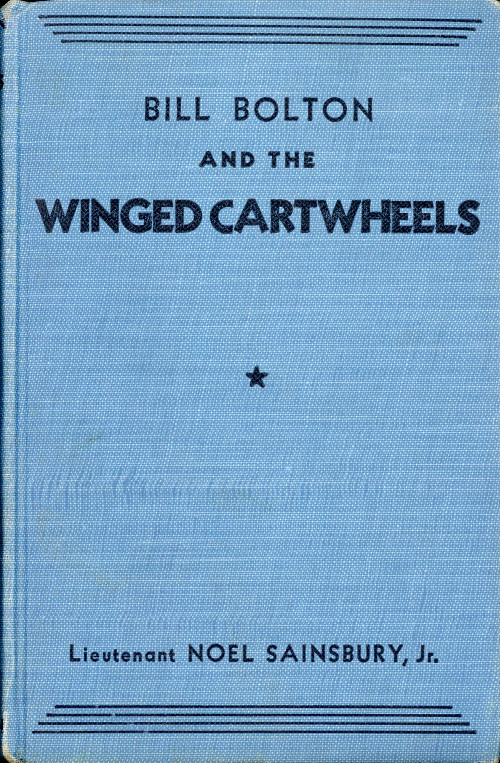
Author of Bill Bolton, Flying Midshipman
Bill Bolton and the Flying Fish
Bill Bolton and the Hidden Danger
★
THE GOLDSMITH PUBLISHING CO.
CHICAGO
Copyright, 1933
The Goldsmith Publishing Company MADE IN U. S. A.
ToAshton Sanborn, who is even a finer fellow than I have depicted, and who has done even more exciting and more interesting things than are narrated in this story.
“You and I, Bill,” said Osceola, “are on
top of the world and throwing rocks at rainbows!”
The young Seminole chief, stooping
quickly, picked something out of the short
grass at the side of the Bolton driveway. “A
couple of months ago I was a slave in a cypress
swamp without a dollar to my name. Now I
stumble over them!”
“That’s queer,” said Bill, staring at the
silver disk in his friend’s hand. “It’s one of
those cartwheels they hurl at you out west
instead of dollar bills.”
“Nobody,” declared Osceola, “ever hurled
dollar bills at me!”
16
“I mean,” said Bill, “it’s queer finding one
here. Wake up—don’t let this new-found
wealth cramp your usual technic. You’re
in New Canaan, Connecticut, now—not far
away on the western pl—”
“There’s something queerer than that about
this cartwheel—look!”
Bill took the extended silver piece and examined
it. The coin seemed genuine enough.
Minted in 1897, the head of Liberty was
portrayed on one side and backed by the well-known
National Bird, who flaunted a streamer
of E Pluribus Unum in his beak. But this
particular silver dollar was no longer good
as “coin of the realm.” Across Liberty’s face
a pair of spread wings was cut deep into the
metal, while the American eagle was defaced
by two numerals, 1 and 3.
“Somebody’s pocket-piece, don’t you
think?” suggested Osceola.
Bill nodded. “That design and the numerals
are diecut. Those wings over poor old
Liberty’s pan look like an aviator’s device.”
17
“Some cloud-dodger’s mascot, I expect.
Thirteen’s probably his lucky number.”
Bill handed back the coin. “Stick it in
your pocket. If we see it advertised, you can
easily return it. In the meantime, the mascot
may help you to keep the luck you were crowing
about just now.”
“And why shouldn’t I crow? Instead of
having to work my way through my last year
at Carlisle, your father puts me in charge of
the foundation he has inaugurated to help the
Seminole Nation. Now, Deborah and I can
get married in the fall. Why shouldn’t I
take the count on my worries? And you’ve
got no kick coming. You’re sitting pretty
yourself.”
“I sure am,” admitted Bill. “Our Navy’s
a swell outfit but I never expected to stay in
after my two years’ sea duty when I’d finished
up at the Academy. Now that
the President himself has let me resign
and put me on Secret Service work—well,
there’s only one thing I don’t like about it.”
18
“What’s that?”
“Oh, people—my friends, I mean, think
I’m loafing. They don’t understand why I
should suddenly leave the Navy. And of
course I can’t tell them. This other job must
be kept a secret. The President said so.”
“I don’t believe anybody thinks you’re a
quitter or a loafer,” argued the chief, “—not
after the three big stunts you’ve pulled off
this summer, and all the newspaper publicity
you’ve had out of them. You’re talking
through your sombrero, old son. Bill Bolton
is front page news from Maine to California.
If you keep hitting any more bullseyes, they’ll
slap your phiz on a postage stamp!”
“Oh, yeah? Speak for yourself, John—or
words to that effect. Looks like a dead
heat to me. How about it?”
Osceola abruptly changed the subject. “If
this silver dollar was lost by an aviator,” he
observed, fingering the coin, “he never
dropped it out of an airplane, I know.”
19
“And so what?” Bill was mildly interested.
“Well, the fool thing was lying on a leaf—and
the leaf was only slightly bruised—”
“Maybe it bounced or rolled onto the leaf
after it fell onto the driveway?”
“Not this cartwheel. There’s not a scratch
on it, except for the wings and the number
thirteen. Six bits to a counterfeit two-cent
piece with a hole in it, the yap who owns this
has a hole in his trousers pocket!” Osceola
dropped to his knees and studied the short
grass at the edge of the drive. “Yep, just as
I thought—” He stood up and flecked a dab
of mold from his immaculate flannels, “here’s
the fella’s spoor. He wore rubber-soled
shoes.”
20
“I thought,” said Bill, “that Dorothy
Dixon was the one and only Sherlock Holmes
in this village. You certainly run her a close
second, though. What did the aviator who
didn’t aviate do next? Keep on out to the
garage and scratch his initials on that new
de luxe roadster you bought last week?”
“Not on this hop, he didn’t. He—wait a
sec till I get a squint at this. Yes! by Jove!
it wasn’t me he was interested in, but your
own sweet self.”
“How do you get that way so soon after
breakfast?”
“Listen, you blind paleface, even from
here I can see that his tracks go straight over
to the house. He climbed up to the farther
window of your room by way of that leader,
and the ivy. Several pieces of the vine are
lying on the grass where he broke them off
getting up or down! Even you ought to be
able to see that the wire on that window-screen
has been tampered with. If you don’t
believe me, shin up there and take a look!”
21
“Oh, I’ll take your word for it.” Several
times before, in his career, Bill had encountered
evidence of the young Seminole’s
truly marvelous eyesight. “Do those scintillating
orbs of yours tell you when all this
occurred?”
“They most certainly do, you mole.”
“When, then?”
“Between nine and nine-thirty last night!”
“Sure it wasn’t quarter to ten?”
“Quite sure,” smiled Osceola.
“I know,” said Bill, “that you can spot anything
in daylight, or in the dark, for that
matter, but when you claim to turn yourself
into a human time clock, I ha’e me doots—”
“Oh, yeah? Well, listen, kid, and I’ll
prove to you that Red Men aren’t as bad as
they’re painted. Last night I left you with
the girls over at the Dixon’s, and walked in
the front door just as your hall clock was
striking nine-thirty.”
“That’s right. You came over here to work
on some figures for your new Seminole
schools.”
22
“O and likewise K. I went straight up to
my room and took my work out on the sleeping
porch, where it was cooler. You found
me there when you got back at eleven, didn’t
you?”
“That’s all right, too. But what’s that got
to do with the climbing aviator?”
“Why, just this. From nine-thirty until
eleven-thirty I was out on that porch with
the light going. Then I went to bed there
and slept till this morning. And let me tell
you, Bill, old son, that the man has yet to
be born who can shin up a rainpipe thirty feet
away from me and I not know it, awake or
asleep!”
“Maybe he came before nine.” Bill was
already convinced that his friend knew what
he was talking about, but he wasn’t hauling
down his flag without a last struggle.
“It wasn’t dark last night until nine
o’clock, daylight saving time,” Osceola explained
patiently. “Also, last night there
was a heavy dew, even you can see it on the
grass still, and—”
23
“And the silver dollar was wet while the
leaf remained bone dry, showing that said
cartwheel was dropped early in the evening!”
“You certainly are the boy to ring the
quoits,” mocked the chief. “But now that we
know all about it, we really aren’t much forwarder.
I don’t suppose you’ve missed anything
in your room? You haven’t said
anything about it.”
“No,” Bill said thoughtfully, “I haven’t
noticed anything, but we’d better go in and
have a look. I wonder who that bird was and
what he wanted. Funny! Nothing was disturbed
so far as I can remember.”
The two tall lads turned back toward the
house.
24
“And there’s where our second-story
aviator swung off the grass on to the drive
when he was going home,” exclaimed
Osceola, pointing to a thin spot on the gravel
which bore a well-defined footprint, pointing
toward the road. “If it was worth while,
which it isn’t, we could probably find the tire-marks
of the car he drove off in beyond the
stone fence down yonder.”
Bill grunted. “When you say ‘second
story,’ you probably hit the nail on the head.
In future we’ll substitute worker for aviator,
if you don’t mind. There are a lot of bum
flyers with licenses, and a lot of bums who
fly, but I wouldn’t insult the worst of them
by classing him with a cheap sneak thief.”
“Maybe,” remarked Osceola, “he wasn’t
so cheap at that. But we’ll soon find out.”
They went up the front veranda steps, into
the house and upstairs to Bill’s room.
“I don’t run to jewelry,” observed Bill, his
eyes travelling around the bedroom, “but he
hasn’t touched my silver-backed brushes, or
that string of cups on the mantelpiece. And
the maids didn’t report any silver missing
downstairs, either. I wonder what in thunder
he was after.”
25
“Got anything of value in that drawer?”
his friend inquired, pointing to a flat-top
table desk between the windows. “Somebody’s
been fooling with the lock. I can see
the scratches on the wood—”
“Nothing but some papers, worth nothing
to anybody but me. Old newspaper clippings,
Navy orders, my honorable discharge and the
like. By gosh!” he cried, “the lock’s busted!
And somebody’s messed up the entire drawer.
Look here—these things were in piles with
rubber bands around them. Now they’re
scattered all over the place—”
“Anything gone?”
“Wait, I’ll see.” Hurriedly he sorted out his
possessions, then shook his head. “Not a thing.
What under the sky-blue canopy do you suppose
that dollar-dropping buzzard was after?”
“You haven’t said anything to anyone about
the new job, have you?”
“You and Dad are the only ones outside
of the people in Washington who know
about it.”
26
“But this doesn’t look like it, Bill.”
“You don’t mean that the goop who got
in here last night was in the know! Why, I
haven’t been assigned any work yet. What
could he expect to find among my papers?”
“Perhaps,” mused Osceola, “he, or whoever
sent him, has an idea that you’ve been
put to work already, and they want to know
how much you’ve found out or what your
instructions are.”
“Some gang the government is after, you
mean?”
“It’s quite possible.”
“But how could they learn that I—”
“A sieve,” said Osceola sententiously,
“isn’t the only thing that leaks. Someone in
Washington has spilled the goldarned beans,
inadvertently or not.”
“If you’re right, Osceola, this is serious
business.”
“Of course it is. What are you going to do
about it?”
27
“Wait, watch and listen. I’m due in
Washington next week to receive my orders.
Until then, I shall do nothing.”
“And I guess you’re right, at that. My
surmises may be all wet, though I doubt it.
Just the same, we’ve nothing concrete to go
on except that a lad climbs in the window and
goes through your desk.”
Bill closed the drawer. “Let’s forget it,
then,” he suggested. “At least for today.
You and I, old Rain-in-the-face, have a
heavy date. Had you forgotten it?”
“Not likely. When you’re engaged, a
fella can’t think of anything else but the next
date!”
“You’ve sure got it bad,” grinned Bill.
“Thank goodness, I’m still heart whole and
fancy free!”
“What about Dorothy Dixon?”
“Aw, shucks! We’re just good pals, and
you know it.”
“Says you!”
28
“Says both of us. I’m seventeen, and she’s
a year younger. Neither of us is thinking
about getting married, or anything like that.”
“Gee, I forget you’re really only a kid,”
laughed Osceola. “Well, let’s shove off. The
girls are going up there in Dorothy’s plane.
They said they’d bring lunch. Where is this
place we’re going to picnic, anyway?”
“Up in the hills beyond Danbury. It’s
quite near the far end of Candlewood Lake.”
“Was it up that way you and Dorothy corralled
the New Canaan bank robbers?”
“Yes, quite near there. That’s how we
learned of the wood lot. It’s secluded, there’s
a good spring, and it’s really a peach of a place
for a picnic.”
“Well, let’s get goin’ then.”
“Coming, Romeo—coming!” Bill followed
his impatient friend out of the room.
“What’s eatin’ you? It’s early yet.”
“Maybe it is, but—well, laugh if you want
to, I’m uneasy as blazes about those girls!”
29
Bill caught up with him as they ran down
the steps of the side porch and headed out to
the hangar.
“It must be awful to be in love. The girls
are all right. Dorothy is an A-1 pilot. I
ought to know. I taught her myself.”
Osceola said nothing more until they had
passed the garage and stables and were crossing
the flat meadow where the Bolton hangar
was located. “Thank goodness, Frank has
run out that Ryan of yours,” he exclaimed as
they came into view of a two-seater monoplane
parked before the open doors of the
converted haybarn.
“Getting lazy in your old age, are you?”
jeered Bill.
“No, but I’ll admit the sooner we’re off and
up in the hills, the better pleased I’ll be.”
30
“Well, you can hop right in, old fuss
budget. While you were working on your
school plan, early this morning, I came out
here and went over the bus from nose to tailplane.
Pull out those wheel blocks and carry
them into the rear cockpit with you. Meanwhile
I’ll show you how the new inertia
starter I’ve rigged her with can swing a prop.
Make it snappy, big chief—this is an emergency
patrol—the women must be saved at all
costs!”
Bill adopted a mock-heroic attitude and
roared with laughter at Osceola’s disgust.
Twenty minutes later, Bill, at the controls of
the Ryan, sighted a rectangular patch of light
green framed in the darker green of the Connecticut
hills twenty-five hundred feet below
the speeding plane. He clapped a pair of
glasses to his eyes and the woodlot sprang up
at him. It seemed he could almost reach out
and pluck the flowers that dotted the high
grass. Then he turned his gaze to the upper
corner of the field.
31
There lay Dorothy Dixon’s small amphibian,
parked near the road which wound up
the wooded valley. Close by, a motor car was
drawn up at the edge of the field. For a
moment he failed to sight either Dorothy,
or her pretty Seminole friend, Deborah Lightfoot.
“Under the trees beyond the plane!”
Osceola’s shout almost broke Bill’s eardrums,
coming as it did through the close-pressed
receivers of his headphone set. Automatically,
he dropped the glasses, caught at
his safety-belt to see if it was fastened and
shoved forward.
The Ryan bucked into a nosedive and
dropped earthward with the speed of a shooting
star.
Osceola’s premonition of danger had been
a wise one. Beneath the trees, Dorothy and
Deborah were struggling with two men.
32
Chapter II NUMBER FIFTY-SEVEN
Bill levelled off with an abruptness that
jarred the very vitals of the plane. Then
he allowed the tail to drop slightly, the
wheels made contact and the monoplane rolled
forward over uneven ground, propelled by
her own momentum. Before she actually
came to a stop, both lads flung themselves
from the cockpits and raced for the trees
thirty or forty yards away.
33
It soon became evident that they would be
too late to come to close quarters with the
girls’ assailants. Brave enough when they had
members of the opposite sex to deal with, the
ruffians had no desire to mix it up with a
couple of husky young aviators. Flinging the
struggling girls aside, they turned tail and
legged it toward their car with a burst of
speed worthy of Olympic runners, and no
split seconds to spare.
Bill and Osceola immediately sheered off
toward the road, but by the time they reached
the edge of the field, the motor was only a
cloud of dust hurtling down the valley.
“If I’d had a gun,” said the Seminole,
without the slightest catch of breath, “there’d
have been a different ending to this affair!”
He scowled at the disappearing car and turned
to Bill. “I thought you always packed a gat
aboard your crates—when we went into that
nose dive, I nearly broke my neck trying to
find one.”
“Sorry,” gasped Bill, whose sprint had left
him winded, “I never thought of them as necessary
adjuncts to picnics before! Next time
I’ll come provided. It’s just as well those
thugs got away, though. Two scalped bandits
would mean all kinds of unpleasantness up
here in New England. Here come the girls,
now. They seem to be none the worse for
their adventure.”
34
“You,” declared the chief, “make me infernally
tired.” He strode off toward Deborah.
“You aren’t damaged, I hope?” asked Bill
as he came up to the trio.
“Only rather mussed,” smiled Dorothy, a
pretty girl with brown hair and the figure of
an athlete. “In fact, I’ve kind of an inkling
that those foreign gentlemen got more than
they bargained for. The guy that started
to rough-house me, ran away with a broken
wrist. Some of the old frumps around New
Canaan stick up their noses at my jiu jitsu,
but I’ve found it a valuable asset several times
in my hectic career!”
“And what did you do to your sparring
partner, Deborah?” he asked the slender
Indian girl who had slipped her arm through
Osceola’s.
35
“Not much, I’m afraid, Bill. The brute
made me break three perfectly good fingernails.”
“I’ll say he did,” chimed in Dorothy.
“And his face looked like raw beefsteak when
he broke away from her. He nearly knocked
me over, he was in such a hurry, and I got a
good look at him. If you boys want a first
class imitation of a wildcat gone wild, pick
on our gentle Deborah. Take my advice,
Osceola, and handle her with kid gloves after
you’re married.”
“One of these days, I’ll catch that hound,”
promised the young chief. “And when I
finish the job he’ll look worse than his passport
picture. How did this all start, anyway?”
“Well, you see—” began Dorothy.
Deborah interrupted her with a smile.
“Let’s feed this bloodthirsty pair,” she suggested.
“I’m longing for iced tea myself,
and men are so much more reasonable when
they’ve eaten! This big brave of mine will
be starting on the warpath again unless we
give him his lunch.”
36
“I,” said Bill, “second the Seminole chieftainess’
motion! Also, I bar scalp locks in
my food. Let’s get to the chow before
Osceola gets going.”
“Some day,” retorted Osceola, “you’ll say
something funny, and the rest of us will die
of shock from the surprise.”
“Here, here,” interposed Deborah, seizing
his arm, “come on, we’ll have to do some
forcible feeding, I guess!”
“Aren’t they the cute pair!” whispered
Dorothy as she and Bill followed toward the
grove of maples where the lads had first
sighted them from the plane. “Deb’s asked
me to be maid of honor at their wedding. I
suppose you’ll be Osceola’s best man?”
“I suppose so,” said Bill gloomily.
“Why, you don’t sound very much interested!
The Indian braves will all be in their
war paint, and the squaws—”
37
“—it is hoped will wear something warmer
and more appropriate for this climate!”
“Don’t be silly. You know what I mean.
And anyway, no self-respecting redskin puts
on war paint for his chief’s wedding. I guess
it’s too suggestive of what he’s to expect after
the ceremony is over.”
“Oh, is that so! Well, you women can
certainly get up a good fight, if that’s what
you’re driving at. I’ll bet you’re just tickled
foolish to be in on the wedding party, and
the pageant the tribe will make of it.”
“Why—”
“And your father’s plan to bring the whole
tribe to New Canaan is just grand!”
“Oh, that’s part of it. Look here!”
Dorothy turned on him. “Just what don’t
you like about it, Mister Stuck-up?”
“Well—er—you see,” Bill explained, “the
ancient Seminole custom forces the best man
to kiss the maid-of-honor right after the ceremony—and
I—”
38
He ducked just in time to avoid her open
palm on the side of his jaw, and ran off toward
his plane. Over his shoulder, he called:
“Naturally you’re keen on the wedding,” he
teased, “but there’s no excuse to get affectionate
beforehand. I’ve got to make the Ryan
secure. Run along now, and put on your war
paint. There’s a smudge on your nose.”
“There is not!” snapped Miss Dixon, then
she stalked off as Bill doubled up with
laughter. “Some day,” she muttered to herself,
“I’ll make that smart-aleck the one and
only also-ran in a first class massacre.”
However, the first thing Dorothy did, upon
reaching the picnic spot, was to hunt for her
handkerchief and bring forth a compact.
Bill strolled back, whistling, hands in
pockets. The others were already seated
about a white cloth laid on the ground, which
was spread with a lunch that made his mouth
water. He threw a glance at Dorothy, caught
her eye and they both laughed.
39
He dropped down beside her. “Let’s call
it quits,” he grinned.
“Not on your sweet life, young man. One
of these days—but never mind, now you’re
my guest at luncheon. We’ll call it an armistice.
Dig in. Everybody helps himself at
this party.”
Osceola, who had been piling Deborah’s
plate with everything in sight, in spite of her
protests, started in to gnaw a chicken leg, and
began talking with his mouth full. “Cut the
comedy, Bill. Waylaying girls, and especially,
waylaying my girl, is serious business.
I don’t intend to let it go at that either—not
by a darn sight. And the more I know about
what really happened, the sooner I’ll be able
to get a line on those bozos.”
“I’m just as keen as you are,” Bill retorted,
helping Dorothy, then helping himself to cold
chicken and potato salad. “Men like that
need a good thrashing. You can’t count me
out on any move you make. In fact I’ve got
some ideas of my own—I got their license
number as a starter.”
40
“That,” said Dorothy, and she reached
across Bill for the biscuits, “may give us a
start and then again it may not. It didn’t
help much in the bank robbery, if you’ll remember.
From the looks of those two
tramps, I should not be surprised if the car
had been stolen.”
“And where do you get the ‘us’ stuff?”
inquired Bill.
“If you two boys think you’re going to run
this show without Deb and me, you’ve got
another think coming. Isn’t that so, Deb?”
“It certainly is. We both saw the men and
talked to them. Where would you get a description
of them if not from us?”
“Now look here,” Osceola waved a chicken
bone at her, “let’s call it a foursome, and can
all the argument. What’s more, Dorothy’s
idea about the car being stolen, is, ten-to-one
the right dope. That was a big bus and this
year’s model. Those things cost a heap of
money.”
41
“That’s the way I figured it,” answered
Dorothy. “And let me tell you that no two
men who made such a fuss about losing a dollar
would cough up four thousand of them for
a car like that!”
Bill stared at Osceola meaningly. “What
did you say—that one of them lost a dollar?”
“Yes—and a silver dollar at that—one of
those cartwheels they use out West instead of
bills.”
“GOOD NIGHT!” exploded Bill. Osceola
stared at him in dumb amazement.
“Yes,” she went on, “but why the great
excitement? The dollar that man lost—he
was a Russian or something, by the way he
talked—well, that dollar started the mixup.
But you two look as though you’d seen a flock
of ghosts—what?”
42
“Just one,” said Osceola, and his tone was
deadly serious. “But never mind that now.
Get on with your own story, then we’ll tell
ours.”
She looked first at one and then at the other
of the lads. “Well, just as you say. Of
course, I know there’s something I don’t
understand behind this, but I’ll be a sport and
do my talking first. Deb and I flew over
here and parked my bus where you see her
now. We made things shipshape aboard,
then toted the lunch over here and went to
the spring to get water. It’s over by the road,
you know, and we were just about to fill the
pail, when that car came bumping along the
dirt road, doing fifty, if I’m any judge of
speed. I’d just said to Deb that the fellow
who was driving couldn’t think much of his
springs, when something bright flew out of
the window. It lit in the high grass near us,
and I went over to see what it might be. The
grass was so high and the ground so rutty that
I couldn’t find a thing. Then I thought I
saw something shining in the rubble, but when
I picked it up, it was nothing but a piece of
quartz, so I dropped it again. By that time
the car had stopped and was backing up the
road. Two men sprang out and came running
toward me. They were both dark, and both
spoke rather broken English. The bigger of
the men yelled at me to give him back his
silver dollar. I told him I’d seen it fly out
of the car, that I’d been looking for it, but
couldn’t find it. My answer seemed to stump
him for a minute, then without another word,
he and his pal got on their knees and began to
comb that part of the field for it. I wasn’t
at all taken by their looks, neither was Deb,
so we filled our pail and came back here....
Somebody give me a drink,” she broke off,
“all this talking makes me thirsty—”
43
Bill filled her glass with water, and after
taking a few sips, she went on with her story.
“Where was I? Oh, yes, well, we hadn’t
been here long when the men gave up their
search and followed us. It seems that they’d
seen me stoop to pick up that quartz and they
thought I must have their old dollar! Of
course, I denied it, but they were only more
insistent. To finish the tale, the big one said
that if I wouldn’t hand it over, he’d take it
from me! Well, as you saw, he tried to do
just that. Deb horned in, like the peach she
is, and number two tried to stop her. Things
were getting more hectic than pleasant, when
they suddenly broke away, and I saw you boys
hot-footing it for us. And I want to end this
long speech by saying that never in my life
have I been gladder to see two human beings.
I haven’t had a chance to thank you both before,
but I certainly do it now! It was simply
stunning to see the way you came at them!”
44
“And that goes for me, Bill,” cut in Deborah,
“I’ve already told Osceola, but I want
to tell you, too, how much we appreciated the
wonderful way you dashed to our rescue.”
“I think,” said Bill, “that the rescue, as
you call it, was all in favor of the assaulters.
Those bohunks, or whatever they are, bit off
a lot more than they could chew when they
tackled you Amazons. The chief and I did
no more than save them from taking the count
on their backs, worse luck!”
45
“Dorothy, did you say that the dollar
landed in the field just below the spring?”
asked Osceola.
“Yes, just there—or thereabouts.”
“Excuse me,” he said and stood up. “I’ll
be back in a minute or two.”
Bill watched the young Seminole stride
away toward the road. “That guy,” he declared,
with a wink at Dorothy, “has a one-track
mind. Wild horses won’t drag him off
the track, either, once he gets started.”
“And some people—have no minds at all!”
Deborah ran swiftly after her fiance.
“Ha-ha! Put that into your pipe and
smoke it,” Dorothy laughed at the surprised
look on Bill’s face. “She’s quick on the come-back,
isn’t she?”
46
“Too blooming touchy, if you want to
know—”
“Oh, my goodness! A girl isn’t worth a
thing who won’t stick up for the man she’s
engaged to!”
“Perhaps not—but I’m no girl—and all
this love business makes me sick. Osceola
has acted like a hen with one chick ever since
Deborah came into the picture.”
“Oh, cheer up, old gloomy, she didn’t
mean anything by that—any more than you
did by your wisecrack! And by the way, you
and Osceola are invited to dinner at my house
tonight. You’ll have to dash away early
though. Daddy’s gone to Hartford on business
and won’t be back till tomorrow. I don’t
want to lose my rep, you know.”
“Thanks for the invite,—but I didn’t
know you had any.”
“Oh, you didn’t! Well, let me tell you,
young man—”
47
Osceola’s voice cut her short. “Here it
is!” He flung a silver dollar onto the white
cloth.
Dorothy picked up the coin and examined
it.
“Number two of the series, on a bet?” said
Bill, looking up at the chief.
“Almost,” replied his friend, “but not
quite. This is number fifty-seven.”
That night at dinner the main topic of conversation
among the four young people was
the winged cartwheels, as Dorothy had named
them. They had arrived home too late to do
anything about tracing the car license, and
after the meal was finished, Bill and Osceola
noticed that the girls looked tired and decided
to leave even earlier than they had planned.
They walked across the ridge road to the
Bolton place opposite, and were in bed and
asleep by eleven o’clock.
48
The telephone in Bill’s room awoke him
with a start. He glanced at the luminous dial
of his wristwatch, and caught up the receiver.
It was then exactly ten minutes past two.
“Bill! Oh, Bill—is that you?”
“Speaking, Dorothy. Anything wrong?”
“Oh, Bill—please come quickly—those
men have got Deb and—”
The wire went dead. Bill guessed it had
been cut. Dropping the receiver, he snatched
an automatic from under his pillow, leaped
from his bed, and raced for the hall.
49
Chapter III STOLEN!
Bill burst into the hall and almost collided
with Osceola, who had just stepped out.
“What’s the matter?” hissed the Seminole.
“The phone woke me.”
“Got a gun?”
“Yep—what is it?”
“Come on. Deborah’s kidnapped—they’re
evidently after Dorothy. They’re in the
house now!”
The last sentence was hurled at Osceola as
the two lads, both barefoot and in pajamas,
raced downstairs and across the broad entrance
hall to the front door.
“Wire was cut while Dorothy phoned,”
panted Bill, pushing back the bolt and twisting
the key in the lock.
50
Osceola uttered not a word, but he was
first through the open door and took the porch
steps at a single leap, Bill at his heels. They
sprinted down the turf along the driveway,
and were nearing the stone wall that bounded
the Bolton property, when a car without lights
swung into the road from the Dixon place
and sped toward Stamford.
Without slackening in speed, the young
chief spoke quietly. “Don’t fire. The wall
hides the wheels—Debby might get hurt.”
“Could you—see her?”
“No. But I heard that little gat of
Dorothy’s go just now. She’s still in the
house.”
By this time they were crossing the road
in two bounds and side by side they hurdled
the Dixons’ white picket fence like hounds
let loose from a leash.
51
Leaping flowerbeds and vaulting shrubs
they flew over the garden, darted through an
opening in the high box hedge and came on to
the smooth turf where ancient elms cast
mottled shadows in the moonlight. Then
from the white shingled house directly ahead
came the terrified screams of women, punctuated
by the bark of revolver shots.
As they dashed up to the house, a wire
screen flew out of a second story window and
a slender, boyish figure dove head first out
after it. Two or three feet below the window
sill the porch roof sloped downward at
a slight angle. The diver seemed to land on
her hands, crumple up, turn a complete somersault
and come swiftly upon her feet again
with the ease and precision of an acrobat.
“Look out, Dorothy!” yelled Bill, as a revolver
was thrust out of the window.
With the agility of a springbok, she leaped
aside, firing from her hip. The bark of the
four shots was almost simultaneous. There
came a shriek of pain from the window, the
automatic rattled to the roof, and the hand
that had held it disappeared.
52
Bill lowered his gun. “Wait here till she’s
parked,” he ordered. “Then smash a porch
window and go in. I’ll tackle them from
above.”
With the butt of his smoking revolver between
his teeth, he took a running leap and
went up a pillar with an ease and swiftness
that demonstrated his seaman’s training. His
hands caught the gutter, his body swung up
and sideways and springing to his feet he ran
along the slanting roof to Dorothy.
“Did he hit you?”
“Missed by a mile!”
“Good—” Bill picked her up. “Come
on—”
“But, Bill—I’m in pajamas—”
“So am I—down you go!”
He dropped her into Osceola’s waiting
arms. As she landed safely and the young
Seminole stood her on her feet, he called:
“They must have another car, Dorothy. Put
it on the fritz!”
53
Then without waiting to see whether this
rather cryptic command was understood,
much less executed, he zigzagged up the roof
to the side of the house. With his back
pressed against the shingles, he moved sideways
to the window and peered in.
The room was full of smoke, but he made
out a figure slipping through the doorway
into the hall, and fired. The door slammed
and someone shot home the lock on the other
side. From below came a crash of broken
glass.
“Good old chief!” muttered Bill and went
in through the open window.
54
He realized instantly that the bed was on
fire. He grabbed the flaming sheets and
threw them on the floor, kicking a handsome
rug out of the way. Determined to save the
rug, if possible, for a moment he was at a
loss how to put out the flames. He did not
enjoy the thought of stamping out a fire with
his bare feet. The room was dark, after the
brilliance of the moonlight out of doors, and
the acrid smoke stung his eyes and set him
coughing. Flames began to shoot upward
from the smouldering mattress. His eye
sighted a wall switch by the head of the bed,
and an instant later he clicked the room into
bright illumination.
The door to the bathroom was open and
Bill caught the sheets by the ends which the
fire had not yet reached, dragged them across
the room and tossed the blazing mass into the
bath tub. He turned on both taps, and ran
back to the bedroom.
He next seized the mattress, doubled it
over at the center, and endeavored to smother
the flames. In this he was only partly successful,
for the charred padding continued
to smoulder and smoke. In exasperation he
rolled it up, carried it to the window and
thrust it forth. Quick as a flash, he was on
the porch roof and not until he had flung it
to the ground did he pause to fill his lungs.
55
But he was impatient to discover what was
happening to Osceola below stairs, while he
had been engaged with this inopportune blaze.
He darted back into the smoke-laden chamber,
and made for the door to the hall. It
was locked. He picked up his automatic
from the chair where he had dropped it and
was about to fire into the lock when the handle
rattled. Someone in the hallway was trying
the door.
“Open up or I’ll shoot—” snapped Bill,
and was seized immediately afterward with a
spasm of coughing that left him almost helpless.
The key turned in the lock and the door
swung inward, disclosing Osceola and a
leveled automatic. Directly behind him
stood Dorothy.
“Gosh!” she exclaimed. “You still here!
Where’s the fire?”
56
The cool draught of air started by the opening
of the door momentarily cleared the
atmosphere and Bill composed himself with
an effort. “In your bed—if this is your
room,” he wheezed. “I put it out—darn it.
Where’s that man gone? The one who locked
me in?”
“Got away,” grunted Osceola. “And the
other one, too.”
“Did they have another car?”
“Yes, but Dorothy got to it first and put the
engine out of business. She—”
Shrieks and howls from above their heads
cut him short. He turned to Dorothy.
“You’d better run upstairs and let those maids
out so I can get straight with Bill. They’ll
wake New Canaan if you don’t. The poor
things have been raising the roof ever since
those thugs locked them in their rooms. Now
they’ve smelled smoke and probably think the
house is on fire.”
“Right-o! I’ll go up and quiet ’em.”
Dorothy hurried off toward the rear staircase.
57
Bill leaned against the wall and stared at
the mess in the room. “Either the guy we
winged, or his pal, set fire to Dorothy’s bedding.
He hoped it might give us a job putting
it out and they’d have a chance to make
their getaway. So far as I’m concerned they
did exactly that. You don’t seem to have had
any better luck.”
“You’re right on that, too. When Dorothy
beat it round the house to scout for their car,
I went through the living room window. And
it will take some mending, that window! I
smashed it with a porch chair.”
“Never mind the window—what did you
do then?—faint?”
58
“Don’t try to be funny—I beat it inside
and up the front stairs. Just as I reached this
floor, I saw the two thugs flit round the corner
to the back hall, and the service stairs. They
had got out of sight by the time I got to the
top of the stairs, but I heard the creak of the
swinging door and knew they were on their
way out through the kitchen. So I plunged
down after them. And let me tell you, boy,
plunged is just what I did. When I woke up,
Dorothy was pouring a pitcher of water over
my head.”
“When you woke up!”
“Why, you see, one of the guys must have
grabbed a broom some fool maid had left
standing in the back hall, and he had laid the
darned thing slantwise across the stairs, about
a quarter of the way down, with the broom
end jammed into the banisters. I never saw
it in my hurry, and I took the rest of the
flight head first. I’ve got a bump on my bean
the size of an egg. Why I didn’t break my
neck is a mystery to me!”
“Oh, you were born to be hung,” said Bill
airily. “But let’s hear the rest of what
happened.”
“Look here, old chap, I’ve been driven
nearly frantic by this mess—here we are—I
fall down stairs, you fight a tuppenny fire—and
we’re supposed to be doing something—anything—to—to—”
59
“Oh, I know it—don’t you suppose I know
how you feel? Gosh, it’s got me the same
way. But we’ll get her back soon. Meanwhile,
we have to check up on each other,
don’t we? It’s the only way we can get
started on the real business.” Bill spoke as
encouragingly as he could, but he had no idea
how to go about tracing Deborah ... any more
than had his friend.
“Sure, you’re right, Bill. Only when I
think of Deb in the hands of those—Well,
I’ll go on. Nothing important happened
after that tumble I took. Dorothy brought
me round, and those lads had beat it for parts
unknown with at least a five minute start.
She told me that after she’d fixed their car,
which was the same one Number 57 went off
in this morning, she hiked round to the porch
again. She’d just got in through the window
I smashed when she heard my fall—and
found me. Just about that time, she smelled
smoke, so as soon as I could stand, we searched
for it—you know the rest.”
60
As he finished, Dorothy came up to them.
“They’re all quiet, now,” she said, referring
to the maids. “What’s next on the program?
Have you got a plan of any kind?”
“We know what to do, all right—and
that’s find Deborah—” admitted Bill bitterly,
“but how to do it is another question, and I,
for one, don’t know the answer.”
61
Chapter IV WHAT HAPPENED AT THE DIXONS’
Osceola looked at Bill. “I think,” he said
slowly, “the best thing you and I can do right
now, Bill, is to get into some clothes.”
Bill nodded. “Good idea! Socks and
shoes will make a particular hit with me. If
the soles of my feet aren’t cut to ribbons, they
certainly feel as if they were!”
Dorothy, tight-lipped, arms akimbo, glared
at them in disgust. “Well! You certainly
are an energetic pair!” Her eyes fairly
snapped with scorn. “Deborah’s fiance and
his best friend see her kidnapped under their
very noses, and then decide the best thing to
do is to get dressed! My word—you make
me sick—”
62
Osceola gave the angry girl one look,
shrugged his shoulders and walked silently
downstairs. The front door slammed, and
Bill turned on her.
“Well, that was a very pretty exhibition, I
don’t think,” he began.
“Oh, go home and put on a necktie!” she
retorted savagely. “Oh, dear, how can you
boys—when—” She broke off and burst into
tears.
“How could you deliberately torture that
splendid chap—I had no idea you could be
so cruel, Dorothy. Why, Osceola’s the salt
of the earth and you know it. He was too
much of a gentleman to tell you what a little
idiot you are, but I’m not!”
“Is that so!” With a quick gesture, she
brushed away the tears and took a step toward
him. “If Osceola is such a paragon, why
doesn’t he light out and find Deb? He’s supposed
to be in love with her, isn’t he?”
“He is in love with her, and that is what
makes the things you said to him so brutal!”
63
“Then how can he waste his time—and
that goes for you too—in silly chatter—why
not start something—”
“Yes? and what—”
“Action’s what’s needed, and spelled with
a capital A!”
Bill smiled crookedly. “And what kind of
action, spelled with a capital A, do you suggest?”
“I’ve heard that he can trail anything that
runs. Those men had to leg it out of here.
Why doesn’t he follow them, for heaven’s
sake, if he’s such a star at that sort of thing?”
“My dear young lady, Osceola has been
three jumps ahead of you all the time. He
knows that those tracks will only lead through
your grounds out to the road. I don’t know
where you got your ideas of trailing but no
man, red, white, black or yellow, can follow
another’s trail on an automobile highway.
Dirt roads are one thing, tar or solid concrete
are something else again!”
64
Dorothy looked discomfited. “I never
thought of that,” she said.
“You see, Osceola doesn’t know where to
turn next. Neither do I, and for a matter of
fact, neither do you.”
For a moment she stared at him and Bill
braced himself for a flood of tears. Instead
she ran to him and caught his arm.
“Bill—I’m so darned sorry—I—”
“Oh, never mind—that’s all right,” he
said gruffly, embarrassed by her contrition.
She shook her head. “But it isn’t all right.
I’m going to slip into some beach pajamas,
then I’m going straight over to your house
and tell him just what a pig I really am!”
“There’s no need of that, kid. He wants
cheering up, all right, but he’ll be back here
soon to give me a chance to run over and put
on some duds.”
“But what’s the idea—”
“You don’t think we’re going to leave you
alone tonight after what’s happened?”
65
“But I’m not scared. Those men won’t
come back again, not tonight, anyway.”
“Maybe they won’t, but there’s no sense
in taking chances. Go into your room and
dress if it will make you feel more comfortable.
We can talk through the door. I want
to know exactly what happened before you
telephoned me.”
“All right. Wait and I’ll pass out a chair.
If you’re as tired of standing as I am, you’ll
need it.”
She went into the bedroom and came out
with a wicker armchair in tow. “By the
way,” she said suddenly, “why do you suppose
those men picked on us? One of them
was the big Russian who lost his silver dollar
and kicked up such a fuss about it.”
“That,” answered Bill, “is one of the
things I’m not sure about. In fact, I haven’t
had time to put my mind on it.”
“You don’t think they came back for that
pocket-piece?”
66
“Hardly that. There’s a whole lot behind
this business that we aren’t onto yet.”
“Well, what’s your idea?”
“If you must have it, I’m beginning to believe
that we’ve come into contact with a gang
whose tokens or badges of membership are
the numbered, winged cartwheels. And the
gang is undoubtedly a large one. We know
that there are at least fifty-seven of them.”
“Gee!” Dorothy looked startled. “Really,
Bill? But why under the sun do these cartwheelers
pick on Deborah?”
“Of course, I haven’t the dimmest idea
what these fellows are up to. But seeing
what took place last night over at my house,
I’ve got a hunch that they think either
Osceola or I are wise to what is going on. You
two girls, after this morning’s experience, are
probably the only two persons who have seen
members of the gang, knowing them to be
just that. Therefore, it’s quite on the cards
that they want to put you both safely away
where you won’t be able to identify those two
until they’ve pulled off their big stunt—whatever
that may be. Of course, I may be all
wrong, but up to now we’ve had next to nothing
to go on except those dollars!”
67
Dorothy looked at him admiringly. “I
always knew you had a head on your
shoulders, Bill.” She shut the door to her
room.
“Better turn off the water in your bath
tub,” Bill called after her. “And don’t forget
I want your dope on tonight.”
“I won’t—just give me a chance,” her
muffled voice came back to him. “Gosh, but
this room is a mess!”
Bill set the chair just outside her door and
sat down. He was tired and he wanted to
think, but Dorothy didn’t give him much
opportunity to do so.
“Can you hear me?” He guessed she was
standing near the door.
“Perfectly,” he replied.
68
“Well, here’s the tale and there isn’t much
to it. After you two went home this evening,
Deb and I came upstairs. We got undressed
and then went into her room, just across the
hall from mine. I guess we talked for about
an hour. She was telling me—oh, about this
and that—whatever we talked about has
nothing to do with what happened later.”
Her voice grew fainter as she moved to another
part of the room, but Bill could still
hear her well enough. “After that I came
back here. When Daddy’s away, I always
lock my door, and it’s a mighty lucky thing
I did tonight. I probably wouldn’t be talking
to you now if I’d left it open. Deb locked
hers, too, but it’s a warm night, and after I
was in bed I heard her open it. I thought it
might be a good idea to get more air myself,
but the breeze was blowing in at this side of
the house, and I was too lazy to get up. While
I was thinking about it, I must have fallen
asleep.
69
“Well, the next thing I knew, I heard Deb
scream. Then I heard her shout—‘They’ve
got me, Dorothy—phone Osceola!’ She
knew I had an extension in my room, of
course. She didn’t call again, and I figured
someone had slugged her. The phone is right
by my bed, but it took an awful time to get
central. I could have killed that girl by the
time she said ‘Number, please’ ... then when
I gave her yours, it seemed an age before you
answered. Then when we were cut off, I
guessed that one of the thugs had cut the
wires. Somebody tried my door, and I ran
over to the bureau and got my little automatic.
I was scared silly, but I knew you
and Osceola would soon be here, so that helped
a lot. I was just starting for the door, when
the strangest thing happened. I heard the
key turn in the lock and before I could do
anything to stop it, the door was pushed
open.”
70
“Wait a mo. Yes, the key sticks out about
an eighth of an inch on this side. They must
have got hold of it with a pair of pincers.”
“So that’s it! I couldn’t imagine—well,
let me tell you, the sight of that key turning
in the lock all by itself gave me the creeps!”
“What did you do when the door opened?”
“I started right in firing—of course I
didn’t know what I was shooting at, but for
a few minutes I had ’em buffaloed, I guess.
Suddenly they made a rush. I fired once
more, then beat it for the window and went
through it—” She opened the door and came
into the hall, clad now in a simple white linen
dress. Bill saw that she had put on a pair
of white tennis shoes and socks.
“Well, you’re some quick dresser—” he
got up from the chair.
Dorothy smiled and made him a little bow.
“And I timed it nicely, didn’t I? Just to the
end of my speech—”
“You certainly made a dramatic entrance.
Say—there’s the door bell—”
71
“Osceola?”
“Sure to be. I’ll cut along now and leave
him to your tender mercies. See you later.”
With a wave of his hand, he left her standing
in the hall and ran swiftly down the
stairs.
72
Chapter V BILL’S HUNCH
Bill opened the front door and let Osceola
into the house. The chief was fully dressed.
He looked tired and worried to death.
“You’d better go over and dress now,” he
said dispiritedly. “I’ve phoned the New
Canaan police station and the Chief will be
along in a few minutes. Meantime, I’ll locate
the place where the telephone wire was cut
and splice it if I can. There isn’t much we
can do until morning, worse luck. By that
time, we’ll have a chance to line things up a
little better, and perhaps have some course of
action planned.”
“I’ve just got a hunch,” said Bill. “I’ll
tell you about it when I come back. If the
hunch turns out to be a good one, you and I
will get on the job long before daylight.”
73
“Then here’s hoping it will be a good
one—” Osceola’s tone was more cheerful now,
“there’s nothing worse than this rotten inaction.”
Bill nodded. Then he called to Dorothy,
who stood at the head of the stairs. “Where’s
your father staying in Hartford?”
“The Hiblein, I think—he usually does.
If you ’phone him, tell him I’m all right, and
give him my love.”
“I will. So long!”
He ran down the porch steps, and hurried
across the lawn toward the highroad. When
he got to his room, he went straight to the
telephone where he called up the Hiblein Hotel
at Hartford, and eventually heard Mr.
Dixon’s voice on the wire.
“Bill Bolton speaking—” he began abruptly
and launched into an account of the
night’s happenings.
74
“My thanks to you, boy, and to Osceola,”
said Dorothy’s father. “I won’t waste time
now in talking about this outrage—but you
can count on me being in New Canaan just as
soon as the car can get me there.”
“Just a moment, sir—there’s something
else I want to tell you, and something you can
do for us.”
“Shoot,” said Mr. Dixon.
Bill rapidly ran over the adventures of the
silver dollars, gave his own suspicions of the
case, and ended by mentioning his affiliation
with a certain department in Washington.
“Good enough, Bill. That explains why
you resigned from Annapolis, of course. You
undoubtedly have a flair for this kind of thing.
But there doesn’t really seem to be any tangible
clue to go on in this beastly kidnapping affair.
Have you hit on anything yourself?”
75
“The license number of the gangsters’ car,
the one that’s parked in your drive at present,
sir, may lead us somewhere. Of course it may
have been stolen; and if not, the owner’s
house would be the least likely place for them
to take Deborah. Still, if we could locate
that residence, Osceola and I might be able to
get a line on the chap and his friends. What
do you think, sir?”
“That sounds like a mighty good plan. No
telling what you may stir up. But where do
I come in?”
“Why, the office of the Commissioner of
Motor Vehicles is in Hartford, you know, of
course, and it won’t be open till nine in the
morning. I thought that you, being the
president of the New Canaan Bank, might
have a drag with some of the politicians up
there in the capitol, and that they might arrange
it so you could get the information we
want tonight. If you could do that, and
’phone it on to me, then Osceola and I might
be able to get the jump on them, do you see?
It’s not likely the owner of the car guesses that
the girls took his license number this morning,
especially as we did nothing about it right
away. I’ll admit that that was an error on
our part, but we hadn’t any idea of what we
were up against then.”
76
“Don’t let that worry you,” replied
Dorothy’s father. “You’ve done splendidly—you’ve
figured a logical why-and-wherefor
to this business, and that’s a piece of
constructive work. What are you doing
now?”
“I’ve come over here to put on some
clothes, sir. I’m still wearing pajamas—”
“I see. By the way, what’s that license
number?”
Bill gave it to him.
“All right. Now go ahead and get dressed,
then wait at your house until you hear from
me. It won’t be long, because it happens that
the State Commissioner of Motor Vehicles is
an old friend of mine. We played golf together
this afternoon. I’ll have the name and
address of that car owner for you in short
order.”
77
He rang off and Bill hung up the receiver.
He put on a bath robe and slipped his feet into
a pair of moccasins. Then he went downstairs
and out to the garage. There he saw to it that
the gas tank of his own car, a high-powered
sport coupe, was full, drove it round to the
front door and went up to his room again.
When he was completely dressed he went
downstairs. He was beginning to feel
hungry, and the prospect of a motor trip with
no breakfast at the end of it made the idea of
food all the more interesting. After he had
cooked a substantial meal of bacon, eggs, and
coffee, and had consumed every particle of it,
he felt decidedly better and more in the mood
to carry on at this early hour.
Then he went into the living room and
threw himself down on a large divan, where
he relaxed tired muscles and brought his mind
to bear on the matter of the winged cartwheels.
Perhaps a quarter of an hour had
gone by, when he sprang up and went into his
father’s study. The telephone bell was
jangling loudly.
78
“That you, Bill?” He recognized the
voice as Mr. Dixon’s.
“Speaking, sir.”
“Well, I rang up the commissioner and
here’s the car owner’s name. He is a Serge
Kolinski, a naturalized Pole, and he has a
house in Sherman Township, Connecticut.
Do you know where that is?”
“Why, yes—the field where we picnicked
is not so far from Sherman.”
“Well, this time you’d better run up there
by motor. It will be handier for getting round
than a plane, and a car may be more useful to
you. Do you happen to know where the old
Heartfield’s Club is?”
“No, I don’t. But I’ll find it.”
79
“Here are your directions. When you get
to Danbury, take Route 136, going north.
About twelve or thirteen miles farther on,
you’ll find that the road winds through a
narrow valley. Where the valley widens out
you’ll see a large square white house on the
right, and a red barn behind it. That is the
old clubhouse. You can’t miss it, for it’s the
only house near the road in that part of the
valley. The club itself no longer exists. It
failed financially a few years ago.”
“Then the club house is shut up?”
“No, it’s not. A chap named Davis and his
sister have rented the place for the summer.
But what I want to say is this: on the side
of the hill above the club house are several
houses, built by members when the club was
flourishing. Mr. Kolinski has rented one of
them and is living there. Knock up Davis,
who is by way of being a solid citizen, and
he can tell you which is the Kolinski bungalow.”
“Thanks very much,” said Bill. “We’ll
get under way at once.”
80
“Now hold on, young man. There’s something
else. I’m driving over there myself,
and with me will be two other cars filled with
state police. Deborah Lightfoot is Dorothy’s
guest, and very naturally, I intend to be in on
this. You will, of course, arrive at Heartfield’s
before I do. Get a line on Kolinski,
and do a bit of reconnoitering, if you like, but
don’t start any offensive until we come. Those
are orders, remember.”
“Suppose,” argued Bill, “that Deborah’s at
Kolinski’s, and we see her being transferred to
some other hiding place?”
“Use your own judgment in that case, my
lad. The object is to get Deborah back, unharmed,
of course. But you’ve evidently got
a first class thug to deal with. And by the
way, get one of your friends to stay in the
house with Dorothy, if you possibly can. The
thought of leaving her there worries me.”
“That will be taken care of,” returned Bill.
“The New Canaan police have been notified.
They are probably across the road now. I’ll
see that she is well guarded.”
81
“Thanks, Bill. Good luck—and be careful.”
“I will—see you at Heartfield’s, sir.”
Bill hung up the receiver and went out to
his car. He was surprised to find that it was
raining.
82
CHAPTER VI HEARTFIELD’S
Bill’s car sped into the sleeping town of
Danbury. It splashed through the rain along
streets where the lights ran together in golden
pools. The swish of the water flying gutterwards
was like the sound of the sea.
Bill spoke to Osceola: “There’s a dog
wagon open,” and he pointed to a lighted sign.
“Better eat. I had breakfast while I waited
for the dope from Mr. Dixon.”
“If you had, no need of stopping then.
Dorothy fed me before I left. I meant to ask
you if you wanted anything, but this news
from Mr. Dixon took it out of my head.
There’s a sign that says Route 136—guess
that’s our road.”
83
Five miles north of Danbury the rain
slackened and finally stopped. The cool wind
of early dawn sprang up and by the time they
started to climb the winding turns of the
Heartfield’s Valley, every cloud had been
blown out of the sky. The east was painted a
faint grayish pink as they roared into a
straightaway between the wooded hills.
Then the valley opened out, the road hugging
the base of the hill on their left, while on
the right wide meadows spread a carpet of
high grasses that reached to the foot of the opposite
hillside.
Half a mile further on, they came upon the
old club house, set back from the highway in
a group of fine elms. Here some attempt had
been made to fashion a lawn, but as they
swung up the rough drive, Bill noticed that
the house was badly in need of paint and repair.
He drew up at the side of the house,
facing the red barn and an extensive apple
orchard whose gnarled trees had not felt the
pruning knife for many years. There appeared
to be no bell, so Bill rapped sharply
on the side door.
84
“Hello!” A man’s voice answered from
behind a window screen just above. “What
do you want down there?”
“Mr. Davis?” Bill stepped back a few
paces so that he could get a better view of the
window.
“That’s me,” said the owner of the voice,
and yawned prodigiously.
“Mr. Dixon, the New Canaan banker, sent
me up here to get some information from you,
sir.”
“Wait a minute—I’ll come down.”
Osceola got out of the car and walked over
to Bill. “How much are you going to tell
him?” he asked in a low tone.
“Mr. Dixon said he was O.K.” Bill answered
quietly. “Wait till he comes out.
We’ll size him up for ourselves.”
85
The side door opened and a heavy set man
with gray hair, arrayed in khaki trousers, a
pajama jacket, and slippers, came out to meet
them.
“Well, you are early callers,” he said
jovially, “the New Canaan bank has a lien on
this place, of course. I hope you haven’t come
to turn me out?”
“Oh, nothing like that, sir,” smiled Bill.
“We merely want some information, as I said
before.”
Mr. Davis looked relieved. “You see,” he
explained, “I’m a stockholder in the old club,
so I have as much right to live here as anybody,
I suppose. My business went pot last
spring, so my sister and I are camping out here
for the summer. I notified the receiver of the
property, and as he said nothing about rent, I
haven’t paid any.”
“We have nothing to do with the receivership,
so set your mind at rest about that. My
name is Bolton, and this is Chief Osceola of
the Seminole Nation.”
86
“Why, this is an unexpected pleasure,”
beamed Mr. Davis, as they shook hands.
“You’re the two young fellows we’ve been
reading about in the papers all summer.
Don’t tell me you’re on the track of more
slavers or pirates up here in this quiet spot?”
“Do you know a man named Kolinski, a
Pole, I think he is?”
“Why, yes, I do, though not well. He’s
rented the Landons’ cabin for the season.
That’s the one right up the hill here, back
of the barn.”
“Then he’s not a particular friend of
yours?”
87
Mr. Davis’ eyes twinkled. “Well,
hardly,” he returned with a shake of his head.
“Kolinski is hardly what one would call a
good mixer. He parks his car in the barn
here—the hill is too steep and the path too
narrow to drive up—and he seems to be a
rather surly sort of chap. What he and the
man who is his servant do with their time, I’m
sure I can’t imagine. We have a nodding acquaintance,
that’s about all. So I’m afraid
that the little I know about him won’t help
you much. But I don’t mind saying frankly
that I don’t like the looks of him, nor of his
man. He’s a shifty-eyed individual, and on
the few occasions we’ve spoken I’ve caught
him in a couple of lies about small matters that
really didn’t amount to a hill of beans. If he’s
trying to swing a loan from Mr. Dixon’s
bank,—well, I’d want to be mighty sure of his
collateral.” Mr. Davis pulled out a briar pipe
and proceeded to tamp in tobacco from a
pouch.
“Do you happen to know whether he is in
his house now?” Osceola spoke for the first
time.
“No, I don’t think so, because his car isn’t
in the barn. The one you see there belongs
to me.”
88
Osceola gave Bill a meaning look. “It is
the car—or rather its license—that brought us
up here,” he went on. “About two o’clock
this morning, my fiancee, Deborah Lightfoot,
was kidnapped from Mr. Dixon’s residence in
New Canaan. The kidnappers were forced
to leave their car behind, and we have learned
that it belongs to your neighbor, Mr. Kolinski.
There were evidently two groups, and the first
got away with Deborah in one car, but we
arrived in time to forestall the others, though
we weren’t able to capture them and they got
away on foot.”
“What a dastardly business!” exploded Mr.
Davis. “And you say Kolinski’s car was left
behind?”
“Yes, Mr. Dixon, who was in Hartford at
the time, is on his way over here with a cordon
of state police. They ought to arrive
within an hour or so.”
“Have you fellows got guns?”
Bill patted the holster under his left arm.
“We have—and there are a couple of rifles
in my car.”
89
“Wait till I get mine and slip on a pair of
boots—” Mr. Davis made for the house.
“I’m going up the hill with you.”
“He’s a good hombre!” declared Osceola to
Bill, as Davis disappeared.
“He is that! Let’s corral the rifles.”
In a very few minutes, Davis reappeared.
The only visible change in his costume consisted
of a pair of high trapper’s boots laced
to the knee. He wore a cartridge belt slung
over one shoulder, and in the hollow of his
right arm he carried a repeating rifle.
“Come along—” he led them down a path
which cut a narrow swath through the field
behind the house. “Maybe our friends are
up there in the cabin and maybe they’re not.
My sister tells me she heard a car stop out on
the road a couple of hours ago, but she didn’t
get out of bed to see who it might be. It was
raining hard then, and as you aviators say, the
visibility was poor. She didn’t hear anybody
walk up the drive past the house, though.”
90
“They could have cut round the house and
climbed the hill from a point farther up or
down the valley—that is, if they were trying
to establish an alibi—and if we find them at
home, after all,” suggested Bill.
“Then,” said Osceola, who was bringing up
the rear, “those guys had a good long way to
hoof it.”
“How come?”
“Swamps. Down at the foot of this
meadow, and as far as you can see along the
valley.”
“That’s right,” agreed Mr. Davis. “Any
other way but this would add at least three
miles to their hike. That broad, sluggish
stream ahead of us runs the full length of the
swamp and only partly drains it. The bridge
at the end of this path is the only way across.”
“Is that the house, half way up the hillside
in that grove of trees and underbrush?” inquired
Osceola.
91
“You’ve got good eyes to spot it at this
time o’ day,” said their guide. “No—that
house belongs to a man named Kennedy, although
it is empty at present. Kolinski’s
cabin is higher up and over to the left.”
Still in single file they passed onto a corduroy
trail through the swamp and over the
bridge. On the farther side, the ground rose
steeply. A few yards beyond they came to a
fork in the path.
“Take the left to Kolinski’s—” announced
Mr. Davis. He stopped and turned to the
lads. “My plan is to take this right hand path
to Kennedy’s and up through the woods. In
that way we can make a half circle so as to
come down on Kolinski’s place from above
and be under cover the whole way. We’ll
have broad daylight to contend with by the
time we get there. If we go direct, anybody
in the house can see us pretty well the whole
distance up the hill. What do you say?”
“I think that’s a first rate idea,” said Bill.
92
“The only thing to do,” agreed Osceola.
“Surprise is half the battle on a job like this.
If you two don’t mind, I’ll scout on ahead.
Wait in the woods a hundred yards above
Kolinski’s for me. I want to take a look-see,
but you palefaces make too much noise going
through underbrush!”
With a low chuckle, he darted up the path
at a sharp trot and disappeared among the
alders like a wraith in the half-light and quite
as silently.
“That pace would kill me in fifty yards,
going up hill,” admitted Mr. Davis, as they
trudged in the direction Osceola had taken.
“Is your friend really an Indian, Mr. Bolton?
He looks no darker to me than a well tanned
Spaniard or South American.”
93
“Oh, he’s a real live redskin, all right. But
a great many of them aren’t noticeably different
in coloring from a lot of us so-called
Americans, you know. Osceola was born to
the chieftainship of his clan. Last year, although
only twenty, he was unanimously
elected the Great Sachem of the entire Seminole
Nation. He is one of the finest fellows
I’ve ever met. I only wish I had half his
talents or knowledge. He’s a senior at Carlisle
this year, although he’s not going back.
His fiancee, the girl who’s been kidnapped, is
Chieftainess of another clan of the Seminoles.
She is a college graduate, by the way, and a
most charming person.”
“Well, you certainly have interesting
friends—and you yourself have done more interesting
things than most men meet up with
in a lifetime,” contended Mr. Davis. “How
old are you, may I ask?”
“Seventeen on the second of this month.”
“You don’t say! Remarkable—my word,
when I was your age, I was still tied to apron-strings,
and stayed tied to them most of my
life. Now, that house just ahead is Kennedy’s.
The path ends here. We’ll take to
the woods, and I’ll do my best not to disgrace
myself in the underbrush!”
94
Bill soon realized that Mr. Davis was a
trained woodsman. Not a twig cracked as
they pushed their way up the steep hill
through a thick growth of young trees and
bushes that in places became a veritable
jungle.
It was bright daylight when they swung
round to the left and came down the hill
again to a shallow ravine some distance above
the Kolinski cabin. As the two dropped down
on the short grass, hot and nearly winded,
Osceola slid from behind a tree trunk.
“Any luck?” whispered Bill.
“No,” replied the Seminole gloomily.
“We’ve had this hike for nothing. There’s
nobody in the cabin.”
95
Chapter VII BEYOND THE FALLS
“Well, that certainly is disappointing.”
Mr. Davis wiped the perspiration from his
brow. “I suppose you made absolutely sure?”
Osceola nodded. “A window was open in
one of the bedrooms. I went in and went
through all four rooms and the cellar. What’s
more, when they left, they took their clothes
and papers with them. Not a sign of either
in the house. I don’t think they’ve been up
here since early yesterday evening.”
Mr. Davis looked surprised. “How can
you place the time?”
96
“In several ways. If they had taken a lot
of stuff down the hill in daylight, the chances
are that you or your sister would have seen
them. We know that Kolinski and probably
his man as well were in New Canaan at two
this morning, and that is thirty-five miles
from here. Though there’s plenty of dust in
that house, I saw no particles of mud either on
the mat inside the door or on the floors.”
“So we’re just about where we were before
we started on this wildgoose chase,” proclaimed
Bill wearily.
“Hardly that, Bill,” protested Davis.
“We’ve got one more bet in this neck of the
woods.”
“What?” Bill and Osceola stared at him.
Mr. Davis got to his feet.
“Come along. We’ve got to go down to the
club house. I’ll tell you about it as we go.”
They had passed Kolinski’s cabin, a one-storied
house solidly built of native stone, and
struck off down the path toward the bridge
before Davis spoke again.
97
“I don’t want to raise false hopes,” he said,
“and this hunch may come to a dead end, too.
But here it is for what it’s worth. I was trying
to remember if I had ever heard the
couple’s name, but I’m sure I haven’t. Half
a mile up the valley road from my quarters
you come to an abandoned mill on the other
side of the highway. The place has an old
wheel and stands beside a stream that rushes
down a gorge in the hillside. You can see
from here that the hill opposite is much
higher and steeper than this one. The only
path up there is the trail that starts at the mill
and runs along the side of the gorge. The
stream is the outlet for a small lake up there
on the plateau and drops down the gorge in a
series of very beautiful falls. The lake and
the woods are off the Heartfield’s Club
property. They belong to an estate with a
good-sized house on it, about half a mile beyond
the falls. There’s a sort of path round
the lake, I believe, that joins a path leading up
to the house from the farther shore. I haven’t
been up there for years, but I distinctly remember
the woods round the lake were
swampy. However, when the last owner
bought it, he put a high wire deer fence around
his land to prevent trespassing. This club was
in full swing then, so you can hardly blame
him. But no one has lived there for the last
few years. I heard over in Sherman that the
whole place, house, land, lake and everything,
had been bought by a foreign couple who had
moved in. Timkins, in New Milford,
brought their furniture over there from the
railroad, and there was an awful lot of it, he
said. Most of the stuff was packed in big cases
and enormously heavy. You see,” he said, as
they reached the bridge, “I’m trying to give
you every bit of information I can about that
place beyond the falls, and the reason is this:
several times during the last three weeks, I
have seen both Kolinski and his man going up
and coming down that path by the mill.
Either they had been enjoying the beauty of
the falls, which I doubt, or—they’d been
visiting the owners of that estate!”
98
“Humph!” grunted Bill. “I suppose
there’s a road up on the top of the hill?”
“Yes, a dirt road that passes the house and
joins the highway some miles farther on after
it leaves this valley.”
99
They walked on in silence toward the club
house, each of the three busily formulating
plans.
“I’ll tell you what,” Bill said suddenly as
they reached his car. “Osceola and I will go
up to this place you’ve been talking about, and
we’ll go by the path near the mill. You wait
here for the police, if you don’t mind, Mr.
Davis, and pilot them round by road. If these
rascals really have Deborah up there, they’re
likely to have sentries posted near the house,
so advise Mr. Dixon and the police to leave
their cars some distance down the road. If
you men don’t come across us by that time,
surround the house and rush it. Because,”
he added, with a grimace, “We’ll probably
be needing your help rather badly.”
100
“But hadn’t you better wait for the police
yourselves?” Davis looked worried.
“And have those guys cart Deb off through
the woods while the bunch of us come up to the
house from the road? No indeed,” Osceola
answered vigorously. “Bill can do as he likes,
but I’m going up by the mill path. They won’t
be expecting visitors from this side.”
“I’m going with you, Osceola,” said Bill.
“Thanks a lot for all you’ve done and are doing
for us, Mr. Davis. The gang from Hartford
ought to be here within the hour.”
Osceola stepped forward. “Sorry I spoke
abruptly, Mr. Davis. I must apologize—”
“Don’t mention it, my boy,” Mr. Davis cut
in. “No hard feelings—I understand your
anxiety. Run along now and I’ll take care
of the police when they arrive.”
101
The boys hurried off down the rutty road
toward Route 136. Half a mile along the
highway they came to a bridge across a
bubbling stream. Above the road on their left
the ruins of the mill pointed broken rafters
toward a cloudless sky. On the water side,
bearded by the spray from the falls, was the
ancient wheel that indicated the industry of
bygone days, when the farmers brought their
grain to be ground.
“There’s the trail!” Osceola pointed to an
overgrown path that led up the mountainside
just beyond the mill, and with Bill at his
heels, he darted up and under the overhanging
arch of trees.
The beauty of the deep gorge, the milky
water churning down the steep background of
jet black rocks and green ferns, the series of
waterfalls, blown in the breeze like filmy
veils,—all were lost upon Bill and Osceola.
With the thought of pretty Deborah a prisoner
in the hands of ruffians, they concentrated
upon two things only: to reach the house beyond
the falls as quickly as possible, and to do
so without attracting attention of watchers
who might be on the lookout.
102
Osceola stopped shortly before they reached
the top, and motioning caution, darted into the
woods away from the stream. Then he
paralleled the path upwards again for a hundred
yards or so with Bill directly behind him.
All at once, he dropped to the ground, Bill
followed suit, and the two crawled over to a
fallen log and peered over it.
Slightly ahead, and perhaps fifty yards to
their left, was the lake Mr. Davis had described,
sending its overflow down the gulley
in a silver sheet of sparkling water. Between
them and the waterfall, the path was bisected
by a high gate in a fence of heavy wire mesh,
whose top was at least ten feet above the
ground. This ran in both directions, blocking
intrusion along the mountain top. They
could see that it ran even along the dam at
the mouth of the lake, while on their side of
the path it disappeared in the thick growth of
bushes and trees.
103
But their whole interest was centered upon
the man who lay flat on the ground behind
the gate. They could see him plainly. He
was watching the path, hidden from it by
a tree trunk, and at his side lay a long-barrelled
rifle.
“Deborah,” said Osceola in his normal
tones, for the noise of the falls was almost
deafening, “is over in that house behind the
lake. I’d stake my life on it. Shall I pot
this guy?”
Bill shook his head. “Better not—they
might hear the shot at the house, you know.
The buzzard deserves death, if he’s a kidnapper,
and I suppose he is—but we’ll let
the police settle with him.”
“Yeah, if they get him. Well, let’s be
going. I wish I’d brought a tomahawk with
me!”
104
Having uttered this altruistic thought,
Osceola slithered off through the undergrowth
very much in the same manner that
a snake travels through long grass, and Bill,
perforce, went after him. Presently the
young Indian Chief stood up. The gate in
the fence and its sentry were no longer in
sight. Both lads climbed the high wire and
dropped inside to the ground. Osceola took
the lead again, and set off through the trees
at a smart trot. When it came to woods-craft,
Bill knew this young Seminole to be
without a peer. He never argued with
Osceola in the woods, but was content to do as
his friend directed, for he knew that no white
man could approximate the American Indian’s
native cunning in the forest.
As they progressed the ground became
hummocky, and soon developed into a swamp,
but this did not cut the speed of the lads in
the slightest. They leapt from tuft to tuft
of the coarse grass clumps with the agility
of mountain goats, and crossed the evil smelling
place without wetting a foot.
105
Although he could not see it, Bill knew
that the lake lay somewhere to their left.
When Osceola struck off obliquely in that direction,
he guessed that they had passed beyond
it. And he soon saw that he was right.
A few yards farther on the trees ended in a
belt of thick and overgrown shrubbery. Just
beyond, an unkempt lawn surrounded a
hideously ugly house of the cupola-and-mansard-roof
variety, painted bright yellow.
“Gosh!” muttered Bill to his guide, “if
I lived in that dump, I’d perish of colic!”
Osceola gave him a savage look. “If you
don’t keep quiet, we’ll both die with several
ounces of lead in our hides! Shut up, now,
and turn your mind to what I taught you
down in Florida about crossing open spaces
on your belly. I’ll go first.”
106
He dropped prone and wriggled through
the grass to a large bush without a sound and
at an amazing rate of speed. Bill then did
likewise, and was soon at his friend’s side.
Their next move was to a belt of rhododendrons
which grew close to the yellow house,
and in great profusion. Near them was an
open window. Bill went to one side, Osceola
to the other. They stood up and looked in.
Before them was evidently the living room
of the house. At the far end, four men and
a woman were seated about a small table,
breaking their fast. On a couch across from
the window, lay Deborah. She was neither
bound nor gagged; she seemed to be asleep.
Bill’s eyes sought Osceola’s. The Chief
nodded.
With the ease of the trained athlete, first
Bill, then the Seminole, lifted himself
swiftly to the window sill and sprang into the
room.
107
Chapter VIII A NEAR THING
The woman at the breakfast table was the
first in the room to see Bill and Osceola spring
through the open window. She screamed,
the four men jumped to their feet, sending
chairs crashing backward to the floor, the table
rocking—and pandemonium broke loose.
Gripping their rifles by the barrels and
swinging them like clubs, the lads charged
the surprised kidnappers, who pulled revolvers
and began shooting almost immediately.
But after the first few shots,
attackers and attacked became involved in
a scrimmage so close and so heated that firing
was impossible. Bill, wielding his rifle like
a singlestick, managed to ward off the clubbing
revolvers of his assailants, but Osceola,
dropping his gun, went at them like a wild
man, using fists alone.
108
In the midst of the fracas, a man sprang
onto Bill’s back. By use of a jiu jitsu trick
he catapulted his attacker over his head and
on to the breakfast table which collapsed,
sending broken china and glass in every direction.
Osceola staggered and fell to the
floor under the blow from a revolver butt,
and Kolinski pressed the muzzle against the
stunned Seminole’s temple. Like a streak
of light, Bill jerked his automatic from its
holster and the Pole went over backward with
a bullet through his shoulder. Then Bill saw
the woman, who still stood behind the debris
of the breakfast table, pick up a plate and
sail it through the air at him. He tried to
duck, but was again held fast from behind.
A burning pain seared his eyeballs and he,
too, dropped insensible to the floor.
109
Bill awoke, gasping and sputtering, his
head and shoulders drenched in water. His
head was splitting, and the darkness round
about him was shot with a myriad of dancing
lights.
“Give the Indian another bucketful,”
wheezed a cracked voice from the gloom.
Bill heard Osceola’s characteristic grunt as
the water splashed over him. His mind began
to clear, and soon he realized that he was
bound hand and foot and that his eyes were
bandaged. Again he heard the unmistakable
wheeze in the cracked voice, and this time
the high-pitched tones were full of sarcasm.
“And all this comes from entering where
angels fear to tread!” A man’s voice, surely,
thought Bill, but an old man—
110
The unseen speaker chuckled and went on
with his monologue. “Although we have
not met before, my young friends, I have
climbed these many stairs to bid you goodbye.
It pains me to send you off in this abrupt
fashion,” again he chuckled, “but I cannot
take you with me—and you are probably
familiar with the adage that dead men tell
no tales. You will be glad to hear that the
young lady, Miss Deborah Lightfoot, will
not mind her passing on to Happy Hunting
Grounds quite as much as you two will. She
was given a hypodermic in the car on the
way up here, and is, to all intents and purposes,
asleep.”
“But—surely you don’t mean to kill an
innocent girl!” raged Bill.
“Ha-ha!” tittered the old man. “So that
gets you on the raw, eh? What says the bereaved
husband-to-be?”
“Sachems of the Seminole Nation do not
waste their words on buzzards.”
111
“Thank you, young man,” wheezed the
voice. “It is interesting to learn at first hand
that the American Indian is as stoical in
undergoing mental torture as in burning at
the stake! But to return to your girl-friend
on the floor over there—Miss Lightfoot made
two bad mistakes. She had the misfortune
to get a good look at one of my associates when
he was searching for a certain emblem. And
in the car, she ripped off my mask, and she
saw me! Against my wishes, I must send
her away with you, or else certain plans of
mine would be jeopardized.”
“Well, Osceola, old man,” said Bill, ignoring
their tormentor. “Sorry I got you into
this, and sorrier still we both have to listen
to this pitiful drivel. Unless he stops his
cackle soon, I’ll be forced to take a nap in
self-defense.”
“So long, Bill, old sport,” Osceola replied
in his deep, grave voice. “Happy hunting—and
sweet dreams!”
112
“Very pretty, very pretty indeed, young
gentlemen. So sorry to bore you longer. You
will be interested to know that my lookout
on the hill tells me the police have just left
Heartfield’s in their cars. They should reach
here in about fifteen minutes. But you must
not become too impatient. You see, I have
a surprise for you and for them. In slightly
over a quarter of an hour, this house and those
in it will go shooting skywards—in other
words, blow up. Good-bye again,—I must
fly now, and I’m sure my news will help you
keep your courage to the very end.”
Bill heard footsteps creaking on bare
boards, then a door slammed. He turned at
once to his friend.
“How are you tied?”
“Roped—wrists behind my back—and
ankles. Blindfolded, too.”
“Same here. Wriggle over and I’ll get
my hands on the knots.”
“Coming—but rip off this bandage first,
and I’ll do the same for you. Then I can
use my teeth on your wrist bonds—it’ll be
easier and quicker that way.”
113
Bill heard Osceola slither across the floor
and the bandage was ripped from his head.
He in turn pulled off the young Seminole’s
bandage and while his friend’s sharp teeth
were working on the knotted ropes that bound
his wrists, Bill sat up and took in their surroundings.
He saw that they were in a small room,
empty of furniture. There were two windows
in each of the four walls of the room.
A door cut off one corner, and near it, Deborah
lay on the floor, deep in her drugged
sleep.
“I’ll bet we’re in the cupola,” said Bill, his
eyes on the girl. “If I’m right, it’s a four-story
drop to the ground, and that door looks
too strong for us to bash in before the explosion.”
Osceola grunted, then spat copiously. Bill
found that his wrists were free, and swinging
round, he began to work on the rope which
bound his friend.
“Ugh,” uttered the Seminole in disgust,
“my mouth is full of hemp. I always did hate
the taste of it.”
114
“Well, what I want to know is how we’re
going to get out of here—and with Deborah?”
“I can’t tell you. Wait till we get our legs
free. Maybe the outlook from the windows
will give us an idea.”
“And maybe it won’t,” snorted Bill, working
with feverish haste on the tight knots.
“You know, I believe that old devil hoped
we’d get loose.”
“How come?” Osceola, his hands free
at last, was tearing at the rope around his
ankles.
“Wants us to get free of these things—then
find out there’s no way down short of
jumping—hello!” He cocked his head,
“somebody’s idling an airplane engine!”
“So that’s what the old buzzard meant
when he said he’d have to fly! The bunch
are making their getaway, eh?”
“Guess so. Well, I’m free—how about
you?”
“Yep.”
115
Both lads sprang to their feet, feeling very
stiff and dizzy, and hobbled to a window.
They saw that the cupola raised its ugly head
on the very center of the slate roof. The
roof looked almost flat, but in reality sloped
slightly down to rusty tin gutters at its eaves.
A glance to the sides showed that the house
boasted two yellow brick chimneys. Directly
in front of the old mansion, a large
field spread out for a quarter of a mile toward
the highway. On the field a large monoplane
was taxying into the wind, preparatory
to the take-off. “Fokker Universal,” muttered
Bill.
“I wish we had her up here,” said the
young Chief. “We’re wasting time, Bill.
We can’t have more than five or six minutes
left. Give me a hand with Deborah. We’ll
get her out of this window and onto the roof.”
“And then what? There isn’t a tree near
the house. If we had a rope—”
116
“I’ve got it! There must be rainpipes
down from the gutters. We’ll go down by
one of those.”
“You mean, the leader will go down with
you! Those gutters are old and rusty and
full of holes. The leaders are sure to be in
as bad or worse shape. It would be suicide
to try it, especially with one of us carrying
Deborah’s weight.”
“Great grief, Bill! What can we do?
Think of Deborah—blown to pieces—”
“Hey, hey—get a grip on yourself. Snap
out of it and let me think.”
“Maybe the door isn’t locked, after all—”
Osceola snatched at this desperate thought—
“Try it if you like. But I heard that old
wretch or one of his men slam the bolt and
so did you.”
Osceola ran to the door and tried the
handle, but without success. Then he backed
off and flung the full force of his weight
against it. The sturdy oak hardly creaked.
117
“Don’t let the thought of Deb make you
lose your nerve, man,” said Bill, still looking
out of the window.
Osceola’s face grew grim. He walked
back to Bill and grasped his hand. “Thanks,
old pal. And goodbye. I’m going to Deborah
now. At least, we can die together!”
118
Chapter IX AT A DEAD END
“Here—just a minute—” cried Bill, “yes,
by Jove! I believe we can do it!”
Osceola turned back. “Not that chimney
you’re staring at! It’s got funnels at the
top. We—”
“No—not the chimney, guy! The lightning
rod! I forgot these oldtime houses had
them. Quick now, with Deborah! I’ll go
first. You pass her out to me.”
He leapt through the open window onto
the slates a few feet below. Almost immediately,
Osceola lifted Deborah’s limp
body over the sill, where Bill caught her in
his arms and hurried with his sagging burden
toward a corner of the roof. There he put
down the unconscious girl and lying flat,
peered over the edge of the rotting gutter.
119
Osceola dropped beside him. “The rod
looks strong enough, but do you think those
rusty iron stanchions will stand the strain?”
“Our weight may pull a few loose, but
that won’t bring the rod down. I just wanted
to be sure there wasn’t any break—that it
ran all the way to the ground.” He jumped
to his feet. “Give me a hand with Deb.”
“But I’ll—”
“No, you won’t. I was trained to this at
the Academy. Pick her up and hang her on
my shoulders—not that way—head one side
and legs t’other, so her body drapes round
my neck. That’s it. Now rip off your belt
and lash her wrists to her ankles. She mustn’t
slip and I’ll have to use both hands on the
rod. Got it fast? Fine. Will you go first?”
“No—you—I’ll help you over the edge.
And Bill—we’ve only a minute or two left—”
120
With Deborah’s dead weight balanced on
his shoulders and the base of his neck, Bill
got down on his knees and keeping firm hold
of the lightning rod that ran from the chimney
across the roof on raised iron stanchions,
went gingerly backwards over the creaking
gutter. Then slowly, hand over hand he let
himself and his burden down the rod. Notwithstanding
his confident words to Osceola,
he was fearful of pulling loose the staples, that
at intervals of three or four feet secured the
rod to the side of the house. He was obliged
to use his hands as his sole means of support.
If he pulled outward, pressing the rubber
soles of his sneakers against the siding, the
chances were the rotten wood holding the
staples would give. For the same reason, he
refrained from planting his feet on the
stanchions themselves, as he let himself
down.
The strain of the double weight was fearful.
His shoulder muscles and biceps felt
as though they were at the cracking point.
And the corrugated rod lacerated the palms
of his hands until they were bleeding badly.
121
He was descending the side of the house
that looked over the field and the road. Suddenly
he heard a shout from below, and the
answering hail from Osceola just above his
head told him that the police were arriving.
“Get back! Get back—all of you!” yelled
the chief. “There’s a bomb in the house—likely
to explode any time now!”
Bill’s right hand slipped. For an instant
he thought he was gone but he managed to
gain a hold with his lacerated left. Deborah
hung like a millstone about his neck. As he
felt for the rod with his toes, her legs and
thighs slipped over his right shoulder, pinning
that arm to his side, and bringing the full
weight of her body on the left side of his
neck and head. Bill found himself in the
terrible predicament of being totally unable
to move—either upward or down. Searing
pain shot through his left hand—his head
reeled. In one more second he must drop—
122
“Let go, lad—” called Mr. Dixon’s voice
from below. “You’re almost down.”
Strong arms caught him about the knees.
He released his grip, as they let him down.
Then Deborah’s now unbearable weight was
taken from his shoulders. Somebody far
away cried—“Good Lord! the boy’s hands
are in ribbons!” And Bill, for the first time
in his life, fainted.
* * * * * * * *
Bang! Crash!
He felt himself hurtling through space to
light head first on something fairly soft, but
with a jar that almost loosened his front teeth.
“Don’t kick—that’s my face—or was,”
growled a deep voice.
Bill was pushed violently to one side. He
opened his eyes and sat up, feeling as though
he had been pounded with a sledge-hammer.
“The other way—” said the same deep
voice. “The wind of the thing sent us heels
over teakettle.”
123
Bill turned his head slowly and painfully.
Beside him sat a large and husky individual
in the dark uniform of the Connecticut State
Police. Possibly two hundred yards away,
a huge mass of debris was burning. Over it
hung a heavy cloud of jet black smoke.
“Yes, that’s the house, or what’s left of
it,” explained the policeman. “Lucky we
weren’t nearer. Talk about your fireworks!
Say, how are you feelin’, kid?”
“Kinda woozy, thanks.”
“Don’t mention it—”
“What do you mean?”
“Oh, nuthin’—except that when you and
I went up in the air, you dove headfirst into
me stomach—and it sure does feel lousy!”
“Gee, that’s too bad—” Bill sympathized.
“I certainly hope I didn’t dent your pretty
belt buckle with my teeth—or what’s left of
them! You were toting me, I take it?”
“Yeah. I was runnin’ wid you over my
shoulder when the blast come.”
124
“And—er—woke me up.”
“You said it. I’ll bet that head o’ yourn
rammed into me belt buckle a good eight
inches! The inside o’ me backbone feels
black an’ blue.”
They got to their feet. Bill’s head, though
aching, was now perfectly clear. He saw
that they stood in the knee-high grass of the
field. Two cars were approaching along the
drive. Several groups of men were spread
out over the field. He recognized Osceola,
carrying Deborah in his arms. Beside him
walked Mr. Dixon. They were making for
the motor cars.
A familiar voice hailed Bill, and looking
around, he saw Mr. Davis behind him.
“Well, that was a very pretty tumble you
and the sergeant took a while ago,” he said,
his eyes twinkling.
“It kind of woke me up,” said Bill, “but
our friend here says he feels like the break-up
of a heavy winter.”
125
“Square in the belly,” complained the
policeman. He began to repeat the story of
his bruised backbone, when Mr. Davis cut
in on him.
“Goodness, Bolton, you’re covered with
blood!”
“I am? Oh, it’s my hands—” Bill held
out his torn palms.
Mr. Davis winced. “Great Scott! No
wonder you passed out. How you ever
managed to hold on—But here we stand talking.
Come on over to the police car.
They’ve got a first aid kit—we don’t want
to let you in for blood poisoning.”
With the bleating sergeant bringing up
the rear, he hurried Bill over the field to the
car, where he pulled out a large tin case and
laid it on the grass. Then he went to work
on Bill’s hands with the deftness of a surgeon.
“Now then,” he said after a while, “that
will hold you till you’re home and can get a
doctor. This is only a makeshift.”
126
Bill stared at his bandaged hands. “Seems
to me, Mr. Davis, you’ve made a mighty neat
job of it. Looks like a full-fledged doctor’s
work.”
“Oh, I had two years at medical school,
when I was a youngster,” Davis said, as he
closed the kit and replaced it in the car.
“Couldn’t stand that racket longer, though,
and went into business instead.”
“Well, I’m much obliged to you. Where
do we go from here, now that the old gink
has flew the coop and blown his house to
smithereens?”
“So you saw the leader of the gang?”
“No. Only heard his voice. But you can
take it from me, when it comes to being a
real nasty customer, that guy wins hands
down!”
127
Davis nodded. “I can quite believe it.
You must tell us about it later. Hop in the
car there, lean back and close your eyes. You
look pretty rocky, and no wonder. I’ll have
a chat with Dixon and find out what the plans
are.”
Bill looked up a few minutes later as the
car door opened, and saw that Davis had reappeared,
with a tall man in the uniform of a
police officer.
“Captain Simmonds, Mr. Bolton,” said
Davis, as they took seats beside him.
“Glad to know you, Captain Simmonds,”
Bill said affably, as the policeman in the
driver’s seat threw the car into gear. “Sorry
I can’t shake hands. Where do we go from
here?”
“Back to Heartfield’s, first, Mr. Bolton.
I want Mr. Davis, who, as you know, is something
of a physician to take a look at Miss
Lightfoot. Chief Osceola says she’s been
drugged. They are in the car ahead with
Mr. Dixon. Believe me, Mr. Bolton, when
I say that I’ve never seen a finer piece of sheer
grit and nerve than the way you brought the
young lady down that rusty lightning rod.”
128
Bill shook his head. “We really ought to
have waited for you chaps before we tackled
that bunch in the house. But with Deb lying
there on the lounge in plain sight, it seemed
the only thing to do.”
“Suppose,” suggested Mr. Davis, “that you
tell us about it—that is, if you feel able to
do so now.”
“You see,” added Captain Simmonds, “except
that we saw you shinning down the
lightning rod, and that we got Chief Osceola’s
warning just in time to prevent us breaking
into the house, we really have no information
as to what happened. The crowd of us arrived
only in time to scamper off before the
whole shebang blew up.”
“I realize that,” said Bill. Except for the
burning pain in his hands and a certain stiffness
in his arms and shoulder muscles, he was
feeling pretty much himself again. “I’m
quite able to talk about it now, and I’d like
to. The sooner we get started after that old
devil and put him behind the bars for keeps,
the happier yours truly will be!”
129
“Let’s have it from the time you and the
young Indian Chief left Heartfield’s,” suggested
the Police Captain.
Bill told them the story in detail as the car
bumped over the rutty road and his listeners
sat silent, taking in every word.
“Jehosophat!” exploded Mr. Davis, when
he had finished. “I’ve read about some of
your other experiences, Bolton, but that is
certainly one exciting tale! The old man
with the wheezy voice is a maniac, of course,
but people of that type can be exceedingly
clever. In some ways, they often appear absolutely
normal, too. That old bird, if he is
really an old man, as you guessed from his
voice, may appear to be a solid and possibly
useful citizen, to the majority of his friends
and associates. But he’s cracked, just the
same—mad as a March hare on one subject—I’ll
stake my oath on it!”
130
“And when we know what that one thing
is,” chimed in Captain Simmonds, “We’ll be a
long way ahead in solving this kidnapping.
So he got away in a big Fokker! There aren’t
so many of those busses around. You’d recognize
his voice again, of course, Mr. Bolton?”
“I’ll never be able to forget it, Captain.”
“No, I guess not. Miss Lightfoot seems
to be the only person we can lay our hands on
who has seen his face, and she is under the
influence of a drug! My men will search the
ruins of that house. It’s unlikely, though,
that they’ll find any clue in what’s left of it,
and the ruins will be too hot for a couple of
days, unless we have rain.”
“I wouldn’t pin too much hope on Miss
Lightfoot, either,” said Mr. Davis. “It’s
quite possible that she is suffering from shock,
as well as having been drugged.”
“You mean,” said Bill, “that after the effects
of the drug wear off, she may still be
unconscious?”
131
“It is possible. On the other hand, the
drug, plus what she went through before it
was administered may make it impossible to
question her without jeopardizing the poor
girl’s reason.”
Captain Simmonds frowned. “That is
serious,” he admitted. “How long will it be
before we can get a description of this man
from her, Mr. Davis?”
“Nobody can predict that, Captain. First,
the effects of the drug must either be counteracted
or it must wear off. Then it depends
entirely upon the condition of the young lady
herself. Please don’t think me a pessimist,
but my advice is to follow any other clues
you may have, and not count on Miss Lightfoot’s
help at all. I’ve known cases where
the patient was allowed to talk to no one for
weeks.”
132
“My word,” said Bill. “Poor Deborah!
And that is a pleasant prospect for us. I
reckon, after what you’ve done to help us,
Mr. Davis, that the Captain won’t mind my
telling you that the only clue we have are the
winged cartwheels, the numbered emblems
of this organization we are up against. And
so far, Mr. Davis, those silver dollars have
brought us nothing but trouble.”
133
Chapter X ENTER WASHINGTON
The long shadows of late afternoon cut
intricate figures on the Bolton’s lawn. Bill,
from his chair on the porch, let the book he
had been reading slip to the floor. He
watched sunlight and shadow dance on a background
of multi-colored green, for a gentle
breeze had set the treetops stirring. As an
open car, a familiar figure at the wheel, rolled
up the driveway he sauntered over to the top
of the steps.
“Hello there, Mr. Davis! Glad to see
you.” He waved a bandaged hand, as the
car drew up and stopped.
134
Mr. Davis got out and walked up the steps.
He was no longer the rather rough looking
figure of the morning, but was now immaculate
in gray flannels and a spick and span
panama.
“Glad to see you, Bolton,” he smiled
pleasantly, and Bill was again impressed by
the keen intelligence in this gray-haired man’s
eyes. “This is a rather unexpected pleasure.
I really did not expect to be in New Canaan
this afternoon.”
Bill pointed to chairs and they sat down.
“I’ve been trying to read, but it’s a nuisance
turning the pages with these hands!”
“How are they coming along?”
“Nicely, thanks. Our local medico had
a look at them when we got back from Heartfield’s
this morning. He says that the salve
you used must be wonderful stuff—he’d never
seen anything heal so quickly.”
135
Mr. Davis smiled, and pulling out his briar
pipe, filled and lighted it. “By tomorrow
you’ll be able to discard the bandages,” he
observed. “Although you will have to go
easy on the hands themselves for a couple of
days. I came across that salve in the Near
East some years ago. Some day, when I can
snaffle a few weeks off the job, I’ll put the
ointment on the market, and let it make my
everlasting fortune.” Bill looked surprised.
“But I thought—”
“That old Davis was taking a cheap vacation,
rent free! That is the story I pass out
just now, Mr. Secret Service Operative
Bolton! But—and I’m rather sorry to confess
it—the story, though plausible, is untrue.”
“And what,” Bill spoke quietly, watching
his visitor through half-shut lids, “gives you
the impression that I am a secret service
operative, Mr. Davis?”
“Perhaps you’d like to look at this.” Mr.
Davis took a small leather case from his breast
pocket and snapped back the flap, disclosing
a green card. He held it so Bill could read it.
“Suffering cats! So you’re Ashton Sanborn—head
of—”
136
“Quite so. But to you and everyone else
while we are on this case of the winged cartwheels,
just plain ‘Mr. Davis’, if you please.”
He laughed quietly at the look of genuine
amazement on Bill’s face. “You see, one is
never sure who may be listening, and I am
fairly certain that the gentry we are dealing
with have not got onto Mr. Davis yet!”
A telegraph messenger pedalled up the
drive, sprang off his bicycle and ran up the
steps to Bill.
“Wire for you, Mr. Bolton,” he said,
handing him a yellow envelope. “The
manager says he wrote out the message just
as it came in, but he can’t make head nor tail
of it—he—”
Bill ripped open the flap with his finger
tips, drew forth the telegraph form and saw
typewritten below his address a single line of
words in an unknown language.
137
“Tell the manager,” he replied, “that the
message is really for Chief Osceola and that
it is written in the Seminole language. Anything
to pay?”
“No, sir.”
“Well, stick your fist into this pocket of
my coat and help yourself to a quarter.”
“Thanks, Mr. Bolton.” The boy grinned
delightedly as he transferred the money to his
own pocket. Then he ran down the steps,
jumped on his wheel, and sped down the
drive.
Bill looked at the secret service man and
smiled. “No need to tell the manager all we
know, Mister—er—Davis,” he said. “And
especially when I really don’t know anything.
Of course, the message is in code and although
it was sent from New York City, I have a
sneaking idea that it originated in Washington,
D. C.”
138
The secret service man nodded. “You’re a
good guesser, Bolton. Washington is taking
no chances either. The code is a double interchange
of letters. Simple enough when you
know it and easy to remember. Hand it over.
I’ll explain as I translate.” He laid the paper
on his knee and took out a pencil.
“So you see,” he continued, after deciphering
the code, “it reads: ‘Take your orders
from Ashton Sanborn V8LR.’”
“V8 being my own number in the service,”
said Bill, “and the initials those of the big boss.
I want to add that I’m tickled to death to be
working under you, Mr. Davis. All the world
knows the big things you’ve put over. And
just to think that when you were piloting
Osceola and me up to Kolinski’s shack this
morning, you probably knew a lot more than
we did about the winged cartwheels!”
Mr. Davis made a gesture of dissent.
“That’s where you’re wrong, Bolton. Until
you told the story to Captain Simmonds and
me in the car, I’d never heard of the emblems
nor of the organization they represent.”
139
“But surely you—I mean, it is rather
cheeky of me to ask questions, but if you
knew nothing about the cartwheel gang, how
did you happen to be in that out-of-the-way
place?”
“It’s simple enough, Bill—I’m going to
call you Bill. I’m old enough to be your
father, and we’ll probably get pretty well acquainted
before this case goes into the files
completed.”
“Bill is what I like my friends to call me,
Mr. Davis.”
140
“Thanks. Well, the truth of the matter
is that I was in Heartfield’s to keep an eye on
Kolinski. For some time, a big gang with
headquarters in New York City has been doing
a land-office business smuggling cocaine
and other drugs into this country from
Europe. The police came to a dead end on
the case and that brought me into it. Kolinski,
who is known to have been a dope pedlar
in a small way, suddenly blossomed out with
a big car and plenty of money. I had enough
on that Pole before he took the house at Heartfield’s
to put him behind bars for the remainder
of his life. Instead, I followed him
up there, because, after considering a number
of things—I’ll tell you about them sometime—I
had the hunch that he’d become a
member of this big dope running gang.”
“Have you found out much about it?”
Mr. Davis tamped the glowing tobacco in
his pipe with the flat end of a pencil.
“Mighty little—nothing important, anyway.
Kolinski has no flies on him, he’s a slick article.
Even though he made one or two slips
in the past, he seems to have been walking
the straight and narrow since he joined this
racket; only of course I’m certain he’s been
doing nothing of the kind!”
“Then you think this silver cartwheel
business is nothing more than a dope smuggling
ring?”
141
“I’m not so sure. However, our Department
has been advised from France that large
quantities of cocaine are being shipped to the
United States. The French tracked down
and located two of these shipments before
they left Europe. The stuff was in small
packets and had been placed in boxes containing
truffles.”
“But surely,” argued Bill, “those truffles
were addressed to someone in this country.”
“Right, they were. But those addresses
led us nowhere. Upon investigation they
proved to be two untenanted houses in New
York City. The owners are perfectly respectable
people. In both cases, the houses
had been rented through agents and rent paid
in advance for six months.”
“But how about the people who rented
them?”
142
“They have never been seen. The business
with the real estate firms was carried on
entirely by correspondence. Inasmuch as
postal orders covering the rent were sent by
mail, references were not required. You must
understand that because of the two shipments
held up and confiscated by the French government,
we naturally suppose that more of the
stuff is being sent over. But we have no
actual proof. On the other hand, when we
find that several men like Kolinski, who are
known to be small fry in this dope racket,
suddenly desert their old haunts and become
affluent without any visible means of support,
we put two and two together. However, we
have not been able to trace the source of supply
further than I have already told you, nor
have we been able to discover their method
of distribution.”
“Has it occurred to you that it may be only
a sideline of some much bigger racket?” Bill
suggested diffidently. “It just doesn’t seem
reasonable that that old geezer with the
cracked voice would have got so stirred up if
we’d merely horned in on a dope ring. The
man talked like a lunatic, and as if we were
spoiling some very definite object he had in
view.”
143
“That, Bill, is exactly what I decided when
I heard your story. Of course I had already
disclosed my real identity to Captain Simmonds,
and as soon as you left for New
Canaan, we had a chat and I got Washington
on the wire. I had known for a week or so
that you’d been taken on by the Department,
and so I requested your services on the job.
The people down there thought it a good idea.
They’ve given us free rein to handle this
matter as we may see fit—and so here I am!”
“And I,” said Bill, “am very much honored
that you should want me to help you.”
Mr. Davis smiled. “I think the regard is
mutual, Bill, and I’m sure we’ll get on splendidly
together. By the way, I suppose your
Seminole friend is over at the Dixons’? I
phoned their physician before leaving Heartfield’s
and he said Miss Lightfoot was conscious
now, but could not be spoken to until
about eight.”
144
“Yes, I know. Osceola is with her, of
course, and until you drove up here I’d nothing
to do except think—and watch the
shadows on the lawn. He’ll be coming back
here for chow soon. We dine at seven.
You’ll stop with us, of course?”
“Thanks very much, I’ll be glad to. And
you will be interested to hear that I’ve been
authorized to secure Chief Osceola’s services
on this case. I’ve an idea he’ll prove a valuable
man.”
“He sure will!” Bill replied enthusiastically,
“—and after what these cartwheel
fellows have done to Deborah, there’d be no
keeping him out of it anyway.”
Mr. Davis looked grave. “That young
lady holds the most important clue we have.”
“Yes,” said Bill. “Gosh, I can hardly wait
till eight o’clock!”
145
Chapter XI THE MAN WITH THE WHEEZE
Bill, Osceola and Mr. Davis walked
across the lawn to the Dixon house a few
minutes after eight that evening. Mr. Dixon
greeted them at the door.
“Come in, come in,” he said genially, shaking
hands with Davis and nodding to the lads.
“Deborah, I’m glad to say, is much better.
She is just finished with her supper. We can
go up in a moment or two.”
“I’m sorry to intrude at this time, Mr.
Dixon,” apologized the secret service man.
“Chief Osceola tells me that your maids departed,
bag and baggage, this morning, to
further complicate matters, and I should
think your household must be very much
upset.”
146
“Dorothy,” pronounced her father, “is a
mighty good little housekeeper. She’s been
running the place in great shape, with the help
of a girl we got in from the village. You
haven’t met my daughter yet, have you, Mr.
Davis?”
“No, but I’ve heard of her flying exploits.
She’s by way of being quite a detective, too,
isn’t she?”
“Yes, indeed. She saved me and my bank
a heap of trouble earlier this summer,” said
her father proudly. “Dorothy—” he called,
“come here for a moment, please.”
147
“What is it, Daddy?” A door at the back
of the hall burst open and Dorothy ran toward
them. Her girlish figure was clothed
in a blue linen frock and a white apron
covered her from throat to ankles. There
were some faint traces of flour clinging to her
wrists as if she had been suddenly summoned
from the bread bowl. She looked fresh and
sweet, strong and healthy, and a certain grace
of manner pleased Mr. Davis instantly.
He saw that she had her father’s eyes and
coloring, his air of self-reliance. He noticed,
too, that when she spoke to her parent her
voice was tempered with a particular tenderness.
This pleased him most of all, for he had
expected to see somewhat of a hoyden. This
girl, for all her prowess as a flyer, was totally
feminine. Mr. Dixon introduced them.
“I didn’t know young ladies made bread
these days,” said the detective as he shook
hands with her.
Dorothy smiled and glanced at her arms.
“Not bread, Mr. Davis, rolls for breakfast.
Daddy likes them home-made, and I hate to
get up early, so I’ve been mixing dough.”
“Do you think, dear, that Deborah can see
Mr. Davis now? He is in charge of the case,
you know.”
148
“Why yes, that will be perfectly all right,
Daddy. When I took down her supper half
an hour ago, the nurse said that any time
would be convenient. She stipulated, though,
that Mr. Davis have only one other person
with him, and that the interview be as brief as
possible.”
“Certainly, we want to spare her as much as
we can,” said Mr. Davis. “I have only a few
questions to ask. And I think I’ll take Bill
with me. He’s been wounded in the fray,
and I think that under the circumstances he
has the right to hear first whatever Miss
Lightfoot has to tell us.”
“He certainly has,” chimed in Osceola.
“He saved Deb’s life. I’ve seen her this
afternoon, but the nurse wouldn’t allow us to
talk. Make it snappy, you two. I’m on pins
and needles to learn her story.”
“All right—” Bill waved a bandaged
hand, and with Dorothy leading the way, he
and Mr. Davis went upstairs.
When they reached the door to Deborah’s
room, Dorothy excused herself and went in,
leaving them waiting in the corridor.
149
“Let me do most of the talking,” cautioned
the detective. “And if she can’t remember,
be sure not to press her. It might have a very
serious effect on the girl’s health.”
Dorothy opened the door. “You may go in
now. The poor child feels rather rocky still.
Those brutes hit her over the head, you know,
and she is still in a good deal of pain.”
Deborah lay on a lounge by the window.
When they entered she was apparently asleep.
Across her forehead, covering her temples,
two narrow bandages bound up her wound.
As the detective and Bill crossed the room,
she opened her eyes, and her bruised, discolored
face broke into a smile. Then, noticing
their evident anxiety, she sat up, leaning
an elbow on her pillow. A trained nurse
hovered in the background a moment, then
noiselessly left the room.
150
“Bill—don’t look so upset. It’s nothing—I’ll
be all right in a day or two. We Seminoles
are hard to down, you know. They tell me
you saved my life, Bill. I don’t know what
to say to thank you—”
“Please don’t!” Bill smiled down at her
and took one of the two chairs that had been
placed near her couch. “I’ll bet they forgot
to tell you that I was saving my own life just
about that time!”
“Oh, your poor hands!” she cried, spying
the bandages. “Are they very badly torn?”
“Only scratched up a bit. We Boltons
haven’t the honor to be Seminoles, but we’re
pretty tough articles, just the same.” Deborah
smiled, and Bill indicated his companion.
“This is Mr. Davis, Deborah. He is
in charge of the case and he wants to ask you
a few questions.”
“How do you do, Mr. Davis?” Deborah
spoke brightly enough, but Bill could see that
the excitement of their visit was proving a
strain.
151
“Now, if you don’t feel well enough to
talk, Miss Lightfoot, we’ll postpone our chat
until tomorrow,” said Mr. Davis in his
pleasant voice.
Deborah shook her head. “No, Mr.
Davis—I know that if I can tell you anything
which will help you in your search for these
men, then the sooner you have the information,
the more valuable it will be to you. Of
course, except for the fight with them in this
room, after which they carried me downstairs,
and then, for a few minutes in the automobile
before they jabbed a hypodermic
needle into my arm, I really know nothing—”
“I realize that, Miss Lightfoot. Bill said
‘questions’ just now, but there is only one
thing I’ve come to ask you.”
Deborah looked relieved, yet faintly
puzzled. “What is that, Mr. Davis?”
“Do you think you could describe the old
man whose mask you pulled off in the automobile?
We have reason to believe he is the
leader of these kidnappers.”
152
“I am sure I can. You must know that the
car was a seven-passenger Packard. I was
placed in the middle of the rear seat between
two men, who held me. The man you mentioned
was sitting in one of the two extra seats
that let down, just in front of me. Although
I was still struggling with my captors, and
half frantic, I noticed him particularly because
he wore a black mask that entirely
covered his face. Above the mask, a fringe
of white hair showed at the edge of a black
silk skullcap. Although I never saw him
standing, I judged he was not much taller
than five feet two or three. He was thin and
small-boned, and narrow-shouldered. His
head was very large, it seemed too large to be
supported by his skinny neck. His voice was
high-pitched and shrill. He wheezed, too, as
though he might have asthma....”
“Splendid!” said Mr. Dixon, as the nurse
brought Deborah a glass of water. “What
did he look like when you pulled off the
mask?”
153
Deborah smiled a little grimly. “For all
the world like an old bird of prey, Mr. Davis.
And a very much frightened bird, at that.
Those men, you see, had gagged me with a
handkerchief. I managed to get the thing
out of my mouth and in the struggle that followed,
the old man, who was wheezing orders
all the time, leaned toward me. He tried to
get hold of my right arm which I had
wrenched free. The man on that side of me
was temporarily out of the running, because
I had jabbed him with my elbow just under
the heart a moment before. Well, when the
old man leaned toward me I made a grab for
his head. My idea was to get a grip on the
back of his thin neck and hurl him into the
man on my left who had me by the arm. As
it was, the old boy drew back suddenly, and
instead of his neck, I got the mask.”
“Can you describe his features?”
154
“I’m quite sure I can. His forehead, below
the fringe of white hair, was high and
broad; the brow of a scholar, almost. Bushy
white eyebrows shaded little dark eyes, brown,
probably, which seemed too small for his face.
Between these a very thin, high-bridged nose
jutted out. He was clean-shaven, with rather
high cheek bones and hollow cheeks. His
mouth below his beak of a nose was a straight,
thin-lipped line. From his nostrils, two deep
furrows ran down to the corners of his mouth,
and his chin was long and pointed. His throat
was flabby and the Adam’s apple prominent.
Oh, I forgot to say that, his entire face, nose
and all was crisscrossed with the deep wrinkles
of old age.”
“You are a most observant young lady,
Miss Lightfoot. I never expected to receive
such a detailed description. I can picture the
old villain perfectly.”
“I am glad.” Deborah smiled back at him.
“I am Seminole, you must remember, Mr.
Davis. Indians, men and women, are trained
from childhood to notice detail.”
155
The secret service man nodded. Then suddenly
he uttered a sharp exclamation and
leaned toward her.
“Can you tell me,” he asked, and all three
of his hearers felt the excitement in his tone.
“Can you remember, Miss Lightfoot, anything
peculiar about this old man’s ears?”
“Yes, I—I can, Mr. Davis. I did notice
them, particularly. They were small, set
close to his head and absolutely lobeless. Also,
with the single exception of Napoleon’s death
mask, which I saw in New Orleans last year,
I had never seen ears set so low on a person’s
head. The top of both this man’s ears and
those of the great French Emperor were on a
line with the outside corners of their eyes!”
Mr. Davis leaned back in his chair, an
oddly puzzled frown on his handsome features.
“Miss Lightfoot,” he said slowly,
“you will understand and pardon me when I
say you are a very remarkable young woman—with
a very fine memory.”
156
“I’m afraid I can’t agree with you, Mr.
Davis. If my memory was really good, I
could place the man. From the moment I
glimpsed his face, I had a feeling that I’d seen
him somewhere. Yet I haven’t the slightest
idea where it could have been.”
“But you have told me who he is, just the
same, hard as it is to believe the truth!”
“You know his name?” exclaimed Bill and
Deborah simultaneously.
“I most certainly do. What’s more, I am
pretty sure I know where Miss Lightfoot saw
him—Excuse me for a moment.” He stood
up. “I’m going downstairs, but I’ll be right
back. In the meantime, I don’t want you
young people to talk any more. Miss Lightfoot
needs a rest and she must have it.”
He went swiftly out of the room and Deborah,
now that further conversation was unnecessary,
closed her eyes and lay back on the
pillows. Bill sat, lost in thought, until Mr.
Davis returned in a surprisingly short time.
157
In his hand he carried the Sunday roto-gravure
section of a New York newspaper.
Deborah looked up as he spread out the page
and held it before her.
“Do you see your abductor here?”
Bill, who had risen and was looking over
the detective’s shoulder, saw her point unhesitatingly
to a large photograph at the top
of the page, which portrayed two men, one
middle-aged and the other old and wrinkled,
seated in garden chairs on a lawn. Both were
familiar faces, and the older was undoubtedly
the man Deborah had just described. The
picture was captioned: “President lunches
with savant.”
Below, he read: “The President visited
Professor Fanely on the latter’s ninetieth
birthday, when he was the principal guest at
the ‘Great Old Man’s’ birthday luncheon.”
“‘Great Old Man’ is right,” snorted Bill.
“It takes some doing to run away with a young
girl at ninety!”
158
“Do keep quiet, Bill!” Deborah’s pale face
was serious. “Why, it seems impossible,
doesn’t it, Mr. Davis? Of course I know Professor
Fanely’s reputation as a scientist, everybody
does, it’s world wide. Yet impossible as
it may seem, I’m surer than ever that the old
gentleman in the photograph there, sitting
beside the President of the United States, was
the man I unmasked early this morning!”
Mr. Davis took her hand in his. “I believe
you, young lady,” he said kindly. “But
Bill and I have a first class job on our hands.
And I must ask both you and nurse over there
not to breathe a word of this matter. What
was formerly a serious affair has become a
hundred-fold more so now. To know the
truth is one thing: to be able to prove that
truth quite another. And believe me when I
say that if I am able to prove Professor Fanely,
who is respected and loved the world over,
the man who abducted you and tried to kill
you, Bill and Osceola—I shall consider that I,
too, am a world beater! Only I might as well
say now that I haven’t the ghost of a show.”
159
Chapter XII ARGUMENT
“Before we can think of arresting Professor
Fanely,” remarked Mr. Davis, “we
must have indisputable evidence that we can
put before a jury.”
“But surely, Mr. Davis,” argued Osceola,
“Deborah’s description of the old man—her
recognition of his photograph should be sufficient
to convict him.”
“On the contrary,” declared Bill. “Although
it has put us wise to the old buzzard, it
really is no evidence at all. Am I right, Mr.
Davis?”
“You certainly are, Bill. We’d be hooted
out of court in no time; and probably have
countercharges of criminal libel brought
against us by old Fanely into the bargain.”
160
The trio had just walked back to the Bolton
house. Ensconced in comfortable chairs on
the side porch, they had constituted themselves
a Ways-and-Means committee.
Bill came back at his friend again.
“You’re letting your personal feeling for Deborah
enter into this, Osceola. It just can’t
be done.”
“But Deborah is perfectly sure. She was in
the car with the man, wasn’t she? Her
word—”
“Is quite good enough for us, or for anyone
who really knows Miss Lightfoot’s admirable
character,” broke in the secret service man.
He shrewdly guessed the impatience that
raged beneath the young Seminole’s calm exterior.
But rational discussion of the problem,
and not heated argument was their object
in conferring. He therefore proceeded to
pour oil upon troubled waters. “You see,
Chief,” he went on to explain, “this is not
a case where anybody’s word, no matter who
he or she may be, will count in the balance
with the word of Professor Fanely himself.”
161
“Obviously, he’d deny it—” said Bill.
“Not only deny any charge preferred
against him,” Mr. Davis said earnestly. “He
would be sure to bring forth a cast iron alibi
that no one could break. And, however illogical
it might seem, in all probability his
mere word would be adjudged sufficient.
Think of the man’s life-long reputation—the
things he has done. His name is a household
word the world over. And with all that in
his favor to prejudice public opinion, Professor
Fanely is a Croesus. The patents on his
scientific discoveries have brought him millions.
And, to cap the pyramid of his fortifications,
he counts as his friends the great
men of both this country and Europe....”
Osceola turned his dark eyes from an unseeing
study of the patterned porch rug, and
nodded slowly. “I begin to see our difficulties—at
least, some of them. I ask your
pardon, Mr. Davis, for making a fool of myself!”
162
“Nonsense, my boy!” Davis leaned forward
and patted him on the knee. “You made
the natural mistake of believing we had to deal
with a private individual.”
“Whereas,” grinned Bill, “the professor is
really a national institution!”
“Exactly. We three are convinced that
there is a screw loose somewhere in that great
brain, but we’ve simply got to prove that.
Merely saying that he is this and that would
let us in for a lot of trouble, and only defeat
our ends.”
“Yes, I suppose so. But what can we do
about this mess if nobody will believe us?”
“Find out what racket old Fanely is running—and
get him with the goods.”
163
“Easier said than done, Bill. Let’s kidnap
the old boy and that Kolinski guy, for choice.
Leave me alone in a room with those bozos for
half an hour, and I’ll come out with a couple
of signed confessions. They’re a pair of
third degree artists themselves. I’m fed up
with all this kid glove business. And they’ve
got a whole lot coming from me before we
break even.”
They were silent for a minute or two. Mr.
Davis brought out his pipe, filled and lighted
it. Tossing the glowing match over the porch
rail, he turned toward the irate young chief.
“But such methods will get us nowhere.
And even if we were able to follow out your
suggestion, I, as servant of the Federal
Government, could not countenance it. Bill
is right. Only by learning what is really in
back of this, will we be able to apprehend the
ringleader, and put him where he can do no
more harm. I’m old enough to be your
father, chief, and I’ve been in this business
since before you were born. As you know, I
first thought that we were up against a dope
smuggling gang. That is how I first came
onto this case.”
164
“Then you’ve changed your mind about
that?” inquired Bill.
“Yes and no. Dope smuggling from
Europe may be part of it—but only part. That
would be small potatoes for a man of the professor’s
standing and wealth. There’s something
else behind all this winged cartwheel
affair, and we’ve touched only the edge of it.
The next move on our program is to do exactly
what Bill suggests: go and find out about it.
Before Miss Lightfoot put us wise to Professor
Fanely, I hadn’t the least idea where to
turn. Her information gives us the lead and
we shall certainly take advantage of it.”
Bill looked up. “The old boy has a big
place in Greenwich, has he not?”
“Yes. And one or more of us will be in
that house of his before thirty-six hours.”
“Why thirty-six hours?” This from
Osceola. “Why not tonight? Greenwich is
only just beyond Stamford—we can run
down there in forty-five minutes by car.”
165
“There are two very good reasons, perhaps
three, why we won’t do so tonight, chief.
Fanely knows that Deborah has awakened by
this time from the hypodermic injection he
administered. He will figure that if she
really got a good look at him, and knows him
to be the famous scientist whose features the
magazines and newspapers have made public
property, he may expect trouble in some form
at Greenwich tonight. He will therefore be
very much on the lookout for it. Or he may
take the initiative himself, and stage another
kidnapping across the road before morning.
In either case, we will be much more useful
in New Canaan than in Greenwich.
166
“If his men do not come here tonight and
nobody bothers him down there, the chances
are, he will believe that your fiancee didn’t get
such a good look at him after all. It was dark
in that car last night. His vast knowledge and
discoveries have been along chemical and
electrical lines. It’s not likely he remembers
or even knows the ability of your race to see so
much better in the dark than his. So by tomorrow,
when nothing happens, he’ll consider
that incident closed and go about his
business as usual.”
“And,” said Bill, “if we take a run down
to his joint tomorrow night, I may be of some
use. These bandages will be off my hands by
then.”
“That is another point. Bill naturally
wants to be in on anything we do—so you see,
chief?—”
“I see,” nodded Osceola. “It never struck
me, either, that there might be another attack
on the Dixon’s tonight. What are your plans,
Mr. Davis?”
167
“You and I will go over there in a little
while. Mr. Dixon and I arranged for it
earlier in the evening. We will sleep on cots
in the library, and with Mr. Dixon we’ll
divide the night into two-hour watches.
With the three of us on hand, we can watch
two hours and sleep four. The New Canaan
police have two men patrolling the Dixon
grounds right now. Two more relieve them
at midnight and will remain on duty until
daylight. And until this job is cleaned up,
I’ve arranged to have a policeman on the place
during the day as well.”
“Very nice, very nice indeed,” remarked
Bill, only half stifling a yawn. “And where,
may I ask, do I come in?”
Mr. Davis smiled. “Down at Greenwich
tomorrow night, my boy. If anything happens
across the way, you’d be no earthly use
with your hands out of commission. My
orders to you are to turn in and get a good
rest tonight. Tomorrow when the Chief and
I are making up for lost sleep, you can take
your turn at duty.”
“Aye, aye, sir.” Bill spoke submissively
enough, but it took no great exercise of perception
to realize that he was not a bit keen on
that part of Mr. Davis’ plan.
168
Chapter XIII PLANS
Bill awoke, yawned, then sat up in bed.
Broad daylight was streaming into the room
through the screened windows and a glance
at his watch showed the time to be nine
o’clock. The door opened and Osceola poked
his dark head around the edge of it.
“How’s the bandaged hero this morning?”
he inquired and came into the bedroom.
“Sleepy, thank you.” Bill swung his legs
over the side of the bed, stretched luxuriously
and stood up. “I’ll feel more human when
I’ve had a shower. Nothing happened across
the way last night?”
“Not a blessed thing, and Deborah, I’m
glad to say, seems quite her old self this morning.”
169
“Good! Any orders from the boss?”
“Davis, you mean?”
“Yeah. What’s the old sleuth doing this
merry morn?”
“He’s gone to New York. Left on the
express an hour and a half ago, said he’d be
back by six-thirty this evening at the latest.”
“What are we to do in the meantime?”
“Take it easy. I didn’t sleep a wink last
night, so I’m going to make up for it. I
peeped in here a couple of times, but you were
a dead one.”
“Why did you wait for me to wake up?”
“Davis left some of that salve for your
hands. I knew you couldn’t apply it yourself
and get the bandages back on again,
so—”
“You did yourself out of some sleep for
my sake—Well, you certainly are a good chap,
Osceola! Let me get under that shower and
then we’ll go to it on the first aid job.”
170
When Bill’s hands were dressed, Osceola
went to his room, while his host spent a quiet
morning lazing about the house. After lunch
the boys fetched Dorothy and Deborah and
drove down to the Beach Club. While Bill
lay on the sand in the sun, the other three
took a dip in the invigorating waters of Long
Island Sound.
After ice cream and cakes on the Club
House porch, they drove up into the hills to
New Canaan again, much refreshed by their
outing. All mention of winged cartwheels
had been taboo throughout the afternoon,
and Bill felt that he was ready to face
the forthcoming adventure in Greenwich
with added vim and a head swept clear of the
cobwebs of worry and too much excitement.
They dropped the girls at the Dixons’ and
after driving home, found Mr. Davis smoking
on the porch.
“Well, you men,” he greeted them with a
jolly smile, “have you had a real lazy—and
therefore profitable—day of it?”
171
“We sure have,” said Osceola. “Not only
ourselves but the girls as well. We’ve just
come back from a swim in the Sound. Poor
Bill missed out on that end of it, though.”
“Glad you’ve had a good rest,” observed the
secret service man, “you both needed it.
Let’s have a look at the hands, Bill.”
“They certainly feel all to the merry,” said
their owner, as the bandages were removed.
“And they are all to the merry, Bill.” Mr.
Davis gently wiped away the brown salve with
a clean piece of linen. “Just a little red, that’s
all. They’ve healed by first intention, as I
knew they would. Go easy with them for a
couple of days and they’ll give you no more
trouble.”
Bill stared at them in amazement. “That
salve sure is wonderful stuff, sir! It’s
worried me all day—that they might put a
crimp in my evening. But I guess I’d better
wear a pair of gloves, eh?”
“Yes, cotton ones for choice.”
172
“I’ll drive down to the village and see if
I can pick up a pair for you,” offered Osceola.
“You forget,” said Bill, “that once upon a
time, I was a midshipman. White cotton
gloves are part of the equipment.”
“That reminds me,” said Mr. Davis. “I
had a wire early this morning in response to
one I sent Washington last night. My conference
today in New York was with no less
a person that a member of the President’s
cabinet. This is a very serious charge we’re
making against a very big man—who is also
a tremendous power in politics, unfortunately,
although few people are aware of that fact.
And when I tell you that the gentleman I met
today came from the capital as the direct
representative of the President of the United
States and as his spokesman, you may begin to
get an idea of the magnitude this winged cartwheels
affair has assumed. Tonight’s reconnoiter,
for it will be little more than that,
must be handled with kid gloves.”
173
“White cotton for mine!” Bill grinned at
Osceola.
“Right-o, boy!” laughed the detective.
“Maybe I’m getting a little too serious. But
I’ve staked my reputation on Professor
Fanely’s being the person we are looking for
and any slips on our part mean an end to your
friend Ashton Sanborn so far as his career is
concerned.”
“And whatever careers may be opening up
for Bill Bolton, and Osceola, the Seminole,
for that matter!” supplemented the young
Chief.
“Exactly! Now I’m going to tell you this
evening’s plans—and I expect implicit obedience.”
Both young fellows nodded.
174
“We—that is, the three of us, will leave
here after dinner in my car, so as to arrive in
Greenwich about nine o’clock. It will be
dark then. You lads will get out of the car
about a quarter of a mile before we come to
the Fanely estate, while I go on in the car and
call on Professor Fanely.”
“What? You’re going up to the house
quite openly?” Osceola cried.
“Quite openly, Chief, and in by the front
door. I shall have credentials with me, and
the probabilities are I shall be granted an interview
by the old man. My pretext for intruding
upon him will be that the man
Kolinski, for whom the federal authorities are
seeking, has been seen in the grounds. I shall
tell the old man that it is understood this Pole
is in his employ, but that no matter what
references Kolinski may have had, he is an
impostor, and a pedlar of narcotics.”
Bill drew a deep breath. “Well, I know
it’s not my place to criticize, and I hope you’ll
forgive me. But don’t you think an approach
like that is pretty poor stuff, Mr. Davis? It
hardly seems reasonable to me that a man of
Professor Fanely’s mentality would swallow
bunk like that.”
175
Mr. Davis’ bright eyes twinkled. “I’ll be
the most surprised man in Connecticut if he
does,” he laughed. “But you’re missing the
point, Bill, and naturally so. The only reason
I’m calling on Professor Fanely is to make
him talk.”
“But what about the master mind? Will
it spill the beans?” Osceola asked incredulously.
“Why, not at all. As I said before, the idea
is to get him to talk—and while he’s talking,
you chaps will be outside the window, listening
to his voice. Incidentally, I expect to
make a mental note of his expression when
Kolinski is mentioned to him. But, my young
critics, your listening stunt is the one and only
reason we’re going to Greenwich tonight. By
orders of the President, I am not permitted to
go further in this case until both of you have
identified Professor Fanely’s voice as the one
you heard, blindfolded, in that tower room
yesterday morning.”
176
“But how,” asked Bill, “are we going to
know in which room you two will be swapping
lies? I’ve been past the Fanely place, and
though the house is too far back from the road
to see it well, they tell me it is about the size of
an orphan asylum, and just as ugly. Have you
any idea where your interview will take
place?”
“I have. The man I conferred with in
New York today says that Fanely always sees
callers in his library. The library is at the
front of the house, on the northwest corner.
You’ll be able to stand in the shrubbery and
see into the room very easily.”
“Thank heaven, it’s on the ground floor!”
sighed Bill with relief. “I’ve had just about
all the climbing I want lately.”
177
Mr. Davis gave Bill a grave smile. “Yes,
it is just as well you’ll have no climbing tonight,
with those hands. But to get back to
the plan of campaign. When I leave you
chaps, get into the grounds and make for the
house. Chances are the old fellow is well
guarded, so be on the watch. After the way
you two went through the woods up at Heartfield’s,
I’m sure you’re capable of making
your objective without being seen. Choose one
of the windows at the side of the house, if
possible. And keep under cover. Listen to
the conversation until you’re sure that Fanely
is our man. Then go back to the road. I will
pick you up there.”
“What if the windows are closed?”
Osceola inquired. “This weather is warm
enough, but the aged are never keen on drafts
or fresh air, you know.”
“That’s a good point, Chief, and I’ve got
something here that will take care of it.”
He produced a small package from his coat
pocket. “Putty and a diamond-tipped glass-cutter’s
tool,” he explained. “Slap the putty
on the window pane, then cut round it with the
tool. The piece of cut glass will come away
with the putty. If you lads stick with me for
any length of time, I’ll soon have you trained
as expert housebreakers,” he laughed.
178
“That,” said Bill, “is all right as far as it
goes, but also suppose the old buzzard gets
nasty. Our one and only interview with him
gave me the impression that he could be
fiendishly cruel when he chose.”
Mr. Davis looked puzzled. “I don’t think
I quite get you, Bill.”
“I mean, sir, what provision have you made
for your own safety? Supposing Old Fanely,
who is nobody’s fool by your own admission,
gets an inkling of what is really in the wind,
and has his men jump you? The fiend was
capable of having us put out of the way. He
may try the same thing on you.”
179
“Oh, no, he won’t. In the first place he
will know exactly who I am and what I represent.
If I were done away with, his plans,
whatever they are, would come tumbling
down like a house of cards. Such procedure
would jeopardize his enormous interests and
immediately place him in a position where the
police would step in and apprehend him for
murder. I talked over such possibilities with
the man I saw in New York and we discounted
them. Professor Fanely, unless pushed to
the wall, will do nothing so crude as that.
This is simply a business call I’m making.
He will probably deny any knowledge of
Kolinski; I will string him along for a while
so you two can get an earful and then bid him
good night,—with apologies for taking up
his valuable time.”
“Couldn’t we notify Captain Simmonds, or
even the Greenwich police to keep a watchful
eye open?” persisted Bill. “I hate to think
of you putting yourself in that old devil’s
power. The Chief and I have been in direct
contact with him—you haven’t!”
180
Mr. Davis seemed touched. “It’s good of
you boys to take so much interest in my safety,
and I appreciate it, I need hardly tell you.
But the thing is impossible. My orders are to
keep this absolutely to ourselves. Not even
the police must hear a rumor against the Professor.
The gentleman from Washington
ridiculed the idea of Fanely’s being connected
with any scandal. He said frankly that he believed
it to be a case of mistaken identity.
And it was only after a long and serious discussion
that I obtained permission to call on
Fanely. He allowed me to outline my suppositions,
but told me that if we continue on
this trail, we must go it alone.”
“Which means, of course,” Osceola remarked,
“that if Bill and I are caught in the
grounds and manhandled for trespassing, you
will deny that we were acting under your
orders, and we’re just as likely to get a jail
sentence for our trouble.”
“That,” said Mr. Davis, “is the case in a
nutshell. I won’t insult you chaps by asking
whether you’re willing to follow my lead. I
shall carry a revolver and you do as you choose
about going armed. Now then, all well?”
181
Both lads laughed, and nodded vigorous
affirmative.
“Let’s go in and eat,” suggested Bill.
“And here’s hoping we really get something
on old Fanely after dinner.”
182
Chapter XIV A FRIEND IN NEED
Shortly before nine o’clock that evening,
Ashton Sanborn, or Mr. Davis, as he preferred
to be known, waved a hand to Bill and
Osceola and drove off along the highway. A
minute or two later the road swung past the
stone wall, fragrant with late honeysuckle,
that bounded the Fanely estate. But instead
of entering the drive, he kept going straight
ahead for several miles.
183
When at last he felt that the lads had been
given time enough to reach their destination,
he turned the car round at a crossroad and
came back, driving slowly. This time he
turned in between the stone gate posts that
marked the entrance. The bluestone road bed
wound like a huge snake through wooded
acres, and half a mile from the highway,
entered a grove of tall elms that belted broad
lawns landscaped with flower gardens and
shrubs. The immense grey stone house looked
much more like a public institution than a
private dwelling.
Mr. Davis parked his car before a wide
stone terrace. He walked sedately up the
steps and rang the doorbell. While he waited
he studied the beautiful outer door, intricately
fashioned of wrought iron and glass. He
could not see into the house, for a curtain was
drawn close to the glass on the inside.
The door noiselessly opened, and framed in
the ornate entrance stood a middle-aged man
in evening dress. His left arm was held close
to his body by a black silk sling.
“Ashton Sanborn!”
Mr. Davis peered closely at the man, who
now looked as if he would willingly have
bitten off his tongue for the ejaculation. But
a moment later the recognition was mutual.
184
The secret service man smiled. “Blessed if
it isn’t my friend Serge Kolinski! Fancy
meeting you here, and without your mustache—no
wonder I hardly recognized you!”
Mr. Davis advanced with outstretched hand,
while the Pole backed away.
While Sanborn stared at him, the man
glanced furtively over his shoulder into the
gloom of the spacious hall. He seemed to be
in the grip of some overwhelming fear. Then,
wetting his dry lips with the tip of his tongue,
he turned to the detective.
“Mr. Sanborn—I—you must clear out of
here—get away!” His speech now bore no
trace of the foreign accent which the girls had
mentioned. “You’ve always played the white
man to me, Mr. Sanborn—never tried to
frame me, or—But clear out, sir—do you
hear?”
Sanborn laughed shortly. “I thought you
knew me better than that, Kolinski.”
185
“Look here, Mr. Sanborn—don’t say I
haven’t warned you—don’t say I’ve done you
dirt!” Kolinski’s whisper was almost inaudible.
Mr. Davis frowned uneasily. The man’s
fear was so genuine, his manner so agitated,
that the detective felt a creepy feeling touch
his spine. He shuddered involuntarily, then
pulled himself together.
“I’d like to speak to Professor Fanely,
Kolinski—”
“Don’t do it, Mr. Sanborn, don’t do it—you—”
“Show Mr. Ashton Sanborn into the library,
Kolinski!”
The high-pitched, wheezing voice was cold
and toneless, yet held an undercurrent of evil.
Kolinski shivered, then placed a trembling
forefinger on his lips.
“Y-y-yessir.”
“Then go to your room. I’ll attend to you
later. You talk too much.”
186
Ashton Sanborn followed the thoroughly
frightened Kolinski across the wide hall and
into the library. It was empty, but a bright
fire blazed on the hearth at the other end of the
room. Shades were drawn over the windows.
The room felt stuffy, and oppressively warm.
Kolinski retired without a word. The unseen
master’s voice had apparently withered his
power of speech.
Sanborn stood with his hands clasped behind
his back, gazing about the room, waiting
for Professor Fanely to appear. The four
walls were lined to the ceiling with books, and
the place was austerely furnished. Sanborn
felt uneasy, not only in Kolinski’s behalf, but
somehow obscurely, in his own. There was
something sinister in the very atmosphere.
The wheezing voice and its unspoken menace
echoed in his brain....
187
Five minutes passed. He wondered if Bill
and Osceola were outside the windows, or
whether they had been waylaid in the grounds
by Fanely’s men. He took out his watch and
looked at it. The five minutes extended to
ten.
Ashton Sanborn began to fret at the delay.
But the thought that this discourtesy was probably
intentional somewhat curbed his impatience.
He sat down in an armchair and
pulled out his pipe and tobacco. If Professor
Fanely chose to ignore his visit, then old
Fanely would have to put up with breach of
etiquette on his part. He was just on the point
of lighting it, when a gentle, cultured voice
spoke immediately behind him.
“That’s right, Mr. Sanborn. Make yourself
at home!”
Ashton Sanborn swung round in his chair.
Standing not three feet away, exuding goodwill
with a benign smile, and rubbing his
hands together, was the biggest man the detective
had ever seen. Sanborn was startled,
not so much at the man’s presence, but that
he had not heard him enter the room. It
seemed uncanny that such a huge man could
move so quietly. The secret service man
jumped to his feet.
188
“Good evening! I called to see Professor
Fanely. My card, apparently, is not needed.”
“Oh, no, Mr. Sanborn. We—er—have
heard of you, although, speaking for myself,
I have never, to my knowledge, had the
pleasure of seeing you before.” The big fellow
stared down on Sanborn from his superior
height. “Professor Fanely is not at home,
Mr. Sanborn.”
“Out?”
“Ah! I’m afraid I express myself rather
badly. I mean to convey to you that Professor
Fanely is indisposed.”
“But I thought I heard him speak in the
hall a moment ago?”
189
“Oh, no. No, that was certainly not Professor
Fanely. Oh, dear me, no.” He
laughed—an unpleasant sound, for all its
softness. “That was Mr.—but his name
does not matter. He is upstairs now, attending
to Mr. Kolinski, our estimable butler.
You must not place too much reliance on our
Kolinski’s chatter, you know. He does not
always tell the truth. In fact, to put it
bluntly, Mr. Sanborn, Mr. Kolinski is not—er—unfamiliar
with the inside of a jail!”
“I know that well enough. I’ve been instrumental
in sending him up the river twice,
myself.”
“Oh, dear me! Fancy that, now!”
There came a silence, during which Sanborn
had the vaguely uncomfortable feeling
that a third presence had somehow entered the
room. Mechanically he lit his pipe, and,
blowing the first mouthful of smoke upward,
he carelessly subjected the ceiling to a covert
scrutiny. Nothing doing. He stooped and
tapped the bowl of his pipe on an ashtray
which rested on a small table. No one on the
left hand side of the room. He turned round
quickly, ostensibly to adjust a cushion on his
easy chair. A flutter of a curtain hanging
near the door caught his eye. Then he seated
himself and leaned back comfortably.
190
“Yes,” he answered the big man’s unspoken
inquiry. “That is why I called—to warn you
against Kolinski. But as you are already
aware of his past delinquencies—well,—” he
shrugged his shoulders and stood up. “This is
beside the point, now, don’t you think? Perhaps
you had better ring for the man so that
I may place him under arrest.”
“They’ll never bring him in here!”
Bill Bolton swung the curtain back and
stepped into the room, a revolver grasped in
his gloved right hand. “Stick ’em up, Lambert,”
he told the big man. “That’s right—stick
’em up and keep ’em up!”
“But Bill—” Sanborn began, his eyes on
the man called Lambert who had complied
with the curt order and was reaching toward
the ceiling.
191
Bill shook his head impatiently. “No
time for argument, sir. They are on to your
visit and don’t intend to let you leave the
house alive. Kolinski is their sacrifice in this
deal. He’s probably been killed by this time.”
“Are you sure about this, Bill? How could
you possibly learn—”
“We’ve got to hustle,” Bill cut him short.
“Explain later. Oh, I’m sure enough, never
fear!”
A colored rope was attached to the curtain.
He disengaged it and tossed it to Sanborn.
“Now you—” he indicated Lambert, “take
a walk to that chair and sit down.”
There was a murderous gleam in Lambert’s
eyes as he retreated. He knew, of
course, that these two were acting in conjunction,
but could not understand these new
secret service methods.
“Now tie him up. I’ll keep him covered.
He’s got a gun. Better relieve him of it. His
game was to shoot you just as soon as your
back was safely turned.”
192
Ashton Sanborn did as he was told, cheerfully,
albeit wonderingly. How Bill could
have gained his information and what he was
up to now were as yet unsolved mysteries.
He took away the man’s gun, a blue-nosed
automatic. Then, carefully, he tied Lambert’s
arms to the back of the chair and roped
his legs securely.
“Better lock the door,” was Bill’s next suggestion.
“I’ll gag him.”
The detective hurried to the door. There
was no key in the lock. He clutched the
handle—rattled it—pulled—The door did
not budge.
“What’s up, sir?” Bill’s voice betrayed
his apprehension.
“Locked!”
“Then we’re in for it.” It was not so
much the words as the way they were spoken
that impressed the secret service man.
“But—if it’s trouble, Bill, we must find a
way out,” he said calmly.
193
“There is no way. They’re likely to come
in on us through that door any minute now.”
Bill’s voice was steady, but Sanborn knew he
was attempting to conceal his strong excitement.
“If the door’s locked on the outside, we’d
better barricade it on the inside.” He looked
round the room for a suitable means of fortification,
and his eyes fell upon the huge Lambert.
The man’s face was pale, almost haggard,
and beads of sweat stood out upon his forehead.
He was afraid.
In spite of their potential danger, Sanborn
smiled as the thought struck him. “Here,
Bill, give me a hand.”
Young Bolton immediately saw the possibility.
Together the pair dragged the mutely
protesting Lambert to the door, and planted
him firmly in his chair against the panels.
Over two hundred-weight of solid humanity—an
effective barrier.
“Now then, Bill. Where’s Osceola?”
194
“Outside the window. Or he was.” Bill’s
voice was little more than a whisper. “We
got here more than ten minutes before you
drove up—legged it fast across the grounds,
without running into a soul. The windows
on this side of the house are too high to see
into from the ground. Luckily Osceola spied
a ladder leaning against an elm, on the way
here, where some tree surgeon had left it,
I guess. Anyway, it was just what we wanted,
so we hiked over and toted it back. I climbed
it and cut a hole in the glass just above the
window-catch. I couldn’t see into the room
because of the shade, but I could hear, all
right. That big goop over there was talking
with Professor Fanely. And by the way,
there’s absolutely no doubt that old Fanely is
the guy we’re after. His voice is the one I
heard in the cupola. Osceola recognized it,
too. Of course, when I got the piece of glass
out of the window, they were in the midst
of a conversation. I gathered that you’d been
followed to New York today. Evidently they
knew nothing about your conference, but the
cabinet member was spotted going into the
same office where you had been trailed. So,
the old bird had figured out just about what
did happen in New York. Take it from me,
there are no flies on that old fellow! He
guessed how you would be sure that he,
Fanely, was the kidnapper from Deborah’s
description, and how the lad from Washington
would laugh at the idea. He even had
the hunch that you would show up tonight!
And while they were talking, Kolinski came
in and said that a phone message had come
through from the lodge, and that you were
on the way up.”
195
“But I wonder how they guessed my
identity?”
“Your car license—Kolinski said so. Those
things seem to be working for both sides
in this business. Kolinski, the poor chap, was
scared to death, apparently. The old man
had it in for him because he made the initial
mistake of dropping that silver cartwheel out
of his car, and making it possible for the girls
to identify him. But he was only in the room
a couple of minutes. When he’d gone, the
Professor said that as soon as you came they’d
go upstairs. They planned that after Kolinski
had ushered you in here, they’d put him
out of the way. And the next move was for
Lambert to come down here and do the same
for you. Of course, old Fanely thought
you’d come armed, so he cautioned the big
guy to watch his step. If it hadn’t been for
that,—well, I guess I’d have been too late.”
Bill bit his lip. “I don’t see how the old
buzzard imagined he could avoid government
suspicion by doing you in, as well as Kolinski—Well,
that’s about all of it. When you
rang the bell, they went out of here, so I
unfastened the window catch and hopped in.”
196
“Good work, Bill. You’re the sort of a
chap a man needs on a job like this—”
Bill grinned and shook his head. “I’m all
right as far as I go, but I guess—“ he motioned
toward the barricaded door—“I just didn’t
go far enough. But Osceola’s outside somewhere,
I thought he’d better stay on watch.
So maybe—”
197
There was a knock on the door. They
looked at each other and waited.
“Well, Lambert? Is the dear Mister
Ashton Sanborn, alias Davis—er—non
compos—I mean hors de combat?” A pause.
“So, my dear Lambert, you have failed, eh?”
A fierce menace in the words now.
The bound man’s face turned a sickly gray,
and Sanborn felt a momentary pity for him.
Then they heard whispered instructions outside
the door, and the sound of running feet.
Sanborn tried a bluff.
“Hi! you!—there’s a posse of police surrounding
the house!”
A cackling laugh that ended in a snarl.
“Yes, I saw him go!”
198
“So he got away all right? Thanks very
much. He should be back by this time, with
about thirty others.” Sanborn listened intently
in an effort to ascertain whether or not
his shot had gone home. Then—“They are
only awaiting my signal.”
“Then why not signal, my dear Sanborn?”
A second later a shot rang out. Simultaneously
a round hole, splintered at the edges,
appeared in the upper panel of the door, and
a bullet whistled past the detective and buried
itself in the opposite wall. The hole in the
panel was about two inches above Lambert’s
head, and with protruding eyes the wretched
man endeavored to shrink into the chair.
Bill and Sanborn dropped to all fours and
were making for the window, when a second
shot was fired. This time it came from outside
the house and shattered the lower window
sash. Both the detective and young
Bolton went flat on the floor. Sanborn
beckoned to Bill to move closer. As the lad
wriggled over the carpet toward him, the
older man spoke to him in a low whisper.
199
“Sorry I got you into this. When they
rush the place, start firing. We may be able
to fight our way out—one of us, anyway.”
“Maybe—but—too bad we’re a good four
miles from town. If Osceola got away to
telephone the police, it’s going to be a near
thing before they get here. But all I want is to
get one shot at old Fanely!”
As if in reply to his name, the high,
wheezing voice spoke again from beyond the
door. “You gentlemen in there,” and they
heard a horrible chuckle, “will be interested
to know that your friend Chief Osceola ran
foul of my men, after all. He is now taking
a well-earned rest in the lodge. Good night,
my dear gentlemen. Pleasant dreams, and
may you awake—in heaven!”
As if to place a period on this unanswered
monologue, another shot splintered through
the door panels.
200
Chapter XV THE SHOOTING FLAME
“And that’s that,” said Bill, still keeping
his voice to a whisper. “Disgusting old
beast! Let’s turn off the lights in here and
try the window. Anything is better than lying
here.”
“Wait a minute—I’ve an idea!” Sanborn
pointed to the fireplace. Bill nodded and together
they wriggled across the rugs.
The chimney, with its grate of glowing
coals, was an old-fashioned structure. Although
probably no older than this modern
residence, it appeared to be a worthy monument
of another generation. Wide at the
base, it tapered toward the top, and on its
inner walls a number of iron staples, rusty
and covered with soot, led upward.
201
Sanborn stepped within the chimney and
grasped the first staple. “Phew!” he gasped,
jerking his hand away, “—hot!”
“And probably insecure.” Bill was beside
him now. They were out of the line of fire
from the door and windows. “I’ll tell you
what—that ladder! Wait—” He picked up
a small shovel from the hearth. “I’ll get
these live coals into the scuttle. That should
cool the chimney some.”
Sanborn helped with a tongs, and the coals
were quickly transferred. Bill found a wall
switch and turned off the light. Together
they went to the window by which Bill had
entered, and cautiously lifting the shade a
couple of inches, they peered through the
glass. Three men, revolvers in hand, were
approaching the ladder across a flower bed.
“Get ’em in the legs,” whispered Sanborn.
202
Two shots rang out like one, and two of
the attackers dropped in their tracks. The
third, evidently deciding that distance lent
enchantment, streaked for the shadow of the
trees without returning their fire. They let
him go.
Bill raised the window and they seized the
topmost rung of the ladder and started to haul
it into the library. It was half-way through
the window when there came a flash from
the corner of the house. The glass door of
a bookcase was shattered, but neither Bill nor
the detective paid any attention to it. A
second more and the ladder was inside.
Sanborn mopped the perspiration from his
brow. “Jiminy! That was close, Bill.”
Bill nodded and stuck his head out of the
window. “Lucky they can’t see us, sir. They
might try to snipe us from behind the trees.”
As though in answer to his challenge, without
warning, the chandelier that hung from
the ceiling in a spray of electric bulbs, sprang
into light.
“Duck, Bill, duck!” A fusillade of shots
rang out as the pair dropped to the floor.
203
Bill’s eyes fell upon the pile of black coal
he had dumped from the scuttle before filling
it with the hot ones from the grate. Motioning
Sanborn to follow, he wormed his way
to the hearth and picked up a good-sized piece
of coal. He handed it to Sanborn and took
a similar piece himself. Then he pointed to
the electric bulbs, and winked cheerfully.
They hurled their missiles simultaneously.
Bill’s was a bullseye but the detective’s fell
short of the mark. With the “plop” and the
tinkle of falling glass, one of the bulbs was
out of action. Bill grabbed another coal and
a moment later the room went dark again.
“Good shooting, Bill.”
“Not so worse. Now gimme a hand with
the ladder, sir. We’ll push it up the chimney.”
It was easier said than done. The ladder
was too long and the angle too acute.
“Never mind, Bill. We must chance it.”
204
Ashton Sanborn felt the staple he had tried
before. It was still warm, but bearable to the
touch. “I’ll go first. It’s a good thing you
wore gloves.”
“Yes, but I wish they were leather, not
cotton. Still, my hands feel all right.”
“That’s good. Got a handkerchief?
Here’s mine. Stuff one inside each glove.
They’ll protect the thin skin of your palms.”
“Thanks. Gee, this is a wild party, isn’t
it? I didn’t expect to be throwing coal at
light bulbs—or stuffing handkerchiefs in my
gloves—but say, sir, what about Lambert?”
“Lord! I’d almost forgotten him. Here,
lend me a hand with the ladder. It will be
useful after all. We don’t want our friend
to topple over with the chair and let them
in that way.”
205
They placed the top of the ladder against
the upper panel of the door and thrust the
bound man’s head between two of the rungs.
Then they jammed the foot of the ladder into
one of the bookshelves, removing half a dozen
books to make way for it. It fitted and held
firmly.
“Good! Now, you keep the ladder nicely
in position, Lambert,” warned the detective.
“The chances are if they break down the door,
they’ll break your neck. Sorry—but time
means more than kindness just now. You
weren’t too considerate of a certain young
lady the other night, either. And it will
probably save the state the price of a hangman—So
long!”
They left the silent figure and again essayed
the ascent of the chimney. The air
was almost stifling, but the staples held.
Through clouds of soot dislodged by their
progress, the two made their way upward.
There came a slope in the angle of the chimney,
and a dim square appeared overhead, a
shade less dark than the blackness that enveloped
them.
206
Sanborn felt for his electric torch, then remembered
he had left it in his car. Feeling in
his pockets, he finally produced a box of
matches. After considerable trouble, he
managed to strike one. The draught immediately
extinguished it. The nearer they
got to the top, however, the less dark the
chimney seemed. Meanwhile he had to feel
round for every staple, sending showers of
soot upon Bill with every movement.
Again Sanborn felt the wall. Yes, there
was no doubt about it. A good twenty feet to
go, and no more staples. Well, there was
nothing for it except to travel mountaineering
fashion, back braced against one wall,
feet against the other. It seemed simple
enough, but when he attempted it, the chimney
proved too wide, and he all but crashed
onto Bill just below.
207
A sudden gust of wind sent a cloud of
smoke belching down the shaft. Sanborn
shut his eyes and gripped the last staple. He
could hear Bill coughing and spluttering
down below, while the shaft slowly cleared.
Then Sanborn discovered that just above his
head the inlet of another chimney joined the
main shaft. He decided that the smoke came
from there. It must be passed, and quickly,
for the air was foul enough without the addition
of smoke. Again he tried to wriggle
upward, but found that the heat and the fumes
from the other shaft were too much for him.
He eased down again to the comparative security
of the staple. If he could manage to
stand on that last staple, he might somehow
get past the vomiting side vent. But even if
the chimney narrowed above the other shaft,
the smoke would be suffocating.
“Buck up, sir!” Bill’s voice sounded thick
and weary. “What’s the trouble?”
208
Sanborn told him. “Guess we’ll have to
go down,” he began, then stopped as the sound
of splintering wood reached their ears from
the library, and a crash. A moment later
there was a rush of feet and a cry as Fanely
discovered that their prisoners were missing.
There was further scurrying, then that high,
menacing voice.
“The chimney! That’s where they are!”
A moment’s silence, then the sound of a
shot reverberated deafeningly up the shaft.
The chimney immediately filled with particles
of soot scattered by the percussion. Both
Bill and the detective mentally blessed that
change in the angle of the chimney.
“Ah!—” again that hideous voice,—“I
have an inspiration—yes, an inspiration. We
shall—er—relight the fire!”
Sanborn swore under his breath.
“Yes, yes, relight the fire. And I think a
little gasoline is indicated. Lambert, you are
well enough to phone the garage for a can or
two? Jacques, go fetch some paper and wood.
No, wait a moment. Shovels can be used,
there is one on the hearth—to transport the
fire from the dining room fireplace. Peter,
you stand here and shoot them if they come
down.”
209
For several minutes Bill and Sanborn clung
to their precarious perches, each wracking his
brain for a way out of this horrible snare.
“Listen!” cried Bill in a hoarse whisper.
“Hold on tight. I’m going to climb up your
body. Then I’ll get a foot on the top of the
other shaft and haul you up. I can get on
your shoulders again and get a grip on the top
of the chimney. You can climb out and haul
me after you. What do you think?”
“It’s a chance, Bill. And if we don’t
smother in the attempt, it’s worth trying, anyway.
Come ahead.”
Bill pulled himself upward and over Sanborn’s
body until he stood on the detective’s
broad shoulders. Then he gasped in astonishment.
The heat and smoke from the other
chimney had subsided and the air was now
bearable. The explanation came like a flash.
This must be the outlet from the dining room,
from which the fire had been removed.
There was not a moment to lose.
210
Dropping his legs into the dining room
shaft, he lay bellywise across the junction of
the two openings and reached down toward
Sanborn.
“Hurry up, old sport,” he cried, gripping
the detective’s extended hands. “That’s
right—up you come!”
“But what—the smoke’s gone—”
“Never mind that now—drop down this
shaft beside me. It’s narrow enough to brace
with your back and legs. And make it snappy,
too, or you’ll get singed.”
Ashton Sanborn swung back beside Bill.
There was a subdued roar down the chimney.
Then a sheet of flame shot upward.
211
Chapter XVI THE PROFESSOR TALKS
“That got the dear gentlemen!” There
came a rasping chuckle from below. “Yes,
that sent them to their happy hunting ground.
Too bad the Indian wasn’t with them, but he
will serve another purpose.”
“Beg pardon, Professor—” It was Lambert’s
subdued voice this time. “If those two
are really done for—burned to death, why
don’t the bodies fall?”
“Caught on the staples, you silly fool!
But just to prevent any chance of survival,
you’d better ignite the other can.”
For a moment there was silence, then the
two at the top of the dining-room flue heard
the same roar down the chimney and again
the white hot flame rushed past them.
212
“Now are you quite satisfied?” whined the
wheezing treble. “They are burned to a
crisp, I tell you. Tomorrow I’ll have the
chimney cleaned and their remains brought
down. It’s too late tonight. Well, Lambert,”
the voice went on testily, “what have
you got to say to that? For a man who makes
bad mistakes, you have become exceedingly
critical.”
“Very good, Professor. But may I be allowed
to suggest that they may have climbed
out the top of the chimney before we started
the gasoline? Even now they may be hiding
on the roof.”
213
“Oh, no, they are not hiding on the roof,
my dear young man! I grant you that the
youth Bolton was a midshipman in the Navy
and can probably climb like a cat. But we
were a little too fast for them, Lambert—a
little too fast. Ever since I knew they had
taken to the chimney, Otto and Henry have
been watching on the roof. Inasmuch as I
see them both standing in the doorway now,
I think we may take it for granted, my dear
Lambert, that the intruders have departed—not
escaped.” There was a wealth of ugly
sarcasm in the old man’s tone. “Now, Otto,”
he added sharply. “How about it? What’s
your report?”
“Nuthin’ come up, sir, but the flames, sir.
Them two is burned to a frazzle!”
“You see, Lambert—you see!” Professor
Fanely’s wheeze was triumphant. “Perhaps
Lambert, you will permit me to run my own
affairs in future without interference on your
part. Just remember that you are my paid
employee—nothing more.”
Bill nudged the detective. “That ought
to hold friend Lambert for a while,” he
whispered. “I certainly hope nobody remembers
that this vent leads into the main
chimney.”
“Sh—! There’s Otto again.”
214
“Beg pardon, sir.” The deep tones floated
up the chimney. “What shall we do about
the stiff upstairs?”
“Ah! The late Mr. Serge Kolinski!
That was an unforeseen contretemps, was it
not, Lambert? Well, the man had his uses.
My plan, as you may have guessed, was to
place him in the car with the late Mr. Ashton
Sanborn. They would have been run down
the road half a mile or so, the car wrecked and
a revolver, with two empty chambers left in
the hand of the secret service man. Tomorrow’s
newspapers would have stated that I had
turned over my butler to Mr. Sanborn. That
the two must have fought in the car, with the
result that in the struggle, both were shot with
the same gun.” He stopped and blew his
nose loudly. “But there again, Lambert, you
stepped in and messed things up. Now we
have Kolinski and two other bodies on our
hands. Let me see—? Ah, yes, we will do
it this way. Henry, tomorrow morning you
will place the three bodies in the small plane.
Put them in the luggage cockpit, and take
Thomas along. Fly across the Sound and
Long Island, and keep straight out to sea.
When you are twenty-five miles from shore,
have Thomas throw them overboard. You
understand?”
215
“Yes, sir.”
“Then see that there are no more errors
made. By the way, Otto, speaking of Sanborn’s
car—what has become of it?”
“We used it to carry the young Indian feller
down to the lodge, sir. It’s parked down
there.”
216
“Very well. Go to bed now. At four
o’clock go down to the lodge. Get the
Seminole and drive him up to the laboratory.
Don’t forget to change the license plates,
though. We’ve had enough trouble through
Kolinski’s oversight. I will leave later in
the Fokker, so will arrive before you. And
while I think of it, Otto, don’t drive up there
by way of Heartfield’s. The state police may
be watching that route. Drive from here to
Bedford and up through Brewster to Pawling.
I know that the road to Mizzentop is a bad
one, but it’s safer that way. And thanks to
Mr. Lambert, we shall all have to play safe
for some little more. Have you got that
straight now, Otto?”
“Yes, sir, I have.”
“Then good night all. We must be about
early in the morning, remember.”
“Good night, sir,” murmured a chorus of
voices.
“Oh, Lambert! Don’t forget to take the
A44 notes in the morning. I will leave Mizzentop
early in the afternoon for Washington.
The President dines with me, you know, and
we will want to go over the papers later.”
“Very good, sir. I shall bring them.”
There came the sound of footsteps, then
all was quiet below.
“We’ll give them an hour,” Sanborn whispered.
“You haven’t a flashlight, Bill?”
217
“No—why?”
“There’s no other way of seeing the hands
of my wristwatch to gauge the time. These
matches blow out—”
“Don’t worry, sir. My dial is luminous.
Wait till I rub some of the soot off—great
grief! it’s after eleven! We’ve been here
nearly two hours.”
“Well, we’ll wait until midnight. Let’s
get up on the junction of the shafts, it will
be more comfortable. My back and knees are
half paralyzed.”
They pulled themselves up and squeezed
into the narrow space, seated side by side.
“The old boy,” Bill observed, “certainly
has a screw loose—but what do you think is
in back of it all?”
“I don’t know, my boy. But I think we’d
better be quiet. We might be heard if we
keep on talking—and I’ve got to straighten
out a lot of things in my mind and try to plan
what our next three or four moves will be.”
Improbably enough, he did fall asleep
right there, wedged between the sooty chimney
wall and Ashton Sanborn’s shoulder. He
was lost in the dreamless depths of exhaustion
when a hand pressed his arm.
“Gee,” muttered Bill, “where am I? Oh,
yes—is it twelve o’clock, Mr. Davis?”
The detective patted his arm lightly.
“Yes, Bill, it’s exactly midnight. And
Sanborn will do in the future, you know.”
The way down proved much easier than
the ascent. Five minutes later they were
standing in the dark library. Silently Sanborn
went to the broken window and very slowly
and carefully drew up the sash. Then he
thrust his head outside, made sure that no one
was about and nodded to Bill just behind him.
They slid over the sill, dropped to the ground,
and soon skirted the flower beds and reached
comparative safety beneath the elms.
219
“Well! I’m sure glad we’re out of that
dive!” sighed Bill. “Professor Fanely is the
perfect host, I don’t think! What’s the next
move? Get Osceola?”
“Yes, we must get him out of the lodge.
I first thought of going to the nearest phone
and calling in the Greenwich police. But
Fanely seems to learn of our every move almost
before we make it. He’s probably got
someone watching police headquarters in
Greenwich, and by the time enough men were
rounded up to make the raid effective, Kolinski’s
body would have disappeared and the old
boy would certainly deny all knowledge of
the affair. There’d be only our word against
his, and seeing that Washington thinks I’m
chasing a mare’s nest anyway, in trying to
connect this prominent old man with crime—well,
Fanely and his crew would get off scot-free.”
“And Ashton Sanborn would lose his job!”
“Exactly, Bill.”
220
They continued to head through the landscaped
park toward the lodge, but kept well
away from the drive. They were nearing
the main entrance to the property before the
secret service man spoke again.
“I’ve been thinking it over, Bill. The only
way to get anything definite on that slippery
old customer is to corral him in that laboratory
he talked about. I’ve a hunch we’ll find evidence
in plenty at Mizzentop. That laboratory,
to my mind, is the center of this spider’s
web.”
“Where is Mizzentop?”
“Why, Mizzentop was one of the fashionable
resorts of this country, my boy, during the
’70’s and ’80’s. It’s up on the mountain
above Pawling, New York, and nine or ten
miles across the hills from Heartfield’s. The
house Fanely blew up must have been purchased
so that the Professor could have a
hangout conveniently close by and yet not
near enough to arouse suspicion if discovered.
Mizzentop is really the name of the old hotel
up there, from which the little settlement
takes its name.”
221
They stepped behind a high bank of
shrubbery, beyond which they could see the
dim blur of the lodge in the darkness.
“That,” said Bill, “seems to me a queer
place to locate a laboratory—right near a summer
hotel, I mean.”
“Oh, the hotel isn’t running now—hasn’t
been for thirty years or more. I was up there
a couple of summers ago. It’s a huge frame
building, three or four stories high, with
wide verandas completely encircling it. It
seemed to be in pretty good condition, then.
Somebody was evidently taking care of the
property, lawns kept up and so forth, but the
place was untenanted.”
“I wonder—”
“What? Have you got an idea? Let’s
have it then we’ll go after Osceola.”
222
“Well, I was just figuring,” Bill’s voice
sounded thoughtful, “suppose Professor
Fanely had bought that hotel and is using it
for his laboratory, or whatever he calls it.”
The detective slapped his thigh sharply.
“That is a new slant on it, Bill! Sounds like
a good one to me. Just as soon as we get
Osceola I’ll check up on it by telephone. In
fact, I’ve a lot of phoning to do. Captain
Simmonds and the State Police will have to
be brought in now, Washington or no Washington!”
“But do you think Fanely will fly up there
as he plans to do—when we’re found
missing?”
“Certainly. Of course our disappearance
will worry him quite a bit. He’ll probably
decide that we slipped down the dining-room
flue, when he finds out that it connects with
the main chimney. But his line is absolute
denial, and of course, he’ll have no idea that
we overheard his talk in the library, or that
we’re planning a raid on Mizzentop.”
223
“You’re right, I think. So here’s hoping
the old boy takes his hop. Now we can go
ahead for the Chief—”
He stopped short. The piercing shriek of a
soul in mortal anguish rent the night. By
common impulse Sanborn and Bill dashed for
the darkened lodge.
224
Chapter XVII MIZZENTOP
Again that horrid shriek. This time there
was no mistake from whence it came. Half
breathless from their sprint, Bill and the detective
reached the lodge and looked about
for a means of entrance.
“Somebody,” whispered the secret service
man, “is torturing Osceola!”
“Sounds like it, all right,” panted Bill,
“but I’d have thought you could cut that
Seminole into little pieces and never get a peep
out of him! They must be monsters—There’s
a light—window in the rear—come
on!”
225
Bill in the lead, they dashed round the
house, then stopped short. Through the
kitchen screen door they caught a glimpse of
a stranger lying on the floor, and Osceola’s
figure bending over him. Careful as had been
their movements, Osceola’s keen ears detected
them, for he reached up quickly and switched
off the hanging bulb.
“Speak or I’ll fire!” His order came like a
shot.
Bill laughed shakily. “It’s only me, you
wild Seminole—me and a pal of ours—we’ve
come to rescue you from your torturers—and
by gosh!—here we find you, in reverse!
What’s the idea, boy?”
“Wait a sec—I’m coming out.”
They saw the Chief’s tall form loom up
beside them, although his approach had been
made without a sound.
“What’s going on, anyway?” Sanborn’s
nerves were badly shaken and his relief on
seeing Osceola free and sound in body
sharpened his tone.
“Yes, what’re you tryin’ to do—scalp the
man?” added Bill.
226
Osceola chuckled. “My gosh, did you
think that yell came from me? Why, no,
Bill, I’m trying something a little harder than
that. I was just about to learn something of
interest to all of us, when you butted in.”
“But what on earth were you doing to the
man?” asked Sanborn.
“Oh, the old match trick. But what have
you chaps been doing to yourselves? You
look like a pair of nigger roustabouts!”
“Roosting in a chimney—a nice sooty one,
too.” Bill turned to the detective. “Those
keen eyes of his have found us out. And the
match trick, I believe, consists of placing a
lighted match between the victim’s toes.”
“But we can’t have that—it’s torture!” exploded
Sanborn heatedly.
Bill laughed.
227
“Shut up, this isn’t funny,” growled
Osceola. “Do you want that guy in there to
hear and spoil everything?” He leaned close
to Sanborn. “It’s hardly ever necessary to let
a low-class white feel the flame. This fellow
screamed when I lit the match, and again
when I put the unlighted end between his toes.
You see? You just make a lengthy explanation
of what is going to happen to him before
you start. His imagination does the rest.”
“But Osceola—there is a possibility of
burning—and I don’t like it.”
“All right, sir. I’ll light one match and
stick another, an unlighted one, between his
tootsies! He’ll bleat just the same. You see,
when I was tied up I heard this man and his
wife talking about a laboratory or factory that
the Professor runs up at a place called Mizzentop.
And I heard just enough to make me
curious—I—”
“Go ahead, then. Find out what goes on in
that laboratory, and we’ll know the answer to
the winged cartwheels. But don’t you think
you’re taking chances in a lighted room with
nothing between you and the night but a
screen door?”
228
“Huh—” grunted Osceola, “that fellow
hasn’t had a bath in months—it’s a warm
night, Mr. Sanborn. I prefer taking chances
with bullets to being asphyxiated!”
Sanborn chuckled. “Go to it, Chief—but
no rough stuff, remember. Turn on the light
again if you wish. Bill and I will keep watch
outside. The people up at the big house have
gone to bed, but it’s just as well to take precautions.
And we can hear anything your
friend may have to say from the shadow of
the porch.”
They walked up to the porch and Osceola
went inside the house. Then the light went
on in the kitchen and the young Seminole
started speaking.
“Well, Mr. Skunk! Some friends of mine
are out back. They are also interested in hearing
about Mizzentop. So, that being that,
I’m going to light another match—”
“No, no! I’ll tell—I’ll tell!”
229
“Good enough. But calm yourself, bozo—there’s
no need to shout the glad tidings all
over Connecticut!”
“But the Professor, sir—he will—”
“The Professor is having his own troubles,
my friend. Anyway, for some time to come,
you and your amiable wife in the other room
will be occupying nice little cells in a big, safe
jail! Out with it now—or I shall become
impatient.”
“Very well, sir, I’ll tell.” Still thoroughly
frightened, the man spoke submissively.
“Just what was it you wanted to know?”
“Everything that you know about this
silver dollar business, and the place up at Mizzentop.
Make it snappy, though! I don’t
want to hang around here all night.”
“Yes, sir. Professor Fanely is crazy—crazy
on one subject. I noticed it coming on
last year, and this spring, he got worse.
’Twas then he started this token bunk. Him
and that big secretary of his, Lambert. Every
one of us was handed out one of them stamped
dollars, and we was all sworn to secrecy and
given a number. Mine’s thirteen, and it’s
brung me nuthin’ but bad luck.”
230
“—So you’re the guy that broke into the
Boltons!”
“I was, sir—got in by a winder. But I
didn’t get nuthin’—and I lost my token into
the bargain. Professor raised the roof about
it, and docked my pay, too.”
“That was just too bad,” declared Osceola
sarcastically. “Now go ahead with the rest
of it—this organization, and old Fanely’s
crazy fancy.”
231
“It weren’t no fancy, sir. Professor
Fanely, for all his friendliness with the big
bugs down in Washington, hates the whole
bunch of ’em like poison. He wanted to be
President, but they wouldn’t let him run—too
old to be considered, I guess. It’s been preyin’
on his mind ever since the last election, but
the old boy was foxy, he kept it pretty much
to himself. Lambert told me, though, he used
to blow up to him. Well, last spring he made
up his mind to get even with the government.
Nobody but a crazy man would have thought
up the plan. Me and some of the others that
worked for him didn’t want to go into it.
It wa’nt no use, though; we knew what we’d
get in the end if we welshed. And he raised
our pay then, you see—”
“I see. But what was this crazy plan?”
“He hired a lot of thugs and dope runners
in the big city, sir. And he’s been importing
big lots of cocaine from Europe. The old
hotel up to Mizzentop was bought and fitted
up as a kind of laboratory-factory, and the
dope was stored up there. That house he blew
up was where the factory super and some of
his head men stayed. Professor Fanely, of
course you know, is terrible wealthy. For
years he’s been what they call a great phil—philan—”
“You mean philanthropist, I take it?”
232
“That’s it—couldn’t think of it for a
minute, sir. Well,—his speciality is canned
goods. He spends millions every year on ’em.
Has ’em distributed to the poor and the near
poor all over the United States. Even his
friends get big cases of canned goods from
him at Christmas time. It’s his hobby—he’s
known the country over for it.”
“Yes, I’ve heard about it,” said Osceola,
“I remember his yen for giving away canned
goods. He even sent down a large shipment
to my Seminoles in Florida last winter. I
ate some of the stuff myself, and wrote him a
letter of thanks. But what do his canned
goods have to do with the cocaine smuggling?”
“Why, the Professor has made a solution
of the stuff, that he says is impossible to detect.”
“Detect—in what?”
Unconsciously Ashton Sanborn and Bill
moved to a position just outside the screen
door.
233
“Detect in the canned goods,” Number 13
explained. “That stuff is concentrated at
Mizzentop. Every can has a very small hole
bored in the top, and the solution is squirted
into the soup or fruit or whatever’s in the can,
by a small syringe. This little bit of a hole—it’s
just big enough to push the needle
through—is closed up again. It’s all done by
machinery that’s been installed in the old hotel
at Mizzentop.”
“Great guns!” ejaculated the young Chief
in horror. “Why, that will make dope fiends
of thousands, perhaps millions of men, women
and children!”
234
“That’s the Professor’s idea, sir. They’ll
get the cocaine habit and never know how they
done it. Professor Fanely says it’s the best
way he knows of for getting even with a
country that won’t have him for President.
When I was up there yesterday, I seen a case
of goods addressed to the White House. If
he’s given enough time, he boasts he’ll have
everybody in the United States, from the chief
executive in Washington down, eating his free
canned goods.”
Ashton Sanborn swung open the screen
door and strode into the kitchen. “Look
here!” he thundered. “How long have these
shipments been leaving Mizzentop?”
“Oh—but the Professor has had such a job
perfectin’ his cocaine solution that only the
first boxes of the goods is ready to leave the
factory.”
Sanborn mopped his brow. “Thank God
for that! Then none of it has gone out yet?”
“That’s so, sir. I believe Mike intends
to take the first truck loads down to the Pawling
railroad station in the morning.”
“Well, now that we know, what are we
going to do about it?” asked Osceola.
235
“Raid the place with State Police, of
course. We’ll pile this man and his wife into
the car with us, and light out for the Greenwich
Police Station. I’ve got to get Captain
Simmonds on the telephone at once. You
fellows grab the woman. I’ll take care of this
chap.” He swung the trussed figure over his
shoulders and tramped out of the house.
“This couple tied you up, did they?” Bill
asked the chief as they made their way
toward the front room.
“They sure did. And chucked me into an
empty coal bin down cellar. The idiots tied
my hands in front of me, though. Gosh, how
I hate the taste of hemp!”
“Gnawed through the rope, eh?”
“Yep, and found a hatchet in the cellar.
When I came up here, Number 13 and his
spouse were playing cards at the kitchen table.
I guess they thought the whole Seminole Nation
had arrived when I hurled the young ax
and pinned 13’s coat sleeve to the table!
Well, that’s that.”
“It is,” said Bill. “And what a prize you
pulled! You know, it’s a gruesome ending.
Funny thing—”
236
“It’s about the most awful thing you and I
have ever been mixed up in, Bill. This
canned food business is horrible!”
“I’ll say it is! Makes my bones feel like
water just to think of it. But that isn’t what
I meant—”
“What then?”
“Why, in every mystery book or detective
story I’ve read, the tale ends when the mystery
is solved.”
“And what’s that got to do with the price of
doped canned goods?”
“Well, this mystery is solved, isn’t it? And
yet we’ve got the hardest part of the whole
thing ahead of us.”
“Catching old Fanely and pinning the cans
to him?”
“That’s it.”
“This,” remarked Osceola, “is not a book,
Bill. It’s a racket. Come along and give me
a hand with the old woman.”
237
Chapter XVIII THE ELEPHANT GUN
Shortly after daybreak that morning,
Bill Bolton spiralled his small two-seater
down to a crosswind landing on a field back
of Pawling, New York. The monoplane
bumped onward over the rough stubble for a
few yards and stopped.
Bill stripped off his headphone and turning
in his seat, faced toward Osceola and Ashton
Sanborn who were wedged into the rear
cockpit. The field, though comparatively
level, was high on the mountain side. From
where he sat he had a lovely view of a wide
valley and a village nestling amid the trees
near the base of the mountain. But Bill ignored
the view. He seemed rather put out
this morning.
238
“Well, here we are,” he announced
grumpily. “I hope you’re pleased. Orders
are orders, but if you ask me, Mr. Sanborn,
I think it’s the bunk.”
The two aft got out of the cockpit and Sanborn
walked forward to Bill who was glaring
at the instrument board.
“Sorry, old man,” the detective held out
his hand. “Won’t you wish me luck?”
Bill turned his head quickly and smiled at
his friend. “Of course I will, Mr. Sanborn,”
his tones carried sincerity. “Here’s the best
of luck to you, and a full bag!”
They shook hands. “I know,” said Sanborn,
“that both you and Osceola feel badly
about this. But you two fellows constitute
our rear guard—and believe me when I say
that you’re undertaking a very grave responsibility.”
239
Osceola came up and laid an affectionate
hand on the older man’s shoulder. “Good
hunting, boss. Neither Bill nor I are ever
quite ourselves so early in the morning, and
especially so after a heavy night.”
“Oh, I know I’m a grouch today.” Bill
laughed, though not very convincingly. “But
it’s a disappointment, after what we three
have been through on this business, not to be
in at the finish. Don’t apologize for me,
Osceola. I know I’m acting like a spoiled
kid—I’ll get over it after a while.”
“If the Professor spots my men and Captain
Simmonds’ police,” said Sanborn, “his
plane won’t land. Then it is up to you fellows
to get after him, and I give you carte
blanche—you can do as you like about it.”
“Force down the Fokker and capture the
villain,” said Osceola. “If we can.”
“That’s the idea,” replied Sanborn cheerfully.
240
“Only,” said Bill, “Professor Fanely won’t
spot the secret service men and the police because
they’ll be too well hidden. All that you
and I will get out of it, Osceola, is a rotten
view of the battle, half a mile away, from
those trees over yonder. It’s a grand life, this
secret service stuff—if you like it!”
“I’ll tell you one thing, Bill,” promised the
detective, “if this raid is pulled off successfully,
and we round up the cartwheel gang in
their lair, the people of the United States will
have you to thank for saving them from
the most frightful menace that has ever
threatened this land of ours. And I’ll see that
you get full credit.”
Bill leaned over the side of the cockpit.
“Why, that’s the bunk, too, Mr. Sanborn—and
you know it. Osceola found the first
winged cartwheel and—”
“And ran it to a dead end,” supplied the
chief calmly. “You were the brains of this
piece, Bill.”
“And you also put in plenty of grit and
brawn,” amended the secret service man.
“Heck, no. How about yourself, Mr. Sanborn?
You’ve been running the show.”
241
“But if you hadn’t saved my life last night,
Bill, my boy, I wouldn’t be running anything.
And as the Chief says, without your brains,
the winged cartwheels mystery would have
remained unsolved—and I would still be
watching poor Kolinski, over at Heartfield’s.
No, Bill, you’ve played the lead in this piece,
there’s no disputing it.”
Bill grinned and shook his head. “Sorry
I can’t agree with you.” He leaned back in
his seat and twiddled the stick. “Here comes
Captain Simmonds. I reckon it’s time you
and I, Osceola, pushed this bus into the shade
of those trees. No need to give any more
publicity than we have to, to our whereabouts.”
The State Police Captain strode across the
field. “Morning, everybody. The men are
posted, Mr. Sanborn. We’ve got the Mizzentop
hotel completely surrounded. When
Fanely arrives we’ll rush the plane and the
house at the same time.”
242
“You won’t, unless you hurry—” Osceola’s
sharp ears had detected a distant hum in the
air to the southeast, “here comes the Fokker
now!”
Simmonds uttered an exclamation of fury.
“Tarbell is in charge. He’ll handle things
all right.” Sanborn though seriously disturbed,
was outwardly calm. “Stupid of us
not to expect Fanely earlier. But you and I
had better hop it, Captain.”
The big airplane appeared suddenly over
the top of the mountain; then, just as suddenly
went into a steep right bank.
“Wait!” Bill snapped out the order.
“They’ve seen us! Swing this bus into the
wind. If that Fokker gets away now, we’ll
have it to do all over again.”
243
The three on the ground grasped the situation
instantly. They took hold of the tailplane
and slewed it round in a quarter circle, as Bill
switched on the ignition. Almost immediately,
the inertia starter set the propeller
revolving, and Osceola taking a running leap
half vaulted, half climbed into the rear cockpit.
They were moving slowly over the rough
ground now, the engine roaring.
With his feet on the rudder pedals and
right hand on the stick, Bill adjusted helmet
and goggles as the engine warmed up. Then
he cut down the throttle speed and clapped on
his phone set. A twist of the head told him
that Osceola was secure, and he roared the
engine into twelve hundred revolutions per
minute. They were rolling in earnest now.
Bill lifted his ship off the ground with the
engine beating a steady tattoo. Then he
opened her up wide and pulled back on the
stick.
244
They climbed steadily, heading after the
Fokker, which now was but a dot to the southward,
and bucking a twenty mile wind from
the sea. The air was slightly bumpy, and
sharp knocks on the bottom of their fuselage
gave the impression of rolling over cobble-stones.
Far above the roaring plane, little
clouds, like balls of fluff, swam in the light
ether.
At fifteen hundred feet, the approximate
altitude of the Fokker, Bill leveled off. The
distant shape which had been growing
smaller, now appeared to remain constant.
“We aren’t gaining any!” Bill heard
Osceola’s voice through his ear phones.
“Oh, yes, we are! But you can’t notice the
gain at this distance. That Fokker can’t do
better than 118 m.p.h. high speed. I can
squeeze 135 out of this crate.”
“But they’re miles ahead, Bill. If old
Fanely takes a notion to have his pilot land
him, all we’ll find is the deserted plane when
we get there.”
“I know it, you old fusser—that’s why
we’re going to climb again—Perhaps you
aren’t aware that it’s bad business to change
temperature too quickly?”
245
“But why go higher?” The young Seminole
sounded annoyed. “We’ll lose speed
climbing—and it will take us longer to land
at the finish.”
“Think so? Well, it’s the only way we
can possibly catch up with them in a hurry.”
“I can’t see that.” Osceola was frankly
puzzled.
Bill pulled back the stick and sent them
hurtling upward again. “See those clouds up
there, Redskin?”
“Better than you, probably, Paleface.
What about ’em?”
“Which way are they moving, dumbbell?”
“Toward the southeast—great snakes,
that’s the way we’re flying, isn’t it! I
thought we were bucking a stiff wind.”
“We are—but there’s another strata of air
up yonder, and the current is blowing those
clouds in the direction we want to go. If
Fanely’s pilot had the sense of a louse he’d
stick that wind on his tail as we will do, instead
of bucking half a gale down here.”
246
“Thank you,” said the Chief. “Compliments
are flying like airplanes this morning.”
“Don’t mention it, old top. I don’t think
the Fokker is coming down yet awhile,
though.”
“That’s good news. How do you figure
it?”
“She’s over the Sound now, and heading for
the Atlantic via Long Island.”
“That’s queer—they can’t be running off
to Europe!”
“Not a chance—unless they’ve got extra
fuel tanks aboard, and brimful at that.”
“What do you think the old bird’s up to?”
“How should I know?—Something nasty,
without doubt. Got a rifle handy?”
“You bet.”
“Then get it out. See that your safety-belt
is on tight, too. I’m going to worry them
some when we catch up. Don’t fire unless I
give the word, though.”
247
Osceola grunted something that Bill didn’t
catch. The little Ryan was racing in level
flight once more, roaring through the misty
fluff balls with a thirty mile wind from behind.
Far below, Long Island Sound appeared,
a strip of dazzling silver between the
Connecticut shore and the long narrow island
from which it takes its name. Beyond, the
blue Atlantic shimmered in the bright sunlight.
The Fokker, still flying at the same low
altitude continued to head out to sea. Bill
knew that he was lessening the distance between
the two planes with every revolution
of the Ryan’s propeller. He figured their
ground speed at not less than one hundred and
sixty-five miles per hour.
In amazingly short time the little ship
closed up on the big one.
“Get ready for a nose over!” Bill’s voice
was steady and strong.
Zing!!!
248
The streamline steel tubing of the forward
wing strut on the port side buckled slightly.
“Fire at will,” barked Bill into his transmitter
and pushed forward the stick.
Over nosed the Ryan and with throttle
wide open, she roared down on the Fokker’s
tail. From the rear and above came two
deafening detonations, and Bill saw the stabilizer
and elevator to port and starboard of
the Fokker rudder disappear into thin air.
For an instant the big bus reeled drunkenly,
then shot nose first for the sea, fifteen hundred
feet below.
With wings creaking, Bill brought the
Ryan up on an even keel, then banked. On
the surface of the ocean there rose a cloud of
spray. The Fokker had disappeared from
sight.
“Gosh!” cried Bill. “That was a quick
one!”
“I’ll say so. They must have drowned like
rats in a bucket—or do you think any of ’em
will come up?”
249
“Not a chance. They died when she
struck. Think of the speed they were traveling!
I could hardly see her nose under.
Well, they started the shooting. That’s why
old Fanely led us out here.”
“Didn’t want a gallery from below watching
eh?”
“That’s my guess. Gee whiz, you certainly
got in a couple of pretty ones! What
have you got in there—a three-pounder?”
“Your father’s elephant gun—” Osceola
told him. “And explosive bullets. Another
shot, and I’d have had the whole tailplane
off.”
“Well, you’ve got no kick coming,” said
Bill. “Let’s hike for home, shall we? Nobody
will ever see Professor Fanely and Mr.
Lambert again. You’ve saved the government
a big expense this morning, Redskin!”
“Oh, there’ll be plenty of trials for the
newspapers to grow rich on out of this business,
Bill.”
250
“Yes, I reckon Sanborn and the police corralled
a bunch of winged cartwheels at the
factory while we were away on our joy-ride.”
“Sure—and look! Look, Bill!”
Their chase had led them miles to the
southeast and now they were approaching
New York City on their return toward Connecticut.
They were speeding over the Narrows,
heading up the harbor when Osceola
uttered his exclamation. High over the
Battery, and downtown Manhattan, a skywriter
was at work. Together the lads
watched the airplane spell out its gigantic
smoke letters above the city.
“BOLTON SAVES NATION
READ THE—”
“That’s enough—” cried Bill in a disgusted
voice, and headed the Ryan over Brooklyn.
“Fast workers, aren’t they? Well, it looks
as if Mizzentop has fallen.”
“I guess it has. Remember what Ashton
Sanborn said about you getting the credit?”
“Yes, I do. He’s kept his promise all
right—confound him!” said Bill.
THE END
Transcriber’s Notes
Copyright notice provided as in the original—this e-text is public domain in the country of publication.
Silently corrected palpable typos; left non-standard (or amusing) spellings and dialect unchanged.
In the text versions, delimited italics text in _underscores_ (the HTML version reproduces the font form of the printed book.)