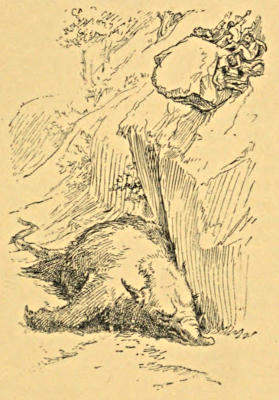
By Clive Phillipps-Wolley
Many statements to the contrary notwithstanding, I venture to
assert that, in spite of the evil doings of the ‘scallawag’ and
the meat-hunter, there is still quite enough big game in many
parts of the American continent to amply satisfy the desires of
any reasonable big game hunter, meaning by that term one
who is content to work moderately hard in an exquisite climate,
free from fever and other Oriental troubles, for a few good
trophies every season, and enough meat to keep his camp
supplied.
It is undoubtedly true that you cannot any longer kill
hundreds of head of big game to your own rifle in one season;
it is also true that the game laws of Canada and the United
States have somewhat curtailed the liberty of the sportsman;
but it is true too that amongst English sportsmen the number
of those who would care to shoot down hundreds of stags, &c.
in one season is limited, and that not a few of them realise
that the game laws of America, though often ill-framed and
always badly enforced, are still in the best interests of those
whom they control. There are, of course, mistakes in every
code of laws. For instance, it is a mistake I think to protect
sheep absolutely in Colorado, while wapiti are not similarly
protected; for sheep are now more numerous there than wapiti,
are much less easily obtained by the meat-hunter, and are less
profitable to him when he has obtained them.
Still, if the Americans would enforce their own laws as
rigidly against the native meat-hunter who makes a profit out
of shooting as against the alien who pays for his sport, I think
no one could justly complain.
Of course the buffalo has disappeared, and the antelope
is not as plentiful as he was, while some of the old shooting
grounds dear to the memories of the fortunate hunters of
twenty years ago have been very much shot out. This is true;
but it is also true that if the successors of the Williamsons,
Buxtons, Jamiesons, and others of an earlier day would display
as much enterprise as those gentlemen did before them, they
would probably find fairly good sport still.
The man who follows another to an old shooting ground,
getting there by a well-cut trail, or even by railway, to find
camps made and the country thoroughly surveyed, naturally
does not get as good sport as the ‘first man in,’ and does not
deserve it.
An old friend, whose reputation as an Indian sportsman
stands as high as any man’s, told me that, though the old
grounds were certainly a good deal shot out in India, he knew
that close to them were other grounds unvisited which were
almost as good (if not quite as good) as the old ones, and this
he proved by sending a subaltern nephew off an old route for
a very short distance into a country usually passed by, with
the result that he got almost as good sport in the nineties as his
uncle had had in the sixties.
So it is in America to-day. One man follows another, as
sheep follow their leader, and if you trust to guides they will,
of course, take you to the places they know from experience,
an experience which has been obtained at considerable cost to
the game of the district.
As I write I am reminded of an excellent example of that of
which I am writing. There is in British Columbia a certain Irish
baronet, a most excellent sportsman, who has probably had
better sport with cariboo and grizzly than anyone else in the
country. His two favourite grounds are now overrun by his
followers, but in the year that he cut the trail to his cariboo
ground (it took him several days) he had excellent sport, and
in Alaska he did so well with bear that next year a friend and
myself found that all the skin-hunters in the country were on
Sir Richard’s tracks. Of course we went elsewhere. So it is
always. On the grounds which you find for yourself you may
get excellent sport: on the grounds found for you by other
people you have hardly a right to expect it.
Before dealing then with the game list of North America in
detail, let me say to the intending sportsman, Don’t be discouraged
by every evil report: go and see for yourself: if possible
get a hint as to where game is likely to be and then look
for a country yourself, not slavishly following your predecessors
or entirely depending upon men whom perhaps you don’t know
very well to present a stranger with an accurate chart of the best
hunting grounds they are acquainted with, the way to which
they have discovered by their own hard work.
As in everything else in life, so it is in sport: if you want
to get anything worth having, you have got to earn it yourself
in one way or another.
There is no royal road to success in the mountains, but there
is the old road still for the self-reliant and adventurous who
don’t stick to old trails and the railroad, and there is still plenty
of game, for those who know how to seek it, in Colorado, British
Columbia, Washington Territory, Ontario, Alaska, and even in
parts of the province of Quebec. So much I dare personally
guarantee.
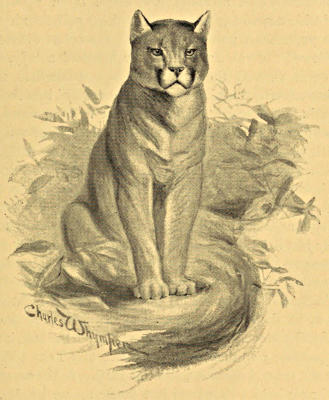
Puma (Felis concolor)
The American Panther (Felis concolor) is a beast of many
aliases but of few virtues. He is the ‘painter,’ ‘catamount,’
‘mountain lion,’ ‘cougar,’ ‘Californian lion,’ or ‘puma’ of early
American legends; but, in spite of his many high-sounding
titles, he is a mean, sneaking beast, hiding in dense timber by
day, stealing or destroying more sheep in one night than he
can eat in six months, affording no sport to anyone, and very
little profit even to the fur dealer. Those who hunt the panther
generally hunt him with dogs, and no dog is too small for the
work, for the American lion will tree before a terrier and let
himself be shot by a boy with ‘bird-shot.’ I am not traducing
the beast, for I have myself hunted him with terriers in the States.
But let an American authority be heard upon the question.
A book was published in 1890 called ‘Big Game of North
America,’ to which several well-known authorities contributed,
such as Caton, Van Dyke, and Fannin. The authority referred
to, however, is not one of these three, but a Mr. Perry, who
maintains that the American lion is not a cowardly animal, and
cites in support of his contention six or seven instances in
which panthers attacked human beings unprovoked. In the
first instance (p. 413) the ferocious animal was defeated and
driven off by an heroic boy of twelve armed with an empty
brandy-bottle. In the second case a blue-jacket who had
deserted from Esquimault and ‘found his way through the
woods until he rested under the domain of the starry flag,’ killed
the panther which attacked him there by a ‘gladiatorial
thrust’ with a spade (p. 415). The third and fourth of Mr.
Perry’s pugnacious panthers behaved somewhat differently—one
followed a gentleman, the other followed a lady, and in
both cases showed the human beings somewhat marked
attentions, licking their hands, gazing ‘intently’ into their eyes,
and tearing off most of their clothes, but nothing more. The
fifth panther was caned by a gentleman from Snohomish, and
the sixth was stared out of countenance and put to flight by
someone from Brownsville, whom the panther had knocked
off his horse; but it was reserved for another hero from Snohomish
to perform the marvellous feat of catching a panther on
the wing (‘as it was passing in the air’) with ‘his left arm round
its body just behind the forelegs.’ Of course, having got his
grip, the gentleman from Snohomish thumped the head of that
poor panther with his gun-barrels till it died. In this Homeric
struggle the victor lost nothing but the tail of his night-shirt.
Now, no doubt all these stories are quite true, and they
undoubtedly prove great courage in someone, but not, it seems,
in the panther; so that in spite of Mr. Perry I am obliged to
accept the general opinion upon this subject as the correct one,
backed as it is by a statement just made to me by Mr. John
Fannin, the curator of the British Columbian Museum—an
accepted authority in the American press upon such matters,
and an ‘old timer’ who has had many opportunities of observing
this beast—that he had never come across a well-authenticated
story of a panther showing fight to (much less attacking) a man.
From Mr. Fannin I obtained the measurements of the largest
panthers out of the twenty-five or so which have been sent to
him in late years to be skinned. The longest of these was a
male from the mainland of British Columbia, killed on the
Frazer river, which measured 8 ft. 2 ins. from the tip of the
nose to the tip of the tail. The largest killed upon the island
and sent to my friend was also a male which measured 7 ft.
3 ins. One hundred and fifty pounds is the weight of a large
panther as given by Mr. J. E. Harting, in some notes published
by him upon American mammalia, and I have no doubt that
this is about what an average male would weigh, but I am
only judging by my eye, and not from any accepted record of
the actual weight of any particular beast.
The panther’s food consists of small game of all kinds, deer,
and more especially sheep and pigs, and other farm produce.
In nine cases out of ten the panthers which are killed are
found near a sheep ranch, and it is notorious that the men who
get panthers are not hunters, explorers, or men on a survey
party where only wild game is likely to be found, but rather
farmers and others who have stock to look after near a settlement.
It may be that in Montana and Wyoming the panther grows
larger and is more courageous than he is on the Pacific coast;
but even there he is held in some contempt by the mountain-men
who know him. He has a habit, it is said, of following a
belated hunter to camp howling in the most diabolical manner,
but he never proceeds to extremities.
Some idea of the number of these beasts upon Vancouver
Island and in British Columbia generally may be derived from
the fact that the British Columbian Government paid bounties
for the scalps of seventy-two in 1892, all but two, I believe,
having been killed upon the island.
Mr. Sclater, the Secretary of the Zoological Society of London,
writes me that the best naturalists only recognise three species
of bears in North America, namely: the Grizzly (Ursus horribilis),
the Black Bear (Ursus americanus), and the Polar Bear
(Ursus maritimus). My correspondent adds that ‘a lot of
varieties and sub-species have been made, but not upon any
certain characters.’ Among these varieties and sub-species
may, I suppose, be reckoned Ursus Richardsonii, the Alaskan
grizzly, as well as a whole host of bears, best known to
Western trappers as cinnamon bears, silver-tips, roach-backs,
bald-faces, and range bears.
Luckily for me, the question of species is one for naturalists
rather than for sportsmen to decide; the claim to rank as a
distinct species appearing to rest rather upon a beast’s anatomy
than upon his outward appearance and manner of life.
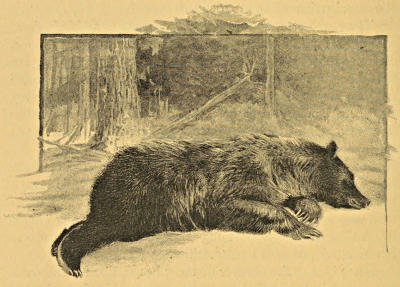
Dead grizzly
Having studied bears with some care and under favourable
circumstances in more than one portion of the globe, I incline
to the belief that the different species cross almost as freely as
do different breeds of dogs; and certainly it seems probable
that upon the North American continent all the different
varieties owe their origin to the grizzly or the black, or to
a union between the two. In this view I am supported by
such a practical field naturalist and sportsman as Dr. Rainsford,
as well as by a number of the best hunters and trappers
whom I have met, and by certain very significant facts. Dr.
Rainsford alludes to the first of these facts in his admirable
article upon the Grizzly Bear in ‘The Big Game of North
America.’ He says: ‘I myself have shot three young bears going
with one sow, one almost yellow, one almost black, and another
nearly grey. I have seen ordinary black bears, with year-old
grizzly cubs, shaped differently from the mother, unmistakably
owing both their shape and colour to the parentage of the male
grizzly.’ This is the evidence of Dr. Rainsford, and I have
heard similar statements as to the occurrence of different
coloured cubs in the same litter, not once but a score of times,
from Indians and white men who had passed their lives in the
mountains; and I have round me in my house at the present
moment a number of skins of bears killed by myself, which, if
colour be any criterion as to species, represent almost as many
species as there are skins.
But if anyone wishes to judge of the futility of trying to
‘place’ a bear by his colour, he should visit the drying-yard of
our principal merchant in furs, here in Victoria. In that yard
on a sunny day, when the bear skins are laid out to air, he will
see skins of every shade between black, white, and red, all
collected from a comparatively limited district, and all shading
so gradually into one another, that you cannot yourself decide
where the smoky grey of the true grizzly has changed into the
reddish brown of the cinnamon, or where that has become
dark enough to be considered a rather brownish black.
As it is with the colour so it is with the shape of the beasts,
and with the shape and colour of their claws. The typical
grizzly should be higher at the shoulder, somewhat shorter in
the back, and generally more massive than the black bear. He
should be so high at the shoulder as to appear almost humpbacked,
whilst his head should be heavy and massive, broad
between the ears, short in proportion to its size as compared to
the head of the black bear, sharp at the snout, and somewhat
flat behind the eyes; the whole expression of the head being
as unmistakably pugnacious and dangerous as the expression
of the long shallow head of the black bear is weak and inoffensive.
As most people are aware, naturalists rely for purposes
of identification more upon the shape of a bear’s skull than
upon any external characteristics, and for that reason I have
inserted here an engraving from a photograph of two skulls
placed side by side, the larger one being that of a medium-sized
grizzly bitch (or sow) from Alaska, the other that of a
very large black bear (male) from British Columbia.
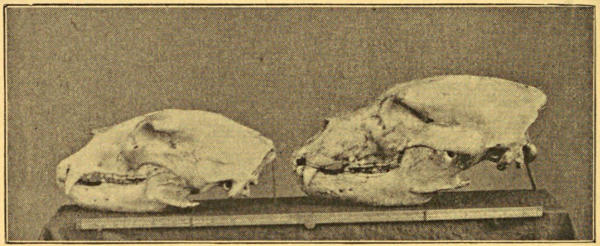
Black bear, Grizzly bear
As far as the general expression of the beast goes, it seems
to me that that is no better guide than his colour, for even
amongst grizzlies I have in one trip come across one specimen
with a head as full of vice as a viper’s, and another as mild as
a Chinese cook’s. It is true that the sexes differed; the mild
face naturally belonging to the lady.
As to the claws again, the typical Californian grizzly should
have extremely long flat claws of a bony whiteness—claws
obviously meant for digging and not for climbing; while the
genuine black bear should have claws to climb and fish with,
sharply curved, small and dark coloured.
But here again the characteristics are not constant. The
Alaskan grizzly (if it is a true grizzly) has claws far too
arched or curved to be typical; whilst in colour, all those which
I have seen were a light brown or slate colour growing white
towards the tips. A bear shot by me in the Hope Mountains
is a good illustration of the strange varieties which sometimes
arise from crosses between black bear and grizzly. This little
fellow would have weighed about 350 lbs. live weight, and was
a full-grown bear when killed. His head was a typical black
bear’s as far as shape went, and he had not a distinctly marked
‘lift’ or hump at the shoulder; his claws were very light
coloured (almost white); his face and shoulders were a rich
straw colour, fading into a very light grey towards the rump,
whilst his arms, belly, cheeks and ears were a deep rich brown,
almost black in places.
The Indians said he was a grizzly; the trapper who was with
me called him a cinnamon; a friend who wished to belittle my
bear said he was only ‘a rum-coloured black and a little one at
that.’ I only venture to suggest that he was ‘very much mixed.’
But perhaps I have already said too much upon this point,
and I will therefore only pause to add this significant fact. No
cinnamon or other similar variety seems to be found where
both black and grizzly do not exist together. For example,
upon Vancouver Island, no grizzly has ever been heard of, no
cinnamon has ever been reported, but black bears swarm. The
same, I believe, may be said of the island of Anticosti, and
elsewhere. In habits bears differ, of course, considerably, and
yet even here the points in which they resemble one another
are more numerous than those in which they differ.
All bears appear to be omnivorous, but the grizzly is said
to be more of a flesh-eater than Ursus americanus. Perhaps
he is. No doubt he dearly loves to gorge himself upon a
carcase, and he does occasionally kill a weak beast or a young
one for himself; but like his cousin he is a great vegetarian,
grubbing up roots and devouring berries by the gallon. But a
black bear is not by any means a total abstainer from meat
diet, more especially if that meat be pork; indeed, if the pig
needs killing, and the farmer neglects to play the butcher, the
mild-mannered gentleman in black will not be slow to do the
killing and help himself.
To furnish an exhaustive or even adequate list of the
things upon which bears feed is by no means an easy task, but
it is so essential to success that a man should know where to
look for his game (game always being where its food is) that
this must be attempted.
Let me begin at the beginning of the bear’s year. As most
men know, all bears on this continent (except, perhaps, the
Polar) lie dormant during the winter. The den, as a rule, is at
the head of one of the hundred gulches which seem to radiate
from a common source amongst the snow peaks, the grizzly
and the cinnamon choosing their lairs at a higher altitude than
the black bear.
The road to a grizzly’s den, as I remember it, is generally
up a snow-slide, through a dense belt of noisy brush, which the
weight of the winter’s snow has laid as a thunderstorm lays ripe
wheat; and above this belt, under a sheer bluff, sheltered from
the wind and hidden by the snow, lies the den itself.
Up here, mist and snow, a few stunted pines, and the sleeping
bear have the world to themselves from November to April,
the exact date of the bear’s retirement to winter quarters,
as well as of his reappearance above ground, depending somewhat
upon the seasons. This much, at any rate, seems to be
generally admitted amongst mountain men—that, some time in
November bears begin to ‘hole up,’ the black bears being first
and the grizzlies following a week or two later; whilst in spring
the grizzlies are up and out before their ‘softer’ cousins.
When they first come out of their dens both bears feed
entirely upon vegetable matter, even the grizzly being too
weak to wander round to look for the carcases of beasts which
have perished during the past winter. This he becomes strong
enough to do a week or so later, but at first he is every bit as
sorry a spectacle as Ursus americanus under similar conditions,
being almost too weak to stand, and sitting down to groan and
wag his old head from sheer exhaustion after every few yards he
walks. If at this time the weather looks unpropitious, both
bears not infrequently come to the conclusion that it is not yet
time to get up, and therefore turn in for one more nap.
In early April (that is, on first leaving their dens) both Ursus
americanus and Ursus horribilis frequent the river bottoms to
feed upon the rank herbage which grows there; and a little later
find food very much to their taste in the young mountain grass
which springs wherever the snow leaves the hill-sides bare.
It is in April that the hunter gets some of his best chances
at bear, for if he be lucky enough to find one of the earliest of
these mountain pastures, and patient enough to watch it for a
few days, he is almost certain of his reward.
At this time, too, a bear is worth killing, for his hide is at
its very best when he leaves his winter quarters, though it deteriorates
very rapidly as summer advances.
Towards the end of April (in an average year) when the
bear has purged his system with a diet of mountain grasses,
Nature provides him with somewhat stronger food, in the buds
of the olali bushes (service berry, &c.), in the roots of the wild
parsnip, and a little later in the catkins which come upon the
willows. Later still (in May), when the woods begin to swarm
with ticks and other insects, the bears follow the snow in its
retreat to the high places, finding at its very edge great patches
of golden lilies (Erythronium giganteum) and the small pinkish
blossom of Claytonia carolineana (Indian potato), both blossoms
springing from bulbs of which bears are as fond as the Indians,
with whose women folk the former not seldom clash in their
morning operations in these wild potato fields.
But to find the bear feeding either upon bulbs or grasses,
or any stronger meat, the hunter must be out early and up late,
for bears are reasonable beings, rarely if ever feeding grossly
at midday, but breakfasting at dawn and dining after dark.
Indeed, bears are more or less nocturnal in their habits, and
this is especially true of grizzlies, who, when much hunted, become
purely nocturnal in their feeding and in their wanderings.
I know a country (the name of it I prefer to keep to myself
for a year or two yet) which appears to be a high tableland,
densely timbered and full of caribou, and from this innumerable
gullies and clefts lead down to lower levels, where, at
the bottom of steep canyons, are piled rock and stone slide,
and débris of dead pine wood. There are opens among the
pines at the top, and here in snow-time, if you leave a caribou
carcase for a couple of days, you will find plenty of bear-tracks
going to and fro. Every day the number of them increases,
until it seems to you that the place must be alive with grizzlies;
but you will never see one of the track-makers by day. The
bears here have been a good deal hunted, and have become as
cunning as monkeys, coming up from the gullies at night but
vanishing like spectres at the first peep of day. It was here
that a friend of mine killed and left a mule deer, hanging its
head up in a tree hard by, to be called for on some future
occasion. When that occasion came, the head was missing,
and was found a little further on, laid with the carcase and
carefully covered up with moss and sticks and snow.
This, of course, is a common trick of the grizzly’s, but it
was quaint of this particular beast to gather up the fragments
so carefully. By the way, whilst I am on the subject of
‘carcases,’ I may as well say that it is not my own experience
that grizzlies are very gluttonous feeders, upon flesh at any
rate. Indeed, it seemed to me that a deer’s carcase lasted
some bears whom I have known almost as long as it would
have lasted an ordinary camp Indian. I knew, for instance, of
a mule’s carcase in the spring of 1892 which served as an attraction
to four bears (two black and two grizzlies) for at least a
fortnight in the Kootenay country.
But to come back to the bear’s menu. About the same
time that the Erythronium is in bloom, black bears feed freely
upon a plant called ‘arpa’ by our British Columbian Indians
(Heracleum lanatum) upon skunk cabbage, and upon a plant
which Professor Macoun has kindly identified for me as Peucedanum
triternatum.
What the black bear eats from choice, the grizzly will eat
from necessity; so that if there are no carcases about, and few
or no bulbs in the country, the hunter may expect to find
U. horribilis making the best of ‘arpa’ and skunk cabbage.
As the season advances, the bear changes his diet somewhat,
and before his great autumn harvests of fish, fruits and nuts,
we find him tearing up rotten logs for ants and beetles,
turning over boulders for the larvæ which lie below them,
digging up yellow jackets’(wasps, &c.) nests for the sake of
the grubs inside, and occasionally burrowing in the hill-sides
for marmots or ground hogs.
The bear’s season of plenty begins with the ripening of the
first fruits on the flats by the river bottoms, when those who
care to shoot game out of season may find some sport in killing
both varieties of bear as they wander over the sand bars of
Alaskan rivers, looking for fruit and a cold bath to allay the
irritation of their bald and mangy-looking hides.
The berry season in British Columbia begins at midsummer,
and from that time until late in the fall there is always plenty
of bear food in the woods: raspberries (which bears love
beyond all things), currants, gooseberries, soapberries, service,
wine, salmon, bil- and black-berries, strawberries, choke-cherries,
and a score of others, whose flavour I can remember
but whose names I never knew.
I have never seen, except in the Caucasus, such a land
for wild fruit as British Columbia. Compared with it, Colorado,
for instance, is a most unfruitful country; but, to make
amends, Colorado abounds in acorns and pine nuts, of which
there are few, if any, in British Columbia. Where the acorns
are, there will the bears be also, but acorns are an uncertain
crop, failing utterly one year and abounding another.
By the way, just before the acorn crop comes in, the silver-tips
of Colorado seem to devote a good deal of their time to
digging in woodland bogs, but whether they dig for roots or
insects I am not sure. In Alaska, in British Columbia, and
all along the Pacific Coast the bear’s bonne bouche is kept
until nearly the end of the year. In spring the ‘tyhee’ salmon
(O. chouicha) turns up the streams, and a few of this ‘run’
stay all through the season; later on come the humpies
(Onchorhynchus gorbuscha), and of these, the Indians say, none
return to the sea. In October, then, in Alaska and elsewhere,
the glacial streams, tributary to the main rivers, are full of
these misshapen salmon, crimson and purple, and patched
with all manner of vivid leprous patches, their dorsal fins
frayed and rotting as they swim. The streams stink of them;
your paddle strikes one which is already broken up and drifting
seaward; others, swollen with decay, are standing, tail
upwards, on the river bottom; whilst others, driven by some
strange madness, diseased and dying, still struggle up the
shallows towards the glacier.
At this time of year, the dense woods of grey and mildewed
pines and prickly devil’s club, which crowd down to the river’s
edge, are full of bears; the mud flats between forest and
stream are pitted with huge tracks (I have measured many
12 ins. by 9 ins.), and the filthy gorged American eagle sits
puking and moping with ruffled feathers among cleaned back
bones and rejected heads and tails of humpies, left over from
the grizzlies’ last meal.
And here, at the end of their year’s feeding, it seems appropriate
to say something of the weight to which grizzlies attain,
and the size to which they grow. Like human beings, they
seem to fatten most in a civilised or domestic state, the great
grizzly of San Francisco having really attained to the enormous
weight of 1,500 lbs.,[15] presumably upon hog food. It is said that
the Californian grizzly grows larger than any other, but I doubt
whether he much exceeds the Alaskan in size, and I am absolutely
certain that all the largest grizzlies have grown to their
fabulous proportions in the whisky-scented atmosphere of
Western saloons. ‘If you will hear them,’ as the ‘boys’ say,
2,000-lb. grizzlies are quite common, and ‘as big as a bull’ is
but a mild way of describing nine bears out of ten shot by
them.
As a matter of fact, I am by no means prepared to doubt
all their stories. There are unquestionably some exceptional
monsters met with now and again, but too many of those instanced
have been described merely from the impression made
on the hunter’s mind by the sight of a gigantic track which
has spread in soft snow or mud. The largest grizzly of which
I have had anything like trustworthy information in my own
wanderings was shot in Alaska, at English Bay, Kodak Island,
by Mr. J. C. Tolman, now Customs officer at Wrangel. As
Mr. Tolman allows his name to appear, and as he enjoyed an
enviable reputation for veracity among men who had known
him for years, I give the dimensions of his big bear as he gave
them to me, extracted from notes made in his diary at the
time at which he killed him. The bear was killed only a few
miles from a settlement, and was actually weighed, turning the
scales at 1,656 lbs. dead weight not cleaned; his hide when
freshly skinned measured 13 ft. 6 ins. from nose to anus;
from ear to ear he measured 13 ins.; from poll to nose,
20 ins.; the length of the hind-foot was 18 ins., and the
breadth of the forefoot 12 ins. He was killed by a single
shot in the head from a Winchester rifle.
The largest bear which I have myself shot was also an
Alaskan, but infinitely smaller than the above; still, even this
bear gave four strong men all they could do, with a rope round
her neck, to drag her, when dead, down a sloping mud bank
into a canoe laid over on its side to receive her. Her forearm,
when skinned, measured 23 ins., fair measurement, the tape
being stretched as tight as it would go. The Indians put this
bear at from 1,000 to 1,500 lbs., and I dare say she really
weighed nearly 800 or possibly 900 lbs., but I am no judge of
an animal’s weight, and had no means of weighing her. I
have myself measured skins in Mr. Boscowitz’s store at Victoria
(also brought down from Alaska) which measured 9 ft. 10 ins.
from end to end, but then some 6 ins. must be allowed for
on all American skins, as they are skinned up the hind legs in
such a way as to give quite that length of hide beyond the
anus. Of course, too, a skin may be so laced and strained upon
its frame in skinning as to stretch it a good deal beyond its
natural dimensions.
In Colorado the bears appear to be mostly silver-tips, and
if you can rely upon the verdict of the local hunters whom I
met (and I have no reason to doubt their word) a Colorado
silver-tip weighing 600 lbs. would be a big bear.
The stories of the ferocity of U. horribilis owe something
to the vivid imaginations of hunters and the sombre surroundings
in which they meet their prey; but there can be no
doubt that on occasion this bear will face a man (or men),
and fight with intense ferocity. As a rule, like all bears, the
grizzly will run rather than fight, and very rarely attacks without
provocation, but when surprised near a carcase, when
cornered, when wounded, or with cubs, U. horribilis is apt to
be dangerous. I know of a good many deaths due to bears
under such circumstances, and only last year (1891) a very
well-known meat-hunter in Colorado was attacked in green
timber by a silver-tip and regularly worried by him, although
the man had a companion with him, and had not even seen
the bear until he was charged. I have myself seen the
marks of this bear’s teeth in the leg and forearm of my old
guide, who explained the unprovoked attack by saying that
the bear had supped on a carcase poisoned for coyotes, and
was ‘feelin’ pretty mean from belly-ache’ when found. The
Alaskan grizzly has a peculiarly bad reputation among the
Indians in that country, who upon dry land can hardly be
induced to face ‘Hoots’ or ‘Noon,’ as they call the grizzly and
cinnamon. Most of the skins sent to Wrangel are those of
bears strangled in nooses, like big rabbit-snares, which are set
in their paths, or else of bears shot down by men on snow-shoes
in the deep snow of early spring, or shot on the river banks from
a canoe. Here it is as well to say that I know of two instances in
which grizzly bitches have, when hunted, deserted their cubs,
and left them up a tree at the mercy of the hunters; but this is,
of course, unusual. As a rule, grizzlies are distinctly ‘ugly’ when
they have young with them, and will defend them to the last.
However, with cubs or without, a man with a good rifle and a
steady nerve need never let a bear go in the open. In thick
brush there are times when caution is better than courage. As
I write, a picture comes before my eyes of a willow swamp,
high up on the head-waters of a mountain stream in the
States. An old guide of mine is on the edge of the timber
watching, whilst the brush swings and rattles, and an unseen
form shakes down the yellow leaves and fills the gulch with
her growls. It is only a bitch silver-tip, who has got the man’s
wind and is trying to collect her cubs; but, although it is
exasperating to stand while the old lady makes her escape
up the gully, there is nothing else to be done. If she does
not mean to face the open, none but a greenhorn would
attempt to go to her when she was ‘fighting mad,’ in bush
too thick to walk through, and in places over six feet high.
All the old authorities talk of grizzlies rising to an upright
position on closing with a man, but I have never met a man
who had seen anything of this habit, although I have known
more than one man who has been struck down by a bear.
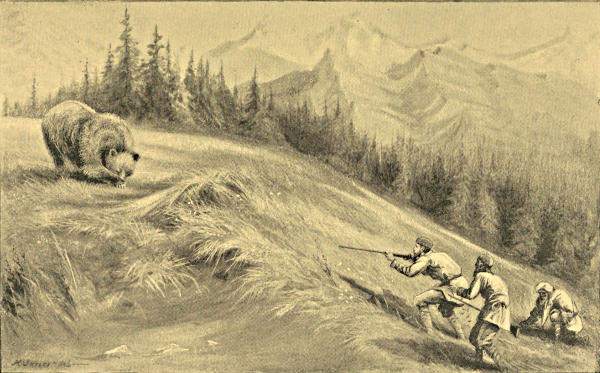
I have myself come suddenly upon a grizzly, and seen him
rise and face me in the position I refer to, but he did not stop
in that position long enough for me to dismount and fire, and
I am convinced that his only object in rising upon his hind
legs was to get a better view of the intruder, not to attack him.
There is no doubt that a bear’s sight is his weak point.
In bright moonlight I have had one walk past myself and
another man in the open at forty yards without seeing us; but
if his sight is indifferent, he has the ears of a hare and the nose
of a caribou, and this is especially the case with the black
bear, whose timidity has possibly somewhat sharpened his
senses.
That grizzlies do not climb, except as cubs, appears to be
true; not that it matters much to the hunter, as anyone will
allow who gets his friend to give him 100 or 150 yards’ start
and then tries to ‘tree’ in time to escape him. The right tree
never grows in the right place, and climbing in a hurry sounds
easier than it is. It will be found that most men can run
100 yards in less time than they can choose their tree and
climb it to such a height that their feet are ten feet above the
ground. A bear, too, travels faster even than a frightened
man on the flat. If you are charged, the best thing you can
do is to stand fast and go on shooting; and if there are two of
you, and both of one mind, and not standing too close together,
there should not be much danger; but better than that is to
take pains about your first shot: or go close to your bear and
shoot him in the head or neck, as the natives do. If you hit
him in either of these places, you can kill him at once with
an ordinary Winchester (45·90); whilst if you are using a
Paradox or a big English Express, a shot ranging forward
from behind the shoulder or (with a solid bullet) through the
shoulder is good enough.
Don’t shoot at a bear above you unless you are sure of
killing him; a wounded beast will almost always come down
hill and may take you on the way; and don’t shoot at a bear
in the brush as if you were ‘browning’ a covey of partridges;
nor follow a wounded bear into thick covert unless you are
well insured, about to be married, or at the end of your ordinary
resources for supporting your family.
Opinions vary as to the comparative ferocity and vitality of
the different species, but perhaps individuals vary at least as
much as species. I have known a black bear take a bullet from
an English rifle fired by me point blank into her chest at ten
paces, and then turn and gallop uphill for 200 yards before
dying; and I have known a two-year-old black bear take
three bullets, scattered indiscriminately over his back by my
friend’s Paradox (12-bore), and then turn and charge like a
hero. He charged the wrong man, though, and got shot in the
head for his impudence.
To finish these remarks, and convey, if possible, some idea
of hunting the grizzly, let me take a leaf from my note-book,
kept in Alaska in the autumn of 1891, whilst hunting with my
friend Mr. Arnold Pike.
Nature has a way of always suiting her creatures to their
environments, but none of her creatures are more exactly
suited to their surroundings than U. horribilis. Savage and
silent and grey as the grizzly is, the forests and waters amongst
which he chooses to dwell are more grim, more savage, and
more forbidding than himself. The part of Alaska in which
we were hunting in 1891 appears to have escaped from that
process described in Genesis by which the waters which were
above the firmament were divided from the waters which were
under the firmament. On the Stickeen river there is no
firmament. As a rule, a damp darkness broods upon the face
of the deep, and the waters which should be above touch and
mingle with the waters which should be below. There is no
dry belt between the bottom of the sea and the roof of heaven,
at least in that district which lies between Wrangel and Telegraph
Creek, in the month of October. We were out for forty
days and forty nights, and I cannot swear to more than three
and a half moderately fine days in that time: a fine day in
Alaska being one in which you wear oilskins and gum boots,
and go to bed in a dry shirt; whilst on a wet one you wear
gum boots and oilskins, and go to bed to dry your shirt.
The river Stickeen runs its rapid course between dank forests,
grey at the top with mildew, and hung with dark mosses, in
which the devil’s club forms an impenetrable undergrowth, and
even the pines are thorny. The pace of the river is such that
you make as much in one day, drifting down it, as you made
in five pulling and poling up it; and your camping-grounds are
of necessity upon barren sandspits, for nothing but a bear
could force its way into this timber. In this land no gentle
things live: there are no deer, no small birds, no squirrels, no
sunlight—nothing but a few wolves, a stray seal, which comes
whistling up on the tide in the grey of the morning, great
flights of Canada geese, and dying salmon. All along the
course of the main river are the mouths of its ice-fed tributaries,
little streams of greenish-blue water, rising in a glacier and
fringed with narrow strips of glacial mud, upon which a rank
growth of Equisetum (horse-tail) flourishes. These banks are
the hunting grounds, and the number of huge tracks upon
them, as well as the débris of half-eaten salmon, proclaim that
there is no scarcity of game; but if the hunter would get a shot
he must haunt them at all unseasonable hours, when winds
are most chill, and nature is at her gloomiest: for ‘Hoots’ only
creeps out upon the creek’s edges with the first shadows of the
night, and vanishes from them with the earliest rising mists of
morning.
In this land it was that one evening we pitched our tents
upon a sandspit, cut wet brush in the rain to make our bedding
for the night, and then, tired with a hard day and dispirited by
weeks of failure, stepped once more into the canoe and paddled
for all we were worth up and across the stream to the mouth
of a salmon creek.
Once in the green water, pipes were put out, conversation
ceased, Pike and I laid down our paddles and took up our
rifles, and only the Indian worked, the canoe gliding up the
still waters without a sound.
At the mouth of the stream, a few flashing shadows beneath
the water attracted our Indian’s attention, and a few quick
thrusts with his spear provided us with enough fresh salmon
to last us for a day or two. A blow or two with the axe
silenced them, and again the canoe stole up stream, the men
in it noting fresh tracks upon the banks, and peering into the
shadowy woods, which grew darker and more impenetrable
every minute.
Once or twice on our way up stream the canoe ran
aground, and all hands had to get out to push their craft
through the sands (quicksands as often as not) into which we
sank over the tops of our waders.
But these are small matters. Pike sitting with one leg
dangling over the side, always ready to jump out, seemed
rather to like it—it reminded him of days among the ice near
Spitzbergen—and all of us had long since become amphibious.
At last the stream ceased to be navigable even for our
shallow craft, which we beached upon certain muddy shallows,
among stunted bushes and dead equisetum, and our watch
began. All round us stretched the swamp, and above it rose
the densely timbered hills, while far above them again towered
the triple peaks of snowy Sacoclè. For an hour and a half
no one stirred, though our fingers were numb, and we were
too cold to feel cold. A good Siwash (Indian) won’t move a
muscle for hours, nor sneeze, nor cough, nor do any of the
hundred and one things which no one ever wants to do except
upon such a vigil as this. For an hour and a half the rain
went on, the darkness deepened, and the silence became
intense, broken only by the occasional splash of a ‘humpy’
who had run himself aground, and could not get off again into
deep water.
At last Jim came to the conclusion that no bears would
come that night, and as a glance at our sights proved to us that
we should probably miss them even if they came, we signalled
him to push off, and in a minute the canoe was again fleeting
over the waters in breathless silence, the thin line of forest
seeming to glide by us while we stood still. An Indian in the
bows was looking out for ‘snags ahead’ or shallows, and for
my part I had played this game so often before that I had
given up hope, and was dreaming of other things. All at once
the canoe was violently shaken from stem to stern. ‘D——
the fellow,’ I muttered, ‘I suppose he has run aground,’ and
I went on dreaming. Again the canoe trembled under me,
and this time I remembered that this was to be the signal for
game ahead. At the same moment I noticed that the Siwash’s
face was working, and his hands were drawing his Winchester
from its case, when my friend crept up to him, and made him
understand that if he fired it would hurt him more than the
bears, and then at last I saw them. Until then the Indian’s
body had been in my way, but now they were in full view,
standing almost up to their shoulders in the stream, still as
stone images in the dark shadow of the overhanging bank,
their heads turned over their shoulders looking in our direction,
and the long silvery ripples running from their legs down
stream. It was lucky for me that night that I carried a
Paradox, with which a man can shoot at short ranges as if he
were snap-shooting at rabbits in covert, for I had to stand up
to get a clean shot, I had not a second to lose, and the canoe
rocked horribly under my feet. The big beast of the two fell
to my first barrel, sinking where she stood, while her mate got
my second barrel in the back as he scrambled up the bank,
making good his escape for the moment into the dense scrub.
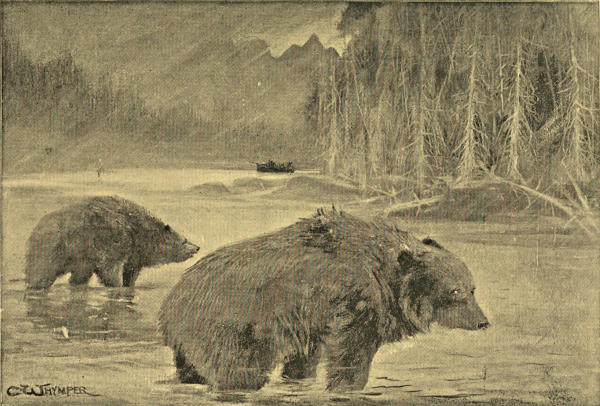
STANDING STILL AS STONE IMAGES
I don’t suppose that the whole incident, from the find until
we began to fish up my bear, took a minute, and yet into that
minute was crowded a third of the reward for forty days of
hard work, short commons and general misery. Is the game
worth the candle? I think it is, but I don’t want to persuade
any man to be of my way of thinking, nor do I want to convey
the impression that all bear hunting is necessarily as grim and
miserable as it is in Alaska. But in places where bear hunting
is easy, bears are getting scarce (at least, grizzlies are), for their
hides bring a good price and there is a bounty upon their
scalps as well. The result is that more bears are trapped in
one year than would be shot in five under ordinary circumstances.
For instance, two brothers whom I know killed
thirty-five bears in 1890 within a radius of eighty miles of their
cabin. Of course, this sort of thing cannot last.
It seems a pity, as, whether you hunt him among the mists
and storms of an Alaskan autumn, or watch for him by a hill
at the edge of some dark canyon, until even the bird chiquetta
stops her noisy little song, and the outlines of all objects
become indistinct and moving, Ursus horribilis is better worth
hunting than any other beast, except perhaps the bighorn, in
all America.
P.S.—Since writing this, Sir George Lampson has kindly
furnished me with the length of eleven American grizzly skins
in his warehouse at one time—87, 89, 90, 93, 94, 95, 96, 97,
98, 101 and 103 ins. respectively. On the day these particulars
were furnished I myself put the tape over a grizzly skin
in Sir George Lampson’s possession which measured 9 ft. from
the eyes to the tail.
I have said so much incidentally about the black bear
while writing of his congener the grizzly, that I have very little
left to say of him in the proper place. A recent American
authority describes this bear’s habitat as being confined nowadays
‘to some portions of the various ranges of mountains
south of the St. Lawrence river, the Great Lakes, and (east of
the Mississippi river) to parts of those portions of the Mississippi
river and its tributaries which are yet unsettled,’ and
to ‘the dense thickets of the Colorado, Trinity, and Brayos
rivers.’ Colonel G. D. Alexander should have bethought him
of those countries west of the Rockies (Alaska, British Columbia,
Washington Territory, Vancouver Island, and Oregon) which
are at present the principal stronghold of Ursus americanus;
and as I am informed the chief source from which the fur-traders
draw their supplies of black bear skins. Unfortunately for
the black bear, the price of his hide has gone up lately in the
fur market. Ten years ago $15 was a long price to pay for
a bear’s skin; this year a trader out here paid as much as $35
for one. Whatever the ultimate result of this rise in value may
be, the immediate consequence of it has been to show the
world what a vast number of bears can be killed in America
if they are wanted.
Here are some statistics of recent crops of bear in America
which speak for themselves.
The Hudson Bay Company, of course, draws all its supply
of hides from this continent, and I am assured that the same
maybe said (with scarcely any allowance for Russian, Norwegian,
Indian, or other skins) of the great firm of C. M. Lampson
& Co. These two firms collected in 1891 and offered for sale
in 1892 no fewer than 29,081 bear hides, to which enormous
total the Hudson Bay Company contributed 11,027 hides.
Some idea of the proportion of black to other skins at
these sales may be obtained by looking at the Hudson Bay
Company’s lists for 1891, in which we find 11,414 black, 1,875
brown, 253 grey, and 130 white bear skins offered for sale.
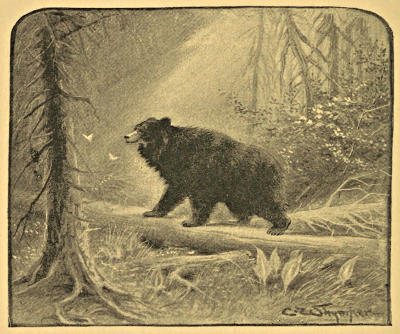
‘When Spring in the woods’
There can be little doubt, then, that there were plenty of
black bear in America in 1890 and 1891; and, in spite of the
immense harvest of hides which is annually gathered in, I
venture to prophesy that until Alaskan river bottoms and the
dense timber districts of Vancouver Island, Oregon, and Washington
Territory are cleared and ready for the plough, there
will be plenty of bear left for those who care to look for them.
Here on Vancouver Island and on the north-west coast of
British Columbia black bears are especially plentiful, one of
our great fur-dealers (Mr. Boscowitz) having taken in over
1,000 hides last year, whilst I see by a newspaper (‘Colonist,’
Dec. 6, 1892) that at Sumas in the New Westminster District
(one of our best farming districts) seven bears have lately fallen
to one rifle and three to another; and I am well convinced
that a salmon-canning friend of mine told me the truth when
he asserted that about dawn, one day during the great annual
salmon run, he saw seventeen black bears at one coup d’œil,
feeding along the bank of one of the northern rivers of British
Columbia.
But it must not be inferred from these facts that every
tenderfoot who comes along will run up against bears the first
time he goes in search of them. On the contrary, an old friend
of mine (every inch an English sportsman) has been out in this
country for twenty-five years, travelling from time to time all
over the province, and has never yet seen a bear alive in the
woods. The reason is simply that my friend uses a shot-gun,
and doesn’t look for bears; and if you want to see these beasts
you must look for them at the right time and in the right place,
and even then be thankful if you see more than their fresh tracks,
for Nature has given them noses as keen as the nose of a caribou,
and ears which are always on the alert, as well as an impregnable
sanctuary in the dense timber and tangled woodfall of
their native forests. To those who live upon the Pacific coast
the black bear is an animal to be thankful for, affording as he
does an excuse for carrying a rifle when spring is in the woods;
when the cedar swamps smell heavy with the musk of the
skunk cabbage, and are lit in their green darkness by stray beams
of May sunshine; when Cormus Nuttalli is white with blooms
as big as the palm of a man’s hand, and underfoot all is bright
with the red and orange of columbine and ‘Indian pink,’ or
white with the delicate petals of the dog violet. To me the black
glossy hide beneath my feet always brings back memories of
spring-time, either here on the island, or on the mainland by
the Frazer, where the beautiful olalis are smothered in white
blossom, and where the great yellow swallow-tails and plum-coloured
Camberwell Beauties sail and sun themselves upon
the stone slides round the lake.
But though the black bear affords an excellent excuse for
bolting out of town in spring-time, it cannot be said that he is
a very sporting beast. He hasn’t got an ounce of ‘fight’ in
him, and stalking is of course impossible in such districts as
those which he frequents. Even ‘still hunting’ is very nearly
useless in such timber as exists on this coast; so that unless
you use hounds to hunt him with, your best chance of meeting
Ursus americanus is to take a canoe and paddle quietly up
untravelled streams, where fish are plentiful, or where in
autumn the berry bushes grow thickly. In spring you may get
a shot by watching woodland swamps where the skunk cabbage
grows, or hill-sides when the Indian potato is ripe, but you are
nearly as likely to have your chance if you are out early upon
the best trail in the country, which runs near such feeding
places, for the black bear appreciates a good road as much as
a man does, and always uses one when he can.
In Eastern America the black bear is principally hunted
with hounds, and even here a good dog which will tree a bear
is useful; but my own experience of such sport has been, that
in nine cases out of ten the hounds’ music ceased just as I had
done the hardest mile on record up hill and over fallen timber,
and the hounds themselves turned up ten minutes later, meek
and dejected, their muzzles full of porcupine quills, which they
evidently expected me to pull out for them.
Most of the skins sent in to Victoria from Alaska are taken
by trapping (by noose, gin, or deadfall), or by hunting with
dogs, between the time the bears leave their dens and the
time the snow leaves the river bottoms. It is a short season
and an uncertain one, but I am assured by those who have
tried it, that for a man who is a good goer upon snow-shoes, it
is excellent fun whilst it lasts. The dogs used for bears are of
every breed and combination of breeds, but perhaps the best
are collies. It does not require a big dog or a powerful dog
for the work, for no dog is big enough to close with, whilst any
dog is big enough to frighten, a black bear. I remember upon
one occasion seeing three dogs, two small Pomeranians and
a cross-bred setter, run a two-year-old black bear to bay on the
ford of a river. The dogs had to swim, but by standing up
the bear could rest upon firm ground, and keep his arms and
jaws free for fighting above water.
The bear had already received a shot in the stomach before
the dogs tackled him, but when they ran him to bay he
seemed strong and well. Neither dogs nor bear took any
notice of me, though I was standing up to my knees in the
water of the ford within a few paces of them; and in five
minutes the fight was over without interference on my part.
At first the bear cuffed the dogs as they swam up to him, as a
man might cuff who knew nothing of hitting out from the
shoulder, and once he took the big dog in his jaws and went
right under with him. However, the setter came up smiling,
and shortly afterwards poor old Bruin was floating down stream,
his head under water, and the dogs tugging with impunity at
his flanks. I suppose that this bear weighed less than 200 lbs.
Captain Baldwin in his excellent book on the game of
Bengal describes two kinds of bears: U. labiatus and U. tibetanus;
and almost everything that he says of the Indian black
bear would apply equally well to U. americanus (even to his
weakness for yellow raspberries), except that U. labiatus appears
to fight upon occasion, whereas U. americanus is hardly ever
known to fight even in self-defence, and has never, as far as I
know, been accused of making an unprovoked assault upon a
human being.
Baldwin seems to have been somewhat surprised when he discovered
that the Indian black bear fed upon carrion. No one in
America would be surprised at anything which U. americanus
considered good for him. I have seen a cub take rotten melon,
a piece of meat, a cake of chocolate, a plug of T. & B. tobacco,
and the end of a half-smoked cigar for breakfast. Being
a true American, the cub naturally showed a preference for the
plug of T. & B., but none of the other things came amiss to
him. In a wild state a black bear will eat any garbage, putrid
fish, dead animals, or anything else which comes in his way.
In fact, the poor black bear is in all his tastes and habits a
thorough hog: a pig without a pig’s pugnacity.
As a rule he is a lowland beast, living in swamps and river-bottoms,
but I have seen him once or twice even in a mountain
sheep country, probably crossing over the divide from one
river-bed to another. It is well for him that he generally
eschews the open, for once out of the timber everything which
has eyes must see him. A man may mistake a burnt log for a
bear, but no man could mistake a bear for a burnt log. The
intense blackness and gloss of a bear’s coat is not thoroughly
appreciated until you see it contrasted with other objects which
you are accustomed to call black.
Where the sportsman runs any chance of seeing tracks of
both black and grizzly in one and the same piece of country,
it is as well to be able to distinguish the one from the other.
It is not easy to do this, but, as a general rule, if the ground
on which the track is made is soft, you should be able to see
the long cuts made by the grizzly’s claws, as contrasted with the
little holes made by the points of the black bears. I am talking
now of the forepaws, and it will be remembered that the
claws of the black are much arched, and therefore only touch
at the tip, whereas the grizzly’s claw is flat and should touch
almost along its whole length.
Again, there is no doubt that the heel of the grizzly is
much broader and squarer than that of the black bear, which
makes a very narrow impression, even upon soft clay.
Like the grizzly, the black bear varies greatly in size and
weight. On Vancouver Island I am inclined to think that the
average black bear would not weigh 300 lbs.; but no doubt
there are many exceptional bears, even upon the island, which
greatly exceed that weight; and I have myself seen an old
male upon the mainland which, if I am any judge of weight,
was not an ounce less than 500 lbs., and probably weighed
more; while there are from time to time black bear skins in
the warehouses of Mr. Boscowitz, the principal fur-dealer in
Victoria, which would measure nearly 9 ft. from end to end
(if allowance were made for the mask beyond the eyes), and
6 ft. from side to side below the arms.
In 1891 I measured in this store a black bear’s skin which
did not seem unduly stretched, the length of which was, to the
best of my recollection, 8 ft. 6 ins. from eyes to tail, or 8 ft.
10 ins. as measured.
Amongst the skins for sale by Messrs. C. M. Lampson &
Co., at their small summer sale, June 12, 1893, at which I was
told that the black bear skins were small, I measured one
skin 93 ins. from eyes to tail, and one of the employés of
the house assured me that a black bear skin measuring 8 ft.
6 ins. was not uncommon.
Before leaving the subject of bears altogether, I should
like to refer to an extraordinary skin which I saw among
Mr. Boscowitz’s consignments from the upper country last
year. In size this skin is considerably larger than the average
bear hide; the colour of it is white, with a few straw-coloured
patches (little more than a few hairs in each) on the head and
about the rump. The paws and claws of the animal were attached
to the skin, and from the jaws and skin of the head I should
imagine that the beast had a long shallow head like a black
bear’s, though the skin is more like the skin of a Polar in
summer season, except that whereas other bear hides are of
hair, this is distinctly woolly, more like the fleece of a sheep
than the hide of a bear.
I am informed that this skin was sent to Mr. Rowland
Ward’s. The bear was killed on one of the inlets of the
north-west coast, and is the only one of the kind ever seen in
our British Columbia fur market.
In writing of big game in North America, it is impossible
to write for more than the immediate present. That which
was ten years ago has already ceased to be, and it is probable
that the conditions, both of game and country, will change
almost as much in the coming decade as they have done in
that which has just passed.
Ten years ago, as I travelled along the Northern Pacific
Railway line, the skin-hunters were at work in the neighbourhood
of Glendive and Little Missouri, and I had an opportunity
of killing my buffalo like my predecessors. Unfortunately for
me, I agreed with Colonel Dodge’s plainsmen in ‘scarcely
considering the buffalo game.’ Now the herds are gone, and
neither I nor any other man will see the prairies again ‘all one
vast robe.’ All that remains of the vast herds which used to
roam ‘over the whole of the Eastern United States to the
Atlantic Ocean, and southward into Florida,’ are two or three
half-domesticated herds (one which was Colonel Bedson’s and
one in the Kootenay country among the Flat-head Indians),
and a small band of wild beasts, protected by the United
States, in the Yellowstone Park. ‘Forest and Stream,’
January 29, 1892, puts this last herd at about 400 head, with
an increase of 100 head per annum. West of Winnipeg the
buffalo paths are still visible, worn deep in the grey prairies by
millions of passing feet; but the herds have gone, and the men
and beasts who lived upon them. All that is left are a few
piles of bleaching bones and a few weather-worn skulls, and
even these have almost all been gathered and turned into
dollars by the manure manufacturer and the trophy-monger.
In this practical money-grubbing age it does not do to lament
the good old days, unless you want to be laughed at; but
it is hard, nevertheless, to look on the ocean of grassland
when the spring flowers are coming, and not regret the great
waves of animal life which used to sweep over it. Such
evidence as I can offer as to the mode in which the buffalo
was hunted must of necessity be hearsay evidence, collected,
however, at first hand, principally from an Indian confined, at
the time I saw him, at the Stony Mountain Penitentiary, and
from a white skin-hunter, whose last hunts were conducted in
1880, 1881 and 1882, in Montana and North Dacota.
A white skin-hunter’s ‘outfit’ of the most modest kind
consisted in those days of one hunter carrying a Sharp’s rifle
(with bullets weighing 500 grains), two skinners, and an extra
man for camp work and odd jobs.
During the rutting season (from July 20 to September 16)
the buffaloes all ran together, but during the rest of the year
the old bulls kept together, apart from the cows and young
bulls. Except during the rutting season, the bands were comparatively
small—from 20 to 200—led, if consisting of cows and
young beasts, by an old cow. In hot weather the bands would
lie quiet during the heat of the day, but in windy weather they
would keep travelling all day against the wind, feeding as they
went. As soon as the herds had been found the hunter would
begin operations, shooting at long ranges, and keeping out
of sight as much as possible. The first beast shot was the
leader of the band, and as often as the band seemed to have
selected another leader he, too, had to be dropped in his tracks.
Without a leader, and with no enemy in sight, the remainder
of the herd would generally become confused, and allow the
hunter to shoot down a large number ‘at a stand,’ as he called
it. Having killed as many as he could, the hunter left the
carcases where they lay, his assistants coming to skin them the
next day. Fifteen head a day was, so my informant stated, a
fair average for one man to kill and two to skin, although in
the fall of 1880 and spring of 1881 he and his party averaged
twenty-four heads per diem.
The best shot was low down behind the shoulder, about
ten inches from the brisket. A ball placed there would penetrate
the lungs, and, after a few plunges, the beast would drop
and die.
The price of all the blood shed by the skin-hunters may
be summed up briefly as 2 dollars 75 cents each for ‘leather
hides’—i.e. hides of old bulls all the year round and young
beasts during the summer season—and 3.50 cents for ‘robe
hides.’
My informant told me that if it would pay him he thought
that he could still find buffalo on the northern tributaries of
the Saskatchewan, east of the Rockies, as some friends of his,
trapping ‘away back’ in 1886, had seen plenty of them, though
the difficulty of bringing the robes out had prevented their
shooting any.
The last buffalo killed by a white man to my own certain
knowledge was shot by Mr. Warburton Pike far away to the
North, near the Great Slave Lake, when out after musk ox.[16]
Some idea of the number of the buffaloes in early days
may be gathered from the well-attested fact that the pioneer
settlers often drove through the herds for days and days with
buffalo in sight all round them all day long, as well as from the
statistics collected by Colonel Dodge, in his ‘Plains of the
Great West.’ That author states that, from information furnished
to him by the Atcheson, Topeka and Santa Fé Railway
Company, he concludes that not less than a million and a half
were killed in the States from 1872 to 1874.
Colonel Dodge mentions a mountain buffalo as a variety of
the common buffalo, and Mr. J. E. Harting, in some remarks
published originally in the ‘Field,’ alludes to a beast of the
same class, which he calls ‘Zacateca.’
The Zacatecas, of which specimens were exhibited at the
American Exhibition of 1887, inhabit the mountainous regions
of Northern Mexico; they are smaller than the buffalo, are
hornless, and have tails more like the tails of yaks than like
those of the common buffalo, who by the way is, properly
speaking, a bison (Bos americanus). I have taken the liberty
of calling him a buffalo because in his native haunts he has
been so called, and
as such he will go
down to posterity in
the legends of those
great plains which
know him no longer.
The Wood Buffalo
and the Mountain
Buffalo appear
to be almost, if not
quite, identical with
the common type of
B. americanus, from
which they differ
only in habitat, in
the quality of their
coat, and in that
they are of somewhat
smaller size
than their kinsmen
of the plains.
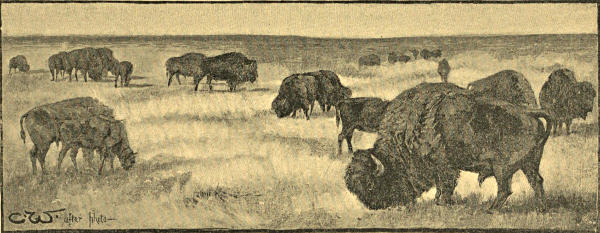
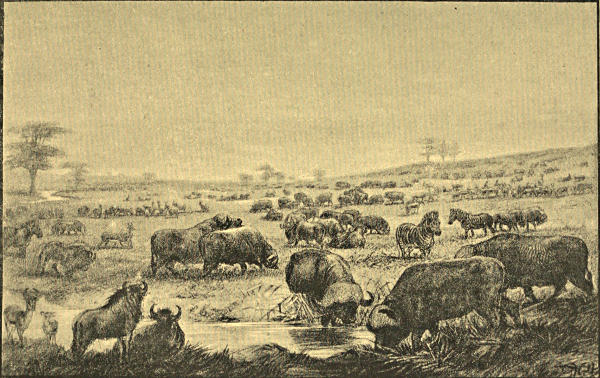
Colonel Bedson’s herd of buffaloes
A better idea of
the appearance of
the subject of these
remarks may be obtained
by a glance
at the illustrations
than could possibly
be given by any
amount of descriptive
writing, the illustrations
having
been drawn by
Mr. Whymper from
photographs of the
pure-bred beasts in
Colonel Bedson’s herd, taken by Lady Alice Stanley, and by
a photographer at Winnipeg, Manitoba.
An idea of the size of a buffalo bull may be conveyed by
the fact that, in 1889, one of the bulls in Colonel Bedson’s herd
was estimated at 2,000 lbs., and a much smaller beast, a half-bred
bull, was killed, which dressed without the head 1,100 lbs.
This was a four-year-old, by a buffalo bull out of a Durham cow.
P.S.—Since writing the above, I have spent a season with
an old-time buffalo hunter, who confirmed all the statements
made to me by others; and added that, as an instance of the
numbers killed by individuals, he himself accounted for 3,500
head in four years, whilst a friend of his, A. C. Myers, killed
4,200 buffaloes in the Pan Handle Country, in Texas, in one
year, ‘about the time Hayes was President.’
My old friend S. W. explained to me why men used such
a gigantic weapon as the ‘old reliable’ Sharp, which used to weigh
16 lbs. and upwards, although the bullet was but a small one.
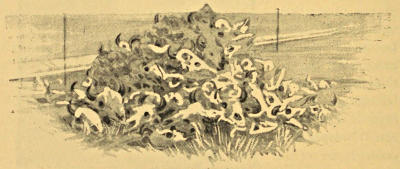
‘A pile of buffalo bones’
In buffalo shooting, he said, you had often to fire a deuce of
a lot of shots one after another; the weather was hotter than
‘the hottest part of the hot place,’ and as you were shooting at
long ranges, if the barrel got hot, a sort of mist would get between
your eye and the sights, which helped the buffalo somewhat.
Besides, where shooting was your trade, you didn’t want to get
your shoulder ‘kicked’ at every shot; and as for the weight
of your rifle, that didn’t matter to you, for your pony packed it.
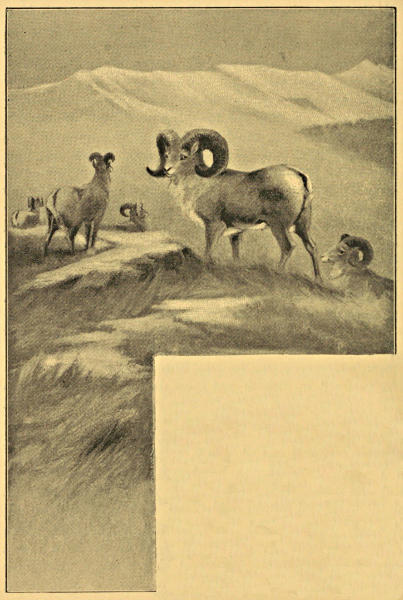
A group of bighorn
To a man who loves the hill-tops, where the winds blow
keen and pure over the red gold of sun-dried grass and the
deep blue of snow-fed tarns, there is no game in America to
compare with the bighorn of the Rocky Mountains. Other
beasts may hide away in the dense timber of Oregon, Washington
Territory, and Vancouver Island; other beasts may
sneak out only at dusk and dawn, but the gallant bighorn still
lives out in the open, trusting for safety to the grey-faced ewes
who watch over him, or to his own marvellously keen sight
and scent. In spite of this, the man who kills a 16-in. ram
generally deserves his good luck, for there is no beast better
able to take care of himself than an old bighorn, nor any more
difficult to stalk. Where he lives the wind seems never still,
and never constant in any given direction; at night it strains
at the hunter’s tent-rope and makes his fire roar and blaze like
a mad thing, and in the morning it curls round the hill-tops and
heralds the stalker’s coming from every quarter. It is the fashion
in books of sport to describe the haunts of Ovis montana as being
‘the highest, raggedest, and most forbidding mountain ranges.’
Nothing could be further from the truth than this, if the statement
is intended to be general. Sheep are undoubtedly sometimes
found in difficult and even dangerous places, but to
describe sheep shooting as anything like ibex or chamois
hunting is pure folly. The first sheep it was ever my good
fortune to see was in the Bad Lands, on an eminence not
200 ft. above the level of the Northern Pacific Railway line,
and the last I shot in 1892 was not 1,000 ft. above the level
of the Frazer. As a rule, sheep in early autumn keep to the
bald knolls above the timber-line (where patches of snow still
linger), seeking refuge when disturbed in the abrupt rock
faces with which the hills abound. When the snow comes
they retire to the edge of the timber, sheltering among the
juniper bushes and stunted balsams from the early winter
storms. Later on, when the deep snows have covered all their
upland pastures, the sheep come down to the benches
immediately above the river, retiring
at midday to the canyons
which lead to the first ridges. On
the Frazer river in late November
and early December all the sheep
of the district are down by the river;
indeed, one ram which I shot in
1892 was first sighted feeding in
the middle of a small band of cattle
on the flat. But winter is not the
time for sheep hunting, nor the flats
above the river the proper places to hunt them in. To
enjoy sheep shooting to perfection a man should leave the
Pacific coast in September, pass through the belt of water
meadows and pine forests, where the pink fireweed contrasts
vividly with the grey stems of the pines and the soft green of
the ferns, and through the country of sage brush and rolling
yellow bluffs. From this point his road will lie steadily upwards,
over the rolling prairie, through belts of green timber where the
deer swarm in winter, and then by thread-like trails over side-hills
and stone-slides along the course of some tributary of the
Frazer, until at last a great yellow cone, patched here and
there with snow, rises clear above the timber-line in front of
him. This is sheep-land, the land of the roaring wind (Skulloptin),
but it will take him a good long day to reach it, and
both he and his horses will be dead tired by the time they stop
to camp. At first a sheer rock wall rises from the river; on the
top of the rock is a bench of golden grass, and then again there
is a sharp ascent and another bench of grass. Finally the
ladder of benches is lost in the forest, which goes climbing away
uphill in resolute fashion until towards nightfall the hunter
reaches the land of stone-slides and burnt timber, and passing
through that comes out upon the edge of the sheep downs,
where the stream becomes no more than a succession of small
pools amongst the moss, and the only trees still left are dwarfed,
stunted, and twisted into all manner of forms by the violence of
the mountain winds. If the sun has left the landscape when the
hunter first sees it, the effect is weird and cheerless. The great
brown wastes above, the soft silent mosses underfoot, the trees
huddled together in little groups as if for mutual support, the
hanging fringes of blackened beard moss, all help to accentuate
the bleakness of the land over which the mountain wind sobs
or shrieks. But in the morning all changes as if at a magician’s
word. The skies are cloudless, the sunlight dances on snowfield
and streamlet, and even the grey stems of the trees are
beautiful when contrasted with the ruddy orange of the Indian
pinks at their feet—better than all, the hunter’s lungs are
filled with air which acts on him like champagne, and on the
skyline, as likely as not, he sees the great white sterns
of half a dozen sheep feeding quietly on their way back to their
sleeping ground. By ten o’clock at latest those sheep will lie
down, and then where they lie down they will stay, motionless
as the grey rocks they lie amongst, until nearly four o’clock,
their eyes apparently open the whole time and fixed steadily
upon the nearest skyline. Generally, sheep will choose a
little sheltered meadow at the foot of a small glacier, lying
down in the very middle of it, each old ram with his head
turned in a different direction, and each with his eyes fixed on
a different skyline. When sheep have chosen such a position
as this, the only thing to be done is to lie and watch them until
they move away to some more accessible country. Many a time
have I lain like this waiting until first one old ram and then
another rose, stretched himself, and then lay down again for
another forty winks. It is very exasperating, but when at last
the whole band gets upon its legs and feeds slowly over a ridge
from behind which it is possible to stalk them, verily you have
your reward.
As illustrative of the nature of the country in which sheep
west of the Rockies are killed, I have seen a well-known
British Columbian rancher ride up to a band of ewes in the
highlands of the Ashnola country, galloping after them until
within range, then dismounting and killing two out of the
band. This was in early autumn, and in what I consider the
easiest country I have ever seen; in winter, of course, when
the snows are heavy on the mountains, the sheep come right
down on to the flat, by the edge of the Frazer river. Indeed,
in the winter (end of November 1890) I found a fair-sized
ram feeding amongst a band of cattle, and killed him before
he had put a hundred yards between himself and them.
Another recent statement to which I must take exception is
that ‘a man who can find a band of ten or fifteen (sheep)
after a week’s riding and climbing is a fortunate man.’ Sheep
extend from the Missouri to Alaska, and whatever their
numbers may be east of the Rockies, they are certainly
plentiful enough west of that range. In Cassiar they are very
numerous, and along the banks of the Frazer I have in one
season (1889) seen one band of seventy, one of sixty, and on
another occasion, late in the fall, a friend of mine and myself
came upon an immense band feeding in little bunches of
fifteen and twenty, aggregating, I should think, at least 150.
I did not and could not count them, but should imagine
my estimate was absurdly within the limit. M. D. and I took
them at first sight for strayed cattle from a neighbouring
ranch. Later on we met a portion of this band going uphill,
and watched them file past us, within twenty yards of us, each
beast coming up on to a little mound immediately below our
ambush, pausing for a moment to look downhill, and then
making place for the next. In this procession the barren
ewes led, the ewes and lambs came next, and the rams brought
up the rear, with the biggest ram, for whom we were waiting,
last of all. But though the Frazer River country contains
plenty of sheep, neither this country nor Alaska seems to
produce such fine heads as are found east of the Rockies.
A 16-inch head (honest measurement) is an exceptionally
good head for British Columbia. Let those who doubt this
statement tape their trophies and judge for themselves. East
of the Rockies larger heads are not uncommon; the largest
of which I have any accurate information having been bought
at Morley by my friend Mr. Arnold Pike. This head
measured 17.25 ins. round the base of the horn, being, therefore,
considerably bigger than the fine heads exhibited by
Messrs. F. Cooper and H. Seton Karr in the American Exhibition.
The record sheep head, according to Ward’s excellent
book, is 41 ins. in length and 17¼ in circumference.
Of course, there are stories of heads which measure far
more than this—of giant heads with two twists to the horns;
but they are never seen, although, like most sportsmen, I have
myself once seen a head, which I did not secure, that will haunt
me until my shooting days are done.
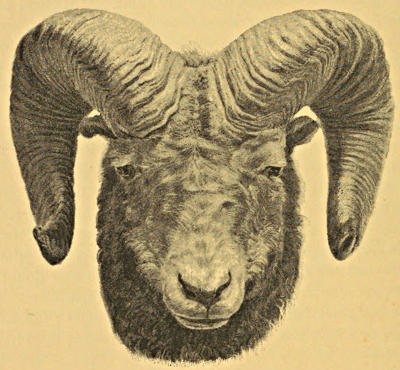
Mr. Arnold Pike’s great ram
There is a tiny sheep district very far up in the mountains
at the head of one of the Frazer’s tributaries to which my
Indian guide alone knew the trail. He had blazed it three
years before, and burnt some timber whilst he was up there,
in order that another year the sweet grasses which would
spring in the brulé might attract plenty of deer to this his
private hunting ground. From the bald top of Siyah, as I prefer
to call this ground, we could see the great hills round the
Frazer rolling down fold upon fold into their river-beds, their
sides red-brown in the sunlight, a rich dark purple in the
shadows. We were lying on the very highest ground, spying
into a hollow below us in which a solitary sheep was feeding.
‘Yoharlequin,’ muttered the Siwash, ‘it is a ewe.’ Just as he
spoke we both crouched close to the ground, though we were
safe enough even from a bighorn’s marvellously all-seeing eyes,
for at that moment five more sheep walked slowly into sight.
There was no doubt as to the new-comers. We were looking
upon the finest bit of sheep ground I had ever seen, and the
five were worthy of it. There was one enormous ram, two
which would have satisfied any man, a fourth such as I had
often killed before, and a small fellow.
Everything seemed to favour us at first. The little glacier
at the head of the dark gulch had sent a snow-stream tearing
through the hollow, and this had cut a deep course up which
we could sneak unseen. I suppose the water must have been
bitterly cold, but we crawled through it for ten minutes without
so much as noticing that when we had to come down to our
knees the icy current ran into our trousers pockets, and
though the wind blew off the glacier it was welcome, because for
once it was right in our teeth. In the middle of the gulch was a
big mound, and 240 yards from this (I measured the distance
afterwards) stood the glorious three. Unless we could have
burrowed, no man could have crept closer unseen, so that from
this point I had to fire. But why tell the story, and what is
the good of trying to instruct others when I so often break every
rule myself? Three things I did on that day which I ought
not to have done, and I paid the penalty for my folly. First, I
took my Indian with me on the stalk, and, of course, at the
critical moment he flurried me with his accursed ‘Shoot, shoot!’
He knew what the ram was like upon which I was trying slowly
to draw a bead. Then I took two rifles with me upon that
trip, and shot sometimes with one, sometimes with another.
The result was that I shot badly with both, and knew nothing
of either of them. Lastly, when I had missed or only
wounded the big ram, I lost my head, and instead of waiting
until the beasts should pause for a moment to look back, I fired
three fluky shots at them ‘on the run.’ Not until the big beasts
were behind a piece of rolling ground did I realise what a fool I
had made of myself, and then, as we wanted meat badly, I took
a quiet steady shot at the little ram which had hung behind,
and killed him neatly at a good 400 yards—a shot which under
ordinary circumstances I should never dream of attempting.
After waiting for awhile we followed the wounded beast,
hoping that as we had given him time he would lie down and
afford us a chance of another stalk. But, as the Indian said,
‘there was no lie down in that ram.’ He could only go very
slowly (at a walk), but he could keep going, and over the
ground to which he took us we could do no more.
We tried everything that we could think of to circumvent
him, but it was no good. When the dusk was falling I got
my last view of his great white quarters, lurching slowly over
yet another ridge. He was evidently bound for a far country,
and had no intention of stopping until he reached it; I was
limping almost as badly as he was, and was far more ‘done.’
I had left a nasty piece of rock and ice behind me to recross
on my way to camp, I had not a notion how far I had come,
where my Indian was, or which was the nearest way to my
camp, so with a heart full of bitterness I turned back, vowing
to track him on the morrow and stay with him as long as he
stayed in British Columbia.
But then I knew only that he was a very big ram. When
I stood beside the beast which the Indian and myself had
taken for a two-year-old at most, and taped his horns at 14½
ins., I had a better idea what the beast must have been like
beside which this fair ram had seemed a pigmy. Of course,
that night enough snow fell to hide the tracks of a mammoth!
I try sometimes to console myself with the reflection that after
all he was probably only a 16- or, at most, 17-in. ram, but it
won’t do. I know better. From blood-stains upon the rocks
(my Indian had my glass) I am pretty sure that I shot through
the withers the first time, and probably hit him very far back
with one of the others.
It is an extraordinary thing that though sheep so often turn
and bolt downhill when merely frightened, a wounded ram,
especially a big one, will struggle on higher and higher as long
as life and the possibility of ascending lasts.
I have noticed the same habit in Caucasian tûr; but, of
course, my experience may be exceptional.
Sheep rut in October, but the season varies somewhat in
different localities, being a little later in some than in others.
However, in a good sheep country the hunter may be pretty
sure of hearing the hollow clang of the horns of fighting rams
some time in October, and, at least, he may be sure that in
that month he has the best chance of coming across the really
big beasts, which, his Indian will tell him, retire during the rest
of the year to the very highest peaks. This I doubt myself, as
I have always tried the highest ground, and never done any
better there with the big rams than elsewhere. My own belief
is that all the sheep frequent the open tops in July and August,
when the grass is fresh where the snow has but recently disappeared;
that in September they come down nearer the timber,
and even into it, in search of sweeter feed than that which the
sunburnt tops afford; that during this time the old rams are
away by themselves hiding in the bush; and that in October,
when the uplands have been revived by the late autumn rains,
the ewes seek the hill-tops again, and the amorous rams follow
the ewes.
But at whatever season you seek the bighorn, remember
that he is very easily driven away, that all his senses are
exceptionally keen, and that from his vantage ground above
he incessantly watches the valley beneath. Therefore, if you
are changing camp, do not arrange matters so as to arrive in
a new country, which you intend to hunt, about nightfall, or if
you do, reduce the chopping which has to be done to a
minimum; don’t light big fires, and let those you light be as
much hidden as possible from the ridges upon which you expect
to find game. If possible, it is better to get to a fresh
shooting ground so early that you can do a day’s hunting before
there is any necessity for cutting timber or lighting a fire.
As it is not easy to weigh large game in camp, and as I am
no believer in guess-weights, I shall not attempt to estimate
the weight of a bighorn ram; but, bearing in mind that the
O. montana is one of the most compactly built animals in the
world, the curious in such matters may form an approximate
idea of the beast’s weight from the following measurements of
a 16-in. ram, which I took myself within an hour of his death.
Measuring him as he lay, this ram was 3 ft. 6 ins. from the root
of his tail to where the neck is set on to the shoulder; his
girth under his forelegs was 3 ft. 9 ins.; and his height, as
nearly as I could get it, 3 ft. 2 ins. at the shoulder.
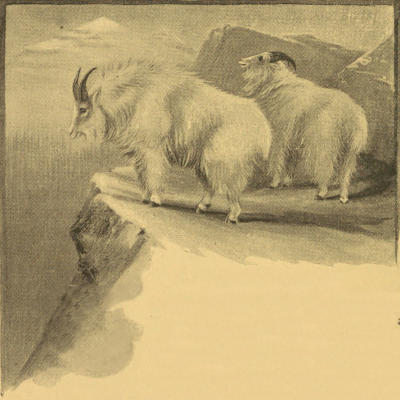
Rocky Mountain goats
The Rocky Mountain Goat may, like
other animals, vary in its habits a
good deal in different localities. In
British Columbia, which appears to
be peculiarly its home, I am bound
to say that it appears to be the biggest
fool that walks on four legs. I am aware that some authorities
upon sport, whose opinions deserve consideration, differ from
me upon this point, but living as I do at present amongst British
Columbians, I am not afraid of being contradicted by local
sportsmen when I aver that there is no wild animal easier to
stalk than Haploceros. There are many men out here who,
after having killed their first few heads, will have nothing more
to do with goat hunting, regarding it as unworthy the name of
sport. I remember well one old goat which I stalked in the
Bridge River country. The beast was a very big one, and was
first seen feeding upon a bare hillside. He was on one side
of an amphitheatre, we were on the other. Between us lay over
half a mile of rattling shale and moraine, and there was no cover
for a mouse. However, there was nothing else to hunt, and the
goat was the largest I had ever seen, so with my Indian behind me
I began the stalk. I am confident that any other beast would
have seen us before we had gone a hundred yards; we slipped
and fell, we rattled the stones about, and the whole thing was
so ludicrous that I had to sit down and laugh more than once;
but in spite of all this I got within forty yards of the poor stupid
brute, who had been looking in our direction in a puzzled way
for the last ten minutes, and felt thoroughly ashamed of myself
when I put an end to his doubts with a bullet. To give an
idea of the tameness of these brutes, I took six or seven photographs
of goats in one day last year with a very elaborate
photographic apparatus, the photographs unfortunately being
destroyed before they could be developed, when the whole
apparatus, together with my guide, went rolling down a steep
incline almost into the Bridge River.
Though not worth stalking, these goats are quaint beasts
and worth watching. As a rule, they live where nothing else
would care to, on precipitous rock faces overhanging a stream
where no grass grows, and where there is very little even to browse
upon. Just at dawn you may see them crossing a wall of rock
high above your camp in single file, or wending their way slowly
from their feeding grounds to the timber patches in which they
lie all day. They are very local in their distribution and very
conservative in their habits, infesting one small mountain in
great numbers and never seeming to stray into the neighbouring
heights. Day after day they appear to seek the same feeding
grounds, and retire to the same lairs, with a punctuality which
would be becoming in a postman. Their meat is so poor that
Indians will hardly eat it, and the market value of their hides
is only 3s. 6d. to a tourist. They occupy only such localities as
other beasts would despise, and altogether seem somewhat
justified in the mute protest of their wondering regard when
attacked, which seems to say as plainly as dumb beasts can
speak, ‘Surely you are not going to meddle with us; we, at
least, are beasts of no account.’ To obtain a good specimen
head their haunts ought to be visited as late in the year as
possible, as the coats are not so white or the beards so long in
early autumn as they are in November, and a goat’s head without
the long patriarchal beard is a poor affair. They abound
all over British Columbia, especially in such places as Bute
Inlet, and I have even seen them on the islands in the Straits
of San Juan, from which I am inclined to infer that they had
swum over from the mainland. An old billy which I shot
girthed 56 ins. round the chest after he had been skinned,
and the longest horns of which I have any record measured
11½ ins. from base to tip. The accompanying plate gives a
better idea of the queer old-world appearance of the Rocky
Mountain goat than any word-painting of mine could do. In
old days, the Indians used to make blankets of their fleece,
but the industry appears to be nearly dead, now that English
blankets have become cheap and plentiful in British Columbia,
so that there appears to be no reason why the white goat should
not be allowed to remain unmolested for many years to come.
I have seen Haploceros in Alaska as well as in British Columbia,
and expect that my friend Mr. John Fannin, curator of the
British Columbian Museum, is right in inferring that the goats
go as far north as the mountains do. The skin, measured by
Mr. Fannin, and mentioned in his article upon goats in the
‘Big Game of North America,’ is far and away the largest I
have ever heard of, a skin 5 ft. from horns to tail, by 40 ins.
from side to side, being an exceptionally large one, whereas
Mr. Fannin’s large skin measured 7 ft. by 4 ft. 10 ins.
The track of the goat is not unlike that of a large bighorn
ram, but squarer and blunter.
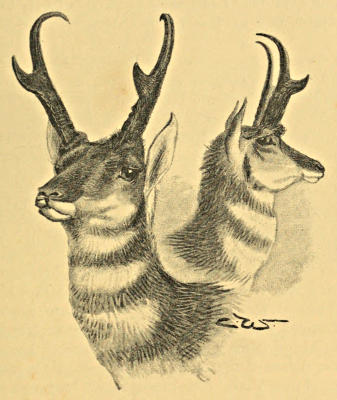
Antilocapra americana
The scheme of these volumes does not allow for a full and
detailed account of the shooting of every variety of game found
in each country. It may therefore suffice to say of this
antelope that it may be killed as any other antelope is killed,
either by stalking, the shots being taken as a rule at long ranges,
or by coursing. There are very few parts of America, if any,
in which the antelope has been so little hunted as to allow
the old ruse of flagging (i.e. of attracting them within range by
the exhibition of strange objects which arouse their curiosity)
to be practised with success. Ten or fifteen years ago, antelope
might be seen from the windows of almost every train running
west of Chicago, but now their range is vastly curtailed, and
though a few small herds may still be found in most of their
old haunts, they are not really abundant except in Texas,
in the neighbourhood of the National Park, and in Assineboia,
where in 1893 I saw two considerable bands in April
from the carriage windows of the Canadian Pacific Railway
train.
In Texas, a friend who was there in November 1892
wrote me: ‘There seems to be plenty of antelope round
here, as they are frequently brought into town, sometimes by
the cartload to be shipped.’ In California antelopes have been
almost exterminated, and the same may be said of Oregon,
whilst in Colorado the districts in which they occur are not
numerous, nor even in these does the beast exist in any numbers,
except where it has been preserved. It seems likely that the
pronghorn will be the next of the American mammals to disappear
before the arms of the white man. Like the buffalo,
the antelope is a dweller on the plains, seldom seeking refuge
either in the timber or in the high mountains, although he is
found at a very considerable altitude on the high tablelands
near Gunnison, Colorado, for example (6,000 to 7,000 ft. at
least above sea level). The season for antelope shooting should
be from August to the middle or end of October, after which
time the oldest of the bucks will have shed the shell-like
covering of their horns. The rutting season lasts for about six
weeks, beginning in September and ending in October. The
pronghorn, though an inhabitant of the great plains, is not a
wanderer as most denizens of such countries are, but seems to
attach himself to a certain district, and to remain there or near
there until his tribe has been exterminated. For instance, there
is a small band which may be seen almost any day in winter
within a few miles of one of the big cities of Colorado. The
band grows smaller year by year, but it never alters its winter
quarters in consequence of man’s persecution. The pronghorn
has, moreover, other enemies to contend against besides man
and his Winchester, the great eagles of the North-West occasionally
taking toll from the herds. An instance of this was
seen by Mr. A. Pike in Colorado last year, when the buck,
after dodging the eagle’s attacks for some time, escaped into
some brush; but such attacks are said by the plainsmen to be
fairly frequent and often successful.
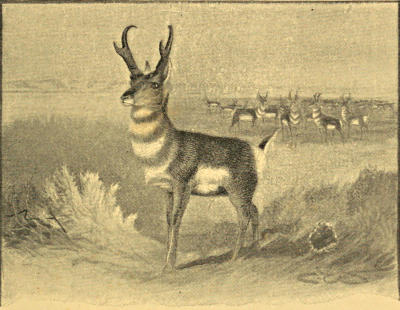
A herd of pronghorns
Mr. Rowland Ward gives 15¾ ins. as the length of the
longest horn of the pronghorn within his knowledge.
Judge Caton, an authority upon the deer of his own country,
describes eight well-defined species as inhabiting the North
American continent. These are the wapiti (C. canadensis),
the moose (C. alces), the woodland caribou (C. tarandus), the
Barren Ground caribou (C. tarandus arcticus), the mule deer
(C. macrotis), the Columbian black-tailed deer (C. columbianus),
the Virginian or white-tailed deer (C. virginianus), and a little-known
beast called by Caton C. acapulcensis.
With the last-named a sportsman is likely to have very
little to do, as its range is extremely limited and its size insignificant
(‘weight from 30 to 40 lbs., height 24 ins. at the
shoulder, and length from the end of the nose to the root
of the tail 44 ins.’; cf. Caton’s ‘Deer of America,’ pp. 121,
122), whilst its antlers, though quaint, are hardly worth taking
as a trophy. Caton gives a cut of the antlers of a full-grown
buck of this species. Of the originals of that cut Caton says
that they measure in length 7 ins. and 3 lines, in circumference
above the burr 2 ins., and that they are more
palmated than the horns of any other American deer except
moose and caribou. For further information on this deer the
reader is referred to Caton’s work, which should be in the library
of every man interested in natural history. Of the other seven
species of American cervidæ there is much to be said, and
little space left to say it in.
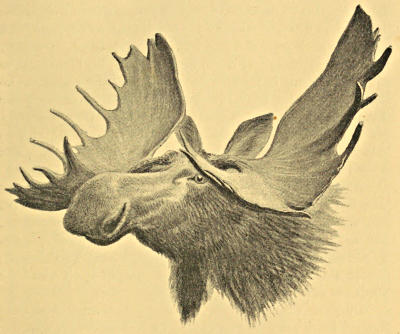
The record head
Of all deer extant to-day, the moose is the largest. Of all
earth’s animals, except perhaps old Haploceros, he bears most
plainly still the impress of Nature’s ’prentice hand when she
made things huge and roughhewn, and had no time to polish
her work and smooth off the corners. Evolution does not seem
to have affected the moose, for to-day he wanders along that
great chain of lakes from the Arctic to the Atlantic, from the
mouth of the Mackenzie River to the St. Lawrence—a survival
of the earth’s dawn rather than a commonplace nineteenth-century
deer. All sorts of stories are told as to his weight and
size. Caton, who is always careful not to exaggerate, puts the
weight of a bull moose at from 700 to 1,400 lbs., and his height
at 6 ft. at the withers. The largest pair of horns of which we
have any authentic record (the cut is from a photograph of
them) measures in span 66 ins. (or 5 ft. 6 ins.) from tip to
tip, but a recent writer in an American work upon sport and
natural history (Mr. Hibbs) describes a moose which he saw
dead in the Teton Basin, whose antlers spanned 8 ft. 6 ins. from
tip to tip, making an arch when inverted under which a man
‘slightly stooping’ could walk. This Titan of the Tetons stood,
‘without his legs under him, 15 hands high,’ so that, allowing
for the fact that a moose has, according to Caton, ‘very long
legs, to which he is indebted for his great height,’ he must have
stood in life, with his legs under him, from 8 to 9 ft. high at
the withers. This seems rather tall, even for a moose from the
Rocky Mountains. As before stated, this great deer ranges
from the Arctic Ocean to the St. Lawrence, and in spite of the
persecution of man still abounds as far east as the provinces of
Quebec and Ontario; is reported to exist in large numbers on
the head-waters of the Clear Water River, in Idaho; is found in
Montana and Wyoming, and flourishes exceedingly in the
North-Western portions of British Columbia as well as in the
adjoining territory of Alaska.
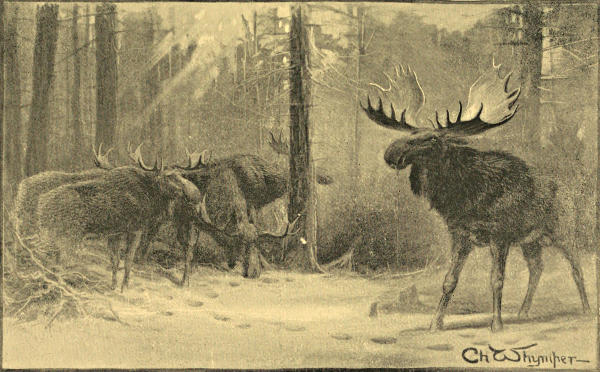
MOOSE AT HOME
With great wisdom the Legislatures both of Canada and
the States have taken the moose under their protection, but the
great deer would be in no danger of extermination even if the
law had overlooked him, as he has haunts still remote, and
except in deep snow can take very fair care of himself; indeed,
even as lately as 1887 I could have killed seven bull moose in
six days’ hunting in Ontario had I been butcher enough to do
so, whilst in 1891 I saw two canoes (big freight canoes) come
down loaded with magnificent moose horns from a district
where almost the only residents are a few Siwashes (Indians)
and some Chinese miners! Where Chinese kill game, game
must be fairly plentiful still.
Although as big as a haystack, the moose is not quite as
easy to hit, nor is he everybody’s ‘meat.’ His favourite haunts
are the dense thickets round lakes and about river-bottoms,
the dark balsam groves, hardwood hills, and brulé patches
of Ontario, and wherever the lily pads, moose wood, swamp
maple, alder bushes, coarse grasses or mosses upon which he
feeds are most luxuriant.
By some strange fatality, wherever things are most convenient
for the moose they appear to be least convenient for
the hunter. The scrub over which the moose looks without
raising his ugly head closes over and drowns the unfortunate
biped who tries to follow him; the fallen trees and huge logs
which the moose takes comfortably in his stride must be
climbed by the hunter, and yet, in spite of his size, when the
big bull has answered your call and has come crashing through
the alder and swamp tea to within twenty yards of you, he is
likely enough to halt in the shadow, detect the fraud, and steal
away without a sound.
Like other deer, the moose seems slow to identify objects
with his eyes, but there is no doubt about the keenness of his
other senses. If it pleases him to answer your call, though his
answer may be all but inaudible to you, you need not call again
unless you like. Through a mile of brush which to you appears
a pathless tangle he will steer straight to the square yard from
which your call came, unless a bough should scrape against
your overalls or a tiny puff of wind carry the faintest suggestion
of your presence to him. If either of these things happen, the
moose will make up his mind without stopping to think. In
addition to the keenness of his senses the bull moose is
credited with considerable pugnacity when pursued and
‘cornered,’ and he undoubtedly is a bit of a strategist, choosing
his couch, for instance, invariably in such a position as to
command the country all round. The Indians, when following
a moose’s track, will, oftener than not, keep describing a
succession of semicircles, so that, instead of walking in the bull’s
tracks, they cut them from time to time. This is done to outwit
the bull, who, they say, when he means to lie down will
turn aside and walk back parallel to his trail, and lie down with
his head towards his back tracks, so that either his eyes or his
nose must give him warning of anyone who attempts to follow
him.
There are three principal methods of hunting the moose
besides the foul practice of snaring him with a loop in his run
ways or of butchering him in his yards (i.e. in those camps and
feeding grounds which moose stamp out for themselves in the
deepest snows of winter). The favourite method (in Canada, at
any rate) is ‘calling,’ a birch-bark horn being used night and
morning to imitate either the cry of the bull or of the cow, and
so lure a would-be mate or rival (as the case may be) to his
ruin. September is the season of the rut in Lower Canada,
and during the earlier part of this season the bull seems nearly
beside himself with rage and unrequited passion, wandering
constantly in search of a mate or a rival, and filling the woods
with hoarse calls or hoarser challenges. About one man in a
million is clever enough to mimic these calls, and if you
are lucky enough either to be that man or his employer,
you may take advantage of the moonlight and lie out behind
some log or bush watching the skyline and listening
while the half-breed (it will probably be a French half-breed)
grunts and roars upon the horn, imitates the thrashing
of the bull’s antlers amongst the alder-bushes. Experts
disagree as to the amount of skill required to call a moose.
Some say that any noise is good enough when he is really on
the war-path, that the chopping of an axe or the bray of a
donkey will ‘fetch’ him; others again affirm that the nicest
accuracy is necessary in imitating every call, and I am bound
to admit that, though I have never met a man who had seen a
moose drawn to his ruin by the sound of chopping, I have more
than once known that a moose owed his life to the fact that
my overalls were made of a peculiarly harsh material from which
the brush in passing managed to elicit a very penetrating sound.
If all goes well with the caller, it may be that at last he will
hear, faint and far off, a hoarse response from the depths of the
swamp below him, a response repeated from time to time, and
growing each time nearer, until at last, if he can hear anything
but the beating of his own heart, he will hear the scrub crunched
under the foot of the advancing monster. As long as all goes
well, the quiet night betrays the bull’s every movement to the
hidden man, almost as clearly as if the hunter could watch the
whole play with his naked eyes. Now the bull comes crashing
up from the swamp through the alder-bushes, now he is standing
listening half in doubt as to whether to come on or go
back, but the half-breed is prepared for the emergency. Good
as he is, he dare not try a call at such close quarters, but
he strikes the horn against the scrub and the bull comes on
again, thinking that he has heard the rattle of his enemy’s
weapons.
When at last, with strangely little warning it seems to you,
and much closer to you than you had expected, that monstrous
form looms up against the half-light, remember to look at its
shoulder, and try not to merit my Indian’s reproof to me when
a bullet went six inches too high—‘All same again, you allus
look at the horns instead of the bull, cap.’
Moose calling has almost every attribute of true sport. To
succeed, a man must know the habits of his quarry and have
admirable opportunities for studying them; if he ‘calls’ himself,
he must have an excellent ear and be a perfect mimic,
and for him the morning and the evening, moonlight and the
grey of dawn, lend their beauty to the beauty of the silent
woods. But for some men, ‘calling’ hardly gives the man
enough to do. To these men I recommend still hunting over
the hardwood hills about the time of the first snowfall, when
there is enough snow to track in, with a good French Canadian
half-breed as a guide. To my mind there is hardly any better
sport on earth than to follow the great tracks through the new-fallen
snow, through woods beautiful beyond all description
with the beauty of a Canadian winter, over hardwood hills, and
through patches of brulé, and then down into a bed of frozen
willows, silvered by the frost, and jewelled by the sun, through
swamps of tea-bush off which the frost falls in showers of crisp
scales, until late in the afternoon you run up to your beast in
a heavy grove of balsam, looking intensely black against the
blinding purity of the snow. But for this sport you want young
limbs and strong ones, and the wind and endurance of a temperate
and clean liver. You want these for any sport worth
the name.
There is yet another way of hunting moose, when the snows
are down and the crust upon them is strong enough to bear a
man on snow-shoes, but not strong enough to carry the moose.
Of course, all the odds are against the animal, but still this is
exciting sport, making tremendous demands upon the man’s
endurance; and it is moreover when pursued in this way that
the moose is said to turn ‘ugly’ and sometimes hunt the hunter.
Provided that a man only kills old bulls, and not too many of
them, I see no objection to this form of pursuit. The percentage
of men who can run to within shooting distance of a bull moose
when trying to escape through his native forest, even when
the snow is at its worst for the bull, will never be very great,
and the excitement of the sport must be intense. I have never
yet had a chance of trying it.
Even when a man is in the best of luck, what he generally
has to shoot at, and that in a hurry, is not a beast 8 ft. high,
weighing 1,400 lbs., standing broadside on in the open, but
a small piece of brown passing between the boles of the pine-trees
in deep shadow, one or two hundred yards off. The
Indian may tell him that what he sees is a moose. Nine men
out of ten would not have discovered the fact for themselves.
The creatures of the nineteenth century are the children of
the earth’s old age. The days of the giants are over, and the
days of the pigmies are upon us. When our naked forefathers
were armed only with bows and arrows, there were elk in
Ireland whose antlers spanned 11 ft. from tip to tip, and even
in the more recent days of the Hudson Bay musket, there were
(so men say) wapiti in Wyoming whose antlers when inverted
formed arches under which a six-foot man might pass without
stooping.
Alas! there are no such wapiti nowadays, and indeed,
although there are scores of men in the States who will assure
you that they have themselves walked under such arches, it
is very hard to believe that they are not mistaken, in the face
of the fact that a four-foot man could not walk under the
largest head known to be in existence at the present moment,
though the longest wapiti head in the American Exhibition
of 1887 (belonging to Mr. Frank Cooper, and numbered 89 in
the catalogue) is described as measuring 62½ ins. along the back
of the beam from base to tip of the longest tine, with an expanse
between the antlers of 48½ ins.
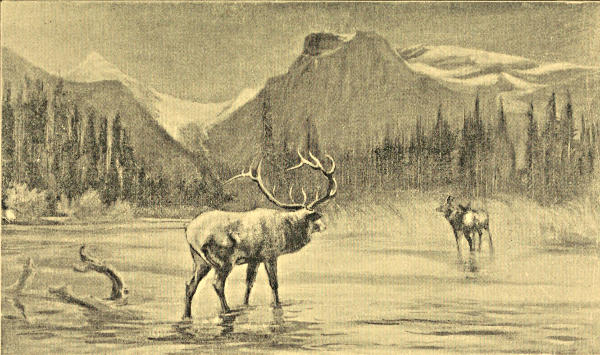
WAPITI IN THE EMERALD PASS, B.C.
It is not easy, either in America or elsewhere, to find a head
(dead or alive) which will beat this by an inch in any direction;
and yet, if this head were inverted, no four-foot man could walk
without stooping under the arch so made. During several years
spent in wandering about Canada and the States, I have heard
again and again of gigantic wapiti heads; I have even met men
who own such trophies, and have actually bought them for
$500, the money to be paid when the ‘head’ was delivered.
Unfortunately, my cash was never claimed, and I confess that
I never expected that it would be, yet some of the trophy-owners
wanted money ‘in the worst way.’
But though the ‘bull elk’ of to-day is neither as large as
the Irish elk nor as the ‘elk’ of pioneer legends, he is still a
magnificent beast, not quite as big as the moose and not
carrying a very much larger head on the average than the
Caucasian stag; but still, take him all in all, he is the grandest
stag left on earth. To an unscientific eye, the wapiti differs
from the Scotch red deer in three points only: he is larger
of course, his antlers as a rule lack the cup peculiar to the Scotch
royal, and his call in the rutting season is a whistle, whilst the
red deer’s is a roar. His range in America is still a wide one,
although the encroachments of civilization are driving him
ever further and further back into that dense timber of which
he is always too fond. It is this love of the timber which
has enabled the wapiti to outlive his old comrade the bison,
and will probably enable him to survive the antelope, which
seems likely to be one of the next animals wiped off the face
of the great American continent. In the mountain forests of
Wyoming and Montana, of Idaho and Colorado, wapiti are
still fairly plentiful; in California, I have heard that there are
a good many in the red-wood districts, though of this I have
no certain knowledge; but there is no doubt that the home,
par excellence, of the wapiti to-day is in the dense timber of
the Olympian range, in Washington Territory, in Oregon, and
to a certain extent in Vancouver Island, British Columbia.
In the early part of this century there were wapiti on the mainland
of British Columbia, and their bones may still be found
pretty frequently in the Chilcotin country; but the animals
themselves are said to have been exterminated by the Indians
or starved to death during an exceptionally severe winter sixty
or seventy years ago. Be that as it may, there are no wapiti
on the mainland of British Columbia to-day, nor are there
anywhere (unless it be in the fastnesses of the Olympian range)
any vast herds of this splendid beast such as we read of in the
books of the pioneer sportsmen of the North-West. For this
change for the worse we have to thank the meat-hunter, the
skin-hunter, and the ranchman about equally, although perhaps
the advent of cattle does more to drive deer out of a country
than anything else. As an example of what was as compared
to what is, I may cite the case of my old camp man, Sam Wells,
who, when the Union Pacific Railway was being built to the
west of Cheyenne, killed, in his capacity of meat-hunter to the
construction party, 84 antelope, 24 elk, and 18 deer during one
autumn; whereas this year, in the best bit of country known to
him in Colorado, our camp was many days without meat, and myself
and my friend were looked upon as exceptionally fortunate
in having secured three good heads (wapiti) in three weeks’
hunting. It is fair to add that the country hunted, although
comparatively little disturbed, was very near to a good-sized
town.
It is said that before the advent of the white man the wapiti
frequented the plains, where the rich bunch grass helped to
build up the enormous antlers of which we hear so much
and see so little. Nowadays men and cattle have driven the
wapiti from the bunch-grass plains, and he has become almost
entirely a denizen of the dense timber districts.
In Colorado, where I hunted wapiti in 1892, we found our
game in the timber at an elevation of 10,000 ft. above sea
level, but I have shot them in equally dense timber on Vancouver
Island at little above sea level. Speaking broadly, the
habits of the wapiti and of the Scotch red deer are identical,
except for the former’s detestable predilection for timber.
About the beginning of September the ‘bull elk,’ as all
Americans insist on calling him, has rubbed the velvet off his
antlers, and ten days later these antlers are dry and hard and
fit for fighting. The rubbing, or ‘fraying,’ is generally done
against the stem of a quaking asp or young green pine, the
wapiti never using a dry stick for his rubbing-post. As soon
as his horns are dry, the bull begins whistling or bugling, this
whistling being kept up until about the middle of October. I
am inclined to think that the whistling (i.e. the rutting) season
varies a good deal in different districts according to the seasons
and the altitude at which the bulls find themselves. In Colorado
in 1892 we heard the first whistle on September 16th,
and the last about three weeks later; and although our old
guide considered 1892 an exceptionally early season, I fancy
that from the middle of September to the middle of October
may be looked upon as the ordinary rutting season of Cervus
canadensis.
There is nothing about the wapiti more characteristic or
more striking than his whistle, a call wild enough and weird
enough to harmonise with the savagery of the beast’s surroundings.
I have never yet met a man who could imitate the
whistle or even adequately describe it; but if I must attempt
to give some idea of it, I should say that it was a long flute-like
sound, sometimes rising and falling, and ending more
often than not in two or three hoarse, angry grunts. Like the
Scotch red deer, the wapiti carries his horns until March, my
friend Mr. Arnold Pike having seen two old bulls with good
heads on the 29th of March of this year. In Colorado, as
in Vancouver Island, each band of wapiti seems to confine
itself pretty closely to a particular district, never moving more
than twenty or thirty miles from one place, but travelling on
occasion from one side to another of its domains with a rapidity
which is exasperating to the hunter who has to follow with a
pack train. Early in September the principal food of the
wapiti appears to be the pink-flowered fireweed (phlox), which
grows in rank luxuriance amongst the burnt timber; and later
on, when the frost has nipped the tops of the young elder
bushes, these seem to attract a good deal of the great deer’s
attention. But Cervus canadensis is a somewhat promiscuous
feeder, all grasses and most weeds and bushes seeming to be
included in his list of things to be eaten. The young tops of
the quaking asp, of the willow, and of a low creeping shrub
locally known as elk weed, all seem favourites in their season.
On such food as this the wapiti grows to prodigious proportions,
of which the following measurements, supplied by Mr.
Andrew Williamson, give the best idea. Mr. Williamson killed
sixteen bulls in one season in Colorado in 1878, of which the
largest measured 9 ft. from the tip of the nose to the tail, stood
17 hands at the shoulder, and girthed 6 ft. 8 ins. round the heart.
The average measurements of eight out of the sixteen bulls
were as follows: Length from nose to tail, 8 ft. 5 ins.;
height at shoulders, 16 hands and ⅝ in.; girth round the
heart, 6 ft. 1 in. Compare these measurements with those
of the largest racehorse on record, and you get some idea
of the size of the wapiti, though even then the figure which
you will conjure up will be small compared with the apparition
which sometimes confronts a Western hunter upon the skyline,
or to a ‘bull elk’ at bay with his head down, his bristles up,
and his eyes glaring angrily at the insignificant collie yapping
round him. The average length of the antlers of Mr. Williamson’s
bulls is given as 53 ins., and the span of these antlers,
measured inside the beam, as 44 ins. As to the weight of a
wapiti, it is unfortunate that the man who kills one has very
rarely any apparatus at hand for weighing his prize; and even
Mr. Caton, the great American authority upon the Cervidæ of
North America, gives neither measurements nor weights of full-grown
bulls.
In his work upon the deer of America, this writer mentions
a bull once in his possession which when killed, as a five-year-old
weighed 900 lbs. live weight; and adds that ‘as the elk
grows till he is eight or nine years old, he (this bull) would,
had he lived to his full age, have attained to the weight of
1,000 or 1,100 lbs.’ Colonel Dodge, in his ‘Plains of the Great
West,’ puts the weight of an average ‘elk’ at only 500 lbs.,
although he qualifies this by adding that one has been killed
which weighed 800 lbs.; while Mr. Andrew Williamson, in his
‘Sport and Photography in the Rockies,’ guesses the weight of
his big bull at 1,200 lbs. But most of this is guesswork. The
nearest approach to an accurate record of weight in my possession
is taken from a statement made to me by an old Western
meat-hunter in whose truthfulness I have every confidence. This
man told me that the hind-quarters of the largest bull he ever
killed (‘and I cut ’em off pretty high up,’ he added) weighed,
when taken into town, a little over 400 lbs. From this it would
appear that the live weight of the whole animal could not have
fallen far short of Mr. Williamson’s estimate of the weight of
his big bull.
In spite of the fact that no large areas of food pasture are
known on Vancouver Island, the wapiti found upon it do
not, in point of size, fall far short of those upon the mainland
of the American continent. I have myself, at the head of
the Salmon River on this island, shot a bull which measured
rather over 16 hands and 1 in. at the shoulder, and appeared
to be a heavy stag for his size. Indeed, if the wapiti of Vancouver
Island vary at all from deer of the same species on
the mainland, it is in their antlers, which have always seemed
to me to be peculiarly heavy in the beam and narrow in the
span, whilst amongst them I have more than once noticed
specimens having cups similar to those of a Scotch royal: a
somewhat remarkable fact, as this formation is exceptionally
rare amongst the wapiti on the mainland of America.
To anyone who has read this chapter thus far believing
what he read, it must appear that Cervus canadensis is as fine a
game animal as the heart of a hunter could desire. But I have
only presented hitherto the fair side of the picture; of course
it has another. The wapiti is superb, but his habits are beneath
contempt. While the gallant mountain ram lives out on the
open hill-tops, staking his life boldly upon the keenness of his
own senses, the great ‘bull elk’ sneaks about in the shadows
of the densest timber he can find just below the edge of the
sheep ground, pottering about the beds of mountain streams,
poking his head noiselessly through the thickets of willow
round the parks, picking his way gingerly over chaotic windfalls
of burnt timber, and dozing by day on the top of some
woodland ridge which a shadow in moccasins could hardly
reach unheard.
But ‘what’s the good of gassing?’ as old Sam Wells would
say. Come away to my camp in Colorado and see the bull
elk for yourself. And first let me warn you that here in his
own land, Cervus canadensis is ‘elk,’ or ‘bull elick’ on occasion,
but never wapiti. The ‘boys’ don’t know what a wapiti is;
never ‘heerd tell on him’ as like as not. Cervus canadensis is,
of course, the wapiti of the naturalists and a few thousand
Englishmen and scientific gentlemen, just as the buffalo is the
bison of the same well-informed circle; but to sixty or seventy
millions of white men these beasts are elk and buffalo, now,
henceforth, and for ever. The ‘boys’ round camp are rude
enough to say that ‘they know what a bull elk is, and if they
don’t, who the —— does?’ and as I hate arguing (where
arguments are sometimes six-chambered), it may be as well
to call Cervus canadensis by his local name for the next few
pages.
Our camp, then, is pitched at an altitude of nearly 10,000 ft.
above sea level, on the edge of a great park or ‘open’ of
rank yellow grass, through which a mountain stream twists and
turns. Years ago, before Sam Wells cleared them out, beavers
had dammed this stream, and the park stills owes a good deal
of its richness to their operations. Above the park in a great
circle the dark ranks of the pine-trees close in; whilst above
them again rise the bare ridges and strangely castellated tops
of the ‘divide.’
In the early summer the elk may have wandered upon those
bare ridges (their tracks prove it, and a natural desire to avoid
their insect tormentors accounts for it), but they are not upon
those ridges now. As the rutting season approaches the elk
come down from the high places, and in September every
one of the forty or fifty beasts which live all the year round in
this little district is within that dark belt of timber, worse luck
to it!
Since June there has been no rain in the State of Colorado,
nor can even the most sanguine of us see any promise of rain
to come in the crystal clear vault above us.
By day the sun is hot enough to make men sit about in
their shirt-sleeves, but by night the frost makes us draw our
blankets closer, and almost wish for another pair. It is perfect
weather for picnicing in the woods, but it is impossible weather
for still hunting.
Between them, sun and frost and mountain air have made
the woods dry as a chip and crisp as a biscuit. The woodland
solitudes are more noisy than Chinatown at New Year: the
leaves rattle like dead men’s bones, and the twigs seem to
explode like fire-crackers under your feet.
But it is September; the hunter’s moon has begun, and
now and again, just about dawn or towards evening, there is a
hollow whistle from the depths of the pine forests, followed by
a succession of hoarse choking grunts. This is the love song
of the great bull, and for the moment he is careless of rustling
leaves and snapped twigs, and, being in love, is as great a fool
as a biped under similar circumstances. Nor is love the bull
elk’s only excuse for imprudence just now. In summer the
great woods are still, but for the hum of insect life; in winter
they are still as death; but now, in late autumn, they are full
of sounds. Winter is coming, and everything that has breath
is busy laying in stores for the approaching snow-time. All
day long there is a rattle among the brush as creatures bustle
through it; all day long the great fir-cones come thumping
down from the pine-tops, while the squirrels who are gathering
them chatter and swear at one another with the vigour and
bitterness of rivals in business. Chipmunks, engaged in the
same work of harvest, skip like long-legged streaks of light
along the logs, and the short-tailed grey rats are as busy as
either squirrels or chipmunks. As you cross the hillside, your
foot sinks deep into the light soil, for the earth is full of little
tunnels, and every tunnel is choked with garnered pine-cones;
whilst in the high places amongst the rocks you come now and
again upon a miniature haystack, neatly cut, and made of dried
Alpine flowers and grasses, prepared for winter use by one of
Nature’s invisible workers.
As you lie upon the hillside in the warm sun at noon, with
the timber all below you and a good day’s work behind you,
you will have time to note these things; but just now, though
the stars are still visible, you should not be ‘foolin’ around
camp’ any longer, if you want to get a shot at a bull before
sundown.
It is no good pleading that you have toiled for a fortnight
and seen nothing; that your limbs ache, your clothes are torn
to rags, and your hands and feet wounded by the beastly dead
timber. Such heads as bull elk wear in Colorado can only be
earned nowadays by early rising, long patience, and honest
hard work; so off with you, while the rime is on the sage
brush, in spite of the temptation to stop until Sam has cooked
just one rasher of sow-belly. The first crossing of the brook,
before you are a hundred yards from camp, will effectually
wake you up and make you step out, unless you want to ‘freeze
solid,’ for the stepping-stones at this early hour are coated with
ice, and neither courage nor caution, neither moccasins, nails,
nor even sand, can save you from a cold plunge. Great
Cæsar’s ghost! how cold it is; and how warm even the woodland
bogs strike after that running water!
Here, within half a mile of your camp, is the first sign of
elk; a great wallow made in the marsh late yesterday evening,
and running from the wallow is a trail, well beaten, which
leads, as you know, by a very circuitous route to that bare
patch of red mud where the elk lick for alkali. But we have
no time to follow the trail to-day, more especially as the elk
seem to leave the lick before dawn. Our hunting-ground is in
a belt of burnt timber very near the top of the divide, and to
reach it in time we must climb straight up one ridge after
another without staying to look for trails and easy places.
From camp the belt of timber looks as if it lay upon a smooth,
gently rising hillside. Once within it, you learn that the belt
is composed of densely timbered ridges rising one behind
another like waves in a choppy sea, and as you toil through
and over these ridges, you wish, if you are an ordinary man,
that you had never heard of elk.
Everywhere the trees crowd one another for light and
breathing room, but so long as they are standing (unless they
are young green pines) a man may walk at ease among them.
It is when fire and wind have swept through them and left
them in chaotic tangles upon the ground that the trouble
begins. Then it is that the elk hunter has to rival the squirrel
or Blondin, tacking from point to point along the pine logs,
now straining every muscle to get a grip on the slippery trunk
of a pine which offers a bridge uphill across the prone carcases
of its fellows, now manfully suppressing an oath as his feet slip
and he sits down inadvertently upon the ‘business end’ of a
rampike.
For an hour, perhaps, or two, there is little or no change in
your work. Your road may lie through dense green timber
at one moment, through half-lit mossy glades at another, and
the next through hollows full of burnt timber, amongst which
the elk tracks are thick, and the pink fire-flower blooms; but it
is always uphill work, and almost always in places where still
hunting is impossible. Now and again there is something to
cheer you up and encourage you to make fresh exertions.
Now it is a great track like a deer’s, but larger and blunter;
now it is the stem of a young quaking asp with its bark hanging
in ribbons, which makes your heart beat quicker; or perhaps
it is only the freshly nibbled buds of a young elder bush.
There is no doubt that there are elk about, and a good
many of them, and as you stretch in vain to reach the scars
upon the quaking asp, you realise that there are big bulls
among them; but what is the use of the biggest bull if you
are never to see him within two hundred yards? Once to-day
you heard a bough break several hundred yards below you,
and a few minutes later you saw the warm lair from which an
elk had stolen away; but you never saw him, never even heard
him, until he was well out of range.
‘Hang the luck!’ you mutter; in another hour the wind that
rises about noon will get up and then the odds will be doubled
against you. Will the luck never change? Well, yes. Just as
you are deciding for the twentieth time that you never will
hunt elk again, there is a long hollow whistle among the pines
below you. The whistle is faint and far off, and if you had not
been sitting down and at rest you would never have heard it.
You have, as a matter of fact, failed to hear two or three similar
whistles during the morning—whistles which a better woodsman
would have heard, and which even you would never have
missed had you taken Sam’s advice and gone slow, ‘settin’
down once in a while to listen.’
You are not likely to see a motionless stag when you are
scrambling through the brush, or to hear a bull’s stealthy tread
upon the trail, or his distant call, whilst you are forcing your
way through a barricade of burnt timber.
Well, luck, which after all counts for more in hunting than
all the skill and experience of the best hunter—luck has favoured
you at last, and there the whistle comes again, and directly after
it another, followed this time by deep, hoarse grunts, so deep
and hoarse and so close to you that, as Sam puts it, ‘your hair
almost lifts your cap off your head.’ That last bull was within
five hundred yards of you, and there can be no doubt about his
size. Creeping forward, you look cautiously over the brow of
a little ridge on to a flat, where amongst the black, burnt stems
of the dead pines the tall jungle of fireweed is vivid with every
shade from fresh green to royal purple, scarlet, and orange, and
even as you look, without a sound, a great head is pushed out
from a bunch of quaking asp. For what seems to you an age
the cow stares straight at you, and then, when you are almost
in despair, moves quietly into the open followed by her calf.
In another moment the bull appears on the cow’s trail, without
any display of that caution shown by her. There are others,
you think, still in the timber, and a gleam of brown moving
between the pine stems convinces you that you are right; but
there is no doubt that this is the master bull of the herd, and
you fairly catch your breath at the sight of his vast antlers.
As he stands there, sounding again his weird, unearthly
challenge, you realise that you are looking upon one of Nature’s
masterpieces set in a fitting frame. When your finger presses
the trigger it will destroy the picture, and yet if you hesitate
much longer all your labour will be lost, and you will have no
royal trophy to remind you of this day, when the good rifle is
rusting with disuse and your limbs are stiff with old age.
For my part, if I could get a camera which would do good
work at a hundred yards, I would rather press a button than
a trigger. However, like the rest of us, the bull must die some
day; if you don’t kill him there is a ‘prominent citizen’ somewhere
who made a pile in hardware, who will give a hundred
dollars for those splendid antlers, and the bar-tender in the
same city (a gentleman ‘way up in the Order of the Elks’) will
give five dollars apiece for his tushes, so that, after all, you
may as well fire the shot and take the spoils yourself.
For a moment the woods ring with the report; the other
elk vanish like the figures of a dream, but the bull stands
unflinching, as if he had neither heard the shot nor felt the
sting of the bullet.
A little shiver creeps over him, and he seems to draw himself
together. A moment he stands a royal figure amongst the
grey mosses of his native forest, above his head a haze of
golden aspen leaves, like drops of pale gold in a sea of deep
amethyst, and then he staggers and crashes down amongst the
giant pines lying dead like himself athwart the forest floor.
The sport is over; there is nothing left to do but butcher’s
work; the forest which a moment ago seemed full of moving
forms is empty and still again—and are you quite sure that
there is no reproach in the silence? It seems almost a pity
that sport must end in the death of such a noble victim.
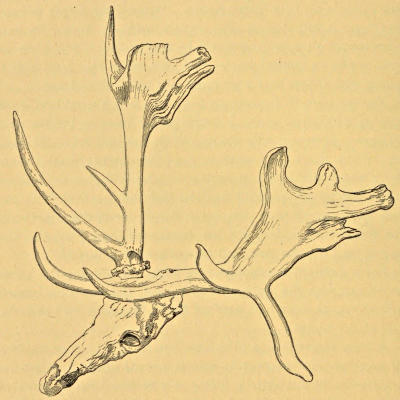
Abnormal palmated wapiti head
The largest wapiti head of which I have been able to obtain
trustworthy dimensions belongs to Messrs. Schoverling &
Daly of New York. This head measures in length along the
beam, 64 ins. (left) and 65 ins. (right); its greatest width is
48 ins. The circumference of the beam is 7⅝ ins. It is a head of
14 points. A cut of an abnormal wapiti head from Boseman
is here given, and it is perhaps worth mentioning that this
apparent tendency to become palmated is not rare in the
horns of wapiti. An exceptionally fine head in the possession
of Mr. G. B. Wrey is a good instance of this tendency and has
also the remarkable girth of nearly 9 ins. in the beam. The
beast was, I believe, killed in Montana.
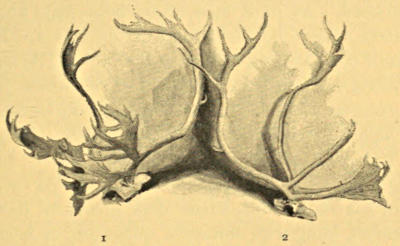
1, Woodland caribou; 2, Barren Ground caribou
If we except C. canadensis, the woodland caribou comes next
in size to the moose, amongst American cervidæ. Luckily
I have been able to obtain some accurate measurements of a
bull caribou, taken while the beast was still in the flesh by
a man who knew the value of precision. This bull, killed
in 1890 by Mr. John Fannin, measured from the nose to the
root of the tail 6 ft. 7 ins.; stood 4 ft. 5 ins. at the shoulder,
and 4 ft. 7 ins. behind the saddle on the rump; his girth just
behind the forelegs was 5 ft. 1 in., and the length of his
neck (measured along the top) was 1 ft. 5 ins. His weight was
never accurately ascertained, but a fair estimate would be
400 lbs. live weight. These dimensions seem to me to give
a better idea of this long, low, heavily-built beast than any
which I could pen, but I freely confess that one of them
comes as a surprise to me. I should never have imagined
that a caribou stood higher behind than he does in front,
but I know my authority too well to doubt his accuracy in
such a matter. Our British Columbian caribou is reputed
to grow larger than the caribou of Eastern Canada, and those
heads which I have seen in the east were certainly not nearly
as fine as heads which I have seen out here. It is said, too,
that the British Columbian caribou is darker in colour than his
eastern cousin: a bull killed here in September is nearly as
black as a bull moose, and a cow set up in the British Columbian
Museum is even blacker than the bull. This seems worth
noting, as Caton says of C. tarandus, ‘the colour lighter
than any of the other deer.’ The head figured is from
a photograph of one killed in British Columbia, and may be
considered fairly typical, except perhaps that it is too symmetrical,
and that the ploughs are too even. As a rule, one
plough is large and much palmated, whilst the other is a mere
spike. A large British Columbian caribou head measured
3 ft. 6 ins. in length, 3 ft. in span, and 6 ins. in circumference
above the big tine, but I have no record of any exceptional
head. As most men know, both male and female
caribou have antlers, but the antlers of the cow are light and
insignificant compared with those of the bull. The antlers are
clear of velvet some little time before the rut, which begins in
British Columbia when the first snow begins to fly (in September)
in those high upland districts which the caribou inhabit.
The two or three haunts of this deer known to me in
British Columbia are all similar in character, lying very high at
the top of the timber-line, where dark groves of balsam and
other conifers, hung with immense quantities of beard moss,
alternate with open glades of yellow swamp grass. The snow
in these districts remains unthawed in the timber till late in
May, and begins to fall again about the middle or end of
September, but the exposed tops of the rolling highland above
the timber are said to be free from snow a little earlier than
the timber. In early summer the caribou frequent these high
grassy downs, lying close to the large patches of snow left in
the hollows, seeking as far as may be to avoid that pest created
for their special annoyance, the caribou fly. Later on, in
August, the caribou are hard to find, having left the hills and
sought (so the Indians say) the seclusion of the densest brush
to rub off their old coats, clean and burnish their antlers, and
generally make ready for the rut. The best time to hunt the
bulls is in the rutting season, when they are a little less cautious
than usual, and when there is generally a good ‘tracking snow’
to help the hunter, who requires all the help he can get in his
match with the keenest-scented beast on earth. Dull-witted
the caribou may be, and I very much doubt whether his eyes
are any better than a man’s, but his nose is, as our neighbours
say, a ‘holy terror.’ I have seen a caribou allow a man to
walk almost up to him in very thin covert, and have had his
congener, the Spitzbergen reindeer, walk straight back to me
when I crouched (after ‘jumping’ him) to see what I was. I
shot him at ten paces to save myself from being run over by
the inquisitive fool. The last caribou shot by friends of mine
out here were killed by the lazy one of the party, while satisfying
an inordinate appetite at the unreasonable hour of midday,
and in camp. Captain L., like an honest hunter, was scouring
the hills; Major P. was feeding contentedly in camp. L., of
course, never got a shot during the expedition, but three caribou
walked up to lunch with P. and were shot.
But if the eyes of caribou are not very trustworthy, their
ears are about as good as the ears of other forest beasts, and
their noses are matchless. I have known a herd strike the
track of a man in the snow a day old, and turn as if their noses
had touched hot iron; and once a caribou has satisfied himself
that there is a man about, he will not stop travelling for half a
day; good feed won’t tempt him, deep snow won’t stop him,
snow-shoes can’t catch him—in fact, the hunter had better look
for another, and keep on the right side of him when he finds
him.
Caribou feed upon very much the same food as the moose,
browsing for the most part, and depending largely during the
depth of winter upon beard moss and other lichens for support.
Caribou hunting in British Columbia is sufficiently fascinating
in itself, but for some of us it has an added charm from the
fact that the best chance of getting a grizzly occurs when the
bones and offal of two or three of these deer are lying about in
the upland forest. Where the caribou are, there also are the
grizzlies, in British Columbia at least; and the man who revisits
a caribou carcase after a few days’ absence is likely enough to
find big tracks going in front of him, and a big, bad-tempered
beast suffering from a surfeit of venison lying not far from the
body.
Mr. Rowland Ward mentions a head 60 ins. long, with a
span of 41⅛ ins., having 15 tines on the one side and 22 tines on
the other.
Almost all that I know of the Barren Ground Caribou
(C. tarandus arcticus) has been derived from the writings of
my friend Mr. Warburton Pike, who has enjoyed exceptional
opportunities of studying this beast recently in its native
haunts, the barren lands of Upper Canada. According to him,
the Barren Ground caribou is about one-third smaller than its
woodland cousin. This seems fairly conclusive, coming from a
man who has seen and shot so many Barren Ground caribou as
Mr. Pike has.
The range of this beast is, according to my authority, ‘from
the islands in the Arctic Sea to the southern part of Hudson
Bay, while the Mackenzie river is the limit of its average
western wanderings.’
The Barren Ground caribou appears to rut at about the
same season as the woodland variety, and masses up into those
huge herds known locally as ‘la foule’ for its winter migration
southwards, late in October. A month later the males and
females separate, the latter beginning to work their way north
again as early as the end of February; they reach the edge of
the woods in April, and drop their young far out towards the
sea-coast in June. The males stay in the woods until May and
never reach the coast, but meet the females on their way inland
at the end of July; from this time they stay together till the
rutting season is over, and it is time to seek the woods once
more. The horns are mostly clear of velvet towards the end of
September, and are shed by the old bulls early in December.
As to hunting this beast, Mr. Pike says in his ‘Barren
Ground of Northern Canada,’ ‘It is no hard matter to kill
caribou in the open country, for the rolling hills usually give
ample cover for a stalk, and even on flat ground they are easily
approached at a run, as they will almost invariably circle head
to wind and give the hunter a chance to cut them off.’
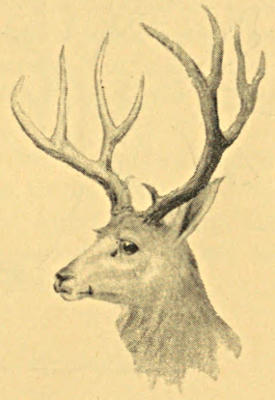
Typical mule deer (C. macrotis)
To my mind the best deer we have in North America for
sport is the beast whose head is here represented, C. macrotis,
the mule deer of British Columbia
and the naturalists, and the Black-tail
of Colorado and elsewhere in the
States. More than any other of his
kin in this country, C. macrotis haunts
the open uplands, the largest bucks
being found oftener than not right up
by the little snow patches, in and on
the edge of the sheep land, or if not
there, then in the small patches of
starved and moss-grown forest at the
top of the timber range. Thanks to
his predilection for high places and
the open, it is often possible to stalk
C. macrotis in ‘old country’ fashion,
instead of crawling about after him in choking timber as a man
must after C. columbianus or almost any other American deer;
but to get mule deer a man should rise early in order to see them
moving up to their beds for the day.
The mule deer ruts about the middle of October, his horns
being clean as a rule about a fortnight earlier, although I have
seen a big buck very high up (10,000 ft.) in Colorado who had
not begun to rub in the third week of September.
One of the writers in a recent book on American big game
speaks of the whistling of this deer during the rutting season;
but though I have spent many seasons amongst mule deer, in
British Columbia and elsewhere, I have never yet heard them
whistle, nor heard any mention of this habit from the natives
or white hunters. However, I am not prepared to say that they
do not whistle.
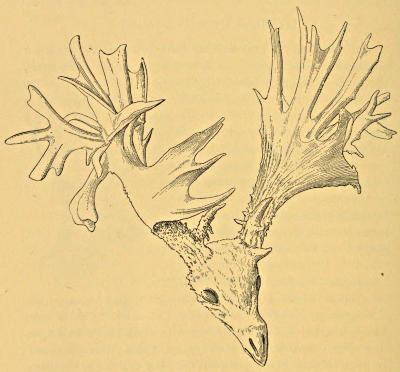
Abnormal head of mule deer
More than any other American deer with which I am
acquainted, C. macrotis migrates with the seasons, passing in
large numbers from his summer feeding grounds on the uplands
to the green timber districts of the lower country. This migration
seems to begin with the first heavy snows, but it is not an
invariable rule, for I have seen big bucks in the Chilcotin
country, nearly as high up as they could climb, at the beginning
of December, with snow a foot deep and the thermometer 10°
below zero. There is no deer in the country, I fancy, whose
antlers are subject to such great variation as those of C.
macrotis. The pair figured on p. 419 is typical, although
distinctly above the average in size (25½-in. span); another
pair (obtained by Mr. H. A. James in Colorado) had 41-in.
span, but the abnormal head figured on p. 420 is that of a
mule deer, and it has no fewer than 59 points in place
of the ordinary 10 points. This stag was killed in British
Columbia. I have also seen another pair, old and thick
and covered with well-marked pearls, with no tines at all
except at the top. The average weight of a male mule deer
is about 200 lbs., though they sometimes run much larger,
individuals having been killed weighing as much as 250 and
300 lbs.
Some idea of the number of these deer in British Columbia
may be gathered from the fact that in one district I have had
a chance of killing seventeen separate stags in an hour’s still
hunt, whilst one settler in the Similkameen country fed his
hogs on deer-meat through a whole winter.
Of the White-tail or Virginian deer I have very little to say.
Every quality which a deer ought not to possess from a sporting
point of view this exasperating little beast possesses in the
most highly developed form. He lives very often in close
proximity to men, and seems to have caught some of their
cunning. His habitat is from the Atlantic to the Pacific, his
haunts are in river bottoms, in choking, blinding brush, and his
habits are beastly. No one need ever expect to stalk a white-tail.
If you want to get one, you must crawl about in places where
the big boughs swing back and lash you across the eyes, where
the rampikes catch in your clothes or rise up under your feet and
trip you more cleverly than a professional wrestler, where hidden
logs break your shins, and every other device of inanimate
Nature is found to obstruct and annoy you with what seems
almost live personal malice. After a long course of such sport
as this, after having become dumb because you have no more
‘swear words’ left to say, after having grown sick of hearing
that abominable ‘thump, thump,’ which means that you have
jumped another buck without seeing him, you may catch a
glimpse of a waving white tail going over the logs, and if you
are a good wing-shot with a rifle you may get the beast which
wears it, but the betting is you won’t; or you may some day be
astounded by the sight of a creature, apparently about as big
as a good-sized jack rabbit, close to you, sneaking along under
the brush, with its head craned forward, intent on escaping
observation. If you move to fire, that sneaking beast will at
once convert itself into the white-tailed timber jumper you have
seen once or twice before.
The White-tail’s haunt
Let me be honest to the little beast. On nearly every occasion
C. virginianus has got the best of me (I never hunted him
with dogs or torches, or any other such abomination, and never
mean to), but once on a red-letter day I caught a big buck of
his kind dreaming on a hardwood hill. He was two hundred
yards off, and though the bullet from my Express broke his
foreleg, he jumped ‘at a stand’ a log by his side over which I
could not look, though I stand nearly six feet in my boots, and
gave me an hour’s excessively hard work before I killed him.
I should think that about 150 lbs. would be the extreme weight
of the largest bucks of this variety when cleaned, but there are
stories of exceptionally large white-tail bucks in the Okanagau
district of British Columbia, and the heads which come from
that country are certainly very fine. Mr. Rowland Ward gives
27⅛ ins. as the length and 19 ins. as the span of the best head
of this deer known to him.
Although not quite so exasperating an animal as C. virginianus,
this, the common deer of Vancouver Island, of the islands
all along the Pacific coast from Victoria to Alaska, and of the
Pacific slope generally, is desperately fond of thick timber and
the deep jungles of noisy sal lal bush. In size C. columbianus is
considerably smaller than the mule deer: a buck which would
weigh 175 lbs. would be a big buck for Vancouver Island, and
I am not aware that the deer of this island are smaller than
those of the mainland. But if C. columbianus is small, he is
at least abundant. A week from the date of writing this, a
friend of mine and myself saw fourteen deer in two days’ still
hunting within a drive of Victoria, and a grateful memory of
my dinner reminds me that the venison of a yearling buck
hung for one week is as good meat as any Esau ever brought
home to Isaac. In 1892 a couple of half-breeds sold over
eighty bucks in Victoria in two months, and in 1893 the same
two (excellent shots and woodsmen) are reported to have killed
twenty-two deer in one day. But to hunt deer or anything
else upon Vancouver Island a man must be a born woodsman.
Where the deer are thickest the woods fairly swallow a man up:
every rolling hill is exactly like its neighbour, high peaks are
scarce and landmarks very few.
Fortunately the island deer are not as wary as the white-tail,
and will generally stand to gaze for a moment after having
jumped from their lair amongst the sal lal. Early in the
season the neighbourhood of swamps is the likeliest place to
find deer, but during the rutting season (middle of October)
the old bucks seem to keep to the higher grounds. Like other
deer, the black-tail browses on all manner of shrubs and
deciduous trees, and, unfortunately for farmers, has a decided
weakness for growing crops.
The largest head I have seen was shot in 1892 near
Cowitchan Lake, Vancouver Island. It measures along the
beam from skull to extreme point 21 ins., and in span it is
19 ins. from tip to tip. A typical head appears in the illustration
on the next page.
Mr. Rowland Ward records a head of this deer measuring
28⅝ ins. in length, with a span of 26 ins.
Guanaco
C. paludosus, C. columbianus
There is no lack of game either upon the Pampas or in
the forests and along the river-beds of Central and South
America, but as yet very few English sportsmen appear to
have visited either the seas of grass or the luxuriant tropical
forests of Patagonia, Paraguay and the Amazon. Admiral
Kennedy, indeed, in his recent book, ‘Sporting Sketches in
South America,’ is, I fancy, the first sportsman pure and
simple who has visited these regions and described the sport
to be found therein, and it is to be regretted that even he has
not had the luck to secure specimens of all the principal beasts
known in the country. Others have, of course, written of the
Amazon and of the Pampas, but they have been naturalists,
who cared more to secure a new mouse than mere trophies of
the chase, however fine.
According to Admiral Kennedy, the game list of South
America includes the guanaco, five kinds of deer, the ostrich
or rhea, the jaguar, puma, tapir, wild cattle, and the wild pig.
The last two species are, of course, representatives of domestic
animals which have become wild, but, unless report belies them,
there are wild cattle in the world (e.g. in the Galapagos Islands)
which are as well worth hunting as the biggest buffaloes.
The jaguar, though a much larger beast than the puma
(identical with the panther of the West), appears to be anything
but a sporting beast, haunting river jungles and dense swamps,
and being unable, according to Mr. Hudson (the ‘Naturalist
on La Plata’) to hold his own even against his smaller cousin,
the puma, who is described by the same authority as a ‘bold
hunter,’ invariably preferring large to small game, which he
kills as a tiger does, by dislocating the neck. The puma is,
according to the same authority, a persistent persecutor of the
jaguar. Both Mr. Hudson and Admiral Kennedy seem agreed
that the puma is a very dangerous enemy to the guanaco, and
a scourge to everything living upon the Pampas, except man
and the gama (C. campestris), which protects itself as the skunk
does, by its unpleasant smell. Mr. Hudson’s stories of the
strange affection of the puma for man, although calculated
to excite incredulity at first, coincide somewhat strangely with
some of the Western stories of the panther (or puma) already
narrated; but it must be borne in mind that the panther of
the West does attack man in a few rare instances, according to
the evidence of Mr. Perry.
Of all the beasts in South America Admiral Kennedy writes
most enthusiastically of the guanaco, an animal nearly allied
to the camel, weighing about 180 lbs., abundant from the Rio
Colorado to the Straits of Magellan, and affording good sport
to the stalker.
But a beast which carries no ‘head,’ which, according even
to its admirers, ‘neighs like a horse’ when giving warning of
danger, and ‘quacks like a duck’ when alarmed, seems to one
who knows neither guanaco nor ciervo a very unattractive
creature compared with the really fine deer, C. paludosus, which
is found upon the Chaco of Paraguay and in the Argentine
Republic. This deer somewhat resembles the red deer of Scotland,
but grows to large dimensions. The horns figured are
from some in the British Museum.
Besides the ciervo, South America boasts, according to
Admiral Kennedy, of four other species of deer, the gama
(C. campestris), a beast rather larger than the Scotch roe deer,
common all over the Pampas, the ghazu vira or swamp deer,
the ghazu colorado, and the venadillo. It is a pity that some
enterprising sportsman does not devote a year or so to sport
in South America. Jaguar and ciervo (to say nothing of the
possibility of bagging deer almost unknown to his brother
sportsmen in England) should be bait enough to tempt some
one to more thoroughly investigate the sporting possibilities
of South America.
For a fuller knowledge of South American game beasts,
the reader is referred to Admiral Kennedy’s book, and to Mr.
Hudson’s ‘Naturalist on La Plata.’
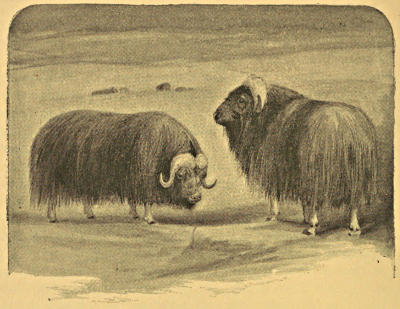
Musk ox
CHAPTER XIX MUSK OX
By Warburton Pike
In a work dealing with the sport of the present day there is
no necessity to inquire into the past history of the Musk Ox
(Ovibos moschatus), or to speak of its extensive distribution
during the early ages of the world. It is enough to pay a visit
to the South Kensington Museum and wonder at the specimens
of musk-ox heads dug out of the brick earth at Maidenhead
and Ilford, differing but slightly from the bleached heads that
may be picked up any day in the Barren Ground, and leave
to scientists the task of describing the methods by which prehistoric
man hunted the musk ox in what is now the pleasant
valley of the Thames. I shall only attempt to describe the
musk ox of to-day, and give a short account of the manner in
which many of them are annually killed by the Northern Indians.
Whoever invented the word ovibos to classify the musk ox
hit the nail squarely on the head, and this single word describes
so exactly the strange mixture of sheep and bull that
there is little left to be said upon the subject. I am indebted
to Messrs. Rowland Ward & Co. for the following dimensions,
which were taken from an adult bull, not a particularly large
one, but a fair average specimen:—
| ft. | ins. |
| Length from nose to tip of tail | 6 | 0 |
| Height from ground to shoulder | 4 | 2 |
| Height from ground to top of rump | 3 | 10 |
| Height from ground to belly | 1 | 10 |
| Round body over hair | 5 | 9½ |
| Depth of base of horn | 1 | 1¼ |
| Length of hair under neck | 1 | 10 |
| Length of hair under belly | 1 | 0 |
The long hair is never shed, but underneath it lies a thick
fleece, which comes off every year and hangs in sheets from the
rocks and small bushes against which the animals have been
rubbing; and herein lies the distinction between a prime musk-ox
robe and one killed out of season. The hair varies from
brown to black in different parts of the body, but a saddle of
light yellow shows up very conspicuously in the middle of the
back. The cows are smaller than the bulls, and their horns
never grow together into the solid boss that is to be seen in
the case of a bull at the age of six years. In the young, the
horns grow straight out from the head after the manner of a
barn-yard calf, and do not show the downward curve till the
second year.
The present range of the musk ox is limited to the North
American continent and the outlying islands in the Arctic
Ocean; it is perhaps best defined as lying to the north and
east of a line drawn from the mouth of the Mackenzie river
to Fort Churchill on Hudson Bay. Latitude 60° is generally
accepted as its southern boundary, whilst the musk ox seems
capable of existing very far north, as some are recorded to have
been killed on Grinnell Land, latitude 82° 27´, within a mile of
the winter quarters of H.M.S. ‘Alert,’ in July 1876, but I can
find no record of any having been seen in Greenland.
Now, all these places are necessarily hard of access, and to
make a successful musk-ox hunt means spending many months
in northern latitudes, and undergoing the hardships and risks
which Arctic explorers have found only too plentiful in crossing
the Barren Ground. A mistaken theory exists among the
officers of the Hudson Bay Company, that the musk ox come
into the woods in the winter; but as a matter of fact the Indians
have to push out far beyond the timber, hauling wood for fuel
on their dog-sleighs, and as the robes are not prime till the snow
has fallen and the cold is intense, it will be easily understood
that the difficulty of getting out to the musk-ox country, finding
a band, and hauling in the robes, is a thing to be well
considered before starting. In addition to this, it must be
remembered that if a party of men and dogs fail to find their
game when they are far from timber, the chances are ten to
one that nobody will reach the woods alive, as the caribou
which roam the Barren Ground in vast herds during the summer
seek the better shelter of the thick forest directly the winter
sets in, and it is perfectly impossible to haul sufficient provisions
for men and dogs in addition to fuel.
My personal experience of the musk ox is derived from two
expeditions, one in the autumn and early winter and the other
in summer, which I made with some half-breeds from Fort
Resolution, a Hudson Bay trading post on the south shore
of the Great Slave Lake. We left with canoes in the middle
of August, and after travelling 150 miles towards the north-east
end of the lake, portaged over a range of mountains on the
north shore, and passing through a chain of small lakes reached
the end of the dwarf timber by the middle of September. At
this point, roughly three hundred miles from Resolution, we
established a permanent camp, and, reduced to four in number,
set out on foot into the Barren Ground, expecting to find musk
ox at any time. We travelled hard towards the north, but only
fell in with two solitary bulls, both of which were killed; the
rutting season was just coming on, and the bulls were apparently
seeking the cows. Winter was approaching, the small lakes
were frozen up and the ground covered with snow; we were
unprovided with dogs and all the outfit necessary for winter
travel, and were forced to abandon the hunt, reaching our camp
after three weeks’ absence early in October. On this journey we
found the caribou plentiful, and had little trouble from short
rations.
The next five weeks were passed at the edge of the woods,
and it was well on in November when we started on another expedition;
this time I went with a band of Yellow Knife Indians,
as most of the half-breeds had deserted. Six sleighs hauled
by twenty-four dogs carried a supply of firewood sufficient for
three weeks with the strictest economy, and a little dried meat
which was to last us till we reached the musk ox. Luckily,
we had left a few meat caches on our first trip, or I think we
could hardly have made a successful hunt, as men and dogs
require more than the usual rations in the excessive cold which
prevails in the Barren Ground during the early winter. After
ten days’ fair travelling, with some delays from wind storms and
the trouble of cutting the meat caches out of the ice in which
we had stored them, just as we had come to the end of our
provisions two bands of musk ox were discovered. By rough
guessing, one band contained a hundred and the other sixty
animals, bulls and cows of all ages. The usual methods of
winter hunting were employed, and a wholesale slaughter began;
the dogs let loose from the sleighs rounded up as many of the
animals as they could hold, and, going close up, we killed them
as easily as cattle at the shambles.
The musk ox took no notice of the men, and seemed to
suppose that the dogs were their only danger; and it is to be
presumed that by herding together in this manner they resist
the attacks of wolves, which follow the caribou, and probably
make an attempt on the musk ox when the more timid caribou
are scarce. The animals we killed were all in good condition,
and an examination of their stomachs showed that they had
been feeding on the different mosses that grow in profusion
in the Barren Ground. The snow had drifted away from the
ridges, leaving the ground bare in many places, so that the
moss was easily obtainable without pawing away the snow.
We killed over forty, as the Indians were, of course, anxious
to get as many robes as they could haul, to trade for ammunition
and blankets at the Fort, and after we had loaded the
sleighs with skins and meat we made the best of our way back
to the woods, which we reached on December 2, after various
mishaps through getting lost and the dogs playing out in the
soft snow. Shortly afterwards we fell in with the caribou
again, and reached Fort Resolution a few days before Christmas.
The short Arctic summer was at its height when I saw the
musk ox again, at the head waters of the Great Fish river, after
a long and tedious journey with dog sleighs, and as we spent
six weeks in the heart of the Barren Ground I had every
opportunity to notice the habits of these strange animals.
Between the hunting grounds of the Yellow Knives and those
of the Esquimaux, farther down stream, lies a debatable land of
perhaps sixty miles in width, which affords the musk ox a
sanctuary, and here there were scattered bands in every direction.
At this season the big bulls were usually found alone,
the cows and calves keeping together in small bands of ten to
twenty. Their natural increase seems to be small, and calves
were scarce in proportion to the number of cows. The Indians
told me that a cow only calves once in two years, and this is
probably true, as among the animals that we killed for food
we found none that had lost a calf.
I have often been asked whether the flesh of the musk ox
is good to eat, but people do not reflect that in the north, where
the supply of provisions is uncertain, any kind of food is good.
A fat cow killed in the fall hardly smells or tastes of musk,
and I think its flesh would be palatable anywhere; but an old
bull, especially in the rutting season, is a thing to be palmed
off on your neighbour if there is any choice in the matter. The
flesh of the calves we found insipid, and, eaten as it was without
bread or vegetables, it failed to satisfy the appetite or to
keep up the strength.
In the summer the musk ox live almost entirely on the
green leaves of the small willows that grow in patches in the
Barren Ground, and do not in this part of the country confine
themselves entirely to moss all the year round, as I have seen
stated. They fatten up in a wonderful manner during the short
time they have for feasting, and begin the winter in splendid
condition, though, according to the Indians, they are poor
enough at the time of the spring hunt in April.
In summer hunting no dogs are used, but the still more
destructive method of driving the musk ox into the water is
often put into practice. When a band is discovered, a convenient
place is chosen for the slaughter, and piles of rocks
adorned with coats and gun-covers are set up a short distance
apart, at right angles to the small lake that has been
selected. Men are stationed at intervals to head the animals
off, while others, making a détour, start the band in the right
direction. On coming to the barricade the animals are afraid
to pass the line of rocks, and, seeing themselves surrounded,
take to the water as their best chance. Then the little canoes
are launched and the whole band is quickly exterminated.
The musk ox is a poor swimmer. He seems to have some
difficulty in keeping his head above water, and never leaves
the land except under compulsion.
If the animals are at a long distance from water, or only one
or two are required for meat, they are easily approached under
cover of the rolling ground, and, being naturally of an unwary
disposition, are a sure prey for the Indian if he can persuade
his long muzzle-loader to go off at the right moment. It might
naturally be supposed that the musk ox is being rapidly exterminated,
but I doubt if this is really the case. The head of
the Great Fish River has always been the summer hunting
ground of the Yellow Knives; and yet their chief told me
that he had never known these animals more numerous than
at the present day, and certainly a great many were killed
while we were waiting for the ice in the river to break up.
But this is only the edge of the musk-ox country: the rocky
wilderness stretches far towards the north and east to the
Arctic Ocean, uninhabited except by a few wandering Esquimaux
close to the coast. Into this desert the winter hunters
can never penetrate, as it lies too far beyond the tree-line to
admit of wood being hauled on dog-sleighs. It is true that the
number of hides exported by the Hudson Bay Company is
greater than it used to be, but this is easily accounted for by
the fact that the robes have increased in value, and the price
now paid to the Indians in the north is sufficient to encourage
them to haul the skins to the Fort, instead of using them for
moccasins, as was formerly the case.
In spite of the many stories that the Indians told me, and
the evident dread in which they hold the musk ox, I could not
see anything to justify the belief that it is a dangerous animal
to attack. I never saw anything resembling a charge, although
I have often been close up to a badly wounded bull on purpose
to see if there was any truth in these reports. But the
Indians are given to superstition, and attribute miraculous
powers to the musk ox, and probably the ferocious appearance
of an old bull has worked upon their timid imaginations till
they are ready to believe thoroughly in these traditions.
On expeditions of this kind there is really no sport in the
ordinary acceptance of the term, and under any circumstances
the musk ox is so easily approached that one soon tires of the
slaughter; the same thing applies to the caribou, which are
sometimes found in almost incredible numbers in the Barren
Ground in summer or the woods in winter. But it is never a
certainty that the game will be forthcoming when most required
for meat, and the knowledge that starvation, even to
the last extremes, may come upon you at any time, goes far
to counterbalance the tameness of the sport when once you
have reached the land of plenty. Sufficient excitement and
danger will always be found in penetrating the little known
desert of the north to satisfy the most enthusiastic sportsman
explorer.