By Lieut.-Col. Reginald Heber Percy
In dealing with such a vast tract of country as India it is out
of the question to describe any one class of outfit which will
suit the traveller equally well among the snowy peaks and
bitter winds of the Himalayas and Ladak and in the furnace-like
heat of the plains. Snow is the great obstacle to travel in
the former, whilst heat, rain, and malaria are the evils to be
contended with in the latter. Nor is one class of weapon
equally suitable everywhere. For all soft-skinned animals, such
as tigers, and all varieties of sheep, goats, and deer (except
sambur) there is no rifle, in the writer’s opinion, that is so
satisfactory as a .500 Express with a charge of at least 5¾ drachms
of powder. This weapon is sufficiently powerful for any beast
to be met with in the Himalayas. Of course, yak may be
found, but the chance is so remote that it is barely worth while
taking a special rifle for their benefit, and a few cartridges with
solid bullets for the .500 will probably meet all requirements.
On the other hand, for thick-skinned animals, such as elephants,
rhinoceros, gaur, buffalo, and sambur, the smallest bore of
any practical use is a 12-bore, and the powder charge for this
should be at least 6 drachms. The light bullet of an Express is
so easily turned by a small twig that it is absolutely untrustworthy
among heavy timber, and it is for this reason that the
writer includes sambur with the larger animals. For the big
dangerous beasts a still heavier weapon, such as an 8-bore
with 8 drachms of powder, is desirable, though not absolutely
necessary, as the superior accuracy and handiness of a 12-bore
go far to counterbalance the extra power. For antelope and
gazelles the writer prefers a light single-barrelled .400 Express,
taking 3 drachms of powder, to any other rifle that he has
ever used.
So far for rifles. A shot-gun is a necessity everywhere, and
one of the best pot-hunting guns (the chief use of a gun on the
trip after big game) is one of three barrels—two shot, 16-bore,
and a .450 rifle underneath—which will meet all requirements
on the march and near camp. As regards tents, the ordinary
Cabul tent (part of every officer’s equipment in India), with a
smaller one for the servants, is ample for the Himalayas and
the plains in the cold weather, but a larger tent is required
during the hot weather in the plains. Manifold are the
instructions already published as to outfit—‘Large Game
Shooting,’ by Colonel Kinloch, ‘The Sportsman’s Guide to
Kashmir and Ladak,’ by Major Ward, and ‘The Sportsman’s
Vade Mecum,’ by K. C. A. J., are among the best books to consult,
as they are written by practical men. Among the points that
the intending traveller must bear in mind are: That the unit
of transport in the Himalayas is the coolie, and his load over a
snow pass is only 50 lbs., though along an ordinary road he
can carry 60 lbs. Pack animals can certainly be used over a
large portion of the country, but every snow pass forces the
traveller back to the unit, so that his baggage must be capable
of being arranged in 50-lb. loads. Throughout the rest of
India carts can generally travel, and, failing them, camels, oxen,
or ponies can always be procured, so that the unit of transport
being greater, the sportsman can travel with far greater
comfort than he can in the Himalayas. Then, again, if the
traveller requires more than sixteen coolies to carry his baggage
in the Himalayas, he will be subjected to endless delays at every
changing station. A dozen men or so can be collected at short
notice almost anywhere, but over sixteen generally means delay
till they can be summoned from outlying villages; and perpetual
detentions of this class when one is racing for ground
are extremely annoying, so that it should be the sportsman’s
aim to combine lightness with efficiency in all articles of his
outfit, and to travel with the smallest amount of state compatible
with his standard of comfort—a standard which, in the
writer’s experience, differs with every individual.
As regards expenses, the following may be taken as a rough
guide throughout the Himalayas:—
Coolie, per march, 4a.
Coolie, monthly, Rs.6 (without rations if employed near his
own village).
Coolie, monthly, Rs.5 (with rations).
Baggage pony, per march, 8a.
Riding pony, per march, R.1.
Baggage yak, per month, Rs.8 to Rs.12 (the drivers bring
their own food and provide carriage for it).
Head shikari, in Cashmere, Rs.20 monthly (with rations).
Assistant shikari, in Cashmere, Rs.10 monthly (with
rations).
Luncheon coolie, in Cashmere, Rs.7 monthly (with rations).
Head shikari in Gurwhal, Chumba, Lahoul, &c., being
local men, Rs.12 to Rs.16 monthly (usually without rations).
Assistant shikari, Rs.8 to Rs.10 (without rations).
Luncheon coolie, Rs.7 (without rations).
Rations consist of 4 lbs. daily of flour or rice for head
shikari, assistant shikari, luncheon coolie, and servants brought
up from the plains; baggage coolies get 2 lbs. daily of the
same. An estimate of Rs.300 a month should amply suffice
for travelling in any part of the Himalayas: an old hand will
do it for far less, but the Cashmere shikari so thoroughly
understands the art of running up the bill, and is so plausible
withal, that the majority of his employers will find themselves
paying more than its market value for the pleasure of his
company. When the sportsman has sufficient experience
and sufficient knowledge of the language to employ shepherds
and local shikaris to show him the ground near their own
homes, he may dispense with the luxury of having a Cashmeree
to rule over him, and find great advantage accrue both to his
sport and to his purse. It is impossible to give an estimate
for big game shooting in the plains, as the rates for transport
and beaters vary in every district. As regards servants brought
up from the plains, two should be enough, and they should be
of the same religion and caste, so as to be able to cook for one
another: the writer prefers Mussulmans, as they will eat meat,
which Hindus of good caste will not do. In any case they will
require extra pay in the hills (an additional Rs.2 or Rs.3 a
month should suffice), warm clothing, an extra blanket apiece,
and a waterproof bag to pack their things in. Also, as their
work begins on arrival at camp, they should, if possible, be
mounted for long marches. It is a good plan to hire milch
goats from the village which supplies the coolies, and change
them when one changes the men in the next district.
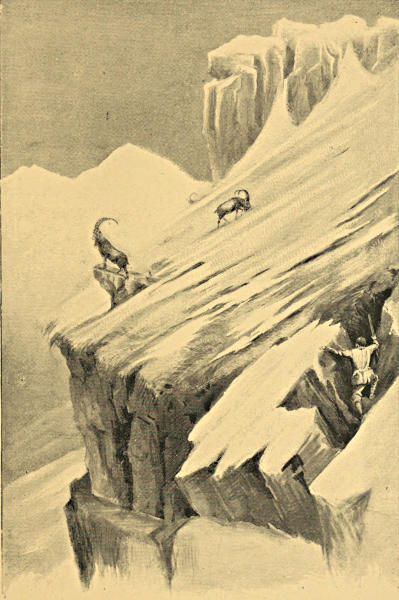
THE FIRST STALK OF THE SEASON
The generally accepted rule with regard to shooting grounds
in the Himalayas is that the first comer has the right to any
minor stream not being the main river of a district (except at
its source, where it is considered a minor stream), and to all the
land that drains into that stream; but he must occupy the
ground in person, and cannot retain it by sending servants or
tents there before his arrival, or by keeping servants or tents
there during his absence.
In the plains the same rule, though not so accurately laid
down, holds good in spirit, viz. that no sportsman should hunt
over ground within reach of his neighbour’s camp, and in tiger
shooting a beat belongs to the man whose shikaris are tying up
for it.
Visitors from home should endeavour to bear in mind that
the sport of India naturally and fairly belongs to those who
spend the best years of their lives in administering and
garrisoning it, and that the assistance they will, as a rule, so
freely receive will be given by good sportsmen from sheer love
of sport.
In conclusion, the writer begs to express his grateful thanks
for the kindly assistance afforded him by the authorities of the
Natural History Museum, the Cambridge Museum, and the
Senckenburg Museum, Frankfort, and also to the numerous
sportsmen and owners of private collections for the generous
way in which they have, at no slight trouble to themselves,
lightened his labours by contributing records of sport and
measurements of horns and animals.
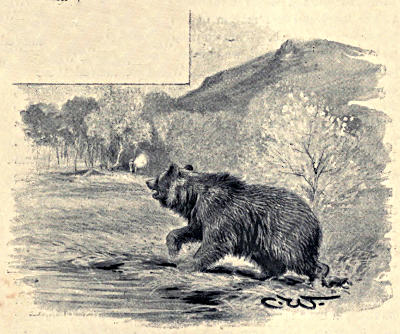
There are no fewer than five varieties of bears to be found
in our Eastern Empire. The three most commonly met with
are the Himalayan black bear, Ursus torquatus (native name
‘Kala Bhalu’); the Himalayan snow bear, Ursus Isabellinus
(native names ‘Lal Bhalu’; Cashmere ‘Harput’); and the sloth
bear of the plains, Ursus labiatus (native names ‘Bhalu,’
‘Reech,’ ‘Adam zad’).
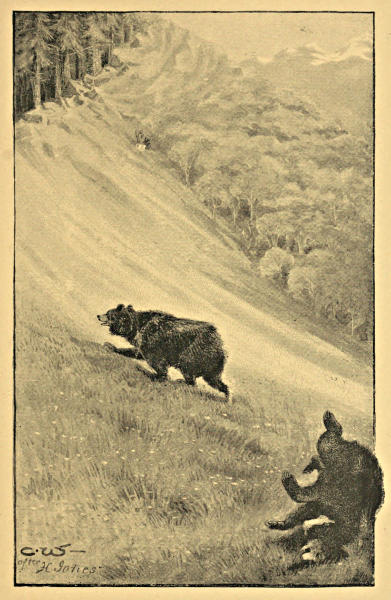
A FAIR CHANCE AT BLACK BEARS
The Himalayan black bear is common enough on the
southern slopes of the Himalayas, but rarely crosses the main
snow-line. Being chiefly a fruit and corn eater, in contradistinction
to the snow bear, whose main food consists of grass and
roots, it likes to live near villages, especially when the maize
crops are ripening. Dense jungle is a necessity to it for shelter
during the day and for the wild fruit and berries it lives on
before the crops are ripe, and this jungle is non-existent on the
northern side of the main range. The snow bear is found on
both sides of the range, but does not extend to Ladak. Both
black and snow bears will kill cattle and sheep if they get
the chance, and neither variety is above eating carrion. The
black bear with his short sturdy nails climbs readily, while the
long digging claws of the snow bear prevent him doing much
in that line, though he is said to be able to climb a little. The
villagers in the Himalayas have to keep their bees inside their
houses both for the sake of warmth in winter and also to prevent
the hives being robbed by bears. Both varieties hibernate,
but Colonel Kinloch points out, and all natives agree, that while
the snow bear is never seen abroad in the winter, the black bear
periodically wakes up and makes short excursions for food and
water. As regards their comparative ferocity, the snow bear,
being generally found and shot in the open, rarely has an
opportunity of doing mischief, though he will occasionally
show fight. The black bear, on the other hand, from living
near villages has partly lost his fear of man, and though he
rarely if ever goes out of his way to attack, he will charge freely
if cornered, or suddenly disturbed in his midday siesta by anyone
walking almost on to him. This is almost invariably the
reason wood-cutters and herdsmen get mauled.
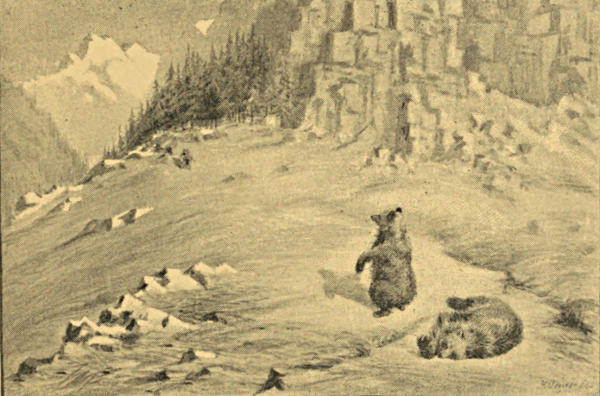
Snow bears
One of the best ways to shoot black bears is to have them
marked down into ravines or patches of dense jungle on their
return from feeding in the early morning, and to wait for them
to draw out in the evening just before sunset. As a rule Mr.
Bruin is pretty punctual. Shooting bears by moonlight when
they are feeding in the fruit trees is generally unsatisfactory
work, as so many escape wounded, and having the jungle driven
usually ends in disappointment.
The snow bear is easily stalked on the open slopes he frequents,
and provided that the wind is favourable, and that the
sportsman remains absolutely motionless as long as the animal’s
head is turned towards him, he can play almost any trick with
a bear, even though standing in full view; but he must be careful
not to let the sun shine on the barrels of his rifle, for that at
once attracts attention. The best place to find a snow bear is
one of those patches of bright green grass that mark the spots
where sheep have been folded the year before. The writer
knows several instances of black bears having been followed
into their caves and shot there under circumstances of intense
excitement. Colonel Howard, whose adventures with sloth
bear are narrated below, had a sparkling time with a Himalayan
black bear in a cave; but it is not everybody’s sport.
Few men, after they have procured a good specimen or two,
care to shoot bears. Their skins require more attention than
they are worth, and on good shooting ground where snow bears
are most common, it is rarely worth the risk of disturbing a
good ibex or markhor for the biggest bear in Asia.
Jerdon remarks of the black bear—and the natives of
Chumba at all events thoroughly believe it—that when one is
caught in a rope snare, if he cannot break it by the first effort
he will not try again, but will remain on the spot moaning and
looking at the imprisoned paw without attempting to bite the
rope.
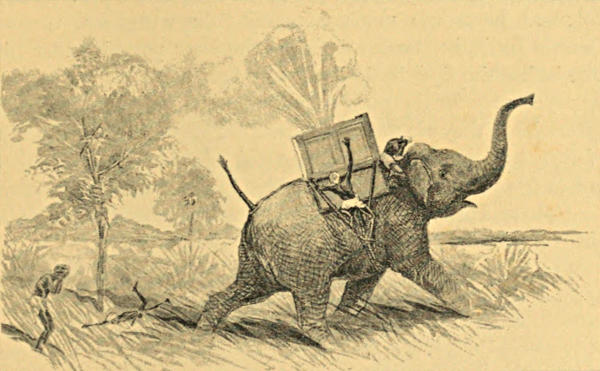
A glorified comet
The sloth bear is the common black bear of Central and
Southern India. It extends to the base of the Himalayas, but
does not ascend them, its northern limit being about 31°
N. Lat. Its long flexible snout and long claws distinguish it
at once from its Himalayan cousin, and though it delights in a
temperature more suggestive of the necessity of punkahs and
ice than of greatcoats, its fur is longer and better. In spite of
its long claws it climbs well, and as, like deer and natives, it
delights in the nasty-tasting flowers of the ‘mhowa’ tree, a
moonlight stroll in March or April, when the blossoms are
falling, will often afford the chance of a shot. The best way
of hunting these bears is to have them marked down in the
early morning like U. torquatus, and then either to stalk or
have them driven. Should the bears go into caves, they are
easily dislodged by poking sticks or rolling stones through
fissures above, or if the cave is shallow a bundle of rags or a
turban dangled over the entrance and a few shouts will fetch
them out. A firework thrown into or a shot fired down the
mouth of the cave is a very effectual summons. Though U.
labiatus is both willing and able to do a good deal of mischief,
if due precautions are taken few branches of sport afford
such a succession of ludicrous episodes. Poor old ‘Adam zad,’
if he is not witty himself, is a fund of merriment to others.
Forsyth’s and Sanderson’s books teem with comical situations.
The companionship of a fellow-sportsman whose shooting can
be relied upon is necessary if full enjoyment of the sport is
desired, as tricks may then be played which would be a little
too risky to attempt single-handed. Native fireworks, ‘Anar,’
are rather dangerous to use, as they are apt to explode in the
hand. Never will the writer forget seeing a lot go off in a howdah
during a tiger beat: the poor old elephant went streaking
across country like a glorified comet. Two guns are ample
for following up a wounded bear on foot in jungle; if there
are more the party is apt to get separated, and then, if the
bear shows sport, there are too many bullets flying about to
be pleasant. Natives, except perhaps one tracker, are only encumbrances.
The way a cub will ride on its mother’s back and
keep its seat under the most trying circumstances is marvellous.
The writer once rolled an old bear clean over without the cub
letting go. Sterndale quotes a capital story about this. Rusty
coloured bears are not uncommon: the writer saw two in
Central India, but as in each case the bear passed under his
tree before the tiger in the beat had been fired at, he had to
spare them. Bears may occasionally be ridden down and
speared, but they are not often found on ground that will admit
of this, and the way they ‘sling their chat’ will prevent most
horses from going up to them. This bear does not hibernate.
Colonel Howard gives the following account of his experiences
in Central India in 1884:
L. and I were at Lulliapoora tying up for a tiger, and hearing
of some bears’ caves about two miles off, we rode out to look at
them. On arrival at the ground we dismounted and strolled along,
accompanied by a couple of villagers. Whenever we found a cave we
rolled rocks down into it to see whether it was occupied or not, and
having gone on in this way for some time without result, the natives
began to get careless and went ahead of us. Presently we heard
some growls and saw our Aryan brethren scuttling up trees. L. and
I ran forward and found a large crevice in the rocky ground about
four feet wide, eight or ten yards long, and from fifteen to eighteen
feet deep; at either end of this caves seemed to run into the
ground, and in the centre was a ragged archway that formed a
staircase for the bears to climb in and out. Standing astride of
the crevice I saw a bear’s head appear at the entrance of one of
the caves, and as L. was new to the work, I signalled to him to
come and shoot, while I stood a foot or two back from the edge,
ready for whatever might turn up. The bear, noticing L., turned,
and, on receiving a bullet in his seat of honour, ran along the
bottom of the crevice to the opposite cave, acknowledging the
second barrel with that peculiarly plaintive moan which a bear so
often gives when he has received his death wound. L. then jumped
aside, saying, ‘Look out’; a second bear’s head and shoulders
appeared just above the crevice. I fired into her ear at about a
yard’s distance, and she rolled back to the bottom dead. Tying
the ponies’ leading ropes together I climbed down, put a noose
round the bear’s neck, and steadied her while the others hauled
her out.
I now told L. that I was perfectly certain that his bear was dead
too, and that I would go down and see. I did not fancy going
down the archway, as that seemed to be the bears’ regular run, so
looked about for another entrance, and soon found one which
seemed to lead almost perpendicularly down into the back of the
cave. After removing a stone or two at the top in the vain hope of
being able to see without actually going down, I started on my
journey. As it was pitch dark and I had to use both hands in
climbing down, I left my rifle behind, intending to run and not
fight if I got into a scrape.
On reaching the bottom, I found myself on an underground
continuation of the crevice. On one side was a stone about a
couple of feet high on which I stood, and as my eyes got accustomed
to the darkness, I made out an overhanging rock just in front
of me, and protruding from beneath it, at my feet, a mass of hair.
I did not like to put my hand on it, so climbed up again, borrowed
a stick from one of the natives, then jogged down again,
and jammed the end of the stick into the bear. To my horror
he jumped up with a growl, but luckily, being just as frightened
as I was, he bolted further up the cave, while I legged it up my
hole at about the best pace on record.
I then sent back to camp for a lantern, and with it in my hand
and my short single rifle slung across my back, journeyed down
for the third time, after posting L. at the top of the crevice, warning
him to let any bear that might turn up come well out into the
open before he fired, and on no account to let a wounded one
come back into the cave on me.
Arrived at the bottom, I placed the lantern on the ground, unslung
the rifle, and stepped on to the stones. There, just sticking
out from under the overhanging rock, was undoubtedly the back
of a bear, so I let drive into it. The smoke completely concealed
everything, then there was a prolonged growl, afterwards a succession
of short grunts, my lantern was put out and sent flying by a
bear who charged it, brushing past me, probably with the idea that
the lantern was the assailant. I scuttled up the hole, and L., who,
in the excitement of the moment had forgotten my warning, fired
at the bear and rolled him back down into the crevice before I
got out.
It was now evening, and getting very dark, so I lit a bunch of
grass, and, on throwing it down the crevice, could see a bear lying
at the bottom. I threw a stone down, at which he did not growl,
but, probably owing to the flickering light of the burning grass, he
seemed to move, so we agreed to leave him till next morning. As
we were starting home, my shikari noticed that the dry leaves at
the bottom of the crevice were burning, which meant that by the
morning the bear would have his coat singed off, so I hardened
my heart, and, taking the rope, climbed down again, gave the bear
a kick when I got just above him, and as he did not move, went
up to him, felt for his head, slipped a noose over it, and the men
above hauled him out. We started early next day, taking L.’s
lantern, as mine was in the cave, and, on arrival at the place, to
my infinite disgust, found fresh droppings at the entrance. They
were probably only those of cubs, but one could not tell their size,
and it made the idea of going down in cold blood much less pleasant.
I fired a shot down the cave, listened, but could hear no sound,
so went to my old entrance and tried to lower L.’s lantern by a
string, which was cut against the rocks, so that the lantern fell to
the bottom.
We were now in a fix, for both our lanterns were down below,
and if we left them there we should have to spend our evenings in
darkness.
L., whose figure was not suited to climbing about in narrow
caves, did not like the idea of my going down again—no more did
I—but I could not well leave the lanterns there simply because I
was afraid of fetching them; so taking my double-barrelled rifle
with me, I started on my fifth journey. The length of the rifle
made the climbing very awkward; however, I reached the bottom
without damaging it, found my own lantern none the worse except
for a few dents and scratches, followed the bottom of the cave until
I reached the crevice, above which the others were standing
anxiously awaiting my reappearance. They lowered a rope and
hauled up the lantern, while I went back, found L.’s lantern in two
pieces, handed it up, and then proceeded in my search for the bear.
I found him stone-dead under the overhanging ledge, but I
could hear something moving ahead of me the whole time; the
cave was pitch dark, was getting much lower and narrower, and
turned two sharp corners.
To get at the bear’s head I should have to crawl over him, and
we had no rope long enough to reach to where I was, besides which
the cave made so many zig-zags that it would in any case have been
impossible to haul the bear out without several of the party coming
down to assist; so pulling out some hair to show that I had handled
him, I returned, and offered to go on ahead of the bear as a guard,
with rifle and lantern, if some of the others would bring the rope
and do the hauling.
The noise ahead was probably made by cubs, but as I did not
know their size, and as it might have been a fourth bear, I did not
care to risk being attacked while I was tying up the quarry in a
place where I had no elbow-room.
L., I think wisely, decided that we had been very lucky in recovering
two bears and our lanterns without accident, and that it
would be folly to risk an almost certain mauling for the sake of a
third; so I came out, by no means unwillingly. I never fancied
the last part of the job—I could not have got the bear out alone,
and as two or three men on hands and knees in a narrow cave
must get in each other’s way in a scrimmage, a charge would
probably have ended badly.
I only escaped the first time through putting the lantern on
one side of me instead of at my feet, and through the cave at that
place being wide enough for the bear to pass by my side; very
likely also the fact of my standing on the stone, though it was at
the most two feet high, brought me a little above the level of the
bear’s eyes, and seeing the lantern he charged it.
The astonishing part of the whole thing was the rapidity with
which the bears came up the crevice. It was by no means an easy
climb for a man, and yet it hardly seemed to delay them at all.
There is a certain delicacy in this branch of sport that
requires such exceptional temperament and nerve that the
writer can hardly feel himself justified in recommending its
practice, at all events to a novice in the art.
The remaining varieties of the bear family found in India
are somewhat more rare than those already described. They
are the Burmese bear (Ursus malayanus), the Beluchistan bear
(Ursus gedrosianus), called by the natives ‘mamh,’ and a quaint
looking piebald bear (Ailuropus melanoleucos), discovered in
Eastern Thibet by the Abbé David. U. malayanus resembles
the Himalayan black bear but is smaller, the white horse-shoe
mark upon the chest of the Himalayan bear being prolonged
in a white stripe down the belly of U. malayanus. U. gedrosianus
also resembles, but is smaller than, the Himalayan, but in
colour he is brownish instead of black.
Measurements
| Authority | Height at shoulder | Length nose to tail | Girth | Forearm | Sex |
| Ursus Isabellinus |
| ins. | ins. | ins. | ins. | |
| Major FitzHerbert | 36 | 65 | 48 | 17 | Male |
| ” | .. | 57 | .. | .. | Female |
| Major Ward | .. | 82 | .. | .. | .. |
| Ursus torquatus |
| Major Ward | .. | 78 | .. | .. | .. |
| Col. Howard | .. | 76½ | .. | .. | .. |
| Authority | Height at shoulder | Length nose to tail | Weight |
| Ursus labiatus |
| ins. | ins. | lbs. |
| Sanderson | 36 | about 72 | 280 |
| Sterndale | about 36 | 60 to 72 | 210 to 280 |
| Major FitzHerbert | .. | 65 | .. |
| Ursus malayanus |
| Sterndale | .. | not exceeding 54 | .. |
| Ailuropus melanoleucos |
| Sterndale | about 26 | about 58 | .. |
Native names: ‘Sher-babbar,’ ‘Singh,’ ‘Unthia Bagh’
The Indian lion differs little in appearance from the African
variety, the males of both being furnished with manes, though
a black mane is unknown in India.
Lions are almost extinct in India, though there are still a
few left in Guzerat and Kutch, and natives occasionally bring in
reports of them in Central India; but the writer has not heard
of one being shot in the last district for many years. The lion
is a less active animal than the tiger, and apparently not so
powerful; in every case of a fight between the two occurring in
a menagerie the tiger has invariably killed his opponent.
Essentially a wanderer, the Indian lion avoids heavy forest
as a rule, preferring sandy hills covered with thin scrub and grass,
and may be tracked and shot on foot in a way that it would
be foolhardiness to attempt with a tiger. There is a capital
account of the sport given in the ‘Oriental Sporting Magazine,’
July 1876. The narrator came across four males, shot one
that charged him brilliantly, wounded and lost a second, and
missed a third.
Native shikaris declare that lions always put up for the day
under the same bushes, and that consequently if there is a lion
about he is generally easily found. It would be curious if
African sportsmen could corroborate this story.
Unlike tigers, there is a large preponderance of males to
females among full-grown lions, which is supposed to be attributable
to the mortality among female cubs in teething.
Measurements
| Authority |
Total length |
Tail |
Height at shoulder |
Girth of chest |
Weight |
Remarks |
|
ft. ins. |
ins. |
ins. |
ins. |
lbs. |
|
| Sterndale |
8 6
to
9 6 |
30 to 36 |
42 |
.. |
.. |
|
| ” quoting Captain Smee |
8 9½ |
.. |
.. |
.. |
490[16] (cleaned) |
|
| ‘The Delhi Gazette’: a lion killed in Central India |
8 7 |
34 |
39 |
46 |
.. |
|
| ‘Oriental Sporting Magazine,’ July 1876 |
9 3 |
.. |
.. |
.. |
.. |
|
| African Lion |
| Rowland Ward, ‘Horn Measurements’ |
.. |
.. |
.. |
.. |
500 |
F. C. Selous, ‘A Hunter’s Wanderings’ |
| ” |
.. |
.. |
.. |
.. |
563 |
‘The Field,’ July 13, 1890 |
| ” |
.. |
.. |
.. |
.. |
385 |
J. S. Jameson |
The tiger is found throughout India wherever there is
suitable jungle, and extends through Burmah to the Malayan
Archipelago and China, but is not found in Ceylon. Sterndale
says: ‘It has been found as far north as the island of
Saghalien, which is bisected by
N. L. 50°. This is its extreme
north-eastern limit, the Caspian
Sea[17] being its westerly
boundary. From parallel 50°
downwards it is found in many
parts of the highlands of
Central Asia.’
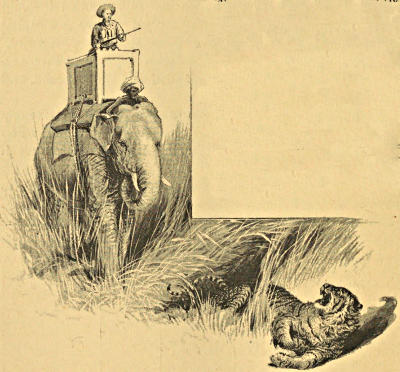
Howdah shooting
The biggest tigers the
writer has heard of are one of
13 ft. that Sir Charles Reid
quotes as having been shot by the late Sir Andrew Waugh,[18] and
one of 12 ft. 4 ins. quoted in a letter by Mr. F. A. Shillingford
to ‘The Asian’ as having been shot by Mr. C. A. Shillingford
of Munshye in 1849; and Williamson, writing about the year
1805 of a tiger killed by Mr. Paul, the superintendent of the
Elephant Establishment at Daudpore, says: ‘The tiger proved
to be the largest ever killed on the Cossim Bazar island. The
circumference of the joint at his wrist was 26 ins.; he was
13 ft. and a few inches from the tip of his nose to the end
of his tail, and in a right line, taken as he lay, from the sole
of his forepaw to the tip of his withers, between the shoulders,
gave very nearly 4 ft. for his height.’ As the old gentleman
afterwards states that ‘nine in ten do not measure 10 ft.,’
it seems only fair to conclude that the above extraordinary
measurements were honestly taken of the beast as he lay before
being skinned.
Captain Forsyth’s division of tigers into three classes has
been generally accepted by sportsmen as a correct definition
of their habits. They are, as Sanderson writes: ‘Those which
habitually prey upon cattle; those which live upon game alone;
and the few dreaded individuals of their race that frequently
prey upon human beings.’ None of these classes absolutely
restrict themselves to one diet. The cattle-lifter will kill game
occasionally, the game-killer does not despise a juicy young
buffalo, nor does a man-eater live entirely on human flesh;
but in broad terms the game-killer, who is in reality one of the
villagers’ best friends in that he preys upon the wild pigs and
deer that ravage his crops, is an active wandering beast which is
proportionately hard to bring to bag, being generally met with
by chance.
The cattle-lifter is generally a stay-at-home old gentleman,
averse to travel, who takes two or three villages under his
protection, and lives, as far as they will allow him, on good
terms with the people, simply taking a cow, or a donkey, as his
droit du seigneur every four or five days. Occasionally he may
contract the wasteful habit of knocking over two or three
animals at a time out of a herd; but this, as Sanderson points
out, is the result of continual ill-judged interference on the
part of the cowherds. Buffaloes in a herd he is too wary to
meddle with, as he knows they will not hesitate to charge him,
and the small boys who pretend to look after them traverse
the tiger’s domain in perfect safety if mounted on the broad
back of one of their charges. In reality the buffaloes are
sent out to look after the children, and there is no better nursemaid
than an old cow buffalo, who combines perambulator and
guardian in one.
Seldom do these tigers attack a man wantonly, and though
when they increase in numbers their system of taxation
becomes oppressive, the damage they do is often overrated.
Forsyth gives the alarming figures of 325l. to 650l. worth per
annum for each tiger, but Sanderson more justly cuts the
estimate down to about 70l. He adds, ‘The tiger might in
turn justly present his little account for services rendered in
keeping down wild animals which destroy crops,’ and gives
many excellent arguments in favour of tigers.
The gravest charge against cattle-lifters is that they occasionally
turn man-eaters; the game-killer, according to
Sanderson, never does. As regards man-eaters, the crafty
she-devils—they are generally tigresses—often bring up their
cubs to the same way of living. They roam over a considerable
tract of country, rarely staying long enough in one place to
afford a chance of beating them out like ordinary tigers, killing
perhaps on successive days at villages ten miles apart, rendering
the whole district helpless from terror. These are the hardest
brutes of all to destroy. The sportsman can get no help from
the natives, he can gain no knowledge of the brute’s conduct to
assist him in the pursuit; ceaseless hunting at all hours and in
every method available, hoping that luck may favour him at
last, is his only chance of ridding the country of its scourge.
Even if he succeeds in killing every tiger he finds in the district,
he can never be sure of having destroyed the real culprit;
he may have driven it away only to return after his departure.
There may be more than one man-eater at work, or it may very
possibly be a panther that is doing the real damage, which he
might refrain from firing at, like Sterndale, for fear of spoiling
his chance of a tiger. Unless the beast is caught red-handed,
time alone will prove its destruction.
Well may the unhappy villagers attribute to it supernatural
powers, declaring that the spirits of its victims ride on its forehead,
and that even, as Forsyth relates, a corpse raises its arm to
warn the tiger of the hidden shikari. Well may they magnify
its size, declaring it has a white moon on its forehead, and its
belly sweeps the ground. Till all killing has ceased for some
months no man dare pursue his usual avocation or travel to the
nearest village alone.
Tiger shooting may be broadly divided into three classes,
viz.: shooting from elephants; driving with beaters to guns
posted in trees; sitting up over kills. The first method is that
usually employed in the high grass jungles of the Terai. The
ordinary plan, if a tiger is marked down into a particular patch of
grass, is to send one or two guns ahead to prevent the creature
slinking out, and these guns should, if possible, be posted in
trees, as the restless movements of the elephants will almost
invariably head the tiger back, and the elephant is better employed
with the line. Of course, if it is considered desirable to
hem the tiger in till the line gets up, elephants should be posted
ahead, but a man in a tree will as a rule get a better chance
than if he were on an elephant. The forward guns being
posted, the line beats up to them with guns on the flanks
and the pad elephants in the centre; if there are more than
two guns with the line, the remainder distribute themselves
along it. The elephants should not, if possible, be more than
twelve yards apart at starting, and if a tiger is wounded should
be closed up till they almost touch one another, as the elephants
and their mahouts will gain confidence, and the formidable
aspect of the close line will prevent most tigers from attempting
to charge home; short half-hearted attacks he may make, but
the line will stand firm, for the mahouts are under too close
supervision and have hardly room to turn their elephants
round; the guns on the flanks are also close enough to protect
the whole line.
To hear of tigers making good their charges and springing
on to elephants’ heads sounds very nice and exciting, but
nothing is more demoralising to the elephants, especially at the
beginning of a trip, and every precaution should be taken to
save your elephants from getting mauled; for, if injured, many
of them never recover confidence, and become absolutely worthless
for tiger shooting afterwards. Forsyth mentions an instance
of an elephant dying of wounds received from a tiger. It is all
very fine for the sportsman to take a charge, standing in a howdah
perched on the back of a large tusker; but it is a very different
thing for the opium-sodden nerves of an unarmed mahout
riding a small timid pad elephant. Close order is the only safe
formation for pad elephants, and should invariably be adopted.
If the tiger is marked into a particular bush, the line may
be halted, and the howdah elephants alone be taken up to
engage him; but until the mahouts have thorough confidence
in the guns a fight is better avoided.
It is a good plan to reward all the mahouts engaged after
a successful hunt, and the douceur should be bestowed on the
spot, or at latest the same evening on return to camp; any
mahout misconducting himself of course forfeits the reward.
A wounded tiger rarely goes far before lying up, and there
is really less chance of a close line missing him than an
extended one, as with the latter he may crouch and be passed
over.
Ringing tigers with a large number of elephants, as practised
in the Nepal Terai, is merely a variation of the ordinary method,
and is thus described by Sir E. Durand:
The usual method is to send men ahead the day before, to tie
up buffaloes in all the likely places round the place selected for camp,
then beat up the jungle with a long line of three or four hundred
elephants. If a kill is found, the flanks of the line gradually get
forward and wheel inwards, and on a tiger being seen the flanks
sweep round as rapidly as possible and form a ring round the
patch of jungle the tiger is supposed to be in. If the tiger breaks
out, fast elephants are sent in pursuit at once to head him and try
to detain him till a fresh ring can be formed. On one occasion,
when a kill had been found, both flanks of the line of elephants
had gradually been creeping forward till they were almost at right
angles to the centre, which still kept steadily advancing. Suddenly,
although apparently no news had been passed up, a sort of electric
current seemed to run through the line; then bugles sounded right
and left, and the movement became hurried. The Maharajah
(Bir Shumshir of Nepal) and I then stopped to mount our howdah
elephants (as we had hitherto been riding pads), and, advancing on
them, found ourselves outside a ready-formed ring of elephants,
some two hundred yards in diameter, encircling a lovely glade in
the forest, damp and cool, with tall green reeds and scattered trees.
A tiger had been viewed, and the question now was, whether he was
inside the ring or not. Orders were now given for the ring to close
very slowly and steadily, till it had contracted to a circle of about a
hundred yards, and the elephants were in some places standing two
deep. A halt was now made to complete the formation; gaps
had to be filled up here and there, and big tuskers sent round to
any weak points where a number of small elephants had got
together, to give them confidence in case of a charge. The Maharajah
and I then entered the ring, and took up a position on our
howdah elephants, between where we thought the tiger was lying
hid and the heaviest cover. I have seen several tigers break the
ring and escape for the time when this precaution has not been
observed. Three big tuskers, which had accompanied us to rouse
the tiger, then began moving about very quietly, lifting up a
tangle of grass here, shaking a bush there; for tigers in these rings
lie very close, the elephants invariably making a masterly retreat
immediately pending the result of each special inquiry. Suddenly,
not fifty paces from us, a lovely tigress with a glitter of gold on
her flanks appeared, standing listening and motionless. As we
had detected no movement she must have been crouching in the
short grass and risen to her feet. We usually took it in turn to
fire first, and as it was the Maharajah’s shot, and our elephants
were standing side by side, I leant over my howdah and touched
his arm. He fired hurriedly, and with a whoop of anger the lady
answered the shot and sprang into a thick bed of high reeds.
Thinking she was hit, we went round and posted ourselves again
between the reeds and the line of elephants on the far side. We
had hardly settled ourselves when there was a deliberate rush,
beginning some thirty yards from us, and the charge came straight
and true. When within three yards of the tusks of the Maharajah’s
elephant she met her fate, and rolled over and over like a rabbit,
almost between the lowered tusks of the elephant, with a bullet
through the head, and never moved again. The Maharajah’s
elephant, usually impassive and unhysterical, had actually been so
far shaken by the decided nature of the charge that he had moved
and forced his rider to sit down just at the critical moment. The
noise of the charge and the shot roused up her mate, a heavy, long
tiger, who gave me a chance as he walked quietly between two
patches of cover about sixty yards off, and I dropped him with an
Express bullet through the shoulder. Now began a performance
that I never like, and for which the only excuse is the fear—a very
real one—that if the howdah elephants get mauled they no longer
remain absolutely staunch and reliable. The game is, that when a
tiger is wounded in thick cover, the big tuskers are sent in to move
him. It is often a very funny sight as the tiger goes for them and
they find pressing business on the other side of the ring, whilst
the careful way they hunt for him or break down a tree to fall
near him and stir him, and then clear out, is quite a study. The
mischief is that they are often caught, and on this occasion three
of them were caught by the tiger, one after the other. The tiger
once was swinging under a big tusker’s head and getting his hind
leg up; for a moment we thought he would pull the elephant down,
but the latter managed to shake him off. The Maharajah and I
then went in and killed the tiger before he had time to get in a fair
charge at us.
On some occasions we have had as many as three, four, or even
five tigers in one ring, and the excitement is of course proportionate.
Then, though a purist would object that the whole thing is not real
sport, it is most interesting from beginning to end: the careful
search for the tiger, always an excitement in itself, the ringing, the
doubt whether you have him inside or not, his break, perhaps,
before or after the ring is formed, and the mad rush of shouting
mahouts and crashing elephants to head him and surround him
again; the lesser life that goes whirling up overhead when the
tuskers search the ground—peacock, jungle-fowl, partridge—or the
blundering gallop round the ring of a frightened boar, the rush of
terrified hogdeer or chital; and perhaps, at last, a circus performance
on the part of the tiger himself, who will gallop round the
ring, his tail whirling like that of an angry cat, trying the circle
here and there with a hoarse, grunting charge, which is met by a
volley of abuse and cudgels flung by the mahouts, and by shrill
trumpetings on the part of the elephants, backing with fright. All
this tends to make a Nepalese tiger ring an interesting and an
exciting show, even before the tiger charges the howdah elephants,
which he seems to recognise at once as the real enemies he has
to fear.
The second way of hunting tigers by beating them out is
that generally practised in Central India, Bombay, and Madras;
here, though a few elephants may be employed as they are
in Central India, their chief use is for following up wounded
animals, and not for obtaining the first shots. The circumstances
of tiger hunting in these two districts are entirely
different.
Instead of the seas of high grass in which tigers are found
in the Terai, the usual beats in Central and Southern India are
densely wooded ravines, often with precipitous banks. The
modes of hunting vary slightly in different districts, but the
method perfected by the Central India Horse parties is the
one generally adopted. It is as follows: a line of country
for the party is decided upon, and the camp is preceded by
three or four pairs of shikaris, who practically form a line
of scouts ten or twelve miles ahead of the camp. These men
visit all the known tiger nullahs, and on obtaining information
from the villagers tie up young male buffaloes (the
cheapest animals that can be bought, as they are of little use
except to train as pack animals, and even then are not as good
as bullocks for the purpose) as baits in all the likely spots
within reach of the village; the baits are visited next morning,
and reports of kills sent in to headquarters. The head of the
party, after receiving the reports from all the country round, is
then able to decide on his plan of operations, selects one or
more beats for the day’s work, and orders the remainder of the
shikaris to keep on tying up. The shikaris of the beat selected
assemble the beaters, sixty or a hundred men being engaged
according to the ground. Operations begin about noon,
when the tigers are pretty sure to be lying up. The guns,
usually four in number, as there is rarely room for more, draw
lots for their trees (this is generally done for each beat), and
take up their positions as quietly as possible. Each gun is
accompanied by his gun-carrier, and is provided with a leather
bottle of water and a stout leather cushion two feet square,
with eyelet-holes at the corners and ropes to sling it.
The cushion is lashed up in the tree so that the sportsman’s
left shoulder is towards the beat; loops of rope are arranged
as stirrups to prevent an attack of pins and needles in his legs,
and another loop should be passed loosely round his body
and fastened to the trunk or to a strong bough, so that he
can lean well over without fear of falling; the small boughs that
would interfere with his shooting are cut away as noiselessly
as possible with a green-wood saw. The gun-carrier is sent to
another tree, about a hundred yards in rear; the sportsman
takes a good pull at his water-bottle and sits, slowly frying in
the sun, till the beat strikes up. He will now appreciate the
precautions he has taken of wearing a good big hat, a thick
cummerbund round his waist, and a cotton quilt down his back.
In the meantime men have been posted as stops along the
flanks of the beat and in places where the tiger may break out;
these are of course either up trees or on high rocks, and their
orders are merely to clap their hands if the tiger tries to break
out. The slightest noise ahead will suffice to turn a tiger.
As a rule the guns are not allowed to smoke, and this, not so
much from fear lest he should wind the tobacco, as because, if
he hears a match struck, he will perhaps crouch till the beaters
come up to him, and then dash back through them. The
beaters form line under the direction of all the available
shikaris (the four or five elephants that may be out being
distributed along the line), and advance towards the guns
making all the noise they can with tomtoms, horns, rattles
and their own sweet voices. If matters go smoothly the tiger
will walk with long swinging strides close past one of the
guns, and be either dropped on the spot, the point of the
shoulder being the place to aim at, or will dash on with a
loud ‘wough’ towards the gun-carrier in rear, who should be able
to mark him down. He may, however, particularly if he has
been driven before, creep on just ahead of the beaters, hide
before he reaches the guns till the last moment, and then come
out at a gallop. If he has to cross an open glade, he will almost
invariably bound across, pulling up to a walk in the cover of
the far side.
Probably the first things that the sportsman will see will be
a herd of chital trooping quietly past his tree, or he will hear
an irresolute tread among the dry leaves coming closer and
closer, till the head of a peacock peers round a bush, instantly
detects him—for no man ever yet hid from a peacock—and the
bird scurries off with a squawk. A bear may come shambling by,
or a panther walk right under his tree, but the first shot must be
reserved for the tiger; when that is fired anyone may take his
choice. The sure signs of either a tiger or panther being in
the beat are when the monkeys begin swearing or peafowl get
up with a peculiar ‘kok-kok.’ Monkeys running along the
ground is a bad sign for sport, but not an absolute guide.
As soon as the first shot is fired the beaters are stopped,
and either sent up trees or collected in masses on rocks or
high ground. The elephants come up to the guns, and the head
of the party details one or two guns to get round the wounded
tiger and force him back up to the other guns, who remain
in their trees—this is when the fun begins. The tiger’s every
move will be probably observed by some of the men in the
trees; he can hardly get away, and has every inducement to
show fight.
If a tiger is killing near camp, there is a good deal of sport
to be had by going round the baits in the morning oneself.
If one of them is taken, a wide circuit should be made round
the cover with a good tracker to ensure the tiger being at home.
An inner circuit may be then made to determine his approximate
position, and to do this well without disturbing him
requires great care and skill; but the knowledge so gained is
invaluable in beating for him afterwards.
In Bombay and Madras elephants are not generally used,
and, instead of the square cushions to sit on, light bamboo
ladders are carried and set up against trees or clumps of
bamboo where cushions could not be slung, the top of the
ladder being lashed to the tree or bush, and the sportsman
seating himself on one of the rungs. Many sportsmen
praise these highly, as being easier to erect and giving more
choice of position; but, on the other hand, they entail an extra
man to accompany the sportsman to his tree, and are more
conspicuous. Accidents of course happen equally to both;
men have been taken out of their cushions, and ladders have
been upset. The district in which the sportsman has received
his training usually decides his choice of gear. The want of
elephants, however, in Bombay and Madras obliges the guns
to follow up their wounded tigers on foot. The orthodox procedure
is to form a picked force of beaters and shikaris into
a solid triangle, the apex and flanks being formed by the guns.
Every man should provide himself before starting with all the
stones he can carry; the wounded tiger is generally given a considerable
time to stiffen—two hours if they can be spared may
well be spent thus. The trail is then followed at a slow pace,
every bush being well stoned before it is approached, far more
passed; at every tree the party is halted and a man sent up to
look, and if a tracker is necessary, he moves close under the
guns of the two sportsmen who form the apex. If the natives
can only be persuaded to keep together, with cool guns and
fairly open ground like the bamboo jungles of Southern India,
there is no excessive danger; but the writer’s experience of the
work was that for the first hundred yards the men kept together
pretty well, but would go too fast; then they became careless,
and as the danger really increased began to straggle. Being
single-handed, though there was another party working parallel
to him at about fifty yards distance, the writer was unable to
keep his men in order, and by the time the tiger was found,
luckily dead, by the other party, his followers were all over the
place.
The subjoined account by Captain Lamb gives a good
idea of what may be expected to take place without trained
men:
As soon as the beaters came up we [Major Mansel and himself]
had awful trouble to prevent them scattering about in the jungle.
We waited about twenty minutes, and then started to follow the
tiger up. We took twenty men and formed them four deep, close
up and shoulder to shoulder, M. and I going in front. We impressed
upon the men that they were on no account to leave the
square, and sent two men on each flank up trees to examine the
ground in front. We could easily track the tiger by his blood, and
in one place found what looked like a piece of his liver. We knew
he could not go far, especially as he was full of cow. Some of the
men began to wander a little, and we had to abuse them to make
them keep their places. The trail led us through dry grass up to
our knees, but not very thick, and growing under scattered young
trees. After going about two hundred yards we heard the tiger
growling, but he must have moved on. We could still follow him by
his blood. Another hundred yards, and we could hear him distinctly.
The square began to break, and several men started shinning
up trees; M. shouted ‘Look out,’ and the words were not out
of his mouth when the tiger came, his tail up, his mane on end, at a
gallop, roaring and making straight for us. He was about twenty
yards off when he first came out, and looked an awful devil, being
almost black from rolling in the ashes where the jungle had been
burnt. M. fired at him when he was about ten yards off, and he
swerved a little to his right, passing M. within five yards. I was on
M.’s right and could not fire before, but as the tiger passed I turned
and fired behind M.’s back; there was a cloud of dust, and at first
we only heard a thud, and could not see whether the tiger had gone
on or not; as the dust cleared, we saw him lying stone-dead. It
was a very lucky shot through the neck, as by this time the
square was in full retreat, the men scattering all about and falling
over each other. The front rank and part of the second alone
stood firm, so if the tiger had gone on he would certainly have
mauled one or two of the natives. He measured 9 ft. 9 ins. as he
lay.
The worst part of getting a native hurt is, that though it
almost invariably happens through his own wilful disobedience
of orders, the news spreads like wildfire through the district,
and makes it very hard for the party to procure beaters.
Rustum Ali, the villagers argue, was a brave man; he didn’t fear
tigers, we have seen him throw stones at tigers, and he went
out with those sahibs and got killed—the said Rustum having
met with his death by getting out of his tree and going to get
a drink of water while the guns were following up a wounded
tiger, or some equally nonsensical breach of orders. Accidents
of course do happen, even when all precautions are observed,
but the majority of them are occasioned by the natives’ own
carelessness.
Natives are often very unwilling to give information about
tigers, partly from fear of being turned out to beat, and partly
from the universal idea that the tiger, if he escapes, or his mate,
if he is killed, will take vengeance on them. They often also
consider it unlucky to mention his name, and talk of him as
a jackal, precisely as in Sweden a bear is never talked of as
such.
Sitting up for a tiger over a kill or bait is the least amusing
and least certain of any method of hunting him, but often in
large forests which cannot be beaten, or where the sportsman
is single-handed and without elephants, it is the only way to
get a shot.
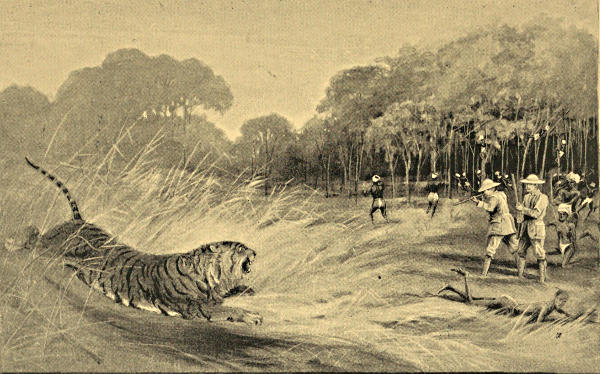
‘THE FRONT RANK AND PART OF THE SECOND ALONE STOOD FIRM’
The erection of the platform, or ‘machan,’ too frequently
disturbs the tiger and drives him away. If the sportsman can
procure baits, a good plan is to select a good place for a machan
before tying up; tether lightly so that the tiger may drag the
carcase away. Make the machan when the first bait is taken,
tie up again till he kills again in the same place, and about
three days after the second kill tie up again and sit over it.
The best machan is a cot with low rails round the edge, fitted
with ropes to sling it in a tree. The sportsman’s blankets and
pillows can be spread in it, he himself can lie comfortably at
full length watching the bait or kill, there are no sticks to
crackle and make a noise; and when the moon goes down or
he has had his shot, he can turn round and sleep as one only
sleeps in the open. The sportsman should be at his post by
four o’clock in the afternoon, as if the tiger means coming he
will probably come early. Sanderson says he enjoys the sport;
it’s pleasant enough if the tiger comes soon, but if he puts off
his visit to 3 a.m., as happened to the writer, who was at that
hour peacefully sleeping and never woke up, the entertainment
is mediocre. Allowing a native to perch on the same
tree is ruination to sport: cough he must; besides, the jungle
man is unsavoury, and the evening air seems to make him
smell worse than usual. If a kill is found in the jungle and the
sportsman decides to sit over it, General Macintyre’s plan is worth
trying; i.e. take some men up to the tree, let them talk loudly,
or shout while the machan is being prepared, and then retire
talking or shouting, according as the tiger is supposed to be
bold or timid. He will very likely come at once, as their voices
die away, not to eat, but to see if they have removed the kill.
This often succeeds where professional skinners are in the
habit of saving what they can of the hides of kills. Lieutenant-Colonel
Fife Cookson, in his book ‘Tiger Shooting in
the Doon and Ulwar,’ gives a curious account of a tiger stalking
a bait:
Suddenly there emerged from underneath the trees a brownish-yellow
object which appeared about the size of a monkey, and for
a moment, in the failing light, I thought it was one. It darted
rapidly along the bare ground for about twenty yards at a time,
moving towards the bullock, and stopping at the end of each run
behind one of the tufts of grass about two feet high, over which it
peeped, then sinking down again and gliding forward as before. It
was now nearer, and by this time I could see that it was not one
of the monkeys; but still I could not clearly make out what it was.
It reminded me of a very ugly, large, yellow and black mask at a
pantomime. I could see no legs or body. Now it reached a tuft
about forty yards from me, over which it also peeped, staring
intently at the bullock. By this time I was convinced that it was
the tiger, though it looked about the size and shape of a horse’s
head. The curious appearance which the tiger had presented at a
distance of about seventy yards, in shape like the head of a horse
with the chin touching the ground, was no doubt owing to my
seeing his forepaws underneath and part of his back foreshortened
over the top of his head. What most particularly struck me was
the small object which the tiger appeared during the stalk. It
must be remembered that, although I perhaps saw a little of the
back between his ears, I was looking down upon him from a much
higher level, and that if I had been on the ground I should probably
have seen nothing but his head. Thus the tiger was evidently able
to hide himself behind any tuft of grass which was large enough to
conceal his head. Another remarkable thing was the position in
which he held his head. It was no longer in the usual attitude,
with the nose in the air, as when the animal is walking about; but
the face was held vertically, the chin being drawn in, and the forehead
pressed forward, thus displaying its black stripes and markings,
together with the intent stare of the large eyes. This greatly
added to its sinister appearance.
Williamson describes another variety of sitting up, the
sportsman being enclosed in a strong bamboo cage and
playing the part of bait himself, being armed with two or three
spears:
Being accompanied by a dog, which gives the alarm, or by a
goat, which by its agitation answers the same purpose, the adventurer
wraps himself up in his quilt, and very composedly goes to
sleep in full confidence of his safety. When the tiger comes, and
perhaps after smelling all round begins to rear against the cage,
the man stabs him with one of the spears, through the interstices
of the wickerwork, and rarely fails at destroying the tiger.
The writer heard of an instance of this being tried by a
European, with a cage made of iron. Unfortunately the bars
were set too far apart, and the tiger got his paw through and
slew that adventurer.
Williamson also narrates the old story—possibly it was
taken from his book—of tigers being caught by covering leaves
with birdlime; it was told him by a Mahommedan gentleman
of the Court of the Nabob Vizier of Oude. Sanderson gives a
capital account of tiger-netting, as practised in Mysore, and
describes the various traps occasionally used by natives. The
late Maharajah of Patiala, about 1872, had a tiger that had been
trapped in the hills turned out on the plain outside the town,
he and his guests being mounted on elephants. Of course the
whole of the populace assembled to see the fun, forming a
large circle round the plain. The tiger, on being released
where there was not sufficient cover for a quail, selected as his
point of exit the buggy of a native gentleman, who sought
refuge between the wheels; his groom, being unfortunately in
the way as the tiger cleared the conveyance, was knocked
over, but luckily more frightened than hurt. The tiger then
took refuge in a garden, pursued by the elephants. On
their arrival at the spot the gardener was found placidly pursuing
his avocation, and, on being asked if he had seen the
beast, imprudently pointed him out. The tiger at once sprang
on the man, upset him and bolted; but as he was now heading
for the English doctor’s stables he was considered to be
becoming dangerous, and was cleverly shot by the Maharajah.
Sanderson, in describing the way a tiger attacks and kills
his prey, says that in attacking a bison his object is to get the
latter to charge, and then, avoiding the rush, to follow on the
instant and endeavour to emasculate the bull by striking him
behind. In killing cattle he writes:
The general method is for the tiger to slink up under cover of
bushes or long grass, ahead of the cattle in the direction they are
feeding, and to make a rush at the first cow or bullock that comes
within five or six yards. The tiger does not spring upon his prey
in the manner usually represented. Clutching the bullock’s fore-quarters
with his paws, one being generally over the shoulder, he
seizes the throat in his jaws from underneath, and turns it upwards
and over, sometimes springing to the far side in doing so, to throw
the bullock over, and give the wrench which dislocates its neck.
Sir S. Baker writes that while lions and cheetahs (Felis
jubata) use their paws in striking down their prey at the
moment of capture, tigers apparently never do. Sanderson
points out that Forsyth, as also Captain Baldwin in his
‘Large and Small Game of Bengal,’ agree that tigers seize by
the back of the neck, and then give the dislocating wrench.
The writer noticed the fang-marks on a good many kills in
Central India, and certainly they appeared from their position
rather low down, apparently too much so to have been inflicted
by a bite on the back of the neck—a tiger’s jaw is not very
long—to entirely support Sanderson’s description. As regards
a tiger’s powers of springing, Sanderson says he has often
measured the bounds of tigers that have pursued deer, and found
15 ft. to be about the distance they usually spring.
The writer particularly noticed the way a tiger sprang at an
elephant: he did not bound from a distance at all, but simply
galloped up till he was just under the elephant’s ear-hole, and
then sprang vertically upwards, placing his forepaws on the
elephant’s head, and there he hung till the elephant shook him
off. A tiger can with ease get his forepaws on to an object
twelve to fifteen feet from the ground; but he seems clumsy in
getting sufficient hold with his hind paws to enable him to proceed
after his first spring. Sanderson says that tigresses do not
breed at any fixed season. Sterndale states that they go with
young for about fifteen weeks, and produce from two to five at
a birth. Sanderson gives four as an unusually large number;
the writer saw six taken out of a tigress, but probably these
would not all have been born alive. He also saw a tigress with
four cubs which must have been nearly a year old, one of
them which was shot measuring 4 ft. 9 ins. Mr. Shillingford’s
memorandum quoted by Sterndale is interesting:
| Cubs one year old measure | {Males | 4½ ft. to 5½ ft. |
| {Females | 4”5 ” |
| ”two years” | {Males | 5½”7 ” |
| {Females | 5”6½ ” |
| ”three years” | {Males | 7”8½ ” |
| {Females | 6½”7½ ” |
When they reach three years of age they lose their ‘milk
canines,’ which are replaced by permanent fangs, and at this
period the mother leaves them to cater for themselves, the
tigress breeding once in three years.
Mr. Shillingford also notes that out of 53 cubs (18 mothers)
29 were males, and 22 females, the sex of two cubs not being given.
This tends to prove that there are an equal number of each
sex born,[19] the marked preponderance of adult tigresses over
tigers being accounted for by most writers by the native
story that the male tigers kill the young male cubs. The
writer offers another suggestion: may not the young male
tigers as soon as they leave their mothers avoid the domains
of the heavy old cattle-lifters, and taking to the hills and forest
form the game-killing class, till they are powerful enough to
succeed to the estates of their sires, either by force or by
inheritance, owing to their sire having met with an accident
when entertaining a sahib, and so settle down and take wives?
The writer has no proof to give in support of this suggestion,
but merely offers it for sportsmen to consider. With respect
to the common native story that the age of tigers may be told
by the number of lobes in their livers, the writer made the
following observations in Central India: Tigress, 6 lobes;
tiger, 8 lobes; tigress, 7 lobes; cub (male), 6 lobes; male
panther, 7 lobes; tigress, 7 lobes; tiger, 8 lobes; tigress, 7
lobes; tigress (a very old light-coloured one), 7 lobes; tiger,
7 lobes.
Sanderson says he has shot tigers and panthers with from
9 to 15 lobes. An article on the age of tigers as shown by their
length, written by Mr. F. A. Shillingford for ‘The Asian’ and
copied in ‘Land and Water,’ August 30, 1890, appears to be
worth quoting:
It was the opinion of the late Mr. Joe Shillingford that in
Bengal and the Nepal Terai, at all events, tigers, as distinguished
from tigresses, did not attain full maturity until they attained a
length of over 10 ft., measured ‘sportsman’s style,’ and that occasionally
they attain a length of 11 ft., and that the 12 ft. tiger
shot by the late Mr. C. A. Shillingford was an exceptional monster,
like the exceptional tigress, 10 ft. 2 ins. in length, shot in 1867,
and in these opinions I entirely concur. I have a collection of
over a hundred tiger skulls, and in no case are the parietal
sutures obliterated from old age of skulls of tigers below 10½ ft.
in length.
Tigers take to water readily, and swim higher out of the
water than most animals.
Elephants who take matters into their own hands and
charge at tigers are exceedingly dangerous in the field, particularly
after a tiger has been killed and men are dismounting
to pad it. All the elephants in such a case, except the one
destined to carry the beast, should be taken away from near the
carcase; they are more or less in an excited state, and are apt
to mistake a man in the grass for another tiger. The writer
remembers being on an elephant that stood perfectly steady
for the shot, but as soon as the tiger was killed—it was within a
few feet of her—it was all the mahout could do to prevent her
charging it.
The elephant has a way of playing football with an animal
which though diverting to a spectator is awkward for the man
in the howdah. The elephant performs a kind of war dance
over the carcase, kicking it about between his feet, lifting it
with the front of the hindfoot and returning it from the back
of the forefoot till tired, when he places one ponderous hindfoot
upon it and squashes it flat. If an elephant has been
mauled, it is not at all a bad plan to let it play with the carcase
of its enemy; but everything should be taken out of the howdah,
and the skin will not be worth much afterwards.
Two other serious dangers that have to be guarded against
in tiger shooting are bees and red ants. Bees generally hang
their hives from boughs of trees or on the face of rocks, but
often they have them in high grass, and an elephant pushing
his way through disturbs them, rendering them exceedingly
aggressive, whilst a shot fired near them is quite enough to
make them attack. Deaths of men and animals from their
stings have often been recorded; they almost always go at the
head, and the best way of escaping is to cover the head with
a blanket, which should invariably be placed in each howdah.
The mahouts always sit on theirs. Oddly enough, if the head
is covered the rest of the body, even of unclad natives, usually
escapes their attentions. A nest of red ants, though not so
dangerous, is quite enough to put anyone to flight, as they bite
unmercifully and leave their nippers in. No one would ever
think of climbing a tree with a bee’s nest in it, but equal care
should be taken that red ants, which are hard to detect, are not
in it also; an inspection of the trunk will usually decide the
question, especially if the boughs touch nothing else. In
selecting camping grounds particular attention to these points
is also necessary; most servants do not take the trouble to
look up into the trees, and will light their fires under a bee’s
nest till they have been properly stung once; but their carelessness
may result in the loss of ponies’ or even men’s lives.
Sanderson remarks on the danger of firing at a tiger’s head
except at very close ranges. The writer saw an instance of this
in a tigress hit on the side of the head with an Express bullet;
she dropped in her tracks, lying with her head underneath her
for nearly a minute, when she recovered, went back into the
jungle, and gave a good deal of trouble afterwards, charging
the elephants freely. A shot through the shoulder is far more
likely to be effective. A tiger seems rather a soft beast, and
nearly always drops on receiving his first wound, though he
picks himself up pretty quickly. Subsequent wounds have
comparatively little effect on any animal, and another curious
thing that the writer has noticed is that wounded animals
nearly always lie down on their wounded side.
Tigers do not seem to be very particular as to what they
eat. Sterndale records an instance of their eating carrion;
Sanderson gives a story of three tigers killing and eating a
fourth, and of their eating bears; and Colonel Kinloch told
the writer of his finding a snow bear killed by a tiger in Chumba,
on barasingh ground. Tigers seem to be yearly penetrating
deeper into the Himalayas; probably they follow the ever-increasing
herds of cattle that come up from the plains in the
summer to graze.
Sterndale gives an ingenious formula for finding the length
of a tiger from its skull. For details the reader is referred to
his book.
In the following list of measurements only tigers of
10 ft. or over are mentioned except where weights are given
and of exceptionally large tigresses. The system of recording
tigers’ weights as shot does not appear satisfactory. Those
which scaled over 500 lbs. must surely have included a good
deal of beef.
Measurements
| Authority |
Total length |
Tail |
Height at shoulder |
Girth of chest |
Girth of forearm |
Girth of upper arm |
Length of skull |
Breadth of skull |
Weight as shot |
Remarks |
|
ft. ins. |
ft. ins. |
ins. |
ins. |
ins. |
ins. |
ins. |
ins. |
lbs. |
|
| Gen. Sir C. Reid, K.C.B. |
12 2 |
.. |
.. |
.. |
.. |
.. |
.. |
.. |
.. |
Sterndale’s ‘Mammalia’ (skin measured 13 ft. 5 in.) |
| Lieut.-Col. Boileau, 1861 |
12 0 |
.. |
.. |
.. |
.. |
.. |
.. |
.. |
.. |
Sterndale |
| Col. Ramsay |
12 0 |
.. |
.. |
.. |
.. |
.. |
.. |
.. |
.. |
” |
| Hon. R. Drummond, C.S. |
11 9 |
.. |
.. |
.. |
.. |
.. |
.. |
.. |
.. |
” |
| Col. Shakespeare |
11 8 |
.. |
.. |
.. |
.. |
.. |
.. |
.. |
.. |
” |
| Gen. Sir C. Reid, K.C.B. |
11 6 |
.. |
.. |
.. |
.. |
.. |
.. |
.. |
.. |
” |
| Sterndale, ‘Meade Shell’ |
11 6 |
.. |
.. |
.. |
.. |
.. |
.. |
.. |
.. |
” |
| Mr. F. A. Shillingford |
11 5 |
.. |
.. |
.. |
.. |
.. |
.. |
.. |
.. |
Letter to ‘The Asian,’ ‘Land and Water’, Aug. 30, 1890 |
| ” |
11 1 |
.. |
.. |
.. |
.. |
.. |
.. |
.. |
.. |
” |
| ” |
11 0 |
3 6¾ |
43 |
.. |
.. |
.. |
15¼ |
10½ |
.. |
Ditto (skull quoted by Sterndale now in Calcutta Museum) |
| ” |
11 0 |
.. |
.. |
.. |
.. |
.. |
.. |
.. |
.. |
|
| ” |
11 0 |
.. |
.. |
.. |
.. |
.. |
.. |
.. |
.. |
|
| ” |
11 0 |
.. |
.. |
.. |
.. |
.. |
.. |
.. |
.. |
” |
| Sir G. Yule |
11 0 |
.. |
.. |
.. |
.. |
.. |
.. |
.. |
.. |
Sterndale’s ‘Mammalia’ |
| Mr. Shillingford |
11 0 |
3 4 |
43 |
54 |
26 |
.. |
.. |
.. |
.. |
Shot in Purneah |
Quoted by Sterndale to compare the bulk of tigers in Bengal and S. India |
| ” |
10 2 |
3 1 |
45 |
73 |
34 |
.. |
.. |
.. |
.. |
Shot in S. India |
| Mr. F. A. Shillingford |
10 10 |
.. |
.. |
.. |
.. |
.. |
.. |
.. |
.. |
Letter to ‘The Asian’ |
| ” |
10 10 |
.. |
.. |
.. |
.. |
.. |
.. |
.. |
.. |
” |
| Mr. Shillingford |
10 9½ |
3 6½ |
43 |
.. |
.. |
.. |
.. |
.. |
.. |
Sterndale’s ‘Mammalia’ |
| ” |
10 8½ |
3 5½ |
44½ |
55 |
.. |
.. |
.. |
.. |
.. |
” |
| Sir J. Fayrer |
10 8 |
.. |
.. |
.. |
.. |
.. |
.. |
.. |
.. |
” |
| Mr. F. A. Shillingford |
10 8 |
.. |
.. |
.. |
.. |
.. |
.. |
.. |
.. |
Letter to ‘The Asian’ |
| ” |
10 7 |
.. |
.. |
.. |
.. |
.. |
.. |
.. |
.. |
” |
| ” |
10 7 |
.. |
.. |
.. |
.. |
.. |
.. |
.. |
.. |
” |
| ” |
10 6 |
.. |
.. |
.. |
.. |
.. |
.. |
.. |
.. |
” |
| ” |
10 6 |
.. |
.. |
.. |
.. |
.. |
.. |
.. |
.. |
” |
| Gen. Sir C. Reid, K.C.B. |
10 6 |
.. |
.. |
.. |
.. |
.. |
.. |
.. |
.. |
Sterndale’s ‘Mammalia’ |
| Col. J. Macdonald |
10 4 |
.. |
.. |
.. |
.. |
.. |
.. |
.. |
.. |
” |
| Maharajah of Kuch Behar |
10 2½ |
3 2½ |
39½ |
48½ |
20 |
26½ |
.. |
.. |
530 |
Letter to ‘The Asian’ |
| ” |
10 2½ |
.. |
.. |
.. |
.. |
.. |
.. |
.. |
493 |
Rowland Ward, ‘Horn Measurements’ |
| Mr. F. A. Shillingford |
10 2 |
.. |
.. |
.. |
.. |
.. |
.. |
.. |
.. |
‘The Asian,’ ‘Land and Water’, Aug. 30, 1890 |
| Sir E. Durand, Bart. |
10 2[20] |
.. |
.. |
.. |
.. |
.. |
.. |
.. |
.. |
Nepal, Jan. 18, 1891 |
| Maharajah of Kuch Behar |
10 1½ |
3 1 |
44¾ |
54 |
21 |
29 |
15¾ |
.. |
.. |
‘The Asian’ |
| ” |
10 1 |
3 3½ |
41 |
56 |
19½ |
26 |
.. |
.. |
.. |
” |
| Forsyth, ‘Highlands Central India’ |
10 1 |
.. |
.. |
.. |
.. |
.. |
.. |
.. |
.. |
|
| ” |
10 0 |
.. |
.. |
.. |
.. |
.. |
.. |
.. |
.. |
|
| Maharajah of Kuch Behar |
10 0 |
3 1 |
40 |
52 |
21 |
26 |
.. |
.. |
540 |
‘The Asian’ |
| ” |
10 0 |
3 2 |
40 |
51 |
18¾ |
29 |
.. |
.. |
.. |
” |
| ” |
9 10 |
3 0 |
41½ |
47½ |
18½ |
26½ |
.. |
.. |
426 |
” |
| ” |
9 6 |
3 1 |
38 |
52 |
19 |
29 |
.. |
.. |
481 |
” |
| ” |
9 5 |
3 1 |
38¼ |
49 |
18 |
26 |
.. |
.. |
420 |
” |
| ‘Deccan Ranger,’ ‘Oriental Sporting Magazine,’ 1876 |
9 10 |
.. |
.. |
.. |
.. |
.. |
.. |
.. |
432½ |
Tiger |
| ” |
9 10 |
3 1 |
46 |
.. |
.. |
.. |
.. |
.. |
425 |
” |
| ” |
9 6 |
2 11 |
.. |
.. |
.. |
.. |
.. |
.. |
370 |
” |
| ” |
9 6 |
3 2 |
45 |
.. |
.. |
.. |
.. |
.. |
447½ |
” |
| ” |
9 2 |
.. |
.. |
.. |
.. |
.. |
.. |
.. |
330 |
” |
| ” |
9 0 |
3 0 |
42 |
.. |
.. |
.. |
.. |
.. |
282 |
Tigress |
| ” |
8 11 |
2 9 |
39 |
.. |
.. |
.. |
.. |
.. |
245 |
” |
| ” |
8 8 |
.. |
.. |
.. |
.. |
.. |
.. |
.. |
285 |
Tiger |
| ” |
8 5 |
.. |
.. |
.. |
.. |
.. |
.. |
.. |
256 |
Tigress |
| ” |
8 5 |
2 9 |
39 |
.. |
.. |
.. |
.. |
.. |
253 |
” |
| Mr. H. L. Heber Percy |
9 10[20] |
.. |
.. |
.. |
.. |
.. |
.. |
.. |
.. |
” Nepal, Feb. 12, 1891 |
| ” |
9 2½ [20] |
.. |
.. |
.. |
.. |
.. |
.. |
.. |
.. |
” ” Jan. 31, 1891 |
| ” |
9 2 |
.. |
.. |
.. |
.. |
.. |
.. |
.. |
.. |
” ” Jan. 21, 1891 |
| The Writer |
9 1 |
.. |
.. |
.. |
.. |
.. |
.. |
.. |
.. |
” Central India, May 23, 1876 |
| Col. Gordon Cumming, ‘Wild Men and Wild Beasts’ |
9 1 |
.. |
.. |
.. |
.. |
.. |
.. |
.. |
.. |
” |
| ” |
9 0 |
.. |
.. |
.. |
.. |
.. |
.. |
.. |
.. |
” |
| Capt. Lamb |
9 0 |
.. |
.. |
.. |
.. |
.. |
.. |
.. |
.. |
” Central India |
| Sir E. Durand, Bart. |
9 0[20] |
.. |
.. |
.. |
.. |
.. |
.. |
.. |
.. |
” Nepal, Jan. 17, 1891 |
| Sanderson, ‘Thirteen Years among the Wild Beast’ |
.. |
.. |
.. |
.. |
.. |
.. |
.. |
.. |
349½ |
|
| Rowland Ward’s Collection |
.. |
.. |
.. |
.. |
.. |
.. |
14½ |
10 |
.. |
Rowland Ward, ‘Horn Measurements’ |
| Average of full-grown tiger |
9 6 |
3 1 |
42 |
48 |
18 |
26 |
.. |
.. |
420 |
|
| Average of full-grown tigress |
8 4 |
2 10 |
39 |
.. |
.. |
.. |
.. |
.. |
265 |
|
Native names: generally, ‘Chita’; in the Himalayas, ‘Lagá Bagá’;
in Central India, ‘Téndwá’
The panther is common all over India, Burmah, and Ceylon,
but does not cross the snow-line of the Himalayas, being
replaced beyond the range by the ounce. Sterndale gives two
varieties, the pard and the panther, describing the pard as being
larger, the spots more clearly defined in rosettes, and the skull
longer and more pointed than the panther’s. Sanderson also
gives two varieties with the same distinctions, but calls Sterndale’s
pard the panther, and Sterndale’s panther the leopard.
This is in itself perplexing to the ordinary sportsman, and
as the writer saw two beasts shot in the same beat, the male
corresponding to Sterndale’s pard and the female to Sanderson’s
leopard, the only solution he can offer of the difficulty
is that the sportsman may call the beast he shoots either
leopard or panther according to his own fancy, and not one
man in a hundred will be able to contradict him.
The panther is a nuisance wherever he is; he is perpetually
prowling about villages at night picking up unconsidered trifles,
such as dogs, goats, ponies and babies, in short anything.
Occasionally panthers become regular man-eaters, and though
far more plentiful than tigers, they are so cunning that they are
far harder to shoot. A wounded panther is always a dangerous
beast to follow up. He can hide, like a quail, in anything; his
attack is always sudden, and being a quick, active beast, he more
frequently makes good his charge than a tiger. More men get
mauled by panthers than by tigers, but on the other hand fatal
results are the exception, and stories are told of men having
strangled panthers with their hands when they have been
attacked.
Many a pet dog has been carried off in broad daylight, in
the middle of large hill stations, where the forest comes close
up to the roads and houses. A dog of my own had the
narrowest escape in Chamba, being chased by a panther almost
up to my feet. The beast had almost got hold of him when
I drove him off. Ward recommends trapping, and gives
capital directions for making a cage-trap. When the writer
was stationed at Chakrata a few panthers were caught in these
traps, but more were shot over dogs tied up as baits. Panthers
are often shot in this way, or by sitting over a kill. At night a
very good plan is to strew chaff thickly all round the bait,
and if it is dark arrange a lantern so as to throw its light on the
bait; neither of these plans will scare a panther, though it
might a tiger.[21] Sterndale recommends phosphorescent oil
(one grain phosphorus to one drachm oil dissolved in a bath
of warm water) for touching the sights at night. There is a
magnesium wire lantern, a Hanoverian invention, which is made
to fit on the sportsman’s shoulder, and on a string being pulled
throws a broad search light down the barrels of the rifle lasting
about thirty seconds; but this, if the sportsman was sitting
on the ground, might lead to complications should the first
shot fail to kill outright. If a panther’s cave is found, it is
often worth while watching the entrance about 4 p.m., when
the animal will come out and sun himself before starting on
his evening ramble. In Central India panthers are often beaten
out like tigers, but they are unsatisfactory beasts to try and
drive, as they are so apt to hide and let the beaters pass by
them. On one occasion a panther came within shot of one
of the guns, who did not fire as a tiger was expected. The
panther first amused himself by catching a hare that the beaters
had driven up to him, then, as the men got near, he selected
a plump youth and proceeded to stalk him, when the gunner
thought it time to interfere.
Sitting up over a bait at night is the poorest of all amusements.
Often has the writer undergone it, and as often sworn
he never would do it again, till the next absolute certainty has
been offered him with the usual disappointing result.
When a panther is in the habit of attacking flocks on their
way home in the evening, a good plan is to select a place before
the flock returns, and arrange with the shepherd that he shall
drive the flock past your hiding-place and tether a kid as he
passes; the apparent absence of pre-arrangement will probably
induce the panther to show at once.
Sanderson gives some stirring accounts of his adventures
with panthers in which the following points are particularly
noticeable, viz. the necessity of posting markers outside the
cover beaten to watch the panther if he leaves it; that panthers
will not charge out of caves even if poked up with bamboos;
that, unlike most tigers, a panther charged home at a large
party of men closed up, and used his paws, cuffing right and left
instead of biting. Not that a panther never bites, as the beast
referred to had bitten a man previously, but in nearly all cases
of men being mauled the bulk of their injuries are claw wounds.
Sterndale relates a curious legend about a well-known man-eating
panther that killed over two hundred people in three
years, and was supposed to be a kind of Wehr-wolf. Panthers
have often been ridden down and speared, but two or three men
are required for this amusement, as on the first horse overtaking
it the panther will at once crouch and endeavour to spring on
the horse’s back as he passes. The second horseman should,
therefore, be close up ready to cut in at once; care should be
taken to get the first spear home in a good place, and the
panther should be held down if possible, till despatched by the
spears of the rest of the party. It is foolhardiness for a single
man to attempt it. Panthers climb readily, and many have
been shot out of trees where they have taken refuge, or been
found lying asleep on a branch. Forsyth considers that many
panthers escape in drives by taking to trees, and mentions
finding the body of a child, that had been killed by a panther,
lodged in a forked bough.
The troopers of the Central Indian Horse used often to kill
panthers in the rainy season by tracking them into patches of
sugar-cane, which they surrounded with men armed with spears
and swords (guns were naturally not allowed), and then hunted
the beast out with a pack of dogs. When panthers or bears
were marked down in jungle too big to be surrounded, the
guns were posted in trees, and the pack laid on to hunt the
beasts up.
Terriers were chiefly used, but it was necessary to employ a
greyhound or two to prevent the beast galloping away from the
little dogs; the greyhounds would not tackle, but by ranging up
and snapping would impede the beast’s movements. Sanderson
had great sport with his pack, hunting bears, bison, and even
on one occasion a young elephant. He gives every instruction
for getting together a pack, but does not mention the use of greyhounds,
though they would evidently have saved his heavy
seizers from long tiring runs. Sambur hunting with dogs in
Ceylon is an old-established custom, but there apparently the
whole pack is hunted together, while Sanderson appears to
have kept his seizers up till the quarry came to bay and then
slipped them.
Black panthers are occasionally found, but they are merely
instances of melanism, several cases of a single black cub
in a litter being recorded. As a rule, these black specimens
are only found in heavy forests, not in the more open ground,
and they are more common in the south of India than the
north. There is a lovely stuffed specimen in the British
Museum, upon which the markings are just discernible in
certain lights.
Native names: ‘Tungmar’ Lepcha; ‘Zik’ Bhotia; ‘Lamchitta’
of the Khas tribe (Sterndale)
This panther seems to be entirely a forest animal. It extends
from Nepal eastwards through Assam.
Kinloch gives an instance of one having been shot, but
specimens are very rarely obtained, though occasionally live
cubs have been bought from natives.
The chief peculiarities of this species are the extreme
beauty of the colouring, and the fact that the upper canines
are the longest in comparison of all living felines.
Native names: ‘Chita’ generally; ‘Yuz’ of the Chita-catchers (Sterndale)
This animal is generally found in Central or Southern India.
The writer has never heard of it in the Punjab or North-West
Provinces. According to Sterndale, it is most common in
Jeypur in Upper India and Hyderabad in Southern India.
In general colour it is like a panther, except that its nose is
black instead of pinkish; it has a mane on the neck and long
hair on the belly; its spots are single and not in rosettes. Its
shape is quite different from that of the panther. Instead of
having the muscular forearm, short legs and rounded body of
that beast, it is a tall greyhound-like animal with thin long legs,
and toes like a dog, the claws being only semi-retractile.
It is not often shot, but most native princes have tame
specimens for hunting antelopes. These have to be caught when
nearly full grown, as cubs cannot be trained for the sport, and
chita catching is a regular profession in certain districts. In
Sterndale’s ‘Mammalia of India’ there is an interesting account
of catching chitas quoted from ‘The Asian.’ As regards its
habits when wild, the writer says:
It is said by shikaries to feed only once every third day, when,
after gorging itself, it retires to its den for the other two. On the
morning of the third day he visits some particular tree, which the
animals of his species in the neighbourhood are in the habit of frequenting.
Such trees are easily to be recognised by the scoring of
the bark, on which he whets his claws. From this meeting place,
after having played about with such of his comrades as may be
there, they go off on a hunting expedition.
Here is evidently the tip for any sportsman wishing to
shoot one: find a tree with tracks three days old, and sit up
in it on the fourth morning.
Sterndale says:
Chita kittens are quite grey without any spots, but can always
be recognised by the black stripe down the nose, and on cutting off
a bit of the soft hair I noticed that the spots are quite distinct in
the under fur. As a rule the young of all cats, even the large one-coloured
species, such as the lion and puma, are spotted, but the
hunting leopard is externally an exception, although the spots are
there lying hid.
Hunting antelope with chitas has been described ad
nauseam, and is in the opinion of the writer very poor sport.
It is worth witnessing once, if only to see how fast a chita
can go.
Generally, ‘Safed Chita’; Thibet, ‘Stian’
The ounce is fairly common on the higher ranges; there
are few ibex grounds on which its tracks will not occasionally
be seen, but owing to its nocturnal habits it is very rarely
met with. It preys chiefly on ibex and burrel, and rarely, if
ever, descends to the forest line. It will kill sheep and goats.
A farm in Lahoul, belonging to the Moravian missionaries,
suffered considerably in 1884 from the depredations of a pair
of ounces that lived in the valley behind Kielang. The male
of this pair was killed by an officer of the Royal Artillery, who
saw the ounce on his return from shooting late in the evening.
The next day he went back up the nullah prepared to spend
the night out, shot a young male ibex and dragged the carcase
down to where he had seen the ounce the day before. Just at
dusk the ounce came to the bait and was missed clean with
the first barrel; however, the sportsman, being highly favoured
by the gods, bagged him with a second shot, and next morning
brought him in triumph down to Kielang. The skin was a
beauty, very pale yellowish white with black spots and black
rings on the thick furry tail.
From the amount of slaughter ounces effect among ibex, it
is probable that they hunt in pairs. In 1874 a sportsman in
Pangi found a flock of five or six male ibex lying dead within a
few yards of each other, killed by ounces; he had seen this
particular flock some days before, had either disturbed them or
was unable to get at them, and had given them a few days’ rest
to settle down in. When he did go after them he found that
they had all been slaughtered.
Thibetan, ‘Ee’
This beautiful animal is very rarely met with, but as the
Tartars know it well by name, it is possible that it may be
more plentiful than is commonly supposed; its nocturnal
habits, as in the case of the ounce, shielding it from observation.
The Tartars aver that it frequently kills sheep and
goats; but though the lynx is quite powerful enough to do so,
it is probable that the natives occasionally confound the lynx
with the ounce. The lynx stands about 17 ins. at the shoulder,
and is of enormously powerful make, with teeth and claws large
enough for an animal of twice its size.
The Thibetan lynx has the orthodox prominent whiskers
which are absent in the red lynx of the plains, but it differs
from the European variety in the pads of its feet being prominent
and bare, with short close fur between them, whereas
in the European lynx the long fur completely conceals the
pads.
The red lynx, Felis caracal, called by natives ‘Siagosh,’
is occasionally met with all over India. It is not common
anywhere, or at least, possibly owing to its nocturnal habits,
it is not often shot. A few are known to have been shot in
Central India. It preys chiefly on hares, birds, and small deer.
Sterndale gives the following measurements: Head and body,
26 to 30 ins.: tail, 9 or 10 ins.; height, 16 to 18 ins.
Measurements
| Authority |
Total length |
Tail |
Height at shoulder |
Remarks |
| Felis Pardus |
|
ft. ins. |
ins. |
ins. |
|
| Col. Gordon Cumming (‘Wild Men and Wild Beasts’) |
7 10 |
.. |
.. |
Male |
| ” |
7 8 |
.. |
.. |
” |
| Capt. A. G. Ferguson |
7 8 |
.. |
.. |
|
| Col. Howard |
7 4½ |
.. |
.. |
Male |
| Mr. H. L. Heber Percy |
7 4[22] |
.. |
.. |
Nepal, Dec. 9, 1892 |
| ” |
7 1[22] |
.. |
.. |
” Jan. 30, 1891 |
| Sir E. Durand, Bart. |
7 1[22] |
.. |
.. |
” Jan. 17, 1891 |
| Major FitzHerbert |
6 8½ |
.. |
26½ |
Male |
| Col. Kinloch |
6 4 |
.. |
.. |
Female |
| Col. Howard |
6 0 |
.. |
.. |
” |
| Sterndale’s ‘Mammalia’ |
7 0
to
8 8 |
30 to 38 |
.. |
Pard |
| ” |
5 6
to
6 0 |
30 |
18 to 24 |
Panther (female) |
| Sanderson (‘Thirteen Years among the Wild Beasts’) |
6 8 |
.. |
.. |
|
| ” |
6 3½ |
.. |
26 |
” |
| ” |
6 10 |
.. |
.. |
” |
| ” |
5 4 |
.. |
.. |
Leopard (male) |
| ” |
5 2 |
.. |
.. |
” (female) |
| Felis diardii |
| Sterndale |
6 4 |
36 |
.. |
Jerdon states that it grows to a larger size |
| Felis jubata |
| Sterndale |
7 0 |
30 |
30 to 33 |
|
| Felis Uncia |
| Sterndale |
7 4 |
36 |
24 |
Measurements apparently too big |
| Major Ward (‘Sportsman’s Guide to Kashmir’) |
6 4 |
36 |
.. |
Male |
| ” |
6 0 |
33 |
.. |
Female |
| Capt. Dawkins (May 24, 1884.) |
5 11½ |
36 |
18 |
Male |
Space does not permit an exhaustive description of these
vermin, and it must be briefly said that there are three kinds
of wolves in India. First is the ordinary wolf of the plains
(Canis pallipes) which is more destructive to children and cattle
than to game, and is generally called ‘Bheria’ by the natives.
Authenticated tales of its ravages among the infant population
are only too common, an old bitch wolf with cubs laid up
near a village naturally finding Indian baby the most easily
procured and most succulent diet for her offspring. Wolves
have occasionally been ridden down and speared, but only
when found in the morning, and more or less gorged; a wolf
in the evening, when empty, will lope along just ahead of good
greyhounds till the latter lie down exhausted. They can occasionally
be smoked out if their earths are found. Williamson
describes a big bag made in this way near Allahabad in 1780;
the earths were dug out, and at least ten pounds weight of
children’s ornaments found in them. He also narrates a ghastly
story of the way wolves attacked the starving natives during
the famine of 1783 in broad daylight; as a rule, however, they
seldom attack men.
The next well-known varieties are the grey and black
Thibetan wolves (Canis laniger and Canis niger), generally
called ‘Chanko.’ These are very destructive to game as well
as to flocks and herds, as they hunt in small packs. Both grey
and black wolves are found together, and interbreed. The
black wolf is said to be rather the larger, but it is an open
question whether the varieties are distinct or not, in spite of
the fact of the black specimens Colonel Kinloch presented to
the Zoological Gardens only producing black cubs.
A third variety of ‘Chanko,’ called the ‘golden wolf,’ has
been mentioned by sportsmen, but this may possibly be the
European wolf (Canis lupus), which extends to Turkestan.
The chief points of distinction between the three varieties
of wolves, i.e. European, Thibetan, and Indian, are as follows:
in the European wolf the carnassial tooth is as long as the two
molars together, which is not the case with the others; it has
also a dark stripe on the forelegs, which the others have not;
and, lastly, the European and Indian wolves have black tips to
their tails, which the chanko has not.
The remaining species of vermin is the Wild Dog (Cuon
rutilans), generally called ‘Jungli-Kutta’: in Cashmere ‘Ram
Hun.’ These veritable pests are found everywhere, and as
they hunt in large packs are most destructive to all kinds of
game, absolutely clearing out whole tracts of country, even
being credited occasionally with killing tigers, which, as
Sanderson points out, is by no means impossible if the tiger
attempts to run away, and they get a chance of making their
favourite attack from behind. He narrates two occasions on
which he saw deer eviscerated by one or two snaps from wild
dogs. They rarely, if ever, attack men, and are more like big
red jackals than dogs. The cubs are quite untamable, and are
the nastiest, most evil-smelling, vicious pets that heart could
desire.
Measurements
| Authority | Total length | Tail | Height at shoulder |
| Canis Lupus |
| ins. | ins. | ins. |
| Sterndale | 62 to 68 | 20 | 30 to 32 |
| Canis pallipes |
| Sterndale | 52 | 16 to 18 | 26 |
| Canis laniger |
| Sterndale | 68 | 20 | 30 |
| Cuon rutilans |
| Sterndale | 48 to 52 | 16 | 17 to 20 |
| Major Ward | 60 | .. | .. |
Native names: ‘Lakhar baghar’ generally; ‘Rerha,’ Central India
This is scarcely a sporting beast, but being destructive to
dogs is generally saluted with a shot if found by daylight, a
thing which does not often happen. The striped hyæna is a
large brute, with tremendous power of jaw, which lives principally
on carrion, and will pick up a dog if found alone, though
two or three dogs will easily beat it off. The hyæna has often
been ridden down and speared, and shows little or no fight in
spite of its large teeth. Hyænas are found all over the plains
of India, but apparently neither in Burmah nor Ceylon. There
were several which used to prowl about the barracks at Nowgong
in Central India when the writer was quartered there,
two or three of which were shot by the soldiers, and the jackals
there paid them all the honours usually accorded to tigers,
following them and uttering their peculiar note of warning
which the natives call ‘kole baloo.’ The writer has often heard
this cry, and as long as it continues no jackal within earshot
will set up his ordinary howl. This hyæna is the common
species that is found throughout Persia, Asia Minor, and North
Africa.
Sterndale gives its length as 3½ ft., head and body; tail,
about 1½ ft. The writer never measured one, but estimated
the height of an old male as about 22 ins.
Native names: ‘Hati’ generally; ‘Anay,’ Canarese (Sanderson);
‘Allia,’ Singhalese (Sterndale).
The elephant is found along the foot of the Himalayas, from
Deyhra Doon through Assam and Burmah to Siam; also in
some parts of Central and Southern India and Ceylon.
The difference between the Indian and African elephant is
well marked; the small ears, smooth trunk, and more intelligent
head of the former being very conspicuous. The marks on the
grinders are also different, being in the Indian elephant irregular
loops, while in the African they form a string of decided
lozenges joined by the corners. The African elephant has only
three toes on the hind foot, while the Indian has four. The
point of difference, however, which chiefly concerns the sportsman
is that in the Indian elephant there is a cavity in the skull
behind the bump on the top of the trunk which enables a
bullet properly placed to reach the brain, while with the African
variety this cavity is protected by the roots of the tusks, making
the front shot ineffective.
The main points to be considered by the sportsman may
be shortly summarised as follows:
The brain, which at most only presents a mark of about twelve
inches in length by six inches in height, is situated low down and
far back in the skull, the centre of it being nearly in the line
between the two ear-holes. The three chief shots are the front
shot, in the centre of the forehead towards the top of the
bump at the base of the trunk, and about three inches higher
than a line drawn between the eyes; the temple shot, the head
of the elephant being at right angles to the sportsman, through
the ear-hole in a line to pass through the opposite ear; the
rear shot, behind the ear in the hollow just over the large bump
at the junction of the jaw and neck. It must be taken at about
an angle of 45° with the elephant’s course from behind. These
are the shots to be tried for; if the elephant’s head is inclined
at an angle, calculation has to be made to determine the line of
the brain. If charging with the head carried high and trunk
curled, it is almost impossible to kill him with a front shot, but
heavy rifles will generally stop him. In head shots an elephant
not killed on the spot generally escapes, so no time should be
lost in finishing one that is floored. For weapon, a 4-smoothbore
spherical ball with twelve drachms of powder is recommended.
Indian elephants are seldom shot behind the shoulder, for as
Sanderson says, ‘When an elephant can be approached to
within a few yards, and dropped on the spot, it is hardly
sportsmanlike to take a long shot, and risk wounding the
animal uselessly.’ Females in a herd are always the first to
charge. The tuskers are most likely to be found in the rear
guard of a herd, and the animals should not be approached in
cover unless they are feeding. A peculiar short, shrill trumpet
is the sign that the hunter has been discovered; the herd
stands perfectly still for some minutes and then closes up and
moves rapidly off; or, if the elephant that perceives danger
discovers that it is very near, it retires quickly without a sound,
followed by the rest, so that the hunter may find the whole
herd gone before he is aware that he has even been perceived.
If a herd is attacked it stampedes, and if hard pressed the
females with calves will charge.
When a herd stampedes in cover, as it is impossible to tell
the direction it will take, the best course the sportsman can
adopt is to stand still against a tree or a bamboo clump, and
not attempt to run. A tree eight inches in diameter is said to
be about the largest that an elephant can overthrow. If circumstances
ever occur to make a run unavoidable, the flight
should always be down hill and the steepest places at hand
chosen, as elephants fear to trust themselves on a rapid descent
at any great pace; up hill or on the level a man would be
speedily overtaken on rough ground.
When a herd makes off it goes at a great pace for a short
distance and then settles into a fast walk, which is often kept
up for ten or fifteen miles if there is a wounded elephant
and no young calves with it. The sportsman should pursue at
once, as an ordinary runner can generally keep near for two
or three hundred yards.
When elephants are close at hand, standing in indecision,
no one should shout to turn them, as a charge from one or more
of them is almost sure to be the result. A friend of the
writer’s told him that once when stalking an elephant he could
not get a fair shot at his head, so he whistled to make him turn;
the elephant simply swung round and charged, but a shot in
the head, though it did not floor, turned him.
The impression of the tusks in soft soil gives a good idea
of their size. A groove that will admit five fingers means that
the tusks will probably weigh over 60 lbs. the pair. Twice
round the forefoot gives the height of the elephant at the
shoulder.
In shooting single elephants, after the first rush of a hundred
yards or so all noise often ceases, as the elephant breaks into a
walk, and a novice would suppose that he had stopped when
in reality he is rapidly retreating.
In following wounded elephants it is a good plan to send
a couple of trackers ahead while the sportsman and his gun-carriers
follow a hundred yards in rear, as the trackers, if alone,
are not likely to be taken by surprise. Rogue elephants, though
more liable to attack in the first place, are not more determined
than others; a female with a young calf is much more likely
to charge persistently, and the advantage of having only one
animal to deal with is immense.
The wild elephant’s attack is one of the noblest sights of the
chase. A grander animated object than a wild elephant in full
charge can hardly be imagined; the cocked ears and broad forehead
present an immense frontage; the head is held high, with the
trunk curled between the tusks to be uncoiled in the moment of
attack; the massive forelegs come down with the force and regularity
of ponderous machinery, and the whole figure is rapidly foreshortened,
and appears to double in size with each advancing
stride. The trunk being curled and unable to emit any sound, the
attack is made in silence, after the usual premonitory shriek, which
adds to its impressiveness. A tiger’s charge is an undignified display
of arms, legs, and spluttering; the bison rushes blunderingly
upon his foe; the bear’s attack is despicable; but the wild elephant’s
onslaught is as dignified as it seems overwhelming; and a
large tusker’s charge, when he has had sufficient distance to get
into full swing, can only be compared to the steady and rapid advance
of an engine on a line of rail. With all this, the sportsman
who understands his game knows that there is a natural timidity
in the elephant which often plays him tricks at the last moment.
It is not difficult to turn or stop him with heavy metal, and if
knocked down, he never, I believe, renews the attack.
Thus Sanderson writes, and in conventional phraseology
that is all very fine; but Sanderson seems to have let his feelings
run away with him. I confess that a tiger charging never
appeared undignified to me; his charge has always struck me as
being a particularly neat, business-like performance, and the
coughing roar that accompanied it did not at all detract from the
show—spluttering indeed! Sanderson’s elephant does not roar
because he is afraid of hurting his trunk. Then the poor bison
a blunderer! The way an old bull will charge, dodge behind
a bush till he sees someone following him or hears someone
speak, and then charge back again, shows an amount of systematic
‘cussedness’ which deserves praise not ridicule. As for
the bear, his best friends must admit that his natural grotesqueness
is only enhanced by his efforts at retaliation; but he does
his best.
With a single exception, all those elephants which Sanderson
shot behind the shoulder seem to have given him a long chase
before he could bring them to bay, probably because the
position of the heart is much harder to judge in the Indian
than in the African species, the centre of the outside edge of
the latter’s ear when thrown back marking the spot. It is not
so with the Indian elephant, whose ear is smaller.
A fight between two wild tuskers is said frequently to last
for a day or more, a round being fought every now and then.
The more powerful elephant occasionally keeps his foe in view
till he perhaps kills him.
Though elephant catching is of old date, shooting wild
elephants seems to have been unheard of at the beginning of
the century. Williamson, who wrote about the year 1805, remarks
with reference to M. Vaillant’s exploits in South Africa:
Without disparagement to M. Vaillant’s veracity, I should
think I might with great safety venture a wager that no native
of Bengal, nor any European resident there, would undertake such
a piece of rashness as to go out shooting wild elephants; and
that, in the event of anyone possessing such temerity, the sportsman
would come off second best. M. Vaillant performed his
miracles in a wilderness, without anyone to record his achievements;
consequently he was obliged to be his own historian.
Persons under such circumstances are in possession of one great
advantage: namely, that of relating not only the facts as they
would appear to any common observer, but of describing the
wondrous coolness and presence of mind which pervades them
throughout the perils of the enterprise.
Sanderson says the largest elephant he has seen measured
9 ft. 10 ins. at the shoulder, and declares there is not a 10-ft.
elephant in India. Colonel Kinloch measured one he shot
10 ft. 1 in., and the writer has seen a foot in Mr. Rowland
Ward’s shop that measured 5 ft. in circumference, which should
make the animal 10 ft. at the shoulder.
Sterndale gives 10 ft. 7½ ins. as the largest authentic
measurement on record, and oddly enough quotes Sanderson
as authority for the measurement of this elephant, which
belonged to the Sirmoor Rajah.
As regards tusks, Sanderson’s biggest pair measured
4 ft. 11 ins. and 5 ft. respectively, with a girth of 16½ ins. at
the gum, the pair weighing 74½ lbs.
Sir Victor Brooke’s big tusker measured: Right tusk, 8 ft.;
5 ft. 9 ins. outside socket; girth 1 ft. 4⁹⁄₁₀ ins.; weight, 90 lbs.
Left tusk, 3 ft. 3 ins.; 1 ft. 2 ins. outside socket; girth, 1 ft.
8 ins.; weight, 49 lbs.
The skeleton of the well-known Arcot rogue elephant, now
in the Madras Museum, measures 10 ft. 6 ins. at the shoulder.
Mr. Rowland Ward considers that when alive it must have
stood 10 ft. 10 ins.
‘Jumbo,’ the African elephant in the Zoological Gardens,
stood 11 ft., and Sir S. Baker says that African elephants
measure 12 ft. or more.
The three largest African tusks recorded in ‘Horn
Measurements,’ by Rowland Ward, are:
| Length | Greatest circumference | Weight |
| ft. ins. |
ins. |
lbs. |
| 9 5 |
22½ |
184 |
| 9 4 |
20½ |
160 |
| 9 4 |
18 |
110 |
There are no fewer than four different kinds of rhinoceros
to be found in India and Burmah; viz. Indicus, Sondaicus,
Lasiotis and Sumatrensis. The first, which is the most generally
known, extends from the Nepal Terai to Assam. The second
is found in the Sunderbuns, and from Manipur through Burmah
to the Malay Peninsula; the third is found in Arakan and
Tenasserim; the fourth, from Tenasserim through Burmah
to Siam and the Malay Peninsula; the two first varieties
being one-horned, the two last two-horned. The Asiatic rhinoceros
differs from the African in three particulars: the skin
is divided into shields by well-marked folds; he has long
upper cutting teeth (the African having none), and the nasal
bones of the skull are produced and conical instead of broad
and round (Sterndale).
The chief difference between R. indicus and R. sondaicus is
that the latter has a well-marked fold in front of the shoulders,
the line running over the back of the neck, whilst in Indicus it
dies away on the shoulder-blade; the head of Sondaicus is also
somewhat slenderer, and the female has no horn. In Indicus
both sexes have this horn, and the curious tesselated appearance
of the hide in one is very different from the tuberculated armour
of the other.
Though Sondaicus has been described as the lesser Indian
rhinoceros, there is little difference in the size between this and
other Indian varieties.
R. lasiotis and R. sumatrensis have more or less hairy
hides instead of tubercles. Lasiotis is larger, lighter in colour,
with wide-set ears, a short tufted tail, and a long fringe of hair
on the back edge of the ear; Sumatrensis is smaller, darker,
with close-set ears (which are filled with black hair but have
no fringe), and tail long, tapering, and semi-nude.
The native names of all four varieties seem much the
same: ‘Gaindá,’ ‘Gairá,’ ‘Gonda,’ generally; ‘Gor’ Assam,
‘Khyenhsen’ Burmah, ‘Bodok’ Malay.
The rhinoceros does not extend to Central and Southern
India, being only found in the heavy grass swamps of the Terai,
Assam, &c.; consequently the only way of hunting this beast is
with elephants. The rhinoceros may be either tracked up to his
lair on a single elephant, or the jungle may be beaten as for tigers.
Measurements
| Authority |
Height at shoulder |
Length head and body |
Tail |
Girth chest |
Girth forearm |
Length of horn |
Girth at base |
Remarks |
| R. indicus |
|
ft. ins. |
ft. ins. |
ft. ins. |
ft. ins. |
ft. ins. |
ins. |
ins. |
|
| Col. Kinloch, ‘Large Game Shooting’ |
5 9 |
10 6 |
2 5 |
9 8 |
3 2 |
12 |
.. |
|
| British Museum |
.. |
.. |
.. |
.. |
.. |
19 |
20½ |
|
| ” |
.. |
.. |
.. |
.. |
.. |
38 |
26½ |
Single horns—doubtful specimens |
| ” |
.. |
.. |
.. |
.. |
.. |
33½ |
27 |
” |
| R. sondaicus |
| Sterndale |
5 6 |
12 3 |
2 4½ |
.. |
.. |
.. |
.. |
The length 12 ft. 3 ins. appears to include tail |
| R. lasiotis |
| No measurements procurable |
| R. sumatrensis |
| Sterndale |
3 8 |
.. |
.. |
.. |
.. |
.. |
.. |
|
| British Museum |
.. |
.. |
.. |
.. |
.. |
27 |
17½ |
|
| ” |
.. |
.. |
.. |
.. |
.. |
32¼ |
17¼ |
|
| Mr. A. Manson, ‘Oriental Sporting Magazine,’ 1876 |
.. |
.. |
.. |
.. |
.. |
8½ |
.. |
Rear horn merely a knob |
In no branch of sport is it more necessary to have trustworthy
men in charge of the mahouts of the pad elephants.
A rhinoceros when roused makes such a noise crashing through
the reeds and snorting, that, though he rarely charges home,
and even then only bites instead of using his horn, he fairly
terrifies both mahouts and their animals, and consequently,
unless the line is under good control, the beating is carried out
in a very half-hearted manner. The usual pace of a rhinoceros
is a trot, but he will sometimes break into a gallop and gets
over the ground with surprising speed. When shot they usually
sink down on their knees and rarely roll over on to their sides.
The flesh is said to be as good as, or better than, most Indian
beef. The track is easily distinguished, as the foot has only
three toes.
There is a story of a fight having been witnessed between
a rhinoceros and a wild male elephant, in which the latter
was worsted. A rhinoceros is said to have wantonly attacked
the camp of two officers from Dinapore, near Derriapore, in
1788. The brute killed their horses, which were picketed,
treed the officers and their servants, and ‘after keeping them in
dreadful suspense for some time, and using some efforts to dislodge
them, seeing the sun rise, retreated to his haunt.’
Their habit of depositing their dropping on the same spot,
which is shared by many deer and antelopes, has been noted
by all writers on the subject. Native shikaris watch these
large heaps and take poor rhino at a disadvantage.
Native names: ‘Ta-ra-shu,’ Burmese; ‘Kuda-ayer,’ Malayan
Sterndale says of it:
Habitat: Tenasserim provinces, as high as 15° N. Lat., Lower
Siam, the Malayan Peninsula, Sumatra, and Borneo. Description:
General colour glossy black, but with the back, rump, and sides of
the belly white; the young are beautifully variegated, being striped
and spotted with yellow fawn on the upper parts of the body and
with white below. Mr. Mason writes: ‘Though seen so rarely,
the tapir is by no means uncommon in the interior of the Tavoy and
Mergui provinces. I have frequently come upon its recent footmarks,
but it avoids the inhabited parts of the country. It has
never been heard of north of the valley of the Tavoy river.’ The
tapir is naturally, all the world over, a very shy, retiring animal,
but it is capable of being tamed when taken young, and of showing
great attachment. It is not found in India proper, but is occasionally
come across in Burmah.
Measurements
| Authority | Height | Length, head and body | Remarks |
| British Museum |
36½ ins. |
75 ins. |
A skeleton, tail with some vertebræ wanting |
It is a maxim in India that the only sportsmanlike way of
killing boar is with horse and spear, and therefore as these
volumes treat principally of those beasts which fall or should
fall to the rifle, this pluckiest of all beasts must be dismissed
with a very brief notice.
Occasionally there may be some justification for shooting
boar, but as they travel great distances, none ought to be shot
within forty miles of rideable ground.
Several cases are on record in which an old boar has beaten
off a tiger, and some in which the latter has been killed by a
boar. The boar’s extraordinary activity and sharp tusks make
him no mean adversary, and his short neck makes it difficult
for a tiger to seize it and give it that fatal wrench with which
he likes to polish off his victims.
Native names: ‘Sano-banel,’ Nepal; ‘Chota soor,’ Hindi
This tiny little wild pig is found in the Sál forests of Nepal
and Sikkim. It has the reputation of going in herds like the
peccary and attacking intruders in the same fearless way. In
shape it only differs from the common wild pig in that its snout
is comparatively shorter, and the eye consequently set midway
between snout and ear. Its tail, too, is short and is hidden
among the bristles on the rump. It has long bristles all over
its back and sides, but no well-defined mane like an ordinary
boar, whilst its ears are quite hairless and the under parts of
the body and limbs almost so. Some stuffed specimens in the
British Museum of apparently half-grown beasts are deep chestnut,
a full-grown one being nearly black.
Measurements
| Authority | Length, head and body | Height | Weight | Remarks |
| Sterndale | 18 to 20 ins. | 8 to 10 ins. | 7 to 10 lbs. | |
| British Museum | 28 ins. | 11½ ins. | .. | A stuffed specimen tusks 1 in. |
Native names:
‘Muggur,’ the snub-nosed variety; ‘Ghayal,’ the long-nosed variety
The crocodile is a kind of vermin, of which there are
two varieties in India—the flat-nosed and the long-nosed.
Though not perhaps objects of the highest form of sport, still
a good deal of fun may be had with them; and as they
are awful brutes for robbing the sportsman of any birds that
may be dropped on the water—will take down his dog if he
sends it in to retrieve, and in many places will take human
beings—their destruction should invariably be attempted.
A few may be shot with a rifle, but they are uncommonly
wary, and nineteen out of twenty that are hit will get back into
the water and be lost. The most satisfactory way of dealing
with them, besides being far the most sporting, is to bait a
good large hook with a bird or small animal, and fasten it by
a chain to a good long rope, the end of which is firmly picketed,
the rope being coiled and the bait laid in shallow water.
There must be lots of slack line, as the crocodile does not
swallow anything at once, but seizes it and takes it into deep
water to gorge. A number of lines may be laid and looked
up in the morning or cool of the evening. When hooked it
will take a good many men to haul a crocodile out, and as he
resents the operation and can use his tail as well as his jaws,
one or two sportsmen will find considerable entertainment in
despatching him with spears. Some crocodiles grow to an
enormous size, and their maws always contain round white
stones, and often trinkets, the relics of inside passengers. The
writer assisted at the death of a not extraordinarily large ‘snub-nose,’
which had six women’s rings in her. This beast was a
female, and full of eggs. Another plan worth trying is to tie
up a kid in the evening as a bait, just sufficiently far from the
water to attract the crocodiles by its bleating on to dry land,
so that the sportsman, lying well hidden about sixty yards off,
should be able to make sure of shooting them through the
back of the head.
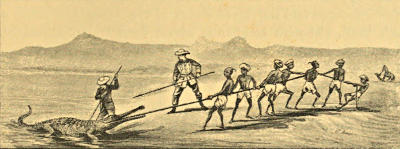
Landing a ghayal
Measurements.—British Museum: a snub-nose, 17 ft. 4 ins.; a
long-nose, 15 ft. 1 in.
Native names: ‘Gaor,’ ‘Gaori-gai’; generally, ‘Gail,’ Chota Nagpur;
‘Khulga,’ Western Ghauts; ‘Karti,’ Mysore; ‘Mithan,’ Bhootan.
Gaur, or bison,[23] as they are usually called, are found in
suitable localities, from the Terai, through Bhootan, Assam
and Burmah, to the Malayan Peninsula and throughout Central
and Southern India, but do not extend to Ceylon. The 28th
degree of North latitude seems their extreme northern limit,
otherwise it would be difficult to account for their absence in
what appears to be such thoroughly suitable ground as the
Sewalik range and the lower slopes of the Himalayas north of
this limit, although elephants, whose food and requirements
are almost identical with those of the gaur, are plentiful there.
Hilly country, covered with extensive tracts of forest and
bamboo jungle, is the likeliest ground for bison, though they
occasionally visit the low ground at the foot of the hills, particularly
when driven from the higher ridges by flies and the
want of suitable pasture. Bison vary much in their habits
according to locality; their migrations from high to low ground
being mainly influenced by the rainfall (which regulates the
growth of grass) and the prevalence of flies in their district.
During the latter part of the rainy season, when the grass has
grown high and coarse and flies are most numerous, Sanderson
remarks that bison move into the thinner jungle at the foot
of the hills. Forsyth says that in Central India bison retire to
the tops of the hills at that season.
The general colour of an old bull bison is a dark brown, almost
black, with a light slaty patch on the forehead, a grey muzzle,
and the legs, from above the knees and hocks downwards, a
yellowish white, the inside of the forearms and thighs being
chestnut; the head is particularly handsome, and well-bred-looking,
the high frontal which rises above the base of the
horns adding to, rather than detracting from, its beauty; the
pupil of the eye is large, and of a pale blue colour. Jerdon
says the eyes are small. They may be in actual measurement,
but they certainly do not appear so. The muzzle is large, and
the ears broad without being coarse. The ears of an old bull
are often torn to ribbons from fighting. The horns of such
animals are rather rugged at the base, and the points are
chipped and worn; but they are massive, have a beautiful outward
curve, and are light coloured. The neck is short and powerful,
the skin rather loose, with curious wrinkles in it that give
the appearance of a small dewlap, which the beast is really destitute
of. Behind the neck the beauty of the bison vanishes.
The high dorsal ridge towering above the insertion of the neck
makes the shoulders look loaded and straight, and the neck
itself put on too low; the ridge running down to the centre of
the back and there ending abruptly gives the quarters a dwarfed
and drooping appearance, though this is far from being really the
case. The tail is rather short and fine; the legs are particularly
fine and clean, the hoofs being marvellously small and
neat for so large an animal.
The cows, less heavily built than the bulls, are of a coffee-brown
colour; the dorsal ridge is not so much developed,
though it is still prominent; the legs are white instead of yellow—the
writer heard an old bull described as looking as if he was
wearing gaiters. The horns are thinner and more upright;
young bulls are very like cows, and mistakes are frequently made
when stalking herds, except by really experienced men. Old
cows look enormous, they are often darker in colour than young
bulls (in certain lights they look almost black), and are not
unfrequently shot by mistake. Of course if there is an old bull
in the herd to compare with them, there is little chance of
error. The best bulls are those that have been driven from
the herds by younger and more active rivals, and henceforward
live alone. These solitary bulls are always the finest specimens,
and are consequently the chief objects of the sportsman’s
ambition. It is a very curious fact that bison appear to be the
only animals which regularly resign, or are ousted from possession
of, a herd when they attain their largest size and most
powerful horns. Old stags will keep their hinds even when
their horns are diminishing from age. Sanderson says solitary
elephants are frequently young males waiting till they can
appropriate a herd; but no sooner does a bison get really at
his best to all appearances, than he at once gives way to a
younger animal. The cream of bison shooting is naturally
stalking them on foot. Sanderson describes hunting them on
an elephant, a method which, of course, enabled him to bring
heavy rifles into the field without fatigue, and was of enormous
assistance in thick cover and in carrying the trophies; but his
using the elephant to make the first approach must have considerably
detracted from the sport, although he discarded his
mount when following up a wounded beast.
The writer has had bison driven to him, on ground where
stalking was impracticable owing to the density of the forest,
and where the dryness of the season rendered tracking impossible;
but there the fun only began when a wounded beast had
to be followed up, though it was pleasant listening to the
avalanche-like rush of an approaching herd, and amusing to
see cows come through an apparently impenetrable thicket of
bamboos, like harlequin through a trapdoor, only to stand
staring at a few yards distance with their noses poked out, an
expression of puzzled funk in their eyes.
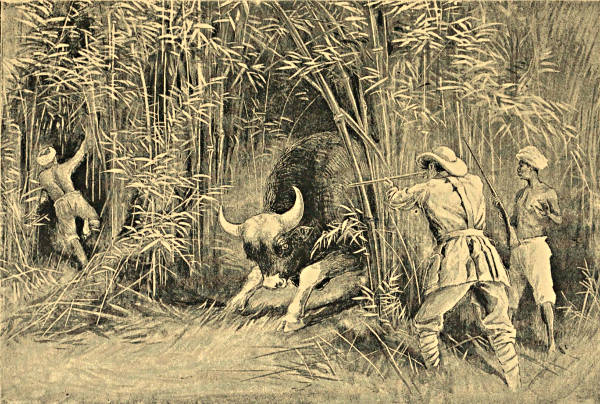
A CHARGING GAUR
But when the first few showers of the rainy season have
moistened the dry crackling leaves, and softened the ground
so that tracks can be followed, you should start in the early
morning so as to catch the beast before he is down for the day
(that is, before the sun gets hot, about 9 a.m. according to
Sanderson), and getting on the fresh tracks of a solitary bull,
follow him up. If your trackers are good, you should soon
begin to find signs that you are getting near him (the droppings
warm, &c.); you can then dismount from your pony which you
have been riding in rear, and close on the trackers with your
gun-carrier till they show you the beast. But whether your
trackers are good or not, it is quite useless for you to interfere
with them unless you have sufficient experience to do the
tracking yourself and let the men follow behind. You must take
it for granted they are doing their best; the fact of their being on
a bison’s trail will ensure their running no undue risk from carelessness,
and if you interfere you only confuse and put them
out: therefore take Sanderson’s advice, unless they wish you to
keep close to them, which they probably will not do, ride
your pony comfortably about one hundred yards in rear, till
they signal you up. You should then be either pretty close to
or within sight of your game. It is assumed that you have two
rifles, an 8-bore and a 12-bore, with round bullets; conical
bullets are not to be relied on in jungle. Try to approach
within sixty yards, and get your first shot in with the 8-bore.
Should the bull bolt, run after him at once, whether you
have fired or not. Very likely he will pull up after going a
short distance and give you a chance. Aim well forward; if
you break his shoulder you are more likely to get him than if
you take him too far back; keep him in sight as long as you
can; if he goes out of sight sit down and smoke a pipe or
have breakfast. In any case give him half an hour, then
follow up with your trackers, carrying the 12-bore yourself
and your gun-carrier the 8-bore. If the track lead into thick
stuff, send a man up the first tree you come to, and if he cannot
see the animal, work carefully on to the next tree in the
direction the track leads, though not necessarily on it. Work
clean through the thick patch in this way from tree to tree,
till you get to the far side; never mind the trail inside. Should
you get through without seeing the beast, try to pick up the
trail outside, and if you fail in this go back the way you came
to where you lost the track, and try working through it from tree
to tree in another direction. If your lines have formed a not
too broad angle at the point you left the trail, and you cannot
track him outside, the bull should be within the triangle, and
if there are no more trees you must follow the trail. Should the
jungle happen to be ‘Kharwee,’ the stems of which are about
as thick as your finger, growing about six inches apart and eight
feet high, you will find it exciting enough. The bull will
probably turn short off at an angle just before he lies down,
and if he means mischief will be watching his trail; you will
then probably get within ten yards of him before you see him, in
which case you will be able to realise the sensations of a valiant
mouse hunting a man in a stubble-field. At this period in the
chase you will naturally have the 8-bore in hand again.
Presently the bull will either start up close to you, or you will
perceive a black mass on the ground. Your only course then is
to fire and lie down on the ground at once; the smoke will
prevent your getting in a second barrel, and if the bull charges
the smoke he will gallop over you without seeing you. It is not
a bad plan to leave a man permanently up the first tree you
reach to watch till you have quite done with the cover, as he
will probably be able to see where the bull goes if he moves.
If the bull is wounded again in thick stuff and again lies down in
it, he is probably past doing harm; but still it is advisable to
give him the time of another pipe. A man up a tree who can
watch the exact place he is lying in is invaluable. Natives at this
period of the chase, more particularly the inexperienced ones,
invariably get excited and lose their heads, offering to go in
and pull the bull out by the tail, and looking upon any precaution
taken as a sign of faint-heartedness on the part of the
sportsman. If the sportsman gives way to them and allows
them to accompany him in the final stalk, he will probably
get some fool hurt through disobedience of orders. The last
approach to a wounded bull in thick cover should invariably
be made alone, or with one gun-bearer, the rest of the men being
put up trees.
Solitary bulls, Sanderson declares, are not a bit more savage
by disposition than herd bulls, and the instances of their attacking
natives when unwounded are almost invariably due to the
bull being approached unawares within striking distance in the
midst of thick cover.
He narrates a case of a gentleman being killed on the
Putney Hills in 1874, but this was through incautiously following
a wounded bison into thick cover. In this case the beast went
on at once, after killing his victim in his rush. ‘Only in one
instance that I know of has a wounded bison turned and
gored his victim. I do not even think the solitary bull is more
dangerous when wounded and followed up than a member of a
herd. I have seen both die without resistance, and both give
some trouble.’ An officer on the Head-Quarters Staff at
Madras had a very narrow escape from a wounded bull a few
years ago, getting knocked down and only escaping by kicking
the bull in the face as he tried to gore.
Several writers have noticed that a stag sambur or bull
nylghao (apparently it is always a male) occasionally attaches
himself to a herd of bison, and that this follower is invariably
the wariest and most watchful beast in the herd. Forsyth
mentions a bull nylghao in company with a herd of buffaloes.
Sanderson states that the bison, after a sharp hunt, gives out
an oily sweat, and in this peculiarity it differs from domestic
cattle, which never sweat under any exertion. He also says
that herd bison retreat at once if intruded upon by man, and
never visit patches of cultivation in the jungle; later on, however,
he enumerates three varieties of cattle disease to which
they are liable, and states that they sometimes contract these diseases
by feeding in jungles used by infected domestic cattle. Of
course these two statements are not necessarily contradictory,
but the writer when shooting in the Western Ghauts found
both herd and solitary bison within a mile or two of villages, saw
their tracks on patches of ground cleared for crops in the
jungle, on one occasion found bison on the side of a hill overhanging
a main road on which there was daily a certain amount
of traffic and near enough to it to see and hear the passers-by;
and there was a range of hills, the plateau on the summit of
which was a kind of open down where the village cattle were
daily brought to graze, and there were a good many bison in
the densely wooded ravines and slopes. The writer had been
studying Sanderson’s book before starting, as every sportsman
should who desires success in the pursuit of bison, and was particularly
struck by the tolerance these herds, at all events,
showed to the vicinity of natives.
Measurements
| Authority |
Nose to root of tail |
Tail |
Height at shoulder |
Height at rump |
Length, dorsal ridge |
Height, dorsal ridge |
Girth chest |
Girth neck |
Muzzle to frontal ridge |
Breadth forehead |
Ear |
Length of horn |
Girth of horn |
Splay at tips |
Tip to tip across forehead |
Widest span inside |
Remarks |
| Gavæus gaurus |
|
ins. |
ins. |
ins. |
ins. |
ins. |
ins. |
ins. |
ins. |
ins. |
ins. |
ins. |
ins. |
ins. |
ins. |
ins. |
ins. |
|
| Sterndale (‘Mammalia’) |
114½ |
34½ |
73½ |
63 |
40 |
4½ |
.. |
.. |
25¾ |
15½ |
10½ |
.. |
19½ |
25 |
.. |
.. |
Quoting Sir Walter Elliot |
| ” |
104½ |
37¾ |
69 |
.. |
29½ |
.. |
104 |
48½ |
24 |
.. |
.. |
.. |
.. |
27¼ |
.. |
.. |
Quoting Mr. Blyth |
| ” |
.. |
.. |
.. |
.. |
.. |
.. |
.. |
.. |
.. |
.. |
.. |
.. |
17 |
22½ |
83 |
38½ |
? Outside |
| ” |
.. |
.. |
.. |
.. |
.. |
.. |
.. |
.. |
.. |
.. |
.. |
.. |
19 |
19 |
74 |
33 |
?” |
| Sanderson (‘Thirteen Years among Wild Beasts’) |
.. |
.. |
72 |
.. |
.. |
.. |
.. |
.. |
.. |
.. |
.. |
.. |
19 |
19 |
74 |
33 |
?” |
| Mr. J. D. Goldingham, Bethnal Green Museum |
.. |
.. |
.. |
.. |
.. |
.. |
.. |
.. |
.. |
.. |
.. |
33¾ |
17¼ |
24 |
.. |
.. |
Rowland Ward, ‘Horn Measurements’ |
| Mr. T. W. H. Greenfield |
.. |
.. |
.. |
.. |
.. |
.. |
.. |
.. |
.. |
.. |
.. |
33½ |
18½ |
25 |
.. |
33¼ |
” |
| Mr. J. Carr Saunders |
.. |
.. |
.. |
.. |
.. |
.. |
.. |
.. |
.. |
13 |
.. |
32 |
17¼ |
33½ |
79½ |
46 |
Outside |
| Mr. A. O. Hume |
.. |
.. |
.. |
.. |
.. |
.. |
.. |
.. |
.. |
.. |
.. |
31⅞ |
17⅛ |
21⅜ |
.. |
32½ |
Rowland Ward, ‘Horn Measurements’ |
| Bombay Nat. Hist. Soc. Proc. |
.. |
.. |
.. |
.. |
.. |
.. |
.. |
.. |
.. |
.. |
.. |
31½ |
18 |
29 |
.. |
43 |
Outside” |
| Mr. J. D. Goldingham, Bethnal Green Museum |
.. |
.. |
.. |
.. |
.. |
.. |
.. |
.. |
.. |
.. |
.. |
31¼ |
16⅜ |
12⅝ |
.. |
27½ |
” |
| Madras Museum |
.. |
.. |
.. |
.. |
.. |
.. |
.. |
.. |
.. |
.. |
.. |
L: 30¾
R: 25½ |
20 |
36¼ |
70¾ |
44 |
? Outside. ‘Smoothbore’s Letter to the “Asian”’ |
| Shot by General Cox |
.. |
.. |
.. |
.. |
.. |
.. |
.. |
.. |
.. |
.. |
.. |
.. |
.. |
.. |
.. |
4 |
?” |
| ” |
.. |
.. |
.. |
.. |
.. |
.. |
.. |
.. |
.. |
.. |
.. |
.. |
.. |
.. |
.. |
46 |
?” |
| Lieut.-Col. Sandys |
.. |
.. |
.. |
.. |
.. |
.. |
.. |
.. |
.. |
.. |
.. |
30½ |
16½ |
13½ |
.. |
33¼ |
Rowland Ward, ‘Horn Measurements’ |
| Mr. J. Carr Saunders |
.. |
.. |
.. |
.. |
.. |
.. |
.. |
.. |
.. |
.. |
.. |
30⅛ |
17⅞ |
33⅜ |
.. |
40¼ |
Outside” |
| Sir E. G. Loder, Bart. |
.. |
.. |
.. |
.. |
.. |
.. |
.. |
.. |
.. |
.. |
.. |
29⅞ |
18¼ |
30 |
.. |
34 |
” |
| Sir V. Brooke |
.. |
.. |
.. |
.. |
.. |
.. |
.. |
.. |
.. |
.. |
.. |
29¾ |
18⅝ |
25¼ |
.. |
30⅜ |
” |
| ” |
.. |
.. |
.. |
.. |
.. |
.. |
.. |
.. |
.. |
.. |
.. |
29⅝ |
18½ |
16¼ |
.. |
26½ |
” |
| Mr. J. D. Inverarity |
.. |
.. |
.. |
.. |
.. |
.. |
.. |
.. |
.. |
.. |
.. |
29½ |
18 |
.. |
.. |
33 |
Outside” |
| General Hardwicke, British Museum |
.. |
.. |
.. |
.. |
.. |
.. |
.. |
.. |
.. |
.. |
.. |
29¼ |
12⅞ |
.. |
.. |
18 |
” |
| Mr. B. H. Hodgson, Brit. Mus. |
.. |
.. |
.. |
.. |
.. |
.. |
.. |
.. |
.. |
.. |
.. |
29⅛ |
16⅝ |
20⅜ |
.. |
29¼ |
” |
| Mr. O. Shaw |
.. |
.. |
.. |
.. |
.. |
.. |
.. |
.. |
.. |
.. |
.. |
29 |
22 |
.. |
.. |
.. |
” |
| Major Greenaway |
.. |
.. |
65 |
.. |
.. |
.. |
.. |
.. |
.. |
.. |
.. |
29 |
22 |
.. |
.. |
.. |
” |
| The Writer |
.. |
.. |
.. |
.. |
.. |
.. |
.. |
.. |
.. |
.. |
.. |
27 |
19⁹⁄₁₀ |
19⁴⁄₁₀ |
69⁹⁄₁₀ |
.. |
” |
| Col. Kinloch |
.. |
.. |
.. |
.. |
.. |
.. |
.. |
.. |
.. |
.. |
.. |
.. |
.. |
.. |
69 |
36 |
? Outside. ‘Large Game Shooting’ |
| ” |
.. |
.. |
.. |
.. |
.. |
.. |
.. |
.. |
.. |
.. |
.. |
.. |
17 |
.. |
66½ |
.. |
” |
| Forsyth |
.. |
.. |
71 |
.. |
.. |
.. |
.. |
.. |
.. |
.. |
.. |
.. |
.. |
.. |
.. |
.. |
‘Highlands of Central India’ |
| ” |
.. |
.. |
69 |
.. |
.. |
.. |
.. |
.. |
.. |
.. |
.. |
.. |
17 |
.. |
.. |
37½ |
? Outside” |
| ” |
.. |
.. |
.. |
.. |
.. |
.. |
.. |
.. |
.. |
.. |
.. |
25½ |
15½ |
.. |
.. |
.. |
” |
| Average of good head |
.. |
.. |
.. |
.. |
.. |
.. |
.. |
.. |
.. |
.. |
.. |
27 |
18 |
.. |
.. |
.. |
|
In Assam, Chittagong and Burmah the natives own large
numbers of domesticated animals called ‘mithun’ or ‘gayal,’
which are very similar to bison in appearance, but are without
the characteristic frontal ridge, and are said to have a small
dewlap. Sterndale distinguishes these under the name of
Gavæus frontalis, and quotes Dr. F. Buchanan Hamilton
and Professor Garrod’s account from Mr. Macrae to the effect
that the natives recruit their tame herds by catching and
taming wild animals. But both Sanderson and Kinloch, who
have hunted in the districts where the tame gayal are numerous
for the express purpose of bagging a wild one, declare that such
an animal does not exist, that the wild animals in those parts
are the same as bison anywhere else, and that the peculiarities
of the tame ones are due to domestication and inter-breeding
with domestic cattle.
As regards measurements of heads, the same disappointing
practice prevails with bison as with buffalo, viz.: measuring from
tip to tip of the horns across the forehead, in addition to which
(with bison) heads are frequently estimated only as regards the
width of splay between the horns, without any reference to their
length and girth. This latter measurement is the more misleading,
as a deformed head with unnatural lateral sweep is
more valued than one with long massive horns which grow
closer together. The fairest measurement is length and girth
at base of horn only.
Native names: ‘Tsoing,’ Burmah; ‘Banteng,’ Java; (Sterndale). Habitat:
Burmah, the Malayan Peninsula, Sumatra, Borneo and Java. Blyth
says it is domesticated in the Island of Bali.
This animal resembles the gaur in many respects, having
the distinctive white stockings, but has no frontal or dorsal ridge.
Its horns are more like those of the gayal, but it has not the
dewlap of the latter, and it appears to be a much smaller and
lighter built animal than either gaur or gayal.
The old bull is black with white stockings and a white
patch on each buttock, the cows and young bulls being bright
chestnut. There is a stuffed specimen in the British Museum
which shows the difference very plainly. The only measurements
the writer has been able to obtain are those of the
horns.
Measurements
| Authority | Length of horn | Girth of horn | Splay at tips | Widest span inside | Remarks |
| Gavæus sondaicus |
| ins. | ins. | ins. | ins. | |
| British Museum | 24¾ | 12¼ | 15¾ | 24¼ | From Java, Rowland Ward, ‘Horn Measurements’ |
| Mr. H. B. Low, British Museum | 21⅜ | 12¼ | 13⅛ | 19¼ | From Borneo ” |
| Mr. J. Carr Saunders | 21 | 12 | .. | .. | ” |
| Mr. H. B. Low, British Museum | 20⅝ | 12¼ | 18⅛ | 22⅛ | ” Rowland Ward, ‘Horn Measurements’ |
| British Museum | 20 | 12 | .. | .. | |
| Mr. H. B. Low, British Museum | 19¼ | 11¼ | 10⅛ | 15¾ | From Borneo, Rowland Ward, ‘Horn Measurements’ |
| ” | 18¼ | 10⅞ | 14½ | 18⅝ | ” |
| ” | 18 | 12¼ | 13⅜ | 16⅝ | ” |
Native names: ‘Donkh,’ ‘Dhong,’ Ladak; ‘Bunchowr,’ Hindi
Wild yak are said to be plentiful throughout Thibet, but at
present the Tartars watch their frontier so jealously that it is
almost impossible for Europeans to cross with any chance of
obtaining sport; particularly as the sportsman’s own Tartar
attendants would be the first to endeavour to frustrate any
ambitious schemes of exploration. It must be remembered
that, not only would they be held responsible by the Leh
authorities if anything happened to an Englishman, but, living
on the frontier themselves, they naturally like to be on good
terms with their neighbours. The valley of Chang Chenmo,
north of the Pangong Lake, and the ground between the Niti
Pass and the Sutlej, are the only two easily accessible places
where yak may be met with. Beyond Chang Chenmo there
is said to be good ground on the Karakash, but to cross the
Linzinthung plains would require special arrangements, and
ponies would have to be taken instead of the ordinary tame
yaks on account of the scarcity of grass. An old wild bull
yak is a magnificent beast; he is nearly jet black, with a little
grey about the muzzle and forehead. Though fifteen hands in
height, his legs are short and sturdy. The long shaggy hair
which droops from his body reaches down to his knees, and
sometimes almost to the ground; and his huge swab of a tail
rather adds to than detracts from his beauty. The white tails
which are brought for sale are those of tame yaks; a wild bull’s
tail is such an unwieldy mass of hair that it is not at all the
sort of thing to have flipping round one’s head on a hot evening.
Tame yaks have often a good deal of white about them.
Wild yaks with white patches have occasionally been shot, but
only cows as far as the writer can learn; wild bulls appear
always to be black. The Tartars say that these mottled wild
yaks are hybrids between the tame bulls, which are turned out
to graze on the hills in the summer, and wild cows.
Captain Duff contributes the following interesting account
of a successful stalk after yak:
I was out one day after a couple of Thibetan antelope, and not
being able to get near them, was looking about to see if there was
any game farther up the nullah. Right away up the head of the
valley we saw a large herd of dhong, about twenty or more, with
a lot of young ones, and even at that distance we could distinguish
one much bigger than the rest. The next day, a heavy fall of snow
prevented my going out; but on the third day, I started to try for
them. It was a long walk to get anywhere near the herd, and of
course, just as I was beginning to go a bit carefully, and take
advantage of cover, I put up three very fair Oves Ammon, but the
dhong did not seem to notice them, and the wind all through was
in my favour. A bit farther on I came across one of those beastly
kyang, which would keep running on in front of me till I could
get across the river at the bottom of the valley. When I got up
to where I expected to find the dhong, I found they had moved a
good bit higher up the nullah, and I could not possibly get nearer
than some three hundred yards from them. Leaving my gun-carrier
and a Tartar behind with strict orders not to stir till I fired, I tried
to crawl on with my shikari, but had to return before getting any
distance, the dhong meanwhile feeding farther away and going
up the hillside, thus making the stalk more and more difficult. I
had seen no signs of my big friend, and began to think I had been
mistaken; but there was a fair-sized bull with the herd. I now
had to retrace my way for some distance, and get down to the
river again, so as to creep up under cover of the bank till I got a
hill between the dhong and myself. On reaching this hill, I found
I could not possibly get within shot, and could do nothing but
hide behind a large stone and wait.
I suppose I must have waited at least a couple of hours, when
there was a bit of a commotion among the herd, the babies all
running to the big ones, and I heard a funny noise which I could
not account for. In a few minutes I saw the big bull appear from
round the side of the hill, walk leisurely towards the herd, and
lie down. Just then three chankos came past me, and I came to
the conclusion that they had occasioned the scare, had been driven
off by the big bull, and had made the noise I heard.
I waited for another good half-hour, and had almost made up
my mind to crawl towards the bull in the hope that he would mistake
me for one of the chankos coming back, and so give me a
shot, when up he got, but only to walk a few yards, and then go
down again and roll.
After a bit of this sort of play he got up again, and taking no
notice of the rest of the herd, began walking towards me.
There was a little stream at the foot of the hill I was on, and
the bull was walking quietly down the opposite bank, coming on
slowly, looking like a young elephant with his hair nearly touching
the ground on each side of him.
I waited and waited for him, till he got almost past me, and
within about sixty or seventy yards, and then he stopped, looking
down the nullah, and broadside on to me. I tried to get steady on
him and fired; but he stood still, and my shikari said I had missed.
The ground beyond him was softish, and I began to be afraid I
had, and had not seen the bullet strike, so I fired again, and the bull
dropped in his tracks. I found my first shot had hit him in the
neck, and must have paralysed him, as he could not move his forelegs,
though he could kick with his hind ones. My second shot
was a wild one, and had only broken a hind fetlock. The rest of the
herd ran in all directions at the shot, and then getting together,
made for the top of the valley. As soon as I saw that the big bull
could not get away, I started after them, and managed to get two
more bulls.
The big bull was really a very fine beast, his forehead covered
with curly grey hair. He measured just over 15 hands 1¼ in. as
he lay. I put a stick as upright as I could against his withers, and
measured to his heel.
Measurements
| Authority |
Height at shoulder |
Length, head and body |
Tail |
Girth at shoulder |
Girth at belly |
Girth at neck (thinnest part) |
Length, horns |
Girth at base |
Splay, tip to tip |
Widest span inside |
Remarks |
| Bos grunniens |
|
ins. |
ins. |
ins. |
ins. |
ins. |
ins. |
ins. |
ins. |
ins. |
ins. |
|
| Hume Collection, British Museum |
.. |
.. |
.. |
.. |
.. |
.. |
38¼ |
17 |
19 |
31½ |
Rowland Ward, ‘Horn Measurements’ |
| Col. E. Smyth, Leeds Museum |
72 |
130½ |
37 |
121 |
112 |
50 |
36 |
18 |
.. |
.. |
Gen. Macintyre, ‘Hindu Koh’ |
| Major FitzHerbert, Cambridge Museum |
.. |
.. |
.. |
.. |
.. |
.. |
35 |
15 |
.. |
.. |
|
| Hume Collection, British Museum |
.. |
.. |
.. |
.. |
.. |
.. |
34⅞ |
15 |
16 |
27¾ |
Rowland Ward, ‘Horn Measurements’ |
| Hon. W. Rothschild |
.. |
.. |
.. |
.. |
.. |
.. |
34 |
12 |
20½ |
.. |
” |
| British Museum |
.. |
.. |
.. |
.. |
.. |
.. |
32⅜ |
13⅜ |
16½ |
26⅜ |
” |
| Mr. H. C. V. Hunter |
.. |
.. |
.. |
.. |
.. |
.. |
32 |
13⅞ |
15¼ |
22¼ |
” |
| Major Ward |
.. |
.. |
.. |
.. |
.. |
.. |
31½ |
.. |
.. |
.. |
‘Sportsman’s Guide to Ladak, &c.’ |
| ” |
.. |
.. |
.. |
.. |
.. |
.. |
31 |
.. |
.. |
.. |
” |
| ” (quotes one) |
70 |
.. |
.. |
.. |
.. |
.. |
.. |
.. |
.. |
.. |
” |
| ” |
64 |
.. |
.. |
.. |
.. |
.. |
.. |
.. |
.. |
.. |
” |
| ” |
64 |
.. |
.. |
.. |
.. |
.. |
.. |
.. |
.. |
.. |
” |
| Sir R. Harvey, Bart. |
.. |
.. |
.. |
.. |
.. |
.. |
30¾ |
13½ |
10½ |
.. |
Rowland Ward, ‘Horn Measurements’ |
| Capt. Duff |
61½ |
.. |
.. |
.. |
.. |
.. |
.. |
.. |
.. |
.. |
|
| Col. Kinloch |
60 or more |
.. |
.. |
.. |
.. |
.. |
about 36 |
about 14 |
.. |
.. |
‘Large Game Shooting’ |
| Jerdon’s ‘Mammalia’ |
66 |
.. |
.. |
.. |
.. |
.. |
30 |
15 |
.. |
.. |
|
| Major FitzHerbert |
.. |
.. |
.. |
.. |
.. |
.. |
21 |
8 |
.. |
.. |
(A cow) |
| Average of good head |
.. |
.. |
.. |
.. |
.. |
.. |
27 |
12 |
.. |
.. |
|
In 1866 another sportsman managed to evade the Tartars,
and crossing the Sutlej beyond Niti, found a herd of eighty yak,
out of which he shot a bull and three cows, one of the latter
being piebald.
There is a quaint story from Nepal, that, during the war
between the Nepalese and the Thibetans, Jung Bahadur,
finding his army very short of food, referred the case to the
chief priests in Khatmandu, who decided that yak were deer,
and not cattle at all, as their tails were different, and so might
safely be killed and eaten by the pious Nepalese.
Native names generally: ‘Ban Bhains,’ ‘Arná’ the male,
‘Arni’ the female; in Bengal, ‘Mains’
The buffalo is found in Nepal, and extends eastward through
Assam to Burmah. It is plentiful in the Sunderbuns, in the
Central Provinces, and in Ceylon, but is not found, according
to Sanderson, in Southern India. Forsyth gives 80° as the extreme
western limit of buffaloes in Central India, and says that
they are not found north of the Nerbudda river.
The wild buffalo only differs from the tame one in being
slightly larger and more uniform in colour (tame ones are of
many shades, and have often a good deal of white about them,
in fact albinos are not uncommon), and in having regular white
stockings, which the tame ones may or may not have. The
horns are more symmetrical and larger. In the high grass
jungles of the Terai and Assam, buffaloes are generally shot
off elephants, and Kinloch notices ‘the strong sweet bovine
scent’ emitted by a herd. In the Sunderbuns and parts of
Lower Bengal they are occasionally shot out of boats when
the country is flooded. The sport is described as magnificent,
but requires a fever-proof constitution.
In the Central Provinces, however, the ground is more open;
there buffaloes can be stalked on foot, and Captain Forsyth
gives an account of a sparkling episode when shooting buffaloes
from horseback.
When pursuing them on foot, the best time for sport is in
April and May, when a good deal of the grass has been burnt
and water is comparatively scarce. The best way of finding
the animals is to look for fresh tracks near pools of water, and
follow them up. The plan recommended for bison, of sending
the trackers on ahead, should be adopted if possible.
Captain Lamb gives the following interesting account of a
stalk:
I started up the river bed and found fresh tracks. After following
the track for a good way we came on a single bull feeding on
a grassy plain about half a mile in width, studded with a few
trees. Leaving all the men behind, I crept up on my stomach to
within about forty yards of him, and got behind a small pollard
tree without the bull being aware of my presence. I fired at his
shoulder with the 12-bore, and he fell over kicking on his back.
Just as I was going to give him another shot, a second and larger
bull rushed out from the long grass and attacked number one, who
was still kicking on the ground. He gave him a tremendous
punishing, bowling him over whenever he attempted to rise. I was
so astonished at the whole thing, that I simply stood and watched.
After a little while, number two seemed to think there was something
wrong, and stopped to look round; whereupon, I took the
opportunity of giving him a shot, which laid him on his back like
his fellow. Both bulls then got up and went into the long grass.
I followed number one, going very cautiously, as I was not quite
sure of number two’s whereabouts. I came up with number one,
who was still on his legs, knocked him over again and finished
him with a shot behind the ear. I then went after number two
and killed him without any difficulty. The fight had been quite
knocked out of him.
Buffaloes appear to charge much more readily when hunted
with a line of elephants or from boats than when stalked on
foot. In the first case at all events the buffalo is generally
roused from his midday sleep, and attacked at close quarters,
when his temper is ruffled, while when stalked on foot he gets
such a severe wound when feeding (probably without seeing his
enemy) that the fight is knocked out of him to start with. Still
fatal instances have occurred, notably in the case of Mr.
Chatterton, of the police, who was killed by a buffalo in 1886.
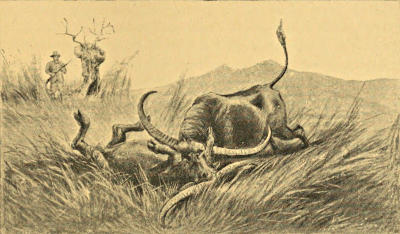
‘He gave him a tremendous punishing’
Measurements
| Authority |
Length, nose to root of tail |
Tail |
Girth of body |
Girth of forearm |
Height at shoulder |
Length of horn |
Girth of horn |
Tip to tip across forehead |
Splay at tips |
Widest span inside |
Sex |
Remarks |
| Bubalus arni |
|
ins. |
ins. |
ins. |
ins. |
ins. |
ins. |
ins. |
ins. |
ins. |
ins. |
|
|
| British Museum |
.. |
.. |
.. |
.. |
.. |
78 |
17 |
.. |
.. |
.. |
Bull (?) |
Pair of horns without skull |
| ” |
.. |
.. |
.. |
.. |
.. |
77⅜ |
17⅞ |
.. |
.. |
.. |
Bull |
(Single horn) Rowland Ward, ‘Horn Measurements’ |
| ” |
.. |
.. |
.. |
.. |
.. |
R65½
L68¼ |
20¼ |
146¾ |
98 |
.. |
” |
|
| Colonel J. Mathie, British Museum |
.. |
.. |
.. |
.. |
.. |
65¾ |
20¼ |
.. |
.. |
.. |
” |
Rowland Ward, ‘Horn Measurements’ |
| British Museum |
.. |
.. |
.. |
.. |
.. |
58⅝ |
12⅜ |
.. |
.. |
.. |
Cow (?) |
” |
| Mrs. Hannaford |
.. |
.. |
.. |
.. |
.. |
58½ |
13¼ |
.. |
.. |
.. |
Cow |
” |
| British Museum |
.. |
.. |
.. |
.. |
.. |
58½ |
12¾ |
.. |
.. |
.. |
Cow (?) |
” |
| Bethnal Green Museum |
.. |
.. |
.. |
.. |
.. |
58¼ |
18 |
.. |
42¼ |
.. |
Bull |
” |
| British Museum |
.. |
.. |
.. |
.. |
.. |
58¼ |
13 |
.. |
.. |
.. |
Cow |
|
| Mr. J. D. Inverarity |
.. |
.. |
.. |
.. |
.. |
57 |
.. |
.. |
.. |
.. |
Bull |
” |
| Mr. Eyre Coote |
.. |
.. |
.. |
.. |
.. |
56 |
15½ |
.. |
55½ |
58 |
” |
” |
| Mr. J. Carr Saunders |
.. |
.. |
.. |
.. |
.. |
55½ |
18½ |
124 |
.. |
.. |
” |
|
| Hume Collection, British Museum |
.. |
.. |
.. |
.. |
.. |
54½ |
18⅛ |
.. |
38¼ |
48⅞ |
” |
” |
| Mr. A. O. Hume |
.. |
.. |
.. |
.. |
.. |
53⅞ |
12 |
.. |
.. |
.. |
Cow (?) |
” |
| Baron de Nolde |
.. |
.. |
.. |
.. |
.. |
53¼ |
21 |
.. |
26⅞ |
.. |
Bull |
” |
| Hume Collection, British Museum |
.. |
.. |
.. |
.. |
.. |
53¼ |
12⅛ |
.. |
.. |
.. |
” |
” |
| Mr. B. H. Hodgson, British Museum |
.. |
.. |
.. |
.. |
.. |
53⅛ |
12½ |
.. |
.. |
.. |
” |
” |
| British Museum |
.. |
.. |
.. |
.. |
.. |
53 |
12⅛ |
.. |
.. |
.. |
” |
” |
| Hume Collection, British Museum |
.. |
.. |
.. |
.. |
.. |
52¾ |
18¼ |
.. |
30½ |
44⅛ |
Bull |
” |
| British Museum |
.. |
.. |
.. |
.. |
.. |
52 |
16¾ |
.. |
.. |
.. |
” |
” |
| Colonel Kinloch |
115 |
47 |
99 |
20 |
60 |
.. |
.. |
99 |
.. |
.. |
” |
‘Large Game Shooting’ |
| ” |
.. |
.. |
.. |
.. |
.. |
.. |
.. |
122 |
.. |
.. |
Cow |
” |
| ” |
.. |
.. |
.. |
.. |
.. |
.. |
.. |
151 |
.. |
.. |
Bull |
Quoted ” |
| ” |
.. |
.. |
.. |
.. |
.. |
.. |
.. |
over 156 |
.. |
.. |
Cow |
Quoted ” |
| Sterndale’s ‘Mammalia’ |
123 |
.. |
.. |
.. |
76 |
.. |
.. |
.. |
.. |
.. |
.. |
|
| Captain Lamb |
.. |
.. |
.. |
.. |
64 |
48 |
.. |
.. |
.. |
.. |
Bull |
|
| Average of good head { |
.. |
.. |
.. |
.. |
.. |
48 |
18 |
.. |
.. |
.. |
Bull |
|
| .. |
.. |
.. |
.. |
.. |
50 |
12 |
.. |
.. |
.. |
Cow |
|
Kinloch gives an account of a bull charging elephants both
before and after being wounded. When they have thoroughly
made up their minds to fight, buffaloes will, as a rule, carry out
their plans most resolutely; but wild ones, though in a less
degree, have the same kind of slow-wittedness that is so
remarkable in tame buffaloes. If a European rides past a
herd of tame buffaloes in some rather out-of-the-way district
where Europeans are scarce, some of the herd are sure to begin
pondering on the advisability of charging him, but before they
can make up their minds, the object of their attentions has
got beyond reach and they give up the problem. The
average size of a good bull’s horns is about 40 ins. in length
by 16 ins. in girth, or about 8 ft., measuring from the tip of
one horn round the curve across the forehead and up the
other horn. It is somewhat unfortunate that sportsmen should
have selected this style of measurement, as it gives a poor idea
of the comparative size of horns.
Forsyth and Kinloch both agree that a front shot is rarely
successful against buffaloes, owing to the angle at which their
heads are carried and the enormous thickness of their chests.
Forsyth recommends hardened bullets, as he found two ounce
bullets of soft lead propelled by eight drachms of powder flattened
on their shoulders, pulverising the bone but not penetrating to
the vital parts. Williamson describes shooting buffaloes out of
boats in flood-time, and says that the point to aim at in this
sport is to get the beast into such deep water that he cannot
lower his head to use his horns.
As for using dogs for buffalo, Forsyth’s experience with a
wounded bull was not a happy one; he writes: ‘The dogs
were now loosed, and bayed round him till he began to chase
them all round the field; but as soon as our heads appeared
over the fringe of grass, he left them and charged down at ourselves.’
In spite of one of the dogs pinning him by the nose,
the bull made good his charge, knocking Forsyth’s rifle out of
his hand and upsetting his companion.
Generally, ‘Sambur’ or ‘Maha’; in Gurwhal, ‘Jerow’ or ‘Barasingh’
The sambur is found throughout the lower slopes of the
Himalayas from the eastern bank of the Sutlej river (Kinloch
points out that the Sutlej seems to be its boundary), and
extends all over India and Ceylon to the south, and through
Assam and Burmah as far as the Malay Peninsula to the south-east,
wherever there are forest-clad hills. It does not ascend
to any great elevation, being rarely found above an altitude
of 5,000 or 6,000 ft. It seems to delight in heat, not, indeed,
of the sun, as it is as careful of its complexion as a gooral,
but of hot stony hills and stifling ravines covered with thick
forest.
Sambur appear to require very little water, drinking, according
to Sterndale, only every third day—a fact which the writer’s
experience entirely confirms.
The general colour of the stag is dark sepia, the chin and
inside of limbs yellowish-white, and an orange-yellow patch
on the buttocks. The dirty yellow patch on the chin is sometimes
very striking, and looks as if the stag had the skin of
a pale orange in his mouth. The tail is large, the hair being
coarse and very dark brown; and on the neck there is a shaggy
coarse ruff. The ears are large and coarse, rounded in shape,
nearly black, and almost hairless. Sterndale calls the sambur
a noble creature, but compared with the Cashmere stag, red
deer, or wapiti, he looks an ugly, coarse, underbred brute.
The horns are massive, with a long brow antler and a bifurcated
top, and in good specimens are about 40 ins. in length;
longer horns are obtained occasionally, but not often. As the
sambur is almost entirely nocturnal in its habits, it is most
commonly shot in drives, and in many places it is almost impossible
to obtain sambur otherwise; but where it can be
managed, stalking is, of course, far better fun. The sportsman
should be on his ground just before daylight, and work slowly
through the forest at the edge of the feeding grounds, taking
the bottom of the hill if there are crops on the plain below,
or, failing these, the edges of the open glades in the forest.
Presently, if there are any sambur about, he will hear their
trumpet-like call, and, creeping on, see two or three dark forms
moving among the trees. In the grey of the morning it is
often very hard to distinguish a stag from a hind, and the
writer has on several occasions had to wait after viewing the
herd till there was light enough to pick his stag. Even in
broad daylight it is difficult to judge the size of a stag’s horns
as he stands motionless in the deep gloom of the forest, and
what little can be seen of them makes them look three times
their real size—the beam is so massive and the tines so long.
The stag, too, is such a big beast, standing nearly a hand taller
than a barasingh, that if seen in the open he looks as big as an
Irish elk.
If the sportsman fails to intercept any stags on their return
from their feeding grounds by working along the base of the
hill, he should next ascend the hill and try the cup-like basins
which are so often found near the summits. Sambur are very
fond of these spots, but a first-rate local shikari is necessary to
show the way to them, as there is often no sign of the existence
of such places from the foot of the hill, the trees appearing to
grow taller in them on purpose to hide them from observation
from below. The approach to them is often up a heartbreaking
boulder-strewn slope, which apparently continues to the summit.
Up this the sportsman toils, thinking his shikari must
have lost his way, when suddenly he comes upon a dark cool
glen, and in it there is pretty sure to be a herd. The above
applies chiefly to the isolated hills which rise out of the plains
in Central India; in ranges like the Sewaliks the best plan is
to walk along the top of a ridge, examining the ravines below,
and in the grass on the crest of these ridges will often be found
places where sambur have been lying down under the trees,
the form being carefully chosen so that the shade of the tree
will be over it during the hottest part of the day. Many
pleasant little incidents may occur during an early morning
stroll in the Sewaliks; kakur, gooral, and chital afford tempting
shots if the sportsman likes to vary his bag, and an occasional
bear, leopard, or tiger may be met with. One sportsman
met a tiger almost face to face just as he gained the crest of a
ridge. The man only had a light single-barrel rifle, so he wisely
refrained from attack under the circumstances, and, the tiger
being a well-behaved deer-stalking beast, the two passed the
time of day and parted. Wild elephants, too, are not uncommon
in certain parts, so that altogether there is always a chance
of finding amusement. What fun there must have been in the
Sewaliks in the days of the Ganesa mammoth and the four-horned
moose-like sivatherium! Their remains in the British
Museum make one’s mouth water to think of them.
Among the larger ranges of hills in Southern India, the
best way of hunting is to send men in pairs before daybreak to
well-chosen positions to watch the forest, the sportsman with
one attendant taking a line of his own, and working on or
watching his particular beat till the sun is beginning to get
powerful and the animals have lain down for the day; then he
should himself go round the different groups of watchers and
collect their reports. It is important that the sportsman should
go round himself and not depute the work to his shikari, as a
stag or a bear may often have been marked down to an inch
by the watchers and may be stalked forthwith, whilst if a drive
be decided upon the sportsman has an opportunity of studying
the ground and settling all the details with his head shikari on
the spot. Having gone round his sentries and withdrawn the
men, he should then return to camp for breakfast, order beaters
for any drives he has decided on, and about 11 a.m., when the
sun is really hot and the animals marked down are likely to
be disinclined to move, and so enable the beaters and guns
to get into position, he should begin operations. All driving
should be done in the heat of the day, when the animals are
lying down; trying to drive when beasts are naturally on the
move generally results in the game leaving the beat before the
men are in their places. Another great point to attend to in
driving is for the sportsman, if possible, to get up into a tree.
It may sound ridiculous for a man to climb up a tree in a
sambur drive, but he is far more likely to get an easy shot in
this position, as the deer will neither see nor wind him, he
commands more ground, and he runs no risk of heading back
the wary old hind which often leads the herd; the chances
being that if he is rightly posted the herd will come right
under his tree. Another advantage is that, his fire being
plunging, he can shoot all round without danger to the beaters.
If two or three guns are out, it is more than ever necessary to
try to post them well up off the ground. Having settled himself
in his tree, the sportsman should send his gun-carrier to
some tree or rock at least a hundred yards behind him, so that
the course taken by a wounded animal can be observed.
Tracking in jungle is often very difficult work, and a sharp
gun-carrier posted well to the rear will often save a lot of
trouble. In some parts of the Himalayas native shikaris declare
that they often shoot sambur by selecting a likely path
and improvising a salt-lick, after the fashion of Laplanders
when they want to catch their tame reindeer. General Macintyre
describes the formation of a ‘kar’ and his adventures
in watching one; he calls it a dirty way of killing ‘jurrow.’
Though sambur occasionally throw out abnormal tines, they
usually carry only three antlers on each horn—a long brow
antler and two on top. The horns are generally shed about
the end of March, and are free from velvet about the beginning
of November. Major Ward’s remarks about shooting small
stags are well worth quoting:
Remember that sambur are not prolific; they seldom have
more than one fawn, and that it is four years before the young
stag assumes his complete shape of horn, and that he has still
three or four years to live before he can have a pair of antlers
worth preserving. He has quite sufficient chances against his
attaining an age of seven or eight years, without having to run the
risk of being shot down by the rifle bullet whilst still in his immature
state.
Shooting hinds is quite unpardonable, the venison being
not worth eating.
Native name: generally ‘Para’
Kinloch aptly describes this deer as the rabbit of Indian
battues. It is a long-bodied rather heavily built beast on short
legs with horns like a small sambur, the brow antlers coming
straight up from the burr at an acute angle without the handsome
curve of those of the spotted deer. The stags are
reddish brown, their hair coarse and thick, their tails rather
long and exactly of the sambur type, their ears round, not
pointed like a spotted deer. When galloping through the grass
the hogdeer carries its head low, its horns laid back on the
neck, and its rump high. It
is found throughout the high
grass swamps at the foot of
the Himalayas and on the
islands and banks of the big
rivers. High grass and plenty of water are its chief requisites.
It expends through Assam to Burmah, and is also found in
Ceylon.
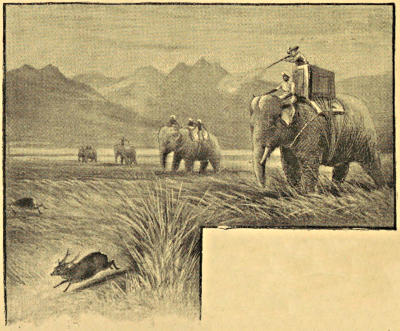
Hogdeer shooting
It is usually shot when beating the large tracts of grass in the
Doon and Terai with a line of elephants, and affords pretty
snap shooting from a howdah when better game is not expected.
The does will squat in the grass till the elephants almost kick
them up, but the way to get the best stags is to go well ahead
of the line on a flank, or, if possible, post yourself on foot so as
to command a nullah leading from one patch of grass to another,
or the dry sandy channel separating two islands. This, however,
is a matter of some risk, as, if hogdeer are plentiful, the firing
from the line becomes fast and furious, and unless you are on
an elephant the guns in the line cannot see where you are.
Shooting from a howdah is an art which requires practice, and
many a good rifle-shot on foot finds himself missing hideously
when he first tries shooting off an elephant. A very sound rule
is, never to put your head down on the stock, but keep it well up,
look hard at the beast’s shoulder and see as much of its body
as possible over the muzzle of the rifle: the range is generally
short and nearly all misses go high. Shooting hogdeer from
elephant has been likened, with some confusion of ideas, to
shooting rabbits from a pitching collier in a gale of wind in the
Bay of Biscay.
Hogdeer are often put up when pigsticking in grass, and
give capital runs.
Major FitzHerbert had a quaint bit of sport in 1874. He
slipped a brace of dogs at a stag and rode after them; in his
own words:
The stag made for the river, and as the ground got more and
more open the bitch caught sight of him, made a rush and
soon got up to him; she laid hold and pulled him over, but as the
dog would not help her, the stag shook her off and went away
again. When she came up to him again, he stood at bay with
head down and bristles raised like a miniature red deer of Landseer’s,
but broke away when I came up. Once he charged the
bitch and knocked her over: he stood at bay two or three times,
but I never could get a spear into him for fear of hurting the dogs;
at last one time as he was breaking bay I came up, and he
charged me with such force as to break one of his horns clean off
against the spear; however, I stuck him in the spine and rolled
him over.
The fawns are always spotted. The stags seem very irregular
in shedding their horns, and deformed heads are not
uncommon.
Native names: ‘Chital,’ ‘Chitra’; the Stag ‘Jhank’
About the beauty of the skin of this beast, the writer
heard a story of a man who was taking such particular pains to
preserve the hide of a stag he had shot that his companion
asked him what he wanted it for, adding, ‘It’s only a chital.’
‘Yes,’ returned the other, ‘it may be only a chital on the banks
of the Nerbudda, but I am going to send it home, and it will
be a leopard at Northampton.’
The horns are of the rusine type, but the brow antler has
a more graceful forward curve than in the sambur, and the
anterior terminal point is always longer than the posterior.
Small false points are also frequently thrown out at the base of
the brow antler.
Chital are often shot off elephants, but the sport is not to
be compared to stalking them; and as chital always seem to select
the loveliest scenery in the forest for their abode, a morning or
evening stroll after them is most enjoyable, or, if the heat is
too great to render a long walk pleasant, a shot may often be
obtained in the evening by watching a glade where the young
grass is springing up after a forest fire. There must, however,
be water in the vicinity, as chital are rarely found at any great
distance from it.
The peculiar call of the chital can be heard for a long
distance, and is a common hunting signal among many jungle
tribes. If a chital is heard repeatedly calling in one spot, it is
generally a danger signal, and means that a tiger or panther is
on foot.
Unlike hogdeer, chital often go in large herds, each herd
being owned by one big stag, though there may be many
smaller stags in it.
The horns are shed annually but very irregularly, stags
without horns, in the velvet, and with matured horns, being
often met with in the same day. This is attributable to the
deer breeding all the year round instead of having a definite
rutting season, the shedding of horns varying with the age of
the stag. This is more noticeable in the forests along the foot
of the Himalayas than in Central India, where, though still
irregular, the bulk of the stags have their horns ripe in January
and shed them about July.
Jerdon was of opinion that there were two species of spotted
deer, the smaller of the two being found in Southern India; but
Sterndale quotes McMaster to the effect that the spotted deer
found in Orissa are more than usually large. As far as the
writer has been able to judge, the stags in Central India have
finer heads than those in the Doon and Terai.
When stalking in forest the sportsman should bear in mind
that if he comes suddenly on game his best chance of avoiding
detection is to stand motionless. If he attempts to crouch the
movement will draw attention at once, whereas if he stands still,
and his clothes are of the right colour, he may very likely be
mistaken for the stump of a tree.
Native names: ‘Gōn,’ ‘Gond,’ ‘Barasingha,’ ‘Maha’; in Central
India, ‘Goen’ or ‘Goenjak’ (male); ‘Gaoni’ (female) (Sterndale)
This deer avoids heavy forest and is nearly always found
in the swamps and open grassy plains near rivers. Colonel
Erskine, the Commissioner of Kumaon, writes of it:
I have shot numbers of these deer, but all in the swampy
Terai country in the north of Oudh bordering on Nepal, and in
that part of the Pilibhit district on the same frontier. I have never
heard of it much to the west of the Pilibhit district. I should think
Haldwani, at the foot of the Naini Tal hill, was well beyond the
western limit of the tracts which it frequents; it is found in the
swamps and high grass on the edges of the swamps and rivers,
and on the islands in the rivers, along the forest country at the
foot of the Himalayas, from the places I have mentioned, eastwards
as far as Assam and Bhotan, and along the Barhamputra
river down to the Sunderbands of Bengal. It is also known in
the Central Provinces near Mundla and along the tributaries of
the Nerbudda.
Kinloch says that it used to be found on the islands in the
Indus, but is now almost extinct there. By all accounts it
seems to prefer the neighbourhood of Sál forest.
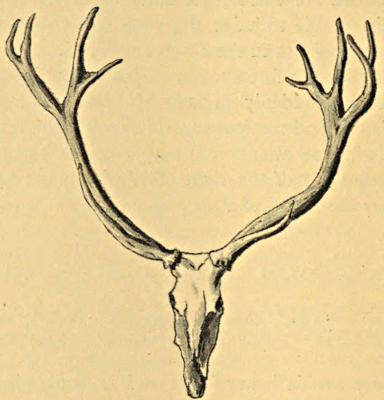
Rucervus Duvaucelli
The antlers of the swamp deer are peculiar. The beam is
rather slender, the brow antler very long, there is no median
tine, and at the top the head becomes almost palmated. The
full-grown stag carries three antlers on the top, two of which
(the outside antlers generally) are bifurcated equally, as if the
antler had been split and bent outwards; each horn having
thus six points, including the brow antler. Colonel Erskine
says that he has never seen a head with more than fourteen
tines, but Jerdon speaks of seventeen. In Schomburgk’s deer
(an allied form found in Siam), all three prongs on the top are
bifurcated. The difference between the two varieties is very
noticeable in the British Museum, where the horns are placed
side by side. Sterndale says that in Schomburgk’s deer the
très and royal tines are equal, whilst in the swamp deer the très
tine is longer than the royal.
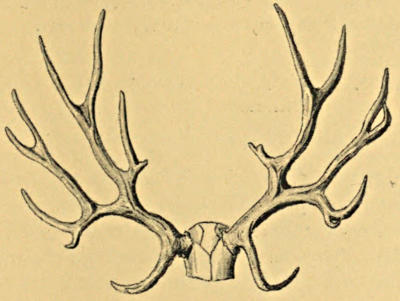
Rucervus Schomburgkii
In the high grass of the Terai and Assam, swamp deer are
generally shot off elephants, but in some parts of Central India
the ground is open enough to permit of their being stalked.
Forsyth gives a capital account of the sport he enjoyed while
hunting them in the Sál forests of Central India. Swamp deer
are gregarious, and Jerdon quotes from an article in ‘The Indian
Sporting Review’ a case of three large herds being seen on one
plain. The general colour of the beast is a light yellowish red,
paler in the winter than in the summer; the under parts and
below the tail are white. The hinds are lighter coloured than
the stags, and the fawns are spotted. The stags appear to
shed their horns about March or April, as, Forsyth says, they
lose the velvet at the close of the rainy season; he also says
that they shed their horns more regularly than the Rusinæ.
The following quotation from his charming book gives an
excellent account of their habits:
This animal has been called in North-Eastern India the ‘swamp
deer,’ but here (Central India) he is not observed to be particularly
partial to swampy ground. These deer graze in the mornings and
evenings in the open valley, chiefly along the smaller streams, and
by springs where the grass is green, and rest during the day about
the skirts of the Sál forest. A favourite midday resort is in the
shade of the clumps of Sál dotted about the open plain, at some
distance from the heavy forest. They are not nearly so nocturnal
in habits as the sámbar, being often found out grazing late in the
forenoon, and again early in the afternoon; and I do not think they
wander about all night like the sámbar. Their midday rest is
usually of a few hours only, but during that time they conceal
themselves in the grass much after the manner of the sámbar. I
have never heard of their visiting cultivated tracts like the latter;
nor can I learn that their apparent adherence to the Sál forest is
due to their employing any part of that tree as food.
(Rucervus vel Panolia Eldii)
Native names: ‘Thamin,’ ‘Sungrai’
This variety of swamp deer is found chiefly in Burmah, but
extends from Munipur to the Malay Peninsula. Its habits are,
as above noted, the same as those of the swamp deer, but it is
rather differently coloured, being, according to Sterndale, ‘of a
light rufous brown with a few faint indications of white spots,
the under parts and insides of the ears nearly white, the tail
short and black above. It is said to become darker in winter
instead of lighter, as in the swamp deer.’
The horns, however, are very unlike the swamp deer’s. The
brow antler and beam, instead of forming an angle, are in one
continuous curve, like the section of a circle, the burr being
small and hardly seen. In rear of the top of the beam there is
a short snag, which Sterndale calls the royal tine, and on the
front of the top of the beam, which is rather flattened, instead
of regular tines like those on a swamp deer’s head, there is a
collection of what look like false points. In a head in the
British Museum the left horn has thirteen of these little snags
and the right fourteen.
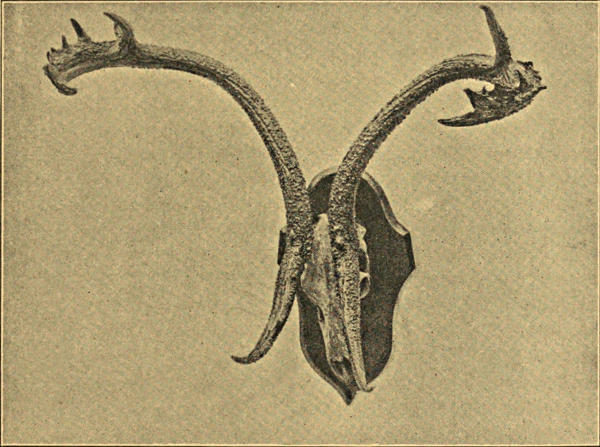
Panolia Eldii
In Upper Burmah, Eld’s deer are scarce, and the only way
to obtain them is to drive for them with beaters. In Lower
Burmah they are occasionally shot by lamplight, much in the
same manner as that described in Colonel Rice’s book; the
performance is said to be very interesting. The party (which
usually consists of a lamp-bearer, a man with an arrangement
of jingling bells and rings on a stick, the sportsman and his gun-carriers)
having assembled after dark, a fire is lit, and a kind of
incantation gone through, everyone but the speaker being forbidden
to utter a word. When the incantation is over, each
member of the party passes through the smoke of the fire in turn,
the guns are handed through it also, the lamp is then lit, and
the party starts, using the lamp, an earthenware pot with a hole
in its side, as a search light, while the man with the frame of
bells keeps up an incessant jingling. On a deer being discovered,
the light is at once turned full on its eyes and kept
steadily there, the jingling kept going, with the result that the
deer is so dazed that it will often allow the party to go close up
to it before the sportsman fires. Both Eld’s deer and sambur
may be shot in this way, and the writer has been told that
hares, and occasionally deer, will allow themselves to be
approached till they can be speared or knocked on the head
with sticks. This, of course, is not a very high class of sport,
but in many of the coast districts stalking in the jungles is
almost impossible.
Measurements
| Authority |
Height at shoulder |
Total length |
Weight as shot |
Length of horn |
Length of brow antler |
Girth above brow antler |
Girth above burr |
Girth of burr |
Girth of beam midway |
Remarks |
| Rusa Aristotelis |
|
ins. |
ins. |
lbs. |
ins. |
ins. |
ins. |
ins. |
ins. |
ins. |
|
| Mr A. O. Hume |
.. |
.. |
.. |
46½ |
.. |
6⅜ |
.. |
.. |
.. |
Rowland Ward, ‘Horn Measurements’ |
| Dr. Falconer, British Museum |
.. |
.. |
.. |
45⅛ |
.. |
6⅝ |
.. |
.. |
.. |
” |
| ‘The Field,’ Dec. 22, 1866 |
.. |
.. |
.. |
45, 44 |
.. |
.. |
.. |
11 |
7½ |
Weight of horns, without skull, 20 lbs. |
| Sir J. Morris, K.C.S.I. |
.. |
.. |
.. |
45 |
.. |
7⅜ |
.. |
.. |
.. |
Rowland Ward, ‘Horn Measurements’ |
| Maj.-Gen. A. Ellis, C.S.I. |
.. |
.. |
.. |
45 |
.. |
7¼ |
.. |
.. |
.. |
Rowland Ward, ‘Horn Measurements’ |
| Sterndale’s ‘Mammalia’ |
.. |
.. |
.. |
45, 43 |
18¼ |
.. |
9 |
.. |
7¼ |
Has an abnormal snag 9 ins. long on right horn below the très tine |
| Sterndale’s ‘Mammalia’ |
56 |
72 to 78 |
.. |
.. |
.. |
.. |
.. |
.. |
.. |
|
| British Museum |
.. |
.. |
.. |
44½ |
.. |
7 |
.. |
.. |
.. |
|
| Col. W. J. Morris |
.. |
.. |
.. |
44⅛ |
.. |
7⅞ |
.. |
.. |
.. |
Rowland Ward, ‘Horn Measurements’ |
| Major Ward |
53 |
.. |
.. |
44 |
.. |
9 |
.. |
.. |
.. |
‘Sportsman’s Guide to Ladak, &c.’ |
| Mr. J. D. Inverarity |
.. |
.. |
.. |
44 |
.. |
.. |
.. |
.. |
.. |
Rowland Ward, ‘Horn Measurements’ |
| The Earl of Ducie |
.. |
.. |
.. |
R 35
L 33 |
R 14½
L 13 |
7½ |
.. |
.. |
.. |
A peculiar head with abnormal snags at the back of each beam. Terminal points: R. 11, L. 12½. Abnormal snags: R. 9¼, L. 13. Girth of snags: R. 5½, L. 7½. |
| The Maharahjah of Kooch Behar, Letter to ‘The Asian’ |
.. |
.. |
717 |
.. |
.. |
.. |
.. |
.. |
.. |
|
| C.A.S.W., ‘The Field,’ Oct. 25, 1890 |
44 |
.. |
561 |
.. |
.. |
.. |
.. |
.. |
.. |
|
| Sir S. Baker, ‘Wild Beasts and their Ways’ |
54 |
.. |
about 600 |
.. |
.. |
.. |
.. |
.. |
.. |
|
| Average of good head |
.. |
.. |
.. |
38 |
.. |
7 |
.. |
.. |
.. |
|
| Axis porcinus |
| Major Ward quotes a head |
.. |
.. |
.. |
21 |
.. |
.. |
.. |
.. |
.. |
‘Sportsman’s Guide to Ladak, &c.’ |
| Mr. A. O. Hume |
.. |
.. |
.. |
19¼ |
.. |
3⅛ |
.. |
.. |
.. |
Rowland Ward, ‘Horn Measurements’ |
| Sir V. Brooke |
.. |
.. |
.. |
19⅛ |
.. |
3¼ |
.. |
.. |
.. |
” |
| Mr. H. C. V. Hunter |
.. |
.. |
.. |
19⅛ |
.. |
3⅜ |
.. |
.. |
.. |
” |
| Major FitzHerbert |
27 |
48 |
96 |
.. |
.. |
.. |
.. |
.. |
.. |
|
| ” |
.. |
.. |
96 |
16¾ |
.. |
.. |
.. |
.. |
.. |
|
| ” |
25¾ |
.. |
98 |
.. |
.. |
.. |
.. |
.. |
.. |
|
| ” |
25½ |
51 |
93 |
.. |
.. |
.. |
.. |
.. |
.. |
|
| ” |
25 |
52½ |
96 |
12 |
.. |
.. |
.. |
.. |
.. |
|
| Major Greenaway |
28 |
.. |
.. |
.. |
.. |
.. |
.. |
.. |
.. |
|
| ” |
24½ |
.. |
.. |
.. |
.. |
.. |
.. |
.. |
.. |
|
| Sterndale’s ‘Mammalia’ |
27 to 28 |
50 to 52 |
.. |
15 to 16 |
.. |
.. |
.. |
.. |
.. |
|
| Average of good head |
.. |
.. |
.. |
16 |
.. |
.. |
.. |
.. |
.. |
|
| Axis maculatus |
| Forsyth, ‘Highlands of Central India’ |
.. |
.. |
.. |
38 |
.. |
.. |
.. |
.. |
.. |
|
| Mr. A. O. Hume |
.. |
.. |
.. |
37½ |
.. |
4½ |
.. |
.. |
.. |
Rowland Ward, ‘Horn Measurements’ |
| ” |
.. |
.. |
.. |
37⅜ |
.. |
4 |
.. |
.. |
.. |
” |
| Sir V. Brooke |
.. |
.. |
.. |
37¼ |
.. |
4¼ |
.. |
.. |
.. |
” |
| Gen. Macintyre |
.. |
.. |
.. |
37 |
.. |
4 |
.. |
.. |
.. |
‘Hindu Koh’ |
| Mr. W. C. Oswell |
.. |
.. |
.. |
36¾ |
.. |
4⅜ |
.. |
.. |
.. |
Rowland Ward, ‘Horn Measurements’ |
| Mr. C. H. Seeley |
.. |
.. |
.. |
36½ |
.. |
4½ |
.. |
.. |
.. |
” |
| British Museum |
.. |
.. |
.. |
36 |
.. |
4¼ |
.. |
.. |
.. |
” |
| Capt. V. Couper |
.. |
.. |
.. |
36 |
.. |
.. |
.. |
.. |
.. |
|
| Major FitzHerbert |
35¾ |
70¼ |
.. |
32½ |
.. |
.. |
.. |
.. |
.. |
|
| ” (a hind) |
28 |
58 |
86 |
.. |
.. |
.. |
.. |
.. |
.. |
|
| Major Greenaway |
37 |
.. |
.. |
.. |
.. |
.. |
.. |
.. |
.. |
|
| Sterndale’s ‘Mammalia’ |
36 to 38 |
54 to 60 |
.. |
Average 30 |
.. |
.. |
.. |
.. |
.. |
|
| Average of good head |
.. |
.. |
.. |
30 |
.. |
4 |
.. |
.. |
.. |
|
Measurements
| Authority |
Height at shoulder |
Total length |
Weight as shot |
Length of horn |
Length of brow antler |
Girth above brow antler |
Girth above burr |
Points |
Remarks |
| Rucervus Duvaucelli |
|
ins. |
ins. |
lbs. |
ins. |
ins. |
ins. |
ins. |
ins. |
|
| Major C. S. Cumberland |
.. |
.. |
.. |
41 |
5½ |
.. |
.. |
6×6 |
Rowland Ward, ‘Horn Measurements’ |
| ” |
.. |
.. |
.. |
39¼ |
5 |
.. |
.. |
5×6 |
” |
| Sir E. G. Loder, Bart. |
.. |
.. |
.. |
37⅜ |
5¼ |
.. |
.. |
7×6 |
” |
| Col. Erskine |
about 45 |
.. |
.. |
37 |
7 |
14 |
.. |
7×7 |
|
| Major Ward |
.. |
.. |
.. |
36½ |
5 |
.. |
.. |
.. |
‘Sportsman’s Guide to Ladak, &c.’ |
| Mr. B. Hodgson |
.. |
.. |
.. |
36 |
5 |
.. |
.. |
6×5 |
Rowland Ward, ‘Horn Measurements’ |
| Sir V. Brooke |
.. |
.. |
.. |
35⅜ |
4⅞ |
.. |
.. |
.. |
” |
| Mr. H. C. V. Hunter |
.. |
.. |
.. |
35¼ |
5¾ |
.. |
.. |
7×6 |
” |
| Major C. S. Cumberland |
.. |
.. |
.. |
34¾ |
5⅝ |
.. |
.. |
5×5 |
” |
| British Museum |
.. |
.. |
.. |
34 |
5½ |
.. |
.. |
5×5 |
Head No. 694 A. |
| Major C. S. Cumberland |
.. |
.. |
.. |
33½ |
4¾ |
.. |
.. |
5×5 |
Rowland Ward, ‘Horn Measurements’ |
| ” |
.. |
.. |
.. |
33⅛ |
5½ |
.. |
.. |
5×5 |
” |
| Rowland Ward |
.. |
.. |
about 560 |
.. |
.. |
.. |
.. |
.. |
” |
| Forsyth |
.. |
.. |
.. |
33½ |
.. |
.. |
.. |
6×6 |
‘Highlands of Central India’ |
| Major FitzHerbert |
49 |
82 |
.. |
30 |
.. |
10⅜ |
.. |
.. |
|
| ” |
47 |
81 |
.. |
.. |
.. |
.. |
.. |
.. |
|
| Sterndale’s ‘Mammalia’ |
44 to 46 |
.. |
.. |
about 36 |
.. |
.. |
.. |
12 to 14 |
|
| Average of good head |
.. |
.. |
.. |
30 |
5 |
.. |
.. |
6×6 |
|
| Rucervus Schomburgkii |
| British Museum |
.. |
.. |
.. |
30⅛ |
5 |
.. |
.. |
10×10 |
Rowland Ward, ‘Horn Measurements’ |
| ” |
.. |
.. |
.. |
29⅞ |
5⅛ |
.. |
.. |
9×8 |
” |
| ” |
.. |
.. |
.. |
29¾ |
4¾ |
.. |
.. |
10×11 |
” |
| ” |
.. |
.. |
.. |
28¾ |
5½ |
.. |
.. |
8×8 |
Head No. 1463 A. |
| Sir V. Brooke |
.. |
.. |
.. |
28½ |
5¼ |
.. |
.. |
11×9 |
Rowland Ward, ‘Horn Measurements’ |
| British Museum |
.. |
.. |
.. |
27⅞ |
5⅜ |
.. |
.. |
9×8 |
” |
| ” |
.. |
.. |
.. |
27¾ |
4⅜ |
.. |
.. |
7×8 |
” |
| Panolia Eldii |
| Sir E. G. Loder, Bart. |
.. |
.. |
.. |
39⅝ |
5 |
.. |
.. |
20 |
Rowland Ward, ‘Horn Measurements’ |
| British Museum |
.. |
.. |
.. |
38⅞ |
6¼ |
.. |
.. |
16×19 |
” |
| ” |
.. |
.. |
.. |
37½ |
5⅜ |
.. |
.. |
5×5 |
” |
| Rowland Ward |
.. |
.. |
.. |
37 |
6⅛ |
10½ |
.. |
.. |
” |
| Mr. A. O. Hume |
.. |
.. |
.. |
36⅛ |
5½ |
.. |
.. |
4×3 |
” |
| British Museum |
.. |
.. |
.. |
35¾ |
5⅜ |
.. |
.. |
4×5 |
” |
| Hume Collection, British Museum |
.. |
.. |
.. |
34⅞ |
5½ |
.. |
.. |
6×6 |
” |
| Mr. A. O. Hume |
.. |
.. |
.. |
34⅝ |
6⅛ |
.. |
.. |
5×6 |
” |
| Hon. W. Rothschild |
.. |
.. |
.. |
34⅛ |
5 |
.. |
.. |
6×6 |
” |
| Mr. J. Carr Saunders |
.. |
.. |
.. |
34 |
5⅞ |
.. |
.. |
10×10 |
” |
The horns of Eld’s deer are very difficult to measure in the
ordinary way, owing to the extreme smallness of the burr, the
back of the beam in good specimens touching the skull, and
because the brow antler does not form an angle with the beam,
but is simply a prolongation of the curve of the horn.
Cashmere: Hangal, Barasingh
This is the stag par excellence of India. A sambur has a fine
head and so has a swamp deer, but neither approaches in beauty
to a barasingh. A good stag’s head is one of the trophies of
the Himalayas, but unfortunately it is getting scarcer year by
year. Sheep and cattle affect this deer but little, as they keep
more or less to the open downs and glades; but the yearly
increasing herds of buffaloes that come up from the plains to
graze in Cashmere during the summer, at the very time that
the stags are growing their horns, are the real mischief-makers.
Buffaloes delight in plunging through dense forest, and they
and their attendants will clear the deer out of any valley. Unfortunately
for the sportsman, buffaloes pay for their feeding in
taxes and produce, while deer do not. The best step as regards
preservation that the Cashmere authorities have taken as yet is
the creation of a Royal Preserve between the Sindh and Liddur
rivers, and if they would only exclude buffaloes from this tract
entirely it would form a real sanctuary, which would immensely
improve the shooting all round. At present, by allowing buffaloes
to graze on it, they are depriving it of half its value.
In spite of all drawbacks stags are still to be got, but in no
quantity. Two good heads in a month’s shooting are as many
as any sportsman can reasonably hope to get, and if one of
those measures 40 ins., whether with ten or twelve tines, he is
to be congratulated.
The general impression about barasingh seems to be that a
full-grown stag always has twelve points, but this the writer
believes to be entirely erroneous. I have hunted over some
of the best ground in Cashmere on different occasions, and am
of opinion that the number of points usually found in full-grown
heads depends entirely upon the locality. The stags
which do not leave the Cashmere Valley, i.e. harbour on the
hills overlooking it, and those that live to the south-east, often
run to twelve and sometimes more points; while the stags
which harbour across the Kishengunga rarely run to more than
ten points. These stags appear to develop ten points very
early; the poorest head the writer ever shot was a 10-pointer.
I shot a young stag with only six points once, under circumstances
that gave no opportunity of previously judging its head,
and it had far longer and better horns than the above-mentioned
10-pointer. Crummle and antelope heads are also rare. I
once shot a very heavy old stag with a most curious antelope
head, the horns having not a tine on them, and being twisted
more like a markhor’s than a stag’s. The old fellow was absolute
king of the valley, too, and not another stag dared answer
his challenge. It was very puzzling at the time. While stalking
another stag which had called once among some thick
bushes but would not show, the old antelope head appeared
far up the hill, sauntering leisurely down, and challenging as
he came. Every deer within hearing seemed to hide from
him at once. There was a small 6-point stag with a hind
cowering behind some bushes about two hundred yards to
my right, while the deer that he had originally started after
were keeping hidden somewhere to his left, and the old chieftain
was coming straight towards him, singing his war-song.
Over and over again were the glasses laid on him, but nothing
could be made out. The body was that of a royal, but the
horns were short, with no antlers visible. Apparently he was
a bad three-year-old. What did it mean? If he were a big
royal the respect shown him by the other stags was intelligible
enough; but why should they be afraid of a beast like that?
Fairly puzzled, I crept back to look for the stag I had
originally come down after, which there was every reason to
believe was a 10-pointer. Not a sign of him could be seen,
but while pottering about in some long grass a pair of straight
horns suddenly appeared within forty yards of me. Confound
this brocket! he has walked on top of me; perhaps he may
just miss me! No! he comes straight on and looks me in the
face. Now the brute will drive everything away, so here goes—and
he drops in his tracks. A brocket? Not a bit of it;
twenty years old if he’s a day, and his quaint old head is the
pick of the bag.
The general colour of barasingh is much the same as that
of red deer, but is rather greyer, and the white patch on the
rump appears a little larger. Sterndale says it has a white
circle round the eyes, but the writer has never seen anything
more distinct of this kind than a ring slightly paler than the
rest of the head.
The horns resemble those of the red deer, with the notable
exception that with barasingh the bez antler appears to be the
fighting one, and is always longer and bigger than the brow
antler, while with red deer the reverse is the case. Sir Victor
Brooke says its call is just like that of a wapiti, and quite
different from that of a red stag. ‘In the former it is a loud
squeal, ending in a more guttural tone; in the latter it is a
distinct roar, resembling that of a panther.’ According to the
writer’s experience, the full call is seldom heard till the rutting
season is at its height. When the stags first begin roaring the
call is comparatively short. Ward’s remarks on the subject
are well worth quoting: ‘The noise a stag can make when
“roaring” is much louder than would be imagined, and can be
heard at a great distance; but very often, when the animal is
lying down, he only utters a prolonged moaning sound, which
is very deceptive, and unless frequently repeated, it is difficult
to find out the exact direction to follow.’
In the winter nearly all the barasingh are congregated in
the Cashmere Valley, but though the smaller stags come down
and are pretty easily found, the big ones will not leave the high
ground, where it is impossible to follow them (unless they are
driven down by an early fall of snow), until the young grass
begins to grow in March, which is the best month to get heads,
though of course the deer are then in poor condition. Ward
writes about winter shooting:
If it could be done, the plan would be not to decide to enter the
valley (i.e. Cashmere) until information of a really heavy fall in December
or early in January had been obtained. The late falls of snow
do not drive the deer down. The hazel buds are swelling, and they
can graze on them; the sap is rising in various bushes and trees,
and the deer can eat the smaller twigs, but an early fall forces the
animals into the valleys.… In the spring, when the snow is
melting, is, to my idea, far the best time, and I would sooner have
from February 20 to March 20 after the stags than all the rest of
the year. They are then down on the young green grass, and are
busily devouring the crocuses.
By the end of March all the big stags and most of the
smaller ones have shed their horns, and the deer collect into
large herds and begin moving off to their summer quarters,
those in the western corner of the valley going to the banks of
the Kishengunga river. The herds which strike the river at its
nearest point below Gurais cross it, and retire to the range of
hills on the southern border of Astor. Only a very few stags
cross this range, the bulk of the deer remaining on the Cashmere
side. The deer on the northern and eastern sides of the
valley retire to the slopes of Haramook and the high ground
south of the range which separates Cashmere from Dras and
Sooroo, but do not appear to cross it. The farther east one goes
from Srinugger the less the deer appear to migrate, merely
retiring to the heads of the valleys. The altitude of the birch
copses just above the limit of the pines is what they seek, and
this they can find close at hand on the north and east of the
valley, but they have to travel some distance to it on the west.
About September 1 the horns should be nearly free from velvet,
and as a delicious wild black currant ripens at the same time,
the shikaris associate the two. Up to September 20 the old stags
are either alone or accompanied by a youngster who acts as fag,
and they are not easy to find; in fact, as a rule, shikaris declare
that it is useless trying to find them. But when the sportsman
knows, from seeing tracks, that there are big stags on the ground,
and the heads of the valleys (not the calling grounds) are the
places to look for them, then, by carefully watching some glen
where tracks have been seen, particularly just about 8 a.m. when
the sun is getting hot, a stag may often be discovered as he
rises from where he had lain down shortly after sunrise. He
is about to move to a more sheltered spot to spend the day—and
it is so satisfactory to have a stag or two to one’s credit before
they begin to call. Unfortunately it is not always possible.
Some of the best valleys during the calling season do not hold
stags before that season begins, as the deer move on to them
just then, and very often leave immediately afterwards. Good
local information is absolutely necessary, and a shikari who
does not know every soiling pool, every deer-path, or likely
copse for a stag to lie up in is useless.
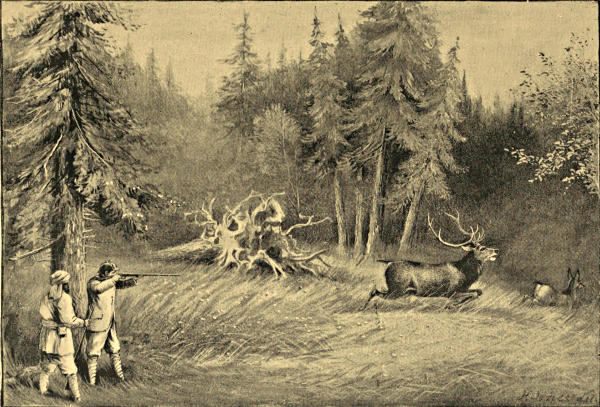
‘A SNAP-SHOT IN THE FOREST’
The calling season generally begins about September 20,
and varies according to the weather, and also according to the
moon. Fine hot weather and a full moon about the 20th
mean that every stag in the place will be calling freely. Wet
cold weather and no moon mean the reverse, the weather
having more effect than the moon. The idea of the stage of
the moon having any effect may be considered fanciful, but if
it is taken into consideration that the stags usually begin calling
at night and almost invariably fight their battles for supremacy
then, it follows that the light of the moon is a decided advantage.
A good set-to between two old barasingh stags would be
a grand sight. The writer once came across a battle-field, but
too late to witness the fight, and the way the turf was ploughed
up bore testimony to the severity of the struggle. The
rutting season appears to be initiated by the hinds; at least
I have observed that the short bark of the hinds is usually
heard some days before the roar of the stags, and have seen a stag
come best pace out of the forest in answer to a hind’s call in
the early morning, before a stag’s challenge had been heard on
the ground. It is most amusing to watch a young stag calling,
the way he swaggers before his lady-love, tearing up the turf
with feet and horns as if nothing could drive him from her,
till his challenge is answered by a deeper note, when the
youngster curls up at once, flees for his life to the thickest scrub
he can find half a mile away and cowers among the bushes,
while his mate in the most matter-of-fact way at once attaches
herself to his lordly rival, who comes swaggering easily along
the hillside with the sunbeams glancing from the burnished
points of his glorious antlers. A small calling stag should
never be disturbed, as he almost invariably draws out a better
beast. Great care, too, should be taken not to frighten away
unattached hinds anywhere near a calling ground. If left alone
they will sooner or later be joined by stags, though occasionally
hinds will run from a stag just as if they had scented a man.
The writer on one occasion was watching a hind and calf feeding,
when they suddenly galloped off, and presently an old stag came
trotting down the hill grunting his displeasure and following
their scent like a hound, till, coming within range, he paid the
penalty. Probably owing to the scarcity of hinds, even the
best stags appear never to be able to collect more than two or
three, not counting calves, which seem always to run with their
dams for a year.
Old writers talk of stags calling all day long. This may
have been so years ago; now-a-days they rarely call after 9
a.m., and do not begin again before 3 p.m. at the earliest.
I once heard a grand chorus in the early morning. Five
different stags were calling at the same time, but as they
seemed to be more or less afraid of one another and kept perpetually
on the move, I never got a chance at one of them.
To be successful with stags during the calling season, the
sportsman should be on his ground as soon as it is light. The
stags are moving about all night, and soon after sunrise they
retire into the forest, where, unless they keep on calling, it is
almost impossible to find them. This, of course, refers to the
open ground at the top of the hills. Ward prefers the lower
ground in the pine forest, from 8,000 to 9,000 ft. above the
sea level, as he says the stags there seem to settle down into
certain spots and remain there for days together. The writer’s
own experience is that the upper ground is best when the stags
first begin calling, as they all seem to collect there, and that
later on, about October 1, when there has often been a slight
snowfall on the top of the hills, and the frost at night is beginning
to tell, the stags should be followed down into the forest.
But as different valleys vary so much, according to whether the
deer remain in them during the winter or are merely passing
through, no general rule applies to all. Hunting the upper
ground as long as the stags are on it is undoubtedly far
pleasanter than creeping about in the forest down below, and
in the gloom of the pines the chances are very much against the
stalker. Stags may occasionally be shot by waiting for them
at some favourite soiling or drinking pool, and it is by no
means a bad thing to try if the pool is in thick forest and some
distance from other water. The most likely time to see anything
is about 4 p.m., when the deer begin to draw out.
Waiting over salt-licks and water at night is an abomination,
like all other night shooting. As a rule, you do more harm
than good by disturbing the ground, and if you do get a shot
and hit (no certain matter even in the brightest moonlight),
unless the stag is dropped on the spot you run a very great
risk of losing him. Barasingh are very tough beasts, and an
ill-placed bullet is not much use. It is very difficult to know
what to do when (as often happens) the stags will not call till
just before dark. If this happens among the pine forests, any
attempt at night shooting is almost
sure to end in failure; and even on
the high open ground the chances are
so much against the sportsman that
it should only be tried if every other
plan fails. Patient tracking and
watching over likely glades for a stag
to draw out on are far more effective
in bringing eventual success. The two
main points to be remembered during
a stalk are, first, to try and get a clear chance at about sixty
yards, and not creep up too close to the stag before firing;
secondly, to avoid going straight downhill on to a stag. A
stone dislodged, a pheasant or musk deer disturbed, will be
sure to start him off. On the other hand, if the stalker is
moving down sixty or seventy yards to one side, any slight
contretemps does not necessarily spoil his chance of a shot.
Every native shikari, if conducting a stalk, will try to land his
master between the beast’s horns if possible. As soon as he sees
a stag, he will begin to try to point him out, with the result
that before his master can get his wind and take any aim to
speak of, the beast is at full gallop down the hill. The second
point never enters into a native’s calculations at all. Ward says
that natives can imitate the call, and draw stags, but systematic
calling as practised in the Tyrol is practically unknown in
Cashmere, and a proficient in the art would undoubtedly have
success. The point to aim at in calling is to pitch your note
a little weaker than the answering stag, so as to give him confidence
in accepting the challenge.
A stalk in the open
The stags generally cease calling towards the end of October
(Ward says 20th), and after that there is little chance of getting
sport till the snow drives them down, or, failing an early fall,
till the spring.
Major Ward says a well-shaped 10-point head of 40 ins.
should not be despised, but the majority of heads shot, according
to the writer’s experience, do not average more than 37 ins.;
40 ins. and over being exceptional heads.
Native name: ‘Shou.’ Habitat: Eastern Himalayas; Thibet, in the
Choombi Valley, on the Sikkim side of Thibet (Sterndale)
None of the heads of this variety in the British Museum
have more than ten points. Their colour, according to Jerdon,
is a fine clear grey in winter, with a moderately large disc; pale
rufous in summer, quite different from the rich mouse colour
of the barasingh. Hodgson’s description of the horns is most
accurate, the flatness of the brow antlers is very marked,
‘pedicles elevate; burrs rather small; two basal antlers, nearly
straight, so forward in direction as to overshadow the face to
the end of the nasal; larger than the royal antlers; median or
royal antlers directed forwards and upwards; beam with a terminal
fork, the prongs radiating laterally and equally, the inner
one longest and thinnest.’ There is an enormous head in the
British Museum, the two brow antlers of which bend downwards
on each side. As in the case of the barasingh, the second
brow antler, or bez, is always longer than the first.
As regards the allied maral stag of Persia and Turkestan,
Major Cumberland, in his letters published by ‘Land and
Water,’ 1891, writes that the Turkestan name for the stag is
‘bōghè,’ the hind being called ‘maral.’ This deer resembles
the red stag, in that the brow antler is longer than the bez, and
the crown is more of the wapiti type.
Another variety, with horns also of the wapiti type, Cervus
Eustephanus, was discovered by Mr. W. Blanford in the Thian
Shan mountains. He describes this variety as also having the
brow antler longer than the bez.
Generally ‘Kastura’; Garwhal and Kumaon, ‘Bena,’ ‘Masaknaba’;
Cashmere, ‘Roos,’ ‘Rous’
This little deer is found all over the hills above an altitude
of 7,000 or 8,000 ft., except in Ladak, though it is said to be
plentiful in Thibet, beyond the frontier of Nepal.
Cover of some sort, bushes or timber, seems necessary for
it, and the want of this is probably the reason it does not
extend to Ladak. Except that district, every shooting ground
of the right elevation seems to hold musk deer; and as, particularly
in the autumn, they are excellent eating, a chance with a
light rifle is well worth taking advantage of, unless in too close
proximity to better game. The musk deer has no horns, but
the male has two delicate curved tushes, growing down from the
upper jaw, which are often over three inches in length outside
the gums; these tushes being the only distinguishing mark
between the sexes, it is very hard to tell them apart at a distance.
Measurements
| Authority |
Height at shoulder |
Length nose to tip of tail |
Tail |
Girth of body |
Weight as shot |
Length of horns |
Girth above brow antler |
Girth, beam midway |
Burr |
Length brow antler |
Length bez antler |
Girth bez antler |
Length median antler |
Splay at tips |
Widest spread |
Inside span |
Points |
Remarks |
| Cervus cashmirianus |
|
ins. |
ins. |
ins. |
ins. |
lbs. |
ins. |
ins. |
ins. |
ins. |
ins. |
ins. |
ins. |
ins. |
ins. |
ins. |
ins. |
ins. |
|
| Dr. Leith Adams |
.. |
.. |
.. |
.. |
.. |
48 |
.. |
.. |
.. |
.. |
.. |
.. |
.. |
.. |
.. |
.. |
.. |
Sterndale, ‘Mammalia’ |
| Major Ward |
.. |
.. |
.. |
.. |
.. |
47 |
7¾ |
.. |
.. |
.. |
.. |
.. |
.. |
29 |
56 |
.. |
13 |
‘Sportsman’s Guide’ |
| ” |
49½ |
.. |
.. |
.. |
400 |
.. |
.. |
.. |
.. |
.. |
.. |
.. |
.. |
.. |
.. |
.. |
.. |
” |
| Sir E. G. Loder, Bart. |
.. |
.. |
.. |
.. |
.. |
47 |
6¾ |
.. |
.. |
.. |
.. |
.. |
.. |
21¾ |
.. |
36⅜ |
5×5 |
Rowland Ward, ‘Horn Measurements’ |
| Major Ward |
.. |
.. |
.. |
.. |
.. |
46 |
8 |
.. |
.. |
.. |
.. |
.. |
.. |
32 |
50 |
.. |
12 |
‘Sportsman’s Guide’ |
| ‘Oriental Sporting Magazine,’ 1870 |
.. |
.. |
.. |
.. |
.. |
46 |
.. |
7 |
10 |
18 |
.. |
.. |
.. |
.. |
.. |
.. |
.. |
|
| Sir V. Brooke |
.. |
.. |
.. |
.. |
.. |
45⅝ |
6 |
.. |
.. |
.. |
.. |
.. |
.. |
25¾ |
.. |
36 |
8×8 |
Rowland Ward, ‘Horn Measurements’ |
| Hume Collection, British Museum |
.. |
.. |
.. |
.. |
.. |
45⅞ |
8 |
.. |
.. |
.. |
.. |
.. |
.. |
35 |
.. |
41 |
6×6 |
” |
| Hon. C. Ellis |
.. |
.. |
.. |
.. |
.. |
43⅞ |
5⅞ |
.. |
.. |
.. |
.. |
.. |
.. |
15⅞ |
.. |
32 |
5×5 |
” |
| ” |
.. |
.. |
.. |
.. |
.. |
43⅜ |
6½ |
.. |
.. |
.. |
.. |
.. |
.. |
25⅜ |
.. |
36½ |
.. |
” |
| Hume Collection, British Museum |
.. |
.. |
.. |
.. |
.. |
43¼ |
6½ |
.. |
.. |
.. |
.. |
.. |
.. |
18⅛ |
.. |
34½ |
5×5 |
” |
| Dr. Falconer, Brit. Mus. |
.. |
.. |
.. |
.. |
.. |
43 |
5⅞ |
.. |
.. |
.. |
.. |
.. |
.. |
6¼ |
.. |
27¾ |
5×5 |
” |
| Mr. M. Kennard |
.. |
.. |
.. |
.. |
.. |
43 |
5⅞ |
.. |
.. |
.. |
.. |
.. |
.. |
26⅛ |
.. |
37⅞ |
6×5 |
” |
| Gen. Macintyre |
.. |
.. |
.. |
.. |
.. |
42 |
.. |
7¼ |
10½ |
.. |
.. |
5½ |
.. |
.. |
.. |
33 |
10 |
‘Hindu Koh’ |
| British Museum |
.. |
.. |
.. |
.. |
.. |
42 |
5⅞ |
.. |
.. |
.. |
.. |
.. |
.. |
29⅜ |
.. |
33½ |
6×5 |
Rowland Ward, ‘Horn Measurements’ |
| Major Greenaway |
52 |
81 |
.. |
.. |
.. |
.. |
.. |
.. |
.. |
.. |
.. |
.. |
.. |
.. |
.. |
.. |
.. |
|
| The Writer |
47 |
85 |
.. |
.. |
.. |
.. |
.. |
.. |
.. |
.. |
.. |
.. |
.. |
.. |
.. |
.. |
10 |
Showing normal difference between brow & bez antlers |
| ” |
.. |
.. |
.. |
.. |
.. |
36¾ |
.. |
.. |
8 |
11¼ |
14½ |
.. |
.. |
25 |
35 |
.. |
10 |
| ” |
.. |
.. |
.. |
.. |
.. |
35½ |
5½ |
.. |
8 |
10½ |
15½ |
.. |
.. |
.. |
35 |
.. |
10 |
| Sterndale, ‘Mammalia’ |
48 to 52 |
84 to 90 |
5 |
.. |
.. |
.. |
.. |
.. |
.. |
.. |
.. |
.. |
.. |
.. |
.. |
.. |
.. |
|
| Average of good head |
.. |
.. |
.. |
.. |
.. |
37 |
6 |
.. |
.. |
.. |
.. |
.. |
.. |
.. |
.. |
.. |
6×6 |
|
| Cervus affinis |
| Mr. A. O. Hume |
.. |
.. |
.. |
.. |
.. |
55¾ |
6½ |
.. |
.. |
.. |
.. |
.. |
.. |
17¼ |
.. |
40⅜ |
7×6 |
Rowland Ward, ‘Horn Measurements’ |
| British Museum |
.. |
.. |
.. |
.. |
.. |
55¼ |
8½ |
7¼ |
11 |
14 |
19¼ |
.. |
.. |
.. |
.. |
.. |
5×5 |
|
| Lord Northbrook |
.. |
.. |
.. |
.. |
.. |
55 |
9⅛ |
.. |
.. |
.. |
.. |
.. |
.. |
.. |
.. |
.. |
6×7 |
Rowland Ward, ‘Horn Measurements’ |
| Dr. Campbell, British Museum |
.. |
.. |
.. |
.. |
.. |
54⅜ |
6⅝ |
.. |
.. |
.. |
.. |
.. |
.. |
21⅝ |
.. |
37¼ |
5×5 |
” |
| Dr. Jerdon quotes a head |
.. |
.. |
.. |
.. |
.. |
54 |
.. |
.. |
.. |
.. |
12 |
.. |
8 |
.. |
47 |
.. |
.. |
Sterndale, ‘Mammalia’ |
| Mr. B. H. Hodgson, British Museum |
.. |
.. |
.. |
.. |
.. |
53¾ |
6⅞ |
.. |
.. |
.. |
.. |
.. |
.. |
26⅛ |
.. |
44 |
5×5 |
Rowland Ward, ‘Horn Measurements’ |
| Hume Collection, British Museum |
.. |
.. |
.. |
.. |
.. |
53¼ |
6⅞ |
.. |
.. |
.. |
.. |
.. |
.. |
30 |
.. |
45¾ |
4×5 |
” |
| Col. Tanner |
.. |
.. |
.. |
.. |
.. |
53 |
9 |
.. |
.. |
.. |
.. |
.. |
.. |
.. |
.. |
40 |
5×5 |
” |
| British Museum |
.. |
.. |
.. |
.. |
.. |
52¼ |
10¼ |
6½ |
10⅛ |
12 |
13 |
.. |
.. |
.. |
.. |
.. |
5×5 |
” |
| Rowland Ward |
.. |
.. |
.. |
.. |
.. |
52 |
8 |
.. |
.. |
.. |
.. |
.. |
.. |
.. |
.. |
.. |
.. |
Rowland Ward, ‘Horn Measurements’ |
| ” |
about 60 |
.. |
.. |
.. |
.. |
.. |
.. |
.. |
.. |
.. |
.. |
.. |
.. |
.. |
.. |
.. |
.. |
|
| Sterndale, ‘Mammalia’ |
54 to 60 |
about 96 |
.. |
.. |
.. |
.. |
.. |
.. |
.. |
.. |
.. |
.. |
.. |
.. |
.. |
.. |
.. |
|
| Cervus maral |
| British Museum |
.. |
.. |
.. |
.. |
.. |
48⅝ |
6⅛ |
.. |
.. |
.. |
.. |
.. |
.. |
38¼ |
.. |
40⅞ |
6×5 |
Rowland Ward, ‘Horn Measurements’ |
| ” |
.. |
.. |
.. |
.. |
.. |
46½ |
8 |
7½ |
11¼ |
15½ |
14½ |
.. |
.. |
.. |
.. |
.. |
5×5 |
|
| Mr. E. Buxton |
.. |
.. |
.. |
.. |
.. |
43½ |
.. |
.. |
.. |
.. |
.. |
.. |
.. |
.. |
38½ |
.. |
14 |
‘Nineteenth Century,’ 1891 |
| Hume Collection, British Museum |
.. |
.. |
.. |
.. |
.. |
40¼ |
5½ |
.. |
.. |
.. |
.. |
.. |
.. |
23¾ |
.. |
31¾ |
5×5 |
Rowland Ward, ‘Horn Measurements’ |
| ” |
.. |
.. |
.. |
.. |
.. |
35⅛ |
5½ |
.. |
.. |
.. |
.. |
.. |
.. |
19¾ |
.. |
26 |
5×5 |
” |
| Major Cumberland |
55 |
.. |
.. |
57½ |
.. |
.. |
.. |
.. |
.. |
.. |
.. |
.. |
.. |
.. |
.. |
.. |
10 |
‘Land & Water,’ 1891 |
| Cervus Eustaphanus |
| Mr. Blanford, ‘Scientific Results, Second Yarkand Mission’ |
.. |
.. |
.. |
.. |
.. |
51 |
10⁹⁄₁₀ |
.. |
.. |
.. |
.. |
.. |
.. |
.. |
.. |
.. |
.. |
Girth above burr 10½ ins. |
| Red Deer from Tyrol, &c. |
| Lord Powerscourt, ‘Pro. Zoo. Soc., 1862’ |
.. |
.. |
.. |
.. |
.. |
68 |
.. |
.. |
.. |
.. |
.. |
.. |
.. |
.. |
65 |
.. |
44 |
From Carpathians? Rowland Ward, ‘Horn Measurements’ |
| Col. Howard |
.. |
.. |
.. |
.. |
.. |
49¾ |
.. |
7½ |
11¼ |
18¼ |
.. |
.. |
.. |
.. |
49¾ |
.. |
14 |
Vienna Exhibition |
| H.R.H. Duke of Edinburgh |
.. |
.. |
.. |
.. |
.. |
48½ |
.. |
6 |
.. |
.. |
.. |
.. |
.. |
30 |
41½ |
.. |
5×6 |
(Crimea) Rowland Ward, ‘Horn Measurements’ |
| Lord A. Hay, British Museum |
.. |
.. |
.. |
.. |
.. |
48⅛ |
.. |
7¼ |
.. |
.. |
.. |
.. |
.. |
.. |
.. |
.. |
12 |
Single horn, Asia Minor, Rowland Ward, ‘Horn Measurements’ |
| St. George Littledale |
.. |
.. |
.. |
.. |
.. |
47⅝ |
.. |
5½ |
.. |
.. |
.. |
.. |
.. |
38 |
.. |
.. |
6×5 |
Caucasus, Rowland Ward, ‘Horn Measurements’ |
| Col. Howard |
.. |
.. |
.. |
.. |
.. |
47¼ |
.. |
7½ |
10¾ |
15 |
.. |
.. |
.. |
.. |
50 |
.. |
16 |
Vienna Exhibition |
| Sir V. Brooke |
.. |
.. |
.. |
.. |
.. |
47⅛ |
.. |
7¼ |
.. |
.. |
.. |
.. |
.. |
34 |
.. |
41⅛ |
8×9 |
Germany, Rowland Ward, ‘Horn Measurements’ |
| St. George Littledale |
.. |
.. |
.. |
.. |
.. |
47 |
.. |
7⅛ |
.. |
.. |
.. |
.. |
.. |
36 |
.. |
37¾ |
6×7 |
Caucasus, Rowland Ward, ‘Horn Measurements’ |
| Col. Howard |
.. |
.. |
.. |
.. |
596 |
.. |
.. |
.. |
.. |
.. |
.. |
.. |
.. |
.. |
.. |
.. |
.. |
Weight of best stags killed in last 8 or 10 years, from Perechinko |
| ” |
.. |
.. |
.. |
.. |
564 |
.. |
.. |
.. |
.. |
.. |
.. |
.. |
.. |
.. |
.. |
.. |
.. |
” Munkacs |
| ” |
.. |
.. |
.. |
.. |
544 |
.. |
.. |
.. |
.. |
.. |
.. |
.. |
.. |
.. |
.. |
.. |
.. |
” Pomerania |
| ” |
.. |
.. |
.. |
.. |
544 |
.. |
.. |
.. |
.. |
.. |
.. |
.. |
.. |
.. |
.. |
.. |
.. |
” Bukowina |
| ” |
.. |
.. |
.. |
.. |
540 |
.. |
.. |
.. |
.. |
.. |
.. |
.. |
.. |
.. |
.. |
.. |
.. |
” Munkacs |
| ” |
.. |
.. |
.. |
.. |
540 |
.. |
.. |
.. |
.. |
.. |
.. |
.. |
.. |
.. |
.. |
.. |
.. |
” Sieben Bergen |
| ” |
.. |
.. |
.. |
.. |
516 |
.. |
.. |
.. |
.. |
.. |
.. |
.. |
.. |
.. |
.. |
.. |
.. |
” East Prussia |
| ” |
.. |
.. |
.. |
.. |
508 |
.. |
.. |
.. |
.. |
.. |
.. |
.. |
.. |
.. |
.. |
.. |
.. |
” Lower Austria |
| ” |
.. |
.. |
.. |
.. |
500 |
.. |
.. |
.. |
.. |
.. |
.. |
.. |
.. |
.. |
.. |
.. |
.. |
” Slavonia |
The hair of the musk deer seems always loose, and comes
out readily. A musk deer just grazed by a bullet (by no means
an uncommon occurrence with so small a beast) seems to vanish
in a cloud of hair. The male has an abdominal gland containing
more or less musk according to the season, it being fullest
during the rutting season in the winter; this pod is valuable
(a good one is worth Rs. 5 in the jungle), and leads to the musk
deer being so mercilessly snared and hunted by natives that
in many districts they are almost extinct. Pine martens, wild
dogs, leopards, eagles, all seem to prey upon the unhappy musk
deer, and if it were not that they breed far more rapidly than
other deer (according to Hodgson being able to procreate before
they are a year old), they would have no chance of existence at
all.
When a musk deer has been killed the pod should be cut
off in the presence of the sportsman, and hung up in his tent to
dry; if the shikari is allowed to meddle with it, he will probably
extract the musk, and fill up the pod with rubbish.
Another very common trick is for the shikari to present his
master with the buck’s scrotum, and keep the pod for himself.
Musk deer are generally found alone or in pairs, and as they
keep a great deal to their particular bit of ground, if one has
been seen and not fired at the sportsman may nearly always
rely upon finding it again near the same place. When startled
this deer gives a low hiss, and as it seldom runs far without
stopping to gaze, it generally affords an easy shot. Musk deer
are occasionally a nuisance on barasingh ground, and the writer
once lost a shot by putting up one of them just as he was getting
up to a stag which was calling in the forest.
Measurements.—Sterndale gives length about 36 ins.,
height about 22 ins. Major Ward, height about 22 ins.,
weight from 25 lbs. to 30 lbs. Colonel Kinloch says it does not
stand more than 20 ins., Jerdon 22 or 23 ins.
In Garwhal and Kumaon musk deer appear to be bigger
and heavier than in Cashmere.
(Cervulus Aureus, vel Muntjac)
‘Kakur,’ generally throughout the Himalayas; ‘Ratwa,’ in Nepal and
neighbouring states; ‘Jungli Bukra,’ in Central Provinces; ‘Muntjac,’
Sundanese
This deerlet is found pretty generally throughout India,
Burmah, Ceylon and the Malay Peninsula, wherever there are
fairly high hills covered with forest. Thick cover and plenty
of water seem essential to it.
Kakur are not gregarious; they are generally found in
pairs, each pair seeming to keep pretty much to its own
particular ravine or patch of jungle. They will often live close
to villages, and feed on the crops at the edge of the jungle;
they rarely venture far into the open, and invariably live close
to water. Their general colour is a bright golden bay, with
the lower parts white; the tail is rather long, and as the deer
when galloping carries his head low and cocks his tail up, he
forcibly reminds one of an old buck rabbit. The buck has
horns about five inches long, set on bony pedicles about
three inches high, which are covered with longish hair. In
good specimens there is a small brow antler of about one inch
in length, and the tips of the horns should be curved back
enough to permit of the head being suspended from a cord by
the hooks. The V-shaped creases on the face, from which it
derives its name of rib-faced, are dark brown, and there is a
dark line up the front of each pedicle. The horns appear to
be shed annually. The buck has a pair of sharp stout tushes
in the upper jaw, of which he can make very good use. Ward
laments the loss of a valuable terrier which was killed by a
wounded buck, so that it is advisable to be careful in handling
one. The kakur has a peculiar resonant call, like the hoarse
bark of a dog, which can be heard for a long distance; and as
the buck frequently keeps on barking for some time, it will
often betray its locality to the sportsman—its locality certainly,
but not much else. The stalk is enlivened with song till just
the critical moment, when a glimpse of the performer would
be so desirable; then usually comes a dead silence—possibly
the buck is waiting for the applause you so ungraciously withhold—no
sign of the songster, look as you will there is nothing
to be seen but bushes and stems of trees! Suddenly out of
emptiness appears a flash of red surmounted with a brilliant
white scut, and a derisive bark, in answer to your snap-shot,
proclaims your defeat. Moreover, it behoves one to be wary
when stalking a barking kakur; he may very possibly be
barking at a panther, or even in some localities at a tiger, and
it is as well to be careful that you do not entertain—not quite
an angel unawares. Jungle warnings, such as monkeys swearing
and the alarm notes of peafowl and deer, should never be
lightly disregarded.
Occasionally kakur make a curious clicking noise, probably,
as Kinloch suggests, with the tongue, which is very
long. The writer has watched a kakur walking quietly down a
sandy river-bed, clicking all the way at intervals; here certainly
the hoofs could not have made the noise in sand. That buck
was shot, and as the writer saw another single kakur several
times afterwards not far from the same spot, it has struck him
that the clicking noise might possibly be a low call from one
of a pair to its mate.
In Garwhal the natives occasionally call kakur, using a split
ringal cane, and making a call very similar to that used in
the Tyrol for roe deer; but the writer’s experience of this class
of sport is that one may sit and pipe for a long time before
anything comes. Having the covers driven is also poor fun if
there is only one gun, as the deer will rarely come right, almost
always breaking back; and by far the pleasantest and best way
of getting kakur is by strolling through the forest in the early
morning and evening when, if there are any about, the sportsman
is pretty sure to see or hear them.
| Authority |
Height at shoulder |
Length, head and body |
Tail |
Weight as shot |
Length of horns |
Girth of horns |
Length of brow antler |
Remarks |
| Cervulus aureus |
|
ins. |
ins. |
ins. |
lbs. |
ins. |
ins. |
ins. |
|
| Major Ward |
.. |
.. |
.. |
.. |
.. |
8 |
.. |
‘Sportsman’s Guide to Ladak, &c.’ |
| ” |
27 |
.. |
.. |
40 |
7½ |
.. |
.. |
” |
| ” |
26 |
.. |
.. |
37 |
7½ |
.. |
.. |
” |
| Capt. H. Brooke |
.. |
.. |
.. |
.. |
6½ |
3 |
.. |
|
| Mr. B. H. Hodgson, British Museum |
.. |
.. |
.. |
.. |
6½ |
2⅝ |
.. |
Rowland Ward, ‘Horn Measurements’ |
| Mr. A. O. Hume |
.. |
.. |
.. |
.. |
6½ |
3 |
.. |
” |
| British Museum |
.. |
.. |
.. |
.. |
6⅛ |
.. |
1½ |
|
| The Writer |
.. |
.. |
.. |
.. |
6 |
.. |
1 |
|
| Major Ward |
27 |
.. |
.. |
44 |
6 |
.. |
.. |
‘Sportsman’s Guide to Ladak, &c.’ |
| ” |
26 |
.. |
.. |
42 |
5½ |
.. |
.. |
” |
| ” |
26 |
.. |
.. |
37 |
5½ |
.. |
.. |
” |
| ” |
23 |
.. |
.. |
32 |
.. |
.. |
.. |
A doe ” |
| Major FitzHerbert |
20 |
34 |
4½ |
32 |
.. |
.. |
.. |
|
| Col. Kinloch |
about 18 |
.. |
.. |
.. |
about 5 |
.. |
.. |
‘Large Game Shooting’ |
| Sterndale’s ‘Mammalia’ |
26 to 28 |
about 40 |
7 |
.. |
2 to 5 |
.. |
.. |
|
| Average of good head |
.. |
.. |
.. |
.. |
5 |
.. |
1 |
|
(Oves Poli, Ammon, &c.)
In Central and Northern Asia there were at one time no fewer
than eight recognised varieties of giant wild sheep, viz. O. Poli,
O. Karelini, O. Heinsi, O. nigrimontana, O. Ammon, O. Hodgsonii,
O. Brookei, O. nivicola.
Mr. W. T. Blanford, however, after inspecting a magnificent
collection of heads, made by Hon. C. Ellis, which exhibit
every gradation of curve between the two extreme types, declared
in his paper to the Zoological Society in 1884 that he
considered O. Poli and O. Karelini to be practically the same
species, and the formidable list may be further reduced from
a sportsman’s view by massing the varieties into three broad
types, viz:
1. O. Poli with its little known varieties, O. Heinsi, and
O. nigrimontana; for though these appear to differ somewhat
in size (O. nigrimontana being a comparatively small animal),
their horns are of the same wide-spreading type.
2. O. Ammon, O. Hodgsonii and O. Brookei; the difference
between the first two is very trifling, and O. Brookei is considered
by some authorities to be possibly a hybrid between
O. Hodgsonii and O. Vignei (Shapoo).
3. O. nivicola, which more nearly resembles O. montana
(the Bighorn of the Rocky Mountains).
The first type is found, according to M. Severtzoff, only in
Turkestan, from the Pamir through the Thian Shan range as far
eastwards as Tengri Khan; its varieties being located as follows:
O. Heinsi in the Tockmack district west of Tengri Khan;
O. nigrimontana in Karatan, near Samarcand.
The second type is not found in Turkestan. Its range is the
Altai from Tengri Khan as far eastward as the sea of Baikal,
and then southwards by the sources of the Hoang-ho and
Yang-se-kiang rivers down to Ladak and the southern frontier of
Thibet.
The third type is found in Kamtchatka.
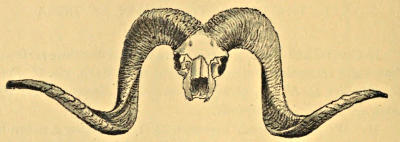
No. 1, extreme type, Ovis Poli
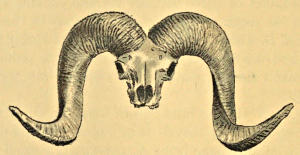
No. 2, intermediate type
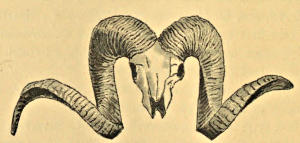
No. 3, extreme type, Ovis Karelini
In colour all these sheep are much the same; generally
a rather rich greyish brown fading to greyish white towards the
tail and belly, with, in the ram, a greyish white ruff on the
neck. This is the chief distinguishing mark of a ram Ovis Ammon
at a distance, the ewe having a brown neck; in fact, the ram
looks as if his thoughtful spouse had insisted on his wearing a
white comforter for fear of catching cold. The horns of the
ram, large as they are, are of such a pale colour as to be hardly
distinguishable in certain lights at long distances. The Ovis
Poli appears to have little or no ruff, but has a dark line down
the back, which the Ovis Ammon has not, and has also a
more clearly defined white anal disc.
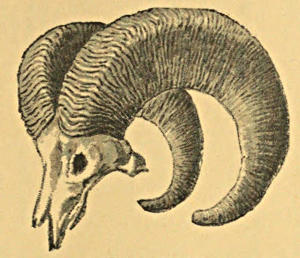
Ovis Ammon
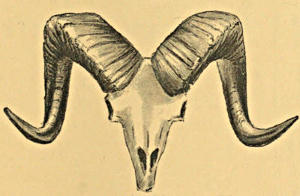
Ovis Nivicola
Measurements
| Authority |
Height at shoulder |
Length nose to tip of tail |
Weight |
Length of horns |
Girth at base |
Span between tips |
Skull |
Remarks |
| Ovis Ammon |
|
ins. |
ins. |
lbs. |
ins. |
ins. |
ins. |
ins. |
|
| Proc. Zoo. Soc., 1875 |
43 |
.. |
.. |
49 |
18½ |
32 |
12 |
From Siberia? |
| ” |
46 |
.. |
.. |
48½ |
19 |
31 |
.. |
” |
| British Museum |
.. |
.. |
.. |
48 |
18¾ |
.. |
.. |
Specimen, No. 45-4-21-9. From Siberia |
| Mr. O. Shaw |
.. |
.. |
.. |
47 |
.. |
.. |
.. |
|
| Mr. A. O. Hume |
.. |
.. |
.. |
46½ |
19¾ |
20 |
.. |
Rowland Ward, ‘Horn Measurements’ |
| Sir V. Brooke |
.. |
.. |
.. |
45½ |
17½ |
24 |
14 |
Proc. Zoo. Soc., 1875 |
| H.R.H. Duke of Teck |
.. |
.. |
.. |
45½ |
16½ |
about 17 |
.. |
Rowland Ward, ‘Horn Measurements’ |
| Major Ward (‘Sportsman’s Guide to Ladak and Cashmere’) |
46 to 48 |
.. |
250 to 280 |
.. |
.. |
.. |
.. |
|
| ” |
.. |
.. |
.. |
45 |
20 |
.. |
.. |
|
| Proc. Zoo. Soc., 1875 |
44½ |
.. |
.. |
45 |
19½ |
.. |
.. |
|
| Col. Howard Brooke |
.. |
.. |
.. |
44 |
18 |
.. |
.. |
|
| Mr. H. C. V. Hunter |
.. |
.. |
.. |
43½ |
16⅝ |
loose horns |
.. |
Rowland Ward, ‘Horn Measurements’ |
| British Museum |
.. |
.. |
.. |
43 |
16¾ |
.. |
.. |
|
| Major Greenaway |
.. |
.. |
.. |
42½ |
17 |
.. |
.. |
|
| Mr. A. O. Hume |
.. |
.. |
.. |
42½ |
16½ |
19 |
.. |
Rowland Ward, ‘Horn Measurements’ |
| Hume Collection, British Museum |
.. |
.. |
.. |
42½ |
16 |
about 18 |
.. |
” |
| Rowland Ward |
.. |
.. |
.. |
42½ |
16 |
18 |
.. |
” |
| Mr. J. Carr Saunders |
.. |
.. |
.. |
42½? |
15¼ |
.. |
.. |
” |
| H.R.H. Duke of Edinburgh |
.. |
.. |
.. |
42⅝ |
16¼ |
20 |
.. |
” |
| Hume Collection, British Museum |
.. |
.. |
.. |
42⅛ |
16¾ |
14¼ |
.. |
” |
| Mr. A. O. Hume |
.. |
.. |
.. |
42⅛ |
16½ |
18 |
.. |
” |
| Capt. Ballantyne |
.. |
.. |
.. |
42 |
18 |
.. |
.. |
|
| Sir V. Brooke |
.. |
.. |
.. |
42 |
17⅜ |
17½ |
15 |
|
| Hume Collection, British Museum |
.. |
.. |
.. |
42 |
16¾ |
about 17¼ |
.. |
Rowland Ward, ‘Horn Measurements’ |
| British Museum |
.. |
.. |
.. |
42 |
14 |
.. |
.. |
|
| Hon. Walter Rothschild |
.. |
.. |
.. |
41⅞ |
16 |
.. |
.. |
Rowland Ward, ‘Horn Measurements’ |
| British Museum |
.. |
.. |
.. |
41½ |
16¾ |
.. |
.. |
|
| Mr. A. O. Hume |
.. |
.. |
.. |
41¼ |
17½ |
16 |
.. |
Rowland Ward, ‘Horn Measurements’ |
| Major Ward (‘Sportsman’s Guide to Ladak, &c.’) |
.. |
.. |
.. |
41 |
18½ |
.. |
.. |
|
| The Writer |
44 |
.. |
.. |
41 |
17 |
.. |
.. |
|
| St. George Littledale (British Museum) |
.. |
.. |
.. |
40½? |
14½ |
about 26¼ |
.. |
Rowland Ward, ‘Horn Measurements’ |
| Hon. C. Ellis |
.. |
.. |
.. |
40⅜ |
17⅝ |
20⅜ |
.. |
” |
| Hume Collection, British Museum |
.. |
.. |
.. |
40¼ |
17¼ |
20 |
.. |
” |
| Col. Kinloch (‘Large Game Shooting’) |
48 to 49 |
.. |
.. |
40 |
17 |
.. |
.. |
|
| Hume Collection, British Museum |
.. |
.. |
.. |
40 |
16¾ |
19½ |
.. |
Rowland Ward, ‘Horn Measurements’ |
| ” |
.. |
.. |
.. |
40 |
16 |
18½ |
.. |
|
| Major Greenaway |
45 |
76 |
212 |
36 |
15½ |
.. |
.. |
Weighed in pieces. Estimated 240 lbs. as shot |
| Gen. Macintyre (‘Hindu Koh’) |
.. |
.. |
350 |
about 40 |
18 |
.. |
.. |
Cleaned, including head |
| Sterndale |
40 to 48 |
.. |
.. |
.. |
.. |
.. |
.. |
|
| Mr. K. Mackenzie |
48 |
.. |
.. |
.. |
.. |
.. |
.. |
|
| ” |
49 |
.. |
.. |
.. |
.. |
.. |
.. |
|
| Jerdon quoting Colonel Markham |
.. |
.. |
.. |
.. |
24 |
.. |
.. |
|
Measurements (continued)
| Authority |
Height at shoulder |
Length nose to tip of tail |
Tail |
Length of horns |
Girth at base |
Span between tips |
Skull |
Girth of chest |
Remarks |
| Ovis Poli |
|
ins. |
ins. |
ins. |
ins. |
ins. |
ins. |
ins. |
ins. |
|
| Gen. Lord Roberts |
.. |
.. |
.. |
75 |
16 |
54½ |
.. |
.. |
‘Smoothbore,’ letter to the ‘Asian,’ November 13, 1891 |
| Mr. Hume |
.. |
.. |
.. |
75 |
14 |
48 |
.. |
.. |
” |
| Col. Tanner |
.. |
.. |
.. |
73 |
15 |
48 |
.. |
.. |
Rowland Ward, ‘Horn Measurements’ |
| Sterndale, ‘Mammalia’ |
.. |
.. |
.. |
73 |
14 |
48 |
.. |
.. |
(Possibly the same head) |
| Mr. L. Flower |
.. |
.. |
.. |
68½ |
15 |
35¾ |
.. |
.. |
Rowland Ward, ‘Horn Measurements’ |
| Col. R. Pole Carew |
.. |
.. |
.. |
68 |
17 |
43 |
.. |
.. |
” |
| Indian Museum, the ‘Asian,’ November 13, 1891 |
.. |
.. |
.. |
68 |
16 |
52 |
.. |
.. |
” |
| Col. R. Pole Carew |
.. |
.. |
.. |
67 |
16½ |
42 |
.. |
.. |
” |
| Sterndale, ‘Mammalia’ |
.. |
.. |
.. |
67 |
16 |
53 |
.. |
.. |
” |
| Sir E. G. Loder, Bart. |
.. |
.. |
.. |
66⅞ |
15⅝ |
46 |
.. |
.. |
Rowland Ward, ‘Horn Measurements’ |
| Mr. A. O. Hume |
.. |
.. |
.. |
66⅞ |
13⅞ |
.. |
.. |
.. |
” |
| Hume Collection, British Museum |
.. |
.. |
.. |
66 |
15¼ |
44 |
.. |
.. |
” |
| ” |
.. |
.. |
.. |
65⅞ |
16 |
48 |
.. |
.. |
” |
| Col. T. E. Gordon, British Museum |
.. |
.. |
.. |
65½ |
16 |
53 |
.. |
.. |
” |
| Mr. A. O. Hume |
.. |
.. |
.. |
65⅜ |
16¼ |
.. |
.. |
.. |
” |
| Capt. Blane |
.. |
.. |
.. |
65 |
16½ |
49½ |
.. |
.. |
” |
| St. George Littledale |
.. |
.. |
.. |
65 |
.. |
.. |
.. |
.. |
” |
| Rowland Ward |
.. |
.. |
.. |
65 |
.. |
.. |
.. |
.. |
” |
| Hon. C. Ellis, quoted Proc. Zoo. Soc., 1884 |
.. |
.. |
.. |
58 |
.. |
51 |
.. |
.. |
|
| ” |
.. |
.. |
.. |
58 |
15½ |
50½ |
.. |
.. |
No. 1.—Extreme type (O. Poli) |
| ” |
.. |
.. |
.. |
57½ |
.. |
47 |
.. |
.. |
|
| ” |
.. |
.. |
.. |
62 |
.. |
47½ |
.. |
.. |
|
| ” |
.. |
.. |
.. |
63½ |
.. |
48 |
.. |
.. |
|
| ” |
.. |
.. |
.. |
61½ |
.. |
46½ |
.. |
.. |
|
| ” |
.. |
.. |
.. |
59½ |
.. |
43¾ |
.. |
.. |
|
| ” |
.. |
.. |
.. |
61 |
.. |
43 |
.. |
.. |
|
| ” |
.. |
.. |
.. |
55 |
17 |
37 |
.. |
.. |
No. 2.—Intermediate type |
| ” |
.. |
.. |
.. |
60½ |
.. |
39½ |
.. |
.. |
|
| ” |
.. |
.. |
.. |
63½ |
16 |
39 |
.. |
.. |
No. 3.—Extreme type (O. Karelini) |
| M. Severtzoff |
46 |
79 |
.. |
57 |
.. |
42 |
14 |
.. |
Proc. Zoo. Soc., 1875 |
| ” |
42.6 |
71 |
.. |
44 |
.. |
32 |
13.3 |
.. |
” (O. Karelini) |
| Major Biddulph |
41 |
67 |
3½ |
48 |
14 |
.. |
11 |
49½ |
Yarkand Mission |
| Ovis Heinsi |
| M. Severtzoff |
.. |
.. |
.. |
33.2 |
.. |
31.4 |
11.4 |
.. |
Proc. Zoo. Soc., 1875 |
| Ovis nigrimontana |
| M. Severtzoff |
34 |
57 |
.. |
38 |
.. |
29.6 |
10.8 |
.. |
” |
| Ovis nivicola |
| Dr. Guillemard, ‘The Cruise of the Marchesa’ |
40 |
66 |
.. |
38 |
13½ |
26 |
9¾ |
54 |
|
| ” |
41 |
65 |
.. |
35½ |
14 |
26½ |
10¾ |
.. |
|
| ” |
39 |
67 |
.. |
35 |
13¼ |
25½ |
.. |
55 |
|
| ” |
39½ |
64 |
.. |
35 |
13¾ |
21 |
10½ |
54 |
|
| ” |
37 |
64 |
.. |
34¾ |
14½ |
25 |
10½ |
55 |
|
| British Museum |
.. |
.. |
.. |
34½ |
11⅞ |
17¾ |
.. |
.. |
Rowland Ward, ‘Horn Measurements’ |
| M. Severtzoff |
37 |
.. |
.. |
33 |
12¾ |
.. |
.. |
.. |
Proc. Zoo. Soc., 1875 |
| Sir E. G. Loder, Bart. |
.. |
.. |
.. |
32¾ |
13½ |
23 |
.. |
.. |
Rowland Ward, ‘Horn Measurements’ |
| Dr. Guillemard, ‘The Cruise of the Marchesa’ |
.. |
.. |
.. |
32½ |
13¾ |
22½ |
.. |
.. |
|
| ” |
.. |
.. |
.. |
32¼ |
14 |
21 |
.. |
.. |
|
| Ovis Brookei |
| Sterndale’s ‘Mammalia’ |
.. |
.. |
.. |
33½ |
13⅜ |
.. |
11 |
.. |
|
Old rams of the Ovis Ammon are by no means easy to
bring to bag. The bare open downs they live on afford little
or no cover for a stalk; the wind in Ladak, piercingly cold as
it is, seems to take a delight in blowing from all points of the
compass in turn, especially if there are any clouds about;
the rams themselves are particularly wary and keen-scented,
and the least suspicion of danger will set them marching
steadily across country for miles without stopping. In the
summer, like most hill animals, the old rams leave the ewes
and young ones and form small flocks by themselves, selecting
favourite valleys to which they repair year after year, and being
rarely found on the same ground as the ewes at that season,
i.e. after the middle of June. I have, however, seen a flock of
five rams and ten ewes together as late as June 11 and secured
a big ram out of it. Ward’s remarks about hunting Ovis
Ammon are worth quoting:
Stalking in Ladak is very often a matter of time. Many of us
will march for a month to get on to Ovis Ammon ground, and yet
will not consent to wait a few days after the game is sighted.
Naturally, in a country where the hills are devoid of cover, the game
is often seen on spots where it is useless trying to approach it; but,
if watched for a few hours, it is almost certain to graze its way into
a more favourable position. Avoid going after game on gusty and
cloudy days, and exercise patience, remembering that you have
probably marched some hundreds of miles to obtain a few shots,
and one or two days’ more or less work can make but little
difference.
Even supposing the sportsman to have everything in his favour,
wind, cover, and the rest, there are pretty sure to be some
kyang about, and these once disturbed, good-bye to the oves.
The writer had once been watching two fine old rams from
early morning till 2 p.m. before the wind would let him attempt
the stalk; he had got within a quarter of a mile of the rams with
absolutely nothing to do but walk straight on up to them, when
suddenly a brute of a kyang jumped up from behind a rock
where he had been lying hid, galloped straight up the valley
past the oves, found seven devils worse than himself, brought
them all back to show them the quaint manners of an infuriated
man with a gun, and concluded the entertainment by galloping
round and round him out of shot. The oves naturally took
the hint, and not caring for an asinine circus, simply marched
off to the next county.
Large bags of ram oves are consequently seldom made.
Mr. O. Shaw got nine in 1877, including one of 47 ins.; the
rest of the bag was, one bull yak, eight or ten burrel, one of
27 ins., eleven Thibetan antelope and one shapoo; this was an
exceptional bag by an exceptionally hard working sportsman.
The native names for O. Poli are ‘Rass,’ ‘Roosh,’ ‘Goolga’
(the male), and for O. Ammon ‘Nyan.’
Native names: ‘Baral,’ ‘Barut’; in Ladak ‘Napo’ the male, ‘Namoo’
the female; Zanskar, ‘Snapo,’ ‘Snamoo’; on the Sutlej ‘Wa’
Sterndale appears to have fallen into a curious mistake about
this sheep. He says: ‘The name Ovis Nahura is not a felicitous
one, as it was given under a mistake by Hodgson, the nahoor
being quite another animal. I think Blyth’s name of Ovis
Burhel should be adopted.’ On reference, however, to Blyth’s
account in the ‘Proceedings Zoo. Soc. 1840,’ it will be found
that he calls the animal generally known as burrel the ‘nahoor,’
and says of Ovis Burhel, ‘It is smaller and more robust than
the nahoor, with shorter ears and very dark horns, having no
white about it; and general colour dark and rich chestnut
brown, with the ordinary black markings upon face, chest, and
front of limbs very distinct.’ The specimen came from the
Boorendo Pass, but as no more specimens have been obtained
from that locality or elsewhere, it appears to be quite possible
that Blyth was misled by a native-cured skin. Discoloration
by curing is common.
The burrel has a very extended range, reaching from Ladak
on the west (it apparently does not extend into Baltistan) to
East Thibet, as Père David found it in Moupin. Its southern
limit is the line of the Himalayas; it extends up north to
the Kuenluen ranges, and was obtained by Prejevalski on
the Altyn-Tagh. It seems to require an altitude of at least
10,000 ft., and many of the shooting grounds are quite
17,000 ft. above the sea-level.
Its general colour is a light slaty grey. The ram has black
marks on the chest, side, and legs, and these are the points to
look for in a distant flock to distinguish the sex; the ram’s horns
being of a very pale colour, are often hardly distinguishable.
The old rams in the summer generally live apart from the
ewes, and on some grounds, notably about Chumatung on the
Indus, the rams seem to take themselves off to separate valleys;
usually they keep to another part of the same valley, and occasionally
intermix.
Burrel are quite the hardest animals to see on a hillside
unless they are moving; their colour so exactly matches the
blue shale of Ladak, that when they are lying down a flock
may be easily overlooked by even a careful man with glasses.
Being pretty plentiful where they are found at all, and as a
rule, where not much shot at, fairly easy to approach, a visitor
to Ladak, if he works at all, must indeed have been behind
the door when the luck was served out if he cannot get a
few burrel heads. Ordinarily they are found on fairly broken
ground, and usually not very far away from rocky cliffs of some
sort; they are capital climbers, no sheep better, and a wounded
ram is by no means an easy beast to recover. If a burrel had
only the horns of an ibex he would be the most charming
beast to hunt in the whole of the Himalayas. An old ibex
when he is shot stinks appallingly, and is practically uneatable.
A burrel on the other hand, no matter how old a ram he may
be, is always excellent; his head, pretty trophy as it is, is his
weak point. The writer has seen burrel and ibex on the same
ground, though never actually feeding together; a friend in
1866 saw burrel and ther feeding together between Joshimath
and the Niti Pass, and General Macintyre also notices this on
the same ground.
As with ibex, several shots can generally be obtained at a
flock of burrel before they get out of range, provided the
stalker keeps hidden; but he should take pains to stop his
cripples, if he does not want a stiffish task set him afterwards
in recovering them. Major Ward recommends using Baltistan
dogs, and if procurable, good dogs no doubt would be invaluable;
but the mere fact of having dogs out, unless they are
exceptionally good and led by a native of more than ordinary
intelligence, generally so multiplies the chances against a successful
stalk that one is better without them. English dogs,
he says, are useless among rocks and cannot stand the rarefied
air.
I remember having a capital day with burrel. I sighted
a flock of eight good rams in the morning, but could not
attempt to close with them till the afternoon on account of
four kyang who persistently kept in the way. At last the kyang
fed away, and after a longish détour the burrel, who were lying
down, were approached by my sliding down the hillside on my
back. Having got within fifty yards of one whose horns were
just visible, the expedient of shuffling among the loose stones
with the hand was tried to get him to stand up, but this only
brought the tips of an ear in sight by the base of the horn.
Another shuffle and the ram stood up, but only showed about a
couple of inches of the top of his shoulder. Foolishly firing at
this instead of at his neck, the shot missed, the whole flock
bolted at once, and a running shot with the left barrel also
missed. Reloading at once, the chase was carried on down the
hillside, and the burrel were again found, standing looking at
their pursuer about a hundred and fifty yards off. Picking out
the biggest ram, a shot from the shoulder rolled him over, but a
snap-shot at the hind-quarters of another disappearing down the
hill missed. Another run of about three hundred yards afforded
another chance, as when within one hundred and eighty yards of
the flock it again halted, and a second ram fell to the shot. The
rest went about three hundred yards and stood again. I
still followed, and at two hundred and fifty yards broke the
forearm of a third ram close to the body. By this time rest
was the first necessity, but after a short pause the wounded ram
was followed up and bagged with another shot. The first was ten
years old, horns 25½ ins. by 14 ins. thick; second eight years,
23 ins. by 12 ins.; third eight years, 22 ins. by 10½ ins. Bad
shooting but good fun.
Amongst other varieties of burrel are the Barbary burrel
(Ammotragus Tragelaphus), of which there is a skeleton in the
British Museum which stands 33½ ins. at the shoulder, and a
pair of horns measuring 26 ins. in length by 11 ins. in girth; also
the Caucasian burrel (Capra Pallasi), of which there is a
specimen in the same museum, whose horns are 29 ins. long
by 12 ins. in girth; but the animal looks more like a goat
than a sheep, having a rudimentary beard, and the horns are
more like those of Capra pyrenaica than Ovis Nahura.
Native names: ‘Shapoo’ the male, ‘Shamoo’ the female;
in Astor, ‘Oorin’
Shapoo and oorin, though by some naturalists classed as
separate varieties, may practically be considered identical; the
writer has hunted both, and is unable to distinguish any difference
in appearance or habits. The annual winter migration
of oorin to the Boonji Plain is probably attributable to the
snowfall in Astor being heavier than that of Ladak.
The only other difference (giving the result of individual
experience) is that oorin are not nearly so restless as shapoo,
being pretty regular in their feeding hours, and lying down
throughout the heat of the day. Shapoo, on the other hand,
are perpetually on the fidget. In colour they appear identical,
generally a pale reddish grey fading into white below. The
profuse black beard of the Ovis cycloceros is entirely absent,
the shapoo in his winter coat having only a short stubbly brown
beard, and in summer a dark line on the throat. The different
points of Ovis Vignei and Ovis Cycloceros are briefly as follows,
according to Mr. Sclater (‘Pro. Zoo. Soc.’ 1860):
| Ovis Vignei | Ovis cycloceros |
| Horn rather compressed laterally. | Much compressed laterally. |
| Rounded posteriorly. | Much compressed posteriorly. |
| Curving outward and backward. | Curving outward and inward. |
| Points divergent. | Points convergent. |
| General colour, brownish grey. | General colour, rufous brown, with blotch on flanks, and lateral line blackish. |
| Beard short, of stiffish brown hairs. | Beard profuse, reaching to knees, black intermixed with white hairs. |
The two varieties are much of the same size, but are entirely
different in colour and habits. The horns of the shapoo are
generally more massive than those of Ovis cycloceros, but the
horns of both so vary in type and so closely resemble those
of Ovis Gmelini from Asia Minor, that it is almost impossible,
except for a highly trained scientific eye, to decide from this
point alone to which of the three varieties a specimen belongs.
Shapoo seem only to be found in the valley of the Indus, from
a few miles above Leh down to the junction of the Astor river.
How far below that they extend the inhabitants of Chilas only
know, and they are not famed for hospitality or for communicating
their knowledge. There appears to be a gap in
the continuity of the species about Shigar and Rondu, which
separates the shapoo from the oorin. The writer has never
heard of shapoo being obtained there, and it would be interesting
to know how far below Leh they are found. Shapoo seem
to be very fond of wild thyme, which almost invariably grows
plentifully on the ground they frequent. The venison is inferior
to that of either Ovis Ammon or burrel.
The ram shapoo is a very game-looking beast, and the
horns, standing well out from his head, show off to great
advantage; but there is not an animal in the whole of the
Himalayas so vexatious to hunt. Markhor are bad enough in
all conscience, but even markhor are less heartbreaking to deal
with than shapoo.
The writer once met a real typical shapoo, a true son of
Belial. The beast started out of a ravine, galloped as hard as he
could lay legs to the ground for four hundred yards, and then
calmly lay down to think. After about a quarter of an hour
he rose, strolled leisurely over a ridge, and then cantered off to
some rocks about three-quarters of a mile away, where he lay
down again. This necessitated a climb to the top of the hill,
whence, wind and cover being perfect, the stalk would be easy
enough. He remained there just long enough to enable the
pursuer to begin the easy part of the stalk, when up he got,
cantered gracefully back across the valley, and lay down on the
opposite hill, in another very tempting position. This move
entailed a détour, so as to cross the valley out of sight, and
another climb up the far hill; half an hour was spent in reaching
the desired spot: but though from there a magnificent view
could be had of all the country round, there was not a sign of
the shapoo, and the ground was too dry to show his tracks.
Verily, shapoo are only shot when they give themselves away.
Shapoo are very tough beasts. The writer once regularly
raked a ram galloping straight from him at thirty yards; the
bullet, from a .500 Express, caught him on the rump, and the
base of it was afterwards cut out in front of the liver; yet the
ram ran some two hundred and fifty yards, stopped for about a
minute to look round, and then started off again at a gallop,
but after going a hundred yards fell over dead. The writer
remembers no other instance of an animal stopping to gaze in its
death gallop.
Generally ‘Oorial,’ ‘Kuch,’ in the Suleiman range
This sheep is found in the Salt range near Jhelum, and wherever
there are any suitable hills on both banks of the Indus from
about Peshawur down to Beloochistan, where it is replaced by
the next variety, Ovis Blanfordi. The ram has a long ruff of
grizzled black hair which, flowing from his throat and chest down
to his knees, emulates the grand beard of a markhor; this
beard drops off in the summer, but begins growing again in
August, and is at its full length during the rutting season late
in September, which is about the best time for procuring good
heads.
Measurements
| Authority |
Height at shoulder |
Length, nose to tip of tail |
Weight |
Length of horns |
Girth at base |
Splay between tips |
Remarks |
| Ovis Nahura |
|
ins. |
ins. |
lbs. |
ins. |
ins. |
ins. |
|
| Mr. B. H. Hodgson, ‘Proc. Zoo. Soc., 1840’ |
.. |
.. |
.. |
32 |
.. |
.. |
Rowland Ward, ‘Horn Measurements’ |
| Mr. A. O. Hume |
.. |
.. |
.. |
30⅞ |
12¼ |
21⅞ |
” |
| ” |
.. |
.. |
.. |
30 |
12¼ |
22½ |
” |
| H.R.H. Duke of Edinburgh |
.. |
.. |
.. |
29½ |
11⅝ |
25½ |
” |
| Major Ward |
.. |
.. |
.. |
29 |
.. |
.. |
‘Sportsman’s Guide to Ladak, &c.’ |
| Hume Collection, British Museum |
.. |
.. |
.. |
28 |
11 |
20¼ |
Rowland Ward, ‘Horn Measurements’ |
| Captain G. Campbell |
.. |
.. |
.. |
27¾ |
10¼ |
10 |
” |
| Mr. St. George Littledale, 1877 |
.. |
.. |
.. |
27¼ |
11 |
21¼ |
” |
| Major Ward |
.. |
.. |
.. |
27 |
.. |
.. |
‘Sportsman’s Guide to Ladak, &c.’ |
| ” |
.. |
.. |
150 |
.. |
.. |
.. |
” |
| ” |
.. |
.. |
119 |
.. |
.. |
.. |
” |
| Mr. O. Shaw |
.. |
.. |
.. |
27 |
.. |
.. |
‘Hindu-Koh’ |
| Gen. Macintyre |
.. |
.. |
.. |
27 |
.. |
.. |
|
| Major Greenaway |
.. |
.. |
.. |
26½ |
12½ |
.. |
|
| ” |
.. |
.. |
.. |
26½ |
10 |
.. |
|
| ” |
.. |
.. |
97 cleaned |
.. |
.. |
.. |
|
| Sir V. Brooke |
.. |
.. |
.. |
26¼ |
11⅞ |
23 |
Rowland Ward, ‘Horn Measurements’ |
| Hon. W. Rothschild |
.. |
.. |
.. |
26¼ |
12 |
21¼ |
” |
| Sir E. G. Loder, Bart. |
.. |
.. |
.. |
26¼ |
10¾ |
22 |
” |
| Hume Collection, British Museum |
.. |
.. |
.. |
26⅛ |
12⅜ |
25 |
” |
| Mr. Rowland Ward |
.. |
.. |
.. |
26 |
12 |
20½ |
” |
| Col. Kinloch |
.. |
.. |
.. |
25½ |
.. |
.. |
‘Large Game Shooting’ |
| The Writer, June 24, 1875 |
.. |
.. |
.. |
25½ |
14 |
.. |
|
| ” |
34 |
.. |
.. |
21 |
11 |
.. |
|
| Sterndale, ‘Mammalia’ |
30 to 36 |
54 to 60 |
.. |
24 to 30 |
12 to 13 |
.. |
|
| Average (according to Major Ward) seems fair |
33 |
52 |
130 |
22 |
11 |
.. |
‘Sportsman’s Guide to Ladak, &c.’ |
| Ovis Vignei |
| Mr. J. Carr Saunders |
.. |
.. |
.. |
38⅝ |
12¼ |
11¼ |
Rowland Ward, ‘Horn Measurements’ |
| Mr. A. O. Hume |
.. |
.. |
.. |
37½ |
10¼ |
11 |
” |
| ” |
.. |
.. |
.. |
36⅜ |
9⅛ |
about 17 |
” |
| ” |
.. |
.. |
.. |
36¼ |
11¼ |
.. |
” |
| Major Ward |
.. |
.. |
.. |
36¼ |
11¾ |
.. |
‘Sportsman’s Guide to Ladak, &c.’ |
| Dr. J. Aitchison, British Museum |
.. |
.. |
.. |
35½ |
10½ |
16 |
Rowland Ward, ‘Horn Measurements’ |
| Mr. J. Carr Saunders |
.. |
.. |
.. |
34 |
10 |
.. |
|
| Major Ward |
.. |
.. |
.. |
34 |
.. |
.. |
‘Sportsman’s Guide to Ladak, &c.’ |
| Mr. A. O. Hume |
.. |
.. |
.. |
33⅝ |
9⅛ |
.. |
Rowland Ward, ‘Horn Measurements’ |
| Sir E. G. Loder, Bart. |
.. |
.. |
.. |
33⅛ |
11½ |
10⅝ |
” |
| Major Ward |
.. |
.. |
.. |
33 |
.. |
.. |
‘Sportsman’s Guide to Ladak, &c.’ |
| Major Greenaway |
36 |
53 |
65 cleaned |
.. |
.. |
.. |
|
| ” |
36 |
52 |
.. |
.. |
.. |
.. |
|
| The Writer |
38 |
.. |
.. |
22 |
10½ |
.. |
|
| Captain H. Brooke |
38 |
.. |
.. |
28 |
12 |
.. |
|
| Average of good head |
.. |
.. |
.. |
26 |
10 |
.. |
|
| Ovis cycloceros |
| R. A. Mess, Attock |
.. |
.. |
.. |
38½ |
.. |
.. |
Sterndale, ‘Mammalia,’ Appendix C |
| Captain W. Cotton, F.Z.S. |
.. |
.. |
.. |
35½ |
.. |
.. |
” |
| Sir V. Brooke |
.. |
.. |
.. |
32½ |
10 |
11½ |
Rowland Ward, ‘Horn Measurements’ |
| Hume Collection, British Museum |
.. |
.. |
.. |
31¾ |
9¼ |
5¼ |
” |
| ” |
.. |
.. |
.. |
31¼ |
8½ |
16 |
” |
| Col. Kinloch |
.. |
.. |
.. |
31 |
10¼ |
.. |
‘Large Game Shooting’ |
| ” |
about 36 |
.. |
.. |
.. |
.. |
.. |
” |
| Sir V. Brooke |
.. |
.. |
.. |
30⅞ |
9⅞ |
20⅛ |
Rowland Ward, ‘Horn Measurements’ |
| Hume Collection, British Museum |
.. |
.. |
.. |
30 |
10½ |
10 |
” |
| Sir V. Brooke |
.. |
.. |
.. |
30 |
9⅜ |
11¼ |
” |
| Major FitzHerbert |
36 |
.. |
.. |
30 |
9½ |
.. |
|
| Capt. H. Brooke |
.. |
.. |
.. |
30 |
6 |
.. |
|
| Major Greenaway |
34 |
.. |
.. |
.. |
.. |
.. |
|
| Sterndale, ‘Mammalia’ |
about 36 |
about 60 |
.. |
29½ |
10 |
.. |
|
| Average of good head |
.. |
.. |
.. |
30 |
9½ |
.. |
|
| Ovis Blanfordi |
| Hume Collection, British Museum |
.. |
.. |
.. |
36½ |
9⅝ |
single horn |
Rowland Ward, ‘Horn Measurements’ |
| ” |
.. |
.. |
.. |
31⅝ |
9⅜ |
13¾ |
” |
| ” |
.. |
.. |
.. |
23⅝ |
9½ |
17¾ |
” |
Oorial, like stags, seem to affect particular spots at that
season, and certain hills which at other times of the year hold
nothing but ewes and young ones will just then invariably
have big rams on them. Oorial ground has hitherto been practically
restricted to the Salt range, and a 30-in. ram there is
now a rarity. The country on the right bank of the Indus is
being yearly made more accessible, however, and there are
large tracts of good oorial ground in that direction that are
as yet practically unshot. Oorial shooting, however, is by no
means a summer amusement, and there is little to be gained
then except dysentery from bad water and sunstroke by hunting
the deep stifling ravines and almost red-hot stony hills.
In the cooler months it is most enjoyable. As a rule one gets a
fair number of chances, the ground being so broken that stalking
is by no means difficult. An old ram oorial is a fine game-looking
animal, and though not to be compared to burrel, is
still very fair eating. The best way of hunting them is by
walking along the tops of the ridges and carefully examining
the ground below; as there are often a good many bushes on
the hillside, oorial are not always very easy to see, especially
if they are lying down, so the pace should be slow. The
natives of the salt range are generally expert trackers, and as a
wounded oorial is by no means an easy beast to recover, their
skill is doubly appreciable when following up a good ram with
a broken leg. The way they will carry the trail through the marks
of a flock of sheep or along stony nullahs and hillsides with perhaps
only an occasional spot of blood to help them, is quite
charming after the bungling attempts at the art one generally
sees displayed by the natives of the Himalayas.
As oorial are perpetually seeing shepherds and other natives
they do not become alarmed at the sight of man at a distance;
but as they are a good deal driven about, especially by the cultivators
whose crops at the foot of the hills they feed on at
night, no liberties can be taken during the stalk, and the sides of
the ravines being often excessively steep, good noiseless stalking
shoes are requisite.
This variety is found in Khelat, and a few specimens have
been procured near Quetta. Its horns are described as being
longer and more slender than those of O. cycloceros or O.
Vignei, and as having a second twist outwards at the ends. It
has a white beard, unlike either shapoo or oorial.
Native names:
Cashmere, ‘Markhor’; Ladak, ‘Rache’; Aster, ‘Boom’
Whether this king among goats deserves his name of ‘snake-eater’
or not is hardly likely to be settled. Shikaris all believe
that markhor do eat snakes, some going as far as to say that
they suck the snakes out of their holes, and swallow them like
macaroni; and Colonel Kinloch supports the theory.
But though some hundreds of markhor have been shot by
Europeans, the fact has hitherto not been proved; and the
writer ventures in all humility to suggest that the tale is derived
from some old legend, and refers, in spite of the Persian name
which may have become corrupted, to the long snake-like
horns.
Be this as it may, an old markhor swaggering along a ledge
on a precipitous hillside, with his long black beard and white
mane floating down to his knees, showing off every inch of his
beautiful horns—as no beast knows better how to do, except
perhaps a really big stag in the rutting season—is one of the
most glorious sights in the Himalayas.
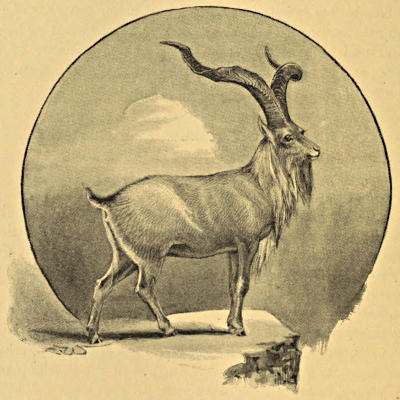
The Astor markhor
The beast looks such a gentleman with his lean head and
small ears, his powerful back and quarters, and his dignified
carriage. Alas! it is all looks! His smell is something fearful,
and manners he has none. Ibex and burrel can be trusted,
when they are lying down after their morning feed, at all
events not to move far; but markhor, no. You may watch a
flock feeding till late in the morning, and they will lie down
comfortably, apparently for the day; you begin your stalk with
everything in your favour; suddenly there is a clatter of stones
and a cloud of dust, you peep over a spur, and see the whole
flock galloping wildly down the hill. After going half a mile,
they probably pull up, begin feeding again, and again stretch
themselves out on the ground as if nothing had happened.
This little manœuvre probably necessitates your climbing painfully
back to the top of the ridge, and starting your stalk afresh,
the intervening ground being impracticable. Once more you
try, leaving a man on the top of the hill to watch and signal
what the beasts do. You stalk carefully on; the watcher makes
no sign; you creep on the last hundred yards, to the exact
spot you wish to reach, and there is nothing. You search the
ground as far as you can get, and there are only a few footprints
leading over impassable ground; you climb back again,
probably the only way you can go, vowing vengeance on the
watcher, and he tells you that the markhor lay quiet till you
were beginning your last crawl in—every second he expected to
hear the shot: suddenly they jumped up and disappeared, and
owing to the steepness of the ground he could not tell which
way they had gone. This sort of thing will happen over and
over again, particularly in Astor.
Perseverance combined with good management always
brings luck in the end, but big bags of really fine markhor are
not to be expected; one fair chance for each fortnight on the
shooting ground is a good allowance.
It is always a pretty sight seeing markhor move down to
their feeding ground in the evening from the crags above where
they have been lying during the afternoon. Full gallop they
come, sending the stones whizzing in front of them, over the
most breakneck ground as if it were a level plain; rearing
up on their hind legs and butting at one another, a venerable
old fifty-incher probably playing with his great-grandson, a
young spark of only twenty; the whole lot of them thoroughly
enjoying the frolic. Ibex will play, and prettily too, but no
beast appears so thoroughly to enter into the fun of a good
skylark as a markhor. The master buck of the flock, however,
seems to keep the youngsters in pretty good order.
The writer was much amused once, watching a flock coming
down a particularly difficult cliff. The best buck led the way,
the flock following in single file soberly enough, the ground
apparently was not safe even for a markhor to frolic on;
turning a corner, the old fellow came to a wall of rock that,
after careful inspection, he did not think good enough to
descend, and he turned back to take another route. Just as he
made up his mind, one of the smaller bucks in rear evidently
chaffed him. The old fellow went for him at once, drove
him right up to the edge of the cliff with his horns, as nearly as
possible pushed him over, and then, with an air of great importance,
led the flock round his own way.
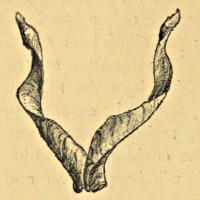
1. Cashmere
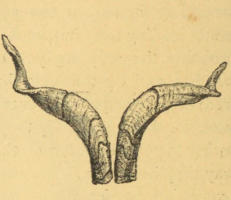
2. Astor
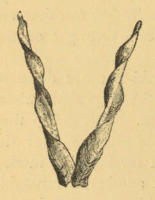
3. Trans-Indus
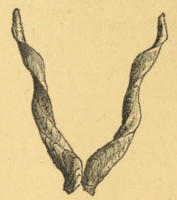
4. Afghanistan
Varieties of markhor
Hitherto most writers have divided markhor into only two
varieties, viz. the spiral and straight horned; but the type of
horn obtained in Astor is so different from that in Cashmere,
and again that in Afghanistan from that in the lower Trans-Indus
ranges, that any sportsman can distinguish them at a
glance.
The writer has consequently adhered to Colonel Kinloch’s
theory, that there are four distinct varieties of this goat, classifying
the two spiral types under the name of Megaceros, and the
two straight-horned types under that of Jerdoni. In the British
Museum the name Falconeri is applied to all four.
The first variety of Capra megaceros is that found in Cashmere
on the Pir Punjal and Kajnag ranges; its horns make
occasionally three complete spirals, whereas the horns of the
second or Astor variety rarely have more than one; and as the
horns are measured along the curve, it follows that a 40-in.
horn from Astor is far bigger than one of the same length
from Cashmere. The Astor markhor is also a larger animal
than the Cashmere one, often measuring a couple of inches
higher at the shoulder.
As regards habits, the Cashmere markhor is a thoroughly
forest-loving beast. He will come out to eat the young grass
on the upper slopes of the hill, but his real home is among
precipitous cliffs in the middle of forest, and well worth
watching those cliffs are when the sun first comes out after
heavy rain. If there are any markhor about, they are pretty
sure to appear and sun themselves.
The Astor variety, on the contrary, live almost entirely in
the open, only taking to the strips of forest when driven there
by the gadflies in the summer. In the winter they come down
to the cliffs overhanging the main streams, working up about
May, till they join the ibex, who never seem to leave the
higher ground. In June both ibex and markhor may be seen
feeding together. The writer saw a combined flock of nearly
one hundred beasts, male and female, in the amphitheatre at
the head of the Dashkat or Datchnar valley. Stalk them? Of
course we tried, in spite of the long odds against one with a
flock of that size. There was a ravine leading up towards them,
which we reached all right by crawling on hands and knees
through some thick low scrub; then we crept up the ravine
till it died away into open ground and found ourselves planted
within three hundred yards of the head of the flock, some dozen
buck markhor and ibex. There we lay for nearly an hour and a
half hoping they would feed towards us, and a capital opportunity
we had of comparing the relative size of the beasts;
the markhor with his superior height and length making the
ibex look quite cobby in comparison. Of course an old buck
markhor must needs feed ahead of the rest, well out of shot,
get our wind, and lead the whole lot at a gallop back to the
rocks on the far side of the basin. There the ibex stayed, but
the markhor went clean away over the crest of the hill.
In the evening, while we were watching the ibex in the vain
hope they would come down again, behold on the very line the
markhor had left by in the morning three male ibex and another
flock of markhor appeared descending into the basin. As the
markhor were coming down at a good pace we started to cut
them off. On came the markhor, which we recognised as a
flock we had been hunting all the previous week on another
part of the ground. A stiff climb took us near where we had
last seen them, and creeping on the shikari who was in front
came almost face to face with one, upon which the alarm
call began to sound furiously. A run forward only brought the
writer within sight of a pair of horns moving off about eighty
yards away, but while pushing on to get a shot, suddenly the
buck that had convinced us as to the identity of the flock by
his upright horns, came into full view broadside on at fifty yards.
He rolled over stone-dead to the shot, and as he was lying
doubled up with his head underneath him a gun-carrier was
sent down to him, while I ran on fast to try for another
shot. The rest of the flock, however, had vanished, and as the
chase was abandoned a noise was heard: looking round,
the spectacle presented itself of the beautiful 50-in. markhor
(such was the first impression; in reality it was not quite
forty) slipping from the clumsy Cashmeree’s hands, rolling down
the slope over one precipice, then over another, and lodging by
the greatest luck just on the top of a third; the horns were sadly
scarred and chipped, but were fortunately not broken. Many
heads of both markhor and ibex get utterly spoilt in Astor by
the animals falling over cliffs when shot.
As regards Capra Jerdoni, the straight-horned markhor, the
first variety, with a perfectly straight axis to the horn, is found
all over the low ranges that run parallel to the right bank of the
Indus below Attock; it used to be found in fair numbers near
Sheikh Budin, a small station near Dera Ismail Khan, and
in the hills, or rather the steep ravines, in the plateau behind
Dera Ghazi Khan. The country beyond these places belongs
to more or less inhospitable tribes and, for the present at
all events, is practically closed against the sportsman. Near
Quetta markhor are reported to be obtainable, and in
Beluchistan there should be a chance of getting Capra
ægagrus and Ovis Blanfordi as well as Capra Jerdoni.
Hunting straight-horned markhor is scarcely a summer amusement,
as the heat is terrific on the low hills, and drinkable water
is extremely scarce.
The second variety is found in Afghanistan, another practically
closed shooting ground. It appears to be a link between
the straight horn and the spiral, more generally approaching
the spiral in size of body and general appearance. As the
Astor variety probably extends some distance to the west of
Gilgit, and this second variety is found in Northern Afghanistan,
it seems possible that its corkscrew bend may be more
pronounced towards its eastern limit and less so as it extends
to the south-west. The illustration on p. 312 gives the four
marked types.
Kinloch notes that markhor horns twist the reverse way to
those of domestic goats; and the writer, after looking at many
hundreds of tame goats in India for the express purpose of
studying their horns, and after inspecting the heads in the
British Museum and other collections, is able to confirm the
fact that the horns of all wild animals that twist at all do so
outwards, while those of tame animals appear invariably to twist
inwards.
Measurements
| Authority |
Height at shoulder |
Weight as shot |
Horns round curve |
Straight |
Girth at base |
No. of spirals |
Span at tips |
Remarks |
| Capra megaceros |
| No. 1. Cashmere |
|
ins. |
lbs. |
ins. |
ins. |
ins. |
|
ins. |
|
| Col. Cuppage |
.. |
.. |
63 |
.. |
.. |
.. |
.. |
|
| Major Ward |
.. |
.. |
59 |
.. |
.. |
.. |
.. |
‘Sportsman’s Guide to Ladak, &c.’ |
| ” |
.. |
.. |
56 |
.. |
.. |
.. |
.. |
” |
| Major FitzHerbert |
.. |
.. |
55½ |
.. |
.. |
.. |
.. |
|
| Major Ward |
42 |
.. |
53 |
.. |
9½ |
2½ |
26 |
‘Sportsman’s Guide to Ladak, &c.’ |
| ” |
.. |
.. |
48½ |
.. |
.. |
.. |
.. |
” |
| Col. Kinloch |
44 |
.. |
47½ |
.. |
.. |
.. |
.. |
‘Large Game Shooting’ |
| Major Ward |
.. |
.. |
47 |
.. |
.. |
.. |
.. |
‘Sportsman’s Guide to Ladak, &c.’ |
| Capt. H. Brooke |
.. |
.. |
45 |
.. |
.. |
.. |
.. |
|
| Major Ward |
.. |
.. |
43 |
.. |
11 |
2½ |
31 |
‘Sportsman’s Guide to Ladak, &c.’ |
| Col. Kinloch |
.. |
.. |
41 |
.. |
.. |
.. |
.. |
‘Large Game Shooting’ |
| ” |
.. |
.. |
40 |
.. |
.. |
.. |
.. |
” |
| Average of good head |
.. |
.. |
40 |
.. |
11 |
.. |
.. |
|
| Not classified |
| Mr. A. O. Hume |
.. |
.. A |
54½ |
.. |
10½ |
.. |
26½ |
Rowland Ward, ‘Horn Measurements’ |
| Mr. M. Kennard |
.. |
.. A |
54 |
.. |
10⅝ |
.. |
33¾ |
” |
| Sir V. Brooke |
.. |
.. B |
53¼ |
42½ |
11½ |
.. |
52 |
” |
| Mr. R. Ward |
.. |
.. B |
53½ |
.. |
.. |
.. |
37½ |
” |
| Mr. A. O. Hume |
.. |
.. A |
53 |
24¼ |
9¼ |
.. |
30¼ |
” |
| Mr. M. Kennard |
.. |
.. B |
52¾ |
39¾ |
12⅛ |
.. |
33¾ |
” |
| A, probably Cashmere; B, Astor. |
| No. 2. Astor |
| Major Ward |
41 |
240 |
.. |
.. |
.. |
.. |
.. |
‘Sportsman’s Guide to Ladak, &c.’ |
| ” |
.. |
.. |
63 |
.. |
.. |
.. |
.. |
” |
| ” |
.. |
.. |
61 |
.. |
.. |
.. |
.. |
” |
| ” |
.. |
.. |
53 |
.. |
11 |
.. |
45 |
” |
| ” |
.. |
.. |
52 |
.. |
12½ |
.. |
43 |
” |
| Capt. H. Brooke |
.. |
.. |
49 |
.. |
.. |
.. |
.. |
‘Sportsman’s Guide to Ladak, &c.’ |
| Major Ward |
.. |
.. |
48 |
.. |
.. |
.. |
.. |
|
| The Writer |
.. |
.. |
39¼ |
.. |
13 |
.. |
.. |
|
| ” |
.. |
.. |
38 |
.. |
14 |
.. |
.. |
|
| Average of good head |
.. |
.. |
40 |
.. |
13 |
.. |
.. |
|
| Capra Jerdoni |
| No. 1. Trans-Indus |
| H.R.H. Duke of Edinburgh |
.. |
.. |
.. |
38½ |
10½ |
23⅞ |
.. |
Rowland Ward, ‘Horn Measurements’ |
| Major Ward |
.. |
.. |
.. |
36 |
.. |
.. |
.. |
‘Sportsman’s Guide to Ladak, &c.’ |
| Sir E. G. Loder, Bart. |
.. |
.. |
47⅞ |
33 |
9¼ |
.. |
19¾ |
Rowland Ward, ‘Horn Measurements’ |
| Mr. A. O. Hume |
.. |
.. |
.. |
32¼ |
9¾ |
.. |
28 |
” |
| Col. Kinloch |
.. |
.. |
.. |
32 |
.. |
.. |
.. |
‘Large Game Shooting’ |
| Sir V. Brooke |
.. |
.. |
45¼ |
30¾ |
8¾ |
.. |
21½ |
Rowland Ward, ‘Horn Measurements’ |
| British Museum |
.. |
.. |
.. |
30½ |
10¾ |
.. |
.. |
Skull No. 120 |
| Capt. H. Brooke |
.. |
.. |
.. |
29 |
.. |
.. |
.. |
|
| Sir E. G. Loder, Bart. |
.. |
.. |
39 |
27⅛ |
8⅜ |
.. |
21½ |
Rowland Ward, ‘Horn Measurements’ |
| Mr. G. Landseer, ‘The Field,’ 1873 |
.. |
.. |
.. |
25½ |
.. |
.. |
.. |
” |
| Mr. A. O. Hume |
.. |
.. |
.. |
25⅜ |
8⅜ |
.. |
21½ |
” |
| Average of good head |
.. |
.. |
.. |
24 |
10 |
.. |
.. |
|
| No. 2. Afghanistan |
| Major FitzHerbert |
.. |
.. |
48 |
38 |
13 |
.. |
27 |
|
| British Museum |
.. |
.. |
40 |
32½ |
12 |
.. |
.. |
Skull No. 121 |
| Major Ward |
.. |
.. |
.. |
35 |
.. |
.. |
.. |
‘Sportsman’s Guide to Ladak, &c.’ |
| Average of good head |
.. |
.. |
40 |
30 |
12 |
.. |
.. |
|
Cashmere, ‘Kale’; Ladak, ‘Skeen’; Pangi and Lahoul, ‘Tangrol’
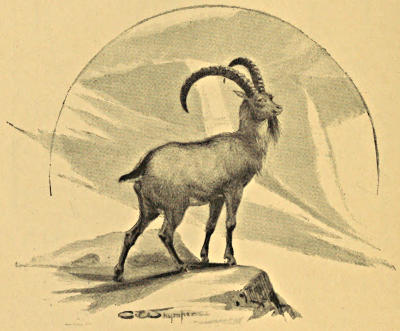
In his summer coat
Ibex vary very much in colour according to age, locality and
the season. In their winter coats the old bucks, though looking
almost white at a distance, and showing up conspicuously among
the brown young bucks and females, are really very patchy
looking at close quarters, the head and part of the neck being
a sepia brown, the middle of the body generally yellowish white
with a dark stripe on the back, and the quarters again brown,
with legs of dark sepia. In the summer they are sepia-coloured
all over, the head and neck often darker than the body—in
fact, an old buck looks sometimes almost black at a distance;
the beard is thick and very dark brown.
Ibex are to be found pretty nearly everywhere in the
higher ranges of hills from Gilgit to Spiti, though they do not
appear to cross the Sutlej to the eastward of Spiti. To name a
particular valley would be only misleading. Favourite districts
soon get shot out as regards good heads, and the only trustworthy
information to work on is that of the year previous. If
you get a good nullah, there is no sport in the Himalayas
more charming. Parts of the ground no doubt will test your
nerve as a cragsman, but it does not entail the perpetual climbing
of markhor and ther ground, and in April, May and June
a fair number of good chances may be relied upon. As Ward
says, ‘Patience and steady shooting are what are necessary; a
man does not require to be a first-rate walker or a really brilliant
shot during that season; but he does require to be enduring,
and not too eager about getting up at once to his game.’ Of
course, if the sportsman blazes away at indifferent heads he
will not get the big ones; but if he sees a good head one day
and cannot get it, if he does not disturb the beast, he will see
him again next day somewhere near the same place, and sooner
or later be able to close accounts with him; ten heads, all over
thirty inches, which would probably include two or three over
forty inches, would be a far better bag for two months’ work
than twenty heads in the same time, including a lot of rubbishy
little things about twenty-five inches.
If you wish thoroughly to enjoy your stalk, and the ground
is not too difficult, insist upon going first and making your
shikari carry your rifle behind you. He will probably object,
but be firm, and listen to none of his plausible arguments;
carry out your own stalk without asking his advice, simply
telling him what you mean to do. When you are within two
hundred yards of where you expect to get your shot, make him
lie down, take the rifle from him and go on alone. Warn him
beforehand that if he moves till you tell him, you’ll fine him.
When you reach your place, get your wind before you look
over; you will see perhaps fifteen or twenty ibex in front of
you; don’t be in a hurry; make sure that you have really
selected the best head for your first shot, and take pains to get
it home. When you fire, the smoke will hang in your eyes,
and you will dimly see the flock scatter. Keep your head now—don’t
show yourself; and if you are in about the right place,
a little above, but nearly on a level with the flock, and about
eighty yards off, not closer, you will probably see the flock
walking up the hillside, occasionally turning round to gaze
at the 40-incher lying dead below them. With cartridges
handy, and steady shooting, you should add the next two or
three best heads to your score. You have no shikari at your
elbow nudging you, and whispering advice just as you are going
to fire, starting off the flock by showing himself immediately
after your first shot, and finally, when you have got all the heads
you care for out of the flock, imploring you to shoot a worthless
little brute for the coolies to eat. Call him up when you
have finished, and let him cut the throats of the slain to make
them lawful eating, low down the neck, so as not to spoil the
skin for stuffing, and if he objects, tell him he may do without
meat. One of the greatest mistakes that all shikaries make in
stalking is trying to get too close to the game. It stands to
reason, in a country infested by leopards or ounces, that if a
beast catches sight of the top of one’s head within five and
twenty yards, he will bolt at once, whereas at eighty yards
distance he feels at all events safe from a sudden rush, and will
stop to gaze.
After the end of June it is practically waste of time trying
for ibex. There is grass everywhere, and to escape the gadflies
and be out of the way of the flocks of sheep and goats that are
driven up into many of the best nullahs in summer, the ibex
retire to the highest peaks in the neighbourhood, and rarely
descend to ground where there is any chance of getting near
them.
Native names: ‘Pasang,’ male; ‘Boz,’ female; generally Boz Pasang
in Persia (Blanford); Kayeek in Asia Minor (Danford)
This ibex extends from the Taurus mountains in Asia Minor,
through the Caucasus range and Persia, to Afghanistan, Beluchistan
and Sindh.
It is a smaller animal than the Himalayan ibex, and does
not ascend to the same altitude, preferring, according to Mr.
Danford, elevations of 2,000 to 5,000 ft., while 8,000 ft. is
about the lowest limit of the Himalayan variety. In Beluchistan
and Afghanistan these ibex and O. Blanfordi are found
on the same ground, just as Capra Jerdoni and Ovis cycloceros
are in the Suleiman range; and this peculiar trait of preferring
hot low hills is, in the writer’s estimation, the great point of
difference between Capra ægagrus, Capra Jerdoni and Ovis
cycloceros on the one side, and Capra sibirica, Capra megaceros
and Ovis Vignei on the other.
The general colour of the buck Capra ægagrus is brown
with a dark line down the back, and a black beard, but the last
is not so profuse as in Capra sibirica. The females are lighter
in colour, and have small horns. The horns are quite different
from those of any other species of ibex; instead of having a
flat front and being thinner behind than in front, as most other
ibex horns are, these horns have the edge in front, a scimitar-like
ridge running up the front of the horn, wavy but unbroken
for about one-third above the head, and then represented by
knobs which spring up at some distance apart for about another
third, when the ridge appears again, but rapidly dies away
towards the point. The sides of the horn too are smooth, the
outer side rounded and the inner flat, the knobs not running
down the sides as in other ibex.
In Persia and Afghanistan these ibex are generally shot in
drives. The members of the Afghan Boundary Commission
had a great day with them.
In the Sinaitic Peninsula they are replaced by Capra
sinaitica vel nubiana, which extends through Egypt. Few
people looking at the hills that run down to Suez harbour
would imagine that they hold ibex, but such is the case nevertheless.
The horns of this type are more like Capra sibirica,
being quite as long, but thinner and more curved.
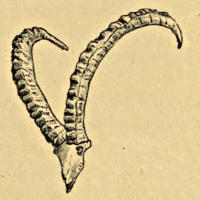
Capra sibirica
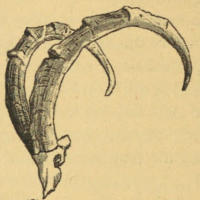
Capra ægagrus
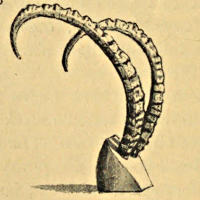
Capra sinaitica
The European ibex, Capra Ibex of the Tyrol, has also horns
like Capra sibirica, and nearly as thick, but shorter. His beard,
however, is only rudimentary.
The Spanish ibex, Capra pyrenaica, on the other hand, has
a peculiar upward twist at the end of the horn that makes
it look almost like a markhor. This type is described elsewhere.
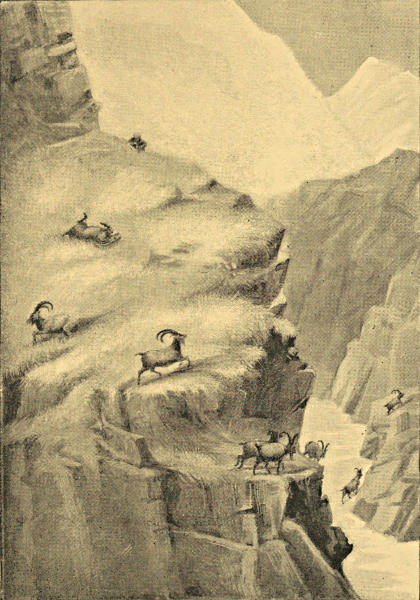
‘WITH CARTRIDGES HANDY AND STEADY SHOOTING’
Measurements
| Authority |
Height at shoulder |
Length, head and body |
Tail |
Weight as shot |
Length of horns |
Girth of horns |
Remarks |
| Capra sibirica |
|
ins. |
ins. |
ins. |
lbs. |
ins. |
ins. |
|
| Col. Kinloch |
about 40 |
.. |
.. |
.. |
.. |
.. |
‘Large Game Shooting’ |
| ” |
.. |
.. |
.. |
.. |
54 |
.. |
” |
| Major Ward |
38 |
54 |
8 |
188 |
.. |
.. |
‘Sportsman’s Guide to Ladak, &c.’ |
| ” |
.. |
.. |
.. |
208 |
.. |
.. |
” |
| ” (a female) |
32 |
.. |
.. |
104 |
.. |
.. |
” |
| ” |
.. |
.. |
.. |
.. |
52 |
.. |
” |
| Mr. M. Kennard |
.. |
.. |
.. |
.. |
51½ |
.. |
Rowland Ward, ‘Horn Measurements’ |
| Mr. Blyth, ‘Proc. Zoo. Soc.,’ 1840 |
.. |
.. |
.. |
.. |
51¼ |
10½ |
” |
| Sir V. Brooke |
.. |
.. |
.. |
.. |
51 |
9⅛ |
” |
| Major Ward |
.. |
.. |
.. |
.. |
51 |
.. |
‘Sportsman’s Guide to Ladak, &c.’ |
| ” |
.. |
.. |
.. |
.. |
50 |
11 |
” |
| ” |
.. |
.. |
.. |
.. |
50 |
10 |
” |
| Capt. J. Brickley |
.. |
.. |
.. |
.. |
50 |
9 |
Rowland Ward, ‘Horn Measurements’ |
| Sir E. G. Loder, Bart. |
.. |
.. |
.. |
.. |
49¾ |
10⅜ |
” |
| Mr. M. Kennard, 1887 |
.. |
.. |
.. |
.. |
49½ |
10⅛ |
” |
| Major Ward |
.. |
.. |
.. |
.. |
49 |
11 |
‘Sportsman’s Guide to Ladak, &c.’ |
| Mr. A. O. Hume |
.. |
.. |
.. |
.. |
48½ |
9⅝ |
Rowland Ward, ‘Horn Measurements’ |
| Major Ward |
.. |
.. |
.. |
.. |
48 |
12 |
‘Sportsman’s Guide to Ladak, &c.’ |
| ” |
.. |
.. |
.. |
.. |
48 |
10 |
” |
| ” |
.. |
.. |
.. |
.. |
48 |
10 |
” |
| ” |
.. |
.. |
.. |
.. |
48 |
10 |
” |
| Mr. A. O. Hume |
.. |
.. |
.. |
.. |
47⅞ |
9⅛ |
Rowland Ward, ‘Horn Measurements’ |
| Mr. Rowland Ward |
.. |
.. |
.. |
.. |
47½ |
10¼ |
” |
| Mr. C. Hagenback |
.. |
.. |
.. |
.. |
47 |
11¾ |
” |
| Mr. M. Kennard |
.. |
.. |
.. |
.. |
47 |
10½ |
” |
| Mr. Manners Smith |
.. |
.. |
.. |
.. |
47 |
10 |
” |
| Major Greenaway |
37½ |
.. |
.. |
.. |
.. |
.. |
|
| Major FitzHerbert |
31 |
50 |
4 |
.. |
.. |
.. |
(A female) |
| Sterndale, ‘Mammalia’ |
about 44 |
.. |
.. |
.. |
.. |
.. |
|
| Average of good head |
.. |
.. |
.. |
.. |
40 |
10 |
|
| Capra ægagrus |
| Col. F. Marston |
.. |
.. |
.. |
.. |
53 |
.. |
Rowland Ward, ‘Horn Measurements’ |
| Mr. A. O. Hume |
.. |
.. |
.. |
.. |
52⅜ |
7⅞ |
” |
| British Museum |
.. |
.. |
.. |
.. |
48½ |
8½ |
Skull No. 652 Ost. Cat. |
| Mr. Danford |
33½ |
65½ |
included |
.. |
47½ |
9¾ |
Sterndale’s ‘Mammalia’ |
| Capt. Townley Parker |
.. |
.. |
.. |
.. |
45¼ |
9½ |
Rowland Ward, ‘Horn Measurements’ |
| British Museum |
.. |
.. |
.. |
.. |
44½ |
8⅞ |
” |
| Hume Collection, British Museum |
.. |
.. |
.. |
.. |
44½ |
8⅝ |
” |
| Mr. J. Carr Saunders |
.. |
.. |
.. |
.. |
43½ |
9 |
|
| Mr. A. O. Hume |
.. |
.. |
.. |
.. |
43⅜ |
8⅝ |
Rowland Ward, ‘Horn Measurements’ |
| Sir E. G. Loder, Bart. |
.. |
.. |
.. |
.. |
43 |
9 |
” |
| British Museum |
.. |
.. |
.. |
.. |
43 |
9 |
” |
| Capra Ibex (Tyrol) |
| British Museum (skull No. 650a Ost. Cat.), a doubtful specimen |
.. |
.. |
.. |
.. |
43¾, 41¼ |
10½ |
|
| Sir E. G. Loder, Bart. |
.. |
.. |
.. |
.. |
31¾ |
9⅛ |
Rowland Ward, ‘Horn Measurements’ |
| Senckenberg Museum |
.. |
.. |
.. |
.. |
30¼ |
9 |
(Cord, base to tip, 21¾ inches) |
| British Museum |
.. |
.. |
.. |
.. |
27½ |
8¼ |
|
| Senckenberg Museum |
.. |
.. |
.. |
.. |
24 |
9 |
(Cord, base to tip, 16½ inches) |
| Capra sinaitica vel nubiana |
| British Museum |
.. |
.. |
.. |
.. |
51¼ |
7¼ |
(Skull No. 651 Ost. Cat.) |
| ” |
.. |
.. |
.. |
.. |
46 |
8 |
|
| Capt. Bartelott |
.. |
.. |
.. |
.. |
42¼ |
9¼ |
Rowland Ward, ‘Horn Measurements’ |
| Capt. W. H. Besant |
.. |
.. |
.. |
.. |
41¾ |
7⅝ |
” |
| Capra Wali |
| Senckenberg Museum |
|
|
.. |
.. |
24 |
9¾ |
(Cord, base to tip, 17 inches) |
Mr. Sclater gives two other varieties of ibex, Capra caucasica
and Capra Wali. The Senckenberg Museum of Frankfort
is believed to possess the only known specimens of this
last type. Of it Dr. F. Richters, in charge of the Museum,
says: ‘The horns of Capra Wali differ from those of Capra
sibirica in the following points: the outer surface in Capra
Wali is curved (smooth?), while in Capra sibirica it is corrugated.
The under side of Capra Wali is sharper than in
Capra sibirica. The inner side of Capra Wali has between
every two knobs (on the top of the horn) five or six
grooves, which correspond with a similar number of notches of
equal depth on the under side. C. sibirica, on the other hand,
has a fairly smooth inner surface, and on the under side has
under every two knobs (on the top of the horn) a deep notch, and
between every two deep notches a shallower one. The tip of
C. sibirica is more curved than that of C. Wali. The horn
of our specimen of wali has eight knobs on it, that of C. sibirica
(horns 36¼ ins. in length, girth at base 9½ ins., cord from
base to tip 22 ins.) 17 knobs.’ The specimen came from
Abyssinia, and its photograph shows the peculiar knob at the
base of the horn on the forehead, its absence of beard, and its
small size in comparison to C. sibirica, which is photographed
with it.
Gurwhal, ‘Ther,’ female ‘Theri,’ ‘Tahr,’ or ‘Jhula,’ female ‘Tharni’;
Chamba and Pangi, ‘Kart’; Cashmere, ‘Jagla’; Khistwar, ‘Kras’;
Nepal, ‘Jharál’
Ther are found at high elevations, where the forest line begins
to give way to the snow throughout the southern slopes of the
Himalayas, from Cashmere to Bhutan. Its north-west limit
appears to be where the Jhelum river separates the Kajnag
from the Pir Punjal ranges; though fairly common in the
latter, it is apparently unknown in the Kajnag, nor is it found
in the ranges to the north of the Cashmere valley; from the
Pir Punjal it extends south-eastwards through Kishtwar and
Chamba, then leaving Lahoul and Spiti to the north on to
the upper waters of the Jumna, Ganges, and Aleknanda rivers,
and so by Nepal to Bhutan, being most plentiful perhaps in
Chamba and Gurwhal.
A dream of ther shooting
An old buck ther is a fine
beast in his winter coat; his
head is long and lean, the face
being nearly black; the ears are
small; a long, light-coloured
mane sweeps down from his
neck, chest and shoulders, reaching
below his knees and showing
up well against his dark brown
back and quarters, his long
shaggy coat half hiding his short
sturdy legs. The horns are his
weak point, and the ground he
frequents entails such a lot of
climbing and hard work that
one is always inclined to think,
‘If I must risk my neck, I would
sooner do it after a 50-inch
markhor than a 15-inch ther.’
Still, ther shooting is very
enjoyable in the spring (in the
autumn, when the beasts are in their summer coats, they are
hardly better worth killing than bears at the same season),
and a few days ther shooting, if it can be indulged in before
proceeding after markhor or ibex, is the best possible tonic
for one’s nerves. The ground—rocky slopes covered thinly
with pines and bushes—always looks more dangerous than it
really is. The rock is sound limestone, and does not give way
under one’s foot; there is nearly always a friendly bush to
hang to, and the very blades of grass are tough. The writer
does not go quite so far as to confirm the statement of a merry
sportsman—that he and two shikaris all hung on to one blade
of grass while crossing a difficult bit; but it is wonderful how
much weight that grass will support if only subjected to a
steady strain.
There is also generally a variety of game to be shot from
the same camp—gooral, kakur, black and brown bears, musk
deer, markhor in the Pir Punjal, and burrel may often, according
to the district, be combined with ther shooting; besides,
there is always the 100 to 1 chance of a serow or leopard, and
the writer even once came across a tiger within a walk of ther
ground. It had killed a buffalo out of a herd close by, and
actually walked through the camp one night, passing within a
few feet of the tents.
Though ther are often found in large flocks, the big bucks
are generally alone, and these solitary old males are particularly
crafty and by no means easy beasts to come to terms with.
Colonel Kinloch writes unkindly of the ther in respect of his
high flavour; all wild goats smell, and whether it be markhor,
ibex or ther, the stink of the last beast bagged always seems
more appalling than any that one has experienced before, and
is only surpassed by the next one. The ‘bouquet’ of ther and
markhor, however, appears to fade after the head has been
stuffed, but the scent of the ibex will cling to it still. The
writer has some stuffed ibex heads that were obtained six
years ago, and their aroma on damp days, though pleasing as a
reminiscence of past sport, is hardly suited to the house.
Female ther are smaller than the males, have no mane,
insignificant horns, and vary a good deal in colour, some being
reddish-brown, others a yellowish-drab. They and the bucks
in their summer coats have a conspicuous mark on the back,
where the hair of what is the mane in the buck parts from the
hair on the back. This is particularly noticeable when looking
down on the beast from above.
Native Names: ‘Warra-adu,’ ‘Warri-atu’; Tamil (Sterndale)
‘Kárd-ardoo’; Canarese (Sanderson)
This wild goat is found in the Neilgherry range, and most
of the higher hills in the south of India. It is not found in
Mysore nor in Ceylon.
The old buck is of a dark sepia colour, with a light, grizzled
saddle mark, lower parts paler brown, legs and face dark, and
a short stiff mane on the neck and withers; the young bucks
and females being lighter in colour. The horns much resemble
those of the ther, Hemitragus jemlaicus, except that they are
more ringed and sheeplike, and do not taper so rapidly. There
is much the same difference between them on a small scale as
between the horns of Capra sibirica and Capra ægagrus, the
Neilgherry goat taking after the former and the ther the latter.
The two beasts are much about the same size, and have, taking
into consideration the different types of forest, much the same
habits. In Madras the Neilgherry ibex, being the sole representative
of the goat family, has an amount of importance
attached to his pursuit which his Himalayan cousin does not
enjoy, being crushed by the superior attractions of his mighty
relatives the ibex and markhor. They are to be sought for in
the same way, watching from above the grassy slopes among
the cliffs at an elevation of 5,000 or 6,000 ft., and require the
same careful stalking.
Generally,
‘Gooral’ or ‘Ban bakri’; Chumba, ‘Pij’; Cashmere, ‘Nain,’ ‘Norn’
This is quite the most sporting of the minor beasts of the
chase. It is pretty generally distributed along the whole of
the lower slopes of the Himalayas from the Indus river to the
Kachin hills in Burmah; horns of both gooral and serow were
found by the Phunkan column in 1889. In Cashmere they
are scarce, a few only being found in the Kajnag and Pir
Punjal ranges, but from Kishtwar to the south-east they are
pretty plentiful, especially in Chumba, Gurwhal, the Sewalik
range, and the valleys of the Ganges, Jumna, and Tonse
rivers. They seem indifferent to heat, and abound among the
hot precipitous cliffs formed by the big rivers cutting their
way through the hills, the Tonse seeming to suit their requirements
admirably. Wherever a landslip has occurred,
wherever there is a steep rocky slope covered with long grass
and occasional bushes and pines, there gooral are sure to be
found. Higher up the hills, up to about 8,000 ft. above the
sea level, they are often seen on the short turf at the tops of
the ridges or in the pine forests, but rocks they must have close
to, and the more precipitous the cliff the more likely it is to
hold them.
Wary as gooral are, they will often live close to villages, and
do not mind the presence of flocks with their attendant shepherds,
or hillmen cutting wood and grass near their haunts.
They seem to trust to the steep broken ground they frequent
for protection. Gooral, as a rule, are fairly easy animals to
get a shot at, but they present by no means a large target, and
are very tenacious of life; a wounded one will often tax the
best nerves to follow. Gooral seem to become particularly
attached to certain localities, and will stand a good deal of
bullying and firing at before they leave the ground for good,
and as they are to be found within easy reach from many of
the hill-stations, they afford pretty shooting to sportsmen who
are debarred from hunting better game. Few men go out of
their way to hunt gooral, but it is very good fun all the same,
and first-class practice both in climbing and shooting.
Buck gooral are generally found alone or with one other
companion; if four or five are seen together, they are almost
invariably does and young ones. It is nearly impossible to
distinguish the sexes at any distance, one rarely gets a fair view
of the beast to begin with; the horns are well nigh invisible,
except against the skyline, and even if seen are hardly any guide,
as both sexes carry them, the buck’s horns being only longer
and thicker; and it requires the experience of a Tyrolese
keeper, accustomed to chamois, to judge the sex from the shape
of a beast half hidden in long grass or bushes. Native shikaris
certainly never know.
Walking along a ridge or a hillside you hear a sharp hiss:
up jumps a brown beast some fifty yards off, gallops twenty
yards, and stands for a second to gaze; you fire, and it rolls
down the hill; you climb down congratulating yourself—a
clean kill!—a single beast—surely a real good head this time—but
when you reach it, too often it is another luckless nanny.
In chamois the buck is more heavily built than the doe, is
darker in colour, and has a ruff of long black-brown hair along
the back, but it takes years of practice to tell an old doe from
a buck, especially in winter.
The general colour of gooral is a rich brownish-yellow
tipped with sepia, and there is a conspicuous white patch on
the throat which is more recognisable in the buck than in the
doe, and is really, if it can be seen, the best guide in distinguishing
the sexes. General Macintyre mentions an albino
gooral.
Though gooral seem fond of heat, they do not like being
out in the sun, and this fact is a decided convenience to the
sportsmen, the shady side of the hill being both pleasanter
and more profitable to work over.
Gooral may occasionally be driven, but far the pleasantest
and most sportsmanlike way of hunting them is to walk slowly
along the top of a ridge, carefully examining every ravine and
patch of likely ground. Where gooral are at all plentiful it is
almost impossible to take too much pains. The beasts often
lie down under overhanging boulders and turn up suddenly in
the most unexpected fashion on ground where you thought you
had examined every inch, and as surely as you become careless
so surely will you hear a hiss and see a beast dash down the
hill at whom you might have got an easy shot had you not relaxed
your attention.
The comparative measurements of European chamois are
given by Colonel Howard as follows:
Good bucks weigh from 45 lbs. to 60 lbs. broken up.
Extraordinary ones reach 70 lbs. and over.
| Length of horn | Perpendicular measurement | Girth | Splay |
| ins. | ins. | ins. | ins. |
| 11¼ | 7¾ | 3½ | 6½ |
| 10⅜ | .. | 3½ | 4 |
These two heads are exceptionally fine; the two next heads are
good, but not extraordinary.
| Length of horn | Perpendicular measurement | Girth | Splay |
| ins. | ins. | ins. | ins. |
| 9¼ | .. | 3¼ | 6¼ |
| 9¼ | 6½ | 3½ | 4 |
There are two more varieties of gooral in the British
Museum: the long-tailed gooral from China, which is about the
same size as an Indian gooral, but rather more yellow in colour.
It has a tail of long brown hair reaching to its hocks, that of
the one in the British Museum measuring 17 ins. to the tips of
the hair. The Japanese gooral is a delightful beast, and exactly
what one would expect from such a quaint country. Its coat is
like that of a Langour monkey, long, soft, grey hair, tipped with
brown; it has a white ruff on its throat and cheeks, a brown
face, and rather rounded brown ears—altogether it looks like a
goat-monkey. The horns are the same shape as those of the
Indian gooral.
Gurwhal, ‘Serow’; Sutlej Valley, ‘Imu’; Cashmere, ‘Ramoo,’ ‘Halj,’
‘Salabhir’; Chamba, ‘Goa,’ ‘Jhangal’
The serow is a heavily built, awkward looking animal,
intensely ugly, suggesting a cross between a donkey and a cow,
with a wild-looking bristly black mane, large coarse ears, horns
like those of a gooral, only bigger; its general colour is black on
the back and head, the muzzle being dirty white; the sides, forearms
and thighs are of bright red clay colour, the under parts
and legs being white; when seen first, it looks all red and
black, and its wild uncanny appearance accords well with the
gloomy tangled precipitous ravines it frequents.
It is found thinly scattered along the whole of the southern
slopes of the Himalayas, from Cashmere down past Sikkim, to
the Burmo-Chinese frontier, but apparently does not cross
the snow-line, probably on account of absence of forest on the
northern side. Precipitous rocks and their accompanying
caves it likes, but forest it must have, and the thicker and more
tangled the better. A gloomy damp ravine below a waterfall,
the sides mere walls of rock and the bed choked with rank
vegetation, is the place where its tracks are oftenest found. The
beast itself is rarely seen. It appears to live generally alone; a
female with a three-quarter-grown young one may be found
together, but rarely two full-grown beasts. Major Greenaway
saw three serow in one day, in the Sindh Valley in 1871, two of
them together, and one alone, and got shots at all of them, but
only bagged one. But this was exceptional luck. Most men
who have shot for some years in the hills, have seen one or two
serow, but rarely more, and getting a shot at one is generally
looked upon as a lucky fluke. Besides being scarce, serow are
uncommonly wary, and are said by natives to travel for miles if
disturbed.
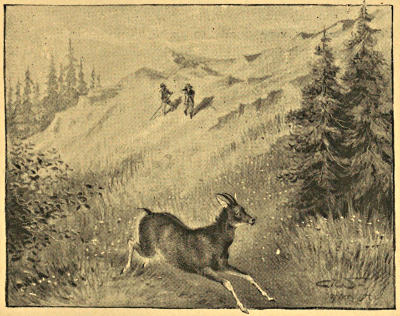
The serow gallops down hill
Colonel Kinloch is one of the very few people who have
laid themselves out to hunt serow, and his experiences are
scarcely encouraging, though Ward says that in the winter
months serow can be found with comparative ease in the Sindh
Valley, in Cashmere. The serow seems, like sambur, to be
nocturnal in its habits, and its discordant scream is often to be
heard after dark in Gurwhal, where it is comparatively plentiful.
The serow’s chief accomplishment is the way that he can
gallop down a steep hill, and as he invariably takes that course
when disturbed, he can be easily driven, provided the ground
is well known. All writers agree that a wounded one will
charge. Kinloch mentions having heard of an unwounded
male charging when its mate was shot, and Ward gives a graphic
account of an adventure he had with one. Mr. O. Shaw shot
a serow with a white mane in Cashmere. There are two more
varieties of this capricorn described in Sterndale’s ‘Natural
History of India.’ The first is the Arakanese capricorn, found
in Arakan, Pegu, the Malayan Peninsula, and Sumatra.
This is a brown beast with a yellow bay throat, black forelegs,
and bay hind ones. The description is rather vague, and
Blyth’s note—‘This species varies much in colour from red
to black, and the black sometimes with a white nape, or the
hairs of the nape may be white at the base only’—does not
explain matters very clearly to an unscientific reader. The
second variety is the Thibetan capricorn, discovered by Abbé
David, in Eastern Thibet.
This differs from the Indian serow by the uniform blackish
brown of the upper parts, tending to ferruginous on the thighs,
and the red colour in place of the grey on the lower parts of
the legs.
Native name: ‘Takin,’ ‘Takhon’
This curious animal, which is found just outside British
limits in the Mishmi and Akha hills, north of Assam, and in
Eastern Thibet, is a kind of large serow; but its horns, instead
of being sharp upright spikes like those of the serow and gooral,
are more of the bovine type, being rounded, smooth, and with
the distinctive wrinkles and longitudinal marks of genus Nemorhædus
faintly defined. Their peculiar twist is best explained
by the accompanying sketch.
An article in Sterndale’s ‘Mammalia of India,’ signed ‘J. C.,’
thus describes the animal:
The takin is a large, heavily built ruminant, about 3 ft. 6 ins.
high at the shoulder, and 6 ft. in total length. The external
peculiarities of the animal are: first, peculiar angularly curved
horns in both sexes; second, the enormously arched chevron;
third, the very great development of the spurious hoofs, which are
obtusely conical, and about 1½ in. in length in a small specimen.
Old bulls appear to become of an uniform brownish black at
times, but the colour doubtless depends on the season, as each hair
has the basal two-thirds yellow, and its apical third black, and the
young its hair brown with a dark tint.
The animal would appear to range from about 8,000 ft. to the
Alpine region, which is stated to be its habitat.
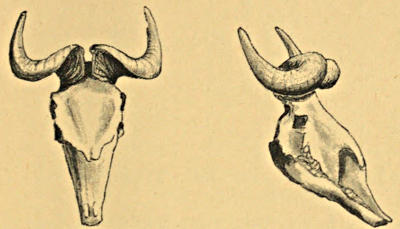
Budorcas taxicolor
As this animal has been found by the Abbé David in
Chinese Thibet, future explorations to the north of Burmah
should furnish skeletons and details about its habits for the
advancement of science.
There are two skulls in the British Museum in which the
prominent chevron is particularly noticeable; and there are
also several stuffed specimens.
Cashmeree shikaris know it as ‘Heran.’ The Ladak name is
‘Chiru,’ or ‘Choos’
This rather curious antelope is pretty plentiful in the Changchmeno
Valley, the only easily accessible place for European
sportsmen where it is found. A few are said to have been shot
in the neighbourhood of the Mansarovárá Lake, near the North-Western
frontier of Nepal, and they are also to be met with all
over the lofty plateau which has to be crossed on the way to
Yarkand. It appears, however, never to have been found
in the district beyond the Niti Pass as far as Europeans have
been able to penetrate, nor did Colonel Kinloch apparently
meet with it when he crossed the frontier in the direction of
Gártope.
Measurements
| Authority |
Height at shoulder |
Total length |
Weight as shot |
Length of horn |
Girth at base |
Sex |
Remarks |
| Capra Jemlaica |
|
ins. |
ins. |
lbs. |
ins. |
ins. |
|
|
| Mr. A. O. Hume |
.. |
.. |
.. |
14⅛ |
8⅞ |
.. |
Rowland Ward, ‘Horn Measurements’ |
| Major Ward |
.. |
.. |
200 |
14 |
.. |
.. |
‘Sportsman’s Guide to Ladak, &c.’ |
| Mr. Gwynne Griffiths |
.. |
.. |
.. |
13⅞ |
9 |
.. |
Rowland Ward, ‘Horn Measurements’ |
| The Writer, 1884 |
.. |
.. |
.. |
13⅞ |
.. |
.. |
|
| Hume Collection, British Museum |
.. |
.. |
.. |
13¾ |
9 |
.. |
Rowland Ward, ‘Horn Measurements’ |
| Mr. A. O. Hume |
.. |
.. |
.. |
13¾ |
8⅜ |
.. |
” |
| Hume Collection, British Museum |
.. |
.. |
.. |
13⅝ |
8 |
.. |
” |
| British Museum |
.. |
.. |
.. |
13½ |
8⅞ |
.. |
” |
| Mr. Rowland Ward |
.. |
.. |
.. |
13½ |
8½ |
.. |
” |
| ” |
.. |
.. |
about 200 |
.. |
.. |
.. |
” |
| Hon. W. Rothschild |
.. |
.. |
.. |
13⅜ |
9⅛ |
.. |
” |
| Mr. A. O. Hume |
.. |
.. |
.. |
13¼ |
9½ |
.. |
” |
| Sir V. Brooke |
.. |
.. |
.. |
13¼ |
8⅞ |
.. |
” |
| Sir E. G. Loder, Bart. |
.. |
.. |
.. |
13¼ |
8¼ |
.. |
” |
| Mr. J. Carr Saunders |
.. |
.. |
.. |
13⅛ |
8⅞ |
.. |
” |
| Capt. H. Brooke |
.. |
.. |
.. |
13 |
.. |
.. |
|
| Major Greenaway |
41 |
52 |
.. |
12½ |
.. |
.. |
|
| ” |
36½ |
.. |
.. |
.. |
.. |
.. |
|
| Sterndale’s ‘Mammalia’ |
36 to 40 |
about 54 |
.. |
12 to 14 |
.. |
.. |
|
| Col. Kinloch |
.. |
.. |
.. |
about 15 |
10 to 11 |
.. |
‘Large Game Shooting’ |
| Average good head |
.. |
.. |
.. |
12 |
9 |
.. |
|
| Hemitragus hylocrius |
| Gen. McMaster |
.. |
.. |
.. |
17 |
9¾ |
.. |
Sterndale’s ‘Mammalia’ |
| Mr. A. O. Hume |
.. |
.. |
.. |
16¾ |
8⅞ |
.. |
Rowland Ward, ‘Horn Measurements’ |
| Mr. St. George Littledale |
.. |
.. |
.. |
16½ |
.. |
.. |
” |
| Gen. McMaster |
.. |
.. |
.. |
16 |
.. |
.. |
Sterndale’s ‘Mammalia’ |
| Sir E. G. Loder, Bart. |
.. |
.. |
.. |
15½ |
8⅝ |
.. |
Rowland Ward, ‘Horn Measurements’ |
| Mr. M. Kennard |
.. |
.. |
.. |
15¾ |
8¾ |
.. |
” |
| Mr. St. George Littledale, 1875 |
.. |
.. |
.. |
15¾ |
8¼ |
.. |
” |
| Mr. M. Kennard |
.. |
.. |
.. |
15⅛ |
8⅝ |
.. |
” |
| Mr. St. George Littledale, 1871 |
.. |
.. |
.. |
15⅛ |
8⅝ |
.. |
” |
| Sterndale’s ‘Mammalia’ |
41 to 42 |
.. |
.. |
.. |
.. |
.. |
|
| Average of good head |
.. |
.. |
.. |
12 |
8 |
.. |
|
| Nemorhædus Goral |
| Major Ward |
28 |
.. |
58 |
8½ |
.. |
.. |
‘Sportsman’s Guide to Ladak, &c.’ |
| ” |
28 |
.. |
63 |
8 |
.. |
.. |
” |
| Hume Collection, British Museum |
.. |
.. |
.. |
7⅝ |
3¾ |
.. |
Rowland Ward, ‘Horn Measurements’ |
| Major Ward |
28 |
.. |
59 |
7½ |
.. |
.. |
‘Sportsman’s Guide to Ladak, &c.’ |
| ” |
26 |
.. |
.. |
7½ |
.. |
.. |
” |
| Capt. J. A. Orr Ewing |
.. |
.. |
.. |
7 |
3¾ |
.. |
Rowland Ward, ‘Horn Measurements’ |
| Mr. J. M. Nicolls |
.. |
.. |
.. |
7 |
3½ |
.. |
” |
| Col. Kinloch |
about 26 |
.. |
.. |
up to 8 |
.. |
.. |
‘Large Game Shooting’ |
| Sterndale’s ‘Mammalia’ |
28 to 30 |
about 48 |
.. |
6 to 9 |
.. |
.. |
|
| Major Greenaway |
26½ |
.. |
.. |
.. |
.. |
Female |
|
| Average good head |
.. |
.. |
.. |
6 |
.. |
.. |
|
| Nemorhædus bubalinus |
| Major Ward |
37 |
.. |
190 |
12 |
.. |
Male |
‘Sportsman’s Guide to Ladak, &c.’ |
| Hon. C. Ellis |
.. |
.. |
.. |
10½ |
5⅜ |
.. |
Rowland Ward, ‘Horn Measurements’ |
| Capt. H. Brooke |
.. |
.. |
.. |
10 |
5½ |
Male |
|
| Major Ward |
38 |
.. |
190 |
10 |
.. |
” |
‘Sportsman’s Guide to Ladak, &c.’ |
| ” |
33 |
.. |
120 |
10 |
.. |
Female |
” |
| Sir V. Brooke |
.. |
.. |
.. |
9⅞ |
5⅝ |
.. |
Rowland Ward, ‘Horn Measurements’ |
| Mr. R. Lydekker, British Museum |
.. |
.. |
.. |
9¾ |
5⅛ |
.. |
” |
| Major Greenaway |
.. |
.. |
.. |
9½ |
.. |
Male |
|
| ” |
.. |
.. |
.. |
7⅛ |
.. |
Female |
|
| Major FitzHerbert |
42 |
71 |
.. |
9¼ |
5½ |
Male |
|
| The Writer |
40 |
.. |
.. |
8 |
5 |
Female |
|
| Sterndale’s ‘Mammalia’ |
about 36 |
60 to 66 |
about 200 |
9 to 14 |
.. |
.. |
|
| Arakanese Capricorn |
| British Museum, sex unknown, not full grown (the horns are of the ordinary serow type) |
.. |
.. |
.. |
8¼ |
5½ |
.. |
|
| Authority |
Height at shoulder |
Total length |
Weight as shot |
Length of horn |
Girth at base |
Span at tips |
Remarks |
| Budorcas taxicolor |
|
ins. |
ins. |
lbs. |
ins. |
ins. |
ins. |
|
| British Museum |
.. |
.. |
.. |
22⅜ |
10⅝ |
14¾ |
Rowland Ward, ‘Horn Measurements’ |
| Hume Collection, British Museum |
.. |
.. |
.. |
20⅞ |
11⅜ |
11⅞ |
” |
| Mr A. O. Hume |
.. |
.. |
.. |
20¾ |
11⅞ |
12½ |
” |
| Hume Collection, British Museum |
.. |
.. |
.. |
20¾ |
9⅝ |
13⅜ |
” |
| Mr. B. H. Hodgson, British Museum |
.. |
.. |
.. |
20½ |
10⅞ |
12⅜ |
” |
| Sir E. G. Loder, Bart. |
.. |
.. |
.. |
19⅜ |
11 |
15 |
” |
| British Museum |
.. |
.. |
.. |
18 |
10¼ |
8 |
” |
| ” |
.. |
.. |
.. |
16⅛ |
8¾ |
10¾ |
” |
| Mr. B. H. Hodgson, British Museum |
.. |
.. |
.. |
15¼ |
9⅜ |
5¾ |
” |
| Lieut.-Col. Graham |
.. |
.. |
.. |
14⅜ |
8¾ |
8⅞ |
” |
The bucks vary a good deal in colour; some of them are
a beautiful golden red, some a light fawn, and others a dirty
yellowish white. The colour of the hair seems always to fade
after the skin is removed. As a rule the skins are useless in
the summer as the antelope are changing their coats; the legs
and face are dark brown, and the muzzle, instead of being neat
and deer-like, is broad and puffy. The horns are peculiar,
having a considerable bend forward at the tips, as if they were
pliable, and the buck was standing with his back to a gale of
wind.
They have two greatly developed inguinal glands, the tubes
of which run right up into the body, and the Tartars are said to
believe that the antelope inflate these with air at will, to enable
them to gallop faster. A curious point about this antelope is
that though he can gallop, and very fast, he generally seems to
prefer moving at a sharp trot.
As they are wary and require careful stalking, and as they
often lie up for the day in holes, which they have a curious
habit of scratching for themselves on the hillsides just deep
enough to conceal the whole of their bodies and necks when
lying down, leaving the eyes just peeping over the top, the
best time to hunt them is when they are feeding in the morning
and evening. They are rather soft animals, and succumb to
wounds that most deer would travel miles with; the writer
once broke the foreleg of a buck who after going about half a
mile lay down with his nose on the ground, and let himself be
caught. There was a pretty free fight for a bit when he was laid
hold of, his sharp horns necessitating a certain amount of caution;
a judicious wrench towards his wounded side, however, at length
upset him, and a knife-thrust finished him. A Tartar shikari,
who was standing by, absolutely refused to lend any assistance
during the struggle, contenting himself with applauding the
combatants and seeing fair play. The does are smaller than
the bucks, are of a light brown colour, and have no
horns.
Unlike other antelope, the bucks separate from the does in
the summer, and walk about in herds together. They are much
worried by the grubs of some fly, which seems to annoy them
chiefly when lying down during the heat of the day, for it is a
common thing to see one of a herd get up, go for a constitutional
gallop—they always gallop then—return to the herd and lie
down again with the others. They do not seem to be troubled
so much when moving about feeding. The venison in July is
excellent.
This extraordinary animal, which hails from Central Asia,
is said to be a relative of the Thibetan antelope, on account of
the peculiar formation of the nose. In the stuffed specimens
in the British Museum there is little or no resemblance between
the two; the Thibetan antelope having there, as in its natural
state, a broad puffy muzzle, while the saiga antelope has, at all
events in the Museum, in addition to a very high chevron, an
absurd-looking elongated snout like a tapir, projecting far beyond
its lower lip. The hair is thick and long, particularly on
the cheeks, where it almost resembles a wild boar. The ears
are small and rounded in shape, utterly unlike any deer’s ears.
The general colour is almost white (probably a very pale yellow
in nature), and there is a dark stripe down the quarters and
tail. The horns are annulated and of a very pale colour, the
stuffed specimen having twelve rings; and though of the gazelle
type, with a backward sweep, rising up again at the tips, they
have also two curious outward bends, one near the base of the
horn, and another near the tip, though the tips eventually
incline inwards. A skeleton in the Museum measured 58 ins.
in length along the spinal cord, and stood 31¾ ins. at the
shoulder. The stuffed specimen stands 30 ins. at the shoulder.
Three pairs of horns measured 13¾ ins., 13½ ins. and 13 ins.
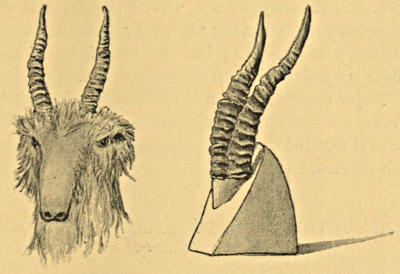
Saiga tartarica
Sterndale remarks that the inflated nostrils ‘are so much
lengthened as to necessitate the animal’s walking backwards
when it feeds.’ The fortunate sportsman who comes across
this rare variety should therefore remember to post himself
astern of a herd should he wish it to feed up to him—though
he may possibly find that nature has provided the animal with
means of twitching its nose out of the way to obviate so uncomfortable
a method of grazing.
Gazella gutturosa
This is another little known variety. It is found in Mongolia,
and is the one Ward refers to as the ‘hwang yang, or
yellow goat.’ There is a stuffed specimen in the British
Museum, which stands 31 ins. at the shoulder, is of a pale
yellowish white, with coarse hairs, and has horns 10½ ins. in
length, of the regular gazelle type in shape and ribbing, much
resembling those of the Gazella picticaudata.
Gazella subgutturosa
is a much smaller beast than the last. It is found in Persia,[24]
and extends to Yarkand, where a specimen was shot by Major
Biddulph when with the Yarkand Mission, between Maral
Bashi and Kashgar. It is called by the natives ‘djêrân,’ or
‘jairan.’ Its general colour is pale red, with dark facial marks,
a dark band along the side where the white of the belly joins
the red of the back, and above it a curious pale streak. The
buck has long, annulated, lyrate horns, with the tips inclining
inwards. It measures 27½ ins. in height, and the horns of
a specimen quoted in the ‘Scientific Results, Second Yarkand
Mission,’ measured 14 ins. in length by 5 ins. in girth.
There is a coloured plate of one in the same publication.
Major Cumberland, in his journal published by ‘Land and
Water,’ mentions hawking these gazelles with trained eagles.
He says that the doe is not much bigger than Gazella Bennetti,
with short stumpy horns.
Thibetan ‘Goa’
This lovely little animal is of a creamy fawn colour in its
winter coat. It has a white anal disc of longish hair, and a
black tail about four inches long, which, like the Indian
gazelle, it keeps perpetually wagging. The summer coat is
slaty grey. The horns are like those of the Indian gazelle,
but are longer, of finer grain, and have a far bolder sweep
backwards before turning up at the tips. The female has no
horns. It frequents the high plateaux along the Chinese
frontier, in Eastern Ladak, in the neighbourhood of the Tsomoriri
Lake, but apparently does not extend north of the
Indus, as far as Ladak is concerned, its limits in Chinese
Thibet being at present unknown.
Measurements
| Authority |
Height at shoulder |
Total length |
Weight as shot |
Length of horns |
Girth at base |
Span tip to tip |
Remarks |
| Pantholops Hodgsonii |
|
ins. |
ins. |
lbs. |
ins. |
ins. |
ins. |
|
| Colonel Kinloch quotes a head |
.. |
.. |
.. |
28½ |
.. |
.. |
‘Large Game Shooting’ |
| Mr. A. O. Hume |
.. |
.. |
.. |
27⅞ |
5⅞ |
13⅛ |
Rowland Ward, ‘Horn Measurements’ |
| Sir R. Harvey, Bart. |
.. |
.. |
.. |
27⅞ |
5½ |
11¼ |
” |
| Mr. A. O. Hume |
.. |
.. |
.. |
27⅛ |
5½ |
15⅛ |
” |
| Major Ward |
36 |
.. |
85 |
26½ |
.. |
.. |
‘Sportsman’s Guide to Ladak, &c.’ |
| Hon. C. Ellis |
.. |
.. |
.. |
26⅜ |
5⅞ |
13⅝ |
Rowland Ward, ‘Horn Measurements’ |
| The Writer |
.. |
.. |
.. |
26 |
.. |
.. |
|
| Capt. G. Campbell |
.. |
.. |
.. |
25½ |
5½ |
12½ |
Rowland Ward, ‘Horn Measurements’ |
| Hume Collection, British Museum |
.. |
.. |
.. |
25⅜ |
5⅜ |
12½ |
” |
| ” |
.. |
.. |
.. |
25¼ |
5¾ |
12¾ |
” |
| Major Ward |
37 |
.. |
85 |
24 |
.. |
.. |
‘Sportsman’s Guide to Ladak, &c.’ |
| ” |
37 |
.. |
90 |
24 |
.. |
.. |
” |
| The Writer |
35 |
.. |
.. |
20½ |
.. |
.. |
” |
| Major Ward puts the average length of a full-grown buck’s horns at 22 ins., which seems about right. |
| Saiga tartarica |
| Hon. W. Rothschild |
.. |
.. |
.. |
14⅜ |
5¼ |
3½ |
Rowland Ward, ‘Horn Measurements’ |
| Sir E. G. Loder, Bart. |
.. |
.. |
.. |
13¾ |
5 |
.. |
” |
| Sir V. Brooke |
.. |
.. |
.. |
13¾ |
4⅜ |
3½ |
” |
| British Museum |
.. |
.. |
.. |
13¾ |
.. |
.. |
|
| ” |
.. |
.. |
.. |
13½ |
.. |
.. |
|
| Hon. W. Rothschild |
.. |
.. |
.. |
13⅛ |
5⅜ |
4⅜ |
Rowland Ward, ‘Horn Measurements’ |
| British Museum |
.. |
.. |
.. |
13 |
.. |
.. |
|
| Gazella gutturosa |
| Sir E. G. Loder, Bart. |
.. |
.. |
.. |
13⅛ |
4⅝ |
6¼ |
Rowland Ward, ‘Horn Measurements’ |
| Mr. St. George Littledale |
.. |
.. |
.. |
12¾ |
4⅜ |
3⅜ |
” |
| ” |
.. |
.. |
.. |
12¼ |
4⅜ |
4¾ |
” |
| Mr. R. Beech |
.. |
.. |
.. |
11½ |
4⅞ |
3 |
” |
| Mr. Rowland Ward |
about 30 |
.. |
.. |
.. |
.. |
.. |
” |
| Gazella subgutturosa |
| Scientific Results, Second Yarkand Mission |
27½ |
.. |
.. |
14 |
5 |
.. |
|
| Mr. Rowland Ward |
about 26 |
.. |
.. |
.. |
.. |
.. |
‘Horn Measurements’ |
| Dr. O. Finsch, British Museum |
.. |
.. |
.. |
13¾ |
4½ |
6 |
” |
| Hume Collection, British Museum |
.. |
.. |
.. |
13⅜ |
4¾ |
5½ |
” |
| ” |
.. |
.. |
.. |
13 |
4½ |
5 |
” |
| ” |
.. |
.. |
.. |
12¾ |
4¾ |
4⅜ |
” |
| ” |
.. |
.. |
.. |
12⅝ |
4¾ |
5¼ |
” |
| ” |
.. |
.. |
.. |
11¾ |
5 |
5⅛ |
” |
| Gazella picticaudata |
| Major Greenaway |
.. |
.. |
37 cleaned |
13½ |
.. |
.. |
|
| Hume Collection, British Museum |
.. |
.. |
.. |
13½ |
3⅝ |
5¼ |
Rowland Ward, ‘Horn Measurements’ |
| Mr. H. C. V. Hunter |
.. |
.. |
.. |
13⅛ |
4 |
3⅝ |
” |
| ” |
.. |
.. |
.. |
13 |
3¾ |
3½ |
” |
| Colonel Kinloch |
about 24 |
.. |
.. |
13 |
.. |
.. |
‘Large Game Shooting’ |
| Major Ward |
.. |
.. |
.. |
13 |
.. |
.. |
‘Sportsman’s Guide to Ladak, &c.’ |
| Major Greenaway |
23½ |
41 |
47 |
13 |
.. |
.. |
|
| ” (a doe) |
23 |
38½ |
40 |
.. |
.. |
.. |
|
| ” |
.. |
.. |
.. |
13 |
.. |
.. |
|
| Captain K. Mackenzie |
.. |
.. |
.. |
13 |
.. |
.. |
|
| Average of good head |
.. |
.. |
.. |
13 |
.. |
.. |
|
Goa do not appear to lie down much in the middle of the
day, and in May and June, at all events, are constantly on the
move. They appear to resort to particular spots for dropping
their dung, and little heaps of it may be noticed wherever goa
are at all plentiful.
As they are generally found on the grass flats that fringe
the streams, or on some almost level plateau, stalking them is
by no means easy, though they are not generally very shy,
will occasionally allow considerable liberties to be taken in
approaching them, and will stop to look after a fallen companion.
The Tartars say that they can be stalked down wind,
but they say this also of the Thibetan antelope, and Major
Ward’s advice on this point is sound: ‘Believe it, reader, if
you like, but do not try it often.’
Generally ‘Heran,’ or ‘Mirug,’ from the Sanscrit ‘Mirga’
This is the well-known black buck, which is found all over
India at intervals from the extreme south to as far north as the
Jhelum, following the southern bank of that river till (joined
by the Chenab, Ravi and Sutlej) it flows into the Indus, which
then becomes the black buck’s northern boundary. Essentially
a plains-loving animal, it avoids hills and heavy forest, but
is often found in the long grass which covers the islands and
banks of many of the large rivers. Though considerable tracts of
apparently suitable country do not seem to hold a single herd,
special districts where antelope are always to be found seem
to crop up unexpectedly all over India. In the North-West
Provinces, and along the borders of the Bikanir Desert between
Rajpootana and the Punjab, it appears to be more generally
plentiful than in the rest of India, and the horns in these districts
grow longer. Sanderson says, in ‘Thirteen Years among
the Wild Beasts of India,’ that an 18-in. horn is a decided
rarity in Mysore, whilst in the Bikanir Desert they are frequently
obtained 24 ins., and occasionally 27 ins. or more, in
length.
A black buck in his best coat is a very handsome animal,
but is too well known to require description.
The buck usually changes his coat after the rutting season,
which is in the spring, the season varying slightly according to
locality. During the hot months he is generally more or less
brown, regaining the black coat after the rainy season. Many
full-grown bucks with good heads do not seem to turn black
at all, but the master buck of a herd is almost invariably black
at the proper season.
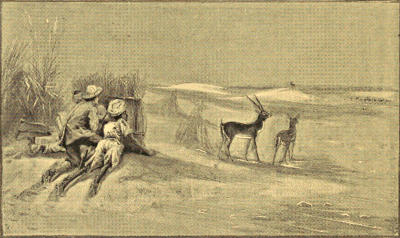
Tame decoys
Major FitzHerbert (a very careful observer of the habits of
wild animals) is of opinion that it is usually the master buck
of the herd who turns brown in the hot weather; he is then
used up, and often leaves the herd to the possession of a
younger buck, who has remained black.
The herds, though more frequently consisting of ten or
a dozen animals, are occasionally of immense size—indeed
thousands are mentioned by some authorities. Antelope in
herds are, as a rule, fairly easy to get within shot of; but a solitary
old black buck takes precious good care of himself, and as there
is rarely cover enough to stalk him without being seen, these
wary old gentlemen generally escape. The natives have many
methods of hunting antelope. Pursuing them with trained
chitas has been so often described that any detailed account
of it is unnecessary. It is interesting to see once, the chita’s
speed being so amazing, but considered as sport it is poor fun.
Black buck are occasionally snared by sending tame bucks
among them with nooses attached to their horns. The wild
buck attacks the intruder, and gets caught by the horn. This
plan is also adopted for snaring ravine deer, but not often, as
the gazelle is said to be harder to train than the black buck.
The commonest way of snaring antelope is by covering about an
acre of ground thickly with nooses and driving a herd over it.
Trained bullocks are often used by native shikaris to enable
them to get within the close range they love for a shot; and the
writer has seen the following curious method practised in Central
India. A trained buck and doe are taken out, each having a
light cord about ten yards long attached to it, and the pair are
led by an attendant, a light screen about three feet square made
of grass and leaves with a small hole in the centre being carried
by the shikari, and the whole party moves under cover of a
third man on horseback to within about three hundred yards
of a herd of antelope. The screen is then planted on a spot
commanding a good view; the men on foot crouch behind it,
and the horseman rides slowly off to a flank. The tame deer
are then let out to the full extent of their lines on one side of
the screen, and begin playing round one another. The master
buck of the herd, seeing an impertinent intruder on his ground,
trots out at once to do battle for the doe, but the screen
puzzles him, so before coming close he generally circles round
to try and see behind it. As he moves the screen is shifted
round, the men scrambling round on hands and knees behind
it, and if there are two Englishmen bursting with suppressed
laughter in addition to the two natives, all scuffling round as
the screen moves and trying to keep their legs out of sight, the
business is most comical.
Directly the wild buck stops, the screen and the men behind
it must remain motionless. Having failed to discover what is
behind the screen, the buck, though he is still suspicious, probably
because he caught sight of a clumsy English leg, feels
that he must try to capture that enticing doe, but decides on
having a look from the other side of the screen first, so back
he gallops to the other flank, and the scrambling process is repeated.
Gradually he comes within range, the rifle is poked
through the hole in the screen and he gets his quietus; after
this the tame deer are given a handful of corn, and the party
sets out to look for another herd. The tame buck employed
in this manœuvre should be a brown one, as if an old powerful-looking
black one is used the wild buck will often decline the
contest.
In some districts the antelope are so wild that sportsmen
have to approach them under cover of bullock-carts, and occasionally
dress up as natives to get within range. The antelope
are accustomed to see carts and natives, and will generally
allow them to pass within about a hundred and fifty yards,
while the sight of a European will start them off at once; but
in most places in Central and Northern India these accessories
are not needed. The pleasantest way of shooting is to ride a
quiet horse, which will do for stalking if the antelope are wild
or for riding down a wounded buck, taking a few coolies with
you to carry game, luncheon, guns and cartridges.
A shot-gun enables one to vary the bag pleasantly with
small game, without interfering with the chance of getting antelope.
If the sportsman is fond of coursing, greyhounds may
be taken, the Rampore breed suiting the country best; but
after many trials the writer has become unwillingly convinced
that dogs do more harm than good. If there are any crops
about they soon get unsighted, get on to fresh deer, and disturb
the whole country.
On the other hand, if the sportsman has dogs he can often
enjoy a course after a fox or a hare to vary the entertainment,
and a good course with a wounded buck is a very pretty sight.
The usual proceeding is as follows: The sportsman rides till a
herd is sighted; he approaches them as far as he thinks safe,
probably within about six hundred yards; he then dismounts,
and if he is going to use his horse for stalking, goes on with the
horse and groom, leaving the coolies and dogs behind, with
orders to follow him slowly, keeping as far back as possible
without losing sight of him. If the antelope are feeding or moving
slowly, the sportsman directs his course so as to cross their
path about a hundred yards ahead of them. If the creatures are
lying down or stationary, he must try to pass within a hundred
yards of the flank which is to the leeward of the herd, walking
on the far side of his horse, which is led by the groom on the
same side. If he has no horse with him, he should hold his
rifle so that the sun does not shine on the barrels. If two
sportsmen are working together (a most killing plan with crafty
men who play into one another’s hands), they should each take
a flank and go rather wider than they would if hunting single-handed,
so as to keep the herd between them. As long as
that can be managed one or other of the guns is sure to get
a chance at the best buck. The sportsman should show
himself to the herd a long way off, and walk slowly, without
any attempt at concealment; he must remember never to
walk straight at them, but always as if he were going to pass
them at about a hundred yards; if he finds he is lying too
far out of his course, he should edge quietly towards them
without turning, and he should never stop until he means to
fire. He should never look direct at the herd; quiet side glances
will give him all the information he requires.
When he has approached to within two hundred yards,
if the herd is lying down some of the does will get up;
but the sportsman can go on safely till the buck he wants
begins to stir. The old fellow will rise leisurely, stretch himself,
and then turn to gaze. This is the time for the shot, and
if it can be taken without sitting down or kneeling it is far
more likely to be an easy one. An excellent rest[25] for firing
standing can be made with a light bamboo having an iron
crutch covered with leather on the top to hold the rifle barrels.
The crutch should be the exact height of the top of the sportsman’s
shoulder, and is held, when firing, with the left hand
at arm’s length. The bottom of the stick should be shod, to
prevent it wearing away when used as a walking-stick. The
advantages of using this rest are particularly noticeable when
shooting among low bushes, which so often interfere with a shot
when sitting or kneeling.
Frequently, just before the sportsman can get a fair chance at
the buck he wants, the herd begins to move off; two or three
does commence bucking high in the air, and to a novice it would
appear that the whole herd are on the point of galloping away.
This, however, by no means follows. The master buck often
takes very little notice of their pranks, and follows slowly after
them, in which case the does calm down, and though still continuing
to move, will lead on slowly. The sportsman should
follow them quietly, still keeping on their flanks, and heading
so as to cut them off, if possible; sooner or later he will get a
chance if he sticks to them quietly, though if he has followed
them for some distance he will probably only get a running
shot. Each herd has its own district as a rule, and sooner than
be forced far over its boundary, it will turn and gallop back
past the sportsman, often within fifty yards. This is even more
noticeable with ravine deer, whose herd districts appear to be
smaller than those of antelope, and who generally require a lot
of following up and bullying before they give a chance. A good
buck with a herd of either antelope or of ravine deer need
never be given up as hopeless as long as it can be followed.
In following a wounded buck the main point is just to keep it
in sight without pressing it until it lies down, when it should
be left for about half an hour before being restalked. If it is
intended to ride, or course the buck, the attendants should be
signalled up at once, as the half-hour’s rest will spoil the run,
but the sportsman should be careful that the dogs are not
slipped till the buck is well clear of the herd. The best way is
for the sportsman to have the dogs brought up to him, then
ride ahead, the slipper running after him with the dogs in leash
till the buck begins to gallop; then have the dogs slipped and
ride the buck, halloaing on the dogs till they are fairly laid on.
If he has no dogs he will be able to get within three hundred
yards of the buck before the latter really starts, and then he
must send him along; after about half a mile he will find that
he can get within twenty yards, but no nearer. A few hundred
yards farther the buck will begin to falter and then suddenly
throw himself down, and the sportsman can either spear him
or dismount and knife him—the buck has run himself out.
With Express rifles, unless a buck is hit in the leg, he will give
no run at all; with a body wound he can’t gallop any distance,
though he may give trouble if pursued on foot. The bucking
bounds which antelope make are very peculiar (no wounded
animal ever bucks). The distance covered may be only a few
feet, the animal jumping apparently to get a good view, but
when the deer are galloping, the distance covered in a bound,
apparently made without effort, is extraordinary. Major
FitzHerbert paced three successive bounds of a doe on
softish sand; two measured eight yards and the third seven
yards.
A buck slightly wounded in the leg will occasionally give
a grand run. In 1875 Major FitzHerbert shot a buck through
the hock without breaking the bone. Mounted on a fast Arab,
he rode this buck for a mile and a half without being able to
get up to him, as the buck led over a succession of gram fields
where he was able to keep along the narrow headlands while
the horse had to plough through the clods. Finding that he
was, if anything, losing ground, the rider pulled up, and the
buck stopped and lay down in a patch of grass. The attendants
then came up with a couple of deerhounds, which were
slipped at the buck with a good start, but could not run into
him till he had gone another mile and a quarter, and only then
caught the buck when he dislocated his wounded hock.
In 1876 the same sportsman had another brilliant gallop on
the same horse after a buck wounded in the fleshy part of the
thigh. A brace of dogs were slipped, but got away on to other
deer early in the run, and the buck was ridden till he dropped
and was despatched with a knife. This run was measured
about five miles on the map from point to point, and must
have been seven or eight miles as the buck went. Cases have
been reported of unwounded black buck being run down by
dogs in the Bombay Presidency, but in Northern India, though
the writer knows of two instances of unwounded does being
successfully coursed (one of these at all events was not in young,
as it was examined by a medical officer to decide a bet), the
bucks could always gallop away from the dogs.
The biggest bag of black buck the writer knows of was
sixty-four bucks in 1883, by two guns in five days and a half.
Of these, ten bucks, whose horns were all over 22 in. in
length, were shot by one of the sportsmen in a morning’s work.
The biggest mixed bag by one gun in a day was two nylghai,
five ravine deer, and three black buck in 1875.
Black buck in their wild state are very pugnacious, and
when two bucks are fighting they may often be approached
without difficulty. I once walked up to within eighty yards of
two who were desperately hard at it; sat down and watched the
fight till they stood with their horns locked, and then shot the
blacker buck of the pair through the lungs. He threw up his
head and bolted, pursued by his antagonist, a brown buck with
good horns, who seemed to have had rather the best of the
battle while it lasted. They ran about one hundred yards, the
brown buck driving and horning the other till the latter
dropped dead; then, after making two or three attacks on the
prostrate body, the brown buck began to swagger round it,
head and tail in the air, as proud as could be. By this time I
had again got well within range, and as the brown buck now
apparently saw me for the first time (not having taking any
notice of the shot), I dropped him with another bullet so that
he fell over the carcase of his late rival.
Writing of the height that antelope can jump, Williamson
mentions a black buck leading a herd over a net which was
propped up on poles 13 ft. long, and which must have been
at least 11 ft. high.
Native names: ‘Nilghao,’ ‘Lilghao’; in the Punjab, ‘Roz’
This animal is found pretty nearly all over the plains of
India. Jerdon says it is not known in the extreme south of
India, but Sanderson mentions it as occurring in the Madras
Presidency on the borders of Mysore. According to my own
experience, it is most plentiful in Central India, though it is
common enough in the North-West Provinces.
An old male, usually called a blue bull, is a large beast
with a lean head, surmounted by short cow-like horns, but
with a curious rib along the base of the horn in front; the
neck is long and carried high; the withers are high, and give
him a horse-like appearance, but he falls away towards the
hind-quarters; the tail is like a cow’s, with a tuft at the end,
but only reaches to the hocks. His general colour is a dark
iron grey; the chin, lips, and inside of the ears are white; the
ears are rather large and cow-like; there is a white spot on
each cheek, a large white patch on the throat, below which
hangs a tuft of long black hair; the chest and stomach are
white, there are white rings on the fetlocks, and he has a thin
upright black mane.
The female is fawn-coloured, and is without horns.
Scrub jungle, composed of ‘babul’ trees, ‘dhak’ and
‘beyr’ bushes, is the ground on which to look for nylghai, and
if there is a patch of sugar cane adjoining such a jungle, it is
an almost certain find. The natives often enclose these patches
of cane with grass fences nearly six feet high, but nylghai will
always jump them.
As a rule, natives object more or less strongly to nylghai
being shot, regarding them as cattle; and as they afford
poor sport with the rifle, most men spare them after having
obtained a few specimens, especially if the ground is not
rideable; but where they can be ridden it is quite another
matter. A wounded bull will give a grand run, and even an
unwounded one can be ridden down if well pressed at first.
This is rather a difficult matter for a single horseman, but
parties of three or four have frequently done it. Kinloch
mentions an instance of its having been done single-handed,
and gives some stirring accounts of his own adventures after
nylghai. Cows, he says, it is almost impossible to catch, the
only chance being with heavy old bulls.
Blue bulls have frequently been tamed and trained to carry
loads. Sterndale mentions one he used to ride, but they are
as a rule dangerous in captivity. The writer owned one who
would let him sit on his back when lying down, but he would
always charge any pony that came near him, dropping suddenly
on his knees to use his horns. He used to break loose, and
hunt the native gardeners up trees, whilst he enjoyed the
produce. As the bull would not consent to be led, he had to
be left behind when the writer’s battalion left the station, and
his last exploit was to hunt the portly native landlord of the
house round and round the premises when he came to look at
his property.
The hide is very thick, especially on the shoulders, and is
much prized by the boatmen on all the rivers for making up
into the inflated skins they use.
Sterndale remarks: ‘He sometimes even devours such
quantities of the intensely acrid berries of the aoula (Phyllanthus
emblica) that his flesh becomes saturated with the bitter
elements of the fruit. This is most noticeable in soup, less so
in a steak, which is at times not bad.’
The writer has never had the luck to taste any part of a
blue bull that was worth eating except the tongue.
Commonly called Ravine Deer; native name generally ‘Chikara’
The gazelle is found in suitable localities pretty nearly all
over India, with the exception of Lower Bengal, the Western
Ghauts, and the Malabar coast. Wherever there is sandy
ground, low stony hills, or the network of ravines which fringes
the banks of so many Indian streams near their sources, or
where they cut their way through low hills, ravine deer are
likely to be found. They avoid heavy forest or swamp covered
with high grass, nor do they usually frequent closely cultivated
ground unless there is scrub, jungle, or a ravine near to which
they can retire when disturbed.
They are fidgetty, restless little animals, and, like the
Thibetan gazelles, are incessantly twitching their tails. Even
where not much hunted they are generally pretty wild, but as
they do not as a rule go far when disturbed, the sportsman can
usually get a shot by perseveringly following up a herd. A
steady shooting horse is of great assistance in stalking them,
and on the edge of the Bikanir Desert, where they are very
plentiful, the easiest way of approaching them is under
cover of a riding camel. As black buck and ravine deer are
often found on the same ground, the same tactics in the stalk
are applicable to either. The stick-rest recommended for
black buck shooting is of the greatest assistance when shooting
ravine deer among bushes. The bucks are often seen alone,
and herds rarely consist of more than a dozen animals. The
does have thin horns, and occasionally, in bad light or jungle,
pay the penalty of being mistaken for bucks.
Ravine deer shooting with a light rifle is very good fun.
Straight shooting is necessary for so small a mark, and as a
rule the day’s amusement can be varied by shots at black buck
or small game. Colonel Howard, in 1883, got one ravine
buck, one bustard, two peafowl, one sand-grouse, one duck, in
a day, all shot with a rifle.
A ravine buck with a broken leg will give a good run to
dogs if found in the open, but as a rule the ground these deer
frequent is too broken for coursing.
An unwounded doe was run down by three dogs belonging
to officers of the Rifle Brigade in 1876, but on another occasion
the writer saw a fawn run clean away from a good dog. Kinloch
describes how the officers of the Guides used to hunt
ravine deer with dogs and falcons.
Native names: generally ‘Charsingha,’ ‘Choka,’ ‘Doda’;
in Chota Nagpur ‘Cháorang’ (Kinloch)
Four-horned antelopes are found thinly scattered all over
India, but, according to Sterndale, not in Ceylon or Burmah.
They are met with in Rajputana, but the writer has never heard
of them in the Punjab.
They generally live alone or in pairs, and frequent bamboo
jungle, or the long grass and bushes near forests.
Their colouring varies a good deal, but it is generally a
reddish-brown, paler below the forelegs, and fetlocks dark;
the latter being ringed with pale marks. The female is hornless.
The male has two pairs of short, smooth black horns,
the front pair, which is shorter than the other pair, growing
almost above the eyes, while the rear pair rises just in front
of the ears. The front pair are often mere knobs, and good
specimen heads, with the four horns complete, are not easy to
get; in fact, this antelope is such a small animal and sticks so
persistently to cover, that the majority of those that are killed
are bagged by lucky snap-shots. Sterndale quotes a letter in
the ‘Asian,’ signed ‘Bheel,’ in which the writer remarks: ‘It is
found in the thick jungles at the foot of the hills. It selects
some secluded spot, which it does not desert when disturbed,
returning invariably to its hiding-place when the coast is clear.’
This peculiarity might well be taken advantage of by any
sportsman desirous of obtaining a specimen; on a four-horn
being put up, his hiding-place might be noted, the attendants
sent on a few hundred yards, and the sportsman remain
behind to intercept the animal on its return. The writer has
never tried this plan, but only offers the suggestion for what it
is worth.
Measurements
| Authority |
Height at shoulder |
Total length |
Weight as shot |
Length of horns |
Girth of horns |
Span tip to tip |
Remarks |
| Antilope bezoartica |
|
ins. |
ins. |
lbs. |
ins. |
ins. |
ins. |
|
| Mr. A. O. Hume |
.. |
.. |
.. |
28¼ |
5 |
17¾ |
Rowland Ward, ‘Horn Measurements’ |
| Mr. Rowland Ward |
.. |
.. |
Average 85 |
.. |
.. |
.. |
” |
| Sterndale |
32 |
35 |
.. |
28 |
.. |
.. |
‘Triangle’ in ‘The Asian’ |
| Major Ward |
.. |
.. |
.. |
27¾ |
.. |
.. |
‘Sportsman’s Guide to Ladak, &c.’ |
| Col. Kinloch |
.. |
.. |
.. |
27 |
.. |
.. |
‘Large Game Shooting’ |
| ” |
.. |
.. |
.. |
27 |
.. |
.. |
” |
| Sir V. Brooke |
.. |
.. |
.. |
27 |
5 |
19½ |
Rowland Ward, ‘Horn Measurements’ |
| Captain Brooke |
.. |
.. |
.. |
26¾ |
.. |
.. |
|
| Col. Kinloch |
.. |
.. |
.. |
26¾ |
.. |
.. |
‘Large Game Shooting’ |
| Mr. A. O. Hume |
.. |
.. |
.. |
26⅜ |
5 |
17⅞ |
Rowland Ward, ‘Horn Measurements’ |
| Col. Kinloch |
.. |
.. |
.. |
26 |
.. |
.. |
‘Large Game Shooting’ |
| Gordon Cumming |
.. |
.. |
.. |
26 |
.. |
.. |
‘Wild Men and Wild Beasts’ |
| ” |
.. |
.. |
.. |
26 |
.. |
.. |
(An albino) |
| Captn. Hervey |
.. |
.. |
.. |
25¾ |
.. |
.. |
|
| Mr. A. O. Hume |
.. |
.. |
.. |
25⅝ |
4¾ |
20¾ |
Rowland Ward, ‘Horn Measurements’ |
| Col. Martin |
.. |
.. |
.. |
25½ |
.. |
15 |
” |
| Sir J. Morris, K.C.S.I. |
.. |
.. |
.. |
25⅛ |
5⅛ |
21¾ |
” |
| Hume Collection, British Museum |
.. |
.. |
.. |
25⅜ |
5½ |
14½ |
” |
| ” |
.. |
.. |
.. |
25 |
4⅞ |
19 |
” |
| Colonel Howard |
.. |
.. |
.. |
25 |
.. |
.. |
|
| Capt. H. Petre |
.. |
.. |
.. |
25 |
.. |
.. |
|
| Gordon Cumming |
.. |
.. |
.. |
25 |
.. |
.. |
‘Wild Men and Wild Beasts’ |
| Major Greenaway |
33 |
.. |
.. |
.. |
.. |
.. |
|
| ‘Spherical,’ ‘Oriental Sporting Magazine,’ 1870 |
.. |
.. |
83.4 |
.. |
.. |
.. |
Average weight of bucks in Allahabad district |
| ” |
.. |
.. |
70.8 |
.. |
.. |
.. |
Average weight of bucks in Bundara district |
| Average of good head |
.. |
.. |
.. |
20 |
.. |
.. |
|
| Portax pictus |
| Major FitzHerbert |
51 |
.. |
.. |
9½ |
.. |
.. |
|
| British Museum |
.. |
.. |
.. |
9¼ |
6¾ |
4⅞ |
Rowland Ward, ‘Horn Measurements’ |
| Col. Kinloch |
about 56 |
.. |
.. |
.. |
.. |
.. |
‘Large Game Shooting’ |
| Mr. A. O. Hume |
.. |
.. |
.. |
8⅞ |
6⅝ |
3½ |
Rowland Ward, ‘Horn Measurements’ |
| The Writer |
.. |
.. |
.. |
8¾ |
7 |
.. |
|
| ” |
.. |
.. |
.. |
8¾ |
7⅛ |
.. |
|
| Sterndale’s ‘Mammalia’ |
52 to 58 |
96 to 106 |
.. |
8 to 10 |
.. |
.. |
|
| Major FitzHerbert |
53 |
.. |
.. |
.. |
.. |
.. |
|
| Major Greenaway |
55 |
.. |
.. |
.. |
.. |
.. |
|
| ” |
53 |
.. |
.. |
7½ |
.. |
.. |
|
| ” |
50 |
.. |
.. |
.. |
.. |
.. |
|
| Average of good head |
.. |
.. |
.. |
8 |
.. |
.. |
|
| Authority |
Height at shoulder |
Total length |
Weight as shot |
Length rear horns |
Length front horns |
Length of horns |
Girth of horns |
Span tip to tip |
Remarks |
| Gazella Bennetti |
|
ins. |
ins. |
lbs. |
ins. |
ins. |
ins. |
ins. |
ins. |
|
| Capt. Brooke |
.. |
.. |
.. |
.. |
.. |
14¼ |
.. |
.. |
Both shot the same evening near Ferozepore |
| ” |
.. |
.. |
.. |
.. |
.. |
14 |
.. |
.. |
| Major Ward |
.. |
.. |
.. |
.. |
.. |
14 |
.. |
.. |
‘Sportsman’s Guide to Ladak, &c.’ |
| Sir V. Brooke |
.. |
.. |
.. |
.. |
.. |
13¾ |
4½ |
7 |
Rowland Ward, ‘Horn Measurements’ |
| Major FitzHerbert |
.. |
.. |
.. |
.. |
.. |
13½ |
.. |
.. |
|
| Col. Kinloch |
.. |
.. |
.. |
.. |
.. |
13¼ |
.. |
.. |
‘Large Game Shooting’ |
| Major FitzHerbert |
.. |
.. |
.. |
.. |
.. |
13 |
.. |
.. |
|
| Sterndale’s ‘Mammalia’ |
26 |
42 |
.. |
.. |
.. |
12 |
.. |
.. |
|
| ‘Spherical,’ ‘Oriental Sporting Magazine,’ 1870 |
.. |
.. |
39½ |
.. |
.. |
.. |
.. |
.. |
Bucks |
| ” |
.. |
.. |
38 |
.. |
.. |
.. |
.. |
.. |
| ” |
.. |
.. |
36 |
.. |
.. |
.. |
.. |
.. |
| ” |
.. |
.. |
33 |
.. |
.. |
.. |
.. |
.. |
| ” |
.. |
.. |
30 |
.. |
.. |
.. |
.. |
.. |
Does |
| ” |
.. |
.. |
28½ |
.. |
.. |
.. |
.. |
.. |
| ” |
.. |
.. |
24 |
.. |
.. |
.. |
.. |
.. |
| Average of good head |
.. |
.. |
.. |
.. |
.. |
12 |
.. |
.. |
|
| Tetraceros quadricornus |
| British Museum |
.. |
.. |
.. |
4½ |
2⅜ |
.. |
.. |
.. |
|
| Sir E. G. Loder, Bart. |
.. |
.. |
.. |
4⅜ |
2½ |
.. |
.. |
.. |
Rowland Ward, ‘Horn Measurements’ |
| Col. J. Evans (British Museum) |
.. |
.. |
.. |
4 |
2½ |
.. |
.. |
.. |
” |
| Sir R. Harvey, Bart. |
.. |
.. |
.. |
3⅝ |
1¾ |
.. |
.. |
.. |
” |
| H.R.H. Duke of Edinburgh |
.. |
.. |
.. |
3½ |
2 |
.. |
.. |
.. |
” |
| Sir E. Durand, Bart. |
.. |
.. |
.. |
3¼ |
1⅞ |
.. |
.. |
.. |
|
| British Museum |
.. |
.. |
.. |
3⅛ |
½ |
.. |
.. |
.. |
” |
| Sterndale’s ‘Mammalia’ |
24 to 26 |
40 to 42 |
.. |
about 5 |
about 1½ |
.. |
.. |
.. |
|
| Average of good head |
.. |
.. |
.. |
3 |
1½ |
.. |
.. |
.. |
|
| Memmina indica |
| The Writer |
11 |
21½ |
about 10 |
.. |
.. |
.. |
.. |
.. |
Other measurements of this buck for stuffing: Height at croup, 11¼; length of neck, 2¼; girth of neck, 7⁸⁄₁₀; girth behind shoulder, 13½; girth middle of body, 16⁷⁄₂₀; girth in front of stifle, 13½; forearm at elbow, 3⁶⁄₁₀; thigh close to body, 6⁴⁄₁₀ ins. |
| Jerdon |
10 to 12 |
22 to 23 |
5 to 6 |
.. |
.. |
.. |
.. |
.. |
|
| Professor Garrod, ‘Cassells’ Nat. Hist.’ |
8 |
18 |
.. |
.. |
.. |
.. |
.. |
.. |
|
The four-horn has the stilted action peculiar to deerlets,
walking on the tips of its toes. Sterndale remarks that it is
higher at the croup than the withers, and runs with its neck
stuck out in a poky sort of way, making short leaps.
Native names: ‘Pisora,’ ‘Pisai’
Habitat, the large forests of India; but it is not known,
according to Jerdon, in the countries eastward of the Bay of
Bengal. It is common in the bamboo forests of the Central
Provinces (Sterndale). The writer has never heard of it in
Northern India, nor has he even seen it in Central India; in
the Western Ghauts it is common enough.
In colour it is an olive dun, with lines of pale yellow spots
along the sides; the lower parts are white; the ears small
and rounded; the legs fine and delicate, being scarcely thicker
than an ordinary pencil; the tail is short. The male has
delicate little tushes pendant from the upper jaw, like the
Barking deer; the scrotum is hairless, and instead of being
between the legs is behind them, like the ordinary little Indian
ground squirrel, which it very much resembles in colour and
markings. It is commonly found in bamboo jungle, and the
writer got a good specimen in the Western Ghauts. Sterndale
writes of some tame mouse deer which he had: ‘They trip
about most daintily on the tips of their toes, and look as if a
puff of wind would blow them away. They are said to rut in
June and July, and bring forth two young about the end of the
rainy season.’
Thibet ‘Kyang’
The kyang was doubtless originally intended by Providence
to fulfil some good purpose, but having turned out a failure
was located in Thibet, where it was probably considered it
would not be much in the way; or else it was designed to
take the place of the insect life on the lower ranges and act
as a blister on the temper of the sportsman. The shapoo, limb
of the devil as it is, has some good points in its favour—e.g. a
graceful carriage, fine horns, and it is a desirable acquisition to
the bag. The kyang has nothing to recommend or excuse it.
It is an ugly, donkeyfied, fiddle-headed brute, with straight
shoulders. In colour it is a mealy bay with a dark-brown hog
mane, dorsal stripe and tail. Its head and ears are coarse and
large, and its screeching bray is as unpleasant as its general
appearance. Being absolutely worthless to shoot, it is always
trading on that fact, and on the utterly false pretence that it
is deeply interested in the actions and habits of human
beings, particularly Europeans, is for ever thrusting itself into
society where it is not welcome, thereby spoiling the sportsman’s
chance of a quiet interview with the animal of his choice.
The one trait in its character that might be reckoned as a palliation
by an unduly benevolent commentator is that it appears
not to be selfish. As soon as it thinks it has got a sportsman’s
temper well under way, it will scour the country round for all
its friends and relations, and assemble them to enjoy together
the interesting spectacle of an angry man armed with a rifle
that he dare not discharge for fear of alarming something worth
firing at. Hints and persuasion are thrown away, and nothing
but a declaration of war has the smallest effect on kyang. A
skilful diplomat may occasionally gain a temporary advantage
by misleading kyang as to his intended route—getting the
kyang, for instance, to believe that he wants to cross a particular
pass, and then, by taking advantage of cover, escaping up
a side ravine; but as a rule the sportsman has only the choice
of two alternatives: either to take the first opportunity of hiding
and remaining hidden till the disturbance is over, or else going
to some other part of the ground.
Measurements.
| Authority | Height at shoulder | |
| Col. Kinloch | About 14 hands | |
| Sterndale | 12 to 14 hands | |
| Major Greenaway | 5 year old female, 12½ hands | 5½ inches below the knee |
| ” | male, 13 hands | |
| The Writer | old male, 13½ hands | |
Native names: ‘Ghor khur,’ Hindi; ‘Ghour,’ ‘Kherdecht,’ Persian;
‘Koulan,’ Kirghiz (Sterndale).
The wild ass is common in Persia and extends through
Beluchistan and Sind to the Bikaneer Desert and Kutch, its
southern limit according to Jerdon being Deesa, and its eastern
75° E. longitude. It is closely allied to, if not identical with,
the wild ass of Assyria, Equus hemippus.
As south of the Indus the wild ass is by no means common,
and is very shy and difficult to stalk in the open desert,
comparatively few have been shot by Europeans. Sterndale,
quoting Major Tytler, says that on the Bikaneer Desert the
natives organise a hunt once a year to catch the foals for sale to
native princes, and that a full-grown one has more than once
been run down fairly and speared. The Beluchis also ride
down and catch the foals, and shoot the full-grown ones
for food, the ground there being favourable for stalking. A
gallop after a wild ass should be exciting, but few sportsmen,
the writer imagines, would care to shoot more than one
specimen of a beast whose sole trophies are the hoofs.
Sterndale says they stand eleven or twelve hands at the
shoulder, which is considerably smaller than the kyang.
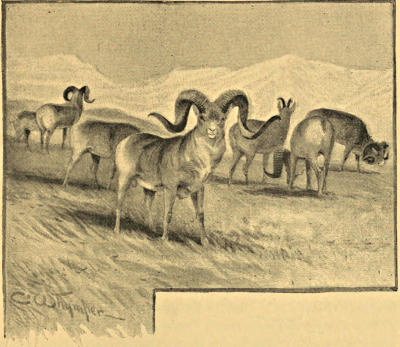
Ovis Poli
CHAPTER XII THE OVIS POLI OF THE PAMIR
By St. George Littledale
The great Pamir, or ‘roof of the world,’ forms the nucleus of
the whole Central Asiatic highland system, and consists of a
vast plateau formation some 30,000 square miles in extent,
with a mean elevation of at least 15,000 ft.
This, shortly, is what modern geographers have to say of the
home of Ovis Poli:
The plain is called Pamier, and you ride across it for twelve
days together—finding nothing but a desert without habitations or
any green thing, so that travellers are obliged to carry with them
whatever they have need of; North-east, you travel forty days over
mountains and wilderness, and you find no green thing. The
people are savage idolaters, clothing themselves in the skins of
beasts; they are in truth an evil race. There are numbers of wild
beasts—among others wild sheep of great size, whose horns are a
good six palms in length. From these horns shepherds make great
bowls to eat from, and they use the horns also to make folds for
their cattle at night.
So Marco Polo wrote of the Pamir six hundred years ago,
and six centuries earlier still some Chinese pilgrims, in describing
it, said that ‘it was midway between heaven and
earth: the snowdrifts never cease winter or summer: the
whole tract is but a dreary waste without a trace of human
kind.’
These descriptions are nearly as true to-day as they were
when they were first written, and this Pamir is the home of
the grandest of all the sheep tribe, the great Ovis Poli.
Until very recently the Pamir was considered one of the
most inaccessible places in Asia; but the Transcaspian Railway,
opened in May, 1888, from the Caspian to Samarkand, has completely
altered this state of affairs, though the Russian Government
looks with disfavour on English travellers wishing to use
the line so cheaply and expeditiously constructed for purely
military and strategical purposes.
Had it not been for the untiring efforts of Sir Robert
Morier, our Ambassador at St. Petersburg, continued for
several months, I should never have allayed the natural
suspicions of the Russian officials in the Asiatic and War
Department, and obtained the necessary permission to travel
by that route. I entirely owe the success of our expedition to
his efforts, and I can never sufficiently thank him for the
trouble taken.
But had I known as much about Russian Central Asia
before as I do now, I should not have waited for the railway,
but have crossed the steppes to Khokand, and thence south
to the Pamir, years ago. There are three routes by which it is
possible to reach the Pamir: the first from Ladak over the
Kara Korum to Shahdula, and then west, either from Yarkand
or from a point before you reach that city. For this route a
passport would be necessary from the Chinese Government,
which, though much easier to obtain now than it was formerly,
is still by no means easy to get, nor, having got it, is there
any certainty that there would not be obstacles thrown in
the path of anyone wishing to visit the Pamir from the Chinese
side.
The second is the Gilgit, Yassim, Chitral, and Badakshan
route, but the political difficulties at present put this out of the
question.
The third is by the Transcaspian Railway.
I have made two visits to the Pamir, the first in 1888, the
second in 1890, and Mrs. Littledale accompanied me upon
both occasions. In 1888 I did not know anything about the
country or the chances of sport, beyond the mere fact that the
Pamir was the habitat of the Poli sheep; but as to which particular
district I ought to visit, or what special outfit I ought to
take with me, I could obtain no information either in England
or Russia. However, I had the good fortune to meet the
Rev. Dr. H. Lansdell, who gave me valuable advice as to the
route to Khokand.
From the Russian officials we received the greatest civility
on all sides; whatever antagonism there may be between the
two countries politically, it begins and ends with politics; for
socially at the present day there is no nation more popular in
Russia than the English, nor do I know any country wherein a
man, furnished with proper letters of introduction, will be made
to feel more at home than in Russia.
Saturday, August 5, 1888, found Mrs. Littledale and myself
camped in a valley, flat as a billiard-table, about two miles
wide, which was one vast river-bed of soft shingle, cut up into
countless channels, which varied day by day, almost minute by
minute, one or two hours of sunshine bringing down a flood
like a mill race, which cut new channels and left old ones dry,
making that which was a difficult ford in the morning almost
dry by night, and moving the main stream maybe half a mile
away.
The place was an idyll of desolation; not a shrub, nor a
bird, nor a living soul in sight, while the few blades of grass,
here and there apparent among the débris fallen from the
cliffs above, had a half-hearted air, as if they knew that they
were out of place. The mountains on either side were forbidding
to a degree. Down their rugged sides dashed torrents
from the glaciers above. The head of the valley was blocked
by some grand snowpeaks, which reared their proud summits
to a height of 20,000 ft. and more. There they stood (and
stand) unnamed, unmeasured, and unknown, waiting for some
one to conquer their virgin snows.
It had been no easy task to persuade our Kara Kirghiz
hunters to come to this place at all. They asked why I wanted
to go? They said that there was no grass there, that the horses
would die of starvation; and did I think that the ‘Gulcha’ (the
Kirghiz name for Poli rams) would stay in a place where there
was nothing to eat! For generations their fathers had been
hunters, and did I, a stranger, know better than they?
However, I pointed out to them that we had everywhere
found skulls of fine old rams from ten to fifteen years old, and
yet we had hitherto seen no ram over five years old in the
flesh. How did they account for that? In reply they said that
no Kirghiz had ever seen one of the big ones alive. ‘Then,’
said I, ‘come with me and I will try to show them to you,’
for I felt perfectly certain that the Poli were not different in
their habits from the Ammon and the Bighorn, and that it
was only a question of time before we found the old rams in
some secluded spot, away from the females; and the event
showed that I was right.
We left camp one morning about 4.30 a.m., and rode up
the main valley for an hour or so. This brought us to the
mouth of a side valley, up which we turned, keeping to the
east side of it, so as to be in shadow. The elder Kirghiz,
Dewanna by name, soon detected something about two miles
away on some high undulating ground across the valley.
Dewanna was using binoculars, and though I tried to use my
telescope, my fingers were so numbed with cold that it was
quite impossible to hold it steady. After some little scrutiny
we all decided that the beasts were arkar—i.e. female Poli—and
continued on our course for about another mile, when some
extremely likely-looking ground made us pause again to take a
good look ahead. By this time some little warmth had come
back into my fingers, and I was able to use my Ross’s telescope
again. After carefully spying over the ground and finding
nothing, I turned the glass on to our old friends the arkar.
The moment the glass was still, one look was sufficient. Down
went the telescope, and I crept forward dragging my pony out
of sight, whilst the Kirghiz, divining that I had seen something,
promptly followed my example. And what a sight that glass
revealed! Twenty-six old Poli rams in a band, and the smallest
of them larger than anything I had yet seen! Lucky for us
that we had kept under the shadow of the rocks, as but for
that we had been in full view of the rams for a quarter of an
hour, in spite of which they were still quietly feeding, unconscious
of the deadly peril to which they were exposed.
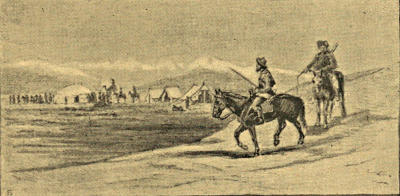
Our camp
Men who are not sportsmen can hardly realise what my
feelings were when I discovered that at last I had in front of
me so many splendid specimens of an animal which for years
had been the dream of every British sportsman in the East.
Years ago, when in Kashmir, my wife and I had discussed
every possible and impossible means of getting at the noble
beast, but the more we talked with those most likely to know, the
more we were convinced of the hopelessness of any attempt in
the then state of affairs, and we had to content ourselves with
the thought that when in the Gilgit country we had been
within sixty or seventy miles as the crow flies from the inaccessible
Pamir.
I may remark here, in passing, that to the Russians
Karelin and Severtzoff is due the honour of having brought to
Europe the first entire specimens of Poli. I believe the members
of the Yarkand Expedition can claim ‘first blood’ amongst
Englishmen.
As I looked at those old rams, some browsing, some lying
down, my thoughts wandered back a dozen years to when on
the slopes of that stupendous Nanga Parbat in Astor on a
misty morning in May, three ibex (the smallest 38 ins.)
bit the dust. Again my imagination jumped forward to an
autumn in the ‘Frosty Caucasus’ when three right royal red
deer stags fell in almost as many seconds. On occasions
like these one’s thoughts are always rose-coloured. It is only
the red-letter days which come forward. Pushed into the
background are the long trying stalks, when perhaps for an hour
you have stood up to your knees in an icy stream, not daring
to move, for movement meant instant detection: forgotten, too,
is that last critical moment when, as your head rose higher and
higher above the rock which had been your objective point for
hours, your hopes sank lower and lower until the hideous
truth became plain to you that the head which you had almost
counted as your own had gone never to gladden your eyes
again; or it may be that there was even worse luck to forget,
when wind, or light, or a tired man’s laboured breathing had to
account for a .500 Express bullet driven by six drachms of powder
just over a big beast’s back!
The rams we had sighted were on the other side of the
valley, the bottom of which was about a mile and a half wide,
quite flat and without any cover. To get at them we must
either retrace our steps for about two miles, when we could
cross unseen, or go forward about a mile. The Kirghiz were
both in favour of going forward, whilst I wished to go back,
and it was very much against my will that I let them have
their own way. The rams were on the lee side of the hill and
near the top, which is always a most difficult position; in
fact, if the game is within one hundred or one hundred and
fifty yards of the top, and the hill is pyramidical in shape
(which this hill was not), I think ‘it passes the wit of man’ to
approach them, for from whichever side you try you will find
them either with the true wind or the shifting eddy to leeward
of you. Try one side or the other, it is a position of nearly
absolute safety for the rams.
By keeping behind the moraine of an old glacier a shoulder
of the hill at length shut our quarry out of view, and we were
able to cross the valley. In the middle of this there was a
rapid stream across which the younger Kirghiz (having
stripped) carried Dewanna, coming back afterwards for me.
Unluckily, when nearly over, my carrier slipped and all but
came down, wetting me to the knees in a stream cold as only
ice water fresh from a glacier can be. After a stiff climb of
about an hour, we reached the top of a small ridge from which
we expected to view the rams; but though we ‘spied’ every
yard carefully, we could see nothing of them. All the while
I knew that we were stalking on wrong principles, and when
at last, after a most careful climb, we found that we had run
into an eddy of wind, and that the sheep had vanished, it
caused me no surprise.
For several hours after this we walked on slowly, spying
every yard as we went, for tracking on this stony ground was
hopeless. On reaching a spot where the hill broke off sharply,
we lay down and examined the ground, which was very much
broken up into little valleys filled with great boulders, the lee
side of any one of which was a likely place for the rams.
When the Kirghiz first joined us I told the interpreter to
explain to them the use of a field-glass. Then they all laughed
at the idea of finding game with such things; now they were
always wanting to borrow them.
For about half an hour we lay spying both with binoculars
and telescope, and Dewanna had just risen to his feet saying
that there was nothing, when I saw by the younger Kirghiz’s
manner that he had seen something. I was only just in time
to drag Dewanna down, when over a brow below us came a
fine Poli, followed by two others, all beasts with good heads.
After a few minutes, the three lay close down together near the
bottom of a small ravine, and we had a good look at them
through a telescope. They were magnificent fellows, possibly
out of the big lot which we had seen in the morning.
Of course the Kirghiz wanted to ‘drive’ the rams, and of
course I promptly vetoed the proposition. Why is it, I wonder,
that all over the world the natives are so desperately keen about
driving? I could easily account for it if the general knowledge
of stalking were as limited as that of the Kirghiz, who spoilt
several of my earlier stalks by showing themselves behind me
whilst I was ‘worming’ my way up to game, and who seemed
quite ignorant of the fatal results of showing oneself upon a skyline.
But it is not only the Kirghiz, for in the Caucasus two
men whom I employed, perfect masters of the stalker’s art—quite
as good as the best of the Kashmir Shikaris (who I consider are
at the top of the tree)—were always tempting me to ‘drive.’ I
am glad to say that the only time I was weak enough to yield
to their solicitations the drive ended in a fiasco. Taking the
younger Kirghiz with me to carry the rifle, and leaving Dewanna
to watch and to signal to us the direction of any movement on
the part of the rams, I took the precaution to pick up a good
supply of small stones to pelt my man with whenever I found
him going too fast ahead of me. The fellow had most wonderfully
quick sight, so I used to send him on in front, and on
previous occasions his excitement had so far carried him away
that I had to be perpetually running after him to stop him;
and as at that altitude (upwards of 16,000 ft. above sea
level) I found that I could not shoot unless I had been walking
with the greatest circumspection, it was necessary to recall him
now and again by this simple and easy system of telegraphy.
Keeping well out of sight along the ridge, we found a little
watercourse down which we could descend without being seen,
and having carefully searched every inch of ground to make
sure that there was no other Poli in our path who might spoil
our stalk, we crept down to within three hundred yards of where
we had last seen our three rams. Here the Kirghiz took off
his sandals, while I took the Henry double Express out of its
cover, made sure that all was ready, and then handed it back
to him, as every extra pound to carry adds to the difficulty of
keeping your breath.
I was shod in tennis shoes, with red rubber soles three-quarters
of an inch thick, to my mind the very perfection of
foot-gear for stalking, as they are perfectly noiseless, will outwear
two ordinary leather soles among the rocks, and are only
dangerous on snow or ice.
Softly as mice we crept up the slope of a little ridge on the
further side of which we had last seen the Poli. Our man on
the hill made no sign, so that all was right so far. A little
short of the top, I took the rifle and crept up the last few yards
alone. Peeping over the top, I could just see the tip of a horn
behind a rock about one hundred yards below. Taking off my
cap to place my rifle upon it, for if fired resting on a rock
without a pad the jar would send the bullet wide, I cocked
the weapon and lay there waiting.
The wind was right and the moment they moved they
were at my mercy. Whilst waiting I sent the Kirghiz about
ten yards to my right to see if he could make out in which
position the big one was lying, as from my point of view they
were half hidden, and it was difficult to say for certain which
was the big head.
Suddenly up they jumped and stood for one moment
looking up the hill. The big one was end on, facing me, but I
had had a good rest, my heart had ceased to beat wildly and
my hand was steady, so squeezing the trigger gradually and
firmly, the report of the rifle was followed by the loud smack
which tells an old hand all he wants to know. Not wasting a
look on the big one, I shifted the sights on to one of the others
and fired just as he bounded off. Another smack told that
that bullet, too, had found its billet, but the beast made off with
its companions. On dashing frantically down the hill and up
the other side of a small ravine, I saw one Poli standing and
looking about him two hundred and fifty yards off. Lying down
I tried to take a careful aim, but I found the rifle was pointing
ten feet over his back one second and the next twenty feet below
him. This was no good, so I lay quiet in the hope that he
might be so unsophisticated as to stay there until my poor
panting frame recovered its steadiness; but alas! in a few
seconds he was off.
However, I was satisfied that he was unhurt, and the
wounded one probably lay between us and him, so that I at
once took up the search for the beast, the man on the hill
coming in now very handily, directing us by a prearranged code
of signals.
Presently this man (Dewanna) got very excited and kept
signalling ‘below, below.’ As we were then at the bottom of
the valley we were at a loss to know how to go any lower,
when out from behind a large boulder came the Poli, very
sick indeed; but to make sure I gave him another barrel and
rushed up to gloat over my latest prize, measuring 59 ins.
along the left and 58½ ins. along the right horn.
I then started up hill back to where the first one lay. On
getting up to him I was rather disappointed, as I had thought
that he was bigger than his comrade, and I pulled out the
tape and began to measure: ‘sixty, sixty-one, two, two and a half’—thank
goodness, at last I had got a trophy that would hold
its own in any company, and one that will still be a comfort, a
joy, and a thing of beauty when old Time has so stiffened my
joints as to make this most glorious and exciting of all sports
only a memory for me.[26]
Having skinned our beasts and packed their heads upon
one pony, the younger Kirghiz, careless of the possibility of a
fall and consequent impalement, twisted himself somehow in
among the twisted horns on the pony’s back, and so, he riding
and we on foot, we turned towards camp, warned by the waning
glories of the sky, the dark shadows stealthily creeping across
the snows, and the little rills frozen into silence, that the
Night King was coming, and that it was well to hurry. As we
reached camp our interpreter met us, and I think everyone
echoed his ‘Vraiment, c’est assez grand!’ as my first big head
was scrutinised.
In 1888 we had wandered about until we found the valley in
which the above took place, and then having discovered a good
hunting ground sat down to work, with the satisfactory result of
fifteen rams bagged, all but four being over 50 ins. and several
the right side of 60 ins.
In 1890 we decided to try the Southern Pamir, as all the
natives agreed that the further south you went the bigger the
heads became. But a visit to the Southern Pamir meant much
more elaborate preparation than heretofore, and our modest
little caravan of twelve horses all told in 1888 swelled to the
considerable number of forty in 1890; for it was not only
necessary to take food for ourselves and our men, but also for
the animals, and for each horse carrying a load of baggage we
had to have an extra horse carrying barley to feed him. Besides
this we took four or five horseloads of firewood, for there are
long stretches of the Pamir that are absolutely devoid of vegetation
of any kind—places where even the travellers ‘stand by’
for fuel, ‘Boortsa eurotia,’ is not to be found. Without boortsa
life on the high timberless plateaux of Central Asia is indeed
hard, for that insignificant-looking plant affords splendid fuel.
Green or dry it makes a blazing fire, and though it wants constant
attention and soon burns out, where there is no dry dung
it is a perfect god-send.
We had made up our minds not to return by Turkestan if
we could get across the Hindu Kush, and down into India;
but as our chance of getting through was very uncertain, we
were obliged to secure our retreat by establishing depôts along
the return route, of barley, flour, firewood, &c., all of which
entailed extra transport.
We found our tent, though it was lined and had a double
fly, so cold and so troublesome to keep upright during the
furious gales which even in summer sweep over the Pamir, that
on our second expedition we took with us a couple of Kirghiz
yourts in addition to this tent, and although the yourts are not
fastened to the ground in any way, yet, owing to their being
dome-shaped, they never showed the slightest tendency to blow
over. Once inside our yourt, a stormy evening had no fears for
us, nor had we ever to rush out in scanty garments on a bitter
night to refasten some yielding tent-peg.
On the Abchur Pamir there were immense quantities of
Poli horns, most of them of very large size, one head which I
measured being 69 ins., though even this was beaten by one
which was shown to me at Simla by Sir Frederick Roberts,
who kindly allowed me to photograph it. The head was given
to Sir Frederick Roberts by the Maharajah of Kashmir, and is
as far as I know the biggest head on record—length, 75 ins.;
tip to tip, 54½ ins.; circumference round the base, 16 ins.
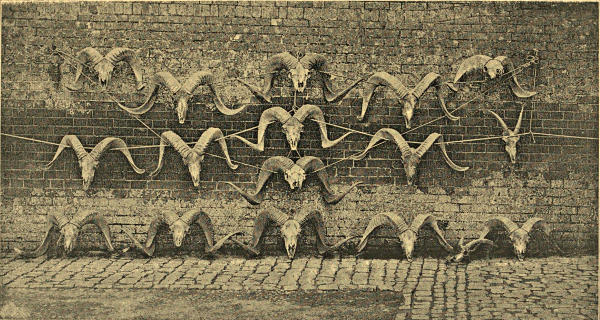
MR. ST. GEORGE LITTLEDALE’S BAG OF OVIS POLI, 1888
Let me recall one day out of my 1890 expedition, as another
sample of Poli shooting I have done. We had camped at the
end of June by Victoria Lake, which was still three parts frozen,
and after a short and fruitless hunt had recrossed to the Alichur
Pamir. The weather was changeable and the wind shifty, but
our sport had been fair. One stormy evening I spied three
rams a long way off. Before we reached them, a flurry of snow
hid them from us, and when the snow cleared we could not see
them. We decided that they must have gone over the hill for
shelter, but on looking for them they unfortunately got our
wind, and bolting out from some rocks dashed across an open
piece of ground. I put the 200 yards sight up and fired at
the centre one, which was a monster, towering above its two
companions, and altogether by far the biggest sheep I had
ever seen—its horns, I should fancy, certainly measuring something
over 70 ins. I saw the dust fly beyond just over its
back, and had no time for a second shot before the sheep disappeared
in a dip of the ground. I felt low at missing such a
grand fellow, but it was a running shot at quite two hundred
yards, and a hit would have been more or less of a fluke.
As they were a very long time coming up the other side of
the ravine, we went to see what had kept them, and found that
the two smaller sheep were waiting for the big fellow, who was
lagging wearily behind. As soon as they had got over the ridge
we followed them and found their track, which was very bloody.
My bullet, instead of going over my beast, must have gone
through him without expanding, and it was not long before we
found him lying down on a snow bank which was streaked with
his blood. Here I could have stalked and finished him, but for
the excitement of one of the Kirghiz, who showed himself and
made the beast get up again. After this he kept lying down at
intervals, travelling a shorter distance and resting longer each
time.
The vitality of Ovis Poli is something extraordinary. Here
was a beast shot through the lungs, as was proved by the frothy
blood which poured from his wounds, and yet he went eight
hundred or a thousand feet up a snow slope. Having allowed
him to get out of sight we followed him, but just as we reached
the top of the slope a heavy storm coming on obliterated everything
in six inches of fresh snow. As soon as the storm was over,
numbed and cold though I was, I tried to follow by kicking the
new snow away with my feet till I found blood, but eventually I
lost the ram and had to leave him. It was a terrible disappointment,
for I fear I shall never look upon his like again. My attention
had now to be turned to my Kirghiz companion, who had
been taken violently sick and lay there unable to move. I had no
brandy to give him, and not even a coat to wrap him up in, for
we had left our sheepskins at the bottom of the hill. However,
I rubbed his hands vigorously, and after a time he recovered
sufficiently to descend leaning upon my shoulder. I believe it
was nothing but the height which affected him, and, extraordinary
as it may seem, two other Kirghiz who regularly spent
four or five months in every year on the great Alai, as their forefathers
had done before them, had been completely knocked up a
few weeks before this by the two or three thousand feet additional
elevation at which they found themselves with me, and had
been compelled to leave the Pamir. They are a careless happy-go-lucky
race, these Kirghiz, easy to offend as children, but as
ready to ‘make it up,’ and quite harmless if well handled. On
life they set but little store; but the words of one old chief as
he handled my rifle are still in my ears. ‘Ah,’ he said, with a
sigh, ‘and even the man who made that gun must die.’
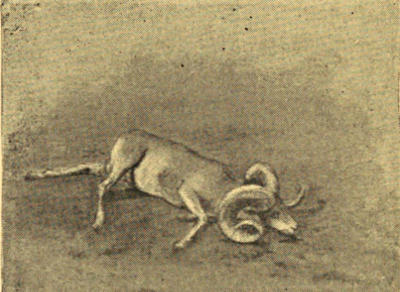
CHAPTER XIII CAMPS, TRANSPORT, ETC.
By Clive Phillipps-Wolley
It is not possible to devise a camp outfit which would suffice
in all climates and under every condition of travel, and for that
reason a few notes on the special outfit necessary for each
country have been given where requisite.
But, although different climates require different camp
equipment, there are many things common to camp life all
over the globe, and a brief sketch of the needs and shifts of
such a life in temperate, tropical and arctic countries may at
any rate serve as a basis upon which to found a plan of campaign
in any country.
It must be understood from the outset that these notes are
for the hunter and not for the scientific explorer, whose needs
are excellently cared for in the Royal Geographical Society’s
‘Hints to Travellers,’ and that the beau-ideal hunter is he who
can accomplish most with the least assistance from anyone else.
The most perfect outfit is that which, while it contains all things
really necessary to success, includes no superfluities, and is in
the highest degree portable.
The cost of hiring help in different countries has of course
an immense effect upon the nature of the camp equipment
employed, and what would be but a beggarly outfit in India
where you pay your beaters 3d. per diem would be extravagantly
luxurious in British Columbia where you pay your Indians
1½ dollar a day.
But to succeed all the world over in big game shooting, a
man should be able not only to find his own game and kill it
when found, but to skin it, pack it, pack his own food on his
shoulders or his horse’s as the circumstances require, cook
his dinner, choose and pitch his camp; in fact, he should be
able to do everything which he wants done for himself without
aid from anyone else.
It by no means follows that because a man can do these
things he will be obliged to do them, but there are times in
every hunter’s life at which the almighty dollar fails him, and
then it is that the beauty of being able to help himself becomes
apparent. It is not a bad plan just for once (say for a single
day) to do entirely without extraneous aid. At the end of the
day you will probably find that a good many things, from tying
a bowline knot to lighting a camp fire, look a good deal simpler
than they are.
We will consider then, first, what are the essentials of camp
life and camp outfit in countries where the temperature ranges
during the shooting season from 80° above to say 10° below
zero, a fair sample of which may be found on the mainland of
British Columbia.
One of the first maxims I would lay down is, bring with
you all the most important items of your outfit, rifles, ammunition,
tents, &c., even though the cost of transport be heavy;
but, on the other hand, do not load yourself with less important
items, such as rugs, blankets, cooking utensils, saddles and
smaller things. You can get most of the ordinary necessaries
of life in every country you enter, and in nine cases out of ten
the native manages to evolve the article best suited to the daily
needs of the country he lives in and the life he leads, e.g. the
so-called Mexican saddle or the Indian moccasin. There is
another thing worth considering, and that is that if you must
spend money somewhere upon your outfit, it is as well to spend
it where the spending of it may earn you the goodwill and
assistance of the people amongst whom you are going to
hunt.
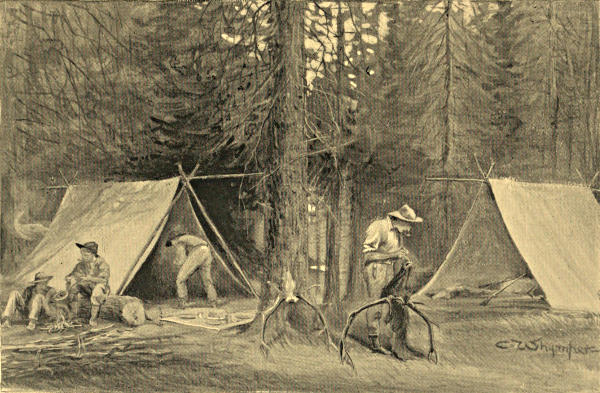
THE CAMP
The first matter to be considered upon reaching your starting
point, the point I mean at which the locomotive leaves
you, is the question of transport, a very serious matter to the
man who has been ‘dumped’ down for the first time in his
life at a frontier station with a huge pile of belongings and not
even a friendly porter to carry them under shelter for him.
In North America (indeed, in most countries) the commonest
method of transporting freight from one point to another
in regions where the railway does not run is by pack animals,
for which reason we will treat of ‘packing’ with pack ponies
first.
In all the countries known to the writer the cheapest way
is to buy your ponies, taking your chances of selling them when
you don’t require them any longer. Hiring your animals is an
expensive plan, especially in America, where the hire of a pack
pony is at least one dollar per diem, whereas his cost would
not exceed thirty dollars. Thus even if you gave your ponies
away (and you cannot always do much better) at the end of a
two months’ trip, you would have saved thirty dollars by purchasing
outright. In buying your pack animals don’t leave
the purchase of them until the last moment. If you do, there
is no one in the world who better understands the art of extracting
the highest price from a man who must buy than the
‘untutored savage.’
Choose animals of short cobby build rather than those
which are more ‘leggy,’ and in addition to all the ordinary
precautions observed in dealing with horse-flesh, take care
to examine your purchases to see whether they have ever
had sore backs. If you find scars, however well the wound
has healed, don’t buy the pony, as backs which have once
been sore are extremely apt to break out again at the first
opportunity.
You may estimate the number of ponies wanted for your
expedition by the weight which you require them to carry,
allowing from 150 to 200 lbs. to each pony, and although professional
packers will sometimes put as much as 400 lbs. upon
a beast on a road, 200 lbs. is a full load for such a creature as
the ordinary cayuse on such trails as those which generally
lead to game countries.
Having bought your ponies and hired a man as camp
cook who can pack and look after the beasts, take precautions
against losing your animals. Of course your packer ought to
do this, but he won’t. Buy picket pegs and ropes for your
saddle-horses, and good leather hobbles for the pack animals,
as well as a bell for the leader of the pack train, and see,
personally, that for the first few nights, at any rate, every horse
is hobbled or picketed, including even your hunter’s horse, in
spite of his protestations that ‘that cayuse won’t stray’; and see,
too, that one of the horses has the bell on at night. During
the day you can take the bell off or silence it by shoving a fir
cone into it, or some such simple device, if you hope to see
game along the trail; but at night, insist upon the bell and
the hobbles being worn, and in this way even if your beasts
have only poor feed they won’t stray far, whilst if they do
the bell will help you to find them. As I pen these lines I
am as sure that some one of my readers will curse his luck for
having neglected this advice as I am that death and the taxman
will arrive in due season. In passing, I may remark that
the man who takes the trouble to silence his pack train’s bell
and his packers’ mouths, whilst he rides half a mile ahead of
his train when on the march, will secure many a shot which
would otherwise never have fallen to his share.
In picketing your horses use a bowline knot, see that the
loop made will run easily round the tree to which each horse
is tied if you are not using a proper picket, and in any case
see that there are no bushes or stumps in his way round which
he can get tied up in the night.
Next to your ponies your pack-saddles are the most important
part of your equipment, and though you can no doubt
pack either with ordinary pack-saddles, or with parfleches
(mere leathern envelopes depending from either side of the
pony), still the best of all the many contrivances for packing
is, to my mind, the aparejo, an arrangement of Mexican origin
obtainable for about twenty-five dollars all over America.
With good aparejos, sweat-pads and saddle-blankets of
stout material, and a man who knows how to put them all on,
there need be no sore backs, and very few halts to rearrange
packs during the longest trip in the roughest country.
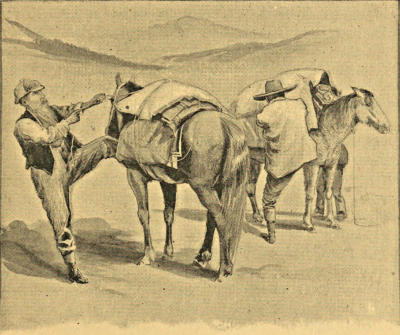
Cinch him up
Be careful, however, to see that your aparejo is long
enough for your beast, otherwise you will get him so chafed
under the tail as to be unable to work. See, too, that your
horses get a rough rub down before being saddled, and that
your blankets are ample and well put on. Just as there are
many kinds of pack-saddles, so are there many ways of tying
on your packs; but one good way is sufficient, and that known
as the diamond hitch has been adopted almost unanimously
as the best by the men who live by packing. Here I might
give directions for the tying of the diamond hitch, but the
object of this book is to supply information useful to the
hunter, and written instructions in the tying of the diamond
hitch would not fall into that category. A man may learn to
pack by practical experience and with pack, pony and an expert
before him, but I do not believe anyone could learn from
printed directions. Should anyone care to try, an excellent
series of articles upon the subject, by a thoroughly practical
man signing himself ‘Yo,’ may be found in ‘Forest and
Stream’ for June 2, 1887, and following numbers. Let your
camp man be a practical packer, would be my first advice to
anyone meditating a shooting expedition in America. To anyone
who had ever made such an expedition such advice would
be unnecessary. There should be no difficulty in finding a
man who can both pack and (in a rough way) cook. I was
going to say that any fool could cook sufficiently well for a
hunter’s camp, but the recollection of beans fried without
boiling, a vivid memory of some of the abuses of baking
powder, and a certain black-currant pudding boiled without
basin or pudding-cloths, make me pause.
In addition to the aparejos, sweat-pads, and saddle-blankets
before mentioned, all of which go under your packs, you
must provide yourself with what are known as manteaux, i.e.
squares of stout waterproofed canvas which are thrown over
the packs to protect them not only from rain, but also from
pointed boughs and such like which would otherwise tear the
packs in passing through a timbered country. With these,
cinches, sling ropes, halter ropes, and a good supply of spare
rope of the kinds known respectively as half-and quarter-inch,
the sportsman should be able to transport all he requires
through almost any country.
As to the packs themselves, I would recommend that as far
as possible everything should be put up in stout canvas bags
and labelled. This plan saves infinite trouble in the long run.
Some things of course must be carried in tins, and among
these should be your matches, which will thus be protected
from damp, and will have no chance of making dinner a horror,
as the ordinary sulphur matches loose amongst provisions have
a habit of doing. Even for matches a stout well-corked bottle
is better than the best tin.
Packs are generally arranged as two side packs, and one top
pack, and square side packs (in wooden boxes) with blankets,
tents, and such like bundles for top pack seem most convenient.
Round side packs are apt to shift.
Above all things see that your side packs are about equal
in weight and hang about level. The contents of the packs
must depend to a great extent upon the tastes and means of
the hunter, but for simple men travelling in a difficult country
the list of necessaries given below should suffice for two
sportsmen, two gillies and a cook during an expedition of two
months’ duration.
I have allowed a gillie or hunter to each sportsman, as well
as a camp cook between them, although my own experience
has been that your greatest happiness and best success begin
when you have learned to hunt alone. That two make more
noise than one; that your own eyes (not another’s) are the
best eyes for you to use; and that a white man with practice
is better than any red skin, are articles of faith which will be
approved by experience.
However, of this more in another place. The accompanying
list of stores, &c., has been based upon the lists of things
used by the writer in former expeditions, in none of which
(at any rate since 1883) has there been any running short of
supplies.
In this list I have only allowed enough bacon for men who
know how to hunt in a country where game is to be had for
the hunting. Of course if game is scarce, more supplies might
be needed, whilst equally of course, if the country is very difficult
and the temptation sufficient, keen men should be able
to get along with half a pound of flour and four rashers of
bacon per diem, and even this with tea, blankets, rifles, cartridges,
&c., will be found quite enough to carry in a mountain
country with no one to help you.
I have suggested cocoa as an alternative for tea, for I find
that the latter, as it is generally brewed in camp, is intensely
indigestible, and is apt to keep even a tired man awake at night.
Cocoa, on the other hand, is refreshing, it is almost as effectual
a ‘pick-me-up’ as a whisky and soda, and does very well in
its place. For men who do not stop to lunch, cakes of chocolate
or raisins are recommended, as being very portable and
nutritious.
My second list of necessaries consists of kitchen gear, and
although it may easily be reduced to a ‘billy,’ a frying-pan,
and your fingers if needs must, it is as it stands about as small
as is compatible with comfort. Cups, plates, &c., should all
be made of what is known as ‘granite iron,’ as this material is
very strong, will not crush like tin, and retains heat a long time,
an important point when your meals are taken in the open air
of an October evening in the mountains.
Provisions and other requisites for five men for two months
| | lbs. |
| Flour | 6 sacks = | 300 |
| Yeast-powder | 18 tins | |
| Bacon | = | 100 |
| Dried apples | = | 50 |
| Sugar | = | 50 |
| Beans | = | 50 |
| Coffee | = | 12 |
| Tea | = | 8 |
| (or Cocoa | = | 12) |
| Pepper | = | 1 |
| Salt | = | 30 |
| Onions | = | 60 |
| Worcester sauce |
| Matches |
| Candles (three dozen composite) |
| Soap |
| Tobacco |
| A small can of oil for rifles |
| Spare rope |
| Two dozen horse-shoes, nails, and a shoeing hammer |
| A few yards of linen for dish cloths |
| Ten pounds of powdered alum for curing skins |
| Two spare deer-skins for patching moccasins; some waxed
thread, which must serve your turn until you can get some
sinews, to sew your moccasins with |
| A cobbler’s awl and needle |
| File |
| A housewife containing buttons, thread, needles, darning needle, wool, &c. |
| A little ingenuity and abundance of good temper |
Kitchen gear
- One nine-inch iron pot with a ‘nest’ of three smaller pots
inside; these should all be ‘tinned’ or enamelled inside
- Two tin milk-pans for kneading dough in
- Two coffee-cans or ‘billies’
- Two frying-pans to make dampers and fry bacon. Have these
made with folding handles
- Five soup-plates, five tea-cups (both plates and cups to be made
of enamelled iron)
- Five knives, five forks, five soup-spoons, five tea-spoons, one
meat-knife, a big cooking fork, one small meat saw
- Two axes and two spare axe-handles
Almost of more importance than either food or kitchen
gear is the sportsman’s ‘sleeping outfit,’ if I may use the jargon
of the camp.
The common A tent is the one most used in America, but
probably there is nothing better than that known as Whymper’s
Alpine tent, made of Willesden canvas, as recommended in
‘Hints to Travellers.’ For extremely rough work I have used
a little ‘tente d’abri’ into which we had to crawl on our hands
and knees, but which held two men, kept them dry, and weighed
with poles, pegs, ropes, and a bag to pack it in, only nineteen
pounds.
I am inclined to think that even this weight might be lessened
if required. But whatever the tent you use, you should in all
cases have a floor to fit it, rather larger than the ground covered
by the tent, and made of some stout waterproof material. This
floor may be made to attach to the sides of the tent if so
desired.
A sleeping bag or blankets must be taken for each person,
and if blankets are used, three pairs of four-point Hudson Bay
blankets if properly arranged will suffice to keep a man fairly
warm, even with the thermometer 10° below zero. But they
must be properly arranged, and to do this one pair of blankets
should be sewn up at the bottom, along the whole of one side,
and halfway up the other side, the other half to be fitted with tapes
or buttons. This makes a kind of bag which effectually prevents
a man from throwing off his clothes in his sleep, and keeps
out those bitter little draughts which otherwise so annoyingly
creep in and dispel the soundest slumbers. An inflatable air-cushion
is light to pack, and handy either as a pillow or as a
seat in camp. The air-cushion makes a better seat than pillow,
for which the writer always uses a canvas bag packed with
spare clothes, flannels, &c., carried inside the roll of blankets.
The sleeping bag made of blankets, with an outside covering
of tarpaulin to lace up over the blankets, and with a hood or
pillow-case of tarpaulin attached to hold pillow or canvas clothes-bag,
is the most convenient outfit of the kind for America.
Before leaving the subject of beds, a subject of the utmost
moment to the hunter, let me point out that one of the
most comfortable and simplest of camp bedsteads may be made
thus. Let your manteau measure 6 ft. 6 ins. by 4 ft., and let it
be made of the strongest waterproof canvas, two pieces of equal
size being sewn together so as to make an endless sack. In
this form your manteau will do duty as a cover for the packs
by day, and at night you can cut two thin poles about 7 ft. 6 ins.
long, pass them lengthwise through this endless sack, take two
logs about a foot in diameter and 5 ft. or more in length,
and cut notches in them 4 ft. apart; then set one at your
feet and one at your head, stretch out your manteau and rest
the ends of the poles in the notches, and in ten minutes you
will have made yourself a spring mattress above the reach of
the damp. If, however, you are content with a brush bed—and
the sweet aromatic balsam boughs should be good enough for
any man—cut only the smaller boughs and arrange them in rows,
the points of each row overlapping and covering the thick and
hard butts of the row above. Hemlock makes the best of all
bedding, and keeps out damp better than any other brush. It
is a good plan before finally arranging your bed to lie down on
it, find out where your hip-bone comes, and dig out a hollow
for it to fit into. Anyone who has slept upon a hard and
absolutely level surface will understand why this is recommended.
Finally, as to clothing, I have ventured to recommend a list
of simple necessaries, more as a hint to those preparing for an
expedition than as a rule for their guidance. In his choice of
clothes, every man will to a certain extent follow his own fancy,
but there are some few things essential to health, and others
essential to success. For still hunting in timber I consider
moccasins, or at any rate tennis shoes, essential. For a tender-footed
man tennis shoes with thick red india-rubber soles are
the very best of foot-gear. Except that you cannot cling
with them as you can with the moccasin, they are nearly
as good as the latter, and certainly save your feet as you
come down hill, among sharp loose stones, in the dark;
but they are hard to repair, and impossible to replace in the
woods. Flannel is the best thing to wear next to your skin,
and a good supply of dry flannels to put on when you come in
at night is of the utmost importance. A pair of ‘rubber shoes’
to slip on in camp is well worth carrying, so that if you are
obliged to go out in the snow or slush after you have made
yourself comfortable for the night, you need not wet your feet
again. Let your clothes be of some neutral tint; my own
especial weakness is an Indian hunting-shirt made as plainly as
possible of tanned deerskin. The colour of this is excellent;
the material is very light and tough, and when you top a ridge
to which you have painfully climbed for half an hour, the bitter
wind which meets you does not go through a buckskin shirt as
easily as it does through tweed or homespun. In wet weather—i.e.
in real drenching rain—such a shirt is not as good by any
means as tweed, as it then becomes exceedingly cold and unpleasant
to wear. A broad belt of webbing (not of leather, for
leather cuts you) to contain your cartridges may be used over
the shirt, if it has not a great brass fastening in front as most
belts have. The object of this fastening I suppose is to reflect
the sun’s rays and make a dazzling spot of light on the abdomen
of the hunter, about as useful in attracting the attention
of every living thing as anything which the ingenuity of the
gentlemen who sell ‘sporting goods’ could contrive. Metal
buttons, metal watch-chains, uncovered rifle barrels, and even
the end of your stalking glass, will reflect the sun’s rays in the
same dangerous manner, so that though you may be otherwise
unnoticed, the attention of your quarry will be drawn to what
appears to him to be a little star amongst the grass on the other
side of the ravine. Added to the dangers of their appearance
is the danger that if you wear any metal trappings about your
person, they may ring against one another terribly loud and clear
just at the moment when even the beating of your own heart
seems unwarrantably and absurdly noisy. For these reasons
avoid metal adornments; keep a loose cover
over your rifle barrels, be careful not to catch
the sun’s rays with your glass when spying, use
a watch-chain of buckskin, and don’t carry a
lot of loose change in your trousers pocket.
Attached to your belt will probably be a
knife for administering a coup de grâce, and for
skinning. If you would not lose it, adopt some
such plan for securing it as is suggested by the
accompanying woodcut. None of the ordinary
spring fastenings are proof against the rough
usage of the hills.
Knife fastening
If you wear knickerbockers, have them made
loose at the knee, so as not to hamper you in
your stride up hill, or wear them unfastened
at the knee; but though less smart in appearance,
ordinary tweed or flannel trousers, with the bottoms
tucked into a stout pair of woollen socks, are as workmanlike
as anything ever made.
Whatever you do, don’t wear canvas overalls, although you
may be strongly advised to do so. I wore a pair once, and in
a week they were so ragged that I had to borrow a petticoat
in which to return to civilisation, and, moreover, they are
not only easily torn, but they emit a strident scraping sound,
whenever a twig touches them, which can be heard very
far off.
Loose buckskin gloves sound rather luxurious wear for a
hunter, but the hardest Siwash wears them; and as your hands
have often as rough usage among the rocks as your feet, they
are necessary. Below is a list of clothes, &c., for a two months’
trip in temperate climates.
Clothing for two months
- Two tweed suits
- One buckskin shirt
- Two tweed caps
- Four flannel shirts
- Four pairs of flannel drawers
- Six pairs of woollen socks or stockings
- Moccasins: the number of these depends entirely upon the nature
of the shooting. After ibex, I have worn out a pair in a morning,
but for ordinary work a pair of good thick
moccasins should last four or five days
- Eight handkerchiefs: not white, but some dull colour which will
not attract attention from afar, if inadvertently pulled out in
sight of game
- One pair of short waterproof boots (gum boots)
- One waterproof cape, such as is made by Cording; an armless
contrivance, very light and portable, used I think by cyclists
- Three pairs of blankets, one waterproof sheet, one air-cushion
- One belt of webbing for cartridges
- One pair of loose buckskin gloves, one pair of woollen mits
- One boating sweater
Having now enumerated most of the essential items of a
camp outfit, it may be as well to sketch roughly the ordinary
routine of a day’s march with pack ponies.
In a well-ordered camp someone should be stirring just as
the stars begin to lose their brilliancy and to fade before the
coming of day. An early start is most important, as it goes a
long way towards ensuring an early camp, and that camp should
be made early whilst there is still plenty of daylight is of vital
importance to everyone with the expedition. The discomforts
of camping in the dark only require to be tried once to be
avoided for the future.
Whilst one man lights the fire and gets the breakfast ready,
let another go for the horses, and a third put the beds together
and make the packs ready. Save time whenever you can, for
unavoidable delays are all too frequent with a pack train. A
cayuse is not as other horses are. When you have sought
animals sorrowing, in the chill dawn, and found them hiding,
in a long line one behind another with their heads down,
behind a bush no bigger than a respectable cabbage, or have
watched your bell-horse roll his bell in the sand, shake himself
to see if it will ring, and then trot away contented, you will
know more about cayuses, and agree that they are the hardiest,
most sure-footed, and ‘meanest’ of all created beings. See
then that you get them together early in the day, and have the
packs on their backs and ‘all set’ within half an hour of the
time at which you finish your breakfast.
When you have the ponies packed, some one of the hunters
may ride well ahead, but the man who ‘leads out,’ i.e. guides
the pack train, should never ride far ahead. If he does, the
pack animals will at once begin to stray. The best pace to
travel at is a fairly brisk walk; anything more than this generally
disarranges the packs and necessitates halts to rearrange them,
or causes sore backs. From fifteen to twenty-five miles a day,
according to the character of the country to be ridden through,
is an excellent day’s work for pack ponies, and from two to
three miles an hour a fair pace to travel at.
Keep your temper in driving pack ponies across a side hill,
or along a steep and narrow trail. Pack ponies are as mean as—civilised
words won’t express their ‘meanness’—and when a
pony knows that he has another between himself and the whip,
and that the whip cannot reach him owing to the narrowness
of the trail, he will stop
and browse. If you press
the pony next you to get
at the offender, one of
them will go head over
heels down the slope,
and at every bump there
will be little puffs, one
white, one brown. This
means that when that pony
reaches the bottom of that
hill he may still be alive,
but there will be no more
cocoa and no more baking
powder for that expedition.
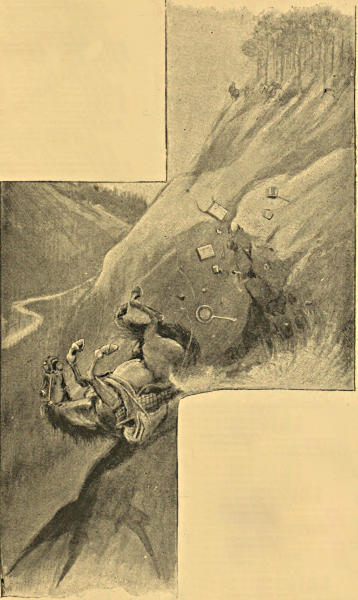
‘Good-bye to the groceries’
Some men remove packs
in the middle of the day,
and halt for lunch. This
I consider a mistake, and
a waste of time. An
early camp, say at four o’clock, is better both for horses
and men.
In choosing your camp consider first these points: water,
food, fuel, and shelter from wind and from the sight of such
game as may be in the neighbourhood. As to this last point,
it is as well not to allow fires to be lighted or wood chopped
until a careful survey of the neighbourhood has been made from
some adjacent height, especially if the camp has been pitched
in the district which you mean to hunt. Not long since my
friends and myself had the mortification of seeing the largest
band of sheep I ever saw move away while we were stalking
them, not because they detected us, but because they could
hear the ringing strokes of our men’s axes in the valley below.
A camp without feed for the horses is the worst of all camps,
and luckily occurs very rarely. If there is any likelihood of
such camps being unavoidable, it may be necessary to carry
grain for the horses, although many ‘cayuses’ will not at first
eat it, and frequently when they do eat it suffer from lampas
and other ailments consequent upon a sudden change of diet.
Lancing the bars of a horse’s mouth with a sharp penknife will
procure relief from lampas, which is probably the commonest
complaint amongst pack ponies. In camping in America,
beware of camping near burnt timber—that is to say, so near
as to be in danger from a falling tree, a constantly recurring
risk where huge trunks are burnt almost through, and high
winds are common.
Whatever you do, do not camp on old Indian camping
grounds. Indians rarely leave anything worth having in a camp,
but they do leave things worth avoiding. Again, don’t be
tempted to use an old horse-blanket to put over your feet on a
very cold night. Men will tell you that the insects which infest
animals won’t touch men. I remember one unfortunate party
which owned a horse suffering from the third plague of Egypt,
and owing to a careless use of one of that horse’s blankets the
plague passed on to the horse’s rider. The woodticks which
infest the woods in early spring are as omnivorous as the insects
before alluded to. When once these creatures have buried
their heads in your flesh they should be removed with care.
If you leave their heads in, an ugly sore may be the result.
Arrived in camp, let it be your first care to see that the
horses are watered, hobbled and turned into the best ‘feed’ in
the neighbourhood; see that the packs are secured against
rain, and that an ample supply of wood is cut for use during
the night. In dealing with Indians don’t do too much for
yourself, however competent and willing you may be. The
majority of Indians are very apt to encourage a man willing to
help himself, by allowing him to do all the work.
Give men and horses a complete rest every Sunday, and
utilise part of the day for looking through and taking stock of
your stores.
There is still another list of necessaries to be added to
those already given, but luckily it is only a very short one. As
illness may possibly visit the hunter’s camp, he must be prepared
for it, and a few simple remedies for the ills most likely to befall
him are worth providing.
Quinine for low fevers, aperient medicine of some kind
(podophyllin pills for choice), and an ounce of laudanum in
case of diarrhœa or colic, together with a few mustard plaisters,
a roll of india-rubber bandaging, and some diachylon plaister
for cuts, have always proved a sufficient medical outfit for any
party to which I have belonged.
The quinine, if employed as a preventive measure, may be
taken in three-grain doses, but in case you are too late to ward
fever off double the dose.
Of laudanum twenty drops in water, when in pain or purged,
is a fair dose.
But with average luck no big game hunter ever gets ill until
he returns to civilisation and high feeding. Then, alas! his
troubles begin.
CHAPTER XIV A FEW NOTES ON RIFLES AND AMMUNITION
By H. W. H.
Express Rifles.-These are usually made of five different
calibres—viz. .360, .400, .450, .500, and .577—and are called
‘Expresses’ on account of the high velocity imparted to comparatively
light bullets by the heavy charges of powder used
in these rifles. Many sportsmen are under the impression
that all Expresses of the same bore are practically the same—at
any rate, as far as their power, velocity, &c., are concerned—and
look upon, say, a .500 Express as a fixed quantity. No
greater mistake could be made. Take two .500 bores, apparently
alike, and the one may be a powerful and effective rifle,
and the other quite uncertain, at any rate against the larger
kinds of even soft-skinned animals. The reason of this is that
the first is rifled and sighted for, and constructed to carry, a
fairly long bullet weighing about 440 grains, and having a comparatively
short hole in front (see figs. 3 and 4), while the
latter fires the ordinary short bullet, which has a relatively
larger hole in front, light walls and a thin base (see fig. 1),
the result being that when it is fired at, say, the shoulder of a
powerful tiger or bear, the whole of the bullet will probably
break up into small pieces, causing a big flesh wound, but no
part of the bullet has sufficient weight and momentum to
penetrate through the bones or powerful muscles of the animal
so as to reach any vital part. Unfortunately, the higher the
velocity of the projectile, the more the bullet breaks up;
consequently the short range at which such game is usually killed
tells still more against this type of bullet for such sport.
The short Express bullet may be considerably improved, and
greater penetration obtained, by having the hollow shorter and
tapered (see fig. 2).
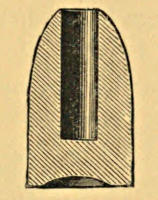
Fig. 1.—340 grains
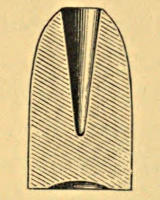
Fig. 2.—360 grains
Rifles constructed for these short bullets are decidedly
inferior to those arranged for the longer projectile.
Fig. 3 shows the long .500 bullet with a heavy fuse.
Fig. 4 shows the same bullet with a small taper hole.
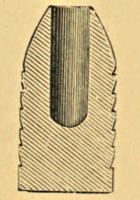
Fig. 3.—440 grains
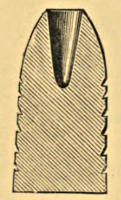
Fig. 4.—460 grains
It is certainly now for the most part acknowledged that rifles
firing this type of bullet are much more trustworthy, giving as
they undoubtedly do increased penetration and a more smashing
blow. The front portion of the projectile generally breaks up
in the animal shot, and the base part, having sufficient energy
remaining to pass through the body, will nearly always be
found under the elastic skin upon the other side. These rifles
have the further advantage of giving accurate shooting at
comparatively long ranges where the ordinary Express would
fail.
Figs. 5 to 10 show some specimens of this type of bullet
(.500 and .577 bore) taken from under the skins of tigers,
after having passed through the animals, proving the great
velocity and killing power of this form of projectile, and demonstrating
that the whole energy of the charge had been effectually
utilised.
A double .500 rifle to carry the lighter bullet may be made
to weigh about 9 lbs., while to carry the longer and heavier bullet
the weight should be nearer 9½ lbs. But when the increased
power and penetration obtained are taken into consideration,
probably few sportsmen will object to this slight extra weight.
A crushing blow that may be depended upon is what is required,
and reliance cannot be placed (except, perhaps, for deer stalking)
upon the short, light bullets so much used. No doubt a good
deal of game is killed with the light bullets, even up to and
including tigers, &c.; but much has been lost, and many accidents
have taken place, in consequence of the bullet breaking
up too soon, causing only a flesh wound, and not having
sufficient penetration to reach a vital part of the animal shot.
The above remarks apply both to .450 and .577 rifles, but
especially to the latter, so without going into further details
illustrations are here given of the light .450 and .577 bullets
generally used (see fig. 11), and the longer ones now recommended
(see fig. 12).
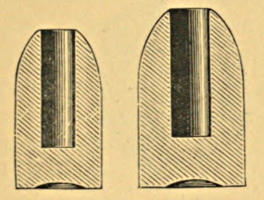
Fig. 11
.450
270 grains
.577
455 grains
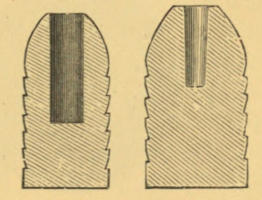
Fig. 12
.450
340 grains
.577
625 grains
Since Sir Samuel Baker has so strongly recommended
.577 6-dr. rifles, they have become much better known, and
are now much more used than formerly. There can be no
question that when fired with proper bullets they are very
effective weapons, even against the largest kinds of game. Of
course for use against the latter it is necessary to employ solid
hardened bullets.
The weapon used and recommended by Sir Samuel Baker
is somewhat heavier than the ordinary .577, weighing between
11 and 12 lbs.; it was specially made for him, and is sighted
up to 400 yards.
For soft-skinned animals, Sir Samuel used solid pure lead
bullets, and he always found them deliver the whole power of
the charge upon the animal, being generally forced into the
shape of a mushroom, and found under the skin upon the
opposite side of the beast.
Count Teleki, in his successful three years’ expedition in
Central Africa, also used .577 rifles against elephants, buffaloes
and rhinoceros with great effect, although he preferred his 8-bore
(shooting 10 drs., and a short conical bullet) for big game, finding
that at close quarters a knockdown blow was absolutely
necessary. The question of the rival bores for such game as
tiger, bear, &c., will probably never be settled, as so much
depends upon the capabilities of the shooter, the class of
country he is in, and the style of shooting, whether in a howdah
or on foot, &c.; but it may be taken generally that for
dangerous game it is always as well to be on the safe side and
to use as powerful a weapon (in moderation) as you can conveniently
handle.
Figs. 13 and 14.—Blocks of soft .577 bullets cut out of tigers
by Sir Samuel Baker
In Africa, where animals of the same species as are met
with in India appear to require much more killing than they
do in the latter country, the .577 firing a solid hardened
bullet and 6 drs. of powder must always be a most useful
weapon. For lion, the largest kind of deer, &c., it is all that is
wanted, and even for elephants it is a fairly effective rifle.
For sport in India, when the sportsman is limited to one rifle,
a .500 Express, shooting a charge of 5 drs. of powder and a long
bullet, and capable of also firing, when required, the shorter
bullet and 4¼ drs. for the lighter kinds of game, will probably
be found the most useful all-round weapon.
If, in the first instance, the barrels of a .500 Express are
properly constructed for shooting the two kinds of cartridges,
good shooting may be made with both, with the same sighting;
and a most useful arrangement this will prove to be, the
heavy cartridge being very deadly for all game found in India,
with the exception of the pachydermatous animals, while for
the deer tribe and for practice the lighter charge is all sufficient.
Perhaps the most useful battery on a small scale for
India is a .450 Express for deer, and a 12- or 16-bore Paradox,
which does well as a shot-gun, and is also most effective as a
rifle.
Ball-Guns.—One of the advantages which the ball-gun has
over the ordinary rifle is its lightness and handiness compared
with the latter, but the serious drawback to its wide use was, in
the first place, that it would fire spherical bullets only, and consequently
lacked penetration; and, in the second, that it gave
but irregular shooting, except at very short ranges. This state
of things has been completely reversed by the introduction
of the ‘Paradox’ gun, the invention of Colonel Fosbery, V.C.
In the ‘Paradox’ all the advantages connected with the lightness
and handiness of a gun have been retained, while great
accuracy when fired as a rifle with a smashing conical bullet has
been added.
Since Colonel Fosbery’s invention was brought to the
notice of sportsmen, the ‘Colindian’ and other systems of
ball-guns have been introduced.
The result has been quite a revolution in the manufacture
of weapons for use against game of all kinds, from the larger
kind of deer up to elephants.
Take, for example, the 12-bore ‘Paradox.’ This weapon has
all the advantages of quickness and handiness of mounting to the
shoulder, so essential in snap-shooting, and yet fires a conical
bullet (see fig. 15), hollow or solid, up to a hundred yards or
more with the accuracy of a good Express. For all practical
purposes, and with all game up to and including tiger or bear,
a ‘Paradox’ weighing from 7 to 7½ lbs. has all the necessary
qualities of a 10-lb. rifle, and has, moreover, the handiness of
a 12-bore shot-gun, discharging shot quite as well as a good
cylinder or modified choke. The man who uses a ‘Paradox’
need not take any other gun, a saving in the size of one’s
battery worthy of consideration; but perhaps the strongest
argument in favour of this weapon is that the man who has
much snap-shooting to do (from a howdah, for instance) is
much more likely to be successful when handling the gun
he uses every day and often than he would be if trying to make
snap-shots with an ordinary rifle, used rarely by comparison,
and perhaps firing so heavy a charge as to make practice with
it ‘no joke.’
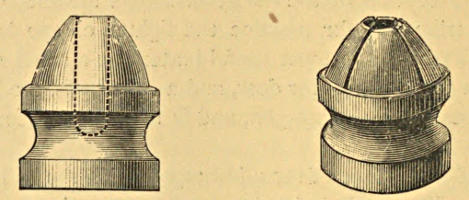
Fig. 15.—12-bore ‘Paradox’ bullets
Colonel Fosbery has succeeded in perfecting the ‘Paradox’
system for large bores, such as 10 and 8, and in 1891 one of
the latter weapons when tested before the editor of ‘The Field,’
with the full charge of 10 drs. of powder, and a hardened
conical solid bullet at 50 yards range, made the extraordinary
diagram in six consecutive shots into a space 1¼ in. by 2½ ins.
(shown in fig. 16), beating all the records of big rifles at the
‘Field’ trials.
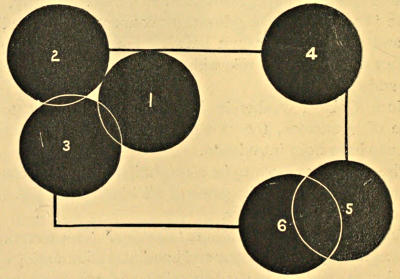
Fig. 16
It should be only a matter of time for weapons made
upon this principle to supersede large-bore rifles for big game
shooting. Everything is in their favour. An
8-bore ‘Paradox’ weighs some 2 to 3 lbs.
less than an 8-bore rifle, and mounts to
the shoulder with the handiness of a gun.
The accuracy of the ‘Paradox’ is greater
than that of an 8-bore rifle, the recoil less
(as the bullet passes freely up the barrel,
instead of having to cut its way through
severe rifling, the ‘Paradox’ being rifled
at the muzzle only), and the velocity or
striking force is superior.
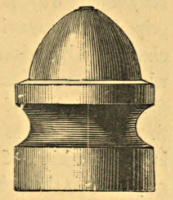
Fig. 17.—Diagram of
8-bore ‘Paradox’
bullet
Several of these weapons (8- and 10-bores) have already
been tried upon elephant, buffalo, &c., in Africa and India,
with the most satisfactory results.
Small Bores for Elephant Shooting.—No doubt some sportsmen
have been successful in bagging elephants and other big
game with .450-bore rifles, firing a moderate charge of about
3½ drs. of powder and a long solid bullet, such rifles giving
great penetration, but no shock to the animal unless a vital part
is reached. If the game be found in fairly open country, so
that accurate shooting can be made, this weapon may answer
in the hands of a good shot; but in most parts, and in grass
country, particularly where an animal has frequently to be
shot at very close quarters, and where the chances of being
able to make a run for it are very much restricted, one would
much prefer to rely upon the paralysing blow given by an
8- or 10-bore loaded with a heavy charge of powder and a
conical bullet; in fact, even the admirers of the .450 warn sportsmen
that such rifles are useful under certain conditions only,
and this warning is absolutely necessary, several fatal accidents
having taken place through sportsmen having misread or not
properly appreciated the accounts of the shooting made with
these small weapons and the circumstances under which they
may judiciously be used.
Systems of Actions for Rifles.—Different kinds of ‘actions’
are constantly being invented for double-barrelled rifles, but
very few, if any, have the sterling qualities of the old double-grip
lever, especially when used for rifles shooting heavy
charges. No doubt snap-actions of various kinds are made
which are sufficiently sound to stand the strain of the charges
fired, especially if the ‘body’ be long and deep, but none of
them have the binding down power of the grip lever, which
is really a kind of screw-grip. Another point in favour of the
grip lever is that, should there be a piece of cap or other obstruction
between the action and the barrels, the grip lever will have
sufficient power to force the action to close and allow the
rifle to be fired; and the same thing applies when a very tight
cartridge, or one with somewhat too thick a rim, requires to
be forced home. Now, under the same circumstances, a rifle
with a snap action could not be closed at all, or, at all events,
only with great difficulty and with unusual force, because all
spring bolt systems require that the barrels should close up
freely upon the action before the bolt can move into its proper
position for fastening down the barrel.
For small bores such as are used for deer stalking, &c.,
the hammerless system has some advantages; but there are objections
to these actions for weapons intended for foreign sport,
and these objections apply more particularly when big game
rifles are in question. Most sportsmen are fairly well acquainted
with the construction of the ordinary hammer gun fitted with
rebounding locks, but very few know anything of the internal
arrangements of the hammerless system, and there is no doubt
that the internal arrangements of the latter are more likely
to get out of order when subjected to the wear and tear and
the rough usage of a shooting expedition than those of the
former, to say nothing of their being more easily affected by
sand, rust, &c. They are also less readily taken to pieces and
cleaned.
Too much care cannot be given to the selection of a battery,
the minutest details of the weapons, and the ammunition for
them, and yet it is a curious fact that sportsmen frequently
spend much time and money over their general outfit, and
take but little heed about their weapons, upon which their
sport, and possibly their lives, may depend.
In ordering a battery, choose the best rifles you can afford
to pay for. The first expense is likely to appear heavy to those
who can see little difference between the expensive rifle of
a high-class maker and those supplied of a cheaper kind, but
very little experience will be needed to prove that the best is
the cheapest in the end.
Few sportsmen know the amount of money, care, and skill
that has to be spent upon a double rifle which is the best of
its kind and a really accurate weapon; that is to say, a double
rifle which has its barrels so perfectly adjusted that even a
skilled shot cannot tell the shooting of one barrel from that of
the other. Great care has to be taken in the manufacture of all
the parts, for the failure of a striker or a spring may mean
serious or even fatal results to the shooter when after dangerous
game; and this work has to be paid for.
The workmen employed on best rifle work are skilled men,
and can always command high wages. In some of the cheaper
kinds of double-barrelled rifles one barrel frequently shoots
some inches away from the other, rendering it impossible for
the sportsman to make good practice even at a target, much less
at game.
Great strides in the accuracy and adjustment of double
rifles have been made during the last ten years. It is impossible
here to say exactly what diagrams one should be fairly
entitled to expect, so much depends upon the type of rifle
required; but perhaps as good a guide as any is to take the
diagrams made by the winning rifles at the trials of sporting
rifles before the editor of the ‘Field.’ For an ordinary Express
it may be accepted that a double .450 firing ten shots, right and
left barrel alternately, making a 4-inch group, viz. all the ten
shots in a 4-inch square, is a very fine shooting weapon, and
that one putting all its ten shots into a 6-inch at a hundred
yards is quite up to the average.
Do not depend upon diagrams shown as the record of
the shooting of a rifle. The only satisfactory plan is to go to
the maker’s grounds and see the rifle fired, to fire it yourself,
or, if that is not convenient, get a competent friend to go and
see the diagrams made. Then, again, it is very desirable to have
the sights cut to suit your own style of shooting, for it is not
at all unusual for two good marksmen firing the same rifle to
make a considerable difference in elevation on the target at,
say, 100 yards range.
Recoil Heelplate.—It is not a bad plan to have recoil heelplates
fitted to all rifles from .450 to 4 bores. They save the
shoulder very much when firing large charges. See that the
rubber is properly smoothed and varnished, so as to get rid of
the clinging feeling these heelplates otherwise have.
Spare Weapons.—In going for any length of time upon a
sporting expedition, it is always well to have reserve rifles which
should be as nearly as possible duplicates of those in the regular
battery in weight, mount, sighting, &c., so that no difference is
noticed by the sportsman should he have to fall back upon his
reserve. You may never want them, but if, when you are in
the game district, hundreds of miles up country, you smash or
injure the rifle you are depending upon, you will then fully
appreciate the advantage of having a reserve. It is a very
easy thing to break the stock of or otherwise damage a rifle,
or it may even be lost, and if you have no others to fall back
upon the sporting trip must be spoiled, or at any rate seriously
hampered.
A fair battery for an expedition to Africa would be a
pair of 8- or 10-bore rifles or ‘Paradox’ guns, shooting 8 to
10 drs. of powder; a pair of .500 bore, 5 drs. solid ball rifles,
one .577 and a 12-bore shot or ‘Paradox’ gun. Also a .400
or a .450 single-rifle sighted up to 500 yards would be found
very useful in many parts.
Spare limbs should always be taken, viz. extra hammers,
mainsprings, tumbler pins, and foresights, and lessons should
be taken from an experienced gunmaker in taking weapons to
pieces and putting them together again properly. Turnscrews,
such as working gunmakers use, should be specially ordered,
and not the slight and nearly useless tools usually found in
rifle and gun cases. These are made by the gross, and are
generally well-nigh worthless. Do not fail to have a very powerful
screw-driver to take out the breech-pin, which is always
very firmly screwed up.
With large bores and all rifles that have very much recoil
insist upon having the front trigger thick and well rounded, to
prevent its cutting the forefinger when firing the left barrel. It
is a very good plan to have the front trigger hinged or hung
quite loose, so as to give way to the finger. Also see that the
left trigger pulls at least 6 lbs., to prevent both barrels being
fired together. There is no objection to having both locks of
such weapons made with a fairly heavy pull off; the fact
being that when a rifle weighing 12 or 13 lbs. is being handled
a 6 or 7 lb. pull does not feel heavier than a 4 lb. pull does in
an ordinary shot gun. See that all your rifle stocks are made of
tough strong wood, and that the grasp or handle is left sufficiently
thick to give a good hold to the right hand. It is also a very
good plan to have the hand of the stock strengthened by having
the strap of the action made so as to extend its full length
and come over the comb. This plan was first suggested by Sir
Samuel Baker, and there can be no doubt but that it very considerably
strengthens the stock in its weakest part.
Try your cartridges in the chambers of your rifle or gun
before starting for the day’s shooting, and carefully discard all
that will not go into the weapon freely and allow the action to
be closed with ease. It is desirable to have cartridge-correctors
made the exact size of the chambers of each weapon.
Rebounding Locks.—Many sportsmen think that when the
hammer is at the rebound or half-cock it is in a safe position,
but sometimes it is quite the reverse. This is because some
rifles and shot-guns are made with the face of the hammers too
close to the end of the strikers; when this is so, it will be
found that, should the hammer be pulled up nearly to full
cock and then let down again (without touching the trigger),
there is sufficient ‘give,’ or ‘spring,’ in the parts of the lock to
allow the hammer to just reach and to ‘flick’ the striker hard
enough to fire the rifle. The danger of this defect must be
obvious. The face of the hammer when pushed forward as
far as it will go (without the trigger being pulled) should be
well away from the end of the striker. If there is any doubt
as to whether there is sufficient space or not, hold a flat piece
of metal or card against the face of the action, lift the hammers
nearly to full-cock, and then release them; if the metal or
card be marked by the end of the striker, it is evidence that
the space between the hammer and striker is not sufficient.
This should not be done often, as it has a tendency to injure
the end of the scear of the lock.
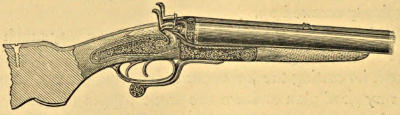
Fig. 18.—Illustration of adaptation to Sir Samuel Baker’s
.577 rifle
Stocks, Loops, Stops, Cases.—In ordinary rifles do not have
the stocks made the same shape as in your guns. Most sportsmen
miss birds by shooting under them, but with a rifle more
game is missed by being shot over. It is desirable to have the
stocks of rifles made a quarter of an inch more bent than those
of guns, and in heavy bores even half an inch extra will be
found an advantage in shooting, to say nothing of saving
the shooter’s face from being punished by the recoil. Also
remember that as you increase the weight of your rifle you
must decrease the length of your stock.
When loops are attached to rifles for the purpose of
enabling you to use slings, it is desirable to have flat ones,
thus—
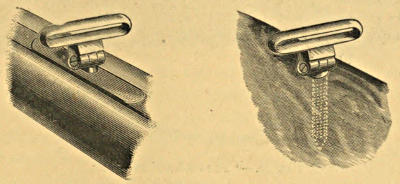
Fig. 19
and not rings or swivels, which always rattle, and may disturb
game. The above form has the further advantage of being
stronger than the others. Always refuse to allow the gunmaker
to fit stops to the hammers of any weapons intended for
use against dangerous game. You may at a critical moment
forget that the locks are bolted, or the bolts may have got
loose and may have slipped into the hammers without your
knowledge.
For rough shooting, especially in damp climates, have your
rifles constructed for solid brass cases, or those covered with
a thin coating of brass. These are less likely to stick in the
chambers, and are not so easily damaged as the paper ones.
Have your cartridges done up in small tins, hermetically sealed,
packing a few of each kind you are likely to use in a separate
tin, say fifty in each package. In this way you will be able
to keep the bulk of your ammunition weather-proof. The
contents of each tin should be stamped on the outside.
It is a useful plan to have loose-fitting flannel bags made
for the barrels and stock of each weapon.
Perhaps the most convenient form of rifle case is ‘The
Shikari’:
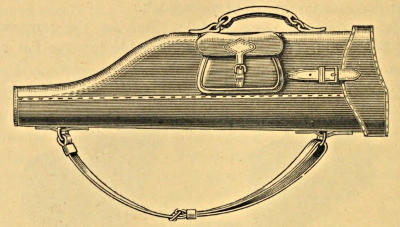
Fig. 20.—‘The Shikari’ rifle case
See that your case is made of strong sole leather, so as to be
fairly rigid and capable of resisting pressure; for real rough
work there is nothing better than oak covered with leather.
Rifle Sights.—No absolute rule can be laid down as to the
best form of sights for sporting purposes. Generally speaking,
the wider and the shallower the V in the backsight the better
for snap-shooting, but beyond a certain point this shape makes
it difficult to ensure taking the centre of the sight. The silver
line or the ivory pyramid with which the standard is frequently
inlaid very much assists in getting the centre quickly.
Fig. 21.
Fig. 22.
A very good form of backsight is a modification of the style
frequently used in German rifles, viz. a wide shallow V having
a small rounded nick and a fine line down the centre (see
fig. 21).
A sloping standard has the advantage of showing up the
silver line, but in a bright light this has a tendency to ‘blurr’
and prevent a fine bead being taken. It is as well under these
circumstances to black the standard, and upon occasions the
foresight; this may be done very simply by smoking them
with a wax match. Foresights should be let in from the front
and fixed with a small screw, so that they can easily be removed
and a different form of sight inserted when required.
A spare iron foresight and two or three ivory ones should
be fitted to each rifle.
A very useful and convenient form of night sight is an
ordinary iron one having at the rear end a small disc covered
with white enamel or luminous paint (see fig. 22), and so arranged
that this disc can, when required, be raised in front of
the ordinary bead. If properly constructed and placed at the
correct angle, it can be seen well when the ordinary sight would
be quite invisible.
Telescope sights are now made with elevating screws, which
enable the necessary elevations to be quickly obtained. For
stalking and deliberate shots the telescope is most useful, but
it is necessary to have the eye-piece fitted on a spring slide and
made sufficiently large to prevent injury to the shooter’s eye in
case of the recoil being heavy; but these sights for rifles firing
heavy charges cannot be recommended.
Many sportsmen complain that with Express rifles (in particular),
and not infrequently with other rifles, they shoot over
their game at short ranges, an error which they attribute to
the ‘high sighting’ of their rifles. Sometimes this explanation
of their shooting over their game is the correct one; but frequently
the error is caused by the shooter, when firing a snap-shot
at an animal moving across him at a short range, taking a
very full foresight, not having sufficient time to get his eye
down to the level of the backsight, and draw as fine a bead as
he would have done had he taken a deliberate shot.
But no doubt some rifles are ‘over-sighted,’ and if so it is
partly the fault of the gunmakers and partly the fault of the
sportsmen themselves, who insist upon gunmakers trying for the
impossible. It is not an uncommon thing to hear a sportsman
say, ‘Oh, my rifle has a flat trajectory up to 200 yards,’ the
truth being that the rifle in question has been sighted to shoot
correctly at 200 yards, but the bullet at the highest point in its
trajectory (i.e. at about 110 yards from the muzzle) will probably
have risen from four to eight inches (according to the
velocity of the bullet) above the line of aim.
It is best to have an Express rifle made with the first leaf or
‘standard’ sighted for not over 150 yards, and if this is properly
done, no misses from over-sighting need be made between
thirty and 150 yards.
Again, it is within the experience of most rifle-shots that it
is exceedingly difficult to make good shooting when firing at
game very much below the shooter (ibex down hill for instance).
This difficulty is often accounted for by a theory that in shots
of this kind the bullet is less acted upon by the forces of gravity
than in ordinary horizontal shots; but in reality the difference
in the fall of the bullet at 150 yards in downhill shots at an
angle of 45 degrees and in horizontal shots at the same range
is very slight.
Still sportsmen find in practice that they have to aim three
to six inches below the part which they wish to hit, to ensure
success in these downhill shots.
In this case the cause of errors in elevation is the great
difficulty there is in getting the head down to the stock so as
to properly align the foresight with the bottom of the notch or
V of the backsight.
The sportsman can easily test this theory for himself by
putting any ordinary rifle to his shoulder in a room, aiming first
at some object considerably above his head, and then at some
point or object upon the floor. Anyone who does this will find
that in shooting at the object above him it is easy enough to
align the sights upon it, that by bending the neck and lowering
the head the sights can be accurately aligned upon any object on
a level with the shoulder, but that there is very considerable difficulty
in getting the eye down to properly align the sights when
the object aimed at is upon the floor. In fact, if the stock of
the rifle is fairly straight it cannot be done. Both these cases
of over-shooting come from the same cause; in the first ‘hurry’
has induced the shooter to forget to set his head down properly
on to the stock, in the second his own build and his rifle’s
make it very hard for him to do so. The same principle is
illustrated in rabbit shooting with a fowling-piece at short
ranges. Unless using a gun with a good bend to the stock it is
difficult to get down low enough to your rabbit crossing at say
fifteen yards, so that a dozen are missed by shooting over for
one that is missed by shooting under at that range.
It is as well, too, to remember that in shooting from a ‘rest’
there is always an inclination on the part of the barrels to fly
upwards, and this is particularly so where the ‘rest’ is of any
hard substance, a rock or a log for instance. To counteract
this tendency to fly upwards, grip your rifle firmly with your
left hand, and put a pad of some soft material (say, your cap)
between your rifle and your rest.
Assuming that any rifle-shot knows the danger of pulling
as opposed to pressing the trigger, that he will be careful to see
that his foresight neither gets bent nor shifted, that he does not
get buck fever, and can judge distance with approximate accuracy,
there seems to be only one other hint worth giving, and
that only to those who find a difficulty in seeing the backsight
clearly; those, that is, to whom it appears blurred and misty.
These sportsmen should have their rifles arranged with the
backsight not less than seven or nine inches from the breech,
since the further off from the eye it is, the more clearly defined
it becomes; but of course there is a limit to the distance at which
the backsight can be put from the eye, since the closer the
backsight is to the foresight the greater the angle of error.
It is sometimes even desirable to have the barrels made of
extra length to allow of the backsight being put further from
the breech end, but long barrels are unhandy on horseback
and in thick timber.
Note.—It may be added that these notes have been submitted
for criticism and comment to experienced practical
sportsmen, including Mr. F. C. Selous, Col. James Baker, and
Mr. Edward Ross.
Mr. Selous wrote, ‘As far as my experience goes, I agree
with what he says.’
Col. James Baker stated that, after perusing the chapter
with his friend Mr. Edward Ross, they both of them fully
concurred in the views expressed, and had nothing to alter or
to add.—C. P.-W.
CHAPTER XV HINTS ON TAXIDERMY, ETC
By Clive Phillipps-Wolley
That ‘the reward lies not in the prize but in the race we run’
is probably more true of sport than of any other pursuit, and
yet even in big game shooting there are prizes to strive after
which serve at any rate to remind the winners of the races they
ran to obtain them. To the man who has won them fairly, the
mighty antlers and fierce masks which hang in his hall or study
are treasures beyond price. As to the men who buy such
trophies, they are not of our guild, nor is it easy to comprehend
them or their motives.
When the light is waning and the flames from a wood fire
cover the walls of a hunter’s den with quaint shadows of the
spolia opima of the chase, it is easy to explain to a kindred
spirit the value set upon these hardly-earned treasures. To
some they may be mere dry bones or hideous mummies; but
out of them and their shadows the tired man, dozing by his
hearth, can call up pictures from the deep primeval forest, the
sheer snow mountains, or sweet and wild wind-swept upland;
pictures such as no artist ever painted or poet fancied. Each
head is to that dreamer a key to some locker in his memory.
He has but to look at those antlers in the firelight, and the
past comes back vivid and glorious, aglow with the colours of
an Indian summer, or bright with the blossoms of an Alpine
spring, mellow with the beauty distance lends, and painted
by the strong happy hand of youth.
If age and feebleness come, shall there be no satisfaction
to the old hunter in remembering the ibex he outclimbed, the
stag whose senses were not keen enough to detect the stealthy
approach of those now clumsy feet tottering to their rest; the
grim foe, tiger or grizzly, upon whom his worn-out eyes once
gazed without blenching, measuring the shot calmly, upon the
success of which hung his life or the beast’s?
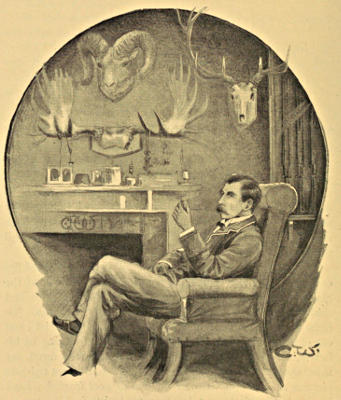
When the light wanes
More than all the pleasures which the rich man feels as he
surveys his Murillos or his Raphaels are the hunter’s, as his
eyes wander over his antlered walls. He shot the beasts whose
spoils are round him, and in the doing of it scenes were graven
on his memory which can never be effaced; mental and
physical qualities which, but for these silent witnesses, Age
the doubter would persuade him that he never possessed, were
tried and not found wanting.
But what can bought heads be to the buyer? Furniture
for his rooms perhaps, and, even so, misleading; for if a house
is to be worth anything, it should represent the tastes and life
of the man who lives in it. As a rule, it is long odds that
the owners of bought trophies cannot so much as remember the
shape of the beasts whose horns they hang up, much less have
they any associations connected with them. At the best, they
are but costly rubbish; unfortunately they are worse than that.
The demand for antlers and sheep’s horns insures a supply
being secured in some way, and so it happens that in Canada
to-day every up-country trader has been supplied with a printed
list of the prices which will be paid for trophies, according to
the number of inches they measure round the base or the length
and span of the antlers.
In one trader’s house which I know there are nearly a
hundred magnificent sheep’s heads waiting for a purchaser, most
of which have been brought in by Stony Indians, whom no law
can touch for shooting in season or out of season.
The damage done by this head-hunting is twofold: first, to
the sportsman, whom it will eventually deprive of his game;
secondly, to the country, as tending to rob it of the attractions
which it possesses for a class which brings a great deal of money
into it. A fair sheep’s head may be bought for twenty-five
dollars, but many a hundred pounds of good English money
has before now been distributed amongst the natives and traders
of British Columbia in the attempt to obtain such a head by fair
shooting. No doubt efforts have been made by the legislature
to protect the game; but in those countries to which I have
had access I have found that, though the laws were good
enough, they were rendered useless through lack of men to
enforce them.
In Canada no game laws can ever be of much avail as long
as the Indian is allowed the privileges which he at present enjoys.
But the principal business of this chapter is to instruct the
hunter in the best methods of preserving his trophies when
fairly won, until such time as he can hand them over to one
of our excellent practical taxidermists at home. In nine cases
out of ten, the head is all that a man cares to preserve, and
those who are wise will not cumber their houses with too many
even of these with the masks on. In spite of infinite pains,
moth and dust will corrupt the most carefully guarded collections.
However, if you want to mount the head with skin and
all complete, let your first care be to sketch or photograph it in
profile before the skinner’s knife has touched it, in order that
the man who sets up the trophy may have some idea of what it
looked like in life.
If the hunter cannot sketch decently, a kodak is a good
substitute for the pencil, or the proportions and various bumps
and inequalities in the outline may be accurately preserved by
laying the head upon a sheet of paper and tracing its outline with
a simple instrument, consisting of two pieces of metal four or
five inches in length, set at right angles to one another, with a
socket at the angle into which a lead pencil is fixed, so that the
point projects just far enough to make a mark upon the paper,
when, with the lower side upon the paper and the upright side
against the head, an outline of the profile is taken. Outlines
or photographs should be made as soon after death as possible,
before the muscles have time to sink and lose their natural prominence.
In skinning a horned head proceed as follows:—
Slit the back of the neck up the middle to a point between
the horns, then make a crosscut from the base of one antler to
the base of the other. This will give you a cut shaped thus, T.
Now separate the skin from the skull round the base of each
antler, and be careful not to cut the coat unnecessarily during
the operation. Next turn the head over and begin at the other
end, severing the inner side of the lips from the gums as high
up as you can reach, and skinning the muzzle as far back as
you can. Then peel off the whole mask from the antlers downwards
to the muzzle, being specially careful not to slit the skin,
either at the eyes or at the nostrils, which are the tenderest
portions of it. Be careful to preserve a sufficiently long neck,
and do not let your Indian or Tartar cut the beast’s throat (as
he will do if you do not watch him), as nothing looks worse than
a taxidermist’s stitches showing under the throat of a trophy.
If you have followed these directions, you will have preserved
so far the entire lips of the animal. Now take your
knife and slit the lips, separating the inner from the outer skin,
and dress the cut so made thoroughly well with powdered alum.
Having removed the skin from the skull, you may clean this
part of the trophy, either by boiling it if you have a pot with
you large enough for that operation, or if not, after whittling
out the eyes, brains, and any flesh you can readily detach, you
may hang it up in a tree, out of reach of coyotes to dry, until fit
for packing. Before putting your skins and skulls apart to dry,
mark them carefully with corresponding numbers, to prevent
mistakes later on.
Should you wish, however, to skin a beast whole for
mounting in some museum or elsewhere, you must proceed
as directed by my friend, Mr. John Fannin, curator of the
Museum of British Columbia, whose directions I have slightly
altered to suit my purpose, and inserted below.
Turn the beast on to his back and make cut 1, from the
point of the breastbone along the centre of the belly to the
root of the tail, taking care only to cut through the skin, and
not into the intestines. A few pieces of fine brush, laid on the
inside of the skin as you peel it off, serve to protect the skin
from any blood which may escape from the bullet wounds or
elsewhere during the operation of skinning.
Next, make a cut from the hoof of each foreleg to the upper
end of cut 1, making the incision down the hind part of each
foreleg. Make a cut from the hoof of each hind leg, along the
hinder part of it to the lower end of cut 1. Now skin round
the legs; sever the leg bones at the knee and hock joints,
leaving these bones with the hoofs attached to the skin, but
with the skin freed down to the hoofs. Now skin the animal
in the ordinary manner, using the edge and not the point of
your knife, and on reaching the neck make the T shaped cut
described above, along the top of the neck and between the
antlers. This will allow the skin to be removed entirely from
the head; but before proceeding with the head the skin should
be removed from the body as far as the head, and the head
severed at the neck joint.
Having washed any blood off the hair and detached every
fragment of meat or fat which you can get off the skin, stretch
it out upon the ground in some airy spot where it can dry
naturally, unaffected by sun or fire. Dress the skin with powdered
alum, or failing that with wood ashes, and don’t peg
it out. When prepared in a solution of soda by the taxidermist
at home, the alum-dried skin will become as pliable as
kid and will resume its natural proportions, and these should
satisfy any honest hunter.
The methods recommended in this chapter are of course
only for preserving trophies in the field. All trophies should
be sent home for final preparation as soon as possible, either
prepared with alum and packed dry, or in a tub of pickle composed
of alum and salt in the proportion of two-thirds of the
former to one-third of the latter.
Some men make a practice of carrying a saw with them to
divide antlers and skulls for greater convenience in packing,
sawing the skull right through from crest to nose; but though
trophies are undoubtedly somewhat easier to pack in this way,
I do not recommend it, as a very heavy wapiti head of mine so
treated is constantly annoying me now by breaking away from
the rivets which should hold it, to come thundering upon the
ground.
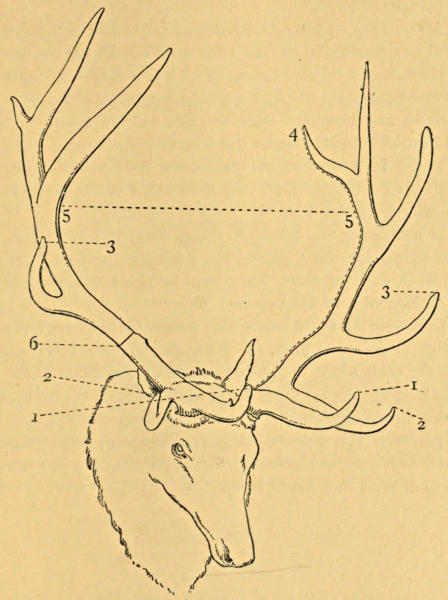
Wapiti head
1, 2, and 3 indicate the brow, bay, and tray antlers respectively; 4, indicates the line
along which a head should be measured for length; 5, the line along which to measure
for span; 6, where to measure for girth.
In sending skins home from temperate regions I have
never found it necessary to use any preservative against insects
other than the powdered alum with which the skins are
dressed; but in hot climates more elaborate precautions are
necessary, and a liberal dose of spirits of turpentine should be
applied externally from time to time.
An application of spirits of turpentine put on with a liberal
hand, and brushed in, the way of the hair, with a dandy brush
at spring-time, will go a long way towards saving trophies from
the ravages of moth.
A covering of fine glazed gauze, made like a nosebag, is
useful as a protection to heads left stored in an unused room.
Here it may be convenient to set out the ordinary systems
of measuring game trophies amongst English sportsmen.
Skins are measured from the snout to the tip of the tail,
and from side to side under the forearms.
There is a system of measuring bear skins upon the
American continent which may have given rise to some errors—to
wit, measuring from the ‘heel to the snout.’
In measuring the heads of sheep, ibex, and such like, the
chief points are the girth of the horns at the base, and the
length of each of them from base to point measured along
the outside edge of the curve.
In measuring stags’ heads the points to note are: (1) the
number of points or tines, (2) the length of the horn measured
from the skull along the outside curve of the beam to the tip
of the longest tine, (3) the greatest width between the horns, and
(4) the circumference of the beam between the bay and the
tray points. The diagram on p. 419 illustrates these measurements,
indicates the points named, and displays the normal
growth of tines in a wapiti head.