 OLATILE
as the reader may comceive the
character of Lisardo to be, there were traits in it of marked goodness
and merit. His enthusiasm so frequently made him violate the rules of
severe politeness; and the quickness with which he flew from one
subject to another, might have offended a narrator of the gravity,
without the urbanity, of Lysander; had not the frankness with which he
confessed his faults, and the warmth with which he always advocated
the cause of literature, rendered him amiable in the eyes of those who
thoroughly knew him. The friends, whose company he was now enjoying,
were fully competent to appreciate his worth. They perceived that
Lisardo's mind had been rather brilliantly cultivated; and that, as
his heart had always beaten at the call of virtue, so, in a due
course of years, his judgment would become matured, and his opinions
more decidedly fixed. He had been left, very early in life, without a
father, and bred up in the expectation of a large fortune; while the
excessive fondness of his mother had endeavoured to supply the want of
paternal direction, and had encouraged her child to sigh for every
thing short of impossibility for his gratification.
OLATILE
as the reader may comceive the
character of Lisardo to be, there were traits in it of marked goodness
and merit. His enthusiasm so frequently made him violate the rules of
severe politeness; and the quickness with which he flew from one
subject to another, might have offended a narrator of the gravity,
without the urbanity, of Lysander; had not the frankness with which he
confessed his faults, and the warmth with which he always advocated
the cause of literature, rendered him amiable in the eyes of those who
thoroughly knew him. The friends, whose company he was now enjoying,
were fully competent to appreciate his worth. They perceived that
Lisardo's mind had been rather brilliantly cultivated; and that, as
his heart had always beaten at the call of virtue, so, in a due
course of years, his judgment would become matured, and his opinions
more decidedly fixed. He had been left, very early in life, without a
father, and bred up in the expectation of a large fortune; while the
excessive fondness of his mother had endeavoured to supply the want of
paternal direction, and had encouraged her child to sigh for every
thing short of impossibility for his gratification.
In consequence, Lisardo was placed at College upon the most
respectable footing. He wore the velvet cap, and enjoyed the rustling
of the tassels upon his silk gown, as he paraded the High street of
Oxford. But although he could translate Tacitus and Theocritus with
creditable facility, he thought it more advantageous to gratify the
cravings of his body than of his mind. He rode high-mettled horses; he
shot with a gun which would have delighted an Indian prince; he drank
freely out of cut-glasses, which were manufactured according to his
own particular taste; and wines of all colours and qualities sparkled
upon his table; he would occasionally stroll into the Bodleian Library
and Picture Gallery, in order to know whether any acquisitions had
been recently made to them; and attended the Concerts when any
performer came down from London. Yet, in the midst of all his gaiety,
Lisardo passed more sombrous than joyous hours: for when he looked
into a book, he would sometimes meet with an electrical sentence from
Cicero, Seneca, or Johnson, from which he properly inferred that life
was uncertain, and that time was given us to prepare for eternity.
He grew dissatisfied and melancholy. He scrambled through his terms;
took his degree; celebrated his anniversary of twenty-one, by
drenching his native village in ale which had been brewed at his
birth; added two wings to his father's house; launched out into coin
and picture collecting; bought fine books with fine bindings; then
sold all his coins and pictures; and, at the age of twenty-five, began
to read, and think, and act for himself.
At this crisis, he became acquainted with the circle which has already
been introduced to the reader's attention; and to which circle the
same reader may think it high time now to return.
Upon breaking up for the drawing room, it was amusing to behold the
vivacity of Lisardo; who, leaping about Lysander, and expressing his
high gratification at the discourse he had already heard, and his
pleasure at what he hoped yet to hear, reminded us of what Boswell has
said of Garrick, who used to flutter about Dr. Johnson, and try to
soften his severity by a thousand winning gestures.
The doors were opened; and we walked into Lorenzo's Drawing Room. The
reader is not to figure to himself a hundred fantastical and fugitive
pieces of furniture, purchased at Mr. Oakley's, and set off with
curtains, carpet, and looking-glasses—at a price which would have
maintained a country town of seven hundred poor with bread and soup
during the hardest winter—the reader will not suppose that a man of
Lorenzo's taste, who called books his best wealth, would devote two
thousand pounds to such idle trappings; which in the course of three
years, at farthest, would lose their comfort by losing their fashion.
But he will suppose that elegance and propriety were equally consulted
by our host.
Accordingly, a satin-wood book-case of 14 feet in width and 11 in
height, ornamented at the top with a few chaste Etruscan vases—a
light blue carpet, upon which were depicted bunches of grey roses,
shadowed in brown—fawn-coloured curtains, relieved with yellow silk
and black velvet borders—alabaster lamps shedding their soft light
upon small marble busts—and sofas and chairs corresponding with the
curtains—(and upon which a visitor might sit without torturing the
nerves of the owner of them) these, along with some genuine pictures
of Wouvermans, Berghem, and Rysdael, and a few other (subordinate)
ornaments, formed the furniture of Lorenzo's Drawing Room. As it was
en suite with the library, which was fitted up in a grave style or
character, the contrast was sufficiently pleasing.
Lisardo ran immediately to the book-case. He first eyed, with a greedy
velocity, the backs of the folios and quartos; then the octavos; and,
mounting an ingeniously-contrived mahogany rostrum, which moved with
the utmost facility, he did not fail to pay due attention to the
duodecimos; some of which were carefully preserved in Russia or
morocco backs, with water-tabby silk linings, and other appropriate
embellishments. In the midst of his book-reverie, he heard, on a
sudden, the thrilling notes of a harp—which proceeded from the
further end of the library!—it being Lorenzo's custom, upon these
occasions, to request an old Welch servant to bring his instrument
into the library, and renew, if he could, the strains of "other
times." Meanwhile the curtains were "let fall;" the sofa wheeled
round;
—and the cups
That cheer, but not inebriate,
|
with "the bubbling and loud hissing urn," "welcomed the evening in."
Lorenzo brought from his library a volume of Piranesi, and another of
engravings from the heads of Vandyke. Lisardo, in looking at them,
beat time with his head and foot; and Philemon and Lysander
acknowledged that Dr. Johnson himself could never have so much enjoyed
the beverage which was now before them.
If it should here be asked, by the critical reader, why our society is
not described as being more congenial, by the presence of those "whom
man was born to please," the answer is at once simple and
true—Lorenzo was a bachelor; and his sisters, knowing how long and
desperate would be our discussion upon the black letter and white
letter, had retreated, in the morning, to spend the day with Lisardo's
mother—whither —— —— had been invited to join them.
The harper had now ceased. The tea-things were moved away; when we
narrowed our circle, and, two of us upon the sofa, and three upon
chairs, entreated Lysander to resume his narrative; who, after
"clearing his pipes (like Sir Roger de Coverley) with a loud hem or
two," thus proceeded.
"I think we left off," said Lysander, "with seating Henry the Eighth
upon the throne of England. It will be as well, therefore, to say
something of this monarch's pretensions to scholarship and love of
books. Although I will not rake together every species of abuse which
has been vented against him by one Anthony Gilbie,[291] yet Henry must
be severely censured, in the estimation of the most candid inquirer,
for that gross indifference which he evinced to the real interests of
literature, in calmly suffering the libraries of convents and
monasteries to be pillaged by the crafty and rapacious. He was
bibliomaniac enough to have a few copies of his own work, in defence
of the Roman Catholic exposition of the Sacrament, struck off upon
vellum:[292] but when he quarrelled with the Roman pontiff about his
divorce from Queen Catharine, in order to marry Anne Boleyn,[293] he
sounded the tocsin for the eventful destruction of all monastic
libraries: and although he had sent Leland, under an express
commission, to make a due examination of them, as well as a
statistical survey of the realm, yet, being frustrated in the
forementioned darling object, he cared for nothing about books,
whether upon vellum or large paper. But had we not better speak of
the book ravages, during the reformation, in their proper place?"
Lorenz. As you please. Perhaps you will go on with the mention of some
distinguished patrons 'till you arrive at that period?
Lysand. Yes; we may now as well notice the efforts of that
extraordinary bibliomaniacal triumvirate, Colet, More, and Erasmus.
Phil. Pray treat copiously of them. They are my great favourites. But
can you properly place Erasmus in the list?
Lysand. You forget that he made a long abode here, and was Greek
professor at Cambridge. To begin, then, with the former. Colet, as you
well know, was Dean of St. Paul's; and founder of the public school
which goes by the latter name. He had an ardent and general love of
literature;[294] but his attention to the improvement of youth, in
superintending appropriate publications, for their use, was
unremitting. Few men did so much and so well, at this period: for
while he was framing the statutes by which his little community was to
be governed, he did not fail to keep the presses of Wynkyn De Worde
and Pynson pretty constantly at work, by publishing the grammatical
treatises of Grocyn, Linacre, Stanbridge, Lilye, Holte, Whittington,
and others—for the benefit, as well of the public, as of his own
particular circle. I take it, his library must have been both choice
and copious; for books now began to be multiplied in an immense ratio,
and scholars and men of rank thought a Study, or Library, of some
importance to their mansions. What would we not give for an
authenticated representation of Dean Colet in his library,[295]
surrounded with books? You, Lisardo, would be in ecstacies with such a
thing!
Lis. Pray don't make such tantalizing appeals to me! Proceed, proceed.
Lysand. Of this amiable and illustrious character I will only further
observe that he possessed solid, good sense—unaffected and unshaken
piety—a love towards the whole human race—and that he dignified his
attachment to learning by the conscientious discharge of his duty
towards God and man. He sleeps in peace beneath a monument, which has
been consecrated by the tears of all who were related to him, and by
the prayers of those who have been benefitted by his philanthropy.
Of Sir Thomas More,[296] where is the schoolboy that is ignorant? He
was unquestionably, next to Erasmus, the most brilliant scholar of his
age: while the precious biographical memoirs of him, which have
luckily descended to us, place his character, in a domestic point of
view, beyond that of all his contemporaries. Dr. Wordsworth[297] has
well spoken of "the heavenly mindedness" of More: but how are
bibliomaniacs justly to appreciate the classical lore, and
incessantly-active book-pursuits,[298] of this scholar and martyr! How
he soared "above his compeers!" How richly, singularly, and
curiously, was his mind furnished! Wit, playfulness, elevation, and
force—all these are distinguishable in his writings, if we except his
polemical compositions; which latter, to speak in the gentlest terms,
are wholly unworthy of his name. When More's head was severed from his
body, virtue and piety exclaimed, in the language of Erasmus,—"He is
dead: More, whose breast was purer than snow, whose genius was
excellent above all his nation."[299]
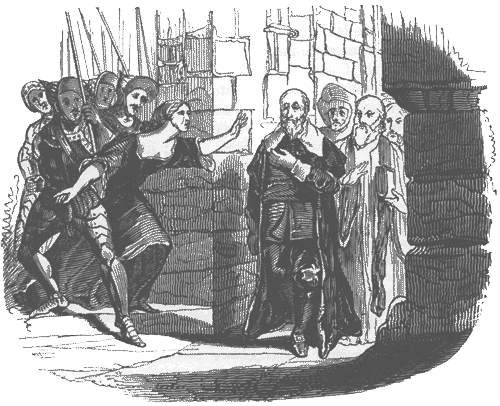
Behold him going to execution—his beloved daughter
(Mrs. Roper) rushing through the guards, to take her last embrace.
How can I speak, with adequate justice, of the author of these
words!—Yes, Erasmus!—in spite of thy timidity, and sometimes, almost
servile compliances with the capricious whims of the great; in spite
of thy delicate foibles, thou shalt always live in my memory; and dear
to me shall be the possession of thy intellectual labours! No pen has
yet done justice to thy life.[300] How I love to trace thee, in all
thy bookish pursuits, from correcting the press of thy beloved Froben,
to thy social meetings with Colet and More! You remember well,
Lisardo,—we saw, in yonder room, a large paper copy of the fine
Leyden edition of this great man's works! You opened it; and were
struck with the variety—the solidity, as well as gaiety, of his
productions.
Lis. Let me go and bring it here! While you talk thus, I long to feast
my eyes upon these grand books.
Lysand. You need not. Nor must I give to Erasmus a greater share of
attention than is due to him. We have a large and varied field—or
rather domain—yet to pass over. Wishing, therefore, Lorenzo speedily
to purchase a small bronze figure of him, from the celebrated large
one at Rotterdam, and to place the same upon a copy of his first
edition of the Greek Testament printed upon vellum,[301] by way of
a pedestal—I pass on to the notice of other bibliomaniacs of this
period.
Subdued be every harsher feeling towards Wolsey, when we contemplate
even the imperfect remains of his literary institutions which yet
survive! That this chancellor and cardinal had grand views, and a
magnificent taste, is unquestionable: and I suppose few libraries
contained more beautiful or more numerous copies of precious volumes
than his own. For, when in favour with his royal master, Henry VIII.,
Wolsey had, in all probability, such an ascendency over him as to coax
from him almost every choice book which he had inherited from his
father, Henry VII.; and thus I should apprehend, although no
particular mention is made of his library in the inventories of his
goods[302] which have been published, there can be no question about
such a character as that of Wolsey having numerous copies of the
choicest books, bound in velvet of all colours, embossed with gold or
silver, and studded even with precious stones! I conceive that his
own Prayer Book must have been gorgeous in the extreme! Unhappy
man—a pregnant and ever-striking example of the fickleness of human
affairs, and of the instability of human grandeur! When we think of
thy baubles and trappings—of thy goblets of gold, and companies of
retainers—and turn our thoughts to Shakspeare's shepherd, as
described in the soliloquy of one of our monarchs, we are fully
disposed to admit the force of such truths as have been familiar to us
from boyhood, and which tell us that those shoulders feel the most
burdened upon which the greatest load of responsibility rests. Peace
to the once proud, and latterly repentant, spirit of Wolsey!
We have now reached the Reformation; upon which, as Burnet, Collier,
and Strype, have written huge folio volumes, it shall be my object to
speak sparingly: and chiefly as it concerns the history of the
Bibliomania. A word or two, however, about its origin, spirit, and
tendency.
It seems to have been at first very equivocal, with Henry the Eighth,
whether he would take any decisive measures in the affair, or not. He
hesitated, resolved, and hesitated again.[303] The creature of caprice
and tyranny, he had neither fixed principles, nor settled data, upon
which to act. If he had listened to the temperate advice of Cromwell
or Cranmer,[304] he would have attained his darling object by less
decisive, but certainly by more justifiable, means. Those able and
respectable counsellors saw clearly that violent measures would
produce violent results; and that a question of law, of no mean
magnitude, was involved in the very outset of the transaction—for
there seemed, on the one side, no right to possess; and, on the other,
no right to render possession.[305]
Latimer, more hasty and enthusiastic than his episcopal brethren, set
all the engines of his active mind to work, as if to carry the point
by a coup de main; and although his resolution was, perhaps, upon
more than one occasion, shaken by the sufferings of the innocent,
yet, by his example, and particularly by his sermons,[306] he tried
to exasperate every Protestant bosom against the occupiers of
monasteries and convents.
With Henry, himself, the question of spiritual supremacy was soon
changed, or merged (as the lawyers call it) into the exclusive
consideration of adding to his wealth. The Visitors who had been
deputed to inspect the abbies, and to draw up reports of the same
(some of whom, by the bye, conducted themselves with sufficient
baseness[307]), did not fail to inflame his feelings by the tempting
pictures which they drew of the riches appertaining to these
establishments.[308] Another topic was also strongly urged upon
Henry's susceptible mind: the alleged abandoned lives of the owners of
them. These were painted with a no less overcharged pencil:[309] so
that nothing now seemed wanting but to set fire to the train of
combustion which had been thus systematically laid.
A pause perhaps of one moment might have ensued. A consideration of
what had been done, in these monasteries, for the preservation of the
literature of past ages, and for the cultivation of elegant and
peaceful pursuits, might, like "the still small voice" of conscience,
have suspended, for a second, the final sentence of confiscation. The
hospitality for which the owners of these places had been, and were
then, eminently distinguished; but more especially the yet higher
consideration of their property having been left with them only as a
sacred pledge to be handed down, unimpaired, to their
successors—these things,[310] one would think, might have infused
some little mercy and moderation into Henry's decrees!
Phil. But what can be said in defence of the dissolute lives of the
monks?
Lysand. Dissoluteness shall never be defended by me, let it be shewn
by whom it may; and therefore I will not take the part, on this head,
of the tenants of old monasteries. But, Philemon, consider with what
grace could this charge come from him who had "shed innocent blood,"
to gratify his horrid lusts?
Lis. Yet, tell me, did not the dissolution of these libraries in some
respects equally answer the ends of literature, by causing the books
to come into other hands?
Lysand. No doubt, a few studious men reaped the benefit of this
dispersion, by getting possession of many curious volumes with which,
otherwise, they might never have been acquainted. If my memory be not
treacherous, the celebrated grammarian Robert Wakefield[311] was
singularly lucky in this way. It is time, however, to check my
rambling ideas. A few more words only, and we cease to sermonize upon
the Reformation.
Phil. There is no occasion to be extremely laconic. The evening has
hardly yet given way to night. The horizon, I dare say, yet faintly
glows with the setting-sun-beams. But proceed as you will.
Lysand. The commotions which ensued from the arbitrary measures of
Henry were great;[312] but such as were naturally to be expected. At
length Henry died, and a young and amiable prince reigned for a few
months. Mary next ascended the throne; and the storm took an opposite
direction. Then an attempt was made to restore chalices, crucifixes,
and missals. But the short period of her sovereignty making way for
the long and illustrious one of her sister Elizabeth, the Cecils and
Walsinghams[313] united their great talents with the equally vigorous
ones of the Queen and her favourite archbishop Parker, in establishing
that form of religion which, by partaking in a reasonable degree of
the solemnity of the Romish church, and by being tempered with great
simplicity and piety in its prayers, won its way to the hearts of the
generality of the people. Our Great English Bibles[314] were now
restored to their conspicuous situations; and the Bibliomania, in
consequence, began to spread more widely and effectively.
Loren. Had you not better confine yourself to personal anecdote,
rather than enter into the boundless field of historical survey?
Lysand. I thank you for the hint. Having sermonized upon the general
features of the Reformation, we will resume the kind of discourse with
which we at first set out.
Phil. But you make no mention of the number of curious and fugitive
pamphlets of the day, which were written in order to depreciate and
exterminate the Roman Catholic religion? Some of these had at least
the merit of tartness and humour.
Lysand. Consult Fox's Martyrology,[315] if you wish to have some
general knowledge of these publications; although I apprehend you will
not find in that work any mention of the poetical pieces of Skelton
and Roy; nor yet of Ramsay.
Loren. Skelton and Roy are in my library;[316] but who is Ramsay?
Lysand. He wrote a comical poetical satire against the Romish priests,
under the title of "A Plaister for a galled Horse,"[317] which
Raynald printed in a little thin quarto volume of six or seven pages.
Loren. I will make a memorandum to try to secure this "comical" piece,
as you call it; but has it never been reprinted in our "Corpora
Poetarum Anglicorum?"
Lysand. Never to the best of my recollection. Mr. Alexander Chalmers
probably shewed his judgment in the omission of it, in his lately
published collection of our poets. A work, which I can safely
recommend to you as being, upon the whole, one of the most faithful
and useful, as well as elegant, compilations of its kind, that any
country has to boast of. But I think I saw it in your library,
Lorenzo?—
Loren. It was certainly there, and bound in stout Russia, when we
quitted it for this place.
Lis. Dispatch your "gall'd horse," and now—having placed a justly
merited wreath round the brow of your poetical editor, proceed—as
Lorenzo has well said—with personal anecdotes. What has become of
Wyatt and Surrey—and when shall we reach Leland and Bale?
Lysand. I crave your mercy, Master Lisardo! One at a time. Gently ride
your bibliomaniacal hobby-horse!
Wyatt and Surrey had, beyond all question, the most exquisitely
polished minds of their day. They were far above the generality of
their compeers. But although Hall chooses to notice the whistle[318]
of the latter, it does not follow that I should notice his library,
if I am not able to discover any thing particularly interesting
relating to the same. And so, wishing every lover of his country's
literature to purchase a copy of the poems of both these heroes,[319]
I march onward to introduce a new friend to you, who preceded Leland
in his career, and for an account of whom we are chiefly indebted to
the excellent and best editor of the works of Spencer and Milton.
Did'st ever hear, Lisardo, of one William Thynne?
Lis. Pray make me acquainted with him.
Lysand. You will love him exceedingly when you thoroughly know him;
because he was the first man in this country who took pains to do
justice to Chaucer, by collecting and collating the mutilated editions
of his works. Moreover, he rummaged a great number of libraries, under
the express order of Henry VIII.; and seems in every respect (if we
may credit the apparently frank testimony of his son[320]), to have
been a thoroughbred bibliomaniac. Secure Mr. Todd's Illustrations of
Gower and Chaucer, and set your heart at ease upon the subject.
But it is time to introduce your favourite Leland: a bibliomaniac of
unparalleled powers and unperishable fame. To entwine the wreath of
praise round the brow of this great man seems to have been considered
by Bale among the most exquisite gratifications of his existence. It
is with no small delight, therefore, Lorenzo, that I view, at this
distance, the marble bust of Leland in yonder niche of your library,
with a laureate crown upon its pedestal. And with almost equal
satisfaction did I observe, yesterday, during the absence of Philemon
and Lisardo at the book-sale, the handsome manner in which
Harrison,[321] in his Description of England, prefixed to
Holinshed's Chronicles, has spoken of this illustrious antiquary. No
delays, no difficulties, no perils, ever daunted his personal
courage, or depressed his mental energies. Enamoured of study, to the
last rational moment of his existence, Leland seems to have been born
for the "Laborious Journey" which he undertook in search of truth, as
she was to be discovered among mouldering records, and worm-eaten
volumes. Uniting the active talents of a statist with the painful
research of an antiquary, he thought nothing too insignificant for
observation. The confined streamlet or the capacious river—the
obscure village or the populous town—were, with parchment rolls and
oaken-covered books, alike objects of curiosity in his philosophic
eye! Peace to his once vexed spirit!—and never-fading honours attend
the academical society in which his youthful mind was disciplined to
such laudable pursuits!
Bale follows closely after Leland. This once celebrated, and yet
respectable, writer had probably more zeal than discretion; but his
exertions in the cause of our own church can never be mentioned
without admiration. I would not, assuredly, quote Bale as a decisive
authority in doubtful or difficult cases;[322] but, as he lived in
the times of which he in a great measure wrote, and as his society was
courted by the wealthy and powerful, I am not sure whether he merits
to be treated with the roughness with which some authors mention his
labours. He had, certainly, a tolerable degree of strength in his
English style; but he painted with a pencil which reminded us more
frequently of the horrific pictures of Spagnoletti than of the tender
compositions of Albano. That he idolized his master, Leland, so
enthusiastically, will always cover, in my estimation, a multitude of
his errors: and that he should leave a scholar's inventory (as Fuller
saps), "more books than money behind him,"
will at least cause him to be numbered among the most renowned
bibliomaniacs.
Before I enter upon the reign of Elizabeth, let me pay a passing, but
sincere, tribute of respect to the memory of Cranmer; whose Great
Bible[323] is at once a monument of his attachment to the Protestant
religion, and to splendid books. His end was sufficiently lamentable;
but while the flames were consuming his parched body, and while his
right hand, extended in the midst of them, was reproached by him for
its former act of wavering and "offence," he had the comfort of
soothing his troubled spirit by reflecting upon what his past life had
exhibited in the cause of learning, morality, and religion.[324] Let
his memory be respected among virtuous bibliomaniacs!
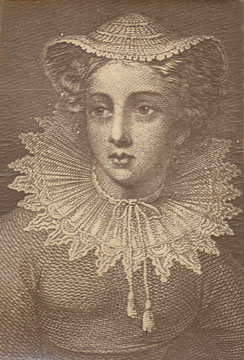
All hail to the sovereign who, bred up in severe habits of reading and
meditation, loved books and scholars to the very bottom of her heart!
I consider Elizabeth as a royal bibliomaniac of transcendent fame!—I
see her, in imagination, wearing her favourite little Volume of
Prayers,[325] the composition of Queen Catherine Parr, and Lady
Tirwit, "bound in solid gold, and hanging by a gold chain at her
side," at her morning and evening devotions—afterwards, as she became
firmly seated upon her throne, taking an interest in the
embellishments of the Prayer Book,[326] which goes under her own
name; and then indulging her strong bibliomaniacal appetites in
fostering the institution "for the
erecting of a Library and an
Academy for the study of Antiquities and History."[327]
Notwithstanding her earnestness to root out all relics of the Roman
Catholic religion (to which, as the best excuse, we must, perhaps,
attribute the sad cruelty of the execution of Mary, Queen of Scots), I
cannot in my heart forbear to think but
that she secured, for her own book-boudoir, one or two of the curious articles which the
commissioners often-times found in the libraries that they inspected:
and, amongst other volumes, how she could forbear pouncing upon "A
great Pricksong Book of parchment"—discovered in the library of All
Soul's College[328]—is absolutely beyond my wit to divine!
Loren. You are full of book anecdote of Elizabeth: but do you forget
her schoolmaster, Roger Ascham?
Lysand. The master ought certainly to have been mentioned before his
pupil. Old Roger is one of my most favourite authors; and I wish
English scholars in general not only to read his works frequently,
but to imitate the terseness and perspicuity of his style. There is a
great deal of information in his treatises, respecting the manners and
customs of his times; and as Dr. Johnson has well remarked, "his
philological learning would have gained him honour in any
country."[329] That he was an ardent bibliomaniac, his letters when
upon the continent, are a sufficient demonstration.
From the tutor of Elizabeth let us go to her prime minister,
Cecil.[330] We have already seen how successfully this great man
interposed in matters of religion; it remains to notice his zealous
activity in the cause of learning. And of this latter who can possibly
entertain a doubt? Who that has seen how frequently his name is
affixed to Dedications, can disbelieve that Cecil was a lover of
books? Indeed I question whether it is inserted more frequently in a
diplomatic document or printed volume. To possess all the presentation
copies of this illustrious minister would be to possess an ample and
beautiful library of the literature of the sixteenth century.
But the book-loving propensities of Elizabeth's minister were greatly
eclipsed by those of her favourite archbishop, Parker:
clarum et venerabile nomen
Gentibus, et multum nostræ quod proderat urbi.
|
For my part, Lorenzo, I know of no character, either of this or of any
subsequent period, which is more entitled to the esteem and veneration
of Englishmen. Pious, diffident, frank, charitable, learned, and
munificent, Parker was the great episcopal star of his age, which
shone with undiminished lustre to the last moment of its appearance.
In that warm and irritable period, when the Protestant religion was
assailed in proportion to its excellence, and when writers mistook
abuse for argument, it is delightful to think upon the mild and
temperate course which this discreet metropolitan pursued! Even with
such arrant bibliomaniacs as yourselves, Parker's reputation must
stand as high as that attached to any name, when I inform you that of
his celebrated work upon the "Antiquity of the British Church"[331]
are only twenty copies supposed to have been printed. He had a
private press, which was worked with types cast at his own expense;
and a more determined book-fancier, and treasurer of ancient lore, did
not at that time exist in Great Britain.
Phil. You have called the reign of Henry the Seventh the
Augustan-Book-age; but, surely, this distinction is rather due to the
æra of Queen Elizabeth?
Lysand. Both periods merit the appellation. In Henry's time, the
invention of printing was of early growth; but the avidity of readers
considerable. The presses of Rome, Venice, and Paris, sent forth their
costly productions; and a new light, by such means, was poured upon
the darkened mind. Our own presses began to contribute to the
diffusion of this light; and, compared with the preceding part of the
fifteenth century, the reign of Henry VII. was highly distinguished
for its bibliomaniacal celebrity. Undoubtedly, the æra of Queen
Elizabeth was the golden age of Bibliomaniacism.
Do not let me forget, in my rambling method of treating of books and
book-men, the name and celebrity of the renowned Dr. John Dee. Let us
fancy we see him in his conjuring cap and robes—surrounded with
astrological, mathematical, and geographical instruments—with a
profusion of Chaldee characters inscribed upon vellum rolls—and with
his celebrated Glass suspended by magical wires. Let us then follow
him into his study at midnight, and view him rummaging his books;
contemplating the heavens; making calculations; holding converse with
invisible spirits; writing down their responses: anon, looking into
his correspondence with Count a Lasco and the emperors Adolphus and
Maximilian; and pronouncing himself, with the most heartfelt
complacency, the greatest genius of his age![332] In the midst of
these self-complacent reveries, let us imagine we see his wife and
little ones intruding; beseeching him to burn his books and
instruments; and reminding him that there was neither a silver spoon,
nor a loaf of bread, in the cupboard. Alas, poor Dee!—thou wert the
dupe of the people and of the Court: and, although Meric Casaubon has
enshrined thy conjurations in a pompous folio volume, thy name, I
fear, will only live in the memory of bibliomaniacs!
Of a wholly different cast of character and of reading was the
renowned Captain Cox of Coventry. How many of Dee's magical books he
had exchanged for the pleasanter magic of Old Ballads and
Romances, I will not take upon me to say; but that this said
bibliomaniacal Captain had a library, which, even from Master
Laneham's imperfect description of it,[333] I should have preferred
to the four thousand volumes of Dr. John Dee, is most
nuquestionable.
We now approach two characters of a more dignified cast; and who, in
every respect, must be denominated the greatest bibliomaniacs of the
age: I mean Sir Robert Cotton and Sir Thomas Bodley. We will touch
upon them separately.
The numerous relics which are yet preserved of the Cottonian
Collection, may serve to convey a pretty strong idea of its splendour
and perfection in its original shape. Cotton had all the sagacity and
judgment of Lord Coke, with a more beautifully polished mind, and a
more benevolent heart. As to books, and book men, he was the
Mecænas[334] of his day. His thirst for knowledge could never be
satiated; and the cultivation of the mind upon the foundation of a
good heart, he considered to be the highest distinction, and the most
permanent delight, of human beings. Wealth, pomp, parade, and titles,
were dissipated, in the pure atmosphere of his mind before the
invigorating sun of science and learning. He knew that the tomb which
recorded the worth of the deceased had more honest tears shed upon
it than the pompous mausoleum which spoke only of his pedigree and
possessions. Accordingly, although he had excellent blood flowing in
his veins, Cotton sought connection with the good rather than with the
great; and where he found a cultivated understanding, and an honest
heart, there he carried with him his Lares, and made another's
abode his own.
Equally celebrated for literary zeal, and yet more for bibliomaniacal
enthusiasm, was the famous Sir Thomas Bodley; whose account of
himself, in Prince's Worthies of Devon, and particularly in one of
Hearne's publications,[335] can never be read without transport by
an affectionate son of our Oxford Alma Mater. View this illustrious
bibliomaniac, with his gentleman-like air, and expressive countenance,
superintending, with the zeal of a Custom-house officer, the shipping,
or rather barging, of his books for the grand library which is now
called by his own name! Think upon his activity in writing to almost
every distinguished character of the realm: soliciting, urging,
arguing, entreating for their support towards his magnificent
establishment; and, moreover, superintending the erection of the
building, as well as examining the timbers, with the nicety of a
master-carpenter!—Think of this; and when you walk under the grave
and appropriately-ornamented roof, which tells you that you are within
the precincts of the Bodleian Library, pay obeisance to the portrait
of the founder, and hold converse with his gentle spirit that dwells
therein!
Lis. Alas, you bring to my mind those precious hours that are gone by,
never to be recalled, which I wasted within this glorious palace of
Bodley's erection! How I sauntered, and gazed, and sauntered again.—
Phil. Your case is by no means singular. But you promise, when you
revisit the library, not to behave so naughtily again?
Lis. I was not then a convert to the Bibliomania! Now, I will
certainly devote the leisure of six autumnal weeks to examine
minutely some of the precious tomes which are contained in it.
Lysand. Very good. And pray favour us with the result of your profound
researches: as one would like to have the most minute account of the
treasures contained within those hitherto unnumbered volumes.
Phil. As every sweet in this world is balanced by its bitter, I wonder
that these worthy characters were not lampooned by some sharp-set
scribbler—whose only chance of getting perusers for his work, and
thereby bread for his larder, was by the novelty and impudence of his
attacks. Any thing new and preposterous is sure of drawing attention.
Affirm that you see a man standing upon one leg, on the pinnacle of
Saint Paul's[336]—or that the ghost of Inigo Jones had appeared to
you, to give you the extraordinary information that Sir Christopher
Wren had stolen the whole of the plan of that cathedral from a design
of his own—and do you not think that you would have spectators and
auditors enough around you?
Lis. Yes, verily: and I warrant some half-starved scrivener of the
Elizabethan period drew his envenomed dart to endeavour to perforate
the cuticle of some worthy bibliomaniacal wight.
Lysand. You may indulge what conjectures you please; but I know of no
anti-bibliomaniacal satirist of this period. Stubbes did what he
could, in his "Anatomy of Abuses,"[337] to disturb every social and
harmless amusement of the age. He was the forerunner of that snarling
satirist, Prynne; but I ought not thus to cuff him, for fear of
bringing upon me the united indignation of a host of black-letter
critics and philologists. A large and clean copy of his sorrily
printed work is among the choicest treasures of a Shakspearian
virtuoso.
But admitting even that Stubbes had drawn his arrow to the head, and
grazed the skin of such men as Bodley and Cotton, the wound inflicted
by this weapon must have been speedily closed and healed by the
balsamic medicine administered by Andrew Maunsell, in his Catalogue
of English Printed Books.[338] This little thin folio volume afforded
a delicious treat to all honest bibliomaniacs. It revived the drooping
spirits of the despondent; and, like the syrup of the renowned Dr.
Brodum, circulated within the system, and put all the generous juices
in action. The niggardly collector felt the influence of rivalship; he
played a deeper stake at book-gambling; and hastened, by his painfully
acquired knowledge of what was curious and rare in books, to
anticipate the rustic collector—which latter, putting the best wheels
and horses to his carriage, rushed from the country to the metropolis,
to seize, at Maunsell's shop, a choice copy of Cranmer's Bible, or
Morley's Canzonets.[339]
Let us, however, not forget that we have reached the reign of James
I.; a monarch who, like Justinian, affected to be "greatly given to
study of books;"[340] and who, according to Burton's testimony, wished
he had been chained to one of the shelves of the Bodleian
library.[341] Of all literary tastes, James had the most strange and
sterile. Let us leave him to his Demonology; but notice, with the
respect that it merits, the more rational and even elegantly
cultivated mind of his son Prince Henry;[342] of whose passion for
books there are some good evidences upon record. We will next proceed
to the mention of a shrewd scholar and bibliomaniac, and ever active
voyager, ycleped Thomas Coryate, the Peregrine of Odcombe. This
facetious traveller, who was as quaint and original a writer as old
Tom Fuller, appears (when he had time and opportunity) to have taken
special notice of libraries; and when he describes to us his "worm
eaten" copy of Josephus's Antiquities,[343] "written in ancient
Longobard characters in parchment," one cannot but indulge a natural
wish to know something of the present existence of a MS. which had
probably escaped Oberthür, the last laborious editor of Josephus.
Let me here beseech you to pay due attention to the works of Henry
Peacham, when they come across you. The first edition of that
elegantly written volume, "The Compleat Gentleman," was published I
believe in the reign of James I., in the year 1622.
Loren. I possess not only this, but every subsequent copy of it, and a
fair number of copies of his other works. He and Braithwait were the
"par nobile fratrum" of their day.
Phil. I have often been struck with some curious passages in Peacham,
relating to the Education of Youth[344] in our own country; as I
find, from them, that the complaint of severity of discipline still
continued, notwithstanding the able work of Roger Ascham, which had
recommended a mild and conciliatory mode of treatment.
Lysand. But you must not believe every thing that is said in favour of
Continental lenity of discipline, shewn to youth, if the testimony
of a modern newspaper may be credited!——
Lis. What your newspaper may hold forth I will not pretend to enter
into.
Lysand. Nay, here is the paragraph; which I cut out from "The
Observer," and will now read it to you. "A German Magazine recently
announced the death of a schoolmaster in Suabia, who, for 51 years,
had superintended a large institution with old fashioned severity.
From an average, inferred by means of recorded observations, one of
the ushers had calculated that, in the course of his exertions, he had
given 911,500 canings, 121,000 floggings, 209,000 custodes, 136,000
tips with the ruler, 10,200 boxes on the ear, and 22,700 tasks by
heart. It was further calculated that he had made 700 boys stand on
peas, 6000 kneel on a sharp edge of wood, 5000 wear the fool's cap,
and 1,700 hold the rod. How vast (exclaims the journalist) the
quantity of human misery inflicted by a single perverse educator!"
Now, my friends, what have you to say against the English system of
education?
Phil. This is only defending bad by worse.
Lis. Where are we digressing? What are become of our bibliomaniacal
heroes?
Lysand. You do right to call me to order. Let us turn from the birch,
to the book, history.
Contemporaneous with Peacham, lived that very curious collector of
ancient popular little pieces, as well as lover of "sacred secret soul
soliloquies," the renowned melancholy composer, ycleped Robert
Burton;[345] who, I do not scruple to number among the most marked
bibliomaniacs of the age; notwithstanding his saucy railing against
Frankfort book-fairs. We have abundance of testimony (exclusive of the
fruits of his researches, which appear by his innumerable marginal
references to authors of all ages and characters) that this original,
amusing, and now popular, author was an arrant book-hunter; or, as old
Anthony hath it, "a devourer of authors." Rouse, the Librarian of
Bodleian, is said to have liberally assisted Burton in furnishing him
with choice books for the prosecution of his extraordinary work.
About this period lived Lord Lumley; a nobleman of no mean reputation
as a bibliomaniac. But what shall we say to Lord Shaftesbury's
eccentric neighbour, Henry Hastings? who, in spite of his hawks,
hounds, kittens, and oysters,[346] could not
for forbear to indulge his book propensities though in a
moderate degree! Let us fancy we see him, in his eightieth year, just
alighted from the toils of the chase, and listening, after dinner,
with his "single glass" of ale by his side, to some old woman with
"spectacle on nose" who reads to him a choice passage out of John
Fox's Book of Martyrs! A rare old boy was this Hastings. But I
wander—and may forget another worthy, and yet more ardent,
bibliomaniac, called John Clungeon, who left a press, and some books
carefully deposited in a stout chest, to the parish church at
Southampton. We have also evidence of this man's having erected a
press within the same; but human villany has robbed us of every relic
of his books and printing furniture.[347] From Southampton, you must
excuse me if I take a leap to London; in order to introduce you into
the wine cellars of one John Ward; where, I suppose, a few choice
copies of favourite authors were sometimes kept in a secret recess by
the side of the oldest bottle of hock. We are indebted to Hearne for a
brief, but not uninteresting, notice of this vinous book
collector.[348]
Lis. If Master Cox, "by profession a mason," and living in the
country, could have collected such a cabinet of romances and
ballads—why should not a wine merchant, living in the metropolis,
have turned his attention to a similar pursuit, and have been even
more successful in the objects of it?
Phil. I know not; particularly as we have, at the present day, some
commercial characters—whose dealings in trade are as opposite to
books as frogs are to roast beef—absolute madmen in search after
black-letter, large paper, and uncut copies! But proceed, Lysander.
Lysand. Such was the influence of the Book Mania about, or rather a
little before, this period that even the sacred retirement of a
monastery, established upon Protestant principles, and conducted by
rules so rigid as almost to frighten the hardiest ascetic, even such a
spot was unable to resist the charms of book-collecting and
book-embellishment. How St. Jerome or St. Austin would have lashed the
Ferrar Family[349] for the gorgeous decorations of their volumes, and
for devoting so much precious time and painful attention to the art
and mystery of Book-binding! Yes, Lisardo; it is truly curious to
think upon the Little Gidding Monastery—near which, perhaps, were
——"rugged rocks, that holy knees had worn—"
and to imagine that the occupiers of such a place were infected—nay,
inflamed—with a most powerful ardour for curious, neat, splendid,
and, I dare venture to affirm, matchless copies of the several volumes
which they composed! But I will now hasten to give very different
evidence of the progress of this disease, by noticing the labours of a
bibliomaniac of first rate celebrity; I mean Elias Ashmole:[350] whose
museum at Oxford abundantly proves his curious and pertinacious
spirit in book-collecting. His works, put forth under his own
superintendence, with his name subjoined, shew a delicate taste, an
active research, and, if we except his Hermetical propensities, a
fortunate termination. His "opus maximum" is the Order of the
Garter; a volume of great elegance both in the composition and
decorations. Your copy of it, I perceived, was upon large paper; and
cost you—
Loren. Not eight guineas—although you were about to say fourteen!
Lysand. Even so. But it must have been obtained in the golden age of
book-collecting?
Loren. It was obtained, together with an uncut copy of his Theatrum
Chemicum,[351] by my father, at the shop of a most respectable
bookseller, lately living, at Mews-Gate, and now in Pall-Mall—where
the choicest copies of rare and beautiful books are oftentimes to be
procured, at a price much less than the extravagant ones given at
book-sales. You observed it was bound in blue morocco—and by that
Coryphæus of book-binders, the late Roger Payne!
Lysand. I observed it had a "glorious aspect," as bibliographers term
it.
Lis. But what has become of Ashmole all this while?
Lysand. I will only further remark of him that, if he had not suffered
his mind to wander in quest of the puzzling speculations of alchemy
and astrology—which he conceived himself bound to do in consequence,
probably, of wearing John Dee's red velvet night cap—he might have
mingled a larger portion of common sense and sound practical
observations in his writings.
But a truce to worthy old Elias. For see yonder the bibliomaniacal
spirit of Archbishop Laud pacing your library! With one hand resting
upon a folio,[352] it points, with the other, to your favourite print
of the public buildings of the University of Oxford—thereby reminding
us of his attachment, while living, to literature and fine books, and
of his benefactions to the Bodleian Library. Now it "looks frowningly"
upon us; and, turning round, and shewing the yet reeking gash from
which the life-blood flowed, it flits away—
Par levibus ventis, volucrique simillima somno!
Peace, peace, thou once "lofty spirit"—peace to thy sepulchre—always
consecrated by the grateful student who has been benefited by thy
bounty!
Perhaps Laud should have been noticed a little earlier in this list of
bibliomanical heroes; but, having here noticed him, I cannot refrain
from observing to you that the notorious Hugh Peters revelled in some
of the spoils of the archbishop's library; and that there are, to the
best of my recollection, some curious entries on the journals of the
House of Commons relating to the same.[353]
Lis. This is extraordinary enough. But, if I well remember, you
mentioned, a short time ago, the name of Braithwait as connected with
that of Peacham. Now, as I persume
Lorenzo has not tied down his guests to any rigid chronological rules,
in their literary chit-chat, so I presume you might revert to
Braithwait, without being taxed with any great violation of colloquial
order.
Lysand. Nay, I am not aware of any bookish anecdote concerning
Braithwait. He was mentioned with Peacham as being a like accomplished
character.[354] Some of his pieces are written upon the same subjects
as were Peacham's, and with great point and elegance. He seems,
indeed, to have had the literary credit and moral welfare of his
countrymen so much at stake that, I confess, I have a vast fondness
for his lucubrations. His "English Gentlewoman" might be reprinted
with advantage.
As I am permitted to be desultory in my remarks, (and, indeed, I
craved this permission at the outset of them) I may here notice the
publication of an excellent Catalogue of Books, in 1658, 4to.;
which, like its predecessor, Maunsell's, helped to inflame the
passions of purchasers, and to fill the coffers of booksellers.
Whenever you can meet with this small volume, purchase it, Lisardo; if
it be only for the sake of reading the spirited introduction prefixed
to it.[355] The author was a man, whoever he may chance to be, of no
mean intellectual powers. But to return.
Where sleep now the relics of Dyson's Library, which supplied that
Helluo Librorum, Richard Smith, with "most of his rarities?"[356] I
would give something pretty considerable to have a correct list—but
more to have an unmolested sight—of this library, in its original
state: if it were merely to be convinced whether or not it contained a
copy of the first edition of Shakespeare, of larger dimensions, and
in cleaner condition, than the one in Philander's Collection!
I have incidentally mentioned the name of Richard Smith.[357] Such a
bibliomaniac deserves ample notice, and the warmest commendation. Ah,
my Lisardo! had you lived in the latter days of Charles II.—had you,
by accident, fallen into the society of this indefatigable
book-forager, while he pursued his book-rounds in Little
Britain—could you have listened to his instructive conversation, and
returned home with him to the congenial quiet and avocations of his
book-room—would you, however caressed St. James's, or even smiled
upon by the first Duchess in the land—have cared a rush for the
splendours of a Court, or concentrated your best comforts in a coach
drawn by six cream-coloured horses? Would you not, on the contrary,
have thought with this illustrious bibliomaniac, and with the sages of
Greece and Rome before him, that "in books is wisdom, and in wisdom is
happiness."
Lis. In truth I should have done even more than what your barren
imagination has here depicted. Smith's figure, his address, his
conversation, his library—
Loren. Enough—peace! There is no end to Lisardo's fruitful
imagination. We are surfeited with the richness of it. Go on, dear
Lysander; but first, satisfy a desire which I just now feel to be
informed of the period when Sales of Books, by Auction, were
introduced into this country.
Lysand. You take that for granted which
remains be proved: namely, my ability to gratify
you in this particular. Of the precise period when this memorable
revolution in the sale of books took place I have no means of being
accurately informed: but I should think not anterior to the year 1673,
or 1674; for, in the year 1676, to the best of my recollection, the
catalogue of the Library of Dr. Seaman was put forth; to which is
prefixed an address to the reader, wherein the custom of selling books
by auction is mentioned as having been but of recent origin in our
country.[358] It was, however, no sooner introduced than it caught
the attention, and pleased the palates, of bibliomaniacs exceedingly:
and Clavel, a bookseller, who published useful catalogues of books to
be sold in his own warehouse, retorted in sharp terms upon the folly
and extravagance which were exhibited at book auctions. However,
neither Clavel nor his successors, from that period to the present,
have been able to set this custom aside, nor to cool the fury of
book-auction bibliomaniacs—who, to their eternal shame be it said,
will sometimes, from the hot and hasty passions which are stirred up
by the poisonous miasmata floating in the auction-room, give a sum
twice or thrice beyond the real value of the books bidden for! Indeed,
I am frequently amused to see the vehemence and rapture with which a
dirty little volume is contended for and embraced—while a respectable
bookseller, like Portius, coolly observes across the table—"I have a
better copy on sale at one third of the price!"
Lis. From what you say, it would appear to be wiser to lay out one's
money at a bookseller's than at a book-auction?
Lysand. Both methods must of necessity be resorted to: for you cannot
find with the one what you may obtain at the other. A distinguished
collector, such as the late Mr. Reed, or Mr. Gough, or Mr. Joseph
Windham, dies, and leaves his library to be sold by auction for the
benefit of his survivors. Now, in this library so bequeathed, you have
the fruits of book-labour, collected for a long period, and cultivated
in almost every department of literature. A thousand radii are
concentrated in such a circle; for it has, probably, been the object
of the collector's life to gather and to concentrate these radii. In
this case, therefore, you must attend the auction; you must see how
such a treasure is scattered, like the Sibylline leaves, by the winds
of fate. You must catch at what you want, and for what you have been
a dozen years, perhaps, in the pursuit of. You will pay dearly for
these favourite volumes; but you have them, and that is comfort
enough; and you exclaim, as a consolation amidst all the agony and
waste of time which such a contest may have cost you,—"Where, at what
bookseller's, are such gems now to be procured?" All this may be well
enough. But if I were again to have, as I have already had, the power
of directing the taste and applying the wealth of a young
collector—who, on coming of age, wisely considers books of at least
as much consequence as a stud of horses—I would say, go to Mr. Payne,
or Mr. Evans, or Mr. Mackinlay, or Mr. Lunn, for your Greek and Latin
Classics; to Mr. Dulau, or Mr. Deboffe, for your French; to Mr.
Carpenter, or Mr. Cuthell, for your English; and to Mr. White for your
Botany and rare and curious books of almost every description. Or, if
you want delicious copies, in lovely binding, of works of a sumptuous
character, go and drink coffee with Mr. Miller, of Albemarle
Street—under the warm light of an Argand lamp—amidst a blaze of
morocco and russia coating, which brings to your recollection the view
of the Temple of the Sun in the play of Pizarro! You will also find,
in the vender of these volumes, courteous treatment and "gentlemanly
notions of men and things." Again, if you wish to speculate deeply in
books, or to stock a newly-discovered province with what is most
excellent and popular in our own language, hire a vessel of 300 tons'
burthen, and make a contract with Messrs. Longman, Hurst, and Co., who
are enabled, from their store of quires, which measure 50 feet in
height, by 40 in length, and 20 in width, to satisfy all the wants of
the most craving bibliomaniacs. In opposition to this pyramid, enter
the closet of Mr. Triphook, jun., of St. James's Street—and resist,
if it be in your power to resist, the purchase of those clean copies,
so prettily bound, of some of our rarest pieces of black-letter
renown!
Loren. From this digression, oblige us now by returning to our
bibliomaniacal history.
Lysand. Most willingly. But I am very glad you have given me an
opportunity of speaking, as I ought to speak, of some of our most
respectable booksellers, who are an ornament to the cause of the
bibliomania.
We left off, I think, with noticing that renowned book-collector,
Richard Smith. Let me next make honourable mention of a "par nobile
fratrum" that ycleped are North. The "Lives" of these men, with an
"Examen" (of "Kennet's History of England"), were published by a
relative (I think a grandson) of the same name; and two very amusing
and valuable quarto volumes they are! From one of these Lives, we
learn how pleasantly the Lord Keeper used to make his meals upon some
one entertaining Law-volume or another: how he would breakfast upon
Stamford,[359] dine upon Coke, and sup upon Fitzherbert, &c.;
and, in truth, a most insatiable book appetite did this eminent judge
possess. For, not satisfied ("and no marvel, I trow") with the
foregoing lean fare, he would oftentimes regale himself with a
well-served-up course of the Arts, Sciences, and the
Belles-Lettres!
His brother, Dr. John North, was a still greater Helluo Librorum;
"his soul being never so staked down as in an old bookseller's shop."
Not content with a superficial survey of whatever he inspected, he
seems to have been as intimately acquainted with all the book-selling
fraternity of Little-Britain as was his contemporary, Richard Smith;
and to have entered into a conspiracy with Robert Scott[360]—the most
renowned book vender in this country, if not in Europe—to deprive
all bibliomaniacs of a chance of procuring rare and curious volumes,
by sweeping every thing that came to market, in the shape of a book,
into their own curiously-wrought and widely-spread nets. Nay, even
Scott himself was sometimes bereft of all power, by means of the
potent talisman which this learned Doctor exercised—for the latter,
"at one lift," would now and then sweep a whole range of shelves in
Scott's shop of every volume which it contained. And yet how
whimsical, and, in my humble opinion, ill-founded, was Dr. North's
taste in matters of typography! Would you believe it, Lisardo, he
preferred the meagre classical volumes, printed by the Gryphii, in
the italic letter, to the delicate and eye-soothing lustre of the
Elzevir type—?
Lis. "De gustibus—" you know the rest. But these Norths were brave
bibliomaniacs! Proceed, we are now advancing towards the threshold of
the eighteenth century; and the nearer you come to it, the greater is
the interest excited.
Lysand. Take care that I don't conclude with the memorable
catalogue-burning deed of your father! But I spare your present
feelings.
All hail to the noble book-spirit by which the Lives of
Oxford-Athenians, and the Antiquities of Oxford University, are
recorded and preserved beyond the power of decay![361] All hail to
thee, Old Anthony a-Wood! May the remembrance of thy researches,
amidst thy paper and parchment documents, stored up in chests, pews,
and desks, and upon which, alas! the moth was "feeding sweetly," may
the remembrance of these thy laborious researches always excite
sensations of gratitude towards the spirit by which they were
directed! Now I see thee, in imagination, with thy cautious step, and
head bowing from premature decay, and solemn air, and sombre visage,
with cane under the arm, pacing from library to library, through
gothic quadrangles; or sauntering along the Isis, in thy way to some
neighbouring village, where thou wouldst recreate thyself with "pipe
and pot." Yes, Anthony! while the Bodleian and Ashmolean
collections remain—or rather as long as Englishmen know how to value
that species of literature by which the names and actions of their
forefathers are handed down to posterity, so long shall the memory of
thy laudable exertions continue unimpaired!
A very few years after the death of this distinguished character, died
Dr. Francis Bernard;[362] a stoic in bibliography. Neither beautiful
binding, nor amplitude of margin, ever delighted his eye or rejoiced
his heart: for he was a stiff, hard, and straight-forward reader—and
learned, in Literary History, beyond all his contemporaries. His
collection was copious and excellent; and although the compiler of the
catalogue of his books sneers at any one's having "an entire
collection in physic," (by the bye, I should have told you that
Bernard was a Doctor of Medicine,) yet, if I forget not, there are
nearly 150 pages in this said catalogue which are thickly studded with
"Libri Medici," from the folio to the duodecimo size. Many very
curious books are afterwards subjoined; and some precious bijous, in
English Literature, close the rear. Let Bernard be numbered among the
most learned and eminent bibliomaniacs.
Having at length reached the threshold, let us knock at the door, of
the eighteenth century. What gracious figures are those which approach
to salute us? They are the forms of Bishops Fell and More:[363]
prelates, distinguished for their never ceasing admiration of
valuable and curious works. The former is better known as an editor;
the latter, as a collector—and a collector, too, of such multifarious
knowledge, of such vivid and just perceptions, and unabating
activity—that while he may be hailed as the Father of black-letter
Collectors in this country, he reminds us of his present successor
in the same see; who is not less enamoured of rare and magnificent
volumes, but of a different description, and whose library assumes a
grander cast of character.
The opening of the 18th century was also distinguished by the death of
a bibliomaniac of the very first order and celebrity. Of one, who had,
no doubt, frequently discoursed largely and eloquently with Luttrell,
(of whom presently) upon the rarity and value of certain editions of
old Ballad Poetry: and between whom presents of curious black-letter
volumes were, in all probability, frequently passing. I allude to the
famous Samuel Pepys;[364] Secretary to the Admiralty.
Now it was a convincing proof to me, my dear friends, that the
indulgence of a passion for books is perfectly compatible with any
situation, however active and arduous. For while this illustrious
bibliomaniac was sending forth his messengers to sweep every
bookseller's shop from the Tweed to Penzance, for the discovery of old
and almost unknown ballads—and while his name rung in the ears of
rival collectors—he was sedulous, in his professional situation, to
put the Navy of Old England upon the most respectable footing; and
is called the Father of that system which, carried into effect by
British hearts of oak, has made the thunder of our cannon to be heard
and feared on the remotest shores. Nor is it a slight or common
coincidence that a spirit of book-collecting, which stimulated the
Secretary of the Admiralty at the opening of the 18th century,
should, at the close of it, have operated with equal or greater force
in a First Lord of the same glorious department of our
administration. But we shall speak more fully of this latter
character, and of his matchless collection, in a future stage of our
discussion.
While we are looking round us at this period, we may as well slightly
notice the foundation of the Blenheim Library. The Duke of
Marlborough[365] was resolved that no naval commander, or person
connected with the navy, should eclipse himself in the splendour of
book-collecting: but it was to Prince Eugene that Marlborough was
indebted for his taste in this particular; or rather the English
commander was completely bitten with the bibliomaniacal disease in
consequence of seeing Eugene secure rare and magnificent copies of
works, when a city or town was taken: and the German Prince himself
expatiates upon the treasures of his library, with a rapture with
which none but the most thorough-bred bibliomaniacs can ever
adequately sympathise.
Ever ardent in his love of past learning, and not less voracious in
his bibliomaniacal appetites, was the well known Narcissus Luttrell.
Nothing—if we may judge from the spirited sketch of his book
character, by the able editor[366] of Dryden's works—nothing would
seem to have escaped his Lynx-like vigilance. Let the object be what
it would (especially if it related to poetry) let the volume be
great or small, or contain good, bad, or indifferent warblings of the
muse—his insatiable craving had "stomach for them all." We may
consider his collection as the fountain head of those copious streams
which, after fructifying the libraries of many bibliomaniacs in the
first half of the eighteenth century, settled, for a while, more
determinedly, in the curious book-reservoir of a Mr. Wynne—and hence,
breaking up, and taking a different direction towards the collections
of Farmer, Steevens, and others, they have almost lost their identity
in the innumerable rivulets which now inundate the book-world.
Why have I delayed, to the present moment, the mention of that
illustrious bibliomaniac, Earl Pembroke? a patron of poor scholars,
and a connoisseur, as well as collector, of every thing the most
precious and rare in the book-way. Yet was his love of Virtû not
confined to objects in the shape of volumes, whether printed or in
MS.: his knowledge of statues and coins was profound;[367] and his
collection of these, such as to have secured for him the admiration
of posterity.
While this nobleman was the general theme of literary praise there
lived a Bibliomaniacal Triumvirate of the names of Bagford, Murray,
and Hearne: a triumvirate, perhaps not equalled, in the mere love of
book-collecting, by that which we mentioned a short time ago. At the
head, and the survivor of these three,[368] was Thomas Hearne; who,
if I well remember, has been thus described by Pope, in his Dunciad,
under the character of Wormius:
But who is he, in closet close ypent,
Of sober face, with learned dust besprent?
Right well mine eyes arede the myster wight,
On parchment scraps y-fed, and Wormius hight.
|
A little volume of book chit-chat might be written upon the marvellous
discovesies and voluminous
compilations of Bagford and Hearne: and to these, we may add another
unique bibliomaniac, who will go down to posterity under the
distinguished, and truly enviable, title of "The Musical Small-Coal
Man;" I mean, master Thomas Britton. Yes, Lisardo; while we give to
the foregoing characters their full share of merit and praise; we
admit that Bagford's personal activity and manual labour have hardly
been equalled—while we allow John Murray to have looked with sharper
eyes after black-letter volumes than almost any of his predecessors
or successors—while we grant Thomas Hearne a considerable portion of
scholarship, an inflexible integrity, as well as indefatigable
industry, and that his works are generally interesting, both from the
artless style in which they are composed, and the intrinstic utility
of the greater part of them, yet let our admiration
be "be screwed to its sticking place," when we
think upon the wonderous genius of the aforesaid Thomas Britton; who,
in the midst of his coal cellars, could practise upon "fiddle and
flute," or collate his curious volumes; and throwing away, with the
agility of a harlequin, his sombre suit of business-cloths, could put
on his velvet coat and bag-wig, and receive his concert visitors, at
the stair-head, with the politeness of a Lord of the Bedchamber!
Loren. In truth, a marvellous hero was this Small-Coal Man! Have you
many such characters to notice?
Lysand. Not many of exactly the same stamp. Indeed, I suspect that
Hearne, from his love of magnifying the simple into the marvellous,
has a little caricatured the picture. But Murray seems to have been a
quiet unaffected character; passionately addicted to old books of
whatever kind they chanced to be; and, in particular, most
enthusiastically devoted to a certain old English Chronicle, entitled
Rastell's Pastime of (the) People.
Phil. I observed a notification of the re-appearance of this Chronicle
in some of the Magazines or Reviews: but I hope, for the benefit of
general readers, the orthography will be modernized.
Loren. I hope, for the sake of consistency with former similar
publications,[369] the ancient garb will not be thrown aside. It would
be like—what Dr. Johnson accuses Pope of having committed—"clothing
Homer with Ovidian graces."
Lysand. Much may be said on both sides of the question. But why are we
about to make learned dissertations upon the old English Chronicles?
Lis. Proceed, and leave the old chroniclers to settle the matter
themselves. Who is the next bibliomaniac deserving of particular
commendation?
Lysand. As we have sometimes classed our bibliomaniacs in tribes, let
me now make you acquainted with another Trio, of like renown in the
book-way: I mean Anstis, Lewis, and Ames. Of these in their turn.
Anstis[370] stands deservedly the first in the list; for he was, in
every respect, a man of thorough benevolent character, as well as a
writer of taste and research. I do not know of any particulars
connected with his library that merit a distinct recital; but he is
introduced here from his connection with the two latter
bibliographers. Lewis[371] is known to us, both as a topographer and
bibliographical antiquary. His Life of Caxton has been reprinted
with additions and corrections; and, in particular, his edition of
Wicliffe's New Testament has been recently put forth by the Rev. Mr.
Baber, in a handsome quarto volume, with valuable emendations. Lewis
was a sharp censurer of Hearne, and was somewhat jealous of the
typographical reputation of Ames. But his integrity and moral
character, as well as his love of rare and curious books, has secured
for him a durable reputation. Of Ames, and here—though a little out
of order—I may add Herbert—the public has already heard probably
"more than enough." They were both, undoubtedly, men of extraordinary
mental vigour and bodily activity in the darling pursuit which they
cultivated.[372] Indeed, Herbert deserves high commendation; for while
he was rearing, with his own hands, a lofty pyramid of typographical
fame, he seems to have been unconscious of his merits; and, possessing
the most natural and diffident character imaginable, he was always
conjuring up supposed cases of vanity and arrogance, which had no
foundation whatever but in the reveries of a timid imagination. His
Typographical Antiquities are a mass of useful, but occasionally
uninteresting, information. They are as a vast plain, wherein the
traveller sees nothing, immediately, which is beautiful or inviting;
few roses, or cowslips, or daisies; but let him persevere, and walk
only a little way onward, and he will find, in many a shelter'd
recess, "flowers of all hue," and herbs of all qualities: so that
fragrance and salubrity are not wanting in this said plain, which has
been thus depicted in a style so marvellously metaphorical!
By mentioning Herbert in the present place, I have a little inverted
the order of my narrative. A crowd of distinguished bibliomaniacs, in
fancy's eye, is thronging around me, and demanding a satisfactory
memorial of their deeds.
Loren. Be not dismayed, Lysander. If any one, in particular, looks
"frowningly" upon you, leave him to me, and he shall have ample
satisfaction.
Lysand. I wish, indeed, you would rid me of a few of these
book-madmen. For, look yonder, what a commanding attitude Thomas
Baker[373] assumes!
Loren. Never fear. He is an old acquaintance of mine; for, when
resident at St. John's, Cambridge, I was frequently in the habit of
conversing with his spirit in the library, and of getting curious
information relating to choice and precious volumes, which had escaped
the sagacity of his predecessors, and of which I fear his successors
have not made the most proper use.
Phil. This is drawing too severe a conclusion. But Baker merits the
thanks of a book-loving posterity.
Lysand. He is satisfied with this mention of his labours; for see, he
retreats—and Theobald[374] and Tom Rawlinson rush forward to claim a
more marked attention: although I am not much disposed to draw a
highly finished picture of the editor of Shakespeare.
Lis. Is Thomas Rawlinson[375] so particularly deserving of
commendation, as a bibliomaniac?
Lysand. If the most unabating activity and an insatiable appetite—if
an eye, in regard to books, keen and sparkling as the ocean-bathed
star—if a purse, heavily laden and inexhaustible—if store-rooms
rivalled only by the present warehouses of the East-India Company—if
a disposition to spread far and wide the influence of the Bibliomania,
by issuing a carte blanche for every desperately smitten antiquary
to enter, and partake of the benefits of, his library—be criteria of
book-phrensy—why then the resemblance of this said Tom Rawlinson
ought to form a principal ornament in the capital of that gigantic
column, which sustains the temple of Book Fame! He was the Tom Folio
of the Tatler, and may be called the Leviathan of book-collectors
during nearly the first thirty years of the eighteenth century.
Lis. I suppose, then, that Bagford, Murray, and Hearne, were not
unknown to this towering bibliomaniac?
Lysand. On the contrary, I conclude, for certain, that, if they did
not drink wine, they constantly drank coffee, together: one of the
huge folio volumes of Bleau's Atlas serving them for a table.
But see yonder the rough rude features of Humphrey Wanley[376] peering
above the crowd! All hail to thy honest physiognomy—for thou wert a
rare Book-wight in thy way! and as long as the fame of thy patron
Harley shall live, so long, honest Humphrey, dost thou stand a sure
chance of living "for aye," in the memory of all worthy bibliomaniacs.
A softer noise succeeds; and the group becomes calm and attentive, as
if some grand personage were advancing. See, 'tis Harley, Earl of
Oxford![377]
Lis. Let us rise to pay him homage!
Phil. Lisardo is now fairly bewitched. He believes in the existence
of the group!—Help, ho! Fetters and warder for—
Loren. Philemon loves to indulge his wit at his friend's expense. Is't
not so, Lisardo?
Lis. I forgive him. 'Twas a "glorious fault." But, indeed, I would
strip to the skin, if this said nobleman longed for my coat,
waistcoat, small clothes, and shirt, to form him a cushion to sit
upon! I have heard such wonderful things said of his library!—
Lysand. And not more wonderful than its reputation justifies. Well
might Pope be enamoured of such a noble friend—and well might even
Dr. Mead bow to the superior splendour of such a book-competitor!
While the higher order of bibliomaniacs, reposing upon satin sofas,
were quaffing burgundy out of Harley's curiously cut goblets, and
listening to the captivating tale of Mead or Folkes, respecting a
vellum Editio Princeps—the lower order, with Bagford at their head,
were boisterously regaling themselves below, drinking ale round an
oaken table, and toasting their patron, till the eye could no longer
discover the glass, nor the tongue utter his name. Aloft, in mid air,
sat the soothed spirits of Smith and North; pointing, with their thin,
transparent fingers, to the apotheosis of Caxton and Aldus! Suddenly,
a crowd of pipy fragrance involves the room: these ærial forms cease
to be visible; and broken sounds, like the retiring tide beneath Dover
cliff, die away into utter silence. Sleep succeeds: but short is the
slumber of enthusiastic bibliomaniacs! The watchman rouses them from
repose: and the annunciation of the hour of "two o'clock, and a
moonlight morning," reminds them of their cotton night-caps and flock
mattrasses. They start up, and sally forwards; chaunting, midst the
deserted streets, and with eyes turned sapiently towards the moon,
"Long life to the King of Book-Collectors, Harley, Earl of Oxford!"
Loren. A truce, Lysander! I entreat a truce!
Lysand. To what?
Loren. To this discourse. You must be exhausted.
Phil. Indeed I agree with Lorenzo: for Lysander has surpassed, in
prolixity, the reputation of any orator within St. Stephen's chapel.
It only remains to eclipse, in a similar manner, the speeches which
were delivered at Hardy's trial—and then he may be called the
Nonpareil of orators!
Lysand. If you banter me, I am dumb. Nor did I know that there was any
thing of eloquence in my chit-chat. If Lisardo had had my experience,
we might then have witnessed some glittering exhibitions of
imagination in the book-way!
Lis. My most excellent friend, I will strive to obtain this
experience, since you are pleased to compliment me upon what I was not
conscious of possessing—But, in truth, Lysander, our obligations to
you are infinite.
Lysand. No more; unless you are weary of this discourse—
Phil. Lis. Weary!?
Loren. Let me here exercise my undeniable authority. A sandwich,
like the evening rain after a parching day, will recruit Lysander's
exhausted strength. What say you?
Lysand. "I shall in all things obey your high command." But hark—I
hear the outer gate bell ring! The ladies are arrived: and you know my
bashfulness in female society. Adieu, Bibliomania! 'till the morrow.
Loren. Nay, you are drawing too dismal conclusions. My sisters are not
sworn enemies to this kind of discourse.

The arrival of Almansa and Belinda, the sisters of Lorenzo put a stop
to the conversation. So abrupt a silence disconcerted the ladies; who,
in a sudden, but, it must be confessed, rather taunting, strain—asked
whether they should order their bed-chamber candlesticks, and retire
to rest?
Lis. Not if you are disposed to listen to the most engaging
book-anecdote orator in his majesty's united realms!
Alman. Well, this may be a sufficient inducement for us to remain. But
why so suddenly silent, gentlemen?
Loren. The conversation had ceased before you arrived. We were
thinking of a hung-beef sandwich and a glass of madeira to recruit
Lysander's exhausted powers. He has been discoursing ever since
dinner.
Belind. I will be his attendant and cup-bearer too, if he promises to
resume his discourse. But you have probably dispatched the most
interesting part.
Lysand. Not exactly so, I would hope, fair Lady! Your brother's
hospitality will add fresh energy to my spirit; and, like the renewed
oil in an exhausted lamp, will cause the flame to break forth with
fresh splendour.
Belind. Sir, I perceive your ingenuity, at least, has not forsaken
you—in whatever state your memory may be!—

Here the sandwiches made their appearance: and Lorenzo seated his
guests, with his sisters, near him, round a small circular table. The
repast was quickly over: and Philemon, stirring the sugar within a
goblet of hot madeira wine and water, promised them all a romantic
book-story, if the ladies would only lend a gracious ear. Such a
request was, of course, immediately complied with.
Phil. The story is short—
Lis. And sweet, I ween.
Phil. That remains to be proved. But listen.
You all know my worthy friend, Ferdinand: a very Helluo Librorum. It
was on a warm evening in summer—about an hour after sunset—that
Ferdinand made his way towards a small inn, or rather village
alehouse, that stood on a gentle eminence, skirted by a luxuriant
wood. He entered, oppressed with heat and fatigue; but observed, on
walking up to the porch "smothered with honey-suckles" (as I think
Cowper expresses it), that every thing around bore the character of
neatness and simplicity. The holy-oaks were tall and finely variegated
in blossom: the pinks were carefully tied up: and roses of all colours
and fragrance stood around, in a compacted form, like a body-guard,
forbidding the rude foot of trespasser to intrude. Within, Ferdinand
found corresponding simplicity and comfort.
The "gude" man of the house was spending the evening with a neighbour;
but poached eggs and a rasher of bacon, accompanied with a flagon of
sparkling ale, gave our guest no occasion to doubt the hospitality of
the house, on account of the absence of its master. A little past ten,
after reading some dozen pages in a volume of Sir Egerton Brydges's
Censura Literaria, which he happened to carry about him, and
partaking pretty largely of the aforesaid eggs and ale, Ferdinand
called for his candle, and retired to repose. His bed-room was small,
but neat and airy: at one end, and almost facing the window, there was
a pretty large closet, with the door open: but Ferdinand was too
fatigued to indulge any curiosity about what it might contain.
He extinguished his candle, and sank upon his bed to rest. The heat of
the evening seemed to increase. He became restless; and, throwing off
his quilt, and drawing his curtain aside, turned towards the window,
to inhale the last breeze which yet might be wafted from the
neighbouring heath. But no zephyr was stirring. On a sudden, a broad
white flash of lightning—(nothing more than summer heat) made our
bibliomaniac lay his head upon his pillow, and turn his eyes in an
opposite direction. The lightning increased—and one flash, more vivid
than the rest, illuminated the interior of the closet, and made
manifest—an old mahogany Book-Case, stored with books. Up started
Ferdinand, and put his phosphoric treasures into action. He lit his
match, and trimmed his candle, and rushed into the closet—no longer
mindful of the heavens—which now were in a blaze with the summer
heat.
The book-case was guarded both with glass and brass wires—and the
key—no where to be found! Hapless man!—for, to his astonishment, he
saw Morte d'Arthur, printed by Caxton—Richard Cœur de Lyon,
by W. de Worde—The Widow Edyth, by Pynson—and, towering above
the rest, a large paper copy of the original edition of Prince's
Worthies of Devon; while, lying transversely at top, reposed John
Weever's Epigrams, "The spirit of Captain Cox is here
revived"—exclaimed Ferdinand—while, on looking above, he saw a
curious set of old plays, with Dido, Queen of Carthage, at the head
of them! What should he do? No key: no chance of handling such
precious tomes—'till the morning light, with the landlord, returned!
He moved backwards and forwards with a hurried step—prepared his
pocket knife to cut out the panes of glass, and untwist the brazen
wires—but a "prick of conscience" made him desist from carrying his
wicked design into execution. Ferdinand then advanced towards the
window; and throwing it open, and listening to the rich notes of a
concert of nightingales, forgot the cause of his torments—'till, his
situation reminding him of "The Churl and the Bird," he rushed with
renewed madness into the cupboard—then searched for the bell—but,
finding none, he made all sorts of strange noises. The landlady rose,
and, conceiving robbers to have broken into the stranger's room, came
and demanded the cause of the disturbance.
"Madam," said Ferdinand, "is there no possibility of inspecting the
books in the cupboard—where is the key?" "Alack, sir," rejoined
the landlady, "what is there that thus disturbs you in the sight of
those books? Let me shut the closet-door and take away the key of it,
and you will then sleep in peace." "Sleep in peace!" resumed
Ferdinand—"sleep in wretchedness, you mean! I can have no peace
unless you indulge me with the key of the book-case. To whom do such
gems belong?" "Sir, they are not stolen goods."—"Madam, I ask
pardon—I did not mean to question their being honest
property—but"—"Sir, they are not mine or my husband's." "Who, madam,
who is the lucky owner?" "An elderly gentleman of the name of—Sir, I
am not at liberty to mention his name—but they belong to an elderly
gentleman." "Will he part with them—where does he live? Can you
introduce me to him?"—The good woman soon answered all Ferdinand's
rapid queries, but the result was by no means satisfactory to him.
He learnt that these uncommonly scarce and precious volumes belonged
to an ancient gentleman, whose name was studiously concealed; but who
was in the habit of coming once or twice a week, during the autumn, to
smoke his pipe, and lounge over his books: sometimes making extracts
from them, and sometimes making observations in the margin with a
pencil. Whenever a very curious passage occurred, he would take out a
small memorandum book, and put on a pair of large tortoise-shell
spectacles, with powerful magnifying glasses, in order to insert this
passage with particular care and neatness. He usually concluded his
evening amusements by sleeping in the very bed in which Ferdinand had
been lying.
Such intelligence only sharpened the curiosity, and increased the
restlessness, of poor Ferdinand. He retired to this said
bibliomaniacal bed, but not to repose. The morning sun-beams, which
irradiated the book-case with complete effect, shone upon his pallid
countenance and thoughtful brow. He rose at five: walked in the
meadows till seven; returned and breakfasted—stole up stairs to take
a farewell peep at his beloved Morte d'Arthur—sighed "three times
and more"—paid his reckoning; apologised for the night's adventure;
told the landlady he would shortly come and visit her again, and try
to pay his respects to the anonymous old gentleman. "Meanwhile," said
he, "I will leave no bookseller's shop in the neighbourhood unvisited,
'till I gain intelligence of his name and character." The landlady
eyed him steadily; took a pinch of snuff with a significant air; and,
returning, with a smile of triumph, to her kitchen, thanked her stars
that she had got rid of such a madman!
Ladies and gentlemen, I have done.
Lis. And creditably done, too!
Alman. If this be a specimen of your previous conversation, we know
not what we have lost by our absence. But I suspect, that the
principal ingredient of poetry, fiction, has a little aided in the
embellishment of your story.
Belin. This is not very gallant or complimentary on your part,
Almansa. I harbour no suspicion of its verity; for marvellous things
have been told me, by my brother, of the whimsical phrensies of
book-fanciers.
Loren. If you will only listen a little to Lysander's sequel, you
will hear almost equally marvellous things; which I suspect my
liberally minded sister, Almansa, will put down to the score of
poetical embellishment. But I see she is conscious of her treasonable
aspersions of the noble character of bibliomaniacs, and is only
anxious for Lysander to resume.
Alman. Sir, I entreat you to finish your History of Bibliomaniacs.
Your friend, Philemon, has regaled us with an entertaining episode,
and you have probably, by this time, recovered strength sufficient to
proceed with the main story.
Lysand. Madam, I am equally indebted to your brother for his care of
the body, and to my friend for his recreation of the mind. The
midnight hour, I fear, is swiftly approaching.
Loren. It is yet at a considerable distance. We have nearly reached
the middle of the eighteenth century, and you may surely carry on your
reminiscential exertions to the close of the same. By that time, we
may be disposed for our nightcaps.
Lysand. Unheeded be the moments and hours which are devoted to the
celebration of eminent Book-Collectors! Let the sand roll down the
glass as it will; let "the chirping on each thorn" remind us of
Aurora's saucy face peering above the horizon! in such society, and
with such a subject of discussion, who—
Lis. Lysander brightens as his story draws to a close: his colouring
will be more vivid than ever.
Belind. Tell me—are bibliographers usually thus eloquent? They have
been described to me as a dry, technical race of mortals—quoting only
title-pages and dates.
Lysand. Madam, believe not the malicious evidence of book-heretics.
Let ladies, like yourself and your sister, only make their appearance
with a choice set of bibliomaniacs, at this time of night, and if the
most interesting conversation be not the result—I have very much
under-rated the colloquial powers of my brethren. But you shall hear.
We left off with lauding the bibliomaniacal celebrity of Harley, Earl
of Oxford. Before the dispersion of his grand collection, died John
Bridges,[378] a gentleman, a scholar, and a notorious book-collector.
The catalogue of his books is almost the first classically arranged
one in the eighteenth century: and it must be confessed that the
collection was both curious and valuable. Bridges was succeeded by
Anthony Collins,[379] the Free Thinker; a character equally strange
and unenviable. Book-fanciers now and then bid a few shillings, for a
copy of the catalogue of his library; and some sly free-thinkers, of
modern date, are not backward in shewing a sympathy in their
predecessor's fame, by the readiness with which they bid a
half-guinea, or more, for a priced copy of it.
We may here but slightly allude to the bibliographical reputation of
Maittaire, as so much was said of him the day before yesterday.[380]
Belin. All this may be very learned and just. But of these gentlemen I
find no account in the fashionable necrologies.
Loren. Only wait a little, and Lysander will break forth with the
mention of some transcendental bibliomaniac.
Lysand. Yes, ever renowned Richard Mead![381] thy pharmacopæal
reputation is lost in the blaze of thy bibliomaniacal glory!
Æsculapius may plant his herbal crown round thy brow, and Hygeia may
scatter her cornucopia of roses at thy feet—but what are these
things compared with the homage offered thee by the Gesners,
Baillets, and Le Longs, of old? What avail even the roseate blushes of
thousands, whom thy medical skill, may have snatched from a premature
grave—compared with the life, vigour, animation and competition which
thy example infused into the book-world!
The tears shed by virtuous bibliomaniacs at Harley's death were
speedily wiped away, when the recollection of thine, and of thy
contemporary's, Folkes's[382] fame, was excited in their bosoms.
Illustrious Bibliomaniacs! your names and memories will always live in
the hearts of noble-minded Literati: the treasures of your Museums and
Libraries—your liberal patronage and ever-active exertions in the
cause of virtu—whether connected with coins, pictures, or books—can
never be banished, at least, from my grateful mind:—And if, at this
solemn hour, when yonder groves and serpentine walks are sleeping in
the quiet of moon-light, your spirits could be seen placidly to flit
along, I would burst from this society—dear and congenial as it
is—to take your last instructions, or receive your last warnings,
respecting the rearing of a future age of bibliomaniacs! Ye were, in
good earnest, noble-hearted book-heroes!—but I wander:—forgive me!
Alman. Pray keep to this earth, and condescend to notice us mortals of
flesh and blood, who have heard of Dr. Mead, and Martin Folkes, only
as eminently learned and tasteful characters.
Lysand. I crave your forgiveness. But Dr. Mead's cabinet of coins,
statues, and books, was so liberally thrown open for the public
inspection that it was hardly possible for modest merit, if properly
made known to him, to depart unrewarded or ungratified. Nor does the
renowned President of the Royal and Antiquarian Societies—Martin
Folkes—merit a less warm eulogy; for he filled these distinguished
situations with a credit which has never since been surpassed.
But there is yet an illustrious tribe to be recorded. We have, first,
Richard Rawlinson,[383] brother of the renowned Tom Folio, whose
choice and tasteful collection of books, as recorded in auctioneering
annals, is deserving of high commendation. But his name and virtues
are better known in the University, to which he was a benefactor, than
to the noisy circles of the metropolis. The sale of Orator Henley's
books "followed hard upon" that of Richard Rawlinson's; and if the
spirit of their owner could, from his "gilt tub," have witnessed the
grimaces and jokes which marked the sale—with the distorted
countenances and boisterous laughter which were to be seen on every
side—how it must have writhed under the smart of general ridicule, or
have groaned under the torture of contemptuous indignation! Peace to
Henley's[384] vexed manes!—and similar contempt await the efforts
of all literary quacks and philosophical knaves!
There are, I had almost said, innumerable contemporaneous
bibliomaniacal characters to be described—or rather, lesser stars or
satellites that move, in their now unperceived orbits, around the
great planets of the book world—but, at this protracted hour of
discussion, I will not pretend even to mention their names.
Lis. Yet, go on—unless the female part of the audience be weary—go
on describing, by means of your great telescopic powers, every little
white star that is sprinkled in this bibliomaniacal Via Lactea![385]
Alman. Upon my word, Lisardo, there is no subject however barren, but
what may be made fruitful by your metaphorical powers of imagination.
Lis. Madam, I entreat you not to be excursive. Lysander has taken a
fresh sip of his nectar, and has given a hem or two—preparing to
resume his narrative.
Lysand. We have just passed over the bar that separates the one half
of the 18th century from the other: and among the ensuing eminent
collectors, whose brave fronts strike us with respect, is General
Dormer:[386] a soldier who, I warrant you, had faced full many a
cannon, and stormed many a rampart, with courage and success. But he
could not resist the raging influence of the Book-Mania: nor could all
his embrasures and entrenchments screen him from the attacks of this
insanity. His collection was both select and valuable.
We have before noticed the celebrated diplomatic character, Consul
Smith, and have spoken with due respect of his library: let us here,
therefore, pass by him,[387] in order to take a full and complete
view of a Non-Pareil Collector: the first who, after the days of
Richard Smith, succeeded in reviving the love of black-letter lore and
of Caxtonian typography—need I say James West?[388]
Loren. All hail to thee—transcendant bibliomaniac of other times!—of
times, in which my father lived, and procured, at the sale of thy
precious book-treasures, not a few of those rare volumes which have so
much gladdened the eyes of Lisardo.
Belin. I presume you mean, dear brother, some of those black-looking
gentlemen, bound in fancifully marked coats of morocco, and washed
and ironed within (for you collectors must have recourse to a
woman's occupation) with so much care and nicety that even the eyes
of our ancient Rebecca, with "spectacle on nose" to boot, could hardly
detect the cunning' conceit of your binder!
Loren. Spare my feelings and your own reputation, if you wish to
appreciate justly the noble craft of book-repairing, &c.—But proceed,
dear Lysander.
Lysand. You cannot have a greater affection towards the memory of the
collector of the Bibliotheca Westiana than myself. Hark—! or is it
only a soft murmur from a congregation of autumnal zephyrs!—but
methought I heard a sound, as if calling upon us to look well to the
future fate of our libraries—to look well to their being creditably
catalogued—"For" (and indeed it is the voice of West's spirit that
speaks) "my collection was barbarously murdered; and hence I am doomed
to wander for a century, to give warning to the ——, ——, and ——,
of the day, to execute this useful task with their own hands! Yes;
even the name of Paterson has not saved my collection from censure;
but his hands were then young and inexperienced—yet I suffer from
this innocent error!" Away, away, vexed spirit—and let thy head rest
in peace beneath the sod!
Alman. For heaven's sake, into what society are we introduced, sister?
All mad—book mad! but I hope harmless.
Lysand. Allay your apprehensions; for, though we may have the
energies of the lion, we have the gentleness of the "unweaned lamb."
But, in describing so many and such discordant characters, how can I
proceed in the jog-trot way of—"next comes such a one—and then
follows another—and afterwards proceeds a third, and now a fourth!?"
Alman. Sir, you are right, and I solicit your forgiveness. If I have
not sufficient bookish enthusiasm to fall down and worship your
Caxtonian Deity, James West, I am at least fully disposed to concede
him every excellent and amiable quality which sheds lustre upon a
literary character.
Lysand. All offence is expiated: for look, the spirit walks off
calmly—and seems to acknowledge, with satisfaction, such proper
sentiments in the breast of one whose father and brother have been
benefited by his book treasures.
The rapturous, and, I fear you will think, the wild and incoherent,
manner in which I have noticed the sale of the Bibliotheca Westiana
had nearly driven from my recollection that, in the preceding, the
same, and subsequent, year, there was sold by auction a very curious
and extraordinary collection of books and Prints belonging to honest
Tom Martin,[389] of Palgrave, in Suffolk: a collector of whom, if I
remember rightly, Herbert has, upon several occasions, spoken with a
sort of veneration. If Lavater's system of physiognomy happen to
receive your approbation, you will conclude, upon contemplating Tom's
frank countenance—of which a cut precedes the title-page of the first
catalogue—that the collector of Palgrave must have been "a fine old
fellow." Martin's book-pursuits were miscellaneous, and perhaps a
little too wildly followed up; yet some good fortune contributed to
furnish his collection with volumes of singular curiosity.
But I proceed. The commotions excited in the book world, by means of
the sales of the Bibliotheca Westiana and Martiniana, had hardly
ceased, when a similar agitation took place from the dispersion of the
Monastic Library which once belonged to Serjeant Fletewode;[390] a
bibliomaniac who flourished in full vigour during the reign of
Elizabeth. The catalogue of these truly curious books is but a sorry
performance; but let the lover of rare articles put on his bathing
corks, and swim quietly across this ocean of black-letter, and he will
be abundantly repaid for the toil of such an aquatic excursion.
You will imagine that the Book-Disease now began to be more active and
fatal than ever; for the ensuing year (namely, in 1775) died the
famous Anthony Askew, M.D. Those who recollect the zeal and
scholarship of this illustrious bibliomaniac,[391] and the precious
volumes with which his library was stored, from the choice
collections of De Boze, Gaignat, Mead, and Folkes, cannot but sigh,
with grief of heart, on reflecting upon such a victim! How ardently,
and how kindly (as I remember to have heard one of his intimate
friend say) would Askew unlock the stores of
his glittering book-treasures!—open the magnificent folio, or the
shining duodecimo, printed upon vellum, and embossed with golden
knobs, or held fast with silver clasps! How carefully would he unrol
the curious manuscript, decipher the half effaced characters—and
then, casting an eye of ecstacy over the shelves upon which similar
treasures were lodged, exult in the glorious prospect before him! But
death—who, as Horace tells us, equally exercises the knocker of the
palace and cottage-door, made no scruple to rap at that of our
renowned Doctor—when Askew, with all his skill in medicine and
knowledge of books, yielded to the summons of the grim tyrant—and
died lamented, as he lived beloved!
After an event so striking and so melancholy, one would think that
future Virtuosi would have barricadoed their doors, and fumigated
their chambers, in order to escape the ravages of the
Book-Pest:—but how few are they who profit by experience, even when
dearly obtained! The subsequent History of the Bibliomania is a
striking proof of the truth of this remark: for the disease rather
increased, and the work of death yet went on. In the following year
(1776) died John Ratcliffe;[392] a bibliomaniac of a very peculiar
character. If he had contented himself with his former occupation, and
frequented the butter and cheese, instead of the book, market—if he
could have fancied himself in a brown peruke, and Russian apron,
instead of an embroidered waistcoat, velvet breeches, and flowing
periwig, he might, perhaps, have enjoyed greater longevity; but,
infatuated by the Caxtons and Wynkyn de Wordes of the West and
Fletewode collections, he fell into the snare; and the more he
struggled to disentangle himself, the more certainly did he become a
victim to the disease.
It is with pain that I trace the ravages of the Book-Mania to a later
period. Many a heart yet aches, and many a tear is yet shed, on a
remembrance of the mortality of this frightful disease. After the
purchasers of Ratcliffe's treasures had fully perused, and deposited
in fit places within their libraries, some of the scarcest volumes in
the collection, they were called upon to witness a yet more splendid
victim to the Bibliomania: I mean, the Honourable Topham
Beauclerk.[393] One, who had frequently gladdened Johnson in his
gloomy moments; and who is allowed, by that splenetic sage and great
teacher of morality, to have united the elegant manners of a gentleman
with the mental accomplishments of a scholar. Beauclerk's Catalogue is
a fair specimen of the analytico-bibliographical powers of Paterson:
yet it must be confessed that this renowned champion of
catalogue-makers shines with greater, and nearly perfect, splendour,
in the collection of the Rev. Thomas Crofts[394]—a collection which,
taking it "for all in all," I know not whether it be exceeded by any
which this country has recorded in the shape of a private catalogue.
The owner was a modest, careful, and acutely sagacious bibliomaniac:
learned, retired, yet communicative: and if ever you lay hold of a
large paper copy of a catalogue of his books, which, as well as the
small, carries the printed prices at the end, seize it in triumph,
Lisardo, for it is a noble volume, and by no means a worthless prize.
Lis. But there are surely other large paper——
Alman. What can there possibly be in a large paper copy of a
Catalogue of Books which merits the appellation of "nobleness" and
"richness?"
Loren. You are a little out of order. Such a question cuts the heart
of a bibliographer in twain. Pray let Lysander pursue his narrative.
Lysand. I have no sort of objection to such interruptions. But I think
the day is not very far distant when females will begin to have as
high a relish for large paper copies of every work as their male
rivals. Now let us go on quietly towards the close of my long-winded
bibliomaniacal history. And first let us not fail to pay due respect
to the cabinet of literary bijoux collected by that renowned
bibliomaniac, Mark Cephas Tutet.[395] His collection was distinguished
by some very uncommon articles of early date, both of foreign and
British typography; and, if you take a peep into Lorenzo's priced copy
of the catalogue containing also the purchasers' names, you will find
that most notorious modern bibliomaniacs ran away with the choicest
prizes. Tutet's catalogue, although drawn up in a meagre and most
disadvantageous style, is a great favourite with me; chiefly for the
valuable articles which it exhibits.
The following year, was sold, in a similar way, the select and very
curious collection of Richard Wright, M.D.;[396] the strength of which
lay chiefly in publications relating to the Drama and Romances.
It is, in my humble opinion, a most judicious, as well as neatly
printed, little catalogue; and not more than a dozen copies of it, I
think, were printed upon large paper. Secure this volume, Lisardo,
if you wish to add to your riches in English bibliography.
Loren. Was Wright's the only collection disposed of at this period,
which was distinguished for its dramatic treasures? I think
Henderson's[397] library was sold about this time?
Lysand. It was; and if you had not reminded me of it, I should have
entirely forgotten it. Catalogues of dramatic Libraries, well
arranged, are of great service to the cause of the Bibliomania.
Lis. I wish we could procure some act of parliament to induce the
dramatic collectors—by a fair remuneration—to give a well analysed
account of their libraries. We should then have the Bibliotheca
Roxburghiana, Bibliotheca Maloniana, and what say you to the
Bibliotheca Kemblëiana.
Lysand. You are running wild. Let me continue my bibliomaniacal
history.
We may now advance directly to the exquisite—and shall I say,
unparalleled?—library of Major Pearson![398] a gentleman, who has
far eclipsed the bibliomaniacal reputation of his military
predecessor, General Dormer. This extraordinary collection was sold
by auction the very next year ensuing the sale of Dr. Wright's books
and so thickly and richly is it sprinkled with the black-letter, and
other curious lore—so varied, interesting, and valuable, are the
departments into which it is divided—that it is no wonder his present
Majesty, the late Duke of Roxburgh, and George Steevens, were earnest
in securing some of the choicest gems contained in the same. Such a
collection, sold at the present day—when there is such a "qui vive"
for the sort of literature which it displays—what would it produce?
At least four times more, than its sum total, two and twenty years
ago!
Lis. O rare Thomas Pearson! I will look sharply after a large paper,
priced, copy of the Bibliotheca Pearsoniana!
Lysand. You must pay smartly for it, if you are determined to possess
it.
Belin. Madness!—Madness inconceivable!—and undescribed by Darwin,
Arnold, and Haslam! But, I pray you, proceed.
Lysand. Alas, madam, the task grows more and more complex as I draw
towards the completion of it.
In the year 1789 the book-treasures of the far-famed Pinelli[399]
Collection were disposed of by public auction: nor can one think,
without some little grief of heart, upon the dispersion of a library,
which (much more than commercial speculations and profits) had, for
upwards of a century, reflected so much credit upon the family of its
possessors. The atmosphere of our metropolis, about this period,
became as much infected with the miasmata of the Book-Plague as it
did, about 130 years before, with the miasmata of a plague of a
different description: for the worthy inhabitants of Westminster had
hardly recovered from the shock of the bibliomaniacal attack from the
Pinelli sale, 'ere they were doomed to suffer the tortures of a
similar one in that of the Paris[400] collection. This latter was of
shorter duration; but of an infinitely more powerful nature: for then
you might have seen the most notorious bibliomaniacs, with blood
inflamed and fancies intoxicated, rushing towards the examination of
the truly matchless volumes contained within this collection. Yet
remember that, while the whole of Pall Mall was thronged with the
carriages of collectors, anxious to carry off in triumph some vellum
copy of foreign execution—there was sold, in a quiet corner of the
metropolis, the copious and scholar-like collection of Michael Lort,
D.D. The owner of this latter library was a learned and amiable
character, and a bibliographer of no mean repute.[401] His books were
frequently enriched with apposite ms. remarks; and the variety and
extent of his collection, suited to all tastes, and sufficiently
abundant for every appetite, forms, I think, a useful model after
which future bibliomaniacs may build their libraries.
Alman. I am glad to hear you notice such kind of collections; for
utility and common sense have always appeared to me a great
desideratum among the libraries of your professed bibliomaniacs.
Belin. Yes:—You pride yourselves upon your large paper, and clean,
and matchless copies—but you do not dwell quite so satisfactorily
upon your useful and profitable volumes—which, surely stand not in
need of expensive embellishments. Lort's collection would be the
library for my money—if I were disposed to become a female
bibliomaniac!
Lis. You are even a more jejune student than myself in bibliography,
or you would not talk in this strain, Belinda. Abuse fine copies of
books! I hope you forgive her, Lysander?
Lysand. Most cordially. But have I not discoursed sufficiently? The
ladies are, I fear, beginning to be wearied; and the night is "almost
at odds with morning which is which."
Loren. Nay, nay, we must not yet terminate our conversation. Pursue,
and completely accomplish, the noble task which you have begun. But a
few more years to run down—a few more renowned bibliomaniacs to "kill
off"—and then we retire to our pillows delighted and instructed by
your——
Lysand. Halt! If you go on thus, there is an end to our "Table Talk."
I now resume.
Loren. Yet a word to save your lungs, and slightly vary the discourse.
Let me take you with me to Ireland, about this time; where, if you
reremember, the library of Denis
Daly[402] was disposed of by public auction. My father attended the
sale; and purchased at it a great number of the Old English
Chronicles, and volumes relating to English History, which Lisardo
so much admired in the library. You remember the copy of Birch's
Lives of Illustrious Persons of Great Britain!
Lis. I do:—and a marvellously fine one it is!
Loren. Well, this was formerly Exemplar Dalyanum. But now proceed. I
wished only to convince you that the miasmata (as you call them) of
the bibliomaniacal disease had reached our Sister Kingdom. Of
Scotland[403]—I know nothing in commendation respecting the
Bibliomania.
I had nearly forgotten to mention, with the encomiums which they
merit, the select, curious, and splendid collections of the
Chauncys:[404] very able scholars, and zealous bibliomaniacs. Many a
heavy-metalled competitor attended the sale of the Bibliotheca
Chauncyana; and, I dare say, if such a collection of books were now
sub hastâ——
Lis. He means "under the hammer."—Ladies are not supposed to know
these cramp Latin phrases.—
Lysand. Well, "under the hammer:"—if, I say, such a collection were
now to be disposed of by public auction, how eager and emulous would
our notorious book-collectors be to run away with a few splendid
spoils!
We will next notice a not less valuable collection, called the
Bibliotheca Monroiana; or the library of Dr. John Monro;[405] the
sale of which took place in the very year, and a little before, the
preceding library was disposed of. Don't imagine that Monro's books
were chiefly medical; on the contrary, besides exhibiting some of the
rarest articles in Old English literature, they will convince
posterity of the collector's accurate taste in Italian Belles Lettres:
and here and there you will find, throughout the catalogue, some
interesting bibliographical memoranda by the Doctor himself.
We shall now run rapidly towards the close of the eighteenth century.
But first, you may secure, for a shilling or two, the Southgate
Collection;[406] and make up your minds to pay a few more shillings
for good copies, especially upon large paper, of all the parts of
the catalogues of the library of George Mason[407]. This collection
was an exceedingly valuable one; rather select than extensive:
exhibiting, in pretty nearly an equal degree, some of the rarest
books in Greek, Latin, and English literature. The keimelion of the
Masonian cabinet, in the estimation of the black-letter bibliomaniacs,
was a perfect copy of the St. Albans' edition of Juliana Barnes's
book of Hawking, Hunting, and Angling; which perfect copy is now
reposing in a collection where there are keimelia of far greater
value to dim its wonted lustre. But let Mason have our admiration and
esteem. His library was elegant, judicious, and, in many respects,
very precious: and the collector of such volumes was a man of worth
and learning.
How shall I talk of thee, and of thy wonderful collection, O rare
Richard Farmer?[408]—and of thy scholarship, acuteness, pleasantry,
singularities, varied learning, and colloquial powers! Thy name will
live long among scholars in general; and in the bosoms of virtuous and
learned bibliomaniacs thy memory shall ever be enshrined! The walls of
Emanuel College now cease to convey the sounds of thy festive
wit—thy volumes are no longer seen, like Richard Smith's "bundles of
sticht books," strewn upon the floor; and thou hast ceased, in the
cause of thy beloved Shakspeare, to delve into the fruitful ore of
black-letter literature. Peace to thy honest spirit; for thou wert
wise without vanity, learned without pedantry, and joyous without
vulgarity!
A poor eulogy, this, upon Farmer!—but my oratory begins to wax faint.
For this reason I cannot speak with justice of the friend and
fellow-critic of Farmer—George Steevens[409]—of Shakspearian renown!
The Library of this extraordinary critic and collector was sold by
auction in the year 1800; and, being formed rather after the model of
Mason's, than of Farmer's, it was rich to an excess in choice and rare
pieces. Nor is it an uninteresting occupation to observe, in looking
among the prices, the enormous sums which were given for some volumes
that cost Steevens not a twentieth part of their produce:—but which,
comparatively with their present worth, would bring considerably
higher prices! What arduous contention, "Renardine shifts," and bold
bidding; what triumph on the one part, and vexation on the other,
were exhibited at the book-sale!—while the auctioneer, like Jove
looking calmly down upon the storm which he himself had raised, kept
his even temper; and "ever and anon" dealt out a gracious smile
amidst all the turbulence that surrounded him! Memorable æra!—the
veteran collector grows young again in thinking upon the valour he
then exhibited; and the juvenile collector talks "braggartly" of other
times—which he calls the golden days of the bibliomania—when he
reflects upon his lusty efforts in securing an Exemplar
Steevensianum!
Loren. You have seen a few similar copies in the library; which I
obtained after a strenuous effort. There was certainly a very great
degree of Book-Madness exhibited at the sale of Steevens's
library—and yet I remember to have witnessed stronger symptoms of
the Bibliomania!
Lis. Can it be possible? Does this madness
'Grow with our growth, and strengthen with our strength?'
Will not such volcanic fury burn out in time?
Phil. You prevent Lysander from resuming, by the number and rapidity
of your interrogatories. Revert to your first question.
Lis. Truly, I forget it. But proceed with your history, Lysander; and
pardon my abruptness.
Lysand. Upon condition that you promise not to interrupt me again this
evening?
Lis. I pledge my word. Proceed.
Lysand. Having dispatched our account of the sale of the
last-mentioned distinguished book-collector, I proceed with my
historical survey: tho', indeed, it is high time to close this
tedious bibliomaniacal history. The hour of midnight has gone by:—and
yet I will not slur over my account of the remaining characters of
respectability.
The collections of Strange[410] and Woodhouse are next, in routine, to
be noticed. The catalogue of the library of the former is a great
favourite of mine: the departments into which the books are divided,
and the compendious descriptions of the volumes, together with the
extent and variety of the collection, may afford considerable
assistance to judicious bibliomaniacs. Poor Woodhouse:[411] thy zeal
outran thy wit: thou wert indefatigable in thy search after rare and
precious prints and books; and thy very choice collection of both is
a convincing proof that, where there is wealth and zeal,
opportunities in abundance will be found for the gratification of that
darling passion, or insanity, now called by the name of Bibliomania!
Phil. I attended the sale of Woodhouse's prints and books; and
discovered at it as strong symptoms of the madness of which we are
discoursing as ever were exhibited on a like occasion. I have the
catalogue upon fine paper, which, however, is poorly printed; but I
consider it rather a curious bibliographical morçeau.
Lysand. Make the most of it, for it will soon become scarce. And
now—notwithstanding my former boast to do justice to the remaining
bibliomaniacal characters of respectability—as I find my oral powers
almost exhausted, I shall barely mention the sales, by auction, of the
collections of Wilkes, Ritson, and Boucher[412]—although I ought to
mention the Bibliotheca Boucheriana with more respect than its two
immediate predecessors; as the collector was a man endowed with
etymological acumen and patience; and I sincerely wish the public
were now receiving the benefit of the continuation of his Dictionary;
of which the author published so excellent a specimen, comprehending
only the letter A. Dr. Jamieson has, to be sure, in a great measure
done away the melancholy impression which lexicographical readers
would otherwise have experienced—by the publication of his own
unrivalled "Scottish Dictionary;" yet there is still room enough in
the literary world for a continuation of Boucher.
Ah, well-a-day!—have I not come to the close of my Book-History? Are
there any other bibliomaniacs of distinction yet to notice? Yes!—I
well remember the book-sale events of the last four years. I well
remember the curiosity excited by the collections of the Marquis of
Lansdowne, John Brand, Isaac Reed, Richard Porson, Alexander
Dalrymple, and Richard Gough,[413] and with these I must absolutely
make my bibliomaniacal peroration! Illustrious men!——
Loren. Do you mean to have it inferred that there were no collections,
of value or importance, which were sold in the mean time?
Lysand. I thank you for stopping me: for I am hoarse as well as
stupid: I consider the foregoing only as the greater stars or
constellations in the bibliographical hemisphere. Others were less
observed from their supposed comparative insignificancy; although, if
you had attended the auctions, you would have found in them many very
useful, and even rare and splendid, productions. But we are all
'Tickled with the whistling of a name!'
Loren. Ay, and naturally enough too. If I look at my Stubbes's
Anatomy of Abuses, which has received your abuse this evening, and
fancy that the leaves have been turned over by the scientific hand of
Pearson, Farmer, or Steevens, I experience, by association of ideas, a
degree of happiness which I never could have enjoyed had I obtained
the volume from an unknown collector's library.
Lis. Very true; and yet you have only Master Stubbes's work after
all!
Loren. Even so. But this fictitious happiness, as you would call it,
is, in effect, real happiness; inasmuch as it produces positive
sensations of delight.
Lis. Well, there is no arguing with such a bibliomaniac as yourself,
Lorenzo.
Belin. But allow, brother, that this degree of happiness, of which
you boast, is not quite so exquisite as to justify the very high terms
of purchase upon which it is often times procured.
Lysand. There is no such thing as the 'golden mediocrity' of Horace in
book pursuits. Certain men set their hearts upon certain copies, and
'coûte qu'il coûte' they must secure them. Undoubtedly, I would
give not a little for Parker's own copy of the Book of Common
Prayer, and Shakspeare's own copy of both parts of his Henry the
Fourth.
Alman. Well, Lisardo, we stand no chance of stemming the torrent
against two such lusty and opiniated bibliomaniacs as my brother and
Lysander: although I should speak with deference of, and acknowledge
with grateful respect, the extraordinary exertions of the latter, this
evening, to amuse and instruct us.
Lis. This evening?——say, this day:—this live-long day—and
yesterday also! But have you quite done, dear Lysander?
Lysand. Have you the conscience to ask for more? I have brought you
down to the year of our Lord One thousand eight hundred and eleven;
and without touching upon the collections of living Bibliomaniacs, or
foretelling what may be the future ravages of the Bibliomania in the
course of only the next dozen years, I think it proper to put an end
to my Book-Collecting History, and more especially to this long trial
of your auricular patience.
Loren. A thousand thanks for your exertions! Although your friend,
with whom you are on a visit, knows pretty well the extent of my
bibliographical capacity, and that there have been many parts in your
narrative which were somewhat familiar to me, yet, upon the whole,
there has been a great deal more of novelty, and, in this novelty, of
solid instruction. Sincerely, therefore Lysander, I here offer you my
heart-felt thanks.
Lysand. I receive them as cordially: from an assurance that my
digressions have been overlooked; or, if noticed, forgiven. It would
be gross vanity, and grosser falsehood, to affirm that the discourse
of this day, on my part, has given anything like a full and explicit
history of all the most eminent book-collectors and patrons of
Learning which have reflected such lustre upon the literary annals of
our country:—No, Lorenzo: a complete account, or a perfect
description, of these illustrious characters would engage a
conversation, not for one day—but one week. Yet I have made the most
of the transient hour, and, by my enthusiasm, have perhaps atoned for
my deficiency of information.
Lis. But cannot you resume this conversation on the morrow?
Lysand. My stay with our friend is short, and I know not how he means
to dispose of me to-morrow. But I have done—certainly done—with
Personal History!
Loren. That may be. Yet there are other departments of the Bibliomania
which may be successfully discussed. The weather will probably be
fine, and let us enjoy a morning conversazione in the Alcove?
Belin. Surely, Lysander may find something in the fruitful
pigeon-holes of his imagination—as the Abbè Sieyes used to do—from
which he may draw forth some system or other?
Alman. You have all talked loudly and learnedly of the Book-Disease;
but I wish to know whether a mere collector of books be a
bibliomaniac?
Lysand. Certainly not. There are Symptoms of this disease within the
very books themselves of a bibliomaniac.
Alman. And pray what are these?
Lysand. Alas, madam!—why are you so unreasonable? And how, after
knowing that I have harrangued for more than 'seven hours by
Westminster clock'—how can you have the conscience to call upon me to
protract the oration? The night has already melted into morning; and I
suppose grey twilight is discoverable upon the summit of the hills. I
am exhausted; and long for repose. Indeed, I must wish you all a good
night.
Belin. But you promise to commence your symptomatic harangue on the
morrow?
Lysand. If my slumbers are sound, lady fair, and I rise tolerably
recruited in strength, I will surely make good my promise. Again, good
night!
Belin. Sir, a very good night: and let our best thanks follow you to
your pillow.
Alman. Remember, as you sink to repose, what a quantity of good you
have done, by having imparted such useful information.
Lysand. I shall carry your best wishes, and grateful mention of my
poor labours, with me to my orisons. Adieu!—'tis very late.
Here the company broke up. Lisardo slept at Lorenzo's. Philemon and
Lysander accompanied me to my home; and as we past Lorenzo's outer
gate, and looked backward upon the highest piece of rising ground, we
fancied we saw the twilight of morning. Never was a mortal more
heartily thanked for his colloquial exertions than was Lysander. On
reaching home, as we separated for our respective chambers, we shook
hands most cordially; and my eloquent guest returned the squeeze, in a
manner which seemed to tell that he had no greater happiness at heart
than that of finding a reciprocity of sentiment among those whom he
tenderly esteemed. At this moment, we could have given to each other
the choicest volume in our libraries; and I regretted that I had not
contrived to put my black-morocco copy of the small Aldine Petrarch,
printed upon vellum, under Lysander's pillow, as a 'Pignus
Amicitiæ.'—But we were all to assemble together in Lorenzo's Alcove
on the morrow; and this thought gave me such lively pleasure that I
did not close my eyes 'till the clock had struck five. Such are the
bed-luxuries of a Bibliomaniac!
[Enlarge]
The reader is here presented with one of the "Facs," or
ornamental letters
in Pierce Ploughman's Creed.
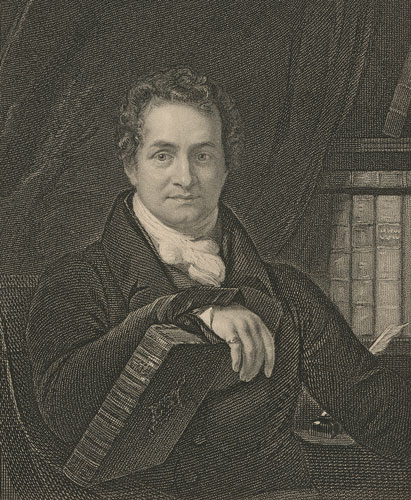
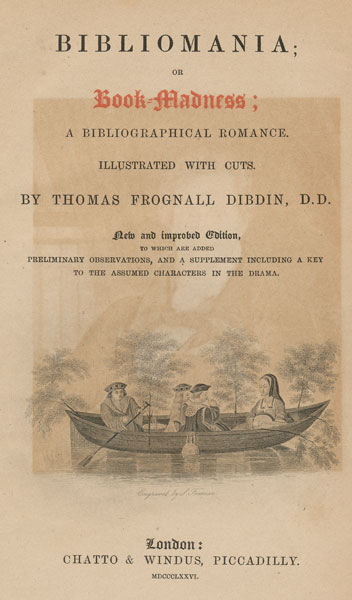

 HE
public may not be altogether unprepared for the re-appearance of
the
HE
public may not be altogether unprepared for the re-appearance of
the 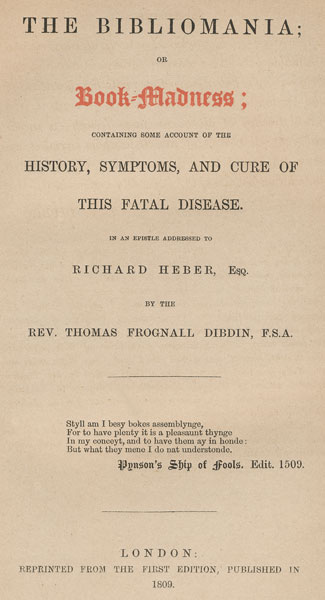
 SHORT time after the publication of the first edition of this work,
a very worthy and shrewd Bibliomaniac, accidentally meeting me,
exclaimed that "the book would do, but that there was not gall
enough in it." As he was himself a Book-Auction-loving Bibliomaniac,
I was resolved, in a future edition, to gratify him and similar
Collectors by writing
SHORT time after the publication of the first edition of this work,
a very worthy and shrewd Bibliomaniac, accidentally meeting me,
exclaimed that "the book would do, but that there was not gall
enough in it." As he was himself a Book-Auction-loving Bibliomaniac,
I was resolved, in a future edition, to gratify him and similar
Collectors by writing 
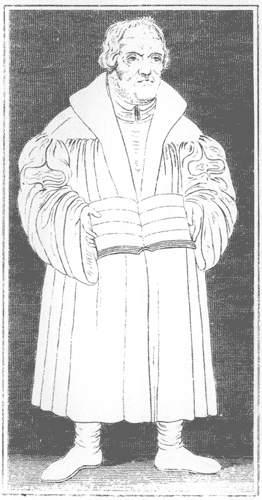
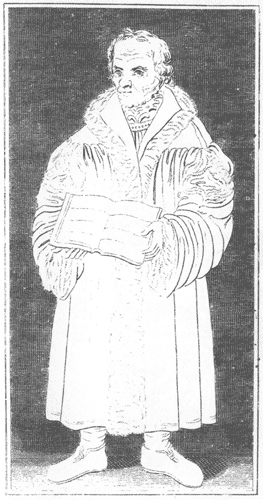


 T
was on a fine autumnal evening, when the sun was setting serenely
behind a thick copse upon a distant hill, and his warm tints were
lighting up a magnificent and widely-extended landscape, that,
sauntering 'midst the fields, I was meditating upon the various
methods of honourably filling up the measure of our existence; when I
discovered, towards my left, a messenger running at full speed towards
me. The abruptness of his appearance, and the velocity of his step,
somewhat disconcerted me; but on his near approach my apprehensions
were dissipated.
T
was on a fine autumnal evening, when the sun was setting serenely
behind a thick copse upon a distant hill, and his warm tints were
lighting up a magnificent and widely-extended landscape, that,
sauntering 'midst the fields, I was meditating upon the various
methods of honourably filling up the measure of our existence; when I
discovered, towards my left, a messenger running at full speed towards
me. The abruptness of his appearance, and the velocity of his step,
somewhat disconcerted me; but on his near approach my apprehensions
were dissipated.

 UCH
is the lively description of a spring morning, in the opening of
Alain Chartier's "Livre des quatre dames;" and, excepting the
violets, such description conveyed a pretty accurate idea of the
scenery which presented itself, from the cabinet window, to the eyes
of Lysander and Philemon.
UCH
is the lively description of a spring morning, in the opening of
Alain Chartier's "Livre des quatre dames;" and, excepting the
violets, such description conveyed a pretty accurate idea of the
scenery which presented itself, from the cabinet window, to the eyes
of Lysander and Philemon.


 EVER,
surely, did two mortals set off upon any expedition with
greater glee and alacrity than did Lisardo and Philemon for the sale,
by auction, of
EVER,
surely, did two mortals set off upon any expedition with
greater glee and alacrity than did Lisardo and Philemon for the sale,
by auction, of 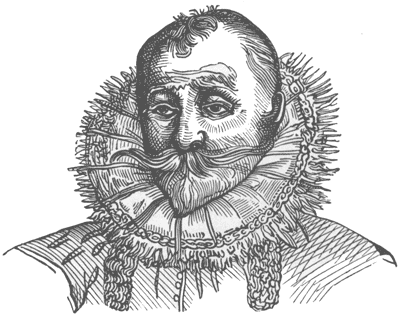
 URING
the first seven miles of our return from the busy scene which
has just been described, it was sufficiently obvious that Lisardo was
suffering a little under the pangs of mortification. True it was, he
had filled his pocket with an ampler supply of pistoles than it ever
fell to the lot of Gil Blas, at the same time of life, to be master
of; but he had not calculated upon the similar condition of his
competitors; some of whom had yet greater powers of purchase, and a
more resolute determination, as well as nicer skill, in exercising
these powers, than himself. Thus rushing into the combat with the heat
and vehemence of youth, he was of necessity compelled to experience
the disappointment attendant upon such precipitancy. It was in vain
that Philemon and myself endeavoured to make him completely satisfied
with his purchase: nothing produced a look of complacency from him. At
length, upon seeing the rising ground which was within two or three
miles of our respective homes, he cheered up by degrees; and a sudden
thought of the treasures contained in his Clement, De Bure and Panzer,
darted a gleam of satisfaction across his countenance. His eyes
resumed their wonted brilliancy, and all the natural gaiety of his
disposition returned with full effect to banish every vapour of
melancholy. "Indeed, my good friend," said he to me—"I shall always
have reason to think and speak well of your kindness shewn towards me
this day; and although some years may elapse before a similar
collection may be disposed of—and I must necessarily wait a tedious
period 'ere I get possession of Maittaire, Audiffredi, and others of
the old school—yet I hope to convince Lysander, on the exhibition of
my purchase, that my conversion to bibliography has been sincere. Yes:
I perceive that I have food enough to digest, in the volumes which are
now my travelling companions, for two or three years to come—and if,
by keeping a sharp look-out upon booksellers' catalogues when they are
first published, I can catch hold of Vogt, Schelhorn and Heinecken, my
progress in bibliography, within the same period, must be downright
marvellous!" "I congratulate you," exclaimed
URING
the first seven miles of our return from the busy scene which
has just been described, it was sufficiently obvious that Lisardo was
suffering a little under the pangs of mortification. True it was, he
had filled his pocket with an ampler supply of pistoles than it ever
fell to the lot of Gil Blas, at the same time of life, to be master
of; but he had not calculated upon the similar condition of his
competitors; some of whom had yet greater powers of purchase, and a
more resolute determination, as well as nicer skill, in exercising
these powers, than himself. Thus rushing into the combat with the heat
and vehemence of youth, he was of necessity compelled to experience
the disappointment attendant upon such precipitancy. It was in vain
that Philemon and myself endeavoured to make him completely satisfied
with his purchase: nothing produced a look of complacency from him. At
length, upon seeing the rising ground which was within two or three
miles of our respective homes, he cheered up by degrees; and a sudden
thought of the treasures contained in his Clement, De Bure and Panzer,
darted a gleam of satisfaction across his countenance. His eyes
resumed their wonted brilliancy, and all the natural gaiety of his
disposition returned with full effect to banish every vapour of
melancholy. "Indeed, my good friend," said he to me—"I shall always
have reason to think and speak well of your kindness shewn towards me
this day; and although some years may elapse before a similar
collection may be disposed of—and I must necessarily wait a tedious
period 'ere I get possession of Maittaire, Audiffredi, and others of
the old school—yet I hope to convince Lysander, on the exhibition of
my purchase, that my conversion to bibliography has been sincere. Yes:
I perceive that I have food enough to digest, in the volumes which are
now my travelling companions, for two or three years to come—and if,
by keeping a sharp look-out upon booksellers' catalogues when they are
first published, I can catch hold of Vogt, Schelhorn and Heinecken, my
progress in bibliography, within the same period, must be downright
marvellous!" "I congratulate you," exclaimed 
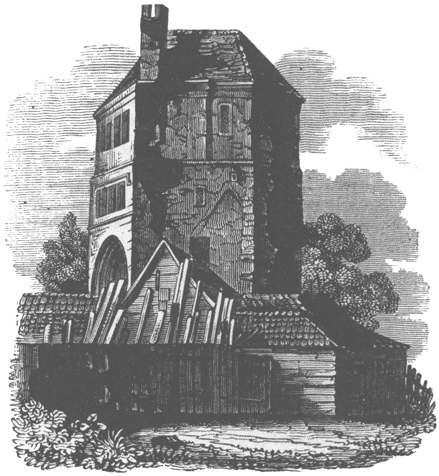
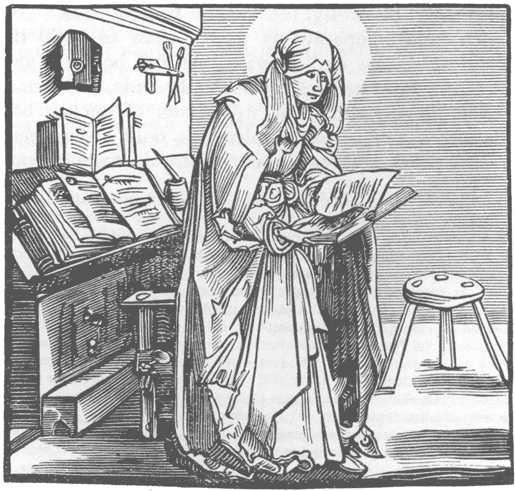

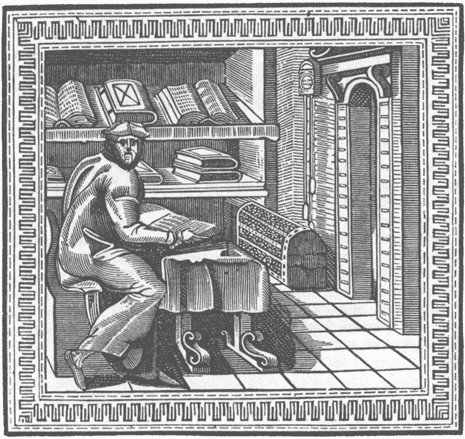
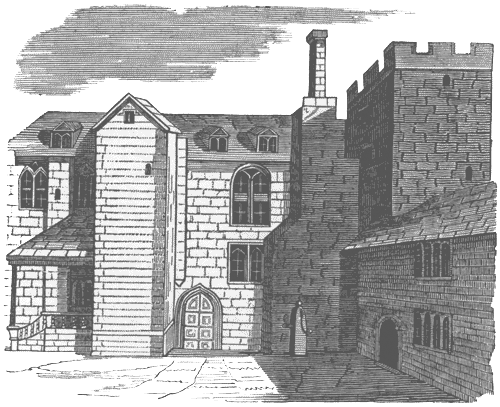
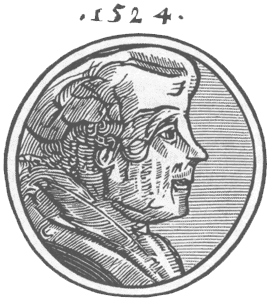 I shall conclude this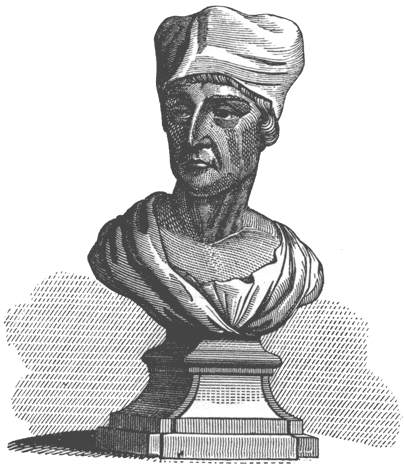

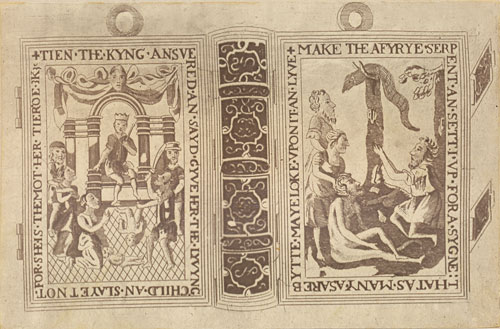
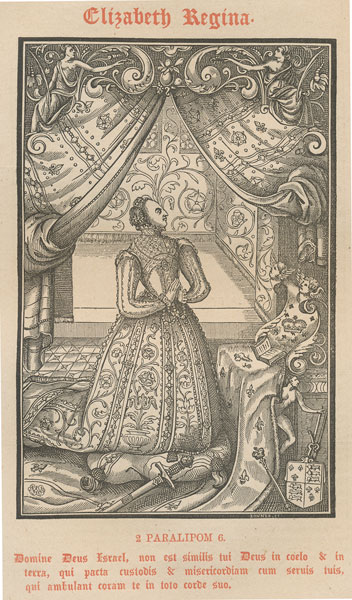
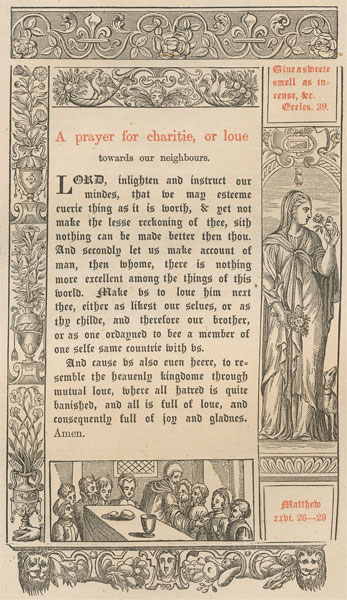
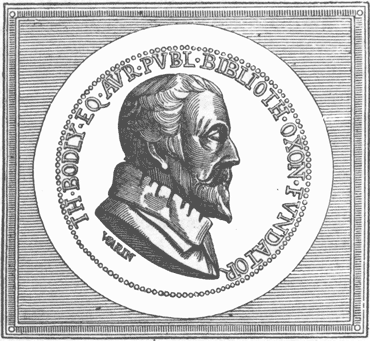
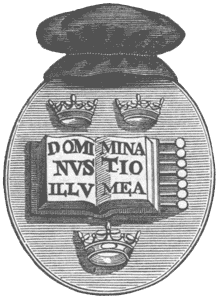 But no sooner had he deposited a piece of gold on
the said stone, according to the usual manner in such
ceremonies, but the earth fell in from one side of the
foundation, and the scaffold that was thereon broke and fell
with it; so that all those that were thereon, to the number
of a hundred at least, namely, the Proctors, Principals of
Halls, Masters, and some Bachelaurs, fell down all together,
one upon another, into the foundation; among whom, the under
butler of Exeter College had his shoulder broken or put out
of joint, and a scholar's arm bruised." "The solemnity being
thus concluded with such a sad catastrophe, the breach was
soon after made up and the work going chearfully forward,
was in four years space finished." Annals of the University
of Oxford; vol. ii., pt. ii., p. 939. Gutch's edition. We
will take leave of
But no sooner had he deposited a piece of gold on
the said stone, according to the usual manner in such
ceremonies, but the earth fell in from one side of the
foundation, and the scaffold that was thereon broke and fell
with it; so that all those that were thereon, to the number
of a hundred at least, namely, the Proctors, Principals of
Halls, Masters, and some Bachelaurs, fell down all together,
one upon another, into the foundation; among whom, the under
butler of Exeter College had his shoulder broken or put out
of joint, and a scholar's arm bruised." "The solemnity being
thus concluded with such a sad catastrophe, the breach was
soon after made up and the work going chearfully forward,
was in four years space finished." Annals of the University
of Oxford; vol. ii., pt. ii., p. 939. Gutch's edition. We
will take leave of 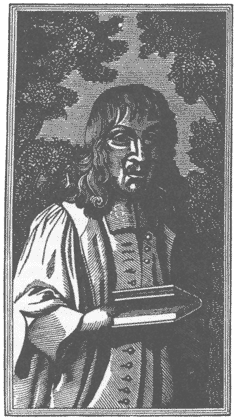
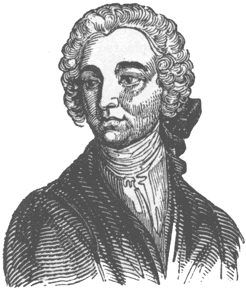 The reader will find an animated eulogy on this great
nobleman in Walpole's Anecdotes of Painters, vol. iv.,
227; part of which was transcribed by Joseph Warton for his
variorum edition of Pope's works, and thence copied into the
recent edition of the same by the Rev. W.L. Bowles. But
The reader will find an animated eulogy on this great
nobleman in Walpole's Anecdotes of Painters, vol. iv.,
227; part of which was transcribed by Joseph Warton for his
variorum edition of Pope's works, and thence copied into the
recent edition of the same by the Rev. W.L. Bowles. But
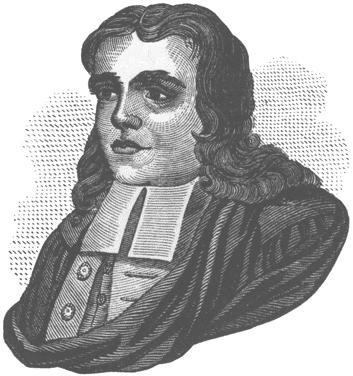
 Dr. Birch has drawn a very just and interesting character of
this eminent man, which may be found in Nichols's Anecdotes
of Bowyer, pp. 562-7. Mr. Edwards, the late ornithologist,
has described him in a simple, but appropriate, manner. "He
seemed," says he, "to have attained to universal knowledge;
for, in the many opportunities I have had of being in his
company, almost every part of science has happened to be the
subject of discourse, all of which he handled as an adept.
He was a man of great politeness in his manners, free from
all pedantry and pride, and, in every respect, the real,
unaffected, fine gentleman."
Dr. Birch has drawn a very just and interesting character of
this eminent man, which may be found in Nichols's Anecdotes
of Bowyer, pp. 562-7. Mr. Edwards, the late ornithologist,
has described him in a simple, but appropriate, manner. "He
seemed," says he, "to have attained to universal knowledge;
for, in the many opportunities I have had of being in his
company, almost every part of science has happened to be the
subject of discourse, all of which he handled as an adept.
He was a man of great politeness in his manners, free from
all pedantry and pride, and, in every respect, the real,
unaffected, fine gentleman."
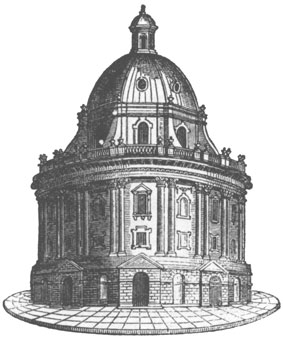 If I might hazard a comparison between Mr. James West's and
Mr. John Ratcliffe's collections, I should say that the
former was more extensive; the latter more curious. Mr.
West's, like a magnificent champagne, executed by the hand
of Claude or Both, and enclosing mountains, meadows, and
streams, presented to the eye of the beholder a scene at
once luxuriant and fruitful: Mr. Ratcliffe's, like one of
those confined pieces of scenery, touched by the pencil of
Rysdael or Hobbima, exhibited to the beholder's eye a spot
equally interesting, but less varied and extensive: the
judgment displayed in both might be the same. The sweeping
foliage and rich pasture of the former could not, perhaps,
afford greater gratification than the thatched cottage,
abrupt declivities, and gushing streams of the latter. To
change the metaphor—Mr. West's was a magnificent
repository; Mr. Ratcliffe's, a cabinet of curiosities. Of
some particulars of Mr. Ratcliffe's life, I had hoped to
have found gleanings in Mr. Nichols's Anecdotes of Bowyer;
but his name does not even appear in the index; being
probably reserved for the second forth-coming enlarged
edition. Meanwhile, it may not be uninteresting to remark
that, like Magliabechi, (vide
If I might hazard a comparison between Mr. James West's and
Mr. John Ratcliffe's collections, I should say that the
former was more extensive; the latter more curious. Mr.
West's, like a magnificent champagne, executed by the hand
of Claude or Both, and enclosing mountains, meadows, and
streams, presented to the eye of the beholder a scene at
once luxuriant and fruitful: Mr. Ratcliffe's, like one of
those confined pieces of scenery, touched by the pencil of
Rysdael or Hobbima, exhibited to the beholder's eye a spot
equally interesting, but less varied and extensive: the
judgment displayed in both might be the same. The sweeping
foliage and rich pasture of the former could not, perhaps,
afford greater gratification than the thatched cottage,
abrupt declivities, and gushing streams of the latter. To
change the metaphor—Mr. West's was a magnificent
repository; Mr. Ratcliffe's, a cabinet of curiosities. Of
some particulars of Mr. Ratcliffe's life, I had hoped to
have found gleanings in Mr. Nichols's Anecdotes of Bowyer;
but his name does not even appear in the index; being
probably reserved for the second forth-coming enlarged
edition. Meanwhile, it may not be uninteresting to remark
that, like Magliabechi, (vide 
 OFTLY
blew the breeze, and merrily sung the lark, when Lisardo
quitted his bed-chamber at seven in the morning, and rang lustily at
my outer gate for admission. So early a visitor put the whole house in
commotion; nor was it without betraying some marks of peevishness and
irritability that, on being informed of his arrival, I sent word by
the servant to know what might be the cause of such an interruption.
The reader will readily forgive this trait of harshness and
precipitancy, on my part, when he is informed that I was then just
enjoying the "honey dew" of sleep, after many wakeful and restless
hours.
OFTLY
blew the breeze, and merrily sung the lark, when Lisardo
quitted his bed-chamber at seven in the morning, and rang lustily at
my outer gate for admission. So early a visitor put the whole house in
commotion; nor was it without betraying some marks of peevishness and
irritability that, on being informed of his arrival, I sent word by
the servant to know what might be the cause of such an interruption.
The reader will readily forgive this trait of harshness and
precipitancy, on my part, when he is informed that I was then just
enjoying the "honey dew" of sleep, after many wakeful and restless
hours. For fifty years his stock, in
these twin departments, was copious and respectable; and
notwithstanding total blindness, which afflicted him during
the last six years of his life, he displayed uncommon
cheerfulness, activity, and even skill in knowing where the
different classes of books were arranged in his shop. Mr.
Miller was a warm loyalist, and an enthusiastic admirer of
Mr. Pitt. In 1795, when provincial copper coins were very
prevalent, our bibliomaniac caused a die of himself to be
struck; intending to strike some impressions of it upon gold
and silver, as well as upon copper. He began with the
latter; and the die breaking when only 23 impressions were
struck off, Miller, in the true spirit of numismatical
virtû, declined having a fresh one made. View here, gentle
reader, a wood-cut taken from the same: "This coin, which is
very finely engraved, and bears a strong profile likeness of
himself, is known to collectors by the name of '
For fifty years his stock, in
these twin departments, was copious and respectable; and
notwithstanding total blindness, which afflicted him during
the last six years of his life, he displayed uncommon
cheerfulness, activity, and even skill in knowing where the
different classes of books were arranged in his shop. Mr.
Miller was a warm loyalist, and an enthusiastic admirer of
Mr. Pitt. In 1795, when provincial copper coins were very
prevalent, our bibliomaniac caused a die of himself to be
struck; intending to strike some impressions of it upon gold
and silver, as well as upon copper. He began with the
latter; and the die breaking when only 23 impressions were
struck off, Miller, in the true spirit of numismatical
virtû, declined having a fresh one made. View here, gentle
reader, a wood-cut taken from the same: "This coin, which is
very finely engraved, and bears a strong profile likeness of
himself, is known to collectors by the name of '

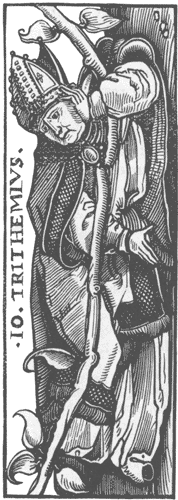
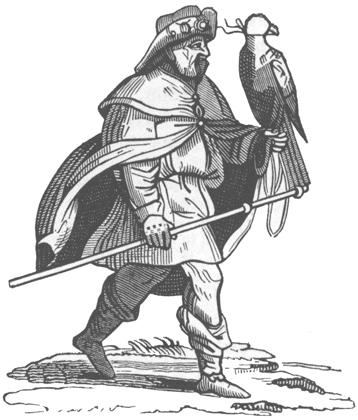



 HE
scenery and the dialogue of this Part are more especially
Waltonian. The characters are few; but
HE
scenery and the dialogue of this Part are more especially
Waltonian. The characters are few; but