Part I — Part II — The Mariner’s Compass — Book I — Book II — Book III — Book IV — Book V — Book VI — Aurora Borealis, or Northern Polar Light — Aurora Australis, or Southern Polar Light — Zodiacal Light — Bernoulli Family — “Of Electricity in General — Cassini Family — Electricity of the Atmosphere — Gmelin Family
THE BIBLIOGRAPHICAL HISTORY OF
ELECTRICITY AND MAGNETISM
From b.c. 2637 to a.d. 1821
B.C. 2637.—This date has been conclusively shown to be the
earliest one at which history notes anything resembling the application
of the magnetic influence. It is related that, during this sixty-first
year of the reign of Hoang-ti (Yeou-hioung-che, also named Koung-fun
and Hiuen-yuen), the emperor’s troops, who were pursuing the rebellious
prince Tchéyeou (Tchi-yeou), lost their way, as well as the course
of the wind, and likewise the sight of their enemy, during the heavy
fogs prevailing in the plains of Tchou-lou. Seeing which, Hoang-ti
constructed a chariot upon which stood erect a prominent female figure
which indicated the four cardinal points, and which always turned to
the south whatever might be the direction taken by the chariot. Thus he
succeeded in capturing the rebellious prince, who was put to death.
Some say that upon this chariot stood a needle, to denote the four
parts of the world. That, states the French author writing in 1736,
would “indicate the use of the compass, or something very similar to it
... and it is unfortunate that the device has not been explained more
fully.”
References.—Du Halde, “Description de la Chine
...,” La Haye, 1736. Vol. I. pp. 270–271; B.C. 2634,
Klaproth, “Boussole,” pp. 33, 34, 71, 74, 76, 79, 82; Azuni,
“Boussole,” Paris, 1809, pp. 186, 214; Staunton’s “China,”
London, 1797, Vol. I. p. 446; “Encycl. Metrop.,” Vol. III. p.
736; Buffon, “La Terre,” Vol. I. p. 304; Davis, “The Chinese,”
1844, Vol. III. p. 14; Humboldt, “Cosmos,” 1848, Vol. V. p.
51, for Ed. Biot in Comptes Rendus, Vol. XIX. 1844, p.
822; Dr. A. T. Thompson, translation of Salverte’s “Philosophy
of Magic,” 1847, Vol. II. chap. xi. p. 222 (note), wherein he
alludes to Davies’ “Early History of the Mariner’s Compass”;
“British Annual,” 1837; Saillant et Nyon, “Mémoires concernant
l’Histoire,” Paris, 1788, Vol. XIII. pp. 234–235, giving
chronological tables of the history of China, also p. 227
relative to Hoang-ti; P. Etienne Souciet, “Observations,” Paris,
1732, Vol. II. pp. 94–95.
Hoang-ti (Hoang, supreme king), third in the “Period of the Five
Emperors” (Claude Augé, “Nouveau Larousse,” Vol. V. p. 134), regarded
as the founder of the Chinese Empire, died at the age of 121, after
reigning 100 years, B.C. 2598. Mailla (Joseph A. M. de
Moyriac de) in his “Histoire ... traduite du Thoung-Kian-Kang-Mou,”
Paris, 1777, Vol. I. p. 28, makes the latter date 2599, as do likewise,
Dr. Hœfer (“Nouvelle Biographie Générale,” Paris, 1858, Vol. XXIV. pp.
817–819) and Pierre Larousse (“Grand Dict, du XIXe Siècle,” 1873,
Vol. IX. p. 317), but Michaud (“Biogr. Univer.,” 1857, Vol. XIX. pp.
476–477) says he reigned from 2698 to 2577 B.C., and, in “La
Grande Encyclop.,” Vol. XX. pp. 157–158, we are told that the correct
period is 2697–2597 B.C. (“L’art de vérifier les dates,”
Paris, 1819, Vol. IV. p. 8).
The above-named work of Jean Baptiste Du Halde on China is considered
the most complete account of that vast empire that has appeared in
Europe (“New Gen. Biogr. Dict.,” London, 1850, Vol. VIII. p. 175). In
any case, remarks Mr. Demetrius C. Boulger (“History of China,” London,
1881, Vol. I. pp. 4–5), it is incontestable that the individuality of
Hoang-ti, who was the successor of “Fo-hi,” the first great Chinese
emperor, is much more tangible than that of any of his predecessors.[1]
By him, it is well recorded that the extensive Chinese territory
(Empire) was divided into ten provinces, or Chow, each of which
was subdivided into ten departments, or Tsee, and these again
into ten districts, or Tou, each of them containing ten towns,
or Ye.
B.C. 1110.—Tcheou-Koung is said to have at this date taught
the use of the needle compass to the envoys from Youa-tchang. “As the
ambassadors sent from Cochin China and Tonquin” (Humboldt, “Cosmos”
Vol. V. p. 51) “were about to take their departure” (which was in the
twenty-second cycle, more than 1040 years B.C.), “Tcheou-Koung
gave them an instrument which upon one side always turned toward the
north and on the opposite side to the south, the better to direct
them upon their homeward voyage.[2] This instrument was called
tchi-nan (chariot of the south), and it is still the name given
to the compass, which leads to the belief that Tcheou-Koung invented
the latter.” In his chapter on “The Magnetic Needle,” Humboldt says the
apparatus was called fse-nan (indicator of the south).
Tcheou-Koung (Ki-tan) was Chinese Minister of State under both Von-Vang
(the first emperor of the Tcheou dynasty, who ruled seven years) and
Tsching-Vang (second emperor, who ruled thirty-seven years), and lived
to be 100 years old. He was one of the most learned and most popular
men China has ever known, and is spoken of to this day by the Chinese
“with an admiration bordering upon enthusiasm” (Saillant et Nyon,
“Mémoires concernant l’Histoire,” Paris, 1776, Vol. III. p. 37). The
emperor Tsching-Vang caused Tcheou-Koung’s body to be interred near his
father’s remains, after giving it imperial funeral honours.
References.—Du Halde, “Description de la Chine ...,”
La Haye, 1736, Vol. I. p. 312; Klaproth, “Boussole,” p. 81;
Azuni, “Boussole,” pp. 190–191; Humboldt, “Cosmos,” London,
1849, Vol. II. p. 628, and Vol. V. p. 52.
B.C. 1084.—According to Æschylus, the father of the Athenian
drama, Agamemnon employed a line of optical signals to advise his
queen Clytemnestra of the fall of Troy. Robert Browning’s translation,
London, 1877, runs as follows:
“Troia, the Achaioi hold....
Hephaistos—sending a bright blaze from Idé
Beacon did beacon send, from fire the poster,
Hitherward: Idé to the rock Hermaian
Of Lemnos: and a third great torch o’ the island
Zeus’ seat received in turn, the Athoan summit.
And—so upsoaring as to stride sea over,
The strong lamp-voyager, and all for joyance—
Did the gold-glorious splendor, any sun like,
Pass on....”
Anna Swanwick thus renders Æschylus’ “Agamemnon,” London, 1881, p. 13:
“For Priam’s city have the Argives won.
Hephaestos sending forth Idaian fire.
Hither through swift relays of courier flame....”
At page 193 of his “Agamemnon,” London, 1873, E. H. Plumptre refers
to the system of posts or messengers which the Persian kings seem to
have been first to organize, and which impressed the minds of both the
Hebrews (Esther viii. 14) and the Greeks (Herod., viii. 98) by their
regular transmission of the king’s edicts or of special news.
What of the passage from the celebrated patriarch Job (xxxviii. 35):
“Canst thou send lightnings, that they may go, and say unto thee, ‘Here
we are?’” (original Hebrew, “Behold us”). As has been remarked, this
seems prophetic, when taken in connection with the electric telegraph.
The fire beacons are also alluded to by Plutarch in his Life of Quintus
Sertorius; and Mardonius prepared fire signals to notify Xerxes, then
at Sardis, of the second taking of Athens.
References.—“Le Théâtre des Grecs,” P. Brumoy, Paris,
1820, Vol. II. pp. 124–125; “Penny Encyc.,” Vol. XXIV. p. 145;
Knight’s “Mechan. Dict.,” Vol. III. p. 2092.
For a decidedly original explanation of the beacon fires, read the
introduction to “The Agamemnon of Æschylus,” translated by A. W.
Verrall, Fellow of Trinity College, Cambridge, England. See, likewise,
reference to Act of Scottish Parliament, 1455, c. 48, made by Walter
Scott in a note to his “Lay of the Last Minstrel”; “Archeologia,”
London, 1770, Vol. I. pp. i-7.
B.C. 1068.—In the obscure age of Codrus, the seventeenth
and last king of Athens, at about the period of the “Return of the
Heraclidae” (descendants of Heracles—Hercules) to the Peloponnesus,
the Chinese had magnetic carriages, upon which the movable arm of the
figure of a man continually pointed to the south, and which it is said
served as a guide by which to find the way across the boundless grass
plains of Tartary. Humboldt states, besides, that, even in the third
century of our era, Chinese vessels navigated the Indian Ocean under
the direction of magnetic needles pointing to the south, and that, at
pages xxxviii-xlii, Vol. I. of his “Asie Centrale,” he has shown what
advantages this means of topographical direction, as well as the early
knowledge and application of the magnetic needle, gave the Chinese
geographers over the Greeks and Romans, to whom, for instance, even
the true direction of the Pyrenees and the Apennines always remained
unknown.
References.—Humboldt, “Cosmos,” London, 1849, Vol.
I. p. 173, also his “Examen Critique de l’histoire de la
Géographie,” Vol. III. p. 36; “Mœurs de Reg. Athen.,” lib.
iii. cap. xi. For Codrus and the Heraclidæ, consult: Chambers’
“Encycl.,” 1889, Vol. III. p. 329 and Vol. V. 1890, p. 657;
“Encycl. Britan.,” 9th ed., Edinburgh, Vol. VI. p. 107 and Vol.
XI. p. 92; Hœfer, “Nouv. Biog. Gén.,” Vol. XI. p. 29.
B.C. 1033–975.—Solomon, King of Israel, son of King David and
of Bathsheba, who, “in the Jewish scriptures, has the first place
assigned to him among the wise men of the East,” is believed by many
to have known the use of the compass. The Spanish Jesuit Pineda and
Athanasius Kircher assert the same, and state that Solomon’s subjects
employed it in their navigations. Others, notably Fuller, “Miscel.,”
iv. cap. 19, and Levinus Lemnius, “De Occulta Naturae Miracula,” lib.
iii, have even tried to prove that Solomon was the inventor of the
compass, and that it was in his time used by the Syrians, Sidonians
and Phœnicians, but the contrary has been shown by Henricus Kippingius
in his “Antiq. Rom. de exped. Mar.,” lib. iii. cap. 6, as well as by
Bochart, the geographer, in his “Géo. Sacr.,” lib. i. cap. 38.
References.—Venanson, “Boussole,” Naples, 1808, p.
34; Enfield, “History of Philosophy,” London, 1819, Vol. I. p.
40; Cavallo, “Magnetism,” 1787, p. 48; Ronalds’ “Catal.,” 1880,
articles “Hirt” and “Michaelis,” pp. 246, 344.
B.C. 1022.—At this period the Chinese magnetic cars held a
floating needle, the motions of which were communicated to the figure
of a spirit whose outstretched hand always indicated the south. An
account of these cars is given in the “Szuki” (Shi-ki), or “Historical
Memoirs of Szu-ma-thsian” (Szu-matsien), which were written early
in the second century B.C., and are justly considered the
greatest of all Chinese historical works, containing, as they do, the
history of China from the beginning of the empire to the reign of
Hiao-wou-ti, of the Han dynasty.
References.—“Les peuples Orientaux,” Léon de Rosny,
Paris, 1886, pp. 10, 168, 240; Johnson’s “Encyclopædia,” Vol.
I. p. 929; Humboldt, “Cosmos,” Vol. II. 1849, p. 628; Klaproth,
“Boussole,” 1834, p. 79, for further allusion to a passage
in the Thoung-Kian-Kang-Mou, already referred to under date
B.C. 2637.
B.C. 1000–907.—Homer, the greatest of epic poets, called the
father of Greek poetry, and who, according to Enfield (“History of
Philosophy,” Vol. I. p. 133), flourished before any other poet whose
writings are extant, relates that the loadstone was used by the Greeks
to direct navigation at the time of the siege of Troy.
The latter construction has been placed upon several passages in Homer,
the most important being found in Book VIII of the “Odyssey.”
As this appears to be the first attributed allusion to the compass, it
is deemed worth while to give herein several interpretations of the
original Greek. The selections made are as follows:
“In wond’rous ships, self-mov’d, instinct with mind;
No helm secures their course, no pilot guides;
Like man intelligent, they plough the tides.
Though clouds and darkness veil th’ encumber’d sky,
Fearless thro’ darkness and thro’ clouds they fly.”
Alexander Pope, “The Odyssey of Homer,” London, 1818, p. 135.
“...; for here
In our Phæacian ships no pilots are,
Nor rudders, as in ships of other lands.
Ours know the thoughts and the intents of men.
To them all cities and all fertile coasts
Inhabited by men are known; they cross
The great sea scudding fast, involved in mist
And darkness, with no fear of perishing
Or meeting harm.”
Wm. Cullen Bryant, “The Odyssey of Homer,” Boston, 1875, Vol. I. p. 174.
“For unto us no pilots appertain,
Rudder nor helm which other barks obey.
These ruled by reason, their own course essay
Sparing men’s mind ...
Sail in a fearless scorn of scathe or overthrow.”
Philip Stanhope Worsley, “The Odyssey of Homer,” London, 1861,
Vol. I. p. 198.
“For all unlike the ships of other men,
Nor helm nor steersman have our country’s barks,
But of themselves they know the thoughts of men;
... and wrapped in gloom and mist
O’er the broad ocean gulfs they hold their course
Fearless of loss and shipwreck....”
Earl of Carnarvon, “The Odyssey of Homer,” London, 1886, p. 201.
“These marvellous ships, endued with human sense, and
anticipating the will of their masters, flit unseen over the
sea.”—“Homer’s Odyssey,” by W. W. Merry and James Riddell,
Oxford, 1886, Vol. I. p. 353, note.
“That our ships in their minds may know it when they bring thee hither to hand,
Because amidst us Phæacians, our ships no helmsmen steer,
Nor with us is any rudder like other ships must bear,
But our keels know the minds of menfolk, and their will they understand,
And therewith exceeding swiftly over the sea-gulf do they go,
In the mist and the cloud-rack hidden....”
“The Odyssey of Homer,” translated by Wm. Morris, London, 1887, p. 145.
The afore-named construction is not, however, alluded to by Matthew
Arnold in his well-known lectures given at Oxford, nor by the Right
Hon. Wm. Ewart Gladstone either in his “Juventus Mundi” or throughout
his very extensive “Studies on Homer and the Homeric Age.”
Sonnini tells us that as this period is about the same as that of the
Chinese chronicles, it can scarcely be doubted that the knowledge of
both the polarity of the needle and of the use of the compass for
navigation date back 3000 years (Buffon, “Terre,” Paris, An. VIII. p.
304).
This ill accords, however, with the views of others who have concluded,
perhaps rightly, that the Greeks, Romans, Tuscans and Phœnicians[3]
were ignorant of the directive property of the magnet, from the fact
that none of the writings, more especially of Theophrastus, Plato,
Aristotle, Lucretius and Pliny, make explicit allusion thereto.
References.—Humboldt, “Cosmos,” 1859, Vol. V. p.
51; “Good Words,” 1874, p. 70; Brumoy, “Théâtre des Grecs,”
1820, Vol. I. p. 55; Pope’s translation of the “Iliad,” 1738,
Vol. I. pp. 14, 20; Schaffner, “Telegraph Manual,” p. 19;
also references under both the A.D. 121 and the
A.D. 265–419 dates.
B.C. 600–580.—Thales of Miletus, Ionia, one of the “seven
wise men of Greece” (the others being Solon, Chilo, Pittacus, Bias,
Cleobolus and Periander), founder of the Ionic philosophy, and from
whose school came Socrates, is said to have been the first to observe
the electricity developed by friction in amber.
Thales, Theophrastus, Solinus, Priscian and Pliny, as well as other
writers, Greek and Roman, mention the fact that when a vivifying heat
is applied to amber it will attract straws, dried leaves, and other
light bodies in the same way that a magnet attracts iron (“Photii
Bibliotheca” Rothomagi, 1653, folio, col. 1040–1041, cod. 242).
Robert Boyle (“Philosophical Works,” London, 1738, Vol. I. p. 506, or
London, 1744, Vol. III. p. 647) treats of different hypotheses advanced
to solve the phenomena of electrical attraction, saying: “The first is
that of the learned Nicholas Cabaeus (A.D. 1629), who thinks
the drawing of light bodies by amber ... is caused by the steams which
issue out of such bodies and discuss and expel the neighbouring air
... making small whirlwind.... Another is that of the eminent English
philosopher, Sir Kenelm Digby (A.D. 1644), and embraced by the
very learned Dr. Browne (A.D. 1646) and others, who believed
that ... chafed amber is made to emit certain rays of unctuous steams,
which, when they come to be a little cooled by the external air, are
somewhat condensed ... carrying back with them those light bodies to
which they happen to adhere at the time of their retraction.... Pierre
Gassendi (A.D. 1632) thinks the same, and adds that these
electrical rays ... get into the pores of a straw ... and by means
of their decussation take the faster hold of it ... when they shrink
back to the amber whence they were emitted ... Cartesius (Descartes,
A.D. 1644) accounts for electrical attractions by the
intervention of certain particles, shaped almost like small pieces of
riband, which he supposes to be formed of this subtile matter harboured
in the pores or crevices of glass.”
The ancients were acquainted with but two electrical bodies—amber
(electron), which has given the denomination of the science;
and lyncurium, which is either the tourmaline or the topaz (Dr.
Davy, “Mem. Sir Humphry Davy,” 1836, Vol. I. p. 309). From a recent
article treating of gems, the following is extracted: “The name of
the precious stone inserted in the ring of Gyges has not been handed
down to us, but it is probable that it was the topaz, whose wonders
Philostratus recounts in the Life of Apollonius. An attribute of the
sun and of fire, the ancients called it the gold magnet, as it
was credited with the power of attracting that metal, indicating its
veins, and discovering treasures. Heliodorus, in his story of Theagenes
and Caricles, says that the topaz saves from fire all those who wear
it, and that Caricles was preserved by a topaz from the fiery vengeance
of Arsaces, Queen of Ethiopia. This stone was one of the first
talismans that Theagenes possessed in Egypt. The topaz, at present,
symbolizes Christian virtues—faith, justice, temperance, gentleness,
clemency.”
References.—“Greek Thinkers,” by Theodor Gomperz,
translation of L. Magnus, London 1901, p. 532; Zahn at
A.D. 1696; Joannes Ruellius, “De Natura Stirpium,”
1536, p. 125; Paul Tannery, “Pour l’Histoire de la Science
Hellène,” Paris, 1887, chap. iii. pp. 52–80; Becquerel, “Traité
Expérimental,” Paris, 1834, Vol. I. p. 33; Pliny, “Natural
History,” Bostock and Riley, 1858, book 37, chap. xii. p.
403; Pline, “Histoire Naturelle,” 1778, livre 37, chapitre
iii.; Lardner, “Lectures,” 1859, Vol. I. p. 104; Humboldt,
“Cosmos,” 1849, Vol. I. p. 182; Poggendorff, XI. p. 1088;
Apuleius, Floridor, p. 361; Plato; Timæus, The Locrian; “De
Anima Mundi ...,” 12, 15; Pauli (Adrian), Dantzig, 1614; Ulysses
Aldrovandus, “Musaeum Metallicum,” pp. 411–412; Aurifabrum
(Andreas), “Succini Historia,” ... Königsberg, 1551–1561; and,
for the different names given to amber and the magnet by the
ancients, consult, more especially, the numerous authorities
cited by M. Th. Henri Martin (“Mém. présenté à l’Académie
des Inscrip. et Belles Lettres,” première partie, Vol. VI.
pp. 297–329, 391–411, Paris, 1860); J. Matthias Gessner, “De
Electro Veterum” (Com. Soc. Reg. Sc. Gött., Vol. III for 1753,
p. 67); Louis Delaunay, “Minér. des Anciens,” Part 2, p. 125
(Poggendorff, Vol. II. p. 540); Philip Jacob Hartmann, in
Phil. Trans., Vol. XXI. No. 248, pp. 5, 49, also in
Baddam’s Abridgments, Vol. III, first edition, 1739, pp. 322–366.
B.C. 600.—The Etruscans are known to have devoted themselves
at this period to the study of electricity in an especial manner.[4]
They are said to have attracted lightning by shooting arrows of metal
into clouds which threatened thunder. Pliny even asserts that they had
a secret method of not only “drawing it (the lightning) down” from the
clouds, but of afterwards “turning it aside” in any desired direction.
They recognized different sources of lightning, those coming from the
sky (a sideribus venientia), which always struck obliquely,
and others from the earth (infera, terrena), which rose
perpendicularly. The Romans, on the other hand, recognized only two
sorts, those of the day, attributed to Jupiter, and those of the night,
attributed to Summanus (see Vassalli-Eandi at A.D. 1790).
This Vassalli-Eandi—like L. Fromondi—made special study of the very
extensive scientific knowledge displayed by the ancients and, as shown
in his “Conghietture ...” he concluded that they really possessed the
secret of attracting and directing lightning. The above-named extracts
concerning the Etruscans and Romans are made from the subjoined work of
Mme. Blavatsky, wherein the following is likewise given.
Tradition says that Numa Pompilius, the second king of Rome, was
initiated by the priests of the Etruscan divinities, and instructed by
them in the secret of forcing Jupiter, the Thunderer, to descend upon
earth. Salverte believes that before Franklin discovered his refined
electricity, Numa had experimented with it most successfully, and that
Tullus Hostilius, the successor of Numa, was the first victim of the
dangerous “heavenly guest” recorded in history. Salverte remarks that
Pliny makes use of expressions which seem to indicate two distinct
processes; the one obtained thunder (impetrare), the other
forced it to lightning (cogere). Tracing back the knowledge
of thunder and lightning possessed by the Etruscan priests, we find
that Tarchon, the founder of the theurgism of the former, desiring to
preserve his house from lightning, surrounded it by a hedge of the
white bryony, a climbing plant which has the property of averting
thunderbolts. The Temple of Juno had its roofs covered with numerous
pointed blades of swords. Ben David, says the author of “Occult
Sciences,” has asserted that Moses (born about 1570 B.C.)
possessed some knowledge of the phenomena of electricity. Prof. Hirt,
of Berlin, is of this opinion. Michaelis remarks that there is no
indication that lightning ever struck the Temple of Jerusalem during
a thousand years: that, according to Josephus, a forest of points, of
gold and very sharp, covered the roof of the temple, and that this
roof communicated with the caverns in the hill by means of pipes in
connection with the gilding which covered all the exterior of the
building, in consequence of which the points would act as conductors.
Salverte further asserts that in the days of Ctesias—Ktesias—India
was acquainted with the use of conductors of lightning. This historian
plainly states that iron placed at the bottom of a fountain, and made
in the form of a sword, with the point upward, possessed, as soon as
it was thus fixed in the ground, the property of averting storms and
lightning.
“Ancient India, as described by Ktesias, the Knidian,” J. H. McCrindle,
London, 1882, alludes, p. 68, to iron swords employed to ward off
lightning. Reference is made to the pantarbe at pp. 7–8, 69–70,
and to the elektron (amber) at pp. 20, 21, 23, 51, 52, 70, 86.
See account of Ktesias in “Nouvelle Biogr. Génér.,” Vol. XII. pp.
568–571, and in “Larousse Dict.,” Vol. V. p. 614.
In his “Observations sur la Physique,” Vols. XXIV. pp. 321–323,
XXV. pp. 297–303, XXVI. pp. 101–107, M. l’Abbé Rosier gives the
correspondence between M. de Michaelis, Professor at Göttingen, and Mr.
Lichtenberg, showing conclusively how the numerous points distributed
over the surface of the roof of the Temple of Solomon effectively
served as lightning conductors. Mr. Lichtenberg in addition shows that
the bell tower located upon a hill at the country seat of Count Orsini
de Rosenberg, was, during a period of several years, so repeatedly
struck by lightning, with great loss of life, that divine service had
to be suspended in the church. The tower was entirely destroyed in 1730
and soon after rebuilt, but it was struck as often as ten times during
one prolonged storm, until finally a fifth successive attack, during
the year 1778, compelled its demolition. For the third time the tower
was reconstructed, and the Count placed a pointed conductor, since
which time no damage has been sustained.
References.—Mme. Blavatsky, “Isis Unveiled,” 1877,
Vol. I. pp. 142, 457, 458, 527, 528, and her references to
Ovid, “Fast,” lib. iii. v. 285–346; Titus Livius, lib. i. cap.
31; Pliny, “Hist. Nat.,” lib. ii. cap. 53 and lib. xxviii.
cap. 2; Lucius Calp, Piso; Columella, lib. x. v. 346, etc.;
La Boissière, “Notice sur les Travaux de l’Académie du Gard,”
part I. pp. 304–314; “Bell. Jud. adv. Roman,” lib. v. cap.
14; “Magas. Sc. de Göttingen,” 3e année 5e cahier; Ktesias,
in “India ap. Photum. Bibl. Cod.,” 72. See also, De La Rive,
“Electricity,” London, 1858, Vol. III, chap. ii. p. 90; “Encycl.
Brit.,” 8th ed., article “Electricity”; Lardner, “Lectures,”
II. p. 99; Humboldt, “Cosmos,” 1849, Vol. II. pp. 502–504;
Boccalini, “Parnassus,” Century I. chap. xlvi. alluded to at p.
24, Vol. I. of Miller’s “Retrospect”; Gouget, “Origin of Laws,”
Vol. III. book 3; Themistius, Oratio 27, p. 337; “Agathias
Myrenaeus de rebus gestis Justiniani,” lib. v. p. 151; Dutens,
“Origine des découvertes ...”; “Gentleman’s Magazine” for
July 1785, p. 522; Falconer, “Mem. of Lit. and Phil. Soc. of
Manchester,” Vol III. p. 278; “Sc. Amer.,” No. 7. p. 99; E.
Salverte, “Phil. of Magic,” 1847, Vol. II. chaps. viii. and ix.;
“Fraser’s Magazine” for 1839; H. Martin, Paris, 1865–6; P. F.
von Dietrich, Berlin, 1784.
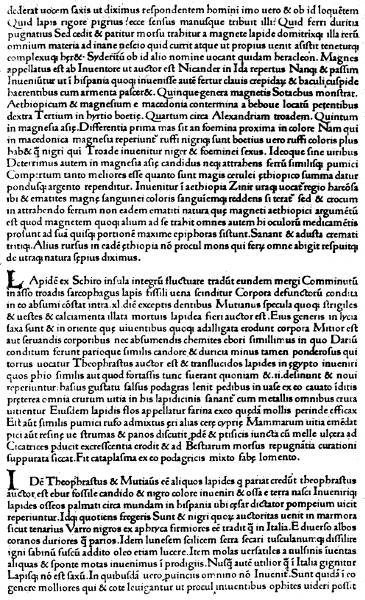
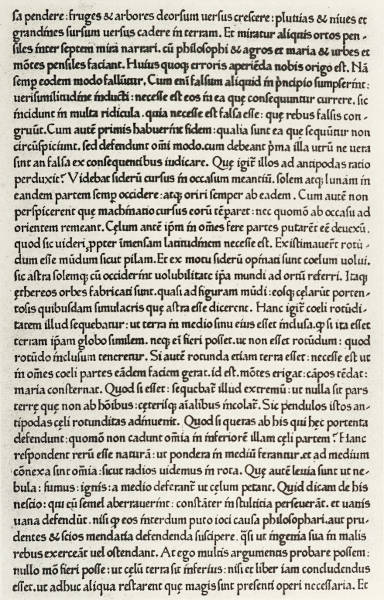
Caius Plinius Secundus. Page taken from earliest known
edition of the Naturalis Historiae Venetiis 1469, of which there are
only three known original vellum copies. These are now at Vienna,
Ravenna and in the Bibliothèque Sainte Geneviève, Paris.
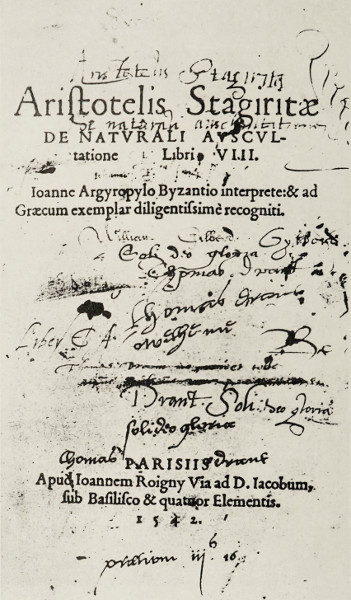
Title page of Aristotle’s “De Naturali Auscultatione,”
Paris 1542. The property of Dr. William Gilberd, when at Cambridge,
inscribed with his name and that of Archdeacon Thomas Drant. (From the
Library of Dr. Silvanus. P. Thompson.)
B.C. 588.—The earliest reliable record of messages transmitted
by the sign of fire is to be found in the book of Jeremiah, vi.
1: “O ye children of Benjamin, gather yourselves to flee out of the
midst of Jerusalem, and blow the trumpet in Tekoa, and set up a sign
of fire in Beth-haccerem; for evil appeareth out of the north and
great destruction.”
References.—Turnbull, “Electro-magnetic Telegraph,”
1853, p. 17; Knight’s “Mech. Dict.,” Vol. III. p. 2092; Penny
and other Encyclopædias.
B.C. 341.—Aristotle, Greek philosopher, says (“Hist. of
Anim.,” IX. 37) that the electrical torpedo causes or produces
a torpor upon those fishes it is about to seize, and, having by that
means got them into its mouth, feeds upon them. The torpedo is
likewise alluded to, notably by (Claudius) Plutarch, the celebrated
Greek moralist, by Dioscorides, Pedacius, Greek botanist, referred to
in Gilbert’s “De Magnete,” Book I. chaps. i, ii, and xiv; by Galen,
illustrious Roman physician, who is also frequently alluded to in “De
Magnete,” and by Claudius Claudian, Latin poet, who flourished at
the commencement of the fifth century. Oppian describes (“Oppian’s
Halieuticks of the nature of fishes and fishing of the ancients in five
books,” lib. ii. v. 56, etc., also lib. iii. v. 149) the organs by
which the animal produces the above effect, and Pliny (“Nat. Hist.,”
Book 32, chap. i) says: “This fish, if touched by a rod or spear, at
a distance paralyzes the strongest muscles, and binds and arrests the
feet, however swift.”
“The very crampe-fish tarped, knoweth her owne force and power,
and being herself not benummed, is able to astonish others” (Holland
“Plinie,” Book IX. chap. xlii.).
“We, here, and in no other place, met with that extraordinary fish
called the torpedo, or numbing fish, which is in shape very like
the fiddle fish, and is not to be known from it but by a brown circular
spot about the bigness of a crown-piece near the centre of its back”
(Ausonius, “Voyages,” Book II. chap. xii.).
References.—“Encycl. Metr.,” IV. p. 41; “Encycl.
Brit.,” article “Electricity”; Jos. Wm. Moss, “A Manual of
Classical Biography,” London, 1837, Vol. I. pp. 105–186,
for all the Aristotle’s treatises, also Commentaries and
Translations; Jourdain (Charles et Amable), “Recherches ...
traductions latines d’Aristotle,” Paris, 1843; Fahie, “Hist. of
Elec. Teleg.,” p. 170; “Sci. Amer.,” No. 457, pp. 7301, 7302;
“Aristotle,” by Geo. Grote, London, 1872; Humboldt, “Cosmos,”
1859–1860, Vols. I and II passim, Vol. III. pp. 13–15,
29–30, 124; “Journal des Savants,” for Feb. 1861, March and May
1872, also for Feb., May and Sept. 1893.
Aristotle is alluded to in Gilbert’s “De Magnete,” at Book I.
chaps. i. ii. vii. xv. xvi. xvii.; Book II. chaps. i.[5] iii.
iv.; Book V. chap. xii.; Book VI, chaps. iii. v. vi.
B.C. 341.—Æneas, the tactician, believed to be the same Æneas
of Stymphale alluded to by Xenophon, invented a singular method of
telegraphing phrases commonly used, especially in war. These were
written upon exactly similar oblong boards placed at the dispatching
and receiving stations, where they stood upon floats in vessels of
water. At a given signal the water was allowed to flow out of the
vessel at each station, and, when the desired phrase on the board had
reached the level of the vessel, another signal was made so that the
outflow could be stopped and the desired signal read at the receiving
station.
References.—Laurencin, “Le Télégraphe,” Chap. I;
“Penny Encycl.,” Vol. XXIV. p. 145; “Michaud Bio.,” Paris, 1855,
Vol. XII. pp. 459–460.
B.C. 337–330.—From the well-known work by Mme. Blavatsky (“Isis
Unveiled,” New York, 1877) the following curious extracts are made
regarding “The Ether or Astral Light” (Vol. I. chap. v. pp. 125–162):
“There has been an infinite confusion of names to express one and
the same thing, amongst others, the Hermes-fire, the lightning of
Cybelè, the nerve-aura and the fluid of the magnetists, the od of
Reichenbach, the fire-globe, or meteor-cat of Babinet, the
physic force of Sergeant Cox and Mr. Crookes, the atmospheric magnetism
of some naturalists, galvanism, and finally, electricity, which are
but various names for many different manifestations or effects of the
same all-pervading causes—the Greek Archeus....” Only in connection
with these discoveries (Edison’s Force and Graham Bell’s
Telephone, which may unsettle, if not utterly upset all our ideas of
the imponderable fluids) we may perhaps well remind our readers of the
many hints to be found in the ancient histories as to a certain secret
in the possession of the Egyptian priesthood, who could instantly
communicate, during the celebration of the Mysteries, from one temple
to another, even though the former were at Thebes and the latter at the
other end of the country; the legends attributing it, as a matter of
course, to the “invisible tribes” of the air which carry messages for
mortals. The author of “Pre-Adamite Man” (P. B. Randolph, at p. 48)
quotes an instance, which, being merely given on his own authority,
and he seeming uncertain whether the story comes from Macrinus or
some other writer, may be taken for what it is worth. He found good
evidence, he says, during his stay in Egypt, that one of the Cleopatras
actually sent news by a wire to all of the cities from Heliopolis (the
magnificent chief seat of sun-worship) to the island of Elephantine, on
the Upper Nile.
Further on, Mme. Blavatsky thus alludes to the loadstone:
“The stone magnet is believed by many to owe its name to Magnesia....”
We consider, however, the opinion of the Hermetists to be the correct
one. The word magh, magus, is derived from the Sanscrit
mahaji, meaning the great or wise ... so the magnet stone was
called in honour of the Magi, who were the first to discover its
wonderful properties. Their places of worship were located throughout
the country in all directions, and among these were some temples of
Hercules, hence the stone—when it became known that the priests
used it for their curative and magical purposes—received the name
of Magnesian or Herculean stone. Socrates, speaking of it, says:
“Euripides calls it the Magnesian stone, but the common people the
Herculean” (Plato, “Ion”—Burgess—Vol. IV. p. 294). In the same Vol.
I. of “Isis Unveiled” we are likewise informed that Electricity in the
Norse legends is personated by Thor, the son of Odin, at Samothrace by
the Kabeirian Demeter (Joseph Ennemoser, “History of Magic,” London,
1854, Vol. II.; J. S. C. Schweigger, “Introd. to Mythol. through Nat
Hist.,” Halle, 1836), and that it is denoted by the “twin brothers,”
the Dioskuri. Also that the celestial, pure fire of the Pagan
altar was electrically drawn from the astral light, that magnetic
currents develop themselves into electricity upon their exit from the
body, and that the first inhabitants of the earth brought down the
heavenly fire to their altars (J. S. C. Schweigger in Ennemoser’s
“Hist. of Magic,” Vol. II. p. 30; Maurus Honoratus Servius, “Virgil,”
Eclog. VI. v. 42).
B.C. 321.—Theophrastus, Greek philosopher, first observed the
attractive property of the lyncurium, supposed by many to be
the tourmaline, and gave a description of it in his treatise
upon stones (“De Lapidibus,” sec. 53; or the translation of Sir John
Hill, 1774, chap. xlix.-l., p. 123). This crystal was termed lapis
lyncurius by Pliny in his “Nat. Hist.,” and lapis electricus
by Linnæus in his “Flora Zeylanica” (U. Aldrovandus, “Mus. Metal.”;
Philemon Holland, “The Historie of the World,” commonly called “The
Naturall Historie of C. Plinius Secundus,” London, 1601).
Theophrastus and Pliny speak of this native magnet as possessing, like
amber, the property of attracting straw, dried leaves, bark and other
light bodies. The different sorts of loadstones, of which the best were
blue in colour (as stated by Taisnier, Porta, Barthol. de Glanville and
others), are thus alluded to by Pliny (“Nat. Hist.,” lib. xxxvi. cap.
16): “Sotacus describes five kinds: the Æthiopian; that of Magnesia, a
country which borders on Macedonia; a third from Hyettus, in Boetia; a
fourth from Alexandria, in Troas; and a fifth from Magnesia, in Asia”
(Porta, “Natural Magick,” Book VII. chap. i.). He further says that
iron cannot resist it; “the moment the metal approaches it, it springs
toward the magnet, and, as it clasps it, is held fast in the magnet’s
embrace.” It is by many called ferrum vivum, or quick iron.[6]
Claudian speaks of it as “a stone which is preferred to all that is
most precious in the East.... Iron gives it life and nourishes it”
(Claudian, Idyl V; Ennemoser, “Hist. of Magic,” Vol. II. p. 27).
Hippocrates, the father of medical science, calls it “the stone which
carries away iron.”
Epicurus, an Athenian of the Ægean tribe, says: “The loadstone or
magnet attracts iron, because the particles which are continually
flowing from it, as from all bodies, have such a peculiar fitness in
form to those which flow from iron that, upon collision, they easily
unite.... The mutual attraction of amber and like bodies may be
explained in the same manner.”
Hier. Cardan intimates that “it is a certain appetite or desire
of nutriment that makes the loadstone snatch the iron....” (“De
Subtilitate,” Basileæ, 1611, lib. vii. p. 381).
Diogenes of Apollonia (lib. ii. “Nat. Quæst.,” cap. xxiii.) says that
“there is humidity in iron which the dryness of the magnet feeds upon.”
Cornelius Gemma supposed invisible lines to stretch from the magnet to
the attracted body, a conception which, says Prof. Tyndall, reminds us
of Faraday’s lines of force.
Lucretius accounts for the adhesion of the steel to the loadstone by
saying that on the surface of the magnet there are hooks, and, on the
surface of the steel, little rings which the hooks catch hold of.
Thales, Aristotle, Anaxagoras of Clazomenæ and the Greek sophist
Hippias, ascribe the loadstone’s attractive virtue to the soul
with which they say it is endowed. Humboldt (“Cosmos,” article on the
Magnetic Needle) says soul signifies here “the inner principle
of the moving agent,” and he adds in a footnote: “Aristotle (“De
Anima,” I. 2) speaks only of the animation of the magnet as of an
opinion that originated with Thales.” Diogenes Laertius interprets this
statement as applying also distinctly to amber, for he says: “Aristotle
and Hippias maintain as to the doctrine enounced by Thales.”
The native magnet appears to have long been known in nearly every
quarter of the globe (Humboldt, “Cosmos,” 1848, Vol. V., and Harris,
“Rudimentary Magnetism,” Parts I and II).
In the Talmud, it is called achzhàb’th, the stone which
attracts; in the Aztec, tlaihiomani tetl, the stone that draws
by its breath; in the Sanscrit, ayaskânta, loving toward iron;
in the Siamese, me-lek, that which attracts iron; in the
Chinese, thsu-chy, love stone, also hy-thy-chy, stone
that snatches up iron; in the French, l’aimant, and in the
Spanish, iman, loving stone; in the Hungarian, magnet kö,
love stone; while in the Greek it is called siderites, owing to
its resemblance to iron.
For lyncurium of the ancients see Phil. Trans., Vol. LI.
p. 394, and Hutton’s “Abridgments,” Vol. XI. p. 419.
Euripides (“Fragmenta Euripidis,” Didot edit., 1846, p. 757) called
it lapis herculaneus, from its power over iron, and it was
also known as lapis heracleus, doubtless because the best
was, at one time, said to be found near Heraclea in Lydia (Plato,
“Ion”—Burgess—Vol. IV. p. 294; see, besides, Blavatsky, “Isis
Unveiled,” Vol. I. p. 130; Hervart (J. F.), Ingolstadii, 1623).
It has likewise been designated as follows: Chinese, tchu-chy,
directing stone; Icelandic, leiderstein, leading stone; Swedish,
segel-sten, seeing stone; Tonkinin, d’ànamtchûm, stone
which shows the south; and, by reason of its great hardness, the Greeks
called it calamita; the Italians calamita; the French
calamite, also diamant; the Hebrews khalamish or
kalmithath, and the Romans adamas, while adamant
was the name given to the magnetic needle (compass) by the English of
the time of Edward III (T. H. H. Martin, “De l’aimant, de ses noms
divers et de ses variétés,” Paris, 1861; Buttmann, “Bemerkungen ... des
Magnetes und des Basaltes,” 1808, Band II.; G. A. Palm, “Der Magnet in
Alterthum,” 1867).[7]
“This stone adamas is dyuers and other than an Magnas, for yf an adamas
be sette by yren it suffryth not the yren come to the magnas, but
drawyth it by a manere of vyolence fro the magnas” (Trevisa, “Barth, de
Prop, reb.,” XVI. 8).[8]
“The adamant cannot draw yron if the diamond lye by it” (Lyly,
“Euphues,” sig. K. p. 10).
“Right as an adamound, iwys, can drawen to hym sotylly the yren” (“Rom.
Rose”).
“In Ynde groweth the admont stone ... she by her nature draweth to her
yron” (Caxton, “Myrrour,” II. vii. 79).
“The adamant placed neare any iron will suffer it to be drawen away of
the lode stone” (Maplet, “Greene Forest,” I.).
“You draw me, you hard-hearted adamant; but yet you draw not iron; for
my heart is true as steel” (Shakespeare, “Midsum. Night’s Dream,” Act.
ii. sc. 1).
“As sun to day, as turtle to her mate, as iron to adamant”
(Shakespeare, “Troilus and Cressida,” Act iii. sc. 2).
“The grace of God’s spirit, like the true load stone or adamant, draws
up the yron heart of man to it” (Bishop Hall, “Occas. Medit.,” 52.).
“The adamant ... is such an enemy to the magnet that, if it be bound to
it, it will not attract iron” (Leonardus, “Mirr. Stones,” 63).
According to Beckmann (Bohn, 1846, pp. 86–98) the real
tourmaline was first brought from Ceylon (where the natives
called it tournamal), at the end of the seventeenth century or
beginning of the eighteenth century (see A.D. 1707).
It is classed by Pliny as a variety of carbuncle (lib. xxxvii. cap.
vii.). John de Laet says (“De Gemmis,” 1647, 8vo, p. 155): “The
description of the lyncurium does not ill agree with the
hyacinth of the moderns.” Watson thinks likewise (“Phil. Trans.,” Vol.
LI. p. 394) and so does John Serapion-Serapio Mauritanus—Yuhanna Ibn
Serapion Ben Ibrahim (alluded to by Gilbert, “De Magnete,” Book I.
chap. i.) in his “Lib. de simplicibus medicinis,” Argent. 1531, fol.
p. 263; and Anselm Boèce de Boot, Flemish naturalist (“Gem. et Lap.
Hist.,” Leyden, 1636); while Epiphanius (“De Gemmis,” XII.) states that
he could find in the Bible no mention of the lyncurium, which
latter he also believes to have been the hyacinth. On the other hand,
the Duke de Noya Caraffa (“Recueil de Mém. Æpinus,” Petersb. 1762,
8vo, p. 122) considers the tourmaline to be identical with the
theamedes of the ancients (Pliny, lib. xx. 50, and xxxvi., 25;
Cardan, “De Subtilitate,” lib. vii. p. 386).
The betylos has doubtless been likewise named in this
connection. Strabo, Pliny, Helancius—all speak of the electrical
or electro-magnetic power of the betyli. They were worshipped in
the remotest antiquity in Egypt and Samothrace as magnetic stones
“containing souls which had fallen from heaven,” and the priests of
Cybelè wore a small betylos on their bodies (Blavatsky, “Isis
Unveiled,” Vol. I. p. 332).
References.—Enfield, “Dict. Phil.,” I. 152:
Marbodeus Gallus, 1530–1531 Friburg, pp. 41 and 1539,
Cologne, p. 39; Bostock’s “Pliny,” Book XXXVII. chap. xii.;
Azuni, “Boussole,” 1809, p. 37; Venanson, “De l’invention
de la Boussole Nautique,” Naples, 1808, pp. 27–29; Thomas,
“Sc. An.,” 1837, p. 250. See also De Noya, “Encycl. Brit.,”
1855, VIII. p. 529, and Priestley, “History of Electricity,”
1775, p. 293; A. Cæsalpini, “De Metallicis,” Romæ, 1596; Th.
Browne, “Pseudodoxia Epidemica,” 1650, p. 51; St. Isidore,
“Originum,” lib. xvi. cap. 4; Corn. Gemma, “De Natura Divinis,”
lib. i. cap. 7; Alb. Magnus, “De Mineral.,” lib. ii.; Joseph
Ennemoser, “History of Magic,” Vol. II. pp. 27, 29, 51; Julius
Solinus, “De Mirabilibus,” cap. 34; Johann S. T. Gehler,
“Physik. Wörterbuch,” article “Magnetismus”; Joannes Langius,
“Epistolarum Med.,” Epist. lxxv. For extract of Serapio’s work
see Fernel’s “Coll. ... Greek Writers,” 1576. Consult likewise
“Collection des anciens Alchimistes Grecs,” par M. Marcellin
Berthelot, Paris, 1887, p. 252: siderites, aimant
ou magnes, ferrum vivum, mâle et femelle—with
references to Dioscorides, Pliny and Lexicon Alch. Rulandi.
For Pliny, see also “Manual of Classical Biography,” by Jos. Wm.
Moss, London, 1837, Vol. I. pp. 473–504.
“For lyke as ye lodestone draweth vnto it yron: so doeth
beneficence and well doyng allure all men vnto her.”—Udal.
Markè, c. 5.
B.C. 285–247.—Ptolemy (Ptolemæus II, surnamed
Philadelphus, or the brother-loving, son of Ptolemy
Soter) ordered Timochares, the architect of the palace, to
suspend the iron statue of Arsinoë in the temple of Pharos.
Although Pliny says (lib. xxxiv. cap. 14) that the statue was never
completed owing to the death of both Ptolemy and his architect,
Ausonius (Decimus Magnus), Roman poet (A.D. 309–393), asserts
the contrary in his most important work, “Mosella” (vv. 314–320),
translation of Mr. de la Ville de Mirmont, the first edition of
which was published by Ugollet at Venice in 1499. Therein it is
said: “Timochares (and not Dinochares, Dinocrates, Demochrates or
Chirocrates) suspended the statue in mid-air (dans les hauteurs
aëriennes du temple).... Under the ceiling-vault crowned with
loadstones, a bluish magnet draws, by means of an iron hair, the young
woman it holds in its embrace.”
“Dinocrates began to make the arched roofe of the temple of Arsinoë all
of magnet, or this loadstone, to the end, that within that temple the
statue of the said princesse made of yron, might seeme to hang in the
aire by nothing” (Holland, “Plinie,” Book XXXIV. cap. 14).
King Theodoric alludes (Cassiodor, “Variar,” lib. i. epist. 45) to a
statue of Cupid in the temple of Diana at Ephesus (one of the seven
Wonders of the World), and St. Augustine (“De Civitate Dei,” XXI. 6)
speaks of a bronze figure in the temple of Serapis at Alexandria, both
suspended by means of a magnet attached to the ceiling.[9]
References.—De Mirmont, “La Moselle,” 1889,
“Commentaire,” pp. 93 and 95; St. Isidore, “Originum,” lib.
xvi. cap. 4; G. Cedrinus, “Compend. Hist.,” cap. 267; Knight’s
“Mech. Dict.,” Vol. II. p. 1370; Knight’s “Cyclopædia,” Vol.
I. p. 363; J. Ennemoser, “Hist. of Magic,” Vol. II. p. 35;
Ath. Kircher, “Magnes,” 1643, lib. ii. prob. vi.; Dinochares,
with translation of poem (Claudian, Idyl V) at pp. 61–62 of
“Antique Gems,” by Rev. C. W. King, London, 1866; Vincent de
Beauvais, “Spec. Mai,” Douai, 1624, Vol. I., lib. viii. cap. 34;
Alb. Magnus, “De Mineralibus,” 1651, lib. ii. cap. 6, p. 243;
Ausonio Lucius Ampelius, “Lib. Memorialis,” Paris, 1827, cap.
viii.; T. H. Martin, “Observ. et Théories,” 1865, pp. 5–7; Thos.
Browne, “Pseud. Epidem.,” 1658, Book II. p. 79; W. Barlowe’s
“Magneticall Advertisements,” 1616, p. 45; “Simonis Maioli ...
dies Caniculares, seu Colloqui, XXIII,” 1597, P. 782; Ruffinus,
“Prosper d’Aquitaine”; Porta, “Magia Naturalis,” lib. vii.
cap. 27; “Mosella,” in Wernsdorf’s “Poetæ Latini Minores”; E.
Salverte, “Phil. of Magic,” 1847, Vol. II. p. 215.
B.C. 200.—Polybius, a Greek statesman and historian,
describes (lib. x. cap. 45, “General History”) his optical
telegraph—pyrsia—because the signals were invariably produced
by means of fire-lights—an unquestionable improvement upon the modes
of communication which had been previously suggested by Cleoxenes and
Democritus. It consisted of a board upon which the twenty-four letters
of the Greek alphabet were arranged in five columns, one space being
vacant. The party signalling would hold up with his left hand a number
of torches indicating the column from which the desired letter was to
be taken, while in the right hand he would hold up to view as many
torches as were necessary to designate the particular letter required.
References.—Rollin’s “Ancient History, 9th Dundee,”
Vol VI. p. 321; “Emporium of Arts and Sciences,” Vol. I. pp.
296–299; “Penny Encycl.,” Vol. XXIV. p. 145. A good cut of
the Polybius telegraph will be found at p. 2 of “Wireless
Telegraphy,” by Wm. Maver, Jr., New York, 1904, and a very
detailed account of all known fire signals is given at pp.
148 and 373, Vol. IV of “The History of Herodotus,” by Geo.
Rawlinson, London, 1880.
B.C. 60–56.—Lucretius (Titus Lucretius Carus), Roman poet,
alludes to the magnet in his poem “De Rerum Natura” (“The Nature of
Things”), thus translated by Dr. Thomas Busby, London, 1813, Book VI.
vv. 1045–1059:
“Now, chief of all, the Magnet’s powers I sing,
And from what laws the attractive functions spring.
(The Magnet’s name the observing Grecians drew
From the Magnet’s region where it grew.)
Its viewless, potent, virtues men surprise;
Its strange effects they view with wondering eyes,
When without aid of hinges, links or springs,
A pendent chain we hold of steely rings,
Dropt from the stone; the stone the binding source,
Ring cleaves to ring, and owns magnetic force;
Those held superior those below maintain;
Circle ’neath circle downward draws in vain,
While free in air disports the oscillating chain.
So strong the Magnet’s virtue as it darts
From ring to ring and knits the attracted parts.”
A rendering by Thomas Creech, A.M., London, 1714, Book VI. vv. 894–989,
likewise deserves reproduction here:
“Now sing my muse, for ’tis a weighty cause.
Explain the Magnet, why it strongly draws,
And brings rough Iron to its fond embrace.
This, Men admire; for they have often seen
Small Rings of Iron, six, or eight, or ten,
Compose a subtile chain, no Tye between;
But, held by this, they seem to hang in air,
One to another sticks and wantons there;
So great the Loadstone’s force, so strong to bear!
First, from the Magnet num’rous Parts arise,
And swiftly move; the Stone gives vast supplies;
Which, springing still in Constant Streams, displace
The neighb’ring air and make an Empty Space;
So when the Steel comes there, some Parts begin
To leap on through the Void and enter in.
The Steel will move to seek the Stone’s embrace,
Or up or down, or t’ any other place,
Which way soever lies the Empty Space.”
The transmission of the magnetic attraction through rings or chains
is also alluded to in Plato’s “Ion,” p. 533, D. E. Ed. Stephanus; by
Pliny, lib. xxxiv. cap. 14; St. Augustine, “De Civitate Dei,” XX.
4; Philo, “De Mundi Opificio,” D. ed., 1691, p. 32; likewise by the
learned Bishop Hall, “The English Seneca,” as follows: “That the
loadstone should by his secret virtue so drawe yron to it selfe that a
whole chaine of needles should hang by insensible points at each other,
only by the influence that it sends downe from the first, if it were
not ordinary, would seeme incredible” (“Meditations,” 1640, con. 3,
par. 18).
References.—“Le Journal des Savants” for January
1824, p. 30. also for March 1833, June 1866 and December 1869;
Plutarch, “Platon. Quæst.,” Vol. II. p. 1004, ed. par.; St.
Isidore, “Etymologiarum, Originum,” lib. xvi., iv.; the Timæus
(Bohn, 1849, Vol. II. p. 394); Platonis, “Io,” Lugduni, 1590,
pp. 145, 146; “Houzeau et Lancaster, Bibliographie Générale,”
Vol. I. part i. pp. 440–442; Geo. Burgess, tr. of Plato’s “Ion,”
London, 1851, Vol. IV. pp. 294–295 and notes.
A.D. 50.—Scribonius Largus, Designationus, Roman physician,
relates (Chaps. I. and XLI. of his “De Compositione Med. Medica”) that
a freedman of Tiberius called Anthero was cured of the gout by shocks
received from the electric torpedo, and Dioscorides advises the
same treatment for inveterate pains of the head (“Torpedo,” lib. ii.).
Other applications are alluded to by Galen (“Simp. Medic.,” lib. xi.;
Paulus Ægineta, “De Re Medica,” lib. vii.; “Encycl. Met.,” article
“Electricity,” IV. p. 41). See also Bertholon, “Elec. du Corps Humain,”
1786, Vol. I. p. 174.
Fahie states (“History of Electric Telegraphy,” p. 172) that, along
the banks of the Old Calabar River, in Africa, the natives employ the
electrical properties of the gymnotus for the cure of their sick
children. They either place the ailing child close by the vessel of
water containing the animal, or the child is made to play with a very
small specimen of the fish.
References.—“La Grande Encycl.,” Vol. XXIX. p. 831;
Humboldt, “Voyage Zoologique,” p. 88; “New Gen. Biogr.,”
London, 1850, Vol. XI. p. 501; “Larousse Dict.,” Vol. XIV. p.
427; “Hœfer Biogr.,” Vol. XLIII. p. 654.
A.D. 121.—The Chinese knew of old the magnet, its attractive
force and its polarity, but the most ancient record made of the
peculiar property possessed by the loadstone of communicating
polarity to iron is explicitly mentioned in the celebrated dictionary
“Choue-Wen,” which Hin-tchin completed in A.D. 121, the
fifteenth year of the reign of the Emperor Ngan-ti of the Han dynasty.
This dictionary contains a description of the manner in which the
property of pointing with one end toward the south may be imparted to
an iron rod by a series of methodical blows, and alludes to (“Tseu”)
the “stone with which a direction can be given to the needle.”
“In Europe it has been thought that the needle had its chief tendency
to the north pole; but in China the south alone is considered as
containing the attractive power” (Sir G. Staunton, “Account of an
Embassy,” London, 1797, Vol. I. p. 445).
Le Père Gaubil, who was sent to China in 1721 and died in Pekin 1759,
says (“Histoire ... de la dynastie de Tang,” in “Mémoires concernant
...” Vol. XV) that he found, in a work written towards the end of the
Han dynasty, the use of the compass distinctly marked to distinguish
the north and the south. He also states, though doubtless erroneously,
that that form was given it under the reign of Hian-Tsoung.
With reference to the magnetic attraction to the pole, it is well to
bear in mind that no allusion whatsoever is made thereto by any of the
writers of classical antiquity. This much has already been stated under
date B.C. 1000–907. It certainly appears to have escaped the
attention of the ancient Greeks and Romans, whose admiration, according
to the learned French physician Falconet (“Dissert. Hist. et Crit.”),
was excited solely by the attractive property of the loadstone.
The Rev. Father Joseph de Acosta (“Natural and Moral History of the
Indies,” translation of C. R. Markham, lib. i. cap. 16) thus alludes to
the above subject: “I finde not that, in ancient bookes, there is any
mention made of the vse of the Iman or Loadstone, nor of the Compasse
(aguja de marear) to saile by; I beleeve they had no knowledge
thereof.... Plinie speakes nothing of that vertue it hath, alwaies
to turne yron which it toucheth towards the north.... Aristotle,
Theophrastus, Dioscorides, Lucretius, Saint Augustine, nor any other
writers or Naturall Philosophers that I have seene, make any mention
thereof, although they treat of the loadstone.”
Thomas Creech, in the notes to his translation of Lucretius’ “De
Natura” says: “Nor indeed, do any of the ancients treat of this last
(the directive) power of the loadstone ... and Guido Pancirollus justly
places it among the modern inventions.”
References.—Klaproth, “La Boussole,” Paris, 1834,
pp. 9, 10, 66; Azuni, “Boussole,” Paris, 1809, p. 30; “English
Cycl.”—Arts and Sciences—Vol. V. p. 420; Humboldt, “Cosmos,”
1848, Vol. II. p. 628; John Francis Davis, “The Chinese,”
London, 1836, Vol. II. pp. 221, etc., or the 1844 edition, Vol.
III. p. 12; Geo. Adams, “Essay ...” 1785, p. 428.
A.D. 218.—Salmasius, in his Commentary upon Solinus, asserts
that, at this date, amber was known among the Arabs as Karabe,
or Kahrubá, a word which, Avicenna states, is of Persian origin
and signifies the power of attracting straws; the magnet being called
Ahang-rubá, or attractor of iron.
References.—“Encycl. Met.,” Vol. IV. p. 41; Fahie,
“Hist. of Elec. Teleg.,” p. 29.
A.D. 232–290.—Africanus (Sextus Julius), an eminent Christian
historical writer, author of a chronicle extending from the date of the
creation to A.D. 221, as well as of an extensive work entitled
“Kestoi,” states that the Roman generals perfected a system for
readily communicating intelligence by means of fires made of different
substances.
References.—Shaffner, “Teleg. Man.,” 1859, p. 19;
Appleton’s “Cyclopædia,” 1871, Vol. XV. p. 333.
A.D. 235.—It is related that one Makium, who was ordered by
the Chinese emperor to construct “a car which would show the South”
succeeded in doing so, and thus recovered the secret of manufacture
which had for some time been lost. The “Amer. Journ. of Science and the
Arts” (Vol. XL. p. 249) adds that, from this date, the construction of
a magnetic car seems to have been a puzzle ... and the knowledge of
the invention appears to have been confined within very narrow limits.
Humboldt says that the magnetic wagon was used as late as the fifteenth
century of our era; the “American Journal” states that it cannot be
traced later than 1609.
A.D. 265–419.—What is by many believed to be the earliest
reliable, distinct mention or actually printed record of the use of
the magnet for navigation, appears in the justly prominent Chinese
dictionary or rather encyclopædia, “Poei-wen-yun-fou,” wherein it is
mentioned that there were during this period (that of the second Tsin
dynasty) ships directed to the South by the ching or needle.
It is likewise therein stated that the figure then placed upon the
magnetic cars represented “a genius in a feather dress” and that, when
the emperor went out upon state occasions this car “always led the way
and served to indicate the four points of the compass.”
References.—Homer at B.C. 1000–907; Davis,
“The Chinese,” Vol. III. p. 12; Klaproth, “Boussole,” pp. 66,
67; Johnson, “Univ. Cycl.,” Vol. I. p. 927. ed. 1877; Miller,
“Hist. Phil. Illust.,” London, 1849, Vol. I. p. 180.
In a later work called “Mung-khi-py-than” will be found the following:
“The soothsayers rub a needle with the magnet stone, so that it may
mark the south; however, it declines constantly a little to the east.
It does not indicate the south exactly. When this needle floats on the
water it is much agitated. If the fingernails touch the upper edge
of the basin in which it floats, they agitate it strongly; only it
continues to slide and falls easily. It is preferable, in order to show
its virtues in the best way, to suspend it as follows: Take a single
filament from a piece of new cotton and attach it exactly to the middle
of the needle by a bit of wax as large as a mustard seed. Hang it up in
a place where there is no wind. Then the needle always shows the south;
but among such needles there are some which, being rubbed, indicate the
north. Our soothsayers have some which show the south and some which
show the north. Of this property of the magnet to indicate the south,
like that of the cypress to show the west, no one can tell the origin.”
A.D. 295–324.—Koupho, Chinese physicist as well as writer, and
one of the most celebrated men of his age, compares the attractive
property of the magnet with that of amber animated by friction and
heat. In his “Discourse on the Loadstone” he says: “The magnet
attracts iron as amber draws mustard seeds. There is a breath of wind
that promptly and mysteriously penetrates both bodies, uniting them
imperceptibly with the rapidity of an arrow. It is incomprehensible.”
References.—Klaproth, “Boussole,” p. 125; Humboldt,
“Cosmos,” 1848, Vol. V. p. 51; Libri, “Hist. des Mathém.,” Vol.
I. p. 381, note 2.
A.D. 304.—St. Elmo (St. Erasmus) Bishop of Formiæ, in ancient
Italy, who suffered martyrdom about this date at Gæta, is the one
after whom sailors in the Mediterranean first named the fires or
flames which by many are believed to be of an electric nature and
which appear during stormy weather, either at the yardarms, mastheads,
in the rigging, or about the decks of a vessel. When two flames are
seen together, they are called Castor and Pollux, “twin gods of the
sea, guiding the mariner to port,” and are considered by seamen an
indication of good luck and of fine weather; but when only one flame is
visible it is called Helena, and is supposed to be an evil omen, the
beacon of an avenging God luring the sailor to death.
St. Elmo’s fire is also known to the Italians as the fire of St.
Peter and of St. Nicholas, to the Portuguese as San
Telmo and as Corpos Santos, and to the English sailors as
comazant or corposant.
The historian of Columbus’ second voyage says that during the month
of October 1493 “St. Elmo appeared on the topgallant-masts with seven
lighted tapers.” It is also alluded to by Pliny, “Nat. Hist.” lib. ii.
cap. 37; by Stobæus, “Eclogarum Phys.,” I. 514; Livy, “Hist.,” cap.
2; Seneca, “Nat. Quæst.,” I. 1; by Cæsar, “de Bello Africano,” cap. 6
edit. Amstel., 1686; and by Camoëns, “Os Lusiades,” canto v. est. 18.
“Last night I saw St. Elmo’s stars,
With their glimmering lanterns all at play
On the tops of the masts and the tips of the spars,
And I knew we should have foul weather to-day.”
Longfellow, “Golden Legend,” Chap. V.
“... Sometimes I’d divide,
And burn in many places—on the topmast,
The yards and bowsprit, would I flame distinctly,
Then meet and join....”
Shakespeare, “The Tempest,” Act i. sc. 2.
References.—“Nouvelle Biographie Générale,” Vol.
XVI. p. 179; “Grand Dict. Univ. du xixe siècle” of Pierre
Larousse, Vol. VII. p. 786; Humboldt, “Cosmos,” 1849, Vol. II.
p. 245; Becquerel, “Traité Expér.,” 1834, Vol. I. p. 34, and
his “Résumé,” Chap. I; Le Breton, “Histoire,” 1884, p. 43; “La
Lumière Electrique,” Juin 1891, p. 546, likewise Procopius,
“De Bello, Vandal,” lib. ii. cap. 2; William Falconer’s
“Observations,” etc. in Vol. III. p. 278 of “Mem. Lit. and Ph.
Soc. Manchester,” 1790 (translated in Italian, 1791), for an
account of the flames appearing upon the spear points of the
Roman legions.
A.D. 400.—Marcellus Empiricus, who was magister
officiorum in the reign of Theodosius the Great (379–395) states
in his “De Medicamentis Empiricis,” Venetiis, 1547, P. 89, that the
magnet called antiphyson attracts and repulses iron. This,
adds Becquerel in his “Résumé,” Chap. III, further proves that these
properties were known in the fourth century.
References.—Klaproth, “Boussole,” 1834, p. 12; Harris,
“Magnetism,” I and II; “New Gen. Biogr. Dict.,” London, 1850,
Vol. IX. p. 475.
A.D. 425.—Zosimus (Count), Greek historian, who lived under
Theodosius II (401–450), “sometime advocate of the Treasury of the
Roman Empire,” wrote the history of that empire from the reign of
Augustus to the year A.D. 410, wherein he is the first to
call attention to the electrolytic separation of metals, i. e.
that the latter acquire a coating of copper upon being immersed in a
cupreous solution.
References.—Gore, “Art of Electro-Met.,” 1877,
p. 1, or the London 1890 edition, p. B; “A treatise on
Electro-Metal.,” by Walter G. McMillan, London, 1890, p. 2;
“Journal des Savants” for June 1895, pp. 382–387; Dr. Geo.
Langbein’s treatise, translated by W. T. Brannt, Chap. I;
“Nouvelle Biogr. Gén.” (Hœfer), Vol. XLVI. p. 1022; Schoell,
“Hist. de la Littér. Grecque”; Pauly, “Real Encycl. ...
Alterthums”; “Biogr. Univ.” (Michaud), Vol. XLV. p. 606;
“Nouveau Larousse,” Vol. VII. p. 1429.
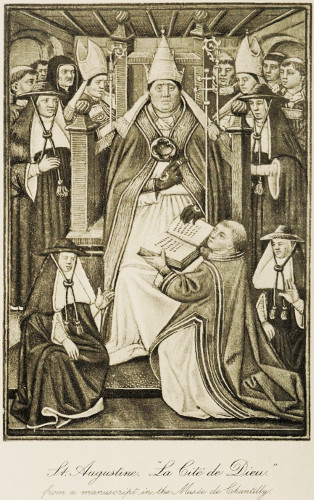
A.D. 426.—Augustine (Aurelius, Saint), the most prominent
of the Latin Fathers of the Church, finishes his “De Civitate Dei,”
which he began in 413, and which is considered the greatest monument to
his genius. He was probably the most voluminous writer of the earlier
Christian centuries. He was the author of no less than 232 books, in
addition to many tractates or homilies and innumerable epistles (“Books
and their Makers, during the Middle Ages,” Geo. Haven Putnam, New York,
1896, Vol. I. p. 3). In the “De Civitate Dei” he tells us (Basileæ,
1522, pp. 718–719) of the experiment alluded to herein at A.D.
1558. This had better be given in his own words (“De Civitate Dei,”
lib. ii. cap. 4, Dod’s translation, Edinburgh, 1871):
“When I first saw it (the attraction of the magnet), I was
thunderstruck (vehementer inhorrui), for I saw an iron
ring attracted and suspended by the stone; and then, as if it had
communicated its own property to the iron it attracted and had made
it a substance like itself, this ring was put near another and lifted
it up, and, as the first ring clung to the magnet, so did the second
ring to the first. A third and fourth were similarly added, so
that there hung from the stone a kind of chain of rings with their
hoops connected, not interlinking but attached together by their
outer surface. Who would not be amazed by this virtue of the stone,
subsisting as it does, not only in itself, but transmitted through so
many suspended rings and binding them together by invisible links?
Yet far more astonishing is what I heard about the stone from my
brother in the episcopate, Severus, Bishop of Milevis. He told me that
Bathanarius, once Count of Africa, when the Bishop was dining with him,
produced a magnet and held it under a silver plate on which he placed a
bit of iron; then as he moved his hand with the magnet underneath the
plate, the iron upon the plate moved about accordingly. The intervening
silver was not affected at all, but precisely as the magnet was moved
backward and forward below it, no matter how quickly, so was the iron
attracted above. I have related what I have myself witnessed: I have
related what I was told by one whom I trust as I trust my own eyes.”
References.—“Vie de St. Augustin,” by Poujoulat,
second edition, Paris, 1852, and by G. Moringo, 1533; Possidius,
also Rivius, “Vitæ de St. Augus.”; L. Tillemont, “Mémoires
Eccles.,” 1702 (the 13th Vol. of which is devoted to an
elaborate account of his life and controversies); Bindemann,
“Der heilige Augustinus,” 1844; Butler, “Lives of the Saints”;
Lardner, “Credibility of the Gospel History,” Vol. VI. part
i. pp. 58–59, and Vol. X. pp. 198–303; Neander, “Geschichte
der Christlichen Religion und Kirche”; Pellechet, “Catalogue
Général des Incunables,” 1897, pp. 339–370; Alfred Weber,
“History of Philosophy,” tr. by Frank Thilly, New York, 1896,
pp. 188–198; “St. Augustine’s City of God,” tr. by Rev. Marcus
Dods, Edinburgh, 1871, Vol. II. book xxi. pp. 420, 457;
“Journal des Scavans,” Vol. XIV. for 1686, pp. 22–23, mentions
the above-named experiment and the effect of diamond on the
loadstone; “Journal des Savants” for Sept. 1898; Ueberweg,
“Hist. of Philosophy” (Morris’ tr., 1885), Vol. I. pp. 333–346.
A.D. 450.—Aëtius (Amidenus), Greek physician, informs us
(Aëtii, op. lib. xi. cap. 25) that “those who are troubled with the
gout in their hands or in their feet, or with convulsions, find relief
when they hold a magnet in their hand. Paracelsus recommended the
use of the magnet in a number of diseases, as fluxes, hæmorrhages,
etc., while Marcellus (“Steph. Artis. Med. Princip.,” II. p. 253) and
Camillus Leonardus (“Speculum Lapidum,” lib. ii.) assert that it will
cure the toothache.”
During the year 1596, Jean Jacques Vuccher published “De Secretis”
(“The secrets and marvels of Nature”), wherein, at p. 166, he thus
advises the application of a loadstone for curing the headache: “La
pierre d’aymant appliquée et mise contre la teste, oste toutes les
douleurs et maux d’icelle-ce que nostre Hollerius escrit comme l’ayant
prins [sic] des commentaires des anciens.” And, in 1754,
Lenoble constructed magnets that were readily used in the treatment of
various diseases (“Practical Mechanic,” Vol. II. p. 171).
The application of the magnet for the relief of various complaints
is treated of at pp. 334–335, Vol. II. of J. Ennemoser’s “History
of Magic,” where will be found a list of works containing accounts
of the oldest and most extraordinary known cures on record.
Additional references to cures by the magnet, as well as with iron or
amber—besides those named more particularly at A.D. 1770
(Maxim. Hell) and at A.D. 1775 (J. F. Bolten)—are to be found
in the following works:
Avicenna, “Canona Medicinæ,” Venice, 1608, lib. ii. cap. 470;
Pliny, “Natural Historie,” Holland tr., 1601, Chap. IV. p. 609;
Hali Abas, “Liber totius medicinæ,” 1523, lib. i.; Serapio
Mauritanus, “De simplicibus medicinis,” Argent., 1531, pp.
260, 264; Antonius Musa Brasavolus, “Examen omnium simplicium
medicamentorum,” Rome 1536; Santes de Ardoynis Pisaurensis,
“Liber de Venenis” (Venetiis, 1492), Basilæ, 1562; Oribasius,
“De facultate metallicorum,” lib. xiii.; Joannes Baptista
Montanus, “Metaphrasis Summaria ...” 1551; G. Pictorio, in his
poem published at Basel in 1567, or in the 1530–1531 editions
of “Marbodei Galli Poetæ vetustissimi de lapidibus pretiosis
Enchiridion” (J. A. Vander Linden, “De Scriptis Medicis,” 1651,
pp. 210–211); Rhazès, “De simplicibus, ad Almansorem,” Venetiis,
1542, lib. ult. cap. 295; Joannes Lonicerus (author of “De
Meteoris,” Frankfort, 1550), “In Dioscoridæ Anazarbei de re
medica ...” 1543, p. 77; Matthæus Silvaticus, “Opus Pandectarum
Medicinæ,” 1498, 1511, 1526 (1541), cap. 446; Petrus de Abano,
“Tractatus de Venenis,” 1490, also “Conciliator Differentiarum
Philosophorum” (1496), 1520, 1526; Nicolaus Myrepsus, “Liber de
compositione medicamentorum,” 1541, 1549, 1567, 1626; Joannes
Manardus, “Epistolarum medicinalium” (Basilæ, 1549); Dioscorides
Pedacius, “De materia medica,” Spengel ed., 1829, Chap. CXLVII.
or in the 1557 ed. p. 507, or in the translation made by Joannes
Ruellius in 1543; Nicholas Monardus, “Joyfull newes out of the
new-found worlde,” Frampton tr., London, 1596; Arnaldus de
Villa Nova, “Tractatus de virtutibus herbarum” (1499); Amatus
Lusitanus, “Enarrationes Eruditissimæ,” 1597, pp. 482, 507;
Gabriellus Fallopius, “De Simplicibus Medicamentis purgentibus
tractatus,” and “Tractatus de compositione Medicamentorum,”
Venetiis, 1566, 1570; Joannes Langius, “Epistolarum Medicinalium
...,” Paris, 1589; Petri Andriæ Mathiolus, “Commentarii ...
Dioscoridis ... de materia medica,” 1598, p. 998; W. Barlowe,
“Magneticall Advertisements,” 1616, p. 7, or the 1843 reprint;
Albertus Magnus, “De Mineralibus” (1542), lib. ii.; Oswaldus
Crollius, “Basilica Chimica,” 1612, p. 267; Nicolaus Curtius,
“Libellus de medicamentis ...” Giessæ Cattorum, 1614; Rudolphi
Goclenii—Goclenius—“Tractatus de magnetica curatione,” 1609,
1613, also “Synarthosis Magnetica,” Marpurgi, 1617 (Eloy “Dict.
Hist. de la Méd.,” Vol. II. pp. 359–360); Luis de Oviedo,
“Methodo de la Coleccion y Reposicion de las medicinas simples,”
1622, p. 502; W. Charleton, “A Ternary of Paradoxes of the
Magnetic cure of Wounds,” 1650; the “Pharmacopœia Augustana,”
Augsburg, 1621, p. 182; Patrick Brydone in “Phil. Trans.,”
Vol. L. pp. 392, 695, and Vol. LXIII. p. 163. Consult also the
abridgments by Hutton, Vol. XI. p. 262, Vol. XIII. p. 415;
Waring’s “Bibliotheca Therapeutica,” London, 1878.
“The magnet ... gives comfort and grace, and is a cure for many
complaints; it is of great value in disputes. When pulverised, it cures
many burns. It is a remedy for dropsy” (I Sermone ... di F. Sacchetti
... § 18).
According to Dias, “the magnet reconciles husbands to their wives,” and
Platea remarks that “it is principally of use to the wounded,” while
Avicenna says “it is a remedy against spleen, the dropsy and alopecian.”
For additional information, consult J. Beckmann’s “History of
Inventions,” Bohn, 1846, Vol. I. p. 43, and the article “Somnambulism”
in the “Encyclopædia Britannica.”
A.D. 543.—The Japanese say that at about this date the Mikado
received from the Court of Petsi in Corea “the wheel which indicates
the south.”
Reference.—Knight, “Mechanical Dictionary,” Vol. II.
p. 1397.
A.D. 658.—As shown by Kaï-bara-Tok-sin, in the “Wa-zi-si,”
the first magnetic cars were constructed during this year in Japan;
the loadstone was not, however, discovered in that country until
A.D. 713, when it was brought from the province of Oomi
(Klaproth, “Boussole,” p. 94). The “Journal of the Franklin Institute”
(Vol. XVIII. for 1836, p. 69), gives a description and illustration of
one of these magnetic chariots, taken from the thirty-third volume of
the Japanese Encyclopædia.
A.D. 806–820.—Between these dates, under the Thâng dynasty,
were first made the cars called Kin-Koung-yuan, which were
magnetic chariots similar to those previously known, but bearing in
addition a drum and a bell. Both the latter were struck at regular
intervals by an erect male figure placed at the head of the car
(“American Journal of Science and the Arts,” Vol. XL. p. 249).
A critic named Tchen-yn admits, as already indicated herein under the
A.D. 235 date, that the knowledge of the mode of construction
of the magnetic cars was by no means general. “I know well,” adds he,
“that, at the time of the Thâng, under Hien-toung (who ascended the
throne 806 A.D., and reigned seventeen years) a chariot was
made which always showed the four parts of the earth, in imitation,
it was said, of those constructed at the time of Hoang-ti.... Upon it
stood the figure of a spirit, whose hand always pointed to the south.”
References.—“Mémoires concernant l’histoire ...” by
Saillant et Nyon, Paris, 1776–1788, Vol. XIII. p. 234; Klaproth,
“Boussole,” p. 72.
A.D. 968.—Kung-foo-Whing is said to have invented a method
of transmitting sound through wires by means of an apparatus called
thumthsein, although no trace whatever of the latter is to be
found in any of the numerous authorities herein quoted.
A.D. 1067–1148.—Frode (Ari Hinn—Ara Hin—or the Wise), Arius
Polyhistor (Ari Prestrinha Frodi Thorgillsun), Icelandic historian,
“than whom there is no higher authority,” was the first compiler of the
celebrated “Landnama-Bok,” which contains a full account of all the
early settlers in Iceland, and is doubtless the most complete record of
the kind ever made by any nation.
In it, he says that, at the time Floke Vilgerderson left Rogoland,
in Norway, about A.D. 868, for another visit to Gardansholm
(Iceland), of which he was the original discoverer, “the seamen had
no loadstone (leiderstein) in the northern countries,” thus
showing, according to Prof. Hansteen, that the directive power of the
needle and its use in navigation were known in Europe in the eleventh
century. In this manner is given the first intimation of the knowledge
of the mariner’s compass outside of China. The passage quoted above is
by many supposed to be an interpolation, for it is not found in several
manuscripts, and it has even been asserted (“Br. Ann.,” p. 296), that
its origin does not antedate the fourteenth century, thus strengthening
the claims of the French in behalf of Guyot De Provins.
References.—“Landnama-Bok,” Kiœbenhaven, 1774, T. I.
chap. ii. par. 7; John Angell, “Magnet. and Elect.,” 1874, p.
10; Lloyd, “Magnetism,” p. 101; “Pre-Col. Disc. of Am.,” De
Costa, pp. xxiii and 11; “Bull. de Géogr.,” 1858, p. 177; “Good
Words,” 1874, p. 70; Klaproth, “Boussole,” p. 40; Hansteen,
“Inquiries Concerning the Magnetism of the Earth,” and “Magazin
für Naturvidenskaberne Christiana,” I. 2, “Encycl. Metrop.,”
Vol. III. p. 736; the 1190–1210 entry herein.
A.D. 1111–1117.—Keou-tsoungchy, Chinese philosopher and writer,
gives, in the medical natural history called “Pen-thsao-yan-i,” written
by him under the Soung dynasty, the earliest description of a water
compass found in any Chinese work, viz.: “The magnet is covered over
with little bristles slightly red, and its superficies is rough. It
attracts iron and unites itself with it; and, for this reason, it is
commonly called the stone which licks up iron. When an iron point is
rubbed upon the magnet, it acquires the property of pointing to the
south, yet it declines always to the east, and is not perfectly true to
the south.... If the needle be passed through a wick or a small tube of
thin reed, and placed upon water, it will indicate the south, but with
a continual inclination towards the point ping, that is to say,
East five-sixths South.”
In the “Mung-khi-py-than,” also composed under the Soung dynasty, it is
stated that fortune-tellers rub the needle with the loadstone in order
to make it indicate the south.
References.—Comptes Rendus, Vol. XIX. p. 365;
“Am. Journal Sc. and Arts,” 1841, XL. p. 248; Davis, “The
Chinese,” 1844, Vol. III. p. 13; Becquerel, “Elec. et Mag.,” p.
58; Klaproth, “Boussole,” pp. 67–69, 95; Humboldt, “Cosmos,”
1849, Vol. II. p. 656, and Vol. V. p. 52; Knight, “Mech. Dict.,”
Vol. II. p. 1397; Humboldt, “Examen Critique,” Paris, 1836, Vol.
III. p 34.
A.D. 1160.—Eustathius, Archbishop of Thessalonica, relates in
his commentary on the Iliad of Homer, that Walimer, father of Theodoric
and King of the Goths, used to emit sparks from his body; also that a
certain philosopher observed sparks occasionally issuing from his chest
accompanied with a crackling noise.
Leithead tells us that streams of fire came from the hair of Servius
Tullius, a Roman King, during sleep, when he was about seven years
of age (Dionysius, “Antiq. Rom.” lib. iv.; Pliny, “Hist. Nat.” lib.
ii. cap. 37); that Cardan alludes to the hair of a certain Carmelite
monk emitting sparks whenever it was rubbed backward (“De Rerum
Varietate,” lib. viii. cap. 43); that Father Faber, in his “Palladium
Chemicum,” speaks of a young woman whose hair emitted sparks while
being combed, and also refers to allusions made in the same line by
Thomas Bartholinus, “De Luce Animalium,” Lugd. 1647, p. 121; Ezekiel
di Castro, “De Igne Lambente”; Johann Jacob Hemmer, “Trans. Elec. Soc.
Mannheim,” Vol. VI; and Phil. Trans., Vol. V. pp. 1, 40.
References.—Eustath in Iliad, E. p. 515, ed. Rom.;
“Encycl. Brit.,” 1855, VIII. p. 571; Priestley, “History of
Electricity,” London, 1775, pp. 128, 129; Phil. Trans.,
abridged, Vol. X. pp. 278, 343, 344, 357.
A.D. 1190–1210.—Guyot de Provins, minstrel at the Court of the
Emperor Frederick I (Barbarossa), gives the first French mention of the
water compass in a manuscript “politico-satirical” poem entitled “La
Bible,” to be found in the Bibliothèque Nationale. It is therein said
that sailors were at that time in the habit of rubbing needles upon the
ugly brown stone called marinière, “to which iron adheres of its
own accord,” and that, as soon as placed afloat upon a small piece of
straw in the water, the needles would point to the North. The passage
alluding to the compass has been copied by D. A. Azuni, member of the
Turin Academy of Sciences, from the original manuscript, and is given
entire, with the French translation, at p. 137 of his “Dissertation
...” second edition, Paris, 1809:
“De notre père l’apostoile (le pape)
Ils l’appellent la tresmontaigne
Par la vertu de la marinière,
Une pierre laide et brumière,
Ou li fers volontiers se joint....”
The passage is also given by Klaproth, at pp. 41–43, and by Venanson,
at p. 72, of their respective works already cited; likewise by
Bertelli, p. 59 of his Memoir published in 1868.
Sonnini (C. S.), in Buffon “Minéraux,” Vol. XV, p. 100, says that Azuni
has successfully established the claims of France to the first use
of the mariner’s compass. Other writers herein, who follow in their
order, will doubtless show to the satisfaction of the reader that, as
the Arabs possessed it at the same time, they must have received it
from the Chinese, and therefore transmitted it to the Franks during the
first Crusades, as stated by Klaproth in his “Lettre à M. de Humboldt,”
Paris, 1834, pp. 64–66.
References.—Becquerel, “Traité d’Elect. et de Magn.,”
Vol. I. p. 70; Bertelli, “Mem. sopra P. Peregrino,” 1868, p.
59; R. M. Ferguson, “Electricity,” 1867, p. 43; J. F. Wolfart,
“Des Guiot von Provins,” Halle, 1861; “Bulletin de Géographie,”
1858, p. 177; Barbazan, “Fabliaux,” Vol. II. p. 328: Becquerel,
“Résumé,” Chap. III; Humboldt, “Cosmos,” 1849, Vol. II. pp.
628–630; “Amer. Journ. Sc. and Arts,” Vol. XL. p. 243; “Guiot
von Provins,” in Meyers Konvers. Lex., Vol. VIII. p. 81;
“Encycl. Met.,” Vol. III. p. 736, gives a verbatim copy of part
of Guyot’s poem, with its literal translation; Libri, “Hist. des
Sc. Mathém.,” Paris, 1838, Vol. II. p. 63; “Encycl. Met.,” Vol.
XII. p. 104; J. Lorimer, “Essay on Magnetism,” London, 1795; Sir
John Francis Davis, “The Chinese,” Vol. III. p. xii, or “China,”
London, 1857, pp. 184–187; Whewell, “Hist. of Ind. Sc.,” Vol.
II. p. 46.
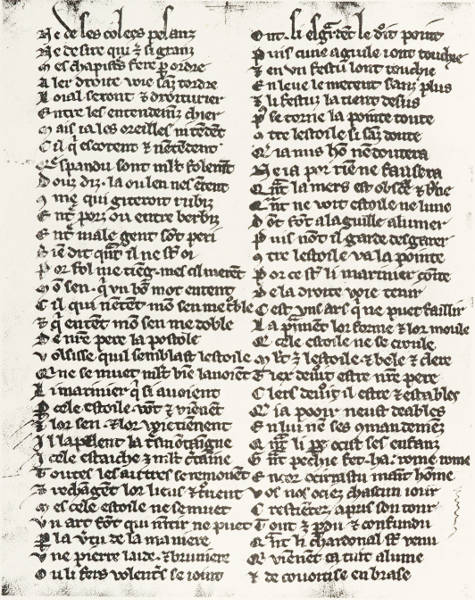
Guiot de Provins. “La Bible.” In the Bibliothèque
Nationale, Paris.
A.D. 1204–1220.—Jacobus de Vitry, Cardinal Bishop of Ptolemais,
in Syria, one of the Crusaders, thus speaks of the compass in
his “Historiæ Hierosolimitanæ,”[10] cap. 89 and 91: “The Magnet
[diamant, as shown under the B.C. 321 date] is found in
the Indies.... It attracts iron through a secret virtue; after a needle
has touched the loadstone, it always turns toward the North Star, which
latter is as the world’s axis and is immobile, while the other stars
turn around it; that is why the compass is so useful to navigators,
valde necessarius navigantibus.”
References.—Azuni, “Boussole,” p. 140; Venanson,
“Boussole,” p. 77; Klaproth, pp. 14, 43–44; Poggendorff, Vol.
II. p. 1184; Becquerel, “Elec. et Magn.,” Vol. I. p. 70; Knight,
“Mech. Dict.,” Vol. II. p. 1397.
A.D. 1207.—Neckam (Alexander of), 1157–1217, Abbot of St.
Mary’s, alludes in his “De Utensilibus” to a needle carried on board
ship, which, being placed upon a pivot and allowed to take its own
position of repose, “showed mariners their course when the Polar Star
is hidden.” In another work, “De Naturis Rerum” (lib. ii. cap. 89),
he writes: “Mariners at sea, when, through cloudy weather in the day,
which hides the sun, or through the darkness of the night, they lose
the knowledge of the quarter of the world to which they are sailing,
touch a needle with a magnet which will turn around until, on its own
motion ceasing, its point will be directed toward the North (Chappell,
“Nature,” No. 346, June 15, 1876; Thomas Wright, “Chronicles and
Memoirs ... Middle Ages,” 1863).
References.—“La Grande Encyclopédie,” Vol. XXIV. p.
898; Hœfer, “Nouv. Biogr. Générale,” Vol. XXXVII. p. 570.
A.D. 1235–1315.—Lully (Raymond) of Majorca (often confounded
with Ramond Lull, who is the author of several alchemical books and
of whose biography very little is known), was, by turns, a soldier,
a poet, a monk, a knight, a missionary and a martyr, and is referred
to by Humboldt as “the singularly ingenious and eccentric man, whose
doctrines excited the enthusiasm of Giordano Bruno when a boy, and who
was at once a philosophical systematizer and an analytical chemist, a
skilful mariner and a successful propagator of Christianity.”
During the year 1272 Lully published his “De Contemplatione,” which
was followed by “Fenix de las maravillas del orbe” in 1286, and by his
“Arte de Naveguar” in 1295. In these he states that the seamen of his
time employed instruments of measurement, sea charts and the magnetic
needle (tenian, los mareantes, instrumento,
carta, compas y aguja), and he describes the improvements
made in the astrolabes (designed for the determination of time and
of geographical latitudes by meridian altitudes and capable of being
employed at sea) from the period that the astrolabium of the Majorcan
pilots was in use.
The application of the astrolabe to navigation, Mr. Irving says (“Hist.
of the Life ... of Columbus,” London, 1828, Vol. I. pp. 76–78), was
“one of those timely events which seem to have some thing providential
in them. It was immediately after this that Columbus proposed his
voyage of discovery to the crown of Portugal.”
Lully also confirms the fact that the Barcelonians employed atlases,
astrolabes[11] and compasses long before Don Jaime Ferrer penetrated to
the mouth of the Rio de Ouro, on the western coast of Africa, which was
about fifty years after the date of the last-named work.
Incidentally it may be added that Lully, posing as an alchemist, is
said to have in the presence of the English King, Edward I, converted
iron into gold, which latter was coined into rose-nobles (Bergman,
“Hist. of Chem.”; Louis Figuier, “L’Alchimie et les Alchimistes,”
Paris, 1860, p. 148).
References.—For Lul. Raimon, or Raymundus, or Lullius
(1235–1315), “Dict. of Philos. and Psych.,” by J. M. Baldwin,
New York, 1902, Vol. II. p. 32; Humboldt, “Cosmos,” 1849, Vol.
II. pp. 629–631, 670, and 1859, Vol. V. p. 55; Miller, “Hist.
Phil. Ill.,” London, 1849, Vol. II. p. 217; Whewell, “Hist. Ind.
Sc.,” 1859, Vol. I. p. 169; also his “Phil. of the Ind. Sc.,”
London, 1840, Vol. II. pp. 320–323; “Journal des Savants,” 1896,
pp. 342, 345–355; “Biogr. Génér.,” article “Lulle”; Helfferich,
“Raym. L.,” Berlin, 1858; Nicolai Eymerici, “Direct Inq.,” Rome,
1578; Bolton, “Ch. Hist. of Chem.,” pp. 1000–1001; Ueberweg,
“Hist. of Philos.” (Morris’ translation, 1885), Vol. I. pp.
457, 459; “Lives of Alchemystical Philosophers,” by Arthur
Edward Waite, London, 1888, pp. 68–88, in which is given, at pp.
276–306, an alphabetical catalogue of all works on Hermetic
Philosophy and Alchemy; Humboldt, “Examen Critique,” Paris,
1836, Vol. I. pp. 7, 283.
For the Dominican Giordano (Jordano) Bruno, see “The Course of
the History of Modern Philosophy,” by Victor Cousin, New York,
1872, Vol. II. pp. 56–58; “English Cycl.” (Biography), Vol. I.
p. 979; Libri, “Hist. des Sc. Mathém.,” Paris, 1838, Vol. I. p.
141; “La Grande Encycl.,” Vol. VIII. pp. 258–259, reviewed in
the “London Athenæum,” Nov. 28, 1903, p. 711.
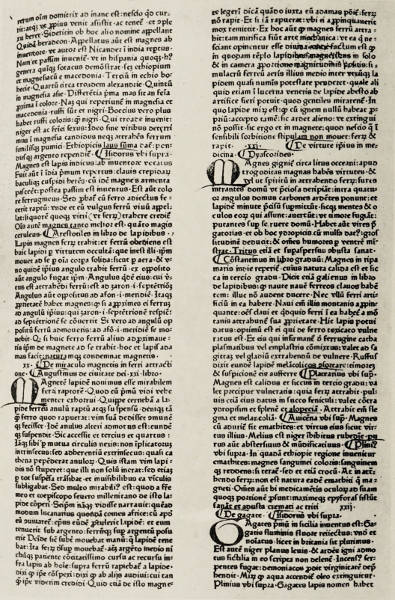
Vincent de Beauvais. “Speculum Naturale.”
Page taken from the 1473 copy, now in the Bibliothèque, Ste. Geneviève, Paris.
A.D. 1250.—Vincent de Beauvais, another Crusader, writes his
“Mirror of Nature” (“Bibliotheca Mundi, Speculum Majus, Speculum
Triplex”) for St. Louis and his consort, Marguerite de Provence, and
speaks therein of the polarity of the needle (“Speculi Naturalis,” Vol.
II. lib. ix. cap. 19). He cites Aristotle as having written a book,
“De Lapide,” containing a notice of the magnet’s use in navigation,
but none of Aristotle’s known works appear to have the passage given.
Cabæus and others rather judge that book to be the work of some Arabic
writer (Thomas Creech, “Lucretius”). Libri, however, says that a
translation or abrégé of the MS. of “De Lapide” is at the Paris
Library—MSS. Arabes, No. 402 (“Hist. des sc. Mathém.,” Vol. I. p. 101).
Le Sieur Petrus Peregrinus de Maricourt (see A.D. 1269)
alludes clearly to the polarity of the needle in an epistle, “Ad
Sigerum de Foucaucourt—Fontancourt—militem de Magnete,” written
toward the end of the thirteenth century, and the magnet is, at about
the same period, referred to in the following lines of the minstrel
Gauthier d’Espinois, contemporary of the Count of Champagne, Thibaud
VI, who lived before the middle of the thirteenth century (“Hist. Lit.
de la France,” 1856, Vol. XXIII—chansonniers—pp. 576, 831):
“Tout autresi (ainsi) comme l’aimant déçoit (détourne)
L’aiguilette par force de vertu
A ma dame tot le mont (monde) retennue
Qui sa beauté connoit et aperçoit.”
Vincent de Beauvais applies the terms zohron and aphron
(not afon) to the south and north ends of the needle, and Mr.
J. Klaproth (“Lettre à M. de Humboldt sur l’invention de la Boussole,”
Paris, 1834, pp. 49–51), says these words are Arabian, notwithstanding
assertions made to the contrary by Martinus Lipenius in his “Navigatio
Salomonis Ophiritica Illustrata,” 1660, cap. v. sec. 3, as well as by
many others who have written upon the compass.
References.—Sonnini, in Buffon, “Minéraux,” VIII.
p. 76; Humboldt, “Cosmos,” 1859–1860, Vol. II. pp. 253–254,
and Vol. V. p. 54; Azuni, “Boussole,” pp. 41, 42, and 44;
Klaproth, p. 13; Miller, “History Philosophically Illustrated,”
London, 1849, Vol. I. p. 179, note. “Simonis Maioli ... Dies
Caniculares, seu Colloqui,” XXIII. 1597, p. 783; Dr. F.
Ueberweg, “Hist. of Phil.” (Morris’ translation, 1885), Vol.
I. pp. 433, 435; “Journal des Savants” for Feb.-Mar. 1892;
“Vincenti Bellov. Speculi Naturalis,” Vol. II. lib. ix. cap. 19.
It may be added that the “Mirror of Nature”[12] is one of the four
pretentious works which, however popular they may at any time have
been and however powerfully they may have influenced the age in which
they were written, do not, says Humboldt, fulfil by their contents the
promise of their titles. The other three are the “Opus Majus” of Roger
Bacon, the “Liber Cosmographicus” (Physical Geography) of Albertus
Magnus, and the “Imago Mundi” (Picture of the World) of Cardinal Petrus
de Alliaco—Pedro de Helico—Pierre d’Ailly. (For the celebrated
French theologian Pierre d’Ailly (1350–1420), Chancellor of the Paris
University, see “Histoire de l’Astronomie,” J. F. C. Hœfer, Paris 1873,
p. 290; “Paris et ses historiens,” Le Roux de Lincy et L. M. Tisserand,
Paris, 1867, p. 402 (etched portrait); “New Int. Encycl.,” New York,
1902, Vol. I. p. 231; “La Grande Encycl.,” Vol. I. pp. 952–954; also
works relating to him by Aubrelicque, Compiègne, 1869, by Arthur
Dinaux, Cambrai, 1824, and by Geo. Pameyer, Strasbourg, 1840.) The
last-named work by Pierre d’Ailly was the chief authority at the time
and exercised a greater influence on the discovery of America than did
the correspondence with the learned Florentine Toscanelli (Humboldt,
“Cosmos,” 1849, Vol. II. p. 621; “La lettre et la carte de Toscanelli,”
par Henri Vignaud, Paris, 1901, or “Toscanelli et Christophe Colomb”
in the “Annales de Géographie,” No. 56, 11e année, Mars 15, 1902, pp.
97–110; “Toscanelli in der älteren und neuren Columbus literatur,” E.
Geleich Mitteil. Wien, Vol. XXXVI. 10, 1893).
Two of the above-named works partake of the encyclopædic, and in this
class likewise properly enter the twenty books “De Rerum Natura” of
Thomas Cantapratensis of Louvain (1230), the “Book of Nature,” by
Conrad Van Meygenberg of Ratisbon (1349), and the great “Margarita
Philosophica,” or “Circle of the Sciences,” of Father Gregorius
Reisch (1486). (See the different entries concerning the last-named
work at pp. 663–664 of Libri’s Catalogue, Vol. II, for 1861.) One more
work bears title “Picture of the World”—“l’Image du Monde”—written
by Gautier de Metz, a French poet of the thirteenth century, on the
lines of still another encyclopædic “Imago Mundi,” by Honorius d’Autun
(Neubauer, “Traductions historiques de l’Image du Monde,” 1876, p.
129; Haase, likewise Fritsche, “Untersuch ... der Image du Monde,”
1879 and 1880; Fant, “l’Image du Monde, étudié dans ses diverses
rédactions françaises,” Upsal, 1886. Chas. Bossut, in his “Hist.
Générale des Mathém.,” Paris, 1810, Vol. I. p. 229, also mentions an
encyclopædic “Mirroir du Monde,” in Turkish Gian Numah; “The
Final Philosophy,” Chas. W. Shields, New York, 1877, p. 133).
A.D. 1254.—Albertus Magnus, of the family of the Counts of
Bollstädt, one of the most prominent philosophers and theologians
of the Middle Ages, likewise alludes to the book “De Lapide”
already referred to at A.D. 1250, and to the Arabic terms
zohron and aphron, giving to these words, however, a
wrong interpretation.[13]
Albertus Magnus (1193–1280) was justly styled Doctor
Universalis, for, from the time he entered the Order of the
Dominican Friars in 1221, as well as throughout his teachings, mainly
at Bologna, Strasburg, Freiburg and Cologne, he displayed an intimate
acquaintance with almost all branches of the natural sciences. He was
especially well versed in philosophy, astronomy and mathematics—in
rebus magicis expertus fuit—and was justly considered by many as
the most erudite philosopher of his generation; an encomium of the
very rarest kind, when such rivals as Alexander of Hales and Thomas
Aquinas could dispute the palm with him. Natural science, says Humboldt
(“Cosmos,” 1860, Vol. II. pp. 243–245), was intimately associated with
medicine and philosophy among the learned Arabs, and, in the Christian
Middle Ages, with theological polemics. The latter, from their tendency
to assert an exclusive influence, repressed empirical inquiry into the
departments of physics, organic morphology, and also astronomy, the
last being, for the most part, closely allied to astrology. The study
of the comprehensive works of Aristotle, introduced by Arabs and by
Jewish Rabbis, had tended to lead to a philosophical fusion of all
branches of study (Jourdain, “Sur les traductions d’Aristotle,” p.
256; Michael Sachs, “Die Religiöse Poesie der Juden in Spanien,” 1845,
s. 180–200), and hence Ibn-Sina (Avicenna), Ibn-Roschd (Averroës),
Albertus Magnus and Roger Bacon passed for the representatives of
all the knowledge of their time. The fame which in the Middle Ages
surrounded the names of these four great men was proportionate to the
general diffusion of this opinion of their endowments.
Albertus was the first scholastic who systematically reproduced the
philosophy of Aristotle with reference to the Arabian commentators and
who remodelled it to meet the requirements of ecclesiastical dogma.
The cause of the new development of scholasticism in the thirteenth
century was the translation, for the first time, into Latin of the
complete works of Aristotle, which latter only came to the knowledge of
the scholastics (1210–1225) through the agency of Arabian philosophy.
The leading Arabian philosophers were Avicenna, Averroës and Avempace,
whilst, in the new movement, Albertus Magnus, St. Thomas Aquinas and
Joannes Duns Scotus represented the culmination of scholastic thought
and its consolidation into a system.[14]
Albertus, according to Humboldt, must be mentioned as an independent
investigator in the domain of analytic chemistry, improving as he did
the practical manipulation of ores, and having actually enlarged the
insight of men into the general mode of action of the chemical forces
of nature. His “Liber Cosmographicus” is a singularly able presentment
of physical geography. He also wrote very extensively upon plant-life,
and is the author of commentaries upon practically all the physical
works of the Stagirite, although in the commentary on Aristotle’s
“Historia Animalium” he is said to have closely followed the Latin
translation of Michael Scotus from the Arabic. Albertus doubtless owes
the praise conferred upon him by Dante less to himself than to his
beloved pupil Aquinas, who accompanied him from Cologne to Paris in
1245, and returned with him to Germany in 1248.
“Questi, che m’ è a destra più vicino,
Frate e maestro fummi; ed’ esse Alberto
E’ di Cologna, ed io Thomas d’Aquino.”
“Il Paradiso,” X. 97–99.
Gilbert refers to Albertus in “De Magnete,” Book I. chaps, i. and vi.,
also in Book II. chap. xxxviii.
References.—“Albert the Great,” by Dr. Joachim
Sighart, translated by Rev. Fr. J. A. Dixon, London, 1876;
“Journal des Savants” for May 1848 (“D’un ouvrage inédit de
Roger Bacon”: Albertus is called Magnus in magia naturali,
major in philosophia, maximus in theologia; Tritheim,
“Annales Hirsaug.,” Vol. I. p. 592); for May 1851, pp.
284–298 passim; for Nov. and Dec. 1884; for June 1891
(“Traditions ... du Moyen Age”), for Feb. 1892 (“Traductions
des ouvrages alchimiques ... arabes; l’alchimie dans Albert le
Grand,” pp. 126–128), as well as for March 1892; “Histoire des
Sciences,” par. F. M. L. Maupied, Paris, 1847 (Albert le Grand),
Vol. II. pp. 1–95; Barthol. Glanvilla, “Liber, de Proprietatibus
Rerum,” Book VII; Pellechet, “Cat. Gen. des Incunables,” 1897,
pp. 57–81; Bolton, “Chronol. Hist. of Chemistry,” 1897, p. 947;
“The Great Schoolmen of the Middle Ages,” by W. J. Townsend,
London, 1881, Chap. X. pp. 165–173; “Siger de Brabant et
l’Averroïsme Latin au xiiie siècle,” par. Pierre Maudonnet,
Fribourg, 1899, pp. li-lii notes passim; Walton and
Cotton, “Complete Angler,” New York and London, 1847, Pt. I.
p. 62; “New Int. Encycl.,” New York, 1902, Vol. I. p. 279;
“Aristotle and the Arabs,” by Wm. M. Sloane, pp. 257–268 of
“Classical Studies in Honour of Henry Drissler,” New York, 1894;
Sonnini, Buffon, “Minéraux,” VIII. p. 76; Enfield, “History of
Philosophy,” Book VII. chap iii.; Humboldt, “Cosmos,” 1849, Vol.
II. pp. 617–619; Quétif and Echard, “Scriptor. Ord. Predicat,”
Vol. I. p. 171; Brande, “Manual,” 1848, Vol. I. p. 8; Dr.
Friedrich Ueberweg, “History of Philosophy,” tr. by Geo. S.
Morris, New York, 1885, Vol. I. pp. 436–440; J. B. Hauréau,
“La Philos. Scholas.,” Paris, 1850, Vol. II. pp. 1–103; Dr. W.
Windelband, “History of Philosophy,” auth. tr. by Jas. H. Tufts,
New York, 1853, pp. 311, 313; “Dict. Hist. de la Médecine,” N.
F. J. Eloy, Mons, 1778, Vol. I. pp. 63–65; “Christian Schools
and Scholars,” Augusta Th. Drane, London, 1867, pp. 69, etc.
Of authors prominently cited by Albertus Magnus, or alluded to in the
foregoing, the following accounts are given:
Alfarabius—Alpharabius—Abn Nasr Muhammed ... al
Farabi—(A.D. 870–950), celebrated Arabian philosopher,
native of Turkestan, one of whose most important works, “Liber
de scientiis ...” is an encyclopædia, giving in five chapters
a classification of all known sciences. It is said he could
speak in as many as seventy languages (J. C. L. S. de Sismondi,
“Historical View of the Literature of the South of Europe,”
London, 1846, Vol. I. p. 65). He was a most zealous student of
Aristotle, and is one of the authors (Aristotle, Avicenna and
Al-gazel being the others) from whom David the Jew compiled
his work “De Causis.” Of the latter, Albertus gives a long
description, and it is likewise cited both by Thomas Aquinas and
Bacon, “Opus Majus,” J. H. Bridges, Oxford, 1897, Vol. I. pp.
100–101, who quotes: Jourdain, pp. 112, 138–145, 184–185, and
Wüstenfeld, “Geschichte,” Göttingen, 1840.
References.—Larousse, “Dict. Univ.,” Vol. I. p. 195;
“Biog. Gen.,” Vol. I. pp. 951–952 and the references therein
given; “New Int. Encycl.,” New York, 1902, Vol. I. pp. 329–330;
M. Stenischneider, “Al-Farabi,” St. Petersb., 1869; Friedrich
Dieterici, “Al-Farabi’s Philosophische Abhandlungen,” Leyden,
1890, and his “Die Philosophie der Araber,” Leyden, 1892, 1895;
Dr. Friedrich Ueberweg, “History of Philosophy,” tr. by Geo. S.
Morris, New York, 1885, Vol. I. pp. 407, 411–412.
Al-gazel—Al-Ghazzali—(1058–1111), another prominent Arabian
philosopher, who was for a long time professor of theology in
the Bagdad University, and became the ruler of the Sufis or
Mystics, in whose behalf he travelled extensively.[15]
The biography in “La Grande Encyclopédie,” Vol. XVIII. pp.
899–900, gives a full account of his most important works and
several valuable references, his principal book being “The
Destruction of the Philosophers,” which called forth a reply in
one of the two most important works of Averroës, entitled “The
Destruction of Destruction.”
Tholuck says: “If ever a man hath deserved the name, Ghazzali
was truly a divine, and he may justly be placed on a level
with Origen [Fr. Dietericii, “Die Philosophie der Araber,”
Leipzig, 1876, pp. 28–31], so remarkable was he for learning and
ingenuity, and gifted with such a rare faculty for the skilful
and worthy exposition of doctrine.”
References.—“Encycl. Britann.,” ninth ed., Vol. I.
p. 510; “New Int. Encycl.,” Vol. I. p. 337; “The Alchemy of
Happiness,” by Mohammed Al-Ghazzali, tr. of Henry Guy Homes,
Albany, 1873, pp. 6–7, also Dr. Friedrich Ueberweg, “History of
Philosophy, tr. by Geo. S. Morris, New York, 1885, Vol. I. pp.
407 and 413–414.
Alexander of Hales, so called because he made his studies at the
Monastery of Hales in Gloucestershire (d. 1245), called
“Doctor Doctorum” or “Doctor Irrefragabilis,” also “Theologorum
Monarcha,” was a celebrated English theologian. He became a
noted professor of philosophy and then a lecturer among the
Franciscans, being succeeded in turn by his pupils, John of
Rochelle (who died in 1271) and John Fidanza, better known as
Bonaventura (1221–1274). He was the first scholastic acquainted
with the whole of the Aristotelian works and with the Arabian
commentaries upon them. The only authentic work of his is the
ponderous “Summa Universæ Theologiæ” (best edition, Venice,
1576), much of the substance and even the text of which is said
to be found in the “Summa” of Aquinas and in the “Speculum
Morale” of Vincent de Beauvais.
References.—“Dict. of Nat. Biog.,” London, 1885, Vol.
I. p. 271; “La Grande Encycl.,” Vol. II. p. 121; Fleury, “Hist.
Eccles.,” Vol. XX; Du Boulay, “Hist. de l’univ. de Paris,” Vol.
I.; Stoeckl, “Geschichte d. Phil. d. Mittelalters,” 1865, Vol.
II. pp. 317–326; “Chambers’s Encycl.,” 1888, Vol. I. p. 148;
Ninth “Encycl. Britann.,” Vol. XXI. p. 427; “Dict. of Philos.
and Psychol.,” by J. M. Baldwin, New York, 1901; Vol. I. pp.
30, 124; Wadding, “Annales Ord. Min.”; “New Int. Encycl.,” New
York, 1902, Vol. I. pp. 321–322; Fabricius, “Bibl. Lat. mediæ et
inf. ætat.,” Vol. I. p. 1; “Biog. Gén.,” Vol. I. pp. 923–927;
J. B. Hauréau, “Hist. de la Philos. Scholastique,” 1880, Vol.
I. part ii. pp. 131–141, or the 1850 Paris ed., Vol. I. p. 418;
Dr. Friedrich Ueberweg, “History of Philosophy,” tr. by Geo.
S. Morris, New York, 1885, Vol. I. pp. 433–434; Thos. Fuller,
“Church History of Britain,” London, 1837, Vol. I. pp. 398–402.
Avempace—Abn Bekr Muhammed Ibn Yahga, Arabic philosopher,
physician and poet (d. 1138), introduced the peripatetic
philosophy into Andalusia, and wrote commentaries on Aristotle,
in addition to a book, “Conduct of the Individual,” alluded to
by Averroës, likewise several works upon medicine and music.
References.—“The History of Philosophy” of Dr.
Friedrich Ueberweg, tr. by Geo. S. Morris, New York, 1885, Vol.
I. p. 414 (Munk, “Mélanges de Philosophie,” pp. 383–410); “New
Int. Encycl.,” New York, 1902, Vol. II. p. 281; Brockelmann,
“Geschichte der Arabischen Litteratur”; James Gow, “A Short
History of Greek Mathematics,” Oxford, 1884, pp. 203–205 for
Arabic learning in Spain.
Averroës—Muhammed Ibn Ahmed Ibn-Roschd, “the commentator,” “the
last great thinker of the Moslem world in the West” (1120–1198),
was an illustrious Moorish philosopher and physician best known
by his commentaries and paraphrases upon Aristotle. It is said
Averroës was recommended to the Calif as the fittest person to
expound the works of Aristotle and make them accessible to all
(“History of Classical Scholarship,” J. E. Sandys, Cambridge,
1903, p. 541).
References.—Renan, “Averroës et l’Averroïsme,” Paris,
1852; “Dict. of Philos. and Psychology,” by J. M. Baldwin,
New York, 1901, p. 96; “Journal des Savants” for Feb. 1892,
pp. 118–126 passim; Antonii, “Bibl. Hisp. Vetus,” Vol.
II. pp. 240–248; Wüstenfeld, “Geschichte d’ Arab. A. V. N.,”
1840; “Engl. Cycl.,” Vol. I. pp. 448–449; Eloy, “Dict. Hist.
de la Médecine,” Vol. I. pp. 220–221; Dr. Friedrich Ueberweg,
“History of Philosophy,” tr. by Geo. S. Morris, New York, 1885,
Vol. I. pp. 407–408, 415–417; Dr. W. Windelband, “History of
Philosophy,” auth. tr. by Jas. H. Tufts, New York, 1893, pp.
317, 338; “Dictionnaire des Sciences Philosophiques,” par une
société de savants, Paris, 1852, Vol. III. pp. 157–172.
“Euclide geometra e Tolommeo,
Ippocrate, Avicenna, e Galieno
Averrois che ’l gran comento feo.”
(Dante, “Divina Commedia,” Inferno, Canto IV.)
Augusta Th. Drane places Averroës at the head of all Arabic
interpreters of Aristotle, and incidentally says it would
be hard to determine his religion, for he scoffed alike at
Christianity, Judaism and Mahometanism.
Avicenna—Abohalis, Ibn Sina, Al Rayis or “the
chief”—(980–1037), “the greatest thinker of the Moslem world
in the East,” a native of Aschena, near Bokhara, was the most
celebrated physician of his day. In the “Journal des Savants”
for March 1892, “l’Alchimie d’Avicenne” is very extensively
treated of at pp. 179–189, and Avicenna is said (“Journal des
Savants” for February 1892, pp. 118–128) to be the alchemist
most frequently alluded to in the “Speculum Naturale” of Vincent
de Beauvais. His writings were so highly esteemed that the
Sultan of Egypt ordered them to be translated by the celebrated
Jewish Rabbi, Maimonides—Moses Ben Maimon—(born at Cordova, in
Spain, about A.D. 1132).
References.—Casiri, “Bibl. Arab. Hispan.,” Vol. I. p.
268; Hottinger, “Bibl. Quadrip.,” 1664, pp. 256, 261; “Dict. des
Sciences Philosophiques,” Paris, 1852, Vol. III. pp. 172–178; S.
Klein, “Dissertatio,” 1846; Houzeau et Lancaster, “Bibl. Gen.,”
Vol. I. pt. i. pp. 469–470; “The Edinburgh Encycl.,” 1830,
Vol. III. p. 107; “Engl. Cycl.,” Vol. I. pp. 449–450; Gilbert,
“De Magnete,” Book I. chaps. i., viii., xv. and Book II. chap.
ii.; Eloy, “Dict. Hist. de la Médecine,” Vol. I. pp. 223–227;
Dr. Friedrich Ueberweg, “History of Philosophy,” tr. by Geo.
S. Morris, New York, 1885, Vol. I. pp. 407, 412–413; Dr. W.
Windelband, “History of Philosophy,” auth. tr. by Jas. H. Tufts,
New York, 1893, p. 317; “New Gen. Biog. Dict.,” London, 1850,
Vol. XII. p. 43; “Dict. of Philosophy and Psychology,” by J. M.
Baldwin, New York, 1901, Vol. I. p. 97; “Lectures on Metaphysics
and Logic,” by Sir Wm. Hamilton, London, 1860, Vol. II. pp. 167,
171; “Historical View of the Literature of the South of Europe,”
by J. C. L. S. de Sismondi, London, 1846, Vol. I.
Duns Scotus, John, “Doctor Subtilis” (born about 1270, died in
1308), a very prominent schoolman, who was educated at Oxford,
entered the Order of St. Francis, and became one of the great
founders of scholastic thought. But little is known as to his
origin, except that a monument, erected to his memory at
Cologne during the year 1533, bears the following: “Scotia me
genuit, Anglia me suscepit, Gallia me docuit, Colonia (Germania)
me tenet.”
As shown by Luc. Wadding in his “J. Duns-Scoti Opera,” twelve
volumes, published at Lyons in 1639, his works are quite
numerous, the most important consisting of questions and
commentaries on the writings of Aristotle and on the “Sentences”
of Peter Lombard.
Joannes Duns Scotus is very frequently referred to by Dr. W.
Windelband (“History of Philosophy,” auth. tr. by Jas. H.
Tufts, New York, 1893, pp. 311, 314–315, 321–326, 344), and is
mentioned as “the acutest and deepest thinker of the Christian
Middle Ages, who brought the germs of the philosophy of the
will, contained in Augustine’s system, to their first important
development, and so from the metaphysical side gave the impulse
for a complete change in the direction of philosophical thought.”
References.—“Dict. of Nat. Biog.,” London, 1888, Vol.
XVI. pp. 216–220; Ritter’s “Geschichte der Philosophie”; Dr.
Friedrich Ueberweg, “History of Philosophy,” tr. by Geo. S.
Morris, New York, 1885, Vol. I. pp. 452–457; Larousse, “Dict.
Univ.,” Vol. VI. p. 1398, containing an extensive list of
references; Alfred Weber, “History of Philosophy,” New York,
1896, pp. 246–252 (tr. of Frank Thilly); “Biog. Gén.,” Vol. XV.
pp. 256–257; “La Grande Encycl.,” Vol. XV. pp. 71–72; Pluanski,
“Thèse sur Duns Scot,” Paris, 1887; “The Great Schoolmen of
the Middle Ages,” W. J. Townsend, London, 1881, “Duns Scotus,”
Chap. XV.; J. B. Hauréau, “La Philosophie Scholastique,” Paris,
1850, Vol. II. pp. 307–417. Consult also the biographies written
by Ferchius, Berti, Caveili and Veglensis, and, for a complete
exposition of his system, C. Werner, “Die Scholastik des
Späteren Mittelalters,” Vienna, 1881, Vol. I; “Illustrations of
the History of Medieval Thought,” by R. L. Poole, London, 1884.
A.D. 1254.—Bacon (Roger), “the most remarkable man in the
most remarkable century of the Middle Ages” (E. H. Plumptre, 1866),
sometimes called Friar Bacon (1214–1294), a Franciscan monk of
Ilchester, who devoted himself to the study of science at Oxford and
Paris and “whose deep penetration into the mysteries of nature justly
entitled him to the appellation of “The Wonderful Doctor,” treats of
the magnet and of its properties at pp. 383–384 of his “Opus Minus” (J.
S. Brewer, “Fr. R. Bacon,” London, 1859), and dwells upon the loadstone
as a miraculum in parte notum.
Bacon is also the author of many other works, the most important of
which are his “Opus Majus” and “Opus Tertium” (first published in
English respectively in 1733 and 1859), the last named having been
originally written out for Pope Clement IV and intended to serve as a
preamble to the “Opus Minus” and “Opus Majus,” although it was later
than either in the date of its composition (Brewer, op. cit.
p. xliv). Leland has said that it is easier to collect the leaves of
the Sybil than the titles of all of Bacon’s works. At pp. 218–222,
Vol. III. of the ninth edition “Encyclopædia Britannica” will be found
a synopsis of the six parts into which Jebb divided the “Opus Majus”
(pronounced by Whewell “at once the Encyclopædia and the Organum of
the thirteenth century”), and likewise an account of his other works,
besides numerous references to leading authorities.
In the “Opus Tertium,” the last of the series of three which, it is
said, were all completed in about eighteen months, he speaks more than
once of A.D. 1267 as being the then current year. This happens
to be but two years prior to the date of the epistle of Pierre Pélerin
de Maricourt, the great experimentalist (Petrus Peregrinus), whom he
commends (p. lxxv) in the following words: “For there are only two
perfect mathematicians, Master John of London[16] and Master Peter of
Maricourt, the Picard ... who is worth more than any of them ... of
whom I have fully written in my ‘Opus Minus’ and of whom I shall write
more in its proper place.” Of this Master Peter, whom he calls one
of his most illustrious pupils, he further says that, being “struck
with the genius that dawned in his countenance,” he took him under his
protection from his fifteenth year and instructed him so carefully
that he outstripped all of his contemporaries both at Oxford and at
Paris. “There is no one,” adds he, “who knows so much of the root of
Philosophy ...” and one who, “through experiment, gains such knowledge
of things natural, medical, chemical; indeed, of everything in the
heavens or earth.”
Gilbert states (“De Magnete,” Book I. chap. i.) that many believe the
work of Peter Peregrinus on the magnet owes its origin to the opinions
of Roger Bacon. And in the Appendix I to Brewer’s work—p. 537, chap.
vi. “De Experimentis Mirabilibus”—will be found Bacon’s views fully
exposed on the operations of the magnet.
References.—“Fratris Rogeri Bacon, O. M. Opus Majus,”
S. Jebb, Londini, 1733; “L’Alchimie et les Alchimistes,” Paris,
1860, by Louis Figuier, who, at p. 97, calls Roger Bacon La
plus vaste intelligence que l’Angleterre ait possédée;
“Essai Théorique ... des connaissances humaines,” par G.
Tiberghien, Bruxelles, 1844, Vol. I. pp. 388–389; Dr. Geo.
Miller, “History Philosophically Illustrated,” London, 1849,
Vol. II. p. 112; Humboldt, “Cosmos,” New York, 1860, Vol. II.
pp. 43, 229, 241, 245, 318; “Journal des Savants” for March,
April, May and August 1848, also for December 1859 and February
1891; “Origin, Progress and Destiny of the English Language and
Literature,” by John A. Weisse, New York, 1879, pp. 28, 233–234,
236, 424; “History of Latin Christianity,” by Henry Hart Milman,
London, 1857, Vol. VI. pp. 279–303; “Opus Majus,” by John
Henry Bridges, Oxford, 1897, Vol. I. pp. xxv-xxvi, and Vol.
II. pp. 203–206, containing a valuable tabulated list of facts
relating to Bacon’s life; “Roger Bacon,” par Emile Charles,
Paris, 1861, pp. 15–19, 339–391; “De Bibliorum Textibus,” by
Dr. Hody; Wm. Whewell, “History of the Inductive Sciences,”
1858, Vol. I. pp. 512–522, or 1859, Vol. I. pp. 209–210,
245–246, 512–522, Vol. II. p. 55; also “Philosophy of the
Inductive Sciences,” London, 1840, Vol. II. pp. 323–337; “The
Philosophical Magazine,” Vol. XII. pp. 327–337; Enfield, Book
VII. chap. iii.; “Catalogue Général des livres imprimés de la
Bibliothèque Nationale,” Paris, 1901, Vol. VI. pp. 256–259;
“Encyclopædia Britannica,” Edinburgh, 1842, seventh edition.
Vol. I. as per Index at p. 17; “Les Editions de Roger Bacon” in
the “Journal des Savants” for July 1905.
Brunetto Latini. “Li livres dou Trésor.”
Page taken from the 15th century Ms. in the Bibliothèque Nationale, Paris.
A.D. 1260.—Brunetto Latini, b. 1230, d. 1294,
“maestro del divino poeta Dante,” celebrated Florentine encyclopædist,
composes his “Tesoro,” rewritten in French (“Livres dou Trésor”),
wherein he speaks clearly of the compass as at some time likely to be
useful at sea. But he adds: “No master mariner dares to use it, lest he
should fall under the supposition of being a magician; nor would even
the sailors venture themselves out to sea under his command if he took
with him an instrument which carries so great an appearance of being
constructed under the influence of some infernal spirit.”
The “Tesoro” is said to be a kind of abridgment of the Bible, of Pliny,
of Solinus, of the Ethics of Aristotle, of the rhetorical writings of
Cicero and of the political works of Aristotle, Plato and Xenophon
(“New Biog. Dict.,” London, 1850, Vol. IX. p. 205). It would be well to
consult “La Table Générale des bulletins ... Sociétés Savantes,” par
M. Octave Teissier, Paris, 1873, p. 44, regarding the collection of
different manuscripts of Brunetto’s extensive work.
References.—Davis, “The Chinese,” 1844, Vol. III. p.
xi; Venanson, “Boussole,” pp. 75, 148–154; Azuni, “Boussole,”
p. 139; Klaproth, “Boussole,” pp. 45–46; “Journal des Savants”
for January 1865, also for January and February 1880; “The
Monthly Magazine” for June 1802; Libri, “Hist. des Sciences
Mathématiques,” Paris, 1838, Vol. II. pp. 64, 152–156.
A.D. 1265–1321.—Dante—Durante—(Alighieri), illustrious
Italian poet, regarded as the greatest poetical genius that flourished
between the Augustan and Elizabethan ages, composed, during his exile,
the “Divina Commedia,” which was the first poem written in the Italian
language. In Canto XII. vv. 28–30 of his “Paradiso,” translated by Dr.
Plumptre, he thus alludes to the mariner’s compass:
“Then from the heart of one of those new lights,
There came a voice which made me turn to see,
E’en as the star the needle’s course incites.”
Guido Guinicelli (1240–1276), priest and scholar, and whom Dante
considered not only the greatest of living Bolognese poets, but his
master in poetry (Note: “Purg.,” XXVI. Vol. I. p. 327, v. 92) refers to
the nautical compass in nearly the same terms as Dante (“Rime. Ant.,”
p. 295). He adds: “The mountains of loadstone give the virtue to the
air of attracting iron, but, because it (the loadstone) is far off,
(it) wishes to have the help of a similar stone to make it (the virtue)
work, and to direct the needle toward the star” (P. L. Ginguené, “Hist.
Lit. d’Italie,” Vol. I. p. 413; Guido delle Colonne—Io Colonna da
Messina—Mandella Lett. p. 81, Florence, 1856).
At pp. 35 and 130 of Bertelli’s “Pietro Peregrino di Maricourt,” Roma,
1868, Memoria prima, appear verses said to be by Guinicelli and by
Guido delle Colonne, judge of Messina, who flourished about 1250, and
which are translated literally into English as follows:
“In those parts under foreign skies
Are the mountains of loadstone,
Which give power to the air
To attract iron, but, because distant,
It requires to have assistance from similar stones,
To bring it into use,
And direct the needle towards the star.
The learned relate that the loadstone
Could not attract
Iron by its power,
Were it not that the air between them aids;
Although the calamite is a stone,
The other existing stones
Are not so powerful
To attract, because they have not the influence.”
The “Paradiso,” translated by A. J. Butler, London, 1885, Canto XII. v.
29, reads: “Si mosse voce, che l’ago (needle) alla stella,” and
Fazio degli Uberti in the “Dittamondo” (about 1360) has “Quel gran
disio, che mi, traeva addietro come ago a calamita” (III. 2).
References.—Hœfer, “Nouv. Biog. Gén.,” Vol. XIII.
pp. 21–50, the last-named page containing an unusual number of
citations; “Biblogr. Dantesca,” by Colomb de Batines, Prato,
1845–1846; “La Grande Encyclopédie,” Vol. XIII. pp. 887–901,
embracing many additional references; the note at p. 154 of
Plumptre’s “Dante,” also Humboldt’s “Cosmos,” 1849, Vol. II. p.
629; Libri, “Hist. des Sc. Math.,” Paris, 1838, Vol. II. pp.
164, etc.; Frederic C. Harrison, “The New Calendar of Great
Men,” London, 1892, pp. 310–315.
Dante Alighieri. “La Divina Commedia,” Mantuae 1472, the first
page of what is by many regarded as the oldest edition of the
earliest known poem written in the Italian language.
Now in the Bibliothèque Sainte Geneviève, Paris.
A.D. 1266.—It is shown by Th. Torffæus (Latin for Thormodr
Torfason), an Icelandic scholar (b. 1636, d. 1719),
who published “Historia Rerum Norvegicarum” (Hafniæ, 1711, IV. c. 4,
p. 345), that at this date the northern nations were acquainted with
the mariner’s compass. In the “History of Norway” here alluded to, he
mentions the fact that the poem of the Icelandic historian, Jarl Sturla
(Snorri Sturlason) written in 1213, on the death of the Swedish
Count Byerges, was rewarded with a box containing a mariner’s compass.
References.—Suhm, “In effigien Torfæi, una cum
Torfænis”; “Nouv. Biogr. Générale de Hœfer,” Vol. XLV. p. 495;
“New Gen. Biog. Dict.,” London, 1850, Vol. XII. p. 263; Jessen,
“Norge,” pp. 83–99; Larousse, “Dict. Univ.,” Vol. XV. p. 312;
Michaud, “Biog. Univ.,” Vol. XLI. p. 683.
A.D. 1269.—Peregrinus (Petrus), Pierre Pélerin de Maricourt,
Méhéricourt—Magister Petrus de Maharnecuria, Picardus—doubtless a
Crusader, was, as Roger Bacon tells us (“Opus Tertium,” cap. xi) the
only one, besides Master John of London, who, at this period, could be
deemed a thoroughly accomplished, perfect mathematician, and was one
who understood the business of experimenting in natural philosophy,
alchemy and medicine better than any one else in Western Europe.
Peregrinus is the author of a letter or epistle, “Written in
camp at the Siege of Lucera (delle Puglie—Nucerræ) in the year
of our Lord 1269, on the 8th day of August,” addressed to his
Amicorum intime, a soldier, by the name of Sygerus de
Fontancourt—Foucaucourt—Foucancort.
Of this epistle, which is the earliest known work of experimental
science, there are but few reliable complete manuscript copies. Most of
these have been very ably analyzed by P. D. Timoteo Bertelli Barnabita
in the exhaustive Memoirs published by him in Rome during 1868, and
still better detailed by Dr. Silvanus P. Thompson in his several
valuable printed researches and lectures on the subject, but there has
been of it only one printed issue in book form, that of the Lindau
physician, A. P. Gasser, which appeared at Augsburg during 1558.
Several attempts at translation have been made, notably by Guillaume
Libri (“Histoire des Sciences Mathématiques ...” Paris, 1838, Vol. II.
p. 487) who admitted that, with the aid of several paleographers, he
could not decipher many of the abbreviated faint characters existing in
the Bibliothèque Nationale manuscript (No. 7378A in quarto,
at folio 67), and by Tiberius Cavallo, who does scarcely better with
the Leyden copy (Fol. Cod. No. 227) which was discovered by him,
and but a portion of which he transcribes in the supplement to his
“Treatise on Magnetism,” London, 1800, pp. 299–320. A translation
was also made by Brother Arnold, of the La Salle Institute in Troy,
N.Y., and published during 1904, but the most meritorious version now
existing is the one entitled “Done into English by Silvanus P. Thompson
from the printed Latin versions of Gasser 1558, Bertelli 1868, and
Hellmann 1898, and amended by reference to the manuscript copy in his
possession, formerly amongst the Phillipps’ manuscripts, dated 1391.”
This translation, “printed in the year 1902, in the Caxton type, to the
number of 250 copies,” reflects very great credit upon Prof. Thompson,
who has given us such a faithful interpretation of the original work
as would naturally be expected at his hands, and who has, besides,
rubricated this right royal little volume and caused it to be issued in
one of the most attractive typographical fashions of the Chiswick Press.
The Hellmann 1898 Berlin version just alluded to, which appeared
in “Neudrucke von Schriften und Karten ...” No. 10 (Rara
Magnetica), contains a photographic reproduction of the Augsburg
1558 title-page, and, it may be added, the volume of Phillipps’
manuscripts, of which Prof. Thompson became the fortunate possessor,
includes one of Chaucer’s treatises on the Astrolabe, besides the
Peregrinus’ manuscript in question.
During the year 1562 much of the original epistle was pilfered by
Joannes Taisnier Hannonius, who badly condensed and deformed it and
incorporated it as new matter, conjointly with some papers of his own,
in a book entitled “Oposculum ... de Natura Magnetis et ejus effectibus
...” Coloniæ, 1562; and that much was translated “into Englishe” by
Richarde Eden, London, about 1579, under title of “A very necessarie
and profitable booke concerning navigation.”
Much has been said at different times regarding the contents of the
above-named epistle, the full title of the Paris MS. No. 7378 of which
reads
“Epistola Petri Peregrini de Maricourt ad Sygerum de Foucaucourt
militem de magnete,”
but no résumé of it could better be given than by
quoting here its first page, which has been translated as follows:
This treatise on the magnet contains two parts, of which Part I
is complete in ten chapters, and Part II in three.
Of Part I: Chap. I states the object of the work;
Chap. II, of what the investigator in this line of work should
be;
Chap. III, of a knowledge of the loadstone;
Chap. IV, of the science of the discovery of the parts of the
loadstone;
Chap. V, of the source of the discovery of poles in the
loadstone—which of them is the north and which the south;
Chap. VI, in what manner a magnet attracts a magnet;
Chap. VII, how iron touched with the magnet turns towards the
poles of the globe;
Chap. VIII, in what manner a magnet attracts iron;
Chap. IX, why the northern part attracts the southern part, and
the converse;
Chap. X, of the inquiry whence the magnet derives the natural
power it possesses.
Petrus Peregrinus. “Epistola ... de Magnete.”
The earliest known treatise of experimental science, now in the
Bibliothèque Nationale, Paris.
Of Part II: Chap. I, on the construction of an instrument
(floating compass) by which the azimuth of the sun and moon, and
of any star above the horizon, can be ascertained;
Chap. II, on the construction of a better instrument (pivoted
compass) for like purpose;
Chap. III, on the construction of a wheel for perpetual motion.
An analyzation of each chapter in turn will show how satisfactorily
Peregrinus has developed, in connected series, all of the early
experiments upon which are based his theories of the loadstone.
Chap. I states that the intention or object of the work is to
make known the hitherto hidden nature, occult properties, of
the loadstone, the art of treating the latter, the making of
scientific instruments, and matters of interest to students of
nature, astrologers and sailors.
Chap. II. The investigator in this line should know the natures
of things and understand the motions of the heavenly bodies,
but, above all, he should be assiduous in handiwork for
experimental research.
Chap. III indicates four different requisite qualities of the
loadstone, and tells where they are to be found and how to
select and test them—the best of them being free from flaws, of
great density and of a bluish or celestial colour.
Chap. IV shows how to find in the loadstone the two poles,
one north and the other south, using preferably a globular
magnet,[17] placing thereon a needle or an oblong piece of
iron, and, either drawing lines in the direction taken by the
needle, so that they “may meet at two points, just as all the
meridian circles of the world meet at the two opposite poles
of the world,” or, by merely marking the magnet so that “the
opposite points will be correctly placed just as are the poles
in a sphere.”
Chap. V. In order to find the poles in a stone—which of them is
the North and which the South—take a round wooden vessel shaped
like a skiff (paropsidis, parascidis), and place
the stone therein, then put the vessel containing the stone into
another large vessel filled with water, so that the first-named
vessel may float into the larger one: “The stone in the first
vessel will be like a sailor in a ship, and the first vessel
may float roomily into the second as does a ship in a river,
and the stone so placed will turn its small vessel acting as
the Northern pole in the direction of the Northern heaven....
If this pole were then turned away a thousand times, a thousand
times would it return to its place by the will of God.”
Chap. VI. Having found which pole is the Northern, mark it so
that it may be known when necessary. Place the stone into a
small vessel, as shown in Chap. V, then hold another stone in
the hand and approach its Northern part to the Southern part of
the stone floating in the vessel, and the floating stone will
follow the other “as if it wished to adhere thereto.... Know
that, as a rule, the Northern part of one stone attracts the
Southern part of another stone and the Southern the Northern.”
Chap. VII. When the needle or oblong piece of iron (alluded to
in Chap. IV) has touched the magnet and been attached to a light
piece of wood or stalk and then placed in a vessel of water,
one part will be turned towards the mariner’s star because it
is near the pole, “the fact being that it does not turn towards
the aforesaid star but towards the pole.” That end of the iron
which has touched the Southern end of the stone turns towards
the Northern quarter of the sky, and vice versa.
Chap. VIII. If you wish to attract iron floating on water, hold
the Southern part of a loadstone to the Northern part of the
iron and the iron will follow. But, if you bring the North end
of the stone near the North end of the iron, the latter will
avoid the stone. “If, however, violence is used towards the
ends, so that, for instance, the Southern end of the iron which
was touched with the Northern end of the magnet is now touched
with the Southern end of the magnet ... the power in the iron
will easily be changed, and that will become Southern which was
previously Northern, and the converse.”
Chap. IX. “The Northern part of the magnet attracts the Southern
and the reverse, as has been shown; in which attraction the
magnet is an ‘agent’ of greater power while the ‘patient’
(i. e. the other which is acted upon) is, of weaker.”
This is proved by taking a loadstone—marking it, for instance,
AD—dividing, separating it into two parts, and placing one
part (the Northern, marked A, called the “agent”) into water
so that it will float. It will turn “to the North, as before,
for the division does not deprive the parts of the stone of
their properties, if it be homogeneous.” The other part (the
Southern, marked D, called the “patient”) is next to be floated
in a similar manner. When this is done, the other ends of the
two stones should be marked respectively B and C. It will then
be observed that “if the same parts are again brought near each
other, one will attract the other, so that they will be joined
together again at B and C where the division took place. Whence
it is that they become one body with the same natural propensity
as at first. The proof of this is that if they are joined
together they will possess the same oppositions (opposite poles)
they first contained. The ‘agent,’ therefore, as you will see by
experiment, intends to unite its ‘patient’ to itself, and this
takes place on account of the similitude between them.... And,
in the same way, it will happen that if A is joined with D, the
two lines will become one, by virtue of that very attraction,
in this order CD—AB ... there will then remain the identity of
the extreme parts as at first, before they were reunited, for C
will be the North point and B the South point, as B and C were
before.... It is therefore evident, from these observations,
why the Southern parts do attract the Northern, and the reverse,
and why the attraction of the South by the South, and the North
by the North, is not according to Nature.”
Chap. X. “Some weak inquirers have imagined that the power which
the magnet exercises over iron lies in those mineral places in
which the magnet is found ... but it is found in different parts
of the world.... Besides, when iron or the magnet turns towards
the Southern as well as to the Northern quarter, as is evident
from what has already been said, we are compelled to decide
that the attraction is exercised on the poles of the magnet not
only from the locality of its quarry, from which ensues the
evident result that, wheresoever a man may be, the direction
of this stone appears to his eye, according to the position of
his meridian circle. All the meridian circles, however, meet
together at the poles of the globe, wherefore it is that the
poles of the magnet receive their power from the poles of the
world. From this, it manifestly appears that the direction of
the magnet is not towards the mariner’s star, as the meridian
circles do not meet there, but all the poles, for the mariner’s
star is always found beyond the meridian circle of any region
unless it be twice in a complete revolution of the firmament.
Likewise from this, it is manifest that the parts of the magnet
receive their power from the world’s poles ... the whole
magnet from the whole heavens.”[18] Then follows a suggestive
experiment looking towards perpetual motion, by which one may
secure “a wonderful secret” and even “be saved the trouble of
having any clock.” Here, it is given that a terrella,
poised on its poles in the meridian, moves circularly with a
complete revolution in twenty-four hours. This is explained by
N. Cabæus in his “Phil. Magn.,” lib. iii. cap. 4.
Chap. I. He takes a round, or an ovoid magnet, and, after noting
its poles, files it between the two poles on both sides so that
it may be like a compressed sphere and thus occupy less space.
He then encloses this magnet between two light wooden capsules,
or boxes (cassulas) after the manner of a mirror ...
so fastened (with glue) that they cannot be opened and water
cannot enter. Then, says he, “place the capsules thus adjusted
in a large vessel full of water in which the two quarters of the
globe, viz. the South and the North, are found and marked, and
let them be indicated by a thread extending from the Northern to
the Southern part of the vessel; allow the capsules, or boxes,
to float and let there be above them a slender piece of wood in
the form (position) of a diameter. Then move this piece of wood
above the boxes until it is equidistant from the meridianal line
previously found and indicated by the thread, or is the same
(line) itself. This being done, according to the piece of wood
so situated, draw a line on the capsules, or boxes, and it will
be the perpetual meridianal line in all countries. That line,
therefore, when cut at right angles by another will be divided
in the centre and will be the line of the East and West. You
will thus have four quadrants actually marked on the capsules,
or boxes, representing the four quarters of the globe, of which
each will be divided into ninety, so that there may be in the
universe CCCLX parts (degrees) in the entire circumference of
the capsules, or boxes. Inscribe divisions on it as they were
formerly inscribed on the back of the astrolabe. There should
be, besides, a slender and light ruler above the capsules so
inscribed after the manner of the ruler on the back of the
astrolabe. Instead, however, of the sights (pinnularum),
should be erected at right angles two pins over the ends of the
ruler.”
This floating compass and the pivoted compass described
in the following chapter are to be found illustrated, pp.
67–77, figs. 10 and 12, at end of Part II of Bertelli
Barnabita’s Memoirs above referred to.
Chap. II. For the construction of a “better instrument and of
more certain effects” (the pivoted compass) he says: “Let there
be made a vessel of wood, brass or any other solid material
that you desire, and let it be turned in the shape of a jar
(pixidis tornatum) somewhat deep and tolerably large and
let a cover of transparent material, such as glass or crystal,
be fitted to it. If the whole vessel were of transparent
substance so much the better. Let there be placed in the centre
of the same vessel a slender axis of brass or silver, applying
its extremities to the two parts of the jar, that is to say (to
the) higher and lower. Let two holes be then made in the centre
of the axis facing each other at right angles. Then let a piece
of iron wire, like a needle, be passed through one of these
holes and another wire of silver or brass be passed through the
other, intersecting the iron at right angles. Let the cover at
first be divided into quadrants and each of the quadrants into
ninety parts, as was taught regarding the other instrument. Let
North and South and East and West be marked on it and let a rule
of transparent material be added to it with wires set upright at
the ends. You will approach what part of the magnet you please,
whether North or South, to the crystal until the needle moves
towards it and receives virtue from it. When this is done,
turn the vessel until one end (of the needle) stands directly
over the North in the instrument coinciding with the Northern
quarter of the sky. This being done, turn the rule to the sun,
by day, and to the stars, by night, in manner above indicated.
By means of this instrument, you will be enabled to direct your
footsteps to states and islands and to any places on the globe,
and wheresoever you may be, whether on land or on sea, so long
as their latitudes and longitudes are known to you.”
Chap. III. He constructs “a wheel which shall be constantly
in motion,” by making a very thin concave, silver case, after
the manner of a mirror, suitably perforated, around the rim
of which he inserts small iron nails, or teeth, bent closely
toward each other and which he then places upon an immovable
axis so that it may revolve easily.” He continues: “Let a silver
wire be added to this axis, fixed to it and placed between two
bowls on the end of which let a magnet be set, prepared in this
manner. Let it be rounded and its poles ascertained, as before
indicated; afterwards, let it be fashioned in the shape of an
egg with the poles intact, and let it be somewhat filed down
in two intermediate and opposite parts with the object of its
being compressed and occupying less space so that it may not
touch the inner walls ... let the magnet be placed on the wire
... and let the North pole be somewhat inclined towards the
small teeth of the wheel so that it may exercise its power ...
so that each tooth shall arrive at the North pole and, owing
to the impetus of the wheel, shall pass it by and approach the
Southern quarter. Thus every small tooth will be in a perpetual
state of attraction and avoidance. And, in order that the wheel
may perform its duty with greater rapidity, insert, between
the cases, a small round brass or silver pebble of such size
that it may be caught between any two of the small teeth, so
that, as one part of the wheel comes uppermost, the pebble may
fall to the opposite part. Wherefore, whilst the motion of the
wheel is perpetual on one side, the same will be in the case
of the pebble on the other side, or the fall of the pebble
caught between any two of the teeth will be perpetual to the
opposite side because as it is drawn towards the centre of the
earth by its weight, it assists the motion by not suffering the
small teeth to remain at rest in front of the stone. Let there
be spaces, however, between the small teeth conveniently curved,
so as to catch the pebble as it falls in the way the present
description indicates.”
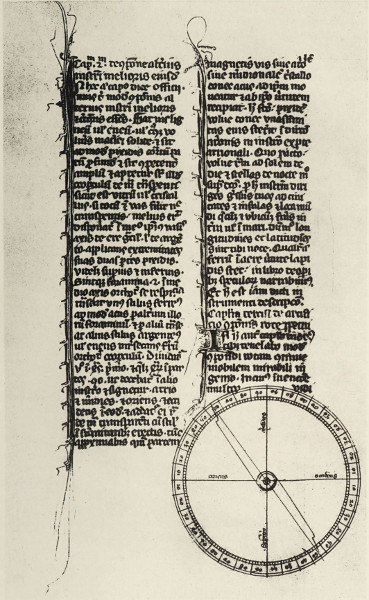
Petrus Peregrinus. Facsimile of a Ms. at the Bodleian
Library, of the “Epistola de Magnete,” wherein is described the
earliest known pivoted compass.
Gilbert alludes to this perpetual-motion engine as having been devised
or delineated by Peregrinus after he had got the idea from others (“De
Magnete,” Book II. chap. xxxv.), and says that Jerome Cardan writes
(“Opera,” Batav., 1663; “De Rerum Varietate,” Book, IX. chap. xlviii.)
he could construct one out of iron and loadstone—not that he ever saw
such a machine; that he merely offers the idea as an opinion and quotes
from a report of the physician Antonio de Fantis of Treviso published
in “Tabula generalis ac mare magnum scotice subtilitatis....”
In the “Magisterium Naturæ et Artis,” P. Francisci Tertii de Lanis,
Brixiæ, 1684, Tractatus Tertius, Caput Secundum, p. 489, under
Problema, I, Motus perpetuus magnetis, will be found allusion
to the machines of (1) P. Peregrinus, as described in his epistle;
(2) Taisnier; (3) Ant. de Fantis (cited by Cardan, as stated above);
also mention of those of P. Schottus, Athan. Kircherus, Hieronimus
Finugius and others; the most important of these being again alluded to
throughout the third chapter of the same tract.
Gilbert makes further allusion to P. Peregrinus in his Book I. chap.
i.; Book II. chap. xxxv.; Book III. chap. i.; Book IV. chap. i.; Book
VI. chap. iv.
The Peregrinus’ Leyden manuscript (Fol. Cod. No. 227) already
alluded to, Libri says (“Histoire des Sciences Mathém....” 1838,
Vol. I. p. 383, note), is but a poor copy of the manuscript in the
Paris Library (No. 7378A), from which latter the words
Petri ad Sygerum have been unfortunately transformed into
Petri Adsigerii. He adds (Vol. II. pp. 70–71) that Humboldt
cites (“Examen Critique,” p. 243) several authors who have alluded
to the pretended Adsigerius. Mention is also made of the fact that
W. Wenkebach, professor at the Hague Military School, examined the
manuscripts in the Bodleian Library, Nos. 1629, 1794 and 2458,
containing the treatise of Peregrinus, and that not one of them has
the passage alluding to the declination. The Leyden manuscript, by the
way, is said to be the only one, besides the Vatican copy, No. 5733,
bearing the full date, which latter was first made known by Thévenot
in his “Recueil de Voyages.” And it was a passage found in the Leyden
manuscript (Q 27) which led to the belief that Peregrinus had first
observed the variation or declination of the magnetic needle. The
passage is as follows: “Take note that the magnet, as well as the
needle that has been touched by it, does not point exactly to the
poles, but that the part of it which is supposed to point to the South
sometimes declines a little to the West, and that the part which looks
towards the North sometimes inclines to the East. The exact quantity of
this declination I have ascertained, after numerous experiments, to be
five degrees. However, this declination is no obstacle to our guidance,
because we make the needle itself decline from the true South by nearly
one point and a half towards the West. A point contains five degrees.”
This passage is unquestionably a late addition, being written in a
different hand in a circle which itself is an incompleted outline of
one of the figures of Peregrinus’ primitive compass.
References.—“Encyclopædia Metropolitana,” Vol. III. p.
737 (“Bibliotheca Bibliothecarum,” fol. 11, p. 1400; “Catalogue
of the MSS. in the library of Geneva,” by Senebier, p. 207);
“Bulletino di bibliographia e di storia delle scienze ...” B.
Boncompagni, Vol. I. pp. 1–32, 65–99, 101–139, 319–420; Vol. IV.
pp. 257–288, 303–331; “Cat. bibl. publicæ univers. Lug. Bat.,”
p. 365; W. Wenkebach, “Sur Petrus Adsigerius ...” Rome, 1865
(taken from Vol. VII. No. 3 of the “Annali Pura ed Applicata”);
Brunet, “Manuel du Libraire,” 1863, Vol. IV. p. 493; “Br. Museum
Library,” 538, G 17; “Journal des Savants,” for April-May 1848,
and September 1870; Walker, “Magnetism,” 1866, p. 6; “English
Cyclopædia,” Vol. VIII. p. 160, also Dr. Hutton’s “Phil. and
Math. Dictionary”; Thos. Young, “A Course of Lectures on Nat.
Phil. and the Mechanical Arts,” London, 1807, Vol. I. pp. 746,
756; “Electro-magnetic Phenomena,” by T. A. Lyons, New York,
1901, Vol. I. pp. 105–106; Vol. II. p. 565 (with translation of
a portion of the original manuscript); “Examen Critique,” A. de
Humboldt, Paris, 1836, Vol. III. p. 31; “Science and Literature
of the Middle Ages,” Paul Lacroix, London, pp. 88–89, 280–282;
Silvanus P. Thompson, “Proceedings of the British Academy,”
1905–6, p. 377. It may be added that Houzeau et Lancaster,
“Bibl. Générale,” Vol. I. part i. p. 640, allude, at No. 3197,
to a manuscript of P. Peregrinus, “Nova compositio astrolabii
particularis,” as being in the Library of Geneva and as citing
the year 1261 in connection with the astronomical tables of John
Campan (Campanus, Italian mathematician, who died about 1300):
“Biog. Générale,” Vol. VIII. p. 373.
A.D. 1270.—Riccioli (Giovanni Battista), an Italian astronomer,
member of the Society of Jesuits, b. 1598, d. 1671,
asserts that at this period under the reign of St. Louis (1226–1270),
French navigators were already using the magnetic needle, which they
kept floating in a small vase of water, and which was supported by two
tubes to prevent its falling to the bottom.
For a detailed account of the work of this well-known scientist
consult: “Biographie Générale” Vol. XLII. pp. 147–149; Fabroni, “Vitæ
Italorum,” Vol. II; Jean Baptiste Delambre, “Hist. de l’Astron. Mod.,”
1821; Davis, “The Chinese,” Vol. III. p. 11; Venanson, “Boussole,” pp.
70–71; Klaproth, “Boussole,” p. 54; Becquerel, “Résumé,” p. 59; Alex.
Chalmers, “Gen. Biog. Dict.,” 1811, Vol. XXVI. pp. 182–183; Fischer,
“Geschichte der Physik,” Vol. I; Tiraboschi, “Storia della letter.
Ital.,” Vol. VIII; “English Cyclopædia,” Vol. V. pp. 76–77. Riccioli’s
“Almagestum Novum,” Bologna, 1651, in two volumes, gives in book nine
of the second volume the sentence of Galileo. This is the work which
an old savant called “the pandects of astronomical knowledge” (Morhof
Polyhistor, Vol. II. p. 347).
A.D. 1271–1295.—Polo (Marco), Paulum Venetum, is reported by
many to have brought the compass from China to Italy. This is, however,
supported by no evidence, nor is any allusion whatever made to the fact
in the account he rendered of his voyage. Before Marco Polo set out on
his travels, as Humboldt states, the Catalans had already made voyages
“along the northern islands of Scotland as well as along the western
shores of tropical Africa, while the Basques had ventured forth in
search of the whale, and the Northmen had made their way to the Azores
(the Bracir islands of Picignano).”
Polo relates that he set out from Acre in 1271, and returned to Venice
“in the year 1295 of Christ’s Incarnation.” His “Travels” (“Il Milione
di Messer Marco Polo”) according to the review of Col. Henry Yule,
consists of a prologue and four books. It was dictated by him to a
fellow prisoner, Rusticiano or Rusticello, of Pisa, and “it would
appear now to be definitely settled that the original was ... of just
such French as we might expect in the thirteenth century from a Tuscan
amanuensis following the oral dictation of an Orientalized Venetian.”
Polo’s journeyings extended “so far to the north that he leaves the
North Star behind him, and thence so far to the south that the North
Star is never seen.”
References.—Becquerel, “Elec. et Magn.,” Vol. I. p.
70; Sonnini, in Buffon, “Minéraux,” Vol. VI. p. 84; Humboldt,
“Cosmos,” 1849, Vol. II. pp. 625, 656, or 1860, pp. 250–251;
“The Book of Ser Marco Polo,” by Sir Henry Yule, New York,
1903, which contains a very extensive bibliography at end of
the second volume; Libri, “Hist. des Sc. Mathém.,” Paris, 1838,
Vol. II. pp. 26, 140, etc.; D. A. Azuni, “Dissertation sur la
Boussole,” p. 69; Miller, “Hist. Phil. Ill.,” 1849, Vol. I. pp.
179–180; “Encycl. Brit.,” ninth ed., Vol. XIX. p. 407; “Journal
des Savants” for September 1818, also May 1823, and the five
articles published January to May 1867; see also “Centennaire
de Marco Polo,” par. H. Cordier, Paris, 1896, containing
“bibliographie très complète de toutes les éditions de Marco
Polo et des ouvrages qui lui sont consacrés.”
A.D. 1282.—Baïlak, native of Kibdjak, wrote this year, in
Arabic, his book on “Stones,” wherein he says that he saw during his
voyage from Tripoli to Alexandria, in 1242, the captains of the Syrian
sea construct a compass in the following manner: “When the night is
so dark as to conceal from view the stars which might direct their
course according to the position of the four cardinal points, they take
a basin full of water, which they shelter from wind by placing it in
the interior of the vessel; they then drive a needle into a wooden peg
or a corn-stalk, so as to form the shape of a cross, and throw it into
the basin of water prepared for the purpose, on the surface of which
it floats. They afterwards take a loadstone of sufficient size to fill
the palm of the hand, or even smaller; bring it to the surface of the
water, give to their hands a rotatory motion towards the right so that
the needle turns on the water’s surface; they then suddenly and quickly
withdraw their hands, when the two points of the needle face north and
south. I have seen them, with my own eyes, do that during my voyage at
sea from Tripolis to Alexandria.”
References.—E. Salverte, “Phil. of Magic,” New
York, 1847, Vol. II. pp. 221–222, note; “American Journal of
Science and Arts,” Vol. XL. p. 247; Davis, “The Chinese,” Vol.
III. p. xii; Klaproth, “Lettre à M. de Humboldt,” pp. 59,
60, 67; Knight, “Mech. Dict.,” Vol. II. pp. 1371 and 1397;
“Electro-Magn. Phenom.,” by T. A. Lyons, New York, 1901, Vol.
II. p. 564.
A.D. 1302.—Gioia—Goia (Flavio or Joannes), an Italian pilot
reported born at Positano, near Amalfi, is said by Flamnius Venanson
(“De l’invention de la boussole nautique,” Naples, 1808, pp. 138 and
168) to be the real inventor of the mariner’s compass. This view is
supported by Briet (Philippe), “Annales Mundi,” Vol. VI: Géog. et
Hydrog., lib. x. cap. 8; by Voltaire (“Essai sur les Mœurs,” 1819,
Vol. III. chap. cxli.), and by many others, but Klaproth (“Lettre ...”
1834, pp. 132–136) quotes Anthony of Bologna, called the Panormitan,
as saying that Gioia lived in the fourteenth century and wrote both
“Prima dedit nautis usum magnetis Amalphis” and “Inventrix
præclara fuit magnetis Amalphis.” He adds that a statement to the
same effect was made by Arrigi Brechmann in his “Historia Pandectarum
Amalphitorum,” Dissertatio I, No. 22, Neapoli, 1735, p. 925, but that
both are equally incorrect, for Gioja could not have invented an
instrument which had already been in use more than a hundred years
before his time.[19]
In his “Essay on Several Important Subjects,” London, 1676, Joseph
Glanvill remarks (p. 33): “I think there is more acknowledgment due to
the name of this obscure fellow, that hath scarce any left, than to a
thousand Alexanders and Cæsars or to ten times the number of Aristotles
and Aquinas’. And he really did more for the increase of knowledge
and advantage of the world, by this one experiment, than the numerous
subtile disputers that have lived ever since the creation of the
School of Wrangling.”
In the “Navigator’s Supply,” published 1597, William Barlowe speaks of
“the lame tale of one Flavius at Amelphus in the Kingdome of Naples;
for to have devised it (the compass) is of very slender probabilitie.”
M. D. A. Azuni says (“Boussole,” 1809, p. 144) that Gioja may have
possibly invented the method of suspending the magnetic needle upon a
perpendicular pivot so that it would remain horizontal whatever the
movements of the vessel. This is very likely; at any rate, it must be
admitted that this particular mode of support permits a freer movement
to the needle in any direction and admits of more exact observations
than when the needle is floating upon the water.
At pp. 487–505, Vol. II of his “Histoire des Sciences Mathématiques,”
Guillaume Libri transcribes all he is able to from the almost
illegible Peter Peregrinus’ manuscript, No. 7378A, in the
Paris Bibliothèque, and refers to the imperfect mode of suspending
the magnetic needle therein shown. It is, says he, similar to that
spoken of by Francesco da Buti (Libri, Vol. II. pp. 67–68; Bertelli,
“Pietro Peregrino,” pp. 63–66), who makes first mention of the
compass in the Dante commentary (“Comment, sopra la Divina Commedia”)
to be found in the collection of manuscripts No. 29, held by the
Magliabechiana Library of Florence. He adds that the suspension of the
needle is likewise alluded to by Guerino detto il Meschino, in a work
first composed prior to the “Divina Commedia” (an Italian romance,
attributed to one Andrew the Florentine) as imbellico, or in
bellico, in bilico, meaning in suspense, throughout the
editions of Padua, 1473, Bologna, 1475, Milan, 1482 and Venice, 1480,
1498. Mention is also made by Libri of the writings of Adélard de Bath
on the compass, at p. 62 of his second volume.
References.—Camillus Leonardus, “Speculum Lapidum”;
the notes at p. 180, Vol. I. of Dr. Geo. Miller’s “Hist.
Phil. Ill.,” London, 1849, Vol. I. p. 179, note; Venanson,
“Boussole,” pp. 158, 160; Knight, “Mech. Dict.,” Vol. II. p.
1398; Collenutius—Collenuccio—“Compendio ... regno di Napoli,”
Venice, 1591; “Discussione della leggenda di Flavio Gioia,
inventore della bussola” (T. Bertelli, in “Rivista di Fisica
Mat. e Sc. Nat.,” Pavia, 1901, II. pp. 529–541); Matteo Camara,
“Memorie ... di Amalfi,” Salerno, 1876; “Literary Digest,” July
6, 1901, translated from “Le Cosmos,” Paris, June 8, 1901;
Giraldi, “Libellus de Re Nautica,” Bâle, 1540; Admiral Luigi
Fincati, “Il Magnete, la calamita e la bussola,” Rome, 1878;
“Annales de Géographie,” Vol. XI. No. 59, pp. 7–8 for September
15, 1902, and G. Grimaldi in the “Mem. d. Accad. Etrus. di
Cortona”; Paulus Jovius, “Historiarum,” Florence, 1552; Pietro
Napoli Signorelli, “Sull’invenzione della bussola nautica ...”;
M. A. Blondus, “De Ventis,” Venice, 1546; Cælius Calcagninus,
“Thesaurus Græcarum Antiquitatum,” 1697, Vol. XI. p. 761;
Houzeau et Lancaster, “Bibl. Gén.,” Vol. II. p. 149; “Riv. G.
Ital.,” X. 1903, pp. 1, 11, 105–122, 314–334.
For Briet (Philippe), b. 1601, d. 1668, see Michaud,
“Biog. Univ.,” Paris, 1843, Vol. V. p. 527. The best, most complete
edition of Briet’s “Annales Mundi” is the Venice, 1693.
A.D. 1327–1377.—It has been claimed by F. M. Arouet de
Voltaire, who asserts it at Vol. III. pp. 251–252 of his “Essai sur
les Mœurs et l’Esprit des Nations,” Paris, 1809, “that the first
well-authenticated use of the compass” was made by the English during
this period, which is that of the reign of King Edward III.
By Voltaire, the extraordinary (prodigieuse) antiquity of the
Chinese is not questioned. They knew of the compass, but he says “it
was not employed by them for its proper use, that of guiding vessels
at sea. They travelled only along the shores. Possessed, as they were,
of a country that furnished everything, they did not feel the need
of going, as we do, to the other end of the world” (Vol. I. pp. 239,
247). Speaking of the Portuguese (Vol. III. p. 257) he says: “It was
not before known if the magnetic needle would point to the south on
approaching the South Pole; it was found to point constantly to the
north during the year 1486.”
From the time of Edward III, the compass was known in England by the
names of adamant, sailing needle and sail-stone
dial, as has been shown in the writings of Chaucer and others,
the most important of which will be duly quoted in their order. The
compass was alluded to, more particularly, by John Gower, “Confessio
Amantis,”[20] Books I and VI; by Richard Hakluyt, “Voyages,” Vol. I.
pp. 213, 215; and by Edward Fairfax, “Godefroy de Boulogne,” Book XV.
s. 18.
It may be well to record here that Voltaire was “confessedly the
foremost name, the acknowledged head of European literature of his
time.” Goethe calls him “the greatest literary man of all time,
the most astonishing creation of the Author of Nature” (“Nouvelle
Biographie,” Vol. XLV. i. p. 445). Though not the first French author
who wrote on the wonderful discoveries of Newton, he was the first to
make them extensively known on the Continent.
References.—Sir Harris Nicolas, “Hist. Roy. Navy,”
1847, Vol. II. p. 180; Humboldt, “Cosmos,” 1859, Vol. V. p.
57, note; Whewell, “Hist. of the Ind. Sc.,” 1859, Vol. I. p.
431; “Crit. and Misc. Essays,” by Thomas Carlyle, Boston,
1860, pp. 5–78. “La France Littéraire,” par Joseph M. Quérard,
Vol. X. Paris, 1839, pp. 276–457, devotes as many as 182
pages to bibliographical notices of Voltaire and names 1131
publications written by or relating to him, whilst in Quérard’s
“Bibliographie Voltairienne” will be found a still more extended
account at pp. i-xxxvi and at pp. 1–84.
Regarding the mariner’s compass, it can scarcely be doubted, from what
precedes, that it came to the knowledge of Europeans in the manner
indicated under the A.D. 1190 date.
Baïlik of Kibdjak—Baüak Kibdjaki—spoke of its use as generally well
known by the Syrian navigators, who constructed it in exactly the same
way as did the Chinese (A.D. 1111–1117 and A.D.
1282), and which resembled the compass seen by Brunetto Latini in the
possession of Friar Bacon while in England prior to the year 1260
(Knight, “Mech. Dict.,” Vol. II. p. 1397).
Edrisi (Idrisi or Aldrisi), the most eminent of the Arabian
geographers, is said by Boucher to have given a confirmed account of
the polarity of the magnet, the early knowledge of which by the Arabs
has been shown conclusively by Jacob de Vitry, Vincent de Beauvais and
Albertus Magnus.
Signor P. T. Bertelli, who has been mentioned under the A.D.
1190 date, could not find any reference, however remote, to the
directive property of the loadstone throughout a careful examination of
Latin and Greek works dating from the sixth century B.C. to
the tenth century A.D. He admits that the directive property
was known to the Chinese, who had made rude floating needle compasses
before the beginning of the Christian era, although these compasses
are likely to have been brought home by the Amalfian sailors, who are,
by some writers, represented as having substituted the pivoted needle
as well as added the Rose of the Winds.[21] He will not, however,
recognize the claims made in favour of Flavio Gioja. On the other hand,
A. Botto has shown that the Amalfitans introduced the compass between
the tenth and the eleventh centuries (“Contributo agli studi storici
sull’origine della bussola nautica,” 1899). Consult likewise Vol. IX of
“Annales de Géogr. et de Bibliogr.,” 1899, p. 8.
At p. 195 of the December 1904 issue of “Terrestrial Magnetism”
is a short article relative to the claim made that the compass was
invented by a Veronese named Salomone Ireneo Pacifico (A.D.
776–846) during the first half of the ninth century. It states that
Bertelli considers this due to a misinterpretation of an inscription
on Pacifico’s tomb, and it alludes to Bertelli’s previous paper on
the subject in “Terrestr. Magn.,” Vol. VIII. No. 4, p. 179 (see
also the number of “Terrestr. Magn.” for June 1905, p. 108, and the
“Geographical Journal” for March 1905, pp. 334–335).
The earliest recorded use of the compass in a Spanish vessel, according
to Capmany (“Memorias Historicas,” 1792), is to be found in the
Chronicle of Don Pedro Niño, Conde de Buelna, as follows: “It is
reported that Conde’s galleys left the island of La Alharina along the
coast of Bombay ... and the pilots compared their needles which had
been rubbed with the magnet stone....”
In Dr. Plumptre’s notes on Dante, reference is made to the fact that
the European knowledge of the magnetic needle came from Arabia, and,
like Humboldt, he quotes in support thereof an allusion from the
Spanish “Leyes de las Partidas” belonging to the first half of the
thirteenth century. The passage in the last named is spoken of by M.
Fern de Navarrete in his “Discurso historico,” etc., 1802 (II. tit. ix.
ley 28) and reads thus: “The needle which guides the seaman in the dark
night and shows him, both in good and in bad weather, how to direct his
course is the mediatrix (medianera) between the loadstone (la
piedra) and the north star....” Humboldt adds: “See the passage in
‘Las siete Partidas del sabio Rey Don Alonso el IX’ [according to the
usually adopted chronological order, Alfonso the tenth], Madrid, 1829,
Vol. I. p. 473.”[22]
On the other hand, the knowledge of the compass by the Arabs in the
thirteenth century has been most decidedly contested by E. Renaudot
(“Anciennes Relations des Indes et de la Chine,” Paris, 1717, p. 3);
by D. A. Azuni (“Dissertation sur l’origine de la Boussole,” Paris,
1809, pp. 102, 127); by Giovanni Battista Ramusio (“Coll. Voy.,” 1554,
Vol. I. p. 379); by A. Collina (“Considerazioni,” etc., Faenza, 1748,
p. 121, etc.). Buffon says (“Théorie de la Terre,” Paris, An. VIII.
tome i. p. 300): “I know that some pretend the Arabs have invented
the compass and have used it long before the French (see ‘Abrégé de
l’histoire des Sarrazins,’ de Bergeron, p. 119) ... but that opinion
always appeared to me devoid of reason; for there is no word in the
Arabian, Turkish or Persian tongue which can be made to signify the
compass.... They employ the Italian word bossola....”
The same view is entertained by Dr. William Robertson, principal of
the University of Edinburgh, who, after announcing in his “History
of the Reign of Charles V,” London, 1769, Vol. I. p. 78, that the
mariner’s compass was invented soon after the close of the Holy War,
gives at pp. 333–335 of his “Historical Disquisition,” London, 1812,
a translation of the above passage taken from an early edition of
that illustrious French naturalist George Louis Le Clerc, Comte de
Buffon. Robertson adds: “This shows that the knowledge of this useful
instrument was communicated to them (the Arabs) by the Europeans. There
is not one single observation of ancient date made by the Arabians on
the variation of the needle, or any instruction deduced from it for the
assistance of navigators.... When Mr. Niehbuhr was at Cairo, he found a
magnetic needle in the possession of a Mohammedan which served to point
out the Kaaba, and gave it the name of el magnetis, a
clear proof of its European origin.”
The claims of France to the discovery of the compass have been laid
by some to the fact that the north point of the early instruments was
generally drawn in the form of a fleur de lys, but Voltaire
says (“Essai,” etc., Vol. III. p. 251), that the Italians drew this
in honour of the sovereigns of Naples, a branch of the French royal
family. The able writer in the English Cyclopædia (“Arts and Sciences,”
Vol. III. p. 102) considers the design to be only “an ornamented
cross which originated in devotion to the mere symbol; though,
as the compass undoubtedly came, he says, into Europe from the
Arabs, the fleur de lys might possibly be a modification of
the mouasala, or dart, the name by which the Arabs called the
needle” (“Phil. Mag.,” Vol. XVIII. p. 88).
References.—Hallam, “Middle Ages,” Vol. III. chap.
ix. part ii.; Klaproth, “La Boussole,” pp. 53, 54 and 64–66;
Davis, “The Chinese,” Vol. III. p. 12; “Silliman’s Journal,”
XL. 242–250; “Nautical Magazine,” April 1903; “Ciel et Terre,”
Juin 1, 1904, pp. 156–158; “Histoire de la Boussole,” par P.
D. M. Boddært; Libri, “Hist. des Sc. Mathém.,” Paris, 1838,
Vol. I. pp. 136–137, 382, etc.; Article “Bussola” in “Nuova
Encycl. Italiana,” by Bocardo, Vol. IV. Torino, 1877, p. 377,
poesia di Ugo di Sercy (Bercy) e di Giovanni di Mehun; “Harper’s
Magazine,” New York, for February, 1904; V. Molinier, “Notice
... boussole au xiiie siècle,” Toulouse, 1850; G. Grimaldi,
“Dissert. ... della bussola,” Roma, 1741; McCulloch, “Traités
... boussole,” Paris, 1853; Magliozzi, “Notizie ... bussola,”
Napoli, 1849; Dr. Geo. Miller, “Hist. Phil. Illust.,” London,
1849, Vol. I. p. 180, note. For Edrisi, see “Journ. des
Savants,” issued in April and August 1843, and in December 1846.
A.D. 1391.—Chaucer (Geoffrey), the father of English poetry,
thus expresses himself in “The Conclusions of the Astrolabie”
(“English Poets,” London, 1810, Vol. I): “I haue giuen thee a
sufficient astrolabye for oure orizont compowned after the latitude
of Oxenforde.... Now hast thou here, the fower quarters of thin
astrolabie, deuided after the fower principall plages or quarters of
the firmament.... Now is thin Orisonte departed in XXIIII partiez by
thi azymutz, in significacion of XXIIII partiez of the world; al be it,
so that ship men rikne thilke partiez in XXXII.”
“Now maugre Juno, Aneas
For all her sleight and her compas
Atcheiued all his auenture.”
“House of Fame,” B. I.
“The stone was hard of adamaunt,
Whereof they made the foundemaunt,
The tour was round made in compas,
In all this world no richer was.”
“Rom. of the Rose.”
“Right as betwene adamants two
Of euen weight, a pece of yron set,
Ne hath no might to moue to ne fro
For what that one may hale, that other let.”
“Assem. of Foules.”
References.—“English Poets,” London, 1810, Vol. I. p.
453; Ch. Wells Moulton, “Library of Literary Criticism,” Vol. I.
pp. 77–81.
A.D. 1436.—Bianco—Biancho—(Andrea), was an Italian
cartographer living at Venice early in the fifteenth century, who
published, in 1436, an atlas exhibiting charts of the magnetic
variation. The knowledge of the latter, which is so indispensable to
the correction of a ship’s reckoning, was then ascertained less by the
sun’s rising and setting than by the polar star.
One of Bianco’s charts, now in the Biblioteca Marciana, Venice, shows
two islands at the West of the Azores, leading many to believe that he
possessed some knowledge of the existence of North and South America.
In Justin Winsor’s description of Dr. John G. Kohl’s collection
of early maps (“Harvard Univ. Bulletin,” Vol. III. pp. 175–176),
it is said that the original of Andrea Bianco’s Map of the World
A.D. 1436, now at Venice, was reproduced by Joachim
Lelewell (“Géographie du Moyen Age,” Pl. XXXII), and also in M. F.
de Barros de Santarem’s “Essai sur l’histoire de la cosmographie
et de la cartographie” (Pls. XXIII, XLIII).[23] Reference is also
made thereto in Winsor’s “Bibliography of Ptolemy’s Geography,”
sub anno 1478. Mr. Winsor adds: “Bianco’s views are of interest in
early American cartography from the deductions which some have drawn
from the configuration of the islands ‘Antillia’ and ‘De la man
Satanaxio’—(two islands on its western verge)—that they represent
Pre-Columbian discovery of South and North America.” Humboldt (“Crit.
Untersuchungen,” I. 413, 416) has discussed the question, and pointed
out that one island, “Antillia,” had earlier appeared on a map of 1425,
and D’Avezac finds even earlier references to the same island.
To Andrea Bianco may be ascribed the best of all known forms of
wind-roses. Admiral L. Fincati illustrates, in his well-known pamphlet
“Il Magnete, la Calamita e la Bussola,” Rome, 1878, all the best-known
examples from 1426 to 1612, those of Bianco having upon them either
the fleur de lys (referred to at A.D. 1327–1377) or
the letter T[symbol], or designs of a triangle or trident, to
indicate the north, whilst the east is designated by a cross, in same
manner as shown in the 1426 Giraldi and the Oliva 1612–1613.[24]
For other forms and accounts of these rose-of-the-winds or compass
cards, it would be well to consult more particularly Nordenskiöld,
Nils Adolf Erik (1832–1901), “Periplus” (1897), as well as his
“Facsimile Atlas” published eight years previously; Pedro de Medina,
“Arte de Navegar”; Francesco Da Buti, “Comment, sopra la Div. Com.”;
Simon Stevin’s “Haven-finding Art”; Athan. Kircher, “Magnes, sive
de Arte Magnetica”; and Guillaume de Nautonniez, “Mécométrie de
l’Eymant ... déclinaison guideymant pour tous les lieux ...” published
1602–1604.[25]
References.—“Biog. Gen.,” Vol. V. pp. 922–923,
Mazzuchelli, “Scrittori d’ Italia”; “New Int. Encycl.,” New
York, 1902–1903, Vol. II. p. 796; Larousse, “Dict. Univ.,” Vol.
II. p. 672; Humboldt, “Cosmos,” 1859, Vol. V. p. 55; Johnson’s
“New Univ. Cycl.,” 1878, Vol. III. p. 230; “Der Atlas des Andrea
Bianco vom Jahre 1436 of Oscar Peschel,” Venedig, 1869; Justin
Winsor, “Narrative and Critical Hist. of America,” Boston, 1889,
Vol. I. pp. 50–56, 114, 117; “Formaleoni, saggio sulla nautica
antica de Veneziani,” Venez., 1783, pp. 51–59 (Libri, “Hist.
des. Math.,” Vol. III).
A.D. 1490–1541.—Paracelsus (Aureolus Theophrastus)—the assumed
name of Philippus Aureolus Theophrastus Bombast von Hohenheim—a native
of Switzerland, admitted by unprejudiced writers to have been one of
the greatest chemists of his time (Hemmann, “Medico—Sur. Essays,”
Berlin, 1778). The author of “Isis Unveiled” states that he made use
of electro-magnetism three centuries before Prof. Oersted’s discovery,
and that he rediscovered the occult properties of the magnet, “the bone
of Horus,” which, twelve centuries before his time, had played such an
important part in the theurgic mysteries, thus very naturally becoming
the founder of the school of magnetism and of mediæval magico-theury.
But Mesmer, who lived nearly three hundred years after him, and as a
disciple of his school brought the magnetic wonders before the public,
reaped the glory that was due to the fire-philosopher, while the great
master died in want (“Isis Unveiled,” Vol. I. pp. 71, 72, 164).
Madame Blavatsky further adds (Vol. I. p. 167) that the full views
of Paracelsus on the occult properties of the magnet are explained
partially in his famous book “Archidoxorum,” wherein he describes the
wonderful tincture, a medicine extracted from the magnet, and called
“Magisterium Magnetis,” and partially in the “De Ente Dei” and “De Ente
Astrorum,” lib. i.
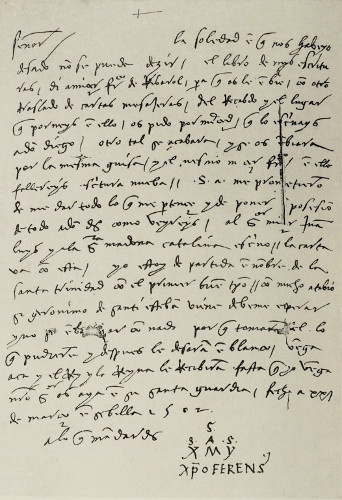
Christopher Columbus. Photographic reproduction of his
letter, March 21st, 1502, to Nicolo Oderigo, Ambassador to France and
to Spain, which was acquired by the King of Sardinia and presented by
him to the City of Genoa.
It is now preserved in the Palace of the Genoese Municipality.
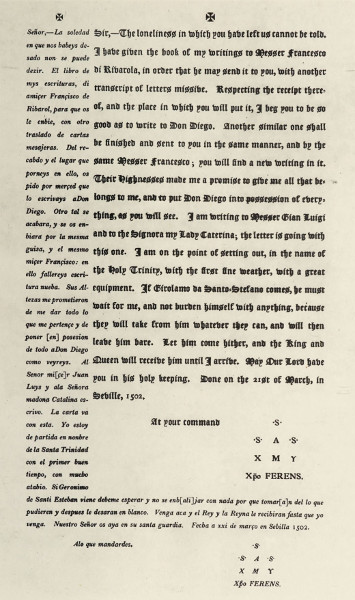
Christopher Columbus. Translation of the letter written by him to
Nicolo Oderigo, shown opposite; made into English by Mr. G. A. Barwick,
B.A., of the British Museum. Permission to reproduce both original
letter and its translation was given by Messrs. B. F. Stevens & Brown,
London.
Señor,—La soledad en que nos habeys desado non se puede
dezir. El libro de mys escrituras, di amiçer Françisco de
Ribarol, para que os le enbie, con otro traslado de cartas
mesajeras. Del recabdo y el lugar que porneys en ello, os pido
por merçed que lo escrivays aDon Diego. Otro tal se acabara, y
se os enbiara por la mesma guisa, y el mesmo miçer Françisco:
en ello fallereys escritura nueba. Sus Altezas me prometieron
de me dar todo lo que me pertençe y de poner [en] posesion de
todo aDon Diego como veyreys. Al Señor mi[çe]r Juan Luys y ala
Señora madona Catalina escrivo. La carta va con esta. Yo estoy
de partida en nonbre de la Santa Trinidad con el primer buen
tienpo, con mucho atabio. Si Geronimo de Santi Esteban viene
debeme esperar y no se enb[ali]jar con nada por que tomar[a]n
del lo que pudieren y despues le desaran en blanco. Venga aca y
el Rey y la Reyna le recibiran fasta que yo venga. Nuestro Señor
os aya en su santa guardia. Fecha a xxi de março en Sebilla
1502.
Alo que mandardes,
·S·
·S· A ·S·
X M Y
X[-p]o FERENS.
Sir,—The loneliness in which you have left us cannot be told.
I have given the book of my writings to Messer Francesco di
Rivarola, in order that he may send it to you, with another
transcript of letters missive. Respecting the receipt thereof,
and the place in which you will put it, I beg you to be so
good as to write to Don Diego. Another similar one shall be
finished and sent to you in the same manner, and by the same
Messer Francesco; you will find a new writing in it. Their
Highnesses made me a promise to give me all that belongs to
me, and to put Don Diego into possession of everything, as you
will see. I am writing to Messer Gian Luigi and to the Signora
my Lady Caterina; the letter is going with this one. I am on
the point of setting out, in the name of the Holy Trinity, with
the first fine weather, with a great equipment. If Girolamo da
Santo-Stefano comes, he must wait for me, and not burden himself
with anything, because they will take from him whatever they
can, and will then leave him bare. Let him come hither, and the
King and Queen will receive him until I arrive. May Our Lord
have you in his holy keeping. Done on the 21st of March, in
Seville, 1502.
At your command
·S·
·S· A ·S·
X M Y
Xp̄o FERENS.
In the words of Paracelsus, we give the following extracts concerning
the loadstone, taken from “The Hermetic and Alchemical Writings ...” by
A. E. Waite, London, 1894:
Vol. I. p. 17.—“The adamant. A black crystal called ... Evax
... is dissolved in the blood of a goat.”
“The magnet. Is an iron stone, and so attracts iron to itself.
Fortified by experience.... I affirm that the magnet ... not only
attracts steel and iron, but also has the same power over the matter of
all diseases in the whole body of man.”
Vol. I. pp. 132 and 145.—“A magnet touched by mercury or
anointed with mercurial oil, never afterwards attracts iron ... same if
steeped in garlic....”
Vol. I. p. 136.—“The life of the magnet is the spirit of iron
which can be taken away by rectified vinum ardens itself or by
spirit of wine.”
Vol. II. p. 59.—“Wherever the magnet has grown—there, a
certain attractive power exists, just as colocynth is purgative and the
poppy is anodyne....”
Mr. A. E. Waite says (Vol. II. p. 3) that the ten books of Paracelsus’
Archidoxies stand in the same relation to Hermetic Medicine as
the nine books Concerning the Nature of Things stand to Hermetic
Chemistry and to the science of metallic transmutation.
References.—Biography of Paracelsus, in Larousse,
“Dict Univ.,” Vol. XII. pp. 171–172, in F. Hartmann, 1887,
and in the ninth ed. of the “Encycl. Brit.,” Vol. XVIII. pp.
234–236; Van Swinden, “Recueil,” etc., La Haye, 1784, Vol. I.
pp. 356–358; Gilbert, “De Magnete,” Book I. chaps. i. and xiv.,
also Book II. chap. xxv.; “Journal des Savants” for November
1849; Walton and Cotton, “Complete Angler,” New York and London,
1847, pp. 212–213, for notes regarding Paracelsus, Robert Fludd,
Jacob Behmen and the Rosicrucians; “Dictionnaire Historique de
la Médecine,” N. F. Eloy, Mons, 1778, Vol. III. pp. 461–471;
“History and Heroes of the Art of Medicine,” J. Rutherfurd
Russell, London, 1861, pp. 157–175; “Histoire Philosophique de
la Médecine,” Etienne Tourtelle, Paris, An. XII. (1804) Vol. II.
pp. 326–346; “History of Magic,” Joseph Ennemoser, London, 1854,
Vol. II. pp. 229–241.
At p. 55 of the first supplement to “Select. Bibliog. of
Chemistry,” by H. C. Bolton, Washington, 1899, mention is made
of the Paracelsus Library belonging to the late E. Schuberth of
Frankfort-on-the-Main ... as containing 194 titles of works on
Paracelsus and 548 titles of works relating to Paracelsus and
his doctrines; the section on Alchemy embracing as many as 351
titles.
A.D. 1492.—Columbus, Colombo, Colon (Christopher), the
discoverer of America., is the first to determine astronomically the
position of a line of no magnetic variation (on which the needle
points to the true north) the merit of which discovery has, by Livio
Sanuto, been erroneously attributed to Sebastian Cabot. (Livio Sanuto,
“Geographia distincta in XII libri ...” wherein the whole of Book I
is given to reported observations of the compass and to accounts of
different navigators.)
Columbus did not, as many imagine, make the first observations of the
existence of magnetic variation, for this is set down upon the charts
of Andrea Bianco, but he was the first who remarked, on the 13th of
September, 1492, that “2½ degrees east of the island of Corvo, in
the Azores, the magnetic variation changed and passed from N.E. to
N.W.” Washington Irving thus describes the discovery (“History ... Ch.
Columbus,” Paris, 1829, Vol. I. p. 198): “On the 13th of September, in
the evening, being about two hundred leagues from the island of Ferro
(the smallest of the Canaries), Columbus, for the first time, noticed
the variation of the needle, a phenomenon which had never before been
remarked. He perceived, about nightfall, that the needle, instead of
pointing to the North Star, varied about half a point, or between five
and six degrees to the north-west, and still more on the following
morning. Struck with this circumstance, he observed it attentively
for three days and found that the variation increased as he advanced.
He at first made no mention of this phenomenon, knowing how ready his
people were to take alarm; but it soon attracted the attention of the
pilots, and filled them with consternation. It seemed as if the laws
of nature were changing as they advanced, and that they were entering
into another world, subject to unknown influences (Las Casas, ‘Hist.
Ind.,’ l. i. c. 6). They apprehended that the compass was about to lose
its mysterious virtues; and, without that guide, what was to become
of them in a vast and trackless ocean? Columbus tasked his science
and ingenuity for reasons with which to allay their terrors. He told
them that the direction of the needle was not to the polar star but
to some fixed and invisible point. The variation, therefore, was not
caused by any fallacy in the compass, but by the movement of the North
Star itself, which, like the other heavenly bodies, had its changes
and revolutions, and every day described a circle around the pole. The
high opinion that the pilots entertained of Columbus as a profound
astronomer gave weight to his theory, and their alarm subsided.”
Humboldt says: “We can, with much certainty, fix upon three places in
the Atlantic line of no declination for the 13th of September,
1492, the 21st of May, 1496 and the 16th of August, 1498.”
References.—“Columbus and his Discoveries,” in the
“Narrative and Critical History of America,” by Justin Winsor,
Boston, 1889, Vol. II. pp. 1–92; “Christopher Columbus, His
life, work ...” by John Boyd Thacher, 1903; Giov. Bat. Ramusio,
“Terzo volume delle Navigationi e Viaggi ...” 1556; Dr. Geo.
Miller, “History Phil. Illust.,” London, 1849, Vol. II. pp.
216–219; David Hume, “History of England,” London, 1822, Vol.
III. pp. 387–398; Guillaume Libri, “Histoire des Sciences
Mathématiques en Italie,” Halle, 1865, Vol. III. pp. 68–85;
“Columbus, a Critical Study,” by Henry Vignaud, London, 1903;
Weld, “Hist. Royal Society,” Vol. II. p. 429; Thos. Browne,
“Pseudodox. Epid.,” 1658, Book II. pp. 68–69; Humboldt,
“Cosmos,” 1849, Vol. I. p. 174; Vol. II. pp. 636, 654–657,
671–672, and Vol. V. (1859) pp. 55–56, 116; Knight, “Mech.
Dict.,” Vol. II., pp. 1374, 1397; Poggendorff, “Geschichte
der Physik,” Leipzig, 1879, p. 270; “Raccolta di documenti e
studi publicati della R. Com. Columb. pel 40 Centenario alla
scoperta dell’America,” Roma, 1892; Humboldt, “Examen Critique
... progrès de l’astronomie nautique,” Paris, 1836, Vol. I. pp.
262–272, etc.
It may be worth noting here that the ashes of Columbus, removed from
the Cathedral of Havana, were placed in a mausoleum at Seville,
November 17, 1902 (“Science,” Dec. 12, 1902, p. 958).
Amongst the numerous claimants to the discovery of America, some have
placed the great navigator Martin Behaim—Behem—(1430–1506), who
received his instruction from the learned John Müller (Regiomontanus)
and became one of the most learned geographers as well as the very
best chart maker of his age. Cellarius, Riccioli and other writers
assert that Behaim had, before Columbus, visited the American
Continent, while Stuvenius shows, in his treatise “De vero novi orbis
inventore,” that the islands of America and the strait of Magalhæns
were accurately traced upon the very celebrated globe called the
“World Apple” completed by Behaim in the year 1492, and which is still
to be seen in Behaim’s native city of Nürnberg.[26] (See Mr. Otto’s
letter to Dr. Franklin, in the second volume of the “Transactions of
the American Philosophical Society held at Philadelphia for promoting
useful knowledge,” likewise Humboldt, “Examen critique de l’histoire
de la Géographie,” Vol. II. pp. 357–369; “The Reliquary,” London,
Vol. VI. N.S. Jan.-Oct. 1892, pp. 215–229; Justin Winsor, “Narrative
and Critical History of America,” Boston 1889, Vol. II. pp. 104–105;
“Geogr. Jour.,” Vol. V. March 1895, p. 228.)
It was this same Martin Behaim (Humboldt, “Cosmos,” 1860, Vol. II.
p. 255) who received a charge from King John II of Portugal to
compute tables for the sun’s declination and to teach pilots how to
“navigate by the altitudes of the sun and stars.” It cannot now be
decided whether at the close of the fifteenth century the use of the
log was known as a means of estimating the distance traversed while
the direction is indicated by the compass; but it is certain that
the distinguished voyager Francisco Antonio Pigafetta (1491–1534)
the friend and companion of Magellan—Magalhæns—speaks of the log
(la catena a poppa) as of a well-known means of measuring the
course passed over. Nothing is to be found regarding way-measurers
in the literature of the Middle Ages until we come to the period of
several “books of nautical instruction,” written or printed by this
same Pigafetta (“Trattato di Navigazione,” probably before 1530); by
Francisco Falero, a brother of Ruy Falero, the astronomer (“Regimiento
para observar la longitud en la mar,” 1535); by Pedro da Medina, of
Seville (“Arte de Navegar,” 1545); by Martin Cortez, of Bujalaroz
(“Breve Compendio de la esfera, y de la arte de navegar,” 1551), and by
Andres Garcia de Cespedes (“Regimiento de Navigacion y Hidrografia,”
1606). From almost all these works—some of which, if not all, have
naturally become very scarce—as well as from the “Summa de Geografia”
which Martin Fernandez de Enciso had published in 1519, we learn most
distinctly that the “distance sailed over” was then ascertained in
Spanish and Portuguese ships not by any distinct measurement, but
only through estimation of the eye, according to certain established
principles. Medina says (lib. iii. caps. 11–12): “In order to know
the course of the ship, as to the length of distance passed over,
the pilot must set down in his register how much distance the vessel
hath made according to hours (i. e. guided by the hour-glass,
ampoleta); and, for this, he must know that the most a ship
advances in an hour is four miles, and, with feebler breezes, three
or only two.” Cespedes, in his “Regimiento” (pp. 99 and 156) calls
this mode of proceeding echar punto por fantasia, and he justly
remarks that if great errors are to be avoided, this fantasia
must depend on the pilot’s knowledge of the qualities of his ship.
Columbus, Juan de la Cosa, Sebastian Cabot and Vasco da Gama, were
not acquainted with the log and its mode of application, and they all
estimated the ship’s speed merely by the eye, while they ascertained
the distance they had made merely through the running down of the sand
in the glasses known as ampoletas.
References.—For F. A. Pigafetta, for Petro de Medina
and for Martin Cortez, Houzeau et Lancaster, “Bibl. Génér.,”
Vol. I. pt. ii. pp. 1221–1223; “New Gen. Biog. Dict.,” Jas.
Rose, London, 1850, Vol. XI. p. 113; “Biog. Univ.” (Michaud),
Vol. XXXIII. p. 297; “Grand Dict. Univ.” (Larousse), Vol.
XII. p. 999; “Nouv Biog. Gen.” (Hœfer), Vol. XL. p. 207. Also
Dr. G. Hellmann’s “Neudrucke,” 1898, No. 10, for reproduction
of Francisco Falero’s “Tratato del Esphera y del arte del
marear” (Del Nordestear de las Agujas), 1535, as well as for
reproduction of Martin Cortez’ “Breve Compendio” (De la piedra
Yman), 1551.
A.D. 1497.—Gama (Vasco or Vasquez da), celebrated Portuguese
navigator, is known positively to have made use of the compass during
the voyage he undertook this year to the Indies. He says that he
found the pilots of the Indian Ocean making ready use of the magnet.
The first book of the history of Portugal by Jerome Osorius—wherein
he gives (pp. 23–24, Book I. paragraph 15, 1581 ed.) a very extended
“description de l’aiguille marine, invention des plus belles et
utiles du monde”—states that, instead of a needle, they used a small
magnetized iron plate, which was suspended like the needle of the
Europeans, but which showed imperfectly the north.
Gilbert says (“De Magnete,” Book IV. chap. xiii.) that, as the
Portuguese did not rightly understand the construction and use of the
compass, some of their observations are untrustworthy and that in
consequence various opinions exist relative to magnetic variation. For
example, the Portuguese navigator Roderigues de Lazos—Lagos—takes
it to be one-half point off the Island of St. Helena; the Dutch, in
their nautical journal, make it one point there; Kendall, an expert
English navigator, makes it only one-sixth of a point, using a true
meridional compass. Diego Alfonso finds no variation at a point a
little south-east of Cape das Agulhas,[27] and, by the astrolabe, shows
that the compass points due north and south at Cape das Agulhas if it
be of the Portuguese style, in which the variation is one-half point to
the south-east.
References.—Azuni, “Boussole,” p. 121; Klaproth,
“Boussole,” p. 64; Knight, “Mech. Dict.,” Vol. II. p. 1398;
Larousse, “Dict.,” Vol. VIII. p. 977; “Voyageurs anciens et
modernes” (Charton), 1855; “Le Comte Amiral D. Vasco da Gama,”
par D. Maria T. da Gama, Paris, 1902.
A.D. 1497.—Cabot (Sebastian), a prominent English navigator,
lands, June 24, 1497, on the coast of Labrador, between 56 degrees and
58 degrees north latitude.
At p. 150 of the 1869 London edition of Mr. J. F. Nicholl’s “Life of
Seb. Cabot” it is said the latter represented to the King of England
that the variation of the compass was different in many places, and
was not absolutely regulated by distance from any particular meridian;
that he could point to a spot of no variation, and that those whom he
had trained as seamen, as Richard Chancellor and Stephen Burrough, were
particularly attentive to this problem, noting it at one time thrice
within a short space.
References.—Richard Hakluyt, “The Principal
navigations, voyages, traffiques and discoveries of the English
nation,” 1599: at pp. 237–243, for the voyage of Richard
Chancelor, pilote maior, and, at p. 274, for “the voyage of
Steuen Burrough, master of the pinnesse called the Serchtrift”;
Livio Sanuto, “Geografia,” Venice, 1588, lib. i.; Fournier,
“Hydrographie,” lib. xi.; “Library of Am. Biog.,” by Jared
Sparks, Boston, 1839, Vols. II and VII as per Index at pp.
318–319; “Jean et Seb. Cabot,” par Hy. Harisse, Paris, 1882;
Geo. P. Winship, “The Cabot Bibliography,” London and New
York, 1900; Humboldt, “Examen Critique,” Vol. IV. p. 231, and
“Cosmos,” Vol. II. (1860) pp. 640, 657–658; Biddle, “Memoir of
Seb. Cabot,” 1831, pp. 52–61.
A.D. 1502.—Varthema-Vertomannus (Ludovico di) leaves Europe
for the Indies, as mentioned at p. 25 of his “Travels,” translated by
J. Winter Jones, London, 1863, from the original “Itenerario ... ne la
India ...” Milano, 1523. He states that the Arabs who navigated the
Red Sea were known to have long since made use of the mariner’s chart
and compass, and he tells us, in the introduction and at p. 249, that
“the captains carried the compass with the needle after our manner,”
and that their chart was “marked with lines perpendicular and across.”
When the polar star became invisible, they all asked the captain by
what he could then steer them, and “he showed us four or five stars,
among which there was one (B. Hydrus) which he said was opposite
to (contrario della) our North Star, and that he sailed by the
north because the magnet was adjusted and subjected to our north, i.
e. because this compass was no doubt of European origin—its index
pointing to the north, and being unlike that of the Chinese pointing to
the south.”
References.—Cavallo, “Magnetism,” London, 1787, Chap.
IV; also, “Hakluyt’s Collection of the early voyages, travels
and discoveries,” London, 1811, Vol. IV. p. 547, for “The
navigation and voyages of Lewes Vertomannus.”
A.D. 1530–1542.—Guillen (Felipe), an ingenious apothecary of
Seville, and Alonzo de Santa Cruz (who was one of the instructors of
mathematics to young Charles V, King of Spain and Emperor of Germany,
and the Cosmografo Mayor of the Royal Department of Charts at
Seville), construct variation charts and variation compasses by which
solar altitudes can be taken.
References.—Humboldt, “Cosmos,” 1849, Vol. II. p. 658,
and 1859, Vol. V. p. 56; L. A. Bauer, “U. S. Magn. Tables,”
1902, p. 26.
Although based upon very imperfect observations, the magnetic
charts thus devised by Alonzo de Santa Cruz antedate by more
than one hundred and fifty years the work of Dr. Halley (at
A.D. 1683).
A.D. 1544.—Hartmann (Georg) a vicar of the church of Saint
Sebaldus, at Nuremberg, writes March 4, to the Duke Albrecht of
Prussia, a letter which was brought to light by Moser and which reads
as follows: “Besides, I find also this in the magnet, that it not only
turns from the north and deflects to the east about nine degrees, more
or less, as I have reported, but it points downward. This may be proved
as follows: I make a needle a finger long, which stands horizontally
on a pointed pivot, so that it nowhere inclines toward the earth, but
stands horizontal on both sides; but, as soon as I stroke one of the
ends (with the loadstone) it matters not which end it be, then the
needle no longer stands horizontal, but points downward (fällt unter
sich) some nine degrees, more or less. The reason why this happens
I was not able to indicate to his Royal Majesty.” The above seems to
establish the fact that Hartmann first observed the dip of the magnetic
needle independently of Robert Norman.
Gilbert refers (“De Magnete,” Book I. chap. i.) to Fortunius
Affaitatus—Affaydatus—an Italian physicist who, says he, has some
rather silly philosophizing about the attraction of iron and of its
turning to the poles, thus alluding to the latter’s small work called
“Physicæ (et) ac astronomiæ (astronomicæ) considerationes,” which
appeared at Venice in 1549. Nevertheless, it is a question whether
Affaitatus was not actually the first to publish the declination of
the magnetic needle. (“Biogr. Gén.,” Vol. I. p. 346; Mazzuchelli,
“Scrittori d’Italia”; Bertelli, “Mem. sopra P. Peregrino,” p. 115;
Adelung, Supplément à Jocher, “Allgem. Gelehrten-Lexicon”; Johann
Lamont, “Handbuch des Magnetismus,” Leipzig, 1867, p. 425; J. C.
Poggendorff, “Biogr.-Lit. Handwörterbuch,” Leipzig, 1863, Vol. I. p.
15; Michaud, “Biogr. Univ. Anc. et Mod.,” Vol. I. p. 208, Paris, 1843;
Brunet, “Manuel,” Paris, 1860; “Biog. Cremonese de Lancetti”; M. le Dr.
Hœfer, “Biog. Gen.,” Paris, 1852, Vol. I. p. 346.)
References.—Dove, “Repertorium der Physik,” Vol. II,
1838, pp. 129–130; Poggendorff, “Geschichte der Physik,” 1879,
p. 273; L. Hulsius, “Descriptio et usus,” Nürnberg, 1597; “Ency.
Brit.,” 1883, Vol. XV. p. 221; P. Volpicelli, “Intorno alle
prime ... magnete” (Atti dell Acad. Pont. de Nuov. Lincei, XIX.
pp. 205, 210).
A.D. 1555.—Olaus Magnus, a native of Sweden and Archbishop
of Upsala (where he died during 1568) issued in Rome his great work
“Historia de Gentibus Septentrionalibus,” which, for a long time,
remained the chief authority on Swedish matters. In this book, Gilbert
says (“De Magnete,” lib. i. cap. 1) allusion is made to a certain
magnetic island and to mountains in the north possessing such power of
attraction that ships have to be constructed with wooden pegs so that
as they sail by the magnetic cliffs there be no iron nails to draw out.
To this, reference is made by Thos. Browne (“Pseud. Epidem.,” 1658,
Book II. p. 78) as follows: “Of rocks magnetical, there are likewise
two relations; for some are delivered to be in the Indies and some
in the extremity of the North and about the very pole. The Northern
account is commonly ascribed unto Olaus Magnus, Archbishop of Upsala,
who, out of his predecessors—Joannes, Saxo and others—compiled a
history of some Northern Nations; but this assertion we have not
discovered in that work of his which commonly passeth among us; and
should believe his geography herein no more than that in the first line
of his book, where he affirmeth that Biarmia (which is not 70 degrees
in latitude) hath the pole for its zenith, and equinoctial for the
horizon.”
In a Spanish book entitled “The Naval Theatre,” by Don Francisco de
Seylas and Louera, we find two causes assigned for the variation of
the declination; one is “the several mines of loadstones found in the
several parts of the earth ...” the other being that “there is no doubt
but large rocks of loadstones may affect the needles when near them
...” (“Philos. History ... Roy. Acad. Sc. at Paris,” London, 1742, Vol.
II. pp. 279–280).
References.—Claudus Ptolemæus, “Geographia,” lib.
vii. cap. 2 (and others named by Bertelli Barnabita at foot
of p. 21 of his “Pietro Peregrino de Maricourt,” Roma, 1868,
viz. Klaproth, “Lettre sur la Boussole,” Paris, 1834, p. 116;
Thos. H. Martin, “Observ. et Théor. des anciens,” Rome, 1865,
p. 304; Steinschneider, “Intorno. alla calamita,” Roma, 1868);
also Albertus Magnus, Lugduni, 1651; Mr. (Thomas) Blundeville,
“His Exercises”; Fracastorio, in the seventh chapter of his
“De Sympathia et Antipathia”; F. Maurolycus, “Opuscula,” 1575,
p. 122a; Lipenius, “Navigatio Salomonis Ophiritica”; Paulus
Merula, “Cosmographia Generalis,” Leyden, 1605; Toussaincte de
Bessard, “Dialogue de la Longitude,” Rouen, 1574; U. Aldrovandi,
“Musæum Metallicum,” 1648, pp. 554, 563, wherein he alludes to
the magnetic mountains spoken of by Sir John Mandeville; Ninth
“Encycl. Brit.,” Vol. XVII. p. 752; also the entry at A.D.
1265–1321.
A.D. 1558.—Porta (Giambattista della), Italian natural
philosopher (1540–1615), carries on a series of experiments with the
magnet for the purpose of communicating intelligence at a distance. Of
these experiments, he gives a full account in his “Magiæ Naturalis,”
the first edition of which is said to have been published at Naples
when Porta was but fifteen years of age (“Encycl. Brit.,” article
“Optics”). Prof. Stanley Jones says this is the earliest work in which
he has found allusions to a magnetic telegraph.
Porta’s observations are so extraordinary—and they attracted so much
attention as to justify eighteen separate editions of his work in
different languages prior to the year 1600—that extracts must needs
here prove interesting. They are taken out of “Natural Magick in XX
Bookes by John Baptist Porta, a Neapolitaine ... London 1658,” the
seventh book of which treats “Of the wonders of the loadstone.”
Proem: “And to a friend that is at a far distance from us and
fast shut up in prison, we may relate our minds; which I doubt not may
be done by two mariner’s compasses, having the alphabet writ about them
...”
Chap. I (alluding to the loadstone):
“The Greeks do call it Magnes from the place,
For that the Magnet’s hand it doth embrace.”
Nicander thinks the stone was so called—and so doth Pliny—from one
Magnes, a shepherd.
In Chap. XVIII he states that “the situation makes the Vertues of the
Stone contrary ... for the stone put above the table will do one thing,
and another thing if it be put under the table ... that part that
drew above will drive off beneath; and that will draw beneath that
drove off above: that is, if you place the stone above and beneath in a
perpendicular.”
In Chap. XXV, in allusion to “a long concatenation of iron rings,” he
thus quotes Lucretius:
“A stone there is that men admire much
That makes rings hang in chains by touch.
Sometimes five or six links will be
Fast joyn’d together and agree.
All this vertue from the Stone ariseth,
Such force it hath ...”
Chap. XXVII alludes to the Statue hung by Dinocrates: “... but that is
false, that Mahomet’s chest hangs by the roof of the Temple. Petrus
Pellegrinus saith, he shewed in another work how that might be done:
but that work is not to be found.... But I say it may be done—because
I have now done it—to hold it fast by an invisible band, to hang in
the air: onely so, that it be bound with a small thread beneath, that
it may not rise higher: and then striving to catch hold of the stone
above, it will hang in the air, and tremble and wag itself.”
In Chap. XXVIII he says that “Whilst the loadstone is moved under a
table of wood, stone or any metal, except iron, the needle in the
mariner’s compass will move above, as if there is no body between them.
St. Augustine (‘Liber de Civitate Dei’) knew this experiment (likewise
alluded to by Camillus Leonardus in his ‘Speculum Lapidum,’ published
1502). But that is much more wonderful that I have heerd: that if one
hold a loadstone under a piece of silver, and put a piece of iron above
the silver, as he moves his hand underneath that holds the stone, so
will the iron move above; and the silver being in the middle, and
suffering nothing, running so swiftly up and down, that the stone was
pulled from the hand of the man, and took hold of the iron.”
Chap. XXX is headed: “A loadstone on a plate of iron, will not stir
iron,” and he again quotes Lucretius:
“Pieces of iron I have seen
When onely brass was put between
Them and the Loadstone, to recoil:
Brass in the middle made this broil.”
In Chap. XXXII he tells us that an Italian “whose name was Amalphus
... knew not the Mariner’s Card, but stuck the needle in a reed, or a
piece of wood, cross over: and he put the needles into a vessel full of
water that they might flote freely: then carrying about the loadstone,
the needles would follow it: which being taken away, as by a certain
natural motion, the points of the needles would turn to the north
pole: and, having found that, stand still.... Now the Mariner’s Compass
is made, and a needle touched with the Loadstone, is so fitted to it,
that, by discovering the pole by it, all other parts of the heavens are
known. There is made a rundle with a Latin-navel upon a point of the
same metal, that it may run roundly freely. Whereupon, by the touching
onely of one end, the needle not alone partakes of the vertues of it,
but of the other end also, whether it will or not....”
Chap. XLVIII is headed “Whether Garlick can hinder the vertues of the
loadstone.” By Porta we are informed that “Plutarch saith Garlick is at
great enmity with the loadstone; and such antipathy and hatred there
is between these invisible creatures, that if a loadstone be smeered
with Garlick, it will drive away iron from it,” which is confirmed by
Ptolemy, who states “that the loadstone will not draw iron, if it be
anoynted with Garlick; as Amber will no more draw straws, and other
light things to it, if they be first steeped in oyl.” He found that
when the loadstone “was all anoynted over the juice of Garlick, it did
perform its office as well as if it had never been touched with it.”
In Chap. LIII Porta denies “that the diamond doth hinder the
loadstone’s vertue.” “Some pretend,” says he, “there is so much discord
between the qualities of the loadstone and the diamond, and they are so
hateful, one against the other, and secret enemies, that if the diamond
be put to the loadstone, it presently faints and loses all its forces.
(Pliny.) The loadstone so disagreeth with the diamond, that if iron be
laid by it, it will not let the loadstone draw it; and if the loadstone
do attract it, it will snatch it away again from it. (St. Augustine.)
I will say that I have read of the loadstone: how that, if the diamond
be by it, it will not draw iron; and, if it do when it comes neer the
diamond, it will let it fall” (Marbodeus, of the Loadstone ... Marbodei
Galli ... de lapidibus pretiosis Enchiridion ... Freiburg, 1530, 1531):
“All loadstones by their vertue iron draw;
But of the diamond it stands in awe:
Taking the iron from’t by Nature’s Law.”
“I tried this often, and found it false; and that there is no truth in
it.”
With reference to the above, see Plat (at A.D. 1653), who also
alludes to the fact of the softening of the diamond with Goat’s blood.
This is alluded to by Porta in the next chapter.
Chapter LIV contains extracts from Castianus in Geoponic. Græc.,
Marbodeus and Rhenius, the interpreter of Dionysius.
In 1560 there was established at Naples, by the versatile Giam. della
Porta, the first Academy of Sciences—Academia Secretum Naturæ—to
which were admitted only those who had contributed to the advancement
of medicine or to scientific studies in general (“Science,” December
19, 1902, p. 965).
References.—Libri, “Hist. des Sc. Mathém.” Vol. IV.
pp. 108–140, 399–406; Houzeau et Lancaster, Vol. II. p. 229; The
Fourth Dissertation of the “Encycl. Brit.,” p. 624; Sarpi, at
A.D. 1632; Poggendorff, “Geschichte der Physik,” 1879,
pp. 133, 273–274; “Encycl. Brit.,” the article on “Optics”;
“Journal des Savants” for September 1841.
A.D. 1575–1624.—Boehm—Böhme—Behmen (Jacob), a mystical German
writer, known as the theosophist par excellence, is the author
of “Aurora,” etc. (1612), “De Tribus Principiis” (1619) and of many
other treatises, which were reprinted under the title of “Theosophia
Revelata,” and which contain his many very curious observations
concerning astrology, chemistry, theology, philosophy and electricity.
References.—“Notice sur J. Boehm,” La Motte-Fouqué,
1831; “Notes and Queries” for July 28, 1855, p. 63; Ninth
“Britan.,” Vol. III. p. 852; J. Ennemoser, “History of Magic,”
Vol. II. pp. 297–328.
A.D. 1576.—Norman (Robert), a manufacturer of compass needles
at Wapping, is the first who determined the dip or inclination
to the earth of the magnetic needle in London, by means of a dipping
needle (inclinatorium) of his own making. Five years later (1581)
Norman publishes a pamphlet “The Newe Attractive, containing a short
discourse of the Magnes or Lodestone, and amongest other his vertues,
of a newe discouered secret, and subtill propertie concernyng the
Declinyng of the Needle, touched therewith, under the Plaine of the
Horizon ...” from which is taken the following:
“Hauing made many and diuers compasses and using alwaies to finish and
end them before I touched the needle, I found continuallie that after I
had touched the yrons with the stone, that presentlie the north point
thereof woulde bend or decline downwards under the horizon in some
quantitie; in so much that to the flie of the compass, which was before
levell, I was still constrained to put some small piece of ware on the
south point and make it equall againe ...” (Weld, “History of the Royal
Society,” 1848, Vol. II. p. 432).
In the fourth chapter of his work, Norman describes the mode of making
the particular instrument with which he was enabled to establish the
first accurate measurement of the dip “which for this citie of London,
I finde, by exact obseruations to be about 71 degrees 50 mynutes.”
Whewell thus alludes to several investigations in the same line:
“Other learned men have, in long navigations, observed the differences
of magnetic variations, as Thomas Hariot, Robert Hues, Edward Wright,
Abraham Kendall, all Englishmen: others have invented magnetic
instruments and convenient modes of observation such as are requisite
for those who take long voyages, as William Borough, in his book
concerning the variation of the compass; William Barlo, in his
‘Supplement’; Robert Norman, in his ‘Newe Attractive.’ This is that
Robert Norman (a good seaman and an ingenious artificer) who first
discovered the dip of magnetic iron” (“Enc. Metr.,” p. 738; read
also paragraph 366 of J. F. W. Herschel’s “Prelim. Disc.,” 1855).
In Book I. chap. i. of Gilbert’s “De Magnete,” he says that Norman
posits a point and place toward which the magnet looks but whereto
it is not drawn: toward which magnetized iron, according to him, is
collimated but which does not attract it. He alludes again to this
“respective point” (Book IV. chaps. i. and vi.), saying that Norman
originated the idea of the “respective point” looking, as it were,
toward hidden principles, and held that toward this the magnetized
needle ever turns, and not toward any attractional point: but he was
greatly in error, albeit he exploded the ancient false opinion about
attraction. Gilbert then proceeds to show how this theory is proved by
Norman. The original passage in Norman’s “Newe Attractive” (London,
1581, Chap. VI) is as follows:
“Your reason towards the earth carrieth some probabilitie, but I prove
that there be no Attractive, or drawing propertie in neyther of
these two partes, then is the Attractive poynt lost, and falsly
called the poynt Attractive, as shall be proved. But because
there is a certain poynt that the needle alwayes respecteth or sheweth,
being voide and without any Attractive propertie: in my judjment
this poynt ought rather to bee called the poynt Respective....
This poynt Respective, is a certayne poynt, which the touched
needle doth always Respect or shew....”
For the means of determining the dip or inclination, see
“English Ency.”—Arts and Sciences—Vol. VIII. p. 160.
We have thus far learned that the declination or variation was
alluded to by Peter Peregrinus (A.D. 1269) in the Leyden MS.;
that Norman was the first to determine the dip or inclination,
and we shall, under the 1776 date, find that Borda determined the third
magnetic element called the intensity.
In 1581 appeared “The newe attractive ... a discours of the variation
of the cumpas ... made by W. B(orough).” This was followed, in 1585 and
in 1596, by “The newe Attractive ... newly corrected and amended by M.
W. B.,” also, in 1614, by “The New Attractive, with the application
thereof for finding the true variation of the compass, by W. Burrowes.”
Norman is also the author of “The safegarde of Saylers, or Great Rutter
... translated out of Dutch ... by R. Norman,” 1590, 1600, 1640.
References.—Noad, “Manual of Electricity,” London,
1859, p. 525; Gassendi, at A.D. 1632; Humboldt,
“Cosmos,” 1859–1860, Vol. I. p. 179; Vol. II. pp. 281, 335; Vol.
V. p. 58; Geo. Hartmann, A.D. 1543–1544; “Nature,” Vol.
XIII. p. 523; Walker, “Magnetism,” p. 146, and, for a photo
reproduction of the title-page to the 1581 edition as well as a
copy of its contents, see G. Hellmann “Neudrucke ...” 1898, No.
10; also Sidney Lee, “Dict. of Nat. Biogr.,” Vol. XLI. p. 114,
and William Whiston (1667–1752), “The Longitude and Latitude,
discovered by the Inclinatory or Dipping Needle,” London, 1721.
A.D. 1580.—The celebrated naturalist Li-tchi-tchin, who
finished his Pen-thsao-Kang-Mou towards the end of 1580, says:
“If the loadstone was not in love with iron it would not attract
the latter.” Eight and a half centuries before, about the year
A.D. 727, the same allusion had been made by Tchin-Thsang-Khi
in his “Natural History” (Klaproth, “Lettre à M. de Humboldt ...”
Paris, 1834, p. 20).
A.D. 1580.—In Parke’s translation of the “History of the
Kingdom of China,” written by Juan G. de Mendoza, a Spanish missionary
sent to the Chinese Empire by Philip II, appears the following (Vol.
II. p. 36): “The Chinos doo gouerne their ships by a compasse deuided
into twelue partes and doo vse no sea cardes, but a briefe description
of Ruter (Ruttier—Routier—direction book) wherewith they do nauigate
or saile.”
A.D. 1581.—Burrowes—Borough—Burroigh (William), “a man of
unquestionable abilities in the mathematiques,” Comptroller of the
English navy in the reign of Elizabeth, who has been alluded to as
Robert Norman, is the first in Europe to publish well authenticated
observations upon the magnetic variation or declination made by him
from actual observation, while voyaging between the North Cape of
Finmark and Vaigatch (Vaygates). These are recorded at length in his
little book dedicated to “the travaillers, seamen and mariners of
England” and entitled “A Discourse of the Variation of the Cumpas, or
Magneticall Needle. Wherein is Mathematically shewed, the manner of the
observation, effects, and application thereof, made by W. B. And is to
be annexed to The Newe Attractive of R. N. 1581 (London).”
At pp. 7 and 8 of his “Terrestrial and Cosmical Magnetism,” Cambridge,
1866, Mr. Walker gives extracts from the twelve chapters of Burrowes’
work which, “containing, as it does, the first recorded attempt at
deducing the declination of the needle from accurate observations,
must be considered as making an epoch in the history of terrestrial
magnetism.”
References.—Johnson, “New Univ. Encycl.,” 1878, Vol. III.
p. 230, and the tables of the variations at pp. 274–275 of Vol. II.
of Cavallo’s “Elements of Natural Philosophy,” 1825. See the photo
reproduction of “A Discourse ...” 1596 ed. in G. Hellmann’s “Neudrucke
...” 1898, No. 10.
A.D. 1585.—Juan Jayme and Francisco Galli made a voyage from
the Philippines to Acapulco, solely for the purpose of testing by a
long trial in the South Sea a declinatorium of Jayme’s invention, from
which M. de Humboldt says (“Cosmos,” 1859, Vol. V. p. 56) some idea may
be formed of the interest excited in reference to terrestrial magnetism
during the sixteenth century.
A.D. 1586.—Vigenere (Blaise de), in his annotations to Livy
(“Les cinq premiers livres de Tite-Live,” Paris, 8vo, Vol. I. col.
1316) alludes to the possibility of communicating the contents of
a letter through a thick stone wall by passing a loadstone over
corresponding letters circumscribing the compass needle.
References.—“Emporium of Arts and Sciences,” Vol. I.
p. 302; Fahie, p. 20.
A.D. 1589.—Acosta (Joseph d’), learned Jesuit, who has
been already mentioned under the A.D. 121 entry, says
in Chap. XVII. lib. i. of his masterly “Historia Natural de las
Indias” (“Histoire Naturelle et Moralle des Indes tant Orientalles
qu’Occidentalles,” traduite par Robert Reynault Cauxois, 1598, 1606)
that he is able to indicate four lines of no variation (instead of one
only discovered by Columbus) dividing the entire surface of the earth:
“foure poyntes in all the world, whereas the needle looked directly
towards the North.” Humboldt remarks that this may have had some
influence on the theory advanced, in 1683, by Halley, of four magnetic
poles or points of convergence.
References.—Humboldt, “Cosmos,” 1859–1860, Vol. I. pp.
66, 193, note; Vol. II. pp. 280, 281; Vol. V. p. 140.
A.D. 1590.—Cæsare (Giulio-Moderati), a surgeon of Rimini,
observes the conversion of iron into a magnet by position alone. This
effect was noticed on a bar which had been used as a support to a piece
of brickwork erected on the top of one of the towers of the church of
St. Augustine as is mentioned at the 1632 entry of Pietro Sarpi.
A.D. 1597.—Barlowe—Barlow (William)—who died May 25, 1625,
and was Archdeacon of Salisbury—publishes his “Navigators’ Supply,”
from which the following is extracted: “Some fewe yeares since, it so
fell out that I had severall conferences with two East Indians which
were brought into England by Master Candish (Thomas Cavendish, one
of the great navigators of the Elizabethan Age) and had learned our
language.... They shewed that in steade of our compas they (in the East
Indies) use a magneticall needle of sixe ynches long ... upon a pinne
in a dish of white china earth filled with water; in the bottome
whereof they have two crosse lines for the foure principall windes, the
rest of the divisions being reserved to the skill of their pilots.”
Barlowe also published in 1613, 1616 and 1618 different editions of his
work on the magnet, the full title of the last named being “Magneticall
Advertisements or diuers pertinent obseruations and approued
Experiments concerning the nature and properties of the Loadstone.
Whereunto is annexed a briefe Discoverie of the idle Animadversions of
Mark Ridley, Dr. in Physike upon this treatize.”[28] Therein (Preface
to the reader), he speaks of “That wonderful propertie of the body of
the whole earth called the magneticall vertue (most admirably founde
out and as learnedly demonstrated by Doctor Gilbert, physitian vnto our
late renowned soveraigne Queen Elizabeth of happy memory) is the very
true fountaine of all magneticall knowledge. So that although certain
properties of the loadstone were knowne before, yet all the reasons of
those properties were vtterly vnknowne and never before revealed (as I
take it) vnto the sonnes of man....” Just before the Preface appears
the following letter which (as William Sturgeon remarks) affords a good
idea of the opinion entertained by Gilbert of Barlowe’s talents in this
branch of science: “To the Worshipfull, my good friend, Mr. William
Barlow, at Easton by Winchester. Recommendations with many thanks for
all your paines and courtesies, for your diligence and enquiring, and
finding diuers good secrets, I pray proceede with double capping your
Loadstone you speake of, I shall bee glad to see you, as you write,
as any man. I will haue any leisure, if it were a moneth, to conferre
with you, you haue shewed mee more,—and brought more light than any
man hath done. Sir, I will commend you to my L. of Effingham, there
is heere a wise learned man, a Secretary of Venice, he came sent by
that State, and was honourably receiued by her Majesty, he brought me
a lattin letter from a Gentleman of Venice that is very well learned,
whose name is Iohannes Franciscus Sagredus, he is a great Magneticall
man and writeth that hee hath conferred with diuers learned men of
Venice, and with the Readers of Padua, and reporteth wonderfull liking
of my booke, you shall haue a coppy of the latter: Sir, I purpose to
adioyne an appendix of six or eight sheets of paper to my booke after
a while, I am in hand with it of some new inuentions, and I would haue
some of your experiments, in your name and inuention put into it, if
you please, that you may be knowen for an augmenter of the art. So far
this time in haste I take my leaue the XIII of February. Your very
louing friend, W. Gilbert.”
Speaking of William Barlowe, Anthony à Wood says: “This was the person
who had knowledge of the magnet twenty years before Dr. Will. Gilbert
published his book of that subject, and therefore by those that knew
him he was accounted superior, or at least equal, to that doctor for
an industrious and happy searcher and finder out of many rare and
magnetical secrets” (“Athenæ Oxonienses,” London, 1813, Vol. II. p.
375). Under heading of Gilbert, the “British Museum Catalogue of
Printed Books,” 1888, has it that “Mag. Adv.” was compiled partly from
“De Magnete.”
References.—Mark Ridley, “Magn. Animad.,” 1617, p. xi;
Cavallo, “Magnetism,” 1787, p. 46; A.D. 1302; Sidney
Lee, “Dict. of Nat. Biogr.,” Vol. III. pp. 233–234; “La Grande
Encycl.” (H. Lamisault), Vol. V. p. 430; Pierre Larousse, “Grand
Dict. Univ. du xixe siècle,” Paris, 1867, Vol. II. p. 239;
Claude Augé, “Le Nouveau Larousse,” Vol. I. p. 738; “Wood’s Ath.
Ox.” (Bliss), Vol. II. p. 375; Hœfer, “Nouv. Biogr. Univ.,”
Vol. IV. p. 53; “Biogr. Britannica”; Hutton, “Mathem. Dict.”;
“British Annual,” I.
A.D. 1599.—Wright (Edward), English mathematician, connected
with the East India Company and author of the Preface to Gilbert’s
original “De Magnete,” published in London “Die Havenvinding—The
Haven-finding Art: Translation of Simon Stevinus’ ‘Portuum
investigandorum ratio,’” in which is urged the advantage of keeping
registers of the variations observed on all voyages. Thus, says
Lardner, the variation of the variation not only as to time, but
as to place, had at this period begun to receive the attention of those
engaged in navigation.
Wright constructed for Prince Henry a large sphere which represented
the motion of the planets, moon, etc., and he predicted the eclipses
for seventeen thousand one hundred years. He is said to have discovered
the mode of constructing the chart which is known by the name of
Mercator’s Projection.
Simon Stevinus, above mentioned, also called Stephanus—Simon
of Bruges—was a most distinguished mathematician and physicist
(1548–1628), and is alluded to by Edward Wright not only in the Preface
to Gilbert’s “De Magnete” above referred to, but also in Book IV.
chap. ix. of the latter work. The English translation of “Portuum
investigandorum ratio” was afterwards attached to the third edition of
Wright’s “Certaine errors in navigation detected and corrected.”
References.—“English Cycl.,” Vol. VI. p. 834; “Biogr.
Génér.,” Vol. XLIV. pp. 496–498; Larousse, “Dict.,” Vol. XIV.
p. 1100; G. Hellmann, “Neudrucke ...” 1898, No. 10; “Chambers’
Encycl.,” 1892, Vol. IX., p. 725; “La Grande Encycl.,” Vol. XXX.
pp. 489–490; Montucla, “Hist. des Mathém.,” Paris, An. VIII.
Vol. II; Quetelet, also Van de Weyer, “Simon Stevin,” 1845;
“Mémoires de l’Académie,” Paris, 1753, p. 275; Steichen, “Vie et
Travaux de S. Stevin,” 1846; “Terrestrial Magnetism,” Vol. I. p.
153, and Vol. II. pp. 37, 72, 78.
A.D. 1599.—Pancirollus (Guido)—Panciroli (Gui)—already quoted
at A.D. 121, further remarks: “The ancients sailed by the
pole star, which they call Cynosura. The compass is believed
to have been found at Amalfi, about 300 years ago by one Flavius. And
this unknown fellow (if it was Flavius) hath deserved more than 10,000
Alexanders and as many Aristotles.... This single act hath improved
knowledge and done more good to the world than all the niceties of the
subtle schools.”
References.—“History of Things Lost,” London, 1715,
Vol. II. p. 338; Græsse, Vol. V. p. 117; also his biography in
Larousse, “Dict. Univ.,” Vol. XII. p. 108, and in the “Dict. de
Biographie,” Vol. II. p. 2012.
A.D. 1600.—Schwenter (Daniell), Professor of Oriental languages
at Altdorff, describes, under the assumed name of Janus Hercules
de Sunde, in his “Steganologia et Steganographia,” the means of
communicating intelligence at a distance by employing two compass
needles circumscribed with an alphabet, the needles being shaped from
the same piece of steel, and magnetized by the same magnets.
Under caption “The First Idea of the Electric Telegraph,” the following
appeared in the “Journal of the Franklin Institute,” Vol. XXI. 1851,
p. 202: “In the number of the Philosophical Magazine for May,
1850, I [N. S. Heineken] observe that Prof. Maunoir claims, for his
friend Dr. Odier, the first idea of the electric telegraph. I herewith
send you a translation of ‘How two people might communicate with each
other at a distance by means of the magnetic needle,’ taken from a
German work by Schwenter, entitled ‘Deliciæ Physico-Mathematicæ,’
and published at Nürnberg in 1636 ... upward of a century before the
period alluded to by Prof. Maunoir. Indeed, Oersted’s grand discovery
was alone wanting to perfect the telegraph in 1636. The idea, in
fact, appears to have been entertained prior even to this date, for
Schwenter himself quotes, at p. 346, from a previous author.”
This “previous author” is either Giambattista della Porta, mentioned
at A.D. 1558, or Famianus Strada, who appears herein under the
A.D. 1617 date.
The passage from Dr. Louis Odier’s letter relative to an electric
telegraph is given at A.D. 1773 (see J. J. Fahie, “A History
of Electric Telegraphy to the Year 1837,” London, 1884, pp. 21–22).
A.D. 1600.—Gilbert—Gilberd—Gylberde (William), of Colchester
(1544–1603), physician to Queen Elizabeth and to James I of England,
justly called by Poggendorff “The Galileo of Magnetism,” publishes
his “De magnete, Magneticisque Corporibus, et de Magno magnete
tellure; Physiologia nova, plurimis et argumentis et experimentis
demonstrata,” to which he had given “seventeen years of intense
labour and research”[29] and which he dedicates “alone to the
true philosophers, ingenuous minds, who not only in books but in
things themselves look for knowledge,” and wherein the phenomena of
electricity are first generalized and classified.
This great work is subdivided into six books, which respectively treat
of the loadstone, of magnetic movements (coitio), of direction
(directio), of variation (variatio), of declination
(declinatio), and of the great magnet, the earth[30] of circular
movement (revolutio).
After Gilbert has given in this Book an account of ancient and modern
writings on the loadstone,[31] he indicates exactly what the latter is,
where found, its different properties, and, having introduced us to
his terrella-microge, or little earth[32]—a globular loadstone,
showing that it has poles answering to the earth’s poles, he tells
us all about iron ore, its natural and acquired poles, the medicinal
virtues attributed by the ancients to iron as well as to the loadstone;
and he ends this First Book with the announcement that loadstone and
iron ore are the same, that iron is obtained from both, like other
metals from their ores, and that all magnetic properties exist, though
weaker, both in smelted iron and in iron ore; furthermore, that the
terrestrial globe is magnetic and is a loadstone; and that just as in
our hands the loadstone possesses all the primary powers (forces) of
the earth, so the earth, by reason of the same potencies, lies ever in
the same direction throughout the universe.
The justly famous Second Book contains Gilbert’s electrical work and,
as is generally known, the second chapter thereof is the earliest
ever published on electricity. We are here introduced to Gilbert’s
versorium—a rotating needle electroscope[33]—and are given the
results of his many experimental observations[34] and the opinions of
others relative to magnetic coition or attraction. We find, throughout
the whole of the second chapter, the first systematic study of amber,
with an interesting list of electrics and the recognition of a group of
anelectrics—non-electrics. After pointing out the different kinds of
attractions admitted by Galen and other ancient writers, we are told
that:
“Only feeble power of attraction is possessed by some electrics
(all which have their own distinct effluvia) in favouring dry
atmosphere: observable in midwinter while the atmosphere is very
cold, clear and thin, when the electric effluvia of the earth
offer less impediment and electric bodies are harder—that these
bodies then draw, as well, all metals, wood, leaves, stones,
earths, even water and oil, in short, whatever things appeal to
our senses or are solid.
“All bodies are attracted by electrics, save those which are
afire or flaming or extremely rarefied.
“Very many electric bodies do not attract at all, unless they
are first rubbed. An ordinary piece of amber does not attract by
heat, even when brought to the flaming point, but it attracts by
friction, without which latter few bodies give out their true
natural electric emanation and effluvium. By friction, the amber
is made moderately hot and also smooth; these conditions must
in most cases concur; but a large polished piece of amber or of
jet attracts even without friction, though not so strongly; yet,
if it be carefully brought nigh to a flame or a red coal, it
does not attract corpuscles; further, the sun’s heat heightened
by means of a burning-glass imparts no power to amber, for it
dissipates and spoils all the electric effluvia. Again, flaming
sulphur and burning sealing-wax (of lac) do not attract.
“The loadstone, though susceptible of very high polish, has not
the electric attraction. The force does not come through the
lustre proceeding from the rubbed and polished electric; for the
vincentina, diamond and pure glass attract when they are rough.
Effluvia that attract but feebly when the weather is clear
produce no motion at all when it is cloudy. For the effluvium
from rock crystal, glass, diamond—substances very hard and
very highly compressed—there is no need of any notable outflow
of substance. Such an electric as sound cypress-wood, after a
moment’s friction, emits powers subtle and fine, far beyond all
odours; but sometimes an odour is also emitted by amber, jet,
sulphur, these bodies being more readily resolved; hence it is
that, usually, they attract after the gentlest friction because
their effluvia are stronger and more lasting.
“Rock crystal, mica, glass, and other electric bodies do not
attract if they be burned or highly heated, for their primordial
humour is destroyed by the heat, is altered, is discharged as
vapour. All bodies that derive their origin principally from
humours and that are firmly concreted attract all substances
whether humid or dry; but bodies consisting mostly of humour
and not firmly compacted by nature, wherefore they do not stand
friction but either fall to pieces or grow soft or are sticky,
do not attract corpuscles.
“Electrical movements come from the matter (materia)
but magnetic from the prime form (forma). Moist air
blown from the mouth, moisture from steam, or a current of
humid air from the atmosphere chokes the effluvium. But olive
oil that is light and pure does not prevent it; and, if a sheet
of paper or a linen cloth be interposed, there is no movement.
But loadstone, neither rubbed nor heated, and even though it be
thoroughly drenched with liquid, and whether in air or water,
attracts magnetic bodies, and that though solidest bodies or
boards or thick slabs of stone or plates of metal stand between.
“Electrics attract all things save flame and objects aflame, and
thinnest air ... for it is plain that the effluvia are consumed
by flame and igneous heat ... yet they draw to themselves the
smoke from an extinguished candle; and, the lighter the smoke
becomes as it ascends, the less strongly is it attracted, for
substances that are too rare do not suffer attraction.”
This Chapter II ends with the following explanation of the difference
between electric and magnetic bodies, viz. all magnetic bodies
come together by their joint forces (mutual strength); electric
bodies attract the electric only, and the body attracted undergoes
no modification through its own native force, but is drawn freely
under impulsion in the ratio of its matter (composition). Bodies
are attracted to electrics in a right line toward the centre of
electricity: a loadstone approaches another loadstone on a line
perpendicular to the circumference only at the poles, elsewhere
obliquely and transversely, and adheres at the same angles. The
electric motion is the motion of conservation of matter; the magnetic
is that of arrangement and order. The matter of the earth’s globe is
brought together and held together by itself electrically. The earth’s
globe is directed and revolves magnetically; it both coheres, and, to
the end it may be solid, it is in its interior fast joined.
Of the other interesting chapters in this Book II, attention is called
more particularly to:
Chap. IV. “Of the strength of a loadstone and its form: the
cause of coition.” The magnetic nature is proper to the earth
and is implanted in all its real parts ... there is in the earth
a magnetic strength or energy (vigour) of its own ...
thus we have to treat of the earth, which is a magnetic body,
a loadstone. An iron rod held in the hand is magnetized in the
end where it is grasped and the magnetic force travels to the
other extremity, not along the surface only but through the
inside, through the middle.... Iron instantly receives from
the loadstone verticity and natural conformity to it, being
absolutely metamorphosed into a perfect magnet. As soon as it
comes within the loadstone’s sphere of influence it changes
instantly and has its form renewed, which before was dormant and
inert, but now is quick and active.
Chaps. VI and XXVII illustrate the Orbis Virtutis (Orb
of Virtue, or the magnetic atmosphere surrounding both earth
and loadstone alike), showing how the earth and loadstone
conform magnetic movements, the centre of the magnetic forces
of the earth being the earth’s centre and in the terrella the
terrella’s centre. All loadstones alike, whether spherical or
oblong, have the selfsame mode of turning to the poles of the
world ... whatever the shape, verticity is present and there are
poles.
Chap. VII. “Of the potency of the magnetic force, and of its
spherical extension.” The magnetic energy is not hindered by any
dense or opaque body, but goes out freely and diffuses its force
every whither: in the case of the terrella, and in a spherical
loadstone, it extends outside the body in a circle, but, in the
case of an oblong loadstone, it extends into an area of form
determined by the shape of, and is everywhere equidistant from,
the stone itself.
Chap. XIII. “Of the magnetic axis and poles.”
Chap. XV. “The magnetic force imparted to iron is more apparent
in an iron rod than in an iron sphere or cube, or iron in any
other shape.”
Chap. XVI. “Motion is produced by the magnetic force through
solid bodies interposed: of the interposition of a plate of
iron.”
Chaps. XVII-XXII. Herein are detailed as many as twelve
different experiments to prove the increased efficiency of armed
loadstones.
Chap. XXV. “Intensifying the loadstone’s forces.” Magnetic
bodies can restore soundness (when not totally lost) to magnetic
bodies, and can give to some of them powers greater than they
originally had; but to those that are by their nature in the
highest degree perfect, it is not possible to give further
strength.
Chap. XXVIII. “A loadstone does not attract to a fixed point
or pole only, but to every part of a terrella, except the
equinoctial line.”
Chap. XXIX. “Of differences of forces dependent on quantity or
mass.” Four experiments.
Chaps. XXXVIII and XXXIX are the last, and they treat of the
attractions of other bodies and of mutually repellant bodies.
All electrics attract objects of every kind: they never repel or
propel.
In the preceding Chapter XXXV, Gilbert had alluded to the
perpetual-motion engine actuated by the attraction of a
loadstone, which we have given an account of at Peter
Peregrinus, A.D. 1269.
In this Third Book, we learn of the directive (or versorial) force
which is called verticitas—verticity—what it is, how it
resides in the loadstone, and how it is acquired when not naturally
produced; how iron acquires it and how this verticity is lost or
altered; why iron magnetized takes opposite verticity; of magnetizing
stones of different shapes; why no other bodies save the magnetic
are imbued with verticity by friction with a loadstone and why no
body which is not magnetic can impart and awaken that force; of
disagreements between pieces of iron on the same pole of a loadstone,
and how they may come together and be conjoined; that verticity exists
in all smelted iron not excited by the loadstone, as shown by its
lying, being placed—or, preferably, by hammering hot iron—in the
magnetic meridian; that the magnetized needle turns to conformity with
the situation of the earth; of the use of rotary needles and their
advantages; how the directive iron rotary needles of sundials and the
needles of the mariner’s compass are to be rubbed with loadstone in
order to acquire stronger verticity.
The Fourth Book treats of the variation at different places; says that
it is due to inequality among the earth’s elevations;[35] shows that
variation and direction are due to the controlling force of the earth
and the rotatory magnetic nature, not by an attraction or a coition or
by other occult cause; explains the different modes of constructing the
mariner’s compass, in vogue at the time,[36] and how the deviation of
the needle is greater or less according to the distance of place.
In this Fifth Book is to be found everything relative to the dip of the
magnetic needle, likewise the description of an instrument for showing,
by the action of a loadstone, the degree of dip below the horizon in
any latitude; and the announcement that the magnetic force is animate
or imitates a soul; in many respects, it surpasses the human soul while
that is united to an organic body.
Throughout this last Book, Gilbert glories in the Copernican theory,
the open, unquestioned, advocacy and endorsement of which according
to many seems, after all, to have been the object of the work. He
maintains that the magnetic axis of the earth remains invariable; he
treats of the daily magnetic revolution of the globes, as against the
time-honoured opinion of a primum mobile, the fixed stars being
at different distances from the earth; of the circular motion of the
earth and of its primary magnetic nature, whereby her poles are made
different from the poles of the ecliptic, as well as of the precession
of the equinoxes and of the obliquity of the zodiac.
According to Humboldt,[37] Gilbert was the first to make use of
the words electric force, electric emanations,
electric attraction, but, he says, there is not found in “De
Magnete” either the abstract expression electricitas or the
barbarous word magnetismus introduced in the seventeenth
century. We likewise owe to Gilbert the words equator,
magneticum, terrella, versorium and
verticitas, but not the word pole, which had before been
used by P. Peregrinus and others.
The second edition of “De Magnete” appeared at Stettin in 1628,
“embellished with a curious title-page in the form of a monument ...
and a fantastic indication of the earliest European mariner’s compass,
a floated lodestone, but floating in a bowl on the sea and left behind
by the ship sailing away from it.”[38]
The third edition was also published at Stettin during 1633. Gilbert
left, besides, a posthumous work, “De Mundo Nostro Sublunari
Philosophia Nova,” Amsterdam, 1651, which latter, says Prof. Robison,
consists of an attempt to establish a new system of natural philosophy
upon the ruins of the Aristotelian doctrine.[39]
To give here such an analysis as Gilbert’s admirable work merits would
be impracticable, but the short review of it made by Prof. Robison
(at p. 209 of his “System of Mechanical Philosophy,” London, 1822)
deserves full reproduction, as follows: “In the introduction, he
recounts all the knowledge of the ancients on the subject treated, and
their supine inattention to what was so entirely in their hands, and
the impossibility of ever adding to the stock of useful knowledge,
so long as men imagined themselves to be philosophizing, while they
were only repeating a few cant words and the unmeaning phrases of the
Aristotelian school. It is curious to mark the almost perfect sameness
of Dr. Gilbert’s sentiments and language with those of Lord Bacon. They
both charge, in a peremptory manner, all those who pretend to inform
others, to give over their dialectic labours, which are nothing but
ringing changes on a few trite truths, and many unfounded conjectures,
and immediately to betake themselves to experiment. He has pursued
this method on the subject of magnetism, with wonderful ardour, and
with equal genius and success; for Dr. Gilbert was possessed both
of great ingenuity, and a mind fitted for general views of things.
The work contains a prodigious number and variety of experiments and
observations, collected with sagacity from the writings of others, and
instituted by himself with considerable expense and labour. It would,
indeed, be a miracle if all of Dr. Gilbert’s general inferences were
just, or all his experiments accurate. It was untrodden ground. But,
on the whole, this performance contains more real information than
any writing of the age in which he lived, and is scarcely exceeded
by any that has appeared since. We may hold it with justice as the
first fruits of the Baconian or experimental philosophy.” Elsewhere,
Prof. Robison remarks: “It is not saying too much of this work to
affirm that it contains almost everything we know of magnetism. His
unwearied diligence in searching every writing on the subject and in
getting information from navigators, and his incessant occupation in
experiments, have left very few facts unknown to him. We meet with many
things in the writings of posterior inquirers, some of them of high
reputation and of the present day, which are published and received as
notable discoveries, but are contained in the rich collection of Dr.
Gilbert.”
The Rev. Wm. Whewell says in his “History of the Inductive Sciences”
(Vol. III. p. 49) that in the “De Magnete,” a book of only 240 pages,
upon which Dr. Gilbert has been engaged for nearly eighteen years, are
contained “all the fundamental facts of the science, so fully examined,
indeed, that, even at this day, we have little to add to them.”
Dr. John Davy remarks (“Memoirs of the Life of Sir Humphry Davy,”
London, 1836, Vol. I. p. 309): “Gilbert’s work is worthy being
studied, and I am surprised that an English Edition (translation)
of it has never been published.” He also alludes to the well-known
reproach thrown upon Gilbert’s philosophy by Francis Bacon, who, in
his “De Augmentis Scientiarum,” observes that “Gilbert has attempted
to raise a general system upon the magnet, endeavouring to build a
ship out of materials not sufficient to make the rowing-pins of a
boat.” On the other hand, Digby and Barlowe place Gilbert upon a level
with Harvey, Galileo, Gassendi and Descartes (“Nouvelle Biographie
Générale,” 1858, Vol. VIII. p. 494) while the celebrated historian
of the Council of Trent, Fra Paolo Sarpi—who will not be thought an
incompetent judge—names Gilbert, with Francis Vieta (the greatest
French mathematician of the sixteenth century) as the only original
writer among his contemporaries (“Lettere di Fra Paolo,” p. 31; Hallam,
“Intro. to Lit.,” 1859, Vol. II. p. 464).
In Thos. Thomson’s “History of the Royal Society,” London, 1812, the
“De Magnete” is thus alluded to: “Dr. Gilbert’s book on magnetism,
published in 1600, is one of the finest examples of inductive
philosophy that has ever been presented to the world. It is the more
remarkable because it preceded the ‘Novum Organum’ of Bacon, in which
the inductive method of philosophizing was first explained.” How far
Gilbert was ahead of his time is best proven by the works of those
who wrote on magnetism during the first few decades after his death.
They contributed in reality nothing to the extension of this branch of
physical science. Poggendorff, from whose “Geschichte der Physik,” p.
286, this is extracted, as already stated, calls Gilbert “the Galileo
of Magnetism.” By Dr. Priestley, he was named “the Father of Modern
Electricity.”
The tribute of Henry Hallam is to the following effect: “The year 1600
was the first in which England produced a remarkable work in physical
science; but this was one sufficient to raise a lasting reputation for
its author. Gilbert, a physician, in his Latin treatise on the magnet,
not only collected all the knowledge which others had possessed on the
subject, but became at once the father of experimental philosophy in
this island, and, by a singular felicity and acuteness of genius, the
founder of theories which have been revived after a lapse of ages, and
are almost universally received into the creed of science. Gilbert was
one of the earliest Copernicans, at least as to the rotation of the
earth, and, with his usual sagacity, inferred, before the invention of
the telescope, that there are a multitude of fixed stars beyond the
reach of our vision” (“Introduction to the Literature of the Fifteenth,
Sixteenth and Seventeenth Centuries,” London, 1859, Vol. II. p. 463).
In the “Principal Navigations ...” Edinburgh, 1889, Vol. XII. p. 10,
Richard Hakluyt speaks of “... my worshipfull friend M. douctour
Gilbert, a gentleman no lesse excellent in the chiefest secrets of the
Mathematicks (as that rare iewel lately set forth by him in Latine
doeth euidently declare) then in his oune profession of physicke.”
We conclude this account of Gilbert in the quaint words of old Dr.
Fuller: “He has (said my informer[40]) the clearness of Venice
Glass without the Brittleness thereof, soon Ripe and
long lasting is his Perfection. He commenced Doctor in
Physick, and was Physician to Queen Elizabeth, who
stamped on him many marks of her Favour, besides an annuall Pension
to encourage his studies. He addicted himself to Chemistry,
attaining to great exactness therein. One saith of him that he
was Stoicall, but not Cynicall, which I understand
Reserved; but not Morose, never married, purposely to
be more beneficial to his brethren. Such his Loyalty to the
Queen that, as if unwilling to survive, he dyed in the same year with
her, 1603. His Stature was Tall, Complexion Chearful, an
Happiness not ordinary in so hard a student and so retired a person.
He lyeth buried in Trinity Church in Colchester under a plain
monument.”
“Mahomet’s Tombe, at Mecha, is said strangely to hang up,
attracted by some invisible Loadstone, but the memory of this
Doctor will never fall to the ground, which his incomparable
book ‘De Magnete’ will support to eternity” (“The History of the
Worthies of England Endeavoured by Thomas Fuller, D.D.,” London, 1662,
p. 332—Essex).
In his Epistle to Dr. Walter Charleton, physician in ordinary to King
Charles I (Epist. III. p. 15, Vol. XI of the Works of Dryden, London,
1803) the celebrated English poet predicts that:
“Gilbert shall live till loadstones cease to draw
Or British fleets the boundless ocean awe.”
References.—“La Grande Encyclopédie,” Vol. XVIII.
p. 930; “Dictionary of National Biography,” London, 1890,
Vol. XXI. p. 338; “Bibliographica Britannica,” London, 1757,
Vol. IV. p. 2202; Larousse, “Dict. Univ.,” Vol. VIII. p. 123;
“Freeman’s Historic Towns” (Colchester), by Rev. E. L. Cutts,
1888, p. 172; “Beauties of England and Wales,” by E. W. Brayley
and John Britton, 1810, Vol. V. (Colchester) pp. 318–319;
Cooper, “Athenæ Cantabrigienses,” Cambridge, 1858; Anthony à
Wood, “Athenæ Oxonienses,” London, 1813, Vol. I; Thomas Wright,
“Hist. and Top. of the County of Essex,” 1866, Vol. I; “Journal
des Savants” for June 1859, Sept. 1870; Wm. Munk, “The Roll of
the Royal College of Physicians of London,” 1878, Vol. I. p.
77; Humboldt, “Cosmos,” 1859–1860, Vol. I. pp. 158–159, note,
177, 179, 182, note; Vol. II. pp. xvii, 279–281, 334–335,
341–342; Vol. V. p. 58 for references to and extracts from Dr.
Gilbert’s work; Wm. Whewell, “Hist. of the Ind. Sciences,”
Vol. I. pp. 274–275, 394; Vol. II. pp. 192, 217–220, 224,
225, and “Philosophy of the Ind. Sciences,” London, 1840,
Vol. II. pp. 374–379; “Mémoires de Physique,” Lausanne, 1754,
pp. 123, etc.; “U.S. Magnetic Tables and Isogonic Charts for
1902,” L. A. Bauer, pp. 1–77; “Popular Science Monthly,”
August 1901, pp. 337–350 for “Gilbert of Colchester,” by Bro.
Potamian, also its translation in “Ciel et Terre” for
Dec. 1, 1902, pp. 472–480 and for Dec. 16, 1902, p. 489; “New
International Encyclopædia,” New York, 1903, Vol. VIII. p. 368;
“William Gilbert of Colchester,” by Conrad Wm. Cooke, London,
1890 (reprinted from “Engineering,” 1889); “William Gilbert of
Colchester,” by Dr. Silvanus P. Thompson, London, 1891; “William
Gilbert of Colchester,” a translation by P. Fleury Mottelay,
New York and London, 1893; “William Gilbert of Colchester,”
a translation by members of the Gilbert Club, London, 1900,
to which is appended a valuable collection of “Notes on the
De Magnete” of Dr. William Gilbert, by Dr. Silvanus P.
Thompson, who therein also gives an interesting bibliography of
this great work; “William Gilbert of Colchester,” a sketch of
his magnetic philosophy by Chas. E. Benham, Colchester, 1902;
“Zur bibliographie von W. Gilbert’s De Magnete,” Von. G.
Hellmann (“Terrestrial Magnetism and Atmospheric Electricity”
for June 1902); “Terr. Magn. and Atm. Elect.,” Vol. II. p. 45
for “The Earth a Great Magnet,” by J. A. Fleming; “The Earth
a Great Magnet,” by Prof. Alfred M. Mayer, New York, 1872;
Philip Morant, “History and Antiquities of Colchester,” London,
1748; Bacon, “Novum Organum,” Leyden, 1650, pp. 263–265; Rees’
“Encyclopædia,” 1819, Vol. XVI. article “Gilbert”; “A Course
of Lectures on Natural Philosophy and the Mechanical Arts,” by
Thos. Young, London, 1807, Vol. I. pp. 686, 747, 756; Vol. II.
pp. 111, 324, 436; “Critical Dictionary of Engl. Literature,”
S. Austin Allibone, Philad., 1888, Vol. I. p. 668; “General
Biographical Dictionary,” John Gorton, London, 1833, Vol. II,
mentioning Wood’s “Athen. Ox.,” Hutchinson’s “Biog.-Med.,” and
Aikin’s “G. Biography”; Phil. Trans. for 1667, Vol. II.
pp. 527–531, also Baddam’s abridgments, London, 1739, Vol. III.
p. 129 and London, 1745, Vol. I. p. 97.
A.D. 1601.—Brahé (Tycho—Tygge—Thyghe—Tyge), who has been
several times mentioned in this compilation and is referred to by
Gilbert (“De Magnete,” Book IV. chap. xii. also Book VI. chap. v.), was
a distinguished Danish astronomer (b. 1546, d. 1601),
the founder of modern astronomical calculations, whose investigations
and records of the positions of the stars and planets made possible
the brilliant discoveries of Kepler and Newton. As Humboldt expresses
it, the rich abundance of accurate observations furnished by Tycho
Brahé, himself the zealous opponent of the Copernican system, laid
the foundation for the discovery of those eternal laws of planetary
movements which prepared imperishable renown for the name of Kepler,
and which, interpreted by Newton, proved to be theoretically and
necessarily true, have been now transferred into the bright and
glorious domain of thought as the intellectual recognition of
nature (“Cosmos,” 1860, Vol. II. p. 313).
As his very able biographer, Dr. J. L. E. Dreyer, of the Armagh
Observatory, remarks in his admirable work (Edinburgh, 1890): “Without
Brahé, Kepler never could have found out the secrets of the planetary
motions, and, in the words of Delambre, ‘Nous ignorerions peut être
encore le véritable système du monde.’ The most important inheritance
which Tycho left to Kepler and to posterity was the vast mass of
observations all which, Kepler justly said, ‘deserved to be kept
among the royal treasures, as the reform of astronomy could not be
accomplished without them ...’ at one breath blowing away the epicycles
and other musty appendages which disfigured the Copernican system....
Tycho Brahé had given Kepler the place to stand on and Kepler did move
the world!”
Brahé was the first to recognize the variation, i. e. the
inequality, in the moon’s motion. In opposition to the opinion of
Sédillot, M. Biot maintains that this fine discovery of Tycho by no
means belongs to Abul-Wefa, and that the latter was acquainted not
with the “variation” but only with the second part of the “evection”
(“Cosmos,” 1860, Vol. II. p. 222, wherein are many references to the
Comptes Rendus and to the “Journal des Savants”).
The biographical division of the “English Cyclopædia,” 1866, Vol. I.
pp. 898–903, gives a list of Brahé’s numerous writings, headed by his
earliest publication, “De Nova Stella,” 1573, which is so extremely
rare that, until 1890, when Dr. Dreyer gave a description of it, not
a single historian of astronomy had ever seen it or been able to even
give its title correctly (“Journal of Br. Astron. Assoc.,” Vol. XII.
No. 2, p. 95; Houzeau et Lancaster, Vol. II. p. 598). A detailed
account of its contents is given at pp. 44–56 of Dr. Dreyer’s 1890
work above alluded to, wherein we are further told of the protection
given Brahé by the Landgrave William of Hesse-Cassel, as well as of the
consequent aid so liberally extended by King Frederick II. Reference
is likewise made to the fact that in December 1584 the King turned
to Tycho for help, writing that he was under the impression he had
returned a compass made by Tycho, believing there was something wrong
with it; that, if this proved to be the case, Tycho was to send back
the compass, but, if not, he was to make two new ones similar to the
old one (F. R. Friis, “Tyge Brahé,” p. 147).
References.—“Life of Tycho Brahé,” by Gassendi,
containing the “Oratio Funebris,” etc., of John Jessenius;
Tessier “Eloges des hommes illustres,” Vol. IV. p. 383; Blount,
“Censura,” etc.; “Epistolæ ad Joh. Keplerum,” 1718; Riccioli,
“Chronicon in Almagesto Novo,” Vol. I. p. 46; the biography by
Malte-Brun in the “Biog. Univ.,” wherein is to be found the list
of all of Tycho Brahé’s writings; “English Cycl.,” Supplement to
Biography, p. 376, at Scipione Chiaromonti, for “Anti-Tycho”;
“Bulletin de la Société Astronomique de France,” Janvier 1903;
“Journal des Savants,” Juin 1864; Humboldt, “Cosmos,” 1860,
Vol. III. pp. 158, 160, 162; “Nature” of Dec. 27, 1900, p. 206,
and “Nature,” Vol. LXV. pp. 5–9, 104–106, 181, as well as the
“Bulletin Astronomique,” Paris, Avril 1902, pp. 163–166, for
account of the celebrations of the Tercentenary of Tycho-Brahé’s
death, held at Prague and elsewhere, on Oct. 24, 1901, with
illustrations of his observatory, etc. etc.; “Geschichte der
Mathem. von Abraham G. Kästner,” Vol. II. pp. 376, etc.,
613, etc.; R. A. Proctor, “Old and New Astronomy,” 1892
passim; “Biog. Génér.,” 1890, Vol. XLV. pp. 750, 755;
“La Grande Encycl.,” Vol. VII. pp. 962–963; Larousse, “Dict.
Univ.,” Vol. XV. pp. 613–614; “Encycl. Brit.,” Edin., 1876, Vol.
IV. p. 200.
Consult likewise for Abul Wefa: “Le Journal des Savants,” for
Nov. 1841, Sept. 1843, Mar. 1845 and Oct. 1871; Houzeau et
Lancaster, “Bibliog. Gén.,” 1887, Vol. I. pp. 598–600, and Vol.
II. pp. 92–93; “Bull. de la Soc. Acad. de Laon,” Janvier 1903,
pp. 40–48; Leopold Von Ranke, “History of England,” Vol. I. p.
367 and notes; Wm. Whewell, “Phil. of the Ind. Sc.,” London,
1840, Vol. II. pp. 386–388; Harold Höffding, “A Hist. of Mod.
Phil.,” translated by B. E. Mayer, London, 1900, Vol. I. p. 428.
A.D. 1602.—Blundeville (Thomas) publishes at London, “The
Theoriques of the Seuen Planets,” etc., which, as the lengthy title
goes to show, indicates “the making, description and vse of two
ingenious and necessarie instruments for sea men to find out thereby
the latitude of any place upon the sea or land, in the darkest night,
that is, without the helpe of sunne, moone or starre; first invented by
M. Dr. Gilbert, a most excellent philosopher, and one of the ordinarie
physicians to Her Majestie.”
He had previously published, in 1589, “A briefe description of
universal mappes and cardes and of their use; and also the use of
Ptolemy his Tables,” which was followed, during 1594, by his well-known
work on navigation. From the rare sixth edition of the latter (London,
1622) the curious title page is worth reproducing as follows: “M.
Blundeville, His Exercises, contayning eight treatises, the titles
whereof are set down in the next printed page: which treatises are
very necessary to be read and learned of all Young Gentlemen that
haue not beene exercised in such Disciplines and yet are desirous to
haue knowledge as well in Cosmographie, Astronomie and Geographie,
as also in the art of navigation, in which art it is impossible, to
profit without the helpe of these or such like Instructions. To the
furtherance of which Art of Navigation the sayd Master Blundeville
especially wrote the said Treatises and of meere good will doth
dedicate the same to all Young Gentlemen of this Realme.” The contents
of this curious work treat of Arithmetic, Cosmography, Terrestrial and
Celestial Globes, Peter Plancius, his Universal Map, Mr. Blagrau, his
Astrolabe, The First Principles of Navigation, etc. etc.
The Mr. Blagrau here mentioned is John Blagrave, eminent English
mathematician, author of “The Mathematical Jewel,” as well as of “The
making and use of the familiar staffe,” of “The Art of Dialling,” and
of “Astrolabium Uranicum Generale, a necessary and pleasunt solace and
recreation for Navigators in their long journeying, containing the use
of an instrument or astrolabe.” From the last named, it appears that
Blagrave was a convert to the heliocentric theory of Copernicus (“New
Gen. Biog. Dict.,” by Rev. H. J. Rose, London, 1850, Vol. IV. p. 277).
The invention of the dipping needle by Mr. Blagrave was before the
discovery of the change of the needle’s variation by Mr. Gellibrand
(“Philos. Britan.,” Benj. Martin, London, 1771, Vol. I. p. 46).
References.—“Gen. Biogr. Dict.” (Gorton), London,
1833, Vol. I; Hutton’s abridgments of the Phil. Trans.,
London, 1739, Vol. IV. p. 103; “Dict. of Nat. Biog.,” Leslie
Stephen, London, 1886, Vol. V. pp. 157 and 271–272; “Gen.
Biog. Dict.,” Alex. Chalmers, London, 1812, Vol. V. pp.
370–371; “Biog. Univ.,” Paris, 1843, Vol. IV. p. 397; “Nouv.
Biog. Générale” (Hœfer), Paris, 1853, pp. 170–171; Baddam’s
abridgments of the Phil. Trans., London, 1739, Vol. IV.
p. 103; “Ames’ Typog. Antiq.” (Herbert), pp. 693, 694, 697–701;
Bloomfield’s “Norfolk,” Vol. LXIV. pp. 68–70; Cooper’s “Athenæ
Cantab.”; Davy’s “Suffolk Coll.,” Vol. LXXXIX. p. 215; Hazlitt,
“Coll. and Notes,” 1876, also the second series.
A.D. 1609.—Kepler (Johann), who succeeded Tycho Brahé in 1601
as astronomer to the German Emperor Rudolph II, is the author of a
treatise “On the Magnet,” which was followed, during 1609, by his
greatest work, the “Astronomia Nova.” The latter was deemed by Lalande
of such importance that he considered it the duty of every astronomer
to read it from beginning to end at least once in his lifetime.
The “Astronomia” contains the extraordinary book “on the motion of
Mars,” and is said to hold the intermediate place, besides being the
connecting link between the discoveries of Copernicus and those of
Newton. Kepler’s doctrine is thus enunciated by Dr. Whewell (“Physical
Astronomy,” Chap. I): “A certain Force or Virtue resides in the sun
by which all bodies within his influence are carried around him. He
illustrates (‘De Stella Martis,’ Chap. XXXIV. p. 3) the nature of this
Virtue in various ways, comparing it to Light and to the Magnetic
Power, which it resembles in the circumstances of operating at a
distance, and also in exercising a feebler influence as the distance
becomes greater.” In the Table of Contents of the work on the planet
Mars, the purport of the chapter to which allusion has been made is
stated as follows: “A Physical speculation, in which it is demonstrated
that the vehicle of that virtue which urges the planets, circulates
through the spaces of the universe after the manner of a river or
whirlpool (vortex), moving quicker than the planets.” It will doubtless
be found by any one who reads Kepler’s phrases concerning the moving
force—the magnetic nature—the immaterial virtue
of the sun, that they convey no distinct conception, except so far
as they are interpreted by the expressions here quoted: “A vortex of
fluid constantly whirling around the sun, kept in this whirling motion
by the rotation of the sun himself and carrying the planets around
the sun by its revolution, as a whirlpool carries straws, could be
readily understood; and though it appears to have been held by Kepler
that this current and vortex was immaterial, he ascribes to it the
power of overcoming the inertia of bodies, and of putting them and
keeping them in motion, the only material properties with which he had
anything to do. Kepler’s physical reasonings, therefore amount, in
fact, to the doctrine of vortices around the central bodies and are
occasionally so stated by himself; though by asserting these vortices
to be ‘an immaterial species,’ and by the fickleness and variety of his
phraseology on the subject, he leaves his theory in some confusion; a
proceeding, indeed, which both his want of sound mechanical conceptions
and his busy and inventive fancy might have led us to expect. Nor, we
may venture to say, was it easy for any one at Kepler’s time to devise
a more plausible theory than the theory of vortices might have been
made. It was only with the formation and progress of the science of
mechanics that this theory became untenable.”
References.—“Kepler, sa vie et ses ouvrages,” in the
“Journal des Savants” for June, July and August 1847; Kepler’s
manuscripts, “Phil. Trans.,” Vol. XI. p. 27; Wm. Whewell, “Phil.
of the Ind. Sc.,” London, 1840, Vol. II. pp. 383–386; “Epistolæ
ad J. Keplerum,” published by M. G. Hansch in 1718; Houzeau
et Lancaster, “Bibliogr. Générale,” 1887, Vol. I. part i. pp.
612–614, detailing the contents of Kepler’s “Opera Omnia,” also
Vol. I. part ii. pp. 1315–1316, 1330–1331, 1383, and Vol. II.
pp. 175–176, 456–462 and 1581; Robert Small, “An Account of the
Astronomical Discoveries of Kepler,” London, 1804; Humboldt,
“Cosmos,” 1860, Vol. II. p. 710, notes, for Laplace, Chasles
and Brewster on the writings and theories of Kepler; “Jour.
des Savants” for June, July and August 1847; “Geschichte der
Mathem.,” Vol. III. p. 318, and Vol. IV. pp. 216, 311; Dr. Geo.
Miller, “Hist. Phil. Ill.,” London, 1849, Vol. III. notes at pp.
134–135; Fourth Dissert. of “Encycl. Brit.”; Whewell, “Hist. of
the Ind. Sc.,” 1859, Vol. I. pp. 291–311, 320, 386, 387, 415,
462, 532–534, and Vol. II. pp. 55, 56.
It will be well to look at the last-named work of Dr. Whewell for
references to Jeremiah Horrox—Horrockes—(1619–1641), the celebrated
young English scientist, who wrote in defence of the Copernican opinion
in his “Keplerian Astronomy defended and promoted” (“Hist. of the
Ind. Sc.,” Vol. I. Book V. chap. iii. p. 276, and Chap. V. p. 303),
as well as for references to Giovanni Alfonso Borelli (1608–1679).
Borelli, who has by many been erroneously called a pupil of Galileo,
was a distinguished Italian physicist and astronomer, born at Naples
in 1608, who founded what has been called the iatromathematical
school, which, under the protection of Leopold of Tuscany, became
known as the Accademia del Cimento. Whewell speaks of him in Vol. I.
at Book VI. chap. ii. p. 323, at Book VII. chap i. pp. 387, 393, 394,
and at Chap. II. pp. 303, 395, 405, 406. Horrox is mentioned, more
particularly, by Houzeau et Lancaster (“Bibliog. Générale,” Vol. II.
p. 167), also at pp. 12 and 220, Vol. II of Hutton’s abridgments of
the Phil. Trans.; while full accounts of the many important
works of Borelli are to be found in “Biogr. Générale,” Vol. VI. pp.
700–701; Ninth “Britannica,” Vol. IV. p. 53; Larousse, “Dict. Univ.,”
Vol. II. p. 1003; “Chambers’ Encycl.,” 1888, Vol. II. p. 328; “La
Grande Encycl.,” Vol. VII. p. 405; Nicéron, “Mémoires,” Vol. VIII. p.
257; Vigneul-Marville, “Mélanges,” Vol. II. p. 122; Sachs, “Onomasticon
Literarium,” V. 40; Hagen, “Memoriæ Philosophorum,” Frankfort, 1710.
A.D. 1613.—Ridley (Marke), “Doctor in physicke and philosophie,
latly physition to the Emperour of Russia and one of ye eight
principals or elects of the College of Physitions in London,” is the
author of a small quarto entitled “A Short Treatise of Magnetical
Bodies and Motions,” published in London, 1613. Of this treatise,
Libri says that the author, in his preface, deals tolerantly with
the many and varied theories concerning magnetic bodies, instancing
many of the most notable from those of Pliny and Nicander to those of
Robert Norman. He is particularly emphatic concerning the production
of perpetual motion by means of the loadstone, finding it “by the
experience of many ingenious practices ... impossible to be done.”
From the notice given him in “Dict. of Nat. Biog.,” 1896, Vol.
XLVIII. pp. 285–286, we learn that in the above-named work, he claims
acquaintance with William Gilbert, whom he commends as the greatest
discoverer in magnetical science, and that after giving twenty-four
chapters on the properties and description of the magnet, he discusses
the variation of the compass and methods of estimating it in eight
chapters, the inclinatory needle in eight others, concluding with
a chapter on finding the longitude and one “of the matter of the
magnetical globe of the earth by the needle.”
In 1617, he published “Animadversions on a late work entitled
Magnetical Advertisement; or, Observations on the Nature and Properties
of the Loadstone.”
References.—A. Watt, “Bibliotheca Britannica,” Vol.
II. p. 804, at p. 75g Vol. I. of which (article, “Wm.
Barlowe”) is “A briefe discovery of the idle animadversions
of Marke Ridley, M.D.,” upon a treatise entitled “Magneticall
Advertisements,” London, 1618. Consult also “The Lancet” of
August 7, 1897, p. 349; Munk’s “College of Phys.,” Vol. I. p.
106; Ridlon’s “Ancient Ryedales,” p. 425.
A.D. 1616.—Schouten (Guillaume Cornelissen—Willem Cornelisz),
Dutch navigator, indicates points lying in the midst of the Pacific and
south-east of the Marquesas Islands in which the variation is null.
Humboldt alludes to this (“Cosmos,” 1859, Vol. I. p. 182, and Vol.
V. p. 59) and says, “Even now there lies in this region a singular,
closed system of isogonic lines, in which every group of the internal
concentric curves indicates a smaller amount of variation.”
For Schouten, consult “Relation,” published by Aris Classen, Amst.,
1617; Larousse, “Dict. Univ.,” Vol. XIV. p. 375.
Under this same date, A.D. 1616, Chas. Pickering tells us
that Wm. Baffin (Churchill Coll. and Anders. II. 268) continued North
to “seventy-eight degrees,” as far as a Sound called by him “Thomas
Smith’s,” where the compass varied “fifty-six degrees to the westward,”
making the true North bear N.E. by E. The northern expanse of water
received the name of “Baffin’s Bay” (“Chron. Hist. of Plants,” Boston,
1879, p. 933).
A.D. 1617.—Strada (Famianus), an Italian author and Jesuit
priest, publishes his curious “Prolusiones Academicæ,” wherein he
describes (lib. ii. prol. 6) a contrivance consisting of two magnetic
needles attached to two dials each bearing a circle of letters so
arranged that when one needle is made to point to any letter on one
dial, the other needle points to the same letter upon the other dial.
The description is best given in his own words taken from the original
Latin (Stradæ, “Prol. Acad.,” Oxoniæ, 1662, “Magnes cur ferrum aut
aurum trahat,” pp. 326–335): “... If you wish your distant friend, to
whom no letter can come, to learn something, take a disc or dial, and
write round the edge of it the letters of the alphabet in the order
in which children learn them, and, in the centre, place horizontally
a rod, which has touched a magnet, so that it may move and indicate
whatever letter you wish. Then a similar dial being in the possession
of your friend, if you desire privately to speak to the friend whom
some share of the earth holds far from you, lay your hand on the globe,
and turn the movable iron as you see disposed along the margin of
all the letters which are required for the words. Hither and thither
turn the style and touch the letters, now this one, and now that....
Wonderful to relate, the far-distant friend sees the voluble iron
tremble without the touch of any person, and run now hither, now
thither; conscious he bends over it and marks the teaching of the rod.
When he sees the rod stand still, he, in his turn, if he thinks there
is anything to be answered, in like manner, by touching the various
letters, writes it back to his friend....”
References.—“The Student; or, Oxford and Cambridge
Misc.,” 1750, Vol. I. p. 354; Abbé Moigno’s “Traité de Tel.
Elec.,” p. 58; Addison (Joseph), “Spectator” for December
6, 1711, No. 241 (p. 273, Vol. II. London ed., 1854); the
“Guardian” for 1713, No. 119, and “Nature,” Vol. XVI. pp. 268,
269. Also “Academy and Literature” of January 7, 1905. Zachary
Grey, in 1744 edition of Butler’s “Hudibras,” quotes from the
“Guardian.”
A.D. 1620.—Bacon (Sir Francis), by many considered the greatest
of English philosophers and philosophical writers (1561–1626), who
was knighted in 1603, became Earl of Verulam in 1618 and Viscount
St. Albans in 1620, produces the masterpiece of his genius, the
“Novum Organum,” after having twelve times copied and revised it. The
last-named work, observes Macaulay, “takes in at once all the domains
of science—all the past, the present and the future, all the errors
of two thousand years, all the encouraging signs of the passing times,
all the bright hopes of the coming age.” Prof. Playfair says of it
that “the power and compass of the mind which could form such a plan
beforehand, and trace not merely the outline but many of the most
minute ramifications of sciences which did not yet exist, must be an
object of admiration to all succeeding ages.”
It was Sir John Herschel who remarked that “previous to the publication
of the ‘Novum Organum’ natural philosophy, in any legitimate and
extensive sense of the word, could hardly be said to exist.” In the
address presented in 1623 by the University of Oxford to Sir Francis
Bacon, he is represented “as a mighty Hercules who had by his own hand
greatly advanced those pillars in the learned world which by the rest
of the world were supposed immovable.”
Treating of the electric fluid, Bacon has given (“Physiological
Remains,” London, 1648) a detailed list of attractive and
non-attractive bodies and the results of his very extensive experiments
and observations in physical science generally, as well as of the
investigations contained in Dr. Gilbert’s work. To the latter, however,
many allusions had already been made in Bacon’s “The Advancement
of Learning,” published during 1605, two years before he was made
Solicitor-General.
The most satisfactory analyzation of Bacon’s researches is to be found
in the attractive edition of his complete works published by Spedding,
Ellis and Heath, fifteen volumes, Boston, 1863. Therein will be seen
the following references to the magnet and magnetic virtue:
Vol. I. p. 435 (note). In Gilbert’s philosophy, the earth’s
magnetic action is not distinguished from gravity (De Mundo, II.
c. 3). That the magnetic action of the earth or of a magnet is
confined to a definite orb, appears from a variety of passages
(see “De Magnete,” II. c. 7, and the definitions prefixed to
this work). Gilbert distinguished between the “Orb of Virtue”
which includes the whole space through which any magnetic action
extends, and the “Orb of Coition” which is totum illud
spatium per quod minimum magneticum per magnetem movetur. He
asserts that the orb of the magnetic virtue extends to the moon
and ascribes the moon’s inequalities to the effects it produces
(“De Mundo,” II. c. 19).
Vol. VIII. Aphorisms. “If, before the discovery of the magnet,
any one had said that a certain instrument had been invented
by means of which the quarters and points of the heavens could
be taken and distinguished with exactness ... it would have
been judged altogether incredible ...” (pp. 141–142). “The
‘Clandestine Instances’—which I also call ‘Instances of the
Twilight’ [the attraction or coming together of bodies]—and
which are pretty nearly the opposite of ‘Striking Instances....’
The most remarkable ‘Striking Instance’ is the magnet ... a
‘Clandestine Instance’ is a magnet armed with iron; or, rather,
the iron is an armed magnet ...” (pp. 224–226). “The polarity
of the iron needle when touched with the magnet” (p. 261).
“The magnetic or attractive virtue admits of media without
distinction, nor is the virtue impeded in any kind of a medium”
(p. 269). “There is no medium known by the interposition of
which the operation of the magnet, in drawing iron, is entirely
prevented” (pp. 285–286). “A piece of a magnet does not draw
so much iron as the whole magnet” (p. 301). “As for the help
derived from the virtue of a cognate body, it is well seen in
an armed magnet, which excites in iron the virtue of detaining
iron by similarity of substance; the torpor of the iron being
cast off by the virtue of the magnet” (p. 311). “There are
four virtues or operations in the magnet ... the first is the
attraction of magnet to magnet, or of iron to magnet, or of
magnetised iron to iron; the second is its polarity, and at the
same time its declination; the third, its power of penetrating
through gold, glass, stone, everything; the fourth, its power
of communicating its virtue from stone to iron, and from iron
to iron, without communication of substance” (p. 313). “But the
flight of iron from one pole of the magnet is well observed by
Gilbert to be not a flight strictly speaking, but a conformity
and meeting in a more convenient situation” (p. 315). “The
magnet endues iron with a new disposition of its parts and a
conformable motion, but loses nothing of its own virtue” (p.
318).
Vol. IX. In the fifth book of “De Augmentis Scientiarum,” these
questions are asked: (1) A magnet attracts a solid piece of
iron; will a piece of a magnet dipped in a dissolution of iron
attract the iron itself and so get a coating of iron? (2) Again,
the magnetic needle turns to the pole; does it, in so doing,
follow the same course as the heavenly bodies? (3) And, if one
should turn the needle the wrong way, that is, point it to the
South and hold it there for a while, and then let it go; would
it, in returning to the North, go round by the West rather than
by the East? (pp. 75–76).
Vol. X. This contains, at pp. 269–272, the “Inquiry respecting
the Magnet,” of which the original paper is to be found in Vol.
IV. pp. 121–125. In Dr. Rawley’s list of works composed by
Bacon, during the last five years of his life, this “Inquisitio
de Magnete,” first published in 1658, stands last but two. At
p. 335 this same Vol. X will be found an extract from “De fluxu
et reflexu maris” (“The ebb and flow of the sea”) relative to
the inquiry as to whether the earth itself is a magnet, as was
asserted by Gilbert.
Besides the “Clandestine Instances” or “Instances of the Twilight”
alluded to above, mention could have been made more particularly of
Bacon’s observations (in s. 3 of the “Nov. Organ.”) under the direct
headings of “Instantiæ Citantes ... Supplementi ... Radii ... Magicæ,”
as well as of “Motus Magneticus ... Excitationis ... Fugæ,” etc., which
are fully explained at ss. 190–200 of Sir John Herschel’s “Discourse on
the study of Natural Philosophy.”
They have been analyzed as follows:
Instantiæ Citantes, to which may be reduced the
“discovery of a moving magnetic fluid, or an action circular and
perpendicular to the electrical current, yet connected with it.”
Instantiæ Supplementi, such as the magnet which attracts
iron through many substances that may be interposed. Perhaps,
says he, “some medium may be found to deaden this virtue more
than any other medium; such an instance of substitution,
would be in the way of degree, or approximation”; that
is, it would approach toward destroying the magnetic virtue.
Iron possesses, perhaps, this quality in a more marked manner
than any other substance.
Instantiæ Radii, leading to the suggestion that there may
exist some kind of “magnetic virtue which operates by consent,
between the globe of the earth and heavenly bodies; or between
the globe of the moon and the waters of the sea; or between the
starry heavens and the planets, by which they may be drawn to
their apogees,” or greatest distances from the earth.
Instantiæ Magicæ, such as the loadstone animating a
number of needles without loss of its own magnetism.
Motus Magneticus, such as the attraction of the heavenly
bodies, from an idea, perhaps, that it might be due to a species
of magnetism.
Motus Excitationis, such as the new property which is
given to iron by the magnet without any loss of power by the
latter.
Motus Fugæ, such as “the repulsion of electrified pith
balls; also of the similar poles of two magnets. In the latter
case, all the force of a strong man has proved insufficient to
make the two north poles touch each other.”
The last-named work of Sir John Herschel is alluded to, under the
heading of “Prerogative Instances” (“Prærogativæ Instantiarum”)
by Thomas Fowler, who calls attention to the fact that among the
contemporaries of Francis Bacon by whom the Copernican theory was
rejected are: Tycho Brahé (who, however—having died in 1601—did not
live to become acquainted with the discoveries of Galileo); Vieta, the
greatest mathematician of the sixteenth century (who died as early as
1603); Christopher Clavius (who was employed by Gregory XIII to reform
the Calendar and was called the Euclid of his age); and possibly, from
his silence, the famous mechanician Stevinus (Delambre, “Histoire de
l’Astronomie Moderne”).
References.—The works of Sir Francis Bacon, Lord
Chancellor of England, by Basil Montagu, 16 vols., London,
1825–1834, and the review thereof made by Thomas Babington
Macaulay (“Essays,” 1855, Vol. II. pp. 142–254 (“Edinburgh
Review,” July 1837); Dr. W. Windelbrand, “History of
Philosophy,” New York, 1893, translated by Jas. H. Tufts, pp.
380–388; Dr. Friedrich Ueberweg, “History of Philosophy,”
translated by Geo. S. Morris, New York, 1885, Vol. II. pp.
33–38; Leopold Von Ranke, “History of England,” Vol. I. pp.
455–459, Vol. III. p. 383; William Whewell, “The Philosophy of
the Inductive Sciences,” London 1840, Vol. II. pp. 388–413;
“Critical Dictionary of English Literature,” S. Austin Allibone,
Philad. 1888, Vol. I. pp. 89–96; “Catalogue Général des livres
imprimés de la Bibliot. Nation.,” Paris, 1901, Vol. VI. pp.
236–253; Chas. Wells Moulton, “Library of Literary Criticism,”
Vol. I. pp. 638–669; “The Philosophical Works of Francis Bacon,”
by John M. Robertson, New York, 1905; “The Grammar of Science,”
by Karl Pearson, London, 1900, pp. 506–508; “Encycl. Britann.,”
Edinburgh, 1842, seventh edition, Vol. I. as per Index pages
16–17 and at “Dissertation First,” pp. 32–40; “Essai Theorique
... des connaissances humaines,” par G. Tiberghien, Bruxelles,
1844, Vol. II. pp. 409–419; Geo Miller, “History Philosophically
Illustrated,” London, 1849, Vol. II. p. 430; “Francis Bacon,”
by B. G. Lovejoy, London, 1888; “His Life and Character,” pp.
1–188, and “His Essays and Extracts,” pp. 19–277; “Francis
Bacon,” by Kuno Fisher, London, 1857; “Encycl. Brit.” ninth
edition, Vol. III. pp. 200–218; Bacon’s “Novum Organum,” by
Thomas Fowler, New York, 1881, and Oxford, 1889; “Histoire des
Sciences,” par F. L. M. Maupied, Paris, 1847, Vol. II. pp.
252–281, for “Enumeration Méthodique—Eléments—Analyse—des
ouvrages de Francis Bacon”; “Library of Useful Knowledge,” for
account of Lord Bacon’s “Novum Organum”; “Epitome of Electricity
and Galvanism,” Philad., 1809, pp. xvi, 105; Whewell, “History
of the Inductive Sciences,” Vol. I. pp. 339, 385, 494, 530; Van
Swinden, “Recueil de Mémoires ...” La Haye, 1784, Vol. II. pp.
355, 364, 369–370; and, for an exhaustive biographical account
of Francis Bacon, consult the “English Cyclopædia,” Vol. I.
pp. 470–476. It is stated by C. R. Weld in his “History,” Vol.
I. p. 64, that the establishment of the Royal Society was much
accelerated by the writings of Lord Bacon (Buchmeri, “Acad. Nat.
curi. Hist.”).
A.D. 1620–1655.—Bergerac (Savinien Cyrano de), a very witty
French writer, is the author of a fragment on physics, as well as
of a curious philosophical romance, “Histoire comique des états et
empires de la lune,” a translation from which latter is here given, as
in a measure suggesting the phonograph: “On opening the box, I found
a number of metallic springs and a quantity of machinery resembling
the interior of our clocks. It was, in truth, to me a book, indeed, a
miraculous book, for it had neither leaves nor characters, and to read
it, one had no need of eyes, the ears alone answering the purpose. It
was only necessary to start the little machine, whence would soon come
all the distinct and different sounds common to the human voice.”
Another translation reads as follows: “On opening the box I found
inside a concern of metal, something like one of our watches, full of
curious little springs and minute machinery. It was really a book,
but a wonderful book that has no leaves or letters; a book, for the
understanding of which the eyes are of no use—only the ears are
necessary. When any one wishes to read, he winds up the machine with
its great number of nerves of all kinds, and turns the pointer to the
chapter he wishes to hear, when there come out, as if from the mouth
of a man or of an instrument of music, the distinct and various sounds
which serve the Great Lunarians as the expression of language.”
As has been said by one of his biographers, “amid the extravagance
of some of his works, Bergerac nevertheless exhibited a pretty good
acquaintance with the philosophy of Descartes.”
References.—Article “Aeronautics” in the “Encycl.
Brit.,” 1853, Vol. II. p. 168; Larousse, “Dict.,” Vol. V. p. 730.
A.D. 1621.—Helmont (Jean Baptiste van), famous Belgian
scientist, publishes in Paris his “De Magnetica,” etc. (on the magnetic
cure of wounds). His theories on magnetism greatly resemble those
of Paracelsus, but in his treatment of them he shows himself much
superior to the Swiss alchemist, whom Dr. Hœfer says he took as his
model. “Magnetism,” Van Helmont observes, “is an unknown property of
a heavenly nature, very much resembling the stars, and not at all
impeded by any boundaries of space or time.... Every created being
possesses his own celestial power and is closely allied with heaven
... the spirit is everywhere diffused; and the spirit is the medium of
magnetism ... it is not the spirits of heaven and of hell which are
masters over physical nature, but the soul and spirit of man which are
concealed in him as the fire is concealed in the flint.”
The above-named work of Van Helmont was “translated, illustrated and
ampliated,” in 1650 by Dr. Walter Charleton, physician in ordinary to
King Charles I, under the name of “A Ternary of Paradoxes.” From its
interesting contents, we make the following extracts:
Page 10. “A loadstone placed upon a small trencher of
wood, floating on water, does instantly in one determinate
point australize, and in the other septentrionate
... all which various and admirable effects of the loadstone,
thou maiest, if thy judgement relish them, finde made good by
multiplyed observations, by William Gilbert, not many yeers
past, a physician in London, in his book, ‘De Magnete’: of which
subject no man ever writ more judiciously or experimentally:
and by whose industry the variation of the compasse may be
restored....”
Page 12. “There is a book imprinted at Franekera, in
the year 1611, by Vldericus Dominicus Balck, of the Lamp of
Life. In which you shall finde, out of Paracelsus, the true
magneticall cure of most diseases, as of the Dropsie, Gout,
Jaundice, etc.”
Page 15. “Doth not the needle of the Mariner’s Compasse,
through a firme glasse, closely sealed up with melted soder
(in which there can be no pore or crany discovered) steer it
self to the Artick pole? ... wherefore the same numericall
accident streaming in one continued radius from
the loadstone into the aer, passes through the glasse,
and perhaps goes as farre as to touch the pole it self....”
Page 38. “Wherefore the loadstone owes its polarity to
a natural inhærent faculty, flowing from its owne seminall
entity, and not to any forreigne alliciency, or attractive
influx transmitted from the north star. But that otherwise the
loadstone may, by its own instinct, be elevated towards the
Zenith, we have upon ocular demonstration found it true, by a
certain instrument invented by Guilielme Guilbert (the glory
of which excellent invention Ludovicus Fonseca hath lately
endeavoured to ravish) ... which by the spontaneous elevation of
the loadstone in a brasse ring suspended by a thread or small
wier, shews not only the latitude but also the altitude of the
pole, in all places of the earth.”
Page 39. “... the loadstone is endued with a domestick pilot,
a directive faculty, which guides it to some determinate
place, but is not at all attracted by the pole.”
Page 40. “The loadstone onely by the affriction of
Garlick, amits its verticity, and neglects the
pole, conserving to it self, in the meane time, its peculiar
forme, materiall constitution, and all other dependent
proprieties. The reason, because Garlick is the
loadstone’s proper Opium, and by it that spirituall sensation
in the magnet is consopited and layd asleep.... Verily,
that alliciency of the pole must be extreame weake and of
inconsiderable energy, which passing through so many and so
immense orbes of heaven, and striking through great and firme
buildings, and thick walls, cannot yet be of power sufficient to
pierce the thin juice of Garlick or the fume of Mercury....”
Page 42. “There is therefore inhærent in the magnet an
influentiall virtue, which, being not obliged to the
propinquinty or comtiguous admotion of its object, is after
the nobler names of coelestiall influences, freely and without
interruption or languor transmitted so farre as to the pole
it self: since there is a spontaneous eradiation, or
emission of atomicall radii from the body of the magnet
to the pole.”
Page 74. “That the magnetisme of the loadstone and other
inanimate creatures is performed by a certaine naturall
sensation, the immediate anthrix of all sympathy, is a truth
unquestionable.”
Page 75. “For by one phansy it is directed to iron, and by
another to the pole ... the phansy of amber delights
to allect strawes, chaffe, and other festucous bodies; by an
attraction, we confesse, observe obscure and weake enough, yet
sufficiently manifest and strong to attest an Electricity
or attractive signature....”
References.—“Dict. of Nat. Biog.,” Vol. X. pp.
116–119, containing a full list of Charleton’s works; Thomson,
“Hist. of the Roy. Soc.,” 1812, p. 3; Munk, “Coll. of Phys.,”
1878, Vol. I. p. 390; “Journal des Savants” for February and
March 1850, June 1851; Mme. Blavatsky, “Isis Unveiled,” Vol.
I. p. 170; Eloy, “Dict. Hist. de la Médecine,” Vol. II. pp.
478–482; “Dict. Hist. de la Médecine,” par. J. E. Dezeimers,
Paris, 1839, Vol. III. pp. 97–104; “Ency. Brit.,” ninth edition,
Vol. XI. p. 638; “History and Heroes of the Art of Medicine,”
by J. Rutherfurd Russell, London, 1861, pp. 197–204; Larousse,
“Dict. Univ.,” Vol. IX. p. 158; Van Swinden, “Recueil,” La
Haye, 1784, Vol. II. pp. 351–352, 361–363; Joseph Ennemoser,
“The History of Magic,” London, 1854, Vol. II. pp. 242–253.
A.D. 1623.—Hervart—Heroart—Herwart—Hörwarth (Joannes
Fridericus), son of Johann Georg Hervart ab Hohenburg, the well-known
scientist (1554–1622), who during forty-five years occupied the
post of Bavarian Chancellor under three reigning princes—completes
his father’s work entitled “Admiranda ethnicæ theologiæ ...”
which, Larousse says (“Dictionnaire Universel,” Vol. IX. p. 250),
was published at Munich, 1624, and in which he demonstrates that
the earlier Egyptian divinities were natural phenomena personified
and adored under symbolic names. Michaud, who reiterates this
(“Biographie Universelle,” Vol. XIX. p. 364), speaks of the edition
which appeared at Munich in 1626, and he also states that, at the
end of the latter, will be found “Exacta temporum ... chronologiæ
vulgaris errores,” which is the continuation of the “Chronologia
Nova,” left unfinished by the Bavarian Chancellor. This is, in
fact, so mentioned in the only copy possessed by the British Museum,
which was published by J. F. Hervart ab Hohenburg at Ingolstadii, 1623,
and of which the title reads: “Admiranda Ethnicæ Theologiæ Mysteria
propalata. Ubi lapidem magnetem antiquissimis passim nationibus pro
Deo-deocultum: et artem qua navigationes magneticæ per universum orbem
instituerentur....”
Libri’s “Catalogue,” 1861, Part I. p. 405, No. 3703, has the following
entry: “Admiranda Ethnicæ ... ubi Lapidem Magnetem antiquissimis
Nationibus pro Deo cultum commonstratur ...” Ingolstadii, 1623. The
work itself endeavours to prove that the loadstone’s properties were
well known to the ancients.
The “General Biographical Dictionary” of Alexander Chalmers, London,
1814, Vol. XVII. p. 426, makes following entry: “Herwart (or Hervart)
John George, Chancellor of Bavaria at the beginning of the seventeenth
century, published some works wherein his learning was more displayed
than his judgment, in supporting the most extravagant systems. Two of
his works are: ‘Chronologia nova et vera,’ in two parts, 1622
and 1626, and ‘Admiranda Ethnicæ Theologicæ Mysteria propalata, de
antiquissima veterum nationum superstitione, qua lapis Magnes pro Deo
habitus colebatur,’ Monach, 1626, quarto. It was here asserted that
the ancient Egyptians worshipped the magnet,” etc. (see Deveria, under
B.C. 321).
References.—Allusions to Hervart, made at p. 546,
Vol. XXIV. of Dr. Hœfer’s 1861 “Nouvelle Biographie Générale,”
or at p. 546, Vol. XXVIII of the 1858 edition, and also at p.
163, Vol. II of the “Bibliographie Générale de l’Astronomie,” by
Houzeau et Lancaster, Bruxelles, 1882. Likewise Chr. G. Jöcher,
“Compendiöses Gelehrten Lexicon,” Leipzig, 1787, Vol. II. p.
1969, and “A New General Biogr. Dict.,” London, 1850, Vol. VIII.
p. 304.
A.D. 1624.—Gunter (Edmund), professor of astronomy at Gresham
College, publishes his work “Of the Sector, Cross-Staff, and other
Instruments,” at Chap. V of the second book of which he gives the
result of the eight observations he made on the variation of the
variation “in various parts of the ground” at Limehouse on the 13th
of June, 1622. His observations of the declination, as given by Prof.
Gellibrand, are detailed at Chap. I of Walker’s “Ter. and Cos. Mag.,”
Cambridge, 1866.
References.—De La Rive, “Electricity,” etc., Vol. I.
p. 165; Poggendorff, “Geschichte der Physik,” Leipzig, 1879, p.
275.
A.D. 1625.—Carpenter (Nathaniel), Dean of Ireland, well-known
mathematician, publishes at Oxford, “Geography delineated forth in
two bookes, containing the sphæricall and topicall parts thereof,”
wherein he thus alludes to Dr. Gilbert’s “De Magnete”: “Magneticall
proprieties, I find in ancient writers, as little knowne as their
causes; and if any matter herein were broached, it was merely
conjectural, and depending on no certain demonstration; neither had we
any certain or satisfactory knowledge of the thing vntill such time as
it pleased God to raise vp one of our countrymen, D. Gilbert, who, to
his euerlasting praise, hath trodden out a new path to Philosophie, and
on the Loadstone, erected a large Trophie to commend him to posterity.
This famous Doctor being as pregnant in witty apprehension as diligent
in curious search of naturall causes, after many experiments and long
enquiry, found the causes of most magneticall motions and proprieties
hid in the magneticall temper and constitution of the Earth,
and that the earth it selfe was a meere magneticall body challenging
all those proprieties, and more than haue expressed themselves in
the Loadstone; which opinion of his was no sooner broached than it
was embraced, and wel-commed by many prime wits as well English as
Forraine. Insomuch that it hath of late taken large root and gotten
much ground of our vulgar Philosophie.”
References.—“Nature,” September 26, 1901; “Dict. of
Nat. Biogr.,” Vol. IX. pp. 161–162; Larousse, “Dict.,” Vol. IV.
p. 438; Prince’s “Worthies” (1810), pp. 173–175, 603.
A.D. 1625.—Naudé (Gabriel), a celebrated French savant and one
of the most learned of his day, also physician to King Louis XIII, and
an intimate friend of Gassendi, is the author of “Apologie pour tous,”
etc. (“Apology for great men falsely accused of magic”), of which other
editions appeared in 1652, 1669 and 1712. The magico-theosophical
philosophy, as Madame Blavatsky expresses it, is fully indicated in
his work, and he proved to be the warmest defender of the doctrines of
occult magnetism, of which he was one of the first propounders.
References.—“Biog. Générale,” Vol. XXXVII. pp.
514–518; P. Hallé, “Gab. Naudé Elogium”; N. Sanson, “Hist. Chr.
d’Abbeville,” 1653; Sainte Beuve, “Portraits Littéraires,” 1855;
Alf. Franklin, “Hist. de la Biblioth. Mazarine,” 1860.
A.D. 1627.—Hakewill (George), Archdeacon of Surrey, publishes
at Oxford, England, the first edition of “An Apologie or Declaration of
the Power and Providence of God,” the tenth chapter, fourth section of
the third book of which alludes to the use of the “mariner’s compass
or sea-card, as also of another excellent invention sayd to be lately
found out upon the loadstone.” As the reviewer justly observes: “While
perusing his description one can hardly imagine that the writer had not
in his mind’s eye one of our modern telegraphic instruments ... and
it will be seen that the date at which his work is written was nearly
two hundred years prior to the first attempt made to communicate at a
distance by means of magnetic needles.”
Hakewill alludes (“Apologie,” 1635, lib. ii. p. 97) to
Hipparchus—Abraxis—“who reports that, in his time, the starre
commonly called the Polar Starre, which is in the tayle of the lesser
Beare, was twelve degrees and two-fifths distant from the Pole of the
Æquator. This starre, from age to age, hath insensibly still crept
nearer to the pole so that at this present it is not past three degrees
distant from the pole of the Æquator. When this starre then shall come
to touch the Pole, there being no farther place left for it to go
forward (which may well enough come to pass with five or six hundred
yeares) it is likely that then there shall be a great change of things,
and that this time is the period which God hath prefixed to Nature”
(see Morell’s “Elem. ... Phil. and Sc.,” London, 1827, pp. 116–119
et seq.).
Mention of the star in the tail of Ursa Major is made by Gilbert, (“De
Magnete”),[41] in connection (1) with Marcilius Ficinus, who, says he,
seeks in that constellation the cause of the magnetic direction, as he
believes that in the loadstone the potency of Ursa prevails and hence
is transferred to the iron; (2) with Cardan, who assigns the cause of
variation to its rising, for he thinks variation is always to be relied
upon at the rising of the star; (3) with Lucas Gauricus, who holds that
the loadstone beneath the tail of Ursa Major is ruled by the planets
Saturn and Mars; (4) with Gaudentius Merula, who believes that the
loadstone draws iron and makes it point North because it is of a higher
order than is the iron in the Bear.
References.—Larousse, “Dict. Univ.,” Vol. IX. p. 26;
“Dict. of Nat. Biog.,” Vol. XXIV. pp. 6–8; Walton and Cotton,
“Complete Angler,” New York and London, 1847, Part I. p. 118.
A.D. 1628.—Leurechon (Jean), a student belonging to the Order
of Jesuits (1591–1670), who became the confessor of Charles IV of
Lorraine, publishes, under the name H. Van Etten, “La Récréation
Mathématique,” carefully revised editions of which were made by Claude
Mydorge and Denis Henrion in 1630, 1638 and 1661. In these, Leurechon
alludes to the reported transmission of intelligence by the agency of
a magnet or other like stone, saying: “The invention is beautiful, but
I do not think there can be found in the world a magnet that has such
virtue.”
References.—Georges Maupin, “Opinions touchant la
mathématique,” Paris, 1898, pp. 20–24; Larousse, “Dict.,” Vol.
X. p. 436; “Sc. Am. Suppl.,” Nos. 56, p. 881, and 384, p. 6125.
The curious title-page of the English version of Leurechon’s work,
published by T. Cotes in 1633, merits reproduction: “Mathematicall
Recreations, or a Collection of sundrie Problemes, extracted out of the
Ancient and Moderne Philosophers, as secrets in nature, and experiments
in Arithmeticke, Geometrie, Cosmographie, Horologographie, Astronomie,
Navigation, Musicke, Optickes, Chimestrie, Waterworkes, Fireworks,
etc., Fit for Schollers, Students, and Gentlemen ... lately compiled in
French by Henry Van Hetten. And now delivered in the English tongue.”
Claude Mydorge, as stated in the “Biog. Gén.,” Vol. XXXVII. p. 87, was
a French scientist (1585–1647), a very close friend of Descartes, and,
according to Baillet, was next to Vieta, the foremost mathematician of
his day. The second edition of his “Examen du livre des Récréations
Mathématiques (du Père Leurechon),” contains notes of Denis Henrion
following the observations of Père Mersenne in “Universæ ...” Paris,
1639 (see Bouillet, “Vie de Descartes,” Vol. I. pp. 36–37, 149–150, and
Vol. II. pp. 43, 76, 78, 325).
Denis Henrion was also a French mathematician, who died about 1640. He
was the author of many very meritorious papers, notably of a “Traité
des Globes et de leurs usages,” 1618, translated from the Latin of
Robert Hues, 1593, 1594 (Larousse, “Dict. Univ.,” Vol. IX. p. 192).
A.D. 1629.—Cabæus—Cabeo (Nicolaus), a learned Jesuit of
Ferrara, describes (“Philosophia Magnetica”)[42] numerous experiments
made by him to ascertain the possibility of two persons communicating
intelligence by means of magnetized needles.
Cabæus was the first to observe electrical repulsion, and he thus
announces his discovery in the tenth chapter of the above-named work:
“Magnetic attractions and repulsions are physical actions which
take place through the instrumentality of a certain quality of the
intermediate space, said quality extending from the influencing to the
influenced body.... Bodies are not moved by sympathy or antipathy,
unless it be by means of certain forces which are uniformly diffused.
When these forces reach a body that is suitable they produce changes
in it, but they do not sensibly affect the intermediate space nor the
non-kindred bodies close by it....”
The “Philosophia Magnetica” is the second Latin book published on
electricity, Gilbert’s “De Magnete” being the first.
References.—Becquerel, “Résumé,” Chap. III; Stuello,
“Bibl. Scrip. S. J.,” Rome, 1676; Francisco de Lanis, “Magist.
nat. et artis,” 1684; L. L. de Vallemont, “Description de
l’aimant,” 1692, pp. 167, 170; Dechales C. F. Milliet, “Cursus
seu Mundus Mathem.,” 1674, 1690.
A.D. 1632.—Sarpi (Pietro)—Fra Paolo Sarpi—Father Paul—Paulus
Venetus—Paolo Sarpi Veneto (b. 1552, d. 1623), who was
the author of the celebrated history of the Council of Trent (“the
rarest piece of history the world ever saw”) is referred to by Gilbert
in “De Magnete,” Book I. chap. i. Therein, he says that Baptista
Porta, who has made the seventh book of his “Magia Naturalis” a very
storehouse and repertory of magnetic wonders, knows little about the
movements of the loadstone and never has seen much of them, and that a
great deal of what he has learned about its obvious properties, either
through Messer Paolo, the Venetian, or through his own studies, is not
very accurately noted and observed.
In the introduction to the 1658 edition of his “Natural Magick,” Porta
admits that he gained some knowledge of Sarpi, who, says he, is of all
men he ever knew the most learned and skilful and the ornament and
splendour not only of Venice or of Italy, but of the entire world.
Bertelli refers (“Memor. sopra P. Peregrino,” p. 24, note) to P.
Garbio’s “Annali di Serviti,” Lucca, 1721, Vol. II. pp. 263, 272, 274,
and to Fra Fulgenzio Micanzio’s “Life of Sarpi,” Helmstat—Verona,
1750, in which it is stated that not only Porta but likewise a
celebrated ultramontane studied magnetism under him. Garbio
asks: “Could this ultramontane be Gilbert of Colchester?”
By Griselini (“Vita de Fra P. Sarpi”—memoria anecdote—Lausanne,
1760), Paolo is said to have written a treatise on the magnet and to
have therein recorded many observations, including the earliest mention
that magnetic properties are destroyed by fire.
Bertelli—whose afore-named memoir we must confine ourselves to, as
it is more satisfactory than are the accounts elsewhere given—makes
mention that he has had in his possession, by courtesy of Sig. Giuseppe
Valentinelli, the Royal Librarian of the Marciana at Venice, copy of
a manuscript (Cod. CXXIX, classe 2, MS. Ital.) containing a brief
comparison of Sarpi’s magnetic researches with those of Musschenbroek.
This manuscript is again alluded to by Bertelli (Memor., p. 88)
wherein it is said that lines 5–38 of the first column, p. 170, are
headed “Observations of F.P.S. on the loadstone, collated with P.
Musschenbroek’s Researches,” and embrace five paragraphs translated as
follows:
1. The author had first tried the action of one magnet on
another without entering into the question of calculation,
but modern authors have, in view of the observations made,
endeavoured to discover a method of computing magnetic forces
in any proportion to the distances, and in the same better
regulated systems they have discovered the cause to be uncertain
(or varying) owing to the contemporaneous action of magnetic
repulsion.
2. He was acquainted with the well-known action of the
magnet on iron, but he understood—as even at this day
some understand—that it was caused by the atmosphere. New
experiments have made us seriously doubt this. He did not pay
attention to the proportion of the magnetic forces as compared
with the distances of iron, to the discovery of which the
efforts of present philosophers are directed but in vain. He
saw, however, that the facility or difficulty of attraction
depends upon the size of the iron (maximum and minimum).
3. He was not ignorant of the direction of the magnet and of
iron rubbed with the magnet towards certain quarters of the sky
when he mentions the new discovery of the poles in the magnet,
and the variation of the magnetized needle, from the Northern or
the Southern quarters, but he did not know a greater number than
two poles found in the magnet, the variation of the declination,
or, I should rather say, the uncertainty of the variation and
the different inclinations of the needle at different places on
the earth.
4. Almost all the experiments referred to by Academies, with
reference to the action of one piece of iron on another piece
of iron, magnetized and not magnetized, and with regard to the
changes of forces which arise from the various inflections of
iron, have been sufficiently sketched out by F. P. S.
5. The magnetic effects acquired by an old piece of iron
continually exposed to the air have also been alluded to. Now,
however, natural philosophers have observed that this iron
exposed for a length of time in the magnetic meridian points
with greater readiness to the above-mentioned quarters. They
have, moreover, ascertained that iron when heated and afterwards
cooled in water is more sensitive to magnetization: which is
directly opposed to the opinion of F. P. S.
Bertelli further remarks that, from information given in the
manuscript, it is seen that Sarpi was at that time acquainted with the
greater number of the magnetic phenomena referred to by Porta, and
developed by Gilbert, viz.:
1. The reciprocal action of magnets;
2. The action of magnets on iron;
3. The manifestation of magnetic activity about the poles
(sphere of action or field of force);
4. The Maximum and the Minimum of the attractive
force of magnets on iron, according to the size of the latter;
5. The inversion of polarity which may arise in the
magnetization of needles—(but not the corresponding
poles—the magnetic variation or declination—Petrus
Peregrinus, A.D. 1269—yet not the variation of the
variation—Henry Gellibrand, A.D. 1635—nor the dip or
inclination—Robert Norman, A.D. 1576).
6. The magnetic properties acquired by iron constantly exposed
to the air.
After detailing the observations of Giulio Cesare Moderati, Filippo
Costa (Costæus) of Mantua, Ulysses Aldrovandi, Francesco Acoromboni,
Luigi Matteini, Father Garzoni and Father Cabæus concerning the
magnetized ironwork of the belfry of the church of St. Augustine at
Arimini (the parochial church of St. John the Baptist, which at that
time, 1586, belonged to the monks of St. Augustine) and relative to the
iron rail in the belfry of the tower of St. Laurence at Rome, Bertelli
says: “From all that precedes, we gather at all events, that the fact
of the spontaneous magnetization of iron was well known in Italy before
Sarpi, Porta and Gilbert. This, Gilbert, and still better Cabæus,
explained as the influence of terrestrial magnetism. However, with
regard to the observations of the needle’s deviation made by Father
Garzoni at Rome, we can, without having attributed it, as does Cabæus,
to the magnetization of pieces of iron concealed in its wall, explain
it, as is done in the new and important experiments of the illustrious
professor Silvestro Gherardi, who attributes it to the magnetic
polarity of the Mattoni [bricks] in the structure itself.”
It is said by Humboldt (“Cosmos,” 1849, Vol. II. p. 718, note) that
this observation, the first of the kind, was made on the tower of
the church of the Augustines at Mantua (Mantova) and that Grimaldi
and Gassendi were acquainted with similar instances (instancing the
cross of the church of St. Jean, at Aix, in Provence), in geographical
latitudes where the inclination of the magnetic needle is very
considerable. Some writers give Gassendi’s observation as occurring
during 1632 (see Rohaulti, “Physica,” 1718, Par. III. cap. 8, p. 399;
or, Rohault’s “System of Nat. Phil.,” 1728, p. 176).
“As the iron cross of an hundred weight upon the Church of St. John
in Ariminum, or that load-stoned iron of Cæsar Moderatus, set down by
Aldrovandus” (Sir Thomas Browne, “Pseudodoxia Epidemica,” 1658, p. 66).
Consult “Lettera dell’Eccel. Cavallara.,” Mantova, 1586, for a detailed
account of this discovery, made January 6, of the last-named year. The
iron rod supported a brick ornament in the form of an acorn, and stood
on a pyramid at the summit of the belfry of the church of St. Augustine
(Cabæus, “Philos. Magn.,” p. 62; “Ulysses Aldrovandi, Patr. Bonon ...
Barthol. Ambros ...” Lib. i, cap. 6, p. 134).
For the account given by Aldrovandi of the Arimini observation and for
references to Browne’s “Pseudodoxia Epidemica,” as well as to Boyle’s
“Experiments,” see p. 53 of the valuable “Notes on the ‘De Magnete’ of
Dr. William Gilbert,” by Silvanus P. Thompson, attached to the English
translation of the original 1600 edition, which was so attractively
produced by the Gilbert Club during the year 1900. Dr. Thompson further
gives, at the page following (54), additional references to examples of
iron acquiring strong permanent magnetism from the earth.
References.—Biography of Sarpi in the “Encycl. Brit.,”
ninth edition, Vol. XXI. pp. 311–313; F. Micanzio, “Vita de
F. P. Sarpi,” Verona, 1750; Rev. Alex. Robertson, “Fra Paolo
Sarpi—the greatest of the Venetians,” 1894; Hallam, “Intro.
to Lit.,” 1839, Vol. II. p. 464; U. Aldrovandi, “Musæum
Metallicum,” 1648, p. 134; Tiraboschi, “Storia della Lettera,”
Modena, 1794, Vol. VI. part ii. p. 506; Sarpi’s Complete Works,
first published at Helmstat, 1750; Fabroni, “Vitæ Italorum,”
Pisa, 1798; Giovini, “Vita,” Brussels, 1836; “Engl. Cycl.,”
Biography, Vol. IV. pp. 695–697; Larousse, “Dict. Univ.” Vol.
XIV. pp. 230–231; “History of the reign of Charles the Fifth,”
by Wm. Robertson and Wm. H. Prescott, Philadelphia, 1883, Vol.
III. p. 68; “Dict. Hist. de la Médecine,” N. F. J. Eloy, Mons,
1778, Vol. IV. pp. 180–181; “The Atlantic Monthly,” New York,
January and February, 1904, wherein the author, Andrew D. White,
ranks Sarpi with Machiavelli and Galileo; Libri, “Hist. des Sc.
Mathém.” Paris, 1838, Vol. IV. p. 214, note.
A.D. 1632.—Gassendi (Pierre), an eminent French savant,
professor at the Royal College of France, “ranked by Barrow among the
most eminent mathematicians of the age, and mentioned with Galileo,
Gilbert and Descartes,” discovers that a part of the iron cross of the
Church of St. Jean at Aix possesses all the properties of a loadstone
after being struck by lightning and lying in one position a certain
length of time. Gilbert mentions, “De Magnete,” 1600, Book III. chap.
xii.) that the fact of magnetism being imparted to an iron bar by the
earth was first ascertained by examining the rod upon the tower of
the church of St. Augustine at Arimini (Sir Thomas Browne, “Pseud.
Epidemica,” London, 1650, p. 48; U. Aldrovandi, “Musæum Metallicum,”
Milan, 1648, p. 134).
In the “Vie de Pierre Gassendi,” par le Père Bougerel de l’Oratoire,
Paris, 1737, p. 14, it is related that during the month of September
1621, while promenading about three leagues’ distance from Aix in a
village named Peynier, he observed a light in the heavens to which he
gave the name of aurora borealis, as much on account of its
location as by reason of its resemblance to the light which precedes
the rising of the sun.
From the “History of the Royal Society,” by C. R. Weld, 1848, Vol. II.
p. 430, is taken the following, communicated by Humboldt:
“The movement of the magnetic lines, the first recognition of which is
usually ascribed to Gassendi, was not even yet conjectured by William
Gilbert; but, at an early period, Acosta, ‘from the information of
Portuguese navigators,’ assumed four lines of no declination upon the
surface of the globe.... In the remarkable map of America appended to
the Roman edition of the Geography of Ptolemy in 1508, we find, to
the north of Gruentland (Greenland), a part of Asia represented and
the magnetic pole marked as an insular mountain. Martin Cortez, in
the ‘Breve Compendio de la Sphera’ (1545), and Livio Sanuto, in the
‘Geographia di Tolomeo’ (1588), place it more to the south. Sanuto
entertained a prejudice, which, strange to say, has existed in later
times, that a man who should be so fortunate as to reach the magnetic
pole (Il calamitico) would then experience alcun miracoloso
stupendo effecto” (“Cosmos,” translated under the superintendence
of Col. Sabine, Vol. II. p. 280). In a footnote to the Otté translation
of Humboldt, 1859, Vol. V. p. 58, it is stated that calamitico
was the name given to the instruments in consequence of the first
needles for the compass having been made in the shape of a frog.
In Gilbert’s “De Magnete,” allusion is made to Martinus Cortez, Book
I. chap. i., also Book III. chap. i. and Book IV. chap. i.,[43] and to
Livio Sanuto in Book I. chap. i., also in Book IV. chaps. i. and ix. In
these several passages, Gilbert tells us that Martinus Cortez holds the
loadstone’s seat of attraction to be beyond the poles, and he states
the views of other writers in this respect, citing more particularly
T. de Bessard (author of “Le Dialogue de la Longitude”), Jacobus
Servertius (who wrote “De Orbis Catoptrici”), as well as Robert Norman,
Franciscus Maurolycus, Marsilio Ficino, Cardan, Scaliger, Costa and
Petrus Peregrinus (M. J. Klaproth, “Lettre à M. le Baron de Humboldt,”
Paris, 1834, pp. 16–17, 37).
References.—Enfield, “Hist. Phil.,” Vol. III. p. 430;
“Le Cosmos” for May and June 1859, containing a very interesting
series entitled, “Les Armées Météores”; Lardner, Vol. II. p.
113; Humboldt, “Cosmos,” 1859–1860, Vol. II. p. 335, and Vol.
V. pp. 146–153; Julius Cæsar at A.D. 1590; Houzeau
et Lancaster, Vol. II. p. 146; “Mém. de l’Acad. Royale des
Sciences,” Vol. X. p. 737; “Phil. Hist. and Memoirs of the Royal
Acad. of Sc.,” Vol. II. p. 281; “Geschichte der Mathematik,”
Vol. IV. p. 474.
A.D. 1632.—Galileo (Galileo Galilei), Italian philosopher and
mathematician, publishes his celebrated “Dialogo sopra i due massimi
sistemi del mondo tolemaico e copernicano,” 4to, Fiorenza, from p. 88
of which is extracted the following passage:
Sagredus: “You remind me of a man who offered to sell me a
secret for permitting one to speak, through the attraction of a certain
magnet needle, to someone distant two or three thousand miles, and I
said to him that I would be willing to purchase it, but that I would
like to witness a trial of it, and that it would please me to test
it, I being in one room and he being in another. He told me that, at
such a short distance, the action could not be witnessed to advantage;
so I sent him away and said that I could not just then go to Egypt or
Muscovy to see his experiment, but if he would go there himself I would
stay and attend to the rest in Venice.”
This Sagredus (Iohannes Franciscus), or Sagredo (Giovanni
Francisco), besides being “a great magneticall man,” was a noble
Venetian, even a doge, and had represented his country as ambassador
at several courts. We read in Mr. Conrad W. Cooke’s very able article
on William Gilbert of Colchester, originally printed in London
“Engineering,” that this same Sagredus was the intimate friend
of Galileo, and that, together with the powerful Sarpi, he used the
whole might of his name and influence to protect the great philosopher
and mathematician from the attacks of the clerical party. Pietro
Sarpi, otherwise known as Father Paul, was, as already shown, a most
illustrious Venetian scholar, who attained great proficiency in the
medical and physiological sciences as well as in mathematics and in
natural philosophy. Sagredus made several meritorious researches
in magnetism, and, while on a voyage to Aleppo, ascertained the
declination of the magnetic needle at that place. As a tribute to the
scientific attainments of Sagredus, Galileo gave his name to one
of the characters in his “Systema Cosmicum,” and many references to the
work by William Gilbert are put into the mouth of Sagredus.
In further illustration of Galileo’s appreciation of Gilbert, the
following is quoted from the great astronomer’s own writing: “I
extremely admire and envy the author of ‘De Magnete.’ I think him
worthy of the greatest praise for the many new and true observations
which he has made, to the disgrace of so many vain and fabling authors,
who write not from their own knowledge only, but repeat everything
they hear from the foolish and vulgar, without attempting to satisfy
themselves of the same by experience; perhaps that they may not
diminish the size of their books” (Drinkwater’s “Life of Galileo”).
Galileo had also published, in 1630, the first edition of his “I
discorsi e demonstrazioni ...” which Lagrange considers to be Galileo’s
most substantial title to scientific glory.
References.—Galileo’s Biography in “Engl. Cycl.,”
Vol. III. pp. 13–17; Miller, “Hist. Phil. Illust.,” London,
1849, Vol. III. p. 203, note; Nelli, “Vita,” 1793; Libri, “Hist.
des Sc. Math.,” Paris, 1838, Vol. IV. pp. 157–294, 473–484;
Houzeau et Lancaster, “Bibliog. Générale,” Vol. I. part i. pp.
655–657 for an analyzation of the works of Galileo, also Vol.
II. pp. 137–145, 1576–1578; Wm. Whewell, “Phil. of the Ind.
Sc.,” London, 1840, Vol. II. pp. 379–383; Guillaume Libri,
“Histoire des Sc. Math.,” Halle, 1865, Vol. IV. pp. 157–302,
and the notes; “Journal des Savants” for September and October
1840, for March and April 1841, for July to November 1858, for
September 1868 and for October 1877; “Geschichte der Mathem.,”
Vol. IV. pp. 4, 173, etc.; Larousse, “Dict.,” Vol. VIII. p. 954;
“La Grande Encycl.,” Vol. XVIII. pp. 383–385; “Biog. Gén.,”
Vol. XI. pp. 252–267; Fabroni (A.), “Vitæ Italorum,” 1778–1805,
also “Elogi d’Illustri Italiani,” 1786–1789; likewise the very
numerous entries concerning Galileo’s history, his Opponents,
Supporters and School, which appear at pp. 331–357, Part I. of
Libri’s “Catalogue,” published in 1861. Consult also “Galileo,”
by Ed. S. Holden, in the “Popular Sc. Monthly” for January,
February, May and June 1905; “Bibliot. Brit.,” Vol. XVI. N.S.,
1821, pp. 3–21, 79–100, for an account of the life of Galileo
by M. G. B. Clément de Nelli; “Journal des Sçavans,” Vol. LXX.
for 1721, p. 350 in his “Saggiotore”; “Imperial Dictionary of
Universal Biography,” published by Wm. McKenzie, London, pp.
536–539, giving an account of Galileo’s other discoveries.
A.D. 1635.—Delambre (J. B. J.) (1749–1822), professor of
astronomy at the Royal College of France, refers (Vol. II. p. 545
of his “Histoire de l’Astronomie Ancienne,” 1817) to the mention
made in “Procli Diadochi Paraphrasis Ptolem.,” lib. iv. “de siderum
effectionibus,” 1635, p. 20, of the notion long current, especially
along the shores of the Mediterranean, “that if a magnetic rod be
rubbed with an onion, or brought into contact with the emanations of
the plant, the directive force will be diminished, while a compass thus
treated would mislead the steersman.”
References.—Humboldt, “Cosmos,” 1859, Vol. V. p. 156,
also the entry at A.D. 1653. See likewise Whewell,
“Hist. of the Ind. Sc.,” Vol. I. pp. 442, 443, 447, and the
biography in the Supplement of the “English Cyclopædia,” pp.
539–541; “Journal des Savants,” for April 1828.
A.D. 1635.—Gellibrand (Henry), prominent English mathematician,
professor of geometry and the successor of Edmund Gunter (A.D.
1624), in the chair of astronomy at Gresham College, publishes his
discovery of the secular variation of the declination. The
credit of this discovery has been by many given to John Mair. The
diurnal and horary variation was found by Graham in 1722, and
the annual variation was discovered by Cassini, 1782–1791.
Gellibrand’s discovery is published in a small quarto pamphlet
entitled “A discourse mathematical on the variation of the magneticall
needle—together with the admirable diminution lately discovered,” and
is the result of his study of the observations made by Burrough and
Gunter as well as of observations made by himself, all showing that the
north-east of the needle was gradually moving to the westward.
Mention has already been made of the fact that the variation of the
variation was at this period attracting the attention it deserved,
and it is worth while giving here an account of the discovery in the
author’s own words:
“Thus, hitherto, according to the Tenents of all our Magnetical
Philosophers, we have supposed the variations of all particular places
to continue one and the same. So that when a Seaman shall happly return
to a place where formerly he found the same variation, he may hence
conclude he is in the same former longitude. For it is the assertion
of Mr. Dr. Gilbert’s Variatio unicuiusq; loci constans est,
that is to say, the same place doth always retaine the same variation.
Neither hath this assertion, for ought I ever heard, been questioned
by any man. But most diligent magneticall observations have plainely
offered violence to the same, and proved the contrary, namely, that the
variation is accompanied with a variation.”
A.D. 1637.—Bond (Henry), Professor of Mathematics in London,
and who appears in one of his treatises as “a famous teacher of the
art of navigation,” is the author of the “Seaman’s Kalendar ... with a
discovery of the ... secret of longitude ...” of which other editions
appeared during 1640 and 1696.
This was followed by many papers on the variation (the most important
of which are to be found in Phil. Trans. for 1668, 1672, 1673)
and, during 1678 by “The Longitude not found, or an answer to a
treatise written by H. B. ...” This treatise was in a sixty-five page
pamphlet which had been issued by Mr. Bond’s father during 1676, under
caption: “The Longitude Found; or a treatise shewing an easie and
speedy way, as well by Night as by Day, to find the Longitude, having
but the Latitude of the Place and the Inclination of the Magneticall
Inclinatorie Needle ...” wherein he explains his discovery of the
progress of the deviation of the compass and foretells the variations
for London, 1663 to 1716. This treatise led to the controversy with
Peter Blackborrow (Beckborrow), the title to whose published work
reads: “The Longitude not found: or an answer to a treatise written by
H. Bond, senior, shewing a way to find the longitude by the magnetical
inclinatory needle: wherein is proved that the longitude is not nor
cannot be found by the magnetic inclinatory needle.”
As Humboldt remarks, the resulting controversy, together with Acosta’s
view that there were four lines of no variation which divided the
earth’s surface, may, as already stated, have had some influence on the
theory advanced, in 1683, by Edmund Halley, of four magnetic poles or
points of convergence (“Cosmos,” 1859–1860, Vol. I. p. 193, note; Vol.
II. pp. 280–281, note; Vol. V. p. 58; also Humboldt’s “Examen Critique
de l’Histoire de la Géographie,” Vol. III. p. 60. See likewise the
Phil. Trans. for October 19, 1668, p. 790, and for 1673, Vol.
VIII. p. 6065, also following abridgments: Hutton, Vol. II. p. 78, and
Lowthorp Vol. II. p. 610).
References.—Walker, “Magnetism,” Chap. I; John Pell,
“Letter of Remarks on Gellibrand’s Math. Disc.,” 1635; “Annales
de Chimie et de Physique,” Mars 1902, Vol. XXV. pp. 289–307;
Humboldt, “Cosmos,” 1859, Vol. V. pp. 61, 116; Whewell, “Hist.
of the Ind. Sc.,” 1859, Vol. II. p. 219; G. Hellmann, “Neudrucke
von Schriften,” No. 9; Baddam’s abridgments of the Phil.
Trans., 1739, Vol. IV. p. 102.
A.D. 1641.—Wilkins (John), Bishop of Chester in the reign of
Charles II, publishes the first edition of “Mercury, or the secret
and swift messenger, showing how a man, with privacy and speed, may
communicate his thoughts to a friend at any distance.”[44]
In the above, he thus alludes to the possibility of making a
contrivance similar to our modern phonograph: “There is another
experiment ... mentioned by Walchius, who thinks it possible so to
contrive a trunk or hollow pipe that it shall preserve the voice
entirely for certain hours or days, so that a man may send his words
to a friend instead of his writing. There being always a certain space
of intermission, for the passage of the voice, betwixt its going into
these cavities and its coming out; he conceives that if both ends were
seasonably stopped, while the sound was in the midst, it would continue
there till it had some vent. Huic tubo verba nostra insusurremus,
et cum probe munitur tabellario committamus, etc. When the friend
to whom it is sent shall receive and open it, the words shall come out
distinctly, and in the same order wherein they were spoken. From such
a contrivance as this [saith the same author] did Albertus Magnus make
his Image, and Friar Bacon his Brazen Head, to utter certain words.”
In the eighteenth chapter, he makes suggestions for “a language that
may consist of only tunes and musical notes, without any articulate
sound.”
He had previously described a novel mode of telegraphing by the use of
only three torches (or lights), to designate the twenty-four letters of
the alphabet. These letters were, according to the plan of Joachimus
Fortius, to be placed in three classes of eight each. One torch
indicated Class I, two torches Class II, three torches Class III, and
the number of the letter was shown by the number of times a torch was
elevated.
Bishop Wilkins also described a method of telegraphing by means of two
lights attached to long poles, which, he says, “for its quickness and
speed is much to be preferred before any of the rest.” To interpret
messages at long distances, he suggested the use of the then newly
invented telescope; which he called “Galileus his perspective.”
References.—The third edition of above-named work,
Chap. XVII. pp. 71, 72, also the fifth edition of Wilkin’s
“Mathematical Magick,” London, 1707, Chap. XIII. pp. 147–150,
“concerning several attempts of contriving a perpetual motion by
magnetical virtues.” Likewise Whewell, “Hist. of the Ind. Sc.,”
1859, Vol. I. pp. 332, 395; Mendoza, “Tratado de Navegacion,”
Vol. II. p. 72; Alex. Chalmers, “Gen. Biog. Dict.,” London,
1811, Vol. XXXII. pp. 74–82.
A.D. 1641.—Kircher (Athanasius), a German writer on physical
and mathematical science (1601–1680), member of the Order of Jesuits,
possessed of immense erudition and believing in the magnetism of all
things, speaks in his “Magnes sive de arte magnetica” (Book II. pt. iv.
chap. v.), of the recently advanced idea of being able to correspond
at short distances by employing two spherical vessels bearing the
letters of the alphabet, each of the letters having suspended from it a
magnetized figure attached to a vertical wire.
He likewise alludes to Gellibrand’s discovery, A.D. 1635,
of which he was informed by John Greaves, the eminent English
mathematician, and he communicates a letter received from the learned
French philosopher, le Père Marin Mersenne, containing a distinct
account of the same.
His definition of universal magnetism, according to Madame Blavatsky,
is very original, for he contradicted Gilbert’s theory that the earth
was a great magnet. He asserted that, although every particle of matter
and even the intangible “powers” were magnetic, they did not themselves
constitute a magnet. There is but one Magnet in the universe, and
from it proceeds the magnetization of everything existing. This
magnet is, of course, what the Kabalists term the central Spiritual
Sun, or God.... He demonstrates the difference between mineral
magnetism and zoömagnetism, or animal magnetism, and says that the sun
is the most magnetic of all bodies.... It imparts the binding power to
all things falling under its direct rays (“Isis Unveiled,” pp. 208–210).
Another Jesuit, Jacobo Grandamico (1588–1672), published in 1645, “Nova
demonstratio immobilitatis terræ petita ex virtute magnetica,” wherein
he shares fully the views of Niccolas Cabæus, Athanasius Kircher,
Vincentus Leotaudus and others of the same Order relative to the
earth’s magnetism (Larousse, “Dict.,” Vol. VIII. p. 1445).
References.—“Journal des Sçavans” pour 1665 et 1666,
pp. 519–525, 571–578; “Nouveau Larousse,” par Claude Augé,
Paris, Vol. V. p. 485; “Salmonsen ... konversationsleksikon,”
1900, p. 480; Van Swinden, “Recueil,” 1784, Vol. II. pp.
352, 361, 394, and the different works named in Ronalds’s
“Catalogue,” pp. 266–267; ninth ed. “Encycl. Brit.,” Vol. XIV.
pp. 93–94.
A.D. 1644.—Digby (Sir Kenelme), the very famous Englishman to
whom allusion has already been made under the B.C. 600–580
entry, publishes, in Paris, “Two Treatises, in the one of which the
Nature of Bodies: in the other, the nature of Man’s Soule is looked
into: in Way of Discovery of the Immortality of Reasonable Soules.”[45]
In a chapter of this work, entitled “Of the lodestone’s generation and
its particular motions,” appears the following interesting reference to
Gilbert’s work and reputation: “But to come to experimentall proofes
and obseruations vpon the loadstone by which it will appeare that these
causes are well esteemed and applyed, we must be beholding to that
admirable searcher of the nature of the loadstone, Doctor Gilbert: by
means of whom and of Doctor Haruey, our nation may claim euen in this
latter age as deserued a crowne for solide Philosophicall learning as
for many ages together it hath done formerly for acute and subtile
Speculations in Diuinity. But before I fall to particulars, I thinke
it worth warning my Reader, how this great man arriued to discouer so
much of Magneticall Philosophy; that he, likewise, if he be desirous
to search into nature, may, by imitation, advance his thoughts and
knowledge that way. In short, then, all the knowledge he gott of this
subject was by forming a little loadstone into the shape of the earth.
By which meanes he compassed a wonderful designe, which was to make the
whole globe of the earth maniable; for he found the properties of the
whole earth in that little body; which he therefore called a Terrella,
or little earth; and which he could manage and trye experiences vpon
att his will. And, in like manner, any man that hath an ayme to
aduance much in naturall sciences, must endeauour to draw the matter
he inquireth of, into some such modell, or some kinde of manageable
methode; which he may turne and winde as he pleaseth. And then lett him
be sure, if he hath a competent vnderstanding, that he will not misse
of his marke.”
References.—“The Private Memoirs of Sir Kenelme Digby,
Gentleman of the Bedchamber of King Charles I,” London, 1827;
“Dict. of Nat. Biog.,” Vol. XV. pp. 60–66; “New Gen. Biog.
Dict.,” London, 1850, Vol. XI. p. 390; “Gen. Biog. Dict.” of
Alex. Chalmers, London, 1811, pp. 70–78; “Emerson’s Works,”
London, 1873, Vol. II. p. 35; “The Library” for April 1902, has,
at pp. 131–132, the arms of the Digbys.
A.D. 1644.—Descartes (René), a prominent French philosopher
and mathematician, publishes his “Principia Philosophiæ,” divided
into four parts; the first giving an exposition of the principles of
all human knowledge, the second treating of the principles of natural
things, and the third and fourth parts developing his theory of
vortices. His main idea was that a rush of subtle matter passes very
rapidly through the earth from the equator towards each pole, being
opposed by magnetic substances throughout its passage and that the sun
is the centre of a vortex of an ethereal fluid, whose whirling motion
produces the revolution of planets about the sun, or around the fixed
stars. Moreover, as Noad states it, “the vortex moves with the greatest
facility in a particular direction, one of its ends being always turned
toward the north.”
One of the most prominent fellow-students of Descartes was Marin
Mersenne, who joined the religious Order of “Minimes,” and who, after
publishing in 1634 and 1639 “Les Mécaniques de Galilée” and “Nouvelles
Découvertes de Galilée,” brought out, during the years 1644 and 1647,
his well-known “Cogitata physico-mathematica,” which, Montucla says,
contains un océan d’observations de toutes espèces ... and
embraces a very interesting treatise on navigation besides many letters
from leading scientists of that period not elsewhere to be found.
References.—“La grande Encyclopédie,” Vol. XXIII.
pp. 730–731; Larousse, “Dict.,” Vol. XI. p. 94; “Biographie
Générale,” Vol. XXXV. pp. 118–123; “The English Cyclopædia,”
Vol. IV. p. 206; Alex. Chalmers, “Gen. Biog. Dict.,” London,
1811, Vol. XXII. pp. 81–83; “Biographie Universelle,” Vol. X.
pp. 465–473; Whewell, “Hist. of the Ind. Sc.,” Vol. I. pp. 323,
328, 338, 339, 343, 354, 387, 423, 429, 430; Vol. II. p. 220;
likewise pp. 320 and 390 of Vol. I. relative to Le Père Marin
Mersenne and pp. 391 and 423 concerning the “Traité de Physique”
of James Rohault; Playfair’s Fourth Dissertation in the eighth
edition of the “Encycl. Britann.”; “Essai théorique ... des
connaissances humaines,” par G. Tiberghien, Bruxelles, 1844,
Vol. I. pp. 472–495; Dr. W. Windelband, “History of Philosophy,”
New York, 1893, pp. 380–381, 391–396; Dr. F. Ueberweg, “History
of Philosophy,” New York, 1885, Vol. II. pp. 41–55; Alfred
Weber, “History of Philosophy,” translated by Frank Thilly, New
York, 1896, pp. 305–323; Ruard Andala, “Descartes in reality
the overturner of Spinosism and the architect of experimental
Philosophy”; Erasmus Bartholinus, “De Cometis,” Copenhagen,
1664–1665 (“Biog. Univ.”; Weidler, p. 508) Mahaffy, 1880;
Houzeau et Lancaster, “Bibl. Gen.,” Vol. II. for Descartes, p.
119, and for Mersenne, p. 204; “Journal des Savants” for Feb.
1826, p. 103, for Feb. 1827, p. 110, also for Aug.-Oct. 1850,
Dec. 1860, Jan.-Feb. 1861, Oct.-Nov. 1869, Feb., April and July
1870, Mar.-April 1880, Aug. 1884, April 1898, Feb. 1899.
A.D. 1646.—Browne (Sir Thomas), an eminent English physician
and writer, publishes the well-known treatise “Pseudodoxia Epidemica,
or Inquiries into Vulgar and Common Errors,” which ran through six
editions in twenty-seven years, and upon which his fame is principally
established.
With regard to the possibility of such a magnetic telegraph as Strada
speaks of he says (Book II. chap. iii.): “The conceit is excellent
and, if the effect would follow, somewhat divine; whereby we might
communicate like spirits, and confer on earth with Menippus in the
moon. And this is pretended from the sympathy of two needles, touched
with the same loadstone, and placed in the centre of two abecedary
circles or rings, with letters described round about them, one friend
keeping one and another keeping the other, and agreeing upon the hour
when they will communicate, at what distance of place soever, when one
needle shall be removed unto another letter, the other, by wonderful
sympathy, will move unto the same.”
As the result of experiment, he found that “though the needles
were separated but half a span, when one was moved the other would
stand like the pillars of Hercules, and if the earth stand still,
have surely no motion at all.... By electrical bodies,” he says, “I
understand not such as are metallical, mentioned by Pliny and the
ancients; for their electrum was a mixture made of gold, with
the addition of a fifth part of silver; a substance now as unknown
as true aurichalcum, or Corinthian brass, and set down
among things lost by Pancirollus. Nor by electric bodies do I imagine
such only as take up shavings, straws and light bodies, amongst which
the ancients placed only jet and amber, but such as,
conveniently placed unto their objects, attract all bodies palpable
whatsoever. I say conveniently placed, that is, in regard of the
object, that it be not too ponderous or any way affixed; in regard
of the agent, that it be not foul or sullied, but wiped, rubbed and
excitated; in regard of both, that they be conveniently distant, and no
impediment interposed. I say, all bodies palpable, thereby excluding
fire, which indeed it will not attract, nor yet draw through it, for
fire consumes its effluxions by which it should attract.”
The different chapters of this second book treat of the loadstone, of
bodies magnetical and electrical, of magnetical rocks and attractive
mountains, and also make allusion to the cross on the church of St.
John in Ariminium, to the reported magnetical suspension of Mahomet’s
tomb, etc. etc.
At pp. 64, 81 and 87 of Chap. II he says: “Neither is it onely true,
what Gilbertus first observed, that irons refrigerated North and
South acquire a directive faculty; but if they be cooled upright and
perpendicularly, they will also obtain the same.... Now this kind
of practice, Libavius, Gilbertus and lately Swickardus, condemn, as
vain and altogether unuseful; because a loadstone in powder hath no
attractive power; for, in that form, it omits the polarity and loseth
those parts which are the rule of attraction.... Glasse attracts but
weakely though cleere, some slick stones and thick glasses attract
indifferently; Arsenic not at all; Saltes generally but weakely, as Sal
Gemma, Allum and also Talke, nor very discoverably by any frication;
but, if gently warmed at the fire and wiped with a dry cloth, they will
better develop their Electricities.”
At Chapter XVII of the seventh book of the above-mentioned treatise,
Browne makes allusion to “the story of Frier Bacon that made a Brazen
Head to speak these words: “Time is....”
References.—“Library of Literary Criticism,” Chas.
Wells Moulton, Vol. II. p. 339–345; “Fortnightly Review,” for
Oct. 1905, pp. 616–626, “Sir Thomas Browne and his Family”;
Edmund Gosse, in the “English Men of Letters Series”; Browne’s
“Letter” inserted in the “Biographia Britannica,” also his
entire works, recognized as an encyclopædia of contemporary
knowledge, and which were published in four octavo volumes by
Simon Wilkins, F.S.A., London, 1836.
A.D. 1653.—In the third edition of “The Jewell House of Arte
and Nature,” by Sir Hugh Plat, originally published in 1594, and
wrongly attributed in Weston’s “Catalogue” to Gabriel Plattes, is to be
found the following allusion to the loadstone: “And though the adamant
be the hardest of all stones, yet is it softened with Goa’s blood and
there is a special antipathy between that and the loadstone, which is
of the colour of rusty iron, and hath an admirable vertue not onely to
draw iron to it self, but also to make any iron upon which it is rubbed
to draw iron also, it is written notwithstanding that being rubbed with
the juyce of Garlick, it loseth that vertue and cannot then draw iron,
as likewise if a Diamond be layed close unto it.”
This “special antipathy” of garlick, and of the diamond—whether or not
the latter be softened with Goa’s (goat’s) blood—is treated of very
fully by many other authors, notably:
Pliny, “Nat. Hist.,” Holland tr. 1601, Chap. IV. p. 610;
Plutarch, “Quæstones Platonicæ,” lib. vii. cap. 7; Claudius
Ptolemæus, “Opus Quadripartitum,” lib. i. cap. 3; St. Augustine,
“De Civitate Dei,” lib. xxi.; Bartholom. de Glanvilla, “Liber de
Proprietatibus Rerum,” lib. xvi.; Pietro di Abano, “Conciliator
Differentiarum,” 1520, pp. 72–73, or the Venice edition of 1526,
cap. 51; Joannes Ruellius, “De Natura Stirpium,” 1536, pp. 125,
530; Ibn Roschd’s “Comment on Aristotle,” 1550, T. IV. p. 143t;
Cardinal de Cusa, “Opera,” 1565, p. 175; C. Julius Solinus,
“De Memorabilibus,” cap. 64; Walter Charleton, “A Ternary of
Paradoxes,” London, 1650, pp. 40–41; Thomas Browne, “Pseudodoxia
Epidemica,” 1658, p. 74; G. B. Porta, “Naturall Magick,” 1658,
Chap. XLVIII and Chap. LIII—from both of which chapters
extracts appear at the A.D. 1558 entry; “Journal
des Savants” for January 1894; Chas. de Rémusat, “Hist. de la
Philos.,” Paris, 1878, Vol. II. p. 187.
Rohault—at p. 186 of his 1728 “Syst. of Nat. Phil.”—says: “As to what
some writers have related, that a loadstone will not attract iron if
there be a diamond near and that onions and garlic will make it lose
its vertue; these are contradicted by a thousand experiments which I
have tried. For I have shown that this stone will attract iron through
the very thickest diamonds and through a great many thick skins which
an onion is made up of.”
References.—“Dict. of Nat. Biography,” Vol. XLV.
pp. 407–409, giving many particulars; J. B. J. Delambre, at
A.D. 1635. For Gabriel Plattes, see the same “Dict. of
Nat. Biography,” Vol. XLV. p. 410.
A.D. 1657.—Schott (Gaspar)—P. Gaspar Schott—a German Jesuit
who was sent to teach natural philosophy and mathematics at Palermo,
Sicily, is the author of several very curious works on physics, of
which the most important alone will here be noted.
“Magiæ Universalis Naturæ et Artis,” etc., appeared at Herbipoli in
1657, 1658, 1659. In the first book of the fourth volume (or part) he
indicates, according to Kircher, whom he had met while in Rome, the
means of conveying one’s thoughts at a distance by the loadstone, and
he alludes to the speaking head constructed by Albertus Magnus, while,
in the third and fourth books of the same volume, he gives a long
treatise on the loadstone as well as an account of numerous experiments
made with it.
“De Arte Mechanica,” etc. (“Mechanicæ,” etc.), Herbipoli, 1657–1658,
contains, in Part II. class i. p. 314, the first published notice of
Von Guericke’s experiments.
“Physica Curiosa sive Mirabilia Naturæ,” etc., Herbipoli, 1662 (which
may justly be considered a continuation of the “Magiæ Universalis”),
treats in the eleventh book of St. Elmo’s fire, thunder and meteors in
general.
“Technica Curiosa sive Mirabilia Naturæ,” etc., Herbipoli, 1664,
alludes, in the first two books, to the experiments made by Von
Guericke and by Boyle, and gives the contents of eight letters written
him by the first named.
“Schola Steganographica,” etc., Norimbergæ, 1665, gives, at pp.
258–264, a description of the dial telegraph of Daniell Schwenter.
“Jocoseriorum Naturæ et Artis,” etc., published about 1666, alludes to
the “Thaumaturgus Mathematicus” of Gaspar Ens, published at Cologne,
1651, as well as to the “Deliciæ Physico-Mathematicæ” of Daniell
Schwenter and Geo. Philippi Harsdoerffer (Senator of Nuremberg), to
“La Récréation Mathématique” of Jean Leurechon, and to the works of
Cardan, Mizauld, Aldrovandi and others.
References.—“Notice Raisonnée des Ouvrages de Gaspar
Schott,” par M. L’Abbé Mxxx de St. Léger de Soissons, Paris,
1785, pp. 6, 31, 32, 37, 44, 70; Muirhead’s translation of
Arago’s Eloge de James Watt, London, 1839, p. 51.[46]
A.D. 1660.—Guericke (Otto von), a burgomaster of Magdeburg,
Prussian Saxony, constructs the first frictional electric machine. It
consisted of a globe of sulphur, cast in a glass sphere, and mounted
upon a revolving axis, which when rubbed by a cloth pressed against
it by the hand, emitted both sound and light. It was Guericke who
“heard the first sound and saw the first light in artificially excited
electricity.” He proved that light bodies, when attracted by an excited
electric, were immediately repelled by the latter and became incapable
of a second attraction until touched by some other body; also that
light bodies develop electrical excitation when suspended within the
sphere of an excited electric.
References.—“Experimenta Nova Magdeburgica,” 1672,
lib. iv, cap. 15, p. 147, also all relating to the sulphur globe
reproduced from the “Experimenta Nova” at end of Figuier’s
“Exposition et Histoire,” etc., Vol. IV. Paris, 1857; Moncony,
Voyages, 1665; Schott (Gaspar), “Technica Curiosa,” etc.,
Norimbergæ, 1664; “Abhandlungen zur Geschichte der Mathem.,”
Leipzig, 1898, Vol. VIII. pp. 69–112, for the two articles
by Ferdinand Rosenberger on the development of the electric
machine, etc., from the time of Von Guericke.
A.D. 1660.—At the meeting of the English Royal Society, held
June 5, 1660, Magnetical Remedies were discoursed of. Sir Gilbert
Talbot promised to bring in what he knew of sympatheticall
cures, and those who possessed any powder of sympathy were
requested to fetch some at the next meeting.
A.D. 1661.—Somerset (Edward), second Marquis of Worcester,
an English inventor, announces, in his “Century of Inventions” that
he has discovered “a method by which at a window as far as the eye
can discover black from white, a man may hold discourse with his
correspondent, without noise made or notice taken; being, according to
occasion given, or means afforded, ex re nata, and no need of
provision beforehand: though much better if foreseen, and course taken
by mutual consent of parties.” This method, he asserts, he can put
into practice “by night as well as by day, though as dark as pitch is
black.”
References.—Dircks’ “Life of Worcester,” p. 357;
“Dictionary of National Biography,” Vol. LIII. pp. 232–237.
A.D. 1662.—Rupert (Prince Robert), of Bavaria, son of Frederick
V, elector palatine, and one of the founders of the Royal Society of
London, is credited with the discovery of the curious glass bubbles
called “Rupert’s drops.” These are merely drops of glass thrown, when
melted, into water, and thus becoming suddenly consolidated into a
shape somewhat resembling the form of a tear. The globular end may be
subjected to quite a smart stroke without breaking, but if a particle
of the tail is nipped off, the whole flies into fine powder with almost
explosive violence.
“Mr. Peter did show us the experiment (which I had heard talked of) of
the chymicall glasses, which break all to dust by breaking off a little
small end; which is a great mystery to me” (Samuel Pepys, “Diary,”
January 13, 1662).
Sir David Brewster discovered that the fracture of these unannealed
drops was accompanied by the evolution of electrical light, which
appears even when they are broken under water. Mr. Bennet observed
that when one of the drops was placed upon a book, the latter was
electrified negatively.
References.—The articles on “Annealing,” “Optics,”
and “Electricity” in the “Encyclopædia Britannica”; also the
biography in “Penny Cycl.,” Vol. XX. pp. 226–227; Le Cat,
“Memoir,” London, 1749–1750, or Philos. Trans., XLVI. p.
175.
A.D. 1665.—Grimaldi (Francesco Maria), Italian philosopher
(1618–1663), member of the Order of Jesuits and an associate of the
astronomer Giovanni Battista Riccioli (at A.D. 1270) is the
author of the important work “Physico mathesis de Lumine ...” which
cites the discovery of magnetism produced by the perpendicular holding
of an iron bar.
References.—Phil. Trans. for 1665; “Engl.
Cycl.,” article “Biography,” Vol. CXI. p. 207; Larousse,
“Dict.,” Vol. VIII, p. 1531. And, for Riccioli’s works, see
Houzeau et Lancaster, “Bibliog. Gén.,” Vol. III. p. 238; “Journ.
des Sçavans” pour 1665 et 1666, pp. 642–647.
A.D. 1665.—Glanvill (Joseph), an eminent English divine
and philosopher, Chaplain to King Charles II and F.R.S., sometimes
called “Sadducismus Triumphatus Glanvill,” endorses in his “Scepsis
Scientifica” (“the vanity of dogmatizing recast”)—published originally
in 1661—the views advanced previously by the Jesuit Leurechon, and,
after discussing the objections of Sir Thomas Browne, expresses the
belief that “to confer at the distance of the Indies by sympathetic
conveyances may be as usual to future times as to us in literary
correspondence.”
A writer in the “Bath Chronicle” reproduced a long extract from
Glanvill’s work, the concluding sentence of which, he says, seems to
have anticipated the electric telegraph. It is as follows: “But yet
to advance another instance. That men should confer at very distant
removes by an extemporary intercourse is a reputed impossibility; but
yet there are some hints in natural operations that give us probability
that ’tis feasible, and may be compassed without unwarrantable
assistance from demoniack correspondence. That a couple of needles
equally touched by the same magnet, being set in two dials exactly
proportioned to each other, and circumscribed by the letters of the
alphabet, may effect this ‘magnale’ (i. e. important result)
hath considerable authorities to avouch it.
“The manner of it is thus represented: Let the friends that would
communicate take each a dial, and, having appointed a time for their
sympathetic conference, let one move his impregnate needle to any
letter in the alphabet, and its affected fellow will precisely respect
the same. So that, would I know what my friend would acquaint me with,
’tis but observing the letters that are pointed at by my needle, and
in their order transcribing them from their sympathized index, as its
motion directs; and I may be assured that my friend described the same
with his, and that the words on my paper are of his inditing. Now,
though there will be some ill-contrivance in a circumstance of this
invention, in that the thus impregnate needles will not move to, but
avert from each other (as ingenious Dr. Browne hath observed), yet this
cannot prejudice the main design of this way of secret conveyance;
since it is but reading counter to the magnetic informer, and noting
the letter which is most distant in the Abecederian circle from that
which the needle turns to, and the case is not altered.
“Now, though this desirable effect may possibly not yet answer the
expectations of inquisitive experiment, yet ’tis no despicable item,
that by some other such way of magnetick efficiency it may hereafter
with success be attempted, when magical history shall be enlarged by
riper inspections; and ’tis not unlikely but that present discoveries
might be improved to the performance.”
Glanvill is also the author of “Philosophical Considerations Touching
Witches and Witchcraft,” 1666, and of “The Sadducismus Triumphatus,”
1681.
References.—“Dict. of Nat. Biog.,” 1908, Vol. VII. pp.
1287–8; Larousse, “Dict.,” Vol. VIII. pp. 1294–1295; “Nature,”
Vol. XVI. p. 269; “Histoire de la Philosophie,” par Charles de
Rémusat, Paris, 1878, Vol. II. chap. xi. pp. 184–201; “The
General Biog. Dict.,” Alex. Chalmers, London, 1811, Vol. XVI.
pp. 12–17; “Joseph Glanvill,” by Ferris Greenslet, New York,
1905; “Imperial Dict. of Universal Biography,” Vol. II. p. 642.
A.D. 1666.—Denys (William), hydrographer, of Dieppe, observes
that the compasses placed in different parts of a vessel give different
indications (Becquerel, “Magnétisme,” p. 119; “Journal des Sçavans”
pour 1665 et 1666, p. 538).
A.D. 1671.—Richer (T.), French philosopher, who was sent by
the Paris Academy of Sciences to the island of Cayenne for the purpose
of determining the amount of terrestrial refraction and for other
astronomical objects, is the first to make known the electrical powers
of the gymnotus electricus.
References.—Leithead, “Electricity,” Chap. XII; Fahie,
“El. Tel.,” p. 171; Bertholon, “Elec. du Corps Humain,” 1786,
Vol. I. p. 171; Mém. de l’Acad. des Sciences, 1677, Art.
VI; Richer, “Observations,” etc., Paris, 1679; Bancroft, at
A.D. 1769; “Cosmos,” 1859, Vol. V. pp. 23–24.
A.D. 1671.—Rohault (Jacques), a French philosophical writer,
and one of the earliest, ablest and most active propagators of the
Cartesian philosophy in France, publishes at Paris the first edition
of his “Traité de Physique,” at Part III. chap. viii. pp. 198–236 of
which he treats especially of amber and of the loadstone. The same
passages can be seen at Vol. II. part iii. chap. viii. pp. 163, etc.,
of Rohault’s “System of Natural Philosophy,” published in London during
the year 1723, and at the same chapter, pp. 388, etc., of “Jacobi
Rohaulti Physica,” Londini, 1718.
The latter is the last and best edition of the well-known classical
translation, originally made in 1697, by Dr. Samuel Clarke, who was the
friend of Sir Isaac Newton and chaplain to Bishop Moore, of Norwich.
Through this work Clarke introduced very many critical notes exposing
the fallacies of the Cartesian system. The “Physica” passed through
four editions as the Cambridge University textbook before it was made
to give way to the treatises of Newton.
A.D. 1672.—Sturm (John Christopher), a very able German
mathematician, who was for thirty-four years professor of natural
philosophy at the University of Altdorf (Franconia), and who,
after vainly attempting to satisfactorily unite the Aristotelian
and Cartesian doctrines finally adopted the Baconian philosophy,
establishes the “Collegium Curiosum” on the plan of the celebrated
Italian “Accademia del Cimento,” alluded to under the A.D.
1609 date.
The society was founded for the purpose of studying, repeating and
even modifying the most notable philosophical experiments of the
day, such as those made by Von Guericke, Boyle, Hooke and others, and
its proceedings were published in 1676 and 1685 under the title of
“Collegium Experimental sive Curiosum, etc.”
A.D. 1673.—Hevelius—Hevel—Hovel—Hövelke (Joannes), an
eminent Polish astronomer, member of the English Royal Society, and
a great friend more particularly of le Père M. Mersenne, of Gassendi
and of Kircher, publishes during 1673 the first part of his great work
“Machina Cœlestis”—dedicated to Louis XIV—the entire second part of
which, issued in 1679, was destroyed by fire with the exception of
seven copies. This explains its extreme scarcity. It was this work
which led to the public controversy between Hevelius and Dr. Hooke
who published, in London, during 1674 his “Animad. in Mach. Celest.
Hevelii.”
It is said that, next to John Flamsteed, Hevelius was the most accurate
observer of the heavens in his day (“The Reliquary,” London, Vol. XIV.
pp. 149–159 and Vol. XV. pp. 34–38; “Journal des Savants” for March,
June and November 1836). He had already published “De Variatione acus
magneticæ” (Opusc. Act. Erudit. Lips., Vol. I. p. 103), also a
report of the variations of the magnetical needle during 1670, which
can be found in the Phil. Trans., Vol. V. for 1670, p. 2059, or
in Hutton’s abridgments, London, 1809, Vol. I. p. 514.
References.—Larousse, “Dict.,” Vol. IX. pp. 266–267;
“Biog. Gén.,” Vol. XXV. pp. 285–294; Delambre, “Hist. de
l’Astron. Mod.,” Vol. II. pp. 434–484; Weidler, “Hist. Astron.,”
p. 485; “Mem. Roy. Soc.,” 1739, Vol. I. p. 274.
A.D. 1675.—Boyle (Robert), Irish natural philosopher and
chemist, seventh son of Richard Boyle, Earl of Cork, and one of the
first members of what he calls the “Invisible” or “Philosophical”
College, which has since become the Royal Society,[47] gives, in
his “Philosophical Works,” the result of his many experiments upon
magnetism and electricity.
John Evelyn in his letter to Mr. Wotton, March 30, 1695 (“Memoirs,
Diary and Correspondence,” by Wm. Bray, London, p. 716), says of Boyle:
“It must be confess’d that he had a marvailous sagacity in finding out
many usefull and noble experiments. Never did stubborn matter come
under his inquisition but he extorted a confession of all that lay in
her most intimate recesses; and what he discover’d he as faithfully
register’d, and frankly communicated....”
Prof. Tyndall remarks (“Lecture,” February 4, 1875): “The tendency
to physical theory showed itself in Boyle. He imagined that the
electrified body threw out a glutinous or unctuous effluvium, which
laid hold of small bodies, and, in its return to the source from which
it emanated, carried them along with it.”
A few of his many characteristic remarks and observations are, however,
best given in his own words, as extracted from the “Philosophical
Works” above alluded to:
“The invention of the mariner’s needle, which giveth the direction, is
no less benefit for navigation than the invention of the sails, which
give the motion” (London, 1738, Vol. I. p. 62).
“I, with a certain body (rough diamond), not bigger than a pea, but
very vigorously attractive, moved a steel needle, freely poised, about
three minutes after I had left off rubbing it” (Vol. I. p. 508).
Speaking elsewhere of his experiments with diamonds, he says: “But when
I came to apply it (the loadstone) to one more, which look’d somewhat
duller than almost any of the rest, I found that it had in it particles
enough of an iron nature to make it a magnetical body and observed
without surprise that not only it would suffer itself to be taken up
by the strongest pole of the loadstone, but when the pole was offer’d
within a convenient distance it would readily leap through the air to
fasten itself to it.”
“I removed a piece of amber in the sunbeams till they had made it
moderately hot and then found it would attract those light bodies it
would not stir before” (Vol. I. p. 400, and Vol. III. p. 52).
“Whether from such experiments one may argue that it is but, as it
were, by accident that amber attracts another body, and not this the
amber; and whether these ought to make us question, if electrics
may, with so much propriety, as has been generally supposed, be
said to attract, are doubts, that my design does not oblige me to
examine” (Vol. IV. p. 350).
References.—John Evelyn’s “Diary,” Letter to Mr.
Wotton, March 30, 1696; Libes’ “Histoire Phil. du Progrès
de la Physique,” Paris, 1810; Boyle’s “Mechanical Origine
or Production of Electricity,” 1675; Birch, “Life of Hon.
R. Boyle,” 1743–1744; Secondat’s “Histoire d’Electricité”
(Observations physiques), 1750, p. 141; Whewell, “Hist. of
Ind. Sciences,” 1859, Vol. I. pp. 395, 396. Priestley’s
“History of Electricity,” 1775, pp. 5–8; M. Reael, “Observ. a.
d. Magnectsteen,” 1651, alluded to at note, p. 486, Vol. I.
of Van Swinden’s 1784 “Recueil,” etc.; Van Swinden, Vol. II.
pp. 353, 359–361; “Biblioth. Britan.” (Authors), Robt. Watt,
Edinburgh, 1824, Vol. I. pp. 142–3; Aikin’s “G. Biography,” and
Martin’s “Biog. Philosophica,” in “General Biog. Dict.,” by
John Gorton, London, 1833, Vol. I; Phil. Trans., Vol.
VIII for 1673, p. 6101 and Hutton’s abridg., Vol. II. p. 90;
Boyle, London, 1673, “Essays of the ... Effluviums” (Subtility),
pp. 38–42, 52–53; (Efficacy) pp. 18, 19, 32, 33; (Determinate
Nature) pp. 21, 57; “An Essay ... of Gems,” London, 1672, pp.
108–129; Ch. W. Moulton, “Library of Literary Criticism,” Vol.
II. pp. 416–420; “Critical Dict. of Engl. Lit.,” S. Austin
Allibone, Philad., 1888, Vol. I. pp. 232–233; “Essays in
Historical Chemistry,” T. E. Thorpe, London, 1894, pp. 1–27;
Eighth “Britannica,” V. p. 259 for notes of Boerhaave, also the
“Britannica” 1st Dissertation, p. 47, and 4th Dissertation p.
597; “History and Heroes of the Art of Medicine,” J. Rutherfurd
Russell, London, 1861, pp. 233–246.
Consult also Boyle’s “New Exper. Physico-Mechanical,” etc.,
in which the 16th Exp. is “concerning the operation of the
loadstone”; Boyle’s “A Continuation of New Exp.,” etc., in which
the 31st Exp. is “about the attractive virtue of the loadstone
in an exhausted receiver,” and in which are “Notes, etc.,
about the atmospheres of consistent bodies,” etc., as well as
“Observations about the exciting of the electricity of bodies,”
and concerning the electrical emanations and effluviums. Boyle’s
“Tracts Containing Some Suspicions Concerning some Occult
Qualities of the Air; with an Appendix Touching Celestial
Magnets,” etc. His “Phil. Works,” London, 1744, Vol. III. pp.
65, 67 and 70, 647, etc., give “Experiments and Notes about the
Mechanical Origin or Production of Electricity.”
For full accounts of the Royal Society, alluded to above, see
the histories written by Thomas Sprat (1667), by Thomas Birch
(1756), by Thomas Thomson (1812), and by Chas. Richard Weld
(1847–1848).
A.D. 1675.—Picard (Jean), eminent astronomer, who succeeded
Gassendi (A.D. 1632) as professor of astronomy at the Collège
de France, is the first to observe electric light in vacuo.
According to Tyndall (“Lessons in Electricity,” p. 88) it was while
carrying a barometer from the Observatory to the Porte Saint-Michel
in Paris that he noticed light in the vacuous portion. Sebastien and
Cassini observed it afterwards in other barometers (see Tyndall’s
“Lecture V.” p. 91, for Priestley’s description of the electric light
in vacuo).
It was this same scientist who had already given, in his “Mesure de
la Terre,” 1671, Article IV, the description of the measurement of a
degree of latitude made with instruments of his own manufacture.
References.—Humboldt, “Cosmos,” 1859, Vol. V. pp. 23,
24; Larousse, “Dict.,” Vol. XII. p. 937; “Phil. Hist. and Mem.
of the Roy. Acad. at Paris,” London, 1742, Vol. I. pp. 208–221.
A.D. 1675.—Newton (Sir Isaac), prominent English mathematician
and natural philosopher, of whom Macaulay says that “in no other mind
have the demonstrative faculty and the inductive faculty coexisted in
such supreme excellence and perfect harmony,” communicates to the Royal
Society his discovery that excited glass will attract any light bodies
even to the surface opposite to that upon which it has been rubbed.
This was successfully demonstrated by the Society, January 31, 1676.
He improved the electric machine by substituting a glass globe for
the globe of sulphur made use of by both Von Guericke and Boyle, the
rubbers in every case being the hands of the operator.
He appears to have somewhat anticipated Franklin’s great discovery,
judging by the following letter he addressed, December 15, 1716, to the
Rev. Dr. Law, in Suffolk:
“Dear Doctor,” it begins, “He that in ye mine of knowledge
deepest diggeth, hath, like every other miner ye least breathing
time, and must sometimes at least come to terr; alt (terra
alta) for air. In one of these respiratory intervals I now sit
doune to write to you, my friend. You ask me how, with so much
study, I manage to retene my health. Ah, my dear doctor, you
have a better opinion of your lazy friend than he hath himself.
Morpheus is my best companion; without eight or nine hours
of him ye correspondent is not worth one Scavenger’s peruke.
My practizes did at ye first hurt my stomach, but now I eat
heartily enow, as y’ will see when I come down beside you. I
have been much amused by ye singular φενομενα resulting from
bringing a needle into contact with a piece of amber or resin
fricated on silke clothe. Ye flame putteth me in mind of sheet
lightning on a small—how very small—scale. But I shall in my
epistles abjure philosophy, whereof when I come down to Sakly
I’ll give you enow. I begin to scrawl at five mins. from nine of
ye clk, and have in writing consumed ten mins. My Lord Somerset
is announced.”
Æther, according to Sir Isaac Newton, is a thin subtile matter much
finer and rarer than air. Sometimes, it is termed by him, a subtil
spirit, as in the latter part of his “Principia,” and sometimes a
subtil ætherial medium, as in his “Optics.” By many it is supposed to
pervade all space, also the interior of solid bodies, and to be the
medium of the transmission of light and heat. The æther of Descartes
was his materia subtilis or his First Element: by which he
understood a “most subtil matter very swiftly agitated, fluid, and
keeps to no certain figure, but which suits itself to the figure of
those bodies that are about it. His Second Element consists of small
Globules; that is, bodies exactly round and very solid, which do not
only, like the First Element, fill up the pores of bodies but also
constitute the purest substance of the Æther and Heaven” (Blome’s
translation of Descartes’ “Philosophy,” p. 101; R. Lovett, “The Subtil
Medium Prov’d”; Phil. Mag., Vol. XVIII. p. 155).
During the years 1686 and 1687 Newton composed his “Principia,” a
work which Lagrange pronounced “la plus haute production de l’esprit
humain”: “the greatest work on science ever produced” (Sir Robt. Ball),
and “which will be memorable not only in the annals of one science or
of one country, but which will form an epoch in the history of the
world.” This was published at Halley’s expense. As Brewster says (1686,
Chap. XII): “It is to Halley alone that science owes this debt of
gratitude. It was he who tracked Newton to his college, who drew from
him his great discoveries, and who generously gave them to the world.”
In the twenty-third proposition of the second book, fifth section,
Newton says: “The virtue of the magnet is contracted by the
interposition of an iron plate and is almost terminated at it, for
bodies further off are not so much attracted by the magnet as by the
iron plate.” And in Book III. prop. vi. he thus expresses himself:
“The magnetic attraction is not as the matter attracted; some bodies
are attracted more by the magnet, others less; most bodies not at all.
The power of magnetism in one and the same body may be increased and
diminished, and is sometimes far stronger for the quantity of matter
than the power of gravity; and in receding from the magnet decreases,
not in the duplicate, but almost in the triplicate proportion of the
distance, as nearly as I could judge from some rude observations.”
Newton is said to have carried in his ring a magnet weighing but three
grains, which could raise 746 grains, or nearly 250 times its own
weight. This magnet naturally excited much admiration, but is greatly
surpassed in power by that formerly belonging to Sir John Leslie,
and now in the Physical Collection at Edinburgh, weighing three and
one-half grains, and having a carrying power of 1560 grains.
References.—Brewster’s “Life of Sir I. Newton,” pp.
307, 308; “Dict. of Nat. Biog.,” Vol. XL. pp. 370–393; Ch.
W. Moulton, “Library of Literary Criticism,” Vol. II. pp.
710–726; “Bibl. Britan.” (Authors), Robt. Watt, Edinburgh,
1824, Vol. II., p. 701; Harris, “Magnetism,” Vol. III. p. 11;
Ninth “Britannica,” Vol. XV. p. 274; Whewell, “Hist. of the
Ind. Sciences,” 1858, Vol. I. pp. 385–488; the interesting
note at foot of p. 683 of the Fourth Dissertation in the
“Encyclopædia Britannica”; “Muspratt’s Chemistry,” Vol. II. p.
255; the English “Chemical News” for November 1867, and January
1868, reproducing Sir David Brewster’s letters to the London
“Athenæum” and London “Times,” likewise Dr. Crompton’s paper
read before the Manchester Literary and Philosophical Society in
October 1866; Phil. Trans., Vol. LXIV. Part I for 1774,
p. 153: “Remarks of John Winthrop upon ... Castillione’s Life of
Sir Isaac Newton”; Dr. Geo. Miller, “Hist. Phil. Ill.,” London,
1849, Vol. III. pp. 414–415; “Newton, sa vie et ses œuvres” in
“Cosmos,” September 27, 1890 to December 13, 1890; “Journal des
Savants” for April, May and June 1832; for April 1846, March,
April, May, June, July and August 1852, October, November 1855;
Houzeau et Lancaster, “Bibl. Gén.,” Vol. II, 1882, pp. 213–214,
1586; “Hist. de la Philosophie,” par Chas. de Rémusat, Paris,
1878, Vol. II. chap. xii. pp. 202–222.
A.D. 1676.—Haward, master of several sailing vessels, and a
man of good credit (Phil. Trans., Vol. XI. No. 127, p. 647, of
July 18, 1676), states that “being on board of the ship Albemarle,
July 24, 1641 ... in latitude of Bermuda ... after a terrible clap
of thunder ... it was found that the compass card was turned around,
the N. and S. points having changed positions and, though Mr. Grofton
brought with his finger the flower-de-lys to point directly N., it
would immediately, as soon as at liberty, return to this new unusual
posture, and upon examination he found every compass (three) in the
ship of the same humour; which ... he could impute to nothing else
but the operation of the lightning or thunder mentioned.” The above
is also alluded to at p. 33 of Vol. III. of Boyle’s “Phil. Works,”
London, 1738, with this addition: “One of the compasses, pointing West,
was brought to New England, where, the glass being broke and the air
gaining entrance, it lost its virtue. But one of the others is in that
country possess’d by Mr. Encrease Mather, the North point of the needle
remaining South to this day.”
A.D. 1677.—At p. 14 of an exceedingly curious publication
entitled “A Rich Cabinet with a Variety of Inventions,” etc., written
by J. W. (i. e. John White, of London), who calls himself “a
lover of artificial conclusions,” will be found an article on “Divers
rare, conceited motions performed by a magnet or loadstone.”
A.D. 1678.—Redi (Francesco), well-known Italian scientist,
physician to the Grand Duke Ferdinand II, publishes his “Experimenta
circa res diversas Naturales,” wherein he is first to communicate the
fact that the shock of the raia torpedo can be transmitted to
the fisherman through the line and rod connecting him with the fish.
References.—Leithead, “Electricity,” Chap. XII; the
Firenze, 1671 ed. of Redi’s “Esperienze,” etc., pp. 47–54;
Phil. Trans. for 1673, Vol. VIII. p. 6003; Sci. Am.
Supp., No. 457, pp. 7300–7302; Matteucci, “Recherches,” 1837
and 1867; Eschinardi (F. della Compagnia di Gesü), “Lettera
al S. Francesco Redi,” Roma, 1681, wherein are detailed
many curious experiments, including some treating of the
magnetic needle by which agency are foretold sudden attacks of
earthquakes, etc. etc.
A.D. 1679.—Maxwell (William)—Guillelmo Maxvello—native of
Scotland, author of “Medicina Magnetica,” offers to prove to various
medical faculties that, with certain magnetic means at his disposal,
he could cure any of the diseases abandoned by them as incurable
(Blavatsky, “Isis,” Vol. I. p. 215).
Reference.—J. H. Van Swinden, “Recueil de Mémoires,”
etc., La Haye, 1784, Vol. II. p. 367.
A.D. 1683.—Arrais (Edoardo Madeira), who had been physician
to—João—John IV, the first Portuguese king of the house of Braganza,
is the author of this much-delayed edition of a book entitled “Arbor
Vitæ, or a physical account of the Tree of Life in the Garden of Eden.”
It treats of occult qualities under the headings of “Doubts,” of which
latter there are eight separate ones which constitute as many different
chapters, from which the following extracts will prove interesting:
“Doubt” 5, p. 45. “Doth not the fish called Torpedo
render the fishes that swim over it immovable, and stupefy the
fisher’s arm with its virtue diffused along his spear?”
“Doubt” 5, p. 46. “... as also there are divers sorts of fishes
that bring numness, as our Torpedo doth.”
“Doubt” 5, p. 49. “And those that travail the coasts of Brasile
make mention of another fish, which causeth numness as our
Torpedo doth: whence it becomes sufficiently manifest
that there are many kinds of Torpedoes to be found.
But this kind lives especially in the river Itapecuro, in the
country of the Maragnani, and it is called Perache,
or, as Gaspar Barlæus observed, Puraquam, among those
Barbarians. In shape and greatness it resembles a kind of
lamprey (or Muræna); they use to kill it by striking it with
staves; but the arm of him that strikes and then his whole
body is stupefied, and shakes presently. Of which thing, Frier
Christopher Severineus, Bishop elect of Angola is my ocular
witness....”
“Doubt” 7, p. 93. “For it is evident from experience that iron
is so indisposed by some qualities that it cannot be moved
by the magnet. That fishes swimming over the Torpedo,
enclosed in the mud or sand for the purpose, when they come to
the places whereto the virtue of the Torpedo is extended
can stir no further; by which art she catches and eats them,
as Aristotle relates (6 ‘de Hist. Animal.,’ cap. 10; and 9 ‘de
Hist.,’ cap. 37).”
“Doubt” 7, p. 94. “For if amber be dulled by moisture, its
virtue cannot produce motion in straws. If the virtue of the
Torpedo reach the fishes swimming over her, or the
fisher’s arm their motive power cannot produce motion.”
“Doubt” 7, p. 96. “And for this cause, the virtue of the magnet
can produce motion in iron, not in other bodies, because it
finds in it Dispositions necessary on the part of the agent
which, being present, it can operate; not in other things. And,
for the same reason, amber moves straws, not iron nor stones.”
The preface to the “Arbor Vitæ ...” is written by Richard Browner M.L.
Coll. Med., London, who translated out of Latin “The Cure of Old Age,”
by Roger Bacon, wherein he gives quite a good account of the latter’s
life and writings, and from which we extract but one passage likely
here to be of some little interest, viz. at p. 155, regarding the
component parts of a medicine: “By Amber here our author intends Amber
Gryse (a bituminous body found floating on the sea): For he calls it
Ambra and not Succinum (which is solid Amber). Besides, Succinum was
never reckoned a spice as Amber is here. And though both Ambra and
Succinum be great restorers of the animal spirits, yet the former is
more efficacious.”
The “Biographie Générale,” Vol. III. p. 348, says that Duarte Madeyra
Arraess, who died at Lisbon in 1652, was the author also of “Apologia,”
1638, of “Methodo,” 1642, and of “Novæ Philosophiæ,” 1650.
A.D. 1683.—Halley (Edmund), LL.D., who became English
astronomer royal, makes known his theory of four magnetic poles and
of the periodical movement of the magnetic line without declination.
He states that the earth’s magnetism is caused by four poles of
attraction, two of them being in each hemisphere near each pole of
the earth. By the word pole he means a point where the total
magnetic force is a maximum, or, as he himself styles it, “a point of
greatest attraction” (Walker, “Magnetism,” p. 317, etc.).
One of the magnetic poles he places near the meridian of Land’s End,
not above 7 degrees from the North Pole, the other being about 15
degrees from the North Pole in the meridian of California, while the
two south magnetic poles are placed respectively about 16 and about
20 degrees from the South Pole of the earth, and 95 degrees west, 120
degrees east of London.
In order to test Halley’s theory, the English Government permitted him
to make three voyages in the Atlantic Ocean (1698, 1699, 1702), in
vessels of which he had the command as post-captain. Humboldt states
that these were the first expeditions equipped by any government for
the establishment of a great scientific object—that of observing one
of the elements of terrestrial force on which the safety of navigators
is especially dependent.
The result of these voyages was the construction of the first accurate
Magnetic Chart, whereon the points at which navigators have found an
equal amount of variation were connected together by curved lines. This
was the model of all charts of a similar nature since constructed.
Halley remarked upon its completion: “The nice determination of the
variation, and several other particulars in the magnetic system, is
reserved for a remote posterity. All that we can hope to do is to
leave behind us observations that may be confided in, and to propose
hypotheses which after-ages may examine, amend or refute.”
See copy of his chart in Vol. I. No. I of “Terrestrial Magnetism,” also
in Musschenbroek’s “Essais de Physique,” or, preferably, in Bouguer’s
“Traité de Navigation,” where the lines for 1700 are in red ink, while
those for 1744 are traced in black, thus readily indicating the changes
in the declination.
References.—Cavallo, “Magnetism,” and “Nat. or Exp.
Phil.,” Vol. II. p. 273; Lloyd, “Treatise on Magnetism,” 1874,
p. 102; Sci. Am. Suppl., No. 224, pp. 3570, 3571;
Whewell, “Hist. of the Inductive Sciences,” 1859, Vol. I.
pp. 396–8, 435–7, 450, 451, 480, 481, and Vol. II. p. 225;
Giambattista Scarella, “De Magnete,” 1759, Vol. II; also G.
Casali, “Sopra la Grandine,” etc., 1767; “The Phil. Hist. and
Mem. of the Roy. Ac. of Sciences at Paris,” London, 1742, Vol.
I. p. 245; Vol. II. pp. 240–244, 270, 349; “Magnetic Results of
Halley’s Expedition (1698–1700)” in “Terrestrial Magnetism,”
September 1913, pp. 113–132; Houzeau et Lancaster, “Bibl. Gén.,”
Vol. II. pp. 156–7; Dr. G. Hellmann “Neudrucke von schriften,”
Nos. 4 and 8; Humboldt, “Cosmos,” 1859, Vol. V. pp. 59–60;
John Wallis’s letters to Halley, London (Phil. Trans.
for 1702–1703), p. 106; Phil. Trans. for 1667, 1683,
1692; “Memoirs of the Roy. Soc.,” 1739, Vol. II. p. 195; “A
Bibliography of Dr. Edmund Halley,” by Alex. J. Rudolph, in
the “Bulletin of Bibliography” for July 1905; “Old and New
Astronomy,” by Richard A. Proctor, 1892, pp. 37–38; Phil.
Trans. Vol. XIII for 1683, No. 148, p. 208; Vol. XVII. p.
563; Vol. XXIII. p. 1106; Vol. XXIX. p. 165; Vol. XLII. p. 155;
Vol. XLVIII. p. 239, also the following abridgments: Hutton,
Vol. II. p. 624; Vol. VI, pp. 99, 112; J. Lowthorp, Vol. II. p.
285; Reid and Gray, Vol. VI. p. 177; Eames and Martyn, Vol. VI.
pp. 28, 286; Baddam, 1745, Vol. II. pp. 195–202; Vol. III. pp.
25–32.
Dr. Halley was the first to give (Phil. Trans., No. 347) a
distinct history of this phenomenon, which has certainly an electric as
well as magnetic origin, and to which Gassendi originally gave the name
it now bears, as has been stated at A.D. 1632.
According to Dr. Lardner (“Lectures,” Vol. I. p. 137), Prof. Eberhart,
of Halle, and Paul Frisi, of Pisa, first proposed an explanation of the
aurora founded upon the following: 1. Electricity transmitted through
rarefied air exhibits a luminous appearance, precisely similar to
that of the aurora borealis. 2. The strata of atmospheric air become
rarefied as their altitude above the surface of the earth is increased,
a theory which has since been countenanced by many scientists. It has
been observed, notably by Dalton, of Manchester, that the primitive
beams of the aurora are constantly in a direction parallel to that
of the dipping needle, and that the latter appears most affected
when the aurora is the brightest. Arago noticed that the changes of
inclination amounted, upon one occasion to 7’ or 8’. The discovery that
the magnetic needle was agitated during the presence of an aurora has
been ascribed to Wargentin (Am. Journal Sc., Vol. XXX. p. 227),
though it is claimed by the friends of Olav Hiörter (see A.D.
1740), that it was independently ascertained by the latter during the
year 1741.
The well-known Swiss chemist Auguste Arthur De la Rive has made many
important observations upon the electric character of the aurora,
the experiments carried on by him in the mountains of Finland being
thus described: “We surrounded the peak of a mountain with copper
wire, pointed at intervals with tin nibs. We next charged the wire
with electricity, and nearly every night during our stay produced a
yellowish white light on the tin points, in which the spectroscope
analysis revealed the greenish yellow rays so characteristic of the
aurora borealis. On the peak of Pietarintumturi we were especially
successful, an auroral ray making its appearance directly over and
about 150 yards above the copper coil.”
A complete list of all auroras appearing prior to 1754 is to be found
in Jean Jacques d’Ortons de Mairan’s, Paris, 1731, “Traité Physique de
l’Aurore Boréale,” and a catalogue of auroræ observed, 1800–1877, has
been made up by M. Zenger (Sci. Am. Supp., p. 10915). One of the
most interesting displays is known as the purple aurora, alluded
to in the Annals of Clan-mac-noise as having appeared A.D.
688 (Biot “Note sur la direction,” etc., Comptes Rendus, Tome
XIX for 1844, p. 822). Between September 19, 1838, and April 8, 1839,
Lottin, Bravais, Lilliehöök and Siljeström observed 160 auroras at
Bossekop (69° 58’ N. lat.) in Finmark and at Jupvig (70° 6’ N. lat.);
they were most frequent during the period the sun remained below the
horizon, that is, from November 17 to January 25. During this night of
70 times 24 hours there were 64 auroras visible (Comptes Rendus,
Tome X. p. 289; Martin, “Météorologie,” 1843, p. 453; Argelander, in
the “Vorträgen geh. in der Königsberg Gesellschaft,” Bd. I. s. 259).
A Finnish physicist, named S. Lenström, who had been attached to the
Nordenskjold Polar Expedition of 1868, visited Lapland in 1871, and,
after a series of important observations, constructed an apparatus that
permitted him to “artificially reproduce the light of the aurora.” The
intensity of this light is so great at times that Lowenörn perceived
the coruscations in bright sunshine on the 29th of January, 1786, and
Parry saw the aurora throughout the day during the voyage of 1821–1823.
The height of the aurora has been variously estimated, but it is seldom
found to be less than forty-five miles above the surface of the earth.
Father Boscovich estimated at 825 miles the height of the one observed
by the Marquis of Poleni on the 16th of December, 1737. The extent of
the aurora, according to Dalton, has been known to cover an area of
7000 or 8000 square miles.
References.—“Mem. de Turin,” An. 1784–5, Vol. I.
part ii. pp. 328, 338; Young, “Lectures,” Vol. I. pp. 687,
716; Herschel, “Prelim. Discourse,” pp. 93, 329, 330; Phil.
Trans., 1753, p. 350; Müller’s “Kosmischen Physik”; Noad,
“Manual,” pp. 225–237; also all the references at pp. 187–196,
Vol. I of Humboldt’s “Cosmos,” Bohn, London, 1849, as well
as in Ronalds’ “Catalogue,” pp. 23–24; Mairan, at Vol. X.
p. 961, “Dict. Univ.,” and Vol. XXVI. p. 161, of the “Biog.
Universelle”; Trans. Cambridge Phil. Soc., Vol. I; “Isis
Unveiled,” Vol. I. pp. 417, 418.
See likewise the “Pharsalia” of Marcus Annæus Lucanus,
translated by J. Krais, I. pp. 518–527; Plutarchus, “De facie
in orbe lunæ,” cap. 26; the “Annals” of Caius Cornelius
Tacitus, Germania, XLV. 1st ed., Venice, 1470; “Das
Polarlicht,” H. Fritz, Leipzig, 1881, pp. 4–6, 332; Mairan’s
“Traité Physique,” etc., 1731, pp. 179–181; Grégoire du Tour,
Lumière Electrique, 1882, Vol. VII. p. 389; Elias
Loomis, “The Aurora Borealis,” etc., p. 220 of the Reports
of Smiths. Inst., 1865; A. M. Mayer, “Observations,” etc.,
Amer. Jour. of Sc., February 1871; “A copy of the
Catalogue of Aurorae Boreales observed in Norway from the
earliest times to June 1878” (“Nature,” December 4, 1902, p.
112); “La cause de l’aurore boréale,” Claudius Arrhenius, in
the Revue Générale des Sciences for January 30, 1902,
pp. 65–76; “Les Années Météores,” in “Le Cosmos,” Paris, May
25, 1889, etc.; “Terrestrial Magnetism,” March 1898, p. 7
for Chronological Summary of Authors re Aurora; Rev. Jas.
Farquharson in “Abstracts of Sc. Papers Roy. Soc.,” Vol. II. p.
391; Wm. Dobbie, Phil. Mag., Vol. LXI for 1823, p. 252;
W. Derham, for description of Auroras (in Phil. Trans.
for 1728, p. 453); see, for Boscovitch, “Journal des Savants,”
February 1864; “Journal des Savants,” for August 1820; C.
H. Wilkinson, “Elements,” 1804; Vol. II. p. 279 and note;
Calogera’s “Raccolta,” XVII. 47, Proc. of the Royal Soc. of
Edinburgh for the observations of J. A. Brown and others on
the aurora; F. C. Meyer, De luce boreali, 1726; Poggendorff, I.
135; Sturgeon, “Sc. Res.” 4th Sec. p. 489; Phil. Trans.,
Vol. XXXVIII. p. 243; Vol. XLVI. p. 499; F. Zöllner’s paper
in “L. E. and D. Philos. Mag.,” for May and July, 1872; C. A.
Young, Amer. Jour. of Sc., Vol. III., 3rd s., p. 69;
Baron Karl Von Reichenbach’s “Physico-Physiological Researches,”
trans. of Dr. John Ashburner, London, 1851, pp. 5–36, also pp.
445, etc., of the translation of Dr. W. Gregory, London, 1850;
J. H. Van Swinden, “Recueil de Mémoires,” etc., La Haye, 1784,
Vol. III. p. 187, etc.; J. E. B. Wiedeburg, “Beobachtungen und
Muth.,” etc., 1771; G. W. Krafft, “Observ. Meteor,” etc., in
Novi Com. Acad. Petrop., Vol. V. p. 400; Giuseppe Toaldo,
“Descrizione,” etc., in Saggi ... Accad. di Padova,
Vol. I. p. 178; Louis Cotte, “Table of Auroræ, Observed ...
1768–1779,” Paris, 1783; Journal de Physique for 1775;
Recueil de Mem. de l’Acad. des Sciences for 1769; A. S.
Conti, “Rifflessioni sull’ Aurora Boreale.”[48]
For Auguste Arthur De la Rive, consult “Bibl. Britan.,”
Vol. XVI, N.S., 1821, p. 201, likewise the “Annales de Chimie et
de Physique,” Phil. Mag., Phil. Trans., Comptes
Rendus, more especially, as well as the “Bibl. Univ.” and
the “Mem. de la Soc. de Genève,” at which latter place he was
born in 1801.
For Jean Jacques d’Ortons de Mairan, consult “Mém.
de Paris” for the years 1726, 1731–1734, 1747, 1751, also
abridgments of the Phil. Trans. by Hutton, Vol. VII. p.
637, and by Baddam, 1745 ed., Vol. IX. pp. 490–497.
For W. Derham (1657–1735) consult also “Nouv. Biog.
Gen.” (Hœfer), Vol. XIII. p. 712; the Phil. Trans.
unabridged, Vol. XXIV. for 1704–1705, pp. 2136–2138; Vol. XXXVI.
pp. 137, 204, also the following abridgments: Hutton, Vol. V.
pp. 258–263; Hy. Jones, Vol. IV. part ii. pp. 290–291; Baddam,
Vol. IV. pp. 473–478. In the last-named volume is thus given
an account of Mr. Derham’s experiments: “He shows (Phil.
Trans., No. 303, p. 2136) that, having consulted what others
had writ of magnets, he finds in Grimaldi’s De Lumine et
colore that both he and M. De la Hire (Phil. Trans.,
No. 188) had hit upon the same discovery before him.” Mr. Derham
also alludes, more particularly, to the observations of Ridley,
Barlow and Dr. Gilbert.
For Claudius—Claes—Arrhenius (1627–1694) Swedish
scientist, professor at the Upsal University, consult “La Grande
Encycl.,” Vol. III. p. 1107; “Dict. Biog. Suédois,” Vol. XXII.
pp. 385–389.
For John Wallis, the celebrated English mathematician
(1616–1703), in addition to the above-named Phil. Trans.,
Vol. XXIII for 1702–1703, p. 1106, consult Phil. Trans.,
Vol. XII for 1677, No. 135, pp. 863–866 (meteors), also the
abridged editions as follows: Hutton, Vol. IV. pp. 196, 639,
655; Hy. Jones, Vol. IV. part ii. p. 286; Baddam, London, 1739,
Vol. III. p. 228 and Vol. IV. pp. 100–104 (mariner’s compass);
“Nouv. Biog. Gen.” (Hœfer), Vol. XLVI. p. 530.
The earliest account of this phenomenon was given by Don Antonio de
Ulloa, as will be seen under date A.D. 1735–1746.
References.—W. L. Krafft, “Observation,” etc., in
Acta Acad. Petropol. for 1778, Part I. Hist., p. 45;
Phil. Trans., XLI. pp. 840, 843; XLVI. pp. 319, 345; Chr.
Hansteen, “On the Polar Lights,” London, 1827.
This phenomenon, from its occasional faint resemblance to and
association with the auroras, would seem to deserve mention here,
though none of the conjectures formed, more particularly by Cassini,
Euler, Mairan, Kepler, Laplace, Fatio de Duiller, Schubert, Poisson,
Olmsted, Biot, Herschel, Delambre, Olbers or Sir Wm. Thomson attribute
to it any electric or magnetic origin.
In the Report of the Proceedings of the Reale Istituto Lombardo,
1876, however, appears the account of many observations confirmed by
M. Serpieri which “demand absolutely” the conclusion that the zodiacal
light “is an electrical aurora preceding and following the sun round
the earth.”
Angstrom asserted that he observed the auroral line in the spectrum of
the zodiacal light, and Lewis saw the latter during the aurora of May
2, 1877. Humboldt, who observed it (“Cosmos,” 1849, Vol. I. p. 126) in
the Andes at an elevation of 13,000 to 15,000 feet, as well as on “the
boundless grassy plains, the Llanos of Venezuela, and on the seashore,
beneath the ever-clear sky of Cumana,” believes it to be caused by “a
very compressed annulus of nebulous matter, revolving freely in space
between the orbits of Venus and Mars.” In this connection he refers
to Arago in the Annuaire for 1832, p. 246, and to a letter
published in Comptes Rendus, XVI, 1843, p. 687, from which the
following is extracted: “Several physical facts appear to indicate
that, in a mechanical separation of matter into its smallest particles,
if the mass be very small in relation to the surface, the electrical
tension may increase sufficiently for the production of light and heat.”
In Chambers’ “Descript. Astronomy,” p. 257, the historian Nicephorus
is credited with first calling attention to the existence of this
phenomenon, to which Giovanni Domenico Cassini gave the name of
Zodiacal Light, after determining its relations in space during the
year 1683 (Mém. de l’Académie, 1730, Tome VIII. pp. 188 and
276), but to Childrey belongs the credit of having given to Europe the
first explicit description of this phenomenon at p. 183 of his 1661
“Britannia Baconica.”
References.—Sturgeon’s Annals, etc., Vol.
II. pp. 140–142; Prof. C. W. Prichett’s paper in Sci. Am.
Supp., No. 126, p. 2008, and the conclusions reached by
Herr Gronemann (Archives Néerlandaises) in Sci.
Am. Supp., No. 327, p. 5221; Whewell, “Hist. of the Ind.
Sciences,” 1859, Vol. I. p. 531, and Vol. II. p. 609; Tyndall,
“Heat as a Mode of Motion,” 1873, pp. 57, 58, 497, 498; J. F.
J. Schmidt, “Das Zodiacallicht,” Braunschweig, 1856; the very
interesting abstract given in “The Journal of the Brit. Assoc.,”
Vol. XII. No. 5, of paper read by Rev. J. T. W. Claridge,
F.R.S., Jan. 9, 1902; Houzeau et Lancaster, “Bibl. Générale,”
Vol. II. 1882, pp. 763–771; “Pr. Roy. Soc. of Edin.,” XX. pt.
3; C. Wilkes, “Theory of Zod. Light,” Philad., 1857; Phil.
Trans., Vol. XXXVIII. p. 249; “Cosmos,” 1849, Vol. I. pp.
126–134; “Anc. Mém. de Paris,” I, VIII and X; J. J. de Mairan,
Paris, 1733; “U. S. Japan Expedition,” Vol. III, Washington,
1856.
A.D. 1684.—Hooke (Dr. Robert), English natural philosopher
(1635–1703), who, in 1677, had succeeded Oldenburg as Secretary to the
Royal Society, gives the earliest well-defined plan of telegraphic
transmission, in a paper addressed to the Royal Society “showing a way
how to communicate one’s mind at great distances ... 40, 100, 120,
etc., miles ... in as short a time almost as a man could write what
he would have sent.” His apparatus consisted of an elevated framework
supporting an open screen, behind which were suspended as many wooden
devices, or symbols, such as circles, squares, triangles, etc., as
there were letters in the alphabet. In the daytime these devices were
drawn up by a rope behind the screen and made visible in the open
space, while during the night use was made of torches, lanterns or
lights.
Hooke also showed, in 1684, that iron and steel rods can be permanently
magnetized by strongly heating them and by rapidly cooling them in the
magnetic meridian (“Enc. Brit.” 1857, Vol. XIV. p. 3).
But, what is still more singular, he had, even previous to the
above-named date (i. e. in 1667), alluded to the possibility
of telephoning, that is, communicating sound through a wire. He thus
expresses himself: “And as glasses have highly promoted our seeing,
so it is not improbable that there may be found many mechanical
inventions to improve our other senses—of hearing, smelling, tasting,
touching.... ’Tis not impossible to hear a whisper a furlong’s
distance, it having been already done; and perhaps the nature of the
thing would not make it more impossible though that furlong should be
ten times multiplied. And though some famous authors have affirmed
it impossible to hear through the thinnest plates of Muscovy glass,
I know a way by which it is easy to hear one speak through a wall
a yard thick. It has not been examined how far acoustics may be
improved, nor what other ways there may be of quickening our hearing,
or conveying sound through other bodies than the air, for that is not
the only medium. I can assure the reader that I have, by the help of a
distended wire, propagated the sound to a very considerable distance
in an instant, or with as seemingly quick a motion as that of light,
at least, incomparably swifter than that which at the same time was
propagated through the air; and this not only in a straight line, or
direct, but in one bended in many angles.”
References.—Hooke’s entire paper in Derham’s “Phil.
Exp. and Obs.” for 1726, pp. 142–150; Phil. Trans, for
1684; for his observations on atmospheric electricity consult
Houzeau et Lancaster, “Bibl. Gén.,” Vol. II. p. 166; “Journal
des Savants” for April 1846; “The Posthumous Works of Robert
Hooke,” London, 1705, p. 424; “Revue Scientifique,” Mars 15,
1902, p. 351; for a complete list of all his works, consult
Ward’s “Lives of the Gresham Professors”; for description of
his telegraph and reference to Amontons, etc., see Phil.
Mag., Vol. I. pp. 312–316.
A.D. 1684.—Sturmy’s “Mariner’s Magazine” for this year, of
which a copy can be seen in the library of the British Museum, contains
an account of the deviation of the compass and its tendency to give
misleading directions on account of local attraction.
References.—Chambers’ Journal, Vol. III. No.
60 for Feb. 24, 1855, p. 132, and Vol. XII. No. 300 for Oct. 1,
1859, p. 246; Capt. Sam. Sturmy’s “Magn. Virtues and Tides,”
in Phil. Trans., No. 57, p. 726, or “Memoirs of the
Roy. Soc.,” Vol. I. p. 134; Phil. Trans., abridgments:
by Hutton, Vol. II. p. 560, and by Lowthorp, Vol. II. p. 609;
“Journal des Sçavans” for 1683, Vol. XI. pp. 267–293.
A.D. 1684.—In the “Essayes of Natural Experiments made in the
Accademia del Cimento” (Englished by Richard Waller), London, 1684,
by direction of the Royal Society, there are given, respectively at
pp. 53, 123 and 128–132, accounts of the operation of the magnet in
vacuo, details of several magnetical experiments and experiments
touching amber as well as other electrical bodies.
A.D. 1686.—Maimbourg (Louis), French historian, relates this
instance of the employment of the magnet at Chap. VI of the Rev. W.
Webster’s translation of his “Histoire de l’Arianisme”: “Whilst Valens
(the Roman emperor) was at Antioch ... several pagans of distinction,
with the philosophers ... not being able to bear that the empire
should continue in the hands of the Christians, consulted privately
the demons ... in order to know the destiny of the emperor and who
should be his successor.... For this purpose they made a three-footed
stool ... upon which, having laid a basin of divers metals, they placed
the twenty-four letters of the alphabet around it; then one of these
philosophers, who was a magician ... holding in one hand vervain and in
the other a ring which hung at the end of a small thread, pronounced
... conjurations ... at which the three-footed stool turning around and
the ring moving of itself, and turning from one side to the other over
the letters, it caused them to fall upon the table ... which foretold
them ... that the Furies were waiting for the emperor at Mimas; ...
after which the enchanted ring, turning about again over the letters in
order to express the name of him who should succeed the emperor, formed
first of all these capital letters, T H E O. After adding a D, to form
T H E O D, the ring stopped, and was not seen to move any more, at
which one of the assistants cried out ... ‘Theodorus is the person whom
the gods appoint for our emperor’” (“History of Christianity,” by the
Rev. Henry Hart Milman, London, 1840, Vol. III. p. 120).
Maimbourg’s biography is given at p. 58, Vol. IV. of the “English
Encyclopædia.”
A.D. 1692.—Dr. Le Lorrain de Vallemont relates, in “Description
de l’Aimant,” etc., which he published at Paris, that, after a very
severe wind and rain storm during the month of October 1690, the new
steeple of the Church of Notre Dame de Chartres was found to be so
seriously injured as to necessitate demolition. It was then observed
that the iron cross was covered with a heavy coating of rust, which
latter proved to be so highly magnetic that a special report upon it
was made in the “Journal des Sçavans” by M. de la Hire, December 3,
1691, at the request of Giovanni Dom. Cassini, and of other members of
the French Royal Academy.
References.—“Journal des Sçavans,” Vols. XX, 1692, pp.
357–364 and Vol. XXXV, 1707, pp. 493–494 for additional accounts
of the Church of N. Dame de Chartres by M. de la Hire and M. de
Vallemont, and for a review of M. de Vallemont’s work, of which
latter pp. 4, 30, 66, 74, 89 to 90 merit special attention.
A.D. 1693.—Gregory (David), an eminent mathematician, who, in
1691, had been made Savilian Professor of Astronomy in Oxford mainly
through the influence of Newton and Flamsteed, communicates the result
of his observations on the laws of magnetic action.
References.—Noad, “Manual of Electricity,” 1859, p.
525, Phil. Trans., Vols. XVIII-XXV; “Biog. Générale,”
Vol. XXI. p. 902; Ninth “Britannica,” Vol. XI. p. 182; J. J.
Fahie, “A History of El. Tel. to the year 1837,” London, 1884,
p. 24.
A.D. 1693.—In the first volume (Letter IV. pp. 25–28) of the
“Memoirs for the Ingenious ...” by J. de la Crosse, are given accounts
of several “New experiments on the loadstone; of a needle touch’d with
it, and plac’d directly over the needle of a compass; of two Mariner’s
Needles hang’d freely over one another, at several distances; of a
touch’d steel-ring. Reasons of these experiments. The earth magnetical.”
In explanation of all this, M. de la Hire supposes “that the mass of
the earth is a great loadstone, which directs the poles of the same
name in all the loadstones and touch’d needles, towards the same place
of the earth; so that the two hang’d needles do but remove from this
natural position by the particular force they have of driving away
each other’s poles of the same name; which force, in a certain degree,
is not sufficient to overcome the power of the great loadstone of the
earth.”
An account of M. P. de la Hire’s “new sort of a magnetical compass” had
already appeared in the Phil. Trans. for 1686–1687, Vol. XVI.
No. 188, p. 344.
References.—For De la Hire, the following abridgments
of the Phil. Trans.: Lowthorp, London, 1722, Vol. II. pp.
620–622; Baddam, London, 1739, Vol. IV. pp. 473–478; Hutton,
London, 1809, Vol. III. p. 381; also “The Phil. Hist. and Mem.
of the Roy. Acad. at Paris,” by Martyn and Chambers, London,
1742, Vol. II. pp. 273–277; Vol. V. pp. 272–282 and the “Table
Alphab. ... Acad. Royale,” by M. Godin, Paris, Vol. II. p. 16
and Vol. X. pp. 164 and 734.
A.D. 1696.—Zahn (F. Joannes), prebendary of the Prémontrés
Order at Celle near Wurtzburg and provost of the convent of Niederzell,
celebrated for his philosophical and mathematical studies, publishes
his highly valued “Specula physico-mathematico-historica-notabilium ac
mirabilium sciendorum ...” throughout the three folio volumes of which
he treats extensively of the wonders of the entire universe.
In his tabulated list of the origin and properties of all the different
known gems and stones (Vol. II. chap. vii. p. 55), he states that
the loadstone, first discovered at Magnesia in Lydia (Caria—on the
Mæander) is heavy, very well shaped, and of a dark colour verging upon
blue. The marvellous properties of gems and stones are detailed at pp.
59–73 of the same volume, the fifth paragraph of Chap. VIII treating of
the loadstone’s many virtues and admirable qualities, as exemplified
in the writings of Guilielmus Gilbertus, Nicolaus Zucchius, Nicolaus
Cabæus, Athanasius Kircherus, Eusebius Nierembergius, Laurentius
Forerus, Hieronymus Dandinus, Jacobus Grandamicus, Ludovicus Alcazar,
Claudius Franciscus Milliet de Chales, as well as of many others.
References.—Michaud, “Biog. Univ.,” Vol. XLV. p. 340;
Dr. John Thomas, “Universal Pron. Dict.,” 1886, p. 2514; Brunet,
“Manuel du Libraire,” Vol. V. p. 1519.
A.D. 1700.—Bernoulli (John I), son of Nicolas, the founder of
the celebrated family of that name, improves upon Picard’s discovery of
the electrical appearance of the barometer, made A.D. 1675,
by devising a mercurial phosphorus or mercury shining in vacuo
(“Diss. Physica de Mercurio Lucente,” etc., Basel, 1719). This procured
the favourable notice of King Frederick I, of Prussia, who rewarded
him with a medal. John Bernoulli I (1667–1748) was a member of nearly
every learned society of Europe and “one of the first mathematicians
of a mathematical age.” His exceedingly valuable memoirs, found in all
the scientific transactions of the day, were first collected in their
entirety during the year 1742, by Cramer, Professor of Mathematics, and
published at Lausanne and Geneva.
“Is it not surprising,” remarks Prof. Robison, in his able article on
“Dynamics” (Eighth “Britannica,” Vol. VIII. p. 363), “that, twenty-five
years after the publication of Newton’s ‘Principia,’ a mathematician on
the Continent should publish a solution in the Memoirs of the French
Academy, and boast that he had given the first demonstration of it?
Yet, John Bernoulli did this in 1710. Is it not more remarkable that
this should be precisely the solution given by Newton, beginning from
the same theorem, the 40th I., Prin., following Newton in every step
and using the same subsidiary lines? Yet, so it is.” This was five
years after he had accepted (1705) the chair of mathematics made vacant
by the death of his brother, James I.
The Bernoulli family is as well known in the history of mathematics, by
the distinguished services of eight of its members, as is the Cassini
family through the successes achieved by four of its representatives in
the development of astronomical studies.
Daniel Bernoulli (1700–1782), second son of John I, constructed a
dipping needle, which is described on p. 85 of the Eighth “Britannica,”
Vol. XIV, and with which he observed the dip to diminish half a degree
during an earthquake in the year 1767. Before Daniel was twenty-four
years old he had declined the Presidency of the Academy of Sciences
at Genoa, and, at the age of twenty-five, was appointed Professor of
Mathematics at St. Petersburg.
John Bernoulli II (1710–1790), youngest of the three sons of John I,
gained three prizes from the French Academy of Sciences for Memoirs on
the Capstan, on the Propagation of Light and on the Magnet.
John Bernoulli III (1744–1807), grandson of John I, took the degree of
Doctor of Philosophy at the age of thirteen, and, when nineteen years
old, was appointed Astronomer Royal of Berlin. He published several
volumes of travels, in one of which he relates (A. L. Ternant, “Le
Télégraphe,” 1881, p. 32) that he saw, in the last-named city, an
instrument constructed of five bells, with which all letters of the
alphabet could be expressed.
James Bernoulli I (1654–1705), brother of John I, while at London, was
introduced into the philosophical meetings of Boyle, Hooke, Edward
Stillingfleet and other learned and scientific men. He opened, in
1682, the Collegium Experimentale Physico-Mechanicum for public
instruction, but his lasting fame dates from the year 1684, when the
great Von Leibnitz published his treatise “De Gravitate Ætheris.” Three
years later, in 1687, James occupied the mathematical chair of the
University of Basel, made vacant by the death of the learned Megerlin.
References.—Whewell, “Hist. of the Inductive
Sciences,” 1859, Vol. I. pp. 358–366, 375–380, 393, 430, and
Vol. II. pp. 32–39, 42; “Hist. de l’Acad. Royale des Sciences,”
1700–1707; Edin. “Encycl.,” 1813, Vol. III. pp. 464–470; “Med.
Library and Historical Journal,” New York, 1903, Vol. I. pp.
270–277.
For Bernoulli family see “Histoire des Sc. Math. et Phys.,”
Maxim. Marie, Paris, 1888, Vols. VII-XI; “Geschichte der
Mathemathik,” Moritz Canton, Leipzig, 1898, Vol. III. pp.
207–261; “Histoire Générale des Mathématiques,” Chas. Bossut,
Paris, 1810, Vol. II. s. 2, as at table, p. 512. See the family
tree in “Eng. Cycl.,” Vol. VI. p. 972, and all the Bernoullis at
p. 84 of Vol. II, Houzeau et Lancaster’s “Bibl. Gén.,” 1882.
A.D. 1700.—Morgagni (Giovanni Battista), while practising
medicine at Bologna and at Venice, uses the magnet to remove particles
of iron which had accidentally fallen into the eyes, exactly in the
same manner as Kirkringius and Fabricius Hildanus had done before him.
References.—Maunder’s “Biog. Treasury”; also
Beckmann’s “History of Inventions,” Vol. I. p. 44, and biography
in Larousse, Vol. XI, as well as in Vol. XVI of the Ninth
“Britannica.”
A.D. 1700.—Duverney (Joseph Guichard), an eminent French
anatomist, knew at this date that the limbs of a frog are convulsed
by the electric current (as shown in the “Histoire de l’Académie des
Sciences,” 1700, p. 40, and 1742, vol. I. p. 187), and the Italian
physician L. Marco Antonio Caldani, assistant to Morgagni, alludes to
the “revival of frogs by electrical discharges.”
References.—“Ency. Metrop.,” Vol. IV. p. 220;
Highton’s “Elect. Tel.”; Fahie, “Hist. of Elec. Tel.,” pp. 175
and 176 and notes; Knight’s “Mech. Dict.,” Vol. II. p. 936; G.
H. Browne, London, 1704, and in “Phil. Mag.,” Vol. XVIII. p.
285, also note p. 83 of Ronalds’ “Catalogue.”
A.D. 1701–1702.—Le Brun (Pierre), French theologian
(1661–1729), publishes his “Histoire Critique des Pratiques
Superstitieuses,” wherein he makes mention (Vol. I. p. 294) of the
possibility of transmitting intelligence in the manner indicated by the
Jesuit Leurechon.
He is also the author of “Lettres qui découvrent l’illusion des
philosophes sur la baguette divinatoire,” Paris, 1693 (Larousse’s
“Dictionnaire,” Tome X. p. 292).
A.D. 1702.—Bion (Nicolas), French engineer and manufacturer of
mathematical and astronomical instruments (1652–1733), is the author
of “Usage des Astrolabes,” which was shortly after followed by his
well-known “Traité de la construction et des principaux usages des
instruments de mathématique.” In the preparation of the last named,
which was translated into German (Leipzig, 1713, Nuremberg, 1721) as
well as into English (London, 1723, 1738), Bion admits the assistance
afforded him by Lahire, Cassini and Delisle the younger.
The whole of Book VII (pp. 267–290) of the “Traité,” is devoted to the
description of instruments employed in navigation, the compass and
the astrolabe in particular, with instructions for ascertaining the
declination and variation.
Bion is also the author of “L’Usage des Globes Célestes et Terrestres
et des sphères suivant les differents systèmes du monde,” Amsterdam,
1700. Much of the matter, however, is said to have been copied by Bion
from Pierre Polinière’s “Expériences de Phisique,” of which latter five
editions were printed respectively in 1709, 1718, 1728, 1734 and 1741.
References.—“La Grande Encycl.,” Vol. VI. p. 897;
Michaud, “Biog. Univ.,” Vol. IV. p. 354; Dr. J. Thomas, “Univ.
Pr. Dict.,” 1886, p. 386.
A.D. 1702.—Marcel (Arnold), Commissioner of the Navy at Arles,
publishes a pamphlet dedicated to the King, and entitled “The Art of
Making Signals, both by Sea and by Land,” wherein he affirms that he
has “communicated frequently at the distance of two leagues (in as
short a space of time as a man could write down and form exactly the
letters contained in the advice he would communicate), an unexpected
piece of news that took up a page in writing.” The particulars of this
invention are, however, wanting.
Marcel reports many well-authenticated instances where, as already
mentioned by Mæstro Giulio Cæsare (A.D. 1590), iron bars have become
temporarily magnetic by position alone.
References.—Snow Harris, “Rudim. Mag.,” I and II.
pp. 91, 92; also “Emporium of Arts and Sciences,” 1812, Vol.
I. p. 301; Phil. Trans., Vol. XXXVII. p. 294, also the
following abridgments: Baddam, Vol. IX, 1745, p. 278; Eames and
Martyn, Vol. VI. part. ii. p. 270; Hutton, Vol. VII. p. 540.
A.D. 1702.—Kæmpfer (Engelbrecht), German physician and
naturalist (1651–1716), describes in his “Amœnitates Exoticæ,”
experiments made by him upon the electric torpedo (Leithead,
1837, Chap. XII). He insists that any person may avoid all sensation of
the shock by merely holding the breath while touching the animal. This
apparently improbable fact has since been confirmed, however, by many
scientists; the accurate observations of Mr. Walsh (A.D. 1773)
on the subject, reported in the Phil. Trans. for 1773–1774–1775,
claiming especial attention (Larousse, “Dict.,” Vol. IX. p. 1144).
A.D. 1704.—Amontons (Guillaume), an ingenious mechanician and
scientist, exhibits before the royal family of France, and before the
members of the Académie des Sciences, his system of communicating
intelligence between distant points through the agency of magnifying
glasses—telescopes. The “Mémoires de l’Académie,” 1698–1705, contain
an account of his many scientific productions.
References.—Larousse, “Dict.,” Vol. I. pp. 282–283;
Appleton’s “Cyclop.,” Vol. I. p. 432.
A.D. 1705.—Witson (Nicholaes), Burgomaster of Amsterdam,
announces at p. 56 of his “Noord en Oost Tartarye,” that the nautical
compass was in use by the Coreans in the second half of the seventeenth
century.
A.D. 1705.—Hauksbee (Francis), English natural philosopher
and Curator of the Royal Society, makes, before the latter, several
experiments on the mercurial phosphorus. He shows that a
considerable quantity of light can be produced by agitating mercury in
partly exhausted as well as in thoroughly exhausted glass vessels. When
the mercury is made to break into a shower, flashes of light are seen
to start everywhere “in as strange a form as lightning.”
He also showed light in vacuo produced by rubbing amber and by
rubbing glass upon woollen. He says (Priestley, “Hist. and Present
State of Electricity,” London, 1775, p. 19) that every fresh glass
first gave a purple and then a pale light, and that woollen, tinctured
with salt or spirits, produced a new, strong and fulgurating light.
Hauksbee constructed a powerful electrical machine wherein the Von
Guericke sulphur globe was replaced by one of glass, as had already
been done by Sir Isaac Newton (at A.D. 1675). With it he found
that upon exhausting the air, whirling the globe rapidly and placing
his hand upon the outside, a strong light appeared upon the interior,
and that the light would show itself also upon the outside when air was
let into the globe (“Physico-Mech. Exp.,” pp. 12, 14, 26, 32, 34).
The machine, which the celebrated mechanician Leupold had constructed
at Leipzig for Mr. Wolfius, only differed from the original one made
by Hauksbee in that the glass globe turned vertically instead of
horizontally.
Other experiments with coated glass globes, globes of sulphur, etc.,
are detailed in the “Physico-Mech. Exp.,” as indicated at pp. 21–24
the Priestley work above alluded to. At the last-named page he says:
“That Mr. Hauksbee, after all, had no clear idea of the distinction of
bodies into electrics and non-electrics appears from some of his last
experiments, in which he attempted to produce electrical appearances
from metals, and from the reasons he gives for his want of success in
those attempts.”
Hauksbee also gave some attention to the study of the laws of magnetic
force, and the results published in the Phil. Trans., Vol.
XXVII. for 1710–1712, p. 506, giving a law of force varying as the
sesqui-duplicate ratio of the distances, were subsequently confirmed
by Taylor and by Whiston in the Phil. Trans. for 1721 (Noad,
“Manual of Elec.,” 1859, p. 579).
References.—Aglave et Boulard, “Lumière Electrique,”
Paris, 1882, p. 18; Priestley, “Familiar Intr. to Study of
Elec.,” London, 1786, p. 60; Phil. Trans., Vol. XXV.
pp. 2327, 2332; Vol. XXVI, 1708–1709, pp. 82–92; Vol. XXIX,
1714–1716, p. 294 (with Brooke Taylor); also the following
abridgments: Hutton, Vol. V. pp. 270, 307, 324, 344, 355,
411–416, 452, 509, 528, 696; Jones, Vol. IV. p. 295; Baddam,
1745, Vol. V. pp. 33–37, 41–43, 112, 114–117, 483; Thos.
Thomson, “Hist. of the Roy. Soc.,” London, 1812, p. 430;
Chemical News, Vol. II. p. 147; Nicolas Desmarets,
“Expériences,” etc., Paris, 1754, in “Recueil des Mémoires de
l’Acad. des Sciences.”
A.D. 1705.—Keill (John), M.A., F.R.S., Savilian Professor of
Astronomy, is the author of “Introductio ad Veram Physicam, etc.,”
of which other editions appeared in 1725, 1739 and 1741, and a good
English translation of which was published at Glasgow in 1776.
The last named is entitled “An Introduction to Natural Philosophy, or
Lectures in Physics read in the University of Oxford in the Year 1700.”
In Lecture VIII he states: “It is certain that the magnetic attractions
and directions arise from the structure of parts; for if a loadstone
be struck hard enough, so that the position of its internal parts be
changed, the loadstone will also be changed. And if a loadstone be put
into the fire, insomuch that the internal structure of the parts be
changed or wholly destroyed, then it will lose all its former virtue
and will scarce differ from other stones.... And what some generally
boast of, concerning effluvia, a subtile matter, particles adapted to
the pores of the loadstone, etc., does not in the least lead us to a
clear and distinct explication of these operations; but notwithstanding
all these things, the magnetick virtues must be still reckoned amongst
the occult qualities.”
A.D. 1706.—Hartsoeker (Nicolas), Dutch natural philosopher,
friend of Christian Huyghens, while Professor of Mathematics at
Düsseldorf, writes his “Conjectures Physiques,” four editions of which
were published during the three years 1708, 1710 and 1712.
The Tenth Discourse of the Second Book (pp. 140–182) treats of the
nature and properties of the loadstone and gives numerous observations
concerning magnetical phenomena, which are well illustrated. He says
that many ordinary stones have become magnetic after being long exposed
to the air, in consequence of iron penetrating them. He believes
that the native loadstone is made up of ordinary stone and of iron
containing many small bodies through which run magnetic channels;
that the latter are held together so strongly as to be disintegrated
with difficulty, and that they are filled with a subtile matter which
circulates incessantly through and around them.
The First Discourse of the Fourth Book treats of Meteors, and at pp.
91–99 of his “Eclaircissements, ...” published in 1710 he gives further
reports of his curious observations on magnetic phenomena.
References.—“Journal des Sçavans,” Vol. XXIV for 1696,
pp. 649–656.
For particulars of the very celebrated natural philosopher,
Christian Huyghens—Hugenius van Zuglichen (1629–1695) above
alluded to, consult: the “Vita Hugenii,” prefixed to his
“Opera Varia,” published by Van ’Sgravesande in 1724; “Meyer’s
Konversations-Lexikon,” Leipzig und Wien, 1895, Vol. IX. pp.
93–94, also the biography, embracing a detailed list of his
geometrical, mechanical, astronomical and optical works at pp.
536–538 of the “English Cyclopædia”; Vol. II. of Houzeau et
Lancaster, “Bibliog. Générale,” p. 169; “Le Journal des Savants”
for May 1834, April 1846, July 1888, April 1896, Feb. 1898, Oct.
1899; “Histoire des Sciences Math. et Phys.,” Maximilien Marie,
Paris, 1888, Vol. V. pp. 15–140; “Hist. et Mém. de l’Acad. Roy.
des Sc.,” Vol. I. p. 307; Hartsoeker’s biography at pp. 307–308
of the “Engl. Cycl.,” Vol. III, 1867.[49]
A.D. 1707.—J. G. S. (not, as many suppose, Jean George Sulzer)
publishes “Curious Speculations during Sleepless Nights” 8vo, Chemnitz,
wherein appears the first account of the development, by heat, of
electricity in the tourmaline, which latter, it is therein
stated, was first brought from Ceylon by the Dutch in 1703. Another
report of the above appears in the Mémoires de l’Académie des
Sciences of Paris for 1717.
Reference.—Beckmann, Bohn, 1846, Vol. I. pp. 86–98.
A.D. 1708.—Wall (Dr. William), a prominent English divine,
communicates to the Royal Society (Phil. Trans., Vol. XXVI. No.
314, p. 69) the result of his experiments, showing him to have been
the first to establish a resemblance of electricity to thunder and
lightning.
He found that, upon holding tightly in the hand a large bar of amber
and rubbing it briskly against woollen cloths, “a prodigious number of
little cracklings was heard, every one of which produced a small flash
of light (spark); and that when the amber was drawn lightly through
the cloth it produced a spark but no crackling.” He observed that
“by holding a finger at a little distance from the amber a crackling
is produced, with a great flash of light succeeding it, and, what is
very surprising, on its eruption it strikes the finger very sensibly,
wheresoever applied, with a push or puff like wind. The crackling is
fully as loud as that of charcoal on fire.... This light and crackling
seem in some degree to represent thunder and lightning.”
References.—Bakewell, “Electric Science,” p. 13;
Aglave et Boulard, “Lumière Electrique,” 1882, p. 17; Thos.
Thomson, “An Outline of the Sciences of Heat and Electricity,”
London, 1830, pp. 314, 463; Thos. Thomson, “Hist. of the Roy.
Soc.,” London, 1812, p. 431; see also the following abridgments
of the Phil. Trans.; Hutton, Vol. V. p. 408 and Baddam of
1745, Vol. V. p. 111.
A.D. 1712.—The great Japanese Encyclopædia, Wa-Kan-san siü
tson-ye, describes the compass, zi-siak-no-fari, at Vol. XV.
folio 3, recto (Klaproth, “Lettre à M. de Humboldt,” etc., 1834,
p. 107).
A.D. 1717.—Leméry (Louis), two years after the death of
his distinguished father, Nicolas Leméry, exhibits a stone (the
tourmaline) brought from Ceylon, and announces, to the French
Académie des Sciences, that it possesses the electrical property of
attracting and repelling light bodies after being warmed.
Carl Linnæus (1707–1777) alludes to the experiments of Leméry, in
his Flora Zeylanica, and mentions the stone under the name of
lapis electricus. (See, for Carl Linnæus, “Thesaurus Litteraturæ
Botanicæ,” G. A. Pritzel, Lipsiæ, 1851, pp. 162–169, also “Guide to
the Literature of Botany,” by Benj. Daydon Jackson, London, 1881, pp.
xxxvi, etc.)
The first scientific examination of the electric properties of the
tourmaline was, however, made by Æpinus in 1756, and published in
the Memoirs of the Berlin Academy. Æpinus showed that a temperature
of between 99½° and 212° F. was necessary for the development of its
attractive powers.
Of the electricity of crystals, Gmelin, in his “Chemistry” (Vol. I.
p. 319), names the following discoverers: Æpinus (tourmaline)—see
A.D. 1759; Canton (topaz)—see A.D. 1753; Brard
(axinite)—see A.D. 1787; Haüy (boracite, prehnite, sphene,
etc.)—see A.D. 1787; Sir David Brewster (diamond, garnet,
amethyst, etc.)—see A.D. 1820; and Wilhelm Gottlieb Hankel
(borate of magnesia, tartrate of potash, etc.).
References.—Becquerel, “Résumé,” 1858, p. 11;
Leithead, “Electricity,” p. 239; “Ph. Hist. and Mem. of Roy. Ac.
of Sc. at Paris,” London, 1742, Vol. V. p. 216; “Journal des
Sçavans,” Vol. LXX for 1721, pp. 572–573 on the tourmaline.
A.D. 1720.—Grey—Gray (Stephen), a pensioner of the Charter
House and Fellow of the Royal Society, makes known through his first
paper in the Phil. Trans. the details of the important line of
investigation which finally led to the discovery of the principle of
electric conduction and insulation as well as to the fact, not the
principle, of induction (see Æpinus, A.D. 1759). Thus, to
Grey is due the credit of having laid the foundation of electricity as
a science.
He proved that electricity can be excited by the friction of feathers,
hair, linen, paper, silk, etc., all of which attract light bodies
even at a distance of eight or ten inches. He next discovered that
electricity can be communicated from excited bodies to bodies
incapable of ready excitation. When first suspending a hempen line with
pack threads he could not transmit electricity, but when suspending
the line with silken threads he transmitted the electrical influence
several hundred feet. The latter he did at the suggestion of his friend
Granville Wheeler—Wheler—(not Checler, as Aglave et Boulard have it
in “Lumière Electrique,” p. 20), thinking that “silk might do better
than pack thread on account of its smallness, as less of the virtue
would probably pass off by it than by the thickness of the hempen line
which had been previously used.” They both tried experiments with
longer lines of pack thread, but failed, as they likewise did after
substituting thin brass wire for the thread. This afterwards led to the
discovery of other insulating substances, like hair, resin, etc. During
the months of June 1729, and August 1730, Grey and Wheeler succeeded in
transmitting electricity through pack thread supported by silken cords
a distance of 765 feet, and through wire at a distance of 800–886 feet.
Grey demonstrated also that electric attraction is not proportioned to
the quantity of matter in bodies, but to the extent of their surface,
and he likewise discovered the conducting powers of fluids and of
the human body. Of the cracklings and flashes of light he remarks:
“And although these effects are at present but in minimis,
it is probable, in time, there may be found out a way to collect a
greater quantity of the electric fire, and consequently to increase
the force of that power, which by several of those experiments, if we
are permitted to compare great things with small, seems to be of the
same nature with that of thunder and lightning” (Phil. Trans.,
abridgment of John Martyn, Vol. VIII. p. 401).
Stephen Grey may be said to have continued his experiments while lying
upon his death-bed, for, unable to write, he dictated to the last, as
best he could, the progress he had made in his studies to Dr. Mortimer,
the Secretary of the Royal Society (Phil. Trans., 1735–1736,
Vol. XXXIX. p. 400).
Grey’s own description of a new electric planetarium deserves
reproduction here: “I have lately made several new experiments upon
the projectile and pendulous motions of small bodies by electricity;
by which small bodies may be made to move about larger ones, either
in circles or ellipses, and those either concentric or excentric to
the centre of the large body about which they move, so as to make many
revolutions about them. And this motion will constantly be the same way
that the planets move around the sun, viz. from the right hand to the
left, or from west to east. But these little planets, if I may so call
them, move much faster in their apogeon than in the perigeon part of
their orbits, which is directly contrary to the motion of the planets
around the sun.” To this should be added the following description of
the manner in which these experiments can be made: “Place a small iron
globe, of an inch or an inch and a half in diameter, on the middle of
a circular cake of rosin, seven or eight inches in diameter, greatly
excited; and then a light body, suspended by a very fine thread, five
or six inches long, held in the hand over the centre of the cake,
will, of itself, begin to move in a circle around the iron globe, and
constantly from west to east. If the globe is placed at any distance
from the centre of the circular cake, it will describe an ellipse,
which will have the same excentricity as the distance of the globe
from the centre of the cake. If the cake of rosin be of an elliptical
form, and the iron globe be placed in the centre of it, the light body
will describe an elliptical orbit of the same excentricity with the
form of the cake. If the globe be placed in or near one of the foci
of the elliptical cake, the light body will move much swifter in the
apogee than in the perigee of its orbit. If the iron globe is fixed on
a pedestal an inch from the table, and a glass hoop, or a portion of
a hollow glass cylinder, excited, be placed around it, the light body
will move as in the circumstance above mentioned, and with the same
varieties.”
References.—Priestley, “Hist. and Present State of
Elec.,” 1775, pp. 26–42, 55–63; and “A New Universal History
of Arts and Sciences,” Electricity, Vol. I. p. 460;
Saturday Review, August 21, 1858, p. 190; Wilson,
“Treatise,” 1752, Section IV. prop. i. p. 23, note; Phil.
Trans., Vol. XXXI. p. 104; Vol. XXXVII. pp. 18, 227,
285, 397; Vol. XXXIX. pp. 16, 166, 220, also the following
abridgments: Hutton, Vol. VI. p. 490; Vol. VII. pp. 449, 536,
566; Vol. VIII. pp. 2, 51, 65, 316; Reid and Gray, London,
1733, Vol. VI. pp. 4–17 (Granville Wheler); Eames and Martyn,
Vol. VI. part ii. pp. 7, 9, 15, and Part IV. p. 96; Vol. VII.
pp. 18–20, 231; John Martyn, Vol. VIII. part ii. pp. 397, 403,
404 (Dr. C. Mortimer); Baddam, Vol. IX, 1745, pp. 145–160,
244, 272, 340, 497; “An Outline of the Sciences of Heat and
Electricity,” Thomas Thomson, London, 1830, p. 344; and Thos.
Thomson’s “Hist. of the Roy. Soc.,” London, 1812, p. 431; Weld,
“Hist. of Roy. Soc.,” Vol. I. p. 466; “A course of lectures on
Nat. Philos. and the Mechanical Arts,” by Thos. Young, London,
1807, Vol. II. p. 417; “Hist. de l’Académie des Sciences,”
1733, p. 31; “Jour. Litter.” de 1732, à la Haye, pp. 183, 186,
187, 197; “Hist. de l’Académie Royale de Berlin,” 1746, p. 11;
“Journal des Sçavans,” Vol. CXXV for 1741, pp. 134–141, and Vol.
CXXVI for 1742, pp. 252–263. For Granville Wheeler, consult
Phil. Trans., Vol. XLI. pp. 98, 118, also the following
abridgments: Hutton, Vol. VIII. pp. 306–320; John Martyn,
Vol. VIII. part ii. pp. 406, 412, 415. For Dr. C. Mortimer,
consult Phil. Trans., Vol. XLI. p. 112 and John Martyn’s
abridgments, Vol. VIII. part ii. pp. 404–412.
A.D. 1721.—Taylor (Brooke), LL.D., F.R.S. (1685–1731), an
eminent English mathematician, past Secretary of the Royal Society,
and one of the ablest geometers of his time—“the only one who,
after the retreat of Newton, could safely enter the lists with the
Bernoullis”—publishes his “Experiments on Magnetism” in Phil.
Trans., No. 368.
In order to arrive at a proper determination of the laws of magnetic
force, Dr. Taylor—and also Whiston and Hauksbee—according to Sir
David Brewster, considered “the deviation of a compass needle from the
meridian, produced by the action of a magnet at different distances;
and the conclusion which they all drew from their experiments was that
the magnetic force was proportional to the sines of half the arcs of
deviation, or nearly in the inverse sesqui-duplicate ratio of the
distance, or as the square roots of the fifth powers of the distances.
Dr. Taylor had already come to the conclusion that the force was
different in various magnets, and decreased quicker at great distances
than at small ones, an experimental fact, as shown by Sir W. S. Harris,
‘Rud. Mag.,’ Part III. p. 224.”
In Dr. Thomas Thomson’s “History of the Royal Society” we read, however
(p. 461), that Brooke Taylor, and after him Musschenbroek, attempted
without success to determine by experiment the rate at which the
magnetic attractions and repulsions vary. This rate was successfully
investigated by the subsequent experiments of Lambert, Robison and
Coulomb. The nature of magnetic curves was first satisfactorily
explained by Lambert, Robison and Playfair. Brooke Taylor gave four
poles to a wire by touching it at one end or at various parts, as
indicated in Phil. Trans., Vol. XXIX. p. 294, and Vol. XXXI. p.
204.
References.—Whewell, “Hist. of the Ind. Sciences,”
1859, Vol. I. pp. 359, 375; Vol. II. p. 31; “General Biog.
Dict.,” London, 1816, Vol. XXIX. pp. 163–166; Phil.
Trans. for 1714–1716, Vol. XXIX. p. 294 and the following
abridgments: Hutton, Vol. VI. p. 528; Reid and Gray, Vol. VI.
pp. 17, 159; Hy. Jones, Vol. IV. part ii. p. 297; Eames and
Martyn, Vol. VI. part ii. p. 253.
A.D. 1722.—Graham (George), a celebrated optician and
instrument maker in London, is the first to distinctly make known the
diurnal and horary variations of the magnetic needle, traces of
which had been merely recognized as facts by Gellibrand, in 1634, and
by the Missionary Father Guy-Tachard at Louvo, in Siam, during 1682.
He finds that its northern extremity begins to move westward at about
seven or eight o’clock in the morning, and continues to deviate in that
direction until about two o’clock in the afternoon, when it becomes
stationary; it soon begins to return to the eastward and becomes
again stationary during the night. Graham made nearly a thousand
observations, between the 6th of February and the 12th of May, 1722,
and found that the greatest westerly variation was 14° 45’, and the
least 13° 50’; in general, however, it varied between 14° and 14° 35’,
giving 35’ for the amount of the daily variation.
Graham’s discovery—afterwards amplified by Anders Celsius
(A.D. 1740)—attracted but little attention until 1750, when
the subject was ably taken up by Wargentin, Secretary to the Swedish
Academy of Sciences. Between 1750 and 1759 Mr. John Canton made about
4000 observations on the same subject, and was followed by the Dutch
scientist Gerard van Swieten, the favourite pupil of Boerhaave, with
like results.
As Dr. Lardner states (“Lectures on Science and Art,” 1859, Vol. II.
p. 115), the same phenomenon has been observed more recently by Col.
Beaufoy (at A.D. 1813), by Prof. Hansteen (at A.D.
1819) and by many others. He further states that Cassini, who observed
the diurnal variation of the needle at Paris, found that neither
the solar heat nor light influenced it, for it was the same in the deep
caves constructed under the Observatory in Paris, where a sensibly
constant temperature is preserved, and from which light is excluded, as
at the surface. In northern regions these diurnal changes are greater
and more irregular; while, toward the line, their amplitudes are
gradually diminished until at length they disappear altogether.
It was Graham who first entertained the idea of measuring the magnetic
intensity through the vibrations of the needle, a method subsequently
used by Coulomb, and which many believe was invented by the latter.
From the observations made by Humboldt and by Gay-Lussac in this
manner, Biot has reduced the variation of intensity in different
latitudes.
References.—“Am. Journal Science,” Vol. XXX. p.
225; Walker, “Magnetism,” Chap. II; Fifth Dissertation of the
Eighth “Britannica,” Vol. I. p. 744; also Phil. Trans.
1724–1725, Vol. XXXIII. p. 332, and pp. 96–107 (“An Account of
Observations Made of the Horizontal Needle at London, 1722–1723,
by Mr. George Graham”) and the following abridgments: Reid and
Gray, Vol. VI. pp. 170, 187; Hutton, Vol. VII. pp. 27, 94; Vol.
IX. p. 495; Eames and Martyn, Vol. VI. part ii. pp. 28, 280,
290; Baddam, 1745, Vol. VIII. p. 20; John Martyn, Vol. X. part
ii. p. 698; An de chimie for 1749, Vol. XXV. p. 310.
A.D. 1725.—Horrebow—Horreboe—(Peter), was a Danish physicist
(1679–1764), who studied medicine for a time and then became a pupil
of the celebrated mathematician and astronomer Olaus Rœmer (1644–1710,
best known by his discovery of the finite velocity of light), whom he
succeeded in the University of Copenhagen.
His earliest work, “Clavis Astronomiæ,” first appeared during 1725, but
it is only in the second and enlarged new edition of it in Horrebow’s
“Operum Mathematico-Physicorum,” Havn. 1740, Vol. I. p. 317, that
will be found the passage (s. 226) in which the luminous process of
the sun is characterized as a perpetual northern light. Humboldt,
who mentions the fact (“Cosmos,” 1859, Vol. V. p. 81) suggests that a
comparison be made of Horrebow’s statement with the precisely similar
views held by Sir William Herschel (1738–1822) and Sir John Frederick
William Herschel (1792–1871). He says that Horrebow, who did not
confound gravitation with magnetism, was the first who thus designated
the process of light produced in the solar atmosphere by the agency of
powerful magnetic forces (“Mémoires de Mathématiques et de Physique,
présentés à l’Académie Royale des Sciences,” Vol. IX. 1780, p. 262;
Hanow, in Joh. Dan. Titius’s “Gemeinützige Abhand. über natür. Dinge,”
1768, p. 102), and, with reference to the Herschels he thus expresses
himself: “If electricity, moving in currents, develops magnetic forces,
and if, in accordance with an early hypothesis of Sir Wm. Herschel
(Phil. Trans. for 1795, Vol. LXXXV. p. 318; John Herschel,
“Outlines of Astronomy,” p. 238; also, Humboldt, “Cosmos,” Vol. I. p.
189), the sun itself is in the condition of a perpetual northern light
(I should rather say of an electro-magnetic storm) we should seem
warranted in concluding that solar light transmitted in the regions of
space by vibrations of ether, may be accompanied by electro-magnetic
currents” (“Dict. of Nat. Biog.,” for John and William Herschel, Vol.
XXVI. pp. 263–274).
References.—Larousse, “Dict. Univ.,” Vol. IX. p. 397;
Wolf, “Hist. Ordbog.,” Vol. VII. pp. 194–199; Nyerup, “Univ.
Annalen”; Houzeau et Lancaster, “Bibliographie,” 1882, Vol. II.
p. 166.
Three of the children of Peter Horrebow, almost equally distinguished
for their learning, are: Nicolas Horrebow (1712–1760), who made
physical and astronomical observations in Iceland and published an
able report thereon during 1752; Christian Horrebow (1718–1776), who
succeeded his father in 1753 as astronomer in the Copenhagen University
and who wrote several important scientific treatises; and Peter
Horrebow (1728–1812), who was professor of mathematics and philosophy,
and published works on geometry, meteorology and astronomy.
Much of interest concerning the above will also be found in the
“Abstracts of Papers ... Roy Soc.,” Vol. II. pp. 208, 249, 251, and in
the “Catalogue of Sc. Papers ... Roy. Soc.,” Vol. III. pp. 322–328;
Vol. VI. p. 687; Vol. VII. p. 965.
A.D. 1726.—Wood (John), an English architect of considerable
repute, is said to have shown that the electric fluid could be conveyed
through wires a long distance, and, during the year 1747, one of the
earliest applications of Wood’s discovery was made by Dr. William
Watson (see A.D. 1745), who extended his experiments over a
space of four miles, comprising a circuit of two miles of wire and an
equal distance of ground.
References.—Alexander Jones, “Sketch of the Elect.
Teleg.,” New York, 1852, p. 7; Charles F. Briggs, “Story of the
Telegraph,” 1858, p. 18.
A.D. 1729.—Hamilton (James), who became sixth Earl of
Abercorn—also called Lord Paisley—publishes “Calculations and Tables
relating to the attractive virtue of loadstones ...” containing very
valuable data and wherein he is the first to give the true law of the
lifting capacity of magnets, as follows: “The principle upon which
these tables are formed is this: That if two loadstones are perfectly
homogeneous, that is if their Matter be of the same specifick parity,
and of the same virtue in all parts of one stone, as in the other; and
that like parts of their surfaces are cap’d or arm’d with iron; then
the weights they sustain will be as the squares of the cube roots of
the weights of the loadstones; that is, as their surfaces.”
Gilbert treats of armed loadstones, Book II. chaps. xvii-xxii. In
connection with the increased energy which magnets acquire by being
armed, that is, fitted with a cap of polished iron at each pole, Dr.
Whewell remarks that it is only at a later period any notice was taken
“of the distinction which exists between the magnetical properties of
soft iron and of hard steel; the latter being susceptible of being
formed into artificial magnets, with permanent poles; while soft
iron is only passively magnetic, receiving a temporary polarity
from the action of a magnet near it, but losing this property when the
magnet is removed. About the middle of the last century various methods
were devised of making artificial magnets, which exceeded in power all
magnetic bodies previously known” (“Hist. of the Ind. Sc.,” 1859, Vol.
II. p. 220).
Hamilton alludes to a loadstone weighing 139 grains, with a lifting
power of 23,760 grains! We have referred, amongst others, to the
loadstone belonging to Sir Isaac Newton at A.D. 1675, and to
the wonderful collection belonging to Mr. Butterfield at A.D.
1809. A loadstone weighing twelve ounces, capable of lifting sixty
pounds of iron, is referred to in Terzagus, “Musæum Septalianum,” 1664,
p. 42, while another weighing two and a half grains and lifting 783
grains is mentioned at p. 272, Vol. III. of the “Records of General
Science”; and Salviatus (“Dialogues of Galileo,” Dial. III) alludes
to one in the Academy of Florence which, unarmed, weighed six ounces
and could lift but two ounces, but when armed had a lifting power
of 160 ounces. At pp. 317–318, Part III of Nehemiah Grew’s “Musæum
Regalis Societatis,” London, 1681—also 1686—allusion is made to a
loadstone found in Devonshire, weighing about sixty pounds, which moved
a needle nine feet distant. Grew then refers to Athan. Kircher and to
Vincent Leotaud as having published what is said of the loadstone by
Gilbert and others, and he likewise states: “Those that travail through
the vast deserts of Arabia, have also a needle and a compass whereby
they direct themselves in their way, as Mariners at sea [Majoli,
‘Colloquia’]; the power of the magnet dependeth not upon its bulk—the
smaller being usually the stronger....”
References.—Phil. Trans. for, 1729–1730, No.
412, Vol. XXXVI. p. 245, and for July 1888, also Hutton’s
abridgments, Vol. VII. p. 383; V. T. M. Van der Willigen, “Arch.
du Musée Teyler,” 1878, Vol. IV; Jacobi Rohaulti, “Physica,”
1718, Part III. cap. 8, p. 403, or the English translation by
Dr. Clarke, 1728, Vol. II. p. 181; P. W. Hacker, “Zur theorie
des magnetismus,” Nürnberg, 1856; Ath. Kircher, “Magnes.
...” 1643, lib. i. part ii. p. 63; Daniel Bernoulli, “Acta
Helvetica,” 1758, Vol. III. p. 223; Nic. Cabæus “Philosophia
Magnetica,” 1629, lib. iv. cap. 42, p. 407; Kenelme Digby, “The
Nature of Bodies,” 1645, Chap. XXII. p. 243; “Dict. of Nat.
Biog.” Vol. XXIV. p. 185.
A.D. 1729–1730.—Savery (Servington), English mechanician,
succeeds in imparting magnetism to hard steel bars three-fourths of
an inch square and sixteen inches long, by fitting one bar with an
armature at each end and touching other bars with it whilst held in the
magnetic meridian in the line of the inclined needle.
It was shown by Savery that his artificial magnets were preferable
to loadstones. The first recorded attempt to make artificial magnets
is credited to one John Sellers, believed to be the author of “The
Practical Navigator,” of which the earliest edition appeared in 1669,
and of “The Coasting Pilot,” published about 1680. An “Answer to Some
Magnetical Inquiries Proposed in (the preceding) No. 23, pp. 423–424,”
will be found in Phil. Trans. for 1667, Vol. II. pp. 478–479
and in the following abridgments: Baddam, 1745, Vol. I. p. 86; Hutton,
Vol. I. p. 166 (as of No. 26, p. 478); John Lowthorp, Vol. II. p. 601.
Reference is likewise made to this invention of Sellers at Vol. I. p.
86 of the “Memoirs of the Royal Society,” London, 1739, and in a paper
by Réaumur, in the “Mémoires de l’Académie Française” for the year 1723.
References.—Savery, “Magnetical Observations and
Experiments,” also Phil. Trans., Vol. XXXVI. pp.
295–340; and the following abridgments: Hutton, Vol. VII. p.
400; Reid and Gray, Vol. VI. p. 166; Eames and Martyn, Vol. VI.
p. 260; Baddam, 1745, Vol. IX. p. 57; Geo. Adams, “Essay on
Electricity,” 1785, p. 451.
A.D. 1731.—On the 25th of November the Royal Society were
honoured by a visit from the Prince of Wales and the Duke of Lorraine,
the last named being enrolled as a member during the evening.
Experiments were performed “On the strength of Lord Paisley’s
loadstone,” “On Dr. Frobenius’s phlogiston,” and “On the electrical
observations of Mr. Stephen Grey.” These experiments which, it is
said, “succeeded notwithstanding the largeness of the company,” showed
the facility with which electricity passes through great lengths of
conductors and are worth noting as being the first of their nature.
A.D. 1732.—Régnault (Le Père Noël) gives in “Les Entretiens
Physiques,” etc., Vol. I. Nos. 15 and 16, the tables of the declination
at Paris from the years 1600–1730, and treats at length of the merits
of the loadstone and of the magnetic needle.
In Vols. II, IV and V he discourses about the extent of the magnetic
fluid and explains the phenomena of meteors, St. Elmo’s fire, thunder,
etc., besides recording the experiments of Grey, Dufay and others.
A.D. 1733.—Dufay (Charles François de Cisternay), French
scientist and superintendent of the Jardin du Roi, now the
Jardin des Plantes, of Paris (in which latter position he was
succeeded by Buffon), communicates to the French Academy of Sciences
the history of electricity brought down to the year 1732 (Dantzig
Memoirs, Vol. I. p. 195).
He is said to have originated the theory of two kinds of electricity
permeating matter and producing all the known phenomena of attraction,
repulsion and induction, though the honour of this important discovery
should be shared by M. White, who was associated at one time with
Stephen Grey and who, it appears, independently discovered the fact
while in England. Dufay thus announces his discovery: “... there are
two kinds of electricity, very different from one another, one of
which I call vitreous (positive) and the other resinous
(negative) electricity. The first is that of glass, rock crystal,
precious stones, hairs of animals, wool and many other bodies. The
second is that of amber, copal, gum-lac, silk, thread, paper and a
vast number of other substances. The characteristics of these two
electricities are that they repel themselves and attract each other.
Thus a body of the vitreous electricity repels all other bodies
possessed of the vitreous, and, on the contrary, attracts all those of
the resinous electricity. The resinous also repels the resinous and
attracts the vitreous. From this principle one may easily deduce the
explanation of a great number of the phenomena; and it is probable that
this truth will lead us to the discovery of many other things” (see
Franklin, at A.D. 1752, and Symmer, at A.D. 1759).
Upon repeating Grey’s experiments, Dufay observed, amongst other
things, that, by wetting pack thread, electricity was more readily
transmitted through it, and he was enabled thus easily to convey the
fluid a distance of 1256 feet, though the wind was high and although
the line made eight returns.
References.—Fontenelle, “Eloge”; Priestley, “History
and Present State of Electricity,” 1775, Period IV. pp. 43–54;
Sturgeon, Lectures, 1842, p. 23; “An Epitome of El.
and Mag.,” Philad., 1809, p. 29; Mém. de l’Acad. Royale
des Sciences for 1733, pp. 23, 28, 76, 83, 233–236, 251,
252, 457; also for the years 1734, pp. 303, 341, and 1737, pp.
86, 307; Phil. Trans., Vol. XXXVIII. p. 258; also the
following abridgments: Hutton, Vol. VII. p. 638; John Martyn,
Vol. VIII. part ii. p. 393; Baddam, Vol. IX. p. 497; Thos.
Thomson, “An Outline of the Sciences of Heat and Electricity,”
London, 1830, p. 344 and Thos. Thomson, “Hist. of the Roy.
Soc.,” London, 1812, p. 432; “Electricity in the Service of
Man,” R. Wormell (from the German of Dr. Urbanitzky), London,
1900, p. 14; “Journal des Sçavans,” Vol. XCIII for 1731, pp.
383–388; Vol. C for 1733, p. 244; Vol. CIV for 1734, p. 479;
Vol. CXII for 1737, p. 65; Vol. CXV for 1738, p. 173; Vol. CXXIX
for 1743, p. 501.
A.D. 1733.—Winckler (Johann Heinrich), a philosopher of
Wingendorf, Saxony, and Professor of Languages in the University
of Leipzig, first uses a fixed cushion in the electric machine for
applying friction instead of by means of the hand, and is, by many,
believed to have been the first to suggest the use of conductors as a
means of protection against lightning (see B.C. 600).
In March 1745, Winckler read a paper before the Royal Society, in which
he describes machines for rubbing tubes and globes, also a contrivance
with which he can give his globes as many as 680 turns in a minute.
Priestley states that the German electricians generally used several
globes at a time and that they could excite such a prodigious power
of electricity from “globes, whirled by a large wheel and rubbed with
woollen cloth or a dry hand, that, if we may credit their own accounts,
the blood could be drawn from the finger by an electric spark; the skin
would burst and a wound appear, as if made by a caustic.”
During the year 1746 Winckler made use of common electricity for
telegraphic communications by the discharge of Leyden jars through very
long circuits, in some of which the River Pleisse formed a part, and it
may be added that Joseph Franz had previously discharged the contents
of a jar through 1500 feet of iron wire while in the city of Vienna.
References.—Phil. Trans., Vol. XLIII. p. 307;
Vol. XLIV. pp. 211, 397; Vol. XLV. p. 262; Vol. XLVII. p.
231; Vol. XLVIII. p. 772; also following abridgments: Hutton,
Vol. IX. pp. 74, 109, 251, 345, 494; Vol. X. pp. 197, 529;
John Martyn, Vol. X. part ii. pp. 269, 273, 327, 345, 399;
Priestley, 1775, on the discoveries of the Germans, pp. 70–77;
“Thoughts on the Properties,” etc., Leipzig, 1744, pp. 146, 149.
A.D. 1733.—Brandt (Georg), Swedish chemist, gives in the
“Memoirs of the Academy” of Upsal an account of the experiments made by
him to show the possibility of imparting magnetism to substances which
are not ferruginous. He proved it in the case of the metal cobalt,
and during the year 1750 the able discoverer of nickel, Axel. F. de
Cronstedt, showed that the latter is likewise susceptible of this
property.
References.—Thomas, “Dict. of Biog.,” 1871, Vol. I. p.
428; English Cyclopædia (Biography Supplement), 1872, p. 423.
A.D. 1734.—Polinière (Pierre), French physician and
experimental philosopher (1671–1734), member of the Society of Arts,
entirely revises the fourth edition of his “Expériences de Phisique”
originally issued in 1709. While the second volume contains but a short
chapter relative to electricity, meteoric disturbances, etc., the
remainder of the work gives very curious and interesting experiments
with the loadstone, making allusion to the observations of John Keill,
besides treating of the declination of the needle, etc.
References.—“New Gen. Biog. Dict.,” London, 1850,
Vol. XI. p. 177; Moréri, “Grand Dict. Hist.”; “Biog. Univ.”
(Michaud), Vol. XXXIII. p. 637; “Nouv. Biog. Gén.” (Hœfer), Vol.
XL. p. 614; Chaudon, “Dict. Hist. Univ.”
A.D. 1734.—Swedenborg (Emanuel), founder of the Church of New
Jerusalem, details in his “Principia Rerum Naturalium,” etc., the
result of experiments and sets forth the laws relating to magnetic
and electric forces and effects. The first explicit treatise upon the
close relationship existing between magnetism and electricity was,
however, written fourteen years later by M. Laurent Béraud (1703–1777),
Professor of Mathematics at the College of Lyons. Both Swedenborg and
Béraud recognized the fact that it is, as Fahie expresses it, the same
force, only differently disposed which produces both electric and
magnetic phenomena.
In “Results of an Investigation into the MSS. of Swedenborg,”
Edinburgh, 1869, p. 7, No. 16, Dr. R. L. Tafel makes following entry:
“A treatise on the magnet, 265 pages text and 34 pages tables, quarto.
This work is a digest of all that had been written up to Swedenborg’s
time on the subject, with some of his own experiments. According to the
title page, Swedenborg had intended it for publication in London during
the year 1722.”
The “Principia Rerum Naturalium” is the first volume of Swedenborg’s
earliest great work, “Opera Philosophica et Mineralia,” originally
published in Leipzig and Dresden 1734, which has justly been pronounced
a very remarkable cosmogony. In the “Principia” Part I. chap. ix.,
is to be found his treatment of what he calls the second or magnetic
element of the world; in Part III. chap. i. he gives a comparison of
the sidereal heaven with the magnetic sphere, but he devotes the whole
of Part II to the magnet in following chapters:
I. On the causes and mechanism of the magnetic forces;
II. On the attractive forces of two or more magnets, and the
ratio of the forces to the distances;
III. On the attractive forces of two magnets when their poles
are alternated;
IV. On the attractive forces of two magnets when their axes
are parallel or when the equinoctial of the one lies upon the
equinoctial of the other;
V. On the disjunctive and repulsive forces of two or more
magnets when the cognomical or inimical poles are applied to
each other;
VI. On the attractive forces of the magnet and of iron;
VII. On the influence of the magnet upon ignited iron;
VIII. On the quantity of exhalations from the magnet and their
penetration through hard bodies, etc.;
IX. On the various modes of destroying the power of the magnet;
and on the chemical experiments made with it;
X. On the friction of the magnet against iron, and on the force
communicated from the former to the latter;
XI. On the conjunctive force of the magnet, as exercised upon
several pieces of iron;
XII. On the operation of iron and of the magnet upon the
mariner’s needle; and on the reciprocal operation of one needle
upon another;
XIII. On other methods of making iron magnetical;
XIV. The declination of the magnet calculated upon the foregoing
principles;
XV. On the causes of the magnetic declination;
XVI. Calculation of the declination of the magnet for the year
1722, at London.
References.—Béraud, “Dissertation,” etc., Bordeaux,
1748; also Priestley, 1775, p. 191; “Biographie Universelle,”
Vol. III. p. 687; “Biog. Génér.,” Vol. XLIV. pp. 690–703;
Daillant de la Touche, “Abrégé des ouvrages de Swedenborg,”
1788; J. Clowes, “Letters on the writings of Swedenborg,” 1799;
“Svenskt Biografiskt Handlexikon,” Herm. Hofberg, Stockholm,
pp. 368–369; “Swedenborg and the Nebular Hypothesis,” Magnus
Nyrén, astronomer at Observatory of Pulkowa, Russia, translated
from the “Viertel jahrschrift der Astronomischen Gesellschaft,”
Leipzig, 1879, p. 81, by Rev. Frank Sewall.
A.D. 1735–1746.—Ulloa (Don Antonio de), Spanish mathematician,
who left Cadiz May 26, 1735, for South America, whither he was sent
with Condamine and other French Academicians, as well as with Spanish
scientists, to measure a degree of the meridian, returned to Madrid
July 25, 1746, and shortly after gave an account of his experiences
during an absence of eleven years and two months.
In his “Voyage Historique de l’Amérique Méridionale,” Amsterdam and
Leipzig, 1752, he speaks (Vol. I. pp. 14–18 and Vol. II. pp. 30–31,
92–94, 113, 123, 128) of the defective magnetic needles given him
as well as of the means of correcting them, and he details at great
length the variations of the needle observed during the voyage. He also
alludes to the variation charts of Dr. Halley and to the alterations
therein made by advice of William Mountaine and Jacob Dooson—James
Dodson—of London, as well as to the methods of ascertaining the
variation of the magnetic needle pointed out both by Manuel de
Figueyredo, at Chaps. IX-X of his “Hidrographie ou Examen des Pilotes,”
printed at Lisbon in 1608, and by Don Lazare de Flores at Chap. I, part
ii. of his “Art de Naviguer,” printed in 1672. The latter, he says,
asserts, in Chap. IX, that the Portuguese find his method so reliable
that they embody it in all the instructions given for the navigation of
their vessels.
At pp. 66, 67, Chap. X of vol. ii. Ulloa makes the earliest recorded
reference to the aurora australis, as follows: “At half-past
ten in the evening, and as we stood about two leagues from the island
of Tierra de Juan Fernandez, we observed upon the summit of a
neighbouring mountain a very brilliant and extraordinary light....
I saw it very distinctly from its inception, and I noticed that it
was very small at first, and gradually extended until it looked like
a large, lighted torch. This lasted three or four minutes, when the
light began to diminish as gradually as it had grown, and finally
disappeared.”
Incidentally, it may be stated here that the very learned Dr. John
Dalton reported having seen the aurora australis in England,
and to have besides observed the aurora borealis as far as 45°
latitude south (see accounts in Philosophical Transactions,
Philosophical Magazine, Manchester Transactions and
Nicholson’s Journal), while Humboldt remarks (“Cosmos,” 1849,
Vol. I. p. 192, note) that in south polar bands, composed of very
delicate clouds, observed by Arago, at Paris, on the 23rd of June,
1844, dark rays shot upward from an arch running east and west, and
that he had already made mention of black rays resembling dark smoke,
as occurring in brilliant nocturnal northern lights.
References to the aurora australis are made by the naturalist
John Reinhold Forster, in the article on “Aurora Borealis” of the
“Encycl. Britannica.”
For Mountaine and Dodson, consult the Phil. Trans., Vol. XLVIII.
p. 875; Vol. L. p. 329, also Hutton’s abridgments, Vol. XI. p. 149.
A.D. 1738.—Boze—Böse—(Georg Matthias) (1710–1761), Professor
of Philosophy at Wittemburg, publishes his “Oratio inauguralis de
electricitate,” which is followed, in 1746, by “Recherches sur la cause
et sur la véritable théorie de l’électricité,” and, in 1747, by his
completed “Tentamina electrica.”
To him is due the introduction in the electrical machine of the prime
conductor, in the form of an iron tube or cylinder. The latter was at
first supported by a man insulated upon cakes of resin and afterward
suspended by silken strings. M. Boze discovered that capillary tubes
discharging water by drops give a continuous run when electrified. He
also conveyed electricity by a jet of water from one man to another,
standing upon cakes of resin, at a distance of six paces, and likewise
employed the jet for igniting alcohol as well as other liquids.
References.—Alglave et Boulard, 1882, p. 22, also
Priestley, 1775, upon “Miscellaneous Discoveries,” likewise
“Nouv. Biog. Générale” (Hœfer), Vol. VI. p. 772; “La Grande
Encycl.,” Vol. VII. p. 454; “Journal des Sçavans,” Vol. LXIII
for 1718, p. 485; Phil. Trans. for 1745, Vol. XLIII. p.
419, and for 1749, Vol. XLVI. p. 189; also Hutton’s abridgments,
Vol. IX. pp. 127, 681; and J. Martyn’s abridgments, Vol. X. part
ii. pp. 277, 329.
A.D. 1739.—Desaguliers (Jean Theophile), chaplain to his Grace
the Duke of Chandos, gives an account of his first experiments on the
phenomena of electricity at pp. 186, 193, 196, 198, 200, 209, 634, 637,
638 and 661 of Vol. XLI of the Phil. Trans. for 1739. Some of
these experiments were made on the 15th of April, 1738, at H.R.H. the
Prince of Wales’ house at Cliefden.
He was the first to divide bodies into “electrics,” or non-conductors,
and “non-electrics,” or conductors. He ranked pure air amongst
his electrics (Tyndall, Lecture I) and stated that “cold air in frosty
weather, when vapours rise least of all, is preferable for electrical
purposes to warm air in summer, when the heat raises the vapours”
(Phil. Trans., John Martyn abridgment, Vol. VIII. p. 437).
It was Desaguliers who announced that he could render bars of iron
magnetic, either by striking them sharply against the ground while in
a vertical position or by striking them with a hammer when placed at
right angles to the magnetic meridian.
His “Dissertation Concerning Electricity” London, 1742, which won for
him the grand prize of the Bordeaux Academy, is said to be the second
work on the subject published in the English language, the first
having been Boyle’s “Mechanical Origin and Production of Electricity,”
mentioned at A.D. 1675.
Desaguliers was the second to receive the Copley medal, it having been
previously bestowed by the Royal Society only upon Stephen Grey, who
obtained it in 1731 and 1732 for his “New Electrical Experiments.” The
list of recipients of this distinguished honour, given by C. R. Weld
at p. 385, Vol. I of the “History of the Royal Society,” shows that
Desaguliers received three Copley medals; these were awarded him
during the years 1734, 1736 and 1741, for his “Experiments in Natural
Philosophy.” John Canton was given two of the medals, in 1751 and 1764,
the only other electrician similarly favoured being Michael Faraday,
who received them during the years 1832 and 1838, while Sir Humphry
Davy is credited with only one, conferred upon him in 1805.
“Can Britain ...
... Permit the weeping muse to tell
How poor neglected Desaguliers fell?
How he, who taught two gracious kings to view,
All Boyle ennobled, and all Bacon knew,
Died in a cell, without a friend to save,
Without a guinea, and without a grave?”
Cawthorn, “Vanity of Human Enjoyments,” V. 147–154.
In the year 1742, Desaguliers received the prize of the Académie
Royale de Bordeaux for a treatise on the electricity of bodies,
which latter was separately published at the time in a quarto volume of
twenty-eight pages. The same Academy had previously conferred important
prizes for dissertations, upon the nature of thunder and lightning
by Louis Antoine Lozeran du Fech in 1726, upon the variations of the
magnetic needle by Nicolas Sarrabat in 1727, and also subsequently
decreed similar awards, to Laurent Béraud for an essay on magnets in
1748, to Denis Barberet for a treatise on atmospherical electricity in
1750, and to Samuel Theodor Quellmalz for a dissertation on medical
electricity in 1753.
References.—Phil. Trans., Vol. XL. p. 385; Vol.
XLII. pp. 14, 140; also the following abridgments: Hutton, Vol.
VIII. pp. 246–248, 340, 346, 350–358, 470–474, 479, 546, 584;
John Martyn, Vol. VIII. part ii. pp. 419, 422–444, 740. Very
interesting reading is afforded by M. Desaguliers through the
observations he made on the magnets having more poles than two.
These will be found recorded in Phil. Trans. for 1738,
p. 383 and in Hutton’s abridgments, Vol. VIII. p. 246; Thomson,
“Hist. Roy. Soc.,” 1812, pp. 433, 434; “Gen. Biog. Dict.,” Alex.
Chalmers, London, 1811, Vol. XI. pp. 489–493.
A.D. 1740.—Celsius (Anders), who filled the chair of
astronomy at Upsal, is first to point out the great utility of making
simultaneous observations over a large extent of territory and at
widely different points. He states (Svenska Vetenskaps Academiens
Handlingar for 1740, p. 44) that a simultaneity in certain
extraordinary perturbations, which had caused a horary influence on the
course of the magnetic needle at Upsal and at London, afforded proof
“that the cause of these disturbances is extended over considerable
portions of the earth’s surface, and is not dependent upon accidental
local actions.”
In the following year (1741), Olav Hiörter, who was Celsius’ assistant,
discovered and measured the influence of polar light on magnetic
variation. His observations were subsequently carried on in conjunction
with Celsius, and were improved upon by Wargentin (A.D. 1750)
and by Cassini (A.D. 1782–1791).
References.—Walker, “Ter. and Cos. Magnetism,” p. 116;
also Humboldt, “Cosmos,” re “Magnetic Disturbances,” and
Vol. II. p. 438, of Weld’s “History of the Royal Society.”
A.D. 1742.—Gordon (Andreas), a Scotch Benedictine monk
(1712–1757), Professor of Philosophy at Erfurt, abandons the use
of glass globes (Newton, at A.D. 1675 and Hauksbee, at
A.D. 1705), and is the first to employ a glass cylinder, the
better to develop electricity. His cylinder, eight inches long and four
inches wide, is made to turn by means of a bow with such rapidity that
it attains 680 revolutions per minute.
Priestley says (“Discovery of Germans,” Part I. period vii.) that
Gordon “increased the electric sparks to such a degree that they were
felt from a man’s head to his foot, so that a person could hardly
take them without falling down with giddiness; and small birds were
killed by them. This he effected by conveying electricity, with iron
wires, to the distance of 200 ells (about 250 yards) from the place of
excitation.”
References.—Dantzig Memoirs, Vol. II. pp.
358, 359, and Nollet, “Recherches,” etc., p. 172. See also
Gordon’s “Phenomena Electricitatis Exposita,” Erford, 1744 and
1746; “Philosophia,” 1745; “Tentamen ... Electricitatis,” 1745;
“Versuche ... einer Electricität.,” 1745–1746.
A.D. 1743.—Hausen (Christian Augustus), Professor of
Mathematics at Leipzig, publishes his “Novi profectus in historia
electricitatis,” and is the first to revive the use of the glass globe
introduced by Newton (A.D. 1675) and employed with great
effect by Hauksbee (A.D. 1705).
In Watson’s “Expériences et observations sur l’électricité,” is shown
an electrical machine constructed by Hausen and differing but slightly
from the one alluded to herein at A.D. 1705 as made for M.
Wolfius. In this illustration a lady is pressing her hand against the
glass globe, which is being rotated rapidly, thus developing upon its
surface the vitreous electricity, while the resinous electricity passes
through her body to the earth. The young man who is suspended and
insulated by silken cords, represents the prime conductor introduced
by Prof. Boze (A.D. 1738). The vitreous electricity passes
from the surface of the glass globe, through his feet and entire body,
and is communicated by his hand to the young girl, who stands upon a
large section of resin, and is able to attract small parcels of gold
leaf by means of the electric fluid. Another machine, taken from the
same French work (originally published at Paris in 1748), is said to
have been at that time much in use throughout Holland and principally
at Amsterdam. The man rotates a glass globe, against which the operator
presses his hand, and the electricity is conveyed through the metallic
rod supported by silk-covered stands and held by a third party, who is
igniting spirits in the manner indicated at the A.D. 1744 date.
Reference.—Dantzig Memoirs, Vol. I. pp. 278,
279.
A.D. 1743.—Boerhaave—Boerhaaven—(Hermann), illustrious
physician, mathematician and natural philosopher (1668–1738), who
held the chairs of theoretical medicine, practical medicine, botany
and chemistry at the University of Leyden, F.R.S. and member French
Academy of Sciences, writes an Essay on the virtue of Magnetical Cures,
of which there were subsequently many editions and translations in
different languages.
One of his biographers calls him “the Galen, the Ibn Sina, the Fernel
of his age.” Another remarks that he was, perhaps, the greatest
physician of modern times: “A man who, when we contemplate his genius,
his erudition, the singular variety of his talents, his unfeigned
piety, his spotless character, and the impress which he left not only
on contemporaneous practice, but on that of succeeding generations,
stands forth as one of the brightest names on the page of medical
history, and may be quoted as an example not only to physicians, but
to mankind at large. No professor was ever attended, in public as well
as at private lectures, by so great a number of students, from such
distant and different parts, for so many years successively; none heard
him without conceiving a veneration for his person, at the same time
that they expressed their surprise at his prodigious attainments; and
it may be justly affirmed, that none in so private a station ever
attracted a more universal esteem.”
References.—“Biographica Philosophica,” Benj. Martin,
London, 1764, pp. 478–483; “Eloge de Boerhaave,” by Maty, Leyde,
1747, and by Fontenelle, 1763, T. VI; his life, written by Dr.
Wm. Burton, London, 1736; Van Swinden, “Recueil,” etc., La Haye,
1784, Vol. II. p. 354, note; “La Grande Encyclopédie,” Tome VII.
p. 42; “Biographie Générale,” Tome VI. pp. 352–357; “Biographie
Universelle,” Vol. IV. pp. 529–555; Ninth “Encycl. Britannica,”
Vol. III. p. 854; “Histoire Philosophique de la Médecine,”
Etienne Tourtelle, Paris, An. XII. (1807), Vol. II. pp. 404–446;
“Bibl. Britan.” (Authors), Rob. Watt, Edinburgh, 1824, Vol.
I. p. 127; “The Edinburgh Encyclopædia,” 1830, Vol. III. pp.
628–630 or the 1813 ed., Vol. III. pp. 612–614; G. A. Pritzel,
“Thesaurus Literaturæ Botanicæ,” Lipsiæ, 1851, p. 26.
A.D. 1744.—Ludolf—Leudolff—(Christian Friedrich), of Berlin,
first exhibits, January 23, the ignition of inflammable substances
by the electric spark. This he does in the presence of hundreds of
spectators, on the occasion of the opening of the Royal Academy of
Sciences by Frederick the Great of Prussia, when fire is set to
sulphuric ether through a spark from the sword of one of the court
cavaliers (see notes on Tyndall’s second lecture, 1876, p. 80).
It was likewise at this period Ludolf the younger demonstrated that the
luminous barometer is made perfectly electrical by the motion of the
quicksilver, first attracting and then repelling bits of paper, etc.,
suspended by the side of the tube, when it was enclosed in another tube
out of which the air was extracted (Dantzig Memoirs, Vol. III.
p. 495).
A.D. 1744–1745.—Waitz (Jacob Siegismund von), a German
electrician, writes three essays in Dutch and one in French, and is
given the prize of fifty ducats proposed by the Berlin Academy of
Sciences for the best dissertation on the subject of electricity. In
the following year he makes experiments, with Etienne François du Tour,
to show the destruction of electricity by flame, and, later on, with
Prof. Georg Erhard Hamberger, he proves conclusively that the motion
of quicksilver in a glass vessel out of which the air is extracted
has the power of moving light bodies. Jean Nicolas Sebastien Allamand
subsequently found that it was immaterial whether the vessel had air in
it or not.
References.—Tyndall’s Notes on Lecture II, also
Dantzig Memoirs, Vol. II. pp. 380, 426, and M. du
Tour’s “Recherches sur les Différents Mouvements de la Matière
Electrique,” Paris, 1760.
A.D. 1745.—Kratzenstein (Christian Gottlieb), Professor of
Medicine at Halle, author of “Versuch einer Erklarung,” etc., and of
“Theoria Electricitatis,” etc., is said to have first successfully
employed electricity in the relief of sprains, malformations, etc. He
observed that a man’s pulse, which had beat eighty in a second before
he was electrified, immediately after beat eighty-eight, and was soon
increased to ninety-six.
Kratzenstein is reported (Mary Somerville, “Physical Sciences,” Section
XVII.) to have made instruments which articulated many letters, words
and even sentences, and somewhat similar in construction to those
alluded to at A.D. 1620 (De Bergerac), and A.D. 1641
(John Wilkins), some of which may truly be said to strongly suggest the
modern phonograph.
Albertus Magnus constructed, after thirty years of experimentation, a
curious machine which sent forth distinct vocal sounds, at which the
very learned scholastic philosopher Saint Thomas Aquinas (“Angel of the
Schools”) was so much terrified that he struck the contrivance with his
stick and broke it. Bishop Wilkins alludes to this machine as well as
to a brazen head devised by Friar Bacon, which could be made to utter
certain words (“Journal des Savants” for 1899, and J. S. Brewer, “F.
Rog. Bacon,” 1859, p. xci; also, “How Fryer Bacon made a Brasen Head to
Speake,” at pp. 13–14 of the “Famous Historie of Fryer Bacon published
at London for Francis Groue”).
Incidentally, it may be mentioned that Wolfgang von Kempelen, Aulic
Counsellor to the Royal Chamber of the Domains of the Emperor of
Germany, after witnessing some magnetic games shown to the Empress
Maria Theresa at Vienna, constructed, during the year 1778, a speaking
machine which “gave sounds as of a child three or four years of age,
uttering distinct syllables and words” (Wm. Whewell, “Hist. of the
Inductive Sciences,” Vol. II. chap. vi.; J. E. Montucla, “Hist. des
Mathém,” Vol. III. p. 813).
La Nature, Paris, May 6, 1905, pp. 353–354, illustrates the
speaking head of l’Abbé Mical presented by him to the French
Academy of Sciences July 2, 1783, and alludes to those of Albertus
Magnus, Wolfgang von Kempelen, C. G. Kratzenstein, etc.
Two more curious productions, in pretty much the same line as
Bergerac’s, can, with equal propriety, be inserted here.
The first is taken from the April number, 1632, of the Courier
Véritable, a little monthly publication in which novel fancies were
frequently aired: “Captain Vosterloch has returned from his voyage to
the southern lands, which he started on two years and a half ago, by
order of the States-General. He tells us, among other things, that
in passing through a strait below Magellan’s, he landed in a country
where Nature has furnished men with a kind of sponge which holds sounds
and articulations as our sponges hold liquids. So, when they wish to
dispatch a message to a distance, they speak to one of the sponges, and
then send it to their friends. They, receiving the sponges, take them
up gently and press out the words that have been spoken into them, and
learn by this admirable means all that their correspondents desire them
to know.”
The second is the production of one Thomas Ward, theological poet, who
was born in 1640 and died in 1704. In the second canto of one of his
poems occur these words:
“As Walchius could words imprison
In hollow canes so they, by reason,
Judgment and great dexterity,
Can bottle words as well as he;
And can from place to place convey them,
Till, when they please, the reed shall say them;
Will suddenly the same discharge,
And hail-shot syllables at large
Will fly intelligibly out
Into the ears of all about:
So that the auditors may gain
Their meaning from the breach of cane.”
References.—Priestley, “History,” etc., 1775, p. 374,
and Dantzig Memoirs, Vol. I. p. 294.
A.D. 1745.—Grummert (Gottfried Heinrich), of Biala, Poland,
first observes the return of the electric light in vacuo. In
order to ascertain whether an exhausted tube would give light when it
was electrified, as well as when it was excited, he presented one eight
inches long and a third of an inch wide, to the electrified conductor,
and was surprised to find the light dart very vividly along the entire
length of the tube. He likewise observed that some time after the tube
had been presented to the conductor, and exposed to nothing but the
air, it gave light again without being brought to an electrified body
(see Dantzig Memoirs, Vol. I. p. 417).
A.D. 1745.—Dr. Miles (Rev. Henry), of Tooting, D.D. (1698–1763)
reads, March 7, before the English Royal Society a paper indicating
the possibility of kindling phosphorus by applying to it an excited
electric without the approach of a conducting body. This gentleman’s
tube happening to be in excellent order upon this occasion, he
observed, and doubtless was the first to notice, pencils of luminous
rays, which he called coruscations, darting from the tube
without the aid of any conductor approaching it.
In a paper which Dr. Miles read before the same Society on the 25th
of January, 1746, he gave an account of other equally interesting
experiments, one of which was the kindling of ordinary lamp spirits
with a piece of black sealing wax excited by dry flannel or white and
brown paper.
References.—“Dict. Nat. Biog.,” Sidney Lee, Vol.
XXXVII. p. 378; Phil. Trans., Vol. XLIII. pp. 290, 441;
Vol. XLIV. pp. 27, 53, 78, 158, and the following abridgments:
Hutton, Vol. IX. pp. 107, 136, 191, 198, 207, 213, 232; John
Martyn, Vol. X. part ii. pp. 272, 277, 317, 319, 322–323, 325.
A.D. 1745.—This period was to witness a discovery which,
according to Professor Tyndall, “throws all former ones in the
shade,” and which Dr. Priestley calls “the most surprising
yet made in the whole business of electricity.” This was the
accumulation of the electric power in a glass phial, called the Leyden
jar after the name of the place where the discovery was made. It was
first announced in a letter to Von Kleist, dean of the cathedral of
Kamin—Cammin—in Pomerania, dated the 4th of November, 1745, and
addressed to Dr. Lieberkühn, who communicated it to the Berlin Academy.
The following is an extract: “When a nail or a piece of thick brass
wire is put into a small apothecary’s phial and electrified, remarkable
effects follow; but the phial must be very dry or warm; I commonly rub
it over beforehand with a finger, on which I put some pounded chalk.
If a little mercury, or a few drops of spirit of wine, be put into it,
the experiment succeeds the better. As soon as this phial and nail are
removed from the electrifying glass, or the prime conductor to which it
has been exposed is taken away, it throws out a pencil of flame so long
that, with this burning machine in my hand, I have taken above sixty
steps in walking about my room; when it is electrified strongly I can
take it into another room and there fire spirits of wine with it. If
while it is electrifying I put my finger, or a piece of gold which I
hold in my hand, to the nail, I receive a shock which stuns my arms and
shoulders.”
It is said that Cunæus, rich burgess of Leyden, accidentally made
the same discovery in January 1746. It appears that Pieter Van
Musschenbroek, the celebrated professor, while experimenting with his
colleagues, Cunæus and Allamand, observed that excited bodies soon
lost their electricity in the open air, attributable to the vapours
and effluvia carried in the atmosphere, and he conceived the idea that
the electricity might be retained by surrounding the excited bodies
with others that did not conduct electricity. For this purpose he
chose water, the most readily procured non-electric, and placed some
in a glass bottle. No important results were obtained until Cunæus,
who was holding the bottle, attempted to withdraw the wire which
connected with the conductor of a powerful electric machine. He at once
received a severe shock in his arms and breast, as did also the others
upon renewing the experiment. In giving an account of it to the great
scientist, René de Réaumur, Musschenbroek remarked: “For the whole
kingdom of France, I would not take a second shock.” Allamand states
that when he himself took the shock “he lost the use of his breath for
some minutes, and then felt so intense a pain along his right arm that
he feared permanent injury from it.”
In his “Cours Elémentaire de Physique,” Musschenbroek describes one
of the peculiar electrical machines then being constructed by the
well-known London instrument maker, George Adams, and a cut of it can
be seen at p. 353, Vol. I. of the translation made by Sigaud de la
Fond at Paris during 1769. Another of Adams’ machines is described and
illustrated at p. 126 of the French translation of Cavallo’s “Complete
Treatise,” published at Paris in 1785.
The invention of the Leyden jar is claimed with equal pertinacity for
Kleist, Musschenbroek and Cunæus. While it is necessarily conceded
that Von Kleist first published his discovery, it cannot be denied
that his explanation of it is so obscure as, for the time, to have
been of no practical use to others. It is stated by Priestley:
“Notwithstanding Mr. Kleist immediately communicated an account of this
famous experiment (which indeed it is evident he has but imperfectly
described) to Mr. Winckler, at Leipzig, Mr. Swiettiki, of Denmark, Mr.
Kruger, of Halle, and to the professors of the Academy of Lignitz,
as well as to Dr. Lieberkühn, of Berlin, above mentioned, they all
returned him word that the experiment did not succeed with them. Mr.
Gralath, of Dantzig, was the first with whom it answered; but this was
not till after several fruitless trials, and after receiving further
instructions from the inventor. The Abbé Nollet had information of
this discovery, and, in consequence of it says, in a letter to Mr.
Samuel Wolfe, of the Society of Dantzig, dated March 9, 1746, that the
experiment at Leyden was upon principles similar to that made with
a phial half full of water and a nail dipped in it; and that this
discovery would have been called the Dantzig experiment if it had not
happened to have got the name of that of Leyden.”
In the thirty-eighth volume of the Philosophical Transactions,
No. 432, p. 297, is given an abstract of a letter (dated Utrecht,
January 15, 1733, O. S.), from Petrus Van Musschenbroek, M.D., F.R.S.,
to Dr. J. T. Desaguliers, concerning experiments made on the Indian
Magnetic Sand, chiefly gathered along the seashore in Persia. After
detailing his many observations, Van Musschenbroek asks: “And, now,
what can this sand be? Is it an imperfect magnet, or Subtile
Powder of it, which, when it is grown up into a greater lump, makes
the vulgar Loadstones? So I conjectured at first; but when I found by
experience that common Loadstones, exposed to the fire, according to
some of the methods above-mention’d, did rather lose of their force
than gain, I alter’d my opinion; and now confess that I have not yet
penetrated into the knowledge of the nature of this matter.”
References.—Dalibard, “Histoire Abrégée,” p. 33;
Dantzig Memoirs, Vol. I. pp. 407, 409, 411; Johann
Gottlob Kruger, “Dissert. de Elect.,” Helmstadt, 1756
(Poggendorff, I. p. 1323); Priestley, 1777, “The Hist. and Pres.
State of Electricity,” pp. 82–84; Opuscoli Scelti, 4to, xviii,
55; Pierre Massuet, “Essais,” Leide, 1751; Musschenbroek’s
“Epitome elementorum,” etc., 1726, “Tentamina Experimentorum
Naturalium,” 1731, and his “Disertatio Physica experimentalis
de Magnete,” as well as his “Elementa Physicæ,” 1734, and the
“Introductio ad Philosophiam Naturalem,” 1762, the last-named
two works being greatly amplified editions of the “Epitome.” For
Musschenbroek—Musschenbrock—consult also Phil. Trans.,
Vol. XXXII. p. 370; Vol. XXXVII. pp. 357, 408, also the
following abridgments: Baddam, 1745, Vol. VIII. p. 42; Reid and
Gray, Vol. VI. p. 161 (Musschenbroek to Desaguliers); Hutton,
Vol. VII. pp. 105, 647 (magnetic sand); Eames and Martyn, Vol.
VI. part ii. p. 255; John Martyn, Vol. VIII. p. 737 (magnetic
sand). For this magnetic sand, consult also Mr. Butterfield’s
article in Phil. Trans. for 1698, p. 336 and in the
abridgments of Hutton, Vol. IV. p. 310.
A.D. 1745.—Watson (William), M.D., F.R.S., an eminent English
scientist, bears “the most distinguished name in this period of the
history of electricity.” His first letters, treating of this science,
are addressed to the Royal Society between March 28 and October 24,
1745, and, on the 6th of February and the 30th of October, 1746, he
communicated other similar papers to the same Society, all which, like
his subsequent treatises, are to be found in the Philosophical
Transactions.
Dr. Watson, like most scientists at the time, made numerous experiments
with the Leyden jar, and he was the first to observe the flash of light
attending its discharge. He says: “When the phial is well electrified,
and you apply your hand thereto, you see the fire flash from the
outside of the glass wherever you touch it, and it crackles in your
hand.” It is to him that we owe the double coating of the jar, as well
as the plus and minus of electricity.
He also shows conclusively that glass globes and tubes do not possess
in themselves the electrical power, but only serve “as the first movers
or determiners of that power,” and he also proves that the electric
fluid takes the shortest course, passing through the substance of
the best medium of connection and not along its surface. This, he
demonstrated by discharging a phial through a wire covered with a
mixture of wax and resin.
In order to ascertain the velocity of the electric fluid from the
Leyden phial and the distance at which it could be transmitted (John
Wood, at A.D. 1726), Watson directed a series of experiments
upon a very grand scale, with the assistance of Martin Folkes,
President of the Royal Society, Lord Charles Cavendish, Dr. Bevis, Mr.
Graham, Dr. Birch, Peter Daval and Messrs. Trembley, Ellicott, Robins
and Short. On the 14th and 18th of July, 1747, they experimented upon
a wire carrying the electricity from the Thames bank at Lambeth to
the opposite bank at Westminster, across Westminster Bridge, and, on
the 24th of July, at the New River, Stoke Newington, they sent a shock
through 800 feet of water and 2000 feet of land, as well as through
2800 feet of land and 8000 feet of water. Other experiments followed
on the 28th of July and the 5th of August, as well as on the 14th of
August of the same year, proving the instantaneous transmission of the
fluid; while a year later, August 5, 1748, additional observations
were made, through 12,276 feet of wire, at Shooter’s Hill, showing
again that the time occupied in the passage of the electricity was
“altogether inappreciable.” Regarding these experiments, Prof.
Musschenbroek wrote to Dr. Watson, “Magnificentissimis tuis
experimentis superasti conatus omnium.”
Watson’s experiments were repeated, notably by Franklin, across the
Schuylkill at Philadelphia, in 1748; by Deluc, across the Lake of
Geneva, in 1749; and by Winckler, at Leipzig, in 1750. It is said
that Lemonnier (A.D. 1746) produced shocks at Paris through
12,789 feet of wire and that Bétancourt (A.D. 1795) discharged
electric jars through a distance of twenty-six miles.
To Dr. Watson is also due the first demonstration of the passage of
electricity through a vacuum. Noad tells us that he caused the spark
from his conductor to pass in the form of coruscations of a bright
silver hue through an exhausted tube three feet in length, and he
discharged a jar through a vacuum interval of ten inches in the form
of “a mass of very bright embodied fire.” These demonstrations were
repeated and varied by Canton, Smeaton and Wilson.
His experiments in firing gunpowder, hydrogen, etc., by the electric
spark, are detailed at p. 78 of Priestley’s “History,” etc., London,
1775.
Watson was rewarded with the Copley medal for his researches in
electricity, which brought him also honorary degrees from two German
universities. He was knighted in 1786, one year before his death.
References.—“Watson’s Experiments and Observations on
Electricity,” 1745, also his “Account of the Experiments made
by some gentlemen of the Royal Society,” etc., 1748; Phil.
Trans., Vol. XLIII. p. 481; Vol. XLIV. pp. 41, 388, 695,
704; Vol. XLV. pp. 49–120, 491–496; Vol. XLVI. p. 348; Vol.
XLVII. pp. 202, 236, 362, 567; Vol. XLVIII. p. 765; Vol. LI.
p. 394 (lyncurium of the ancients); Vol. LIII. p. 10; also the
following abridgments: Hutton, Vol. IX. pp. 151, 195, 308, 368,
408, 410, 440, 553; Vol. X. pp. 12, 189, 197, 227, 233, 242,
303, 372–379, 525; Vol. XI. p. 419 (lyncurium of the ancients),
580, 660, 679; Vol. XII. p. 127; John Martyn, Vol. X. part
ii. pp. 279–280, 290, 294, 329, 339, 347, 368, 407, 410. See
likewise, Scientific American Supplement of Oct. 5,
1889, No. 718, pp. 11, 471, for an interesting engraving of Dr.
Watson’s experiment made through the water of the Thames, as
well as for a detailed account of Lemonnier’s experiment above
referred to. For Mr. A. Trembley, consult Phil. Trans.,
Vol. XLIV. p. 58, and John Martyn’s abridgments, Vol. X. part
ii. p. 321.
A.D. 1746.—Lemonnier (Pierre Claude Charles), a distinguished
savant, who was member of the French Academy as adjunct geometrician
before he had attained his twenty-first year and became foreign member
of the English Royal Society three years later, was the first scientist
who drew electricity from the narrow domain of the laboratory.
He confirmed the result previously obtained by Grey (A.D.
1720) that electric attraction is not proportioned to the mass or
quantity of matter in bodies, but only to the extent of their surface,
length having greater effect than breadth (Phil. Trans., Vol.
XLIV for 1746, p. 290; Snow Harris, “Treatise on Frict. Elect.,”
London, 1867, p. 239, and “Hist. de l’Acad.,” 1746). He found that an
anvil weighing two hundred pounds gives but an inconsiderable spark,
while the spark from a tin speaking-trumpet eight or nine feet long,
but weighing only ten pounds, is almost equal to the shock of the
Leyden phial. A solid ball of lead, four inches in diameter, gives a
spark of the same force as that obtained from a thin piece of lead of
like superficies bent in the form of a hoop. He took a thin and long
piece of lead, and noticed that when it was electrified in its whole
length it gave a very strong spark, but a very small one when it was
rolled into a lump (Ac. Par., 1746, M. p. 369). It had likewise
been shown by Le Roi and D’Arcy that a hollow sphere accepted the same
charge when empty as when filled with mercury, which latter increased
its weight sixtyfold; all proving the influence of surface as
distinguished from that of mass (Tyndall, Notes on Lecture IV).
Lemonnier discovered that electricity is ever present in the
atmosphere, that it daily increases in quantity from sunrise till about
three or four o’clock in the afternoon, diminishing till the fall of
dew, when it once more increases for a while, and finally diminishes
again before midnight, when it becomes insensible. He observed a
continual diminution of electricity as the rain began to fall, and he
says: “When the wire was surrounded with drops of rain, it was observed
that only some of them were electrical, which was remarkable by the
conic figure they had; whilst the others remained round as before.
It was also perceived that the electrical and non-electrical drops
succeeded almost alternately; this made us call to mind a very singular
phenomenon which happened some years before, to five peasants who were
passing through a cornfield, near Frankfort upon the Oder, during a
thunderstorm; when the lightning killed the first the third and the
fifth of them, without injuring the second or the fourth” (Phil.
Trans., Vol. XLVII. p. 550).
References.—Le Monnier, “Lois du Magnétisme,” Paris,
1776–1778; Phil. Trans., Vol. XLIV. p. 247; Vol. XLVIII.
part i. p. 203; “Journal des Sçavans,” Vol. CXII for 1737, p.
73; also Hutton’s abridgments, Vol. IX. pp. 275, 308, 368,
591 (biogr.); John Martyn’s abridgments, Vol. X. part ii.
pp. 329–348; “Philosophical Magazine,” Vol. VI. for 1800, p.
181, “Some Account of the Late P. C. Le Monnier,” 1715–1799;
“Mémoires de l’Institut Nat. des Sc. et des Arts,” Hist. An.
IX. p. 101; Mémoires de l’Acad. Royale des Sciences,
1746, pp. 14–24, 447, 671–696; 1752, Tome I. pp. 9–17, Tome
II. 233–243, 346–362; 1770, p. 459; Bertholon, “Elec. du Corps
Humain,” 1786, Vol. I. pp. 10–14; Harris, “Frict. Elec.,” p.
239; Sc. American Supplement, for Oct. 5, 1889, No.
718, pp. 11, 471. See also reports of the experiments of G. B.
Beccaria, G. F. Gardini (“De inflexu,” etc., ss. 50, 51), Andrew
Crosse and others at “Bibl. Britan. Sc. et Arts,” 1814, Vol.
LVI. p. 524.
A.D. 1746.—Bevis (John), English astronomer and Secretary of
the Royal Society, first suggested to Dr. Watson the external coating
of the Leyden jar with tinfoil or sheet-lead, and was likewise the
first to observe that the force of the charge increases as larger jars
are employed, but not in proportion to the quantity of water they
contain. As water only played the part of a conductor, he rightly
thought that metal would do equally well, and he therefore filled
three jars with leaden shot instead of with water. When the metallic
connection was made it was found that the discharge from three jars was
greater than that from two and the discharge from two much greater than
that from one. This showed that the seat of the electric force is the
surface of the metal and the glass, and proves that the force of the
charge is in proportion to the quantity of coated surface.
Thus to Dr. Bevis belongs the credit of having constructed the first
electric battery, although the honour has been claimed by the friends
of Daniel Gralath (A.D. 1747).
References.—Phil. Trans., abridged, Vol. X. pp.
374, 377; Wilson, “Treatise,” London, 1752, Prop. XVII. p. 107.
A.D. 1746.—Le Cat (Claude Nicolas), a physician of Rouen,
observed, when suspending several pieces of leaf gold at his conductor,
that they hung at different distances according to their sizes, the
smallest pieces placing themselves nearest the conductor and the
largest farthest from it.
Le Cat (1700–1768) became celebrated for his surgical operations and
succeeded in carrying off all the first prizes offered by the Royal
Academy of Surgeons between the years 1734 and 1738 inclusively.
Consult his different works named at p. 292 of Ronalds’ “Catalogue”;
“Histoire de l’Electricité,” pp. 84 and 85; “Biographie Générale,” Vol.
XXX. pp. 179–182.
A.D. 1746.—Maimbray (M.), of Edinburgh, electrified two myrtle
trees, during the entire month of October 1746, and found that they put
forth small branches and blossoms sooner than other shrubs of the same
kind which had not been electrified. This result was confirmed by the
Abbé Nollet, who filled two pots with vegetating seeds and found that
the pot which he had constantly electrified for fifteen consecutive
days put forth earlier sprouts as well as more numerous and longer
shoots than did the other.
Like experiments were at the same time carried on with equal success
by M. Jallabert and M. Boze, as well as by the Abbé Menon, Principal
of the College of Bueil at Angers, France. The last named also found
that electricity increases the insensible perspiration of animals.
He chose cats, pigeons and chaffinches, and observed after they were
electrified, that one cat was sixty-five or seventy grains lighter than
the other, the pigeon from thirty-five to thirty-eight grains, and the
chaffinch had lost six or seven grains. He also electrified a young
person between the ages of twenty and thirty, for five hours and found
a loss in weight of several ounces.
With reference to the effect of electricity on different varieties of
growing plants, a paper in Boston not long ago published the following:
“In the last few years some very interesting experiments in
gardening by electricity have been made by Prof. Selim Lemström,
of the University of Helsingfors. These have been carried out
both upon the potted plants in the hot-house and upon plants in
the open field, the insulated wires in the latter case being
stretched upon poles over the plot of ground, and provided
with a point for each square metre of area. The current has
been supplied by Holtz machines run from eight to eighteen
hours daily, the positive pole being connected with the network
of wires and the negative with a zinc plate buried in the
ground. The electric influence was scarcely perceptible in
the growing plants, but was very marked in the yield of many
species, especially of barley and wheat, of which the crop was
increased by half in some cases. In the hot-house the maturity
of strawberries was greatly advanced. The results have shown
that plants may be divided into two groups: one, the development
of which is favoured by electricity, comprising wheat, rye,
barley, oats, red and white beets, parsnips, potatoes,
celeriac, beans, raspberries, strawberries and leeks; and the
other, whose development is more or less interfered with by
electricity, including peas, carrots, kohlrabi, rutabagas,
turnips, white cabbages and tobacco. The more fertile the soil,
and consequently the more vigorous the vegetation, the greater
has been the excess of the crop under electric influence. Prof.
Lemström’s experiments up to 1887 were carried on in Finland,
but he has since repeated his work in France, and demonstrated
that the electric influence is the same in any climate, though
likely to be injurious under a scorching sun.”
References.—Nollet, “Recherches sur l’Electricité,”
pp. 366, 382; Phil. Trans., abridged, Vol. X. p. 384;
Electrical Review, London, June 5, 1891, p. 707.
A.D. 1746.—Knight (Gowan or Gowin), F.R.S., an English
physician, is the first to make very powerful steel magnets. The
method, which he long succeeded in keeping secret, was described after
his death, in the Phil. Trans. for 1746–1747, Vol. XLIV. It
consists of placing two magnets in the same straight line, with their
opposite poles close to or very near each other, and in laying under
them the bar to be magnetized after having it tempered at a cherry-red
heat. The magnets are then drawn apart in opposite directions along the
bar, so that the south pole of one magnet passes over the north polar
half, and the north pole of the other magnet passes over the south
polar half of the bar.
This was how Dr. Knight made the bars of the two great magnets of
the Royal Society. Each magnet contained two hundred and forty bars,
fifteen inches long, one inch wide and half an inch thick. Dr. Robison
described, in 1800, the effect of pressing together the dissimilar
poles of the two magnets, and, thirty years later, Prof. Faraday, upon
placing a soft iron cylinder, one foot long and three-quarters of an
inch in diameter, across the dissimilar poles, found that he required a
force of one hundred pounds to break down the attractive power.
Previously to Dr. Knight’s discovery, the method of making artificial
magnets most in use was by simply rubbing the bar to be magnetized upon
one of the poles of a natural magnet in a plane at right angles to the
line joining its two poles.
Another secret of Dr. Knight was also, after his death, made known to
the Royal Society by its secretary, Mr. Benjamin Wilson. It was the
mode of making artificial paste magnets. He collected a large quantity
of iron filings, which he cleansed and made into a fine powder under
water and afterward dried and mixed, preferably with linseed oil. This
was baked into cakes, which were magnetized by placing them between the
ends of his magazine of artificial magnets.
To Dr. Knight was given the first English patent in the Class of
Electricity and Magnetism. It bears date June 10, 1766, No. 850, and is
for the construction of “Compasses so as to prevent them being affected
by the motion of the ship,” etc.
References.—Phil. Trans., Vol. XLIII. pp. 161,
361; Vol. XLIV. p. 656; Vol. XLIX. p. 51; Vol. LXVI. p. 591; C.
R. Weld, “Hist. of Roy. Soc.,” Vol. I. p. 511; Noad, “Manual,”
1859, p. 593; Sturgeon, “Sc. Researches,” Bury, 1850, p. 249;
also the abridgments by Hutton, Vol. IX. pp. 71, 74, 122, 390
(Folkes), 653; Vol. X. pp. 64, 67; Vol. XIV. pp. 117, 480; and
by John Martyn, Vol. X. part ii. pp. 678–698.
A.D. 1746.—Gravesande (Wilhelm Jacob), celebrated Dutch
mathematician and natural philosopher (1688–1742), whose family name
was Storen Van ’Sgravesande, is the author of “Eléments de physique
démontrés mathématiquement ... ou introduction à la philosophie
Newtonienne,” which was translated from the Latin and published at
Leyden in 1746.
At p. 87 of the second volume of the last-named work he gives a
description of an electrical machine constructed on the plan of that
of Hauksbee. It consisted merely of a crystal globe, which was mounted
upon a copper stand, and against which was pressed the hand of the
operator while it was made to revolve rapidly by means of a large wheel.
Gravesande taught publicly on the Continent the philosophy of Newton,
and, by so doing, was one of the first to bring about a revolution
in the domain of physical sciences generally. His original “Physices
Elementa Mathematica,” as well as his “Philosophiæ Newtonianæ,” etc.,
and “Introductio ad Philosophiam,” etc., were respectively published at
Leyden in 1720, 1723 and 1736.
Reference.—Houzeau et Lancaster, “Bibl. Générale,”
Vol. II. p. 252.
A.D. 1746.—Nollet (Jean Antoine), a distinguished French
philosopher (1700–1770), to whom was given the title of Abbé while
holding deacon’s orders, is the first in France to make experiments
with the Leyden jar.
While in Paris he applied himself to electrical studies in company with
Charles Dufay (already noticed at A.D. 1733), and made such
ingenious experiments that René de Réaumur allowed him the free use
of his extensive apparatus and laboratory. During the month of April
1746, he transmitted, in the presence of the French King, an electrical
shock from a small phial through a chain of one hundred and eighty of
the Royal Guards, and at the Carthusian Convent, not long afterward,
he sent a shock through a line of monks stretched a distance of over a
mile, causing them all to experience instantaneously the same sensation.
Nollet’s work, “Essai sur l’électricité des corps,” was originally
published at Paris in 1746. He was the first to observe that pointed
bodies electrified give out streams of light (the smallest points
displaying “brushes of electric light”), but that they do not exhibit
as powerful indications of electricity as are shown by blunt bodies.
He also found that glass and other non-conductors are more strongly
excited in air than in vacuo; that the electric spark is more
diffuse and unbroken in vacuo; and that an excited tube loses
none of its electricity by being placed in the focus of a concave
mirror when the sunlight is therein concentrated.
His experiments upon the evaporation of fluids by electricity, as well
as upon the electrification of capillary tubes full of water (observed
also by Boze), and upon the electrification of plants and animals, are
detailed in his “Recherches,” etc., pp. 327, 351, 354–356, while his
observations upon the electrical powers of different kinds of glass are
given in the sixth volume of the “Leçons de Physique Expérimentale,”
issued in 1764.
As has been truly said, it is no easy matter to form an adequate
idea of Nollet’s theory of electricity, which was opposed at the
time by almost all the eminent electrical philosophers of Europe. He
asserted that when an electric is excited, electricity flows to it
from all quarters, and when it is thus affluent, it drives
light bodies before it. Hence the reason why excited bodies attract.
When the electricity is effluent the light bodies are of course
driven from the electric, which in that condition appears to repel.
He therefore believed every electric to be possessed of two different
kinds of pores, one for the emission of the electric matter, and the
other for its reception.
Nollet is the first one who published the close relationship existing
between lightning and the electric spark. This he did during the year
1748, in the fourth volume of his “Leçons,” already alluded to and
from which the following is extracted: “If any one should undertake to
prove, as a clear consequence of the phenomenon, that thunder is in
the hands of nature what electricity is in ours—that those wonders
which we dispose at our pleasure are only imitations on a small scale
of those grand effects which terrify us, and that both depend on the
same mechanical agents ... I confess that this idea, well supported,
would please me much.... The universality of the electric matter,
the readiness of its actions, its instrumentality and its activity
in giving fire to other bodies, its property of striking bodies,
externally and internally, even to their smallest parts ... begin to
make me believe that one might, by taking electricity for the model,
form to one’s self, in regard to thunder and lightning, more perfect
and more probable ideas than hitherto proposed.”
For a memoir treating of the cause of thunder and lightning, written
by the Rev. Father de Lozeran de Fech, of Perpignan, the Bordeaux
Academy of Sciences had in 1726 awarded him its annual prize; and the
same institution conferred a similar award, in August 1750, upon M.
Bergeret, a physician of Dijon, whose memoir admitted the close analogy
between lightning and electricity.
References.—Ronalds’ “Catalogue,” pp. 369–371; Jean
Morin, “Réplique,” Paris, 1749; A. H. Paulian, “Conjectures,”
1868; “Abrégé des transactions philosophiques,” Vol. X. p. 336;
“Mémoires de mathématique,” etc., pour 1746, p. 22; “Journal
des Sçavans,” Vol. CXVII. for 1739, pp. 111–115, and Vol. CXLII
for 1747, pp. 248–265; “Medical Electricity,” by Dr. H. Lewis
Jones, Philad., 1904, p. 2; “Mémoires de l’Acad. Royale des
Sciences” pour 1745, p. 107; 1746, p. 1; 1747, pp. 24, 102,
149, 207; 1748, p. 164; 1749, p. 444; 1753, pp. 429, 475; 1755,
p. 293; 1761, p. 244; 1762, pp. 137, 270; 1764, pp. 408–409;
1766, p. 323; “Leçons,” eighth edition, Vol. IV. p. 315;
Phil. Trans., Vol. XLV. p. 187; Vol. XLVI. p. 368; Vol.
XLVII. p. 553; also the following abridgments: Hutton, Vol. X.
pp. 20, 295, 372–379, 446 (Dr. Birch); Vol. XI. p. 580; John
Martyn, Vol. X. part ii. pp. 277–333, 382 (Folkes), 414. See the
experiments of Etienne François du Tour, “Sur la manière dont la
flamme agit sur les corps electriques,” in a letter addressed
by him to Nollet in 1745, and in “Mém. de Mathém. et Phys.,”
Vol. II. p. 246, Paris, 1755; also Zantedeschi and Faraday on
the “Magnetic Condition of Flame” (Faraday’s “Exper. Res.,” Vol.
III. pp. 490–493).
A.D. 1746.—Wilson (Benjamin) (1721–1788), Secretary to
the Royal Society, writes his “Essay toward an explication of the
phenomena of Electricity deduced from the ether of Sir Isaac Newton.”
In the chapter of Priestley’s “History” treating of the Theories
of Electricity, he says: “With some, and particularly Mr. Wilson,
the chief agent in all electrical operations is Sir Isaac Newton’s
ether, which is more or less dense in all bodies in proportion to the
smallness of their pores, except that it is much denser in sulphureous
and unctuous bodies. To this ether are ascribed the principal phenomena
of attraction and repulsion, whereas the light, the smell, and other
sensible qualities of the electric fluid are referred to the grosser
particles of bodies, driven from them by the forcible action of this
ether. Many phenomena in electricity are also attempted to be explained
by means of a subtile medium, at the surface of all bodies, which
is the cause of the refraction and reflection of the rays of light,
and also resist the entrance and exit of this ether. This medium, he
says, extends to a small distance from the body, and is of the same
nature with what is called the electric fluid.[50] On the surface
of conductors this medium is rare and easily admits the passage of
the electric fluid, whereas on the surface of electrics it is dense
and resists it. This medium is rarefied by heat, which converts
non-conductors into conductors.”
At pp. 71 and 88, 1746 edition, and at p. 88, Prop. XI. of the 1752
edition of this same “Essay,” Wilson says that during the year 1746
he discovered a method of giving the shock of the Leyden jar to any
particular part of the body without affecting any other portion; that
he increased the shock from the jar by plunging it into water, thereby
giving it a coating of water on the outside as high as it was filled on
the inside; and that the accumulation of electricity in the Leyden jar
is always in proportion to the thinness of the glass, the surface of
the glass and that of the non-electrics in contact with the inside and
outside thereof.
It was in this same year, 1746, that Wilson first observed the
lateral shock or return stroke, which was not, however,
explained until Lord Mahon, third Earl of Stanhope, published his
“Principles of Electricity,” in 1779.
On the 13th of November, 1760, a paper of Mr. Wilson’s was read before
the Royal Society, in which he detailed several of his ingenious
experiments on the plus and minus of electricity, and
showed that these can be produced at pleasure by carefully attending
to the form of bodies, their sudden or gradual removal and the degrees
of electrifying. He had previously noticed that when two electrics are
rubbed together, the body whose substance is hardest and electric power
strongest is always electrified positively and the other negatively.
Rubbing the tourmaline and amber together he produced a plus
electricity on both sides of the stone and a minus on the
amber; but, rubbing the diamond and the tourmaline, both sides of the
tourmaline were electrified minus and the diamond plus.
When insulated silver and glass were rubbed, the silver became
minus and the glass plus.
He further observed that when directing a stream of air against a
tourmaline, a pane of glass or a piece of amber, these were electrified
plus on both sides. Prof. Faraday subsequently showed that
no electrical effect is produced in these cases unless the air is
either damp or holds dry powders in suspension, the electricity being
produced by the friction of particles of water in the one case and
by the particles of powder in the other. Sir David Brewster, who thus
mentions the latter fact, likewise singles out two more of Mr. Wilson’s
observations, viz. that when a stick of sealing-wax is broken across or
when a dry, warm piece of wood is rent asunder, one of the separated
surfaces becomes vitreously and the other resinously electrified.
References.—De La Rive, “Electricity,” Vol. I. p.
203; Wilson, “Treatise on Electricity”; Wilson and Hoadley,
“Observations on a Series of Electrical Experiments”; Phil.
Trans., Vol. XLVIII. p. 347; Vol. XLIX. p. 682; Vol. LI.
part i. pp. 83, 308, 331, part ii. p. 896; Vol. LIII. pp. 436,
etc.; Vol. LXVIII. p. 999; Vol. LXIX. p. 51; also Hutton’s
abridgments; Vol. X. p. 420; Vol. XI. pp. 15, 396, 504; Vol.
XII. pp. 44, 147; Vol. XIII. p. 374; Vol. XIV. pp. 334,
337, 458, 480; “The Electrical Researches of the Hon. Henry
Cavendish,” Cambridge, 1879, No. 125; L. E. Kaemtz, “Lehrbuch
der Meteor,” Halle, 1832, Vol. II. p. 395.
A.D. 1746.—Ellicott (John), of Chester, suggests a method of
estimating the exact force of the electric charge contained in the
Leyden jar by its power to raise a weight in one scale of a balance
while the other scale is held over and attracted by the electrified
body. This was the principle upon which Mr. Gralath constructed the
electrometer shown in Dantzig Memoirs, Vol. I. p. 525.
With reference to the experiments of Boze (A.D. 1738) and of
Nollet (A.D. 1746) made with capillary tubes, he says that
the siphon, though electrified, will only deliver the water by drops
if the basin containing the water is also electrified. He explains
Nollet’s observation, that the electric matter issues more sensibly
from the point at the extremity of the conductor, by saying that the
effluvia, in rushing from the globe along the conductor, as they
approach the point are brought nearer together, and therefore are
denser there, and if the light be owing to the density and velocity
of the effluvia it will be visible at the point and nowhere else.
Ellicott’s theory of electricity is founded upon the following data:
(1) electrical phenomena are produced by effluvia; (2) these effluvia
repel each other; (3) they are attracted by all other matter. If the
word fluid is substituted for effluvia, these data absolutely
agree with those adopted by Æpinus and Cavendish, forming the basis of
the only satisfactory theory of electricity hitherto proposed.
References.—Boulanger, “Traité de la Cause et des
phénomènes de l’électricité,” Paris, 1750, p. 324; Phil.
Trans. for 1746, Vol. XLIV. p. 96, and for 1748, Vol. XLV.
pp. 195–224, 313; also the abridgments of John Martyn, Vol. X.
part ii. pp. 324, 386, 389, 394; Hutton, Vol. IX. p. 475.
A.D. 1747.—Pivati (Johannes Francisco), a Venetian physician,
relates in his “Lettere della elettricita medica,” that if odorous
substances are confined in glass vessels and the latter excited, the
odours and other medical virtues will transpire through the glass,
infect the atmosphere of a conductor, and communicate the virtue they
may possess to all persons in contact therewith; also, that those
substances held in the hands of persons electrified will communicate
their virtue to them so that medicines can thus be made to operate
without being taken in the usual manner.
This appears to have been likewise asserted especially by M. Veratti,
of Bologna, and by M. Bianchi, of Turin; also by Prof. Winckler, of
Leipzig, who satisfied himself of the power of electricity on sulphur,
cinnamon, and on balsam of Peru even at a distance.
By the above-named means of applying the electric fluid Pivati is
reported to have effected cures of ordinary pains and aches, and to
have even relieved of gout the old Bishop Donadoni, of Sebenico, who
had long been a sufferer, and who was at the time seventy-five years
of age. This pretended transudation and its medical effects could not,
however, be verified, even with the directions asked of and given by
Prof. Winckler, when very careful and exhaustive experiments were made,
on the 12th of June, 1751, at the house of Dr. Watson, in presence
of the president and other officers as well as friends of the Royal
Society. Nor could Dr. Bianchini, Professor of Medicine at Venice,
succeed any better. At a later date, Franklin asserted that it was
impossible to combine the virtues of medicines with the electric fluid.
References.—Franklin’s Letters, p. 82; Phil.
Trans. for 1748, Vol. XLV. pp. 262, 270; for 1750, Vol.
XLVI. pp. 348, 368; for 1751, Vol. XLVII. p. 231; for 1753, Vol.
XLVIII. pp. 399, 406, and Vol. X. abridged, pp. 400–403.
A.D. 1747.—Louis (Antoine), eminent French surgeon (1723–1792),
publishes “Observations sur l’électricité,” of which the first issue
appeared in 1747 and wherein he indicates the employment of electricity
in medical practice. This he did again in his “Recueils,” upon a more
pretentious scale, six years later, 1753.
References.—N. F. J. Eloy, “Dict. de la Médecine,”
Mons, 1778, Vol. III. p. 206; “Gen. Biog. Dict.” of Alex.
Chalmers, 1815, Vol. XX. p. 419; Hœfer, “Nouv. Biog. Gén.,” Vol.
XXXI. p. 1033; Quérard, “La France Littéraire”; “Biog. Univ.,”
de Michaud, Vol. XXV. pp. 319–325.
A.D. 1747.—Gralath (Daniel) publishes in the Dantzig
Memoirs his “Geschichte der Electricität.”
He is the first to construct a Leyden phial with a long, narrow neck,
through which is passed an iron wire bearing a tin knob in place of the
iron nail theretofore used; and, with several of these phials joined
together in the form of a battery, he had, during the previous year,
transmitted a shock through a chain of twenty persons. His observations
are recorded in the above-named Memoirs at pp. 175–304 and
506–534, Vol. I.; pp. 355–460, Vol. II.; pp. 492–556, Vol. III.
Gralath’s “Electrische Bibliothek” is in Vols. II. and III.
A.D. 1747.—The Swedish mathematician and philosopher, Samuel
Klingenstierna, and his pupil, M. Stroemer, were the first who properly
electrified by the rubber, and their experiments were published in the
Acts of the Royal Academy of Sciences at Stockholm for the year 1747
(see Priestley’s “History of Electricity,” Part I. period viii. s. 3,
wherein he alludes to Wilcke’s “Herrn Franklin’s briefe,” etc., p. 112).
A.D. 1748.—Morin (Jean), French physicist, publishes at
Chartres “Nouvelle dissertation sur l’électricité des corps,” etc.,
in which he details many of his experiments, and endeavours to give
a correct explanation of all the extraordinary electrical phenomena
hitherto observed. He is also the author of a “Reply to Mr. Nollet
upon Electricity,” published in 1749 at Chartres and at Paris, as well
as of a treatise upon Universal Mechanism, which latter, according to
the Journal des Savants, contained more information upon Nature
generally, and expressed in fewer words, than was embraced in any
previous work.
References.—“Dict. Univ.,” Vol. XI. p. 568; “Biog.
Générale,” Vol. XXXVI. p. 599.
A.D. 1749.—Stukeley (the Rev. William), M.D., is the first who
advanced that earthquakes are probably caused by electricity. This he
did in a paper read before the Royal Society, March 22, 1749, having
reference to the subterranean disturbances noticed in London, February
8 and March 8 of the same year. In this communication, as well as in a
subsequent one read to the same Society, December 6, 1750, bearing upon
a similar disturbance observed throughout England during the previous
month of September, he explains why earthquakes are not the result of
subterraneous winds, fires, vapours, etc.
One of his strongest arguments is that no such vapours could
instantaneously have destroyed thirteen great cities as did the
earthquake which occurred in Asia Minor, A.D. 17, and which is
reckoned to have shaken a cone of earth three hundred miles diameter
in base and two hundred miles in the axis. This quantity of earth, he
says, “all the gunpowder which has ever been made since the invention
of it would not have been able to stir, much less any vapours, which
could be supposed to be generated so far below the surface,” and, he
adds, “if the concussion depended upon a subterraneous eruption the
shock would precede the noise.”
He observes that the earth for months prior to the afore-named
disturbances “must have been in a state of electricity ready for that
particular vibration in which electrification exists”; that all the
vegetation had been “uncommonly forward ... and electricity is well
known to quicken vegetation”; that the aurora borealis had been very
frequent about the same time and had been twice repeated just before
the earthquake, “of such colours as had never been seen before,”
there being, one evening, “a deep red aurora borealis covering the
cope of heaven very terrible to behold”; that the whole year had been
“remarkable for fire-balls, thunder, lightning and coruscations, almost
throughout all England,” all which “are rightly judged to proceed from
the electrical state of the atmosphere”; and, finally, that, a little
before the earthquake, “a large and black cloud suddenly covered the
atmosphere, which probably occasioned the shock by the discharge of
a shower.” He adds that, according to Dr. Childrey, earthquakes are
always preceded by rain and sudden tempests of rain in times of great
drought.
Dr. Stephen Hales (1677–1761), who was Stukeley’s classmate at Bennet
College, Cambridge, and later his chief assistant in the study of
the natural sciences, and who afterward became celebrated for his
physical investigations and discoveries, arrives at a like conclusion.
He thinks that “the electric appearances were only occasioned by the
great agitation which the electric fluid was put into by the shock
of so great a mass of the earth.” The great noise which attended the
disturbance of March 8, 1749, he conjectured was “owing to the rushing
or sudden expansion of the electric fluid at the top of St. Martin’s
spire, where all the electric effluvia, which ascended along the large
body of the tower, being strongly condensed, and accelerated at the
point of the weathercock, as they rushed off made so much the louder
expansive explosion.” It may be added here that Dr. Hales is the
one who, at a previous date, had communicated to the Royal Society
his observation of the fact that the electric spark proceeding from
warm iron is of a bright, light colour, while that from warm copper
is green, and the colour from a warm egg of a light yellow. In his
opinion, these experiments appeared to argue that some particles of
those different bodies are carried off in the electric flashes wherein
those different colours are exhibited.
For Stephen Hales, consult the Phil. Trans., Vol. XLV. p. 409,
as well as the abridgments of Hutton, Vol. IX. p. 534, and for his
portrait see “Essays in Historical Chemistry,” by T. E. Thorpe, London,
1894.
For Stukeley and for Stephen Hales: consult “General Biographical
Dictionary,” Alex. Chalmers, London, 1814, Vol. XVII. pp. 41–43.
References.—Priestley, “History of Electricity,”
Part I. period x. s. 12; Phil. Trans., abridged by John
Martyn, Part II. of Vol. X. pp. 406–526, 535, 540, 541, 551;
Vol. XLIV-XLV, p. 409; Appendix to the Phil. Trans. for
1750, Vol. XLVI; Hale, “Statical Essays,” II. p. 291; Thomson,
“Hist. Roy. Soc.,” 1812, p. 197.
A.D. 1749.—Jallabert (Jean Louis), Professor of Philosophy and
Mathematics at Geneva, is the author of “Expériences sur l’électricité,
avec quelques conjectures sur la cause de ses effets,” of which a
smaller edition had appeared at Geneva in 1748.
He confirms the result obtained by Dr. Watson (A.D. 1745)
that the electric fluid takes the shortest course by passing through
the substance of a conducting wire instead of along its surface. By
making his Leyden experiments with a jar in which the water is frozen,
he shows that ice is a conductor of electricity. He improves upon
Nollet’s experiments, and demonstrates conclusively that plants which
are electrified grow faster and have finer stems, etc., than those not
electrified. He is the first to observe that a body pointed at one
end and round at the other produces different appearances upon the
same body, according as the pointed or the rounded end is presented to
it. The Dantzig Memoirs, Vol. II. p. 378, tell us that Carolus
Augustus Van Bergen, Professor of Medicine at Frankfort on Oder, had
previously noticed, “as a small step toward discovering the effect of
pointed bodies,” that sparks taken from a polished body are stronger
than those from a rough one. With the latter he found it difficult to
fire spirits, but he could easily do it with a polished conductor.
M. Jallabert is also known to have effected some medical cures through
the agency of the electric fluid, as related in the “Expériences” above
alluded to.
References.—“Biog. Univ.,” Vol. XX. p. 535; Bertholon,
“Elec. du Corps Humain,” 1786, Vol. I. pp. 260, 292, 299,
334, 413, and Vol. II. p. 291; Beccaria, “Dell’ Elettricismo
Naturale,” etc., p. 125; “Journal des Sçavans,” Vol. CXLIX. for
1749, pp. 1–18, 441–461; “Medical Electricity,” by Dr. H. Lewis
Jones, Philad. 1904, p. 2.
A.D. 1749.—Mines are fired by electricity (S. P. Thompson,
lecture delivered October 7, 1882, at the University College, Bristol).
A.D. 1749.—Through the important work entitled “Traité sur
l’Electricité,” Louis Elisabeth de la Vergne Tressan secures, a year
later, admission to both the French Académie des Sciences and the
English Royal Society. During 1786, three years after his death, the
above-named work was merged into a publication in two volumes under
the title of “Essai sur le fluide électrique considéré comme agent
universel.”
References.—“Biographie Générale,” Vol. XLV. pp.
623–626; Larousse, “Dictionnaire Universel,” Vol. XV. p. 474.
A.D. 1749.—Duhamel (Henri Louis, du Monceau) (1700–1782),
member of the French Royal Academy of Sciences, develops, in
conjunction with M. Antheaulme, the method introduced by Gowin Knight
(A.D. 1746) for making artificial magnets, which latter
process was found to be defective when applied to very large bars. To
Le Maire, however, is due (Mem. de l’Acad. de Paris, 1745 and
1750), the notable improvement which consists in magnetizing at the
same time two steel bars of any shape by placing them parallel to each
other and connecting their extremities, with pieces of soft iron placed
at right angles, in order to form a closed rectangular parallelogram.
Two strong magnets, or two bunches of small magnetic bars, with their
similar poles together, are then applied to the centre of one of the
bars to be magnetized and are drawn away from each other, practically
as in Dr. Knight’s method, while being held at an inclination of about
forty-five degrees. The operation is repeated upon the other bar and
continued alternately until sufficient magnetism is imparted to both,
it being borne in mind that before the treatment is given to the second
bar the poles must in each instance be reversed, i. e. the pole
which was to the right hand should be turned to the left. The entire
operation is to be repeated upon the reverse side of both bars.
References.—Harris, “Rudim. Magn.,” I. and II. pp. 85
and 86; P. Larousse, “Dict. Univ.,” Vol. VI. p. 1363; “Biog.
Générale,” Vol. XV. pp. 106–107; Condorcet, “Eloge de Duhamel”;
I. M. Des Essarts, “Siècles littéraires”; Georges Cuvier, “Hist.
des Sc. Naturelles,” Vol. V; Thos. Thomson, “Hist. of the Roy.
Soc.,” London, 1812, p. 45.
A.D. 1750–1753.—In M. Arago’s “Historical Eloge of James Watt,”
translated by James P. Muirhead and published in London during the year
1839, it is said, at p. 6, that Watt constructed, at about the period
first mentioned herein, a small electrical (his earliest) machine, the
brilliant sparks from which became a subject of much amusement and
surprise to all the companions of the poor invalid (“James Watt,” by
Andrew Carnegie, New York, 1905).
A.D. 1750.—Wargentin (Pierre Guillaume—Perh Vilhelm—)
(1717–1783), Secretary to the Swedish Academy of Sciences and a
distinguished astronomer, addresses, on the 21st of February, a letter
to the Royal Society, of which a copy is to be found in Vol. XLVII. p.
126 of the Phil. Trans. In this he gives his observations of the
result produced on the magnetic needle by the aurora borealis.
We have already seen (under the A.D. 1683 date), that the
discovery of the fact that magnets are affected by the polar lights has
been ascribed to Wargentin, and we have also learned (A.D.
1722) that he ascertained the diurnal changes of the magnetic needle
with more precision than had been done by George Graham.
References.—Walker, “Magnetism,” p. 116; American
Journal Science and Arts, 1841, Vol. XXX. p. 227; Celsius,
A.D. 1740, and the abridgments of Hutton, Vol. X. p.
165.
A.D. 1750.—Michell (John), an eminent English man of science,
Professor at Queens’ College, Cambridge, publishes “A treatise of
Artificial Magnets, in which is shown an easy and expeditious method of
making them superior to the best natural ones.”
The process introduced by this work is known as that of the “double
touch.” This consists in first joining, at about a quarter of an
inch distance, two bundles of strongly magnetized bars, having their
opposite poles together, and in drawing these bars backward and forward
upon and along the entire length of the bars to be magnetized, which
latter have already been laid down end to end and in a straight line.
The operation is to be repeated upon each side of the bars. The central
bars of a series thus acquire at first a higher degree of magnetism
than do the outer ones, but by transposing the latter and treating all
alike the magnetic virtue is evenly distributed. In this process the
external bars act the same part as do the pieces of soft iron employed
in the Duhamel method.
At Chap. VI. p. 20 of the third volume of his “Rudimentary Magnetism,”
Harris thus expresses himself: “Michell advanced the idea that in
all the experiments of Hauksbee, Dr. Brooke Taylor, William Whiston
and Musschenbroek, the force may really be in the inverse duplicate
ratio of the distances, proper allowance being made for the disturbing
changes in the magnetic forces so inseparable from the nature of the
experiment. He is hence led to conclude that the true law of the force
is identical with that of gravity, although he does not set it down as
certain.”
References.—Harris, “Rud. Mag.,” I. and II. pp.
94–95; C. R. Weld, “Hist. Roy. Soc.,” Vol. I. p. 512; Phil.
Trans., Vol. LI. pp. 390, 393, and Hutton’s abridgment, Vol.
XI. p. 418; Gaugain’s observations in “Sc. Am. Suppl.,” No. 7,
p. 99.
A.D. 1750.—Boulanger—not Boullangère—(Nicholas Antoine)
(1722–1759), a well-known French writer, whose extensive studies were
interrupted by his death, in 1759, at the early age of thirty-seven,
gives, in this “Traité de la cause et des phénomènes de l’électricité,”
accounts of many important observations made in the electrical field.
His attention was carefully given to ascertaining the degrees in which
different substances are capable of being excited, and he gives several
lists of such, inferring therefrom that the most transparent and the
most brittle are always the most electric.
At pp. 64 and 124 of the above-named “Traité” he states that
electricity affects mineral waters much more sensibly than common
water; that black ribbons are more readily attracted than those
of other colours, next to the black being the brown and deep red;
and that, of two glass cylinders exactly alike, except that one is
transparent and the other slightly coloured, the transparent one will
be the more readily excited.
References.—The “Traité,” notably at pp. 135 and 164;
“Biog. Générale,” Vol. VI. p. 939; Le Bas, “Dict. Encycl. de la
France”; Quérard, “La France Littéraire”; Chaudon et Delandine,
“Dict. historique.”
A.D. 1751.—Adanson (Michael), a French naturalist of very high
reputation, who, before the age of nineteen, had actually described
four thousand species of the three kingdoms of nature, introduces
in his “History of Senegal” the silurus electricus, a large
species of eel originally brought from Surinam. Sir John Leslie states
that the silurus is furnished with a very peculiar and complex
nervous apparatus which has been fancifully likened to an electrical
battery, and that, from a healthy specimen exhibited in London, vivid
sparks were drawn in a darkened room. M. Broussonet alludes to the
silurus as Le Trembleur in the “Hist. de l’Acad. Royale
des Sciences” for 1782, p. 692.
Adanson also called attention, in 1756, to the electrical powers of the
malapterus electricus, but, according to the able naturalist,
James Wilson (“Ichthyology,” Encycl. Brit.), there is a much
earlier account of the fish extracted from the narrative of Baretus and
Oviedo dated 1554.
The Swedish scientist, Karl A. Rudolphi, pupil of Linnæus, called the
princeps helminthologorum, has given a detailed description as
well as illustrations of the electric organs of the malapterus
in “Ueber den Zitter-wels,” Abh. Berl. Acad. VII.... This fish,
which the Arabs call Raad or Raash (thunder), gives its
discharge chiefly when touched on the head, but is powerless when held
by the tail, the electrical organs in fact not reaching the caudal fin.
To Adanson has been attributed the authorship of an essay on the
“Electricity of the Tourmaline” Paris, 1757, which bears the name of
the Duke de Noya Caraffa.
References.—Spreng, “Hist. R. Herb.,” Vol. II;
and “Adanson’s Biog.,” Vol. II. “Encycl. Britannica,” Rees’
“Cycl.” Supplement and in “Bibl. Universelle,” Vol. I;
Chambers’ “Encyl.” for 1868, Vol. III. p. 822; Cavallo, “Nat.
Phil.,” Philad., 1825, Vol. II. p. 237; Scientific American
Supplement, No. 457, pp. 7300, 7301; Rozier, Vol. XXVII. p.
139, and W. Bryant in Trans. Am. Phil. Soc. II. p. 166,
O. S.
A.D. 1752.—Franklin (Benjamin) (1706–1790), an able American
editor, philosopher and statesman, crowns his many experiments with
the brilliant discovery of the identity of electricity and lightning.
Humboldt says: “From this period the electric process passes from the
domain of speculative physics into that of cosmical contemplation—from
the recesses of the study to the freedom of nature” (“Cosmos,”
Vol. II. 1849, p. 727). Wall (A.D. 1708) had only alluded
to the resemblance of electricity to thunder and lightning; Grey
(A.D. 1720) had conjectured their identity and implied that
they differed only in one degree, while Nollet (A.D. 1746)
pointed out a closer relationship than ever before adduced between
lightning and the electric spark; but it was left for Franklin to prove
the fact with empirical certainty.
Franklin’s attention was first directed to electrical studies in 1745,
by a letter from Peter Collinson, Fellow of the Royal Society of
London, to the Literary Society of Philadelphia, and he first wrote
on the subject to that gentleman on the 28th of July, 1747. This was
followed by several other similar communications up to April 18, 1754,
the whole of which comprise most of what subsequently appeared under
the title “New Experiments and Observations on Electricity, made at
Philadelphia, in America, by Benjamin Franklin, LL.D. and F.R.S.”
Franklin first entertained the idea that lightning was not likely to
be attracted by a pointed rod unless the latter was placed at a great
height, and he therefore waited for the erection of a tall spire in
Philadelphia which he intended to utilize for his observations, but
delay in its completion led him to use a kite pointed with an iron rod,
not doubting that the electric fluid could, during a thunderstorm, be
drawn from it through a string.
The manner of constructing and employing the kite, and the attending
results, are thus given in a letter dated Oct. 19, 1752 (Letter XII,
“Experiments and observations on Electricity”): “Make a small cross
of two light strips of cedar, the arms so long as to reach to the
four corners of a large thin silk handkerchief when extended. Tie the
corners of the handkerchief to the extremities of the cross, so you
have the body of a kite which, being properly accommodated with a
tail, loop and string, will rise in the air like those made of paper;
but, this being made of silk, is fitter to bear the wet and wind of a
thunder-gust without tearing. To the top of the upright stick of the
cross is to be fixed a very sharp-pointed wire, rising a foot or more
above the wood. In the end of the twine, next the hand, is to be held a
silk ribbon, and where the silk and twine join a key may be fastened.
This kite is to be raised when a thunder-gust appears to be coming on,
and the person who holds the string must stand within a door or window,
or under some cover, so that the silk ribbon may not be wet, and care
must be taken that the twine does not touch the frame of the door or
window. As soon as any of the thunder clouds come over the kite, the
pointed wire will draw the electric fire from them, and the kite with
all the twine will be electrified, and the lose filaments of the twine
will stand out every way and be attracted by an approaching finger. And
when the rain has wetted the kite so that it can conduct the electric
fire freely, you will find it stream out plentifully from the key on
the approach of your knuckle. At this key, the phial (Leyden jar)
may be charged, and from electric fire thus obtained spirits may be
kindled, and all the other electric experiments be performed which are
usually done by the help of a rubber glass globe or tube, and thereby
the sameness of the electric matter with that of lightning completely
demonstrated.”
It was during the month of June 1752, on the approach of a storm, that
he and his son walked out upon the Philadelphia Commons and first
raised the kite. At the outset no important results were obtained,
but as soon as the cord became wet by the shower that followed, the
electric sparks were easily drawn from the key and enabled Franklin to
charge and give shocks from a Leyden jar.
Thus, says Sabine, was Benjamin Franklin successful in one of the
boldest experiments ever made by man upon the powers of nature, and
from that moment he became immortal.
He had already, in 1749, made public the following, which is
embodied in one of his letters to Mr. Collinson: “The electrical
spark is zigzag, and not straight; so is lightning. Pointed bodies
attract electricity; lightning strikes mountains, trees, spires,
masts and chimneys. When different paths are offered to the escape
of electricity, it chooses the best conductor; so does lightning.
Electricity fires combustibles; so does lightning. Electricity fuses
metals; so does lightning. Lightning rends bad conductors when it
strikes them; so does electricity when rendered sufficiently strong.
Lightning reverses the poles of a magnet; electricity has the same
effect.”
Franklin had, likewise, published at about the same period the plan
for an experiment to ascertain from elevated structures whether the
clouds that contain lightning are electrified or not. He himself had
proposed to put the plan to execution; but he was led to try the kite
experiment, and, meanwhile, his suggestions had been successfully acted
upon, in France, by M. Dalibard and de Lor, as will be shown later on.
“The lightning, which doth cease to be, ere one can say, ‘it
lightens.’”—Shakespeare.
“First let me talk with this philosopher; what is the cause of
thunder?”—Shakespeare.
“... a way for the lightning of the thunder.”—Job xxviii. 26,
and xxxviii. 25.
“It related not to the instances of the magneticalness of
lightning.”—“Hist. of Roy. Soc.,” by Thomas Birch, Vol. IV. p.
253.
When specifying the great points of coincidence existing between the
ordinary electric discharge and lightning, Franklin, as already partly
stated, had remarked that flashes of lightning are frequently waving
and crooked, of a zigzag or forked appearance, sometimes diffused
and sometimes coloured (“On the Nature of Thunderstorms,” W. Snow
Harris, London, 1843, p. 24; Priestley, “History and Present State
of Electricity,” London, 1769, p. 166; “Encycl. Metropol.,” article
“Electricity”; Biot, “Traité de Physique,” Vol. II). In treating of
the subject of lightning flashes, Dr. L. D. Gale (trans. of M. F.
J. F. Duprez’s paper on “Atmospheric Electricity,” taken from the
memoirs of the Royal Academy of Brussels) alludes to the attempts
made by C. G. Helvig to determine the velocity of the linear flashes
(Gilbert’s Annalen, Vol. LI. pp. 136 and 139, ss. 2, 10) which
he estimated to be 40,000 to 50,000 feet in a second, and states that
M. Weigsenborn, of Weimar (Comptes Rendus, Vol. IX. p. 218),
calculated the velocity of a flash observed in 1839 to be more than two
leagues, while M. François Arago (“Annuaire,” etc., pour l’année 1838,
pp. 249, 255, 257, 459, estimated the lengths of certain flashes to be
3·3, 3·6, 3·8 leagues. The views of Messrs. Logan (Phil. Trans.,
1735, Vol. XXXIX. p. 240), L. J. Gay-Lussac (Ann. de Chim. et de
Phys., 1805, Vol. XXIX. p. 105), H. W. Brandes (“Beiträge zur
Witterungskunde,” etc., 1820, p. 353), C. H. Pfaff and L. E. Kaemtz
(J. S. T. Gehler, “Dict. de Phys.,” Vol. I. p. 1001, and “Lehrbuch
d. Meteor,” Vol. II. p. 430), Gabriel Lamé (“Cours. de Phys. de
l’Ecole Polytech.,” Tome II. 2e partie, p. 82), Becquerel (Comptes
Rendus, 1839, Tome VIII. p. 216), Faraday (Philos. Magazine,
1841, Vol. XIX. p. 104), Pouillet (“Eléments de Phys. et de Météor,”
Tome II. p. 808), Parrot (J. S. T. Gehler, “Dict. de Phys.,” Vol. I. p.
999), are also set forth in the above-named translation of M. Duprez’s
valuable work.
Humboldt informs us that “the most important ancient notice of the
relations between lightning and conducting metals is that of Ctesias,
in his Indica, Cap. IV. p. 169. He possessed two iron swords,
presents from the King Artaxerxes Mnemon, and from his mother
Parysatis, which, when planted in the earth, averted clouds, hail and
strokes of lightning. He had himself seen the operation, for the
king had twice made the experiment before his eyes” (“Cosmos,” Vol. II.
N. 186). Ctesias was a man of great learning. He was a contemporary of
Xenophon, and lived for a number of years at the Court of Artaxerxes
Mnemon as private physician to the king. Diodorus states that Ctesias
was highly honoured at the Persian court. An abridged edition of the
Indica was printed by Stephens in 1594 (“Hist. Roy. Soc.,” C.
R. Weld, London, 1848, Vol. II. p. 93; “La Grande Encyclopédie,” Vol.
XIII. p. 536; “Biographie Générale,” Vol. XII. p. 568).
In imitation of Franklin, Doctor Lining, of Charleston, in South
Carolina, sent a kite into a thunder cloud, and by that means
dissipated the lightning (Philosophical Transactions for 1754,
Vol. XLVIII. p. 757).
The opinion entertained by Franklin regarding the nature of electricity
differs from that previously submitted by Dufay (A.D. 1733),
in the manner shown by Noad at p. 6 of his Manual, London, 1859 edition.
What Dufay considered to be two distinct species of electricities,
vitreous and resinous, Franklin conceived to be
two different states of the same electricity, which he called
positive and negative. This, which constitutes the
foundation of the present theory of electricity, is usually called the
Franklinian theory, but it can be said to belong equally to Dr. Watson,
for he had communicated it to the Royal Society before Franklin’s
opinion on the subject was known in England (Phil. Trans. for
1748, Vol. XLV. pp. 49, 491; Thomson, “Hist. Roy. Soc.,” p. 436).
Noad, in paragraph 12, applies the latter theory to the case of a
charged Leyden jar, alluding to Franklin’s discovery of the location
of electricity in the jar, wherefrom is drawn the conclusion that it
is upon the glass that the electricity is deposited, and that the
conducting coatings serve “only, like the armature of the loadstone,
to unite the forces of the several parts and bring them at once to any
point desired” (see “Œuvres de Franklin,” trans. of Barbeu-Dubourg,
Tome II. p. 16, 3e lettre).
Of his plus and minus theory, Franklin thus wrote to Mr.
Collinson: “To electrise plus or minus no more needs
to be known than this, that the parts of the tube or sphere that are
rubbed do, in the instant of the friction, attract the electrical
fire, and therefore take it from the thing rubbing; the same parts,
immediately as the friction upon them ceases, are disposed to give the
fire they have received to any body that has less.”
In an appendix to his official report as U.S. Commissioner at the
Paris Universal Exposition of 1867, entitled “Franklin and Electrical
Semaphores,” Professor Samuel F. B. Morse, LL.D., expressed himself as
follows:
“It has frequently been asserted (on what authority I know not) that
the first idea of an electric semaphore originated with Franklin. I
have sought in vain in the publication of Franklin’s experiments and
works for anything confirmatory of this assertion. On mentioning the
subject to my friend Professor Blake, he kindly proposed examining the
writings of Franklin in order to elicit the truth. From him I have
received the following:
“‘I consulted several works for the purpose of ascertaining, if
possible, the foundation for the statement that Franklin suggested the
idea of semaphores by static electricity. I have not yet found any
such suggestion, but I have noted that, following the experiments by
Dr. Watson and others, in England, to determine the velocity of
the electric discharge, and the time supposed to be required for the
electrical discharges across the Thames, by which spirits were kindled,
etc. (in 1747), Dr. Franklin (in 1748) made some similar experiments
upon the banks of the Schuylkill, and amused his friends by sending a
spark “from side to side through the river without any other conductor
than the water” (vide Priestley’s “History of Electricity”). This was
in 1748, at the end of the year. In 1756 “J. A., Esq.,” of New York
(James Alexander), presented to the Royal Society a proposition “to
measure the time taken by an electric spark in moving through any
given space” by sending the discharge or spark down the Susquehanna or
Potomac, and round by way of the Mississippi and Ohio rivers, so that
the “electric fire” would have a circuit of some thousands of miles to
go. All this was upon the supposition or assumption that the electric
fire would choose a continuous water conductor rather than to return
or pass through the earth. Franklin presented a paper in reply, in
which he says “the proposed experiment (though well imagined and very
ingenious) of sending the spark round through a vast length of space,
etc. etc., would not afford the satisfaction desired, though we could
be sure that the motion of the electric fluid would be in that tract,
and not underground in the wet earth by the shortest way”’ (‘Franklin’s
Experiments on Electricity, and Letters and Papers on Philosophical
Subjects,’ 4to, London, MDCCLXIX, pp. 282, 283).
“Can it be possible that Franklin’s experiment of firing spirits and
showing the spark and the effects of the electric discharge across the
river originated, or forms the foundation for, the statement that he
suggested the semaphoric use of electricity?”
After speaking of the experiments, to which allusion was made (at
Watson, A.D. 1745), Franklin writes: “... It is proposed to
put an end to them for this season, somewhat humorously, in a party of
pleasure, on the banks of the Schuylkill. Spirits at the same time are
to be fired by a spark sent from side to side through the river without
any other conductor than the water—an experiment which we some time
since performed to the amazement of many. A turkey is to be killed for
our dinner by the electrical shock, and roasted by the electrical jack,
before a fire kindled by the electrified bottle, when the healths of
all the famous electricians in England, Holland, France and Germany are
to be drank in electrified bumpers under the discharge of guns from the
electrical battery.”
It was toward the close of the year 1750 that Franklin entertained the
practicability of a lightning conductor (see Winckler, A.D.
1733), and, for this, he says, he was indebted to an experiment made
by his friend Mr. Thomas Hopkinson (vide Franklin’s “Complete Works,”
London, 1806, Vol. I. p. 172). In his “Poor Richard’s Almanac” for
1753, he refers to the lightning rod as security for “habitations and
other buildings from mischief by thunder and lightning.”
References.—J. B. Le Roy, “Lettera al Rozier,” etc.,
Milano, 1782; “Rec. de Mém. de l’Acad. des Sc.” for 1770 and
1773; Jour. de Phys., 1773, Vol. II; Memoirs of M. Beyer,
Paris, 1806–1809, and Delaunay’s explanation of his theories at
pp. 193–198 of his 1809 Manuel.
The many notable observations, experiments and discoveries of Franklin
are nowhere more ably reviewed than by his great admirer Dr. Priestley,
who devotes much space thereto in his justly celebrated work on
electricity.
At p. 92 of his “New Experiments,” etc., London, 1774, Franklin alludes
to the failure of many European electricians in firing gunpowder by the
electric spark, and gives his own method by using a battery of four
large glass jars, while at p. 423 of the London edition of his “Letters
and Papers,” etc., Franklin relates curious observations which are
worth mentioning here. He says that he sent a charge of electricity
“through a small glass tube that had borne it well when empty, but when
filled with water was shattered to pieces and driven all about the
room. Finding no part of the water on the table, I suspected it to have
been reduced to vapour. I was confirmed in that suspicion afterward
when I had filled a like piece of tube with ink and laid it on a sheet
of paper, whereon after the explosion I could find neither any moisture
nor any sully from the ink. This experiment of the explosion of water,
which I believe was first made by that most ingenious electrician,
Father Beccaria, may account for what we sometimes see in a tree struck
by lightning, when part of it is reduced to fine splinters like a
broom; the sap vessels being so many tubes containing a watery fluid,
which, when reduced to vapour, sends every tube lengthways. And,
perhaps it is this rarefaction of the fluids in animal bodies killed
by lightning or electricity, that by separating its fibres renders
the flesh so tender and apt so much sooner to putrefy. I think, too,
that much of the damage done by lightning to stone and brick walls may
sometimes be owing to the explosion of water found during showers,
running or lodging in the joints or small cavities or cracks that
happen to be in the walls.”
References.—Majus—May—(Heinrich), “Disp. de
fulmine” and “Disp. de tonitru,” Marp., 1673, as at Pogg.,
Annalen, Vol. II. p. 21; Giuseppe Saverio Poli, “La
formazione del Tuono,” etc., 1772, and his other works on the
same subject which appeared during the years 1773, 1779 and
1787; Phil. Trans. for 1751, Vol. XLVII. pp. 202, 289,
362; W. de Fonvielle, “Eclairs et Tonnerres”; “Terrestrial
Magn.” for June 1903; Jour. of the Franklin Institute
for 1836, Vol. XVII., p. 183; M. le Docteur Sestier, “De La
Foudre”; “Lightning-Rod Conference,” Reports of Delegates, by
G. J. Symons, 1882; Chap. III. s. 3, vol. i. of Van Swinden’s
“Recueil,” etc., 1784; Lumière Electrique, Tome XL.
No. 23, p. 497; Giovanni Cardan’s work, Lyons, 1663; “Library
of Literary Criticism,” C. W. Moulton, Buffalo, 1901–1902,
Vol. IV. pp. 79–106; “An Outline of the Sciences of Heat
and Electricity,” by Thos. Thomson, London, 1830, pp. 347,
423, 432–433; “The Electrical Researches of the Hon. Henry
Cavendish,” Cambridge, 1879, Nos. 350, note, 363; “Works
of Benj. Franklin,” Jared Sparks, London, 1882; Phil.
Trans., Vols. XLVII. p. 565; XLIX. pp. 300, 305,; L. p.
481; LI. p. 525; LII. 456; also Hutton’s abridgments, Vol.
X. pp. 189, 212, 301, 629, 632; Vol. XI. pp. 189, 435, 609;
“Bibliothèque Britannique,” Genève, 1796, Vol. LI. p. 393
(letter to M. Marc Auguste Pictet); Stuber, “Continuation of
the Life of Dr. Franklin”; “An Essay on the Nature of Heat,
Light and Electricity” (on the Franklinian hypothesis), by Chas.
Carpenter Bompass, London, 1817, Chap. III. s. 3, p. 217; “List
of Books written by or relating to Franklin,” by Paul L. Ford,
1889; L. Baldwin, “Mem. of Amer. Acad.,” O. S. I. part i. p.
257; Sturgeon’s “Researches,” p. 524; J. Bart. Beccari, “De
Artif. elect ...”; likewise all the references that are given
at pp. 26–27 of Ronalds’ “Catalogue”; “Journal des Savants” for
June 1817, pp. 348–356.
A.D. 1752.—Dalibard (Thomas François), French botanist and
amateur in physics, carries out very carefully the suggestions embodied
in Franklin’s printed letters and constructs an atmospherical conductor
at Marly-la-Ville, about eighteen miles from Paris, where Nollet
likewise experimented. Dalibard’s apparatus consisted of a pointed
iron rod, one inch in diameter and about forty feet long, which was
protected from the rain by a sentry box and attached to three long
wooden posts insulated by silken strings.
On the 10th of May, 1752, during Dalibard’s absence, an old soldier
by the name of Coiffier, who was at the time employed as a carpenter
and who had been left in charge, on observing the approach of a storm,
hurried to the apparatus prepared to carry out the instructions
previously given him. It was not long before he succeeded in obtaining
large sparks on presenting a phial to the rod, and these sparks, which
were all accompanied by a large snapping noise, were likewise obtained
by the curate of Marly, M. Raulet, whom he had sent for and with whose
aid Coiffier subsequently succeeded in charging an electric jar. On the
13th of May, Dalibard made, to the French Academy of Sciences, a report
of the results thus obtained by Coiffier, to whom, it may be said,
properly belongs the distinction of having been the first man who
saw the electric spark drawn from the atmosphere.
On the 18th of the same month of May, M. de Lor, of the French
University, drew similar sparks from a rod ninety-nine feet high at
his house in the Estrapade, at Paris, and the same phenomenon was
afterward exhibited to the French King. It is said that the conductor
afforded sparks even when the cloud had moved at least six miles from
the place of observation. Other experiments of a like nature were made
a few days later by Buffon at Montbar, and, during the ensuing months
of July and August, in the vicinity of London, by Canton, who, it is
said, succeeded in drawing atmospheric electricity by means of a common
fishing rod (Dissertation Fifth, Eighth “Britannica,” Vol. I).
An account of the Dalibard and de Lor experiments was transmitted by
the Abbé Mazéas, on the 20th of May, to the Royal Society of London.
Mazéas erected, in the upper section of his residence, a magazine
consisting of several insulated iron bars connected with the pointed
rod. The lightning was brought into the house by means of a projecting
wooden pole, having at its extremity a glass tube filled with resin
which received a pointed iron rod twelve feet long. This apparatus
was, however, too much exposed to afford reliable observations, and
Mazéas therefore arranged to make more accurate experiments at the
Château de Maintenon, during the months of June, July and October
1753. The results he obtained were communicated to the English Royal
Society by Dr. Stephen Hales. The letters of the Abbé Mazéas to the
Rev. Stephen Hales, detailing some of M. Le Monnier’s experiments as
well as observations made by M. Ludolf at Berlin and transmitted by M.
Euler, are to be found at pp. 354–552, Vol. XLVII. Phil. Trans.
for 1753. For Mazéas, see also Phil. Trans., Vol. XLVII. p. 534,
Vol. XLVIII. part i. p. 377, and Hutton’s abridgments, Vol. X. pp. 289,
434.
Thomas Ronayne in Ireland, and Andrew Crosse[51] in England (see
“Account of an apparatus for ascertaining and collecting the
electricity of the atmosphere”) made use of long wires in horizontal
positions insulated by being attached to glass pillars, but Mazéas, in
his Maintenon experiments, attached the iron wire by a silken cord to
the top of a steeple ninety feet in height, whence it entered an upper
room of the castle, a total distance of 370 feet. With this, Mazéas
ascertained that electric effects are produced at all hours of the
day during clear, dry and particularly hot weather, the presence of
a thunderstorm not being requisite for the production of atmospheric
electricity. In the driest summer nights he could discover no signs of
electricity in the air, but when the sun reappeared the electricity
accompanied it, to vanish again in the evening about half an hour after
sunset.
References.—W. Sturgeon, “Lectures,” London, 1842, pp.
182, 183; Phil. Trans., Vol. XLVIII. part i. pp. 370,
377, etc.; Dalibard’s “Franklin,” Vol. II. p. 109, etc.; “Mém.
de l’Acad. des Sciences,” for May, 1762; Nollet, “Letters,” Vol.
I. p. 9; Franklin’s Works, Vol. V. p. 288; English Cyclopædia,
“Arts and Sciences,” Vol. III. pp. 804–805; “Letters of Thomas
Ronayne, to Benjamin Franklin,” at p. 137 of Vol. LXII of
Phil. Trans., likewise Ronayne both in Journal de
Physique, Tome VI, and in the Phil. Trans. for 1772,
Vol. LII. pp. 137–140; also Hutton’s abridgments, Vol. XIII. p.
310; Geo. Adams, “Essay on Elect.,” London, 1785, p. 259.
A.D. 1752.—Freke (John), surgeon to St. Bartholomew’s Hospital,
London, gives, in the Second Part of “A Treatise ... of Fire,” the
third edition of his “Essay to Show the Cause of Electricity,” etc.,
originally published in 1746, while in the Third Part of the same work
he shows the “Mechanical Cause of Magnetism, and why the compass varies
in the manner it does.”
He says (pp. 90–91): “It had been impossible that this wonderful
Phenomenon of Electricity should ever have been discovered,
if there had not been such things as are non-electricable; for, as
fast as this Fire had been driven on anything its next neighbour
would have carried it farther; but, when it was most wonderfully
found, that anything which was suspended on a silk cord (that being
non-electricable) was obliged to retain the Fire, which by Electrical
Force was driven on it; and when, moreover, it appeared, that any
person or thing, being placed on a cake of beeswax (which is also a
non-electricable) could no more part with its Fire than when suspended
in [sic] a silk cord; I think it will become worthy of inquiry,
why they are not electricable.” And, at p. 136, he adds: “I think it a
great pity that the word Electricity should ever have been given
to so wonderful a Phenomenon, which might properly be considered
as the first principle in nature. Perhaps the word Vivacity
might not have been an improper one; but it is too late to think
of changing a name it has so long obtain’d.” In the Third Part, he
explains that “by the Fire passing from and to the Sun, it so pervades
iron aptly placed, as to make it attractive and produce the various
operations of magnetism.”
Reference.—“Gentleman’s Magazine,” London, Vol. XVI
for 1746, pp. 521, 557.
A.D. 1752.—In this year was published at Leipzig the “Biblia
Naturæ,” written by John Swammerdam, a celebrated Dutch natural
philosopher (1637–1682), all of whose works were translated into
English and published in folio during the year 1758.
In the second volume of the Biblia, he thus alludes to one of
many experiments made by him in 1678, before the Grand Duke of Tuscany:
“Let there be a cylindrical glass tube in the interior of which is
placed a muscle, whence proceeds a nerve that has been enveloped in its
course with a small silver wire, so as to give us the power of raising
it without pressing it too much or wounding it. This wire is made to
pass through a ring bored in the extremity of a small copper support
and soldered to a sort of piston or partition; but the little silver
wire is so arranged that on passing between the glass and the piston
the nerve may be drawn by the hand and so touch the copper. The muscle
is immediately seen to contract.”
Through Swammerdam, the Germans lay claim to the origin of what
has been called galvanism. It certainly cannot be denied that the
above-described experiment closely resembles that which made Galvani
famous (A.D. 1786).
References.—Swammerdam’s Biography, also Dissertation
Fifth, in the eighth edition “Encycl. Brit.”; the note at p.
491 of Ronalds’ “Catalogue”; “Gen. Biog. Dict.,” London, 1816,
Vol. XXIX. pp. 45–47; Eloy, “Dict. Hist. de la Méd.,” Vol. IV;
“Biog. Générale,” Vol. XLIV. pp. 706–708; Cuvier, “Hist. des
Sc. Naturelles,” Vol. II. pp. 427–433; Schelhorn, “Amænitates
liter.,” Vol. XIV; “Biblioth. Hulthemiana,” Gand, 1836, Vol. II;
Boerhaave, Preface to “Biblia Naturæ.”
A.D. 1752.—On the 16th of April, 1752, is read before the Royal
Society a letter written by John Smeaton, a very prominent English
engineer and inventor (1724–1792), to Mr. John Ellicot, giving an
account of the electrical experiments in vacuo made with his
improved air pump at the request of Mr. Wilson. This account, fully
illustrated, appears in the Society’s Vol. LXVII for the years 1751 and
1752, pp. 415–428.
He observes that, upon heating the middle of a large iron bar to
a great heat, the hot part can be as strongly electrified as the
cold parts on each side of it. He also finds that if anybody who is
insulated presses the flat part of his hand heavily against the globe,
while another person standing upon the floor does the same, in order to
excite it, the one who is insulated will hardly be electrified at all;
but that, if he only lays his fingers lightly upon the globe, he will
be very strongly electrified.
References.—Wilson, “Treatise on Electricity,” pp.
129–216; Phil. Trans. XLVI. p. 513; “Dict. of Nat.
Biography,” Vol. LII. pp. 393–395; “Biog. Univ.” (Michaud), Vol.
XXXIX. p. 445; Smile’s “Lives of the Engineers—Smeaton and
Rennie”; Flint’s “Mudge Memoirs,” Truro, 1883.
A.D. 1752–1753.—M. de Romas, Assessor to the Presideal of
Nerac, in France, repeats the experiment of Benjamin Franklin, and
succeeds finally in bringing from the clouds more electricity than had
before been taken by any apparatus.
He constructed a kite seven feet five inches high and three feet wide,
with a surface of eighteen square feet, and, having wound fine copper
wire around a strong cord through its entire length of about eight
hundred feet, he raised the kite to a height of five hundred and fifty
feet on the 7th of June, 1753. Sparks two inches in length were at
first drawn by a discharging rod, and, when the kite was afterwards
allowed to reach an elevation of six hundred and fifty feet, he
received many flashes one foot long, three inches wide and three lines
diameter, accompanied by a noise audible at as great a distance as five
hundred feet.
On the 16th of August, M. de Romas raised the kite with about one
thousand feet of string and obtained thirty beams of fire, nine or ten
feet long and about an inch thick, accompanied by a noise similar to
that of a pistol shot (“Encycl. Britannica,” eighth edition, Vol. VIII.
p. 582). Three years later, August 26, 1756, and also during the year
1757, De Romas obtained similar results from numerous experiments.
He finally apprehended much danger from the raising of the kite and
thereafter coiled the string upon a small carriage, which he drew along
by means of silken lines as the cord was being unwound.
The researches of De Romas concerning the electricity of isolated
metallic bars are embraced in six letters addressed by him to the
Bordeaux Academy of Sciences between July 12, 1752, and June 14, 1753.
It is reported that they have never been printed and that they are
kept, together with other manuscript matter of the same physicist, in
the private archives of the institution.
The experiments of De Romas upon isolated bars were first repeated by
Boze at Wittenberg, by Gordon at Erfurt, and by Lomonozow in Russia
(Phil. Trans., Vol. XLVIII. part ii. p. 272). M. Veratti, of
Bologna, obtained the electric spark in all weathers, through a bar of
iron resting in sulphur, and Th. Marin, of the same city, by means of a
long iron pole erected upon his dwelling, studied the relationship of
rain and atmospheric electricity (Musschenbroek, “Cours de Physique”
Vol. I. p. 397).
References.—Journal des Sçavans for October,
1753, p. 222; “Mémoire sur les moyens,” etc., par De Romas,
Bordeaux, 1776; Sturgeon’s “Annals,” etc., Vol. V. p. 9; Harris,
“Electricity,” p. 176; Priestley, “History,” etc., 1775, pp.
326–329; “Mémoires de Mathématique,” etc., Vol. II. p. 393,
and Vol. IV. p. 514; “Etude sur les travaux de De Romas,” p.
491, by Prof. Mergey, of Bordeaux, which latter work won a
prize for its author in 1853; Becquerel, “Traité expérimental,”
etc., 1834, Vol. I. pp. 42–43; likewise the results obtained
by Prof. Charles in “Traité de Physique Expérimentale,” etc.,
par Biot, Paris, 1816, Vol. II. pp. 444, 446, and in Peltier’s
Introduction to his “Observations et Recherches Expérimentales,”
etc., Paris, 1840, p. 7, as well as Brisson’s “Dict. de Phys.,”
Paris, 1801, Vol. II. p. 174, and “Mémoires des Savants
Etrangers,” 1755, Vol. II. p. 406.
A.D. 1753.—M. Deslandes, member of the French Royal Academy of
Sciences, is the author of “Recueil de Différents traités de Physique,”
the third volume of which contains his memoir on the effects of thunder
upon the mariner’s compass. He alludes to the observations made thereon
by Dr. Lister of London (well known by his “Historiæ Animalium Angliæ,”
Lugd., 1678), as well as to many experiments made by Musschenbroek and
by others noted in the Philosophical Transactions.
A.D. 1753.—Prof. George William Richmann (1711–1753), native
of Sweden and member of the Imperial Academy of St. Petersburg, who
had already constructed an apparatus for obtaining atmospherical
electricity according to Franklin’s plans, was attending a meeting of
the Russian Academy of Science, on the 6th of August, 1753, when his
ear caught the sound of a very heavy thunder clap. He hastened away
in company with his engraver, M. Sokolow, and upon their arrival home
they found the plummet of the electrometer elevated four degrees from
the perpendicular. Richmann stooped toward the latter to ascertain the
force of the electricity, and “as he stood in that posture, a great
white and bluish fire appeared between the rod of the electrometer
and his head. At the same time a sort of steam or vapour arose, which
entirely benumbed the engraver and made him sink on the ground.”
Sokolow recovered, but Richmann had met with instant death.
References.—“Library of Useful Knowledge,” London,
1829; “Electricity,” p. 59, also p. 33; “Lettre sur la mort de
Richmann,” par C. A. Rabiqueau, Paris, n. d.; “Comment. Acad.
Petrop.,” XIV. pp. 23, 301–302, also the “Novi Comment.,” IV.
pp. 25, 235 and 299; “Biog. Générale,” Vol. XLII. p. 258;
“Gentleman’s Magazine,” London, Vol. XXIII., 1753, p. 431 and
Vol. XXV. for 1755, p. 3; Singer, “Electricity,” p. 217; Harris,
“Electricity,” p. 177; Phil. Trans., Vol. XLVIII. part
ii. pp. 763–765, 772; also Vol. XLIX. part i. pp. 61, 67,
and the abridgments by Hutton, Vol. X. pp. 525, 574–577; “La
physique à la portée de tout le monde,” par le Père Paulian,
Vol. II. p. 357; “Hist. de l’Acad. des Sciences,” pour 1753, p.
78; “Franklin in France,” 1888, Part. I. p. 5.
A.D. 1753.—Canton (John), an English savant (1718–1772),
announces his most important discovery that vitreous or resinous
electricity may be produced at will in the same tube. This he proves
on taking a tube, which had been roughened by grinding it with thin
sheet-lead and flour-of-emery mixed with water, and which developed
vitreous electricity when rubbed with dry oil silk, and resinous or
negative electricity when rubbed with new flannel. Rough quartz will,
it is said, show like results. He also took a tube, of which only
one-half had been made rough while the other half was polished, and he
demonstrated that the different electricities are produced at a single
stroke with the same rubber.
He likewise discovered that the exciting power of the rubber or cushion
of the electrical machine will be very greatly increased by applying to
it an amalgam of mercury and tin mixed with a little chalk or whiting
(see Winckler, at A.D. 1733, for the introduction of the
cushion).
His very remarkable experiments upon many descriptions of tourmaline,
reported to the Royal Society in December 1759, were followed by
many others detailed by Priestley, at pp. 298–301 of his “History of
Electricity,” London, 1775, and Canton was the first to discover the
electrical properties of the topaz, which latter were made known during
the early part of the year 1760. (Consult Wilhelm Hankel, “Uber die
therm. eigen. des Topases,” Leipzig, 1870.)
He was also the first to establish properly the fundamental fact
of electrification by induction, or, as he terms it, “relating to
bodies immerged in electric atmospheres,” which afterward led Wilcke
(A.D. 1757) and Æpinus (A.D. 1759) to the method of
charging a plate of air like a plate of glass, and to make the most
perfect imitation of the phenomena of thunder and lightning (George
Adams, “Essay on Electricity,” London, 1799, pp. 351–356; Noad,
“Manual,” Chapter I, and Priestley, “History,” etc., s. 5). The paper
containing an account of Canton’s experiments was read before the
Royal Society, December 6, 1753. The principle enounced is that “the
electric fluid, when there is a redundancy of it in any body, repels
the electric fluid in any other body when they are brought within
the sphere of each other’s influence and drives it into the remote
parts of the body; or quite out of it, if there be any outlet for that
purpose. In other words, bodies immerged in electric atmospheres always
become possessed of the electricity contrary to that of the body in
whose atmosphere they are immerged.”
Canton is the first to show that the air of a room can be electrified
either positively or negatively, and can be made to retain the
electricity when received. He thus explains his method: “Take a charged
phial in one hand and a lighted candle insulated in the other, and,
going into any room, bring the wire of the phial very near to the
flame of the candle and hold it there about half a minute, then carry
the phial and candle out of the room and return with the pith balls
(suspended by fine linen threads) held out at arm’s length. The balls
will begin to separate on entering the room and will stand an inch and
a half or two inches apart when brought near the middle of it.”
The construction of artificial magnets by Canton, through the
combination of the Duhamel (A.D. 1749) and the Michell
(A.D. 1750) methods, as well as without the aid of natural
loadstones or artificial magnets, is detailed by Noad at Chapter XV of
his “Manual,” London, 1859.
References.—Phil. Trans., Vol. XXXV. p. 137
(Berlinghieri, V. L.); Vol. XXXVII. p. 294 (Marcel, A.); Vol.
XLVII. p. 31; Vol. XLVIII. part i. pp. 350, 356, and Part II.
pp. 780, 782 and 784, also Vol. XLIX. part i. p. 300; Vol. LI.
pp. 398, 403, and Vol. LII. part ii. pp. 457, 461; and the
abridgments of Hutton, Vol. X. pp. 131, 421, 532; Vol. XI. pp.
421, 609; A.D. 1722, and A.D. 1752; “A Course
of Lectures on Nat. Philos. and the Mechanical Arts,” by Thos.
Young, London, 1807, Vol. I. p. 372; II. pp. 64, 243; “The
Electrical Researches of Hon. Hy. Cavendish,” 1879, Nos. 117,
205; Descriptions and Drawings of the various electric friction
machines can be seen in Priestley’s “History,” Plates IV-VIII,
and in Albrecht’s “Geschichte d. Electricität,” 1885, pp. 20–30;
Acta Acad. Petr., I., 1778; “Gentleman’s Magazine”
for Sept. 1759. See likewise the Phil. Trans. for
Monday, January 21, 1666, p. 375, and George Adams’ “Essay on
Electricity,” etc., London, 1799, p. 579, for method of making
the artificial Bolonian stone or Canton’s phosphorus.
A.D. 1753.—Beccaria (Giovanni Baptista) (1716–1781), a very
ingenious and industrious Italian electrician and astronomer, is the
author of several quite important works on electricity.
Father Beccaria, as he is sometimes called from having been a member
of the religious order of the Pious Schools, proved at the time
to be the most indefatigable follower of Franklin in the study of
atmospheric electricity. He was the first who recorded the phenomena
of thunderstorms, and his many observations thereon are detailed
throughout Part I. period x. and s. 10 of Priestley’s great work on
electricity. Beccaria says that all clouds, whether of thunder, rain,
snow or hail, are formed by the electric fluid; that the electric
matter is continually darting from the clouds in one place at the
same time that it is discharged from the earth in another; and that
the clouds serve as conductors to convey the electric fluid from those
places of the earth which are overloaded with it to those which are
exhausted of it. Having shown that the polarity of the magnetic needle
is determined by the direction in which the electric current has passed
through it, he suggests taking the polarity acquired by ferruginous
bodies as a test for ascertaining the kind of electricity with which
the thunder cloud is charged.
He also shows that the meteor called a falling star is an
electrical appearance, explains the cause of the peculiar noise
attending the electric spark, and states that the passage of
electricity is not instantaneous through the best conductors. He found
a spark to occupy at least half a second in passing through 500 feet
of wire, and six and a half seconds through a hempen cord of the same
length, although when the cord was dampened it passed through it in two
or three seconds.
He was the first to show the electric spark while in its passage
through water, and he observed that the water sank in the tubes
whenever a spark passed from one to the other as the air was repelled
by the electric fluid. He found the effect of the electric spark upon
water greater than the effect of common fire on gunpowder, and says
he does not doubt that, if a method could be found of managing them
equally well, a cannon charged with water would be more effective
(“dreadful”) than one charged with gunpowder.
He demonstrates that air, contiguous to an electrified body, gradually
acquires the same electricity; that the electricity of the body is
diminished by that of the air; that there is mutual repulsion between
air and the electric fluid, and that the latter, in passing through any
portion of air, creates a temporary vacuum.
The production of what he calls his new inventive phosphorus and
the method he employs for revivifying metals, are described,
respectively, at pp. 365 and 282 of his “Lettere dell’ elettricismo.”
References.—Beccaria, “Lettere,” etc., Bologna, 1758,
pp. 146, etc., 193, 266, 268, 290, 310, 345; likewise his
“Elettricismo Artificiale,” Turin, 1753, pp. 110, 114, 227;
Phil. Trans. for 1760, Vol. LI. p. 514; 1762, p. 486;
1766, Vol. LVI. p. 105; 1767, Vol. LVII. p. 297; 1770, Vol. LX.
p. 277; 1771, p. 212, also Hutton’s abridgments, Vol. XI. p.
435; Vol. XII, pp. 291, 445; Vol. XIII. p. 50; Wartmann, “Mém.
sur les Etoiles filantes”; Humboldt, “Relation historique,”
Tome I; Lardner, “Lectures,” Vol. I. pp. 429–444; Sturgeon’s
Annals, Vol. VI. pp. 415–420, 425–431, and Vol. VIII.
p. 180; Noad, “Manual,” London, 1859, p. 197; Louis Cotte,
“Observation ...” Paris, 1769 and 1772; “Mém. de Paris” for
the same years and Jour. de Phys. for 1783; Ant. Maria
Vassalli-Eandi, “Notizia sopra la vita ... di Beccaria,” 1816;
Carlo Barletti, “Nuove Sperienze ...” Milano, 1771; “Biog.
Générale,” Vol. V. pp. 77–78; “The Electrical Researches
of Hon. Henry Cavendish,” Cambridge, 1879, No. 136; Hale,
“Franklin in France,” Boston, 1888, Part I. p. 447; Humboldt,
“Cosmos,” London, 1859, Vol. I. pp. 113–136, 202, 337; Vol.
V. pp. 217–219, for the observations of Beccaria, Rozier,
Kepler, Benzenberg, Brandes, Bogulawski, Nicholson, Arago and
others on atmospheric electricity, aerolites, etc. See likewise
Beccaria’s letters to Jean Claude Fromond, the Italian physicist
(1703–1795), relating his experiments tending to prove that
electric motions do not occur in vacuo, also his letters
to the Princess Giuseppina di Carignano on the electricity of
the moon, as well as to Jean Baptiste Le Roy and to Jacopo
Bartolommeo Beccari relative to experiments with his kite;
“Scelta di Opuscoli,” of Amoretti, Campi, Fromond and Soave,
Vols. XIX. XXI. XXXII.; “Opuscoli Scelti,” II. 378; III. 243,
284, 377; V. 19.
A.D. 1753.—Bazin (Gilles Augustin), French physician and
naturalist, publishes, at Strasbourg, an illustrated treatise on
Magnetic Currents (“Description des Courants Magnétiques,” etc.), which
also contains his observations upon the magnet, and a supplement to
which appears during the year 1754.
References.—“La Grande Encyclopédie,” Vol. V. p. 974;
Michaud, “Biog. Univ.,” Vol. III. p. 353; Ninth “Britannica,”
Vol. XV. p. 242.
A.D. 1753.—C. M., i. e. Charles Morrison and not Charles
Marshall, of Greenock, Scotland, writes, from Renfrew, February 1,
1753, to the Scots’ Magazine, a letter entitled “An Expeditious
Method of Conveying Intelligence,” wherein is first suggested a
practical manner of transmitting messages by frictional electricity.
A full copy of this letter appears at pp. 7–9 of Robert Sabine’s
“Electric Telegraph,” London, 1872, and at p. 9, 103, No. 570, of
the Scientific American Supplement for December 4, 1886, the
last-named also reproducing some correspondence establishing the
identity of Charles Morrison which was found in the papers of Sir David
Brewster.
In the article of Auguste Guérout, which appeared in La Lumière
Electrique early in 1883, C. M. is alluded to as Charles Marshall.
This is likewise the case in Johnson’s Encyclopædia, 1878, Vol. IV.
p. 757. Fahie gives (“History of the Electric Telegraph,” London,
1884, pp. 68–77) a full account of the many inquiries instituted to
establish the identity of C. M., which he admits to stand for Charles
Morrison, although, at p. 81 of the same work, is given a letter of Sir
Francis Ronalds alluding to Charles Marshall, of Renfrew. An article
in Cornhill Magazine, Vol. II for 1860, pp. 65–66, speaks of
an elderly Scotch lady who remembered a very clever man named Charles
Marshall, who could make “lichtnin’ write an’ speak” and who could
“licht a room wi’ coal-reek” (coal-smoke).
In his remarks upon the afore-named letter, made during the year 1859,
Sir David Brewster says: “Here we have an electric telegraph upward of
a hundred years old, which at the present day would convey intelligence
expeditiously, and we are constrained to admit that C. M. was the
inventor of the electric telegraph.... Everything done since is only
improvement.”
References.—Scots’ Magaz., XV. p. 73; “Le
Cosmos,” Paris, Feb. 17, 1854; “Dict. of Nat. Biog.,” Vol.
XXXIX. p. 107; Athenæum of Nov. 5, 1864; Lesage, at
A.D. 1774; Th. Du Moncel, “Exposé des applications de
l’électricité,” Paris, 1874, Vol. III. pp. 1 and 2.
A.D. 1754.—Diwish (Prokop), Diviss—Divisch (Procopius), a
monk of Seuftenberg, Bohemia (1696–1765), erects, June 15, 1754,
a lightning protector upon the palace of the curator of Prenditz,
Moravia. The apparatus was composed of a pole surmounted by an iron rod
supporting twelve curved up branches and terminating in the same number
of metallic boxes filled with iron ore and closed by a boxwood cover
traversed by twenty-seven sharp iron points which plunged at their base
in the ore. All the system of wires was united to the earth by a large
chain. The enemies of Diwish, jealous of his success at the court of
Vienna, excited the peasants of the locality against him, and, under
the pretext that his lightning rod was the cause of the great drought,
they made him take down the lightning rod which he had utilized for
six years and then imprisoned him. What is most curious is the form of
this first lightning rod, which is of multiple points, like the one M.
Melseu afterward invented.
References.—Poggendorff, Vol. I. p. 580,
for Procopius Divisch’s “Erfand einen Wetter Ableiter”;
Scientific American, Sept. 10, 1887, p. 160; “Kronika
Prace,” by Pokorny, of Prague; “Historical Magazine,” Feb. 1868,
Art. XII. p. 93; “Prague News,” for 1754, art. of Dr. Scrinci.
A.D. 1754.—Ammersin (Rev. Father Windelinus), of Lucerne,
Switzerland, announces in his “Brevis relatio de electricitate,” etc.,
that wood properly dried till it becomes very brown is a nonconductor
of electricity. We have already mentioned the observation made by
Benjamin Wilson (A.D. 1746) that, when a dry, warm piece of
wood is broken across, one of the pieces becomes vitreously and the
other resinously electrified.
Ammersin advises boiling the dried wood in linseed oil or covering
it with varnish to prevent the possible return of moisture, and he
states that wood thus treated seems to afford stronger appearances of
electricity than does even glass (Phil. Trans., Vol. LII. part
i. p. 342).
References.—Ammersin, “Kurze Nachricht,” etc., pub.
at Basel, 1771, and translated the same year by Jallabert, who
embodied it in his “Versuche über die Elektricität,” etc.
A.D. 1754.—In his “Dissertations sur l’incompatibilité de
l’attraction,” etc., Le Père Gerdil, Professor of Philosophy in the
Royal University of Turin, speaks of agencies of which we shall never
know anything and of others with which we shall inductively become
acquainted, although we shall always ignore many of their respective
quantities, qualities and differences. He says that the electric fluid
explains the sympathy known to exist between amber and straws—shown by
the analogy observed between electricity and magnetism to be the same
as that existing between iron and the loadstone.
A.D. 1754.—Mr. Strype produces the sixth and last edition of
the original “Survey of London” by John Stow, which first appeared
during the year 1598.
In his account of Cornehill Ward, allusion is made to the “fair new
steeple” of the Church of Saint Michael th’ Archangel, “begun to be
built in the year 1421,” and, at p. 74, occurs the following: “As I
have oft heard my father report, upon St. James’ night, certain men
in the loft next under the bells, ringing of a peal, a tempest of
lightning and thunder did arise, an ugly shapen sight appeared to
them, coming in at the South window and lighted on the North, for fear
whereof they all fell down and lay as dead for the time, letting the
bells ring and cease of their own accord; when the ringers came to
themselves, they found certain stones of the North window to be razed
and scratched, as if they had been so much butter, printed with a
lion’s claw; the same stones were fastened there again and so remain to
this day.”
In one of the notes to William T. Thoms’ reprint of the above-named
“now perfectly invalyable” work, he says: “It is quite clear from the
tone in which Stow speaks of this ‘ugly shapen sight’ and the marks
‘printed with a lion’s claw,’ that he suspected this instance of the
power of the electric fluid to be nothing less than a visitation from
the foul fiend himself.”
Speaking of St. Paul’s Cathedral, Stow tells us that its pulpit cross
“was by tempest of lightning and thunder defaced,” and that “on
Wednesday, the fourth of June (in the year 1561), betweene three, four
and five of the clock, in the after-noone, the steeple of Paule’s in
London, being fired by lightning brast forth (as it seemed to the
beholders) two or three yards beneath the foote of the crosse, and from
thence burnt downe the speere to the stone worke and bels, so terribly,
that within the space of foure houres, the same steeple with the roofes
of the church ... were consumed.” Very curious and interesting reading
will be found in the “Burnynge of Paule Church, London, in 1561, and
the iiii day of June, by lyghtnynge at three of the clocke ...” by
Wyllyam Seres, London, 1563; as well as in his previous work on like
subject, published in 1561. See Report in “Archæologia,” London, 1794,
Vol. XI. pp. 72–86; likewise the entry at A.D. 1769, relative
to another lightning stroke in 1772.
Stow is perhaps best known by his “Annales, or a Generalle Chronicle
of England.” In that portion of the latter work devoted to “the
life and raigne of Queene Elizabeth” he states (London ed., 1631,
p. 809) “that the knowledge and use of the sea compasse or needle
was neither familiar nor understood but few yeeres before” the time
of the navigators John Hawkins, Francis Drake, Martin Frobisher and
Thomas Candish, and he adds (at p. 810) “that the honour of that
invention, as touching the propertie of the Magneticall needle in
pointing towards the Poles is attributed by (Flavius) Blondus in his
Italia Illustrata (in the description of Campadia Felix) and by
the great writer Paulus Jovius in lib. xxv. of his History in the end
[sic], to the citizens of Amalfi.... The author’s name is no
more particularly recorded, then [sic] to be one Flavio ... for
to him that honour is given by Francis Lopez, of Gomara, in his West
Indian History, lib. i. cap. 9, and by Peter Ciezius, in lib. ii. cap.
9, of his Indian Story, and by Pandulph: Collenutius in his History of
Naples, who, three hundred yeeres since, namely in the yeere of our
Saviour 1305, discovered that propertie in the Magnes and applied it to
navigation” (see, for Flavius Blondus: George Hakewill, “An apologie,”
etc., Oxford, 1635, lib. iii. s. 4, and lib. v. p. 60; “Blondi Flavii
Fortiriensis ... Italia Illustrata,” 1531, folio; Flavius Blondus
(Flavio Biondo), “Roma Ristaurata et Italia Illustrata,” Vinezia, 1558,
12mo; Niceron, “Mémoires ... des hommes illustres,” Paris, 1731, Vol.
XVI. pp. 274–281).
A contemporary of Flavius Blondus, by name Michael Angelus Blondus
(1497–1560), author of “De Ventis et Navigatione,” published at Venice
in 1546, likewise alludes to the polarity of the needle, and gives a
curious illustration of a mariner’s compass at Chap. XXIV. p. 15, of
the last-named work. (For M. A. Blondus, see “La Grande Encyclopédie,”
Vol. VI. p. 899.)
Stow makes reference (p. 810) to Dr. Gilbert’s De Magnete, to
the “diuision of the plot or playne of the compasse into the thirty-two
points,” considered by “Goropius in his lib. iii. De Origin.
Hispanicis, to have been the inuention of some Germane,” and to
the manner and “meanes saylers vsed to sayle, before they atteined the
knowledge of the compasse.”
A.D. 1755.—Eeles—Eales (Henry), a prominent scientist of
Lismore, Ireland, communicates to the Royal Society, on the 25th of
April, 1755, a paper concerning the electrical property of steam and
exhalations of all kinds. Eeles’ theory of the electricity of vapour
(“On Vesicles and Atmospheres of Electricity”), afterward developed by
Sir John Herschel, is fully explained in the “Encycl. Brit.” article
on “Meteorology” (par. 135, etc.), and is also alluded to at p. 43 of
Harris’ “Electricity” as well as at p. 153, Vol. XLIX. part i. of the
Philosophical Transactions.
Mr. Eeles showed, that while the Leyden jar is being charged, both
the inside and the outside have the same kind of electricity and
that the negative electricity does not appear until the machine has
ceased turning. Eeles’ hypothesis, extracted from his “Philosophical
Essays,” and from the analysis of a course of lectures delivered at
Trinity College, Cambridge, by Mr. Atwood, is treated of at length
by George Adams in the fourth chapter of his “Essay on Electricity,”
wherein pertinent allusion is also made to the fact of Mr. Eeles having
been purposely shut out of Priestley’s “History and Present State of
Electricity.”
References.—Philosophical Transactions, Vol.
XLVII. p. 524; Phil. Mag. and Journal, Vol. XLIV. p. 401
(1814).
A.D. 1756.—Le Chevalier Jacques C. F. de la Perriere de Roiffé
(not Reiffé) is the author of “Méchanismes de l’Electricité et de
l’Univers,” published at Paris, wherein he pretends to account for all
electrical phenomena.
At p. 12 of his Préface, he curiously states that as everybody
comprehends the distinction between elastic and non-elastic bodies,
likewise the existence, nature and diversity of the properties of
atmospheric fluids, with which all bodies are impregnated and by which
they are surrounded, also the various expansive modes of activity to
which they are subject, as well as their immiscibility as regards the
surrounding air, without which latter they could not, however, subsist,
he will in his new theory apply these principles to the mechanisms of
electricity and of the universe as affected by the general laws and the
invariable results attaching to shock and motion.
A.D. 1756.—In the “Subtil Medium Proved,” etc., of Mr. R.
Lovett, lay-clerk of the cathedral church at Worcester, England, are
shown numerous medical cures successfully made by electricity. He
asserts that the electric fluid is almost a specific in all cases of
violent pains, like obstinate headache, the toothache, sciatica, etc.,
but that it has not succeeded so well in rheumatic affections. He
states that electricity properly administered has never caused injury,
and he alludes to equally successful cures made by the Rev. John Wesley
and by Dr. Wetzel, of Upsal.
The well-known physician, Antonius de Haen, during several years’
experience, made many cures of paralysis, St. Vitus’ dance, etc., by
the agency of electricity, as related in his Ratio Medendi,
Vol. I. pp. 199, 200, 233, 234 and 389. Allusion has been made in
these pages to the employment of electricity for medical purposes by
Kratzenstein (A.D. 1745) and by Jallabert (A.D.
1749), and Priestley named many others who have likewise used it
successfully in their practice.
References.—“Subtil Medium Proved,” etc., pp. 76,
101 and 112; also his “Philosophical Essays,” Worcester,
1761 and 1766, and his “Electrical Philosopher,” 1774;
Wesley’s “Desideratum, or Electricity made Plain and Useful,”
p. 3; Joseph Veratti, “Observations ... pour guérir les
paralytiques....” La Haye, 1750.
A.D. 1757.—Dr. Darwin, of Lichfield, addresses to the Royal
Society of London a paper which is read May 5, 1757, and in which he
gives an account of experiments to prove that the electric atmosphere
does not displace air, and that all light, dry, animal and vegetable
substances, in particular, are slow to part with the electricity with
which they have been charged (Phil. Trans., Vol. L. part i. pp.
252 and 351).
A.D. 1757.—Euler (Leonard), a native of Switzerland, who
studied under the Bernoullis, and who succeeded Daniel Bernoulli as
Professor of Mathematics at St. Petersburg, was undoubtedly one of the
greatest analysts the world has ever produced (“Encycl. Brit.,” Fifth
Dissertation of the eighth edition, Vol. I. p. 742).
He adopted the theory of Descartes that the magnetic fluid moves
from the equator to the poles, and he endeavoured to determine
mathematically the course of the magnetic needle over the earth’s
surface. He announces that “the magnetic direction on the earth follows
always the small circle which passes through the given place and the
two magnetic poles of the earth,” or, as worded by Sir David Brewster,
that “the horizontal needle is a tangent to the circle passing through
the place of observation and through the two points on the earth’s
surface where the dipping needle becomes vertical or the horizontal
needle loses its directive power.”
He entertained very peculiar ideas regarding the source of power
in the loadstone, the pores of which he imagined were filled with
valves admitting of the entrance of the current and preventing its
return. His notions on this subject are best given in his own words:
“Non-magnetic bodies are freely pervaded by the magnetic matter in all
directions; loadstones were pervaded by it in one direction only ...
water, we know, contains in its pores particles of air ... air, again,
it is equally certain, contains in its pores a fluid incomparably
more subtile, viz. æther, and which, on many occasions, is
separated from it, as in Electricity; and now we see a still further
progression, and that ether contains a matter much more subtile than
itself—the magnetic matter which may, perhaps, contain in its turn
others still more subtile.... The loadstone, besides a great many pores
filled with ether, like all other bodies, contains some still much more
narrow into which the magnetic matter alone can find admission.
These pores are disposed in such a manner as to have communication with
each other, and constitute tubes or canals through which the magnetic
matter passes from the one extremity to the other. Finally, this matter
can be transmitted through these tubes only in one direction, without
the possibility of returning in the opposite direction.... As we see
nothing that impels the iron toward the loadstone, we say that the
latter attracts it. It cannot be doubted, however, that there is a
very subtile, though invisible matter, which produces this effect by
actually impelling the iron towards the loadstone.”
References.—“Journal des Savants” for March and April
1868; Euler’s “Letters,” translated into English, 1802, Vol. I.
p. 214, and Vol. II. pp. 240, 242, 244; “Berlin Memoirs,” for
1746, p. 117; 1757, p. 175; 1766, p. 213; Poggendorff,
Vol. I. p. 702; “Nova Act. Petropol.” for 1779, Vol. III;
“Pièces de Prix de l’Acad. des Sc. de Paris,” Vol. V. Mém. II
and IX, this last-named publication, containing likewise a joint
Memoir of D. Euler, J. Bernoulli and E. F. Dutour upon the
mariner’s compass, which appeared in Paris during 1748; Whewell,
“History of the Inductive Sciences,” 1859, Vol. I. pp. 225, 367,
370; Vol. II. pp. 32, 40.
His son, Albert Euler, censured Halley’s magnetical hypothesis, and
proposed, in 1766, a theory requiring the assumption of only two poles,
distinct, however, from those of the terrestrial axis.
A.D. 1757.—Dollond (John), who was at first a silk weaver
at Spitalfields, England, which occupation he abandoned in order to
give his exclusive attention to scientific experimental studies,
discovered the laws of the dispersion of light and constructed the
first achromatic telescope as well as several improved instruments for
magnetic observations. A full description of the most important of
these, accompanied by illustrations, can be found in the articles of
the “Encyclopædia Britannica” on magnetic instruments.
References.—Kelly’s “Life of John Dollond,” London,
1808; Phil. Mag., Vol. XVIII. p. 47; Thomas Thomson,
“Hist. of Roy. Soc.,” London, 1812, pp. 379–382; “Directions for
using the Electric Machine made by P. and J. Dollond,” London,
1761.
A.D. 1757.—Wilcke (Johann Karl), a very distinguished scientist
of Stockholm (1732–1796), introduces new phenomena respecting the
production of electricity produced by melting electrical substances,
which he discovers in continuation of experiments begun by Stephen
Grey. He gives the name of spontaneous to the electricity
produced by the liquefaction of electrics, observing that the
electricity of melted sulphur does not appear until it commences to
cool and to contract, its maximum being reached at its point of
greatest contraction. Melted sealing wax, he says, becomes negatively
electrified when poured into glass, but, when poured into sulphur, it
is positively electrified, leaving the sulphur negative (Sir Humphry
Davy, “Bakerian Lectures,” London, 1840, p. 36 and notes).
While in Berlin, he and Æpinus investigate the subject of electric
atmospheres, and they are led to the discovery that plates of air
can be charged in the same manner as plates of glass. (See Canton,
A.D. 1753.) This they did by suspending large wooden boards,
which were covered with tin and whose flat surfaces were held parallel
to and near each other. They found that upon electrifying one of the
boards positively the other was always negative, and that with them
could be given shocks like those produced by a Leyden jar. They likened
the state of the boards to the condition of the clouds and the earth
during a thunderstorm, the earth being in one state and the clouds in
the opposite, the body of air between them answering the same purpose
as the small plate of air between the boards or the plate of glass
between the two metallic coatings of the Leyden jar.
In Wilcke’s treatise, alluded to below, he defines the two
electricities much more clearly than had previously been done. He
distinguishes three causes of excitation, viz. warming,
liquefaction and friction; the spontaneous
electricity already alluded to, he further says, is the result
of the apposition or mutual action of two bodies, in consequence of
which one of them is electrified positively and the other negatively;
communicated electricity, on the other hand, is that which
is superinduced upon the whole or part of a body, electric or
non-electric, without the body having been previously heated, melted
or rubbed, or without any mutual action between it and any other body.
This distinction is, in general, very obvious, but Mr. Wilcke defines
it throughout his work in a very clear manner, citing cases wherein
they are frequently confounded.
Wilcke and Anton Brugmans (A.D. 1778) first propounded the
theory of two magnetic fluids, which was afterward established by
Coulomb (A.D. 1785) and perfected by the great mathematician
Poisson (A.D. 1811). The hypothesis of the two fluids supposes
that a magnet contains minute invisible particles of iron, each of
which possesses by itself the properties of a separate magnet. It is
assumed that there are two distinct fluids—the austral and the
boreal—which reside in each particle of iron. These fluids are
inert and neutral when combined, as in ordinary iron, but when they
are decomposed the particles of the austral attract those of
the boreal, and vice versa, while they each repel one
another.
References.—Wilcke, “Disputatio inauguralis physica,”
etc., published Rostock, 1757, also his “Herrn Franklin’s
briefe von der electricitat,” etc., Leipzig, 1758, his “Jal
om Magneten,” 1764, and his “Über den Magneten,” Leipzig,
1758; besides 1794–1795; likewise his different Memoirs
in the “Swedisches Musæum,” Vol. I. p. 31, and in both
the “Schwedischen Akad. Abhandlungen,” etc. (also Neue
Abhand.) and the “Vetensk Acad. Handl.” for 1758, 1759,
1761–1763, 1766–1770, 1772, 1775, 1777, 1780, 1782, 1785, 1786,
1790; “The Electrical Researches of Hon. Hy. Cavendish,” 1879,
No. 134.
A.D. 1759.—Hartmann (Johann Friedrich), of Hanover, is the
author of three works on electricity, published in that city during
1759, 1764 and 1766, wherein he gives an account of several very
curious electrical experiments. One of the most interesting of these
demonstrates the progressive motion of the electrical discharge. When
he passes the shock through many small cannon balls, sometimes to
the number of forty, placed upon small drinking goblets close by one
another, all the sparks are seen and all the cracklings are heard
at the same moment; but when he substitutes eggs (preferably ten or
twelve) for the balls, the progress of the explosion is visible, every
two giving a flash and a report separately.
He remarks that upon one occasion, as he re-entered a room which he
had just before left, after making therein a number of experiments, he
observed a small flame following him as he walked about swiftly while
holding a lighted candle in his hand. The flame vanished whenever he
stopped to examine it, and he attributed its appearance to the presence
of sulphur thrown into the air by continued violent electrification.
References.—Hartmann, “Abhandlung von der
verwandschaft,” etc., Hanover, 1759, pp. 58, etc., and 135;
also his “Electrische experimente,” etc., Hanover, 1766, and
his “Anmerkungen,” etc., 1764, 4to, p. 38; Friedrich Saxtorph,
“Elektricitätsläre,” Vol. II; Hamburgisches Magazin (also
Neues Hamb. Mag.) for 1759, Vol. XXIV, and for 1761, Vol.
XXV; “Nov. Acta Acad. Nat. Curios,” Vol. IV. ss. 76–82, 126;
“Göttingischen gemein. Abhand.,” von Jahr 1775.
A.D. 1759.—Wesley (John), the founder of Methodism (1703–1791)
and the most eminent member of a very distinguished English family,
publishes “The Desideratum; or Electricity made Plain and Useful, by
a Lover of Mankind and of Common-sense.” In this, he relates at great
length the cures of numerous physical and moral ailments, attributed
to the employment of the electric fluid, under such curious headings
as “Electricity, the Soul of the Universe,” “Electricity, the Greatest
of all Remedies,” etc. (“The Library of Literary Criticism,” C. W.
Moulton, Buffalo, 1901–1902, Vol. IV. pp. 110–129).
A.D. 1759.—Æpinus (Franz Maria Ulrich Theodor) (1724–1802),
celebrated German natural philosopher, member of the Scientific
Academies of Berlin and St. Petersburg, publishes in the latter
city his most important work, “Tentamen Theoriæ Electricitatis et
Magnetismi,” wherein he adopts, as did Wilcke, all the general
principles of Franklin’s theory of positive and negative electricities.
Therein he also shows that the phenomena of electricity depend mainly
upon the tendency of the fluid to attain a state of equilibrium by
passing from bodies containing an excess to others which have less
than the natural quantity; that the electric fluid existing in the
pores of all bodies moves without obstruction in non-electrics and
with much difficulty in electrics; that all bodies contain a fluid
whose particles mutually repel one another with forces decreasing as
the distance between them increases, and, according to the same law,
attract the particles of the bodies with which they are in combination.
It has already been shown that, in conjunction with Wilcke, he found
the means of charging a plate of air. This experiment, suggested by
some of the observations made by Canton and Franklin, led to what
may be considered one of the greatest discoveries in the science of
electricity, for in this was first demonstrated the grand principle
of induction (see Grey at A.D. 1720), and the result led to
Volta’s discovery of the electrophorus. Volta, also, was the
first to apply to an electrometer the apparatus invented by Æpinus for
condensing electricity.
Æpinus first discovers to its fullest the affinity existing between
electricity and magnetism, explaining nearly all the phenomena of
magnetism (“De Similitudine vis electricæ et magneticæ”; “Similitudinis
effectuum vis magnet. et. elect.: novum specimen” in the “Novi Comment.
Acad. Petrop.,” Vol. X. p. 296). He improves upon the methods employed
by both Duhamel and Michell for the construction of artificial magnets
in a different line from that employed by John Canton, A.D.
1753. He lays the bar to be magnetized upon the ends of the opposite
poles of two powerful field magnets, and places two bunches of magnetic
bars upon the middle of the bar, separating the bunches by a piece of
wood and keeping together the poles of each of the same name as that
of the powerful fixed magnet nearest to it. These two bunches are then
held at an inclination of 15 to 20 degrees, and are drawn away from
each other to the end of the bar which is to be magnetized, so that
each half of the bar receives the same number of strokes. When the bar
is very thick, the process should be repeated upon its reverse, and
in order to make the result more effective, the united ends of the
bars should at the outset be ground together, and pressure should be
applied while the operation is going on.
Æpinus was the first to discover the polarity of the tourmaline. After
M. Lechman acquainted him with its attractive power, he made many
experiments, of which he communicated the very important results,
during the year 1756, to the Academy of Sciences and Belles-Lettres at
Berlin. Up to this time but little was known regarding the necessity
of heat to excite the tourmaline. Æpinus found that he could electrify
it to a high degree by placing the stone in boiling water, and that
it was necessary to heat it to between 99½ degrees and 212 degrees
Fahrenheit to develop its attractive powers. One of the extremities of
the tourmaline terminated by the six-sided pyramid then becomes charged
with positive electricity, while the other extremity is negative. When
the stone is of considerable size, flashes of light can be seen along
its surface.
M. De Romé Delisle, in his “Essai de Cristallographie,” Paris, 1772, p.
268, alludes to what has already been stated relative to the necessity
of heating the tourmaline (see J. G. S. at A.D. 1707, and
Leméry at A.D. 1717), and he gives an extract from the work
attributed to Adanson, as mentioned at A.D. 1751. Delisle’s
references embrace: “Act. Paris,” 1717, p. 9; “Act. Berolin,” 1756,
p. 105; “Lettre du Duc de Noya Caraffa à M. de Buffon,” Paris, 1759;
Ascendrecker, Aschentrecher, Aschenzicher (tire-cendre),
“Trip: Tourmaline, Vog. min.” 191; “Act. Holmens,” 1768, p. 7; besides,
at pp. 209, 233 and 245 he speaks of the electrical and phosphorescent
properties of crystals, showing that the lapis lyncurius of the
ancients is the hyacinth or zircon of to-day (see B.C. 321),
and not, as many believe, either amber or belemnite (pierre de
foudre, lapis fulminaris), while the hyacinth of old was a
purple stone which, if now found, would be classed among the amethysts.
References.—“Allgemeine Deutsche Biographie,” Leipzig,
1875, Vol. I. p. 129; Æpinus, “Sermo Acad. de similitudine,”
etc., 1758, and his “Recueil ... sur la tourmaline,” 1762;
“Novi. Com. Petropol.,” for 1761, 1764, 1768; “Acta Acad.
Moguntinæ,” Vol. II. p. 255; Leithead, “Electricity,” p. 289;
Phil. Trans., Vol. LI. p. 394, and Vol. LVII. part i. p.
315; “Encycl. Brit.,” articles “Electricity” and “Magnetism”;
Bigeon’s report in the “Annales de Ch. et de Phys.,” 2e série,
Tome XXXVIII. p. 150; Van Swinden, “Recueil,” etc., La Haye,
1784, Vols. I and II passim; Becquerel in Annales de
Chimie et de Physique, Vol. XXXVI. p. 50; Thomson, “Hist.
Roy. Soc.,” 1812, p. 184; “The Electrical Researches of the Hon.
Henry Cavendish,” Cambridge, 1879, Nos. 1, 134, 340 and 549;
Lord Kelvin (Sir Wm. Thomson), “Æpinus atomized,” in Phil.
Mag. for March 1902, p. 257, etc., and in Journal de
Physique for Sept. 1902, p. 605.
A.D. 1759.—Symmer (Robert) assails the theory announced by
Dufay (see Franklin, A.D. 1752), and shows, in a paper
submitted to the Royal Society, December 20, 1759, that all the
electrical phenomena are produced by two distinct but coexistent
fluids not independent of, but counteracting each other. He says that
equal quantities of these fluids are contained in all bodies while in
their natural condition; that when a body is positively electrified
it does not hold a larger share of electric matter, but a larger
portion of one of the active powers, and when negatively electrified a
larger portion of the other, and not, as Franklin’s theory supposes,
an actual deficiency of electric matter. Symmer’s theory is perhaps
best explained in his own words, as follows: “It is my opinion that
there are two electric fluids (or emanations of two distinct electric
powers), essentially different from each other; that electricity does
not consist in the efflux and afflux of these fluids, but in the
accumulation of the one or the other in the body electrified; or, in
other words, it consists in the possession of a larger portion of the
one or of the other power than is requisite to maintain an even balance
within the body, and lastly, that according as the one or the other
power prevails, the body is electrified in one or the other manner.”
Very curious reading may be had by reference to the volumes of the
Philosophical Transactions named below, in which Symmer
details many experiments with pieces of silk, as well as with white
and coloured, new and newly cleansed silk and worsted stockings.
Therein he shows his ability to charge the Leyden jar with either
positive or negative electricity, according as he presents a black
or white stocking to the wire of the phial. These experiments, which
Symmer admits to have made for the express purpose of proving the
existence of two electricities, further illustrate the phenomenon of
electrical cohesion, although the latter is still better demonstrated
by means of panes of ordinary glass. He thus expresses himself: “Upon
these considerations, we may expect, from the experiment in hand,
the means of determining whether the distinction of electricity into
two different kinds is merely nominal, or if there is an essential
difference between them; for, after the glass plates have been
electrified in one position, so as to be incapable of receiving any
more electricity, if they be inverted, and in that new position
presented to the chain and wire, and the globe again be put in motion,
according as one or other of those opinions hold, corresponding effects
will follow.”
Symmer also proves his two distinct powers of electricity by the
experiment of passing the electric shock through a quire of paper
instead of through a single card (“Lib. Useful Knowledge,” London,
1829, “Electricity,” p. 44).
References.—“Electricity in the Service of
Man,” R. Wormell, London, 1900, p. xiv; Philosophical
Transactions, Vol. LI. part i. pp. 171, 340, 366, 373, etc.,
389, and Vol. LVII. p. 458; also Hutton’s abridgments, Vol.
XI. p. 405; Nollet, “Lettres,” etc., Vol. III. p. 42; “Encycl.
Brit.,” article “Electricity”; “Library of Useful Knowledge,”
London, 1829, “Electricity,” Nos. 160 and 161.
A.D. 1760.—Mayer (Johann Tobias, Sen.) (1723–1762), one of the
most celebrated German astronomers, director of the observatory at
Göttingen, is the first to make known the law of the inverse square
resulting from actual experimental investigation. This he does in a
paper, “Inclination and Declination of the Magnetic Needle, as deduced
from theory,” read before the Royal Society at Göttingen, wherein he
states that the intensities of the magnetic attractions and repulsions
vary inversely as the squares of the distances from the pole of a
magnet. Consult “Magnetism,” in the ninth edition of the “Encyclopædia
Britannica,” for additional reference to the above paper, also section
14 of the same work for an account of Mayer’s dipping needle as
constructed by General Sabine.
References.—Delambre’s notice of the life of J.
T. Mayer in the “Biographie Universelle”; Hutton’s “Mathem.
Dict.”; Montucla, “Histoire des Mathématiques”; list of his
works added to the éloge pronounced by Kaestner, Göttingen,
1762; “Abhandlungen von Galvani und andern,” Prague, 1793;
Whewell, “History of the Inductive Sciences,” 1859, Vol. II. pp.
206, 221; Coulomb, “Mémoires Acad. Paris” for 1786 and 1787;
“Royal Soc. Cat. of Sc. Papers,” Vol. IV. pp. 311–314; Lambert,
“Reports of the Berlin Academy” for 1776.
Mayer (Johann Tobias, Jr.), 1752–1830, is the author of Memoirs on the
magnetic needle as well as upon many electrical experiments, of which
details may be found in the Journal der Physik of Friedrich A.
C. Gren and in the “Comment Soc. Göttingen recent.”
A.D. 1760.—Delaval (E. H.) communicates between 1760 and 1764
several papers to the London Royal Society in reference to experiments
made for the purpose of ascertaining the conducting powers of a body
in different states. Therein, he shows that animal and vegetable
substances lose their conducting powers when reduced to ashes, and that
while metals are the best conductors, their oxides are non-conductors.
His experiments made with island (Iceland) crystal (well
known for its extraordinary property of double refraction), proved that
it is affected by heat differently from other substances named, since
the temperature necessary to render them electric makes the crystal
non-electric. He had a piece of crystal of which, he said, one part
became non-electric when greatly heated, while the other part, with the
same or even a much greater heat, remained perfectly electric. These
experiments did not, however, succeed with Sir Torbern Bergman, who
repeated them with great care and who found that island crystal
was a conductor in all cases, to whatever degree of heat it was
exposed.
References.—Phil. Trans., Vol. LI. part i. p.
83; Vol LII. part i. pp. 353, etc., and part ii. p. 459; also
Vol. LIII. part i. pp. 84–98; and Hutton’s abridgments, Vol. XI.
pp. 334, 589; Vol. XII. p. 140; Thomas Thomson, “Hist. of Roy.
Soc.,” p. 443; Thos. Young, “Course of Lectures,” 1807, Vol. II.
p. 679, for notes on Dr. Wm. H. Wollaston’s paper concerning the
double refraction of Iceland crystal.
A.D. 1760–1762.—Bergman—Bergmann—(Torbern Olof), celebrated
Swedish astronomer, naturalist and chemist, writes several letters to
Mr. Wilson, which are read before the Royal Society, Nov. 20, 1760, and
March 18, 1762, wherein he alludes to the possibility of electrifying
plates of ice in the same manner as plates of glass. In a subsequent
letter he details experiments with silk ribbons of different colours,
almost as curious as those of which an account has already been
given (by Symmer at A.D. 1759), and from which he concludes
that there is a certain fixed order regarding positive and negative
electricity in which all bodies may be placed while other circumstances
remain unchanged.
References.—Bergman’s “Bemerkung ... Isländischen
Krystales,” “Comment ... electrica turmalini,” “Elektrische
Versuche,” etc., and his other works referred to in the
Philosophical Transactions, Vol. LI. p. 907; Vol.
LIII. p. 97; Vol. LIV. p. 84; Vol. LVI. p. 236; also Hutton’s
abridgments, Vol. XI. pp. 506, 705; Vol. XII. pp. 109, 343;
“Nova Acta Soc. Upsal.,” “K. Schwedischen Akad. Abhand.,” “Aus
dem Schwed. Magazine,” Phil. Mag., IX. p. 193; “Eng.
Cycl.,” Vol. I. pp. 664–665; Gmelin’s “Chemistry,” Vol. I. p.
320; Thomas Thomson, “Hist. of the Royal Society,” London, 1812,
pp. 444, 475–477.
A.D. 1761.—The many experiments made at this period by Ebenezer
Kinnersley, of Philadelphia, relative to the two contrary electricities
of glass and sulphur, are endorsed by his close friend Benjamin
Franklin in his Letters at pp. 99, 100 and 102–105. He makes
several curious observations on the elongation and fusion of fine iron
wires whenever a strong charge is passed through them while in a state
of tension, to which Dr. Watson makes special reference in a paper
read before the Royal Society. He believes that lightning does not
melt metal by a cold fusion, as Dr. Franklin and himself had formerly
supposed, and that when it passes, for instance, through the blade of
a sword, if the quantity is not very great, it may heat the point so
as to melt it, while the broadest and the thickest part may not be
sensibly warmer than before.
To ascertain the effects of electricity upon air, Kinnersley devised
an instrument which he called an electrical air thermometer,
and which is described at p. 626, Vol. VIII of the 1855 “Encyclopædia
Britannica.” With this he could show the sudden rarefaction which air
undergoes during the passage of the electric spark through it, heat
being produced without accompaniment of any chemical change in the
heated body.
Some other important observations made by Kinnersley, who, besides
being an intimate friend, was the original associate of Ben. Franklin,
are summed up as follows: A coated flask containing boiling water
cannot be charged, the electricity passing off with the steam; but when
the water gets cold the flask may be charged as usual. A person in a
negative state of electricity standing upon an electric, and holding up
a long sharp needle out of doors in the dark, observes light upon the
point of it. No heat is produced by electrifying a thermometer, nor by
passing shocks through large wire, but small wire is heated red-hot,
expanded and melted (Phil. Trans. for 1763, Vol. LIII. p. 84;
Thomson, “Hist. Roy. Soc.,” p. 445).
In the New York “Electrical Review” of May 13, 1905, will be found
the following curious reference to the Boston Art Club exhibits of
President R. H. W. Dwight:
“Among these is an interesting broadside, which gives a summary of
two lectures on electricity by Ebenezer Kinnersley delivered in
Faneuil Hall in September, 1751—the first lectures probably ever
delivered on the then new subject of electricity. Kinnersley was an
Englishman, who was head master in English literature in the College
of Philadelphia, from 1753 to 1773, a student of science, who made a
number of discoveries in electricity and invented a number of quaint
electrical devices. He and Franklin were on intimate terms, and were
closely associated in their electrical experiments. Kinnersley has
been erroneously cited as an anticipator of Oersted’s discovery of the
deflection of a magnetic needle by an electric current. The former’s
experiment, however, was purely electrostatic. In the summary of these
two lectures, among other things, it states that electricity ‘is an
extremely subtile fluid; that it doth not take up any perceptible time
in passing through large portions of space; that it is mixed with the
substance of all other fluids and solids of our globe; that our bodies
at all times contain enough of it to set a house on fire.’”
The exhibits of President Dwight are:
“An artificial spider animated by the electric fire so as to act like
a live one; a shower of sand which rises again as fast as it falls; a
leaf of the most mighty of metals suspended in the air, as is said of
Mahomet’s tomb; electrified money which scarce anybody will take when
offered to them; a curious machine, acting by means of the electric
fire, and playing a variety of tunes on eight musical bells.”
This broadside of 1751 appears to antedate any other similar notice of
electrical experiments.
The “Electrical Review” of April 23, 1904, p. 621, had published copy
of an advertisement from the Massachusetts Gazette of March 7,
1765, giving notice of a course of lectures by David Mason, illustrated
by “entertaining experiments on electricity similar to those cited in
the broadside under date of 1751.” The advertisement of 1765, here
referred to, appears at A.D. 1771.
References.—Sturgeon’s “Lectures,” London, 1842, p.
169; “The Electrical Researches of Hon. Henry Cavendish,” 1879,
Nos. 125, 137, 213; Phil. Trans., Vol. LIII. part i. pp.
84–87; Vol. LIV. p. 208; Vol. LXIII, 1773, part i. p. 38; also
the Hutton abridgments, Vol. XI. p. 702, and Vol. XIII. p. 370;
Bertholon, “Elec. du Corps Humain,” 1786, Vol. I. pp. 23, 33,
214, 217, 220.
A.D. 1762.—Sulzer (Johann Georg), a Swiss philosopher, member
of the Berlin Academy of Sciences, in his “Theory of Agreeable and
Disagreeable Sensations” (“Theorie d. angenehmen u. unangenehmen
Empfindungen,” Berlin, 1762), thus expresses himself: “When two pieces
of metal, one of lead and the other of silver, are so joined together
that their edges make one surface, a certain sensation will be produced
on applying it to the tongue, which comes near to the taste of martial
vitriol (vitriol of iron); whereas each piece by itself betrays not the
slightest trace of that taste” (F. C. Bakewell, “Manual of Electricity”
London, 1857, Chap. III. p. 28).
The passage in the edition “Nouvelle Théorie des Plaisirs,” published
in 1767, is thus given by Sabine, “Electric Telegraph,” 1872, p. 15:
“On taking two pieces of different metals—silver and zinc—and placing
one of them above and the other underneath his tongue, he found that,
so long as the metals did not make contact with each other, he felt
nothing; but that when the edges were brought together over the tip
of his tongue, the moment contact took place and during the time it
lasted, he experienced an itching sensation and a taste resembling
that of sulphate of iron....” Sulzer does not appear to have been much
surprised at the result, thinking it “not improbable that, by the
combination of the two metals, a solution of either of them may have
taken place, in consequence of which the dissolved particles penetrate
into the tongue; or we may conjecture that the combination of these
metals occasions a trembling motion in the respective particles, which,
exciting the nerves of the tongue, causes that peculiar sensation.”
And thus, remarks Pepper, a prominent fact has slept in obscurity from
the time of Sulzer to the time of Galvani.
References.—Izarn, “Manuel,” Paris, 1804, p. 4;
Sturgeon, Annals, Vol. VIII. p. 363; also note at p.
491 of Ronalds’ “Catalogue”; Mém. de l’Acad. de Berlin,
“Théorie Générale du Plaisir”; also “Temple du Bonheur,”
published at Bouillon (Pays Bas), 1769, Tome III. p. 124,
this last-named work being alluded to in the Journal des
Débats, 7 Vendémiaire, au X; Edm. Hoppe, “Geschichte,” 1884,
p. 128; C. H. Wilkinson, “Elements of Galvanism,” Vol. I. p. 69,
note; Albert’s “Amer. Ann. d. Artz,” Vol. II. Bremen, 1802.
A.D. 1762.—Ledru Comus, French Professor of Natural Philosophy,
invents a mode of telegraphing which is described and fully
illustrated in Vol. I of Guyot’s “Nouvelles Récréations Physiques
et Mathématiques,” Paris, 1769; as well as at p. 278 of “Mémoires,
Correspondance et Ouvrages Inédits de Diderot,” Paris, 1821, in one of
the letters to Mlle. Voland dated July 28, 1762.
His apparatus consisted of two dials, each bearing upon it twenty-five
letters of the alphabet, which were moved by the agency of magnets and
of magnetized needles; but Auguste Guérout considers the contrivance
to have been merely a speculative one, as will be seen by his article,
reproduced from “La Lumière Electrique” of March 3, 1883, in No. 384 of
the “Scientific American Supplement.”
References.—Journal de Physique for 1775, Vols.
V and VI; for 1776, Vol. VII; and for 1778, Vol. I; “Scelta di
Opuscoli,” Milano, 1776.
A.D. 1765.—Cigna (Giovanni Francesco), native of Mondovi,
Italy, and nephew to the electrician Beccaria (A.D. 1753),
became secretary to the society of savants who gave birth to the Royal
Academy of Sciences at Turin, and whose Memoirs contain his work, “De
novis quibusdam experimentis electricis,” 1765.
At pp. 31–65 of the above Memoirs is given a full account of Cigna’s
many curious observations made with silk ribbons placed in various
positions, and in contact with different surfaces, instead of
with the silk stockings employed by Symmer (A.D. 1759).
He thus supplies the main defect of Dufay’s theory (A.D.
1733) by proving that the two opposite electricities are produced
simultaneously. On p. 47 of the same work will be found a report of
Cigna’s experiment with ice to ascertain whether electric substances
contain more electric matter than other bodies.
References.—Vol. III. p. 168 of Nollet’s “Letters,”
for an account of his observations upon the electric attraction
and repulsion between conducting substances immersed in
oil; as well as Chap. II. s. 3., vol. i. of Van Swinden’s
“Receuil,” etc., published at La Haye, 1784. Should also be
consulted: Cigna’s “Memoirs on Electricity and Magnetism” in the
“Miscellanea ... Taurinensia,” and the several communications
made by him to Priestley, Lagrange and others in 1775 concerning
Volta’s electrophorus; likewise “Memorie istorische ... di
Gianfrancesco Cigna de Antonmaria Vassalli Eandi,” Torino, 1821.
A.D. 1766–1776.—Lambert (Johann Heinrich), a profound German
mathematician, native of Upper Alsace, publishes in Vol. XXII of the
“Reports of the Berlin Academy” two beautiful Memoirs upon the “Laws of
Magnetic Force” and upon the “Curvature of the Magnetic Current,” both
of which, according to Dr. Robison, would have done credit to Newton
himself.
In the first Memoir, says Harris, the author endeavours to determine
two very important laws; one relating to the change of force as
depending upon the obliquity of its application, the other as referred
to the distance. In the second Memoir the curves of the magnetic
current are investigated by the action of the directive or polar force
of a magnet upon a small needle. Lambert concludes that the effect
of each particle of the magnet on each particle of the needle, and
reciprocally, is as the absolute force or magnetic intensity of the
particles directly, and as the squares of the distances inversely.
Noad states (“Manual,” London, 1859, p. 580) that Lambert’s deductions
were confirmed twenty years later by Coulomb, through the agency of his
delicate torsion balance, and more recently (about the year 1817) by
Prof. Hansteen, of Christiania.
Previous to the above-named date, in 1760, Lambert had published,
both at Leipzig and at Augsburg, his “Photometria, sive de Mensura et
Gradibus Luminis, Colorum et Umbræ,” the sequel to a tract printed
two years before, wherein he indicates the mode of measuring the
intensity of the light of various bodies. The celebrated mathematician
and astronomer, Pierre Bouguer (1698–1758), who had published, in
1729, his “Essai d’Optique,” etc., which was greatly enlarged in his
“Traité,” etc., brought out by La Caille in 1760, may be considered
the founder of this branch of the science of optics, to which the name
photometry has been given by English writers. The photometer
designed by Sir Benjamin Thompson, Count Rumford (entered at
A.D. 1802), has been described in Phil. Trans. for
1794, Vol. LXVII. His method is to cast two shadows of a given object
near each other on the same surface, the lights being removed to such
distances that the shadows appear equally dark.
References.—Sir John Leslie’s “Fifth Dissertation”
in the eighth “Encycl. Brit.”; Count Rumford’s photometer
illustrated at Plate XXVII. figs. 387, 388, vol. i. of Dr.
Thomas Young’s “Course of Lectures,” London, 1807; also Vol.
II. pp. 282 and 351 of the same work, concerning photometry
generally; Dredge and others, “Electric Illumination,” etc.
(chiefly compiled from London Engineering), Vol. II. pp.
101–117; Brewster’s “Edin. Jour. of Sc.,” 1826, Vol. II. p.
321; Vol. III. p. 104; Vol. V. p. 139, for William Ritchie’s
articles on the photometer of Mr. Leslie, and relative to an
improved instrument upon the principles of Bouguer (Edin.
Transactions, Vol. X. part. ii.); Lambert’s biography and
the article “Magnetism” in the “Encycl. Brit.”; Harris, “Rudim.
Magn.,” Part III. pp. 20, 33, 191–203.
It may be added that all the valuable manuscripts left by Lambert were
purchased by the Berlin Academy, and were afterward published by John
Bernoulli, a grandson of the celebrated John Bernoulli alluded to at
A.D. 1700.
A.D. 1766.—Lullin (Amadeus), in his “Dissertatio physica
de electricitate,” Geneva, 1766, at p. 26, alludes to Beccaria’s
experiments, saying that he produced much greater effects with the
electric spark by passing the latter through oil instead of water:
oil being a much worse conductor, the spark in it is larger. At p.
38 of the same work he details the experiments made to prove the
correctness of Mollet’s doctrine regarding the constant motion of
electrical atmospheres, and at p. 42 are given his experiments to show
the production of electricity in the clouds. With a long insulated pole
projecting from the mountain side he observed, among other effects,
that when small clouds of vapour produced by the sun’s heat touched
only the end of the pole the latter was electrified, but that it was
not affected if the entire pole was covered by the vapour (“Lib. Useful
Knowledge,” “Electricity,” Chap. XI. Nos. 154, etc.).
Lullin, it is said, proposed a modification of Reusser’s plan of
telegraphing, in manner stated at p. 69 of Reid’s 1887 “Telegraph in
America.”
A.D. 1766.—L’Abbé Poncelet, a native of Verdun, France,
publishes at Paris “La Nature dans la formation du Tonnerre,” etc.,
wherein he indicates a method of protecting from lightning residences,
pavilions and other structures, by constructing them of resinous woods
and lining them with either silk or waxed cloths. He quaintly remarks
that as they thus present “on all sides resinous surfaces, which
never receive phlogiston by communication, the latter (thunder and
lightning), after having leaped lightly around the pavilion and finding
itself unable to attack it, will probably depart in order to pursue its
ravages elsewhere.”
References.—Scientific American Supplement, No.
66, p. 1053, for a copy of the frontispiece of the above-named
work; also Figuier, “Exposition et Histoire,” etc., 1857, Vol.
IV. pp. 234, 235.
A.D. 1767.—Bozolus (Joseph), an Italian Jesuit, Professor
of Natural Philosophy at Rome, is the first (and not Cavallo,
A.D. 1775) to suggest employing the active principle of the
Leyden jar for the transmission of intelligence.
His plan is to place underground two wires which are to be brought
at each station close enough to admit of the passage of a spark. One
of the wires is to be connected with the inner coating and the other
with the outer surface of a Leyden phial; the sparks observed at the
opening between the wires being there made to express any meaning
according to a preconcerted code of signals.
References.—Latin poem entitled “Mariani Parthenii
Electricorum,” in six books, Roma, 1767, lib. i. p. 34
(describing the telegrafo elettrico scintillante); also
Saturday Review, August 21, 1858, p. 190, and Cornhill
Magazine for 1860, Vol. II. p. 66.
A.D. 1767.—Priestley (Joseph), the earliest historian of
electrical science, publishes, by advice of Benjamin Franklin, the
first edition of his great work, “The History and Present State of
Electricity,” of which there were four other separate enlarged issues,
in 1769, 1775, 1775 and 1794. During the year 1766 he had been given
the degree of Doctor of Laws by the Edinburgh University and he had
also, at the instance of Franklin, Watson and others, been made a
member of the English Royal Society, which, a few years later, bestowed
upon him the Copley medal.
Speaking of the above-named work, Dr. Lardner says (“Lectures, 1859,
Vol. I. p. 136): “This philosopher did not contribute materially to the
advancement of the science by the development of any new facts; but
in his ‘History of Electricity’ he collected and arranged much useful
information respecting the progress of the science.” Nevertheless,
to him is due the first employment of the conductor supported by an
insulating pillar, as described by Noad, who gives an account of
Priestley’s electrical machine at Chap. IV of his “Manual”; and he is
also the first to investigate upon an extensive scale the chemical
effects of ordinary electricity. The observations of M. Warltire, a
lecturer on natural philosophy, and Priestley’s own experiments in
this line, made by passing the electric spark through water tinged
blue by litmus, also through olive oil, turpentine, etc., as well as
his researches more particularly upon the gases and upon the influence
of the electric fluid in expanding solid bodies, are detailed at the
“Electricity” chapter of the “Encycl. Brit.”
At pp. 660–665 of the fourth edition of his “History,” Priestley
describes the experiments he made to illustrate what he called the
lateral force of electrical explosions; that is, the tendency of
the fluid to diverge, as is the case with lightning when any material
obstruction lies in its path.
Perhaps the most important of all Dr. Priestley’s electrical
discoveries (Thomson, “Hist. Roy. Soc.,” p. 445) was that charcoal is
a conductor of electricity, and so good a conductor that it vies even
with the metals themselves. When the conducting power of charcoal was
tried by succeeding electricians, it was found to vary in the most
unaccountable manner, sometimes scarcely conducting at all, sometimes
imperfectly and sometimes remarkably well; a diversity naturally
indicating some difference in the nature of the different specimens
of English charcoal (Priestley’s “History,” etc., Part VIII. s. 3).
Charcoal being examined by Mr. Kinnersley (at A.D. 1761), was
also by him observed to vary in its conducting power. Oak, beech and
maple charcoal he found to conduct satisfactorily; the charcoal from
the pine would not conduct at all, while a line drawn upon paper by a
heavy black lead pencil conducted pretty well (Phil. Trans.,
1773, Vol. LXIII. p. 38).
References.—Priestley’s letter to Dr. Franklin
(Phil. Trans., Vol. LXII. p. 360) concerning William
Henley’s new electrometer and experiments; likewise the Phil.
Trans., Vol. LVIII. p. 68; Vol. LIX. pp. 57, 63; Vol. LX. p.
192; Vol. LXII. p. 359; and the abridgments by Hutton, Vol. XII.
pp. 510, 600, 603; Vol. XIII. p. 36; “Trans. of the Amer. Phil.
Soc.,” O. S., Vol. VI. part i. p. 190, containing proceedings
of the Society on the death of Joseph Priestley; Wilkinson’s
“Elements of Galvanism,” etc., London, 1804, Vol. II. pp. 74–80;
Noad’s Lectures, No. 4, Knight’s edition, pp. 182, 183; “Library
of Useful Knowledge,” London, 1829, Chap. “Electricity,” pp.
41 and 45; “Library of Literary Criticism,” C. W. Moulton,
Buffalo, 1901–1902, Vol. IV. pp. 444–456; “Essays, Reviews
and Addresses” by James Martineau, London, 1890, Vol. I. pp.
1–42; “Mém. de l’Institut” (Histoire), Tome VI. 1806, p. 29 for
Elogium; “Essays in Historical Chemistry,” T. E. Thorpe, London,
1894, pp. 28, 110; “Science and Education,” by Thos. Henry
Huxley, New York, 1894, pp. 1–37; “Scientific Correspondence of
Jos. Priestley,” by H. C. Bolton, New York, 1902; Dr. Thos. H.
Huxley, “Science Culture,” 1882, p. 102; Warltire, in Muirhead’s
translation of Arago’s “Eloge de James Watt,” pp. 99, 100; also
the appendix to the last-named work, p. 157 and note.
A.D. 1767.—Lane (Thomas—Timothy), a medical practitioner of
London, introduces his discharging electrometer, which is now to
be found described and illustrated in nearly all works on electricity.
It consists of a bent glass arm, one end of which is attached to a
socket in the wire of the Leyden jar, while the other end holds a
horizontal sliding brass rod, or spring tube, which bears a ball at
each extremity. The rod is usually divided into inches and tenths,
indicating the force of the discharge which takes place when the
knob of the jar is placed in contact with the prime conductor of an
electrical machine, and the charge is strong enough to leap from one to
the other. In Mr. Lane’s experiments the shocks were twice as frequent
when the interval between the balls was one twenty-fourth of an inch
as when twice as much: from which he concluded that the quantity of
electricity required for a discharge is in exact proportion to the
distance between the surfaces of the balls.
A combination of the Lane and other electrometers was made by
Mr. Cuthbertson, as shown at p. 528, Vol. II of Nicholson’s
Journal of Natural Philosophy, and at p. 451, Vol. LVII of the
Philosophical Transactions.
References.—Phil. Trans. for 1805; Hutton’s
abridgments, Vol. XII; p. 475; Cavallo, “Elements ... Phil.”
1825, Vol. II. p 197; Harris, “Electricity,” p. 103; Monthly
Magazine, December 1805, and Tilloch’s Philosophical
Magazine, Vol. XXIII. p. 253.
The Hutton abridgments contain, at p. 308, Vol. XV, the description of
a new electrometer by Abraham Brook.
A.D. 1768.—Ramsden (Jesse), a very capable English
manufacturer of mechanical instruments, member of the Royal Society
and of the Imperial Academy of St. Petersburg, is said to be the
first to construct an electrical machine wherein a plate of glass is
substituted for the glass globe of Newton and of Hauksbee and for the
glass cylinder of Gordon (at A.D. 1675, 1705 and 1742). The
same claim which has been made for Martin de Planta, Swiss natural
philosopher, appears to have no foundation. (See note at p. 401 of
Ronalds’ “Catalogue.”)
References.—Journal des Sçavans, November 1788,
p. 744; Phil. Trans., 1783; “Chambers’ Encyclopædia,”
1868, Vol. III. p. 812; Mme. Le Breton, “Hist. et app. de
l’Electricité,” Paris, 1884, pp. 61, 62.
A.D. 1768.—Molenier (Jacob), physician to the French King,
Louis XV, writes “Essai sur le Mécanisme de l’Electricité” for the
purpose of showing the utility of the application of the electric fluid
in medical practice. At p. 60 he explains the effects and results when
applications are made more particularly to the nerves, and at pp. 65–67
he gives certificates of many of the cures he has effected of gout,
rheumatism, tumours, cancers, loss of blood, as well as of pains and
aches of various descriptions.
References.—Jallabert (A.D. 1749); Lovett
(A.D. 1756); Bertholon (A.D. 1780–1781);
Mauduyt (A.D. 1781); Van Swinden, “Recueil,” etc.,
La Haye, 1784, Vol. II. pp. 122–129 for the experiments of
Sauvages, De La Croix, Joseph Elder von Herbert, H. Boissier
and others; Thomas Fowler, “Med. Soc. of London,” Vol. III;
M. Tentzel, “Collection Académique,” Tome XI; the works of
L’Abbé Sans, Paris, 1772–1778; M. de Cazèles Masar’s “Mémoires
et Recueils,” published 1780–1788, and reproduced in Vols. II
and III of the “Mémoires de Toulouse”; Jacques H. D. Petetin,
“Actes de la Soc. de Lyon,” p. 230; M. Partington, Jour. de
Phys., 1781, Vol. I; Dr. Andrew Duncan’s “Medical Cases,”
Edinburgh, 1784, pp. 135, 191, 235, 320; C. A. Gerhard, “Mém.
de Berlin,” 1772, p. 141; Jour. de Phys., 1783, Vol. II;
J. B. Bohadsch, “Dissertatio,” etc., Prague, 1751; Phil.
Trans. for 1752; Patrick Brydone, Phil. Trans.
for 1757; Geo Wilkinson, of Sunderland, “An account of good
effects,” etc., in Medical Facts, etc., 1792, Vol. III.
p. 52; M. Carmoy, “Observ. sur l’El. Med.,” Dijon, 1784; M.
Cosnier, M. Maloet, Jean Darcet, etc.; “Rapport,” etc., 1783;
Le Comus, “Dissertatio,” etc., 1761; Le Comus, “Osservazioni,”
etc., 1776 (Jour. de Phys., 1775, Vols. V and VI;
1776, Vol. VII; 1778, Vol. I; 1781, Vol. II); Ledru, “Sur
le traitement,” etc., 1783; Le Dr. Boudet, “De l’Elec. en
Médecine,” conférence faite à Vienne le 6 Octobre, 1883.
A.D. 1769.—Bancroft (Edward Nathaniel), a resident physician
of Guiana, openly expresses the belief that the shock of the
torpedo is of an electrical nature. He alludes (“Natural
History of Guiana”) also to the gymnotus electricus, which, he
says, gives much stronger strokes than the torpedo; the shocks
received from the larger animals being almost invariably fatal.
The discharge of the gymnotus has been estimated to be equal
to that of a battery of Leyden jars of three thousand five hundred
square inches, fully charged. At a later date, the American physicians,
Garden and Williamson, showed that as the fluid discharged by that fish
affects the same parts that are affected by the electric fluid; as it
excites sensations perfectly similar; as it kills and stuns animals in
the same manner; as it is conveyed by the same bodies that carry the
electric fluid and refuses to be conveyed by others that refuse to take
the fluid, it must be the electric fluid itself, and the shock given by
the eel must be the electric shock.
Humboldt, speaking of the results obtained by M. Samuel Fahlberg,
of Sweden, says: “This philosopher has seen an electric spark, as
Walsh and Ingen-housz had done before him at London, by placing the
gymnotus in the air and interrupting the conducting chain by
two gold leaves pasted upon glass and a line distant from each other”
(Edinburgh Journal, Vol. II. p. 249). Faraday, who gives this
extract at paragraph 358 of his “Experimental Researches” says he could
not, however, find any record of such an observation by either Walsh or
Ingen-housz and does not know where to refer to that by Fahlberg. (See
the note accompanying afore-named extract.)
References.—Annales de Chimie et de Physique,
Vol. XI; Phil. Trans. for 1775, pp. 94, 102 (letter
of Alexander Garden, M.D.), 105, 395; “Acad. Berlin,” 1770,
1786; fifteenth series Faraday’s “Exper. Researches,” read
December 6, 1838; Wheldon’s “Catalogue,” No. 74, 1870; Sir
David Brewster’s “Edin. Jour. of Science,” 1826, Vol. I. p.
96, for the observations of Dr. Robert Knox; G. W. Schilling:
at Ingen-housz, “Nouvelles Expériences,” p. 340, as well as
at note, p. 439, Vol. I. of Van Swinden’s “Recueil,” etc., La
Haye, 1784; also G. Schilling’s “Diatribe de morbo in Europâ
penè ignoto,” 1770; article “Physiology” in the “Encycl.
Brit.,” 1859, Vol. XVII. p. 671; Aristotle (B.C. 341),
Scribonius (A.D. 50), Richer (A.D. 1671), Redi
(A.D. 1678), Kaempfer (A.D. 1702), Adanson
(A.D. 1751); Sc. Am. Suppl., No. 24, p. 375 (for
M. Rouget’s observations on the gymnotus) and No. 457, p.
7300; M. Bajon, “Descrizione di un pesce,” etc., Milano, 1775
(Phil. Trans., 1773, p. 481); M. Vanderlot’s work on the
Surinam eel, alluded to at p. 88 of “Voyage Zoologique,” by
Humboldt, who published in Paris, during 1806 and also during
1819 special works on the gymnotus and upon electrical
fishes generally.
A.D. 1769.—Cuthbertson (John), English philosophical instrument
maker, issues the first edition of his interesting work on electricity
and galvanism.
He is the inventor of the balance electrometer, employed for
regulating the amount of a charge to be sent through any substance, as
well as of an electrical condenser and of an apparatus for oxidating
metals, all of which are respectively described at pp. 593, 614 and
620, Vol. VIII. of the 1855 “Encycl. Brit.”
At the end of Part VI of his “Practical Electricity and Galvanism,”
Cuthbertson gives the conclusions he reached from his numerous
experiments with wire. These, as well as Mr. George Adams’ own
observations (“Essay,” etc., 1799, p. 285), proved that the quantity of
electricity necessary to disperse a given portion of wire will be the
same, even though the charged surface be greatly varied; and that equal
quantities of electricity in the form of a charge will cause equal
lengths of the same steel wire to explode, whether the jar made use of
be of greater or less capacity (Nicholson’s Journal, Vol. II. p.
217).
During his many experiments Cuthbertson made the very extraordinary
discovery that a battery of fifteen jars and containing 17 square feet
of coated glass, which, on a very dry day in March 1796 could only
be made to ignite from 18 to 20 inches of iron wire of ¹⁄₁₅₀ part of
an inch in diameter, took a charge which ignited 60 inches when he
breathed into each jar through a glass tube (Noad, “Manual,” p. 122;
also Cuthbertson, “Prac. Elec. and Magnetism,” 1807, pp. 187, 188).
References.—Cuthbertson’s communication to the
“Emporium of Arts,” Vol. II. p. 193, regarding his experiments
on John Wingfield’s “New Method of Increasing the Charging
Capacity of Coated Electric Jars”; Cuthbertson’s “Electricity,”
Parts VIII, IX and XI; Cuthbertson’s letter addressed to
Nicholson’s Journal, Vol. II. p. 526, also Phil.
Mag., Vol. II. p. 251. for electrometers; “Bibl. Britan.,”
Vol. XXXIX. 1808, p. 97; Vol. XLVII. 1811, p. 233; Cuthbertson’s
several works published at Amsterdam and Leipzig, 1769–1797,
and alluded to in Phil. Mag., more particularly at Vols.
XVIII. p. 358; XIX. p. 83; XXIV. p. 170; XXXVI. p. 259, as
well as at p. 313, Vol. XII. of J. B. Van Mons’ Journal de
Chimie; Nicholson’s Journal, Vols. II. p. 525; VIII.
pp. 97, 205, and the New Series, Vol. II. p. 281; Gilbert’s
Annalen, Vol. III. p. 1; “Bibl. Brit. Sc. et Arts,”
Genève, 1808, Vol. XXXIX. p. 118; Noad’s “Manual,” p. 118; Van
Marum (A.D. 1785); Harris, “Electricity,” p. 103, and
his “Frictional Electricity,” p. 76; C. H. Wilkinson, “Elements
of Galvanism,” etc., London, 1804, Vol. II. pp. 242, 266–268;
Phil. Trans., 1782, for A. Brook’s electrometer, which
apparatus is described in the latter’s work published, under the
head of “Miscellaneous Experiments,” at Norwich, 1789, as well
as in the “Electricity” article of the “Encycl. Britannica.”
A.D. 1769.—St. Paul’s Cathedral, London, is first provided
with lightning conductors. Dr. Tyndall, who mentions this fact (Notes
of Lecture VI, March 11, 1875) likewise states that Wilson, who
entertained a preference for blunt conductors as against the views of
Franklin, Cavendish and Watson, so influenced King George III that the
pointed conductors on Buckingham House were, during the year 1777,
changed for others ending in round balls.
In 1772, St. Paul’s Cathedral was struck by lightning, which “heated to
redness a portion of one of its conductors consisting of a bar of iron
nearly four inches broad and about half an inch thick.” In 1764, the
lightning had struck St. Bride’s Church, London, and “bent and broke
asunder an iron bar two and a half inches broad and half an inch thick”
(Sturgeon, “Sc. Researches,” Bury, 1850, p. 360; Phil. Trans.
for 1764 and 1762).
The Rev. James Pilkington, Bishop of Durham, published in London a
detailed account of the partial destruction of St. Paul’s Church by
lightning, June 4, 1561, which is also to be found at pp. 53–55 of
Strype’s “Life of Grindall,” published in London, 1710, and of which an
abstract appears under the A.D. 1754 date.
References.—Sturgeon’s Annals, Vol. X. pp.
127–131; also, Biography of John Canton in “Encycl. Britannica”;
Sir John Pringle, at A.D. 1777; Hutton’s abridgments of
the Phil. Trans., Vol. XII. pp. 620–624.
A.D. 1769.—Mallet (Frederick) member of the Royal Society
of Upsal and of the Stockholm Academy of Sciences, acting upon the
observations of Anders Celsius (at A.D. 1740), is the first to
make an attempt to determine the intensity of magnetism simultaneously
at distant points. He ascertains that the number of oscillations in
equal times at Ponoi, China (latitude, 67 degrees 4 minutes north;
longitude, 41 degrees east) are the same as at St. Petersburg, Russia
(59 degrees 56 minutes north latitude; 30 degrees 19 minutes east
longitude).
References.—Walker, “Magnetism,” Chap. VI; “Novi
Commen. Acad. Sc. Petropol.,” Vol. XIV for 1769, part ii. p.
33; Le Monnier, “Lois du Magnétisme,” etc., 1776, p. 50; “Biog.
Univ.,” Vol. XXVI. p. 258.
A.D. 1770.—The well-known work of Jas. Ferguson, F.R.S.,
which first appeared under the title of “Introduction or Lectures
on Electricity,” now becomes still more popular under the head of
“Lectures on Select Subjects,” etc. (Consult likewise his “Lectures on
Electricity,” corrected by C. F. Partington, with appendix, London,
1825.)
In his first lecture he says that the most remarkable properties of the
loadstone are: (1) it attracts iron and steel only; (2) it constantly
turns one of its sides to the north and the other to the south, when
suspended to a thread that does not twist; (3) it communicates all its
properties to a piece of steel when rubbed upon it without losing any
itself. He cites the experiments of Dr. Helsham, according to whom,
says he, the attraction of the loadstone decreases as the square of the
distance increases. He also treats of electrical attraction generally,
and reports in the sixth lecture having “heard that lightning,
striking upon the mariner’s compass, will sometimes turn it round and
often make it stand the contrary way, or with the north pole towards
the south.”
A.D. 1770.—Hell—Hehl—Heyl—Höll (Maximilian), Hungarian
scientist (1720–1792), member of the Order of Jesuits and Professor
of Astronomy at Vienna, who had great faith in the influence of the
loadstone, invented a singular arrangement of steel plates to which
he afterward attributed the cure “with extraordinary success” of many
diseases, as well as of a severe attack of rheumatism from which he
himself had long suffered.
He communicated his discovery to Friedrich Anton Mesmer, who was so
strongly impressed by Hell’s observations that he immediately procured
every conceivable description of magnet, with which he made many
experiments that led to his introduction of animal magnetism, or rather
mesmerism.
He is the author of many works, the most important being “Elementa
Algebræ Joannis Crivelii magis illustrata et novis demonstrationibus et
problematibus aucta,” Vienna, 1745; “Observ. Astronomicæ,” 1768, and
“Auroræ Boreales Theoria nova,” 1776.
References.—Beckmann, Bohn, 1846, Vol. I. p. 44;
Practical Mechanic, Glasgow, 1843, Vol. II. p. 71; Van
Swinden, “Recueil,” etc., La Haye, 1784, Vol. II. pp. 303, 304,
etc.; J. Lamont, “Handbuch,” etc., p. 436; M. V. Burq, “Métallo
thérapie,” Paris, 1853; “Biog. Générale,” Vol. XXIII. pp.
836–839; Schlichtegroll, “Nekrol.,” 1792, Vol. I. pp. 282–303;
“Journal des Sçavans,” for July 1771, p. 499; Meusel, “Gelehrtes
Teutschl”; Jer. de la Lande, “Bibliogr. Astronomique,” Paris,
1803, pp. 721–722.
A.D. 1771.—Morveau (Baron Louis, Bernard Guyton de), a
very prominent French chemist and scientist, publishes at Dijon
his “Reflexions sur la boussole à double aiguille,” and, later on,
communicates to the Annales de Chimie, Vol. LXI. p. 70, and
Vol. LXIII. p. 113, very valuable papers treating on the influence of
galvanic electricity upon minerals, which are read before the French
Institute.
References.—Thomson, “Hist. of Chemistry,” Vol.
II. 1831; the translation of Morveau’s letter to Guénaud de
Montbéliard in Scelta d’ Opuscoli, Vol. XXXIII. p. 60;
Berthollet, “Discours,” etc., 1816; “Biog. Univ.,” Tome XVIII.
pp. 296–298; “Journal des Savants” for Jan. 1860; “Roy. Soc.
Cat. of Sc. Papers,” Vol. III. pp. 99–102; Vol. VI. pp. 679–680;
“Biog. Univ. et Portative,” etc., 1834, Vol. III. p. 701;
Annales de Chimie, Vol. LXI. pp. 70–82; Sir Humphry Davy,
“Bakerian Lectures,” London, 1840, p. 51.
A.D. 1771.—In a very interesting article published by the
Gazette at Salem (Mass.), August 9, 1889, on the occasion
of the formal opening of the new station of the Electric Lighting
Company, the connection of that city with the progress of electricity
was traced in the following manner:
“In 1771 Col. David Mason, a prominent figure among the patriots
at Leslie’s Retreat, gave a course of lectures on ‘Electricity’ at
his house near North Bridge. The Rev. John Prince, LL.D., minister
of the First Church from 1779 to 1836, was especially interested in
electricity, and is said to have made the first electrical machine
in Salem, if not in the country. Col. Francis Peabody, assisted by
Jonathan Webb, the apothecary, was much interested in the subject, and,
in 1829, gave a series of lectures, illustrated with a machine made
by himself, which had a glass plate wheel imported from Germany at a
reported cost of $1500.
“Dr. Charles Grafton Page, another native of Salem, invented the first
electric motor in which solenoids were used, and as early as 1850
constructed a motor which developed over 10 h.p. The next year he made
a trial trip with his electro-magnetic locomotive over the Baltimore
and Washington Railroad. Prof. Moses Gerrish Farmer lived in Pearl
Street between the years 1850 and 1870, and, as far back as 1859,
illuminated the house with divided electric lights—probably the
first time that any house in the world was lighted by electricity.
In 1847 Prof. Farmer had constructed and exhibited in public an
electro-magnetic locomotive drawing a car holding two passengers, on a
track one foot and a half wide.
“Many of Prof. Alexander Graham Bell’s early experiments were conducted
in Salem, and the first lecture on the telephone in this country, if
not in the world, was delivered by him before the Essex Institute
in Lyceum Hall, February 12, 1877. The late Prof. Osbun, teacher of
chemistry and physics at the Normal School in Salem, was also an
electrical expert. He exhibited the first arc lights in Salem, and
was the inventor of the storage battery system from which lights were
exhibited.”
The advertisement of March 7, 1765, previously alluded to herein at
Kinnersley, A.D. 1761, is as follows:
“A Course of Experiments on the
newly discovered Electrical Fire, to be
accompanied with methodical Lectures on the Nature and
Properties of that wonderful Element will be exhibited by David
Mason, at his House opposite Mr. Thomas Jackson; Distiller,
near Sudbury-Street.—To consist of two Lectures, at one Pistareen each
Lecture.—The first Lectures to be on Monday and Thursday, and the
Second on Tuesday and Friday Evenings every week, Weather permitting.
“That the Electric Fire is a real Element,—That our Bodies at all
Times contain enough of it to set an House on Fire,—That this Fire
will live in Water,—A Representation of the seven Planets, shewing a
probable Cause of their keeping their due Distances from each other,
and the Sun in the Centre,—The Salute repulsed by the Ladies’ Fire,
or Fire darting from a Lady’s Lips, so that she may defy any Person to
salute her,—A Battery of Eleven Guns discharged by the Electric Spark,
after it has passed through eight Feet of Water,—Several Experiments
shewing that the Electric Fire and Lightning are the same, and that
Points will draw off the Fire so as to prevent the Stroke,—With a
number of other entertaining Experiments, too many to be inserted in an
Advertisement.
“Tickets to be had either at his House above or at his Shop in
Queen-Street.”
Another advertisement, which appeared in the Salem Gazette
of Tuesday, January 1, 1771, is thus worded: “To-morrow evening (if
the Air be dry) will be exhibited A Course of Experiments in that
instructive and entertaining branch of Natural Philosophy called
Electricity; to be accompanied with Methodical Lectures on the nature
and properties of the wonderful element; by David Mason, at his
dwelling-house near the North-Bridge. The course to consist of two
lectures, at a pistareen each lecture.”
A.D. 1771.—Milly (Nicolas Christiern de Thy, Comte de) French
chemist, constructs compass needles of an alloy of gold and ferruginous
sand. These needles answered well their purpose, as did also the
brass needle owned by Christian Huyghens (alluded to at A.D.
1706), a fact which received the confirmation of Messrs. Du Lacque, Le
Chevalier d’Angos and M. Arderon, while the latter further ascertained
that he could impart a feeble though distinct magnetic force to a brass
bar either by striking it or by means of the “double touch.”
References.—The Comte de Milly’s “Mémoire sur la
réduction des chaux métalliques par le feu electrique,” read
before the Paris Academy May 20, 1774, brought about many
controversial articles, notably from Sigaud de la Fond,
Felice Fontana, Jean M. Cadet, Jean Darcet, G. F. Rouelle
and Le Dru le Comus; “Biog. Univ.,” Vol. XXVIII. p. 312;
Journal de Physique, Tome XIII. p. 393; Philosophical
Transactions, Vol. L. p. 774; Duhamel, “Hist. Acad. Reg.
Paris,” p. 184; Journal des Sçavans, Paris edition of
December 1772, and Amsterdam edition of January 1773.
A.D. 1772.—Mesmer (Friedrich Anton), an Austrian physician,
who, upon taking his diploma at Vienna in 1766, had published a thesis
“On the Influence of the Planets upon the Human Body,” begins his
investigations as to the power of the magnet with the steel plates of
Father Hell. The results proved so favourable that Hell was induced
to publish an account of them, but he incurred the displeasure of his
friend by attributing the cures merely to the form of the plates.
Mesmer subsequently arrived at the conclusion that the magnet was
incapable, by itself, of so acting upon the nerves as to produce the
results obtained and that another principle was necessarily involved;
he did not, however, give an explanation of it, and managed to keep his
process a secret for quite a while. He had observed that nearly all
substances can be magnetized by the touch, and in due time he announced
his abandonment of the use of the magnet and of electricity in his
production of what became known as mesmerism.
In 1779 he published his “Mémoire sur la découverte du magnétisme
animal,” in which he says: “I had maintained that the heavenly
spheres possessed a direct power on all of the constituent principles
of animated bodies, particularly on the nervous system, by
the agency of an all-penetrating fluid. I determined this action
by the intension and the remission of the properties of matter and
organized bodies, such as gravity, cohesion, elasticity, irritability
and electricity. I supported this doctrine by various examples of
periodical revolutions; and I named that property of the animal matter
which renders it susceptible to the action of celestial and earthly
bodies, animal magnetism. A further consideration of the subject
led me to the conviction that there does exist in nature a universal
principle, which, independently of ourselves, performs all that we
vaguely attribute to nature or to art.”
The whole theory and practice of mesmerism was, however, openly
rejected by one of Mesmer’s most capable pupils, Claude Louis
Berthollet (A.D. 1803), a very distinguished French chemical
philosopher, founder of the “Société Chimique d’Arcueil,” and who, in
conjunction with Lavoisier (A.D. 1781), Guyton de Morveau
(A.D. 1771), and Fourcroy (A.D. 1801), planned the
new philosophical nomenclature which has since proved of such service
to chemical science (“La Grande Encycl.,” Tome VI. p. 449; “Biog.
Universelle,” Tome IV. pp. 141–149).
Mesmer gave all his manuscripts to Dr. Wolfart, of Berlin, who
published in 1814, “Mesmerism ... as the general curative of mankind.”
And it was one of Mesmer’s students, le Marquis de Puységur, who
discovered magnetic somnambulism, an entirely new phenomenon in animal
magnetism. (See the article “Somnambulism” in the “Encyl. Britannica,”
as well as the numerous works therein quoted, relating to the
above-named subjects, notably Mesmer’s own “Précis historique des faits
relatifs au magnétisme animal, jusques en Avril 1781.”)
References.—“Bulletin de l’Acad. de Méd.,” Paris,
1837, Tome I. p. 343, etc., and Tome II. p. 370; Blavatsky,
“Isis Unveiled,” Vol. I. p. 172, etc.; “L’Académie des
Sciences,” par Ernest Maindron, Paris, 1888, pp. 57–63; Richard
Harte, “Hypnotism and the Doctors,” Vols. I and II, New York,
1903 (from Mesmer to De Puységur, Dupotet, Deleuze, Charcot,
etc.); Robert Blakey, “History of the Philosophy of Mind,”
London, 1850, Vol. IV. pp. 570–582, 639–645; the report of
Dr. Franklin and other Commissioners ... against mesmerism,
translated by Dr. William Bache, London, 1785; J. C. Schäffer,
“Abhandlung,” etc., and “Kräfte,” etc. (1776), “Fernere,” etc.
(1777), also “Journal Encyclopédique” for March 1777; Van
Swinden, “Recueil,” etc., La Haye, 1784, Vol. II. pp. 373–446;
C. H. Wilkinson, “Elements of Galvanism,” etc., Chapter XVIII;
Champignon, “Etudes Physiques,” etc., Paris, 1843; “Archives du
Magn. Animal,” published by M. Le Baron d’Hénin de Cuvillers,
Paris, 1820–1823; “Report on Animal Magnetism” made by Charles
Poyen Saint Sauveur, 1836; Dupotet’s “Manuel,” etc., Paris,
1868; Hale’s “Franklin in France,” 1888, Part II. chap. v.
alluding to an interesting manuscript of T. Auguste Thouret now
in the collection of the American Philosophical Society.
A.D. 1772.—Henley (William T.), F.R.S., invents the quadrant
electrometer, an apparatus with which the quantity of electricity
accumulated in a jar or battery can be measured through the amount
of repulsion produced by the fluid upon a pith ball suspended from
the centre of a graduated arc. It is generally attached to the prime
conductor to measure the state of action of the electrical machine.
He is also the inventor of the universal discharger,
for directing the charge of jars or batteries (Edw. Whitaker
Gray—1748–1807—“Observations on manner glass is charged and
discharged by the electric fluid” in Hutton’s abridgments, Vol. XVI. p.
407).
In the Philosophical Transactions for 1774, Henley and Nairne
give an account of many curious experiments proving the superiority
of points over balls as conductors. The same is shown by William
Swift in the Phil. Trans., Vol. LXVIII. p. 155. (For Wm. Swift
consult, besides, the Phil. Trans., Vol. LXIX. p. 454, and
Hutton’s abridgments, Vol. XIV. pp. 314, 571.) Henley also states
that the vapour of water is a conductor of electricity; that when the
flame of a candle is introduced into the circuit and a Leyden jar is
discharged through it, the flame always inclines toward the negative
side; and he proves that electricity cannot effect a passage through
glass (Phil. Trans., Vol. LXVIII. p. 1049). He likewise makes a
number of experiments to determine the relative conducting power of the
different metals according to the quantity of a wire, each of a given
size, melted by equal electrical shocks passed through them, and finds
the metals to hold the order following as conductors: gold, brass,
copper silvered, silver, iron. It was also shown by Nairne that copper
conducts better than iron, in the Phil. Trans. for 1780, Vol.
LXX. p. 334.
References.—Harris, “Rud. Electricity,” 1853, p. 93,
and his “Frictional Electricity,” 1867, p. 23; “The Electrical
Researches of the Hon. Hy. Cavendish,” Cambridge, 1879, Nos.
559, 568, 569, 580; Thos. Young, “Nat. Phil.” passim;
Phil. Trans., Vol. LXIV. pp. 133, 389; Vol. LXVI. p. 513;
Vol. LXVII. pp. 1, 85; also Hutton’s abridgments, Vol. XIII. pp.
323 (new electrometer), 512, 551, 659; Vol. XIV. pp. 90, 97,
130, 473; Transactions of the Humane Society, Vol. I.
p. 63; Ronayne and Henley, “Account of Some Observations ...”
London, 1772 (Phil. Trans., p. 137).
A.D. 1772.—Cavendish (Henry), F.R.S., eldest son of Lord
Charles Cavendish, and a prominent English scientist, sometime called
“The Newton of Chemistry” (“the most severe and cautious of all
philosophers”—Farrar, 284), commences investigating the phenomena of
electricity, the results of which study were duly communicated to the
Philosophical Transactions. His papers embrace twenty-seven
mathematical propositions upon the action of the electric fluid, and
contain the first distinct statement of the difference between common
and animal electricity.
Cavendish made many very important experiments upon the relative
conducting power of different substances. He found that a solution of
one part of salt in one part of water conducts a hundred times better,
and that a saturated solution of sea-salt conducts seven hundred and
twenty times better than fresh water, also that electricity experiences
as much resistance in passing through a column of water one inch long
as it does in passing through an iron wire of the same diameter four
hundred million inches long, whence he concludes that rain or distilled
water conducts four hundred million times less than iron wire.
He decomposed atmospheric air by means of the electric spark, and he
successfully demonstrated the formation of nitric acid by exploding a
combination of seven measures of oxygen with three of nitrogen. The
latter he did on the 6th of December, 1787, with the assistance of Mr.
George Gilpin, in presence of the English Royal Society. (For George
Gilpin, consult “Bibl. Britan.,” Vol. XXXVI, 1807, p. 3; Phil.
Trans. for 1806.)
He improved upon Priestley’s experiments after studying thoroughly the
power of electricity as a chemical agent. In one of his experiments
he fired as many as five hundred thousand measures of hydrogen with
about two and a half times that quantity of atmospheric air, and having
by this means obtained 135 grains of pure water, he was led to the
conclusion which Mr. Watt had previously maintained, that water is
composed of two gases, viz. oxygen and hydrogen.
He explains why no spark is given by the electrical fishes: the latter
may contain sufficient electricity to give a shock without being able
to make it traverse the space of air necessary for the production of a
spark, as the distance through which the spark flies is inversely (or
rather in a greater proportion) as the square root of the number of
jars in operation.
For an account of his experiments anticipating Faraday’s discovery
of the specific inductive capacity of various substances, see Chap.
XI. pp. 69–142 of Gordon’s “Physical Treatise,” etc., London, 1883.
See, likewise, J. Clerk Maxwell’s “Electrical Researches,” etc.,
Cambridge, 1879, pp. liii-lvi, as well as references therein made, more
particularly at articles Nos. 355–366, 376; also the notes 27, 29 as
per Index at pp. 450 and 453; Phil. Trans., Vol. CLXVII (1877),
p. 599; Sparks’ edition of Franklin’s “Works,” Vol. V. p. 201.
References.—Dr. G. Wilson’s “Life and Works of Hon.
Henry Cavendish,” London, 1851; Sturgeon’s Annals,
Vol. VI. pp. 137, 173, etc.; Noad, “Manual,” etc., pp. 14,
161; Harris, “Electricity,” pp. 136, 140; Harris, “Frictional
Electricity,” pp. 23 and 45; Whewell, “Hist. of the Ind.
Sciences,” 1859, Vol. II. pp. 203–206, 273–275, 278; C. R. Weld,
“Hist. Roy. Soc.,” for Lord Charles Cavendish, Vol. II. pp. 171,
176–185, 221; T. E. Thorpe, “Essays in Historical Chemistry,”
London, 1894, pp. 70, 110; Thomas Thomson, “Hist. Roy. Soc.,”
London, 1812, pp. 456, 457, 471; Sir William Thomson’s “Works,”
1872, pp. 34, 235; Phil. Trans. for 1776, Vol. LXVI. p.
196; Thos. Young, “Lectures,” 1807, Vol. I. pp. 658, 664, 751,
and Vol. II. p. 418.
A.D. 1773.—Walsh (John), F.R.S., demonstrates the correctness
of Dr. Bancroft’s opinion that the shock of the torpedo is of
an electrical nature, resembling the discharge from a Leyden jar. In
the letter announcing the fact, which he addressed to Franklin, then
in London, he says: “He, who predicted and showed that electricity
wings the formidable bolt of the atmosphere, will hear with attention
that in the deep it speeds a humbler bolt, silent and invisible; he,
who analyzed the electric phial, will hear with pleasure that its
laws prevail in animated phials; he, who by reason became an
electrician, will hear with reverence of an instructive electrician
gifted at its birth with a wonderful apparatus, and with skill to use
it.”
Mr. Walsh’s experiments were made off Leghorn, in company with Dr.
Drummond, as stated in Phil. Trans., 1775, p. 1, and were
confirmed by Johan Ingen-housz as well as by the Italian naturalist,
Lazaro Spallanzani (at A.D. 1780). The last named found the
torpedo shocks strongest when it lay upon glass, and that when
the animal was dying the shocks were not given at intervals, but
resembled a continual battery of small shocks: three hundred and
sixteen of them have been felt in seven minutes.
References.—Leithead, “Electricity,” p. 135; Gray,
“Elements of Natural Philosophy,” 1850, p. 323; “Electrical
Researches of Lord Cavendish,” 1879, pp. xxxv, xxxvi and
395–437; Fifth Dissertation of “Encycl. Britannica,” 8th ed. p.
738; Phil. Trans. for 1773, 1774, 1775 and 1776; also
Hutton’s abridgments, Vol. XIII. p. 469; “Chambers’ Ency.,”
1868, Vol. III. p. 821; “People’s Cyclopædia,” 1883, Vol. I.
p. 628; Kaempfer (A.D. 1702); Sc. American Supplement,
No. 457, pp. 7300, 7301, “Lettera dell’ Abate Spallanzani al
Signore Marchese Lucchesini,” Feb. 23, 1783, inserted in the
Gothaische Gelehrte Zeitungen for 1783, p. 409. See also
the experiments of Dr. Ingram, of Kaempfer and of Borelli,
described in Van Swinden’s “Recueil,” etc., La Haye, 1784, Vol.
II; Wilkinson’s “Galvanism,” 1804, Vol. I. pp. 318, 324; G. W.
Schilling, “Diatribe de morbo,” etc., 1770, and Friedrich von
Hahn in the preface to Schilling’s “De Lepra,” etc., 1778, as
well as at pp. 436–442, Vol. I and at note, p. 160, Vol. II
of Van Swinden’s “Recueil,” already noted; J. B. Leroy and M.
Saignette “Sur. l’élect. de la Torpille,” etc. (Jour. de
Phys., 1774, Vol. IV and for 1776, Vol. VIII); “Annales
du Musée d’Hist. Nat.,” p. 392; R. A. F. De Réaumur, “Mém. de
l’acad. des Sc. de Paris“ for 1714; C. Alibert, “Eloges,” etc.,
Paris, 1806.
A.D. 1773.—Odier (Louis), a well-known Swiss physician, thus
addresses a lady upon the subject of an electric telegraph: “I shall
amuse you, perhaps, in telling you that I have in my head certain
experiments, by which to enter into conversation with the Emperor
of Mogol or of China, the English, the French, or any other people
of Europe, in a way that, without inconveniencing yourself, you may
intercommunicate all that you wish, at a distance of four or five
thousand leagues in less than half an hour! Will that suffice you for
glory? There is nothing more real. Whatever be the course of those
experiments, they must necessarily lead to some grand discovery; but I
have not the courage to undertake them this winter. What gave me the
idea was a word which I heard spoken casually the other day, at Sir
John Pringle’s table, where I had the pleasure of dining with Franklin,
Priestley and other great geniuses.”
References.—Necrology of Prof. Odier in “Bibl.
Britan.,” Vol. IV. N. S., 1817, pp. 317–328; see also allusion
to Odier at Schwenter (A.D. 1600), and in the report
of Bristol meeting of the British Association, August 25, 1875;
also Chambers’ “Papers for the People,” 1851, El. Com.,
p. 6; Bertholon, “Elec. du Corps Humain,” 1786, Vol. I. p. 357.
A.D. 1773.—Hunter (John), a native of Scotland, “by common
consent of all his successors, the greatest man that ever practiced
surgery,” gives at p. 481 of the Phil. Trans. for 1773 his
observations on the anatomical structure of the raia torpedo.
The electricity of the animal, he found, is generated by organs on each
side of the cranium and gills, somewhat resembling a galvanic pile, and
consisting wholly of perpendicular columns reaching from the upper to
the under surface of the body. Dr. Walsh gave him for examination a
fish about eight inches long, two inches thick and twelve inches broad,
and Hunter found in each electrical organ as many as 470 columns; but
in a very large fish, four and a half feet long and weighing 73 pounds,
he counted as many as 1182 in each organ.
He remarks that there is no part of any animal with which he is
acquainted, however strong and constant its natural action, which
has so great a proportion of nerves; and he concludes that, if it be
probable these nerves are not necessary for the purposes of sensation
or action, they are subservient to the formation, collection or
management of the electric fluid.
References.—Phil. Trans. for 1773, p. 461; for
1775, p. 465 (gymnotus electricus); for 1776, p. 196;
the Phil. Trans., Vol. LXIII. p. 481, (torpedo); Vol.
LXV. p. 395 (gymnotus); and Hutton’s abridgments, Vol. XIII.
pp. 478, 666; also John Davy’s account in Phil. Trans.
for 1832, p. 259; “Am. Trans.,” Vol. II. p. 166; Nicholson’s
Journal, Vol. I. p. 355; Journal de Physique, Vol.
XLIX. p. 69; Becquerel et Brachet, Comptes Rendus, III.
p. 135; Carlo Matteucci, “Recherches,” Genève, 1837; Delle
Chiage, on the organs of the torpedo; Geo. Adams, “Essay on
Electricity,” etc., 1785, p. 315; D. J. N. Lud. Roger, “Specimen
Physiologicum,” etc., Göttingæ, 1760; Dr. Buniva’s experiments
recorded in “Journal de Littér. Médicale,” Tome II. p. 112;
Leithead, “Electricity,” Chap. XII; Scient. Am. Suppl.,
No. 457, pp. 7300–7302. See also the account of his having been
the first to observe the galvanic sensation of light in the
experiment on the eyes, published in “Opuscoli Scelti,” Vol.
XXII. p. 364.
A.D. 1774.—At p. 16 of the third volume of Dr. Wm. Hooper’s
“Rational Recreations,” etc., there is given a fine illustration of the
electrical machine made by Dr. Priestley, and mention is made of the
fact that, since the publication of the latter’s “History and Present
State of Electricity,” he contrived, to be placed on the top of his
house, a windmill by which the machine could be occasionally turned.
Much of the remainder of the volume is given to all kinds of
experiments in the line of electricity and magnetism.
A.D. 1774.—Lesage (Georges Louis, Jr.), a Frenchman living
at Geneva, Switzerland, makes in that city the first real attempt to
avail of frictional electricity for the transmission of signals between
two distant points (see C. M., or Charles Morrison, at A.D.
1753). His apparatus consists of twenty-four metallic wires insulated
from each other and communicating with separate electrometers formed
of small balls of elder held by threads and each marked with different
letters of the alphabet. Whenever the electric current was transmitted,
the balls indicated the desired letter.
Lesage was not, however, satisfied with a telegraph upon so small a
scale as to be utilized only in one building, and on the 22nd of June
1782 he addressed a letter to M. Pierre Prévost, at Geneva, on the
subject of “a ready and swift method of correspondence between two
distant places by means of electricity.” This, he says, had occurred
to him thirty or thirty-five years before, and had been “then reduced
to a simple system, far more practicable than the form with which
the new inventor has endowed it.” He employed a subterranean tube of
glazed earthenware, divided at every fathom’s length by partitions with
twenty-four separate openings intended to hold apart that number of
wires, the extremities of the wires being “arranged horizontally, like
the keys of a harpsichord, each wire having suspended above it a letter
of the alphabet, while immediately underneath, upon a table, are pieces
of gold leaf, or other bodies that can be as easily attracted, and are
at the same time easily visible.” Upon touching the end of any wire
with an excited glass tube, its other extremity would cause the little
gold leaf to play under a certain letter, which would form part of the
intended message.
Georges Louis Lesage (sen.) wrote a work on “Meteors,” etc., published
at Geneva in 1730, and alluded to in Poggendorff, Vol. I. p.
1433.
References.—Abbé Moigno, “Traité,” etc., 2nd ed. Part
II. chap. i. p. 59; Ed. Highton, “The Electric Telegraph,” 1852,
p. 38; Journal des Sçavans, September 1782, p. 637;
Pierre Prévost, “Notice,” etc., 1805, pp. 176–177.
A.D. 1774.—Wales (William), English mathematician and the
astronomer of Captain Cook during the expeditions of 1772, 1773 and
1774, is the first to make scientific observations relative to the
local attraction of a ship upon mariners’ compasses. While on his way
from England to the Cape and during his passage through the English
Channel he found differences of as much as 19 degrees to 25 degrees in
the azimuth compass.
References.—Sturmy, at A.D. 1684; also Wales
and Bayly’s “Observations on Cook’s Voyages,” p. 49.
A.D. 1775.—Gallitzin (Dmitri Alexewitsch Fürst, Prince de), an
able Russian diplomat and scientist, carries on at the Hague, between
the 4th of June, 1775, and the commencement of the year 1778, a series
of experiments upon atmospherical electricity, the results of which
he communicates to the St. Petersburg Academy of Sciences in a Memoir
entitled “Observations sur l’Electricité naturelle par le moyen d’un
cerf-volant.” Therein he states that the presence of electricity was
always noticeable whenever he raised his kite, whether in the night or
in the daytime, as well as during hot, dry, or damp weather, and he
ascertained that electricity is generally positive during calm weather
and more frequently negative when the weather is stormy.
He also observed during an extensive course of experiments upon animals
that hens’ eggs hatch sooner when they are electrified, thus confirming
the previous observations of Koeslin and Senebier, and he gives an
account of the effects of battery shocks upon various species. He cites
the case of a hen which had sustained the shock of sixty-four jars and
appeared dead, but which revived and lived thirty-two days; and he
gives the report of the dissection made by M. Munichs, as well as the
very curious observations upon it noted at the time by M. Camper.
Reference.—Bertholon, “Elec. du Corps Humain,” 1786,
Vol. I. pp. 13–14, 66, and Vol. II. p. 48, etc.; “Anc. Mém.
de l’acad. Belge,” Vol. III. p. 3, showing preference for the
pointed form of electrical conductors; “Mercure de France,”
1774, p. 147; “Biog. Univ.,” Tome XV. p. 425; “Mém. de l’Acad.
... de Bruxelles,” Vol. III. p. 14; Journal de Physique,
Vols. XXI and XXII for 1782 and 1783; “Opuscoli Scelti,” Vol.
II. p. 305.
A.D. 1775.—Lorimer (Dr. John), “a gentleman of great knowledge
on magnetics” (1732–1795), describes his combined dipping and variation
needle for determining the dip at sea, which he calls universal
magnetic needle or observation compass in a letter to Sir John
Pringle, Bart., copied in Philosophical Transactions, Vol. LXV.
p. 79. This apparatus is also to be found described in Lorimer’s “Essay
on Magnetism,” etc., 1795, as well as at p. 168 of Cavallo’s “Treatise
on Magnetism” published in 1787; and, at p. 333 of the latter work,
the Doctor endeavours to explain the causes of the variation of the
magnetic needle.
References.—For Lorimer, consult Hutton’s abridgments,
Vol. XIII. p. 593, and, for dipping needles, refer to the same
volume of Hutton, p. 613, wherein especial mention is made of
those of Thomas Hutchins. The dipping needle of Robert Were
Fox is described in the “Annals of Electricity,” as well as at
p. 411, Vol. II. of “Abstract of Papers of Roy. Soc.,” and the
two dipping needles of Edward Nairne are described in Phil.
Trans. for 1772, p. 496. Capt. Henry Foster made a report
on changes of magnetic intensity ... in dipping and horizontal
needles, to be found in Phil. Trans. for 1828, p. 303
(“Abstracts Sc. Papers ... Roy. Soc.,” Vol. II. pp. 290–296,
344).
A.D. 1775.—Cavallo (Tiberius), a distinguished Italian natural
philosopher, publishes in London “Extraordinary Electricity of the
Atmosphere at Islington,” which volume was reprinted by Sturgeon, and
contains his many experiments and important observations upon the line
indicated by Franklin. This work was followed in 1777, 1782, 1787,
1795, 1802 by his “Complete Treatise on Electricity,” etc.; by his
“Essay on the Theory and Practice of Medical Electricity” (London,
1780, 1781; Leipzig, 1782, 1785; Naples, 1784); and during 1787
was also published in London the first edition of his “Treatise on
Magnetism,” a supplement to which appeared eight years later.
He had made many very remarkable observations during the year 1787 on
the phenomena of electricity in glass tubes containing mercury, and he
had particularly experimented with various substances floating upon
mercury in order to test their magnetism.
Before the year 1795 he contrived what he called a multiplier of
electricity, a good illustration of which is to be found, more
particularly, opposite p. 270, Vol. II. of his “Elements,” etc.,
published at Philadelphia in 1825. It consisted of two brass plates
insulated upon glass pillars, and of a third plate which could be
insulated or uninsulated at will, and which, turning on a pivot, or
rather a movable arm, could be made to successively convey electricity
from one plate to the other until the desired quantity was accumulated.
(For the multiplier, see Jean Damel Colladon in “Bibl. Britan.,”
Vol. XXIX, N.S. for 1825, p. 316.)
Cavallo also invented a small electroscope and a condenser of
electricity. The latter consisted of an insulated tin plate between
the sides of a wooden frame lined with gilt paper, one edge of the
plate being connected with the body containing the electricity, and
the condensation making itself observable at the opposite edge by the
electroscope.
In the fourth edition of his “Treatise on Electricity” (1795), which,
like the previous editions, was freely translated into other languages,
will be found at pp. 285–296 of the third volume mention of the
possibility of transmitting intelligence by combinations of sparks and
pauses. For his experiments he made use of brass wires 250 English feet
in length, and his electric alarm was based upon either the explosion
of a mixture of hydrogen and of oxygen, or of gunpowder, phosphorus,
phosphuretted hydrogen, etc., fired by the Leyden phial (vide Bozolus
at A.D. 1767). It is in Vol. I. p. 358 of the afore-named
fourth edition that Cavallo explains the mode of action of the charged
Leyden jar. His concluding words deserve reproduction: “Which shows
that one side of a charged electric may contain a greater quantity
of electricity than that which is sufficient to balance the contrary
electricity of the opposite side. This redundant electricity should be
carefully considered in performing experiments of a delicate nature.”
The same is expressed in other words in the 1825 American edition of
his “Natural Philosophy,” Chap. IV. Therein he asserts that glass is
impervious to the electric fluid, saying: “If the additional electric
fluid penetrates a certain way into the substance of the glass, it
follows that a plate may be given so thin as to be permeable to the
electric fluid, and, of course, incapable of a charge; yet glass balls
blown exceedingly thin, viz. about the six-hundredth part of an inch
thick, when coated, etc., were found capable of holding a charge.”
(Consult Cavendish’s experiments which produced this remarkable
discovery, in Phil. Trans., Vols. LXXV and LXXVIII.)
An electrical machine used by Cavallo in 1777 had a glass cylinder
rotated by means of a cord passing around the neck and the wheel, also
a cushion (amalgamated with two parts of mercury, one of tinfoil, some
powdered chalk and grease) holding a silk flap and freely moving along
a groove, and provided with a prime conductor resting on glass legs and
with collecting points.
References.—Sturgeon, “Lectures,” London, 1842, p.
12; Young’s “Lectures,” London, 1807, Vol. I. pp. 682, 686,
694, 714; Nicholson’s Journal, 1797, Vol. I. p. 394; Du
Moncel, “Exposé,” Vol. III; Aikin’s “General Biography,” Vol. X;
Phil. Transactions, 1776, Vol. LXVI. p. 407; 1777, Vol.
LXVII. pp. 48, 388; 1780, Vol. LXX. p. 15; 1786, p. 62; 1787,
p. 6; 1788, pp. 1 and 255, and 1793, p. 10 (Volta’s letters);
likewise Hutton’s abridgments, Vol. XVI. pp. 57, 170, 354, 449;
Vol. XIV. pp. 60, 129, 180, 608; see also “Encycl. Britannica,”
art. “Magnetism,” Chap. III. s. 1. for Cavallo’s “Observations
on the Magnetism of Metals,” etc.
A.D. 1775.—Bolten (Joach. Fred.), a German physician, is the
author of “Nachricht von einem mit dem Künstlichen magneten gemachten
Versuchein einer Nerven-Krankheit” (Hamburg, 1775), the title of which
is here given in full, as the work is not usually found recorded in
publications and is considered to be of excessive rarity.
Contrary to the accepted belief of many at the time, Bolten asserts
that the application of magnetic plates for the cure of nervous and
other affections is not only useless, but has, in many instances, been
shown to greatly increase pain. This is proven by M. Fonseca in his
Journal, which forms part of the above-named work; by Andry
and Thouret (“Obs. et Rech sur ... l’Aimant ...” 8, pp. 599, 661),
and by J. David Reuss (“Repertorium,” Vol. XII. p. 18), as well as by
observations recorded in another very scarce work, translated into
Dutch during 1775 by the celebrated physicist, J. R. Deimann, under
the title of “Geneeskundige Proefneeming met den door Koast gemaakten
Magneet, door den Heere T. C. Unzer.”
References.—Magnetical cures by different processes
are treated of more particularly by Goclenius R., Jr., “Tract.
de Mag. Curatione ...” Marp., 1609; J. Robertus, “Curationis
Magneticæ ...” Luxemb., 1621, Coloniæ, 1622; Charlton, “A
Ternary of Paradoxes ...” London, 1650; G. Mascuelli, “De
Medicina Magnetica,” Franckfort, 1613, translated by W. Maxwell
(Maxvellus), 1679–1687; Tentzelius, “Medicina Diastatica ...”
1653; A. Van Leuwenhoeck (Phil. Trans., Vol. XIX for
1695–1697, as shown below); J. N. Tetens, “Schreiben ...
Magnetcuren,” Bützow and Wismar, 1775; Jacques de Harsu,
“Receuil des Effets ...” Geneva, 1783; W. Pigram, “Successful
Application ...” (Phil. Mag., Vol. XXXII. p. 154);
Kloerich, F. W., “Versuche ...” (“Götting. Anzeigen,” 1765),
“Von dem Medicin ...” Göttingen, 1766; M. Mouzin, “De l’emploi
... Maladies,” Paris, 1843. See likewise A.D. 450, and
Hell at A.D. 1770.
For Anthony Van Leuwenhoeck, consult the Phil. Trans. for
1695–1697, Vol. XIX. No. 227, p. 512; Vol. XXXII. p. 72; also
the abridgments of Reid and Gray, Vol. VI. p. 170, and of Eames
and Martyn, Vol. VI. part. ii. pp. 277–278.
A.D. 1775.—Volta (Alessandro), an Italian natural
philosopher and Professor at the University of Pavia, who had
already, in 1769, addressed to Beccaria a Latin dissertation, “De Vi
Attractivâ ignis electrici,” etc., makes known his invention of the
electrophorus, a sort of perpetual reservoir of electricity.
This consists of two circular metallic plates having between them
a round disc of resin, which is excited by being struck a number
of times with either a silk kerchief or pieces of dry warm fur or
flannel. During 1782 he discovered what he called an electrical
condenser, wherein the disc of resin is replaced by a plate of marble
or of varnished wood. With this he is reported (Philosophical
Transactions, Vol. LXXII) to have ascertained the existence of
negative electricity in the vapour of water, in the smoke of burning
coals, and in the gas produced by a solution of iron in weak sulphuric
acid. An account of the above named and of other discoveries, as well
as of various experiments, appears in letters addressed by him to Prof.
Don Bassiano Carminati, of the Pavia Medical University, April 3,
1792, and to Tiberius Cavallo, Sept. 13, and Oct. 25, 1792, as shown
in the Philosophical Transactions of the Royal Society, which
institution gave him its gold Copley medal.
Volta’s crowning effort lies in the discovery of the development of
electricity in metallic bodies and in the production of the justly
famous pile which bears his name. The latter consisted of an equal
number of zinc and copper discs separated by circular plates of
cloth, paper or pasteboard soaked in salt-water or dilute acid, all
being suitably connected to develop a large quantity of the electric
fluid. Thus, says Dr. Dickerson in his address at Princeton College,
Volta gave to the world that new manifestation of electricity called
Galvanism. In that form this subtle agent is far more manageable than
in the form of static electricity; and by the use of galvanic batteries
a current of low tension, but of enormously greater power, can be
maintained with little difficulty; whereas static electricity is like
lightning, and readily leaps and escapes on the surfaces on which it is
confined.
“It was Volta who removed our doubtful knowledge. Such knowledge is
the early morning light of every advancing science, and is essential to
its development; but the man who is engaged in dispelling that which is
deceptive in it, and revealing more clearly that which is true, is as
useful in his place and as necessary to the general progress of science
as he who first broke through the intellectual darkness and opened a
path into knowledge before unknown” (Faraday’s “Researches”).
The last mentioned discovery, though made in 1796, was first announced
only on the 20th of March, 1800, in a letter written from Como to Sir
Joseph Banks, by whom it was communicated to the Royal Society. It was
publicly read June 26, 1800 (Phil. Trans. for 1800, Part II. p.
408).
At pp. 428–429 of “La Revue Scientifique,” Paris, April 8, 1905, will
be found a review of J. Bosscha’s work entitled “La correspondance
de A. Volta et de M. Van Marum,” published at Leyden. Bosscha
calls especial attention to letters numbered XIII and XIV, dated
respectively August 30 and October 11, 1792, wherein Volta describes
his construction of the apparatus which, as already stated, was not
made known until March 20, 1800. M. Bosscha’s work is also referred to
in the “Journal des Savants” for August 1905.
Volta, at about the same period, constructed an electrical battery,
which has been named La Couronne de Tasses (the crown of cups),
and which consisted of a number of cups arranged in a circle, each cup
containing a saline liquid and supporting against its edges a strip
of zinc and one of silver. As the upper part of each zinc strip was
connected by a wire with a strip of silver in the adjoining cup, the
silver strip of the first cup and the zinc strip of the last cup formed
the poles of the battery. It is said that twenty such combinations
decomposed water, and that thirty gave a distinct shock.
On the 16th, 18th and 20th of November 1800 (Brumaire an. IX), Volta,
who had obtained permission of the Italian Government to go to
Paris with his colleague Prof. Brugnatelli, delivered lectures and
experimented before the French National Institute (Sue, “Histoire
du Galvanisme,” Vol. II. p. 267). As a member of the latter body,
Bonaparte, the First Consul, who had attended the second lecture and
witnessed the electro-chemical decomposition of water, proposed that
a gold medal be stuck to commemorate Volta’s discovery, and that a
commission be formed to repeat all of Volta’s experiments upon a
large scale. The commission embraced such prominent men as Laplace,
Coulomb, Hallé, Monge, Fourcroy, Vauquelin, Pelletan, Charles, Brisson,
Sabathier, Guyton De Morveau and Biot. Biot, the chairman of the
commission, made a report December 11, 1800, which appears in Vol. V
of the Mémoires de l’Institut National de France, as well as in
the Annales de Chimie, Vol. XLI. p. 3. In addition to the gold
medal, Volta received from Bonaparte the sum of six thousand francs and
the cross of the Legion of Honour.
To Volta has been attributed the fact of having, as early as 1777,
entertained the idea of an electric telegraph, although nothing more
appears to be on record in relation to the matter. Fahie quotes a
letter of Sir Francis Ronalds, alluding to an autograph manuscript,
dated Como, April 15, 1777, and gives its translation by César Cantu,
wherein Volta states that he does not doubt the possibility of
exploding his electrical pistol at Milan, through wires supported by
posts, whenever he discharges a powerful Leyden jar at Como.
References.—Arago, “Eloge Historique de Volta” and
“Notices Biographiques,” Tome I. p. 234 (“Raccolta Pratica di
Scienze,” etc. for March and April 1835); London Times
of January 26, 1860; the eulogies pronounced by Giorn. Fogliani
at Como and by G. Zuccala at Bergamo, the year of Volta’s
death, 1827; P. Sue, “Histoire du Galvanisme,” Tome II. p.
267; Journal de Leipzig, Tome XXXIV; Scelta d’
Opuscoli, Vols. VIII. p. 127; IX. p. 91; X. p. 87; XII.
p. 94; XIV. p. 84; XXVIII. p. 43; XXXIV. p. 65; Opuscoli
Scelti, Vols. I. pp. 273, 289; VII. pp. 128, 145; XV. pp.
213, 425; XXI. p. 373; “Mem. dell’ I. R. Istit. Reg. L. V.,”
Vol. I. p. 24; “Mem. dell’ Istit. Nazion. Ital.,” Vol. I. p.
125; “Memor. Soc. Ital.,” Vols. II., pp. 662, 900; V. p. 551;
“Bibl. Fisica d’Europa” for 1788; “Giornale Fis.-Med.,” Vols.
I. p. 66; II. pp. 122, 146, 241, 287; III. p. 35; IV. p. 192;
V. p. 63; “Giornale dell’ Ital. Lettera,” etc., Vol. VIII. p.
249; L. V. Brugnatelli, “Annali di Chimica,” etc., Vols. II.
p. 161; III. p. 36; V. p. 132; XI. p. 84; XIII. p. 226; XIV.
pp. 3, 40; XVI. pp. 3, 27, 42; XVIII. pp. 3, 7; XIX. p. 38;
XXI. pp. 79, 100, 163; XXII. pp. 223–249 (Aless. Volta and
Pietro Configliachi); Aless. Volta and Angelo Bellani, “Sulla
formazione,” etc., Milano, 1824; F. A. C. Gren, Neues Journal
der Physik, Vols. III and IV for 1796 and 1797; Rozier,
Observ., Vols. VII, XXII and XXIII for 1776, 1873; J.
B. Van Mons, Journal de Chimie, No. 2, pp. 129, 167;
Sédillot, “Receuil Per. de la Soc. de Méd. de Paris,” IX. pp.
97, 231; Journal de Phys., Vols. XXIII. p. 98; XLVIII.
p. 336; LI. p. 334; LXIX. p. 343; Annales de Chimie,
Vols. XXX. p. 276; XLIV. p. 396; Nicholson’s Journal,
Vol. XV. p. 3; Phil. Tr. for 1778, 1782 and 1793; “Soc.
Philom.,” An. IX. p. 48, An. X. p. 74; “Bibl. Brit.,” Vol. XIX.
p. 274; Le Correspondant for August, 1867, p. 1059, and
Les Mondes, December 5, 1867, p. 561; Highton, “The Elec.
Tel.,” 1852, pp. 13 and 28; Robertson, “Mémoires Récréatifs,”
1840, Vol. I. chaps, x. and xiii.; Miller, “Hist. Philos.
Illustrated,” London, 1849, Vol. IV. p. 333, note; Achille
Cazin, “Traité théorique et pratique des piles électriques,”
Paris, 1881; “Mémoires de l’lnstitut” (Hist.) An. XII. p. 195;
Andrew Crosse, “Experiments in Voltaic Electricity,” London,
1815 (Phil. Mag., Vol. XLVI. p. 421, and Gilbert’s
“Annalen,” Bd. s. 60); “Lettere sulla Meteorol.,” 1783; Theod.
A. Von Heller, in Gilb. “Annal.,” Vols. IV and VI, 1800; and
Gren’s Neues Journ., 1795, 1797; “L’Arc Voltaique,” by
M. Paul Janet, in “Revue Générale des Sciences,” May 15, 1902,
pp. 416–422; “L’Académie des Sciences,” par Ernest Maindron,
Paris, 1888, pp. 245–251; “Philosophical Magazine,” Vol. IV. pp.
59, 163, 306; Vol. XIII. pp. 187–190 [re prize founded
by Napoleon); Vol. XXI. p. 289 (electrophorus); Vol. XXVIII.
p. 182 (theory of Pierre Hyacinthe Azais), and p. 297 (Paul
Erman on “Voltaic Phenomena”); Thomson, “Hist. of Chemistry,”
Vol. II. pp. 251–252; “Dict. de Gehler,” Vols. III. p. 665;
VI. pp. 475, 484; Thomas Thomson, “Hist. of the Royal Soc.,”
London, 1812, p. 451; Young’s “Lectures,” Vol. I. pp. 674,
677, 678, 683; see likewise the “Theory of the Action of the
Galvanic Pile,” as given by Dr. Wm. Henry at s. 5 Vol. I. of
his “Elements of Experimental Chemistry,” London, 1823; also
Nicholson’s Journal for Henry’s essay in Vol. XXXV. p.
259; M. De Luc’s papers in Vol. XXXII. p. 271, and Vol. XXXVI.
p. 97; Mr. Singer on the “Electric Column” in Vol. XXXVI. p.
373; Dr. Bostock’s essay in Thomson’s “Annals,” Vol. III.
p. 32; Sir H. Davy’s chapter on “Electrical Attraction and
Repulsion,” in his “Elements of Chem. Philos.,” p. 125; the
first volume of Gay-Lussac and Thénard’s “Recherches”; Johann
Mayer, “Abhandlungen ... Galvani, Valli, Carminati u. Volta,”
etc., Prague, 1793; Lehrbuch der Meteor., von L. F.
Kaemtz, Halle, 1832, Vol. II. pp. 398, 400, 418; M. Detienne
et M. Rouland in Jour. de Phys., Vol. VII. for 1776;
J. N. Hallé, “Exposition Abrégée,” etc. (“Bull. des Sc. de la
Soc. Philom.,” An. X. No. 58); C. B. Désormes’ very extended
observations recorded in the An. de Ch., Vol. XXXVII.
p. 284; Volta’s letter to Prof. F. A. C. Gren in 1794, and
Wilkinson, “El. of Galv.,” Vol. II. pp. 314–325; J. F. Ackerman
(“Salz. Mediechirurg,” 1792, p. 287); Cadet (An. de Ch.,
Vol. XXXVII. p. 68); letter written by Volta to M. Dolomieu
(“Bull. de la Société Philom.,” No. 55, p. 48); Friedlander’s
“Experiments” (Jour. de Phys., Pluvoise, An. IX. p.
101); Paul Erman (Jour. de Phys., Thermidor, An. IX.
p. 121); Gilbert’s “Annalen,” VIII, X, XI, XIV); Jour. de
Phys., Tome LIII p. 309; Jour. de Médecine, Nivose,
An. IX. p. 351; P. C. Abilgaard,“Tentamina Electrica”; C. H.
Wilkinson, “Elements of Galvanism,” etc., London, 1804, 2
vols. passim; A. W. Von Hauch’s Memoir read before the
Copenhagen Acad. of Sc. (Sue, “Hist. du Galv.,” 1802, Vol.
II. p. 255); Alexander Nicoläus Scherer’s Journal, 31st book;
“Abstracts of Papers of Roy. Soc.,” Vol. I. p. 27; also Hutton’s
abridgments of the Phil. Trans. Vol. XV. p. 263; Vol.
XVII. p. 285; Vol. XVIII. pp. 744, 798; Phil. Magazine,
Vol. IV. pp. 59, 163, 306; “Bibliothèque Britannique,” Genève,
1796, Vol. XV. an. viii. p. 3; Vol. XIX for 1802, pp. 270,
274, 339; Vol. XVI, N.S. for 1821, pp. 270–309; account of the
immense electrophorus constructed for the Empress of Russia,
in Vol. I. of “Acta Petropolitana” for 1777, pp. 154, etc. In
the Philosophical Transactions for 1778, pp. 1027, 1049,
will be found Ingen-housz’s paper relating to the then recent
invention of Volta’s electrophorus and to Mr. Henley’s
experiments. It is said that at about this time (1778), John
Jacob Mumenthaler, Swiss mechanic, constructed very effective
electrophori and electric machines out of a very peculiar kind
of paper. M. F. Vilette also made a paper electrophorus which
is alluded to by J. A. Nollet (“Experiments Letters,” Vol. III.
pp. 209, etc.). Consult, besides, Carlo Barletti, “Lettera al
Volta ...” Milano, 1776; W. L. Krafft, “Tentatem theoriæ ...”
Petropol, 1778; J. C. Schäffer, “Abbild. Beschr. d. elek. ...”
Regensberg, 1778; Georg Pickel, “Experimenta physico-medica
...” Viceburgi, 1778–1788; J. A. Klindworth, “Kurze Beschr.
...” Gotha, 1781–1785; (Lichtenberg’s “Magazin,” I. 35–45;)
while for Klindworth, M. Obert and M. Minkeler, see the “Goth.
Mag.,” I. ii. p. 35; V. iii. pp. 96, 110; E. G. Robertson, “Sur
l’électrophore résineux et papiracé,” Paris, 1790; (Journal
de Physique, Vol. XXXVII;) M. Robert on the electrophorus
(Rozier, XXXVII. p. 183); S. Woods, “Essay on the phenomena
...” London, 1805; (Phil. Mag., Vol. XXI. p. 289;) M.
Eynard’s “Mém. sur l’electrophore,” Lyon, 1804; John Phillips,
“On a modification of the electrophorus,” London, 1833 (Phil.
Mag., s. 3, Vol. II); G. Zamboni, “Sulla teoria ...” Verona,
1844 (“Mem. Soc. Ital.,” Vol. XXIII); F. A. Petrina, “Neue
theorie d. elect. ...” Prag., 1846.
A.D. 1776.—Borda (Jean Charles), French mathematician and
astronomer, improves upon the work of Mallet (at A.D. 1769),
and is the first to establish accurately the knowledge of the
third and most important element of terrestrial magnetism, viz. its
intensity.
To him is exclusively due the correct determination of the difference
of the intensity at different points of the earth’s surface by
measuring the vibrations of a vertical needle in the magnetic meridian.
This he determined during his expedition to the Canary Islands, and his
observations were first confirmed through additional experiments which
the companion of the unfortunate La Pérouse, Paul de Lammanon, made
during the years 1785–1787, and which were by him communicated from
Macao to the Secretary of the French Academy.
References.—Borda’s biography in the “Eng. Cycl.,”
and in the eighth “Britannica”; Walker, “Magnetism,” p. 182;
Humboldt on magnetic poles and magnetic intensity, embracing the
observations of Admiral de Rossel, and “Cosmos,” Vol. V. 1859,
pp. 58, 61–64, 87–100; also Vol. I. pp. 185–187, notes, for the
history of the discovery of the law that the intensity of the
force increases with the latitude; Norman (A.D. 1576).
A.D. 1777.—Lichtenberg (Georg Christoph), Professor of
Experimental Philosophy at the University of Göttingen, reveals the
condition of electrified surfaces by dusting them with powder.
The figures, which bear his name, are produced by tracing any
desired lines upon a cake of resin with the knob of a Leyden jar and by
dusting upon the cake a well-triturated mixture of sulphur and of red
lead. These substances having been brought by friction into opposite
electrical conditions, the sulphur collects upon the positive and the
lead upon the negative portions of the cake: positive electricity
producing an appearance resembling feathers, and negative electricity
an arrangement more like stars.
References.—Harris, “Frict. Elect.,” p. 89; eighth
“Britannica,” Vol. VIII. p. 606; E. Reitlinger, “Sibven Abh.
...” (Wien Acad.); illustrations in Sc. Am. Suppl., No.
207, p. 3297; Noad, “Manual,” p. 132; Erxleben’s “Physikalische
Bibliotek,” s. 514; L. F. F. Crell, Chemische Annalen
for 1786; “Göttingisches Magazin,” J i., S ii., pp. 216–220;
Lichtenberg’s “Math. u. Phys. Schriften,” etc., Vol. I. p. 478.
See also Dr. Young’s “Lectures on Nat. Phil.,” London, 1807,
Vol. II. pp. 119, 419 for additional references, and p. 426 for
Lichtenberg’s “Table of Excitation.”
A.D. 1777.—Pringle (Sir John), a man of great scientific
attainments—who was physician to the Duke of Cumberland as well as to
the Queen’s household, became a baronet in 1766, and afterward received
many distinguished honours from foreign learned bodies—resigns the
Presidency of the English Royal Society, which he had held since the
year 1772. In this, as will be seen at a later date, he was succeeded
by Sir Joseph Banks (at A.D. 1820), who continued in the
office a period of over forty-two years. The cause which led to his
resignation is best given in the following extract from his biography
in the English Cyclopedia:
“During the year 1777 a dispute arose among the members of the Royal
Society relative to the form which should be given to electrical
conductors so as to render them most efficacious in protecting
buildings from the destructive effects of lightning. Franklin had
previously recommended the use of points, and the propriety of this
recommendation had been acknowledged and sanctioned by the Society
at large. But, after the breaking out of the American Revolution,
Franklin was no longer regarded by many of the members in any other
light than an enemy of England, and, as such, it appears to have been
repugnant to their feelings to act otherwise than in disparagement
of his scientific discoveries. Among this number was their patron
George III, who, according to a story current at the time, and of the
substantial truth of which there is no doubt, on its being proposed to
substitute knobs instead of points, requested that Sir John Pringle
would likewise advocate their introduction. The latter hinted that the
laws and operations of nature could not be reversed at royal pleasure;
whereupon it was intimated to him that a President of the Royal
Society entertaining such an opinion ought to resign, and he resigned
accordingly.”
In Benjamin Franklin’s letter to Dr. Ingen-housz, dated Passy, Oct. 14,
1777, occurs the following: “The King’s changing his pointed
conductors for blunt ones is therefore a matter of small
importance to me. If I had a wish about it, it would be that he had
rejected them altogether as ineffectual.” It was shortly after the
occurrence above alluded to that the following epigram was written by a
friend of Dr. Franklin:
“While you Great George, for knowledge hunt,
And sharp conductors change for blunt,
The nation’s out of joint:
Franklin a wiser course pursues,
And all your thunder useless views,
By keeping to the point.”
Thomson informs us (“Hist. Roy. Soc.” pp. 446–447) that the Board
of Ordnance having consulted the Royal Society about the best mode
of securing the powder magazine, at Purfleet, from the effects of
lightning, the Society appointed Mr. Cavendish, Dr. Watson, Dr.
Franklin, Mr. Robertson and Mr. Wilson a committee to examine the
building and report upon it. These gentlemen went accordingly, and
the first four recommended the erecting of pointed conductors in
particular parts of the building, as a means which they thought
would afford complete security. Mr. Wilson dissented from the other
gentlemen, being of the opinion that the conductors ought not to be
pointed but blunt, because pointed conductors solicit and draw down
the lightning which might otherwise pass by. He published a long paper
on the subject, assigning a great variety of reasons for his preference
(Philosophical Transactions, Vol. LXIII. p. 49). It was this
dissent of Mr. Wilson which produced between the electricians of the
Royal Society a controversy respecting the comparative merits of
pointed and blunt conductors, which continued a number of years, and
a variety of papers in support of which made their appearance in the
Philosophical Transactions. The controversy, in fact, engaged
almost the exclusive attention of the writers on electricity for
several successive volumes of that work.
References.—William Henley, “Experiments ... pointed
and blunted rods ...” in Phil. Trans, for 1774, p.
133; P. D. Viegeron, “Mémoire sur la force des pointes ...”;
Edward Nairne, “Experiments ... advantage of elevated pointed
conductors,” in Phil. Trans. for 1778, p. 823; Lord
Mahon, “Principles ... superior advantages of high and pointed
conductors,” London, 1779; Hale’s “Franklin in France,” 1880,
Part I. p. 91, and Part II. pp. 254–256, 279, for some of
his other correspondence with Dr. Ingen-housz; likewise Part
II., pp. ix, 273, 441–451, regarding the first publication of
copies of letters written by Franklin to Sir Joseph Banks,
which “for some curious reason,” Mr. Hale remarks, were not
publicly read and were never included in the Philosophical
Transactions, as Franklin intended they should be. Consult
also Thomas Hopkinson on “The Effects of Points,” etc., in
Franklin’s “New Experiments,” etc., London, 1754; Tilloch’s
Philosophical Magazine for 1820; Hutton’s abridgments,
Vol. XIII. p. 382; “Memoir of Sir J. Pringle” in Weld’s “Hist.
of Roy. Soc.,” Vol. II. pp. 58–67, 102; Jared Sparks’ edition of
Franklin’s “Works,” and Sir John Pringle’s discourse delivered
at the Anniversary Meeting of the Royal Society, Nov. 30, 1774,
a translation of the last named appearing at p. 15, Vol. XV
of the “Scelta d’ Opuscoli.” J. Clerk Maxwell, “Electrical
Researches of the Hon. Henry Cavendish,” 1879, pp. 52–54.
A.D. 1778.—Martin (Benjamin), English artist and mathematician,
who had already written an “Essay on Electricity” and a prominent
supplement thereto (1746–1748), publishes an enlarged edition in three
volumes of his “Philosophia Britannica,” originally produced in 1759.
At Vol. I. p. 47 of the last-named work, he states that his experiments
indicate a magnetic force inversely as the square roots of the cubes
of the distances. Noad, treating of the laws of magnetic force, says
(“Electricity” p. 579) that Martin and Tobias Mayer both came to the
conclusion that the true law of the magnetic force is identical with
that of gravitation, and that, in the previous experiments of Hauksbee
and others, proper allowance had not been made for the disturbing
changes in the magnetic forces so inseparable from the nature of the
experiments.
His first Lecture explains all the phenomena of electricity and
magnetism, the appendix thereto detailing numerous experiments of
Mr. John Canton, and giving many additional facts concerning the
manufacture of artificial magnets. From his preface the following
extracts will, doubtless, prove interesting: “We are arrived at great
dexterity since Sir Isaac Newton’s time; for we can now almost prove
the existence of this aether by the phenomena of electricity;
and then we find it very easy to prove that electricity is nothing but
this very aether condensed and made to shine. But I believe,
when we inquire into the nature and properties of this aether
and electricity, we shall find them so very different and dissimilar,
that we cannot easily conceive how they should thus mutually prove each
other.... I see no cause to believe that the matter of electricity
is anything like the idea we ought to have of the spiritus
subtilissimus of Sir Isaac.... The smell also of electrical
fire is so very much like that of phosphorus, that we may be
easily induced to believe a great part of the composition of both is
the same.”
References.—“Encycl. Britan.,” 1857, Vol. XIV. p.
320; Antoine Rivoire (Rivière), “Traité sur les aimants ...”
Paris, 1752; Nicolaus von Fuss, “Observations ... aimants
...” Petersburg, 1778; Le Noble, “Aimants artificiels ...”
Paris, 1772, and “Rapport ... aimants,” 1783 (Mém. de Paris);
Wens, “Act. Hill,” Vol. II. p. 264; C. G. Sjoestén (Gilbert,
Annalen der Physik, Vol. XVII. p. 325); Rozier, IX. p.
454.
A.D. 1778.—Toaldo (Giuseppe) Abbé, celebrated Italian
physicist, who had in 1762 been made Professor at the Padua University
and was the first one to introduce the lightning rod in the Venetian
States, makes known the merits of the last-named invention through his
“Dei conduttori per preservare gli edifizj,” etc., which work embraces
most of his previous treatises on metallic conductors as well as the
translation of H. B. de Saussure’s “Exposition abrégée,” etc., Geneva,
1771, and of M. Barbier de Tinan’s “Considérations sur les conducteurs
en général.”
The above was followed by many highly interesting memoirs containing
valuable meteorological observations, notably those in continuation of
the work of J. Poleni, made close up to the time of Toaldo’s sudden
death at Padua, Dec. 11, 1798. His complete works, covering the
period 1773–1798, were published in Venice through M. Tiato, with the
assistance of Vincenzo Chiminello, during the year 1802.
References.—In addition to the last-named publication
(entitled “Completa Raccolta d’ Opuscoli,” etc.), “Mem.
della Soc. Ital.,” Vol. VIII. pt. i. p. 29 (“Elogio ... da
A. Fabbroni,” 1799); note at Beccaria, p. 42 of Ronalds’
“Catalogue”; Larousse, “Dict. Universel,” Vol. XV. p. 251;
“Biographie Générale,” Vol. XLV. p. 450; “Biografia degli
Italiani Illustri,” etc., by E. A. Tipaldo, Vol. VIII; “Padua
Accad. Saggi,” Vol. III. p. cv; “Opusc. Scelti,” Vol. VI. p.
265; Vol. VII. p. 35; “Nuovo Giornale Enciclopedico di Vicenza”
for 1784; Antonio Maria Lorgna, “Lettera ... parafulmini,” 1778;
G. Marzari (Vol. II. p. 73, of “Treviso Athenæum”); Fonda “Sopra
la maniera ...” Roma, 1770; G. Marzari e G. Toaldo, “Memoria
Descrizione ...” 25 Aprile, 1786; Barbier de Tinan, “Mémoire
sur la manière d’armer,” etc., Strasbourg, 1780; F. Maggiotto’s
letter to Toaldo upon a new electrical machine; Sestier et Méhu,
“De la foudre,” etc., Paris, 1866.
Vincenzo Chiminello, nephew of Giuseppe Toaldo, whom he succeeded
at the Padua Observatory and who continued the Giornale
Astro-meteorologico after his uncle’s death, is the author of
works on the magnetic needle, on lightning conductors, etc., which
are treated of in the columns of the Mem. Soc. Ital., Vols.
VII and IX; the Giornale Astro-met. for 1801, 1804, 1806, as
well as in the Saggi ... dell’Accad. di Padova, Nuova Scelta
d’Opuscoli, and Opuscoli Scelti sulle scienze e sulle arti.
References.—Chiminello’s biography, Giorn.
dell’Ital. Lettera, etc., Serie II. tome xvii. p. 164, and
in “Atti della Soc. Ital.,” Modena, 1819.
A.D. 1778.—Dupuis (Charles François), eminent French writer
who, at the age of twenty-four, became Professor of Rhetoric at the
College of Lisieux, constructs a telegraph upon the plan suggested
by Amontons (at A.D. 1704). By means of this apparatus he
exchanged correspondence with his friend M. Fortin, then residing at
Bagneux, until the commencement of the Revolution, when he deemed it
prudent to lay it permanently aside (Encyclopædia Britannica,
1855, Vol. VIII. p. 263).
A.D. 1778.—Brugmans—Brugman (Anton), who was Professor of
Philosophy at the University of Francker between 1755 and 1766,
publishes his “Magnetismus, seu de affinitatibus magneticis.” He is,
besides, the author of several works upon magnetic matter and the
magnetic influence, which appeared 1765–1784 and are alluded to by
Poggendorff (“Biog.-Liter. Hand.,” Vol. I. p. 316), as well as in the
“Vaderlandsche Letter” for 1775 and 1776, and at p. 34, Vol. I of Van
Swinden’s “Recueil de Mémoires ...” La Haye, 1784.
It was in this same year, 1778, that Sebald Justin
Brugmans—Brugman—son of Anton Brugmans, a distinguished physician,
naturalist and author who was the successor of Van Swinden at the
Francker University, and became Professor of Botany at Leyden,
discovered that cobalt is attracted while bismuth and antimony are
repelled by the single pole of a magnet, thus laying the foundation
of the science of diamagnetism.
Humboldt remarks: “Brugmans, and, after him, Coulomb, who was endowed
with higher mathematical powers, entered profoundly into the nature of
terrestrial magnetism. Their ingenious physical experiments embraced
the magnetic attraction of all matter, the local distribution of
force in a magnetic rod of a given form, and the law of its action at
a distance. In order to obtain accurate results the vibrations of a
horizontal needle suspended by a thread, as well as deflections by a
torsion balance, were in turn employed.”
References.—“Biographie Générale,” Vol. VII. p. 582;
Larousse, “Dict. Univ.,” Vol. II. p. 1334; “Catalogue Sc. Papers
Roy. Soc.,” Vol. I. p. 672; W. H. Wollaston, “Magnetism of ...
Cobalt and Nickel” (Edin. Phil. Jour., Vol. X. p. 183);
Kohl on pure cobalt (L. F. F. Crell’s “Neusten Ent.,” Vol. VII.
p. 39); Tyndall, “Researches on Dia-Magnetism,” London, 1870,
pp. 1, 90, etc.; Appleton’s Encyclopædia, 1870, Vol. IV. p.
10; Humboldt’s “Cosmos,” 1859, Vol. V. p. 61; Augustin Roux,
“Expériences nouvelles ...” (Journal de Médecine, for
November 1773). Consult also, for Sebald J. Brugmans, “Biog.
Générale,” Vol. VII. p. 582; Bory de Saint Vincent, in the
“Annales Générales de Sciences Physiques,” Vol. II.
A.D. 1779.—Lord Mahon, afterward third Earl of Stanhope, an
Englishman of great ingenuity and fertility in invention and a pupil
of Lesage of Geneva (at A.D. 1774), publishes his “Principles
of Electricity,” in which he explains the effects of the return
stroke or lateral shock of an electrical discharge which was
first observed by Benjamin Wilson (at A.D. 1746).
He imagined that when a large cloud is charged with electricity it
displaces much of that fluid from the neighbouring stratum of air,
and that when the cloud is discharged the electric matter returns
into that portion of the atmosphere whence it had previously been
taken. According to Lord Cavendish, the theory developed in the
above-named work is that “A positively electrified body surrounded
by air will deposit upon all the particles of that air, which shall
come successively into contact with it, a proportional part of its
superabundant electricity. By which means, the air
surrounding the body will also become positively electrified;
that is to say, it will form round that positive body an electrical
atmosphere, which will likewise be positive.... That the Density
of all such atmospheres decreases when the distance from the charged
body is increased.”
Tyndall says (Notes on Lecture VII) that Lord Mahon fused metals and
produced strong physiological effects by the return stroke.
In 1781, the English scientist, John Turberville Needham (1713–1781),
published at Brussels his French translation of Lord Mahon’s work under
the title of “Principes de l’Electricité.” Needham was the first of the
Catholic clergy elected to a fellowship of the English Royal Society,
to whose Transactions he made several contributions. His numerous
works include “A letter from Paris concerning some new electrical
experiments made there,” London, 1746, also a volume of researches upon
the investigations of Spallanzani. The list of his communications to
the Phil. Trans. and to the “Mém. de l’Acad. de Bruxelles” will
be found in Watt’s “Bibliotheca Britannica” and in Namur’s “Bibl. Acad.
Belge” (“Dict. Nat. Biog.,” Vol. XL. p. 157; Phil. Trans., 1746,
p. 247, and Hutton’s abridgments, Vol. IX. p. 263).
References.—“Electrical Researches” of Lord Cavendish,
pp. xlvi-xlvii; Phil. Trans. for 1787, Vol. LXXVII. p.
130; Dr. Thomas Young, “Course of Lectures,” London, 1807, Vol.
I. p. 664; Dr. Thomas Thomson, “History of the Royal Society,”
London, 1812, p. 449; Sturgeon, “Researches,” Bury, 1850, p. 398.
A.D. 1779.—Ingen-housz (Johan), distinguished English physician
and natural philosopher, native of Breda, publishes, Phil.
Trans., p. 661, an account of the electrical apparatus which is
by many believed to have led to the invention of the plate electrical
machine, although the same claim has been made in behalf of Jesse
Ramsden (at A.D. 1768). Dr. Priestley states that Ingen-housz
and Ramsden invented it independently of one another. He describes a
circular plate of glass nine inches in diameter turning vertically and
rubbing against four cushions, each an inch and a half long and placed
at the opposite ends of the vertical diameter. The conductor is a brass
tube bearing two horizontal branches extending to within about half an
inch of the extremity of the glass, so that each branch takes off the
electricity excited by two of the cushions (Dr. Thomas Young, “Course
of Lectures,” Vol. II. p. 432).
The plate machine of Dr. Ingen-housz is illustrated at p. 16 of
“Electricity” in the “Library of Useful Knowledge.” For other plate
machines see, more particularly, Dr. Young’s “Course of Lectures,”
Vol. II. p. 431; Phil. Trans. 1769, p. 659; Geo. K. Winter’s
apparatus with ring conductor and peculiar-shaped rubbers, as well
as the great machine at the Royal Polytechnic, and that of Mr.
Snow Harris, illustrated and described in Vol. III. p. 787, “Eng.
Ency.—Arts and Sciences,” and at pp. 223, 224 of J. H. Pepper’s
“Cyclopædic Science,” London, 1869; “Allg. deutsche Biblioth.,” B.
XXIV. Anh. 4, Abth., p. 549, 1760 (Poggendorff, Vol. II. p. 465),
relative to the machines of Martin Planta, Ingen-housz and Ramsden;
Reiser’s plate machine (Lichtenberg and Voigt’s “Magazin für das
Neueste aus der Physik,” Vol. VII. St. 3, p. 73); Ferdinando Elice,
“Saggio sull’Elettricita,” Genoa, 1824 (for two electricities); J. J.
Metzger’s machine (Elice, “Saggio,” second edition, p. 55); Marchese
C. Ridolfi, for a description of Novelluccis’ plate electrical machine
(“Bibl. Italiana,” Vol. LXIII. p. 268; “Antologia di Firenze,” for
August 1824, p. 159); Robert Hare, “Description of an Electrical Plate
Machine,” London, 1823 (Phil. Mag., Vol. LXII. p. 8). See,
besides, the machines of Bertholon (rubber in motion) in Lichtenberg
and Voigt’s “Magazin,” Vol. I. p. 92 and Rozier XVI. p. 74; of Brilhac
(Rozier, XV. p. 377); of Saint Julien (Rozier, XXXIII. p. 367); of Van
Marum (Rozier, XXXVIII. p. 447).
Dr. Ingen-housz also constructed a small magnet, of several laminæ of
magnetised steel firmly pressed together, capable of sustaining one
hundred and fifty times its own weight, and he found that pastes into
the composition of which the powder of the natural magnet entered
were much superior to those made with the powder of iron; the natural
magnet, he observed, having more coercitive force than iron.
References.—Journal de Physique for February
1786, and for May 1788, containing the letters of Dr.
Ingen-housz, which show that the vegetation of plants is in
no sensible degree either promoted or retarded by common
electricity. An account is also given of his experiments in
“Versuche mit Plantzen,” Vienna, 1778, in the “Catalogue of
the Royal Society,” p. 313, in “Goth. Mag.,” Vol. V. iii. 13;
Rozier, XXXII. p. 321; XXXIV. p. 436; XXXV. p. 81; Journal
de Physique, Vol. XXXV for 1789. See also, Journal de
Physique, XLV (II), 458; Rozier, XXVIII. p. 81; M. Nuneberg,
“Osservazioni ...” Milano, 1776 (“Scelta d’Opuscoli,” XVII. p.
113); Pietro Moscati, “Lettera ...” Milano, 1781 (“Opus Scelti,”
IV. p. 410); H. B. de Saussure (Journal de Physique,
Vol. XXV for 1784); G. da San Martino, “Memoria ...” Vicenza,
1785; M. Schwenkenhardt, “Von dem Einfluss ...” (Rozier, XXVII.
p. 462; Journal de Physique for 1786, Vol. I); A. M.
Vassalli-Eandi in the “Mem. della Soc. Agr. di Torino,” Vol. I
for 1786, particularly regarding the experiments of Ingen-housz
and Schwenkenhardt; also in the “Giornale Sc. d’una Soc. Fil. di
Torino,” Vol. III; N. Rouland, “Elec. appliquée aux vegétaux”
(Journal de Physique, 1789–1790); Ingen-housz, Rouland,
Dormoy, Bertholon and Derozières (Rozier, XXXV. pp. 3, 161,
401; XXXVIII. pp. 351, 427, and in Journal de Physique,
Vols. XXXII, XXXV, XXXVIII); M. Carmoy, on the effects of
electricity upon vegetation, in Rozier, XXXIII. p. 339; Jour.
de Physique 1788, Vol. XXXIII; M. Féburier, “Mémoire sur
quelques propriétés ...”; G. R. Treviranus, “Einfluss ...”
Kiel, 1800 (Gilbert’s Annalen, Vol. VII for 1801 and
“Nordisches Arch. f. Nat. u. Arzneiw.,” 1st Band, 2tes Stück);
C. G. Rafn (“Mag. Encyclopédique,” No. 19, Ventose An. X.
p. 370), Paris, 1802; J. P. Gasc, “Mémoire sur l’influence
...” Paris, 1823; E. Solly, “On the influence ...” London,
1845 (“Journ. of the Hortic. Society,” Vol. I. part ii.); E.
Romershausen, “Galv. El. ... Vegetation,” Marburg, 1851; M.
Menon, “Influence de l’électricité sur la végétation,” and his
letters to R. A. F. de Réaumur. Consult likewise J. Browning’s
letter to H. Baker, Dec. 11, 1746 (Phil. Trans. for
1747, Vol. XLIV. p. 373); G. Wallerius, “Versuch ...” Hamb.
and Leipzig, 1754; (“K. Schwed. Akad. Abh.,” XVI. p. 257; also
“Vetensk Acad. Handl.,” 1754;) L. F. Kamtz (Kaemtz), “Über d.
Elek ...” Nürnberg, 1829; (Schweigger’s Journal f. Chemie
u. Physik, Vol. LVI;) Bartolomeo Zanon, “Intorno un punto
...” Belluno, 1840; Francesco Zantedeschi “Dell influsso
...” Venezia, 1843; (“Mem. dell Instit. Veneto,” I. p. 269;)
E. F. Wartmann, “Note sur les courants ...” Genève, 1850;
(“Bibl. Univ. de Genève,” for Dec. 1850;) T. Pine, “Connection
between Electricity and Vegetation,” London, 1840; (“Annals of
Electricity,” Vol. IV. p. 421.) For the effects of galvanism
on plants, see Giulio in “Bibl. Ital.,” Vol. I. p. 28; also
E. J. Schmuck “On the Action of Galvanic Electricity on the
Mimosa Pudica,” and M. Rinklake, as well as Johann W.
Ritter, “Elektrische versuche an der Mimosa Pudica.” For
an account of M. P. Poggioli’s observations on the influence of
the magnetic rays on vegetation, and the reply of F.
Orioli thereto, see Vol. I of the “Nuova collezione d’opuscoli
scientifici ...” Bologna, 1817. Dr. Thomas Young’s “Course
of Lectures,” Vol. II. pp. 432–433; N. K. Molitor’s “John
Ingen-housz. Anfangsgrunde ...” 1781; Geo. Adams, “Lectures on
Nat. and Exp. Philosophy,” London, 1799, Vol. I. pp. 512–515;
John Senebier, “Expériences,” etc., 1st and 2nd Memoirs,
Genève and Paris, 1788; Becquerel in the Comptes Rendus
for November 1850, also Tome XXXI. p. 633; M. Buff (Phil.
Mag. N. S. Vol. VII. p. 122); Priestley’s “History ...”
1775, p. 487; Walsh at A.D. 1773; Cavallo’s “Exper.
Philosophy,” 1803, Vol. III. p. 357; Pouillet (Poggendorff’s
Annalen, Vol. XI. p. 430); Reiss, in Poggendorff’s
Annalen, Vol. LXXIX. p. 288; G. F. Gardini, “De inflvxu
...” s. 7, p. 10; Philosophical Transactions for 1775,
1778, p. 1022; 1779, p. 537; Journal de Physique, Vol.
XVI for 1780; “Erxleben’s phys. bibliothek,” s. 530; papers
relative to the effects of electricity upon vegetation alluded
to in “Le Moniteur Scientifique,” more particularly at pp. 904,
907, 1026, Vol. XX for 1878, and at p. 23, Vol. XXI for 1879.
A.D. 1780.—Spallanzani (Lazaro), celebrated Italian naturalist,
to whom the French Republic vainly offered the Professorship of
Natural History at the Paris Jardin des Plantes, and who has
been already particularly alluded to in connection with John Walsh, at
A.D. 1773, writes a second treatise upon the operations of
Charles Bonnet, of Geneva, as regards the effects of electricity upon
nerves and muscles. He is also the author of works upon electrical
fishes as well as upon meteors, etc., which will be found detailed in
Vol. VII of the “Biographie Médicale,” as well as at Vol. XLIII. p.
246, of the “Biographie Universelle.”
References.—Alibert’s Eloge in Vol. III of the “Mém.
de la Soc. Médicale d’Emulation”; “Catal. Roy. Soc. Sc. Papers,”
Vol. V. p. 767; “Opus. Scelti,” Vols. VII. pp. 340, 361; VIII.
p. 3; XIV. pp. 145, 296; Brugnatelli, “Ann. di chimica” for 1793
and 1795; “Mem. Soc. Ital.,” Vols. II. p. 11; IV. p. 476.
A.D. 1780–1781.—Bertholon de Saint Lazare (Pierre), French
physician and Professor of Natural Philosophy, and a great friend of
Dr. Franklin, publishes at Paris his “Electricité du Corps Humain
...” in which he relates more particularly his general observations
upon atmospheric electricity as affecting the human body while in a
healthy state and while in a diseased condition. He likewise treats of
the effects of electricity upon animals, and details very interesting
experiments upon the torpedo, which latter, he remarks,
establishes the closest possible resemblance to the Leyden phial.
He is also the author of “Electricité des Végétaux” (1783), as well
as of “Electricité des Météores” (1787), and of a volume entitled
“Electricité des Métaux.” J. C. Poggendorff says (“Biog.-Lit. Handw.
...” Vol. II. p. 102) that J. Ferd. Meidinger (1726–1777) had
previously written concerning the action of electric fire upon metals
and minerals. Johann Jacob Hemmer published, at Mannheim in 1780, “Sur
l’Electricité des Métaux” (“Ob. sur la Physique,” July 1780, p. 50),
and A. A. De La Rive wrote in 1853 “De l’Elect. Développée ...” (“Bibl.
Univ.,” Vol. LIX).
References.—Young’s “Course of Lectures,” Vol. II.
p. 431; Ingen-housz at A.D. 1779; Journal de
Physique, Vol. XXXV; “Biographie Universelle,” Vol. IV. p.
149; “Biographie Générale,” Vol. V. p. 722; Larousse, “Dict.
Univ.,” Vol. II. p. 618; “La Grande Encyclopédie,” Vol. VI. p.
450. See also Bertholon’s “Nouvelles Preuves ...” pp. 18–19;
Arago, “Notices Scientifiques,” Vol. I. pp. 338–340, 386;
“Mercure de France,” 1782, No. 52, p. 188; Abbé d’Everlange de
Wittry, “Mém. sur l’Elec. ... dans les végétaux et le corps
humain,” read June 24, 1773—“Anc. Mém. de l’Acad. Belge,” Vol.
I. p. 181; Vassalli-Eandi, “Esame della Elett. delle Meteore
del Bertholon,” Torino, 1787; account of the experiments to
ascertain the effects of electricity on vegetation, made in
France during the summer of 1878 by MM. Grandeau, Celi and
Leclerc; and a curious publication, “Les Animaux et les Métaux
deviennent ils Electriques par communication,” by L. Béraud
(Bérault), alluded to in Poggendorff, Vol. I. p. 146.
A.D. 1780–1783.—Prof. Samuel Williams, at Cambridge, Mass.,
makes the earliest known observations of the magnetic dip in the United
States, and publishes them in the “Memoirs of the American Academy of
Arts,” Vol. I. pp. 62, 68. According to this authority, the dip in 1783
was 69° 41’. The next dip observations are those made during Long’s
expedition to the Rocky Mountains in 1819.
References.—“American Journal of Science,” Vol. XLIII.
pp. 93, 94; “Trans. Amer. Phil. Soc.,” O. S., Vol. III. p. 115.
A.D. 1780–1794.—Le Père Amyot (Amiot), learned French Jesuit,
who was sent in 1751 as a missionary to Pekin, where he resided till
his decease in 1794, writes, on the 26th of July 1780, and also on
the 20th of October 1782 that, as a result of a great number of
observations, he finds no change in the variation of the magnetic
needle, i. e. that “the point which indicates the north declines
westerly from 2 to 2½ degrees, rarely more than 4½ degrees, and never
less than 2 degrees.”
References.—“Mémoires concernant l’histoire,” etc.,
Saillant et Nyon, Vol. X. p. 142; Davis, “The Chinese,” Vol.
III. p. 13.
A.D. 1781.—The so-called compass plant (Silphium
lancinatum) is first introduced from America into Europe by M.
Thouin and blooms for the first time in the Botanic Gardens of Upsala,
Sweden.
In the “Scientific American” of February 26, 1881, reference is made
to the interesting account of this plant given by Sir J. D. Hooker
in Curtis’ “Botanical Magazine,” as well as to the following extract
from Prof. Asa Gray’s report concerning it: “The first announcement
of the tendency of the leaves of the compass plant to direct their
edges to the north and south was made by General (then Lieutenant)
Alvord, of the U.S. Army, during the year 1842, and again in 1844, in
communications to the American Association for the Advancement of
Science.... The lines in “Evangeline” (familiar to many readers):
“Look at this delicate plant that lifts its head from the meadow,
See how its leaves all point to the north as true as the magnet;
It is the compass plant that the finger of God has suspended,
Here on its fragile stalk, to direct the traveller’s journey,
Over the sealike, pathless, limitless waste of the desert——”
were inspired through a personal communication made by
General Alvord to the poet Longfellow.
In this connection, the following article, headed “A Wonderful Magnetic
Plant,” translated from La Nature by the London Court
Journal, will prove interesting: “There has been discovered in the
forests of India a strange plant (Philotacea electrica) which
possesses to a very high degree astonishing magnetic power. The hand
which breaks a leaf from it receives immediately a shock equal to that
which is produced by the conductor of an induction coil. At a distance
of six metres a magnetic needle is affected by it, and it will be
quite deranged if brought near. The energy of this singular influence
varies with the hours of the day. All powerful about two o’clock in
the afternoon, it is absolutely annulled during the night. At times of
storm its intensity augments to striking proportions. While it rains
the plant seems to succumb: it bends its head during a thunder-shower
and remains without force or virtue even if one should shelter it with
an umbrella. No shock is felt at that time in breaking the leaves,
and the needle is unaffected by it. One never by any chance sees a
bird or insect alight on this electric plant; an instinct seems to
warn them that in so doing they would find sudden death. It is also
important to remark that where it grows none of the magnetic metals
are found, neither iron, nor cobalt, nor nickel—an undeniable proof
that the electric force belongs exclusively to the plant. Light and
heat, phosphorescence, magnetism, electricity, how many mysteries and
botanical problems does this wondrous Indian plant conceal within its
leaf and flower!”
The results of some interesting researches on plant-electricity have
been reported by A. D. Waller, who finds that whenever a plant is
wounded, a positive electric current is established between the wounded
part and the intact parts. This may start with an electromotive force
of 0·1 volt, but it afterward diminishes. He writes further:
“Actual wounding is not necessary to obtain this manifestation; an
electro-positive current is set up when there is mechanical excitation,
but it is much weaker (0·02 volt). And light acts like mechanical
excitation with certain plants, such as the leaves of the iris, of
tobacco, of the begonia, etc. From the illuminated to the darkened
part flows a positive electric current that may be as strong as
0·02 volt. A similar reaction in the petals is not always observed.
There is a certain correlation between the vigour of a plant and the
electric reaction. The more vigorous the plant is, the stronger the
current. Plants grown from fresh seeds give a more powerful current
than those from old seeds. A bean a year old gave a current of 0·0170
volt; one five years old, a current of 0·0014; and the reaction is
inversely and regularly proportional to the age of the seed from
which the plant springs. There is observed in vegetable tissues,
subjected to an excitation of the same intensity at regular intervals,
the characteristic changes of reaction that are present in animal
tissues—fatigue, recuperation, etc. Temperature plays a part in all
these phenomena; below -4° to -6° C. [+° to + 25° F.] and above 40° C.
[108° F.] there is no reaction.”
A.D. 1781.—Lavoisier (Antoine Laurent), an eminent French
natural philosopher, the chief founder of modern chemistry as well as
of the prevailing system of chemical nomenclature which ended in the
expulsion of the phlogistic theory, demonstrates by experiments made in
conjunction with Volta and Laplace that electricity is developed when
solid or fluid bodies pass into the gaseous state. Sir David Brewster
says that the bodies to be evaporated or dissolved were placed upon an
insulating stand and were made to communicate by a chain or wire with a
Cavallo electrometer, or with Volta’s condenser, when it was suspected
that the electricity increased gradually. When sulphuric acid, diluted
with three parts of water, was poured upon iron filings, inflammable
air was disengaged with a brisk effervescence; and, at the end of a
few minutes, the condenser was so highly charged as to yield a strong
spark of negative electricity. Similar results were obtained when
charcoal was burnt on a chafing dish, or when fixed air or nitrous gas
was generated from powdered chalk by means of the sulphuric and nitrous
acids.
The phlogistic theory alluded to above, which was so named by George
Ernest Stahl in 1697 after Johann Joachim Beccher (1635–1682) had
pointed out its principle in 1669, had for its most energetic defender
the editor of the Journal de Physique, M. J. C. De La Méthérie,
who is entered at A.D. 1785, and it was in order to offset the
influence which this gave him that the antiphlogistians established the
Annales de Chimie, so frequently mentioned in these pages.[52]
References.—George Adams’ “Lectures on Nat. and
Exp. Philosophy,” London, 1799, Vol. I. pp. 575–587, wherein
Lavoisier’s system is confuted by the German chemist Wieglib,
whose views are endorsed by Mr. Green, while for Stahl and
Beccher, refer to Sir H. Davy, “Bakerian Lectures,” London,
1840, p. 102, note, to “Biog. Gén.,” Vol. V. pp. 85–87; “Meyer’s
Konvers. Lexikon,” Vol. II. p. 654, and to Thomson’s “Hist. of
Roy. Soc.,” London, 1812, p. 467. See also J. M. G. Beseke,
“Ueber elementärfeuer ...” Leipzig, 1786; G. A. Kohlreif,
“Sollte die elektricität ...” Weimar, 1787; Lavoisier and
Laplace, in the “Mém. de l’Acad. Roy. des Sciences” for 1781, p.
292; Lavoisier’s “Opuscules ...” 1774, and his “Rapport ... mag.
animal.,” Paris, 1784; Dr. Thomas Thomson, “Hist. Roy. Soc.,”
pp. 479–486; Herschel’s “Nat. Phil.,” concerning the third age
of chemistry; Grégoire, “Dict. d’hist.,” etc., p. 1171; Miller’s
“Hist. Phil. Illus.,” London, 1849, Vol. IV. pp. 332–333,
notes. Chap. IV of the “History of Chemistry,” Ernst Van Meyer,
tr. by George McGowan, London, 1898, entitled “History of the
Period of the Phlogiston Theory from Boyle to Lavoisier,” will
prove interesting. “La chimie constituée par Lavoisier,” Jacob
Volhard, in “Le Moniteur Scientifique,” du Dr. Quesneville, Vol.
XIV for 1872, pp. 50–71; “Nouveau Larousse,” Vol. V. p. 608;
“La Révolution chimique,” M. Berthelot, Paris, 1890; “Essays in
Historical Chemistry,” T. E. Thorpe, London, 1894, pp. 87, 110;
“Journal des Savants” for Nov. 1859 and Feb. 1890; “Lives of Men
of Letters and Science,” by Henry, Lord Brougham, Philadelphia,
1846, pp. 140–166.
A.D. 1781.—Achard (Franz Carl), able chemist and experimental
philosopher, born in Prussia but of French extraction, communicates
to the “Mém. de Berlin” a report of many very interesting experiments
made by him, which are reviewed by Prince Dmitri Alexewitsch Fürst
Gallitzin, in Vol. XXII of the Journal de Physique.
He had previously published essays upon the electricity of ice and
the electricity developed on the surface of bodies, as well as upon
terrestrial magnetism, the electrophorus, etc. He made many notable
investigations to prove that fermentation is checked by electricity and
that putrefaction is hastened both in electrified meats and in animals
killed by the electric shock.
One of his experiments illustrating galvanic irritation so greatly
interested Humboldt that the latter repeated it with different animals,
not doubting but small birds might in many cases be brought back to
life when they fall into a state somewhat resembling death. On one
occasion, he took a linnet about to expire and, having established
the necessary communication, perceived, the moment the contact took
place, that the linnet opened its eyes, stood erect upon its feet and
fluttered its wings; it breathed, he says, during six or eight minutes
and then expired tranquilly.
It was a namesake of Achard who invented the electro-magnetic brake
which will be found described and illustrated in articles from the
London Engineer and Engineering, reproduced through the
Scientific American Supplements, No. 111, p. 1760, and No. 312,
p. 4974.
References.—Poggendorff, “Biog.-Lit. Hand. ...” Vol.
I. p. 7; “Biographie Générale,” Vol. I. p. 176; “Cat. Roy. Soc.
Sc. Papers,” Vol. I. p. 9; “Opus. Scelt.,” Vols. III. p. 313;
V. p. 351; VI. p. 199; Reuss, Repertorium, Vol. IV. p.
351; Dr. G. Gregory, “Economy of Nature,” London, 1804, Vol.
I. p. 317; Van Swinden, “Recueil ...” La Haye, 1784, Vol. I.
p. 24; “Biographie Universelle,” Vol. I. p. 114; “Journal Lit.
de Berlin,” for 1776; Cavallo, London, 1777, p. 403; “Mém. de
Berlin” for 1776–1780, 1786, 1790–1791; Sturgeon, “Lectures,”
London, 1842, p. 12; Geo. Adams, “Essay on Electricity,” etc.,
London, 1785, pp. 214–220, 277; “Gött. Mag.,” Vol. II. ii. 139;
Rozier, VIII. p. 364; XV. p. 117; XIX. p. 417; XXII. p. 245;
XXIII. p. 282; XXV. p. 429; XXVI. p. 378; Phil. Mag.,
Vol. III. p. 51.
A.D. 1781.—Kirwan (Richard), LL.D., F.R.S., an Irish chemical
philosopher of great eminence, who became President of the Dublin
Society and of the Royal Irish Academy, receives from the English
Royal Society its gold Copley medal for the many valuable scientific
papers communicated by him to the latter body. These papers embrace his
“Thoughts on Magnetism,” wherein he treats at length of attraction,
repulsion, polarity, etc., as shown in the review given at pp. 346–353
of the eighth volume of Sturgeon’s “Annals of Electricity,” etc.
It is said that Kirwan first suggested the notion of molecular magnets,
but, according to Dr. J. G. M’Kendrick, it was not till a definite form
was given thereto by Weber that it acquired any importance.
References.—Transactions Royal Irish Academy,
Vol. VI; Ninth “Encycl. Britannica,” Vol. XV. p. 276; Phil.
Mag., Vol. XXXIV. p. 247; Thomson, “Hist. of the Roy. Soc.,”
p. 483; “Bibl. Britan.,” An. VII. vol. xii. p. 105.
A.D. 1781.—Mauduyt (Antoine René) (1731–1815), Professor at
the Collège de France, publishes several observations from which he
concludes that the application of electricity is favourable in cases of
paralysis. He was in the habit of placing the patient upon an insulated
stool, in communication with the conductor of an electrical machine.
De La Rive, who mentions the fact (“Electricity,” Chap. III. pp. 586,
587), observes that the effect, if any, could only proceed from the
escape of electricity into the air.
References.—Bertholon, Elec. du Corps. Humain,
1786, Vol. I. pp. 275–276, 302, 439, 447, etc., and Vol. II. pp.
7 and 296; “Mémoire sur les différentes manières d’administrer
l’électricité,” etc., Paris, 1784; “Recueil sur l’électricité
médicale,” etc., containing articles by G. F. Bianchini, De
Lassoné, Deshais (see Sauvages), Dufay, Jallabert,
Pivati, Quellmalz, Veratti, Zetzell, etc.; K. G. Kuhn’s works
published at Leipzig, 1783–1797; E. Ducretet in “Le Cosmos,”
Paris, Oct. 3, 1891, pp. 269–272; P. Sue, aîné, “Hist. du
Galvan,” Paris, An. X-XIII, 1802, Vol. I. p. 40; and Vol. II. p.
382; “Grande Encyclop.,” Vol. XXIII. p. 415.
A.D. 1781–1783.—Don Gauthey—Gauthier or Gualtier—a monk
of the Order of Citeaux, improved upon the invention of Dupuis (at
A.D. 1778) and constructed a telegraph, which he submitted at
the Académie des Sciences to Dr. Franklin as well as to Condorcet and
De Milly, by whom it was recommended to the French Government. In his
prospectus, published during 1783, he relates that he has discovered
a new mode of rapid transmission enabling him to convey intelligence
and sound, by means of water pipes, a distance of fifty leagues in
fifty minutes. Ternant, who states this at pp. 33 and 34 of Le
Télégraphe, Paris, 1881, adds that, as no action was taken at the
time upon the prospectus, it doubtless still lies in the archives of
the Academy.
References.—Laurencin, Le Télégraphe, p. 9;
Eng. Cycl., “Arts and Sciences,” Vol. VIII. p. 65; “Penny
Cycl.,” 1842, Vol. IV. p. 146.
A.D. 1782.—Nairne (Edward), an English mathematical instrument
maker, publishes papers on electricity describing his invention of a
cylinder machine which is illustrated and described at p. 15 of the
chapter on “Electricity” in “Library of Useful Knowledge,” 1829. In
this, as has been truly said, are seen all the essential parts of the
frictional apparatus now in use.
This machine, according to Cuthbertson, was originally constructed
in 1774, and was far more powerful than any before made. Nairne also
constructed the largest battery known up to that time. It contained 50
square feet of coated surface, and it could be given so high a charge
as to ignite 45 inches of iron wire ¹⁄₁₅₀ of an inch diameter, which up
to that period was the greatest length of wire ever ignited. Nairne,
while improving upon some of Priestley’s experiments, found that a
piece of hard drawn iron wire, ten inches long and one-hundredth of an
inch diameter, after receiving successively the discharge of 26 feet
of coated glass (nine jars), was shortened three-fortieths of an inch
by such discharge. Dr. Priestley had previously observed that a chain
28 inches long was shortened one quarter of an inch after having had
transmitted through it a charge of 64 square feet of coated glass, and
Brooke Taylor found that by passing a charge of nine bottles of 16
feet of coated surface nine times in succession through a steel wire
12 inches long and one one-hundredth of an inch diameter, the wire was
shortened one and one-half inches, or one-eighth its entire length.
To Nairne was granted the third English patent in the Class of
Electricity and Magnetism, the first having been issued to Gowin
Knight in 1766 (see A.D. 1746) and the second to Gabriel
Wright, June 25, 1779, for “a new constructed azimuth and amplitude
compass.” Knight subsequently covered other similar inventions, July
5, 1791, and Jan. 19, 1796. Nairne’s patent bears date Feb. 5, 1782,
No. 1318, and is for what he calls “The Insulated Medical Electrical
Machine,” the conductors of which are so arranged as to readily give
either shocks or sparks. He says that “by means of the conductors and
jointed tubes, the human body can be in any part affected with either
kind of electricity in any convenient manner.”
References.—Philosophical Transactions for
1772, 1774, 1778, 1780, 1783, Vol. LXIV. p. 79; Vol. LXVIII. p.
823; Vol. LXX. p. 334; also Hutton’s abridgments, Vol. XIII. pp.
360 (dipping needle), 498; Vol. XIV. pp. 427–446, 688; Vol. XV.
p. 388; “General Biog. Dict.,” London, 1833, by John Gorton,
Vol. I. (n. p.); Cuthbertson, “Practical Electricity,” London,
1807, pp. 165–168; article “Electricity,” in the “Encycl.
Britannica”; “Description of ... Nairne’s ... Machine,” London,
1783 and 1787; Caullet de Veaumorel, “Description de la machine
électrique négative et positive de Mr. Nairne,” Paris, 1784;
Delaunay’s “Manuel,” etc., Paris, 1809, pp. 7, 12–14.
A.D. 1782–1783.—Linguet (Simon, Nicolas, Henri), French
advocate (1736–1794), who was an associate of Mallet du Pan in the
preparation of the Annales Politiques and who was later
on committed to the Bastille in consequence of a visit which he
imprudently made to Paris, writes a letter to the French Ministry
proposing a novel method of transmitting messages of any length or
description by means of some kind of a telegraph, “nearly as rapidly
as the imagination can conceive them.” He adds, “I am persuaded that
in time it will become the most useful instrument of commerce for all
correspondence of that kind; just as electricity will be the most
powerful agent of medicine; and as the fire-pump will be the principle
of all mechanic processes which require, or are to communicate, great
force.”
To Linguet has been attributed the authorship of the anonymous letter
which appeared in the Journal de Paris of May 30, 1782, and in
Le Mercure de France of June 8, 1782, wherein it is proposed to
employ twenty-four pairs of gilt wires, placed underground in separate
wooden tubes filled with resin and bearing a knob at each extremity.
Between each pair of knobs was to be placed a letter of the alphabet,
which would become discernible whenever the electric spark was passed
through the wire by means of the Leyden phial.
References.—Ternant, Le Télégraphe, Paris,
1881, p. 11; Linguet, “Mém. manuscrit ... signaux par la
lumière,” Paris, 1782; all about the “Mercure de France,”
in “Bulletin du Bibliophile” No. 7 of July 15, 1902; “Biog.
Dict.,” Alex Chalmers, 1815, Vol. XX. p. 290; “Nouv. Biog.
Gén.” (Hœfer), Paris, 1860, Vol. XXXI. p. 279; “Biog. Univ.”
(Michaud), Vol. XXIV. p. 565.
A.D. 1782–1791.—Cassini (Jean Jacques Dominique, Comte
de), son of Cassini de Thury, eminent astronomer, makes the very
important announcement that, besides the secular variation of
the declination, the magnetic needle is subject to an annual
periodical fluctuation depending on the position of the sun in
reference to the equinoctial and solstitial points.
Cassini’s discovery is contained in a Memoir consisting of two
parts, the first part being a letter addressed to L’Abbé Rosier and
published by him in the Journal de Physique, while the second
part, composed at request of the Académie des Sciences, is that which
specially treats of the annual variation in declination.
Besides the last named, we have thus far learned of the secular
variation discovered by Gellibrand (Hellibrand) in 1635, as well
as of the diurnal and horary variations, first
accurately observed by George Graham during the year 1722, and we
have likewise been informed of the earliest observations of the
dip or inclination, made independently by both Georg Hartmann
(A.D. 1543–1544) and by Robert Norman (A.D. 1576), as
well as of the determination of the intensity of the inclination by J.
C. Borda (at A.D. 1776). For accounts of the secular
and annual, as well as of the diurnal and horary
variations of the dip, the reader should consult the First Section of
Humboldt’s “Cosmos” treating of telluric phenomena and some of the very
numerous references therein given.
Speaking of the influence of the sun’s position upon the manifestation
of the magnetic force of the earth, Humboldt remarks that the most
distinct intimation of this relation was afforded by the discovery of
horary variations, although it had been obscurely perceived by
Kepler, who surmised that all the axes of the planets were magnetically
directed toward one portion of the universe. He says that the sun may
be a magnetic body, and that on that account the force which impels
the planets may be centred in the sun (Kepler, in “Stella Martis,” pp.
32–34—compare with it his treatise, “Mysterium Cosmogr.,” cap. 20,
p. 71). He further observes that the horary variations of the
declination, which, although dependent upon true time are apparently
governed by the sun as long as it remains above the horizon, diminish
in angular value with the magnetic latitude of place. Near the equator,
for instance, in the island of Rawak, they scarcely amount to three
or four minutes, whilst the variations are from thirteen to fourteen
minutes in the middle of Europe. As in the whole northern hemisphere
the north point of the needle moves from east to west on an average
from 8½ in the morning until 1½ at midday, in the southern hemisphere
the same north point moves from west to east (Arago, Annuaire,
1836, p. 284, and 1840, pp. 330–358). Attention has been drawn, with
much justice, to the fact that there must be a region of the earth,
between the terrestrial and the magnetic equator, where no horary
deviations in the declination are to be observed. This fourth curve
(in contradistinction to the isodynamic, isoclinic and
isogonic lines, or those respectively of equal force, equal
inclination and equal declination), which might be called the curve
of no motion, or rather the line of no variation of horary
declination, has not yet been discovered. No point has hitherto
been found at which the needle does not exhibit a horary motion,
and, since the erection of magnetic stations, the important and very
unexpected fact has been evolved that there are places in the southern
magnetic hemisphere at which the horary variations of the
dipping needle alternately participate in the phenomena (types) of the
hemispheres.
Humboldt also alludes, in the article on “Magnetic Variation,” to his
recognition of the “four motions of the needle, constituting, as it
were, four periods of magnetic ebbing and flowing, analogous to the
barometrical periods,” which will be found recorded in Hansteen’s
“Magnetismus der Erde,” 1819, s. 459, and he likewise refers to the
long-disregarded nocturnal alterations of variation, for which
he calls attention to Faraday “On the Night Episode,” ss. 3012–3024.
(See also, Poggendorff’s Annalen der Physik, Bd. XV. s. 330, and
Bd. XIX. s. 373.)
The Phil. Trans. for 1738, p. 395, contain the description
of a new compass for ascertaining the variation “with greater ease
and exactness than any ever yet contrived for that purpose.” This
was devised by Capt. Christopher Middleton, whose many interesting
observations are to be found in the same volume of the Phil.
Trans., p. 310, as well as in the volumes for 1726, p. 73;
1731–1732, 1733–1734, p. 127; 1742, p. 157, and in John Martyn’s
abridgment, Vol. VIII. part i. p. 374. Reference should also be made to
the volumes for 1754 (p. 875) and 1757 (p. 329), giving the reports of
W. Mountaine and J. Dodson upon the magnetic chart and tables of 50,000
observations, likewise to the volume for 1766 containing the report of
W. Mountaine on Robert Douglass’ observation, as well as for the record
of investigations of the variation made by David Ross on board the ship
“Montagu” during the years 1760–1762.
References.—Sabine, “On the Annual and Diurnal
Variations” in Vol. II of “Observations made ... at Toronto,”
pp. xvii-xx, also his Memoir “On the Annual Variation of
the Magnetic Needle at Different Periods of the Day,” in
Phil. Trans. for 1851, Part II. p. 635, as well as the
Introduction to his “Observations ... at Hobart Town,” Vol.
I. pp. xxxiv-xxxvi, and his Report to the British Association
at Liverpool, 1854, p. 11—Phil. Trans. for 1857,
Art. 1, pp. 6, 7—relative to the lunar diurnal magnetic
variation. See likewise C. Wolf, “Histoire de l’observatoire
depuis sa fondation à 1793”; Houzeau et Lancaster, “Bibl.
Gen.,” Vol. II. p. 102; “Mém. de Paris,” Vol. II. p. 74, and
Vol. VII. pp. 503, 530; Walker, “Ter. and Cos. Magn.,” Chap.
III; Mme. J. Le Breton, “Histoire et Applic.,” etc., Paris,
1884, p. 17; Robison, “Mech. Phil.,” Vol. IV. p. 356; Thos.
Young, “Nat. Phil.,” 1845, p. 583.
This celebrated family, to which allusion was made under A.D.
1700, deserves here additional notice.
Giovanni Domenico Cassini (1625–1712), the first and greatest of the
name, succeeded Buonaventura Cavaliéri in the astronomical chair of
the Bologna University in 1650, and remained there until given the
directorship of the Paris Royal Observatory upon its completion in
1670. Partly with the assistance of his learned nephew, James Philip
Maraldi, Cassini made many important discoveries, among which may be
signalled the finding of the first, second, third and fifth satellites
of Saturn, as well as the dual character of that planet’s ring, the
determination of the rotation of Jupiter, Mars and Venus, and the laws
of the moon’s axial rotation. (See Thomson, “Hist. of the Roy. Soc.,”
p. 331; “Anc. Mém. de Paris,” I, VIII, X; Thos. Morrell, “Elem. of the
Hist. of Phil. and Sc.,” London, 1827, pp. 377–379.)
Jacques (James) Cassini (1677–1756), the only son of the preceding,
became director of the Paris Observatory upon the death of his father,
made many very important astronomical observations, and wrote several
treatises upon electricity, etc. In one of his works, “De la Grandeur
et de la Figure de la Terre,” Paris, 1720, he gives an account of the
continuation of the measurement of Picard’s arc of the meridian from
Paris northward, begun by Domenico Cassini and La Hire in 1680, and
recommenced by Domenico and Jacques Cassini in 1700. (See “Mém. de
Paris,” Vol. VII. pp. 455, 456, 508, 572; and for years 1705, pp. 8,
80; 1708, pp. 173, 292; 1729, Hist. I., Mem. 321.)
Cesar François Cassini de Thury (1714–1784), son of Jacques, whom he
in turn succeeded at the Observatory, was, as above stated, the father
of Jean Dominique Cassini (1747–1845). He made numerous researches
while in the Director’s Chair, his most remarkable work being the large
triangulation of France published in 1744, under the title of “La
Méridienne,” etc. (See “Hist. de l’Acad. des Sciences de Paris” pour
1752, p. 10.)
A.D. 1783.—Robespierre (François-Maximilien-Joseph-Isidore de),
who afterward became leader of the famous French Jacobin Club, and was
at the time practising law in his native town of Arras, distinguishes
himself by successfully defending the cause of the Sieur de Vissery
de Boisvalé, a landed proprietor of that place, who had erected a
lightning conductor on his house, “much to the scandal of the discreet
citizens” of the locality—“Deistical philosophy; away with it!”
(Eighth “Britannica,” Vol. XIX. p. 233).
Mr. de Boisvalé’s case was an appeal from a judgment delivered by
the sheriff of Saint-Omer, ordering the destruction of the lightning
conductor, and its printed report bears the following epigraph:
“L’usage appuyé sur les temps
Et les préjugés indociles.
Ne se retire qu’à pas lents
Devant les vérités utiles.”
Jean Paul Marat, docteur en médecine et médecin des Gardes de corps de
M. le Comte d’Artois, who, like Robespierre, was a member of the French
National Convention as well as a declared enemy of the Girondins,
and who was killed by Charlotte Corday, July 13, 1793, made many
electrical experiments. These greatly interested Benjamin Franklin,
who used to visit him (Ninth “Encycl. Brit.,” Vol. XV. p. 526). He
was the author of many electrical works during the years 1779–1784,
notably “Découvertes sur le feu, l’électricité et la lumière,”
“Recherches Physiques,” and a memoir on medical electricity (“Œuvres de
Marat,” Paris, 1788; A. Bougeart, “Marat, l’ami du peuple,” 1864; F.
Chevremont, “Jean Paul Marat,” 1881).
References.—Ronalds’ “Catalogue,” p. 434;
La Lumière Electrique for Sept. 5, 1891; the
Electrician, London, Sept. 11, 1891.
A.D. 1783.—Wilkinson (C. H.), Scotch physician, publishes at
Edinburgh his “Tentamen Philosophico-medicum de Electricitate,” which
is followed, during 1798 and 1799, by other works upon electricity,
wherein he cites a number of marvellous cures of intermittent fevers
similar to those made by Cavallo, also of amaurosis (goutte
sereine) and of quinsy (squinancie) like those performed by
Lovet, Becket and Mauduyt.
During the year 1804 appeared the first edition, in two volumes, of
his “Elements of Galvanism in Theory and Practice,” containing a very
comprehensive review of the discovery from the time of Galvani’s early
experiments. In this last-named work, however, he shows that incipient
amaurosis and the completely formed gutta serena have not yielded to
his own treatment by galvanic influence as had been the case with Dr.
C. J. C. Grapengieser, who published many accounts of surprising cures
(Grapengieser, “Versuche den Galvanismus ...” Berlin, 1801 and 1802,
or Brewer and Delaroche, “Essai ...” Paris, 1802). The whole of Chap.
XXXVI is devoted to the application of galvanism to medicine, whereto
allusion had already been made in the first chapter of the same work.
Wilkinson refers also to the electricity of the torpedo, and
to the observations made thereon by Hippocrates, Plato, Theophrastus,
Pliny and Ælian, also by Belon, Rondelet, Salviana and Gesner, as
well as by Musschenbroek, Redi, Réaumur, Walsh, Hunter, Spallanzani,
’Sgravesande, Steno, Borelli, Galvani and others. Much space is
likewise given to the observations recorded on animal electricity,
notably by Fontana, De La Méthérie, Berlinghieri, Vassali-Eandi,
Humboldt, Pfaff, Lehot, Hallé, Aldini, and to the experiments of Valli
as they were repeated before the French Academy of Sciences and before
the Royal Society of Medicine of Paris, in presence of M. Mauduyt. When
treating of the powers of galvanism as a chemical agent, reference is
made to the decomposition of water, thus first effected in 1795 by
Creve, the discoverer of metallic irritation, and to the operations of
Nicholson and Carlisle, Dr. Henry, Cruikshanks, Haldane, Henry Moyes,
Richter, Gibbes, etc.
References.—J. J. Hemmer, “Commentat Palatinæ,” VI,
Phys., p. 47; Bertholon, “Elec. du Corps Humain,” 1786, Vol. I.
pp. 314, 330, 483, and Vol. II. p. 299; “Bibl. Britan.,” 1808,
Vol. XXXVIII. p. 270 (Phil. Mag., No. 105); Annales
de Chimie, Vol. LXXVIII. p. 247; Phil. Mag., Vol.
XXIX. p. 243, and Vol. XLIX. p. 299; F. Buzzi, “Osservazione
... amaurosi ... elettricita,” Milano, 1783 (“Opus. Scelti,”
Vol. VI. p. 359); Nicholson’s Journal, Vol. VIII. pp. 1,
70, 206; also Vol. X. pp. 30–32, for letter relative to certain
erroneous observations of Mr. Wilkinson respecting galvanism,
by Mr. Ra. Thicknesse, who also wrote in Vol. IX. pp. 120–122,
explaining the production of the electric fluid by the galvanic
pile.
A.D. 1783.—Saussure (Horace-Benedict de), Professor of
Physics at the University of Geneva and founder of the Society for
the Advancement of the Arts in the same city, is the inventor of
an electrometer designed to ascertain the electrical state of the
atmosphere, which will be found described in Vol. VIII. p. 619 of the
1855 “Encycl. Britannica.”
He observed that electricity is strongest in the open-air, that it
is weak in streets, under trees, etc., and that during the summer
and winter, by night as well as by day, when the atmosphere is free
from clouds, the electricity of the air is always positive. In
contradistinction, Mr. T. Ronayne found in Ireland that the electricity
of the atmosphere is positive in winter when the air is clear, but that
it diminishes in frosty or foggy weather and that he could detect no
electricity in the air during summer except on the approach of fogs,
when the electricity proved to be positive. During the year 1785, M.
de Saussure observed at Geneva that, during the winter, the intensity
of atmospherical electricity attained its first maximum at 9 a.m.,
diminishing from that hour until it reached its minimum at 6 p.m.,
after which it began to increase until attaining its second maximum
at 8 p.m., diminishing gradually thereafter till it recorded its
second minimum at 6 a.m. During the summer he found the electricity
increasing from sunrise till between 3 and 4 p.m., when it would reach
its maximum; after that it appeared to diminish till the dew fell, when
it again became stronger, but was scarcely sensible during the night.
Sir David Brewster informs us in his able article on “Electricity”
in the “Britannica” that De Saussure made a number of elaborate
experiments on the electricity of evaporation and combustion. He
observed at first that the electricity was sometimes positive and
sometimes negative when water was evaporated from a heated crucible,
but in his subsequent trials he found it to be always positive in
an iron and in a copper crucible. In a silver, also in a porcelain
crucible, the electricity was negative and the evaporation of
both alcohol and of ether in a silver crucible also gave negative
electricity. M. de Saussure made many fruitless attempts to obtain
electricity from combustion, and he likewise failed in his efforts to
procure it from evaporation without ebullition.
To De Saussure is often erroneously attributed the authorship of
Lullin’s “Dissertatio physica de electricitate,” alluded to at
A.D. 1766.
References.—De Saussure’s “Dissertatio de Igne,”
“Exposition abrégée,” etc. (translated by Giuseppe Toaldo, in
both his “Della maniera,” etc., and “Dei conduttori,” etc.,
Venezia, 1772 and 1778), “Voyage dans les Alpes,” all published
at Geneva, 1759, 1771, 1779, also the important 1786 Neuchatel
edition of the last-named work, more particularly at pp. 194,
197, 203, 205, 206, 211, 212, 216, 218, 219, 228, 252, 254 of
Vol. II, and at pp. 197, 257 of Vol. IV; likewise his Memoirs
relative to the electricity of the atmosphere, of vegetables,
of microscopic animals, etc., etc., alluded to in Journal de
Physique for 1773, 1784, 1788; in Journal de Paris
for 1784, 1785; in Vol. I of Lazaro Spallanzani’s “Opuscoli di
fisica,” etc., for 1776; in Vol. III of the “Opuscoli Scelti di
Milano,” and in the Philosophical Transactions. See also
Jean Senebier, “Mémoire historique,” etc., Genève, 1801; Louis
Cotte in his “Traité,” etc., “Mémoires,” etc., “Observation,”
etc., Paris, 1762, 1769, 1772; in the “Mémoires de Paris,” Année
1769, “Hist.,” p. 19; Année 1772, “Hist.,” p. 16, and in the
Journal de Physique for 1783, Vol. XXIII; the experiments
of MM. Becquerel and Brachet in Becquerel’s “Traité d’El. et
de Magn.,” Paris, 1836, Vol. IV. p. 110; Theodor Ægidius von
Heller, “Beobach d. Atmosphär. Elektricität.” (F. A. C. Gren,
“Neues Journal der Physik” for 1797, Vol. IV); Faujas de St.
Fond, “Description,” etc., Vol. II. p. 271, as per George Adams’
“Essay on Electricity,” London, 1799, p. 419; Noad, “Manual,”
etc., London, 1859, p. 16; Poggendorff, Vol. II. p. 755; Rozier,
XXXI. pp. 317, 374; XXXIV. p. 161; articles “Meteorology and
Electricity” in the “Encyclopædia Britannica”; Thomas Young,
“Course of Lectures,” etc., London, 1807, Vol. II. pp. 447,
466–471.
A.D. 1784.—Swinden (Jan Hendrik Van) (1746–1823), who had
been made Professor in the University of Franequer at the early age
of twenty (1767), and was at this time occupying the Chair of Natural
Philosophy and Mathematics at Amsterdam, publishes in three volumes,
at La Haye, his “Recueil de Mémoires sur l’Analogie de l’Electricité
et du Magnétisme,” etc. (“De Analogia ...” in Vol. II of the “Neue
Abhandl. der Baierischen Akad. Phil.”). The latter contains all the
essays sent to the Electoral Academy of Bavaria on the subject—“Is
There a Real and Physical Analogy Between Electric and Magnetic Forces;
and, if Such Analogy Exist, in What Manner Do These Forces Act Upon the
Animal Body?”
Van Swinden’s essay, which gained him one of the prizes, shows that,
in his opinion, the similarity between electricity and magnetism
amounts merely to an apparent resemblance, and does not constitute a
real physical analogy. He infers from this that these two powers are
essentially different and distinct from one another, but the contrary
opinion was maintained by Profs. Steiglehuer and Hubner, who contended
that so close an analogy as that exhibited by these two classes of
phenomena indicated the effects of a single agent, varied only in
consequence of a diversity of circumstances.
The eminent professor, Gerard Moll, of Utrecht, has communicated
to the Edinburgh Journal of Science (1826, Vol. I. part ii.
pp. 197–208) a biographical notice of Van Swinden, wherein he gives
a list of the latter’s principal works and there speaks of one of
his best-known productions in following manner: “The Positiones
Physicæ (Opusc. Scelti, X. 7), as far as they are published
(Harderovici, 1786, Vol. I and Vol. II. part i.), are allowed to rank
among the best elements of natural philosophy, and have been found
by actual experience to belong to the best sources from which the
young student could draw his information on those parts of natural
philosophy, and its general principles, as are contained in the first
volume and part of the second, which is all that was published.
The work itself is on a most extensive plan; and the multifarious
avocations which crowded on Van Swinden in Amsterdam delayed the
publications, and made him afterward abandon all thoughts of completing
a work which would have done the greatest honour to its author, and
which even now, unfinished as it is, is celebrated as an excellent
specimen of sound reasoning and profound learning.”
Van Swinden was the first President of the Royal Institute of the
Netherlands. He entered with ardour into all the new discoveries of
his day and kept up an extensive correspondence with many of the
leading scientific characters of the time, notably with the Swiss
philosopher, Charles Bonnet (whose “Contemplations de la Nature” he
annotated extensively); with Dr. Matthew Maty (who became secretary
of the Royal Society upon the resignation of Dr. Birch in 1765, and
who was appointed, by the king, principal librarian of the British
Museum upon the death of Dr. Gowin Knight, 1772); with the eminent
French physician, Michel-Augustin Thouret, Dean of the Paris “Faculté
de Médecine”; as well as with Delambre, Euler, De Saussure, and many
others who have been named elsewhere in this “Bibliographical History.”
The following is further extracted from Prof. Moll’s interesting paper:
“Mr. Biot, in his treatise on Natural Philosophy (Tome III. p. 143)
asserts that we are indebted to Cassini IV. (see Jean Dominique, Comte
de Cassini, at A.D. 1782–1791) for much of what we know even
about the diurnal variation of the needle. This, I think, is not fair.
We do not mean to undervalue Mr. Cassini’s observations, but it is
unquestionable that long before the publication of that philosopher’s
work, Mr. Van Swinden had observed and published (‘Recherches sur
les aiguilles aimantées et leurs variations’—Mémoires présentés à
l’Académie des Sciences de Paris, Tome VIII—prize essay 1777) that
which Mr. Biot less accurately is pleased to ascribe to his countryman.
In this respect, however, Mr. Van Swinden was treated with more justice
by other eminent philosophers, such as Haüy, Halley and Burkhardt.”
(Consult also the “Acta Acad. Petrop.” for 1780, Part I. Hist. p. 10.)
In the afore-named very meritorious work, “Recueil de Mémoires,”
etc., crowned by the Bavarian Academy, Van Swinden has treated fully
of the then current theories relative to electrical and magnetical
phenomena, reviewing the entire field of their application. In so
doing he has necessarily made numerous references to discoverers and
experimenters of all countries, the names of many of which appear in
the present compilation, and while it is, of course, useless here to
quote these anew, it has been thought best, for a record, to specify
such as are infrequently met with, and which appear in many of his most
important articles, even at the risk of being accused of diffuseness or
prolixity. They are as follows:
References.—John T. Needham (Vol. IV, Mem. Brussels
Acad. for 1783); Phil. Trans., 1746, p. 247; J. G.
Lehmann (“Abhandlung von Phosph.”; “Von Magnet Theilen im
Sande,” “Novi Com. Acad. Petrop.,” Vol. XII. p. 368, etc.); M.
De La Cépède, “Essai sur l’El. nat et artif.”; C. E. Gellert
(“Com. Acad. Petrop.,” Vol. XIII. p. 382, Exp. 15, 16); J.
F. Henckel, “Pyritologia,” etc.; J. E. Von Herbert, “Theor.
Phæn. Elect.,” cap. 4, prop. 8; C. F. M. Déchales, “Mundus
Mathematicus,” lib. 1, Quartus Exper. Ordo., exp.
16, Tome II. p. 488, ed. 2, etc.; M. Marcel’s Dissertation
on powdered magnets, which appears in the Dutch “Uitgezogte
Verhandelingen,” Vol. I. p. 261, etc.; Jean M. Cadet (“Nova
Acta. Physico. Med. Acad. Natur. Curios.,” Tome III); Abbé
Giraud-Soulavie (“Comment. ... Œuvres de Mr. Hamilton,” note 4,
p. 303); J. B. Le Roy (“Mém. de l’Acad. de Paris,” for 1753,
p. 447; for 1772, p. 499; Jour. de Phys., Vol. II);
Rudolph Richard (“Magazin d. Hamb.,” IV. p. 681); Gilles A.
Bazin, “Descrip. des Cour, Mag.,” Plates 14, 16–18; J. F. Gross,
“Elektrische Pausen,” Leipzig, 1776; Jour. de Phys., Vol.
X. p. 235; Niccolo Bammacaro, “Tentamen de vi Electrica,” etc.,
s. 6; Samuel Colepress (Phil. Trans., 1667, No. 27, Vol.
I. p. 502); E. F. Du Tour, “Discours sur l’aimant,” s. 27;
“Recueil des Prix de l’Acad. de Paris,” Tome V. mém. ii. p. 49;
“Mém. Math, et Phys.”; Mr. Calendrin, at Van Swinden’s, Vol. I.
pp. 233, etc.; M. Blondeau (“Mém. de l’Acad. de Marine,” Brest.,
Tome I. s. 46, pp. 401–431, 438); J. A. Braun, “Observations,”
etc.; “Novi. Comment. Acad. Petrop.,” Vol. VII. pp. 388, 407;
M. Antheaulme (“Mém. sur les aimants artif.” (prize essay),
1760; “Mém. de l’Acad. Roy.,” 1761, p. 211; Van Swinden, 1784,
Vol. II. pp. 95, 170); J. N. Reichenberger, “Directorium
magneticum magneticis,” etc., and “Hydrotica,” as at Van
Swinden, 1784, Vol. II. pp. 272–273; Geo. C. Schmidt, “Beschr.,
einer Elektrisir Masch.,” etc., 1778; M. De la Folie (Jour,
de Phys., 1774, Vol. III. p. 9); Cölestin Steiglehner,
“Obs. phaenom. elect.,” “Ueber die Annal der Elek. und des
Magn.”; Lorenz Hubner, “Abh. u. d. Annal. u. mag. Kraft”; Jos.
Thad. Klinkosch, “Schreiben,” etc., “Beschreib. d. Volta ...
Elektrophors.” Reference should also be made to Noad, “Manual,”
etc., p. 641; Encycl. Brit., 1857, Vol. XIV. p. 6; “Messager des
Sciences et des Arts,” Gand, 1823, pp. 185–201, detailing all of
Van Swinden’s works; Antoine Thillaye’s treatise presented to
the Ecole de Médecine le 15 Floréal, An. XI; Butet (“Bull, des
Sc. de la Soc. Philom.,” No. 43, Vendémiaire, An. IX).
A.D. 1784.—Cotugno (Domenico), Professor of Anatomy at
Naples, thus addresses Le Chevalier G. Vivenzio under date October 2,
1784: “The observation which I mentioned some days ago, when we were
discoursing together of the electrical animals, upon which I said I
believed the mouse to be one of that number, is the following: Toward
the latter end of March, I was sitting with a table before me and
observing something to move about my foot, which drew my attention.
Looking toward the floor I saw a small domestic mouse, which, as its
coat indicated, must have been very young. As the little animal could
not move very quick, I easily laid hold of it by the skin of the back
and turned it upside down; then with a small knife that laid by me,
I intended to dissect it. When I first made the incision into the
epigastric region, the mouse was situated between the thumb and finger
of my left hand, and its tail was got between the last two fingers. I
had hardly cut through part of the skin of that region, when the mouse
vibrated its tail between the fingers, and was so violently agitated
against the third finger that, to my great astonishment, I felt a shock
through my left arm as far as the neck, attended with an internal
tremor, a painful sensation in the muscles of the arm, and such
giddiness of the head, that, being affrighted, I dropped the mouse. The
stupor of the arm lasted upward of a quarter of an hour, nor could I
afterwards think of the incident without emotion. I had no idea that
such an animal was electrical; but in this I had the positive proof
of experience.” (See G. Vivenzio, “Teoria e pratica della elettricità
med.” ... Napoli, 1784.)
Cotugno’s observations attracted much attention throughout Italy and
gave rise to many experiments, notably by Vassalli, who, however,
merely concluded from them that the animal’s body could retain
accumulated electricity in some unaccountable manner.
References.—Essai sur l’histoire, etc., J. B.
Biot, p. 9; Journal de Physique, XLI. p. 57; Mémoires
Récréatifs, etc., par Robertson, Paris, 1840, Vol. I. p.
233; Cavallo, Electricity, London, 1795, Vol. III.
p. 6; Izarn, Manuel, Paris, 1804, p. 4; Journal
Encyclopédique de Bologne, 1786, No. 8; Poggendorff, Vol. I.
p. 417; Sue, aîné “Hist. du Galv.,” Vol. I. pp. 1–2.
A.D. 1785.—Coulomb (Charles Augustin de), the founder of
electro-statics and of the school of experimental physics in
France, invents the torsion balance, with which he discovers the
true law of electric and magnetic attractions and repulsions. Some
have asserted that Lord Stanhope had previously established the law
with regard to electricity, but it has not been seriously questioned
that its extension to magnetism belongs exclusively to Coulomb.
Johann Lamont (“Handbuch ...” p. 427) gives the credit of the latter
discovery to Giovannantonio Della Bella, of Padua, who is mentioned
by Poggendorff (“Biog.-Liter. Handwörterbuch,” Vol. I. p. 139) as the
author of several works on electricity and magnetism, but the claim
does not appear to be established upon any satisfactory foundation.
With his torsion balance, or rather electrometer, Coulomb measured
the force by the amount of twist it gave to a long silken thread
carrying a horizontal needle, constructed, preferably, of a filament
of gum-lac or of straw covered with sealing-wax. From his experiments
he concluded: That the attractive force of two small globes, one
electrified positively and the other negatively, is in the inverse
ratio of the squares of the distances of their centres, and that the
repulsive force of two small globes, charged either with positive or
negative electricity, is inversely as the squares of the distances of
the centres of the globes (“Mém. de l’Acad. Roy. des Sciences,” 1784,
1785).
In one of his three memoirs to the French Academy during 1785, he
states that a balance used by him was so delicate that each degree of
the circle of torsion expressed a force of only one hundred-thousandth
of an English grain, that another, suspended by a single fibre of
silk four inches long, made a complete revolution with a force of one
seventy-thousandth of a grain, and turned to the extent of a right
angle when a stick of sealing-wax, which had been rubbed, was presented
to it at the distance of a yard. It is said that a similar electrometer
has been constructed in which the movement of one degree recorded a
force not exceeding twenty-one million six-hundred-thousandths of a
grain.
The many valuable experiments made by Coulomb on the dissipation of
electricity and upon the distribution of electricity upon the surfaces
of bodies are fully recorded in the able article of Sir David Brewster
in the “Encyclopædia Britannica” (F. C. Achard, “Mém. de Berlin,”
1780, p. 47); M. Vernier, “De la dist. ... conducteurs,” Paris,
1824; J. L. F. Bertrand, “Programme d’une thèse ...” Paris, 1839; D.
Bourdonnay, “Sur la dist. ... conducteurs,” Paris, 1840; Ed. A. Roche
in “Montp. Acad. Sect. Sciences,” Vol. II. p. 115).
He discovered that shellac is the most perfect of all insulators, also
that a thread of gum-lac insulates ten times better than a dry silken
thread of the same length and diameter: and he established the law that
the densities of electricity insulated by different lengths of fine
cylindrical fibres, such as those of gum-lac, hair, silk, etc., vary as
the square root of the lengths of the fibre.
Besides the communications above alluded to, Coulomb sent to the French
Academy, during the years 1786, 1787, 1788 and 1789, many papers upon
Electricity and Magnetism, and, up to within two years of his death
(1806), he made many notable experiments, especially in magnetism, of
which full accounts are given in several of the Mémoires noted at foot.
The theory of the two magnetic fluids appeared in his 1789 paper. It is
also in this same paper that Coulomb describes his improved method of
making artificial magnets by employing compound magnets as first made
use of by Gowin Knight and as explained at A.D. 1746. Still
further improvements in these were brought about more particularly
by the young Flemish scientist, Etienne Jean Van Geuns (1767–1795),
by Jean Baptiste Biot (see A.D. 1803), and by the Rev. Dr.
Scoresby during the year 1836.
Coulomb found that a steel wire is, by twisting, rendered capable of
being nine times more strongly magnetized; that the magnetic power
dwells on the surface of iron bodies and is independent of their mass;
that the directive force of a magnetized bar reached its maximum
when tempered to a bright cherry-red heat at 900 degrees, and that
every substance is susceptible of magnetism to a degree of actual
measurement. This last important research was communicated by him to
the French Institute during the year 1802. His experiments proved
that a grain of iron could communicate sensible magnetism to twenty
pounds’ weight of another substance, and that when even beeswax had
incorporated with it a portion of iron filings equal only to the one
hundred-and-thirty-thousandth part of its weight it was yet sensibly
affected by the magnet.
According to Dr. Thomas Young, Coulomb’s improvements in the theory of
electricity may be considered as having immediately prepared the way
for the elegant inventions of Volta and for the still more marvellous
discoveries of Davy. Dr. Young gives reports of some of Coulomb’s
experiments at p. 439, Vol. II of his “Course of Lectures” London,
1807 (“Journal of the Royal Institution” Vol. I. p. 134; “Décade
Philosophique,” No. 21).
References.—“Mém. de l’Acad. Royale des Sciences,”
Paris, 1784, p. 266; 1785, pp. 560, 569, 578, 612; 1786, p. 67;
1787, p. 421; 1788, p. 617; 1789, p. 455; “Mém. de l’Institut,”
Vol. III. p. 176; Vol. IV. p. 565, and Vol. VI. for 1806; “Mém.
de Math. et de Phys.” Vols. VIII and IX; “Mémoires de Coulomb,”
Vol. I of the “Collection de Mémoires relatifs à la Physique,”
Paris, 1884; “Cat. of Sc. Papers Roy. Soc.,” Vol. III. p. 73;
“Abstracts of Papers of Roy. Soc.,” Vol. II. p. 402; “Bull.
de la Soc. Philom.,” Nos. 3, 31, 61, 63, and for 1795, 1802;
Journal de Physique, Vols. XLV (II), pp. 235, 448; LIV.
pp. 240, 267, 454; LV. p. 450 (for Carradori’s report); Ch.
N. A. De Haldat du Lys (“Mém. de Nancy” for 1841); Phil.
Magazine, Vols. XI. p. 183; XII. p. 278; XIII. p. 401; XV.
p. 186; Rozier, XXVII. p. 116; XLIII. p. 247; Gilbert, XI.
pp. 254, 367; XII. p. 194; Dr. Young, “Course of Lectures,”
London, 1807, Vol. I. pp. 682, 685, 686; “Royal Society Cat.
of Sc. Papers,” Vol. II. p. 73; Eighth “Britannica,” Vol. XIV.
pp. 37–38; Humboldt, “Cosmos,” 1859, Vol. V. p. 61; Schaffner,
“Manual,” 1859, p. 56; Biot’s article in the “Biographie
Universelle” and Biot’s “Traité de Physique,” Paris, 1816, Vols.
II, III; Dr. Thomas Thomson, “Outline of the Sciences,” etc.,
London, 1830, pp. 350, 351, 379–422; Harris, “Rudim. Magn.,”
Parts I, II. p. 56. See also description of the electrometer
of Colardeau and the electro-micrometer of Delaunay, in the
latter’s “Manuel,” etc., Paris, 1809, pp. 66, 76–80, and Plate
V. fig. 61, as well as Libes’ “Dict. de Phys.,” Vol. I. p. 406.
A.D. 1785.—The Canon Gottoin de Coma, friend of Alessandro
Volta, observes that an iron wire about thirty feet in length will give
a sound under certain conditions of the atmosphere when stretched in
the open air. The circumstances that accompany, as well as those that
favour the production of the phenomenon, says Prescott, demonstrate
that it must be attributed to the transmission of atmospheric
electricity. This transmission does not occur in a continuous manner,
like that of a current, but is observable by a series of discharges.
References.—Knight’s Mechanical Dictionary,
1876, Vol. III. p. 2515; Prescott’s “The Speaking Telephone,”
etc., 1879, p. 122; Encyl. Britannica, 1860, Vol. XXI. p.
631.
A.D. 1785.—Marum (Martin Van), a Dutch electrician who had in
1776 taken the degree of M.D. at the Academy of Gröningen, constructs
for the Teylerian Society at Haarlem, with the assistance of John
Cuthbertson, an electrical machine said to be the most powerful
theretofore made. According to Cavallo (Nat. Phil., 1825, Vol.
II. p. 194) it consisted of two circular plates of French glass, each
sixty-five inches in diameter, parallel with each other on a common
axis, and about seven and a half inches apart. Each plate was excited
by four rubbers, the prime conductor being divided into two branches
which entered between the plates and, by means of points, collected the
electric fluid from their inner surfaces only.
In Van Marum’s machine, the positive and negative electricity could
only be obtained in succession, but Dr. Hare, of the University
of Pennsylvania, remedied this by causing the plates to revolve
horizontally. It is said the machine was so powerful that bodies at a
distance of forty feet were sensibly affected; a single spark from it
melted a leaf of gold and fired various kinds of combustibles; a thread
became attracted at the distance of thirty-eight feet, and a pointed
wire was tipped with a star of light at a distance of twenty-eight feet
from the conductor.
Descriptions of his machines are given by Dr. Van Marum in letters
to the Chevalier Marsiglio Landriani and to Dr. Ingen-housz, both
printed in Haarlem during 1789 and 1791. The first quarto volume of
Nicholson’s Journal also contains a reference thereto and
gives (p. 83) the extract from a letter read June 24, 1773 (Phil.
Trans., Vol. LXIII. pp. 333–339), addressed to Dr. Franklin,
F.R.S., by John Merwin Nooth, M.D., who describes improvements by which
machines are rendered effective in all kinds of weather. Nooth was the
inventor of the silk flap, of which mention was made in the description
of Cavallo’s machine (under A.D. 1775).
Van Marum also constructed a powerful battery, the metallic coatings of
which were equal to 225 square feet, enabling him to give polarity to
steel bars nine inches long, nearly half an inch wide and one-twelfth
of an inch thick, as well as to sever a piece of boxwood four inches
diameter and four inches long, and to melt three hundred inches of iron
wire one hundred-and-fiftieth of an inch in diameter, or ten inches
of one-fortieth of an inch in diameter. It is said that, during these
experiments, the report was so loud as to stun the ears, and the flash
so bright as to dazzle the sight.
Dr. Van Marum likewise made experiments upon the electricity developed
during the melting and cooling of resinous bodies, which are detailed
in the article “Electricity” 8th Edit. “Encyclopædia Britannica,” Vol.
VIII. p. 565, and also upon the effects of electricity on animals and
vegetables, which are given at pp. 49–51 of the article “Electricity”
in the “Library of Useful Knowledge,” as well as in the 1855 Edit.
“Encyclopædia Britannica,” Vol. VIII. pp. 602, 603.
In 1785 again Van Marum discovered that electric sparks, on passing
through oxygen gas, gave rise to a peculiar sulphurous or electrical
odour, which Cavallo called “electrified air,” and the presence of
which Dr. John Davy, brother of Sir Humphry Davy, found the means of
detecting.
During the month of October 1801 Volta wrote a letter to Van Marum
asking him to make, in concert with Prof. C. H. Pfaff, of Kiel, several
experiments on the electricity of the pile with the very powerful
apparatus of the Teylerian Society. The extended researches of these
two scientists are embodied in the Phil. Mag., Vol. XII. p. 161,
as well as in the “Lettre à Volta” etc., published at Haarlem during
1802, and are likewise treated of in a very complete manner throughout
Chaps. XVI and XXXII of Wilkinson’s well-known work on galvanism. Their
united observations confirm the doctrine of Volta as to the identity of
the current of the fluid put in motion by the voltaic pile and that to
which an impulsion is given by an electrical machine. Thus is answered
the question asked during May 1801 by the Haarlem Society of Sciences,
viz. “Can the voltaic pile be explained in a satisfactory manner by
the known laws and properties of electricity; or is it necessary to
conclude the existence of a particular fluid, distinct from the one
which is denominated electrical?” They also demonstrated that the
current put in motion by the voltaic pile has an enormous celerity
“which surpasses all that the imagination can conceive.” With a pile
of one hundred and ten pairs of very large copper and zinc plates,
they made experiments on the fusion of iron wires and ascertained the
causes of the more considerable effects of large piles in the fusion
and oxidation of metals, proving, among other facts, as Biot and
Cuvier had already done, that a part of the oxygen is absorbed whether
the operation be carried on in the open air or in vacuo (Biot
and Cuvier, Soc. Philomathique, An. IX. p. 40; Annales de
Chimie, Vol. XXXIX. p. 247).
Another of Van Marum’s experiments is related in a letter to M.
Berthollet, wherein he says: “... I have succeeded in the decomposition
of water, by means of the current of the electrical machine, provided
with a plate of thirty-one inches diameter, constructed by me on a
new plan (see the Journal de Physique for June, 1795).... I
took a thermometrical tube, of the kind employed in making the most
sensitive thermometers of Crawford and Hunter, for which purpose I
had procured several of these tubes some time before in London. Its
diameter interiorly was not more than the one-hundredth part of an
inch; and I introduced into it an iron wire of the diameter of about
the three-hundredth part of an inch, to the depth of about twelve
inches. I now closed the end of my thermometrical tube with sealing
wax in such a way that the extremity of the iron wire should scarcely
project, and I placed the tube itself, by means of a cork, within a
larger tube containing water. The rest of the apparatus was arranged
in the customary manner. By directing the powerful current of the
above-mentioned machine to this apparatus, the copper ball belonging to
which, placed on the thermometrical tube, was at the distance of about
three or four lines from the conductor, I succeeded in decomposing the
water with a promptitude nearly equal to that which results from a
voltaic pile of a hundred pairs of metallic plates.” This method of
decomposing water is a very tedious one, and is in fact the result of
an interrupted explosion, while the process of Dr. Wollaston (alluded
to at A.D. 1801) is tranquil and progressive.
References.—“Biogr. Univ.,” Vol. XLII. p. 600; J.
G. Heinze, “Neue elekt. versuche ...” Oldenberg, 1777; Tries’
claim to Van Marum’s machine in Rozier, XL. p. 116; Prieur’s
extract in Annales de Chimie, Vol. XXV. p. 312;
“Verhand. Genootsch. Rott.,” VI for 1781 and VIII for 1787;
Journal de Physique, XXXI, 1787; XXXIII, 1788 (Marum
en Troostwyk); XXXIV, 1789; XXXVIII, 1791; XL, 1792; “Journal
du Galvanisme,” XI, Cahier, p. 187; “Journal des Savants” for
August 1905; “Revue Scientifique,” Paris, April 8, 1905, pp.
428–429; Nicholson’s Journal for March 1799, Vol. II.
p. 527; Harris, “Electricity,” pp. 62, 90, 171; Cuthbertson,
“Practical Electricity,” London, 1807, pp. 166, 172, 197, 225;
Cavallo, “Electricity,” 4th ed., Vol. II. p. 273; “Lib. of
Useful Knowledge,” “Electricity,” p. 45; Wilkinson, “Elements
of Galvanism,” etc., London, 1804, Vol. II. pp. 106–128, 384;
“Teyler’s Tweede Genootschap”; Gilbert, Annalen, I.
pp. 239, 256; X. p. 121; Rozier, XXVII. pp. 148–155; XXXI. p.
343; XXXIV. p. 274; XXXVIII. pp. 109, 447; XL. p. 270; “Opus.
Scelti,” IX. p. 41; XIV. p. 210.
A.D. 1785.—Sigaud de la Fond, Professor at the Collège
d’Harcourt in Paris, publishes in the latter city his “Précis
historique et expérimental des phénomènes electriques,” wherein he
states having, as far back as 1756, made use of a circular plate
machine provided with cushions and similar in shape to that which
many claim to have originated with Ingen-housz and with Ramsden. (See
A.D. 1779 and A.D. 1768.)
Sigaud de la Fond is also the author of “Description d’un Cabinet de
Physique” (1784), “Cours de Physique,” etc. (1786), “Examen.,” etc.
(1803) and of several treatises on medical electricity.
References.—“Journal de Physique,” Vol. II. 1773;
Figuier, “Exposition et Histoire,” Paris, 1857, pp. 50, 74–76,
178; Poggendorff, Vol. II. p. 927.
A.D. 1785.—In the “Nachricht von einer neuen Elektrisirmaschine
des Herrn Walkiers von Saint Amand,” the last named gives a description
of the electrical machine presented by him in 1784 to the Belgian
Academy of Sciences.
It is also described and outlined in Delaunay’s “Manuel” named below,
but, although very powerful in its effects, cannot be made readily
available in consequence of its huge dimensions. M. Caullet de
Veaumorel suggested the feasibility of changing the cylinders from a
horizontal to a vertical position.
References.—“Lichtenberg’s Mag.,” Vol. III. 1 st. p.
118; Delaunay, “Manuel,” etc., 1809, pp. 14–16.
A.D. 1785.—Adams (George), mathematical instrument maker to his
Majesty, writes an enlarged edition of his “Essay on Electricity,”
etc., which first appeared the year previous and wherein, as its full
title indicates, he endeavours to explain the theory and practice
of that science and the mode of applying it to medical purposes. He
illustrates many experiments and gives an Essay on Magnetism, in the
treatment of which latter he acknowledges the valuable aid of Dr. J.
Lorimer.
The fifth and last edition of the “Essay,” which was issued by William
Jones in 1799, four years after Adams’ death, contains a communication
on the subject of Medical Electricity by John Birch, the author of
“Della Forza dell’ Elettricita,” etc., Napoli, 1778.
At p. 86 of the 1799 “Essay,” etc., Adams relates that, while M. Loammi
Baldwin (“Memoirs of Amer. Acad.,” Vol. I. p. 257) held the cord of
his kite during the approach of a thunderstorm, he “observed himself
to be surrounded by a rare medium of fire, which, as the cloud rose
nearer the zenith, and the kite rose higher, continued to extend itself
with some gentle faint flashes.” At pp. 137, 186 and 222, he alludes
to “A. Brook’s Miscellaneous Experiments and Remarks on Electricity,”
etc., as well as to the Rev. John Lyon’s “Experiments and Observations
of Electricity,” and refers to the “Journal of Natural Philosophy”
(Vol. II. p. 438) for Nicholson’s experiments on the plus and
minus of electricity.
A.D. 1785.—La Méthérie (Jean Claude de), French physicist
naturalist, becomes sole editor of the “Journal de Physique, de
chimie et d’histoire naturelle,” and publishes in Paris his “Essai
Analytique,” etc., wherein amongst other observations he asserts that
the electric spark results from the combination of oxygen with hydrogen.
He considers that all bodies exist in an electrical or magnetical
condition, that we are only a temporary aggregation of molecules
of matter governed in different ways by nature’s laws, and that
excitability is produced by galvanic action resulting from the
superposition of nervous and muscular fibres.
He is also the author of very interesting treatises on animal
electricity communicated to the Journal de Physique (Vol. XLII.
pp. 252, 255, 292), and of which an account is given in Sue’s “Histoire
du Galvanisme,” Paris, 1802, Vol. I. pp. 64–68. The last-named work
also gives, at p. 80, an account of the letter on “Galvanism” sent
to M. De La Méthérie by M. Leopold Vacca-Berlinghieri (Journal de
Physique, Vol. XLI. p. 314).
References.—“Biographie Générale,” Vol. XXIX. p. 209;
Rozier, XLI. p. 437; Delaunay, “Manuel,” etc., 1809, p. 15, also
Delaunay’s letter in Phil. Mag., Vol. XXVII. p. 260; C.
H. Wilkinson, “Elements of Galvanism,” London, 1804, Vol. I. p.
62; Vol. II. p. 9; “Opus. Scelti,” XXI. p. 373; Journal de
Physique et Chimie (of which La Méthérie remained editor
up to the time of his death, during 1817), Vols. LIII, LIV,
Pluviose, An. XI. p. 161; also p. 157 for letter sent him by
Giuseppe Izarn; Ann. di Chim. di Brugnatelli, Vol. XIX.
p. 156; Aubert, “Elektrometische Flasche,” Paris, 1789.
A.D. 1785.—According to Prof. Tyndall, George Cadogan Morgan
sought to produce the electric spark in the interior of solid bodies.
He inserted two wires into wood and caused the spark to pass between
them; the wood was illuminated with blood-red light or with yellow
light according as the depth at which the spark was produced proved
greater or less. The spark shown within an ivory ball, an orange, an
apple, or under the thumb, illuminates these bodies throughout. A lemon
is especially suited to this experiment, flashing forth, at every
spark, as a spheroid of very brilliant golden light, and a row of eggs
is also brilliantly illuminated throughout, at the passage of every
spark from a Leyden jar. Morgan likewise made several experiments to
ascertain the influence of electricity on the animal functions. These
are alluded to at p. 602, Vol. VIII of the 1855 “Britannica,” and at p.
49 of “Electricity” in the “Library of Useful Knowledge.”
This George Cadogan Morgan (1754–1798) was an English physician and
also a Professor of Natural Philosophy at Hackney, in an establishment
founded by his uncle, Dr. Price. His “Lectures on Electricity” appeared
in Norwich during the year 1794. In the second volume he describes (pp.
225–236) “the form, noise, colours and devastation of the electric
flash,” and treats (pp. 383–397) of the “relation of the electric
fluid to vegetation,” alluding more particularly to the experiments
of Maimbray, Nollet, Achard, Duvernier, Ingen-housz, Van Breda, Dr.
Carmoy and the Abbé d’Ormoy. He likewise gives an account of the
northern lights, as well as descriptions of Bennet’s movable doubler
and electroscope, and of Lane’s electrometer.
References.—Morgan’s biography in Larousse, “Dict.
Universel,” Tome XI. p. 562, and in “Biog. Générale,” Tome
XXXVI. p. 570; “Bibl. Britan.” An. VII. vol. ii. pp. 129, 223,
and Vol. XII. p. 3.
A.D. 1786.—Rittenhouse (David), an American physicist and
astronomer who afterward became F.R.S. and succeeded Dr. Franklin as
President of the Am. Philos. Soc., publishes his theory of magnetism in
a letter to John Page at Williamsburg, which is reproduced at folio 178
of Vol. II, old series, of the Transactions of the above-named Society.
“Were we called upon,” says Renwick, “to assign him a rank among the
philosophers whom America has produced, we should place him, in point
of scientific merit, as second to Franklin alone.”
References.—“Trans. Am. Phil. Soc.,” Vol. II, O.S.,
pp. 173, 175, for Page and Rittenhouse, and Vol. III. for
Rittenhouse and Jones, as well as Rittenhouse and Hopkinson,
upon “Meteors and Lightning.”
A.D. 1786.—Galvani (Aloysio or Luigi), an Italian physician,
who, at the age of twenty-five, was Professor of Anatomy at the
University of Bologna, is led to the discovery of that important branch
of electricity which bears his name. The manuscript giving the result
of his experiments upon the Electricity of Metals is dated Sept. 20,
1786.
From papers in the “Bolognese Transactions” noted below, it would
appear that he had, even before the year 1780, made many observations
on the muscular contraction of frogs by electrical agency. Upon
one occasion his wife happened to be holding a scalpel against the
dissected legs and parts of the spine of a frog, which lay in close
proximity to the conductor of an electrical machine recently charged
by one of Galvani’s pupils. She noticed that whenever the dissecting
knife touched the muscles they were violently convulsed, and, upon
communicating the fact to her husband, he repeated and extended the
experiment and found it necessary to pass the electric fluid through a
metallic substance in order to develop the result originally observed.
At first the frogs had been hung upon a copper hook fastened to an
iron railing, but he afterward substituted an arc composed of both
metals and with which he could readily produce the same results as were
obtainable with an electrical machine.
Galvani also made experiments to ascertain the effect of atmospheric
electricity upon the nerves of frogs. He connected the latter with rods
leading to lightning conductors erected upon the roof of his house,
attaching also ground wires to the legs of the animals, and found that
the same convulsions appeared whenever lightning was seen and likewise
when heavy storm clouds passed over the house.
The results of his many interesting observations were first
made public in the celebrated work entitled “Aloysii Galvani de
viribus electricitatis in motu musculari. Commentarius: cum Aldini
dissertatione et notis,” which appeared during 1791–1792. Therein, he
expresses the belief that the bodies of animals possess a peculiar
kind of electricity by which motion is communicated through both nerve
and muscle, positive electricity going to the nerve, while negative
electricity goes to the muscle, and that the muscles represent the
exterior and the nerves the interior of the Leyden jar, the discharge
being similarly produced by the metal which communicates with both.
Galvani’s singular experiments naturally attracted everywhere the
attention of philosophers, by whom they were repeated and varied,
but by none were they more assiduously prosecuted than by Volta, who
was then a Professor at the Pavia University, and who, as already
indicated, was led by them to the discovery of the voltaic pile and of
voltaic or galvanic electricity.
The announcement of Galvani’s observations was made in Germany,
notably by J. F. Ackermann (“Medicinisch-chirurgische Zeitung”), by
M. Er (“Physiologische Darstellung der Lebenskräfte”), by M. Smuck
(“Beiträge zur weiteren Kenntniss,” etc.), and by F. A. C. Gren
(“Journal der Physik,” Vols. VI, VII and VIII), while experiments
were continued upon an extensive scale by the Italians F. Fontana,
Carlo Francesco Bellingeri, M. Giulio and F. Rossi, as well as by
Samuel T. Von Sömmering, by Wilhelm Behrends and by Karl Friedrich
Kielmayer (Kielmaier), Professor of Medicine at the Tübingen University
(Poggendorff, Vol. I. p. 1253). For the curious galvanic experiments
of the celebrated French physician Larrey, and of Stark, Richerand,
Dupuytren and Dumas, see “Bulletin des Sciences de la Société
Philomathique,” 1793, Nos. 23, 24, and “Principes de Physiologie,” Vol.
II. p. 312.
References.—C. Alibert, “Eloges Historiques de
Galvani, Spallanzani, Roussel et Bichat ...” Paris and Bologna,
1802–1806 (“Mém. de la Soc. d’Emul. de Paris,” Vol. IV; S.
Gherardi, “Rapporto sui Manoscrotti,” Bologna, 1840, p. 19);
Poggendorff, Vol. I. p. 839; Thomas Thomson, “History of the
Royal Society,” London, 1812, pp. 450, etc.; Thomas Young,
“Course of Lectures,” London, 1807, Vol. II; “Bolognese
Transactions” for papers dated April 9, 1772, April 22, 1773 and
Jan. 20, 1774; Sabine, “El. Tel.,” 1872, pp. 16–18; Knight’s
“Mech. Dict.,” Vol. II. pp. 936, 937, for extract from report of
Nat. Inst. of France, July 4, 1798; “Johnson’s Encyclop.,” 1877,
Vol. I. p. 1510; Bakewell’s “Electricity,” p. 26; “Encyclop.
Britannica,” 1855, Vol. VIII. p. 530, and Vol. XXI. pp. 609,
etc.; Fahie’s “History,” etc., 1884, pp. 180–185; Phil.
Trans., 1793; Miller, “History Philos. Illustrated,” London,
1849, Vol. IV. p. 333; Thomson, “Hist. of Chemistry,” Vol. II.
pp. 251, 252; Matteucci, “Traité des phénomènes,” etc., Part I.
p. 7; the Address of M. Gavarret made in 1848 before the Paris
Medical Faculty; J. C. I. A. Creve’s treatise on Galvanism
(“Jour. de la Soc. de Méd.,” Vol. XVIII. p. 216); “Mém. de la
Soc. Méd. d’Emul.,” Vol. I. p. 236); Biot et Cuvier (Ann. de
Ch., Vol. XXXIX. p. 247); A. Richerand (“Mém. de la Soc.
Méd. d’Em.” Vol. III. p. 311); “Opus. Scelt.,” Vol. XV. p.
113; “Giornale Fis. Med.,” Vol. II. pp. 115, 131 (letter of B.
Carminati); Marsiglio Landriani, “Lettera,” etc., 1776; Lettre
d’un ami au Comte Prosper Albo (“Bibl. de Turin,” 1792, Vol. I.
p. 261; Jour. de Phys., Tome XLI. P. 57); “Comment Bonon.
Scient.,” Vol. VII. p. 363; account of the experiments made by
MM. Cortambert and Gaillard, reported in “Mém. de la Soc. Méd.
d’Em.,” Vol. I. pp. 232, 235; G. Klein’s “Dissert. de Métal,”
etc., Maintz, 1794; Ostwald’s Klassiker, No. 52, p. 4;
C. H. Wilkinson, “Elements of Galvanism,” etc., London, 1804, 2
Vols. passim; Wm. C. Wells, “Obs. on the Influence,” etc.
(Phil. Trans., 1795, Pt. XI. p. 246); E. G. Robertson
(An. de Ch., 1801, Vol. XXXVII. p. 132; Jour. de
Paris, 10, 15 and 17 Fructidor de l’An. VIII); Paul Louis
Simon, “Beschreibung neuengalvanisch,” etc., “Resultate,” etc.,
and “Versuche,” etc., all published in 1801 (L. W. Gilbert’s
Annalen, 1801, Book V, An. de Chimie, No. 121,
p. 106); L. W. Gilbert’s Book VI of the Annalen,
containing the “Memoirs on Galvanism,” by J. L. Boeckmann,
L. A. von Arnim, Paul Erman, M. Gruner and C. H. Pfaff; C.
Dupuytren, “Faits Particuliers,” etc., 1801; J. B. Trommsdorff,
“Expér. Galv.,” 1801; M. Rouppe’s letter of Aug. 28, 1801, in
Van Mons’ Jour. de Ch., Vol. I. pp. 106, 108; M. Bichat
(Sue, “Hist. du Galv.,” II. p. 216); A. M. Vassalli-Eandi
(Jour. de Phys., Frimaire, An. X. p. 476); C. F. Hellwag
and M. Jacobi fils, “Erfahrungen,” etc., 1802; M. le Comte de
Pusckin’s experiments on Galvanism, made Sept. and Dec. 1801,
with a colonne tournante (Sue, “Hist. du Galv.,” Vol.
II. pp. 257, 258); Al. Volta, in Jour. de Leipzig,
and in “Comment ... Med. gestis,” 1792; Johann Mayer, “Abh.
... Galvani, Valli, Carminati u. Volta ...” Prag, 1793);
Junoblowiskiana Society (“Comment ... Med. gestis,” 1793);
“Imperial Dictionary of Universal Biography,” Wm. McKenzie
London, n. d., Vol. II. p. 546; M. Cortambert (“Mém ... Soc. ...
d’Emul.,” I. p. 232); M. Payssé (“Jour. de la Soc. des Pharm.,”
first year, p. 100); Geo. Couvier (Jour. de Physique,
Vol. VII. p. 318; “Mém. des Soc. Sav. et Lit.,” Vol. I. p. 132),
1801; C. Mathieu (“Rec. de la Soc. d’Agr. ... d’Autun,” An. X.
p. 21), 1802; Ponton d’Amécourt, “Exposé du Galvanisme,” Paris,
1803; Joseph Weber’s works, published in 1802–1803, 1815, 1816,
and those of J. K. F. Hauff, Marburg and Leipzig, 1803, 1804;
M. Curtet (Jour. de Van Mons., No. VI. p. 272; Jour.
de Physique, An. XI. p. 54), 1803; William Meade (“On the
origin and progress of Galvanism”), Dublin, 1805; J. C. Reil
(Jour. de Van Mons., No. IV. p. 104; Sue, “Hist. du
Galv.,” Vol. IV. p. 26); J. A. Heidmann (Phil. Mag., Vol.
XXVIII. p. 97), 1807; Sir Richard Phillips, “Electricity and
Galvanism explained ...” (Phil. Mag., Vol. LVI. p. 195),
London, 1820; B. G. Sage, “Recherches ... Galvanisme”; Leopold
Nobili, “Sur le courant....” Genève, 1827.
A.D. 1786.—Hemmer (J. J.), celebrated physician and secretary
of the Meteor. Society of Mannheim, gives, in the “Transactions of the
Electoral Society,” an account of what have been pronounced the most
complete series of experiments ever made upon the electricity of the
human body. They absolutely show that the human subject possesses no
species of electrical organs which are under the regulation of the
will. Of his many observations, the following are worth recording: He
found that the electricity of the body is common to all ages and sexes;
that its intensity and character often vary in the same body (in 2422
experiments, it was 1252 times positive, 771 times negative and 399
times imperceptible); that the electricity of the body is naturally
positive, it being always so when subject to no violent exertion,
and that when the body is subjected to sudden or violent motion the
electricity becomes negative, the case also when the body experiences
either cold or extreme lassitude.
References.—“Encycl. Brit.,” Vol. VIII, 1855, p. 571;
“Rheinische Beiträgen zur Gelehrsamkeit” for 1781, Fifth Book,
pp. 428–466; Van Swinden, “Recueil,” etc., La Haye, 1784, Vols.
I and II passim; “Observ. sur la Phys.,” July, 1780;
Phil. Mag., 1799, Vol. V. pp. 1, 140; “Comment. Acad.
Theod.-Palat.,” Vols. IV, V and VI of Phys.; “Mém. de
l’Acad. de Mannheim,” Vol. IV; “Pfalzbayr. Beiträge” for 1782.
A.D. 1787.—Lomond—Lomont—(Claude Jean-Baptiste), a very
capable French machinist, and “one who has a genius for invention,”
is the first to introduce a successful electric telegraph consisting
of but one wire. Of this the following account appears under date Oct.
16, 1787, in Arthur Young’s “Voyage Agronomique en France” (“Travels”),
fourth edition, Vol. I. p. 79: “You write two or three words on a
paper; he takes it with him into an adjoining room and turns a machine
in a cylinder case, on the top of which is an electrometer having a
pretty little ball of pith of a quill suspended by a silk thread; a
brass wire connects it to a similar cylinder and electrometer in a
distant apartment, and his wife, on observing the movements of the
corresponding ball, writes the words which it indicates. From this
it appears that he (Lomond) has made an alphabet of motions. As the
length of the brass wire makes no difference in the effect, you could
correspond with it at a great distance, as, for example, with a
besieged city or for objects of much more importance. Whatever be the
use that shall be made of it, the discovery is an admirable one.”
References.—Ed. Highton, “Elec. Tel.,” 1852, p. 38;
Sabine, “Elec. Tel.,” pp. 10–11; Shaffner, “Manual,” pp. 132,
133; Vail’s “History,” etc., p. 121; “Appleton’s Encycl.,” 1871,
Vol. XV. p. 335.
A.D. 1787.—Brard (Cyprien Prosper), French mineralogist, first
observes that some crystals of axinite (consisting mainly of silica,
alumina, lime and peroxide of iron) become electric by heat.
References.—Gmelin, article “Electricity,” etc., Vol.
I. p. 319; Larousse, “Dict. Univ.,” Vol. II. p. 1205; Thomas,
“Dict. of Biog.,” Vol. I. p. 429; “Enc. Brit.,” 8th ed., Vol.
VIII. p. 530; Brard, “Manuel du Minéralogiste,” etc., Bordeaux
Academy of Sciences Report for 1829, p. 39, and for 1838, p.
84—the latter containing M. Hatchett’s observations on one of
M. Brard’s meteorolites.
A.D. 1787.—Haüy (Le Père René Just), native of Picardie and
member of the Académie Royale des Sciences, publishes an abridgment
of the doctrines of Æpinus (at A.D. 1759) under the title
of “Exposition raisonnée de la Théorie de l’Électricité et du
Magnétisme.” He was doubtless the first to observe that in all minerals
the pyro-electric state has an important connection with the want
of symmetry of the crystals, and no proof of the extent to which he
directed his investigations in that line can more readily be had
than by consulting general “Encyclopædia” articles relative to the
pyro-electricity of boracite (borate of magnesia), of prehnite (silica,
alumina and lime), of mesotype (hydrated silicate of alumina and of
lime or of soda), of sphene (silica, titanic acid and lime), calamine
(silicate of zinc) and of Siberian topaz.
At pp. 480, 481 of his “Outline of the Sciences,” etc., London, 1830,
Dr. Thomas Thomson states:
“There is a hill of sulphate of lime, called Kalkberg, situated near
Lunebourg, in the duchy of Brunswick, in which small cubic crystals
are found. These cubes are white, have a specific gravity of 2·566,
and are composed of two atoms of boracic acid combined with one atom
of magnesia. They are distinguished among mineralogists by the name of
boracite. If we examine the cubic crystals of boracite, we shall
find that only four of the solid angles are complete, constituting
alternate angles placed at the extremity of two opposite diagonals at
the upper and lower surface of the cube. The other four solid angles
are replaced by small equilateral triangles. When the boracite is
heated all the perfect solid angles become charged with negative
electricity, while all the angles replaced by equilateral triangles
become charged with positive electricity. So that the boracite
has eight poles: four positive and four negative. Those are obviously
the extremities of four diagonals connecting the solid angles with
each other. One extremity of each of these diagonals is charged
with positive and the other extremity with negative electricity. In
general, the electricity of boracite is not so strong as that of
the tourmaline.” This curious law of the excitability of the
boracite and of its eight poles was discovered by Haüy in 1791 (Haüy’s
“Minéralogie,” 260, second edition).
Axinite, mesotype, and the silicate of zinc are
also minerals which become electric when heated, and which, like the
tourmaline, exhibit two opposite poles, the one positive, the
other negative. It is not every crystal of axinite and mesotype which
possesses this property, but such only as are unsymmetrical, that is
to say, such as have extremities of different shapes. No doubt this
remark applies also to the silicate of zinc; though as the crystals of
that mineral are usually acicular it is not so easy to determine by
observation the degree of symmetry which they may possess.
The topaz, prehnite, and the titaniferous mineral called
sphene are also capable of being excited by heat, and have two
opposite poles like those already mentioned.
Haüy also made the most extensive and accurate observations known
upon the development of electricity in minerals by friction. Detailed
lists of the different classes of minerals, as well as the conclusions
arrived at through various experiments, are given in the “Encyclopedia
Britannica,” Vol. VIII, 1855, pp. 538, 539, while at pp. 529 and 558
of the same work are to be found accounts of his observations on the
electricity of the tourmaline, as well as a description of the
different electroscopes employed in his many experiments.
References.—Priestley, “History of Electricity,”
1767, pp. 314–326; Gmelin’s “Chemistry,” Vol. I. p. 319; Noad,
“Manual,” pp. 27–31; also article “Electricity” in “Library
Useful Knowledge,” pp. 3, 54, 56; M. Lister, “Collection
Académique,” Tome VI; “Société Philomathique,” An. V. p. 34;
An. XII. p. 191; “Mém. du Museum d’Hist. Nat.,” Vol. III; “Mém.
de l’lnstitut,” An. IV. tome i., “Sciences Math. et Phys.” p.
49; “Mém. de l’Académie,” 1785, Mem. p. 206; Philosophical
Magazine, Vols. XX. p. 120; XXXVIII. p. 81; Thomas Thomson,
“Hist. of the Roy. Soc.,” London, 1812, pp. 180, etc.; Young’s
“Lectures,” London, 1807, Vol. II; Haüy, “Traité Élémentaire
de Physique,” Chap VII, “Magnetism”; Experiments of J. L.
Treméry (author of “Observations sur les Aimants Elliptiques,”
recorded in Journal des Mines, Vol. VI for 1797, also
in Jour. de Phys., Vols. XLVIII and LIV) and of M. De
Nelis, some of whose observations are given in the Phil.
Mag., Vol. XLVIII. p. 127, and in the Jour. de Phys.,
Vols. LXI. p. 45; LXII. p. 150; LXIII. p. 147; LXIV. p. 130;
LXVI. pp. 336, 456, as shown and illustrated at pp. 153–162
of Delaunay’s “Manuel,” etc., of 1809; “Séances de l’Acad. de
Bordeaux” for 1835, giving M. Vallot’s report on the difference
existing between the chalcedony and the tourmaline. Regarding
the latter, consult S. Rinmann (“K. Schwed. Akad. Abh.,” XXVIII.
pp. 46, 114); C. Rammelsberg, “Die Zuzam ... und Feldspaths”;
Mr. Magellan’s edition of Cronstedt’s Mineralogy for Steigliz’s
tourmaline; Cesare G. Pozzi, on the tourmaline; H. Von Meyer
(“Archiv. ... Ges. Natural,” XIV. 3, p. 342); M. Lechman (Berlin
Academy Reports); Carl Von Linné (Linnæus), “Flora Zeylanica,”
Stockholm, 1747; M. Leymerie (Toulouse Acad. Reports); Brewster,
“Journal” I. p. 208; J. K. Wilcke (“Vetensk. Akad. Handl.,” 1766
and 1768); Jos. Muller, “Schreiben ... Tourmaline,” Wien, 1773;
F. J. Muller von Reichenstein, “Nachr. ... an Born,” Wien, 1778;
H. B. de Saussure (“Jour. de Paris”), 1784; Louis Delaunay’s
letter on the tourmaline, 1782; D. G. Fischer’s works, published
at Mosk, 1813, 1818; J. D. Forbes (“Edin. Trans.,” Vol. XIII),
1834.
A.D. 1787.—Charles (Jacques Alexandre César), a singularly able
French physicist and experimentalist, who became the Secretary of the
Académie des Sciences, relates many of his electrical experiments in
the thirtieth volume of the Journal de Physique.
He was one of the first to study and develop the theories of Franklin,
who, in company with Volta, frequently attended the brilliant lectures
which Charles was enabled to give in what was then considered the most
complete philosophical laboratory of Europe. In many of his experiments
on atmospherical electricity, Charles has been known to produce
thousands of sparks, beams or flashes, which exceeded 12 feet in length
and which made reports similar to those of fire-arms. The French
Academy endorsed the opinion given the Minister of War by Charles to
the effect that “a conductor will effectually protect a circular space
whose radius is twice the length of the rod.”
Charles invented the megascope and was the first to make an ascension
in a hydrogen balloon, which he did in company with M. Robert on
the 1st of December (not on the 2nd of August) 1783, ten days after
the first trip made by Pilatre de Rozier and Comte d’Arlandes in a
Montgolfière from the Paris Bois de Boulogne.
References.—“Biographie Générale,” Vol. IX. pp.
929–933; Larousse, “Dict. Univ.,” Vol. III. p. 1020; Journal
de Physique for 1791, p. 63; “Mémoires de l’Acad. des
Sciences” for 1828; George Adams, “Lectures on Nat. and Exp.
Philosophy,” London, 1799, Vol. III. pp. 462–464; Edin. Encycl.,
1813, article “Aeronautics,” Vol. I. p. 160, “Franklin in
France,” 1888, Part II. pp. 256, 270, 276–280; M. Veau Delaunay,
Introduction to his “Manuel,” etc., Paris, 1809, pp. 19, 25 and
61–63; also pp. 23, 68, 92, 96, 122, 176 and 214.
A.D. 1787.—Mann (Théodore Augustin), Abbé, Flemish writer and
antiquary, becomes perpetual secretary of the Brussels Academy of
Sciences ten years after leaving the Nieuport Monastery (1777), and is
charged with the duty of making meteorological observations, which are
regularly transmitted to the Mannheim Academy officials, who receive
similar reports regularly from different parts of Europe and publish
them under the title of “Ephémérides Météorologiques.”
His many investigations made with electrical machines are embraced
in the last-named publication and are also alluded to in his “Marées
Aériennes,” etc., which appeared in Brussels during the year 1792.
References.—“Biog. Générale,” Tome XXXIII. p. 231;
Larousse, “Dict. Universel,” Tome X. p. 1085; Phil. Mag.,
Vol. IV. p. 337; “Comm. Ac. Theod. Pal.,” 1790, Vol. VI. p. 82.
A.D. 1787.—Bennet (Rev. Abraham), F.R.S., first describes in
the Philosophical Transactions for this year, pp. 26–32, the
gold-leaf electroscope which bears his name and which is considered
the most sensitive and the most important of all known instruments for
detecting the presence of electricity. It consists of a glass cylinder
which is covered with a projecting brass cap, made flat in order to
receive upon it whatever article or substance is to be electrified,
and having an opening for the insertion of wires and of a metallic
point to collect the electricity of the atmosphere. The interior of the
cap holds a tube which carries two strips of gold leaf in lieu of the
customary wires or threads, and upon two opposite sides of the interior
of the cylinder are pasted two pieces of tinfoil directly facing the
gold-leaf strips. The cap is turned around until the strips hang
parallel to the pieces of tinfoil, so that any electricity present will
cause the strips to diverge and make them strike the tinfoil, which
will carry the electricity through the support of the cylinder to the
ground.
This electroscope, says Wilkinson, possesses great sensibility, and
through the movable coatings introduced by Mr. Pepys, very small
portions of electricity are discernible. Another very excellent
electroscope is formed with either extremely fine silver thread,
prepared after the manner of Mr. Read, or with the minutest thread
found in a bundle of very fine flax, having a little isinglass glue
applied gently over it with the finger and thumb.
Of the numerous observations made by Bennet, the following interesting
extract relative to the phenomenon of evaporation is taken from the
Philosophical Transactions for the year 1787. “If a metal
cup with a red hot coal in it be placed upon the cap of a gold leaf
electroscope, a spoonful of water thrown in electrifies the cup
resinously; and if a bent wire be placed in the cup with a piece of
paper fastened to it to increase its surface, the vitreous electricity
of the ascending column of vapour may be seen by introducing the paper
into it. The experiments on the evaporation of water may be tried
with more ease and certainty of success by heating the small end of a
tobacco pipe and pouring water into the head, which, running down to
the heated part, is suddenly expanded, and will show its electricity
when projected upon the cap of the electrometer more sensibly than any
other way that I have tried. If the pipe be fixed in a cloven stick and
placed in the cup of one electrometer while the steam is projected upon
another, it produces both electricities at once.”
Some of Mr. Bennet’s experiments with the electroscope on the
electricity of sifted powders, upon the electricity of the atmosphere,
etc., are recorded at pp. 564 and 566 of the “Britannica,” Vol. VIII,
and at p. 56 of “Library of Useful Knowledge.”
Mr. Bennet also invented the electrical doubler, designed to
increase small quantities of electricity by continually doubling them
until visible in sparks or until the common electrometer indicates
their presence and quality (Phil. Trans. for 1787, p. 288).
It consists of three plates of brass, illustrated and explained at
Fig. 9, p. 20, Vol. I of Prescott’s “Electricity and the Electric
Telegraph,” 1885 edition, wherein it is stated that in forty seconds
the electricity can thus, by continual duplication, be augmented five
hundred thousand times. (See, for doublers, C. B. Désormes and J. N.
P. Hachette, in Annales de Chimie, Vol. XLIX for 1804; J. Read
(Phil. Trans. for 1794, p. 266); Sir Francis Ronalds (Edin.
“Phil. Journal,” Vol. IX. pp. 323–325).)
At p. 105 of his “Rudim. Magnetism,” Snow Harris mentions the fact
that, in some of his experiments, Mr. Bennet employed a magnetic
needle suspended by filaments of a spider’s web as a magnetometer.
In this connection, it may be said that, in the Philosophical
Transactions for 1792, the assertion is made that a fine, and
weakly magnetic steel wire suspended from a spider’s thread of three
inches in length will admit of being twisted around eighteen thousand
times and yet continue to point accurately in the meridian, so little
is the thread sensible of torsion (Young’s “Course of Lectures,” 1807,
Vol. II. p. 445). The use of the spider’s line had, during the year
1775, been recommended as a substitute for wires by Gregorio Fontana,
who, it is said, obtained threads as fine as the eight-thousandth
part of a line. In a lecture delivered at Boston, Mass., during the
year 1884, Prof. Wood alluded to spiders’ threads estimated to be one
two-millionths of a hair in thickness.
References.—Bennet, “New Experiments on Electricity,”
etc., Derby, 1789, and “A New Suspension of the Magnetic
Needle,” etc., London, 1792; Introduction to “Electrical
Researches,” by Lord Henry Cavendish; Sc. Am. Supplement,
No. 647, pp. 10, 327; Noad, “Manual,” p. 27; Cavallo, “Nat.
Phil.,” 1825, Vol. II. pp. 199, 216; Phil. Trans.,
Vol. LXXVII. pp. 26–31, 32–34, 288–296; also the abridgments
by Hutton, Vol. XVI. pp. 173, 176, 282 and Vol. XVII. p. 142;
Sc. American, Vol. LI. p. 19; Annales de Chimie,
Vol. XLIX. p. 45; Ezekiel Walker, Phil. Mag. for 1813,
Vol. XLI. p. 415 and Vol. XLII. pp. 161, 215, 217, 371, 476,
485; also Vol. XLIII. p. 364.
A.D. 1788.—Barthélémy (Jean Jacques), who, after completing
his studies in a French seminary of Jesuits, succeeded Gros de Boze
as keeper of the king’s cabinet of medals, publishes in four volumes,
at Paris, the first edition of his “Voyage du Jeune Anacharsis.”
In this well-known work, begun by him in 1757, and translated into
English under the title “Travels of Anacharsis the Younger in Greece,”
Barthélémy alludes to the possibility of telegraphing by means of
clocks (pendules, not horloges), having hands similarly
magnetized in conjunction with artificial magnets. These were “presumed
to be so far improved that they could convey their directive power to a
distance, thus, by the sympathetic movements of the hands or needles in
connection with a dial alphabet, communications between distant friends
could be carried on.”
Writing to Mme. du Deffand in 1772, he observes:
“It is said that with two timepieces the hands of which are magnetic,
it is enough to move one of these hands to make the other take the
same direction, so that by causing one to strike twelve the other will
strike the same hour. Let us suppose that artificial magnets were
improved to the point that their virtue could communicate itself from
here to Paris; you have one of these timepieces, we another of them;
instead of hours we find the letters of the alphabet on the dial. Every
day at a certain hour we turn the hand, and M. Wiard [Mme. du Deffand’s
secretary] puts together the letters and reads.... This idea pleases
me immensely. It would soon be corrupted by applying it to spying in
armies and in politics, but it would be very agreeable in commerce and
in friendship.”
References.—“Correspondance inédite de Mad. Du
Deffand,” Vol. II. p. 99; letter of J. MacGregor in Journal
Society of Arts, May 20, 1859, pp. 472, 473.
A.D. 1789.—Adriaan Paets Van Troostwÿk and Jean Rodolphe
Deimann, Dutch chemists, associated for the purpose of scientific
research, complete the experiments of Lord Cavendish and announce, in
the Journal de Physique, their discovery of the decomposition
of water through the electric spark, which latter is conveyed by means
of very fine gold wires. As is now well known, water is by this means
resolved into its two elements of oxygen and hydrogen, both of which
assume their gaseous form.
The electric machine they employed was a very powerful double-plate
one, of the Teylerian mode of construction, causing the Leyden jar to
discharge itself twenty-five times in fifteen revolutions.
References.—“Mém. de la Soc. de Phys. Exp. Rotterdam,”
Tome VIII; Journal de Physique, Vol. XXXIII; Noad,
“Manual,” p. 161; “Encyl. Brit.,” Vol. VIII, 1855, pp. 530, 565;
“Biog. Universelle,” Vol. X. p. 282; De La Rive, “Electricity,”
Vol. II. p. 443; Wm. Henry, “Elements of Experimental
Chemistry,” London, 1823, Vol. I. pp. 251, 252; Delaunay’s
“Manuel,” etc., 1809, pp. 180–183; “Verhandl. van het Genootsch
te Rotterdam” (“Mém. de la Soc. de Phys. Exp. de Rotterdam”)
Vol. VIII; Poggendorff, Vol. I. p. 1555; Dove, p. 243; G.
Carradori (Brugnatelli’s Annali di chimica, Vol. I. p.
1); John Cuthbertson, “Beschreibung einer Elekt. ...” Leipzig,
1790.
A.D. 1790.—Reveroni—Saint-Cyr (Jacques Antoine, Baron de),
French Colonel and author, best known by his very interesting work,
“Mécanismes de la Guerre,” proposes an electric telegraph for the
purpose of announcing the drawings of lottery numbers; no satisfactory
information as to its construction, however, appears obtainable.
References.—Fahie, “History,” etc., London, 1884, p.
96; Etenaud, “La Télégraphie Electrique,” 1872, Vol. I. p. 27;
Sc. Am. Supp., No. 384, pp. 6, 126.
A.D. 1790.—Mr. Downie, master of his Majesty’s ship “Glory,”
makes a report on local attraction wherein he observes “that in all
latitudes, at any distance from the magnetic equator, the upper ends of
iron bolts acquire an opposite polarity to that of the latitude,” an
observation, Harris remarks, which accords with Marcel’s experiment (at
A.D. 1702).
“I am convinced,” says Mr. Downie, “that the quantity and vicinity of
iron, in most ships, has an effect in attracting the needle; for it
is found by experience that the needle will not always point in the
same direction when placed in different parts of a ship; also, it is
very easily found that two ships, steering the same course by their
respective compasses, will not go exactly parallel to each other;
yet when their compasses are on board the same ship they will agree
exactly.”
References.—William Walker, “The Magnetism of Ships,”
London, 1853, p. 20; J. Farrar, “Elements,” p. 376; Harris,
“Rudim. Magn.,” 1852, Part III. p. 161.
A.D. 1790.—Tralles (Johann Georg), a German scientist, is
the first to make known the negative electricity of cascades. This
he communicates through his “Uber d. Elektricität d. Staubbachs,”
published at Leipzig.
In the Report on Atmospheric Electricity of Francis J. F. Duprez,
translated from the Memoirs of the Royal Academy of Brussels by Dr. L.
D. Gale, we read that one day while in the Alps, opposite the cascade
of Staubbach, near Lauterbrunnen, Tralles “presented his atmospheric
electrometer, not armed with the metallic wire, to the fine spray which
resulted from the dispersion of the water. He immediately obtained very
distinct signs of negative electricity. The same effect was exhibited
at the cascade of Reichenbach. Volta, a short time after, verified the
correctness of this observation, not only above the great cascades,
but also wherever a fall of water existed, however small, provided
the intervention of the wind caused the dispersion of the drops. The
electricity always appeared to him, as it did to Tralles, negative.
Schübler repeated the same experiments in his journey to the Alps in
1813. He observed farther, that this negative electricity was very
strong, since it became perceptible at a distance of 300 feet from the
cascade of Reichenbach; and at a distance of 100 feet his electrometer
indicated 400 and even 500 degrees.... Tralles attributed it at first
to the friction of the minute drops of water against the air; but soon
after he thought, with Volta, that the cause was to be found in the
evaporation which the same minute drops experience in falling....”
The Italian physicist, Giuseppe Belli, who published at Milan,
during 1836, “Sulla Elettricità negativa delle cascate,” entertains
an opinion contrary to that advanced by M. Becquerel, and believes
“that the electrical phenomenon of the water of cascades is owing to
the development of electricity by the induction which the positive
electricity of the atmosphere exercises on the water. The water, he
says, is by induction in the negative state, when the atmosphere is,
as it is ordinarily, charged with positive electricity. At the moment
when this water divides into thousands of minute drops, it cannot fail
to carry the electricity with which the electrical induction of the
atmosphere has impregnated it to all bodies which it meets.”
References.—“Œuvres de Volta,” Vol. II. p. 239; Franz
Samuel Wilde, “Expériences sur l’électricité des cascades”
(“Mémoires de Lausanne,” Vol. III, “Histoire,” p. 13, 1790);
“Bibliographie Universelle,” N. S., 1836, Vol. VI. p. 148;
Houzeau et Lancaster, “Bibl. Générale,” Vol. II. p. 265;
“Biblio. Ital.,” LXXXIII. p. 32; Schweigger, Journal f.
Chemie u. Physik, Vol. IX. p. 358; Tralles, “Beyträge
zur Lehre von der Electricität”; L. W. Gilbert’s Annalen
der Physik und Chemie, Vol. XXVIII for 1808; F. A. C.
Gren’s Journal der Physik, Vol. I. for 1790; Humboldt,
“Cosmos,” London, 1849, Vol. I. p. 344, and the reference to
Gay-Lussac in Ann. de chimie et de physique, Vol. VIII.
p. 167.
A.D. 1790.—Eandi (Giuseppe Antonio Francesco Geronimo), an
able physicist, native of Saluces (1735–1799), reads, May 10, before
the Academy of Sciences of Turin, a Memoir upon Electricity in
vacuo which is printed in the Collections of that Institution. He
studied for the priesthood and entered the Normal College of Turin,
where he followed protracted courses of literature under Bartoli and
of natural philosophy under Beccaria, becoming the assistant of the
latter, whom he finally replaced from 1776 to 1781. He afterward became
Professor of Natural Philosophy at the College of Fine Arts, where he
gave particular attention to electrical studies, and published several
papers on that science, as well as upon natural philosophy generally.
He bequeathed all his possessions to his nephew Vassalli, upon
condition of the latter’s taking the name of Eandi.
Besides the above, he wrote: “Memorie istorische,” etc., or “Historical
Memoir upon the Studies of Father Beccaria,” Turin, 1783, which is
dedicated to Count Balbi and gives the new theories of electricity,
also an “Essay upon the Errors of Several Physicists in Regard to
Electricity,” Turin, 1788.
References.—“Notice sur la vie ... d’ Eandi par
Vassalli-Eandi,” Turin, 1804; “Biographie Générale,” Vol. XV.
p. 589; Larousse, “Dict. Universel,” Vol. VII. p. 5; the Turin
Academy Memoirs for the years 1802–1804; Eandi e Vassalli-Eandi,
“Physicæ Experimentalis,” etc., Turin, 1793–1794.
A.D. 1790.—Vassalli-Eandi (Antonio Maria), Italian savant
(1761–1825), nephew of G. A. F. G. Eandi, who was, like his uncle, a
pupil of Beccaria, publishes his views concerning the electricity of
bodies and regarding other investigations, as well as a report upon
experiments relative to the electricity of water and of ice, which
appear respectively in L. V. Brugnatelli’s Annali di Chimica,
Vol. I. p. 53, in the “Bibl. Fis. d’Europa,” Vol. XVII. p. 144, and in
the third volume of “Mem. della Soc. Italiana.”
He was one of the most prolific of Italian writers, his more important
essays, which number 160, being written in Italian, Latin and French,
and covering almost every leading branch of physical science. One of
his biographers tells us, Il a embrassé, pour ainsi dire, l’ensemble
des connaissances humaines, and that he is one of whom his country
may justly be proud.
In his investigations concerning aerolites, which appeared in
1786 (“Memoria ... sopra ... bolidi in generale”), he explains
the movements of those bodies much more satisfactorily than had
previously been done by any scientist. Essays published by him during
the same year, as well as in 1789 and 1791, treat of the effect of
electricity upon vegetables; then follow his papers relative to
Bertholon’s “Electricité des Météores,” to Haüy’s theories and to the
meteorological observations of Senebier, De Saussure, Toaldo and Monge,
up to 1792, when Vassalli was made Professor of Natural Philosophy at
the Turin University. He had also in the meantime carefully looked
into the scientific knowledge possessed by the ancients, and was led
to believe, as shown in his “Conghietture sopra l’arte,” etc., that
they had the means of attracting and directing thunder and lightning.
The latter fact has been alluded to in this “Bibliographical History,”
under the B.C. 600 entry. (See J. Bouillet, “De l’état des
connaissances,” etc., Saint Etienne, 1862.)
He was after this made perpetual secretary of the Royal Academy of
Sciences of Turin, then became Director of the Museum of Natural
History, as well as of the Observatory situated in the last-named city,
which position he held at the time of his death.
His other essays treat more particularly of animal electricity, the
electricity of fishes, the effects of electricity upon recently
decapitated bodies, the application of electricity and of galvanism to
medicine, and cover very extended observations on meteorology. He was
the editor of both the “Memoirs of the Academy of Sciences of Turin,
from 1792 to 1809,” and of the “Annals of the Turin Observatory, from
1809 to 1818” (Larousse, “Dictionnaire Universel,” Vol. XV. p. 801);
was likewise editor of the “Bibliothèque Italienne,” in conjunction
with Giulio Gioberti and Francesco Rossi, and is said to have devised
an electrometer superior to that of Volta.
References.—Vassalli-Eandi, Giulio (or Julio) e
Rossi, “Rapport présenté,” etc., Turin, 1802, or “Transunto del
Rapporto,” etc., Milano, 1803 (“Opusc. Scelti,” Vol. XXII. p.
51), translated into English, London, 1803 (Phil. Mag.,
Vol. XV. p. 38); also Vassalli-Eandi, F. Rossi et V. Michelotti,
“Précis de nouvelles expériences galvaniques,” Turin, 1809
(“Mém. de Turin,” Années, 1805–1808, p. 160). See likewise,
S. Berrutti, “Elogio,” etc., 1839; “Saggio sulla vita ...
Vassalli-Eandi,” Torino, 1825; “Notizie biografiche ... Vassalli
Eandi” (“Mem. di Torino,” Vol. XXX. p. 19); “Elogio, scritto
dal Berrutti” (“Mem. of the Ital. Soc.,” Vol. XXII. p. liv);
Phil. Mag., Vol. XV. p. 319; Journal de Physique,
An. VII. p. 336 and Vols. XLIX, L; “Ital. Soc. Mem.,” Vols.
VIII. p. 516; X. p. 802; XIII. p. 85; XVII. p. 230; XIX. p. 347;
“Mémoires de Turin,” Vols. X-XIII; “Mem. dell’ Acad. di Torino,”
Vols. VI, X, XXII, XXIV, XXVI, XXVII, XXIX; “Mem. della Soc.
Agrar. di Torino,” Vol. I; “Opuscoli Scelti,” Vols. XIX. pp.
215, etc.; XXII. p. 76; “Nuova Scelta d’Opuscoli,” Vol. I. p.
167; “Opuscoli Scelti di Milano,” quarto, Vol. XIV; “Mem. Soc.
Ital.,” Vols. IV. p. 263; X. p. 733; “Biblioteca Oltramontana”;
Brugnatelli’s Annali di Chimica; “Giornale Scientifico
... di Torino,” Vols. I, III; “Giornale Fis. Med.,” Vol. II. p.
110; “Biblioteca Italiana”—“Bibliothèque Italienne,” Vols. I.
p. 128; II. p. 25; “Recueil périodique ... de Sédillot,” Vol.
II. p. 266.
A.D. 1790–1800.—Morozzo—Morotius—(Carlo Luigi, Comte
de), Italian savant, who studied mathematics under Lagrange, and
was President of the Turin Academy of Sciences, publishes numerous
scientific memoirs in French through the reports of the last-named
institution, in one of which he is said to have described an experiment
suggesting the electro-magnet.
References.—Biography in Larousse, “Dictionnaire
Universel,” Tome XI. p. 577, and in the “Biographie Générale,”
Tome XXXVI. p. 643.
A.D. 1791.—Leslie (Sir John), an able English scientist (April
1766–Nov. 1832), who, upon the death of Prof. John Playfair, was called
to the Chair of Natural Philosophy in the University of Edinburgh,
writes a very interesting paper entitled “Observations on Electric
Theories,” which is read the following year at the meeting of the Royal
Society of Edinburgh, and is published at the latter place during 1824.
According to Carnevale Antonio Arella, “Storia dell’ Elettricità,”
Alessandria, 1839, Vol. I. p. 130, Sir John Leslie is the author
of quite an interesting treatise on the inefficacy of lightning
conductors, and the “English Cyclopædia” (Biography), Vol. III. p.
866, gives a list of many of the numerous contributions he made
to the leading publications of his day, more particularly in the
“Edinburgh Philos. Transactions,” the “Encyclopædia Britannica,” the
“Edinburgh Review,” and “Nicholson’s Philos. Journal.” The reviewer
adds, what will surprise many readers, that, although some papers by
Sir John Leslie treating of physical subjects were also read before
the Royal Society of London, none were ever printed in their “Philos.
Transactions.”
Professor John Playfair above alluded to (1748–1819), became, during
1785, Joint Professor of Mathematics with Dr. Adam Ferguson in
the University of Edinburgh and, in 1805, exchanged this for the
Professorship of Natural Philosophy in the same university.
References.—Macvey Napier, “Memoir of Sir John
Leslie,” 1838, which appeared in seventh edition of “Encycl.
Britan.,” Vol. XIII; “Engl. Cycl.” (Biography); Rose, “New Gen.
Biogr.”; Hœfer, “Nouv. Biogr. Gen.,” Paris, 1862, Vol. XXX. pp.
949–952 (giving full account of his works); “Encycl. Britan.,”
ninth edition, Edinburgh, 1882, Vol. XIV. pp. 476–477; Sidney
Lee, “Dict. Nat. Biogr.,” Vol. XXXIII. pp. 105–107 and Vol.
XLVIII. pp. 413–414; Pierre Larousse, “Grand Dict. Univ.,” Vol.
X. pp. 406–407; “Caledonian Mercury,” article of Prof. Napier
summarized in the “Gentleman’s Magazine” for 1833, Vol. I. pp.
85–86. Consult also A.D. 1751 at Adanson; “Dove,” p.
256; Philosophical Magazine, Vols. XL and XLII.
A.D. 1791.—At p. 353, Chap. III of the first volume of Gmelin’s
“Handbook of Chemistry,” it is stated that during 1791 James Keir
(Kier) first showed, by immersing iron in a solution of nitrate of
silver or fuming nitric acid, that many metals can be made to pass
from their ordinary active state into a passive or
electro-negative state and lose either wholly or in part their tendency
to decompose acids and metallic oxides.
At pp. 167–170, Sixth Memoir, of Wm. Sturgeon’s “Scientific Researches”
(Bury, 1850), treating of the application of electro-chemistry to the
dissolution of simple metals in fluids, reference is made to the long
line of investigations carried on by both Bergman and Keir, the last
named having demonstrated that iron “acquires that altered
state by the action of nitric acid which Sir John Herschel met with
in his experiments, and has called prepared state, and that
Schönbein and others call the peculiar or the inactive
state” (Noad’s “Manual of Electricity,” London, 1859, p. 534). The iron
which is active in nitric acid was called by Keir “fresh iron,” while
that which became inactive he designated as “altered iron” (Sturgeon’s
“Annals of Electricity,” Vol. V. p. 439).
Some remarkable phenomena in the display of which but one individual
piece of metal is used, as first shown by Keir, remain, Sturgeon says,
“without even an attempt at explanation by any of the philosophers
under whose notice they have appeared.” Sir John Herschel pronounces
them as of an “extraordinary character”; Prof. Andrews, after giving
some very satisfactory explanations of several phenomena, acknowledges
that he “can offer no explanation of most of the particular facts which
have been described,” and Professor Schönbein “has not made public any
conclusive explanation of them whatever” (Phil. Mag. for October
1837, p. 333, and for April 1838, p. 311).
This same James Keir, called by Watt “a mighty chemist” (1735–1820),
has strangely by some been confounded with Robert Kerr, also a
Scotchman, who was an able scientific writer and lived at about the
same period (1755–1813). Kerr made valuable translations from Lavoisier
and Linnæus which, during 1805, won for him a fellowship in the
Edinburgh Royal Society. (Consult Sidney Lee, “Dict. of Nat. Biogr.,”
London, 1892, Vol. XXI. p. 64, also the references therein given;
and the article “Faraday” in the “Encycl. Britan.,” ninth edition,
Edinburgh, 1879, Vol. IX. p. 30.)
References.—Mrs. Amelia Moillet, “Sketch of the Life
of James Keir,” 1859; Sidney Lee, “Dict. of Nat. Biog.,” London,
1892, Vol. XXX. pp. 313–314; Annales de Chimie for
October 1837; Phil. Trans. for 1790, p. 353, as well as
Hutton’s abridgment of the same, Vol. XVI. p. 694; Sturgeon’s
“Annals of Electricity,” Vol. V. p. 427; Gmelin’s Chemistry, pp.
367, 370.
A.D. 1791.—Shaw (George), English naturalist, who became
a Fellow of the Royal Society during the year 1789, communicates
to the latter body a paper on the Scolopendra electrica and
Scolopendra subterranea (“Linn. Soc. Trans.” I. pp. 103–111).
This was afterward translated into Italian and appeared in Vol. IX.
p. 26, of Brugnatelli’s Annali di Chimica. Mr. James Wilson,
F.R.S.E., in his “Encycl. Brit.” article on Myriapoda, alludes
to the Scolopendra electrica as figured by Frisch and described
by Geoffroy in his “Histoire des Insectes,” Vol. II. p. 676, n. 5. Shaw
also treats of the Trichiurus Indicus, which Sir David Brewster
believes to be the same as the trichiurus electricus, known to
inhabit the Indian Seas and to have the power of giving electric shocks.
Five years before the above date (1786), the Phil. Trans.
contained (p. 382) the description of the tetraodon electricus,
which Lieutenant William Paterson discovered in the cavities of the
coral rocks of one of the Canary Islands and which he found to possess
the properties of other electrical fishes. (See Hutton’s abridgments,
Vol. XVI. p. 134.)
References.—“Biographie Générale,” Vol. XLIII. p. 922;
“Gentleman’s Magazine,” Vol. LXXXIII; Poggendorff, Vol. II. p.
918; “Cat. Royal Society Sc. Papers,” Vol. V. p. 674; Dr. Thomas
Young, “Course of Lectures,” London, 1807, Vol. II. p. 436, for
the Trichiurus Indicus....
Having thus far called attention to the most important varieties of
the electrical fishes, notably at the articles Adanson (A.D.
1751), Bancroft (A.D. 1769), Walsh, also Hunter (A.D.
1773), the following original list of additional references will prove
interesting:
Raia Torpedo.—Stephani Lorenzini, “Osservazioni ...”
Firenze, 1678; R. A. F. de Réaumur, “Des Effets ...” Paris,
1714; Templeman, in “Nouvelliste,” 1759; Ingen-housz (Phil.
Trans., 1775); Cavendish (Phil. Trans., 1776, Vol.
LXI. p. 584, Vol. LXVI. p. 196, also Hutton’s abridgments,
Vol. II. p. 485; Vol. XIII. p. 223; Vol. XIV. p. 23); F. Soave
(“Scelta di Opuscoli,” Vol. XV), Milano, 1776; J. A. Garn, “De
Torpedine ...” Witteb., 1778; R. M. de Termeyer (Raccolta Ferr.
di Op. Sc. ... Vol. VIII), Venice, 1781; L. Spallanzani (“Goth.
Mag.,” V. i. 41; “Opusc. Scelti,” VI. 73), Milano, 1783; Girardi
and Walter (“Mem. Soc. Ital.,” III. 553), Verona, 1786; W.
Bryant (“Tr. Amer. Phil. Soc.,” II. 166, O. S.), Philad., 1786;
J. W. Linck, “De Raja Torpedine,” Lips., 1788; Vassalli-Eandi
(Journal de Physique, Vol. XLIX. p. 69); Geoffroy
Saint-Hilaire (“Annal. du Mus.,” An. XI. Vol. I., No. 5, and
Phil. Mag., Vol. XV. p. 126), 1803; J. F. M. Olfers,
“Die Gattung Torpedo ...” Berlin, 1831; Linari-Santi in “Bibl.
Univ.,” Ser. II., Geneva, 1837–1838, and in “Bibl. Ital.,”
Vol. XCII. p. 258, Milan, 1839; C. Matteucci, “Recherches
...” Genève, 1837 (“Royal Soc. Catalogue of Sc. Papers,” Vol.
IV. pp. 285–293); also Delle Chiaje, “On the Organs ...” and
P. Savi, “Etudes ...” Paris, 1844; G. Pianciani (“Mem. Soc.
Ital.,” XXII. 7); F. Zantedeschi (“Bull. Acad. Brux.,” VIII.
1841); A. Fusinieri (“Ann. del Reg. Lomb.-Veneto,” VIII. 239),
Padova, 1838; A. F. J. C. Mayer, “Spicilegium ...” Bonnæ, 1843;
L. Calamai, “Osservazioni ...” 1845; C. Robin, “Recherches
...” Paris, 1847; Krünitz, “Abhandl.,” XVII; Nicholson’s
Journal, Vol. I. p. 355; Rozier, IV. p. 205; “Acad. Brux.,”
111; “Phil. Hist. and Mem. of the Roy. Acad. of Sc. Paris,”
1742, Vol. V. pp. 58–73; John Ewing, at A.D. 1795;
Dr. Godef. Will. Schilling (in original Latin, also the French
translation), “Biblioth. Britannique,” Vol. XL. pp. 263–272;
Dr. Jan Ingen-housz in Phil. Tr. Vol. LXV. p. 1; Vol.
LXVIII. pp. 1022, 1027; Vol. LXIX. pp. 537, 661; also Hutton’s
abridgments, Vol. XIII. p. 575; Vol. XIV. pp. 462, 463, 589,
598; “Journal des Sçavans,” Vol. LXXVIII. for January-April,
1726, p. 58; “The System of Natural History, written by M. De
Buffon,” Edinburgh, 1800, Vol. II. pp. 24–25.
M. R. A. F. De Réaumur, mentioned above, has communicated the
results of his investigations relative to the torpedo in
“Mém. de Paris” for 1714, following it up more particularly with
another article in the issue for year 1723 on magnetization,
which is also alluded to in “Journal des Sçavans,” Vol. LXXXII.
for 1727, p. 4.
Silurus Electricus.—Ranzi, on the discovery of the
discharge of this animal; P. Forskal “Beobachtungen ...” 1775;
F. Pacini, “Sopra l’ Organo ...” Bologna, 1846; Abd-Allatif,
Relation de l’Egypte, p. 167, quoted at p. 250; Note XI. vol.
i. of Libri’s “Hist. des Mathém.”; C. Maspero, “The Dawn of
Civilization,” New York, 1894, p. 36, wherein it is said that
the silurus was the nârû of the ancient Egyptians, as
described by Isidore Geoffroy de St. Hilaire in his “Histoire
Naturelle des Poissons du Nil.”
Gymnotus Electricus.—T. Richer, “Observations ...”
Paris, 1679 (“Hist. et Mém. de l’Acad. Roy. des Sciences,” Vols.
I. p. 116; VII. i. pt. 2, p. 92); “Edinburgh Review,” Vol.
XVI. pp. 249–250; John Ewing at A.D. 1795; P. Sue,
aîné “Histoire du Galvanisme,” Paris, An. X, 1802, Vol. II.
pp. 94–97; A. Van Berkel, “Reise nach Rio ...” Memming, 1789,
for the observations made in 1680–1689; J. B. Duhamel (“Hist.
Acad. Sc.,” 168); J. N. Allamand, “On the Surinam Eel ... by
S’Gravesande,” Haarlem, 1757; Gronov-Gronovius (“Acta Helvetica
...” IV. 26, Basle, 1760; Phil. Trans., Vol. LXV. part i.
p. 94, 102, and part ii. p. 395); P. V. Musschenbroek (“Hist.
et Méms. de l’Acad. des Sc.,” 1760); G. W. Schilling, “Diatribe
de Morbo ...” 1770, treating of the torpedo as well as of the
magnetism of the Gymnotus (which latter was observed
by him in 1764, and is alluded to besides by Jan Ingen-housz
in his “Nouv. Exper.,” Paris, 1785); “Mem. of Berlin Acad.
of Sc.,” Bonnefoy, “De l’app. de l’élect ...” 1782–1783, p.
48; Ferdinando Elice, “Saggio sull’ Elettricità,” p. 26; H.
Williamson, Alexander Garden and John Hunter in the Phil.
Trans. for 1775, p. 94, 102, 105, 395, and in Hutton’s
abridgments, Vol. XIII. pp. 597–600; R. M. de Termeyer (“Opus.
Scelti,” IV. 324, for 1781); H. C. Flagg (“Trans. Amer. Phil.
Soc.,” O. S., Vol. II. p. 170); Samuel Fahlberg, “Beskrifning
ofver elektriska alen Gymnotus electricus,” Stockholm, 1801;
(See Fahlberg at A.D. 1769, and in “Vet Acad. Nyr.
Handl.”; Gilbert, Annalen, XIV. p. 416); Humboldt,
“Observations ... anguille elect ...” Paris, 1806; “Versuche
... elec. fische,” Jena, 1806; also in the Annales de Chimie
et de Physique, Vol. XI for 1819, and at p. 256 of the
“Harmonies of Nature,” by Dr. G. Hartwig, London, 1866, will
be found a picture showing mode of capture of the Electric
Eel; F. S. Guisan, “De Gymnoto ...” Tübingen, 1819, Carl
Palmstedt (“Skand. Naturf. motets Forhand,” 1842); H. Letheby
(“Proceedings London El. Soc.,” Aug. 16, 1842, and June 17,
1843); M. Vanderlot’s work, alluded to by Humboldt at p. 88 of
his “Voyage ...”; F. Steindachner, “Die Gymnotidie ...” Wien,
1868.
Consult likewise, for reputed magnetic powers of the
echeneis, or sucking-fish, Gaudentius Merula,
“Memorabilium,” 1556, p. 209; Fracastorio, “De Sympathia,”
lib. 1, cap. 8; W. Charleton, “Physiologia,” 1654, p. 375;
Cornelius Gemma, “De Naturæ Divinis,” 1575, lib. 1, cap. 7, p.
123; and, for electrical fishes generally, Rozier, Intr., II.
p. 432; Bloch, “Naturgeschichte ...” Berlin, 1786; A. De la
Rive, “Traité de l’électricité,” Paris, 1858, Vol. III. pp.
61–82; Rozier, Vol. XXVII. pp. 139–143; “Works of Michael de
Montaigne,” by W. Hazlitt, New York, 1872, Vol. II. pp. 158–159;
R. J. Haüy, “Traité de Physique,” p. 41; Geoffroy Saint-Hilare
(Journal de Physique, LVI. 242; Phil. Mag. XV.
126–136, 261; “B. Soc. Phil.” N. 70; Gilbert, Annalen,
XIV. 397; “Ann. du Mus.” for 1803); M. Schultze, “Zur Kentniss
... elect ... fische,” Halle, 1858 and 1859; Jobert (de
Lamballe) “Des Appareils ...” Paris, 1858; W. Keferstein and
D. Kupffer (Henle u. Pfeuffer’s “Zeitschr. f. rat. Med. Newe
Folgc,” III. 1858) and Keferstein’s “Beitrag ... elekt. fische,”
Göttingen, 1859; “Annual of Sc. Discovery” for 1863, giving, at
pp. 115–116, the views of Sir John Herschel, of Charles Robin
and of M. Moreau on the electrical organs of fishes.
A.D. 1792.—Berlinghieri (Francesco Vacca, and not Vacca Leopold
nor Andrea Vacca), Italian surgeon and anatomical writer, communicates
to M. De La Méthérie the result of the extensive experiments made by
him in concert with M. Pignotti and his brother. After describing his
investigations with frogs, he remarks that the same movements and
contractions can be produced on animals with hot blood, but that the
latter require a peculiar process. He says that after having dissected
the crural or any other considerable nerve, and cut it at a certain
height to separate it from its superior part, it should have a piece of
tinfoil wrapped around its summit, and the communication should be made
in the usual way by touching the coating with one of the extremities of
the exciting arc and the muscles in which the nerve is distributed with
the other extremity.
Many other investigations of Berlinghieri were, later on, communicated
to the Société Philomathique, by whom they were successfully renewed,
and, during the year 1810, a translation of his paper on the method of
imparting magnetism to a bar of iron without a magnet appeared at p.
157, Vol. XXXV. of the Philosophical Magazine.
References.—Rozier, XL. p. 133, and XLI. p. 314;
“Giorn. di Med. Prac. di Brera,” IX. pp. 171–298; L. B.
Phillips, “Dict. of Biog. Ref.,” 1871, p. 137; Tipaldo,
“Biografia ...” 1834.
A.D. 1792.—Lalande (Joseph Jérome le Français de), a
distinguished scientist, and, doubtless, the best known of all French
astronomers, who had previously communicated (1761) observations on the
loadstone to the “Mémoires de Paris,” and had likewise written upon
meteoric displays (1771), addresses to the Journal des Sçavans
of Nov. 1792 a treatise entitled “Une Notice sur la découverte du
Galvanisme,” justifying his claim to being the first introducer of
galvanism into France, which he had before made through the columns of
the Journal de Paris of the 17 Pluviôse, An. VII.
References.—Lalande, “Abrégé de l’Astronomie,” pp.
101, etc.; “Biog. Générale,” Vol. XXVIII. p. 948; “Biog.
Universelle,” Vol. XXII. pp. 603–613; Ninth “Enc. Britannica,”
Vol. XIV. p. 225; P. Sue, aîné, “Hist. du Galv.,” Paris, An. X
(1802), Vol. I. p. 1.
A.D. 1792.—Chappe (Claude), a French mechanician (1763–1805),
introduces the sémaphore, which he at first called a
tachygraphe, from two Greek words meaning to write fast, but to
which M. Miot, chief of one of the divisions of the War Department,
gave the name of telegraph during the year 1793. Chappe had not
long before devised a contrivance somewhat like that alluded to by
Barthélémy (A.D. 1788), but it was not apparently brought into
use.
His sémaphore consisted of a vertical wooden pillar 15 feet
or 16 feet high, bearing a transverse beam 11 feet or 12 feet long,
which turned upon its centre and held at each extremity pivoted arms
so worked by cords or levers as to admit of 256 distinct signals. The
semaphores were placed upon high towers, about four miles apart, on
level ground, and even as much as ten miles apart upon intervening
elevations. This system of signals was presented by Chappe to the
Assemblée Législative, and was originally erected during the month of
August 1794 upon stations between Paris and Lille (Lisle), a distance
of about 148 miles. One of the first sentences conveyed between the two
places by the Committee of Public Safety consumed 13 minutes and 40
seconds, but it was not long before dispatches could be conveyed in two
minutes’ time, and it was through Chappe’s apparatus that the news of
the recapture of the city of Condé was conveyed to the Assembly shortly
after the entry of the troops of the Republic.
It is not now believed that Claude Chappe was acquainted with the
devices of either Robert Hooke (at A.D. 1684) or of Guillaume
Amontons (at A.D. 1704), as was at the time claimed by many of
his jealous contemporaries. No doubt exists that he is justly entitled
to the credit of having, with the assistance of other members of his
family, developed an entirely new system of signals as well as the
mechanism by which they were operated. The histories of telegraphy
written by I. U. J. Chappe (Paris, 1824; Le Mans, 1840) review Claude
Chappe’s investigations and the difficulties he encountered, besides
making reference to the false magnetic telegraphs of A. T. Paracelsus
(A.D. 1490–1541), William Maxwell (A.D. 1679), and F.
Santanelli (“Philosophiæ reconditæ ...” Coloniæ, 1723) alluded to in
the “Dictionnaire des Sciences Médicales.”
Claude Chappe’s uncle, L’Abbé Jean Chappe d’Auteroche (1722–1769),
French astronomer, who succeeded N. L. de la Caille at the Paris
Observatory as assistant to Cassini de Thury and edited a translation
of the works of Dr. Halley, is the author of several memoirs upon the
declination and inclination and upon lightning, meteors, etc., alluded
to in J. B. J. Delambre’s “Hist. de l’Astron. au 18e siècle,” in J. C.
Poggendorff’s “Biog.-Liter. Hand.,” Vol. I. p. 420, and in the “Mém. de
Paris,” 1767, Mém. p. 344.
References.—English Encycl., “Arts and Sciences,”
Vol. VIII. p. 65; “Johnson’s Encycl.,” Vol. IV. p. 757; “Penny
Ency.,” Vol. XXIV. p. 146; Shaffner, “Manual,” pp. 27, 45 and
48; “Le Cosmos,” Paris, Feb. 4, 1905, p. 128; Nicholson’s
“Journ. of Nat. Phil.,” Vol. VIII. p. 164, note; Sc. American
Supplement, No. 475, p. 7579; “Emporium of Arts and
Sciences,” Vol. I. p. 292; Rozier, XXXIV. p. 370, and XL. p.
329; “Bull. des Sc. de la Société Philomathique,” March 1793,
No. 21, for an account of the experiments of Galvani and of
Valli repeated for the Society by C. Chappe, M. Robillard and A.
F. de Silvestre.
A.D. 1792.—Valli (Eusebius), Italian physician of Pisa,
corresponding member of the Royal Academy of Sciences at Turin,
publishes his “Experiments on Animal Electricity” the results of which
were communicated to the French Academy of Sciences and found to be of
such great importance that a committee composed of Messrs. Le Roy, Vicq
d’Azyr, Coulomb and Fourcroy, was directed to repeat them. The most
important were repeated in Fourcroy’s laboratory on the 12th of July
1792.
Valli was the first to demonstrate that when an arc of two metals,
plumber’s lead and silver, is employed upon an animal, the most violent
contractions are produced while the lead is applied to the nerves and
the silver to the muscles. He also showed that of all metals, zinc,
when applied to the nerves, has the most remarkable power of exciting
contractions; and he found that when a frog had lost its sensibility to
the passage of a current, it regained it by repose.
These experiments were also repeated before the French Royal Society
of Medicine. M. Mauduyt, who was present, deduced from the results
obtained by Valli that the metals were charged with a different
quantity of the electric fluid, in so much that when they were brought
in contact with each other a discharge ensued. And, secondly, that the
animal body, by which the electric fluid is rendered perceptible, is a
more delicate electrometer than any one heretofore discovered.
Many new and very interesting investigations were afterward made by
Valli upon different animals, the results of which were given to
the public through the columns of the Journal de Physique as
shown below. These embrace thirteen experiments upon animals rendered
insensible by means of opium and powdered tobacco, showing electricity
to be independent of their vitality, as well as others to show that the
electric fluid is necessary to man and animals. He fully established
the identity of the nervous and the electric fluids, and proved that
the convulsions took place by merely bringing the muscles themselves
into contact with the nerves, without the intervention of any metal
whatever. In answer to the inquiry of M. Vicq d’Azyr, member of the
late French Academy of Sciences, he supported by nineteen experiments
the assertion that however the blood vessels may be, as they assuredly
are, conductors of electricity, the nerves alone prove capable of
exciting muscular movements in consequence of the mode in which they
are disposed.
References.—Brugnatelli, Annali di Chimica,
Vol. VII. pp. 40, 213, 228 (and pp. 138, 159, 186, 208 for
Caldani); also the “Giornale Fis. Med. di Brugnatelli,” Vol.
I. p. 264; Sue, “Histoire du Galvanisme,” Paris, An. X-1802,
Vol. I. p. 45; “Société Philomathique,” Vol. I. pp. 27, 31, 43;
Journal de Physique, Vol. XLI. pp. 66, 72, 185, 189, 193,
197, 200, 435; Vol. XLII. pp. 74, 238, the last named containing
the “Lettre sur l’Electricité Animale” (“De animalis electricæ
theoriæ ...” Mutinæ, 1792) sent by Valli to MM. De La Méthérie
and Desgenettes; Report of MM. Chappe, Robillard and Silvestre
on Valli’s and Galvani’s experiments (“Soc. Phil.” for March
1793, No. 21); Report of Messrs. Le Roy, Vicq d’Azyr and Coulomb
in “Médecine éclairée par les Sciences Physiques,” Tome IV.
p. 66; “Epitome of Electricity and Magnetism,” Philad., 1809,
p. 133; “Versuche ... animal, electricität” of Karl Friedrich
Kielmayer (Kielmaier) of the Tübingen University (Poggendorff,
Vol. I. p. 1253; F. A. C. Gren, Journal der Physik, Vol.
VIII for 1794); Floriano Caldani’s works, 1792–1795, and those
of Leopoldo Marc-Antonio Caldani, 1757–1823; Junoblowiskiana
Society, 1793–1795.
A.D. 1793.—Fontana (Felice), distinguished Italian experimental
philosopher and physiologist, gives in his “Lettere sopra l’
Elettricità Animale,” the result of further extensive investigations
carried on by him to ascertain more especially all the features of
galvanic irritability and the peculiar actions of the several organs
in cases of death by electricity. Some of his previous observations
in the same line had already been made known through his “Di Moti
dell’ Iride,” 1765, and “Richerche filosofiche,” 1775, all which led
to an active correspondence in after years with the Italian Giochino
Carradori, as will be seen by consulting the volumes of Luigi Valentino
Brugnatelli’s well-known “Giomale Fisico-Medico” (Cuvier, in “Biog.
Univ.,” Vol. XV. p. 8, par. 1816; “Giornale Fisico-Medico,” Vol. IV. p.
116).
Fontana (Gregorio), younger brother of Felice Fontana, likewise an
able natural philosopher, succeeded the celebrated Ruggiero Giuseppe
Boscovich in the Chair of Higher Mathematics at the University of
Padua, and is the author of “Disquisitiones physico-mathematicæ,”
Papiæ, 1780, as well as of many papers in the “Mem. della Soc. It.
delle Scienze,” wherein he gives detailed accounts of many very
interesting electrical observations. Mention of Gregorio Fontana’s name
has already been made under Bennet, A.D. 1787.
References.—Houzeau et Lancaster, “Bibl. Gén.,” Vol.
I. part i. p. 334, and, for R. G. Boscovich, “The Edinburgh
Encyclopædia,” 1830, Vol. III. pp. 744–749.
A.D. 1793.—Aldini (Giovanni), nephew of Luigi Galvani and one
of the most active members of the National Institute of Italy, who
succeeded his former instructor, M. Canterzani, in the Chair of Physics
at the Bologna University, established in the last-named Institution a
scientific society whose open object was to combat all of Volta’s works
and which became very hostile to the organization already formed in the
University of Pavia by Felice Fontana, Bassiano Carminati and Gioachino
Carradori against the followers of Galvani. Similar societies espousing
the cause of Volta were subsequently organized in England, at the
suggestion of Cavallo and others, and during five years, the scientists
of Europe were divided between the two discoverers, without, however,
any material benefit accruing therefrom to either faction.
Aldini proved to be an indefatigable investigator, as shown by the
numerous Memoirs sent by him to the publications named below, up to
the month of October 1802, when he experimented before the Galvani
Society of Paris. An account of these experiments is given in his
“Essai théorique,” etc., where, among other results, attention is
called to the curious fact that contractions can be excited in a
prepared frog by holding it in the hand and plunging its nerves into
the interior of a wound made in the muscle of a living animal (Figuier,
“Exposition,” etc., Vol. IV. p. 308). His interesting investigations of
the artificial piles of muscle and brain, first made by M. La Grave and
shown to the French Galvani Society, are alluded to in Nicholson’s
Journal, Vol. X. p. 30, in the Journal de Physique, An. XI.
pp. 140, 159, 233, 472, and in Sturgeon’s “Scientific Researches,”
Bury, 1850, p. 195.
Nearly all of Aldini’s experiments were successfully repeated in
London at Mr. Wilson’s Anatomical Theatre, where Mr. Cuthbertson
assisted Prof. Aldini in arranging the apparatus, and where a student,
by the name of Hutchins, furnished the anatomical preparations, but
the demonstration, of all others, which attracted most attention was
doubtless the one made in London on the 17th of January 1803. The
murderer Forster had just been executed and, after his body lay for
one hour exposed in the cold at Newgate, it was handed over to Mr.
Koate, President of the London College of Surgeons, who, with Aldini,
made upon it numerous important observations to ascertain the precise
effects of galvanism with a voltaic column of one hundred and twenty
copper and zinc couples. The extraordinary results obtained, which
cannot properly be enumerated here, are to be found in the “Essai
Théorique,” etc., already alluded to. They led Aldini to believe
he could, by the galvanic agency, bring back those in whom life was
not totally extinct, such as in cases of the recently drowned or
asphyxiated. (Consult M. Bonnejoy’s method of proving death by ...
Faradization, Paris, 1866, and Georgio Anselmo, “Effets du Galvanisme
...” Turin, 1803; S. T. Sömmering, “On the application of Galvanism to
ascertain the reality of death,” Ludwig scripter nevrolog., III. 23;
Ure, “Exper. on the body of a criminal ...” “Journal of Sc. and Arts,”
No. XII; Phil. Mag., Vol. LIII. p. 56; Jean Janin de Combe
Blanche, “Sur les causes,” etc., Paris, 1773 (hanging); C. W. Hufeland,
1783, for the app. of Elec. in cases of asphyxia; T. Kerner, for the
app. of Galv. and Magn. as restoratives, Cannstadt, 1858; Wm. Henley,
for electricity as a stimulant ... drowned or ... suffocated, “Trans.
of the Humane Society,” Vol. I. p. 63.)
Another of Aldini’s curious experiments was the production of very
powerful muscular contractions upon the heads of oxen and other
animals recently decapitated, by introducing into one of the ears a
wire connecting with one of the battery poles and into the nostrils
or tongue a wire communicating with the other pole. Thus were the
eyes made repeatedly to open and roll in their orbits while the ears
would shake, the tongue move and the nostrils dilate very perceptibly
(De la Rive, “A Treatise on Electricity,” 1856, Vol. II. p. 489, and
1858, Vol. III. p. 588; Pepper, “Voltaic Electricity,” 1869, pp. 287,
288). In the experiments which Aldini made during 1804 upon corpses,
the body became violently agitated and even raised itself as if about
to walk, the arms alternately rose and fell and the forearm was made
to hold a weight of several pounds, while the fists clenched and beat
violently the table upon which the body lay. Natural respiration was
also artificially re-established and, through pressure exerted against
the ribs, a lighted candle placed before the mouth was several times
extinguished.
For the experiments of the eminent French physiologist and anatomist
Marie François Xavier Bichat, of Vassalli-Eandi, Giulio, Rossi, Nysten,
Hallé, Mezzini, Klein, Bonnet, Pajot-Laforest, Dudoyon, Berlinghieri,
Fontana, Petit-Radel, Alizeau, Lamartillière, Guillotin, Nauche
and others upon animals and men recently decapitated, see Bichat’s
“Recherches Physiologiques sur la vie et la mort,” Paris, 1805;
Francesco Rossi’s “Rapport des expériences,” etc., Turin, 1803; P. H.
Nysten’s “Nouvelles Expériences Galvaniques,” etc., Paris, 1811, and
also the latter’s “Expériences faites ... le 14 Brumaire, An. XI.”
(Consult likewise, J. R. P. Bardenot, “Les Recherches ... refutées,”
Paris, 1824, and, for an account of Bichat consult F. R. Buisson,
“Précis historique ...” Paris, 1802; Larousse, Vol. II. pp. 703, 704;
“Biog. Univ.,” Vol. XI. pp. 2–19.)
In Aldini’s “Account of Galvanism,” printed for Cuthell and Martin,
London, 1803, it is said (p. 218) that, on the 27th of February 1803,
he transmitted current through a battery of eighty silver and zinc
plates from the West Mole of Calais harbour to Fort Rouge, by means of
a wire supported on the masts of boats, and made it return through two
hundred feet of intervening water.
References.—J. B. Van Mons’ treatise on animal
electricity in Tome III of the sixth year of the “Magasin
Encyclopédique”; Fowler, in “Bibl. Britannica,” May 1796; Giulio
e Rossi (“Gior. Fis. Med. di Brugnatelli,” 1793, Vol. I. p.
82); P. Sue, ainé, “Hist. du Galvanisme,” Paris, An. X, 1802,
Vol. I. pp. 31, 67, 73; Vol. II. p. 268; Brugnatelli, Annali
di Chimica, Vols. XIII. p. 135; XIV. p. 174; XIX. pp.
29, 158; “Opuscoli Scelti,” Vols. XVII. p. 231; XIX. p. 217;
XX. p. 73; XXI. p. 412; “Mem. Soc. Ital.,” Vol. XIV. p. 239;
Poggendorff, Vol. I. p. 27; “Bibl. Britan.,” Vol. XXII. 1803,
pp. 249–266; “Galvanische und elektrische ... Körpern,” 4to,
Frankfort, 1804; “Bull. des Sc. de la Soc. Philom.,” No. 68; J.
C. Carpue, “Bibl. Britannica,” Nos. 207, 208, p. 373; Phil.
Mag., Vols. XIV. pp. 88, 191, 288, 364; XV. pp. 40, 93;
Cassius Larcher, M. Daubancourt et M. Zanetti, ainé (Ann. de
Chimie, Vol. XLV. p. 195); also Larcher, Daubancourt et M.
de Saintiot (Précis succinct, etc., Paris, 1803); W. Sturgeon,
“Scientific Researches,” Bury, 1850, p. 194; M. Kilian,
“Versuche über restitution ...” Giessen, 1857; Gilbert, IV. 246;
J. Tourdes (“Décade Philos.” No. 3, An. X. p. 118); Francesco
Rossi (“Bibl. Ital.,” Vol. I. p. 106; Phil. Mag., Vol.
XVIII. p. 131; and in the “Mémoires de Turin”); J. J. Sue,
“Recherches Physiol.,” etc., 1803, p. 77; Vassalli-Eandi
(“Expériences sur les décapités ...” Turin, 1802 and “Recueil
... de Sédillot,” Vol. II. p. 266); C. H. Wilkinson, “Elements
of Galvanism,” etc., London, 1804, 2 Vols. passim; Report
of MM. Chappe, Robillard and Silvestre (“Bull. des Sciences
de la Soc. Philom.,” No. 21 for March 1793; also Jour. de
Phys., Vol. XLII. p. 289); M. Payssé (“Jour. de la Soc. de
Pharm.,” first year, p. 100); Dr. Crichton (“Rec. Périod. de
Litt. Méd. Etrangère,” Tome II. p. 342); J. Louis Gauthier,
“Dissertatio,” etc., Hales, 1793 (“Com. de Leipzig,” Tome XXXVI.
p. 473); Gardiner’s “Observ. on the animal œconomy”; Humboldt
(“Soc. Philom.,” Vol. I. p. 92); Alex. Monro’s “Experiments,”
etc., Edin., 1793, 1794 (“Trans. Edin. Roy. Soc.,” Vol. III);
Felice Fontana, “Lettere ...” 1793; Joseph Izarn, “Manuel du
Galvanisme,” Paris, An. XII, 1804, pp. 97, 138, 141, 160, 163,
285; Louis Figuier, “Exposition et Histoire,” Vol. IV. pp.
307–308, 358, 360–363, 365, 366, 370, 371.
A.D. 1793.—Fowler (Richard), a very ingenious physician, of
Salisbury, makes known in Edinburgh his “Experiments and Observations
relative to the influence lately discovered by Galvani and commonly
called Animal Electricity,” of which a very complete review is made by
Dr. G. Gregory at pp. 374–381, Vol. I of his “Economy of Nature,” etc.,
third edition, published in London during the year 1804.
Dr. Fowler observed that the contractions in a frog are excited by
making the metals touch under water even at the distance of an inch
from the divided spine of the animal. He succeeded in causing the heart
to contract, but could not produce the same effect upon the stomach
and intestines. He also found, as did Prof. John Robison, of Edinburgh,
at the same period, that the senses of touch and smell are unaffected
by the metals, but that when these are applied to the eye, or, what is
better, when they are thrust up between the teeth and the lips, and
then made to touch, a flash of light is rendered visible. This is the
case also when the metals are placed between the gums and the upper and
lower lips, as proven by the experiments of Dr. Rutherford and of Mr.
George Hunter, of York. Fowler likewise observed that all pure metals
prove excellent conductors of the galvanic influence and that living
vegetables afford it a ready passage, but that stones and oils seem to
be possessed of no conducting power whatsoever.
In conjunction with Mr. Alexander Munro, Fowler published a work
on animal electricity (translated into German under the title of
“Abhandlung ueber thierische elekt.” etc.), while, in the “Bibliotheca
Britannica” for May 1796, mention will be found of the observations of
Dr. Fowler respecting the muscular irritability excited by electricity,
as well as on the reproduction of the nervous substance, on the action
of poisons, on the phenomena of muscular contraction, etc. etc.
References.—“Essays and Observations,” etc.,
Edinburgh, 1793, in Library of the Royal Institution; Gilbert
Blane’s paper read to the English Royal Society, of which an
extract can be found in Bacher’s “Medical Journal,” Vol. XC. p.
127; Figuier, “Exp. et Hist. des Princip. Déc.,” Vol. IV. p.
309; C. H. Wilkinson, “Elements of Galvanism,” London, 1804,
Chap. VI. et passim; eighth “Encyc. Brit.,” Vol. XXI. p.
634.
A.D. 1793.—Dalton (John), LL.D., F.R.S. (1766–1844), a very
able English natural philosopher and the illustrious author of
the “Atomic Theory of Chemistry and of the Constitution of Mixed
Gases,” gives in his earliest separate publication, “Meteorological
Observations and Essays,” the result of many experiments upon the
electricity of the atmosphere, made by him at Kendal and at Keswick
during the seven years ending May 1793.
He proved, as Sir David Brewster expresses it, that the aurora
exercises an irregular action on the magnetic needle, that the luminous
beams of the aurora borealis are parallel to the dipping needle; that
the rainbow-like arches cross the magnetic meridian at right angles;
that the broad arch of the horizontal light is bisected by the magnetic
meridian; and that the boundary of a limited aurora is half the
circumference of a great circle crossing the magnetic meridian at right
angles, the beams perpendicular to the horizon being only those on the
magnetic meridian.
In the eighth “Encyclopædia Britannica” (Vol. IV. p. 246), treating of
the height of polar lights, reference is made to the extraordinary
aurora borealis observed by Dalton on the 29th of March 1826, and
of which a description is given in a paper read before the Royal
Society, April 17, 1828 (Phil. Mag. or Annals, Vol. IV. p.
418; Philosophical Transactions for 1828, Part II; James Hoy
in Phil. Mag., Vol. LI. p. 422; J. Farquharson in Phil.
Trans. for 1839, p. 267). This aurora was seen in places one
hundred and seventy miles apart and covered an area of 7000 to 8000
square miles. In Vol. XIV of the same Encyclopædia will be found (p.
15), an account of another aurora observed at Kendal, February 12,
1793, while at p. 12 are given Dalton’s views as to the connection
between the heat and magnetism of the earth, and, at p. 66, his
conclusions as to the cause of the aurora and its magnetic influence.
References.—“Memoirs of Dalton’s Life,” by Dr. W.
C. Henry, London, 1854; “Life and Discoveries of Dalton,” in
British Quarterly Review, No. 1; Pharmaceutical
Journal, London, October 1841; Thomson’s “History of
Chemistry,” Vol. II; Young’s “Course of Lectures,” London,
1807, Vol. I. pp. 706–709, 753, and Vol. II. pp. 466–470; Noad,
“Manual,” etc., London, 1859, pp. 226, 269, 534; article,
“Aurora Borealis,” immediately following A.D. 1683;
Sir H. Davy, “Bakerian Lectures,” London, 1840, pp. 322, 323,
328–330; “Dict. of Nat. Biog.,” Vol. XIII. pp. 428–434, as
well as the numerous references therein cited. Consult also,
for theories, investigations, observations, records, etc., of
the Aurora Borealis: Georg. Kruger, 1700; J. J. Scheuchzer,
1710–1712, 1728–1730; L. Feuillée, 1719; J. L. Rost, 1721; J. C.
Spidberg, 1724; W. Derham, 1728, 1729–1730; F. C. Mayer—Meyer,
1726; J. F. Weidler, 1729, 1730, 1735; J. Lulolfs, 1731; M.
Kelsch, 1734; F. M. Zanotti, 1737, 1738; also Zanotti and
P. Matteucci, 1739; B. Zendrini, J. Poleni, F. M. Serra, E.
Sguario and D. Revillas in 1738; G. Bianchi, 1738 and 1740;
J. M. Serantoni, 1740; G. C. Cilano de Maternus, 1743; S. von
Trienwald, 1744; G. Guadagni, 1744; J. F. Ramus, 1745; C.
Nocetus, 1747; P. Matteucci, 1747; Jno. Huxham, 1749–1750; G. W.
Krafft, 1750; P. Kahm—Kalm, 1752; G. Reyger, 1756; A. Hellant,
1756, 1777; Jos. Stepling, 1761; H. Hamilton, 1767, 1777; M. A.
Pictet, 1769; J. E. Silberschlag, 1770; C. E. Mirus, 1770; J. E.
B. Wiedeburg, 1771; Max. Hell, 1776; Mr. Hall, J. H. Helmuth,
1777; E. H. de Ratte, W. L. Krafft, 1778; J. E. Helfenzrieder,
1778; G. S. Poli, 1778–1779; Marcorelle and Darguier, 1782; L.
Cotte, 1783; J. A. Cramer, 1785; D. Galizi, in A. Calogera’s
“Nuova Raccolta ...” Vol. XXXIX. p. 64; J. L. Boeckmann, in
“Mem. de Berlin” for the year 1780; H. Ussher, 1788; G. Savioli,
1789, 1790; J. J. Hemmer, 1790; P. A. Bondoli, 1790, 1792, 1802;
A. Prieto, 1794; J. D. Reuss’s works published in Göttingen;
Jacopo Penada, 1807–1808; M. Le Prince, “Nouvelle Théorie ...”;
W. Dobbie, 1820, 1823; Col. Gustavson, in Phil. Mag.
for 1821, p. 312; M. Dutertre, 1822; J. L. Späth, 1822; Chr.
Hansteen, 1827, 1855; L. F. Kaemtz, 1828, 1831; G. W. Muncke,
1828; J. Farquharson, 1829; D. Angelstrom, Rob. Hare, 1836; Ant.
Colla, 1836, 1837; L. Pacinotti, 1837; G. F. Parrot, 1838; J.
H. Lefroy, 1850, 1852; Don M. Rico-y-Sinobas, 1853; A. A. de La
Rive, 1854; A. Boué (Katalog), 1856, 1857; C. J. H. E.
Braun, 1858; E. Matzenauer, 1861; F. Dobelli, 1867; F. Denza,
1869.
A.D. 1793–1797.—Robison (John), a very distinguished English
natural philosopher, completes what are without question the most
important of all his scientific publications. These are to be found
throughout the eighteen volumes and two supplements to the third
“Encyclopædia Britannica,” where they cover such subjects as Physics,
Electricity, Magnetism, Thunder, Variation, etc. etc. Taken together,
“they exhibited,” according to Dr. Thomas Young, “a more complete view
of the modern improvements of physical science than had previously been
in the possession of the British public.”
It was after his retirement from the navy that Robison devoted himself
to scientific studies, becoming the successor of Dr. Black in the
lectureship of chemistry at the University of Glasgow during 1766,
and accepting, seven years later (1773), the Professorship of Natural
Philosophy at Edinburgh, where he taught all branches of physics
and of the higher mathematics. In 1783 he was made Secretary of the
Philosophical Society of Edinburgh, received the degree of Doctor of
Laws, 1798–1799, and was elected foreign member of the Saint Petersburg
Academy of Sciences in 1800. Of him, Mr. James Watt wrote, Feb. 7,
1805: “He was a man of the clearest head and the most science of
anybody I have known” (Arago’s “Eloge of Jas. Watt,” London, 1839, p.
81).
It was while acting as midshipman under Admiral Saunders that Robison
himself observed the effect of the aurora borealis on the compass,
which had been remarked by Hiörter, Wargentin, and Mairan several years
before, but which was not then generally known. The aurora borealis,
he afterwards wrote, “is observed in Europe to disturb the needle
exceedingly, sometimes drawing it several degrees from its position. It
is always observed to increase its rate of deviation from the meridian;
that is an aurora borealis makes the needle point more westerly. This
disturbance sometimes amounts to six or seven degrees, and is generally
observed to be greatest when the aurora borealis is most remarkable....
Van Swinden says he seldom or never failed to observe aurora borealis
immediately after any anomalous motion of the needle, and concluded
that there had been one at the time, though he could not see it....
This should farther incite us to observe the circumstance formerly
mentioned, viz., that the South end of the dipping needle points to
that part of the heavens where the rays of the aurora borealis appear
to converge....”
The experiments of J. H. Lambert (at A.D. 1766–1776) upon the
laws of magnetic action were carefully repeated by Robison, who, in
1769 or 1770, tried various methods and made numerous investigations
from which he deduced that the force is inversely as the square of
the distance. When he observed, however, some years afterward, that
Æpinus had in 1777 conceived the force to vary inversely as the simple
distance, he carefully again repeated the experiments and added others
made with the same magnet and with the same needle placed at one side
of the magnet instead of above it. By this simple arrangement the
result was still more satisfactory, and the inverse law of the square
of the distance was well established.
Throughout his numerous investigations, Prof. Robison found that when
a good magnet was struck for three-quarters of an hour, and allowed in
the meantime to ring, its efficacy was destroyed, although the same
operation had little effect when the ringing was impeded; so that the
continued exertion of the cohesive and repulsive powers appears to
favour the transmission of the magnetic as well as of the electric
fluid. The internal agitation, produced in bending a magnetic wire
around a cylinder, also destroys its polarity, and, it is said, the
operation on a file has the same effect. M. Cavallo found that brass
becomes generally much more capable of being attracted when it has been
hammered, even between two flints; and that this property is again
diminished by fire: in this case, Dr. Thomas Young remarks, it may
be conjectured that hammering increases the conducting power of the
iron contained in the brass, and thus renders it more susceptible of
magnetic action.
Of his other very important observations in the same line it would
be difficult to select the most interesting, and it may suffice to
call attention merely to such as are noted throughout Prof. Alfred M.
Mayer’s valuable contributions on “The Magnet, Magnetism,” etc., in
Johnson’s “New Universal Encyclopædia,” as well as in his “Practical
Experiments in Magnetism,” etc., published through the columns of the
Scientific American Supplement.
Prof. Robison’s electrical investigations are scarcely less
interesting. In the theories advanced by Æpinus and Cavendish it
was shown that the action of the electrical fluid diminished with
the distance, while M. Coulomb proved, by a series of elaborate
experiments, that it varied like gravity in the inverse ratio of the
square of the distance. Robison had previously determined that in the
mutual repulsion of two similarly electrified spheres the law was
slightly in excess of the inverse duplicate ratio of the distance,
while in the attraction of oppositely electrified spheres the deviation
from that ratio was in defect; and he therefore arrived at the same
conclusion formed by Lord Stanhope, that the law of electrical
attraction is similar to that of gravity.
At the close of Richard Fowler’s “Experiments and Observations,” etc.,
Edinburgh, 1793, is a letter from Prof. Robison, wherein he gives the
following results of many curious investigations, mostly made upon
himself, to ascertain the effects of the galvanic influence. He found
the latter influence well defined on applying one of two metallic
substances to a wound which he had accidentally received; discovered
by their tastes the solders in gold and silver trinkets; and showed
that the galvanic sensation can be felt when the metallic substances
are placed at a distance from each other. He proved the last-named fact
by placing a piece of zinc between one of the cheeks and the gums,
and a piece of silver on the opposite side within the other cheek. He
next introduced a zinc rod between the piece of zinc and the cheek
on the one side, and a silver rod between the silver and the cheek
on the other, and when he afterward carefully brought into contact
the extremities of the rods outside the mouth a flash appeared and a
powerful sensation was noticeable in the gums. He experienced the same
sensation when he again separated the rods and brought them to a short
distance from each other, but he could perceive no galvanic effect
when he placed the rods (or wires) in such manner that the silver rod
should touch the zinc or the zinc rod touch the piece of silver. He
also ascribed to galvanic effect the well-known fact that the drinking
of porter out of a pewter pot produces a more brisk sensation than when
it is taken out of a glass vessel. In this instance, he says there is
a combination of one metal and of two dissimilar fluids. In the act of
drinking, one side of the pewter pot is exposed to the saliva and the
humidity of the mouth, while the other metallic side is in contact with
the porter. In completing the circuit, in the act of drinking, a brisk
and lively sensation arises, which imparts an agreeable relish to the
liquid. He likewise observed that the conducting power of silk thread
depends greatly on its colour, or rather on the nature of its dye. When
of a brilliant white, or a black, its conducting power is the greatest;
while either a high golden yellow or a nut-brown renders it the best
insulator. Human hair, when completely freed from everything that water
could wash out of it, and then dried by lime and coated with lac, was
equal to silk.
Robison’s last publication was made in 1804, one year before his death,
and constituted the first part of a series which was to appear under
the head of “Elements of Mechanical Philosophy.” This portion, together
with some MSS. intended for the second part, and his principal articles
contributed to the “Encyclopædia Britannica,” were collected in 1822 by
Sir David Brewster, and published with notes in 4 vols. under the title
of “System of Mechanical Philosophy.”
References.—Playfair in “Transactions of the Royal
Society of Edinburgh,” Vol. VII. p. 495; Stark’s “Biographia
Scotica”; Philosophical Magazine, Vol. XIII. pp. 386–394
(Biogr. Memoir); Aikin’s “General Biography,” London, 1813, Vol.
VIII; Dr. Gleig in Anti-Jacobin Magazine for 1802, Vol.
XI; Chalmer’s “Biographical Dictionary,” London, 1816, Vol. XXV;
Dr. Thomas Young, “Course of Lectures,” London, 1807, Vol. II.
pp. 438, 444.
A.D. 1793.—Prof. Georg. Fred. Hildebrandt of Erlangen
(1764–1816), makes important observations relative to the influence of
form and of substance upon the electric spark. He finds, among other
results, that an obtuse cone with an angle of fifty-two degrees gives
a much more luminous spark than one with an angle of only thirty-six
degrees; that the greatest sparks are given by conical pieces of
regulus of antimony and the least by tempered steel; also, that when
the spark is white by taking it with a metallic body, it will,
under the same circumstances, be violet if taken with the
finger; that if the spark is taken with ice or water, or a green plant,
its light will be red, and, if it is taken with an imperfect conductor,
such as wood, the light will be emitted in faint red streams.
References.—Biography in fifth ed. of “Lehrbuch
der Physiologie des Mens. Koerpers,” Erlangen, 1817; “Encyl.
Britannica,” Vol. VIII, 1855, pp. 544, 545; “Biog. Générale,”
Vol. XXIV. pp. 671–672; Ersch und Gruber, “Allgem. Encyklopædie.”
A.D. 1794.—Read (John), mathematical instrument maker, at the
Quadrant, in Kingsbridge, Hyde Park, gives, in his “Summary View of the
Spontaneous Electricity of the Earth and Atmosphere,” the result of a
very elaborate series of observations, which he continued almost hourly
between the years 1791 and 1792. Of 987 trials, he found that 664 gave
indications of positive electricity, and out of 404 trials made during
twelve months, the air was positively electrical in 241, negatively
in 156, and insensible in only seven observations. He also found the
vapour near the ground, in the act of condensing into dew, always
highly electric.
He made many observations upon the electricity of vegetable bodies,
which were afterward developed by M. Pouillet, and it was also Mr. Read
who introduced a new hand-exploring instrument as well as an improved
fixed thunder rod for collecting atmospherical electricity. These are
described at p. 608 of the eighth volume of the 1855 “Encyclopædia
Britannica.”
According to Mr. Wilkinson (“Elements of Galvanism,” etc., London,
1804, Vol. II. p. 344), Mr. Read was the first to apply the apparatus
called the condenser to the electroscope in order that it should evince
small intensities of electricity. He says: “The very minute portion
of the fluid given out by the single contact of two different metals,
does not produce any disturbance of the gold leaves; but when several
minute portions are accumulated, a separation of the leaves takes
place. The electroscope, in its simple state, will be as much charged
the first time as if the contact had been made a thousand times, and
cannot therefore acquire a greater quantity of the fluid than suffices
to place it in equilibrio with the metallic plates. This portion
being inadequate to the production of any divergency of the leaves,
Mr. Read applied the principle of the electrical doubler to the above
instrument, by which means he was enabled to charge an intervening
plate of air. By thus accumulating every minute portion of the fluid
imparted through the metallic plate, and by apparently condensing and
increasing its intensity, he ultimately succeeded in producing marked
signs of disturbance.”
References.—Philosophical Transactions for
1791, p. 185; for 1792, p. 225; for 1794, pp. 185, 266: also
Hutton’s abridgments, Vol. XVII. pp. 52, 207, 423; “Bibl.
Britan.,” Vol. II, 1796, p. 209; Vol. III, 1796, p. 272; Vol. X,
an. vii. p. 283; Cavallo, “Nat. Phil.,” 1825, Vol. II. p. 226;
Young’s “Course of Lectures,” Vol. I. p. 714; Ed. Peart, “On
Electric Atmospheres ...” Gainsboro’, 1793; “Eng. Ency.,” “Arts
and Sciences,” Vol. III. p. 805; Thomas Thomson, “Outline of the
Sciences,” 1830, p. 446; Journal de Physique for 1794,
Vol. XLV. p. 468.
A.D. 1794.—Chladni (Ernst Florens Friedrich), founder of the
theory of acoustics, publishes “The Iron Mass of Pallas,” etc. (“Ueber
den Ursprung der von Pallas ...”), giving a list of recorded cases of
the fall of meteorites or aerolites and all the important accounts of
such that he was able to collect. As Prof. Alexander Herschel informs
us, in his lecture, delivered (1867) before the British Association at
Dundee, Chladni conceived that a class of cosmical bodies exists in all
parts of the solar system, each forming by itself a peculiar concourse
of atoms, and that the earth from time to time encounters them, moving
with a velocity as great as its own, and doubtless in orbits of very
various eccentricity around the sun. Prof. Muirhead says that through
their exceeding great velocity, which is increased by the attraction
of the earth and the violent friction of the atmosphere, a strong
electricity and heat must necessarily be excited, by which means they
are reduced to a flaming and melted condition, and great quantities of
vapour and different kinds of gases are thus disengaged, which distend
the liquid mass to a monstrous size, until, by still further expansion
of these elastic fluids, they must at length explode (Chladni’s
hypothesis in “Enc. Brit.,” article “Meteorolite”).
Humboldt gives (“Cosmos,” London, 1849, Vol. I. p. 104, note) the
following upon the same subject, taken from Biot’s “Traité d’Astronomie
Physique,” third edition, 1841, Vol. I. pp. 149, 177, 238, 312: “My
lamented friend Poisson endeavoured in a singular manner to solve the
difficulty attending an assumption of the spontaneous ignition of
meteoric stones at an elevation where the density of the atmosphere is
almost null. These are his words: ‘It is difficult to attribute, as
is usually done, the incandescence of aerolites to friction against
the molecules of the atmosphere, at an elevation above the earth
where the density of the air is almost null. May we not suppose
that the electric fluid, in a neutral condition, forms a kind of
atmosphere, extending far beyond the mass of our own atmosphere, yet
subject to terrestrial attraction, although physically imponderable,
and consequently following our globe in its motion?’ According to
his hypothesis, the bodies of which we have been speaking would, on
entering this imponderable atmosphere, decompose the neutral fluid by
their unequal action on the two electricities, and they would thus
be heated, and in a state of incandescence, by becoming electrified”
(Poisson, “Rech. sur la Probabilité des Jugements,” 1837, p. 6).
The theories advanced by Chladni were confirmed four years later by
Brandes and Benzenberg at Göttingen, and, during the month of April
1809, he inserted a “Catalogue of Meteors” in the “Bulletin de la
Société Philomathique,” which was followed by a paper on “Fiery
Meteors” published at Vienna during 1819.
In his “Traité d’Acoustique,” Chladni treats of the line of experiments
to which he was led, as well by the discovery of Lichtenberg’s
electrical figures (see A.D. 1777, and Tyndall, “Sound,”
Lecture IV), an account of which latter appeared in the “Mémoires de
la Société Royale de Göttingen,” as through the suggestions made him
by Lichtenberg himself during the year 1792 relative to the origin of
meteors. The results of Chladni’s researches concerning the last named
appeared in a Memoir published at Leipzig during 1794, translated by M.
Eugène Coquebert Mombret for Vol. V of the Journal des Mines.
It may here be properly added that, in one of the editions of his
“Lectures on Sound,” Prof. Tyndall gives a portrait of Chladni and
quotes a letter received from Prof. Weber wherein he says: “I knew
Chladni personally. From my youth up he was my leader and model as a
man of science, and I cannot too thankfully acknowledge the influence
which his stimulating encouragement during the last years of his life
had upon my own scientific labours.”
References.—Quetelet (Lambert A. J.) in “Cat. Sc.
Pap. Roy. Soc.,” Vols. V, VI, VIII; “Mém. de l’Acad. Roy. de
Brux.,” 1830–1842; “Annali” of Ambroglio Fusinieri for 1854;
“Phil. Mag.,” 1851; Secchi (Angelo) in “Cat. Sc. Pap. Roy.
Soc.,” Vols. V, VIII; “Bull. Meteor. dell Osservat.,” 1862,
1866, 1867; Humboldt’s “Cosmos,” London, 1849, Vol. I. p. 104
(M. Schreiber), pp. 113, 114 (M. Capocci), also pp. 105, 108,
110, 121, and the entire “Review of Natural Phenomena,” with
all the important references and notes thereunto attached.
See likewise Peter Simon Pallas (Phil. Trans. for 1776
and “Act. Acad. Petrop.,” I for 1778); Chladni’s “Uber ...
elektricität einer Katze,” Jena, 1797; J. Acton and Capel
Lofft, in Phil. Mag., Vol. LI. pp. 109, 203; A Seguin,
Phil. Mag., Vol. XLIV. p. 212; Houzeau et Lancaster,
“Bibl. Gén.,” Vol. II. pp. 714, 762, for étoiles, filantes et
météorites; F. B. Albinus, “Specimen,” etc., 1740; Voigt’s
“Magaz.,” I, 1797; Schweigger’s Journal, XLIII, 1825;
H. Atkinson, “On Hypotheses,” etc. (Phil. Mag., Vol.
LIV. p. 336); Karstner, Archiven, Vol. IV; F. C. Von
Petersdorff in “Great Divide”; Pierre Prevost and others in
Poggendorff’s Annalen, Vols. II, VI and VII; Arago,
“Annuaire pour 1826”; “The fall of Meteorites in Ancient and
Modern Times” (“Sc. Progress,” Vol. II. N.S., pp. 349–370:
numerous references given by Prof. H. A. Miers; “A Century of
the Study of Meteorites,” by Dr. Oliver C. Farrington in “Pop.
Sc. Monthly,” Feb. 1901, or the Report of Smiths. Instit. for
1901, pp. 193–197; Phil. Mag., Vol. IV. p. 332; “Cat.
Sc. Papers ... Roy. Soc.,” Vol. I. pp. 916–918; D. Avelloni
“Lettera,” etc., Venezia, 1760; Martin H. Klaproth’s different
memoirs published at Berlin 1795–1809; Joseph Izarn, “Lithologie
Atmosphérique”; J. Murray (Phil. Mag., Vol. LIV. p. 39);
beside Chladni’s works in conjunction with Karl F. Anton von
Schreibers, Wien, 1819 and 1820, and with Messrs. Steininger
and Næggerath, London, 1827 (Schweigger’s Journal,
N.R., XVI. 385, and Phil. Mag., Vol. II. p. 41, also
Vol. IV. p. 332). For a very interesting account, see “A
description of the great Meteor which was seen on the 6th of
March 1715–1716, sent in a letter ... to R. Danuye ...” London,
1723 (Phil. Trans. for 1720–1721, Vol. XXXI), by Roger
Cotes (1682–1716), of whom Sir Isaac Newton entertained so
high an opinion as to frequently remark: “If Mr. Cotes had
lived, we had known something” (“Biographia Philosophica,”
pp. 512–516; English Encycl., “Biography,” Vol. II. p. 401).
Other exceedingly interesting accounts of aerolites are to be
found, more particularly in Frederic Petit’s works, published
at Toulouse, in Bigot de Morogue’s “Catalogue,” London, 1814,
and in the Phil. Mag., Vols., XVII, XX, XXVIII, XXXII,
XXXVI, XLIII, XLVI, XLVIII, L, LIII, LIV, LVI-LIX, LXII. While
treating of this subject, it may be well to add here that up to
the year 1887 diamonds were not known to exist in meteorites. In
a very remarkable paper by Prof. A. E. Foote, read before the
Geological section of the Am. Asso. Adv. Sci., at its meeting in
Washington, he described having, during the month of June 1891,
explored Crater Mountain (Cañon Diablo), 185 miles north of
Tucson, Ariz., where he found some extraordinary specimens. The
extreme hardness of one of these attracted particular attention,
and upon carefully examining it he discovered in some of the
cavities many small black diamonds as well as a white diamond
one-fiftieth of an inch in diameter. This is said to be the most
extensive find of the kind yet made.
A.D. 1794.—Mr. J. Churchman publishes his improved “Magnetic
Atlas or Variation Charts of the whole terraqueous globe,” etc., which
Sir John Leslie subsequently pronounced the most accurate and complete
hitherto made. The charts preceding it worthy of note were those of Dr.
Halley (see A.D. 1683), of Mountaine and Dodson, in 1744 and
in 1756, of Wilcke, in 1772, and of Lambert, in 1779. In his charts,
Churchman refers variation lines to two poles, one of which he places,
for the year 1800, in lat. 58° N. and long. 134° W. of Greenwich, while
the other pole is in lat. 58° S. and long. 165° E. of Greenwich. He
supposes the northern pole to revolve in 1096 years and the southern
one in 2289 years (“Ency. Brit.,” 1857, Vol. XIV. p. 49).
References.—Churchman’s letters to Cassini, Phila.,
1788, and his “Explanation of the Magn. Atlas ...” 1790; Harris,
“Rudim. Mag.,” Part III. p. 101; “Bibl. Britan.,” Vol. II. 1796,
p. 325 (atlas); Becquerel, “Traité d’Electr. et de Magn.,”
Paris, 1856, III. p. 140.
A.D. 1794.—M. Reusser Reiser, of Geneva, addresses a letter
to the “Magazin für das Neueste aus der Physik” of Johann Heinrich
Voigt (Vol. IX. part i. p. 183), describing the construction of “a new
species of electric letter post” (“Schreiben an den herausgeber”) in
the following words: “... on an ordinary table is fixed, in an upright
position, a square board, to which a glass plate is fastened. On this
plate are glued little squares of tinfoil, cut after the fashion of
luminous panes, and each standing for a letter of the alphabet. From
one side of these little squares extend long wires, enclosed in glass
tubes, which go underground to the place whither the despatch is to be
transmitted. The distant ends are there connected to tinfoil strips,
similar ... to the first, and, like them, each marked by a letter
of the alphabet; the free ends of all the strips are connected to
one return wire, which goes to the transmitting table. If, now, one
touches the outer coating of a Leyden jar with the return wire, and
connects the inner coating with the free end of that piece of tinfoil
which corresponds to the letter required to be indicated, sparks will
be produced, as well at the near as at the distant tinfoil, and the
correspondent there watching will write down the letter....”
Reusser also suggested calling the attention of the correspondent by
firing an electrical pistol through the spark; to him, therefore,
belongs the credit of having first clearly indicated the use of a
special call for the telegraph.
References.—Vail’s “History,” p. 121; Voigt’s “Magazin
...” Vol. VII. part ii. p. 57; Shaffner, “Manual,” pp. 133,
134; Forster’s “Bauzeitung,” 1848, p. 238; Ed. Highton, p. 38;
Sabine, p. 11; “Appleton’s Encycl.,” 1871, Vol. XV. p. 335;
Reiser, “Der El. Würfel,” Gotha, 1791; Comptes Rendus,
Tome VII for 1838, p. 80.
A.D. 1794.—Prof. Boeckmann improves upon Reusser’s idea, and
does away with the thirty-six plates and the seventy-two wires which
the latter is believed to have employed. As Dr. Schellen expresses it,
he used “the sparks passing at the distant station, employing only two
wires, through which first one and then, after certain intervals, more
sparks are combinedly grouped” in a way to indicate particular letters.
Like Reusser, he made use of the pistol as a call signal.
References.—Zetzsche, “Geschichte der Elektrischen
Telegraphie,” p. 32; Boeckmann, “Versuch über Telegraphie und
Telegraphen,” Carlsruhe, 1794, p. 17; “El. Magn. Teleg.,” 1850,
p. 46; Gren’s Journal der Physik, Vol. I for 1790; “Neue
Abhandl. der Bairischen Akad. Philos.,” Vol. III.
A.D. 1794.—Edgeworth (Richard Lovell), an able English
mechanical philosopher, better known as the father and literary
associate of Maria Edgeworth, introduces his tellograph
(contraction of the word telelograph), “a machine describing
words at a distance,” which originated in a wager relative to the
prompt transmission of racing news from Newmarket to London. It
consisted merely of four pointers, in the form of wedges or isosceles
triangles, placed upon four portable vertical posts and the different
positions of which were arranged to represent letters and numbers.
Edgeworth claimed to have made experiments, as early as 1767, with
an ordinary windmill, the arms and sails of which were arranged in
different positions to indicate the several letters of the alphabet.
References.—Edgeworth’s Letter to Lord Charlemont on
the Tellograph, also his “Essay on the Art of Conveying Secret
and Swift Intelligence,” Dublin, 1797, republished in Vol. VI
of the Trans. of the Royal Irish Academy; “Appleton’s
Encycl.,” 1871, Vol. XV. p. 334.
A.D. 1795.—Lord George Murray, of England, submits to the
Admiralty his six-shutter telegraph, an improvement upon Chappe’s
original plan. Each of the six octagonal shutters was made to turn
inside of two frames at different angles upon its own axis, thus
affording sixty-three separate and distinct signals. By its means,
information was transmitted from London to Dover in seven minutes, and
it answered nearly all the requirements of the Admiralty up to the year
1816, when it was superseded by the semaphore of Rear Admiral Popham.
Murray’s method was, however, useless during foggy weather, when relays
of horses had to be employed for conveying the news.
References.—English Encyclopædia, “Arts and Sciences,”
Vol. VIII. p. 66; Tomlinson’s “Telegraph”; Turnbull, El. Mag.
Tel., 1853, p. 18; “Penny Ency.,” Vol. XXIV. p. 147.
A.D. 1795.—Salvá (Don Francisco), a distinguished Spanish
physician, reads a memoir, before the Academy of Sciences of Barcelona,
from which the following is extracted: “... with twenty-two letters,
and even with only eighteen, we can express with sufficient precision
every word in the language, and, thus with forty-four wires from Mataro
to Barcelona, twenty-two men there, each to take hold of a pair of
wires, and twenty-two charged Leyden jars here, we could speak with
Mataro, each man there representing a letter of the alphabet and
giving notice when he felt the shock.... It is not necessary to keep
twenty-two men at Mataro nor twenty-two Leyden jars at Barcelona,
if we fix the ends of each pair of the wires in such a way that one
or two men may be able to discriminate the signals. In this way six
or eight jars at each end would suffice for intercommunication, for
Mataro can as easily speak with Barcelona as Barcelona with Mataro ...
or the wires can be rolled together in one strong cable ... laid in
subterranean tubes, which, for greater insulation, should be covered
with one or two coats of resin.”
He is said to have approved of the use of luminous panes as indicated
by Reusser; to have also suggested, as early as December 16, 1795,
the idea of a submarine telegraphic cable carrying several
conductors, and to have proposed, at the same period, the laying of a
cable between Barcelona and Palma in the island of Majorca.
In 1798, Salvá constructed a single wire telegraphic line between
Madrid and Aranjuez, a distance of twenty-six miles, through which
the signals were transmitted in the shape of sparks from Leyden jars.
This is the line which is credited to Augustin de Bétancourt, a French
engineer, by Alexander Von Humboldt, in a note at p. 14 of Gauss and
Weber’s Resultate, etc., for the year 1837.
On the 14th of May 1800, and on the 22nd of February 1804, Salvá
communicated to the Academy of Sciences at Barcelona two papers on
galvanism applied to electricity, wherein he shows that a cheaper
motive power is produced by the electricity of a number of frogs,
and proposes a telegraphic apparatus in conjunction with the voltaic
column which is illustrated and described at pp. 224 and 225 of Fahie’s
“History of Telegraphy.” From the latter the following is taken: “This
illustrious Spanish physician (Salvá) was therefore the first person
who attempted to apply electricity dynamically for the purpose of
telegraphing. It is, says Saavedra, not without reason, I must confess,
notwithstanding my cosmopolitan opinions on scientific questions,
that the Catalans hold Salvá to be the inventor of electric
telegraphy. With documents as authentic as those which I have
seen with my own eyes in the very hand writing of this distinguished
professor (which documents are at this present moment to be found in
the library of the Academy of Sciences of Barcelona) it is impossible
for any author to henceforth deny, even if others did precede Salvá in
telegraphic experiments with static electricity, that no one preceded
him in the application of the docile electro-dynamic fluid to distant
communications.”
References.—Comptes Rendus, séance, 1838;
Memorial of Joseph Henry, 1880, p. 224; Ed. Highton, the El.
Tel., 1852, pp. 38 and 43; “Appleton’s Encyclopædia,”
1871, Vol. XV. p. 335; De Bow’s Review, Vol. XXV. p.
551; Voigt’s Magazin, etc., Vol. XI. part iv. p. 61;
Sc. Am. Supp., No. 547, p. 8735, and No. 384, p. 6127;
Biography in Saavedra’s Revista, etc., for 1876; Noad’s
Manual, pp. 747 and 748; Shaffner, Manual, p.
135; Turnbull, El. Mag. Tel., 1853, pp. 21, 22, 220;
Du Moncel, Exposé, Vol. III; “Edinburgh Encyclopædia,”
London, 1830, Vol. VIII. p. 535; “Gazette de Madrid” of November
25, 1796; “Mémoires de l’Institut,” Vol. III and “Bulletin de
la Soc. Philom.,” An. VI for the new telegraph of MM. Bréguet
and Bétancourt, and for the Report made thereon by MM. Lagrange,
Laplace and others.
A.D. 1795.—Ewing (John), D.D., Provost of the University of
Pennsylvania and one of the founders of the American Philosophical
Society, makes a compilation of his course of lectures on natural
experimental philosophy, which is subsequently revised for the press by
Prof. Robert Patterson.
He devotes much attention to atmospheric electricity, detailing
the Franklinian theory, and, besides reporting upon the hypotheses
advanced by Henry Eales (at A.D. 1755), as well as treating
of the attraction of magnetism, he gives a very interesting account of
experiments with the torpedo and the gymnotus electricus.
He says that Mr. Walsh found the torpedo “possessed of the power
of shocking only in two parts of its body, directly opposite to each
other and near to the head. A spot on the back and another on the belly
opposite to the former being of a different colour led him to make the
experiment, and he found that the electrical virtue was confined to
these, and that any other part of the fish might be handled, without
receiving a shock, while it was out of the water. Either of these
places separately might be handled without the shock being received
until a communication between them was formed. This makes it appear
probable that the same may also be the case with the Guiana eel. One of
these spots must therefore be always in the positive and the other in
the negative state; or, rather, they are both generally in the natural
state, until, by an effort of the fish’s will, they are suddenly put
into different states, as we frequently found that the hand might be
in the water, which formed the communication, without receiving any
shock. This cannot be the case with the Leyden bottle when charged,
which suddenly discharges itself upon forming the communication.
Whether there be any electric atmosphere round these spots in the
torpedo we cannot tell, as we had no opportunity of examining
this matter in the eel, nor have we heard whether Mr. Walsh made any
experiments for ascertaining this.”
The investigations of John Ewing concerning atmospheric electricity
were in reality quite extensive. He not only repeated the experiments
of Franklin, but he examined thoroughly those of other scientists in
the same channel, especially the investigations of Henry Eeles, which
will be found detailed in the latter’s “Trinity College Lectures” as
well as in his “Philosophical Essays,” London, 1771.
For a very interesting historical review of theories as to the origin
of atmospherical electricity, it would be well to consult M. A. B.
Chauveau’s article in “Ciel et Terre,” Bruxelles, March 1, 1903, and
also Humboldt’s “Cosmos,” London, 1849, Vol. I. pp. 342–346. In the
last-named work are cited: Arago, “Annuaire,” 1838, pp. 246, 249–266,
268–279, 388–391; Becquerel, “Traité de l’Electricité,” Vol. IV. p.
107; De la Rive, “Essai Historique,” p. 140; Duprez, “Sur l’électricité
de l’air,” Bruxelles, 1844, pp. 56–61; Gay-Lussac, “Ann. de Ch. et de
Phys.,” Vol. VIII. p. 167; Peltierin, “Ann. de Chimie,” Vol. LXV. p.
330, also in “Comptes Rendus,” Vol. XII. p. 307; Pouillet, “Ann. de
Chimie,” Vol. XXXV. p. 405.
| Date |
Name |
Experiments |
References |
| 1751 |
Franklin |
Effects of lightning |
Phil. Trans., xlvii. p. 289 |
| 1751 |
Mazeas |
Kite experiments independently of Franklin |
Phil. Trans., 1751–1753 |
| 1752 |
Nollet |
Theory of Electricity |
Recher. sur les causes, 1749–1754 |
|
|
|
Lettres sur l’élect., 1753, 1760, 1767, 1770 |
| 1752 |
Watson |
Electricity of clouds |
Phil. Trans., 1751, 1752 |
| 1752 |
De Lor and Buffon |
Iron pole 99 ft. high, mounted on a cake of resin 2 ft. sq.,
3 in. high, Estrapade, May 18, 1752 |
Letter of Abbé Mazeas, dated St. Germain, May 20, 1742 |
| 1752 |
D’Alibard |
Sparks from thunder clouds, 40 ft. pole in garden at Marly,
also wooden pole 30 ft. high, at Hôtel de Noailles |
Mem. l’Acad., r. des Sci., May 13, 1762
Hist. Abrégée, 1776 |
| 1752 |
Le Monnier |
Observations of air charge |
Mém. de Paris, 1752, pp. 8, 233 |
| 1752 |
De Romas |
Observations of air charge; kite experiments |
Mém. Sav. Etrangers, 1752, and Mém. de Math., 1755, 1763 |
| 1752 |
Mylius, Ch. |
Observations of air charge |
“Nachrichten,” Berlin, 1752 |
| 1752 |
Kinnersley |
Observations of air charge |
Franklin’s Letters, Phil. Trans., 1763, 1773 |
| 1752 |
Ludolf and Mylius |
Observations of air charge |
Letter to Watson |
| 1753 |
Richman |
Electrical gnomon |
Phil. Trans., 1753 |
| 1753 |
Canton |
Electricity of clouds |
Franklin’s letters and Phil. Trans., 1753 |
| 1753 |
Beccaria, C.B. |
Systematic observations with an electroscope |
Lett. dell’ Elet. Bologna, 1758 |
| 1753 |
Wilson |
Experiments |
Phil. Trans., 1753, p. 347 |
| 1754 |
Lining |
Kite experiments |
Letter to Chas. Pinckney |
| 1755 |
Le Roy |
Experiments |
Mém. de Paris, 1755 |
| 1756 |
Van Musschenbroek |
Kite experiments |
Intro. ad Phil. Nat., 1762 |
| 1759 |
Hartmann |
Origin of electricity |
Verbesseter ... Blitzes (Hamb. Mag. vol. xxiv.) |
| 1769 |
Cotte |
Memoirs on meteorology |
Journ. Phys., xxiii., 1783 |
|
|
|
Mém. Paris, 1769–1772 |
| 1772 |
Ronayne |
Fog observations |
Phil. Trans., 1772, p. 137 |
| 1772 |
Henley |
Quadrant electrometer |
Phil. Trans., 1772–1774 |
| 1775 |
Cavallo |
Fogs, snow, clouds and rain; kite experiments |
Treatise on Elect., 1777 |
| 1784 |
De Saussure |
Observations |
“Voyages dans les Alpes,” Geneva, 1779–1796 |
| 1786–7 |
Mann |
Daily observations with an electrical machine, timing
the revolutions to produce a given spark with a record of the weather |
Ephémer. Météorol. of the Mannheim Society, 1786–1792 |
| 1788 |
Volta |
New electroscope |
Lettere Sulla Meteor, 1788–1790 |
| 1788 |
Crosse |
Experiments with collectors |
Gilb. Ann., Bd. 41, s. 60 |
| 1791 |
Read |
Insulation and conductors |
Phil. Trans., 1791 and Summary, 1793 |
| 1792 |
Von Heller |
Observations |
Gren, “Neues Journ. der Phys.,” vol. ii. 1795
and vol. iv. 1797 |
| 1792 |
Schubler |
Observations with weather rod |
J. de Phys., lxxxiii. 184 |
An attractive table, which we are permitted to rearrange and reproduce
here, giving a résumé of references to some of the most noted
experiments of the chief investigators from the time of Franklin to
the end of the eighteenth century, was made up by Mr. Alex. McAdie and
first appeared in the “Amer. Meteor. Journal.” Mr. McAdie says that a
detailed history of most of Franklin’s co-labourers will be found in
the accounts given by Exner,[53]
Hoppe,[54]
Mendenhall,[55] Elster and
Geitel[56] as well as by himself,[57] and that in making up this table
he has passed over Peter Collinson, of London, who introduced to the
notice of the Royal Society the experiments of Franklin, and the three
less-known workers—J. H. Winkler, who wrote in 1746 on the electrical
origin of the weather lights; Maffei, 1747; and Barberet, 1750.
A.D. 1795.—The telegraphs of the Rev. J. Gamble, Chaplain to
the Duke of York, consisted either of five boards placed one above
the other or of arms pivoted at the top of a post upon one axis and
capable of producing as many signals as there are permutations in the
number five, all of the combinations being possible at equal angles of
forty-five degrees. His doubts as to the practicability of employing
electricity “as the vehicle of information” are fully expressed at p.
73 of his “Essay on the Different Modes of Communicating by Signal,”
etc., London, 1797.
References.—J. Gamble, “Observations on Telegraphic
Experiments,” etc.; Article “Telegraph” in Tomlinson’s “Encyl.
of Useful Arts”; “Penny Ency.,” Vol. XXIV. pp. 147 and 148;
“English Cyclopædia,” “Arts and Sciences,” Vol. VIII. p. 66.
A.D. 1795.—Garnet (John), proposes a telegraph consisting of
only one bar moving about the centre of a circle, upon which latter the
letters and figures are inscribed. On placing corresponding divisions,
by means of wires, before the object glass of the telescope the
coincidence of the two radii or of the arm would point out the letter
intended to be repeated. As this plan proved impracticable for long
distances, it did not come into general use (“Emporium of Arts and
Sciences,” Phila., 1812, Vol. I. p. 293).
A.D. 1795.—Wells (Charles William), a physician, native of
South Carolina but practising in England and a F.R.S., publishes in
the Phil. Trans. a paper on the influence which incites the
muscles of animals to contract in Galvani’s experiments. Therein he
was the first to demonstrate that voltaic action is produced through
charcoal combined with another substance of different conducting power,
and this he did by causing noticeable convulsions in a frog through
the combination of charcoal and zinc. (See “Ency. Met.,” Vol. IV. pp.
220, 221, for the experiments of both Dr. Wells and Dr. Fowler.) Fahie
states that Davy subsequently constructed a pile which consisted of
a series of eight glasses containing well-burned charcoal and zinc,
using a red sulphate of iron solution as the liquid conductor. It is
said this series gave sensible shocks and rapidly decomposed water
and that, compared with an equal and similar series of silver and
zinc, its effects were much stronger. (See Priestley’s discovery of
the electrical conductibility of charcoal at A.D. 1767, and
the description of Davy’s charcoal battery in “Jour. Roy. Inst.” and
Nicholson’s Journal, N. S., Vol. I. p. 144.)
His biographer, in the “Eng. Cyclop.,” says (Vol. VI. pp. 631–632) that
his last work and the one upon which his reputation as a philosopher
must rest, is his “Essay upon Dew,” published in 1814 (“Journal des
Savants” for Sept. 1817), whilst J. F. W. Herschel remarks at p. 122 of
his “Prel. Disc ... Nat. Phil.,” 1855: “We have purposely selected this
theory of dew, first developed by the late Dr. Wells, as one of the
most beautiful specimens we can call to mind of inductive experimental
inquiry lying within a moderate compass....”
References.—Wells’ biography in the “English
Cyclopædia,” Vol. VI. p. 631; Phil. Trans. for 1795, p.
246; Hutton’s abridgments of the Phil. Trans., Vol. XVII.
p. 548; Fahie’s “History,” etc., pp. 201 and 202; “Aristotle on
Dew” (Poggendorff, Geschichte der Phys., 1879, p. 42);
Luke Howard, “On the Modification of Clouds ...” London, 1803;
C. H. Wilkinson, “Elements of Galvanism,” etc., London, 1804,
Vol. I. pp. 162–165 and Vol. II. p. 329.
A.D. 1796.—Gregory (George), D.D., F.R.S., Vicar of Westham,
a miscellaneous writer of Scotch origin, for many years editor of the
“New Annual Register,” is the author of “Economy of Nature,” etc., of
which the second and third editions, considerably enlarged, appeared
respectively in 1798 and 1804.
In the first volume of the last-named edition (Book I. chap. vi. pp.
35–54) he treats of natural and artificial magnets and of magnetic
powers and theories of magnetism, while the whole of Book IV. (chaps.
i.-viii. pp. 299–386) is devoted to the history of and discoveries
relative to electricity, its principles and theories, as well as to
electrical apparatus and electrical phenomena and to galvanism or
animal electricity.
Gregory is also the author of “Popular Lectures on Experimental
Philosophy, Astronomy and Chemistry; Intended Chiefly for the Use
of Students and Young Persons,” 2 vols., 12 mo, published in London
1808–1809, one year after Gregory’s death.
It was the perusal of the latter work which led Joseph Henry to
embrace a scientific career, just as the reading of “Mrs. Marcet’s
Conversations on Chemistry” had induced Michael Faraday to enter the
field in which he afterward became so highly distinguished. Prof. Asa
Gray, in his Biographical Memoir of Henry, says that Gregory’s work
alluded to is an unpretending volume but a sensible one, and that it
begins by asking three or four questions, such as these: “You throw a
stone, or shoot an arrow into the air; why does it not go forward in
the line or direction that you give it? Why does it stop at a certain
distance and then return to you?... On the contrary, why does flame
or smoke always mount upward, though no force is used to send them in
that direction? And why should not the flame of a candle drop toward
the floor when you reverse it, or hold it downward, instead of turning
up and ascending into the air?... Again, you look into a clear well
of water and see your own face and figure as if painted there? Why is
this? You are told that it is done by reflection of light. But what is
reflection of light?” As Prof. Gray remarks, young Henry’s mind was
aroused by these apt questions, and allured by the explanations. He now
took in a sense of what knowledge was. The door to knowledge opened to
him, that door which it thence became the passion of his life to open
wider. The above-named volume is preserved in Prof. Henry’s library,
and bears upon a fly-leaf the following entry:
“This book, although by no means a profound work, has, under
Providence, exerted a remarkable influence upon my life. It
accidentally fell into my hands when I was about sixteen years old, and
was the first work I ever read with attention. It opened to me a new
world of thought and enjoyment; invested things before almost unnoticed
with the highest interest; fixed my mind on the study of nature,
and caused me to resolve at the time of reading it, that I would
immediately commence to devote my life to the acquisition of knowledge.
J. H.” (See Prof. A. M. Mayer, “Eulogy of Joseph Henry,” Salem, 1880,
pp. 29–30; “Smithsonian Report,” 1878, pp. 145, 146.)
References.—Gentleman’s Magazine, Vol. LXVII.
p. 415; Beloe’s “Sexag.,” II. 128; “Living Authors” (1798), I.
p. 225.
A.D. 1797.—Bressy (Joseph), French physician and able chemist,
remarks, in his “Essai sur l’électricité de l’eau,” that the electric
fluid is composed of three beams (rayons, i. e. rays, gleams,
or sparks), vitreous, resinous and vital; that three principal agents
exist in nature, viz. the air, isolating body; the water, conducting
body, and movement, determining action; that vapours resolve themselves
into clouds merely because friction enables the electric fluid to
seize upon the aqueous molecules, and that, in water, the hydrogen is
maintained in the form of gas by the electric fluid, while the oxygen
becomes gaseous under influence of the caloric.
References.—Larousse, “Dict. Univ.,” Vol. II. p. 1236;
Delaunay, “Manuel,” etc., 1809, pp. 15, 16.
A.D. 1797.—Treméry (Jean Louis), a French mining engineer,
communicates his observations on elliptic magnets through Bulletin No.
6 of the “Société Philomathique” as well as through the sixth volume of
the Journal des Mines.
His observations on conductors of electricity and on the emission of
the electric fluid appear at p. 168 Vol. XLVIII of the Jour. de
Phys., and in “Bull. de la Soc. Philom.,” No. 19, while his views
in opposition to the two-fluid theory are to be found in Bulletin No.
63 of the last-named publication as well as in Jour. de Phys.,
Vol. LIV. p. 357.
References.—Poggendorff, Vol. II. p. 1131; John
Farrar, “Elem. of Elec.,” etc., p. 120.
A.D. 1797.—Pearson (George), English physician and chemist,
communicates to the Royal Society a very interesting paper entitled,
“Experiments and Observations made with the view of ascertaining the
nature of the gas produced by passing electric discharges through
water; with a description of the apparatus for these experiments.”
An abstract of the above appears in the Phil. Trans. for
1797, and a full transcript of it is to be found in Nicholson’s
Journal, 4to, Vol. I. pp. 241–248, 299–305, and 349–355.
As Mr. Wilkinson has it, “Dr. Pearson supposes the decomposition of
water by electricity to be effected by the interposition of the dense
electric fire, between the constituent elements of the water, which he
places beyond the sphere of attraction for each other, each ultimate
particle of oxygen and hydrogen uniting with a determinate quantity
of the electric fire to bestow on them their gaseous form. Hence the
doctor supposes that the electric fire, after effecting the disunion,
assumes the state of caloric.
“On the reproduction of water by the passage of an electric spark
through a proportionate quantity of oxygen and hydrogen gases, Dr.
Pearson ingeniously conjectures that by the influence of the electric
flame the ultimate particles of these gases, the nearest to the flame,
are driven from it in all directions, so as to be brought within the
sphere of each other’s attractions. In one of these cases Dr. Pearson
supposes that the caloric destroys the attraction, which in the other
instance it occasions.
“It is with diffidence that I take on me to controvert the opinions of
this very respectable physician; but I presume that the whole of the
phenomena of the synthesis and analysis of water are more readily to be
explained on the principles I have laid down than by the adoption of
the mysterious terms of attraction and repulsion. By the operation of
galvanism, water is more rapidly decomposed than by common electricity.
In this operation there is no evolution of dense electrical fire, but
merely a current of a small intensity of electricity acting permanently
and incessantly. To reproduce water, a flame must be generated
sufficient to kindle the contiguous portion of the hydrogen gas, then
the next portion, and so on, the combustion being preserved by the
presence of the oxygen gas. As these processes proceed with immense
rapidity as soon as the gases are intermixed, so as to appear like one
sudden explosion, the caloric of each of them being thus disengaged,
their bases unite and constitute water.”
Dr. Pearson also made many interesting experiments to ascertain the
effect of the application of galvanic electricity for the treatment of
diseases, and Noad, who describes one of his successful operations,
also details (“Manual,” pp. 343–349) the observations of many others
in the same line, notably those of Drs. Apjohn, Majendie, Grapengieser
and of Wilson Philip, Petrequin, Pravaz, Prevost and Dumas (Jour.
de Physiol., Tome III. p. 207), as well as of Sarlandière and Dr.
Golding Bird, besides giving the very important conclusions arrived at
by Stefano Marianini.
References.—“Some Account of George Pearson,” M.D.,
F.R.S. (Phil. Mag., Vol. XV for 1803, p. 274); letter
of Humboldt to M. Loder (“Bibl. Germ.,” Vol. IV, Messidor, An.
VIII. p. 301); William Van Barneveld, “Med. Elektricität,”
Leipzig, 1787; C. H. Wilkinson, “Elements of Galvanism,” London,
1804, 2 vols. passim; Paragraph No. 328 of Faraday’s
“Experimental Researches,” J. N. Hallé, “Journal de Médecine
de Corvisart,” etc., Tome I, Nivose, An. IX. p. 351; “Annales
de l’Electricité Médicale” passim; H. Baker (Phil.
Trans., Vol. XLV. p. 270); “Jour. de la Soc. Philom.,”
Messidor, An. IX; J. F. N. Jadelot, “Expériences,” etc.,
1799; M. Butet (“Bull. des Sc. de la Soc. Philom.,” No. 43,
Vendémiaire, An. IX); M. Oppermanno, “Diss. Phys. Med.” (see
J. G. Krunitz “Verzeichnis,” etc.); Andrieux, “Mémoire ...
maladies,” Paris, 1824; Lebouyer-Desmortiers (Sue, “Hist. du
Galv.,” Vol. II. p. 420, and Jour. de Phys., Prairial,
An. IX, 1801, p. 467); C. J. C. Grapengieser, “Versuche den
Galvanismus,” etc., Berlin, 1801 and 1802; the works of J.
Althaus, published in London and Berlin in 1859–1870; C. A.
Struve’s works, published in Hanover and Breslau, 1797–1805;
F. L. Augustin’s works, published in Berlin, 1801–1803; Karl
Friedrich Kielmeyer (Kielmaier), works published at Tübingen
(Poggendorff, Vol. I. p. 1253); Einhoff (Gilbert, XII. p. 230);
Francesco Rossi’s treatises on the application of galvanism,
published in 1809; Gilb. “Ann.,” Vol. XII. p. 450; Jour. de
Phys., Vol. LII. pp. 391 and 467; Cuthbertson’s letter in
Phil. Mag., Vol. XVIII. p. 358; J. G. Anglade, “Essai sur
le Galvanisme,” etc. (Sue, “Hist. du Galv.,” Vol. III. p. 73);
Jacques Nauche, in Phil. Mag., Vol. XV. p. 368, as well
as in Poggendorff, Vol. II. p. 256, and throughout the “Journal
du Galvanisme.”
A.D. 1797.—In No. CCXXII of the Reichsanzeiger, a German
publication, it is said that a certain person having an artificial
magnet suspended from the wall of his study with a piece of iron
adhering to it, remarked, for several years, that the flies in the
room, though they frequently placed themselves on other iron articles,
never settled upon the artificial magnet.
References.—Cavallo, “Experimental Philosophy,” 1803,
Vol. III. p. 560, or the 1825 Philad. ed., Vol. II. p. 286.
A.D. 1797–1798.—Reinhold (Johann Christoph Leopold), while
Bachelor of Medicine in Magdeburg, tendered for his theses, on the 16th
of December 1797 and on the 11th of March 1798, two Latin dissertations
on galvanism, one of which was offered concurrently with J. William
Schlegel, then a medical student.
Numerous extracts from both the above very important papers, which
treat extensively of galvanic experiments upon animals, vegetables,
metals, etc., will be found at pp. 123–195, Vol. I of Sue’s “Histoire
du Galvanisme,” Paris, 1802. Both dissertations review galvanism from
its origin and make mention of many works which had not up to that time
appeared in print.
In the first volume of his “Elements of Galvanism,” London, 1804,
Mr. C. H. Wilkinson devotes the entire Chap. VIII (pp. 188–260) to
Reinhold’s able review of galvanism, wherein are first cited Gardiner
(author of “Observations on the Animal Economy”), Lughi, Klugel and
Gardini as “anterior to the discovery of the doctrine of animal
electricity.” Then follow accounts of their writings, as well as of
those of Galvani and of Volta, “the Prince of Italian naturalists,”
after which due mention is made, in their proper order, of the
observations of Aldini, Valli, Fontana, Berlinghieri, Monro, Fowler,
Corradori, Robison, Cavallo, Wells, Havgk, Colsmann, Creve, Hermestædt,
Klein, Pfaff, Ackermann, Humboldt (letters to Blumenbach, Crell, Pictet
and M. de Mons), Eschenmeyer, Achard, Grapengieser, Gren, Michaelis,
Caldani, Schmuck, Mezzini, Behrends, Giulio, Ludwig, Webster, Vasco,
Hebenstreit and others.
The subject of the eighth and last section of Reinhold’s Dissertations,
as Wilkinson expresses it, consists of the exposition of the hypotheses
of different authors on the galvanic fluid. These hypotheses he brings
into two classes, as they relate to the seat which is assigned to the
cause of the phenomena. The first of these classes belongs to the
animal which is to be galvanized, and the second to the substance
applied to its body, or to the arc. As the galvanic phenomena are
ascribed by several physiologists to electricity, Reinhold makes a
new division, relatively to the opinion of those who assert that
the galvanic and electric fluids are the same, and of those who are
persuaded that the former differs from the latter. Under the first head
or division he ranges Galvani, Aldini, Valli, Carradori, Volta, in the
early time of the discovery; then Schmuck, Voigt, and Hufeland; while
under the second come Fowler and Humboldt. Of the latter division he
makes subdivisions, in the first of which he comprehends Volta, Pfaff,
Wells, Yelin and Monro, the second embracing Creve and Fabbroni. The
other authors, not having openly avowed their opinion, he passes over
in silence.
Reinhold is likewise the author of “Versuche um die eigentliche,”
etc. (Gilb. “Annal.,” X, 1802, pp. 301–355), “Untersuchungen über die
natur.,” etc. (Gilb. “Annal.,” X, 1802, pp. 450–481, and XII, 1803,
pp. 34–48); “Galvanisch-elektrische Versuche,” etc. (Gilb. “Annal.,”
XI, 1802, pp. 375–387); “Geschichte des Galvanismus,” Leipzig, 1803;
“Versuch einer skizzirten,” etc. (Reil. “Archiv.,” VIII, 1807–1808, pp.
305–354); “Ueber Davy’s Versuche” (Gilb. “Annal.,” XXVIII, 1808, pp.
484–485).
References.—Schlegel, “De Galvanismo”; Figuier, “Exp.
et Hist. des Principales Découvertes,” Vol. IV. pp. 310, 433; J.
W. Ritter, “Beweis ... in dem Thierreich ...” Weimar, 1796; G.
R. Treviranus, “Einfluss ... thier, Reizbarkeit,” Leipzig, 1801,
and Gilbert’s “Annalen,” Vol. VIII for the latter year.
A.D. 1798.—Perkins (Benjamin D.), is given an English patent
for a process enabling him to cure aches, pains and diseases in the
human body by drawing electrified metals over the parts affected. His
metallic tractors, originally introduced from America and consisting
of an alloy of different metals, awakened much curiosity both in
England and on the Continent, and were successfully used by Dr.
Haygarth and others, as related in the article “Somnambulism,” of the
“Encyclopædia Britannica.”
In the Repert. II. ii. 179, it is said that one of the tractors
was made of zinc, copper and gold, and the other of iron, platina
and silver. M. V. Burq, in his “Métallo-thérapie,” makes a review
of the successful cures of nervous complaints effected by metallic
applications.
References.—Jour. de Phys., Vol. XLIX. p. 232;
Mr. Langworthy, “View of the Perkinian Electricity,” 1798; T.
G. Fessenden, “Poetical petition against ... the Perkinistic
Institution ...” London, 1803; B. D. Perkins, “The Influence
of Metallic Tractors on the Human Body ...” London, 1798–1799;
“Bibl. Britan.,” Vol. XXI, 1802, pp. 49–89; “Recherches sur le
Perkinisme,” etc. (“Annales de la Soc. de Méd. de Montpellier,”
Vol. XXIX. p. 274); “Sur les tracteurs de Perkins” (“Mém. des
Soc. Savantes et Lit.,” Vol. II. p. 237); P. Sue, aîné, “Hist.
du Galv.,” IV. p. 286 and “Hist du Perkinisme,” Paris, 1805; J.
D. Reuss, “De re electrica,” Vol. XII. p. 20; J. Krziwaneck, “De
electricitate ...” Prag., 1839.
A.D. 1798.—In a long letter written to Thomas Jefferson,
President of the American Philosophical Society, and read before the
latter body on the 4th of May 1798, the Rev. James Madison, then
President of William and Mary College, details several experiments
made by him to ascertain the effect of a magnet upon the Torricellian
vacuum, and to explain the phenomena exhibited by magnets in proximity
to iron filings.
He says: “Many ingenious men have supposed that the arrangement of the
filings clearly indicated the passage of a magnetic fluid or effluvia
in curved lines from one pole to another of a different denomination,”
but that the experiments which he relates prove the attractive force
of the magnets, at either pole, to be the real cause of the phenomena
which the filings exhibit, and that the action of the magnet upon the
filings, when they approach within a certain distance, renders them
magnetic. In every magnet, says he, there is at least one line, called
the equator, from which, in the direction of both poles, the attractive
power increases so that the filings will “incline toward them, forming
angles which appear to be such as the resolution of two forces, one
lateral and the other polar, would necessarily produce.”
Thomas Jefferson, above named, succeeded Benjamin Franklin as
United States Minister Plenipotentiary to Paris, 1784–1789, became
Vice-President of the United States in 1796, and was sworn in as the
successor of John Adams to the Presidency on the 4th of March 1801. The
Rev. James Madison, D.D., second cousin of the fourth President of the
United States bearing the same name, became President of William and
Mary College in 1777, and was consecrated first Bishop of Virginia by
the Archbishop of Canterbury in Lambeth Palace, Sept. 19, 1790.
References.—“Transactions of the Am. Phil. Soc.,” Vol.
IV for 1799, O.S. No. 39, pp. 323–328.
A.D. 1798.—Monge (Gaspar), Comte de Peluse, a very able French
scientist, called “the inventor of descriptive geometry,” and from
whom, it is said, that science received greater accessions than had
before been given it since the days of Euclid and Archimedes, erects a
telegraph upon the “Palais des Tuileries” in Paris. Of this, however,
no reliable details are on record.
He also makes many experiments on the effects of optics and
electricity, and, likewise, many useful observations on the production
of water by inflammable air, independently of those carried on by Lord
Cavendish.
References.—Biography in Charles Dupin’s “Essai
Historique,” etc., and in “English Cycl.,” Vol. IV. pp. 296,
297; Memoir at p. 175 of Vol. LV, Phil. Mag. for 1820; G.
Monge, “Sur l’effet des étincelles ...” Paris, 1786, and “Précis
des leçons,” Paris, 1805; Sci. Am. Supp., No. 621, p.
9916, and the note at foot of p. 701 of “Fifth Dissert.” eighth
ed. of “Encyclopædia Britannica,” Vol. I; as well as “Mém. de
l’Acad. des Sciences,” 1786.
A.D. 1798.—Berton (Henri Montan), a prominent French composer
and Professor of Harmony at the Paris “Conservatoire de Musique,” also
a member of the “Académie des Beaux-Arts,” devises a novel electric
telegraph which is merely alluded to, under the heading of “Note
historique sur le télégraphe électrique,” at p. 80 of the seventh
volume of the Comptes Rendus for July 1838, as well as in Julia
Fontenelle’s “Manuel de l’électricité.”
A.D. 1799.—Fabbroni—Fabroni—(Giovanni Valentino M.),
Professor of Chemistry at Florence, communicates to the Journal
de Physique (9th series, Tome VI, Cahier de Brumaire, An. VIII),
an amplification of his able memoir, “Sur l’action chimique,” etc.
(“Dell’azione chimica ...”), which was first presented by him during
1792 to the Florentine Academy and duly analyzed by Brugnatelli in his
“Giornale physico-medico.” Therein is made the first known suggestion
as to the chemical origin of voltaic electricity, inquiring whether
the phenomenon of galvanism is not solely due to chemical affinities
of which electricity may be one of the concomitant effects, and also
ascribing the violent convulsions in a frog to a chemical change which
is produced by the contact of one of the metals with some liquid matter
on the animal’s body, the latter decomposing and allowing its oxygen to
combine with the metal.
References.—“Elogio ... A. Lombardi” (“Mem. Soc.
Ital.,” Vol. XX); Cornhill Magazine, Vol. II for 1860,
p. 68; “Biog. Univ.,” Vol. XIII. p. 311; “Encycl. Met.,”
“Galvanism,” Vol. IV. p. 215; Journal de Physique, Vol.
XLIX. p. 348; “Chambers’ Ency.,” 1868, Vol. IV. p. 593; “Mem.
Soc. Ital.,” Vol. XX. pp. 1 and 26; P. Sue, aîné, “Histoire du
Galvanisme,” Paris, An. X-1802, Vol. I. pp. 229–232; Phil.
Mag., Vol. V. p. 270; Nicholson’s Journal, quarto,
Vol. IV. p. 120; Sir Humphry Davy, “Bakerian Lectures,” London,
1840, p. 49; Young’s “Lectures,” Vol. I. p. 752; W. Sturgeon,
“Scientific Researches,” Bury, 1850, p. 156; “Giornale di
fisica” for 1810; “Giornale dell’ Ital. Lettera ...” IX. p.
97; “Atti della Reg. Soc. Economica di Firenze,” XX. p. 26;
Brugnatelli, Annali di chimica, II. p. 316 and XXI. p.
277; C. Henri Boissier, “Mémoire sur la décomp. de l’eau, etc.,”
Paris, 1801 (Journal de Physique, Prairial, An. IX).
A.D. 1799.—Jadelot (J. F. N.), French physician, translates
Humboldt’s work on “Galvanism,” wherein he reviews the investigations
of the great German scientist and treats of the application of the
Galvanic fluid in medical practice. The observations of a friend of
Humboldt, Dr. C. J. C. Grapengieser, are especially detailed and a
complete account is given of all the noted physicians who have recorded
experiments in the same line.
References.—For the medical applications of Galvanism:
Journal de Physique, Vol. LII. pp. 391, 467; Gilbert’s
“Annalen,” XI. 354, 488 and XII. 230, 450; “An. of Sc. Disc.”
for 1865, p. 123; Larrey, 1793, 1840; L. Desmortiers, 1801;
Legrave, 1803; F. J. Double, 1803; J. Nauche, 1803; “Galv.
Soc.” (Phil. Mag., Vol. XV. p. 281); Laverine, 1803;
Mongiardini and Lando, 1803; F. Rossi, 1803–1827; J. Schaub,
1802–1805; B. Burkhardt, 1802; M. Butet, 1801; J. Le Roy
d’Etiolle, “Sur l’emploi du Galv....”; P. L. Geiger, 1802–1803;
J. D. Reuss in “De Re Electrica”; M. Buccio, 1812; La Beaume,
1820–1848; P. A. Castberg (Sue, “Hist. du Galv.,” IV. 264);
Fabré-Palaprat and La Beaume, 1828; Rafn’s “Nyt. Bibl.,” IV; C.
C. Person, 1830–1853; S. G. Marianini, 1841; C. Usiglio, 1844;
F. Hollick, 1847; G. Stambio, 1847; Du Fresnel, 1847; H. de
Lacy, 1849; M. Récamier, J. Massé, 1851; R. M. Lawrance, Robt.
Barnes, and Crimotel de Tolloy, 1853; M. Middeldorpf, 1854; R.
Remak, 1856, 1860, 1865; J. Seiler, 1860; V. Von Bruns, 1870.
A.D. 1799.—Humboldt (Friedrich Heinrich Alexander, Baron Von)
(1769–1859), native of Berlin, is the author of “Cosmos” so frequently
alluded to in these pages, and, in the words of one of his biographers,
“will be remembered in future times as perhaps, all in all, the
greatest descriptive naturalist of his age, the man whose observations
have been most numerous and of the widest range, and the creator of
several new branches of natural sciences.”
The French translation of his work on “Galvanism” (“Expériences sur le
Galvanisme ... traduit de l’allemand par J. F. N. Jadelot”) appeared
in Paris during the year 1799, before which date, Noad remarks, no one
had applied the galvanic arc, as he did, to so many animals in various
parts of their bodies. Among other results, he discovered the action of
the electric current upon the pulsation of the heart, the secretions
from wounds, etc., and he proved upon himself that its action was not
limited to the sole instants of the commencement and end of its passage.
In the first volume of his very interesting work on “Galvanism”
(pp. 166–174, 261–310, 407–434) Wilkinson reviews the above-named
publication which M. Vassalli-Eandi, in 1799, pronounced “the most
complete that has hitherto appeared.” The following sectional extracts
are mainly taken from Mr. Wilkinson’s book, Chap. IX. part ii.
Humboldt’s first experiments were made with the aid of M. Venturi,
Professor of Natural Philosophy at Modena, and they were followed
quite assiduously for a while, but it was not until he learned of the
important observations made by Fowler, Hunter and Pfaff on animal
electricity and irritability, that he was spurred on to still further
extended investigations, which were carried on more particularly in
presence of Jurine, Pictet, Scarpa, Tralles and Volta. Humboldt’s work
is divided into ten sections, as follows:
Sect. I treats of the relation between galvanic irritation and
incitability.
Sect. II deals with the galvanic irritation produced without a coating,
or metallic or charcoal substances (repeating the investigations of M.
Cotugno, which led to the experiments of Vassalli during 1789).
Sect. III treats of the excitement produced by a simple metallic
substance, or by homogeneous metallic parts (detailing the experiments
of Aldini, Galvani, Berlinghieri, Lind, Pfaff and Volta).
Sect. IV discourses on heterogeneous metals. During his experiments
in this line, which were aided by his elder brother, chance led him
to a very interesting discovery. He found that the coatings of the
nerve and muscle being homogeneous, the contractions may be produced
when the degree of excitability is extremely feeble, provided the
coatings of this nature are united by exciting substances, among which
there is a heterogeneous one, having one of its surfaces covered by
a fluid in a state of vapour. This observation, which was originally
made at the commencement of 1796, surprised Humboldt so much that he
instantly communicated it to Sömmering, Blumenbach, Hertz and Goethe.
He had not as yet found recorded in the published works on galvanism
any experiment the result of which had the smallest analogy with his
discovery; and it was not until after the publication of the works of
Pfaff on animal electricity that he became acquainted with any one
similar to his own. There were, however, some differences, as he proves
by several passages cited from the above author.
Sect. V relates to the classification of active substances into
exciters and conductors of the galvanic fluid.
Sect. VI treats of experiments on the comparative effects of animal and
vegetable substances employed in the galvanic chain.
Sect. VII describes, in a tabular form, the conducting substances, and
those by which the galvanic fluid is insulated. In the employment of
very long conductors, it was not possible for Humboldt to remark any
interval between the instant when the muscle contracts and the moment
the contact of the conductor takes place, the muscle and nerve being
from two hundred to three hundred feet distant from each other. This
announces a celerity of twelve hundred feet per second. The effect
would be the same, should the conductors even be from ten thousand
to twenty thousand feet in length. Thus Haller, in his physiology,
ascribes to the nervous fluid a swiftness sufficient to enable it to
run over a space of nine thousand feet a second. The calculation of
Sauvages is carried to thirty-two thousand four hundred feet in the
same space of time; and what is still infinitely more surprising, its
celerity is estimated by the author of the essays on the mechanism of
the muscles at five hundred and seventy-six millions of feet (upward
of one hundred thousand miles) in the above space of a second of
time. It ought here to be noticed that the great differences in these
calculations arise from the different kinds of experiments on which
they are founded.
Sect. VIII proves that the nerve which is intended to excite
contractions in a muscle should be organically united with it, and it
deals with the effects of galvanism upon vegetables, aquatic worms,
insects and fishes.
Sect. IX describes the effects of galvanism upon amphibious animals,
referring to the observations of Nollet, Rosel, Haller, Spallanzani, P.
Michaelis and Herembstads.
Sect. X treats of the all-important effects of galvanism upon man, and
makes allusion to the experiments of Hunter, Pfaff, Fowler, Munro,
Robison, Hecker, Carradori, Achard, Grapengieser, Schmuck, Ludwig,
Creve, Webster and Volta. In speaking of the observations made by the
last named upon the tongue, he observes that some idea of them had been
given thirty years before, in Sulzer’s work entitled “The New Theory of
Pleasures,” published in 1767; and that if, at the above period, the
consideration of the superficial situation of the nerves of the tongue
had led to the artificial discovery of a nerve, the important discovery
of metallic irritation would have been made in the time of Haller,
Franklin, Trembley, Camper, and Buffon. How great a progress would not
this revelation have made if the above philosophers had transmitted to
us, thirty years ago, the theory and experiments which we leave to our
successors?
Volta having singled out the differences, in point of savour, which
result from galvanic experiments on the tongue according to the nature
and disposition of the coatings, Humboldt repeated these experiments
and added to them several of his own, with a nearly similar result. His
different trials, however, having failed to produce any contraction
of the tongue, appear to have established the truth of the ancient
assertion of Galen, confirmed by Scarpa, namely, that the nerve with
which the tongue is supplied by the third branch of the fifth pair is
exclusively devoted to the sense of tasting, and that the ninth pair
are exclusively destined for the motion of the tongue. This has been
evidently proved by the galvanic experiments on the nerve in question.
The termination, in the pituitous membrane, of the nerves belonging
to the organ of smelling, which originate in the first pair and in
the first two branches of the fifth, together with the observation of
the innumerable phenomena of sympathy between the organs of sight and
those of smell and taste, had led to a presumption that, by galvanizing
the nostrils, the smell would be affected. This supposition has not,
however, been confirmed by any experiment.
The eleventh chapter of Wilkinson’s work contains the analysis of
the report drawn up by Mr. J. N. Hallé in behalf of the commission
appointed by the French National Institute. This commission, which was
organized to look into (examiner et vérifier) the different
galvanic experiments which had been made and to ascertain their effects
and results, was composed of such distinguished French physiologists as
Coulomb, Fourcroy, Vauquelin, Charles, Sabathier, Hallé, Pelletan and
Guyton de Morveau, who were afterward joined by both Humboldt and the
celebrated Prof. Venturi, of Modena.
Humboldt’s observations respecting the application of galvanism to
medicine are embodied in his well-known letter to M. Loder, inserted
in “La Bibliothèque Germanique,” Vol. IV, Messidor, An. VIII. p. 301,
and are likewise detailed by Wilkinson (Chap. XIII) where references
are made, more particularly, to the experiments of Hufeland, Behrends,
Creve, Hymly, Pfaff and Anschell.
Between the years 1799 and 1804 Von Humboldt made observations upon
the magnetic intensity of the earth, of which an account will be found
in Vol. XV of the Annalen der Physik. These were made upon the
American Continent during the course of his well-known journey, the
equal of which latter, says Petersen, has not been seen since the days
when Alexander the Great fitted out an extensive scientific expedition
for Aristotle.
Humboldt’s observations in the same line were continued for many years,
notably between 1805 and 1806, in company with Gay-Lussac during
a tour which they made together through France, Switzerland, Italy
and Germany, as related in the first volume of the Mémoires de la
Société d’Arcueil.
Some idea can be formed of the extent of Humboldt’s share in the
magnetical labours of the first half of the century by perusing the
last chapters of his “Cosmos” and the third volume of his “Relation
Historique.” At p. 615 of the last-named work, he himself says: “The
observations on the variation of terrestrial magnetism, to which I
have devoted myself for thirty-two years, by means of instruments
which admit of comparison with one another, in America, Europe and
Asia, embrace an area extending over 188 degrees of longitude from the
frontier of Chinese Dzoungarie to the West of the South Sea, bathing
the coasts of Mexico and Peru, and reaching from 60 degrees North
latitude to 12 degrees South latitude. I regard the discovery of the
law of the decrement of magnetic force from the pole to the equator as
the most important result of my American voyage.”
Humboldt was the first who made especial observations of
those irregular perturbations to which he applied the name of
“magnetic-storms,” and the effects of which he originally observed at
Berlin in 1806. These are treated of in his “Cosmos,” London, 1858,
Vol. V. pp. 135, etc., wherein he states that, when the ordinary
horary movement of the needle is interrupted by a magnetic-storm, the
perturbation manifests itself often simultaneously, in the strictest
sense of the word, over land and sea, covering hundreds and thousands
of miles, or propagates itself gradually, in short intervals of
time, in every direction over the earth’s surface. In this same work
(“Cosmos,” Sabine’s translation, Vol. I. p. 180), he contributes a
graphic description of the concurrent and successive phases of a
complete aurora borealis, reference to which is made by Noad (“Manual,”
etc., pp. 228, 229, 235), who, likewise, gives (pp. 612–615) an account
of the establishment of magnetic stations at different points, for
simultaneous observations, upon a plan originally laid out by Humboldt.
As early as 1806, this great naturalist had published at Erfurt
his “Inquiry Concerning Electrical Fishes.” While at Naples with
Gay-Lussac, during the previous year, they had examined the properties
of the torpedo, and had observed more particularly that the
animal must be irritated previous to the shock, preceding which latter
a convulsive movement of the pectoral fins is noticeable, and that
electrical action is prevented by the least injury done to the brain
of the fish; also, that a person accustomed to electrical discharges
could with difficulty support the shock of a vigorous torpedo only
fourteen inches long; that the discharge can be felt with a single
finger placed upon the electrical organs, and that an insulated person
will not receive the shock if the fish is touched with a key or other
conducting body (Phil. Mag., Vol. XXII. p. 356; Annales
de Chimie, No. 166; “Encycl. Brit.,” 1855, Vol. VIII. p. 573).
Humboldt’s account of the mode of capturing gymnoti is detailed at pp.
575, 576 of the last-named work, as well as at pp. 472–474 of Noad’s
“Manual of Electricity,” London, 1859.
At request of the King of Prussia, Humboldt returned from Paris to his
native city in 1827, and it was during the winter of 1827–1828 that he
began in Berlin his lectures on “Cosmos, or Physical Universe.” This
is the title of his chief work, which has universally been recognized
one of the greatest productions ever published, and one which Ritter
pronounced as being the culminating point both in the history of
science and in the annals of civilization.
References.—Klenke, “Alex. Von Humboldt, ein
biographisches Denkmal,” 1851: “Alex. Von Humboldt ... von
Wittwer,” Leipzig, 1861; “Life of Alex. Von Humboldt,”
translated by J. and C. Lassell, 2 Vols., London, 1873; “Meyer’s
Konversations-Lexikon,” Leipzig und Wien, 1895, Vol. IX. pp.
44–47; Delambre’s eulogium on Humboldt will be found at p.
15, Vol. XV of “Edinburgh Review”; Gren’s “Neues Journal der
Physik,” Vol. IV; Annales de Chimie, Vol. XXII; An.
Chim. et Physique, Vol. XI; Poggendorff’s “Annalen,” Vols.
XV, XXXVII; “Société Philomathique,” Tome I. p. 92; “Opus.
Scelti,” XXI. p. 126; Knight’s “Mech. Dict.,” Vol. II. p. 1874;
Phil. Mag., Vol. VI (1800), pp. 246, 250; “Cat. of Sc.
Papers of Roy. Soc.,” Vol. III. pp. 462–467; Vol. VI. p. 692;
Vol. VII. pp. 1035–1036; Sc. Am. Supp., No. 457, pp.
7301, 7302; Noad, “Manual,” pp. 425, 528, 529, 612; Harris,
“Rudim. Magn.,” Part III. p. 103; Walker, “Ter. and Cos. Magn.,”
1866, p. 81; Humboldt, “Aphorismi ex doctrina ...” 1793;
“Voyage, etc., dans les années, 1799–1804”; “Report of Seventh
Meeting of British Association,” Vol. VI, London, 1838, pp. 1,
5 and 7, and the remainder of Major Sabine’s able article upon
“Magnetic Intensity,” in the same volume; “Report of the Meeting
of the French Academy of Sciences” of May 21, 1849, for extract
of a letter from Emile H. Du Bois-Reymond, sent by Humboldt, and
treating of the Electricity of the Human Frame (“L’Institut,”
Mai 23, 1849); S. H. Christie and Sir G. B. Airy, “Report upon a
Letter ...” London, 1836; C. H. Pfaff, “Mém. sur les expér. de
Humboldt ...” 1799; Houzeau et Lancaster, “Bibl. Gén.,” Vol. II.
pp. 168, 1580–1581.
A.D. 1800.—William Nicholson, editor of the journal bearing his
name, as well as an able chemist, and Sir Anthony (then Mr.) Carlisle,
an English surgeon, while carrying on a series of chemical experiments,
discover that, by means of the voltaic pile, water is decomposed
into its constituents of oxygen and hydrogen. Their pile consisted
of seventeen silver half-crown pieces alternated with equal discs of
copper and cloth soaked in a weak solution of ordinary salt, and,
having used a little water to make good the contact of the conducting
wire with a plate to which the electricity was to be transmitted,
Carlisle observed that gas was being set free in the water, while
Nicholson recognized the odour of hydrogen proceeding from it. The
better to observe this result they afterward (May 2, 1800) employed a
small glass tube, which, after being filled with water, was stopped at
both ends with corks through which passed two brass wires extending
a little distance into the water. When platinum wires were used, gas
bubbles appeared from both wires, and the two gases, hydrogen from the
negative and oxygen from the positive end, were found to be nearly in
the proportion to constitute water. (See account of above in Pepper’s
“Electricity,” p. 312, as well as at pp. 193 and 194 of Fahie’s
“History of Telegraphy to 1837,” and at pp. 339 and 340 of Vol. I of
Lardner’s “Lectures.”)
During the year 1781 William Nicholson had published the first edition
of “An Introduction to Natural Philosophy.” In the second section of
the third book of the latter work he treats of magnetism, the methods
of communicating it, and the variation of the compass. The loadstone,
he says, “is a ponderous ore of iron, usually of a dirty black colour
and hard enough to emit sparks with steel. It is found in most parts
of the world, and possesses a natural magnetism acquired most probably
from its situation or position with respect to the earth.” In the
third section of the same third book he discourses upon electrical
matter, electrical jars, electrical instruments, and devotes much
space to the explanation of experiments and facts touching natural and
atmospheric electricity, balls of fire, of the ignis fatuus, or
will-with-the-wisp, of waterspouts, earthquakes, etc., alluding
to most of the then well-known observations thereon recorded by
different scientists.
To Nicholson is due the invention of a revolving doubler, an
improvement upon that of Abraham Bennet, which is described and
illustrated in the “Encyclopædia Britannica,” as well as in No. 647, p.
10327, of the Sci. Am. Supplement (Read at A.D. 1794,
also Phil. Trans., Vol. LXXVIII. p. 1, for M. Cavallo’s remarks
upon the defects in Bennet’s doubler).
The above-named discovery of Nicholson and Carlisle, which, Mr. Davy
says (Phil. Trans. for 1826, p. 386) was the true origin of all
that had been previously done in electro-chemical science, together
with Hisinger and Berzelius’ decomposition of salts, and the successful
decomposition of ammonia, nitric acid, etc., made by the distinguished
English chemical philosopher, Dr. William Henry (Nicholson’s
Journal, Vol. IV. pp. 30, 209, 223 and 245; “Encyclopædia
Metropolitana,” Vol. IV. pp. 221 and 611; Hutton’s abridgment of
Phil. Trans., Vol. X. pp. 505, 599), as well as Davy’s
decomposition of the earths and alkalies, creates at the commencement
of another century, as we have already observed, an entirely new epoch
in the history of chemistry.
References.—Nicholson’s letter to the Royal Society,
read June 5, 1788, entitled “A description of an instrument
which, by the turning of a winch, produces the two states of
electricity without friction or communication with the earth”
(influence or induction machine!); Nicholson’s Journal,
1800, Vol. IV. p. 179; Despretz, “Physique,” 1827, p. 432;
Mechanics’ Magazine, Nov. 9, 1839; biography in “English
Cyclopedia,” Vol. II. p. 82; Tomlinson, “Cyclopedia of Arts,”
etc., 1862, Vol. I. p. 566; “Memoir of Joseph Henry,” 1880, p.
78; Highton, “The Electric Telegraph,” p. 28; Noad, “Manual,”
p. 353; “Encycl. Brit.,” 1855, Vol. XXI. p. 628; Phil.
Trans., Vol. LXXIX. p. 265; Philosophical Magazine,
Vol. VII. p. 337, and XLV. p. 396; C. H. Wilkinson, “Elements
of Galvanism,” 1804, Vol. II. pp. 21, 22, 46, 68, 375, etc.;
“Bibl. Brit.,” Vol. XIX. p. 274; “Sciences et Arts,” Part I.
p. 274, and Part II. p. 339, for Volta’s answer to Nicholson.
For various treatises on, and methods of, effecting the
decomposition of water, consult Adam W. Von Hauch (Mons’
Jour. de Chimie, Vol. I. p. 109); G. Carradori (Journal
de Physique, An. XII. p. 20, “Nuova Scel. d’Op.,” quarto,
Vol. I. p. 29, Paris and Milan, 1804); W. Wilson (Phil.
Mag., Vol. XXII. p. 260); Cioni e Petrini (Brugnatelli’s
An. di Chim., Vol. II. p. 322, 1805); M. Van Marum’s
letter to Nauche (Jour. du Galvan., Eleventh Book, p.
187; Gilb. Ann., XI. p. 220); J. C. I. A. Creve, as
at Ronalds’ “Catalogue,” p. 119; “Bibl. Britan.,” An. VIII.
vol. xv. p. 23 and An. IX. vol. xvi. p. 23; J. C. Cuthbertson
(Phil. Mag., Vol. XXIV. p. 170, 1806); Jos. Mollet’s
Memoirs published at Aix and Lyons, 1821, 1823, as well as
in the Reports of the Lyons Academy, 1823, 1825, and in the
Comptes Rendus for 1823; Mr. Leeson (Sturgeon’s
Annals, Vol. IV. p. 238, 1839; Robert Hare, Trans.
Am. Phil. Soc., N.S., Vol. VI. p. 339; L. Palmieri and
P. Linari-Santi, “Telluro-Elettricismo,” 1844; M. Merget’s
theses, read before the Paris Academy, Aug. 30, 1849; A. Connel,
Phil. Mag., 4th Ser., for June 1854, p. 426); Dr. Edward
Ash, “On the action of Metals ... upon water,” in letter to
Humboldt, April 10, 1796.
A.D. 1800.—Grout (Jonathan, Jr.), of Belchertown, Mass., takes
out, October 24, the first telegraph patent in the United States. It
was for a contrivance which he operated between Martha’s Vineyard and
Boston, about ninety miles’ distance, from hilltop to hilltop, and
which was sighted by telescopes (“Telegraph in America,” J. D. Reid,
1887, p. 5; also “Growth of Industrial Art,” Washington, 1888, p. 55).
A.D. 1800.—Cruikshanks (William), of Woolwich, England,
confirms Nicholson and Carlisle’s experiments, and, in his further
prosecution of them, employs a pile consisting of from forty to a
hundred pairs of zinc and silver plates, as well as a tube holding
silver terminals or electrodes, in place of the platinum electrodes,
which they were first to make use of.
He discovers that hydrogen is always evolved from the silver or copper
end of the voltaic pile and oxygen from the other; that, under like
circumstances, metals can be “completely revived” from their solutions;
that pure oxygen is freed when a wire of non-oxidable metal, like
gold, is connected with the zinc plate, and that fluids that contain
no oxygen cannot transmit the voltaic current. These results were
verified by Lieut. Col. Henry Haldane, whose many observations upon the
series of metals best suited to the production of voltaic electricity
and their respective powers in connection therewith are related at pp.
242 and 313, Vol. IV of Nicholson’s Journal for Sept. and Oct.
1800.
Cruikshanks was also the first to discover, in 1800, that when passing
the electric current through water tinged with lithmus, the wire
connected with the zinc end of the pile imparted a red tinge to the
fluid contiguous to it, and that by using water coloured with Brazil
wood, the wire connected with the silver end of the pile produced a
deeper shade of colour in the surrounding fluid, whence it appeared
that an acid was formed in the former case, and an alkali in the
latter. Fahie, who thus mentions the fact, justly remarks that upon
this discovery are dependent the electro-chemical telegraphs proposed
by Bakewell, Caselli, Bonelli, D’Arlincourt, Sawyer and others.
Cruikshanks is the inventor of the galvanic trough, an improvement
upon the voltaic pile, made by soldering together rectangular plates
of zinc and copper, and so arranging them horizontally, in a box of
baked wood coated with an insulating substance, as to allow of open
spaces which can be filled with a solution of salt and water or with
diluted acid, to take the place of the wet plates of cloth, paper or
pasteboard. Cruikshanks’ plan was adopted in the construction of the
powerful battery of 600 pairs, which Napoleon Bonaparte presented to
the Ecole Polytechnique and upon which Gay-Lussac and Thénard made
their important experiments during the year 1808. As Noad remarks, it
is a very convenient form when sulphate of copper is used, for Dr. Fyfe
has shown (Phil. Mag., Vol. XI. p. 145) that this exciting agent
increases the electro-chemical intensity of the electric current as
compared with that evolved by dilute sulphuric acid in the proportion
of 72 to 16.
Both the above and Volta’s form of battery were much improved upon by
Dr. William Babington (1756–1833), who united the pairs of zinc and
copper plates by soldering them at one point, and by attaching them
to a strip of wood in such a manner as to allow of the entire line
being immersed at will into an earthenware or wooden trough having
a corresponding number of cells or partitions. The extraordinarily
strong voltaic battery, constructed in 1808 for the Royal Institution
of London, by Mr. Eastwick under the direction of Sir Humphry Davy and
of John George Children, was built upon this plan. It consisted of 200
separate parts, each part being composed of ten double plates, in all
2000 double plates of zinc and copper with a total surface of 128,000
square inches, and the charge which William H. Pepys was accustomed
to give it consisted of a mixture of 1168 parts of water, 108 parts
nitrous acid, and 25 parts sulphuric acid.
References.—Wilkinson, “Elements of Galvanism,” 1804,
Vol. II. pp. 52–63, 96–99; Pepper, “Electricity,” 1809, pp.
313–315; Noad, “Manual,” pp. 263, 264; Tomlinson, “Cyclopædia of
Arts,” Vol. I. p. 566; Napier, “Electro-Metallurgy,” 1853, pp.
27, 28; Nicholson’s Journal, Vol. IV. pp. 187, 254, 261
and 511; Sturgeon’s Annals, Vol. IX. p. 309; Cruikshanks,
“Some Experiments and Observations on Galvanic Electricity,”
July 1800; also “Additional Remarks on Galvanic Electricity,”
September 1800.
A.D. 1801.—Davy (Humphry), a very eminent English chemical
philosopher, whose early studies had been greatly influenced
both by Dr. John Tonkin, of Penzance, and by Gregory Watt, son
of the celebrated inventor, James Watt, as well as by Mr. Davies
Giddy Gilbert, who brought him to the notice of the English Royal
Institution, delivers before the latter body, on the 25th of April
1801, his first lecture, wherein he traces the history of galvanism,
and describes the different methods of “accumulating” it.
His first communication to the Royal Society was made in June
of the same year, and is entitled, “An Account of Some Galvanic
Combinations Formed by the Arrangement of Single Metallic Plates and
Fluids, Analogous to the New Galvanic Apparatus of Volta.” As his
able biographer, Prof. T. James Stewart Traill, M.D., of Edinburgh,
remarks, this paper is the first of that series of electro-chemical
investigations which have immortalized his name. In all hitherto
constructed piles, the series had consisted of not less than two
metals, or of one plate of metal, another of charcoal, and some
interposed fluid. He showed in this paper that the usual galvanic
phenomena might be energetically exhibited by a single metallic
plate and two strata of different fluids, or that a battery might
be constructed of one metal and two fluids, provided one of the
fluids was capable of causing oxidation on one of the surfaces of the
metal (“Bakerian Lectures,” London, 1840, pp. 32, etc., and Phil.
Trans., Vol. XCI. p. 297).
On the 20th of November 1806 was read before the Royal Society Davy’s
first Bakerian lecture, “On Some Chemical Agencies of Electricity.”
This essay was universally regarded as one of the most valuable
contributions thus far made to chemistry, and obtained for Davy the
prize founded by Napoleon when First Consul, to be awarded by the
French Institute, “à celui, qui par ses expériences et ses découvertes,
fera faire a l’électricité et au galvanisme un pas comparable à
celui qu’ont fait faire à ces sciences Franklin et Volta” (“Bakerian
Lectures,” 1840, p. 56, and notes at p. 349, Vol. I of Dr. Lardner’s
“Lectures,” etc., 1859).
Of the French Institute Davy became a member in 1817. Regarding the
above-named important paper, given in full at pp. 1–56, of the volume
of “Bakerian Lectures,” already referred to, Davy says (Phil.
Trans. for 1826, p. 389): “Referring to my experiments of 1800,
1801 and 1802, and to a number of new facts, which showed that
inflammable substances and oxygen, alkalies and acids, and oxidable and
noble metals, were in electrical relations of positive and negative,
I drew the conclusion that the combinations and decompositions by
electricity were referable to the law of electrical attractions and
repulsions,” and advanced the hypothesis “that chemical and
electrical attractions were produced by the same cause, acting in the
one case on particles; in the other on masses; ... and that the same
property, under different modifications, was the cause of all the
phenomena exhibited by different voltaic combinations” (Vol. I.
pp. 678–684 of Dr. Thomas Young’s “Course of Lectures,” London, 1807,
on “Electricity in Motion,” also Dr. Henry M. Noad’s “Manual,” London,
1859, pp. 362–365).
The second Bakerian lecture, “On some new phenomena of chemical changes
produced by electricity, particularly the decomposition of the fixed
alkalies, and the exhibition of the new substances which constitute
their bases; and on the general nature of alkaline bodies,” was read
Nov. 19, 1807. In this he gives an account of the most brilliant of
all his discoveries (made during the previous month), proving that the
so-called fixed alkalies are merely combinations of oxygen with metals.
It has been stated by Dr. John Ayrton Paris that since the days of
Newton no such happy and successful instance of philosophical induction
has ever been afforded as that by which Davy reached the above-named
results (Phil. Trans. for 1808, Vol. XCVIII. pp. 1–44). Davy’s
observations were fully confirmed by Gay-Lussac, Thénard, Berzelius
and Pontin (Annales de Chimie, Vol. LXXII. p. 193; Vol. LXXV.
pp. 256–291; Bibl. Brit. for June 1809, p. 122). Although Davy
was less successful in his attempt to decompose the proper earths, he
proved that they consist of bases united to oxygen. It was reserved
for Friedrich Wöhler, Berzelius and Bussy to exhibit the bases by
themselves, and to show that all, excepting silica, are metallic, and
capable of uniting with iron.
It is said that the original 500-plate batteries of the Royal
Institution were so worn in the course of Davy’s experiments as to
be almost unserviceable, and that he suggested to the managers the
propriety of starting a subscription for the purchase of a large
galvanic battery. This being acted upon during the month of July
1808, he was placed in possession of the battery already alluded to
in the Cruikshanks article (A.D. 1800), and which was the
most powerful constructed up to that time. “With this battery Davy
did not reach any new results of importance; but he was enabled to
demonstrate the galvanic phenomena upon a more brilliant scale. Nor was
the increased power necessary to carry on successfully the experiments
on the decomposition of the alkalies and the earths as was apparently
believed by many of those historians of science ... who attributed the
author’s brilliant success in electro-chemical research to his supposed
extraordinary means, the enormous voltaic batteries of the Royal
Institution.” In this connection, the terse notes appearing at foot of
pp. 62, 63, 106, 107 of the 1840 edition of the “Bakerian Lectures”
will prove interesting reading.
It was with the afore-named galvanic combination that Davy openly
made—in 1809–1810, and not in 1813, as has been frequently stated—the
first display of the continuous electric arc (John Davy, “Memoirs of
the Life of Sir Humphry Davy,” p. 446).
“When the cells of this battery were filled with sixty parts of water
mixed with one part of nitric acid and one part of sulphuric acid,”
he says, “they afforded a series of brilliant and impressive effects.
When pieces of charcoal about an inch long and one-sixth of an inch in
diameter were brought near each other (within the thirtieth or fortieth
part of an inch), a bright spark was produced, and more than half the
volume of the charcoal became ignited to whiteness, and by withdrawing
the points from each other a constant discharge took place through the
heated air, in a space equal at least to four inches, producing a most
brilliant ascending arch of light, broad and conical in form in the
middle. When any substance was introduced into this arch, it instantly
became ignited; platina melted as readily in it as wax in the flame
of a common candle; quartz, the sapphire, magnesia, lime, all entered
into fusion; fragments of diamond, and points of charcoal and plumbago,
rapidly disappeared, and seemed to evaporate in it, even when the
connection was made in a receiver exhausted by the air pump; but there
was no evidence of their having previously undergone fusion” (“Elements
of Chemical Philosophy,” 1812, p. 154).
Dr. Paris says that Davy had already produced the spark upon a small
scale as far back as 1800 (Nicholson’s Journal, Vol. III,
quarto, p. 150), and we learn, through an article published upon the
early experiments with the electric light, the names of others who
had likewise noticed the arc at about the same period, while Quetelet
informs us that M. Curtet is reported to have observed the light
between carbon points during the year 1802 (Curtet’s letter to J. B.
Van Mons in the latter’s Journal de Chimie, No. VI. p. 272, and
in Journal de Physique, An. XI. p. 54). The article referred to
is as follows:
“Dr. S. P. Thompson has given the following interesting details in
regard to this subject: In looking over an old volume of the Journal
de Paris, I found, under date of the Twenty-second Ventose, An. X
(March 12, 1802), this passage, which evidently refers to an exhibition
of the electric arc: ‘Citizen (E. G.) Robertson, the inventor of
the phantasmagoria (magic lantern), is at present performing some
interesting experiments that must doubtless advance our knowledge
concerning galvanism. He has just mounted metallic piles to the number
of 2500 zinc plates and as many of rosette copper. We shall forthwith
speak of his results, as well as of a new experiment that he performed
yesterday with two glowing carbons. The first having been placed at
the base of a column of 120 zinc and silver elements, and the second
communicating with the apex of the pile, they gave at the moment they
were united a brilliant spark of an extreme whiteness that was seen by
the entire society. Citizen Robertson will repeat the experiment on the
25th.’”
The date generally given for this discovery by Humphry Davy is 1809,
but earlier accounts of his experiments are found in Cuthbertson’s
“Electricity” (1807), and in several other works.
In the Phil. Mag., Vol. IX. p. 219, under date of Feb. 1, 1801,
in a memoir by Dr. H. Moyes, of Edinburgh, relative to experiments
made with the pile, we find the following passage: “When the column
in question had reached the height of its power, its sparks were
seen by daylight, even when they were made to jump with a piece of
carbon held in the hand.” In the same volume of the Phil. Mag.,
and immediately following Dr. Moyes’ letter to Dr. Garthshore, on
experiments with the voltaic pile, will be found an account of similar
investigations made in Germany, and communicated by Dr. Frulander, of
Berlin.
In the “Journal of the Royal Institution” (1802), Vol. I. p. 106, Davy
describes a few experiments made with the pile, and says: “When instead
of metals, pieces of well-calcined carbon were employed, the spark
was still larger and of a clear white.” On p. 214 he describes and
figures an apparatus for taking the galvano-electric spark into fluid
and aeriform substances. This apparatus consisted of a glass tube open
at the top, and having at the side another tube through which passed a
wire that terminated in a carbon. Another wire, likewise terminating in
carbon, traversed the bottom, and was cemented in a vertical position.
But all these observations are subsequent to a letter printed in
“Nicholson’s Journal” for October 1800, p. 150, entitled “Additional
experiments on Galvanic Electricity in a letter to Mr. Nicholson.” The
letter is dated Dowry Square, Hotwells, Sept. 22, 1800, and is signed
by Humphry Davy, who at this epoch was assistant to Dr. Beddoes at the
Philosophical (Pneumatic) Institution of Bristol. It begins thus:
“Sir: The first experimenters in animal electricity remarked the
property that well calcined carbon has of conducting ordinary galvanic
action. I have found that this substance possesses the same properties
as metallic bodies for the production of the spark when it is used for
establishing a communication between the extremities of Signor Volta’s
pile.”
Among the papers read by Davy before the Royal Society between June
30, 1808, and Feb. 13, 1814, are the following: “Electro-chemical
researches on the decomposition of the earths, with observations on the
metals obtained from the alkaline earths, and on the amalgam procured
from ammonia”; “An account of some new analytical researches on the
nature of certain bodies,” etc., and the Bakerian lecture “On some
new electro-chemical researches, on various objects, particularly the
metallic bodies from the alkalies and earths, and on some combinations
of hydrogen”; “Elements of chemical philosophy, detailing experiments
on electricity in vegetation.”
In alluding to the important subjects covered by him during the
above-named period, his brother and biographer, John Davy, M.D.,
F.R.S., says: “I shall not attempt an analysis of these papers; I
shall give merely a sketch of the most important facts and discoveries
which they contain, referring the chemical reader to the original for
full satisfaction. After the extraction of metallic bases from the
fixed alkalies, analogies of the strongest kind indicated that the
alkaline earths are similarly constituted; and he succeeded in proving
this in a satisfactory manner. But, owing to various circumstances of
peculiar properties, he was not able on his first attempts to obtain
the metals of those earths in a tolerably pure and insulated state
for the purpose of examination. On his return to the laboratory after
his illness, this was one of the first undertakings. He accomplished
it to a certain extent by uniting a process of Messrs. Berzelius and
Pontin, who were then engaged in the same enquiry, with one of his own.
By negatively electrifying the earths, slightly moistened, and mixed
with red oxide of mercury, in contact with a globule of mercury, he
obtained amalgams of their metallic bases; and, by distillation, with
peculiar precautions, he expelled the greater part of the mercury.
Even now, in consequence of the very minute quantities of the bases
which he procured, and their very powerful attraction for oxygen,
he was only able to ascertain a few of their properties in a hasty
manner. They were of silvery lustre, solid at ordinary temperatures,
fixed at a red heat, and heavier than water. At a high temperature
they abstracted oxygen from the glass, and, at ordinary temperatures,
from the atmosphere and water, the latter of which in consequence they
decomposed. The names he proposed for them, and by which they have
since been called, were barium, strontium, calcium and magnium, which
latter he afterwards altered to magnesium....”
The reviewer of Davy, in the columns of the “Chemical News,” writing in
1879, states that his papers on numerous subjects flowed into the Royal
Society’s archives in an uninterrupted stream, and it may be said,
without exaggeration, that his work, especially during the six years
from 1806 to 1812, did more for chemistry than the 60 which followed
them.
Between the last-named dates, Davy was asked by the Dublin Society
to give a course of lectures on electro-chemical science, which he
delivered Nov. 8–29, 1810. Trinity College afterward conferred on him
the degree of LL.D., and he was knighted by the Prince Regent one
day before resigning from the Royal Institution, wherein he gave his
farewell address on April 9, 1812.
In 1813, accompanied by his bride and Mr. Faraday (his “assistant
in experiments and in writing”), Davy made his first trip to the
Continent, where he met Ampère, Humboldt, Gay-Lussac, Vauquelin,
Cuvier, Laplace and other distinguished scientists, and where
he carried on many experiments, of which the results were duly
communicated to the Royal Society, as were also the observations made
by him up to the time of the completion of his second trip in 1820.
Besides the Rumford medal conferred on him in 1816, he received a
baronetcy two years later, and was given, in 1827, the medal of the
Royal Society, the presidential chair of which he occupied for seven
consecutive years.
One of the four memoirs produced by Davy in 1818–1829 treats of
electro-magnetism. In 1820, Davy, Arago and Seebeck independently
discovered the magnetizing power of the electric current on steel
and iron needles or filings. In Davy’s experiments, it is said,
the filings adhered to the wire connecting the poles of a voltaic
apparatus, consisting of a hundred pairs of plates of four inches, in
such considerable quantities as to form a mass around it ten or twelve
times the thickness of the wire (Phil. Trans. for 1821, p. 9;
Annales de Chimie et de Physique, Vol. XV. p. 93).
Davy was actively engaged during 1821–1822 in experiments on
electro-magnetism and on electricity in vacuo, reaching the conclusion,
in the last-named channel, that electric light as well as electrical
attractions and repulsions are observable in the most perfect vacuum
obtainable. This is readily demonstrated with either the apparatus
employed by Tyndall in his Lecture VIII, “On the analogies of light,
heat and sound,” or with the apparatus used by Davy and illustrated at
Plate CCXXIII of the “Encyclopædia Britannica,” eighth edition. From
the numerous experiments and observations recorded in the last-named
work the following are extracted:
“A spark capable of passing through only half an inch in common air
will pass through six inches of the Torricellian vacuum.... When the
minutest quantity of rare air was introduced into the mercurial vacuum,
the colour of the electric light changed from bright green
to sea green, and by increasing the quantity, to blue
and purple. At a low temperature the vacuum became a much
better conductor. A vacuum above fused tin exhibited nearly the same
phenomena. At temperatures below zero the light was yellow and of the
palest phosphorescent kind, just visible in great darkness, and not
increased by heat. When the vacuum was formed by pure olive oil and
by chloride of antimony, the electric light through the vapour of the
chloride was more brilliant than that through the vapour of the oil;
and in the last it was more brilliant than in the vapour of mercury
at common temperatures. The light was of a pure white with the
chloride, and of a red inclining to purple in the oil....
In carbonic acid gas the light of the spark is white and brilliant, and
in hydrogen gas it is red and faint. When the sparks are made to pass
through balls of wood or ivory they are of a crimson colour.
They are yellow when taken over powdered charcoal, green
over the surface of silvered leather, and purple from imperfect
conductors.”
Davy’s Bakerian lecture for 1826 was entitled “On the relation of
electrical and chemical changes.” Two years previous to its reading
he had communicated to the English Government his discovery of what
he erroneously considered a remedy against the rapid deterioration
of copper sheathing for ships. His plan consisted in altering the
electrical condition of the copper by adding plates of zinc or iron
(called “protectors”), but the bottoms of the vessels became so foul
through the deposition of calcareous matter and the adhesion of large
balani and lepades, etc., to the copper, that the attempt had to be
abandoned (A. Bobierre, “Thèse ... pour doubler les navires,” Nantes,
1858). It was in the same year (1824) that Davy made an important
journey through Sweden, Norway, Denmark, Holstein, and Hanover, during
which he met Oersted, Berzelius, Gauss, Olbers, Schumacher and other
savants.
His last communication to the Royal Society, “Remarks on the
Electricity of the Torpedo,” was sent from Rome in 1828, one
year before his death, and embodies the result of many observations
made while on the Continent, more especially during the years
1814–1815. The investigations in this line which, owing to continued
ill health, he was unable to carry on, were completed by his brother,
Dr. John Davy, who established the following points of difference
between the phenomena of the torpedo and those of other kinds of
electricity:
“Compared with voltaic electricity, its effect on the multiplier is
feeble: its power of decomposing water and metallic solutions is
inconsiderable; but its power of giving a shock is great, and so also
is its power of magnetizing iron. Compared with common electricity,
it has a power of affecting the multiplier, which, under ordinary
circumstances, common electricity does not exhibit; its chemical
effects are more distinct; its power of magnetizing iron and giving
a shock appears very similar; its power of passing through air is
infinitely less as is also (if it possess it at all) the power of
producing heat and light.”
Davy likewise made noteworthy observations concerning the
pyro-electricity of the tourmaline, confirming previous investigations
in the same line, and asserting that “when the stone is of considerable
size, flashes of light may be seen along its surface” (“Elements
of Chemical Philosophy,” Vol. I. p. 130), a curious fact which Sir
David Brewster says he does not believe has ever been verified by any
subsequent observer.
It is not within the scope of this “Bibliographical History” to
describe Davy’s other notable papers relative to the miner’s safety
lamp, etc., but reference should be made here to his first scientific
memoir, “On heat, light and the combination of light” (Sir H. Davy’s
works, Vol. II) of which copious extracts are given by Prof. John
Tyndall in the appendix to his third lecture on “Heat considered as a
mode of motion.”
As regards the caloric theory, which had deservedly been engaging
the attention of so many scientists, it is, however, thought best
to quote here from Deschanel’s article on thermo-dynamics: “Strange
to say, this theory survived the many exposures of its weakness and
the, if possible, still more conclusive experiment of Sir Humphry
Davy, who showed that two pieces of ice, when rubbed together, were
converted into water, a change which involves not the evolution but the
absorption of latent heat, and which cannot be explained by diminution
of thermal capacity, since the specific heat of water is much greater
than that of ice. Davy, like Rumford, maintained that heat consisted
in motion, and the same view was maintained by Dr. Thomas Young;
but the doctrine of caloric nevertheless continued to be generally
adopted until about the year 1840, since which time the experiments of
Joule, the eloquent advocacy of Meyer, and the mathematical deductions
of Thomson, Rankine and Clausius, have completely established the
mechanical theory of heat, and built up an accurate science of
thermo-dynamics.”
References.—“The Life of Sir H. Davy,” by John
Ayrton Paris, M.D., 1831, and by T. E. Thorpe, New York,
1896, also his life by Dr. John Davy, F.R.S., 1836; and his
biography and articles “Chemistry” and “Voltaic Electricity”
in the “Encyclopædia Britannica”; “Works of Sir Humphry Davy,”
edited by John Davy, 1839–1840; “The Fragmentary Remains ...
of Sir H. Davy,” 1858; “Dic. Tech. et Prat. d’Electricité” de
Mr. Geo. Durant, Paris, 1887–1889; W. T. Brande, “Manual of
Chemistry,” London, 1848, Vol. I. pp. xciii-cv, 213–224; C.
H. Wilkinson, “Elements of Galvanism,” London, 1804, Vol. II.
pp. 80–86, and Chap. XXVII; Thomas Thomson, “History of the
Royal Society,” London, 1812, pp. 454–455; “Galvanism,” in Dr.
Lardner’s Lectures; Noad’s “Lectures on Chemistry,” pp. 32–33;
Bakewell’s “Elec. Sc.,” pp. 33–35; Daniel Davis, “Manual of
Magnetism,” 1846–1852; Thomson, “History of Chemistry,” Vol.
II. pp. 260–261; “Elem. of Exp. Chem.,” Wm. Henry, London,
1823, Vol. I. p. 192; “Elements of Chemical Philosophy,” p.
155; Thomas Thomson, M.D., London, 1830; “Outline of the
Sciences of Heat and Electricity,” pp. 467, et. seq., 491–495,
533; De la Rive’s “Treatise on Electricity ...” Vol. II. pp.
282–283; “Encyclopedia Metropolitana,” Vol. IV (Galv.), pp.
176, 178, 222, and (Elec. Mag.) pp. 9 and 10; Gay-Lussac and
Thénard, Phil. Mag., Vol. XXXII. p. 88, 1809; Jacquin,
Phil. Mag., Vol. XXXVI. p. 73, 1810; M. Donovan, Phil.
Mag., Vol. XXII. pp. 227, 245, 1811; M. Yatman, “A Letter
...” and Davy’s “Enquiries ...” London, 1811, 1814; W. Henry,
“On Sir H. Davy and Dr. Wollaston,” London, 1830; Contessi G.
Lelandri, “Ann. Reg. Lomb., Veneto,” 11, 78, 1832, and F. I.
Roux, “Conservation des plaques ...” Paris, 1866; Nicholson’s
Journal, 4to, Vol. IV. pp. 275, 337 and 394; and 8vo., Vol.
I. p. 144, Vol. III. p. 135; Dredge, “Electric Illumination,”
Vol. I. pp. 24, 25, 30; Phil. Mag., Vol. VII. p. 347,
for experiments of Dr. Henry Moyes, also Vol. XI. pp. 302, 326;
XXVIII. pp. 3, 104, 220; XXIX. p. 372; XXXI. p. 3; XXXII. pp.
1, 18–22, 101, 146, 193; XXXIII. p. 479; XXXV. p. 401; XXXVI.
pp. 17, 85, 352, 404; XL. p. 145; LVIII. pp. 43, 406; LIX. p.
468; LX. p. 179; Phil. Mag. or Annals, Vols. I. pp. 31,
94, 190; VI. p. 81; X. pp. 214, 379, 426; Phil. Trans.
for 1801, 1809, 1810, 1822; Sturgeon’s “Scientific Researches,”
Bury, 1850, pp. 14–16, 23; Annales de Chimie, Vol. XV. p.
113; “Société Philomathique,” An. X. p. 111; Becquerel, Paris,
1850, Vol. I. pp. xi and 33 note; “Nuova Scelta d’Opusc.” Vol.
II. pp. 190, 282; “Beiträge zur Erweiterung,” etc., Berlin,
1820; “Elemente d. Chemischen,” etc., Berlin, 1814; “Royal
Society Catalogue of Scientific Papers,” London, 1868, Vol.
II. pp. 171–175; “Biographie Générale,” Vol. XIII. p. 264;
“Engineering,” London, Vol. LII. p. 759; “Abstracts of Papers
... Roy. Soc.,” London, 1832–1833, Vol. I. pp. 59, 247, 278,
313, 350; Vol. II. pp. 154, 159, 189, 213, 242, 281, 354; “Royal
Society Catalogue of Scientific Papers,” Vol. II. pp. 175–180,
and Vol. VI. p. 633 (likewise Vol. VII. pp. 494–495—for John
Davy); “Bibliothèque Britannique,” Vol. XVII for 1801, pp. 237,
246; Vol. XXV, N.S. for 1824, p. 98; Vol. XXXIV, O.S. for 1807,
p. 397 (the same as “Nicholson’s Journal,” for January 1807);
Vol. XXXV. pp. 16, 141; “Edin. Phil. Journ.,” Vol. X. p. 185.
Of the afore-named references in the Phil. Magazine, Vol. XXXI,
that at p. 3 relates to Davy’s new Eudiometer acting by the electric
spark exactly in the same manner as that of Il Marchese de Brezé,
described in the “Opuscoli.”
A.D. 1801.—Flinders (Matthew), a very able navigator
and captain in the English merchant service, sails in the bark
“Investigator” for the purpose of circumnavigating and exploring New
Holland. During this memorable voyage he carefully observed the cause
of errors in the variation of the magnetic needle as depending on the
direction in azimuth of the ship’s head, having often noticed, as
a writer in the English Quarterly Review expresses it (Vol.
CXVIII. p. 343), that the direction of the compass needle frequently
wandered from that which the known variation due to the geographical
position of the ship assigned to it. To correct those disturbances he
suggested placing aft of the compass a vertical bar of soft iron, whose
upper end, having like magnetism as the imaginary mass in the ship’s
head, would, in acting on the opposite pole of the compass needle,
rectify its disturbances.
Flinders had, during the year 1795, made observations in the same line
as those recorded by the astronomer Bayly, who had sailed with Captain
Cook during his last two voyages, but it was not until his return from
the unfortunate first voyage above alluded to that he properly recorded
his investigations for the benefit of navigators.
References.—“Encyclopædia Britannica,” 1856, Vol. X.
p. 295, and article “Australia,” Vol. IV. pp. 253, 254; “English
Cyclopædia” (Biography), Vol. II. pp. 933–935; Sci. Am.
Supp., No. 534, p. 8526; William Walker, “The Magnetism of
Ships,” London, 1833, pp. 21–23; “Abstracts of Papers of the
Phil. Trans., 1800–1830,” p. 187; Phil. Trans. for
1805; John Farrar, “Elem. of Elect.,” 1826, p. 381; “Cat. Sc.
Papers Royal Soc.,” Vol. I. p. 187.
A.D. 1801.—Gautherot (Nicholas), able French chemist
(1753–1803), discovers that when a current has passed through
two plates or wires of the same metal in dilute sulphuric acid,
a secondary, reverse or polarization current is obtainable after
disconnecting the battery. This was the first step in the storage of
electricity and an account is given of it in the Philosophical
Magazine, Vol. XXIV. pp. 185–186, which contains a report of the
proceedings before the Galvani Society of Paris. Gautherot says that
the results he obtained should become the source or basis of several
other experiments, and concur more than any other to the discovery of
the theory of this new branch of physics.
In this same year Gautherot observed the power of adhesion of the
two wires in contact with the upper and lower ends of the pile, a
report upon which appears at p. 209, Vol. XXXIX of the Annales de
Chimie, while a full account of his observations on the subject
forms the substance of a separate work printed in London during the
year 1828.
The French physicist, C. J. Lehot, makes allusion to the last-named
discovery in the following words, at p. 4 of his pamphlet entitled
“Observations sur le Galvanisme et le Magnétisme”:
“It has long been known that the two wires which terminate a pile
attract one another, and, after contact, adhere like two magnets.
This attraction between the two wires, one of which receives, and the
other loses, the galvanic fluid, differs essentially from electrical
attraction, as Ritter observed, since it is not followed by a repulsion
after contact, but continues as long as the chain is closed.”
J. J. Fahie, who also quotes this passage, says:
“The discovery in question seems to have been made independently, and
at about the same time by Gautherot (Philosophical Magazine or
Annals for 1828, Vol. IV. p. 458), by P. S. Laplace, and by J.
B. Biot (Journal de Physique et de Chimie, for 1801, Vol. LIII.
p. 266). The latter made the further very acute observation that, if
the wires are attached to plates of metal, and these plates approached
by their edges, they will attract one another; while if approached
by their faces no action whatever takes place. For other interesting
experiments of this kind see ‘Nicholson’s Journal’ for 1804, Vol. VII.
p. 304.”
Previous to the aforesaid discoveries, on the 12th Brumaire, An. IX
(Nov. 1800), Gautherot had published his refutation of Volta’s contact
theory, through the Paris “Société Philotechnique,” and it is to be
found recorded at p. 471, Vol. I of the “Mémoires des Sociétés Savantes
et Littéraires de la République Française.”
Later on he devoted so much attention to galvanic researches that
Messrs. A. F. de Fourcroy and L. N. Vauquelin made a special report
upon the five important memoirs containing the results of his many
observations to the French Institute on the 21st Fructidor.
The first memoir gives the whole theory and practice of the various
kinds of conductors, and describes an apparatus devised by Gautherot to
ascertain the conducting powers of different natural, solid, liquid and
even gaseous bodies (Izarn, “Manuel du Galvanisme” 1804, pp. 56–60). He
enters into full details as to the effects of the voltaic pile in many
experiments made upon himself, and draws consequences which apparently
disprove the identity of the electric and the galvanic fluids.
The second memoir treats of the galvanic properties of charcoal, and
shows that it is a less perfect conductor than are metallic substances.
In the third memoir he makes known his discovery that charcoal and zinc
form a galvanic apparatus which will produce shocks, the decomposition
of water, etc. He observes “that in the decomposition of water,
charcoal decomposes that fluid in the same way with non-oxydable
metals; or, in other words, that when two pieces of charcoal are
employed for this purpose, one of them disengages the hydrogen gas, and
the other the oxygen ... when the portions of charcoal touch each other
in the water, its decomposition is not stopped on that account, as
happens when metallic substances are brought in contact under the same
circumstances. Indeed, if to bring more immediately together, one of
the pieces of charcoal be cut in a furcated shape, this does not become
an obstacle to the decomposition of the water.”
The fourth memoir treats further of different kinds of conductors, and
of various methods of constructing galvanic columns.
In the fifth and last memoir, Gautherot relates his important discovery
that an effective galvanic apparatus can be made without metals.
He constructed one of forty layers of charcoal and plumbago, which
communicated a strong and pungent taste, accompanied by the galvanic
flash of light, and which finally produced the decomposition of water,
the charcoal side disengaging the hydrogen gas (Izarn, “Manuel du
Galvanisme,” 1804, p. 177).
During the month of March 1803, he read before the “Institut National”
a memoir entitled “Recherches,” etc. (researches upon the causes which
develop electricity in the galvanic apparatus). This appeared in the
Journal de Physique, Vol. LVI. p. 429.
References.—“Biographie Générale,” Vol. XIX. p. 694;
Larousse, “Dict. Univ.,” Vol. VIII. p. 1089; Izarn, Giuseppe
(Joseph) “Manuel du Galvanisme,” Paris, An. XII. 1804, s. 6,
pp. 95, 250–254: Mém. des Soc. Savantes, etc., Vol. I.
pp. 164, 168; P. Sue, aîné, “Hist. du Galvanisme,” Paris, An.
X, 1802, Vol. II. pp. 191, 196–203, 213, 214, 316; Alglave
et Boulard, Lumière Electrique, Paris, 1882, p. 219;
Poggendorff, Vol. I. p. 857; “Extrait d’une lettre de
Brugnatelli,” etc., Bruxelles, 1802 (Van Mons, Journal de
Chimie, Vol. II. p. 216).
A.D. 1801.—Robertson (Etienne Gaspard), a very capable
French experimentalist and one of the founders of the Paris Galvani
Society, who has already been alluded to in the article relating to
Sir Humphry Davy, writes a memoir, “Expériences nouvelles sur le
fluide galvanique,” which was read before the Institute on the 11th
Fructidor, An. VIII, and which appeared in the Annales de Chimie
(Vol. XXXVII. p. 132), as well as in the “Mémoires Récréatifs,
Scientifiques,” etc., published in Paris during 1840, three years after
Robertson’s death.
Robertson states that as he was delivering a lecture on the 9th
Vendémaire, An. IX, during which he alluded to differences which
he found to exist between the galvanic and electric fluids, he was
interrupted by Prof. Brugnatelli, who stated that Volta, who was then
present, desired an opportunity to correct the wrong impressions
the lecturer laboured under. Volta called upon him early the day
following and brought a live frog as well as apparatus, with which
they experimented quite extensively, and the results of which brought
Robertson completely over to the views of the Italian scientist.
Volta frequently repeated his visits, which led to the development
of a lasting friendship between the two. They visited together
all the prominent scientific bodies, such as l’Ecole de Médecine,
l’Ecole Polytechnique, etc., but found to their great astonishment
that Robertson was the only one in Paris who had as yet given the
new discovery any serious attention. At pp. 250–253, Vol. I of his
“Mémoires,” etc., will be found a full account of the above as well as
of the very indifferent reception first given them by the celebrated
Prof. Charles.
Robertson adds (p. 256 of last-named work) that he was asked by Volta
to witness the latter’s notable experiments made before the members of
the National Institute of France, Nov. 16, 18, 20, 1800, and already
alluded to herein at A.D. 1775. The sessions of that body were being
held at the time in the Palais du Louvre, and the excitement caused
by the meetings was so great that all the approaches were guarded by
soldiery. After Prof. Volta had explained his theory and alluded to the
identity of electricity and galvanism, he announced that Robertson had
first illustrated the fact, and he asked him to repeat his original
experiment, which the latter did after the necessary hydrogen gas had
been procured from the neighbouring cabinet of Prof. Charles.
Robertson is also the author of several other interesting memoirs
on the electrophorus, the improved “couronne de tasses” and “acide
galvanique” which can be found in Vol. XXXVII of the Journal de
Physique and in the Journal de Paris for the year 1800
(“Recueil des Actes de la Soc. de Lyon,” Tome II. p. 370).
A.D. 1801.—Gerboin (A. C.), Professor at the Medical School
of Strasbourg, is the first to report upon the peculiar agitation of
mercury when the voltaic current passes through it.
He states, in his “Recherches expérimentales sur un nouveau mode de
l’action électrique” (Strasbourg, 1808), that his many researches
were instigated by the observation he had made during the winter of
1798, while in company with some friends watching a child play with a
hollow wooden ball. The Italian physicist, Abbate Fortis (1740–1803),
who wrote several works on natural philosophy, but who is best known
by his “Viaggio di Dalmazia,” had already announced that a pyritical
cube suspended by a thread held between the thumb and index would
immediately, without any movement of the fingers, assume a circular
motion upon being approached by another body. The “Morgenblatt” of
Tübingen and the French “Archives Littéraires” render in 1807 a very
complete account of Ritter’s researches upon the Fortis pendulum,
and N. Meissas states, at pp. 181–187 of his “Nouveaux Eléments de
Physique,” Paris, 1838, that he repeated the experiment of Ritter and
of his friend Gerboin and observed many very curious results. These he
embodied in a communication during the month of April 1829 to Ampère,
who looked into Meissas’ work in company with M. Becquerel, also a
member of the French Institute.
In his experiments, Gerboin employed a tube bent in U[** symbol] form,
filled half full of mercury, which later was covered with a stratum
of water, and he placed therein the wires connecting with a pile. The
surface of the mercury beneath the negative pole was slightly oxidized,
but the surface under the positive point moved so violently as to
cause small bodies placed within to be thrown outward upon the surface
of the tube. These bodies moved in a contrary direction, v from the
circumference toward the interior, if the positive pole was made to
touch the liquid metal.
References.—Observations of M. Erman, of the Berlin
Academy of Sciences, upon M. Gerboin’s experiments related
in the Annales de Chimie, Tome LXXVII. p. 32. Also,
Annales de Chimie, Tome XLI. pp. 196, 197, Mém. des
Soc. Sav. et Lit., Vol. II. p. 199; Dr. Gore, “El. Metal,”
1877, p. 3; De la Rive, “Treatise on Electricity,” 1856, Vol.
II. p. 433; Gmelin’s “Chemistry,” Vol. I. p. 487.
A.D. 1801.—Trommsdorff (Johann Bartholomäus), German chemist
and pharmacist, who became Professor of Physics and Chemistry in the
University of Erfurt, discovers that by employing large plates in
galvanic batteries he can produce the combustion of fine wires and of
thin leaves of metal.
After having obtained very strong shocks and large sparks, and effected
the decomposition of water, etc., with his first pile consisting of
180 discs of copper, zinc and wet cardboard, he experimented with
very thin leaves of the following metals, and found them to burn as
follows: Gold, with a bright white light; silver, with a blue light;
yellow copper, with a reddish blue light; red copper, with an emerald
blue flame; zinc, with a bluish white flame; tin, with a reddish white
light, etc. When oxidizing the noble or perfect metals, gold, silver,
platinum, in hollow glass spheres, he found them to melt so thoroughly
as to completely line the sides of the latter.
Trommsdorff afterward constructed a much larger pile of nearly 600
discs, not doubting that with a larger apparatus he could consume very
thick plates. It was while carrying on subsequent experiments that MM.
Fourcroy, Vauquelin and Thénard ascertained the fact that metals were
more effectively deflagrated by piles with large plates than by piles
having a great many plates of smaller surfaces.
In a letter dated Erfurt, March 16, 1801, Trommsdorff alludes to the
galvanic decomposition of water spoken of at p. 98 of the “Archives
du Nord pour la Physique et la Médecine,” published at Copenhagen,
and expresses doubts as to the correctness of the conclusions therein
pointed out by Pfaff and Ritter.
References.—“Encycl. Metrop.” (Galvanism), Vol.
IV. p. 221; “Roy. Soc. Sci. Papers,” Vol. VI. pp. 45–52;
Poggendorff, Vol. II. pp. 1136, 1137; C. H. Wilkinson,
“Elem. of Galv.,” London, 1804, Vol. II. pp. 134–136; J. S.
Ersch, “Handbuch,” etc., p. 119; L. F. F. Crell, “Chemische
Annalen” for 1801; 4e Cah., p. 337; J. B. Van Mons, Journal
de Chimie, Vol. I. p. 41; Larousse, “Dict. Univ.,” Vol.
XV. p. 535. His pile is described at pp. 253–254, Vol. II of
“Hist. du Galvanisme,” P. Sue, aîné, Paris, An. X, 1802, with
references to Von Crell’s “Chemische Annalen,” 1801, 4th Book,
p. 237, and Van Mons’ “Journal de Chimie,” Vol. I. p. 41.
A.D. 1801.—Libes (Antoine), Professor of Natural Philosophy
at the Collège de Beziers and at the Paris Ecole Normale and Lycée
Charlemagne, publishes in three volumes, at Paris, his “Traité
élémentaire de Physique,” which had been preceded by his “Théorie de
l’électricité,” etc., and was followed by a valuable “Dictionnaire de
Physique” in 1806 (C. F. V. Delaunay, “Manuel,” etc., Paris, 1809).
In his “Traité,” Prof. Libes dispels the previous generally accepted
belief as to the production of electricity by pressure. Experiments
made by Æpinus and by Haüy had shown that such minerals as developed
positive electricity by friction likewise exhibited the same
electricity by pressure, and that those furnishing resinous or negative
electricity by pressure developed the same electricity by friction.
It is known that varnished silk (taffetas gommé) acquires
resinous electricity by ordinary friction, but Libes found the means of
causing it to develop vitreous or positive electricity. This is shown
when a metallic disc insulated by a glass handle is pressed upon
the silk; the latter will acquire positive electricity while the disc
will develop resinous or negative electricity. If, on the contrary, the
disc is rubbed or rolled upon the silk so as to produce
friction, the silk acquires resinous electricity and the disc vitreous
or positive electricity. If a glass plate is substituted for the disc,
the silk again acquires vitreous electricity and the glass resinous
electricity, that is to say, they both develop contrary electricities
to that furnished through ordinary rubbing.
References.—Larousse, “Dict. Univ.,” Vol. X. p. 475;
Poggendorff, Vol. I. pp. 1449, 1450; Volpicelli, “Sul
cognito fenomeno ...” Roma, 1859; Haüy, “Traité Elémentaire de
Physique,” Paris, 1806, Vol. I. pp. 371, 372; A. C. Becquerel,
“Expériences ... par la pression,” Paris, 1823; “Catal. of Sci.
Papers of Roy. Soc.,” Vol. IV. p. 5; Thos. Thomson, “An Outline
of the Sciences of Heat and Electricity,” London and Edinburgh,
1830, p. 482; Dove, p. 229; “Encycl. Brit.,” Vol. VIII, 1855, p.
563; Annales de Chimie et de Physique, Vol. XXII. p. 5;
Phil. Mag., Vol. LXII. pp. 204, 263.
A.D. 1801.—Fourcroy (Antoine François de), an eminent
French chemist, physician and author, who succeeded Macquer in the
professorship at the Jardin du Roi, for which Lavoisier was likewise
a candidate, publishes (Vol. XXXIX. p. 103, of the Annales de
Chimie) the result of galvanic experiments which he made in
conjunction with Louis Nicholas Vauquelin (1763–1829), and also
with Baron Louis Jacques Thénard (1777–1857), who, in turn, became
the successor of Fourcroy as Professor of Chemistry at the Ecole
Polytechnique. They thought that by using many discs they could
increase the force of the current and also decompose water more
rapidly, but found this was not the case, and that with an enlarged
pile the combustion of metallic wires was more rapid and brilliant,
thus proving that the degree of combustion is relative to the surface
of the plates (“Encyclopædia Britannica,” 1855, Vol. XXI. p. 626).
The grand experiment made conjointly by Fourcroy, Vauquelin and Seguin
on the composition of water from its constituent gases was commenced
May 13, 1790, and continued by them without intermission until its
completion, nine days later. “The gases were fixed in a close vessel
by means of electricity, and produced a nearly equal weight of water”
(Trans. Amer. Phil. Soc., N. S., Vol. VI. p. 339, giving
description of apparatus for the decomposition and recomposition of
water).
Fourcroy was also one of the savants appointed in 1798 by the Academy
of Sciences of Paris to examine and report upon the experiments of
Galvani. The committee was composed of Guyton de Morveau, Coulomb,
Vauquelin, Sabathier, Pelletan, Charles, Fourcroy and Hallé, the last
named being charged with the verification of all the then recent
discoveries, which were repeated with the assistance of Humboldt, who
went to Paris especially for the purpose. The official report fully
endorsed the praiseworthy line of researches prosecuted by both Galvani
and Humboldt, and the entire series of experiments was at once repeated
by many leading physicists throughout Germany.
On June 19, 1803, one of Antoine Fourcroy’s most interesting memoirs,
treating of meteoric stones, was read by C. Fourcroy before the French
Institute.
References.—Phil. Mag., Vol. XVI. p. 299;
Noad’s “Lectures,” pp. 183, 184; Ure, “Dict. of Chem.”;
also the interesting biography embracing a list of his very
numerous works and treatises, at pp. 846–849, Vol. IX of 1855
“Encyclopædia Britannica.” See likewise, “Royal Society
Catalogue of Scientific Papers,” Vol. II. pp. 677–682; Thomas
Thomson, “History of Royal Society,” p. 454; Wilkinson’s
“Elements of Galvanism ...” 1804, Vol. II. pp. 113, 145, 151,
152, 208, 359; Fahie’s “History of Electric Telegraphy,” p.
194; Izarn, “Manuel du Galv.,” 1804, s. 4, p. 167; “Journal des
Savants” for Jan. 1860; P. Sue, aîné, “Hist. du Galvanisme,”
Paris, 1802, Vol. II. pp. 159–160, 241, 264. For Louis N.
Vauquelin, consult “Cat. Sc. Papers of Roy. Soc.,” Vol. VI. pp.
114–128, 761; also “Mém. des Soc. Savantes et Litt.,” Vol. I. p.
204.
A.D. 1801.—Lehot (C. J.), French physicist, sends a curious and
lengthy memoir, regarding the circulation of a very subtile fluid in
the galvanic chain, to the Institut National, before which body it is
read on the 26 Frimaire, An. IX.
To the analyzation of the above-named memoir, Wilkinson devotes more
than half the tenth chapter of his “Elements of Galvanism,” calling
attention to a very singular result from numerous experiments which
is worthy of special mention. It is the possibility of actually
distinguishing one metal from another without seeing or feeling either
of them, and he says that by his arrangement of the chain, M. Lehot
was able to recognize a portion of zinc from a piece of silver, at the
extremity of metallic threads several yards in length.
Lehot’s contributions to the science of animal electricity are too
numerous to be given here. Noad summarizes them in the translation from
pp. 17, 18 of C. Matteucci’s “Traité des phénomènes ...” Paris, 1844.
He ascertained that in a recently killed animal contractions are
excited by the electric current in whatever direction it may be
applied, but, when the vitality of the animal has become diminished,
if the current is sent in the direction of the ramifications of the
nerves, contractions are produced only at the commencement of
the current; the reverse takes place when the current is directed
contrary to the ramifications of the nerves; i. e. in this
case the contractions only take place when the current ceases. After
studying the sensation excited by the current on the organs of taste,
Lehot concluded that the current which traverses a nerve in the
direction of its ramifications excites a sensation when it ceases to
pass, though this influence is only exerted at the commencement
of its passage when the nerve is traversed in a direction contrary to
its ramifications. The later experiments of Carlo Francesco Bellingeri
and Stefano Giovanni Marianini entirely confirm those of Lehot.
References.—Annales de Chimie, Vol. XXXVIII.
p. 42; Journal de Physique, An. IX, Pluviose, LII.
135; Gilbert, Annalen, IX. 188; P. Sue, aîné, “Hist.
du Galvanisme,” Vol. II. pp. 123, 124, 129, 132, 141,142;
“Encyclopedia Metropolitana,” Vol. IV (“Electro-Magnetism,” p.
8).
A.D. 1801.—Wollaston (William Hyde), celebrated English chemist
and natural philosopher, an associate of Sir Humphry Davy, who had
taken the degree of M.D., and joined the Royal Society in 1793, but
soon abandoned the practice of medicine to devote himself exclusively
to scientific researches, is the first to demonstrate the identity of
galvanism and frictional electricity, through a paper read before the
above-named society in June 1801.
The latter communication shows that he succeeded in decomposing water
as rapidly by means of mere sparks from frictional electricity as
through the agency of the voltaic pile, and in a more tranquil and
progressive manner than can be assured through shocks from large and
powerful apparatus. He concluded that the decomposition must depend
upon duly proportioning the strength of the charge to the quantity of
water, and that the quantity exposed to its action at the surface of
communication depends on the extent of that surface. He observes:
“Having procured a small wire of fine gold, and given to it as fine a
point as I could, I inserted it into a capillary glass tube, and after
having heated the tube so as to make it adhere to the point and cover
it at every part, I gradually ground it down till, with a pocket lens,
I could discern that the point of gold was disclosed. I coated several
wires in this manner, and found that when sparks from a conductor were
made to pass through water by means of a point so guarded, a spark
passing to the distance of ⅛ of an inch would decompose water, when
the point did not exceed ¹⁄₇₀₀ of an inch in diameter. With another
point, which I estimated at ¹⁄₁₅₀₀, a succession of sparks ¹⁄₂₀ of an
inch in length afforded a current of small bubbles of air. With a still
finer filament of gold, the mere current of electricity, without any
perceptible sparks, evolved gas from water.”
In his Bakerian lecture of Nov. 20, 1806, Sir Humphry Davy relates
experiments made after the manner contrived by Wollaston, showing
that the principle of action is the same in common as in voltaic
electricity. Dr. Robert Hare, in a paper read before the Academy of
Natural Sciences, “On the Objections to the Theories Severally of
Franklin, Dufay and Ampère,” etc., says that, instead of proving the
identity of galvanism with frictional electricity, the above-named
experiments show that in one characteristic at least there is a
discordancy, but that at the same time they possibly “indicate that
ethereal may give rise to ethereo-ponderable undulations.” Noad remarks
that in these ingenious experiments true electro-chemical decomposition
was not effected; that is, “the law which regulates the transference
and the final place of the evolved bodies had no influence.” The water
was decomposed at both poles independently of each other, and the
oxygen and hydrogen gases evolved at the wires are the elements of the
water before existing in those places. Faraday observes:
“That the poles, or rather points, have no mutual decomposing
dependence, may be shown by substituting a wire or the finger for one
of them, a change which does not at all interfere with the other,
though it stops all action at the charged pole. This fact may be
observed by turning the machine for some time; for though bubbles will
rise from the point left unaltered in quantity sufficient to cover
entirely the wire used for the other communication, if they could be
applied to it, yet not a single bubble will appear on that wire.”
Wollaston communicated a paper to the Royal Society (Phil.
Trans., Vol. XCI. p. 427) showing that the oxidation of the
metal is the primary cause of the electrical phenomena obtained in
the voltaic pile. The oxidating power is finely shown by his eighth
experiment, which he thus describes:
“Having coloured a card with a strong infusion of litmus, I passed a
current of electric sparks along it, by means of two fine gold points,
touching it at the distance of an inch from each other. The effect, as
in other cases, depending on the smallness of the quantity of water,
was most discernible when the card was nearly dry. In this state a very
few turns of the machine were sufficient to occasion a redness at the
positive wire, very manifest to the naked eye. The negative wire, being
afterward placed on the same spot, soon restored it to its original
blue colour.”
He verified in 1802 the laws of double refraction in Iceland spar
announced by Huyghens, and wrote a treatise thereon which was read
before the Royal Society on the 24th of June, and which contains
additional evidence deduced from Dr. Wollaston’s superior mode of
investigation.
He is said to have been the first to propose forming the spectrum by
using a very narrow pencil of daylight instead of sunlight, and to
have first made an accurate examination of the electric light. In his
communication to the Philosophical Transactions for 1802 he says:
“When the object viewed is a blue line of electric light, I
have found the spectrum to be separated into several images; but the
phenomena are somewhat different from the preceding (viz. the spectrum
of the blue portion of the flame of a candle). It is, however, needless
to describe minutely appearances which vary according to the brilliancy
of the light, and which I cannot undertake to explain.”
During the year 1815, Wollaston made a great improvement in the
construction of voltaic batteries. Having observed that the power of a
battery is much increased with a corresponding economy in zinc plates,
when both zinc surfaces are opposed to a surface of copper, he devised
what he called an elementary galvanic battery. Each couple of
the latter is made up only of a plate of copper doubled up around a
zinc plate from which it is kept apart by strips of cork or wood, and
the connecting strips of metal are attached to a wooden rod which is
lowered or elevated when the battery is in or out of action. He found
that a properly mounted plate of zinc, one inch square, was more than
sufficient to ignite a wire of platina ¹⁄₃₀₀₀ of an inch in diameter,
even when the acid is very diluted (fifty parts of water to one of
sulphuric acid).
He was a very careful workman, and in order to adapt his apparatus
to the popular uses, he generally endeavoured to construct them upon
the most reduced scale (dans des proportions très exigues). He
produced platinum wire so extremely fine as to be almost imperceptible
to the naked eye. It was estimated that 30,000 pieces of this wire,
placed side by side in contact, would not cover more than an inch; that
it would take 150 pieces of this wire bound together to form a thread
as thick as a filament of raw silk, and that a mile of this wire would
not weigh more than a grain. It may be well to add here that the wire
made with John Wennstrom’s sapphire plates, for delicate electrical
apparatus, is so fine that thirty-six miles of it, properly insulated
for Government use in torpedo experiments, measures only about five
inches in length by three in diameter when wound upon a spool. The
fibre used as carbon filaments in the incandescent lamps is scraped to
an even thinness by being drawn through sapphire plates from ³⁰⁄₁₀₀₀ to
⁴⁄₁₀₀₀ of an inch in diameter.
The smallest battery that Wollaston formed of the above-described
construction consisted of a thimble without its top, flattened until
its opposite sides were about two-tenths of an inch asunder. The bottom
part was then nearly one inch wide and the top about three-tenths, and
as its length did not exceed nine-tenths of an inch, the plate of zinc
to be inserted was less than three-fourths of an inch square (Annals
of Philosophy, Vol. VI. p. 210).
We are also indebted to Dr. Wollaston for the first idea of the
possibility of producing electro-magnetic rotations. Prof. Schweigger
opposed the action of revolving magnetism upon the ground that if it
were true, a magnet might be made to revolve around the uniting wire,
but Faraday found experimentally not only that a magnet could be made
to revolve round the uniting wire, but that a movable uniting wire
might be made to revolve around a magnet. (See Faraday’s “Experimental
Researches,” Vol, II. pp. 159–162 for “Historical Statement Respecting
Electro-magnetic Rotation.”)
Wollaston was made secretary of the Royal Society in 1806, became its
president in 1820 after the death of Sir Joseph Banks, and contributed
in all thirty-eight memoirs to the Philosophical Transactions of
that Institution.
His death occurred Dec. 22, 1828, and during the following February
Dr. Fitton, President of the Geological Society, concluded his annual
address with the following encomium:
“It would be difficult to name a man who so well combined the qualities
of an English gentleman and a philosopher, or whose life better
deserves the eulogium given by the first of our orators to one of our
most distinguished public characters; for it was marked by a constant
wish and endeavour to be useful to mankind.”
References.—Phil. Mag. or Annals, Vol. V. p.
444. See also “The Roll Call of the Royal College of Physicians
of London,” by William Munk, M.D., Vol. II; Edin. Phil.
Jour., Vol. X. p. 183; Gmelin’s “Chemistry,” Vol. I. p. 424;
De la Rive, “Treatise on Electricity,” pp. 444, 445; Phil.
Mag., Vol. XXXIII. p. 488; LXIII. p. 15; James Napier,
“Manual of Electro-Metallurgy,” 4th Am. ed., pp. 492, 518;
Desbordeaux, in Comptes Rendus, Vol. XIX. p. 273; Le
Moniteur, No. 40 for 1806; Sue, aîné, “Galvanisme,” Vol. II.
pp. 193–195, 199, 202; Joseph Izarn, “Manuel du Galvanisme,” p.
137; Poggendorff, Vol. II. p. 1362; “Encycl. Metrop.,”
Vol. IV (Galvanism), pp. 180, 181, 216, 222; Nicholson’s
Journal, Vol. V. p. 333; Thos. Young, “Lectures,” London,
1807, Vol. II. p. 679; W. Sturgeon, “Scientific Researches,”
Bury, 1850, p. 29; Quarterly Journal of Science for
January 1821; British Quarterly Review for August 1846;
“Biog. Générale,” Tome XLVI. p. 822; Highton’s “Electric
Telegraph,” p. 14; Larousse, “Dict. Universel,” Tome XV. p.
1370; “Cat. Sc. Papers ... Roy. Soc.,” Vol. I. p. 61; Vol. II.
pp. 136, 199; “Bibl. Britan.,” 1801, Vol. XVIII. p. 274; 1810,
Vol. XLIII. p. 347 (Phil. Mag., June 1809); Vol. I.,
N.S., 1816, p. 119.
A.D. 1802.—Walker (Adam), English writer and inventor of
several very ingenious mathematical instruments, publishes in London
his enlarged edition of “A System of Familiar Philosophy,” two volumes,
8vo, in which he devotes ss. 5–9 of Lecture II. vol. i. to magnetism,
and all of Lectures VII and VIII of the second volume to electricity.
We are informed, through his preface, that “the identity of fire,
light, heat, caloric, phlogiston and electricity, or rather their being
but modifications of one and the same principle, as well as their being
the grand agents in the order of nature ... are the leading problems of
the work.” In another part he tells us:
“If electricity, light and fire be but modifications of one and the
same principle ... and they have their origin or foundation in the
sun, it is natural to suppose, in issuing from that luminary, they
proceed from him first in their purest state, or in the character of
electricity; that joining the particles of our atmosphere, electricity
becomes light, and uniting with the grosser earth, fire
... that this fire shall be culinary when called forth from the
earth by ordinary combustion, and electric when called forth by
friction. Thus have I exhibited this wonderful agent in most
of the lights in which it has yet been seen; and flatter myself the
reader’s deductions from these appearances will be similar to my own,
viz. that electricity emanates in a perfect state from the sun and
fixed stars; that its particles repel each other and fill all space;
that they have an affinity to the earth and planets, but an affinity
that cannot easily be gratified, because the surrounding atmospheres
are in part non-conductors, being already saturated, and, of course,
repellent of the electric fluid” (Lecture VIII. p. 72).
In the section devoted to “Miscellaneous Observations,” he remarks that
the magnetic power may almost be said to be created by friction, rather
than communicated by it; for a magnet acquires strength by giving
magnetism to iron; so that, if all the magnets in the world were lost,
magnetism might be revived by rubbing the end of one steel bar against
the side of another.
Section V, treating of “Magnetic Attraction,” concludes as follows:
“How far these observations and experiments go to establish the
doctrine of a magnetic effluvium flowing through the earth, or from one
end of a magnet to the other, must be left to the reader’s judgment and
opinion. We are apt to laugh at the subtil matter of Descartes
and the aether of Euler, as occult qualities, which modern
philosophy will not admit into its creed, but this effluvium is a
subtil matter, an aether, equally as inexplicable and as
equally out of the reach of our five senses to scrutinize; however, if
we may venture to guess at causes by effects, and to compare analogies
with what we can see, feel, etc., I think we have infinite data in
favour of an electro-magnetic fluid, superior to any proof that can be
brought of æther being the cause of gravity, light, vision, etc.”
John Read’s letter to the author concerning the electrophorus
appears at pp. 47–49 of the second volume (Poggendorff, Vol. II. pp.
1248–1249).
A.D. 1802.—Alexandre (Jean), who is said to have been the
natural son of Jean Jacques Rousseau, and to have studied for the
medical profession, operates his secret telegraph (télégraphe
intime) at Poitiers, and afterwards addresses M. Chaptal,
Ministre de l’Intérieur, asking for financial aid in order that he
may be enabled to go to Paris and submit his invention to the French
Government. This request being refused on account of Alexandre’s
unwillingness to divulge his secret, he next obtained an audience of M.
Cochon, Prefect of Vienne, before whom he demonstrated his invention
so successfully that the latter was induced to make a report of it to
M. Chaptal, advising him to invite Alexandre to Paris at the expense
of the State. A second refusal, however, followed, and Alexandre went
to Tours, where he there also failed to obtain the desired assistance,
after giving successful exhibitions of his telegraph before the Prefect
of Indre-et-Loire, General Rommereul, as well as before the Mayor and
the city officials.
The substance of Prefect Cochon’s communication is to be found
translated at pp. 111–113 of Fahie’s “History of Electric Telegraphy,”
which latter also contains a full translation of the report addressed,
10 Fructidor, An. X by the celebrated French astronomer, J. B.
J. Delambre, to the First Consul, suggesting for the inventor’s
representative, M. Beauvais, an interview which Bonaparte, however,
refused to grant.
Alexandre died, 1832–1833, without having revealed his secret to
any one but M. Beauvais. It is stated by Fahie that in the English
Chronicle of June 19–22, 1802, appears a brief account of the
above-named exhibition given at Tours, concluding as follows: “The art
or mechanism by which this is effected is unknown, but the inventor
says that he can extend it to the distance of four or five leagues,
even though a river should be interposed.” A copy of the above-named
newspaper, doubtless unique, was in Latimer Clark’s library.
References.—“Annales Télégraphiques,” March-April,
1859, pp. 188–199, for M. Edouard Gerspach’s Memoir; “Sci. Am.
Suppl.,” No. 384, for a translation of M. Auguste Guéroult’s
article in “La Lumière Electrique”; M. Cézanne, “Le Cable
Transatlantique,” Paris, 1867, p. 32; M. Bério, “Ephemerides of
the Lecture Society,” Genoa, 1872, p. 645.
A.D. 1802.—Sue (Pierre, aîné), a very able French physician,
publishes, at Paris, “Histoire du Galvanisme et analyse des différents
ouvrages publiés sur cette découverte ...” which is considered by
scientists one of the most important works on the subject.
References.—“Biographie Générale,” Vol. XLIV. pp.
618–619; Larousse, “Dictionnaire Universel,” Vol. XIV. p. 1200;
Wilkinson, “Elem. of Galv.,” 1804, Vol. I. p. 182.
A.D. 1802.—Brugnatelli (Luigi Valentino), who, after being
a pupil, became the close friend and subsequently the colleague of
Volta at the Pavia University, is the first to obtain, by means of
the voltaic pile, a decidedly practical result in electro-plating. He
gilded two large silver medals on bringing them in communication, by
means of the steel wire, with the negative pole of a voltaic pile, and
by keeping them one after the other immersed in ammoniurets of gold
newly prepared and well saturated (Phil. Mag. for 1805).
He also electro-deposited bright metallic silver upon platinum, and
observed that when the current entered the liquid by means of a pole
of copper or zinc, those metals were dissolved and then deposited upon
the negative pole. Spon tells us (“Dictionary of Engineering,” London,
1874, Vol. II. p. 1378) that the solutions employed by Brugnatelli were
alkaline; they consisted of ammoniurets of gold, silver or platina,
that is, the product obtained by treating the chlorides of gold and
platina or the azotate of silver, by ammonia. There is much obscurity
in the descriptions of Brugnatelli, but according to the Journal
de Physique et Chimie of Van Mons, the most expeditious method of
reducing, by means of the battery, dissolved metallic oxides, is to
make use of their ammoniurets by placing the ends of two conducting
wires of platina into ammoniuret of mercury. The wire of the negative
pole speedily becomes covered with small particles of this metal. MM.
Barral, Chevalier and Henri tried to reproduce Brugnatelli’s operation
by following his descriptions, but with very imperfect results, the
nature of the dissolvent employed by the learned Italian not being
known.
At p. 136, Vol. XVIII of his Annali di Chimica, etc.,
Brugnatelli publishes a memoir entitled “Chemical Observations on the
Electric Acid.” He says:
“Naturalists have hitherto merely abandoned one erroneous hypothesis
for another, in considering the nature of the electric fluid. Some
have regarded it as identical with heat; while others have been led to
consider it as a modified caloric. The disciples of Stahl ascribed it
to the nature of their phlogistic or, at least, supposed it to
be a fluid abundantly provided with that principle. Henley conjectured
it to be phlogistic, when in a state of repose, and fire, when in a
state of activity. Among the moderns, several have been found who
have declared it to be an acid; but their opinion has been combated
by Gardini, who, by means of several ingenious observations, has
endeavoured to demonstrate that it is composed of caloric and hydrogen.”
In the earlier experiments on the decomposition of even chemically
pure water by the voltaic column, the presence of an acid was always
apparent at the pole evolving oxygen, while alkaline matter appeared at
the other (Nicholson’s Journal, quarto, Vol. IV. p. 183).
Mr. William Cruikshanks supposed the former to be the nitrous acid
resulting from a combination of the oxygen at the positive pole with
the azote of the air held in solution by the water, while the alkali,
he said, proceeded from the combination of the same principle with the
hydrogen evolved at the negative pole (Nicholson’s Journal,
quarto, Vol. IV. p. 261). Mr. C. B. Desormes afterward endeavoured to
show that the products were ammonia and muriatic acids (Annales
de Chimie, Vol. XXXVII. p. 233). Brugnatelli’s experiments with
the couronne de tasses, however, led him to consider it to be
an acid sui generis produced by the combination of one of the
constituents of water with positive electricity. He classed it as
oxi-electric, and of all the metals, gold and platina alone
appeared to him not to be sensibly affected by this electric acid.
References.—For Brugnatelli’s record of other
experiments and observations and for his Memoirs upon different
piles, upon animal electricity, upon the identity of the
electric and galvanic fluids, etc. etc., see his “Principes,”
etc., 1803, and “Grundsätze des Elektricität,” etc., 1812,
his Annali di Chimica, Vols. VII. p. 239; XIX. pp. 77,
153, 274, 277, 280–281; XXI. pp. 3, 143, etc., 239; XXII. pp.
1, etc., 77–92, 257, 301; the Giornale di Chimica, Fis. e
Storia Nat. of L. and G. Brugnatelli, G. Brunacci and P.
Configliachi, Vol. I. pp. 147–163, 337–353; IX. p. 145; XI. p.
130, and the “Commentarii Medici,” edited by L. Brugnatelli and
L. V. Brera; also Brugnatelli’s Giornale Fisico-Medico,
etc., and its continuation, Avanzamenti della Medicina e
Fisica, the first named containing (Vol. I. p. 280), a
repetition of Galvani’s experiments, made by Volta, Rezia and
Brugnatelli; G. Bianconi, “Intorno ...” and “Cenni intorno ...
Galvanoplastica” (Nuovi Annali della Scienze Naturali);
the “Biblioteca Italiana,” of which his son Gaspare Brugnatelli
was an editor, in conjunction with Breislak, Configliachi,
Carlini, Cotena, Acerbi, Brunacci, Fantonelli, Fumagelli,
Ferrario, Giordiani, Gironi and Monti; G. A. Giobert, “Gior.
Fis. Med.,” 1188; Du Pré, “Ann. di Chimica,” IX. 156; P.
Mascagni, “Lettera ...” for Brugnatelli’s notes; A. Cossa,
“Notizie ... elettro-chimica,” 1858; J. Napier, “Man. of El.
Met.,” 4th ed., pp. 491, 492; J. B. Van Mons’ Journal de
Chimie, Vols. I. pp. 1, 24, 101, 216, 325; II. pp. 106, 216;
IV. p. 143; X. p. 114; XVI. p. 132; also Vol. LXXVI; Giornale
di Fis. Chim., Vol. I. pp. 4–32, 28, 139–147, 164–166, 338;
“Effemeridi Chim. Mediche di Milano,” 1807, Sem. I. p. 57; A. F.
Gehlen’s Journal für die Chemie, Vol. I. pp. 54–88; VI.
pp. 116–124; VIII. pp. 319–359; L. W. Gilbert, Annalen der
Physik, Vols. VIII. pp. 284–299; XVI. pp. 89–94; XXIII. pp.
177–219; Philosophical Magazine, Vols. XXI. p. 187; XXV.
pp. 57–66, 130–142; LIII. p. 321; Dr. Thos. Thomson’s Annals
of Philosophy, Vol. XII. p. 228; Alfred Smee’s “Elements of
Electro-Metallurgy,” History, pp. xxv-xxvi; Journal
de Pharmacie, Vol. III. pp. 425, 426; J. Nauche, Journal
du Galvanisme, etc., Vol. II. pp. 55–60; P. Sue, aîné,
“Histoire du Galvanisme,” An. X, 1802, Vol. I. p. 305; II. pp.
263, 316, 320, 328; Annales de Chimie, Feb. 1818; for
Brugnatelli, “Biblioth. Britan.,” Vol. XXXI., 1806, pp. 43, 122,
223 (pile végétale).
A.D. 1802.—Jäger (Karl Christoph Friedrich van), a well-known
physicist of Wurtemberg and professor at Stuttgart, confirms by
mathematical analysis the theory of electrical distribution and
equilibrium, as will be seen by his papers in Gilbert’s Annalen der
Physik, Vols. XII. pp. 123, 127; XIII. pp. 399–433; XXIII. pp.
59–84, and LII. pp. 81–108.
The views of Jäger were fully endorsed by Berzelius, who, like Scholz
and Reinhold, endeavoured to extend them, and who says that we are
indebted to the German physicist for actually the most complete
elucidation of the theory of the voltaic pile.
In Vol. XLIX of Gilbert’s Annalen for 1815, pp. 47–66, will be
found Jäger’s observations and experiments on Zamboni’s column as well
as the papers of Zamboni and Deluc on dry piles. Dr. Thomson says that
since Dr. Jäger found that, when the temperature was raised to 104
degrees, or as high as 140 degrees, the pile begins again to act as
well as ever, we must conclude from this that dry paper, while cold, is
a nonconductor of electricity, but that it becomes again a conductor
when heated up to 104 degrees or 140 degrees.
References.—Poggendorff, Vol. I. pp. 1186, 1187;
“Catalogue of Scientific Papers of the Royal Society,” Vol. III.
p. 525; Jäger on the tourmaline in Gilbert’s Annalen for
1817, Vol. LV. pp. 369, 416, and Jäger, Bohnenberger and Zamboni
in the Annalen for 1819, Vol. LXII. pp. 227–246; Figuier,
“Expos. et Histoire,” 1857, Vol. IV. p. 433; Davy, “Bakerian
Lectures,” 1840, pp. 44–56, on the “Agencies of Electricity.”
A.D. 1802.—Gale (T.), an American physician, publishes at Troy
“Electricity or Ethereal Fire ... considered naturally, astronomically
and medically, and comprehending both the theory and practice of
medical electricity,” etc. Among other things, he describes at pp. 27,
28, various experiments made with his galvanometer; explains at pp.
46–64 how the Newtonian principles are erroneous; and shows at p. 264
how to extract lightning from the clouds; while at pp. 272, etc., are
given directions for using electricity both as a sure preventive and
cure of diseases.
A.D. 1802.—Gibbes (George Smith), M.D., of Bath, reads before
the Royal Society a paper on the Phenomena of Galvanism thus noticed
by Dr. Young at pp. 672, 673, Vol. II. of his “Course of Lectures,”
London, 1707:
“Dr. Gibbes begins with reciting some experiments on the oxidation
produced during the union of tinfoil with mercury, first in the air
and then under water. He assumes a different opinion from that of
Dr. Wollaston, respecting the origination of electricity in chemical
changes, and maintains on the contrary that the electrical changes are
to be considered as preceding and favouring the chemical. He imagines
that the simple contact of various substances produces changes of
electrical equilibrium, and that the action of acids is effectual in
promoting these changes, by bringing their surfaces into contact. Dr.
Gibbes observes upon Dr. Wollaston’s experiment of immersing zinc and
silver in an acid solution, that if they are placed in two separate
portions of the fluid, and the parts not immersed are brought into
contact there is no emission of gas from the silver; but that it is
copiously produced when the contact takes place in the same fluid. He
proceeds to relate some experiments which seem to show a difference
between galvanism and electricity, particularly that galvanism does not
appear to be attracted by metallic points. He also states an experiment
in which a piece of paper is placed on tinfoil, and rubbed with elastic
gum, and although the tinfoil is not insulated, sparks are produced on
raising the paper. Dr. Gibbes concludes with some arguments against
the doctrine of the decomposition of water; and advances as a probable
opinion, that oxygen and hydrogen gas are composed of water as a basis,
united with two other elements, which, combined, form heat.”
As remarked by Wilkinson (“Elements of Galvanism,” London, 1804, Vol.
II. pp. 385, 386), Dr. Gibbes’ hypothesis as to the composition of
water having been deduced from Richter’s experiments, and these latter
proving erroneous, the ingenious superstructure which the doctor has
erected must necessarily fall to the ground.
A.D. 1802.—Romagnosi (Gian Domenico Gregorio Giuseppe), Italian
jurist of Salsomaggiore, near Piacenza, who had devoted much time to
scientific investigation, and was about taking the law professorship
at the Parma University, communicates, Aug. 3, 1802, to the Gazetta
di Trento, his important paper entitled “Articulo sul Galvanismo.”
Of the latter, a translation, made from the reprint at p. 8 of Gilb.
Govi’s “Romagnosi e l’Elettro-magnetismo,” appears at pp. 259, 260 of
Fahie’s “History of Electric Telegraphy.”
To Romagnosi has by many been given the credit of having discovered
the directive influence of the galvanic current upon a magnetic
needle. This claim has of late years been again made for him, notably
by Dr. Donato Tommasi, of Paris (Cosmos, les Mondes of June
30, 1883), while Dr. J. Hamel endeavoured to prove (pp. 37–39 of
“Historical Account ... Galv. and Mag. Elec. ...” reprinted by W. F.
Cooke for the Society of Arts, London, 1859) that Oersted was aware
of Romagnosi’s experiments at the time he published the discovery of
electro-magnetism. This is what Dr. Hamel says:
“I cannot forego stating my belief that Oersted knew of Romagnosi’s
discovery announced in 1802, which was eighteen years before the
publication of his own observations. It was mentioned in the book of
Giovanni Aldini (the nephew of Galvani) ... Oersted was in Paris 1802
and 1803, and it appears from the book of Aldini, that at the time
he finished it Oersted was still in communication with him; for he
says at the end (p. 376) he had not been able to add the information
received from Oersted, Doctor of the University at Copenhagen, about
the galvanic labours of scientific men in that country.... It deserves
to be remembered, that from Aldini’s book (“Essai théorique et
expérimental sur le galvanisme,” etc., Paris, 1804, qto. p. 191, or
Vol. I. of the 8vo ed., pp. 339–340) it was known that the chemist,
Giuseppe Mojon (Joseph Mojon, in the French), at Genoa, had before
1804 observed in unmagnetized needles exposed to the galvanic current
‘a sort of polarity.’ Joseph Izarn repeats this also in his ‘Manuel du
Galvanisme’ (Paris, An. xii., 1804, sec. iii. p. 120, or 1805, sec.
ix.), which book was one of those that by order were to be placed in
the library of every lycée of France.”
Robert Sabine remarks (“The Electric Telegraph,” 8vo., 1867, p. 22;
“History of the Electric Telegraph,” in Weale’s Rudimentary Treatises,
1869, pp. 23, 24; “History and Progress of the Electric Telegraph,” 3rd
ed., 1872, p. 23):
“The discovery of the power of a galvanic current to deflect a magnetic
needle, as well as to polarize an unmagnetized one, were known to,
and described as early as 1804, by Prof. Izarn.... The paragraph
which especially refers to this subject is headed ‘Appareil pour
reconnaitre l’action du galvanisme, sur la polarité d’une aiguille
aimantée.’ After explaining the way to prepare the apparatus, which
consists simply in putting a freely suspended magnetic needle parallel
and close to a straight metallic conductor through which a galvanic
current is circulating, he described the effects in the following
words: ‘According to the observations of Romagnosi, a physicist of
Trent, a magnetized needle which is submitted to a galvanic current
undergoes (éprouve) a declination; and according to those of J.
Mojon, a learned chemist of Genoa, unmagnetized needles acquire by this
means a sort of magnetic polarity.’ To Romagnosi, physicist of Trent,
therefore, and not, as is generally believed, to Oersted, physicist at
Copenhagen (who observed, in 1820, the phenomenon of the deflection of
a magnet needle by a voltaic current), is due the credit of having made
this important discovery.”
On the other hand, Gilb. Govi, who gives in his afore-named work a good
illustration of Romagnosi’s experiment, explains that it resembles in
no way the experiment of Oersted, there being no magnetic action of
the column on the magnetic needle, which latter is in fact repelled
by the mere electricity of the pile. Ronalds states that Romagnosi’s
experiment, much like that made by Schweigger (A. F. Gehlen’s
Journal für die Chimie und Physik, 1808, pp. 206–208), was
a modification if not a repetition of the one which Thomas Milner
performed with static electricity (T. Milner’s “Experiments and
Observations in Electricity,” London, 1783, p. 35), wherein a magnetic
needle forms the electrometer since improved upon by J. C. A. Peltier.
To the ordinary mind, a conclusive proof that Romagnosi had no part in
the discovery of electro-magnetism would seem to be, as Fahie rightly
observes, the fact that he himself never claimed any, although he
lived until 1835, fifteen years after the announcement made by the
Danish philosopher. Fahie calls attention, for some experiments in the
same line, to J. B. Van Mons’ Journal de Chimie, Bruxelles,
January 1803, p. 52, and to Nicholson’s Journal of Nat. Phil.,
Vol. VII. p. 304, as well as to the 1746 and 1763 Phil. Trans.
for investigations made by B. Robins and Ebenezer Kinnersley, and
he likewise alludes to others recorded in the Amer. Polytechnic
Review for 1831, and in the Quarterly Journal of Science and the
Arts for 1826, to all of which, he says, as little real attention
should be given as can properly be attached to the observations of
Aldini and of Izarn previously referred to.
References.—“Notizia di G. D. Romagnosi, stesa da
Cesare Cantù,” Milan, 1835; “Nuova Scelta d’ Opuscoli,” Vol. I.
p. 201; Gazetta di Roveredo for 1802, No. 65; “Atti della
Reale Accad. delle Scienze di Torino,” Vol. IV, April 7, 1869;
J. C. Poggendorff, Vol. II. pp. 681, 682; S. I. Prime’s “Life
of Morse,” 1875, p. 264; Phil. Mag., Vol. LVIII. p. 43;
Journal Soc. of Arts, April 23, 1858, p. 356, and July
29, 1859, pp. 605, 606; Bibl. Ital., Vol. XCVIII. p. 60;
Gilbert, Annalen, 1821, Vol. LXVIII. p. 208; Larousse,
“Dict. Univ.,” Vol. XIII. p. 1318; “Biographie Générale,” Vol.
XLII. pp. 574, 575, the last named remarking that the discovery
alluded to in the works of Aldini and Izarn passed unnoticed
till Oersted caused its value to be fully appreciated.
A.D. 1802.—Parrot (George Friedrich), Russian physician and
professor at Dorpat, is, of all the European savants, the one who
developed most extensively the chemical theory of the voltaic pile. The
superior manner in which all his observations were carried on have led
many to consider him justly entitled to the credit of being the founder
of the theory (Figuier, “Exposition et Histoire,” etc., Paris, 1857,
Vol. IV. chapitre viii. pp. 426–429).
He commenced his experiments in 1801, and first recorded them in a
memoir which was crowned the same year by the Batavi Scientific Society
of Haarlem. His other papers on the same subject followed in rapid
succession, mainly through L. W. Gilbert’s Annalen der Physik,
under such heads as: “Sketch of a New Theory of Galvanic Electricity,
and Concerning the Decomposition of Water,” etc. (“Combination of
Induction and Chemical Action,” Gilb., Vol. XII. p. 49, Seypfer, p.
200), “How to Measure Electricity,” “Relative to the Electrometer,”
“The Effects of the Condenser,” and “The Theory of Volta Concerning
Galvanic Electricity,” all of which appeared in Vol. LXI. of the
Annalen. These papers were alluded to in his letter to the
editors of the Annales de Chimie et de Physique (An. Ch. et
Phys., Vol. XLII. p. 45), and were afterward greatly amplified in
his “Treatise on Natural Philosophy.”
Parrot started with the determination to demolish completely the
theories of Volta and to thoroughly instruct him anew (instruire
de toutes pièces le procès du physicien de Pavie), and it must be
admitted that the many important facts enounced by Parrot were such as
would have ordinarily created a disturbing influence, but they became
known after Volta’s views had been thoroughly espoused by many German
and French scientists and consequently attracted comparatively little
attention.
At p. 466, Vol. II of Dr. Thomas Young’s “Course of Lectures,” London,
1807, reference is made to a paper in Gilbert’s Annalen der
Physik (X. p. 11, also XIII. p. 244), concerning Parrot’s theory
of evaporation, with mention of the fact that the same paper contains
a proposal for inoculating the clouds with thunder and lightning, by
projecting bombs to a sufficient height.
Parrot also devised a scheme for telegraphing, which is described in
the Mem. Acad. Petropol., ser. vi. Vol. I for 1838, and is
alluded to in the Report on Telegraphs for the United States, made
at request of the Hon. Levi Woodbury, Secretary of the Treasury, by
the Committee on Science and the Arts of the Franklin Institute. The
proposed telegraph, as worded in the Report, “consists of a single
arm or indicator, which should be about nine feet long and one
foot wide, with a cross-piece at one end, about three feet long and
one wide; the whole being movable about an axis at its centre.... The
movements may be communicated with ease and certainty, either by an
endless chain passing over a wheel on the axis, and a wheel in the
building; or by a cog-wheel on the axis, and an endless screw on a
vertical bar. For night signals, three lamps are used, one swinging
beyond the end of the arm, the other two beyond the ends of the
cross-piece.”
References.—Gilbert’s Annalen, Vols. XXI for
1805, LV for 1817, LX for 1819; J. H. Voigt’s Magazin,
Vol. IV; Grindel’s “Russ. Jahrb. f. Chem. u. Pharm.,” XI, 1810;
L. Turnbull, “Elec. Mag. Tel.,” p. 19; “Naturwiss. Abhandl. aus
Dorpat.,” I, 1823; “Roy. Soc. Cat. of Sc. Papers,” Vol. IV. pp.
765–767; Annales de Chimie, Vol. XLII, 1829, pp. 42–45,
and Vol. XLVI, 1831, p. 361; “Mém. sixième série Sc. Mathém.,”
first part of Vols. III and V; “Pander’s Beitr. z. Naturk, I.”
A.D. 1802–1806.—Berzelius (Baron Jöns Jacob Freiherr von),
M.D., one of the greatest of modern chemists, native of East Gothland,
Sweden, publishes his “De Electricitatis ...” or “Physical Researches
on the Effect of Galvanism upon Organized Bodies,” which established
his reputation as an experimental philosopher and procured for him the
appointment of Assistant Professor of Medicine, Botany and Chemical
Pharmacy at Stockholm. Of the very great number of scientific papers
which he communicated to learned Societies, that entitled “An Essay on
the Division of Salts through Galvanism” deserves especial mention, for
in it, he lays down the electro-chemical theory, the honour of being
the original propounder of which is by many claimed for Sir Humphry
Davy.
In conjunction with Gottlieb Gahn, with W. Hisinger, of Elfstorps Bruk,
and with the Swedish physician, Magnus Martin de Pontin, Berzelius made
many very extensive observations and published numerous treatises, the
most important of which are embraced in the papers named at foot (Sir
Humphry Davy, “Bakerian Lectures,” London, 1840, more particularly at
pp. 13, 20, 109, 111, 122–123).
As has been before observed, the brilliant investigations of Berzelius
and Hisinger, together with those of Nicholson and Carlisle, of Dr.
William Henry and of Sir Humphry Davy, actually created a new epoch
in the history of chemistry. Prof. Wm. B. Rogers better expressed the
fact in his address of Jan. 16, 1879, when saying that “through the
labours mainly of Berzelius and of Davy, the great generalization of
electro-positive and electro-negative substances was established, and
with it the fruitful theory of the electro-chemical exposition of
compound bodies.” Such of the experiments of Berzelius as were repeated
by Sir Humphry Davy before the English Royal Institution, are embodied
in Davy’s paper (partly alluded to above in “Bakerian Lectures”) which
was read before the Royal Society, June 30, 1808. According to J. F. W.
Herschel, Berzelius and Hisinger ascertained it as a general law, that
in all of the chemical decompositions which they effected, the acids
and oxygen become transferred to, and accumulated around, the positive
pole, and hydrogen, alkaline earths and metals around the negative pole
of a voltaic circuit; being transferred in an invisible, and, as it
were, a latent or torpid state, by the action of the electric current,
through considerable spaces, and even through large quantities of water
or other liquid, again to reappear with all their properties at their
appropriate resting-places.
Berzelius discovered selenium while examining certain substances found
in the acid manufactured at Gripsholm, Sweden. He includes selenium
among the metals; but as it is a nonconductor of electricity, also a
most imperfect conductor of heat, and as, in other respects, it bears
much analogy to sulphur, it is generally placed among the non-metallic
combustibles (Brande, “Manual of Chemistry,” London, 1848, Vol. I. p.
435; Berzelius, “Lehrbuch der Chemie,” “Traité,” etc., Paris, 1846,
Vol. II. p. 184; “Annales de Chimie et de Physique,” Vol. IX. p. 160;
“Annals of Philosophy,” Vol. XIII. p. 401 and Vol. VIII, N.S. p. 104).
The important rôle which the high electrical resistance of selenium has
in its early days been made to play by Mr. Willoughby Smith, Dr. Werner
Siemens and others, is alluded to at pp. 791–794 of Vol. IV supplement
to “Ure’s Dict. of Arts,” etc., London, 1878.
For full accounts of Berzelius’ numerous contributions to science,
attention is called to the following:
References.—“Royal Society Catal. of Sc. Papers,” Vol.
I. pp. 330–341; “Gedächtnissrede auf Berzelius ...” Berlin,
1851; G. Forchammer, “J. J. Berzelius,” 1849; Poggendorff, Vol.
I. pp. 172–175; “Afhandl. i Fisik. ...”; Jos. Thomas, “Dict. of
Biography,” 1870, Vol. I. p. 341; “Report Smiths. Inst.” for
1862, p. 380; “Vetensk. Acad. Handl.”; “La Grande Encyclopédie,”
Vol. VI. p. 478. See likewise, “Journal Frankl. Inst.,” 3rd
Ser., Vol. XVI. pp. 343–348; Faraday’s “Experim. Researches,”
Arts., 746, 870, 960, and Vol. II. pp. 226–228; Gahn at p. 226
of Becquerel’s “Eléments d’El. Ch.,” Paris, 1843; “Annalen der
Physik,” Vol. XXVII. pp. 270, 311, 316, and Vol. XXXVI. p. 260;
Gehlen’s “Journal für die Chem. und Phys.,” Vol. I. p. 115 and
Vol. III. p. 177; John Black, “An Attempt ... Electro-Chem.
Theory,” London, 1814; Gmelin’s “Chemistry,” Vol. I. pp. 400,
457–458, 461–462; “Encycl. Metrop.” (Galvanism), Vol. IV. pp.
221–222; “Sc. Am. Suppl.,” No. 284, p. 4523, for report of
Helmholtz’s Faraday Lecture of April 5, 1881, taken from the
“Chemical News”; Sturgeon’s “Annals,” Vol. VII. pp. 300–303;
Vol. VIII. p. 80; Whewell, “History of the Inductive Sciences,”
1859, Vol. II. pp. 304, 347–348; Thos. Thomson, “An Outline of
the Sciences ...” London, 1830, Chap. XIV. p. 532; Berzelius
and Wöhler on Volcanoes, in Poggendorff’s “Annalen,” Bd. I. s.
221, and Bd. XI. s. 146; “Journal des Savants” for June 1892,
pp. 375–385; J. Berzelius and F. Wöhler, Leipzig, 1901; “Svenskt
Biografiskt Handlexikon,” Herm. Hofberg, Stockholm, pp. 88–89;
“Bibl. Britan.,” Vol. LI, 1812, pp. 174–183 (“Nicholson’s
Journal,” July 1812) for John Gough’s remarks on the hygrometer
of Berzelius (Phil. Mag., Vol. XXXIII. p. 177); “Annales de
Chimie,” Vol. LI. pp. 167, 171; Vol. LXXXVI for 1813, p. 146;
Vol. LXXXVII. pp. 286, etc.; also Vol. LXXIII. pp. 198, 200–201,
the last named giving an account of the ammoniacal amalgam which
Berzelius and Pontin were the first to explain.
A.D. 1802.—Thompson (Sir Benjamin), Count Rumford, an eminent
scientist, native of Woburn in Massachusetts, Knt., F.R.S., one of the
founders of the English Royal Institution, publishes his “Philosophical
Memoirs ... being a collection of ... Experimental Investigations ...
of Natural Philosophy.”
Though more properly identified with important observations and
researches on heat, the question of the nature of which, Dr. Edward
L. Youmans says, he was the first to take out of the domain of
metaphysics, where it had stood since the days of Aristotle, he has
given accounts of some highly important experiments regarding the
relative intensities and the chemical properties of light, heat and
electricity, which can be seen at pp. 273, etc., Vol. LXXVI. part ii.
of the Phil. Trans. for 1786. Heat spreads in every direction,
whilst the electrical fluid may be arrested in its progress by certain
bodies, which have on that account been called non-conductors, but he
shows that the Torricellian vacuum affords, on the contrary, a ready
passage to the electrical fluid while being a bad conductor of heat.
At p. 30 of George E. Ellis’ “Memoir of Sir Benjamin Thompson,”
published in Boston (no date), is reproduced Rumford’s “Account of
what expense I have been at toward getting an electrical machine”
during 1771, and at pp. 481–488, Vol. I, also pp. 350, 351, Vol. III
of the “Complete Works of Count Rumford,” published by the American
Academy of Sciences, allusion is made to the galvanic influence in the
construction of utensils.
References.—Sir W. Thomson, “Mathematical and Physical
Papers,” London, 1890, Vol. III. pp. 123, 124; Phil.
Mag., Vol. IX for 1801, p. 315; Silliman’s American
Journal of Science, Vol. XXXIII. p. 21; “Biog. Universelle,”
Tome XXXVII. p. 81; “Journal des Savants,” for Dec. 1881 and
Jan. 1882; “Bibl. Britan.,” Vol. LVI., 1814, pp. 398–401
(necrology).
A.D. 1802.—Pepys (William Haseldine, Sr.), son of an English
manufacturer of surgical instruments, who became F.R.S. and was one
of the founders of the Askesian Society, as well as of both the
London Institution and of the London Geological Society, constructs,
during the month of February 1802, the strongest pile hitherto known.
It consists of sixty pairs of zinc and copper plates, each six feet
square, held in two large troughs filled with thirty-two pounds of
water containing two pounds of azotic, or nitric, acid.
It is said that with this battery he succeeded in melting iron wires
ranging in diameter from one two-hundredth to one-tenth of an inch, the
combustion developing an extremely bright light, while platinum wires,
one thirty-second of an inch in diameter, turned to white heat and
melted in globules at the point of contact. Charcoal was permanently
ignited a length of nearly two inches and the galvanic action was
strong enough to light it after passing through a circuit of sixteen
persons holding one another by the hand. Gold leaf displayed a bright
white light, accompanied with smoke; silver leaf gave an intense green
light without sparks, but with still more smoke; while sheets of lead
burned actively, with accompaniment of very red sparks mixed with the
flame (Figuier, “Exposition,” etc., Paris, 1857, Vol. IV. p. 347).
Later on, another battery was constructed by him for the London
Institution. This consisted of 400 pairs of plates five inches square,
and of 40 pairs one foot square. With it, Davy ignited cotton, sulphur,
resin, oil and ether, melted a platinum wire, burned several inches of
an iron wire one three-hundredth of an inch in diameter, and boiled
easily such liquids as oil and water, even decomposing and transforming
them into gases. It was during the year 1808 that Pepys finished the
enormous battery of 2000 double plates already alluded to under the
Cruikshanks (A.D. 1800) and the Davy (A.D. 1801)
articles, and which is to be found described at p. 110 of the “Elements
of Chemical Philosophy.”
One year before that (1807) Pepys constructed a new form of eudiometer,
of which a description was given before the Royal Society on the 4th of
June, as shown at p. 270 Vol. I of the “Abstracts of Papers,” etc., of
that Institution, as well as in the 1807 volume of the Philosophical
Transactions.
Of the many ingenious experiments by which Pepys distinguished himself,
scarcely none attracted more attention than those which are referred to
in the last-named Transactions for 1866, pp. 339–439. It is only
since 1815, when he employed the electric current to heat iron wire
and diamond dust together, whereby he obtained steel, that the direct
carburization of iron by the diamond has been clearly established.
Prior to this date, during 1798, Clouet had melted a little crucible
of iron weighing 57·8 grammes containing a diamond weighing 0·907
gramme, and produced a fused mass of steel. Guyton de Morveau reported
upon Clouet’s experiment in the Annales de Chimie for 1799
(Vol. XXXI. p. 328) and his investigations were repeated by many
scientists, notably by Margueritte, as recently as 1865. The latter’s
observations, which were communicated to the Annales de Chimie et
de Physique (Tome VI), showed that, although carburization can be
effected by simple contact of carbon and iron in a gaseous atmosphere,
it is nevertheless true that in the ordinary process of cementation the
carbonic oxide gas plays an important part, which had until then been
overlooked (Translation of Prof. W. C. Roberts-Austen, F.R.S. For Mr.
Children’s investigations in the same line, see the Phil. Trans.
for 1815, p. 370, also A.D. 1809).
Sir Humphry Davy employed in his experiments on the decomposition and
composition of the fixed alkalies two mercurial gasometers of Pepys’
design, described in No. 14 of the Phil. Trans. for 1807, in
conjunction with the same apparatus used by Messrs. Allen and Pepys for
the combustion of the diamond (“Bakerian Lectures,” London, 1840, pp.
84 and 93).
During the year 1822 Pepys constructed for electro-magnetic experiments
a very large spiral galvanic battery, which was put together for the
London Institution on the plan of the one first built by Dr. Robert
Hare, Professor of Chemistry in the University of Pennsylvania.
Pepys called it a calorimotor, by reason of its remarkable
power of producing heat, and it is well illustrated in the 8th
Edit. “Encyclopædia Britannica” article on “Voltaic Electricity.”
It consisted only of two metallic sheets, copper and zinc, fifty to
sixty feet long by two feet wide, coiled around a cylinder of wood and
prevented from coming together by three ropes of horse-hair, the whole
being suspended over a tub of acid so that, by a pulley or otherwise,
it could be immersed or taken up. As stated in Vol. V of the Trans.
of the Amer. Phil. Soc., this battery required nearly fifty-five
gallons of fluid, and the solution used contained about one-fortieth of
strong nitrous acid.
When, as Noad observes, it is stated that a piece of platinum wire may
be heated to redness by a pair of plates only four inches long and two
broad, the calorific power of such an arrangement as the above may be
imagined to have been immense. The energy of the simple circle depends
on the size of the plates, the intensity of the chemical action on
the oxidizable metal, the rapidity of its oxidation, and the speedy
removal of the oxide. Pouillet is said to have constructed one of these
batteries with twelve couples for the Paris Faculté des Sciences, and
found it very powerful in producing large quantities of electricity
with low tension. The best liquid for this battery was water with
one-fortieth in volume of sulphuric acid and one-sixtieth of nitric
acid. With the above-described battery of Mr. Pepys, Sir Humphry Davy
performed a remarkable experiment which is to be found described in
the Phil. Trans. for 1823. A similar apparatus was produced
independently, at about the same time, by Dr. Seebeck, of Berlin.
Another of Pepys’ inventions is the substitution, for the tinfoil
coatings within the glass of Bennet’s electroscope, of two plates,
forming an acute angle, which, by means of a regulating screw, can be
adjusted to any required distance from the gold leaves. The angular
part is secured to the bottom; the open part perpendicularly upward.
By this mode of approximating the coatings to the gold leaves, the
resistance being diminished, a weaker intensity of electricity suffices
for their disturbance.
References.—Quarterly Journal of Science, Vol.
I for 1816; Phil. Mag., Vol. XXI. p. 241; XLI. p. 15;
Becquerel, Vol. I. p. 34. Mr. William H. Pepys, Jr., published
descriptions of the newly invented galvanometer and of the large
galvanic apparatus in the Phil. Mag., Vol. X., June 1801,
p. 38, and Vol. XV for 1803, p. 94; “Cat. Sc. Papers Roy. Soc.,”
Vol. II. p. 192; “Bibl. Britan.,” Vol. XVIII, 1801, p. 343, and
Vol. XXII, 1803, p. 297.
A.D. 1803.—Geoffroy Saint-Hilaire (Etienne), a very eminent
French naturalist, once the pupil of Haüy, whose life he was the means
of saving during the massacre of September 1792, is the first to give a
thoroughly complete description of the electrical organs and functions
of the raia torpedo, of the gymnotus electricus, of the
silurus electricus, and of other similar species of fishes.
His work on the subject, entitled “Sur l’anatomie comparée,” etc., is
alluded to in Vol. I. An. xi. No. 5 of the “Annales du Museum,” whence
it is translated for the fifteenth volume of the Phil. Mag.
His analyzation of the fluid in the cells of the torpedo showed
it to consist of albumen and gelatine; and he discovered some organs
analogous to those of the torpedo in different species of the
same genus raia, which, strange to say, do not appear possessed
of any electrical power.
The electrical organs of the silurus electricus he found to
be much less complicated than those of other electrical fishes. They
lie immediately below the skin and stretch all around the body of the
animal. Their substance, he says, is a reticulated mass, the meshes
of which are plainly visible, and these cells are filled, like those
of other electrical fishes, with an albuminous gelatinous matter. The
nerves distributed over the electrical organs proceed from the brain,
and the two nerves of the eighth pair have a direction and nature
peculiar to this species. (Consult C. Matteucci, “Traité des Phénomènes
...” Paris, 1844, Chaps. VI and VII. pp. 301–327.)
In his great work on Egypt (Pl. XII, 2) Geoffroy gives the figure
of a malapterus electricus (see Adanson, A.D. 1751)
which is opened to show the viscera, but, by a singular inaccuracy,
says Mr. James Wilson, the fish is represented as scaly, whereas there
are no scales whatever upon this fish, and no fish known to possess
electric powers has either scales or spines. The torpedo, the
gymnotus and the malapterus have all naked skins. The
tetraodon electricus (see Shaw at A.D. 1791) is also
destitute of spines on the skin, although all its congeners have skins
as bristly as those of a hedgehog.
Geoffroy Saint-Hilaire (Isidore), son of Etienne, was also a
distinguished naturalist. He became Assistant Professor of Zoölogy to
his father in 1829, likewise his assistant at the Faculté des Sciences
in 1837, and, when Etienne became blind, during the year 1841, he
succeeded to the Professorship of Zoölogy at the Museum of Natural
History. He is the author of “The Life, Works and Theories (Vie,
Travaux et Doctrine) of Etienne Geoffroy Saint-Hilaire,” Paris,
1847.
References.—Gilbert’s Annalen, XIV. p. 397;
Bulletin Soc. Phil., No. 70; Geo. Wilson’s “Life of
Cavendish,” London, 1851, p. 469, alluding to the later
experiments on electrical fishes made by Faraday (1838), Dr.
James Stark, of Edinburgh (1844), Prof. Goodsir (1845), and
Dr. C. Robin (1846). Consult also, Journal de Physique,
Vol. LVI. p. 242, and the complete list of Geoffroy’s works in
Callisen’s “Medicinisches-Schriftsteller Lexicon”; “Memoir of
M. Isidore G. Saint Hilaire,” by M. De Quatrefages, in “Report
of Smithsonian Institution” for 1872, pp. 384–394; “Journal des
Savants” for May-Aug., 1864; “Roy. Soc. Cat. of Sc. Papers,”
Vol. II. pp. 824–832; Vol. VI. p. 669; Vol. VII. p. 757.
A.D. 1803.—Carpue (J. C. S.), English scientist, relates,
in his “Introduction to Electricity and Galvanism,” published in
London, some noteworthy experiments on the curative action of common
electricity.
He repeated many of the investigations of Giovanni Aldini, and, in the
presence of Dr. Pearson and other medical gentlemen, experimented upon
the body of Michael Carney, immediately after his execution for murder.
Carpue’s main object was to ascertain whether galvanism, applied at
once to the nerves, could excite action in the internal parts, and
especially in the respiratory organs. He first made an opening into
the windpipe and, after introducing about three pints of oxygen into
the lungs, he applied conductors to the phrenic nerve as well as to
other parts of the body, the lungs being at the same time occasionally
inflated, but no action could be excited in the diaphragm. The
application of conductors to the inside of the nostrils and elsewhere,
however, excited very considerable contractions in the right auricle
more than three hours after death, the ventricles being, as in Aldini’s
experiments, perfectly motionless.
References.—“Galvanic Experiments Made by Carpue
on the Body of Michael Carney,” etc., London, 1804 (Phil.
Mag., Vol. XVIII. p. 90); the “Encyclopedia Metropolitana,”
article “Galvanism,” Vol. IV. pp. 105, 106, also the
“Introduction,” etc., above named for descriptions of Mr.
Cuthbertson’s plate electrical machine and of Mr. Read’s
condenser.
A.D. 1803.—Hachette (Jean Nicholas Pierre), a protégé of Monge,
who became professor at the Paris Ecole Polytechnique, where he had
among his pupils Poisson, Arago and Fresnel, presents to the Institut
National the dry pile which was the result of the many experiments he
had carried on in conjunction with Charles Bernard Desormes, who was
then known as a prominent French scientist and manufacturer of chemical
products.
Their idea was to establish the development of electricity by
simple contact, and they sought to obtain a substance which would
satisfactorily replace the wet discs, and not be affected by the
metals, as had been all the liquids hitherto employed (H. Boissier,
“Mémoire,” etc., Paris, 1801). After numerous investigations they
adopted a compound consisting of common starch and either salts,
varnishes or gums, with which they made the necessary discs. These
discs were dried and placed alternately between the copper and zinc
couples, but were afterward found to be too easily affected by moisture
to prove very effective (D. Tommasi, “Traité des Piles Electriques,”
Paris, 1889, p. 529).
In the columns of the Annales de Chimie, named below, will
be found detailed the numerous experiments with the galvanic pile
carried on individually and collectively by Hachette, Desormes and
other scientists; those of Hachette and Thénard upon the ignition of
metallic wires claiming especial notice. Prof. John Farrar (“Elem. of
Elec. Magn.,” etc., Cambridge, 1826, p. 167) calls attention to the
latter and in the Phil. Mag. for 1821 will be found an account
of the researches of the above-named scientists made during the year
1805, to establish more properly the analogy between galvanism and
magnetism. Hachette and Desormes endeavoured to ascertain the direction
which would be taken by a voltaic pile, whose poles were not joined,
when freely suspended horizontally. Their pile, as Fahie gives it,
was composed of 1480 thin plates of copper tinned with zinc, of the
diameter of a five-franc piece, and was placed upon a boat floating
on the water of a large vat; but it assumed no determinate direction,
although a magnetized steel bar, of a weight nearly equal to that of
the pile, and likewise placed upon the boat, would turn, after some
oscillations, into the magnetic meridian.
References.—Annales de Chimie, Vol. XXXVII. pp.
284–321; XLIV. pp. 267–284; XLVII (Biot’s Observations), p. 13;
XLIX. pp. 45–54, and XLV for 1808. See also, the Annales
for 1834, as well as Vol. XLII. p. 125, for experiments of
MM. Desormes and Clement on the fixed alkalies; Journal de
Physique of Sept. 1820, for the paper of Hachette and Ampère
on the electro-magnetic experiments of Oersted and Ampère;
Annales de Chimie et de Physique, Vol. II for May 1816,
pp. 76–79, and V. p. 191; Phil Mag., Vol. LVII. p. 43;
L. W. Gilbert, Annalen der Physik, Vols. IX. pp. 18–39;
XVII. pp. 414–427; Journal de l’Ecole Polytechnique,
Vol. IV for 1802; XI. p. 284; Leithead, “Electricity,” p.
252; Bull. de la Soc. Philomathique, No. 83; P. Sue,
aîné, “Hist. du Galv.,” Paris, An. X, 1802, Vol. II. pp.
160, 167, 188, 345 (Hachette et Thénard), and p. 371; Joseph
Izarn, “Manuel du Galvanisme,” An. XII, 1804, s. 4. p. 179;
Poggendorff, Vol. I. pp. 562, 985; Larousse, “Dict. Universel,”
Vol. VI. p. 576; “Royal Society Catalogue of Scientific Papers,”
Vol. III. pp. 106–109.
A.D. 1803.—Biot (Jean Baptiste), who, in 1800, at the age of
twenty-six, was made Professor of Natural Philosophy at the “Collège
de France,” and afterward ranked among the first astronomers and
mathematicians, gives an account of his journey to Aigle, in the
Department of l’Orne, whither he was sent by the Government to examine
and report upon a very extraordinary shower of meteorites. The facts
obtained by him were communicated to the Institute on the 29th
Messidor, An. XI, and also appeared at the time in the Paris Journal
des Débats (Phil. Mag., Vol. XVI. p. 299).
On the 23rd of August of the year following (1804) Biot accompanied
Gay-Lussac in the latter’s first memorable balloon ascent. This
aeronautic voyage, sanctioned by the French Government mainly through
the efforts of Berthollet and Laplace, was the first of the kind
undertaken solely for a scientific object.
Besides numerous barometers and electrometers, Biot and Gay-Lussac
carried with them two compasses, a dipping needle and other
instruments. For the examination of the electricity of different
strata of the atmosphere, they had several metallic wires from 60 to
300 feet in length, also a small electrophorus feebly charged, while
for galvanic experiments they added some discs of copper and zinc,
together with a supply of frogs, insects and birds. An account of
the exceedingly important results obtained by those scientists at
different elevations, of which the highest reached exceeded four miles,
was read before the National Institute, Aug. 27, 1804. It was also
published in London during the latter year, and alluded to at p. 371,
Vol. XIX of the Philosophical Magazine. Mary Somerville remarks
(“Connection of the Physical Sciences,” 1846, p. 334) that according
to the observations of Biot and Gay-Lussac, the magnetic action is
not confined to the surface of the earth, but extends into space. The
moon has become highly magnetic by induction, in consequence of her
proximity to the earth, and because her greatest diameter always points
toward it. Her influence on terrestrial magnetism is now ascertained;
the magnetism of the hemisphere that is turned toward the earth
attracts the pole of our needles that is turned toward the south and
increases the magnetism of our hemisphere; and as the magnetic, like
the gravitating force, extends through space, the induction of the sun,
moon and planets must occasion perpetual variations in the intensity
of terrestrial magnetism, by the continual changes in their relative
positions.
In 1805 Biot published an investigation of the laws which should
govern the dip and intensity, in the hypothesis of a magnet situated
at the centre of the earth, having its poles infinitely close to each
other and directed to opposite points on the surface of the globe
and, as justly adds Major Edward Sabine (Report Seventh Meeting Brit.
Asso.), it is a well-known consequence of this hypothesis that the
lines of equal dip and equal intensity on the earth’s surface should
everywhere be parallel to each other. The phenomena of electricity
had been brought within the pale of mixed mathematics by C. A.
Coulomb (A.D. 1785), whose considerations mainly attached
to the distribution of electricity upon the surface of spheres, and
his investigations were at once diligently pursued by the French
scientists, Biot, Laplace and Poisson. Laplace, who undertook to
investigate the distribution of electricity upon the surface of
ellipsoids of revolution, showed that the thickness of the coating
of the fluid at the pole was to its thickness at the equator as the
equatorial is to the polar diameter, or, what is the same thing, that
the repulsive force of the fluid, or its tension at the pole, is to
that at the equator as the polar is to the equatorial axis. Biot
extended this investigation to all spheroids differing little from
a sphere, whatever may be the irregularity of their figure, and his
solution of the problem will be found in No. 51 of the Bulletin des
Sciences. He also determined, analytically, that the losses of
electricity form a geometrical progression when the two surfaces of a
jar or plate of coated glass are discharged by successive contacts, and
he found that the same law regulated the discharge when a series of
jars or plates are placed in communication with each other (Whewell,
“History of the Inductive Sciences,” Vol. II. pp. 208, 223; Noad’s
“Manual,” p. 15; Eighth “Britannica,” Vol. VIII. p. 531. For Biot’s
experiments, touching upon electrical attraction and demonstrating
practically the distribution of electricity upon the surface of a
conductor, see the last-named volume of the “Britannica,” pp. 552, 556,
and Noad, p. 56).
In conjunction with Frederick Cuvier, Mr. Biot investigated the
connection of chemical charge with the production of electricity. Like
Mr. W. H. Pepys, they examined the effect produced by the pile on
the atmosphere in which it is located. Mr. Pepys placed the pile in
an atmosphere of oxygen, and found that in the course of a night 200
cubic inches of the gas had been absorbed, but that in an atmosphere
of azote the pile ceased to act. Biot and Cuvier likewise observed the
quantity of oxygen absorbed, and inferred from their experiments that
“although, strictly speaking, the evolution of electricity in the pile
was produced by oxidation, the share which this had in producing the
effects of the instrument bore no comparison with that which was due
to the contact of the metals, the extremity of the series being in
communication with the ground.” Their investigation was attended by
the discovery that as long as any oxygen remained to be absorbed, the
chemical and physiological effects of the apparatus still continued,
but with decreasing intensity; so that if the conducting wires attached
to the two poles are made to return from under the receiver in tubes of
glass they may be used to decompose water and communicate shocks to the
organs. All these effects, however, cease when the surrounding oxygen
is exhausted (Annales de Chimie, Vol. XXXIX. p. 242; Soc.
Philomathique, An. IX. p. 40; Sue, “Histoire du Galv.,” Vol. II. p.
161).
In the second volume of Biot’s “Traité de Physique” will be found
recorded his many observations on the nature and origin of the electric
light, extracts from which are given by Sir David Brewster in the
electricity article of the “Britannica.” Biot remarks that the light
which is observed during an electric explosion was for a long time
considered by philosophers as a modification of the electric principle
itself, which they supposed to be the quality of becoming luminous
at a certain degree of accumulation (John Farrar, “Elem. of Elec.,
Mag. and El. Mag.,” 1826, p. 118). Brewster adds that this eminent
French writer, however, considered the opinion as erroneous, and he
has devoted a whole chapter to prove that electricity has the same
origin as the light disengaged from air by mechanical pressure, “and
that it is purely the effect of the compression produced on the air by
the explosion of electricity.” In order to establish this theory, Mr.
Biot has stated, on the authority of several experiments, “that the
intensity of electric light depends always on the ratio which exists
between the quantity of electricity transmitted and the resistance
of the medium”; and he has shown, by an experiment with Kinnersley’s
thermometer, “that at each spark the air of the cylinder, driven by
the repulsive force, presses on the surface of mercury, which rises
suddenly in the small tube, and falls back again immediately after the
explosion.” He adds:
“This indication proves the separation produced between the particles
of the mass of air where the electricity passes; and from what
we know of its extreme velocity it is certain that the particles
exposed immediately to its shock ought in the first moment to sustain
individually all the effect of the compression. They ought, then, from
this cause alone to disengage light, as when they are subjected to any
other mechanical pressure. Thus one part at least of the electric light
is necessarily due to this cause; and this being the case, there is no
experiment which can lead us to conjecture that it is not all due to
this cause.”
References.—“Encycl. Brit.,” 1857, Vol. XIV. pp. 7,
63, and Journal de Physique, Vol. LIX. p. 450. For Mr.
Biot’s observations on the magnetism of metals and minerals, and
on the distribution of magnetism in artificial magnets, as well
as for his improvement upon Coulomb’s method of constructing
the latter, see the last-named volume of the “Britannica,”
pp. 23, 26, 71, and Noad’s “Manual of Electricity,” London,
1859, pp. 528, 535, while, for Biot’s very ingenious theory
relative to the aurora, see Lardner and Walker’s “Manual of
Elec. Mag. and Meteor.,” London, 1844, Vol. II. p. 235, and
Noad, pp. 232, 233. The observations concerning the laws
regulating the intensity of electro-magnetic phenomena, made by
MM. Biot and Savary, are alluded to by Noad at pp. 644, 645,
in the “Encycl. Metropol.” (Elec. Magn.), Vol. IV. p. 427; and
Whewell’s “History of the Inductive Sciences,” 1859, Vol. II.
pp. 245–249; “Scientific papers of the Royal Society,” Vol. I.
pp. 374–386; Biot’s “Traité de Phys. Exp. et Math.,” Vol. II.
p. 457; Journal de Physique, Vol. LIX. pp. 315, 318;
Wilkinson’s “Elem. of Galv.,” Vol. II. pp. 38, 123, 154, 361,
Chap. XVI; Humboldt’s “Cosmos,” treating of Aerolites, of the
Zodiacal Light and of the figure of the earth; Noad, “Manual,”
p. 530; Eighth “Ency. Brit.,” Vol. VIII. p. 580; Sir H. Davy,
“Bakerian Lectures,” London, 1840, p. 3, alluding to Biot and
Thénard in No. 40 of the Moniteur for 1806; “Encycl.
Metropol.,” Vol. IV. (Electro-Magn.), p. 7; Harris “Rudim.
Magn.,” Part III, London, 1852, pp. 116, 117; Gautherot at
A.D. 1801; Figuier, “Exposition,” etc., Paris, 1857,
Vol. iv. p. 429; “Lib. of Useful Knowl.” (Electricity), p.
64 and (Magnetism), p. 89; “Soc. Philomath.,” An. IX. p. 45;
An. XI. pp. 120, 129; Becquerel’s “Traité,” 1856, Vol. III.
p. 11; Phil. Mag., Vols. XVI. p. 224; XXI. p. 362;
“Mém. de l’Institut” for 1802, Vol. V; “Annales des Mines” for
1820, relative to the experiments on electro-magnetism made by
Oersted, Arago, Ampère and Biot; Phil. Mag., Vol. XXII.
pp. 248, 249, for the magnetical observations made by Biot and
Arago; Comptes Rendus for 1839, I Sem., VIII, No. 7, p.
233, for the observations of Biot and Becquerel on the nature
of the radiation emanating from the electric spark; “Chemical
News,” London, 1868, Vol. XVI for John Tyndall’s lecture on some
experiments of Faraday, Biot and Savary; “Atti dell’ Accad.
dei Nuovi Lincei, Ann.,” XV. Sess., IV. del 2 Marzo 1862, for
the biography of J. B. Biot, who died Feb. 2, 1862, within two
months of the completion of his eighty-eighth year. “Journal
des Savants” for June and July 1820, April 1821, and for
Feb.-Mar.-April 1846.
J. B. Biot’s son, Edward Constant Biot (1803–1850), is the author of
the extended catalogue of shooting stars and other meteors observed in
China during twenty-four centuries, which was presented to the French
Academy during 1841, and a supplement to which was published at Paris
in 1848 (Acad. des Sciences, Savants Etrangers, Tome X).
A.D. 1803–1805.—Acting upon the discovery of Gautherot, the
Bavarian philosopher Johann Wilhelm Ritter (1776–1810) is the first to
construct an electrical accumulator.
Ritter’s “ardency of research and originality of invention” had, as
far back as 1796, shown itself in the numerous very able scientific
papers relating to Electricity, Galvanism and Magnetism which he had
communicated mainly through L. W. Gilbert’s Annalen der Physik,
J. H. Voigt’s Mag. für Naturkunde and A. F. Gehlen’s Journal
für die Chemie, all which obtained recognition in several foreign
publications. These papers secured for him membership in the Munich
Academy during the year 1805.
From Prof. H. W. Dove’s discourse before the Society for Scientific
Lectures, of Berlin, the following is extracted:
“As the (then considered) essential portions of a galvanic circuit
were two metals and a fluid, innumerable combinations were possible,
from which the most suitable had to be chosen. This gigantic task was
undertaken by Ritter, an inhabitant of a village near Leignitz, who
almost sacrificed his senses to the investigation. He discovered the
peculiar pile which bears his name, and opened that wonderful circle
of actions and reactions which, through the subsequent discoveries of
Oersted, Faraday, Seebeck and Peltier, drew with ever-tightening band
the isolated forces of nature into an organic whole. But he died early,
as Günther did before him, exhausted by restless labour, sorrow and
disordered living.”
Ritter’s charging or secondary pile consists of but one metal,
the discs of which are separated by circular pieces of cloth, flannel
or cardboard, moistened in a liquid which cannot chemically affect the
metal. When the extremities are put in communication with the poles of
an ordinary voltaic pile it becomes electrified and can be substituted
for the latter; and it will retain the charge, so that for a time there
can be obtained from it sparks, shocks, as well as the decomposition of
water.
The writer of the article at p. 268 of the April 1802 Monthly
Magazine, making reference to an artificial magnet
discovered at Vienna (Bakewell, “Elec. Science,” p. 40), no doubt
alludes to the above-named charging or secondary pile, in the
construction of which Ritter made many modifications. At first he
arranged 32 copper and card discs in three series, two of which series
contained 16 copper discs while the intermediate series consisted of 32
card discs. He then placed them so that the discs alternated, employing
but 31 discs of copper, and he also used 64 as well as 128 copper discs
alternating with similar ones of cardboard. In each case he compared
the chemical action through the decomposition of water as well as the
physiological effect or shock and the physical property or electrical
tension. The results obtained are given in his many papers alluded to
below.
Independently of the English scientists he discovered the property
possessed by the voltaic pile of decomposing water as well as saline
compounds, and of collecting oxygen and acids at the positive pole
while hydrogen and the bases collect at the negative pole. He conceived
that he had procured oxygen from water without hydrogen, by making
sulphuric acid the medium of the communication at the negative surface,
but, as Davy says, in this case sulphur is deposited, while the
oxygen from the acid and the hydrogen from the water are respectively
repelled, and the new combination produced.
A correspondent in Alex. Tilloch’s Philosophical Magazine (Vol.
XXIII for 1805–1806, pp. 51–54—Extracts from a letter of M. Christ.
Bernoulli abridged from Van Mons’ Journal, Vol. VI) thus alludes
to some of Ritter’s experiments communicated in May 1805 to the Munich
Royal Society:
“I have seen him galvanize a louis d’or. He places it between two
pieces of pasteboard thoroughly wetted, and keeps it six or eight
minutes in the circuit of the pile. Thus it becomes charged, though
not immediately in contact with the conducting wires. If applied to
the recently bared crural nerves of a frog the usual contractions
ensue. I put a louis d’or thus galvanized into my pocket, and Ritter
told me, some minutes after, that I might discover it from the rest
by trying them in succession upon the frog. I made the trial, and
actually distinguished, among several others, one in which only the
exciting quality was evident. The charge is retained in proportion to
the time that the coin has been in the circuit of the pile. Thus, of
three different coins, which Ritter charged in my presence, none lost
its charge under five minutes. A metal thus retaining the galvanic
charge, though touched by the hand and other metals, shows that this
communication of galvanic virtue has more affinity with magnetism than
with electricity, and assigns to the galvanic fluid an intermediate
rank between the two. Ritter can, in the way I have just described,
charge at once any number of pieces. It is only necessary that the two
extreme pieces of the number communicate with the pile through the
intervention of wet pasteboards. It is with metallic discs charged
in this manner and placed upon one another, with pieces of wet
pasteboard alternately interposed, that he constructs his charging
pile, which ought, in remembrance of its inventor, to be called the
Ritterian pile. The construction of this pile shows that each
metal galvanized in this way acquires polarity, as the needle does when
touched with a magnet.”
The same correspondent alludes to experiments made with Ritter’s
battery of 100 pairs of metallic plates, the latter having their edges
turned up so as “to prevent the liquid pressed out from flowing away”
(Phil. Mag., Vol. XXIII. p. 51), but he says he was unable to
see either Ritter’s great battery of 2000 pieces, or the one of 50
pieces, each 36 inches square, the action of which is said to have
continued very perceptibly for a fortnight. He writes as follows:
“After showing me his experiments on the different contractibility of
various muscles (“Beiträge zur nähern Kenntniss,” etc., Jena, 1802,
B. II) Ritter made me observe that the piece of gold galvanized by
communication with the pile exerts at once the action of two metals, or
of one voltaic couple, and that the face which in the voltaic circuit
was next the negative pole became positive, and the face toward the
positive pole negative. Having discovered a way to galvanize metals,
as iron is rendered magnetic, and having found that the galvanized
metals always exhibit two poles as the magnetized needle does, Ritter
suspended a galvanized gold needle on a pivot, and perceived that it
had a certain dip and variation, or deflection, and that the angle of
deviation was always the same in all his experiments. It differed,
however, from that of the magnetic needle, and it was the positive pole
that always dipped.”
It can truly be said that the nearest approach to a solution of the
question as to the analogy between electric and magnetic forces,
which had remained unsettled since the time of Van Swinden (see
A.D. 1784), was given by Ritter, who announced “that a
needle composed of silver and zinc arranged itself in the magnetic
meridian and was slightly attracted and repelled by the poles of a
magnet; that by placing a gold coin in the voltaic circuit, he had
succeeded in giving to it positive and negative electric poles; that
the polarity so communicated was retained by the gold after it had been
in contact with other metals, and appeared therefore to partake of the
nature of magnetism; that a gold needle under similar circumstances
acquired still more decided magnetic properties; that a metallic
wire, after being exposed to the voltaic current, took a direction
N.E. and S.W.” Dr. Roget gives these same extracts in his article on
“Electro-Magnetism,” and justly remarks that Ritter’s speculations
were of too crude a nature to throw any distinct light on the true
connection between magnetism and electricity, nor was much notice taken
of Ritter’s announcements, owing to the vague manner in which they were
made. No satisfactory results were in fact obtained until Oersted (at
A.D. 1820) made his famous discovery which forms the basis of
the science of electro-magnetism.
References.—The “Encyclopædia Britannica” article
relating to the influence of magnetism on chemical action,
for an account of Ritter’s other experiments; also Faraday’s
“Experimental Researches,” No. 1033; Ritter’s “Physisch. Chem.
Abhand.,” etc., 3 vols., Leipzig, 1806; Poggendorff, Vol. II. p.
652; Tyndall’s notes on Electric Polarization; Donovan’s “Essay
on the Origin, Progress and Present State of Galvanism,” Dublin,
1816; “Société Philomathique,” An. IV. p. 181; An. IX. p. 39;
An. XI. pp. 128, 197; An. XII. p. 145; Bull. Soc. Phil.,
Nos. 53, 76, 79; Nuova Scelta d’Opus., Vol. I. pp. 201,
334; Bibl. Brit., XXXI; “Reichsanzeiger,” 1802, Bd. I,
No. 66, and Bd. II, No. 194; also F. L. Augustin’s “Versuch
einer geschichte ...” 1803, p. 75; Gilbert’s Annalen,
II, VI, VII, VIII, IX, XIII, XV, XVI; Voigt’s Magazin,
Vol. II. p. 356; Gehlen’s Journal, Vol. III for 1804, and
Vol. VI for 1806; “Denkschr. d. Münch.,” 1808 and 1814; Phil.
Mag., Vol. XXIII. chap. ix. pp. 54, 55 (for experiments
from Van Mons’ Journal, No. 17), Vols. XXIV. p. 186;
XXV. p. 368; LVIII. p. 43; L. F. F. Crell, “Chemische Annalen”
for 1801; Nicholson’s Journal, Vols. IV. p. 511; VI. p.
223; VII. p. 288, VIII. pp. 176, 184; “Gottling’s Almanach” for
1801; Leithead, “Electricity,” p. 255; “Encycl. Metropolitana,”
article “Galvanism,” Vol. IV. p. 206; “Biographie Générale,”
Vol. XLII. p. 322; Larousse, “Dict. Universel,” Vol. XIII. p.
1234; Pierre Sue, aîné, “Histoire du Galvanisme,” Paris, An. X,
1802, Vol. I. pp. 226, 266; Vol. II. pp. 112–119, 156; Joseph
Izarn, “Manuel du Galvanisme,” Paris, An. XII, 1804, pp. 84–87,
249, 255–261; Brugnatelli, “Notizie ... nell’ anno 1804,” Pavia,
1805, p. 16, also his Annali di chimica, Vol. XXII. p. 1;
Journal de Physique, Vol. LVII. pp. 345, 406; Annales
de Chimie, Vols. XLI. p. 208; LXIV. pp. 64–80; Jour. de
Chim. de Van Mons, No. 14, p. 212, for the experiments
of Van Marum and Oersted, made with Ritter’s apparatus;
Sturgeon’s “Scientific Researches,” Bury, 1850, pp. 7, 8, and
Prof. Millin’s “Magazin Encyclopédique”; “Allgemeine Deutsche
Biographie,” Leipzig, 1875, Vol. XXVIII. pp. 675–678; “Bibl.
Britan.,” Vol. XXXI. 1806, p. 97, Vol. XXV. 1807, pp. 364–386
(Lettre de M. le Dr. Thouvenel).
A.D. 1803.—Basse (Frédéric Henri), of Hamel, makes one of the
earliest trials of the transmission of galvanism through water and
soil, the results of which appear in his work, “Galvanische Versuche,”
etc., published at Leipzig the year following.
Along the frozen water of the ditch or moat surrounding the town of
Hamel he suspended, on fir posts, 500 feet of wire, at a height of six
feet above the surface of the ice, then making two holes in the ice and
dipping into them the ends of the wire, in the circuit of which were
included a galvanic battery and a suitable electroscope, he found the
current circulating freely. Similar experiments were made in the Weser;
afterwards, with two wells, 21 feet deep and 200 feet apart; and,
lastly, across a meadow 3000 to 4000 feet wide. Whenever the ground
was dry it was only necessary to wet it in order to feel a shock sent
through an insulated wire from the distant battery. Erman, of Berlin,
in 1803, and Sömmering, of Munich, in 1811, performed like experiments,
the one in the water of the Havel, near Potsdam, and the other along
the river Isar.
Fahie, from whom we take the above, alludes to Gilbert’s Annalen der
Physik, Vol. XIV. pp. 26 and 385, as well as to Hamel’s “Historical
Account,” p. 17, of Cooke’s reprint, and adds that Fechner, of Leipzig,
after referring to Basse’s and Erman’s experiments in his “Lehrbuch
des Galvanismus,” p. 268, goes on to explain the conductibility of the
earth in accordance with Ohm’s law. As he immediately after alludes to
the proposals for electric telegraphs, he has sometimes been credited
with the knowledge of the fact that the earth could be used to complete
the circuit in such cases. This, however, is not so, as we learn from
a letter which Fechner addressed to Prof. Zetzsche, on the 19th of
February 1872.
References.—Zetzsche’s “Geschichte der Elektrischen
Telegraphie,” p. 19. See Dr. Turnbull’s Lectures in the
Journal of the Franklin Institute, Vol. XXI. pp. 273–274;
“Scientific Papers of the Royal Society,” Vol. I. p. 203.
A.D. 1803.—Thillaye-Platel (Antoine), French savant, who was
afterward appointed pharmacist in the Paris Hôtel-Dieu, gives
out as the result of numerous investigations a great many useful
precepts on the medical application of electricity and galvanism, which
will be found in his thesis presented to the Paris Ecole de Médecine on
the 15th Floréal, An. XI. These precepts, De la Rive says (“Treatise
on Elect.,” translated by C. V. Walker, London, 1858, Vol. III. pp.
587, 588), are followed to this day and are extremely simple, requiring
only the use of metallic brushes held by an insulated handle and put
into communication with the conductor of the machine; and directing
the application of electricity in its mildest form as well as its
gradual increase to as much as the invalid is able to support, besides
allowing of the concurrent employment of other means acting in the same
direction, such as frictions, blisters, etc.
Antoine Thillaye-Platel’s uncle, Jean Baptiste Jacques Thillaye
(1752–1822), French physician and Professor of Anatomy at Rouen and in
Paris, published “Eléments de l’Elect. et du Galv.,” Paris, 1816–1817,
ten years after the death of his nephew (Poggendorff, Vol. II. p. 1094;
Larousse, “Dict. Univ.,” Vol. XV. p. 131).
De la Rive alludes to cures effected by several specialists and
particularly to Father R. B. Fabre-Palaprat’s translation made in 1828
of La Beaume’s English work on the medical efficacy of electricity and
galvanism, originally published in 1820–1826. The latter, he says,
is preceded by a preface wherein the translator rivals the author on
the wonderful effects of the electric fluid as a sovereign remedy for
nearly all maladies.
References.—For M. Thillaye’s experiments with
M. Butet on galvanic electricity, made at the Paris École
de Médecine, see the Bulletin des Sciences de la Soc.
Philom., No. 43, Vendémiaire An. IX, also Vol. IX. p.
231, of the “Recueil Périodique de la Soc. Libre de Médecine
du Louvre.” Consult likewise, Poggendorff, Vol. II. p. 1094;
“Royal Society Catalogue of Scientific Papers,” Vol. V. p. 954;
De la Rive’s “Treatise,” Vol. III. pp. 587, 588; P. Sue, aîné,
“Histoire du Galvanisme,” Vol. III. p. 14. Some of the other
authors who have treated of the same subject are: F. Zwinger,
1697–1707; W. B. Nebel, 1719; Oppermanno, 1746; E. Sguario,
1746; G. C. Pivati, 1747–1750; G. Veratti, 1748–1750; O. de
Villeneuve, 1748; L. Jallabert, 1748–1750; G. F. Bianchini,
1749; Mellarde, of Turin, 1749; Palma, 1749; F. Sauvages de la
Croix, 1749–1760; J. B. Bohadsch, 1751; O. M. Pagani, 1751; S.
T. Quellmaz, 1753; A. von Haller, 1753–1757; Linné (Linnæus),
1754; P. Paulsohn, 1754; E. F. Runeberg, 1757; P. Brydone,
1757; Lower, 1760; De Lassone, 1763; Wm. Watson, 1763; G.
F. Hjotberg, 1765; J. G. Teske, 1765; P. A. Marrherr, 1766;
Gardane, 1768–1778; J. G. Krunitz, 1769; R. Symes, 1771; Sigaud
de la Fond, 1771; C. A. Gerhard, 1772; Abbé Sans, 1772–1778; J.
Janin de Combe Blanche, 1773; J. B. Becket, 1773; Marrigues à
Montfort L’Amaury, 1773; G. F. Gardini, 1774; J. G. Schaffer,
1776; Mauduyt, 1776–1786; De Thouri, 1777; A. A. Senft, 1778;
Masars de Cazéles, 1780–1788; P. F. Nicolas, 1782; Bonnefoy,
1782; Niccolas, 1783; K. G. Kuhn, 1783, 1797; C. W. Hufeland,
1783; Cosnier, Maloet, Darcet, etc., 1783; J. P. Marat, 1784;
G. Vivenzio, 1784; Carmoy, 1784–1785; G. Piccinelli, 1785; L.
E. de Tressan, “Essai ...” 1786, p. 233, etc.; Krunitz-Kirtz,
1787; Porna and Arnaud, 1787; F. Lowndes, 1787–1791; J. H.
D. Petetin, 1787, 1808; G. Pickel, 1788; Van Troostwijk and
Krayenhoff, 1788; R. W. D. Thorp, 1790; G. Wilkinson, 1792; C.
H. Pfaff, 1793; G. Klein, 1794; M. Imhof, 1796; C. H. Wilkinson,
1799; C. A. Struve, 1802; Maurice, 1810; J. Morgan, 1815; Le
Blanc, 1819; P. A. Pascalis, 1819; J. Price, 1821; K. Sundelin,
1822; Girardin, 1823; Ch. Bew, 1824; Sarlandière, 1825; S. G.
Marianini, 1833; F. Puccinotti, 1834; François Magendie, 1836,
1837; Gourdon, 1838; C. Matteucci, Piria, etc., 1838, 1858;
Breton Frères, 1844; B. Mojon, Jr., 1845; J. E. Riadore,
1845; A. Restelli, 1846; Budge, 1846; F. Hollick, 1847; R.
Froriep, 1850; C. V. Rauch, 1851; H. Valerius, 1852; Burci,
1852; Marie-Davy, 1852–1853; W. Gull, 1852; C. Beckensteiner,
1852–1870; F. Channing, 1852; F. F. Videt, 1853; R. M. Lawrance,
1853–1858; G. M. Cavalleri, 1854, 1857; Briand, 1854; M.
Kierski, 1854; P. Zetzell, 1856; Ad. Becquerel, 1856–1860; E.
Pfluger, 1856, 1858; Pulvermacher, 1856; P. C. Pinson, 1857;
H. Ziemssen, 1857–1866; Philipeaux, 1857; J. Dropsy, 1857; M.
Meyer, 1857–1869; Nivelet, 1860–1863; A. Tripier, 1861; J.
Rosenthal, 1862; Desparquets, 1862; M. P. Poggioli (Mémoire lu à
l’Institut, Oct. 31, 1853; “Annual of Scientific Disc.,” 1865,
p. 327); G. Niamias, “Della elettr. ... medicina,” 1851 (“An. of
Sci. Disc.,” 1865, p. 327); A. C. Garrat, 1866; H. Lobb, 1867;
Aug. Beer, 1868; H. M. Collis (“An. of Sci. Dis.,” 1869, p.
175); Toutain, 1870; J. R. Reynolds, 1872; Onimus and Legros,
1872; as well as Jobert de Lamballe, Richter and Erdmon, T.
Guitard, J. J. Hemmer, H. van Holsbeek, T. Percival, J. D. Reuss
and Mr. Ware (in Kuhn, Hist. II. p. 183).
A.D. 1803.—Berthollet (Claude Louis de), very eminent French
scientist, who was the first of the leading chemists to openly endorse
the antiphlogistic doctrine propounded by Lavoisier (A.D.
1781), and who with Laplace founded the well-known scientific Société
d’Arcueil, admits in his “Essai de Statique Chimique” the analogy
existing between caloric and the electric fluid. He believes that the
latter during the oxidation of metals does not give out much heat, but
causes only a dilatation of bodies which separates their molecules, and
he also believes that electricity aids metallic oxidation by lessening
cohesion (Delaunay, “Manuel de l’Electricité,” p. 16).
When Berthollet and Charles passed heavy electrical charges through
platinum wire, they observed that the latter acquired a temperature
about equal to that of boiling water, and therefore not sufficient to
fuse the wire. If the metal is one easily oxidized, the separation of
the molecules causes them to unite with the oxygen of the air, and it
is therefore the oxidation itself which produces the consequent high
degree of heat.
References.—“Essai de Statique,” Vol. I. pp. 209 and
263. See also “Biographie Générale,” Vol. V. p. 716; Young’s
“Lectures,” London, 1807, Vol. II. p. 423, and Nicholson’s
Journal, Vol. VIII. p. 80; Larousse, “Dict. Univ.,” Vol. II.
p. 617; “Sci. Papers of Roy. Soc.,” Vol. I. pp. 321–323; Sir H.
Davy, “Bakerian Lectures,” London 1840, pp. 41, 94, regarding
more particularly Berthollet’s elaborate experiments on the
decomposition of ammonia by electricity alluded to in Mém. de
l’Acad., 1782, p. 324, also Delaunay, “Manuel,” pp. 17, 150.
A.D. 1804.—Jacotot (Pierre), Professor of Astronomy at the
Lyceum of Dijon, states, at p. 223, Vol. I of his “Eléments de Physique
Expérimentale,” that Wlik, teacher of natural philosophy at Stockholm,
invented the electrophorus during the year 1762. Jacotot, of course,
refers to Johannes Carolus Wilcke (see A.D. 1757) who, during
the month of August 1762, constructed a resinous apparatus to which
he gave the name of perpetual electrophorus (Scripta Academiæ
Suec., 1762). Books V, VI and VII of the same volume treat respectively
of Electricity, Galvanism and Magnetism.
References.—With regard to the perpetual
electrophorus, see L. S. Jacquet de Malzet “Lettre d’un Abbé de
Vienne ...” Vienna, 1775, translated into German by “A. H.” (A.
Hildebrand), Wien, 1776; also C. Cuyper’s “Exposé d’une méthode
...” La Haye, 1778; and, for other improvements, Marsiglio
Landriani, Scelta d’Opuscoli, 12mo, XIX. p. 73; J. F.
Klinkosch, Mém. de l’Acad. de Prague, III. p. 218.
Consult J. C. Poggendorff, “Biog.-Litter. Hand. ...” Vol. I. pp.
1, 182, and Larousse, “Dictionnaire Universel,” Vol. IX. p. 868.
A.D. 1804.—Hatchett (Charles), F.R.S. and foreign member of
the Paris Academy, communicates through a paper entitled “An Analysis
of the Magnetical Pyrites ...” his conclusions that iron must be
combined with a large portion of either carbon, phosphorus or sulphur
in order to acquire the property of receiving permanent magnetic
virtue, there being, however, a limit beyond which an excess of either
of the above-named substances renders the compound wholly incapable of
exhibiting the magnetic energy. In this connection, the interesting
observations of Messrs. Seebeck, Chenevix and Dr. Matt. Young on
anti-magnetic bodies, in Vol. XIV. p. 27, of the eighth “Encyclopædia
Britannica,” will repay perusal.
Three years before, on the 26th of November 1801, Mr. Hatchett
had communicated to the Royal Society an interesting paper on
columbium, a new metallic substance found in an ore from the
State of Massachusetts.
References.—“Abstracts of the papers ... of the
Phil. Trans.,” Vol. I. p. 155; also the Phil.
Trans. for 1804, p. 315; Phil. Mag., Vol. XXI. pp.
133 and 213; Poggendorff, Vol. I. p. 1031; “Cat. Sc. Papers Roy.
Soc.,” Vol. I. p. 155.
A.D. 1804.—M. Dyckhoff publishes in Nicholson’s Journal,
Vol. VII. pp. 303 and 305, “Experiments on the activity of a galvanic
pile in which thin strata of air are substituted instead of the wet
bodies.” His description of what has by many been called the first
practical dry pile is as follows:
“I constructed a pile with discs of copper and zinc, and little bits of
thin green glass about the size of a lentil, three of which I placed
triangularly in the intervals that separated the metallic plates. Thus
between each pair of metals I had a thin stratum of air instead of a
wet substance. A pile of ten pairs tried by the condenser affected the
electrometer as powerfully as a common (voltaic) pile of five pairs.”
It was in the year following, 1805, that Wilhelm Behrends, of
Frankfort, constructed his dry pile consisting of eighty pairs of discs
of copper, zinc and gilt paper (De la Rive, “Treatise on Electricity,”
Vol. II. p. 852).
The investigations of Maréchaux, De Luc, Zamboni and others in the same
line will appear in due course.
References.—Young’s “Lectures,” London, 1807, Vol.
II. p. 430, and Nicholson’s Journal, Vol. VII. pp. 303
and 305, Becquerel, Paris, 1851, p. 34; Sturgeon’s “Lectures
on Galvanism,” p. 73; Sturgeon’s Annals of Electricity,
Vol. VIII. pp. 378, etc.; Journal de Chimie de Van Mons,
No. 11, p. 190, and also No. 12, p. 300, for Bouvier de
Jodoigne’s experiments; “Catalogue Scientific Papers of the
Royal Society,” Vol. II. p. 432; Gilbert, XIX. pp. 355–360, and
Wilkinson’s denial of the effectiveness of Dyckhoff’s pile, in
Nicholson’s Journal, Vol. VIII. p. 1.
A.D. 1804.—Gay-Lussac (Joseph Louis), one of the most prominent
of modern scientists, who was for a time assistant to Berthollet,
makes, in Paris, two ascents in a balloon, at heights varying between
12,000 and 23,623 feet, for the purpose of carrying out extensive
observations upon terrestrial magnetism. The latter are recorded at
length in the Journal de Physique, Vol. LIX, and are alluded to
in the articles “Aeronautics” and “Meteorology” of the “Encycl. Brit.,”
likewise at Biot, A.D. 1803, and in paragraphs 2961 and 2962
of Faraday’s “Experimental Researches in Electricity,” while at p. 193,
Vol. XXI of the Phil. Mag. will be found the account of a very
interesting aerial voyage made during January of the same year (1804)
by M. Sacharof, of the St. Petersburg Academy of Sciences.
In conjunction with Louis Jacques Thénard (alluded to at Fourcroy,
A.D. 1801), Gay-Lussac communicates to the Annales de
Chimie for 1810 (Vol. LXXIII. p. 197, etc.), a paper relative to
their “preparation of an ammoniacal amalgam through the agency of the
voltaic pile” which had been read at the “Institut National” during the
month of September 1809, and which is also alluded to at pp. 250, etc.,
of the Annales de Chimie, Vol. LXXVIII for 1811. Their united
“physico-chemical researches on the voltaic pile ...” are reviewed at
pp. 243, etc., of the last-named volume and are likewise alluded to at
p. 36 of Vol. LXXIX for the same year. The largest of the many piles
they employed in their several experiments consisted of 600 pairs with
a square surface of 1800 feet (Figuier, “Exposition et Histoire ...”
1857, Vol. IV. pp. 387 and 433; Journal des Mines, Vol. XXX. pp.
5–56; Schweigger’s Journal, Vol. II. pp. 409–423).
At pp. 76, etc., of the second volume of the Annales de Chimie
et de Physique for the month of May 1816, are to be found the
observations of Gay-Lussac on dry voltaic piles, especially upon those
of Desormes et Hachette, De Luc and Zamboni. He remarks that the last
named does not appear to have so constructed his pile as to enable
the oscillations of the needle to indicate an exact measure of time
(Schweigger’s Journal für Chemie, Vol. XV. pp. 113, 130–132),
but that the so-called electric clocks of M. Ramis, of Munich, and of
M. Streizig, of Verona, readily pointed the hours, minutes and seconds
(Schweigger’s Journal, Vol. XIII. p. 379; Ronalds’ “Catalogue”
for notices of his own as well as of the clocks of Ramis and of
Streizig).
The investigations of Gay-Lussac and Humboldt, relative to the
magnetic intensity and dip or inclination, throughout France, Germany,
Switzerland and Italy, will be found recorded in the first volume
of Mém. d’Arcueil, 1807, while at p. 284, Vol. X, and at pp.
305–309 of the Annales de Chimie are observations of Gay-Lussac
and Arago, and at p. 509 of the fourth volume of Figuier’s “Exposition
et Histoire,” etc., Paris, 1857, appears an extended account of the
special report upon lightning rods, which Gay-Lussac was authorized by
the Natural Philosophy Division of the French Academy of Sciences to
prepare during the year 1823, and the outcome of which appears in the
Comptes Rendus des Séances ... Vol. XXXIX. p. 1142.
References.—Faraday’s “Experimental Researches,” 1839,
Vol. I. p. 217, note, as well as paragraph No. 741 “Recherches
Physicochimiques,” p. 12, and J. Farrar’s “Elem. of Elec. Mag.,”
1826, pp. 150–152; while for Gay-Lussac and Thénard’s repetition
of Sir Humphry Davy’s experiments on the decomposition of the
alkalies, see Phil. Mag., Vol. XXXII. p. 88; “Instruction
sur les parat ...” for Gay-Lussac, Fresnel, Lefevre, Gineau and
others, Paris, 1824, and for Gay-Lussac and Pouillet, Paris,
1855. Other reports on lightning rods not hitherto specially
mentioned are: J. Langenbucher, 1783; Beyer, 1806–1809; P.
Beltrami, 1823; Bourges, at Bordeaux, 1837; Boudin, 1855, and
J. Bushee, Amer. Assoc., 1868. The observations of Thénard
and Dulong are recorded at paragraphs 609, 612, 636, 637 of
Faraday’s “Experimental Researches,” as well as at Vols.
XXIII. p. 440; XXIV. pp. 380, 383 and 386 of the Annales de
Chimie, and those of Thénard, Fourcroy, and Vauquelin will
be found in the Mém. des Soc. Sav. et Lit., Vol. I. p.
204. See “Royal Society Catalogue of Sc. Papers,” Vol. II. pp.
800–807; Vol. V. pp. 944–948; Vol. VI. p. 666; Vol. VII. p. 748;
Vol. VIII. p. 1072; “Discours de M. Becquerel ...” Inst. Nat.
Acad. des Sciences; Phil. Mag., Vols. XX. p. 83; XXI.
p. 220; Sci. Am. Supp., p. 11794; Edin. Magazine,
Vol. V. p. 471; Annales de Chimie et Physique for 1818,
Vol. VIII. pp. 68, 161, 163; the eighth “Britannica,” Vol. VIII.
pp. 532, 539, 573 for Gay-Lussac’s additional experiments; the
ninth “Britannica,” Vol. X. pp. 122, etc.; also Report Brit.
Asso., London, 1838, pp. 7–8, for the magnetic observations
of Gay-Lussac and Humboldt on the European Continent, likewise
Sir Humphry Davy “Bakerian Lectures,” London, 1840, pp.
134–137; Humboldt, at A.D. 1799, and Cruikshanks, at
A.D. 1800. For a description of the Volta eudiometer
invented by Gay-Lussac, see Ann. de Ch. et Phys., Vol.
IV. p. 188, also Dr. Hare in Silliman’s Journal, Vol. II.
p. 312, and for the “Memoir of Louis Jacques Thénard,” by M.
Flourens, see the “Report of the Smithsonian Institution” for
1862, pp. 372–383; “Journal des Savants” for Dec. 1850; Meyer’s
“Konversations-Lexikon” Leipzig und Wien, 1894, Vol. VII. pp.
140–141; “Dict. Général de Biog. et d’Histoire,” Paris, 2nd ed.,
pp. 1218–1219.
A.D. 1805.—Mr. Joseph Davis submits to the London Society
of Arts an improvement upon the telegraph of Lord George Murray
(A.D. 1795), consisting of the addition of a seventh shutter,
which, instead of being poised on a horizontal axis, is made to slide
up and down in grooves in the centre of the framework; so that it may
either range with the six shutters or, if not required at all, may
descend into a space provided for it in the roof of the Observatory. By
this simple device the power of the apparatus is quadrupled, it being
made capable of indicating in all 252 changes.
The night signals are given by a coloured lamp mounted in the centre of
the seventh or sliding shutter and by six white lights fastened to the
outside of the frame, to produce, through their display or concealment
by slides, the same signals as, under ordinary circumstances, are given
by the opening and closing of the shutters.
A.D. 1805.—Grotthus—Grothuss—(Theodor—more properly
Christian Johann Dietrich, Baron von) makes known his theory of
electro-chemical decompositions, through the “Mémoire,” etc., published
in 12mo at Rome, and of which an English translation appeared in London
during 1806.
As Lardner and Fahie have it, Grotthus’ theory was the most plausible
of the many proposed at this early period of experimental inquiry
to explain chemical decomposition by the voltaic apparatus. The
above-named “Mémoire ...” which appeared in the Phil. Mag. for
1806, Vol. XXV. pp. 330–334, is analyzed by both of these writers
(Lardner, “Electricity, Mag. and Meteor.,” Vol. I. pp. 135–137, or
“Popular Lectures,” 1851, Vol. I. pp. 348, 349; Fahie, “Hist. of Elec.
Teleg.,” pp. 210, 211), but it may be briefly stated in the words of
Sir David Brewster as follows:
“Grotthus (Annales de Chimie for 1806, Vol. LVIII. p. 61)
regards the pile as an electric magnet with attracting and
repelling poles, the one attracting hydrogen and repelling
oxygen, and the other attracting oxygen and repelling hydrogen.
The force exerted upon each molecule of the body is supposed to
be inversely as its distance from the poles, and a succession of
decompositions and recompositions is supposed to exist among the
intervening molecules.”
In this connection it will be well to add here, by way of contrast,
and again according to Sir David Brewster, the views held by other
experimentalists of the same period. Sir Humphry Davy adopts the idea
of attractions at the poles, diminishing to the middle or neutral
points, and he thinks a succession of decompositions and recompositions
probable. Messrs. Riffault and Chompré regard the negative current as
collecting and carrying the acids on to the positive pole, and the
positive current as doing the same, with the bases toward the negative
pole. Biot attributes the effects to the opposite electrical states of
the decomposing substances in the vicinity of the two poles. M. De la
Rive considers the portions decomposed to be those contiguous to both
poles, the current from the positive pole combining with the hydrogen
or the bases which are there present, and leaving the oxygen or acids
at liberty, but carrying the substances in union with it across to the
negative pole, where it is separated from them, entering the conducting
metal, and leaving on its surface the hydrogen or its bases. Faraday
regards the poles as exercising no specific action, but merely as
surfaces or doors by which the electricity enters into or passes out of
the substance undergoing decomposition. He supposes that “the effects
are due to a modification of the electric current and the chemical
affinity of the particles through or by which that current is passing,
giving them the power of acting more forcibly in one direction than in
another, and consequently making them travel by a series of successive
decompositions and recompositions in opposite directions, and finally
causing their repulsion or exclusion at the boundaries of the body
under decomposition in the direction of the current, and that, in
larger or smaller quantities, according as the current is more or less
powerful.”
In 1810 Grotthus published his “Uber d. elektricität ... wassers
entwickelt,” one of his curious observations being the fact that when
water is rapidly frozen in a Leyden jar, the outside coating, not being
insulated, receives a weak electrical discharge, the inside being
positive and the outside negative, and when the ice is rapidly thawed,
the inside is negative and the outside positive.
References.—Faraday’s “Experimental Researches,”
articles 481, 485, 489, 492, 507, etc.; also Phil. Mag.,
Vols. XXIV. p. 183, and XXVIII. pp. 35 and 59; Joseph Izarn,
“Manuel du Galvanisme,” pp. 280–284 for M. Riffault and N. M.
Chompré; Whewell, “History of the Inductive Sciences,” Vol.
II. p. 304; Noad, “Manual,” pp. 364, 365; William R. Grove,
“On Grotthus’ Theory ...” London, 1845; J. S. C. Schweigger’s
Journal, Vols. III, IV, IX, XXVIII and XXXI; A. F.
Gehlen’s Journal for 1808; L. W. Gilbert’s Annalen
der Physik, Vol. LXVII; Ostwald, “Elektrochemie,” 1896,
pp. 309–316; A. N. Scherer’s Allgem. nördliche Annal. d.
Chemie, Vol. IV; Annales de Chimie, Vol. LXIII;
Phil. Mag., Vol. LIX. p. 67; J. C. Poggendorff, “Biog.
Literarisches,” etc., Vol. I. pp. 959, 960; “Royal Society
Catalogue of Scientific Papers,” Vol. III. pp. 29–31.
Grotthus’ theory was extended by Rudolf Clausius, and the latter’s
theory in turn gave way to that of Svante Arrhénius. Clausius
maintained that the exchanges were going on continuously, although no
current was flowing; while the assumption of Arrhénius was that in
every electrolyte, a certain number of molecules break up into ions and
that all electrolytes contain some of these free ions. This is the much
controverted dissociation theory (Dr. Henry S. Carhart’s Presidential
Address).
The “Encycl. Amer.,” New York, 1903, Vol. II says that the
establishment of the theory of electrolytic dissociation, which is due
to the noted Swedish chemist, Svante Arrhénius, supplies a reasonable
explanation of many chemical phenomena otherwise insoluble, and
correlates various facts between which no connection was previously
discovered. Two important publications by Arrhénius are “Sur la
conductibilité galvanique des electrolytes” (1884), and a treatise in
German on electro-chemistry (1902). (See “Le Moniteur Scientifique,”
Avril 1904, pp. 241–243.)
Rudolf Clausius, German scientist (1822–1888), “one of the most
celebrated mathematical physicists of the nineteenth century,”
communicated in 1850 to the Berlin Academy of Sciences the paper
wherein he announced the second law of thermo-dynamics, that “heat
cannot of itself pass from a colder to a hotter body.” The honour of
establishing the science of thermo-dynamics upon a scientific basis
he thus shares with Rankine and Thomson (“Encycl. Amer.,” Vol. V.
n. p.; “New Inter. Encycl.,” New York, 1902, Vol. IV. p. 711. For
biography, consult Riecke, “Rudolf Clausius,” Göttingen, 1889; “Meyer’s
Konversations-Lexikon,” Leipzig, 1894, Vol. IV. p. 213).
A.D. 1805.—Alexander Tilloch’s Philosophical Magazine,
Vol. XXI. p. 279, has a letter addressed by W. Peel to the editor,
under date Cambridge, April 23, 1805, relative to the “Production
of Muriate of Soda by the Galvanic Decomposition of Water.” This
is followed by a communication dated Pisa, May 9, 1805, from Dr.
Francis G. Pacchiani, Professor of Philosophy at the Pisa University
(Rees’ Encyclopedia, “Galvanism,” p. 15), to Lawrence Pignotti,
Historiographer to the King, entitled “Formation of Muriatic Acid
by Galvanism,” as well as by two letters, one from W. Peel, dated
Cambridge, June 4, 1805, on “The Production of Muriates by the Galvanic
Decomposition of Water,” and the other from Dr. Wm. Henry, dated
Manchester, July 23, 1805, relative to the above-named processes and to
the latter’s own experiments in the same direction.
References.—Phil. Mag., Vol. XXII. pp. 153,
179, 188; XXIII. p. 257; XXIV. p. 183; XXVII. p. 82; XXVIII.
p. 306; Sir Humphry Davy’s allusion to above, as well as his
earlier experiments communicated to Dr. Beddoes, Sir James Hall,
Mr. Clayfield and others, in “Bakerian Lectures,” London, 1840,
pp. 2, 3; Sylvester, at A.D. 1806, and Donovan, at
A.D. 1812; Lardner’s “Lectures on Science and Art,”
Vol. I. p. 350; Faraday’s “Experimental Researches,” No. 314;
J. F. Macaire, Ann. Ch. et Phys., XVII. 1821; Marni
“Sulla formazione ...”; G. B. Polcastro, “Giorn. Ital. Letter
del Dal Rio,” X. p. 182, 1805; Cioni and Petrini, Phil.
Mag., XXIV. 167, 1806; The Paris Galvani Society, Phil.
Mag., XXIV. p. 172, and Ann. de Ch., Vol. LVI, 1806;
A. B. Hortentz, Phil. Mag., Vol. XXIV. p. 91, 1806;
Leop. de Buch, Phil. Mag., Vol. XXIV. p. 244, 1806; Veau
Delaunay, Phil. Mag., XXVII. p. 260, 1807; G. Innocenti,
Nuova Scelta d’ Opuscoli, II. p. 96, 1807; P. Alemanni,
Phil. Mag., Vol. XXVII. p. 339, 1807; C. H. Pfaff,
Phil. Mag., XXVII. p. 338, and XXIX. p. 19; Ann. de
Chim., Vols. LX. p. 314; LXII. p. 23, 1807–8; Wm. Henry,
Phil. Mag., Vols. XXII. p. 183; XL. p. 337, 1805–1812;
F. G. Pacchiani, in Nuova Scelta d’ Opuscoli, I. p.
277; Brugnatelli, An. di Chimica, Vol. XXII. pp. 125,
134 and 144; Edin. Med. and Surg. Journal, of July 1,
1805; Phil. Mag., Vol. XXIV. p. 176, for his letter to
Fabbroni. For Dr. Wm. Henry, consult “Bibl. Britan.,” Vol. XV,
An. VIII. pp. 35, 293; Phil. Mag., Vols. VII for 1830,
p. 228; XXII. p. 183; XXXII. p. 277, and XL. p. 337; Phil.
Trans., Part II for 1808.
A.D. 1806.—On Oct. 16, Mr. Wm. Skrimshire, Jr., addresses from
Wisbech a letter to Mr. Cuthbertson on the absorption of electric light
by different bodies.
In this letter, which is given in full at pp. 281–283 of the fifteenth
volume of Nicholson’s Journal, he says he was led to his
experiments by the well-known fact that when the electric current is
passed through a lump of sugar it makes the latter appear luminous.
He tried many calcareous species, chalk, Kelton stone, the phosphate,
nitrate, sulphates of lime, etc. etc., and he details some of the
results obtained, the most interesting being that given by the
sulphuret of lime, commonly called Canton’s phosphorus, which, he says,
is, by the electric explosion, rendered the most luminous of all the
substances tried.
A.D. 1806.—Heidmann (J. A.), physician at Vienna, publishes
his “Theorie der Galvanischen Electricität ...” or “Theory of Galvanic
Electricity deduced from Actual Experimentation” (London, 1807). This
had been preceded by other important electrical reviews at Vienna
during the years 1799, 1803 and 1804.
As stated by Guyton de Morveau, Heidmann has given us in the above the
complete history of galvanic electricity—including the experiments
and observations of Aldini, Arnim, Biot, Boeckman, Carminati, Cavallo,
Creve, Davy, Fontana, Fowler, Gilbert, Haldane, Hallé, Helebrandt,
Humboldt, Nicholson, Pepys, Pfaff, Reil, Reinhold, Ritter, Valli,
Vassalli-Eandi, etc. etc.—together with the description of the
construction and the relation of all parts of the galvanic pile, which
is called by him a galvanic battery. Heidmann also gives an account of
his many interesting experiments with frogs placed in different liquids
as well as with the galvanic chain, and he reviews all the known
phenomena presented by the voltaic pile.
References.—“Annales de Chimie,” Vol. LXI. p. 70;
Phil. Mag., Vol. XXVIII. p. 97.
A.D. 1806.—Dr. Joseph Baronio of Milan constructs a galvanic
pile composed exclusively of vegetable substances. He makes his discs,
two inches in diameter, of beet roots (bietola rossa) and of
walnut wood (legno di noce), the latter having been freed from
all of its resinous substance by treatment in a solution of vinegar
and cream of tartar. Through this pile, he produced convulsions in a
frog by excitation with a leaf of cochlearia (spoon wort or
scurvy-grass).
References.—“Annales de Chimie,” Vol. LVII. pp. 64–67;
Vol. LXII. p. 212; Phil. Mag., Vol. XXIII. p. 283; “Nota
di Brugnatelli sopra una pila di sostanze vegetabili,” Pavia,
1805 (“Am. di Chim. di Brugnatelli,” Vol. XXII. p. 301); Volta,
in Giorn. Fis. Med., Vol. II. p. 122.
A.D. 1806.—Sylvester (Charles), the author of the articles
on “Galvanism and Voltaism” in Rees’ “Encyclopædia,” announces that
he obtains muriatic acid from pure water by passing through it the
galvanic current. Mr. Wollaston, however, asserts this cannot be
done unless the current traverses some vegetable or animal substance
containing that acid.
His first paper on the subject appeared in Nicholson’s Journal,
1806, Vol. XIV. pp. 94–98; in Gehlen’s Journ. der Chemie, Vol.
II for 1806, pp. 152–153, and in Gilbert’s Annalen der Physik,
Vol. XXV. pp. 107–112, 454–457. The paper following is entitled
“Repetition of the Experiment in which Acids and Alkalies are Produced
in Pure Water by Galvanism (no animal or vegetable matter, nor oxidable
metal being present).”
References.—Nicholson’s Journal, Vol. XV.
pp. 50–52; Vol. XXIII. pp. 258–260; Gehlen’s Journal,
Vol. II, 1806, pp. 155–158. For his other papers, consult
Nicholson’s Journal, Vol. IX. p. 179; Vol. X. pp.
166–167; Vol. XIX. pp. 156–157; Vol. XXVI. pp. 72–75; Gilbert’s
Annalen, Vol. XXIII. pp. 441–447; “Roy. Soc. Catal. of
Sc. Papers,” Vol. V. pp. 900–901; Sturgeon’s Scientific
Researches, Bury, 1850, p. 153; Sir Humphry Davy’s lecture
“On some chemical agencies of electricity,” read Nov. 20,
1806; Annales de Chimie, Vol. LX. p. 314; Vol. LXI. pp.
330–331; “Bibl. Britan.,” Vol. XXXIII, 1806, p. 324.
A.D. 1806.—Maréchaux (Peter Ludwig), correspondent of the
French Galvani Society at Wesel, is the first to construct an effective
dry pile containing paper discs. He makes known through M. Riffault
(Annales de Chimie, Vol. LVII for January 1806, p. 61), that
water is not essential to the production of galvanic effects, and his
experiments are repeated for the Chemical Society by M. Veau Delaunay,
as shown in Journal de Physique, Messidor, An. XIV.
This “Maréchausian Pile,” or colonne pendule, as it was
originally denominated, consists of pairs of oven-dried cardboard,
pasteboard, or blotting-paper, and of copper discs all pierced in such
manner as to be suspended by three silken cords which hold them fast
in position. Sturgeon remarks (“Researches,” pp. 199 and 239) that in
this dry column the electric pulsations are, in consequence of the very
great number of interrupting papers, less frequent than in either the
processes of Volta or in that of Seebeck, notwithstanding which the
instrument produces slow pulsatory currents.
References.—W. Sturgeon’s “Annals of Electricity,”
Vol. I. p. 256, note; Vol. VIII. pp. 379, 484; Phil.
Mag., Vol. XXIV. p. 183; Poggendorff, Vol. II. p. 46; “Roy.
Soc. Cat. of Sci. Papers,” Vol. IV. p. 236; Gilbert’s Annalen
der Physik, Vols. X.-XXVII passim, also Vol. XV. p.
98 and Vol. XVI. p. 115 giving a description of the Maréchaux
electro-micrometer (screw and silver leaf), likewise Vol. XXII,
containing an account of the observations made by M. Paul Erman.
A.D. 1807.—Young (Thomas), M.D., a very celebrated English
scientist, “eminent alike in almost every department of human
learning,” who was the associate of Davy at the Royal Institution, and
who became the successor of Volta as Foreign Associate of the French
Academy of Sciences, publishes his very elaborate “Course of Lectures
on Natural Philosophy and the Mechanical Arts,” upon which he was
assiduously engaged for five years, and a new edition of which was
issued (with additional references and notes) by the Rev. P. Kelland,
M.A., F.R.S., during the year 1845.
The above-named work comprises the sixty lectures which Dr. Young
delivered during his connection with the Royal Institution and includes
also his optical and other memoirs, as well as a very extended
classified catalogue of publications in every leading department of
science. His biographer in the “English Encyclopædia” remarks that
Young’s lectures embody a complete system of natural and mechanical
philosophy, drawn from original sources, and are distinguished
not only by extent of learning and accuracy of statement, but by
the beauty and originality of the theoretical principles. One of
these is the principle of interferences in the undulatory theory of
light. “This discovery alone,” says Sir John Herschel, “would have
sufficed to have placed its author in the highest rank of scientific
immortality, were even his other almost innumerable claims to such a
distinction disregarded.” The first reception, however, of Dr. Young’s
investigations of light was very unfavourable. The novel theory of
undulation especially was attacked in the Edinburgh Review, and
Dr. Young wrote a pamphlet in reply, of which it is said but one copy
was sold, but it is now generally received in place of the molecular or
emanatory theory.
His review and treatment of the field of electrical and magnetic
phenomena, as may be imagined from the foregoing, is very extensive,
and as no justice could be done it by making therefrom such extracts as
would suitably come within the scope of the present “Bibliographical
History,” only an extract from the lecture treating of “Aqueous and
Igneous Meteors” will here be given.
Speaking of the aurora borealis, he says “that it is doubtful if its
light may not be of an electrical nature. The phenomenon is certainly
connected with the general cause of magnetism. The primitive beams of
light are supposed to be at an elevation of at least 50 or 100 miles
above the earth, and everywhere in a direction parallel to that of the
dipping needle; but perhaps, although the substance is magnetical, the
illumination, which renders it visible, may still be derived from the
passage of electricity, at too great a distance to be discovered by any
other test.... It is certainly in some measure a magnetical phenomenon;
and if iron were the only substance capable of exhibiting magnetic
effects, it would follow that some ferruginous particles must exist in
the upper regions of the atmosphere. The light usually attending this
magnetical meteor may possibly be derived from electricity, which may
be the immediate cause of a change in the distribution of the magnetic
fluid contained in the ferruginous vapours that are imagined to float
in the air.”
The assumption of ferruginous particles or vapours, remarks Prof.
Robert Jameson, of the Edinburgh University, seems, however, purely
gratuitous and imaginary; and as iron is not the only substance or
matter capable of exhibiting magnetic effects, light itself being
susceptible of polarization, the above hypothesis is, therefore,
untenable even on the ground upon which it has been rested by its
author. But it is, nevertheless, certain that the cause of this
luminous meteor is intimately connected with magnetism and electricity;
or, rather, as the magnetic is variously modified and effected by the
electric power, with the phenomena of electro-magnetism.
References.—Young’s Catalogue for “Aurora Borealis”
and “Terrestrial Magnetism” (“Lectures,” London, 1807, Vol. II.
pp. 440–443, 488–490), “Journal Roy. Inst.,” Vol. I; Dr. George
Peacock’s “Life of Thomas Young”; also “Miscellaneous Works of
T. Young,” London, 1855; “Memoirs of the Life of Thos. Young,”
London, 1831; also Vol. XIII of John Leitch’s “Hieroglyphical
Essays and Correspondence,” all of which contain every
contribution made by the scientist to the Phil. Trans.,
as well as many other important articles communicated by him to
other scientific publications of his time; “Eloge Historique de
Dr. Thomas Young,” par M. Arago, in Mém. de l’Acad. Roy. des
Sc., etc., Tome XIII. p. 57; Quarterly Review for
April 1814; Tyndall, “Heat as a Mode of Motion,” 1873, pp. 267,
268; Annales de Chimie, Feb. 1815; Whewell, “History of
the Inductive Sciences,” 1859, Vol. II. pp. 92, 96, 106, 111–118.
A.D. 1808.—Pasley (Charles William), F.R.S., D.C.L.,
K.C.B., who was at the time aide-de-camp to Sir John Moore, became
Major-General in 1841 and Lieutenant-General in 1851, gives at pp. 205,
292, Vol. XXIX, and at p. 339, Vol. XXXV of Tilloch’s Philosophical
Magazine, a description of the original and improved methods of
constructing his “polygrammatic telegraph.”
The apparatus, as first devised by him between the years 1804 and
1807, consists of four posts, each bearing a pair of pivoted arms,
which latter can be placed at different angles to indicate all desired
numerals and letters. After he had seen the French semaphore during
1809 he improved his telegraph, employing but one post, upon which were
three pairs of pivoted arms representing hundreds, tens and units.
In 1823 Pasley (then a Lieutenant-Colonel, Royal Engineers) issued
a pamphlet entitled “Description of the Universal Telegraph for Day
and Night Signals,” wherein he announces the abandonment of the
polygrammatic principle. For day service he employs an upright post
with two movable arms attached to the top on a pivot. Each arm is
capable of assuming seven different positions, besides the quiescent
position called the stop, in which the arms are turned down
and concealed by the post. To prevent signals being seen in reverse,
another arm, called an indicator, is added to one side of the
post. For night signals he places a central lamp at the top of the
post, as well as a lamp at the end of each arm, and suspends a fourth
lamp, as an indicator, upon a light crane projecting horizontally
beyond the range of both movable arms. Motion to the arms was
communicated by means of an endless chain passing over two pulleys.
Up to this time the semaphores employed by the Admiralty had been
constructed without provision being made for the display of night
signals.
Pasley was the first to apply the heating power of the galvanic battery
to a useful practical purpose. While engaged on the River Thames he was
written to by Mr. Palmer (Alfred Smee, “Electro-Metallurgy,” p. 297),
who advised him to employ the galvanic battery instead of the long fuse
then in common use, and as soon as he was made acquainted with the
method of operating he at once adopted it and applied it effectively,
during the year 1839, to the removal of the sunken hull of the “Royal
George,” at Spithead.
References.—Sturgeon’s “Scientific Researches,” Bury,
1850, p. 174; Knight’s “Mech. Dict.,” Vol. I. p. 784; also
“Documents relatifs à l’emploi de l’Electricité,” etc., Paris,
1841, taken from the United Service Journal and the
“Militaire Spectateur Hollandais.” Consult likewise, “Trans.
of the Society ... Arts,” Vol. XXXIX, London, 1821, for Peter
Barlow, XL. pp. 76–100, and for Lieut. Nicolas Harris Nicolas,
XL. p. 104; also Vol. XLII, London, 1824, for Mr. A. Westcott,
pp. 165–166. A patented telegraph by James Boaz is alluded to in
Vol. XII. pp. 84–87 of the Phil. Magazine.
Following close upon Pasley’s original telegraphic contrivance were
several other methods of conveying intelligence at a distance,
introduced at this period, worthy of mention here.
The Chevalier A. N. Edelcrantz, Swedish savant, sent to the London
Society of Arts a model of his apparatus, which is to be found minutely
described in Vol. XXVI. pp. 20, 184–189, of the Transactions of
that institution. A description of his earlier contrivances for the
same purpose had already been published at Stockholm in the year 1796,
and after being translated into French had been noticed in William
Nicholson’s Journal of Natural Philosophy for 1803. The one
he finally adopted in 1808 consisted of ten boards placed in three
vertical ranks, the central one having four boards and the side ranks
three boards each. By this arrangement 1024 signals could be clearly
shown, and it was possible, by observing the order in which
the boards were exhibited, to make as many as 4,037,912 changes. He
subsequently advised attaching lamps to the boards for night service.
His system of working the boards, though very complicated, could be
controlled by only one person, while the English method required
several men to hold the shutters during heavy weather. As it was, his
method is said to have been in constant use for fully twelve years
prior to 1808 on both sides of the Baltic, and to have likewise served
to transmit signals between Sweden and England.
Mr. Henry Ward, who had observed the difficulty with which the
telegraph was worked at Blandford, in Dorsetshire, contrived the
apparatus described in Vol. XXVI. pp. 20, 207–209 of the London
Journal of the Society of Arts. The grooved wheels which are
fixed upon the axis of the shutters to receive the ropes by which they
are turned have the grooved portion of the rim formed in two segments,
which are so attached to the periphery of the wheels by steel springs
that they fly off and remain a little distance off when there is
no strain upon the ropes, although so soon as a rope is pulled its
pressure forces the segments into close contact with the solid rim of
the wheel. In the segments are two notches, which, when the shutters
are in either of their required positions, engage with a fixed catch
so soon as the strain on the ropes is relaxed, and thus hold the
shutters steady without any aid from the attendant. The pulling of a
rope by drawing the segments close to the wheel releases the catch,
and consequently enables the attendant to return any shutter to its
original position.
Lieutenant-Colonel John Macdonald, F.R.S., who was already favourably
known by two Reports on the Diurnal Variation of the Magnetic
Needle observed at Fort Marlborough, Sumatra, and at St. Helena
(Philosophical Transactions for 1796, p. 340, and for 1798,
p. 397, also “Eighth Encycl. Brit.,” Vol. XIV. p. 54), publishes
(1808–1817) two treatises upon his “Terrestrial Telegraph,” accompanied
by an extensive “Telegraphic Dictionary.” His contrivance consists of
thirteen boards or shutters arranged, like those of Edelcrantz, into
three vertical ranks representing hundreds, tens and units. Twelve of
the boards are capable of producing 4095 distinct combinations, and
the thirteenth or auxiliary board, which is mounted over the centre
of the apparatus, doubles that number. A flag or vane is added to the
hundred side to distinguish it in whatever direction it may be viewed,
and a ball sliding upon the staff which supports it affords the means
of again doubling the number, so that, on the whole, 16,380 distinct
signals can be obtained. He subsequently adopted a modification of the
contrivance introduced by Pasley in 1809, and also described a sort
of a “Symbolic Telegraph,” in which symbols like those of Dr. Hooke,
but representing numerals instead of alphabetical characters, were
dropped into open spaces denoting hundreds, tens and units. He further
suggested a useful flag telegraph for the navy and devised several
schemes for night telegraphs both for land and sea, one of which latter
consists of three sets of four lights each, with an additional or
director light to each set, affording the same extensive powers
as his large board or shutter telegraph (Phil. Mag., Vols. LVII.
pp. 88–93, and LVIII. pp. 99–103).
Major Charles Le Hardy communicates in 1808 to the London Society of
Arts, Vol. XXVI. pp. 20, 180–183, a novel contrivance consisting of a
large framework with nine radiating bars, representing the numerals
from 1 to 9, and four sets of other bars intersecting them so as to
form four concentric polygons, which latter express units, tens,
hundreds and thousands; thousands being shown by the innermost polygon.
Attached to the centre of the apparatus are four slender arms, carrying
four square boards, the lengths of these arms being such that the board
of one may, during the revolution of the arm, traverse the polygon
which represents thousands, that of another the polygon representing
hundreds, etc. By the addition of two other boards at the upper
corners, one of which denotes 10,000 and the other 20,000, or, when
displayed together, 30,000, the total range of the telegraph is from 1
to 39,999 (Philosophical Magazine, Vol. XXXIII. p. 343).
In the twenty-seventh volume of the Transactions of the London
Society of Arts will be found the telegraphic devices of Knight
Spencer and of Lieutenant James Spratt (pp. 20, 163–169), while the
thirty-third volume contains (at pp. 23, 118–121) a description of
the contrivance of Alexander Law, intended for service on both sea
and land. These, it may be said, are the only additional telegraphic
methods worthy of note introduced up to the time when the English
Admiralty adopted the system proposed by Sir Home Popham in 1816. The
“anthropo-telegraph” of Knight Spencer, though laid before the Society
of Arts in 1808, had been used as early as 1805. It consisted merely of
two circular discs of wicker work, painted white with a black circle
in the centre, to be held in different positions with respect to each
other. The device of Lieutenant Spratt was more simple still, for it
consisted only in holding a kerchief in various positions; yet, simple
as it was, it served as a means of communication between vessels before
the battle of Trafalgar, and it was also successfully used to converse
between Spithead and the ramparts at Portsmouth, etc.
References.—For Mr. Knight Spencer’s other papers,
see the Philosophical Magazine, Vols. XXXVI. p. 321,
and XL. p. 206, and, for different methods of telegraphing,
see Mr. Macdonald’s “Treatise,” published in 1817, as well
as, more particularly, Vols. XXVI, XXXIV, XXXV, XXXVI of the
Transactions of the Society of Arts; likewise Rohde’s
“Système complet de Signaux ...” published 1835.
A.D. 1808.—Callender—Calendar (Elisha), of Boston, Mass.,
obtains, on Oct. 3, 1808, for his lightning rod, an American patent,
which latter is the first one in the line of electricity issued by the
United States.
References.—H. L. Ellsworth’s “Digest of Patents,”
Washington, 1840, p. 234; Edmund Burke, “A List of Patents,”
Washington, 1847, p. 185; “List of United States Patents,”
Washington, 1872, p. 67.
A.D. 1808.—Bucholz (Christoph—Christian—Friedrich),
distinguished German chemist, receives his diploma as a physician at
Rinteln, prior to graduating at the Erfurt University, and publishes
“Ueber die Chimischen ... metallen,” giving a description of the chain
bearing his name. The latter was the result of experiments made by him
to prove that the electricity in the pile results from the oxidation
of one of the metals and also to establish a comparison between the
quantity of electricity obtained and the amount of oxygen absorbed by
the one metal.
References.—“Biographie Universelle,” Bruxelles,
1843–1847, Vol. III. p. 227; A. F. Gehlen, Jour. für Chem.
und Phys., Vol. V; L. Figuier, “Exp. et Hist.,” Paris, 1857,
Vol. IV. p. 426; “La Grande Encyclopédie,” Vol. VIII. p. 315,
and also the letter of J. B. Van Mons to Bucholz, Brussels, 1810.
A.D. 1808.—Amoretti (Carlo), Italian naturalist, who was
allowed (1772) to withdraw from the order of St. Augustine that he
might devote himself exclusively to scientific researches, gives, in
his “Della rabdomanzia ossia elettrometria,” a complete history of the
divining rod, and treats also therein of animal magnetism, etc. His
investigations of the electric polarity of precious stones show, among
other results, that the diamond, the garnet and the amethyst are - E,
while the sapphire is + E.
References.—For a further account of the Virgula
Divina, or divining rod (baguette divinatoire),
see the “Gentleman’s Magazine” for 1751, Vol. XXI; also the
notes at foot of pp. 91–106 of Baron Karl Von Reichenbach’s
“Physico-Physiologicæ Researches,” translated by Dr. John
Ashburner, London, 1851. In the latter, reference is made
to Pierre Le Lorrain de Vallemont’s “La Physique Occulte,”
etc. (1693), to a work written by Count J. de Tristan, to
the “Mémoire,” etc., of Tardy de Montravel (1781) and to
Pierre Thouvenel’s “Mémoires,” etc., the last named bearing
the Paris-London imprint of 1781–1784, and attempting to
show relations existing between the rod and electricity and
magnetism. Allusion is likewise made in the afore-named work
to the translation by Dr. Hutton (1803) of Jean Etienne
Montucla’s (1778) improvement of Jacques Ozanam’s “Récréations
Mathématiques et Physiques,” originally built upon Leurechon’s
“Récréations Mathématiques,” and first published in Paris during
the year 1724. For Reichenbach, see “Le Cosmos,” Nos. 703–705
for July 16, 23 and 30, 1898; “Cat. Sc. Pap. Roy. Soc.,” Vol.
I. pp. 139–140; Vol. VIII. pp. 720, 721. Besides the above,
reference should be had to the lecture of Prof. Rossiter W.
Raymond before the Philadelphia Electrical Exhibition of 1884,
and to the article in Paris Cosmos of Jan. 3, 1891, which
alludes to the works of P. Lebrun (1702), Albert Fortis (1802),
Dr. Charpignon (1848), Abbé Chevalier (1853), and M. E. Chevreul
“De la baguette ...” (1854). Consult also, Eusebe Salverte,
“The Philosophy of Magic.,” Vol. II. chap. xi. speaking of
Pryce’s “Mineralogia Cornubiensis” (1778); Theod. Kirchmaier,
“De Virgula divinatrice,” 1678; F. Soave, (Opus. Scelti,
III. p. 253), 1780; F. M. Stella (Opus. Scelti, XIII. p.
427), 1790; G. B. San Martino (Opus. Scelti, XVII. p.
243), 1794; L. Sementini, “Pensieri e Sperimenti ...” 1811; A.
M. Vassalli-Eandi (Opus. Scelti, XIX. pp. 215, etc.);
Kiesser, Archiv., Vol. IV. p. 62; at Vol. I. p. 265, of
Blavatsky’s “Isis Unveiled”; “Biographie Générale,” Vol. II. pp.
290, 291; “Roy. Soc. Catal. of Sc. Papers,” Vol. I. p. 58.
A.D. 1808.—Lebouvier-Desmortiers (Urbain René Thomas),
French writer, who had called attention to the danger attending the
bodily application of the galvanic fluid, through the Journal de
Physique of 1801 (p. 467), transmits another Mémoire to the same
publication upon an improved electrical (briquet) tinder box.
The cylinder, which had previously been made of copper, he constructed
of glass as illustrated by Delaunay at Plate IX. fig. 105, of his
“Manuel,” etc., Paris, 1809. With the new contrivance he was enabled
to exert considerable force upon the piston, and it was generally
necessary to push the latter suddenly in order to so compress the air
as to light the (amadou) spunk attached to the lower portion of
the cylinder.
References.—See his “Examen des principaux systèmes
...” Paris, 1813; J. C. Poggendorff, Biogr. Liter. Hand.
... Vol. I. p. 1399; Larousse, Dict. Univ., Vol. X.
p. 290; Journal de Médecine, Vol. XXVI. pp. 298–303;
Catal. Sc. Pap. Roy. Soc., Vol. III. p. 910; C. H.
Wilkinson, “Elements of Galvanism,” London, 1804, Vol. I. p.
461; V. Delaunay, “Manuel de l’Electricité,” Paris, 1809, pp.
151–153; Detienne, “De l’électricité de pression” (Journal de
Physique, 1777, Vol. IX).
A.D. 1809.—Krafft (Wolfgang Ludwig), Professor of Experimental
Philosophy in the Imperial Academy of Sciences of St. Petersburg is the
author of “Uber ein hypothet ...” wherein is given the result of his
investigations of the phenomena of terrestrial magnetism.
Comparing Biot’s examination of the dip observations previously made
by Humboldt, Krafft simplified the former’s conclusions, showing that
if we measure the latitude from the magnetic equator, the tangent of
the dip is double the tangent of such latitude, or, as he expresses it:
“If we suppose a circle circumscribed about the earth, having the two
extremities of the magnetic axis for its poles, and if we consider this
circle as a magnetic equator, the tangent of the dip of the needle,
in any magnetic latitude, will be equal to double the tangent of this
latitude.”
Krafft gave a complete theory of the electrophorus in the first
part of the 1778 “Acta Acad. Petrop.,” which latter also contains
his experiments with Canton’s phosphorus and his observations on the
aurora of February 6–17 of the same year. The results of many of his
other investigations are to be found in Part XI of the work mentioned
as well as in Vols. XV, XVII and XIX of the “Novi Commentarii Academiæ
Petropolitanæ.”
A.D. 1809.—Pinkerton (John), gives in his “Voyages and
Travels,” published at London (Vol. IV. pp. 1–76) a reprint of the
rare volume entitled “Account of Paris at the close of the Seventeenth
Century,” by Martin Lister, M.D., wherein are detailed several
surprisingly interesting experiments made by Mr. Butterfield with his
wonderful collection of loadstones. It is therein stated that one of
these loadstones, when unshod, weighed less than a dram and would
suspend a dram and a half, but when shod would attract 144 drams of
iron, whilst another of the loadstones, weighing 65 grains, attracted
14 ounces, or 140 times its own weight; another would work through a
wall eighteen inches in thickness, etc. etc.
A.D. 1809.—Children (John George), an English scientist
to whom reference has already been made, more particularly under
Cruikshanks, A.D. 1800, communicates to the Philosophical
Transactions, “An account of some experiments performed with a view
to ascertain the most advantageous method of constructing a voltaic
apparatus for the purposes of chemical research.” This paper appears
also in Vol. XXXIV of the Philosophical Magazine.
Four years later (1813) he publishes a description of his magnificent
galvanic battery, the largest ever constructed on the plan suggested
by Dr. Wollaston. This consisted of twenty pairs of copper and zinc
plates, each six feet long and two feet eight inches wide, the
united capacities of the cells being 945 gallons. With this battery
he confirmed Davy’s observation that “intensity increases with the
number (of plates) and the quantity of the electricity with the extent
of surface.” It is reported that, when in full action, the battery
rendered a platinum wire five feet six inches long and ¹¹⁄₁₀₀ of
an inch in diameter red-hot throughout so as to be visible in full
daylight; that eight feet six inches of platinum wire ⁴⁴⁄₁₀₀ of an inch
in diameter were easily heated red; that a bar of platinum one-sixth of
an inch square and two and a quarter inches long was heated red-hot and
fused at the end; and that a round bar of the same metal, 276/1000 of
an inch in diameter and two and a half inches long, was heated bright
red throughout.
The result of many other investigations which he also made in 1813 and
during 1815 showed that metallic wires (eight inches long and ¹⁄₃₀ of
an inch diameter) became red-hot in the following order: platinum,
iron, copper, gold, zinc, silver; and he deduced that their conducting
power was in the inverse order, silver conducting best and platinum
least. Tin and lead fused immediately at the point of contact, and the
oxides of tungsten, uranium, cerium, titanium, iridium and molybdenum
were also fused. An opening made with a saw across an iron wire having
been filled with diamond powder, the diamond was liquefied and the
contiguous iron became steel. (See the Pepys entry at A.D.
1802.)
References.—For Children’s other experiments, consult
“Phil. Mag.,” Vol. XLII. p. 144; Vol. XLVI. pp. 409–415;
Phil. Trans. for 1815, pp. 368–370, also Dr. Wm. Henry’s
“Elem. of Exper. Chem.,” London, 1823, Vol. I. pp. 168–174; Dr.
Thomas Thomson, “Outline of the Sciences,” London, 1830, pp.
524–526; Louis Figuier, “Expos. et Hist. ...” Paris, 1857, Vol.
IV. pp. 389–390; Becquerel, Vol. I. p. 52; “Encycl. Metrop.,”
Vol. IV. pp. 179, 222; Gmelin’s “Chemistry,” Vol. I. p. 424;
“Cat. Sc. Papers Roy. Soc.,” Vol. I. p. 317; Vol. II. p. 26;
“Bibl. Britan.,” Vol. XLIII, 1810, p. 67 and Vol. I of the N.S.
for 1816, p. 109.
A.D. 1809–1810.—Oken (Lorenz)—originally Lorenz
Ockenfuss—celebrated German naturalist, while occupying the post
of Extraordinary Professor of Medicine at the University of Jena,
publishes the great work “Lehrbuch der Naturphilosophie,” which was
translated into English by Dr. A. Tulk and published in London,
during 1847, by the Royal Society, under the title of “Elements of
Physico-Philosophy.”
This work, says his biographer in the “English Cyclopædia” (Vol. IV.
p. 557), takes the widest possible view of natural science: it is
interesting as a document in the history of a great mental movement and
contains the germs of those principles which are now regarded as the
secure generalization of well-observed facts.
From the epitome of the work given in the “Encyclopædia Britannica,”
the following is extracted: “Polarity is the first force which appears
in the world.... Galvanism is the principle of life ... the vital force
... the galvanic process is one with the vital process.... There is no
other vital force than the galvanic polarity.”
According to Dr. Richard Owen, Lorenz Oken contends that organism
is galvanism residing in a thoroughly homogeneous mass. A galvanic
pile, pounded into atoms, must become alive. In this manner, nature
brings forth organic bodies. The basis of electricity is the air; of
magnetism, metal; of chemism (the name he gives to the influence that
produces chemical combination), salts. The basis of galvanism, in
like manner, is the organic mass. Accordingly, whatever is organic is
galvanic; whatever is alive is galvanic. Life, organism, galvanism,
are one. Life is the vital process; the vital process is an organic
or galvanic process. Galvanism is the basis of all the processes of
the organic world.... God did not make man out of nothing, but took
an elemental body then existing, an earth-clod or carbon, moulded it
into form, thus making use of water, and breathed into it life, viz.
air, whereby galvanism or the vital process arose.... Organization
is produced by the co-operating process of light and heat. The ether
imparts the substance, the heat the form, the light the life....
The life of an inorganic body is a threefold action of the three
terrestrial elements, in which three processes galvanism consists. The
nutrient process is magnetic, present and entire in every part of the
body, and wheresoever it is withdrawn there is death.... These three
processes constitute the galvanic process. Thus the galvanic circle
is complete, and motion is the manipulation of galvanism. The process
of motion is synonymous with the galvanic process—this is the vital
process.
References.—The extended biography of Lorenz Oken,
embracing a list of his chief works and original essays at pp.
498–503, Vol. XVI of the Eighth “Encycl. Britan.”; Dr. William
Whewell’s “History of the Inductive Sciences,” 1859, Vol. II. p.
477; “Hist. des Sciences,” par F. L. M. Maupied, Paris, 1847,
Vol. II. pp. 466–514.
A.D. 1809.—Luc (Jean André de), celebrated natural philosopher
of Swiss extraction (though from 1773 until his death in 1817, a
resident of England, where he became reader to Queen Charlotte, the
consort of George III), transmits to the Royal Society a long paper
treating of the separation of the chemical from the electrical effects
of the pile, with a description of the electric column and aerial
electroscope.
In this communication, says Dr. Young, he advanced opinions so little
in unison with the latest discoveries of the day, especially with
those of the President of the Royal Society, that the Council probably
thought it would be either encouraging error or leading to controversy
to admit them into the Philosophical Transactions. He had,
indeed, on other occasions shown somewhat too much scepticism in the
rejection of new facts; and he had never been convinced even of Mr.
Cavendish’s all-important discovery of the composition of water.
The paper was afterwards published in Nicholson’s Journal (Vol.
XXVI), and the dry column described in it was constructed by various
experimental philosophers. It exhibited a continual vibrating motion,
made sensible by the sound of a little bell, which was struck by the
pendulum at each alternation; and during many months the vibration was
more or less rapid, according to circumstances affecting the column.
This dry column consists of discs of Dutch gilt paper, alternated
with similar discs of laminated zinc, so arranged that the order of
succession will be maintained throughout. When sufficiently dry these
are piled upon each other, the gilt side of the paper being in contact
with the zinc, and all are pressed together in a glass tube by a brass
cap and screw connected at each end with a metallic wire. The column
presented by De Luc to the Royal Society consisted of 300 discs of zinc
and of 300 discs of gilt paper. It is said that, with a larger column,
the vibration of a brass ball suspended between two bells was so
continued as to maintain a perpetual ringing for over two years; that
with an apparatus comprising 20,000 groups of silver, zinc and double
discs of writing paper, sparks have been obtained, while a Leyden jar
was charged in ten minutes with sufficient electricity to produce
shocks and to fuse an inch of platinum wire of an inch in diameter; and
that a similar pile, in the Clarendon Laboratory at Oxford, rang ten
small bells continuously for over forty years.
In Vols. XXXV, XXXVI and XXXVII of the “Phil. Mag.,” and in Vols.
XXVII and XXVIII of “Nicholson’s Journal,” André de Luc shows how the
dry column can be used for determining the insulating qualities and
conducting power of bodies, it having been also employed as are aerial
electroscopes to indicate the electrical changes taking place in the
atmosphere. The other volumes of the same publications named below
contain additional papers upon electricity, galvanism, etc., while at
p. 392, Vol. L of the Phil. Mag. will be found an account of De
Luc’s life and principal works, the latter being likewise mentioned in
Vol. XXV of the “Biographie Universelle.”
References.—B. M. Forster, “Description ... elec. col.
... De Luc ...” London, 1810; Phil. Mag., Vol. XXXVII.
p. 197; J. D. Maycock, Phil. Mag., Vol. XLVIII. pp.
165, 255; L. Configliachi, “Osservazioni sulle pile a secco”;
M. Delezenne, “Expériences sur les piles sèches”; Bibl.
Brit. Sci. et Arts, Vol. XLVII, 1811, pp. 3, 113, 213,
313; Vol. XLIX, 1812, pp. 88–92 (Necrology of J. A. De Luc),
Vol. L, 1812, p. 351 (“Nicholson’s Journal,” No. 126), also
the “Bibl. Britan.” for 1812, Vol. L. pp. 279–290 (Nicholson’s
Journal, April 1812), for J. D. Maycock’s reply to De
Luc’s objections concerning voltaic plates (“Phil. Mag.,”
Vol. XLVIII. pp. 165, 255); Gmelin’s “Chemistry,” Vol. I. pp.
424–427; G. J. Singer’s “Elements of Electricity” and William
Sturgeon’s Annals of Electricity, passim, as well
as his “Researches,” Bury, 1850, pp. 147, 199, 261; De la Rive’s
“Treatise on Electricity,” Vol. II. p. 852; Annales de Chimie
et de Physique, Vol. II. pp. 79–82 for May 1816; Gilbert’s
Annalen, Vol. XLIX; also Vols. VII, 1801, to Vol. LXXIV,
1821, for various articles upon the dry pile, etc.; G. Schübler,
“Uber De Luc’s Elektr. saüle ...” 1813; Geo. Wilson’s “Life of
Cavendish,” London, 1851, p. 66, etc.; “Nicholson’s Journal,”
Vols. XXI, XXII, XXXII, XXXIII, XXXV; Phil. Mag., Vols.
XLII, XLV, the last named containing, at pp. 359–363, Mr. G.
J. Singer’s paper on “The Electric Column considered as ...
first mover for Mechanical Purposes,” while at pp. 466, 467 is
the communication of Mr. Francis Ronalds on De Luc’s electric
column. The latter is also specially referred to in Vols.
XLIII. pp. 241, 363; XLVI. p. 11; XLVII. pp. 47, 48; XLVIII.
pp. 165, 255; LVII. pp. 446, 447; while at p. 55 of Vol. XLIX
is a paper relative to a “combination of the electric column,
the thermometer, barometer and hygrometer in one instrument, for
electro-atmospherical researches.”
A.D. 1809.—Sömmering (Samuel Thomas von), German anatomist and
physiologist, first employs voltaic, or contact, electricity for the
transmission of telegraphic signals.
Both his original and perfected working instruments were constructed
between July 9 and August 6, 1809 (Journal Franklin Institute,
1859, Vols. XXXVII and XXXVIII; Journal Society of Arts, Vol.
VII. p. 235). The complete apparatus consists of thirty-five gold rods
placed into glass tubes starting from a reservoir of acidulated water
and connecting with thirty-five silk-covered wires, which are run
into thirty-five apertures of copper (corresponding with twenty-five
letters and ten figures) upon a wooden stand into each opening of
which the wires of the voltaic pile can be inserted. When the latter
are connected, the bubbles rising through the decomposition of the
water are made to enter the lettered glass receivers through which
the messages can be deciphered. On August 8, 1809, he was able to
transmit intelligence a distance of 1000 feet, and twenty days later
he presented his apparatus to the Bavarian Academy of Sciences (Fahie,
“Hist. of Electric Telegraphy,” p. 228).
Sömmering’s telegraph was carried by Dominique Jean Larrey, chief
surgeon of the French armies, to Paris, where it was delivered by him
to the French Academy of Sciences, Dec. 5, 1809, and Dr. Hamel states
that Biot, Carnot, Charles and Monge were appointed by that body to
report upon the new invention (Journal of the Franklin Institute
for 1859, Vol. XXXVIII. p. 398). In 1810 and 1811, Sömmering reduced
the number of wires in his apparatus to twenty-seven. These brass or
copper wires were first insulated with a covering of gum lac and then
with silk thread, after which they were united into a thread-covered
cable 1000 feet in length. The cable was in turn covered with heated
gum lac or with a ribbon plunged in a solution of the same substance.
The Russian Count Jeroslas Potocki took the new instrument to Vienna
and submitted it, July 1, 1811, to the Emperor Francis I, while another
model of the apparatus was sent to William Sömmering, then at Geneva,
where it was shown to De la Rive, Auguste Pictet and other scientists.
During March 1812 this instrument carried intelligence 10,000 feet, or
ten times the distance previously reached.
References.—Dr. Hamel, Cooke’s reprint, pp. 7, 8. See
Sömmering’s own description of this, the first electro-chemical
telegraph, in “Der Elektrische,” etc., published by his son
William at Frankfort, 1863, or the translations at p. 751 of
Noad’s “Manual,” London, 1859, and at pp. 230–234 of Fahie’s
“Hist, of Elec. Tel.,” London, 1884; Dr. Hamel, in Jour. Soc.
of Arts, for 1859, p. 453, or the reprint of W. F. Cooke in
1859, Vol. VII. pp. 595–599 and 605–610; Du Moncel, “Exposé,”
etc., Vol. III; Comptes Rendus, Tome VII for 1838, p.
81; “De Bow’s Review,” Vol. XXV. p. 551; Highton’s “Elec.
Tel.,” p. 39; Harris, “Galvanism,” p. 35; Sturgeon’s Ann.
of Elec., Vol. III, March 1839, pp. 447–448; “Turnbull,
Electric Magn. Tel.” “Denkschr. Münch. Akad. ...” for 1809 and
1810, alluding to his first experimental instrument made in
1807; Schweigger, Journal, II. pp. 217, 240 of Vol. XX
for 1817; Poggendorff’s Annalen, Vol. CVII. pp. 644–647;
“Smithsonian Report” for 1878, pp. 269–271; Journal of the
Franklin Institute for 1851, Vol. XXI. pp. 330–332; Prime’s
“Life of Prof. Morse,” 1875, pp. 263–275; “Bibl. Britan.,”
Vol. XLIX, 1812, p. 19; “Traité de tél. sous-marine,” E.
Wünschendorff, Paris, 1888.
A.D. 1810.—Prechtl (Johann Joseph), German mathematician and
chemist, director of the School of Arts and Navigation in Trieste,
also professor in the Vienna Polytechnic Institute, is the author of
several very interesting articles on electricity, magnetism, etc.,
which appeared in Gilbert’s Ann. der Physik from Vol. XXXV for
1810, to Vol. LXVIII for 1821, as well as in Gehlen’s Jour. für
Chemie, Physik und Mineralogie, Vols. V-VII. According to Figuier
(“Expos, et Hist. ...” 1857, Vol. IV. p. 433) we owe to Prof. Prechtl a
still more lucid explanation of the theory of electric distribution and
equilibrium in the voltaic pile than was conveyed even by the learned
Prof. Jäger (A.D. 1802).
Of the many separate treatises which he wrote up to 1836, and which
are contained in the numerous publications cited below, the most
important, by far, is doubtless that treating of the fundamental state
of the magnetic phenomena of the electrical connecting wire and on
the transverse electrical charge (“Uber d. transversal-magnetismus
...”) which is to be found in Schweigger’s Journal für die Chemie
und Physik, Vol. XXXVI. pp. 399–410, and in Dr. Thomas Thomson’s
Annals of Philosophy, N.S., Article I. vol. iv. pp. 1–6 for
July 1822. Alluding to the last named, Mr. Sturgeon says (“Scientific
Researches,” Bury, 1850, p. 29) that an attempt is made by M.
Prechtl to explain the manner in which the connecting wire acts upon
the needle, but that his diagrams and his mode of reasoning are too
complex to be entered into the “Researches.”
References.—Poggendorff’s “Biograph.-Liter. ...”
Vol. II. pp. 519, 520; Larousse, “Dict. Univ.,” Vol. XIII. p.
45; “Catal. Sc. Papers Roy. Soc.,” Vol. V. pp. 3–5; Gehlen’s
Journal, Vols. VII. pp. 141–282; VIII. pp. 297–318;
Gilbert’s Annalen, Vols. XXXV, 1810, pp. 28–104;
XLIV, 1813, pp. 108–111; LXVII, 1821, pp. 81–108, 221, 222,
259–276; LXVIII, 1821, pp. 104–106, 187–206; LXXVI, 1824, pp.
217–228; Brugnatelli’s “Giornale,” Vol. III, 1810, pp. 477–486;
Kastner, “Archiv. Natur.,” II, 1824, pp. 151–167; Wien, “Jahrb.
Pol. Inst.,” Vol. XIV, 1829, pp. 144–160, and Poggendorff’s
Annalen der Physik und Chemie, Vol. XV, 1829, pp. 223–238.
A.D. 1810.—The compiler of this “Bibliographical History”
will doubtless be pardoned for introducing here an additional mode of
“communicating intelligence” promptly at great distances. Reference
is made to the first germ of pneumatic telegraphy sown by the English
engineer, George Medhurst, during the year 1810.
The London Telegraphic Journal, which gives an extract from
the specification of Medhurst’s patent “for a new method of conveying
letters and goods with great certainty and rapidity by air,” states
that the process took practical form only in 1854, when Latimer
Clark laid down a one-and-a-half-inch lead pipe between the Electric
Telegraph Company’s central station, Lothbury, and the London Stock
Exchange. The system was extended in 1858 to Mincing Lane, and, two
years later, Varley introduced the use of compressed air, so that
messages were drawn one way by a vacuum, and propelled in the opposite
direction by a prenum, instead of employing a vacuum both ways, as
Latimer Clark had previously done. During the year 1865 the system,
then considerably modified, was introduced into Paris, and it was
also made use of, at about the same time, by the Messrs. Siemens, who
employed it between the Bourse and the telegraph station in the city
of Berlin.
A.D. 1810.—Jacopi (Joseph), Italian physician, anatomist and
physiologist (1774–1813), pupil of the famous Scarpa, makes known
through his “Elementi di Fisiologia e Notomia comparata” (“Eléments de
Physiologie et d’Anatomie comparée”), the results of his very extended
investigations of the electrical organs of the torpedo.
To him is due the first clear description of the electrical lobes
situated in the torpedo’s brain and of its relation to the
eighth pair of nerves distributed throughout the hexagonal columns,
which latter received also from him a very extended notice in the
above-named work. The fifth ramification of nerves was first observed
by Carus, and the most valuable investigation relative to the fourth
and last important group of nerves directly connected with the
electrical organs was made by the celebrated Italian professor, Carlo
Matteucci.
References.—Larousse, “Dict. Univ.,” Vol. IX. p. 867;
C. Matteucci, “Traité des Phénomènes Electro-Phys.,” Paris,
1844, pp. 283–318; Geoffroy St. Hilaire at A.D. 1803.
Another author, Delle Chiaje, likewise gave a description of
the rhomboidal sinus-shaped protuberance which he calls lobo
pagliarino (straw-coloured lobe), and which he considers as
formed of one mass but does not admit its important connection
with the electrical organs.
A.D. 1811.—Poisson (Siméon Denis), a very able French
scientist, communicates to the “Institut des Mathématiques et
Physiques” and publishes at Paris under the caption “Traité de
Mécanique,” his analytical observations of the electric phenomena
which, it has been truly said, actually establish a new branch of,
and is the best elementary work extant upon, mathematical physics.
One of his biographers remarks that Poisson’s object was “to leave no
branch of physics unexplored by aid of the new and powerful methods of
investigation which a school, yet more modern than that of Lagrange and
Laplace, had added to the pure mathematics.”
As shown, notably by Sir David Brewster in his able article on
“Electricity” in the eighth “Encycl. Brit.” (Vol. VIII. p. 531), and by
Noad, in his “Manual” (London, 1859, pp. 15, 16):
“Poisson adopted as the basis of his investigations the theory of two
fluids, proposed by Symmer and Dufay, with such modifications and
additions as were suggested by the researches of Coulomb. He deduced
theorems for determining the distribution of the electric fluid on the
surfaces of two conducting spheres, when they are placed in contact
or at any given distance, the truth of which had been established
experimentally by Coulomb before the theorems themselves had been
investigated. On bodies of elongated forms, or those which have edges,
corners or points, it is shown as a consequence of the theory of two
fluids that the electric fluid accumulates in greater depths about the
edges, corners or points than in other places. Its expansive force,
being therefore greater at such parts than elsewhere, exceeds the
atmospheric pressure and escapes, while at other points of the surface
it is retained.”
In the latter connection Mary Somerville remarks:
“There can hardly be a doubt but that all the phenomena of magnetism,
like those of electricity, may be explained on the hypothesis of one
ethereal fluid, which is condensed or redundant in the positive pole,
and deficient in the negative; a theory that accords best with the
simplicity and general nature of the laws of creation; nevertheless,
Poisson has adopted the hypothesis of two extremely rare fluids,
pervading all the particles of iron, and incapable of leaving them.
Whether the particles of these fluids are coincident with the molecules
of the iron, or that they only fill the interstices between them, is
unknown and immaterial. But it is certain that the sum of all the
magnetic molecules, added to the sum of all the spaces between them,
whether occupied by matter or not, must be equal to the whole volume
of the magnetic body.... M. Poisson has proved that the result of the
action of all the magnetic elements of a magnetized body is a force
equivalent to the action of a very thin stratum covering the whole
surface of a body, and consisting of the two fluids—the austral and
the boreal, occupying different parts of it; in other words, the
attractions and repulsions externally exerted by a magnet are exactly
the same as if they proceeded from a very thin stratum of each fluid
occupying the surface only, both fluids being in equal quantities,
and so distributed that their total action upon all the points in the
interior of the body is equal to nothing. Since the resulting force is
the difference of the two polarities, its intensity must be greatly
inferior to that of either” (J. C. Wilcke at A.D. 1757, “Conn.
of the Phys. Sci.,” 1846, s. 30 pp. 308, 309).
The “Mémoires de l’Institut” for 1811 contain Poisson’s very able
papers showing the manner in which electricity is distributed on the
surfaces of bodies of various figures and the thickness of the stratum
of electricity existing throughout these bodies. Mrs. Somerville
further observes of work already cited (s. 28):
“Although the distribution of the electric fluid has employed the
eminent analytical talents of M. Poisson and M. Ivory, and though many
of their computed phenomena have been confirmed by observation, yet
recent experiments show that the subject is still involved in much
difficulty. Electricity is entirely confined to the surface of bodies;
or, if it does penetrate their substance, the depth is inappreciable;
so that the quantity bodies are capable of receiving does not follow
the proportion of their bulk, but depends principally upon the form
and extent of surface over which it is spread; thus the exterior may
be positively or negatively electric, while the interior is in a state
of perfect neutrality.” (Consult J. Farrar, “Elem. of Elect. Magn. and
Electro-Magn.,” 1826, pp. 50–56.)
In his treatment of the theories of magnetism, Brewster alludes
again to the masterly investigations of Poisson, who, says he,
appears to have been “the first to conceive the idea of absolute
magnetic measurement.” In a short but luminous article at the end of
the “Connaissance des Temps” for 1828, he describes the method for
obtaining the value of H[** symbol] in absolute measure. His first
and second “Mémoire sur la Théorie du Magnétisme” appeared during
1824–1825, at pp. 247, 488, Vol. V of the Transactions of the Paris
Royal Academy, and were closely followed (Vol. VI. p. 441) by his
Memoir on the theory of Magnetism in motion. Translations of
these will be found at pp. 336–358, 373, Vol. I and pp. 328–330, Vol. V
of the Edin. Jour. of Sci. and at pp. 334, 335 of John Farrar’s
“Elem. of Elect. Magn. and Electro-Mag.,” all published during the year
1826.
Poisson’s theoretical prediction of magne-crystallic action is thus
alluded to by Dr. John Tyndall in his “Researches on Diamagnetism,”
etc., London, 1870, pp. 13 and 66, 67:
“In March 1851, Professor William Thomson (Lord Kelvin) drew attention
to an exceedingly remarkable instance of theoretic foresight on the
part of Poisson, with reference to the possibility of magne-crystallic
action.
“Poisson,” says Sir William, “in his mathematical theory of
magnetic induction founded on the hypothesis of magnetic fluids
(moving within the infinitely small magnetic elements), of which he
assumes magnetizable matter to be constituted, does not overlook
the possibility of those magnetic elements being non-spherical and
symmetrically arranged in crystalline matter, and he remarks that
a finite spherical portion of such a substance would, when in the
neighbourhood of a magnet, act differently according to the different
positions into which it might be turned with its centre tube fixed.
But (such a circumstance not having yet been observed), he excludes
the consideration of the structure which would lead to it from his
researches, and confines himself in his theory of magnetic induction
to the case of matter consisting either of spherical magnetic elements
or of non-symmetrically disposed elements of any forms. Now, however,
when a recent discovery of Plucker’s has established the very
circumstance, the observation of which was wanting to induce Poisson to
enter upon a full treatment of the subject, the importance of working
out a magnetical theory of magnetic induction is obvious.
“Sir William Thomson then proceeds to make the necessary ‘extension of
Poisson’s Mathematical Theory of Magnetic Induction,’ and he publishes
a striking quotation from the ‘Mémoires de l’Institut,’ 1821–1822,
Paris, 1826.”
References.—Biography in “English Encycl.,” Vol. IV.
p. 899; Phil. Mag. for 1851; Roy. Soc. Catal. of Sci.
Papers, Vol. IV. pp. 964–969; G. M. Racagni, “Sopra una Memoria
...” 1839; Johnson’s “Encycl.,” 1878, Vol. III. p. 227; eighth
“Britannica,” Vol. XV. p. 98; ninth “Britannica,” Vol. XV. pp.
241, 249; Ann. de Chimie for Feb. 1824; “Le Globe,”
No. 87; Harris, “Magnetism,” p. 131; Whewell, “Hist. of the
Inductive Sciences,” 1859, Vol. II. pp. 43, 208, 209, 222,
223; Sir William Thomson’s works, 1872; Thomas Thomson, “An
Outline,” etc., 1830, p. 351; Mém. de l’Acad. des Sci.
for 1824–1826, 1838; Soc. Philom. for 1803, 1824–1826;
Humboldt’s “Cosmos,” London, 1849, Vol. I. pp. 104, 105,
130, 165–169; N. Bowditch, “Of a mistake which exists in the
calculation of M. Poisson relative to the distribution of the
electric matter upon the surfaces of two globes, in Vol. XII of
the “Mém. ... Sc. Math. ... de France”; Mem. Amer. Acad.,
O.S., Vol. IV. part i. p. 307; Houzeau et Lancaster, “Bibl.
Gén.,” Vol. II. p. 228. Mention is made of Poisson’s principal
writings, in Vol. XI. pp. 179–191 of M. Max Marie’s “Hist. des
Sciences Mathém.,” Paris, 1888, but the complete list will be
found in Vol. II of the works of Arago.
A.D. 1811.—Schweigger (Johann Salomo Christoph), a chemist of
Halle (1779–1857), inserts at p. 240, Vol. II of his Journal für
die Chemie und Physik, the memoir of Sömmering, relative to his
electro-chemical telegraph, as well as an appendix thereto, wherein
he points out the difficulties likely to attend the employment of so
many different wires. He suggests the use of but two wires, and of
two piles of unequal power. With these, all desired characters could
be transmitted, through a preconcerted code regarding the meaning of
such letters and figures as would be represented by the weaker or the
stronger pile, in conjunction with the duration of the gas evolutions
or the space of time separating them. He also suggested, for an alarum,
the use of a pistol, by connecting a battery to the pile, in lieu of
liberating an alarm by means of accumulated gas as Sömmering had done.
Two months after Oersted’s great discovery, which was announced in July
1820, Schweigger read at Halle (September 16, 1820) and communicated
to the German Literary Gazette (No. 296 for November 1820),
a paper relative to an important improvement made in his galvano
magnetic indicator. The latter, which had been described at pp.
206–208 of Gehlen’s (1808) Journal für Chemie, was merely an
electroscope, employed to indicate the attraction and repulsion of
ordinary frictional electricity in lieu of a Coulomb balance, the
improved apparatus being the result of his discovery that, by coiling
an insulated wire several times around a magnetic needle, the
deflecting power of the voltaic current increases with the number of
turns (Kuhn, “Ang. Elek.-Lehre,” p. 514).
Alluding to Schweigger’s multiplier, the Abbé Moigno says:
“A conducting wire twisted upon itself and forming one hundred turns
will, when traversed by the same current, produce an effect one hundred
times greater than a wire with a single turn: provided always that the
electric fluid pass through circumvolutions of the wire without passing
laterally from one contour to another” (Cornhill Magazine, Vol.
II for 1860, pp. 61, 64).
It was, however, shown by Dr. Seebeck that the power of multiplication
does not increase with the number of windings in the uniting wire, for
the resistance to transmission naturally increases with the length of
the wire, thus diminishing its conducting power.
To his new instrument Schweigger gave the name of electro-magnetic
multiplier (multiplicator) or galvanometer
multiplier, and it has become the most important for indicating and
measuring the strength of the galvanic current.
Prof. W. B. Rogers says that Schweigger’s apparatus as improved by
Nobili (Ital. Soc. Mem., Vol. XX. p. 173) became indispensable
in the measurement of current electricity, and that through the later
improvements given it by Sir William Thomson (also by Du Bois Reymond),
it has been made one of the most perfect and delicate of all known
means of measuring force. Schweigger’s multipliers with improvements
made thereon by Oersted and Nobili are illustrated at p. 642, Vol. XXI
of the eighth “Ency. Britannica,” where reference is made to drawings
on a large scale shown at Plate 522, article “Thermo-Electricity,” of
the “Edinburgh Encyclopædia.”
According to a footnote, p. 273 of “Report Smithsonian Inst.” for
1878, Schweigger’s multiplier is alluded to in the “Additions to
Oersted’s Electroma-gnetic Experiments,” a memoir read at the
Naturforschende Gesellschaft at Halle, September 16 and November
4, 1820. An abstract of this paper was published in the Allgemeine
Literatur-Zeitung of Halle (4to), November 1820, No. 296, Vol.
III. col. 621–624, whilst the full memoir appeared in the Journal
für Chemie und Physik, 1821, Vol. XXXI. pp. 1–17; and “Additional
Remarks ...” by Dr. Schweigger, in the same volume, pp. 35–41. It is
further stated in the afore-mentioned note that:
“A galvanometer of somewhat different form, having a vertical helix
and employing an unmagnetized needle, was very shortly afterward
independently devised by Johann Christian Poggendorff, of Berlin;
and as he preceded Schweigger in publishing an account of it, he is
sometimes regarded as the original inventor. Schweigger designated his
device an ‘Electro-magnetic Multiplicator’; Poggendorff designated
his arrangement a ‘Galvano-magnetic Condensator.’ Prof. Oersted
remarks: ‘Immediately after the discovery of electro-magnetism, M.
Schweigger, professor at Halle, invented an apparatus admirably
adapted for exhibiting by means of the magnetic needle the feeblest
electric currents.... M. Poggendorff, a distinguished young savant,
of Berlin, constructed an electro-magnetic multiplier very shortly
after M. Schweigger, with which he made some striking experiments. M.
Poggendorff’s work having been cited in a book on electro-magnetism by
the celebrated M. Erman (published immediately after the discovery of
these phenomena), became known to several philosophers before that of
M. Schweigger’ (Annales de Chimie et de Physique, 1823, Vol.
XXII. pp. 358–360).
“The researches of Schweigger and Bart leave us little or no doubt
that the ancients were well acquainted with the mutual attraction of
iron and the lodestone, as well as with the positive and negative
properties of electricity, by whatever name they may have called it.
The reciprocal magnetic relations to the planetary orbs, which are all
magnets, was with them an accepted fact, and aerolites were not only
called by them magnetic stones, but used in the Mysteries for purposes
to which we now apply the magnet.”
References.—“Isis Unveiled,” Vol. I. pp. 281, 282.
See also Annales de Chimie et de Physique, 1816, Vol.
II. pp. 84, 86; Thos. Thomson, “An Outline of the Sciences
...” London, 1830, Chap. XV. p. 564; “Encycl. Brit.,” seventh
edition, “Voltaic Electricity,” p. 687; Polytechnisches
Centralblatt; Sc. Am. Supp., No. 404; Sturgeon’s
“Scientific Researches,” Bury, 1850, p. 19; L. F. Kaemtz,
Phil. Mag., Vol. LXII. p. 441; Poggendorff, Vol. II. pp.
873–875; Du Moncel, “Exposé ...” Vol. III; Whewell’s “Hist. of
Ind. Sci.,” Vol. II. p. 251; “Abhandl. d. Naturf. Gesellsch.
zu Halle” for 1853–1856; Schweigger’s Journal für Chemie
und Physik, Vol. II. part iv. pp. 424–434; Vol. X for 1814
and Vol. XXXVIII for 1823; “Cat. Sc. Papers Roy. Soc.,” Vol.
V. pp. 589–592; “Bibl. Britan.,” Vol. XVI, N.S., 1821, p. 197;
Larousse, Vol. XIV. pp. 386–387. Edinburgh Philosophical
Journal, July 1821, Vol. V. p. 113. For Seebeck, see
Phil. Mag., Vol. LXI, 1823, p. 146. For Poggendorff, see
“Cat. Sc. Pap. Roy. Soc.,” Vol. IV. pp. 952–956; Vol. VIII. pp.
638–640; “Bibl. Britan.,” Vol. XVIII, N.S., 1821, p. 195; Pogg.,
“Annalen,” Vol. CLX (biography).
In the editorship of Schweigger’s Journal, which followed
Gehlen’s Journal, Mr. J. S. C. Schweigger was assisted, from
1828, by Franz W. Schweigger-Seidel, who was the author of “Lit. d.
Math. Natur.,” published in 1828. (For the joint magnetic work of J.
S. C. Schweigger and Wilhelm Pfaff, see Jour. f. Ch. u. Ph.,
Band X. heft i. for 1814.)
A.D. 1811.—Monsieur Dessaignes is first to establish a relation
between electricity and phosphorescence, as is shown in the extract
published in London from the Memoir which he had presented two years
before to the French Institute. The general view he takes is that
phosphorescence is produced by a particular fluid, which is set in
motion by light, by heat, by electricity, as well as by friction, and
that it is dissipated by overheating or by too long exposure to light.
It is asserted by Fahie (“Hist. of El. Tel.,” pp. xiv, 297) that it was
Dessaignes and not Seebeck who first discovered thermo-electricity.
“Dessaignes,” he says, “showed us how difference of temperature or
heat could produce electricity.” This was in 1815, or six years before
Seebeck, who is always credited with the observation (Bostock’s
“History of Galvanism,” London, 1818, p. 101). Many observations
bearing on thermo-electricity had been made even long before
Dessaignes.... In 1759 Æpinus called attention to the same phenomena,
and pointed out that electricity of opposite kinds was developed at
opposite ends of the crystal (tourmaline). In 1760 Canton observed the
same properties in the topaz; and between 1789 and 1791 Haüy showed the
thermo-electric properties of various other substances, as mesotype,
prehnite, Iceland spar, and boracite.
References.—Priestley’s “History of Electricity,”
1767, pp. 314–326. For Dessaignes’ other observations, see J.
Farrar, “Elem. of Elec., Mag. and Electro-Mag.,” 1826, p. 125,
and Phil. Mag., Vol. XLIV. p. 313. See also Phil.
Mag., Vol. XXXVIII. p. 3; Journal des Mines, Vol.
XXVII. p. 213; Poggendorff, Vol. I. p. 563; “Cat. Sci. Pap.
Roy. Soc.,” Vol. II. pp. 272, 273; Chap. III. s. 3 of the
“Electricity” article of the “Ency. Britannica.”
A.D. 1811.—The idea of placing a lightning conductor through
the body of a ship is first suggested by Mr. Benjamin Cook, of
Birmingham, and is carried out by Mr. William Snow Harris, of Plymouth.
Mr. William Sturgeon, who mentions the fact (“Lectures of Electricity,”
London, 1842, p. 208), adds that Mr. Harris “has formed the conductors
into strips of copper, which are inserted in grooves in the after side
of the masts from top to bottom and through the keelson to the sea. In
one of the smaller men-of-war Mr. Harris carried his mizzen conductor
through the powder magazine!!! The evils attending these conductors
arise principally from lateral explosions and electro-magnetic
influence.”
References.—For Wm. Sturgeon, consult Phil.
Mag., Vol. XI, 1832, pp. 195, 270, 324; “Cat. Sc. Papers
Roy. Soc.,” Vol. V. pp. 876–878, Vol. VI. p. 758 and Vol. VIII.
p. 1042.
A.D. 1811–1812.—Schübler (Gustav), Professor, of Tübingen,
is the first to present a connected series of observations upon the
electricity of the air, which were made at Stuttgart, during all
kinds of weather and at regular daily intervals, between May 1811
and June 1812. Other observations previously carried on by Schübler,
during 1805 and subsequent years, at Ellvanguen and Stuttgart are
detailed at pp. 579, 580, Vol. VIII—and are also alluded to in article
“Meteorology”—of the eighth “Britannica.”
While De Lor was the first to observe, in 1752, the existence of
electricity in the atmosphere, even when no lightning is visible,
Schübler made the earliest known report upon the daily periodicity
of the intensity of the electricity. The annual periodicity had been
previously demonstrated by G. B. Beccaria, who published at Turin two
able treatises on the subject during 1769 and 1775.
The origin of atmospheric electricity was, by Lavoisier, Laplace and
Sir H. Davy, attributed in great part to the constant combustion
taking place upon the earth’s surface. Volta and Saussure believed it
to arise from the process of evaporation, while Pouillet pointed out
the influence of the processes of vegetation; Reich, however, showed
that as neither developed electricity they could not produce it in
the atmosphere. Peltier advanced the theory that mere evaporation
without chemical action is not enough, and the experiments of Faraday
and Armstrong showed that evaporation without friction is likewise
insufficient. These theories are treated of in “Gaea-Natur und Leben,”
Köln and Leipzig, 1873, p. 322, and in Lardner’s “Popular Lectures,”
1859, Vol. II. pp. 149–160. The last named gives tables of many
observations, and reports, among other matters, that the series of
observations on the diurnal changes of atmospheric electricity which
Schübler made, in 1811–1812, were repeated and confirmed at Paris in
1830 by M. Arago. During the month of March 1811 Schübler found that
the mean time of the morning maximum was eight hours thirty minutes,
and M. Arago ascertained the mean time for the same month to be eight
hours forty-eight minutes.
References.—Edin. Jour. of Sci., new series,
Vol. III; Biblio. Univers., Vol. XLII; Annales de Ch.
et de Ph. for 1816, Vol. II. p. 85; “Jahrbuch der Ch. und
Ph.,” 1829; Gilbert’s Annalen, Vols. XXXIX, XLIX, LI;
Schweigger’s Journal, Vols. II. p. 377; III. p. 133;
VIII. pp. 21, 22, 25, 26, 28, 29; IX. pp. 348, 350, 351; XV. p.
130; XIX. pp. 1 and 11; XXV. p. 249; XXXI. p. 39; Jour. de
Phys., Vol. LXXV. p. 177; Vol. LXXXIII. p. 184; “Lehrbuch
der Meteor,” L. F. Kaemtz, Halle, 1832, Vol. I. p. 337; Vol.
II. pp. 411, 414; “Annual of Sc. Disc.” for 1862, pp. 99–103;
L. Palmieri in Lum. Elec., Paris, Oct. 31, 1891, pp.
209–212; “Sci. Pap. Roy. Soc.,” Vol. V. pp. 559–562; Vol. VI.
p. 755; “Bibl. Britan.,” Vol. II, N.S. for 1816 pp. 93–113
(atmosph. electricity); Poggendorff, Vol. II. p. 853; Report
on Atmospheric Electricity by F. J. F. Duprez, 1858, Part III.
chap. ii. pp. 363–368; Foggo, p. 124, Vol. IV of Edin.
Jour. Sci.; J. J. Hemmer’s observations at Mannheim from
1783 to 1787, Lehrbuch, etc., Vol. II. p. 418, and the recorded
investigations of De Luc, Girtannier, Mayer, Monge, Pouillet,
Becquerel, De Tressan, Arago, De Saussure, Delezenne, Helwig and
Kaemtz.
A.D. 1811.—In the first volume of his “Cosmos” (London, 1849,
Vol. I. pp. 240–241) Humboldt speaks of islands of eruption,
or marine volcanoes, which can properly be classed among electrical
phenomena, and alludes to the one observed on the 13th of June 1811 by
Captain Tillard (Tilland), and to which he gave the name “Sabrina.”
This volcano, which had previously appeared June 11, 1638 and December
31, 1719, off the island of St. Michael, in the Azores, is thus
described in the Philosophical Transactions:
“Imagine,” says Captain Tillard, “an immense body of smoke rising from
the sea, the surface of which was marked by the silver rippling of
the waves occasioned by the slight and steady breezes incidental to
those climates in summer. In a quiescent state, it had the appearance
of a circular cloud, revolving on the water like a horizontal wheel,
in various and irregular involutions, expanding itself gradually on
the lee side, when suddenly a column of the blackest cinders, ashes,
and stones, would shoot up in the form of a spire, rapidly succeeded
by others, each acquiring greater velocity and breaking into various
branches resembling a group of pines; these again forming themselves
into festoons of white feathery smoke. During these bursts, the most
vivid flashes of lightning continually issued from the densest portion
of the volcano, and the columns rolled off in large masses of fleecy
clouds, gradually expanding themselves before the wind, in a direction
nearly horizontal, and drawing up a quantity of water spouts, which
formed a striking addition to the scene. In less than an hour, a peak
was visible, and, in three hours from the time of our arrival, the
volcano then being four hours old, a crater was formed twenty feet
high, and from four to five hundred feet in diameter. The eruptions
were attended by a noise like the firing of cannon and musketry mixed;
as also with shocks of earthquakes sufficient to throw down a large
part of the cliff on which we stood.” (See description of the sudden
appearance of the Island of St. Michael, etc., in Lectures by Dr.
Webster, Professor of Chemistry and Mineralogy at Harvard College,
Boston, 1822.)
A.D. 1811–1818.—Ure (Andrew), M.D., F.R.S., the first
astronomer appointed to the Glasgow Observatory and the author of a
Dictionary of Chemistry (the undisputed standard until the appearance
of a similar work by Henry Watts), makes known the result of his
electrical experiments in the same line as those made by Aldini
(A.D. 1793) upon the body of a recently executed criminal.
Noad, who gives a greatly detailed account of the investigations, at
pp. 338–341 of his “Manual,” remarks that they “serve to convey a
tolerably accurate idea of the wonderful physiological effects of the
electrical agent, and will be impressive from their conveying the most
terrific expressions of human passion and human agony.”
Dr. Ure is the inventor of an improved eudiometer, for detonating
or exploding gases by means of an electric shock or spark, which is
fully described and illustrated in the “Electricity” article of the
“Britannica.”
References.—De la Rive, “Treatise on Electricity,”
Vol. II. pp. 489–490, also “Encycl. Metropol.,” Vol. IV (Galv.),
p. 197. Another report of Ure’s experiments appears at pp. 634,
635 of the “Encycl. Brit.,” article on “Voltaic Electricity,”
also in No. 12 of the Journal Sci. and Arts, and at p.
56, Vol. LIII of the Philosophical Magazine.
A.D. 1812.—Through the New York Columbian, of July 1812,
Mr. Christopher Colles informs the public that the operation of his new
telegraphs “will be shown from the top of the Custom House on Tuesdays,
Thursdays and Saturdays from four to six o’clock in the afternoon.”
In an explanatory pamphlet, he states that “eighty-four letters can
be exhibited by this machine in five minutes, to the distance of one
telegraphic station averaged at ten miles, and by the same proportion a
distance of 2600 miles in fifteen minutes, twenty-eight seconds.”
James D. Reid, who mentions this fact at p. 5 of his “Telegraph in
America,” says that the above was nothing but the already well-known
European semaphore or visual signal, and that Colles worked his
“machine” between New York and Sandy Hook for several years.
A.D. 1812.—On April 1 and 15, May 13 and June 17, Mr. M.
Donovan, secretary of the Kirwanian Society of Dublin, reads before the
latter body a long communication “On the Inadequacy of the Hypothesis
at Present Received to Account for (explain) the Phenomena of
Electricity,” which was afterward ably criticized by J. A. de Luc, as
will be seen by reference to the Philosophical Magazine, Vols.
XLV. pp. 97, 200, 329–332, and XLVI. pp. 13, 14. In his treatment of
Eeles’ hypothesis (see A.D. 1755) Donovan gives some attention
to the designed suppression by Priestley of Eeles’ valuable papers from
the Philosophical Transactions.
The above communication was followed by still more valuable and much
longer ones, read by Mr. Donovan before the same society, February 22,
March 8, and March 22, 1815, entitled “On the Origin, Progress and
Present State of Galvanism ... and Inadequacy of the Hypotheses to
Explain Its Phenomena ...” a modified form of which obtained for its
author the prize of the Irish Royal Society.
The sketch of the history of galvanism is divided into three periods.
The first treats of the discoveries attaching to muscular contraction,
and alludes to the observations of Sulzer, Galvani, Fabbroni,
Humboldt, Pfaff, Fontana, Valli, Monro, Vassalli-Eandi, Fowler, Smuck,
Marsigli, Grapengieser, Giulio, Rossi, Aldini and Wells. The second
period reviews the gradual development of the physical and chemical
power of combined galvanic arrangements, beginning with Nicholson and
Carlisle, and refers to the many conclusions reached by Cruikshanks,
Henry, Haldane, Ritter, Robertson, Brugnatelli, Fourcroy, Vauquelin,
Thénard, Lehot, Trommsdorff, Simon, Helwige (Major Helvig), Twast,
Bourguet, Erman, Grapengieser, Wollaston, Davy, Pfaff, Van Marum,
Biot, Cuvier, Desormes, Bostock, Cuthbertson, Aldini, Lagrave, Jordan,
Ritter and Wilkinson. The third period commences with the well-known
generalizations of the chemical effects of galvanism made by Hisinger
and Berzelius; their experiments on the invisible transfer of elements
at a distance, and the explanation given by Grotthus of the invisible
transfer of the elements of water. Following this, Donovan alludes
to the announced decomposition of muriatic acid by W. Peel, Francis
Pacchiani, and others, as well as the discovery of the source of
mistakes in the Galvani Society investigations by Pfaff, Biot, Thénard
and Davy; after which reference is made to the special observations
of Sylvester, Grotthus, Wilson, Erman, Davy, Pontin, Gay-Lussac and
Thénard, Children, De Luc, Singer, Murray and Maycock.
On the 5th of April 1815, Donovan reviewed the hypotheses of Volta and
Fabbroni, as well as of the British philosophers Wollaston, Bostock
and Davy, and, on the 19th of the same month, he read an additional
paper on the inadequacy of the galvanic hypothesis, having previously
(Dec. 28, 1814, and Jan. 11, 1815) presented to the Kirwanian Society a
communication relative to a new theory of Galvanism.
References.—Phil. Mag., Vols. XXXIX. p. 396;
XLIV. pp. 334, 401; XLV. pp. 154, 222, 308, 381; XLVI. p. 401;
XLVII. pp. 167, 204; also Vol. XXXVII. pp. 227, 245, on Mr.
Davy’s erroneous hypothesis of electro-chemical affinity, and
Vols. XXII and XXIII of the Trans. Royal Irish Academy
for Mr. Donovan’s papers relating to improvements in the
construction of galvanometers, on galvanometric deflections,
etc. etc.
A.D. 1812.—Zamboni (Giuseppe), Italian physicist, Professor
of Natural Philosophy in the Verona Lyceum, makes known through
his “Della pila elettrica a secco” an improved method of
constructing dry piles. He dispenses entirely with the zinc plates of
De Luc and employs only discs of paper having one side tinned and the
other coated with a thin layer of black oxide of manganese pulverized
in a mixture of flour and milk (“Note historique sur les piles sèches,”
Annales de Chimie et de Physique, Vol. XI. p. 190).
His pile terminates in metallic plates, compressing the paper discs
by means of silk ligatures, and the column is insulated by giving it
a coating of either sulphur or shellac. In this apparatus the tinned
surface is the positive element, the negative being the oxide of
manganese, which replaces M. De Luc’s Dutch gilt paper. In the later
forms of Zamboni’s pile the discs were formed of gilt and silvered
paper pasted back to back. William Sturgeon remarks (“Scientific
Researches,” Bury, 1850, p. 200) that the Zamboni piles are those which
have been the most securely protected against the action of the ambient
air and which alone have maintained their original electrical intensity.
References.—Larousse, “Dict. Univ.,” Vol. XV. p.
1452; K. F. Anton Von Schreibers in Gilbert’s Annalen,
LV; Placidus Heinrich (Schweigger’s Journal, XV);
Gustav Schübler, “Uber Zamboni’s Trockne Säule,” 1815–1816;
G. F. Parrot (Gilbert’s Annalen, LV); K. C. F. Jäger
in Gilbert’s Annalen, Vol. XLIX for 1815, pp. 47–66;
De la Rive, “Treatise on Electricity,” Vol. II. p. 852; A. M.
Ampère, Ann. de Chimie et de Phys., XXIX; John Farrar,
“Elem. of Electricity,” etc., 1826, p. 179; Zamboni and
Ambrogio Fusinieri, Ann. ... Reg. Lomb., Veneto, Vols.
IV. pp. 128, 132; VI. pp. 31, 142, 143, 293; G. Resti-Ferrari,
“Elettroscopio ... del Zamboni”; Ann. ... Reg. Lomb.,
Ven., Vols. II. p. 229; III. p. 290; “Verona Poligrafo”
for 1831, p. 87; Mem. Soc. Ital., Vols. XXI, XXIII;
Mem. dell’ Istit. Veneto, Vol. II. pp. 239, 251; G. A.
Majocchi, Annali di Fisica, Vol. VIII. p. 14; “Comm.
dell’ Ateneo di Brescia,” 1832, p. 38; Sturgeon’s “Researches,”
Bury, 1850, pp. 147, 199, etc., for observations of A. de la
Rive and Francis Watkins; Phil. Mag., Vol. XLV. pp.
67, 261; Ann. Ch. et Phys. for May 1816, Vol. II. pp.
76, etc., 82–87, and Bibl. Britan., Vol. LVII. p. 225;
also Vol. LVIII. p. 111 of the O.S., Vol. II, N.S. for 1816,
p. 21 as well as Vol. XL. p. 190; “Bibl. Univ.,” Bruxelles,
1831, Vol. XLVII. p. 183 (horloge électrique); “Edin. New Phil.
Journal,” 1829, Vol. XXI. p. 357. See likewise the references at
Hachette (A.D. 1803), Dyckhoff (A.D. 1804),
Maréchaux (A.D. 1806), De Luc (A.D. 1809);
the illustration and description of M. Palmieri’s dry pile
in Sci. Am. Supp., Nos. 512, 519, and the accounts of
investigations made more particularly by MM. Beetz, Belgrado,
Burstyn, Crosse, Du Bois Reymond, De la Rive, D’Arsonval,
Desruelles, Edelmann, Faraday, Gassiot, Gassner, Germain, Roul,
Guérin, Haussman, Keiser, Schübler, Minotto, Pollak, Riess,
Schmidt, Trouvé, Wagner, Watkins and Wolf.
A.D. 1812.—Schilling (Pawel Lwowitch), Baron (of Kannstadt),
attaché to the Russian Embassy in Munich, and who had been two years
before associated with S. T. Von Sömmering (Kuhn, p. 836), devises what
he calls his “sub-aqueous galvanic conducting cord”—a copper wire
insulated with a thin coating of india-rubber and varnish. This was
laid both underground and under the sea, and, it is asserted that, by
means of an arrangement of charcoal points, he was enabled to explode
powder mines across the Neva, near St. Petersburg, as well as also
across the Seine, during the occupation of Paris by the allied armies.
References.—Hamel, “Bull. Acad. Petersb.,” II and IV;
also Wm. F. Cooke’s reprint, 1859, pp. 20–22; Fahie’s “History,”
p. 309.
From the moment Schilling first saw the telegraph of Sömmering (Aug.
13, 1810) he made many experiments (Prime’s “Life of Morse,” p. 277)
with the view of introducing it into Russia and finally took a model of
it to St. Petersburg during the year 1812 (“Sc. Am. Suppl.,” No. 405).
Hamel states (at p. 41 of Cooke’s reprint) that one of his contrivances
was exhibited to the Emperor Alexander as early as 1825. Of this,
Dr. E. N. Dickerson, in his Henry Memorial Address before Princeton
College, gives the date as 1824. Be that as it may, it was only after
his return from China in 1832 (two years after Sömmering’s death)
that, following Ampère’s suggestion as to the availment of Oersted’s
discovery, he submitted the apparatus which established for him the
credit of having invented the electro-magnetic telegraph.
Many authors have erroneously described Schilling’s apparatus as
consisting of a number of platinum wires insulated and bound together
with a silken cord which put in motion thirty-six magnetic needles
placed vertically in the centre of the multiplier by means of a species
of key connecting with a galvanic pile. This account appeared at p.
43 of the “Journal des Travaux de l’Acad. de l’Industrie Française”
for March 1839. The fact is that he employed but one magnetic needle
and multiplier, with two leading wires, as proposed by Fechner, and
was enabled by means of a combination of the deflections of the needle
to the right and left to give all necessary signals for a complete
correspondence by changing the poles of the battery at the ends of
the wires. His call signal was given by a bell in connection with a
clockwork, released by the deflection of a magnet.
References.—For a detailed explanation of the working
of Schilling’s telegraph, J. S. T. Gehler’s “Physikalisches
Wörterbuch” for 1838, Vol. IX. p. 111; Fahie’s “History,” pp.
310–313; “Sc. Am. Suppl.,” No. 405, p. 6467.
From the account of the telegraphic collection at the 1873 Exposition,
published by Dr. Edward Zetzsche in the “Austellungblatte” of the
Vienna “Neue Freie Presse,” the following is extracted: “Even after
Prof. Oersted, of Copenhagen, had observed the deviation of a magnetic
needle under the influence of the current, neither the proposition
of Ampère, at Paris, in 1820 (of employing thirty needles and sixty
wires) nor that of Fechner, at Leipzig, in 1829 (twenty-four needles
and forty-eight wires) gave any impulse to telegraphy. Only in 1832 did
the Russian Councillor of State, Baron Schilling de Kannstadt (who had
seen the telegraph of his friend Sömmering, and had made it known in
Russia), invent a new instrument with but five wires, which number he
subsequently reduced to one. In it, the movements of the needle were
rendered more perceptible by means of little discs of paper attached
to a silk thread, holding the needle in suspension. This telegraph, it
is true, was not put in application on a large scale, for Schilling
died in 1837, but, on the 23rd of Sept. 1835, he had already brought
out his apparatus at Bonn and at Frankfort-on-the-Main, where it was
seen amongst other persons by Prof. Muncke, who doubtless constructed a
similar one which he took with him to Heidelberg.”
It was only one year before his death that Schilling succeeded in
obtaining the support of the Russian Government for his telegraph,
and it was only after Muncke had shown it (March 6, 1836) to Wm.
Fothergill Cooke, then a student in medicine at Heidelberg, that the
latter produced his needle telegraph, which was followed by Cooke and
Wheatstone’s still more perfect instrument in 1837 (Prime’s “Life of
Morse,” pp. 265, 276). Some improvements in Schilling’s so-called
deflective telegraph had, in the meantime, been made by Gauss and Weber
at Göttingen, as well as by Steinheil at Munich.
Prior to his visiting Bonn (Meeting of Naturalists—Isis, Nog., 1836)
Schilling had taken the working model of his telegraph to Vienna, where
he made many experiments with it in conjunction with Baron Jacquin and
with Prof. Andreas von Ettinghausen. Upon his return home from Germany
in 1836, he declined invitations made him to bring his instruments to
England (Dr. Hamel’s St. Petersburg lecture on “The Telegraph and Baron
Paul Schilling”), whilst, by direction of the Russian Commission of
Inquiry, he set up an experimental telegraph in two chambers of the
Palace of the Admiralty connecting the apparatus by a long line over
ground and by a cable laid in the waters of the canal. The results
proved so satisfactory that in May 1837 the Emperor Nicholas ordered
a submarine line to be laid between St. Petersburg and Cronstadt.
Schilling’s death, on the 25th of July following, prevented, however,
the execution of the project.
References.—Biography in Sci. Am. Supp., No.
547, p. 8737; Polytechnic Central Journal, Nos. 31, 32
for 1838; Lumière Electrique for March 17, 1883; “Allg.
Bauztg.,” 1837, No. 52, p. 440; L. Turnbull, Electro. Magn.
Tel. p. 223; (Hibbard’s Ev. 31; Channing, Ev. 41); Poggendorff,
Vol. II. p. 798; Annales Télégraphiques for November to
December 1861, p. 670; Journal Soc. of Arts for July
22, 1859, p. 598; References at Ronalds’ “Catalogue,” p. 457;
Du Moncel, “Exposé,” Vol. III. p. 8 and “Traité Théorique et
Pratique du Tel. Elect.,” Paris, 1864, p. 217; Comptes
Rendus, Vol. VII for 1838, p. 82; Journal Franklin
Inst. for 1851, p. 60; H. F. E. Lenz, “Uber die Praktische
... Galvanismus,” 1839; “Report of Smithsonian Inst.,” 1898, pp.
224–225.
A.D. 1812–1813.—Morichini (Domenico Pini), eminent Italian
physician, is the first to announce that unmagnetized steel needles can
be rendered magnetic by making the focus of violet solar rays collected
through a lens pass repeatedly from the middle to one end of the
needle, without touching the other half (Zantedeschi, II. p. 214).
The long contention created by this announcement and the ingenious
experiments of Mrs. Somerville, together with the results obtained
by P. T. Riess and L. Moser, are detailed at p. 48 of Brewster’s
(1837) “Treatise on Magnetism.” At p. 12 of his article (Vol. XIV of
the eighth “Britannica”), Sir David Brewster states that Morichini’s
experiments were successfully repeated by both Dr. Carpi at Rome and
the Marquis Ridolfi at Florence; but M. d’Hombre Firmas, at Alais,
in France; Prof. Pietro Configliachi, of Pavia, and M. Berard, of
Montpelier, failed in obtaining decided effects from the violet rays.
In 1814 Morichini exhibited the actual experiment to Sir Humphry Davy,
and in 1817 Dr. Carpi showed it to Prof. Playfair. A few months later
Sir David Brewster met Davy at Geneva, and learned from him the fact
that he had paid the most diligent attention to one of Morichini’s
experiments, and that he had actually seen with his own eyes an
unmagnetized needle rendered magnetic by violet light. Then follow in
the same article the account of Dr. Carpi’s experiment as given to
Brewster by Prof. Playfair, also details of the investigations of Mrs.
Somerville, Mr. Christie, Sir William Snow Harris, Prof. Zantedeschi,
of MM. Baumgartner and Barlocci, as well as those of Riess and Moser
above alluded to.
References.—“Elogio storico del Cavaliere D.
Morichini” in Mem. della Soc. Ital., Vol. XXVI. p. 3;
Riess and Moser in Phil. Mag. or Annals, Vol. VIII. p.
155, 1830 and in Edin. Trans., Vol. X. p. 123; “Library
of Useful Knowledge” (El. Mag.), p. 97; Zeitschrift,
Vol. I. p. 263; Noad, “Manual,” pp. 532, 533; the article of
Col. George Gibbs in Silliman’s Amer. Jour. of Sci.,
1818, Vol. I. pp. 89, 90; Annales de Chimie, Vol. XLII.
p. 304; Brewster’s “Optics,” p. 92; also articles “Optics,” p.
596, “Light,” p. 452 and “Electricity,” p. 569 of the eighth
“Britannica”; Edin. Jour. of Sci., No. 4, p. 225; B.
Gandolfi, “Antologia Romana,” 1797; Harris, “Rud. Mag.,” Parts
I, II. p. 69; Phil. Trans. for 1826, pp. 132, 219; D.
Olmstead, “Int. to Nat. Phil.,” 1835, Vol. II. p. 194. See also
Thomas Thomson’s “Outline of the Sci.,” p. 514, and Berzelius’
“Traité de Chimie,” Vol. I. p. 138 for Morichini’s observations
on galvanic energy; “Bibl. Brit.,” Vol. LII, 1813, p. 21; Vol.
LIII, 1813, p. 195; Vol. LIV, 1813, p. 171 (Experiments of G.
Babini in Florence); Vol. IV, N.S., 1817, pp. 1–8; Vol. V,
N.S., 1817, p. 167; Vol. VI, N.S., 1817, p. 81; Vol. XI, N.S.,
1819, p. 29 for the experiments of L. A. d’Hombre Firmas on
Morichini’s violet rays, whilst p. 174 of the same issue gives
J. Murray’s investigations as recorded in the “Phil. Mag.” for
April 1819.
Peter (Pietro) Configliachi, already named, was the successor of Volta
as Professor of Natural Philosophy at the Pavia University, and became
editor of the “Biblioteca Fisica d’Europa,” the “Biblioteca Germanica,”
the “Biblioteca Italiana” and the “Giornale di Fisica, Chimica e Storia
Naturale” (Larousse, “Dict. Univ.,” Vol. IV. p. 908; J. J. Prechtl, in
Schweigger’s Journal, Vol. IV for 1812; Fr. Mochetti, “Lettera
al P. Configliachi,” Como, 1814; “Bibl. Britan.,” Vol. LVIII, 1815, p.
305 and Vol. IV of the N.S. for 1817, pp. 1–8).
A.D. 1813.—Sharpe (John Robert), of Doe Hill, near Alfreton,
transmits to the Repertory of Arts a letter, which appeared in
its Vol. XXIX, second series, p. 23, wherein he alludes to p. 188,
Vol. XXIV of the same series, containing an account of Sömmering’s
apparatus. He says:
“Without the slightest wish to throw a doubt over the originality of
Mr. Sömmering’s invention, I beg leave to mention that an experiment,
showing the advantages to be obtained from the application of the
certain and rapid motion of the electric principle through an extensive
voltaic circuit to the purpose of the ordinary telegraph, was exhibited
by me before the Right Hon. the Lords of the Admiralty, in the
beginning of February 1813.”
It is said that the Lords of the Admiralty spoke approvingly of it, but
stated that as the war was over, and money scarce, they could not carry
it into effect (Saturday Review for August 21, 1858, p. 190).
Ronalds says (“Catal.,” p. 473):
“No description of this telegraph appears to have been printed. It was
mentioned at the Admiralty after the invention and full description of
Sömmering’s, described fully and with figures in the Denkschriften of
the Academy of Munich for 1809–1810, issued in 1811.”
Mr. Benjamin Sharpe, nephew of J. R. Sharpe, is the author of “A
Treatise on the Construction and Submersion of Deep-Sea Electric
Telegraph Cables,” London, 1861, wherein he alludes to the above, and
asserts that his uncle “conveyed signals a distance of seven miles
under water” (Fahie’s “History,” pp. 244–246; Sci. Am. Supp.,
No. 404, pp. 6, 446).
A.D. 1813.—Deleuze (Joseph Philippe François), French
physician, publishes his “Histoire Critique du Magnétisme Animal,”
containing the result of observations made by him during the previous
twenty-five years upon animal magnetism.
According to Dr. Allen Thomson, of the University of Glasgow, Deleuze
believed in the existence of an all-pervading magnetic fluid. This
fluid, says he, is under the control of the will, and is constantly
escaping from our bodies, forming around them an atmosphere, which,
having no determinate current, does not act sensibly on the person near
us; but, when urged and directed by our volition, it moves with all
the force which we impress upon it; it is moved like the luminous rays
emitted by substances in a state of combustion. The chief difference
between the Deleuze and Puységur schools has reference to the various
modes in which the magnetic fluid should be brought into action, and
the suitable occasions for its employment.
During the year 1815 the Magnetic Society was established in Paris,
with M. De Puységur as its president and M. Deleuze as vice-president,
but it expired in 1820. In 1819 M. Deleuze had published his “Défense
du Magnétisme Animal,” in reply to the attack made upon the subject
by M. Virey through the “Dictionnaire des Sciences Médicales,” and he
was followed, more particularly, by M. Bertrand, who issued in 1823
his “Traité du Somnambulisme,” and in 1826 his still more important
work, “Du Magnétisme Animal en France,” etc. Respecting the last named
Deleuze says:
“Of all the attacks directed against magnetism up to the present
day, this is the most powerful, the most imposing, and the most ably
combined. The author is a man of genius, etc. He has been occupied
with magnetism for some years. He has joined its practice to that of
medicine, and he has even taught its doctrines in public lectures.
A more attentive examination and new experiments have dissuaded him
from a belief which he himself propagated; he undertakes to undeceive
others, and to prove that magnetism is a mere chimera. Certainly his
conviction must be very strong.”
References.—Article “Somnambulism,” in the
“Britannica,” more especially for a review of, and extracts
from, Deleuze’s great work, also the translation of the latter
by T. C. Hartshorn, of which the enlarged fourth edition was
published at London in 1850, accompanied by notes and a life by
Dr. Foissac.
A.D. 1813.—Brande (William Thomas), F.R.S., succeeds Sir
Humphry Davy as Professor of Chemistry to the Royal Institution after
having long been his assistant.
He was already favourably known through a long line of interesting
chemical experiments, one of which, treating of the effects of the
galvanic current on albumen, had attracted very particular attention at
the time it was communicated to the Philosophical Transactions.
When he applied Davy’s method to fluids containing albumen, the
albumen and acid were found at the positive pole and the albumen and
alkali at the negative pole, and he also observed that, although it
remained fluid with a weak battery, a stronger one caused it to be
separated in a coagulated form. In like experiments subsequently made
by Golding Bird, coagulation took place in the positive vessel, while
none occurred in the negative; after a time the contents of the former
had an acid taste, and of the latter a caustic alkaline flavour. When
all in the positive vessel was coagulated by the galvanic action, he
found there hydrochloric acid mixed with chlorine and the alkali in the
negative vessel.
He also repeated the experiments of Davy on the light developed by
charcoal points connected with a powerful galvanic battery, and found
that this light was as effectual as solar light in decomposing muriate
of silver and other bodies, and in acting upon hydrogen and chlorine
gases, causing them to detonate, but he could not produce the same
effect by the moon’s rays or by any other light.
The electricity developed in flame, which had received much attention
from Paul Erman and others, was likewise investigated by Prof. Brande,
whose conclusions are to be found detailed at Sec. III. chap. iii.
part i. of the “Electricity” article in the “Encyclopædia Britannica.”
Therein is recalled the fact that A. L. Lavoisier, P. S. Laplace and
Aless. Volta previously obtained clear indications of electricity by
the combustion of charcoal, while H. B. de Saussure failed to develop
electricity either by the combustion or explosion of gunpowder, and
Humphry Davy could not obtain it through the combustion of charcoal
or of iron in air or in pure oxygen. In the above-named article will
also be found an account of the investigations of Pouillet and of
Becquerel in the same line; some of the other well-known scientists
who have treated more or less directly upon the subject being E. F.
Dutour, J. S. Waitz, J. J. Hemmer, Heinrich Buff, G. Gurney, Carlo
Matteucci, W. R. Grove, Michael Faraday, M. A. Bancalari, W. G. Hankel,
F. Zantedeschi and M. Neyreneuf.
References.—Phil. Mag., Vol. XLIV. p. 124;
Phil. Mag. or Annals, Vol. IX. p. 237; Annales de
Chimie, 5e série, Vol. II; Phil. Trans. for 1809 and
1820; Mémoires de Mathématiques, Vol. II. p. 246; “Cat.
Sc. Pap. Roy. Soc.,” Vol. I. p. 48; “Bibl. Britan.,” Vol. LVII,
1814, p. 11.
A.D. 1813.—Colonel Mark Beaufoy (already alluded to at Graham,
A.D. 1722), describes in the first volume of Dr. Thomas
Thomson’s Annals of Philosophy what has by many been called
the most perfect form known of the variation compass. It is also to
be found illustrated at p. 81, Vol. XIV of the eighth “Britannica,”
wherein it is said that he employed it in the valuable series of
magnetic observations made by him between the years 1813 and 1821. It
consists of a telescope, underneath the axis of which is a magnetic
needle whose position is alterable in order to indicate the exact angle
of deviation, or the declination of the needle from the true meridian.
Brewster states (eighth “Brit.,” Vol. XIV. p. 54) that when the diurnal
variation of the needle was first discovered it was supposed to have
only two changes in its movements during the day. About 7 a.m. its
north end began to deviate to the west, and about 2 p.m. it reached
its maximum westerly deviation. It then returned to the eastward to
its first position, and remained stationary till it again resumed its
westerly course in the following morning. When magnetic observations
became more accurate, it was found that the diurnal movement commences
much earlier than 7 a.m., but its motion is to the east. At 7.30
a.m. it reaches its greatest easterly deviation, and then begins its
movement to the west till 2 p.m. It then returns to the eastward till
the evening, when it has again a slight westerly motion; and in the
course of the night, or early in the morning, it reaches the point
from which it set out twenty-four hours before. The most accurate
observations made in England were those of Colonel Beaufoy, when the
variation was about 24½´ west. In these the absolute maxima were
earlier than in Canton’s observations, and the second maximum west
about 11 p.m. Dr. Thomas Thomson alludes to the diurnal investigations
of Barlow and Christie and others, and gives (“Outline of the
Sciences,” London, 1830, pp. 543–550) a table of the mean monthly
variation of the compass from April 1817 to March 1819 as determined
by Colonel Beaufoy. Mr. Peter Barlow, he says, has given in his “Essay
on Magnetic Attractions” a very ingenious and plausible explanation of
the daily variation by supposing the sun to possess a certain magnetic
action on the needle.
References.—Phil. Mag., Vol. LIII, 1819, p.
387; LV, 1820, p. 394; W. S. Harris, “Rud. Mag.,” Parts I, II,
pp. 150–152; “Encycl. Metrop.,” Vol. III (Magnetism), pp. 766,
767; Annals of Phil., series 1, Vols. II, VI, IX, XVI,
and N.S., Vol. I. p. 94, for Beaufoy’s own summary of all his
observations.
A.D. 1814.—Mr. Thomas Howldy addresses to the Philosophical
Magazine a letter, dated Hereford, March 24, 1814, relative to
“Experiments evincing the influence of atmospheric moisture on an
electric column composed of 1000 discs of zinc and silver,” wherein
he also makes reference to the dry pile of J. A. De Luc alluded to at
A.D. 1809.
References.—Phil. Mag., Vol. XLIII. pp. 241,
363, and Nicholson’s Journal, Vol. XXXV. p. 84; also
the Phil. Mag., Vol. XLI. p. 393, for a description of
the electric column of 20,000 pairs of zinc and silver plates,
and others, constructed during the previous year (1813) by Mr.
George J. Singer.
The above-named letter was followed (Phil. Mag., Vols. XLVI.
pp. 401–408, and XLVII. p. 285) by a communication on the “Franklinian
Theory of the Leyden Jar ... with Some Remarks on Mr. Donovan’s
Experiments,” and by another letter sent to MM. R. Taylor and R.
Phillips (Phil. Mag. or Annals, Vol. I. p. 343) relative to
the paper of William Sturgeon “On the Inflammation of Gunpowder by
Electricity,” which appeared at p. 20 of the last-named book.
An interchange of correspondence not long since through the columns of
the London Electrical Review, for the purpose of ascertaining
the period of the earliest use of carbon as a resistant, brought forth
an extract from the “Treatise on Atmospheric Electricity,” published
at London and Edinburgh, 1830, by Mr. John Murray, of Glasgow, which
reads as follows: “Mr. Howldy, of Hereford, an ingenious electrician,
has by some novel experiments clearly proved the increased power of
electricity if retarded in its progress; instead of using tubes of
glass filled with water, as Mr. Woodward had done, he has employed a
glass tube supplied with lamp black.”
A.D. 1814.—Murray (John), Scotch physician and chemist, also
Ph.D., and Professor of Chemistry and Materia Medica in the Edinburgh
University, is the author of works entitled, “On Electrical Phenomena,
and on the new substance called Jod (Iode),” also “On the Phenomena of
Electricity,” published at London, respectively, during the years 1814
and 1815 (Tilloch’s Phil. Mag., Vols. XLIII. pp. 270–272; XLV.
pp. 38–41; “Catalogue Sci. Pap. Roy. Soc.,” Vol. IV. pp. 556–557).
Dr. John Murray died July 22, 1820, in Edinburgh, the place of his
birth, as will be seen by reference to Larousse, “Dict. Univ.,” Vol.
XI. p. 706, and to Poggendorff, Vol. II. pp. 243, 244. He should not
be confounded, as has been done by many, with Mr. John Murray,
whose papers, read before the Royal Society (“Catalogue Scientific
Papers,” Vol. IV. pp. 557–559; Vol. VI. p. 731), treat of the relations
of caloric to magnetism, of the unequal distribution of caloric in
voltaic action, etc., of aerolites, of the decomposition of metallic
salts by the magnet, of the ignition of wires by the galvanic battery,
of lightning rods, conductors, etc. (These papers appear in Tilloch’s
Phil. Mag., Vols. LIV, 1819, pp. 39–43; LVIII, 1821, pp.
380–382; LX, 1822, pp. 358–361; LXI, 1823, p. 207; LXII, 1823, p. 74;
LXIII, 1824, pp. 130, 131; L. F. von Froriep, “Notizen ...” for 1823,
Vol. IV. col. 198; Edin. Phil. Jour., Vols. XIV for 1826, pp.
57–62; XVIII for 1828, pp. 88–91; and in Sturgeon’s Annals,
Vols. III for 1838–1839, pp. 64–68; VII for 1841, pp. 82–83.)
Mr. John Murray is said to have been a lecturer on experimental
philosophy, and one of his most interesting reviews is the one
appearing at p. 62, Vol. XLIII of the Phil. Mag. regarding
Ezekiel Walker’s theory of combustion as deduced from galvanic
phenomena. Murray thinks there is much obscurity in Mr. Walker’s
solution, which arises “from his using indiscriminately the terms
heat (caloric) and combustion. Now caloric (the matter of heat) and
combustion (the act of ignition) are not identical. What may be
collected, however, from the general tenor of that paper is the theory
of Lavoisier in a new dress.”
At p. 17 of this same volume is a paper from Mr. John Webster on the
agency of electricity in contributing the peculiar properties of bodies
and producing combustion, while, at p. 20, is a letter from Mr. George
J. Singer wherein he calls Mr. Walker a novice in the science of
electricity, saying that among other things he “has yet to learn that a
conducting body supported by dry glass and surrounded by dry air may be
still very far from being insulated.”
The treatise of Mr. John Murray on “Atmospheric Electricity” previously
alluded to (at Thomas Howldy, A.D. 1814) was translated into
French (“Mém. de l’Elec. Atm.”) by J. R. D. Riffault, Paris, 1831.
References.—Phil. Mag., Vols. XLIII. p. 175;
L. pp. 145, 312; LII. p. 60; LIII. pp. 268, 468; LVIII. p. 387;
LX. p. 61; LXI. p. 394; LXII. p. 456; LXIII. p. 130; also pp.
306, 307 of Fahie’s “History,” regarding John Murray’s “Notes to
Assist the Memory in Various Sciences.”
A.D. 1814.—Wedgwood (Ralph), member of the family whose name
is inseparably connected with one of the most beautiful manufactures
of pottery, completes an electric telegraph, upon which he has been
steadily at work from 1806. Of its construction or mode of action he
appears, however, to have left no particulars.
At pp. 178 and 180 of “The Wedgwoods ...” by Llewellyn Jewett, London,
1865, appears the following:
“This Thomas Wedgwood was, I believe, cousin to Josiah, being son
of Aaron Wedgwood, etc., etc. ... He was a man of high scientific
attainments, and has the reputation of being the first inventor of the
electric telegraph (afterward so ably carried out by his son Ralph)
and of many other valuable works.... In 1806 Ralph Wedgwood established
himself at Charing Cross, and soon afterward his whole attention began
to be engrossed with his scheme of the electric telegraph, which in
the then unsettled state of the kingdom—in the midst of war, it must
be remembered—he considered would be of the utmost importance to the
government. In 1814, having perfected his scheme, he submitted his
proposals to Lord Castlereagh, and most anxiously waited the result
... was informed that ‘the war being at an end, the old system was
sufficient for the country.’ The plan, therefore, fell to the ground,
until Prof. Wheatstone, in happier and more enlightened times, again
brought up the subject with such eminent success. The plan thus brought
forward by Ralph Wedgwood, in 1814, and of which, as I have stated,
he received the first idea from his father, was described by him in a
pamphlet, entitled ‘An Address to the Public on the Advantages of a
Proposed Introduction of the Stylographic Principle of Writing Into
General Use; And Also an Improved Species of Telegraphy, Calculated for
the Use of the Public, as Well as for the Government.’”
The pamphlet is dated May 29, 1815. Fahie gives (“History,” pp.
125–127) extracts both from this pamphlet, regarding the electric
Fulguri-Polygraph, and from the communication of Mr. W. R. Wedgwood to
the Commercial Magazine for December 1846, urging his father’s
claims to a share in the discovery of the electric telegraph.
References.—“Life of Wedgwood,” by Miss Meteyard, 2
vols., 1865–1866; J. D. Reid, “The Telegraph in America,” p. 70.
A.D. 1814.—Singer (George John), distinguished English
scientist and writer, publishes the first edition of his valuable
“Elements of Electricity and Electro-Chemistry,” of which translations
were made, in French by M. Thillaye, Paris, 1817, as well as in German
and in Italian during the year 1819.
Mr. Singer is the inventor of the improvement upon Mr. Bennet’s
electroscope, which is to be found illustrated and described in nearly
all works upon natural philosophy and the main design of which is to
diminish, if not totally prevent, the amount of moisture generally
precipitated upon the surface of insulators. Mr. Singer remarks that
his arrangement so effectually precludes moisture that some of the
“electrometers constructed in 1810 and which have never yet (1814)
been warmed or wiped, have still apparently the same insulating power
as at first.” The use of this apparatus is strongly recommended by Dr.
Faraday, whose instructions for the use of electrometers are given at
great length at pp. 617–619, Vol. VIII of the eighth “Britannica.”
After describing the above-named electrometer, Mr. William Sturgeon
remarks (“Lectures,” London, 1842, pp. 42, 43):
“It is frequently exceedingly difficult, without extensive reading, to
confer the merit that is due to invention on the right party, and even
then we sometimes err for want of proper information. Mr. Singer has
hitherto, with most writers, had the exclusive merit of insulating the
axial wire of the electroscope from the brass cap, by a glass tube; and
it would appear from the description he gives of this improvement in
his excellent treatise on electricity that he was not aware of anything
of the kind being previously done. It appears, however, by an article
of Mr. Erman in the Journal de Physique, Vol. LIX. p. 98, and
Nicholson’s Journal, Vol. X, published in 1805, that a Mr. Weiss
had applied the glass tube for the purpose of insulating the axial wire
of Bennet’s electroscope. The account runs thus: ‘The electrometer he
(Mr. Erman) used was that distinguished in Germany as the electrometer
of Weiss.’ From this it would appear to have been long known. ‘The
length of its leaves of gold is half an inch, and the diameter of the
glass cylinder which encloses them is three-quarters of an inch, the
height being an inch and a half. Its cover of ivory does not project
above the glass, and is perforated in the middle with a hole in which
a smaller glass tube is fixed, and through this last tube passes
the metallic rod that serves to suspend the gold leaves.’ Singer’s
improvement, first published in 1814, would, therefore, consist in
adding the brass ferrule, which covers the glass tube first introduced
by Weiss.”
Singer is also the inventor of one of the best-known amalgams for the
cushions of the electric machine. It is described at p. 536, Vol.
VIII of the eighth “Britannica,” where it is said that a mixture of
one part tin and two parts mercury is very effective, as is also the
amalgam consisting of mosaic gold and the deutosulphuret of tin.
(Other descriptions of the application of mosaic gold on the rubber
are to be found at p. 432, Vol. II of “Young’s Course of Lectures”;
Woulfe, Phil. Trans., 1771, p. 114; Bienvenu and Witry de Abt,
Lichtenb. Mag., Vols. II. p. 211, and IV. st. 3, pp. 58–61;
Marquis de Bouillon, “Observ. de Physique,” XXI.)
The dry electric columns which Mr. Singer invented are alluded to
in Phil. Mag., Vols. XLI. p. 393 and XLV. p. 359, while
the results of his experiments on the electric fusion of metallic
wires and the oxidation of metals, as well as those made upon the
electricity of sifted powders and also in order to ascertain the
effects of electricity upon gases, are to be found recorded at pp. 564,
592, 593 and 597, Vol. VIII of the 1855 “Britannica,” and at p. 46
(“Electricity”) of “Library of Useful Knowledge.”
References.—pp. 15, 16 of the last-named work;
Poggendorff, Vol. II. pp. 938, 939; Figuier, “Exp. et Hist.,”
1857, Vol. IV. p. 267; Sturgeon’s “Lectures,” 1842, p. 11;
Phil. Mag., Vols. XXXVII. p. 80; XLII. pp. 36, 261;
XLIII. p. 20; XLVI. pp. 161, 259; likewise Ch. Samuel Weiss,
at Poggendorff, Vol. II. pp. 1287–1289; “Bibl. Britan.,” Vol.
XLIII, 1810, p. 166; Vol. XLVII, 1811, pp. 3, 113, 213, 313;
Vol. LVI, 1814, pp. 197, 318.
A.D. 1814–1815.—Fraunhofer—Frauenhofer (Joseph von), a
practical Bavarian physicist and optician, who had been assistant
to the celebrated George Reichenbach, publishes his observations
on spectra in a pamphlet entitled “Bestimmung des Brechungs und
Farbenzerstreuungs-Vermögens ...”
In the latter work will be found detailed his experiments with the
electric spark, which he found to give a different spectrum from
all other lights. Sir David Brewster says that in order to obtain a
continuous line of electrical light Fraunhofer brought to within half
an inch of each other two conductors, and united them by a very fine
glass thread. One of the conductors was connected with an electrical
machine and the other communicated with the ground. In this manner
the light appeared to pass continuously along the fibre of glass,
which consequently formed a fine and brilliant line of light. When
this luminous line was expanded by refraction, Fraunhofer saw that,
in relation to the lines of its spectrum, electric light was very
different both from the light of the sun and from that of a lamp. In
this spectrum he met with several lines partly very clear, and one of
which, in the green space, seemed very brilliant compared with other
parts of the spectrum (Edin. Jour. of Sci., No. XV. p. 7). He
saw in the orange another line not quite so bright, which appeared to
be of the same colour as that in lamplight spectra; but in measuring
its angle of refraction he found that its light was much more strongly
refracted, and nearly as much as the yellow rays of lamplight. In the
red rays toward the extremity of the spectrum, he observed a line
of very little brightness, and yet its light had the same degree of
refrangibility as the clear line of lamplight, while in the rest of
the spectrum he saw the other four lines sufficiently bright. In a
subsequent paper read at Munich in 1823 (“Neue Modifikation des Lichtes
...” or “New Modification of Light”) and in Schumacher’s “Astronomische
Abhandlungen,” Fraunhofer states that, by means of the large electrical
machine in the cabinet of the Academy of Munich, he obtained a spectrum
of electric light in which he recognized a great number of light lines,
and that he had determined the relative place of the lightest lines as
well as the ratios of their intensities.
The introduction of the electric spark for the purpose of volatilizing
metals was an important step in the development of spectral analysis,
but although used by both Wollaston and Fraunhofer its true value in
that particular line was not realized for many years after their time.
Fraunhofer is not only celebrated as one of the founders of spectrum
analysis, but he is well known also as the inventor of many important
philosophical instruments, being the constructor of the great Dorpat
parallactic telescope, called by Struve the giant refractor. It
was during the year 1814 that he measured and described the innumerable
dark lines of the solar spectrum known as Fraunhofer’s lines, which
were first noticed by Wollaston and reported upon by the latter to the
Royal Society in 1802.
References.—M. Merz, “Das Leben und Wirken
Fraunhofers,” Landshut, 1865; Ninth “Encycl. Brit.,” Vol. IX.
p. 727; “Abh. der K. Bayer, Akad. d. Wiss.” for 1814 and 1815;
Fraunhofer’s biography in the “Memoirs of the Astronomical
Society of London,” Vol. III. p. 117; his “Determination ...”
München, 1819; Whewell, “Hist. of Ind. Sci.,” 1859, Vol. II. p.
475; Sci. Am., Nov. 19, 1887, p. 321; Phil. Trans.
for 1814, pp. 204, 205, and for 1820, p. 95; Tyndall, “Heat
as a Mode of Motion,” 1873, pp. 485, 486; article “Optics” in
eighth “Encycl. Brit.,” Vol. XVI. pp. 544, 588, 591; Sir David
Brewster’s article on “Electricity” in the “Encycl. Brit.”;
“Mem. of the Roy. Bav. Acad. of Sci.” for 1822; “On the Spectrum
of the Electric Arc,” in Jas. Dredge’s “Elec. Illum.,” Vol. I.
pp. 32, 36; Edin. Trans., Vol. VIII for 1822; Edin.
Jour. Sci., Vol. XIII. pp. 101, 251; Biblioth. Univ.,
Vol. VI. p. 21, as per Becquerel’s “Traité ...” Vol. I. p. 23;
Dr. William A. Miller’s first and third lectures before the
Royal Institution in 1867; Houzeau et Lancaster, “Bibl. Gén.,”
Vol. II. p. 136; Rich. A. Proctor, “Old and New Astronomy,”
1892, p. 787.
A.D. 1815.—Bohnenberger (Johann Joseph Friedrich von),
1765–1831, Professor of Mathematics and of Astronomy at the Tübingen
University, constructs an extremely sensitive electrometer by
suspending a single strip of gold leaf upon a wire midway between,
though apart from, the insulated terminating discs of De Luc’s column.
With this contrivance he found that, however slightly the leaf was
electrified, it was drawn to one of the poles according to the nature
of the electricity affecting it, and he was thus enabled to observe not
only the presence of the slightest electrical influence, but the kind
of electricity which was present.
Noad gives, at p. 30 of his “Manual,” an illustration of the
electrometer as subsequently improved by Becquerel, and states that Mr.
Sturgeon describes (“Lectures on Galvanism,” 1843) a somewhat similar
arrangement, the delicacy of which he states to be such that the cap
(plate) being of zinc and of the size of a sixpence, the pendant leaf
is caused to lean toward the negative pole by merely pressing a plate
of copper, also the size of a sixpence, upon it, and when the copper is
suddenly lifted up the leaf strikes. The different electrical states of
the inside and outside of various articles of clothing were readily
ascertained by this delicate electroscope.
M. Gottlieb Christian Bohnenberger, of Neuenberg (1732–1807), is
the author of several works treating particularly of the electrical
machine, the electric spark, the electric doubler, etc., published at
Stuttgart between 1784 and 1798.
References.—“La Grande Encyclopédie,” Vol. VII.
p. 84; L. W. Gilbert, Annalen der Physik, Vols.
XXIII (for Behrend’s); XLIX, LI (for “Beschreibung ...
empfindlichen elektrometers ...”); Annales de Chimie et de
Physique, Vol. XVI. p. 91; J. C. Poggendorff, “Biogr.-Liter.
Handwörterbuch ...” Vol. I. p. 226; Sci. Am. Supp., No.
519, p. 8290, for Pouillet’s remarks upon the effectiveness of
dry pile electroscopes; De la Rive, “Treatise on Electricity,”
Vol. I. pp. 54–56.
A.D. 1815.—Mr. B. M. Forster sends to the Philosophical
Magazine (Vol. XLVII. pp. 344–345) the description of an electrical
instrument called “The Thunderstorm Alarum,” which can be made to
show the effect produced by the passage of a charged cloud over an
atmospherical electrometer.
He had several years before described, at p. 205 of the same
publication, a method of fitting up in portable form one of De Luc’s
electrical columns, respecting which latter he subsequently addressed
communications, which appeared in Vols. XXXV. pp. 317, 399, 468; XXXVI.
pp. 74, 317, 472; XXXVII. pp. 197, 265, also relative to one which he
constructed and which ran continuously for five months.
References.—Phil. Mag., Vol. IV for 1828, p.
463; eighth “Britannica,” Vol. XXI. p. 619.
A.D. 1815.—Gregory (Olinthus Gilbert), LL.D., Professor of
Mathematics at the Royal Military Academy, Woolwich, in his “Treatise
on Mechanics,” London, 1815 (Vol. II. pp. 442–449), describes the
methods of transmitting distant signals introduced by Polybius, the
Marquis of Worcester, Robert Hooke, Amontons and Chappe, and alludes to
an improved telegraph described in the “Gentleman’s Magazine,” as well
as to the so-called nocturnal telegraph, of which an account is to be
found in the Repertory of the Arts and Manufactures (“Biographie
Générale,” Tome XXI. p. 903).
A.D. 1815.—In the Philosophical Magazine (Vol. XLVI. pp.
161, 259), will be found an account of the electrical experiments of M.
De Nelis, of Mechlin, or Malines, in the Netherlands, with an extension
of them by George J. Singer and Andrew Crosse.
These allude to many investigations made during previous years by
M. De Nelis, who reported upon them to Mr. Tilloch and to M. de la
Méthérie, and which show “very remarkable and permanent evidence of the
expansive power of the electric charge.” Singer adds: “It is difficult
to contemplate such extraordinary mechanical effects without admitting
that the power by which they are produced has at least the leading
characteristics of a material substance.” At p. 127, Vol. XLVIII of the
Phil. Mag., is an account of some further electrical experiments
of M. De Nelis, one of which is intended to improve the simple current
with an apparatus not insulated by discs. In this communication, which
bears date July 10, 1815, he discourses upon the theory of the two
fluids.
A.D. 1816.—Coxe (John Redman), M.D., Professor of Chemistry in
the University of Pennsylvania, is the second to propose a system of
transmitting signals, based, like Sömmering’s (A.D. 1809),
upon the discovery of Nicholson and Carlisle.
In the first series of Dr. Thos. Thomson’s Annals of Philosophy
for 1816 (not 1810), Vol. VII. pp. 162, 163, will be found Coxe’s
letter “On the Use of Galvanism as a Telegraph,” wherein he says:
“I have contemplated this important agent as a probable means of
establishing telegraphic communication with as much rapidity, and
perhaps less expense, than any hitherto employed. I do not know how far
experiment has determined galvanic action to be communicated by means
of wires; but there is no reason to suppose it confined as to limits,
certainly not as to time. Now, by means of apparatus fixed at certain
distances, as telegraphic stations, by tubes for the decomposition
of water, metallic salts, etc., regularly arranged, such a key might
be adopted as would be requisite to communicate words, sentences or
figures, from one station to another, and so on to the end of the
line.... As it takes up little room, and may be fixed in private, it
might in many cases of besieged towns, etc., convey useful intelligence
with scarcely a chance of detection by the enemy. However fanciful in
speculation, I have no doubt that, sooner or later, it will be rendered
in useful practice. I have thus, my dear sir, ventured to encroach
on your time with some crude ideas that may serve perhaps to elicit
some useful experiments in the hands of others. When we consider what
wonderful results have arisen from the first trifling experiments
of the junction of a small piece of silver and zinc in so short a
period, what may not be expected from the further extension of galvanic
electricity? I have no doubt of its being the chief agent in the hands
of nature in the mighty changes that occur around us. If metals are
compound bodies, which I doubt not, will not this active principle
combine their constituents in numerous places so as to explain their
metallic formation; and if such constituents are in themselves
aeriform, may not galvanism reasonably tend to explain the existence of
metals in situations in which their specific gravities certainly do not
entitle us to look for them?”
Coxe does not appear, however, to have at any time made satisfactory
experiments, and his systems were considered impracticable until worked
out by Alex. Bain during the year 1840.
At pp. 99–110, Vol. II of Dr. Coxe’s Emporium of Arts and
Sciences, Philadelphia, 1812, will be found his illustrated
“Description of a Revolving Telegraph,” for conveying intelligence by
figures, letters, words or sentences, upon which plan, he says, he
constructed a small telegraph that worked “readily and appropriately,
although by no means fitted with the various pulleys, etc., to
facilitate the motion of the ropes.”
References.—For full explanation of Coxe’s systems,
see L. Turnbull, “Elect. Mag. Tel.” Highton’s “Electric
Telegraph,” p. 39; Jour. Franklin Inst., Vol. XXI. for
1851, pp. 332, 333; Comptes Rendus for 1838, Vol. VII.
pp. 593, etc.; Sci. Am. Supp., Nos. 404, p. 6446, and
453, p. 7234; Alfred Vail, “The American Electro-Magnetic
Telegraph,” pp. 128, 129; Prime’s “Life of Morse,” p. 263.
A.D. 1816.—In Part I of the Philosophical Transactions
for 1816, and at p. 14, Vol. XLVII of the Philosophical
Magazine, will be seen an account of the observations and
experiments made by Mr. John T. Todd on the torpedo off the
Cape of Good Hope, during the year 1812 (“Abstracts of Papers ... Roy.
Soc.,” Vol. II. p. 57).
It is said that the torpedo in this locality is never more than
eight nor less than five inches in length, and never more than five
nor less than three and a half inches in breadth. Mr. Todd found the
columns of their electrical organs to be larger and less numerous in
proportion than those described by Hunter, and that they appeared to
be of a cylindrical form, while from a number of experiments he drew,
among other conclusions, the fact that a more intimate relation exists
between the nervous system and electrical organs of the torpedo,
both as to structure and functions, than between the same and
whatsoever organs of any known animal. (See Hunter at A.D.
1773.)
Reports of another series of experiments, carried on by Mr. Todd at
La Rochelle during 1816, will be found in the Phil. Trans. for
the year following as well as at p. 57, Vol. II of the “Abstracts of
Papers ... of the Phil. Trans., 1800–1830.” The last-named
investigations were made especially to determine whether the
torpedo possessed any voluntary power over the electrical
organs, either in exciting or interrupting their action, except
through the nerves of these organs.
A.D. 1816.—Philip—Phillip—(Wilson), English physician,
publishes in the Philosophical Transactions a continuation of
researches made by him to establish the relations existing between
the phenomena of life and voltaic electricity. Noad gives (“Manual,”
pp. 341–344) an account of some of the experiments made on animals to
prove the analogy existing between the galvanic energy and the nervous
influence, and he alludes also to the fact of asthma having been
relieved by galvanism through Dr. Philip, whose treatment had received
the endorsement of Dr. Clarke Abel, of Brighton.
References.—Journal of Science, Vol. IX.
See also Faraday’s “Experimental Researches,” 1791 and note;
“Abstract of Papers ... Phil. Trans., 1800–1830,” Vol. II
for 1822, p. 156.
A.D. 1816.—The Rev. James Bremmer, of the Shetland Islands, is
rewarded by the Society of Arts for his night telegraph, the operation
of which consists in the alternate exhibition and concealment of a
torch in manner similar to that devised by Joachimus Fortius for Bishop
Wilkins, as stated at A.D. 1641. This plan is said to have
been successfully operated between the Copeland Island lighthouse and
Port Patrick on the other side of the English Channel.
Particulars of the above-named night telegraph, as well as of the
apparatus devised for day service, will be found in the Trans. of
the Soc. of Arts, Vol. XXXIV. pp. 30, 213–227. The day telegraph
consisted of a framework, having two circular openings, in each of
which was a semicircular screen or shutter which, revolving upon
an axis in the centre of the circle, was capable of assuming four
different positions. This contrivance expressed an alphabet of sixteen
letters, by dividing the latter into four classes of four each, and
making one screen or shutter express the class, while the other
indicated the number of the letter in that class.
A.D. 1816.—Sir Home Riggs Popham (1762–1820) British naval
officer, who had been a rear-admiral in 1814, introduces his land
semaphore which shows a great improvement upon all previous ones and
at once replaces the Murray apparatus heretofore used by the English
Admiralty (see A.D. 1795). It consists only of two arms placed
upon the same hollow hexagonal mast, and movable upon separate pivots,
each of which can be made to assume six different positions, giving
together forty-eight different signals. It is fully described and
illustrated at pp. 30, 167–177, Vol. XXXIV of the Trans. of the Soc.
of Arts, and also appears in the “Telegraph” article, Vol. II of
the “Encycl. of Useful Arts,” as well as at p. 149, Vol. XXIV of the
“Penny Encycl.,” at pp. 67, 68, Vol. VIII of the (“Arts and Sciences”)
“English Encycl.,” and in the “Telegraph” article by Sir John Barrow,
one of the secretaries to the Admiralty, in the seventh “Britannica.”
In this same year (1816), Sir Home Popham also introduced a ship
semaphore, which latter, as well as other similar devices of his
construction, is to be found in the several publications already
mentioned (the “Navy” article of the “Britannica” and pp. xii, xiii of
Ronalds’ “Catalogue”).
A.D. 1816.—Ronalds (Francis), English experimentalist
(1788–1873)—F.R.S., 1844, knighted 1870—whose serious attention
to the development of electrical science appears to date from his
meeting with M. De Luc in 1814, constructs at Hammersmith his telegraph
which is the type of all dial instruments and which first presents
the employment of two synchronous movements at the two stations. The
telegraph is fully described and illustrated in the “Description of an
Electrical Telegraph and of Some Other Electrical Apparatus,” 8vo, 83
pages, which Mr. Ronalds issued in pamphlet form, London, 1823, and
which is said to be the first work published on electric telegraphy.
Copious extracts from this are to be found at pp. viii-xi of the
Ronalds “Catalogue,” and at pp. 129, 135–145, of Fahie’s “History,” the
latter also containing several fine plates reproduced from the original
work.
For his experimental line, Ronalds “erected two strong frames of wood
at a distance of 20 yards from each other, and each containing 19
horizontal bars; to each bar he attached 37 hooks, and to the hooks
were applied as many silken cords, which supported a small iron wire
(by these means well insulated), which (making its inflections at the
points of support) composed in one continuous length a distance of
rather more than eight miles.” After making many experiments with this
overhead line, he thus laid one underground:
“A trench was dug in the garden 525 feet in length, and four feet deep.
In this was laid a trough of wood two inches square, well lined on the
inside and out with pitch, and within this trough thick glass tubes
were placed, through which the wire ran.”
His biographer, Mr. Frost, adds:
“In order to prevent the tubes from breaking by the variation of
temperature, each length was laid a short distance from the next
length, and the joint made with soft wax. The trough was then covered
with pieces of wood, screwed upon it whilst the pitch was hot. They
were also well covered with pitch, and the earth then thrown into the
trench again.”
Mr. Edward Highton, at p. 40 of his work, the “Electric Telegraph,”
1852, says:
“Ronalds employed an ordinary electric machine and the pith-ball
electrometer in the following manner. He placed two clocks at two
stations; these two clocks had upon the second hand arbor a dial with
twenty letters on it; a screen was placed in front of each of these
dials, and an orifice was cut in each screen, so that only one letter
at a time could be seen on the revolving dial. The clocks were made to
go isochronously; and as the dials moved round the same letter always
appeared through the orifices of each of these screens. The pith-ball
electrometers were hung in front of the dials. The attention of the
observer was called through the agency of an inflammable air gun fired
by an electric spark.”
Realizing the value of his invention, Ronalds strove to bring it
before the English Government, but was met (Aug. 5, 1816), with much
the same encouragement we have seen vouchsafed Sharpe (A.D.
1813), and Wedgwood (A.D. 1814), viz. “Telegraphs of any kind
are now wholly unnecessary and no other than the one now in use will
be adopted.” The one alluded to was the semaphore line between London
and Portsmouth, originally of the Chappe pattern and improved upon by
Charles W. Pasley and Rear Admiral Popham.
Alluding to Mr. (afterward Sir) John Barrow’s letter in a note at p. 24
of his work Ronalds says:
“... Should they again become necessary, however, perhaps electricity
and electricians may be indulged by his Lordship and Mr. Barrow with an
opportunity of proving what they are capable of in this way.”
He was so disappointed that he not long after announced his “taking
leave of a science which once afforded him a favourite source of
amusement,” and that he was “compelled to bid a cordial adieu to
electricity.” Fortunately for the scientific world, however, he
afterward gave his attention again to electrical matters as is
evidenced by many important papers contained in the publications noted
below.
In Ronalds’ afore-named work the phenomenon of retardation of signals
in buried wires is clearly foreseen and described, although Zetzsche
endeavours to combat this assertion at p. 38 of his “Geschichte der
Elektrischen Telegraphie,” Berlin, 1867. Speaking of the apprehended
difficulty of keeping the wire charged with electricity, Ronalds
suggests that when not at work “the machine be still kept in gentle
motion to supply the loss of electricity by default of insulation;
which default, perhaps, could not be avoided, because (be the
atmosphere ever so dry, and the glass insulators ever so perfect),
conductors are, I believe, robbed of their electricity by the same
three processes by which Sir Humphry Davy and Mr. Leslie say that
bodies are robbed of their sensible heat, viz. by radiation, by
conduction, and by the motion of the particles of air.” He also gives
descriptions of an improved electrical machine (eighth “Britannica,”
Vol. VIII. p. 536; Sci. Am. Supp., No. 647, p. 10326; Noad’s
“Manual,” p. 69), of a new method of electrical insulation and of some
experiments on Vesuvius (Quarterly Jour. of Sci., Vols. II.
p. 249; XIV. pp. 332–334), of a new electrograph for registering the
charge of atmospheric electricity, of a pendulum doubler (Edin.
Phil. Jour., Vol. IX, 1823, pp. 323–325) and of an attempt to apply
M. De Luc’s electric column to the measurement of time. His other
contributions relative to the dry pile are to be found in the Phil.
Mag., Vols. XLIII. p. 414, and XLV. p. 466.
References.—“Biog. Mem. of Sir Francis Ronalds,
F.R.S.,” by Alfred J. Frost, in Ronalds’ “Catalogue”; “Mem. of
Dist. Men of Science,” by William Walker; Ronalds’ “Corres. and
Memoir.,” in 1848–1849, to 1853, to April 17, 1855, to June 5,
1856, to Sept. 2, 1862, and in 1866–1870; Ronalds’ “Walk Through
... Exh. of 1855”; Illustrated London News of April 30,
1870; eighth “Britannica,” Vol. VIII. pp. 622, 627, for Ronalds’
improved electrometers and his telegraph; Nature, London,
Nov. 23, 1871, Vol. V. p. 59; Journal of the Telegraph,
March 15, 1875, Vol. VIII. p. 82, reporting the inaugural
address of Mr. Latimer Clark before the English Society of
Tel. Engineers; Comptes Rendus for 1838, Vol. VII.
pp. 593, etc.; Sci. Am. Supp., No. 384, pp. 6, 127;
No. 547, p. 8735, and No. 659, p. 10521, for his Telegraph;
“Bombay Mag. Observatory,” 1850; Fortschrift des Phys.,
Vol. III. p. 586, and Buys-Ballot “Meteor. Preisfrage,” 1847,
for Ronalds’ apparatus to measure atmospheric electricity;
Phil. Mag., Vols. XLIV. p. 442; XLV. p. 261; XLVI. p.
203; and third series, Vols. XXVIII for 1846; XXXI. p. 191;
British Ass. Reports for 1845, 1846, and Reports concerning the
Kew Observatory for 1845, 1850, 1852; Phil. Trans. for
1847, Moigno’s Le Cosmos, Vol. XIII; L. Von Forster,
“All. Bauzeitung” for 1848, p. 238; Noad’s “Manual,” pp. 184,
185, 748; Knight’s “Mechanical Dictionary,” Vol. I. p. 708;
Turnbull’s “Electro-magnetic Telegraph,” p. 22; Annals of
Electricity, Vol. III. p. 449; “English Cyclop.” (Arts and
Sci.), Vol. VIII. pp. 71, 72; Jour. Soc. Teleg. Eng.,
1879, Part XV, xxxviii; Vol. VIII, first part, p. 361; Reply to
Mr. W. F. Cooke’s pamphlet, “The Elec. Teleg.: Was it Invented
by Prof. Wheatstone?” London, 1855; Du Moncel, Vol. III;
“Telegraphic Tales,” 1880, p. 42; J. D. Reid, “The Telegraph
in America,” 1887, p. 71; Ure’s “Dict. of Arts,” etc., London,
1878, Vol. II (Elect. Metal.), p. 230; T. P. Schaffner, “Tel.
Man.,” 1859, pp. 147–156; Silliman, “Principles of Physics,”
1869, p. 617; “Edin. Phil. Journal,” 1823, Vol. IX. pp. 322, 395.
A.D. 1816.—Porret (Robert) (1783–1868) communicates to the
Annals of Philosophy (Vol. VIII. p. 74) a paper “On Two
Curious Galvanic Experiments” (Electrovection, Voltaic Endosmose, or
Electro-chemical Filtration).
He observed that when water was placed in a diaphragm apparatus, one
side of which was connected with the positive and the other side with
the negative electrode of the battery, that a considerable portion
of the liquid was transferred from the positive toward the negative
side of the arrangement. It has since been found that the same result
occurs in a minor degree when saline solutions are electrolyzed,
and, generally, the greater the resistance which the liquid offers
to electrolysis the greater is the amount which is thus mechanically
carried over.... It appears from the researches of Wiedemann (Pogg.,
Ann., Vol. LXXXVII. p. 321), which have been confirmed by
those of Quincke, that the amount of liquid transferred, cæteris
paribus, is proportioned to the strength or intensity of the
current; that it is independent of the thickness of the diaphragm by
which the two portions of liquid are separated; and that when different
solutions are employed, the amount transferred in each case, by
currents of equal intensity, is directly proportional to the specific
resistance of the liquid. Miller, from whom the above is taken, says
that this transfer has been minutely studied by Quincke, and gives an
account of the latter’s work extracted from the Ann. de Chimie,
LXIII. p. 479. Brewster’s allusion to Porret and Wiedemann (eighth
“Britannica,” Vol. VIII. p. 630) is followed by the statement that Mr.
Graham considers ordinary endosmose as produced by the electricity of
chemical action.
References.—Graham, Vol. II. p. 266; De la Rive’s
“Electricity,” Chap. IV. pp. 424–443; “Roy. Soc. Cat. of Sci.
Papers,” Vol. IV. pp. 987, 988; Wm. Henry, “Elem. of Exp. Chem.”
1823, Vol. I. p. 178; C. Matteucci, “Traité des Phénom. Elect.
Phys.,” 1844, p. 262 for Porret and Becquerel; Sturgeon’s “Sc.
Researches,” Bury, 1850, p. 544; Poggendorff, Vol. II. p. 503;
“Bibl. Britan.,” Vol. III, N.S., 1816, p. 15 (Thomson’s “Annals”
for July 1816).
A.D. 1817.—Mr. J. Connolly makes known through an English
and French pamphlet, entitled “An Essay on Universal Telegraphic
Communication,” the details of his portable telegraph.
As shown in the thirty-sixth volume of the Transactions of the
Society of Arts and in the twenty-fourth volume of the “Penny
Cyclopædia,” his apparatus consists merely of three square boards
painted with simple devices, like triangles, crescents, etc., the
colours on the one side being the reverse of those on the other. Each
of the six figures thus obtained is capable of producing four different
distinct signals, making in all twenty-four, by successively turning
each side of the board downward. In experiments made at Chatham, boards
only eighteen inches square were found to answer for a distance of two
miles, with a telescope having a magnifying power of twenty-five; and
Mr. Connolly had also, it is said, exhibited these signals between
Gros-nez and Sarque, a distance of seventeen miles, with boards twelve
feet square.
At pp. 205, 208, of the Transactions of the Society of Arts,
1818, Vol. XXXV, and at p. 98, Vol. XXXVI for 1819, will be found
Mr. Connolly’s system of telegraphing by means of flags in manner
different from that of Lieut.-Col. John Macdonald alluded to at Pasley,
A.D. 1808.
A.D. 1817.—In the “Encycl. Brit.” article treating of the
influence of magnetism on chemical action, it is said that M. Muschman,
Professor of Chemistry in the University of Christiania, made
experiments to ascertain the effect of the earth’s magnetism on the
precipitation of silver.
Desirous of explaining the chemical theory of the tree of Diana
(Arbor Dianæ, first observed by Leméry), “he took a tube like a
siphon and poured mercury into it, which accordingly occupied the lower
part of the two branches; above the mercury he poured a strong solution
of nitrate of silver. He then placed the two branches of the siphon
so that the plane passing through them was in the magnetic meridian,
and after standing a few seconds the silver began to precipitate
itself with its natural lustre; but it accumulated particularly in the
northern branch of the siphon, while that which was less copiously
precipitated in the other branch had a less brilliant lustre, and was
mixed with the mercurial salt deposited from the solution.” Muschman
and Prof. Hansteen, having repeated this experiment with the same
result, concluded that the magnetism of the earth had an influence
on the precipitation of silver from a solution of its nitrate, and
Muschman inferred from the experiment the identity of galvanism and
magnetism (eighth “Britannica,” Vol. XIV. p. 42).
A.D. 1817.—Freycinet (Claude Louis Desaulses de) (1779–1842),
captain in the French navy, is sent in command of an expedition fitted
out by the French Government for the purpose of making scientific
observations in a voyage round the world. The experimental stations
were the Island of Rawak (near the coast of Guinea), Guam (one of the
Ladrones), the Isle of France, Mowi (one of the Sandwich Islands),
Rio Janeiro, Port Jackson, Cape of Good Hope, Paris and the Falkland
Islands, as described in his “Voyage Autour du Monde ...” Paris, 1842.
His observations on the diurnal variations of the needle, which confirm
the investigations made by Lieut.-Col. John Macdonald (A.D.
1808), are to be found at p. 54, Vol. XIV of the eighth “Britannica.”
References.—His “Voyage de Découvertes ... 1800–1804
...” (F. Péron and Louis Freycinet), also his “Navigation et
Géog. ...” 1815; the note at p. 158, Vol. I of Humboldt’s
“Cosmos,” London, 1849; Phil. Mag., Vol. LVII. p. 20.
A.D. 1817.—In Vol. XLII. pp. 165, 166, of the Transactions
of the Society of Arts will be found a record of the explanation
of his magnetic guard for needle pointers which Mr. Westcott made
before the Committee of Mechanics during the year 1817. This is said to
consist of several “bar magnets smeared over with oil placed in a frame
behind the grindstone.”
A.D. 1818.—Bostock (John) (1774–1846), English physician,
F.R.S., lecturer at Guy’s Hospital, publishes in London his “Account
of the History and Present State of Galvanism,” which is scarcely more
than a compilation of works treating of that branch of science.
One of the passages is, however, worth quoting, for it reflects the
opinion shared by many physicists of the time that the resources of
the galvanic field were already wellnigh exhausted. It thus appears
at p. 102: “Although it may be somewhat hazardous to form predictions
respecting the progress of science, I may remark that the impulse which
was given in the first instance by Galvani’s original experiments,
was revived by Volta’s discovery of the pile, and was carried to
the highest pitch by Sir H. Davy’s application of it to chemical
decomposition, seems to have, in a great measure, subsided. It may be
conjectured that we have carried the power of the instrument to the
utmost extent of which it admits; and it does not appear that we are at
present in the way of making any important additions to our knowledge
of its effects, or of obtaining any new light upon the theory of its
action.”
Bostock is also the author of “Outline of the History of the
Galvanic Apparatus”; “On the Theory of Galvanism” (Nicholson’s
Journal for 1802); “On the Hypothesis of Galvanism” (Annals
of Philosophy, III, 1814), and of other works upon different
scientific subjects. Reference is made by Mr. William Leithead
(“Electricity,” London, 1837, Chap. VI. pp. 296, 297) to Bostock’s
“Elementary System of Physiology,” 1827, Vol. II. pp. 413, etc.,
wherein is shown among other results, that, contrary to the views of
Dr. Philip, there is no necessary connection between “the nervous
influence” and the action of the glands. At p. 306 of Leithead appears
another extract, from the third volume of Bostock, relative to the
application of the electro-physiological theory in elucidating the
phenomena of disease.
References.—Poggendorff, Vol. I. pp. 249, 250;
“Nicholson’s Journal,” Vols. II. p. 296, and III. p. 3; Figuier,
“Expos. et Histoire,” 1857, Vol. IV. p. 425; Gilbert, Vol. XII.
p. 476.
A.D. 1819.—Hansteen (Christoph) (1784–1873), Norwegian
astronomer and physicist, embodies in his notable work, “Untersuchungen
über den Magnetismus der Erde ...” (“Inquiries regarding the magnetism
of the earth”), the result of his extensive researches concerning
terrestrial magnetism, the account of which is accompanied by a
chart indicating the magnetic direction and dip at numerous places.
This work, which is said to have been practically completed in 1813
(Humboldt, “Cosmos,” 1859, Vol. V. p. 66), was translated by the
celebrated Peter Andreas Hansen (Poggendorff, Vol. I. pp. 1013–1015)
from the original manuscript and published in German. It attracted much
attention throughout the scientific world, and so highly was it thought
of that in almost all the voyages of discovery afterwards undertaken
most magnetic observations were made according to its directions.
Through the “Encyclopædia Britannica” we learn that Hansteen’s able
work was first made known in England by Sir David Brewster through
two articles in the Edin. Phil. Journal for 1820, Vol. III.
p. 138, and Vol. IV. p. 114, and that an account of his subsequent
researches, drawn up by Hansteen himself, appeared in the Edin.
Journal of Science for 1826, Vol. V. p. 65. It is also stated that
the Royal Society of Denmark proposed in 1811 the prize question,
“Is the supposition of one magnetical axis sufficient to account for
the magnetical phenomena of the earth, or are two necessary?” Prof.
Hansteen’s attention had been previously drawn to this subject by
seeing a terrestrial globe, on which was drawn an elliptical line
round the south pole and marked Regio polaris magnetica, one
of the foci being called Regio fortior, and the other Regio
debilior. As this figure professed to be drawn by Wilcke, from
the observations of Cooke and Furneaux, Hansteen was led to compare
it with the facts; and the result of his researches was favourable to
that part of Halley’s theory which assumes the existence of four poles
and two magnetic axes. Hansteen’s Memoir, which was crowned by the
Danish Society, forms the groundwork of his larger volume published in
1819. “In his fifth chapter, on the Mathematical Theory of the Magnet,
he deduces the law of magnetic action from a series of experiments
similar to those of Hauksbee and Lambert.... In determining the
intensity of terrestrial magnetism Professor Hansteen observed that
the time of vibration of a horizontal needle varied during the day.
Graham had previously suspected a change of this kind, but his methods
were not accurate enough to prove it. Hansteen found that the minimum
intensity took place between ten and eleven a.m., and the maximum
between four and five p.m. He concluded also that there was an annual
variation, the intensity being considerably greater in winter near
the perihelion, and in summer near the aphelion; that the greatest
monthly variation was a maximum when the earth is in its perihelion or
aphelion, and a minimum near the equinoxes; and that the greatest daily
variation is least in winter and greatest in summer. He found also that
the aurora borealis weakened the magnetic force, and that the magnetic
intensity is always weakest when the moon crosses the equator.”
According to Dr. Whewell (“History of Induc. Sciences,” 1859, Vol. II.
p. 226), the conclusions reached by Hansteen respecting the position
of the four magnetic “poles” excited so much interest in his own
country that the Norwegian Storthing, or Parliament, by a unanimous
vote provided funds for a magnetic expedition which he was to conduct
along the north of Europe and Asia, and this they did at the very time
when, strange to say, they refused to make a grant to the King for
building a palace at Christiania. The expedition was made in 1828–1830,
and verified Hansteen’s anticipations as to the existence of a region
of magnetic convergence in Siberia, which he considered as indicating
a “pole” to the north of that country. The results were published in
Hansteen and Due’s “Resultate magnetischer ...” (“Magn., Astron. and
Méteor. Obs. on Journey through Siberia”) which appeared in 1863.
In the Sixth Dissertation, Chap. VII of the “Encycl. Brit.,” it is
said that, next to Prof. Hansteen, science is mainly indebted for
the great extension of our knowledge of the facts and the laws of
terrestrial magnetism to two illustrious German philosophers, Baron
Alexander von Humboldt and Prof. Karl Friedrich Gauss (1777–1855). An
account is therein given of Gauss’s individual investigations, as well
as of the researches he made in conjunction with Wilhelm Eduard Weber
(1804–1891), who was likewise a professor at Göttingen. Of Alex. von
Humboldt, we have spoken fully under date 1799, and of Gauss and Weber,
mention has already been made at Schilling (A.D. 1812).
The very valuable contributions of Gauss and Weber appear throughout
all the many scientific publications of the period, notably in the
“Abhandlung d. Gött. Geselsch. d. Wiss.,” their joint work being shown
to advantage in the important “Resultate ... des Magnet. Vereins,”
published in Leipzig, 1837–1843.[58]
References.—For M. Hansteen’s scientific papers and
for an account of additional magnetic results obtained by
himself and others, consult the eighth “Britannica,” Vols. I.
p. 745; IV. p. 249; XIV. pp. 15, 23, 42 (experiment with M.
Muschman), 50, 55, 57–64, et seq., for Morlet and others;
Thomson’s “Outline of the Sciences,” London, 1830, pp. 546–548;
Whewell, “History of the Induc. Sci.,” Vol. II. pp. 613, 615,
also p. 219 for Yates and Hansteen; Johnson’s new “Univer.
Encycl.,” 1878, Vol. III. pp. 231–234 for Morlet, etc.: Weld’s
“Hist. of Roy. Soc.,” Vol. II. p. 435; “Edin. Jour. of Sci.,”
London, 1826, Vols. I. pp. 87, 334; V. pp. 65–71, 218–222;
“Report of Seventh Meeting British Association,” London, 1838,
Vol. VI. pp. 76, 82; J. G. Steinhauser’s articles published
between 1803 and 1821; Harris’ “Rudimentary Magnetism,” London,
1852, Part. III. pp. 38, 39, 111; Phil. Mag., Vol.
LIX. p. 248, and Phil. Mag. or Annals, Vol. II.
p. 334; “Zeitschr. f. pop. Mitth.,” I. p. 33; Schweigger’s
Journal, 1813–1827; Poggendorff’s Annalen,
1825–1855; “Académie Royale de Belgique” for 1853, 1855,
1865; C. Hansteen and C. Fearnley, “Die Univ.-Sternwarte ...”
1849; Hansteen, Lundh and Muschman, “Nyt. Mag. for Naturvid,”
1823–1856. See likewise his biography in the “English Cyclop.
Supplement,” pp. 642, 643; “Catal. Roy. Soc. Sc. Pap.,” Vol.
III. pp. 167–172; Vol. VI. p. 681, Vol. VII. p. 905; Houzeau
et Lancaster, “Bibl. Gén.,” Vol. II. p. 157; “Edin. Phil.
Journal,” 1823, Vol. IX. p. 243; “Annual Rec. Sc. Disc.,” 1873,
p. 683; 1875, p. 155; Knight’s “Amer. Mech. Dict.,” 1875, Vol.
II. p. 1374, and eighth “Britan.,” Vol. XIV. p. 49, regarding
Hansteen’s lines of no variation for 1787; Humboldt’s “Cosmos,”
1859, Vol. V. pp. 110–111, for the investigations of Hansteen,
Sir Ed. Belcher and others, those of the last named being
treated of at p. 493 of the Phil. Trans. for 1832; Noad,
“Manual,” pp. 529, 530, 534, 616, 617, etc.; Appleton’s “New Am.
Cycl.,” Vol. XI. p. 64.
A.D. 1819.—Hare (Robert) (1781–1858) who was for twenty-nine
years Professor of Chemistry in the Pennsylvania University, publishes
in Philadelphia “A New Theory of Galvanism, Supported by Some
Experiments and Observations Made by Means of the Calorimotor ...”
of which an English edition appears in London the same year. (A full
review of this work is to be found more particularly at p. 206, Vol.
LIV of the Philosophical Magazine; in the “Encycl. Metropol.,”
Vol. IV (Galvanism), p. 222; in Ure’s “Dictionary of Chemistry,” Am.
ed., article “Calorimotor”; at p. 187 of the Phil. Trans. for
1823; at pp. 409, 410, Vol. I of Gmelin’s “Chemistry,” and at pp.
413–423, Vol. I of Silliman’s Am. Jour. of Sci., the last named
being accompanied by a very fine illustration of the Calorimotor.)
This apparatus, which has already been alluded to (Pepys, A.D.
1802), consists of sheets of zinc about 9 inches by 6, and of copper
about 14 inches by 6, coiled around one another nearly half an inch
apart; there being in all 80 coils, 2½ inches in diameter, which are
let down by means of a lever into glass vessels containing the acid
solution. Dr. Hare observes:
“Volta considered all galvanic apparatus as consisting of one or more
electromotors, or movers of the electric fluid. To me it appeared
that they were movers of both heat and electricity; the ratio of the
quantity of the latter put in motion to the quantity of the former put
in motion being as the number of the series to the superficies. Hence
the word electromotor can only be applicable when the caloric
becomes evanescent, and electricity almost the sole product, as in De
Luc’s and Zamboni’s columns; and the word calorimotor ought to
be used when electricity becomes evanescent and caloric appears the
sole product.”
“It afterwards appeared quite natural,” remarks Mr. W. B. Taylor (Note
B, “Mem. of Jos. Henry,” p. 376) “to distinguish these classes of
effects by the old terms—‘intensity’ for electromotive force, and
‘quantity’ for calorimotive force. There is obviously a close analogy
between these differences of condition and resultant, and the more
strongly contrasted conditions of mechanical and chemical electricity;
and indeed the whole may be said to lie in a continuous series,
from the highest ‘intensity’ with minimum quantity, to the greatest
‘quantity’ with minimum intensity.”
Two years later (1821), Dr. Hare constructed his galvanic
deflagrator. It consists of two pairs of troughs, each ten feet
long, and containing 150 galvanic pairs, so arranged that the plates
can all be simultaneously immersed into or withdrawn from the acid.
Each pair turns on pivots made of iron, coated with brass or copper,
and a communication is established between these and the voltaic series
within by means of small strips of copper. The “Encycl. Brit.” gives
a full description of the construction and working of the apparatus,
as do also the “Encycl. Metropol.,” Vol. IV (Galv.), p. 176; Noad
(“Manual,” pp. 266, 267); Gmelin (“Chemistry,” Vol. I. pp. 409, 410),
and Silliman (“Journal of Sci. and Arts,” Vol. VII. p. 347). The
first-named publication says of Dr. Hare’s deflagrator:
“A brilliant light, equal to that of the sun, was produced between
charcoal points, and plumbago and charcoal were fused by Profs.
Silliman and Griscom. By a series of 250, baryta was deflagrated, and
a platina wire, three-sixteenths of an inch in thickness, ‘was made to
flow like water.’ In the experiments with charcoal, the charcoal on the
copper side had no appearance of fusion, but a crater-shaped cavity was
formed within it, indicating that the charcoal was volatilized at this
side and transferred to the other, where it was condensed and fused,
the piece of charcoal at this pile being elongated considerably. This
fused charcoal was four times denser than before fusion. In a letter
from Prof. Silliman, which was transcribed in the Sc. Am. Sup.
for Sept. 21, 1878, he says: ‘Undoubtedly the earliest exhibitions
of electric light from the voltaic battery were those made with the
deflagrators of Dr. Hare by Prof. Silliman at New Haven in 1822, and
subsequently on a magnificent scale at Boston in 1834, when an arc of
over five inches diameter was produced by the simultaneous immersion
of 900 large-sized couples of Hare’s deflagrator. But no means had
then been devised for the regulation of the electric light to render
it constant, and although the writer as early as 1842 used this light
successfully to produce daguerreotypes, the progress of invention had
yet to make further use of the discovery of science before electrical
illumination was possible.’”
The description of Dr. Hare’s electrical machine (before alluded
to at Van Marum A.D. 1785), wherein the plate is mounted
horizontally so as to show both negative and positive electricity,
was published in London during 1823, and can be found in Vol. LXII of
the Phil. Mag., as well as at pp. 538, 604, 605, Vol. VIII of
the 1855 “Encycl. Brit.” In the last-named article mention is made of
the introduction of a band (illustrated Fig. 7, Plate CCXXII) which
prevents the plate from being cracked, as it frequently is, through
some hasty effort to put it in motion while it adheres to the cushions.
It is also therein stated that in order to offset the heavy expense
attending the breakage of large cylinders and plates, M. Walkiers
de St. Amand, of Brussels, among many others, made an apparatus
of varnished silk 25 feet long and 5 feet wide, capable of giving
sparks 15 inches long (see A.D. 1785), while Dr. Ingen-housz
constructed machines with pasteboard discs four feet in diameter,
soaked in copal or amber varnish dissolved in linseed oil, which gave
sparks of one and even two feet in length.
In the fifth volume, new series, of the Amer. Phil. Trans.
will be found Dr. Hare’s “Description of an Electrical Machine,” with
a plate four feet in diameter, so constructed as to be above the
operator; also of a battery discharger employed therewith, and some
observations on the causes of the diversity in the length of the sparks
erroneously distinguished by the terms positive and negative. Hare is
also the inventor of a single gold-leaf electroscope of such great
delicacy that it has, he says, enabled him to detect the electricity
produced by one contact between a zinc and copper disc, each six
inches in diameter (Noad, “Manual,” p. 29; Harris’ “Rudim. Elect.,”
p. 50; Silliman’s Journal, Vol. XXXV). He invented several
other electrical appliances, and he is likewise the author of numerous
important memoirs which it would be impossible to detail in the narrow
limits of this “Bibliographical History.” They will, however, be found
recorded in the publications named below.
References.—Phil. Trans. for 1769, Vol. LXIX.
p. 659. See also, for Walkiers de St. Amand, the entry at
A.D. 1785, as well as Lichtenberg’s Magazin,
Vol. III, 1st, p. 118, for the last-named year. To these might
be added the machines made by Mundt, of silken strips (Gren’s
Journal der Physik., Vol. VII. p. 319); by N. Rouland,
“Descript. des mach, elec. à taffetas,” Amsterdam, 1785;
by Croissant and Thore; of paper by W. H. Barlow (Phil.
Mag., Vol. XXXVII. p. 428), of gutta percha; as well as
machines of rubber by Fabre and Kunneman, as shown at Th. Du
Moncel’s “Exposé des appl. de l’El.,” second ed., p. 399,
and third ed., 1872, Vol. II. pp. 78, 122, 265, besides the
peculiarly constructed machines of Erdmann Wolfram (Ferussac,
“Bulletin des Sciences Tech.” for 1824); of G. H. Seiferheld,
“Beschreib ... elektrische mach,” 1787; of F. E. Neuman, as
modified by F. Zantedeschi (“Ann. Sci. Lom.-Ven.,” XII. p. 73),
and of those described at p. 420, Vol. II, and at p. 4, Vol. III
of Nicholson’s Magazine. Consult likewise, pp. 335, 340,
second Am. ed. of the “New Edin. Encycl.,” 1817. Poggendorff,
Vol. I. pp. 1018, 1019; “Cat. Sci. Papers of Roy. Soc.,” Vol.
III. pp. 177–182; Vol. VI. p. 182; Silliman’s Am. Jour. Sci.
and Arts, Vols. II. pp. 312, 326; III. p. 105; IV. p. 201;
V. p. 94; VII. pp. 103, 108, 351; VIII. pp. 99, 145; X. p. 67;
XII. p. 36; XIII. p. 322; XV. p. 271; XXIV. p. 253, XXV. p.
136; XXXI. p. 275; XXXII. pp. 272, 275–278, 280–285; XXXIII. p.
241; XXXV. p. 329; XXXVII. pp. 269, 383; XXXVIII. pp. 1, 336,
339; XXXIX. p. 108; XL. pp. 48, 303; XLI. p. 1, and XLIII. p.
291; Phil. Mag., Vols. LVII. p. 284; LXII. pp. 3, 8,
etc.; Phil. Mag. or Annals, Vol. VI. pp. 114, 171;
Journal of the Franklin Institute, third series. Vol.
XV. pp. 188, etc.; Trans. of the Am. Phil. Soc., N.S.,
Vol. VI. p. 297 (for Hare and Allen) also pp. 339, 341, 343, and
Vol. VII for 1841; “Mem. Jos. Henry,” Washington, 1880, p. 82;
Figuier, “Exp. et Hist.,” 1857, Vol. IV. pp. 391, 401, 402; Dr.
Thomas Thomson, “Outline of the Sc.,” London, 1830, pp. 515,
517; Appleton’s “New Amer. Cycl.,” Vol. VII. p. 66; Appleton’s
“Dict. of Machines, Mechanics ...” 1861, pp. 432, 433; Dr.
William Henry, “Elem. of Exper. Chem.,” London, 1823, Vol. I. p.
169, and Supplement, Chap. VII. p. 29; “Annual of Sc. Disc.” for
1862, p. 99.
A.D. 1819.—Gmelin (Leopold), the most distinguished member of
the family of that name, publishes, at Frankfort, 1817–1819, the first
edition of his celebrated “Handbuch d. theoret. Chemie,” which embodies
the whole extent of chemical science as it then existed and the fourth
and last edition of which, under the author’s supervision, appeared
during 1843–1845. This extensive work is well known, both in its
original form and through the very able translation of it made by Mr.
Henry Watts. In the report of the Council of the Chemical Society for
1854, it is said that “the greatest service which Gmelin rendered to
science—a service in which he surpassed all his predecessors and all
his contemporaries—consists in this: that he collected and arranged
in order all the facts that have been discovered in connection with
chemistry. His Handbuch der theoret Chemie stands alone. Other writers
on chemistry have indeed arranged large quantities of materials in
systematic order, but for completeness and fidelity of collation and
consecutiveness of arrangement, Gmelin’s Handbuch is unrivalled.”
Although many references have been made herein to Leopold Gmelin’s
treatment of such departments of science as directly appeal to the
readers of this compilation, it is well to mention some of the
headings under which they are to be found. They are, “Electricity,”
“Electro-chemical Theories,” “Electrolysis,” “Technical Apparatus of
Electricity,” “Theory of Galvanism,” “Galvanic Batteries,” “Magnetic
Condition of All Matter,” etc., etc., the whole occupying pp. 304 to
519, Vol. I of Gmelin’s English edition. The list of many of Leopold
Gmelin’s valuable contributions to science is given in the “Catalogue
Sc. Papers Roy. Soc.,” besides which may be mentioned his “Uber e
angebl. meteorische masse” (Gilbert, Annalen, LXXIII for 1823),
and his “Versuch einer elektro-chemisch. theorie” (Poggendorff’s
Annalen der Physik und Chemie, Vol. XLIV for 1838, while at pp.
547–550 of Mr. J. J. Griffin’s able work, published in London during
1858, will be found the results obtained by Prof. G. Magnus and by
Prof. Faraday with a summary of Gmelin’s conclusions under the heading
of “The Evidence of Electrolysis in Favour of the Radical Theory.”
This family, which, through four generations, has been continuously
distinguished for its valuable contributions to chemistry as well as to
the natural and medical sciences, deserves equally well here of such a
special mention as was accorded to the Bernoulli and Cassini families,
under dates A.D. 1700 and 1782–1791.
Johann Georg Gmelin (1674–1728), a very able chemist and pharmaceutist
of Tübingen, was the father of:
Johann Conrad Gmelin (1707–1759), physician and author in the
same city of Tübingen.
Johann Georg Gmelin (1709–1755), distinguished naturalist and
chemist, who graduated as M.D. in his nineteenth year, became
a member of the St. Petersburg Acad. of Sc. and was sent by
the Empress Anna, in company with G. A. Müller and other noted
scientists, upon a ten years’ exploring expedition through
Siberia. He was one of the first explorers of Northern Asia, and
a genus of Asiatic plants was named Gmelina after him by Linnæus.
Philip Friedrich Gmelin (1722–1768), Professor of Botany and of
Chemistry at Tübingen, author of many scientific monographs.
Samuel Gottlieb Gmelin (1744–1774), elder son of Philip Friedrich,
who, like his uncle, graduated M.D. at nineteen and was sent two
years later by the Empress Catherine II upon a scientific tour through
South-Eastern Russia, is the author of “Historia Fucorum ...” as well
as of other contributions which were edited through the famous Pallas.
His biographical notice appears in the last volume of the “Reise durch
Russland ...” published at St. Petersburg.
Johann Friedrich Gmelin (1748–1804), M.D., succeeded his father,
Philip Friedrich, in the chair of chemistry and botany at the Tübingen
University, became Professor of Medicine at Göttingen in 1778 and a
member of “l’Académie des Curieux de la Nature.” He is the author
of the thirteenth edition of Linnæus’ “Systema Naturæ,” which,
notwithstanding Cuvier’s severe criticism of it, is said to be the
only work which even professes to embrace all the objects of natural
history described up to the year 1790 (“Encycl. Brit.,” 1855, Vol. IX.
p. 4). He is also the author of “Geschichte der Chemie ...” Göttingen,
1797–1799, and of “Prælectio de col. metal. a Volta ...” (“Commentat.
Soc. Gött.” XV (Phys.) for 1800–1803, p. 38). (See J. C. Poggendorff,
“Biogr.-Literar. Handwörterbuch,” Vol. I. pp. 914–915.)
His son, Leopold Gmelin (1788–1853), who has already been noticed,
practised chemical manipulation in the Tübingen pharmaceutical
laboratory of Dr. Christian Gmelin, the son of Johann Conrad, and
studied at Göttingen, Vienna and in Italy, after which he became
medical and chemical professor at Heidelberg, 1817–1851 (Poggendorff,
Vol. I. pp. 915–916).
Ferdinand Gottlob von Gmelin (1782–1848), elder son of Dr. Christian
Gmelin, was Professor of Medicine and of Natural History in the
Tübingen University, and wrote “Diss. sistens obs. phys. et chem. de
electricitate et galvanismo” during 1802 (Poggendorff, Vol. I. pp.
916–917).
Christian Gottlob Gmelin (1792–1860), brother of the last named, M.D.,
was Professor of Chemistry and Pharmacy at the Tübingen University, and
the author of “Experimenta electricitatem ...” 1820; “Uber d. Coagulat.
... d. Electricität” (Schweigger’s “Journal,” Vols. XXXVI for 1822);
“Analyse d. turmalins ...” (Schweigger’s “Journal,” Vols. XXXI for 1821
and XXXVIII for 1823—Poggendorff’s “Annalen,” Vol. IX for 1827), as
well as of a “Handbuch der Chemie,” published 1858–1861 (Poggendorff,
Vol. I. p. 917; Phil. Mag. or Annals, Vol. III. p. 460).
References.—Gmelin and Schaub, “Effets Chimiques de la
col. metal ...” (“Magas. Encyclop.,” Vol. VI. p. 201); Eberhard
Gmelin’s letter to M. Privy Councillor Hoffmann of Mayence
(1787), and his new investigations (1789) on the subject of
animal magnetism (“Salzb. Med. Chir. Zeit.,” 1790, I. p. 358);
Whewell, “Hist. of the Ind. Sc.,” 1859, Vol. II. p. 348.
A.D. 1819.—Dana (J. F.), M.D. (1793–1827), Chemical Assistant
in Harvard University and Lecturer on Chemistry and Pharmacy in
Dartmouth College, writes, Jan. 25, 1819, to Prof. Benjamin Silliman
concerning his new form of portable electrical battery.
This apparatus, consisting of alternate plates of flat glass and of
tinfoil, the sheets of which latter are connected together, is fully
described at pp. 292–294, and is illustrated opposite p. 288, Vol. I
of Silliman’s American Journal of Science, 1818, wherein it is
stated that, while “in a battery of the common form, 2 feet long, 1
foot wide and 10 inches high, containing 18 coated jars, there will be
no more than 3500 square inches of coated surface,” a battery of Dana’s
construction will have no less than 8000 square inches covered with
tinfoil, allowing the sheet of glass and of foil to be a quarter of an
inch thick. In a brief description of this apparatus, which appears
at p. 468, Vol. V of Tilloch’s Phil. Mag. and Journal, it is
stated that a “battery constructed in this way contains, in the bulk of
a quarto volume, a very powerful instrument; and when made of glass it
is extremely easy, by varnishing the edges, to keep the whole of the
inner surfaces from the air, and to retain it in a constant state of
dry insulation.”
A.D. 1820.—Oersted—Örsted (Hans Christian), native of
Denmark (1770–1851), Professor of Natural Philosophy and founder of
the Polytechnic School in Copenhagen, makes known, through a small
four-page pamphlet entitled “Experimenta circa effectum conflictus
electrici in acum magneticam,” his great discovery of the intimate
relation existing between electricity and magnetism (Thomson’s
Annals of Philosophy for October 1820, Vol. XVI, first
series, pp. 273–276). He thus lays the foundation of the science of
electro-magnetism, which subsequently was so materially developed by
Ampère and Faraday.
It is said that after taking his doctor’s degree in 1799, he gave much
attention to galvanism, and that in the year 1800 he made important
discoveries as to the action of acids during the production of galvanic
electricity. He was one of the earliest to show the opposite conditions
of the poles of the galvanic battery, also that acids and alkalies
are produced in proportion as they neutralize each other. Upon his
return from a trip to France and Germany, 1801–3, he lectured on
electricity and the cognate sciences, publishing thereon a number of
essays. (These are to be found, more particularly, in J. H. Voigt’s
Magazin, Vol. III. p. 412; Van Mons’ Journal, No. IV.
p. 68; the Bulletin of the Société Philomathique, No. LXVII.
an. xi. p. 128; A. F. Gehlen’s Neues Allgem. Journal d. Chemie,
Vols. III for 1804, VI for 1806, VIII for 1808; Schweigger’s
Journal, Vol. XX; Phil. Mag., Vol. XXIII. p. 129; the
“Skand. Lit.-Selskabs Skrifter,” Vol. I; “Oversigt over det Kongl. ...
Forhandlinger,” 1814–1815; “Nyt Biblioth. f. Physik,” etc., Vol. IX,
and in the Journal de Physique as well as in the Journal du
Galvanisme.)
He revisited Germany during 1812, and, at the suggestion of Karsten
Niebuhr, published in Berlin his work “Ansicht der Chemischen
Naturgesetze. ...” (“Inquiry into the identity of chemical and electric
forces”), a translation of which was made by M. P. Marcel T. de Serres
under the title of “Recherches sur l’Identité. ...” (Fahie, “Hist. of
Electric Teleg.,” 1884, pp. 270–273). The last-named work appeared
at Paris during 1813, and not, as stated at p. 41, Vol. LVII of the
Philosophical Magazine, during 1807, which was the date of the
original small German edition.[59]
One of his biographers says that Oersted was lecturing one day to a
class of advanced students, when, as a means of testing the soundness
of the theory which he had long been meditating, it occurred to him
to place a magnetic needle under the influence of a wire uniting the
ends of a voltaic battery in a state of activity. “In galvanism,” said
he, “the force is more latent than in electricity, and, still more
so in magnetism than in galvanism; it is necessary therefore to try
whether electricity, in its latent state, will not affect the magnetic
needle.” He tried the experiment upon the spot and found that the
needle tended to turn at right angles to the wire, thus proving the
existence of electro-magnetism, or the relation of electricity and
magnetism as mutually productive of each other, and as evidences of a
common source of power. Previous to this time the identity of magnetism
and electricity had only been suspected. For several months Oersted
prosecuted experiments on the subject, and on the 21st of July 1820
promulgated his discovery through the Latin pamphlet above alluded to.
Therein he contends that there is always a magnetic circulation around
the electric conductor, and that the electric current in accordance
with a certain law always exercises determined and similar impressions
on the direction of the magnetic needle, even when it does not pass
through the needle but near it (the eighth edition of the “Encycl.
Britannica,” Fifth Dissertation, pp. 739, 740, 745; and the Sixth
Dissertation, pp. 973–976; Schaffner, “Tel. Manual,” 1859, Chap. VIII;
Practical Mechanic, Glasgow, 1842, Vol. III. p. 45).
For this discovery, which naturally excited the wonder of the entire
scientific world, he received the Copley medal of the English Royal
Society, the Dannebrog order of knighthood and numerous testimonials
from nearly every quarter of Europe. As observed by Mr. J. D. Forbes
(Sixth Disser. “Encycl. Brit.,” Vol. I), “the desideratum of
a clear expression of the manifest alliance between electricity and
magnetism has been so long and so universally felt that the discovery
placed its author in the first rank of scientific men.... The prize of
the French Institute, which had been awarded to Davy for his galvanic
discoveries, was bestowed upon Oersted.”
Oersted’s experiments were repeated before the French Academy of
Sciences by M. De la Rive on Sept. 11, 1820, and, seven days later, as
we shall see, Ampère made known the law governing electro-magnetism
(Mme. Le Breton, “Hist. et. Appl. de l’Elect.,” Paris, 1884, pp.
72, 73; W. Sturgeon, “Sci. Researches,” Bury, 1850, p. 18; Higg’s
Translation of Fontaine’s “Electric Lighting,” London, 1878, p. 54).
The many investigations subsequently carried on by Oersted in different
branches of sciences are alluded to in the works named below. Perhaps
the most interesting, outside of the ones already spoken of, are those
attaching to thermo-electricity which he made in conjunction with Baron
Fourier, and independently of Dr. Seebeck.
References.—Eighth “Britannica,” pp. 651 and 652,
Vol. XXI, as well as pp. 11 and 12, Vol. XIV of Oersted’s
“Efterretning om nogle nye, af Fourier og Oersted ...”
Kiobenhaven, 1822–1823, translated into French as mentioned
in Vol. XXII of the Annales de Chimie et de Physique;
“Oversigt over det Kongl. ...” for 1822–1823 and 1823–1824;
Poggendorff, Vol. III. pp. 309–312; “Catal. Sci. Papers
Roy. Soc.,” Vol. I. pp. 697–701; Biog. Sketch by P. L.
Möller, “Oersted’s Character und Leben,” 1851, also Hauch
und Forchammer, 1853; Obituary notice in Jour. Frankl.
Inst., 1851, Vol. XXI. p. 358; Humboldt, “Cosmos,” 1849,
Vol. I. pp. 182, 185 and the 1819–1820 entry of “Magnetic
Observations,” in Vol. V; “Oversigt over det Kongl. danske
Videnskabernes Selskabs Fordhandlinger” for 1822, 1832,
1834–1835, 1836–1837, 1840–1842, 1847–1849; Poggendorff’s
Annalen, Vol. LIII; “Ursin’s Magaz. f. Kunstnere ...”
Vols. I and II; “Dict. of Electromagn.,” 1819; Sturgeon’s
Annals of Electricity, Vol. I. p. 121; Hatchett “On the
Experim. ... of Oersted and Ampère” (Phil. Mag., Vol.
LVII. p. 40), Phil. Mag., Vols. LVI. p. 394; LVII. pp.
47–49; LIX. p. 462; Phil. Mag. or Annals, Vol.
VIII. p. 230; Annales de Chimie for Aug. 1820, p. 244;
S. S. Eyck, “Over de magnetische ...” (Bibl. Univ.,
1821); Translation by H. Sebald, of H. C. Oersted’s “Leben,”
1853; Michaud, “Biog. Univ.,” Vol. XXXI. p. 196; P. L. Möller,
“Der Geist in der Natur” (”The Spirit in Nature”); Elie de
Beaumont, “Memoir of Oersted” (“Smith. Rep.” for 1863);
Gilbert’s Annalen, Vol. LXVI. p. 295, 1820; Callisen,
“Medicinisches Schriftseller-Lexikon”; W. Sturgeon’s “Sci.
Researches,” Bury, 1850, p. 8 (for 1807), and pp. 9–12 for
English version of Oersted’s pamphlet which was translated
in German in Vol. XXIX of Schweigger’s “Journal,” as well as
in Vol. LXVI of Gilbert’s Annalen, and which appeared
in French in Vol. XIV of the Annales de Chimie et de
Physique for 1820, as well as in Vol. II. pp. 1–6 of
“Collection de Mémoires relatifs à la Physique,” Paris, 1885.
See also “Biogr. Gén.,” Vol. XXXVIII. pp. 522–535; “Göttinger
Gelehrte Anz.,” No. 171; Sturgeon’s “Sc. Researches,” pp.
17, 18, 28, 415; Thomson’s “Annals of Philosophy,” Vol.
XVI. p. 375 for second series of observations; Van Marum on
“Franklin’s Theory of Electricity,” pp. 440–453; “Galvanism,”
by Mr. John Murray, p. 467; “Note sur les expériences ... de
Oersted, Ampère, Arago, et Biot,” (Annales des Mines,
1820); L. Turnbull, “Elec. Mag. Tel.,” 1853, pp. 45, 221; J.
F. W. Herschel’s “Preliminary Discourse,” 1855, pp. 244, 255;
Fahie, “Hist. Elec. Tel.,” 1884, pp. 270–275, Harris, “Rud.
Elec.,” 1853, p. 171; Ostwald’s Klassiker, No. 63 and
“Elektrochemie,” 1896, p. 67; Mrs. Somerville, “Con. of Phys.
Sci.,” 1846, p. 314; Noad, “Manual,” p. 642; “Lib. Useful Know.”
(El Magn.), pp. 4, 79; Lardner’s “Lectures,” 1859, Vol. II. p.
119; Tomlinson’s “Cycl. Useful Arts,” Vol. I. p. 559; Ure’s
“Dict. of Arts,” 1878, Vol. II. p. 233; Henry Martin’s article
in Johnson’s “New Cyclopædia,” 1877, Vol. I. pp. 1512, 1514;
“Nyt Biblioth. f. Physik,” Band I auch Scherer’s Nord. Arch.,
II; “Tidskrift f. Natur ...” I 1822: Schumacher’s “Astron.
Jahrbuch” for 1838; L. Magrini, “Nuovo metodo ...” Padova, 1836;
Boisgeraud “On the Action of the Voltaic Pile ...” (Phil.
Mag., Vol. LVII. p. 203); Sci. Am. Suppl., No. 454,
p. 7241; Schweigger’s Journal, Vols. XXXII, XXXIII,
LII; Figuier, “Expos. et Hist.,” 1857, Vol. IV. p. 393; “Engl.
Cycl.,” “Arts and Sci.,” Vol. III. p. 782; Brande’s “Man. of
Chem.,” London, 1848, Vol. I. p. 248; Prime’s “Life of Morse,”
pp. 264, 451; Dr. Henry’s “Elm. of Exper. Chem.,” London, 1823,
Vol. I. pp. 193–203; Jour. of the Frankl. Inst. for
1851, Vol. XXI. p. 403; “La Lumière Electrique” for Mar.
19, 1887, p. 593, and for Oct. 31, 1891, pp. 201, etc.: Sir
William Thomson, “Math. Papers,” reprint, etc., 1872; “Encyl.
Metrop.” (Elect. Mag.,); G. B. Prescott, “Elect. and the El.
Tel.,” 1885, Vol. I. p. 91; “Smithsonian Report” for 1878,
pp. 272, 273, note; Bacelli (L. G.), “Risultati ...” Milano,
1821; “Bibl. Britan.,” Vol. XVII, N.S. p. 181; Vol. XVIII, N.S.
p. 3; “Edin. Phil. Journal,” Vol. X. p. 203; “Journal of the
Soc. of Tel. Eng.,” 1876, Vol. V. pp. 459–464, for a verbatim
copy of Oersted’s original communication on his discovery of
electro-magnetism, and pp. 464–469 for a translation thereof
by the Rev. J. E. Kempe under the title of “Experiments on the
effect of electrical action on the Magnetic Needle.” For the
interesting electro-magnetic experiments of J. Tatum, at this
same period, consult the Phil. Mag., Vol. LVII, 1821, p.
446; Vol. LXI, 1823, p. 241; Vol. LXII, 1823, p. 107, and, for
additional investigation, the Vols. XLVII and LI for years 1816
and 1818.
A.D. 1820.—On Oct. 9, M. Boisgeraud, Jr., reads, before
the French Académie des Sciences, a paper concerning many of his
experiments, which prove to be merely variations of those previously
made by Oersted.
He observed that connecting wires, or arcs, placed anywhere in the
battery, affect the needle, and he noticed the difference of intensity
in the effects produced when electrical conductors are employed to
complete the circuit. He proposed to ascertain the conducting power
of different substances by placing them in one of the arcs, cells or
divisions of the battery, and bringing the magnetic needle, or Ampère’s
galvanometer, toward another arc, viz. to the wire or other connecting
body used to complete the circuit in the battery. With regard to
the positions of the needle and wire, as observed by Boisgeraud,
they are all confirmatory of Prof. Oersted’s statement (“Ency. Met.”
(Electro.-Mag.), Vol. IV. p. 6).
One month later, Nov. 9, 1820, Boisgeraud reads, before the same
Académie, his paper “On the Action of the Voltaic Pile upon the
Magnetic Needle,” which will be found on pp. 203–206 and 257, 258, Vol.
LVII of the Philosophical Magazine.
A.D. 1820.—Banks (Sir Joseph) (1743–1820), a very eminent
English naturalist and traveller, to whom reference has been made
under the A.D. 1775 date, deserves mention here were it alone
for the fact that while occupying the presidential chair of the Roy.
Soc., during the extraordinary long and unequalled period of over
forty-two years (1777, date of Sir John Pringle’s retirement,
to 1820, the date of President Banks’ death) he was instrumental in
bringing prominently before the world many of the most important
discoveries and experiments known in the annals of magnetism and
electricity.
Sir Joseph Banks was succeeded in the presidency of the Royal Society
by William Hyde Wollaston, M.D., June 29, 1820, and by Sir Humphry
Davy, Bart., Nov. 30, 1820, the last named holding the office seven
years (R. Weld, “Hist. Roy. Soc.,” 1848, Vol. II. p. 359). Banks and
Dr. Solander, the pupil of Linnæus, had sailed (1768–1771) with Captain
Cook in his voyage around the globe, in the capacity of naturalists,
and afterwards (1772) visited Iceland, where they made many important
discoveries. In 1781 Banks was created a baronet; he received the Order
of the Bath in 1795 and subsequently had many honours conferred upon
him by different English and foreign societies. It is said that he was
never known to be appealed to in vain by men of science, either for
pecuniary assistance or for the use of his extensive library.
References.—Tilloch’s Phil. Mag. for 1820,
Vol. LVI. pp. 40–46; “Cat. Sci. Papers Roy. Soc.,” Vol. I. p.
176; Dr. Thomas Thomson, “Hist. Roy. Soc.,” London, 1812, p.
12; Gentleman’s Magazine for 1771, 1772 and 1820; “Biog.
Univ.,” Vol. LVII, Suppl. p. 101; Larousse, “Dict. Univ.,”
Vol. II. p. 155; “Eloge Historique de Mr. J. Banks, lu à la
Séance de l’Académie Royale des Sciences, le 2 Avril 1821”; Sir
Everard Home, “Hunterian Oration,” Feb. 14, 1822. See besides,
the Phil. Mag., Vol. LVI. pp. 161–174, 241–257, for “A
review of some of the leading points in the official character
and proceedings of the late President of the Royal Society,”
contrasting the respective personal merits and achievements
of Sir John Pringle and of Sir Joseph Banks; “Lives of Men of
Letters and Science,” by Henry, Lord Brougham, Philad., 1846,
pp. 199–229, 294–295.
A.D. 1820.—Barlow (Peter), F.R.S. (1776–1827), who taught
mathematics at the Military Academy of Woolwich from 1806 to 1847,
brings out the first edition of his “Essay on Magnetic Attractions,
Particularly as Respects the Deviation of the Compass on Shipboard
Occasioned by the Local Influence of the Guns, etc., with an Easy
Practical Method of Observing the Same in all Parts of the World.”
One of his biographers states that through this valuable publication,
which received the Parliamentary reward from the then existing Board
of Longitude, as well as presents from the Russian Emperor, he was
the first to reduce to strictly mathematical principles the method of
compensating compass errors in vessels (Edin. Jour. of Sci.,
London, 1826, Vols. I. pp. 181, 182; II. p. 379).
This work contains the results of the many experiments to ascertain
the influence of spherical and other masses of iron upon the needle,
which Barlow instituted, more particularly after Prof. Hansteen’s
investigations became generally known. Sir David Brewster details
Barlow’s work in the “Encycl. Brit.,” and refers to the separate
observations of Mr. Wm. Wales (at A.D. 1774), Mr. Downie (at
A.D. 1790), Captain Flinders (at A.D. 1801), and
Charles Bonnycastle (at A.D. 1820), mentioning the fact that
it is to Mr. W. Bain we owe the distinct establishment and explanation
of the source of error in the compass arising from the attraction of
all the iron on board of ships. The small 140-page book which Mr. Bain
published on the subject in 1817 is entitled “An Essay on the Variation
of the Compass, Showing how Far it is Influenced by a Change in the
Direction of the Ship’s Head, with an Exposition of the Dangers Arising
to Navigators from not Allowing for this Change of Variation.” Brewster
remarks that additional light was thrown upon Mr. Bain’s observations
by Captains Ross, Parry and Sabine, but that we owe to Prof. Barlow
alone a series of brilliant experiments which terminated in his
invention of the neutralizing plate for correcting in perfect manner
this source of error in the compass (Noad’s “Manual,” pp. 531, 532;
Olmstead’s “Introduct. to Nat. Hist.,” 1835, pp. 206, 210). The simple
contrivance therein alluded to is described and illustrated at pp. 9
and 90–91 of the “Britannica,” article on “Navigation,” and may briefly
be said to consist of only a thin circular plate of iron placed in a
vertical position immediately behind the binnacle or compass (Fifth
Dissertation of “Britannica,” Vol. I. p. 745, and article “Seamanship,”
in Vol. XX. p. 27). Such plates were immediately tried in all parts of
the world and were at once applied to the English vessels “Conway,”
“Leven” and “Barracouta” (Trans. Soc. of Arts for 1821, Vol.
XXXIX. pp. 76–100; Harris’ “Rud. Mag.,” III. pp. 69–76; John Farrar,
“Elem. of El. ...” 1826, pp. 376–383; Westminster Review for
April 1825; “Encycl. Metropol.,” Vol. III (Magnetism), pp. 743, 799).
For Mr. Barlow’s experiments on the influence of rotation upon magnetic
and non-magnetic bodies, the result of which was communicated by him
to the Royal Society, April, 14, 1825, six days before the receipt of
S. H. Christie’s paper “On the Magnetism of Iron, Arising from its
Rotation,” communicated by J. F. W. Herschel, see pp. 10, 33, 34,
of the “Britannica,” Vol. XIV above referred to (Edin. Jour. of
Science, 1826, Vols. III. p. 372, and V. p. 214. Consult also,
J. Farrar, “Elem. of El.,” 1826, pp. 387–395. For his extensive
observations regarding the influence of heat on magnetism and
relative to the variation, as well as for the mode of constructing
his artificial magnets, consult the same volume of the “Britannica,”
at pp. 35, 36, 50–53 et seq. and p. 73. See likewise, for the
variation, Dr. Thomas Thomson’s “Outline of the Sciences,” London,
1830, pp. 549–556; Harris, “Rud. Mag.,” I, II. pp. 152–153. For Samuel
Hunter Christie, consult “Abstracts of Papers ... Roy. Soc.,” Vol. II.
pp. 197, 225, 243, 251, 270, 305, 321, 347 and 351).
The new variation chart which Prof. Barlow constructed and in which
he embraced the magnetic observations made in 1832 by Sir James Ross,
R.N., is described and illustrated in Phil. Trans. for 1833,
pp. 667–675, Plates XVII, XVIII. He remarks that the very spot where
his officer found the needle perpendicular, “that is, the pole itself,
is precisely that point in my globe and chart in which, by supposing
all the lines to meet, the several curves would best preserve their
unity of character, both separately and conjointly as a system” (eighth
“Britan.,” Vol. XIV, note, p. 50; Noad, “Manual,” p. 617; D. Olmstead,
“Intr. to Nat. Phil.,” 1835, p. 192).
Mr. Barlow’s electro-magnetic globe was exhibited by Dr. Birkbeck in
his lectures on “Electro-Magnetism” at the London Institution, May
26, 1824. (Its construction is fully described, more particularly, at
p. 65 of the English “Encycl. Brit.” (Magnetism); p. 91 of the “Lib.
of Useful Knowledge” (Electro-Magnetism); pp. 139–140, Vol. I of the
Edin. Jour. of Science, London, 1826, and pp. 120–122, Part III
of Harris’ “Rud. Mag.”) Its purpose was to show that what had hitherto
been considered as the magnetism of the earth might be only modified
electricity, and it was also intended to illustrate the theory advanced
by M. Ampère, who, as is well known, attributed all magnetic phenomena
to electric currents. In the words of Dr. Brewster:
“Barlow considers it as probable that magnetism as a distinct quality
has no existence in Nature. As all the phenomena of terrestrial
magnetism can be explained on the supposition that the magnetic power
resides on its surface, it occurred to Mr. Barlow that if he could
distribute over the surface of an artificial globe a series of galvanic
currents in such a way that their tangential power should everywhere
give a corresponding direction to the needle, this globe would exhibit,
while under electrical induction, all the magnetic phenomena of the
earth upon a needle freely suspended above it. Mr. Barlow says ‘he
has proved the existence of a force competent to produce all the
phenomena without the aid of any body usually called magnetic,’ yet
he acknowledges that ‘we have no idea how such a system of currents
can have existence on the earth, because, to produce them, we have
been obliged to employ a particular arrangement of metals, acids, and
conductors.’”
Barlow was the first to test the practicability of Ampère’s suggestion
that by sending the galvanic current through long wires connecting two
distant stations, the deflections of enclosed magnetic needles would
constitute very simple and efficient signals for an instantaneous
telegraph (Ann. de Chimie et de Phys., 1820, Vol. XV. pp.
72, 73). He has thus stated the result: “In a very early stage of
electro-magnetic experiments, it had been suggested (by Laplace, Ampère
and others) that an instantaneous telegraph might be established
by means of conducting wires and compasses. The details of this
contrivance are so obvious, and the principle on which it is founded
so well understood, that there was only one question which could
render the result doubtful; and this was, is there any diminution of
effect by lengthening the conducting wires? It had been said that
the electric fluid from a common (tinfoil) electric battery had been
transmitted through a wire four miles in length without any sensible
diminution of effect, and, to every appearance, instantaneously; and
if this should be found to be the case with the galvanic circuit, then
no question could be entertained of the practicability and utility of
the suggestion above adverted to. I was therefore induced to make the
trial; but I found such a sensible diminution with only 200 feet of
wire, as at once to convince me of the impracticability of the scheme.
It led me, however, to an inquiry as to the cause of the diminution,
and the laws by which it is governed.” This passage is quoted in
“Smithsonian Report” for 1878, p. 279; Fahie, “Hist. El. Tel.,” p. 306;
“Memor. of Jos. Henry,” 1880, pp. 223, 224, the last named containing
the following footnote: “On the Laws of Electro-Magnetic Action,”
Edinburgh Philosophical Journal, Jan., 1825, Vol. XII. pp.
105–113:
“In explanation and justification of this discouraging judgment from
so high an authority in magnetics, it must be remembered that both in
the galvanometer and in the electro-magnet, the coil best calculated to
produce large effects was that of least resistance; which unfortunately
was not that best adapted to a long circuit. On the other hand the most
efficient magnet or galvanometer was not found to be improved in result
by increasing the number of galvanic elements. Barlow in his inquiry as
to the law of diminution was led (erroneously) to regard the resistance
of the conducting wire as increasing in the ratio of the square
root of its length” (pp. 110, 111 of the last-cited “Journal.)”]
Mr. Taylor justly adds that subsequent experiments have proved Ohm’s
law (announced three years after Barlow’s) of a simple ratio of
resistance to length as approximately correct.
References.—G. B. Prescott, “The Speaking Telephone,”
1879, II; Sci. Am. Supp., Nos. 405, p. 6466; 453, p.
7235; 547, p. 8735: “Mem. of Jos. Henry,” 1880, pp. 83, 94, 144,
485, 487. See also, Poggendorff, Vol. I. pp. 102, 103; Whewell,
“Hist. Ind. Sciences,” 1859, Vol. II. pp. 223, 224, 245, 254,
616; “Lib. Useful Knowledge” (Magnetism), p. 86 and (El. Mag.),
pp. 7, 18, 22, 28; Sturgeon’s “Sci. Researches,” Bury, 1850,
pp. 26, 29, 31, 298; Humboldt, “Cosmos,” 1849, Vol. I. p. 183;
Mrs. Somerville, “On the Earth not a Real Magnet,” in the “Conn.
of the Phys. Sci.,”; Phil. Mag., Vols. LV. p. 446; LX.
pp. 241, 343; LXII. p. 321; Harris, “Rud. Mag.,” Part III. pp.
114–116; “Encycl. Metropol.,” Vol. IV (Elect. Mag.), pp. 1–40;
“Abstracts of papers ... Roy. Soc.,” Vol. II. pp. 164, 197,
241, 318; “Cat. Sc. Papers ... Roy. Soc.,” Vol. I. pp. 182–184;
“Bibl. Britan.,” Vol. XX, N.S. p. 127; “Edin. Phil. Journal,”
1824, Vol. X. p. 184 (alludes to papers of Barlow and Christie
in Phil. Trans. for 1823, Part II).
Mr. Wm. Henry Barlow, second son of Peter Barlow, is the author of a
treatise, “On the spontaneous electrical currents observed in the wires
of the electric telegraph,” which was published in London during 1849
and appeared in Part I of the Phil. Trans., for that year. He
is also the inventor of a new electrical machine alluded to herein at
Hare (A.D. 1819), also at p. 130 of the “Annual of Sc. Disc.,”
at pp. 76–77 of Noad’s “Manual,” and at p. 428, Vol. XXXVII of the
“Philosophical Magazine.”
A.D. 1820.—Laplace (Pierre Simon, Marquis de) (1749–1827), a
very distinguished French astronomer and mathematician, suggests for
telegraphic purposes the employment of magnetic needles suspended in
multipliers of wire, in place of the voltameters of Sömmering, and on
the 2nd of October 1820 his theory is thus explained by Ampère in a
paper read before the French Academy of Sciences:
“According to the success of the experiment to which Laplace drew my
attention, one could, by means of as many pairs of live wires and
magnetic needles as there are letters of the alphabet, and by placing
each letter on a separate needle, establish, by the aid of a distant
pile, and which could be made to communicate by its two extremities
with those of each pair of conductors, a sort of telegraph, which
would be capable of indicating all the details that one would wish to
transmit through any number of obstacles to a distant observer. By
adapting to the battery a keyboard whose keys were each marked with
the same letters and establishing connection (with the various wires)
by their depression, this means of correspondence could be established
with great facility, and would only occupy the time necessary for
pressing down the keys at the one station and to read off the letters
from the deflected needles at the other.”
Laplace is, perhaps, best known by his “Traité de Mécanique Céleste,”
the sixteen books and supplements to which are by many considered, next
to Newton’s “Principia,” the greatest of astronomical works; a book
which has been truly said to have had no predecessor and which has been
called the crowning glory of Laplace’s scientific career. His next
important work was the “Théorie Analytique des Probabilités,” the most
mathematically profound treatise on the subject which had yet appeared,
while his “Système du Monde” was called by Arago “one of the most
perfect monuments of the French language.” By Prof. Nichols, Laplace is
called “the titanic geometer”; by Mr. Airy “the greatest mathematician
of the past age”; by Prof. Forbes “a sort of exemplar or type of the
highest class of mathematical natural philosophers of this, or rather
the immediately preceding age.”
Laplace also wrote, in conjunction with Lavoisier, a treatise “On the
Electricity which Bodies Absorb when Reduced to Vapor” (Mém. de
Paris for 1781). Prof. Denison Olmstead, treating of the origin
of atmospherical electricity (“Introd. to Nat. Phil.,” 1835, pp.
158, 159), says: “Among the known sources of this agent none seems
so probable as the evaporation and condensation of watery vapor. We
have the authority of two of the most able and accurate philosophers,
Lavoisier and Laplace, for stating that bodies in passing from the
solid or liquid state to that of vapor, and, conversely, in returning
from the aeriform condition to the liquid or solid state, give
unequivocal signs of either positive or negative electricity,” and he
adds, in a footnote:
“M. Pouillet has lately published a set of experiments, which seems to
overturn Volta’s theory of the evolution of electricity by evaporation.
He has shown that no electricity is evolved by evaporation unless
some chemical combination takes place at the same time ...” (Thomson,
“Outlines,” p. 440) ... “But we shall be slow to reject the results of
experiments performed by such experimenters as Lavoisier and Laplace,
especially when confirmed by the testimony of Volta and Saussure.”
With regard to the origin of meteorites, Laplace has advanced the very
bold theory that they may be products of Lunar volcanoes, and Prof.
Lockhart Muirhead stated that he would “present the reasoning upon
which this extraordinary hypothesis is founded in the popular and
perspicuous language of Dr. Hutton, of Woolwich: the respect due to the
name of Laplace justifying the length of the extract,” which he gives
at pp. 633–635, Vol. XIV of the 1857 “Britannica.”
References.—Humboldt, “Cosmos,” London, 1849, Vol. I.
pp. 108–109; Young, “Course of Lectures,” London, 1807, Vol.
II. p. 501, alluding to “Zach. Mon. Corr.,” VI. p. 276, also
to Gilbert, XIII. p. 353, 108, and stating that Olbers had
suggested Laplace’s idea in 1795. See “Mem. of the Astronom.
Soc. of London,” Vol. III. p. 395: Laplace, “Mem. de l’Institut”
for 1809, p. 332; Dr. Young’s “Course of Lectures,” 1807, Vol.
I. pp. 249, 250, 522; Vol. II. p. 466; Humboldt, “Cosmos,”
London, 1849, Vol. I. pp. 28, 76, 130; Vol. II. p. 712;
Lavoisier at A.D. 1781: Biot at A.D. 1803;
Annal. de Ch. et Phys., Vol. XV. pp. 72, 73, and for
Laplace and Lavoisier, see Delaunay, “Manuel ...” 1809, p. 178;
“Mem. de l’Acad. des Sc.,” for 1781; “Journal des Savants,” for
Feb. 1850 and Nov. 1887; Houzeau et Lancaster, “Bibl. Gén.,”
Vol. II. p. 184; “Cat. Sc. Pap. Roy. Soc.,” Vol. III. pp.
845–848; Johnson’s “Cyclopædia,” pp. 1647–1650 and the “First
Supplement,” p. 62.
For Laplace and Joseph Louis Lagrange, see “Mémoires de
l’Institut,” Vol. III. p. 22; also “Pioneers of Science,” by
Sir Oliver Lodge, London, 1905, Lecture XI, and for Lagrange,
consult “Journal des Savants,” Sept. 1844, May 1869, August
1878, Sept. 1879, Sept. 1888 and Oct. 1892.
M. Cyrille Pierre Théodore Laplace, captain in the French navy,
is the author of the “Voyage Autour du Monde ... sur la Corvette
Favorite ...” and of “Campagne de Circumnavigation de la Frégate
l’Artémise ...” published in Paris during the years 1833, 1839
and 1841.
Baron Jean Baptiste Fourier, celebrated French physicist (1768–1830)
who, in 1827, succeeded Laplace as head of the Council of the
Ecole Polytechnique (“Biog. Gén.,” Vol. XVIII. p. 346) says of his
predecessor:
“Posterity, which has so many particulars to forget, will little care
whether Laplace was for a short time minister of a great state. The
eternal truths which he has discovered, the immutable laws of the
stability of the world, are of importance, and not the rank which he
occupied” (C. R. Weld, “Hist. Roy. Soc.,” Vol. II. p. 465). Fourier is
the author of “Expériences thermo-électriques” (“Encycl. Brit.,” ninth
ed., Vol. IX. p. 490; “Eng. Cycl.,” Biography, Vol. II. p. 977).
A.D. 1820.—Dutrochet (René Joachim Henri) (1776–1847) a
distinguished French natural philosopher, and likewise medical adviser
to the King of Spain, Joseph Bonaparte, publishes an interesting
treatise on meteors, in conjunction with Mr. Nathaniel Bowditch, who
had already written many very able papers on astronomical subjects and
who afterwards translated the “Mécanique Céleste” of Laplace. Eight
years later (1828) appeared Dutrochet’s “Nouvelles Recherches ...”
wherein he attributes to electricity the direction taken by fluids
through animal and vegetable membranes. The passage of a fluid from
without inwardly he called endosmosis, and the passage of the
fluid from within outwardly he termed exosmosis.
Of Dutrochet, Dr. John Hutton Balfour, of Edinburgh, makes mention
when treating of the temperature of plants. He thus expresses himself:
“While the nutritive processes are going on in the plant, there is a
certain amount of heat produced. This, however, is speedily carried
away by evaporation and other causes, and it is not easily rendered
evident. Dutrochet, by means of Becquerel’s thermo-electric needle,
showed an evolution of heat in plants. In doing this, he prevented
evaporation by putting the plant in a moist atmosphere. In these
circumstances the temperature of the active vegetating parts, the
roots, the leaves, and the young shoots, indicated a temperature
above the air of ½ to ¾ of a degree Fahrenheit. Van Beek and Bergsma,
in their experiments on the Hyacinthus Orientalis and the
Entelea Arborescens, found the proper heat of the active parts
of plants about 1·8° F. above that of the air. The vital or proper
heat of plants, according to Dutrochet, is found chiefly in the green
plants, and it undergoes a quotidian paroxysm, reaching the maximum
during the day, and the minimum during the night. When stems become
hard and ligneous, they lose this vital heat. Large green cotyledons
gave indications of a proper heat. The hour of quotidian maximum varied
from 10 a. m. to 3 p. m. in different plants.”
It is stated by Becquerel that in the act of vegetation, the earth
acquires continually an excess of positive electricity, while the bark
and part of the wood receive an excess of negative electricity. The
leaves act like the green part of the parenchyma of the bark—that is
to say, the sap which circulates in their tissues is negative with
relation to the wood, to the pith, and to the earth, and positive with
regard to the cambium. The electric effects observed in vegetables are
due to chemico-vital action, and he asserts that the opposite electric
states of vegetables and of the earth give reason to think that, from
the enormous vegetation in certain parts of the globe, they must exert
some influence on the electric phenomena of the atmosphere.
References.—Gmelin’s “Chemistry,” Vol. I. p. 447;
“Biog. Gén.,” Vol. XV. p. 506; Poggendorff, “Annalen,” Vol. I.
p. 663; Larousse, “Dict. Univ.,” Vol. VI. p. 1448; J. W. Ritter,
in “Denkschr. d. Münch. Acad.” for 1814, and the eighth ed. of
the “Ency. Brit.” Vol. XXI. p. 635, for observations concerning
the mimosa pudica and the mimosa sensitiva; “Cat.
Sc. Papers Roy. Soc.,” Vol. II. pp. 422–425; Vol. VI. p. 646;
Vol. VII. p. 584; Poggendorff, Vol. I. p. 633; “Observations on
the diurnal variation of the magnetic needle,” in Sturgeon’s
“Annals,” Vol. VII. pp. 369–370, and in the Comptes
Rendus, Vol. XII. p. 298, of Feb. 8, 1841; Burnet, “On the
motion of sap in plants. Researches of Dutrochet on Endosmose
and Exosmose ...” London, 1829 (“Phil. Mag. or Annals,” Vol. V.
p. 389).
A.D. 1820.—Fresnel (Augustin Jean) (1788–1827), one of the
most distinguished French mathematicians and natural philosophers,
communicates a paper detailing his experiments for decomposing water by
means of a magnet. He produced a current in an electro-magnetic helix
enclosing a bar-magnet covered with silk, and on plunging the ends of
the wire in water he observed some very remarkable effects which are
set forth in the Annales de Chimie et de Phys., series 2, Vol.
XV. p. 219.
References.—“Eloge de Fresnel,” by Arago, in his
“Œuvres,” Vol. I; Account of Fresnel’s life in the “Biog.
Univ.;” Whewell, “Hist. of Induc. Sci.,” 1859, Vol. II. pp. 96,
102, 114–117; “Œuvres complètes d’Augustin Fresnel, publiées par
les soins du Ministre de l’Instruction Publique,” Paris, 1870,
in three vols.
A.D. 1820.—Sir Richard Phillips (1778–1851), communicates, July
11, to the Philosophical Magazine (Vol. LVI. pp. 195–200) a very
interesting paper entitled “Electricity and Galvanism Explained on
the Mechanical Theory of Matter and Motion.” After reviewing the then
existing theories, he concludes by saying:
“Electricity is no exception to the mechanical principles of matter
and motion, and in regard to the kindred phenomena of galvanism, I
will content myself with observing that it is merely accelerated
electricity, the interposing fluid being palpably decomposed and
evolving the electrical powers, each term in the series of plates being
a new impulse or power added to the previous one, till the ultimate
effect is accelerated, like that of a body falling by the continuous
impulses of the earth’s motions, or like a nail heated red-hot by
accelerations of atomic motion produced by repeated percussions of a
hammer.”
Consult “Bibl. Ital.,” Vol. XXVII. p. 107 for references to the “Annals
of Philosophy,” in which he mentions an experiment upon a young poplar,
“whereby it would seem that copper was imbibed in the branches, etc.,
from a solution placed at its roots, and that it was precipitated on a
knife used to cut off a branch.”
A.D. 1820.—Brewster (Sir David) (1781–1868), a very
distinguished English natural philosopher and writer, who had just
founded the “Edinburgh Philosophical Journal” in conjunction with
Prof. Robert Jameson, announces his discovery of the existence of two
poles of greatest cold on opposite sides of the northern pole of the
earth. By this he was, like other authors, led to the belief that
there might be some connection between the magnetic poles and those
of maximum cold, and he remarks (Noad “Manual,” London, 1859, p.
545, and article “Magnetism” in “Encycl. Brit.”): “Imperfect as the
analogy is between the isothermal and magnetic centres, it is yet too
important to be passed over without notice. Their local coincidence
is sufficiently remarkable, and it would be to overstep the limits of
philosophical caution to maintain that they have no other connection
but that of accidental locality; and if we had as many measures of
the mean temperature as we have of the variation of the needle, we
might determine whether the isothermal poles were fixed or movable.”
Similar opinions entertained by Dr. Dalton, Dr. Traill and Mr. Christie
are also mentioned by Noad, who quotes from Oersted’s treatise on
“Thermo-Electricity” the statement of the Danish philosopher “that the
most efficacious excitation of electricity upon the earth appears to be
produced by the sun, causing daily evaporation, deoxidation and heat,
all of which excite electrical currents.”
From his able paper in the Edinburgh Philosophical Transactions
for 1820, one is led to share Sir David Brewster’s belief “that two
meridians of greatest heat and two of greatest cold are called into
play, and that the magnetism of our globe depends in great measure
upon electro or rather thermo-magnetic currents.” The electro-magnetic
hypothesis was, he says, ably supported by Prof. Barlow in his paper
“On the probable electric origin of all the phenomena of terrestrial
magnetism,” communicated to the Phil. Trans. for 1831. Brewster
thus locates the two poles of maximum cold: The American pole in N.
Lat. 73, and W. Long. 100 from Greenwich, a little to the East of Cape
Walker; the Asiatic pole in N. Lat. 73 and E. Long. 80, between Siberia
and Cape Matzol, on the Gulf of Oby. Hence the two warm meridians will
be in W. Long. 10 and E. Long. 170, and the two cold meridians in W.
Long. 100 and E. Long. 80.
As has already been indicated (under A.D. 1717, Leméry), Sir
David Brewster was the discoverer of the pyro-electrical condition of
the diamond, the garnet, the amethyst, etc. His development of some of
Haüy’s experiments led to a similar discovery, attaching to several
mineral salts as well as to the plates and powders of the tourmaline,
of the scolezite and the melozite; and he likewise experimented with
the boracite, mesotype and with the several minerals and artificial
crystals detailed at pp. 208–215, Vol. I of the Edin. Jour. of
Science, London, 1826; and in Chap. II. s. 1, vol. viii of the
eighth “Encycl. Brit.,” article on “Electricity.”
At Part I. chap. i. s. 6 of the last-named article will be found
Brewster’s observations on the nature and origin of electrical light,
his latest researches having been made, like those of Joseph von
Fraunhofer (see A.D. 1814–1815), on the dark and on the
luminous lines which appear in the spectrum formed from it by a prism.
During the year 1831 appeared Brewster’s “Treatise on Optics,” his
“Life of Sir Isaac Newton,” and his “Letters on Natural Magic.” It
is in one of the chapters of the last-named work that he treats of
automatic talking machines and remarks: “We have no doubt that before
another century is completed a talking and a singing machine will be
numbered among the conquests of science.”
Brewster’s other scientific treatises are too numerous and cover too
wide a range to be enumerated here. The “Catal. of Sci. Papers of
the Roy. Soc.” (Vol. I. pp. 612–623) gives the titles of as many as
299 contributions made by him on important subjects, and he has had
no less than 76 papers in the first 39 parts of the North British
Review, 30 in the Phil. Trans. and 28 in the Edin.
Review. They appear, in fact, in all the prominent publications of
his time, and have won for him leading honours, more especially from
the Edinburgh and Aberdeen Universities and the Scotch, Irish, English
and French Societies, the French Academy of Sciences doing him the
signal honour of selecting him as one of its eight foreign associates
in place of Berzelius, deceased. Conjointly with Davy, Herschel and
Charles Babbage, he originated the British Association during 1831, and
it was in this same year that he was knighted and decorated by King
William IV. He had been made a Fellow of the Royal Society of Edinburgh
in 1808, and had during the same year undertaken the editorship of the
“Edinburgh Encyclopædia of Sci., Lit. and Art.” This he continued for
twenty-two years, after which he edited the Edin. Jour. of Sci.,
and also entered with Taylor and Phillips upon the editorship of the
London and Edin. Phil. Mag. and Journal. Many of our readers
will doubtless be glad to know that the last named was a continuation
of the well-known Philosophical Magazine so often quoted in this
“Bibliographical History.”
References.—The obituary notice contributed by Dr.
J. H. Gladstone to the proceedings of the Royal Society;
Chemical News, Amer. reprint, Vol. II. pp. 198, 233; also
p. 293 for accounts given by Sir J. Simpson and Prof. Fraser;
J. Robison and Brewster, “A System of Mechan. Phil.,” London
and Edin., 1822; Ferguson and Brewster’s “Essays and Treatises
on Astr. Elect.,” etc., Edinburgh, 1823; Brewster’s several
articles in the “Encycl. Britannica,” 7th and 8th editions, on
“Electricity and Magnetism”; Transactions of the Roy. Soc.
of Edinburgh, Vols. IX. 1821; XX. Part IV; Edin. Jour.
of Sci., Oct. 1824, No. 2, p. 213; Noad, “Manual,” London,
1859, pp. 31, 32, 636–638; Harris, “Magnetism,” Part III. p.
119; Whewell, “Hist. of Induc. Sci.,” 1859, Vol. II. pp. 75, 81,
331, 332; the lectures delivered by Wm. A. Miller during 1867
before the Royal Institution of Great Britain.
Charles Babbage (1792–1871), a prominent English scientist who is
mentioned above and who besides being one of the founders of the Royal
Astronomical Society, as has already been stated, was also a founder
of the British Association and the originator of the Statistical
Society, is the author of valuable papers, exhibiting a wide range of
learning and research—mainly on mathematical subjects and relating to
magnetical and electrical phenomena—which have been published in the
Reports of the Royal and other Societies (“English Cycl.,” Vol. I. p.
457; “Encyl. Brit.,” ninth ed., Vol. III. p. 178; Larousse, “Dict.,”
Vol. II. pp. 5–6; account of Babbage’s work in C. R. Weld’s “Hist. Roy.
Soc.,” Vol. II. pp. 369–391).
A.D. 1820.—Fisher (George) (1794–1873), who two years before
had joined Captain David Buchan in his voyage to the Arctic regions, is
the first to point out the true cause of the sudden alteration in the
rates of chronometers at sea. “He observed,” says Dr. Roget, “that the
chronometers on board the ‘Dorothea’ and ‘Trent’ had a different rate
of going from that they had on shore, even when these vessels had been
frozen in, and therefore when their motion could not have contributed
to that variation; ... this effect could be attributed only to the
magnetic action exerted by the iron in the ships upon the inner rim
of the balance of the chronometers, which is made of steel. A similar
influence was perceptible on placing magnets in the neighbourhood of
the chronometers. This conclusion was confirmed by experiments made for
this purpose by Mr. Barlow, who ascertained that masses of iron devoid
of all permanent magnetism occasioned an alteration in the rates of
chronometers placed in different positions in their vicinity.”
References.—Fisher’s article “On the Errors in
Longitude as Determined by Chronometers at Sea, Arising from
the Action of the Iron in the Ships upon the Chronometers,”
communicated by John Barrow, F.R.S., to the Phil. Mag.,
Vol. LVII. pp. 249–257. See besides, Edinburgh Jour.
Sci., London, 1826, Vol. V. p. 224; Phil. Trans. for
1820, Part. II. p. 196, and the volume for 1833, relative to
magnetical experiments; also the “Lib. U. K.” (Magn.), p. 63.
For Capt. Buchan, consult Barrow’s “Chronological History of
Voyages into the Arctic Regions.”
Mr. George Thomas Fischer (1722–1848) is the author of “A Practical
Treatise on Medical Electricity” (Poggendorff, Vol. I. p. 756).
A.D. 1820.—Bonnycastle (Charles), Professor of Mathematics in
the University of Virginia, treats of the distribution of the magnetic
fluids in masses of iron, as well as of the deviations which they
produce in compasses placed within their influence, at pp. 446–456,
Vol. LV of Tilloch’s Philosophical Magazine.
He refers to the then recent publication of Peter Barlow’s “Essay on
Magnetic Attractions,” containing the results of many experiments, made
principally upon spheres of iron, as well as to Dr. Young’s views of
the subject, which were printed by order of the Board of Longitude,
and he says that the principle upon which he intends establishing
his inquiry “is an extension of the law that regulates the action
of electrified bodies upon conductors; which was first given by M.
Poisson in the Memoirs of the Institute for 1811, and employed by him
to determine the development of the electric fluids in spheres that
mutually act on each other.”
The afore-named dissertation, at the time, called forth a rejoinder
from a correspondent and a further communication from Mr. Bonnycastle,
both of which appear at pp. 346–350, Vol. LVI of the same publication.
References.—Silliman’s Journal, Vol. XL. p. 32;
“Sketch of the Life of Chas. Bonnycastle,” by Thomas Thomson;
Poggendorff, Vol. I. pp. 234, 235; article “Magnetism,” p. 9,
Vol. XIV of the eighth “Britannica.”
A.D. 1820.—Harris (Wm. Snow), member of the College of
Surgeons, and a very distinguished English scientist (1791–1867),
proposes to the Board of the Admiralty his system of lightning
conductors, of which an account appears at p. 231, Vol. LX of the
Phil. Mag., as well as in a separate work published at London
during 1822. This is followed by his “Observations on the Effects of
Lightning ...” 1823, and by papers relative to the defence of ships and
buildings from lightning, which were published, more particularly, in
several numbers of the Nautical Magazine, the Phil. Mag.,
the Annals of Electricity, and in the Proc. Lond. Elec.
Soc. for 1842, as well as in his “Record of Phil. Papers,” and
under separate heads during many years between 1827 and 1854. One of
his biographers remarks:
“His researches have gone far to remove certain popular errors as to
what have been called ‘conductors’ and ‘non-conductors’ of electricity,
and to show the inutility of the old form of lightning rod in the
majority of cases; it being necessary, in place of such rod form, to
link into one great chain all the metallic bodies employed in the
construction of a building, thus providing a connection with these
conductors between the highest parts and the ground, the single
conductor, in one highest part, being possibly insufficient to divert
the course of the fluid and protect the whole fabric. These general
principles have been largely applied to the protection of the ships of
the Royal Navy during the last five and twenty years, under his advice
and direction; and, laying aside the opinions which had been commonly
received, the masts themselves of a ship have all been rendered
perfectly conducting by incorporating with the spars capacious plates
of copper, whilst all the large metallic masses in the hull have been
tied, as it were, into a general conducting chain, communicating with
the great conducting channels in the masts, and with the sea. This may
be considered as the greatest experiment ever made by any country in
the employment of metallic conductors for ships, and the result has
been to secure the navy from a destructive agent, and to throw new
light upon an interesting department of science” (Whewell, “Hist. of
Induc. Sci.,” Vol. II. pp. 199, 200; Phil. Mag. for March 1841;
eighth “Encycl. Britannica,” Vols. VIII. pp. 535, 610, 611, and XX. p.
24; “Edin. Review” for Oct. 1844, Vol. LXXX. pp. 444–473).
Harris was the first, says Brewster, who introduced accurate
quantitative measures into the investigation of the laws of statical
electricity—the unit measure by which quantity is minutely
estimated—and also the hydro-electrometer and scale-beam balance by
which its intensity and the laws of attractive forces at all distances
are demonstrated. Of not less value is the thermo-electrometer, by
which the heating effects of given quantities of electricity are
measured and rendered comparable with the varying conditions of
quantity and intensity. Besides these instruments, we owe to Harris
the discovery of a new reactive force, through which repulsion and
other small physical forces are investigated and determined by means
of his bifilar balance, founded upon the reactive force of two
vertically suspended parallel threads when twined upon each other at
a given angle, and acted upon by a suspended weight. With the aid of
these instruments he has carried on a variety of important inquiries
into the laws of electrical forces, and the laws and operations of
electrical accumulation (eighth “Brit.,” Vol. VIII. p. 535). His
papers on the subject appeared in 1825 and 1828, and a résumé
of them is given by Noad (“Manual” 1859, pp. 35, 137–140), as well
as in the “Electricity” article of the “Britannica,” both of which
contain descriptions and illustrations of Harris’ unit jar and
electro-thermometer.
During the year 1827 Mr. Harris published in the Trans. Roy. Soc. of
Edinburgh his memoir entitled “Experimental Inquiries Concerning
the Laws of Magnetic Forces,” which experiments were made by means
of a new and very accurate apparatus invented by him for examining
the phenomena of induced magnetism. The above was followed by two
other memoirs, published in the Phil. Trans. for 1831, “On the
Influence of Screens in Arresting the Progress of Magnetic Action ...”
and “On the Power of Masses of Iron to Control the Attractive Force
of a Magnet,” which are discoursed of in the “Britannica” article on
“Magnetism,” wherein special treatment is also given more particularly
to Mr. Harris’ researches concerning artificial magnets as well as
the magnetic charge, the development of magnetism by rotation and the
phenomena of periodical variations (“Rudim. Mag.,” Part III. p. 60;
Fahie’s “Hist, of Elec. Tel.,” pp. 283, 284).
Besides additional apparatus named in the subjoined references Mr.
Harris invented a very effective steering compass, of which an account
is given in Part III. pp. 148–153, of his “Rudimentary Magnetism,”
as well as at p. 594 of Noad’s “Manual,” at p. 105 of the “English
Cyclopædia” (Arts and Sciences), Vol. III, and at p. 80, Vol. VIII,
1857, “Encycl. Britannica,” and he has also devised a magnetometer
for the measurement of electric forces, of which the description and
illustrations appear in the last-named publication as transcribed from
Mr. Harris’ work already mentioned.
Mr. Harris was made a F. R. S. in 1831, and received the Copley medal
four years later. It was in 1843 he published his well-known work “On
the Nature of Thunderstorms,” the plans he advocated being adopted in
1847, when he received the order of knighthood as well as a large money
grant from the English Government in acknowledgment of his scientific
services. The following appears in the obituary notice of Sir Wm. Snow
Harris, contributed by Mr. Charles Tomlinson to the Proceedings of
the Roy. Soc. (XVI, 1868):
“Harris’ sympathies were with the Bennetts, the Cavendishes, the
Singers, the Voltas of a past age. Frictional electricity was his
forte and the source of his triumphs. He was bewildered and
dazzled by the electrical development of the present day, and almost
shut his eyes to it. He was attached too closely and exclusively to
the old school of science to recognize the broad and sweeping advance
of the new. He was not conscious even of being behind his age when
he presented to the Royal Society in 1861 an elaborate paper on an
improved form of Bennett’s discharger, and still less in 1864, when he
discussed the laws of electrical distribution, and yet relied upon the
Leyden jar and the unit jar.”
References.—Trans. of the Plymouth Institution,
also Trans. of the Roy. Soc. for 1834, 1836, 1839; “Eng.
Encycl.” (“Common Electricity”), Vol. III. p. 801; W. A. Miller,
“Elem. of Chem.,” 1864, p. 32. For descriptions of his bifilar
balance see the eighth “Britannica,” Vol. VIII. p. 623; Harris,
“Rud. Elec.,” p. 99, and “Rud. Magn.,” pp. 119, 120; Noad,
“Manual,” pp. 26, 27, 37, 40, 41, 63, 580; C. Stahelin, “Die
Lehre ...” 1852; P. Volpicelli, “Ricerche analitiche ...” Roma,
1865, while, for his balance electroscope and electrometers,
see “Edin. Phil. Trans.,” Dec. 1831; eighth “Britannica,”
Vol. VIII. pp. 540, 590, 620 622, 624; Harris, “Rud. Elec.,”
pp. 99, etc.; the “Bakerian Lecture”; the “Report of British
Association,” Dundee, 1867, for an able account of electrometers
by Sir William Thomson. His electrical machine is described at
pp. 74–76 of Noad’s “Manual,” as well as at p. 604, Vol. VIII
of the 8th “Britannica,” the latter also giving, at p. 550,
Harris’ experiments on the electrical attraction of spheres and
planes. “Catal. Sc. Papers Roy. Soc.,” Vol. III. pp. 191–192;
Lippincott’s “Biog. Dict.,” 1886, p. 1230; Biography in Harris’
“Frictional Electricity”; “Abstracts of Papers ... Phil. Trans.,
1800–1830,” Vol. II. p. 298; Lumière Electrique for Oct.
3, 1891, p. 49; reprint of Sir Wm. Thomson’s “Mathematical
Papers,” 1872; “Brit. Asso. Reports” for 1832, 1835, 1836;
Edin. Phil. Trans. for 1834; Fahie’s “History,” p. 321;
Edin. and London and Edin. Phil. Mag. for 1840; Phil.
Trans., 1842; Phil. Mag. for 1856–1857, and Harris’
“Manuals of Electricity, Galvanism and Magnetism,” published in
John Weale’s Rudimentary Series.
A.D. 1820.—Mitscherlich (Eilardt—Eilhert), Professor
of Chemistry at the Berlin University, discovers what is called
Isomorphism (isos, equal; morphe, form), showing
that bodies containing very different electro-positive elements could
not well be distinguished from each other; it was impossible therefore
to put them in distant portions of the classification, and thus,
remarks Whewell, the first system of Berzelius crumbled to pieces.
In other words, Mitscherlich was the first to draw attention to the
fact that two bodies having the same composition could assume different
forms; to this law Berzelius gave the name of Isomerism
(isos, equal; meros, part).
Sir John Herschel makes particular mention (“Treatise on Light,”
s. 1, 113) of Mitscherlich’s remarkable experiment with sulphate
of lime—the alteration in the tints of which by heat, it is said,
was first observed by Fresnel. This experiment was repeated by Sir
David Brewster, and he discovered still more curious properties in
glauberite, all of which are detailed in Vol. I. p. 417 of the
London and Edinburgh Phil. Mag. for Dec. 1832.
References.—“Cat. Sci. Papers Roy. Soc.,” Vol. IV.
pp. 413–416; “Library Useful Knowledge” (Pol. of Light), p.
63; Poggendorff, Vol. II. pp. 160, 161; the very able treatise
of Mr. J. Beete Jukes on “Mineralogical Science”; also
Poggendorff’s Annalen, Vol. XV. p. 630, for Mitscherlich
on the chemical origin of iron glance in volcanic masses.
A.D. 1820.—Ampère (André Marie) (1775–1836), one of the most
distinguished philosophers of the century, Professor of Mathematical
Analysis in the French Ecole Polytechnique (1809), afterwards Professor
of Physics at the Collège de France, reads before the Académie Royale
des Sciences, Sept. 18, 25, Oct. 9, 13, and Nov. 6, 1820, papers
containing a complete exposition of the phenomena of electro-dynamics.
His investigations were subsequently embodied in the “Recueil
d’Observations ...” Paris, 1822, and were still further developed
during 1824 and 1826, as shown through both his “Précis de la théorie
...” and “Théorie des Phénomènes Electro-Dynamiques.”
The news of Oersted’s discovery of the relation existing between
the electric current and the magnet—the fundamental fact of
electro-magnetism—was made known in July 1820, and the inquiry was
at once taken up more particularly by Ampère, Arago, Biot, and Félix
Savary in France, as well as by Berzelius, Davy, De la Rive, Cumming,
Faraday, Joseph Henry, Schweigger, Seebeck, Sturgeon, Nobili and others
throughout Europe and elsewhere. Of all these scientists, Ampère proved
the most energetic, and, within three months of the announcement of
Oersted’s discovery, his first memoir on the subject was publicly read
in Paris.
In this first paper, Sept. 18, he explains the law determining the
position of the magnetic needle in relation to the electric current,
and he also makes known his intended experiments with spiral or helical
wires, which he predicts will acquire and retain the properties of
magnets so long as the electrical current flows through them. He
likewise explains his theory of magnets, saying that if we assume a
magnet to consist of an assemblage of minute currents of electricity
whirling all with the same direction of rotation around the steel
molecules and in planes at right angles to the axis of the bar, we will
have an hypothesis which will account for all the known properties of a
magnet. He constructed his spirals and helices, and to the astonishment
of all, he produced magnets formed only of spools of copper wire
traversed by electric currents. We can readily imagine, adds Prof.
A. M. Mayer, the intense interest awakened by this discovery, a
discovery which caused Arago to exclaim, “What would Newton, Halley,
Dufay, Æpinus, Franklin and Coulomb have said if one had told them
that the day would come when a navigator would be able to lay the
course of his vessel without a magnetic needle and solely by means
of electric currents?” “The vast field of physical science,” says
Arago, “perhaps never presented so brilliant a discovery, conceived,
verified and completed with such rapidity.” Thus Ampère became the
author of a beautiful generalization, which not only included the
phenomena exhibited by the new combinations of Oersted, but also
disclosed forces existing in arrangements already familiar, although
they were never detected till it was thus pointed out how they were to
be looked for. His electro-dynamic theory of the action of currents
and of magnets has been thought worthy of a place near the Principia
of Newton ... it deservedly gained for him the title of the Newton of
electro-dynamics, as he did for this branch of science even more than
Coulomb had previously done for electro-statics (Profs. A. M. Mayer and
W. B. Rogers, “Memorial of Jos. Henry,” 1880, pp. 81, 476; Lardner,
“Lectures,” 1859, Vol. II. p. 120; Fahie, “Hist. Tel.,” p. 276).
The experiments of Oersted and Ampère were at once greatly extended
by many scientists, among whom may be especially mentioned MM.
Yelin, Bœckmann, Van Beek, De la Rive, Moll, Nobili, Barlow and
Cumming. The last named apparently gave the earliest notice of the
increased effects of a convolution of wire around the magnetic needle,
and constructed the first astatic needle galvanometer (Trans.
Camb. Soc., Vol. I. p. 279). The Chevalier Julius Konrad Yelin
(1771–1826), German mathematician, ascertained that the electricity
of an ordinary machine when passed along a helix, either in simple
electrical sparks or by discharges from a battery, has the effect
of rendering an included needle magnetic. According to Dr. Henry,
M. Bœckmann found in varying these experiments that no modification
of the effect is produced by altering the diameter of the helix
from half an inch to thirteen inches. With a helix of thirty-four
inches diameter, and a coated surface of 300 square inches, much less
magnetism was, however, imparted; and with one of eighty-four inches
it was scarcely perceptible. It was found that a needle outside of the
helix was magnetized as much as one within; that after being once fully
magnetized a continuation of the discharges diminished its power; and
that five jars, each of 300 square inches, did not produce, by repeated
discharges, much more effect than one of them (Poggendorff, Vol. II. p.
1382; Gilbert’s Annalen for 1820–1823).
In his second paper, Sept. 25 (Ann. de Chim. et de Phys., Vol.
XV. pp. 59–170), Ampère makes known the results of his experiments on
the mutual attractions and repulsions of electrical currents, showing
conclusively that when the voltaic current is passed in the same
direction through two parallel wires, so placed as to move freely,
they attract each other, and that they are repelled if the currents
are passed in opposite directions. Thus he establishes the second
fundamental law of electro-magnetism, the first law, instituted as
we have seen by Oersted, being that the magnetical effect of the
electrical current is a circular motion around the current. In the
last-named paper he also proposes the hypothesis of currents of
electricity circulating from east to west around the terrestrial
globe in planes at right angles to the direction of the dipping
needle, to account for the phenomena of terrestrial magnetism (Roget,
“Electro-Magn.,” p. 47).
In his third paper, Oct. 9, Ampère investigates the properties of
currents transmitted through wires forming closed curves (courbes
fermées) or complete geometrical figures, an inquiry also alluded
to in another memoir read Oct. 30, 1820.
These papers were immediately followed by others, which engaged nearly
all the sittings of the Academy between Dec. 4, 1820, and Jan. 15,
1821. In these he brings forth new confirmations of his theories, and
reduces the phenomena of electro-magnetism to mathematical analysis.
Mr. Samuel Prime remarks (“Life of Morse,” 1875, p. 266) that the
discovery of the action of the spiral coil upon the magnetic needle
seems to have been independently made by Ampère in 1821:
“I showed that the current which is in the pile acts on the magnetic
needle by the conjunctive wire. I described the instrument, which I
proposed to construct, and, among others, the galvanic spiral. I read
a note upon the electro-chemical effects of a spiral of iron wire,
subjected to the action of the earth, directing an electric current
as well as a magnet. I announced the new fact of the attraction and
repulsion of two electric currents, without the intermediation of any
magnet, a fact which I had observed in conductors twisted spirally
(Tilloch’s Journal of Science, Vol. LVII. p. 47, 1821).
One of his biographers, Professor Chrystal says: “Scarcely had the
news of Oersted’s discovery reached France, when a French philosopher,
Ampère, set to work to develop the important consequences which it
involved. Physicists had long been looking for the connection between
magnetism and electricity, and had, perhaps, inclined to the view that
electricity was somehow to be explained as a magnetic phenomenon. It
was, in fact, under the influence of such ideas, that Oersted was led
to his discovery. Ampère showed that the explanation was to be found
in an opposite direction. He discovered the ponderomotive action of
one electric current on another, and, by a series of well-chosen
experiments, he established the elementary laws of electro-dynamic
action, starting from which, by a brilliant train of mathematical
analysis, he not only evolved the complete explanation of all the
electro-magnetic phenomena observed before him, but predicted many
hitherto unknown. The results of his researches may be summarized
in the statement that an electric current, in a linear circuit of
any form, is equivalent in its action, whether on magnets or other
circuits, to a magnetic shell bounded by the circuit, whose strength
at every point is constant and proportional to the strength of the
current. By his beautiful theory of molecular currents, he gave a
theoretical explanation of that connection between electricity and
magnetism which had been the dream of previous investigators. If
we except the discovery of the laws of the induction of electric
currents, made about ten years later by Faraday, no advance in
the science of electricity can compare for completeness and brilliancy
with the work of Ampère. Our admiration is equally great,
whether we contemplate the clearness and power of his mathematical
investigations, the aptness and skill of his experiments, or the
wonderful rapidity with which he elucidated his discovery when he had
once found the clew.”
“Oersted,” remarks M. Babinet, “was the Christopher Columbus of
magnetism; Ampère became its Pizarro and its Fernand Cortez.”
Of Ampère’s astatic needles, a description, taken from one of
his memoirs (Ann. de Ch. et de Ph., Vol. XVIII. p. 320), appears
at pp. 280–281 of Fahie’s “History” (Knight’s “Mech. Dict.,” 1874, Vol.
I. p. 171, and Vol. II. p. 1181). For this greatly perfected form of
galvanometer the credit has erroneously been given to Prof. Cumming,
who first suggested the idea of neutralizing the directive force of
the needle arising from the earth’s magnetism, which he did by placing
a magnetized needle immediately beneath the movable or index needle.
Fahie adds, in a footnote: “In Prof. Cumming’s paper ‘On the Connection
of Galvanism and Magnetism,’ read before the Cambridge Philosophical
Society, April 2, 1821, he described a near approach to the astatic
needle. In order to neutralize the terrestrial magnetism he placed
a small magnetized needle under the galvanometer needle” (Trans.
Cam. Phil. Soc., Vol. I. p. 279). The credit of Ampère’s discovery
is sometimes given to Nobili, as in Noad’s “Manual of Electricity,”
London, 1859, p. 327; also Roget’s “Electro-Magnetism” in “Library of
Useful Knowledge,” London, 1832, p. 42.
As has been already shown (Laplace, A.D. 1820), the first
proposal to apply Oersted’s discovery to telegraphic purposes by
substituting the deflection of the magnetic needle through electric
currents for the divergence of the pith balls of the electroscope,
was made by Ampère, in his Memoir of Oct. 2, 1820, which appears in
the Comptes Rendus, and at p. 72, Vol. XV of the Annales de
Chimie et de Physique. His plan, remarks Sabine, was, however,
doomed to the same fate as that of Sömmering, of never coming into
practice, and for the same reasons, principally the number of line
wires. Had Ampère combined his system, or rather the one of Laplace,
with that which Schweigger proposed of reducing Sömmering’s telegraph
to two wires, or with any other using a code of signals, the problem
of the electric telegraph would have been solved from the year 1820.
Ampère makes no mention of surrounding the needles with coils of
wire, as is so frequently stated by writers on the telegraph.
Indeed he could not then have even heard of the galvanometer; for,
although Schweigger’s paper on the subject was read at Halle on
the 16th of September 1820, it was not published until the November
following.
M. Jean Jacques Antoine Ampère (1800–1864), son of André Marie Ampère,
was an accomplished scholar who succeeded François Andrieux as
professor at the Collège de France and became a member of the French
Academy in 1847.
References.—For accounts of Ampère’s rotary magnet,
electro-dynamic cylinders, revolving battery, and of his
electripeter employed to alter rapidly the direction of the
electric current in voltaic batteries, consult pp. 639, 640,
643, Vol. VIII of the eighth “Britannica.” Fahie, “Hist. of El.
Tel.,” p. 303. See “Catal. Sci. Papers Roy. Soc.,” Vol. I. pp.
58, 61; Messrs. Sainte-Beuve et Littré’s account of his life
and labours in the Revue des Deux Mondes for Feb. 15,
1837; “Notice sur M. Ampère,” par M. E. Littré, Paris,
1843; Arago’s “Eulogy on Ampère,” translated, at pp. 111–171 of
the “Report of the Smithsonian Institution” for 1872. Consult
also “Report Smiths. Instit.” for 1857, pp. 100–107; Ampère’s
biography in the Sci. Am. Suppl., No. 674, p. 10760;
also Ampère’s “Journal et Correspondance,” Poggendorff, Vol. I.
pp. 39, 40; Address of His Royal Highness the Duke of Sussex
to the Eng. Roy. Soc., 1836; Barlow on “Magnetic Attractions”:
Comptes Rendus for 1838, Vol. VII. p. 81; Bibl.
Univ., XX; Phil. Mag., Vols. LVI. p. 308; LVII.
pp. 40–47, “On the Electro-Magnetic Experiments of Oersted
and Ampère,” by Mr. Hatchett, and pp. 47–49; Ann. de Phys.
de Bruxelles, Vol. VII; Ann. de Ch. et de Phys.,
XXIX; Du Moncel, Vol. III. p. 7; “Acad. de Paris,” Sept. 12,
1825; La Lum. Elect. for Oct. 31, 1891, p. 202; Roch, in
“Zeitschr. f. Mathém.” 1859, p. 295; Roget on Ampère’s theory
of Mag.; K. W. Knochenhauer, Pogg. Annal., XXXIV. p.
481; J. Marsh, “On a Particular Construction of M. Ampère’s
Rotating Cylinder,” Phil. Mag., LIX. p. 433, 1822;
Henn, “De Amperi principiis ...”; “Memorial of Joseph Henry,”
1880, pp. 59, 81; “Lib. of Use. Know.” (El. Mag.), pp. 24, 28,
83–92; Harris, “Rud. Elec.,” pp. 170, 171, and “Rud. Mag.,” p.
130; Noad, “Manual,” pp. 661–662, 861–864; “Encycl. Metrop.”
(El. Mag.), Vol. IV. pp. 5–8; Highton, “Elec. Teleg.,” p. 39;
Gmelin’s “Chemistry,” Vol. I. p. 317; Mrs. Somerville, “Conn.
Phys. Sci.,” 1846, pp. 320, 321; Dr. Lardner, “Lectures,” Vol.
II. p. 125; J. F. W. Herschel, “Prelim. Dis. Nat. Phil.,” 1855,
p. 243; Whewell, “Hist. Induc. Sc.,” 1859, Vol. II. pp. 242,
246, 619; “Ann. of Sc. Disc.” for 1850, p. 129, and for 1865,
p. 125; “Smithsonian Report” for 1878, p. 273; Sturgeon, “Sci.
Researches,” Bury, 1850, pp. 12, 16, 29; Jour. Frankl.
Inst. for 1851, Vol. XXII. p. 59; Turnbull, “El. Mag. Tel.,”
1853, pp. 55 and 221; (Vail’s “History,” pp. 133, 134; Prof.
Henry’s Evid., 85a, record; Doct. Channing’s Ev., 47a, record;
Hibbard, Ev., 31a. ...) See also Humboldt’s “Cosmos,”
articles “Aurora Borealis,” “Volcanoes,” “Earthquakes”; Ampère
et Babinet, “Exposé des Nouv. Déc. ... de Oersted, Arago,
Ampère, Davy, Biot, Erman, Schweigger, De la Rive,” etc., Paris,
1822, translated into German “Darstellung der neuen ... dem
Französischen,” Leipzig, 1822, and alluded to in Lumière
Electrique for July 18, 1891, pp. 148, 149; Hachette et
Ampère, “Sur les Expériences de Oersted et Ampère”: Journal
de Physique for September 1820. Annales de Chimie for
1825; “Journal des Savants,” for June 1872; “Dict. Génér. de
Biogr. et d’Histoire,” Paris, 2e ed., pp. 85–86; “Collection de
Mémoires relatifs à la Physique,” Paris 1885, 1887, Vols. II and
III passim, as per indexes; “Amer. Journ. of Psychology,”
Vol. IV. pp. 6–7.
For William Ritchie (1790–1837), the author of an able paper, “On
electro-magnetism, and Ampère’s proposal of telegraphic communication
by means of this power,” consult Phil. Trans. for 1833, p. 313;
“Abstracts of Papers ... Roy. Soc.,” Vol. II. pp. 350, 382; Phil.
Mag. or Annals, Vol. VII, 1830, p. 212; Phil. Mag. and
Journal of Science, Vol. III, 1833, pp. 37, 122, 124, 145.
For Leopoldo Nobili (1784–1835), frequently mentioned above, consult
“Bibl. Univ.,” Bruxelles, 1834 (Sc. et Arts), Tome LVI. pp. 82–89,
150–168; “Edin. Trans.” Vol. XII and Phil. Mag. Vol. XI, 1832,
p. 359, for the account of experiments made by James David Forbes,
similar to those of Nobili, wherein an electric spark was elicited from
a natural magnet. For J. D. Forbes, see also Phil. Mag., 1832,
Vol. XI. p. 359. For Nobili and Antinori, consult Phil. Mag.,
Vol. XI, 1832, pp. 401, 466; “Bibl. Britan.,” Vol. XXV, 1824, N.S. p.
38; Vol. XXIX, 1825, N.S. p. 119. For Antinori and Marchese Cosimo
Ridolfi, consult “Bibl. Britan.” Vol. XVI, N.S., 1821, pp. 72–75,
101–118.
For Prof. James Cumming (1777–1861), also frequently named in above
article, consult Phil. Mag., Vol. LX, 1822, p. 253; “Bibl.
Britan.,” Vol. XXV, N.S., 1824, p. 104, for experiments of Cumming,
Trail and Marsh; the investigations in the same line of Mr. Thos.
Stuart being especially reported on in “Bibl. Britan.,” Vol. XXVII,
N.S., 1824, pp. 199–206; “Dict. of Nat. Biog.,” Vol XIII. p. 296;
“Edin. Phil. Journal,” 1824, Vol. X. p. 185; “Cat. Sc. Papers Roy.
Soc.,” Vol. I. pp. 58–61; Vol. VI. p. 565; Vol. VII. p. 29; “Bibl.
Britan.,” Vol. XVI, N.S. p. 309; Vol. XVII, N.S. p. 16; Vol. XIX. p.
244; Vol. XX. pp. 173, 258; Vol. XXIV. p. 109.
For Le Chevalier Julius Konrad von Yelin (1771–1826), consult “Bibl.
Britan.,” Vol. XXIII, N.S., 1823, p. 38; Vol. XXIV, N.S., 1823,
p. 253, and, especially, the important tract on the discovery of
thermo-magnetism at p. 31 of his “Die Akademie der Wissenschaften und
ihre Gegner,” Munich, 1822.
A.D. 1820.—Arago (Dominique François Jean), famous French
astronomer, physicist and statesman (1786–1853), who at the early
age of twenty-three had, besides being Assistant Astronomer to the
Observatory, become the successor both of Lalande in the Academy of
Sciences and of Monge in the chair of analytical mathematics at the
Polytechnic School, and who, conjointly with Gay-Lussac, had founded
the highly valued Annales de Chimie et de Physique in 1816,
communicates to the French Institute, on the 25th of September 1820,
his discovery that the electric current has the power of developing
magnetism in iron and steel. Into the axis of a galvanic conductor made
in the form of a coil, or helix, he placed a needle, the extremities
of the wire coil being connected to the poles of a battery, and
with this he proved that the wire not only acted on bodies already
magnetized, but that it could develop magnetism in such as did not
already possess the power. When soft iron was used, the magnetism
given was only temporary, but on repeating the experiment, M. Arago
succeeded completely in permanently magnetizing small steel needles.
Arago’s paper on the subject appears at p. 94, Vol. XV of the Ann.
de Ch. et de Ph., and it is said that at about the same time Dr.
Thos. J. Seebeck (1770–1831), and Georg Friedrich Pohl (1788–1849) laid
similar results before the Berlin Academy, also that Sir Humphry Davy
independently made a like discovery, of which he advised Dr. Wollaston,
Nov. 12, 1820. Reference to this fact has already been made at Davy,
under date A.D. 1801, wherein it was stated that the latter
had found iron filings to so adhere to the connecting wire as to form
a mass ten or twelve times the thickness of the wire. This was also
the case in the experiments of M. Arago, who, upon observing that the
filings rose before coming in contact with the conjugate wire, drew the
conclusion that each small piece of iron was converted into a temporary
magnet. Thus was Arago led to the discovery of what is called magnetic
induction by electric currents, or, in other words, that an electrical
current passing through a conductor will induce magnetic action in such
bodies near it as are capable of being magnetized (Phil. Trans.
for 1821, p. 9; Tilloch’s Jour. of Sci., Vol. LVII. p. 42, 1821;
eighth “Britannica,” Vol. VIII. p. 532 and Vol. XIV. p. 640; Thomas
Thomson, “Outline of the Sciences,” p. 563).
A fact worth noting in connection with the development of Oersted’s
discovery by both Arago and Ampère, is that in order “to prevent the
communication of the electricity laterally in the folds of the coil,
the wire was insulated by varnish in the first instance and afterward
by winding silk or cotton around it” (F. C. Bakewell, “Elec. Sci.,”
London, 1853, p. 37).
On the 22nd of November 1824, Arago announced to the French Academy
of Sciences the remarkable discovery made by him of a new source of
magnetism in rotatory motion. He was led to this by observing that
when a magnetic needle was oscillating above or close by any body,
such as water or a plate of metal, it gradually oscillated in arcs of
less and less amplitude, as if it were standing in a resisting medium,
and, besides, that the oscillations performed in a given time were the
same in number (Humboldt’s “Cosmos,” “Magnetic Observations,” 1825).
He caused a circular copper plate to revolve immediately beneath a
magnetic needle or magnet, freely suspended so that the latter might
rotate in a plane parallel to that of the copper plate, and he found
that the needle tends to follow the circumvolution of the plate; that
it will deviate from its true direction, and that by increasing the
velocity of the plate the deviation will increase till the needle
passes the opposite point, when it will continue to revolve, and at
last with such rapidity that the eye will be unable to distinguish it.
This, says Mrs. Somerville, is quite independent of the motion of the
air, since it is the same if a pane of glass be interposed between the
magnet and the copper. When the magnet and the plate are at rest, not
the smallest effect, attractive, repulsive, or of any kind, can be
perceived between them. In describing this phenomenon Arago states that
it takes place not only with metals, but with all substances, although
the intensity depends upon the kind of substance in motion.
Arago’s experiments were repeated in London, March 7, 1825. His
valuable discovery, which obtained for him the Copley medal, and which
confirms the doctrine of the universal prevalence of magnetism in
all bodies, is recorded in Arago’s “Sur les Déviations ... aiguille
aimantée” (An. de Ch. et de Ph., Vol. XXXIII, and Phil.
Trans., p. 467 for 1825), and a solution of the phenomena is
given by Faraday in Phil. Trans. for 1832, p. 146, by Sir John
Leslie in the Fifth Dissertation of the eighth “Britannica,” p. 746,
as well as in the article “Magnetism” of the latter publication, and
in Mrs. Somerville’s “Conn. of Phys. Sc.,” pp. 325–327. (See also the
observations recorded in Humboldt’s “Cosmos,” 1849, Vol. I. pp. 172,
173; in Dr. Thomson’s “Outline of the Sciences,” pp. 556–558; Fahie,
pp. 282, 283, 321; Dr. Whewell, Vol. II. pp. 254–256; Brewster’s
Edin. Jour. of Sci., 1826, Vol. III. p. 179; “Dict. Gén. de
Biogr. et d’Histoire,” Paris, 2e ed. p. 126.)
In Brewster’s Edinburgh Journal of Science (Vol. V. p. 325),
notice is given of Arago’s then recent researches on the influence
which bodies considered not magnetic have on the motions of the
magnetic needle, and reference is made to a new communication
transmitted by Arago to the Académie des Sciences, as well as to a
report of additional experiments in the same line given at meetings
held July 3 and 10, 1826. Arago satisfactorily meets the denials made
by Leopoldo Nobili and another Italian natural philosopher (Liberato
Giovanni Bacelli) that substances not metallic have any influence
on the magnetic oscillations, and he announces as a result of his
investigations that, for certain positions of a vertical needle, and
for velocities of rotation sufficiently rapid, the repulsive force
which is exerted in the direction of the radius is as great as the
force perpendicular to the radius, of which the effects are observed
upon a horizontal needle.
Poisson having stated in his memoir “On the Theory of Magnetism” in
motion (see Poisson at A.D. 1811) that Coulomb had recognized
the magnetic virtue in all bodies, independently of the iron which
they contain, Arago remarked that the idea of Coulomb was quite
different from his, Coulomb having been of opinion that a quantity of
iron, although too small for chemical analysis even to appreciate, was
sufficient to produce in bodies which contained it appreciable magnetic
effects. MM. Thénard and La Place confirmed this remark. Brewster adds
that, in justice to Coulomb, it is necessary to state that he is the
undoubted author of the discovery that all bodies, whether organic
or inorganic, are sensible to the influence of magnetism. M. Biot
has remarked that there are two ways of explaining this, either all
substances in nature are susceptible of magnetism, or they all contain
portions of iron, or other magnetic metals, which communicate to them
this property. This last explanation, though adopted by Coulomb, by
no means affects his claim to the discovery of the general fact that
all bodies, whether organic or inorganic, are susceptible of becoming
magnetic. Prof. Hansteen has drawn from numerous experiments and
observations the important conclusion that every vertical object, of
whatever material it is composed, has a magnetic south pole above, and
a north pole below (Edin. Phil. Journal for January-April
1821).
M. Arago made many valuable investigations concerning the influence of
the aurora borealis on the needle, on the variations of the latter,
upon the nature of meteors, lightning, the zodiacal light, magnetic
storms, etc. etc., which are admirably recorded more particularly in
the great work of Alex. von Humboldt. The latter remarks that Arago has
left behind him a treasury of magnetical observations (upward of 52,600
in number) carried on from 1818 to 1835, which have been carefully
edited by M. Fédor Thoman, and published in the “Œuvres Complètes de
François Arago” (Vol. IV. p. 493). Much could be said, especially
regarding Arago’s paper, presented by him to the Academy of Sciences
in 1811, which is considered to have established the foundation of
chromatic polarization. Mention must at any rate be made of the fact
that in Humboldt’s estimation the discovery of the two kinds of
polarization of light may be considered the most brilliant of the
century. They, unquestionably, rank among the most splendid of optical
phenomena.
Etienne Louis Malus, a distinguished French philosopher (Fifth Dissert.
of “Encycl. Brit.”), discovered in 1808 polarization by reflection
from polished surfaces, and Arago, during 1811, made the discovery of
coloured polarization. A world of wonder, remarks Humboldt, composed
of manifold modified waves of light having new properties was now
revealed. A ray of light which reaches our eyes, after traversing
millions of miles from the remotest regions of heaven, announces
of itself in Arago’s polariscope (consisting of a plate of quartz
cut across the axis placed in one end of a tube, at the other end
of which is a doubly refracting prism) whether it is reflected or
refracted, whether it emanates from a solid or fluid, or gaseous body,
even announcing the degree of its intensity (Delambre, “Histoire de
l’Astronomie,” p. 652; Humboldt, “Cosmos,” 1849, Vol. I. p. 33; Vol.
II. p. 715).
In 1818, Arago was elected a F.R.S.; he became a member of the Royal
Astronomical Society and also member of the Bureau des Longitudes
during 1822, was made Perpetual Secretary of the Academy and Director
of the Paris Observatory eight years later, and received the Rumford
medal in 1850. The Copley medal given him in 1825 had never before been
conferred upon a Frenchman of science. It was upon his urgent request
that the “Annuaire du Bureau des Longitudes” and “Les Comptes Rendus
hebdomadaires” were commenced by the Academy, 1828–1835.
In a letter to Schumacher, Humboldt speaks of Arago as “one gifted with
the noblest of natures, equally distinguished for intellectual power
and for moral excellence.” In conjunction with Gay-Lussac, Arago was,
for almost half a century, Humboldt’s most intimate friend, and their
ever-increasing intimacy became such as to lead to a perfect unity of
thought on scientific subjects. It cannot, therefore, be considered an
exaggerated expression of feeling when, in a letter to Geoffroy St.
Hilaire, dated Berlin, June 24, 1829, Humboldt should conclude with the
words: “Pray remember me to MM. Valenciennes, Deleuze and Cuvier, but
especially to him whom I hold dearest in this life, to M. Arago.”
References.—Poggendorff, Vol. I. pp. 53, 54, and
the several biographies named at p. 202, Vol. I of “Johnson’s
New Univ. Cycl.,” 1877; J. A. Barral, “Œuvres de F. Arago,”
1854–1855; Faria E. De e Arago, “Breve compendio ...” Lisbon,
1800; Arago’s “Notices Scientifiques,” “Cat. Sc. Papers Roy.
Soc.,” Vol. I. pp. 80–84; Vol. IV. pp. 697–701; Vol. VI. pp.
567, 736–737; Vol. VIII. p. 537; “Encycl. Metropol.,” Vol IV
(Magnetism), pp. 6, 7; J. F. W. Herschel, “Nat. Phil.,” 1855,
pp. 117, 244, and his account of the repetition of M. Arago’s
experiments on rotatory magnetism in Phil. Trans. for
1825; Whewell, “Hist. Induc. Sci.,” 1859, Vol. II. p. 226;
Phil. Mag., Vols. LIX. p. 233; LVII. pp. 40–49; LVIII.
p. 50; LXI, p. 134; “Lib. Useful Knowledge’” (Magnetism), p.
91; Noad, “Manual,” pp. 204, 534; “Ann. of Sci. Disc.” for
1850, p. 124; Harris, “Rud. Magn.,” Parts I, II. pp. 58–61
and Phil. Trans. for 1831, Part I; Prime’s “Life of
Morse,” pp. 168, 265, 266; Gmelin’s “Chemistry,” Vol. I. p.
317; Comptes Rendus for 1836, Vol. II. p. 212; Dredge,
“Electr. Illum.,” Vol. II. p. 122; Sturgeon, “Scient. Res.,”
Bury, 1850, pp. 13, 37, 216, etc.; Appleton, “New Am. Cycl.,”
Vol. XI. p. 71; Sci. Am. Suppl., No. 204, p. 3254; La
Lumière Electrique for Oct. 31, p. 202; “Reports of the
Smithsonian Institution” for 1857, pp. 102, 107; for 1862, pp.
132–143, and p. 127 of last named for Malus’ discovery. Houzeau
et Lancaster, “Bibl. Générale,” Vol. I. part. i. pp. 676–677
detailing the contents of Arago’s “Œuvres Complètes,” published
in thirteen volumes under the direction of J. A. Barral, also
Vol. II. p. 76; Cornhill Magazine, Vol. XVII. p. 727;
Pierre Prévost, “Tentative,” Genève, 1822 (Poggendorff, Vol. II.
p. 525); Phil. Mag., Vol. LVIII. p. 50; Vol. LXI. p. 134;
“Abstracts of Papers ... Roy. Soc.,” Vol. II. p. 249.
A.D. 1821.—Ridolfi (Marquis Cosimo di), an Italian
agriculturist, is the author of several treatises on fenomeni
elettro-magnetici, published in Florence, wherein he expresses the
belief that “because electricity produces both magnetic and calorific
phenomena, the elements giving these separately may possibly be so
compounded together as to produce electricity; which infers that
electricity is a compound of magnetism and caloric.”
References.—“Antologia di Firenze,” 1824, p. 159, and
“Biblio. Ital.,” Vol. LXIII. p. 268 for Ridolfi’s description
of the electric plate machine of Novellucci; also “Annales de
Chimie et de Physique,” Vol. X. p. 287; Sturgeon, “Scientific
Researches,” 1850, Sec. I. p. 29; “Bibliothèque Universelle” for
Feb. 1821.
A.D. 1821.—Scoresby (Dr. William) (1789–1857), English
master-mariner, and author of numerous scientific and other treatises,
first publishes, in the “Trans. of the Edinburgh Society,” accounts
of his magnetometer—magnetimeter—and of his electro-magnetic
experiments. These were duly followed up by full reports of his
many interesting investigations relative, more particularly, to the
development of magnetic properties of metals by percussion, as well as
to magnetic induction, and regarding the uniform permeability of all
known substances to the magnet’s influence.
References.—“Abstracts of Papers ... Roy. Soc.,”
London 1832–1833, Vol. II. pp. 108, 168, 210; “Dict. of Nat.
Biog.,” London, 1897, Vol. LI. p. 6; Phil. Trans. for
1822–1824; “Trans. Edin. Soc.,” Vol. IX. pp. 243–258, 353, 465;
Vol. XI for 1824; Vol. XII for 1831; Vol. XIII for 1832, and
Vol. XIV for 1833; “Brewster’s Jour. of Sc.,” Vol. VIII for
1828; “Bibliothèque Britannique,” Genève, 1796, N.S., Vol. XXIX
for 1825, p. 185; “Edin. Phil. Jour.” for 1823, Vol. IX. p. 45.
A.D. 1821.—Babinet (Jacques) (1794–1872), French scientist, is
the author of a very valuable treatise, published in Paris, upon the
magnetical discoveries of Oersted, Ampère, Arago, Davy and others. This
was followed by his “Résumé complet de la physique,” etc., and by a
companion work treating of the relations of ponderable and imponderable
bodies to the phenomena of magnetism and electricity, also, during
the year 1829, by his Memoir upon the determination of terrestrial
magnetism.
He succeeded Savary as Professor at the Collège de France in 1838, and,
two years later, took the place of Dulong in the section of General
Physics at the Académie des Sciences, becoming not long after the
Assistant Astronomer at the Paris Observatory for Meteorology.
His numerous scientific treatises are to be found throughout the
“Mémoires de la Société Philomathique,” the “Annales de Physique,”
the “Comptes Rendus,” the “Revue des Deux-Mondes” and other prominent
publications of the day.
References.—Larousse, “Dict. Univ.,” Vol. II. p. 10;
“Eng. Cycl.,” London, 1872, Supplement, p. 143; “Biog. Gén.,”
Vol. IV. p. 21; Mme. Blavatsky, “Isis Unveiled,” Vol. I. p. 202;
and Ronalds’ “Catalogue,” pp. 10–11, for the joint works of
Ampère and Babinet.
A.D. 1821.—Pfaff (Christian Heinrich) (1773–1852), who became
Professor of Medicine, Physics, etc., at the Kiel University, and
was one of the most energetic followers of Volta, sends an unusually
interesting communication to Gilbert’s “Annalen der Physik” and to
Schweigger’s “Journal für Chemie und Physik,” wherein he very ably
supports the views of the Pavia physicist.
Pfaff had, long before that, become favourably known through numerous
scientific papers, which were translated into the leading foreign
journals, the ones entitled “Dissertatio inauguralis ...” published at
Stuttgart, and “Über thierische Elektricität,” published at Leipzig,
having brought him special distinction. He had also written, more
particularly, upon the experiments made by Alex. von Humboldt as well
as relative to Pacchiani’s “Formation of Muriatic Acid by Galvanism,”
alluded to at the A.D. 1805 entry, and it was by reason of the
investigations made by Pfaff and Van Marum that the use of the voltaic
column was generally abandoned. These scientists had constructed very
strong piles consisting, in some instances, of as many as seventy large
separate discs, when they found that the lower layers of wet cloth or
of pasteboard were so seriously compressed by the discs above them as
to neutralize their effect.
References.—Johann Samuel T. Gehler’s “Phys.
Wörterbuch,” Vol. VI. pp. 507, 517–518; “Roy. Soc. Cat. Sc.
Papers,” Vol. IV. pp. 866–871; “Ann. der Chemie,” Vol. XXXIV.
p. 307; Vol. LX. p. 314; “Annales de Chimie et de Physique,”
Vol. XLI. pp. 236–247; Sturgeon, “Annals,” Vol. VIII. pp. 80,
146; Noad, “Manual,” p. 558; Wilkinson, “Elements,” Vol. I. pp.
1–8, 18, 22, 196, 326, 407; Vol. II. p. 106; “Encycl. Brit.”
ninth ed., Vol. XVIII. p. 725; “Soc. Philom.,” Vol. II. p. 181;
Phil. Mag., Vol. XXVII. p. 338.
A.D. 1821.—Faraday (Michael), a very distinguished English
chemist and natural philosopher (1791–1867), who probably did
more for the development of the study of electrical science than
any other investigator, publishes his “History of the Progress of
Electro-Magnetism” and succeeds, on the morning of Christmas (December
25), 1821, both in causing a magnetic needle to rotate round a wire
carrying an electric current and in making the wire rotate around the
needle, thus rendering possible the production of continuous mechanical
motion by electricity.
The apparatus with which he produced this result is described in nearly
all works treating of natural philosophy. Premising his reference to
this discovery of Mr. Faraday, whose original papers thereon appear
in the Quarterly Journal of Sciences and the Arts, Vol. XII.
pp. 75, 186, 283 and 416 (the first bearing date September 11, 1821),
Dr. Whewell says that on attempting to analyze the electro-magnetic
phenomena observed by Oersted and others into their simplest forms,
they appeared, at least at first sight, to be different from any
mechanical actions which had yet been observed. It seemed as if the
conducting wire exerted on the pole of the magnet a force which was not
attractive or repulsive, but transverse; not tending to draw the
point acted on nearer, or to push it further off, in the line which
reached from the acting point, but urging it to move at right angles
to this line. The forces appeared to be such as Kepler had dreamt of
in the infancy of mechanical conceptions, rather than such as those of
which Newton had established the presence in the solar system, and such
as he, and all his successors, had supposed to be the only kinds of
force which exist in nature. The north pole of the needle moved as if
it were impelled by a vortex revolving round the wire in one direction,
while the south pole seemed to be driven by an opposite vortex (called
by Wollaston vertiginous magnetism and considered by Mr. Barlow
as the result of tangential action). The case seemed novel, and
almost paradoxical. It was soon established by experiments, made in a
great variety of forms, that the mechanical action was really of this
transverse kind. And a curious result was obtained, which a little
while before would have been considered as altogether incredible: that
this force would cause a constant and rapid revolution of either of the
bodies about the other—of the conducting wire about the magnet, or of
the magnet about the conducting wire (Vol. XII of the “Journal of the
Royal Institution”; Watkins, “Popular Sketch of Electro-Magnetism; or
Electro-Dynamics,” London, 1828; Mrs. Somerville, “Connection of Phys.
Sciences,” 1846, p. 315).
Passing over many of Faraday’s important scientific investigations
in other lines, we come to his second great discovery, that of
magneto-electric induction, which is the converse of Oersted’s
(developed by Ampère and Arago), the production of electricity by
magnetism. This is recorded in the first series of “Experimental
Researches in Electricity,” read November 24, 1831 before the Royal
Society, of which body Faraday had become a Fellow during 1824, and it
is published at p. 125 of the Phil. Trans. for 1832.
It appears that upon observing certain phenomena, which he described
as Volta-electric, he concluded before long that magnetism
in motion ought to produce an electric current just as electricity
was made to imitate all the effects of magnetism. He carried on many
experiments, and after the announcements made by Arago to the French
Academy, November 22, 1824, he endeavoured to make the conducting
wire of the voltaic circuit excite electricity in a neighbouring wire
by induction, just as the conductor charged with common electricity
would have done, but he obtained no satisfactory results until August
29, 1831 (Annales de Chimie, Vol. XLVIII. p. 402). He remarks:
“Certain effects of the induction of electrical currents have already
been recognized and described; as those of magnetism; Ampère’s
experiments of bringing a copper disc near to a flat spiral; his
repetition, with electro-magnets, of Arago’s extraordinary experiments,
and perhaps a few others. Still it appeared unlikely that these could
be all the effects which induction by currents could produce....
These considerations, with their consequence, the hope of obtaining
electricity from ordinary magnetism, have stimulated me at various
times to investigate experimentally the inductive effects of electric
currents. I lately arrived at positive results, and not only had my
hopes fulfilled, but obtained a theory which appeared to me to open out
a full explanation of Arago’s magnetic phenomena, and also to discover
a new state which may probably have great influence in some of the most
important effects of electric currents.” His very important conclusion
was finally verified, October 1–17, in the following manner. He had
taken a helix, or spool of copper wire, which latter, Prof. Brande
tells us, was covered with silk as in his former experiments and which
was connected by its extremities with a galvanometer, the deflection of
which would of course announce a current of electricity in the spiral
and wires connected with it, and he found that while in the act of
introducing the pole of a powerful bar-magnet within the coils of the
spiral, a deflection of the galvanometer took place in one direction,
and that when in the act of withdrawing, it took place in the opposite
direction; so that each time the conducting wire cut the magnetic
curves, a current of electricity was, for the moment, produced in it.
Dr. Whewell’s account of the discovery is so well interspersed with
references that it deserves repetition here:
“In 1831, Faraday again sought for electro-dynamical induction,
and, after some futile trials, at last found it in a form different
from that in which he had looked for it. It was then seen, that at
the precise time of making or breaking the contact which closed the
galvanic circuit, a momentary effect was induced in a neighbouring
wire, but disappeared instantly (Phil Trans., 1832, p. 127,
1st ser., Art. 10). Once in possession of this fact, Mr. Faraday ran
rapidly up the ladder of discovery, to the general point of view.
Instead of suddenly making or breaking the contact of the inducing
circuit, a similar effect was produced by removing the inducible wire
nearer to or further from the circuit (Art. 18)—the effects were
increased by the proximity of soft iron (Art. 28)—when the soft iron
was affected by an ordinary magnet, instead of the voltaic wire, the
same effect still recurred (Art. 37)—and thus it appeared, that by
making and breaking magnetic contact, a momentary electric current was
produced. It was produced also by moving the magnet (Art. 39)—or by
moving the wire with reference to the magnet (Art. 53). Finally, it
was found that the earth might supply the place of a magnet in this as
in other experiments (2nd ser., Phil. Trans., p. 163) and the
mere motion of a wire, under proper circumstances, produced in it, it
appeared, a momentary electric current (Art. 141). These facts were
curiously confirmed by the results in special cases. They explained
Arago’s experiments: for the momentary effect became permanent by the
revolution of the plate. And without using the magnet, a revolving
plate became an electrical machine (Art. 150), a revolving globe
exhibited electro-magnetic action (Art. 164), the circuit being
complete in the globe itself without the addition of any wire; and a
mere motion of the wire of a galvanometer produced an electro-dynamic
effect upon its needle (Art. 171).... And thus he was enabled, at the
end of his second series of ‘Researches’ (December 1831), to give,
in general terms, the law of nature to which may be referred the
extraordinary number of new and curious experiments which he has stated
(Arts. 256–264), namely, that if a wire move so as to cut a magnetic
curve, a power is called into action which tends to urge a magnetic
current through the wire; and that if a mass move so that its parts do
not move in the same direction across the magnetic curves, and with the
same angular velocity, electrical currents are called into play in the
mass. And here might properly be added the experimental distinction
between a helix and a magnet, which Faraday subsequently pointed out
(‘Exper. Res.,’ Art. 3273): ‘Whereas an unchangeable magnet can never
raise up a piece of soft iron to a state more than equal to its own, as
measured by the moving wire, a helix carrying a current can develop in
an iron core magnetic lines of force of a hundred or more times as much
power as that possessed by itself when measured by the same means.’”
An article on the reduction of Mr. Faraday’s discoveries in
magneto-electric induction to a general law appeared in the
“Philosophical Transactions of the Royal Society” Vol. III. p. 37, and
at Vol. IV. p. 11, new series, of the Philosophical Magazine
(see Faraday’s first two Memoirs in the Phil. Trans., Book
XIII. chaps. v and viii; letter to Gay-Lussac in Annales de
Chimie, Vol. LI. 1832, pp. 404–434; Phil. Mag., Vol.
XVII. pp. 281, 356); while, in the Phil. Trans. for 1832, p.
132, is the Report of his production of the electric spark through a
modified arrangement in which the electric current was induced by an
electro-magnet, as shown in his subsequent work published in London
during 1834. This is alluded to in Vol. V. pp. 349–354 of the Phil.
Mag. for latter year, and in Poggendorff’s Annalen, Vol.
XXXIV. pp. 292–301 for 1835. (See also Bakewell, “Elect. Science,” pp.
39, 140, 144.)
“Around the magnet, Faraday
Is sure that Volta’s lightnings play;
But how to draw them from the wire?
He took a lesson from the heart
’Tis when we meet—’tis when we part,
Breaks forth the electric fire.”
Herbert Mayo, in Blackwood.
In Prof. Alfred M. Mayer’s address, delivered before the American
Association at Boston, August 26, 1880, we read: “It is not generally
known or appreciated that Henry and Faraday independently discovered
the means of producing the electric current and the electric spark from
a magnet. Tyndall, in speaking of this great discovery of Faraday,
says: ‘I cannot help thinking while I dwell upon them, that this
discovery of magneto-electricity is the greatest experimental result
ever obtained by an investigator. It is the Mont Blanc of Faraday’s own
achievements. He always worked at great elevations, but higher than
this he never subsequently attained.’ And it is this same physicist who
further remarks (‘Johnson’s Cycl.,’ Vol. II. pp. 26–27) that all our
induction coils, our medical machines, and the electric light so far as
it has been applied to lighthouses, are the direct progeny of Faraday’s
discovery. In the paper here referred to (Nov. 24, 1831) he for the
first time calls the ‘magnetic curves,’ formed when iron-filings are
strewn around a magnet, ‘lines of magnetic force.’ All his subsequent
researches upon magnetism were made with reference to those lines. They
enabled him to play like a magician with the magnetic force, guiding
him securely through mazes of phenomena which would have been perfectly
bewildering without their aid. The spark of the extra current,
which I believe was noticed for the first time by Prof. Joseph Henry,
had been noticed independently by Mr. William Jenkin. Faraday at once
brought this observation under the yoke of his discovery, proving that
the augmented spark was the product of a secondary current evoked by
the reaction of the primary upon its own wire.” The phenomenon of the
spark from the extra current here alluded to was first announced
by Henry in July 1832. He had observed that when the poles of a battery
are united by means of a short wire of low resistance, no spark or at
least a very faint one is produced, but when the poles of the battery
are connected by a long copper wire and mercury cups, a brilliant
spark is obtained at the moment the circuit is broken by raising one
end of the wire out of its cup of mercury and also that the longer the
wire and the greater the number of its helical convolutions, the more
powerful would be the effect (Silliman, “Am. Jour. of Sc.,” Vol. XXII).
The results of Faraday’s investigation of the extra current
first appeared in the Phil. Mag. for November 1834.
The references already named give an account of many other important
results attained by Faraday during 1831 and up to the date of the
publication of the third series of his “Experimental Researches” (p.
76), wherein he recognizes the “Identity of Electricities derived from
different sources”[60] (Vol. I. par. 265 and 360), after investigating
the electricities of the machine, the pile, and of the electrical
fishes, and after employing as conductors the entire plant of the
metallic gas pipes and water pipes of the city of London (Phil.
Trans. for 1833, p. 23; Poggendorff, Annalen, Vol. XXIX,
1833, pp. 274, 365).
In the fourth series, relating to “A New law of electric conduction”
(Vol. I. par. 380, 381, 394, 410), he demonstrates the influence of
what is called “the state of aggregation” upon the transmission of
the current. He found that although the latter was conveyed through
water it did not pass through ice. This he subsequently explained by
saying that the liquid condition enables the molecule of water to turn
round so as to place itself in the proper line of polarization, which
the rigidity of ice prevents. This polar arrangement must precede
decomposition, and decomposition is an accompaniment of conduction
(Phil. Trans. for 1833, p. 507; Poggendorff, Annalen,
Vol. XXXI, 1834, p. 225; also Phil. Mag., Vol. X. p. 98; “Royal
Inst. Proc.,” Vol. II. p. 123; Silliman’s Journal, Vol. XXI. p.
368).
Other series (pars. 309, 450, 453–454, 472, 477, 661–662, 669,
etc.) treat of “Electro-chemical or electrolytic decomposition.”
The experiments of Wollaston in this line have been given under the
A.D. 1801 date, where Prof. Faraday’s opinion of them is also
expressed. Faraday was successful in the employment of Wollaston’s
apparatus for the decomposition of water, and he afterwards devised an
arrangement enabling him to effect true electro-chemical decompositions
by common electricity as well as by the voltaic pile. For this, it
is said, he used an electric battery consisting of fifteen jars and
a plate machine having two sets of rubbers and a glass disc fifty
inches in diameter, the whole presenting a surface of 1422 inches. One
revolution of the plate could be made to give ten or twelve sparks,
each one inch long, while the conductors afforded sparks ten to
fourteen inches in length. He also devised a discharging train,
to instantaneously carry off electricity of the feeblest tension by
connecting a thick wire as he had previously done with the London
gas and water pipes. A good description of the methods by which he
succeeded with the latter apparatus in establishing the analogy between
ordinary and voltaic electricity is given in the eighth “Britannica,”
Vol. VIII. pp. 596–597. He had shown, at paragraph 371 and p. 105 of
his “Researches,” that as a measure of quantity, a voltaic group of
two small wires of platinum and zinc, placed near each other, and
immersed in dilute acid for three seconds, yields as much electricity
as the electrical battery, charged by thirty turns of a large machine;
a fact that was established both by its momentary electro-magnetic
effect, and by the amount of its chemical action, but, in order to
enable him to establish a principle of definite measurement, he
devised a voltameter or volta-electrometer as mentioned
at paragraph No. 739 (Noad, “Manual,” p. 365). By means of this
apparatus he calculated that a single grain of water in a voltaic cell
will require for its decomposition a quantity of electricity equal
to that liberated in 800,000 discharges of the great Leyden battery
of the Royal Institution (“Researches,” par. 861). Also, that the
decomposition of a single grain of water by four grains of zinc in
the active cell of the voltaic circle, produces as great an amount of
polarization and decomposition in the cell of decomposition, as 950,000
charges of a large Leyden battery, of several square feet of coated
surface; an enormous quantity of power, equal to a most destructive
thunderstorm. Tyndall remarks (“Notes on Electricity,” No. 118, also
“Faraday as a Discoverer,” 1868, p. 44) that Weber and Kohlrausch
ascertained that the quantity of electricity associated with one
milligramme of hydrogen in water, if diffused over a cloud 1000 metres
above the earth, would exert, upon an equal quantity of the opposite
electricity at the earth’s surface, an attractive force of 2,268,000
kilogrammes.[61]
Faraday introduced new terms to express more specifically the
circumstances attending electro-chemical decomposition. Objections had
long been made to the designation poles—one positive,
the other negative—on the ground that such did not convey a
correct idea of the effects produced. These designations had been
given under erroneous supposition that the poles exerted an attractive
and repulsive energy towards the elements of the decomposing liquid,
much as the poles of the magnet act towards iron. When connecting the
extremities of a battery, the electricity simply makes a circuit;
the current passes through the substance to be decomposed and
the elements remain in operation until the connection is broken.
Since the poles merely act as a path to the current he calls them
electrodes (electron, electricity, odos, a way); that
part of the surface of the decomposing matter which the current
enters—immediately touching the positive pole—he designates as
anode (ana, upward) and the part of the matter which the
current leaves—next to the negative pole—cathode (kata,
downward). He names electrolyte (luo, to set free) the
fluid decomposed directly by electricity passing through it; the term
electrolyzed meaning electro-chemically decomposed. The elements
of an electrolyte are named ions (ion, going),
the anion being the body (in sulphate of copper solution, the
acid) which goes up to the positive pole, to the anode
of the decomposing body, whilst the cation is that (in sulphate
of copper solution, the metal) which goes down to the negative
pole, to the cathode of the decomposing body.
The many tests which he made with his voltameter led him to
the conclusion “that under every variety of circumstance, the
decompositions of the voltaic current are as definite in their
character as those chemical combinations which gave birth to the
atomic theory” (Phil. Trans. for 1833, p. 675; for 1834, p. 77;
Poggendorff, Annalen, Vols. XXXII. p. 401; XXXIII. pp. 301, 433,
481; Bakewell, “Electric Science,” p. 124; “Brit. Assoc. Report” for
1833, p. 393; Henry’s “Memoirs of Dalton,” p. 106).
The eighth series of his “Researches” (Vol. I. pars. 875, etc.) treats
of the “electricity of the voltaic pile,” a further investigation
of which is shown through the papers constituting his sixteenth and
seventeenth series as per Index of Vol. II. p. 302. Faraday establishes
by very simple experiments the most powerful known refutation of
Volta’s contact theory and shows conclusively that the current in the
pile results from the mutual chemical action of its elements, just
as Fabbroni and Wollaston had stated before him. An extract from the
conclusion of his very elaborate defence of the chemical theory reads
as follows: “... the contact theory assumes, that a force which is
able to overcome powerful resistance ... can arise out of nothing:
that, without any change in the acting matter, or the consumption of
any generating force, a current can be produced, which shall go on
for ever against a constant resistance, or only be stopped as in the
voltaic trough, by the ruins which its exertion has heaped upon its own
course.... The chemical theory sets out with a power, the existence of
which is pre-proved, and then follows its variations, rarely assuming
anything which is not supported by some corresponding simple chemical
fact. The contact theory sets out with an assumption to which it adds
others, as the cases require, until at last the contact force, instead
of being the firm unchangeable thing at first supposed by Volta, is as
variable as chemical force itself. Were it otherwise than it is, and
were the contact theory true, the equality of cause and effect must
be denied. Then would perpetual motion also be true; and it would not
be at all difficult, upon the first given case of an electric current
by contact alone, to produce an electro-magnetic arrangement, which,
as to its principle, would go on producing mechanical effects for
ever” (“Exp. Res.,” pars. 2071–2073, Vol. II. pp. 103–104; Phil.
Trans. for 1834, p. 425; for 1840, pp. 61, 93; Poggendorff,
Annalen, Vols. XXXV. pp. 1, 222; LII. pp. 149, 547; LIII. pp.
316, 479, 548. Auguste Arthur De la Rive, “Archives de l’Elect.,”
Genève, 1841–1845, Vol. I. pp. 93, 342; Graham, “Elem. of Chem.,”
London, 1850, Vol. I. pp. 242, etc.; Faraday and Sturgeon, “Ann. of
Elec.,” Vol. IV. pp. 229, 231; Daniell, “Intro. to Study of Chem.
Phil.”; Liebig, Annal., Vol. XXXVI. p. 137; Figuier, “Expos. et
Hist.,” 1857, Vol. IV. p. 434. Also De la Rive’s “Treatise,” Vol. I.
pp. 393–402; “Exper. Researches,” Vol. I. pp. 322–323—induction of
galvanic current upon itself).
Faraday’s theory of induction offers nothing new as to the nature
of the electric forces—it simply indicates the manner of their
distribution and the laws by which they are affected. His experiments
show that electrization by influence is possible only by means
of continuous particles of air or other non-conducting medium
(dielectric), that no electric action occurs at a distance greater than
the interval existing between two adjacent molecules of such medium, in
which latter a true polarization of the particles takes place, and that
it is by means of this polarization that electric force is transferred
to a distance. Induction only takes place through insulators: induction
is insulation, it being the action of a charged body upon insulating
matter, of which latter the particles communicate to each other in a
very minute degree the electric forces whereby they become polarized
and are enabled to transmit an equal amount of the opposite force to
a distance. The latter property is termed inductive force or
specific inductive capacity, and Faraday discovered that the
intensity of electric induction varies in different insulating media;
for instance, the induction through shell-lac (the first substance he
experimented with) being twice as great as through a like thickness of
air. It was while experimenting with shell-lac that he first observed
the singular phenomenon of the return or residual charge,
i. e. the charge which would of itself gradually reappear in the
apparatus after the latter had been suddenly and perfectly discharged.
This, he considered due to the penetration, into the substance of the
dielectric, of a portion of the charge by conduction. The inductive
capacity of all gases he found to be the same as that of air, and this
property does not alter with variations in their density.
His discovery of the specific inductive capacity of various substances
has been already alluded to (A.D. 1772, Cavendish). Faraday’s
biographer in the ninth “Britannica” says: “It appears, from hitherto
unpublished papers, that Henry Cavendish had, before 1773, not only
discovered that glass, wax, rosin and shell-lac have higher specific
inductive capacities than air but had actually determined the numerical
ratios of these capacities. This, of course, was not known to Faraday
or other electricians of his time.” It was on the 30th of November,
1837, Faraday communicated to the Royal Society the paper on Induction
wherein he announces the re-discovery of specific inductive
capacity. One of its most important results to-day, remarks John
Tyndall, “is the establishment of the specific inductive capacity
of insulators—a subject of supreme importance in connection with
submarine cables. As a striking illustration of Faraday’s insight, it
may be mentioned that as early as 1838 he had virtually foreseen and
predicted the retardation produced by the inductive action between the
wires of submarine cables and the surrounding sea-water” (Tyndall’s
“Notes on Electricity,” 1871, pp. 160–161; “Exper. Researches,” Index
Vol. I.; “Faraday as a Discoverer,” new edition, p. 89). Consult,
also, the references entered at Cavendish, A.D. 1772; J. E.
H. Gordon, “Phys. Treatise on Elect. ...” London, 1883, Vol. I. chap.
xi. par. 81–83, which alludes to “Exper. Researches,” 1161, Vol. I. p.
360 as well as to the investigations of specific inductive capacities
made by Boltzmann, Romich and Fajdiga, Romich and Nomak, Schiller,
Silow, Wüllner, Dr. Hopkinson, J. E. H. Gordon, Ayrton and Perry, and
gives the “General Table of Specific Inductive Capacities,” detailing
the observations of Cavendish, Faraday and all the others named above.
See, besides, “Reprint of Papers ...” Sir Wm. Thomson, 1872 to 1884,
2nd ed., paragraphs 36, 46, 50; Phil. Trans., 1838, pp. 1, 79,
83, 125; 1842, p. 170; Poggendorff, Annalen, Vols. XLVI. pp. 1,
537; XLVII. pp. 33, 271, 529; XLVIII. pp. 269, 424, 513; XCVI. p. 488;
XCVII. p. 415; Phil. Mag., Vols. IX. p. 61; XI. p. 10; XIII. pp.
281, 355, 412; “Bibl. Univ.,” Vol. XVII. p. 178 and “Archives des Sc.
Phys.,” Vol. XXXI. p. 48; “Journal de Pharm.,” Vol. XXVII. p. 60; W.
S. Harris, “Specific Inductive Capacities ...” (Phil. Trans.,
1842).
In the fifteenth series of his “Exper. Researches” (Vol. II. pars.
1749–1795), Faraday gives the results of his experiments proving the
identity of the power of the gymnotus or the torpedo
with common electricity. He concludes that “a single medium discharge
of the fish is at least equal to the electricity of a Leyden battery
of fifteen jars, containing 3500 square inches of glass coated on
both sides, charged to its highest degree” (p. 8); “all the water and
all the conducting matter around the fish, through which a discharge
circuit can in any way be completed, is filled at the moment with
circulating electric power and this state might be easily represented
generally in a diagram by drawing the lines of inductive action
upon it. In the case of a gymnotus surrounded equally in all
directions by water, these would resemble generally in disposition the
magnetic curves of a magnet having the same straight or curved shape
as the animal, that is, provided he in such cases employed, as may be
expected, his four electric organs at once” (p. 12) (C. Matteucci,
“Traité des phénom. ...” Paris, 1844, pp. 188–192).
Then follow in due course, Faraday’s remarkable papers relating to
the magnetization of light and the illumination of magnetic lines
of force, the polar and other condition of diamagnetic bodies, etc.
These communications, which he made to the Royal Society in November
and December 1845, contain the particulars of what many consider to
be his most brilliant discoveries. He first shows that when a ray of
polarized light passes through a piece of silicated borate of lead
glass placed between the poles of a natural (or preferably an electro-)
magnet, so that the line of magnetic force shall pass through its
length, the polarized ray will experience a rotation. The law is thus
expressed: “If a magnetic line of force be going from a North
pole or coming from a South pole, along the path of a polarized ray,
coming to the observer, it will rotate that ray to the right
hand, or if such a line of force be coming from a North pole or going
from a South pole it will rotate such a ray to the left hand” (Phil.
Trans. for 1846 and 1856; Poggendorff, Annalen, Vol. C. pp.
111, 439; Noad, “Manual,” pp. 804–805; Harris, “Rud. Mag.,” Parts I and
II. p. 71; Whewell, “Hist. of the Inductive Sciences,” Vol. II. pp.
III, 133; Gmelin’s “Chemistry,” Vol. I. pp. 168–169). At the Faraday
Centenary Celebration held in London, June 18, 1891, Lord Rayleigh
observed that “the full significance of the last-named discovery was
not yet realized. A large step towards realizing it, however, was
contained in the observation of Sir William Thomson, that the rotation
of the plane of polarization proved that something in the nature of
rotation must be going on within the medium when subjected to the
magnetizing force, but the precise nature of the rotation was a matter
for further speculation, and perhaps might not be known for some time
to come.”
Through Faraday’s other communication, is made known the discovery of
diamagnetism. Therein he shows, as the result of his customary
careful experimental explorations that the magnetism of every known
substance (even tissues of the human frame) is manifested in one of
two ways. Either the body is, like iron, attracted by the magnet,
taking a position coincident with the magnetic forces which he calls
paramagnetic (para beside or near, magnetes,
magnes, magnet) or bodies—like bismuth, for instance—are
repelled by the poles and should therefore be called diamagnetic
(dia, across) for they set themselves across, equatorially,
or at right angles to the magnetic lines. As far back as 1788,
the repulsion by bismuth was first observed by Brugmans, while M.
Becquerel, during 1827, confirmed the observation, said to have been
made by Coulomb, that a needle of wood could be made to point across
the magnetic curves, and stated that he had found such a needle place
itself parallel to the wires of a galvanometer. Yet, neither M.
Becquerel nor M. Lebaillif, who (after Saigy and Seebeck) had called
attention to the repulsion of both bismuth and antimony by the magnet,
made a distinction of the diamagnetic force from the paramagnetic
as Faraday did. Amongst other results, this English scientist found
that phosphorus is at the head of all diamagnetic substances, bismuth
taking the lead amongst the metals, whilst, of many gases and vapours,
oxygen proved to be the least diamagnetic, in fact, the only one which
is paramagnetic (“Lond., Edin., and Dub. Phil. Mag.” for December
1850). All the facts set forth in Mr. Faraday’s paper are, according
to Brande, resolvable by induction into the general law; that while
every particle of a magnetic body is attracted, every particle of a
diamagnetic body is repelled by either pole of a magnet: these forces
continue as long as the magnetic power is sustained, and cease on
the cessation of that power, standing therefore in the same general
antithetical relation to each other as the positive and negative
conditions of electricity, the northern and southern polarities of
ordinary magnetism, or the lines of electric and magnetic force in
magneto-electricity. (Phil. Trans. for 1846–1851; Phil.
Mag., Vols. XXVIII. pp. 294, 396, 455; XXIX. pp. 153, 249; XXXVI.
p. 88; Annales de Chimie, Vol. XVII. p. 359; Poggendorff,
Annalen, Vols. LXVIII. p. 105; LXX. p. 283; LXXXII. pp. 75,
232; “Bibl. Univ. Archives,” Vols. I. p. 385; III. p. 338; XVI. p.
89; Ludwig F. von Froriep, “Notizen,” Vols. XXXVII. cols. 6–8; XXXIX.
col. 257; Erdmann, “Jour. Prak. Chem.,” Vol. XXXVIII. p. 256; Liebig,
Annal., Vol. LVII. p. 261; Napoli, “Rendiconto,” Vol. VI. p.
227; Silliman’s “Journal,” Vols. II. p. 233; X. p. 188; Walker, “Elect.
Mag.,” Vol. II. p. 259; John Tyndall, “Researches on Diamagnetism
and Magne-crystallic Action,” London, 1870, pp. 1, 38, 89, 90, 137;
Whewell, “Hist. of Ind. Sc.,” 1859, Vol. II. p. 620; “Athenæum” for
January 31, 1846; Plücker’s paper “On the relation of Magnetism and
Diamagnetism,” dated September 8, 1847, in Poggendorff’s Annalen
and in Taylor’s “Scientific Memoirs,” Vol. V. part ix. p. 376; Edmond
Becquerel’s “Memoir on Diamagnetism” in An. de Ch. et de Ph.,
Vol. XXXII. p. 112; “Practical Mech. and Engin. Mag.,” 1846, p. 117;
for “Coexistence of Paramagnetism and Diamagnetism in same Crystal,”
see “Jour. of Chem. Soc.,” London, February 1906, p. 69, taken
from Les Comptes Rendus).
During the course of Faraday’s experiments to ascertain the effects
of magnetism on crystals some very curious results were obtained with
bismuth. Having suspended four bars of the metal horizontally between
the poles of the electro-magnet, the first pointed axially; the
second equatorially; another equatorial in one position,
and obliquely equatorial if turned round on its axis fifty or
sixty degrees; the fourth equatorially and axially under the
same treatment; whilst all of them were repelled by a single magnetic
pole, thus showing their strong and well-marked diamagnetic character.
These variations were attributed to the regularly crystalline condition
of the bars. He then chose carefully selected crystals and, after
describing their peculiar action between the poles, he says that
“the results are altogether very different from those produced by
diamagnetic action. They are equally distinct from those dependent on
ordinary magnetic action. They are also distinct from those discovered
and described by Plücker, in his beautiful researches into the
relation of the optic axis to magnetic action; for there the force is
equatorial, whereas here it is axial. So they appear to present to
us a new force, or a new form of force in the molecules of matter,
which, for convenience’ sake, I will conventionally designate by a
new word, as the magne-crystallic force.” Prof. A. M. Mayer
justly observes (“Johnson’s Cycl.,” I. 1342) that the above-named
facts “received their full explanation at the hands of Tyndall, whose
subtile examination or lucid explanation of these phenomena—though
not popularly known—we think form his greatest claim to illustrious
distinction as a man of science.” For an extract from the last-named
work relative to M. Poisson’s remarkable theoretic prediction of
magne-crystallic action, see the article concerning that scientist at
A.D. 1811. (Consult Phil. Trans. for 1849, pp. 4, 22;
Phil. Mag., Vol. XXIV. p. 77 and s. 4, Vol. II. p. 178; De la
Rive, “Treatise,” Vol. I. pp. 482–497; “Athenæum,” No. 1103, p. 1266;
Gmelin’s “Chemistry,” Vol. I. pp. 514–519.)
The remarkable discoveries we have named were succeeded by many others
of a very high order, the references to which occupy as many as 158
separate entries through pp. 555–560, Vol. II. of the “Catal. of Sci.
Papers of the Royal Society.” Among those may be singled out his
additional investigations regarding the magnetism of gases and the
magnetic relations of flames and gases, the lines of magnetic force,
subterraneous electro-telegraphic wires (Phil. Mag. s. 4,
Vol. VII. 1854), the relation of gravity to electricity, atmospheric
magnetism, likewise his recorded observations on hydro-electricity,
magneto-electric light for lighthouses, pyro-electricity, the
electrophorus, Wheatstone’s telegraph, etc. (“Roy. Inst. Proc.” for
1854–1858, pp. 555–560). It was in 1848 he wrote of the powerful
insulating properties of gutta-percha (Gmelin’s “Chemistry,” Vol. I. p.
313; “Lond. and Edin. Phil. Mag.,” Vol. XXXII. p. 165), and he not long
after constructed a very singular apparatus to a Leyden jar consisting
of a wire 140 miles long, perfectly insulated with gutta-percha, one
end of which communicated with an insulated pile of 360 elements of
zinc and copper charged with acidulated water, as described in the
“Britannica.” The results of his inquiries concerning the Leyden
jar charge of buried electric conducting wires were, according to
Whitehouse’s pamphlet on the Atl. Tel. (p. 5) communicated to the Roy.
Inst. during the year 1854.
The life of Michael Faraday is an admirable example of extraordinary
successes achieved through patient endeavour and constancy of purpose
over unusual obstacles of birth and education. M. Dumas, in the
sixteenth volume of the London “Chemical News,” tells us he was the
only man in England who raised himself to the first rank in science,
whose every attribute can be fearlessly held up as a model. He had
none of the “ambition, eternal pining after rank or hauteur” of
Davy, nor “the secretiveness and coldness” of Wollaston. “Faraday’s
intellect, while it burnt as brightly as Davy’s, was as deep searching
as Wollaston’s, and as reverent as Newton’s, yet it had nothing in
it which could repel us, chill us, or forbid our affection.” The son
of a blacksmith, he was first placed in a bookseller’s shop, then
apprenticed to a bookbinder, but his tastes were averse to the trade
and he was led to seek instruction in another line, more particularly
after attending the evening lectures of Mr. Tatum, yet, as already
stated (see Dr. George Gregory, A.D. 1796), it was while in
M. Riebau’s (the bookbinder’s) employ that chance threw in his way the
works which led him to enter the channels in which he subsequently
became so distinguished. To a friend, he writes:
“Your subject interested me deeply every way; for Mrs. Marcet was a
good friend to me, as she must have been to many of the human race. I
entered the shop of a bookseller and bookbinder at the age of thirteen,
in the year 1804, remaining there eight years, and during the chief
part of the time bound books. Now it was in those books, in the hours
after work, that I found the beginning of my philosophy. There were
two that especially helped me, the ‘Encyclopædia Britannica,’ from
which I gained my first notions of electricity, and Mrs. Marcet’s
‘Conversations on Chemistry,’ which gave me my foundation in that
science. Do not suppose that I was a very deep thinker, or was marked
as a precocious person ... but facts were important to me and saved
me. I could trust a fact and always cross-examined an assertion. So
when I questioned Mrs. Marcet’s book by such little experiments as I
could find means to perform, and found it true to the facts as I could
understand them, I felt that I had got hold of an anchor in chemical
knowledge, and clung fast to it....” (“Faraday as a Discoverer,” by
John Tyndall, 1868, pp. 6–7).
Think of the startling, not to say marvellous, achievements growing out
of Faraday’s subsequent first experiments with an electrical machine
made out of an old bottle and by the aid of a Leyden jar constructed
with a medicine phial!
In 1812, he was taken by Mr. Dance to the lectures of Sir Humphry
Davy, whose chemical assistant he became the following year and in
whose company, as we have already seen (A.D. 1801), he travelled on
the Continent until 1815. Mr. Davies Gilbert, to whom is due Davy’s
introduction to the Royal Institution, has said of the last-named
illustrious philosopher that the greatest of all his discoveries was
the discovery of Faraday. In 1816, Michael Faraday was placed by Mr.
Brande in charge of the “Quarterly Journal of Science,” and, during
1823, he was elected corresponding Member of the French Academy,
becoming F.R.S. the ensuing year through the influence of his friend
Richard Phillips. It was during 1825–1826 he published in the Phil.
Trans. the chemical papers wherein he announces the discovery of
benzole (called by him bicarburet of hydrogen) to which, says Hoffmann,
“we virtually owe our supply of aniline, with all its magnificent
progeny of colours.” In 1827, Faraday succeeded Davy as lecturer at
the Royal Institution, and, from 1829 to 1842, he occupied the post
of chemical lecturer at the Royal Military Academy, Woolwich. The
“Experimental Researches,” to which we have so often alluded, first
appeared in the 1831 Phil. Trans., and were afterwards collected
in three volumes, which were published respectively during 1839, 1844,
1855. Faraday was made D.C.L. in 1832 by Oxford University, and, one
year later, he received the Fullerian professorship of chemistry in the
Royal Institution, which he held till his death. A pension was given
him by the English Government in 1835, and he also received the Royal
Medal, which latter was again conferred upon him, together with the
Rumford Medal, during 1846. Ten years before (1836) he had become a
member of the Senate of the London University, and during the year 1858
the Queen allotted him the residence in Hampton Court where he died in
1867. “Taking him for all in all,” says Tyndall, “it will, I think,
be conceded that Faraday was the greatest experimental philosopher
that the world has ever seen; and I would hazard the opinion that the
progress of future research will tend not to diminish but to enhance
the labours of this mighty explorer.”
References.—“Life of Faraday,” by Dr. H. Bence Jones
(Sec. R.I.); “Michael Faraday,” by Dr. J. H. Gladstone, 1872;
“Faraday as a Discoverer,” by John Tyndall; the biographical
sketch by Prof. Joseph Lovering; “Michael Faraday, his Life and
Work,” by Silv. P. Thompson, New York, 1898; “The Chemical News”
(Am. Rep.), Vol. I. pp. 246, 250, 276, and Vol. II. pp. 98,
202; Report of the Faraday Centenary celebration at the London
Roy. Inst., June 17, 1891; Poggendorff, Vol. I. pp. 719–722;
Larousse, “Dict. Univ.,” 1872, Vol. VIII. p. 99; “Biog. Gén.,”
Vol. XVII. pp. 90–93; “Men of the Time,” London, 1856; Reports
on Faraday’s Lectures delivered before the Roy. Inst. (taken
from the “London Mining Journal,” Nos. 714, 717–722), at pp.
319–324, 387–393; Vol. XVIII for 1849 of “Jour. of Frankl.
Inst.”; Gmelin’s “Chemistry,” Vol. I. pp. 424, etc., 435–436,
514–519; Poggendorff, Annalen, Vols. LXXXVIII. p. 557;
Ergänz, Vol. I. pp. 1, 28, 64, 73, 108, 187, 481–545; Gustav
Wiedemann, “Die Lehre von Galv.,” 1863 and “Die Lehre von der
Elektricität,” 1883; W. H. Uhland, “Die Elektrische Licht,”
1884, p. 62; An. Sc. Dis. for 1850, pp. 129, 131, 132; for 1851,
p. 133, and for 1852, p. 110 on “Atmospheric Magnetism,” taken
from “Jameson’s Journal,” July 1851; for 1853, p. 132; for
1856, p. 161; for 1858, p. 177, Faraday, “On the Conservatism
of Force”; for 1860, p. 125, Faraday on “Static Induction”; for
1863, p. 108, “Elec. Lamp in Lighthouses”; for 1868, p. 169;
for 1870, p. 10; for 1874, p. 174, on “Dielectric Absorption”;
Robison, “Mechan. Phil.”; Leslie, “Geomet. Anal.”; “Jour. Roy.
Inst.” for February 1831, Vol. I. p. 311 (Electrif. of ray
of light); eighth “Britannica,” Vols. I, sixth dissertation;
VIII. pp. 532–533, 539, 542, 544, 552, 601, 607, 617; XIV. pp.
68, 663; XXI. pp. 612, 622, 628, 630; ninth “Britannica,” Vol.
IX. pp. 29–31; Brockhaus, “Conversations-Lexikon,” Vol. VI.
pp. 565–566; “Lond. and Edin. Ph. Mag.,” Vol. I. p. 161 for
letter of Faraday of July 27, 1832, enclosing one signed P.
M., “in which chemical decomposition is for the first time
obtained by the induced magnetic current”; Faraday and
Schönbein (“London and Edin. Mag.,” July-August 1836; “Roy.
Instit. Proc.,” III. 70–71); Faraday and Riess, “On the action
of non-conducting bodies in electric induction,” 1856; Sturgeon,
“Sc. Res.,” 1850, pp. 20, 475; “Practical Mechanic,” Vols. II.
pp. 318, 408; III. p. 197; “Libr. of Useful Knowledge” (Elec.
Mag.), pp. 18, 99; Humboldt, “Cosmos,” Vol. I. pp. 182, 188;
Harris, “Rud. Magn.,” 1852, I and II, pp. 61–69, etc., 199;
III. 122–128 and “Rud. Elec.,” 1st ed., pp. 33–34; “Edin. Jour.
Sc.,” 1826, Vol. III. p. 373; “Edin. new Ph. Jour.,” Vol. LI.
p. 61; Golding Bird’s “Nat. Phil.,” p. 227; James Johnstone,
“The Ether Theory of 1839,” pp. 26, 37; Noad, “Manual,” pp. 59,
236, 692, 805, 866; “Am. Jour. Sc.” for April 1871, relative
to lines of magnetic force; “Ann. of Phil.” for 1832; “Bibl.
Univ. Archives,” Vol. XVI. p. 129; “Roy. Instit. Proc.,” Vol.
I, 1851–1854, pp. 56, 105, 216, 229; Phil. Trans.,
1832, p. 163; 1851, pp. 29, 85; 1852, pp. 25, 137; Phil.
Mag., Vol. III, 1852, p. 401; Dredge, “Elect. Illum.,” Vol.
I. pp. 46, 91, 95; “New Eng. Mag.” for March 1891; Silliman’s
Journal, Vol. XII. p. 69; “Sc. Am. Suppl.,” Nos. 198, p.
3148; 206, p. 3284; 526, p. 8404; 547, p. 8733; 652, p. 10416;
La Lum. Electrique for October 31, 1891, pp. 202–203;
Marcel Joubert, “Leçons,” 1882, Vol. I. pp. 495, 559; 576; Th.
du Moncel, “Exposé des App. de l’Elec.,” 1872, Vols. I and
II; G. B. Prescott, “Electricity,” 1885, Vol. I. pp. 105–112;
“Reports of the Smithsonian Institution” for 1857, pp. 372–380;
for 1862, p. 204; for 1889, p. 444; Richard Mansill, “New
Syst. of Univ. Nat. Science,” 1887, pp. 180–185; “Faraday’s
Researches on Electrostatical Induction,” also “Faraday’s Law
of Attractions and Repulsions,” at pp. 26–30, and 647–664 of
“Reprint of Papers on Electro-statics and Magnetism,” by Sir Wm.
Thomson, London, 1884; “Essays in Historical Chemistry,” T. E.
Thorpe, London, 1894, p. 142; “Life and Letters of Thomas Henry
Huxley,” by Leonard Huxley, New York, 1901, as per Index at pp.
513–514; “Fragments of Science,” by John Tyndall, New York,
1901, Vol. I. pp. 420–443; “Jnl. of Psychological Medicine,” by
Dr. William A. Hammond, New York, 1870, pp. 555–569; “Cat. Sc.
Papers ... Roy. Soc.,” Vol. II. pp. 555–561; Vol. VI. p. 653;
Vol. VII. p. 638; “Bibl. Britan.,” Vol. XVIII, N.S. for 1821,
p. 269; “Phil. Mag. and Jour. of Science,” 1833, Vol. III. pp.
18, 37, 38, 161, 253, 353, 460, 469, and Vol. XI, 1838, pp. 206,
358, 426, 430, 538.