We forget Abijah’s character in his eloquence. He
carries a spell with him. Judging from his speech, one
would suppose him faultless—entirely noble in every
aspiration and impulse and sublimely religious and unselfish.
The whole Abijah is not here. This is but the ideal
Abijah. Who ever shows himself wholly upon any one
occasion? Who does not sometimes go forth in his best
clothing?
We must read the account of Abijah which is given
in the Book of Kings before we can correctly estimate
the Abijah who talks in the Book of Chronicles.
It is, perhaps, encouraging that while men are upon
the Earth they should not be so dazzlingly good as to
blind their fellow men. Yet it is pitiful to observe how
men can be religious for the occasion. Nearly all men
are religious at a funeral; but few men are religious at a
wedding.
Abijah has a great cause to serve, and he addresses
himself to it not only with the skill of a rhetorician but
with the piety of a mind that never tenanted a worldly
thought. God knows the whole character—how bright
we are in points, how dark in many places; how lofty,
how low. Knowing all, He judges correctly, and His
mercy is His delight. Neither God nor man is to be
judged by one aspect, or one attribute, or one quality.
We must comprehend, so far as we may be able, the
whole circuit of character and purpose before we can
come to a large and true conclusion.
But as we have to do with the ideal Abijah, let us
hear what he has to say in his ideal capacity. We will
forget his faults while we listen to the music of his religious
eloquence.
Abijah comes before us like a man who has a good
cause to plead. He fixes his feet upon a mountain as
upon a natural throne, and from its summit he addresses
a king and a nation, and he addresses his auditors in the
sacred name of “the Lord God of Israel.” He will not
begin the argument at a superficial point, or take it as
starting from yesterday’s new raw history—history hardly
settled into form. He will go back, and with great
sweep of historical reference he will establish his claim
to be heard. In II. Chronicles, thirteenth chapter and
fifth verse, Abijah asks:
“Ought ye not to know that the Lord God of Israel
gave the kingdom over Israel to David for ever, even to
him and to his sons by a covenant of salt?”
The binding covenant—the covenant that even pagans
would not break. If you have eaten salt with a man
you can never speak evil of him with an honest heart.
You must forget your criticism in the remembrance of
the salt. You are at liberty to decline intercourse and
fellowship and confidence; you are perfectly at liberty to
say: “I will have nothing to do with thee in any association
whatsoever.” But you can not be both friend
and enemy. You can not eat salt with a man and smite
him in the face, or wound him in the heel, or hurt him
in any way, at any time, in any line or point.
That was pagan morality.
We are fallen a long way behind it in many cases,
for what Christian is there who could not eat all the salt
a man has, and then go out and speak about him with
bitterness, plunder him, frustrate his plans, anticipate
him in some business venture, and laugh at him over his
misplaced confidence?
Abijah recognized the perpetuity of the covenant.
The kingdom was given to David for ever—if not in
words, yet in spirit; if chapter and verse can not be
quoted, yet the whole spirit of the divine communion
with David meant eternity of election and honor. It is
right to hold up the ideal covenant; it is right that even
men who themselves have broken covenants should insist
that covenants are right. We must never forget the
ideal. Our prayers must express our better selves. A
dying thief may pray. Again and again we have to fall
back upon the holy doctrine that a man is not to be
judged in his character by the prayers which he offers,
inasmuch as his prayers represent what he would be if he
could.
Abijah, having to deal with a perpetual covenant,
charges Jeroboam with breaking it:
“Yet Jeroboam, the son of Nebat, the servant of
Solomon, the son of David, is risen up, and hath rebelled
against his Lord.”
All rebellion is wrong, unless it arises from a sense
of injustice, untruthfulness or dishonesty. No man has
a right to dissent from the national Church unless his
dissent be founded upon conscience, a right conception
of the nature of the Kingdom of Christ upon the Earth,
which leads him to say to certain men: “Stand off.”
No part of the empire has a right to arise against the
central authority, of which itself constitutes a part,
merely for the sake of expressing political prejudice or
selfish design. Every rebellion must be put down that
can not justify itself by the very spirit and genius of justice.
Separation becomes schism when it but expresses
a whim, an aversion, of a superficial or technical kind;
and every rebellion is wickedness, is born of the spirit of
the pit, that can not justify itself by appeals to justice,
nobleness, liberty and God.
Yet our rebellions have made our history.
We should have been in slavery but for rebellion.
The rebels are the heretics that have created orthodoxy.
We owe nothing to the indifferent, the languid, the selfish,
the calculating, the let-alone people who simply
want to eat and drink and sleep and die. That they were
ever born is either an affront to nature or is the supreme
mystery of human life.
Abijah, therefore, is perfectly right when he insists
upon mere rebellion being put down; but when rebellion
expresses the spirit of justice and the spirit of progress—the
new revelation, the new day—all the Abijahs that
ever addressed the world can only keep back the issue for
a measurable period.
The accusation of Abijah was that Jeroboam had
“gathered unto him vain men, the children of Belial.”
For “vain men” read “sons of worthlessness”—empty
fellows, who will join any mob that pays best; men who
will cheer any speaker for a half-crown an hour, and put
out anybody on any plea on any side for extra remuneration.
Where do these men come from? Whose language
do they speak? Whose image and superscription do
they bear?
They are in every country; they worship in the sanctuary
of mischief and bow down at the altar of selfishness.
They know not what they do. They will make a cross
for a day’s wages. Evil company follows evil men.
Worthless fellows are soon dissatisfied with the company
of righteousness; the intercourse becomes monotonous
and suffocating. A bad man could not live in Heaven.
It is not in the power of mercy to save men from hell,
for they carry hell with them; they are perdition.
Who can wonder if desecration followed in the steps
of worthlessness? Abijah asks:
“Have ye not cast out the priests of the Lord, the
sons of Aaron and the Levites, and have made you
priests after the manner of the nations of other lands, so
that whosoever cometh to consecrate himself with a
young bullock and seven rams, the same may be a priest
of them that are no gods?”
Let them bring the offering, and then they may become
priests and do what they please at altars that have
no foundations, the incense of which is a cloud that
Heaven will not absorb. William Rufus declared that
church bread was sweet bread. How many men have
eaten church bread who ought to have died of hunger!
What responsibility attaches to some people in this matter!
Church bread ought never to be given away—ought
never to be dishonored with the name of a “living.”
No man should be in the Church who could not
make five times the money out of it that he ever made
in it. It should be felt that if he put forth all his power—both
his hands, his whole mind and strength—he could
be the greatest man in the commonwealth.
Jeroboam would admit any one to the altar; he would
make room if there was none; he would cast out a priest
of the Lord to make room for a priest of Belial. This
is the accusation which Abijah brings against Jeroboam
and his company of rebels.
Now Abijah turns to state his own case. He tells us
what he and his people are:
“But as for us, the Lord is our God, and we have
not forsaken Him; and the priests, which minister unto
the Lord, are the sons of Aaron, and the Levites wait
upon their business. And they burn unto the Lord every
morning and every evening burnt sacrifices and sweet incense;
the shew-bread also set they in order upon the
pure table; and the candlestick of gold with the lamps
thereof, to burn every evening; for we keep the charge
of the Lord our God; but ye have forsaken Him.”
What a character Abijah gives himself!
Let us remember that we are dealing with an ideal
man, and not with the real personality.
Take this, however, as an ideal representation, and
how perfect it is in every line! “The Lord is our God.”
We have a sound and vital theology; we have a clear
upward look, and no cloud conceals the face divine; no
idols have we—no images of wood, no pillars, no groves,
no high places where idolatry may be performed as an
entertainment.
The man reasons well. He insists upon having corner
stones in any edifice or argument he puts up. When
he accuses, he goes back to the covenant of salt; when
he claims a right position, he claims that it is a theological
one. He holds the right God. Losing the right
theology, we lose all the detail with it. When the conception
of God is wrong, no other conception can be
right. It is only bold because it is true to say that if a
man has not the right desire after the right God he can
not keep correct weights and scales. The custom house,
the inland revenue, the excise—call it what you please—may
to some extent keep him up to the right mark, but
in his soul he takes in every customer that comes near
him; if he does not, he loses sleep. This applies to the
so-called heathen as well as to the Christian. It is not
necessary that a man should have a clear and perfect
revelation of God, but that in his heart he feels that he
is a creature, not a creator; a subject, not a sovereign;
that he is under responsibility, and not above it. In that
proportion only can he deal righteously and nobly with
his fellow men.
“And the priests, which minister unto the Lord, are
the sons of Aaron, and the Levites wait upon their business.”
Here is apostolic succession before the time of the
invention of the term. Here is an excellent pedigree, a
most complete genealogy. Our priests are in the Aaronic
line, and the Levites know their business and keep to it;
every thing is in order in our Church.
That is beautiful, and that is right. We need not
shrink from adding, that is necessary. We must have
nothing to do with men who are not in the Aaronic and
apostolic succession; they must not occupy our pulpits,
nor be allowed to make pulpits of their own; no man
must sell them wood or stone with which to construct a
pulpit; they must be forbidden by the genius of law
from ever preaching or attempting to preach.
When we let go the doctrine of apostolic succession
we let go a vital treasure and blessing.
We may differ as to our definition of “apostolic succession,”
but surely there can be no difference among
frank and enlightened hearts and minds as to what apostolic
succession is. No man is in the apostolic succession
who is not in the apostolic spirit, and no man is out of
the apostolic succession who is animated by the spirit of
the apostles. That is not a spirit which is conferred by
the tips of any fingers; that is the gift of God.
Do you see your calling, brethren? God has chosen
you. What a Church is God’s! Not a Church of wax-works,
all made at one factory, and all charged for in
one invoice; but living men, characterized by innumerable
individualities—some broad as the firmament, others
beautiful and tender as little flowers that can only grow
in the fullest sun-warmth; some military in argument
and in discipline, others persuasive in pathos, sympathy
and tenderness.
There is no monotony in God. One star differeth
from another in glory; no two blades of grass are microscopically
identical. There is a common likeness in the
worlds and in the sub-economies of Nature, but the more
penetrating our vision is made by mechanical and scientific
aids the more wondrous in difference are discovered
to be the very things which are supposed to be identical.
We must never allow the apostolic succession to be
handed about without its being accompanied by the
apostolic spirit. Every man is in the apostolic succession
who believes in the apostles, who follows them as
they followed Christ, and who would know nothing
among men but Jesus Christ and Him crucified.
“And they burn unto the Lord every morning and
every evening burnt sacrifices and sweet incense; the
shew-bread also set they in order upon the pure table;
and the candlestick of gold with the lamps thereof, to
burn every evening.”
At that time piety was mechanical. It could not be
otherwise. God never forces history. The days come,
each with its own burden and its own blessing, its own
dawn and its own apocalypse. We can not have today
what is due tomorrow. God’s seasons move in measured
revolution, and come to us in orderly and timely procession;
and no man can hasten them by lighting his camp
fire, or striking his matches, or kindling his little inflammable
powder.
We can not imitate the Sun.
Some have tried to mimic the stars; but where is the
image of the Sun that the Sun has not obliterated by one
mid-day look?
The time came when all these ordinances were set
aside. There was to be no more burning; there was to
be no morning sacrifice and evening sacrifice and sweet
incense, or shew-bread and candlestick of gold and
lamps thereof for evening burning.
“Ye are not come unto the mount that might be
touched, and that burned with fire, nor unto blackness,
and darkness, and tempest, and the sound of a trumpet,
and the voice of words; which voice they that heard intreated
that the word should not be spoken to them any
more; but ye are come unto Mount Sion, and unto the
city of the living God, the heavenly Jerusalem, and to
an innumerable company of angels, to the general assembly
and church of the first-born, which are written in
Heaven, and to God the Judge of all, and to the spirits
of just men made perfect, and to Jesus the Mediator of
the new covenant, and to the blood of sprinkling, that
speaketh better things than that of Abel.”
So we may misuse history by going back and making
that necessary which has already been abrogated. We
may thus ill-treat the day of rest, by measuring it and
weighing it in Jewish scales. We may cast a cloud over
the day of jubilee that comes every week, by measuring
its beginning and its ending by Jewish arithmetic; we
may make the whole week sabbatic by Christian consecration.
There will always be ordinances, because while
man is in the body he needs external helps, collateral
assistances and auxiliaries. He is not always equally
awake; he is not always equally spiritual. He needs the
communion of saints, the coming together in holy fellowship,
all the associations of a sacred time and a sacred
place, and through the active yet subtle ministry of these
he comes to feel that he is in touch with God. “Here
in the body pent” we need such aids as can penetrate
our prison and minister to the liberty of the soul.
Now Abijah says, as a kind of climax:
“And, behold, God himself is with us for our captain,
and His priests with sounding trumpets to cry alarm
against you. O children of Israel, fight ye not against
the Lord God of your fathers; for ye shall not prosper.”
How steadfastly Abijah abides by the altar! He can
not be tempted one step from the throne of God. His
appeal is sublime because it is religious. It is historically
religious. “The Lord God of your fathers.” It would
seem to be a solemn thing to cut off oneself from all the
currents of history—to bury our fathers over again in a
deeper grave; yea, to bury them at night-time, so that
when the morning came we could not tell where they
were interred.
Abijah will have a historic line. He maintains the
doctrine of philosophic and personal heredity and organic
unity. He will insist upon it that the men of his day
represented the men of dead generations, and were to do
what they would have done had they then lived. Not
only was it historically religious, but it was religion accentuated
by motives, such as act most powerfully upon
human conduct—“for ye shall not prosper.” That appeal
they could understand.
The double appeal constitutes God’s address to men.
He is bound to point out consequences, though He would
not have life built upon them. There is no other way of
getting at certain people than by telling them that if they
believe not they shall be damned. They are so curiously
and fearfully made that only hell can excite their attention.
The preacher does not declare this doctrine of fire,
or mere penalty, for the sake of revealing God and acting
upon human thought and conduct. He knows it is
an appeal more or less tinctured with possible selfishness.
He can not but despise the man who asks for Heaven
simply because he has smelt the fire of hell.
But the Christian preacher will begin where he can.
He has to do with all classes and conditions of men. All
men do not occupy the highest point of thought—do not
approach the Kingdom of Heaven from the noblest considerations—and
he is the wise pastor, he has the great
shepherd heart, who receives men by night, by day,
through the gate of fear, through the portals of love;
who keeps the door ajar for men, not knowing when they
may come home.
He is but a poor preacher, and he knows it, who bids
people come to God that they may get to Heaven; but
he is aware that some people can only understand through
the medium of such terms, if ever; and he really hopes
for them that by experience they may eventually rise to
a nobler level, and desire God for God’s own sake. He
only is in the Spirit of Christ who would pray as much,
give as much, suffer as much, if he knew he had to die
this night, and be blotted out for ever, as he would do
and give if he knew he were this night going into everlasting
glory.
To be good in order to buy Heaven is not to be good.
To be religious in order to escape hell is not to be religious.
Yet we must always so judge human nature as to
provide for people who can only act through fear, and
through love and hope of reward. Their education will
be continued and completed, and some day they will look
back upon their infantile beginning and pity themselves.
The great thing, however, is to begin. If we are
afraid of hell, let us ask great questions. If we are in
hope of Heaven, let us begin to do great services. Hell
and Heaven have nothing to do with it in reality, but
they have to do a great deal with it initially, instrumentally
and educationally.
What was the upshot of the war? Who needs to inquire?
When Omnipotence goes forth to war, what can
be the issue of the battle? God takes out His glittering
sword, and His hand lays heavy in judgment; can grasshoppers
stand before Him? Oppose a wooden fence to
a boundless conflagration, and you may act almost
rationally—most rationally—as compared with those who
set a grasshopper to oppose the march of God.
The writer in the Book of Kings takes a much worse
view of Abijah’s character than we find in the Book of
Chronicles. From the first Book of Kings we learn that
Abijah endeavored to recover the kingdom of the Ten
Tribes, and made war on Jeroboam. No details are
given, but we are also informed that he walked in all the
sins of Rehoboam—idolatry and its attendant immoralities—and
that his heart “was not perfect before God, as
the heart of David, his father.”
In the second Book of Chronicles Abijah’s war upon
Jeroboam is more minutely described, and he makes a
speech to the men of Israel, reproaching them for breaking
their allegiance to the house of David, for worshiping
the golden calves, and substituting unauthorized priests
for the sons of Aaron and the Levites. He was successful
in the battle against Jeroboam, and took the cities of
Bethel, Jeshanah and Ephraim, with their dependent
villages. Nothing is said by the writer in Chronicles of
the sins of Abijah, but we are told that after his victory
he “waxed mighty, and married fourteen wives”—whence
we may well infer that he was elated with prosperity,
and like Solomon, his grandfather, fell during the
last two years of his life into wickedness, as described in
Kings. Both records inform us that he reigned only for
the period of three years.
God is the time-keeper. He says: “Now.” We
wonder we can not go just when it is convenient to ourselves.
We think we see the exact juncture when it
would be right to go, but if we went just then a serpent
would bite us on the road.
We want to go to Heaven, but God says: “Not
yet.”
We want to begin the battle, but God says: “Wait.”
In the eighteenth chapter of the first Book of Kings
we read:
“And it came to pass, after many days, that the word
of the Lord came to Elijah in the third year, saying:
‘Go, show thyself unto Ahab; and I will send rain upon
the Earth.’ And Elijah went to show himself unto Ahab.
And there was a sore famine in Samaria.”
Think of waiting “many days” and doing nothing!
But what if waiting be the best working? What if we
can best do every thing by simply doing nothing? There
is a time to stand still and see the salvation of God.
Mark another thing in these verses. The Lord said
“Go,” and Elijah went. Not Elijah “objected,” Elijah
“reasoned,” or Elijah “pointed out the difficulties,” but
simply Elijah “went.”
That is the true ideal of life.
Always be ready.
Contrast with this the case of Jonah. Elijah had no
fear of Ahab. He who fears God can not fear man. If
you go up to your duties in your own strength, you will
find them difficult; if you come down upon them from
high communion with God, you will find them easy.
The governor of the house of Ahab was called Obadiah.
The word Obadiah means “servant of Jehovah,”
and it would seem to have been a true description of the
man, for we read that “Obadiah feared [or reverenced]
the Lord greatly.”
It is possible for a man to be very bad in one direction
and very tolerant in another. It was so in the case
of Ahab. He was the worst of the kings of Israel, yet
he kept a governor over his house who feared the Lord
greatly.
The Lord causes the most wicked men to pay His
religion the homage which is due to its excellence. A
bad king employs a good governor. He who himself disobeys
Jehovah yet engages a servant who fears the Lord
greatly. The thief likes an honest man for steward.
The blasphemer likes a godly teacher for his child. The
great speculator prefers an unspeculative man for book-keeper.
It is thus that virtue has many unconscious
votaries.
He who is the slave of idolatry becomes an easy prey
to the power of cruel tempters. We do not know that
Ahab was a cruel man, but we do know that Jezebel was
a cruel woman, and Ahab was greatly influenced by his
passionate and sanguinary wife. Ahab’s provocation of
the Lord may have been in the direction of idolatry
alone; but to be wrong in your conception of worship is
to expose yourself to every possible attack of the enemy.
To pray in the wrong direction is to be weak in every
other.
Ahab was a speculative idolater; Jezebel was a practical
persecutor. Ahab showed that speculative error is
consistent with social toleration. You must distinguish
between Ahab and Elijah in this matter. It was Jezebel
who slew the prophets of the Lord, and Ahab knew that
his servant, Obadiah, had hidden fifty of these prophets
in a cave; and yet Ahab kept Obadiah in his service.
But redeeming points do not restore the whole character.
“One swallow does not make a Summer.”
In the same character may be met great faith and
great doubt. Obadiah risked his life to save fifty of the
prophets of the Lord, yet dare not risk it, without first
receiving an oath, for the greatest prophet of all! This
mixture we find in every human character. “How abject,
how august, is man!”
In Ahab, Obadiah, Elijah and Jezebel we see a fourfold
type of human society. There is the speculator, the
godly servant, the far-seeing prophet and the cruel persecutor.
Society has got no farther than this today. The
Ahabs of the age are leading us away into speculation
that ends in idolatry and in infinite provocation of the
Lord; the Obadiahs of the age are still praying, and
serving God, and saving even the worst households from
the wrath of Heaven; the Elijahs of the age are still
hurling their divine thunders through the corrupt and
stagnant air, and piercing with lightning shafts the
gloomy and threatening future; and the Jezebels of the
age are still narrow, bitter, indignant, vengeful and sanguinary.
O wondrous combination! So checked, so controlled,
by invisible but benignant power! Speculative error has
its counterpart in actual cruelty, and patient worship has
its counterpart in daring service.
We sometimes hear that Ahab was a covetous man.
Are we quite sure that the charge is just and that it can
be substantiated?
This charge is based on the affair of Naboth’s vineyard.
How could Ahab be covetous? He proposed
terms, saying:
“Give me thy vineyard, that I may have it for a garden
of herbs, because it is near unto my house, and I
will give thee a better vineyard than it; or, if it seems
good to thee, I will give thee the worth of it in money.”
The terms do not, upon the face of them, appear to
be unreasonable or inapplicable. Surely this is not mere
covetousness, if covetousness at all. The vineyard was
close to the palace, and that fact was assigned as a reason
for wishing to open negotiations concerning its transfer.
But do we not sometimes too narrowly interpret
the word covetousness? It is generally, at least, limited
to money. When a man is fond of money, wishes to
add to it, and is not scrupulous as to the means by which
he seeks to enhance his fortune, we describe him as covetous.
The term is perfectly applicable in such a case.
But the term “covetous” may apply to a much larger
set of circumstances, and describe quite another set of
impulses and desires.
We may even be covetous of personal appearance;
we may be covetous of popular fame, such as is enjoyed
by other men; we may be covetous in every direction
which implies the gratification of our own wishes; and
yet, with regard to the mere matter of money, we may
be almost liberal.
This is an astounding state of affairs.
A man may be liberal with money, and yet covetous
in many other directions. Sometimes, when covetousness
takes this other turn, we describe it by the narrower
word, “envy.” We say we envy the personal appearance
of some; we envy the greatness and the public
standing of others.
But under all this envy is covetousness.
Envy is in a sense but a symptom; covetousness is
the vital and devouring disease. Under this interpretation
of the term, therefore, it is not unfit or unjust to
describe Ahab as a covetous man.
Look at his dissatisfaction with circumstances. He
wishes to have “a garden of herbs.” That is all. He
is king of Israel in Samaria; but there is one little thing
of which he has not yet possessed himself, and until he
gets that in his hand he can not rest well. There is a
dream that troubles him; there is a nightmare which
makes him afraid to lie down to sleep.
Look at what he has. Who can measure it? Who
can run through the enumeration of his possessions?
Who can take an exhaustive inventory of all the riches
of the king of Israel?
But there is one little corner that is not his, and he
wants it, and until he can get it all the rest goes for
nothing.
The great Alexander could not rest in his palace at
Babylon because he could not get ivy to grow in his garden.
What was Babylon, or all Assyria, in view of the
fact that this childish king could not cause ivy to grow in
the palace gardens?
Ahab lived in circumstances; he lived in the very
narrowest kind of circumstances. As a little man, he
lived in little things, and because those things were not
all to his mind it was impossible for him to be restful or
noble or really good.
Once let the mind become dissatisfied with some trifling
circumstance, and that fly spoils the whole pot of
ointment. Once get the notion that the house is too
small, and then morning, noon and night you never see
a picture that is in it, or acknowledge the comfort of one
corner in all the little habitation. The one thing that is
present in the mind throughout all the weary hours is
that the house is too small.
Once get the idea that the business is undignified,
and you go to it late in the morning and leave it early in
the afternoon, neglecting it between times; you are also
ashamed to speak of it, and will not throw your whole
heart and soul during business hours into its execution.
Once get the notion that the neighborhood is unfashionable,
and it goes for nothing that the rooms are large
and airy, that the garden is one of the best you ever had,
that there is ample scope for a rich library, that all the
neighbors are men of peculiar intelligence and goodness.
All go for nothing, because the tempter has said: “This
neighborhood is not a fashionable quarter of the town,
and when people come to know that you are living here
they will lose confidence in you and respect for you.”
If we live in circumstances, we shall be the sport of
events; we shall be without dignity, without calmness,
without reality and solidity of character. Let us, therefore,
betake ourselves into inner thoughts, into spirituality
of life, into the soul’s true character, into the very
sanctuary of God. There we shall have truth and light
and peace; there the stormy wind can not disturb us,
and the great darkness is but an outside circumstance,
for within there is the shining of the light of God.
Then notice in Ahab a childish servility to circumstances.
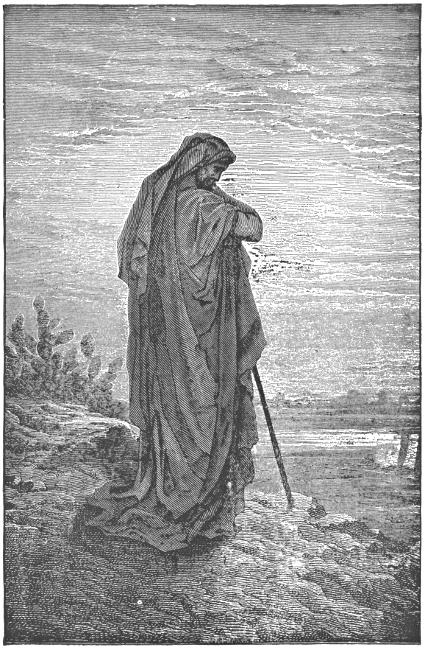
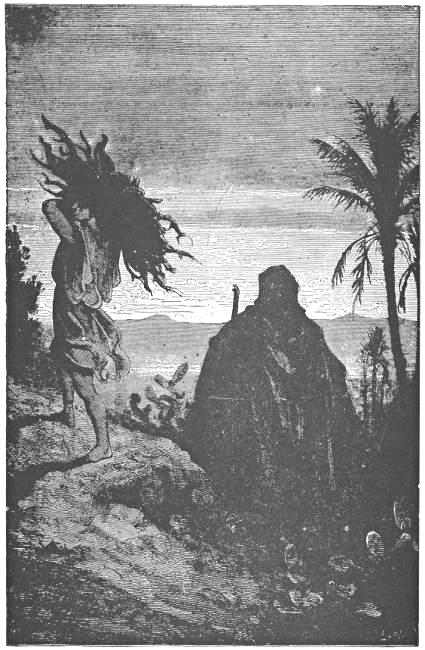
The Prophet Amos.
From the Painting by Gustave Dore.
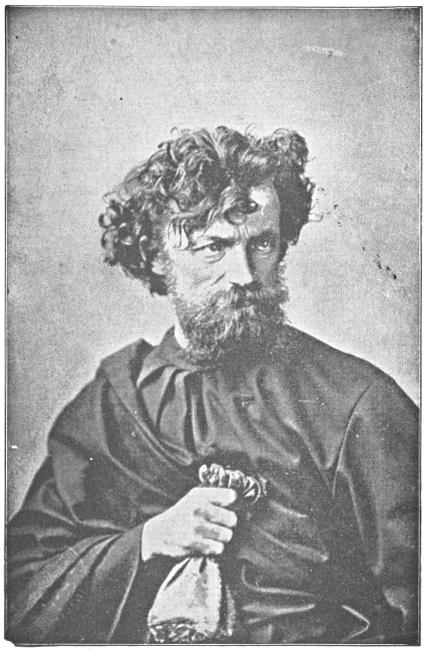
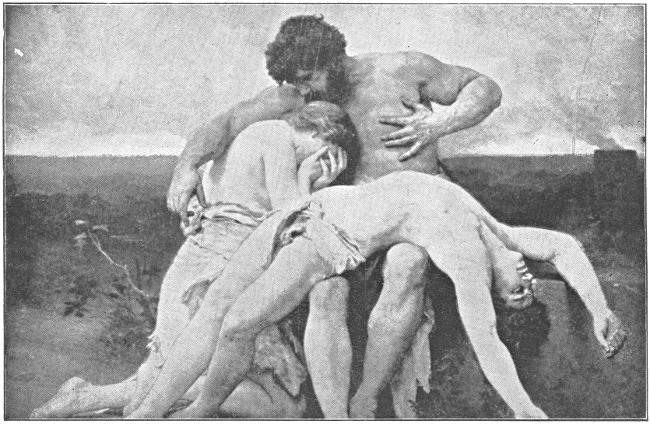
The Despair of Judas.
From a Photograph of the Character in the Passion Play.
“Ahab came into his house heavy and displeased
… and he laid him down upon his bed, and turned
away his face, and would eat no bread.”
Yet he was the king of Israel in Samaria! He actually
had subjects under him. He was in reality a man
who could give law, whose very look was a commandment,
and the uplifting of his hand could move an army.
Now we see him surely at his least. So we do, but not
at his worst.
All this must have an explanation. We can not imagine
that the man is so simply childish and foolish as
this incident alone would describe him. Behind all this
childishness there is an explanation. What is it?
We find it in the twenty-fifth verse:
“But there was none like unto Ahab, which did sell
himself to work wickedness in the sight of the Lord,
whom Jezebel, his wife, stirred up.”
That explains the whole mystery. The man had sold
himself to the devil. And men are doing that self-same
thing every day.
If it were a transaction in the market place—if the
auctioneer were visibly interested in this affair, if he
could call out in audible tones “So much is the price,
and the man is about to take it,” people would shrink
from the villainous transaction.
But this is an affair which does not take place in the
open market or in the open daylight. It is not conducted
in words. If the men involved in such transactions
could speak the words, the very speech of the words
might break the spell and destroy the horrible infatuation.
But the compact is made in darkness, in silence,
in out-of-the-way places. It is an understanding unwritten,
rather than an agreement in detail signed in the
presence of witnesses. It is a mystery which the heart
alone can understand, which even the preacher can not
explain in terms, but he can only throw himself upon his
own consciousness, and throw others upon their consciousness,
and call for a united testimony to the fact
that it is possible to sell one’s very soul to evil.
Now we understand King Ahab better. We thought
him but little, frivolous of mind, childish and petty,
without a man’s worthy ambition; but now we see that
all this was only symptomatic, an outward sign, pointing,
when rightly followed, to an inward and mortal corruption.
Now, let us look at the case of Naboth and the position
which he occupied in this matter.
Naboth possessed the vineyard which Ahab is said to
have coveted. Naboth said: “The Lord forbid.” He
made a religious question of it. Why did he invoke the
Eternal Name and stand back, as if an offense had been
offered to his faith? The terms were commercial; the
terms were not unreasonable; the approach was courteous,
and the ground given for the approach was not an
unnatural ground. Why did Naboth stand back as if his
religion had been shocked?
The answer is in the Book of Numbers, thirty-sixth
chapter and seventh verse:
“So shall not the inheritance of the children of Israel
remove from tribe to tribe; for every one of the children
of Israel shall keep himself to the inheritance of the
tribe of his fathers.”
So Naboth stood upon the law.
In Ezekiel we read:
“Moreover, the prince shall not take of the people’s
inheritance by oppression, to thrust them out of their
possession; but he shall give his sons inheritance out of
his own possession, that My people be not scattered every
man from his possession.”
So Naboth was not answering haughtily or resentfully.
He was answering both solemnly and religiously.
When money was offered for his fathers’ inheritance, he
spurned the offer. There are some things, blessed be
God, we can not pay for.
When Ahab said “I will give thee for it a better
vineyard than it” he knew not of what he was speaking.
There can be no better vineyard than the vineyard of the
fathers; there can be no vineyard equal to the vineyard
that is sown with history, planted with associations, solemnized
and endeared by a thousand precious memories.
There ought to be some things which we can not barter.
Surely there ought to be some things which we should
never try to sell.
Verily, when we hear propositions made to us that
money shall be given in exchange for certain things, our
whole soul should rise in horror and indignation, and
repel the approach of a barter which itself expresses an
infinite, because a most spiritual, injustice. So Naboth’s
position was strong, and he had the courage to answer
the king in these terms.
Kings must submit to law. Kings ought to be the
subjects of their own people. Ahab was taught that
there was a man in Samaria who valued the inheritance
which had been handed down to him. Have we no inheritance
handed down to us—no book of revelation, no
day of rest, no flag of liberty, no password of common
trust? Do we inherit nothing? Did we make the age
as it is, and is civilization a creature of our own fashioning?
And are we not bound to hand on to others what
was handed to us intact and unpolluted?
Let us live in a sacred past, and regard ourselves as
trustees of many possessions, and only trustees, and as
bound to vindicate our trust and have an ample acquittal
at the last.
So Ahab lay down upon his bed, turned away his
face, and would eat no bread. But there is a way of accomplishing
mean desires. There is a way of obtaining
what we want. Take heart! There is a way of possessing
oneself of almost whatever one desires. There
is always some Merlin who will bring every Uther-Pendragon
what he longs to have; there is always some
Lady Macbeth who will show the thane how to become
king. There is always a way to be bad. The gate of
hell stands wide open; or, if apparently half closed, a
touch will make it fly back, and the road is broad that
leads to destruction.
Jezebel said she would find the garden or vineyard for
her husband. She taunted him. “Dost thou now govern
the kingdom of Israel? Arise and eat bread, and let
thine heart be merry. I will give thee the vineyard of
Naboth, the Jezreelite.” Jezebel threw into the word
“govern” a subtle and significant emphasis.
How will she proceed? She will be ceremoniously
religious; she will proclaim a fast. O thou sweet, white,
pure religion, thou hast been forced into strange uses!
“Proclaim a fast;” lengthen your faces; mimic solemnity;
promise your hunger an early satisfaction, but look
as if you were fasting.
It is a sure sign of mischief when certain men become
serious. The moment they appear to be religious the
devil is just adding the last touch to the building which
he has been putting up within their souls. When they
talk long words—when they speak about responsibility,
obligation, duty, conscience, compulsion of conviction—they
are walking over tesselated pavement into the very
jaws of hell.
They do not mean their words; they do but use them.
“The heart is deceitful above all things, and desperately
wicked.”
First of all, then, be ceremoniously religious, Jezebel;
then trample down truth. “Set two men, sons of
Belial, before him, to bear witness against him, saying:
‘Thou didst blaspheme God and the king.’” Falsehood
is always ready. A great black lie is always willing to
be loosed and to be set going in the minds of men to pervert
them and mislead them. It is always open to the
bad heart to speak the untrue word. Nor is the untrue
word always frankly and broadly spoken. If so, it could
be answered in some cases.
The false word is hardly spoken at all; it is uttered
in a whisper. Falsehood is made to use signs and gestures;
even silence is made to bear witness to falsehood.
Truly, again we may say: “The heart is deceitful above
all things, and desperately wicked.” Tell a lie big enough
about any man, and it will be difficult, if not impossible,
to do away with the consequences of the false accusation.
People will always be found to say: “There
must be something in it; it may not be just as rumor has
it, but surely a statement of that kind never could have
been invented. Allowing a good deal for exaggeration,
there must be something in it.”
Nor is it always possible to get even righteous men
to purge their minds of that damnable sophism. Men
who ought to stand up and say “There is nothing in it”
hang down their heads, and with a coward’s gesture let
the lie pass on.
This is how men insult the Son of God, and crucify
the Man of truth. They will not be thorough, bold and
fearless, and make the enemy ashamed of himself for
either having invented or repeated a falsehood. Nor may
the man escape because he says he heard the lie. Tell
him he may have heard it, but he is yet responsible for
repeating it. He may have no control over the hearing,
but the moment he repeats it he adopts it, and renders
himself amenable to the Eternal Righteousness.
Make the very law an instrument of injustice! First
charge this man with blasphemy and treason, and then
take him out and stone him, that he may die! Do not
give him time to speak; do not ask for his defense; do
not give him an opportunity of interrogating the witnesses.
But who would cross-examine two “sons of
Belial?” Better almost to die than to taint the hands
and eyes with the touch and look of such children of
blackness!
“Then they carried him [Naboth] forth out of the
city, and stoned him with stones, that he died.” It is
all over! Jezebel did this. Jezebel—a woman, a king’s
wife—did this. High position goes for nothing when the
heart is wrong. Great influence means great mischief
when the soul is not in harmony with the spirit of righteousness.
Is Naboth quite dead? Yes, he is dead. Take the
vineyard—take possession of it instantly. Now grow
herbs, and grow them plentifully. The vineyard is now
at liberty—take it. “Ahab rose up to go down to the
vineyard of Naboth, the Jezreelite, to take possession of
it.” But who is that looms in the distance? Is it Naboth?
No.
How comes this man to be here just now—aye, just
now? How the end is marked off into points, and how
does providence reveal itself at unexpected times and in
ways unforeseen! Who is this? He looks stern. He
has an eye of fire. His lips are shut as if they could
never be opened. He does but look.
Who is he? “Elijah, the Tishbite.” He has a
message:
“Thus saith the Lord: ‘Hast thou killed, and also
taken possession?’ … Thus saith the Lord: ‘In
the place where dogs licked the blood of Naboth shall
dogs lick thy blood, even thine.’”
A sad walk!
Ahab went down to take possession of a vineyard,
and a death warrant was read to him! After all, it is
safe to live in this universe; there is law in it, there is a
genius of righteousness, there is a Force that moves on
toward noble issues.
“And Ahab said to Elijah: ‘Hast thou found me,
O mine enemy?’ And he answered: ‘I have found
thee; because thou hast sold thyself to work evil in the
sight of the Lord.’” Ahab went out to take possession
of a garden of herbs, and there he stands face to face
with righteousness—face to face with honor—face to face
with judgment.
Now take the vineyard. He can not! An hour since
the Sun shone upon it, and now it is black as if it were
part of the midnight which has gathered in judgment.
There is a success which is failure. We can not take
some prizes. Elijah will not allow us. When we see
him we would that a way might open under our feet that
we might flee and escape the judgment of his silent look.
In the Septuagint version the twentieth chapter of
the first Book of Kings immediately precedes the twenty-second.
The three years without war is a period which
is reckoned from the peace which was so rashly made by
Ahab with Ben-hadad.
It is clear that Ben-hadad has recovered his independence,
and is probably in a position of superiority.
It is certain that he has not restored Ramoth-gilead, as
he had promised to do, and his reconstructed army now
seems to him to be sufficient to encounter successfully
the united hosts of Israel and Judah. In the forty-second
verse of the same chapter we have seen how Ahab was
rebuked for allowing the enemy to escape.
It has been supposed that this conduct on the part of
Ahab may have been due partly to compassion and partly
to weakness. The judgment of the Lord was, however,
expressed in the severest terms:
“Because thou hast let go out of thy hand a man
whom I appointed to utter destruction, therefore thy life
shall go for his life, and thy people for his people.”
In the third verse we see these words signally fulfilled.
The king of Israel seems to have a good cause when he
said to his servants: “Know ye that Ramoth, in Gilead,
is ours, and we be still, and take it not out of the hand
of the king of Syria?” On this occasion Ahab entered
into an alliance with Jehoshaphat, king of Judah, for the
purpose of taking back the city which belonged to Israel.
Jehoshaphat made a deferential as well as a friendly
reply, but insisted upon the fulfillment of a religious
condition. Jehoshaphat would make inquiry at the word
of the Lord.
Thereupon four hundred prophets were gathered together,
and with one consent they advised that the attack
should be made upon Ramoth-gilead. Surely this was
enough to satisfy the judgment and the conscience of the
most religious man, yet Jehoshaphat was not content
with the unanimous reply which four hundred prophets
had returned.
“There is a spirit in man, and the inspiration of the
Almighty giveth them understanding.”
All external unanimity goes for nothing when the conscience
itself dissents from the judgment which has been
pronounced. There is a verifying faculty which operates
upon its own responsibility, and which can not be overpowered
by the clamor of multitudes who eagerly rush
down paths that are forbidden. Even when imagination
assents to the voice of the majority, and when ambition
is delighted with the verdict of the prophets, there yet
remains the terrible but gracious authority of conscience.
Through all the clamor that authority makes its way, and
calmly distinguishes between right and wrong, and solemnly
insists that right shall be done at all hazards and
in view of all consequences.
A vital lesson rises here to all who are anxious to
know the right way under difficult circumstances. It is
not enough to have great numbers of authorities on our
side; so long as the conscience remains unsatisfied all
other authorities are “trifles light as air.”
Jehoshaphat was uneasy, therefore, notwithstanding
the prophets had said: “Go up; for the Lord shall
deliver it into the hand of the king.” He inquired: “Is
there not here a prophet of the Lord besides, that we
might inquire of him?” The word which Jehoshaphat
used was the great word, Jehovah. It was not enough
for him to use a religious or sacred term. He must have
the prophecy identified with the awful name, Jehovah;
then it would come with final authority.
The king of Israel knew that there was another man
whose very name signified “Who is like Jehovah?”
Ahab frankly admitted that he hated Micaiah because he
never prophesied good concerning him, but always evil.
Observe the madness of Ahab’s policy, and note how
often it is the policy which we ourselves are tempted to
pursue. We suppose that if we do not consult the Bible
we may take license to do what seems good in our own
eyes, and we imagine that by ignoring the Bible we have
divested it of authority. We flatter ourselves that if we
do not listen to an exposition of the divine word we shall
be judged according to the light we have, forgetting the
solemn law that it is not according to the light we
have that we are to be judged, but according to the light
we might have if we put ourselves in right relations to
the opportunities created for us by divine providence.
We know that if we go to hear a certain preacher he
will insist upon “righteousness, temperance and judgment
to come;” and, supposing that we already know
every thing that he will say, we turn away from him and
listen to men who do not profoundly treat vital subjects,
or press home upon the conscience the terrible judgments
of God.
What is this but closing our eyes to light, and supposing
that darkness is safety? What is this ostrich
policy but one that ought to be condemned by our sense
as well as shrunk from by our piety?
Our duty under all critical circumstances is to go to
the truth-teller, and to get at the reality of things at all
costs. Where the truth-teller disturbs our peace and
disappoints our ambition, we ought surely to learn that
it is precisely at that point that we have to become self-rectifying.
The truth-teller is only powerful in proportion
as he tells the truth. Officially, he is nothing; his
power is simply the measure of his righteousness.
But do not men love to be flattered, even in courses
of evil? Is it not pleasant to go to forbidden war amid
the huzzas of thoughtless and irresponsible multitudes?
Jehoshaphat, however, was a just man, and as such
he protested against the sin of the king of Israel, saying:
“Let not the king say so.” Jehoshaphat being so bent
upon a complete judgment of the case, Micaiah was sent
for. The king of Israel wished to overawe the despised
prophet by the pomp and circumstance under which he
was introduced to the royal presence. “The king of
Israel and Jehoshaphat, the king of Judah, sat each on
his throne, having put on their robes, in a void place in
the entrance of the gate of Samaria,” and, to increase
the impressiveness of the occasion, all the prophets
prophesied before the kings.
A singular addition was made to the surroundings of
the occasion which was intended to impress the imagination
and stagger the courage of the despised Micaiah. A
man bearing the name of Zedekiah (“righteousness of
Jehovah”) made him horns of iron. The use of symbolical
acts is quite common in biblical history. We have
already seen Abijah engaged in acts of this kind. He
“caught the new garment that was on him and rent it in
twelve pieces, and said to Jeroboam: ‘Take thee ten
pieces.’”
The enthusiasm of Zedekiah inflamed all the other
prophets to the highest point of excitement, and they
shouted as with one voice:
“Go up to Ramoth-gilead, and prosper; for the Lord
shall deliver it into the king’s hand.”
In this instance the prophets, overborne by the enthusiasm
of Zedekiah, actually ventured to use the name of
Jehovah, which had not been used in the first instance.
The excitement had passed the point of worship and had
become more nearly resembling the frantic cry that was
heard on Mount Carmel: “O Baal, hear us.”
Is it possible that there can be found any solitary
man who dare oppose such unanimous testimony and
complete enthusiasm?
The messenger who was sent to call Micaiah was evidently
a man of considerate feeling and who wished the
prophet well. Seeing that the words of the prophets had
all declared good unto the king with one mouth, the messenger
wished that Micaiah should for once agree with
the other prophets, and please the king by leaving undisturbed
their emphatic and unanimous counsel.
Thus the voice of persuasion was brought to bear on
Micaiah, and that voice is always the most difficult to
resist. The temptation thus addressed to Micaiah was
thus double in force. On the one hand, there were the
pomp and the terror of the king who had sold himself to
do evil, and who would shrink from the infliction of no
cruelty that would express his unreasoning and unlimited
anger; on the other hand, there was the good will of the
messenger, who wished Micaiah to escape all danger and
penalty, and for once to take the popular side. Micaiah’s
reply is simply sublime: “As the Lord liveth, what the
Lord saith unto me, that will I speak.”
The humility of this answer is as conspicuous as its
firmness. Its profound religiousness saves it from the
charge of being defiant. Micaiah recognizes himself
merely in the position of a servant or medium, who has
nothing of his own to say; who is not called upon to invent
an answer or to play the clever man in the presence
of the kings. He was simply as a trumpet through which
God could blow His own blast, or a pillar on which God
would inscribe his own message, or a voice which God
would use for the declaration of His own will. It is unjust
to attribute obstinacy or any form of self-will or
self-worship to Micaiah. If he had consulted his natural
inclination alone, he would have sought favor with the
king, and the logical effect of his subsequent position
would have been that Ahab would have endeavored for
ever to silence him by constituting him the prince and
leader of the four hundred prophets. Micaiah said, in
effect, what was said centuries afterward: “We have
this treasure in earthen vessels.”
Micaiah lived in God, for God, and had nothing of
his own to calculate or consider. Until preachers realize
this same spiritual independence, they will be attempting
to accommodate themselves to the spirit of the times,
and even the strongest of them may be betrayed into
connivances and compromises fatal to personal integrity
and to the claims of truth.
Now came the critical moment. Now it was to be
seen whether Micaiah was to be promoted to honor, or
thrust away in contempt and wrath. It is easy to read
of the recurrence of such moments, but difficult to realize
them in their agony. Yet these are the moments
which make history in its sublimest lines.
It is not too much to say that there have been points
of time at which if certain men had given way the whole
economy of the world have been wrecked.
The king addressed himself to the prophet, saying:
“Shall we go against Ramoth-gilead to battle, or shall
we forbear?” The answer of Micaiah must have been a
surprise to all who heard it, for he said: “Go, and
prosper; for the Lord shall deliver it into the hand of
the king.”
This is an answer which can not be understood in
print. It was evident, however, that Ahab was in no
doubt as to its meaning, for the tone of the prophet was
a tone of almost contemptuous irony. If King Ahab had
taken Micaiah’s literal answer, he would have gone forth
to the battle comforting himself with the thought that
he was carrying out the will of Heaven; but he knew in
his own soul that Micaiah was not uttering that which
expressed the reality of the case. With anger the king
said unto him: “How many times shall I adjure thee
that thou tell me nothing but that which is true in the
name of the Lord?”
Then Micaiah replied in symbolic language, the full
meaning of which was vividly clear to the mind of Ahab;
for, turning to Jehoshaphat, he said: “Did I not tell
thee that he would prophesy no good concerning me, but
evil?”
Thereupon Micaiah charged the whole band of prophets
with being under the inspiration of a lying spirit, and
thus he put a stigma upon their judgment and extracted
from it every particle of dignity and authority.
But this was not to be borne, for Zedekiah went near
and smote Micaiah on the cheek and taunted him as being
the only prophet in Israel. Micaiah had to bear the
sarcasm conveyed in the inquiry: “Which way went
the Spirit of the Lord from me to speak unto thee?”
Micaiah, like a true prophet, leaves his judgment to
the decision of time. He will not stoop to argue, or to
exchange words either of anger or of controversy; he
simply says that Zedekiah will one day see the meaning
of the whole prophecy, and until that day controversy
would be useless.
Micaiah had to pay for his intrepidity. He was carried
unto Amon, the governor of the city, and to Joash,
the king’s son, and was to be put in prison and fed with
the bread of affliction and with the water of affliction
until Ahab returned in peace.
Micaiah thus disappears from history. Of his fate we
know nothing; but there can be no difficulty in forecasting
it a cruel death. Micaiah knew well the meaning of
the king’s message. It may be difficult for the commentator
to explain the expression, “bread of affliction and
water of affliction,” but Micaiah knew the full meaning
of the terms, and yet, while their cruel sound was in his
ears, he looked at the king and said: “If thou return
at all in peace, the Lord hath not spoken by me.”
Micaiah also made his appeal to the people, and thus
committed himself to the verdict of history, saying:
“Hearken, O people, every one of you.”
See whether it is not a moment to be proud of when
Micaiah turns away in the custody of his persecutors,
having delivered his soul with a fearlessness that did not
cower or blanche, even at the sight of death in its most
ghastly form. Surely, it is due to history to recognize
the fact that there have been men who have not counted
their lives dear unto themselves when they were called
upon to testify for truth and goodness.
The martyrs must never be forgotten.
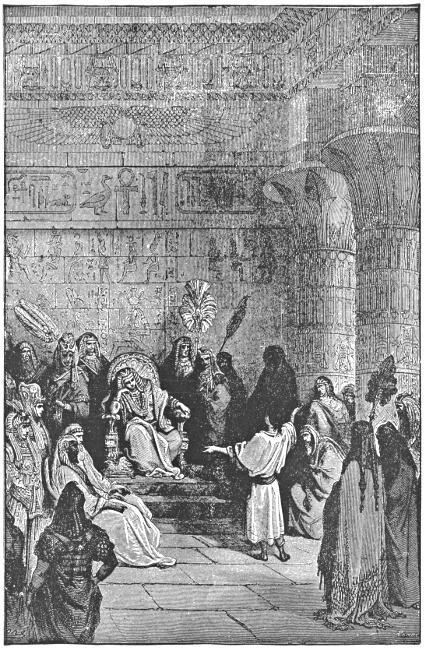
Joseph Interpreting Pharaoh’s Dream. Genesis, xli.
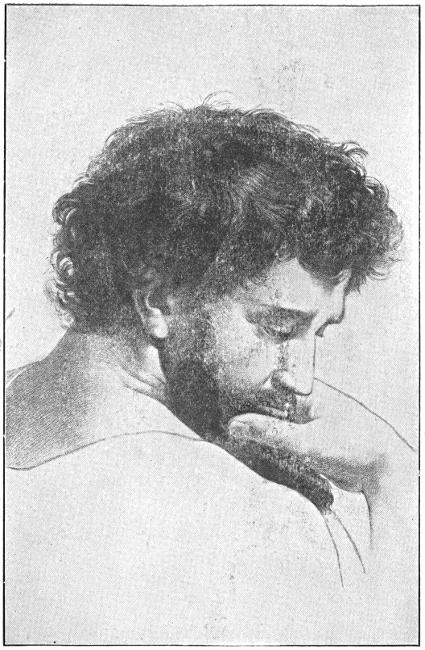
St. Paul.
From the Painting by Raphael.
Dark will be the day in the history of any nation
when the men who shed their blood that truth might be
told and honor might be vindicated are no longer held in
remembrance. In vain do we bring forth from our hidden
treasure the coins of ancient times, the robes worn
in high antiquity by kings and priests, the rusty armor of
warriors, if there is no longer in our heart the most tender
recollection of the men who wandered about clad in
sheep-skins and goat-skins—being destitute, afflicted and
tormented—that they might save the torch of truth from
extinction and the standard of honor from overthrow.
Away the kings have gone, and instead of relying
upon the word of the Lord, or taking refuge in the sanctuary
of great principles, they invent little tricks for the
surprise and dismay of the enemy.
The king of Israel disguised himself, and Jehoshaphat
made himself as the king of Israel; but all their
inventions came to nothing. A certain man drew a bow
at a venture, and smote the king of Israel between the
joints of the harness. The poor king was fatally struck.
He “was stayed up his chariot against the Syrians, and
died at even; and the blood ran out of the wound into
the midst of the chariot.… And one washed the
chariot in the pool of Samaria; and the dogs licked up
his blood; and they washed his armor; according unto
the word of the Lord which He spake.”
So will perish all the enemies of the Lord.
Differences of merely accidental detail there will ever
be, but no honor can mark the death of those who have
gone contrary to the will of Heaven, and taken counsel
of their own imagination. How long shall the lessons
of history be wasted upon us? How long will men delude
themselves with the mad infatuation that they can fight
against God and prosper? Horsemen and chariots are
nothing; gold and silver are valueless; all the resources
of civilization are but an elaborate display of cobwebs.
Nothing can stand in the final conflict but truth, right
and purity. These are the eternal bulwarks, and unto
these are assured complete and unchangeable victory. If
God be for us, who can be against us? And if God be
against us, it will matter not what kings are for us; they
shall be blown away by the wind as if contemptuously,
and cast out as refuse which is of no value.
My soul, be thou faithful to the voice of history, nor
tell lies to thyself, nor operate merely through imagination,
ambition or selfish calculation; for the end of this
course is death—not heroic death, not death over which
coming men and women will weep, but death that shall
be associated with dishonor, a thing to be forgotten, an
event never to be named without bitterness and shame.
The first and second Book of Kings constitute a section
of Jewish history, and originally formed only one
book in the sacred writings. It was customary with the
Jews to name the sacred books from the word or words
with which they commenced; and, while this practice
may have given rise to the designation, “Kings,” it is
right to observe that the title is well fitted to indicate the
character of these historic compositions.
The annals given in these sacred registers are necessarily
brief; but they extend from the close of David’s
reign till the commonwealth was dissolved, a period of
427 years. Succinct as is the history contained in these
books, there are some peculiarities in them which should
not be overlooked, and from which not a little may be
learned. There is not here a simple biography of the
various kings that occupied the thrones of Judah and
Israel, nor is there a mere detail of national movements
and events, nor even a tabular register of ecclesiastical
affairs. The throne, the state and the church are all exhibited
in their mutual relations and bearings upon each
other. Kings and people are held up to view as existing
and acting under the immediate government of God;
and hence the character of the ruler is always tested by
the mode in which he adheres to the laws of the Most
High and develops the moral excellences of the people.
The notice of his accession to royal office is generally
accompanied with an estimate of his conduct, and the
standard to which he is likened or with which he is contrasted
is either the character of David, of his own
father or of Jeroboam, the son of Nebat, “who made
Israel to sin.”
All the political events which are recorded have been
brought forward chiefly to exhibit the influence of religion
on national prosperity, and in this way to show how
the divine King of Israel observed the conduct of his
subjects, and rewarded their fidelity or avenged their
wickedness with expressions of righteous indignation.
And the affairs of the Church are all portrayed with the
evident design of giving prominence to the same important
truth.
Idolatry in Israel was treason against their King;
religious defection was open revolt, and every act of overt
wickedness was an act of rebellion. Hence there is a
constant comparing or contrasting of religious state and
feeling with those of former times, and especially are the
oracles of truth continually elevated as the perfect standard
to which the thoughts and actions of all should be
conformed.
The Mosaic promises and warnings are strikingly
verified in the Books of Kings. For this object they
were written, and to the manifestation of this the author
has made his whole narrative conduce.
Much variety of opinion exists with reference to the
author of these records and the period of their composition.
Jewish tradition ascribes the authorship of the
treatise to Jeremiah, the prophet—a supposition which
is greatly strengthened by the similarity of style and
idiom which is traceable between the language of the
Books of Kings and that of Jeremiah.
Ahaziah was the son of Ahab and Jezebel. He was
badly born. Some allowance must be made for this fact
in estimating his character.
Again and again we have had occasion, and shall indeed
often have, to remark upon the disadvantages of
children born of wicked parents. It is not for us to lay
down any final doctrine of responsibility; we must leave
that in the hands of a just and gracious God.
A terrible spectacle, however, it is to see a man
whose father sold himself to work wickedness in the sight
of the Lord, who bound himself as for a price to show
rebellion on the very floor of Heaven.
Ahaziah was a prince of evil—a man who said he
would defile the sanctuary and commit his supreme sin
within the shadow of the altar, and whose mother laid
the plans for the murder of Naboth, and who all but personally
superintended their execution. What can we
expect from such a child of darkness? Who can gather
grapes of thorns, or figs of thistles? Was he responsible
for his own actions? Society is often hard on such men—not
unreasonably or unnaturally. Yet society is often
very gracious to such men, saying with an instinctive
piety and sense of justice: “After all, such men are
not to be personally blamed for their antecedents; they
may indeed be open to some measure of suspicion, but
even they must have their opportunity in life.”
Let us consider the case of Ahaziah and see how matters
stand for our own instruction.
To understand the matter thoroughly, we must go to
the twenty-second chapter of the first Book of Kings:
“Then said Ahaziah, the son of Ahab, unto Jehoshaphat:
‘Let my servants go with thy servants in the
ships.’ But Jehoshaphat would not.”
Jehoshaphat was right when he acted upon his instinct.
By-and-by he came to act upon a basis of calculation,
and then a compact was entered into. But
who dare set aside the voice of instinct—the very first
voice that rises in the soul to make judgment and to give
direction?
Jehoshaphat, on hearing the proposal of the son of
Ahab, said: “No. I have known thy father too well.
I am too familiarly acquainted with thy family history.
Thou shalt not send thy servants with mine.”
It would be well for us if we could sometimes act
more promptly upon our instincts. It would have been
well for Jehoshaphat if he had acted upon his instinct.
Ahaziah fell through the lattice, and in his helplessness
he became religious. Man must have some God.
Even Atheism is a kind of religion. When a man recoils
openly from what may be termed the public faith of his
country, he seeks to apologize for his recoil, and to make
up for his church absence by creating high obligations of
another class. He plays the patriot; he plays the disciplinarian;
he will be a Spartan in personal training
and drill—in some way he will try to make up for or
defend the recoil of his soul from the old altar of his
country.
It is in their helplessness that we really know what
men are. Do not listen to the frivolous and irresponsible
chatter of men who, being in robust health, really
know nothing about the aching, the sorrow, the pain, the
need and the agony of this awful human life.
What does our helplessness suggest? Instantly we
go out of ourselves to seek friendship, assistance and
sympathy. “Oh, would some gentle hand but touch my
weariness!” Thus cries the helpless one. All that, being
fairly and duly interpreted, has a religious signification.
The cry for friendship is but a subdued cry for
God.
Sometimes men will invent Gods of their own. This
is what was done, practically, by Ahaziah. Men will go
out after novel deities. This is what is being done every
day—not under that name, but the mere name makes no
difference in the purpose of the spirit. Say new enjoyments,
new entertainments, new programs, new customs—these,
being interpreted as to the heart of them, mean
new altars, new helpers, new gods.
It is said of Shakespeare that he first exhausted
worlds, and then invented new. That was right. It
was but of the liberty of a poet to do so. But it is no
part of the liberty of the soul. Necessity forbids it, because
the true God cannot be exhausted. He is like His
own nature, so far as we know it in the great creation;
He is all things in one, gleaming and dazzling as noon-tide,
soft and gentle as the balmy wind, strong as the
great mountains and rocks, beauteous as the tiny fragrant
flowers, musical as the birds that make the air
melodious, awful as the gathered thunder which hovers
above the Earth as if in threatening.
Who can exhaust nature?
Who can exhaust nature’s God?
Still, the imagination of man is evil continually. He
will invent new ways of enjoying himself. He will degrade
religion into a mere form of interrogation. This
is what Ahaziah did in this instance: “Go, inquire of
Baal-zebub, the god of Ekron, whether I shall recover
of this disease.” All that we sometimes want of God is
that He should be the great fortune teller.
How true it is that Ahaziah represents us all in making
his religion into a mere form of question asking—in
other words, into a form of selfishness!
The messengers have now come. They have taken
their speech from their king, and they are on the road to
consult Baal-zebub, the god of Ekron. But who is this
who meets them, and who asks:
“Is it not because there is not a God in Israel that
ye go to inquire of Baal-zebub, the god of Ekron?”
The men had said nothing about their errand. Who
is it that reads the heart night and day, to whom the
darkness and the light are both alike, and from the fire
of whose eye nothing is hid? How do we get the impression
that when we have perfected our lie it is in some
sense public property? We are sure the man whom we
meet knows it. He looks as if he did.
Elijah is an abrupt speaker. The “hairy man” and
“girt with a girdle of leather” did not study the scanning
of his sentences. He struck with a battering ram;
his interrogations were spears that quivered in the heart;
his looks were judgments. What an effect he produced
upon these men! Why did they not go past him and
say: “Keep thy speeches to thyself, thou hairy man,
nor interfere with the king’s messengers”?
We can not do that. We know that some men are
not to be turned away so. We may attempt to deceive,
evade or disappoint them, but they have a magnetic and
most marvelous influence upon us. Though they do not
speak in the imperative mood, they speak with imperative
force.
The men turned back like whipped children to tell the
king what they had heard, and Ahaziah was surprised at
their early return. He can not sleep. He asks that the
book of the chronicles may be brought, that he may look
up events and see where the loop slipped, where the
wrong entry was made, or where the minutes were not
carried out in detail.
All this means that Elijah lives in some form or other
and will meet us and confront us and have it out with us.
Look at the conflict between Ahaziah and Elijah, the
Tishbite. Ahaziah is the king and Elijah is only the
prophet, and the king ought to have every thing his own
way ex-officio. Now we shall see what metal Elijah is
made of. He handled kings as if they were little children.
He took them up and set them down behind him
and said: “Wait there until I return, and stir at your
peril.”
The prophet should always be the uppermost man.
Kings are nothing compared to teachers and seers—men
who hold the judgments of God on commission. The
great men of the nation are the prophets, the teachers,
the educators of thought, the inspirers of noble sacrificial
enthusiasm. See how Elijah tramps among the
kings. He has no favor to ask. If he were driven to
ask for one morsel of bread, he would be Elijah no more.
Ahaziah sends to Elijah and says: “Come down.”
These words sound very commanding and imperative.
Elijah answered: “If I be a man of God, then let fire
come down from Heaven and consume thee and thy fifty.
And there came down fire from Heaven and consumed
him and his fifty.”
Look at the conflict and its parties. On the one
hand, petulance; on the other, dignity. On the one side,
anger—fretful, fuming, petty; on the other, judgment—calm,
sublime, comprehensive, final.
Ekron was one of the royal cities of the Philistines.
Its situation is pointed out with considerable minuteness
in Scripture. It is described as lying on the northern
border of Philistia and of the territory allotted to Judah.
It stood on the plain between Bethshemesh and Jabneel.
Jerome locates it on the east of the road leading from
Azotus (Ashdod) to Jamnia (Jabneel). From these notices
we have no difficulty in identifying it with the modern
village of Akir. Akir stands on the southern slope
of a low and bleak ridge or swell which separates the
Plain of Philistia from Sharon. It contains about fifty
mud houses, and has not a vestige of antiquity except
two large and deep wells and some stone water troughs.
Ekron means “wasteness.” The houses are built on the
accumulated rubbish of past ages, and, like their predecessors,
if left desolate for a few years they would crumble
to dust. The most interesting event in its history
was the sending of the ark to Bethshemesh. A new cart
was made and two milch kine yoked to it, and then left
to choose their own path; “and they took the straight
way to the way of Bethshemesh,” the position of which
can be seen in a gorge of the distant mountains eastward.
The deity worshiped at Ekron was called Baal-zebub,
and we may conclude from the story of Ahaziah
that this oracle had a great reputation, even among the
degenerate Israelites. Ekron was a large village in the
days of Jerome, and also in the age of the crusades.
Asa was a good king of Judah. He “did that which
was good and right in the eyes of the Lord, his God.”
Not only “good and right,” because these might be variable
terms. There are persons who set themselves to the
presumptuous and impious task of settling for themselves
what is “right” and what is “good.”
In the case of Asa, he did not invent a righteousness,
nor did he invent a goodness which he could adapt to his
own tempers, ambitions and conveniences. He was right
and good and “did that which was good and right in the
eyes of the Lord, his God.”
While the land had peace, Asa set to work and built
walls, towers and fences, and did all that he could for
the good of his country.
Zerah, an Ethiopian warrior, did not understand
silence. He mistook quietness for languor. He made
the vulgar mistake of supposing that quietness was indifference.
He did not know that repose is the very
highest expression of power.
Zerah brought against Asa, king of Judah, no fewer
than a million soldiers—to us a large number, but to the
Orientals quite a common array. Zerah’s host was the
largest collected army of which we read in Scripture, but
it does not exceed the known numbers of other Oriental
armies in ancient times. Darius Codomannus brought
into the field at Arbela a force of 1,040,000. Xerxes
crossed into Greece with certainly above a million combatants.
Artaxerxes Mnemon collected 1,260,000 men
to meet the attack of the younger Cyrus.
What was to be done? Asa did not shrink from war,
though he never courted it. He must meet the foe in
battle. Before doing so he must pray.
“Lord, it is nothing with Thee to help, whether with
many or with them that have no power. Help us, O
Lord, our God, for we rest on Thee; and in Thy name
we go against this multitude. O Lord, thou art our God;
let not man prevail against Thee.”
Having risen from their knees, they launched themselves
against the Ethiopians, and were mighty as men
who answer straw with steel. They fought in God’s
name and for God’s cause, and the thousand thousand of
the Ethiopians were as nothing before the precise and
terrific stroke of men who had studied war in the school
of God.
The defeat of Zerah is one of the most remarkable
events in the history of the Jews. On no other occasion
did they meet in the field and overcome the forces of
either of the two great monarchies between which they
were placed. It was seldom that they ventured to resist,
unless behind walls. Shishak, Sennacherib, Esarhaddon,
Nebuchadnezzar, Alexander and Ptolemy I. were either
unopposed or only opposed in this way. On the other
occasion on which they took the field—which was under
Josiah against Necho—their boldness issued in a most
disastrous defeat.
Asa, then, began upon a good foundation; he established
himself upon a great principle. That is what all,
young people especially, should take to heart right seriously.
Do not make an accident of your lives—a thing
without center, purpose, certitude or holiness. Be right
in your great foundation lines, and you will build up a
superstructure strong, after the nature and quality of the
foundation upon which you build. Do not snatch at life.
Do not take out an odd motto here and there and say:
“This will do for the occasion.” Life should be deeply
laid in its bases, strongly cemented together in its principles,
noble in its convictions; then it can be charitable
in its concessions and recognitions.
“And Asa took courage, and put away the abominable
idols out of all the land of Judah and Benjamin, and
out of the cities which he had taken from Mount
Ephraim, and renewed the altar of the Lord.”
Let us not trifle with the occasion by suggesting that
we have no idolatries to uproot, no heathen groves to
examine, to purify or to destroy. That would indeed be
making light of history and ignoring the broadest and
saddest facts of our present circumstances. The world
is full of little gods, man-made idols, groves planted by
human hands, oppositions and antagonisms to the tried
Theism of the universe.
We are apt to think that the idols are a long way off—far
beyond seas; or that they existed long centuries
ago and spoke languages now obsolete or forgotten.
Nothing of the kind. They live here; they build
today. Our gods are a million strong. We do not call
them gods, but we worship them none the less. Luck,
Accident, Fortune, Fashion, Popularity, Self-Indulgence—these
are the base progeny of idols that did once represent
some ideal thought and even some transcendental
religion. Idolatry has retrograded; polytheism has gone
quickly backward.
Asa said, in effect: “We must be right about our
gods before we can be right with one another.” That is
true teaching. With a wrong theology we never can
have a thoroughly sound and healthy economic system.
This was the corner-stone upon which Asa built his
great and gracious policy. What was the effect of it
upon other people? We find that the effect then was
what it must always be:
“They fell to him out of Israel in abundance when
they saw that the Lord, his God, was with him.”
Such is the influence of a great leadership. If Asa
had been halting, the people would have halted, too.
Asa was positive; and positiveness, sustained by such
beneficence, begets courage in other people. “They fell
to him out of Israel in abundance”—that is, they came
over to him and were on his side. They ranked themselves
with Asa; they looked for his banner and called
it theirs, “when they saw that the Lord, his God, was
with him.”
Nations perish for want of great leaders. Social
reforms are dependent to a large extent upon the spirit of
the leadership which has adopted them. The Church is
always looking around for some bolder man, some more
heroic and dauntless spirit, who will utter the new truth,
if any truth can be new—say, rather, the next truth; for
truth has always a next self, a larger and immediately
impending self, and the hero, who is also martyr, must
reveal that next phase of truth and die on Golgotha for
his pains.
Can we not, in some small sense, be leaders in our
little circles—in our business relations, in our family life,
in our institutional existence? Many people can follow
a tune who can not begin one. That is the philosophy
we would unfold and enforce.
Regard all leaders with prayerful hopefulness in so
far as they want to do good and to be good. Sympathize
with them; say to Asa, even the king: “What thou
hast done thou hast well done; in God’s name we bless
thee for the purification of the land and for the encouragement
of all noble things.”
Asa showed the limits of human forbearance and human
philosophy. He broke down in the very act of doing
that which was right because he went too far. He made
a covenant, and the people made it along with him.
Solemn renewals of the original covenant which God
made with their fathers in the wilderness occur from time
to time in the history of the Jews, following upon intervals
of apostacy. This renewal in the reign of Asa is
the first on record. The next falls three hundred years
later, in the reign of Josiah. There is a third in the time
of Nehemiah. On such occasions the people bound
themselves by a solemn oath to observe all the directions
of the Law, and called down God’s curse upon them if
they forsook it.
“And they entered into a covenant to seek the Lord
God of their fathers with all their heart and all their
soul; that whosoever would not seek the Lord God of
Israel should be put to death, whether small or great,
whether man or woman.”
That is the danger. You can not make men religious
by killing them, by threatening them, by inflicting upon
them any degree of penalty. Do not force a child to
church. Lead it; lure it; make the church so bright
and homelike and beautiful that the child will eagerly
long for the time to come when the door will be opened.
Asa was impartial. There was a touch of real grandeur
about the man. He would not even allow his
mother to keep an idol. The queen had an idol of her
own “in a grove.”
“And also concerning Maachah, the mother of Asa,
the king, he removed her from being queen, because she
had made an idol in a grove; and Asa cut down her idol,
and stamped it and burnt it at the brook Kidron.”
Thus ruthlessly Asa disestablished that little royal
church. See how burningly in earnest the man was, and
what a man will do when his earnestness is fervent! He
knows nothing about fathers, mothers, partialities or
concessions. He says: “Light is the foe of darkness,
and you can not have any little dark corner of your own.
This light must find you out, chase away every shadow
and purify every secret place in human life and thought.”
Some have supposed that Maachah, the mother of
Abijah, and Maachah, the “mother” of Asa, were different
persons, the former being the daughter of Absalom,
the latter the daughter of Uriel of Gibeah. There
are really no grounds for this. Maachah, the mother of
Abijah, enjoyed the rank of queen mother not only during
his short reign of three years, but also during that of
her grandson, Asa, until deposed by him on account of
her idolatry.
The original word for “idol” appears to signify a
“horrible abomination” of some monstrous kind; and
instead of “in a grove” we should read “for an asherah,”
the wooden emblem of the Canaanitish deity.
There seems little doubt that some obscene emblem
is meant, of the kind so often connected with worship of
the productive powers of nature in ancient religions—substituted,
as a still greater abomination, for the ordinary
asherah. Clearly, the act of Maachah was one of
so flagrant a kind that Asa took the unusual step, on
which the historian here lays great stress, of degrading
her in her old age from her high dignity, besides hewing
down her idol and burning it publicly under the walls of
Jerusalem.
“Now,” said Asa, in effect, “what is good for the
public is good for the individual; what is good for the
subject is good for the queen.”
Athaliah was a king’s daughter and a king’s wife.
She had a son whose name was Ahaziah, but, as he was
an invalid, he did not occupy the throne longer than
about twelve months.
As soon as his mother saw that he was dead a fierce
and most murderous passion seized her heart. She then
resolved to be queen herself.
In order to carry out this nefarious purpose, she slew
all the seed royal, so that, there being no successor to
the throne, she ascended it and reigned as queen.
It is very wonderful that some of the most cruel and
startling things in the world have been done by women.
One called Laodice poisoned her six sons one by one,
that she might be empress of Constantinople. Another,
ironically named Irene, took the eyes out of her own
boy, that he might be incapable of empire, and that she
might reign alone.
These things were done in the ancient time. Is any
of the cruelty of heart left still? The accident may be
changed—what about the passion and purpose of the
heart? Let every one answer the question individually.
Athaliah made her heap of corpses and laughed in
her mad heart, saying that now she was queen. But
always some Fleance escapes the murderer’s clutch. In
that heap of corpses there was an infant boy, hardly
twelve months old; he was spared. The sword had not
taken his little life, but the queen knew not that the
child Joash had escaped. He was taken and with his
nurse was hidden in the Temple, and there he was
trained by the good priest, Jehoiada, for some six years.
All the while the queen was reigning and doing evil.
The little boy was saved by his aunt, Jehosheba, and
when six years had passed and the boy was seven years
of age, being twelve months old when he was snatched
from impending ruin, Jehoiada called the rulers together
and all the chief and mighty men of Israel. He then
revealed the secret to them.
Having disposed these dignitaries in military order
and with military precision around the person of the
young king, Jehoiada brought the crown and put it upon
his head, and he gave him the testimony or Book of
Leviticus; and, having gone through all this ceremonial
process, the young king stood upright by the pillar of inauguration
in the Temple, and all that great throng then
clapped their hands and shouted: “God save the king!”
Louder the shout rang till the queen heard it in her own
house, which was not far off.
“The nearer the church, the farther from God,” has
been wittily said.
Athaliah hastened to the sacred place to know the
reason of this hilarious tumult, and when the case was
made clear to her she shrieked and cried:
“Treason! Treason!”
But her voice found no echo in the hearts of men.
Not a soul fluttered—not a heart started up in the royal
defense. The woman—the evil daughter of an evil
mother—was taken out by the way along which the
horses came into the king’s house, and the sword which
she had thrust into the throats of others drank her own
blood.
In an event of this kind there must be some great
lessons for all time. These are not merely momentary
ebullitions of wrath or malice. They have history in
them; they are red with the common blood of the whole
race.
Very few men stand out in ancient history with so
fair and honorable a fame as good Jehoshaphat. It is
like a tonic, intellectual and spiritual, to read his vivid
history. He was a grand king—long-headed, good-hearted,
honest and healthy in purpose of doing wondrous
things for his kingdom and for the chosen of God.
But is there not a weak point in every man? Does
not the strongest man stoop? Does not great Homer
sometimes nod?
Jehoshaphat had this weakness, that he hankered
after some kind of connection with the wicked house of
Ahab. He had a son, whose name was Jehoram (or
Joram), and he wanted his son married. He must look
around for royal blood. Explain it as we may—no man
has explained it fully yet—Jehoshaphat wanted to be
connected with the evil house of Ahab. To that house
he looked for a wife for his son, Jehoram. His son married
Athaliah, and she brought into the kingdom all the
idolatry of Ahab and the fierce blood-thirstiness of Jezebel.
That was the root of the mischief. Some roots
lie a long time before they begin to germinate. There
may be roots in our lives which will take ten years or
forty years to develop, but the root will bring forth according
to its kind. Let us take care what roots we plant
in our lives—what connections we form.
Jehoram, the son of good Jehoshaphat, walked in the
evil ways of the kings of Israel, and he wrought that
which was evil in the sight of the Lord. Mark the reason
given by the inspired historian: “He had the
daughter of Ahab to wife.”
What secrets were indicated by that one reason!
What a whole volume of tragedy is wrapped up in that
brief sentence!
The responsibility seems to a large extent transferred
from Jehoram and placed upon his wife, who was a more
subtle thinker, a more desperate character, with a larger
brain and a firmer will, with more accent and force of
personality. Jehoram played the evil trick, repeated the
foul habit, went in the wrong direction, bowed down to
forbidden altars, for—“he had the daughter of Ahab to
wife.” She lured him; the seduction was hers; she won
the conquest. When he would have bowed the knee to
the God of Heaven, she laughed at him and mocked him
into Baal worship. He fell as a victim into her industrious
and cruel hands.
“Be not unequally yoked together.” Do not look
upon marriage lightly; do not suppose that it is a game
for the passing day, a flash and gone, a hilarious excitement,
a wine-bibbing, a passing around of kind salutations,
then dying away like a trembling echo. Beware
what connections you form, and do not suppose that the
laws of God can be set aside with impunity. Get out of
your heads the infinite mistake that you can do as you
like and escape the operation of divine law. Deliver
yourselves from the cruel delusion that you can sow tares
and reap wheat. Be not deceived. God is not mocked,
for whatever a man sows that shall he also reap.
Our family life explains our public attitude and influence.
What we are at home we are really abroad.
Wives, do not destroy your husbands. When they
would do good, help them. When they propose to give
to the cause of charity, suggest that the donation be
doubled, not divided. When they would help in any
good and noble work, give them sympathy, prayer and
blessing. We never knew a man yet of any enduring
public power that was not made by his wife, and we
never knew a public man yet that fully appreciated the
value of that ministry. It is secret; it is at home; it
does not show. It is chalked on a black-board, and not
gilded on a high ceiling; it is silent, but vital.
We have seen a man go down in his church life, and
we have wondered why. It was his wife—the daughter
of Ahab—who was degrading him, narrowing him and
dwarfing him in his thinking and sympathy.
We have seen a man go up in his public influence,
and we have found that it was his wife who was encouraging
him, helping him, telling him that he was on the
right way, and wishing him good luck in the name of the
Lord.
See to it that your home is right. Have a beautiful
home—morally and religiously; a sacred house, a sanctuary
where joy is the singing angel. And then, when
you come abroad into the market-place, into the pulpit,
into parliament, into trade and commerce or into any of
the social relations of life, you will bring with you all the
inspiration which comes from a home that blooms like a
garden or glows like a Summer sun.
Do not suppose that the divine purpose can be set
aside by Athaliahs, Irenes, Laodices or any false, furious
or desperate characters of any kind.
The Lord promised David that he should always have
a candle in Jerusalem. The light was very low sometimes—it
was reduced to a spark in young Joash; but it
was God’s candle, and Athaliah’s wild breath could not
blow out that light. The word of the Lord abideth for
ever.
Observe a very strong peculiarity in human nature,
as shown in the conduct of Athaliah. She went into the
Temple and saw the young Joash with a crown upon his
head, and she shrieked out: “Treason! Treason!”
Poor innocent Athaliah! Who would not pity so
gentle a dove, with a breast of feathers and a cruel dart
rankling in it? Sweet woman—gentle and loving creature—injured
queen! Her hands were perfectly clean;
she was the victim of a cruel stratagem. She was outwitted
by heads longer than hers. She, poor unsuspecting
soul, had been brought into this condition, and all
she could do was to cry in injured helplessness:
“Treason! Treason!”
How moral we become under some circumstances!
How very righteous we may stand up to be under certain
provocations! Who could but pity poor Athaliah, who
had nursed her grandchildren with a wolf’s care? We do
this very self-same thing very often in our own lives.
Where is the man who does not suppose that he has a
right to do wrong? But let other people do wrong, and
then hear him!
Given a religious sect of any name whatsoever, that
has the domination of any neighborhood, and the probability
is that that religious sect will use its supremacy
somewhat mischievously in certain circumstances. It
will not let anybody who opposes its tenets have an acre
of ground in that neighborhood, nor will it allow any
sect that opposes its principles to build a church there.
No! It takes a righteous view of the circumstances; it
will not trifle with its responsibilities; it can allow no
encroachment. It is charged with the spirit of stewardship,
and must be faithful to its sacred obligations.
So it cants and whines, whatever its name be. If it
be the name we bear religiously, so much the worse. We
speak of no particular sect, but of any sect that may be
placed in such peculiar circumstances as to claim the
domination and supremacy in any neighborhood.
Now, let any member of that sect leave that particular
locality and go to live under a wholly different set of
circumstances, and apply for a furlong of ground, or for
a house that he may occupy as tenant. Then let it be
found that his religious convictions are a bar to his enjoyment
of local properties and liberties. He will cry out:
“Persecution! Persecution!” How well it befits his
lips! The very man who in one district persecuted to
the death those who opposed him removes to another
locality, where a screw is applied to his own joints, and
he raises the cry of persecution. It is Athaliah’s old
trick, and will have Athaliah’s poor reward.
See how the cry of the wicked is unheeded. Athaliah
was a woman, and by so much had a claim upon the
sympathy of the strong. Yet no man’s heart went out
to her in loyal reverence.
Jehoash (or Joash, as the name was shortened) was
trained in the Temple, under the good Jehoiada. He
was blessed in his aunt—for it was his aunt who took
him, the daughter of Ahab, but not by the mother of
Athaliah—and Joash did good all the days of Jehoiada,
the priest. See the influence of a noble life. See how
religion may help royalty, and how that which is morally
true lifts up patriotism to a higher level. No country is
sound at heart—through and through good and likely to
endure—that draws not the inspiration of its patriotism
from the loftiness and purity of its religion.
All these tragedies are making the Earth reek with
abomination today. Athaliah lives in a vigorous progeny.
Balaam comes into the narrative most suddenly—but
he will never go out of it again. Other men have come
into the Bible story quite as suddenly, but they have only
remained for a time. Balaam will never disappear; we
shall read of him when we come to the Book of the
Revelation of John the Divine.
There are some historical presences that you can
never get rid of. It is useless to quibble and question.
The same mystery occurs in our own life. Some persons,
having been once seen, are seen for ever. You can not
get away from the image or the influence, or forget the
magical touch of hand or mind or ear; they turn up in
the last chapter of your life Bible. You can not tell
whence they come. Their origin is as great a mystery as
is the origin of Melchisedek; they come into your lifelines
as quickly and abruptly as came Elijah, the Tishbite;
and they take up their residence with you—subtly
coloring every thought, secretly and mightily turning
speech into new accents and unsuspected expressions full
of significance and revealing that significance in ever-surprising
ways and tones.
Why sit down and look at the story of Balaam as
though it were something that occurred once for all? It
occurs every day. God teaches by surprise. He sets the
stranger in our life, and while we are wondering He turns
our wonder into a mystery more sublime.
Who would have a life four-square, in the sense of
limitation, visible boundary, tangible beginning and ending?
Who would not rather be in the world as if he had
been in some other world, and as if he were moving on
to some larger world? We lose power when we lose
mystery. Let us not chaffer about words. If the spirit
of mystery is in a man, the spirit of worship is in him;
and if the spirit of worship is in him, it may detail itself
into beliefs, actions and services which are accounted
right, and whose rightness will be proved by their beneficence.
Balaam comes as suddenly as Melchisedek, as
unexpectedly as Elijah; but we shall find him at the
very last an instructive historical character.
He is called Balaam, the son of Beor, and he is domiciled
at Pethor, on the River Euphrates. At that time
the king of Moab was called Balak, and when Balak saw
how Israel had destroyed the Amorites he said:
“Fighting is out of the question. If we have to
come to battle, we may as well surrender before we begin;
the numbers are overwhelming. Now shall this
company lick up all that are round about us, as the ox
licketh up the grass of the field.”
You can hear the lick and the crunch, and be present
at the destruction. It was a day of fear and much sorrow
in Moab.
What, then, was to be done?
Herein came the wisdom of Balak. He also lives to
the end of life’s chapter, for to the end of that chapter
we shall find the touch of superstition in the human
mind. Balak would have recourse to supernatural help.
He had heard of Balaam, the soothsayer of Pethor—a
man of divination, a person who had power to bless and
to curse—the Simon Magus of his day. So he took advantage
of his superstition, and thought to sow the air
with curses which would work where his little sword
could not reach.
That is not a mean thought. Call it perversion or
superstition—you do not touch the inner and vital mystery
of the case. The great agonies of life are not to be
explained by calling them perversions, or labeling them
superstitions, or denouncing them as nightmares or
dreams; they are there. Man must obey voices which
are not always articulate and reportable as to words and
tones. It may be more superstitious to deny the supernatural
than to affirm it. Never forget the cant that is
talked against cant.
Do not believe that they are the heavenly, pure and
brilliant souls who have no church, no religion, no altar;
who live under the dome of their own hats and walk on
the marble of their own boots. Whose prophets, pray,
are they? They must be accounted for, as well as the
Melchisedeks, the Balaams and Elijahs of old time.
What is their history? Where have they made their
mark? What marvels of beneficence have they performed?
Or do they only live in the very doubtful region
of sneering at other people’s piety?
Balak’s was a great thought. We do not adopt its
form, but we should perhaps do unwisely to reject its
spirit and intent. Balak said: “Numbers are against
us. If it is to be a mere contention of army against
army, Moab will be destroyed at once. The thing to be
done—if it can be done—is to enlist the service and the
action of the supernatural.” Quite right. We say so
now. If that can be done, any other thing that can be
done is contemptible in comparison.
So Balak sent for Balaam, who made answer that he
would not come. By-and-by Balak sent other princes
more honorable still, with offers of promotion and honor
and abundant wages. Balaam said he would ask God.
He asked God, and angered Him by so doing. Some
second prayers are worse than superstitions.
So God said: “If the men come to call thee, rise
up, and go with them; yet the word which I shall say
unto thee, that shalt thou do.” But God’s anger was
kindled against Balaam.
“And God’s anger was kindled because he went; and
the angel of the Lord stood in the way for an adversary
against him. Now, he was riding upon his ass, and his
two servants were with him. And the ass saw the angel
of the Lord standing in the way, and his sword drawn in
his hand; and the ass turned aside out of the way, and
went into the field; and Balaam smote the ass, to turn
her into the way. But the angel of the Lord stood in a
path of the vineyards, a wall being on this side and a
wall on that side.”
When Balak heard of Balaam’s arrival he was glad.
Gold went for nothing, now the soothsayer had come.
Riches were as water poured forth. In those days the
supernatural went for something in the market-place. It
is the cheapest of all things now. Ideas are without
value; religious thoughts are mere breath. But Balaam
remembered that he was only to speak what God told
him; so he began to play the priest. He would have
altars put up.
He took up his parable, and said: “Balak, the king of
Moab, hath brought me from Aram, out of the mountains
of the east, saying: ‘Come, curse me Jacob,’ and
‘Come, defy Israel.’”
Balaam would have altars put up and sacrifices rendered.
But the answer was: “No. Israel can not be
cursed.”
So Balak took him to another point of view, where
perhaps, the multitude looked greater or did not look so
great. “And he took up his parable, and said: ‘Rise
up, Balak, and hear; hearken unto me, thou son of Zippor.’”
And again the people were to rise like a lion, and
lift up themselves as a young lion; and the people were
not to lie down until they had eaten of the prey and
drunk of the blood of the slain.
“Well, then,” said Balak, “if that be the case, this
thou must do for me: Neutralize thyself; be nothing;
act as if thou hadst not come at all. Neither curse them
at all, nor bless them at all.”
But Balaam said: “No. You can not treat God’s
messengers in that way. As a matter of fact, they are
here; you have to account for them being here, and to
reckon with them while they are here.”
We can not quiet things by ignoring them. Simply
by writing “Unknowable” across the heavens we really
do not exclude supernatural or immeasurable forces. The
ribbon is too narrow to shut out the whole Heaven. It
is but a little strip, and looks contemptible against the
infinite arch. We do not exclude God by denying Him,
nor by saying that we do not know Him, or that He can
not be known. We can not neutralize God, so as to
make Him neither the one thing nor the other.
So Balaam was the greatest mystery that Balak had
to deal with. It is just the same with the Bible—God’s
supernatural Book. It will not lie where we want it to
lie. It has a way of getting up through the dust that
gathers upon it and shaking itself, and making its pages
felt. It will open at the wrong place. Would it open
at some catalogue of names it might be tolerated, but it
opens at hot places, where white thrones are and severe
judgments, and where scales are tried and measuring
wands tested. It will speak to the soul about the wrong
doing that never came to any thing, and the wicked
thought that would have burned the heavens and scattered
dishonor upon the throne of God.
Balak said, in effect: “Would to Heaven I could
get rid of this man.” He took Balaam to another point
of view, and Balaam “set his face toward the wilderness,
and took up his parable.” He sang a sweet and
noble song: “How goodly are thy tents, O Jacob! And
thy tabernacles, O Israel! As the valleys are they spread
forth, as gardens by the river’s side, as the trees of lign
aloes which the Lord hath planted, and as cedar trees
beside the waters. He shall pour the water out of his
buckets, and his seed shall be in many waters, and his
king shall be higher than Agag, and his kingdom shall be
exalted. God brought him forth out of Egypt; he hath,
as it were, the strength of an unicorn; he shall eat up
the nations his enemies, and shall break their bones and
pierce them through with his arrows. He couched, he
lay down as a lion, and as a great lion; who shall stir
him up? Blessed is he that blesseth thee, and cursed is
he that curseth thee.”
Balak made a bad bargain that day. He added unto
his troubles, instead of diminishing them.
Balak would gladly have parted with Balaam, but he
could not get rid of him; and Balak was wroth. It became
a king to become angry. And Balak’s anger was
kindled against Balaam, and he smote his hands together
and said unto Balaam: “I called thee to curse mine
enemies, and, behold, thou hast altogether blessed them
these three times. Therefore, now flee thou to thy
place. I thought to promote thee unto great honor, but
lo, the Lord hath kept thee back from honor.”
Balaam then made a great speech to Balak. He said:
“Is this not precisely what I said to the king’s messengers?
Did I not say: ‘If Balak would give me his
house full of silver and gold, I can not go beyond the
commandment of the Lord, to do either good or bad of
mine own mind; but what the Lord saith, that will I
speak’? Now, I will tell that which I see.”
And then came the parable of the man whose eyes
are open:
And he took up his parable, and said: “Balaam,
the son of Beor, hath said, and the man whose eyes are
open hath said, he hath said which heard the words of
God, and knew the knowledge of the Most High, which
saw the vision of the Almighty, falling into a trance, but
having his eyes open; I shall see him, but not now; I
shall behold him, but not nigh; there shall come a Star
out of Jacob, and a Scepter shall rise out of Israel, and
shall smite the corners of Moab, and destroy all the children
of Sheth. And Edom shall be a possession, Seir
also shall be a possession for his enemies; and Israel
shall do valiantly. Out of Jacob shall come he that
shall have dominion, and shall destroy him that remaineth
of the city.”
Then the parable is continued, Balaam looking Balak
full in the face; and last of all “Balaam rose up, and
went and returned to his place, and Balak also went his
way.”
You can not carve your God into any shape that will
please your fancy. You can not send for any true faith
and bribe it to speak your blessings or your cursings.
Balaam was a man of noble sentiments. Look at some
of his words: “Let me die the death of the righteous,
and let my last end be like his.” And again: “God is
not a man, that he should lie; neither the son of man,
that he should repent.” And again: “I shall see him,
but not now; I shall behold him, but not nigh.”
Then take the grand words which he spoke to Balak,
as reported in the prophecies of Micah. Never did man
preach a nobler sermon than this: “He hath showed
thee, O man, what is good; and what doth the Lord
require of thee, but to do justly, and to love mercy, and
to walk humbly with thy God.”
Who can amend that speech? Who can refine that
gold? Who dares touch that lily with his mean paint?
Who taught Balaam that great speech?
We sometimes say we find, scattered up and down in
ancient literature, morals as beautiful as any we find in
the Bible. Possibly so. Who wrote them? Whence
did they come? Is God the God of one corner of the
creation? Is God a parochial Deity?
Is there not a spirit in man—universal man—and
does not the Spirit of the Most High give him understanding?
Wherever there is a line of beauty, God
wrote it; wherever there is a sentiment which is charged
with the spirit of beneficence, that may be claimed as a
good gift of God.
Apostle Paul never uttered a nobler sentiment than is
uttered by Balaam, as reported in the prophecies of
Micah. This is the Sermon upon the Mount in anticipation.
That is the vicious Church, built on the wrong
foundation, aiming at the wrong Heaven, which does not
recognize in every literature and in every nation all that
is good, noble, wise, prophetic.
Balaam’s convictions and wishes disagreed sometimes.
Therein he was most human. He knew he ought not to
go to Balak, and yet he wished to go. He would ask the
second time; he would doubt his own convictions, or he
would adjust them according to the shape and temper of
circumstances. Wherever he came from, he claims
herein to be quite a near neighbor of ours. Doubt may
exist as to the exact relation of Pethor to the river upon
which it was built, but there can be no doubt whatever
of the blood relationship between Balaam and our own
age. Speaking impulsively from the center of his convictions,
he said: “No. Nothing shall tempt me to
go. You speak of gold and silver. Were Balak to give
me his house full of gold and silver, I would not go. I
am the Lord’s servant, and the Lord’s work alone will
I do.”
Then the thought occurred to him—a second message
coming, borne by more honorable princes: “Perhaps I
might go and obtain this wealth and honor, and still do
my duty.”
He is on the downward road now. A man who thinks
to do forbidden things and spend the bounty for the advantage
of the Church is lost; there is no power in him
that can overcome the gravitation that sucks him downward.
He says: “I will bring back all Balak’s gold
and silver, and add a transept to the church or another
course of marble to the altar.”
He will never return. God will not have His house
so patched and bungled; nor does He want Balak’s gold
for the finishing of His sanctuary. A nobler spirit was
Abram, who said no to the king of Sodom, “lest thou
shouldest say: ‘I have made Abram rich.’”
The whole story of Balaam is intensely Oriental and
primeval. The first deputation is dismissed in obedience
to a divine warning; but, so far as we know, “the
wages of unrighteousness,” which Balaam loved, are
carefully retained. A second embassy of nobler messengers,
carrying richer gifts, succeeds. He does not at
once dismiss them, as God had required, but presses for
permission to go with them, which at last is granted.
Balaam would earn the fame and honor apparently
within his grasp, yet he knows that when the prophetic
afflatus comes on him he can only utter what it prompts.
With a feigned religiousness, he protests that if Balak
were to give him his house full of silver and gold he
could not go beyond the word of Jehovah, his God, to
do less or more; but he also bids them wait overnight to
see if he may not, after all, be allowed to go with them.
If his ignoble wish to be allowed to curse an unoffending
nation be gratified, he has the wealth he craves; if it be
refused, he can appeal to his words as proof of his being
only the mouth-piece of God.
That Balaam should have been allowed to go with
Balak’s messengers was only the permission given every
man to act as a free agent, and in no way altered the
divine command, that he should bless, and not curse.
Yet he goes as if at liberty to do either, and lets Balak
deceive himself by false hopes, when the will of God has
been already decisively made known.
Balaam’s was a maneuvering life—very truthful, and
yet very false; very godly, and yet very worldly—a most
composite and self-contradictory life, and still a most
human life. Balaam never breaks away from the brotherhood
of the race in any of his inconsistencies. When
he is very good, there are men living today who are just
as good as Balaam was; when he is very bad, it would
not be difficult to confront him with men who are quite
his equals in wrong doing. When he is both good and
bad almost at the same moment, he does not separate
himself from the common experience of the race. He
was always arranging, adjusting, endeavoring to meet
one thing by another, and to set off one thing over
against another. It was a kind of gamester life—full of
subtle calculation, touched with a sort of wonder which
becomes almost religious, and steeped in a superstition
which reduces many of the actions of life to a state of
moral mystery wholly beyond ordinary comprehension.
There was once a king in Israel named Elah. He
reigned over Israel, in Tirzah, two years. He had a
servant called Zimri, who was a captain of his chariots.
Zimri was a born traitor. Treachery was in his very
blood. In the case of Elah, Zimri had a marked advantage,
for Elah was a drunken fool. He was in the habit
of visiting the house of another of his servants, a steward
called Arza. There he had what drink he asked for,
and he asked for a great deal—so much that he was often
drunk in his servant’s house. On one of these occasions
Zimri went in and killed him, and reigned in his stead.
These are the facts with which we have to deal. Are
they very ancient, or are they happening about us every
day? Is Elah dead? Is Zimri clean gone for ever?
And is the house of the servant Arza closed, so that the
master can drink no more with the steward?
Elah lives in every man who has great chances or
opportunities in life, but allows them to slip away from
him through one leak in the character. Elah was a king
and was the son of a king, so his openings in life were
wide and splendid; but he loved strong drink, and thus
through that leak in his character all that might have
made him a man oozed away, and left him a king in
nothing but the barren name.
Strong drink will ruin any man. It is the supreme
curse of England. I will say nothing now of the old,
but to the young I may speak a word. I care not, young
man, how many and how brilliant in life your chances
are, if you drink wine in the morning, as many young
men in London do, you are as good as damned already.
You think not, but that only shows the infinite deceitfulness
of the enemy. He tells you:
“Nothing of the kind. This is parson’s twaddle.
Take your wine when you want it, and let it alone when
you do not care for it.”
There is suppressed mockery in that high challenge.
There is no soundness of health in it. Every drink but
leaves you weaker. Every emptied glass is another link
added to the strong chain thrown upon your limbs.
Zimri still lives in all persons who take advantage of
the weaknesses of others. Zimri knew that Elah was a
drunkard, and he further knew through Elah’s habit of
drunkenness alone could he be reached. On every other
side of his character Elah may have been a strong man—acute,
shrewd and far-sighted—but when in drink he
was, of course, weak and foolish. Zimri played his game
accordingly. He said:
“Elah goes to Arza’s house after sundown. In half
an hour after going, he will begin to fall under the effects
of wine; then the worst wine will be brought out, and
he will go mad under its poison and become drowsy. I
must get Arza out of the way. The fool will go on any
errand I name, on promise of another horse; that is it.”
The Bible says: “And Zimri went in and smote
him and killed him.” He took advantage of his master’s
weakness, and his progeny is numerous on the Earth.
Some people trade on the weaknesses of others.
They study them. They adapt themselves to them.
They watch for striking time, and seldom miss the mark.
How else could the net be always ready for the bird?
How else could the pit be always prepared for the unsuspecting
and bewildered traveler? There is an infernal
science in these things—a devil’s black art!
And does not Arza still live in those who find the
means whereby men may conceal their evil habits and
indulge their unholy desires? They seem to say: “In
my house you may do what you please. I shall not look
at you. Come when you please; go when you like; I
am nobody, if you like to call me so.”
Tirzah, whose name means pleasantness and which
was Elah’s capital, was an ancient royal city of the Canaanites,
captured by Joshua. After its conquest it is
not again mentioned in history till the time of Jeroboam,
who appears to have chosen it as his principal residence.
The geographical position of Tirzah has not been given
by any ancient geographer. Zimri reigned only seven
days in Tirzah. Omri, captain of the host, was made
king over Israel in the camp. He besieged Tirzah and
took it. Zimri, seeing that the city was taken, went into
the king’s palace, set it on fire and perished in it. The
last mention of Tirzah in Scripture history is in connection
with Menahem, who went from Tirzah to Samaria,
“and smote Shallum, and reigned in his stead.” Solomon
made the comparison: “Thou art beautiful, O
my love, as Tirzah.”
Elijah means “Jehovah is my God.” There is often
much in a name. It is a history, sometimes—the summing
up of generations; it is sometimes an inspiration,
recalling memories that stir the soul to high daring.
There are two places called Tishbi—one in Gilead
and the other in Galilee. Elijah belonged to the former.
Sometimes character is mysteriously and very deeply
affected by country. Gilead was a wild and mountainous
district, bordering on Arabia, and consequently half Arab
in its customs. There was a wonderful similarity between
the man and the region; stern, bleak, grand, majestic
and awful were they both. John the Baptist seemed
to bring the wilderness with him when he came into the
city. Children born in luxury are apt to be themselves
luxurious. Children born in slavery will hardly ever be
free, though slavery has been abolished. To the end of
life we carry the color which first impressed itself on our
vision.
All revelations seem to us to be sudden. Look at the
suddenness of the appearance of Ahijah to Jeroboam,
and look at the instance before us: “Elijah, the Tishbite,
said unto Ahab.” The total apostasy of the Ten
Tribes (Israel) was now almost accomplished, and yet a
faithful prophet of the Lord stands up in the degenerate
land and declares that Jehovah is his God, and in sacred
solitariness protests against the abominations of Israel
and her king.
No mild man would have been equal to the occasion.
God adapts His ministry to circumstances. He sends a
nurse to the sick room and a soldier to the battle field.
The son of consolation and the son of thunder can not
change places. You are right when you say that the dew
and the light and the soft breeze are God’s; but you may
not, therefore, suppose that the thunder and the hurricane
and the flood belong to a meaner lord.
Imagine the two men standing face to face—Ahab,
the dissolute king, and Elijah, the faithful prophet.
Probably there is no finer picture in ancient history. Terrible
indeed is the national crisis when king and prophet
come into collision. There is not a combat between two
men. Mark that very closely. It is Right against Wrong,
Faithfulness against Treachery, Purity against Corruption.
Look at them—Ahab and Elijah—as they face
one another! Consider the boldness of the prophet.
Religion is never to be ashamed of its own testimony.
As we look at the scene, not wanting in the elements
of the highest tragedy, we see the value of one noble
witness in the midst of public corruption and decay, and
the grandeur as well as necessity of a distinct personal
profession of godliness. It is not enough to be godly;
we must avow it in open conduct and articulate confession.
Let us now observe how Elijah proceeds to deal with
Ahab. “There shall not be dew nor rain these years,
but according to my word.” Here is physical punishment
for moral transgression. So it is; and that is just
what a parent does when he uses the rod upon his child
for falsehood. You can only punish people according to
their nature. The garroter can submit to any number of
censures and lectures, but he dreads the cat-o’-nine-tails.
Physical punishment for moral transgression is the
law of society. So the liar is thrown out of his situation;
the ill-tempered child is whipped; the dishonorable man
is expelled from social confidence.
With regard to the particular punishment denounced
against Ahab, it is to be remembered that drought is one
of the punishments threatened by the law if Israel forsook
Jehovah and turned after other gods.
This, then, was the brief communication which the
prophet addressed to the king. God’s threatenings are
terrible in their conciseness. He leaves no room in a
multitude of works for ambiguity and verbal wriggling.
The soul that sinneth shall die. “The wages of sin is
death.” “There is no peace, saith the Lord, unto the
wicked.”
And as He can be concise in threatening, so He can
be concise in promise: “I will give you rest.” “I will
give you living water.” “He that believeth shall be
saved.” “Ask, and it shall be given you.”
Thus great things can be said in few words: “God
is light.” “God is love.” “Believe on the Lord Jesus
Christ, and thou shalt be saved.” “Ye must be born
again.”
At the bidding of the word of the Lord, Elijah turned
eastward and hid himself by the brook Cherith, a place
nowhere else mentioned in the Bible, and “no place like
it has as yet been discovered in Palestine.” It was a
torrent-course facing the Jordan, “but whether it was
one of those which seam Mount Ephraim or of those on
the opposite side of Jordan, in the prophet’s own country,
is uncertain.”
But what is the meaning of the extraordinary expression:
“I have commanded the ravens to feed thee”?
By omitting the points, which are generally allowed to
have no authority, the Hebrew letters may signify Arabians.
Then the passage would read: “I have commanded
the Arabians to feed thee.” Or, if we retain
the present pointing, the word may be translated “merchants,”
according to “The Speaker’s Commentary.”
But it is better to allow the word “ravens” to stand. It
implies a miracle; but the whole Bible is a miracle, and
so is our own daily life, could we but see the inner movement
and look beyond all symbols to the spiritual reality.
But Elijah’s brook dried up. Prophets may be overtaken
by the operation of their own prophecies. The
great laws are impartial, yet wonderful is the scope
within which exceptions may be established. This incident
gives an instance in point.
“Arise, get thee to Zarephath, which belongeth to
Zidon, and dwell there. Behold, I have commanded a
widow woman there to sustain thee.” This place is called
Sarepta in the New Testament. It lay upon the great
public road which connected the two towns. A little
village called Sarafend now occupies the situation.
But how did it come about that Elijah was sent to a
place so near the city of Jezebel’s father? It has been
suggested that it would be the last place that he would
be suspected of having chosen as a retreat. When Elijah
came to the gate of the city the widow woman was there
gathering sticks, and he asked her for a little water in a
vessel, that he might drink. And as she was going to
fetch it, he asked her to bring also a morsel of bread in
her hand. But she had no bread—not so much as a
cake—only a handful of meal in a barrel and a little oil
in a cruse.
She was just going to dress this little food for herself
and her son, “that we may eat it and die.” But Elijah
claimed it in the name of the Lord, and gave to her in
return the gracious promise: “The barrel of meal shall
not waste, neither shall the cruse of oil fail, until the
day that the Lord sendeth rain upon the Earth.”
We may here admire and imitate one of the finest
instances of ancient faith. The woman was asked for
all she had, and she gave it. But mark, she was put in
possession of a promise. This is God’s law. He gives
the promise first, and then asks for the faith of man. It
was so in the ease of Abraham. It is so with ourselves
today.
“And the barrel of meal wasted not, neither did the
cruse of oil fail.” This is the continual miracle of nature;
this is the security of life. We are puzzled by it, but
what of that? Are possibilities to be determined by our
weakness or by God’s strength? We could have increased
the flour had we sown the seed, reaped the grain
and called in the aid of the miller. Now let us venture
on the supposition that Almighty God is able to do just
a little more than we can do, and the whole difficulty is
gone. The air wastes not, nor the light, nor the force of
nature; what if God can touch points which happen to
lie beyond the range of our short fingers? We must
allow something for Deity.
And now sorrow fell upon the poor woman’s house.
Her only child died, and her heart was lacerated even to
torment and agony. But the Lord was merciful. Elijah
took the dead child away into a loft—the upper chamber,
which was often the best part of an Eastern house—and
cried unto the Lord, and stretched himself upon the
child three times, and cried again and again unto the
Lord, and the child’s life returned. Then the glad mother
hailed Elijah as a man, and one in whose mouth was the
word of the Lord.
Elijah had put himself beyond the reach of Ahab—not
because he feared him or distrusted the power of God
in critical circumstances—but because God’s providence
or government is a great scheme with innumerable sides,
and requires time for its full disclosure and accomplishment.
We are not to hasten the march of God. To
every thing there is a season. Everywhere we see this
idea of time observed and honored. Though there is
famine in the land, we can not urge the seasons forward.
The child, too, must have years of growth, though his
father be disabled and there be none to earn the household
bread but himself.
So in the case before us. Ahab must be wearied out
with searching for Elijah. He must be made to see how
fruitless may be the efforts even of a king. And at last,
when success does come, it must come not from his side
at all.
We have said that Ahab was a speculative idolater
rather than a cruel persecutor. Jezebel acted the part
of cruelty; Ahab acted the part of unbeliever and spiritual
rebel generally. A proof of the probable correctness
of this view is found in the incident before us, for
when Ahab met Elijah he did not show a spirit of cruelty.
He said unto the prophet: “Art thou he that troubleth
Israel?” He did not threaten Elijah with the sword; he
did not demand his immediate surrender and arrest. He
seems rather to have looked upon Elijah with wonder—perhaps
not unmixed with admiration of a figure so independent
and audacious.
The tone of the king’s mind may be inferred from the
kind of challenge which he accepted. It exactly suited
his speculative genius. Elijah proposed a trial between
himself and the idolatrous prophets, 850 in number—proposing
that the god who answered by fire should be
God. The idea instantly commended itself to Ahab as
excellent. He liked the high and practical speculation.
He was fond of intellectual combat, and he warmed at
the notion of a holy fray. The man who could accept
a notion of this kind was not cruel, wild or fond of human
blood. Ahab was even wickedly religious; the more
altars and groves the better—yea, altar upon altar, until
the pile reached to Heaven; and grove after grove, until
the line met itself again and formed a cordon around the
world. If he had started from a right center, Ahab had
been the foremost evangelist in the ancient Church.
Let us now look at the controversy itself.
This plan was proposed by the prophet of the Lord,
and not by the servants of Baal. Truth addresses a perpetual
challenge to all false religions and all wicked and
incompetent workers. Its challenges have heightened
and broadened in tone from the first ages until now.
Moses challenged the necromancers of Egypt; Elijah
challenged the priests of Baal; Christ challenges the
world.
At first the challenge was more strictly physical; but
now it is intensely spiritual. What religion produces the
highest and finest type of character? That is the challenging
question.
That sane men should prefer a display of physical
power or skill to a spiritual contest is an illustration of
the infancy and rudeness of their minds, and not a proof
of the best form of competition. Where, in Christian
or in pagan lands, have we the finest men, the purest
character, the most sensitive honor? Where are schools,
hospitals, asylums and charities of every kind most
abundant?
That Christian countries are disgraced by some of the
foulest crimes possible in human life, may but show that
their very foulness and atrocity never could have been so
vividly seen and so cruelly felt but for the enlightenment
and culture furnished by Christianity. In any other countries
they would have been matters of course; but in
Christian lands their abomination is seen by the help of
Christian light.
The appeal or challenge was forced upon the prophets
of Baal; it was not spontaneously accepted by them.
This should be made very clear, as it is a point apt to be
overlooked.
Perhaps the common impression is that Elijah challenged
the prophets directly, standing face to face with
them, without any medium of communication.
Nothing of the kind. Elijah first challenged King
Ahab, who snatched eagerly at the sensational chance,
little knowing what he was snatching at. Having spoken
first to the king, Elijah spoke next to the people, and
demanded why they hesitated between two opinions, insisting
that they should make a choice between Jehovah
and Baal. Then Elijah made his grand appeal to the
people of Israel, and they answered and said: “It is
well spoken.” Having secured the approval of the king
and the people, Elijah called upon the prophets to proceed
to trial.
Today Christianity appeals not to a few sectarian
prophets, nor to a few bewildered speculators, nor to a
few scientists who are wild with boy-like joy because
they have found a bird’s nest, though they have never
seen the bird that built it; but Christianity makes its
appeal to the great and broad heart of human nature, to
the common sufferings of the race, to the indestructible
sentiments of mankind. In Elijah’s day the people said:
“It is well spoken.” Of Christ it is said: “The common
people heard him gladly.”
Every assault upon truth must bring mockery and
death upon the assailants. Elijah mocked the prophets
on Carmel and slew them at Kishon.
Elijah was a prophet of truth, but of sternness and
terror. He lived in a tempestuous atmosphere. Lightning
seemed to play around his temples, and his voice
was as thunder.
Van de Velde gives a vivid delineation of the precise
locality of the Carmel contest. He was, it is believed,
the first traveler who identified the site of the “Burning.”
The rock shoots up in an almost perpendicular
wall, more than two hundred feet in height on the side
of the vale of Esdrelon. This wall made the burning
visible over the whole plain and from all the surrounding
heights, so that even those left behind and who had not
ascended Carmel would still have been able to witness,
at no great distance, the fire from Heaven that descended
on the altar. Here the place must have been, for it
is the only point of all Carmel where Elijah could have
been so close to the brook Kishon as to take thither the
priests of Baal and slay them, return again to the mountain
and pray for rain, all in the short space of the same
afternoon. Down 250 feet beneath the altar plateau is
a vaulted and very abundant fountain. While all other
fountains were dried up, one can well understand that
there might have been found here that superabundance
of water which Elijah poured so profusely over the altar.
When Elijah supposed that his work was done he
was ordered by Jehovah to go up and return on his way
to the wilderness of Damascus; and he who supposed
that his ministry was concluded had yet to anoint Hazael
to be king over Syria and Jehu, the son of Nimshi, to be
king over Israel.
But the anointing of these kings was a comparatively
insignificant circumstance. The great point of the commission
is contained in this sentence:
“And Elisha, the son of Shaphat of Abel-mehola,
shalt thou anoint to be prophet in thy room.”
Probably it had not occurred to Elijah that he could
have a successor. A very subtle indication is thus given
of his approaching end. The Lord, instead of telling
Elijah that he had many a year left to spend in holy
service, gave him to understand that even he, mighty
prophet though he was, could be dispensed with, and a
man of almost unknown name would be qualified by
divine inspiration to take his room. We can not imagine
Elijah’s feelings under these circumstances. If a great
demonstration of regard had been made, on the part of
the Lord God of Israel, because Elijah was weary, the
prophet might have supposed himself to be of vital consequence
to the divine economy; but to be told that
Elisha, a man who was plowing the twelfth plow in the
field while his eleven servants were plowing beside him,
would succeed to the high dignity was really to inflict in
the most gracious way a very solemn humiliation upon a
man who had become so self-conscious as practically to
ignore the resources of the living God.
Elisha was a man in what we should now term comfortable
circumstances. As he was plowing in his field
of Abel-mehola (“the meadow dance”) Elijah drew near
and threw over the plowman his prophetic sheep-skin
mantle, and passed on in silence, leaving Elisha himself
to interpret the graphic symbol. Elisha instantly comprehended
the purpose, and, running after Elijah, he
begged to be allowed to kiss his father and mother, after
which he promised to follow the senior prophet.
It is noteworthy that at this time Elisha must have
been quite a young man—an inference which may be
fairly drawn from the fact that sixty years after this event
he was still in the exercise of his prophetic office.
It is a noticeable circumstance, which repeats itself
even in our own day, that Elisha was in many respects
the exact counterpart of Elijah.
By choosing all kinds of character and capacity to
represent the divine kingdom, God shows His infinite
wisdom in a way which even the dullest understanding
can hardly fail to appreciate. He is not dependent upon
one particular aspect of genius, or one particular aspect
of eloquence; but He calls whom He will to the prophetic
office and the ministerial function, and it should
be our part to accept His vocations, however much we
may be surprised at the course which they take and at
the social consequences which they involve.
At the time in which Elijah and Elisha exercised
their functions religion and morals had gone down to the
lowest possible point in Israel. The very schools of the
prophets had themselves felt the corrupting influence of
the times. Ahab was able to gather four hundred false
prophets at a time, the remarkable circumstance being
that they were not prophets of Baal, but false prophets
of the Lord himself.
It can hardly be a matter of surprise, therefore, that
a man of burning spirit, arising under such circumstances,
should begin his ministry with displays of power
which can hardly escape the charge of being stern or
even violent.
The second chapter of the second Book of Kings introduces
us to the beginning of Elisha’s ministry. He
had just seen Elijah ascend, and he felt that he was left
alone to carry on the great work which had been so wondrously
conducted by a master hand.
In the twelfth verse we see how Elisha estimated the
character and service of Elijah. He exclaims: “My
father! My father!” He thus indicates the most serious
loss which can befall human life. This is not altogether
a cry of reverence, but it is also a cry of orphanhood.
In their brief intercourse, one with the other, Elijah had
naturally taken the paternal place, and Elisha, as a very
young man, had felt the comforting influence exercised
upon him by the mighty prophet.
This is a cry of young sensibility. The almost child
feels himself to be quite alone. He who an hour ago
supposed that, after all, he might be able to continue the
work of Elijah now felt how terrible was the void that
was created by Elijah’s absence.
We do not know the bulk and value of some ministries
until they are removed from us. We become quite
familiar with them, and attach no particular significance
to their exercise; we come to think we have some right
in them, and that by some means or other they will be
present with us always. When, however, the great
removal does take place and we look around for the
familiar face and expect to be touched by the familiar
hand, but find our expectations disappointed, the natural
cry is: “My father! My father!”
These words, too, may fairly be construed as suggesting
an aspect of Elijah’s character which is generally
overlooked. Probably it has hardly occurred to us to
regard Elijah as a man of special tenderness. We think
of him as a great comet, or as a flash of lightning, or as
a mighty whirlwind, or under any figure that suggests
grandeur, majesty and force; but we have never associated
with Elijah the notion of graciousness, tenderness,
love and that easy familiarity which constitutes the very
soul of friendship.
Now, however, by the ascription of his name we do
seem to know somewhat of the genial intercourse which
passed between father and son—the senior prophet and
the young apostle of God; and it is delightful to infer
that such intercourse had been conducted on the one side
paternally and on the other side filially.
We do not know altogether what men are when we
only see them in public life. The great parliamentary
orator may be the simplest of all men when he is in the
domestic circle. The great commander of armies, whose
courage never quails, may have the heart of a woman
when he stands in the presence of suffering childhood.
It is important for all who attempt to delineate the characters
of public men to remember that they see only one
aspect of those characters, and are not qualified to pronounce
upon the whole man.
The next expression of Elisha is: “The chariot of
Israel, and the horsemen thereof.”
This is an apparently incoherent exclamation. When
properly understood, however, it conveys a further tribute
to the ministry which was exercised by the ascending
prophet. The real meaning is: “My father—so much
better than all chariots and horses; in thy absence the
chariot of Israel and the horsemen thereof are useless.
They were used by thee, and under thy conduct could be
turned to good account; but, now that thou art gone,
they do but mock our loneliness and make us feel still
more bitterly our helpless condition.”
A greater question than “Where is Elijah?” now
occurred to the desolate young man. Instantly he seizes
the reality of the occasion, and by exclaiming “Where
is the Lord God of Elijah?” he shows that he is not
called to a merely official position, but that he is elected
to represent the divine majesty upon Earth.
The young man thus begins well. There is nothing
frivolous in his inquiry or in his interpretation of events.
The very depth of his feeling gives us an index to the
capacity of his mind. Rely upon it, that he who can
feel as Elisha did must have a mind equal in its proportions
to the fine emotions which enlarge and ennoble his
heart. Had the young man deported himself in a way
which suggested self-sufficiency, his prophetic office would
have been destroyed well-nigh before it was created.
It is when we stand back in humility and in almost
despair, and cry out in our desolateness “Where is the
Lord God of Elijah?” that we begin our work in the
right spirit, and only then.
In this whole ministry of righteousness and redemption
there is no place for self-sufficiency. Apostle Paul
said: “Our sufficiency is of God.” The great inquiry
“Who is sufficient for these things?” keeps down human
ambition and vanity, and prepares the heart for the utterance
of prevailing prayer. The question which was
thus propounded by Elisha is full of suggestion to ourselves.
When we come to read the Bible we should not
inquire so much where inspiration is, but where is wisdom
which can be applied to our own circumstances and
be made unto us as the very staff of life.
We need not exclaim, in considering the Christian
ministry of our own day: “Where are the miracles of
the Lord Jesus Christ and His apostles?” Our inquiry
should be: “Where are the healed men, the comforted
hearts, the forgiven souls, the rejoicing spirits?”
Who care to inquire into the mechanism of the organ
when he can hear its music and be bowed down by its
most solemn appeals?
“And when the sons of the prophets which were to
view at Jericho saw him, they said: ‘The spirit of Elijah
doth rest on Elisha.’ And they came to meet him,
and bowed themselves to the ground before him.”
There was no mistaking that spirit. Who can mistake
the presence and influence of fire? Better that our
spirit should be discovered than that our credentials
should be examined.
Of what avail is it that a man can produce a whole
portfolio of testimonials, if nobody has discovered in him
the presence and effect of the divine Spirit?
This tribute is also to the credit of the sons of the
prophets, for their judgment was vital, and was not accidental.
There are men who will only regard providence
as operating in one way, or as operating in one form.
These sons of the prophets did not belong to such an inferior
class of judges.
It is remarkable, too, that the organic unity of the
prophetic office is hereby recognized. The sons of the
prophets do not treat Elisha as a novelty, a new sensation,
or as representing a new point of departure. They
unite the old with the new; though the man has changed,
the spirit remains the same.
This is what must be always regarded in reading
Christian history and in watching the course of the
Christian ministry. Old ministers depart, but when new
men come they come with the old spirit and with the old
truth, or if they come with any other spirit or any other
doctrine, they should, in the degree of the change, be
suspected of being other than genuine successors of the
prophets.
Elisha begins his ministry by doing good—that is to
say, by healing the water that was diseased. This appeal
to the prophet to do something for the city of Jericho
was itself a tribute to the genuineness of the prophetic
office as exercised by him. It is always beautiful to notice
how great power is associated with the doing of good.
What is it to be a prophet of any age, if the age is not
practically benefited by the exercise of the office? The
age does not want ornamental prophets, nominal prophets,
official prophets. The age is crying out for men who
can give it bread, who can heal its water, who can mitigate
its sorrows, who can destroy its oppressions.
By this sign must all prophets live or die. It would
have been a poor thing on the part of Elisha to have
shown the mantle of his predecessor if he could not also
show his power. We are only in the apostolic succession
as we are in the apostolic spirit.
We may have all the relics which the apostles left behind—the
cloak that was left at Troas, the parchment,
the staff and the vessels out of which they ate and drank—we
may even have the scrolls which they used in reading
the Holy Scriptures; but all these things will constitute
only a burden if we have not, along with all other
possessions, the mighty and eternal Spirit of the living
God, without whose energy even the apostles themselves
were but common men.
Elisha, having cured the water, went up from the depressed
plain of Jericho to the top of the highland of
Jordan, to the height of three thousand feet, that he
might come unto Beth-el—which, alas, became the chief
stronghold of the calf worship. The popular sentiment
was debased to the lowest possible point; even the little
children were tainted with the awful disease of contempt
for the greatest names and the greatest thoughts in all
Israel.
“And he went up from thence to Beth-el; and as he
was going up by the way, there came forth little children
out of the city, and mocked him, and said unto him:
‘Go up, thou bald head! Go up, thou bald head!’ And
he turned back, and looked on them, and cursed them in
the name of the Lord. And there came forth two she
bears out of the wood, and tare forty and two children
of them. And he went from thence to Mount Carmel,
and from thence he returned to Samaria.”
This miracle has occasioned no little difficulty to
those who read it only in the letter. It is not a narrow
incident which can be regarded as a mere anecdote and
treated, as it were, within the limits of its own four corners.
We must understand the spirit of the age in which
the incident occurred. We must realize that the whole
air was full of idolatry and blasphemy. We must also
remember that the very Church of Israel itself was deceitful
above all things and desperately wicked, with
hardly one spot of health on all the altar from the crown
of the head to the sole of the foot. We must keep
steadily before our minds the fact that the places which
are mentioned in this incident had become as Sodom and
Gomorrah—not, perhaps, in the physical and carnal
sense, but in the still worse sense of spiritual alienation
and spiritual contempt for every thing associated with
the name of the living God.
When Elisha, therefore, wrought this deed of violence—this
miracle of destruction—his action must be
regarded typically and as strictly in keeping with the
necessities of the occasion. Only this kind of miracle
could have been understood by the people among whom
it was worked and who had an opportunity of feeling its
effects, either directly or incidentally. How often it happens
that the first miracle is one which is marked peculiarly
by a destructive energy!
This would seem to be the miracle which our own
first zealous impulses would work, had they the power to
express themselves in such a form. When the soul is
alive with the purity of God, when the heart glows and
burns with love, when the whole being is in vital sympathy
with the purposes of the cross of Christ, the first and
all but uncontrollable impulse is to destroy evil—not to
reason with it, or make truce with it, or give it further
treatment of any kind, but instantly and violently to
crush it out of existence.
This impulse will be trained unto other uses in the
School of Christ.
We see, in the opening of the sixth chapter of the
second Book of Kings, some of the simple and happy
relations which existed between the elder and the younger
prophets.
Is it not possible to revive some of these relations?
Look at the case:
“And the sons of the prophets said unto Elisha:
‘Behold, now, the place where we dwell with thee is too
strait for us.’”
Put into modern language, the statement amounts to
this: “Our college is getting too small, and we want
more room. Let us, therefore, consider this practical
question, and see what can be done.”
Elisha did not live with the young men. That, perhaps,
was rather a happy than an unhappy circumstance—though
a very beautiful picture could be drawn concerning
domestic collegiate life. A college or a school
with the teachers and the students all living together
must, one would surely say, be a little Heaven on Earth.
What can be, ideally, more perfect than the old prophet
surrounded by all the younger prophets, eating and living
together, having a common room, a common hostelry—a
common home? What can be, imaginatively, more
taking, pathetic and satisfactory?
Without pronouncing a judgment upon that inquiry,
it is enough to be so far just to the text to say that Elisha
did not adopt that system of collegiate life. He went
around from place to place; he visited the schools of the
prophets in the various localities, and when he came to
this place the young men said: “We have not room
enough; we must consider our circumstances, and endeavor
to enlarge our accommodation.”
What did they propose?
It is well now and again to hear what young men
have to suggest. It is useful to listen to young politicians
in national crises, that we may hear how they would
treat the patient. It is most desirable that young voices
should mingle with old voices in the common council.
Now it is the turn of the young men to speak. What
will they propose to Elisha?
The answer is given in the second verse: “Let us
go, we pray thee, unto Jordan, and take thence every
man a beam, and let us make a place there where we
may dwell.”
The city was not situated exactly upon the Jordan,
but upon a stream a little way from it, which flowed into
that great river; and now the young men proposed to
get a little nearer to the main stream, for the district of
it was called The Valley of Palms.
Palestine was notably destitute of trees, but in this
particular locality timber was to be got. So the young
men made the proposition to Elisha. What does the
proposition amount to? It amounts to something which
in this day might horrify a good many of the successors
of Elisha.
The young men said: “Let us go and cut down our
timber, and enlarge our college with our own hands.”
Did they propose that the question should be “reported
upon”—that it should be brought first under the attention
of the general committee, then be referred to a sub-committee
being bound to make a report to the general
committee, and the general committee being unable to
attend, or to constitute a quorum, and so go on to forget
the whole business? The young men said:
“We want room; let us make it. We want a larger
college; let us build it.”
Why not adopt the same principle today? There is
nothing so easy as to send around an appeal for a contribution
and never get any reply to it.
We, wanting to be missionaries, should go by the
next boat; wanting to preach the Gospel to the heathen,
we should ask: “When does the ship start?” Being
unable to pay the fare, we should work our passage. If
people should ask us what we are doing, and whether we
have lost our senses, we should say: “Yes; if we be
beside ourselves, it is unto God.”
Then an impression might be made upon those who
look on. They would say: “Surely, these men are in
earnest; be they right or be they wrong, be they fanatical
or sober-minded, their earnestness burns in them like a
fire, and such men can neither be put back nor be kept
down.”
However, without wishing to modernize the details
of this incident, which, owing to our civilization, would
be impossible, it is enough to remember that, in the early
days of collegiate and school life, the scholars were prepared
to do something toward helping themselves. They
did not send for builders from Jerusalem, or even from
the city of Jericho; they undertook the work at their
own impulse and at their own charges.
There is a line of beauty even in the proposition of
the young men. They desired Elisha’s permission. They
said, in effect: “Father, may we go?” They were enthusiastic,
but they were under discipline; they had fire
enough, but they responded to the touch of the master.
And one said to Elisha: “Be content, I pray thee, and
go with thy servants.” They were stronger when the
elder man was with them.
Sometimes the eye is the best master. It often happens
that the man who is standing in the harvest field,
resting upon his rake, a picture of dignity and ease, is
doing more than if he were sweltering himself by cutting
down corn with his own sickle. His eye is doing the
work, and his presence is exerting an immeasurable and
happy influence upon the whole field.
Elisha was not asked to go and fell the timber, but
to be with the young men while they did the hard work;
and, becoming young again himself, as old men do become
young when associated with young life, he replied:
“I will go. The work is a common work. It belongs
to me as well as to you; it belongs to all Israel, in so far
as all Israel is true to the living God. Come, let us go
in one band; union is strength.”
Now, they went—the old and the young together.
Why would they not go alone? Perhaps they were all
reminded of what happened when once they did go alone.
Elisha ordered that food should be prepared, and when
the seething pot was on, one of the young men went out
and gathered something and threw it into the pot, and
nearly poisoned the whole college. Small wonder if one
of them, remembering this, said:
“No more going out alone, if you please. We once
took the case into our own hands, and I remember how
many of us fell sick, and how we cried to Elisha: ‘Master,
there is death in the pot!’ And he kindly took up a
handful of meal, sprinkled it into the vessel and restored
its healthfulness. The pot was relieved of all the disease
which it had contained, and the meal most happily
proceeded.”
We should remember our blunders, and learn from
them. We are always safer in the company of the old
and wise than when we are in our own society. Happy
is the man who takes counsel with his elder neighbors,
and who can sometimes renounce himself and say unto
wise men: “Such and such are my circumstances;
now, what would you advise me to do?”
Elisha and the young men have now gone down to
the Jordan. Elisha felled no tree but he did his own
particular kind of work.
The Syrian king could not rest. In his heart he hated
or feared the king and the hosts of Israel. There was
chronic war between Israel and Syria. The king of Syria
said: “I will fix my camp in such and such a place.”
Of this the sacred record says: “And the man of God
sent unto the king of Israel, saying: ‘Beware that thou
pass not such a place, for thither the Syrians are come
down.’”
There is a ministry of warning. Men may not go
themselves to battle, and yet they may be controlling the
fortunes of war. We need statesmen, spiritual interpreters,
religious teachers, men of thought and men of
prayer; and they may be doing more practical work than
is being done by those who are engaged in the physical
work of leading armies and commanding military hosts.
This is what Elisha did.
He felled no tree; he wielded no sword. Yet, alike
in the building of the college and in the direction of the
war, his was the supreme mind. The prophet saved the
king. This must always be the case.
The great man of the nation is the man who can
think most profoundly and most comprehensively. The
architect is a greater man than the builder. The prophet
is a greater man than the king. He reads more; he
sees farther; he grasps a larger field. He is master of
metaphysical principles, which alone endure. They wear
the clothes of the present time; they adopt the form of
the passing generation, but they go on from age to age—themselves
always the same, their adaptations being addressed
to the immediate and pressing necessities of the
people.
We have been told that “Justice is not an intermittent
apparition.” That is perfectly true in one sense;
but justice is often a deferred creditor, and sometimes
that may be done tomorrow which can not be justly done
today. The prophet sees all this. He looks ahead; he
has a larger horizon than is accessible to the vision of
other men.
So let it stand, an eternal lesson, that the greatest
men in any nation are the men who can think most,
pray best, feel most deeply and penetrate the metaphysics
and the inmost reality of politics and of civilization.
Spiritual power is not only useful in one direction; it
is alarming in another. When the king of Syria felt
himself baffled, all his plans thrown into uncontrollable
bewilderment, his heart was sorely troubled. It is the
Immeasurable that frightens men. It is the Unknown
Quantity that troubles all their calculations and causes
them to feel that after they have completed their arithmetic
their conclusion is a lie.
What was in the air? Whose was this ghostly presence
that was upsetting Ben-hadad’s well laid schemes?
What was it, or who, that always went before him, and
that made his proposals abortive and turned all his policies
into mocking nothings?
Had there been any man who was visible and measurable,
that man could have been dealt with. There is
always a quantity equal to any quantity that is known.
What is wanting in one way can be made up in another—as,
for example, what is wanting in number may be
made up in quality. As one great leader said in ancient
history, when his soldiers were saying they were too few
for the battle: “How many do you count me for?”
That touched the fire of the army, and inspired the soldiers
with confidence.
Now, the matter was revealed to the king, and he
took means to remove the spectral influence. He made
this arrangement: “Go and spy where he is, that I may
send and fetch him.” When he knew that Elisha was in
Dothan the king sent “thither horses and chariots and
a great host.”
What unconscious tributes bad men pay to good influences!
Men do not know wholly what they are doing.
Why, this was but a poor prophet, wearing a hairy robe
that had descended to him; he was no king; he had no
sword or horse; he was but a man of prayer. How did
Ben-hadad propose to capture him?
The king sent “horses and chariots and a great host”
to take a man whose sword was the word of God, whose
helmet was the defense of the Most High, whose breastplate
was Righteousness!
Here are three arms of the Syrian service—footmen,
horsemen and chariots; and remember that these were
all employed to bring one poor man to the king’s presence.
Well might Elisha have said, before Antigonus
uttered it: “How many do you count me for?” Elisha
might have taunted the king of Syria, saying: “Why
all this ado? Would not one soldier have been enough
to take one prophet? He might have come on foot; a
horse was not necessary, and certainly not a sword. One
soldier might surely have arrested me.”
But bad men unconsciously pay tribute to good men.
They say, in effect: “Elisha is only one, but a stubborn
one; only one tree, but his roots seem to have spread
themselves through the Earth, and to have taken hold of
the entire scheme of things; he is only one, yet, what is
strange, he is many in one.”
And this, indeed, was the interpretation given by
Elisha, for he said: “They that be with us are more
than they that be with them.”
Who can tell how many angels are round about the
praying man? How is it that when the arresting hand
is laid upon some men it becomes softened, the muscles
relax and have no more pith in them, and the men come
back to say: “Never man spake like this man; arrest
him we can not”? This is a tribute paid to the Christian
religion. Men have passed parliamentary statutes
against it, but the religion of the cross has outlived the
statutes—has seen them grow into yellow letters, has
observed them being canceled or otherwise passing into
obsoleteness.
We are now brought to a very striking point in the
incident. The servant of Elisha came back, saying:
“Alas, my master, how shall we do? I have been up
early, and behold, a host compasses the city—both with
horses and chariots.”
Then Elisha said: “Lord, open his eyes; let this
young man see. At present he can only look upon appearances,
which are not realities. The universe is within
the universe. The Bible is within the Bible. The man
is within the man. This servant of mine sees only the
outer circle—the rim or rind of things. Lord, show him
the reality; let him see, and then he will be at peace.”
There is a view of sight; there is a view of faith.
The worldly man goes by what his bodily eyes notice or
discern; the spiritually minded man walks by faith, not
by sight.
The telescope does not create the stars; the telescope
only reveals them, or enables the eye to see them. If,
then, a telescope can do this, shall we deny to that spiritual
power within us called Faith the power which we
ascribe to a mechanical instrument which our own hands
have fashioned?
Look upon a given object—say, you take a piece of
glass two inches square; look upon it and ask: “Is
there any thing on that glass?” Looking with the naked
eye, the sharpest man would say: “That glass is perfectly
free from blot, stain, flaw or inscription of any
kind whatsoever.”
Now, put that same two-inch square of glass under
a microscope, and look through the microscope. What
is upon it? The Lord’s Prayer, upon a speck not discernible
by the naked eye.
If, then, we ascribe such wonderful powers to a glass
which we ourselves have determined as to its size and its
relation to other glasses, shall we deny to a certain spiritual
faculty the power of seeing that which can not be
discriminated by unaided reason?
By all the pressure of analogy, by all the reasoning
of inference, we insist that, if such wonderful things can
be done mechanically, things at least equally wonderful
can be done by forces that are spiritual.
The Sun does not make the landscape; the Sun only
shows it. A man may stand upon a high hill on a dull-gray
day and say: “I can imagine what this would be
when the Sun was shining.” But no man can imagine
light. It stands as a sacred mystery in our life that the
Sun never comes within the lines of imagination. The
Sun light is a continual surprise, even to the eyes that
have most reverently and lovingly studied it.
When the Sun looks upon the landscape there are
new colors, new distances, new forms; a whole work is
wrought upon the landscape which can only be described
by the word “wizardry.”
So it is with the Bible, the great work of the living
God. Look at it with the natural vision, and you may
discover in it particular beauties. You may say: “The
poetry is noble; the English is pure; and the moral sentiment
of the book is not without a certain elevation.”
But the Bible wants no such reluctant or impoverished
compliments. Let the soul be touched by the
Spirit that wrote the book; let the eyes be anointed by
the living God; and then the Bible is like a landscape
shone upon by the noonday’s cloudless Sun.
Elisha took his own way with the Syrian army, and
here occurs a point worthy of special note. When the
Lord smote the people with blindness, according to the
word of Elisha, the latter said unto them: “This is not
the way, neither is this the city; follow me, and I will
bring you to the man whom ye seek.” But he led them
to Samaria.
What! Then did the man of God resort to a false
strategy? This is a very serious case, indeed, and has
occasioned much difficulty. Nor need we wonder, for in
“The Speaker’s Commentary” we find such words as
these:
“Untruth has been held by all moralists to be justifiable
toward a public enemy. Where we have a right
to kill, much more have we a right to deceive by stratagem.”
When words like these occur in a Christian commentary,
no wonder that infidelity should seize upon the
annotation as a prize, or use it as a weapon. No such
comment can we adopt in perusing this portion of sacred
Scripture. It can not be justifiable to treat a public
enemy by untruth or deception. We have no right to
kill, and therefore we have no right to deceive by stratagem.
This is not the way to recommend the word of the
living God.
The incident must be taken in its totality. The
reader must not arrest the progress of the narrative by
stopping here or there to ask a question. He must see
the incident in its completeness, and, seeing it, he will
have reason further to glorify God for the pure morality
of the book and the noble spirit of the record.
Elisha might well so far follow his illustrious predecessor
as to use the weapon of irony or taunting in dealing
with the Lord’s enemies.
Elijah said to the prophets of Baal: “Cry aloud;
for he is a god.” As well might we stop there, and say:
“By Elijah’s own testimony deity was ascribed to Baal.”
We forget the irony of the tone; we forget that Elijah
was mocking the debased prophets.
So Elisha might say: “This is not the way, neither
is this the city; follow me, and I will bring you to the
man whom ye seek.”
There was a taunt in the tone; there was sarcasm in
the emphasis. Nor is the verse to be read in its unity.
It is to be read as part and parcel of a whole narrative.
Now, what became of all this so-called deception
and stratagem?
When the people were come into Samaria, Elisha
said: “Lord, open the eyes of these men, that they
may see.”
He prayed, first, that their sight might be taken
away. That seemed to be cruel. Now he prays that
their sight may be given to them again.
“And, behold, they were in the midst of Samaria.
And the king of Israel said unto Elisha, when he saw
them: ‘My father!’” As if he had become a convert.
The son of Ahab and Jezebel said to Elisha: “My
father!” A reluctant and hypocritical compliment, for
Jehoram could be neither reverent or true.
But, said he, observing the prize that was before him:
“Shall I smite them? Shall I smite them?” This was
a Hebraism equal to: “Smiting, shall I smite?” So
Jehoram said: “Shall I, smiting, smite them?”
Elisha answered: “No.”
Now, let us hear what this man can say who has been
judged guilty of untruth and of stratagem.
Elisha said to Jehoram: “Thou shalt not smite
them. Wouldst thou smite those whom thou hast taken
captive without thy sword and without thy bow?” This
is the same as saying: “If you yourself have won the
victory, then you can smite; but you did not take these
men, and therefore you shall not smite them. What you
have taken by your own sword and spear may be your
lawful prize in war; but here is a capture with which
you have had nothing to do.”
What, then, is to be done? Hear Elisha: “Set
bread and water before them, that they may eat and
drink and go to their master.”
And so great provision was prepared, “and when
they had eaten and drunk, he sent them away, and they
went to their master.”
We might even excuse a strategic act in order to secure
such a conclusion.
Elisha was supposed to be about a hundred years of
age when he died. We have seen that he was a domestic
rather than a public prophet. He was unlike his
great predecessor and father. The awful Elijah dwelt
alone. He came upon society now and then—came
down like a flood from the threatening clouds; shot out
like a fire, and burned the men whom he approached.
Elisha was exactly the contrary. He worked his
miracles in the house. He often called upon people; he
was quiet, serene, most sympathetic and tender-hearted.
Now and then he could stand bolt upright and send away
proud men from his door with a disdain that they could
never forget; but in the usual process of his life he was
a mother-man in Israel. He went into people’s houses
and asked how they were. He consented to increase
their oil and their flour, and to bless their family life with
prophetic benedictions.
The name Gehazi means “valley of vision,” and is
appropriate enough if we think of what Gehazi saw as
to the nature of wickedness when the prophet opened
his eyes.
Let us note what points there are in this case which
illustrate human life as we now know it. In this way
we shall test the moral accuracy of the story—and that
is all we are now principally concerned about.
Gehazi was “the servant of Elisha, the man of God.”
Surely, then, he would be a good man? Can a good man
have a bad servant? Can the man of prayer, whose life
is a continual breathing unto God of supreme desires
after holiness, have a man in his company, looking on
and watching him, and studying his character, who denies
his very altar and blasphemes against his God? Is
it possible to live in a Christian house and yet not be a
Christian? Can we come so near as that, and yet be at
an infinite distance from all that is pure and beautiful
and true?
If so, then we must look at appearances more carefully
than we have been wont to do, for they may have
been deceiving us all the time.
Surely, every good man’s children must be good, for
they have had great spiritual advantages. They have,
indeed, had some hereditary benefits denied to many
others. Their house has been a home, their home has
been a church, and surely they must show by their whole
spirit and tone of life that they are as their father as to
all spiritual aspiration and positive excellence.
Is it not so?
If facts contradict that theory, then we must look at
the theory again more carefully, or we must examine the
facts more closely, because the whole science of Cause
and Effect would seem to be upset by such contradictions.
There is a metaphysical question here, as well as
a question of fact. A good tree must bring forth good
fruit; good men must have good children; good masters
must have good servants. Association in life must go for
something.
So we would say—emphatically, because we think
reasonably.
But facts are against such a fancy.
What is possible in this human life? It is possible
that a man may spend his days in building a church, and
yet denying God. Does not the very touch of the stones
help him to pray? No. He touches them roughly; he
lays them mechanically, and he desecrates each of them
with an oath.
Is it possible that a man can be a builder of churches
and yet be a destroyer of Christian doctrine and teaching
generally? Yes.
Let us come closer still, for the question is intensely
interesting and may touch many.
It is possible for a man to print the Bible and yet not
believe a word of it. On first hearing this shocking
statement we revolt from it. We say it is possible for a
man to handle type that is meant to represent the greatest
revelation ever made to the human mind without
feeling that the very handling of the type is itself a kind
of religious exercise. Yet men can debauch themselves
in the act of printing the Bible; can use profane language
while putting the Lord’s Prayer in type; can set
up the whole Gospel of John without knowing that they
are putting into visible representation the highest metaphysics,
the finest spiritual thinking, the most tender
religious instruction.
Let us come even closer. A man can preach the
Gospel and be a servant of the devil. Who, then, can
be saved? It is well to ask the question. It is a burning
inquiry; it is a spear-like interrogation. We would
put it away from us if we dare.
Now, let this stand as our first lesson in the study of
this remarkable incident, that Gehazi was the servant of
Elisha, the man of God, and was at the same time the
servant of the devil. He was receiving wages from both
masters. He was a living contradiction; and in being
such he was most broadly human. He was not a monster;
he was not a natural curiosity; he is not to be
accounted for by quietly saying that he was an eccentric
person. He represents the human heart, and by so much
he brings against ourselves an infinite impeachment.
It is in vain that we shake our skirts as if throwing
off this man and all association with him and responsibility
for him; this can not be done. He anticipated ourselves;
we repeat his wickedness. The iniquity is not
in the accident, in the mere circumstances, or in the particular
form; the iniquity is in the heart—yea, in the
very heart itself. Marvel not that Christ said: “Ye
must be born again.”
Gehazi did not understand the spirit of his master.
He did not know what his master was doing. How is it
that men can be so far separated from one another?
How is it that a man can not be understood in his own
house, but be thought fanciful, fanatical, eccentric and
phenomenally peculiar? How is it that a man may be
living among men, and yet not be of them; may be in
the world and yet above the world; may be speaking the
very language of the time, and yet charging it with the
meaning of eternity? See here the differences that still
exist, and must ever exist, as between one man and another:
Elisha—living the great spiritual life, the grand
prayer-life and faith-life.
Gehazi—grubbing in the Earth and seeking his contentment
in the dust.
These contrasts exist through all time, and are full of
instruction. Blessed is he who observes the wise man,
and copies him; who looks upon the fool, and turns
away from him, if not with hatred yet with a desire not
to know his spirit.
Gehazi had a method in his reasoning. Said he, in
effect:
“To spare a stranger, a man who may never be seen
again; to spare a beneficiary, a man who has taken away
benefits in the right hand and in the left; to spare a
wealthy visitor, a man who could have given much without
feeling he had given any thing; to spare a willing
giver, a man who actually offered to give something and
who was surprised, if not offended, because his gift was
declined! There is no reason in my master’s policy.”
It never occurred to Gehazi that a man could have
bread to eat that the world knew not of. It never occurs
to some men that others can live by faith, and can work
miracles of faith by the grace of God.
Are there not minds that never had a noble thought?
It is almost impossible to conceive of the existence of
such minds, but there they are. They never went beyond
their own limited location; they never knew what
suffering was on the other side of the wall of their own
dwelling place. They were never eyes to the blind, or
ears to the deaf, or feet to the lame; they never surprised
themselves by some noble thought of generosity.
How, then, can they understand the prophets of the
times?
Yet how noble a thing it is to have among us men
who love the upper life, and who look upon the whole
world from the very sanctuary of God, and who say:
“A man’s life consisteth not in the abundance of the
things which he possesseth, but a man’s life consists of
his faith, love and charity.”
We can not tell how much the prophets are doing to
refine their age, to give a new view to all human duty,
to inspire those who otherwise would fail for the lack of
courage.
We can not tell where the answers to prayer fall, or
how those answers are given, but we feel that there is at
work in society a mystic influence, a strange, ghostly,
spectral action, which keeps things together, and now
and again puts Sabbath day right in the midst of the
vulgar time.
There are facts of a high and special kind, as well as
what we commonly call facts, which are often but appearances
and dramatic illusions. What about the secret
ministry, the unnamable spiritual action, the holy, elevating
and restraining influence? What is that hand
which will write upon palace walls words of judgment
and keep the world from plunging into darkness infinite?
Surely, God is in this place, and I knew it not. This—wherever
it be, garden or wilderness—is none other
than the house of God and the gate of Heaven.
Gehazi prostituted an inventive and energetic mind.
He had his plan: “My master hath sent me, saying:
‘Behold, even now there be come to me from Mount
Ephraim two young men of the sons of the prophets.
Give them, I pray thee, a talent of silver and two
changes of garments.”
The case was admirably stated. It was stated, too,
with just that urgency which increases the likelihood of
that which is declared.
Elisha spent his time among the sons of the prophets.
They all looked to him as a father, as he had once
looked to Elijah. He was the young man’s friend—the
young minister’s asylum. They all knew the gracious,
gentle, Christ-like Elisha—the ante-type of the Messiah;
and what was more likely than that two of them, in the
course of their journeying, should have called on Elisha
unexpectedly?
It was a free and gracious life that the old ministers
lived. They seemed to have rights in one another. If
any one of them had a loaf, that loaf belonged to the
whole fraternity. If one of them, better off than another,
had a house or part of a house, any of the sons of
the prophets passing by could go and lodge there.
It was a gracious masonry—a true brotherhood.
Gehazi was no model man in a moral sense. His invention
was a lie; his cleverness was but an aspect of
depravity; his very genius but made him memorable for
wickedness.
But Gehazi was successful. He took the two talents
of silver in the two bags, with the two changes of garments.
He brought them to the tower, and bestowed
them in the house. Then he sat down—a successful
man! Now all is well; lust is satisfied, wealth is laid
up. Now the fitness of things has been consulted, and
harmony has been established between debtor and creditor,
and Justice nods because Justice has been appeased.
Were the test to end with the twenty-fourth verse of
the fifth chapter of the second Book of Kings, we should
describe Gehazi as a man who had set an example to all
coming after him who wished to turn life into a success.
Who had been wronged?
Naaman pursues his journey all the more happy for
thinking he has done something in return for the great
benefit which has been conferred on him. He is certainly
more pleased than otherwise. The man of God has at
last been turned, he thinks, into directions indicated by
common sense.
All this has come about in the way of business; for
nothing that is not customary has been done.
Gehazi is satisfied, and Elisha knows nothing about
it. The servant should have something, even if the
master would take nothing. It is the trick of our own
day. The servant is always at the door with his rheumatic
hand, ready to take any thing that may be put into
it. We leave nothing with the master; it would be an
insult to him.
So far the case looks simple, natural and complete;
and we have said Elisha knows nothing about it.
Why will men trifle with prophets?
Why will men play with fire?
When will men know that what is done in secret will
be published on the house tops?
When will men know that there can be nothing confidential
that is wicked?
Observe Gehazi going in to his master as usual, and
look at his face; not a sign upon it of any thing having
been done that is wrong. Look at his hands—large,
white, innocent-looking hands that never doubled their
fingers on things that did not belong to them.
Look at Elisha. Fixing his eyes calmly upon Gehazi,
he asks:
“Whence comest thou, Gehazi?”
“Thy servant went no whither.”
Gehazi meant it to be understood that he had been
on the premises all the time; always within call; the
lifting up of a finger would have brought him.
Then came the speech of judgment, delivered in a
low tone, but every word was heard—the beginning of
the word and the end of the word—and the last word
was like a sting of righteousness.
“Went not mine heart with thee?”
Oh, that heart! The good man knows when wickedness
has been done. Christ knows when He enters
into the congregation whether there is a man in it with a
withered hand.
“Went not mine heart with thee?” Was I not present
at the interview? Did I not hear every syllable that
was said on the one side and on the other? Did I not
look at thee when thou didst tell the black, flat and
daring lie?
Then came the infliction of the judgment:
“The leprosy, therefore, of Naaman shall cleave
unto thee, and unto thy seed for ever.”
Thou, Gehazi, hast touched the silver, not knowing
that it was contagious and held the leprosy; thou didst
bring in the two changes of garments, not knowing that
the germs of the disease were folded up with the cloth.
Put on the coat; it will scorch thee.
“He went out from his presence a leper as white as
snow.”
A splendid conception is this silent departure. Not
a word was said, not a protest uttered. The judgment
was felt to be just. “Cast ye the unprofitable servant
into outer darkness.” “These shall go away into everlasting
punishment.”
Oh, the hush—the solemn silence! The judgment
seemed to begin with the sound of trumpets and the
rending of things that apparently could not be shaken;
at the end there is simply a going away, a silent motion,
a conviction that the sentence is right.
See Gehazi as he goes out of Elisha’s presence, and
regard him as a specimen of those who, having been
judged, on the last day will depart.
Men should consider the price which they really pay
for their success.
The grateful Syrian would gladly have pressed upon
Elisha gifts of high value, but the holy man resolutely
refused to take any thing, lest the glory redounding unto
God from this great act should in any degree be obscured.
But his servant, Gehazi, was less scrupulous, and hastened
with a lie in his mouth to ask, in his master’s name,
for a portion of that which Elisha had refused.
The illustrious Syrian no sooner saw the man running
after his chariot than he alighted to meet him, and being
glad to relieve himself in some degree under the sense of
overwhelming obligation, he sent him back with more
than he ventured to ask.
Nothing more is known of Naaman.
We afterward find Gehazi recounting to King Joram
the great deeds of Elisha, and in the providence of God
it so happened that when he was relating the restoration
to life of the Shunnammite’s son, the very woman with
her son appeared before the king to claim her house and
lands, which had been usurped while she had been absent
abroad during the recent famine. Struck by the
coincidence, the king immediately granted her application.
As lepers were compelled to live apart outside the
towns, and were not allowed to come too near to uninfected
persons, some difficulty has arisen with respect to
Gehazi’s interview with the king. Several answers occur.
The interview may have taken place outside the town,
in a garden or garden house, and the king may have kept
Gehazi at a distance, with the usual precautions which
custom dictated. Some even suppose that the incident
is misplaced, and actually occurred before Gehazi was
smitten with leprosy. Others hasten to the opposite
conclusion, and allege the probability that the leper had
then repented of his crime, and had been restored to
health by his master.
So far in our Bible studies we have had many weary
wanderings among bad men. The fear was that, to some
extent, familiarity with them might blunt our own moral
sensibility.
Man after man has passed before us out of whose
very countenance the image of God had faded. How
pleasant it is, and how spiritually exhilarating, to come
upon a case in which we read of a different pattern of
man! Of Hezekiah it is recorded in the eighteenth chapter
of the second Book of Kings:
“And he did that which was right in the sight of the
Lord, according to all that David, his father, did.”
After a long journey underground we seem to have
come suddenly upon a sweet garden, and the sight of it
is as Heaven. The charm is always in the contrast. If
things are not quite so good as we supposed them to be,
they are all the better by reason of circumstances through
which we have passed, which have made us ill at ease
and have impoverished or disheartened us; then very
little of the other kind goes a long way.
A man comes up out of the underground railway and
says, when he emerges into the light:
“How fresh the air is here! What a healthy locality!
How well to live in this neighborhood!”
Why does he speak so kindly of his surroundings?
Not because of those surroundings intrinsically, but because
of the contrast which they present to the circumstances
through which he has just passed.
Hezekiah was no perfect man.
We shall see how noble he was, and how rich in
many high qualities, yet how now and again we see the
crutch of the cripple under the purple of the king.
It is well for us that he was occasionally and temporarily
weak, or he would have been like a star which we
can not touch, and at which we can not light our own
torch.
Even Hezekiah was a man like ourselves in many
particulars, and therefore what was good and sound in
him is all the more attractive and is all the more possible
to us.
Who can mistake an honest man?
If all men were upright, where would be the peculiarity
of any individual man’s integrity? But, given a
corrupt state of society, when the honest man appears
we say: “The wind has changed. It blows balmily
and healthfully. It comes from a fine origin, and brings
with it many a blessing.”
Who can mistake the atmosphere of the sea? How
it blows away all the city dullness! How it quickens the
blood! How it throws off increasing years, and makes
the voyager feel almost young again!
It is so with honesty, nobleness, charity and goodness
of character when the surrounding air is charged
with some kind of poison or pestilence.
So it is that we come upon Hezekiah.
Perhaps it is well for him that we approach his case
after such an experience. He thus gets advantages that
otherwise might not have been accorded to him. He
looks the higher for the dwarfs that are round about him,
the whiter because of the black population amid which
he stands—at once a contrast and a rebuke.
But from Hezekiah’s point of view the case was different.
Behind him were traditions of the most corrupt
sort. He was as a speckled bird in the line of his own
family. It is hard to be good amid so much that is really
bad. All attempts at goodness are accounted examples
of affectation, conceit, vanity and pharisaism; and under
such circumstances sometimes a man’s foes may be the
people of his own household. They wish he was more
pliable, less sabbatarian, less devoted to his Bible, less
constant in his attendance at church. He might go once
a day, and give himself one end of the rope not tethered
to the altar; but he will not.
Has that man an easy time of it?
No hard word may be spoken to him—certainly no
bitter word—and yet all the while he may be made to
feel that perhaps, after all, he may be affecting somewhat
of piety and purity, and that those who are looking
on may be better critics of him than he is of himself.
At all events, there come to him periods of trial, and
sometimes he says within himself:
“Shall I today be as constant as I have been, or may
I not break away now? Have I not built up a character,
and may I not retire upon my moral competence,
and live henceforth the life of a latitudinarian? After a
long spell of many years, surely I might intermit just a
little.”
Who shall say that the temptation is not subtle and
strong? Some men have to force their way to church
through innumerable and unnamable difficulties. This
ought to be reckoned. Some credit must be due to men
who are thus constant to their sense of public duty and
religious obligation. Men are not always at church with
the entire consent of those who are round about them.
What, then, must be done?
One of two things. Either yield to the temptation
or resist it. You can not trifle with it. You can not
compromise, and then recur to firmness, and again connive,
and again balance, consider and hesitate. Virtue
is not an intermittent grace. We must stand, or we
must fall.
Hezekiah had a wicked father. How will that wickedness
come out in the son? Not, perhaps, as wickedness,
but as infirmity, weakness, and want of constancy
in some directions, though there may be no want of firmness
in others.
Can a man wholly escape the bad blood inherited of
his father?
We must not forget that Hezekiah’s mother’s name
was Abi, the daughter of Zachariah. How she came to
marry a wicked husband must remain a mystery. But
the mother will come up in the son.
She was the daughter of Zachariah, and Zachariah
was a prophet, or seer—a man with double sight—one of
those strange men who can see beyond the merely visible
and palpable, and can read things that lie behind.
Zachariah came up again in his daughter, and the
mother came up again in the son, and so there was a
mysterious play of inheritance, transfer, transition, reappearance,
somewhat of resurrection—a great tragic
mystery of transformation and representation.
We speak about a man as if he were self-contained—just
standing upon so much ground, without relation
behind or before, on the right hand or on the left. But
no man is thus insularly placed; no man is an absolute
solitary.
Every man has in him the blood of the past and the
life of the future.
Can a son of a good mother be altogether bad? Most
surely not. You must have mistaken the case if you
thought so. Your very thinking so may constitute an
element of hopefulness in your case. Take comfort from
that suggestion.
So long as you can think of yourself seriously and of
the past and of your advantages, and can compare what
you are with what you might have been, there is hope of
you.
But can there be in all history such an irony as this,
that a man should have had a praying mother and himself
be a prayerless man?
No! It can not be. Somewhere—at some time and
in some way—the better nature will assert itself, and out
of a good seed surely there will come a good harvest.
But the lesson does not lie upon one side only. Here
is encouragement to the praying fathers and to praying
mothers.
Zachariah, read on; read between the lines of things;
interpret events symbolically; read the apocalyptic sense
of what is happening—and out of all this mental elevation
and spiritual conduct there will come results in your
daughter or your son.
Abi, pray on. Be just to your father’s memory, and
say: “He was a holy man. I must prove it by being
a holy woman. He can not live upon a written character;
he must live in my life. I will prove that such a
child must have had a good father.”
So the vital lessons fall—on the right hand, on the
left, and around about us. Shame be to us if, amid this
shower of monition and encouragement and stimulus, we
be deaf and dumb and blind, unfeeling, unresponsive.
Hezekiah will now go to work and prove himself to
be an energetic reformer.
“He removed the high places, and brake the images,
and cut down the groves, and brake in pieces the brazen
serpent that Moses had made; for unto those days the
children of Israel did burn incense to it; and he called
it Nehustan.”
He must have been a strong man. He had no colleague,
no ally; no one to say to him: “Be brave, be
true.” He went straight against the hardest wall that
ever was built by the stubbornness and perversity of
man.
It is not easy to begin life by a destructive process of
reformation. Who would not rather plant a tree than
throw down a wall? Who would not rather plant flowers
and enjoy their beauty and fragrance than give himself
the severe toil and the incessant trouble of destroying
corrupt and evil institutions?
Whoever attempts this kind of destructive work, or
even a constructive work which involves preliminary destructiveness,
will have a hard time of it. Criticism will
be very sharp, and selfishness will be developed in an
extraordinary degree.
If a man be more than politician—if he be a real
born statesman, looking at whole empires at once and
not at mere parishes, and if in his thought and purpose
he should base his whole policy upon fundamental right—he
will not have an easy life of it, even in a Christian
country. In proportion as he bases his whole policy on
righteousness, temperance and judgment to come, he will
be pelted with hard names and struck at with unfriendly
hands.
This holds good in all departments of life, in all great
reformations, in all assaults made upon ignorance, selfishness,
tyranny and wrong of every name.
The children of Israel always seemed to live a foolish
life. They were the veriest children—so, at least, we
would say but for fear of branding sweet children with
an evil stigma.
They were infantile, weak, treacherous to themselves,
uncertain at every point—and so, having kept the brazen
serpent, they burned incense to it. They liked a visible
God. When the calf appealed to their religious feelings
they danced around it as if at last they had found a deity.
But who can worship a spirit—invisible, impalpable,
far away, near at hand, without a name, without a shape
which we can verify and say: “It comes to thus much,
and this is the weight and this is the value of it?”
It requires a mind of some mental strength to stand
up, take hold of the brazen serpent and call it “Nehushtan”—a
contemptuous term, meaning a piece of brass;
dead brass, useless and worthless brass, a relic but not a
God.
Let us give credit to the men who have been bold—religiously
intrepid—in the midst of circumstances of a
most discouraging and overbearing kind. They are the
men to whom we owe our present privileges. We have
the Bible in our mother tongue because they were valiant.
Not a church would have been built today in which
men could assemble with a sense of freedom—sweet,
joyous liberty—but for the Hezekiahs and others who
went forth and, at great cost and great peril, destroyed
things evil and black, by the power of God’s almightiness—overthrew
them, and set up a better kingdom.
What was the root of Hezekiah’s character? At
present we have seen phenomena of a gracious kind; we
like what we have seen of this man.
“He trusted in the Lord God of Israel; so that after
him was none like him among all the kings of Judah nor
any that were before him. For he clave to the Lord,
and departed not from following Him, but kept His commandments,
which the Lord commanded Moses.”
At length a man arose who said: “I will do God’s
will, God helping me. I will not only read the commandments,
but I will incarnate them. I will not only speak
religious words, but live a religious life.”
Tender and yet emphatic are the words: “He trusted,”
“he clave,” “he kept.”
He “trusted”—that is to say, he had no other trust.
His religion was not a convenience, one thing among
many things, an occasional exercise in piety; but it was
a perpetual confidence, the one trust, the all-centralizing
and all-ruling fact.
Then he “clave”—he kept close to. He would not
allow any thing to come between his hand and the God
he seized. The hand could do nothing except cleave to
God and what was possible through that cleaving; and
much is possible of a helpful and beneficent kind.
He “kept the commandments”—counted them one
by one; examined himself in them; took himself daily
to task about the whole ten. We live an off-hand life.
Religion is now as easy as a wave of the hand, a salutation
across a thoroughfare; it is something that can
be taken up, laid down, forgotten and resumed.
What wonder if the Rab-shakehs of the age come
and taunt us, mock our piety and blow back our prayers
before they get to the skies?
We want more trust, more cleaving piety, more keeping
of the commandments, living in them and having no
other life that is not consonant with them.
Now came, as we have often seen, the inevitable
temptation. We pass instantly to the visit of Rab-shakeh.
This Rab-shakeh was an eloquent man. He
had the gift of mockery; he could gibe well. He was
not without a certain logical qualification.
He made a long and offensive speech to the people
under Hezekiah’s rule, and he thought he had them at
both ends of the argument.
Having mocked their piety, laughed it down, challenged
it, spat upon it, he said:
“Perhaps you will say: ‘We trust in the Lord, our
God,’ but you forget that this very man, Hezekiah, has
thrown down His altars, has taken away His groves, has
rooted up the house of your God by the foundations.”
Rab-shakeh did not understand the destructive reformation
wrought out by Hezekiah. He heard of the
groves being cut down and the holy places being removed,
and he said:
“This is so much to our advantage. The king of
Assyria shall hear of this, and we shall make good commerce
of it.”
Rab-shakeh did not distinguish between idolatry and
piety—between a reform essential to health and a mere
accident in history. That which was good in Hezekiah
seemed to be wickedness to Rab-shakeh.
Rab-shakeh assaulted the people, trampled on them,
leaped over their bodies, mocked their refuges and their
trust, and thrust his fist into the face of Egypt and said:
“Come away from Hezekiah. Trust him not; he is
blind; he is incapable. Leave him, and I will tell you
what the king of Assyria will do for you.”
And he held this out to them:
“I will come and take you away to a land like your
own land—a land of corn and wine, a land of bread and
vineyards, a land of olive oil and of honey—that ye may
live, and not die; and hearken not unto Hezekiah, when
he persuadeth you, saying: ‘The Lord will deliver us.’”
It is but an empty saying: “Come, and I will give
you a great Canaan!”
Sometimes it does seem as if the enemy had the best
of it. Every thing lies so handily to him. He says:
“I will get you through this difficulty. I know a lie
that would deceive a king. I can instruct you in a policy
that would blind a judge. I could get the money for
you; you need have no difficulty about that. Why, I
say, in confidence, I can let you have it now!”
What can the preacher do in the presence of such a
Rab-shakeh?
Or, he may not offer temptation in that direction, but
in another. He may say:
“All these arguments I could answer, if I cared to
do so. Who wrote the Bible? Who has seen the original
manuscripts? Who has ever seen God? It is utterly
impossible to know the infinite. Come, and I will make
you rich at once in real, solid, practical things. I can
give you work instantly, and wages immediately the
work is begun. I can give you something in advance.
Leave the preacher, the altar, the Bible and the church.
Come and work in the open streets, and be doing something
that you can handle and about which there is no
manner of doubt.”
People begin then to wonder.
They should adopt the policy which was imposed on
the children of Hezekiah:
“But the people held their peace, and answered him
not a word, for the king’s commandment was: ‘Answer
him not.’”
Nothing is to be got out of wordy controversy. Live
the Christian life; grow in grace and in the knowledge of
our Lord Jesus Christ. While the controversialist is
contemning you, taunting you and smiting you, show to
him that you are growing broader, more massive in character,
more tender in disposition, more benevolent in
every aspiration and desire and purpose, and thus by
well-doing “Put to silence the ignorance of foolish men.”
Defend your Christianity by the eloquence of your
life.
The servants of Hezekiah said to him: “What Rab-shakeh
has said may come to pass. Let us go to Isaiah
and tell him all.”
Hezekiah himself thought that perhaps there might
be something in it, after all. There he and his servants
fell into a state of incertitude.
“So the servants of King Hezekiah came to Isaiah.”
They came to the right man. Standing up like a king,
he said:
“Thus shall ye say to your master: Thus saith the
Lord: ‘Be not afraid of the words which thou hast
heard, with which the servants of the king of Assyria
have blasphemed Me. Behold, I will send a blast upon
him, and he shall hear a rumor, and shall return to his
own land; and I will cause him to fall by the sword in
his own land.’”
He would make no violent attack on the men. He
would summon no legion of angels to overwhelm this
great Oriental potentate. He would simply “send a
blast.” He would change the wind; he would scatter
something upon it and bid it blow across the brain of the
king of Assyria, and the king would not know his right
hand from his left, nor the morning from the night; he
would be calling everybody by the wrong name, and be
asking for things that he did not wish to possess, and be,
generally, thrown into a state of unbalanced and wandering
mind.
“I will send a whisperer to him. He shall simply
go to the ear of the king of Assyria and say something,
and the king will take fright and fly away in a panic. O
Hezekiah, continue thy prayer, repeat thy morning sacrifice
and thine evening oblation; and, as for the king of
Assyria, I will send a blast and a rumor. I will answer
Rab-shakeh.”
Let the contempt of the enemy be answered by the
contempt of Heaven.
Rab-shakeh, having found that the king of Assyria
was warring against Libnah, returned; and when he
heard that Tirhakah, king of Ethiopia, was come up to
war, he once more addressed Hezekiah in terms of exultation
and contempt.
Rab-shakeh was pretendedly anxious that Hezekiah
should not be deceived by the Lord, his God, and then
he taunts him with many a history in which Assyria had
been conqueror over opposing nations. He completes
his taunt by asking:
“Where is the king of Hamath, and the king of Arpad,
and the king of the city of Sepharvaim, of Hena,
and Ivah?”
This message came to Hezekiah in the form of a letter,
or letters, and he instantly “went up into the house
of the Lord, and spread it before the Lord.”
There is no need to regard this as in any sense involving
a heathenish custom. The meaning simply is
that Hezekiah consulted the Lord on the whole matter,
and declined to take any thing into his own counsel or
power. He acknowledges the dignity of God by the expression:
“O Lord God of Israel, which dwellest
between the cherubims.”
Then he pointed to the letter which more immediately
concerned himself, thus showing his consciousness
that the majesty of the Lord did not separate Him from
taking an interest in earthly things. We are not to stop
at the point of majesty, but are to reason that, because
God is so majestic and august, He will pay attention to
the prayers and desires of the beings whom He has created
in His own image and likeness. The divine majesty
is not a rebuke to human approach, but is an encouragement
to human prayer. When Hezekiah says “Thou
art the God,” the emphasis is to be laid on the pronoun.
Thou art the true God, and Thou alone. When he desires
God to bow down His ear, and hear, the reference
is not so much to listen to Hezekiah’s prayer as to the
words of Sennacherib.
The meaning of the whole petition may be:
“Interpose immediately and energetically between
me and mine enemy. Let Thine ears hear, let Thine
eyes see, and let Thine arm be extended.”
Hezekiah acknowledges that the kings of Assyria had
destroyed the nations and their lands, and had cast the
gods of the nations into the fire. By so much he gives
the Assyrians credit for having spoken the truth, and for
having thus founded their project against Israel upon the
success which they had already attained.
Hezekiah acknowledges, indeed, that the gods of the
nations were no gods. At the same time he feels that to
the minds of the Assyrians they may have been as real
deities, and their overthrow may have encouraged the
Assyrians to believe that Jehovah was like unto them.
Thus the prayer of Hezekiah was argued and ordered
in logical and historical form, and was intended to excite,
as it were, the very jealousy of the Lord God of
Israel.
We now turn to the reply which was made to Hezekiah
through the lips of Isaiah, the son of Amos. The
reply was manifestly given in a contemptuous tone:
“The virgin the daughter of Zion hath despised thee,
and laughed thee to scorn; the daughter of Jerusalem
hath shaken her head at thee.”
This is a poetic personification of place, Zion being
regarded as mother of the people dwelling there. While
the term “virgin” may denote the inviolable security of
the citadel of Jehovah, it may also intimate that a woman—even
a solitary woman—was enough, when under
the inspiration and protection of God, to repel the assault
of the most boastful and audacious king.
The expression, “hath shaken her head at thee,” has
been literally rendered: “Hath nodded behind thee.”
It signifies an act of security—as, for example, in the
Twenty-second Psalm: “All they that see me laugh me
to scorn; they shoot out the lip, they shake the head,
saying: ‘He trusted on the Lord that He would deliver
him. Let Him deliver him, seeing He delighted him.’”
The people of Jerusalem are represented by this expression
as nodding their heads in contempt at the retiring
envoys of Sennacherib.
The answer of Isaiah to Hezekiah was a religious
revelation to the king of Assyria.
The twenty-second verse puts into interrogative form
a reproach against the ignorance of the king:
“Whom hast thou reproached and blasphemed?
And against whom hast thou exalted thy voice and lifted
up thine eyes on high?”
The meaning evidently is that the king did not know
the real nature of the God of Israel and Judah, and that
he was making an infinite mistake in confounding that
nature with what he had already seen of the idols of the
nations.
Humiliation is promised to the king of Assyria. A
hook is to be thrust into his nose, a bridle is to be put on
his lips, and he is to be turned back by the way which
he came.
While the king of Assyria is humiliated, the remnant
that escaped of the house of Judah is promised again to
take root downward and bear fruit upward—literally,
shall add root to root, shall take firmer root than ever,
as a tree often does after a storm; the ravaged land was
to be newly stocked by the remnant that was to be saved
out of Jerusalem.
All these statements are supported by the declaration:
“The zeal of the Lord of Hosts shall do this.”
Thus the promise is not made in any human name or
guaranteed by the conquests of human history. It is
immediately connected with the very purpose and power
of the Most High. Nor is this the only instance in which
divine strength is promised on behalf of Judah and of
Israel. We read: “For I will defend this city, to save
it, for mine own sake, and for my servant David’s sake.”
We must always be careful to notice that the race is
not to the swift, nor the battle to the strong, and that no
occasion is ever given for man to glory in man, but that
everywhere from the beginning of religious history, as
given in the Bible, it is God who is King, Ruler and Protector,
and to Him all the glory of deliverance and conquest
undividedly belongs.
And that night “the angel of the Lord went out and
smote in the camp of the Assyrians an hundred fourscore
and five thousand; and when they arose early in
the morning, behold, they were all dead corpses.”
Again and again we say: “It is a fearful thing to
fall into the hands of the living God.”
Let Rab-shakeh talk—let him deliver his burning
messages—and when he has ceased his mockery it is not
necessary for us to answer. God will defend His own
cause.
Here we stand. We think all history is on the Christian
side. But let us not forget that the finest argument
in favor of Christianity is a Christian life.
The ninth verse of the fourth chapter of the first
Book of Chronicles contains a reference to Jabez. The
whole history is brief:
“And Jabez was more honorable than his brethren;
and his mother called his name Jabez, saying: ‘Because
I bear him with sorrow.’ And Jabez called on the God
of Israel, saying: ‘Oh, that Thou wouldst bless me indeed,
and enlarge my coast, and that Thine hand might
be with me, and that Thou wouldst keep me from evil,
that it may not grieve me!’ And God granted him that
which he requested.”
Nothing more is known of this Jabez or of his brethren.
“The Speaker’s Commentary” regards the fact
as remarkable that Jabez should be introduced without
description or patronymic, as if a well-known personage,
and supposes that he was known to those for whom the
Book of Chronicles was written, either by tradition or
by writings which have perished.
The word Jabez signifies sorrowful.
Jabez was distinguished in some way above his brethren.
By this distinction we are not to infer the exercise
of an undue partiality in the spirit of his parents. Account
for it as we may, some men appear to be born with
what may be called a larger religiousness of nature than
other men. It is easy for them to pray; it is a delight
to them to peruse all sacred writings; it is a positive pain
to them to be deprived of religious privileges.
We must leave this mystery as insoluble. It is a very
pleasant mystery to those who are gifted with religious
intuition; but, on the other hand, it is a most appalling
mystery to those who seem to be what we can not better
describe than by calling them natural Atheists.
The name which Jabez bore was a memorial of his
mother’s sorrow—not a prophecy of his own. Yet Jabez
was animated by that inexplicable superstition which
discovers in names and circumstances omens and predictions
which the imagination can never treat with disregard.
Jabez might intellectually know that his name did
but represent what his mother had endured, yet a subtle
feeling took possession of him, as if he himself would in
some way be involved in the same sorrow. Nor was this
an irrational conclusion.
As a matter of fact, some men are born to more sorrow
than others—as certainly as by constitution some
men are more religious than others.
Here, again, is a dark and painful mystery. We see
the operation of this mystery even in the same family,
where one of the children may be full of sunlight, hope
and music, and another may be doomed to walk in darkness
throughout a lifetime—unable to discern between
Summer and Winter, loaded with trouble and oppressed
with undefinable apprehensions.
Jabez is known to history as pre-eminently a man of
prayer. Although it has been considered that the prayer
of Jabez was uttered in view of some imminent battle or
other dreaded experience, yet by common consent Jabez
has been regarded by Christian students as a typical man
of prayer.
Judging the case within the narrow limits of the history
given in verses nine and ten, it would seem as if
Jabez started life in an act of prayer. The image is at
once graphic and beautiful. Think of a young man
standing at the door of his house, looking abroad at the
unknown and unmeasured world, listening to the conflicting
voices which troubled his native air, and then
turning his eyes to Heaven and asking divine direction
before he would take a single step from the threshold of
his home.
Nothing of the nature of mere romance attaches itself
to this picture.
This, indeed, is what every young man ought to do
before going out to battle or labor. It would appear,
from instances which have come under our view, that
God condescends to receive from men promises of religious
life on certain providential conditions. We can not
understand this now, but it is perfectly clear, from such
instances as Jacob and Jabez, that God was willing to
respond to propositions of obedience founded upon the
realization of specified blessings.
The prayer of Jabez must be judged to be good, for
the sufficient reason that it was answered—“and God
granted him that which he requested.”
Is the conduct of life, then, open to regulation upon
such high and sacred lines? May a young man come
before the Almighty, speak out all his heart and receive
promises of continual guidance and defense from the
Living One?
If we could realize the certainty of this holy commerce
as between Earth and Heaven, our whole life
would be lifted to a noble level, our spirit would be
released from the dominion of fear, and instead of laboring
in toilsome prayer, we should be filled with the spirit
of triumphant thankfulness and praise.
What privileges are open to the young! It lies within
their power to give a whole life-time to God. Those
who have advanced considerably in life can now but give
a fraction of their days, but the young soul can give God
the brightness of the morning, the glory of noonday and
the tranquility of evening.
Let the young think of this, and give themselves
diligently to the study of such instances as that of Jabez,
knowing that if they remember their Creator in the days
of their youth increasing age will mean increasing joy.
Jehoram undertakes an expedition against King
Mesha, but in doing so he pays a tribute to the power of
the king of Moab by allying with himself Jehoshaphat,
king of Judah, and also the king of Edom. A remarkable
character is given of Jehoram. He was not an
imitator of the evil of his father as to its precise form,
but he had his own method of serving the devil.
We should have thought that Ahab and Jezebel had
exhausted all the arts of wickedness, but it turns out that
Jehoram had found a way of his own of living an evil
life.
Warned by the untimely fate of his brother, which
had fallen upon him expressly on account of his Baal
worship, Jehoram began his reign by an ostentatious
abolition of the Phenician state religion, which his father
had introduced.
Jehoram went back to the olden times, and re-established
the worship of the calf, after the pattern which
Jeroboam, its founder, had patronized. His doing so,
however, he found to be quite compatible with a secret
allowance that the people should practice their own form
of worship.
There is room in wickedness for the exercise of genius
of a certain limited kind. The limitation is imposed by
wickedness itself—for, after all, wickedness is made up
of but few elements.
Many persons suppose that if they do not sin according
to the prevailing fashion they are not sinning at all.
They imagine that by varying the form of the evil they
have mitigated the evil itself.
A good deal of virtue is supposed to consist in reprobating
certain forms of vice. A man may be no drunkard,
according to the usual acceptation of the term, and
yet he may be in a continual state of intoxication. It
is possible to shudder at what is usually known as persecution,
and yet all the while to be beheading enemies
and burning martyrs.
Jehoram made a kind of trick of wickedness. He
knew how to give a twist to old forms, or a turn to old
ways, so as to escape part of their vulgarity and yet to
retain all their iniquity.
A most alarming thought it is to the really spiritual
mind that men may become adepts in wickedness—experts
in evil doing—and may be able so to manage their
corrupt designs as to deceive many observers by a mere
change of surface or appearance.
We do not amend the idolatry by altering the shape
of the altar. We do not destroy the mischievous power
of unbelief by throwing our skepticism into metaphysical
phrases, and thus making verbal mysteries where we
might have spiritual illumination. We are deceived by
things simply because we ourselves live a superficial life
and read only the history of appearances.
What is the cure for all this manipulation of evil, this
changing of complexion and of form, and this consequent
imagining that the age is improving because certain
phenomena which used to be so patent are no longer
discernible on the face of things?
We come back to the sublime doctrine of regeneration,
as the answer to the great inquiry: “What is the
cure for this heart disease?”
“Marvel not that I said unto thee: ‘Ye must be
born again.’”
We may change either the language or the manners
of wickedness, or the times and seasons for doing wicked
things, and we may decorate our wickedness with many
beautiful colors, but so long as the heart itself is unchanged
decoration is useless—yea, worse than useless;
for it is a vain attempt to make that look true which is
false—an endeavor even to deceive Omniscience itself.
“And Mesha, king of Moab, was a sheepmaster, and
rendered unto the king of Israel an hundred thousand
lambs and an hundred thousand rams, with the wool.
But it came to pass, when Ahab was dead, that the king
of Moab rebelled against the king of Israel.”
Enduring masteries are not of a physical kind. Ahab
held Mesha simply by a strong arm, and the consequence
was that, as soon as Ahab was dead, Mesha refused to
render the tribute.
This historical circumstance, limited so far as the
mere letter is concerned, is full of significance to the
Christian Church and to all Christian countries.
Let us not call ourselves masters of positions or of
men, simply because we happen to have the stronger
arm. The dominion which is acquired by mere strength
and held by superior force is an illusion wherever it is
found.
The men whom we may so hold may be hypocrites
enough to assume an acquiescent attitude, or even to
display a complacent demeanor; they may even go so
far as to appear to be grateful for the rule which they
can not set aside. But all such appearances are of necessity
without reason, and therefore without continuance.
They are always to be suspected.
This would be so in the case of the Christian faith,
had we the power of imposing even its nominal belief
upon any nation. Suppose we say that any man not
professing the Christian faith shall certainly be fined,
imprisoned or otherwise punished. It is easy to see that
such a threat might in many instances bring about an
appearance of acquiescence. But it must be, by the
very necessity of the case, appearance only.
Faith is a question of the individual judgment and of
the individual heart, and can not be controlled in any
degree by external authority.
Suppose we create a law making it penal to open
places of business on the Sabbath day. Looking upon
all commercial houses whose business was suspended for
a particular time, we might say: “See how unanimously
and happily the Sabbath day is observed in this
country!”
But such would be an altogether superficial and mistaken
judgment. The Sabbath day can not be kept by
law. If the Sabbath is not kept by the reason, and is
not hailed with thankful delight by the very heart, it can
never be kept at all.
All shops may be closed, all places of amusement
may suspend their entertainments, all toys may be put
away from the nursery, all out-door enjoyments and avocations
may be withdrawn for the time, but the people
who have retired in apparent acceptance of these conditions,
but not in heartfelt acquiescence with them, are
breaking the Sabbath every moment they breathe.
Here is a great law for the house, the church and the
nation. The head of the family who rules by mere
dread or tyranny is not training an obedient household,
but he is preparing an outburst of sedition, which sooner
or later must transpire, and when it occurs his ruin is
certain.
The same law applies in the matter of capital and
labor. The man who only works that he may receive
his wages never truly serves or makes his labor into a
delight. The man who can threaten the laborer by withdrawment
of pecuniary recognition never elicits from
that laborer a response to duty, though he may insist on
a formal compliance with law.
What a blessed mastery is that of Jesus Christ in this
respect.
For Christ reasons with men, and addresses the very
highest form and quality of mind; He sets before men
the alternative courses of life, and beseeches them to
accept the straight and narrow way leading to repentance.
Certainly he threatens, He denounces, He declares
an awful issue for the wicked man, but it is not
mere threatening or mere denunciation; it is the solemn
disclosure of a sequence which even Almighty God could
not suspend and yet retain the integrity of His throne
and the security of the universe. We must never accuse
Jesus Christ of what is termed “threatening.” His denunciations
are revelations, and not the expressions of
merely angry feelings.
The way of the approach having been settled, the
kings proceeded to fetch a compass of seven days’ journey
around by the south end of the Dead Sea. They
little knew the difficulty that would arise in their way.
We do not read that they made any religious inquiry at
the outset of their journey, and therefore no responsibility
could be charged upon God for the misadventure
which occurred. The three kings seem to have consulted
only with themselves, and to have resolved in their
own counsel and strength upon their expedition against
Mesha.
What was the misadventure which occurred? It is
related: “And there was no water for the host and for
the cattle that followed them.”
Even kings are dependent upon nature. Think of
three kings, who supposed themselves at least to be very
mighty, and all their people, stopped in their career simply
for want of water!
A very pitiable and yet very instructive picture is this
of three kings and their armies standing still merely for
want of water. The so-called little things of life are
often turned into not only things that are great, but into
things that are vital.
Blessed indeed would be the man who sees even in
natural arrangements and daily providences a call to him
to lift up his head toward the heavens and ask great
questions about being and duty and destiny.
So we have the usual religious appeal: “Is there
not here a prophet of the Lord, that we may inquire of
the Lord by him?”
Elisha now assumes a new attitude, and one certainly
not destitute of spiritual grandeur. Turning to the king
of Israel, he said:
“‘What have I to do with thee? Get thee to the
prophets of thy father, and to the prophets of thy
mother.’ And the king of Israel said unto him: ‘Nay;
for the Lord hath called these three kings together, to
deliver them into the hand of Moab.’”
Observe that this address was made to the very king
of Israel. It simply means that the God of Israel had
nothing to do with the king of Israel, and yet Israel was
understood to be a theocracy. The form was theocratic,
but not the power.
Think of a man bearing the name of God, and yet
being godless! A temple deserted of its deity is surely
a melancholy sight, but what shall be said of the man
from whose heart the Spirit of the living God has utterly
departed?
Elisha seems to have inherited the taunting spirit of
his great predecessor: “Get thee to the prophets of
thy father, and to the prophets of thy mother.”
Who can say with how bitter a taunt the word
“mother” was pronounced in this connection?
The evil that men do goes on for many a day—not
only to the end of their life-time, but it lives after them.
This is a taunt that is founded on reason. If men
have been serving a god for seven years past, surely it
can not be unreasonable to refer them to that god in the
time of their extremity. What is faith if it can not be
tested? What is the value of an altar if you can not go
to it and find lying upon it direct answers to your prayer?
Is there any thing meaner in all the history of cowardice
than that a man should ignore the living God all
his life, and then whiningly repent upon his death-bed?
Why does he not go to the trusts to which he has committed
himself, and say he will die in them as he has
lived in them? Surely, the cowardice of men should
teach those who observe it something regarding the nature
and uses of religious faith.
The appeal of Elisha was perfectly fair.
If the gods of Jehoram were worth any thing, they
could find water for him in the time of his necessity.
Let them do it. If they will do it, then they will establish
their claim to be regarded with reverence, and indeed
be honored and worshiped.
We must insist upon making the same appeal in our
own day. Men must be made to feel their irreligion.
Jehoram did feel his in this instance, for he protested
against the decision of Elisha. Throughout the course
of Scripture men are referred to their gods, and are
made to test the value of their religion.
Possibly many a Jehoram may be acting under influences
which he himself can not explain—so much that
he becomes a puzzle to his own mind, wondering how it
is that he takes one road when he has decided upon another,
and that he mistakes substances for shadows and
shadows for substances, so that his whole life is turned
into a mocking bewilderment.
The answer is given in Scripture: “I also will choose
their delusions, and will bring their fears upon them;
because when I called, none did answer; when I spake,
they did not hear; but they did evil before Mine eyes,
and chose that in which I delighted not.”
Now we come to a better phase of this history—namely,
to the saving element—which appears and reappears
in the course of our changeful life.
Elisha was not to be placated by the king of Israel.
In his eyes a vile person was contemned. The king of
Israel was but a poor, frail thing in the presence of a
man who lived with God and was commissioned to denounce
the judgments of Heaven against evil. But the
world is not made up of Jehorams. Blessed be God,
there are men of another type, whose very presence
saves society from judicial ruin.
“And Elisha said: ‘As the Lord of Hosts liveth,
before whom I stand, surely, were it not that I regard
the presence of Jehoshaphat, the king of Judah, I would
not look toward thee, nor see thee.’”
Now we know that the spirit of Elijah rested upon
Elisha. We seem to hear the very tones of the old master
in the new disciple. Is it not always so in life—that
it is one man who saves many; that the ten righteous
men save the city, and that Paul saves all those who sail
with him in the midst of the tempestuous sea?
Your house is saved because of your little child.
Your whole estate is protected from ruin because your
wife is a praying woman. Your life would be cut off tomorrow
in shame and disgrace were it not that you have
entered upon an inheritance of prayers laid up for you
by those who went before.
Life thus becomes very sacred and very tender, and
we know not to whom we are under the deepest obligations.
Enough to know that, somewhere, there is a
presence that saves us, there is an influence that guards
our life, and that we owe absolutely nothing in the way
of security or honor to bad kings or bad men of any
name.
The remainder of the chapter is occupied with a
prophecy of Elisha and by a statement of the overthrow
of the king of Moab.
Nothing now could save Mesha. A strong delusion
was sent upon him to believe a lie. When water came
down by way of Edom, and the whole country was filled
with it, the Moabites rose up early in the morning, and
as the Sun shone on the water the Moabites saw the
water on the other side as red as blood.
It looked so like blood that they declared it to be
blood; and, believing that the kings were slain who had
come up against them, the Moabites advanced to the
spoil. Alas, they advanced to their ruin.
The king of Moab saw that the battle was too sore
for him. In his despair he took with him seven hundred
men that drew swords, to break through even unto the
king of Edom, but through the iron wall he could not
force his way. In his madness he took his eldest son,
who should have reigned in his stead, and flung him for
a burnt offering upon the wall.
But the Lord will not be pleased with thousands of
rams or with ten thousand rivers of oil, nor will He
accept the first-born for a man’s transgression or the fruit
of his body for the sin of his soul.
Verses sixteen to twenty-nine, inclusive, of the
eighth chapter of the second Book of Kings should be
compared with the twenty-first chapter of the second
Book of Chronicles. The name Joram is an obvious
contraction of Jehoram. Joram and Jehoram were practically
interchangeable terms. The king of Israel is
called Joram, and the king of Judah Jehoram. In another
place Joram is the name of the king of Judah. In
two other places both kings are called Jehoram.
Jehoram “walked in the way of the kings of Israel,
as did the house of Ahab”—in other words, as the house
of Ahab acted. Jehoram, as son-in-law of Ahab and
Jezebel, gave his patronage to the worship of the Tyrian
Baal.
Jehoram had examples enough before him of the fate
which had befallen idolatrous worship, and yet, turning
his eye backward upon all the ruins which had been created
by divine anger, he pursued his evil way as if the
Lord had approved the house of Ahab and its idolatry
rather than manifested His judgments upon them.
Rational men may well ask themselves how it is that
history is lost on some minds. They look backward and
see that from the beginning sin has always been followed
by punishment, and punishment has in many cases been
carried as far as death itself. Yet in view of all the suffering,
and in full sight of the innumerable graves dug by
the hand of justice, they continue the same policy without
one particle of alteration.
One would have supposed that, looking at the history
of the kings of Israel, Jehoram would have said:
“I see now exactly what to avoid; and to see what
to avoid is to begin to see what to cultivate and establish.
It is perfectly evident that the worship of Baal is
doomed, or that wherever it is set up divine anger instantly
and severely attests the displeasure of God. It
must be my care, therefore, to destroy every trace of
idolatry, and build up faith in the true God.”
This would have been called reflective and philosophical
on the part of the king, and indeed any thing that
stood opposed to this course of reasoning would seem to
be marked by incredible fatuity.
The contrary, however, is the exact fact. With all
the evidences of divine displeasure around him Jehoram
continued in the worship of Baal, or in some other form
of idolatry which might appeal to the popular imagination
or gratify the desires of his own corrupt fancy.
It is easy for moralists to condemn this neglect of
history, and to point out to those who, having neglected
it, come into suffering and loss, that they ought to have
been wise before the event; but the very same thing is
done even by the moralists who criticize the course of
Jehoram and his predecessors.
This is the sin of every age, and it should be looked
at clearly and acknowledged frankly, because until we do
bring ourselves into vital relation to it our reasoning will
be founded on false bases and will hasten itself to false
conclusions.
All history is teaching us that the wages of sin is
death; that the way of transgressors is hard; that,
though hand join in hand, the wicked shall not go unpunished;
that the face of the Lord is as a flint against
evil doers. Yet, with this plainest of all lessons written
on the very face of history, men are doing today as their
predecessors did centuries ago, and will probably continue
to repeat the folly and the wickedness until the end
of time.
Surely, this is as curious a puzzle as any that occurs
in all the annals of human history. It would seem, indeed,
to be more than a puzzle; to be, in fact, indicative
of a suicidal disposition on the part of the actor. It
would not be tolerated in any other department of life.
If a man had known that a hundred of his ancestors
were killed by drinking a certain liquid, and he thus
knowingly put that liquid to his lips, the iniquity of his
suicide would be aggravated by the knowledge of what
had occurred in the records of his family.
How many murders, then, may he be said to accomplish
who murders himself as to his moral nature and
spiritual cultivation? He does not do it in ignorance.
All history is surrounding him with its evidence, and is
doing its utmost to secure his attention, and he himself
is not unwilling to acknowledge that the testimony of
history is uniform and absolute. Yet some immeasurable
force within him drives him with infinite fury to the
repetition of every sin and the defiance of every judgment.
What was the reason of all this patronage and support
of idolatry?
Jehoram had an excellent father, and if any thing
was to be expected from the operation of the law of
hereditary dispositions, it would be that Jehoram would
be of the same quality as Jehoshaphat.
Some curious and energetic influence must have been
at work to throw back all hereditary quality and convert
the man into a totally different nature. What was that
influence? An expression in the eighteenth verse explains
its nature and its scope: “For the daughter of
Ahab was his wife.”
Wherever we find the name of Ahab we also find the
presence of evil. Ahab lived again in his daughter,
though Jehoshaphat did not repeat himself in his son.
“The evil that men do lives after them.” Jehoram was
under home influence; and is not home influence most
potent of all? It is a daily influence; it begins with the
early morning and continues all the day through. It does
not assume aggressive attitudes or excite suspicion by
tumult and defiance of temper. It is noisy or quiet, persistent
or reluctant, energetic or languid, according to
the peculiar circumstances of the family history. At
this moment a word too energetically spoken might
defeat its own object; at another moment a languid
reference might be more than a vehement appeal; and
on still other occasions anger, fury and clamor may bring
to a point a long process of suggestion and education.
This is the mystery of home life.
The plotter waits for opportunities, creates them,
puts them in the way of his victim, measures distances,
regulates the methods of approaches. He studies his
prey, watches him with an evil eye, remembers all his
words, weighs them, calculates all their unspoken meanings,
and at the right moment interposes his own influence.
Wicked men in this respect are often models to
good men.
The enemy of souls never rests.
“Your adversary the devil, as a roaring lion, walketh
about, seeking whom he may devour.”
Nor is he always a lion. Sometimes he is as a serpent,
and sometimes even as an angel of light. But his
evil policy never hesitates. When he blesses, it is that
he may curse; when he leads his victim into the light,
it is that he may have the greater influence over him to
persuade him into the darkness.
Is it of no consequence with whom we live our daily
life? Is the married relation one that expresses mere
taste or momentary pleasure? Are not the companionships
of life its true sources of tuition and inspiration?
A man who is in happy fellowship at home may over-get
some of the worst hereditary infirmities and disabilities,
and may be encouraged into attainments of correct
self-discipline and virtue which under other circumstances
would be simply impossible.
The conversion of the world, it would seem, must
begin at home. We must have happier married relations,
fuller domestic confidence, riper household trust
and sympathy.
Out of all this daily education, under happy influences,
there may come a kind of character rich in its own
quality and beneficent in its influence on society.
Jehoram had provoked the Lord, yet so pitiful is the
God of Heaven that He spared Judah for the sake of
David, His servant, as He promised to give David always
a light. But Jehoram was, nevertheless, severely punished
for his wickedness.
In his days Edom revolted from under the hand of
Judah, and made a king over themselves. Libnah also
revolted at the same time. Thus the peace of the kingdom
was broken up, and Jehoram was made indirectly
to suffer for the sin of idolatry.
How quietly the twenty-third verse reads! It says:
“And the rest of the acts of Joram, and all that he
did, are they not written in the book of the chronicles of
the kings of Judah?” It would seem as if the bad king
had simply fallen asleep like a tired child.
But in the second Book of Chronicles we read that
Jehoram died of sore diseases, and that “the people
made no burning for him”—that is, the usual honors of
a sovereign were withheld in this particular case.
Jehoram died in contempt and neglect. He departed
without being desired; in other words, he departed without
regret—died unregretted. He was not refused burial
in the city of David, but his body was not laid in the
sepulchers of the kings.
Thus, sooner or later, wickedness finds out a man,
and brands him with dishonor. If, under other conditions,
wickedness is carried to the grave amid great pomp
and circumstance, it is only that the dishonor may be
found in some other quarter—in the hatred of good men
and in the bitter recriminations of those who have been
wronged.
Set it down as a sure doctrine that, whenever a bad
man is buried, dishonor attaches to his whole name, and
contempt withers every flower that may be planted over
his grave.
The words “but not in the sepulchers of the kings”
may receive a larger interpretation than the technical
one which belongs to this immediate circumstance. Men
are buried in the sepulchers of the kings when their lives
are full of beneficence, when their names are the symbols
of noble charity, large-minded justice, heroic fortitude,
tender sympathy for others. Their burying place
is not a merely topographical point. Their relation to
the hearts that knew them, their place in the memory of
those who lived with them, the tears which are shed over
the recollection of their good deeds, the void which has
been created by their removal—all these constitute the
royalty of their interment.
The end of Jehoram, king of Judah—who would
choose it?
In succeeding to the throne of Judah Jehoshaphat
simply followed the course of a law, but in strengthening
himself against Israel he indicated a personal policy.
How definitely the statement reads!
“And Jehoshaphat, his son, reigned in his stead, and
strengthened himself against Israel.”
There is no doubt or hesitation in the mind of Jehoshaphat
as to the course which ought to be pursued. He
did not simply think that he would strengthen himself
against Israel; he had not a merely momentary vision of
a possible fortification against the enemy; but he carried
out his purpose, and thus challenged northern Israel. On
the other hand, how peaceful is the declaration that is
here made! There is not an aggressive tone in all the
statement.
Innocent Jehoshaphat simply “strengthened himself
against Israel”—that is to say, he put himself into a
highly defensive position, so that if the enemy should
pour down from the north Jehoshaphat would be secured
against his assaults.
Every thing, therefore, depends on the point of view
which we take of this policy. But the thing which history
has made clear is that a man often lays down a
policy before awaiting the issue of events which would
determine its scope and tone.
All this was done by Jehoshaphat before he connected
himself by marriage with the northern dynasty.
A marriage may upset a policy; a domestic event may
alter the course of a king’s thinking, and may readjust
the lines of a nation’s relation to other kingdoms.
The wise man holds himself open to the suggestion
and inspiration of events. No man is as wise today as
he will be tomorrow—provided, he pay attention to the
literature of providence which is being daily written before
his eyes. Our dogmatics, whether in theology or in
state policy, should be modified by the recollection that
we do not now know all things, and that further light
may show what we do know in a totally different aspect.
Our policy, like our bread, should in a sense be from day
to day.
When men are omniscient they may lay down a theological
program from which departure would be blasphemy;
but until they are omniscient they had better
write with modesty and subscribe even their best constructed
creeds with reservations which will leave room
for providence.
“And the Lord was with Jehoshaphat, because he
walked in the first ways of his father, David, and sought
not unto Baalim.”
The Lord was not with Jehoshaphat because he
strengthened himself against Israel, nor because he had
placed forces in all the fenced cities of Judah, and set
garrisons in the land of Judah and within the streets of
Ephraim. Not one of these little triumphs is referred
to as affording God a basis for the complaisant treatment
of the new king.
As ever, the Lord’s relation to Jehoshaphat was determined
by Jehoshaphat’s own moral condition. A very
beautiful expression is this: “He walked in the first
ways of his father, David.” That is to say, in the former
or earlier ways of David, as contrasted with David’s
later conduct.
Some have found here a tacit allusion to David’s
greatest sin, which he committed when he was advanced
in life. A somewhat mournful thing it is that a man’s
first ways should be better than his last. The other relation
would seem to be the one which reason would approve
and God would specially honor—namely, that a
man’s old age should be the ripest and best part of his
conduct—rich with wisdom, strong with experience, and
chastened by many a pensive recollection.
Sad when you have to go back to a man’s youth to
find his virtues or his most conspicuous excellences; but
most beautiful when a man’s earlier mistakes are lost in
the richness and wisdom of his later conduct.
Jehoshaphat’s conduct in this matter is the more
notable because of the constant observation of mankind
that it is easier to follow the evil than to imitate the
good. When imitation enters into a man’s life he is apt
to copy that which is inferior, and to leave without
reproduction that which is lofty and disciplinary.
In this instance Jehoshaphat sets an example to the
world. His conduct, too, is represented negatively as
well as positively—“and sought not unto Baalim.” The
word “Baalim” is in the plural number, and the literal
reading might be: “Jehoshaphat sought not the Baals.”
The Baals were different local aspects or phases of the
Sun god.
It is to be specially noted that the term Baal includes
an aspect even of Jehovah—that is to say, Israel had
degenerated so far as to suppose that in worshiping Baal
they were worshiping at least one phase of the true God.
It is often difficult to abandon a popular custom.
More people might be in favor of Jehoshaphat strengthening
himself against Israel than in returning to the first
ways of David and abandoning the altar of the Baals.
History and religion are always considered in their
separate distribution.
There are politicians who would vote for a war who
would on no account surrender a superstition. On the
other hand, there are men who pride themselves on being
free of the influence of superstition, yet who would enter
willingly into the most sanguinary wars for the extension
of empire or the glory of some particular throne.
In Jehoshaphat we seem to come into contact with a
complete character—in other words, a man who in every
point was equally strong, a man of foresight, a man of
reverence, a man of an honest heart, a man who felt
that idolatry and true worship could not co-exist in the
same breast.
“But sought to the Lord God of his father, and
walked in His commandments, and not after the doings
of Israel.”
We must be prepared for singularity if we are genuinely
prepared to be good. Let a man settle it with himself
in prayerful solitude whether he means to walk with
God or to identify himself with the spirit and customs of
his age.
Jehoshaphat laid down a clear program for himself,
and he followed it out with patient and faithful industry.
“The Lord God of his father” was not a mere term in a
crowd; it was the object of daily search and quest.
Jehoshaphat inquired for Him, and operated constantly
upon the doctrine: “Ask, and it shall be given you;
knock, and it shall be opened unto you.”
Nor was Jehoshaphat’s religion merely speculative—that
is to say, an intellectual quest after an intellectual
God. Whatever was speculative in the mind and service
of Jehoshaphat was sustained and ennobled by a solid
moral element. He read the Decalogue; he studied the
Word of God; he would take no action—personal, regal
or social—that was not first examined and approved in
the light of the divine statutes.
All this might have been comparatively easy if Jehoshaphat
had started at an independent point; but at such
a point no man can start, for he must take up the age as
he finds it, and must first disembarrass himself from all
the stipulations and claims of custom, usage and popular
superstition.
Jehoshaphat sought not after the doings of Israel.
He set himself up in this respect against the kingdom.
He was not afraid of peculiarity; in a word, Jehoshaphat’s
religion was characteristic; it had lines, points
and colors of its own, about which there could be no
reasonable mistake.
What is our religion?
Do we intellectually assent to the existence and sovereignty
of one God, and then degenerate into self-worship?
Do we admit that there must be an ultimate
morality, a philosophy of conduct founded on eternal
metaphysics; and then do we measure our own behavior
by the canon of custom?
These are questions that search the heart, and no
man can answer them for his brother.
What became of all this noble conduct arising out of
this high religious conception? We shall see in the following
verse:
“Therefore the Lord established the kingdom in his
hand; and all Judah brought to Jehoshaphat presents,
and he had riches and honor in abundance.”
Whatever was doubtful about the ascent of Jehoshaphat
to the throne was removed, and the king was
enabled to realize his power. When he closed his hand
on the royal scepter he found that he was not grasping a
shadow but a reality.
There are times when men become fully conscious of
their influence and of their proper social position; happy
are they if in this consciousness they detect a prevailing
religious element, which constrains them to acknowledge
that honor and wealth, power and dignity are the gifts of
God. Is not this an anticipation of the Savior’s great
doctrine: “Seek ye first the kingdom of God, and His
righteousness, and all these things shall be added unto
you”?
Jehoshaphat did not seek riches and honor. But he
sought to the Lord God of his father and walked in the
divine commandments, and as a result he enjoyed all that
kings delight in as indicating strength, renown and influence.
“And his heart was lifted up in the ways of the
Lord; moreover, he took away the high places and the
groves out of Judah.”
The expression “his heart was lifted up” is an awkward
one. The lifting up of the heart signifies increase
of pride, a sensation of vanity, a desire to gratify personal
ambition, and to make an idol of his will. In this
instance the marginal reading is to be preferred—“was
encouraged;” or otherwise, “his courage rose high.” It
has also been rendered: “Jehoshaphat grew bold”—that
is to say, he was not a timid reformer or a timid
worshiper, nor a trimmer or time server in any sense.
He was a heroic worshiper of the living God. When he
saw that reform was necessary he went forward with a
steady step and an energetic hand.
We should call Jehoshaphat a man of conviction and
a man who had the courage of his convictions. Altogether,
this is the outline of a noble personage—a born
king, a man who has a right to the purple and the scepter.
When such men ascend thrones nations should be
glad and rejoice with a great joy, for their character is
grander than their office and their spirit is the best guarantee
of the elevation and utility of their regal policy.
Becoming conscious of his power, knowing that his
kingdom was established from on high, Jehoshaphat not
only did not seek the Baals himself, but he took away
the high places and groves out of Judah.
Jehoshaphat was not content with a merely personal
religion. He could not convert the hearts of his people,
but he could destroy all the symbols of unholy worship.
Men are only required to do that which lies in their
power. A proprietor may not be able to make people
sober, but he can forbid the introduction of temptations
to drunkenness. A parent may not be able to subdue
the spirit of pride, but he can in many instances limit
the means of gratifying it.
There are reforms which are open to us all—in personal
custom, in social habit, and it may be even in
imperial ways. Let each Jehoshaphat seize his opportunity
and magnify it.
All this would have been comparatively in vain but
for another step which Jehoshaphat took. In the third
year of his reign he sent to his princes—that is to say,
he sent his princes—and he sent Levites, all of whose
names are given; and he sent also two priests, Elishama
and Jehoram, and their business was purely educational.
“And they taught in Judah, and had the book of the
law of the Lord with them, and went about throughout
all the cities of Judah, and taught the people.”
This was a mixed commission—partly civil, partly
ecclesiastical. The men here mentioned are otherwise
unknown. We identify them as educational reformers,
or reformers who operated through the medium of education.
They were not warriors, destroyers, revolutionists,
but men who addressed the mind and understanding
and conscience, and caused men to know that the true
law was from above and not from beneath.
The book which the commission had in hand was the
Pentateuch, or the law of Moses. This was known to
be the law which alone could touch all the vital necessities
of the commonwealth. Again and again we are
constrained to admit that there is a law beyond man,
above man, in a sense apart from man. Men are not
driven within themselves to find a law, an instinct, or a
reason. They have a written statute, an authoritative
declaration, a book which Christian teachers do not hesitate
to describe as a revelation, and to that they call the
attention of men.
If the teacher were teaching out of his own consciousness
he would be but an equal, often exposing himself
to the destructive criticism of his more advanced
and penetrating scholars; but the teacher takes his stand
on a book—on the Book, the Bible—a revelation which
he believes to be divine and final.
Say what we will, the effect of Bible teaching must
be judged by its fruits.
Where are the nations that are most distinguished
for wide and varied intelligence, for large and exhaustive
sympathy, for missionary enterprise, for philanthropic
institutions and for all the elements which give grace and
beauty to social existence?
The question should admit of definite reply.
The facts are before men; let them judge fearlessly
and honestly, and we need have no apprehension concerning
their verdict.
Wherever the word of the Lord has had free course
superstition has been chased away, human slavery has
been abolished, every instance of intolerance, injustice,
unkindness has felt the influence of holy thought. In
all these matters discussion should be limited strictly to
facts. Thus kings can help nations, not by forcing education,
not by attempting to rule opinion, not by setting
up standards of orthodoxy to fall short of which is to
incur penalty; but by spreading education, by extending
light, by cultivating a spirit of inquiry, and by a generous
multiplication of all the instrumentalities needed for
the destruction of ignorance. What may come of this
we are not supposed at this moment to know.
Meanwhile, let us be thankful that we are face to face
with a man who has conviction, courage, independence,
high patriotism and generous impulse, and let us hope
that his end may be as beautiful as his beginning was
promising.
While Jehoram was lying ill of his wounds Elisha
had called one of the children of the prophets and sent
him on a special mission to Ramoth-gilead.
It has been conjectured that this messenger was the
Jonah who is mentioned in the twenty-fifth verse of the
fourteenth chapter of the second Book of Kings.
Jehu was left in supreme command of the forces at
Jehoram’s departure. Nothing is known of Jehu’s origin.
From the first, however, it is evident that he was called
to special functions. He was one of the men who had
been foreseen by Elijah, the prophet, under the divine
inspiration.
Elijah was ordered to return unto the wilderness of
Damascus, and in the course of his progress he was to
anoint Jehu, the son of Nimshi, to be king over Israel.
Whether any communication had been made to Jehu we
know not. Yet it is not improbable that this had been
done, as we may infer from the way in which he made
answer to the appeal when it was addressed to him by
the messenger of Elisha.
All the circumstances of the communication are full
of dramatic color and impressiveness.
The young man was to take a vial of oil and pour it
on Jehu’s head, and say: “Thus saith the Lord: ‘I
have anointed thee king over Israel.’” Instantly he was
to open the door and flee from the presence of the new
monarch. A tremendous charge was delivered to Jehu
by the young man:
“And thou shalt smite the house of Ahab, thy master,
that I may avenge the blood of My servants, the
prophets, and the blood of all the servants of the Lord,
at the hand of Jezebel. For the whole house of Ahab
shall perish; … and I will make the house of Ahab
like the house of Jeroboam, the son of Nebat, and like
the house of Baasha, the son of Ahijah; and the dogs
shall eat Jezebel in the portion of Jezreel, and there shall
be none to bury her.”
Having delivered this message, the young man then
“opened the door and fled,” as if pursued by fire. We
know not whether to pity Jehu under the delivery of this
charge. The Lord must have many servants in His
household, and some of them are entrusted with hard
work. If we could choose our places in the divine economy,
who would not elect to be a minister of sympathy,
consolation and tenderness to broken hearts? Who
would be willing to go forth to fight the battle and endure
the trial and hardship of military service? Above all,
who would be willing to accept the ministry of shedding
blood and cleansing the world of evil by putting to death
all evil doers?
We must recognize the diversity of function in the
Christian Church, and in every department of human
life. Few men could do what Jehu did, but where the
special qualification is given the special service is also
demanded.
It is pitiful criticism that stands back and shudders at
the career of Jehu; it is wanting in large-mindedness
and in completeness of view.
The Lord’s work is many-sided, and all kinds of men
as to intellectual energy and moral daring, and even as
to physical capability, are required to complete the ministry
of God.
Today one man is gifted with the power of intercession,
another with the talent of controversy, another
with the genius of exposition, another with the supreme
gift of consolation; one minister must tarry at home and
work close to the fireside at which he was brought up;
in another is the spirit of travel and adventure, and he
must brave all the dangers of enterprise and hasten to
the ends of the Earth, that he may tell others what he
knows of the Gospel of Christ.
We must recognize this diversity, and the unity that
it constitutes; otherwise we shall take but a partial view
of the many-sided ministry which Jesus Christ came to
establish, and to which He has promised His continual
inspiration.
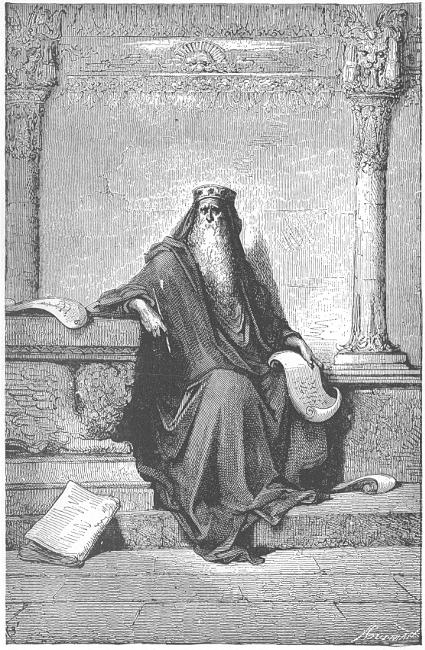
SOLOMON
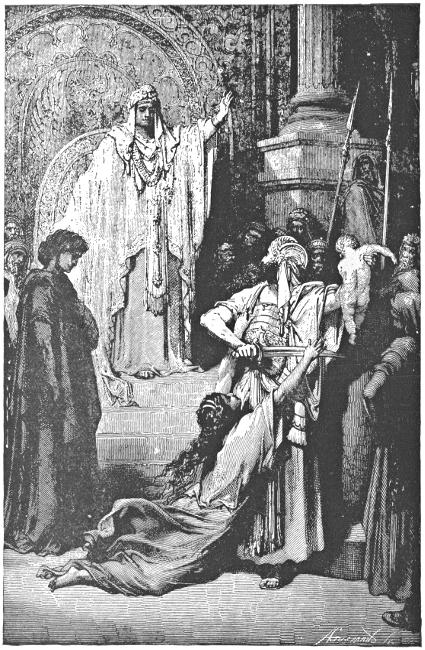
The Judgment of Solomon. I Kings, iii.
When Jehu came forth he was taunted by the servants
of his Lord; they called the young man “mad.”
From their manner, Jehu began to wonder whether the
whole affair had not been planned by themselves with a
view to befooling him by the excitement of his ambition.
He said to them, in effect:
“Ye know the man, and his communication in this
matter is one of your own arranging. Ye think to make
a fool of me, and through the intoxication of my vanity
to lead me to my ruin.”
But they denied the impeachment, and their tone so
changed that Jehu reposed confidence in them, and told
them what the man had said.
Instantly, on hearing the message, they hasted, took
every man his garment or coat, and put it under Jehu on
the top of the stairs, which they constituted a kind of
temporary throne, and then amid loud blasts of the
trumpet they cried: “Jehu is king!”
Thus Jehu was suddenly called to royalty and all its
responsibilities.
Men should be prepared for the sudden calls of providence.
“What I say unto you I say unto all: Watch.”
One is struck by the obedience of Jehu to the heavenly
call. There was no hesitation. Men but show
themselves to be yet under bondage when they hesitate
regarding the calls which God addresses to them.
Jehu was determined to make complete work of his
mission. Not one was to escape or go forth out of the
city to tell what he was about to do to those who were
in Jezreel.
Springing into his chariot and calling for a detachment
of cavalry, Jehu set out on his journey of sixty or
seventy miles. You can see him almost flying down
from Ramoth, which was about three thousand feet
above the sea level. Swiftly he crosses the Jordan, and
then, turning to the north, he fled over the spurs of
Ephraim; then he darted up the Valley of Trembling,
made famous in the day of Gideon, and finally he came
to the Plain of Esdraelon, where was Jezreel.
Jehoram was unaware of the approach of Jehu. One
messenger after another was sent out to make inquiry,
but the messengers were ordered behind, and Jehu came
forward until he and the king met at the vineyard of
Naboth.
The king asked what news was being brought—news
of peace or of war.
The question was answered with another question:
“What peace can there be so long as the idolatrous
whoredoms of thy mother, Jezebel, and her witchcrafts
are so many?”
Jehu thus referred to fundamental wrongs. Instead
of trifling with details he went straight to the fountainhead,
and by the delivery of a profoundly religious message
he excited the alarm of those who heard him.
Jehoram was weak and feeble and sought to flee, but
Jehu drew a bow with his full strength and smote between
his arms, and the arrow went out at the king’s
heart, and he sank down in his chariot.
Then Jehu ordered his captain, or squire, to take up
Jehoram and cast him into the portion of the field of
Naboth, the Jezreelite, that the word of the Lord might
be fulfilled.
And when Ahaziah, the king of Judah, saw this he
sought to flee, but Jehu followed him, saying: “Smite
him also in the chariot.” After a hot pursuit Ahaziah
was struck at the declivity of Gur, where his chariot was
forced to slacken its speed.
Then came the most tragical of all the acts.
No sooner was Jehu come to Jezreel than Jezebel,
now old and withered, heard of it, and her blood tingled
at the news. She was not one who was easily deterred.
According to the custom of Oriental ladies, Jezebel
painted her eyebrows and lashes with a pigment composed
of antimony and zinc. The intention of the dark
border was to throw the eye into relief and make it look
larger. She adorned her head with a tire, or a headdress,
and after donning her royal dress she looked out
at a window, designing to impress Jehu.
As Jehu looked up to the window he exclaimed:
“Who is on my side?” He ordered the two or three
eunuchs who looked out to throw down the painted
woman. Jehu knew that the cruel queen was intensely
hated by the palace officials.
The two or three eunuchs who had been accustomed
to crouch before her in servile dread now saw that Jehu
was in the ascendant, and in obedience to the demand of
the regicide they threw her out of the window.
Such has ever been the policy of sycophants—the
rats of court—who only linger there with a view of seeing
how much they can appropriate or destroy.
No sooner was Jezebel thrown down than some of
her blood was sprinkled on the wall and on the horses,
and she was trodden under foot.
Here, again, we see the end of wickedness. For a
time there is escape, but in the long run there is ruin.
Look at Jezebel, and learn the fate of the wicked.
No such fate, in a merely physical sense, may await the
iniquitous now; but all those intermediate punishments
simply point to the last great penalty: “The wicked
shall go away into everlasting punishment.”
One can pity Jezebel as her flesh was eaten by the
dogs and her carcass was made as dung on the face of
the field in the portion of Jezreel, and we almost shudder
with horror as we think that she was to be so torn to
pieces that none should be able to say: “This is Queen
Jezebel.”
But all this is wasted sentiment, unless we reason
from it toward spiritual conclusions.
We are so much the victims of our senses that we
can pity with great compassion those who are smitten
with bodily disease, or are torn limb from limb in consequence
of some wicked deed; but it seems impossible
for us to rise to the conception of the terrible penalty
which is to fall upon the soul for violating God’s commandments
and defying God’s power.
Instead of being appeased by the fate of Jezebel,
Jehu sends out a decree that the whole family of Ahab
shall be massacred—that the kinsmen of Ahaziah and
the Baal worshipers shall be extirpated from the face of
the Earth. He takes a new point of departure when he
challenges the sons of Ahab, saying:
“Look even out the best and meetest of your master’s
sons, and set him on his father’s throne, and fight
for your master’s house.”
All this was a declaration of warlike intention on the
part of Jehu. But Jehu’s character as a soldier was too
well known to permit the rulers of Jezreel and the elders
to entertain the thought of encountering him in open
battle. So they made this answer:
“We are thy servants, and will do all that thou shalt
bid us; we will not make any king. Do thou that which
is good in thine eyes.”
Then Jehu set up a test of their obedience. He did
impose on them hard work. He said:
“If ye be mine, and if ye will hearken unto my
voice, take ye the heads of the men your master’s sons,
and come to me to Jezreel by tomorrow this time.”
The word was enough. The heads of seventy men
were put into baskets and sent to Jehu at Jezreel. Jehu
pronounced the men who had beheaded the sons of Ahab
guiltless in respect of their deaths, because what they
did had been done judicially, under royal command.
Some think that Jehu wished to make them guilty of
the massacre of the princes, while he had slain but one
king. On the whole, however, it is better to consider
that Jehu exculpates the men who had only executed his
command.
The slaughter of the priests is one of the most dramatic
incidents in all this portion of biblical history.
Jehu proceeded by way of strategy. It is impossible to
justify the spirit of the policy of Jehu in this matter. He
said he would serve Baal “much.”
It has been thought that he was thinking of his intended
holocaust of human victims; but, whatever his
thoughts, it is impossible to deny that the impression he
produced was that Jehu was about to become a worshiper
of Baal. This reading is imported into the narrative
in these words: “But Jehu did it in subtilty, to the
intent that he might destroy the worshipers of Baal.”
Now a solemn assembly for Baal was proclaimed.
From all Israel the devotees of Baal came, so that there
was not left a man that came not. The house of Baal
was full from one end to the other. And they were all
clothed with appropriate vestments.
Jehu was careful that not one worshiper of Jehovah
should be in the assembly, but those of Baal only.
When the worshipers went in to offer sacrifices and
burnt offerings Jehu stationed fourscore men without,
and said: “If any of the men whom I have brought
into your hands escape, he that letteth him go, his life
shall be for the life of him.”
Then came the moment of massacre.
“And they smote them with the edge of the sword;
and the guard and the captains cast them out, and went
to the city of the house of Baal.”
Jehu’s guards, having completed their bloody work in
the court of the temple, hastened up the steps into the
sanctuary itself, which, like the Temple of Solomon, was
made after the pattern of a fortress.
The images of Baal were brought forth out of the
house of Baal and burned. The image of Baal was
broken down, and his house was broken down, and the
whole scene was utterly dishonored and desecrated.
“Thus Jehu destroyed Baal out of Israel.”
But the way was wrong. Perhaps, for the period
within which the destruction took place, it was the only
ministry that was possible. The incident, however, must
stand in historical isolation, being utterly useless as a
lesson or guide for our imitation.
We are called upon to destroy Baal out of Israel, but
not with sword or staff or implement of war.
“The weapons of our warfare are not carnal, but are
mighty, through God, to the pulling down of strongholds
of Satan.”
Jehu did his rough-and-ready work—a work, as we
have said, adapted to the barbaric conditions under
which he reigned. But there must be no Jehu in the
Christian Church, except in point of energy, decision,
obedience and single-mindedness of purpose. A Christian
persecution is a contradiction in terms.
When Christians see evil, they are not to assail it
with weapons of war; they are to preach against it, to
argue against it, to pray about it, to bring all possible
moral force to bear upon it, but in no case is physical
persecution to accompany the propagation of Christianity.
Not only so. Any destruction that is accomplished
by physical means is a merely temporary destruction.
There is in reality nothing in it.
When progress of a Christian kind is reported it must
not be tainted by the presence of physical severity. We
can not silence evil speakers by merely closing their
mouths. So long as we can hold those mouths there
may indeed be silence, but not until the spirit has been
changed—not until the very heart has been converted
and born again—can the evil-doer be silenced and his
mouth be dispossessed of wicked speech and filled with
words of honesty and pureness. Jehu himself was not
a good man. “From the sins of Jeroboam, the son of
Nebat, who made Israel to sin, Jehu departed not from
after them.”
For reasons of state policy, Jehu maintained the
worship of Bethel and Dan.
“But Jehu took no heed to walk in the law of the
Lord God of Israel with all his heart; for he departed
not from the sins of Jeroboam, which made Israel to sin.”
Jehu had done homage to Jehovah by extirpating the
foreign Baal worship, but he patronized and actively
supported the irregular mode of worshiping Jehovah
established by Jeroboam as the state religion of the
northern kingdom. He attempted to serve God and
Mammon. Religion was to him but a political instrument.
Jehu did the particular kind of work which had been
assigned to him—a work of destruction and blood. Perhaps
he alone of all the people of his time could have
accomplished this task. But Jehu must stand in history
as a warning rather than as an example.
Sometimes I have most clearly seen the whole tragedy
of Job in a waking dream, the whole passing before
me in twilight shadows, losing itself in thick darkness,
reappearing in light like the dawn—always changing,
always solemn, always instructive; a thing that surely
happened, because a thing now happening in all the substance
of its eternal meaning.
Is it a pillar grand in height, and finished all over
with the dainty care of an artist whose life has been
spent in learning and applying the art of color?
How stately! How Heaven seeking because Heaven
worthy! While I admire, I wonder religiously.
I see the hosts of darkness gathering around the erstwhile
flashing capital, and resting over it like midnight
sevenfold in blackness; then the lightning gleams from
the center of the gloom, then the fire-bolt flies forth and
smites the coronal once so glorious, and dashes it in hot
dust to the Earth, and the tall stalk—so upright, so delicate,
so like a well-trained life—reels, totters and falls
in an infinite crash!
Is it true?
Every word of it. True now—may be true in thee
and me, O man, so assured of stability and immovableness.
There is danger in high places. Is there a Spirit
which hates all noble-mindedness and seeks to level the
spiritual pile with mean things? Evil Spirit! The very
Devil—hating all goodness because hating God!
But stop.
After all, who smote the pillar? Whose lightning
was used to overthrow the fair masonry?
O God of gods, the devil’s Creator and Master, without
whom Satan could not be, nor hell, nor trees forbidden,
nor blast of death—O Mystery of Being—what can
our souls say in their groaning? And how, through
anguish so intolerable, can they pray?
I am afraid to build, because the higher the tower
the more deadly the fall. Dost Thou watch our rising
towers and delight to rain Thy fires on them, lest our
pride should abound and our damnation be aggravated by
our vanity?
And God’s own Book it is that tells the good man’s
pains, and that revels in swelling rhetoric over the rottenness
and despair of the man who feared God and
eschewed evil! And what unguided hands—if hands
unguided—set the tale of wrong and woe and sorrow
next to the very Psalter? Is not the irony immoral, because
cruel? Or is there meaning in all this?
Is it Life’s story down to the very letter and jot of
reality? How better to come out of the valley than to
the harping and song of musicians who have known the
way of the Almighty and tasted the counsels of Heaven?
Cheer thee, O poor soul! Thou art today miserable
as Job, but tomorrow thou mayest dance to the music of
David. Tomorrow thou mayest have a harp of thine
own.
A tree of the Lord’s right hand planting arises loftily
and broadly in the warm air. Birds twitter and sing as
they flit through its warp and woof of light and shade.
It is a tree whose leaves might heal the nations.
What sudden wind makes it writhe? What Spirit
torments every branch and leaf? What Demon yells in
triumph as the firm trunk splits and falls in twain? Was
it grown for such a fate as this?
Better if the seed had been crushed and thrown into
the fire than that it should have been thus reared and
perfected and then put to shame among the trees of the
field.
Who can give speech to this flood as it plunges from
rock to rock in the black night time? Hush! There is
a man’s voice in the infinite storm: “Let the day perish
in which I was born! Let it be darkness; let that
night be joyless, let no song enter into it; let them who
curse the day stigmatize it who are ready to stir up the
leviathan. Why died I not from the womb? Then had
I lain down and been quiet; I had slept; … there
the wicked cease from troubling, and there the wearied
mighty rest; the prisoners sweetly repose together, they
hear not the voice of the exactor, and the slave is free
from his lord.”
These are human words, but are they not too strong,
too rhetorical, to be true?
No! For who can mechanize the rhetoric of woe?
“Why is life given to the miserable, and to one who
would be blithe to find a grave? I have no quiet, no
repose, for trouble on trouble came, and my sighs gush
out like waters long dammed back.”
No doubt the rhetoric is lofty, yet with a strange
familiarity it touches with happy expressiveness all that
is most vivid in our remembrance of woe.
“I loathe my life. I will give loose to my complaint.
I will speak in the bitterness of my soul. To God I will
say: ‘Condemn me not. Show me why Thou contendest
with me. As the clay Thou hast fashioned me, and
to dust Thou causest me to return. Thou hast poured
me as milk and compacted me as cheese. As a fierce
lion Thou huntest me; then Thou turnest again and
showest Thyself marvelous.’”
Job has found fit words for all mourning souls. So
they borrow of him when their own words fail like a
stream which the Sun has dried up. What woe the poor
little heart can feel! Herein is its greatness. It is, in
its own way, as the heart of God.
“Truly, now, He hath worn me out. Thou hast
made all my household desolate, and Thou hast shriveled
me up. God giveth me up to the ungodly, and flingeth
me over into the hands of the wicked. He seized me by
the throat and shook me. He breacheth me with breach
on breach. He rusheth on me like a man of war.”
In what good man’s sick chamber is not Job welcome?
Welcome because he can utter the whole gamut
of human woe. He can find words for the heart that is
ill at ease, and prayers for lips which have been chilled
and silenced by unbelief. His woe belongs to the whole
world. All other woe is as the dripping of an icicle compared
with the rush of stormy waters.
In the case of Job the internal is proved to be greater
than the external. When the trials came one after another
like shocks of thunder, “in all this Job sinned not,
nor charged God foolishly.”
But did he speak? That is the point. If he did not,
perhaps he was dazed. He felt a tremendous blow on
the forehead, and he reeled, and was not in a condition
to bear witness about the matter. If he said any thing,
let us know what he did say. Could he speak in that
tremendous crisis?
Yes, he spoke. His words are before us. Like a
wise man, he went back to first principles. He said:
“Circumstances are nothing; they are temporary
arrangements. The man is not what he has, but what
he is. I do not hold my life in my hands, saying ‘It
weighs so much,’ and count up to a high number.”
Job went back to first principles—back to elementary
truths. He said:
“Naked came I out of my mother’s womb, and
naked shall I return thither [that is, as I began]. The
Lord gave, and the Lord hath taken away [as He had a
right to do; I had nothing of my own]. Blessed be the
name of the Lord.”
Could Job look over the ages that have been healed
and comforted by his example—stimulated to bear the
ills of this life by the grateful memory of his invincible
patience—surely, even now, in Heaven, he would be
taking the reward of his long-continued and noble endurance
of the divine visitation.
It may be so with you, poor man or woman. You
do not get all the sweet now. This shall be a memory
to you in Heaven, long ages hence. The wrestling you
have now may minister to you high delight, keen enjoyment
and rapture pure and abiding. Who can tell when
God’s rewards end? Who will venture to say: “This
is the measure of His benediction?”
God is able to give and to do abundantly beyond all
that we ask or think. Should any one inquire of you as
to your compensation, say: “It is given by instalments—today
and tomorrow, in death; in the resurrection, all
through the ages of eternity. Ask me thousands of ages
hence, and I will reply to your question concerning compensation.”
Life is not limited by the cradle and the tomb, and
it is not between these two mean and near points that
great questions are to be discussed or determined.
Job has been read by countless readers. His was, of
course, a public trial—a tragedy that was wrought out
for the benefit of multitudes in all generations. Nevertheless,
it is literally and pathetically true that every
man, even the most obscure, has his readers—fewer in
number, it may be, but equally earnest in attention.
Think you that your children are not taking notice of
you—seeing how you bear your temptations, difficulties
and anxieties?
Think you not that your eldest boy is kept away from
the table of the Lord because you are as atheistic in sorrow
as ever Voltaire was?
Do you know that your daughter hates the church
because her pious father is only pious in the three Summer
months of the year? He curls under the cold and
biting wind as much as any Atheist ever did. Therefore,
the girl says: “He is a sham and a hypocrite—my
father in the flesh, but no relative of mine in the spirit.”
You have your readers. The little Bible of your life
is read in your kitchen, in your parlor, in your shop and
in your warehouse; and if you do not bear your trials,
anxieties and difficulties with a Christian chivalry and
heroism, what is there but mockery on Earth and gloating
in hell?
May God give us grace to bear chastisement nobly
and serenely; bless us with the peace which passeth
understanding—with the quietness kindred to the calm of
God; help us when death is in the house, when poverty
is on the hearth-stone.
When there is a storm blinding the only poor little
window we have, let us say: “Though He slay me, yet
will I trust in Him. If I perish I will pray, and perish
only here.” That is Christianity—not some clever chatter
and able controversy about metaphysical points; but
noble temper, high behavior, faultless constancy and an
invincible fortitude in the hour of trial and in the agony
of pain.
Micaiah was the son of Imlah, a prophet of Samaria,
who, in the last year of the reign of Ahab, king of Israel,
predicted his defeat and death, B. C. 897. This was
three years after the great battle with Ben-hadad, king
of Syria, in which the extraordinary number of 100,000
Syrian soldiers is said to have been slain, without reckoning
the 27,000 who, it is asserted, were killed by the
falling of the wall at Aphek.
Ahab had proposed to Jehoshaphat, king of Judah,
that they should jointly go up to battle against Ramoth-gilead,
which Ben-hadad was bound by treaty to restore
to Ahab.
Jehoshaphat assented in cordial words to the proposal,
but he suggested that they should first “inquire
at the word of Jehovah.” Accordingly, Ahab assembled
four hundred prophets, while in an open space at the
gate of the city of Samaria he and Jehoshaphat sat in
royal robes to meet and consult them.
The prophets gave a unanimously favorable response.
Among them was Zedekiah, the son of Chenaanah. He
made horns of iron as a symbol, and announced, as from
Jehovah, that with those horns Ahab would push the
Syrians till he consumed them. For some reason which
is unexplained, and can now only be conjectured, King
Jehoshaphat was dissatisfied with the answer, and asked
if there was no other prophet of Jehovah at Samaria.
Ahab replied that there was yet one—Micaiah, the
son of Imlah; but in words which obviously call to mind
a passage in the “Iliad” (i. 106), he added: “I hate
him, for he does not prophesy good concerning me, but
evil.”
Nevertheless, Micaiah was sent for; and after a vain
attempt had been made to tamper with him, he first expressed
an ironical concurrence with the four hundred
prophets, and then boldly foretold the defeat of Ahab’s
army and the death of Ahab.
In contradiction of the false four hundred, Micaiah
said he had seen Jehovah sitting on His throne, and all
the host of Heaven standing by Him—on His right hand
and on His left. He said Jehovah asked: “Who shall
persuade Ahab to go up and fall at Ramoth-gilead?” A
Spirit came forth and volunteered to do so. On being
asked “Wherewithal?” the Spirit answered that he
would go forth and be a lying Spirit in the mouth of all
the prophets.
Irritated by the account of this vision, Zedekiah
struck Micaiah on the cheek.
Then Ahab ordered that Micaiah be taken to prison,
and be fed on bread and water till his return to Samaria.
But Ahab was killed, and Micaiah’s fate is unknown.
This incident is found in both the first Book of Kings
and in the second Book of Chronicles.
The Cross From the Painting by Gustave Dore.
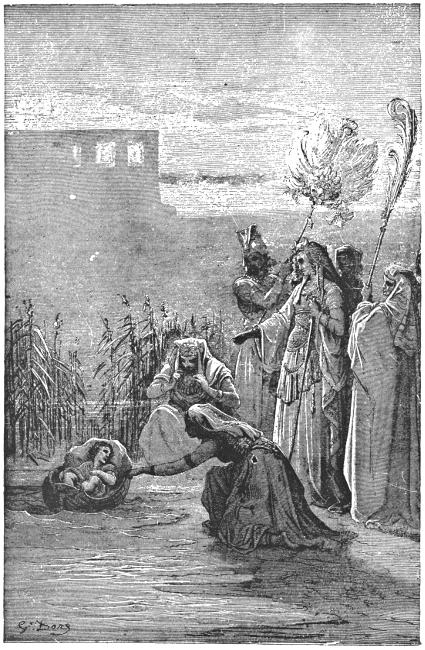
MOSES IN THE BULRUSHES.—Exodus, ii.
Moses loses nothing by diffuseness. Even in days
that were made long by intolerable monotony—in which
men lived centuries because of weariness—Moses did not
shrink from a condensation unparalleled in human literature.
Considered as embracing the history of one month
only, the third Book of Moses may claim to be the most
remarkable book in the Old Testament. Containing
twenty-seven chapters, ranging its contents under sixteen
different categories, and requiring to be actively represented
within the space of twenty-eight days—it may, in
its own degree, claim an energy not inferior to the Book
of Genesis.
The same fearlessness of treatment is distinctive of
both books. The reverent audacity which represented
creation as the work of six days—whatever the measure
of a day may be—did not shrink from focalizing into one
month the whole discipline of life.
Moses’ words could hardly have been fewer if he had
lived in our time of feverish haste and tumult. To put
up the Heavens and the Earth in one chapter was a
miracle in authorship. Yet, well pondered, it was the
only thing to be done. Any poet could have built them
in endless stanzas, and any philosopher could have begun
the infinite story in a book too large for the world to
hold.
Moses chose the more excellent way, creating creation
with a swiftness that has dazed a literal criticism
ever since—literal criticism that has but one season in
its dreary year, a year that knows nothing of snow-blossom
or wedded light and song. But this very haste was
part of the man.
The Moses of Poetry required fifty-one days for the
revolution of his “Iliad”; the Moses of Revelation
only took a week for the settlement of the Heavens and
the Earth, and in that week he found one whole day of
rest for the Creator.
This action was entirely characteristic of Moses, for
he was the most wrathful man as well as the meekest—killing,
smiting, destroying and burning with anger, as
well as praying like the father-priest of his people.
In a sense obvious enough he was the protoplastic
Christ—for was not he who described himself as “meek
and lowly in heart” the scourger of trespassers, and did
he not burn the religious actors of his day?
Moses and Christ both did things with most startling
rapidity. In their very soul they were akin. They were
“straitened” until their work was “accomplished.”
The Pentateuch and the Gospels have action enough in
them to fill innumerable volumes, yet there is an infinite
calm in both—the haste being in the temporary framework,
the calm being in the eternal purpose.
Think of these twenty-seven chapters constituting
the discipline of one month! The reflections started by
this circumstance culminate in a sense of pain, for who
can bear this grievous toil or endure this sting of accusation?
There is no respite.
Egyptian burdens were for the body, but these wilderness
exactions tormented the soul, and by so doing
made Egyptian memories bright. The trial of muscle is
nothing to the trial of patience. Men may sleep after
labor, but an unquiet conscience keeps the eyes wide
open. This discipline afflicted both the body and the
soul, and thus drained the entire strength of the people.
This conscious toil must have been accompanied by
unconscious inspiration—a reciprocal action impossible
in theory but well understood in spiritual experience.
We resume our burdens in the very act of dreading
them. We pray the next prayer in the very process of
waiting for answers to a thousand prayers to which God
has paid no known heed. Yesterday’s sacrifice has nothing
to do with this day’s sin, except to remind us that
today must provide its own sacrifice.
This was so with the Jews; this is precisely so with
ourselves. Yet we boast our liberty, and suppose that in
leaping one inch from the Earth we have broken the
tether of gravitation.
As put before us in this manual called Leviticus, the
discipline of the month seems to be more than we could
endure; and this we say in ignorance of the fact that
our own manual imposes a more severe discipline. Our
pity for the Jews arises out of the apparently ineradicable
sophism that spiritual service is easier than bodily
exercise. A most deadly sophism is this, and prevalent
yet, notwithstanding the rebuke and condemnation of
universal history.
In no spiritual sense is Leviticus an obsolete book.
Moses is not dead. The inventors of the alphabet have
some rights even in “Paradise Lost,” and quite a large
property in “Euclid.” It is not grateful on our part to
forget the primers through which we passed to the encyclopedias,
though their authors were but our intellectual
nurses. In no mere dream was Moses present when
Christ communed with Him concerning the Exodus that
was to be accomplished at Jerusalem, and in no dramatic
sense did Elijah watch the consummation of prophecy.
The wonder is that Christians should be so willing to
regard the Pentateuch as obsolete. This is practically a
foregone conclusion—to such an extent, certainly, that
the Pentateuch is tolerated rather than studied for edification
by the rank and file of Christians.
Without the Pentateuch, Christ as revealed in the
Gospels would have been impossible; and without Christ
the Pentateuch would have been impossible.
I venture upon this proposition because I find no
great-event in the Pentateuch that is not for some purpose
of argument or illustration used by Christ or by His
disciples and apostles in the interests of what is known
as evangelical truth.
It lies within easy proof that Christ is the text of the
Old Testament and that the Old Testament is the text
of Christ. What use is made in the New Testament of
the creation of the universe, the faith of Abraham, the
rain of manna, the lifting up of the serpent and the
tabernacle of witness! The sublime apology of Stephen
epitomizes the Old Testament, and the Epistle to the
Hebrews could not have been written but for the ritual
of Exodus and Leviticus. In its purely moral tone the
Old Testament is of kindred quality with the New.
Take an instance from Leviticus. Three forms of evil
are recognized in one of its most ardent chapters—namely,
Violence, Deceit and Perjury. This is a succession
amounting to a development, and, unwittingly it
may or may not be, confirming that law of evolution
which is as happily illustrated in morals as in physics.
Men begin with acts of violence, then go on to silent
deceit and calculation, and close with a profanation of
the holiest terms. The early sinners robbed gardens and
killed brothers; the later sinners “agreed together” to
“lie unto God.” It is something, therefore, to find in
so ancient a book as Leviticus recognition of an order
which is true to philosophy and to history.
But the proof that Moses and Christ are identical in
moral tone is to be found in the process which offenders
were commanded to adopt. By no sacerdotal jugglery
was the foul blot to be removed; by no sigh of selfishness
could the inward corruption be permitted to evaporate;
by no investment of cheap tears could thieves
compound for felony.
First, there must be restoration; second, there must
be an addition of a fifth part of the whole; third, the
priest must be faced as the very representative of God
and a trespass offering be laid on the altar. After atonement
forgiveness would come—a white angel from
Heaven—and dwell in the reclaimed and sanctified heart.
All the past would be driven away as a black cloud and
all the present filled with a light above the brightness of
the Sun.
What is this but an outline or forecast of what Christ
said when He drove the hostile and vindictive man from
the altar, bidding him first be reconciled with his brother
and at peace with society? Christianity is not a substitute
for morality; it is morality inspired, glorified and
crowned. Say that the ritual was sanitary rather than
doctrinal or theological. What then? All divine things
are first sanitary, but not necessarily bounded by that
term.
It will be found that the practice of genuine cleanness,
chemical as well as mechanical, will be followed by
a philosophy, and that the morality of cleanness will be
followed by a theology.
Accustom a man to look out for bullocks and rams
and lambs “without blemish,” and he will find that he
can not stop at that point. He has begun an education
which can only culminate in the prayer: “Create in
me a clean heart, O God, and renew a right spirit within
me.” Yet no word of that holy thought was named in
the original instructions.
Leviticus is the gospel of the Pentateuch—glistening
with purity, turning law into music and spreading a banquet
in the wilderness. But its ritual is dead. This is
hard to believe—hard because religious vanity is fond of
ritualism, which makes no demand on the conscience.
Yet ritualism had a divinely appointed function in the
education of the awakening mind, and was the only influence
which could hold the attention of a people to
whom freedom was a new experience.
Spectacular religion is alphabetic religion; therefore,
to revert to it is to ignore every characteristic and impulse
of manhood and progress. But they who say so
be prepared to complete the philosophy which that contention
initiates.
It is not enough to dismiss ritualism on the ground
that it has been displaced by spiritual worship. Admit
that such is the case, and other and broader admissions
are involved in the plea, and can only be shirked at the
expense of consistency.
It is generally admitted, for example, that the Old
Testament law has been displaced by a New Testament
principle. So Ritualism and Law, in their ancient forms,
have passed away. But let us be careful. When we
say Ritualism and Law, we mean in reality the letter,
and it is evident that if any one letter can be displaced
every other letter may be outlived and completed. And
what is “the letter” but a symbol of flesh—visibleness,
objectivity, historic fact and bulk?
Apostle Paul went so far as to say that even Christ
was no longer known “after the flesh”—yea, though He
had been known after the flesh, that kind of knowledge
was for ever done away, and another knowledge had permanently
taken its place.
The Church has never adopted the whole meaning of
that teaching. Willing enough to consign Leviticus to
the shades, the Church still clings to some sort of bodily
Christ—the figure of a man—a bulk to be at least imaginatively
touched. This is easily accounted for without
suggesting superstition, and yet it might be done away
with without imperiling faith. We are held in bondage
by a mistaken conception of personality. When we
think of that term we think of ourselves.
But even admitting the necessity of this, we may by
a correct definition of personality acquire a higher conception
of our own being. Instead of saying personality
is this or that, after the manner of a geometrical figure,
binding it to four points and otherwise limiting it, say
that personality is the unit of being, and instantly every
conception is enlarged and illuminated—the meaning
being that personality is the starting point of conscious
existence; not the fullness, but the outline; not the
maximum, but the minimum; the very smallest conception
which the mind can lay hold of—the Euclidic point,
to be carried on into ratios and dimensions which originate
a new vocabulary.
We do not, then, define “God” when we describe
Him as a “Person,” but we merely begin to define Him;
in other words, we say that God can not be less than a
Person. What more He is, we must gradually and adoringly
discover.
So far as Christ is concerned, there is one enlargement
of His personality which no school of thinkers will
dispute. This is rhetorically expressed by M. Renan,
when he says of Jesus:
“A thousand times more living, a thousand times
more loved, since Thy death than during the days of Thy
pilgrimage here below, Thou wilt become to such a degree
the Corner-Stone of humanity that to tear Thy name
from this world would be to shake it to its foundations.”
If ritualism has been displaced by spirituality, and if
law has been suspended by a principle—in other words,
if the local has made way for the universal—why shrink
from the admission that limited Personality has been exchanged
for unlimited Influence?
How would Moses regard nineteenth century worship—say,
of a Low Church and Evangelical type, as the
true evolution of Leviticus? Where is the resemblance?
The eye that can see the similitude is surely looking
through an adapted medium. Yet the mystery would be
dissolved if the Book of Leviticus were not open to reference.
The man is the completion of the child, but the child
is no longer in existence.
The fruit is the fulfillment of the blossom, but the
blossom is no longer available for comparison and for
contrast.
Christianity is the consummation of Leviticus, but
Leviticus remains—unlike the child and the blossom—and
offers a series of dissonances or dissimilarities of the
most positive quality.
Yet if Moses were living now he would be unchurched
if he refused to identify the meaning of Leviticus in the
service of the Christian sanctuary—the Papist nearest in
gorgeousness, the Protestant claiming to be nearest in
doctrine.
The Nonconformist Moses, in the absence of inspiration,
would in this matter be the arch-heretic of the
century.
The moral character of Nebuchadnezzar is not such
as entitles him to our approval. Besides the overweening
pride which brought on him such terrible chastisement,
we note a violence and fury common enough in
Oriental monarchs of the weaker kind, but from which
the greatest of them have usually been free; while at the
same time we observe a cold and relentless cruelty that
is particularly revolting. The blinding of Zedekiah may
possibly be justified as an ordinary Eastern practice,
though it is the earliest case of the kind on record; but
the refinement of cruelty by which he was made to witness
his sons’ execution before his eyes were put out was
more worthy of a Dionysius or a Domitian than of a
really great king.
Again, the detention of Jehoiachin in prison thirty-six
years for an offence committed at the age of eighteen
is a severity surpassing Oriental harshness.
Against these grave faults we have nothing to set,
unless it be a feeble trait of magnanimity in the pardon
of Shadrach, Meshach and Abednego—when he found
that he was without power to punish them.
It has been thought remarkable that to a man of this
character God should have vouchsafed a revelation of
the future by means of visions. But the circumstance,
however it may disturb our preconceived notions, is not
really at variance with the general laws of God’s providence,
as revealed to us in Scripture.
As with His natural gifts, so with His supernatural
gifts—they are not confined to the worthy. Even under
Christianity, miraculous powers were sometimes possessed
by those who made an ill use of them. And God,
it is plain, did not leave the old heathen world without
some supernatural aid, but made His presence felt from
time to time in visions, through prophets, or even by a
voice from Heaven.
It is only necessary to refer to the histories of Pharaoh,
Abimelech, Job and Balaam in order to establish
the parity of Nebuchadnezzar’s visions with other facts
recorded in the Bible. He was warned, and the nations
over which he ruled were warned through him, God leaving
not Himself “without witness” even in those dark
times.
Abydenus, a heathen writer who generally drew his
inspiration from Berosus, ascribes to Nebuchadnezzar a
miraculous speech just before his death, announcing to
the Babylonians the speedy coming of “a Persian mule,”
who, with the aid of the Medes, would enslave Babylon.
The Queen of Sheba is a model to all inquirers. It
was not enough for her to have heard of the fame of
Solomon and to have admired him at a distance as a
unique genius. Her admiration excited her interest and
suspicion, and, being a woman of penetrating mind, she
desired to put riddles and enigmas whereby she could
test the proverbial wisdom of Solomon.
When she arrived at his court she did not put flippant
questions to King Solomon. She rather sought out the
most difficult inquiries which she could possibly make.
It is recorded that Solomon told the queen all her
questions, and there was nothing hid from Solomon
which he told her not. She was astounded by what she
heard and what she saw. She declared that the half had
not been told her.
The visit of the Queen of Sheba to Solomon, though
not strictly commercial, arose out of commercial intercourse.
The territory of Sheba, according to Strabo,
reached so far north as to meet that of the Nabathæans,
although its proper seat was at the southernmost angle
of Arabia.
The very rich presents made by the queen show the
extreme value of her commerce with the Hebrew monarch.
This early interchange of hospitality derives a
peculiar interest from the fact that in much later ages—those
of the Maccabees and downward—the intercourse
of the Jews with Sheba became so intimate and their influence
and power so great. Jewish circumcision took
root there, and princes held sway there who were called
Jewish.
The language of Sheba is believed to have been very
different from the literate Arabic; yet, like the Ethiopic,
it belonged to the great Syro-Arabian family, and was
not alien to the Hebrew in the same sense that the
Egyptian language was.
The great ease with which the pure monotheism of
the Maccabees spread itself in Sheba gives plausibility
to the opinion that even at the time of Solomon the people
of Sheba had much religious superiority over the
Arabs and Syrians in general. If so, it becomes clear
how the curiosity of the southern queen would be worked
on by seeing the riches of the distant monarch, whose
purer creed must have been carried everywhere with
them by his sailors and servants.
“So Jeroboam and all Israel came and spake to
Rehoboam, saying: ‘Thy father made our yoke grievous.
Now, therefore, ease thou somewhat the grievous
servitude of thy father, and his heavy yoke that he put
upon us, and we will serve thee.’”
A cause so stated must succeed. There will be difficulty,
but the end is assured.
The reasonable always triumphs, due time being
given for the elucidation of its purposes and the manifestation
of its real spirit. Violence can have but a short
day; the tempest cries itself to rest.
The speech of this man was a speech strong in reason.
“Ease thou somewhat the grievous servitude of
thy father, and his heavy yoke that he put upon us, and
we will serve thee.” They wanted ease for service—for
loyalty. Where there is no ease how can there be homage,
thankfulness, devotion or any of the high qualities
of patriotism?
Men who are not disquieted are prone to tell others
to bear their burdens uncomplainingly. We ought to
hear what they have to say who feel the iron. Our inquiry
should be: “How does it suit you? What is the
effect of the piercing iron on the soul? How does manhood
bear the heel of oppression?”
The sufferers should sometimes be admitted to the
witness-box.
There is a danger lest our personal comfortableness
should disqualify us for judging the case of down-trodden
men.
Wherever there is weakness the Christian Church
should be found. Wherever there is reasonableness the
Christian sanctuary should offer hospitality. The Christian
sanctuary ceases to be the Tabernacle of God among
men when it shuts its door on the cries of reason, the
petitions of weakness, the humble requests of those who
ask for nothing exaggerated, but simply ask to have their
misery mitigated somewhat, that their loyalty may be of
a larger and better quality. The names are ancient, but
the circumstances may be painfully modern.
It is the peculiarity of the Bible that it is always getting
in our way. It has a word on every subject. Is
there any thing more detestable than that a man who has
his own way seven days a week, whose footsteps are
marked by prosperity, whose very breathing is a commercial
success, should stand up and tell men who are
bleeding at every pore to be quiet and contented, and
not create disturbance in the body politic?
If Jeroboam had come with a petition conceived in
another tone it ought to have been rejected. It would
have been irrational, violent and contemptuous; but the
reasonableness of the request will insure its victory in
the long run.
How easy it is to think of Rehoboam as the foolish
son of a wise father! But are we not unjust to the son
in so regarding him? Was Solomon the wise man he is
often made out to be? The answer would be: “Yes—No.”
There was no greater fool than Solomon; and he
attained his supremacy in folly because there was no man
so wise. “If the light that is in thee be darkness, how
great is that darkness!” “How art thou fallen from
Heaven, O Lucifer, son of the morning!” If he had
not been son of the morning some shallow pit might have
held him; but, being son of the morning and detaching
himself from the gravitation of God, the pit into which
he falls is bottomless.
Pliny says no man can be always wise. That is true
philosophically and experimentally; for all men have
vulnerable heels, or are exposed to temptations to lightness
of mind, amounting in some instances almost to
frivolity. They are also the subjects of a most singular
rebound, which makes them appear the more frivolous
because when we last saw them they were absorbed in
the solemnity of prayer.
Solomon was not wise in this matter of government.
The history shows that the people were appealing, not
against Rehoboam, who had yet had no opportunity of
proving his quality as a king, but against his father.
“Thy father made our yoke grievous.” We are prone
to copy the defects of our ancestors and our idols rather
than their excellences.
Folly has often more charms for us than wisdom.
When Diogenes discoursed of philosophy his auditors
turned away from him, but when he began to play frivolous
music or to sing frivolous songs the crowds thronged
about him, and he said: “Ye gods! How much more
popular is folly than wisdom!” Even there he spoke as
a philosopher.
Rehoboam made a cautious reply, and therein he
began well. He said to the petitioners: “Come again
unto me after three days.” This looked hopeful.
King Rehoboam utilized the interval by taking counsel
with “the old men who had stood before Solomon,
his father, while he yet lived, saying: ‘What counsel
give ye me to return answer to this people?’ And they
spake unto him, saying: ‘If thou be kind to this people
and please them, and speak good words to them,
they will be thy servants for ever.’”
Rich is the king whose old men talk in such a strain.
They were patriots and philanthropists and philosophers;
they were Christians before the time.
Marvelous is the power of kindness. They will do
most in life who are most considerate. They may be
charged with sentimentalism by those who do not understand
the power of human feeling, but they will be given
credit for philosophy by men who understand the genius
of sympathy.
What a message would this have been to return to
the complaining people! If, when the people returned
after three days, Rehoboam had spoken so, the welkin
would have rung with the resonant cheers of a delighted
and thankful people. Kindness is not weakness.
But Rehoboam forsook the counsel which the old men
gave him, and took counsel with the young men who had
been brought up with him and who stood before him.
He asked them the same question he had asked the old
men. Their answer was:
“Say unto them: ‘My little finger shall be thicker
than my father’s loins. For, whereas my father put a
heavy yoke upon you, I will put more to your yoke. My
father chastised you with whips, but I will chastise you
with scorpions.’”
Woe to the nation whose young men talked so! A
young oppressor is an infant devil. Young men talking
so will ruin any occasion.
Are there such things in history as retorts, reprisals,
rebounds and consequences? Let it be known and laid
down as the basic principle of all action—social, ecclesiastical
and imperial—that there is no right of tyranny.
It might be supposed that the king had taken a most
patriotic course in consulting the young and the old. He
had done nothing of the kind. He had omitted to consult
Him who had called his house to the royalty.
Rehoboam should have consulted the King Maker
whose throne is on the circle of the Earth, whose scepter
touches the horizon and whose will is the law of both
monarchy and commonwealth.
The greater the man, the nearer should he stand to
God; yea, he should be within whisper-reach of the
Lord of lords, asking Him in every crisis of national history
what Israel ought to do—what the country ought to
answer—what is the will of Heaven.
Rehoboam answered the people roughly, and forsook
the counsel of the old men. “So the king hearkened
not unto the people.”
The Gospel never gives liberty to oppression. Employers
may adopt this course if they please, but they
will find it end in ruin. We must recognize the difference
between employing cattle and employing men. A
parent may adopt this course of Rehoboam, if he so
chooses, but his children will chastise him and sting him
with many a disappointment; or, if he does not live to
see the wreck of their manhood, they will execrate his
unfragrant memory.
Rehoboam will be punished; have no fear of that.
“With what measure ye mete, it shall be measured to
you again.” You can make your whips thongs of scorpions,
but on your own back shall the lacerating lash be
laid; you can play the fantastic trick before high Heaven
and make the angels weep, but the bitterness shall be
yours. The triumphing of such a policy is short, and
the end is everlasting punishment.
Shishak was a king of Egypt contemporary with
Jeroboam, to whom he gave an asylum when he fled
from Solomon. This was indicative of his politic disposition
to encourage the weakening of the neighboring
kingdom, the growth of which under David and Solomon
was probably regarded by the kings of Egypt with some
alarm.
After Jeroboam had become king of Israel, and probably
at his suggestion, Shishak invaded the kingdom of
Judah (B. C. 971) at the head of an immense army, and
after having taken the fortified places advanced against
Jerusalem.
Satisfied with the submission of Rehoboam and with
the immense spoils of the Temple, the king of Egypt
withdrew without imposing any onerous conditions on
the humbled grandson of David.
Shishak has been identified as the first king of the
twenty-second or Diospolitan dynasty, the Sesonchis of
profane history. His name has been found on the Egyptian
monuments in the form of Sheshonk. He is said to
have been of Ethiopian origin, and it is thought that,
with the aid of the military caste, he dethroned the
Pharaoh who gave his daughter to Solomon.
The first prominent scene in the reign of Solomon is
one which presents his character in its noblest aspect.
There were two holy places which divided the reverence
of the people—the ark and its provisional tabernacle at
Jerusalem and the original Tabernacle of the Congregation,
which, after many wanderings, was then pitched at
Gibeon.
It was thought right that the new king should offer
solemn sacrifices at both.
After those at Gibeon there came that vision of the
night which has in all ages borne its noble witness to the
hearts of rulers.
Not for riches, long life or victory over enemies did
the son of David—then, at least, true to his high calling,
feeling himself as “a little child” in comparison with
the vastness of his work—offer his supplications, but for
a “wise and understanding heart,” that he might judge
the people.
The “speech pleased the Lord.”
There came in answer the promise of a wisdom “like
which there had been none before—like which there
should be none after.” So far all was well. The prayer
was a right and noble one. Yet there is also a contrast
between it and the prayers of David which accounts for
many other contrasts.
The desire of David’s heart is not chiefly for wisdom,
but for holiness. He is conscious of an oppressing evil,
and seeks to be delivered from it. He repents and falls,
and repents again.
Solomon asks only for wisdom. He has a lofty ideal
before him, and seeks to accomplish it, but he is as yet
haunted by no deeper yearnings, and speaks as one who
has no need of repentance.
Then began Solomon’s marvelous development as a
builder and statesman.
He was not content to build the house of the Lord
alone. This is a remarkable circumstance, as illustrating
the spirit which is created and sustained by all truly
religious exercises. It would have been ambition enough
for any man religiously uninspired to have erected such
an edifice as the Temple. Most men are contented to do
one thing, and to rest their fame on its peculiar excellence.
Having completed the house of the Lord and his own
house, Solomon began to build the cities which Huram
had restored to him, and to cause the children of Israel
to dwell there.
A religion that ends only in ceremony building is little
better than a superstition. No man can be zealously
affected in the interests of the Church without having
his whole philanthropic spirit enlarged and ennobled, so
that he may become a builder of cities as well as a
builder of churches. It must be remembered, on the
other hand, that he who builds a synagogue really helps
to build the town in which it is located. A synagogue,
temple or church is not to be looked on in its singularity,
as if it were so many walls, with so many doors and so
many windows. A church is a representative institution,
through which should flow rivers that will fertilize all the
districts of the city—rivers of knowledge, rivers of charity,
rivers of brotherhood, rivers of co-operation—so
that men should turn to the Church, assured that every
rational and healthy expectation would be satisfied by its
provisions.
Having completed for the time being the measure of
building on which his mind was set, Solomon went forth
to war.
It would seem as if, in ancient days, kings could not
be satisfied to dwell at peace. Even Solomon, whose
very name signifies peace, had in him the military spirit
which was characteristic of his race and time; it was in
him, indeed, as the word of the living God. Solomon
did not go forth to war for the sake of war; he believed
he was obeying a divinely implanted instinct, or carrying
out to the letter some divinely written law.
Having passed through another military period, King
Solomon began once more to build. He built Tadmor,
and all the store cities; he built Beth-horon the Upper
and Beth-horon the Lower, and fenced cities with walls,
gates and bars.
A busy time it was in the reign of Solomon. But
even all this building is not without its suggestion of a
corresponding evil.
Why were the cities fenced? Why the gates? Why
the bars? We have instances of the same kind in our
own civilization—silent witnesses against the honesty of
the society in which we live. Every bolt on the door is
a moral accusation; every time we turn the lock we
mean that there is an enemy outside who may endeavor
to violate the sanctity of the house.
We sometimes forget the moral suggestiveness even
of our commonest institutions and plans of procedure.
Every precaution that is taken for our preservation implies
the presence of hostile elements in the society that
is round about us.
Solomon may be taken in this instance as representing
the great doctrine that men should seek first the
kingdom of God and His righteousness, and afterward
attend to minor matters, or even leave those minor matters
to the adjustment of providence.
Solomon is represented as first most anxious about
the Temple, giving himself wholly to its erection, occupying
his thoughts night and day, turning every thing to
account in its relation to the Temple. Having finished
that marvelous structure, he was prepared to descend to
other levels and do the commoner work which lay to his
hand.
Many persons leave the temple half finished. What
wonder if they go out to the war and return wounded
and disabled? Our religious purposes are broken off.
What wonder if our political ends pierce us and sting us
by way of retribution?
“But of the children of Israel did Solomon make no
servants for his work; but they were men of war, and
chief of his captains, and captains of his chariots and
horsemen.”
The statesmanship of Solomon is as distinctly proved
by this arrangement as by any thing we have yet seen in
his whole policy. Solomon knew that one man was not
as good as another, however much democratic philosophy
may have endeavored to prove the contrary. One man
is a genius, but another man is a slave—an imitator, a
hewer of wood; very serviceable, and in fact indispensable,
but not adorned with the very highest excellence and
dignity of mind.
Solomon made a distribution of classes, saying in
effect that some men can do the drudgery, some men can
dig and build, some can pull down and take away and
make ready for the exertions of others; the higher class
of men can think and direct, for they are inspired with
the genius of administration, and are men of powerful
mind, of fertile resources in government and in war. So
Solomon made the best use of the material at his disposal—not
getting great men to do small work or setting
small men to fail in great work.
Adaptation is the secret of success. For want of
knowing this, many men fail in life.
There are employers who are making themselves but
little better than toilers, when they might by an expenditure
of money apparently distinctly not economical very
greatly assist the progress and solidity of their fortunes.
A man may be industrious in a way which involves the
absolute frittering and humiliation of his energies.
We are to be careful not only to be industrious, but
industrious about the right things and in the right proportion.
A man might slave himself to death cutting
down wood or in throwing away stones, but if some
other man of inferior mental faculty could be employed
to do that work the superior man should turn his attention
to other and nobler pursuits, and thus with smaller
expenditure of strength he might be doing immeasurably
greater good.
If the thinker is not to degrade himself to the level
of a drudge, neither is the drudge to attempt to force his
way to positions for which he is not qualified. Nothing
is mean that is not meanly done.
The Canaanites might be as useful as the Israelites
in their own way. With the eye of a statesman and
with the inspiration of a genius, Solomon saw that he
must distribute and classify men, and set each man to do
that for which he was best fitted. Even Solomon could
not do all the work alone.
“And Solomon brought up the daughter of Pharaoh
out of the city of David unto the house that he had
built for her; for he said: ‘My wife shall not dwell in
the house of David, king of Israel, because the places
are holy whereunto the ark of the Lord hath come.’”
This may be taken as an instance of punctilious morality.
We are not able to understand all that was
involved in the incident. Evidently we are in the presence
of conscience working under some eccentric law or
suggestion. Yet here is a conscience, and by so much
the action of Solomon is to be respected. He will not
have any place or institution even ceremonially defiled.
He will go back to precedents; he will consult the genius
of history; he will preserve the consistency of the royal
policy. Solomon felt that the ark of the Lord had sanctified
every locality into which it had come, and that a
broad distinction must always be maintained between
heathenism and Judaism—between the idols of pagan
lands and the Spirit of the living God.
In these matters Solomon’s wisdom was displayed as
certainly as in the greater concerns of State and Church.
We are to remember that at the beginning Solomon was
endowed with the spirit of wisdom and of a sound mind.
The Lord quickened his sagacity and gave him that marvelous
insight which enabled him to penetrate into the
interiors and cores which were hidden from the scrutiny
of other men.
We are, therefore, to give Solomon credit for being
at once wise and conscientious; we are to see in his
action the working of a tender conscience. Even though
he may be appeasing his conscience by some trick or
ceremony, yet he is showing us the working of the moral
nature within the kingly breast.
Yet there is a point to be noted here which is common
to human experience. Why should Solomon have
married the daughter of Pharaoh? Why should he, in
the first instance, have placed himself in so vital a relation
to heathenism? Are there not men who first plunge
into great mistakes, and then seek to rectify their position
by zealous care about comparatively trifling details?
Do not men make money by base means, and then most
zealously betake themselves to bookkeeping, as if they
would not spend money except in approved directions?
There is nothing more misleading than a conscience
that does not rest on a basis of reason. We are to beware
of the creation of a false conscience, or a partial
conscience, or a conscience that operates only in given
directions, but which makes up for sins of a larger kind
by ostentatious devotion at the altar of detail and ceremony
and petty ritual.
“Then Solomon offered burnt offerings unto the
Lord on the altar of the Lord, which he had built before
the porch, even after a certain rate every day, offering
according to the commandment of Moses—on the Sabbaths,
and on the new moons, and on the solemn feasts,
three times in the year, even in the feast of unleavened
bread, and in the feast of weeks, and in the feast of
tabernacles.”
Solomon was great in burnt offerings. Do not men
sometimes make up in burnt offerings what they lack in
moral consistency? Is not an ostentatious religion the
best proof of internal decay? It ought not to be so.
The hand and the heart should be one; the outward
and the inward should correspond; the action should be
the incarnation of the thought. We are not always to
look on the ceremonial action of the Church as indicative
of its real spirituality.
Solomon did not live to a very great age, since he
was not more than twenty years old when he ascended
the throne. Whether Solomon turned to the Lord again
with all his heart—a question widely discussed by the
older commentators—can not be ascertained from the
Scriptures.
If the Preacher (Koheleth) is traceable to Solomon
so far as the leading thoughts are concerned, we should
find in this fact an evidence of his conversion, or at least
a proof that at the close of his life Solomon discovered
the vanity of all earthly possessions and aims, and even
declared the fear of God to be the only abiding good
with which a man can stand before the judgment of God.
The Temple of Solomon was, according to our ideas
of size, a small building. It was less than one hundred
and twenty feet long, and less than thirty-five feet
broad; in other words, it was not so large as one of the
ordinary parish churches of our own land. Much less
did it approach to the size of the colossal buildings in
Babylon or Egypt. But in Jewish eyes, at the time that
it was built, it may have been “great”—that is to say,
it may have exceeded the dimensions of any single separate
building existing in Palestine up to the time of its
erection. It may even have been larger than the buildings
which the neighboring nations had erected to their
respective gods.
Ancient worship was mainly in the open air, and the
temples were viewed as shrines for the Deity and for His
priests—not as buildings in which worshipers were to
congregate. Hence their comparatively small size.
“And Solomon slept with his fathers, and he was
buried in the city of David, his father; and Rehoboam,
his son, reigned in his stead.”
This seems to be a lame and impotent conclusion.
Yet it distinctly sets forth the common humanity of this
most extraordinary and brilliant king. Literally, the
passage means that Solomon lay down with his fathers.
He might hardly be recognized from the humblest of
them. The Sun dies at evening with scarcely a reminder
of the glory which shone from him at mid-day.
(This pride-humbling survey of man and his destiny was written by
William Knox, a Scotchman.)
Oh, why should the spirit of mortal be proud?
Like a swift fleeting meteor, a fast flying cloud,
A flash of the lightning, a break of the wave,
Man passes from life to his rest in the grave.
The leaves of the oak and the willow shall fade,
Be scattered around, and together be laid;
And the young and the old and the low and the high
Shall molder to dust, and together shall lie.
The infant a mother attended and loved,
The mother that infant’s affection who proved,
The husband that mother and infant who blessed—
Each and all are away to their dwellings of rest.
The maid on whose cheek, on whose brow, in whose eye,
Shone beauty and pleasure—her triumphs are by;
And the memory of those who loved her and praised
Is alike from the minds of the living erased.
The hand of the king that the scepter has borne,
The brow of the priest that the miter has worn,
The eye of the sage and the heart of the brave
Are hidden and lost in the depths of the grave.
The peasant whose lot was to sow and to reap,
The herdsman who climbed with his goats up the steep,
The beggar who wandered in search of his bread,
Have faded away like the grass that we tread.
The saint who enjoyed the communion of Heaven,
The sinner who dared to remain unforgiven,
The wise and the foolish, the guilty and just,
Have quietly mingled their bones in the dust.
So the multitude goes—like the flower or the weed
That withers away to let others succeed;
So the multitude comes—even those we behold—
To repeat every tale that has often been told.
For we are the same our fathers have been;
We see the same sights our fathers have seen;
We drink the same stream, we view the same Sun,
And run the same course our fathers have run.
The thoughts we are thinking our fathers would think;
From the death we are shrinking our fathers would shrink;
To the life we are clinging they also would cling—
But it speeds from us all like a bird on the wing.
They loved—but the story we can not unfold;
They scorned—but the heart of the haughty is cold;
They grieved—but no wail from their slumber will come;
They joyed—but the tongue of their gladness is dumb.
They died—aye, they died—and we things that are now,
That walk on the turf that lies o’er their brow
And make in their dwellings a transient abode,
Meet the things that they met on their pilgrimage road.
Yea, hope and despondency, pleasure and pain,
Are mingled together in sunshine and rain;
And the smile and the tear, the song and the dirge,
Still follow each other, like surge upon surge.
’Tis the wink of an eye—’tis the draught of a breath—
From the blossom of health to the paleness of death,
From the gilded saloon to the bier and the shroud!
Oh, why should the spirit of mortal be proud?
BOOKS PUBLISHED BY
THOS. W. JACKSON PUB. CO.
CHICAGO, ILL.
All Handsomely Bound in the Best American and English
Cloth, Uniform in Style of Binding—Together
They Make a Handsome Library—Separately,
They Make Handsome Center-Table
Volumes.
PRICE, SENT POST-PAID, $1.50 EACH.
Thirty-One Years on the Plains and in the Mountains;
or, The Last Voice from the Plains—An
authentic record of a life time of hunting, trapping,
scouting and Indian fighting in the Far
West. Copiously illustrated by H. S. De Lay and
by many reproductions from photographs. By
Capt. W. F. Drannan, who went on to The Plains
when fifteen years old.
Rough Life on the Frontier.—A True and Graphic
tale of the Doing and Daring of the Men who
pushed Westward in the early days of our country’s
life; told by a man who was one of them,
and shared their struggles, hardships and final
success. Copiously illustrated with 23 full page
engravings from original drawings by H. S. De
Lay. 530 pages.
Life in the Mines; or, Crime Avenged.—Including
thrilling adventures among miners and outlaws,
the mystery of the Phantom Horseman and the
dark concoctions of One-Eyed Riley. By C. H.
Simpson, author of “Wild Life in the Far West,”
“A Yankee’s Adventures in South Africa,” etc.
Copiously illustrated by H. S. De Lay.
Elegantly Cloth Bound Books, $1.50 per Copy
Pearls from Many Seas.—A collation of the best
thoughts of 400 writers of wide repute. Selected
and classified by Rev. J. B. McClure. Illustrated
with 50 full-page engravings selected especially
for this work from the great art galleries of the
world. A volume of rare value and interest to all
lovers of good literature. Reading matter, 528
pages.
Evils of the Cities.—By T. De Witt Talmage, D. D.
The author, in company with the proper detectives,
visited many of the most vile and wicked
places in New York City and Brooklyn, ostensibly
looking for a thief, but in reality taking notes for
a series of discourses, published in this volume,
which contains a full and graphic description of
what he saw and the lessons drawn therefrom.
The Doctor has also extended his observations to
the “Summer Resorts,” the “Watering Places,”
the “Races,” etc., all of which are popularized
from his standpoint in this volume. Reading matter,
397 pages.
A Yankee’s Adventures in South America.—(In the
diamond country.) By C. H. Simpson. Giving
the varied experiences, adventures, dangers and
narrow escapes of a Yankee seeking his fortune
in this wild country, who, by undaunted courage,
perseverance, suffering, fighting and adventures
of various sorts, is requited at last by the ownership
of the largest diamond taken out of the Kimberly
mines up to that time and with the heart
and hand of the fairest daughter of a diamond
king. Containing 30 full-page illustrations by
H. S. De Lay. Reading matter, 234 pages.
Bible Characters.—A collection of Sermons by the most
renowned divines of their times on these subjects; a
beautiful and inspiring book that ought to find its place
into every home where good and elevating literature is
sought after. Dwight Lyman Moody, Dr. Talmage,
Joseph Parker, etc.; illustrations from the famous paintings
by Gustave Dore. 477 pages reading matter.
The First Mortgage.—A truthful, instructive, pleasing
and poetical presentation of Biblical Stories, History
and Gospel Truth. By E. U. Cook. Fully and handsomely
illustrated from the world-renowned artist, Gustave
Dore, the whole forming an exceedingly interesting
and entertaining Poetical Bible. One of the most handsome
volumes ever issued in Chicago. 288 pages.
Helen Blair.—A novel by Nina Miller Elliott. It is a well
written and decidedly interesting story and holds the
reader from the first page to the last.
When the Heart Is Young.—By Nina Miller Elliott. Everyone
who has read “Helen Blair” will want to read
“When the Heart Is Young.” It is one of the best
works of fiction brought out in recent years.
Every Woman’s Right.—An exceptionally interesting
story by Nina Miller Elliott. A story full of love and
true to life, and every woman will enjoy reading it.
Peggy Kip.—Nina Miller Elliott’s latest book. A novel
that every one will read and remember with appreciation.