BIBLE ANIMALS.
The Monkey tribe rarely mentioned in Scripture—Why the Ape was introduced
into Palestine—Solomon's ships, and their cargo of Apes, peacocks, ivory and
gold—Various species of Monkey that might have been imported—The Rhesus
Monkey—The Hoonuman or Entellus—Habits of the Monkey, and reverence
in which it is held by the natives—The Egyptians and their Baboon worship—Idols
and memorials—The Wanderoo—its singular aspect—Reasons why it
should be introduced into Palestine—General habits of the Wanderoo—its love
of curiosities—Probability that Solomon had a menagerie—Various species of
Monkey that maybe included in the term "Kophim"—The Satyr of Scripture—Babylon
in its glory and fall—Fulfilment of prophecy—Judaic ideas of the
Satyrs, or Seirim.
Animals belonging to the monkey tribe are but sparingly
mentioned in Holy Writ. If, as is possible, the Satyr of
Scripture signifies some species of baboon, there are but three
passages either in the Old or New Testament where these
animals are mentioned. In 1 Kings x. 22, and the parallel
passage 2 Chron. ix. 21, the sacred historian makes a passing
allusion to apes as forming part of the valuable cargoes which
were brought by Solomon's fleet to Tharshish, the remaining
articles being gold, ivory, and peacocks. The remaining passage
occurs in Is. xiii. 21, where the prophet foretells that on the
site of Babylon satyrs shall dance.
The reason for this reticence is simple enough. No monkey
was indigenous to Palestine when the various writers of the
Bible lived, and all their knowledge of such animals must have
been derived either from the description of sailors, or from the
sight of the few specimens that were brought as curiosities from
foreign lands. Such specimens must have been extremely rare,
or they would not have been mentioned as adjuncts to the
wealth of Solomon, the wealthiest, as well as the wisest monarch
of his time. To the mass of the people they must have been
practically unknown, and therefore hold but a very inferior place
in the Scriptures, which were addressed to all mankind.
There is scarcely any familiar animal, bird, reptile or insect,
which is not used in some metaphorical sense in the imagery
which pervades the whole of the Scriptures. For example,
the various carnivorous animals, such as the lion, wolf, and
bear, are used as emblems of destruction in various ways; while
the carnivorous birds, such as the eagle and hawk, and the
destructive insects, such as the locust and the caterpillar, are
all similarly employed in strengthening and illustrating the
words of Holy Writ.
But we never find any animal of the monkey tribe mentioned
metaphorically, possibly because any monkeys that were imported
into Palestine must only have been intended as objects of
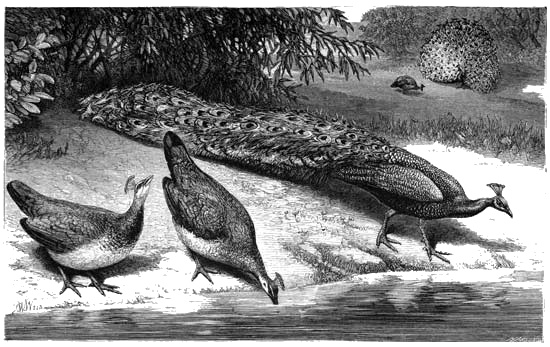
curiosity, just as the peacocks which accompanied them were
objects of beauty, and the gold and ivory objects of value—all
being employed in the decoration of the king's palace.
The question that now comes before us is the species of
monkey that is signified by the Hebrew word Kophim. In
modern days, we distinguish this tribe of animals into three
great sections, namely, the apes, the baboons, and the monkey;
and according to this arrangement the ape, being without tails,
must have been either the chimpanzee of Africa, the orang-outan
of Sumatra, or one of the Gibbons. But there is no reason to
imagine that the word Kophim was intended to represent any
one of these animals, and it seems evident that the word was
applied to any species of monkey, whether it had a tail or not.
Perhaps the best method of ascertaining approximately the
particular species of monkey, is to notice the land from which
the animals came. Accordingly, we find that the ships of
Solomon brought gold, ivory, apes, and peacocks, and that they
evidently brought their cargoes from the same country. Consequently,
the country in question must produce gold, and must be
inhabited by the monkey tribe, by the elephant, and by the
peacock. If the peacock had not been thus casually mentioned,
we should have been at a loss to identify the particular country
to which reference is made; but the mention of that bird shows
that some part of Asia must be signified. It is most probable
that the vessels in question visited both India and Ceylon,
although, owing to the very imperfect geographical knowledge
of the period, it is not possible to assert absolutely that this is
the case. In India, however, and the large island of Ceylon,
gold, elephants, peacocks, and monkeys exist; and therefore we
will endeavour to identify the animals which are mentioned
under the general term Apes, or Kophim.
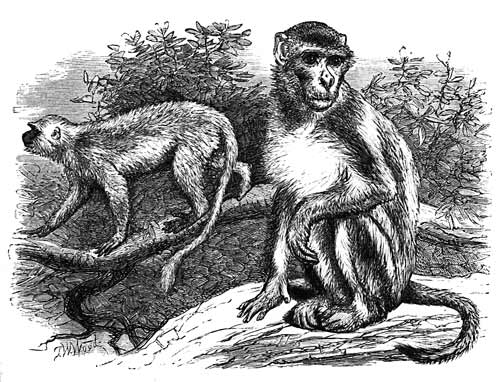
THE RHESUS AND ENTELLUS.
"Bringing gold, and silver, ivory, and apes."—1 Kings x. 22.
We are quite safe in suggesting that some of the apes in
question must have belonged to the Macaques, and it is most
likely that one of them was the Rhesus, or Bhunder, scientifically
named Macacus Rhesus.
This animal is very plentiful in India, and is one of the many
creatures which are held sacred by the natives. Consequently,
it takes up its quarters near human habitations, feeling sure that
it will not be injured, and knowing that plenty of food is at
hand. It is said that in some parts of India the natives always
leave one-tenth of their grain-crops for the monkeys, and thus
the animals content themselves with this offering, and refrain
from devastating the fields, as they would otherwise do. This
story may be true or not. It is certainly possible that in a long
series of years the monkeys of that neighbourhood have come to
look upon their tithe as a matter belonging to the ordinary
course of things; but whether it be true or not, it illustrates the
reverence entertained by the Hindoos for their monkeys.
In many places where grain and fruit crops are cultivated, the
monkeys get rather more than their share, plundering without
scruple, and finding no hindrance from the rightful owners, who
dare not drive them away, lest they should injure any of these
sacred beings. However, being unmindful of the maxim, "qui
facit per alium, facit per se," they are only too glad to avail
themselves of the assistance of Europeans, who have no scruples
on the subject. Still, although they are pleased to see the
monkeys driven off, and their crops saved, they would rather
lose all their harvest than allow a single monkey to be killed,
and in the earlier years of our Indian colony, several riots took
place between the natives and the English, because the latter
had killed a monkey through ignorance of the reverence in
which it was held.
Another monkey which may probably have been brought to
Palestine from India is the Hoonuman, Entellus, or Makur,
which is more reverenced by the Hindoos than any other
species. Its scientific title is Presbytes entellus. In some parts of
India it is worshipped as a form of divinity, and in all it is
reverenced and protected to such an extent that it becomes a
positive nuisance to Europeans who are not influenced by the
same superstitious ideas as those which are so prevalent in
India. Being a very common species, it could easily be
captured, especially if, as is likely to be the case, it was fearless
of man through long immunity from harm. The sailors who
manned Solomon's navy would not trouble themselves about the
sacred character of the monkeys, but would take them without
the least scruple wherever they could be found.
The Hoonuman would also be valued by them on account of
its docility when taken young, and the amusing tricks which it
is fond of displaying in captivity as well as in a state of
freedom. Moreover, it is rather a pretty creature, the general
colour being yellowish, and the face black.
Perfectly aware of the impunity with which they are permitted
to act, these monkeys prefer human habitations to the
forests which form the natural home of their race, and crowd
into the villages and temples, the latter being always swarming
with the long-tailed host. As is the case with the Rhesus, the
Hoonuman monkeys are much too fond of helping themselves
from the shops and stalls, and if they can find a convenient roof,
will sit there and watch for the arrival of the most dainty
fruits.
However, the natives, superstitious as they are, and unwilling
to inflict personal injury on a monkey, have no scruple in
making arrangements by which a monkey that trespasses on
forbidden spots will inflict injury on itself. They may not shoot
or wound in any way the monkeys which cluster on their roofs,
and the animals are so perfectly aware of the fact, that they
refuse to be driven away by shouts and menacing gestures.
But, they contrive to make the roofs so uncomfortable by covering
them with thorns, that the monkeys are obliged to quit their
points of vantage, and to choose some spot where they can sit
down without fear of hurting themselves.
That the Hindoos should pay homage almost divine to a
monkey, does seem equally absurd and contemptible. But,
strange as this superstition may be, and the more strange because
the intellectual powers of the educated Hindoos are peculiarly
subtle and penetrating, it was shared by a greater, a mightier,
and a still more intellectual race, now extinct as a nation. The
ancient Egyptians worshipped the baboon, and ranked it among
the most potent of their deities; and it can but strike us with
wonder when we reflect that a people who could erect buildings
perfectly unique in the history of the world, who held the foremost
place in civilization, who perfected arts which we, at a
distance of three thousand years, have only just learned, should
pay divine honours to monkeys, bulls, and snakes. Such,
however, was the case; and we find that the modern Hindoo
shows as great reverence for the identical animals as did the
Egyptian when Pharaoh was king, and Joseph his prime
minister.
It is said by some, that neither the Egyptian of the ancient
times, nor the Hindoo of the present day, actually worshipped
those creatures, but that they reverenced them as external signs
of some attribute of God. Precisely the same remarks have
been made as to the worship of idols, and it is likely enough
that the highly educated among the worshippers did look upon a
serpent merely as an emblem of divine wisdom, a bull as an
image of divine strength, and a monkey as an external memorial
of the promised incarnation of divinity. So with idols, which to
the man of educated and enlarged mind were nothing but visible
symbols employed for the purpose of directing the mind in
worship. But, though this was the case with the educated and
intellectual, the ignorant and uncultivated, who compose the
great mass of a nation, did undoubtedly believe that both the
living animal and the lifeless idol were themselves divine, and
did worship them accordingly.
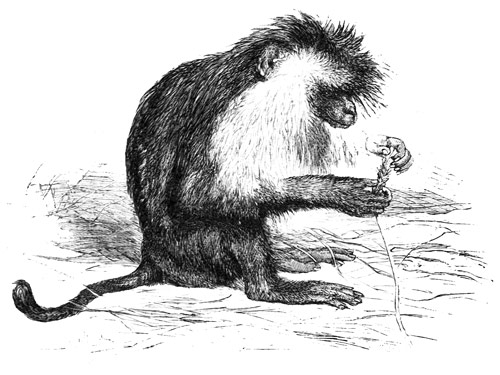
There is one species of monkey, which is extremely likely
to have been brought to Palestine, and used for the adornment
of a luxurious monarch's palace. This is the Wanderoo,
or Nil-Bhunder (Silenus veter). The Wanderoo, or Ouanderoo,
as the name is sometimes spelled, is a very conspicuous animal,
on account of the curious mane that covers its neck and head,
and the peculiarly formed tail, which is rather long and tufted,
like that of a baboon, and has caused it to be ranked among
those animals by several writers, under the name of the Lion-tailed
Baboon. That part of the hairy mass which rolls over the
head is nearly black, but as it descends over the shoulders, it
assumes a greyer tinge, and in some specimens is nearly white,
reminding the observer of the huge wigs which were so prevalent
in the time of Charles II, or of the scarcely less enormous
head-dresses with which our judges are decorated. As is the
case with many animals, the mane is not seen in the young
specimens, and increases in size with age, only reaching its full
dimensions when the animal has attained adult age. Moreover,
the grey hue belongs exclusively to the elder monkeys, and only
in the oldest specimens is the full, white, venerable, wig-like
mane to be seen in perfection.
In captivity, the general demeanour of this monkey corresponds
with its grave and dignified aspect. It seems to be
more sedate than the ordinary monkeys, to judge from the
specimens which have lived in the Zoological Gardens, and sits
peering with its shiny brown eyes out of the enormous mane,
with as much gravity as if it were really a judge deciding an important
case in law. Not that it will not condescend to the little
tricks and playful sallies for which the monkeys are so celebrated;
but it soon loses the vivacity of youth, and when full-grown,
presents as great a contrast to its former vivacity, as does
a staid full-grown cat sitting by the fire, to the restless, lively,
playful kitten of three months old. During its growth, it can be
taught to go through several amusing performances, but it has
little of the quick, mercurial manner, which is generally found
among the monkey tribe.
The docility of the Wanderoo often vanishes together with its
youth. The same animal may be gentle, tractable, and teachable
when young, and yet, when a few years have passed over its
head and whitened its mane, may be totally obstinate and dull,
refusing to perform the feats which it accomplished in its youth,
or to learn others more suitable to its years. Consistent kind
treatment will, however, have its effect upon the creature, but as
a general rule, an old Wanderoo is apt to be a treacherous and
spiteful animal.
The natives of the country in which the Wanderoo lives,
attribute to it the wisdom which its venerable aspect seems to
imply, much as the ancient Athenians venerated the owl as
the bird of wisdom, and the chosen companion of the learned
Minerva. In many places, the Wanderoo is thought to be a sort
of king among monkeys, and to enjoy the same supremacy
over its maneless kinsfolk, that the king-vulture maintains over
the other vultures which are destitute of the brilliant crest that
marks its rank.
I am induced to believe that the Wanderoo must have been
one of the monkeys which were brought to Solomon, for two
reasons.
In the first place, it is a native both of India and Ceylon, and
therefore might have formed an article of merchandise, together
with the peacock, gold, and ivory. And if, as is extremely probable,
the Tharshish of the Scripture is identical with Ceylon, it
is almost certain that the Wanderoo would have been brought to
Solomon, in order to increase the glories of his palace. Sir
Emerson Tennant points out very forcibly, that in the Tamil
language, the words for apes, ivory, and peacocks, are identical
with the Hebrew names for the same objects, and thus gives a
very strong reason for supposing that Ceylon was the country
from which Solomon's fleet drew its supplies.
Another reason for conjecturing that the Wanderoo would
have been one of the animals sent to grace the palace of
Solomon is this. In the days when that mighty sovereign lived,
as indeed has been the case in all partially civilized countries, the
kings and rulers have felt a pride in collecting together the
rarest objects which they could purchase, giving the preference to
those which were in any way conspicuous, whether for intrinsic
value, for size, for beauty, or for ugliness. Thus, giants, dwarfs,
and deformed persons of either sex, and even idiots, were seen as
regular attendants at the court, a custom which extended even
into the modern history of this country, the "Fool" being an
indispensable appendage to the train of every person of rank.
Animals from foreign lands were also prized, and value was set
upon them, not only for their variety, but for any external
characteristic which would make them especially conspicuous.
Ordinary sovereigns would make collections of such objects,
simply because they were rare, and in accordance with the
general custom; and in importing the "apes" and peacocks
together with the gold and ivory, Solomon but followed the
usual custom. He, however, on whom the gift of wisdom had
been especially bestowed, would have another motive besides
ostentation or curiosity. He was learned in the study of that
science which we now call Natural History. It is, therefore,
extremely probable, that he would not neglect any opportunities
of procuring animals from distant lands, in order that he might
study the products of countries which he had not personally
visited, and it is not likely that so conspicuous an animal as the
Wanderoo would have escaped the notice of those who provided
the cargo for which so wealthy a king could pay, and for which
they would demand a price proportionate to its variety.
There is perhaps no monkey which is so conspicuous among
its kin as the Wanderoo, and certainly no monkey or ape
inhabiting those parts of the world to which the fleet of Solomon
would have access. Its staid, sedate manners, its black body,
lion-like tail, and huge white-edged mane, would distinguish it
so boldly from its kinsfolk, that the sailors would use all their
efforts to capture an animal for which they would be likely to
obtain a high price.
The peculiar and unique character of Solomon affords good
reason for conjecture that, not only were several species of the
monkey tribe included under the general word Kophim, but that
the number of species must have been very large. An ordinary
monarch would have been content with one or two species, and
would probably have been perfectly satisfied if a number of
monkeys had been brought from beyond seas, irrespective of
distinction of species. But, if we consider the character of
Solomon, we shall find that he would not have been content
with such imperfect knowledge. We are told that he wrote
largely of the various productions of the earth, and, to judge
him by ourselves, it is certain that with such magnificent means
at his command, he would have ransacked every country that
his ships could visit, for the purpose of collecting materials for
his works. It is therefore almost certain that under the word
Kophim may be included all the most plentiful species of
monkey which inhabit the countries to which his fleet had
access, and that in his palace were collected together specimens
of each monkey which has here been mentioned, besides many
others of which no special notice need be taken, such as the
Bonnet Monkeys, and other Macaques.
We now come to the vexed question of the Satyrs, respecting
which word great controversies have been raised. The Hebrew
word Seirim merely signifies "hairy beings," and does not
seem to be applied to any definite species of animal. Several
scholars, therefore, translate the word by "wild goats," and
instead of reading the passages (Is. xiii. 21, and xxxiv. 14)
"Satyrs shall dance there," they read them, "The he-goats shall
skip there." This is certainly an easier interpretation than that
which is accepted in our translation, but whether it is more
correct may be doubted. Moreover, the word "goat" would not
convey the idea of utter desolation which the prophecy implied,
and which has been so signally fulfilled in the Babylon of the
present day. The vast palaces and temples have sunk into
shapeless heaps of ruins, affording scarcely a trace by which the
buildings can be identified. The many massive gates, for which
the city was famous, have disappeared. The double lines of fortification
are only to be distinguished by a few scattered mounds,
while the wonderful palace of Nebuchadnezzar has left but a
few shattered walls as relics of an edifice whose fame spread
over the world.
What precise animal was meant by the word Seirim cannot
be ascertained, nor is it even certain whether the word signified
any particular species at all. The ancient commentators identified
Seirim with the semi-human creatures of mythology, known as
Satyrs, and strengthened this opinion by a reference to Lev. xvii. 7,
where the Israelites are warned against worshipping Seirim, or
"devils" according to our translation. In common with all the
civilized world, they fully believed that Satyrs were veritable
inhabitants of the woods and deserts, with forms half man half
goat, with powers more than human, and with passions below
humanity. Of course we cannot now accept such an interpretation,
but must grant, either that a mere metaphor of desolation
was intended, or that the prophecy alluded to various wild
animals that inhabit deserted places. Accept which interpretation
we will, it is impossible to identify any particular animal with
the "Satyr" of Isaiah, and therefore it will be better to decline
giving any opinion on a subject which cannot be definitely
explained.
The Bat mentioned always with abhorrence—Meaning of the Hebrew name—The
prohibition against eating Bats—The edible species, their food and mode of
life—The noisome character of the Bat, and the nature of its dwelling-place—Its
hatred of light—Baruch and his prophecy—Appropriateness of the prophecy—Singular
Mahommedan legend respecting the original creation of the
Bat—The legend compared with the apocryphal gospels—The Bats of Palestine—Mr.
Tristram's discoveries—Bats found in the quarries from which the stone
of the Temple was hewn—Edible Bats in a cave near the centre of Palestine—Another
species of long-tailed Bat captured in the rock caves where hermits
had been buried—Other species which probably inhabit Palestine.
Among the animals that are forbidden to be eaten by the
Israelites we find the Bat prominently mentioned, and in one or
two parts of Scripture the same creature is alluded to with
evident abhorrence. In Isaiah ii. 20, for example, it is prophesied
that when the day of the Lord comes, the worshippers
of idols will try to hide themselves from the presence of the
Lord, and will cast their false gods to the bats and the moles,
both animals being evidently used as emblems of darkness and
ignorance, and associated together for a reason which will be
given when treating of the mole. The Hebrew name of the
Bat is expressive of its nocturnal habits, and literally signifies
some being that flies by night, and it is a notable fact that the
Greek and Latin names for the bat have also a similar derivation.
In Lev. xi. 20, the words, "All fowls that creep, going upon
all four, shall be an abomination unto you," are evidently intended
to apply to the bat, which, as is now well known, is not
a bird with wings, but a mammal with very long toes, and a
well developed membrane between them. Like other mammals,
the Bat crawls, or walks, on all four legs, though the movement
is but a clumsy one, and greatly different from the graceful ease
with which the creature urges its course through the evening air
in search of food.
Perhaps the prohibition to eat so unsightly an animal may
seem almost needless; but it must be remembered that in
several parts of the earth, certain species of Bat are used as
food. These are chiefly the large species, that are called
Kalongs, and which feed almost entirely on fruit, thus being to
their insectivorous relatives what the fruit-loving bear is among
the larger carnivora. These edible Bats have other habits not
shared by the generality of their kin. Some of the species do
not retire to caves and hollow trees for shelter during their hours
of sleep, but suspend themselves by their hind legs from the
topmost branches of the trees whose fruit affords them nourishment.
In this position they have a most singular aspect, looking
much as if they themselves were large bunches of fruit hanging
from the boughs. Thus, they are cleanly animals, and are as
little repulsive as bats can be expected to be.
But the ordinary bats, such as are signified by the "night-fliers"
of the Scriptures, are, when in a state of nature, exceedingly
unpleasant creatures. Almost all animals are infested with
parasitic insects, but the Bat absolutely swarms with them, so
that it is impossible to handle a Bat recently dead without finding
some of them on the hands. Also, the bats are in the habit
of resorting to caverns, clefts in the rocks, deserted ruins, and
similar dark places, wherein they pass the hours of daylight, and
will frequent the same spots for a long series of years. In consequence
of this habit, the spots which they select for their
resting place become inconceivably noisome, and can scarcely be
entered by human beings, so powerful is the odour with which
they are imbued.
Sometimes, when travellers have been exploring the chambers
of ruined buildings, or have endeavoured to penetrate into the
recesses of rocky caves, they have been repelled by the bats
which had taken up their habitation therein. No sooner does
the light of the torch or lamp shine upon the walls, than the
clusters of bats detach themselves from the spots to which they
had been clinging, and fly to the light like moths to a candle.
No torch can withstand the multitude of wings that come flapping
about it, sounding like the rushing of a strong wind, while
the bats that do not crowd around the light, dash against the
explorers, beating their leathery wings against their faces, and
clinging in numbers to their dress. They would even settle on the
face unless kept off by the hands, and sometimes they force the intruders
to beat a retreat. They do not intend to attack, for they
are quite incapable of doing any real damage; and, in point of
fact, they are much more alarmed than those whom they annoy.
Nocturnal in their habits, they cannot endure the light, which
completely dazzles them, so that they dash about at random, and
fly blindly towards the torches in their endeavours to escape.
If, then, we keep in mind the habits of the bats, we shall
comprehend that their habitations must be inexpressibly revolting
to human beings, and shall the better understand the force of
the prophecy that the idols shall be cast to the bats and the
moles.
There is another, and a very forcible passage, in which the
Bat is mentioned. In the apocryphal book of Baruch, the Bat is
used as a lively image of something peculiarly repulsive and
hateful. Baruch was the secretary and faithful friend of
Jeremiah the prophet, and Chapter VI. of the book of Baruch
purports to be an epistle of Jeremiah to the captive Jews about
to be led away to Babylon. After showing that they had
brought their fate upon themselves by neglecting the worship of
the true God, and prophesying that they would remain in captivity
for seven generations, the writer proceeds, in a strain of
scathing and sustained satire, to deride the idols which they had
adored, and to censure the infamous ceremonies that formed part
of the worship.
After describing the idols, made splendid with silver and gold,
whose hands hold sceptres, and axes, and wands, and yet cannot
save themselves from robbers; whose tongues are polished by
the workman and yet cannot speak a word; whose eyes are
covered with dust which they cannot wipe off for themselves;
he proceeds as follows: "Their hearts are gnawed upon by
things creeping out of the earth; and when they eat them and
their clothes they feel it not. Their faces are blacked through
the smoke that cometh out of the Temple. Upon their bodies
and heads sit bats, swallows and birds, and the cats also. By
this ye may know that they are no gods; therefore fear
them not."
It is not to be expected that so strange looking an animal as
the Bat would escape mention in the legends which are so
plentiful in the East.
Signor Pierotti, who has done such signal service in the investigation
of the Holy Land, gives a most remarkable semi-Mahommedan
and semi-Christian legend respecting the origin of
the Bat. The Mahommedans, unlike the generality of Jews,
have always respected the memory of our Lord Christ—the
Prophet Isa, as they call Him—ranking Him as one of the
greatest of God's prophets, though they deny His actual
divinity. In this curious legend, they have confused the forty
days fast in the wilderness with the enforced Mahommedan fast
called Ramadhan, much as the writers of the apocryphal gospels
attributed to the holy family and the apostles certain phrases
and acts of worship which were not in existence until several
centuries after the Christian era.
Towards the west of Jericho, there is a mountain which is
identified both by Christians and Mahommedans as being the
spot to which our Lord retired during his passion, and which,
in consequence of this supposition, is called Kuruntun, or
Quarantine.
The reader, while perusing the following legend, must bear
in mind that the fast of Ramadhan lasts for a month, and that
from sunrise to sunset an entire abstinence from all kinds of
nourishment is imperative upon all good Mussulmans. Even
such luxuries as smoking or inhaling perfumes are forbidden, and
although washing is permitted, the head must not be plunged
under water, lest a few drops might find their way through the
nostrils. In consequence of this strict prohibition, the moments
of daybreak and sunset are noted with the most scrupulous care,
the tables being set, pipes lighted, coffee prepared, and every
luxury being made ready just before sunset, so that as the orb
disappears beneath the horizon, the fasting multitudes may not
lose a moment in satisfying their wants. A similar anxiety
marks the approach of daybreak, because, as the first beams of
the sun break through the darkness, neither food nor drink may
pass their lips.
We will now proceed to the Mahommedan legend, as it is
given by S. Pierotti: "In this wild spot the great prophet Isa
retired with his disciples to keep the holy month of the
Ramadhan, afar from the tumults of the world. As the view
westward was obstructed by the mountains of Jerusalem, and,
consequently, the sunset could not be seen, he made, by the permission
of God, an image in clay representing a winged
creature; and, after invoking the aid of the Eternal, breathed
upon it. Immediately it flapped its large wings, and fled into
one of the dark caverns in the mountains. This creature was
the Khopash (bat), which lies hid so long as the sun shines
upon the world, and comes forth from its retreat when it sets.
Every night, at the Moghreb, i.e. at the moment of breaking the
fast, this bat fluttered round Isa, who then prepared himself
with his disciples for prayer.
"As soon as they had performed this sacred duty, the Merciful
caused to descend from heaven a silver table, covered with a
cloth whose brilliancy illumined the darkness, on which were
placed a large roasted fish, five loaves, salt, vinegar, oil, pomegranates,
dates, and fresh salad, gathered in the gardens of
heaven. On these the Prophet supped, and the angels of heaven
ministered at table."
This curious legend bears a great resemblance to the tales
which are told of our Lord's childhood in some of the spurious
gospels. It shows that both emanated from the same class of
mind. In both is seen a strange mixture of vivid imagination
contrasted with unexpected and almost puerile lack of invention;
and, in both is exhibited a total failure in apprehension
of cause and effect. Indeed, it is evident that this legend was
the work of a comparatively modern Mahommedan story-teller,
who appropriated the forty days' fast of our Lord from the true
gospels, and the making of a flying creature of clay from the
false, and modified them both to suit the purposes of his tale.
No particular species of Bat seems to be indicated by the
Hebrew word Hatalleph, which is evidently used in a comprehensive
sense, and signifies all and any species of Bat. Until
very lately, the exact species of Bats which inhabit Palestine
were not definitely ascertained, and could only be conjectured.
But, Mr. Tristram, who travelled in the Holy Land for the express
purpose of investigating its physical history, has set this
point at rest, in his invaluable work, "The Land of Israel," to
which frequent reference will be made in the course of the
following pages.
Almost every cavern which he entered was tenanted by bats,
and he procured several species of these repulsive but interesting
animals. While exploring the vast prairies in which the stone
for the Temple was worked beneath the earth, so that no sound
of tool was heard during the building, numbers of bats were disturbed
by the lights, and fluttered over the heads of the
exploring party.
On another occasion, he was exploring a cave near the centre
of Palestine, when he succeeded in procuring some specimens,
and therefore in identifying at least one species. "In climbing
the rocks soon afterwards, to examine a cave, I heard a singular
whining chatter within, and on creeping into its recesses, a stone
thrown up roused from their roosting-places a colony of large bats,
the soft waving flap of whose wings I could hear in the darkness.
How to obtain one I knew not; but on vigorously plying my
signal whistle, all the party soon gathered to my help. B. suggested
smoking them, so a fire of brushwood was kindled, and
soon two or three rushed out. Two fell to our shot, and I was
delighted to find myself the possessor of a couple of large fox-headed
bats of the genus Pteropus (Xantharpya ægyptiaca), and
extending twenty and a half inches from wing to wing. As none
of the bats of Palestine are yet known, this was a great prize,
and another instance of the extension westward of the Indian
fauna." These Bats belong to the fruit-eating tribe, and are
closely allied to the Flying Foxes of Java, Australia, and
Southern Africa. Therefore, this would be one of the species
commonly used for food, and hence the necessity for the prohibition.
The present species extends over the greater part of
Northern Africa and into parts of Asia.
The same traveller subsequently discovered several more
species of bats. On one occasion, he was exploring some caves,
near the site of the ancient Jericho. On the eastern face of the
cliffs are a number of caves, arranged in regular tiers, and
originally approached by steps cut out of the face of the rock.
These staircases are, however, washed away by time and the
rains, and in consequence the upper tiers were almost inaccessible.
In some of these caves the walls were covered with
brilliant, but mutilated frescoes; and in others, hermits had
lived and died and been buried. Mr. Tristram and his companions
had penetrated to the second tier, and there made a
curious discovery.
"In the roof of this was a small hole, athwart which lay a
stick. After many efforts, we got a string across it, and so
hauled up a rope, by which, finding the stick strong enough, we
climbed, and with a short exercise of the chimney-sweeper's art,
we found ourselves in a third tier of cells, similar to the lower
ones, and covered with the undisturbed dust of ages. Behind
the chapel was a dark cave, with an entrance eighteen inches
high. Having lighted our lantern, we crept in on our faces, and
found the place full of human bones and skulls; with dust
several inches deep. We were in the burying-place of the
Anchorites. Their bones lay heaped, but in undisturbed order,
probably as the corpses had been stretched soon after death, and
as in the campo-santo of some Italian monasteries, had been
desiccated, and in the dry atmosphere had gradually pulverized.
The skeletons were laid west and east, awaiting the resurrection.
After capturing two or three long-tailed bats, of a species new to
us (Rhinopoma microphylla), the only living occupants, we crept
out, with a feeling of religious awe, from this strange sepulchral
cave." This bat is called the Egyptian Rhinopome, and the same
species of Bat was found in considerable numbers in the cave at
Es Sumrah. Three more species were found in the tombs of the
kings, and it is probable that many other species inhabit
Palestine. It is certain, at all events, that representatives of
three more families of Bats inhabit Egypt, and therefore are
most probably to be found in Palestine.
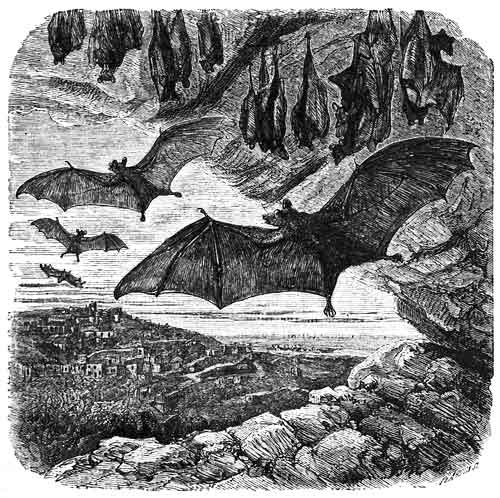
THE BAT.
"The Lapwing and the Bat are unclean."—Lev. xi. 19.
Frequent mention of the Lion in the Scriptures—Probability that it was once a
common animal, though now extinct—Reasons for its disappearance—The Lion
employed as an emblem in the Bible—Similarity of the African and Asiatic
species—The chief characteristics of the Lion—its strength, activity, and mode
of seizing its prey—Various names of the Lion—its courage when roused—its
roar and peculiar mode of utterance—Invisibility of the Lion at dusk—The
Lion lying in wait—The dwelling-place of the Lion—Its restlessness at night—Passages
illustrative of these characteristics—Modes of capturing the Lion—The
pitfall and the net—Lions kept as curiosities—The Lion hunt as depicted,
on the buildings of ancient Nineveh.
Of all the undomesticated animals of Palestine, none is mentioned
so frequently as the Lion. This may appear the more
remarkable, because for many years the Lion has been extinct
in Palestine. The leopard, the wolf, the jackal, and the hyæna,
still retain their place in the land, although their numbers are
comparatively few; but the Lion has vanished completely out of
the land. The reason for this disappearance is twofold, first,
the thicker population; and second, the introduction of
firearms.
No animal is less tolerant of human society than the Lion. In
the first place, it dreads the very face of man, and as a rule,
whenever it sees a man will slink away and hide itself. There
are, of course, exceptional cases to this rule. Sometimes a Lion
becomes so old and stiff, his teeth are so worn, and his endurance
so slight, that he is unable to chase his usual prey, and is
obliged to seek for other means of subsistence. In an unpopulated
district, he would simply be starved to death, but when
his lot is cast in the neighbourhood of human beings, he is perforce
obliged to become a "man-eater." Even in that case, a
Lion will seldom attack a man, unless he should be able to do so
unseen, but will hang about the villages, pouncing on the women
as they come to the wells for water, or upon the little children
as they stray from their parents, and continually shifting his
quarters lest he should be assailed during his sleep. The Lion
requires a very large tract of country for his maintenance, and
the consequence is, that in proportion as the land is populated
does the number of Lions decrease.
Firearms are the special dread of the Lion. In the first place,
the Lion, like all wild beasts, cannot endure fire, and the flash of
the gun terrifies him greatly. Then, there is the report, surpassing
even his roar in resonance; and lastly, there is the unseen
bullet, which seldom kills him at once, but mostly drives him to
furious anger by the pain of his wound, yet which he does not
dread nearly so much as the harmless flash and report. There is
another cause of the Lions banishment from the Holy Land.
It is well known that to attract any wild beast or bird to some
definite spot, all that is required is to provide them with a suitable
and undisturbed home, and a certainty of food. Consequently,
the surest method of driving them away is to deprive
them of both these essentials. Then the Lion used to live in
forests, which formerly stretched over large tracts of ground, but
which have long since been cut down, thus depriving the Lion of
its home, while the thick population and the general use of firearms
have deprived him of his food. In fact, the Lion has been
driven out of Palestine, just as the wolf has been extirpated
from England.
But, in the olden times, Lions must have been very plentiful.
There is scarcely a book in the Bible, whether of the Old or
New Testaments, whether historical or prophetical, that does not
contain some mention of this terrible animal; sometimes describing
the actions of individual Lions, but mostly using the
word as an emblem of strength and force, whether used for a
good purpose or abused for a bad one.
There are several varieties of Lion, which may be reduced to
two, namely, the African and the Asiatic Lion. It is almost
certain, however, that these animals really are one and the same
species, and that the trifling differences which exist between an
African and an Asiatic Lion, are not sufficient to justify a
naturalist in considering them to be distinct species. The habits
of both are identical, modified, as is sure to be the case, by the
difference of locality; but then, such variations in habit are continually
seen in animals confessedly of the same species, which
happen to be placed in different conditions of climate and
locality.
That it was once exceedingly plentiful in Palestine is evident,
from a very cursory knowledge of the Holy Scriptures. It is
every where mentioned as a well-known animal, equally familiar
and dreaded. When the disobedient prophet was killed by the
Lion near Bethel, the fact seemed not to have caused any surprise
in the neighbourhood. When the people came out to
rescue the body of the prophet, they wondered much because the
Lion was standing by the fallen man, but had not torn him, and
had left the ass unhurt. But that a Lion should have killed a
man seems to have been an event which was not sufficiently
rare to be surprising.
We will now proceed to those characteristics of the Lion
which bear especial reference to the Scriptures.
In the first place, size for size, the Lion is one of the strongest
of beasts. Perhaps it is surpassed in point of sheer strength by
the mole, but it possesses infinitely more activity than that
animal. Moreover, the strength of the mole is concentrated in
its fore-quarters, the hind limbs being comparatively feeble;
whereas, the strength of the Lion is equally distributed over the
body and limbs, giving to the animal an easy grace of movement
which is rare except with such a structure. A full-grown Lion
cannot only knock down and kill, but can carry away in its
mouth, an ordinary ox; and one of these terrible animals has been
known to pick up a heifer in its mouth, and to leap over a wide
ditch still carrying its burden. Another Lion carried a two-year
old heifer, and was chased for five hours by mounted farmers, so
that it must have traversed a very considerable distance. Yet, in
the whole of this long journey, the legs of the heifer had only
two or three times touched the ground.
It kills man, and comparatively small animals, such as deer
and antelopes, with a blow of its terrible paw; and often needs
to give no second blow to cause the death of its victim. The
sharp talons are not needed to cause death, for the weight of the
blow is sufficient for that purpose.
When the hunter pursues it with dogs, after the usual fashion,
there is often a great slaughter among them, especially among
those that are inexperienced in the chase of the Lion. Urged by
their instinctive antipathy, the dogs rush forward to the spot
where the Lion awaits them, and old hounds bay at him from a
safe distance, while the young and inexperienced among them
are apt to convert the sham attack into a real one. Their valour
meets with a poor reward, for a few blows from the Lion's terrible
paws send his assailants flying in all directions, their bodies
streaming with blood, and in most cases a fatal damage inflicted,
while more than one unfortunate dog lies fairly crushed by the
weight of a paw laid with apparent carelessness upon its body.
There is before me a Lion's skin, a spoil of one of these animals
shot by the celebrated sportsman, Gordon Cumming. Although
the skin lies flat upon the floor, and the paws are nothing but
the skin and talons, the weight of each paw is very considerable,
and always surprises those who hear it fall on the floor.
There are several Hebrew words which are used for the Lion,
but that which signifies the animal in its adult state is derived
from an Arabic word signifying strength; and therefore the
Lion is called the Strong-one, just as the Bat is called the Night-flier.
No epithet could be better deserved, for the Lion seems to
be a very incarnation of strength, and, even when dead, gives as
vivid an idea of concentrated power as when it was living.
And, when the skin is stripped from the body, the tremendous
muscular development never fails to create a sensation of awe.
The muscles of the limbs, themselves so hard as to blunt the
keen-edged knives employed by a dissecter, are enveloped in
their glittering sheaths, playing upon each other like well-oiled
machinery, and terminating in tendons seemingly strong as steel,
and nearly as impervious to the knife. Not until the skin is removed
can any one form a conception of the enormously powerful
muscles of the neck, which enable the Lion to lift the
weighty prey which it kills, and to convey it to a place of
security.
Although usually unwilling to attack an armed man, it is one
of the most courageous animals in existence when it is driven to
fight, and if its anger is excited, it cares little for the number of
its foes, or the weapons with which they are armed. Even the
dreaded firearms lose their terrors to an angry Lion, while a
Lioness, who fears for the safety of her young, is simply the
most terrible animal in existence. We know how even a hen
will fight for her chickens, and how she has been known to beat
off the fox and the hawk by the reckless fury of her attack.
It may be easily imagined, therefore, that a Lioness actuated by
equal courage, and possessed of the terrible weapons given to
her by her Creator, would be an animal almost too formidable
for the conception of those who have not actually witnessed the
scene of a Lioness defending her little ones.
The roar of the Lion is another of the characteristics for which
it is celebrated. There is no beast that can produce a sound that
could for a moment be mistaken for the roar of the Lion. The
Lion has a habit of stooping his head towards the ground when
he roars, so that the terrible sound rolls along like thunder, and
reverberates in many an echo in the far distance. Owing to this
curious habit, the roar can be heard at a very great distance, but its
locality is rendered uncertain, and it is often difficult to be quite
sure whether the Lion is to the right or the left of the hearer.
There are few sounds which strike more awe than the Lion's
roar. Even at the Zoological Gardens, where the hearer knows
that he is in perfect safety, and where the Lion is enclosed in a
small cage faced with strong iron bars, the sound of the terrible
roar always has a curious effect upon the nerves. It is not
exactly fear, because the hearer knows that he is safe; but it is
somewhat akin to the feeling of mixed awe and admiration with
which one listens to the crashing thunder after the lightning has
sped its course. If such be the case when the Lion is safely
housed in a cage, and is moreover so tame that even if he did
escape, he would be led back by the keeper without doing any
harm, the effect of the roar must indeed be terrific when the
Lion is at liberty, when he is in his own country, and when the
shades of evening prevent him from being seen even at a short
distance.
In the dark, there is no animal so invisible as a Lion. Almost
every hunter has told a similar story—of the Lion's approach at
night, of the terror displayed by dogs and cattle as he drew
near, and of the utter inability to see him, though he was so
close that they could hear his breathing. Sometimes, when he
has crept near an encampment, or close to a cattle inclosure, he
does not proceed any farther lest he should venture within the
radius illumined by the rays of the fire. So he crouches closely
to the ground, and, in the semi-darkness, looks so like a large
stone, or a little hillock, that any one might pass close to it
without perceiving its real nature. This gives the opportunity
for which the Lion has been watching, and in a moment he
strikes down the careless straggler, and carries off his prey to
the den. Sometimes, when very much excited, he accompanies
the charge with a roar, but, as a general fact, he secures his prey
in silence.
The roar of the Lion is very peculiar. It is not a mere outburst
of sound, but a curiously graduated performance. No description
of the Lion's roar is so vivid, so true, and so graphic as
that of Gordon Cumming: "One of the most striking things
connected with the Lion is his voice, which is extremely grand
and peculiarly striking. It consists at times of a low, deep
moaning, repeated five or six times, ending in faintly audible
sighs. At other times he startles the forest with loud, deep-toned,
solemn roars, repeated five or six times in quick succession,
each increasing in loudness to the third or fourth, when his
voice dies away in five or six low, muffled sounds, very much
resembling distant thunder. As a general rule, Lions roar during
the night, their sighing moans commencing as the shades of
evening envelop the forest, and continuing at intervals throughout
the night. In distant and secluded regions, however, I have
constantly heard them roaring loudly as late as nine or ten
o'clock on a bright sunny morning. In hazy and rainy weather
they are to be heard at every hour in the day, but their roar is
subdued."
Lastly, we come to the dwelling-place of the Lion. This
animal always fixes its residence in the depths of some forest,
through which it threads its stealthy way with admirable certainty.
No fox knows every hedgerow, ditch, drain, and covert
better than the Lion knows the whole country around his den.
Each Lion seems to have his peculiar district, in which only
himself and his family will be found. These animals seem to
parcel out the neighbourhood among themselves by a tacit law
like that which the dogs of eastern countries have imposed upon
themselves, and which forbids them to go out of the district in
which they were born. During the night he traverses his
dominions; and, as a rule, he retires to his den as soon as the
sun is fairly above the horizon. Sometimes he will be in wait
for prey in the broadest daylight, but his ordinary habits are
nocturnal, and in the daytime he is usually asleep in his secret
dwelling-place.
We will now glance at a few of the passages in which the
Lion is mentioned in the Holy Scriptures, selecting those which
treat of its various characteristics.
The terrible strength of the Lion is the subject of repeated
reference. In the magnificent series of prophecies uttered by
Jacob on his deathbed, the power of the princely tribe of Judah
is predicted under the metaphor of a Lion—the beginning of its
power as a Lion's whelp, the fulness of its strength as an adult
Lion, and its matured establishment in power as the old Lion
that couches himself and none dares to disturb him. Then
Solomon, in the Proverbs, speaks of the Lion as the "strongest
among beasts, and that turneth not away for any."
Solomon also alludes to its courage in the same book, Prov.
xxviii. 1, in the well-known passage, "The wicked fleeth when
no man pursueth: but the righteous are bold as a lion." And,
in 2 Sam. xxiii. 20, the courage of Benaiah, one of the mighty
three of David's army, is specially honoured, because he fought
and killed a Lion single-handed, and because he conquered
"two lion-like men of Moab." David, their leader, had also distinguished
himself, when a mere keeper of cattle, by pursuing
and killing a Lion that had come to plunder his herd. In the
same book of Samuel which has just been quoted (xvii. 10),
the valiant men are metaphorically described as having the
hearts of Lions.
The ferocity of this terrible beast of prey is repeatedly mentioned,
and the Psalms are full of such allusions, the fury and
anger of enemies being compared to the attacks of the Lion.
Many passages refer to the Lion's roar, and it is remarkable
that the Hebrew language contains several words by which the
different kind of roar is described. One word, for example,
represents the low, deep, thunder-like roar of the Lion seeking
its prey, and which has already been mentioned. This is the
word which is used in Amos iii. 4, "Will a lion roar in the
forest when he hath no prey?" and in this passage the word
which is translated as Lion signifies the animal when full grown
and in the prime of life. Another word is used to signify the
sudden exulting cry of the Lion as it leaps upon its victim. A
third is used for the angry growl with which a Lion resents any
endeavour to deprive it of its prey, a sound with which we are
all familiar, on a miniature scale, when we hear a cat growling
over a mouse which she has just caught. The fourth term signifies
the peculiar roar uttered by the young Lion after it has ceased
to be a cub and before it has attained maturity. This last term
is employed in Jer. li. 38, "They shall roar together like lions;
they shall yell as lions' whelps," in which passage two distinct
words are used, one signifying the roar of the Lion when searching
after prey, and the other the cry of the young Lions.
The prophet Amos, who in his capacity of herdsman was
familiar with the wild beasts, from which he had to guard his
cattle, makes frequent mention of the Lion, and does so with a force
and vigour that betoken practical experience. How powerful is
this imagery, "The lion hath roared; who will not fear? The Lord
God hath spoken; who can but prophesy?" Here we have the
picture of the man himself, the herdsman and prophet, who had
trembled many a night, as the Lions drew nearer and nearer;
and who heard the voice of the Lord, and his lips poured out
prophecy. Nothing can be more complete than the parallel
which he has drawn. It breathes the very spirit of piety, and
may bear comparison even with the prophecies of Isaiah for its
simple grandeur.
It is remarkable how the sacred writers have entered into the
spirit of the world around them, and how closely they observed
the minutest details even in the lives of the brute beasts. There
is a powerful passage in the book of Job, iv. 11, "The old
lion perisheth for lack of prey," in which the writer betrays his
thorough knowledge of the habits of the animal, and is aware
that the usual mode of a Lion's death is through hunger, in consequence
of his increasing inability to catch prey.
The nocturnal habits of the Lion and its custom of lying in
wait for prey are often mentioned in the Scriptures. The former
habit is spoken of in that familiar and beautiful passage in
the Psalms (civ. 20), "Thou makest darkness, and it is night;
wherein all the beasts of the forest do creep forth. The young
Lions roar after their prey; and seek their meat from God. The
sun ariseth, they gather themselves together, and lay them down
in their dens."
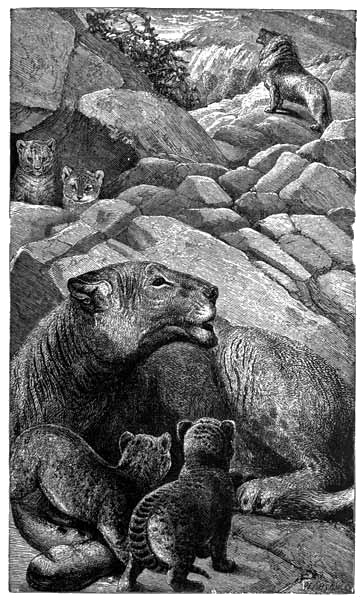
THE LION.
"The lion is come up from his thicket."—Jer. iv. 7.
"She lay down among lions, she nourished her whelps among young lions."—Ezekiel. xix. 2.
Its custom of lying in wait is frequently alluded to. See Psalm
x. 9, where it is said of the wicked man, that "He lieth in wait
secretly, as a lion in his den." Also, Lam. iii. 10, "He was unto
me as a bear lying in wait, and as a lion in secret places." Also,
Ps. xvii. 11, wherein the peculiar gait and demeanour of the
Lion is admirably depicted, "They have now compassed us in
our steps; they have set their eyes bowing down to the earth;
like as a lion that is greedy of his prey, and as it were a young
lion lurking in secret places."
The retired spots, deep in the forest, where the Lion makes his
den, are repeatedly mentioned. See for example, Cant. iv. 8,
"Look from the top of Amana, from the top of Shenir and
Hermon, from the lions' dens." Also, Jer. iv. 7, "The lion is
come up from his thicket, and the destroyer of the Gentiles is
on his way." The same Prophet contains several passages
illustrative of the Lion's habitation; see ch. v. 6, "Wherefore
a lion out of the forest shall slay them;" xii. 8, "Mine
heritage is unto me as a lion in the forest;" and lastly, xxv. 38,
"He hath forsaken his covert as the lion."
An animal so destructive among the flocks and herds could
not be allowed to carry out its depredations unchecked, and as
we have already seen, the warfare waged against it has been so
successful, that the Lions have long ago been fairly extirpated in
Palestine. The usual method of capturing or killing the Lion
was by pitfalls or nets, to both of which there are many references
in the Scriptures.
The mode of hunting the Lion with nets was identical with
that which is practised in India at the present time. The precise
locality of the Lion's dwelling-place having been discovered,
a circular wall of net is arranged round it, or if only a few nets
can be obtained, they are set in a curved form, the concave side
being towards the Lion. They then send dogs into the thicket,
hurl stones and sticks at the den, shoot arrows into it, fling
burning torches at it, and so irritate and alarm the animal that it
rushes against the net, which is so made that it falls down and
envelopes the animal in its folds. If the nets be few, the drivers
go to the opposite side of the den, and induce the Lion to escape
in the direction where he sees no foes, but where he is sure to run
against the treacherous net. Other large and dangerous animals
were also captured by the same means.
Allusions to this sort of hunting are familiar to all students
of the Bible. In the book of Job, xix. 6, the writer laments
that "God hath compassed me with his net," in allusion to the
custom of surrounding the den of the animal. The Psalms
make frequent mention of the net as used in hunting. See
Ps. ix. 15, "In the net they hid is their foot taken." Ps. xxxv.
8, "Let his net that he hath hid catch himself," together with
other passages. Then, the prophet Isaiah alludes to the utter
helplessness of a wild animal when thus taken. Isaiah li. 20,
"Thy sons have fainted, they lie at the head of all the streets,
as a wild bull in a net."
Another and more common, because an easier and a cheaper
method was, by digging a deep pit, covering the mouth with a
slight covering of sticks and earth, and driving the animal upon
the treacherous covering. It is an easier method than the net,
because after the pit is once dug, the only trouble lies in throwing
the covering over its mouth. But, it is not so well adapted
for taking beasts alive, as they are likely to be damaged, either
by the fall into the pit, or by the means used in getting them
out again. Animals, therefore, that are caught in pits are
generally, though not always, killed before they are taken out.
The net, however, envelops the animal so perfectly, and renders
it so helpless, that it can be easily bound and taken away. The
hunting net is very expensive, and requires a large staff of men
to work it, so that none but a rich man could use the net in
hunting.
The passages in which allusion is made to the use of the pitfall
in hunting are too numerous to be quoted, and it will be sufficient
to mention one or two passages, such as those wherein the
Psalmist laments that his enemies have hidden for him their net
in a pit, and that the proud have digged pits for him.
Lions that were taken in nets seem to have been kept alive
in dens, either as mere curiosities, or as instruments of royal
vengeance. Such seems to have been the object of the Lions
which were kept by Darius, into whose den Daniel was thrown,
by royal command, and which afterwards killed his accusers
when thrown into the same den. It is plain that the Lions kept
by Darius must have been exceedingly numerous, because they
killed at once the accusers of Daniel, who were many in number,
together with their wives and children, who, in accordance with
the cruel custom of that age and country, were partakers of
the same punishment with the real culprits. The whole of the
first part of Ezek. xix. alludes to the custom of taking Lions
alive and keeping them in durance afterwards.
Sometimes the Lion was hunted as a sport, but this amusement
seems to have been restricted to the great men, on account
of its expensive nature. Such hunting scenes are graphically
depicted in the famous Nineveh sculptures, which represent the
hunters pursuing their mighty game in chariots, and destroying
them with arrows. Rude, and even conventional as are these
sculptures, they have a spirit, a force, and a truthfulness, that
prove them to have been designed by artists to whom the
scene was a familiar one. Nothing can be better than the
attitudes of the Lions; and, whether they are shown in the act
of striking a blow, with all the talons thrust out and the toes
spread as widely as possible; whether they are springing on the
chariot of the hunter, or sinking lifeless beneath his arrows,
every attitude is marvellously true to nature, and makes the
spectator regret that the artist should have been trammelled by
the exigencies of the work on which he was engaged.
The Leopard not often mentioned in the Scriptures—its attributes exactly
described—Probability that several animals were classed under the name—How
the Leopard takes its prey—Craft of the Leopard—its ravages among the
flocks—The empire of man over the beast—The Leopard at Bay—Localities
wherein the Leopard lives—The skin of the Leopard—Various passages of
Scripture explained.
Of the Leopard but little is said in the Holy Scriptures.
In the New Testament this animal is only mentioned once,
and then in a metaphorical rather than a literal sense. In the
Old Testament it is casually mentioned seven times, and only in
two places is the word Leopard used in the strictly literal sense.
Yet, in those brief passages of Holy Writ, the various attributes
of the animal are delineated with such fidelity, that no one
could doubt that the Leopard was familiarly known in Palestine.
Its colour, its swiftness, its craft, its ferocity, and the nature of
its dwelling-place, are all touched upon in a few short sentences
scattered throughout the Old Testament, and even its peculiar
habits are alluded to in a manner that proves it to have been well
known at the time when the words were written.
It is my purpose in the following pages to give a brief account
of the Leopard of the Scriptures, laying most stress on the
qualities to which allusion is made, and then to explain the
passages in which the name of the animal occurs.
In the first place, it is probable that under the word Leopard
are comprehended three animals, two of which, at least, were
thought to be one species until the time of Cuvier. These three
animals are the Leopard proper (Leopardus varius), the Ounce
(Leopardus uncia), and the Chetah, or Hunting Leopard (Gueparda
jubata). All these three species belong to the same family
of animals; all are spotted and similar in colour, all are nearly
alike in shape, and all are inhabitants of Asia, while two of
them, the Leopard and the Chetah, are also found in Africa.
It is scarcely necessary to mention that the Leopard is a beast
of prey belonging to the cat tribe, that its colour is tawny,
variegated with rich black spots, and that it is a fierce and
voracious animal, almost equally dreaded by man and beast. It
inhabits many parts of Africa and Asia, and in those portions of
the country which are untenanted by mankind, it derives all its
sustenance from the herb-eating animals of the same tracts.
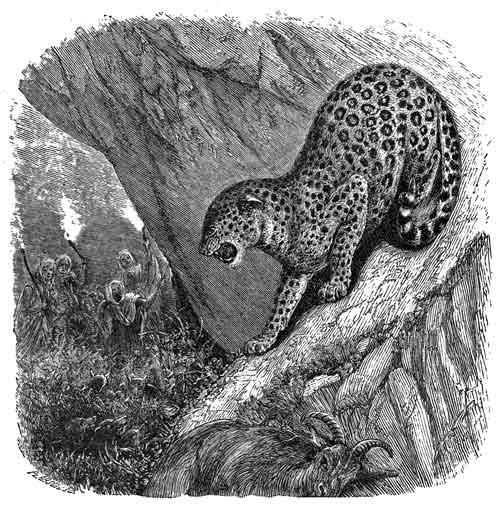
THE LEOPARD.
"As a Leopard by the way will I observe them."—Hos. xiii. 7.
To deer and antelopes it is a terrible enemy, and in spite of
their active limbs, seldom fails in obtaining its prey. Swift as
is the Leopard, for a short distance, and wonderful as its spring,
it has not the enduring speed of the deer or antelope, animals
which are specially formed for running, and which, if a limb is
shattered, can run nearly as fast and quite as far on three legs
as they can when all four limbs are uninjured. Instinctively
knowing its inferiority in the race, the Leopard supplies by
cunning the want of enduring speed.
It conceals itself in some spot whence it can see far around
without being seen, and thence surveys the country. A tree is
the usual spot selected for this purpose, and the Leopard, after
climbing the trunk by means of its curved talons, settles itself
in the fork of the branches, so that its body is hidden by the
boughs, and only its head is shown between them. With such
scrupulous care does it conceal itself, that none but a practised
hunter can discover it, while any one who is unaccustomed to
the woods cannot see the animal even when the tree is pointed
out to him.
As soon as the Leopard sees the deer feeding at a distance, he
slips down the tree and stealthily glides off in their direction.
He has many difficulties to overcome, because the deer are
among the most watchful of animals, and if the Leopard were
to approach to the windward, they would scent him while he
was yet a mile away from them. If he were to show himself
but for one moment in the open ground he would be seen, and
if he were but to shake a branch or snap a dry twig he would
be heard. So, he is obliged to approach them against the wind,
to keep himself under cover, and yet to glide so carefully along
that the heavy foliage of the underwood shall not be shaken, and
the dry sticks and leaves which strew the ground shall not be
broken. He has also to escape the observation of certain birds
and beasts which inhabit the woods, and which would certainly
set up their alarm-cry as soon as they saw him, and so give
warning to the wary deer, which can perfectly understand a cry
of alarm, from whatever animal it may happen to proceed.
Still, he proceeds steadily on his course, gliding from one
covert to another, and often expending several hours before he
can proceed for a mile. By degrees he contrives to come tolerably
close to them, and generally manages to conceal himself in
some spot towards which the deer are gradually feeding their
way. As soon as they are near enough, he collects himself for
a spring, just as a cat does when she leaps on a bird, and dashes
towards the deer in a series of mighty bounds. For a moment
or two they are startled and paralysed with fear at the sudden
appearance of their enemy, and thus give him time to get among
them. Singling out some particular animal, he leaps upon it,
strikes it down with one blow of his paw, and then, crouching
on the fallen animal, he tears open its throat, and laps the
flowing blood.
In this manner does it obtain its prey when it lives in the
desert, but when it happens to be in the neighbourhood of
human habitations, it acts in a different manner. Whenever man
settles himself in any place, his presence is a signal for the
beasts of the desert and forest to fly. The more timid, such as
the deer and antelope, are afraid of him, and betake themselves
as far away as possible. The more savage inhabitants of the
land, such as the lion, leopard, and other animals, wage an unequal
war against him for a time, but are continually driven
farther and farther away, until at last they are completely expelled
from the country. The predaceous beasts are, however, loth
to retire, and do so by very slow degrees. They can no longer
support themselves on the deer and antelopes, but find a simple
substitute for them in the flocks and herds which man introduces,
and in the seizing of which there is as much craft required
as in the catching of the fleeter and wilder animals.
Sheep and goats cannot run away like the antelopes, but they
are penned so carefully within inclosures, and guarded so
watchfully by herdsmen and dogs, that the Leopard is obliged to
exert no small amount of cunning before it can obtain a meal.
Sometimes it creeps quietly to the fold, and escapes the notice
of the dogs, seizes upon a sheep, and makes off with it before
the alarm is given. Sometimes it hides by the wayside, and as
the flock pass by it dashes into the midst of them, snatches up a
sheep, and disappears among the underwood on the opposite
side of the road. Sometimes it is crafty enough to deprive the
fold of its watchful guardian. Dogs which are used to Leopard-hunting
never attack the animal, though they are rendered
furious by the sound of its voice. They dash at it as if they
meant to devour it, but take very good care to keep out of reach
of its terrible paws. By continually keeping the animal at bay,
they give time for their master to come up, and generally contrive
to drive it into a tree, where it can be shot.
But instances have been known where the Leopard has taken
advantage of the dogs, and carried them off in a very cunning
manner. It hides itself tolerably near the fold, and then begins
to growl in a low voice. The dogs think that they hear a
Leopard at a distance, and dash towards the sound with
furious barks and yells. In so doing, they are sure to pass by
the hiding-place of the Leopard, which springs upon them
unawares, knocks one of them over, and bounds away to its den
in the woods. It does not content itself with taking sheep or
goats from the fold, but is also a terrible despoiler of the hen-roosts,
destroying great numbers in a single night when once it
contrives to find its way into the house.
As an instance of the cunning which seems innate in the
Leopard, I may mention that whenever it takes up its abode
near a village, it does not meddle with the flocks and herds of
its neighbours, but prefers to go to some other village at a distance
for food, thus remaining unsuspected almost at the very
doors of the houses.
In general, it does not willingly attack mankind, and at all
events seems rather to fear the presence of a full-grown man.
But, when wounded or irritated, all sense of fear is lost in an
overpowering rush of fury, and it then becomes as terrible a foe
as the lion himself. It is not so large nor so strong, but it is
more agile and quicker in its movements; and when it is seized
with one of these paroxysms of anger, the eye can scarcely
follow it as it darts here and there, striking with lightning
rapidity, and dashing at any foe within reach. Its whole shape
seems to be transformed, and absolutely to swell with anger; its
eyes flash with fiery lustre, its ears are thrown back on the
head, and it continually utters alternate snarls and yells of rage.
It is hardly possible to recognise the graceful, lithe glossy
creature, whose walk is so noiseless, and whose every movement
is so easy, in the furious passion-swollen animal that flies at
every foe with blind fury, and pours out sounds so fierce and
menacing that few men, however well armed, will care to face it.
As is the case with most of the cat tribe, the Leopard is an
excellent climber, and can ascend trees and traverse their boughs
without the least difficulty. It is so fond of trees, that it is
seldom to be seen except in a well-wooded district. Its
favourite residence is a forest where there is plenty of underwood,
at least six or seven feet in height, among which trees are
sparingly interspersed. When crouched in this cover it is practically
invisible, even though its body may be within arm's
length of a passenger. The spotted body harmonizes so perfectly
with the broken lights and deep shadows of the foliage
that even a practised hunter will not enter a covert in search of
a Leopard unless he is accompanied by dogs. The instinct which
teaches the Leopard to choose such localities is truly wonderful,
and may be compared with that of the tiger, which cares little
for underwood, but haunts the grass jungles, where the long,
narrow blades harmonize with the stripes which decorate
its body.
The skin of the Leopard has always been highly valued on
account of its beauty, and in Africa, at the present day, a robe
made of its spotted skin is as much an adjunct of royalty as is
the ermine the emblem of judicial dignity in England. In more
ancient times, a leopard skin was the official costume of a priest,
the skin being sometimes shaped into a garment, and sometimes
thrown over the shoulders and the paws crossed over the breast.
Such is a general history of the Leopard. We will now proceed
to the various passages in which it is mentioned, beginning
with its outward aspect.
In the first place, the Hebrew word Namer signifies "spotted,"
and is given to the animal in allusion to its colours. The reader
will now see how forcible is the lament of Jeremiah, "Can the
Ethiopian change his skin, or the Leopard his spots?" Literally,
"Can the Ethiopian change his skin, or the spotted one his
spots?"
The agility and swiftness of the Leopard are alluded to in
the prediction by the prophet Habakkuk of the vengeance that
would come upon Israel through the Chaldeans. In chap. i. 5,
we read: "I will work a work in your days, which ye will not
believe though it be told you. For, lo, I raise up the Chaldeans,
that bitter and hasty nation, which shall march through the
breadth of the land, to possess the dwelling-places that are not
theirs. They are terrible and dreadful; their judgment and
their dignity shall proceed of themselves. Their horses also are
swifter than the Leopards, and are more fierce than the evening
wolves."
The craftiness of the Leopard, and the manner in which it
lies in wait for its prey, are alluded to in more than one passage
of Holy Writ. Hosea the prophet alludes to the Leopard, in a
few simple words which display an intimate acquaintance with
the habits of this formidable animal, and in this part of his
prophecies he displays that peculiar local tone which distinguishes
his writings. Speaking of the Israelites under the
metaphor of a flock, or a herd, he proceeds to say: "According
to their pasture so were they filled; they were filled, and their
heart was exalted; therefore have they forgotten me. Therefore
I will be unto them as a lion, as a Leopard by the way will I
observe them." The reader will note the peculiar force of this
sentence, whereby God signifies that He will destroy them
openly, as a lion rushes on its prey, and that he will chastise
them unexpectedly, as if it were a Leopard crouching by the
wayside, and watching for the flock to pass, that it may spring
on its prey unexpectedly. The same habit of the Leopard
is also alluded to by Jeremiah, who employs precisely the same
imagery as is used by Habakkuk. See Jer. v. 5, 6, "These have
altogether broken the yoke, and burst the bonds. Wherefore
a lion out of the forest shall slay them, and a wolf of the
evenings shall spoil them, a leopard shall watch over their
cities." It is evident from the employment of this image by
two prophets, the one being nearly a hundred years before the
other, that the crafty, insidious habits of the Leopard were well
known in Palestine, and that the metaphor would tell with full
force among those to whom it was addressed.
The havoc which the Leopard makes among the sheep and
goats is alluded to by the prophet Isaiah, chap. xi. 6: "The
wolf also shall dwell with the lamb, and the leopard shall lie
down with the kid, and the calf and the young lion together,
and a little child shall lead them." Here again we find the same
imagery employed, the people being signified under the metaphor
of flocks and herds, and their enemies symbolised by lions,
wolves, and Leopards. And herein the Prophet speaks as from
accurate knowledge of the habits of the three predaceous animals.
The wolf, as a rule, devastates the sheepfolds; the Leopard will
steal upon and carry off the straggling goat or kid, because it
can follow them upon the precipices where no wolf would dare
to tread; while the lion, being the strongest and more daring
of the three, attacks the herds, and carries away to its lair the
oxen which neither Leopard nor wolf could move.
There is of course a deeper meaning than has been mentioned
but any commentary on that subject would be out of place in
a work like the present, and, however tempting the subject may
be to the writer, it is better that the reader should be left to
investigate it for himself.
Lastly, the peculiar localities which the Leopard loves are
mentioned in the Song of Solomon, chap. iv. 8: "Come with
me from Lebanon, my spouse, with me from Lebanon: look from
the top of Amana, from the top of Shenir and Hermon, from
the lions' dens, from the mountains of the leopards." Formerly,
large forests of pine, oak, and cedar covered Lebanon, and in
those days the wild beasts of the forest would be extremely
plentiful. Even at the present day they are not extinct, and
a recent traveller, the Rev. J. L. Porter, states that considerable
numbers of wild beasts still inhabit the retired glens of the
range of Lebanon, and that he himself has seen jackals, hyænas,
wolves, bears, and Leopards.
The remaining passages, in which a beast formed like a
Leopard was seen in a vision by the prophet Daniel and St. John
the Evangelist, are purely allegorical, and have nothing to do
with the actual animal.
The Cat never mentioned by name in the canonical Scriptures, and only once in
the Apocrypha—The Cat domesticated among the Egyptians, and trained in
bird-catching—Neglected capabilities of the Cat—Anecdote of an English
Cat that caught fish for her master—Presumed reason why the Scriptures are
silent about the Cat—The Cat mentioned by Baruch.
It is a very remarkable circumstance that the word Cat is not
once mentioned in the whole of the canonical Scriptures, and
only once in the Apocrypha.
The Egyptians, as is well known, kept Cats domesticated in
their houses, a fact which is mentioned by Herodotus, in his
second book, and the 66th and 67th chapters. After describing
the various animals which were kept and fed by this nation, he
proceeds to narrate the habits of the Cat, and writes as follows:
"When a fire takes place, a supernatural impulse seizes the
cats. For the Egyptians, standing at a distance, take care of
the cats and neglect to quench the fire; but the cats make
their escape, and leaping over the men, cast themselves into the
fire, and when this occurs, great lamentations are made among
the Egyptians. In whatever house a cat dies of a natural death,
all the family shave their eyebrows. All cats that die are
carried to certain sacred houses, where, after being embalmed,
they are buried in the city of Bubastis."
Now, as many of those cat-mummies have been discovered in
good preservation, the species has been identified with the
Egyptian Cat of the present day, which is scientifically termed
Felis maniculatus. Not only did the Egyptians keep Cats at
their houses, but, as is shown by certain sculptures, took the
animals with them when they went bird-catching, and employed
them in securing their prey. Some persons have doubted this
statement, saying, that in the first place, the Cat is not possessed
of sufficient intelligence for the purpose; and that in the second
place, as the hunter is represented as catching wild fowl, the Cat
would not be able to assist him, because it would not enter the
water. Neither objection is valid, nor would have been made
by a naturalist.
There are no grounds whatever for assuming that the Cat has
not sufficient intelligence to aid its master in hunting. On the
contrary, there are many familiar instances where the animal
has been trained, even in this country, to catch birds and other
game, and bring its prey home. By nature the Cat is an accomplished
hunter, and, like other animals of the same disposition,
can be taught to use its powers for mankind. We all know that
the chetah, a member of the same tribe, is in constant use at
the present day, and we learn from ancient sculptures that the
lion was employed for the same purpose. Passing from land to
water, mankind has succeeded in teaching the seal and the otter
to plunge into the water, catch their finny prey, and deliver it to
their owners. Among predaceous birds, we have trained the
eagle, the falcon, and various hawks, to assist us in hunting the
finned and feathered tribes, while we have succeeded in teaching
the cormorant to catch fish for its master, and not for itself.
Why, then, should the Cat be excepted from a rule so general?
The fact is, the Cat has been, although domesticated for so
many centuries, a comparatively neglected animal; and it is the
fashion to heap upon it the contumacious epithets of sullen,
treacherous, selfish, spiteful, and intractable, just as we take as
our emblems of stupidity the ass and the goose, which are
really among the most cunning of the lower animals. We have
never tried to teach the Cat the art of hunting for her owners,
but that is no reason for asserting that the animal could not be
taught.
As to entering the water, every one who is familiar with the
habits of the Cat knows perfectly well that the Cat will voluntarily
enter water in chase of prey. A Cat does not like to wet
her feet, and will not enter the water without a very powerful
reason, but when that motive is supplied, she has no hesitation
about it. A curious and valuable confirmation of this fact
appeared some time ago in "The Field" newspaper, in which
was recorded the history of an old fisherman, whose Cat invariably
went to sea with him, and as invariably used to leap overboard,
seize fish in her mouth, and bring them to the side of the
boat, where her kindly owner could lift her out, together with
the captured fish.
The Cat, then, having been the favoured companion of the
Egyptians, among whom the Israelites lived while they multiplied
from a family into a nation, it does seem very remarkable
that the sacred writers should not even mention it. There
is no prohibition of the animal, even indirectly, in the Mosaic
law; but it may be the case that the Israelites repudiated the
Cat simply because it was so favoured by their former masters.
The only passage in the Apocrypha is a passing allusion in
Baruch (vi. 22), where it is said of the idols, that bats and birds
shall sit on their bodies, and the cats also. That the word is
rightly translated admits of no doubt, because it is the same
that is employed by Herodotus in the passage already quoted.
Antipathy displayed by Orientals towards the Dog, and manifested throughout
the Scriptures—Contrast between European and Oriental Dogs—Habits of the
Dogs of Palestine—The City Dogs and their singular organization—The herdsman's
Dog—Various passages of Scripture—Dogs and the crumbs—their
numbers—Signor Pierotti's experience of the Dogs—Possibility of their perfect
domestication—The peculiar humiliation of Lazarus—Voracity of the Wild
Dogs—The fate of Ahab and Jezebel—Anecdote of a volunteer Watch-dog—Innate
affection of the Dog towards mankind—Peculiar local Instinct of the
Oriental Dog—Albert Smith's account of the Dogs at Constantinople—The
Dervish and his Dogs—The Greyhound—Uncertainty of the word.
Scarcely changed by the lapse of centuries, the Oriental of the
present day retains most of the peculiarities which distinguished
him throughout the long series of years during which the books
of sacred Scripture were given to the world.. In many of these
characteristics he differs essentially from Europeans of the present
day, and exhibits a tone of mind which seems to be not
merely owing to education, but to be innate and inherent in
the race.
One of these remarkable characteristics is the strange loathing
with which he regards the Dog. In all other parts of the
world, the Dog is one of the most cherished and valued of
animals, but among those people whom we popularly class under
the name of Orientals, the Dog is detested and despised. As the
sacred books were given to the world through the mediumship
of Orientals, we find that this feeling towards the Dog is manifested
whenever the animal is mentioned; and whether we turn
to the books of the Law, the splendid poetry of the Psalms and
the book of Job, the prophetical or the historical portions of the
Old Testament, we find the name of the Dog repeatedly mentioned;
and in every case in connexion with some repulsive
idea. If we turn from the Old to the New Testament, we find
the same idea manifested, whether in the Gospels, the Epistles,
or the Revelation.
To the mind of the true Oriental the very name of the Dog
carries with it an idea of something utterly repugnant to his
nature, and he does not particularly like even the thought of the
animal coming across his mind. And this is the more extraordinary,
because at the commencement and termination of
their history the Dog was esteemed by their masters. The
Egyptians, under whose rule they grew to be a nation, knew
the value of the Dog, and showed their appreciation in the many
works of art which have survived to our time. Then the
Romans, under whose iron grasp the last vestiges of nationality
crumbled away, honoured and respected the Dog, made it their
companion, and introduced its portrait into their houses. But,
true to their early traditions, the Jews of the East have ever held
the Dog in the same abhorrence as is manifested by their present
masters, the followers of Mahommed.
Owing to the prevalence of this feeling, the Dogs of Oriental
towns are so unlike their more fortunate European relatives, that
they can hardly be recognised as belonging to the same species.
In those lands the traveller finds that there is none of the
wonderful variety which so distinguishes the Dog of Europe.
There he will never see the bluff, sturdy, surly, faithful mastiff,
the slight gazelle-like greyhound, the sharp, intelligent terrier,
the silent, courageous bulldog, the deep-voiced, tawny bloodhound,
the noble Newfoundland, the clever, vivacious poodle, or
the gentle, silken-haired spaniel.
As he traverses the streets, he finds that all the dogs are
alike, and that all are gaunt, hungry, half starved, savage, and
cowardly, more like wolves than dogs, and quite as ready as
wolves to attack when they fancy they can do so with safety.
They prowl about the streets in great numbers, living, as they
best can, on any scraps of food that they may happen to find.
They have no particular masters, and no particular homes.
Charitable persons will sometimes feed them, but will never
make companions of them, feeling that the very contact of a dog
would be a pollution. They are certainly useful animals, because
they act as scavengers, and will eat almost any animal
substance that comes in their way.
The strangest part of their character is the organization which
prevails among them. By some extraordinary means they divide
the town into districts, and not one dog ever ventures out of
that particular district to which it is attached. The boundaries,
although invisible, are as effectual as the loftiest walls, and not
even the daintiest morsel will tempt a dog to pass the mysterious
line which forms the boundary of his district. Generally,
these bands of dogs are so savage that any one who is obliged to
walk in a district where the dogs do not know him is forced to
carry a stout stick for his protection. Like their European relatives,
they have great dislike towards persons who are dressed
after a fashion to which they are unaccustomed, and therefore
are sure to harass any one who comes from Europe and wears
the costume of his own country. As is customary among
animals which unite themselves in troops, each band is under the
command of a single leader, whose position is recognised and his
authority acknowledged by all the members.
These peculiarities are to be seen almost exclusively in the
dogs which run wild about the towns, because there is abundant
evidence in the Scriptures that the animal was used in a
partially domesticated state, certainly for the protection of their
herds, and possibly for the guardianship of their houses. That
the Dog was employed for the first of these purposes is shown
in Job xxx. 1: "But now they that are younger than I have me
in derision, whose fathers I would have disdained to have set
with the dogs of my flock." And that the animal was used for
the protection of houses is thought by some commentators to be
shown by the well-known passage in Is. lvi. 10: "His watchmen
are blind: they are all ignorant, they are all dumb dogs,
they cannot bark; sleeping, lying down, loving to slumber."
Still, it is very probable that in this passage the reference is not
made to houses, but to the flocks and herds which these watchmen
ought to have guarded.
The rooted dislike and contempt felt by the Israelites towards
the Dog is seen in numerous passages. Even in that sentence
from Job which has just been quoted, wherein the writer passionately
deplores the low condition into which he has fallen,
and contrasts it with his former high estate, he complains that
he is despised by those whose fathers he held even in less esteem
than the dogs which guarded his herds. There are several references
to the Dog in the books of Samuel, in all of which the
name of the animal is mentioned contemptuously. For example,
when David accepted the challenge of Goliath, and went to
meet his gigantic enemy without the ordinary protection of
mail, and armed only with a sling and his shepherd's staff,
Goliath said to him, "Am I a dog, that thou comest to me with
staves?" (1 Sam. xvii. 43.) And in the same book, chapter
xxiv. 14, David remonstrates with Saul for pursuing so insignificant
a person as himself, and said, "After whom is the King
of Israel come out? after a dead dog, after a flea."
The same metaphor is recorded in the second book of the
same writer. Once it was employed by Mephibosheth, the lame
son of Jonathan, when extolling the generosity of David, then
King of Israel in the place of his grandfather Saul: "And he
bowed himself, and said, 'What is thy servant, that thou
shouldest look upon such a dead dog as I am?" (2 Sam. ix. 8.)
In the same book, chapter xvi. 9, Abishai applies this contemptuous
epithet to Shimei, who was exulting over the troubled
monarch with all the insolence of a cowardly nature, "Why
should this dead dog curse my lord the king?" Abner also
makes use of a similar expression, "Am I a dog's head?" And
we may also refer to the familiar passage in 2 Kings viii. 13.
Elisha had prophesied to Hazael that he would become king on
the death of Ben-hadad, and that he would work terrible mischief
in the land. Horrified at these predictions, or at all events
pretending to be so, he replied, "But what, is thy servant a dog,
that he should do this great thing?"
If we turn from the Old to the New Testament, we find the
same contemptuous feeling displayed towards the Dog. It is
mentioned as an intolerable aggravation of the sufferings endured
by Lazarus the beggar as he lay at the rich man's gate, that the
dogs came and licked his sores. In several passages, the word
Dog is employed as a metaphor for scoffers, or unclean persons,
or sometimes for those who did not belong to the Church,
whether Jewish or Christian. In the Sermon on the Mount
our Lord himself uses this image, "Give not that which is holy
unto dogs" (Matt. vii. 6.) In the same book, chapter xv. 26,
Jesus employs the same metaphor when speaking to the
Canaanitish woman who had come to ask him to heal her
daughter: "It is not meet to take the children's bread and cast
it to dogs." And that she understood the meaning of the words
is evident from her answer, in which faith and humility are so
admirably blended. Both St. Paul and St. John employ the
word Dog in the same sense. In his epistle to the Philippians,
chapter iii. 2, St. Paul writes, "Beware of dogs, beware of evil
workers." And in the Revelation, chapter xxii. 14, these words
occur: "Blessed are they that do his commandments, that they
may have right to the tree of life, and may enter in through the
gates to the city; for without are dogs, and sorcerers, and
whoremongers, and murderers, and idolaters, and whomsoever
loveth and maketh a lie."
That the dogs of ancient times formed themselves into bands
just as they do at present is evident from many passages of
Scripture, among which may be mentioned those sentences from
the Psalms, wherein David is comparing the assaults of his
enemies to the attacks of the dogs which infested the city.
"Thou hast brought me into the dust of death; for dogs have
compassed me, the assembly of the wicked have enclosed me."
This passage will be better appreciated when the reader has
perused the following extract from a recent work by Signor
Pierotti. After giving a general account of the Dogs of Palestine
and their customs, he proceeds as follows:—
"In Jerusalem, and in the other towns, the dogs have an
organization of their own. They are divided into families and
districts, especially in the night time, and no one of them
ventures to quit his proper quarter; for if he does, he is immediately
attacked by all the denizens of that into which he
intrudes, and is driven back, with several bites as a reminder.
Therefore, when an European is walking through Jerusalem by
night, he is always followed by a number of canine attendants,
and greeted at every step with growls and howls. These tokens
of dislike, however, are not intended for him, but for his
followers, who are availing themselves of his escort to pass
unmolested from one quarter to another.
"During the hard winter of 1859, I fed many of the dogs, who
frequented the road which I traversed almost every evening, and
afterwards, each time that I passed, I received the homage not
only of the individuals, but of the whole band to which they
belonged, for they accompanied me to the limits of their respective
jurisdictions and were ready to follow me to my own house,
if I did but give them a sign of encouragement, coming at my
beck from any distance. They even recollected the signal in
1861, though it was but little that I had given them."
The account which this experienced writer gives of the animal
presents a singular mixture of repulsive and pleasing traits,
the latter being attributable to the true nature of the Dog, and
the former to the utter neglect with which it is treated. He
remarks that the dogs which run wild in the cities of Palestine
are ill-favoured, ill-scented, and ill-conditioned beasts, more like
jackals or wolves than dogs, and covered with scars, which
betoken their quarelsome nature. Yet, the same animals lose
their wild, savage disposition, as soon as any human being
endeavours to establish that relationship which was evidently
intended to exist between man and the dog. How readily even
these despised and neglected animals respond to the slightest
advance, has been already shown by Sig. Pierotti's experience,
and there is no doubt that these tawny, short-haired, wolf-like
animals, could be trained as perfectly as their more favoured
brethren of the western world.
As in the olden times, so at the present day, the dogs lie
about in the streets, dependent for their livelihood upon the offal
that is flung into the roads, or upon the chance morsels that may
be thrown to them. An allusion to this custom is made in the
well-known passage in Matt. xv. The reader will remember the
circumstance that a woman of Canaan, and therefore not an
Israelite, came to Jesus, and begged him to heal her daughter,
who was vexed with a devil. Then, to try her faith, He said, "It
is not meet to take the children's bread, and to cast it to dogs."
And she said, "Truth, Lord: yet the dogs eat of the crumbs
which fall from their master's table." Now, the "crumbs" which
are here mentioned are the broken pieces of bread which were
used at table, much as bread is sometimes used in eating fish.
The form of the "loaves" being flat, and much like that of the
oat-cake of this country, adapted them well to the purpose.
The same use of broken bread is alluded to in the parable of
Lazarus, who desired to be fed with the crumbs that fell from
the rich man's table, i.e. to partake of the same food as the dogs
which swarmed round him and licked his sores. Thus we see
that Lazarus was supposed to have undergone the very worst
indignities to which poverty could bring a man, and the contrast
between himself and the other personage of the parable receives
additional strength.
The "crumbs," however liberally distributed, would not nearly
suffice for the subsistence of the canine armies, and their chief
support consists of the offal, which is rather too plentifully flung
into the streets. The Dogs of Palestine are, indeed, much like
hyænas of certain African towns, and act as scavengers, devouring
any animal substance that may fall in their way. If the
body of any animal, not excluding their own kind, be found
lying in the streets, the dogs will assemble round it, and tear it
to pieces, and they have no scruples even in devouring a human
body. Of course, owing to the peculiar feeling entertained by
the Orientals towards the Dog, no fate can be imagined more
repulsive to the feelings of humanity than to be eaten by dogs;
and therein lies the terror of the fate which was prophesied of
Ahab and Jezebel. Moreover, the blood, even of the lower
animals, was held in great sanctity, and it was in those days
hardly possible to invoke a more dreadful fate upon any one
than that his blood should be lapped by dogs.
We lose much of the real force of the Scriptures, if we do not
possess some notion of the manners and customs of Palestine
and the neighbouring countries, as well as of the tone of mind
prevalent among the inhabitants. In our own country, that any
one should be eaten by dogs would be a fate so contrary to
usage, that we can hardly conceive its possibility, and such a
fate would be out of the ordinary course of events. But, if such
a fate should happen to befall any one, we should have no
stronger feeling of pity than the natural regret that the dead
person was not buried with Christian rites.
But, with the inhabitants of Palestine, such an event was by
no means unlikely. It was, and is still, the custom to bury the
corpse almost as soon as life has departed, and such would
ordinarily have been the case with the dead body of Jezebel.
But, through fear of the merciless Jehu, by whose command she
had been flung from the window of her own palace, no one
dared to remove her mangled body. The dogs, therefore, seized
upon their prey; and, even before Jehu had risen from the
banquet with which he celebrated his deed, nothing was left of
the body but the skull, the feet, and the hands.
In Mr. Tristram's work, the author has recognised the true
dog nature, though concealed behind an uninviting form: "Our
watch-dog, Beirût, attached himself instinctively to Wilhelm,
though his canine instinct soon taught him to recognise every
one of our party of fourteen, and to cling to the tents, whether
in motion or at rest, as his home. Poor Beirût! though the
veriest pariah in appearance, thy plebeian form encased as noble
a dog-heart as ever beat at the sound of a stealthy step."
The same author records a very remarkable example of the
sagacity of the native Dog, and the fidelity with which it will
keep guard over the property of its master. "The guard-house
provided us, unasked, with an invaluable and vigilant sentry,
who was never relieved, nor ever quitted the post of duty. The
poor Turkish conscript, like every other soldier in the world, is
fond of pets, and in front of the grim turret that served for a
guard-house was a collection of old orange-boxes and crates,
thickly peopled with a garrison of dogs of low degree, whose
attachment to the spot was certainly not purchased by the
loaves and fishes which fell to their lot.
"One of the family must indeed have had hard times, for she
had a family of no less than five dependent on her exertions,
and on the superfluities of the sentries' mess. With a sagacity
almost more than canine, the poor gaunt creature had scarcely
seen our tents pitched before she came over with all her litter
and deposited them in front of our tent. At once she scanned
the features of every member of the encampment, and introduced
herself to our notice. During the week of our stay, she never
quitted her post, or attempted any depredation on our kitchen-tent,
which might have led to her banishment. Night and day
she proved a faithful and vigilant sentry, permitting no stranger,
human or canine, European or Oriental, to approach the tents
without permission, but keeping on the most familiar terms with
ourselves and our servants.
"On the morning of our departure, no sooner had she seen our
camp struck, than she conveyed her puppies back to their old
quarters in the orange-box, and no intreaties or bribes could
induce her to accompany us. On three subsequent visits to
Jerusalem, the same dog acted in a similar way, though no
longer embarrassed by family cares, and would on no account
permit any strange dog, nor even her companions at the guard-house,
to approach within the tent ropes."
After perusing this account of the Dog of Palestine, two
points strike the reader. The first is the manner in which the
Dog, in spite of all the social disadvantages under which it
labours, displays one of the chief characteristics of canine
nature, namely, the yearning after human society. The animal
in question had already attached herself to the guard-house,
where she could meet with some sort of human converse, though
the inborn prejudices of the Moslem would prevent the soldiers
from inviting her to associate with them, as would certainly
have been done by European soldiers. She nestled undisturbed
in the orange-box, and, safe under the protection of the guard,
brought up her young family in their immediate neighbourhood.
But, as soon as Europeans arrived, her instinct told her
that they would be closer associates than the Turkish soldiers
who were quartered in the guard-house, and accordingly she
removed herself and her family to the shelter of their tents.
Herein she carried out the leading principle of a dog's nature.
A dog must have a master, or at all events a mistress, and just
in proportion as he is free from human control, does he become
less dog-like and more wolf-like. In fact, familiar intercourse
with mankind is an essential part of a dogs true character, and
the animal seems to be so well aware of this fact, that he will
always contrive to find a master of some sort, and will endure a
life of cruel treatment at the hands of a brutal owner rather
than have no master at all.
The second point in this account is the singular local instinct
which characterises the Dogs of Palestine and other eastern
countries, and which is as much inbred in them as the faculty
of marking game in the pointer, the combative nature in the
bulldog, the exquisite scent in the bloodhound, and the love of
water in the Newfoundland dog. In England, we fancy that
the love of locality belongs especially to the cat, and that the
Dog cares little for place, and much for man. But, in this case,
we find that the local instinct overpowered the yearning for
human society. Fond as was this dog of her newly-found
friends, and faithful as she was in her self-imposed service, she
would not follow them away from the spot where she had been
born, and where she had produced her own young.
This curious love for locality has evidently been derived
from the traditional custom of successive generations, which has
passed from the realm of reason into that of instinct. The
reader will remember that Sig. Pierotti mentions an instance
where the dogs which he had been accustomed to feed would
follow him as far as the limits of their particular district, but
would go no farther. The late Albert Smith, in his "Month at
Constantinople," gives a similar example of this characteristic.
He first describes the general habits of the dogs.
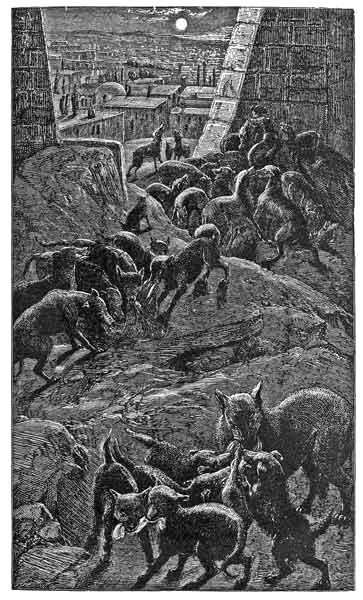
"At evening let them return; and let them make a noise like a dog, and go round about
the city. Let them wander up and down for meat, and grudge if they be not satisfied"—Psalm
lix. 14, 15.
On the first night of his arrival, he could not sleep, and went
to the window to look out in the night. "The noise I heard then
I shall never forget. To say that if all the sheep-dogs, in going
to Smithfield on a market-day, had been kept on the constant
bark, and pitted against the yelping curs upon all the carts
in London, they could have given any idea of the canine uproar
that now first astonished me, would be to make the feeblest of
images. The whole city rang with one vast riot. Down below
me, at Tophané—over-about Stamboul—far away at Scutari—the
whole sixty thousand dogs that are said to overrun Constantinople
appeared engaged in the most active extermination
of each other, without a moment's cessation. The yelping, howling,
barking, growling, and snarling, were all merged into one
uniform and continuous even sound, as the noise of frogs
becomes when heard at a distance. For hours there was no
lull. I went to sleep, and woke again, and still, with my windows
open, I heard the same tumult going on; nor was it until
daybreak that anything like tranquillity was restored.
"Going out in the daytime, it is not difficult to find traces of
the fights of the night about the limbs of all the street dogs.
There is not one, among their vast number, in the possession of
a perfect skin. Some have their ears gnawed away or pulled off;
others have their eyes taken out; from the backs and haunches
of others perfect steaks of flesh had been torn away; and all
bear the scars of desperate combats.
"Wild and desperate as is their nature, these poor animals
are susceptible of kindness. If a scrap of bread is thrown to
one of them now and then, he does not forget it; for they have,
at times, a hard matter to live—not the dogs amongst the shops
of Galata or Stamboul, but those whose 'parish' lies in the large
burying-grounds and desert places without the city; for each
keeps, or rather is kept, to his district, and if he chanced to
venture into a strange one, the odds against his return would be
very large. One battered old animal, to whom I used occasionally
to toss a scrap of food, always followed me from the
hotel to the cross street in Pera, where the two soldiers stood on
guard, but would never come beyond this point. He knew the
fate that awaited him had he done so; and therefore, when I
left him, he would lie down in the road, and go to sleep until
I came back.
"When a horse or camel dies, and is left about the roads near
the city, the bones are soon picked very clean by these dogs,
and they will carry the skulls or pelves to great distances. I was
told that they will eat their dead fellows—a curious fact, I
believe, in canine economy. They are always troublesome, not
to say dangerous, at night; and are especially irritated by
Europeans, whom they will single out amongst a crowd of
Levantines."
In the same work there is a short description of a solitary
dervish, who had made his home in the hollow of a large plane-tree,
in front of which he sat, surrounded by a small fence of
stakes only a foot or so in height. Around him, but not venturing
within the fence, were a number of gaunt, half-starved
dogs, who prowled about him in hopes of having an occasional
morsel of food thrown to them. Solitary as he was, and scanty
as must have been the nourishment which he could afford to
them, the innate trustfulness of the dog-nature induced them
to attach themselves to human society of some sort, though their
master was one, and they were many—he was poor, and they
were hungry.
Once in the Scriptures the word Greyhound occurs, namely, in
Prov. xxx. 29-31: "There be three things which go well, yea,
four are comely in going: a lion, which is strongest among
beasts, and turneth not away for any; a greyhound; an he-goat
also; and a king, against whom there is no rising up." But the
word "Greyhound" is only employed conjecturally, inasmuch as
the signification of the Hebrew word Zarzir-mathnâim is "one
girt about the loins." Some commentators have thought that the
horse might be signified by this word, and that the girding about
the loins referred to the trappings with which all Easterns love
to decorate their steeds. Probably, however, the word in question
refers neither to a horse nor a dog, but to a human athlete,
or wrestler, stripped, and girt about the loins ready for the
contest.
Identity of the animal indisputable—its numbers, past and present—The Wolf
never mentioned directly—its general habits—References in Scripture—its
mingled ferocity and cowardice—its association into packs—The Wolf's bite—How
it takes its prey—its ravages among the flocks—Allusions to this habit—The
shepherd and his nightly enemies—Mr. Tristram and the Wolf—A semi-tamed
Wolf at Marsaba.
There is no doubt that the Hebrew word Zeëb, which occurs in
a few passages of the Old Testament, is rightly translated as
Wolf, and signifies the same animal as is frequently mentioned
in the New Testament.
This fierce and dangerous animal was formerly very plentiful
in Palestine, but is now much less common, owing to the same
causes which have extirpated the lion from the country. It is a
rather remarkable fact, that in no passage of Holy Writ is the
Wolf directly mentioned. Its name is used as a symbol of a
fierce and treacherous enemy, but neither in the Old nor New
Testament does any sacred writer mention any act as performed
by the Wolf. We have already heard of the lion which attacked
Samson and was killed by him, of the lion which slew the disobedient
prophet, and of the lions which spared Daniel when
thrown into their den. We also read of the dogs which licked
Ahab's blood, and ate the body of Jezebel, also of the bears
which tore the mocking children.
But in no case is the Wolf mentioned, except in a metaphorical
sense; and this fact is the more remarkable, because the
animals were so numerous that they were very likely to have
exercised some influence on a history extending over such a
lengthened range of years, and limited to so small a portion of
the earth. Yet we never hear of the Wolf attacking any of the
personages mentioned in Scripture; and although we are told of
the exploit of David, who pursued a lion and a bear that had
taken a lamb out of his fold, we are never told of any similar
deed in connexion with the Wolf.
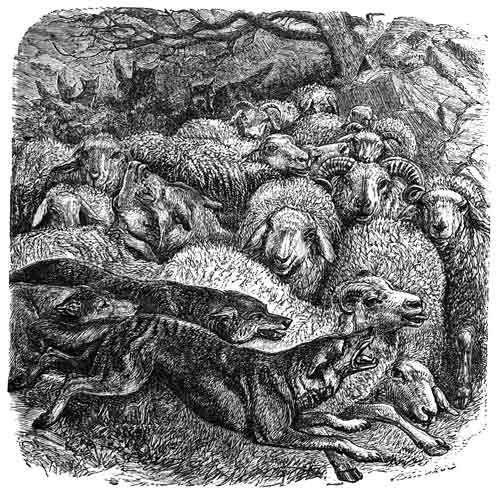
THE WOLF.
"The wolf catcheth and scattereth the sheep"—John x. 12.
This animal was then what it is now. Seldom seen by day,
it lies hidden in its covert as long as the light lasts, and steals
out in search of prey in the evening. This custom of the Wolf
is mentioned in several passages of Holy Scripture, such as that
in Jer. v. 5, 6: "These have altogether broken the yoke, and
burst the bonds. Wherefore a lion out of the forest shall slay
them, and a wolf of the evenings shall spoil them." In this
passage the reader will see that the rebellious Israelites are
compared to restive draught cattle which have broken away from
their harness and run loose, so that they are deprived of the
protection of their owners, and exposed to the fury of wild
beasts. A similar reference is made in Hab. i. 8: "Their horses
also are swifter than the leopards, and are more fierce than the
evening wolves." The same habit of the Wolf is alluded to in
Zeph. iii. 3: "Her princes within her are roaring lions; her
judges are evening wolves."
Individually, the Wolf is rather a timid animal. It will avoid
a man rather than meet him. It prefers to steal upon its prey
and take it unawares, rather than to seize it openly and boldly.
It is ever suspicious of treachery, and is always imagining that a
trap is laid for it. Even the shallow device of a few yards of
rope trailing from any object, or a strip of cloth fluttering in the
breeze, is quite sufficient to keep the Wolf at bay for a considerable
time. This fact is well known to hunters, who are accustomed
to secure the body of a slain deer by simply tying a strip
of cloth to its horn. If taken in a trap of any kind, or even if
it fancies itself in an enclosure from which it can find no egress,
it loses all courage, and will submit to be killed without offering
the least resistance. It will occasionally endeavour to effect its
escape by feigning death, and has more than once been known to
succeed in this device.
But, collectively, the Wolf is one of the most dangerous
animals that can be found. Herding together in droves when
pressed by hunger, the wolves will openly hunt prey, performing
this task as perfectly as a pack of trained hounds. Full of wiles
themselves, they are craftily wise in anticipating the wiles of
the animals which they pursue; and even in full chase, while the
body of the pack is following on the footsteps of the flying
animal, one or two are detached on the flanks, so as to cut it off
if it should attempt to escape by doubling on its pursuers.
There is no animal which a herd of wolves will not attack,
and very few which they will not ultimately secure. Strength
avails nothing against the numbers of these savage foes, which
give no moment of rest, but incessantly assail their antagonist,
dashing by instinct at those parts of the body which can be
least protected, and lacerating with their peculiar short, snapping
bite. Should several of their number be killed or disabled, it
makes no difference to the wolves, except that a minute or two
are wasted in devouring their slain or wounded brethren, and
they only return to the attack the more excited by the taste of
blood. Swiftness of foot avails nothing against the tireless perseverance
of the wolves, who press on in their peculiar, long,
slinging gallop, and in the end are sure to tire out the swifter
footed but less enduring animal that flees before them. The
stately buffalo is conquered by the ceaseless assaults of the
wolves; the bear has been forced to succumb to them, and the
fleet-footed stag finds his swift limbs powerless to escape the
pursuing band, and his branching horns unable to resist their
furious onset when once they overtake him.
In the passage from Habakkuk which has already been
quoted, allusion is made to the ferocity of the Wolf, and the
same characteristic is mentioned in several other parts of Scripture.
Take, for example, Gen. xlix. 27: "Benjamin shall ravin
as a wolf: in the morning he shall devour the prey, and at night
he shall divide the spoil." Or the passage in Ezekiel xxii. 27:
"Her princes in the midst thereof are like wolves ravening the
prey, to shed blood." Or the well-known metaphor of our Lord
in Matt. vii. 15: "Beware of false prophets, which come to you
in sheep's clothing, but inwardly they are ravening wolves."
That the Wolf is a special enemy to the sheep-fold is shown
in many parts of the Scriptures, both in the Old and New Testaments,
especially in the latter. In John x. 1-16, Jesus compares
himself to a good shepherd, who watches over the fold,
and, if the wolves should come to take the sheep, would rather
give up His life than they should succeed. But the false teachers
are compared to bad shepherds, hired for money, but having no
interest in the sheep, and who therefore will not expose themselves
to danger in defence of their charge.
This metaphor was far more effective in Palestine, and at that
time, than it is in this country and at the present day. In this
land, the shepherd has no anxiety about the inroads of wild
beasts, but in Palestine one of his chief cares was to keep watch
at night lest the wolves should attack the fold, and to drive them
away himself in case they should do so. Therefore the shepherd's
life was one which involved no small danger as well as
anxiety, and the metaphor used by our Lord gains additional
force from the knowledge of this fact.
A similar metaphor is used when Jesus wished to express in
forcible terms the dangers to which the chosen seventy would
oft be subjected, and the impossibility that they should be able
to overcome the many perils with which they would be surrounded.
"Go your ways: behold, I send you forth as lambs
among wolves" (Luke x. 3).
The well-known fact of the ravages of wolves among sheep has
been employed by the prophet Isaiah in two passages, wherein
he foretells the peaceful state of the world when the kingdom of
the Messiah shall have been established: "The wolf also shall
dwell with the lamb, and the leopard shall lie down with the
kid; and the calf and the young lion and the fatling together;
and a little child shall lead them" (Is. xi. 6). The second passage
occurs in chapter lxv. 23-25, and is of a similar character: "They
shall not labour in vain, nor bring forth for trouble; for they
are the seed of the blessed of the Lord, and their offspring with
them. And it shall come to pass, that before they call, I will
answer; and while they are yet speaking, I will hear. The wolf
and the lamb shall feed together, and the lion shall eat straw like
the bullock: and dust shall be the serpent's meat. They shall
not hurt nor destroy in all my holy mountain, saith the Lord."
Mr. Tristram several times met wolves while he was engaged
in his travels, and mostly saw solitary specimens. One such
encounter took place in the wilderness of Judah: "On my way
back, I met a fine solitary wolf, who watched me very coolly, at
the distance of sixty yards, while I drew my charge and dropped
a bullet down the barrel. Though I sent the ball into a rock
between his legs as he stood looking at me in the wady, he was
not sufficiently alarmed to do more than move on a little more
quickly, ever and anon turning to look at me, while gradually
increasing his distance. Darkness compelled me to desist from
the chase, when he quietly turned and followed me at a respectful
distance. He was a magnificent animal, larger than any
European wolf, and of a much lighter colour."
Those who are acquainted with the character of the animal
will appreciate the truthfulness of this description. The cautious
prowl at a distance, the slow trot away when he fancied he
might be attacked, the reverted look, and the final turning back
and following at a respectful distance, are all characteristic traits
of the Wolf, no matter to what species it may belong, nor what
country it may inhabit.
On another occasion, while riding in the open plain of Gennesaret,
the horse leaped over the bank of a little ditch, barely
three feet in depth. After the horse had passed, and not until
then, a Wolf started out of the ditch, literally from under the
horse's hoofs, and ran off. The animal had been crouching under
the little bank, evidently watching for some cows and calves
which were grazing at a short distance, under the charge of a
Bedouin boy. The same author mentions that one of the monks
belonging to the monastery at Marsaba had contrived to render a
Wolf almost tame. Every evening at six o'clock the Wolf came
regularly across the ravine, had a piece of bread, and then went
back again. With the peculiar jealousy of all tamed animals,
the Wolf would not suffer any of his companions to partake of
his good fortune. Several of them would sometimes accompany
him, but as soon as they came under the wall of the monastery
he always drove them away.
The inhabitants of Palestine say that the Wolves of that
country are not gregarious, and that they hunt singly, or at most
in little packs of few in number. Still they dread the animal
exceedingly, and say that one Wolf will do more damage in a
flock of sheep than a whole pack of jackals.
As a general rule, the Syrian wolf, like the Syrian bear, is of
a lighter colour than its European relatives, and appears to be a
larger and stronger animal.
The two animals comprehended under one name—The Jackal—its numbers in
ancient and modern Palestine—General habits of the Jackal—Localities where
the Jackal is found—Samson, and the three hundred "foxes"—Popular
objections to the narrative—The required number easily obtained—Signor
Pierotti's remarks upon the Jackal—An unpleasant position—How the fields
were set on fire—The dread of fire inherent in wild beasts—The truth of the
narrative proved—The Fox and Jackal destructive among grapes—Allusions
to the Fox in the New Testament—Partially tamed Foxes.
There are several passages in the Old Testament in which the
word Fox occurs, and it is almost certain that the Hebrew word
Shuâl, which is rendered in our translation as Fox, is used rather
loosely, and refers in some places to the Jackal, and in others to
the Fox. We will first take those passages in which the former
rendering of the word is evidently the right one, and will begin
by examining those characteristics of the animal which afford
grounds for such an assertion.
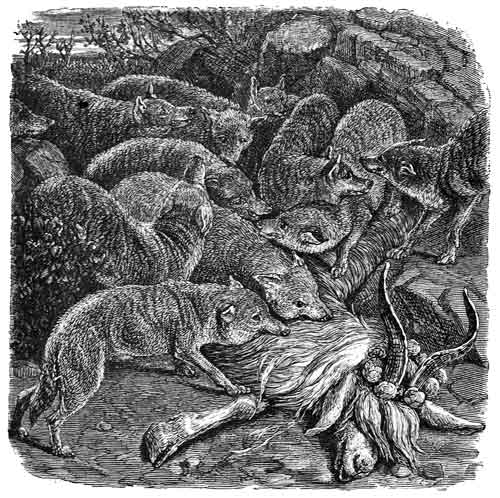
THE FOX OR JACKAL.
"They shall be a portion for foxes."—Psalm ixiii. 10. The end of the Scape Goat.
Even at the present time, the Jackal is extremely plentiful in
Palestine; and as the numbers of wild beasts have much decreased
in modern days, the animals must have been even more
numerous than they are at present. It is an essentially nocturnal
and gregarious animal. During the whole of the day the
Jackals lie concealed in their holes or hiding-places, which are
usually cavities in the rocks, in tombs, or among ruins. At
nightfall they issue from their dens, and form themselves into
packs, often consisting of several hundred individuals, and prowl
about in search of food. Carrion of various kinds forms their
chief subsistence, and they perform in the country much the
same task as is fulfilled by the dogs in the cities.
If any animal should be killed, or even severely wounded, the
Jackals are sure to find it out and to devour it before the daybreak.
They will scent out the track of the hunter, and feed
upon the offal of the beasts which he has slain. If the body of
a human being were to be left on the ground, the Jackals would
certainly leave but little traces of it; and in the olden times of
warfare, they must have held high revelry in the battle-field
after the armies had retired. It is to this propensity of the
Jackal that David refers—himself a man of war, who had
fought on many a battle-field, and must have seen the carcases
of the slain mangled by these nocturnal prowlers: "Those that
seek my soul, to destroy it, shall go into the lower parts of the
earth. They shall fall by the sword; they shall be a portion for
foxes" (Ps. lxiii. 9, 10). Being wild beasts, afraid of man, and
too cowardly to attack him even when rendered furious by
hunger, and powerful by force of numbers, they keep aloof from
towns and cities, and live in the uninhabited parts of the
country. Therefore the prophet Jeremiah, in his Book of
Lamentations, makes use of the following forcible image, when
deploring the pitiful state into which Judæa had fallen: "For
this our heart is faint; for these things our eyes are dim:
because of the mountain of Zion, which is desolate, the foxes
walk upon it" (Lam. v. 17). And Ezekiel makes use of a similar
image: "O Israel, thy prophets are like foxes in the desert."
But, by far the most important passage in which the Fox
is mentioned, is that wherein is recorded the grotesque
vengeance of Samson upon the Philistines: "And Samson went
and caught three hundred foxes, and took firebrands, and turned
tail to tail, and put a firebrand in the midst between two tails.
And when he had set the brands on fire, he let them go into the
standing corn of the Philistines, and burnt up both the shocks
and also the standing corn, with the vineyards and olives"
(Judges xv. 4, 5). Now, as this is one of the passages of Holy Writ
to which great objections have been taken, it will be as well to
examine these objections, and see whether they have any real
force. The first of these objections is, that the number of foxes
is far too great to have been caught at one time, and to this
objection two answers have been given. The first answer is, that
they need not have been caught at once, but by degrees, and
kept until wanted. But the general tenor of the narrative is
undoubtedly in favour of the supposition that this act of Samson
was unpremeditated, and that it was carried into operation at
once, before his anger had cooled. The second answer is, that
the requisite number of Foxes might have been miraculously
sent to Samson for this special purpose. This theory is really
so foolish and utterly untenable, that I only mention it because
it has been put forward. It fails on two grounds: the first
being that a miracle would hardly have been wrought to enable
Samson to revenge himself in so cruel and unjustifiable a
manner; and the second, that there was not the least necessity
for any miracle at all.
If we put out of our minds the idea of the English Fox, an
animal comparatively scarce in this country, and solitary in its
habits, and substitute the extremely plentiful and gregarious
Jackal, wandering in troops by night, and easily decoyed by
hunger into a trap, we shall see that double the number might
have been taken, if needful. Moreover, it is not to be imagined
that Samson caught them all with his own hand. He was at
the head of his people, and had many subordinates at his
command, so that a large number of hunters might have been
employed simultaneously in the capture. In corroboration of
this point, I insert an extremely valuable extract from Signor
Pierotti's work, in which he makes reference to this very portion
of the sacred history:—
"It is still very abundant near Gaza, Askalon, Ashdod, Ekron,
and Ramleh. I have frequently met with it during my wanderings
by night, and on one occasion had an excellent opportunity
of appreciating their number and their noise.
"One evening in the month of January 1857, while it was
raining a perfect deluge, I was obliged, owing to the dangerous
illness of a friend, to return from Jerusalem to Jaffa. The depth
of snow on the road over a great part of the mountain, the
clayey mud in the plain, and the darkness of the night, prevented
my advancing quickly; so that about half-past three in
the morning I arrived on the bank of a small torrent, about
half an hour's journey to the east of Ramleh. I wished to
cross: my horse at first refused, but, on my spurring it, advanced
and at once sank up to the breast, followed of course by
my legs, thus teaching me to respect the instinct of an Arab
horse for the future.
"There I stuck, without the possibility of escape, and consoled
my horse and myself with some provisions that I had in my
saddle-bags, shouting and singing at intervals, in the hope of
obtaining succour, and of preventing accidents, as I knew that
the year before a mule in the same position had been mistaken
for a wild beast, and killed. The darkness was profound, and
the wind very high; but, happily, it was not cold; for the only
things attracted by my calls were numbers of jackals, who
remained at a certain distance from me, and responded to my
cries, especially when I tried to imitate them, as though they
took me for their music-master.
"About five o'clock, one of the guards of the English consulate
at Jerusalem came from Ramleh and discovered my state.
He charitably returned thither, and brought some men, who
extricated me and my horse from our unpleasant bath, which, as
may be supposed, was not beneficial to our legs.
"During this most uncomfortable night, I had good opportunity
of ascertaining that, if another Samson had wished to
burn again the crops in the country of the Philistines, he would
have had no difficulty in finding more than three hundred
jackals, and catching as many as he wanted in springs, traps,
or pitfalls. (See Ps. cxl. 5.)"
The reader will now see that there was not the least difficulty
in procuring the requisite number of animals, and that consequently
the first objection to the truth of the story is disposed
of.
We will now proceed to the second objection, which is, that if
the animals were tied tail to tail, they would remain on or near
the same spot, because they would pull in different directions,
and that, rather than run about, they would turn round and
fight each other. Now, in the first place, we are nowhere told
that the tails of the foxes, or jackals, were placed in contact with
each other, and it is probable that some little space was left
between them. That animals so tied would not run in a straight
line is evident enough, and this was exactly the effect which
Samson wished to produce. Had they been at liberty, and the
fiery brand fastened to their tails, they would have run straight
to their dens, and produced but little effect. But their captor,
with cruel ingenuity, had foreseen this contingency, and, by
the method of securing them which he adopted, forced them to
pursue a devious course, each animal trying to escape from the
dreaded firebrand, and struggling in vain endeavours to drag its
companion towards its own particular den.
All wild animals have an instinctive dread of fire; and there
is none, not even the fierce and courageous lion, that dares enter
within the glare of the bivouac fire. A lion has even been
struck in the face with a burning brand, and has not ventured
to attack the man that wielded so dreadful a weapon. Consequently
it may be imagined that the unfortunate animals that
were used by Samson for his vindictive purpose, must have been
filled with terror at the burning brands which they dragged after
them, and the blaze of the fire which was kindled wherever
they went. They would have no leisure to fight, and would only
think of escaping from the dread and unintelligible enemy which
pursued them.
When a prairie takes fire, all the wild inhabitants flee in
terror, and never think of attacking each other, so that the bear,
the wolf, the cougar, the deer, and the wild swine, may all be
seen huddled together, their natural antagonism quelled in the
presence of a common foe. So it must have been with the
miserable animals which were made the unconscious instruments
of destruction. That they would stand still when a burning
brand was between them, and when flames sprang up around
them, is absurd. That they would pull in exactly opposite
directions with precisely balanced force is equally improbable,
and it is therefore evident that they would pursue a devious
path, the stronger of the two dragging the weaker, but being
jerked out of a straight course and impeded by the resistance
which it would offer. That they would stand on the same spot
and fight has been shown to be contrary to the custom of
animals under similar circumstances.
Thus it will be seen that every objection not only falls to the
ground, but carries its own refutation, thus vindicating this
episode in sacred history, and showing, that not only were the
circumstances possible, but that they were highly probable. Of
course every one of the wretched animals must have been ultimately
burned to death, after suffering a prolonged torture from
the firebrand that was attached to it. Such a consideration
would, however, have had no effect for deterring Samson from
employing them. The Orientals are never sparing of pain, even
when inflicted upon human beings, and in too many cases they
seem utterly unable even to comprehend the cruelty of which
they are guilty. And Samson was by no means a favourable
specimen of his countrymen. He was the very incarnation of
strength, but was as morally weak as he was corporeally powerful;
and to that weakness he owed his fall. Neither does he
seem to possess the least trace of forbearance any more than of
self-control, but he yields to his own undisciplined nature, places
himself, and through him the whole Israelitish nation, in
jeopardy, and then, with a grim humour, scatters destruction on
every side in revenge for the troubles which he has brought
upon himself by his own acts.
There is a passage in the Old Testament which is tolerably
familiar to most students of the Scriptures: "Take us the foxes,
the little foxes, that spoil the vines, for our vines have tender
grapes" (Solomon's Song, ii. 15). In this passage allusion is
made to the peculiar fondness for grapes and several other fruits
which exist both in the Fox and the Jackal. Even the domesticated
dog is often fond of ripe fruits, and will make great
havoc among the gooseberry bushes and the strawberry beds.
But both the Fox and the Jackal display a wonderful predilection
for the grape above all other fruit, and even when confined
and partly tamed, it is scarcely possible to please them better
than by offering them a bunch of perfectly ripe grapes. The
well-known fable of the fox and the grapes will occur to the
mind of every one who reads the passage which has just been
quoted.
There are two instances in the New Testament where the Fox
is mentioned, and in both cases the allusion is made by the Lord
himself. The first of these passages is the touching and well-known
reproach, "The foxes have holes, and the birds of the air
have nests, but the Son of Man hath not where to lay his head"
(Matt. viii. 20). The second passage is that in which He speaks
of Herod as "that fox," selecting a term which well expressed
the character of the cruel and cunning ruler to whom it was
applied.
The reader will remember that, in the history of the last-mentioned
animal an anecdote is told of a semi-tamed wolf that
used to come every evening for the purpose of receiving a piece
of bread. At the same monastery, three foxes used to enjoy a
similar privilege. They came regularly to the appointed place,
which was not that which the wolf frequented, and used to howl
until their expected meal was given to them. Several companions
generally accompanied them, but were always jealously
driven away before the monks appeared with the bread.
The Hyæna not mentioned by name, but evidently alluded to—Signification of
the word Zabua—Translated in the Septuagint as Hyæna—A scene described
by the Prophet Isaiah—The Hyæna plentiful in Palestine at the present day—its
well-known cowardice and fear of man—The uses of the Hyæna and the
services which it renders—The particular species of Hyæna—The Hyæna in
the burial-grounds—Hunting the Hyæna—Curious superstition respecting the
talismanic properties of its skin—Precautions adopted in flaying it—Popular
legends of the Hyæna and its magical powers—The cavern home of the Hyæna—The
Valley of Zeboim.
Although in our version of the Scriptures the Hyæna is not
mentioned by that name, there are two passages in the Old
Testament which evidently refer to that animal, and therefore it
is described in these pages. If the reader will refer to the
prophet Jeremiah, xii. 7-9, he will find these words: "I
have forsaken mine house, I have left mine heritage; I have
given the dearly beloved of my soul into the hand of her
enemies. Mine heritage is unto me as a lion in the forest; it
crieth out against me: therefore have I hated it. Mine heritage
is unto me as a speckled bird; the birds round about are against
her: come ye, assemble all the beasts of the field, come to
devour." Now, the word zabua signifies something that is
streaked, and in the Authorized Version it is rendered as a
speckled bird. But in the Septuagint it is rendered as Hyæna,
and this translation is thought by many critical writers to be
the true one. It is certain that the word zabua is one of the
four names by which the Talmudical writers mention the Hyæna,
when treating of its character; and it is equally certain that
such a rendering makes the passage more forcible, and is in
perfect accordance with the habits of predacious animals.
The whole scene which the Prophet thus describes was evidently
familiar to him. First, we have the image of a deserted
country, allowed to be overrun with wild beasts. Then we have
the lion, which has struck down its prey, roaring with exultation,
and defying any adversary to take it from him. Then, the lion
having eaten his fill and gone away, we have the Hyænas, vultures,
and other carrion-eating creatures, assembling around the
carcase, and hastening to devour it. This is a scene which has
been witnessed by many hunters who have pursued their sport
in lands where lions, hyænas, and vultures are found; and all
these creatures were inhabitants of Palestine at the time when
Jeremiah wrote.
At the present day, the Hyæna is still plentiful in Palestine,
though in the course of the last few years its numbers have
sensibly diminished. The solitary traveller, when passing by
night from one town to another, often falls in with the Hyæna,
but need suffer no fear, as it will not attack a human being, and
prefers to slink out of his way. But dead, and dying, or
wounded animals are the objects for which it searches; and
when it finds them, it devours the whole of its prey. The lion
will strike down an antelope, an ox, or a goat—will tear off its
flesh with its long fangs, and lick the bones with its rough
tongue until they are quite cleaned. The wolves and jackals
will follow the lion, and eat every soft portion of the dead
animal, while the vultures will fight with them for the coveted
morsels. But the Hyæna is a more accomplished scavenger
than lion, wolf, jackal, or vulture; for it will eat the very bones
themselves, its tremendously-powerful jaws and firmly-set teeth
enabling it to crush even the leg-bone of an ox, and its unparalleled
digestive powers enabling it to assimilate the sharp
and hard fragments which would kill any creature not constituted
like itself.
In a wild, or even a partially-inhabited country, the Hyæna
is, therefore, a most useful animal. It may occasionally kill a
crippled or weakly ox, and sometimes carry off a sheep; but,
even in that case, no very great harm is done, for it does not
meddle with any animal that can resist. But these few delinquencies
are more than compensated by the great services which
it renders as scavenger, consuming those substances which even
the lion cannot eat, and thus acting as a scavenger in removing
objects which would be offensive to sight and injurious to
health.
The species which is mentioned in the Scriptures is the Striped
Hyæna (Hyæna striata); but the habits of all the species are
almost exactly similar. We are told by travellers of certain
towns in different parts of Africa which would be unendurable
but for the Hyænas. With the disregard for human life which
prevails throughout all savage portions of that country, the rulers
of these towns order executions almost daily, the bodies of the
victims being allowed to lie where they happened to fall. No
one chooses to touch them, lest they should also be added to the
list of victims, and the decomposing bodies would soon cause a
pestilence but for the Hyænas, who assemble at night round
the bodies, and by the next morning have left scarcely a trace of
the murdered men.
Even in Palestine, and in the present day, the Hyæna will
endeavour to rifle the grave, and to drag out the interred corpse.
The bodies of the rich are buried in rocky caves, whose entrances
are closed with heavy stones, which the Hyæna cannot move;
but those of the poor, which are buried in the ground, must be
defended by stones heaped over them. Even when this precaution
is taken, the Hyæna will sometimes find out a weak
spot, drag out the body, and devour it.
In consequence of this propensity, the inhabitants have an
utter detestation of the animal. They catch it whenever they
can, in pitfalls or snares, using precisely the same means as were
employed two thousand years ago; or they hunt it to its den,
and then kill it, stripping off the hide, and carrying it about still
wet, receiving a small sum of money from those to whom they
show it. Afterwards the skin is dressed, by rubbing it with lime
and salt, and steeping it in the waters of the Dead Sea. It is then
made into sandals and leggings, which are thought to be powerful
charms, and to defend the wearer from the Hyæna's bite.
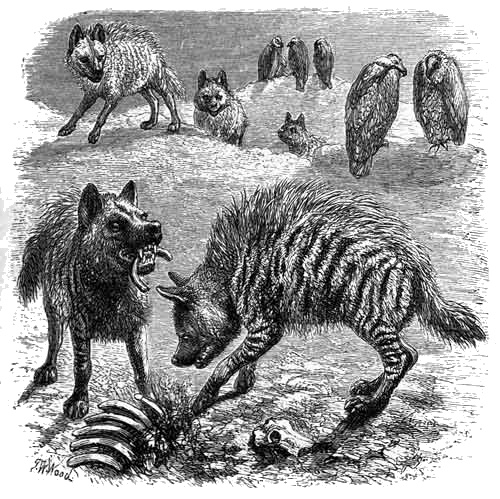
THE HYÆNA.
"I have given thee for meat to the beasts of the field and to the fowls of the heaven."—Ezek. xxix. 5.
They always observe certain superstitious precautions in flaying
the dead animal. Believing that the scent of the flesh
would corrupt the air, they invariably take the carcase to the
leeward of the tents before they strip off the skin. Even in the
animal which has been kept for years in a cage, and has eaten
nothing but fresh meat, the odour is too powerful to be agreeable,
as I can testify from practical experience when dissecting a
Hyæna that had died in the Zoological Gardens; and it is evident
that the scent of an animal that has lived all its life on carrion
must be almost unbearable. The skin being removed, the carcase
is burnt, because the hunters think that by this process the
other Hyænas are prevented from finding the body of their
comrade, and either avenging its death or taking warning by
its fate.
Superstitions seem to be singularly prevalent concerning the
Hyæna. In Palestine, there is a prevalent idea that if a Hyæna
meets a solitary man at night, it can enchant him in such a
manner as to make him follow it through thickets and over
rocks, until he is quite exhausted, and falls an unresisting prey;
but that over two persons he has no such influence, and therefore
a solitary traveller is gravely advised to call for help as soon as
he sees a Hyæna, because the fascination of the beast would be
neutralized by the presence of a second person. So firmly is
this idea rooted in the minds of the inhabitants, that they will
never travel by night, unless they can find at least one companion
in their journey.
In Northern Africa there are many strange superstitions connected
with this animal, one of the most curious of which is
founded on its well-known cowardice. The Arabs fancy that
any weapon which has killed a Hyæna, whether it be gun,
sword, spear, or dagger, is thenceforth unfit to be used in warfare.
"Throw away that sword," said an Arab to a French
officer, who had killed a Hyæna, "it has slain the Hyæna, and it
will be treacherous to you."
At the present day, its numbers are not nearly so great in
Palestine as they used to be, and are decreasing annually. The
cause of this diminution lies, according to Signor Pierotti, more
in the destruction of forests than in the increase of population
and the use of fire-arms, though the two latter causes have
undoubtedly considerable influence.
There is a very interesting account by Mr. Tristram of the
haunt of these animals. While exploring the deserted quarries
of Es Sumrah, between Beth-arabah and Bethel, he came upon a
wonderful mass of hyænine relics. The quarries in which were
lying the half-hewn blocks, scored with the marks of wedges,
had evidently formed the resort of Hyænas for a long series of
years. "Vast heaps of bones of camels, oxen, and sheep had
been collected by these animals, in some places to the depth of
two or three feet, and on one spot I counted the skulls of seven
camels. There were no traces whatever of any human remains.
We had here a beautiful recent illustration of the mode of
foundation of the old bone caverns, so valuable to the geologist.
These bones must all have been brought in by the Hyænas, as
no camel or sheep could possibly have entered the caverns alive,
nor could any floods have washed them in. Near the entrance
where the water percolates, they were already forming a soft
breccia."
The second allusion to the Hyæna is made in 1 Sam. xiii. 18,
"Another company turned to the way of the border that looketh
to the Valley of Zeboim towards the wilderness," i.e. to the
Valley of Hyænas.
The colour of the Striped Hyæna varies according to its age.
When young, as is the case with many creatures, birds as well
as mammals, the stripes from which it derives its name are
much more strongly marked than in the adult specimen. The
general hue of the fur is a pale grey-brown, over which are
drawn a number of dark stripes, extending along the ribs and
across the limbs.
In the young animal these stripes are nearly twice as dark
and twice as wide as in the adult, and they likewise appear on
the face and on other parts of the body, whence they afterwards
vanish. The fur is always rough; and along the spine, and especially
over the neck and shoulders, it is developed into a kind
of mane, which gives a very fierce aspect to the animal. The
illustration shows a group of Hyænas coming to feed on the
relics of a dead animal. The jackals and vultures have eaten as
much of the flesh as they can manage, and the vultures are
sitting, gorged, round the stripped bones. The Hyænas are now
coming up to play their part as scavengers, and have already
begun to break up the bones in their crushing-mills of jaws.
Difficulty of identifying the Weasel of Scripture—The Weasel of Palestine—Suggested
identity with the Ichneumon.
The word Weasel occurs once in the Holy Scriptures, and
therefore it is necessary that the animal should be mentioned.
There is a great controversy respecting the identification of the
animal, inasmuch as there is nothing in the context which gives
the slightest indication of its appearance or habits.
The passage in question is that which prohibits the Weasel and
the mouse as unclean animals (see Lev. xi. 29). Now the word
which is here translated Weasel is Choled, or Chol'd; and, I
believe, never occurs again in the whole of the Old Testament.
Mr. W. Houghton conjectures that the Hebrew word Choled is
identical with the Arabic Chuld and the Syriac Chuldo, both
words signifying a mole; and therefore infers that the unclean
animal in question is not a Weasel, but a kind of mole.
The Weasel does exist in Palestine, and seems to be as plentiful
there as in our own country. Indeed, the whole tribe of Weasels
is well represented, and the polecat is seen there as well as the
Weasel.
It has been suggested with much probability, that, as is
clearly the case in many instances, several animals have been
included in the general term Weasel, and that among them may
be reckoned the common ichneumon (Herpestes), which is one of
the most plentiful of animals in Palestine, and which may be
met daily.
The Septuagint favours the interpretation of Weasel, and, as
there is no evidence on either side, there we may allow the
question to rest. As, however, the word only occurs once, and
as the animal, whatever it may be, is evidently of no particular
importance, we may reserve our space for the animals which
have more important bearings upon the Holy Scriptures. The
subject will be again mentioned in the account of the Mole of
the Old Testament.
Translation of the Hebrew word Anakah—The Shrew-mouse of Palestine—Etymology
of the word—The Gecko or Fan-foot, its habits and peculiar cry—Repugnance
felt by the Arabs of the present day towards the Gecko.
Why the Hebrew word Anakah should have been translated in
our version as Ferret there is little ground for conjecture.
The name occurs among the various creeping things that were
reckoned as unclean, and were prohibited as food (see Lev. xi.
29, 30): "These also shall be unclean unto you among the
creeping things that creepeth upon the earth: the weasel, and
the mouse, and the tortoise after his kind, and the ferret, and the
chameleon, and the lizard, and the snail, and the mole." Now
the word in question is translated in the Septuagint as the
Mygale, or Shrew-mouse, and it is probable that this animal was
accepted by the Jews as the Anakah. But, whether or not it
was the Shrew-mouse, it is certain that it is not the animal which
we call the Ferret. Mr. Tristram suggests that the etymology
of the name, i.e. Anâkah, the Groaner, or Sigher, points to some
creature which utters a mournful cry. And as the animal in
question is classed among the creeping things, he offers a conjecture
that the Gecko, Wall-lizard, or Fan-foot, may be the
true interpretation of the word.
Being one of the lizards, it belongs to the "creeping things,"
and frequently utters a mournful sound like the word "geck-o."
It is exceedingly plentiful, and inhabits the interior of houses,
where it can find the flies and other insects on which it lives.
On account of the structure of the toes, each of which is flattened
into a disk-like form, and furnished on the under surface
with a series of plates like those on the back of the sucking-fish,
it can walk up a smooth, perpendicular wall with perfect ease,
and can even cling to the ceiling like the flies on which it feeds.
The structure of the feet enables it to move about without
the least sound, and at first an observer is apt to be rather
startled at the mournful cry, and at the silent rapidity with
which it darts from place to place.
The Arabs of the present day are horribly afraid of the Gecko,
thinking that it poisons everything that it touches, and are even
more terrified than are ignorant people in England when they
see a toad. Both creatures are equally repulsive in aspect, and
equally harmless towards the human race.
Difficulty in identifying the Tachash of Scripture—References to "Badgers'
skins"—The Dugong thought to be the Badger—The Bedouin sandals—Nature
of the materials for the Tabernacle—Habits of the Badger—The species
found in Palestine—Uses of the Badgers' skins—Looseness of zoological
terms.
Until very lately, there was much difficulty in ascertaining
whether the word Tachash has been rightly translated as
Badger. It occurs in several parts of the Scriptures, and almost
invariably is used in relation to a skin or fur of some sort. We
will first examine the passages in which the Badger is mentioned,
and then proceed to identify the animal.
Nearly all the references to the Badger occur in the book of
Exodus, and form part of the directions for constructing the
Tabernacle and its contents. The first notice of the word occurs
in Exodus xxv. 5, where the people of Israel are ordered to
bring their offerings for the sanctuary, among which offerings are
gold, silver, and brass, blue, purple, and scarlet, fine linen, goats'
hair, rams' skins dyed red, badgers' skins, and shittim wood—all
these to be used in the construction of the Tabernacle. Then a
little farther on, in chapter xxvi. 14, we find one of the special
uses to which the badgers' skins were to be put, namely, to make
the outer covering or roof of the tabernacle. Another use for
the badgers' skins was to form an outer covering for the ark, table
of shewbread, and other furniture of the Tabernacle, when the
people were on the march.
In all these cases the badger-skin is used as a covering to
defend a building or costly furniture, but there is one example
where it is employed for a different purpose. This passage
occurs in the book of Ezekiel, chapter xvi. 10. The prophet is
speaking of Jerusalem under the image of a woman, and uses
these words, "I anointed thee with oil; I clothed thee also with
broidered work, and shod thee with badger's skin, and I girded
thee about with fine linen, and I covered thee with silk. I
decked thee also with ornaments, and I put bracelets upon thy
hands, and a chain upon thy neck, and I put a jewel on thy
forehead, and earrings in thine ears, and a beautiful crown upon
thine head."
So we have here the fact, that the same material which was
used for the covering of the Tabernacle, and of the sacred furniture,
could also be used for the manufacture of shoes. This
passage is the more valuable because of an inference which may
be drawn from it. The reader will see that the badger-skin,
whatever it may have been, must have been something of considerable
value, and therefore, in all probability, something of
much rarity.
In the present instance, it is classed with the most luxurious
robes that were known in those days, and it is worthy of special
mention among the bracelet, earrings, necklace, and coronal with
which the symbolized city was adorned. If the reader will now
refer to the passage in which the children of Israel were commanded
to bring their offerings, he will see that in those cases
also the badger-skins were ranked with the costliest articles of
apparel that could be found, and had evidently been brought
from Egypt, the peculiar home of all the arts; together with the
vast quantity of gold and jewels which were used for the same
sacred purpose.
Now we find that the badger-skins in question must possess
three qualities: they must be costly, they must be capable of
forming a defence against the weather, and they must be strong
enough to be employed in the manufacture of shoes. If we
accept the word Tachash as signifying a Badger, we shall find
that these conditions have been fulfilled.
But many commentators have thought that badger-skins could
not have been procured in sufficient numbers for the purpose,
and have therefore conjectured that some other animal must be
signified by the word Tachash.
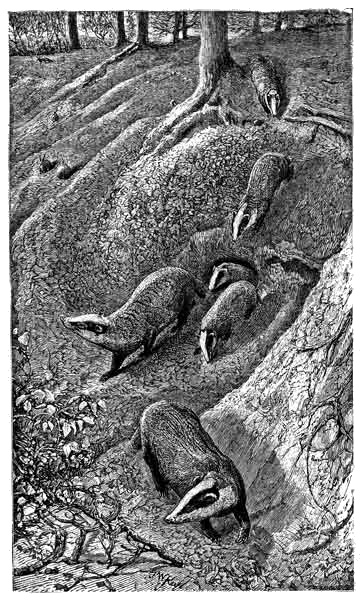
THE BADGER.
"Thou shalt make a covering above of badgers' skins."—Ex. xxvi. 14.
A species of dugong (Halicore hemprichii) is the animal that
has been selected as the Badger of the Scriptures. It is one of
the marine mammalia, and always lives near the shore, where it
can find the various algæ on which it feeds. It is a gregarious
animal, and, as it frequently ascends rivers for some distance, it
may be captured in sufficient numbers to make both its flesh
and skin useful. Moreover, it is of considerable size, fourteen
or fifteen feet in length being its usual dimensions, so that a
comparatively small number of the skins would be required for
the covering of the Tabernacle.
That shoes can be made of it is evident from the fact that at
the present day shoes, or rather sandals, are made from its hide,
and are commonly used by the Bedouins. But the very qualities
and peculiarities which render it a fit material for the sandal of a
half-naked Bedouin Arab, who has to walk continually over hard,
hot, sandy, and rough ground, would surely make it unsuitable for
the delicate shoes worn by a woman of rank who spends her
time in the house, and the rest of whose clothing is of fine linen
and silk, embroidered with gold and jewels. In our own country,
the hobnailed shoes of the ploughman and the slight shoe of a
lady are made of very different materials, and it is reasonable
to conjecture that such was the case when the passage in question
was written.
Then Dr. Robinson, who admits that the hide of the dugong
could hardly have been used as the material for a lady's shoe,
thinks that it would have answered very well for the roof of the
Tabernacle, because it was large, clumsy, and coarse. It seems
strange that he did not also perceive that the two latter qualities
would completely disqualify such skins for that service. Everything
clumsy and coarse was studiously prohibited, and nothing
but the very best was considered fit for the Tabernacle of the
Lord. By special revelation, Moses was instructed to procure,
not merely the ordinary timber of the country for the framework—not
only the fabrics which would keep out rain and
wind—not simply the metals in common use, from which
to make the lamps and other furniture—not the ordinary
oils for supplying the lamps; but, on the contrary, the finest
linen, the most elaborate embroidery, the rarest woods, the
purest gold, the costliest gems, were demanded, and nothing
common or inferior was accepted. The commonest material
that was permitted was the long, soft fleece of rams' wool;
but, even in that case, the wool had to be dyed of the regal
scarlet—a dye so rare and so costly that none but the
wealthiest rulers could use it. Even the very oil that burned
in the lamps must be the purest olive-oil, prepared expressly
for that purpose.
The very fact, therefore, that any article was plentiful and
could easily be obtained, would be a proof that such article was
not used for so sacred a purpose; while it is impossible that
anything coarse and clumsy could have been accepted for the
construction of that Tabernacle within which the Shekinah ever
burned over the Mercy-seat—over which the cloud rested by
day, and the fire shone by night, visible external proofs of the
Divine glory within.
We therefore dismiss from our minds the possibility of accepting
any material for it which was not exceptionably valuable,
and which would be employed in the uses of ordinary life. The
great object of the minutely-elaborate directions which were
given through Moses to the Israelites was evidently to keep
continually before their eyes the great truth that they owed all
to God, and that their costliest offerings were but acknowledgments
of their dependence.
We will now presume that the Tachash of the Pentateuch and
Ezekiel is really the animal which we know by the name of
Badger. It exists throughout the whole of the district traversed
by the Israelites, though it is not very plentiful, nor is it easily
taken. Had such been the case, its fur would not have been
employed in the service of the sanctuary.
It is nocturnal in its habits, and very seldom is seen during
the hours of daylight, so that it cannot be captured by chase. It
is not gregarious, so that it cannot be taken in great numbers, as
is the case with certain wild animals which have been thought
to be the Tachash of Scripture. It is not a careless animal, so
that it cannot be captured or killed without the exercise of considerable
ingenuity, and the expenditure of much time and
trouble. It is one of the burrowing animals, digging for itself
a deep subterranean home, and always ready whenever it is
alarmed to escape into the dark recesses of its dwelling, from
which it can scarcely be dislodged. It is not a large animal, so
that a considerable number of skins would be required in order
to make a covering which should overlap a structure forty-five
feet in length and fifteen in breadth. Were it a solitary animal,
there might be a difficulty in procuring a sufficient number of
skins. But it is partly gregarious in its habits, living together
in small families, seven or eight being sometimes found to inhabit
a single dwelling-place. It is, therefore, sufficiently rare to make
its skin valuable, and sufficiently plentiful to furnish the requisite
number of skins. All these facts tend to show that the cost of
such a covering must have been very great, even though it was
the outermost, and, consequently, the least valuable of the four.
It has been suggested that these skins were only used to lay over
the lines where the different sets of coverings overlapped each
other, and that, in consequence, they need not have been very
numerous.
But we find that these same skins, which were evidently those
which formed the external roof, were used, when the Tabernacle
was taken down, for the purpose of forming distinct coverings
for the ark of the testimony, the table of shewbread, the seven-branched
candlestick, the golden altar, the various vessels used in
the ministrations, and lastly, the altar of sacrifice itself. Thus,
when we recollect the dimensions of the ark, the table, the candlestick,
and the two altars, we shall see that, in order to make
separate covers for them, a quantity of material would be used
which would be amply sufficient to cover the whole roof of the
Tabernacle, even if it had, as was most probably the case, a ridged,
and not a flat roof.
We now come to our next point, namely, the aptitude of the
Badger's skin to resist weather. Any one who has handled the
skin of the Badger will acknowledge that a better material could
hardly be found. The fur is long, thick, and, though light, is
moderately stiff, the hairs falling over each other in such a
manner as to throw off rain or snow as off a penthouse. And,
as to the third point, namely, its possible use as a material for the
manufacture of shoes, we may call to mind that the skin of the
Badger is proverbially tough, and that this very quality has
caused the animal to be subjected to most cruel treatment by a
class of sporting men which is now almost extinct.
The Septuagint gives little assistance in determining the precise
nature of the Tachash, and rather seems to consider the word as
expressive of the colour with which the fur was dyed than that of
the animal from which it was taken. Still, it must be remembered
that not only are zoological terms used very loosely in the
Scriptures, but that in Hebrew, as in all other languages, the
same combination of letters often expresses two different ideas,
so that the word Tachash may equally signify a colour and an
animal. Moreover, it has been well pointed out that the repeated
use of the word in the plural number shows that it cannot
refer to colour; while its almost invariable combination with
the Hebrew word that signifies a skin implies that it does not
refer to colour, but to an animal.
What that animal may be, is, as I have already mentioned,
conjectural. But, as the authorized translation renders the word
as Badger, and as this reading fulfils the conditions necessary to
its identification, and as no other reading does fulfil them, we
cannot be very far wrong if we accept that translation as the
correct one, and assume the Tachash of the Scriptures to be the
animal which we call by the name of Badger.
The Syrian Bear—Identity of the Hebrew and Arabic titles—Its colour variable
according to age—Bears once numerous in Palestine, and now only occasionally
seen—Reason for their diminution—Present localities of the Bear, and its
favourite haunts—Food of the Bear—Its general habits—Its ravages among
the flocks—The Bear dangerous to mankind—The Bear robbed of her whelps—Illustrative
passages—Its mode of fighting—Various references to the Bear,
from the time of Samuel to that of St. John.
Whatever doubt may exist as to the precise identity of
various animals mentioned in the Scriptures, there is none whatever
as to the creature which is frequently alluded to under the
name of Bear.
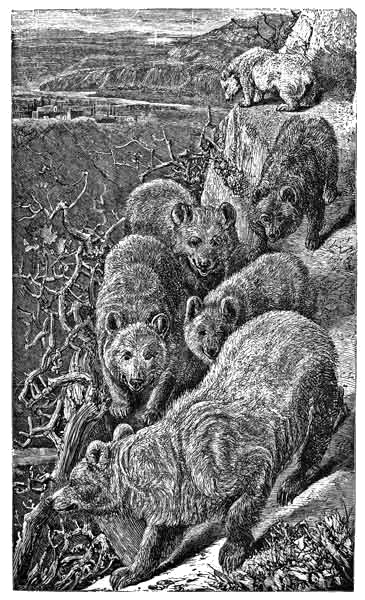
"As a roaring lion and a ranging bear, so is a wicked ruler over the poor people."—Prov. xxviii. 15.
The Hebrew word is Dôb, and it is a remarkable fact that the
name of this animal in the Arabic language is almost identical
with the Hebrew term, namely, Dubh. The peculiar species of
Bear which inhabits Palestine is the Syrian Bear (Ursus
Isabellinu s), and, though it has been variously described by
different eye-witnesses, there is no doubt that the same species
was seen by them all. As is the case with many animals, the
Syrian Bear changes its colour as it grows older. When a cub, it is
of a darkish brown, which becomes a light brown as it approaches
maturity. But, when it has attained its full growth, it becomes
cream-coloured, and each succeeding year seems to lighten its
coat, so that a very old Bear is nearly as white as its relative of
the Arctic regions. Travellers, therefore, who have met the
younger specimens, have described them as brown in hue, while
those who have seen more aged individuals have stated that
the colour of the Syrian Bear is white.
Owing to the destruction of forests, the Bear, which is essentially
a lover of the woods, has decreased considerably in number. Yet,
even at the present time, specimens may be seen by the watchful
traveller, mostly about the range of Lebanon, but sometimes at
a considerable distance from that locality. Mr. Tristram, for
example, saw it close to the Lake of Gennesaret. "We never
met with so many wild animals as on one of those days. First
of all, a wild boar got out of some scrub close to us, as we were
ascending the valley. Then a deer was started below, ran up
the cliff, and wound along the ledge, passing close to us. Then
a large ichneumon almost crossed my feet and ran into a cleft;
and, while endeavouring to trace him, I was amazed to see a
brown Syrian Bear clumsily but rapidly clamber down the
rocks and cross the ravine. He was, however, far too cautious
to get within hailing distance of any of the riflemen."
The same author mentions that some of the chief strongholds
of this Bear are certain clefts in the face of a precipitous chasm
through which the river Leontes flows. This river runs into the
sea a few miles northward of Tyre, and assists in carrying off the
melted snows from the Lebanon range of mountains. His
description is so picturesque, that it must be given in his own
words. "The channel, though a thousand feet deep, was so
narrow that the opposite ridge was within gunshot. Looking
down the giddy abyss, we could see the cliff on our side partially
covered with myrtle, bay, and caper hanging from the fissures,
while the opposite side was perforated with many shallow caves,
the inaccessible eyries of vultures, eagles, and lanner falcons, which
were sailing in multitudes around. The lower part had many
ledges clad with shrubs, the strongholds of the Syrian Bear,
though inaccessible even to goats. Far beneath dashed the
milk-white river, a silver line in a ruby setting of oleanders,
roaring doubtless fiercely, but too distant to be heard at the
height on which we stood. This cleft of the Leontes was the only
true Alpine scenery we had met with in Palestine, and in any
country, and amidst any mountains, it would attract admiration."
On those elevated spots the Bear loves to dwell, and throughout
the summer-time generally remains in such localities. For the
Bear is one of the omnivorous animals, and is able to feed on
vegetable as well as animal substances, preferring the former
when they can be found. There is nothing that a Bear likes better
than strawberries and similar fruits, among which it will revel
throughout the whole fruit season, daintily picking the ripest
berries, and becoming wonderfully fat by the constant banquet.
Sometimes, when the fruits fail, it makes incursions among the
cultivated grounds, and is noted for the ravages which it makes
among a sort of vetch which is much grown in the Holy Land.
But during the colder months of the year the Bear changes
its diet, and becomes carnivorous. Sometimes it contents itself
with the various wild animals which it can secure, but sometimes
it descends to the lower plains, and seizes upon the goats
and sheep in their pastures. This habit is referred to by David,
in his well-known speech to Saul, when the king was trying to
dissuade him from matching himself against the gigantic
Philistine. "And Saul said to David, Thou art not able to go
against this Philistine to fight with him: for thou art but a
youth, and he a man of war from his youth.... Thy servant
kept his father's sheep, and there came a lion and a bear, and
took a lamb out of the flock: and I went out after him, and
smote him, and delivered it out of his hand; and when he arose
against me, I caught him by the beard, and smote him, and slew
him. Thy servant slew both the lion and the bear: and this
uncircumcised Philistine shall be as one of them, seeing he hath
defied the armies of the living God."—1 Sam. xvii. 33-36.
Though not generally apt to attack mankind, it will do so if
first attacked, and then becomes a most dangerous enemy. See,
for example, that most graphic passage in the book of the
prophet Amos, whose business as a herdsman must have made
him conversant with the habits, not only of the flocks and herds
which he kept, but of the wild beasts which might devour
them:—"Woe unto you that desire the day of the Lord! to
what end is it for you? the day of the Lord is darkness, and
not light. As if a man did flee from a lion, and a bear met
him; or went into a house, and leaned his hand on the wall,
and a serpent bit him." (v. 19.)
Another reference to the dangerous character of the Bear is
made in 2 Kings ii. 23, 24, in which is recorded that two she-bears
came out of the wood near Bethel, and killed forty-two of
the children that mocked at Elisha.
As the Bear is not swift of foot, but rather clumsy in its
movements, it cannot hope to take the nimbler animals in open
chase. It prefers to lie in wait for them in the bushes, and to
strike them down with a sudden blow of its paw, a terrible
weapon, which it can wield as effectively as the lion uses its
claws. An allusion to this habit is made in the Lamentations
of Jeremiah (iii. 10), "He was unto me as a bear lying in wait,
and as a lion in secret places."
Harmless to man as it generally is, there are occasions on
which it becomes a terrible and relentless foe, not seeking to
avoid his presence, but even searching for him, and attacking
him as soon as seen. In the proper season of the year, hunters,
or those who are travelling through those parts of the country
infested by the Bear, will sometimes find the cubs, generally
two in number, their mother having left them in the den while
she has gone to search for food. Although they would not
venture to take the initiative in an attack upon either of the
parents, they are glad of an opportunity which enables them to
destroy one or two Bears without danger to themselves. The
young Bears are easily killed or carried off, because at a very
early age they are as confident as they are weak, and do not try
to escape when they see the hunters approaching.
The only danger lies in the possibility that their deed may
be discovered by the mother before they can escape from the
locality, and, if she should happen to return while the robbers
are still in the neighbourhood, a severe conflict is sure to follow.
At any time an angry Bear is a terrible antagonist, especially if
it be wounded with sufficient severity to cause pain, and not
severely enough to cripple its movements. But, when to this
easily-roused ferocity is added the fury of maternal feelings, it
may be imagined that the hunters have good reason to fear its
attack.
To all animals that rear their young is given a sublime and
almost supernatural courage in defending their offspring, and
from the lioness, that charges a host of armed men when her
cubs are in danger, to the hen, which defies the soaring kite or
prowling fox, or to the spider, that will give up her life rather
than abandon her yet unhatched brood, the same self-sacrificing
spirit actuates them all. Most terrible therefore is the wrath
of a creature which possesses, as is the case of the Bear, the
strongest maternal affections, added to great size, tremendous
weapons, and gigantic strength. That the sight of a Bear
bereaved of her young was well known to both writers and
contemporary readers of the Old Testament, is evident from
the fact that it is mentioned by several writers, and always
as a familiar illustration of furious anger. See for example
2 Sam. xvii. 8, when Hushai is dissuading Absalom from following
the cautious counsel of Ahithophel, "For thou knowest
thy father and his men, that they be mighty men of war, and
they be chafed in their minds as a bear robbed of her whelps
in the field." Solomon also, in the Proverbs (xvii. 12), uses
the same image, "Let a bear robbed of her whelps meet a man,
rather than a fool in his folly."
When the Bear fights, it delivers rapid strokes with its armed
paw, tearing and rending away everything that it strikes. A
blow from a bear's paw has been several times known to strip
the entire skin, together with the hair, from a man's head, and,
when fighting with dogs, to tear its enemies open as if each
claw were a chisel. This mode of fighting is clearly alluded to
by the prophet Hosea, who seems, from the graphic force of his
sentences, to have been an actual spectator of some such combat,
"I will meet them as a bear that is bereaved of her whelps, and
will rend the caul of their heart" (Hos. xiii. 8).
That the Bear was a well-known animal both in the earlier
and later times of the Scripture is also evident from the fact
that it was twice used as a symbol exhibited to a seer in a
vision. The first of these passages occurs in the book of
Daniel (vii. 5), when the prophet is describing the wonderful
vision of the four beasts:—"And behold another beast, a second,
like to a bear, and it raised up itself on one side, and it had
three ribs in the mouth of it, between the teeth of it, and they
said thus unto it, Arise, devour much flesh." The second
allusion occurs in the Revelation, the seven-headed and ten-crowned
beast having a form like that of a leopard, but feet
like those of a Bear.
Various readings of the word Kippôd—The Jewish Bible and its object—The
Syrian Hedgehog and its appearance—Its fondness for dry spots—The prophecies
of Isaiah and Zephaniah, and their bearing on the subject—The Porcupine
supposed to be the Kippôd—The Hedgehog and Porcupine called by the same
name in Greek and Arabic—Habits of the Porcupine—Its quills, and the
manner of their shedding.
In our Authorized Bible, there are one or two passages where
the Hebrew word Kippôd is translated as Bittern. For example,
there is Isaiah xiv. 22, 23, "I will cut off from Babylon the
name, and remnant, and son and nephew, saith the Lord. I
will also make it a possession for the bittern, and pools of
water, and I will sweep it with the besom of destruction, saith
the Lord of hosts."
Then there is another passage of the same prophet
(xxxiv. 11), "But the cormorant and the bittern shall possess
it (i.e. Idumea), the owl also and the raven shall dwell in it."
The last mention of this creature occurs in Zephaniah ii. 14,
"And flocks shall lie down in the midst of her (i.e. Nineveh),
all the beasts of the nations: both the bittern and the cormorant
shall lodge in the upper lintels of it; their voice shall sing in
the windows; desolation shall be in the thresholds; for he shall
uncover the cedar-work."
Now, in the "Jewish School and Family Bible," a new literal
translation by Dr. A. Benisch, under the superintendence of
the Chief Rabbi, the word Kippôd is translated, not as Bittern,
but Hedgehog. As I shall have to refer to this translation
repeatedly in the course of the present work, I will give a few
remarks made by the translator in the preface.
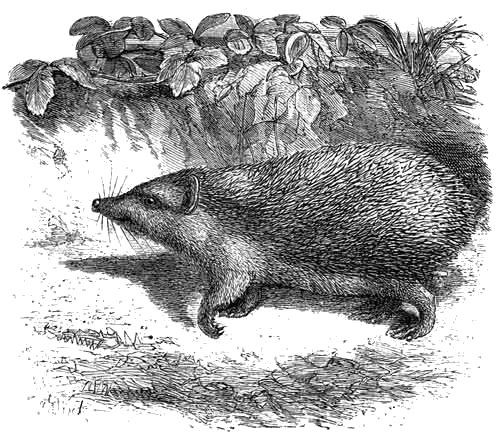
SYRIAN HEDGEHOG.
"Pelican and hedgehog shall possess it."—Isa. xxxiv. 11 (Jewish Bible).
After premising that both Christian and Jew agree in considering
the Old Testament as emanating from God, and
reverencing it as such, he proceeds to say that the former, as
holding himself absolved from the ceremonial law of the
Mosaic dispensation, has not the interest in the exact signification
of every letter of the law which necessarily attaches itself
to the Jew, who considers himself bound by that law, although
some ceremonies, "by their special reference to the Temple in
Jerusalem and the actual existence of Israel in the Holy Land,
are at present not practicable."
He then observes that the translators of the authorized
Anglican version, whose many excellences he fully admits,
could not be considered as free agents, as they were bound by
the positive injunctions of their monarch, as well as by the less
obvious, but more powerful influence of Christian authorities,
to alter the original translation as little as possible, and to keep
the ecclesiastical words. Retaining, therefore, the renderings of
the Anglican translation whenever it can be done without infringing
upon absolute accuracy, the translator has marked with
great care various passages where he has felt himself obliged to
give a different rendering to the Hebrew. Whenever words,
especially such as are evidently the names of animals, cannot
be rendered with any amount of probability, they have not been
translated at all, and to those about which there are good
grounds of doubt a distinctive mark is affixed.
Now to the word Hedgehog, by which the Hebrew Kippôd
is rendered, no such marking is attached in either of the three
quoted passages, and it is evident therefore that the rendering is
satisfactory to the highest authorities on the Hebrew language.
And we have the greater assurance of this accuracy, because, in
the mere translation of the name of an animal, no doctrinal
point is involved, and so there can be no temptation to the
translator to be carried away by preconceived ideas, and to give
to the word that rendering which may tend to establish his
peculiar doctrinal ideas.
The Septuagint also translates Kippôd as εχινος (echinus)
i.e. the Hedgehog, and this rendering is advocated by the
eminent scholar Gesenius, who considers it to be formed from
the Hebrew word kaped, i.e. contracted; reference being of
course made to the Hedgehog's habit of rolling itself up when
alarmed, and presenting only an array of bristles to the enemy.
This derivation of the word is certainly more convincing than a
suggestion which has been made, that the Hebrew Kippôd may
signify the Hedgehog, because it resembles the Arabic name of
the same animal, viz. Kunfod.
As therefore the word Kippôd is translated as Hedgehog in
the Septuagint and Jewish Bible, and as Bittern in the authorized
version, we very naturally ask ourselves whether either or both
of these animals inhabit Palestine and the neighbouring countries.
We find that both are plentiful even at the present day, and
that more than one species of Hedgehog and Bittern are known
in the Holy Land. About the Bittern we shall treat in good
time, and will now take up the rendering of Hedgehog.
There are at least two species of Hedgehog known in Palestine,
that of the north being identical with our own well-known
animal (Erinaceus Europœus), and the other being a distinct
species (Erinaceus Syriacus). The latter animal is the species
which has been chosen for illustration. It is smaller than its
northern relative, lighter in colour, and, as may be seen from the
illustration, is rather different in general aspect.
Its habits are identical with those of the European Hedgehog.
Like that animal it is carnivorous, feeding on worms, snails,
frogs, lizards, snakes, and similar creatures, and occasionally
devouring the eggs and young of birds that make their nest on
the ground.
Small as is the Hedgehog, it can devour all such animals with
perfect ease, its jaws and teeth being much stronger than might
be anticipated from the size of their owner.
One or two objections that have been made to the translation
of the Kippôd as Hedgehog must be mentioned, so that the
reader may see what is said on both sides in dubious cases.
One objection is, that the Kippôd is (in Isaiah xiv. 23) mentioned
in connexion with pools of water, and that, as the
Hedgehog prefers dry places to wet, whereas the Bittern is
essentially a marsh-dweller, the latter rendering of the word is
preferable to the former. Again, as the Kippôd is said by
Zephaniah to "lodge in the upper lintels," and its "voice to
sing in the windows," it must be a bird, and not a quadruped.
We will examine these passages separately, and see how they
bear upon the subject. As to Zephaniah ii. 13, the Jewish Bible
treats the passage as follows:—"And he will stretch out his hand
against the north, and destroy Assyria; and will make Nineveh
a desolation, and arid like the desert. And droves shall crouch
in the midst of her, all the animals of nations: both pelican and
hedgehog (Kippôd) shall lodge nightly in the knobs of it, a voice
shall sing in the windows; drought shall be in the thresholds, for
he shall uncover the cedar-work."
Now the reader will see that, so far from the notion of
marsh-land being connected with the Kippôd, the whole imagery
of the prophecy turns upon the opposite characteristics of desolation,
aridity, and drought. The same imagery is used in Isaiah
xxxiv. 7-12, which the Jewish Bible reads as follows, "For it
is the day of the vengeance of the Eternal, and the year of recompenses
for the quarrel of Zion. And the brooks thereof
shall be turned into pitch, and the dust thereof into brimstone,
and the land thereof shall become burning pitch. It shall not
go out night nor day; the smoke of it shall go up for ever; from
generation to generation it shall lie waste; none shall pass
through it for ever and ever. Pelican and hedgehog (Kippôd)
shall possess it; owls also and ravens shall dwell in it; and he
shall stretch over it the line of desolation, and the stones of
emptiness." And to the end of the chapter the same idea of
drought, desolation, and solitude is carried out.
Thus, even putting the question in the simplest manner, we
have two long passages which directly connect the Kippôd with
drought, aridity, and desolation, in opposition to one in which
the Kippôd and "pools of water" are mentioned in proximity to
each other. Now the fact is, that the sites of Nineveh and
Babylon fulfil both prophecies, being both dry and marshy—dry
away from the river, and marshy among the reed-swamps
that now exist on its banks.
So much for the question of locality.
As to the second objection, namely, that the Kippôd was to
lodge in the upper lintels, and therefore must be a bird, and not
a quadruped, it is sufficient to say that the allusion is evidently
made to ruins that are thrown down, and not to buildings that
are standing upright.
As to the words, "their voices shall sing in the windows," the
reader may see, on reference to the English Bible, that the word
"their" is printed in italics, showing that it does not exist in the
original, and has been supplied by the translator. Taking the
passage as it really stands, "Both the cormorant and the bittern
(Kippôd) shall lodge in the upper lintels of it; a voice shall sing
in the windows," it is evident that the voice or sound which
sings in the windows does not necessarily refer to the cormorant
and Bittern at all. Dr. Harris remarks that "the phrase is
elliptical, and implies 'the voice of birds.'"
Presumed identity of the Kippôd with the Porcupine—The same Greek name
applied to the Porcupine and Hedgehog—Habits of the Porcupine—the
common Porcupine found plentifully in Palestine.
Although, like the hedgehog, the Porcupine is not mentioned
by name in the Scriptures, many commentators think that the
word Kippôd signifies both the hedgehog and Porcupine.
That the two animals should be thought to be merely two
varieties of one species is not astonishing, when we remember
the character of the people among whom the Porcupine lives.
Not having the least idea of scientific geology, they look only to
the most conspicuous characteristics, and because the Porcupine
and hedgehog are both covered with an armature of quills, and
the quills are far more conspicuous than the teeth, the inhabitants
of Palestine naturally class the two animals together. In
reality, they belong to two very different orders, the hedgehog
being classed with the shrew-mice and moles, while the Porcupine
is a rodent animal, and is classed with the rats, rabbits,
beavers, marmots, and other rodents.
At the present day the inhabitants of the Holy Land believe
the Porcupine to be only a large species of hedgehog, and the
same name is applied to both animals. Such is the case even in
the Greek language, the word Hystrix (ὕστριγξ or ὕσθριξ) being
employed indifferently in either sense.
Its food is different from that of the hedgehog, for whereas
the hedgehog lives entirely on animal food, as has been already
mentioned, the Porcupine is as exclusively a vegetable eater,
feeding chiefly on roots and bark.
It is quite as common in Palestine as the hedgehog, a fact
which increases the probability that the two animals may have
been mentioned under a common title. Being a nocturnal
animal, it retires during the day-time to some crevice in a rock or
burrow in the ground, and there lies sleeping until the sunset
awakens it and calls it to action. And as the hedgehog is also
a nocturnal animal, the similarity of habit serves to strengthen
the mutual resemblance.
The Porcupine is peculiarly fitted for living in dry and unwatered
spots, as, like many other animals, of which our
common rabbit is a familiar example, it can exist without
water, obtaining the needful moisture from the succulent roots
on which it feeds.
The sharply pointed quills with which its body is covered are
solid, and strengthened in a most beautiful manner by internal
ribs, that run longitudinally along its length, exactly like those
of the hollow iron masts, which are now coming so much into
use. As they are, in fact, greatly developed hairs, they are continually
shed and replaced, and when they are about to fall are
so loosely attached that they fall off if pulled slightly, or even if
the animal shakes itself. Consequently the shed quills that lie
about the localities inhabited by the Porcupine indicate its
whereabouts, and so plentiful are these quills in some places
that quite a bundle can be collected in a short time.
There are many species of Porcupines which inhabit different
parts of the world, but that which has been mentioned is the
common Porcupine of Europe, Asia, and Africa (Hystrix
cristata).
The two Hebrew words which are translated as Mole—Obscurity of the former
name—A parallel case in our own language—The second name—The Moles
and the Bats, why associated together—The real Mole of Scripture, its different
names, and its place in zoology—Description of the Mole-rat and its general
habits—Curious superstition—Discovery of the species by Mr. Tristram—Scripture
and science—How the Mole-rat finds its food—Distinction between
the Mole and the present animal.
There are two words which are translated as Mole in our
authorized version of the Bible. One of them is so obscure that
there seems no possibility of deciding the creature that is represented
by it. We cannot even tell to what class of the animal
kingdom it refers, because in more than one place it is mentioned
as one of the unclean birds that might not be eaten (translated
as swan in our version), whereas, in another place, it is enumerated
among the unclean creeping things.
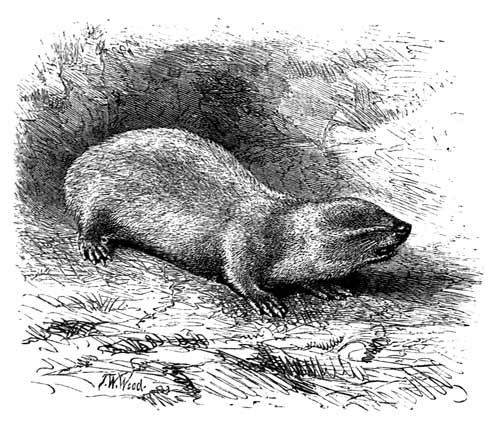
THE MOLE-RAT.
"These also shall be unclean unto you among the creeping things that creep upon the earth ... the
lizard, the snail, and the mole."—Lev. xi. 29, 30.
We may conjecture that the same word might be used to
designate two distinct animals, though we have no clue to their
identification. It is rather a strange coincidence, in corroboration
of this theory, that our word Mole signifies three distinct objects—firstly,
an animal; secondly, a cutaneous growth; and
thirdly, a bank of earth. Now, supposing English to be a dead
language, like the Hebrew, it may well be imagined that a translator
of an English book would feel extremely perplexed when
he saw the word Mole used in such widely different senses.
The best Hebraists can do no more than offer a conjecture
founded on the structure of the word Tinshemeth, which is
thought by some to be the chameleon. Some think that it
is the Mole, some the ibis, some the salamander, while others
consider it to be the centipede; and in neither case have any
decisive arguments been adduced.
We will therefore leave the former of these two names, and
proceed to the second, Chephor-peroth.
This word occurs in that passage of Isaiah which has already
been quoted when treating of the bat. "In that day a man shall
cast his idols of silver and his idols of gold, which they made
each one to himself to worship, to the moles and to the bats; to
go into the clefts of the rocks and into the tops of the ragged
rocks, for fear of the Lord and for the glory of his majesty, when
he ariseth to shake terribly the earth."
It is highly probable that the animal in question is the Mole
of Palestine, which is not the same as our European species, but
is much larger in size, and belongs to a different order of mammalia.
The true Mole is one of the insectivorous and carnivorous
animals, and is allied to the shrews and the hedgehogs; whereas
the Mole of Palestine (Spalax typhlus) is one of the rodents,
and allied to the rabbits, mice, marmots, and jerboas. A better
term for it is the Mole-rat, by which name it is familiar to
zoologists. It is also known by the names of Slepez and
Nenni.
In length it is about eight inches, and its colour is a pale slate.
As is the case with the true Moles, the eyes are of very minute
dimensions, and are not visible through the thick soft fur with
which the whole head and body are covered. Neither are there
any visible external ears, although the ear is really very large,
and extremely sensitive to sound. This apparent privation of
both ears and eyes gives to the animal a most singular and
featureless appearance, its head being hardly recognisable as such
but for the mouth, and the enormous projecting teeth, which not
only look formidable, but really are so. There is a curious
superstition in the Ukraine, that if a man will dare to grasp a
Mole-rat in his bare hand, allow it to bite him, and then squeeze
it to death, the hand that did the deed will ever afterwards
possess the virtue of healing goitre or scrofula.
This animal is spread over a very large tract of country, and
is very common in Palestine. Mr. Tristram gives an interesting
account of its discovery. "We had long tried in vain to capture
the Mole of Palestine. Its mines and its mounds we had seen
everywhere, and reproached ourselves with having omitted the
mole-trap among the items of our outfit. From the size of the
mounds and the shallowness of the subterranean passages, we
felt satisfied it could not be the European species, and our hopes
of solving the question were raised when we found that one of
them had taken up its quarters close to our camp. After several
vain attempts to trap it, an Arab one night brought a live Mole
in a jar to the tent. It was no Mole properly so called, but the
Mole-rat, which takes its place throughout Western Asia. The
man, having observed our anxiety to possess a specimen, refused
to part with it for less than a hundred piastres, and scornfully
rejected the twenty piastres I offered. Ultimately, Dr. Chaplin
purchased it for five piastres after our departure, and I kept it
alive for some time in a box, feeding it on sliced onions."
The same gentleman afterwards caught many of the Mole-rats,
and kept them in earthen vessels, as they soon gnawed their
way through wood. They fed chiefly on bulbs, but also ate
sopped bread. Like many other animals, they reposed during
the day, and were active throughout the night.
The author then proceeds to remark on the peculiarly appropriate
character of the prophecy that the idols should be cast
to the Moles and the bats. Had the European Mole been the
animal to which reference was made, there would have been
comparatively little significance in the connexion of the two
names, because, although both animals are lovers of darkness,
they do not inhabit similar localities. But the Mole-rat is fond
of frequenting deserted ruins and burial-places, so that the
Moles and the bats are really companions, and as such are associated
together in the sacred narrative. Here, as in many other
instances, we find that closer study of the Scriptures united to
more extended knowledge are by no means the enemies of
religion, as some well-meaning, but narrow-minded persons
think. On the contrary, the Scriptures were never so well
understood, and their truth and force so well recognised, as at
the present day; and science has proved to be, not the destroyer
of the Bible, but its interpreter. We shall soon cease to hear of
"Science versus the Bible," and shall substitute "Science and
the Bible versus Ignorance and Prejudice."
The Mole-rat needs not to dig such deep tunnels as the true
Moles, because its food does not lie so deep. The Moles live
chiefly upon earthworms, and are obliged to procure them in the
varying depths to which they burrow. But the Mole-rat lives
mostly upon roots, preferring those of a bulbous nature. Now
bulbous roots are, as a rule, situated near the surface of the
ground, and, therefore, any animal which feeds upon them
must be careful not to burrow too deeply, lest it should pass
beneath them. The shallowness of the burrows is thus accounted
for. Gardens are often damaged by this animal, the root-crops,
such as carrots and onions, affording plenty of food without
needing much exertion.
The Mole-rat does not keep itself quite so jealously secluded as
does our common Mole, but occasionally will come out of the
burrow and lie on the ground, enjoying the warm sunshine. Still
it is not easily to be approached; for though its eyes are almost
useless, the ears are so sharp, and the animal is so wary, that at
the sound of a footstep it instantly seeks the protection of its
burrow, where it may bid defiance to its foes.
How it obtains its food is a mystery. There seems to be
absolutely no method of guiding itself to the precise spot where
a bulb may be growing. It is not difficult to conjecture the
method by which the Mole discovers its prey. Its sensitive ears
may direct it to the spot where a worm is driving its way
through the earth, and should it come upon its prey, the very
touch of the worm, writhing in terror at the approach of its
enemy, would be sufficient to act as a guide. I have kept
several Moles, and always noticed that, though they would pass
close to a worm without seeming to detect its presence, either
by sight or scent, at the slightest touch they would spring
round, dart on the worm, and in a moment seize it between their
jaws. But with the Mole-rat the case is different. The root can
utter no sound, and can make no movement, nor is it likely that
the odour of the bulb should penetrate through the earth to a
very great distance.
Conjectures as to the right translation of the Hebrew word Akbar—Signification
of the word—The Mice which marred the land—Miracles, and their economy
of power—The Field-mouse—Its destructive habits and prolific nature—The
insidious nature of its attacks, and its power of escaping observation—The
Hamster, and its habits—Its custom of storing up provisions for the winter—Its
fertility and unsociable nature—The Jerboa, its activity and destructiveness—Jerboas
and Hamsters eaten by Arabs and Syrians—Various species of
Dormice and Sand-rats.
That the Mouse mentioned in the Old Testament was some
species of rodent animal is tolerably clear, though it is impossible
to state any particular species as being signified by the
Hebrew word Akbar. The probable derivation of this name is
from two words which signify "destruction of corn," and it is
therefore evident that allusion is made to some animal which
devours the produce of the fields, and which exists in sufficient
numbers to make its voracity formidable.
Some commentators on the Old Testament translate the
word Akbar as jerboa. Now, although the jerboa is common in
Syria, it is not nearly so plentiful as other rodent animals, and
would scarcely be selected as the means by which a terrible
disaster is made to befall a whole country. The student of
Scripture is well aware that, in those exceptional occurrences
which are called miracles, a needless development of the
wonder-working power is never employed. We are not to suppose,
for example, that the clouds of locusts that devoured the
harvests of the Egyptians were created for this express purpose,
but that their already existing hosts were concentrated upon a
limited area, instead of being spread over a large surface. Nor
need we fancy that the frogs which rendered their habitations
unclean, and contaminated their food, were brought into existence
simply to inflict a severe punishment on the fastidious and
superstitious Egyptians.
Of course, had such an exercise of creative power been needed,
it would have been used, but we can all see that a needless
miracle is never worked. He who would not suffer even a
crumb of the miraculously multiplied bread to be wasted, is not
likely to waste that power by which the miracle was wrought.
If we refer to the early history of the Israelitish nation, as
told in 1 Sam. iv.—vi., we shall find that the Israelites made an
unwarrantable use of the ark, by taking it into battle, and that
it was captured and carried off into the country of the Philistines.
Then various signs were sent to warn the captors to send the
ark back to its rightful possessors. Dagon, the great fish-god,
was prostrated before it, painful diseases attacked them, so that
many died, and scarcely any seem to have escaped, while their
harvests were ravaged by numbers of "mice that marred the
land."
The question is now simple enough. If the ordinary translation
is accepted, and the word Akbar rendered as Mouse, would
the necessary conditions be fulfilled, i.e. would the creature be
destructive, and would it exist in very great numbers? Now
we shall find that both these conditions are fulfilled by the
common Field-mouse (Arvicola arvalis).
This little creature is, in proportion to its size, one of the most
destructive animals in the world. Let its numbers be increased
from any cause whatever, and it will most effectually "mar
the land." It will devour every cereal that is sown, and kill
almost any sapling that is planted. It does not even wait for
the corn to spring up, but will burrow beneath the surface, and
dig out the seed before it has had time to sprout. In the early
part of the year, it will eat the green blade as soon as it springs
out of the ground, and is an adept at climbing the stalks of corn,
and plundering the ripe ears in the autumn.
When stacked or laid up in barns, the harvest is by no means
safe, for the Mice will penetrate into any ordinary barn, and find
their way into any carelessly-built stack, from which they can
scarcely be ejected. The rat itself is not so dire a foe to the
farmer, as the less obtrusive, but equally mischievous Field-mouse.
The ferret will drive the rats out of their holes, and if
they have taken possession of a wheat-stack they can be ejected
by depriving them of access to water. But the burrows of the
Field-mouse are so small that a ferret cannot make its way
through them, and the nightly dew that falls on the stack affords
an ample supply of water.
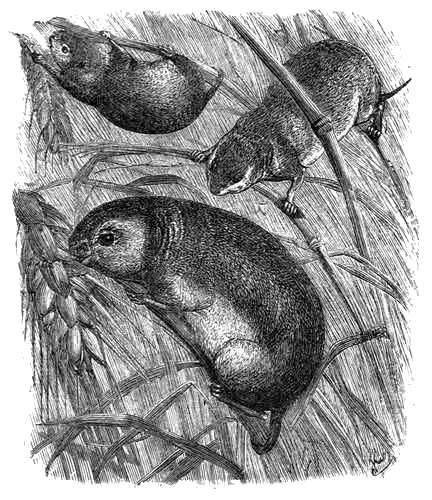
THE FIELD-MOUSE.
"Wherefore ye shall make images of your mice that mar the land."—1 Sam. vi. 5.
When the Field-mouse is deprived of the food which it loves
best, it finds a subsistence among the trees. Whenever mice can
discover a newly-planted sapling, they hold great revel upon it,
eating away the tender young bark as high as they can reach,
and consequently destroying the tree as effectually as if it were
cut down. Even when the young trees fail them, and no tender
bark is to be had, the Field-mice can still exert their destructive
powers. They will then betake themselves to the earth, burrow
beneath its surface, and devour the young rootlets of the forest
trees. All botanists know that a healthy tree is continually
pushing forward fresh roots below the ground, in order to gain
sufficient nourishment to supply the increasing growth above.
If, therefore, these young roots are destroyed, the least harm
that can happen to the tree is that its further growth is arrested;
while, in many cases, the tree, which cannot repair the injuries
it has received, droops gradually, and finally dies. Even in this
country, the Field-mouse has proved itself a terrible enemy to
the agriculturist, and has devastated considerable tracts of land.
So much for the destructive powers of the Field-mouse, and
the next point to be considered is its abundance.
Nearly all the rats and mice are singularly prolific animals,
producing a considerable number at a brood, and having several
broods in a season. The Field-mouse is by no means an exception
to the general rule, but produces as many young in a season
as any of the Mice.
Not only is it formidable from its numbers, but from the insidious
nature of its attacks. Any one can see a rabbit, a hare,
or even a rat; but to see a Field-mouse is not easy, even when the
little creatures are present in thousands. A Field-mouse never
shows itself except from necessity, its instinct teaching it to
escape the observation of its many furred and feathered enemies.
Short-legged and soft-furred, it threads its noiseless way among
the herbage with such gentle suppleness that scarcely a grass-blade
is stirred, while, if it should be forced to pass over a spot
of bare ground, the red-brown hue of its fur prevents it from
being detected by an inexperienced eye. Generally the Field-mouse
is safe from human foes, and has only to dread the
piercing eye and swift wings of the hawk, or the silent flight
and sharp talons of the owl.
Although there can be no doubt that the Field-mouse is one
of the animals to which the name of Akbar is given, it is probable
that many species were grouped under this one name.
Small rodents of various kinds are very plentiful in Palestine,
and there are several species closely allied to the Field-mouse
itself.
Among them is the Hamster (Cricetus frumentarius), so
widely known for the ravages which it makes among the crops.
This terribly destructive animal not only steals the crops for
immediate subsistence, but lays up a large stock of provisions
for the winter, seeming to be actuated by a sort of miserly
passion for collecting and storing away. There seems to be no
bounds to the quantity of food which a Hamster will carry
into its subterranean store-house, from seventy to one hundred
pounds' weight being sometimes taken out of the burrow of a
single animal. The fact of the existence of these large stores
shows that the animal must need them, and accordingly we find
that the Hamster is only a partial hibernator, as it is awake
during a considerable portion of the winter months, and is consequently
obliged to live on the stores which it has collected.
It is an exceedingly prolific animal, each pair producing on an
average twenty-five young in the course of a year. The families
are unsociable, and, as soon as they are strong enough to feed
themselves, the young Hamsters leave their home, and make
separate burrows for themselves. Thus we see that the Hamster,
as well as the Field-mouse, fulfils the conditions which are
needed in order to class it under the general title of Akbar.
I have already stated that some translators of the Bible use
the word Jerboa as a rendering of the Hebrew Akbar. As the
Jerboa certainly is found in Palestine, there is some foundation
for this idea, and we may safely conjecture that it also is one of
the smaller rodents which are grouped together under the appellation
of Mouse.
The Common Jerboa (Dipus Ægyptiacus) is plentiful in Palestine,
and several other species inhabit the same country, known
at once by their long and slender legs, which give them so
curious a resemblance to the kangaroos of Australia. The Jerboas
pass over the ground with astonishing rapidity. Instead of
creeping stealthily among the grass-blades, like the short-limbed
field-mouse, the Jerboa flies along with a succession of wonderful
leaps, darting here and there with such rapidity that the eye can
scarcely follow its wayward movements. When quiet and undisturbed,
it hops along gently enough, but as soon as it takes
alarm, it darts off in its peculiar manner, which is to the ordinary
walk of quadrupeds what the devious course of a frightened
snipe is to the steady flight of birds in general.
It prefers hot and dry situations, its feet being defended by a
thick coating of stiff hairs, which serve the double purpose of
protecting it from the heat, and giving it a firm hold on the
ground. It is rather a destructive animal, its sharp and powerful
teeth enabling it to bite its way through obstacles which would
effectually stop an ordinary Mouse. That the Jerboa may be
one of the Akbarim is rendered likely by the prohibition in
Lev. xi. 29, forbidding the Mouse to be eaten. It would be
scarcely probable that such a command need have been issued
against eating the common Mouse, whereas the Jerboa, a much
larger and palatable animal, is always eaten by the Arabs. The
Hamster is at the present day eaten in Northern Syria.
Beside these creatures there are the Dormice, several species
of which animal inhabit Palestine at the present day. There are
also the Sand-rats, one species of which is larger than our ordinary
rats. The Sand-rats live more in the deserts than the
cultivated lands, making their burrows at the foot of hills, and
among the roots of bushes.
The prohibitions of the Mosaic law—The chewing of the cud, and division of the
hoof—Identity of the Hare of Scripture—Rumination described—The Hare
a rodent and not a ruminant—Cowper and his Hares—Structure of the rodent
tooth—The Mosaic law accommodated to its recipients—The Hares of Palestine
and their habits.
Among the many provisions of the Mosaic law are several which
refer to the diet of the Israelites, and which prohibit certain
kinds of food. Special stress is laid upon the flesh of animals,
and the list of those which may be lawfully eaten is a singularly
restricted one, all being excluded except those which "divide the
hoof and chew the cud." And, lest there should be any mistake
about the matter, examples are given both of those animals
which may and those which may not be eaten.
The ox, sheep, goat, and antelopes generally are permitted as
lawful food, because they fulfil both conditions; whereas there is
a special prohibition of the swine, because it divides the hoof
but does not chew the cud, and of the camel, coney, and hare
because they chew the cud, but do not divide the hoof. Our
business at present is with the last of these animals.
Considerable discussion has been raised concerning this
animal, because, as is well known to naturalists, the Hare is not
one of the ruminant animals, but belongs to the same order as
the rat, rabbit, beaver, and other rodents. Neither its teeth nor
its stomach are constructed for the purpose of enabling it to
ruminate, i.e. to return into the mouth the partially-digested
food, and then to masticate it afresh; and therefore it has been
thought that either there is some mistake in the sacred narrative,
or that the Hebrew word has been mistranslated.
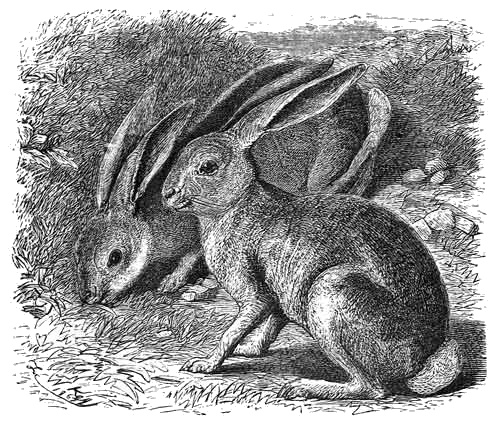
THE SYRIAN HARE.
"Nevertheless, these ye shall not eat of them that chew the cud, or of them that divide the cloven
hoof: as the camel, and the hare, and the coney."—Deut. xiv. 7.
Taking the latter point first, as being the simplest of the two,
we find that the Hebrew word which is rendered as Hare is
Arnebeth, and that it is rendered in the Septuagint as Dasypus,
or the Hare,—a rendering which the Jewish Bible adopts.
That the Arnebeth is really the Hare may also be conjectured
from the fact that the Arabic name for that animal is Arneb.
In consequence of the rather wide sense to which the Greek
word Dasypus (i.e. hairy-foot) is used, some commentators have
suggested that the rabbit may have been included in the same
title. This, however, is not at all likely, inasmuch as the Hare
is very plentiful in Palestine, and the rabbit is believed not to
be indigenous to that part of the world. And, even if the two
animals had been classed under the same title, the physiological
difficulty would not be removed.
Before proceeding further, it will be as well to give a brief
description of the curious act called rumination, or "chewing
the cud."
There are certain animals, such as the oxen, antelopes, deer,
sheep, goats, camels, &c. which have teeth unfitted for the rapid
mastication of food, and which therefore are supplied with a
remarkable apparatus by which the food can be returned into
the mouth when the animal has leisure, and be re-masticated
before it passes into the true digestive organs.
For this purpose they are furnished with four stomachs, which
are arranged in the following order. First comes the paunch or
"rumen" (whence the word "ruminating"), into which passes the
food in a very rough state, just as it is torn, rather than bitten,
from the herbage, and which is analogous to the crop in birds. It
thence passes into the second stomach, or "honeycomb," the
walls of which are covered with small angular cells. Into those
cells the food is received from the first stomach, and compressed
into little balls, which can be voluntarily returned into the
mouth for mastication.
After the second mastication has been completed, the food
passes at once into the third stomach, and thence into the fourth,
which is the true digesting cavity. By a peculiar structure of
these organs, the animal is able to convey its food either into
the first or third stomach, at will, i.e. into the first when the grass
is eaten, and into the third after rumination. Thus it will be seen
that an animal which chews the cud must have teeth of a certain
character, and be possessed of the fourfold stomach which has
just been described.
Two points are conceded which seem to be utterly irreconcilable
with each other. The first is that the Mosaic law
distinctly states that the Hare chews the cud; the second is,
that in point of fact the Hare is not, and cannot be, a ruminating
animal, possessing neither the teeth nor the digestive
organs which are indispensable for that process. Yet, totally
opposed as these statements appear to be, they are in fact, not so
irreconcilable as they seem.
Why the flesh of certain animals was prohibited, we do not at
the present time know. That the flesh of swine should be forbidden
food is likely enough, considering the effects which the
habitual eating of swine's flesh is said to produce in hot countries.
But it does seem very strange that the Israelites should have
been forbidden to eat the flesh of the camel, the coney (or hyrax),
and the Hare, and that these animals should have been specified
is a proof that the eating or refraining from their flesh was not
a mere sanitary regulation, but was a matter of importance.
The flesh of all these three animals is quite as good and
nutritious as that of the oxen, or goats, which are eaten in
Palestine, and that of the Hare is far superior to them. Therefore,
the people of Israel, who were always apt to take liberties
with the restrictive laws, and were crafty enough to evade them
on so many occasions, would have been likely to pronounce that
the flesh of the Hare was lawful meat, because the animal chewed
the cud, or appeared to do so, and they would discreetly have
omitted the passage which alluded to the division of the hoof.
To a non-scientific observer the Hare really does appear to
chew the cud. When it is reposing at its ease, it continually
moves its jaws about as if eating something, an action which
may readily be mistaken for true rumination. Even Cowper,
the poet, who kept some hares for several years, and had them
always before his eyes, was deceived by this mumbling movement
of the jaws. Speaking of his favourite hare, "Puss," he
proceeds as follows: "Finding him exceedingly tractable, I
made it my custom to carry him always after breakfast into the
garden, where he hid himself generally under the leaves of a
cucumber vine, sleeping, or chewing the cud, till evening."
The real object of this continual grinding or mumbling movement
is simple enough. The chisel-like incisor teeth of the
rodent animals need to be rubbed against each other, in order to
preserve their edge and shape, and if perchance such friction
should be wanting to a tooth, as, for example, by the breaking of
the opposite tooth, it becomes greatly elongated, and sometimes
grows to such a length as to prevent the animal from eating.
Instinctively, therefore, the Hare, as well as the rabbit and
other rodents, always likes to be nibbling at something, as any one
knows who has kept rabbits in wooden hutches, the object of
this nibbling not being to eat the wood, but to keep the teeth
in order.
But we may naturally ask ourselves, why the Mosaic law, an
emanation from heaven, should mention an animal as being a
ruminant, when its very structure shows that such an act was
utterly impossible? The answer is clear enough. The law was
suited to the capacity of those for whom it was intended, and
was never meant to be a handbook of science, as well as a code
of religious duties and maxims. The Jews, like other Orientals,
were indifferent to that branch of knowledge which we designate
by the name of physical science, and it was necessary that the
language in which the law was conveyed to them should be
accommodated to their capabilities of receiving it.
It would have been worse than useless to have interrupted
the solemn revelation of Divine will with a lesson in comparative
anatomy; the object of the passage in question being, not to
teach the Jews the distinctive characteristics of a rodent and a
ruminant, but to guard against their mistaking the Hare for one
of the ruminants which were permitted as food. That they
would in all probability have fallen into that mistake is evident
from the fact that the Arabs are exceedingly fond of the flesh of
the Hare, and accept it, as well as the camel, as lawful food,
because it chews the cud, the division of the hoof not being
considered by them as an essential.
Hares are very plentiful in Palestine, and at least two species
are found in that country. One of them, which inhabits the
more northern and hilly portion of Palestine, closely resembles
our own species, but has not ears quite so long in proportion,
while the head is broader. The second species, which lives in
the south, and in the valley of the Jordan, is very small, is of a
light dun colour, and has very long ears. In their general
habits, these Hares resemble the Hare of England.
The cattle of Palestine, and their decadence at the present day—Ox-flesh not used
for food in modern times—Oxen of the stall, and oxen of the pasture—The use
of the ox in agriculture—The yoke and its structure—The plough and the goad—The
latter capable of being used as a weapon—Treading out the corn—The
cart and its wheels—The ox used as a beast of burden—Cattle turned loose to
graze—The bulls of Bashan—Curiosity of the ox-tribe—A season of drought—Branding
the cattle—An Egyptian field scene—Cattle-keeping an honourable
post—The ox as used for sacrifice—Ox-worship—The bull Apis, and his history—Persistency
of the bull-worship—Jeroboam's sin—Various names of cattle—The
Indian buffalo.
Under this head we shall treat of the domesticated oxen of
Scripture, whether mentioned as Bull, Cow, Ox, Calf, Heifer, &c.
Two distinct species of cattle are found in Palestine, namely,
the ordinary domesticated ox, and the Indian buffalo, which
lives in the low-lying and marshy valley of the Jordan. Of this
species we shall treat presently.
The domesticated cattle are very much like our own, but there
is not among them that diversity of breed for which this country
is famous; nor is there even any distinction of long and short
horned cattle. There are some places where the animals are
larger than in others, but this difference is occasioned simply by
the better quality and greater quantity of the food.
As is the case in most parts of the world where civilization
has made any progress, Domesticated Cattle were, and still are,
plentiful in Palestine. Even at the present time the cattle are
in common use, though it is evident, from many passages of
Holy Writ, that in the days of Judæa's prosperity cattle were far
more numerous than they are now, and were treated in a better
fashion.
To take their most sacred use first, a constant supply of cattle
was needed for the sacrifices, and, as it was necessary that every
animal which was brought to the altar should be absolutely
perfect, it is evident that great care was required in order
that the breed should not deteriorate, a skill which has long
been rendered useless by the abandonment of the sacrifices.
Another reason for their better nurture in the times of old is
that in those days the ox was largely fed and fatted for the
table, just as is done with ourselves. At the present day, the
flesh of the cattle is practically unused as food, that of the sheep
or goat being always employed, even when a man gives a feast
to his friends. But, in the old times, stalled oxen, i.e. oxen kept
asunder from those which were used for agricultural purposes,
and expressly fatted for the table, were in constant use. See for
example the well-known passage in the Prov. xv. 17, "Better is
a dinner of herbs where love is, than a stalled ox and hatred
therewith." Again, the Prophet Jeremiah makes use of a
curious simile, "Egypt is like a very fair heifer, but destruction
cometh; it cometh out of the north. Also her hired men are in
the midst of her like fatted bullocks [or, bullocks of the stall],
for they also are turned back, and are fled away together."
(Jer. xlvi. 20.) And in 1 Kings iv. 22, 23, when describing the
glories of Solomon's household, the sacred writer draws a distinction
between the oxen which were especially fattened for the
table of the king and the superior officers, and those which were
consumed by the lower orders of his household: "And Solomon's
provision for one day was thirty measures of fine flour, and threescore
measures of meal, ten fat oxen, and twenty oxen out of the
pastures, and an hundred sheep, beside harts, and roebucks, and
fallow-deer, and fatted fowl." Again, in the well-known parable
of the king's marriage, there is an allusion to fatted animals, and
a distinction is made between the oxen of the pasture and those
of the stall. "Again, he sent forth other servants, saying, Tell
them which are bidden, Behold, I have prepared my dinner, my
oxen and my fatlings are killed, and all things are ready."
Calves—mostly, if not always, bull-calves—were largely used
for food in Palestine, and in the households of the wealthy were
fatted for the table. See, for example, the familiar parable of
the prodigal son, in which the rejoicing father is mentioned as
preparing a great feast in honour of his son's return, and ordering
the fatted calf to be killed—the calf in question being evidently
one of the animals that were kept in good condition against any
festive occasion. And, even in the earliest history of the Bible,
the custom of keeping a fatted calf evidently prevailed, as is
shown by the conduct of Abraham, who, when he was visited by
the three heavenly guests, "ran unto the herd, and fetched a
calf, tender and good," and had it killed and dressed at once,
after the still existing fashion of the East.
But, even in the times of Israel's greatest prosperity, the chief
use of the ox was as an agricultural labourer, thus reversing the
custom of this country, where the horse has taken the place of
the ox as a beast of draught, and where cattle are principally
fed for food. Ploughing was, and is, always performed by oxen,
and allusions to this office are scattered plentifully through the
Old and New Testaments.
When understood in this sense, oxen are almost always
spoken of in connexion with the word "yoke," and as each yoke
comprised two oxen, it is evident that the word is used as we
employ the term "brace," or pair. The yoke, which is the chief
part of the harness, is a very simple affair. A tolerably stout
beam of wood is cut of a sufficient length to rest upon the necks
of the oxen standing side by side, and a couple of hollows are
scooped out to receive the crest of the neck. In order to hold
it in its place, two flexible sticks are bent under their necks,
and the ends fixed into the beam of the yoke. In the middle
of this yoke is fastened the pole of the plough or cart, and this
is all the harness that is used, not even traces being required.
It will be seen that so rude an implement as this would
be very likely to gall the necks of the animals, unless the
hollows were carefully smoothed, and the heavy beam adapted
to the necks of the animals. This galling nature of the yoke, so
familiar to the Israelites, is used repeatedly as a metaphor in
many passages of the Old and New Testaments. These passages
are too numerous to be quoted, but I will give one or two of the
most conspicuous among them. The earliest mention of the
yoke in the Scriptures is a metaphor.
After Jacob had deceived his father, in procuring for himself
the blessing which was intended for his elder brother, Isaac
comforts Esau by the prophecy that, although he must serve his
brother, yet "it shall come to pass when thou shalt have the
dominion, that thou shalt break his yoke from off thy neck."
Again, in the next passage where the yoke is mentioned, namely,
Lev. xxvi. 13, the word is employed in the metaphorical sense:
"I am the Lord your God, which brought you forth out of the
land of Egypt, that ye should not be their bondmen, and I have
broken the bands of your yoke, and made you go upright."
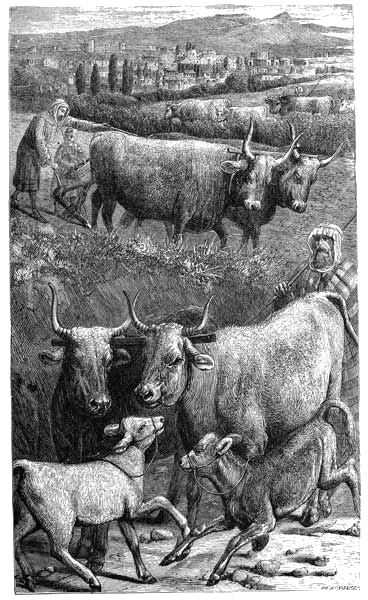
"It is good for a man to bear the yoke in his youth."—Lam. iii. 27.
"He maketh them also to skip like a calf."—Psalm 6.
Then, in Deut. xxviii. 48, the word yoke is not only used
metaphorically, but with an addition that forcibly expresses its
weight and galling character: "Therefore shalt thou serve thine
enemies, which the Lord shall send against thee, in hunger, and
in thirst, and in nakedness, and in want of all things, and He
shall put a yoke of iron upon thy neck, until He have destroyed
thee."
The word yoke is also used as a metaphor for servitude, even
of a domestic character, as we may see in 1 Tim. vi. 1: "Let as
many servants as are under the yoke count their own masters
worthy of all honour." In the Acts of the Apostles, we find
St. Peter using the same metaphor: "Why tempt ye God, to
put a yoke on the neck of the disciples, which neither our
fathers nor we were able to bear?" And the Lord Himself uses
the same metaphor in the well-known passage, "Take my yoke
upon you, for my yoke is easy and my burden light."
The plough was equally simple, and consisted essentially of a
bent branch, one end of which was armed with an iron point by
way of a share, while the other formed the pole or beam, and
was fastened to the middle of the yoke. It was guided by a
handle, which was usually a smaller branch that grew from the
principal one. A nearly similar instrument is used in Asia
Minor to the present day, and is a curious relic of the most
ancient times of history, for we find on the Egyptian monuments
figures of the various agricultural processes, in which the plough
is made after this simple manner.
Of course such an instrument is a very ineffective one, and can
but scratch, rather than plough the ground, the warmth of the
climate and fertility of the land rendering needless the deep
ploughing of our own country, where the object is to turn up
the earth to the greatest possible depth. One yoke of oxen was
generally sufficient to draw a plough, but occasionally a much
greater number were required. We read, for example, of Elisha,
who, when he received his call from Elijah, was ploughing with
twelve yoke of oxen, i.e. twenty-four. It has been suggested,
that the twelve yoke of oxen were not all attached to the same
plough, but that there were twelve ploughs, each with its single
yoke of oxen. This, however, was scarcely likely to be the case,
as it is definitely stated that Elisha "was ploughing with twelve
yoke of oxen before him, and he with the twelfth," and it is
much more probable that the land was heavy, and that, therefore,
the plough could not be properly worked without the additional
force.
The instrument with which the cattle were driven was not a
whip, but a goad. This goad was a long and stout stick, armed
with a spike at one end, and having a kind of spud at the other,
with which the earth could be scraped off the share when it
became clogged. Such an instrument might readily be used as
a weapon, and, in the hands of a powerful man, might be made
even more formidable than a spear. As a weapon, it often was
used, as we see from many passages of the Scriptures. For
example, it is said in Judges iii. 31, "that Shamgar the son of
Anath killed six hundred Philistines with an ox-goad."
Afterwards, in the beginning of Saul's reign, when the
Israelites fairly measured themselves against the Philistines, it
was found that only Saul and Jonathan were even tolerably
armed. Fearful of the numbers and spirit of the Israelites, the
Philistines had disarmed them, and were so cautious that they
did not even allow them to possess forges wherewith to make or
sharpen the various agricultural instruments which they possessed,
lest they should surreptitiously provide themselves with
weapons. The only smith's tool which they were allowed to
retain was a file with which each man might trim the edges of the
ploughshares, mattocks, axes, and sharpen the points of the goad.
The only weapons which they could muster were made of their
agricultural implements, and among the most formidable of
them was the goad.
How the goad came into use in Palestine may easily be seen.
The Egyptians, from among whom the people of Israel passed
into the Promised Land, did not use the goad in ploughing, but
the whip, which, from the representations on the Egyptian
monuments, was identical with the koorbash, or "cow-hide"
whip, which is now in use in the same country. But this
terrible whip, which is capable, when wielded by a skilful hand,
of cutting deep grooves through the tough hide of the ox, could
not be obtained by the Jews, because the hippopotamus, of whose
hide it was made, did not live in or near Palestine. They
therefore were forced to use some other instrument wherewith
to urge on the oxen, and the goad was clearly the simplest and
most effective implement for this purpose.
After the land was ploughed and sown, and the harvest was
ripened, the labours of the oxen were again called into requisition,
first for threshing out the corn, and next for carrying or
drawing the grain to the storehouses.
In the earlier days, the process of threshing was very simple.
A circular piece of ground was levelled, and beaten very hard
and flat, its diameter being from fifty to a hundred feet. On
this ground the corn was thrown, and a number of oxen were
driven here and there on it, so that the constant trampling of
their feet shook the ripe grain out of the ears. The corn was
gathered together in the middle of the floor, and as fast as it
was scattered by the feet of the oxen, it was thrown back
towards the centre.
Afterwards, an improvement was introduced in the form of a
rough sledge, called "moreg," to which the oxen were harnessed
by a yoke, and on which the driver stood as he guided his team
round the threshing-floor. This instrument is mentioned in
Isa. xli. 15: "Behold, I will make thee anew and sharp threshing
instrument having teeth [or mouths]: thou shalt thresh the mountains,
and beat them small, and shalt make the hills as chaff."
Mention is also made of the same implement in 2 Sam. xxiv. 22,
where it is related that Araunah the Jebusite offered to give
David the oxen for a burnt-sacrifice, and the moregs and other
implements as wood with which they could be burned.
The work of treading out the corn was a hard and trying one
for the oxen, and it was probably on this account that the kindly
edict was made, that the oxen who trod out the corn should not
be muzzled. As a rule, the cattle were not fed nearly as carefully
as is done with us, and so the labours of the threshing-floor
would find a compensation in the temporary abundance of
which the animals might take their fill.
After the corn was threshed, or rather trodden out, the oxen
had to draw it home in carts. These were but slight improvements
on the threshing-sledge, and were simply trays or shallow
boxes on a pair of wheels. As the wheels were merely slices cut
from the trunk of a tree, and were not furnished with iron tires,
they were not remarkable for roundness, and indeed, after a
little time, were worn into rather irregular ovals, so that the task
of dragging a cart over the rough roads was by no means an
easy one. And, as the axle was simply a stout pole fastened to
the bottom of the cart, and having its rounded ends thrust
through holes in the middle of the wheels, the friction was
enormous. As, moreover, oil and grease were far too precious
luxuries to be wasted in lubricating the axles, the creaking
and groaning of the wheels was a singularly disagreeable and
ear-piercing sound.
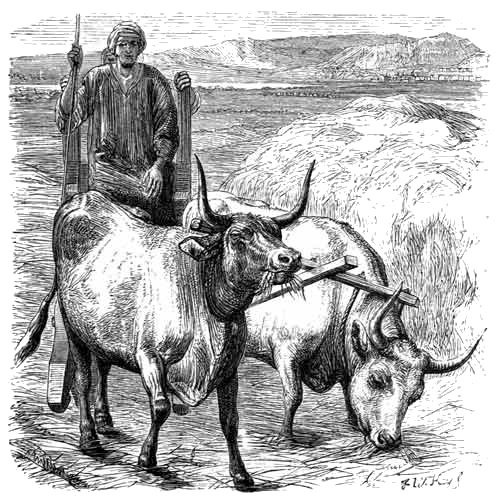
TREADING OUT CORN.
"Thou shalt not muzzle the ox when he treadeth out the corn."—(Deut. xxv. 4.)
The common hackery of India is a good example of the carts
mentioned in the Scriptures. As with the plough, the cart was
drawn by a couple of oxen, connected by the yoke. The two
kinds of cart, namely, the tray and the box, are clearly indicated
in the Scriptures. The new cart on which the Ark was placed
when it was sent back by the Philistines (see 1 Sam. vi. 7) was
evidently one of the former kind, and so was that which was
made twenty years afterwards, for the purpose of conveying the
Ark to Jerusalem.
The second kind of cart is mentioned by the Prophet Amos
(ch. ii. 13), "Behold, I am pressed under you, as a cart is
pressed that is full of sheaves," reference being evidently made
to heaping up of the sheaves in the cart, and pressing them
down, as is done at the present day.
That oxen were also employed as beasts of burden is shown
by the passage in 1 Chron. xii. 40, "Moreover, they that were
nigh them, even unto Issachar, and Zebulun, and Napthali,
brought bread on asses, and on camels, and on mules, and on
oxen."
Although the cattle were evidently better tended in the olden
times than at present, those animals which were used for agriculture
seem to have passed rather a rough life, especially in the
winter time. It is rather curious that the Jews should have
had no idea of preserving the grass by making it into hay, as is
done in Europe. Consequently the chief food of the cattle was
the straw and chaff which remained on the threshing-floor after
the grain had been separated. See Isa. xxx. 23: "In that day
shall thy cattle feed in large pastures. The oxen likewise, and
the young asses that ear the ground shall eat clean provender,
which hath been winnowed with the shovel and with the fan."
This, indeed, was the only use to which the straw could be
put, for it was so crushed and broken by the feet of the oxen
and the threshing-sledge that it was rendered useless. Allusion
is made to the crushing of the straw in many passages of Scripture.
See, for example, Isa. xxv. 10, "Moab shall be trodden
down [or threshed] under him, even as straw is trodden down
for the dunghill."
The want of winter forage is the chief reason why cattle are
so irregularly disposed over Palestine, many parts of that
country being entirely without them, and only those districts
containing them in which fresh forage may be found throughout
the year.
Except a few yoke of oxen, which are kept in order to draw
carts, and act as beasts of burden, the cattle are turned loose
for a considerable portion of the year, and run about in herds
from one pasturage to another. Thus they regain many of the
characteristics of wild animals, and it is to this habit of theirs
that many of the Scriptural allusions can be traced.
For example, see Ps. xxii. 12, "Many bulls have compassed
me, strong bulls of Bashan have beset me round. They
gaped on me with their mouths [or, their mouths opened against
me] as a ravening and a roaring lion." This passage alludes to
the curiosity inherent in cattle, which have a habit of following
objects which they do not understand or dislike, and surrounding
it with looks of grave wonderment. Even in their domesticated
state this habit prevails. When I was a boy, I sometimes
amused myself with going into a field where a number of cows
and oxen were grazing, and lying down in the middle of it.
The cattle would soon become uneasy, toss their heads about,
and gradually draw near on every side, until at last they would
be pressed together closely in a circle, with their heads just
above the object of their astonishment. Their curious, earnest
looks have always been present to my mind when reading the
above quoted passage.
The Psalmist does not necessarily mean that the bulls in
question were dangerous animals. On the contrary, the bulls
of Palestine are gentle in comparison with our own animals,
which are too often made savage by confinement and the harsh
treatment to which they are subjected by rough and ignorant
labourers. In Palestine a pair of bulls may constantly be seen
attached to the same yoke, a thing that never would be seen in
this country.
The custom of turning the herds of cattle loose to find
pasture for themselves is alluded to in Joel i. 18, "How do
the beasts groan! the herds of cattle are perplexed because they
have no pasture." We can easily imagine to ourselves the
terrible time to which the prophet refers, "when the rivers
of waters are dried up, and the fire hath devoured the pastures
of the wilderness," as it is wont to do when a spark
falls upon grass dried up and withered, by reason of the sun's
heat and the lack of water. Over such a country, first withered
by drought, and then desolated by fire, would the cattle wander,
vainly searching on the dusty and blackened surface for the
tender young blades which always spring up on a burnt pasture
as soon as the first rains fall. Moaning and bellowing with
thirst and disappointment, they would vainly seek for food or
water in places where the seed lies still under the clods where it
was sown (v. 17), where the vines are dried up, and the fig, the
pomegranate and the palm (v. 12) are all withered for want of
moisture.
Such scenes are still to be witnessed in several parts of the
world. Southern Africa is sometimes sadly conspicuous for
them, an exceptional season of drought keeping back the fresh
grass after the old pastures have been burned (the ordinary mode
of cultivating pasture land). Then the vast herds of cattle,
whose milk forms the staff of life to the inhabitants, wander to
and fro, gathering in masses round any spot where a spring still
yields a little water, and bellowing and moaning with thirst as
they press their way towards the spot where their owners are
doling out to each a small measure of the priceless fluid.
The cattle are branded with the mark of their owners, so that
in these large herds there might be no difficulty in distinguishing
them when they were re-captured for the plough and the
cart. On one of the Egyptian monuments there is a very
interesting group, which has furnished the idea for the plate
which illustrates this article. It occurs in the tombs of the
kings at Thebes, and represents a ploughing scene. The simple
two-handled plough is being dragged by a pair of cows, who
have the yoke fastened across the horns instead of lying on
the neck, and a sower is following behind, scattering the grain
out of a basket into the newly-made furrows. In front of the
cows is a young calf, which has run to meet its mother, and is
leaping for joy before her as she steadily plods along her course.
The action of both animals is admirably represented; the
steady and firm gait of the mother contrasting with the light,
gambolling step and arched tail of her offspring. Both are
branded with the same mark, namely, three equal-armed crosses,
one on the haunch, another on the side, and a third on the neck.
The driver carries the whip, or koorbash, which has been already
mentioned, and which is familiar to travellers in Southern Africa
under the title of "sjambok."
In the olden times of the Israelitish race, herd-keeping was
considered as an honourable occupation, in which men of the
highest rank might engage without any derogation to their
dignity. We find, for instance, that Saul himself, even after he
had been appointed king, was acting as herdsman when the
people saw the mistake they had made in rejecting him as their
monarch, and came to fetch their divinely-appointed leader from
his retirement. (See 1 Sam. xi. 5.) Doeg, too, the faithful companion
of Saul, was made the chief herdsman of his master's
cattle, so that for Saul to confer such an office, and Doeg to
accept it, shows that the post was one of much honour. And
afterwards, when David was in the zenith of his power, he
completed the organization of his kingdom, portioning out not
only his army into battalions, and assigning a commanding
officer to each battalion, but also appointing a ruler to each
tribe, and setting officers over his treasury, over the vineyards,
over the olive-trees, over the storehouses, and over the cattle. And
these offices were so important that the names of their holders
are given at length in 1 Chron. xxvii. those of the various herdsmen
being thought as worthy of mention as those of the
treasurers, the military commanders, or the headmen of the
tribes.
Before concluding this necessarily short account of the domesticated
oxen of Palestine, it will be needful to give a few lines
to the animal viewed in a religious aspect. Here we have, in
bold contrast to each other, the divine appointment of certain
cattle to be slain as sacrifices, and the reprobation of worship
paid to those very cattle as living emblems of divinity. This
false worship was learned by the Israelites during their long
residence in Egypt, and so deeply had the customs of the Egyptian
religion sunk into their hearts, that they were not eradicated
after the lapse of centuries. It may easily be imagined
that such a superstition, surrounded as it was with every external
circumstance which could make it more imposing, would
take a powerful hold of the Jewish mind.
Chief among the multitude of idols or symbols was the god
Apis, represented by a bull. Many other animals, specially the
cat and the ibis, were deeply honoured among the ancient Egyptians,
as we learn from their own monuments and from the
works of the old historians. All these creatures were symbols
as well as idols, symbols to the educated and idols to the
ignorant.
None of them was held in such universal honour as the bull
Apis. The particular animal which represented the deity, and
which was lodged with great state and honour in his temple at
Memphis, was thought to be divinely selected for the purpose,
and to be impressed with certain marks. His colour must be
black, except a square spot on the forehead, a crescent-shaped
white spot on the right side, and the figure of an eagle on his
back. Under the tongue must be a knob shaped like the sacred
scarabæus, and the hairs of his tail must be double.
This representative animal was only allowed to live for a
certain time, and when he had reached this allotted period, he
was taken in solemn procession to the Nile, and drowned in
its sacred waters. His body was then embalmed, and placed
with great state in the tombs at Memphis.
After his death, whether natural or not, the whole nation
went into mourning, and exhibited all the conventional signs of
sorrow, until the priests found another bull which possessed
the distinctive marks. The people then threw off their mourning
robes, and appeared in their best attire, and the sacred bull
was exhibited in state for forty days before he was taken to his
temple at Memphis. The reader will here remember the analogous
case of the Indian cattle, some of which are held to be
little less than incarnations of divinity.
Even at the very beginning of the exodus, when their minds
must have been filled with the many miracles that had been
wrought in their behalf, and with the cloud and fire of Sinai
actually before their eyes, Aaron himself made an image of a
calf in gold, and set it up as a symbol of the Lord. That the idol
in question was intended as a symbol by Aaron is evident from
the words which he used when summoning the people to worship,
"To-morrow is a feast of the Lord" (Gen. xxxii. 5). The people,
however, clearly lacked the power of discriminating between the
symbol and that which it represented, and worshipped the image
just as any other idol might be worshipped. And, in spite of
the terrible and swift punishment that followed, and which
showed the profanity of the act, the idea of ox-worship still
remained among the people.
Five hundred years afterwards we find a familiar example of
it in the conduct of Jeroboam, "who made Israel to sin," the
peculiar crime being the open resuscitation of ox-worship. "The
king made two calves of gold and said unto them, It is too much
for you to go up to Jerusalem: behold thy gods, O Israel, which
brought thee up out of the land of Egypt. And he set the one
in Bethel, and the other put he in Dan.... And he made an
house of high places, and made priests of the lowest of the
people, which were not of the tribe of Levi. And Jeroboam
ordained a feast ... like unto the feast in Judah, and he
offered upon the altar. So did he in Bethel, sacrificing unto
the calves that he had made."
Here we have a singular instance of a king of Israel repeating,
after a lapse of five hundred years, the very acts which had
drawn down on the people so severe a punishment, and which
were so contrary to the law that they had incited Moses to fling
down and break the sacred tables on which the commandments
had been divinely inscribed. Nothing is omitted: the shape of
the idol, the material of which it is composed, the offerings, and
the very words in which Aaron had so deeply sinned, "Behold
thy gods, O Israel, which brought thee up out of the land
of Egypt." Successive monarchs followed his example, and,
according to the graphic words of Scripture, they "departed not
from the ways of Jeroboam the son of Nebat, who made Israel
to sin."
As was likely to be the case in a land where cattle were of
such importance, and often formed the principal wealth of the
inhabitants, many words were in use to distinguish the cattle
according to sex, age, and number. Thus, Bakar signifies the
adult animal of either sex, the test of full growth being fitness
for the plough. Consequently, Ben-Baka, or son of the herd,
signifies a male calf, and Aiglah-Bakar, a female calf. The term
Bakar is derived from a Hebrew word signifying to cleave or
plough, and hence it is used as to signify those animals which
are old enough to be put to the plough.
Then there is the word Shor, or Tor, to signify a single head
of cattle, of any age, or of either sex. The second form of this
word is familiar to us in the Latin word "taurus," and the
English "steer." There are several other words, such as Par, a
young bull, and Parah, a heifer, which do not need explanation.
Another species of the ox-tribe now inhabits Palestine,
though commentators rather doubt whether it is not a comparatively
late importation. This is the true Buffalo (Bubalus
buffelus, Gray), which is spread over a very large portion of the
earth, and is very plentiful in India. In that country there
are two distinct breeds of the Buffalo, namely, the Arnee, a wild
variety, and the Bhainsa, a tamed variety. The former animal
is much larger than the latter, being sometimes more than ten
feet in length from the nose to the root of the tail, and measuring
between six and seven feet in height at the shoulder. Its
horns are of enormous length, the tail is very short, and tufts of
hair grow on the forehead and horns. The tamed variety is at
least one-third smaller, and, unlike the Arnee, never seems to
get into high condition. It is an ugly, ungainly kind of beast,
and is rendered very unprepossessing to the eye by the bald
patches which are mostly found upon its hide.
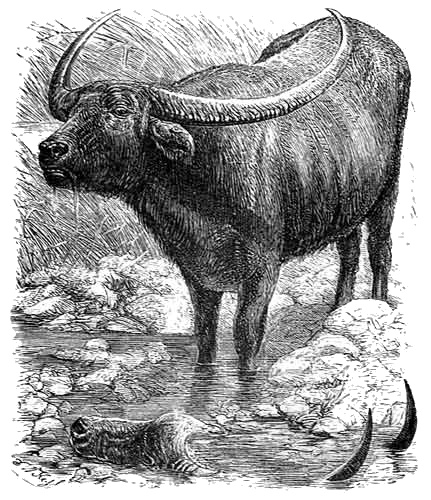
Being a water-loving animal, the Buffalo always inhabits the
low-lying districts, and is fond of wallowing in the oozy marshes
in which it remains for hours, submerged all but its head, and
tranquilly chewing the cud while enjoying its mud-bath. While
thus engaged the animal depresses its horns so that they are
scarcely visible, barely allowing more than its eyes, ears, and
nostrils to remain above the surface, so that the motionless
heads are scarcely distinguishable from the grass and reed tufts
which stud the marshes. Nothing is more startling to an inexperienced
traveller than to pass by a silent and tranquil pool
where the muddy surface is unbroken except by a number of
black lumps and rushy tufts, and then to see these tufts suddenly
transformed into twenty or thirty huge beasts rising out of the
still water as if by magic. Generally, the disturber of their
peace had better make the best of his way out of their reach, as
the Buffalo, whether wild or tame, is of a tetchy and irritable
nature, and resents being startled out of its state of dreamy
repose.
In the Jordan valley the Buffalo is found, and is used for
agriculture, being of the Bhainsa, or domesticated variety.
Being much larger and stronger than the ordinary cattle, it is
useful in drawing the plough, but its temper is too uncertain
to render it a pleasant animal to manage. As is the case with
all half-wild cattle, its milk is very scanty, but compensates
by the richness of the quality for the lack of quantity.
The Tô, Wild Bull of the Old Testament—Passages in which it is mentioned—The
Wild Bull in the net—Hunting with nets in the East—The Oryx supposed to
be the Tô of Scripture—Description of the Oryx, its locality, appearance, and
habits—The points in which the Oryx agrees with the Tô—The "snare" in
which the foot is taken, as distinguished from the net.
In two passages of the Old Testament an animal is mentioned,
respecting which the translators and commentators have been
somewhat perplexed, in one passage being translated as the
"Wild Ox," and in the other as the "Wild Bull." In the
Jewish Bible the same rendering is preserved, but the sign of
doubt is added to the word in both cases, showing that the
translation is an uncertain one.
The first of these passages occurs in Deut. xiv. 5, where it is
classed together with the ox, sheep, goats, and other ruminants,
as one of the beasts which were lawful for food. Now, although
we cannot identify it by this passage, we can at all events ascertain
two important points—the first, that it was a true ruminant,
and the second, that it was not the ox, the sheep, or the goat.
It was, therefore, some wild ruminant, and we now have to ask
how we are to find out the species.
If we turn to Isa. li. 20, we shall find a passage which will
help us considerably. Addressing Jerusalem, the prophet uses
these words, "By whom shall I comfort thee? Thy sons have
fainted, they lie at the head of all the streets, as a wild bull in
a net; they are full of the fury of the Lord, the rebuke of
thy God." We now see that the Tô or Teô must be an animal
which is captured by means of nets, and therefore must inhabit
spots wherein the toils can be used. Moreover, it is evidently
a powerful animal, or the force of the simile would be lost.
The prophet evidently refers to some large and strong beast
which has been entangled in the hunter's nets, and which lies
helplessly struggling in them. We are, therefore, almost perforce
driven to recognise it as some large antelope.
The expression used by the prophet is so characteristic that
it needs a short explanation. In this country, and at the present
day, the use of the net is almost entirely restricted to fishing
and bird-catching; but in the East nets are still employed in the
capture of very large game.
A brief allusion to the hunting-net is made at page 27, but, as
the passage in Isaiah li. requires a more detailed account of this
mode of catching large animals, it will be as well to describe
the sport as at present practised in the East.
When a king or some wealthy man determines to hunt game
without taking much trouble himself, he gives orders to his men
to prepare their nets, which vary in size or strength according to
the particular animal for which they are intended. If, for example,
only the wild boar and similar animals are to be hunted,
the nets need not be of very great width; but for agile creatures,
such as the antelope, they must be exceedingly wide, or the
intended prey will leap over them. As the net is much used in
India for the purpose of catching game, Captain Williamson's
description of it will explain many of the passages of Scripture
wherein it is mentioned.
The material of the net is hemp, twisted loosely into a kind
of rope, and the mode in which it is formed is rather peculiar.
The meshes are not knotted together, but only twisted round
each other, much after the fashion of the South American hammocks,
so as to obtain considerable elasticity, and to prevent a
powerful animal from snapping the cord in its struggles. Some
of these nets are thirteen feet or more in width, and even such
a net as this has been overleaped by a herd of antelopes. Their
length is variable, but, as they can be joined in any number when
set end to end, the length is not so important as the width.
The mode of setting the nets is singularly ingenious. When
a suitable spot has been selected, the first care of the hunters is
to stretch a rope as tightly as possible along the ground. For
this purpose stout wooden stakes or truncheons are sunk crosswise
in the earth, and between these the rope is carefully
strained. The favourite locality of the net is a ravine, through
which the animals can be driven so as to run against the net in
their efforts to escape, and across the ravine a whole row of
these stakes is sunk. The net is now brought to the spot,
and its lower edge fastened strongly to the ground rope.
The strength of this mode of fastening is astonishing, and,
although the stakes are buried scarcely a foot below the surface,
they cannot be torn up by any force which can be applied to
them; and, however strong the rope may be, it would be broken
before the stakes could be dragged out of the ground.
A smaller rope is now attached to the upper edge of the
net, which is raised upon a series of slight poles. It is not
stretched quite tightly, but droops between each pair of poles,
so that a net which is some thirteen feet in width will only give
nine or ten feet of clear height when the upper edge is supported
on the poles. These latter are not fixed in the ground,
but merely held in their places by the weight of the net resting
upon them.
When the nets have been properly set, the beaters make a
wide circuit through the country, gradually advancing towards
the fatal spot, and driving before them all the wild animals that
inhabit the neighbourhood. As soon as any large beast, such,
for example, as an antelope, strikes against the net, the supporting
pole falls, and the net collapses upon the unfortunate animal,
whose struggles—especially if he be one of the horned animals—only
entangle him more and more in the toils.
As soon as the hunters see a portion of the net fall, they run
to the spot, kill the helpless creature that lies enveloped in the
elastic meshes, drag away the body, and set up the net again
in readiness for the next comer. Sometimes the line of nets
will extend for half a mile or more, and give employment to a
large staff of hunters, in killing the entangled animals, and
raising afresh those portions of the net which had fallen.
Allusions to this mode of hunting are plentiful in the Old
Testament. Take, for example, Job xviii. 7: "The steps of his
strength shall be straitened, and his own counsel shall cast him
down; for he is cast into a net by his own feet, and he walketh
upon a snare." And again in the next chapter, ver. 6, "Know
now that God hath overthrown me, and hath compassed me with
His net," in which is depicted forcibly the helpless state of
one on whom the net has fallen, and who is lying on the ground
vainly struggling in the meshes.
See also Ps. lvii. 6, "They have prepared a net for my steps,
my soul is bowed down;" and Ps. lxvi. 11, "Thou broughtest us
into the net, thou laidest affliction upon our loins." In the
prophet Ezekiel are several passages which refer to the hunting
net, and make especial mention of the manner in which it falls
over its victim. One of these occurs in chap. xii. 13, "My
net also will I spread upon him, and he shall be taken in my
snare." Again in chap. xix. 8, "Then the nations set against
him on every side from the provinces, and spread their net over
him" In this passage a forcible allusion is made to the manner
in which the wild animal is surrounded by the hunters, who
surround and gradually close in upon them, as they drive their
victims into the toils. The same combination of the hunters is
also referred to by the prophet Micah, vii. 2, "There is none
upright among men: they all lie in wait for blood; they hunt
every man his brother with a net."
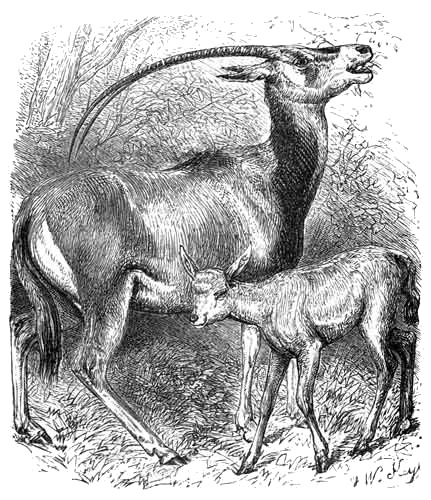
WILD BULL, OR ORYX.
"They lie at the head of all the streets, like a wild bull in a net."—Isaiah li. 21.
Accepting the theory that the Tô is one of the large antelopes
that inhabit, or used to inhabit, the Holy Land and its neighbourhood,
we may safely conjecture that it may signify the
beautiful animal known as the Oryx (Oryx leucoryx), an animal
which has a tolerably wide range, and is even now found on the
borders of the Holy Land. It is a large and powerful antelope,
and is remarkable for its beautiful horns, which sometimes
exceed a yard in length, and sweep in a most graceful curve over
the back.
Sharp as they are, and evidently formidable weapons, the
manner in which they are set on the head renders them apparently
unserviceable for combat. When, however, the Oryx is
brought to bay, or wishes to fight, it stoops its head until the
nose is close to the ground, the points of the horns being thus
brought to the front. As the head is swung from side to side,
the curved horns sweep through a considerable space, and are so
formidable that even the lion is chary of attacking their owner.
Indeed, instances are known where the lion has been transfixed
and killed by the horns of the Oryx. Sometimes the animal
is not content with merely standing to repel the attacks of its
adversaries, but suddenly charges forward with astonishing rapidity,
and strikes upwards with its horns as it makes the leap.
But these horns, which can be used with such terrible effect
in battle, are worse than useless when the animal is hampered
in the net. In vain does the Oryx attempt its usual defence:
the curved horns get more and more entangled in the elastic
meshes, and become a source of weakness rather than strength.
We see now how singularly appropriate is the passage, "Thy
sons lie at the heads of all the streets, as a wild bull (or Oryx)
in a net," and how completely the force of the metaphor is lost
without a knowledge of the precise mode of fixing the nets, of
driving the animals into them, and of the manner in which they
render even the large and powerful animals helpless.
The height of the Oryx at the shoulder is between three and
four feet, and its colour is greyish white, mottled profusely with
black and brown in bold patches. It is plentiful in Northern
Africa, and, like many other antelopes, lives in herds, so that it
is peculiarly suited to that mode of hunting which consists in
surrounding a number of animals, and driving them into a trap
of some kind, whether a fenced enclosure, a pitfall, or a net.
There is, by the way, the term "snare," which is specially
used with especial reference to catching the foot as distinguished
from the net which enveloped the whole body. For example,
in Job xviii. 8, "He is cast into a net, he walketh on a snare,"
where a bold distinction is drawn between the two and their
mode of action. And in ver. 10, "The snare is laid for him in
the ground." Though I would not state definitely that such is
the case, I believe that the snare which is here mentioned is one
which is still used in several parts of the world.
It is simply a hoop, to the inner edge of which are fastened
a number of elastic spikes, the points being directed towards the
centre. This is merely laid in the path which the animal will
take, and is tied by a short cord to a log of wood. As the deer
or antelope treads on the snare, the foot passes easily through
the elastic spikes, but, when the foot is raised, the spikes run
into the joint and hold the hoop upon the limb. Terrified by
the check and the sudden pang, the animal tries to run away,
but, by the united influence of sharp spikes and the heavy log,
it is soon forced to halt, and so becomes an easy prey to its
pursuers.
The Reêm evidently known to the Jews—Various theories concerning the Unicorn—Supposed
identity with the Indian Rhinoceros—Passages of Scripture
alluding to the strength, violent and intractable temper of the Reêm—The
Reêm a two-horned animal—Its evident connection with the Ox tribe—Its
presumed identity with the now extinct Urus—Mr. Dawkins' treatise on the
Urus—Enormous size and dangerous character of the Urus—Rabbinical legend
of the Reêm—Identity of the Urus with the modern varieties of cattle—The
Bull hunts of Nineveh.
There are many animals mentioned in the Scriptures which
cannot be identified with any certainty, partly because their
names occur only once or twice in the sacred writings, and
partly because, when they are mentioned, the context affords no
clue to their identity by giving any hint as to their appearance
or habits. In such cases, although the translators would have
done better if they had simply given the Hebrew word without
endeavouring to identify it with any known animal, they may
be excused for committing errors in their nomenclature. There
is one animal, however, for which no such excuse can be found,
and this is the Reêm of Scripture, translated as Unicorn in the
authorized version.
Now the word Reêm is mentioned seven times in the Old
Testament, and is found, not in one, but several books, showing
that it was an animal perfectly well known to those for whom
the sacred books were written. It is twice mentioned in the
Pentateuch, several times in the Psalms, once in the book of
Job, once by Isaiah, and reference is once made to it in the
historical books. In these various passages, abundant details
are given of its aspect and habits, so that there is very little
doubt as to the identity of the animal.
The Septuagint translates Reêm by the word Monoceros, or
the One-horned, which has been transferred to the Vulgate by
the term Unicornis, a word having the same signification.
In an age when scientific investigation was utterly neglected,
such a translation would readily be accepted without cavil, and
there is no doubt that the generality of those who read the
passages in question accepted them as referring to the Unicorn
of heraldry with which we, as Englishmen, are so familiar. I may
perhaps mention briefly that such an animal is a physiological
impossibility, and that the Unicorn of the fables was a mere
compound of an antelope, a horse, and a narwhal. The tusks or
teeth of the narwhal were in former days exhibited as horns of
the Unicorn, and so precious were they that one of them was
laid up in the cathedral of St. Denis, and two in the treasury of
St. Mark's at Venice, all of which were exhibited in the year
1658 as veritable Unicorns' horns.
The physiological difficulty above mentioned seems to have
troubled the minds of the old writers, who saw that an ivory
horn had no business to grow upon the junction of the two
bones of the skull, and yet felt themselves bound to acknowledge
that such an animal did really exist. They therefore put themselves
to vast trouble in accounting for such a phenomenon, and,
in their determination to believe in the animal, invented theories
nearly as wonderful as the existence of the Unicorn itself.
One of these theories, arguing that the two horns may be as
easily fused together as the hoofs, is stated as follows. "Because
the middle is equally distant from both the extremes; and the
hoof of this beast may be well said to be cloven and whole,
because the horn is of the substance of the hoof, and the hoof
of the substance of the horn, and therefore the horn is whole
and the hoof cloven; for the cleaving either of the horn or of
the hoof cometh from the defect of nature, and therefore God
hath given to horses and asses whole hoofs, because there is
greatest use of their legs, but unto Unicorns a whole and entire
horn, that, as the ease of man is procured by the help of horses,
so the health of them is procured by the horn of the Unicorn."
This last sentence refers to the then universal belief, that the
horn of the Unicorn was a panacea for all illness and an antidote
to all poisons. It was thought to be so sensitive, that if a
poisoned cup were but brought near it a thick moisture would
exude from its surface, and if fragments were thrown into the
cup they would cause the liquid to swell and bubble, and at
last to boil over. This supposed virtue forms the basis of an
argument used by one of the writers on the subject, and, as the
passage affords a good example of theological argument in 1658,
it will be given entire.
After enumerating various animals (and, by the way, once
actually hitting upon the "fish called Monoceros," i.e. the
narwhal), the writer proceeds as follows, in the quaint and
nervous English of his time: "Now our discourse of the Unicorn
is of none of these beasts, for there is not any virtue
attributed to their horns, and therefore the vulgar sort of infidel
people, which scarcely believe any herb but such as they see in
their own gardens, or any beast but such as is in their own flocks,
or any knowledge but such as is bred in their own brains, or any
birds which are not hatched in their own nests, have never made
question of these; but of the true Unicorn, whereof there were
more proofs in the world, because of the nobleness of his horn,
they have ever been in doubt. By which distinction it appeareth
unto me that there is some secret enemy in the inward degenerate
nature of man, which continually blindeth the eyes of God His
people, from beholding and believing the greatness of God His
works.
"But to the purpose: that there is such a beast, the Scripture
itself witnesseth, for David thus speaketh in the 92d Psalm, Et
erigetur cornu meus tanquam Monocerotis. That is, 'My horn
shall be lifted up like the horn of a Unicorn.' Whereupon all
divines that ever wrote have not only collected that there is a
Unicorn, but also affirm the similitude to be betwixt the kingdom
of David and the horn of the Unicorn, that as the horn of
the Unicorn is wholesome to all beasts and creatures, so should
be the kingdom of David to the generation of Christ.
"And do we think that David would compare the vertue of
his kingdom and the powerful redemption of the world, unto a
thing that is not, or is uncertain, or is fantastical? God forbid
that ever any man should so do despight to the Holy Ghost.
For this cause we read also in Suidas, that good men who worship
God and follow His laws are compared to Unicorns, whose
greater parts, as their whole bodies, are unprofitable and untameable,
yet their horn maketh them excellent; so in good men,
although their fleshy parts be good for nothing, and fall down to
the earth, yet their grace and piety exalteth their souls to the
heavens."
In late years, after the true origin of the Unicorn's horn was
discovered, and the belief in its many virtues abandoned, the
Reêm, or Monoceros, was almost unhesitatingly identified with
the rhinoceros of India, and for a long time this theory was the
accepted one. It is now, however, certain that the Reêm was
not the rhinoceros, and that it can be almost certainly identified
with an animal which, at the time when the passages in question
were written, was plentiful in Palestine, although, like the lion,
it is now extinct.
We will now take in their order the seven passages in which
the animal is mentioned, substituting the word Reêm for
Unicorn.
The first of these passages occurs in Numbers xxiii., where the
remarkable prophecies of Balaam are recorded. "The Lord his
God is with them, and the shout of a king is among them. God
brought them out of Egypt, he hath as it were the strength of
Reêm:" (ver. 21, 22). From this passage we gain one piece of
information, namely, that the Reêm was an exceptionally powerful
animal. Indeed, it was evidently the strongest animal that
was known to the prophet and his hearers, or it would not have
been mentioned as a visible type of Divine power.
Next we come to Deut. xxxiii., wherein another prophecy is
revealed, namely, that of Moses, just before his death and mysterious
burial. Speaking of Joseph and his tribe, the aged
prophet uses these words, "Let the blessing come upon the head
of Joseph, and upon the top of the head of him that was separated
from his brethren. His glory is like the firstling of his
bullock, and his horns are like the horns of Reêm: with them
he shall push the people together to the ends of the earth; and
they are the ten thousands of Ephraim, and they are the
thousands of Manasseh" (ver. 16, 17).
In this passage we gather more information. In the first
place it is to be noticed that the Reêm is mentioned in connexion
with the domestic cattle, and that the name is used as one that
is familiar to the hearers. Next, as the marginal reading gives
the word, Reêm is used in the singular and not in the plural
number, so that the passage may be read, "his horns are like the
horns of a Unicorn." Thus we come to the important point
that the Reêm was not a one-horned, but a two-horned animal.
It may here be remarked that the Reêm horns were the
emblem of the two tribes that sprung from Joseph, Ephraim
and Manasseh, himself being typified by the Reêm, and his two
powerful sons by the horns.
Next, in the Psalms, we find that the powerful, two-horned
Reêm was also a dangerous and violent animal. (See Psa. xxii.
19, 21.)
"Be not Thou far from me, O Lord: O my strength, haste Thee
to help me.
"Deliver my soul from the sword, my darling from the power
(or the hand) of the dog.
"Save me from the lion's mouth: for Thou hast heard me
from the horns of Reêm."
In Ps. xcii. there is another allusion to the powerful horns of
the Reêm. "For lo, Thine enemies, O Lord, for lo, Thine enemies
shall perish; all the workers of iniquity shall be scattered. But
my horn shalt Thou exalt like the horn of Reêm."
From these passages we gather the following important points.
First, the Reêm was an animal familiar to the people of Palestine,
as is evident from the manner in which its name is introduced
into the sacred writings; secondly, it was the most powerful
animal known to the Israelites; thirdly, it was a two-horned
animal; fourthly, it was a savage and dangerous beast; and
fifthly, it had some connexion with the domesticated cattle.
This last-mentioned point is brought out more strongly in the
remaining passages of Scripture. In Job, for example, a parallel
is drawn between the wild and untameable Reêm and the beasts
of draught and burden.
In that magnificent series of passages in which the Lord
answers Job out of the whirlwind, and which indeed are a
worthy sequel to Elihu's impassioned discourse on the text that
"God is greater than man," the wild animals are mentioned in
evident contrast to the tame. First come the wild goats of the
rock; then the wild ass, who "scorneth the multitude of the city,
neither regardeth the crying of the driver;" and then the Reêm,
which is clearly contrasted with the tamed ox.
"Will Reêm be willing to serve thee, or abide by thy crib?
Canst thou bind Reêm with his band in the furrow? or will he
harrow the valleys after thee? Wilt thou trust him, because
his strength is great? or wilt thou leave thy labour to him?
Wilt thou believe him that he will bring home thy seed, and
gather it in thy barn?" See chap. xxxix. 9-12.
Now in these passages, the principal duties of the domesticated
cattle are described—the ploughing the furrow, the
drawing of the harrow, and the carrying home of the ripened
corn, for all which purposes the tameless spirit of Reêm renders
him useless, in spite of his vast strength. The prophet Isaiah
has a passage in which the Reêm is evidently classed with the
ox tribe. See chap. xxxiv. 6, 7.
"The sword of the Lord is filled with blood; it is made fat
with fatness, and with the blood of lambs and goats, with the
fat of the kidneys of rams: for the Lord hath a sacrifice in
Bozrah, and a great slaughter in the land of Idumea. And
Reêm shall come down with them, and the bullocks with the
bulls; and their land shall be soaked with blood, and their dust
made fat with fatness."
The last passage in which reference is made to this animal is
in Ps. xxix. 5, 6.
"The voice of the Lord breaketh the cedars; yea, the Lord
breaketh the cedars of Lebanon. He maketh them also to skip
like a calf; Lebanon and Sirion like a young Reêm."
On turning to the Jewish Bible we find that the word Reêm
is translated as buffalo, and there is no doubt that this rendering
is nearly the correct one, and at the present day naturalists are
nearly all agreed that the Reêm of the Old Testament must have
been the now extinct Urus. A smaller animal, the Bonassus or
Bison, also existed in Palestine, and even to the present day
continues to maintain itself in one or two spots, though it will
probably be as soon completely erased from the surface of the
earth as its gigantic congener.
That the Reêm was one of the two animals is certain, and
that it was the larger is nearly as certain. The reason for
deciding upon the Urus is, that its horns were of great size and
strength, and therefore agree with the description of the Reêm;
whereas those of the Bonassus, although powerful, are short, and
not conspicuous enough to deserve the notice which is taken
of them by the sacred writers.
Of the extinct variety we know but little. We do know,
however, that it was a huge and most formidable animal, as
is evident from the skulls and other bones which have been
discovered.
Hitherto there has been considerable difficulty in treating of
the ancient Urus, on account of the great confusion which existed
in the various synonyms that were given to the animal. The
tangled skein has, however, been carefully unravelled by Mr. W.
Boyd Dawkins, M.A., F.R.S., who has published an exceedingly
valuable paper on the subject in the Quarterly Journal of the
Geological Society, March 21, 1866.
After describing the general character of the Urus, he proceeds
to remark: "The synonyms of the Bos Urus are in a state of very
great confusion, arising from the fact that the two words denoting
two distinct species, the Urox and the Aurochs, are derived from
the same Sanscrit root, Ur, Aur, or Or, that signifies a forest, or
sandy waste. The root can be traced through many languages,
and still survives in the Greek ορος (a mountain), the Norwegian
Ore, the Icelandic Ure (the stony desert surrounding the base
of the mountains); and is preserved without change in the old
German Ur (a forest), and in Ur of the Chaldees. It appears
also in the Ural Mountains, and also in the canton of Uri, the
crest of which is an ox-head." It is worthy of mention that, in
the last-mentioned place, when new magistrates are elected, two
ancient and gigantic horns, remarkable for their double curvature,
are carried in solemn procession.
The presence of these horns affords a remarkable confirmation
to a well-known passage in Julius Cæsars familiar "Commentaries."
"The Uri are little inferior to elephants in size"
("magnitudine paullo infra elephantos"); "but are bulls in their
nature, colour, and figure. Great is their strength, and great
their swiftness; nor do they spare man or beast when they have
caught sight of them. These, when trapped in pitfalls, the
hunters diligently kill. The youths, exercising themselves by
this sort of hunting, are hardened by the toil; and those among
them who have killed most, bringing with them the horns as
testimonials, acquire great praise. But these Uri cannot be
habituated to man or made tractable, not even when young.
The great size of the horns, as well as the form and quality of
them, differ much from the horns of our oxen. These, when
carefully selected, they ring round the edge with silver, and use
them for drinking cups at their ample feasts."
The enormous size of the horns of an ox which was in all
probability the Urus is mentioned by another writer, who also
alludes to their use as drinking vessels. He states that some
of these horns were so large as to hold about four gallons, and
then proceeds to remark that their primitive use as drinking-cups
was the reason why Bacchus was represented as wearing
horns, and was sometimes worshipped under the form of a bull.
It is worthy of notice, that the Sanscrit root Ur is retained
in the name of the enormous Indian ox, the Gaur, a term which
is formed from two words, namely, Gau, or Ghoo, a cow, and Ur,
so that the name signifies Wild Cow.
As to the size of the animal Urus, it is evident, by measurement
of certain remains, that it must have well deserved Cæsar's
comparison with the elephant. A skull that is described by
Cuvier gave the following measurements. Width of skull
between the bases of the horn-cores (i.e. the bony projections on
which the hollow horns are set), rather more than twelve inches
and an half. Circumference of the cores at the base, twelve
inches and nine-tenths. Length of the cores, twenty-seven
inches and nine-tenths; and distances between their tips, thirty-two
inches and a half.
According to the proportions of the domesticated ox, these
measurements indicated that the animal was twelve feet in
length, and six feet and a half in height. Now, if the reader
will sketch out on a wall an ox of these dimensions, he will
appreciate the enormous dimensions of the ancient Urus, far
better than can be done by merely reading figures in a book.
But this animal, gigantic as it was, is not the largest specimen
that has been discovered. A portion of an Urus skull was
discovered in the Avon, at Melksham, near Bath, the horn-cores
of which, as described by Mr. H. Woods, were seventeen inches
and a half in circumference, thirty-six inches and a half in
length, and the distance from tip to tip was thirty-nine inches.
Taking the same proportions as those of the ordinary ox, the
author shows that the skull in question belonged to an animal
very much larger than that which was described by Cuvier. In
another specimen the distance between the tips of the horn-cores
was forty-two inches, but their length only thirty-six.
Of course, the size of the horn-cores gives little indication of
the dimensions of the horns themselves, and the principal point
to be noticed is the shape of the core, which in some specimens,
though not in all, instead of presenting the regular double
curvature with which we are so familiar in our domestic oxen,
first curves outwards, then bends backwards or a little downwards
and forwards. This peculiarity in the shape of the horns
is specially noted by Cæsar, and we may therefore receive with
more security his account of their enormous size.
A curious rabbinical legend of the Reêm is given in Lewysohn's
"Zoologie des Talmuds." When the ark was complete,
and all the beasts were commanded to enter, the Reêm was
unable to do so, because it was too large to pass through the
door. Noah and his sons therefore were obliged to tie the
animal by a rope to the ark, and to tow it behind; and, in order
to prevent it from being strangled, they tied the rope, not round
its neck, but to its horn.
The same writer very justly remarks that the Scriptural and
Talmudical accounts of the Reêm have one decided distinction.
The Scripture speaks chiefly of its fierceness, its untameable
nature, its strength, and its swiftness, as its principal characteristics,
while the Talmud speaks almost exclusively of its size.
It was evidently the largest animal of which the writers had ever
heard, and, according to Oriental wont, they exaggerated it preposterously.
Whenever the Talmudical writers treat of animals
with which they are personally acquainted, they are simple,
straightforward, and accurate. But, as soon as they come to
animals unknown to them except by hearsay, they go off into
the wildest extravagances, such, for example, as asserting that
the leopard is a hybrid between the wild boar and the lioness.
The exaggerated statements concerning the Reêm show therefore
that the animal must have been extinct long before the time of
the writers.
The question now arises, What is the distinction between the
ancient Urus and our modern cattle? The answer is simple
enough. The difference in the shape of the horn-cores is, as has
been shown, not characteristic of the animal in general, but only
of certain individuals; while other variations in the shape and
length of certain bones are of too little consequence to be
accepted as bases whereon to found a new genus or even species,
and we may therefore assume that the Urus of Cæsar, the Reêm
of Scripture, was nothing more than a very large variety of the
ox, modified of course in aspect and habits by the locality in
which it lived. This assumption is strengthened by the fact
that Mr. Dawkins, in the treatise to which reference has already
been made, has "traced the gigantic Urus from the earliest
Pleistocene times through the pre-historic period at least as far
as the twelfth century after Christ."
The reader may remember that in Cæsar's brief but graphic
account of the Urus, he mentions that it was hunted by those
who wished to distinguish themselves. Now, on many of the
sculptures of Nineveh, there are delineations of bull hunts,
which show, as Mr. Layard justly observes, that the wild bull
appears to have been considered scarcely less formidable and
noble game than the lion. The king himself is shown as
attacking it, while the warriors partake of the sport either
mounted or on foot.
The exact variety of the wild bull which is being chased is
not very recognisable. It certainly is not the ordinary domestic
animal, the shape approaching somewhat to that of the antelope.
The body is covered with marks which are evidently intended to
represent hair, though it does not follow that the hair need be
thick and shaggy like that of the bison tribe.
The Bison tribe and its distinguishing marks—Its former existence in Palestine—Its
general habits—Origin of its name—Its musky odour—Size and speed of
the Bison—Its dangerous character when brought to bay—Its defence against
the wolf—Its untameable disposition.
A few words are now needful respecting the second animal
which has been mentioned in connexion with the Reêm; namely,
the Bison, or Bonassus. The Bisons are distinguishable from
ordinary cattle by the thick and heavy mane which covers the
neck and shoulders, and which is more conspicuous in the male
than in the female. The general coating of the body is also
rather different, being thick and woolly instead of lying closely
to the skin like that of the other oxen. The Bison certainly
inhabited Palestine, as its bones have been found in that
country. It has, however, been extinct in the Holy Land for
many years, and, not being an animal that is capable of withstanding
the encroachments of man, it has gradually died out
from the greater part of Europe and Asia, and is now to be
found only in a very limited locality, chiefly in a Lithuanian
forest, where it is strictly preserved, and in some parts of the
Caucasus. There it still preserves the habits which made its
ancient and gigantic relative so dangerous an animal. Unlike
the buffalo, which loves the low-lying and marshy lands, the
Bison prefers the high wooded localities, where it lives in small
troops.
Its name of Bison is a modification of the word Bisam, or
musk, which was given to it on account of the strong musky
odour of its flesh, which is especially powerful about the head
and neck. This odour is not so unpleasant as might be supposed,
and those who have had personal experience of the
animal say that it bears some resemblance to the perfume of
violets. It is developed most strongly in the adult bulls, the
cows and young male calves only possessing it in a slight
degree.
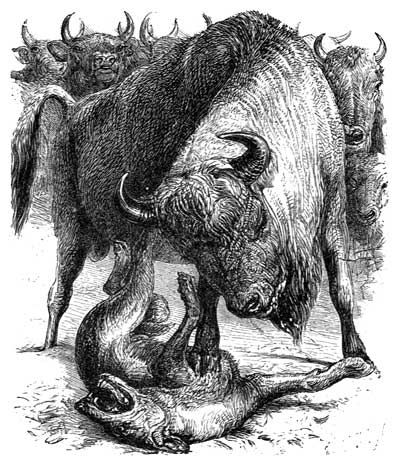
BISON KILLING WOLF.
"Will the unicorn he willing to serve thee?"—Job xxxix. 9.
It is a tolerably large animal, being about six feet high at the
shoulder—a stature nearly equivalent to that of the ordinary
Asiatic elephant; and, in spite of its great bulk, is a fleet and
active animal, as indeed is generally the case with those oxen
which inhabit elevated localities. Still, though it can run with
considerable speed, it is not able to keep up the pace for any
great distance, and at the end of a mile or two can be brought
to bay.
Like most animals, however large and powerful they may be,
it fears the presence of man, and, if it sees or scents a human
being, will try to slip quietly away; but when it is baffled in
this attempt, and forced to fight, it becomes a fierce and dangerous
antagonist, charging with wonderful quickness, and using
its short and powerful horns with great effect. A wounded
Bison, when fairly brought to bay, is perhaps as awkward an
opponent as can be found, and to kill it without the aid of firearms
is no easy matter.
Although the countries in which it lives are infested with
wolves, it seems to have no fear of them when in health; and,
even when pressed by their winter's hunger, the wolves do not
venture to attack even a single Bison, much less a herd of them.
Like other wild cattle, it likes to dabble in muddy pools, and is
fond of harbouring in thickets near such localities; and those
who have to travel through the forest keep clear of such spots,
unless they desire to drive out the animal for the purpose of
killing it.
Like the extinct Aurochs, the Bison has never been domesticated,
and, although the calves have been captured while very
young, and attempts have been made to train them to harness,
their innate wildness of disposition has always baffled such
efforts.
The Gazelle identified with the Tsebi, i.e. the Roe or Roebuck of Scripture—Various
passages relating to the Tsebi—Its swiftness, its capabilities as a beast of
chase, its beauty, and the quality of its flesh—The Tsebiyah rendered in Greek
as Tabitha, and translated as Dorcas, or Gazelle—Different varieties of the
Gazelle—How the Gazelle defends itself against wild beasts—Chase of the
Gazelle—The net, the battue, and the pitfall—Coursing the Gazelle with greyhounds
and falcons—Mr. Chasseaud's account of a hunting party—Gentleness
of the Gazelle.
We now leave the Ox tribe, and come to the Antelopes, several
species of which are mentioned in the Scriptures. Four kinds
of antelope are found in or near the Holy Land, and there is
little doubt that all of them are mentioned in the sacred
volume.
The first that will be described is the well-known Gazelle,
which is acknowledged to be the animal that is represented by
the word Tsebi, or Tsebiyah. The Jewish Bible accepts the
same rendering. This word occurs many times, sometimes as
a metaphor, and sometimes representing some animal which
was lawful food, and which therefore belonged to the true
ruminants. Moreover, its flesh was not only legally capable of
being eaten, but was held in such estimation that it was provided
for the table of Solomon himself, together with other animals
which will be described in their turn.
We will first take the passages where the word is used metaphorically,
or as a poetical image. That it was exceedingly
swift of foot is evident from several instances in which the
animal is mentioned. For example, in 2 Sam. ii. 18, we are told
that Asahel, the brother of Joab, was "as light of foot as a wild
roe," or, as the passage may also be translated, "one of the roes
that is in the field." And in 1 Chron. xii. 8, we find the following
description of eleven warriors who attached themselves to
David:—"Of the Gadites there separated themselves unto
David into the hold to the wilderness men of might, and men
of war fit for the battle, that could handle shield and buckler,
whose faces were like the faces of lions, and were as swift as
the roes upon the mountains."
That it was a beast of chase is as plainly to be gathered from
the sacred writings. See, for example, Prov. vi. 4, 5: "Give
not sleep to thine eyes, nor slumber to thine eyelids. Deliver
thyself as a roe from the hand of the hunter, and as a bird
from the hand of the fowler."
The same imagery is employed by the prophet Isaiah, xiii.
13, 14:—
"Therefore I will shake the heavens, and the earth shall
remove out of her place, in the wrath of the Lord of hosts, and
in the day of His fierce anger. And it shall be as the chased
roe, and as a sheep that no man taketh up: they shall every
man turn to his own people, and flee every one into his own
land."
Having now learned that the Tsebi was very fleet of foot and
a beast of chase, we come to another series of passages, which
show that it was an animal of acknowledged beauty. In that
most remarkable poem, the Song of Solomon, or the "Song
of Songs," as it is more rightly named, there are repeated allusions
to the Tsebi. In some cases the name of the Roe is used
as a sort of adjuration—"I charge thee by the roes;" and in
others the lover, whether man or woman, is compared to the
Roe. There is one consecutive series of passages in which the
word is repeatedly used. See Cant. ii. 7-9: "I charge you, O ye
daughters of Jerusalem, by the roes, and by the hinds of the
field, that ye stir not up, nor awake my love, till he please. The
voice of my beloved! behold, he cometh leaping upon the mountains,
skipping upon the hills. My beloved is like a roe or
a young hart." And in the last verse of the poem the same
image is repeated—"Make haste, my beloved, and be thou like
to a roe or to a young hart upon the mountains of spices."
Allusion is made to the beauty of the Roe, or Gazelle, in a
well-known name, Tabitha, which is, in fact, a slight corruption
of the Hebrew Tsebiyah, and is translated into Greek as Dorcas,
or Gazelle. "Now there was at Joppa a certain disciple named
Tabitha, which by interpretation is called Dorcas (i.e. the Gazelle).
This woman was full of good works and alms deeds which
she did."
As to the flesh of the Gazelle, or Roe, it is mentioned in
Deut. xii. 15, xiv. 5, as one of the animals that affords lawful
food; and the same permission is reiterated in xv. 22, with
the proviso that the blood shall be poured out on the earth like
water.
Having now glanced at the various passages of Scripture
wherein the Gazelle is mentioned, we will proceed to the animal
itself, its appearance, locality, and general habits, in order to see
how they agree with the Scriptural allusions to the Tsebi.
As to its flesh, it is even now considered a great dainty,
although it is not at all agreeable to European taste, being hard,
dry, and without flavour. Still, as has been well remarked,
tastes differ as well as localities, and an article of food which is
a costly luxury in one land is utterly disdained in another, and
will hardly be eaten except by one who is absolutely dying of
starvation.
The Gazelle is very common in Palestine in the present day,
and, in the ancient times, must have been even more plentiful.
There are several varieties of it, which were once thought to be
distinct species, but are now acknowledged to be mere varieties,
all of which are referable to the single species Gazella Dorcas.
There is, for example, the Corinna, or Corine Antelope, which is
a rather boldly-spotted female; the Kevella Antelope, in which
the horns are slightly flattened; the small variety called the
Ariel, or Cora; the grey Kevel, which is a rather large variety;
and the Long-horned Gazelle, which owes its name to a rather
large development of the horns.
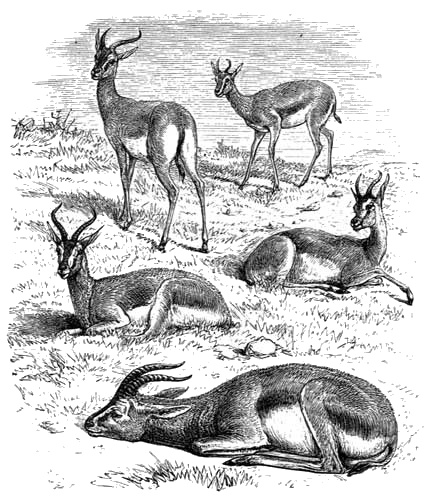
THE GAZELLE, (Gazella Dorcus) OR ROE OF SCRIPTURE.
"Behold, he cometh leaping upon the mountains, skipping upon the hills. My beloved is like a roe
or a young hart."—Cant. ii. 8, 9.
Whatever variety may inhabit any given spot, they all have
the same habits. They are gregarious animals, associating
together in herds often of considerable size, and deriving from
their numbers an element of strength which would otherwise be
wanting. Against mankind, numbers are of no avail; but when
the agile though feeble Gazelle has to defend itself against the
predatory animals of its own land, it can only defend itself
by the concerted action of the whole herd. Should, for example,
the wolves prowl round a herd of Gazelles, after their treacherous
wont, the Gazelles instantly assume a posture of self-defence.
They form themselves into a compact phalanx, all the males
coming to the front, and the strongest and boldest taking on
themselves the honourable duty of facing the foe. The does
and the young are kept within their ranks, and so formidable is
the array of sharp, menacing horns, that beasts as voracious as
the wolf, and far more powerful, have been known to retire
without attempting to charge.
As a rule, however, the Gazelle does not desire to resist, and
prefers its legs to its horns as a mode of insuring safety. So
fleet is the animal, that it seems to fly over the ground as if
propelled by volition alone, and its light, agile frame is so enduring,
that a fair chase has hardly any prospect of success.
Hunters, therefore, prefer a trap of some kind, if they chase
the animal merely for food or for the sake of its skin, and contrive
to kill considerable numbers at once. Sometimes they
dig pitfalls, and drive the Gazelles into them by beating a large
tract of country, and gradually narrowing the circle. Sometimes
they use nets, such as have already been described, and sometimes
they line the sides of a ravine with archers and spearmen,
and drive the herd of Gazelles through the treacherous defile.
These modes of slaughter are, however, condemned by the
true hunter, who looks upon those who use them much in the
same light as an English sportsman looks on a man who shoots
foxes. The greyhound and the falcon are both employed in the
legitimate capture of the Gazelle, and in some cases both are
trained to work together. Hunting the Gazelle with the greyhound
very much resembles coursing in our own country, and
chasing it with the hawk is exactly like the system of falconry
that was once so popular an English sport, and which even now
shows signs of revival.
It is, however, when the dog and the bird are trained to work
together that the spectacle becomes really novel and interesting
to an English spectator.
As soon as the Gazelles are fairly in view, the hunter unhoods
his hawk, and holds it up so that it may see the animals. The
bird fixes its eye on one Gazelle, and by that glance the animal's
doom is settled. The falcon darts after the Gazelles, followed by
the dog, who keeps his eye on the hawk, and holds himself in
readiness to attack the animal that his feathered ally may select.
Suddenly the falcon, which has been for some few seconds
hovering over the herd of Gazelles, makes a stoop upon the
selected victim, fastening its talons in its forehead, and, as it
tries to shake off its strange foe, flaps its wings into the Gazelle's
eyes so as to blind it. Consequently, the rapid course of the
antelope is arrested, so that the dog is able to come up and
secure the animal while it is struggling to escape from its
feathered enemy. Sometimes, though rarely, a young and inexperienced
hawk swoops down with such reckless force that it
misses the forehead of the Gazelle, and impales itself upon the
sharp horns, just as in England the falcon is apt to be spitted
on the bill of the heron.
The most sportsmanlike mode of hunting the Gazelle is to use
the falcon alone; but for this sport a bird must possess exceptional
strength, swiftness, and intelligence. A very spirited
account of such a chase is given by Mr. G. W. Chasseaud, in his
"Druses of the Lebanon:"—
"Whilst reposing here, our old friend with the falcon informs
us that at a short distance from this spot is a khan called Nebbi
Youni, from a supposition that the prophet Jonah was here
landed by the whale; but the old man is very indignant when
we identify the place with a fable, and declare to him that
similar sights are to be seen at Gaza and Scanderoon. But his
good humour is speedily recovered by reverting to the subject
of the exploits and cleverness of his falcon. This reminds him
that we have not much time to waste in idle talk, as the greater
heats will drive the gazelles from the plains to the mountain
retreats, and lose us the opportunity of enjoying the most
sportsmanlike amusement in Syria. Accordingly, bestriding our
animals again, we ford the river at that point where a bridge
once stood.
"We have barely proceeded twenty minutes before the keen
eye of the falconer has descried a herd of gazelles quietly grazing
in the distance. Immediately he reins in his horse, and enjoining
silence, instead of riding at them, as we might have felt inclined
to do, he skirts along the banks of the river, so as to cut off, if
possible, the retreat of these fleet animals where the banks are
narrowest, though very deep, but which would be cleared at a
single leap by the gazelles. Having successfully accomplished
this manœuvre, he again removes the hood from the hawk, and
indicates to us that precaution is no longer necessary. Accordingly,
first adding a few slugs to the charges in our barrels, we
balance our guns in an easy posture, and, giving the horses
their reins, set off at full gallop, and with a loud hurrah, right
towards the already startled gazelles.
"The timid animals, at first paralysed by our appearance,
stand and gaze for a second terror-stricken at our approach; but
their pause is only momentary; they perceive in an instant that
the retreat to their favourite haunts has been secured, and so
they dash wildly forward with all the fleetness of despair,
coursing over the plain with no fixed refuge in view, and nothing
but their fleetness to aid in their delivery. A stern chase is a
long chase, and so, doubtless, on the present occasion it would
prove with ourselves, for there is many and many a mile of
level country before us, and our horses, though swift of foot,
stand no chance in this respect with the gazelles.
"Now, however, the old man has watched for a good opportunity
to display the prowess and skill of his falcon: he has
followed us only at a hand-gallop; but the hawk, long inured to
such pastime, stretches forth its neck eagerly in the direction of
the flying prey, and being loosened from its pinions, sweeps up
into the air like a shot, and passes overhead with incredible
velocity. Five minutes more, and the bird has outstripped even
the speed of the light-footed gazelle; we see him through the
dust and haze that our own speed throws around us, hovering
but an instant over the terrified herd; he has singled out his
prey, and, diving with unerring aim, fixes his iron talons into
the head of the terrified animal.
"This is the signal for the others to break up their orderly
retreat, and to speed over the plain in every direction. Some,
despite the danger that hovers on their track, make straight for
their old and familiar haunts, and passing within twenty yards
of where we ride, afford us an opportunity of displaying our
skill as amateur huntsmen on horseback; nor does it require
but little nerve and dexterity to fix our aim whilst our horses
are tearing over the ground. However, the moment presents
itself, the loud report of barrel after barrel startles the unaccustomed
inmates of that unfrequented waste; one gazelle leaps
twice its own height into the air, and then rolls over, shot
through the heart; another bounds on yet a dozen paces, but,
wounded mortally, staggering, halts, and then falls to the
ground.
"This is no time for us to pull in and see what is the amount
of damage done, for the falcon, heedless of all surrounding
incidents, clings firmly to the head of its terrified victim, flapping
its strong wings awhile before the poor brute's terrified
eyes, half blinding it and rendering its head dizzy; till, after
tearing round and round with incredible speed, the poor creature
stops, panting for breath, and, overcome with excessive terror,
drops down fainting upon the earth. Now the air resounds
with the acclamations and hootings of the ruthless victors.
"The old man is wild in his transports of delight. More
certain of the prowess of his bird than ourselves, he has stopped
awhile to gather together the fruits of our booty, and, with these
suspended to his saddle bow, he canters up leisurely, shouting
lustily the while the praises of his infallible hawk; then getting
down, and hoodwinking the bird again, he first of all takes the
precaution of fastening together the legs of the fallen gazelle,
and then he humanely blows up into its nostrils. Gradually
the natural brilliancy returns to the dimmed eyes of the gazelle,
then it struggles valiantly, but vainly, to disentangle itself from
its fetters.
"Pitying its efforts, the falconer throws a handkerchief over
its head, and, securing this prize, claims it as his own, declaring
that he will bear it home to his house in the mountains, where,
after a few weeks' kind treatment and care, it will become as
domesticated and affectionate as a spaniel. Meanwhile, Abou
Shein gathers together the fallen booty, and, tying them securely
with cords, fastens them behind his own saddle, declaring, with
a triumphant laugh, that we shall return that evening to the
city of Beyrout with such game as few sportsmen can boast of
having carried thither in one day."
The gentle nature of the Gazelle is as proverbial as its grace
and swiftness, and is well expressed in the large, soft, liquid eye,
which has formed from time immemorial the stock comparison
of Oriental poets when describing the eyes of beauty.
The Dishon or Dyshon—Signification of the word Pygarg—Certainty that the
Dishon is an antelope, and that it must be one of a few species—Former and
present range of the Addax—Description of the Addax—The Strepsiceros
of Pliny.
There is a species of animal mentioned once in the Scriptures
under the name of Dishon which the Jewish Bible leaves
untranslated, and merely gives as Dyshon, and which is rendered
in the Septuagint by Pugargos, or Pygarg, as one version gives
it. Now, the meaning of the word Pygarg is white-crouped,
and for that reason the Pygarg of the Scriptures is usually held
to be one of the white-crouped antelopes, of which several
species are known. Perhaps it may be one of them—it may
possibly be neither, and it may probably refer to all of them.
But that an antelope of some kind is meant by the word
Dishon is evident enough, and it is also evident that the Dishon
must have been one of the antelopes which could be obtained
by the Jews. Now as the species of antelope which could have
furnished food for that nation are very few in number, it is clear
that, even if we do not hit upon the exact species, we may be
sure of selecting an animal that was closely allied to it. Moreover,
as the nomenclature is exceedingly loose, it is probable
that more than one species might have been included in the
word Dishon.
Modern commentators have agreed that there is every probability
that the Dishon of the Pentateuch was the antelope
known by the name of Addax.
This handsome antelope is a native of Northern Africa. It
has a very wide range, and, even at the present day, is found in
the vicinity of Palestine, so that it evidently was one of the
antelopes which could be killed by Jewish hunters. From its
large size, and long twisted horns, it bears a strong resemblance
to the Koodoo of Southern Africa. The horns, however, are not
so long, nor so boldly twisted, the curve being comparatively
slight, and not possessing the bold spiral shape which distinguishes
those of the koodoo.
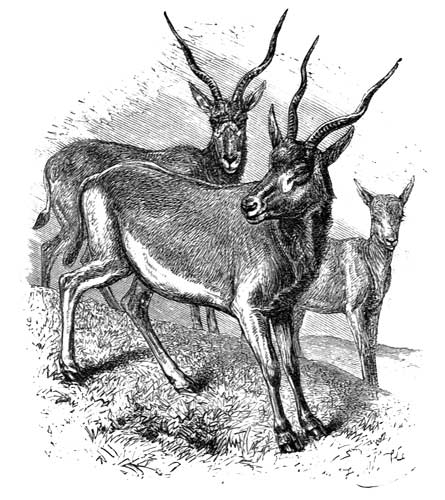
THE ADDAX, OR PYGARG OF SCRIPTURE.
"These are the beasts which ye shall eat: the ox, the sheep, ... the pygarg, and the wild ox,
and the chamois."—Deut. xiv. 4, 5.
The ordinary height of the Addax is three feet seven or eight
inches, and the horns are almost exactly alike in the two sexes.
Their length, from the head to the tips, is rather more than two
feet. Its colour is mostly white, but a thick mane of dark black
hair falls from the throat, a patch of similar hair grows on the
forehead, and the back and shoulders are greyish brown. There
is no mane on the back of the neck, as is the case with the
koodoo.
The Addax is a sand-loving animal, as is shown by the wide
and spreading hoofs, which afford it a firm footing on the yielding
soil. In all probability, this is one of the animals which would
be taken, like the wild bull, in a net, being surrounded and
driven into the toils by a number of hunters. It is not, however,
one of the gregarious species, and is not found in those
vast herds in which some of the antelopes love to assemble.
Some writers reject the Addax as the Dishon, and are inclined
to consider that the real representative of the word is to be
found in the Ariel or Isabella gazelles. Of these, however, we
have already treated, and enough has been said about them to
show that these gazelles are in all probability comprised under
the name Tsebi.
It has been suggested, in contradiction to the opinion that
the Dishon is the Addax, that the word Strepsiceros, or Twisted
Horn, is given to it by Pliny, who also mentions that one of the
native names for the animal is Adas, or Akas, and that he distinguishes
it from the Pygarg. Still, the weight of evidence is
so great in favour of the identity of the Dishon and the Pygarg,
that we may accept the interpretation with safety.
The word Jachmur evidently represents a species of antelope—Probability that the
Jachmur is identical with the Bubale, or Bekk'r-el-Wash—Resemblance of the
animal to the ox tribe—Its ox-like horns and mode of attack—Its capability
of domestication—Former and present range of the Bubale—Its representation
on the monuments of ancient Egypt—Delicacy of its flesh—Size and general
appearance of the animal.
It has already been mentioned that in the Old Testament
there occur the names of three or four animals, which clearly
belong to one or other of three or four antelopes. Only
one of these names now remains to be identified. This is
the Jachmur, or Yachmur, a word which has been rendered in
the Septuagint as Boubalos, and has been translated in our
Authorized Version as Fallow Deer.
We shall presently see that the Fallow Deer is to be identified
with another animal, and that the word Jachmur must find
another interpretation. If we follow the Septuagint, and call
it the Bubale, we shall identify it with a well-known antelope,
called by the Arabs the "Bekk'r-el-Wash," and known to
zoologists as the Bubale (Acronotus bubalis).
This fine antelope would scarcely be recognised as such by
an unskilled observer, as in its general appearance it much more
resembles the ox tribe than the antelope. Indeed, the Arabic
title, "Bekk'r-el-Wash," or Wild Cow, shows how close must be
the resemblance to the oxen. The Arabs, and indeed all the
Orientals in whose countries it lives, believe it not to be an antelope,
but one of the oxen, and class it accordingly.
How much the appearance of the Bubale justifies them in
this opinion may be judged by reference to the figure on page
145. The horns are thick, short, and heavy, and are first
inclined forwards, and then rather suddenly bent backwards.
This formation of the horns causes the Bubale to use his weapons
after the manner of the bull, thereby increasing the resemblance
between them. When it attacks, the Bubale lowers its head to
the ground, and as soon as its antagonist is within reach, tosses
its head violently upwards, or swings it with a sidelong upward
blow. In either case, the sharp curved horns, impelled by the
powerful neck of the animal, and assisted by the weight of the
large head, become most formidable weapons.
It is said that in some places, where the Bubales have learned
to endure the presence of man, they will mix with his herds for
the sake of feeding with them, and by degrees become so accustomed
to the companionship of their domesticated friends, that
they live with the herd as if they had belonged to it all their
lives. This fact shows that the animal possesses a gentle disposition,
and it is said to be as easily tamed as the gazelle
itself.
Even at the present day the Bubale has a very wide range,
and formerly had in all probability a much wider. It is indigenous
to Barbary, and has continued to spread itself over the
greater part of Northern Africa, including the borders of the
Sahara, the edges of the cultivated districts, and up the Nile
for no small distance. In former days it was evidently a tolerably
common animal of chase in Upper Egypt, as there are
representations of it on the monuments, drawn with the quaint
truthfulness which distinguishes the monumental sculpture of
that period.
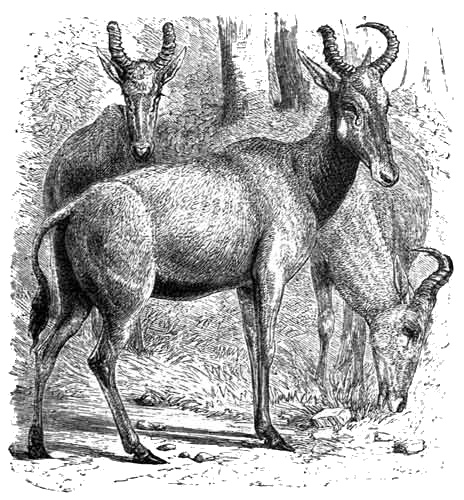
THE BUBALE, OR FALLOW DEER OF SCRIPTURE.
"And Solomon's provision for one day was thirty measures of fine flour, and threescore measure
of meal; ten fat oxen, and twenty oxen out of the pastures, and an hundred sheep; beside harts
and roebucks, and fallow-deer, and fatted fowl."—1 Kings iv. 22, 23.
It is probable that in and about Palestine it was equally
common, so that there is good reason why it should be specially
named as one of the animals that were lawful food. Not only was
its flesh permitted to be eaten, but it was evidently considered
as a great dainty, inasmuch as the Jachmur is mentioned in
1 Kings iv. 23 as one of the animals which were brought to
the royal table. See the passage quoted in full below the
illustration.
Even at the present day it is seen near the Red Sea; and as
within the memory of man it had a much larger range than can
now be assigned to it, we may safely conjecture that it resided
in Palestine in sufficient numbers to afford a constant supply of
food to the royal residence.
In size the Bubale is about equal to that of a heifer, and its
general colour is reddish brown. The head is long and narrow,
so that the heavy and deeply-ridged horns seem to stand out
with peculiar boldness. The shoulders are rather high, the neck
is very ox-like, and from the end of the tail hangs a tuft of long
black hair. It is a gregarious animal, and is found in herds,
though not of very great numbers.
The Bubale is closely allied to the hartebeest, the well-known
antelope of Southern Africa.
Importance of Sheep in the Bible—The Sheep the chief wealth of the pastoral
tribes—Tenure of land—Value of good pasture-land—Arab shepherds of the
present day—Difference between the shepherds of Palestine and England—Wanderings
of the flocks in search of food—Value of the wells—How the
Sheep are watered—Duties of the shepherd—The shepherd a kind of irregular
soldier—His use of the sling—Sheep following their shepherd—Calling the
Sheep by name—The shepherd usually a part owner of the flocks—Structure
of the sheepfolds—The rock caverns of Palestine—David's adventure with
Saul—Penning of the Sheep by night—Use of the dogs—Sheep sometimes
brought up by hand—How Sheep are fattened in the Lebanon district—The two
breeds of Sheep in Palestine—The broad-tailed Sheep, and its peculiarities—Reference
to this peculiarity in the Bible—The Talmudical writers, and their
directions to sheep-owners.
We now come to a subject which will necessarily occupy us
for some little time.
There is, perhaps, no animal which occupies a larger space in
the Scriptures than the Sheep. Whether in religious, civil, or
domestic life, we find that the Sheep is bound up with the
Jewish nation in a way that would seem almost incomprehensible,
did we not recall the light which the New Testament
throws upon the Old, and the many allusions to the coming
Messiah under the figure of the Lamb that taketh away the sins
of the world.
In treating of the Sheep, it will be perhaps advisable to
begin the account by taking the animal simply as one of those
creatures which have been domesticated from time immemorial,
dwelling slightly on those points on which the sheep-owners of
the old days differed from those of our own time.
In the first place, the tenure of land was—and is still—entirely
different from anything that can be found in our own
country. With us, the comparatively large amount of population,
placed on a comparatively small area of ground, prohibits
the mode of sheep-keeping as practised in the East, where the
pasture-lands are of vast extent, and common to all who choose
to take their flocks to them. We have at present the Downs
and the Highlands as examples of such pasturage, but they are
of small extent when compared with the vast plains which are
used for this purpose in the East.
The only claim to the land seems, in the old times of the
Scriptures, to have lain in cultivation, or perhaps in the land
immediately surrounding a well. But any one appears to have
taken a piece of ground and cultivated it, or to have dug a well
wherever he chose, and thereby to have acquired a sort of right
to the soil. The same custom prevails at the present day among
the cattle-breeding races of Southern Africa. The banks of
rivers, on account of their superior fertility, were considered as
the property of the chiefs who lived along their course, but the
inland soil was free to all.
Had it not been for this freedom of the land, it would have
been impossible for the great men to have nourished the enormous
flocks and herds of which their wealth consisted; but, on
account of the lack of ownership of the soil, a flock could be
moved to one district after another as fast as it exhausted the
herbage, the shepherds thus unconsciously imitating the habits
of the gregarious animals, which are always on the move from
one spot to another.
Pasturage being thus free to all, Sheep had a higher comparative
value than is the case with ourselves, who have to pay in
some way for their keep. There is a proverb in the Talmud
which may be curtly translated, "Land sell, sheep buy."
The value of a good pasture-ground for the flocks is so great,
that its possession is well worth a battle, the shepherds being
saved from a most weary and harassing life, and being moreover
fewer in number than is needed when the pasturage is scanty.
Sir S. Baker, in his work on Abyssinia, makes some very interesting
remarks upon the Arab herdsmen, who are placed in
conditions very similar to those of the Israelitish shepherds in a
bad pasture-land.
"The Arabs are creatures of necessity; their nomadic life is
compulsory, as the existence of their flocks and herds depends
upon the pasturage. Thus, with the change of seasons they
must change their localities according to the presence of fodder
for their cattle.... The Arab cannot halt in one spot longer
than the pasturage will support his flocks. The object of his
life being fodder, he must wander in search of the ever-changing
supply. His wants must be few, as the constant change of encampment
necessitates the transport of all his household goods;
thus he reduces to a minimum his domestic furniture and
utensils....
"This striking similarity to the descriptions of the Old Testament
is exceedingly interesting to a traveller when residing
among these curious and original people. With the Bible in
one's hand, and these unchanged tribes before the eyes, there is a
thrilling illustration of the sacred record; the past becomes the
present, the veil of three thousand years is raised, and the living
picture is a witness to the exactness of the historical description.
At the same time there is a light thrown upon many
obscure passages in the Old Testament by the experience of the
present customs and figures of speech of the Arabs, which are
precisely those that were practised at the periods described....
"Should the present history of the country be written by an
Arab scribe, the style of the description would be precisely
that of the Old Testament. There is a fascination in the
unchangeable features of the Nile regions. There are the vast
pyramids that have defied time, the river upon which Moses was
cradled in infancy, the same sandy desert through which he led
his people, and the watering-places where their flocks were led
to drink. The wild and wandering Arabs, who thousands of
years ago dug out the wells in the wilderness, are represented by
their descendants, unchanged, who now draw water from the
deep wells of their forefathers, with the skins that have never
altered their fashion.
"The Arabs, gathering with their goats and sheep around the
wells to-day, recall the recollection of that distant time when
'Jacob went on his journey, and came into the land of the
people of the east. And he looked, and behold a well in the
field, and lo! there were three flocks of sheep lying by it,' &c.
The picture of that scene would be an illustration of Arab daily
life in the Nubian deserts, where the present is a mirror of the
past."
Owing to the great number of Sheep which they have to
tend, and the peculiar state of the country, the life of the shepherd
in Palestine is even now very different from that of an
English shepherd, and in the days of the early Scriptures the
distinction was even more distinctly marked.
Sheep had to be tended much more carefully than we generally
think. In the first place, a thoughtful shepherd had always
one idea before his mind,—namely, the possibility of obtaining
sufficient water for his flocks. Even pasturage is less important
than water, and, however tempting a district might be, no shepherd
would venture to take his charge there if he were not sure
of obtaining water. In a climate such as ours, this ever-pressing
anxiety respecting water can scarcely be appreciated, for in hot
climates not only is water scarce, but it is needed far more than
in a temperate and moist climate. Thirst does its work with
terrible quickness, and there are instances recorded where men
have sat down and died of thirst in sight of the river which
they had not strength to reach.
In places therefore through which no stream runs, the wells
are the great centres of pasturage, around which are to be seen
vast flocks extending far in every direction. These wells are
kept carefully closed by their owners, and are only opened for
the use of those who are entitled to water their flocks at
them.
Noontide is the general time for watering the Sheep, and
towards that hour all the flocks may be seen converging towards
their respective wells, the shepherd at the head of each flock, and
the Sheep following him. See how forcible becomes the imagery
of David, the shepherd poet, "The Lord is my Shepherd; I shall
not want. He maketh me to lie down in green pastures (or, in
pastures of tender grass): He leadeth me beside the still waters"
Ps. xxiii. 1, 2). Here we have two of the principal duties of
the good shepherd brought prominently before us,—namely, the
guiding of the Sheep to green pastures and leading them to fresh
water. Very many references are made in the Scriptures to the
pasturage of sheep, both in a technical and a metaphorical sense;
but as our space is limited, and these passages are very numerous,
only one or two of each will be taken.
In the story of Joseph, we find that when his father and
brothers were suffering from the famine, they seem to have cared
as much for their Sheep and cattle as for themselves, inasmuch as
among a pastoral people the flocks and herds constitute the only
wealth. So, when Joseph at last discovered himself, and his
family were admitted to the favour of Pharaoh, the first request
which they made was for their flocks. "Pharaoh said unto his
brethren, What is your occupation? And they said unto
Pharaoh, Thy servants are shepherds, both we, and also our
fathers.
"They said moreover unto Pharaoh, For to sojourn in the land
are we come; for thy servants have no pasture for their flocks;
for the famine is sore in the land of Canaan: now therefore, we
pray thee, let thy servants dwell in the land of Goshen."
This one incident, so slightly remarked in the sacred history,
gives a wonderfully clear notion of the sort of life led by Jacob
and his sons. Forming, according to custom, a small tribe of
their own, of which the father was the chief, they led a pastoral
life, taking their continually increasing herds and flocks from
place to place as they could find food for them. For example, at
the memorable time when the story of Joseph begins, he was
sent by his father to his brothers, who were feeding the flocks,
and he wandered about for some time, not knowing where to
find them. It may seem strange that he should be unable to
discover such very conspicuous objects as large flocks of sheep
and goats, but the fact is that they had been driven from one
pasture-land to another, and had travelled in search of food all
the way from Shechem to Dothan.
In 1 Chron. iv. 39, 40, we read of the still pastoral Israelites
that "they went to the entrance of Gedor, even unto the east
side of the valley, to seek pasture for their flocks. And they
found fat pasture and good, and the land was wide, and quiet,
and peaceable."
How it came to be quiet and peaceable is told in the context.
It was peaceable simply because the Israelites were attracted by
the good pasturage, attacked the original inhabitants, and exterminated
them so effectually that none were left to offer resistance
to the usurpers. And we find from this passage that the value
of good pasture-land where the Sheep could feed continually
without being forced to wander from one spot to another was
so considerable, that the owners of the flocks engaged in war,
and exposed their own lives, in order to obtain so valuable a
possession.
As to the figurative passages, they are far too numerous to be
quoted, and are found throughout the whole of the Old and New
Testaments. For example, see Psalm lxxix. 13, "So we Thy
people and the sheep of Thy pasture will give Thee thanks for
ever." And again, "I will feed them upon the mountains of
Israel by the rivers, and in all the inhabited places of the country.
I will feed them in a good pasture, and upon the high
mountains of Israel shall their fold be: there shall they lie in a
good fold, and in a fat pasture shall they feed upon the mountains
of Israel" (Ezek. xxxiv. 13, 14).
We will now look at one or two of the passages that mention
watering the Sheep—a duty so imperative on an Oriental shepherd,
and so needless to our own.
In the first place we find that most graphic narrative which
occurs in Gen xxix. to which a passing reference has already
been made. When Jacob was on his way from his parents to
the home of Laban in Padan-aram, he came upon the very well
which belonged to his uncle, and there saw three flocks of Sheep
lying around the well, waiting until the proper hour arrived.
According to custom, a large stone was laid over the well, so as
to perform the double office of keeping out the sand and dust,
and of guarding the precious water against those who had no
right to it. And when he saw his cousin Rachel arrive with
the flock of which she had the management, he, according to the
courtesy of the country and the time, rolled away the ponderous
barrier, and poured out water into the troughs for the Sheep
which Rachel tended.
About two hundred years afterwards, we find Moses performing
a similar act. When he was obliged to escape into
Midian on account of his fatal quarrel with a tyrannical
Egyptian, he sat down by a well, waiting for the time when the
stone might be rolled away, and the water be distributed. Now
it happened that this well belonged to Jethro, the chief priest of
the country, whose wealth consisted principally of Sheep. He
entrusted his flock to the care of his seven daughters, who led
their Sheep to the well and drew water as usual into the troughs.
Presuming on their weakness, other shepherds came and tried
to drive them away, but were opposed by Moses, who drove
them away, and with his own hands watered the flock.
Now in both these examples we find that the men who
performed the courteous office of drawing the water and pouring
it into the sheep-troughs married afterwards the girl to whose
charge the flocks had been committed. This brings us to the
Oriental custom which has been preserved to the present day.
The wells at which the cattle are watered at noon-day are the
meeting-places of the tribe, and it is chiefly at the well that the
young men and women meet each other. As each successive
flock arrives at the well, the number of the people increases,
and while the sheep and goats lie patiently round the water,
waiting for the time when the last flock shall arrive, and the
stone be rolled off the mouth of the well, the gossip of the tribe
is discussed, and the young people have ample opportunity for
the pleasing business of courtship.
As to the passages in which the wells, rivers, brooks, water-springs,
are spoken of in a metaphorical sense, they are too
numerous to be quoted.
And here I may observe, that in reality the whole of Scripture
has its symbolical as well as its outward signification; and that,
until we have learned to read the Bible strictly according to the
spirit, we cannot understand one-thousandth part of the mysteries
which it conceals behind its veil of language; nor can we
appreciate one-thousandth part of the treasures of wisdom which
lie hidden in its pages from those who have eyes and cannot
see, ears and cannot hear.
Another duty of the shepherd of ancient Palestine was to
guard his flock from depredators, whether man or beast.
Therefore the shepherd was forced to carry arms; to act as a
sentry during the night; and, in fact, to be a sort of irregular
soldier. A fully-armed shepherd had with him his bow, his
spear, and his sword, and not even a shepherd lad was without
his sling and the great quarter-staff which is even now universally
carried by the tribes along the Nile—a staff as thick as a man's
wrist, and six or seven feet in length. He was skilled in the
use of all these weapons, especially in that of the sling.
In England, in these days, the sling is only considered as
a mere toy, whereas, before the introduction of fire-arms, it was
one of the most formidable weapons that could be wielded by
light troops. Round and smooth stones weighing three or four
ounces were the usual projectiles, and, by dint of constant
practice from childhood, the slingers could aim with a marvellous
precision. Of this fact we have a notable instance in David,
who knew that the sling and the five stones in the hand of an
active youth unencumbered by armour, and wearing merely the
shepherd's simple tunic, were more than a match for all the
ponderous weapons of the gigantic Philistine.
It has sometimes been the fashion to attribute the successful
aim of David to a special miracle, whereas those who are
acquainted with ancient weapons know well that no miracle was
wrought, because none was needed; a good slinger at that time
being as sure of his aim as a good rifleman of our days.
The sling was in constant requisition, being used both in
directing the Sheep and in repelling enemies: a stone skilfully
thrown in front of a straying Sheep being a well-understood
signal that the animal had better retrace its steps if it did not
want to feel the next stone on its back.
Passing his whole life with his flock, the shepherd was identified
with his Sheep far more than is the case in this country.
He knew all his Sheep by sight, he called them all by their
names, and they all knew him and recognised his voice. He
did not drive them, but he led them, walking in their front,
and they following him. Sometimes he would play with them,
pretending to run away while they pursued him, exactly as an
infant-school teacher plays with the children.
Consequently, they looked upon him as their protector as
well as their feeder, and were sure to follow wherever he led
them.
We must all remember how David, who had passed all his
early years as a shepherd, speaks of God as the Shepherd of
Israel, and the people as Sheep; never mentioning the Sheep as
being driven, but always as being led. "Thou leddest Thy
people like a flock, by the hands of Moses and Aaron" (Ps.
lxxvii. 20); "The Lord is my Shepherd.... He leadeth me
beside the still waters" (Ps. xxiii. 1, 2); "Lead me in a plain
path, because of mine enemies" (Ps. xxvii. 11); together with
many other passages too numerous to be quoted.
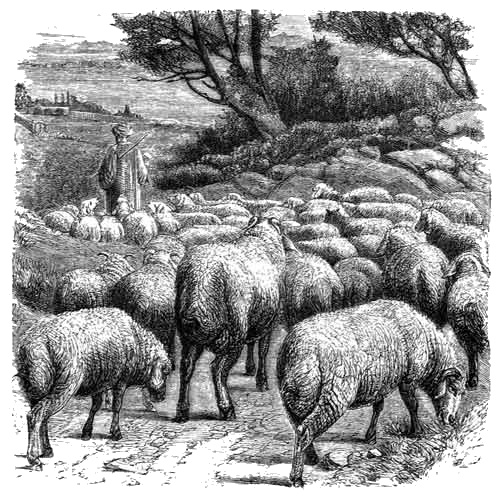
SHEEP FOLLOWING THEIR SHEPHERD.
"He calleth his own sheep by name, and leadeth them out."—John x.3.
Our Lord Himself makes a familiar use of the same image:
"He calleth his own sheep by name, and leadeth them out.
And when he putteth forth his own sheep, he goeth before them,
and the sheep follow him: for they know his voice. And a
stranger will they not follow, but will flee from him: for they
know not the voice of strangers" (John x. 3-5). And again at
verse 26: "Ye believe not, because ye are not of my sheep, as I
said unto you. My sheep hear my voice, and I know them, and
they follow me."
Although the shepherds of our own country know their Sheep
by sight, and say that there is as much difference in the faces
of Sheep as of men, they have not, as a rule, attained the art of
teaching their Sheep to recognise their names. This custom,
however, is still retained, as may be seen from a well-known
passage in Hartley's "Researches in Greece and the Levant:"—
"Having had my attention directed last night to the words in
John x. 3, I asked my man if it were usual in Greece to give
names to the sheep. He informed me that it was, and that
the sheep obeyed the shepherd when he called them by their
names. This morning I had an opportunity of verifying the
truth of this remark. Passing by a flock of sheep, I asked the
shepherd the same question which I had put to the servant, and
he gave me the same answer. I then bade him call one of his
sheep. He did so, and it instantly left its pasturage and its
companions, and ran up to the hands of the shepherd, with
signs of pleasure, and with a prompt obedience which I had never
before observed in any other animal.
"It is also true that in this country, 'a stranger will they not
follow, but will flee from him.' The shepherd told me that
many of his sheep were still wild, that they had not learned
their names, but that by teaching them they would all learn
them."
Generally, the shepherd was either the proprietor of the flock,
or had at all events a share in it, of which latter arrangement
we find a well-known example in the bargain which Jacob made
with Laban, all the white Sheep belonging to his father-in-law,
and all the dark and spotted Sheep being his wages as shepherd.
Such a man was far more likely to take care of the Sheep than
if he were merely a paid labourer; especially in a country where
the life of a shepherd was a life of actual danger, and he might at
any time be obliged to fight against armed robbers, or to oppose
the wolf, the lion, or the bear. The combat of the shepherd
David with the last-mentioned animals has already been
noticed.
In allusion to the continual risks run by the Oriental shepherd,
our Lord makes use of the following well-known words:—"The
thief cometh not but for to steal, and to kill, and to destroy: I
am come that they might have life, and have it more abundantly.
I am the Good Shepherd: the good shepherd giveth his life for
the sheep. But he that is an hireling, ... whose own the
sheep are not, seeth the wolf coming, and leaveth the sheep,
and fleeth: and the wolf catcheth them, and scattereth the
sheep. The hireling fleeth because he is an hireling, and careth
not for the sheep."
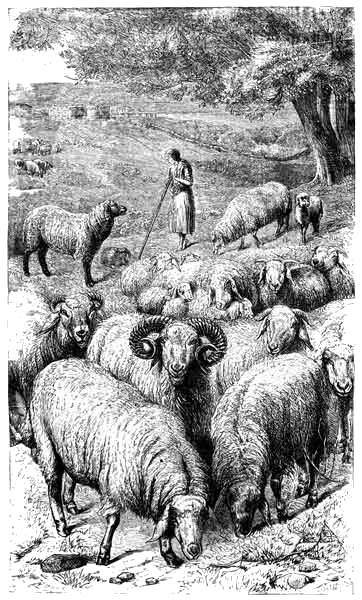
THE SHEEP.
"He maketh me to lie down in green pastures."—Psalm xxiii. 2.
Owing to the continual moving of the Sheep, the shepherd
had very hard work during the lambing time, and was obliged
to carry in his arms the young lambs which were too feeble to
accompany their parents, and to keep close to him those Sheep
who were expected soon to become mothers. At that time of
year the shepherd might constantly be seen at the head of his
flock, carrying one or two lambs in his arms, accompanied by
their mothers.
In allusion to this fact Isaiah writes: "His reward is with
Him, and His work before Him. He shall feed His flock like
a shepherd; He shall gather the lambs with His arms and carry
them in His bosom, and shall gently lead them that are with
young" (or, "that give suck," according to the marginal reading).
Here we have presented at once before us the good shepherd
who is no hireling, but owns the Sheep; and who therefore has
"his reward with him, and his work before him;" who bears
the tender lambs in his arms, or lays them in the folds of his
mantle, and so carries them in his bosom, and leads by his side
their yet feeble mothers.
Frequent mention is made of the folds in which the Sheep are
penned; and as these folds differed—and still differ—materially
from those of our own land, we shall miss the force of several
passages of Scripture if we do not understand their form, and the
materials of which they were built. Our folds consist merely of
hurdles, moveable at pleasure, and so low that a man can easily
jump over them, and so fragile that he can easily pull them
down. Moreover, the Sheep are frequently enclosed within the
fold while they are at pasture.
If any one should entertain such an idea of the Oriental fold,
he would not see the force of the well-known passage in which
our Lord compares the Church to a sheep fold, and Himself to
the door. "He that entereth not by the door into the sheep fold,
but climbeth up some other way, the same is a thief and a
robber. But he that entereth in by the door is the shepherd of
the sheep. To him the porter openeth, and the sheep hear his
voice.... All that ever came before me are thieves and robbers:
but the sheep did not hear them. I am the door: by me if any
man enter in, he shall be saved, and shall go in and out, and
find pasture."
Had the fold here mentioned been a simple enclosure of
hurdles, such an image could not have been used. It is evident
that the fold to which allusion was made, and which was probably
in sight at the time when Jesus was disputing with
the Pharisees, was a structure of some pretensions; that it
had walls which a thief could only enter by climbing over
them—not by "breaking through" them, as in the case of a
mud-walled private house; and that it had a gate, which was
guarded by a watchman.
In fact, the fold was a solid and enduring building, made of
stone. Thus in Numbers xxxii. it is related that the tribes of
Reuben and Gad, who had great quantities of Sheep and other
cattle, asked for the eastward side of Jordan as a pasture-ground,
promising to go and fight for the people, but previously
to build fortified cities for their families, and folds for their
cattle, the folds being evidently, like the cities, buildings of an
enduring nature.
If the reader will refer to the upper left-hand corner of
the large illustration, he will see in the distance the fold into
which the sheep are gathered at nightfall, and will perceive
that it is a strong stone building, with walls of a considerable
height. In some places the folds are simply rock caverns,
partly natural and partly artificial, often enlarged by a stone
wall built outside it. It was the absence of these rock caverns
on the east side of Jordan that compelled the Reubenites
and Gadites to build folds for themselves, whereas on the
opposite side places of refuge were comparatively abundant.
See, for example, the well-known history related in 1 Sam.
xxiii. xxiv. David and his miscellaneous band of warriors,
some six hundred in number, were driven out of the cities by
the fear of Saul, and were obliged to pass their time in the
wilderness, living in the "strong holds" (xxiii. 14, 19), which we
find immediately afterwards to be rock caves (ver. 25). These
caves were of large extent, being able to shelter these six
hundred warriors, and, on one memorable occasion, to conceal
them so completely as they stood along the sides, that Saul, who
had just come out of the open air, was not able to discern them
in the dim light, and David even managed to approach him
unseen, and cut off a portion of his outer robe.
That this particular cave was a sheepfold we learn from
xxiv. 2-4: "Then Saul took three thousand chosen men
out of all Israel, and went to seek David and his men upon the
rocks of the wild goats. And he came to the sheepcotes by
the way." Into these strongholds the Sheep are driven towards
nightfall, and, as the flocks converge towards their resting-place,
the bleatings of the sheep are almost deafening.
The shepherds as well as their flocks found shelter in these
caves, making them their resting-places while they were living
the strange, wild, pastoral life among the hills; and at the
present day many of the smaller caves and "holes of the rock"
exhibit the vestiges of human habitation in the shape of straw,
hay, and other dried herbage, which has been used for beds, just
as we now find the rude couches of the coast-guard men in the
cliff caves of our shores.
The dogs which are attached to the sheepfolds were, as they
are now, the faithful servants of man, although, as has already
been related, they are not made the companions of man as is
the case with ourselves. Lean, gaunt, hungry, and treated with
but scant kindness, they are yet faithful guardians against the
attack of enemies. They do not, as do our sheepdogs, assist in
driving the flocks, because the Sheep are not driven, but led, but
they are invaluable as nocturnal sentries. Crouching together
outside the fold, in little knots of six or seven together, they
detect the approach of wild animals, and at the first sign of the
wolf or the jackal they bark out a defiance, and scare away the
invaders. It is strange that the old superstitious idea of their
uncleanness should have held its ground through so many tens
of centuries; but, down to the present day, the shepherd of
Palestine, though making use of the dog as a guardian of his
flock, treats the animal with utter contempt, not to say cruelty,
beating and kicking the faithful creature on the least provocation,
and scarcely giving it sufficient food to keep it alive.
Sometimes the Sheep are brought up by hand at home.
"House-lamb," as we call it, is even now common, and the
practice of house-feeding peculiar in the old Scriptural times.
We have an allusion to this custom in the well-known parable
of the prophet Nathan: "The poor man had nothing, save one
little ewe lamb, which he had bought and nourished up: and it
grew up together with him, and with his children; it did eat of
his own meat, and drank of his own cup, and lay in his bosom,
and was unto him as a daughter" (2 Sam. xii. 3). A further,
though less distinct, allusion is made to this practice in Isaiah
vii. 21: "It shall come to pass in that day, that a man shall
nourish a young cow, and two sheep."
How the Sheep thus brought up by hand were fattened may
be conjectured from the following passage in Mr. D. Urquhart's
valuable work on the Lebanon:—
"In the month of June, they buy from the shepherds, when
pasturage has become scarce and sheep are cheap, two or three
sheep; these they feed by hand. After they have eaten up the
old grass and the provender about the doors, they get vine
leaves, and, after the silkworms have begun to spin, mulberry
leaves. They purchase them on trial, and the test is appetite.
If a sheep does not feed well, they return it after three days.
To increase their appetite they wash them twice a day, morning
and evening, a care they never bestow on their own bodies.
"If the sheep's appetite does not come up to their standard,
they use a little gentle violence, folding for them forced leaf-balls
and introducing them into their mouths. The mulberry has the
property of making them fat and tender. At the end of four
months the sheep they had bought at eighty piastres will sell
for one hundred and forty, or will realize one hundred and fifty.
"The sheep is killed, skinned, and hung up. The fat is then
removed; the flesh is cut from the bones, and hung up in the
sun. Meanwhile, the fat has been put in a cauldron on the fire,
and as soon as it has come to boil, the meat is laid on. The
proportion of the fat to the lean is as four to ten, eight 'okes'
fat and twenty lean. A little salt is added, it is simmered for
an hour, and then placed in jars for the use of the family during
the year.
"The large joints are separated and used first, as not fit for
keeping long. The fat, with a portion of the lean, chopped fine,
is what serves for cooking the 'bourgoul,' and is called Dehen.
The sheep are of the fat-tailed variety, and the tails are the
great delicacy."
This last sentence reminds us that there are two breeds of
Sheep in Palestine. One much resembles our ordinary English
Sheep, while the other is a very different animal, being to the
ordinary Sheep what the greyhound is to the rough terrier. It
is much taller on its legs, larger-boned, and long-nosed. Only
the rams have horns, and they are not twisted spirally like those
of our own Sheep, but come backwards, and then curl round so
that the point comes under the ear. The great peculiarity of
this Sheep is the tail, which is simply prodigious in point of size,
and is an enormous mass of fat. Indeed, the long-legged and
otherwise lean animal seems to concentrate all its fat in the tail,
which, as has been well observed, appears to abstract both flesh
and fat from the rest of the body. So great is this strange
development, that the tail alone will sometimes weigh one-fifth
as much as the entire animal. A similar breed of Sheep is found
in Southern Africa and other parts of the world. In some places,
the tail grows to such an enormous size that, in order to keep
so valuable a part of the animal from injury, it is fastened to
a small board, supported by a couple of wheels, so that the Sheep
literally wheels its own tail in a cart. It has been thought by
some systematic naturalists that this variety is a distinct species,
and the broad-tailed breeds of Sheep have, in consequence, been
distinguished by several names. For example, the present
variety is called Ovis laticaudatus by several authors, Ovis
laticauda platyceros by another, and Ovis cauda obesa by another.
The broad-tailed Sheep of Tartary is called Ovis steatopyga.
Another author calls it Ovis macrocercus; and the broad-tailed
Sheep of Southern Africa is called Ovis Capensis. Yet they
are in reality one and the same variety of the common domesticated
Sheep, differing in some particulars according to the conditions
in which they are placed, but having really no specific
distinction. It is, by the way, from the wool of the unborn
broad-tailed Sheep that the much-prized Astrachan fur is made.
The various Scriptural writers seem never to have noticed
the difference between the breeds of Sheep; the names that are
employed denoting the different ages and sexes of the Sheep,
but having no reference to the breed.
For example, the word "Tâleh" signifies a very young sucking
lamb, such as is mentioned in 1 Sam. vii. 9: "And Samuel
took a sucking lamb (Tâleh), and offered it for a burnt offering
wholly unto the Lord." The same word is used in Isa. lxv. 25:
"The wolf and the lamb (tâleh) shall feed together;" the
force of this well-known passage being much increased by the
correct rendering of the word "tâleh." The Jewish Bible renders
the word as "a lamb of milk."
The word "kebes," or "keves," (the e being pronounced
like the same letter in the word "seven") signifies a male lamb
of a year or so old, the feminine being "kebesah." When the
young lamb was weaned, and was sent to pasture, it was called
by another name, i.e. "kar," this word being evidently derived
from the Hebrew verb which signifies to skip. The adult ram
is signified by the word "ayil," or "ail," and the ewe by
"rakal."
Frequent reference to the fat of the tail is made in the
Authorized Version of the Scriptures, though in terms which
would not be understood did we not know that the Sheep
which is mentioned in those passages is the long-tailed
Sheep of Syria. See, for example, the history narrated in
Exod. xxix. 22, where special details are given as to the
ceremony by which Aaron and his sons were consecrated
to the priesthood. "Thou shalt take of the ram the fat and the
rump, and the fat that covereth the inwards, and the caul above
the liver, and the two kidneys, and the fat that is upon them."
In the Jewish Bible the passage is given with much more
precision, "Thou shalt take of the ram the fat, and the fat tail,"
&c. The same rendering is used in Lev. iii. 9: "And he
shall offer of the sacrifice of the feast offering a fire offering
unto the Eternal; the fat thereof, and the whole fat tail shall he
take off hard by the backbone; and the fat that covereth the
inwards, and all the fat that is upon the inwards."
But though this particular breed is not very distinctly mentioned
in the Bible, the Talmudical writers have many allusions
to it. In the Mischna these broad-tailed Sheep are not allowed
to leave their folds on the Sabbath-day, because by wheeling
their little tail-waggons behind them they would break the
Sabbath. The writers describe the tail very graphically, comparing
its shape to that of a saddle, and saying that it is fat,
without bones, heavy and long, and looks as if the whole body
were continued beyond the hind-legs, and thence hung down in
place of a tail.
The Rabbinical writers treat rather fully of the Sheep, and
give some very amusing advice respecting their management.
If the ewes cannot be fattened in the ordinary manner, that end
may be achieved by tying up the udder so that the milk cannot
flow, and the elements which would have furnished milk are
forced to produce fat. If the weather should be chilly at the
shearing time, and there is danger of taking cold after the wool
is removed, the shepherd should dip a sponge in oil and tie it
on the forehead of the newly-shorn animal. Or, if he should
not have a sponge by him, a woollen rag will do as well. The
same potent remedy is also efficacious if the Sheep should be ill
in lambing time.
That the Sheep is liable to the attack of the gadfly, which
deposits its eggs in the nostrils of the unfortunate animal,
was as well known in the ancient as in modern times. It is
scarcely necessary to mention that the insect in question is
the Æstrus ovis. Instinctively aware of the presence of this
insidious and dreaded enemy, which, though so apparently
insignificant, is as formidable a foe as any of the beasts of
prey, the Sheep display the greatest terror at the sharp,
menacing sound produced by the gadfly's wings as the insect
sweeps through the air towards its destination. They congregate
together, placing their heads almost in contact with each
other, snort and paw the ground in their terror, and use all means
in their power to prevent the fly from accomplishing its purpose.
When a gadfly succeeds in attaining its aim, it rapidly
deposits an egg or two in the nostril, and then leaves them.
The tiny eggs are soon hatched by the natural heat of the
animal, and the young larvæ crawl up the nostril towards the
frontal sinus. There they remain until they are full-grown, when
they crawl through the nostrils, fall on the ground, burrow
therein, and in the earth undergo their changes into the pupal
and perfect stages.
It need hardly be said that an intelligent shepherd would
devote himself to the task of killing every gadfly which he
could find, and, as these insects are fond of basking on sunny
rocks or tree-trunks, this is no very difficult matter.
The Rabbinical writers, however, being totally ignorant of
practical entomology, do not seem to have recognised the insect
until it had reached its full larval growth. They say that the
rams manage to shake the grubs out of their nostrils by butting
at one another in mimic warfare, and that the ewes, which are
hornless, and are therefore incapable of relieving themselves
by such means, ought to be supplied with plants which will
make them sneeze, so that they may shake out the grubs by
the convulsive jerkings of the head caused by inhaling the
irritating substance.
The same writers also recommend that the rams should be
furnished with strong leathern collars.
When the flock is on the march, the rams always go in the
van, and, being instinctively afraid of their ancient enemy the
wolf, they continually raise their heads and look about them.
This line of conduct irritates the wolves, who attack the foremost
rams and seize them by the throat. If, therefore, a piece
of stout leather be fastened round the ram's neck, the wolf is
baffled, and runs off in sullen despair.
Generally, the oldest ram is distinguished by a bell, and, when
the flock moves over the hilly slopes, the Sheep walk in file after
the leader, making narrow paths, which are very distinct from a
distance, but are scarcely perceptible when the foot of the
traveller is actually upon them. From this habit has arisen an
ancient proverb, "As the sheep after the sheep, so the daughter
after the mother," a saying which is another form of our own
familiar proverb, "What is bred in the bone will not come out
of the flesh."
We now come to the Sheep considered with reference to its
uses. First and foremost the Sheep was, and still is, one of the
chief means of subsistence, being to the pastoral inhabitants of
Palestine what the oxen are to the pastoral inhabitants of
Southern Africa.
To ordinary persons the flesh of the Sheep was a seldom-tasted
luxury; great men might eat it habitually, "faring
sumptuously every day," and we find that, among the glories of
Solomon's reign, the sacred chronicler has thought it worth while
to mention that part of the daily provision for his household
included one hundred Sheep. No particular pains seem to have
been taken about the cooking of the animal, which seems generally
to have been boiled. As, however, in such a climate the
flesh could not be kept for the purpose of making it tender, as is
the case in this part of the world, it was cooked as soon as the
animal was killed, the fibres not having time to settle into the
rigidity of death.
Generally, when ordinary people had the opportunity of
tasting the flesh of the Sheep, it was on the occasion of some
rejoicing,—such, for example, as a marriage feast, or the advent of
a guest, for whom a lamb or a kid was slain and cooked on the
spot, a young male lamb being almost invariably chosen as less
injurious than the ewe to the future prospects of the flock.
Roasting over a fire was sometimes adopted, as was baking in an
oven sunk in the ground, a remarkable instance of which we
shall see when we come to the Jewish sacrifices. Boiling,
however, was the principal mode; so much so, indeed, that the
Hebrew word which signifies boiling is used to signify any kind
of cooking, even when the meat was roasted.
The process of cooking and eating the Sheep was as follows.
The animal having been killed according to the legal form, the
skin was stripped off, and the body separated joint from joint,
the right shoulder being first removed. This, it will be remembered,
was the priest's portion; see Lev. vii. 32: "The right
shoulder shall ye give unto the priest for an heave offering of the
sacrifices of your peace offerings." The whole of the flesh was
then separated from the bones, and chopped small, and even the
bones themselves broken up, so that the marrow might not
be lost.
A reference to this custom is found in Micah iii. 2, 3, "Who
pluck off their skin from off them, and their flesh from off their
bones; who also eat the flesh of my people ... and they break
their bones, and chop them in pieces, as for the pot, and as flesh
within the caldron." The reader will now understand more fully
the force of the prophecy, "He keepeth all His bones: not one of
them is broken" (Psa. xxxiv. 20).
The mixed mass of bones and flesh was then put into the
caldron, which was generally filled with water, but sometimes
with milk, as is the custom with the Bedouins of the present
day, whose manners are in many respects identical with those
of the early Jews. It has been thought by some commentators
that the injunction not to "seethe a kid in his mother's milk"
(Deut. xiv. 21) referred to this custom. I believe, however, that
the expression "in his mother's milk" does not signify that the
flesh of the kid might not be boiled in its mother's milk, but
that a kid might not be taken which was still in its mother's
milk, i.e. unweaned.
Salt and spices were generally added to it; see Ezek. xxiv. 10:
"Heap on wood, kindle the fire, consume the flesh, and spice it
well." The surface was carefully skimmed, and, when the meat
was thoroughly cooked, it and the broth were served up separately.
The latter was used as a sort of sauce, into which unleavened
bread was dipped. So in Judges vi. 19 we read that
when Gideon was visited by the angel, according to the hospitable
custom of the land, he "made ready a kid, and unleavened
cakes of an ephah of flour: the flesh he put in a basket,
and he put the broth in a pot, and brought it out unto him
under the oak, and presented it to him."
Valuable, however, as was the Sheep for this purpose, there
has always existed a great reluctance to kill the animal, the very
sight of the flocks being an intense gratification to a pastoral
Oriental. The principal part of the food supplied by the Sheep
was, and is still, the milk; which afforded abundant food without
thinning the number of the flock. As all know who have
tasted it, the milk of the Sheep is peculiarly rich, and in the
East is valued much more highly than that of cattle. The
milk was seldom drunk in a fresh state, as is usually the case
with ourselves, but was suffered to become sour, curdled, and
semi-solid.
This custom exists at the present day, the curdled milk being
known by the name of "leben." It is worthy of notice that all
the Kaffir tribes of Southern Africa, who live almost entirely on
milk, also use it curdled, under the name of "amasi," and utterly
refuse to drink it in its fresh state, looking upon new milk much
as we should look upon unfermented ale. It is curdled by being
placed in a vessel together with some of the already curdled
milk, and the usual plan is to preserve for this special purpose a
vessel which is never wholly emptied, and which is found to
curdle the milk with great rapidity.
"Leben" is exceedingly nutritious, and especially adapted for
children, who, when accustomed to it, will very much prefer it
to the milk in a fresh state. Two separate words are used in
the Old Testament to distinguish fresh from curdled milk, the
former being called Châlâb, and the latter Chemhah.
For butter (if we may accept the rendering of the word) the
milk of the cow or the goat seems to have been preferred,
although that of the Sheep also furnishes it. This distinction is
drawn even in the earliest days of Jewish history, and in the
Song of Moses (Deut. xxxii. 13, 14) we find this passage, "He
made him to suck honey out of the rock, and oil out of the flinty
rock; butter of kine and milk of sheep, with fat of lambs."
There is, however, a little uncertainty about the word which
is translated as butter, and as this word is only used in a very
few passages, we will refer briefly to them. The first mention
of butter occurs in Gen. xviii. 8, where we are told that
Abraham "took butter, and milk, and the calf which he had
dressed, and set it before them." In this passage we find the
words "chemhah" and "châlâh" are used, the former being translated
in the Jewish Bible as "clotted cream." Abraham therefore
gave his angelic guests their choice of milk, both fresh and
curdled. In the passage from Deut. xxxii. 14, which has
already been mentioned, the same words are used, as they are
in the well-known passage in the history of Jael and Sisera
(Judges v. 25): "He asked water, and she gave him milk
(châlâb); she brought forth butter (chemhah) in a lordly dish."
Again, the butter which Shobi, Machir, and Barzillai brought
to David, together with honey, was the chemhah (2 Sam. xvii.
29). In the familiar passage, "Butter and honey shall He eat"
(Isa. vii. 15), the same word is used; and so it is in Job xx. 17,
"He shall not see the rivers, the floods, the brooks of honey and
butter."
But in Prov. xxx. 33, "Surely the churning (mitz) of milk
(châlâb) bringeth forth butter" (chemhah), we have a proof
that the chemhah, whatever it may be, is produced by the
churning or pressure of the fresh milk. As to the exact force of
the word "mitz" there is a little doubt, some persons translating
it as pressure, and others as agitating or shaking, a movement
which, when applied to milk, would be rightly translated as
churning. This latter interpretation is strengthened by the context,
"Surely the churning (mitz) of milk bringeth forth butter,
and the wringing (mitz) of the nose bringeth forth blood."
It is most probable that the chemhah may signify both clotted
cream and butter, just as many words in our language have two
or more significations. Some commentators have thought that
the ancient Jews were not acquainted with butter. This
theory, however, is scarcely tenable. Butter is used largely at
the present day, and is made after the simple fashion of the
East, by shaking the cream in a vessel, exactly as it is made
among the black tribes of Southern Africa and other parts of the
world. And, considering the unchanging character of institutions
in the East, we may assume as certain that the ancient
inhabitants of Palestine were, like their modern successors,
acquainted both with the clotted cream and true butter.
Moreover, two substances, butter and honey, which are mentioned
in Samuel, in Job, and in Isaiah, as connected with each
other, are still eaten together in the East.
A reference to the milk of Sheep is to be found in the New
Testament: "Who planteth a vineyard, and eateth not of the
fruit thereof? or who feedeth a flock, and eateth not of the milk
of the flock?" (1 Cor. ix. 7).
In this country the milk of the Sheep is scarcely ever used,
but in Scotland, especially in the great Sheep-feeding districts, its
milk is valued as it deserves, and is specially employed for the
manufacture of cheese.
The mention of cheese brings us to another branch of the
subject. Gesenius thinks that the chemhah mentioned in Prov.
xxx. must be a kind of cheese, on account of the word "mitz,"
i.e. pressure. Thus the word "cheese" occurs three times in
the Authorized Version of the Bible, and in all these passages
a different word is used. We will take them in their order.
The first mention occurs in 1 Sam. xvii. 17, 18, "And Jesse said
unto David his son, Take now for thy brethren an ephah of this
parched corn, and these ten loaves, and run to the camp to thy
brethren; and carry these ten cheeses unto the captain of their
thousand." In this passage the word which is rendered "cheeses"
in the Authorized Version is "charitz," a term which is translated
in the Jewish Bible as "slices of cheeses," on account of the
etymology of the word, which is derived from a root signifying
slicing or cutting.
Another word is used in 2 Sam. xvii. 29, where, among the
provisions that Barzillai brought to David, is mentioned "cheese
of kine." The Hebrew word "shaphôth," which is translated as
cheese, derives its origin from a root signifying to scrape.
The third term translated as cheese is to be found in Job x. 10,
"Hast thou not poured me out as milk, and curdled me like
cheese?" The word "gebînah," which is here translated as
"cheese" both in the Authorized Version and the Jewish Bible,
is derived from a root signifying to curdle.
Here, then, we have three passages, in each of which a
different word is mentioned, and yet these words have been
translated in a precisely similar manner, both in our own version
and in the Jewish Bible. The subject is so well summed up
by the Rev. W. L. Bevan, in Smith's "Dictionary of the Bible,"
that we may insert here the passage:—
"It is difficult to decide how far these terms correspond
with our notion of cheese, for they simply imply various degrees
of coagulation. It may be observed that cheese is not at the
present day common among the Bedouin Arabs, butter being
decidedly preferred. But there is a substance closely corresponding
to those mentioned in 1 Sam. xvii., 2 Sam. xvii., consisting
of coagulated buttermilk, which is dried until it becomes
quite hard, and is then ground. The Arabs eat it with butter.
(Burckhardt, 'Notes on the Bedouins,' i. 60.)
"In reference to this subject, it is noticeable that the ancients
seem generally to have used either butter or cheese, but not
both. Thus the Greeks had in reality but one expression for
the two; for βούτερον=βοῦς-τυρός ('cheese of kine'). The
Romans used cheese extensively, while all nomad tribes preferred
butter. The distinction between cheese proper and
coagulated milk seems to be referred to in Pliny xi. 96."
The reader will observe that this opinion exactly coincides
with that which was expressed a few lines above, namely, that
the Hebrews used one word to express both butter and cheese.
The coagulated and dried buttermilk—i.e. the "leben" of the
Bedouins, and the "amasi" of the Kaffir tribe—may well be
the "shaphôth bâkâr," or "scrapings of the kine," as being
necessarily scraped off the stone or metal plate on which it
was dried.
We now come to a portion of the Sheep scarcely less important
than the flesh and the milk, i.e. the fleece, or wool.
In the ancient times nearly the whole of the clothing was
made of wool, especially the most valuable part of it, namely
the large mantle, or "haick," in which the whole person could
be folded, and which was the usual covering during sleep. The
wool, therefore, would be an article of great national value; and
so we find that when the king of Moab paid his tribute in kind
to the king of Israel, it was carefully specified that the Sheep
should not be shorn. "And Mesha king of Moab was a sheep-master,
and rendered unto the king of Israel an hundred thousand
lambs, and an hundred thousand rams, with the wool."
The wool of the Sheep of Palestine differed extremely in value;
some kinds being course and rough, while others were long,
fine, and soft.
The wool was dressed in those times much as it is at present,
being carded and then spun with the spindle, the distaff
being apparently unused, and the wool simply drawn out by the
hand. The shape of the spindle was much like that of the well-known
flat spinning-tops that come from Japan—namely, a
disc through which passes an axle. A smart twirl given by the
fingers to the axle makes the disc revolve very rapidly, and its
weight causes the rotation to continue for a considerable time.
Spinning the wool was exclusively the task of the women, a
custom which prevailed in this country up to a very recent
time, and which still traditionally survives in the term "spinster,"
and in the metaphorical use of the word "distaff" as synonymous
with a woman's proper work.
Only a few passages occur in the Scriptures in which spinning
is mentioned. In Exod. xxxv. 25 we are told that, when the
people were preparing the materials for the Tabernacle, "all the
women that were wise-hearted did spin with their hands, and
brought that which they had spun, both of blue, and of purple,
and of scarlet, and of fine linen." It is true that in Prov.
xxxi. 19 there is mention both of the distaff and spindle: "She
layeth her hands to the spindle, and her hand holds the distaff;"
but the word which is translated as "distaff" is more probably
the flat disc which gave to the spindle its whirling movement.
Buxtorf's "Hebrew Lexicon" favours this interpretation, translating
the word as "verticulum, quasi fusi directorium," the
word being derived from a root signifying straight, or to keep
something else straight.
The only other reference to spinning is the well-known
passage, "Consider the lilies, how they grow; they toil not,
neither do they spin: and yet I say unto you, That Solomon in
all his glory was not arrayed like one of these."
When spun into threads, the wool was woven in the simple
loom which has existed up to our own day, and which is
identical in its general principles throughout a very large
portion of the world. It consisted of a framework of wood, at
one end of which was placed the "beam" to which the warp
was attached; and at the other end was the "pin" on which the
cloth was rolled as it was finished.
The reader may remember that when Delilah was cajoling
Samson to tell her the secret of his strength, he said, "If thou
weavest the seven locks of my head with the web." So, as he
slept, she interwove his long hair with the fabric which was on
her loom, and, to make sure, "fastened it with the pin," i.e. wove
it completely into the cloth which was rolled round the pin.
So firmly had she done so, that when he awoke he could not
disentangle his hair, but left the house with the whole of the
loom, the beam and the pin, and the web hanging to his head.
The threads of the warp were separated by slight rods, and
the woof was passed between them with a shuttle shaped
something like a sword, which answered the double purpose
of conducting the thread, and of striking it with the edge so as
to make it lie regularly in its place.
The loom may either have been upright or horizontal, but was
probably the former, the weaver standing at his work, beginning
at the top, and so weaving down. The seamless coat or tunic
of our Lord was thus made, being "woven from the top throughout,"
like the Roman garments of a similar character, called
rectæ, signifying that they were woven in an upright loom.
According to the Jewish traditions, the sacerdotal garments were
thus made in one piece.
Allusion is made to the speed with which the weaver throws
his shuttle in Job vii. 6, "My days are swifter than a weaver's
shuttle, and are passed without hope." When the fabric was
finished, the weaver cut it away from the thrum, an operation
which is noticed in the following passage of Isa. xxxviii. 12, "Mine
age is departed, and is removed from me like a shepherd's tent:
I have cut off like a weaver my life: He will cut me off with
pining sickness." The latter sentence is translated in the Jewish
Bible "He will cut me off from the thrum," and the same rendering
is in the marginal note of the Authorized Version.
The reader may remember a remarkable prohibition in Deut.
xxii. 11, "Thou shalt not wear a garment of divers sorts, as
woollen and linen together," a prohibition which was sufficiently
important to be repeated in Lev. xix. 19. Now the word which
is rendered as "divers sorts" in one passage and as "mingled" in
the other has been variously interpreted, some persons rendering
it as motley, some as spurious or counterfeit, and some as spotted
like a leopard. It is probable, however, that our Authorized
Version is the correct one, and that we may accept the exposition
of Josephus on the subject. He states that such garments,
i.e. of linen warp and woollen woof, were intended wholly for
sacerdotal use, and were in consequence prohibited to the
laity.
Wool when taken from the Sheep was of various colours,
according to the animal from which it was shorn; but the most
valuable was necessarily the white variety, which might either
be used without dyeing, or stained of any favourite hue.
Several allusions to the whiteness of such wool are made in
the Scriptures. See for example Ps. cxlvii. 16, "He giveth
snow like wool, and scattereth the hoarfrost like ashes." Also
Isa. i. 18, "Though your sins be as scarlet, they shall be as
white as snow; though they be red like crimson, they shall be as
wool." In the prophet Daniel the Ancient of Days is described
as having "His garments as white as snow, and the hair of His
head like the pure wool." And in Rev. i. 14 the same
image is repeated, "His head and His hairs were white like
wool, as white as snow."
The reader will not fail to observe that in all these passages
wool and snow are mentioned as of equal whiteness. The
reference is probably made to the newly-carded wool, which is
peculiarly white and soft.
Wool was often dyed of various colours; blue, purple, and
scarlet being those which were generally employed. The rams'
skins which formed part of the covering of the Tabernacle were
ordered to be dyed scarlet, partly on account of the significance
of the colour, and partly because none but the best and purest
fleeces would be chosen for so rare and costly a dye. How the
colour was produced we shall learn towards the end of the
volume.
As with us, sheep-shearing was always a time of great rejoicing
and revelry, which seem often to have been carried beyond
the bounds of sobriety. Thus when Nabal had gathered together
his three thousand Sheep in Carmel, and held a shearing festival,
David sent to ask for some provisions for his band, and was
refused in accordance with the disposition of the man, who had
inflamed his naturally churlish nature with wine. "He held a
feast in his house, like the feast of a king: and Nabal's heart was
merry within him, for he was very drunken" (1 Sam. xxv. 36).
The same was probably the case when Laban was shearing his
Sheep (Gen. xxxi. 19). Otherwise it would scarcely have been
possible for Jacob to have gone away unknown to Laban, taking
with him his wives and children, his servants, his camels, and
his flocks, the rapid increase of which had excited the jealousy
of his uncle, and which were so numerous that, in fear of his
brother Esau, he divided them into two bands, and yet was able
to select from them a present to his brother, consisting in all of
nearly six hundred sheep, camels, oxen, goats, and asses.
Sometimes the shepherds and others who lived in pastoral
districts made themselves coats of the skins of the Sheep, with
the wool still adhering to it. The custom extends to the present
day, and even in many parts of Europe the sheep-skin dress of
the shepherds is a familiar sight to the traveller. The skin was
sometimes tanned and used as leather, but was considered as
inferior to that of the goat. Mr. Tristram conjectures that the
leathern "girdle" worn by St. John the Baptist was probably the
untanned sheep-skin coat which has been just mentioned. So
it is said of the early Christians, that "they wandered about in
sheep-skins and goat-skins, being destitute, afflicted, tormented,"
the sheep-skins in question being evidently the rude shepherd's
coats.
Next to the wool come the horns.
In our country we have done our best to produce a hornless
breed of Sheep, thinking the nutriment which produces the
horns can be better expended on the body and fleece, but in the
East the horns form an important commodity, and are valued in
proportion to their size.
The chief use of the ram's horn was as a vessel in which to
carry liquids, especially those which, like oil, were poured out in
small quantities. For this purpose a wooden plug was driven
tightly into the larger end, so as to close it completely, and
frequently covered, in addition, with raw hide, in order to hold
it firmly in its place, while the small part of the pointed end was
cut off, and the aperture closed with a, small stopper. The old
powder-horns which were formerly much used in England, and
which even now are employed in Palestine and many other
countries, were good examples of this form of vessel.
That the horn was the favourite vessel for carrying oil is seen
in many passages of the Scriptures. For example, when Saul
was to be superseded by David, Samuel was ordered to fill his
horn with oil and go to Jesse's house, 1 Sam. i. 39. The allusion
was evidently to a vessel whose ordinary use was the holding of
oil. Again, when David named Solomon his son (see 1 Kings
i. 39), "Zadok the priest took an horn of oil out of the Tabernacle,
and anointed Solomon," the oil being that which was kept
in the Tabernacle for sacred purposes, and the ingredients of
which were so carefully chosen, for it was to be an "oil of holy
ointment, an ointment compounded after the art of the
apothecary (or perfumer), which shall be an holy anointing oil"
(Ex. xxx. 25).
The horn of the ram had also a national value, as from it were
made the sacred trumpets which played so important a part in
the history of the Jewish nation. There is no doubt that the
primitive trumpets were originally formed either from the horn
of an animal, such as the ox, the large-horned antelopes, the
sheep, and the goat, and that in process of time they were made
of metal, generally copper or silver.
References are frequently made in the Bible to these trumpets,
for which there were different names, probably on account of
their different forms. These names are, however, very loosely
rendered in our version, the same word being sometimes translated
the "cornet" and sometimes the "trumpet." Putting aside,
however, these points of difference, we have chiefly to remark
the fact that trumpets made of rams' horns were ordered by the
Mosaic law to be sounded at certain times, and that their notes
formed an important part of the ritual.
Each jubilee year, for example, was ushered in by the blasts
of the sacred trumpets. "Then shalt thou cause the trumpet of
the jubilee to sound on the tenth day of the seventh month, in
the day of atonement shall ye make the trumpet sound throughout
all your land" (Lev. xxv. 9). Then there was the festival
known as the Feast of Trumpets. "In the seventh month, on
the first day of the month, ye shall have an holy convocation;
ye shall do no servile work: it is a day of blowing the trumpets
unto you" (Numb. xxix. 1).
Perhaps the most prominent instance of the blowing of the
sacred trumpet may be found in the familiar passage in the book
of Joshua (ch. vi.) in which is described the fall of Jericho. "Ye
shall compass the city, all ye men of war, and go about the city
once. This ye shall do six days. And seven priests shall bear before
the ark seven trumpets of rams' horns (or jubilee cornets); and the
seventh day ye shall compass the city seven times, and the priests
shall blow with the trumpets. And it shall come to pass, when
they make a long blast with the rams' horns, and when ye hear
the sound of the trumpet, all the people shall shout with a great
shout; and the wall of the city shall fall down flat, and the
people shall ascend up every man straight before him."
Trumpets were also used as signals to the people. "Declare
ye in Judah, and publish in Jerusalem, and say, Blow ye the
trumpet in the land: cry, gather together and say, Assemble
yourselves, and let us go into the defenced cities" (Jer. iv. 5).
And on that great and solemn day when the law was given
from Mount Sinai the signal to the people was the sound of the
trumpet (or cornet, as the word is translated in the margin).
"And it came to pass on the third day in the morning, that
there were thunders and lightnings, and a thick cloud upon the
mount, and the voice of the trumpet exceeding loud; so that
all the people that was in the camp trembled" (Exod. xix. 16).
The Hebrew word which is here translated as "trumpet" is
"shofar," which signifies also a horn, and is therefore very rightly
translated in the margin and in the Jewish Bible as "cornet."
What may have been the shape of the shofar is evident from
the fact that the same instrument is used even at the present
day in certain parts of the Jewish ritual. One of these trumpets
is now before me, and is shown in the accompanying illustration.
In length it measures eighteen inches, i.e. a cubit, and it is
formed entirely in one piece. As far as I can judge, it is made
from the left horn of the broad-tailed Sheep, which, as has already
been remarked, is not spiral, but flattish, curved backwards, and
forming nearly a circle, the point passing under the ear. This
structure, added to the large size of the horn, adapts it well for
its purpose. In order to bring it to the proper shape, the horn
is softened by heat, and is then modelled into the very form
which was used by the Jewish priests who blew the trumpet
before the ark.
At the present day one such trumpet, at least, is found in
every Jewish community, and is kept by the man who has the
privilege of blowing it. On the New Year's festival and the
Day of Atonement the trumpet is used in the Jewish ritual,
and as the ceremonies connected with blowing it are extremely
interesting, they will be briefly described.
The trumpeter, who is not necessarily a priest, but may be
any pious man selected from the congregation, prepares himself
by bathing, and at the appointed time puts on the white shirt or
shroud in which Jews are buried. Before the trumpet is blown,
a prayer is said, containing many cabalistic names of angels and
malachim, or powers. These names may not be pronounced.
The Rabbi then stands, and gives out the names of the sacred
tones in their succession. By the kindness of Dr. Herman
Beigel, I have been enabled to hear the tones, and to put them
into musical notes,—I believe for the first time since they
have been used. The tones are four in number, and are called
as follows: Tekeeah (the blowing), Shebârim (the repeated
notes), Terooah (the note of joy), and Tekeeah-gedôlah (the
lengthened blowing). It is not very easy exactly to express on
paper these ancient tones, but the following notes will give a
good idea of them.
These tones are blown in three partitions, in the following
order:—
| Partition I. |
| Tekeeah. |
Shebârim. |
Tekeeah. |
| Tekeeah. |
Shebârim. |
Tekeeah. |
| Tekeeah. |
Shebârim. |
Tekeeah. |
| |
| Partition II. |
| Tekeeah. |
Terooah. |
Tekeeah. |
| Tekeeah. |
Terooah. |
Tekeeah. |
| Tekeeah. |
Terooah. |
Tekeeah. |
| |
| Partition III. |
| Tekeeah. |
Shebârim. |
Terooah. |
Tekeeah. |
| Tekeeah. |
Shebârim. |
Terooah. |
Tekeeah. |
| Tekeeah. |
Shebârim. |
Terooah. |
Tekeeah-gedôlah. |
Between each partition a pause is made, during which the
congregation join in a prayer which is full of cabalistic names
of the angels who have charge over the sacred tones. And,
according to a beautiful Hebrew tradition, when the trumpet is
blown with the proper rites, each tone is transformed into an
angel, who ascends to join his heavenly colleagues, and with
them forms a crown before the throne of God. So that, ever
since the Jewish ritual was established, every New Year's festival
and Day of Atonement send forth their own angels, as
additional jewels to the heavenly crown.
These tones are the same all over the world, and have been
unchanged for countless generations, so that we may be nearly
certain that the blast before which the walls of Jericho fell were
the four sacred tones which have just been described. The
reader will perceive that all the tones are simply octaves, blown
with more or less rapidity, the short notes of Terooah being
taken as quickly as the trumpeter can blow them, and the concluding
note well swelled out, until "the voice of the cornet waxes
exceeding loud." Sometimes fifths are used instead of octaves.
The sounds of the shofar are very peculiar and harsh, quite
unlike the notes of any modern instrument. In spite, however,
of the wild and almost discordant harshness of the instrument,
and the abrupt and even startling character of the Shebârim
and Terooah, the sound of the shofar has a strangely solemn
effect, carrying back the mind of the hearer to the time when
the priests bore their rams'-horn trumpets before the ark, and
blew the same sacred blasts under the shadow of Sinai.
Dr. Beigel has made a most singular discovery concerning the
tones of the shofar. If the reader will blow them on a flute
in the exact order in which they stand, he will find that he is
playing a portion of the nightingale's song. This remarkable
fact has been communicated to the Chief Rabbi and other
Rabbim, who are unanimous in expressing their satisfaction at
it. We cannot, of course, venture to say whether the sacred
tones were in the first instance copied from the notes of a singing
bird, but it is not unlikely that, whether consciously or not, the
mind of the ancient composer might have been influenced by
tones which he had often heard, and which could be reproduced
in the limited compass of the ram's horn trumpet.
The old Rabbinical writers have a curious saying about the
ram: "The ram in life has one tone, in death seven." This
they explain in the following way. When the animal is living
the only sound which it can produce is the bleat, but when it is
dead it is made into musical instruments.
1. Of the horns are made trumpets.
2. Of the leg-bones are made flutes.
3. Of the large intestines are made lute-strings.
4. Of the small intestines are made harp-strings.
5. Of the skin is made the drum-head.
6. Of the wool are made the pomegranates which hang between
the golden bells of the High Priest's garment.
This latter sentence explains a passage in Exodus xxviii. 33,
which is not very easy of comprehension. When describing
the ephod of the High Priest, the sacred writer proceeds to say,
"And beneath upon the hem of it thou shalt make pomegranates
of blue, and of purple, and of scarlet, round about the hem
thereof, and bells of gold between them round about." Both the
material and the use of the blue and purple and scarlet pomegranates
are here left uncertain, but this old Rabbinical saying
explains both. They were made of the dyed wool of the sheep,
and their use was to prevent the bells from clashing harshly
together, and to keep up a sort of gentle chime as the High
Priest went about his sacred duties.
It is very true that only six tones instead of seven are
enumerated, but we must not be too critical in dissecting an
aphorism.
We now come to the important subject, the use of the Sheep
in sacrifice.
No animal was used so frequently for this purpose as the
Sheep, and in many passages of the Mosaic law are specified
the precise age as well as the sex of the Sheep which was to be
sacrificed in certain circumstances. Sometimes the Sheep was
sacrificed as an offering of thanksgiving, sometimes as an
expiation for sin, and sometimes as a redemption for some more
valuable animal. The young male lamb was the usual sacrifice;
and almost the only sacrifice for which a Sheep might not be
offered was that of the two goats on the great Day of Atonement.
To mention all the passages in which the Sheep is
ordered for sacrifice would occupy too much of our space, and
we will therefore restrict ourselves to the one central rite of
the Jewish nation, the sacrifice of the Paschal lamb, the precursor
of the Lamb of God, who taketh away the sins of the
world.
Without examining in full the various ceremonies of the
Paschal sacrifice, we will glance over the salient points which
distinguish it from any other sacrifice.
The lamb must be a male, which is selected and examined
with the minutest care, that it may be free from all blemish,
and must be of the first year. It must be killed on the fourteenth
of the month Abib as the sun is setting, and the blood
must be sprinkled with hyssop. In the first or Egyptian Passover
the blood was sprinkled on the lintels and doorposts of
the houses, but afterwards on the altar. It must be roasted
with fire, and not boiled, after the usual custom in the East;
not a bone must be broken. It must be eaten by the household
in haste, as if they were just starting on a journey, and if any
of it should be left, it must be consumed in the fire, and not
eaten on the following day.
Such are the chief points in connexion with the Paschal rite,
at once a sacrifice and a feast. The original directions not being
sufficiently minute to meet all the practical difficulties which
might hinder the correct performance of the rite, a vast number
of directions are given by the Rabbinical writers. In order, for
example, to guard against the destruction of any part of the
animal by careless cooking over a fire, or the possible fracture of
a bone by a sudden jet of flame, the Paschal lamb was rather
baked than roasted, being placed in an earthen oven from
which the ashes had been removed. In order to prevent it
from being burned or blackened against the sides of the oven,
(in which case it would be cooked with earthenware and not
with fire), it was transfixed with a wooden stake, made from the
pomegranate-tree, and a transverse spit was thrust through the
shoulders. These spits were made of wood, because a metal spit
would become heated in the oven, and would cause all the flesh
which it touched to be roasted with metal, and not with fire;
and the wood of the pomegranate was chosen, because that
wood was supposed not to emit any sap when heated. If a
drop of water had fallen on the flesh, the law would have been
broken, as that part of the flesh would be considered as boiled,
and not roasted.
As to the eating of unleavened bread and bitter herbs with
the lamb, the custom does not bear on the present subject.
In shape the oven seems to have resembled a straw beehive,
having an opening at the side by which the fuel could be
removed and the lamb inserted.
It is most interesting to compare with the ancient Paschal
sacrifice the mode of conducting the Passover as still practised
on Mount Gerizim by the Samaritans, who still "worship
in this mountain," as their fathers had done. The Samaritans,
a turbulent nation, or rather an aggregation of tribes who had
adopted their own modification of the Jewish religion, considered
Mount Gerizim as the most sacred spot on the earth, and made
it a principle of their faith to worship there. They hallowed
the mountain with various traditions, some perhaps true, others
clearly erroneous. They said that on the summit of Mount
Gerizim, and not on the comparatively little hill of Moriah,
Abraham's marvellous faith was so fearfully tested. They even
now point out the very spot on which it took place—a small
smoothed plot of ground on the summit of the mountain,
remarkable for the contrast which its level plateau presents to
the rough, rugged sides of the mountain, broken by clefts and
strewn with great angular stones, as if a rocky mountain had
been blown to pieces and the fragments showered on Gerizim.
On Gerizim are the "twelve stones" of Joshua, placed by
him in commemoration of the passage of the Jordan. There
are the great, massive stones placed closely together in a row,
and apparently forming part of the rocky mountain itself.
On Gerizim are the seven steps made by Adam when he was
driven out of Paradise, and in Gerizim is the cave in which the
Tabernacle was built. On Gerizim the Passover was celebrated
in the time of Christ, and on Gerizim it is celebrated still. The
Samaritans have often been prevented from doing so by the
Moslems, and even so late as 1842 the Mahometan Ulema
threatened to murder the whole of the little community,
under two hundred in number, on the ground that they had
no religion.
The Samaritans believe themselves to be children of Ephraim
and Manasseh, and that their present priest is lineally descended
from a branch of the tribe of Levi, and have accordingly a great
pride in their descent. They observe the ceremonial law with
exceeding care, and, even through the many years of persecution
to which they have been subjected, they have never failed to go
thrice in the year to the top of their holy mountain, repeating
parts of the Law as they ascend. A great loss has lately fallen
upon them. They had at one time a priesthood of the house
of Aaron, but the family gradually dwindled away, and at last
utterly perished.
The ceremony of the Passover has been described by several
persons, such as the late Consul Rogers and the Dean of Westminster,
the latter of whom has given a most striking and vivid
account of the rite in his "Lectures on the Jewish Church."
The place which is now employed in the celebration of this
rite is a level spot about two hundred yards from the summit of
the mountain, a place which is apparently selected on account
of its comparative quiet and seclusion. Dean Stanley thinks
that in former times, when the Samaritans were the masters of
the country, they celebrated the sacrifice on the sacred plateau
on the very summit of the mountain, so that the rite could be
seen for a vast distance on every side. Now, however, the less
conspicuous place is preferred. By the kindness of the Palestine
Exploration Society, I am enabled to present the reader
with a view of this sacred spot, taken from a photograph made
an hour or two before the time of sacrifice. The rough, rugged
character of the mountain is shown by this illustration, though
not so well as in several other photographs of Gerizim, in which
the entire surface seems to be loosely covered with stones like
those of which the low wall is built. Near the centre of the
illustration may be seen a pile of sticks and the tops of two
caldrons, on each of which a stone is laid to keep the cover from
being blown off by the wind. These sticks nearly fill a trench
in which the caldrons are sunk, and their use will be presently
seen on reading Dean Stanley's narrative. In the far distance
are the plains of Samaria, and the long-drawn shadows of the
priest and his nephew, and probable successor, show that the
time of sacrifice is rapidly approaching.
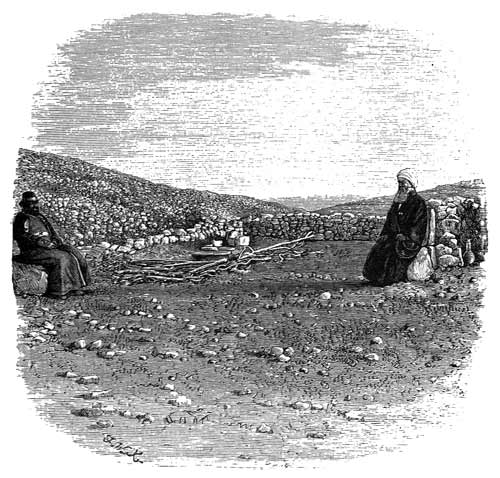
On the previous day the whole of the community had pitched
their tents on the mountain, and as the time of sunset approached
the women retired to the tents, and all the males, except those
who were unclean according to the provisions of the Mosaic law,
assembled near a long deep trench that had been dug in the
ground. The men are clothed in long white garments, and the
six young men who are selected as the actual sacrificers are
dressed in white drawers and shirts. These youths are trained
to the duty, but whether they hold any sacred office could not
be ascertained.
Then, according to the narrative of Dean Stanley, "the priest,
ascending a large rough stone in front of the congregation, recited
in a loud chant or scream, in which the others joined,
prayers or praises chiefly turning on the glories of Abraham
and Isaac. Their attitude was that of all Orientals in prayer;
standing, occasionally diversified by the stretching out of the
hands, and more rarely by kneeling or crouching, with their
knees wrapped in their clothes and bent to the ground, towards
the Holy Place on the summit of Gerizim. The priest recited
his prayers by heart; the others had mostly books in Hebrew
and Arabic.
"Presently, suddenly there appeared amongst the worshippers
six sheep, driven up by the side of the youths before mentioned.
The unconscious innocence with which they wandered to and
fro amongst the bystanders, and the simplicity in aspect and
manner of the young men who tended them, more recalled a
pastoral scene in Arcadia, or one of those inimitable patriarchal
tableaux represented in the Ammergau Mystery, than a religious
ceremonial.
"The sun, meanwhile, which had hitherto burnished up the
Mediterranean in the distance, now sank very nearly to the
farthest western ridge overhanging the plain of Sharon. The
recitation became more vehement. The priest turned about,
facing his brethren, and the whole history of the Exodus from
the beginning of the plagues of Egypt was rapidly, almost
furiously, chanted. The sheep, still innocently playful, were
driven more closely together.
"The setting sun now touched the ridge. The youths burst
into a wild murmur of their own, drew forth their long bright
knives, and brandished them aloft. In a moment the sheep
were thrown on their backs, and the flashing knives rapidly
drawn across their throats. Then a few convulsive but silent
struggles—'as a sheep ... dumb ... that openeth not his mouth,'—and
the six forms lay lifeless on the ground, the blood streaming
from them; the one only Jewish sacrifice lingering in the world.
In the blood the young men dipped their fingers, and a small
spot was marked on the foreheads and noses of the children. A
few years ago the red stain was placed on all. But this had
now dwindled away into the present practice, preserved, we were
told, as a relic or emblem of the whole. Then, as if in congratulation
at the completion of the ceremony, they all kissed
each other, in the Oriental fashion, on each side of the head.
"The next process was that of the fleecing and roasting of the
slaughtered animals, for which the ancient temple furnished
such ample provisions. Two holes on the mountain side had
been dug; one at some distance, of considerable depth, the other,
close to the scene of the sacrifice, comparatively shallow. In
this latter cavity, after a short prayer, a fire was kindled, out of
the mass of dry heath, juniper, and briers, such as furnished the
materials for the conflagration in Jotham's parable, delivered not
far from this spot.
"Over the fire were placed two caldrons full of water. Whilst
the water boiled, the congregation again stood around, and (as if
for economy of time) continued the recitation of the Book of
Exodus, and bitter herbs were handed round wrapped in a strip
of unleavened bread—'with unleavened bread and bitter herbs
shall they eat it.' Then was chanted another short prayer; after
which the six youths again appeared, poured the boiling water
over the sheep, and plucked off their fleeces. The right forelegs
of the sheep, with the entrails, were thrown aside and burnt.
The liver was carefully put back. Long poles were brought, on
which the animals were spitted; near the bottom of each pole
was a transverse peg or stick, to prevent the body from slipping
off."
This cross-piece does not, however, penetrate the body, which
in most cases scarcely touches it, so that there is little or no
resemblance to a crucifixion. The writer lays especial stress on
this point, because the early Christians saw in the transverse spit
an emblem of the cross. In the Jewish Passover this emblem
would have been more appropriate, as in that ceremony the
cross-piece was passed through the shoulders, and the forefeet
tied to it.
The Sheep being now prepared, they were carried to the oven,
which on this occasion was a deep, circular pit, in which a fire
had been previously kindled. Into this the victims were carefully
lowered, the stakes on which they were impaled guarding
their bodies from touching the sides of the oven, and the cross-piece
at the end preventing them from slipping off the stake to
the bottom of the pit among the ashes. A hurdle was then laid
on the mouth of the pit, and wet earth was heaped upon it so as
to close it completely. The greater part of the community then
retired to rest. In about five hours, the Paschal moon being
high in the heavens, announcement was made that the feast was
about to begin. Then, to resume Dean Stanley's narrative,
"Suddenly the covering of the hole was torn off, and up rose
into the still moonlit sky a vast column of smoke and steam;
recalling, with a shock of surprise, that, even by an accidental
coincidence, Reginald Heber should have so well caught this
striking feature of so remote and unknown a ritual:
'Smokes on Gerizim's mount Samaria's sacrifice.'
"Out of the pit were dragged successively the six sheep, on
their long spits, black from the oven. The outlines of their
heads, their ears, their legs, were still visible—'his head, with
his legs, and with the inward parts thereof.' They were hoisted
aloft, and then thrown on large square brown mats, previously
prepared for their reception, on which we were carefully prevented
from treading, as also from touching even the extremities
of the spit.
"The bodies thus wrapped in the mats were hurried down to
the trench where the sacrifice had taken place, and laid out upon
them in a line between two files of the Samaritans. Those who
had before been dressed in white robes still retained them, with
the addition now of shoes on their feet and staves in their hands,
and ropes round their waists—'thus shall ye eat it; with your
loins girded, your shoes on your feet, your staff in your hand.'
The recitation of prayers or of the Pentateuch recommenced, and
continued till it suddenly terminated in their all sitting down on
their haunches, after the Arab fashion at meals, and beginning
to eat. This, too, is a deviation from the practice of only a few
years since, when they retained the Mosaic ritual of standing
whilst they ate. The actual feast was conducted in rapid silence,
as of men in hunger, as no doubt most of them were, and so as
soon to consume every portion of the blackened masses, which
they tore away piecemeal with their fingers—'ye shall eat in
haste.' There was a general merriment, as of a hearty and
welcome meal.
"In ten minutes all was gone but a few remnants. To the
priest and to the women, who, all but two (probably his two
wives), remained in the tents, separate morsels were carried
round. The remnants were gathered into the mats, and put on a
wooden grate, or hurdle, over the hole where the water had been
originally boiled; the fire was again lit, and a huge bonfire was
kindled. By its blaze, and by candles lighted for the purpose,
the ground was searched in every direction, as for the consecrated
particles of sacramental elements; and these fragments of
flesh and bone were thrown upon the burning mass—'ye shall
let nothing remain until the morning; and that which remaineth
until the morning ye shall burn with fire;' 'there shall not
anything of the flesh which thou sacrificest the first day at even
remain all night until the morning;' 'thou shalt not carry forth
aught of the flesh abroad out of the house.' The flames blazed
up once more, and then gradually sank away.
"Perhaps in another century the fire on Mount Gerizim will
be the only relic left of this most interesting and ancient rite."
The Zemer or Chamois only once mentioned in the Bible—Signification of the
word Zemer—Probability that the Zemer is the Aoudad—Appearance of the
Aoudad—Its strength and activity—Fierce temper of the adult male—Horns
of the Aoudad—Their probable use as musical instruments—Habits of the
Aoudad—The Mouflon probably classed with the Aoudad under the name of
Zemer—Appearance and habits of the Mouflon.
Among the animals which may be used for food is mentioned
one which in our version is rendered Chamois. See Deut. xiv. 5,
a passage which has several times been quoted.
It is evident to any one acquainted with zoology that, whatever
may be the Hebrew word, "Chamois" cannot be the correct
rendering, inasmuch as the real Chamois does not inhabit Palestine,
nor are there any proofs that it ever did so. We must,
therefore, look for some other animal.
Then, the Hebrew word, which only occurs once in the Bible,
is Zamar, or Zemer, i.e. the leaper, and therefore an animal which
is conspicuous for its agility. Zoologists have now agreed in
the opinion that the Zamer of Deuteronomy is the handsome
wild sheep which we know under the name of Aoudad (Ammotragus
Tragelaphus). This splendid sheep is known by various
names. It is the Jaela of some authors, and the Bearded Sheep of
others. It is also called the Fichtall, or Lerwea; and the French
zoologists describe it under the name of Mouflon à manchettes,
in allusion to the fringe of long hair that ornaments the fore
limbs.
The Aoudad is a large and powerful animal, exceedingly
active, and has the habits of the goat rather than of the sheep,
on which account it is reckoned among the goats by the Arabs
of the present day, and doubtless was similarly classed by the
ancient inhabitants of Palestine. The height of the adult
Aoudad is about three feet, and its general colour is pale dun,
relieved by the dark masses of long hair that fall from the neck
and the tufts of similar hair which decorate the knees of the
male. The female is also bearded and tufted, but the hair,
which in the male looks like the mane of the lion, in the female
is but slightly developed.
It is so powerful and active an animal, that an adult male
which lived for some time in the Zoological Gardens was much
dreaded by the keepers, not even the man who fed it liking to
enter the enclosure if he could help himself. The animal was
given to making unexpected charges, and would do so with
astonishing quickness, springing round and leaping at the object
of his hate with tremendous force, and with such rapidity that
even the experienced keeper, who knew all the ways of the
animals under his charge, had often some difficulty in slipping
behind the door, against which the horns of the Aoudad would
clatter as if they would break the door to pieces. So fond was
he of attacking something that he would often butt repeatedly
at the wooden side of the shed, hurling himself against it with
eager fury.
The horns of the Aoudad are about two feet in length, and are
of considerable diameter. They curve boldly and gracefully
backwards, their points diverging considerably from each other,
so that when the animal throws its head up, the points of the
horns come on either side of the back. This divergence of the
horns has another object. They cover a considerable space, so
that when the animal makes its charge the object of its anger
has much more difficulty in escaping the blow than if the horns
were closer together.
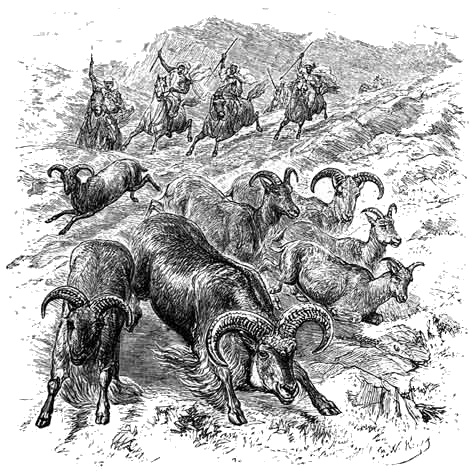
THE AOUDAD CHASED.
"These are the beasts which ye shall eat: the ox, the sheep, the goat ... and the
chamois."—Deut. xiv. 4, 5.
Whether these horns were used as musical instruments is
doubtful, simply because we are not absolutely sure that the
Zamar and the Aoudad are identical, however great may be the
probability. But inasmuch as the horn-trumpets were evidently
of various sizes, it is certain that the Jewish musicians would
never have neglected to take advantage of such magnificent
materials as they would obtain from the horns of this animal.
Perhaps the Chaldaic "keren" may have been the horn of the
Aoudad, or of the animal which will next be mentioned.
The Aoudad is wonderfully active, and even the young ones
bound to an astonishing height. I have seen the marks of their
hoofs eight feet from the ground.
In its wild state the Aoudad lives in little flocks or herds,
and prefers the high and rocky ground, over which it leaps with
a sure-footed agility equal to that of the Chamois itself. These
flocks are chased by hunters, who try to get it upon the lowest
and least broken ground, where it is at a disadvantage, and
then run it down with their horses, as seen in the illustration
on page 187.
The Aoudad was formerly plentiful in Egypt, and even now
is found along the Atlas mountain-range. It is seen on the
Egyptian monuments, and, owing to its evident profusion, we
have every reason to conjecture that it was one of those animals
which were specially indicated as chewing the cud and cleaving
the hoof.
Perhaps the Mouflon (Caprovis Musimon) may be the animal
which is meant by the Hebrew word Zamar, and it is not
unlikely that both animals may have been included in one
name.
This animal, which is nearly allied to the Aoudad, is also
very goatlike in general aspect. It is indeed to this resemblance
that the name Caprovis, or goat-sheep, has been given to it. The
name Ammotragus, which, as mentioned above, belongs to the
Aoudad, has a similar signification.
The horns of the Mouflon belong only to the male animal,
and are of enormous size, so that if trumpets of deep tone and
great power were needed, they could be obtained from the horns
of this animal. Those of the Aoudad are very large, and would
be well adapted for the same purpose, but they would not furnish
such instruments as the horns of the Mouflon, which are so
large that they seem almost unwieldy for an animal of twice
the Mouflon's size, and give visible proofs of the strength and
agility of an animal which can carry them so lightly and leap
about under their weight so easily as does the Mouflon.
At the present time the Mouflon is only to be found in
Cyprus, Sardinia, and Corsica, but formerly it was known to
inhabit many other parts of the earth, and was almost certainly
one of the many animals which then haunted the Lebanon, but
which have in later days been extirpated.
Value of the Goat—Its use in furnishing food—The male kid the usual animal of
slaughter—Excellence of the flesh and deception of Isaac—Milk of the Goat—An
Oriental milking scene—The hair of the goat, and the uses to which it is
put—The Goat's skin used for leather—The "bottle" of Scripture—Mode of
making and repairing the bottles—Ruse of the Gibeonites—The "bottle in the
smoke"—The sacks and the kneading troughs—The Goat as used for sacrifice—General
habits of the Goat—Separation of the Goats from the sheep—Performing
Goats—Different breeds of Goats in Palestine.
Whether considered in reference to food, to clothing, or to
sacrifice, the Goat was scarcely a less important animal than the
sheep. It was especially valuable in such a country as Palestine,
in which the soil and the climate vary so much according
to the locality. Upon the large fertile plains the sheep are bred
in vast flocks, the rich and succulent grass being exactly to their
taste; while in the hilly and craggy districts the Goats abound,
and delight in browsing upon the scanty herbage that grows
upon the mountain-side.
For food the Goat was even more extensively used than the
sheep. The adult male was, of course, not eaten, being very
tough, and having an odour which would repel any but an
actually starving man. Neither were the females generally
eaten, as they were needed for the future increase of the flocks.
The young male kid formed the principal material of a feast, and
as soon as a stranger claimed the hospitality of a man in good
circumstances, the first thing that was done was to take a young
male kid and dress it for him.
For example, when the angel visited Gideon in the guise of a
stranger, Gideon "went in and made ready a kid, and unleavened
cakes of an ephah of flour," and brought them to his
guest (Judges vi. 19). And when Isaac was on his death-bed,
and asked Esau to take his bow and arrows and hunt for
"venison," which was probably the flesh of one of the antelopes
which have already been mentioned, a ready substitute was
found in the two kids, from whose flesh Rebekah made the dish
for which he longed. The imposition might easily pass without
detection, because the flesh of the kid is peculiarly tender, and
can scarcely be distinguished from lamb, even when simply
roasted. Isaac, therefore, with his senses dulled by his great
age, was the less likely to discover the imposture, when the flesh
of the kids was stewed into "savoury meat such as he loved."
A curious illustration of the prevalence of kid's flesh as food
is given in the parable of the prodigal son, for whom his father
had killed the fatted calf. "And he answering said to his
father, Lo, these many years do I serve thee, neither transgressed
I at any time thy commandment: and yet thou never gavest me
a kid, that I might make merry with my friends" (Luke xv. 29).
The force of the reproval cannot be properly understood unless we
are acquainted with the customs of the East. The kid was the
least valuable animal that could have been given, less valuable
than a lamb, and infinitely inferior to the fatted calf, which was
kept in wealthy households for some feast of more than ordinary
magnificence.
The kid was cooked exactly in the same manner as the sheep,
namely, by cutting to pieces and stewing in a caldron, the meat
and broth being served separately. See, for example, the case of
Gideon, to whom a reference has already been made. When he
brought the banquet to his guest, "the flesh he put in a basket,
and he put the broth in a pot, and brought it out unto him under
the oak, and presented it. And the angel of God said unto him,
Take the flesh and the unleavened cakes, and lay them upon this
rock, and pour out the broth."
The same custom exists at the present day. When an Arab
chief receives a guest, a kid is immediately killed and given to
the women to be cooked in a separate tent, and the guest is
pressed to stay until it is ready, in the very words used by Gideon
three thousand years ago. "Depart not hence, I pray thee, until
I come unto thee, and bring forth my present, and set it before
thee." And the angelic guest answered him just as a modern
Arab traveller would answer his host, "I will tarry until thou
come again." For the refusal of proffered hospitality would be
and still is considered to be, either a studied insult, or a proof
of bad manners, and no one with any claims to breeding would
commit such an action without urgent cause and much apology.
Like the sheep, the Goat is extremely valuable as a milk-producer,
and at the present day the milk of the Goat is used
as largely as that of the sheep. "At Rasheiya, under Mount
Hermon," writes Mr. Tristram, "we saw some hundreds of
goats gathering for the night in the wide open market-place
beneath the castle. It was no easy matter to thread our way
among them, as they had no idea of moving for such belated intruders
on their rest. All the she-goats of the neighbouring hills
are driven in every evening, and remain for their morning's
milking, after which they set forth on their day's excursion.
"Each house possesses several, and all know their owners.
The evening milking is a picturesque scene. Every street and
open space is filled with the goats; and women, boys, and girls
are everywhere milking with their small pewter pots, while the
goats are anxiously awaiting their turn, or lying down to chew
the cud as soon as it is over. As no kids or he-goats are
admitted, the scene is very orderly, and there is none of the
deafening bleating which usually characterises large flocks.
"These mountain goats are a solemn set, and by the gravity of
their demeanour excite a suspicion that they have had no youth,
and never were kids. They need no herdsman to bring them
home in the evening, for, fully sensible of the danger of remaining
unprotected, they hurry homewards of their own accord
as soon as the sun begins to decline."
Like the wool of the sheep, the hair of the Goat is used for
the manufacture of clothing; and, as is the case with wool, its
quality differs according to the particular breed of the animal,
which assumes almost as many varieties as the sheep or the dog.
The hair of some varieties is thick and rough, and can only be
made into coarse cloths, while others, of which the mohair Goat
and Cashmere Goat are familiar examples, furnish a staple of
surpassing delicacy and fineness. It is most likely that the
covering and curtains of the Tabernacle mentioned in Exod.
xxvi. 7 were of the latter kind, as otherwise they would have
been out of character with the fine linen, and blue and scarlet,
their golden clasps, and the profuse magnificence which distinguished
every part of the sacred building. Moreover, the hair
of the Goat is classed among the costly offerings which were
made when the Tabernacle was built. "And they came forth,
men and women, as many as were willing hearted, and brought
bracelets, and earrings, and rings, and tablets, all jewels of
gold: and every man that offered offered an offering of gold
unto the Lord. And every man, with whom was found blue,
and purple, and scarlet, and fine linen, and goats' hair, and red
skins of rams, and badgers' skins, brought them" to be used in
the structure of that wonderful building, in which nothing
might be used except the finest and costliest that could be
procured.
One of the principal uses to which the goat-skin was applied
was the manufacture of leather, for which purpose it is still
used, and is considered far better than that of the sheep.
Perhaps the most common form in which this leather is used
is the well-known water-vessel, or "bottle" of the Bible.
These so-called bottles are made from the entire skin of the
animal, which is prepared in slightly different methods according
to the locality in which the manufacture is carried on. In
Palestine they are soaked for some little time in the tanning
mixture, and are then filled with water, after the seams have
been pitched. In this state they are kept for some time, and
are kept exposed to the sun, covered entirely with the tanning
fluid, and filled up with water to supply the loss caused by
evaporation and leakage.
The hair is allowed to remain on the skins, because it acts as
a preservative against the rough usage to which they are subject
at the hard hands of the water-carriers. By degrees the hairy
covering wears off, first in patches, and then over the entire
surface, so that a new bottle can be recognised at a glance, and
any one who wished to sell an old bottle at the price of a new
one would be at once detected.
Vessels made in this rude manner are absolutely necessary in
the countries wherein they are used. Wooden or metal vessels
would be too heavy, and, besides, the slight though constant
evaporation that always takes place through the pores of the
leather keeps down the temperature of the water, even under a
burning sun, the slight loss which is caused by the porousness of
the skin being more than counterbalanced by the coolness of the
water. It is true that the goat-skin communicates to the liquid
a flavour far from pleasant, but in those countries the quality of
the water is of little consequence, provided that it is plentiful in
quantity, and tolerably cool.
Even in our own country, leathern drinking-cups are sometimes
used, and all who have taken any interest in antiquarian manners
are familiar with the "leather bottle" and the "black-jack,"
the former only surviving in museums and as signs to public-houses,
though the latter has within the memory of the present
generation been in common use. Leathern bottles are still used
in the Turkish army, and I have in my collection one of these
water-bottles, which is practically the same article as the "bottle"
of Scripture, though it is of comparatively small size, and is
made with some attempt at elegance of form.
In all parts of the world where the skin is used for this
purpose the mode of manufacture is practically identical. An
account of the art of preparing the goat-skin as practised in
Abyssinia is given by Mr. C. Johnston, in his "Travels in
Southern Abyssinia:"—
"To be of any value it must be taken off uncut, except around
the neck, and in those situations necessary to enable the butchers
to draw the legs out of the skin; also, of course, where the first
incision is made to commence the process, and which is a circular
cut carried around both haunches, not many inches from and
having the tail for a centre. The hide is then stripped over the
thighs, and two smaller incisions being made round the middle
joint of the hind-legs enable them to be drawn out.
"A stick is now placed to extend these extremities, and by
this, for the convenience of the operators, the whole carcase is
suspended from the branch of a tree, and, by some easy pulls
around the body, the skin is gradually withdrawn over the fore-legs,
which are incised around the knees, to admit of their being
taken out; after which, the head being removed, the whole business
concludes by the skin being pulled inside out over the
decollated neck. One of the parties now takes a rough stone
and well rubs the inside surface, to divest it of a few fibres of
the subcutaneous muscle which are inserted into the skin, and
after this operation it is laid aside until the next day; the more
interesting business of attending to the meat calling for immediate
attention.
"These entire skins are afterwards made into sacks by the
apertures around the neck and legs being secured by a double
fold of the skin being sewed upon each other, by means of a
slender but very tough thong. These small seams are rendered
quite air-tight, and the larger orifice around the haunches being
gathered together by the hands, the yet raw skin is distended
with air; and the orifice being then tied up, the swollen bag is
left in that state for a few days, until slight putrefaction has
commenced, when the application of the rough stone soon divests
its surface of the hair. After this has been effected, a deal of
labour, during at least one day, is required to soften the distended
skin by beating it with heavy sticks, or trampling upon it for
hours together, the labourer supporting himself by clinging to
the bough of a tree overhead, or holding on by the wall of the
house.
"In this manner, whilst the skin is drying, it is prevented
from getting stiff, and, still further to secure it from this evil
condition, it is frequently rubbed with small quantities of butter.
When it is supposed that there is no chance of the skin becoming
hard and easily broken, the orifice is opened, the air escapes, and
a very soft, flaccid leather bag is produced, but which, for several
days after, affords an amusement to the owner, when otherwise
unemployed, by well rubbing it all over with his hands."
The reader will see that the two processes are practically
identical, the chief difference being that in one country the skins
are distended with water and in the other with air.
As these bottles are rather apt to be damaged by the thorns,
branches, rocks, and similar objects with which they come in
contact, and are much too valuable to be thrown away as useless,
their owners have discovered methods of patching and repairing
them, which enable them to be used for some time longer.
Patches of considerable size are sometimes inserted, if the rent
should be of importance, while the wound caused by a thorn is
mended by a simple and efficacious expedient. The skin is first
emptied, and a round flat piece of wood, or even a stone of
suitable shape, is put into it. The skin is then held with the
wounded part downwards, and the stone shaken about until it
comes exactly upon the hole. It is then grasped, the still wet
hide gathered tightly under it, so as to pucker up the skin, and
a ligature is tied firmly round it. Perhaps some of my readers
may have practised the same method of mending a punctured
football.
Allusion to this mode of mending the skin bottles is made in
Josh. ix. 4, 13. The Gibeonites "did work wilily, and went and
made as if they had been ambassadors, and took old sacks upon
their asses, and wine bottles, old, and rent, and bound up ... and
said ... these bottles of wine, which we filled, were new; and,
behold, they be rent."
If these skin bottles be allowed to become dry, as is sometimes
the case when they are hung up in the smoky tents, they
shrivel up, and become rotten and weak, and are no longer
enabled to bear the pressure caused by the fermentation of new
wine. So, in Ps. cxix. 81-83: "My soul fainteth for Thy salvation:
but I hope in Thy word.
"Mine eyes fail for Thy word, saying, When wilt Thou comfort
me?
"For I am become like a bottle in the smoke; yet do I not
forget Thy statutes."
How forcible does not this image become, when we realize the
early life of the shepherd poet, his dwelling in tents wherein are
no windows nor chimneys, and in which the smoke rolls to and
fro until it settles in the form of soot upon the leathern bottles
and other rude articles of furniture that are hung from the
poles!
In the New Testament there is a well-known allusion to the
weakness of old bottles: "Neither do men put new wine into
old bottles, or the bottles break and the wine runneth out, and
the bottles perish; but they put new wine into new bottles, and
both are preserved." It would be impossible to understand the
meaning of this passage unless we knew that the "bottles" in
question were not vessels of glass or earthenware, but merely
the partly-tanned skins of goats.
Another allusion to the use of the goat-skin is made in that
part of the Book of Joshua which has already been mentioned.
If the reader will refer to Josh. ix. 4, he will see that the
Gibeonites took with them not only old bottles, but old sacks.
Now, these sacks bore no resemblance to the hempen bags with
which we are so familiar, but were nothing more than the same
goat-skins that were employed in the manufacture of bottles, but
with the opening at the neck left open. They were, in fact,
skin-bottles for holding solids instead of liquids. The sacks
which Joseph's brethren took with them, and in the mouths of
which they found their money, were simply goat-skin bags, made
as described.
Yet another use for the goat-skin. It is almost certain that
the "kneading-troughs" of the ancient Israelites were simply
circular pieces of goat-skin, which could be laid on the ground
when wanted, and rolled up and carried away when out of use.
Thus, the fact that "the people took their dough before it was
leavened, their kneading-troughs being bound up in their clothing
upon their shoulders," need cause no surprise.
Nothing could be more in accordance with probability. The
women were all hard at work, preparing the bread for the expected
journey, when the terrified Pharaoh "called for Moses and Aaron
by night, and said, Rise up, and get you forth from among my
people, both ye and the children of Israel, and go, serve the
Lord, as ye have said.... And the Egyptians were urgent upon
the people that they might send them out of the land in haste;
for they said, We be all dead men."
So the women, being disturbed at their work, and being driven
out of the country before they had leavened, much less baked,
their bread, had no alternative but to roll up the dough in the
leathern "kneading-troughs," tie them up in a bundle with their
spare clothing, and carry them on their shoulders; whereas, if
we connect the kneading-troughs with the large heavy wooden
implements used in this country, we shall form an entirely
erroneous idea of the proceeding. As soon as they came to their
first halting-place at Succoth, they took the leathern kneading-troughs
out of their clothes, unrolled them, took the dough
which had not even been leavened, so unexpectedly had the order
for marching arrived, made it into flat cakes, and baked them
as they best could. The same kind of "kneading-trough" is
still in use in many parts of the world.
Stone as well as earthenware jars were also used by the
inhabitants of ancient Palestine; but they were only employed
for the storage of wine in houses, whereas the bottles that were
used in carrying wine from one place to another were invariably
made of leather. Water also was stored in stone or earthenware
jars. See, for example, John ii. 6: "And there were set there
six waterpots of stone, after the manner of the purifying of the
Jews, containing two or three firkins apiece." Whereas, when
it was carried about, it was poured into bottles made of skin.
Such was probably the "bottle of water" that Abraham put
on Hagar's shoulder, when she was driven away by the jealousy
of Sarah. Such was the "bottle of wine" that Hannah brought
as her offering when she dedicated Samuel to the service of God;
and such was the "bottle of milk" that Jael opened for Sisera
when he came to her tent. Even oil is carried in these bottles,
which are certainly better adapted to the backs of mules, which
are the usual beasts of burden, than they would be if they were
made of glass or earthenware.
The Rabbinical writers have much to say upon the Goat; but
as the greater part of their observations and directions are without
any general interest, only a few will be selected from them.
Knowing the great strength of the Goat of their own days,
they exaggerate the power of those which belonged to the
ancients. Job's he-goats, for example, are said to have been so
strong and fierce that they could conquer wolves, while some
were so powerful that they carried bears upon their horns. They
also were accustomed to climb rocks, dig up roots, and bring
them down in their mouths.
The milk of the white Goat is useful medicinally for affections
of the lungs, and the spleen of a female kid for diseases of the
spleen. But if Goats are allowed to drink of the water in which
blacksmiths cool their iron, the spleen gradually withers away,
and at last disappears altogether. If the owner should desire to
fatten a she-goat, he ought to tie up the udders so tightly that
the milk cannot come into them, and the nourishment is therefore
converted into fat instead of milk. Also, he should take
care to keep his Goats away from the place where bread is being
made, as they are very fond of the unbaked dough, and always
die if they eat it.
In sacrifices, the Goat was in nearly as much requisition as
the lamb, and in one—namely, that which was celebrated on the
Great Day of Atonement—the Goat was specially mentioned as
the only animal which could be sacrificed. The reader will,
perhaps, remember that for this peculiar sacrifice two Goats were
required, on which two lots were cast, one for the Lord, i.e. with
the word "Jehovah" upon it, and the other for the scapegoat,
i.e. inscribed with the word "Azazel." The latter term is derived
from two Hebrew words, the former being "Az," which is the
general name for the Goat, and the second "azel," signifying "he
departed." The former, which belonged to Jehovah, was sacrificed,
and its blood sprinkled upon the mercy-seat and the altar of
incense; and the Goat Azazel was led away into the wilderness,
bearing upon its head the sins of the people, and there let
loose.
These being the uses of the Goat, it may naturally be imagined
that the animal is one of extreme importance, and that it is
watched as carefully by its owners as the sheep. Indeed, both
sheep and Goats belong to the same master, and are tended by
the same shepherd, who exercises the same sway over them that
he does over the sheep.
They are, however, erratic animals, and, although they will
follow the shepherd wherever he may lead them, they will not
mix with the sheep. The latter will walk in a compact flock
along the valley, the shepherd leading the way, and the sheep
following him, led in their turn by the sound of the bell tied
round the neck of the master-ram of the flock. The Goats,
however, will not submit to walk in so quiet a manner, but prefer
to climb along the sides of the rocks that skirt the valleys,
skipping and jumping as they go, and seeming to take delight
in getting themselves into dangerous places, where a man could
not venture to set his foot.
In the evening, when the shepherds call their flocks to repose,
they often make use of the caverns which exist at some height
in the precipitous side of the hills, as being safe strongholds,
where the jackal and the hyæna will not venture to attack them.
When such is the case, the shepherds take their station by the
mouth of the cave, and assist the sheep as they come sedately
up the narrow path that leads to the cavern. The Goats, however,
need no assistance, but come scrambling along by paths
where no foot but a Goat's could tread, mostly descending from a
considerable height above the cave, and, as if in exultation at
their superior agility, jumping over the backs of the sheep as
they slowly file into the accustomed fold.
Friendly as they are, the Goats and sheep never mingle
together. There may be large flocks of them feeding in the same
pasturage, but the Goats always take the highest spots on which
verdure grows, while the sheep graze quietly below. Goats are
specially fond of the tender shoots of trees, which they find in
plenty upon the mountain side; and, according to Mr. Tristram,
by their continual browsing, they have extirpated many species
of trees which were once common on the hills of Palestine, and
which now can only be found in Lebanon on the east of the
Jordan.
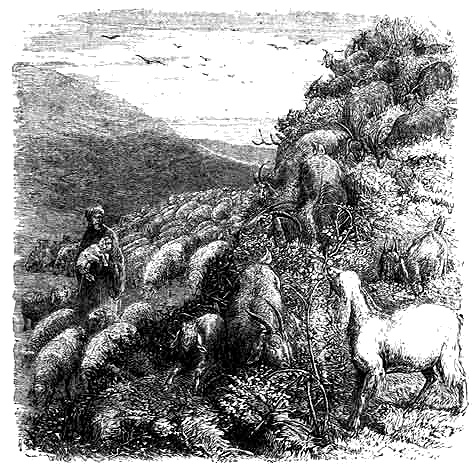
GOATS ON THE MARCH.
"As a shepherd divideth the sheep from the goats."—Matt. xxv. 32.
Even when folded together in the same enclosure, the Goats
never mix with the sheep, but gather together by themselves,
and they instinctively take the same order when assembled
round the wells at mid-day.
This instinctive separation of the sheep and the goats naturally
recalls to our minds the well-known saying of our Lord that
"before Him shall be gathered all nations, and He shall separate
them one from another, as a shepherd divideth his sheep from
the goats: and He shall set the sheep on His right hand, and
the goats on His left."
The image thus used was one that was familiar to all the
hearers, who were accustomed daily to see the herds of sheep
and Goats under one shepherd, yet totally distinct from each other.
At feeding-time the Goats will be browsing in long lines on the
mountain sides, while the sheep are grazing in the plain or
valley; at mid-day, when the flocks are gathered round the wells
to await the rolling away of the stone that guards the water, the
Goats assemble on one side and the sheep on the other. And
at night, when they are all gathered into one fold by one shepherd,
they are still separated from each other. The same image
is employed by the prophet Ezekiel: "As for you, O my flock,
thus said the Lord God, Behold I judge between cattle and
cattle, between rams and the he-goats."
Generally, the leading Goat was distinguished by a bell as
well as the leading sheep, and in reference to this custom there
was an old proverb, "If the shepherd takes the lead, he blinds
the bell-goat," while another proverb is based upon the inferior
docility of the animal—"If the shepherd be lame, the Goats
will run away."
Yet the Goat can be tamed very effectively, and can even be
taught to perform many tricks. "We saw just below us, on the
rudely-constructed 'parade,' a crowd of men and children, surrounding
a fantastically-dressed man exhibiting a Goat, which
had been tutored to perform some cunning trick. It stood with
its four feet close together on the top of a very long pole, and
allowed the man to lift it up and carry it round and round
within the circle; then the Goat was perched on four sticks, and
again carried about. A little band of music-pipes, drums, and
tambourines—called together the people from all parts of the
town to witness this performance.
"The Goat danced and balanced himself obediently and perfectly,
in very unnatural-looking positions, as if thoroughly
understanding the words and commands of his master. The
men who watched the actions of the Goat looked as grave and
serious as if they were attending a philosophical or scientific
lecture." ("Domestic Life in Palestine," by Miss Rogers.)
Another feat is a favourite with the proprietors of trained
Goats. The man takes a stool and plants it carefully on the
ground, so as to be perfectly level, and then orders the Goat to
stand upon it. A piece of wood about six inches in length, and
shaped something like a dice-box, is then placed on the stool,
and the Goat manages to stand on it, all his sharp, hard hoofs
being pressed closely together on the tiny surface. The man
then takes another piece of wood and holds it to the Goat's feet.
The animal gently removes first one foot and then another, and,
by careful shifting of the feet, enables its master to place the
second piece of wood on the first. Successive additions are
made, until at the last the Goat is perched on the topmost of
some nine or ten pieces of wood balanced on each other, the
whole looking like a stout reed marked off with joints.
The stately steps and bold bearing of the old he-goat is
mentioned in the Proverbs: "There be three things which go
well, yea, four are comely in going:
"A lion, which is strongest among beasts, and turneth not
away for any;
"A greyhound; an he-goat also; and a king, against whom
there is no rising up." (Prov. xxx. 29-31.) The word which is
here rendered as he-goat signifies literally the "Butter," and is
given to the animal on account of the mode in which it uses its
formidable horns. The word is not common in the Bible, but it
is used even at the present day among the Arabs.
Several herds of goats exist in Palestine, the most valuable of
which is the Mohair Goat, and the most common the Syrian
Goat. These, however dissimilar they may be in appearance,
are only varieties of the ordinary domestic animal, the former
being produced artificially by carefully selecting those specimens
for breeding which have the longest and finest hair. It was from
the hair of this breed that the costly fabrics used in the Tabernacle
were woven, and it is probably to this breed that reference
is made in Solomon's Song, iv. 1, 2: "Behold, thou art fair,
my love; behold, thou art fair; thou hast doves' eyes within thy
locks: thy hair is as a flock of goats, that appear from Mount
Gilead.
"Thy teeth are like a flock of sheep that are even shorn, which
came up from the washing." In this passage the careful reader
will also note another reference to the habits of the Goats and
sheep, the hair being compared to the dark-haired Goats that
wander on the tops of the hills, while the teeth are compared to
sheep that are ranged in regular order below. The Mohair Goat
is known scientifically as Capra Angorensis. The same image is
used again in chap. vi. 5.
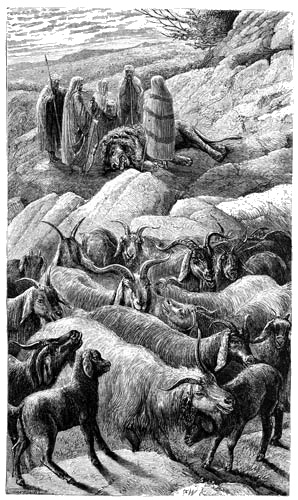
THE GOAT.
"As the shepherd taketh out of the mouth of the lion a piece of an ear."—Amos iii. 12.
The second breed is that which is commonest throughout the
country. It is known by the name of the Syrian Goat, and is
remarkable for the enormous length of its ears, which sometimes
exceed a foot from root to tip. This variety has been described
as a separate species under the name of Capra Mambrica, or
C. Syriaca, but, like the Mohair Goat, and twenty-three other
so-called species, is simply a variety of the common Goat, Hircus
ægragus.
Reference is made to the long ears of the Syrian Goat in
Amos iii. 12: "Thus saith the Lord: As the shepherd taketh
out of the mouth of the lion two legs, or a piece of an ear; so
shall the children of Israel be taken out that dwell in Samaria."
Such a scene, which was familiar to Amos, the shepherd as
well as the prophet, is represented in the illustration. In the
foreground is the goat on which the lion has sprung, and from
which one of the long ears has been torn away. Its companions
are gathering round it in sympathy, while its kid is trying to
discover the cause of its mother's uneasiness. In the background
is a group of armed shepherds, standing round the lion which
they have just killed, while one of them is holding up the torn
ear which he has taken out of the lion's mouth.
The Azelim or Wild Goats of Scripture identical with the Beden or Arabian Ibex—Different
names of the Beden—Its appearance and general habits—En-gedi, or
Goats' Fountain—The Beden formerly very plentiful in Palestine, and now
tolerably common—Its agility—Difficulty of catching or killing it—How the
young are captured—Flesh of the Beden—Use of the horns at the present day—The
Ako of Deuteronomy.
In three passages of the Old Testament occurs a word, "Azelim,"
which is variously translated in our Authorized Version.
It is first seen in 1 Sam. xxiv. 2, in which it is rendered as
"Wild Goats." "It was told Saul, saying, Behold, David is in
the wilderness of En-gedi [i.e. the Fountain of the Goat]. Then
Saul took three thousand chosen men out of all Israel, and went
to seek David and his men upon the rocks of the wild goats
(azelim)." The same word occurs in Job xxxix. 1: "Knowest
thou the time when the wild goats of the rock bring forth?"
It is also found in Ps. civ. 18: "The high hills are a refuge for
the wild goats." In all these passages it is rendered as "wild
goats." But, in Prov. v. 19, it is translated as roe: "Rejoice
with the wife of thy youth. Let her be as the loving hind and
pleasant roe (azelah)." The Jewish Bible follows the same
diverse renderings.
We now have to discover the animal which was signified by
the word Azel. According to its etymology, it is the Climber,
just as the adult he-goat is called the Butter.
That it was a climbing animal is evident from its name, and
that it loved to clamber among precipices is equally evident
from the repeated connexion of the word rock with the name of
the animal. We also see, from the passage in Job, that it is a
wild animal whose habits were not known. There is scarcely
any doubt that the Azel of the Old Testament is the Arabian
Ibex or Beden (Capra Nubiana). This animal is very closely
allied to the well-known Ibex of the Alps, or Steinbock, but
may be distinguished from it by one or two slight differences,
such as the black beard and the slighter make of the horns,
which moreover have three angles instead of four, as is the case
with the Alpine Ibex.
The Beden is known by several names. It is sometimes
called the Jaela, sometimes the Nubian Wild Goat, and is also
known as the Wild Goat of Sinai. The general colour of the
Beden is grey, becoming brownish in winter, and being whitish
grey beneath. The feet are spotted with black and white, and
the beard of the male is black, differing from that of the Alpine
Ibex, which is brown. The female is beardless. The lines along
the back and the sides of the tail are black, and there are three
streaks on each ear.
The Beden generally lives in little herds of eight or ten, and
is even now to be found in Palestine. At the strange, wild,
weird-looking En-gedi (Ain Jiddy), or Fountain of the Goats,
the Beden is still to be seen. Mr. Tristram suggests that David
and his followers took up their residence at En-gedi for the sake
of the Wild Goats that were plentiful upon the spot, and which
would furnish food for himself and his hardy band of outlaws.
"In the neighbourhood of En-gedi," remarks this traveller,
"while encamped by the Dead Sea shore, we obtained several
fine specimens, and very interesting it was to find the graceful
creature by the very fountain to which it gave name.
"When clambering over the heights above En-gedi, I often,
by the help of my glass, saw the Ibex from a distance, and once,
when near Mar-saba, only a few miles from Jerusalem, started
one at a distance of four hundred yards. At the south end of
the Dead Sea they were common, and I have picked up a horn
both near Jericho on the hills and also on the hills of Moab on
the eastern side. At Jericho, too, I obtained a young one which
I hoped to rear, but which died after I had had it for ten days,
owing, I believe, to the milk with which it was fed being sour.
Further north and west we did not find it, though I have reason
to believe that a few linger on the mountains between Samaria
and the Jordan, and perhaps also on some of the spurs of
Lebanon. We found its teeth in the breccia of bone occurring in
the Lebanon, proving its former abundance there."
As the Beden was found so plentifully even in these days
when fire-arms have rendered many wild animals scarce and
wary, so that they will not show themselves within range of a
bullet, it is evident that in the time when David lived at En-gedi
and drank of the Goats' Fountain they were far more numerous,
and could afford nourishment to him and his soldiers. Travellers,
moreover, who do not happen to be experienced hunters, will
often fail in seeing the Beden, even in places where it is tolerably
plentiful. The colour of its coat resembles so nearly that of the
rocks, that an inexperienced eye would see nothing but bare
stones and sticks where a practised hunter would see numbers
of Beden, conspicuous by their beautifully curved horns.
The agility of the Beden is extraordinary. Loving the highest
and most craggy parts of the mountain ridge, it flings itself from
spot to spot with a recklessness that startles one who has not
been accustomed to the animal, and the wonderful certainty of
its foot. It will, for example, dash at the face of a perpendicular
precipice that looks as smooth as a brick wall, for the purpose
of reaching a tiny ledge which is hardly perceptible, and which
is some fifteen feet or so above the spot whence the animal
sprang. Its eye, however, has marked certain little cracks and
projections on the face of the rock, and as the animal makes its
leap, it takes these little points of vantage in rapid succession,
just touching them as it passes upwards, and by the slight stroke
of its foot keeping up the original impulse of its leap. Similarly,
the Ibex comes sliding and leaping down precipitous sides of
the mountains, sometimes halting with all the four feet drawn
together, on a little projection scarcely larger than a penny, and
sometimes springing boldly over a wide crevasse, and alighting
with exact precision upon a projecting piece of rock that seems
scarcely large enough to sustain a rat comfortably.
The young of the Ibex are sometimes captured and tamed.
They are, however, difficult to rear, and give much more trouble
than the young gazelles when taken in a similar manner. The
natives can generally procure the kids at the proper time of
year, and sell them at a very cheap rate. They seldom, however,
can be reared, and even those who live in the country experience
the greatest difficulty in keeping the young Beden alive until
it attains maturity.
Were it not for the curious habits of the Beden, the young
could scarcely ever be obtained alive, as they are so agile that
they could easily leap away from their slow two-legged pursuers.
But the mother Ibex has a habit of leading a very independent
life, wandering to considerable distances, and leaving her kid
snugly hidden in some rock-cleft. The hunters watch the
mother as she starts off in the morning, clamber up to the
spot where the kid is concealed, and secure it without difficulty.
The Arabs say that there are always two kids at a birth, but
there is considerable discrepancy of evidence on this point,
which, after all, is of very little importance.
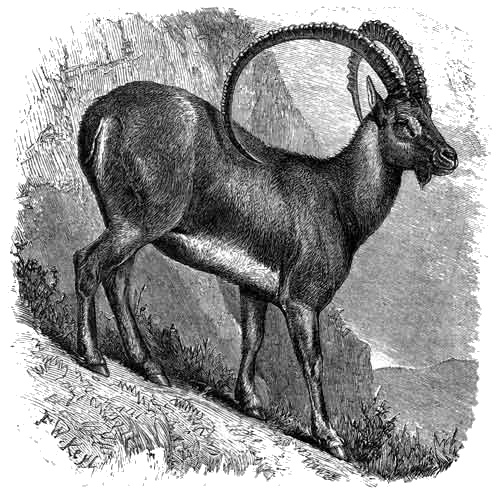
ARABIAN IBEX, OR BEDEN; THE WILD GOAT OF SCRIPTURE.
"The high hills are a refuge for the wild goats."—Psalm cxiv. 18.
The flesh of the Beden is really excellent. It is far superior
to that of the gazelle, which is comparatively dry and hard, and
it has been happily suggested that the Beden was the animal in
search of which Esau was sent to hunt with his quiver and his
bow, and which furnished the "savoury meat" which Isaac
loved. None but a true hunter can hope to secure the Beden,
and even all the knowledge, patience, and energy of the best
hunters are tried before they can kill their prey. It was therefore
no matter of wonder that Isaac should be surprised when
he thought that he heard Esau return so soon from the hunting-grounds.
"How is it that thou hast found it so quickly, my
son?"
There are few animals more wary than the Beden, and even
the chamois of the Alps does not exercise the finest qualities of
a hunter more than does the Beden of Palestine. It is gifted
with very keen eyes, which can discern the approach of an
enemy long before its grey coat and curved horns can be distinguished
from the stones and gnarled boughs of the mountain
side. And, even if the enemy be not within range of the animal's
sight, its nostrils are so keen that it can detect a man by scent
alone at a considerable distance. Like all gregarious animals,
the Beden insures the safety of the flock by stationing sentries,
which are posted on places that command the whole surrounding
country, and to deceive the watchful senses of these wary
guardians tests all the qualities of the hunter.
The dawn of day is the time that is generally chosen for
approaching a herd, because the animals are then feeding, and
if the hunter can manage to approach them against the wind, he
may chance to come within range. Should however the wind
change its direction, he may quietly walk home again, for at the
first breath of the tainted gale the sentinels utter their shrill
whistle of alarm, and the whole party dash off with a speed that
renders pursuit useless.
The horns of the Beden are of very great size, and from their
bold curves, with the large rings and ridges which cover their
front, are remarkably handsome objects. In their own country
they are in great request as handles to knives, and even in
England they may be occasionally seen serving as handles
to carving-knives and forks.
As to the word Ako, which occurs in Deut. xiv. 5, together
with other animals, and is rendered as "Wild Goat," there is
so much doubt about the correct translation that I can do no
more than mention that the Jewish Bible follows our authorized
edition in translating Ako as Wild Goat, but adds the doubtful
mark to the word.
The Hart and Hind of Scripture—Species of Deer existing in Palestine—Earliest
mention of the Hind—The Hart classed among the clean animals—Passages
alluding to its speed—Care of the mother for her young, and her custom of
secreting it—Tameable character of the Deer—The Rabbinical writers and
their theories—Shedding of the Deer's horns—Its fabled mode of sleeping—The
gall in the tail—Curious traditions of the enmity between Deer and
serpents—Virtues of a Deer-skin coat.
We now come to the Deer which are mentioned in Scripture.
There are not many passages in which they are mentioned, and
one of them is rather doubtful, as we shall see when we come
to it.
There is no doubt that the two words Hart and Hind (in the
Hebrew Ayzal and Ayzalah) represent Deer of some kind, and
the question is to find out what kind of Deer is signified by
these words. I think that we may safely determine that no
particular species is meant, but that under the word Ayzal are
comprehended any kinds of Deer that inhabit Palestine, and
were likely to be known to those to whom the earlier Scriptures
were addressed. That some kind of Deer was plentiful is evident
from the references which are made to it, and specially by
the familiar word Ajala or Ayala, as it is pronounced, which
signifies the Deer-ground or pasture. But the attempt to discriminate
between one species and another is simply impossible,
and the more careful the search the more impracticable the task
appears.
As far as can be ascertained, at least two kinds of Deer inhabited
Palestine in the earlier days of the Jewish history, one
belonging to the division which is known by its branched
horns, and the other to that in which the horns are flat or palmated
over the tips. Examples of both kinds are familiar to us
under the titles of the Red Deer and the Fallow Deer, and it
is tolerably certain that both these animals were formerly found
in Palestine, or that at all events the Deer which did exist there
were so closely allied to them as to be mere varieties occasioned
by the different conditions in which they were placed.
We will now proceed to the various passages in which the
Hart and Hind are mentioned in the Bible.
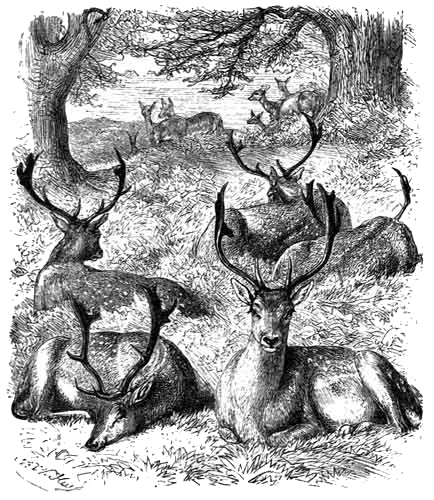
FALLOW-DEER, OR HIND OF SCRIPTURE.
"I charge you ... by the hinds of the field."—Cant. ii. 7.
As might be expected, we come upon it among the number of
the beasts which divided the hoof and chewed the cud, and
were specially indicated as fit for food; see Deut. xii. 15:
"Notwithstanding thou mayest kill and eat flesh in all thy gates,
... the unclean and the clean may eat thereof, as of the roebuck,
and as of the hart."
There is, however, an earlier mention of the word in Gen.
xlix. 21. It occurs in that splendid series of imagery in which
Jacob blesses his sons, and prophesies their future, each image
serving ever afterwards as the emblem of the tribe: "Naphtali
is a hind let loose: he giveth goodly words;"—or, according to
the Jewish Bible, "Naphtali is a hind sent forth: he giveth
sayings of pleasantness." Now, such an image as this would
never have been used, had not the spectacle of the "hind let
loose" been perfectly familiar to the eyes both of the dying
patriarch and his hearers, and equally so with the lion, the ass,
the vine, the serpent, and other objects used emblematically in
the same prophetic poem.
The excellence of the Hart's flesh is shown by its occurrence
among the animals used for King Solomon's table; see 1 Kings
iv. 23, a passage which has been quoted several times, and
therefore need only be mentioned.
Allusion is made to the speed and agility of the Deer in
several passages. See, for example, Isa. xxxv. 6: "Then shall
the lame man leap as an hart, and the tongue of the dumb
sing." Again, in 2 Sam. xxii. 33, 34: "God is my strength and
power: and He maketh my way perfect.
"He maketh my feet like hinds' feet: and setteth me upon
my high places."
Nearly four hundred years afterwards we find Habakkuk
using precisely the same image, evidently quoting David's Psalm
of Thanksgiving:—"Yet I will rejoice in the Lord, I will joy in
the God of my salvation.
"The Lord God is my strength, and He will make my feet
like hinds' feet, and He will make me to walk upon mine high
places." (iii. 18, 19.)
A passage of a similar character may be found in Solomon's
Song, ii. 8, 9: "The voice of my beloved! behold, he cometh
leaping upon the mountains, skipping upon the hills.
"My beloved is like a roe or a young hart."
There is one passage in the Psalms which is familiar to us in
many ways, and not the least in that it has been chosen as the
text for so many well-known anthems. "As the hart panteth
after the water-brooks, so panteth my soul after Thee, O God.
"My soul thirsteth for God, for the living God: when shall I
come and appear before God?" (Ps. xlii. 1, 2.)
Beautiful as this passage is, it cannot be fully understood
without the context.
David wrote this psalm before he had risen to royal power,
and while he was fleeing from his enemies from place to place,
and seeking an uncertain shelter in the rock-caves. In verse 6
he enumerates some of the spots in which he has been forced to
reside, far away from the altar, the priests, and the sacrifice.
He has been hunted about from place to place by his enemies
as a stag is hunted by the hounds, and his very soul thirsted
for the distant Tabernacle, in which the Shekinah, the visible
presence of God, rested on the mercy-seat between the golden
cherubim.
Wild and unsettled as was the early life of David, this was
ever the reigning thought in his mind, and there is scarcely a
psalm that he wrote in which we do not find some allusion
to the visible presence of God among men. No matter what
might be the troubles through which he had to pass, even
though he trod the valley of the shadow of death, the thought
of his God was soothing as water to the hunted stag, and in
that thought he ever found repose. Through all his many trials
and adversities, through his deep remorse for his sins, through
his wounded paternal affections, through his success and prosperity,
that one thought is the ruling power. He begins his
career with it when he opposed Goliath: "Thou comest to me
with a sword, and with a spear, and with a shield: but I come
to thee in the name of the Lord of hosts, the God of the armies
of Israel." He closes his career with the same thought, and, in
the "last words" that are recorded, he charged his son to keep
the commandments of the Lord, that he might do wisely all that
he did.
We now come to another point in the Deer's character;
namely, the watchful care of the mother over her young. She
always retires to some secret place when she instinctively
knows that the birth is at hand, and she hides it from all eyes
until it is able to take care of itself. By some strange instinct,
the little one, almost as soon as it is born, is able to comprehend
the signals of its mother, and there is an instance, well known
to naturalists, where, a newly-born Deer, hardly an hour old,
crouched low to the earth in obedience to a light tap on its
shoulder from its mother's hoof. She, with the intense watchfulness
of her kind, had seen a possible danger, and so warned
her young one to hide itself.
There is scarcely any animal so watchful as the female Deer,
as all hunters know by practical experience. It is comparatively
easy to deceive the stag who leads the herd, but to evade the
eyes and ears of the hinds is a very different business, and
taxes all the resources of a practised hunter. If they take such
care of the herd in general, it may be imagined that their
watchfulness would be multiplied tenfold when the object of
their anxiety is their own young.
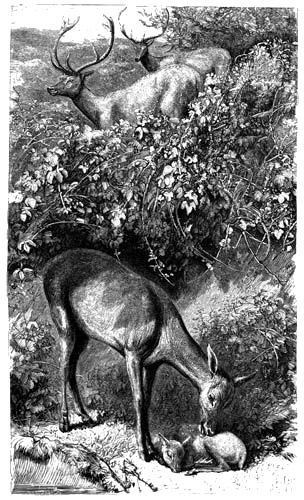
THE RED DEER.
"Canst thou mark when the hinds do calve?"—Job xxxix. 1.
It is in allusion to this well-known characteristic that a
passage in the Book of Job refers: "Knowest thou the time
when the wild goats of the rock bring forth? or canst thou mark
when the hinds do calve?" (xxxix. 1.) A similar image is used
in Psa. xxix. 9. After enumerating the wonders that are done
by the voice of the Lord, the thunders and rain torrents,
the devastating tempests, the forked lightning, and the earthquake
"that shaketh the wilderness of Kadesh," the Psalmist
proceeds: "The voice of the Lord maketh the hinds to calve,
and discovereth the forests,"—this being as mysterious to the
writer as the more conspicuous wonders which he had previously
mentioned.
So familiar to the Hebrews was the watchful care which the
female Deer exercised over her young, that it forms the subject
of a powerful image in one of Jeremiah's mournful prophecies:
"Yea, the hind also calved in the field, and forsook it, because
there was no grass." (xiv. 5.) To those who understand the habits
of the animal, this is a most telling and picturesque image. In
the first place, the Hind, a wild animal that could find food
where less active creatures would starve, was reduced to such
straits that she was obliged to remain in the fields at the time
when her young was born, instead of retiring to some sheltered
spot, according to her custom. And when it was born, instead
of nurturing it carefully, according to the natural maternal
instinct, she was forced from sheer hunger to abandon it in
order to find a sufficiency of food for herself.
That the Deer could be tamed, and its naturally affectionate
disposition cultivated, is evident from a passage in the Proverbs
(v. 18, 19): "Let thy fountain be blessed: and rejoice with the
wife of thy youth. Let her be as the loving hind and pleasant
roe."
We might naturally expect that the Rabbinical writers would
have much to say on the subject of the Hart and Hind. Among
much that is irrelevant to the object of the present work there
are a few passages that deserve mention. Alluding to the
annual shedding of the Deer's horns, there is a proverb respecting
one who ventures his money too freely in trade, that "he has
hung it on the stag's horns," meaning thereby that he will never
see it again. It is remarkable that in Western Africa there is a
proverb of a similar character, the imprudent merchant being
told to look for his money in the place where Deer shed their
horns.
They firmly believed that goats and Deer associate freely
with each other, and that a mixed progeny was the result, but
some of them modify this statement by saying that this only
holds good with the smaller kinds of Deer, i.e. the gazelles and
other antelopes. This absurd notion has evidently taken its
rise from the line of long bristly hair that decorates the throat
of the adult male, and which these unscientific writers took to
be derived from the beard of the goat.
On account of its watchfulness it was said always to sleep
with one eye open, "which is well known to be the case with
the hare." The ancient Jews used to catch it with nets, and then
domesticate it, feeding it principally with a plant which has
a very long and straight root, which was used by Joshua as a
wand of office when he pointed out to the Israelites the portion
of ground on which each tribe had to encamp. What the plant
might have been they cannot precisely ascertain, and the looseness
of their natural history may be imagined from the fact that
some consider the plant in question to be the ivy and others
the sugar-cane.
Some of the Deer, says these old writers, join the herds of
cattle, and even accompany them to their stalls for the night.
The reason of this gentleness of disposition seems to be found
in the position of the gall-bladder, which is said to be, not in
the liver, but near the tail. It is remarkable, by the way, that
Aristotle places it actually in the tail: "The Achaian harts
have their gall in their tails;" while Pliny thinks that the gall
is placed in the ears.
The curious superstitions respecting the enmity between the
Deer and the serpent are of very old date, and have travelled
all over the world. They probably took their rise from the
esoteric teachings which were hidden under the symbolism of
animal life, and were transmitted from country to country and
from age to age, after the manner of superstitions generally.
According to one form of the superstition, the Deer can draw
serpents out of their holes by breathing into them, and then
devour them; while, according to another form, there is such
an enmity between the Deer and the serpent, that if even a
portion of the Deer's horns be burned, all snakes that come
within its influence are driven away.
Topsell, in referring to this subject, although he feels himself
bound to believe the tradition, accounts for it in his own quaint
fashion. "A Hart by his nose draweth a Serpent out of her
hole, and therefore the grammarians derived Elaphas, or Hart,
from elaunein tous opheis, that is, of driving away serpents.
"I cannot consent to the opinion of Ælianus, that affirmeth
the Serpents to follow the breath of a Hart like some philter, or
amorous cup: for, seeing that all authors hold a hostility in
natures betwixt them, it is not probable that the Serpent
loveth the breath of a beast unto whose whole body he is an
enemy with a perpetual antipathy. And if any reply that the
warm breath of an Hart is acceptable to the cold Serpent, and
that therefore she followeth it as a dog creepeth to the fire, or
as other beasts to the beams of the sun, I will not greatly gainsay
it, seeing by that means it is most clear that the breath doth
not by any secret force or vertue extract and draw her out of
the den, but rather the concomitant quality of heat, which is not
from the secret fire in the bones of the Hart's throat (as Pliny
hath taught), but rather from her ordinary expiration, inspiration,
and respiration. For it cannot be, that seeing all the parts
of a Serpent are opposite to a Hart, that there should be any
love to that which killeth her.
"For my opinion, I think that the manner of the Hart's
drawing the Serpent out of her den is not, as Ælianus and Pliny
affirmeth, by sending into the cave a warm breath, which
burneth and scorcheth the beast out of her den, but rather, when
the Hart hath found the Serpent's nest, she draweth the air by
secret and violent attraction out from the Serpent, who, to save
her life, followeth the air out of her den. As where a vessel is
broached or wrecked, the wine followeth the flying air; and as
a cupping-glass draweth blood out of a scarified place of the
body, so the Serpent is drawn unwillingly to follow her destroyer,
and not willingly, as Ælianus affirmeth. The Serpent being thus
drawn forth, addeth greater force to her poyson, whereupon the
proverbial admonition did arise, 'Beware thou meet not with a
Serpent drawn out of her hole by the breath of a Hart, for at
that time, by reason of her wrath, her poyson is more vehement.'
After the self-same manner do the Sea-rams draw the
Sea-calves hid in the subterranean rocks, for by smelling they
prevent the air that should come into them for refrigeration."
In consequence of this antipathy, travellers were accustomed
to wear dresses made of deer-skin, because no serpent would
dare to bite any one who wore such armour. The timidity of
the Deer was attributed by these strange old authors to the
great size of its heart, in which they thought was a bone shaped
like a cross.
At the beginning of this article, I mentioned that in one
passage the word which is translated as "Hart" is rendered
differently in some versions. This passage occurs in Lam. i. 6:
"And from the daughter of Zion all her beauty is departed:
her princes are become like harts that find no pasture, and they
are gone without strength before the pursuer." In some editions
of the Hebrew Bible, the word Ayilim, i.e. "rams," is used
instead of Ayzalim, or "Harts," and this reading is followed both
by the Septuagint and the Vulgate. In two editions of the
Hebrew Bible, however, the word is Ayzalim; and, as the Jewish
Bible retains that reading, we cannot do wrong in accepting it as
the correct one.
The two species of Camel, and the mode of distinguishing them—Value of the
Camel in the East—Camels mentioned as elements of wealth—Uses of the
Camel—The Jews forbidden to eat its flesh—The milk of the Camel—Thirst-enduring
capability—The internal reservoir—The hump, and its use to the
animal—The Camel as a beast of draught and burden—How the Camel is laden—Knowledge
of its own powers—Camels for riding—Difficulty of sitting a
Camel—A rough-paced steed—Method of guiding the Camel—The mesh'ab,
or Camel-stick of office—The women's saddle—Rachel's stratagem—Ornaments
of the Camel—The swift dromedary, Heirie, or Deloul—Its ungainly aspect—Speed
and endurance of the Deloul—The Camel-posts of Bornu—Camel-drivers
and their conduct—The driver's song—Young Camels and their
appearance—The deserted Camel.
Before treating of the Scriptural references to the Camel, it
will be as well to clear the ground by noticing that two distinct
species of Camel are known to zoologists; namely, the common
Camel (Camelus dromedarius), which has one hump, and the
Bactrian Camel (Camelus Bactrianus), which has two of these
curious projections. There is a popular but erroneous idea that
the dromedary and the Camel are two distinct animals, the latter
being distinguished by its huge hump, whereas the fact is, that
the dromedary is simply a lighter and more valuable breed of
the one-humped Camel of Arabia, the two-humped Bactrian
Camel being altogether a different animal, inhabiting Central
Asia, Thibet, and China.
The Camel is still one of the most valued animals that inhabit
Palestine, and in former times it played a part in Jewish history
scarcely inferior to that of the ox or sheep. We shall, therefore,
devote some space to it.
In some parts of the land it even exceeded in value the
sheep, and was infinitely more useful than the goat. At the
very beginning of Jewish history we read of this animal, and it
is mentioned in the New Testament nearly two thousand years
after we meet with it in the Book of Genesis. The earliest
mention of the Camel occurs in Gen. xii. 16, where is related
the journey of Abram: "He had sheep, and oxen, and he-asses,
and men-servants, and maid-servants, and she-asses, and camels."
Belonging, as he did, to the nomad race which lives almost
wholly on the produce of their herds, Abram needed Camels,
not only for their milk, and, for all we know, for their flesh, but
for their extreme use as beasts of burden, without which he
could never have travelled over that wild and pathless land.
The whole of Abram's outer life was exactly that of a Bedouin
sheikh of the present day, in whom we find reproduced the
habits, the tone of thought, and the very verbiage of the ancient
Scriptures.
Many years afterwards, when the son of his old age was
desirous of marrying a wife of his own kindred, we find that he
sent his trusted servants with ten of his Camels to Mesopotamia,
and it was by the offering of water to these Camels, that Rebekah
was selected as Isaac's wife (see Gen. xxiv. 10, 19). In after
days, when Jacob was about to leave Laban, these animals are
mentioned as an important part of his wealth: "And the man
increased exceedingly, and had much cattle, and maid-servants,
and men-servants, and camels, and asses" (Gen. xxx. 43).
Then, in Exod. ix. 3, one of the severest plagues with which
Egypt was afflicted was the disease which fell upon the Camels
in common with the other cattle.
It is thought worthy of mention in the sacred narrative that
Job had three thousand, and afterwards six thousand Camels
(Job i. 3, and xlii. 12); that the Midianites and Amalekites
possessed "camels without number, as the sand by the seaside
for multitude" (Judg. vii. 12); and that the Reubenites,
when making war against the Hagarites, took from them fifty
thousand camels—exactly the very object of such wars in the
same land at the present time.
They were valuable enough to be sent as presents from one
potentate to another. For example, when Jacob went to meet
Esau, he gave as his present two hundred and twenty sheep, the
same number of goats, fifty oxen, thirty asses, and sixty camels,
i.e. thirty mothers, each with her calf. They were important
enough to be guarded by men of position. In 1 Chron. xxvii. 30,
we find that the charge of David's Camels was confided to one
of his officers, Obil the Ishmaelite, who, from his origin, might
be supposed to be skilful in the management of these animals.
Bochart however, conjectures that the word Obil ought to be
read as Abal, i.e. the camel-keeper, and that the passage would
therefore read as follows: "Over the camels was an Ishmaelitish
camel-keeper."
We will now proceed to the uses of the Camel, and first take
it in the light of food.
By the Mosaic law, the Camel was a forbidden animal, because
it did not divide the hoof, although it chewed the cud.
Yet, although the Jews might not eat its flesh, they probably
used the milk for food, as they do at the present day. No
distinct Scriptural reference is made to the milk of the Camel;
but, as the Jews of the present day are quite as fastidious as
their ancestors in keeping the Mosaic law, we are justified in
concluding that, although they would not eat the flesh of the
animal, they drank its milk. At the present time, the milk is
used, like that of the sheep, goat, and cow, both in a fresh and
curdled state, the latter being generally preferred to the former.
A kind of cheese is made from it, but is not much to the taste
of the European traveller, on account of the quantity of salt
which is put in it. Butter is churned in a very simple manner,
the fresh milk being poured into a skin bag, and the bag beaten
with a stick until the butter makes its appearance.
That it was really used in the patriarchal times is evident
by the passage which has already been mentioned, where Jacob
is related to have brought as a present to his brother Esau thirty
milch Camels, together with their young. So decided a stress
would certainly not have been laid upon the fact that the animals
were milch Camels unless the milk were intended for use.
Perhaps the use of the Camel's milk might be justified by
saying that the prohibition extended only to eating and not to
drinking, and that therefore the milk might be used though the
flesh was prohibited.
There was another mode in which the Camel might be used
by travellers to sustain life.
The reader is probably aware that, even in the burning climate
in which it dwells, the Camel is able to go for a long time without
drinking,—not that it requires less liquid nourishment than
other animals, but that it is able, by means of its internal construction,
to imbibe at one draught a quantity of water which
will last for a considerable time. It is furnished with a series of
cells, into which the water runs as fast as it is drunk, and in which
it can be kept for some time without losing its life-preserving
qualities. As much as twenty gallons have been imbibed by a
Camel at one draught, and this amount will serve it for several
days, as it has the power of consuming by degrees the water
which it has drunk in a few minutes.
This curious power of the Camel has often proved to be the
salvation of its owner. It has often happened that, when
travellers have been passing over the desert, their supply of
water has been exhausted, partly by the travellers and partly by
the burning heat which causes it to evaporate through the pores
of the goat-skin bottle in which it was carried. Then the next
well, where they had intended to refill their skins and refresh
themselves, has proved dry, and the whole party seemed doomed
to die of thirst.
Under these circumstances, only one chance of escape is left
them. They kill a Camel, and from its stomach they procure
water enough to sustain life for a little longer, and perhaps to
enable them to reach a well or fountain in which water still
remains. The water which is thus obtained is unaltered, except
by a greenish hue, the result of mixing with the remains of
herbage in the cells. It is, of course, very disagreeable, but
those who are dying from thirst cannot afford to be fastidious,
and to them the water is a most delicious draught.
It is rather curious that, if any of the water which is taken
out of a dead Camel can be kept for a few days, both the green
hue and the unpleasant flavour disappear, and the water
becomes fresh, clear, and limpid. So wonderfully well do the
internal cells preserve the water, that after a Camel has been
dead for ten days—and in that hot climate ten days after death
are equal to a month in England—the water within it has been
quite pure and drinkable.
Many persons believe in the popular though erroneous idea
that the Camel does not require as much water as ordinary
animals. He will see, however, from the foregoing account that
it needs quite as much water as the horse or the ox, but that it
possesses the capability of taking in at one time as much as
either of these animals would drink in several days. So far
from being independent of water, there is no animal that requires
it more, or displays a stronger desire for it. A thirsty Camel
possesses the power of scenting water at a very great distance,
and, when it does so, its instincts conquer its education, and it
goes off at full speed towards the spot, wholly ignoring its rider
or driver. Many a desert spring has been discovered, and many
a life saved, by this wonderful instinct, the animal having
scented the distant water when its rider had lost all hope, and
was resigning himself to that terrible end, the death by thirst.
The sacred Zemzem fountain at Mecca was discovered by two
thirsty Camels.
Except by the Jews, the flesh of the Camel is eaten throughout
Palestine and the neighbouring countries, and is looked upon as
a great luxury. The Arab, for example, can scarcely have a
greater treat than a Camel-feast, and looks forward to it in a state
of wonderful excitement. He is so impatient, that scarcely is
the animal dead before it is skinned, cut up, and the various
parts prepared for cooking.
To European palates the flesh of the Camel is rather unpleasant,
being tough, stringy, and without much flavour. The
fatty hump is universally considered as the best part of the
animal, and is always offered to the chief among the guests, just
as the North American Indian offers the hump of the bison to
the most important man in the assembly. The heart and the
tongue, however, are always eatable, and, however old a Camel
may be, these parts can be cooked and eaten without fear.
The hump, or "bunch" as it is called in the Bible, has no
connexion with the spine, and is a supplementary growth, which
varies in size, not only in the species, but in the individual. It
is analogous to the hump upon the shoulders of the American
bison and the Indian zebra, and in the best-bred Camels it is the
smallest though the finest and most elastic.
This hump, by the way, affords one of the points by which the
value of the Camel is decided. When it is well fed and properly
cared for, the hump projects boldly, and is firm and elastic to
the touch. But if the Camel be ill, or if it be badly fed or overworked,
the hump becomes soft and flaccid, and in bad cases
hangs down on one side like a thick flap of skin. Consequently,
the dealers in Camels always try to produce their animals in the
market with their humps well developed; and, if they find that
this important part does not look satisfactory, they use various
means to give it the required fulness, inflating it with air
being the most common. In fact, there is as much deception
among Camel-dealers in Palestine as with dog or pigeon fanciers
in England.
Here perhaps I may remark that the hump has given rise to
some strange but prevalent views respecting the Camel. Many
persons think that the dromedary has one hump and the Camel
two—in fact, that they are two totally distinct animals. Now
the fact is that the Camel of Palestine is of one species only,
the dromedary being a lighter and swifter breed, and differing
from the ordinary Camel just as a hunter or racer differs from
a cart-horse. The two-humped Camel is a different species
altogether, which will be briefly described at the end of the
present article.
The Camel is also used as a beast of draught, and, as we find,
not only from the Scriptures, but from ancient monuments, was
employed to draw chariots and drag the plough. Thus in Isa.
xxi. 7: "And he saw a chariot with a couple of horsemen, a
chariot of asses, and a chariot of camels." It is evident that in
this passage some chariots were drawn by Camels and some by
asses. It is, however, remarkable that in Kennard's "Eastern
Experiences," these two very useful animals are mentioned as
being yoked together: "We passed through a fertile country,
watching the fellaheen at their agricultural labours, and not a
little amused at sometimes remarking a very tall camel and a
very small donkey yoked together in double harness, dragging a
plough through the rich brown soil." Camels drawing chariots
are still to be seen in the Assyrian sculptures. In Palestine—at
all events at the present time—the Camel is seldom if ever
used as a beast of draught, being exclusively employed for bearing
burdens and carrying riders.
Taking it first as a beast of burden, we find several references
in different parts of the Scriptures. For example, see 2 Kings
viii. 9: "So Hazael went to meet him, and took a present with
him, even of every good thing of Damascus, forty camels'
burden." Again, in 1 Chron. xii. 40: "Moreover they that were
nigh them, even unto Issachar and Zebulun and Naphtali,
brought bread on asses, and on camels, and on mules, and on
oxen." Another allusion to the same custom is made in Isaiah:
"They will carry their riches upon the shoulders of young asses,
and their treasures upon the bunches (or humps) of camels."
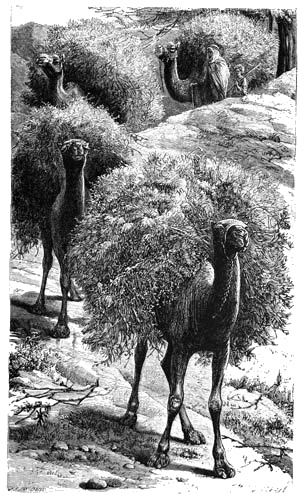
CAMEL.
"They will carry their treasures upon the bunches of camels."—Isa. xxx. 6.
The Camel can carry a considerable load, though not so much
as is generally fancied. A sort of a pack-saddle of a very
simple description is used, in order to keep the burden upon so
strangely-shaped an animal. A narrow bag about eight feet
long is made, and rather loosely stuffed with straw or similar
material. It is then doubled, and the ends firmly sewn together,
so as to form a great ring, which is placed over the hump, and
forms a tolerably flat surface. A wooden framework is tied on
the pack-saddle, and is kept in its place by a girth and a
crupper. The packages which the Camel is to carry are
fastened together by cords, and slung over the saddle. They are
only connected by those semi-knots called "hitches," so that,
when the Camel is to be unloaded, all that is needed is to pull
the lower end of the rope, and the packages fall on either side of
the animal. So quickly is the operation of loading performed,
that a couple of experienced men can load a Camel in very little
more than a minute.
As is the case with the horse in England, the Camels that are
used as beasts of burden are of a heavier, slower, and altogether
inferior breed to those which are employed to carry riders, and
all their accoutrements are of a ruder and meaner order, devoid
of the fantastic ornaments with which Oriental riders are fond
of decorating their favourite animals.
In the large illustration are represented two of the ordinary
Camels of burden, as they appear when laden with boughs for
the Feast of Tabernacles. The branches are those of the Hebrew
pine, and, as may be seen, the animals are so heavily laden with
them that their forms are quite hidden under their leafy
burdens. The weight which a Camel will carry varies much,
according to the strength of the individual, which has given rise
to the Oriental proverb, "As the camel, so the load." But an
animal of ordinary strength is supposed to be able to carry from
five to six hundred pounds for a short journey, and half as much
for a long one,—a quantity which, as the reader will see, is not
so very great when the bulk of the animal is taken into consideration.
It is remarkable that the Camel knows its own
powers, and instinctively refuses to move if its correct load
be exceeded. But, when it is properly loaded, it will carry its
burden for hours together at exactly the same pace, and without
seeming more fatigued than it was when it started.
The riding Camels are always of a better breed than those
which are used for burden, and may be divided into two classes;
namely, those which are meant for ordinary purposes, and those
which are specially bred for speed and endurance. There is as
much difference between the ordinary riding Camel and the
swift Camel as there is between the road hack and the race-horse.
We will first begin with the description of the common
riding Camel and its accoutrements.
The saddle which is intended for a rider is very different from
the pack-saddle on which burdens are carried, and has a long
upright projection in front, to which the rider can hold if he
wishes it.
The art of riding the Camel is nearly as difficult of accomplishment
as that of riding the horse, and the preliminary
operation of mounting is not the least difficult portion of it. Of
course, to mount a Camel while the animal is standing is impossible,
and accordingly it is taught to kneel until the rider is
seated. Kneeling is a natural position with the Camel, which
is furnished with large callosities or warts on the legs and
breast, which act as cushions on which it may rest its great
weight without abrading the skin. These callosities are not
formed, as some have imagined, by the constant kneeling to
which the Camel is subjected, but are born with it, though of
course less developed than they are after they have been hardened
by frequent pressure against the hot sand.
When the Camel kneels, it first drops on its knees, and then
on the joints of the hind legs. Next it drops on its breast, and
then again on the bent hind legs. In rising it reverses the process,
so that a novice is first pitched forward, then backward,
then forward, and then backward again, to the very great disarrangement
of his garments, and the probable loss of his seat
altogether. Then when the animal kneels he is in danger
of being thrown over its head by the first movement, and jerked
over its tail by the second; but after a time he learns to keep
his seat mechanically.
As to the movement of the animal, it is at first almost as
unpleasant as can be conceived, and has been described by several
travellers, some of whose accounts will be here given. First
comes Albert Smith, who declares that any one who wants to
practise Camel-riding in England can do so by taking a music-stool,
screwing it up as high as possible, putting it into a cart
without springs, sitting on the top of it cross-legged, and
having the cart driven at full speed transversely over a newly
ploughed field.
There is, however, as great a difference in the gait of Camels
as of horses, some animals having a quiet, regular, easy movement,
while others are rough and high-stepping, harassing their
riders grievously in the saddle. Even the smooth-going Camel
is, however, very trying at first, on account of its long swinging
strides, which are taken with the legs of each side alternately,
causing the body of the rider to swing backwards and forwards
as if he were rowing in a boat.
Those who suffer from sea-sickness are generally attacked with
the same malady when they make their first attempts at Camel-riding,
while even those who are proof against this particular
form of discomfort soon begin to find that their backs are
aching, and that the pain becomes steadily worse. Change of
attitude is but little use, and the wretched traveller derives but
scant comfort from the advice of his guide, who tells him to
allow his body to swing freely, and that in a short time he will
become used to it. Some days, however, are generally consumed
before he succeeds in training his spine to the continual unaccustomed
movement, and he finds that, when he wakes on
the morning that succeeds his first essay, his back is so stiff
that he can scarcely move without screaming with pain, and
that the prospect of mounting the Camel afresh is anything but
a pleasant one.
"I tried to sit erect without moving," writes Mr. Kennard,
when describing his experience of Camel-riding. "This proved
a relief for a few minutes, but, finding the effort too great to
continue long in this position,I attempted to recline with my
head resting upon my hand. This last manœuvre I found would
not do, for the motion of the camel's hind legs was so utterly at
variance with the motion of his fore-legs that I was jerked upwards,
and forwards, and sideways, and finally ended in nearly
rolling off altogether.
"Without going into the details of all that I suffered for the
next two or three days—how that on several occasions I slid
from the camel's back to the ground, in despair of ever accustoming
my half-dislocated joints to the ceaseless jerking and
swaying to and fro, and how that I often determined to trudge
on foot over the hot desert sand all the way to Jerusalem rather
than endure it longer—I shall merely say that the day did at
last arrive when I descended from my camel, after many hours'
riding, in as happy and comfortable a state of mind as if I had
been lolling in the easiest of arm-chairs."
A very similar description of the transition from acute and
constant suffering to perfect ease is given by Albert Smith, who
states that more than once he has dozed on the back of his
Camel, in spite of the swaying backwards and forwards to
which his body was subjected.
If such be the discomfort of riding a smooth-going and good-tempered
Camel, it may be imagined that to ride a hard-going
and cross-grained animal must be a very severe trial to an inexperienced
rider. A very amusing account of a ride on such a
Camel, and of a fall from its back, is given by Mr. Hamilton in
his "Sinai, the Hedjaz, and Soudan:"—
"A dromedary I had obtained at Suk Abu Sin for my own
riding did not answer my expectations, or rather the saddle was
badly put on—not an easy thing to do well, by the way—and
one of my servants, who saw how out of patience I was at the
many times I had had to dismount to have it arranged, persuaded
me to try the one he was riding, the Sheik's present. I had my
large saddle transferred to his beast, and, nothing doubting,
mounted it.
"He had not only no nose-string, but was besides a vicious
brute, rising with a violent jerk before I was well in the saddle,
and anxious to gain the caravan, which was a little way ahead,
he set off at his roughest gallop. Carpets, kufieh, tarbush, all
went off in the jolting; at every step I was thrown a foot into
the air, glad to come down again, bump, bump, on the saddle, by
dint of holding on to the front pommel with the left hand, while
the right was engaged with the bridle, which in the violence of
the exercise it was impossible to change to its proper hand. I
had almost reached the caravan, and had no doubt my humpbacked
Pegasus would relax his exertions, when a camel-driver,
one of the sons of iniquity, seeing me come up at full speed, and
evidently quite run away with, took it into his head to come to
my assistance.
"I saw what he was at, and called out to him to get out of
the way, but instead of this he stuck himself straight before me,
stretching himself out like a St. Andrew's cross, with one hand
armed with a huge club, and making most diabolical grimaces.
Of course the camel was frightened, it was enough to frighten a
much more reasonable being; so, wheeling quickly round, it upset
my unstable equilibrium. Down I came head foremost to the
ground, and when I looked up, my forehead streaming with
blood, the first thing I saw was my Arab with the camel, which
he seemed mightily pleased with himself for having so cleverly
captured, while the servant who had suggested the unlucky experiment
came ambling along on my easy-paced dromedary, and
consoled me by saying that he knew it was a runaway beast,
which there was no riding without a nose-string.
"I now began to study the way of keeping one's seat in such
an emergency. An Arab, when he gallops his dromedary with
one of these saddles, holds hard on with the right hand to the
back part of the seat, not to the pommel, and grasps the bridle
tightly in the other. The movement of the camel in galloping
throws one violently forward, and without holding on, excepting
on the naked back, when the rider sits behind the hump, it is
impossible to retain one's seat. I afterwards thought myself
lucky in not having studied this point sooner, as, from the greater
resistance I should have offered, my tumble, since it was fated I
should have one, would probably have been much more severe.
It is true I might also have escaped it, but in the chapter of
probabilities I always think a mishap the most probable."
It may be imagined that a fall from a Camel's back is not
a trifle, and, even if the unskilful rider be fortunate enough to
fall on soft sand instead of hard rock, he receives a tolerably
severe shock, and runs no little risk of breaking a limb. For
the average height of a Camel's back is rather more than six feet,
while some animals measure seven feet from the ground to the
top of the hump. Add to this a foot or two caused by the
saddle and its cushions, and a height is gained equal to that
of the ceiling of many rooms—say, eighteen inches above the top
of an ordinary door.
This height, however, is of material advantage to the traveller.
In the first place it lifts him above the waves of heated air that
are continually rolling over the sand on which the burning rays
of the sun are poured throughout the day; and in the second
place it brings him within reach of the slightest breeze that
passes above the stratum of hot air, and which comes to the
traveller like the breath of life. Moreover, his elevated position
enables him to see for a very great distance, which is an
invaluable advantage in a land where every stranger may be
a robber, and is probably a murderer besides.
The best mode of avoiding a fall is to follow the Arab mode
of riding,—namely, to pass one leg over the upright pommel,
which, as has been mentioned, is a mere wooden peg or stake,
and hitching the other leg over the dangling foot. Perhaps the
safest, though not the most comfortable, mode of sitting is by
crossing the legs in front, and merely grasping the pommel with
the hands.
Yet, fatiguing as is the seat on the Camel's back to the
beginner, it is less so than that on the horse's saddle, inasmuch
as in the latter case one position is preserved, while in the
former an infinite variety of seat is attainable when the rider
has fairly mastered the art of riding.
The Camel is not held by the bit and bridle like the horse,
but by a rope tied like a halter round the muzzle, and having
a knot on the left or "near" side. This is held in the left hand,
and is used chiefly for the purpose of stopping the animal. The
Camel is guided partly by the voice of its rider, and partly by
a driving-stick, with which the neck is lightly touched on the
opposite side to that which its rider wishes it to take. A
pressure of the heel on the shoulder-bone tells it to quicken its
pace, and a little tap on the head followed by a touch on the
short ears are the signals for full speed.
There are three different kinds of stick with which the Camel
is driven; one of them, a mere almond branch with the bark,
and an oblique head, is the sceptre or emblem of sovereignty of
the Prince of Mecca. Mr. Hamilton suggests that this stick,
called the "mesh'ab," is the original of the jackal-headed stick
with which so many of the Egyptian deities are represented;
and that Aaron's rod that "brought forth buds, and bloomed
blossoms, and yielded almonds," was the mesh'ab, the almond-branch
sceptre, the emblem of his almost regal rank and
authority.
The women mostly ride in a different manner from the men.
Sometimes they are hardy enough to sit the animal in the same
way as their husbands, but as a rule they are carried by the
animal rather than ride it, sitting in great basket-like appendages
which are slung on either side of the Camel. These constitute
the "furniture" which is mentioned in Gen. xxxi. 34. When
Jacob left the house of Laban, to lead an independent life,
Rachel stole her father's images, or "teraphim," and carried them
away with her, true to her affectionate though deceptive nature,
which impelled her to incur the guilt of robbery for the sake of
enriching her husband with the cherished teraphim of her
father. From the most careful researches we learn that these
teraphim were used for divining the future, and that they were
made in the human form. That they were of considerable size
is evident from the fact that, when Saul was hunting after David,
his wife Michal contrived to convey him out of the house, and
for a time to conceal her fraud by putting an image (or teraph)
into the bed as a representative of her husband. Had not,
therefore, the camel-furniture been of considerable dimensions,
images of such a size could not be hidden, but they could
well be stowed away in the great panniers, as long as their
mistress sat upon them, after the custom of Oriental travellers,
and declined to rise on the ready plea of indisposition.
This sort of carriage is still used for the women and children.
"The wife and child came by in the string of camels, the
former reclining in an immense circular box, stuffed and padded,
covered with red cotton, and dressed with yellow worsted ornaments.
This family nest was mounted on a large camel. It
seemed a most commodious and well-arranged travelling carriage,
and very superior as a mode of camel-riding to that which our
Sitteen rejoiced in (i.e. riding upon a saddle). The Arab wife
could change her position at pleasure, and the child had room
to walk about and could not fall out, the sides of the box just
reaching to its shoulders. Various jugs and skins and articles
of domestic use hung suspended about it, and trappings of
fringe and finery ornamented it."
This last sentence brings us to another point which is several
times mentioned in the Bible; namely, the ornaments with
which the proprietors of Camels are fond of bedizening their
favourite animals.
Their leathern collars are covered with cowrie shells sewn on
them in various fantastic patterns. Crescent-shaped ornaments
are made of shells sewn on red cloth, and hung so abundantly
upon the harness of the animal that they jingle at every step
which it takes. Sheiks and other men of rank often have
these ornaments made of silver, so that the cost of the entire
trappings is very great. Allusion is made to these costly ornaments
in Judges viii. When Gideon warred against Succoth,
he captured the two chiefs or kings of Midian, Zebah and
Zalmunna, and, after putting them to death, he "took away the
ornaments that were on their camels' necks,"—or, as the
marginal translation has it, their "ornaments like the moon,"
i.e. crescent-shaped; this form having been retained unchanged
for three thousand years. (Judges viii. 21.) The value of such
ornaments is evident from the fact that they are mentioned so
conspicuously in Holy Writ; and, as if to show that the Camel
trappings were of very considerable value, a further reference is
made to them in the following passage. After the battle, Gideon
made a request to his soldiers "that ye would give me every
man the earrings of his prey. (For they had golden earrings,
because they were Ishmaelites.)
"And they answered, We will willingly give them. And
they spread a garment, and did cast therein every man the
earrings of his prey. And the weight of the golden earrings that
he requested was a thousand and seven hundred shekels of gold;
beside ornaments, and collars, and purple raiment that was on
the kings of Midian, and beside the chains that were about their
camels' necks." Here we see that the ornaments to the Camels
were sufficiently costly to be classed with the golden jewellery
and the royal apparel that were worn by the kings of Midian.
We now come to the Swift Camel, sometimes called the Heirie,
the Maharik, or the Deloul, the last of these terms being that
by which it will be mentioned in these pages.
The limbs of the Deloul are long and wiry, having not an
ounce of superfluous fat upon them, the shoulders are very broad,
and the hump, though firm and hard, is very small.
A thoroughbred Deloul, in good travelling condition, is not
at all a pleasing animal to an ordinary eye, being a lank, gaunt,
and ungainly-looking creature, the very conformation which
insures its swiftness and endurance being that which detracts
from its beauty. An Arab of the desert, however, thinks a
good Deloul one of the finest sights in the world. As the talk
of the pastoral tribes is of sheep and oxen, so is the talk of the
nomads about Camels. It is a subject which is for ever on their
lips, and a true Bedouin may be seen to contemplate the beauties
of one of these favourite animals for hours at a time,—if his
own, with the rapture of a possessor, or, if another's, with the
determination of stealing it when he can find an opportunity.
Instead of plodding along at the rate of three miles an hour,
which is the average speed of the common Camel, the Deloul
can cover, if lightly loaded, nine or ten miles an hour, and go on
at the same pace for a wonderful time, its long legs swinging,
and its body swaying, as if it were but an animated machine.
Delouls have been reported to have journeyed for nearly fifty
hours without a single stop for rest, during which time the
animals must have traversed nearly five hundred miles. Such
examples must, however, be exceptional, implying, as they do,
an amount of endurance on the part of the rider equal to that
of the animal; and even a journey of half that distance is
scarcely possible to ordinary men on Delouls.
For the movements of the Deloul are very rough, and the
rider is obliged to prepare himself for a long journey by belting
himself tightly with two leathern bands, one just under the
arms, and the other round the pit of the stomach. Without
these precautions, the rider would be likely to suffer serious
injuries, and, even with them, the exercise is so severe, that an
Arab makes it a matter of special boast that he can ride a
Deloul for a whole day.
A courier belonging to the Sherif of Mecca told Mr. Hamilton
that he often went on the same dromedary from Mecca to Medina
in forty-eight hours, the distance being two hundred and forty
miles. And a thoroughbred Deloul will travel for seven or
eight weeks with only four or five days of rest.
Even at the present time, these Camels are used for the conveyance
of special messages, and in the remarkable Bornu kingdom
a regular service of these animals is established, two couriers
always travelling in company, so that if one rider or Camel
should fail or be captured by the Arabs, who are always on the
alert for so valuable a prey, the other may post on and carry the
message to its destination.
The swift dromedary, or Deloul, is mentioned several times in
the Old Testament. One of them occurs in Isa. lx. 6: "The
multitude of camels shall cover thee, the dromedaries of Midian
and Ephah." In this passage a distinction is drawn between
the ordinary Camel and the swift dromedary, the former being
the word "gamel," and the latter the word "beker," which is
again used in Jer. ii. 23: "See thy way in the valley, know
what thou hast done: thou art a swift dromedary."
There is a passage in the Book of Esther which looks as if it
referred to the ordinary Camel and the swift dromedary, but
there is considerable uncertainty about the proper rendering.
It runs as follows: "And he wrote in king Ahasuerus' name,
and sealed it with the king's ring, and sent letters and
posts on horseback, and riders on mules, camels, and young
dromedaries."
The Jewish Bible, however, translates this passage as follows:
"And sent letters by the runners on the horses, and riders on
the racers, mules, and young mares." Now, the word rekesh,
which is translated as "racer," is rendered by Buxtorf as "a
swift horse or mule," and the word beni-rammachim, which
is translated as "young mares," literally signifies "those born
of mares."
The Camel-drivers behave towards their animals with the
curious inconsistency which forms so large a part of the Oriental
character.
Prizing them above nearly all earthly things, proud of them,
and loving them after their own fashion, the drivers will talk to
them, cheer them, and sing interminable songs for their benefit.
Towards the afternoon the singing generally begins, and it goes
on without cessation in a sort of monotonous hum, as Dr. Bonar
calls it. The same traveller calls attention to a passage in
Caussinus' "Polyhistor Symbolicus," in which the learned and
didactic author symbolizes the maxim that more can be done by
kindness than by blows. "The Camel is greatly taken with
music and melody. So much so, indeed, that if it halts through
weariness, the driver does not urge it with stripes and blows,
but soothes it by his songs."
Several travellers have mentioned these songs. See, for
example, Miss Rogers' account of some Bedouins: "Their songs
were already subdued to harmonize with their monotonous
swinging pace, and chimed softly and plaintively with the
tinkling of camel-bells, thus—
"'Dear unto me as the sight of mine eyes,
Art thou, O my Camel!
Precious to me as the health of my life,
Art thou, O my Camel!
Sweet to my ears is the sound
Of thy tinkling bells, O my Camel!
And sweet to thy listening ears
Is the sound of my evening song.'
And so on, ad libitum ."
Sometimes a female Camel gives birth to a colt on the journey.
In such a case, a brief pause is made, and then the train proceeds
on its journey, the owner of the Camel carrying the young
one in his arms until the evening halt. He then gives it to its
mother, and on the following day it is able to follow her without
further assistance. The young Camels are almost pretty, their
hair being paler than that of the adult animal, and their limbs
more slender.
Although the young Camel is better-looking than its parents,
it is not one whit more playful. Unlike almost all other animals,
the Camel seems to have no idea of play, and even the young
Camel of a month or two old follows its mother with the same
steady, regular pace which she herself maintains.
In spite of all the kindness with which a driver treats his
Camels, he can at times be exceedingly cruel to them, persisting
in over-loading and over-driving them, and then, if a Camel fall
exhausted, removing its load, and distributing it among the
other Camels. As soon as this is done, he gives the signal to
proceed, and goes on his way, abandoning the wretched animal
to its fate—i.e. to thirst and the vultures. He will not even
have the humanity to kill it, but simply leaves it on the ground,
muttering that it is "his fate!"
The Camel and its master—Occasional fury of the animal—A boy killed by a
Camel—Another instance of an infuriated Camel—Theory respecting the
Arab and his Camel—Apparent stupidity of the Camel—Its hatred of a load,
and mode of expressing its disapprobation—Riding a Camel through the
streets—A narrow escape—Ceremony of weaning a young Camel—The Camel's
favourite food—Structure of the foot and adaptation to locality—Difficulty
in provisioning—Camel's hair and skin—Sal ammoniac and Desert fuel—The
Camel and the needle's eye—Straining at a gnat and swallowing a Camel.
We now come to the general characteristics of the Camel.
The Camels know their master well, some of them being
much more affectionate than others. But they are liable to fits
of strange fury, in which case even their own masters are not
safe from them. They are also of a revengeful nature, and have
an unpleasant faculty of treasuring up an injury until they can
find a time of repaying it. Signor Pierotti gives a curious
example of this trait of character. As he was going to the
Jordan, he found a dead Camel lying on the roadside, the head
nearly separated from the body. On inquiry he found that
the animal had a master who ill-treated it, and had several times
tried to bite him. One evening, after the Camels had been
unloaded, the drivers lay down to sleep as usual.
The Camel made its way to its master, and stamped on him
as he slept. The man uttered one startled cry, but had no time
for another. The infuriated Camel followed up its attack by
grasping his throat in its powerful jaws, and shaking him to
death. The whole scene passed so rapidly, that before the other
drivers could come to the man's assistance he was hanging dead
from the jaws of the Camel, who was shaking him as a dog
shakes a rat, and would not release its victim until its head
had been nearly severed from its body by sword-cuts.
A similar anecdote is told by Mr. Palgrave, in his "Central
and Eastern Arabia:"—
"One passion alone he possesses, namely, revenge, of which
he gives many a hideous example; while, in carrying it out, he
shows an unexpected degree of forethoughted malice, united meanwhile
with all the cold stupidity of his usual character. One
instance of this I well remember—it occurred hard by a small
town in the plain of Baalbec, where I was at the time residing.
"A lad of about fourteen had conducted a large camel, laden
with wood, from that very village to another at half an hour's
distance or so. As the animal loitered or turned out of the way,
its conductor struck it repeatedly, and harder than it seems to
have thought he had a right to do. But, not finding the occasion
favourable for taking immediate quits, it 'bided its time,' nor
was that time long in coming.
"A few days later, the same lad had to re-conduct the beast,
but unladen, to his own village. When they were about half
way on the road, and at some distance from any habitation, the
camel suddenly stopped, looked deliberately round in every
direction to assure itself that no one was in sight, and, finding
the road clear of passers-by, made a step forward, seized the
unlucky boy's head in its monstrous mouth, and, lifting him up
in the air, flung him down again on the earth, with the upper
part of his head completely torn off, and his brains scattered on
the ground. Having thus satisfied its revenge, the brute quietly
resumed its pace towards the village, as though nothing were
the matter, till some men, who had observed the whole, though
unfortunately at too great a distance to be able to afford timely
help, came up and killed it.
"Indeed, so marked is this unamiable propensity, that some
philosophers have ascribed the revengeful character of the Arabs
to the great share which the flesh and milk of the camel have
in their sustenance, and which are supposed to communicate, to
those who partake of them over-largely, the moral or immoral
qualities of the animal to which they belonged. I do not feel
myself capable of pronouncing an opinion on so intricate a
question, but thus much I can say, that the camel and its
Bedouin master do afford so many and such divers points of
resemblance, that I do not think our Arab of Shomer far in the
wrong, when I once on a time heard him say, 'God created the
Bedouin for the camel, and the camel for the Bedouin.'"
The reader will observe that Mr. Palgrave in this anecdote
makes reference to the stupidity of the Camel. There is no
doubt that the Camel is by no means an intellectual animal; but
it is very possible that its stupidity may in a great measure be
owing to the fact that no one has tried to cultivate its intellectual
powers. The preceding anecdotes show clearly that the Camel
must possess a strong memory, and be capable of exercising
considerable ingenuity.
Still it is not a clever animal. If its master should fall off
its back, it never dreams of stopping, as a well-trained horse
would do, but proceeds at the same plodding pace, leaving his
master to catch it if he can. Should it turn out of the way to
crop some green thorn-bush, it will go on in the same direction,
never thinking of turning back into the right road unless directed
by its rider. Should the Camel stray, "it is a thousand
to one that he will never find his way back to his accustomed
home or pasture, and the first man who picks him up will have
no particular shyness to get over; ... and the losing of his old
master and of his former cameline companions gives him no
regret, and occasions no endeavour to find them again."
He has the strongest objection to being laden at all, no matter
how light may be the burden, and expresses his disapprobation
by growling and groaning, and attempting to bite. So habitual
is this conduct that if a kneeling Camel be only approached, and
a stone as large as a walnut laid on its back, it begins to remonstrate
in its usual manner, groaning as if it were crushed to the
earth with its load.
The Camel never makes way for any one, its instinct leading
it to plod onward in its direct course. What may have been its
habits in a state of nature no one can tell, for such a phenomenon
as a wild Camel has never been known in the memory of man.
There are wild oxen, wild goats, wild sheep, wild horses, and
wild asses, but there is no spot on the face of the earth where
the Camel is found except as the servant of man. Through
innate stupidity, according to Mr. Palgrave, it goes straight forwards
in the direction to which its head happens to be pointed,
and is too foolish even to think of stopping unless it hears the
signal for halt.
As it passes through the narrow streets of an Oriental city,
laden with goods that project on either side, and nearly fill up
the thoroughfare, it causes singular inconvenience, forcing every
one who is in front of it to press himself closely to the wall, and
to make way for the enormous beast as it plods along. The
driver or rider generally gives notice by continually calling to
the pedestrians to get out of the way, but a laden Camel rarely
passes through a long street without having knocked down a
man or two, or driven before it a few riders on asses who cannot
pass between the Camel and the wall.
One source of danger to its rider is to be found in the low
archways which span so many of the streets. They are just
high enough to permit a laden Camel to pass under them, but are
so low that they leave no room for a rider. The natives, who
are accustomed to this style of architecture, are always ready for
an archway, and, when the rider sees an archway which will not
allow him to retain his seat, he slips to the ground, and remounts
on the other side of the obstacle.
Mr. Kennard had a very narrow escape with one of these archways.
"I had passed beneath one or two in perfect safety, without
being obliged to do more than just bend my head forward, and
was in the act of conversing with one of my companions behind,
and was therefore in a happy state of ignorance as to what was
immediately before me, when the shouting and running together
of the people in the street on either side made me turn my head
quickly, but only just in time to feel my breath thrown back on
my face against the keystone of a gateway, beneath which my
camel, with too much way on him to be stopped immediately,
had already commenced to pass.
"With a sort of feeling that it was all over with me, I threw
myself back as far as I could, and was carried through in an
almost breathless state, my shirt-studs actually scraping along
against the stonework. On emerging again into the open
street, I could hardly realize my escape, for if there had been a
single projecting stone to stop my progress, the camel would
have struggled to get free, and my chest must have been
crushed in."
It will be seen from these instances that the charge of stupidity
is not an undeserved one. Still the animal has enough
intellect to receive all the education which it needs for the service
of man, and which it receives at a very early age. The ordinary
Camel of burden is merely taught to follow its conductor, to
obey the various words and gestures of command, and to endure
a load. The Deloul, however, is more carefully trained. It is
allowed to follow its mother for a whole year in perfect liberty.
Towards the expiration of that time the young animal is gradually
stinted in its supply of milk, and forced to browse for its nourishment.
On the anniversary of its birth, the young Deloul is
turned with its head towards Canopus, and its ears solemnly
boxed, its master saying at the same time, "Henceforth drinkest
thou no drop of milk." For this reason the newly-weaned
Camel is called Lathim, or the "ear-boxed." It is then prevented
from sucking by a simple though cruel experiment. A
wooden peg is sharpened at both ends, and one end thrust into
the young animal's nose. When it tries to suck, it pricks its
mother with the projecting end, and at the same time forces the
other end more deeply into the wound, so that the mother drives
away her offspring, and the young soon ceases to make the
attempt.
The food of the Camel is very simple, being, in fact, anything
that it can get. As it proceeds on its journey, it manages to
browse as it goes along, bending its long neck to the ground, and
cropping the scanty herbage without a pause. Camels have
been known to travel for twenty successive days, passing over
some eight hundred miles of ground, without receiving any food
except that which they gathered for themselves by the way.
The favourite food of the Camel is a shrub called the ghada,
growing to six feet or so in height, and forming a feathery tuft
of innumerable little green twigs, very slender and flexible. It
is so fond of this shrub that a Camel can scarcely ever pass a
bush without turning aside to crop it; and even though it be
beaten severely for its misconduct, it will repeat the process at
the next shrub that comes in sight.
It also feeds abundantly on the thorn-bushes which grow so
plentifully in that part of the world; and though the thorns are
an inch or two in length, very strong, and as sharp as needles,
the hard, horny palate of the animal enables it to devour them
with perfect ease.
There are several species of these thorn-shrubs, which are
scattered profusely over the ground, and are, in fact, the commonest
growth of the place. After they die, being under the
fierce sun of that climate, they dry up so completely, that if
a light be set to them they blaze up in a moment, with a sharp
cracking sound and a roar of flame, and in a moment or two are
nothing but a heap of light ashes. No wonder was it that when
Moses saw the thorn-bush burning without being consumed he
was struck with awe at the miracle. These withered bushes
are the common fuel of the desert, giving out a fierce but brief
heat, and then suddenly sinking into ashes. "For as the
crackling of thorns under a pot, so is the laughter of the fool"
(Eccl. vii. 6).
The dried and withered twigs of these bushes are also eaten
by the Camel, which seems to have a power of extracting nutriment
from every sort of vegetable substance. It has been fed
on charcoal, and, as has been happily remarked, could thrive on
the shavings of a carpenter's workshop.
Still, when food is plentiful, it is fed as regularly as can be
managed, and generally after a rather peculiar manner. "Our
guide," writes Mr. Hamilton, in the work which has already been
mentioned, "is an elderly man, the least uncouth of our camel-drivers.
He has three camels in the caravan, and it was amusing
to see his preparations for their evening's entertainment. The
table-cloth, a circular piece of leather, was duly spread on the
ground; on this he poured the quantity of dourrah destined for
their meal, and calling his camels, they came and took each its
place at the feast. It is quaint to see how each in his turn eats,
so gravely and so quietly, stretching his long neck into the
middle of the heap, then raising his head to masticate each
mouthful; all so slowly and with such gusto, that we could
swear it was a party of epicures sitting in judgment on one of
Vachette's chefs d'œuvre ."
The foregoing passages will show the reader how wonderfully
adapted is the constitution of the Camel for the country in which
it lives, and how indispensable it is to the inhabitants. It has
been called "the ship of the desert," for without the Camel the
desert would be as impassable as the sea without ships. No
water being found for several days' journey together, the animal
is able to carry within itself a supply of water which will last it
for several days, and, as no green thing grows far from the
presence of water, the Camel is able to feed upon the brief-lived
thorn-shrubs which have sprung up and died, and which, from
their hard and sharp prickles, are safe from every animal except
the hard-mouthed Camel.
But these advantages would be useless without another—i.e.
the foot. The mixed stones and sand of the desert would ruin
the feet of almost any animal, and it is necessary that the Camel
should be furnished with a foot that cannot be split by heat like
the hoof of a horse, that is broad enough to prevent the creature
from sinking into the sand, and is tough enough to withstand
the action of the rough and burning soil.
Such a foot does the Camel possess. It consists of two long
toes resting upon a hard elastic cushion with a tough and horny
sole. This cushion is so soft that the tread of the huge animal
is as noiseless as that of a cat, and, owing to the division of the
toes, it spreads as the weight comes upon it, and thus gives
a firm footing on loose ground. The foot of the moose-deer has
a similar property, in order to enable the animal to walk upon
the snow.
In consequence of this structure, the Camel sinks less deeply
into the ground than any other animal; but yet it does sink in
it, and dislikes a deep and loose sand, groaning at every step,
and being wearied by the exertion of dragging its hard foot out
of the holes into which they sink. It is popularly thought that
hills are impracticable to the Camel; but it is able to climb even
rocky ground from which a horse would recoil. Mr. Marsh, an
American traveller, was much surprised by seeing a caravan of
fifty camels pass over a long ascent in Arabia Petræa. The rock
was as smooth as polished marble, and the angle was on an
average fifteen degrees; but the whole caravan passed over it
without an accident.
The soil that a Camel most hates is a wet and muddy ground,
on which it is nearly sure to slip. If the reader will look at a
Camel from behind, he will see that the hinder legs are close
together until the ankle-joint, when they separate so widely that
the feet are set on the ground at a considerable distance from each
other. On dry ground this structure increases the stability of
the animal by increasing its base; but on wet ground the effect
is singularly unpleasant. The soft, padded feet have no hold,
and slip sideways at every step, often with such violence as to
dislocate a joint and cause the death of the animal. When
such ground has to be traversed, the driver generally passes a
bandage round the hind legs just below the ankle-joint, so as to
prevent them from diverging too far.
It must be remarked, however, that the country in which the
animal lives is essentially a dry one, and that moist and muddy
ground is so exceptional that the generality of Camels never see
it in their lives. Camels do not object to mud an inch or two
deep, provided that there is firm ground below; and they have
been seen to walk with confident safety over pavements covered
with mud and half-frozen snow.
The animals can ford rivers well enough, provided that the
bed be stony or gravelly; but they are bad swimmers, their
round bodies and long necks being scarcely balanced by their
legs, so that they are apt to roll over on their sides, and in such
a case they are sure to be drowned. When swimming is a
necessity, the head is generally tied to the stern of a boat, or
guided by the driver swimming in front, while another often
clings to the tail, so as to depress the rump and elevate the
head. It is rather curious that the Camels of the Sahara cannot
be safely entrusted to the water. They will swim the river
readily enough; but they are apt to be seized with illness afterwards,
and to die in a few hours.
We now come to some other uses of the Camel.
Its hair is of the greatest importance, as it is used for many
purposes. In this country, all that we know practically of the
Camel's hair is that it is employed in making brushes for
painters; but in its own land the hair plays a really important
part. At the proper season it is removed from the animal,
usually by being pulled away in tufts, but sometimes by being
shorn like the wool of sheep, and it is then spun by the women
into strong thread.
From this thread are made sundry fabrics where strength is
required and coarseness is not an objection. The "black tents"
of the Bedouin Arabs, similar to those in which Abraham lived,
are made of Camel's hair, and so are the rugs, carpets, and cordage
used by the nomad tribes. Even mantles for rainy or cold
weather are made of Camel's hair, and it was in a dress of this
coarse and rough material that St. John the Baptist was clad.
The best part of the Camel's hair is that which grows in tufts
on the back and about the hump, the fibre being much longer
than that which covers the body. There is also a little very
fine under-wool which is carefully gathered, and, when a sufficient
quantity is procured, it is spun and woven into garments.
Shawls of this material are even now as valuable as those which
are made from the Cachmire goat.
The skin of the Camel is made into a sort of leather. It is
simply tanned by being pegged out in the sun and rubbed with
salt.
Sandals and leggings are made of this leather, and in some
places water-bottles are manufactured from it, the leather being
thicker and less porous than that of the goat, and therefore
wasting less of the water by evaporation. The bones are utilized,
being made into various articles of commerce.
So universally valuable is the Camel that even its dung is
important to its owners. Owing to the substances on which the
animal feeds, it consists of little but macerated fragments of aromatic
shrubs. It is much used as poultices in case of bruises
or rheumatic pains, and is even applied with some success to
simple fractures. It is largely employed for fuel, and the desert
couriers use nothing else, their Camels being furnished with a
net, so that none of this useful substance shall be lost. For this
purpose it is carefully collected, mixed with bits of straw, and
made into little rolls, which are dried in the sun, and can then
be laid by for any time until they are needed.
Mixed with clay and straw, it is most valuable as a kind of
mortar or cement with which the walls of huts are rendered
weather-proof, and the same material is used in the better-class
houses to make a sort of terrace on the flat roof. This must be
waterproof in order to withstand the wet of the rainy season,
and no material answers the purpose so well as that which has
been mentioned. So strangely hard and firm is this composition,
that stoves are made of it. These stoves are made like jars, and
have the faculty of resisting the power of the inclosed fire. Even
after it is burned it has its uses, the ashes being employed in the
manufacture of sal-ammoniac.
There are two passages in the New Testament which mention
the Camel in an allegorical sense. The first of these is the
proverbial saying of our Lord, "A rich man shall hardly enter
into the kingdom of heaven. Again I say unto you, It is easier
for a camel to go through the eye of a needle, than for a rich
man to enter into the kingdom of God" (Matt. xix. 23, 24).
Now, this well-known but scarcely understood passage requires
some little dissection. If the reader will refer to the
context, he will see that this saying was spoken in allusion to
the young and wealthy man who desired to be one of the
disciples, but clung too tightly to his wealth to accept the only
conditions on which he could be received. His possessions were
a snare to him, as was proved by his refusal to part with them
at Christ's command. On his retiring, the expression was used,
"that a rich man shall hardly (or, with difficulty) enter the
kingdom of heaven," followed by the simile of the Camel and
the needle's eye.
Now, if we are to take this passage literally, we can but draw
one conclusion from it, that a rich man can no more enter
heaven than a camel pass through the eye of a needle, i.e. that
it is impossible for him to do so. Whereas, in the previous
sentence, Christ says not that it is impossible, but difficult
(δυσκόλως) for him to do so. It is difficult for a man to use his
money for the service of God, the only purpose for which it was
given him, and the difficulty increases in proportion to its
amount. But wealth in itself is no more a bar to heaven than
intellect, health, strength, or any other gift, and, if it be rightly
used, is one of the most powerful tools that can be used in the
service of God. Our Lord did not condemn all wealthy men
alike. He knew many; but there was only one whom He
advised to sell his possessions and give them to the poor as the
condition of being admitted among the disciples.
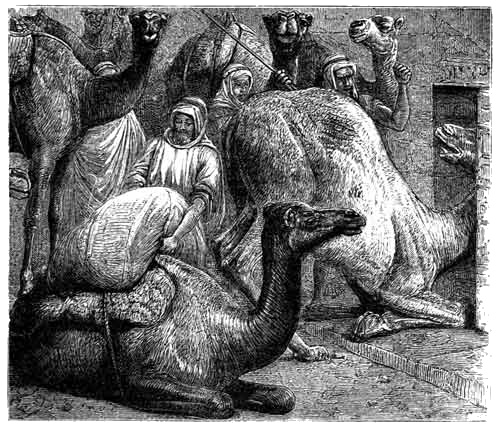
CAMEL GOING THROUGH A "NEEDLE'S EYE."
"It is easier for a camel to go through the eye of a needle, than for a rich man to enter into the
kingdom of God."—Matt. xix. 24.
We will now turn to the metaphor of the Camel and the
needle's eye. Of course it can be taken merely as a very bold
metaphor, but it may also be understood in a simpler sense, the
sense in which it was probably understood by those who heard
it. In Oriental cities, there are in the large gates small and
very low apertures called metaphorically "needle's-eyes," just
as we talk of certain windows as "bull's-eyes." These entrances
are too narrow for a Camel to pass through them in the ordinary
manner, or even if loaded. When a laden Camel has to pass
through one of these entrances, it kneels down, its load is
removed, and then it shuffles through on its knees. "Yesterday,"
writes Lady Duff-Gordon from Cairo, "I saw a camel go through
the eye of a needle, i.e. the low-arched door of an enclosure. He
must kneel, and bow his head to creep through; and thus the
rich man must humble himself."
There is another passage in which the Camel is used by our
Lord in a metaphorical sense. This is the well-known sentence:
"Ye blind guides, which strain at a gnat, and swallow a camel"
(Matt. xxiii. 24). It is remarkable that an accidental misprint
has robbed this passage of its true force. The real translation
is: "which strain out the gnat, and swallow the camel." The
Greek word is διυλίζω, which signifies to filter thoroughly; and
the allusion is made the pharisaical custom of filtering liquids
before drinking them, lest by chance a gnat or some such insect
which was forbidden as food might be accidentally swallowed.
General description of the animal—Its use in mountain roads—Peculiar formation
of the foot—Uses of a mixed breed—Its power of enduring cold—Used chiefly
as a beast of draught—Unfitness for the plough—The cart and mode of harnessing—The
load which it can draw—Camel-skin ropes—A Rabbinical legend.
The second kind of Camel—namely, the Bactrian species—was
probably unknown to the Jews until a comparatively late portion
of their history. This species was employed by the Assyrians,
as we find by the sculptures upon the ruins, and if in no other
way the Jews would become acquainted with them through the
nation by whom they were conquered, and in whose land they
abode for so long.
The Bactrian Camel is at once to be distinguished from that
which has already been described by the two humps and the
clumsier and sturdier form. Still the skeletons of the Bactrian
and Arabian species are so similar that none but a very skilful
anatomist can distinguish between them, and several learned
zoologists have expressed an opinion, in which I entirely coincide,
that the Bactrian and Arabian Camels are but simple
varieties of one and the same species, not nearly so dissimilar
as the greyhound and the bulldog.
Unlike the one-humped Camel, the Bactrian species is quite at
home in a cold climate, and walks over ice as easily as its congener
does over smooth stone. It is an admirable rock-climber,
and is said even to surpass the mule in the sureness of its tread.
This quality is probably occasioned by the peculiar structure of
the foot, which has an elongated toe projecting beyond the soft
pad, and forming a sort of claw. In the winter time the riders
much prefer them to horses, because their long legs enable them
to walk easily through snow, in which a horse could only plunge
helplessly, and would in all probability sink and perish.
A mixed breed of the one-humped and the Bactrian animals is
thought to be the best for hill work in winter time, and General
Harlan actually took two thousand of these animals in winter
time for a distance of three hundred and sixty miles over the
snowy tops of the Indian Caucasus; and though the campaign
lasted for seven months, he only lost one Camel, and that
was accidentally killed. Owing to its use among the hills, the
Bactrian species is sometimes called the Mountain Camel.
It very much dislikes the commencement of spring, because
the warm mid-day sun slightly melts the surface of the snow,
and the frost of night converts it into a thin plate of ice. When
the Camel walks upon this semi-frozen snow, its feet plunge
into the soft substratum through the icy crust, against which its
legs are severely cut. The beginning of the winter is liable to
the same objection.
The mixed breed which has just been mentioned must be
procured from a male Bactrian and a female Arabian Camel. If
the parentage be reversed, the offspring is useless, being weak,
ill-tempered, and disobedient.
The Bactrian Camel is, as has been mentioned, tolerant of
cold, and is indeed so hardy an animal that it bears the severest
winters without seeming to suffer distress, and has been seen
quietly feeding when the thermometer has reached a temperature
several degrees below zero. Sometimes, when the cold is
more than usually sharp, the owners sew a thick cloth round its
body, but even in such extreme cases the animal is left to find
its own food as it best can. And, however severe the weather
may be, the Bactrian Camel never sleeps under a roof.
This Camel is sometimes employed as a beast of burden, but
its general use is for draught. It is not used for the plough, because
it has an uncertain and jerking mode of pulling, and does
not possess the steady dragging movement which is obtained by
the use of the horse or ox.
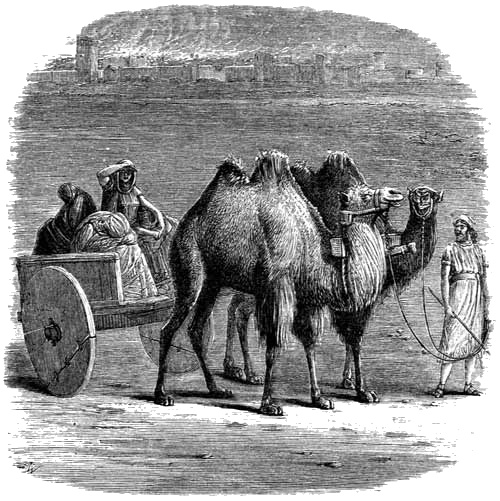
BACTRIAN CAMEL.
"He saw a chariot of camels."—Isaiah xxi. 7.
It is almost invariably harnessed to carts, and always in pairs.
The mode of yoking the animals is as simple as can well be
conceived. A pole runs between them from the front of the
vehicle, and the Camels are attached to it by means of a pole
which passes over their necks. Oxen were harnessed in a
similar manner. It was probably one of these cars or chariots
that was mentioned by Isaiah in his prophecy respecting
Assyria:—"And he saw a chariot with a couple of horsemen, a
chariot of asses, and a chariot of camels" (Isa. xxi. 7). The cars
themselves are as simple as the mode of harnessing them, being
almost exactly like the ox carts which have already been
described.
The weight which can be drawn by a pair of these Camels is
really considerable. On a tolerably made road a good pair of
Camels are expected to draw from twenty-six to twenty-eight
hundred weight, and to continue their labours for twenty or
thirty successive days, traversing each day an average of thirty
miles. It is much slower than the Arabian Camel, seldom going
at more than two and a half miles per hour. If, however, the
vehicle to which a pair of Bactrians are harnessed were well
made, the wheels truly circular, and the axles kept greased so as
to diminish the friction, there is no doubt that the animals could
draw a still greater load to longer distances, and with less
trouble to themselves. As it is, the wheels are wretchedly
fitted, and their ungreased axles keep up a continual creaking
that is most painful to an unaccustomed ear, and totally unheeded
by the drivers.
The hair of the Bactrian Camel is long, coarse, and strong;
and, like that of the Arabian animal, is made into rough cloth.
It is plucked off by hand in the summer time, when it naturally
becomes loose in readiness for its annual renewal, and the weight
of the entire crop of hair ought to be about ten pounds. The
skin is not much valued, and is seldom used for any purpose
except for making ropes, straps, and thongs, and is not thought
worth the trouble of tanning. The milk, like that of the
Arabian animal, is much used for food, but the quantity is very
trifling, barely two quarts per diem being procured from each
Camel.
There is but little that is generally interesting in the Rabbinical
writers on the Camel. They have one proverbial saying
upon the shortness of its ears. When any one makes a request
that is likely to be refused, they quote the instance of the
Camel, who, it seems, was dissatisfied with its appearance, and
asked for horns to match its long ears. The result of the request
was, that it was deprived of its ears, and got no horns.
The Hebrew words which signify the Horse—The Horse introduced into Palestine
from Egypt—Similarity of the war-horse of Scripture and the Arab horse of
the present day—Characteristics of the Horse—Courage and endurance of the
Horse—Hardness of its unshod hoofs—Love of the Arab for his Horse—Difficulty
of purchasing the animal—The Horse prohibited to the Israelites—Solomon's
disregard of the edict—The war-chariot, its form and use—Probable
construction of the iron chariot—The cavalry Horse—Lack of personal interest
in the animal.
Several Hebrew words are used by the various Scriptural
writers to signify the Horse, and, like our own terms of horse,
mare, pony, charger, &c., are used to express the different qualities
of the animal. The chief distinction of the Horse seemed
to lie in its use for riding or driving, the larger and heavier
animals being naturally required for drawing the weighty springless
chariots. The chariot horse was represented by the word
Sus, and the cavalry horse by the word Parash, and in several
passages both these words occur in bold contrast to each other.
See, for example, 1 Kings iv. 26, &c.
Among the many passages of Scripture in which the Horse is
mentioned, there are few which do not treat of it as an adjunct
of war, and therefore it is chiefly in that light that we must
regard it.
The Horse of the Scriptures was evidently a similar animal
to the Arab Horse of the present day, as we find not only from
internal evidence, but from the sculptures and paintings which
still remain to tell us of the vanished glories of Egypt and
Assyria. It is remarkable, by the way, that the first mention of
the Horse in the Scriptures alludes to it as an Egyptian animal.
During the terrible famine which Joseph had foretold, the
Egyptians and the inhabitants of neighbouring countries were
unable to find food for themselves or fodder for their cattle, and,
accordingly, they sold all their beasts for bread. "And they
brought their cattle unto Joseph, and Joseph gave them bread
in exchange for horses and the flocks, and for the cattle of herds,
and for the asses, and he fed them with bread for all their cattle
for that year."
This particular breed of Horses is peculiarly fitted for the
purposes of war, and is much less apt for peaceful duties than
the heavier and more powerful breeds, which are found in different
parts of the world. It is remarkable for the flexible
agility of its movements, which enable it to adapt itself to
every movement of the rider, whose intentions it seems to divine
by a sort of instinct, and who guides it not so much by the
bridle as by the pressure of the knees and the voice. Examples
of a similar mode of guidance may be seen on the well-known
frieze of the Parthenon, where, in the Procession of Horsemen,
the riders may be seen directing their steeds by touching the
side of the neck with one finger, thus showing their own skill
and the well-trained quality of the animals which they ride.
Its endurance is really wonderful, and a horse of the Kochlani
breed will go through an amount of work which is almost
incredible. Even the trial by which a Horse is tested is so
severe, that any other animal would be either killed on the spot
or ruined for life. When a young mare is tried for the first
time, her owner rides her for some fifty or sixty miles at full
speed, always finishing by swimming her through a river. After
this trial she is expected to feed freely; and should she refuse
her food, she is rejected as an animal unworthy of the name of
Kochlani.
Partly from native qualities, and partly from constant association
with mankind, the Arab Horse is a singularly intelligent
animal. In Europe we scarcely give the Horse credit for the
sensitive intelligence with which it is endowed, and look upon
it rather as a machine for draught and carriage than a companion
to man. The Arab, however, lives with his horse, and
finds in it the docility and intelligence which we are accustomed
to associate with the dog rather than the Horse. It
will follow him about and come at his call. It will stand
for any length of time and await its rider without moving.
Should he fall from its back, it will stop and stand patiently
by him until he can remount; and there is a well-authenticated
instance of an Arab Horse whose master had been wounded in
battle, taking him up by his clothes and carrying him away to a
place of safety.
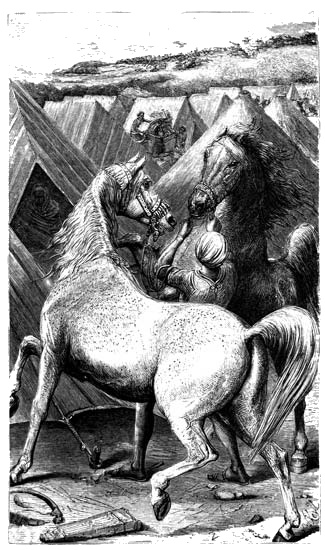
WAR HORSE.
"He saith among the trumpets, Ha, Ha; and he smelleth the battle afar off, the thunder of the captains
and the shouting."—Job xxxix. 25.
Even in the very heat and turmoil of the combat, the true
Arab Horse seems to be in his true element, and fully deserves
the splendid eulogium in the Book of Job (xxxix. 19-25):
"Hast thou given the horse strength? hast thou clothed his
neck with thunder?
"Canst thou make him afraid as a grasshopper? the glory
of his nostrils is terror.
"He paweth in the valley, and rejoiceth in his strength: he
goeth on to meet the armed men.
"He mocketh at fear, and is not affrighted; neither turneth
he back from the sword.
"The quiver rattleth against him, the glittering spear and the
shield.
"He walketh the ground with fierceness and rage: neither
believeth he that it is the sound of the trumpet.
"He saith among the trumpets, Ha, ha; and he smelleth the
battle afar off, the thunder of the captains, and the shouting."
In another passage an allusion is made to the courage of the
Horse, and its love for the battle. "I hearkened and heard, but
they spake not aright: no man repented him of his wickedness,
saying, What have I done? Every one turned to his course, as
the horse rusheth into the battle." (Jer. viii. 6.) Even in the
mimic battle of the djereed the Horse seems to exult in the conflict
as much as his rider, and wheels or halts almost without
the slightest intimation.
The hoofs of the Arab Horses are never shod, their owners
thinking that that act is not likely to improve nature, and even
among the burning sands and hard rocks the Horse treads with
unbroken hoof. In such a climate, indeed, an iron shoe would
be worse than useless, as it would only scorch the hoof by day,
and in consequence of the rapid change of temperature by day or
night, the continual expansion and contraction of the metal would
soon work the nails loose, and cause the shoe to fall off.
A tender-footed Horse would be of little value, and so we
often find in the Scriptures that the hardness of the hoof is
reckoned among one of the best qualities of a Horse. See, for
example, Isa. v. 28: "Whose arrows are sharp, and all their
bows bent, their horses' hoofs shall be counted like flint, and
their wheels like a whirlwind." Again, in Micah iv. 13: "Arise
and thresh, O daughter of Zion: for I will make thine horn
iron, and I will make thy hoofs brass: and thou shalt beat in
pieces many people." Allusion is here made to one mode of
threshing, in which a number of Horses were turned into the
threshing-floor, and driven about at random among the wheat,
instead of walking steadily like the oxen.
In Judges v. 22 there is a curious allusion to the hoofs of
the Horse. It occurs in the Psalm of Thanksgiving sung by
Deborah and Barak after the death of Sisera: "Then were the
horse-hoofs broken by the means of the prancings, the prancings
of their mighty ones." It is easy now to see that these words
infer a scornful allusion to the inferiority of the enemy's Horses,
inasmuch as the hoofs of the best Horses would be "counted as
flint," and would not be broken by the prancings.
Horses possessed of the qualities of courage, endurance, and
sureness of foot are naturally invaluable; and even at the
present day the Arab warrior esteems above all things a Horse
of the purest breed, and, whether he buys or sells one, takes care
to have its genealogy made out and hung on the animal's neck.
As to the mare, scarcely any inducement is strong enough to
make an Arab part with it, even to a countryman, and the sale
of the animal is hindered by a number of impediments which
in point of fact are almost prohibitory. Signor Pierotti, whose
long residence in Palestine has given him a deep insight into
the character of the people, speaks in the most glowing terms
of the pure Arab Horse, and of its inestimable value to its
owner. Of the difficulties with which the sale of the animal is
surrounded, he gives a very amusing account:—
"After this enumeration of the merits of the horse, I will
describe the manner in which a sale is conducted, choosing the
case of the mare, as that is the more valuable animal. The price
varies with the purity of blood of the steed, and the fortunes of
its owner. When he is requested to fix a value, his first reply is,
'It is yours, and belongs to you, I am your servant;' because,
perhaps, he does not think that the question is asked with
any real design of purchasing; when the demand is repeated, he
either makes no answer or puts the question by; at the third
demand he generally responds rudely with a sardonic smile,
which is not a pleasant thing to see, as it is a sign of anger; and
then says that he would sooner sell his family than his mare.
This remark is not meant as a mere jest; for it is no uncommon
thing for a Bedawy to give his parents as hostages rather than
separate himself from his friend.
"If, however, owing to some misfortune, he determines on
selling his mare, it is very doubtful whether he or his parents
will allow her to leave their country without taking the precaution
to render her unfit for breeding.
"There are many methods of arranging the sale, all of which
I should like to describe particularly; however, I will confine
myself to a general statement. Before the purchaser enters upon
the question of the price to be paid, he must ascertain that the
parents, friends, and allies of the owners give their consent to
the sale, without which some difficulty or other may arise, or
perhaps the mare may be stolen from her new master. He must
also obtain an unquestionable warranty that she is fit for breeding
purposes, and that no other has a prior claim to any part of
her body. This last precaution may seem rather strange, but it
arises from the following custom. It sometimes happens that,
when a Bedawy is greatly in want of money, he raises it most
easily by selling a member of his horse; so that very frequently
a horse belongs to a number of owners, one of whom has purchased
the right fore-leg, another the left, another the hind-leg,
or the tail, or an ear, or the like; and the proprietors have each a
proportionate interest in the profits of its labour or sale.
"So also the offspring are sold in a similar manner; sometimes
only the first-born, sometimes the first three; and then it
occasionally happens that two or three members of the foal are,
as it were, mortgaged. Consequently, any one who is ignorant
of this custom may find that, after he has paid the price of the
mare to her supposed owner, a third person arises who demands
to be paid the value of his part; and, if the purchaser refuse to
comply, he may find himself in a very unpleasant situation,
without any possibility of obtaining help from the local government.
Whoever sells his mare entirely, without reserving to
himself one or two parts, must be on good terms with the confederate
chiefs in the neighbourhood, and must have obtained their
formal sanction, otherwise they would universally despise him,
and perhaps lie in wait to kill him, so that his only hope of
escape would be a disgraceful flight, just as if he had committed
some great crime. It is an easier matter to purchase a stallion;
but even in this case the above formalities must be observed.
"These remarks only apply to buying horses of the purest
blood; those of inferior race are obtained without difficulty, and
at fair prices."
For some reason, perhaps the total severance of the Israelites
from the people among whom they had lived so long in captivity,
the use of the Horse, or, at all events, the breeding of it,
was forbidden to the Israelites; see Deut. xvi. 16. After
prophesying that the Israelites, when they had settled themselves
in the Promised Land, would want a king, the inspired
writer next ordains that the new king must be chosen by
Divine command, and must belong to one of the twelve tribes.
He then proceeds as follows:—"But he shall not multiply
horses to himself, nor cause the people to return to Egypt, to
the end that he should multiply horses: forasmuch as the Lord
hath said unto you, Ye shall henceforth return no more that
way."
The foresight of this prophetical writer was afterwards shown
by the fact that many kings of Israel did send to Egypt for
Horses, Egypt being the chief source from which these animals
were obtained. And, judging from the monuments to which
reference has been made, the Horse of Egypt was precisely the
same animal as the Arab Horse of the present day, and was
probably obtained from nomad breeders.
In spite of the prohibitory edict, both David and Solomon
used Horses in battle, and the latter supplied himself largely
from Egypt, disregarding as utterly the interdict against plurality
of Horses as that against plurality of wives, which
immediately follows.
David seems to have been the first king who established a
force of chariots, and this he evidently did for the purpose of
action on the flat grounds of Palestine, where infantry were at a
great disadvantage when attacked by the dreaded chariots; yet
he did not controvert the law by multiplying to himself Horses,
or even by importing them from Egypt; and when he had an
opportunity of adding to his army an enormous force of chariots,
he only employed as many as he thought were sufficient for his
purpose. After he defeated Hadadezer, and had taken from
him a thousand chariots with their Horses together with seven
hundred cavalry, he houghed all the Horses except those which
were needed for one hundred chariots.
Solomon, however, was more lax, and systematically broke
the ancient law by multiplying Horses exceedingly, and sending
to Egypt for them. We learn from 1 Kings iv. 26 of the enormous
establishment which he kept up both for chariots and
cavalry. Besides those which were given to him as tribute, he
purchased both chariots and their Horses from Egypt and Syria,
the chariots being delivered at the rate of six hundred shekels
of silver, and the Horses for an hundred and fifty shekels.
Chariots were far more valued in battle than horsemen, probably
because their weight made their onset irresistible against
infantry, who had no better weapons than bows and spears.
The slingers themselves could make little impression on the
chariots; and even if the driver, or the warrior who fought in
the chariot, or his attendant, happened to be killed, the weighty
machine, with its two Horses, still went on its destructive way.
Of their use in battle we find very early mention. For
example, in Exod. xiv. 6 it is mentioned that Pharaoh made ready
his chariot to pursue the Israelites; and in a subsequent part
of the same chapter we find that six hundred of the Egyptian
chariot force accompanied their master in the pursuit, and that
the whole army was delayed because the loss of the chariot
wheels made them drive heavily.
Then in the familiar story of Sisera and Jael the vanquished
general is mentioned as alighting from his chariot, in which he
would be conspicuous, and taking flight on foot; and, after his
death, his mother is represented as awaiting his arrival, and
saying to the women of the household, "Why is his chariot so
long in coming? Why tarry the wheels of his chariot?"
During the war of conquest which Joshua led, the chariot
plays a somewhat important part. As long as the war was
carried on in the rugged mountainous parts of the land, no mention
of the chariot is made; but when the battles had to be
fought on level ground, the enemy brought the dreaded chariots
to bear upon the Israelites. In spite of these adjuncts, Joshua
won the battles, and, unlike David, destroyed the whole of the
Horses and burned the chariots.
Many years afterwards, a still more dreadful weapon, the iron
chariot, was used against the Israelites by Jabin. This new
instrument of war seems to have cowed the people completely;
for we find that by means of his nine hundred chariots of iron
Jabin "mightily oppressed the children of Israel" for twenty
years. It has been well suggested that the possession of the
war chariot gave rise to the saying of Benhadad's councillors,
that the gods of Israel were gods of the hills, and so their army
had been defeated; but that if the battle were fought in the
plain, where the chariots and Horses could act, they would be
victorious.
So dreaded were these weapons, even by those who were
familiar with them and were accustomed to use them, that when
the Syrians had besieged Samaria, and had nearly reduced it by
starvation, the fancied sound of a host of chariots and Horses
that they heard in the night caused them all to flee and evacuate
the camp, leaving their booty and all their property in the hands
of the Israelites.
Whether the Jews ever employed the terrible scythe chariots
is not quite certain, though it is probable that they may have
done so; and this conjecture is strengthened by the fact that
they were employed against the Jews by Antiochus, who had
"footmen an hundred and ten thousand, and horsemen five
thousand and three hundred, and elephants two and twenty, and
three hundred chariots armed with hooks" (2 Macc. xiii. 2).
Some commentators think that by the iron chariots mentioned
above were signified ordinary chariots armed with iron scythes
projecting from the sides.
By degrees the chariot came to be one of the recognised forces
in war, and we find it mentioned throughout the books of the
Scriptures, not only in its literal sense, but as a metaphor which
every one could understand. In the Psalms, for example, are
several allusions to the war-chariot. "He maketh wars to cease
unto the end of the earth; He breaketh the bow, and cutteth the
spear in sunder; He burneth the chariot in the fire" (Ps. xlvi. 9).
Again: "At Thy rebuke, O God of Jacob, both the chariot and
horse are cast into a dead sleep" (Ps. lxxvi. 6). And: "Some
trust in chariots, and some in horses: but we will remember the
name of the Lord our God" (Ps. xx. 7). Now, the force of these
passages cannot be properly appreciated unless we realize to
ourselves the dread in which the war-chariot was held by the
foot-soldiers. Even cavalry were much feared; but the chariots
were objects of almost superstitious fear, and the rushing sound
of their wheels, the noise of the Horses' hoofs, and the shaking
of the ground as the "prancing horses and jumping chariots"
(Nab. iii. 2) thundered along, are repeatedly mentioned.
See, for example, Ezek. xxvi. 10: "By reason of the abundance
of his horses their dust shall cover thee: thy walls shall shake
at the noise of the horsemen, and of the wheels, and of the
chariots." Also, Jer. xlvii. 3: "At the noise of the stamping of
the hoofs of his strong horses, at the rushing of his chariots,
and at the rumbling of his wheels, the fathers shall not look
back to their children for feebleness of hands." See also Joel
ii. 4, 5: "The appearance of them is as the appearance of horses;
and as horsemen, so shall they run.
"Like the noise of chariots on the tops of mountains shall
they leap, like the noise of a flame of fire that devoureth the
stubble, as a strong people set in battle array."
In several passages the chariot and Horse are used in bold
imagery as expressions of Divine power: "The chariots of God
are twenty thousand, even thousands of angels: the Lord is
among them, as in Sinai, in the holy place" (Ps. lxviii. 17). A
similar image is employed in Ps. civ. 3: "Who maketh the
clouds His chariot: who walketh upon the wings of the wind."
In connexion with these passages, we cannot but call to mind
that wonderful day when the unseen power of the Almighty
was made manifest to the servant of Elisha, whose eyes were
suddenly opened, and he saw that the mountain was full of
Horses and chariots of fire round about Elisha.
The chariot and horses of fire by which Elijah was taken from
earth are also familiar to us, and in connexion with the passage
which describes that wonderful event, we may mention one
which occurs in the splendid prayer of Habakkuk (iii. 8): "Was
the Lord displeased against the rivers? was Thine anger against
the rivers? was Thy wrath against the sea, that Thou didst ride
upon Thine horses and Thy chariots of salvation?"
By degrees the chariot came to be used for peaceful purposes,
and was employed as our carriages of the present day, in carrying
persons of wealth. That this was the case in Egypt from
very early times is evident from Gen. xli. 43, in which we are
told that after Pharaoh had taken Joseph out of prison and
raised him to be next in rank to himself, the king caused him to
ride in the second chariot which he had, and so to be proclaimed
ruler over Egypt. Many years afterwards we find him
travelling in his chariot to the land of Goshen, whither he
went to meet Jacob and to conduct him to the presence of
Pharaoh.
At first the chariot seems to have been too valuable to the
Israelites to have been used for any purpose except war, and it is
not until a comparatively late time that we find it employed as
a carriage, and even then it is only used by the noble and
wealthy. Absalom had such chariots, but it is evident that he
used them for purposes of state, and as appendages of his regal
rank. Chariots or carriages were, however, afterwards employed
by the Israelites as freely as by the Egyptians, from whom they
were originally procured; and accordingly we find Rehoboam
mounting his chariot and fleeing to Jerusalem, Ahab riding in
his chariot from Samaria to Jezreel, with Elijah running before
him; and in the New Testament we read of the chariot in
which sat the chief eunuch of Ethiopia whom Philip baptized
(Acts viii. 28).
As to the precise form and character of these chariots, they are
made familiar to us by the sculptures and paintings of Egypt and
Assyria, from both of which countries the Jews procured the
vehicles. Differing very slightly in shape, the principle of the
chariot was the same; and it strikes us with some surprise that
the Assyrians, the Egyptians, and the Jews, the three wealthiest
and most powerful nations of the world, should not have invented
a better carriage. They lavished the costliest materials and
the most artistic skill in decorating the chariots, but had no idea
of making them comfortable for the occupants.
They were nothing but semicircular boxes on wheels, and of
very small size. They were hung very low, so that the occupants
could step in and out without trouble, though they do not
seem to have had the sloping floor of the Greek or Roman
chariot. They had no springs, but, in order to render the jolting
of the carriage less disagreeable, the floor was made of a sort of
network of leathern ropes, very tightly stretched so as to be
elastic. The wheels were always two in number, and generally
had six spokes.
To the side of the chariot was attached the case which contained
the bow and quiver of arrows, and in the case of a rich
man these bow-cases were covered with gold and silver, and
adorned with figures of lions and other animals. Should the
chariot be intended for two persons, two bow-cases were fastened
to it, the one crossing the other. The spear had also its tubular
case, in which it was kept upright, like the whip of a modern
carriage.
Two Horses were generally used with each chariot, though
three were sometimes employed. They were harnessed very
simply, having no traces, and being attached to the central pole
by a breast-band, a very slight saddle, and a loose girth. On
their heads were generally fixed ornaments, such as tufts of
feathers, and similar decorations, and tassels hung to the harness
served to drive away the flies. Round the neck of each Horse
passed a strap, to the end of which was attached a bell. This
ornament is mentioned in Zech. xiv. 20: "In that day shall
there be upon the bells of the horses, Holiness unto the Lord"—i.e.
the greeting of peace shall be on the bells of the animals
once used in war.
Sometimes the owner drove his own chariot, even when going
into battle, but the usual plan was to have a driver, who managed
the Horses while the owner or occupant could fight with both
his hands at liberty. In case he drove his own Horse, the reins
passed round his waist, and the whip was fastened to the wrist
by a thong, so that when the charioteer used the bow, his principal
weapon, he could do so without danger of losing his whip.
Thus much for the use of the chariot in war; we have now
the Horse as the animal ridden by the cavalry.
As was the case with the chariot, the war-horse was not
employed by the Jews until a comparatively late period of their
history. They had been familiarized with cavalry during their
long sojourn in Egypt, and in the course of their war of conquest
had often suffered defeat from the horsemen of the enemy. But
we do not find any mention of a mounted force as forming
part of the Jewish army until the days of David, although
after that time the successive kings possessed large forces
of cavalry.
Many references to mounted soldiers are made by the prophets,
sometimes allegorically, sometimes metaphorically. See, for
example, Jer. vi. 23: "They shall lay hold on bow and spear;
they are cruel, and have no mercy; their voice roareth like the
sea; and they ride upon horses, set in array as men for war
against thee, O daughter of Zion." The same prophet has a
similar passage in chap. l. 42, couched in almost precisely the
same words. And in chap. xlvi. 4, there is a further reference
to the cavalry, which is specially valuable as mentioning the
weapons used by them. The first call of the prophet is to the
infantry: "Order ye the buckler and shield, and draw near to
battle" (verse 3); and then follows the command to the cavalry,
"Harness the horses; and get up, ye horsemen, and stand forth
with your helmets; furbish the spears, and put on the brigandines."
The chief arms of the Jewish soldier were therefore
the cuirass, the helmet, and the lance, the weapons which in all
ages, and in all countries, have been found to be peculiarly
suitable to the horse-soldier.
Being desirous of affording the reader a pictorial representation
of the war and state chariots, I have selected Egypt as the
typical country of the former, and Assyria of the latter. Both
drawings have been executed with the greatest care in details,
every one of which, even to the harness of the Horses, the mode
of holding the reins, the form of the whip, and the offensive
and defensive armour, has been copied from the ancient records
of Egypt and Nineveh.
We will first take the war-chariot of Egypt.
This form has been selected as the type of the war-chariot,
because the earliest account of such a force mentions the war-chariots
of Egypt, and because, after the Israelites had adopted
chariots as an acknowledged part of their army, the vehicles, as
well as the trained Horses, and probably their occupants, were
procured from Egypt.
The scene represents a battle between the imperial forces and
a revolted province, so that the reader may have the opportunity
of seeing the various kinds of weapons and armour
which were in use in Egypt at the time of Joseph. In the
foreground is the chariot of the general, driven at headlong
speed, the Horses at full gallop, and the springless chariot leaping
off the ground as the Horses bound along. The royal rank of the
general in question is shown by the feather fan which denotes
his high birth, and which is fixed in a socket at the back of his
chariot, much as a coachman fixes his whip. The rank of the
rider is further shown by the feather plumes on the heads of his
Horses.
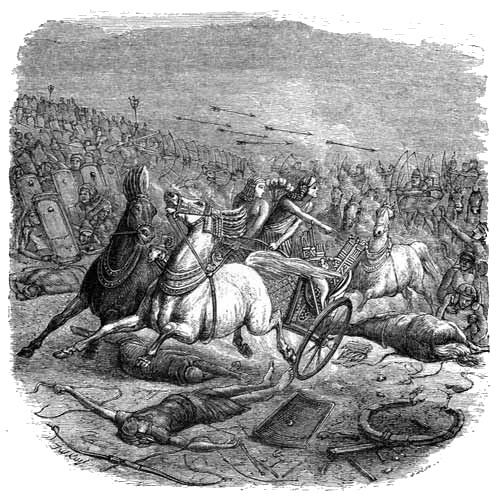
EGYPTIAN WAR-CHARIOTS.
"Come up, ye horses; and rage, ye chariots; and let the mighty men come forth."—Jer. xlvi. 9.
"The noise of a whip, and the noise of the rattling of the wheels, and of the prancing horses, and
of the jumping chariots."—Nahum iii. 2.
"Like the noise of chariots ... shall they leap."—Joel ii. 5.
By the side of the chariot are seen the quiver and bow-case,
the former being covered with decorations, and having
the figure of a recumbent lion along its sides. The simple
but effective harness of the Horses is especially worthy of
notice, as showing how the ancients knew, better than the
moderns, that to cover a Horse with a complicated apparatus
of straps and metal only deteriorates from the powers of the
animal, and that a Horse is more likely to behave well if he
can see freely on all sides, than if all lateral vision be cut off by
the use of blinkers.
Just behind the general is the chariot of another officer, one
of whose Horses has been struck, and is lying struggling on the
ground. The general is hastily giving his orders as he dashes
past the fallen animal. On the ground are lying the bodies of
some slain enemies, and the Horses are snorting and shaking
their heads, significative of their unwillingness to trample on a
human being. By the side of the dead man are his shield, bow,
and quiver, and it is worthy of notice that the form of these
weapons, as depicted upon the ancient Egyptian monuments, is
identical with that which is still found among several half-savage
tribes of Africa.
In the background is seen the fight raging round the standards.
One chief has been killed, and while the infantry are pressing
round the body of the rebel leader and his banner on one side,
on the other the imperial chariots are thundering along to
support the attack, and are driving their enemies before them.
In the distance are seen the clouds of dust whirled into the air
by the hoofs and wheels, and circling in clouds by the eddies
caused by the fierce rush of the vehicles, thus illustrating the
passage in Jer. iv. 13: "Behold, he shall come up as clouds, and
his chariots shall be as a whirlwind: his horses are swifter than
eagles. Woe unto us! for we are spoiled." The reader will see,
by reference to the illustration, how wonderfully true and forcible
is this statement, the writer evidently having been an eye-witness
of the scene which he so powerfully depicts.
The second scene is intentionally chosen as affording a strong
contrast to the former. Here, instead of the furious rush, the
galloping Horses, the chariots leaping off the ground, the
archers bending their bows, and all imbued with the fierce ardour
of battle, we have a scene of quiet grandeur, the Assyrian king
making a solemn progress in his chariot after a victory, accompanied
by his attendants, and surrounded by his troops, in all
the placid splendour of Eastern state.
Chief object in the illustration stands the great king in his
chariot, wearing the regal crown, or mitre, and sheltered from
the sun by the umbrella, which in ancient Nineveh, as in more
modern times, was the emblem of royalty. By his side is his
charioteer, evidently a man of high rank, holding the reins in a
business-like manner; and in front marches the shield-bearer.
In one of the sculptures from which this Illustration was composed,
the shield-bearer was clearly a man of rank, fat, fussy,
full of importance, and evidently a portrait of some well-known
individual.
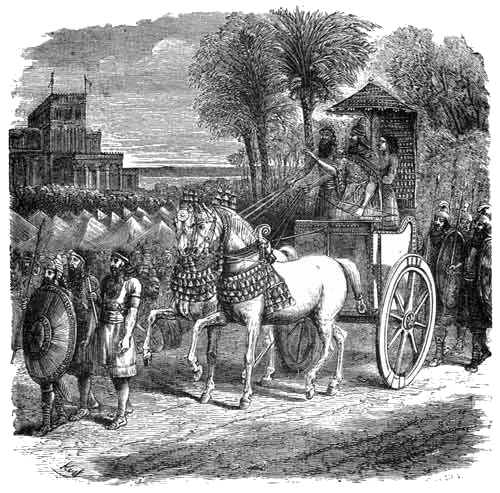
ASSYRIAN CHARIOT OF STATE.
"Then shall there enter into the gates of this city kings and princes sitting upon the throne of
David, riding in chariots."—Jer. xvii. 25.
The Horses are harnessed with remarkable lightness, but they
bear the gorgeous trappings which befit the rank of the rider,
their heads being decorated with the curious successive plumes
with which the Assyrian princes distinguished their chariot
Horses, and the breast-straps being adorned with tassels, repeated
in successive rows like the plumes of the head.
The reader will probably notice the peculiar high action of the
Horses. This accomplishment seems to have been even more
valued among the ancients than by ourselves, and some of the
sculptures show the Horses with their knees almost touching
their noses. Of course the artist exaggerated the effect that
he wanted to produce; but the very fact of the exaggeration
shows the value that was set on a high and showy action in a
Horse that was attached to a chariot of state. The old Assyrian
sculptors knew the Horse well, and delineated it in a most
spirited and graphic style, though they treated it rather conventionally.
The variety of attitude is really wonderful, considering
that all the figures are profile views, as indeed seemed to have
been a law of the historical sculptures.
Before closing this account of the Horse, it may be as well
to remark the singular absence of detail in the Scriptural
accounts. Of the other domesticated animals many such
details are given, but of the Horse we hear but little, except in
connexion with war. There are few exceptions to this rule, and
even the oft-quoted passage in Job, which goes deeper into the
character of the Horse than any other portion of the Scriptures,
only considers the Horse as an auxiliary in battle. We miss the
personal interest in the animal which distinguishes the many
references to the ox, the sheep, and the goat; and it is
remarkable that even in the Book of Proverbs, which is so
rich in references to various animals, very little is said of the
Horse.
Importance of the Ass in the East—Its general use for the saddle—Riding
the Ass not a mark of humility—The triumphal entry—White Asses—Character
of the Scriptural Ass—Saddling the Ass—The Ass used in agriculture—The
Ass's millstone—The water-wheel and the plough—Reminiscences
of the Ass in the Scriptural narrative—Its value as property—The flesh of
the Ass—The siege of Samaria and its horrors—Various legends respecting the
Ass—The impostor and his fate—Samson and Balaam.
In the Scriptures we read of two breeds of Ass, namely, the
Domesticated and the Wild Ass. As the former is the more
important of the two, we will give it precedence.
In the East, the Ass has always played a much more
important part than among us Westerns, and on that account we
find it so frequently mentioned in the Bible. In the first place,
it is the universal saddle-animal of the East. Among us the
Ass has ceased to be regularly used for the purposes of the
saddle, and is only casually employed by holiday-makers and the
like. Some persons certainly ride it habitually, but they almost
invariably belong to the lower orders, and are content to ride
without a saddle, balancing themselves in some extraordinary
manner just over the animal's tail. In the East, however, it is
ridden by persons of the highest rank, and is decorated with
saddle and harness as rich as those of the horse.
In England we should be very much surprised to see a royal
prince, a judge, or a bishop travelling habitually on a donkey,
but in Palestine it is just the animal which would be considered
most appropriate for the purpose. For example, we find that
Abraham, an exceptionally wealthy man, and a chief of high
position, made use of the Ass for the saddle. It was on an Ass
that he travelled when he made his three days' journey from
Beersheba to Moriah, when he was called to prove his faith by
sacrificing Isaac (see Gen. xxii. 3).
Then in Judges x. 3, 4, we find that riding upon the Ass is
actually mentioned as a mark of high rank.
"And after him
arose Jair, a Gileadite, and judged Israel twenty and two years.
"And he had thirty sons that rode on thirty ass colts, and they
had thirty cities, which are called Havoth-jair unto this day,
which are in the land of Gilead." So here we have the curious
fact, that the sacred historian thinks it worth while to mention
that great men, the sons of the chief man of Israel, each of them
being ruler over a city, rode upon Ass colts. In the same book,
xii. 13, 14, we have a similar record of Abdon, the judge who
preceded Samson.
"After him Abdon the son of Hillel, a Pirathonite,
judged Israel.
"And he had forty sons and thirty nephews" (or grandsons
according to some translators) "that rode on threescore and ten
ass colts: and he judged Israel eight years."
Thus we see that, so far from the use of the Ass as a saddle-animal
being a mark of humility, it ought to be viewed in precisely
the opposite light. In consequence of the very natural
habit of reading, according to Western ideas, the Scriptures,
which are books essentially Oriental in all their allusions and
tone of thought, many persons have entirely perverted the sense of
one very familiar passage, the prophecy of Zechariah concerning
the future Messiah. "Rejoice greatly, O daughter of Zion; shout,
O daughter of Jerusalem: behold, thy King cometh unto thee:
He is just, and having salvation; lowly, and riding upon an ass,
and upon a colt the foal of an ass" (Zech. ix. 9).
Now this passage, as well as the one which describes its fulfilment
so many years afterwards, has often been seized upon as
a proof of the meekness and lowliness of our Saviour, in riding
upon so humble an animal when He made His entry into Jerusalem.
The fact is, that there was no humility in the case,
neither was the act so understood by the people. He rode upon
an Ass as any prince or ruler would have done who was engaged
on a peaceful journey, the horse being reserved for war purposes.
He rode on the Ass, and not on the horse, because He was the
Prince of Peace and not of war, as indeed is shown very clearly
in the context. For, after writing the words which have just
been quoted, Zechariah proceeds as follows (ver. 10): "And I
will cut off the chariot from Ephraim, and the horse from Jerusalem,
and the battle bow shall be cut off: and He shall speak
peace unto the heathen: and His dominion shall be from sea
even to sea, and from the river even to the ends of the earth."
Meek and lowly was He, as became the new character,
hitherto unknown to the warlike and restless Jews, a Prince,
not of war, as had been all other celebrated kings, but of peace.
Had He come as the Jews expected—despite so many prophecies—their
Messiah to come, as a great king and conqueror,
He might have ridden the war-horse, and been surrounded with
countless legions of armed men. But He came as the herald of
peace, and not of war; and, though meek and lowly, yet a
Prince, riding as became a prince, on an Ass colt which had
borne no inferior burden.
That the act was not considered as one of lowliness is evident
from the manner in which it was received by the people,
accepting Him as the Son of David, coming in the name of the
Highest, and greeting Him with the cry of "Hosanna!"
("Save us now,") quoted from verses 25, 26 of Ps. cxviii.:
"Save now, I beseech Thee, O Lord: O Lord, I beseech Thee,
send now prosperity."
"Blessed be He that cometh in the name of the Lord."
The palm-branches which they strewed upon the road were
not chosen by the attendant crowd merely as a means of doing
honour to Him whom they acknowledged as the Son of David.
They were necessarily connected with the cry of "Hosanna!"
At the Feast of Tabernacles, it was customary for the people to
assemble with branches of palms and willows in their hands,
and for one of the priests to recite the Great Hallel, i.e. Ps. cxiii.
and cxviii. At certain intervals, the people responded with
the cry of "Hosanna!" waving at the same time their palm-branches.
For the whole of the seven days through which the
feast lasted they repeated their Hosannas, always accompanying
the shout with the waving of palm-branches, and setting them
towards the altar as they went in procession round it.
Every child who could hold a palm-branch was expected to
take part in the solemnity, just as did the children on the occasion
of the triumphal entry. By degrees, the name of Hosanna
was transferred to the palm-branches themselves, as well as to
the feast, the last day being called the Great Hosanna.
The reader will now see the importance of this carrying of
palm-branches, accompanied with Hosannas, and that those who
used them in honour of Him whom they followed into Jerusalem
had no idea that He was acting any lowly part.
Again, the action of the disciples in putting their mantles on
the Ass, and setting their Master upon them, was one that
signified their acknowledgment of Him as their Prince; and
the same idea was typified by the laying of the clothes upon
the road, together with the palm-branches. Compare also the
passage in 2 Kings ix. 13. When Elisha sent the young prophet
to call Jehu from among the council, and to anoint him King of
Israel, the act of anointing was performed in a private chamber.
Jehu, scarcely realizing the import of the act, seemed to think
it a trick played upon him by some of his companions, the commanding
officers of the army. When, however, they heard his
account of the interview with the prophet, they at once accepted
him as their king, and, as token thereof, "they hasted, and took
every man his garment, and put it under him at the top of the
stairs, and blew with trumpets, saying, Jehu is king."
White Asses were selected for persons of high rank, especially
for those who exercised the office of judges. See Judges v. 10:
"Speak, ye that ride on white asses, ye that sit in judgment, and
walk by the way." Such Asses are still in use for similar purposes,
and are bred expressly for the use of persons of rank.
They are larger, and are thought to be swifter, than the ordinary
breeds; but they are by no means hardy animals, and are said
to be unsuitable for places near the sea-coast.
Both sexes used the Ass for riding, as they do now in the
East. See for example Judges i. 14, where we find that
Achsah, the daughter of Caleb, rode on an Ass when she went
to ask her father to give her some springs of water, in addition
to the land which he had previously given her as a dowry.
Later in the Scriptural history we read that Abigail, the wife of
the wealthy churl Nabal, rode to meet David on an Ass, when
she went to deprecate his anger against her husband (1 Sam.
xxv. 23). And, still later, the woman of Shunem, who acted so
hospitably towards Elisha, rode on an Ass to meet him when her
child had died from sunstroke in the field (see 2 Kings iv. 24).
Now all these women were of high rank, and certainly neither
of them would have considered that riding on an Ass was an act
of humility. We will cite them in succession, and begin with
Achsah. She was the daughter of one of the most illustrious of
the Israelites, a man of whom we read as being almost the equal
of Joshua, one of the illustrious two who were included in the
special exemption from the punishment of rebellion. Moreover,
Caleb was a man of enormous territorial possessions, as we find
from several passages in the Old Testament; a man who was
able to give to his daughter not only a large amount of land as
a dowry, but also the wells or springs which multiplied its
value tenfold.
Next we come to the case of Abigail, the wife of Nabal, who
himself belonged to the family of Caleb, and probably owed his
wealth simply to the accident of his birth. It is related of
Nabal, that his "possessions were in Carmel, and the man was
very great, and he had three thousand sheep, and a thousand
goats." Yet his wife, who undoubtedly ruled her household as
a housewife should do, and who was thought worthy of becoming
David's wife after the death of her cowardly husband, rode on
an Ass when she went on a mission in which life and death were
involved.
And lastly, the woman of Shunem, who rode on an Ass to
meet Elisha, engaged in a mission in which the life of her only
child was involved, was a woman of great wealth (2 Kings iv. 8),
who was able not only to receive the prophet, but to build a
chamber, and furnish it for him.
Not to multiply examples, we see from these passages that
the Ass of the East was held in comparatively high estimation,
being used for the purposes of the saddle, just as would a high-bred
horse among ourselves.
Consequently, the Ass is really a different animal. In this
country he is repressed, and seldom has an opportunity for displaying
the intellectual powers which he possesses, and which
are of a much higher order than is generally imagined. It is
rather remarkable, that when we wish to speak slightingly of
intellect we liken the individual to an Ass or a goose, not
knowing that we have selected just the quadruped and the bird
which are least worthy of such a distinction.
Putting aside the bird, as being at present out of place, we
shall find that the Ass is one of the cleverest of our domesticated
animals. We are apt to speak of the horse with a sort of reverence,
and of the Ass with contemptuous pity, not knowing
that, of the two animals, the Ass is by far the superior in point
of intellect. It has been well remarked by a keen observer of
nature, that if four or five horses are in a field, together with
one Ass, and there be an assailable point in the fence, the Ass
is sure to be the animal that discovers it, and leads the way
through it.
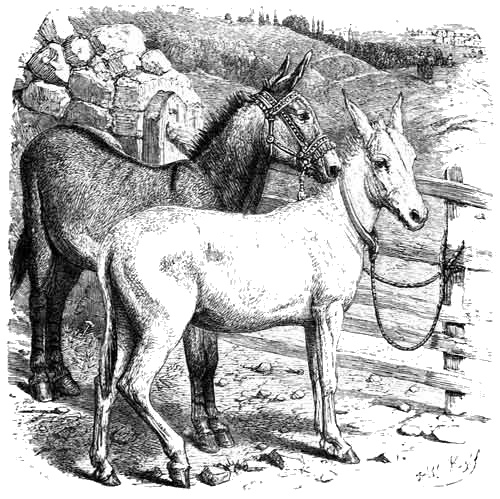
SYRIAN ASSES.
"A bridle for the ass."—Prov. xxvi.
Take even one of our own toil-worn animals, turned out in a
common to graze, and see the ingenuity which it displays when
persecuted by the idle boys who generally frequent such places,
and who try to ride every beast that is within their reach. It
seems to divine at once the object of the boy as he steals up to
it, and he takes a pleasure in baffling him just as he fancies that
he has succeeded in his attempt.
Should the Ass be kindly treated, there is not an animal that
proves more docile, or even affectionate. Stripes and kicks it
resents, and sets itself distinctly against them; and, being nothing
but a slave, it follows the slavish principle of doing no work that
it can possibly avoid.
Now, in the East the Ass takes so much higher rank than
our own animal, that its whole demeanour and gait are different
from those displayed by the generality of its brethren in England.
"Why, the very slave of slaves," writes Mr. Lowth, in his "Wanderer
in Arabia," "the crushed and grief-stricken, is so no more
in Egypt: the battered drudge has become the willing servant.
Is that active little fellow, who, with race-horse coat and full
flanks, moves under his rider with the light step and the action
of a pony—is he the same animal as that starved and head-bowed
object of the North, subject for all pity and cruelty, and
clothed with rags and insult?
"Look at him now. On he goes, rapid and free, with his
small head well up, and as gay as a crimson saddle and a bridle
of light chains and red leather can make him. It was a gladdening
sight to see the unfortunate as a new animal in Egypt."
Hardy animal as is the Ass, it is not well adapted for tolerance
of cold, and seems to degenerate in size, strength, speed, and
spirit in proportion as the climate becomes colder. Whether it
might equal the horse in its endurance of cold provided that it
were as carefully treated, is perhaps a doubtful point; but it is
a well-known fact that the horse does not necessarily degenerate
by moving towards a colder climate, though the Ass has always
been found to do so.
There is, of course, a variety in the treatment which the Ass
receives even in the East. Signor Pierotti, whose work on the
customs and traditions of Palestine has already been mentioned,
writes in very glowing terms of the animal. He states that he
formed a very high opinion of the Ass while he was in Egypt,
not only from its spirited aspect and its speed, but because it
was employed even by the Viceroy and the great Court officers,
who may be said to use Asses of more or less intelligence for
every occasion. He even goes so far as to say that, if all the
Asses were taken away from Egypt, not a man would be left.
The same traveller gives an admirable summary of the character
of the Ass, as it exists in Egypt and Palestine. "What,
then, are the characteristics of the ass? Much the same as those
which adorn it in other parts of the East—namely, it is useful for
riding and for carrying burdens; it is sensible of kindness, and
shows gratitude; it is very steady, and is larger, stronger, and
more tractable than its European congener; its pace is easy
and pleasant; and it will shrink from no labour, if only its poor
daily feed of straw and barley is fairly given.
"If well and liberally supplied, it is capable of any enterprise,
and wears an altered and dignified mien, apparently forgetful of
its extraction, except when undeservedly beaten by its masters,
who, however, are not so much to be blamed, because, having
learned to live among sticks, thongs, and rods, they follow the
same system of education with their miserable dependants.
"The wealthy feed him well, deck him with fine harness and
silver trappings, and cover him, when his work is done, with
rich Persian carpets. The poor do the best they can for him,
steal for his benefit, give him a corner at their fireside, and in
cold weather sleep with him for more warmth. In Palestine, all
the rich men, whether monarchs or chiefs of villages, possess
a number of asses, keeping them with their flocks, like the
patriarchs of old. No one can travel in that country, and observe
how the ass is employed for all purposes, without being struck
with the exactness with which the Arabs retain the Hebrew
customs."
The result of this treatment is, that the Eastern Ass is an
enduring and tolerably swift animal, vying with the camel itself
in its powers of long-continued travel, its usual pace being a
sort of easy canter. On rough ground, or up an ascent, it is said
even to gain on the horse, probably because its little sharp hoofs
give it a firm footing where the larger hoof of the horse is liable
to slip.
The familiar term "saddling the Ass" requires some little
explanation.
The saddle is not in the least like the article which we know
by that name, but is very large and complicated in structure.
Over the animal's back is first spread a cloth, made of thick
woollen stuff, and folded several times. The saddle itself is a
very thick pad of straw, covered with carpet, and flat at the top,
instead of being rounded as is the case with our saddles. The
pommel is very high, and when the rider is seated on it, he is
perched high above the back of the animal. Over the saddle is
thrown a cloth or carpet, always of bright colours, and varying
in costliness of material and ornament according to the wealth
of the possessor. It is mostly edged with a fringe and tassels.
The bridle is decorated, like that of the horse, with bells,
embroidery, tassels, shells, and other ornaments. An example
of the headstall worn by an Ass belonging to a wealthy man
may be seen in the illustration.
As we may see from 2 Kings iv. 24, the Ass was generally
guided by a driver who ran behind it, just as is the custom with
the hired Asses in this country. Owing to the unchanging
character of the East, there is no doubt that the "riders on
asses" of the Scriptures rode exactly after the mode which is
adopted at the present day. What that mode is, we may learn
from Mr. Bayard Taylor's amusing and vivid description of a
ride through the streets of Cairo:—
"To see Cairo thoroughly, one must first accustom himself to
the ways of these long-eared cabs, without the use of which I
would advise no one to trust himself in the bazaars. Donkey-riding
is universal, and no one thinks of going beyond the Frank
quarters on foot. If he does, he must submit to be followed by
not less than six donkeys with their drivers. A friend of mine
who was attended by such a cavalcade for two hours, was obliged
to yield at last, and made no second attempt. When we first
appeared in the gateway of an hotel, equipped for an excursion,
the rush of men and animals was so great that we were forced
to retreat until our servant and the porter whipped us a path
through the yelling and braying mob. After one or two trials
I found an intelligent Arab boy named Kish, who for five
piastres a day furnished strong and ambitious donkeys, which
he kept ready at the door from morning till night. The other
drivers respected Kish's privilege, and henceforth I had no
trouble.
"The donkeys are so small that my feet nearly touched the
ground, but there is no end to their strength and endurance.
Their gait, whether in pace or in gallop, is so easy and light
that fatigue is impossible. The drivers take great pride in
having high-cushioned red saddles, and in hanging bits of
jingling brass to the bridles. They keep their donkeys close
shorn, and frequently beautify them by painting them various
colours. The first animal I rode had legs barred like a zebra's,
and my friend's rejoiced in purple flanks and a yellow belly. The
drivers ran behind them with a short stick, punching them from
time to time, or giving them a sharp pinch on the rump. Very
few of them own their donkeys, and I understood their pertinacity
when I learned that they frequently received a beating
on returning home empty-handed.
"The passage of the bazaars seems at first quite as hazardous
on donkey-back as on foot; but it is the difference between
knocking somebody down and being knocked down yourself,
and one certainly prefers the former alternative. There is no
use in attempting to guide the donkey, for he won't be guided.
The driver shouts behind, and you are dashed at full speed into
a confusion of other donkeys, camels, horses, carts, water-carriers,
and footmen. In vain you cry out 'Bess' (enough), 'Piacco,'
and other desperate adjurations; the driver's only reply is: 'Let
the bridle hang loose!' You dodge your head under a camel-load
of planks; your leg brushes the wheel of a dust-cart; you strike
a fat Turk plump in the back; you miraculously escape upsetting
a fruit-stand; you scatter a company of spectral, white-masked
women; and at last reach some more quiet street, with
the sensations of a man who has stormed a battery.
"At first this sort of riding made me very nervous, but presently
I let the donkey go his own way, and took a curious
interest in seeing how near a chance I ran of striking or being
struck. Sometimes there seemed no hope of avoiding a violent
collision; but, by a series of the most remarkable dodges, he
generally carried you through in safety. The cries of the driver
running behind gave me no little amusement. 'The hawadji
comes! Take care on the right hand! Take care on the left
hand! O man, take care! O maiden, take care! O boy, get out of
the way! The hawadji comes!' Kish had strong lungs, and his
donkey would let nothing pass him; and so wherever we went we
contributed our full share to the universal noise and confusion."
This description explains several allusions which are made
in the Scriptures to treading down the enemies in the streets,
and to the chariots raging and jostling against each other in
the ways.
The Ass was used in the olden time for carrying burdens, as
it is at present, and, in all probability, carried them in the same
way. Sacks and bundles are tied firmly to the pack-saddle; but
poles, planks, and objects of similar shape are tied in a sloping
direction on the side of the saddle, the longer ends trailing on
the ground, and the shorter projecting at either side of the
animal's head. The North American Indians carry the poles of
their huts, or wigwams, in precisely the same way, tying them
on either side of their horses, and making them into rude sledges,
upon which are fastened the skins that form the walls of their
huts. The same system of carriage is also found among the
Esquimaux, and the hunters of the extreme North, who harness
their dogs in precisely the same manner. The Ass, thus laden,
becomes a very unpleasant passenger through the narrow and
crowded streets of an Oriental city; and many an unwary traveller
has found reason to remember the description of Issachar
as the strong Ass between two burdens.
The Ass was also used for agriculture, and was employed in
the plough, as we find from many passages. See for example,
"Blessed are ye that sow beside all waters, that send forth thither
the feet of the ox and the ass" (Isa. xxxii. 20). Sowing beside
the waters is a custom that still prevails in all hot countries,
the margins of rivers being tilled, while outside this cultivated
belt there is nothing but desert ground.
The ox and the Ass were used in the first place for irrigation,
turning the machines by which water was lifted from the river,
and poured into the trenches which conveyed it to all parts of
the tilled land. If, as is nearly certain, the rude machinery of
the East is at the present day identical with those which were
used in the old Scriptural times, they were yoked to the machine
in rather an ingenious manner. The machine consists of an
upright pivot, and to it is attached the horizontal pole to which
the ox or Ass is harnessed. A machine exactly similar in principle
may be seen in almost any brick-field in England; but the
ingenious part of the Eastern water-machine is the mode in
which the animal is made to believe that it is being driven by
its keeper, whereas the man in question might be at a distance,
or fast asleep.
The animal is first blindfolded, and then yoked to the end of the
horizontal bar. Fixed to the pivot, and rather in front of the bar,
is one end of a slight and elastic strip of wood. The projecting
end, being drawn forward and tied to the bridle of the animal,
keeps up a continual pull, and makes the blinded animal believe
that it is being drawn forward by the hand of a driver. Some
ingenious but lazy attendants have even invented a sort of self-acting
whip, i.e. a stick which is lifted and allowed to fall
on the animal's back by the action of the wheel once every
round.
The field being properly supplied with water, the Ass is used
for ploughing it. It is worthy of mention that at the present
day the prohibition against yoking an ox and an Ass together is
often disregarded. The practice, however, is not a judicious one,
as the slow and heavy ox does not act well with the lighter and
more active animal, and, moreover, is apt to butt at its companion
with its horns in order to stimulate it to do more than its
fair proportion of the work.
That the Ass was put to a similar use in turning the large
millstones may be seen from Matt. xviii. 6. In the Authorized
Version, the passage is rendered thus: "But whoso shall offend
one of these little ones which believe in Me, it were better for
him that a millstone were hanged about his neck, and that he
were drowned in the depth of the sea."
Now if we turn to the Greek Testament we find that the
passage reads rather differently, a force being giving to it which
it does not possess in the translation: "But whosoever shall
scandalize [i.e. be a stumbling-block to] one of these little ones
that believe in Me, it were better for him that an ass's millstone
were hung about his neck, and he were sunk in the depth of the
sea." The chief force of this saying lies in the word which is
omitted in our translation. Our Lord specially selected the
Ass's millstone on account of its size and weight, in contradistinction
to the ordinary millstone, which was turned backwards
and forwards by the hands of women.
There is a custom now in Palestine which probably existed
in the days of the Scriptures, though I have not been able to find
any reference to it. Whenever an Ass is disobedient and strays
from its master, the man who captures the trespasser on his
grounds clips a piece out of its ear before he returns it to its
owner. Each time that the animal is caught on forbidden
grounds it receives a fresh clip of the ear. By looking at
the ears of an Ass, therefore, any one can tell whether it has
ever been a straggler; and if so, he knows the number of times
that it has strayed, by merely counting the clip-marks, which
always begin at the tip of the ear, and extend along the edges.
Any Ass, no matter how handsome it may be, that has many of
those clips, is always rejected by experienced travellers, as it is
sure to be a dull as well as a disobedient beast.
Signor Pierotti remarks that if the owners of the Asses were
treated similarly for similar offences, the greater number would
be marked as soon as they begin to walk, and of the adults there
would be scarcely one who had any ear on his head.
The Ass being so universally useful, we need not be surprised
at the prominence which it takes in the Scriptural narrative, and
the frequency with which its name occurs. The wealthy personages
of the olden time seemed to have esteemed the Ass as
highly as the camel, the ox, the sheep, or the goat. Abraham,
for example, is described as being a rich man, and possessing
"sheep, and oxen, and he-asses, and men-servants, and maid-servants,
and she-asses, and camels" (Gen. xii. 16). In a succeeding
chapter (xxx. 43) the prosperity of Jacob is mentioned in
almost exactly the same terms.
So, before Job's trials came upon him, "his substance was
seven thousand sheep, and three thousand camels, and five
hundred yoke of oxen [i.e. 1,000], and five hundred she-asses,
and a very great household; so that this man was the greatest
of all the men of the east" (Job i. 3). And after his trials, when
his wealth was restored to him twofold, the thousand she-asses
are mentioned as prominently as the thousand yoke of oxen.
That the care of the Asses was an honourable post we learn
from several passages. Take for example Gen. xxxvi. 24: "And
these are the children of Zibeon; both Ajah, and Anah: this
was that Anah that found the mules in the wilderness, as he fed
the asses of Zibeon his father." The charge of the Asses
was, as the reader must see, a post of sufficient honour and importance
to be trusted to the son of the owner. A similar case
is recorded in the well-known instance of Saul, whose father
had lost his herd of Asses, and who at once sent his son upon
the important mission of recovering them. And it was during
the fulfilment of this mission that he was anointed the first
king of Israel.
Later in the sacred history we find that when David consolidated
his power, and organized the affairs of his new kingdom,
he divided the people in general, the army, the land, the produce,
and the cattle, into departments, and appointed over each
department some eminent man whose name is carefully given.
After mentioning that the people and the army were divided
into "courses," and that certain officers were set over each
course, the sacred historian proceeds to state that one officer
was appointed as overseer of the treasury, another of the
granaries, another of the field-labourers, another over the vineyards,
and so forth. He then mentions that even the cattle
were divided into their several departments, the care of the
hill-cattle being given to one man, and of the cattle of the
plain to another, of the camels to a third, and of the Asses to
a fourth.
It is scarcely necessary to mention that the flesh of the Ass
was forbidden to the Jews, because the animal neither chewed
the cud nor divided the hoof. How repulsive to them must
have been the flesh of the Ass we may infer from the terrible
description of the siege of Samaria by Benhadad. The sacred
historian describes with painful fidelity the horrors of the
siege, and of the dreadful extremity to which the people were
reduced. No circumstance could be more terrible than the
quarrel between the two mothers, who had mutually agreed to
kill and eat their children, and yet on a par with that dreadful
statement is mentioned the fact that even the flesh of the
Ass was eaten, and that an Ass's head cost eighty pieces of
silver.
Whether the milk of the she Ass were used or not is rather
a doubtful point, but, in all probability, the milk was considered
as lawful food, though the flesh might not be eaten.
As to the legends respecting the Ass, they are innumerable,
and I shall only mention one or two of them.
The first is an old Rabbinical legend respecting the Flood and
the admission of the creatures into the ark. It appears that no
being could enter the ark unless specially invited to do so by
Noah. Now when the Flood came, and overwhelmed the world,
the devil, who was at that time wandering upon the earth, saw
that he was about to be cut off from contact from mankind, and
that his dominion would be for ever gone. The ark being at
last completed, and the beasts called to enter it in their proper
order, the turn of the Ass came in due course.
Unfortunately for the welfare of mankind, the Ass was taken
with a fit of obstinacy, and refused to enter the vessel according
to orders. After wasting much time over the obstinate animal,
Noah at last lost patience, and struck the Ass sharply, crying at
the same time to it, "Enter, thou devil!" Of course the invitation
was at once accepted, the devil entered the ark, and on the
subsiding of the water issued out to take his place in the newly
begun world.
Since the Christian era, many curious legends have sprung
up respecting the Ass. One of the most familiar of these
legends refers to the black stripe along the spine and the cross-bar
over the shoulder. This black cross is really believed by
many persons to have been given to the animal in consequence
of its connexion with our Lord. I need hardly tell the reader
that it is the remnant of the stripes which in the zebra cover
the animal from head to foot, which in the quagga cover the
head, body, and part of the limbs, and which in one species of
Wild Ass are not seen at all in the adult animal.
There is another Christian legend respecting the Ass of Palestine,
which is thought to owe its superiority in size, swiftness,
and strength to the fact that it helped to warm the infant Saviour
in the manger, that it carried Him and His mother into Egypt
and back again, and that it was used by the Lord himself and
His disciples. Any one who ventures to hint that the Ass of
Palestine owes its superiority over its European brother to the
warmer climate, is thought to be a heretic by the pious but
ignorant men who believe and disseminate such legends.
Signor Pierotti tells a story of a certain Russian monk who
happened to visit Palestine, and in the course of his travels
found the leg-bone of an Ass, which he took back with him and
publicly exhibited as part of the identical animal on which the
Virgin Mary and infant Saviour rode. (I need scarcely mention
that there is no mention in the Scriptures of the fact that the
Holy Family rode upon an Ass; though such a mode of travel
was certainly the one which they would adopt.) For some
time, this deception drew for the impostor many gifts from the
superstitious but pious people, but the affair at last reached
the ears of his superiors, and he paid the deserved penalty of
his trickery.
There are recorded in the Scriptures two remarkable circumstances
connected with the Ass, which, however, need but a few
words. The first is the journey of Balaam from Pethor to Moab,
in the course of which there occurred that singular incident of
the Ass speaking in human language (see Numb. xxii. 21, 35).
The second is the well-known episode in the story of Samson,
where he is recorded as breaking the cords with which his
enemies had bound him, and killing a thousand Philistines with
the fresh jaw-bone of an Ass.
The Arod and Pere of Scripture—Various allusions to the Wild Ass—Its swiftness
and wildness—The Wild Ass of Asia and Africa—Knowledge of the animal
displayed by the sacred writers—How the Wild Ass is hunted—Excellence of
its flesh—Sir R. K. Porter's meeting with a Wild Ass—Origin of the domestic
Ass—The Wild Asses of Quito.
There are several passages of Scripture in which the Wild Ass
is distinguished from the domesticated animal, and in all of
them there is some reference made to its swiftness, its intractable
nature, and love of freedom.
In the Hebrew Scriptures there are two words which are
given in the Authorized Translation as Wild Ass, namely, Arod
and Pere, and it is rather remarkable that both words occur in
the same passage. If the reader will refer to Job xxxix. 5,
he will see the following passage: "Who hath sent out the wild
ass (Pere) free? or who hath loosed the bands of the wild ass
(Arod)?" Now there are only two places in the whole Hebrew
Scriptures in which the word Arod occurs, and there are many
doubts whether the word Arod is rightly translated. The first
is that which has just been quoted, and the second occurs in
Dan. v. 21: "And he was driven from the sons of men; and
his heart was made like the beasts, and his dwelling was with
the wild asses."
The Jewish Bible translates the word differently in the two
passages. That in Job it renders as follows: "Who hath sent
forth the wild ass free? or who hath loosed the bands of the
untamed?" In the other passage, however, it follows the
rendering of the Authorized Version, and gives the word as
"wild asses." It is thought by several scholars that the two
words refer to two different species of Wild Ass. It may be so,
but as the ancient writers had the loosest possible ideas regarding
distinction of species, and as, moreover, it is very doubtful
whether there be any real distinction of species at all, we may
allow the subject to rest, merely remembering that the rendering
of the Jewish Bible, "the untamed," is a correct translation
of the word Arod, though the particular animal to which it is
applied may be doubtful.
We will now pass to the word about which there is no doubt
whatever, namely, the Pere. This animal is clearly the species
which is scientifically known as Asinus hemippus. During the
summer time it has a distinct reddish tinge on the grey coat,
which disappears in the winter, and the cross-streak is black.
There are several kinds of Wild Ass known to science, all of
which have different names. Some of our best zoologists, however,
have come to the conclusion that they all really belong to
the same species, differing only in slight points of structure
which are insufficient to constitute separate species.
The habits of the Wild Ass are the same, whether it be the
Asiatic or the African animal, and a description of one will
answer equally well for the other. It is an astonishingly swift
animal, so that on the level ground even the best horse has
scarcely a chance of overtaking it. It is exceedingly wary, its
sight, hearing, and sense of scent being equally keen, so that to
approach it by craft is a most difficult task.
Like many other wild animals, it has a custom of ascending
hills or rising grounds, and thence surveying the country, and
even in the plains it will generally contrive to discover some
earth-mound or heap of sand from which it may act as sentinel
and give the alarm in case of danger. It is a gregarious animal,
always assembling in herds, varying from two or three to several
hundred in number, and has a habit of partial migration in
search of green food, traversing large tracts of country in its
passage.
It has a curiously intractable disposition, and, even when
captured very young, can scarcely ever be brought to bear a
burden or draw a vehicle. Attempts have been often made to
domesticate the young that have been born in captivity, but
with very slight success, the wild nature of the animal constantly
breaking out, even when it appears to have become
moderately tractable.
Although the Wild Ass does not seem to have lived within the
limits of the Holy Land, it was common enough in the surrounding
country, and, from the frequent references made to it in
Scriptures, was well known to the ancient Jews. We will now
look at the various passages in which the Wild Ass is mentioned,
and begin with the splendid description in Job xxxix.
5-8:
"Who hath sent out the wild ass free? or who hath loosed
the bands of the wild ass?
"Whose house I have made the wilderness, and the barren
lands (or salt places) his dwellings.
"He scorneth the multitude of the city, neither regardeth he
the crying of the driver.
"The range of the mountains is his pasture, and he searcheth
after every green thing."
Here we have the animal described with the minuteness and
truth of detail that can only be found in personal knowledge;
its love of freedom, its avoidance of mankind, and its migration
in search of pasture. Another allusion to the pasture-seeking
habits of the animal is to be found in chapter vi. of the same
book, verse 5: "Doth the wild ass bray when he hath grass?" or,
according to the version of the Jewish Bible, "over tender
grass?"
The same author has several other allusions to the Wild Ass.
See, for example, chap. xi. 12: "For vain man would be wise,
though man be born like a wild ass's colt." And in chap. xxiv. 5,
in speaking of the wicked and their doings, he uses the following
metaphor: "Behold, as wild asses in the desert, go they
forth to their work; rising betimes for a prey: the wilderness
yieldeth food for them and their children," or for the young,
as the passage may be more literally rendered. The same
migratory habit is also mentioned by the prophet Jeremiah
(chap. xiv. 6): "And the wild asses did stand in the high places,
they snuffed up the wind like dragons; their eyes did fail,
because there was no grass." There is another allusion to it in
Hosea viii. 9: "For they are gone up to Assyria, a wild ass
alone by himself."
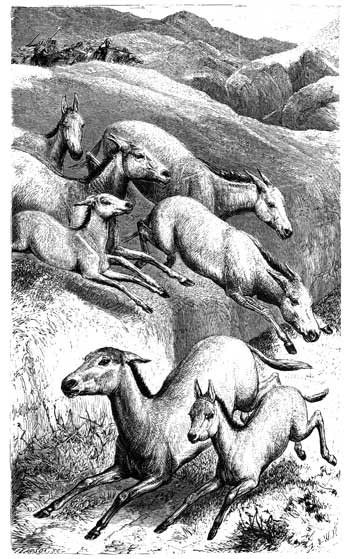
THE WILD ASS.
"As wild asses in the desert go they forth."—Job xxiv. 5.
Even in the earliest times of Jewish history we find a reference
to the peculiar nature of this animal. In Gen. xvi. 12
it is prophesied of Ishmael, that "he will be a wild man;
his hand will be against every man, and every man's hand
against him; and he shall dwell in the presence of all his
brethren." Now the real force of this passage is quite missed
in the Authorized Version, the correct rendering being given in
the Jewish Bible: "And he will be a wild ass (Pere) among
men; his hand will be against all, and the hand of all against
him, and in the face of all his brethren he shall dwell."
Allusion is made to the speed of the animal in Jer. ii. 24:
"A wild ass used to the wilderness, that snuffeth up the wind
at her pleasure; in her occasion who can turn her away? all
they that seek her will not weary themselves; in her month
they shall find her." The fondness of the Wild Ass for the
desert is mentioned by the prophet Isaiah. Foretelling the desolation
that was to come upon the land, he uses these words:
"Because the palaces shall be forsaken, the multitude of the
city shall be left; the forts and towers shall be for dens (or
caves) for ever, and a joy of wild asses, a pasture of flocks."
These various qualities of speed, wariness, and dread of man
cause the animal to be exceedingly prized by hunters, who find
their utmost skill taxed in approaching it. Men of the highest
rank give whole days to the hunt of the Wild Ass, and vie with
each other for the honour of inflicting the first wound on so
fleet an animal. With the exception of the Jews, the inhabitants
of the countries where the Wild Ass lives eat its flesh,
and consider it as the greatest dainty which can be found.
A very vivid account of the appearance of the animal in its
wild state is given by Sir R. Kerr Porter, who was allowed by
a Wild Ass to approach within a moderate distance, the animal
evidently seeing that he was not one of the people to whom it
was accustomed, and being curious enough to allow the stranger
to approach him.
"The sun was just rising over the summit of the eastern
mountains, when my greyhound started off in pursuit of an
animal which, my Persians said, from the glimpse they had of
it, was an antelope. I instantly put spurs to my horse, and
with my attendants gave chase. After an unrelaxed gallop of
three miles, we came up with the dog, who was then within a
short stretch of the creature he pursued; and to my surprise,
and at first vexation, I saw it to be an ass.
"Upon reflection, however, judging from its fleetness that it
must be a wild one, a creature little known in Europe, but which
the Persians prize above all other animals as an object of chase,
I determined to approach as near to it as the very swift Arab I
was on could carry me. But the single instant of checking my
horse to consider had given our game such a head of us that,
notwithstanding our speed, we could not recover our ground
on him.
"I, however, happened to be considerably before my companions,
when, at a certain distance, the animal in its turn made
a pause, and allowed me to approach within pistol-shot of him.
He then darted off again with the quickness of thought, capering,
kicking, and sporting in his flight, as if he were not blown in
the least, and the chase was his pastime. When my followers
of the country came up, they regretted that I had not shot the
creature when he was within my aim, telling me that his flesh
is one of the greatest delicacies in Persia.
"The prodigious swiftness and the peculiar manner in which
he fled across the plain coincided exactly with the description
that Xenophon gives of the same animal in Arabia. But above
all, it reminded me of the striking portrait drawn by the author
of the Book of Job. I was informed by the Mehnander, who
had been in the desert when making a pilgrimage to the shrine
of Ali, that the wild ass of Irak Arabi differs in nothing from
the one I had just seen. He had observed them often for a
short time in the possession of the Arabs, who told him the
creature was perfectly untameable.
"A few days after this discussion, we saw another of these
animals, and, pursuing it determinately, had the good fortune
to kill it."
It has been suggested by many zoologists that the Wild Ass
is the progenitor of the domesticated species. The origin of the
domesticated animal, however, is so very ancient, that we have
no data whereon even a theory can be built. It is true that the
Wild and the Domesticated Ass are exactly similar in appearance,
and that an Asinus hemippus, or Wild Ass, looks so like an
Asiatic Asinus vulgaris, or Domesticated Ass, that by the eye
alone the two are hardly distinguishable from each other. But
with their appearance the resemblance ends, the domestic animal
being quiet, docile, and fond of man, while the wild animal is
savage, intractable, and has an invincible repugnance to human
beings.
This diversity of spirit in similar forms is very curious, and
is strongly exemplified by the semi-wild Asses of Quito. They
are the descendants of the animals that were imported by the
Spaniards, and live in herds, just as do the horses. They combine
the habits of the Wild Ass with the disposition of the tame
animal. They are as swift of foot as the Wild Ass of Syria or
Africa, and have the same habit of frequenting lofty situations,
leaping about among rocks and ravines, which seem only fitted
for the wild goat, and into which no horse can follow them.
Nominally, they are private property, but practically they
may be taken by any one who chooses to capture them. The
lasso is employed for the purpose, and when the animals are
caught they bite, and kick, and plunge, and behave exactly like
their wild relations of the Old World, giving their captors infinite
trouble in avoiding the teeth and hoofs which they wield so
skilfully. But, as soon as a load has once been bound on the
back of one of these furious creatures, the wild spirit dies
out of it, the head droops, the gait becomes steady, and the
animal behaves as if it had led a domesticated life all its days.
Ancient use of the Mules—Various breeds of Mule—Supposed date of its introduction
into Palestine—Mule-breeding forbidden to the Jews—The Mule as
a saddle-animal—Its use on occasions of state—The king's Mule—Mules
brought from Babylon after the captivity—Obstinacy of the Mule—The Mule
as a beast of burden—The "Mule's burden" of earth—Mules imported by the
Phœnicians—Legends respecting the Mule.
There are several references to the Mule in the Holy Scriptures,
but it is remarkable that the animal is not mentioned at
all until the time of David, and that in the New Testament the
name does not occur at all.
The origin of the Mule is unknown, but that the mixed breed
between the horse and the ass has been employed in many
countries from very ancient times is a familiar fact. It is a very
strange circumstance that the offspring of these two animals
should be, for some purposes, far superior to either of the
parents, a well-bred Mule having the lightness, surefootedness,
and hardy endurance of the ass, together with the increased size
and muscular development of the horse. Thus it is peculiarly
adapted either for the saddle or for the conveyance of burdens
over a rough or desert country.
The Mules that are most generally serviceable are bred from
the male ass and the mare, those which have the horse as the
father and the ass as the mother being small, and comparatively
valueless. At the present day, Mules are largely employed in
Spain and the Spanish dependencies, and there are some breeds
which are of very great size and singular beauty, those of
Andalusia being especially celebrated. In the Andes, the Mule
has actually superseded the llama as a beast of burden.
Its appearance in the sacred narrative is quite sudden. In
Gen. xxxvi. 24, there is a passage which seems as if it referred
to the Mule: "This was that Anah that found the mules in the
wilderness." Now the word which is here rendered as Mules is
"Yemim," a word which is not found elsewhere in the Hebrew
Scriptures. The best Hebraists are agreed that, whatever interpretation
may be put upon the word, it cannot possibly have
the signification that is here assigned to it. Some translate
the word as "hot springs," while the editors of the Jewish Bible
prefer to leave it untranslated, thus signifying that they are not
satisfied with any rendering.
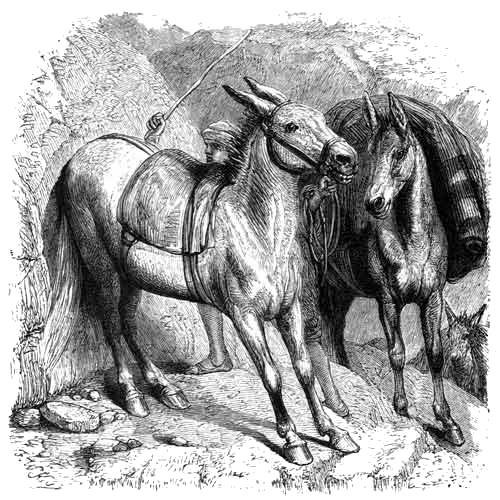
MULES OF THE EAST.
"Be ye not as the horse and mule, which have no under standing."—Psalm xxxii. 9.
The word which is properly translated as Mule is "Pered;"
and the first place where it occurs is 2 Sam. xiii. 29. Absalom
had taken advantage of a sheep-shearing feast to kill his brother
Amnon in revenge for the insult offered to Tamar: "And the
servants of Absalom did unto Amnon as Absalom had commanded.
Then all the king's sons arose, and every man gat him
up upon his mule, and fled." It is evident from this passage
that the Mule must have been in use for a considerable time,
as the sacred writer mentions, as a matter of course, that the
king's sons had each his own riding mule.
Farther on, chap. xviii. 9 records the event which led to
the death of Absalom by the hand of Joab. "And Absalom
met the servants of David. And Absalom rode upon a mule,
and the mule went under the thick boughs of a great oak, and
his head caught hold of the oak, and he was taken up between
the heaven and the earth; and the mule that was under him
went away."
We see by these passages that the Mule was held in such
high estimation that it was used by the royal princes for the
saddle, and had indeed superseded the ass. In another passage
we shall find that the Mule was ridden by the king himself
when he travelled in state, and that to ride upon the king's
Mule was considered as equivalent to sitting upon the king's
throne. See, for example, 1 Kings i. in which there are several
passages illustrative of this curious fact. See first, ver. 33, in
which David gives to Zadok the priest, Nathan the prophet,
and Benaiah the captain of the hosts, instructions for bringing
his son Solomon to Gihon, and anointing him king in the stead
of his father: "Take with you the servants of your lord, and
cause Solomon my son to ride upon mine own mule, and bring
him down to Gihon."
Then, in ver. 38, we are told that David's orders were obeyed,
that Solomon was set on the king's Mule, was anointed by
Zadok, and proclaimed as king to the people. In ver. 44 we
are told how Adonijah, who had attempted to usurp the throne,
and was at the very time holding a coronation feast, heard the
sound of the trumpets and the shouting in honour of Solomon,
and on inquiring was told that Solomon had been crowned king
by Zadok, recognised by Nathan, accepted by Benaiah, and had
ridden on the king's Mule. These tidings alarmed him, and
caused him to flee for protection to the altar. Now it is very
remarkable that in each of these three passages the fact that
Solomon rode upon the king's Mule is brought prominently
forward, and it was adduced to Adonijah as a proof that Solomon
had been made the new king of Israel.
That the Mule should have become so important an animal
seems most remarkable. In Levit. xix. 19 there is an express
injunction against the breeding of Mules, and it is unlikely,
therefore, that they were bred in Palestine. But, although the
Jews were forbidden to breed Mules, they evidently thought
that the prohibition did not extend to the use of these animals,
and from the time of David we find that they were very largely
employed both for the saddle and as beasts of burden. In all
probability, the Mules were imported from Egypt and other
countries, and that such importation was one of the means for
furnishing Palestine with these animals we learn from 1 Kings
x. 24, 25, in which the sacred writer enumerates the various
tribute which was paid to Solomon: "All the earth sought to
Solomon, to hear the wisdom which God had put in his heart.
"And they brought every man his present, vessels of silver,
and vessels of gold, and garments, and armour, and spices,
horses, and mules, a rate year by year." The same fact is recorded
in 2 Chron. ix. 24.
In the time of Isaiah the Mule was evidently in common use
as a riding animal for persons of distinction. See chap. lxvi. 20:
"And they shall bring all your brethren for an offering unto the
Lord, out of all nations, upon horses, and in chariots, and in
litters, and upon mules, and upon swift beasts, to My holy
mountain Jerusalem." Another allusion to the Mule as one of
the recognised domesticated animals is found in Zech. xiv. 15:
"So shall be the plague of the horse, of the mule, of the camel,
and of the ass, and of all the beasts that shall be in these tents,
as this plague."
The value of these animals may be inferred from the anxiety
of Ahab to preserve his Mules during the long drought that had
destroyed all the pasturage. "Ahab said unto Obadiah, Go into
the land, unto all fountains of water, and unto all brooks: peradventure
we may find grass to save the horses and mules alive,
that we lose not all the beasts."
Now this Obadiah was a very great man. He was governor
of the king's palace, an office which has been compared to that
of our Lord High Chamberlain. He possessed such influence
that, although he was known to be a worshipper of Jehovah, and
to have saved a hundred prophets during Jezebel's persecution,
he retained his position, either because no one dared to inform
against him, or because he was too powerful to be attacked. Yet
to Obadiah was assigned the joint office of seeking for pasturage
for the Mules, the king himself sharing the task with his
chamberlain, thus showing the exceeding value which must
have been set on these appanages of royal state.
Their importance may be gathered from a passage in the Book
of Ezra, in which, after enumerating with curious minuteness
the number of the Jews who returned home from their Babylonish
captivity, the sacred chronicler proceeds to remark that
"their horses were seven hundred thirty and six; their mules,
two hundred forty and five; their camels, four hundred thirty
and five; their asses, six thousand seven hundred and twenty"
(Ezra ii. 66, 67). There is a parallel passage in Neh. vii. 68, 69.
Seeing that the Mule was in such constant use as a riding
animal, it is somewhat remarkable that we never find in the
Scripture any mention of the obstinate disposition which is
proverbially associated with the animal. There is only one
passage which can be thought even to bear upon such a subject,
and that is the familiar sentence from Ps. xxxii. 9: "Be ye
not as the horse, or as the mule, which have no understanding:
whose mouth must be held in with bit and bridle, lest they
come near unto thee;" and, as the reader will see, no particular
obstinacy or frowardness is attributed to the Mule which is not
ascribed to the horse also.
Still, that the Mule was as obstinate and contentious an
animal in Palestine as it is in Europe is evident from the fact
that the Eastern mules of the present day are quite as troublesome
as their European brethren. They are very apt to shy at
anything, or nothing at all; they bite fiercely, and every now and
then they indulge in a violent kicking fit, flinging out their
heels with wonderful force and rapidity, and turning round and
round on their fore-feet so quickly that it is hardly possible to
approach them. There is scarcely a traveller in the Holy Land
who has not some story to tell about the Mule and its perverse
disposition; but, as these anecdotes have but very slight bearing
on the subject of the Mule as mentioned in the Scriptures, they
will not be given in these pages.
That the Mule was employed as a beast of burden as well as
for riding, we gather from several passages in the Old Testament.
See, for example, 1 Chron. xii. 40: "Moreover they that
were nigh them, even unto Issachar and Zebulun and Naphtali,
brought bread on asses, and on camels, and on mules, and on
oxen." We have also the well-known passage in which is recorded
the reply of Naaman to Elisha after the latter had cured him of
his leprosy: "And Naaman said, Shall there not then, I pray thee,
be given to thy servant two mules' burden of earth?" It does
not necessarily follow that two of Naaman's Mules were to be
laden with earth, but the probability is, that Naaman used the
term "a Mule's burden" to express a certain quantity, just as
we talk of a "load" of hay or gravel.
As Mules are animals of such value, we may feel some little
surprise that they were employed as beasts of burden. It is
possible, however, that a special and costly breed of large and
handsome Mules, like those of Andalusia, were reserved for
the saddle, and that the smaller and less showy animals were
employed in the carriage of burdens.
Before parting entirely with the Mule, it will be well to
examine the only remaining passage in which the animal is
mentioned. It occurs in Ezek. xxvii. 14: "They of the house
of Togarmah traded in thy fairs with horses and horsemen and
mules." The chapter in which this passage occurs is a sustained
lamentation over Tyre, in which the writer first enumerates
the wealth and greatness of the city, and then bewails its downfall.
Beginning with the words, "O Tyrus, thou hast said, I am
of perfect beauty," the prophet proceeds to mention the various
details of its magnificence, the number and beauty of its ships
built with firs from Senir, having oars made of the oaks of
Bashan, masts of the cedars of Lebanon, benches of ivory, sails
of "fine linen with broidered work from Egypt," and coverings
of purple and scarlet from the isles of Elishah. The rowers
were from Zidon and Arvad, while Tyre itself furnished their
pilots or steersmen.
After a passing allusion to the magnificent army of Tyre, the
sacred writer proceeds to mention the extent of the merchandise
that was brought to this queen of ancient seaports: silver and
other metals were from Tarshish, slaves and brass from Meshech,
ivory and ebony from Dedan, jewellery and fine linen from
Syria; wheat, honey, and oil from Judæa; wine and white wool
from Damascus, and so forth. And, among all these riches, are
prominently mentioned the horses and Mules from Togarmah.
Now, it has been settled by the best bibliographers that the
Togarmah of Ezekiel is Armenia, and so we have the fact that
the Phœnicians supplied themselves with Mules and horses by
importing them from Armenia instead of breeding those animals
themselves, just as Palestine imported its horses, and probably
its Mules also, from Egypt.
It is rather remarkable that the Arabs of Palestine very
seldom breed the Mule for themselves, but, like the ancient Jews,
import them from adjacent countries, mostly from the Lebanon
district. Those from Cyprus are, however, much valued, as they
are very strong, diligent, and steady, their pace being nearly
equal to that of the horse. Mules are seldom used for agricultural
purposes, though they are extensively employed for riding
and for carrying burdens, especially over rocky districts.
The Mule is not without its legend. One of the oddest of
these accounts for its obstinacy and its incapacity for breeding.
When the Holy Family was about to travel into Egypt, St.
Joseph chose a Mule to carry them. He was in the act of
saddling the animal, when it kicked him after the fashion of
Mules. Angry with it for such misconduct, St. Joseph substituted
an ass for the Mule, thus giving the former the honour
of conveying the family into Egypt, and laid a curse upon it
that it should never have parents nor descendants of its own
kind, and that it should be so disliked as never to be admitted
into its master's house, as is the case with the horse and other
domesticated animals. This is one of the multitudinous legends
which are told to the crowds of pilgrims who come annually to
see the miraculous kindling of the holy fire, and to visit the
tree on which Judas hanged himself.
The Mosaic prohibition of the pig—Hatred of Swine by Jews and Mahometans—A
strange use of bacon—The prodigal son—Resistance to the persecution of
Antiochus—Swine hated by the early Egyptians—Supposed connexion between
Swine and diseases of the skin—Destruction of the herd of Swine—The
locality of the event discovered—Pigs bred for the monasteries—The jewel of
gold in a Swine's snout—The wild boar of the woods, and the beast of the
reeds—The damage which it does to the vines—General account of the wild
boar of Palestine—Excellence of its flesh.
Many are the animals which are specially mentioned in the
Mosaic law as unfit for food, beside those that come under the
general head of being unclean because they do not divide the
hoof and chew the cud. There is none, however, that excited
such abhorrence as the hog, or that was more utterly detested.
It is utterly impossible for a European, especially one of the
present day, to form even an idea of the utter horror and loathing
with which the hog was regarded by the ancient Jews.
Even at the present day, a zealous Jew or Mahometan looks
upon the hog, or anything that belongs to the hog, with an
abhorrence too deep for words. The older and stricter Jews felt
so deeply on this subject, that they would never even mention
the name of the hog, but always substituted for the objectionable
word the term "the abomination."
Several references are made in the Scriptures to the exceeding
disgust felt by the Jews towards the Swine. The portion of
the Mosaic law on which a Jew would ground his antipathy to
the flesh of Swine is that passage which occurs in Lev. xi. 7:
"And the swine, though he divide the hoof, and be cloven-footed,
yet he cheweth not the cud; he is unclean to you." But
the very same paragraph, of which this passage forms the termination,
treats of other unclean beasts, such as the coney (or
hyrax) and the hare, neither of which animals are held in such
abhorrence as the Swine.
This enactment could not therefore have produced the singular
feeling with which the Swine were regarded by the Jews,
and in all probability the antipathy was of far greater antiquity
than the time of Moses.
How hateful to the Jewish mind was the hog we may infer
from many passages, several of which occur in the Book of
Isaiah. See, for example, lxv. 3, 4: "A people that provoketh
me to anger continually to my face; that sacrificeth in
gardens, and burneth incense upon altars of brick;
"Which remain among the graves, and lodge in the monuments,
which eat swine's flesh, and broth of abominable things
is in their vessels." Here we have the people heaping one
abomination upon another—the sacrifice to idols in the gardens,
the burning of incense upon a forbidden altar and with strange
fire, the living among the tombs, where none but madmen and
evil spirits were supposed to reside, and, as the culminating
point of iniquity, eating Swine's flesh, and drinking the broth
in which it was boiled.
In the next chapter, verse 3, we have another reference to the
Swine. Speaking of the wickedness of the people, and the
uselessness of their sacrifices, the prophet proceeds to say: "He
that killeth an ox is as if he slew a man; he that sacrificeth a
lamb, as if he had cut off a dog's neck; he that offereth an
oblation, as if he offered swine's blood." We see here how the
prophet proceeds from one image to another: the murder of a
man, the offering of a dog instead of a lamb, and the pouring
out of Swine's blood upon the altar instead of wine—the last-mentioned
crime being evidently held as the worst of the three.
Another reference to the Swine occurs in the same chapter,
verse 17: "They that sanctify themselves, and purify themselves
in the gardens behind one tree in the midst, eating swine's
flesh, and the abomination, and the mouse, shall be consumed
together, saith the Lord."
Not only did the Jews refuse to eat the flesh of the hog, but
they held in utter abomination everything that belonged to it,
and would have thought themselves polluted had they been even
touched with a hog's bristle. Even at the present day this feeling
has not diminished, and both by Jews and Mahometans the
hog is held in utter abhorrence.
Some recent travellers have made great use of this feeling.
Signor Pierotti, for example, during his long sojourn in Palestine,
found the flesh of the hog extremely beneficial to him. "How
often has the flesh of this animal supported me, especially during
the earlier part of my stay in Palestine, before I had learned to
like the mutton and the goats' flesh! I give the preference to
this meat because it has often saved me time by rendering a fire
unnecessary, and freed me from importunate, dirty, and unsavoury
guests, who used their hands for spoons, knives, and forks.
"A little piece of bacon laid conspicuously upon the cloth
that served me for a table was always my best friend. Without
this talisman I should never have freed myself from unwelcome
company, at least without breaking all the laws of hospitality
by not inviting the chiefs of my escort or the guides to share my
meal; a thing neither prudent nor safe in the open country.
Therefore, on the contrary, when thus provided I pressed them
with the utmost earnestness to eat with me, but of course never
succeeded in persuading them; and so dined in peace, keeping
on good terms with them, although they did call me behind my
back a 'dog of a Frank' for eating pork.
"Besides, I had then no fear of my stores failing, as I always
took care to carry a stock large enough to supply the real wants
of my party. So a piece of bacon was more service to me than
a revolver, a rifle, or a sword; and I recommend all travellers in
Palestine to carry bacon rather than arms, for the latter are often
stolen, the former is never."
Such being the feelings of the Jews, we may conceive the
abject degradation to which the Prodigal Son of the parable
must have descended, when he was compelled to become a
swine-herd for a living, and would have been glad even to have
eaten the very husks on which the Swine fed. These husks, by
the way, were evidently the pods of the locust-tree, or carob, of
which we shall have more to say in a future page. We have in
our language no words to express the depths of ignominy into
which this young man must have fallen, nor can we conceive
any office which in our estimation would be so degrading as
would be that of swine-herd to a Jew.
How deeply rooted was the abhorrence of the Swine's flesh
we can see from a passage in 2 Maccabees, in which is related a
series of insults offered to the religion of the Jews. The temple
at Jerusalem was to be called the Temple of Jupiter Olympus,
and that on Gerizim was to be dedicated to Jupiter, the defender
of strangers. The altars were defiled by forbidden things, and the
celebration of the Sabbath, or of any Jewish ceremony, was
punishable with death.
Severe as were all these afflictions, there was one which the
Jews seem, from the stress laid upon it, to have felt more keenly
than any other. This was the compulsory eating of Swine's
flesh, an act which was so abhorrent to the Jews that in
attempting to enforce it, Antiochus found that he was foiled by
the passive resistance offered to him. The Jews had allowed
their temples to be dedicated to the worship of heathen deities,
they had submitted to the deprivation of their sacred rites, they
had even consented to walk in procession on the Feast of
Bacchus, carrying ivy like the rest of the worshippers in that
most licentious festival. It might be thought that any people
who submit to such degradation would suffer any similar indignity.
But even their forbearance had reached its limits, and
nothing could induce them to eat the flesh of Swine.
Several examples of the resistance offered by them are recorded
in the book just mentioned. Eleazar, for example, a man
ninety years old, sternly refused to partake of the abominable
food. Some of the officials, in compassion for his great age,
advised him to take lawful meat with him and to exchange it for
the Swine's flesh. This he refused to do, saying that his age
was only a reason for particular care on his part, lest the young
should be led away by his example. His persecutors then
forced the meat into his mouth, but he rejected it, and died
under the lash.
Another example of similar, but far greater heroism, is given
by the same chronicler. A mother and her seven sons were
urged with blows to eat the forbidden food, and refused to do
so. Thinking that the mother would not be able to endure the
sight of her sons' sufferings, the officers took them in succession,
and inflicted a series of horrible tortures upon them, beginning
by cutting off their tongues, hands, and feet, and ending by
roasting them while still alive. Their mother, far from counselling
her sons to yield, even though they were bribed by promises
of wealth and rank, only encouraged them to persevere, and,
when the last of her sons was dead, passed herself through the
same fiery trial.
Even among the ancient Egyptians this repugnance to the
Swine prevailed, though there was a sort of Pariah caste among
them who bred the animal and ate its flesh.
This we learn from Herodotus ("Euterpe," xlvii.):—"The
Egyptians consider the pig to be an impure animal, and if
therefore a man in passing near a pig should but touch it with
his clothes, he goes at once to the river and plunges into it. In
the next place, swine-herds, although they be native Egyptians,
are the only men who are not allowed to enter into any of their
temples, neither will any man give his daughter in marriage to
one of them, nor take a wife from among them, but the swine-herds
only marry among themselves.
"The Egyptians therefore do not think it right to sacrifice
swine to any other deities, but to the moon and Bacchus they
sacrifice them at the same time; that is to say, at the same full
moon, and then they eat the flesh.... This sacrifice of pigs to
the moon is performed in the following manner. When the
sacrificer has killed the victims, he puts the tip of the tail, the
spleen, and the caul together, covers them with the fat found in
the belly of the animal, and then consumes it with fire. The
rest of the flesh they eat during the full moon in which
they offer the sacrifices, but on no other day would any man
ever taste it. The poor among them, through want of money,
make pigs out of dough; and, after baking them, offer them
in sacrifice.
"On the eve of the festival of Bacchus, every one slays a pig
before his door, and then restores it to the swine-herd that sold
it, that he may carry it away. The rest of this festival to
Bacchus, except as regards the pigs, the Egyptians celebrate
much in the same manner as the Greeks do."
It has been conjectured, and with plausibility, that the pig
was prohibited by Moses on account of the unwholesomeness of
its flesh in a hot country, and that its almost universal repudiation
in such lands is a proof of its unfitness for food. In countries
where diseases of the skin are so common, and where the
dreaded leprosy still maintains its hold, the flesh of the pig is
thought, whether rightly or wrongly, to increase the tendency to
such diseases, and on that account alone would be avoided.
It has, however, been shown that the flesh of Swine can be
habitually consumed in hot countries without producing any
evil results; and, moreover, that the prohibition of Moses was
not confined to the Swine, but included many other animals
whose flesh is used without scruple by those very persons who
reject that of the pig.
Knowing the deep hatred of the Jews towards this animal,
we may naturally wonder how we come to hear of herds of
Swine kept in Jewish lands.
Of this custom there is a familiar example in the herd of
Swine that was drowned in the sea (Matt. viii. 28-34). It is
an open question whether those who possessed the Swine were
Jews of lax principles, who disregarded the Law for the sake
of gain, or whether they were Gentiles, who, of course, were not
bound by the Law. The former seems the likelier interpretation,
the destruction of the Swine being a fitting punishment for their
owners. It must be here remarked, that our Lord did not, as is
often said, destroy the Swine, neither did He send the devils into
them, so that the death of these animals cannot be reckoned as
one of the divine miracles. Ejecting the evil spirits from the
maniacs was an exercise of His divine authority; the destruction
of the Swine was a manifestation of diabolical anger, permitted,
but not dictated.
The scene of so remarkable an event is naturally of great
interest, especially as the statements of the Evangelists who
mention it do not precisely agree. This subject is so well treated
by Mr. Tristram in his "Land of Israel," that it must be given
in his own words:—
"The field of the tombs at Gadara presents a vivid illustration
of the circumstances connected with the healing of the
demoniac in the country of the Gadarenes, or Gergesenes. With
one exception, all the concomitant events of the miracle are
exactly illustrated. We have beyond the city the field of tombs,
these tombs suited for the refuge of demoniac outcasts, occupied
as dwellings to the present day. We have a plain suited for the
feeding of swine, with its roots and acorns, and we have a steep
place hard by, of several hundred feet high, κρημνόν. But then,
it does not run down to the sea, but to the little river. This
objection is, I think, fatal to the identification of Um Keis with
the scene of the miracle.
"St. Mark (v. 2) tells us that our Lord was met immediately
on His coming out of the ship. This place is three and a half
hours distant from its shores. It is important also to observe
that St. Matthew (viii. 28) reads not Gadarenes, but Gergesenes,
and St. Luke states that the coast of the Gadarenes was over
against Galilee (viii. 26). I should feel thereupon disposed fully
to endorse the suggestion of Dr. Thomson, that St. Matthew,
writing for those intimately acquainted with the topography of
the country in detail, names the obscure and exact locality,
Gergesa; while SS. Mark and Luke, writing for those at a distance,
simply name the country of Gadara, as being a place of
importance, and the acknowledged capital of the district. This
is borne out by the statement of Josephus ('Bell. Jud.' 1,
viii. 35).
"Dr. Thomson visited, at the mouth of the Wady Semakh,
directly opposite Gennesaret, some ruins called by his guide
Kerza, or Gerza, which he identifies with the Gergesa of St.
Matthew. The discovery is most interesting and important.
I visited the place myself from a boat, and observed the remains
of a valley and a khan; but, unfortunately, I was not aware at
the time of the interest attaching to the place, and did not
ascertain, or at least note down, the name given to it by my
boatmen.
"The statement of Origen exactly bears out the discovery of
Dr. Thomson. After stating that Gadara was not the scene of
the miracle, for these was thence no steep place into the sea, he
states that Gergesa is an ancient city on the shores of the lake,
by which is a steep place which runs down to it. In one
important particular my memory corroborates the statement of
Dr. Thomson, viz. that while there is here no precipice running
sheer to the shore, but a narrow belt of land, the cliff behind is
steep, and the sea so narrow, that a herd of swine, rushing
frantically down, must certainly have been overwhelmed in the
sea before they could recover themselves.
"While the tombs at Gadara are peculiarly interesting and
remarkable, yet the whole region is so perforated everywhere by
rock-chambers of the dead that we may be quite certain that a
home for the demoniac will not be wanting whatever locality be
assigned for the events recorded by the Evangelists."
Although that part of the country is well suited for feeding
Swine, the animals are no longer kept. In the first place, there
is a great want of spirit in matters of commerce; and in the
second, the country is so unsettled that the merchants would
probably be robbed. The woods, moreover, furnish nowadays
but a scanty supply of acorns, and those are eaten by the Arabs
instead of being given to pigs.
These animals are at the present day much neglected, because
the Mahometans and Jews may not eat the flesh, and the
Christians, as a rule, abstain from it, so that they may not hurt
the feelings of their neighbours. Pigs are however reared in the
various monasteries, and by the Arabs attached to them; the
former eating the hog, and the latter only breeding it for sale.
Signor Pierotti states that the pigs become as part of the family,
who live and grow fat together with them. Though, he remarks,
they are not so intelligent as those that listened to St. Anthony
preaching in the Thebaid, they play with the children, understand
the language of their masters, and do not disdain to play
with the fowls, dogs, cats, asses, and horses, and are much more
nimble than their European brethren, although they are smaller
in size and not so spirited.
Although the pig was so detested by the Jews, they were
evidently well acquainted with it. St. Peter, for example, in
his Second Epistle, chap. ii. 22, refers to the habit of wallowing
in the mire, a custom which is common to all the pachydermatous
animals, which, in spite of their thick hide, are very
sensitive to the attacks of flies, and cover themselves with mud
in order to defend themselves against their tiny but dreaded
enemies.
In connexion with the Swine, there is a passage in the
Proverbs which requires a slight comment. It occurs in chap.
xi. 22: "As a jewel (or pendant) of gold in a swine's snout, so is a
fair woman which is without discretion." The sacred writer refers
here to the custom adopted by Oriental women of wearing a ring
in the nostril—a custom which has existed to the present day,
and is familiar to all those who have travelled in the East. The
plan which is generally adopted is that of boring a hole through
the nostril, passing a ring through it, and, when the wound has
healed, hanging various jewels and other ornaments upon the
ring, so as to constitute the "pendant of gold" mentioned in
the proverb.
The image used by our Lord of casting pearls before Swine
needs no explanation.
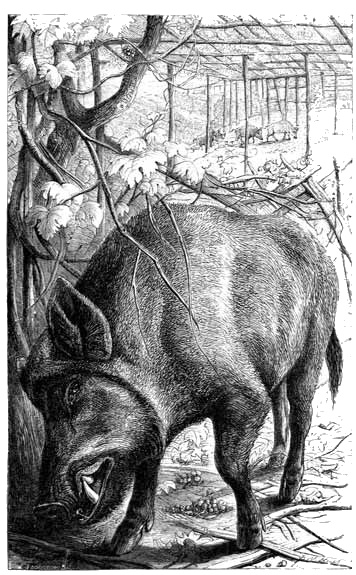
WILD BOAR OF PALESTINE.
"The Boar out of the wood doth waste it."—Ps. lxxx. 13.
We now come to the wild animal. Their is only one passage
in the Scriptures in which the Wild Boar is definitely mentioned,
and another in which a reference is made to it in a
paraphrase.
The former of these is the well-known verse of the Psalms:
"Why hast thou broken down her hedges, so that all they which
pass by the way do pluck her?
"The boar out of the wood doth waste it, and the wild beast
of the field doth devour it" (Ps. lxxx. 12, 13). The second
passage is to be found in Ps. lxviii. 30. In the Authorized
Version it is thus rendered: "Rebuke the company of spearmen,
the multitude of bulls, with the calves of the people." If the
reader will refer to the marginal translation (which, it must be
remarked, is of equal authority with the text), the passage runs
thus: "Rebuke the beasts of the reeds," &c. Now, this is
undoubtedly the correct rendering, and is accepted in the Jewish
Bible.
Having quoted these two passages, we will proceed to the
description and character of the animal.
In the former times, the Wild Boar was necessarily much
more plentiful than is the case in these days, owing to the
greater abundance of woods, many of which have disappeared
by degrees, and others been greatly thinned by the encroachments
of mankind. Woods and reed-beds are always the habitations
of the Wild Boar, which resides in these fastnesses, and
seems always to prefer the reed-bed to the wood, probably
because it can find plenty of mud, in which it wallows after the
fashion of its kind. There is no doubt whatever that the "beast
of the reeds" is simply a poetical phrase for the Wild Boar.
If there should be any cultivated ground in the neighbourhood,
the Boar is sure to sally out and do enormous damage to
the crops. It is perhaps more dreaded in the vineyards than in
any other ground, as it not only devours the grapes, but tears
down and destroys the vines, trampling them under foot, and
destroying a hundredfold as much as it eats.
If the reader will refer again to Ps. lxxx. he will see that the
Jewish nation is described under the image of a vine: "Thou
hast brought a vine out of Egypt: Thou hast cast out the
heathen and planted it," &c. No image of a destructive enemy
could therefore be more appropriate than that which is used.
We have read of the little foxes that spoil the vines, but the
Wild Boar is a much more destructive enemy, breaking its way
through the fences, rooting up the ground, tearing down the vines
themselves, and treading them under its feet. A single party
of these animals will sometimes destroy an entire vineyard in
a single night.
We can well imagine the damage that would be done to a
vineyard even by the domesticated Swine, but the Wild Boar
is infinitely more destructive. It is of very great size, often
resembling a donkey rather than a boar, and is swift and active
beyond conception. The Wild Boar is scarcely recognisable as
the very near relation of the domestic species. It runs with
such speed, that a high-bred horse finds some difficulty in overtaking
it, while an indifferent steed would be left hopelessly
behind. Even on level ground the hunter has hard work to
overtake it; and if it can get upon broken or hilly ground, no
horse can catch it. The Wild Boar can leap to a considerable
distance, and can wheel and turn when at full speed, with an
agility that makes it a singularly dangerous foe. Indeed, the
inhabitants of countries where the Wild Boar flourishes would
as soon face a lion as one of these animals, the stroke of whose
razor-like tusks is made with lightning swiftness, and which is
sufficient to rip up a horse, and cut a dog nearly asunder.
Although the Wild Boar is not as plentiful in Palestine as
used to be the case, it is still found in considerable numbers.
Whenever the inhabitants can contrive to cut off the retreat of
marauding parties among the crops, they turn out for a general
hunt, and kill as many as they can manage to slay. After one
of these hunts, the bodies are mostly exposed for sale, but, as the
demand for them is very small, they can be purchased at a very
cheap rate. Signor Pierotti bought one in the plains of Jericho
for five shillings. For the few who may eat the hog, this is a
fortunate circumstance, the flesh being very excellent, and as
superior to ordinary pork as is a pheasant to a barn-door fowl,
or venison to mutton.
The Elephant indirectly mentioned in the Authorized Version—Solomon's ivory
throne—Ivory used in Egypt—Horns of ivory—The ivory palaces—Beds of
ivory—The Tyrian ships—Ivory mentioned by Homer—Vessels of ivory—The
Elephant as an engine of war—Antiochus and his Elephants—Oriental
exaggeration—Self-devotion of Eleazar—Attacking the Elephants, and their
gradual abandonment in war—The Talmudical writers on the Elephant—A
funeral and an omen.
Except indirectly, the Elephant is never mentioned in the
Authorized Version of the Canonical Scriptures, although frequent
references are made to ivory, the product of that animal.
The earliest mention of ivory in the Scriptures is to be found
in 1 Kings x. 18: "Moreover the king (i.e. Solomon) made a
great throne of ivory, and overlaid it with the best gold." This
passage forms a portion of the description given by the sacred
historian of the glories of Solomon's palace, of which this celebrated
throne, with the six steps and the twelve lions on the
steps, was the central and most magnificent object. It is named
together with the three hundred golden shields, the golden vessel
of the royal palace, and the wonderful arched viaduct crossing
the valley of the Tyropœon, "the ascent by which he went up
unto the house of the Lord," all of which glories so overcame
the Queen of Sheba that "there was no more spirit in her."
We see, therefore, that in the time of Solomon ivory was so
precious an article that it was named among the chief of the
wonders to be seen in the palace of Solomon, the wealthiest and
most magnificent monarch of sacred or profane history.
That it should not have been previously mentioned is very
singular. Five hundred years had elapsed since the Israelites
escaped from the power of Egypt, and during the whole of that
time, though gold and silver and precious stones and costly
raiment are repeatedly mentioned, we do not find a single passage
in which any allusion is made to ivory. Had we not
known that ivory was largely used among the Egyptians, such
an omission would cause no surprise. But the researches of
modern travellers have brought to light many articles of ivory
that were in actual use in Egypt, and we therefore cannot but
wonder that a material so valued and so beautiful does not seem
to have been reckoned among the treasures which were brought
by the Israelites from the land of their captivity, and which
were so abundant that the Tabernacle was entirely formed of
them.
In the various collections of Europe are many specimens of
ivory used by the ancient Egyptians, among the chief of which
may be mentioned an ivory box in the Louvre, having on its lid
the name of the dynasty in which it was carved, and the ivory-tipped
lynch-pins of the splendid war-chariot in Florence, from
which the illustration on page 260 has been drawn.
The ivory used by the Egyptians was, of course, that of the
African Elephant; and was obtained chiefly from Ethiopia, as
we find in Herodotus ("Thalia," 114):—"Where the meridian declines
towards the setting sun, the Ethiopian territory reaches,
being the extreme part of the habitable world. It produces
much gold, huge elephants, wild trees of all kinds, ebony, and
men of large stature, very handsome and long-lived."
Solomon may have procured from the same source part of the
ivory which he used so lavishly, but it is evident that he was
also supplied from India. In 1 Kings x. 22 we read: "For the
king had at sea a navy of Tharshish with the navy of Hiram:
once in three years came the navy of Tharshish, bringing gold,
and silver, ivory, and apes, and peacocks." The reader will
remark that an opinion has already been expressed that the
country whence these articles were brought must be India, and
this conjecture is strengthened by the Hebrew names given to
the apes, the peacocks, and the ivory, which are almost identical
with the words employed in the Cingalese language of the
present day.
The usual Hebrew word for ivory is shen, i.e. a tooth, the
Israelites being perfectly aware that it was the product of a
tooth, and not of a horn. It is true that in one passage the word
"horn" is used in connexion with the term "ivory," or "tooth,"
in such a manner that a reader of the English Version might
imagine the sacred writers to think that ivory was obtained from
the horn of some animal. This passage occurs in the prophet
Ezekiel, xxvii. 15. Speaking of Tyre and her greatness, the
prophet uses the following terms: "The men of Dedan were thy
merchants; many isles were the merchandise of thine hand:
they brought thee for a present horns of ivory and ebony."
If we refer to the Hebrew Bible, we shall find that the literal
translation of this passage runs as follows: "The men of Dedan
were thy traders; many maritime settlements were the merchandise
of thine hand: they offered thee as a price horns of
teeth and ebony." It is evident that the word kerenoth, or
horns, is used to represent the horn-like shape of the Elephant's
tusk, as it appears when imported into the country, the use
of the term shen, or tooth, showing that the shape and not
material is to be implied by the term.
Now if the reader will look at a passage which has already
been quoted (1 Kings x. 22), he will see that the marginal reading
translates the word "ivory" as "elephants' teeth." This rendering
is undoubtedly the correct one. The Hebrew word is
shen-habbim, and there is little, if any, doubt that the term
habbim is rightly translated as "elephants." A similar word,
Habba, is found in the Assyrian inscriptions, and is thought by
Sir H. Rawlinson to have the same signification.
It will be as well to mention here a curious version of
Gen. 1. 1, in which Joseph is said to have placed the body of his
father upon a bier of shin-daphin, or ivory.
After the passage in 1 Kings, ivory is repeatedly mentioned,
sometimes in allusion to its smoothness and whiteness, and
sometimes to its use as a luxurious appendage of the palace.
For its use in the former sense, we may take the well-known
passage in the Song of Solomon: "His hands are as gold rings
set with the beryl: his belly is as bright ivory overlaid with
sapphires" (Cant. v. 14). Also vii. 4, "Thy neck is as a tower
of ivory."
For its use in the second of these senses we may take several
passages. See, for example, Ps. xlv. 8: "All thy garments
smell of myrrh, aloes, and cassia, out of the ivory palaces,
whereby they have made thee glad." It has been suggested
that the words "ivory palaces" may signify boxes or chests
inlaid with ivory, in which were deposited the royal garments,
together with perfumes. Whether or not this be the case, it is
evident that the ivory is here mentioned as a costly adjunct of
royal luxury.
There are, however, passages in which ivory is distinctly
mentioned as forming part of the adornment of houses. For
example, see 1 Kings xxii. 39: "Now the rest of the acts of
Ahab, and all that he did, and the ivory house which he made,
are they not written in the book of the chronicles of the kings
of Israel?" The "ivory house" could not, of course, be built
wholly of ivory, and it is evident that by the term is signified
a palace, the rooms of which were inlaid with ivory. Another
mention of such houses is made in Amos iii. 15: "And I will
smite the winter house with the summer house; and the houses
of ivory shall perish, and the great houses shall have an end,
saith the Lord."
Chambers thus decorated are to be seen at the present day,
and it is remarkable that ivory is still used, together with ebony,
in panelling the walls of rooms—a combination which is mentioned
in several of the passages which have already been
quoted.
The use of ivory as an article of luxury is also mentioned in
Amos vi. 4: "Woe to them ... that lie upon beds of ivory,
and stretch themselves upon their couches." And in Ezekiel
xxvii. 6, the overwhelming wealth and luxury of Tyre are
pictured by the costly materials of which the Assyrians built
their ships—the planks of Senir fir, the masts of cedar, the
oars of Bashan oak, the sails of fine linen, and the very
benches on which the rowers sat, inlaid with ivory. How
accurate was the prophet in the details of his bodings, is
shown by the research of Mr. Layard, who found among the
buried ruins of Nineveh great quantities of ivory, some manufactured,
and some in its original state as imported—the uncut
tusks, or "horns of ivory," to which reference has already been
made.
The classical reader need scarcely be reminded of the parallel
between passages of Scripture and those of profane authors,
in which ivory is mentioned as a costly ornament. See, for
example, the Iliad, book v. 484:—
"From his numbed hands the iv'ry studded reins,
Dropped in the dust, are trailed along the plains."
(Lines 712, 713, Pope's Version.)
In ancient Greece, as well as in Assyria, the beds of the
wealthy were adorned with ivory. Ulysses, for example (see
Odyssey, book xxi.), king as he was, made his own bridal bed
of hide thongs interlaced, and inlaid the posts with gold, ivory,
and silver. And, in the beginning of the same book, we find
that the key of the royal armoury was made of brass inlaid
with ivory.
There is only one passage in the New Testament in which
ivory is mentioned: "And the merchants of the earth shall
weep and mourn over her, for no man buyeth their merchandise
any more; the merchandise of gold, and silver, and precious
stones, ... and all manner vessels of ivory." (Rev. xviii.
11, 12.)
Having now examined the passages in which ivory is mentioned,
we turn to those in which the Elephant itself is named.
These are only to be found in the Apocrypha, and in all of them
the Elephant is described as an engine of war. If the reader
will refer to the First Book of the Maccabees, he will find that
the Elephant is mentioned at the very commencement of the
book. "Now when the kingdom was established before Antiochus,
he thought to reign over Egypt, that he might have the
dominion of two realms.
"Wherefore he entered into Egypt with a great multitude,
with chariots, and elephants, and horsemen, and a great navy."
(i. 16, 17.)
Here we see that the Elephant was considered as a most potent
engine of war, and, as we may perceive by the context, the King
of Egypt was so alarmed by the invading force, that he ran away,
and allowed Antiochus to take possession of the country.
After this, Antiochus Eupator marched against Jerusalem
with a vast army, which is thus described in detail:—"The
number of his army was one hundred thousand footmen, and
twenty thousand horsemen, and two and thirty elephants exercised
in battle.
"And to the end that they might provoke the elephants to
fight, they showed them the blood of grapes and mulberries.
"Moreover, they divided the beasts among the armies, and
for every elephant they appointed a thousand men, armed with
coats of mail, and with helmets of brass on their heads; and,
besides this, for every beast were ordained five hundred horsemen
of the best.
"These were ready at every occasion wheresoever the beast
was; and whithersoever the beast went they went also, neither
departed they from him.
"And upon the beasts were there strong towers of wood,
which covered every one of them, and were girt fast unto them
with devices; there were also upon every one two and thirty
strong men that fought upon them, beside the Indian that ruled
him.
"As for the remnant of the horsemen, they set them on this
side and that side at the two fronts of the host, giving them
signs what to do, and being harnessed all over amidst the
ranks." (1 Macc. vi. 30, &c.)
It is evident from this description that, in the opinion of the
writer, the Elephants formed the principal arms of the opposing
force, these animals being prominently mentioned, and the rest
of the army being reckoned as merely subsidiaries of the
terrible beasts. The thirty-two Elephants appear to have taken
such a hold of the narrator's mind, that he evidently looked upon
them in the same light that the ancient Jews regarded chariots
of war, or as at the present day savages regard artillery.
According to his ideas, the thirty-two Elephants constituted the
real army, the hundred thousand infantry and twenty thousand
cavalry being only in attendance upon these animals.
Taken as a whole, the description of the war Elephant is a
good one, though slightly exaggerated, and is evidently written
by an eye-witness. The mention of the native mahout, or
"Indian that guided him," is characteristic enough, as is the
account of the howdah, or wooden carriage on the back of the
animal.
The number of warriors, however, is evidently exaggerated,
though not to such an extent as the account of Julius Cæsar's
Elephants, which are said to have carried on their backs sixty
soldiers, beside the wooden tower in which they fought. It is
evident that, in the first place, no Elephant could carry a tower
large enough to hold so many fighting men, much less one
which would afford space for them to use their weapons.
A good account of the fighting Elephant is given by Topsel
(p. 157):—"There were certain officers and guides of the Elephants,
who were called Elephantarchæ, who were the governors
of sixteen Elephants, and they which did institute and teach
them martial discipline were called Elephantagogi.
"The Military Elephant did carry four persons on his bare
back, one fighting on the right hand, another fighting on the
left hand, a third, which stood fighting backwards from the
Elephant's head, and a fourth in the middle of these, holding
the rains, and guiding the Beast to the discretion of the Souldiers,
even as the Pilot in a ship guideth the stem, wherein
was required an equall knowledge and dexterity; for when the
Indian which ruled them said, Strike here on the right hand,
or else on the left, or refrain and stand still, no reasonable man
could yield readier obedience."
This description is really a very accurate as well as spirited
one, and conveys a good idea of the fighting Elephant as it
appeared when brought into action.
Strangely enough, after giving this temperate and really
excellent account of the war Elephant, the writer seems to have
been unable to resist the fascination of his theme, and proceeds
to describe, with great truth and spirit, the mode of fighting
adopted by the animal, intermixed with a considerable amount
of the exaggeration from which the former part of his account
is free.
"They did fasten iron chains, first of all, upon the Elephant
that was to bear ten, fifteen, twenty, or thirty men, on either
side two panniers of iron bound underneath their belly, and
upon them the like panniers of wood, hollow, wherein they
placed their men at armes, and covered them over with small
boards (for the trunck of the Elephant was covered with a mail
for defence, and upon that a broadsword, two cubits long); this
(as also the wooden Castle, or pannier aforesaid) were fastened
first to the neck and then to the rump of the Elephant.
"Being thus armed, they entered the battel, and they shewed
unto the Beasts, to make them more fierce, wine, liquor made of
Rice, and white cloth, for at the sight of any of these his courage
and rage increaseth above all measure. Then at the sound of
the Trumpet, he beginneth with teeth to strike, tear, beat, spoil,
take up into the air, cast down again, stamp upon men under
feet, overthrow with his trunck, and make way for his riders to
pierce with Spear, Shield, and Sword; so that his horrible voice,
his wonderful body, his terrible force, his admirable skill, his
ready and inestimable obedience, and his strange and seldom-seen
shape, produced in a main battel no mean accidents and
overturns."
In this account there is a curious mixture of truth and
exaggeration. As we have already seen, the number of soldiers
which the animal was supposed to carry is greatly exaggerated,
and it is rather amusing to note how the "towers" in which they
fought are modified into "panniers." Then the method by which
the animal is incited to the combat is partly true, and partly
false. Of course an Elephant is not angered by seeing a piece
of white cloth, or by looking at wine, or a liquor made of rice.
But that the wine, or the "liquor made of rice," i.e. arrack,
was administered to the Elephant before it was brought into the
battle-field, is likely enough. Elephants are wonderfully fond of
strong drink. They can be incited to perform any task within
their powers by a provision of arrack, and when stimulated by
a plentiful supply of their favourite drink they would be in
good fighting condition.
Next we find the writer describing the Elephant as being
furnished with a coating of mail armour on its proboscis, the
end of which was armed with a sword a yard in length. Now
any one who is acquainted with the Elephant will see at once
that such offensive and defensive armour would deprive the
animal of the full use of the proboscis, and would, therefore,
only weaken, and not strengthen, its use in battle. Accordingly
we find that the writer, when describing with perfect
accuracy the mode in which the Elephant fights, utterly omits
all mention of the sword and the mailed proboscis, and describes
the animal, not as striking or thrusting with the sword, but as
overthrowing with the trunk, taking up into the air, and casting
down again—acts which could only be performed when the
proboscis was unencumbered by armour. The use of weapons
was left to the soldiers that fought upon its back, the principal
object of the huge animal being to trample its way through
the opposing ranks, and to make a way for the soldiers that
followed.
It may be easily imagined that, before soldiers become familiarized
with the appearance of the Elephant, they might be
pardoned for being panic-struck at the sight of so strange an
animal. Not only was it formidable for its vast size, and for the
armed men which it carried, but for the obedience which it
rendered to its keeper, and the skill with which it wielded the
strange but powerful weapon with which Nature had armed it.
At first, the very approach of so terrible a foe struck consternation
into the soldiers, who knew of no mode by which
they could oppose the gigantic beast, which came on in its
swift, swinging pace, crushing its way by sheer weight through
the ranks, and striking right and left with its proboscis. No
other method of checking the Elephant, except by self-sacrifice,
could be found; and in 1 Macc. vi. 43-46, we read how
Eleazar, the son of Mattathias, nobly devoted himself for his
country.
"Eleazar also, surnamed Savaran, perceiving that one of the
beasts, armed with royal harness, was higher than all the rest,
and supposing that the king was upon him.
"Put himself in jeopardy, to the end he might deliver his
people, and get him a perpetual name.
"Whereupon he ran upon him courageously, through the
midst of the battle, slaying on the right hand and on the left,
so that they were divided from him on both sides.
"Which done, he crept under the elephant, and thrust him
under, and slew him; whereupon the elephant fell down upon
him, and he died."
I may here mention that the surname of Savaran, or Avaran,
as it ought to be called, signifies one who pierces an animal from
behind, and was given to him after his death, in honour of his
exploit.
At first, then, Elephants were the most formidable engines
of war that could be brought into the battle-field, and the very
sight of these huge beasts, towering above even the helmets
of the cavalry, disheartened the enemy so much that victory
became easy.
After a while, however, when time for reflection had been
allowed, the more intellectual among the soldiers began to think
that, after all, the Elephant was not a mere engine, but a living
animal, and, as such, subject to the infirmities of the lower
animals. So they invented scheme after scheme, by which they
baffled the attacks of these once dreaded foes, and sometimes
even succeeded in driving them back among the ranks of their
own soldiery, so maddened with pain and anger, that they dealt
destruction among the soldiers for whom they were fighting,
and so broke up their order of battle that the foe easily overcame
them.
The vulnerable nature of the proboscis was soon discovered, and
soldiers were armed with very sharp swords, set on long handles,
with which they continually attacked the Elephants' trunks.
Others were mounted on swift horses, dashed past the Elephant,
and hurled their darts before the animal could strike them.
Others, again, were placed in chariots, and armed with very long
and sharply-pointed spears. Several of these chariots would
be driven simultaneously against an Elephant, and sometimes
succeeded in killing the animal. Slingers also were told off
for the express purpose of clearing the "castles," or howdahs,
of the soldiers who fought on the Elephants' backs, and their
especial object was the native mahout, who sat on the animal's
neck.
Sometimes they made way for the Elephant as it pressed
forward, and then closed round it, so as to make it the central
mark, on which converged a hail of javelins, arrows, and stones
on every side, until the huge animal sank beneath its many
wounds. By degrees, therefore, the Elephant was found to be
so uncertain an engine of war, that its use was gradually discontinued,
and finally abandoned altogether.
The Elephant which was employed in these wars was the
Indian species, Elephas Indicus, which is thought to be more
susceptible of education than the African Elephant. The latter,
however, has been tamed, and, in the days of Rome's greatest
splendour, was taught to perform a series of tricks that seem
almost incredible. As, however, the Indian species is that with
which we have here to do, I have selected it for the illustration.
It may be at once distinguished from its African relative by
the comparatively small ears, those of the African Elephant
reaching above the back of the head, and drooping well below
the neck. The shape of the head, too, is different. In the
Indian species, only the males bear tusks, and even many of
them are unarmed. In the African species, however, both sexes
bear tusks, those of the male furnishing the best ivory, with its
peculiar creamy colour and beautiful graining, and those of the
female being smaller in size, and producing ivory of a much
inferior quality.
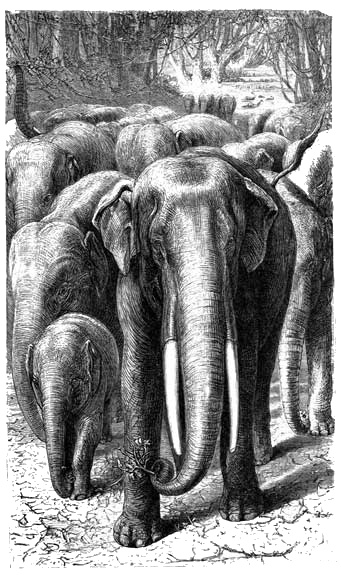
INDIAN ELEPHANT.
"They brought thee for a present horns of Ivory"—Ez. xxvii. 15.
The Talmudical writers have not much to say about the
Elephant, and what they do say is rather ludicrous than otherwise.
The proboscis, say they, gives the animal a very ugly
look, so that to dream of the trunk of an Elephant is a bad
omen. Indeed, it is so odd a substitute for a nose, that when
people look at it they say, "Praised be He who can thus
transform His creatures."
Largest and strongest of earth's inhabitants, the Elephant is
yet afraid of the smallest. The gnat attacks him, flies into the
open end of the proboscis, and sucks his blood at its ease.
It is rather remarkable that there is an ironical adage respecting
the Elephant and the eye of the needle, exactly similar
to the familiar proverb of the camel and the needle's eye.
The Shaphan of Scripture, and the correct meaning of the word—Identification
of the Shaphan with the Syrian Hyrax—Description of the animal—Its feet,
teeth, and apparent rumination—Passages in which the Coney is mentioned—Habits
of the animal—Its activity and wariness—The South African Hyrax,
and its mode of life—Difficulty of procuring it—Similarity in appearance and
habits of the Syrian species—Three species of Hyrax known to naturalists—The
Talmudical writers on the Shaphan—The jerboa and the rabbit—A
curious speculation and a judicious compromise.
Among the many animals mentioned in the Bible, there is
one which is evidently of some importance in the Jewish code,
inasmuch as it is twice named in the Mosaic law.
That it was also familiar to the Jews is evident from other
references which are made to its habits. This animal is the
Shaphan of the Hebrew language, a word which has very
wrongly been translated in the Authorized Version as Coney,
i.e. Rabbit, the creature in question not being a rabbit, nor even
a rodent. No rabbit has ever been discovered in Palestine, and
naturalists have agreed that the true Coney or Rabbit has never
inhabited the Holy Land. There is no doubt that the Shaphan
of the Hebrew Scripture, and the Coney of the Vulgate, was the
Syrian Hyrax (Hyrax Syriacus). This little animal is rather
larger than an ordinary rabbit, is not unlike it in appearance,
and has many of its habits. It is clothed with brown fur, it is
very active, it inhabits holes and clefts in rocks, and it has in
the front of its mouth long chisel-shaped teeth, very much like
those of the rabbit. Consequently, it was classed by naturalists
among the rodents for many years, under the name of Rock
Rabbit. Yet, as I have already mentioned, it is not even a
rodent, but belongs to the pachydermatous group of animals, and
occupies an intermediate place between the rhinoceros and the
hippopotamus.
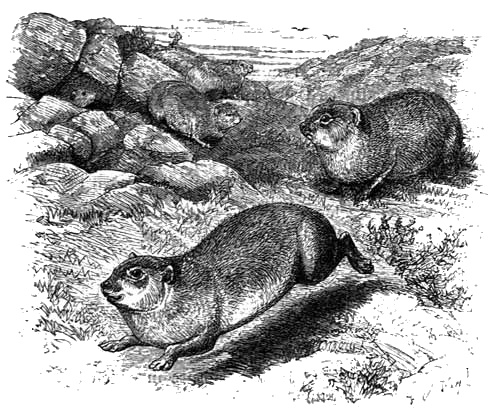
THE HYRAX.
"The Conies are but a feeble folk, yet make they their houses in the rocks."—Prov. xxx. 26.
If it be examined carefully, the rodent-like teeth will be seen
to resemble exactly the long curved tusks of the hippopotamus,
with their sharp and chisel-edged tips; the little feet, on a
close inspection, are seen to be furnished with a set of tiny
hoofs just like those of the rhinoceros; and there are many other
points in its structure which, to the eye of a naturalist, point
out its true place in nature.
In common with the rodents, and other animals which have
similarly-shaped teeth, the Hyrax, when at rest, is continually
working its jaws from side to side, a movement which it instinctively
performs, in order that the chiselled edges of the upper
and lower teeth may be preserved sharp by continually rubbing
against each other, and that they may not be suffered to grow
too long, and so to deprive the animal of the means whereby it
gains its food. But for this peculiar movement, which looks
very like the action of ruminating, the teeth would grow far
beyond the mouth, as they rapidly deposit dental material in
their bases in order to supply the waste caused at their tips by
the continual friction of the edges against each other.
It may seem strange that an animal which is classed with the
elephant, the rhinoceros, and the hippopotamus, all bare-skinned
animals, should be clothed with a furry coat. The reader may
perhaps remember that the Hyrax does not afford a solitary
instance of this structure, and that, although the elephants of
our day have only a few bristly hairs thinly scattered over the
body, those of former days were clad in a thick and treble coat
of fur and hair.
There are four passages of Scripture in which the Coney is
mentioned—two in which it is prohibited as food, and two in
which allusion is made to its manner of life. In order to
understand the subject better, we will take them in their order.
The first mention of the Coney occurs in Leviticus xi. 5,
among the list of clean and unclean animals: "The coney,
because he cheweth the cud, but divideth not the hoof; he is
unclean unto you." The second is of a like nature, and is to be
found in Deut. xiv. 7: "These ye shall not eat of them that
chew the cud, or of them that divide the cloven hoof; as the
camel, and the hare, and the coney: for they chew the cud, but
divide not the hoof; therefore they are unclean unto you."
The remaining passages, which describe the habits of the
Coney, are as follow. The first alludes to the rock-loving
habits of the animal: "The high hills are a refuge for the wild
goats, and the rocks for the conies." (Ps. civ. 18.) The second
makes a similar mention of the localities which the animal
frequents, and in addition speaks of its wariness, including it
among the "four things which are little upon the earth, but they
are exceedingly wise." The four are the ants, the locusts, the
spiders, and the Conies, which "are but a feeble folk, yet make
they their houses in the rocks."
We will take these passages in their order.
It has already been mentioned that the Hyrax, a true pachyderm,
does not merely chew the cud, but that the peculiar and
constant movement of its jaws strongly resembles the act of
rumination. The Jews, ignorant as they were of scientific
zoology, would naturally set down the Hyrax as a ruminant, and
would have been likely to eat it, as its flesh is very good. It
must be remembered that two conditions were needful to render
an animal fit to be eaten by a Jew, the one that it must be a
ruminant, and the second that it should have a divided hoof.
Granting, therefore, the presence of the former qualification,
Moses points out the absence of the latter, thereby prohibiting
the animal as effectually as if he had entered into a question of
comparative anatomy, and proved that the Hyrax was incapable
of rumination.
We now come to the habits of the animal.
As we may gather from the passages of Scripture which have
already been mentioned, the Hyrax inhabits rocky places, and
lives in the clefts that are always found in such localities. It is
an exceedingly active creature, leaping from rock to rock with
wonderful rapidity, its little sharp hoofs giving it a firm
hold of the hard and irregular surface of the stony ground.
Even in captivity it retains much of its activity, and flies about
its cage with a rapidity that seems more suitable to a squirrel
than to an animal allied to the rhinoceros and hippopotamus.
There are several species—perhaps only varieties—of the
Hyrax, all of them identical in habits, and almost precisely
similar in appearance. The best known of these animals is that
which inhabits Southern Africa (Hyrax Capensis), and which is
familiar to the colonists by its name of Klip-das, or Rock-rabbit.
In situations which suit it, the Hyrax is very plentiful, and is
much hunted by the natives, who esteem its flesh very highly.
Small and insignificant as it appears to be, even Europeans
think that to kill the Hyrax is a tolerable test of sportsmanship,
the wariness of the animal being so great that much hunter's
craft is required to approach it.
The following account of the Hyrax has been furnished to me
by Lt.-Col. A. W. Drayson, R.A.:—"In the Cape Colony, and over
a great portion of Southern Africa, this little creature is found.
It is never, as far as my experience goes, seen in great numbers,
as we find rabbits in England, though the caution of the animal
is such as to enable it to remain safe in districts from which
other animals are soon exterminated.
"As its name implies, it is found among rocks, in the crevices
and holes of which it finds a retreat. When a natural cavity is
not found, the klip-das scratches a hole in the ground under the
rocks, and burrows like a common rabbit. In size it is about
equal to a hare, though it is much shorter in the legs, and has
ears more like those of a rat than a rabbit. Its skin is covered
with fur, thick and woolly, as though intended for a colder
climate than that in which it is usually found; and, when seen
from a distance, it looks nearly black.
"The rock-rabbit is a very watchful creature, and usually
feeds on the summit of any piece of rock near its home, always
choosing one from which it can obtain a good view of the surrounding
country. When it sees an enemy approaching, it
sits rigidly on the rock and watches him without moving, so
that at a little distance it is almost impossible to distinguish
it from the rock on which it sits. When it does move, it darts
quickly out of sight, and disappears into its burrow with a
sudden leap.
"In consequence of its activity and cunning, the rock-rabbit
is seldom killed by white men; and when a hunter does secure
one, it is generally by means of a long shot. The natives usually
watch near its burrow, or noiselessly stalk it.
"I once killed one of these animals by a very long shot
from a rifle, as it was sitting watching us from the top of a large
boulder, at a distance of a hundred and fifty yards or thereabouts.
The Dutch Boers who were with me were delighted at
the sight of it, as they said it was good eating; and so it proved
to be, the flesh being somewhat like that of a hare, though in
our rough field-cookery we could not do justice to it."
This short narrative excellently illustrates the character of the
animal, which is classed among the "four things which be exceeding
wise." It is so crafty that no trap or snare ever set
has induced a Hyrax to enter it, and so wary that it is with
difficulty to be killed even with the aid of fire-arms. "No
animal," writes Mr. Tristram, "ever gave us so much trouble to
secure.... The only chance of securing one is to be concealed,
particularly about sunset or before sunrise, on some overhanging
cliff, taking care not to let the shadow be cast below, and then
to wait until the little creatures cautiously peep forth from their
holes. They are said to be common by those who have not
looked for them, but are certainly not abundant in Palestine,
and few writers have ever had more than a single glimpse of one.
I had the good fortune to see one feeding in the gorge of the
Kedron, and then to watch it as it sat at the mouth of its hole,
ruminating, metaphorically if not literally, while waiting for
sunset."
Should the Hyrax manage to catch a glimpse of the enemy, it
utters a shrill cry or squeal, and darts at once to its hole—an
action which is followed by all its companions as soon as they
hear the warning cry. It is a tolerably prolific animal, rearing
four or five young at a birth, and keeping them in a soft bed of
hay and fur, in which they are almost hidden. If surprised in
its hole and seized, the Hyrax will bite very sharply, its long
chisel-edged teeth inflicting severe wounds on the hand that
attempts to grasp it. But it is of a tolerably docile disposition,
and in a short time learns to know its owner, and to delight in
receiving his caresses.
Three species of Hyrax are known to naturalists. One is the
Klip-das, or Rock-rabbit, of Southern Africa; the second is the
Ashkoko of Abyssinia; and the third is the Syrian Hyrax, or
the Coney of the Bible. The two last species have often been
confounded together, but the Syrian animal may be known
by the oblong pale spot on the middle of its back.
The Talmudical writers were greatly perplexed about the
proper reading of the word Shaphan, some of them thinking it
to be a jerboa, and others considering it as the rabbit. Lewysohn
sums up the arguments after a rather curious fashion. According
to him, the strongest argument against the translation of the
Biblical word Shaphan as "rabbit" is that the animal came from
Spain, and was probably unknown to the earlier Talmudists,
though the later writers might have known it.
Then, struck with the resemblance of the Hebrew word שפן (Sh'p'n)
and Spain, he proceeds to discuss the probability of the
Shaphan deriving its name from Spain, the country of its origin,
or of Spain being so called on account of the number of rabbits
which inhabited it. He comes at last to the conclusion that the
jerboa was probably the animal which was prohibited in the
Mosaic law; but that, as the rabbit answered in every respect to
the Talmudical conditions, it may, for all practical purposes, be
accepted as the representative of the Shaphan of Scripture.
Literal translation of the word Behemoth—Various theories respecting the
identity of the animal—The Hippopotamus known to the ancient Hebrews—Geographical
range of the animal—"He eateth grass like the ox"—Ravages
of the Hippopotamus among the crops—Structure of the mouth and teeth—The
"sword or scythe" of the Hippopotamus—Some strange theories—Haunts
of the Hippopotamus—The Egyptian hunter—A valuable painting—Strength
of the Hippopotamus—Rising of the Nile—Modern hunters—Wariness of the
Hippopotamus—The pitfall and the drop-trap.
In the concluding part of that wonderful poem which is so
familiar to us as the Book of Job, the Lord is represented as reproving
the murmurs of Job, by showing that he could not even
understand the mysteries of the universe, much less the purposes
of the Creator. By presuming to bring a charge of injustice
against his Maker, he in fact inferred that the accuser was more
competent to govern the world than was the Creator, and thus
laid himself open to the unanswerable irony of the splendid
passages contained in chapters xl. xli., which show that man
cannot even rule the animals, his fellow-creatures, much less
control the destinies of the human race.
The passages with which we are at present concerned are to
be found at the end of the fortieth chapter, and contain a most
powerful description of some animal which is called by the
name of Behemoth. Now this word only occurs once in the
whole of the Scriptures, i.e. in Job xl. 15: "Behold now
behemoth, which I made with thee," &c. Some commentators,
in consequence of the plural termination of the word, which
may be literally translated as "beasts," have thought that it was
a collective term for all the largest beasts of the world, such as
the elephant, the hippopotamus, the wild cattle, and their like.
Others have thought that the elephant was signified by the word
Behemoth; and some later writers, acquainted with palæontology,
have put forward a conjecture that the Behemoth must
have been some extinct pachydermatous animal, like the dinotherium,
in which might be combined many of the qualities of
the elephant and hippopotamus.
It is now, however, agreed by all Biblical scholars and naturalists,
that the hippopotamus, and no other animal, is the creature
which was signified by the word Behemoth, and this interpretation
is followed in the Jewish Bible.
We will now take the whole of the passage, and afterwards
examine it by degrees, comparing the Authorized Version with
the Jewish Bible, and noting at the same time one or two variations
in the rendering of certain phrases. The passage is given
as follows in the Jewish Bible, and may be compared with our
Authorized Version:—
"Behold now the river-horse, which I have made with thee:
he eateth grass like an ox.
"Lo now, his strength is in his loins, and his vigour is in the
muscles of his body.
"He moveth his tail like a cedar: the sinews of his thighs are
wrapped together.
"His bones are pipes of copper; his bones are like bars
of iron.
"He is the chief of the ways of God: he that made him can
alone reach his sword.
"That the mountains should bring forth food for him, and all
the beasts of the field play there.
"He lieth under wild lotuses, in the covert of the reed,
and fens.
"Wild lotuses cover him with their shadow; willows of the
brook compass him about.
"Behold, should a river overflow, he hasteth not: he feels
secure should Jordan burst forth up to his mouth.
"He taketh it in with his eyes: his nose pierceth through
snares."
We will now take this description in detail, and see how far
it applies to the now familiar habits of the hippopotamus. A
little allowance must of course be made for poetical imagery, but
we shall find that in all important details the account of the
Behemoth agrees perfectly with the appearance and habits of
the hippopotamus.
In the first place, it is evident that we may dismiss from our
minds the idea that the Behemoth was an extinct pachyderm.
The whole tenor of the passage shows that it must have been
an animal then existing, and whose habits were familiar to Job
and his friends. Now the date of the Book of Job could not
have been earlier than about 1500 B.C., and in, consequence,
the ideas of a palæozoic animal must be discarded.
We may also dismiss the elephant, inasmuch as it was most
unlikely that Job should have known anything about the
animal, and it is certain that he could not have attained the
familiarity with its appearance and habits which is inferred by
the context. Moreover, it cannot be said of the elephant that
"he eateth grass as an ox." The elephant feeds chiefly on the
leaves of trees, and when he does eat grass, he cannot do so
"like an ox," but plucks it with his proboscis, and then puts the
green tufts into his mouth. So characteristic a gesture as this
would never have passed unnoticed in a description so full of
detail.
That the hippopotamus was known to the ancient Hebrews is
certain. After their sojourn in Egypt they had necessarily
become familiarized with it; and if, as most commentators believe,
the date of the Book of Job be subsequent to the liberation
of the Israelites, there is no difficulty in assuming that Job and
his companions were well acquainted with the animal. Even if
the book be of an earlier date, it is still possible that the hippopotamus
may, in those days, have lived in rivers where it is now
as much extinct as it is in England. Mr. Tristram remarks on
this point: "No hippopotamus is found in Asia, but there is no
reason for asserting that it may not have had an eastern range as
far as Palestine, and wallowed in the Jordan; for its bones are
found in the débris of the rivers of Algeria, flowing into the
Mediterranean, when tradition is quite silent as to its former
existence.
"Several extinct species of hippopotamus have been found in
the later tertiary deposits, both of England and other countries
of Europe, embedded in gravel which contains shells of many
existing species of the locality, showing that the temperature
has not much changed, and that some of the fossil species were
natives of cold and temperate climes."
There is no doubt that the hippopotamus and the urus were
the two largest animals known to the Jews, and it is probably
on that account that the former received the name of Behemoth.
Assuming, therefore, that the Behemoth is identical with the
hippopotamus, we will proceed with the description.
The words "whom I made with thee" have been variously
translated. Some Hebraists render them as, "whom I made
near thee," i.e. near or in the country in which Job lived.
Others read the words, "like as thee," i.e. that the Behemoth
was the fellow-creature of Job. Others again understand them
as signifying that the man and the animal were contemporaneous,
and the passage should be read, "whom I made at the
same time with thee." Whichever interpretation we adopt, it is
evident that a parallel of some kind is drawn between the man
and the beast.
"He eateth grass like the ox." The word which is here
rendered "grass" is translated in Numb. xi. 5 as "leeks." It
means, something that is green, and is probably used to signify
green herbage of any description. Now it is perfectly true of
the hippopotamus that it eats grass like an ox, or like cattle, as
the passage may be translated. In order to supply its huge
massive body with nourishment, it consumes vast quantities of
food, as indeed may be inferred from the structure of its mouth
and jaws. The mouth is enormously broad and shovel-shaped,
so as to take in a large quantity of food at once; and the gape
is so wide, that when the animal opens its jaws to their full
extent it seems to split its head into two nearly equal portions.
This great mobility of jaw is assisted by the peculiar form of
the gape, which takes a sudden turn upwards, and reaches
almost to the eyes.
Just as the mouth is formed to contain a vast quantity of
food, so the jaws and teeth are made to procure it. From the
front of the lower jaw the incisor teeth project horizontally, no
longer performing the ordinary duties of teeth, but being modified
into tusks, which are in all probability used as levers for
prising up the vegetables on which the animal lives. But the
most singular portion of the jaw is the mode in which the canine
teeth are modified so as to resemble the incisor teeth of rodents,
and to perform a similar office.
These teeth are very long, curved, and chisel-edged at their
tips, their shape being preserved by continual attrition, just as
has been mentioned of the hyrax. The material of the teeth is
peculiarly hard, so much so, indeed, that it is in great request for
artificial teeth, the "verniers" of philosophical instruments, and
similar purposes. Consequently, with these teeth the hippopotamus
can cut through the stems of thick and strong herbage as
with shears, and the strength of its jaws is so great that an
angered hippopotamus has been known to bite a man completely
in two, and to crush a canoe to fragments with a single movement
of its enormous jaws.
Keeping this description in our minds, we shall see how true
is the statement in verse 19. This passage is not adequately
rendered in the Authorized Version: the word which is translated
as "sword" also signifies a scythe, and evidently having that
meaning in the text. The passage is best translated thus: "His
Maker hath furnished him with his scythe."
The havoc which such an animal can make among growing
crops may be easily imagined. It is fond of leaving the river,
and forcing its way into cultivated grounds, where it eats vast
quantities of green food, and destroys as much as it eats, by the
trampling of its heavy feet. Owing to the width of the animal,
the feet are placed very far apart, and the consequence is that
the hippopotamus makes a double path, the feet of each side
trampling down the herbage, and causing the track to look like
a double rut, with an elevated ridge between them.
Some little difficulty has been made respecting the passage in
verse 20, "Surely the mountains bring him forth food." Commentators
ignorant of the habits of the hippopotamus, and not
acquainted with the character of the country where it lives, have
thought that the animal only lived in the rivers, and merely
found its food along its banks, or at most upon the marshes at
the river-side. The hippopotamus, say they, is not a dweller on
the mountains, but an inhabitant of the river, and therefore this
passage cannot rightly be applied to the animal.
Now, in the first place, the word harim, which is translated as
"mountains" in the Authorized Version, is rendered as "hills" by
many Hebraists. Moreover, as we know from many passages of
Scripture, the word "mountain" is applied to any elevated spot,
without reference to its height. Such places are very common
along the banks of the Nile, and are employed for the culture of
vegetables, which would not grow properly upon the flat and
marshy lands around them. These spots are very attractive to
the hippopotamus, who likes a change of diet, and thus finds food
upon the mountains. In many parts of Egypt the river runs
through a mountainous country, so that the hills are within a
very short distance of the water, and are easily reached by the
hippopotamus.
The Talmudical writers exaggerated, after their custom, the
dimensions, voracity, and other attributes of the Behemoth.
They said that the animal devoured daily the herbage of a
thousand hills, but that, in order to prevent the devastation of
the world which such voracity would occasion, the herbage was
miraculously renewed every night. Only two of the Behemoth
were ever created, and, lest they should increase in numbers,
and destroy every green thing on the face of the earth, they
were made incapable of propagating their kind. There are other
legends of the Behemoth too puerile to be narrated.
We will now proceed to the next verse. After mentioning
that the Behemoth can eat grass like an ox, and finds its food
upon the hills, the sacred writer proceeds to show that in its
moments of repose it is an inhabitant of the rivers and marshy
ground: "He lieth under the shady trees, in the covert of the
reed, and fens.
"The shady trees cover him with their shadow; the willows
of the brook compass him about."
Here I may remind the reader that the compound Hebrew word
which is rendered in the Authorized Version as "shady trees" is
translated by some persons as "wild lotuses"—a rendering which
is followed by the editor of the Jewish Bible. Apparently,
however, the Authorized Version gives a more correct meaning
of the term. Judging from a well-known Egyptian painting,
which represents a hunter in the act of harpooning the hippopotamus,
the tall papyrus reeds are the plants that are signified
by this word, which occurs in no other place in the Scriptures.
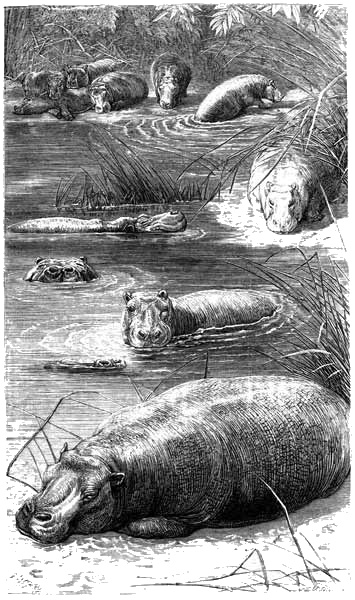
THE HIPPOPOTAMUS, OR BEHEMOTH OF SCRIPTURE.
"Behold now behemoth, which I made with thee."—Job xl. 15.
Nothing can be more accurate than this description of the
habits of the animal. I have now before me a number of sketches
by Mr. T. Baines, representing various incidents in the life of the
hippopotamus; and in one or two of them, the little islands that
stud the river, as well as the banks themselves, are thickly
clothed with reeds mixed with papyrus, the whole being exactly
similar to those which are represented in the conventional style
of Egyptian art. These spots are the favourite haunts of the
hippopotamus, which loves to lie under their shadow, its whole
body remaining concealed in the water, and only the eyes, ears,
and nostrils appearing above the surface.
As reference will be made to this painting when we come to
the Leviathan, it will be as well to describe it in detail. In
order that the reader should fully understand it, I have had it
translated, so to speak, from the conventional outline of Egyptian
art into perspective, exactly as has been done with the Assyrian
and Egyptian chariots.
In the foreground is seen the hunter, standing on a boat that
closely resembles the raft-boat which is still in use in several
parts of Africa. It is made of the very light wood called
ambatch, by cutting down the requisite number of trees, laying
them side by side so that their bases form the stern and their
points the bow of the extemporized boat. They are then firmly
lashed together, the pointed ends turned upwards, and the simple
vessel is complete. It is, in fact, nothing more than a raft of
triangular shape, but the wood is so buoyant that it answers
every purpose.
In his hand the hunter grasps the harpoon which he is about
to launch at the hippopotamus. This is evidently the same
weapon which is still employed for that purpose. It consists of
a long shaft, into the end of which a barbed iron point is loosely
inserted. To the iron point is attached one end of a rope, and
to the other end, which is held in the left hand of the harpooner,
a float of ambatch wood is fastened.
When the weapon is thrown, the furious struggles of the
wounded animal disengage the shaft of the harpoon, which is
regained by the hunter; and as it dashes through the water,
throwing up spray as it goes, the ambatch float keeps the end of
the rope at the surface, so that it can be seen as soon as the
animal becomes quieter. Sometimes it dives to the bottom, and
remains there as long as its breath can hold out; and when it
comes up to breathe, it only pushes the nostrils out of the water
under the shadow of the reeds, so that but for the float it might
manage to escape.
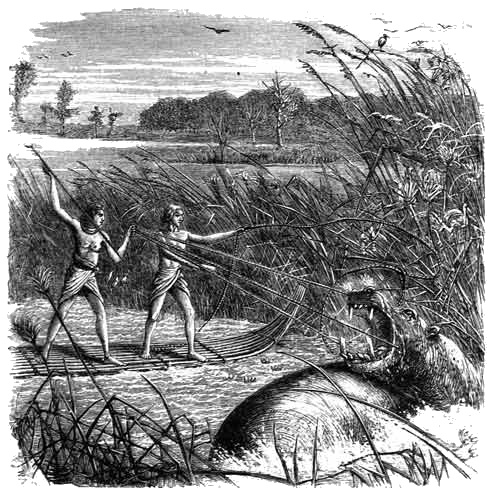
THE EGYPTIAN HUNTER.
"He lieth under the shady trees, in the covert of the reed, and fens."—Job xl. 21.
(The attitude of the Hippopotamus is copied from the painting.)
In the meantime, guided by the float, the hunter follows the
course of the animal, and, as soon as it comes within reach of
his weapon, drives another spear into it, and so proceeds until
the animal dies from loss of blood. The modern hunters never
throw a second harpoon unless the one already fixed gives way,
mainly employing a spear to inflict the last wounds. But if we
may judge from this painting, the Egyptian hunter attached a
new rope with every cast of his weapon, and, when the hippopotamus
became weak from its wounds, gathered up the ropes
and came to close quarters.
In the bow of the boat is the hunter's assistant, armed with a
rope made lasso-wise into a noose, which he is throwing over
the head of the hippopotamus, whose attitude and expression
show evidently, in spite of the rudeness of the drawing, the
impotent anger of the weakened animal.
Behind the hippopotamus are the tall and dense reeds and
papyrus under the shelter of which the animal loves to lie, and
on the surface of the water float the beautiful white flowers of
the lotus.
In the Egyptian painting, the artist, in spite of the conventionalities
to which he was bound, has depicted the whole scene
with skill and spirit. The head and open mouth of the hippopotamus
are remarkably fine, and show that the artist who drew
the animal must have seen it when half mad with pain, and
half dead from loss of blood.
The enormous strength of the hippopotamus is shown in
verses 16, 18, the last of which passages requires a little explanation.
Two different words are used here to express the bones of
the animal. The first is derived from a word signifying strength,
and means the "strong bones," i.e. those of the legs. These are
hollow, and are therefore aptly compared to tubes or pipes of
copper. The second term is thought by some Hebraists to refer
to the rib-bones, which are solid, and therefore are not likened
to tubes, but to bars of iron.
The 23d verse has been translated rather variously. The
Authorized Version can be seen by reference to a Bible, and
another translation, that of the Jewish Bible, is given on page
319. A third, and perhaps the best rendering of this passage is
given by the Rev. W. Drake, in Smith's "Dictionary of the Bible:"
"Lo, the river swelleth proudly against him, yet he is not
alarmed; he is securely confident though a Jordan burst forth
against his mouth."
In all probability reference is here made to the annual rising
of the Nile, and the inundations which it causes. In some
years, when it rises much above its usual height, the floods
become most disastrous. Whole villages are swept away, and
scarcely a vestige of the mud-built houses is left; the dead
bodies of human beings are seen intermixed with those of cattle,
and the whole country is one scene of desolation. Yet the
almost amphibious hippopotamus cares nothing for the floods,
as long as it can find food, and so, "though the river swelleth
proudly against him," he is not alarmed.
From the use of the word "Jordan" in the same verse, it might
be thought that the river of Palestine was intended. This,
however, is not the case. The word "Jordan" is simply used as a
poetical term for any river, and is derived from a Hebrew
word which signifies "descending quickly."
We now come to the last verse of this noble description: "He
taketh it in with his eyes." These words have also been variously
rendered, some translating them as "He receiveth it (i.e. the
river) up to his eyes." But the translation which seems to suit
the context best is, "Who will take him when in his sight? His
nose pierceth through (i.e. detects) snares." Now, this faculty
of detecting snares is one of the chief characteristics of the
hippopotamus, when it lives near places inhabited by mankind,
who are always doing their best to destroy it. In the first
place, its body gives them an almost unlimited supply of flesh,
the fat is very highly valued for many purposes, the teeth are
sold to the ivory-dealers, and the hide is cut up into whips, or
khoorbashes.
There is now before me a khoorbash, purchased from a native
Egyptian who was beating a servant with it. The whip is
identical with that which was used by the ancient Egyptians in
urging the Israelites to their tasks, and the scene reminded the
traveller so forcibly of the old Scriptural times that he rescued
the unfortunate servant, and purchased the khoorbash, which is
now in my collection.
Not content with hunting the hippopotamus, the natives
contrive various traps, either pitfalls or drop-traps. The former
are simply pits dug in the path of the animal, covered with
sticks and reeds, and having at the bottom a sharp stake on
which the victim is impaled, and so effectually prevented from
escaping or damaging the pit by its struggles.
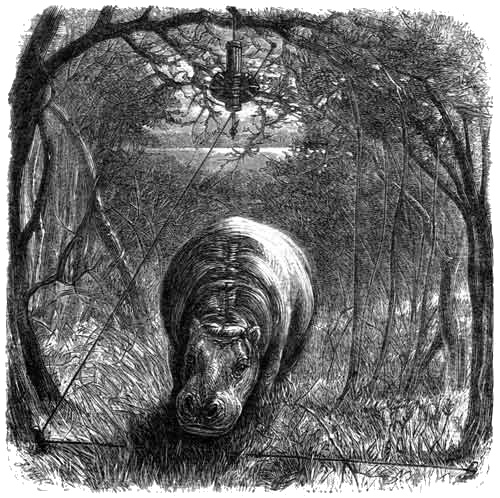
HIPPOPOTAMUS AND TRAP.
"His nose pierceth through snares."—Job xl. 24.
The drop-trap is a log of wood, weighted with stones, and
having at one end an iron spike, which is sometimes poisoned.
The path which the animal takes is watched, a conveniently
overhanging branch is selected, and from that branch the cruel
spear is suspended, by a catch or trigger, exactly over the centre
of the path. There is no difficulty in finding the precise centre
of the path, owing to the peculiar gait of the animal, which
has already been described. One end of the trigger supports
the spear, and to the other is attached a rope, which is brought
across the path in such a way that when touched it relieves the
spear, which is driven deeply into the animal's back. If well
hung, the spear-blade divides the spine, and the wounded animal
falls on the spot, but, even if it should miss a vital part, the
poison soon does its fatal work.
In consequence of the continual persecution to which it is
subjected, the hippopotamus becomes exceedingly wary, and,
huge, clumsy, and blundering as it looks, is clever enough to
detect either pitfall or drop-trap that have not been contrived
with especial care. An old and experienced hippopotamus
becomes so wary that he will be suspicious even of a bent twig,
and, rather than venture across it, he will leave the path, force
for himself a roundabout passage, and return to the path beyond
the object that alarmed him.
Mr. T. Baines, to whose sketches I am indebted for the
illustration, told me that the hippopotamus is possessed of
much more intellect than might be expected from a creature
of so dull, clumsy, and unpromising aspect. Apathetic it
generally is, and, as long as it is left unmolested, does not
care to molest even the human beings that intrude upon its
repose.
It likes to lie in the shade of the reeds and rushes, and may
be seen floating in the water, with only the nostrils, the eyes,
and the ears above the surface, these organs being set in a line
along the head, evidently for the purpose of allowing the whole
body to be hidden under water while the three most important
senses are capable of acting.
A canoe-man who knows the habits of the hippopotamus will
fearlessly take his fragile vessel through a herd of the animals,
knowing that, if he only avoids contact with them, they will
not interfere with him. The only danger is, that a hippopotamus
may rise under the canoe, and strike itself against the boat, in
which case the animal is rather apt to consider the intruding
object as an enemy, and to attack it, sometimes crushing the
canoe between its teeth, and mostly upsetting it, and throwing
the crew into the water. In such a case, the men always dive
at once to the bottom of the river, and hold on to some weed or
rock as long as they can exist without breathing. The reason
for this proceeding is, that the hippopotamus always looks for
its enemy upon the surface of the water, and, if the men were
to swim to shore, they would be caught and killed before they
had swum many strokes. But, as it sees nothing but the
damaged canoe, its short-lived anger vanishes, and it sinks again
into the river, leaving the men at liberty to regain and repair
their vessel.
There is one passage in the description of the Behemoth
which requires a few words of explanation: "He moveth his
tail like a cedar" (v. 17).
Several commentators have imagined that this expression
shows that the Behemoth must have been an animal which had
a very long and powerful tail, and have adduced the passage as a
proof that the crocodile was the animal that was signified by
the Behemoth. Others, again, have shifted the position of the
tail, and, by rendering it as the "proboscis," have identified the
Behemoth with the elephant. There is, however, no necessity
for straining the interpretation, the passage evidently signifying
that the member in question is stiff and inflexible as the cedar-stem.