After the downfall of the Pacific Fur Company,
the occupation of Astoria by the Northwesters,
and the change of its name to Fort
George, Ross took service with the Northwest Company.
It is life as a fur trader with the Northwest
Company that he describes in his book The Fur Hunters
of the Far West. In point of time, these volumes
precede most of the books on the far western fur
trade, and they give faithful and interesting accounts
of the conditions met with at the time. Ross’s books,
in fact, are foundation stones for any history of the
settlement of the Northwest. Although the books
were not written until long after the period of which
they treat—for the preface of this work is dated June 1,
1854, while the book was published the next year—Ross
must have kept full diaries of his goings and comings,
for in most of his dates he is exact, and his
narrative is full of details that would almost certainly
have slipped from an unaided memory.
In his new service Ross discovered that matters were
now in charge of men who knew very little about the
Indians of the Pacific coast, and who lightly regarded
those persons who had been in the service of Mr.
Astor, whom they called Yankees. The new-comers
had much to learn.
One of the first acts of the Northwest Company
was to despatch an expedition of twenty men, in charge
of Messrs. Keith and Alexander Stuart, to report to
Fort William, on Lake Superior, the news of the acquisition
of Astoria by the Northwest Company. On
reaching the Cascades of the Columbia they were
attacked by a large number of Indians, and Mr. Stuart
was wounded. Two Indians were killed, and the expedition
returned to Fort George. The attack caused
great indignation there, and an extraordinary expedition
was fitted out to punish the Indians. Eighty-five
picked men and two Chinook interpreters constituted
the force; and besides the ordinary arms carried in the
West they had “two great guns, six swivels, cutlasses,
hand grenades, and hand knives.”
As the expedition passed along up the river, it struck
terror to the hearts of the Indians, while it is said that
“the two Chinook interpreters could neither sleep nor
eat, so grieved were they at the thoughts of the
bloody scenes that were to be enacted.”
The people who were to be punished, however—the
Cath-le-yach-é-yach, a Chinookan tribe living below
the Cascades—were not all frightened, and when
they were required to deliver up the property taken
from Keith and Stuart, they declared themselves ready
to do so, but not until after the whites had delivered
to them those who had killed two of their people.
They sent off their women and children into the forest
and prepared to fight. There were multitudinous
parleys lasting for three or four days, at the end of
which time the whites, regarding discretion as the
better part of valor, “without recovering the property,
firing a gun, or securing a single prisoner, sounded
a retreat and returned home on the ninth day, having
made matters ten times worse than they were before.”
The expedition was much derided by the Indians,
and the white people who took part in it were extremely
mortified about it. The situation was really one of
war, and when a short time afterward the Northwest
brigade departed for the interior, the Indians at the
Cascades did not come near to the camp nor in any
degree interrupt their progress.
Consulted by McDonald, who was in charge of the
Columbia trade, Ross had urged on him the importance
of taking the “usual precautions” in travelling
up the river. Nevertheless, no guard was set at night,
and an alarm taking place, people jumped up and
began to fire their guns at random and one of the men
was shot dead. There seems no reason to suppose
that there were actually any Indians in the camp.
At Fort Okanagan the expedition passed on, leaving
Ross behind in charge of the post. He was now in a
prairie country where horses were absolutely essential
to travel, and no horses were to be had nearer than
Eyakema valley, two hundred miles away, where the
horse Indians, Cayuses, Nez Percés, and other warlike
tribes encamped each spring, to collect the roots of
the camas. Here horses were plenty, but, as it was
a great camp occupied by many different tribes, to
visit it was to incur some danger. However, Ross
took a few trade goods and set out with three men,
young McKay and two French Canadians, these last
taking with them their Indian wives, to assist in the
care of the horses.
It was an anxious time, and the perplexities of the
journey were not lessened when, on the fourth night
after leaving Okanagan, the chief of the Pisscows
tribe, who had learned where Ross was going, sent two
men to urge him to turn back, declaring that if they
did not do so they were all dead men. However, Ross
determined to go on; as he puts it, “I had risked my
life there for the Americans, I could now do no less
for the North-West Company; so with deep regret the
friendly couriers left us and returned, and with no less
reluctance we proceeded.”
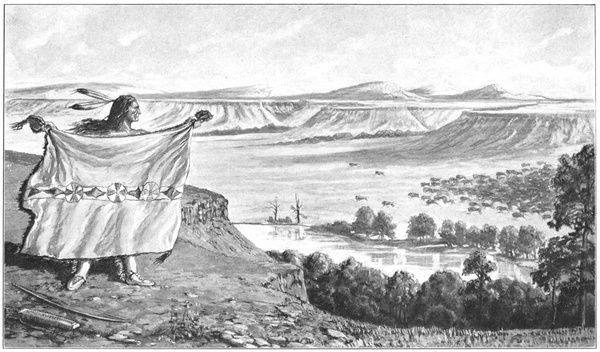
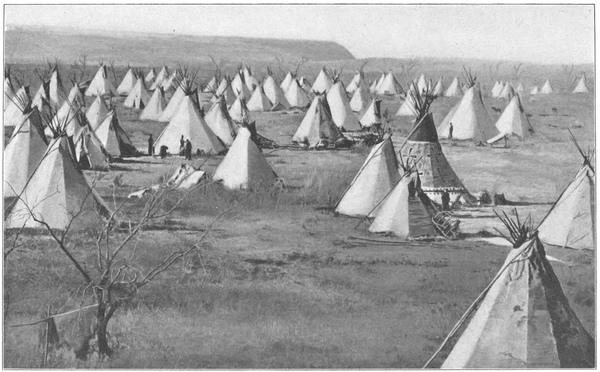
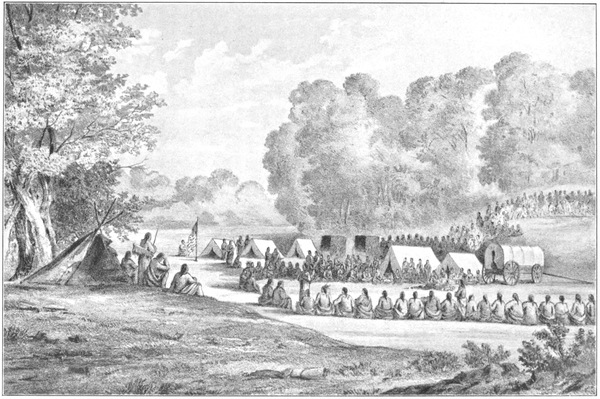
On the sixth day after leaving the fort they reached
the valley, where they found a great camp, of which
they could see the beginning, but not the end. It
must have contained not less than 3,000 men, exclusive
of women and children, and three times that number of
horses. Everywhere was seen the active life of these
primitive people. Councils were being held, women
were gathering roots, men were hunting. Horse racing,
games, singing, dancing, drumming, yelling, and
a thousand other things were going on. The noise and
confusion are hardly to be described; but the interest
and the beauty of the scene could not have been appreciated
by these men, who were carrying their lives
in their hands and marching into danger.
“Our reception was cool, the chiefs were hostile and
sullen, they saluted us in no very flattering accents.
‘These are the men,’ said they, ‘who kill our relations,
the people who have caused us to mourn.’ And here,
for the first time, I regretted we had not taken advice
in time, and returned with the couriers, for the general
aspect of things was against us. It was evident we
stood on slippery ground; we felt our weakness. In
all sudden and unexpected rencontres with hostile Indians,
the first impulse is generally a tremor or sensation
of fear, but that soon wears off; it was so with
myself at this moment, for after a short interval I
nerved myself to encounter the worst.
“The moment we dismounted, we were surrounded,
and the savages, giving two or three war-whoops and
yells, drove the animals we had ridden out of our sight;
this of itself was a hostile movement. We had to
judge from appearances, and be guided by circumstances.
My first care was to try and direct their
attention to something new, and to get rid of the
temptation there was to dispose of my goods; so without
a moment’s delay, I commenced a trade in horses;
but every horse I bought during that and the following
day, as well as those we had brought with us, were
instantly driven out of sight, in the midst of yelling
and jeering: nevertheless, I continued to trade while
an article remained, putting the best face on things I
could, and taking no notice of their conduct, as no
insult or violence had as yet been offered to ourselves
personally. Two days and nights had now elapsed
since our arrival, without food or sleep; the Indians
refused us the former, our own anxiety deprived us of
the latter.
“During the third day I discovered that the two
women were to have been either killed or taken from us
and made slaves. So surrounded were we for miles
on every side, that we could not stir unobserved; yet
we had to devise some means for their escape, and to
get them clear of the camp was a task of no ordinary
difficulty and danger. In this critical conjuncture,
however, something had to be done, and that without
delay. One of them had a child at the breast, which
increased the difficulty. To attempt sending them
back by the road they came, would have been sacrificing
them. To attempt an unknown path through the
rugged mountains, however doubtful the issue, appeared
the only prospect that held out a glimpse of hope;
therefore, to this mode of escape I directed their attention.
As soon as it was dark, they set out on their forlorn
adventure without food, guide, or protection, to
make their way home, under a kind Providence!
“‘You are to proceed,’ said I to them, ‘due north,
cross the mountains, and keep in that direction till
you fall on the Pisscows River; take the first canoe you
find, and proceed with all diligence down to the mouth
of it and there await our arrival. But if we are not
there on the fourth day, you may proceed to Oakanagan,
and tell your story.’ With these instructions we parted;
and with but little hopes of our ever meeting again.
I had no sooner set about getting the women off, than
the husbands expressed a wish to accompany them;
the desire was natural, yet I had to oppose it. This
state of things distracted my attention: my eyes had
now to be on my own people as well as on the Indians,
as I was apprehensive they would desert. ‘There is
no hope for the women by going alone,’ said the husbands,
‘no hope for us by remaining here: we might
as well be killed in the attempt to escape, as remain
to be killed here,’ ‘No,’ said I, ‘by remaining here
we do our duty; by going we should be deserting our
duty.’ To this remonstrance they made no reply.
The Indians soon perceived that they had been outwitted.
They turned over our baggage, and searched
in every hole and corner. Disappointment creates ill
humor: it was so with the Indians. They took the
men’s guns out of their hands, fired them off at their
feet, and then, with savage laughter, laid them down
again; took their hats off their heads, and after strutting
about with these for some time, jeeringly gave
them back to their owners: all this time, they never
interfered with me, but I felt that every insult offered
to my men was an indirect insult offered to myself.
“The day after the women went off, I ordered one
of the men to try and cook something for us; for hitherto
we had eaten nothing since our arrival, except a few
raw roots which we managed to get unobserved. But
the kettle was no sooner on the fire than five or six
spears bore off, in savage triumph, the contents: they
even emptied out the water, and threw the kettle on
one side; and this was no sooner done than thirty or
forty ill-favored wretches fired a volley in the embers
before us, which caused a cloud of smoke and ashes
to ascend, darkening the air around us: a strong hint
not to put the kettle any more on the fire, and we
took it.
“At this time the man who had put the kettle on the
fire took the knife with which he had cut the venison
to lay it by, when one of the Indians, called Eyacktana,
a bold and turbulent chief, snatched it out of his hand;
the man, in an angry tone, demanded his knife, saying
to me, ‘I’ll have my knife from the villain, life or
death.’ ‘No,’ said I. The chief, seeing the man angry,
threw down his robe, and grasping the knife in his fist,
with the point downwards, raised his arm, making a
motion in advance as if he intended using it. The
crisis had now arrived! At this moment there was a
dead silence. The Indians were flocking in from all
quarters: a dense crowd surrounded us. Not a moment
was to be lost; delay would be fatal, and nothing
now seemed to remain for us but to sell our lives as
dearly as possible. With this impression, grasping a
pistol, I advanced a step towards the villain who held
the knife, with the full determination of putting an
end to his career before any of us should fall; but while
in the act of lifting my foot and moving my arm, a
second idea floated across my mind, admonishing me
to soothe, and not provoke, the Indians, that Providence
might yet make a way for us to escape: this
thought saved the Indian’s life, and ours too. Instead
of drawing the pistol, as I intended, I took a knife from
my belt, such as travellers generally use in this country,
and presented it to him, saying, ‘Here, my friend, is a
chief’s knife, I give it to you; that is not a chief’s knife,
give it back to the man.’ Fortunately, he took mine
in his hand; but, still sullen and savage, he said nothing.
The moment was a critical one; our fate hung as
by a thread: I shall never forget it! All the bystanders
had their eyes now fixed on the chief, thoughtful and
silent as he stood; we also stood motionless, not knowing
what a moment might bring forth. At last the
savage handed the man his knife, and turning mine
round and round for some time in his hand, turned to
his people, holding up the knife in his hand, exclaimed,
‘She-augh Me-yokat Waltz’—Look, my friends, at the
chief’s knife: these words he repeated over and over
again. He was delighted. The Indians flocked round
him: all admired the toy, and in the excess of his joy
he harangued the multitude in our favour. Fickle, indeed,
are savages! They were now no longer enemies,
but friends! Several others, following Eyacktana’s example,
harangued in turn, all in favour of the whites.
This done, the great men squatted themselves down,
the pipe of peace was called for, and while it was going
round and round the smoking circle, I gave each of the
six principal chiefs a small paper-cased looking-glass
and a little vermilion, as a present; and in return, they
presented me with two horses and twelve beavers,
while the women soon brought us a variety of eatables.
“This sudden change regulated my movements.
Indeed, I might say the battle was won. I now made
a speech to them in turn, and, as many of them understood
the language I spoke, I asked them what I should
say to the great white chief when I got home, when he
asks me where are all the horses I bought from you.
What shall I say to him? At this question it was easy
to see that their pride was touched. ‘Tell him,’ said
Eyacktana, ‘that we have but one mouth, and one
word; all the horses you have bought from us are yours,
they shall be delivered up.’ This was just what I
wanted. After a little counselling among themselves,
Eyacktana was the first to speak, and he undertook to
see them collected.
“By this time it was sun-down. The chief then
mounted his horse, and desired me to mount mine and
accompany him, telling one of his sons to take my men
and property under his charge till our return. Being
acquainted with Indian habits, I knew there would be
repeated calls upon my purse, so I put some trinkets
into my pocket, and we started on our nocturnal adventure;
which I considered hazardous but not hopeless.
“Such a night we had! The chief harangued, travelled
and harangued, the whole night, the people replied.
We visited every street, alley, hole and corner
of the camp, which we traversed lengthwise, crossway,
east, west, south, and north, going from group to
group, and the call was ‘Deliver up the horses.’ Here
was gambling, there scalp-dancing; laughter in one
place, mourning in another. Crowds were passing to
and fro, whooping, yelling, dancing, drumming, singing.
Men, women, and children were huddled together;
flags flying, horses neighing, dogs howling,
chained bears, tied wolves, grunting and growling, all
pell-mell among the tents; and, to complete the confusion,
the night was dark. At the end of each harangue
the chief would approach me, and whisper in
my ear, ‘She-augh tamtay enim’—I have spoken well
in your favour—a hint for me to reward his zeal by
giving him something. This was repeated constantly,
and I gave him each time a string of beads, or two buttons,
or two rings. I often thought he repeated his
harangues more frequently than necessary; but it answered
his purpose, and I had no choice but to obey
and pay.
“At daylight we got back; my people and property
were safe; and in two hours after my eighty-five horses
were delivered up, and in our possession. I was now
convinced of the chief’s influence, and had got so well
into his good graces with my beads, buttons, and rings,
that I hoped we were out of all our troubles. Our
business being done, I ordered my men to tie up and
prepare for home, which was glad tidings to them.
With all this favourable change, we were much embarrassed
and annoyed in our preparations to start.
The savages interrupted us every moment. They
jeered the men, frightened the horses, and kept handling,
snapping, and firing off our guns; asking for this,
that, and the other thing. The men’s hats, pipes, belts,
and knives were constantly in their hands. They
wished to see everything, and everything they saw they
wished to get, even to the buttons on their clothes.
Their teasing curiosity had no bounds; and every delay
increased our difficulties. Our patience was put to the
test a thousand times; but at last we got ready, and my
men started. To amuse the Indians, however, till
they could get fairly off, I invited the chiefs to a parley,
which I put a stop to as soon as I thought the men
and horses had got clear of the camp. I then prepared
to follow them, when a new difficulty arose. In
the hurry and bustle of starting, my people had left a
restive, awkward brute of a horse for me, wild as a
deer, and as full of latent tricks as he was wild. I
mounted and dismounted at least a dozen times; in
vain I tried to make him advance. He reared, jumped
and plunged; but refused to walk, trot, or gallop.
Every trial to make him go was a failure. A young conceited
fop of an Indian, thinking he could make more
of him than I could, jumped on his back; the horse
reared and plunged as before, when, instead of slackening
the bridle as he reared, he reined it tighter and
tighter, till the horse fell right over on his back, and
almost killed the fellow. Here Eyacktana, with a
frown, called out, ‘Kap-sheesh she-eam’—the bad
horse—and gave me another; and for the generous
act I gave him my belt, the only article I had to spare.
But although the difficulties I had with the horse were
galling enough to me, they proved a source of great
amusement to the Indians, who enjoyed it with roars
of laughter.”
When Ross got out of the camp he rode hard and
took a short cut in the effort to overtake his people,
but could not find them. Presently, however, from the
top of a ridge, he saw three horsemen coming toward
him at full tilt. He made preparation for defence, and
hiding behind a rock awaited the onslaught, but before
they got close to him he discovered that these were
the friendly Pisscows, who before had warned him to
turn back, and with them he went on. At last they
saw Ross’s people, who were driving their horses as
fast as they could, but when they saw Ross and his
companions behind them they thought them enemies,
and stopped to fight. All were glad enough to
get together, and at last, after various adventures, they
reached the fort at Okanagan.
A little later Ross went north to his own post at the
She-Whaps, where he made a good trade. From here
he decided to go west to the Pacific coast on foot, believing
that the distance was not more than two hundred
miles, but before he reached the coast a destructive
hurricane passed so close to his party that his guide,
altogether discouraged by fatigue and failure, deserted
during the night, and Ross was obliged to return.
One winter, much alarm was caused among the Indians
by the depredations of strange wolves, reported
to be hundreds in number, and as big as buffalo, which
were coming into the country, and on their march were
killing all the horses. The Indians declared that all
the horses would be killed, for men could not go near
these wolves, nor would arrows or balls kill them.
Shortly after the head chief of the Okanagan Indians
had told this story to Ross, wolves killed five of the
traders’ horses. Ross took up those left alive, and then
put out a dozen traps about the carcass of one that
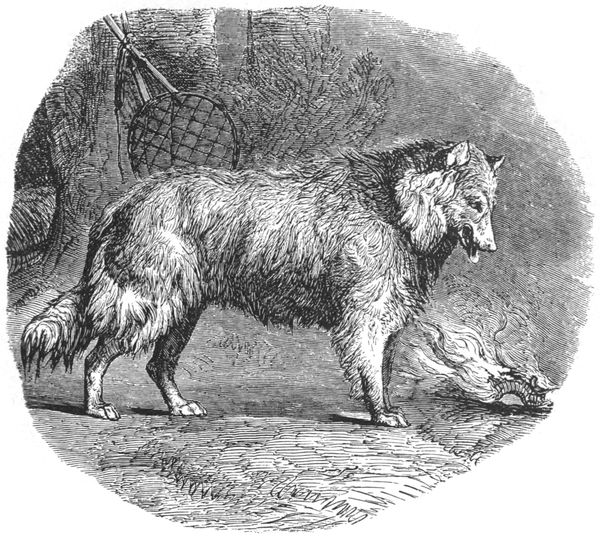
had been killed. The next morning four of the traps
were sprung. “One of them held a large white wolf
by the fore leg, a foot equally large was gnawed off
and left in another, the third held a fox, and the fourth
trap had disappeared altogether.” Unable to get
away, the captured wolf was quite ready to fight. It
had gnawed the trap until its teeth were broken and its
head was covered with blood. When killed it was found
to weigh one hundred and twenty-seven pounds, an
enormous animal. The one that had carried off the
trap was at last discovered making the best of its way
over the country, and pursuit resulted in its capture.
The animal had dragged a trap and chain weighing
eight and one-half pounds a distance of twenty-five
miles, without appearing at all fatigued. Ross wanted
the skin, but had left his knife behind him. However,
it was not for nothing that he had been for years associated
with Indians, and he took the flint out of his
gun, skinned the animal, and went home with skin and
trap.
The killing of these two wolves and the crippling
of the third put an end to the destruction, and not another
horse was killed in that part of the country during
the season.
Ross comments interestingly on the methods used
by wolves in decoying horses.
“If there is no snow, or but little, on the ground, two
wolves approach in the most playful and caressing
manner, lying, rolling, and frisking about, until the
too credulous and unsuspecting victim is completely
put off his guard by curiosity and familiarity. During
this time the gang, squatted on their hind-quarters,
look on at a distance. After some time spent in this
way, the two assailants separate, when one approaches
the horse’s head, the other his tail, with a slyness and
cunning peculiar to themselves. At this stage of the
attack, their frolicsome approaches become very interesting—it
is in right good earnest; the former is a
mere decoy, the latter is the real assailant, and keeps
his eyes steadily fixed on the ham-strings or flank of
the horse. The critical moment is then watched, and
the attack is simultaneous; both wolves spring at their
victim the same instant, one to the throat, the other
to the flank, and if successful, which they generally
are, the hind one never lets go his hold till the horse
is completely disabled. Instead of springing forward
or kicking to disengage himself, the horse turns round
and round without attempting a defence. The wolf
before, then springs behind, to assist the other. The
sinews are cut, and in half the time I have been describing
it, the horse is on his side; his struggles are fruitless:
the victory is won. At this signal, the lookers-on
close in at a gallop, but the small fry of followers keep
at a respectful distance, until their superiors are gorged,
then they take their turn unmolested. The wolves,
however, do not always kill to eat; like wasteful hunters,
they often kill for the pleasure of killing, and leave
the carcases untouched. The helplessness of the horse
when attacked by wolves is not more singular than its
timidity and want of action when in danger by fire.
When assailed by fire, in the plains or elsewhere, their
strength, swiftness, and sagacity, are of no avail; they
never attempt to fly, but become bewildered in the
smoke, turn round and round, stand and tremble,
until they are burnt to death: which often happens in
this country, in a conflagration of the plains.”
It must be remembered, however, that Ross is speaking
of wolves of the western mountains, animals which
were not familiar with the buffalo, and which now, since
horses had been brought into the country, had been
supplied with a new food animal. Ross says also, and
he is almost the only writer who speaks of anything of
this kind, that wolves sometimes attacked men, and
instances two men forced to take shelter for several
hours in a tree by a band of seventeen wolves.
It was about this time that a change of heart began
to take place among the authorities of the Northwest
Company. Since Astoria had become Fort George
few or no steps had been taken to make the most of
the possibilities of the country, but those who were on
the ground dwelt constantly on the poverty of the
country, the hostility of the Indians, and the impracticability
of trade. The people who came over the
mountains to take the place of the Astorians brought
with them their habits of the fur country of the east,
and seemed unable to change them. The traders from
the east preferred the birch-bark canoe, and spent
much time in searching for bark. It was even provided—lest
that of good quality should not be found
on the waters of the Pacific slope—that a stock of
bark should be shipped from Montreal to London, and
thence around Cape Horn to Fort George, in order
that canoes might be made.
In 1816 the Columbia River district was divided
by the authorities at Fort William into two separate
departments, each one with a bourgeois at the head.
Mr. Keith was chosen to preside at Fort George, while
Mr. McKenzie was given charge of the department of
the interior. There was much grumbling at this last
appointment. Ross was appointed as second in command
to Mr. Keith. Shortly after this there were
various troubles at Fort George, one of the most important
being the desertion of the blacksmith Jacob,
who fled to a hostile tribe, from which he was taken by
Ross, who went after him with thirty men. The enterprise
was one which required that courage and endurance
which Ross so often displayed in times of
difficulty. The west coast trade was further complicated
by the jealousy which Mr. Keith felt for Mr.
McKenzie. These difficulties were overcome, and McKenzie
again set out for his interior command, accompanied
by a force of Iroquois, Abenakis, and Sandwich
Islanders. Mr. Keith remained in command at
Fort George.
Many of the hunters and trappers at Fort George
lacked experience in dealing with the natives, and
before long there was trouble with the Indians. These
tried to exact tribute from the fur traders for trapping
on the tribal land, and the fur traders, far from showing
patience, were quite ready to quarrel. One or more of
the hunters were wounded on the Willamette and
some Indians were killed. Ross was sent out to try to
effect a reconciliation, but, as so often is the case where
Indians have been killed, the people in the camps declined
to smoke and to consider any other course than
war. It was only by the exercise of great patience and
forbearance, and finally by the gift of a flag to a chief,
that the trouble was at last smoothed over, and the
opposing parties smoked and made long speeches and
then concluded a treaty—the whites having paid for
the dead—which greatly pleased Mr. Keith.
McKenzie on his way up the Columbia did not get
beyond the Cascades, for here he found the river frozen;
so he camped and spent the winter among the Indians,
showing, in his dealings with them, remarkable tact
and judgment.
Ross describes with some humor the happenings at
a feast, such as frequently took place in the camp
where McKenzie now was:
“On the score of cheer, we will here gratify the curiosity
of our readers with a brief description of one of
their entertainments, called an Indian feast. The first
thing that attracts the attention of a stranger, on
being invited to a feast in these parts, is, to see seven
or eight bustling squaws running to and fro with pieces
of greasy bark, skins of animals, and old mats, to furnish
the banqueting lodge, as receptacles for the delicate
viands: at the door of the lodge is placed, on
such occasions, a sturdy savage with a club in his
hand, to keep the dogs at bay, while the preparations
are going on.
“The banqueting hall is always of a size suitable to
the occasion, large and roomy. A fire occupies the
centre, round which, in circular order, are laid the
eatables. The guests form a close ring round the
whole. Every one approaches with a grave and solemn
step. The party being all assembled, the reader
may picture to himself our friend seated among the
nobles of the place, his bark platter between his legs,
filled top-heavy with the most delicious mélange of
bear’s grease, dog’s flesh, wappatoes, obellies, amutes,
and a profusion of other viands, roots and berries.
Round the festive board, placed on terra firma, all the
nabobs of the place are squatted down in a circle, each
helping himself out of his platter with his fingers, observing
every now and then to sleek down the hair by
way of wiping the hands. Only one knife is used, and
that is handed round from one to another in quick
motion. Behind the banqueting circle sit, in anxious
expectation, groups of the canine tribe, yawning, howling,
and growling; these can only be kept in the rear
by a stout cudgel, which each of the guests keeps by
him, for the purpose of self-defence; yet it not unfrequently
happens that some one of the more daring curs
gets out of patience, breaks through the front rank,
and carries off his booty; but when a trespass of this
kind is committed, the unfortunate offender is well
belaboured in his retreat, for the cudgels come down
upon him with a terrible vengeance. The poor dog,
however, has his revenge in turn, for the squabble and
brawl that ensues disturbs all the dormant fleas of the
domicile. This troop of black assailants jump about
in all directions, so that a guest, by helping himself
to the good things before him, keeping the dogs at bay
behind him, and defending himself from the black
squadrons that surround him, pays, perhaps, dearer
for his entertainment at the Columbian Cascades than
a foreign ambassador does in a London hotel!”
On leaving this place in the spring, the traders broke
one of their boats while towing it up the Cascades, and
there was no room in the other boats to load the cargo
of the one that had been broken. There were sixty
packages, of ninety pounds each, and this large and
valuable cargo McKenzie turned over to a chief, to be
kept for him until his return. When the brigade returned
six months later the whole cargo was handed
over safe and untouched to McKenzie. Such care for
the property of their guests was often given by the
old-time Indians.
The next summer when the inland brigade left Fort
George for the interior, Ross accompanied it, for he
was starting for his own post at She-Whaps. As usual,
there were many annoyances—men deserted, others
fell sick, some of the Iroquois were about to fire on the
native Indians—and altogether the leaders of the party
had their hands full in trying to keep peace.
Ross had with him a little dog which an Indian one
morning got hold of and carried away. The dog,
anxious to get back to his master, in its struggles to
escape happened to scratch one of the children of his
captor, and presently Ross saw the dog running to him,
followed by two men with guns in their hands. The
dog lay down by its master’s feet, and one of the Indians
cocked his gun to shoot the animal. Ross
jumped up and took the gun from the Indian, who
seemed very angry and demanded it again. After a
time Ross handed it back to him, at the same time
picking up his own gun and telling the Indian that if
he attempted to kill the dog he himself would die.
The man did not shoot the dog, but telling his trouble
to the other Indians, they gathered about Ross and
there was every prospect of a pretty quarrel. However,
Ross and McKenzie, strong in their knowledge
of Indian character, smoothed things over, made a
little gift to the child that had been scratched, gave
the chief some tobacco, and presently went on their
way with the apparent good-will of the whole camp.
A day or two later another example was seen of the
way in which Ross handled the Indians. The chiefs
and the traders were smoking and talking.
“While thus engaged, and the crowd thronging
around us, a fellow more like a baboon than a man,
with a head full of feathers and a countenance of brass,
having a fine gun in his hand, called out, ‘How long
are the whites to pass here, troubling our waters and
scaring our fish, without paying us? Look at all these
bales of goods going to our enemies,’ said he; ‘and look
at our wives and children naked.’ The fellow then
made a pause, as if waiting an answer; but, as good
fortune would have it, the rest of the Indians paid but
little attention to him. No answer was made; nor
was it a time to discuss the merits or demerits of such
a question. Happening, however, to be near the fellow
when he spoke, I turned briskly round, ‘So long,’
said I, ‘as the Indians smoke our tobacco; just so long,
and no longer, will the whites pass here.’ Then I put
some questions to him in turn. ‘Who gave you that
fine gun on your hand?’ ‘The whites,’ answered he.
‘And who gives you tobacco to smoke?’ ‘The whites,’
he replied. Continuing the subject, ‘Are you fond of
your gun?’ ‘Yes,’ ‘And are you fond of tobacco to
smoke?’ To this question also the reply was ‘Yes,’
‘Then,’ said I, ‘you ought to be fond of the whites who
supply all your wants.’ ‘Oh, yes!’ rejoined he. The
nature of the questions and answers set the bystanders
laughing; and taking no further notice of the rascal, he
sneaked off among the crowd, and we saw him no more.
The question put by the feathered baboon amounted
to nothing in itself; but it proved that the subject of
tribute had been discussed among the Indians.”
There was constant demand for readiness and quick-wittedness,
for the whites were very few in number
and the Indians numerous; moreover, these primitive
people were altogether disposed to see how far the
whites would permit them to go, and it was thus exceedingly
easy to begin a quarrel about some trifling
matter in which blood might be shed.
From his post in the She-Whaps Ross soon went east
toward the Rocky Mountains, having been ordered to
explore this country and see what it contained. He set
out on foot with two of his best hands and two Indians.
Each carried as baggage one-half dozen pairs of moccasins,
a blanket, some ammunition, needles, thread, and
tobacco, besides a small axe, a knife, a fire steel, and an
awl. All they had besides was a kettle and a pint pot.
For subsistence they depended on their guns, and for a
further supply of shoes and clothing on the animals
that they might kill by the way.
The country was extraordinarily rough. Fur-bearing
animals were not plenty, but game was abundant,
elk and deer being seen in great numbers, and so tame
as to make it appear that they had never been disturbed.
In six days’ travel down a stream, which Ross calls
the Grisly-bear, they shot four elks, twenty-two deer,
two otters, two beavers, and three black bears, without
stepping out of the trail. A little later they saw moose,
and still later is given a curious account of a battle
between two large birds, both of which were captured.
One of these was a white-headed eagle which weighed
eight and three-quarter pounds, and the other “a wild-turkey
cock, or what we call the Columbia grouse,”
which could only have been a sage grouse. This is
said to have weighed eleven and one-quarter pounds!
During this same summer McKenzie had trouble
with the Iroquois—seemingly most untrustworthy servants—who
tried to kill McKenzie, perhaps with the
idea of taking all the property of the expedition. However,
McKenzie’s quickness and readiness enabled him
to put the Iroquois to flight.
Soon after his return from his Eastern exploration
Ross was invited by the Indians to accompany them
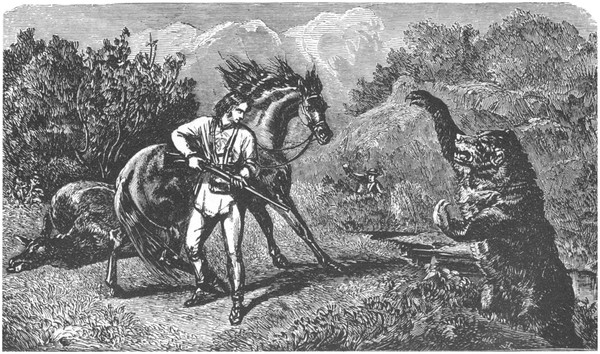
on a bear-hunt, which he describes:
“The party were all mounted on horseback, to the
number of seventy-three, and exhibited a fine display
of horsemanship. After some ten miles’ travel, we
commenced operations. Having reached the hunting-ground,
the party separated into several divisions. We
then perambulated the woods, crossed rivers, surrounded
thickets, and scampered over hill and dale,
with yell and song, for the greater part of two days;
during which time we killed seven bears, nine wolves,
and eleven small deer: one of the former I had the good
luck to shoot myself. In the evening of the third day,
however, our sport was checked by an accident. One
of the great men, the chief Pacha of the hunting party,
named Tu-tack-it, Is-tso-augh-an, or Short Legs, got
severely wounded by a female bear.
“The only danger to be apprehended in these savage
excursions is by following the wounded animal into a
thicket, or hiding-place; but with the Indians the more
danger the more honour, and some of them are foolhardy
enough to run every hazard in order to strike
the last fatal blow, (in which the honour lies,) sometimes
with a lance, tomahawk, or knife, at the risk of their
lives. No sooner is a bear wounded than it immediately
flies for refuge to some hiding-place, unless too closely
pursued; in which case, it turns round in savage fury
on its pursuers, and woe awaits whoever is in the way.
“The bear in question had been wounded and took
shelter in a small coppice. The bush was instantly
surrounded by the horsemen, when the more bold
and daring entered it on foot, armed with gun, knife,
and tomahawk. Among the bushrangers on the present
occasion was the chief, Short Legs, who, while
scrambling over some fallen timber, happened to stumble
near to where the wounded and enraged bear was
concealed, but too close to be able to defend himself
before the vicious animal got hold of him. At that
moment I was not more than five or six paces from the
chief, but could not get a chance of shooting, so I
immediately called out for help, when several mustered
round the spot. Availing ourselves of the doubtful
alternative of killing her—even at the risk of killing the
chief—we fired, and as good luck would have it, shot
the animal and saved the man; then carrying the bear
and wounded chief out of the bush, we laid both on
the open ground. The sight of the chief was appalling:
the scalp was torn from the crown of his head, down
over the eyebrows! he was insensible, and for some
time we all thought him dead; but after a short interval
his pulse began to beat, and he gradually showed
signs of returning animation.
“It was a curious and somewhat interesting scene to
see the party approach the spot where the accident
happened. Not being able to get a chance of shooting,
they threw their guns from them, and could scarcely
be restrained from rushing on the fierce animal with
their knives only. The bear all the time kept looking
first at one, then at another, and casting her fierce and
flaming eyes around the whole of us, as if ready to
make a spring at each; yet she never let go her hold
of the chief; but stood over him. Seeing herself surrounded
by so many enemies, she moved her head
from one position to another, and these movements
gave us ultimately an opportunity of killing her.
“The misfortune produced a loud and clamorous
scene of mourning among the chief’s relations; we hastened
home, carrying our dead bears along with us, and
arrived at the camp early in the morning of the fourth
day. The chief remained for three days speechless.
In cutting off the scalp and dressing the wound, we
found the skull, according to our imperfect knowledge
of anatomy, fractured in two or three places; and at
the end of eight days, I extracted a bone measuring
two inches long, of an oblong form, and another of
about an inch square, with several smaller pieces, all
from the crown of the head! The wound, however,
gradually closed up and healed, except a small spot
about the size of an English shilling. In fifteen days,
by the aid of Indian medicine, he was able to walk
about, and at the end of six weeks from the time he got
wounded, he was on horseback again at the chace.”
More or less wolf-hunting was done through the winter,
and Ross describes certain methods of catching
and killing these animals.
The killing of wolves, foxes, and other wild animals
by the whites was really only a recreation, and the
traders preferred shooting them to any other mode of
destruction. The wolves were usually afoot and searching
for food at all hours of the day and night. They
liked to get up on nearby hills or knolls, to sit and
look about. It was the practice of the traders to scatter
food about the places frequented by the wolves, and—when
there were no wolves there—to practise shooting
at a mark, watching where the balls hit and learning
the elevation of the gun required to reach the spot,
until finally many of them became very expert at this
long-distance shooting.
“A band of Indians happening to come to the fort
one day, and observing a wolf on one of the favourite
places of resort, several of them prepared to take a
circuitous turn to have a shot at the animal. Seeing
them prepare—‘Try,’ said I, ‘and kill it from where
you are,’ The Indians smiled at my ignorance. ‘Can
the whites,’ said the chief, ‘kill it at that distance?’
‘The whites,’ said I, ‘do not live by hunting or shooting
as do the Indians, or they might.’ ‘There is no
gun,’ continued the chief, ‘that could kill at that distance,’
By this time the wolf had laid hold of a bone,
or piece of flesh, and was scampering off with it, at full
speed, to the opposite woods. Taking hold of my gun—‘If
we cannot kill it,’ said I, ‘we shall make it let go
its prey.’ ‘My horse against your shot,’ called out
the chief, ‘that you do not hit the wolf.’ ‘Done,’ said
I; but I certainly thought within myself that the chief
ran no great risk of losing his horse, nor the wolf of
losing his life. Taking an elevation of some fifteen or
sixteen feet over it, by chance I shot the animal in
his flight, to the astonishment of the chief, as well as
all present, who, clapping their hands to their mouths
in amazement, measured the distance by five arrow-shots:
nothing but their wonder could exceed their
admiration of this effect of fire-arms.
“When the ball struck the wolf, it was in the act of
leaping; and we may judge of its speed at the time,
from the fact that the distance from whence it took
the last leap to where it was lying stretched, measured
twenty-four feet! The ball struck the wolf in the left
thigh, and passing through the body, neck and head,
it lodged in the lower jaw; I cut it out with my pen-knife.
The chief, on delivering up his horse, which
he did cheerfully, asked me for the ball, and that ball
was the favourite ornament of his neck for years afterwards.
The horse I returned to its owner. The Indians
then asked me for the skin of the dead wolf;
and to each of the guns belonging to the party was appended
a piece: the Indians fancying that the skin
would enable them, in future, to kill animals at a great
distance.”
The following summer, McKenzie with Ross and
ninety-five men went up the river and encamped at
the site determined on for the new establishment of
Fort Nez Percés, about one-half mile from the mouth
of the Walla Walla. This country was occupied by
Indians of the Shahaptian stock—fierce, good warriors,
and impulsive—easily moved in one direction or
the other. They seemed by no means favorable to
the coming whites; did not shake hands with them, and
in fact appeared disposed to boycott the new arrivals.
The situation was a difficult one, because the construction
of a fort required a dividing of the party into
many small bands, and also because more Indians were
constantly coming in, and their actions caused much
uneasiness. They insisted on receiving pay for the
timber to be used in building the fort; they forbade
hunting and fishing; they set the price on all articles
of trade, and it was difficult to know what the outcome
of this might be.
The difficulties threatening the traders caused an
almost complete suspension of work. They stood on
their guard, ready for an attack at any time, while
for five days there was no intercourse between whites
and Indians; food was short, and one night the party
went to bed supperless. The Indians continued to
gather, and the traders thought that they were plotting
and planning—no one knew what.
A slight enclosure had been put up, behind which the
traders awaited whatever might happen. After a time,
the chiefs opened negotiations with the whites and
insisted that liberal presents should be made to all
the Indians roundabout, in order to gain their favor.
This was obviously impracticable, since all the property
of the traders would not have sufficed to make a present
to each Indian, and the demand was refused, with
the result that the firmness of the white men caused
the Indians to reduce their requests and finally to submit
to the proposals of the whites, and as soon as this
was agreed on a brisk trade went on.
The position chosen for the fort was noteworthy
among the natives because it was the ground on which,
some years before, Lewis and Clark had ratified a
general peace between themselves and the tribes of
the surrounding country. The situation was commanding.
To the west was a spacious view of the
great river, to the north and east were the wide expanses
of the yellow plains, while to the south lay wild,
rough hills on either side of the river, overlooked by
two singular towering rocks on the east side of the
stream, called by the natives “The Twins.” In the
distance lay the Blue Mountains.
Presently a large war-party returned to the camp
with scalps and captives—a great triumph. Now
came a demand from the Indians that the white traders
should not give guns or balls to the enemies of these
Indians, but after much negotiation and many speeches,
the Indians agreed that peace should be made between
themselves and the Snakes.
It was not long after this that a considerable party
was sent off to penetrate the country inhabited by the
Snakes and other tribes to the south. The traders
had secured two hundred and eighty horses, enough
for riding and packing, and the most of these were to
go off with the Snake expedition, which consisted of
fifty-five men, nearly two hundred horses, three hundred
beaver-traps, and a considerable stock of trade
goods. Mr. McKenzie led the expedition, which left
Fort Nez Percés at the end of September. Ross, with
the remaining party, stayed at the Fort.
The neighboring Indians, of whom Ross speaks in
most cordial terms, treated the traders well and were
respectful and good-natured, but presently came rumors
of difficulties between the trading party to the Snakes
and that tribe, and one of these rumors was confirmed
by the arrival of a member of that expedition, an Iroquois,
who had evidently had a hard time. According
to his account, the Iroquois after a time separated
from McKenzie to trap a small river which was well
stocked with beaver. The Iroquois, according to the
story, began to exchange their horses, guns, and traps
with a small party of Snakes, and presently had little
or nothing left. The returned Iroquois man got lost,
and finally, with great difficulty, without food, blanket,
or arms, got back to Fort Nez Percés. Other Iroquois
returned and told various stories, and finally,
going back to Fort George, persuaded Mr. Keith to send
out a party to punish the Indians, who they said had
injured them. Such a party was sent out to the Cowlitz
River, and the Iroquois getting away from Mr.
Ogden killed twelve men, women, and children, and
scalped three of them. This seemed fatal to further
friendly relations; nevertheless, at last peace was concluded
between the traders and the Cowlitz Indians,
and was sealed by the marriage of the chief’s daughter
to one of the fur traders.
There was more sporadic fighting and killing of
Indians and the murder of five people belonging to Fort
George, so that things got into a very bad condition,
which it took a long time to smooth over.
Late in the season Mr. McKenzie with six men on
snow-shoes returned from the interior and gave an
interesting account of the new country through which
he had passed—a country to him not wholly new, because
he had been through it in 1811. He reported
that the Iroquois, instead of trapping and hunting,
had separated and were scattered all over the country
by twos and threes, living with the Indians, without
horses, without traps, without furs, and without clothing.
He left them as he found them.
Of the region traversed, Mr McKenzie reported:
“On our outward journey, the surface was mountainous
and rugged, and still more so on our way back.
Woods and valleys, rocks and plains, rivers and ravines,
alternately met us; but altogether it is a delightful
country. There animals of every class rove about
undisturbed; wherever there was a little plain, the red
deer were seen grazing in herds about the rivers; round
every other point were clusters of poplar and elder,
and where there was a sapling, the ingenious and industrious
beaver was at work. Otters sported in the
eddies; the wolf and the fox were seen sauntering in
quest of prey; now and then a few cypresses or stunted
pines were met with on the rocky parts, and in their
spreading tops the raccoon sat secure. In the woods,
the martin and black fox were numerous; the badger
sat quietly looking from his mound; and in the numberless
ravines, among bushes laden with fruits, the
black, the brown, and the grisly bear were seen. The
mountain sheep, and goat white as snow, browsed on
the rocks, and ridges; and the big horn species ran
among the lofty cliffs. Eagles and vultures, of uncommon
size, flew about the rivers. When we approached,
most of these animals stood motionless; they
would then move off a little distance, but soon came
anew to satisfy a curiosity that often proved fatal to
them.
“The report of a gun did not alarm them: they would
give a frisk at each shot, and stand again; but when
the flag was unfurled, being of a reddish hue, it was
with apparent reluctance they would retire beyond the
pleasing sight. Hordes of wild horses were likewise
seen on this occasion; and of all the animals seen on
our journey they were the wildest, for none of them
could be approached; their scent is exceedingly keen,
their hearing also; and in their curiosity they were never
known to come at any time within gun-shot. One
band of these contained more than two hundred.
Some of them were browsing on the face of the hills;
others were running like deer up and down the steeps;
and some were galloping backwards and forwards on
the brows of the sloping mountains, with their flowing
manes and bushy tails streaming in the wind.”
Mr. McKenzie’s successful trip commanded the admiration
of all of the council of the head men at Fort
George. Those who had formerly been opposed to
him were now loud in his praises, and the establishment
of Fort Nez Percés and the gaining of a foothold
in the Snake country were warmly approved. He remained
at Fort Nez Percés only seven days and then
started back again. His report of the prospects in
the Snake country was gratifying, but his people were
giving great trouble.
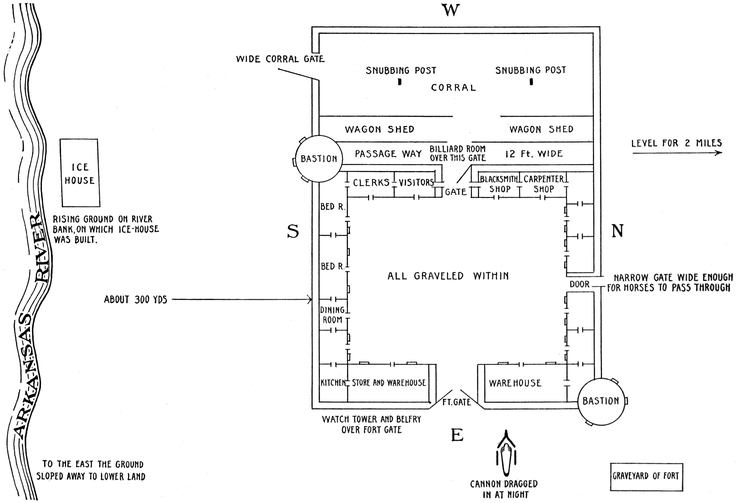
Fort Nez Percés was stockaded with an enclosure
of pickets of sawn timber some twelve or fifteen feet
high with four towers or bastions. The pickets were
two and one-half feet broad by six inches thick. Near
the top of the stockade was a balustrade four feet
high, and a gallery five feet broad extended all around
it, while the walls were loopholed. At each angle of
the fort was a large reservoir holding two hundred gallons
of water, and within the stockade were all the
buildings, warehouses, stores, and dwelling-houses.
These buildings were all loopholed and had sliding
doors, and the trading-room was arranged with a
small door in the wall, eighteen inches square, through
which the Indians passed their furs, receiving from the
traders on the inside the goods to which they were
entitled. The outer gate was arranged to open and
shut by a pulley, and besides this there were two
double doors. Except on special occasions, the Indians
were never invited into the fort. Nevertheless,
at the gate there was a house for the accommodation
of the Indians, with fire, tobacco, and a man to look
after them at all times. The Indians, however, did not
like this arrangement, because it seemed to show suspicion
on the part of the white men; they themselves
were suspicious of some plots. They asked whether
the traders were afraid of them or afraid that they
would steal, and while the traders denied that they were
afraid of anything, they persisted in their plan, and at
length the Indians accepted the situation. The traders
were supplied with cannons, swivels, muskets, and bayonets,
boarding-pikes and hand-grenades, while above
the gate stood a small mortar. The position was a
strong one, and Ross calls it the “Gibraltar of Columbia”
and speaks of it as “a triumph of British
energy and enterprise, of civilization over barbarism.”
McKenzie, on his return to the interior, had promised
to be at the river Skam-naugh about the 5th of
June and had asked that an outfit with supplies for
his party be sent to meet him there. For this reason
Ross returned from his annual trip to Fort George
nearly a month earlier than usual—by the 15th of
May. A party of fifteen men under a clerk named
Kittson was sent out to take McKenzie his supplies
and reinforce him. Kittson was a new man in the
service, and was full of confidence that he could handle
and defeat all the Indians on the continent. He had
good luck until the party got into the debatable land
in the Snake territory, and here, first, a dozen of his
horses were stolen, and then, a little later, all of
them.
Meantime McKenzie had had the usual difficulties
with his Iroquois trappers, who could not be trusted
with goods to trade with the Snakes. When the people
whom he expected to meet at the river were not
there, he sent out ten men to look for them. Two
days after starting, as they were passing through a
canyon, they met, face to face, the Indians who had
just taken all of Kittson’s horses, and, recognizing the
animals, charged the three horse-thieves. One was
killed, another wounded and escaped, and a third was
taken captive, and the traders turned the herd about
and drove the horses back to Kittson’s camp.
Kittson now had thirty-six men and joined McKenzie,
on the way capturing two more Indian horse-thieves,
caught at night while cutting loose the horses.
Kittson handed over his supplies, received McKenzie’s
furs, and set out again for Fort Nez Percés.
When McKenzie and Kittson separated, the former
had only three men left with him, for his Iroquois did
not arrive, as expected. While waiting for them, a
threatening party of mountain Snakes appeared at his
camp, who were very importunate, so much so that
at last McKenzie took from his pile of goods a keg
of gunpowder and, lighting a match, threatened, if the
Indians continued to advance, to blow up the whole
party. Taken by surprise, they hesitated, and then
suddenly, without a word, took to flight, not from
fear of the threats of McKenzie, but because of the
sudden appearance of a large war-party of Shahaptians
on the other side of the river. Fortunately, these people
could not cross the high and rushing stream, but
a little later they made an attack on Kittson’s party
and killed two of his men. As soon as the war-party
had gone McKenzie and his men, with their property,
crossed the channel of the river to an island, where
they remained twenty-two days, until the return of
Kittson. McKenzie and Kittson were now in a situation
not at all agreeable. On one side were the Nez
Percés, on the other the Blackfeet, and all about were
the Snakes. All these tribes were hostile to one another,
and all of them more or less ill-disposed toward
the whites, so the summer was an anxious one, but McKenzie
purposed to winter in the upper country as
well as he might. Here Ross interjects an interesting
sketch of trappers’ methods.
“A safe and secure spot, near wood and water, is first
selected for the camp. Here the chief of the party
resides with the property. It is often exposed to
danger, or sudden attack, in the absence of the trappers,
and requires a vigilant eye to guard against the
lurking savages. The camp is called head quarters.
From hence all the trappers, some on foot, some on
horseback, according to the distance they have to go,
start every morning, in small parties, in all directions,
ranging the distance of some twenty miles around.
Six traps is the allowance for each hunter; but to guard
against wear and tear, the complement is more frequently
ten. These he sets every night, and visits
again in the morning; sometimes oftener, according to
distance, or other circumstances. The beaver taken
in the traps are always conveyed to the camp, skinned,
stretched, dried, folded up with the hair in the inside,
laid by, and the flesh used for food. No sooner, therefore,
has a hunter visited his traps, set them again, and
looked out for some other place, than he returns to the
camp, to feast, and enjoy the pleasures of an idle day.
“There is, however, much anxiety and danger in
going through the ordinary routine of a trapper’s duty.
For as the enemy is generally lurking about among
the rocks and hiding-places, watching an opportunity,
the hunter has to keep a constant lookout; and the
gun is often in one hand, while the trap is in the other.
But when several are together, which is often the case
in suspicious places, one-half set the traps, and the
other half keep guard over them. Yet notwithstanding
all their precautions, some of them fall victims to
Indian treachery.
“The camp remains stationary while two-thirds of
the trappers find beaver in the vicinity; but whenever
the beaver becomes scarce, the camp is removed to
some more favourable spot. In this manner, the party
keeps moving from place to place, during the whole
season of hunting. Whenever serious danger is apprehended,
all the trappers make for the camp. Were
we, however, to calculate according to numbers, the
prospects from such an expedition would be truly
dazzling: say, seventy-five men, with each six traps,
to be successfully employed during five months; that
is, two in the spring, and three in the fall, equal to
131 working days, the result would be 58,950 beaver!
Practically, however, the case is very different. The apprehension
of danger, at all times, is so great, that
three-fourths of their time is lost in the necessary steps
taken for their own safety. There is also another serious
drawback unavoidably accompanying every large
party. The beaver is a timid animal; the least noise,
therefore, made about its haunt will keep it from coming
out for nights together; and noise is unavoidable
when the party is large. But when the party is small,
the hunter has a chance of being more or less successful.
Indeed, were the nature of the ground such as
to admit of the trappers moving about in safety, at
all times, and alone, six men, with six traps each, would,
in the same space of time, and at the same rate, kill
as many beavers—say 4,716—as the whole seventy-five
could be expected to do! And yet the evil is without
a remedy; for no small party can exist in these
parts. Hence the reason why beavers are so numerous.”
Ross points out also some of the troubles that the
traders must meet with, which troubles were largely
due, of course, to the absolute inability of the Indians
to comprehend the conditions of this new life. The
Indians asked for everything that they saw and berated
the traders because their requests were not complied
with. They were constantly playing jokes—or what
they considered jokes—on the white men, which were
irritating enough; and looked with contempt on the
whites who were engaged in ordinary labor, which they,
of course, did not in the least understand. The Indians,
with all their freedom, were far from happy, because
they were in a state of constant anxiety and alarm.
People who felt themselves injured were likely to make
war excursions and kill some one belonging to another
tribe, which, of course, extended the field of the trouble.
When fighting took place, and people supposedly
friendly to the whites were injured, the traders were
blamed, because they sold guns, powder, and balls to
any one who might wish to trade with them. The
life of the trader was thus one of anxiety, and to
handle the Indians successfully called for extraordinary
self-control.
Not long before this time some Shahaptians had
killed two of Kittson’s men and several Snakes. The
Snakes followed them, but before overtaking them
came upon some Indians belonging to the Walla Walla,
camped not three miles from Fort Nez Percés, where
they killed a man, four women, and two children, and
captured two young women and a man. The next
day the whole Walla Walla camp moved down to the
fort, carrying the bodies of the dead. Ross saw the
disorderly procession coming on with shrieks and lamentations,
and at first did not know what to make of
the advance, but presently the Indians reached the
gate of the fort, placed their dead upon the ground
there, and began to gash themselves with knives in
the old-time way of mourning. They called to Ross
to come out to them, and he, while very reluctant,
had no choice—if he was to retain his influence with
them—but to obey.
“Turning round to the sentinel at the door, I told
him to lock the gate after me, and keep a sharp look
out. The moment I appeared outside the gate, so
horrible was the uproar, that it baffles all description.
Intoxicated with wrath and savage rage, they resembled
furies more than human beings; and their ghastly,
wild, and forbidding looks were all directed towards
me, as if I had been the cause of their calamity. Tam-a-tap-um
the chief then coming up to me, and pointing
to one of the dead bodies, said, ‘You see my sister
there,’ then uncovering the body to show the wounds,
added, ‘That is a ball hole.’ ‘The whites’, said he
again, ‘have murdered our wives and our children.
They have given guns and balls to our enemies. Those
very guns and balls have killed our relations.’ These
words were no sooner uttered than they were repeated
over and over again by the whole frantic crowd; who,
hearing the chief, believed them to be true. Excitement
was now at its height. Their gestures, their
passionate exclamations, showed what was working
within, and I expected every moment to receive a ball
or an arrow. One word of interruption spoken by me
at the critical moment, in favour of the whites, might
have proved fatal to myself. I therefore remained
silent, watching a favourable opportunity, and also examining
closely the holes in the garments of the dead
bodies. The holes I was convinced were made by
arrows, and not by balls as the chief had asserted; but
it remained for me to convince others when an opportunity
offered.
“Every violent fit of mourning was succeeded, as is
generally the case among savages, by a momentary
calm. As soon, therefore, as I perceived the rage of
the crowd beginning to subside, and nature itself
beginning to flag, I availed myself of the interval to
speak in turn; for silence then would have been a tacit
acknowledgment of our guilt. I therefore advanced,
and taking the chief by the hand, said in a low tone of
voice, as if overcome by grief, ‘My friend, what is all
this? Give me an explanation. You do not love the
whites; you have told me nothing yet.’ Tam-a-tap-um
then turning to his people, beckoned to them with the
hand to be silent; entire silence was not to be expected.
He then went over the whole affair from beginning to
end. When the chief ended, and the people were in a
listening mood, I sympathized with their misfortunes,
and observed that the whites had been undeservedly
blamed. ‘They are innocent,’ said I, ‘and that I can
prove. Look at that,’ said I, pointing to an arrow
wound, which no one could mistake, ‘the wounds are
those of arrows, not balls. Nor were the Snakes
themselves so much to blame; as we shall be able
to show.’
“At these assertions the chief looked angry, and
there was a buzz of disapprobation, among the crowd;
but I told the chief to listen patiently until I had done.
The chief then composed himself, and I proceeded.
‘After your solemn acquiescence in a peace between
yourselves and the Snakes, through the influence of
the whites, the Shaw-ha-ap-tens violated the second
pledge by going again to war, across the Blue Mountains;
and not content with having killed their enemies,
they killed their friends also. They killed two of the
whites. The Snakes in the act of retaliation have therefore
made you all to mourn this day; they have made
the whites to mourn also. But your loss is less than
ours; your relations have been killed; but still you
have their bodies: that consolation is denied us. Our
friends have been killed, but we know not where their
bodies lie.’ These facts neither the chief nor the
crowd could gainsay. The chief, with a loud voice,
explained what I had said to the listening multitude;
when they with one voice exclaimed, ‘It is true, it is
true!’ Leaving the chief, I then entered the fort, and
taking some red cloth, laid six inches of it on each body,
as a token of sympathy; then I told them to go and
bury their dead. A loud fit of lamentation closed the
scene. The bodies were then taken up, and the crowd
moved off, in a quiet and orderly manner.
“But the satisfaction we enjoyed at the departure
of the savages was of short duration, for they were
scarcely out of sight, and I scarcely inside the door,
when another band, related to those who had been
killed, arrived at the fort gate, and the loud and clamorous
scene of mourning was again renewed.
“Among this second crowd of visitors was a fellow
dignified by the name of Prince, and brother to one of
the young women who had been carried off by the
Snakes. Prince encamped within fifty yards of the
fort, and his tent was no sooner pitched than he began
to chant the song of death. When an Indian resorts
to this mode of mourning, it is a sure sign that, ‘he has
thrown his body away,’ as the Indians term it, and
meditates self-destruction. Being told of Prince’s
resolution, I went to his tent to see him, and found him
standing, with his breast leaning upon the muzzle of
his gun; his hair was dishevelled, and he was singing
with great vehemence: he never raised his head to see
who I was. I knew all was not right, and spoke to
him; but receiving no answer, I went away, on my return
to the fort. I had scarcely advanced twenty
yards from his tent, before I heard the report of a gun
behind me, and turning back again, I found the unfortunate
fellow lying on the ground weltering in his
blood, his gun partly under him. He was still breathing.
The ball had entered his left breast, below the
nipple, and came out near the backbone. The wound
was bleeding freely, and he disgorged great quantities
of blood. I went to the fort for some assistance, but
on our return I expected that every moment would
have been his last; however we dressed his wound, and
did what we could to allay his suffering.
“The Indians now assembled in great numbers, and
were noisy and violent. In the first instance, they
threw all the blame of the unfortunate affair on the
whites; but in their rage and violence, they quarrelled
among themselves, and this new direction in their
excitement removed the odium in some degree from the
whites, and diverted the tide of popular fury into another
channel. During the affair, one of those unfortunate
wretches called medicine-men happened to be
sitting at the fort gate, when a brother of the man
who had just shot himself went up to him, saying,
‘You dog! you have thrown your bad medicine on
my brother, and he is dead; but you shall not live,’
and in saying so, he shot him dead on the spot. The
ball, after passing through the man’s body, went more
than three inches into one of the fort palisades. I was
standing on the gallery at the moment he was shot,
and had it been on any other occasion but in the midst
of a quarrel between the Indians, we certainly should
have avenged his death on the spot; for the murdered
man was an excellent Indian, and a sincere friend of
the whites.
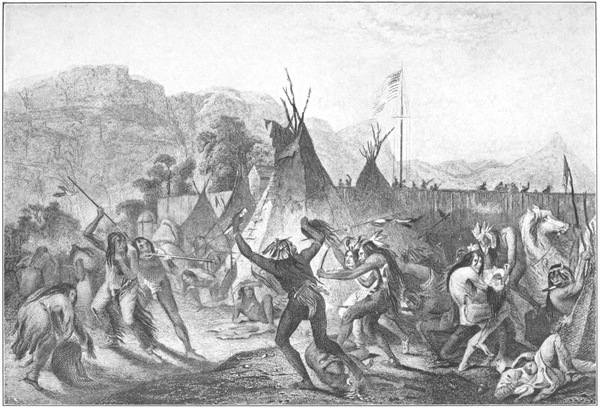
“The scene now assumed a threatening aspect.
Guns, bows, arrows, and every missile that could be
laid hold of, came into requisition; and robes, feathers,
bells, belts, and trinkets of every description, were
rattling about in true savage style. The fellow who
had just shot the medicine-man was shot in his turn,
and before the chiefs arrived, or could get a hearing,
three others were shot. The place appeared more like
a field of battle than anything else; for besides the five
bodies that lay lifeless on the ground, twice that number
were desperately wounded.
“As soon as the deadly quarrel began, not knowing
the intent of the Indians, nor how it might end, I
shut the gates, and kept as clear of the quarrel as possible.
In the midst of the confusion, the Indians
poured in from all quarters, adding fuel to the flame;
and some of them in approaching the place, thinking
it was a quarrel between the whites and themselves,
fired a shot or two at the fort before they were aware
of the mistake. This made us take to our bastions:
our matches were lighted, guns pointed, and we ourselves
watched the manœuvres of the savages around
us. One unguarded shot would have involved us in
the quarrel, which it was our interest to avoid; as it
would have put an end to all our prospects in the Snake
as well as the Nez Percés quarter.
“As soon as the chiefs could get a hearing, peace
was generally restored; and the five dead bodies were
removed to the Indian camp, at a distance from the
fort. Such a scene I should never wish to witness
again. This affray, happening at our very door, gave
us much uneasiness; as to keep the balance of good will
at all times in our favour was a task of more than ordinary
difficulty.”
The next day more Indians came in, and soon several
tribes were represented. The whites were indirectly
taxed with all the troubles, and there was a vast deal
of speech-making and many threats. At last, however,
after a week of counselling, the matter quieted
down, the different tribes all smoked together, and
peace was made—to last for a time.
Ross has much to say about the different tribes of
Shoshoni stock and their relations to each other. He
was long with them and studied them carefully.
The Ban-at-tees, which we call Bannocks, seem to
have been held by the Snake tribes to the south and
west as chargeable with most of the disturbances between
the whites and the Snakes, and after a time it
developed that the Indians that murdered Mr. Reid
and his party in the autumn of 1813 were Bannocks.
During the winter a hunter named Hodgens became
separated from his party during a violent snow-storm
and lost his way. A little later, in the same way,
he lost his horse; his gun became broken so that he
could not make a fire, and during two days and two
nights he was obliged to lie out without fire.
“On the fourteenth day, however, while scarcely
able to crawl, he had the good luck to fall on the main
camp of the War-are-ree-kas; where recognizing the
chief’s tent, from the manner in which it was painted,
he advanced towards it, looking more like a ghost than
a living being. On his entering, Ama-ketsa, surprised
at his unexpected arrival, and still more surprised at
his emaciated appearance, stared him in the face for
some time, and could scarcely believe that it was a
white man; but as soon as he was convinced of the
reality, and made acquainted with the wanderer’s forlorn
state, he ordered one of his wives to put a new
pair of shoes on his feet, gave him something to eat,
and was extremely kind to him. Here Hodgens remained
for eleven days in the chiefs tent, nursed with
all the care and attention of a child of the family, until
his strength was recovered; and as soon as he was on
his legs again, Ama-ketsa furnished him with a horse,
some provisions, and sent one of his own sons to conduct
him to the whites. Although Hodgens could give
the Indians no clue as to where the hunters were encamped,
yet on the eighth day they arrived safe and
sound at their friends’, and as straight as if they had
been led by a line to them; which convinced our
people that the Indians knew well the place of their
retreat....
“A party of our people had been out a whole week
in search of Hodgens, and found his dead horse, but
despairing of finding him they returned to their camp;
and all hope of ever finding Hodgens alive vanished:
when he did come, their astonishment was equal to
their delight. The friendly conduct of Ama-ketsa
towards him was a strong proof of that chiefs good-will
towards our people. During our friends’ stay in
this place they had several surprises from the Indians,
but they managed matters so well that no more of
their horses were stolen.”
There is distinct reference in this volume to the
Yellowstone National Park, which may very well have
been visited by Ross or some of his trappers. He
speaks of “Pilot Knobs”—the Three Tetons—salt
and sulphur springs and of boiling fountains, some of
them so hot as to boil meat. These allusions do not,
of course, necessarily refer to Yellowstone Park, for
there are many other places in the Rocky Mountains
where such things are found, but the references to the
Three Tetons and to the source of the Lewis River
are suggestive enough.
Ross speaks also of various foods of the country;
of the use of horse flesh and dog flesh and also of the
Snake tobacco, which, for a time at least, the Indians
preferred to that imported by the whites. He credits
the Snake Indians with extraordinary skill in woodcraft,
shown especially by the methods they employ
to avoid possible enemies.
The time was now at hand when the Northwest
Company should be merged into the Hudson Bay Company.
This consolidation naturally cast a gloom over
the retainers of the Northwest Company wherever
they were situated. The people who had been employed
by the Northwest Company were uncertain
where they stood. Those who had been promoted
prior to the “deed-poll”—March 26, 1821—were provided
for by the Hudson Bay Company, whereas all
others were excluded from these benefits. Some of
them, however, received pecuniary compensation for
their disappointment, and of these Ross was one, or
he was told by an officer of the company that five
hundred pounds sterling had been placed to his credit,
but of this he never received a penny.
Ross now entered the service of the Hudson Bay
Company. He had been for a short time with the
Pacific Fur Company; had spent seven years with the
Northwest Company and, except for his experience,
was about where he had been when he started.
The servants of the Northwest Company had been
in the habit of depositing their savings with the firm
which was its head, and a few years after the consolidation
of the two companies this concern failed and
all these savings disappeared.
Toward the end of his first volume, after much information
about Indians, half-breeds, trading, trappers,
and travel, Ross draws an interesting picture of
the manner in which the bourgeois—or proprietary
partner—journeys through the fur country, and the
absolute loyalty to him and to the company felt by
the voyageurs, who were, indeed, the backbone of the
northern fur trade. He says:
“The bourgeois is carried on board his canoe upon
the back of some sturdy fellow generally appointed for
this purpose. He seats himself on a convenient mattress,
somewhat low in the centre of his canoe; his gun
by his side, his little cherubs fondling around him, and
his faithful spaniel lying at his feet. No sooner is he
at his ease, than his pipe is presented by his attendant,
and he then begins smoking, while his silken banner
undulates over the stern of his painted vessel. Then
the bending paddles are plied, and the fragile craft
speeds through the currents with a degree of fleetness
not to be surpassed;—yell upon yell from the hearty
crew proclaiming their prowess and skill.
“A hundred miles performed, night arrives; the
hands jump out quickly into the water, and their nabob
and his companions are supported to terra firma.
A roaring fire is kindled and supper is served; his
honour then retires to enjoy his repose. At dawn of
day they set out again; the men now and then relax
their arms, and light their pipes; but no sooner does
the headway of the canoe die away, than they renew
their labours and their chorus: a particular voice being
ever selected to lead the song. The guide conducts
the march.
“At the hour of breakfast they put ashore on some
green plot. The tea-kettle is boiling; a variegated mat
is spread, and a cold collation set out. Twenty minutes—and
they start anew. The dinner-hour arrives,
they put aground again. The liquor-can accompanies
the provision-basket; the contents are quickly set forth
in simple style; and, after a refreshment of twenty
minutes more, off they set again, until the twilight
checks their progress.
“When it is practicable to make way in the dark,
four hours is the voyageurs’ allowance of rest; and at
times, on boisterous lakes and bold shores, they keep
for days and nights together on the water, without
intermission, and without repose. They sing to keep
time to their paddles; they sing to keep off drowsiness,
caused by their fatigue; and they sing because the
bourgeois likes it.
“Through hardships and dangers, wherever he leads,
they are sure to follow with alacrity and cheerfulness—over
mountains and hills, along valleys and dales,
through woods and creeks, across lakes and rivers.
They look not to the right, nor to the left; they make
no halt in foul or fair weather. Such is their skill, that
they venture to sail in the midst of waters like oceans,
and, with amazing aptitude, they shoot down the most
frightful rapids; and they generally come off safely.
“When about to arrive at the place of their destination,
they dress with neatness, put on their plumes, and
a chosen song is raised. They push up against the
beach, as if they meant to dash the canoe into splinters;
but most adroitly back their paddles at the right
moment; whilst the foreman springs on shore, and,
seizing the prow, arrests the vessel in its course. On
this joyful occasion, every person advances to the
waterside, and great guns are fired to announce the
bourgeois’ arrival. A general shaking of hands takes
place, as it often happens that people have not met for
years: even the bourgeois goes through this mode of
salutation with the meanest. There is, perhaps, no
country where the ties of affection are more binding
than here. Each addresses his comrades as his brothers;
and all address themselves to the bourgeois with
reverence, as if he were their father.”
About this time, Mr. McKenzie retired from the
fur trade and went to live in northern New York.
This left without occupation a number of hunters and
trappers in the country, where Ross was stationed, and
Ross made up his mind to leave the country and abandon
the business which he had so long followed. He
was still merely a clerk in the service of the great company.
Finan McDonald, a Northwest veteran, now in
the service of the Hudson Bay Company, was to be in
charge of the people in the Snake country, and a little
later John Warren Dease, a chief trader in the new
company, reached Fort Nez Percés and told Ross that
he had been named to take charge of the fort and the
country immediately about it, while Ross was to succeed
McKenzie in charge of the Snake country.
Nevertheless, Ross was determined to go back to the
East and had started with his family, but on his way—when
he reached the Rocky Mountains—he received a
letter from Governor Simpson, offering him the management
of the Snake country for three years at a
liberal salary. Ross hesitated to accept, but finally
did so, and went to Spokane House to make up his
party. McDonald had recently come in there and with
much grumbling; for he had had trouble with the Piegan
Blackfeet, in which one of his men had been shot
by treachery, and in a pitched battle afterward had with
the same party he lost seven more of his men.
The account of this battle may properly be inserted
here:
“One day, when they had travelled until dark in
search of water, they found some at the bottom of a
deep and rocky ravine, down which they went and encamped.
They had seen no traces of enemies during
the day, and being tired, they all went to sleep, without
keeping watch. In the morning, however, just at the
dawn of day, they were saluted from the top of the
ravine before they got up, with a volley of balls about
their ears; without, however, any being killed or
wounded: one of them had the stock of his gun pierced
through with a ball, and another of them his powder-horn
shivered to pieces; but this was all the injury they
sustained from the enemy’s discharge. The alarm was
instantly given, all hands in confusion sprang up and
went out to see what was the matter; some with one
shoe on and the other off, others naked, with a gun in
one hand and their clothes in the other. When they
perceived the Indians on the top of the rocks, yelling
and flourishing their arms, the whites gave a loud
huzza, and all hands were collected together in an
instant; but the Indians instead of taking advantage
of their position, wheeled about and marched off without
firing another shot.
“McDonald, at the head of thirty men, set out to
pursue them; but finding the ravine too steep and rocky
to ascend, they were apprehensive that the sudden disappearance
of the Indians was a stratagem to entrap
them, when they might have been popped off by the
enemy from behind stones and trees, without having
an opportunity of defending themselves. Acting on
this opinion, they returned, and taking a supply of
powder and ball with them, they mounted their horses,
to the number of forty-five, and then pursued the
enemy, leaving twenty men behind to guard the camp.
When our people got to the head of the ravine, the
Indians were about a mile off, and all on foot, having
no horses, with the exception of five for carrying their
luggage; and our people, before they could get up
with them, had to pass another ravine still deeper and
broader than the one they were encamped in, so that
before they got down on one side of it the enemy had
got up on the other side. And here again the Indians
did not avail themselves of their advantage, but allowed
our people to follow without firing a shot at
them, as if encouraging them on; and so bold and confident
were they, that many of them bent themselves
down in a posture of contempt, by way of bidding
them defiance.
“As soon as our people had got over the second
ravine, they took a sweep, wheeled about, and met the
Indians in the teeth; then dismounting, the battle
began, without a word being spoken on either side.
As soon as the firing commenced, the Indians began
their frantic gestures, and whooped and yelled with the
view of intimidating; they fought like demons, one
fellow all the time waving a scalp on the end of a pole:
nor did they yield an inch of ground till more than
twenty of them lay dead; at last, they threw down
their guns, and held up their hands as a signal of peace.
By this time our people had lost three men, and not
thinking they had yet taken ample vengeance for
their death, they made a rush on the Indians, killed
the fellow who held the pole, and carried off the scalp
and the five horses. The Indians then made a simultaneous
dash on one side, and got into a small coppice
of wood, leaving their dead on the spot where they fell.
Our people supposed that they had first laid down their
arms and next taken to the bush because they were
short of ammunition, as many of the shots latterly
were but mere puffs. Unfortunately for the Indians,
the scalp taken proved to be none other than poor
Anderson’s, and this double proof of their guilt so
enraged our people, that to the bush they followed
them.
“McDonald sent to the camp for buck-shot, and
then poured volleys into the bush among them, from
the distance of some twenty or thirty yards, till they
had expended fifty-six pounds weight; the Indians all
this time only firing a single shot now and then when
the folly and imprudence of our people led them too
near; but they seldom missed their mark, and here
three more of the whites fell. At this part of the
conflict, two of our own people, an Iroquois and a
Canadian, got into a high dispute which was the bravest
man; when the former challenged the latter to go with
him into the bush and scalp a Piegan. The Canadian
accepted the challenge; taking each other by one hand,
with a scalping knife in the other, savage like, they
entered the bush, and advanced until they were within
four or five feet of a Piegan, when the Iroquois said, ‘I
will scalp this one, you go and scalp another;’ but just
as the Iroquois was in the act of stretching out his hand
to lay hold of his victim the Piegan shot him through
the head, and so bespattered the Canadian with his
brains that he was almost blind; the latter, however,
got back again to his comrades, but deferred taking the
scalp.
“M’Donald and his men being fatigued with firing,
thought of another and more effectual plan of destroying
the Piegans. It blew a strong gale of wind at the
time, so they set fire to the bush of dry and decayed
wood; it burnt with the rapidity of straw, and the
devouring element laid the whole bush in ashes in a
very short time. When it was first proposed, the question
arose who should go and fire the bush, at the muzzle
of the Piegans’ guns. ‘The oldest man in the
camp,’ said M’Donald; ‘and I’ll guard him.’ The lot
fell upon Bastony, a superannuated hunter on the
wrong side of seventy; the poor and wrinkled old man
took the torch in his hand and advanced, trembling
every step with the fear of instant death before him;
while M’Donald and some others walked at his heels
with their guns cocked. The bush was fired, the party
returned, and volleys of buck-shot were again poured
into the bush to aid the fire in the work of destruction.
“About one hundred yards from the burning bush,
was another much larger bush, and while the fire was
consuming the one, our people advanced and stationed
themselves at the end of the other, to intercept any of
the Piegans who might attempt the doubtful alternative
of saving themselves by taking refuge in it. To
ensure success, our people left open the passage from
the one bush to the other, while they themselves stood
in two rows, one upon each side, with their guns cocked;
suddenly the half-roasted Piegans, after uttering a
scream of despair, burst through the flames and made a
last and expiring effort to gain the other bush; then
our people poured in upon each side of them a fatal
volley of ball and buck-shot, which almost finished
what the flames had spared. Yet, notwithstanding all
these sanguinary precautions, a remnant escaped by
getting into the bush. The wounded victims who
fell under the last volley, the Iroquois dealt with in their
own way—with the knife.
“After the massacre was ended, our people collected
their dead and returned to the camp at sunset;
not we should suppose to rejoice, but rather to mourn.
We afterwards learned that only seven out of the
seventy-five which formed the party of the unfortunate
Piegans, returned home to relate the mournful tale.
Although our people were drawn into this unfortunate
affair with justice on their side, yet they persevered in
it with folly and ended it with cruelty: no wonder, then,
if they afterwards paid for their cruelty with their
own blood.”
After a short stay at Spokane House, Ross, who had
been given—on paper—a force of eighty men, was able
to get together only forty, a number of whom were
quite unsatisfactory. At the Flathead River post, at
the foot of the mountains, he picked up fourteen more,
making the whole party fifty-five. It was a curious
mixture of Americans, Canadian Frenchmen, half-breeds,
Iroquois, natives of eastern Canada, Saulteaux,
Crees, Spokanes, Kutenais, Flatheads, Kalispels, Palouse,
and one Snake. Of the Canadians, five were
more than sixty years of age, and two more than
seventy. The Iroquois were good hunters, but untrustworthy,
while the local Indians were useful chiefly
in looking after the horses. Twenty-five of the people
were married, so that in the company there were
twenty-five women and sixty-four children. They
carried with them a brass three-pounder cannon, more
than two hundred beaver-traps, and about four hundred
horses. It is understood, of course, that they carried
no provisions, depending wholly on their guns for food,
and Ross complains that on the day of starting they
had killed but one deer, a slender repast for one hundred
and thirty-seven hungry mouths.
Trouble with the Iroquois began almost at once.
Having received their advances, they thought little
about the debts that they owed for guns, horses, traps,
clothing, and ammunition.
At a defile in Hell’s Gate, where the Piegans and Blackfeet
used to cross the mountains on their war journeys,
they camped for some little time, and here the hunters,
to their great satisfaction, killed four wild horses, besides
twenty-seven elk and thirty-two small deer. The
capture of the horses was a great triumph for the hunters,
who were more delighted with their success in this
little adventure than if they had killed a hundred
buffalo.
Not long after this, two Iroquois deserted and turned
back, and the leader, having previously lost another
Iroquois by desertion, felt that this must be stopped.
He therefore followed the deserters about sixteen
miles back on the trail and captured them, but they
refused to return, and it was necessary to threaten to
tie one of them to a horse’s tail before he would consent
to go.
They were frequently meeting Indians; Piegans first
and then Nez Percés, and whenever strangers were met
with, the Iroquois traded off their property, even to
their guns, receiving in return what Ross calls “trash.”
The weather was now growing cold, partly, perhaps,
because they were climbing all the time. Beaver were
plenty and elk, deer, and mountain goats extremely
abundant. They were now getting close to the head
of the Flathead River and were fronting great mountains,
largely snow-covered. Six men were sent out to
try to find a way through the mountains, and at length
returned reporting that it was quite impracticable to
cross the mountains here, because after reaching the
plateau above the timber the snow was five or six feet
deep for about twelve long miles. Beyond the mountains,
however, they said, was a large open plain where
the snow was scarcely a foot deep. These scouts had
killed buffalo and brought in backloads of it. To travel
with horses for a dozen miles, through snow five or six
feet deep and crusted, was quite impossible, and Ross
was bitterly discouraged. Nevertheless, he determined
that this was the best way to cross the mountains,
and sent the men back to camp, with instructions
to greatly modify their story for the ears of the people.
The outcome of it was that, after much counselling and
more or less quarrelling, the party started to break a
way through this snow-covered plateau. It proved
much more difficult than even Ross had supposed,
but by working with horses and men and using wooden
mallets to break the crust, and shovels to cut the way,
they at length, thirty-three days from the time they
reached that camp and after twenty-one days’ extraordinary
labor, got through the snow and came out on
the other side, where there was feed for the horses and
game for the men. Now, however, they were in the
enemy’s country, for it was here that the Blackfeet
were constantly travelling about, and just beyond here
that McDonald had lost seven of his men the year
before.
Just after they came down out of the mountains,
they crossed the trail made by Lewis and Clark up the
middle fork of the Missouri, nearly twenty years before.
After they had passed beyond the snow, they found
beaver extraordinarily abundant in certain localities.
At one place they took ninety-five beaver in a single
morning and sixty more during the same day. But,
as they continued to go down the mountains, the
beaver became more scarce, but the snow was less.
The young grass had started, and buffalo were enormously
abundant, though at this time not fat. Blackfeet
and Piegan war roads were constantly crossed,
and fresh tracks of men and horses often seen. These
signs made Ross more and more vigilant, and presently
he discovered that his Iroquois were turning out
their horses to wander among the hills, and although
he warned them against repeating this, they paid little
attention to the warning. Under such carelessness it
was evident that any war-party discovering the trappers
would have no difficulty in running off the animals.
These, though nominally belonging to the individuals
who used them, had been obtained on credit
from the company, and if they were stolen, the loss
would be the company’s. Only a day or two later,
Martin, an Iroquois, was discovered to have turned
loose six horses, whereupon Ross sent out for the horses,
took them back into his own charge, gave Martin
credit for the horses, and proceeded to move camp.
Martin and his family remained sitting by the fire.
However, the other Iroquois brought them along on
some of their horses, and at night old men came to
Ross to intercede with him, begging him to give back
the horses to Martin. After much persuasion he did
so, and the example was not forgotten either by the
Iroquois or by others of the trappers.
The party proceeded eastward with disappointing
results, for they found few beaver. Before long, therefore,
they turned back, and, passing over the divide
between the Salmon and Goddin Rivers, Ross sent off
eight men to trap it downstream, but made them leave
their horses behind, in order that they might more
readily conceal themselves from the enemy, for Piegan
Blackfeet were thought to be in the country. Meantime,
the main party went off to John Day’s Valley to
supply themselves with buffalo meat, for recently
game had been scarce and they had been wasteful of
food when they had passed through a country of
abundance.
From a camp in Day’s Valley, two men were sent to
Goddin River to bring back the eight who had been
trapping there, and these messengers, carelessly advancing
toward a smoke, which they took to be the
fire of their own people, walked into the camp of a
Piegan war-party. Their horses were captured, but
the men threw themselves into the undergrowth and
escaped by creeping along the margin of the river under
its banks, which were overgrown with bushes. In the
middle of the second night, they reached the camp in
rags, with moccasins wholly worn out. A party of
thirty-five started in pursuit of the Piegans. They did
not overtake them, but found the eight trappers safe.
They had slept within half a mile of the Piegan camp,
neither party being aware of the presence of the other.
Passing over high, rough country, and pestered by
the Iroquois, who spent most of their time in trying to
get away from the main party, they reached the
Rivière aux Malades. Ross now thought it best to
let the Iroquois go off and hunt by themselves, but not
all of them wished to go, and two of those who had
given most trouble—Grey and Martin—preferred to
remain with the main party. On the Malades River,
there were good signs of beaver, and in one place they
counted one hundred and forty-eight poplar trees cut
down by that animal, in a space less than one hundred
yards square. The first night they got fifty-two
beaver, but were troubled by the rising and the falling
of the water, caused, of course, by the melting of the
snows on the mountains.
One afternoon a Piegan war-party, discovered approaching
the camp, caused the greatest excitement.
They did not attack, and presently Ross went out to
meet them, gave them some tobacco, and told them
to remain where they were. There were ninety-two
Indians, and after a time Ross invited them to the
camp, where they passed the night in smoking, dancing,
and singing. Ross secured the Piegan arms, ordered
forty of their horses hobbled and put in with the traders’
horses, and thus provided against any hostile action.
These Piegans claimed to be on a peace mission to
the Shoshoni, and denied all knowledge of the horses
taken from the two trappers only a few days before.
Ross believed that they felt themselves too few to attack
his party and planning to give them a fright, he
seized two of their horses and four of their guns, to
repay the loss of the horses and traps on Goddin River.
The Piegans were humble and apologetic and denied
everything, and finally Ross returned their property
and gave them a little tobacco and ammunition.
They went off in separate parties, but before they disappeared
in the mountains all gathered together again.
A little later another Piegan war-party came to the
camp in Ross’s absence; but he returned before they
had entered the camp. There were one hundred and
ten of these, but they were badly armed, having only
twenty-three guns and little or no ammunition. They
professed to be friendly, and declared that they were
not trying to take the property of the whites; for two
nights before they had come into the camp and gone
about among the horses, and had left evidences of
their presence by moving a piece of meat which was
roasting at the fire, and by rubbing two spots of red
paint on a riding saddle at one of the tent doors.
The chief who talked with Ross seemed so honest and
frank that he was given some ammunition, tobacco,
and a knife, and the two parties separated in a very
friendly manner. Only a little later, they came across
a Snake camp, to which also had come a number of
Cayuse chiefs, and here were held ceremonial smokes
and speeches, of a most friendly character.
Dropping down Reid’s River and trapping constantly,
the party at last reached another great Snake
camp. By this time they had 1,855 beaver. In this
neighborhood there was more or less trouble. The
Indians practised all sorts of stratagems to secure the
horses of the trappers, and did succeed in getting ten
of them, eight of which were later returned. The natives
also took a number of traps. Moreover, as they
were not punished for what they did, their boldness
grew, and at last an Indian picked up a bundle and
when it was taken from him by force, he strung his
bow and threatened to shoot the man. Ross gave his
people much good advice, and pointed out that if they
would stick together they were perfectly able to cow
the Snakes; but they must act together. His plan
was to capture and hold ten of the Indians’ horses as
security for property that had been taken. They went
out and caught the horses, and when they returned
with them to the camp, finding two Indians there,
they counted out one hundred bullets, and loaded their
cannon, letting the Indians see what was being done,
and sent a message to the camp that as soon as the
stolen traps had been delivered, they would give up
the horses.
“When the two Indians had returned with the message
to their camp, I instructed my people to have their
arms in readiness, in such a position that each man could
have his eye upon his gun, and could lay hold of it at
a moment’s warning; but to appear as careless as if
nothing was expected. That if the Indians did come,
as they certainly would, to claim their horses, and insisted
on taking them, I would reason the matter with
them; and when that failed, I would give the most forward
of them a blow with my pipe stem, which was
to be the signal for my people to act. The moment,
therefore, the signal was given, the men were to shout
according to Indian custom, seize, and make a demonstration
with their arms; but were not to fire, until I
had first set the example. During this time there
was a great stir in the Indian camp; people were observed
running to and fro, and we awaited the result
with anxiety.
“Not long after, we saw a procession of some fifty
or sixty persons, all on foot and unarmed, advancing
in a very orderly manner towards our camp; in front
of which was placed our big gun, well loaded, pointed,
and the match lit. My men were in the rear, whistling,
singing, and apparently indifferent. On the Indians
coming up to me and another man, who stood in front
to receive them near to where the horses were tied, I
drew a line of privilege, and made signs for them not
to pass it. They, however, looked very angry, and
observed the line with reluctance, so that I had to
beckon to them several times before I was obeyed, or
could make them understand. At last they made a
sort of irregular halt.
“I then made signs for the Indians to sit down; but
they shook their heads. I asked where was Ama-ketsa;
but got no satisfactory reply. One of the fellows
immediately introduced the subject of the horses,
in very fierce and insolent language; I however, to
pacify him, and make friends, spoke kindly to them,
and began to reason the matter, and explain it to them
as well as I could; but the fellow already noticed, being
more forward and daring than the rest, sneered at my
argument, and at once laid hold of one of the horses
by the halter, and endeavoured to take it away without
further ceremony. I laid hold of the halter, in
order to prevent him, and the fellow every now and
then gave a tug to get the halter out of my hand; the
others kept urging him on, and they were the more
encouraged, seeing my people did not interfere; the
latter were, however, on the alert, waiting impatiently
for the signal, without the Indians being in the least
aware of it. Beginning to get a little out of humour,
I made signs to the Indian, that if he did not let go,
I would knock him down; but, prompted no doubt by
the strong party that backed him, and seeing no one
with me, he disregarded my threat by giving another
tug at the halter. I then struck him smartly on the
side of the head with my pipe stem, and sent him reeling
back among his companions; upon which my men
sprang up, seized their arms, and gave a loud shout!
The sudden act, with the terror conveyed by the cocking
of so many guns, so surprised the Indians that they
lost all presence of mind; throwing their robes, garments,
and all from them, they plunged headlong into
the river, and swam with the current till out of danger,
every now and then popping up their heads and
diving again, like so many wild fowl! In less than a
minute’s time, there was not a soul of the embassy to
be seen about our camp! Never was anything more
decisive.
“It may be satisfactory to the reader to know what
kind of pipe stem it was that one could strike a heavy
blow with. The pipe-bowls generally used, both by
Indians and Indian traders, are made of stone, and are
large and heavy; the stems resemble a walking-stick
more than anything else, and they are generally of
ash, and from two-and-a-half to three feet long.
“We had intended removing camp the same day;
but after what had happened, I thought it better to
pass another day where we were, in order to give the
Snakes as well as ourselves an opportunity of making
up matters. Not a soul, however, came near us all
that day afterwards, and we were at a loss to find out
what was going on in the Snake camp. I therefore got
about twenty of my men mounted on horseback, to
take a turn round, in order to observe the movements
of the Indians, but they having brought me word that
the women were all employed in their usual duties, I
felt satisfied.
“During the following day, ten persons were observed
making for our camp, who, on arrival, spread
out a buffalo robe, on which was laid all our stolen
traps! some whole, some broken into several pieces,
which they had been flattening for knives; the whole
rendered almost useless to us. Ama-ketsa, who had
not been present at the affray of the preceding day,
accompanied this party, and made a long and apparently
earnest apology for the loss of our traps, and the
misunderstanding that ensued; but he did not forget
to exculpate his own people from all blame, laying the
odium of the whole affair on the Banatees. We knew
the contrary: the War-are-ree-kas were the guilty
parties, and perhaps Ama-ketsa himself was not altogether
innocent; at least, some of his people said so.
We, however, accepted the apology, and the traps, as
they were; and delivering up all the horses, treated the
chief with due honours, satisfied that the business ended
so well.
“The chief had no sooner returned to his camp with
the horses, than a brisk trade was opened; the Indians,
men, women, and children, coming to us with as much
confidence as if nothing had happened. On the next
morning, while we were preparing to start, one of my
men fell from his horse and broke his thigh; we, however,
got it so set, as not to prevent our removal.
Although everything wore the appearance of peace,
yet I thought it necessary to take precautions, in order
to avoid any trouble with the natives in passing their
camp. I therefore appointed ten men mounted on
horseback to go before, the camp followed in order
after, while myself and twenty men brought up the
rear; and all was peace and good order.”
After a wide round from here they found themselves
again on the Malades River, where thirty-seven
of the people were poisoned, apparently by beaver
meat, and it was from this circumstance that the river
got its name. Just beyond this, they captured a
Bannock, by whom they were told that the beavers
with the white flesh—supposedly poisonous—were always
roasted by the Indians and never boiled; unless
roasted the meat was bad.
At a point on the Bear River the travelling party
observed two animals apparently playing in the water,
and on approaching the place these were found to be
black bears, one of which was shot. They found
that the bears were apparently hunting a beaver
which was found concealed in the shoal water, and the
signs seemed to indicate that this was a hunting-place
where the bears often came to kill beaver.
Returning to Canoe Point, they rested for a couple
of days. Their horses, which, of course, were unshod,
had become very tender-footed, and they provided
moccasins—so to speak—for no less than twenty-seven
head. This, of course, is an old Indian practice. Not
far from here they found buffalo in great numbers,
and began to kill and dry meat, and just here Ross
gives interesting testimony with regard to some characteristics
of the buffalo which is worth repeating in
these days, when the buffalo are no longer with us:
“While on the subject of buffalo, we may notice
that there is perhaps not an animal that roams in this,
or in the wilds of any other country, more fierce and
formidable, than a buffalo bull during the rutting season:
neither the Polar bear, nor the Bengal tiger, surpass
that animal in ferocity. When not mortally
wounded, buffalo turn upon man or horse; but when
mortally wounded, they stand fiercely eyeing their
assailant, until life ebbs away.
“As we were travelling one day among a herd, we
shot at a bull and wounded him severely—so much
so, that he could neither run after us, nor from us;
propping himself on his legs, therefore, he stood looking
at us till we had fired ten balls through his body,
now and then giving a shake of the head. Although
he was apparently unable to stir, yet we kept at a
respectful distance from him; for such is the agility of
body and quickness of eye, and so hideous are the
looks of buffalo, that we dared not for some time approach
him: at last, one more bold than the rest went
up and pushed the beast over;—he was dead! If not
brought to the ground by the first or second shot, let
the hunter be on his guard! The old bulls, when
badly wounded and unable to pursue their assailant,
prop themselves, as we have seen, and often stand in
that position till dead; but the head of a wounded
bull, while in an upright position, is invariably turned
to his pursuer; so if the hunter be in doubt, let him
change his position, to see if the bull changes his position
also. The surest mark of his being mortally
wounded and unable to stir, is, when he cannot turn
his head round to his pursuer; in that case, you may
safely walk up and throw him down.
“The wild cow calves generally at one period, and
that period later by a month than our tame cattle; then
they all, as if with one accord, withdraw themselves
from the mountains and rocks, and resort in large
families to the valleys, where there is open ground,
with small clumps of wood affording shelter and preservation;
as there they can see the approach of an
enemy from afar. The cows herd together in the centre,
and the bulls graze in the distance: all in sight of
each other.
“The calving season is May, when the heat of the
sun is sufficiently strong for the preservation of their
young in the open air; during which time the herd feeds
round and round the place as if to defend the young
calves from the approach of an enemy or from wolves.
The resident Indian tribes seldom hunt or disturb the
buffalo at this season, or before the first of July. The
Indians often assured me, that, during the calving season,
the bulls keep guard; and have been frequently
known to assemble together, in order to keep at a distance
any wolves, bears or other enemies, that might
attempt to approach the cows.”
A party sent after the Iroquois, who had gone off
to trap by themselves, returned on the 14th of October,
bringing with them not only the ten Iroquois but
also seven American trappers. The Iroquois had had
their usual success. They had no beaver, no traps,
were naked and destitute of almost everything, and
were in debt to the American trappers for having
been brought to the Three Tetons. According to
their story, they had been attacked by a war-party
and robbed of nine hundred beaver, all their steel
traps, and twenty-seven horses. Ross had the small
satisfaction of saying to them, “I told you so,” but
this did not bring back the lost property. On the
other hand, other stories were told by certain of the
Iroquois, which suggested that perhaps the Iroquois
had sold their beaver to the Americans.
It was not long before another war-party made its
appearance, causing the usual excitement and alarm,
but these proved to be Nez Percés who had started for
the Blackfeet to steal horses. Before they got there,
the Blackfeet discovered and ambushed them, killing
six of the Nez Percés.
The newcomers warned Ross that enemies were
about, and as the trapping party was just about to enter
a narrow valley, Ross with thirty-five men set out to
examine it before the main party entered. They had
looked it partly over, when they saw distant Indians
hurrying to cover, and pursued them. The strangers
got into the timber. The trappers asked the Indians
to come out of the woods and smoke, and the Indians
invited them to come into the woods and smoke;
but neither party accepted the invitation. The Indians
claimed to be Crows, but Ross believed they were
Blackfeet. The traders picked up some robes, arms,
and moccasins, thrown away in flight, which they left
near the hiding-place of the Indians, and were just
about to return, when, as they were mounting, they saw
what looked like a large party of people coming. They
made preparations for a fight, and then discovered that
the approaching body consisted of a large band of
horses, driven by four men. Ross with fifteen men
charged toward the horses, whose drivers fled, leaving
the herd. Among the horses were forty-three which
belonged in Ross’s camp and one of those taken from
the two trappers sent as messengers to the Goddin
River party. The trappers overtook and captured
three of the Indians and took them back to the camp.
There a court-martial was held and the three captives
were condemned to die, but Ross the next morning succeeded
in letting them escape.
The return to the Flathead House was devoid of any
special events save those of ordinary prairie and mountain
travel. On the way they had to pass through deep
snows and across frozen rivers where the ice was not
always safe, and at one such point they lost a horse,
and two of the men came near sharing its fate. They
reached there the last of November.
The results of the trip amounted to five thousand
beaver, exclusive of other furs—a very successful
summer.
In a note appended to a brief vocabulary of the
Snake language given by Ross he makes the following
interesting prophecy: “I can state with undiminished
confidence, that the Snake country towards
the Rocky Mountains is, and will be, rich in furs for
some generations to come, and full of interest to men
of enterprise. Indeed, the dangers by which it was then,
and still is, in a more or less degree, surrounded, will
always tend to preserve the furs in that inland quarter.”
Little more than two generations have passed, and
the fur in what used to be the Snake country has
absolutely disappeared. The dangers from Indians
have long been forgotten, though among the Indians
toward the coast the tradition of the terrible Blackfeet
yet persists, and they still speak of the Blackfeet as
“bad people.”
The following spring Governor Simpson wrote to
Ross, asking him to try and procure two Indian boys
to be educated at the Red River Colony. Ross succeeded
in getting a Kutenai and a Spokane boy, each
ten or twelve years old. They were given up by the
Indians with great regret. One of the fathers said:
“We have given you our hearts—our children are our
hearts; but bring them back again to us before they
become white men—we wish to see them once more
Indians—and after that, you can make them white men,
if you like.” The Kutenai boy died after two or three
years at school, but some years later the Spokane boy
returned to his people. He did not turn out very well.
The next spring Ross started to Spokane House to
turn in his furs, and then finally to leave the fur trade.
Here he met Governor Simpson, who promised him a
situation in Red River Colony until such time as he
should be able to establish himself. The governor
started back with the party. The return journey was
long and laborious. Isolated parties of Indians were
met, in all of whom Ross took keen interest. He gives
a graphic description of travel through mountains, and
draws a picture which gives some idea of the difficulties
of the journeys made by these early travellers, and of
the hardihood and endurance of those who performed
them.
Little does the traveller of the present day, hurrying
along by train, or by steamboat, comprehend the constant
labor of those early days.
They were journeying on foot up the course of a
winding, rushing river:
“When the current proves too strong or the water
too deep for one person to attempt [to cross] it alone, the
whole join hands together, forming a chain, and thus
cross in an oblique line, to break the strength of the
current; the tallest always leading the van. By their
united efforts, when a light person is swept off his
feet, which not unfrequently happens, the party drag
him along; and the first who reaches the shore always
lays hold of the branches of some friendly tree or bush
that may be in the way; the second does the same, and
so on till all get out of the water. But often they
are no sooner out than in again; and perhaps several
traverses will have to be made within the space of a
hundred yards, and sometimes within a few yards of
each other; just as the rocks, or other impediments
bar the way. After crossing several times, I regretted
that I had not begun sooner to count the number; but
before night, I had sixty-two traverses marked on
my walking-stick, which served as my journal throughout
the day.
“When not among ice and snow, or in the water, we
had to walk on a stony beach, or on gravelly flats,
being constantly in and out of the water: many had
got their feet blistered, which was extremely painful.
The cold made us advance at a quick pace, to keep
ourselves warm; and despatch was the order of the
day. The Governor himself, generally at the head,
made the first plunge into the water, and was not the
last to get out. His smile encouraged others, and his
example checked murmuring. At a crossing-place
there was seldom a moment’s hesitation; all plunged
in, and had to get out as they could. And we had to
be lightly clad, so as to drag less water. Our general
course to-day was north-east, but we had at times to
follow every point of the compass, and might have
travelled altogether twenty miles, although in a direct
line we scarcely advanced eight. The ascent appeared
to be gradual, yet the contrary was indicated by the
rapidity of the current. After a day of excessive
fatigue, we halted at dusk, cooked our suppers, dried
our clothes, smoked our pipes, then, each spreading
his blanket, we laid ourselves down to rest; and, perhaps,
of all rest, that enjoyed on the voyage, after a
hard day’s labour, is the sweetest.
“To give a correct idea of this part of our journey,
let the reader picture in his own mind a dark, narrow
defile, skirted on one side by a chain of inaccessible
mountains, rising to a great height, covered with snow,
and slippery with ice from their tops down to the
water’s edge. And on the other side, a beach comparatively
low, but studded in an irregular manner
with standing and fallen trees, rocks, and ice, and full
of drift-wood; over which the torrent everywhere
rushes with such irresistible impetuosity, that very few
would dare to adventure themselves in the stream.
Let him again imagine a rapid river descending from
some great height, filling up the whole channel between
the rocky precipices on the south and the no
less dangerous barrier on the north. And lastly, let
him suppose that we were obliged to make our way
on foot against such a torrent, by crossing and recrossing
it in all its turns and windings from morning till
night, up to the middle in water,—and he will understand
that we have not exaggerated the difficulties to
be overcome in crossing the Rocky Mountains.”
At last the party reached the summit of the Rocky
Mountains, and passing by the Rocky Mountain House,
took canoes. Here they found Joseph Felix Larocque,
and from here they went on down the Athabasca in
canoes to Jasper House and to Fort Assiniboine; and
there again changing to horses, at last reached Edmonton.
This was then the centre of a great trade,
and was under charge of Mr. Rowan, chief factor of
the Hudson Bay Company, and earlier a partner in the
Northwest Company.
The further journey back toward the Red River was
marked by the meeting, near Lake Bourbon—Cedar
Lake—with Captain Franklin and Dr. Richardson on
their overland Arctic expedition.
At Norway House Governor Simpson stopped, while
Ross was to keep on eastward. Governor Simpson,
after again trying to persuade Ross to remain in the
service of the company, made him a free grant of
one hundred acres of land in the Red River Settlement,
and paid him many compliments on his efficiency
and success in the Snake country.
With a party of twenty-seven people, a motley crew
of incompetents, Ross started from Norway House
for Red River. He quotes an interestingly boastful
speech by an ancient French voyageur:
“‘I have now,’ said he, ‘been forty-two years in this
country. For twenty-four I was a light canoe-man; I
required but little sleep, but sometimes got less than
I required. No portage was too long for me; all portages
were alike. My end of the canoe never touched
the ground till I saw the end of it. Fifty songs a
day were nothing to me. I could carry, paddle, walk,
and sing with any man I ever saw. During that
period, I saved the lives of ten bourgeois, and was
always the favourite, because when others stopped to
carry at a bad step, and lost time, I pushed on—over
rapids, over cascades, over chutes; all were the same
to me. No water, no weather, ever stopped the paddle
or the song. I have had twelve wives in the country;
and was once possessed of fifty horses, and six running
dogs, trimmed in the first style. I was then like a
bourgeois, rich and happy: no bourgeois had better-dressed
wives than I; no Indian chief finer horses; no
white man better-harnessed or swifter dogs. I beat
all Indians at the race, and no white man ever passed
me in the chase. I wanted for nothing; and I spent
all my earnings in the enjoyment of pleasure. Five
hundred pounds, twice told, have passed through my
hands; although now I have not a spare shirt to my
back, nor a penny to buy one. Yet, were I young again,
I should glory in commencing the same career again.
I would gladly spend another half-century in the same
fields of enjoyment. There is no life so happy as a
voyageur’s life; none so independent; no place where
a man enjoys so much variety and freedom as in the
Indian country. Huzza! huzza! pour le pays sauvage!’
After this cri de joie, he sat down in the boat,
and we could not help admiring the wild enthusiasm
of the old Frenchman. He had boasted and excited
himself, till he was out of breath, and then sighed with
regret that he could no longer enjoy the scenes of his
past life.”
On the journey there was excitement enough, storms
and running aground—usual incidents of canoe travel—but
at last they reached Red River, and Ross’s fur
trading journeys were over.