7 September, 1914.
ABOUT seven o'clock this morning
English scouts arrived belonging
to General Snow's division.
For two whole days we had been
alone, almost forsaken, it seemed to
us. It's joy to see those khaki uniforms
once more.
They are as correct and as gentlemanly
as ever, our friends the English.
A young officer is kind enough
to give us news, and good news, too.
The Germans are beginning to fall
back. Already a pontoon-bridge
has been thrown across the Marne at
Meaux. After trying to cross sixteen
times, and sixteen times seeing their
efforts of no avail, the Germans gave
up the attempt to cross the river.
The French General Staff has already
arrived there, and Galliéni's
army is advancing from Paris.
All this good news fills us with joy.
From now on we shall see no more
Germans.
Troops are beginning to arrive.
A regiment of infantry went through
Voisins this afternoon. These men
have come on foot from Paris.
What a fearful march! They still
have several miles to go before
reaching a cantonment. Some of
them drag themselves along painfully,
their faces streaming with
perspiration, their legs tottering
under their weight, staggering like
drunken men. Others, with a show
of cheerfulness, hum marching songs
to keep up their courage, but what
a monotonous sound it is!
They are hot and thirsty, poor
boys! They need something to drink.
We go out with a pitcher of fruit
syrup and water. They are not allowed
to stop, so we follow on beside
them and fill their cups which they
take out hastily as soon as they catch
sight of us. It seems to please them
and renew their courage.
My little nieces are with us. The
eldest, aged three, is holding up fruit
which she takes from "Gamma's
ba'ket." One of the men, as if to
find new strength in the touch of her
fresh childish cheeks, asks if he may
kiss her, saying with tears in his eyes:
"I have a little girl of my own at
home about her age, with light hair
like hers." Several of the men kiss
her as they march along, and it makes
them happy.
Poor things! Will they ever see
again those little ones of whom our
children remind them?
At the same moment, in a far-off
home, the mother presses close to
her breast her youngest born, who is
asleep. The child stirs slightly. A
gentle breath moves her fair curls.
Do not waken, little one. Thy father
kisses thee.
The mother's face is growing
worn. The sister is silent. The
bride-to-be is on her knees. They
all have but one thought—the
Absent One!
How many among those men who
are marching by will see their own
again?
Alas! Many of these women,
these mothers, these sisters, will all
their lives remain fixed in the same
attitude—waiting. By force of habit,
through the long years, each of
them will keep her ear strained for
the footsteps on the road, her eye
fastened on the door, hoping against
hope to see her loved one enter there.
The State road is full of troops,
marching in close formation. The
ranks extend from the foot of Couilly
hill as far as the eye can reach, in the
direction of Meaux, along the streets
of Voisins and Quincy. The 8th
Division of the 4th Army Corps, the
115th, 117th, and 124th regulars,
the 148th, 246th, etc., cavalry goes
towards Charny.
A captain asks me to show him
the road to Saint-Fiacre. While I
give him the information he wants,
I walk along a moment beside his
horse. This movement of troops
interests me.
Before leaving me, he expresses
his surprise that I should be here all
alone, and asks if I am not afraid.
"No," I answered, "I am not
afraid. Perhaps I shall be, later.
Do you think, Captain, that there is
still danger? The Germans are falling
back, aren't they?"
"Yes, but who can tell? Tomorrow
you might see very ugly
things. They are not far away yet."
"They evacuated Penchard yesterday,
didn't they?"
"Yes, and they left behind them
unspeakably foul traces of their
Kultur."
"But, Captain, seeing all these
troops here reassures me. We were
two whole days without setting eyes
on a soldier. That was the time to be
afraid. All the troops you are bringing
up will drive them back still
further. And besides, Captain, if
danger threatened, wouldn't these
troops insure the escape of the civilians
who are left?"
"If it were in their power, certainly."
"But, Captain, let me say again,
I have faith in your soldiers."
"You are quite right," he said, as
he shook hands with me and wished
me good luck.
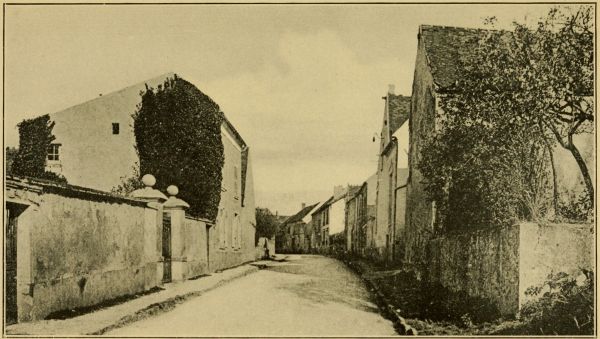
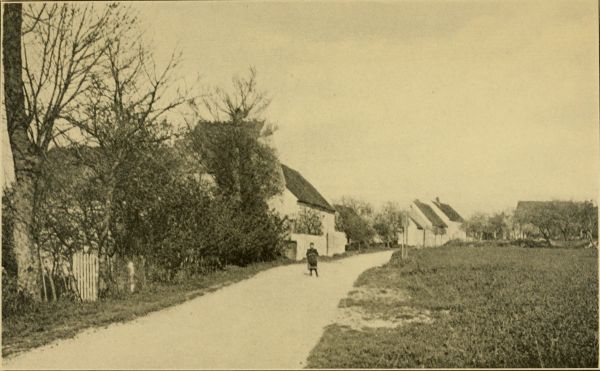
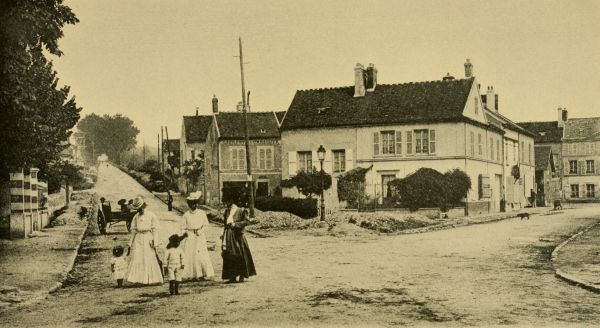
Voisins-Quincy. Rue de Condé
"For my part, Captain, I am sure
good luck will go with you."
The 117th stopped at Voisins.
The soldiers are billeted everywhere,
but preferably in the few houses that
are still inhabited.
This regiment, which made the
retreat from Belgium, has just come
on foot from Asnières where it had
been sent to recuperate. Several of
the men with bleeding and blistered
feet stop me in the street to ask if I
can give them socks. Unfortunately,
I have none. All I can offer them is
women's stockings, linen bandages,
and talcum powder.
For several days Boche aviators
have been reconnoitring above us.
One of them was only a hundred or
two feet up, directly over the heights
of Huiry. We thought he was going
to land. He looked like an immense
bat.
This evening another one came.
The soldiers were just building their
fires to cook dinner, when the command
was passed along: "Stand
close to the walls." The street,
which a minute before was swarming
with people is, to all appearances,
empty and deserted, nothing
but a single row of men on either
side, standing close to the houses.
A platoon in a back street fires
several times with machine guns.
We watch anxiously.
"It's hit," someone shouts.
Sure enough, the 'plane gives a
lurch and is certainly going to
fall.
It is out of control.
But this was nothing but a trick.
Once out of reach, it righted itself
and shot straight forward in the
direction of Coulommiers, where
they say the Crown Prince and his
staff are stationed.
It was a great disappointment.
The soldiers go on building their
fires, making little square ovens of
bricks. Rations have not arrived yet.
Some of the men, worn out, stretch
out on the ground to wait. It is
getting dark.
The sight of these haggard men,
gray with dust, blowing on fires
which cast fitful gleams on their wan
faces, calls up visions of Dante.
And still rations do not come.
The men are too tired to wait, and
lie down to sleep supperless in any
sheltered spot they can find.
The few who are not completely
exhausted make a descent on the
houses that are inhabited. They fall
upon our garden and clean out our
larder. The salad bowl and kettles
not being large enough, they season
and mix a huge salad in tubs and
washboilers. It is all they will have
to eat this evening.
Scarcely anyone was courageous
enough to wait for rations, which
were delayed by the block on the
roads and did not arrive until nearly
ten o'clock. Not a single man gets up.
The battle lasted very late last
night.
The officers went up on the plateau
of Huiry to follow the artillery duel
that was in progress, and they found
it amazing.
On one of my trips to-day I had
the good luck to meet one of the few
civilians. It is a man who has come
from Chelles on foot. He has heard
that Meaux, Crécy, Coulommiers
and all the neighboring villages have
been put to fire and sword. He
wanted to see his people who live in
this region. He had to swim across
the Marne, and was obliged to go
over and back several times in order
to bring his clothing.
He is to return to Paris by the
same route. I gave him several
letters which he was kind enough
to take charge of. They are not
of great importance—mostly messages
to my friends from whom I
feel so cut off at this moment, but I
want very much to set my brother's
mind at rest as to the fate of his
children. The thought of his anxiety
makes me unhappy.