Just Judgment—General Prentiss in Close
Confinement—Northern Peace Men—Bear Story—In the
Hospital—Old Aunt Susie—Sold Children—Without Bread,
and Satisfied—What our Fathers thought—An Untrammeled
Pulpit—Clay-eaters—Commissioners to
Washington—Homeward Bound—An Irate Southron—My Yellow
Angel—Our Journey—An Accident—Jeff. Davis’
Coffin—Don’t Know Myself—Safe at Home—Conclusion.
Is it not passing strange that enlightened
Americans can be thus so barbarous? It is
related of a certain English judge, that a criminal
was brought before him, whom, for certain
offences, he sentenced to seven years transportation.
The prisoner’s friends immediately sent
a petition to the judge, stating that he was a
well-informed man, and if he had an opportunity,
might yet be a useful member of society.
The judge forthwith, sent for the criminal, and
thus addressed him:
“I understand, sir, that you are a man of
knowledge, and well-informed, and might be a
useful member to society. But see what you
have done in the face of all your knowledge.
Now, sir, I had intended to give you only seven
years; but because you know better, I shall
double your term and give you fourteen years
transportation, with hard labor.” That was a just
judge, and before him should the South be tried
for the deeds she has committed during this
war.
What renders the offence against the noble
General Prentiss so much more aggravating, is
the fact, that he was thus treated after he had
been regularly exchanged. The man for whom
he was exchanged, General Price, had been set
at liberty, and returned to his family.
What apology the Southerners could offer in
this case I know not; but I suppose they might
treat the matter in the same light as they do
the wrongs inflicted upon the four millions of
human beings whom they hold in bondage.
Their reply is, when spoken to of their cruelties
to their slaves:
“Oh, they’re only niggers!”
So, in regard to General Prentiss, they might
say:
“Oh, he’s only a Yankee abolitionist!”
And shame mantles my brow as I say that
there is a class of men in the North, whom this
answer would not only satisfy, but actually
delight. Thank God that this class is a harmless
minority! What a sorry figure they will
cut after the war is over, and the rebels thrashed
back into the Union! They remind me of an
anecdote I once heard, of a man named John
Williams. John was a poor, lazy coward himself,
while his wife was just the reverse. Moving
to a mountainous region in Virginia, they got a
little cabin and lot of ground. One day Lucy,
his wife, was working in the garden, while John
was nursing the baby. Suddenly an old, hungry
bear was seen coming down the mountain
side, directly toward them. John instantly
dropped the child, ran to the cabin, climbed up
the ladder into the loft, and pulled the ladder
up after him, thus leaving the mother and baby
to do the best they could. Lucy, seeing her
chance of escape thus cut off, did not wait to
scold her cowardly husband, but seizing an ax,
went out to meet the bear. As soon as old
Bruin came within reach, the courageous mother
struck him on the head again and again.
John, as he witnessed this from the loft-window,
cried out:
“Quit that, you Lucy; you’ll make him
madder and madder!”
Lucy paid no attention to John, but continued
chopping away at the bear until she killed him.
As the beast fell dead, John breathed somewhat
more freely, and called out:
“Lucy, is he dead?”
“Yes.”
“Are you sure he’s dead, Lucy?”
“Yes! of course he is.”
John came down, and going to where the
dead bear lay, he looked first at it, and then at
his wife, ready, however, to start off on a run
should the brute give any signs of life. After
thus contemplating matters, he gave his collar
a jerk, and exclaimed, proudly:
“Hurrah, Lucy, we’ve killed a big bear!
blamed if we ain’t!”
So it is with the peace-men of to-day. They
cry now loudly for peace, and whine about the
unconstitutional arrest of a few tories. And
when it is over, and freedom triumphs, their
coward lips will boast of victories won over the
legions of secession. Such are the Vallandigham
traitors.
General Prentiss remained in close confinement
until October 6th, and during the time he had
been absent from our party. I had been taken
with a severe illness, which obtained for me admission
to a rear room of the prison, which was
dignified by the name of a hospital. Here I
enjoyed the privilege of drawing my allowance
of corn-meal from the commissary, and taking
it, or sending it, under guard, out to some one
in the town, to have it cooked. I got a slave,
called Aunt Susie, belonging to a widow, to
attend to mine, and she did it well. I was
forbidden to speak to her, however.
One day, Lieutenant Welsh came in with the
report that Aunt Susie was having great trouble.
I suspected the reason, but kept silent. The
next day, feeling well enough, I obtained permission
to take my own meal out to get it
cooked. As it happened, two black boys were
on guard, and one of these only accompanied me.
He knew all about Aunt Susie’s sorrow, and, as
he walked along, he said:
“Don’t b’lieve Aunt Susie ’ill be able to do
your cookin’, sah.”
“Why?” asked I.
“Kase she’s in heaps o’ trouble, sah. You
see, de sheriff sold her little boy an’ gal t’oder
day, an’ she’s bin cryin’ eber since, as though
her heart ’ud break.”
“Do you think that sale was right?” said I.
“Well, now, I guess I doesn’t, sah!” was the
quick reply.
“Well, then, why are you in the army that
supports such doings?”
“Ah, sah, dey makes me shoulder my gun,
an’ dey makes me fire, sah; but dey can’t make
me shoot low, so as to hit anybody. When I
fire, sah, I shoots ober, d’ye understand, sah?
I fires, but nobody gits hurt wid my ball, sah!”
“Well, why is it,” continued I, “that your
masters mix you up with white soldiers? Why
don’t they put all you blacks into regiments
by yourselves?”
“Yah! yah! sah,” said the slave, “dey knows
’nuff better dan dat. Dey knows we’d fight
t’odder way, if we got togedder. Yes, sah!”
By this time we reached Aunt Susie’s cabin,
where I found the poor creature sitting an a
stool, weeping bitterly. On her lap lay a little
boy two years old, while by her knee stood
another of four years.
When I entered the cabin, she sprang to her
feet in an excited manner; but when she saw
myself and guard, she became calmer.
“What is the matter, Aunt Susie?” I asked.
“Oh, sah,” she replied, amidst tears and sobs,
“I darsen’t tell you, sah, for it’ll break my poor
old heart.”
“Oh, yes, come now, Susie, tell me. If I
cannot help you, I can at least feel sorry for
you.”
“Oh, sah, but you are kind to feel sorry for
a poor old slave like me. Dey’re sold my two
dear little children, and dey’ll take ’em away
to-morrow, and I knows I’ll neber see ’em no
more ’till I sees ’em up dar, sah—up dar, sah,
whar none of us’ll be sold any more.”
As Aunt Susie made this reply, she turned
her face heavenward, and pointed up with her
finger. In her agonized countenance, wet as it
was with her sorrowful tears, I read an appeal for
the freedom of the slave, stronger and more
touching than all the volumes and speeches
that have ever been written or made upon the
subject.
I could not stand it any longer, and bidding
the poor old slave good-bye, I turned away
without my bread, for my heart was full. I no
longer wondered at the strength of the language
used by Ireland’s great orator, Daniel
O’Connell, when he said:
“The Americans, in their conduct towards
the slaves, are traitors to the cause of human
liberty, foul detractors of the democratic principles
which I have cherished throughout my
political life. They are blasphemers of that
great and sacred name which they pretend to
honor. For in their solemn league and covenant,
the Declaration of Independence, they
declare that all men have certain ‘inalienable
rights.’ These they defined to be life, liberty,
and the pursuit of happiness. To maintain
these, they pledged themselves with all the
solemnity of an oath in the presence of Almighty
God. The aid which they invoked
from heaven was awarded to them; but they
have violated their awfully solemn compact
with the Deity, and set at naught every principle
which they profess to hold sacred, by keeping
two and a half millions of their fellow-men
in bondage. In reprobation of that disgraceful
conduct, my humble voice is heard across the
waves of the wide Atlantic. Like the thunderstorm
in its strength, it careers against the breeze
armed with the lightning of Christian truth.
And let them seek to repress it as they may;
let them murder and assassinate in the true
spirit of Lynch law; the storm will rave louder
and louder around them till the claims of justice
become too strong to be withstood, and the
black man will stand up too big for his chains.
I hope what I am about to say is not a profanation,
but it seems as if the curse of the Almighty
has already overtaken them. For the
first time in their political history, disgraceful
tumults and anarchy have been witnessed in
their cities. Blood has been shed without the
sanction of the law, and even Sir Robert Peel
has been enabled to taunt Americans with gross
inconsistency and lawless proceedings. I differ
with Sir Robert Peel on many points. On one
point, however, I fully agree with him. Let
the proud Americans learn that all parties in
this country unite in condemnation of their present
conduct, and let them also learn that the
worst of all aristocracies is that which prevails
in America, an aristocracy which has been aptly
denominated that of the human skin. The most
insufferable pride is that shown by such an aristocracy.
I will continue to hurl these taunts
across the Atlantic. They will ascend the Mississippi,
they will descend the Missouri, and be
heard along the banks of the Ohio and Monongahela,
till the black man leaps delightedly to
express his gratitude to those who have effected
his emancipation. And oh! but perhaps it is my
pride that dictates this hope, that some black
O’Connell may rise among his fellow-slaves, who
will cry ‘agitate! agitate! agitate!’ till the two
millions and a half of his fellow-sufferers learn
their strength, learn that they are two millions
and a half! If there is one thing more than
another which can excite my hatred, it is the
laws which the Americans have framed to prevent
the instruction of their slaves. To teach
a slave to read is made a capital offence!
Shame! To be seen in the company of a slave
who can write, is visited with imprisonment!
Shame! And to teach the slave the principles
of freedom is punishable with death! It
may be asked, Are these human laws? Are they
not made by the wolves of the forest? No, but
they are made by a congregation of two-legged
wolves, American wolves, monsters in human
shape, who boast of their liberty and of their
humanity, while they carry the hearts of tigers
within them. With regard to the attacks that
have been made upon my countrymen by such
men, I rejoice at them. They prove to me that
the sufferings to which they have been subjected
in the land of their birth have not been lost
upon them; but that their kindly affections
have been nurtured into strength, and that they
have ranged themselves on the side of the oppressed
slave.”
Would to heaven that ministers of religion,
as well as statesmen would shake off their lip-fetters,
and throughout the whole nation proclaim,
as with one voice, the liberty of Gospel
love! As long as the heralds of salvation are
time-servers and caste-courters, there will be
Pharisaical hatred to God’s poor. The reader
will peruse an extract here from a sermon on
Christian Courage by Rev. Alexander Clark,
delivered in the mid-summer of 1862, some
weeks before the announcement of the Emancipation
Proclamation. The words are timely
and truthful now as then:
“To the Christian citizen, who, in this nation,
is greater than a ruler in any other, I would
say a word to-day. These are times of sorrow.
Our nation is terribly lacerated, and bleeding at
every pore. Horrid civil war hangs her black
pall over our summer skies. The clouds have
hovered long, and still they gather. All the
light we have are the vivid lightnings that
flash across our battle-fields, though every flash
reveals a flying foe, records the victory, and
thrills it in electric velocity throughout our
loyal land. Then an impenetrable darkness prevails.
We cannot yet see the ‘cloud with the
silver lining.’ We cannot hail the day of
universal peace. The thick shadows obscure
our vision. The groans we hear, and the tears
we see, hinder our exulting. Oh, the tears of
this war—what a river of them, enough, with
the added tears of the suffering slaves for lo!
these many years, to float the cruel ship that
first brought bondmen to our shores! The
graves already filled, and others filling every
day, and every where, almost crush our very
hopes. In the midst of this darkness and storm,
this carnage and blood, we would fear for the
result, were it not for the assurance that we feel
to nerve us right from the God of nations.
Be not afraid, only believe.
“And what shall we believe? What shall be
our faith? This—no more, and no less—that
this nation must first be pure, then peaceable.
Amen. Lord, help thou our unbelief! Purify
us from all sin! Take away from us all false
trust, and all man-glorying! The Lord help us
to accept universal liberty for this nation—boldly,
immediately, unconditionally, that the
sunlight of God’s favor may shine upon us once
more and for ever! May our rulers and generals,
and all Christians, accept the life-thought of
freedom to all men as the talisman of triumph
henceforth! And may none in authority, may
none in the churches or closets, be unwilling to
trust in the arm of the Lord. Oh, that the
entire people might cease trembling, and believe
and be bold for the right!
“The same Power that spoke life to the daughter
of Jairus, is able to restore our lost prosperity—is
able to return to us our national
renown. And He will, if we only believe.
Our Republic is young in years, as a child
among the nations, but it will yet be raised to
its second life, which shall be more glorious
than the first. The noise of party politicians
and mock mourners shall be hushed as insolence,
and the professional fault-finders who
ridicule the workings of Providence, shall be
turned out; and independent of their viperous
hisses over a dead Republic, it even already
pleaseth Almighty God to awake our slumbering
people to the liberty of truth. His name,
and not a paltry, pitiful party’s, shall have the
glory for a nation redeemed, and a weary, toil-worn
race emancipated!
‘He has sounded forth the trumpet that shall never call retreat;
He is sifting out the hearts of men before His judgment seat;
Oh, be swift my soul, to answer Him! be jubilant, my feet!
Our God is marching on.’
“And even to-day, while so many are afraid
to trust God, afraid to hope that all this commotion
shall end gloriously, let us believe that
the same Power which conquered devils among
the Gadarenes, healed most desperate maladies
in the region of His pilgrimage, and raised the
cold dead to life again, will give us the great
victory. Brethren, give to the winds your
fears!
“A word in view of our national truth. Bless
God! in our prosperous North, that has been
full and free; and it shall be as enduring as the
Plymouth Rock, where it first breasted the New
World’s winter and storm. That Truth is
Christian liberty, unalloyed and untrammeled,
the Pilgrim fathers’ treasure; that is the citizen-children’s
inheritance, and it shall be perpetuated.
The ‘Mayflower’ weathered the storms of
a December Atlantic. The blood she brought
to America courses now in so many veins, and
the spirit life at Plymouth planted, is to-day so
thrilling all true Christian hearts, that this strife
must end in proclamation of a Gospel to the
poor. These we have with us always. Let the
people—the whole people, have the Truth—the
whole Truth—and nothing but the Truth. If
this include body and conscience-liberty, be not
afraid of that, and let the good news go forth to
captive ones. Truth is used to storms. It has
battled and beaten before. Itself bled on Calvary,
grappled with Death, and conquered the
monster on the marble floor of the new sepulchre,
and is to-day a risen Sun of Righteousness,
dawning upon the nations!
“The Pilgrim fires, kindled so long ago on the
cold New England shores, shall yet dart light
and warmth to earth’s remotest bounds.
America must evangelize the world. But not
yet. Not until all human fetters shall have
been melted, and all tyranny consumed at home.
If it takes fire to purify the people and burn
out oppression, then blow, ye winds of heaven,
and fan the flames! Let our nation be the
land of slaves and sorrow no longer. Give us,
O, thou Ruler of men, a home-land of freedom
and of Gospel light! Then our missionary
efforts will be successful. Then the day of
vain mockery at our own pagan idols and
wicked worship of the world’s trinity, Gold-power-honor,
will be for ever ended. Then the
true God shall be honored, when His human
image is disenthralled, when all hearts and
voices publish the good news throughout the
land; then shall the high hallelujah melody,
‘Sound the loud timbrel o’er Egypt’s dark sea—
Jehovah hath triumphed—his people are free!’
ring a joy unspeakable to the benighted sons of
heathendom abroad. And the warbling melody,
sweeter and richer far than the notes of a bugle-band,
shall fill and thrill the very desert airs of
Africa. The wild men of Ethiopia shall catch
the sounding song, and leap as harts on the
mountains. The inhabitants of the far-off sea-islands
shall hear the sweet gospel pæan, and
welcome a religion that sounds liberty to the
captive.
“What music! The first measures of the anthem
have been performed in plaintive preludes,
outsighing for years, in tedious time, by the
weary bondmen of the cotton-fields. Now comes
the bold, loud bass, majestic as the march of the
whirlwind, introducing the discord of rattling
muskets, and anon the rumbling thunder-roar of
artillery and the neighing of war-horses. And
hark! for an alto, the striking and flashing of
swords, the cheers of the victors, the screams of
the wounded, and the groans of the dying! But
still the sweet ringing melody sounds on high
in octaves of glory, like the trill of a freed bird,
and as exultant as the angels’ song over the
Bethlehem hills before the day-dawn; soon the
chorus-bar shall be reached and crossed, for the
Omnipotent beats the time in downward and upward
suns; then the mournful minor strains
shall cease, the hoarse bass shall be keyed
anew for very joy, and the heavenly soprano
of peace, sung by angels and sainted choirs
above, shall blend with the glad voices of a freed
and shouting multitude in one rapturous burst
of accord,
‘Sound the loud timbrel o’er Egypt’s dark sea—
Jehovah hath triumphed—his people are free!’
Who will be afraid, since God rules? Only
believe, and all will be well.
“Rather let us rejoice aloud and praise the
Lord! For now a better day is dawning upon
our own dear native land. These sweet summer
mornings, with their blessed, balmy breezes,
breathe and beam it. The birds warble it. The
rain patters it. The flowers nod it. The leaves
laugh it. The sun is rising that shall flash it in
one blaze of glory the rolling globe around!
‘Be not afraid—only believe.’ ‘Amen; so let
it be.’ The infamous slave trade, and the
scarcely less infamous institution of American
slavery, God is crushing out of this land for ever—thanks
be to His name! Soon our poor shall
have the gospel preached to them. Soon shall
eyes that have looked so long through tears to
a tyrant master’s frown, see their prison-bands
severed in pieces, to fall in tingling music at
their feet. Soon shall the illiterate slave be
taught to read, in silent meditation, or aloud to
his children, the simple story of a Saviour’s
love. Soon shall the hearts that have sickened
at the selling of kindred flesh for gold, bound
and beat to the welcome, ‘Come, come unto me,
all ye that labor and are heavy laden, and I
will give you rest.’
“The Almighty Deliverer is working now
and, as in the days of his incarnation, there are
men now who desire in their hearts that God
would leave the country. They think Him unable
to pay for the loss of the herds. Men will
not believe it; but the Almighty Deliverer
works. Glory to God! Underneath our cause
are the Everlasting Arms; and side by side
with the heroic soldier, as he walks to war,
the Lord is marching on! Again and again let
it ring—let Southern hills the echo sound,
‘Sound the loud timbrel o’er Egypt’s dark sea—
Jehovah hath triumphed—HIS PEOPLE ARE FREE!’
“Be not afraid to come out, and speak out for
freedom. Only believe that the Lord will grant
it. Already it comes—the victorious march of
the Almighty! The nation’s capital He has
freed and blessed, and foundationed on consecrated
ground. The very flowers must yield a
richer fragrance there. The feathered choristers
that hop among the elms in the yards and gardens
there, so early in the morning, must strike
higher, gladder notes of praise. Now Washington
is safe. Let the conquest circle the Republic
until the waves of the Gulf and the rippling
Rio Grande shall lave the soil of liberty.”
Upon my return to prison I found that Aunt
Susie’s troubles had been heard of there. The
little boy and girl played close by the fence
during two days, and then we lost them. They
were gone to spend the rest of their lives in
chains and slavery, unless the Almighty arm
breaks every bond of every oppressor!
I am aware that those who would excuse the
slave system, often attempt to give conclusive
weight to their arguments by asserting that our
forefathers were slaveholders. Let me give
some facts to the contrary.
One day, the wife of Samuel Adams returning
home from a visit, informed her husband that a
dear friend had made her a present of a female
slave.
“My dear,” replied Mr. Adams, “she may
come; but not as a slave, for a slave cannot live
in my house. If she comes, she must be free.”
She came, and took up her free abode with the
family of this great champion of American
liberty, and there she continued free until her
death.
General Kosciusko, by his will, placed in the
hands of Mr. Jefferson a sum exceeding twenty
thousand dollars, to be laid out in the purchase
of young female slaves, who were to be both
educated and emancipated. The laws of Virginia
prevented the will of Kosciusko from being
carried into effect—1820.
A tyrant power had captured nine hundred
and twenty Sardinian slaves, of whom General
William Eaton thus makes mention:
“Many have died of grief, and others linger
out a life less tolerable than death. Alas!
remorse seizes my whole soul when I reflect that
this is indeed but a copy of the very barbarity
which my eyes have seen in my own native
country.”
“Dissipation, as well as power,”
wrote the immortal John Randolph,
“hardens the heart;
but avarice deadens it to every feeling but the
thirst for riches. Avarice alone could have
produced the slave trade. Avarice alone can,
as it does, drive the infernal traffic, and the
wretched victims, like so many post-horses, are
whipped to death in a small coach. Ambition
has its incentives in the pride, pomp, and circumstance
of glorious war; but where are the
trophies of avarice? The handcuffs, the manacles,
and the blood-stained cowhide!”
But to return to my narrative. One morning,
as I stood gazing at the guards about our prison,
I was forcibly struck with their appearance.
They were a new set of men, who had relieved
our old guards, the latter having been sent to
Richmond. They were all tall and ungainly,
and, in speaking, always said “har,” “sar,”
“whar,” and “dar.” Their most favorite exclamations
were, “tarnal Jesus,” and “I golly.”
As I was thus surveying these degraded
creatures, I heard one of them say:
“Tom, what do you always go to old Sanders’s
mill for? Why don’t you go to Mike
Adams’s mill?”
“Why, you tarnal fool,” was the reply,
“don’t you know there’s a good deal better clay
up at old Sanders’s than there is at Mike
Adams’s?”
As we were at this time under the charge of
one Captain Collins, who was more indulgent
than any of our previous keepers, we were allowed
to converse with the guards. I resolved
to settle this matter of clay-eating. So I asked
one of the fellows to whom I have just referred,
what his comrade wanted with the clay that he
got at the mill.
“Why, tarnal J——s,” retorted the repulsive
brute, “and don’t you know nothin’? He
wanted it to eat, I golly!”
Reader, it would be impossible to describe
the personal appearance of these wretched clay-eaters,
except by the remark an Ohio lady made
upon seeing them in all their glory, in Georgia.
Said she, “they do not look like fresh dead men,
but men who have been dead some time.”
Of all the negro-haters in the world, the clay-eater
is the most bitter, the cause of which is
nothing more than jealousy and a degraded
moral system.
While in this prison, we were permitted occasionally
to receive our dinners from outside;
but even this privilege was stopped every few
days, so that it was always altogether uncertain.
Commissioners having been sent to Washington,
in relation to the matter of exchanges by
cartel, they returned, and brought with them to
General Prentiss several hundred dollars, which
the General divided among the officers. Our
mess, consisting of three, received one dollar,
which, of course, with prices as high as they
were in Dixie at that time, was almost useless.
Sometimes we complained of our bad fare, and
asked for wheat-bread. Wheat-bread seemed
to be a standing joke in rebeldom, or rather
one of the institutions that were long since
forgotten.
“Wheat-bread indeed!” laughed our keepers,
“why poor flour is sixty-nine dollars per
barrel!”
On the 7th of October, we left Madison, Georgia,
as we hoped, for our homes. Arriving at
Augusta, we remained a short time, not being
allowed to leave the cars. During our stay,
however, we managed to learn from the negroes
that there were but few white men in the place.
The loquacity of the darkies gave the guards
much trouble; that is, those who were not
Unionists themselves, and of the latter class
there were many. Captain Collins, whom I
have mentioned just before, still had us in his
charge, of which we were very glad.
The whites, as well as the negroes, crowded
about our cars, and among other questions, we
were asked:
“Well, whar did they dun get you? What
do you uns tink you uns’ll dun down here?
We uns have dun been waiting for you uns.”
From this place to Columbia, South Carolina,
we were received much in the same manner by
all the inhabitants. Thence we took the Charleston
railroad to Branchville, from which place,
starting due east, we struck the Wilmington
road at Kingsville. At Columbia, we were
placed for safe-keeping in the State Prison,
while arrangements were being made in regard
to the cartel. As it was supposed that we
would soon be within our own lines, more
liberty than usual was allowed us, of which I
took advantage by requesting to be allowed to
go about the town under guard. My wish was
granted.
As I was walking along, I overheard two
men talking of a young lady and two gentlemen
who had just been put into cells. There
was an apple-stand near by, and I stopped,
with the apparent intention of purchasing some
of the shriveled fruit, but really to listen to
the conversation going on between the men.
“I’ve no doubt,” said one, “that they’re
Yankees.”
“Well,” said the other, “the lady was put in
for hiding and feeding a conscript.”
“Yes,” savagely rejoined the first, “and if
that’s so, she ought to have been hung, and not
put into prison.”
Upon returning to prison, I, in company
with my tried friend, Captain Studman, went
up stairs, where we both saw the lady and gentlemen
in question. She had no hope whatever
of escaping execution, and her pale, finely-formed
face, though sorrowful, was determined
in its expression. Her companions shared her
imprisonment, because they had defended her,
and to defend such an one was death or imprisonment.
When the appointed time for our departure
arrived, we were soon ready. While standing
in the street, drawn up in a rank, there was
near us an old man, who, whenever he had an
opportunity, would grossly insult us. The sun
was broiling hot, and my temper, not being
much cooler, I felt inclined to admonish this old
rebel a little. But, not wishing to offend Captain
Collins, who had treated me so well, I
refrained, and listened for some time to the
hoary-headed coward in silence.
A line of female negroes as long as our own,
stood close to us watching us, and commented
upon our appearance. While thus engaged,
a little dog made his way through them, and
commenced barking at, and playing with one of
our number, a captain from Missouri.
The captain patted the little animal, and said,
in half-joking tones:
“Well, puppy, I’ve got one friend in South
Carolina, anyhow.”
At this, the old man rushed up to the prisoner,
and exclaimed:
“What are you talking about? Them
things’ll hang you before you leave this
place!”
“Whom do you think he’s talking to, sir?” I
asked, in stern tones.
“He’s talking to them niggers, and he shall
hang for it, before he leaves the place.”
Just then, one of our number said sarcastically:
“Ah, now, my dear old gentleman, you are
altogether mistaken. He’s not talking to your
children, but your dog!”
This enraged him beyond measure, and he
wanted to fight, and demolish the “whole crowd
of d——d Yankees at once, and on the spot.”
Captain Collins, at length, thinking that he
had amused himself long enough, quietly took
hold of him, and passed him over to the guards,
who, however, were unable to appease him,
until they jagged a sharp bayonet into that
delicate portion of his corporeal organization,
where, doubtless, his feelings and his brains
were seated.
We were soon after on our way to the capital
of North Carolina. On our journey thither,
we stopped at Salisbury, where many a Yankee
head was thrust out at the car-windows in hopes
of attracting the attention of some of the kind-hearted
negroes. My unshorn beard and straggling
hair, charmed a pretty yellow maiden to
such an extent that she drew near and said:
“Are you a Yankee, sah?”
“Yes,” replied I, determined to profit by the
opportunity, “and I’m a very hungry Yankee!”
“God bless you, sah! I’ll go an’ git you a
possum leg dis minnit.”
With these words, she flew away, but soon
returned, bringing a good sized limb of “a
possum.” I must admit, even at the risk of
angering a certain lady, that the yellow angel
who thus relieved my hunger, did look very
beautiful in my eyes at the time. And as
though she read my thoughts, she asked coyly:
“When am you uns coming here for we uns?”
At this moment, a surly, vigilant guard relieved
me from the embarrassment which this
question produced, and the girl, catching a
glimpse of him, “dispersed,” without even so
much as bidding me farewell.
From this slave girl’s question, I was more
than ever convinced that the slaves possessed
more knowledge of their own rights, situation,
and strength, than is generally supposed. I
should not be surprised to see them some day
rise in one solid phalanx, sweep their masters
from existence, and cut their way to freedom!
And who could pity the latter? No one. We
should be compelled to say just what Mary did
to her bashful suitor.
One evening, as the lovers were standing on
the verandah, Willie, after immense mental
effort, asked his betrothed if he might kiss her.
He had never been guilty of the offence before.
Mary, delighted that Willie was at last becoming
sensible, gave immediate approval. Willie
accomplished the kiss, and fainted on the instant.
Mary stepped back, and wishing to
exonerate herself from any charges which
might be brought against her, as to doing him
injury, exclaimed loudly:
“You did it yourself! you did it yourself!”
As we traveled to Mason, near the State line,
between Virginia and North Carolina, we came
to a stream across which was a trestle bridge.
Upon reaching the bridge, a rebel soldier who
had been standing on the platform of the car,
and who was intoxicated, lost his balance and
fell through the trestle-work, a distance of full
thirty feet. He was seen to fall only by Captain
Crawford and myself. He was not missed,
however, until we had nearly reached Petersburg,
Virginia, where it was discovered when
they were about to change guards. This was
many miles away from the bridge, and we informed
Captain Collins of the accident the
moment he came in.
At Petersburg, we fell in with a rebel captain
who was one of those fellows who can suit all
crowds. He was much animated on the result
of the Northern elections, and said that we
would now most likely have peace. I asked
him why.
“Why,” replied he, “look how you are voting
over there.”
I did not say much, for nothing that could
have been said would have done the rebel
captain any good, and might perhaps have
brought harm to me.
We were obliged to cross the city to reach
the Richmond depot, and on our way we passed
by a large factory building, in which were confined
a large number both of blacks and whites,
the negroes for endeavoring to get away, and
the whites for their Union sentiments.
During our march to the depot, we were surrounded
by a strong guard of cavalry. Oh, how
galling it was to me think that I, a native born
Virginian, was thus driven through the streets
of the principal city of the Old Dominion, without
a shoe on my foot, scarcely rags enough to
satisfy decency, and soaked by a cold, heavy
rain!
At night, we were shut up in an old building
that had been used for storing tobacco and molasses.
As there were a large number of prisoners
here, awaiting exchange, every one was
obliged to shift for a resting-place as well as he
could. Of course all the best spots were appropriated
before our arrival, and we were forced
to take up our quarters in the back part of the
building. A few of the blankets captured by
the rebels at Harper’s Ferry were distributed
among us; but I, unfortunately, did not get one.
So, suffering much from the cold, I laid down in
the dirt and molasses, which formed a sort of
soft cement of an inch or two in depth. Completely
wearied out, however, I soon fell asleep,
and dreamed of the happy home in Ohio to
which I was going.
The next morning I was roughly aroused by
two men who stood on either side of me with
barrel-staves.
“What are you doing?” exclaimed I, as the
two men began prying me up from the floor.
They did not notice my question, but like
sailors weighing anchor, wrenched again at me,
exclaiming:
“We’ll fetch him clear this poke! heave ho!
yo! ho!”
I had positively stuck so fast to the floor,
that it was only after the most strenuous exertions
I succeeded in getting loose, even with the
aid of my two rough helpers.
Our descriptive list did not come until ten
o’clock; but when it did, we were not long in
signing it, after which we were taken to Aiken’s
Landing, some fourteen miles south-east of
Richmond. Though a cold rain was still falling
at intervals, I did not complain, for I was going
home,—thank God! home!
Oh, how overflowing was my heart with joy
at the prospect! Every drop of rain that pattered
on my shivering form, fell upon me like
the summer shower falls upon the parched and
thirsty grass. I did not complain that I had to
march the whole fourteen miles through the
cold, mud, and snow, in my bare feet, for I
knew that this was my last hardship.
Our guard were not at all rigorous in our
marching, and therefore, I often had an opportunity
to converse with the teamsters. One of
them remarked to me:
“Did you know dere wuz a coffin laid on
Massa Jeff Davis’s door step t’odder night?”
“No,” answered I; “what do you think that
was done for?”
“I dunno, I ’spect some ob de Union men
done it to let him know dey would kill him if
he didn’t mind. He’s had his house guarded
ebber since wid two hundred men.”
“Well, uncle, what do you black folks think
about this war?”
“Why, God bless you, sah! we been looking
for Massa McClellan wid all our eyes. And if
he’d jes come leetle closer, dar’s a darky here
what’ud a leff dis State quick!”
At this instant I chanced to raise my eyes,
and there, in the distance, I beheld the glorious
old Stars and Stripes floating proudly and beautifully
upon the breeze.
“There she is! God bless her stars!” burst
from two hundred and sixty throats in one
breath of relief. The very clouds seemed to
break asunder and let the glorious sun down
upon our enfranchised souls. We wept, and
laughed, and shook hands, and bounded with
delight, until some time after we were taken
aboard the Federal transport, which had been
sent up the James river for us. We were soon
tossing on the ocean, and in due time arrived
without accident at Washington.
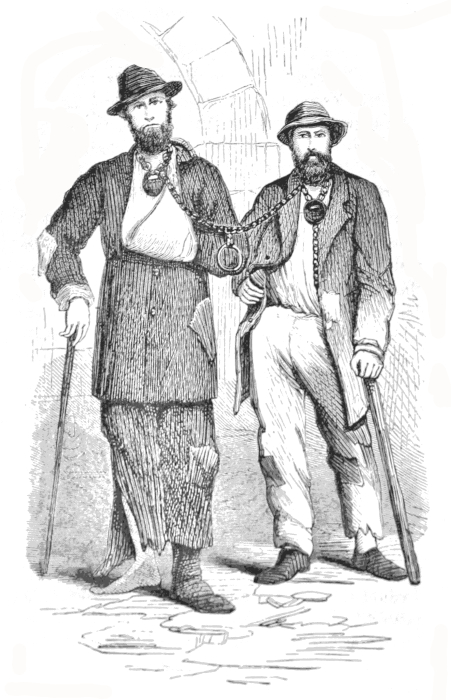
My first act upon landing and reaching Willard’s
Hotel, was to secure the services of a
photographer, who took myself and comrade
with the chain about our necks, and in our
rebel rags, exactly as is represented in the engraving.
The next important operation was to
clean myself, trim my beard and hair, and make
myself fit to go into decent society. This was
by no means a small undertaking; but by dint
of scrub-brushes, soaps of incredible strength,
and exercise of muscle to an indefinite extent,
I at last succeeded in accomplishing my objects.
As I left the bath-room, I noticed at the other
end of the hall, a tall strange gentleman, who,
for all I did not recognize him, seemed familiar
to me. However, I walked toward him, and
he did the same, coming toward me. When I
got sufficiently near to address him, I bowed
and extended my hand. He did exactly the
same. I thought he was behaving very
strangely, and with rather a grim smile I drew
back and raised myself to my full height. He
did exactly the same, and I suddenly discovered
that I had been the victim of a huge mirror,
and that I had, all the while, been mistaking
myself for a clever, gentlemanly-looking old
friend of mine. I merely relate this circumstance
to prove to the reader, that a man who
is unfortunate enough to spend six months in
Dixie, is scarcely able to recognize himself upon
his return home.
Home! home! that word still sounds with
strange music in my ears. Its mention brings
before my mind the little cottage in Ohio, with
its happy yet anxious faces turned up the road,
along which papa must come after being away
so many months. Home! ah, that is but another
name for the dear being, who, while I lay
wounded and languishing in the loathsome jails
of a merciless enemy, cared for the sweet babes
of the captive, who taught their little lips to
add a prayer for papa to their vesper offerings
at the mercy-seat, and who, weary with many
months of watching, never ceased to treasure
in her heart’s holiest recesses him who pens this
tribute.
[A]
A coincidence here is worthy of notice. On the 18th of June, seven
United States soldiers were hung by the rebels at Atlanta, Georgia. They
were a part of the celebrated Chattanooga Railroad scouts, sent out on a
military excursion by General Mitchell, but who were captured and
treated as spies. One of the survivors of the party, Lieut. Wm. Pittenger, gives a full and graphic account of
their captivity and imprisonment in a book which every reader of this
work should peruse.
Transcriber’s Note:
- A small number of obvious typographical errors have been corrected.
Except for these corrections, the spelling and punctuation of the book
have not been changed.