The purr and throb of London was quivering
in stuffily through the open windows. The
squeals of the “special” newsboys and the hansom-whistles
of the early diners-out splashed
across the blur and din, standing out against
the immeasurable roar as against a silence.
The heat of a London summer lay heavily over
us; the undying rattle of wheels beat up to us
wearily, the mid-season blare and hurry of
town echoing irritatingly in their jingle and
clatter as they streamed ceaselessly by. The
stew and hubbub of the afternoon enclosed us
as with a pall of depression.
By us I mean Gerry and myself. Flung back
listlessly was I in my club chair, and watching
him as he strolled monotonously up and down
before the great bow-window that gave upon
Pall Mall. His hands were scabbarded hilt high
in his pockets. His brows and the corners of
his eyes were hard and wrinkled. His gaze was
cast steadfastly before his toes. He did a very
sentry-go of moody vexation.
2Each time he paused, as he turned against the
light, every wrinkle and line was silhouetted
mercilessly. Wretchedness covered his face as
with a mask. My heart began to go out to
him, bursting through its own crust of dejection.
Wretched we both were, but I was seven
years his senior. I began to commune with myself,
seeking comfort for him out of my own
hard-won store of disappointment, and trying
to forget that our sorrows sat upon an even
base.
Suddenly he turned towards me and broke the
silence that had lasted between us the greater
part of the afternoon.
“Well,” he said harshly, “that’s the end of
most things for me.”
“Possibly,” answered I, “but probably not.
The future’s very spacious yet, my dear boy. I
don’t say it in any patronizing spirit, but
you’re only twenty-four. Try to forget the
‘might-have-been,’ and buck yourself up into
imagining the ‘maybe.’ It’s not all over yet.”
He grunted contemptuously, tramping off
again upon his beat. A waiter who chanced in
with the evening papers coughed ostentatiously,
and with obvious intention towards
the cloud of dust that followed hard upon his
track. Gerry stared him down, and as the door
closed behind him, brought himself to anchor
before me again.
“That’s all rot, and you know it, Jack,” he
said dogmatically. “Do you think I’m going
to stay here and see Vi come back another
3man’s wife? I’m sick of it all—sick of the work,
sick of the play. Deathly sick of the utter
sameness of what we call life. I’m going to
chuck it, I tell you. Hausa Police, Egyptian
Army, Hong Kong Regiment—something of the
kind I’m going to try. There’s nothing most
assuredly to keep me any longer in her
Majesty’s Foot Guards. I’m dipped, and I’ve
lost the one thing that might have kept me to
the collar. Great Heavens! what in the name
of goodness should I stay for?”
I stared back at him answerless. I knew he
was talking a cheap sentiment which a month
or two later he would be the first to despise.
I too was feeling in a modified form all he felt.
To me had also come the animal desire for
action that follows hard upon mental stress.
But that seven years made the difference.
Though that day had brought me the supreme
discontent of my life, I was still aware that the
world continued to wag, and that we should
swing along with it. Yet how could I comfort
without offending?
Now the reason of all this affliction was simple
enough and old as time. To each of us had
come the desire of his life, and to each had it
been denied. That morning we had spent at
the Albert Docks, and had seen a tall ship sail
out for foreign lands, bearing upon her decks
two maidens who were taking with them our
hearts to the world’s end.
I never was much of a chap for lover’s rhapsodies,
so I will make no effort to explain to
4you how sweet a girl was Gwen Delahay, nor
why she held my heart in the hollow of her
hand. She was one of the many good and
beautiful women—God bless them—who walk
this earth, and are to their lovers peerless. And
as I worshipped her, so did Gerry worship Vi,
her sister—a thing perhaps inexplicable, in that
he had seen Gwen, but one to be truly thankful
for, seeing that we were friends beyond the
ordinary sympathies of life. And now were we
left hopeless.
Plain Captain Dorinecourte was I, with a
slender six hundred pounds beyond my pay,
and Gerry, poor lad, had less. You will not
exhaust yourself with wonder then, when I relate
the fact that Lady Delahay declined on behalf
of her daughters our attentions, contemned
our eligibility, and hated poisonously the sight
of our ingenuous faces. For all these things, I
take it, a Society mother is bound by her allegiance
to Society to do. Yet though we felt
that she played the game as we understood it,
none the less did we cry out upon our luck in
being the losers. And now it seemed that we
might well throw down our cards.
The fond mother’s fears of the blight which
our undivided attentions might throw upon her
daughters’ careers had culminated that morning.
A month before an announcement in the
Morning Post had spurred her to an action
which her fear alone would never have conceived.
It ran as follows—
“Among the passengers by the s.s. Madagascar,
5which sails on August 4 for her winter’s
cruise around the world, will be the Earl of
Denvarre. His lordship will be accompanied by
his brother the Hon. Stephen Garlicke.”
This item of intelligence had caught the dutiful
mother’s eye, and taken vigorous root in her
somewhat languid intelligence. Two eligible
young men were to be shut up for eight or nine
months in a space not more than one hundred
yards long by twenty wide. Walking lawlessly
in London were two extremely ineligible
youths, unchained, ready and willing to wreck
her daughters’ happiness. Why not extract the
victims from this hazardous propinquity, placing
them at the same time in the financially
commendable vicinitude of a live earl and his
brother. Action was born only too rapidly
from reflection. We had seen them off that very
morning.
So there sat we in the desolation of a mere
club, disconsolate amid the roar of the city,
while the sunset became the twilight, the shadows
of the lamp-posts lengthened, and darkness
fell upon the town even as upon our hearts.
And out of the plenitude of my regret I failed to
find the word of sympathetic comfort for Gerry.
Lost in our heavy-hearted musings, it was
past eight when we realized that food was yet
a distasteful necessity of existence, and sought
the club dinner. Silently we entered the dining-room,
Gerry with the air of one who approached
poisoned dishes, and chose a table
apart. Though the soup and sherry warmed
6my companion to conversation, it had a bias of
marked contempt.
Clubs, he showed beyond dispute, were traps
for the unwary, committees were things of
naught, secretaries insolent and overpaid.
Waiters were plucked from the gutter to be
trained in pot-houses, and cooks cherished the
idea that to evolve a savoury it was but necessary
to taint an olive with a decayed anchovy.
Women who were guests of brother members—it
was Wednesday night—were all dressed in
seventeen tints of garish atrocity, and were of
a mediocrity of feature which he plainly condemned.
He mentioned the names of no less
than six social resorts off which he purposed to
take his name in the morning. This, of course,
preparatory to stirring activities which would
remove him beyond their sphere of usefulness.
Still soured, but evidently relieved, he then retired
behind the sheets of the Westminster, with
which he screened himself from further intercourse
with his fellows. Apathetically I proceeded
with my repast.
Suddenly the decorum of the room received a
shock. A sound burst from Gerry’s throat
which I can only term a crow. He endeavored
frantically and indecently to masticate the portion
which he had placed between his teeth,
beating the paper at me furiously. The sounds
which continued to issue from his lips were
such as no one could approve. He mouthed
unutterable things.
Hastily I rose and thumped him on the back,
7and noticed that his finger continued to tap
viciously upon a headline which he thrust into
my face. As the distressing symptoms modified
themselves he gradually found his breath, but
ceased not to bulge his eyes upon me.
“Look, old man, look,” he insisted faintly,
and I took the paper from his hand.
“We regret to announce the death of Viscount
Heatherslie at Greytown, Central America.
His lordship had lately been travelling in the
vicinity, and his death is ascribed to malarial
fever. As yet no details can be ascertained.”—Reuter.
The words turned red before my eyes as they
danced up and down the green columns. Uncle
Leonard was dead—was dead. And I—well, I
had to think it very hard indeed before I dared
repeat it silently even to myself—I was Lord
Heatherslie. Only one thought had possession
of my mind. Not a regret did I spare for the
dead, not a single reflection as to what this
thing meant to me or my prospects did I give
beyond the fact that my luck—my cursed Irish
luck—had been too late. That one idea had
hold of me. A week earlier—a few hours earlier,
and what might have been?—what might have
been? A curse snarled from between my teeth
as I sat down again to stare white-faced across
at Gerry.
The excitement had died from his face. His
sympathy was quicker than mine had been. He
stretched his hand across the table and gripped
mine hard.
8“Frightful luck, old chap,” he murmured; “I
know what you’re thinking. But—but it
needn’t be too late yet, Jack.”
I shook my head. Things had become blurred
in my brain, but one fact stood out bright as a
searchlight to my mind’s eye. Gwen was going
out of my life, going away from me as fast
as breeze and steam would take her. And the
thing that might have stayed our separation—have
given her to me—was a week—nay, only
a day—too late. I could have smitten my head
against the wall in my agony of disappointment.
And yet I had resigned Gwen as fatalistically
as any son of Islam. I had schooled myself to
think of her as already belonging to another. I
had bidden her good-bye without a quiver.
Even the look she had given me at the last—a
tender, questioning look it was too, and
straight from her heart through her dear eyes—I
had met with a smile that told of nothing.
To me the hopelessness of it all had come home
long days before, and I simply wouldn’t sadden
the poor child and prolong the pain of parting.
I meant that parting to be the absolute separation
of our lives—one that should leave no
dropped threads to be gathered up in future
days of further hopelessness.
And now—now I had the right to win her,
and honourably. Only a soldier I might be, but
I had a place of my own to take a wife to.
Nor would she come to me to sink into a nobody.
Half a county would welcome Lady
9Heatherslie, though half that county might be
in rags. Poor we should always have been,
but not desperately. Modestly we should have
had to live, but we could have kept our rank
befittingly. And now the chance was gone.
Away beyond the seas she would set herself to
forget me, and Denvarre would show her how.
The black curses fell over each other in their
haste to reach my tongue, and the salt tears
nigh fled out along with them. I made an
effort and pulled myself together.
“Come along,” said I hoarsely to Gerry in a
voice that I hardly knew myself, and blundered
out of the room. Without another word I crept
into the hansom the commissionaire called, and
together we drove down the glaring streets to
my rooms, Gerry offering no sympathy but a
silence which I understood and was grateful
for.
You know the heavy, choking pain that lies
leaden in your throat when one you love has
gone out into the emptiness—the desperate unbelief
in your torture—the mad hope that insists
that this thing is too horrible to bear.
My suffering came home to me like that. I
could only think of Gwen as of one dead and
gone from me, but with the added agony of
knowing that to me she might have been life
and love itself. I felt that I could beat the air,
wrestling with my fate for my desire. I gasped,
unmanned with wretchedness.
Then Gerry rose and put his hand upon my
shoulder. Here again his selfishness was seven
10years younger than mine. He could lose his
sorrow in sympathy.
“God be good to you, dear old chap,” he
said; “it’s desperate, desperate luck, but after
all is it too late? You’ve the place, the title,
and all that—and after all, you know, the old
boy might have come home and married any
day—why can’t you follow them? Surely you
might drop in with them somewhere.”
“Too late? Of course it’s too late,” said I
bitterly. “Is a girl to wait for ever? Besides,
they can’t hear of it for weeks—very likely not
at all. By then Denvarre will have settled matters,
if he isn’t the most consummate idiot on
earth.”
“That may be all very well about Denvarre,”
quoth Gerry wisely, “though I don’t see that it
is for certain, all the same. But what about
Gwen? You don’t allow her much independence
of thought. Why should he happen to meet her
fancy? Do you think she doesn’t know you
worship the ground she walks on?”
I stared at him, gnawing uneasily at my
moustache, and with the sense that he spoke
the truth. Gwen knew it—must know it, but
she must have seen, as did I, the hopelessness of
the business—must have known that the farewell
of that morning was to be the end. And
yet—and yet that look she gave me. Was it
merely questioning, or did it tell me something?
I fell into that moody, unhealthy mind
when one forbids oneself to hope for very hope
of being mistaken—assuring myself that I knew
11there could be nothing but despair for me in the
future, trusting all the same that wanton fate
would prove me wrong. Which is a phase of
unreason, I take it, more wearing than an utter
yielding to desperation.
“Now, old chap,” went on Gerry soberly, “if
you begin to muse and wonder you’ll never
sleep to-night. I believe this thing comes in the
light of luck for both of us. I feel twice the
man I did half-an-hour ago, and I’m going to
whine no more. However matters go you’re
very much better off than you were this morning,
and, as I said before, what’s to prove that
either Gwen or Vi may not come back to us
again? Heaps of things may happen in a year.
Why,” he went on smiling, “with the influence
of the Heatherslies at my back I mean to get
an attachéship and marry Vi myself. At any
rate I believe now that the game’s not over.
I’ll be your best man yet, unless we’re both
married together, and I won’t say that’s not
possible.”
It was good to hear him say it, but all the
time I was telling myself frantically that it
was rot—that I mustn’t listen to him, and I
backed my inward despondency with the
spoken word.
“But even now,” I demurred, “what am I
but a pauper peer? Fifty thousand acres of
bog are mine, and a few English farms. What’s
that to Denvarre’s forty thousand pounds a
year and Gleivdon? I’d take an offer of five
thousand pounds a year for all I possess.”
12He rose and slapped me on the back cheerily,
smiling as he reached for his hat.
“There, there,” said he, “that’s quite enough,
Jack. I’m off, and you’re going to tumble in.
You’ll be twice the man in the morning. You’re
upset with it all, and to-morrow when you’re
a bit steadied you’ll see it all in another light.
We’ll have a long collogue about it then, and
you’ll know what you’re going to do. Night-night,
old man, and don’t dream if you can
help it,” and he passed across to his rooms
whistling, though I could but notice it was a
very reedy, quivering attempt.
In spite of Gerry’s veto I did dream that
night, seeing Denvarre in many a heroic attitude
save Gwen from desperate perils by flood
and field—masterful deeds which I could only
watch in restless helplessness. I rode a nightmare
which trampled my every aspiration in
the mud of desolation, leaving me to awake
heavy-eyed and low-spirited, but yet, as Gerry
predicted, with some of the hope that each new
day brings. And after my bath—and what a
mental as well as bodily tonic a cold bath is—I
was chastened, maybe, but myself again. I
filled my clothes without feeling three sizes too
small for them, and ate my breakfast with appetite.
As I was at it, Barker brought in a
telegram. I ripped the dirty orange-colored
paper and read, “Please call at your earliest
convenience. Meadows and Crum.”
They are our lawyers—have been for generations.
My former meetings with them had been,
13for the most part, embarrassing. Hunted by
some pertinacious dun, I had occasionally fled
to their chambers in Lincoln’s Inn Fields as to
a sanctuary, and they had always responded
nobly to my appeals. I smiled to think how
continually and tactfully they had warned me
against backing other men’s bills and such-like
futilities. Well, at any rate that sort of thing
was over. As a bachelor—I still assured myself
that I should live and die celibate, with an eye
to the possible fate which might be listening—I
should not be so badly off. I could look forward
to commanding the regiment some day
without beggaring myself. Little rifts of sunlight
like this began to break through the fog
of my depression, and when I strolled forth to
call upon my solicitors, I had pretty well regained
the self-possession which that sudden
announcement of a tardy good luck had
knocked completely out of my system.
Crum received me. Meadows is an anachronistic
figment of the imagination long deposited
in a Hampstead vault. His partner continues
the business with other partners, who are considered
to be sufficiently dignified by the title of
Co. He is a benignant old man, with an unblemished
bald head and character. I believe a
warm heart beats under his deliberation, and he
has shown good faith and personal service to
my family for more years than I dare say he
cares to count. He welcomed me with a quaint
subdued tolerance hovering on the outskirts of
the chastened air he thought befitting the
14mournful occasion. For myself I will say
frankly and at once that I could pretend no
regret for the accident which led to my being
Crum’s future client. I had never even seen my
uncle since I was at Eton. In point of fact I
felt the matter to be, personally, only one for
self-gratulation.
“Desperately sudden, my lord,” quoth the old
gentleman, making me twitch in my chair as I
heard myself addressed by my title for the first
time, “desperately sudden. We received advises
from his late lordship on financial matters only
a week ago, and now—it’s come like a thunderclap,
I assure you.”
“These are matters of fate, my dear Mr.
Crum,” said I piously. “I suppose there’s no
doubt about the report?”
“None whatever, as I learn this morning.
We cabled his lordship’s valet last night and
got the press message confirmed. Death took
place up-country, it seems. Baines, his man,
talks of bringing the body to the coast and
sailing next week by the Pacific Mail Steamer.”
“That of course is the only decent and orderly
thing to do,” said I, “and no doubt you’ll
kindly see to all these matters—arranging for
the funeral and so forth. But what about
funds now? I expect this horrible succession
duty will make me as poor as a rat for the
first year or two, won’t it?”
He lifted his pince-nez, regarding me with a
curious expression. I immediately divined by a
sort of intuition that he purposed giving himself
15the pleasure of surprising me. There was a
decorously cunning light in the corner of his eye
that made him appear not unlike a respectable
and intelligent magpie.
“I think you and your uncle were comparatively
strangers to each other, were you not?
Ah, I thought so. You have the impression,
doubtless, that he was restless by choice and
temperament alone? I can assure you, in that
case, that you are mistaken. Your uncle, for
the last few years of his life at any rate, has
been dominated by a very determined purpose.”
“Philanthropic or personal?” I queried. “Not
the former I sincerely trust, or the pickings will
be even less than I hope for. I know he’s been
roaming the wide world mysteriously ever since
I can remember, but I thought it was the inherited
taint of travel. We’ve had a lot of
sailors in the family, Mr. Crum.”
“That is very true,” answered the man of
law impressively, “and in a certain indirect
sense I won’t say you are altogether wrong.
But the simplest way will be to put the whole
matter before you as I learned it from your
uncle. Excuse me a moment.”
He turned to where a row of tin boxes, shiny
and white-lettered, lined the walls along a
broad shelf. Taking down one labelled “Viscount
Heatherslie,” he took up a key that had
been lying handy upon the desk and opened
it. He extracted a bundle of papers tied in
red tape, and began sorting them with neat
precision. I occupied myself in wondering with
16unaffected curiosity what on earth was coming
next.
Of course Uncle Leonard had been a wanderer
on the wide earth, but he had always been to
me not so much a man as an impression. My
poor dear mother used to remark occasionally,
“I see your uncle’s wintering in Egypt,” or
“Leonard’s in Japan again,” wondering always,
as women do, what could induce him to
leave the comforts of his native isle for such
outlandish realms. But I had paid but slight
attention. Uncle Leonard was nothing to me—I
was his heir-at-law, of course, but then he had
always been expected to marry late in life, as
most of his ancestors had done, and I had never
troubled about him. I remember his coming
down one Fourth at Eton and stumbling across
me, more by accident than intention, and tipping
me a fiver. But that was a feat he had
never followed up and improved upon in later
life, so I had let him drop out of my calculations,
and he—well, he never spent three weeks
of the year in England, I suppose. Some men
have the regular gypsy taint in the blood.
They must move in aimless joy of moving, or
they absolutely shrivel up for want of occupation.
The mania in his case was more or less
inherited, I knew. Half-a-dozen of our forebears
have been adventurers—not to say buccaneers—in
the past. They pop up in various
capacities all across the pages of Elizabethan
and eighteenth century history. So the fact
that in my late uncle’s case there was more behind
17this activity than was his by birth and
ancestry came to me truly as a surprise. I
awaited developments pondering many possibilities.
Old Crum found what he wanted at last.
Replacing all the papers but one—rather a musty-looking
document—he kennelled his legs comfortably
beneath his writing-table and began
his revelation, tapping his fingers upon the
dusty law books before him to emphasize his
remarks.
I’ll give you the tale as he gave it to me.
Then judge me if I was a consummate fool or
not, in that I followed in the footsteps of my
uncle.
CHAPTER II THE TALE OF A COINCIDENCE
18
“The late Viscount Heatherslie,” said Mr.
Crum, tapping the desk before him like a schoolmaster
demanding silence for a lecture, “was a
collector, and at the same time an economist.
These you will probably think are walks in life
entirely incompatible one with the other. I
will explain further. Though he lived far within
his income, he had the mania for collection and
gratified it. But he did this by making it a
rule never to buy what had a merely temporary
or sentimental value, but only what was likely
to be intrinsically marketable. I never knew a
man with a sounder sense of finance or one
who, without professional knowledge, made
such use of unprofessional experience. I doubt
if he ever struck a bad bargain in his life.
You will to-day reap the benefit of his judgment.
I do not think I exaggerate when I say
that you may safely count on his treasures
fetching a sum of not less than one hundred
thousand pounds.”
I gasped in amazement, nearly bouncing from
my chair. My excited shuffling upset a blob of
ink from the inkstand before me. With an air
of respectful deprecation Crum began to mop it
19up methodically, before answering the questions
I fired at him like bullets.
“Great Heavens!” I exclaimed, “the leery old
dog! You mean to tell me in sober earnest
that he has amassed all that money by simple
grubbing after curios, when we thought he just
roamed around for mere amusement and love
of travel. Where has he stuck them all? Not
at Kilberran, I sincerely hope, or they’re all
rotten with mildew by now. And what are
they? Pictures, bronzes, china? Why, neither
my mother nor my poor old dad had an inkling
of it. Great Scott! One hundred thousand
pounds. Now really, don’t you think you may
be exaggerating, my dear Mr. Crum?”
“I may say that it is not a habit to which I
am given, my lord,” he answered dryly, “but
it will not be hard to convince you. The collection
has been valued by more than one expert,
and the lowest figure rendered by these
gentlemen was a hundred and thirty thousand
pounds, and the collection has been added to
since then.”
“But what in the name of goodness can be
worth all that money? Why, it would take a
large gallery to house pictures up to that
figure.”
“Certainly. But I may as well explain at
once that the whole collection is within these
walls. It is in a large safe in my cellars. It
consists wholly of coins.”
“Coins!” I bawled delightedly, “then I hope
the half of them have her Majesty’s face on
20them, God bless her. I see what you’re getting
at. You mean the old boy was a miser.”
He drew himself back into his chair with an
air of offence.
“I am not given to jest on business matters,”
he said in his stateliest manner. “No; your
uncle was simply one of the first numismatists
of the century. His is the finest harvest of
ancient coins ever made by any private individual.
If you see fit to turn it to its marketable
worth, you will create an excitement
among collectors unparalleled for the last five
decades. And till the catalogues are published,
not one of them will have an idea of the treasures
they will find listed there.”
“Well, as far as I am concerned, I don’t mind
how soon they’re gratified and surprised,” said
I; “but I should like to have a look at the lot
now, if it’s not seriously inconveniencing you.
Can we descend to visit them?” for I itched to
view this astounding hoard with my very own
eyes.
“Of course, my lord. It would be only natural
that you should wish to inspect such an
important part of your inheritance. But I have
something more to say. It was not in mere
zeal for collecting that your uncle had lately
travelled so widely. I have another astonishment
in store for you—not so entirely agreeable,
no doubt, but out of the common, I think
I may say absolutely out of the common.”
“Well, as we’re out of the range of coins this
time then, I trust it’s nothing less than banknotes,”
21I answered. “But for goodness sake
what is it?” I added impatiently, for his self-important
deliberation began to get on my
nerves.
He did not suffer himself to be in the slightest
degree flurried by my impatience. His sentences,
in fact, seemed to gather a yet more
leisurely accent as he unfolded his tale.
“You must let me tell the thing in my own
way, my lord. It will be far more conclusive
than jerking it out at you in scraps. The facts
in sequence were as follows—
“Among the family treasures which have
come down the centuries—and I sincerely wish
there had been more of them—was a certain
amount of old coins which have been in the
custody of my firm for at least five generations.
They comprised for the most part specimens of
the gold and silver coinage of most European
countries during the fifteenth and sixteenth
centuries. Some were of great value. Some
were by no means rare. Evidently one of your
ancestors—probably, I should say, Sir John
Dorinecourte, the famous Elizabethan admiral—had
the craze of collection, which has since
broken out in your late uncle’s case. At any
rate the box contained moidores, zecchins,
pesos, crowns, and every sort of currency of
every known land—known to our ancestors of
that time, at least—to a very considerable
amount. The mere bullion, I should say, would
be worth a considerable sum. Among them
were, however, a couple of gold pieces placed
22apart, and these had no signification placed
opposite them in the catalogue, and bore no
sign either on the face or the reverse in any
language known at the present day.”
“It sounds charmingly mysterious, my dear
Mr. Crum,” I interrupted. “Now, you aren’t
going to tell me that the secret still remains
unfathomed?”
“My lord, my lord,” said the old fellow entreatingly,
“you must allow me to tell you the
thing methodically, or not at all. If I’m hurried
I shall forget some detail, and I have given
time and effort to memorize the matter completely.”
I apologized humbly, settling myself back in
my chair resignedly to hear the thing out with
no further interruption. Crum continued in his
slow, modulated tones.
“I think that it was the sight of that hoard,
when your uncle saw it at his accession to the
title, which first woke in him the craze for collecting.
He no doubt reflected that here was
the nucleus of an exceedingly fine numismatic
museum, and from that day he set himself steadily
to add to it, with an increasing knowledge
of his subject, of which you are now reaping the
benefit. But those two unknown coins were
always a sore mystery to him. Many a time
have I seen him take them up—he used to visit
me two or three times every year to place what
he had possessed himself of in that time with
the rest—and turn them over and over in his
fingers wistfully, studying every line and figure
23as if there must be some concealed clue which
he had missed. But it was only last year that
he gained the trace which put him on the road
to success, and also, as it has unfortunately
turned out, to death as well.”
“What!” I shouted, nearly jumping out of my
chair. “Do you mean to say——”
He held up his hand deprecatingly.
“Please, my lord, please restrain your impatience.
You shall have every detail in good
time, I assure you. I only mean to say that it
was in pursuit of his intense desire to solve the
origin of those coins that he was travelling in
Central America, where he caught the fever
which has been fatal to him. The rest I will
tell you as shortly as possible.
“It was last year, as I was saying, that the
first trace came to his hand by the merest accident.
His lordship was in Portugal. From
there I got a letter from him on business matters,
and at the end—his lordship was aware
that, of course in a modified form, I was interested
in his quest—he remarked, ‘A most extraordinary
thing has happened. I have found a
dozen more of the unknown coins, and what is
more an ancient document—no less than a letter
written by Sir John Dorinecourte, my ancestor.
I will tell you more on my return.’ It was
some three weeks after that that his lordship
came to see me.
“Nearly his first words to me were, ‘Well, Mr.
Crum, the mystery of the coins is pretty well
solved, but a greater mystery has arisen on the
24ashes of the first. The gold pieces are Mayan.’
The word Mayan, I must confess, conveyed
nothing to me at the time, but he very soon
explained it. The Mayans inhabit—though perhaps
your lordship knows as much—the land of
Yucatan to the south of Mexico. They are a
wild and savage race, but there is every reason
to believe that centuries ago theirs was a
mighty empire. The coins dated from this
extinct civilization of long ago. And now for
the method by which your uncle ascertained as
much.
“He was wandering along the side-streets of
Lisbon one afternoon, when he espied a small
curio shop. Outside the window were displayed
various articles of furniture, china, etc.,
for sale, and among these was a curious cameo
brooch which rather took his fancy. He entered
to make a bid for it, and managed to
secure it for what he considered a fair price.
He wandered listlessly about the shop, as the
woman in charge was placing it in a box for
him, and suddenly came upon a glass-covered
box full of coins. You may imagine his surprise
when, among the rows of copper and silver
pieces, he saw staring up at him no less than
twelve gold replicas of these mysterious coins of
his own. His astonishment was great, but he
managed to conceal it from the shop-keeper
when he asked her the price she demanded for
these ‘medals,’ as he prudently called them.
“She named one very little higher than their
simple worth as bullion, intimating at the same
25time that as they did not seem to commemorate
any special event, customers for them had
been few. She went on to relate how she came
to possess them. A strange story indeed. With
some pride she told your uncle that her husband
was really of noble blood, but sunk to a
narrow pittance beyond the keeping up of his
title. Ruined by the failure of vintage after
vintage, he had at last compounded with his
creditors by giving up his landed possessions,
and she and he were now living by the sale of
art curios, a good proportion of which she
sadly explained was from their own dwindling
inheritance.
“Further inquiry elicited the fact that the
‘medals’ had been discovered in an ancient box
of cedar wood, which had been left to rot and
moulder in an attic of their former mansion,
where, wrapped in papers covered with writing
in a foreign tongue, nigh fifty of them had
been found strung together on a slender chain.
She pointed out that all of them had a small
hole beside the rim, and your uncle remembered
that the same thing was noticeable in those he
possessed himself.
“The first and most natural thing was to inquire
for the paper wrappings, but for some time
these could not be discovered, and it was feared
they were lost. However, the next day his
lordship received a message from the woman to
the effect that she had found them thrust away
among a heap of similar refuse and that they
were at his service if he chose to purchase them
26for a small sum. Your uncle did not dally in
returning to the shop, as you may suppose.
You may also imagine his surprise when he
found that one of the documents was not only
in English, but absolutely signed by his own
ancestor. You shall see the original, so I will
not stop to describe it. It is of the other document
that I wish particularly to speak.
“It was inscribed on a peculiar yellow-looking
fabric, more of the nature of linen than of
paper or parchment, and experts have since
decided that the coloring matter used as ink is
the fluid emitted by the octopus. But the most
curious part was the writing, if writing it can
properly be called. It consisted of squares,
oblongs, parallels, and other geometric figures
ranged in a sequence which was not easy to
understand, but the chief point of interest was
that these figures resembled in every particular
the figures on the coins. His lordship immediately
and willingly paid what was asked for
them, took his passage straightway home to
England, and armed with his document paid a
visit to the British Museum to get what expert
help he could in translating them.
“It is an extraordinary thing how circumstances
dovetail into one another. No sooner
had he entered the department, where he had so
often been before to get light on his coins, than
he was greeted with the following question by
Professor Barstock, the head, before he had
even mentioned his errand.
“‘I am particularly pleased to see you, Lord
27Heatherslie,’ said the Professor, ‘because information
has lately come to hand which I think
will settle the origin of your coins, which we
have so often pored over. Monsieur Lessaution
of Paris, the well-known Egyptologist, has discovered
that there is a connecting link between
the ancient Egyptian script and that on the
monuments of Yucatan. It seems absurd, considering
that they are divided by five thousand
miles of sea, but he puts his points very plausibly,
and I think you should see him.’
“When you have seen the other paper which
your uncle discovered—the one in English—I
think you will understand that these words
came as a most astounding confirmation of his
suspicion that he was on the right track at
last. He simply opened his bag and spread the
mysterious scroll before Professor Barstock,
laying one of the coins beside it.
“You may imagine the astonishment of the
latter on seeing not only the coin with which he
was familiar, but the scroll covered with similar
symbols. Nor did he fail to astonish your uncle
in his turn. Taking him to another part of the
building he showed him some grey, fibrous-looking
slabs of dried pulp, and they too were
covered with the oblong, square, and parallel
figures of the document, only that instead of
being raised they were indented. They were, as
Mr. Barstock explained, squeezings, taken from
the temple facade at Chichitza, where M. Lessaution
was now conducting his investigations.
“The Frenchman’s theory was that by comparing
28the Egyptian symbol with that in Yucatan,
and using the grammar and accidence of
the former language as a guide to the latter,
these inscriptions, which have as yet been undecipherable,
would be made clear, and much
would be learned about the Mayan civilization
of long ago.
“This was quite enough for your uncle. He
decided that he would not wait for M. Lessaution’s
return, which was not expected for another
six months, but would cross the Atlantic
and interview him on the spot where he was
conducting his experiments. After reading the
letter left by your ancestor, I can quite understand
that to a man of leisure like his lordship,
and a man with a taste for wandering to boot,
the fascination of such a quest would be great.
At any rate he sailed for Greytown about five
months ago, and with the exception of a single
letter purely on business matters I have heard
no word from him since. You can imagine that
his death has come as a shock.”
“Well,” said I, “I am certainly astonished,
but I cannot say I am greatly moved by your
tale, Mr. Crum. It would certainly never have
occurred to me to cross three or four thousand
miles of ocean to interview a foreign savant
about a coin or a document. But then, you
see, I am not made that way.”
“Very likely, my lord,” submitted the lawyer,
“but you will pardon me if I say that you have
not seen the letter by Admiral Sir John. That
sheds a very curious light on the question, and
29certainly adds vastly to the interest one of your
family must take in it. But I will show it to
you at your leisure.”
“I am as leisured now as I am likely to be for
the rest of time,” said I, “but before I see the
letter I should just like to squint at the coins,
if you are not particularly occupied for the next
hour.”
He rose at once and preceded me to the outer
office, where a door opened on to a flight of
stone steps. Down these he guided me, ushering
me at last into a broad, whitewashed cellar,
wherein not less than half-a-dozen great
safes faced each other from wall to wall. He
clicked a key in the lock of one, and turned a
handle. The great door swung back and
showed row upon row of numbered sliding
drawers, lined with velvet, and covered—every
square inch of them—with coins of every degree
of dirt, ancientry, and denomination. One
drawer alone was nearly empty, and this held
two gold pieces, and placed beside them on the
velvet a sheet of ancient paper, covered with
crabbed writing and faint with the dust of
ages. The lawyer took it up and unfolded it
carefully, and then I saw for the first time the
screed that sent my uncle speeding across the
ocean at its behest, and which was to leave its
mark on my life also.
CHAPTER III THE TESTIMONY OF SIR JOHN DORINECOURTE, KNT.
30
The lawyer pushed back the drawers methodically,
clanged to the safe door, and turned to
me as I laboured toilsomely to decipher the faint
scratchy handwriting. He held the two coins
in his hand.
“I think,” he said slowly, “if you will permit
me to read this document out to you, you will
find it much easier to interpret if you desire to
read it yourself a second time. I may say that
I have conned it pretty thoroughly—it took
time to master it, I confess—and faint and yellow
as it is, I can decipher it at sight.”
I was only too glad to accept this benevolent
offer, and we returned to the upper office
again. Here I settled myself back in my chair,
old Crum found and very deliberately donned
his spectacles, unfolded and smoothed the sheets
of dirty parchment, and then began to expound
the writing as follows—
“I, John Dorinecourte, of the parish of Sellwood,
in the county of Somerset, here make
oath and declare that the writing hereto, to
which I have set my hand and seal, is the very
truth, so help me God.
31“On the seventeenth day of August, in the
year of our Lord one thousand five hundred
and seventy-eight, being in command of the ship
Pride of Barnstaple, and Captain Fowler of
that port and Dom Pedro da Suhares of Maceira
being my fellow adventurers, we were in
mid-ocean, having passed the straits discovered
by the Admiral Magellan about two days, and
were bearing north along the coasts of the
Indies. It happened then that one of the ship’s
company at mast-head hailed the deck, declaring
a ship to approach; whereat we, as was
but reasonable, supposed the same to be some
Spanish craft, and beat to quarters, tricing up
boarding nettings and getting powder on deck.
But as we approached nearer to the strange
sail, we perceived it to be a lateen and under
no control of steering, for she yawed and came
about, and then of a sudden fell away upon the
other tack, being water-logged, and as it
seemed deserted. So, calling to me the crew of
the pinnace, I set to board her, which, the day
being calm, we accomplished easily enough.
Then were we horribly astonished to find upon
her decks no living man save one, and him at
the point of death. Six bodies there were, and
one living soul, and the men were a fair and
noble company, but like to no other men whom
I have seen. Now Da Suhares, who hath been
in Mexico—for being renegade he joined our
vessel at La Guayra after slaying the nephew
of the governor in duello—protested that in
most respects these unfortunates resembled the
32inhabitants of that ill-fated empire, now ravished
and enslaved by the devil-serving Spaniards.
Which might be like enough, for the men
were covered with gold ornaments, and
bedecked with the plumage of bright tropic
birds, such as is the custom of these tribes as
I have always understood. ’Twas evidently
thirst that had brought them all to their death,
for no drop of sweet water could we find upon
the craft, and the tongue of the living man
swelled forth from his lips, forcing his jaws
asunder, and his sweatless skin cracked as tense
parchment. We hasted therefore to bring our
surgeon, and water with a little wine. With
difficulty he swallowed it and revived, though
but slightly. He gazed upon us as one affrighted,
and shuddered, placing his hand upon
his breast as if holding there what he would
fain conceal. By which, I take it, he imagined
us Spaniards, and expected their deviltries, as
well he might. But we spoke to him gently,
and tended him, taking sails to make him a
couch to lie upon. Yet he rallied but little,
murmuring we knew not what, nor could Da
Suhares understand him, though he had knowledge
of some few words of Mexican.
“Then the poor wretch raised his finger
slowly and pointed towards us, and afterward
held up his open hand many times, which we
took to mean that he had been of a numerous
company; making gesture also to our ship
which swung, heaved to, some quarter of a
mile away, he swept his hands abroad wildly
33towards the waste of waters, implying doubtless
that his was one of a great fleet of vessels.
“As in a flash came to me then the tale
which was at that time a by-word in the South
Seas, of the great expedition of the natives
which had set sail from the coasts of Southern
Mexico, the which was witnessed by the Spanish
forces advancing from the north, yet could
in no way be prevented of them. Mayax is the
name of the land whence they sailed, and the
fiendish warfare of the Spaniards—ravishers of
women and slaughterers of babes as they be—had
so prevailed by terror upon these simple
folk, that they had committed themselves to
the deep to escape their villainies, and had
vanished, forty sail or more, no man knew
whither.
“The memory of this tale came back to me,
as I say, vividly—and indeed it had been the
common talk of every port along the coasts of
the Southern Indies this two months past—and
I pointed inquiringly to the poor fellow as he
languished and lay dying at my feet, and then
swept my finger northward as if determining
that to be the direction whence he came.
Whereat he nodded, and then swung his hand
southward again, as if to say that now he
sailed from the opposite direction. Then reluctantly,
as it were, he drew from his breast
the scroll which I have here set aside for your
care and consideration, and I beheld for the
first time those symbols and the presentation
of that wondrous beast which are to me now
34as the alphabet for familiarity. As he gave me
the relic, he feebly took from his wrist the
golden bracelet which hung haggard thereon,
and from his neck a string of gold pieces. The
armlet he gave to me, and the necklet to Da
Suhares, as if in thanks for our consideration
which came thus too late. Then with the last
throb of strength left in his withered frame he
raised himself from the loins, and turning, faced
the sun which sank cloud-free and ruddy into
the open main. Bowing himself towards its
fading glories, he spread abroad his hands
with a single word and fell back and died, unconquered
remnant of a conquered race. And
for a space we stared silently at the dumb
dead, wondering, half afraid, but full of pity for
his sad case, and of admiration for his uncomplaining
end.
“Then did Da Suhares, Master Fowler, and I
take counsel together upon the matter to imagine
what this might mean. For I called to
their memory the tale of the escaping Mayans,
and Da Suhares vouched for the truth of the
same. For his own brother had been of the
company of conquistadores that had advanced
south from Mexico, had seen the men of the
escaping fleet fare out into the deep, and had
with others made strenuous effort to overtake
and capture them before they launched forth
to sea. For report went that they carried with
them the ancient treasures of that hapless race
for centuries back. Adding that within a
month an expedition of adventurers had set
35forth to track them along the southern coasts,
but had returned empty and rewardless. And
common talk held that he who should find that
company would also find wealth beyond desire
or conception. Here he doubted not that
we had one of them. For when we came to
examine their barque there was great store of
gold upon her, not as treasure indeed for the
most part, but put to plain uses; for though
the ornaments upon each corpse were of gold,
yet were the very baling vessels made of wood
shod with golden bands and held with strips
of golden metal. Upon each man’s breast also
was a medal, or some such decoration, bearing
upon it the similitude of the same wondrous
beast that appears upon the mystic scroll
which you have herewith. So we reasoned
upon the matter, and in much thought the solution
thereof came to us.
“The expedition had sailed, and had come to
some secure sanctuary as they had desired.
Now they sent back this small company to
advise their fellows left in bondage of the same,
that they too might leave their own land,
over-run by the Spaniards, and come also to
safety and a sure dwelling-place. And the more
we thought on this, the more the truth of it
came home to our minds.
“Now this I write in the glorious year of our
Lord, one thousand five hundred and eighty-eight,
when the Lord hath, by the destruction
of the Spanish oppressor, so signally shown
His favour to His children who hope in Him.
36The news of which final deliverance hath come
to us long months after by chance of our meeting
Captain Bostock of Bristol, who saileth in
the Guinea and West India Trade. Ten years
have I and my comrades, Da Suhares and Captain
Fowler, sought wearily for this people,
and naught hath come to us in reward. Yet
have we gotten to ourselves sufficient of this
world’s goods, in that we have taken more
than one of his Catholic Majesty’s treasure galleons,
and three years agone five of his pearling
fleet which we fell upon when they were
storm-sundered from their fellows. Rich are
we therefore in possessions, but not yet in
knowledge, and the madness of the quest hath
bitten into the souls of all of us. Not an island,
not a bay, not a single river’s mouth, have we
missed for nigh two thousand weary miles,
but unavailingly. And now I draw into years,
but I cannot rest from it.
“Thus have I put down the matter plainly
for my children to wot of, and if I come not
back to them, a charge do I lay upon them.
Ten years have I sought, and wrought, and
toiled, sparing none of mine and least of all
myself, and it may well be that from this last
adventure I come not back. Ten years, therefore,
do I lay upon you that come after me, ten
years each of you unto the tenth generation,
and the blessing of the Almighty be with you
in your search. Do the matter diligently, but
in secret, lest it come to the ears of the Spanish
folk, and they triumph at the last. If ye
37find this people (and of a verity I know in my
soul that they still walk God’s earth) be to
them a safeguard from their enemies, using the
might of England to bulwark them from their
foes, and get to your race and family great
honour. So do, and my blessing be upon you.
Forego this quest, any one of you, and my
curse rest with you unceasingly. To which
charge I put my hand and seal this nineteenth
day of December in the Annus Mirabilis, one
thousand five hundred and eighty-eight.
“John Dorinecourte, Knt.”
Crum placed the musty sheets of lettering on
the table before him, solemnly took off his spectacles
and wiped them, and then stared across
quietly at me without a word, as if he would
let this astonishing balderdash sink deeply into
my all too shallow soul. There was a silence
in the office, unbroken save by the buzzing of
the blue-bottles at the windows and the distant
roar of the Strand, filtered by intervening
acres of brickwork. For my part I found no
words to express my emotions. For really it
came upon me as a shock to think what crack-brained
enthusiasts our fathers were. Here was
a sound, apparently intelligent, old British seaman,
who had knocked about the world more
than a little, worrying himself to set curses
on the heads of his unborn descendants if they
should fail to be just such fools as himself.
He meets a half-dozen of forlorn savages in
mid-ocean, by purely circumstantial evidence
38connects them with another band of niggers
of whom he has only got word by hearsay,
and proceeds to spend ten years of his life in
tracking the latter to a lair which probably
never existed. And not satisfied, as I say, with
this astounding waste of time and energy, but
he expects ten other fools to do the same. I
stared, therefore, at the good Crum with these
unvoiced musings extremely vivid in my brain,
the while I thanked God softly below my breath
for civilization and common sense.
It was the lawyer who broke the silence before
it got strained.
“I may say, my lord,” he remarked, “that
we have compared this writing with the signature
of your ancestor’s marriage record in Sellwood
church. It is identical, and there seems
to be no doubt that it is authentic. I would
remind you that it is beyond question that he
spent many years in what was called ‘The
Indies’ at that date—the Southern Seas of
America, in point of fact—where he left the reputation
of a valiant sailor—I’m afraid I must
say buccaneer. But you must remember that
times were different,” he added hastily, feeling
that as a supporter of the law he must not
seem to favour equivocal methods.
“That I believe is entirely true,” I conceded.
“Tradition has it that he was one of the most
energetic old pirates of his day. But may I
ask how you propose to explain his document
getting to Lisbon into the shop of the local
rubbish dealer, or whatever he may have been?
39Why did it not come home to those for whom
it was intended? My unfortunate forefathers
for twelve generations have had these curses
hanging over them, and have lived in comfortable
ignorance.”
“I don’t think there is much difficulty in finding
explanation,” he replied deliberately. “You
know that Sir John did perish out there, and
to this day no news has been heard of his ultimate
fate. My own suspicions are that Da
Suhares—by the way, the people from whom
your uncle purchased these documents bore the
name of Soares—very possibly brought him
treacherously to his death to possess the wealth
that they had reaped in company. It is a very
possible solution of the mystery, and we are
not likely at this time of day to find a better
one. But I must say, my lord, that to my
mind the authenticity of the document is absolutely
determined, and I have had experience
of similar matters, I may say, for over half-a-century.”
“It’s plausible enough,” said I, shifting my
ground, “but not good enough in my discretion
to send a man fussing over to Yucatan
for further explanations. Supposing the thing
is absolutely correct, both in itself and in its
deductions, what good is to be made of it at
this time of day? Surely my uncle did not expect
to find this unknown race after they have
been lost three centuries or more? At any rate
I shouldn’t have thought it of him. He showed
no signs of brain softening ten years ago—or
40twelve, was it?—when I last interviewed
him.”
He leant his elbows on the table, and drew
the tips of his fingers together in a judicial attitude
before he made answer in his intolerably
cautious accent. Then he delivered himself of
his opinions weightily.
“I think you are forgetting the other scroll—the
one in symbol which was purchased with
the one now before you. Recollect that if this
could be interpreted, the mystery in all probability
was one no longer. Your uncle was a
man of leisure, fond of travel, and with the
collecting mania. I am bound to say that under
these circumstances I can understand his
attitude. He knew that in Central America
was the one man who could translate—if anybody
could—this extremely recondite document.
He also knew that in any case at his journey’s
end he would find a vast field of interest in
the lately discovered monuments of Yucatan.
I must say that considering these things I
should have been surprised if he had not gone.
If you think of the astounding possibilities
opened up to him in discovery if he did find a
meaning to this scroll, and remember the enthusiastic
nature of his temperament on matters
of this kind, no room for wonder is left—at
any rate not to my mind.”
I was fairly dumfounded. To think that a
little cut-and-dried old solicitor could absolutely
find, not only excuses for this absurd conduct,
but a positive encouragement, was more than
41I could have believed possible. I gaped upon
him.
“My dear Mr. Crum,” said I pityingly, “we
are not in the sixteenth century. I can conceive
a rampant adventurer like Sir Walter Raleigh,
let us say—a man with the heart of a
lion and the brains of a four-year-old child—setting
out on some such wild-goose chase, but
that a British peer, of good health and wealth,
nigh threescore years of age——”
He interrupted. His spectacles were tilted
rakishly on the bridge of his nose, and his eyes
positively glinted behind them. He absolutely
barked an exclamation at me.
“Yes, my lord; he was all you say. And I
am not ashamed to add, that in his case, and
with his opportunity, I should have done the
same!”
“You!” I shouted—yelled, in fact, so taken
aback was I. “You would have gone to this
unspeakable climate, to seek out a forsaken
French adventurer, to get a clue to a fudged-up
cryptogram three musty centuries old! Mr.
Crum, Mr. Crum, I should have as soon believed
it of the Lord Chancellor.”
He had regained his aplomb by now, and
arranged his papers methodically in front of
him before he ventured another word. Then
he looked up again, his calm and judicial air
entirely regained.
“I have no wish to pose as a sentimentalist,
or to have it thought that the mere glamour
of a mystery would carry me outside the realms
42of common sense. But I must say, my lord,
with all due deference, that it seems to me that
your uncle was simply guided by weight of
evidence in what he did. From the facts connected
with its finding and those since elicited,
I should say there can be no doubt that the
document before you was written by Sir John
Dorinecourte, and that the matters detailed in
it were true. The good knight’s supposition
about the identity of the persons he encountered
seems to me extremely reasonable. Your uncle
had nothing in his life to check his desires for
adventure and discovery. It would have been
marvellous to me if he had let such an opportunity
escape him. I can see too,” he went
on with a smile, “that our temperaments differ,
my lord, and that though you are the soldier
and I the lawyer, our blood flows with an irregularity
that is not in sympathy with our
professions.”
It is not pleasant to be called a coward by
your own lawyer, I confess, and I will own
that I flew into a rage. I rose and took my
hat.
“Thanks, Mr. Crum,” I said coldly, “it is
more than probable that I am in every particular
the absolute inferior of my late uncle.
However, I fear I am using your valuable time
for reflections and deductions which are not
professional” (put him back in his place there,
thinks I). “Is there any other business you
wish to see me about this morning?”
The old chap flushed as he rose in his turn.
43“I—I’m sure I trust I have not been offensive
or indiscreet, my lord,” he stammered. “I only
wished to prove that in my poor opinion your
uncle was justified in the course he took. There
is naturally much I should like to talk over
with your lordship in connection with the
estate, but it can wait till the will is proved.
But perhaps you will not consider it necessary
to employ me further.”
I saw I had hurt the worthy old chap badly,
and could do no less than make immediate
amends.
“Is thy servant a dog,” said I, holding out
my hand, “that he should do this thing? No,
my dear Mr. Crum, though I may be of a
slow-blooded, not to say poltroon-like spirit,
and you are still in the midst of the middle
ages, if you will excuse my saying so, as far as
the practicalities of life go, I’m sure we shall
get on together as well as two thorough opposites
always do, and I can’t say more than
that.” Then I wrung his hand heartily, and
fled, but for the life of me I couldn’t say for
certain that I was right and he was wrong.
CHAPTER IV WHAT BAINES KNEW
44
It was three weeks after my first interview
with Crum that I found myself travelling down
to Liverpool to meet Baines, my uncle’s man,
who was bringing home his body. It was a
dull, rainy, depressing day as I stood upon the
dock-side above the landing-stage, and watched
the tender come sidling up with the crowd of
umbrellaed passengers upon her deck, and my
errand was not of a kind to elevate the spirits.
Beyond the mournful circumstances that had
brought me there, I had a sense of foreboding
as if undefined evil was coming to me with the
dead, though, considering my very slender acquaintanceship
with my uncle, it seemed extremely
unreasonable. But there it was all the
same. I put it down to the weather and the
worry of the last three weeks. For really I had
had a very trying time. Gerry was more or
less at the bottom of it, and Crum and my
own conscience helped largely. The fact was
that in a moment of weakness I had detailed
to Gerry the story of the screed and the two
mysterious coins left by my old buccaneer ancestor.
He had fastened upon the thing like a
dog chewing a meaty bone, and rested not day
45nor night dinning into me his opinion that my
bounden duty was to investigate the affair “up
to the hilt,” as he inappositely remarked. And
in another astoundingly weak phase of absent-mindedness
I had taken him with me on one
of my visits to Crum. The two had managed
somehow to get on the subject of the mystery,
and then had started in full cry together to
browbeat me for my lack of enthusiasm, proving—Gerry
with terse vulgarity and the lawyer
with deliberate decorum—that I was throwing
away the chance of a lifetime, failing in my
duty to myself, my honor, and my nation, and
showing forth a pusillanimity and poverty of
imagination which was a disgrace to the name
of Dorinecourte. And out of their badgerings
a wild and hasty promise had grown—wrung
from me by pure bullying—that should any
further news of the ancient scroll of hieroglyphics
come to hand, or perchance the scroll itself,
I would not fail to do my utmost to obtain
translation for the same, even to the extent of
crossing the Atlantic myself and interviewing
Professor Lessaution. Pondering, therefore,
this rash mortgaging of my future happiness
and freedom of movement, I stared down upon
the snapping little steamboat with melancholy
eyes, reflecting that she possibly bore to me
a cargo of worry and unrest which would
shadow my life with unmerited discontent.
There was the usual fuss when the dripping
passengers landed, the usual rush for the customs,
the grating of the rolling-luggage stage,
46the interchange of impudence between the dock
porters and the crowd, in fact the everyday
hurly-burly of a liner’s incoming, and it was
not till after an hour’s patient toil and the
signing of various detestable documents, that
Baines and I were permitted to load our burden
upon the hearse that waited, and get it to
the railway-station. I had no chance in the
crowded train of conversing with the man in
any sort of privacy, so arranged that he should
call at my rooms that evening, and that there
he should tell me all there was to tell. Fortunately
Crum had notified a firm of undertakers
to meet us at Euston, and there take
charge of the coffin, and finally I was at liberty
to make my way home, change, and eat with
what appetite I could. Then lighting my pipe
I set myself to await Baines and his revelations
with all the apathy I could command.
And then Gerry saw fit to drop in. He was
brimful of inquiry and investigation regarding
the day’s doings, and showed unbounded disappointment
that as yet no further developments
had ensued. He hinted, in fact, that I
was burking all further knowledge of the subject,
and sat arguing and discussing like an
embodied British Association. It was in vain
that I tacitly agreed to all his premises, and
passed over his insults. He sat and sat, and
there he was when Baines arrived, and then I
knew that the game was fairly up. Under
Gerry’s encouraging cross-examination I felt
sure that the worthy valet would have seen
47and heard marvels which no man could gainsay,
and would be guided into revelations of
my uncle’s last words and messages which
might bear any sort of meaning that Gerry
chose to apply to them. I groaned as the
smooth-faced, dapper little chap was ushered in
by Barker, and Gerry’s face of enthusiastic delight
was a picture.
Baines stood in an uncertain sort of attitude
near the door, fingering his hat, and waiting,
after the first good-evening had passed between
us, for me to speak. I motioned him to sit
down, and as he deposited himself gingerly on
the edge of a chair I rose, and straddling across
the hearthrug, began my interrogation.
“Well, Baines,” said I, “it has been a sad
time for you. Can you give us any details of
your master’s illness?”
“It was very short and sudden, my lord,”
said Baines, with a terseness for which I blessed
him. “It came on at ’Uanac, where we were
camped; ’is lordship went about much as usual
for the first day; the second he was very bad,
and we sent on down to Greytown for a doctor,
but by the next day ’is lordship was
delirious, and died the day after. The doctor
came too late. I nursed him all the time, my
lord,” and Baines’s eyes shone mistily for a
moment in the candle-light, “and I think all
was done that could be done, but there was no
help for it. They tell me these malarial fevers
always are like that, but ’is lordship was never
what I should call robust, my lord.”
48“Do you think he knew that he was dying?”
I queried, as he paused. “At least, was he
delirious all the time, or was there an interval
of consciousness?” I added hopefully.
“Oh yes, my lord. He was quite calm at the
last, and knew he was going. I think what
vexed him most was that he hadn’t finished the
business he’d come for.”
“And what was that?” demanded Gerry and
I as with a single voice.
Baines looked at Gerry a little uncertainly,
shuffling his hat between his hands, and glanced
at me interrogatively before he made answer.
I understood what he meant, and hastened to
put him at his ease.
“You can speak freely before Mr. Carver,”
said I. “I have no secrets from him.”
“Well, my lord,” said Baines, with a sort of
apologetic hesitation, “I cannot think that ’is
lordship was altogether himself these last two
or three months. He had possessed himself of a
piece of paper covered with what you’d call
‘jommetry’—at least that’s what I believe it’s
called, my lord—when we were in Lisbon, and
for hours together he would pore over this
when we were going out to Greytown, and
mutter away to himself in a really most extraordinary
manner. Then when we got to Greytown
he wouldn’t stop there a day—and they
say you should always take a day or two to
get acclimatized before you go up-country—but
got mules together and started at once for
Chichitza——”
49“Chichitza?” I exclaimed, remembering Crum’s
story, “are you quite sure that was the name?”
“I know it only too well, my lord, considering
we spent nigh a month there. A horrible
place too. Uncanny, I called it.”
“Uncanny. Why?”
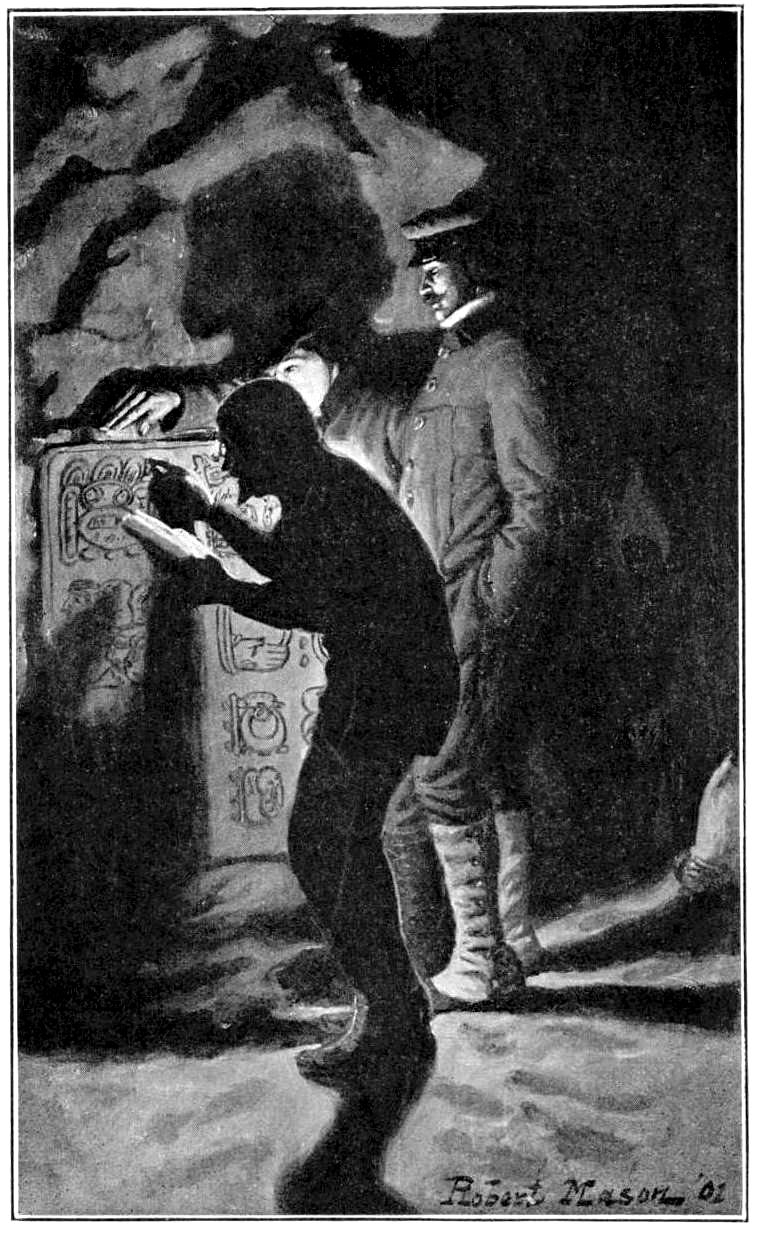
“Oh, it was all shut in with trees, my lord, and
there was nothing but great ruins all covered
with figures and carving that looked diabolical
I thought, even in the day-time, and as for
night—well, I never dared stir from my tent.
There was moans and rustlings going on in
them all the time. ’Is lordship used to say that
it was only the monkeys and sloths that lodged
among them, but I didn’t care to go and find
out. I kept pretty close in camp after dark, I
can tell you.”
“And what did my uncle do all the time?”
“His company and conversation was reserved
pretty much all the time for the French gentleman
we found there,” said Baines, with an air
of some contempt. “He seemed to find a good
deal to say to him, my lord. Then when they
weren’t examining and digging among the
temples and things, they used to press lumps of
squashy stuff on the carvings, and pick them
off when they dried. Really, my lord, without
meaning any offence, I think I should have had
to give notice if we’d stayed there much longer.
The dulness and the bad food, and one thing
and another, was too much for any ordinary
Christian as wasn’t concerned in carvings and
such like.”
50“When did they give up?”
“Just about six days before ’is lordship was
taken ill. They’d packed up and were going
down-country to camp a little way—about two
days’ journey, I think they said—outside Greytown.
There they wanted to stay another
three weeks or month, I understood, to see
something of the natives. And what there was
to see, I can’t say at all, my lord. A dirtier,
horrider set of ruffians I never come across, and
I’ve been with ’is late lordship in a good many
countries before now.”
“What was the cause of the illness, d’you
think?” I queried. “Bad food? Bad water?
Anything of that kind?”
“Just the pure reek and stink of the places, I
consider,” said Baines impressively. “There
was a white mist that rose at night which
fairly got one in the chest, my lord. And up at
the ruins it was worse than anywhere. I only
wonder I didn’t go down with it too. Only I
was more careful at night than ’is lordship.”
“Well, Baines, what did his lordship say
when he was conscious? Did he send any message
to any one, or give any directions?”
“Yes, my lord,” replied Baines with a promptitude
that made Gerry heave in his chair with
unrestrained excitement, “he sent your lordship
a message which perhaps you’ll understand,
for I must confess I didn’t.”
It is not advisable to wear your emotions
upon your sleeve before a servant, and it was a
stonily indifferent face I turned to Baines and
51an unquivering voice in which I bade him deliver
his word from the dead, but I will own
that discomfort and nervous expectancy had me
by the throat. Gerry’s face expressed nothing
but unstinted and tremulous glee and triumph.
“‘Go and see Captain Dorinecourte,’ he said,
‘when you get home, Baines. Mr. Crum will
have told him why I’m out here. Then say to
him from me that if he’s worthy of the name he
bears’—I’m only repeating it as he said it, my
lord,” interposed Baines apologetically—“‘that
he’ll continue with Monsieur Lessaution what
I’ve begun, and what’s nearly done too,’ he
added. He was getting weaker all the time,
my lord, and I don’t think I caught all he said,
but there was a lot about the alphabet, and the
ruins at Chichitza, and that the French gentleman
had nearly got it all—all of what I don’t
know, my lord—and things of that kind, when
I think he must have been wandering, but just
at the last he sat up on his cot and spoke quite
loud and clear. ‘After all these generations,
when I had it in my grasp, it’s gone to Jack.
It’s the cursedest luck in the world, Baines,’ he
said, turning to me very wild-like and passionate,
‘the cursedest luck, and if Jack throws
away his chance, I’ll—I’ll——’ and then a sort
of cough or sob took him sudden in the throat,
and he fell back gasping. I held his head, my
lord,” went on Baines, his voice getting perceptibly
unsteadier, “but it was no use. He
turned his eyes to me, and I’m sure he took
me for some one else, for he smiled so beautiful
52and glad that it made him look quite different
and like some other person. His lips moved
again, but I couldn’t hear any sound. He just
breathed deep and quiet-like two or three times,
and then was still, and I’m sure he had no
pain,” and as he concluded his simple tragedy
a large tear rolled over the brim of the faithful
valet’s eye and fell with quite a sparkle on the
carpet.
The silence held complete possession of the
room for a good minute after Baines had finished
speaking. I ruminated sadly over the
confirmation and support that would be given
to the wild theories of Crum and Gerry by this
unfortunate testimony from the dead. Baines
was lost in pathetic reminiscence of the end of
a master whom in his way he had loved, and
to whom he had given nigh a score of years of
faithful service; while Gerry a single glance
showed to be indulging in fantastic dreams of
triumph which only a certain feeble sense of
decency prevented him divulging to us on the
moment.
“What about Monsieur Lessaution, Baines?”
I queried to break a silence which was getting
heavy with foreboding. “Did he stay in Greytown,
as he didn’t cross with you?”
Baines flushed suddenly and looked yet unhappier.
“No, my lord, he went back to Chichitza—at
least so I understood.”
“Why?”
Baines stammered, and fumbled his hat diffidently
53before he answered, striving evidently to
use chosen words in describing a disagreeable
incident. At last he burst forth incontinent,
forbearing circumlocutions.
“He was very impudent to me, my lord—I
can’t describe it in any other way. He wanted
to possess himself of one or two of his lordship’s
papers—particularly the one with the
signs on it, that I’ve spoken of—and was quite
passionate to me about it. Of course I knew
my duty, and wouldn’t let him have it, and he
used dreadful language to me in French—at
least I’m not a scholar, my lord, but it sounded
almost devilish. At the end he rounded on me.
‘Well, pig of pigs,’ he said, ‘take it to England
then. It but remains for you to bring it back
when you get there. Tell the new Lord Heatherslie
that I await him at Chichitza till Christmas.
After that I shall work on my own
account,’ and that was all I got out of him
after that, my lord.”
There was a gurgle of unrepressed delight
from Gerry’s corner, followed by a murmur of
“No getting out of it, my boy.” I quelled him
with a glance, and proceeded with my interrogation.
“And that was the last word you had with
him, Baines?”
“That was the last word he spoke to me,
my lord,” answered Baines guiltily.
I understood. “You should not have answered
a gentleman back,” said I severely.
“What did you say to him, Baines?”
54He grew perceptibly hotter, but answered
honestly.
“Well, my lord, I didn’t expect ever to see the
gentleman again, and he was very outrageous
about the papers. I only said that you came
of an obliging family, my lord, and if he meant
to wait all that time in America, your lordship
was just the man to do as much in England.
He didn’t make any answer, my lord,
but just bit at his knuckles, and went away
dancing.”
Gerry walked to the window and looked
gravely into the night. I assumed a sphinxlike
expression, answering with sedateness.
“It was an unpardonable reply, Baines,”
said I sadly, “but it cannot be helped now. I
must write and apologize to M. Lessaution for
it. I think that will do for the present. Of
course I shall continue to pay your wages till
affairs are settled, and shall probably want to
see you again more than once. Lodge as near
as you can. My man will give you a glass of
wine,” and I rang the bell and delivered him
into Barker’s hands, the latter’s usual impassivity
being marred by a bubbling excitement as
he received this travelled confrère, who might
be expected to entertain him with astounding
histories of adventure by flood and field.
“A peculiarly pleasant gentleman, Mr. Baines,”
said Gerry, turning pink-complexioned from
the window as the door closed. “So versatile
and gifted in the lighter arts of conversation
and repartee. Now, old chap, do you realize
55that you’ve got to go through with this
thing? Not only is it proved beyond a doubt
that there is something to be looked into, but
it appears more than likely that the investigation
thereof may become amusing. What more
could any reasonable person desire? We’re both
of us down in the mouth, and require relaxation
and a tonic for diseased minds. Here is
an unexampled chance ready to our hands.
Apply, therefore, for leave; run over to Chichitza,
and interview the good Lessaution before
he is tired of waiting. And I tell you what
I’ll do—I’ll come and look after you.”
“You overwhelm me with your consideration,”
I sneered, “I can’t possibly permit myself
to trespass on your kindness.”
“Don’t trouble yourself to be sarcastic, old
man,” said Gerry composedly. “If you desire
it, I’ll openly avow that I’m crazy to go and
forget all the brooding and whining of the last
month, and therefore I mean to make your life
a burden till you consent. That’s all for to-night;
but to-morrow we’ll go and see Crum
again, and hear what he has to say. So goodnight,
old man.”
I suffered myself to be led an unwilling captive
to Crum’s office the next day, and the old
man heard our version of Baines’s story patiently.
And thus he made answer, speaking
didactically.
“I must say,” said he, leaning forward and
tapping the points of his fingers ceaselessly together,
“that what Baines has to tell us seems
56to me to be most conclusive that your uncle,
in conjunction with M. Lessaution, has lighted
on some further clue to this mysterious document.
Though apparently they have not
solved it in its entirety, they have satisfied
themselves that it is Mayan in character, and
has some bearing on the adventure described
by Sir John Dorinecourte. The French gentleman
evidently has accumulated knowledge
which makes him the only authority on this
subject, and it is to him you must address
yourself if you would go further in the matter.
I think, my lord, that you would very
possibly find it interesting so to do, but it
rests with you. It is regrettable that M. Lessaution
is not returning to Europe at once, and
that he remains at Chichitza. It is also evident
that he has—or thinks he has—information
which may make him independent of you
in this question, or, on the other hand, his
threat of working without you may be merely
a piece of bluff to induce you to go and interview
him. In conclusion, I must say, that all
things considered, it is the only course I see
open to you, my lord, if, as I say, you think the
matter of sufficient interest to be inquired into.”
“And of that there is no possible, probable
doubt, no shadow of doubt whatever,” interposed
Gerry. “But don’t you think we should
have a look at the thing which has been at
the bottom of all the excitement? It’s among
the boxes which have been deposited here, Mr.
Crum.”
57Crum smiled. “I have so far expected this
visit, that I made bold—in my character of executor—to
open your late uncle’s dispatch-box,
which was deposited here last night. I have
found the thing in question, and, speaking for
myself, am of the opinion that there can be no
question but that the coins and the document
are in the same symbol,” and opening his writing-table
drawer he produced a tin case. Out
of it he took a sheet of yellow, rough-looking
material wrapped in tissue paper. He spread
it out before us.
It was mouldering and musty, and emitted
a faint, incense-like odour of perfumed wax.
It was covered, as Baines had described, with
“geometry” of sorts, namely squares, and oblongs
twisted and welded together with intricacy,
but with apparent method. The long
lines of them ran across it in ordered rows
from top to bottom, though which was the
beginning, it would have been hard to say,
except that at the end appeared a drawing—the
presentment of as diabolical a looking monster
as I have ever seen. It was of the nature
of a huge lizard, with a long, sinuous neck
doubled into terrifying contortions and flung
back upon its thick and lumpish body. The
lines which radiated from its eye evidently represented
the baleful glare which was supposed
to proceed from that organ. But it was portrayed
with a rough skill which was more or
less admirable.
“Well,” said I after a pause, when we had
58ceased to gape upon this absurdity, “I think
you are driving me into an escapade worthy of
the worst kind of lunatic, but as you are all
against me I give in. We sail for Chichitza,
but while I say it, I am calling myself fool,
fool, and again fool, and there is no other
word to characterize every one of us.”
And so amid Gerry’s shouts of acclamation
was set on foot that outrageous adventure
which brought us to the Great South Wall.
CHAPTER V PROFESSOR LESSAUTION’S OPINION
59
It was a hot, damp, oppressive October evening
when our little coasting steamer deposited
us at Greytown, whither we had come after
being landed by the Pacific Mail at Colon.
Gerry and I fought our way ashore amid the
crowd of niggers and half-castes of varying
degree, while the melancholy Baines brought
up the rear, eyeing doubtfully the all too easy
porterage afforded our baggage by the longshore
loafers who had annexed it tumultuously.
Baines had accompanied us under strong compulsion,
and only by the promise of a stipend
that many a weary curate would have deemed
beyond the dreams of avarice. When the point
was mooted—and we felt that his experience
was a thing worth struggling for—he had met
our proposals with a flat refusal. He had explained
emphatically that he had already had
sufficient, for one life at least, of irruptions into
the tangle of primeval forests where the dark
green abyss of jungle made twilight eternally.
Where, as he forcibly expressed it, the crawling
beasts of peculiar noisomeness were thick as
flies upon a butcher’s stall; where the water
was soup and the soup water; where the grey
60mists of malaria enveloped one as with a
blanket of ague germs. All these things, as I
say, were contrary to him. But the financial
allurements held out to him, and the magic of
Gerry’s silver tongue had prevailed, and now he
conducted us personally, though lugubriously.
He it was who hustled a way eventually for us
to the wretched inn, and set himself to prepare
our morrow’s transport.
Nothing, we ascertained, had been seen or
heard of M. Lessaution, and it was therefore to
be supposed that he was still encamped amid
the ruins of Chichitza. By noon the next day
we had accumulated our carriers, and set forth
a half-day’s stage in that direction before evening,
full of excitement in our quest, and of hopes
of adventure in the attaining of it. For now
that we found ourselves in these tropic wilds,
visions of encounters with savage man and
beast loomed largely before our mind’s eye.
A greater disappointment than the reality I
have seldom, if ever, had to undergo. Instead
of varied and delightful travel, enlivened by
brilliant experiences of peril at the hands of the
aborigines, or the claws of the forest denizens,
the advance was simply one long, perpetual
grind. Eternally we hewed our devious way
through the thickest brush which exists, as I
believe, on this earth. Every moment of the
day and night were we devoured by mosquitoes
and other noxious beasts, including “jiggers,”
which lamed us both for the best part of a week.
Nothing did we eat save cassava bread and the
61perpetual monkey and porcupine steak, and
over every portion of our bodies were we covered
with enormous tropical boils, by reason of
which we rested not day nor night. So in
stupendous misery did we proceed to Chichitza,
seeing neither man nor beast of the slightest
import during the whole ten days we spent in
the transit.
Well do I remember our arrival at the ruins.
The last few miles we had stumbled on a faint
track among the creeping lianas and spiky
aloes, and Gerry and I, hearing that the end of
our quest was only a matter of an hour or
two, had begun to head the party with some
small show of élan. Thus as we strode hopefully
through the endless gloom, we saw a ray
of blessed sunlight flicker down between the
masses of dense foliage about a quarter of a
mile ahead, and yelled with pure delight at the
sight, the monkeys and parrots answering back
defiantly. Then we took to our heels and ran
like lamplighters down the aisles of rotting logs
that lay between us and the gladsome shaft of
brightness, shouting uproariously.
Still sprinting we emerged suddenly into
an encampment where white civilized tents
gleamed in the noon-day sun—oh, the loveliness
of open skies—and tripped with startled outcry
upon their pegs, rolling at the feet of a little
wan, wizened, black-bearded man, who stared
down upon us with timorous amazement.
It did not take his invocation of the sacred
name of a pig to convince me that we had in
62very truth stumbled upon our man. I rose and
bowed to him with dignity.
“I believe,” said I in French, “that I have the
honour to address M. le Professeur Lessaution?
Allow me to introduce myself as Lord Heatherslie,
and this gentleman as Mr. Gerald Carver,
of her Majesty’s Regiment of Foot Guards.”
He flung up his arms ecstatically. “But
what a joy!” he shrieked in his native tongue.
“Monsieur has not failed me. But I convinced
myself that a gentleman of monsieur’s blood
would not. I said no, it is not possible that
any Englishman with his native love of adventure
will forsake this so great quest. Monsieur,
I have the honor to embrace you with all
my heart,” and he’d have done it too, not only
with his heart, but with his lean little arms, if
I had not dexterously caught his tempestuous
hands and wrung them with an effusion that
left him too exhausted for more familiar demonstrations.
When Gerry had also evaded the luscious
raptures that the good little man in the fulness
of his soul would have inflicted on him also,
and the ingenuous abandon had somewhat subsided,
we proceeded to explain ourselves, detailing
under what circumstances we had received
his message, how we had been affected thereby,
and how our purpose to visit him had grown
into fulfilment. Then tremblingly he demanded
if we had with us the original document, and
satisfied about this by its exhibition beneath
his sparkling eyes, turned to evolve an entertainment
63worthy of the occasion. Meanwhile
we sought changes of raiment—by this time our
carriers had overtaken us—baths, and such-like
luxuries which we had been without for
ten long and weary days.
As we emerged again into the sunlight—and
how we revelled in it, hot as it was—we found
our host in the full ardour of hospitality. He
was dashing about from tent to tent, cuffing
relentlessly those of his servants who failed
exactly to meet his behests, personally superintending
the cook, and flitting from saucepan
to saucepan with strange bottles and jars of
piquancies like a very cordon-bleu. The result,
when we sat ourselves down before it half-an-hour
later, was in every way a success.
Finally, as the coffee circulated in choice little
cups, and pipes and cigars were lit, and contentment
sat upon every brow, the little chap
proceeded to open the conference, speaking as
one who conducted a very rite, rather than a
mere discussion.
“In the first place,” said the little man, speaking
in French, “I have to ask your pardon,
M. de Heatherslie, for the attempt I made to
deprive your uncle’s servant, the good Baines,
of the contents of the dispatch-box with which
he charged himself so rigorously. My action
was inexcusable, I admit. But, on the other
hand, put yourself in my place. Look you that
your uncle and I together had toiled months—weeks,
at the least—to elucidate the symbol of
this document—this so ancient document in
64which many things of the most curious may be
recorded. And understand also that we are
very near the conclusion of the matter. At
this precise moment Monsieur Baines takes
from beneath my eyes the prize for which I
have toiled so laboriously. Do you not imagine,
therefore, that I feel a distress that is
cruel—that I bemoan his obstinacy—that I endeavour
by any means to alter his decision?
Tell me this, and at the same time accord me
your forgiveness for my hastiness.”
“I think,” said I, beaming upon him benignantly,
“that you must have exercised great
restraint, my dear Monsieur Lessaution, in refraining
from destroying him and rifling his
body. Let us forget this absurd incident.
Happily we have returned to you the means of
doing so. Here is the paper, and here are we,
boiling over with curiosity to get a translation.
Are you now in a position to give it?”
He bowed impressively, his soft little brown
eyes gleaming gratefully at me from behind his
spectacles. Then he continued his discourse.
“It may have come to your ears, my friends,
that I have for some time convinced myself
that the interpretation of the Mayan cabalistics,
which you see here graven upon these
mighty ruins”—and he waved his arms solemnly
towards the grey walls that showed
dimly through the foliage—“is to be found by
comparing them with the ancient Egyptian
symbol. This I have now proved beyond a
doubt to be correct. But this being so, only
65half the battle is won. I arrive at the language
spoken some centuries ago by the inhabitants
of the Mayan Empire. To translate this language
I must find its connecting link with the
Mayan of the present day—and this is but a
bastard patois of the original, being corrupted
with Indian. But by familiarizing myself with
Mayan, as the people of the country speak it
to-day, I have made long strides in solving the
twisted carvings of these ancient monuments.
It was at the point where your late uncle and
I had decided that some knowledge of colloquial
Mayan was necessary to further our plans
that he unfortunately contracted the illness
which proved fatal to him. During the last
two months I have familiarized myself with
this language. I say it with due humility, but
I believe with some certainty that in the course
of a short time I shall decipher the document.
But supposing this done, shall you be guided
by the result?”
“That’s just a little too previous a question,”
said I. “Don’t you think you had better get
the answer to the Mayan conundrum before
you embarrass us with plans which have as yet
no basis to start from?”
“But surely you have seen the letter of your
great ancestor, who was the original discoverer
of this document? Naturally the translation
will show us where to seek this lost people.”
He was so serious about it, not to say so
cock-sure, that I nearly imperilled our friendship
by laughing in his face. To my stolid
66British mind, the conclusive way in which he
took my romancing old ancestor’s yarn as gospel
truth struck me as humorous. But I preserved
a staid demeanor as I answered.
“Let me assure you, monsieur,” said I, “that
I shall feel it my duty to be guided in this
matter by your advice. But before we discuss
hypothetical questions, let us endeavour to deal
with facts. Take then this paper and apply to
it your knowledge. I have great pleasure in
handing it over to your care.”
It might have been an insignia of knighthood
at the least, judging by the reverence with
which he received the musty relic. In a very
fury of grateful protestation he bore it to his
tent and surrounded himself with a mass of
papers, books, and references. And there
through the live-long day he continued to sit
amid his piled accumulations of literary matter.
The door of his tent was ever open, and our
view of his actions unimpeded. Fatigued by
the stress of ten days’ marching, Gerry and I
were only too glad to rest beneath the shade of
a great granadillo tree and smoke the pipe of
peace, and the sight of the little man’s energy
was a restful tonic to our jaded constitutions.
He flung himself upon his task like a navvy.
From book to book he flew, and from note to
note. He dodged about from one heap of manuscript
to another like a little robin picking
crumbs in the snow. He jerked his little head
from side to side as he annotated and compared
with the eager, intelligent air of a fox-terrier
67before a rabbit-hole. He sweated, he tore his
hair, he seized his head between his hands in a
very travail of mental effort. The sheets of
foolscap flew beneath the touch of his practised
fingers. Symbol after symbol gave up its secret
as he travelled down the lines of interwoven
cabalistics. The copper-plate of his translation
grew in volume steadily; the pace increased
rapidly as he neared the end. Not a word did
we offer, not a suggestion did we make.
Apathetically we listened to his curses or smiled
at his squeals of triumph as the figures alternately
obstructed or fell before him. Finally, as
the tropic night closed in with the swiftness of
a curtain’s dropping, he gave a yell of frantic
joy and bounded out of his lair, waving the
completed copy with terrific gesticulation. He
thrust it into my hand, still shouting.
“Aha, aha! it is done, it is complete. I have
them, the great race of Maya. Before the
world we shall present them. We shall say,
Behold the glories of so long ago, and to us
will be the honour—the so great honor of the
discovery. Read, then, read, and say if I have
not succeeded,” and with his eyes aflame he
hovered round me, waving his ten fingers
ecstatically.
Here is what I found writ down in artistic
French, and render into my own bald native
tongue:
68“From Huanhac, leader of the migration of the
people of Cay, greeting to Camazmag,
priest of Cay and overlord of the people
who remain in the land of Mayax.
“This to inform you that to the people of the
migration is come prosperity and great honour,
for indeed we have found the habitation of the
god Cay himself. For having put out into the
deep after our departure, behold a great tempest
arose swiftly bearing us south, and for the
space of fifteen days we saw naught but water
and a sky of doom. On the sixteenth day,
when both water and victual were vanished
from among us, we came to regions of much
ice—ice in comparison with which that upon
the mountains of the Northland is as naught,
at the which were we dismayed, expecting death
by cold and hunger, but the purpose of the god
was upon us. For as we drifted through the
lanes of ice, a great wall rose before us, high
and implacable, nor could we anywhere perceive
a break therein. So for some hours we
were tossed by changing currents, fearing instant
destruction against the frowning crags.
Then of a sudden Carfag, of the tribe of Xibalab,
being in the leading ship, called aloud,
saying that round a jutting peak of rock before
him a bay was opening, which passage was
exceeding intricate, and might pass unnoticed.
So following Carfag we rounded the cape and
found still water and a sandy sloping beach.
There we landed amidst a crowd of sitting sea-birds
and sea-beasts of surprising magnitude,
69the which were not scaled as fish, but furred as
foxes. Yet all was rock and pebbles, nor had
we means to light a fire, save with such lumber
from the ships as we could spare.
“But as we wandered further up the foreshore,
there ran ridge-like across the face of
rock a line of black stone having the similitude
of wood, and with the marks of ferns therein.
This some of us knew would burn, having seen
the like in the Northland.
“Then lit we fires, and smote over unresisting
some of the great birds which without fear sat
upon the sand, and roasted them to make a
meal therefrom. As the fume of their roasting
went up savorily upon the air, and all prepared
to satisfy their hunger, behold one lifted up his
eyes towards the land and cried aloud in awe
and great terror, for thence came down towards
us the god Cay himself in flesh apparent, his
mouth agape as if demanding sacrifice. Then
consulted we hurriedly upon the honor which
had thus befallen us of the migration—shown
now of a surety to be in direct favor of the
god—and selecting Alfa, daughter of Halmac, as
fairest, bound her for sacrifice. Her we thrust
forth into the path of the god, though Hardal,
to whom the maid was promised, would have
stayed us. Then came Cay in his bodily shape,
and did take the maid, and did eat her in token
of blessing and acceptance to us his faithful
people, and Hardal, seeing his bride rent and
dismembered, ran forth to the feet of the god,
and was himself devoured also. After which
70did Cay withdraw himself from our reverent
and astonished eyes, and we gave thanks that
he in his mercy had guided us to his own
abode, though verily the land is passing savage
and barren of every growing thing.
“So we hasted and collected of our stores and
put them on our best ship, and have sent unto
you Migdal and six of our bravest youth, that
you too may come to the land which Cay himself
hath deigned to bless. In witness whereof
hereunto I subscribe the sign of the god, fervently
desiring that to you may be given
his protection until you also come to his own
seat.
“Huanhac, priest of Cay, and chief
of the migration.”
I handed the paper on to Gerry without a
word of comment, and then turned to Lessaution
with questioning eyes. He was sitting
opposite me chuckling and bubbling away in an
indescribable manner. He beat his little hands
together, digging at the soft earth with his
restless heels while Gerry also digested this
astounding rigmarole, evidently bursting with
the desire to speak, but restraining himself till
he could spring his fatuous surprises upon us
both together. For the next five minutes he
made the most hideous and unconscious faces
at me, winking and smirking meaningly as he
caught the emotions flitting swiftly across
Gerry’s features, and finally, as the latter laid
down the paper with a low whistle of astonishment
71and incredulity, he poured forth his
abounding triumph boisterously.
“You see, my friends, you see?” he shouted.
“It is as plain—but yes—as plain as the great
temple behind you. You have heard, you have
read of the great wall of the unknown lands of
the Antarctic? You have remembered what M.
Borchgrevink has told? Of the great cliff that
stands up unclimbable from the ocean? There
they have gone. It is there they have founded
their new empire in the land that no man has
discovered. It is all in one with the letter of
the good Sir Dorinecourte of long ago. Where
but there could it be? Where is the ice? Where
else the great cliffs? We will go to them. We
will discover them again. To the world we will
present this ancient race, and to us will be a
glory that we cannot as yet dream of. We
shall be the great ones of the century. The
discoverers of the peoples of yesterday. What
do you say? Hein? Hein? Hein?” and he
grunted like an inquiring pig.
“My dear Professor,” said I patiently, “you
don’t really mean to imply that you believe
that this race exists to the present day? Why,
they’ve perished long ago by cold and hunger;
or been eaten by their god. I must say that I
think I may safely take this document to be—let
us say—an allegory, written by some mendacious
old priest for wicked purposes of his own.
The story of the god Cay is quite sufficient to
show the absurdity of it. How on earth could
such a monstrous impossibility have ever
72walked the earth either in the Antarctic or
anywhere else?”
“My friend, my friend,” he babbled, his words
nearly tripping over each other in his hurry,
“it is not so; I assure you of it. Let us even
allow that the race is dead. But the remains
of the wonderful people exist. We can go, we
can dig, we can find the traces. And remember
the gold. We go not for honor alone—though
for me, I am French, and it is enough—but
there will be the gold. Think of the very baling-vessels
made of gold in the letter of the
great Sir Dorinecourte. There will be wealth,
and the fame—oh, the very great, magnificent
fame.”
I tried to be tolerant with the enthusiastic
little ass, but I will own that his credulity was
altogether too much for me.
“You have not yet answered my question
about the god Cay,” I replied. “How do you
propose to explain that very obvious falsehood?”
“And you think all this is a lie,” he bawled,
“just because this priest wove a little religion
into his message? And who are we to say that
it is not true? Have we been behind that wall
of rock where these people remain either alive
or dead? How then can we decide what is
there or has been there? It will be time enough
to say what exists or does not exist when we
have made examination.”
Now did one ever hear such nonsense? There
may be a queer thing or two loose about the
73earth, but to ask one to believe that a terror
such as that depicted at the foot of the Mayan
scroll was alive and being worshipped not
much more than three centuries ago was a trifle
too much. I said so with no uncertain sound.
“M. de Heatherslie,” answered the little man
gravely, “you speak of what you do not know.
What is that your poet says? There are more
things in heaven and earth than your poor little
philosophy thinks of. Why, tell me, are you
convinced that such a monster cannot have
existed? You but repeat what the ignorant
said to M. de Chaillu about the gorilla.”
“Humbug,” said I, getting warm. “Monkeys
there always have been, and monkeys there
always will be. If this monster was like anything
that nature ever invented there might
possibly be something in it. But it’s a thing
utterly outrageous. Who ever saw a hippopotamus
with the neck of a giraffe and the legs
of a lizard? and that is practically what the
mythological god Cay is, both on the scroll
and on the ruins here,” for we had found more
representations of the loathsome divinity studded
into the twisted inscriptions on the facades
and walls of the temples.
As the discussion grew he began to light up
as well. “Monsieur,” he squealed, with glowing
eyes, “I endeavor to say it with courtesy,
but you are ignorant and obstinate. You have
slept away your life in the fogs of England;
you think that there is nothing worth considering
in the world that has not the cachet of
74Piccadilly. I tell you—I affirm to you—that I
believe that far away in the unknown South
much may have happened—much may still be
happening. We are ignorant, you and I, but
there is no reason that we should not learn. I
have translated to you this document. I give
to you my opinions on it. I say that it should
be investigated, and to your family is due the
first chance of investigation, if only out of respect
to the honour of your uncle, who is unfortunately
dead. But if you throw away this
chance, then I claim the right to give this honor
to France—my country. But I beg you to
remember that I beseech you to make use of
your knowledge first, that afterwards there
may be no recriminations.”
I bowed sneeringly. “You do me too much
honor,” I replied sarcastically, “for I can imagine
that every savant in France is yearning
to stand in my shoes. Why, heavens, man! do
you think there’s a fool big enough to back
you anywhere between Dunkirk and Marseilles?”
He glowered at me malignantly, flapping his
hands against the turf. “Monsieur wishes me
to infer then that I am a fool?” he queried
coldly. “I accept monsieur’s compliment in the
spirit in which it is dealt to me. But let me
tell monsieur this. He may have the wealth,
he may have the courage, he may think he has
the wisdom of the century at his back, but he
has no spirituality, and, I say it with assurance,
but little intellectuality. He is crusted in
75conservative unbelief like an oyster in his shell.
With all his practical qualities I pity him,” and
he swept his hands abroad with a wave of disdain
that was dramatic in its haughtiness.
You will perceive that the makings of a good
quarrel were here, however absurd the subject.
A sentence or two more and I and the little
ass would have been, figuratively, at each
other’s throats. Here Gerry stepped into the
breach.
“Jack, you’re in the wrong; and what’s more,
when you’re cool, you’ll own it. What’s the
good of looking black at another gentleman
simply because he differs from you in a matter
of opinion? The remedy lies in your own
hands. M. Lessaution tells you that if you
sail in a certain direction he has good reason
to believe that you will find certain things, or
the remains of certain things, which he judges
to be of importance. Well, sail there. We’ve
a very great desire for something exciting to do
just at present, and here you have an ancient
family quest ready to your hand. I can’t imagine
anything that could possibly improve
upon such a providentially given chance.
You’ve got the money for it, and the health,
and last, but not least, you’ve got two companions
ready to accompany you. If you’ve
any spirit left in you, go,” and as he concluded
his lecture he smote me resoundingly on the
back.
I failed to see sense in this any more than in
the Frenchman’s hare-brained purposes, but a
76sudden thought had come with glowing swiftness
into my mind. I turned hastily to Lessaution,
who was regarding me with anxious inquiry,
and asked him a question.
“Supposing,” said I, “only supposing, we
were to sail due south to the land which you
believe to exist beyond Cape Horn, how should
we proceed?”
“We should of course make the Falkland
Islands our base, and steer a directly southern
course from there. They would be the nearest
inhabited land.”
I pondered this information silently, ruminating
various matters in my mind. Finally I
turned benignantly towards the Professor, and
seized his hand.
“Monsieur Lessaution,” said I, “I will say
frankly that I do not believe that we shall
find a vestige of this extinct race, and I am
inclined to think that both the English letter
and the Mayan document are frauds. But I
want relaxation and excitement, and I believe
the cruise may possibly do me all the good in
the world. We will return to England and find
out the cost of equipping a yacht for sailing
in these latitudes. If my man of business advises
me that I am in a position to undertake
it, I shall do so. And I request the pleasure of
your company if this proposal becomes an
accomplished fact.”
His sallow little cheeks flushed up with pleasure,
and he shook my proffered hand violently.
“I was not mistaken in you, Monsieur de
77Heatherslie,” he said, with dignity. “I felt that
no man of your adventurous race would fail at
a chance like this. Receive my congratulations
on your decision, and my regrets that I used
unpardonable adjectives to goad you into it.
You will find me, I trust, not unworthy of the
honour you have done me.”
Gerry used less set terms in his address.
“Thanks, old man,” he remarked complacently;
“I should like to come, though you haven’t
asked me. And now all’s settled peacefully,
let’s have a drink,” and he headed the procession
which advanced with much unanimity
upon the dining tent.
But I felt a hypocrite and a pretender. For
what had influenced my decision was simply a
sentence culled from the published itinerary of
the s.s. Madagascar’s winter’s cruise. And it
ran thus—
“On or about February 6, Port Lewis in the
Falkland Isles, previous to her return home.”
CHAPTER VI WE SAIL SOUTH
78
It was the end of October before we were
back in London again, and had begun our
preparations for the expedition to which I had
pledged myself. Crum gave me no financial
excuse for departing from my promise. In his
management things had looked up during my
uncle’s tenure of the title, and I was a deal
better off than I had believed possible. Farms
were in good condition and well let. Bog and
heather in Ireland had found tenants for shooting,
if not for grazing. Investments of accumulations
had prospered marvellously. And above
all was the wonderful collection of coins which
was to be sold as soon as it could be accurately
catalogued. I was well to do, it seemed,
when all I had expected was a bare escape from
penury.
“Your lordship need have no fear of lack of
funds,” said the old man, as he finished listening
to the tale which I had to tell on our return
from America. “The twentieth part of
what the collection will fetch in the open market
will be ample to meet every expense. And
if your lordship will permit me, I should be
glad to help you in your choice of a ship.
This is no case for a mere yacht.”
79“You, Mr. Crum!” I questioned amazedly,
“pardon my surprise; but the practice of the
law does not as usual induce experience in ship-rigging
or building.”
“No,” said the old fellow meekly, “not as a
rule. But in this particular instance it has been
one old lawyer’s hobby. My pleasure all my
life has been yachting, my lord, and I have
many friends who go down to the sea in ships.”
This was a bolt from the blue and no mistake,
and a blessing which I was not slow to
avail myself of. I gave Crum a free hand with
the greatest delight, and the result was in every
way admirable. Not only did he bring to his
task a wealth of finicky little details such as
are dear to the yachtsman’s heart, but took to
him retired master mariners and other sea-going
veterans of his acquaintance, who possessed
more than his amateur capacity for judging
good lines and fittings. And thus did they
bring their kindly toil to a conclusion.
The Racoon, formerly of the American whaling
trade, barque built, and with stout timbers
and bulkheads to resist ice, was for sale. With
cautious advances Crum became her purchaser.
She was of five hundred tons burden, had an
auxiliary screw with one hundred and eighty
indicated horse-power, and was reputed a first-class
sea-boat. We had the greasy try-works
swept from her decks, and a skylight fixed
therein, which gave light to a spacious saloon
partitioned out of the barrel deck below. Aft
this we fashioned a cosy smoke-room, round
80which were four cabins for ourselves and the
captain. Other cabins below the main-deck
housed the mates and the engineer, while forward
the crew and stokers had the best of
quarters. We took aboard much provision,
supplied us by a famous firm of caterers, together
with liquid in due proportion. Coal we
took a large stock of; not that we expected to
steam more than we could help, but we wished
to be independent of coaling stations. Mr.
Waller of the R.N.R. and the merchant marine
came with many certificates of various sorts to
be our captain, and Mr. Janson of the same
service to be his second in command. Mr.
Rafferty, sometime of Cork City, was boatswain,
and the engineer, stokers, and deck-hands
were all British; the first whole-colored,
single-tongued crew that Waller had ever commanded,
as he feelingly remarked.
Under these favorable auspices we sailed
from Southampton on November 22nd, and
thus the adventure to the Great South Wall
was fairly started.
I am not going to give you the wearisome
repetitions which my log shows as indications
of what monotonous things we did during the
next six weeks. We had the usual toss as we
threshed our way across the Bay, we took the
usual pleasure in sighting the Canaries and
Madeira, and we shipped the usual turtle at
Ascension. After the fogs we had left in England,
we found the eternal heat of the line bearable
for about six hours, and then cursed it
81with the usual malevolence after experiencing it
for six hours more. We got very much bored
with each other’s company, and found conversation
languish after the first week. We got
huffy with one another more than once, and
finally settled down to the voyage, shaking,
each of us, into his allotted place automatically.
And we grew fat and bilious.
Lessaution was by far the most energetic.
His curiosity was abnormal, and he left no
inquiry unmade that would tend to satisfy it.
He was as sick as it is possible for a full-bodied
Frenchman to be sick for the first three
or four days, and after that seemed to renew
his youth. Not that he was by any means
daunted during the period named. He crawled
about the deck in paroxysms of the most terrible
description, interrupting the crew with
queries on every and any conceivable subject;
he attempted to mount the bridge, and was
hurled back disconsolate as a green sea thundered
aboard; he ventured into the cook’s department
and endeavored to complete that
worthy’s education during the height of a gale;
finally he was rescued from imminent death on
the bed-plates of the engine-room, where he was
explaining the superiority of French boilers to
the contemptuous chief, Eccles. When the
winds and the sea had calmed down, he proceeded
to bring out his gear which he had accumulated
for the adventure, and overhaul it
with pardonable pride.
He had certainly not forgotten anything that
82was likely to be of any possible use. Ice-axes
there were in profusion. Climbing-irons, portable
ladders, ropes, chisels. These to be used
in the attack upon the precipice of rock or ice
which he convinced himself would lie between
us and our desire. He had also provided for
further feats when the first difficulties had been
surmounted. Toboggans or sleds he had two
or three of; no less than six pairs of snow-shoes,
and, wonder of wonders, a pair of
skates!
He explained when taken to task on the subject
that he belonged to that gathering of the
elect the Cercle des Patineurs, though as yet
he had not attained the style which he desired
to affect, and was in consequence unable to cut
the figure he would like in the beau monde.
Now he thought an opportunity of instructing
himself in this health-giving and aristocratic
pursuit would be afforded him. He would be
able to win the plaudits of all on his return,
for, let us mark, he had brought with him a
book of self-instruction on the subject, and
would perfect himself in intricacies unbelievable.
Yes, it would not do to spend the whole
of the time on industry; we must not let our
search deprive us of all thoughts of relaxation.
At times he would unbend—he would
sport. As an exercise this skating, let us remember,
was without a peer.
Careless of our rude pleasantries, he proceeded
to unveil further treasures. He had a perfect
armory of offensive and defensive weapons.
83Bowie-knives were sown throughout his baggage
like plums in a pudding. Revolvers decorated
his cabin walls in pairs. A rifle flanked
a shot-gun on each side of his cot. A tomahawk
was precariously affixed to the deck
above, whence it fell perilously every time we
broached to between the great Atlantic surges.
It was evident he was prepared for the worst
that the future might have in store.
We rallied him gently on his warlike preparations,
but he met us with logical arguments.
It was understood, was it not, that we went
to discover a new people. Let the memory of
the old conquistadores be in our hearts. By
the magic of their perfected weapons they had
prevailed upon the ancestors of this very people
we went to seek, and from them we might
learn a lesson. It was not to be expected that
we should be greeted peacefully at first. A display
of force—only a display, let us certainly
hope—would be necessary. He, Emil Saiger
Lessaution, would give that display, and inaugurate
a reconstruction of their mediæval
empire. Met by a dispute of his data, in that
we refused to acknowledge the possibility of
any such race surviving in the desolation of
the Antarctic, he turned our flank by remarking
happily, that at any rate animals of a
ferocious disposition would abound, and would
need to be captured or quelled. He promised
himself many trophies of fur and feather, which
would make the eyes of members of the shooting
club he patronized bulge out with envy.
84Gerry had brought a pair of guns and a rifle,
with some vague idea of sealing, and found
encouragement therein from Mr. Rafferty, who
had sailed in whalers. I gave it to be understood,
however, that I did not purpose wasting
time in the chase, and should not allow us to
stay our course short of our destination. One
circumstance, however, came to light, which
turned the laugh strongly against the Frenchman.
It was while he was examining with a
depreciatory air Gerry’s guns, that it suddenly
occurred to him that with all his store of weapons,
he had no means of loading them. In the
excitement of departure he had left all such
practicalities as cartridges to the last, being
filled with the loftiest ideas for using them.
The consequence was that he was absolutely
dependent on Gerry’s slender store, and Gerry,
with all the good nature in the world, found
that the barrels were of different bore, his being
twelve and the Professor’s sixteen. After
which discovery we had a morning’s unavailing
gnashing of teeth, and then the little man
forgot his troubles in a new excitement.
This was the first ice. We had sighted Bovet’s
Island a few days before, when we saw
it—a solemn, stately ice-hill, floating along
island-like on a calm and unrippled sea. There’s
something rather overpowering and awesome
about a big berg. The deathly blue-whiteness
of it, the silence that broods about it, the great
grottoes that pierce its sides like tombs of the
lost, the glassy radiance that does not cheer
85but repels one—these things have a very depressing
effect on me. I realized for the first
time the sort of business we were going in for,
and confessed to myself that a very little of
this sort of thing would go a very long way.
But it acted on the Professor’s spirits in quite
another manner.
We had rigged the crow’s-nest the day before,
and he was up in it before you could
wink an eye. He leaned out over the edge of
this eyrie, waggling his hands ecstatically, and
singing songs of victory, welcoming this indication
that we were approaching our goal
with a hubbub that resounded indecently
among the echoes of the bergs.
That was the only one we saw that evening,
but next morning there were rows and rows
of them, great pyramids of sheeny white, coming
along in stately columns and companies,
overhanging the blue sea, crashing now and
again against each other, and hustling and
grinding the floe-ice that dotted the wide sea-lanes
between.
We steamed cautiously down the aisles, dodging
from one sheet of open water to another.
Now and again some unsteady pinnacle, loosening
from the side of its parent berg in the
heat of the sun, would plunge thunderously
down the smooth slopes, and roar into the
sea, sending great waves of curling foam to
right and left, the rainbow rays dancing in
the flying spray. The cascades poured continually
from basin to basin in the laps of the ice-hills,
86tinkling and plashing as they fell. Here
and there, on the bare, smooth base of some
mighty piece of glacier, rows of seals lay and
basked in the sun, staring at us as we slid by
them with stupid, curious, brown eyes. Every
now and again a sea-lion rose with a snort
from some pool beneath the shadow of the shining
crags, and played and tossed happily among
the ripples. The birds, tame as chickens, unaccustomed
to the sight of men, flew and swung
and whirled and circled above us in clouds, tern
wailing to tern, and gull to gull in plaintive
outcry. And over all the sun shone with the
strength of the Antarctic summer, now just beginning
in its full vigor and brightness.
It certainly was an uplifting day, and quite
swept out of my head the despondent horrors
of the evening before. I climbed to the crow’s-nest
with Lessaution, and stayed beside him
there hour after hour, drinking in all the glories
of the scene, and listening lazily to his babble,
taking pleasure in the mere joy of living.
We rolled slowly down the lessening passages
all that day, and at sunset lay to with springs
on our cables, for the floe-ice surged upon us
ceaselessly, making it too dangerous to charge
in among the pack without the help of daylight.
In fact, we had to keep watch and watch
about and fend off with poles, as the great
splinters tangled round us, and ride out and
back more than once as a berg moved upon
us ponderously.
With the dawn we were under steam again,
87and wound our way in and out and about
till, at mid-day, a shout from aloft proclaimed
land in sight. And then we saw it. Far away,
gray and shadowy through the haze it ran
across the horizon, a long wall of rock or ice-faced
cliff, reaching from east to west and dying
into the dimness of the ice-strewn sea.
As we drew nearer, down the long corridors
between the floes, it seemed to grow higher and
more implacable at every mile. Sheer, ledgeless,
and ice-smooth it was, never an approach or
opening to its summit visible.
The shadows beneath hung duskly over the
ripples, making the blue of the outer ocean
seem to have an edge of mourning on its brightness.
Here and there a berg clanged and butted
against it restlessly, grinding away huge
masses of its flanks in showers of twinkling
splinters.
Along its sea-level the pack-ice heaved, eternally
smoothing and planing its surface. About
its face the sea-birds swirled, dipping and shrilling
in their clouds. From many a little channel
on its summit the rivulets from the melting
glaciers fell in sparkling cascades, like the swishing
tails of a stabled squadron. And far beyond
it, smiting up haughtily into the empty
blue, a giant range of mountains reared their
heads, grim, white, and glancing in the sunlight.
We slowed when we were within a mile of it,
and then began to wear a way slowly along
parallel to the land, waiting till we should see
88some sign of a break or cranny in the relentless
cliff. But never a sign of one was there.
Early in the afternoon we raised islands to the
northeast, and threw the lead, finding fifteen
fathoms. We crept into the channel which ran
between this archipelago and the mainland,
and found a larger space of open water. Here,
then, at Lessaution’s earnest request I anchored,
and dropped a boat down for him;
with a crew of six we put off, and rowed down
the narrow, changing passages towards the
crags.
The little Frenchman was sanguine that a
nearer investigation would show a means of
scaling the heights, but try as we would, and
strain our eyes, as we did, to the uttermost,
no vestige of a split or crevice in those endless
walls of rock could we see. We rowed and
rowed, but the result was ever the same. The
sea-lanes between the floating lumps of floe
stretched endlessly across the sea like the meshes
of a spider’s web. We seemed to grope in
an eternal maze, which had no appointed outlet.
Only now and again could we approach
the wall of ice and stone that overhung us.
We had to be on guard continuously. The
pack would spring and close like the jaws of
a trap, and we had to back and row, and
row and back, without cessation, to avoid its
ever-waiting grip. One very sharp escape we
had. We were lying on our oars, while the
Professor examined some of the lichen which
covered the cliff in patches, when we were
89suddenly aware, that what a moment before
had been a sheet of water, clear for an acre
around, was a fast thinning streak of sea.
There was a yell from Rafferty, who steered,
and then by backing furiously we managed
to crawl into a pool between two sturdy bergs,
and wind our way out into the less crowded
channels. But as we saw the floe surge down
upon the rock, and grate and grind upon it
lingeringly, scoring away its own edges by the
ton, we shuddered to think what an eggshell
our boat would have been between that mighty
hammer and that granite anvil.
That day was but the precursor of many.
The yacht, with banked fires, perpetually corkscrewed
her way along about a mile from
shore, and day by day we took our boat and
wandered continually in the shadow of the
frowning wall. In Lessaution’s breast hope
burnt eternally, but only to be quenched at night.
His plans were numerous, and some of them
ludicrously ingenious. He suggested that a kite
should be flown with a knotted rope attached,
which might perchance catch in some crevice on
the top, and permit him to give us a gymnastic
display. He wondered if the carpenter could
not manufacture a hundred-foot ladder, and
then anchoring the good ship Racoon below the
precipice, enable us to place the highest rung
against the top. He even proposed that Gerry
should throw his cartridges into the common
stock—this I am convinced was partly from
jealousy at Gerry’s owning these useful articles,
90which he had forgotten—that they should be
opened, and that the resulting powder should
be used to blast a way from point to point,
and thus a path be won over these disgraceful
rocks at which he shook his fist perpetually.
These futile proposals meeting the contempt
they deserved, he became gloomy and morose,
hinting strongly that our hearts were not really
in this quest, and affirming that he, with his
unquenchable French valor, was perfectly prepared
to be left upon an iceberg with such provision
as we could spare, if we thought it advisable
to give up the adventure through our
want of spirit.
After about three weeks of this sort of thing I
ventured to interpose. I explained to him carefully
that I did not purpose giving up the expedition
altogether, but that I must plead for an
interval in it. I affirmed mendaciously that I
had arranged with the worthy Crum to call at
the Falkland Isles in case there should be matters
of importance to be telegraphed or otherwise
sent—I had not the least idea if there
was a telegraph station, and had a notion
the post went once a year—and I must beg
to be allowed to proceed there for this purpose,
to re-coal, and to get further store of
provision.
The unfortunate little man lamented desperately.
Once let us get away when we were
thus on the spot, and it was inevitable that
we should never return. Might we not have
91one more week—nay, a day? That very evening
as we knocked off work he had viewed a break
in the top-line of these unbending crags, of
which he had the brightest hopes. How could
we find the spot again? He must implore—he
must entreat.
For once I was adamant. I explained that if
we were to be detained here by any accident
with our slender supply of fuel and provision,
things might be very awkward. I showed how
necessary it was for a man in my position to
be in touch with his lawyer every few months.
I reiterated my assurance that we should return,
using every oath and affirmation that I
thought convincing. But it was a sorrow-stricken
face that the poor little man hung over
the stern the next morning as we turned our
prow northwards, and the cliffs drew down into
the veil of the haze.
Gerry had at first shown unbounded astonishment
at this sudden change of plan, but during
my discussion with the Professor a light
seemed to strike him. He retired to the saloon,
and through the skylight I saw him consulting
a manuscript note or two which I could have
sworn were in a feminine hand. He came on
deck with an unclouded brow.
“To-day’s the 29th, isn’t it?” he queried
cheerily. Then turning to Waller he demanded,
“How long shall we take to steam to Port
Lewis, captain?”
“About a week, sir,” responded that functionary
readily, and my young friend faced me
92with a grin splitting his ingenuous countenance.
“You old humbug,” he chuckled. “Coal indeed;
provisions running short, are they? Go
on,” and on we went.
CHAPTER VII A LIGHT IN THE DARKNESS
93
I received Gerry’s more explicit congratulations
in private. The poor little Professor continued
to bemoan our desertion of the quest
with such heart-breaking insistence, that the
merest suspicion that it was no stern necessity
that bade us sail north would, we felt sure,
induce paroxysms of fury. We cheered him to
the best of our ability, by picturing our early
return refreshed for deeds of high emprise in
rock climbing, and with perfected means for
their accomplishment. But he continued to bewail
himself.
It was about six days after we had turned
our backs upon the great rock wall, that the
wind began to get up strongly from the north,
and we had to thrust our way slowly enough
through the great surges that rolled down upon
us mercilessly from the Atlantic, with four
thousand miles of gathered impact at their
back.
Our good little boat cleft her way through
their white manes with a sturdy shove and
shake of her prow, sending the spray swinging
in jets before her cutwater, and flooding her
decks as she dipped to the rollers and sent
them roaring down beneath the bridge.
94Two men had to be lashed to the wheel, and
the crew took their stations between watch
and watch, only by the activity with which
they dodged the incoming billows. Two of our
boats were swept from the davits, and half the
deck-house windows were smashed before we
got them battened over. The cook kept a fire
in the galley by the display of the most extraordinary
agility, and our meals were snappy
and disconnected. Nor did we take much pleasure
in them. Gerry and I had found our sealegs
to a certain extent, but poor little Lessaution
was a terrible sufferer, and we found it
hard to take a neighborly interest in his behavior—he
would insist in coming on deck,
though he had to be lashed there—and afterwards
find appetite for the cook’s hastily improvised
dainties.
We had twenty-four hours of this sort of
thing, and then it began to get monotonous.
The wind dropped little by little, but the sea
was nearly as high as ever, and the evening
closed down upon us with our wretchedness
still supreme, and the waves pervading everything
from the cabins to the stoke-hole. We
joined Eccles in the engine-room, where, if not
dry, we were at least warm, and toasted our
steaming clothes before the red glow of the furnaces,
while we took exercise by bracing ourselves
to avoid being dashed into the heart of
the machinery by the great heaves and struggles
of the fighting ship. It was a way of
passing an evening which came with some
95originality and freshness to both Gerry and
myself, and we stayed there late confabulating
over our prospects, and wondering whether our
attempt at an interview with our young
women would be successful, and what sort of
greeting we should receive.
“It’s all very well for you now,” said Gerry
despondently, “you’re all right. You’ve got
your title and an income, which might be
worse by a long way, but where do I come in?
I’m as badly off as ever. You’ll have to work
your new-found influence pretty vigorously to
get me any sort of billet to satisfy my ma-in-law.”
“That sort of thing’ll have to come later,” I
answered. “Probably we shan’t get more than
an hour with them, if that. Port Lewis isn’t
such an enticing sort of place, from what I’ve
heard, that the Madagascar’s likely to stay
there long. They’ll just coal and that’s about
all. But if Denvarre and his brother haven’t
settled matters by now—which the Lord forbid!—I
think it won’t do us any harm to remind
our young women that we’re alive and
still taking an interest in them. But with Denvarre
for competitor I don’t see that you’re
worse off than I am. Don’t let’s brood, though,
old chap, but let what will betide. If our
chances are gone from us completely, then we’ve
got the best possible counter-irritant to depression
handy. We can turn back and find our
excitement still waiting for us at the foot of
that stupendous wall.”
96Gerry smiled hopefully, bending forward for a
light for his pipe. A dreamy look crossed his
face as he swayed apathetically to the roll of
the ship, and as he rose and braced himself
with his arm around a stanchion I could see
that he was musing mistily over the future. I
felt a little that way myself, and there was a
silence between us for a time, broken only by the
regular beat and clang as the great piston rods
thrust themselves backwards and forwards,
and the eccentrics jolted round clamorously.
Suddenly from the deck above came a hail,
and Janson thrust his face, glistening with salt-foam
flecks, into the disc of light where the
man-hole gave upon the darkness.
“Light on the starboard bow, my lord,” he
bellowed, to make himself heard above the jar
of the machinery and the shriek of the storm.
“The skipper thinks there must be a whaler
afire.”
Gerry and I snatched at our oilskins, which
we had doffed when we had descended from the
sousings of the deck, and climbed the little iron
ladder unsteadily. We were still ploughing our
way into the trough of the head-sea, we found,
when we gained the deck, but the great rollers
did not come shooting over the bow and down
the slippery planks as they had done an hour
or two before. The sea was evidently going
down, but was heavy enough yet to make us
pity from the bottom of our hearts any poor
wretches who had to battle with it in open
boats.
97Far away, very dimly and intermittently as
we rose on the crest of wave after wave, a
light flickered now and again away to starboard,
shooting up occasionally into brightness
as we and the burning craft stood out on the
top of a sea together, lost utterly when both
of us sank back into the trough between the
seas, and evidently drifting towards us rapidly
before the force of the northern gale.
I clambered up on to the bridge beside Waller,
and bawled into his ear.
“Shall we be able to help,” I questioned
stentoriously, “or is it too late?”
“Too late to do anything for her,” he
shrieked back, shaking his dripping head, “but
we ought to stand by for her boats, if they can
live with them, poor wretches.”
The stress of conversation was too great to
indulge in further. I grasped the rail before me
and stood at Waller’s right hand, straining my
eyes into the night. We needed all our strength,
really, for the screw, but at Janson’s suggestion,
the dynamo was set going, and our little
searchlight streamed out in a thin shaft of
light into the darkness. It tinged the frothy
breakers with a dead white glow as of hoarfrost.
So we rode forward into the storm, the wind
shrieking through our strained cordage, the
spray fell like the lash of whips on our
glistening decks, and the thud and swish of
the surges against our bows answering the
regular thump and rattle of the anchor-chains
98in the hawse-pipe, and the racket of the groaning
machinery that echoed up from below.
Far ahead the little zone of golden light
flashed before us, dancing and winking amid
the tossing of the seas, darting here and there,
pulsing quiveringly down the shaft of brightness
that fed it from our top, flitting like some
brilliant petrel of the night from crest to crest,
spurning the foam, glittering through the veils
of hissing spray that fell behind it like cascades
of radiant jewels. And after it we waddled
along steadily, fighting the rollers, flinching
before the sting of the flipping drift, nosing into
the depths of the green combs of angry water,
rolling, pitching, jarring and quivering, but
ever following like some trustworthy and attentive
duck trailing after an evasive hummingbird.
The sheen of the furnace upon the sea was
gleaming nearer. At times the glimmer of its
flames was hid from us, as some mountain-like
wall of water flung itself in between, but
the glow of it was never lost to us. We could
see the sparks stream up like puny rockets, as
the gale planed them off the edge of the blaze,
flinging them in clouds to leeward, as the
ungoverned hulk swung heavily between the seas.
The masts were pillars of living flame, that
streamed into the night in bannerets of fire.
Out of the main hatchway a solid white-hot
glow of light was projected, shot with red
streaks as burning splinters floated up in the
strong sea-draught. From stem to stern the
99unfortunate bark was wrapped in a fiery sheet
as the conflagration leaped and roared about
it, devouring the seas that broke aboard into
clouds of rosy steam.
“God help the poor wretches,” I shouted to
Waller; “there’s no one left alive on that.”
“No, my lord, not this half-hour back. It’s
their boats I’m watching for,” he answered, as,
with the peak of his cap pressed over his eyes,
he strained his gaze into the night. “It’s a ten
to one chance against any boat living in this
sea, but—well, there’s always a but, my
lord.”
Janson was flirting the searchlight about and
about the blazing hulk, like a very will-o’-the-wisp.
It fled round it questioningly, picking
at and dipping to every floating piece of wreckage,
but never a one showed the sign of boat
or human being. With our steam to help us,
there was no danger in approaching the floating
furnace as near as we thought well, and
we slid up towards it as it lurched past us,
till the heat of it blistered across the red seas
on to our salt-cracked faces smartingly. The
sparks skipped by us, and hissed like little adders
on our streaming planks, but gaze as we
would, nothing but charred timbers and leaping
breakers met our eyes. We plunged forward
into the darkness again, as she lumbered by
before the wind.
“We ought to hang about in the direction
she came from,” explained Waller thunderously.
“The boats, if they lived, wouldn’t keep her
100pace. They aren’t so much exposed to the
gale.”
I nodded, still gripping the rail before me,
not wishing to waste breath that was twisted
from one’s very lips by the wind, before it
could frame a single intelligent word.
So we plodded on for a quarter of an hour
or more, seeing nothing. I could but remember
what agonies the unfortunate victims of this
mischance must be suffering, if by any terrible
hap they were swinging near us on those hungry
seas, seeing help and safety at hand, and
yet without a hope of rescue save by utter
chance. And I thanked God for the wet deck
below me that I had been cursing but a short
hour back.
“I suppose the oil caught fire?” I asked Waller,
as a slight lull gave one a chance to make
oneself heard. “I shouldn’t have thought any
ship could have flared like that in this sea.”
“She’s no whaler, my lord,” returned the
skipper decidedly; “I can’t quite make out her
build. More like a liner, only no liner would
be down this far south. She had big engines,
judging by her funnels. Looked for all the
world like one of the old Black Cross Line.”
“The Black Cross Line!” I repeated wondering;
“why, that’s a funny thing. Some friends
of mine have gone cruising in one of their
steamers round ——” and then the frightful
horror of it took me by the throat, and I could
have shrieked aloud. The Black Cross Line!
The Madagascar was one of their boats, yacht-fitted
101for cruising. Oh! the thing was impossible.
It was some coincidence that fate had
raised up to frighten me. Waller just spoke in
the haphazard way men do when they make
comparisons. Of course, he had served on some
vessel of the fleet, and his thoughts strayed
back to it. And yet—and yet—no ordinary
liner would be sailing these seas. And the Madagascar
was expected in these latitudes. My
God! it was a thing too wanton for even my
luck to have conceived and brought about.
No fate could be so devilish as to drag me out
these weary thousands of miles to see my love’s
agony of death in these desolate southern seas.
No; no God that ruled the universe could allow
it. I wrestled with the cold reason that
insisted that these things could be, and that it
was stretching the limits of mere coincidence to
say they were not.
Into my tortures of despair a hail from Janson
broke, and he swung the leaping flash-light
from before our bow like a lightning streak.
It streamed, a path of light across the billows,
to port, and centered there on a tumbling, reeling
object, buffeted by the bluster of the breakers,
half hidden by the curtain of the spin-drift.
Together Waller and I tore at the wheel, and
slewed the ship towards it. Slowly, ever so
languidly, the bows came round, and began to
edge across to where the disc of light hovered
unblinkingly. The dark object leaped up ever
and anon, poised upon the dancing surge, only
to drop back as if engulfed absolutely in the
102dark abyss behind the roll of the breaker. A
white object fluttered, as we could see between
these intermittent eclipses, streaming out
against the yellow light glaringly. Round this,
as we drew near, we could distinguish a huddle
of misty outlines, animate or inanimate we
could not tell.
We circled heavily to windward, and Waller
roared his orders to the crew. The oil-bags
were hung outboard, and as they dribbled lingeringly
across the surface of the foam, the
tossing died down as by magic. Half-a-dozen
seamen clustered at the side, and with uplifted
hands, swayed coils of rope above their heads.
The engines slowed as the engine-room bells
clanged, and we half stayed. Then with the
blow of a great roller upon our lifting keel we
staggered on again.
Still nearer we floundered, drifting broadside
on, to the round yellow patch wherein the dim
mass still danced uncertainly. Nearer still, and
we hovered over it, reeling under the thunderous
blows that the windward waves hammered
upon us, and rolling nigh bulwarks under
into the oily calm to leeward. Nearer
again, and the ropes lashed out like whip-cords
across the interval from the waiting crew, and
were caught and hauled at desperately by the
eager wretches aboard the pitching boat. Nearer
now, almost under the churn of our wash,
and the searchlight stared down unquivering
into every crevice of its wild confusion, swathing
each face in its glare. And white and set,
silhouetted haggardly against the blackness of
the outer night, the face of my love—my own
dear love—looked up into my unbelieving
eyes.
OUT ... OF THAT BLACK YEASTY WHIRLPOOL CAME MY LOVE.
103I heard an exclamation from Waller as I
flung myself from the wheel, and heard him
grip his breath as he braced himself to meet
the plunge of the ship alone. I was but human,
and who was I to stand unmoved beside
him there when the light of my eyes was
swayed in the grasp of death before me? I
took a leap on to the wet and slanting deck,
and fell upon my hands, but rose beside the
bulwark unhurt and panting. Then a hail
from the boat reached across to us above the
raving of the wind, and I saw our men tug
frantically at a rope that tautened suddenly.
A dark body came swiftly flying up to the
bulwarks as the men hauled, and with eager
hands we seized it, fending it from the jumping
list of the timbers. A single glance showed
me Lady Delahay’s face, sunken and shriveled
with fifty new lines of haunting fear. Another
hail, another strenuous pull, and Violet fell into
the arms that Gerry held out to receive her.
And then—ay, then, and till I go out into the
eternal beyond, the memory of it will be vivid
in my inmost soul—out of the swirl and uproar
of that black, yeasty whirlpool came my
love into my embrace, and lay upon my breast.
We bore them into the cabin, and poured cordials
between their white lips. We chafed their
frozen hands and fetched hot bricks from the
104engine-room to place beneath their feet. We
tore off their outer garments—for ceremony
flies through the porthole when death is knocking
at the door and wrapped blankets round
them and rubbed their limbs furiously. We did
everything that men can do, of a good purpose
but unhandily, to bring them back from
the edge of the eternal sleep whereon they hovered,
and soon—in the younger women’s case
at least—with success. Then as their eyes
opened, and the color began to creep back
languidly into their cheeks, and they sat up
in utter wonder at their surroundings, we left
them, with every appliance we could furnish
forth, to revive in her turn their mother, giving
them but little explanation of their whereabouts,
and being eyed by them with a surprise
that we could but hope had pleasure at its
back. But this was no time for sentimental
musings, and we hurried on deck to see what
had betided to the others.
Eight men had been hauled by main force
from the tumbling boat, which had reeled more
and more tempestuously as her living ballast
lightened, and the last poor fellow, with no
restraining hand on the far end of the line,
had been bumped fearfully against the bulge
of the hull as we rolled back. But bruises were
the worst that any man had received, and we
hustled them into the smoke-room unceremoniously.
Janson was still flinging the searchlight rays
across the tumbling waste of water, but a
105word from one of the half-drowned mariners
made us stay him.
“Not another two spars are afloat together
of the other boats,” he gasped, as the blood
began to flow again in his frozen veins. “Every
one was matchwooded against the side as they
left. Ours was carried off, half full by a wave
that broke the painter, or I shouldn’t be here,
and thank God for it.”
“How many aboard you?” I asked, shuddering
to think what a toll the night had taken;
“you’re the Madagascar, aren’t you?”
“Yes, we’re the Madagascar,” he answered
slowly and with surprise, “though I don’t
know how you know it, seeing you’ve let the
boat drift. An hour ago she was the finest
pleasure craft afloat, with a hundred and
twenty passengers and fifty crew as jolly as
could be. And now there’s us,” and he flung
his hands out towards his fellows with a gesture
of weak despair.
“An hour ago!” I demurred, “more than
that, my man, surely. She could never have
blazed up to a bon-fire like that in the time.”
“I tell you, sir,” he answered obstinately,
“that less than an hour ago six score of happy
men and women were feeding theirselves as
contented as could be in her saloon. And
now,” he added grimly, “they’re feeding the
fishes. And in that boat for three-quarters of
an hour we’ve been tossing over their dead,
drowned carcasses, reckoning that every minute
would see us join them. And Captain—my
106captain, what I’ve sailed with this ten years
past—he’s down there among them, and I’m
here, and ought to be thankin’ God, and I keep
cursin’ every time I give myself leave to think.
And that’s what comes of followin’ the sea,
sir,” and he laid his rough, damp, grizzled head
upon the table, and burst into a storm of
hysterical tears.
The others were coming back to consciousness
one by one. Baines touched me on the shoulder.
“There’s one here that won’t last long, my
lord, I fear,” he said, leading me towards the
other end of the saloon, where another limp
body was stretched across the table. “We
can’t bring him round at all.”
It came as no shock of surprise to recognize
Denvarre’s face and drooping yellow moustache.
His eyes were closed; his cheeks fell in
limply against his jaws; the breath came in a
thin wheezy hiss from between his white lips.
He was in the last stages of cold and exhaustion.
They tried in vain to force brandy between
his set teeth. He had not the muscular
power of swallowing left. It did indeed look as
if Baines was right.
I won’t stop to tell you the thoughts that
seethed and ran riot in my brain as I saw him
fighting for his life with the cold that had nigh
mastered his pulses. They belong to the category
of devilish inspirations that come to a
man when some wild battle with nature furnishes
forth a throw back to pure animalism;
107when self is uttermost and honor unborn.
They are monstrous phantasms of the brain
too dark to materialize into wholesome words,
and best forgotten save when the system needs
a purge of shame. God forgive me my desires
at that single moment—for a space of mere
seconds saw me myself again.
Suffice it to say that with every aid we could
devise we joined him in his wrestle with the
death that was gripping him for the final
throw. We fetched spirits, and rasped every
part of his body with rough towels soaked in
whisky. We smote with our palms upon his
rigid limbs, and bent and kneaded his unyielding
joints; we thrust heated bricks against his
feet and hands; finally, at Janson’s suggestion,
we collected handfuls of the sleet that was falling
on the decks, and grated them furiously
upon his skin. And at last the life began to
flicker in him.
A tinge—faint and barely perceptible at first,
but growing in strength—began to filter into
his cheeks. A sigh burst from his throat and
the tense lips parted. We tilted brandy drop
by drop into his mouth, and heard his spluttering
cough with joy. And then of his own effort
he stirred and whispered faintly.
“Gwen?” he queried in a faint, far-away
voice, and it was for me to answer him.
“Safe, and on board,” said I cheerily, as my
heart sledge-hammered at my ribs, and my
hands twitched to grasp his throat and tear
the chords of speech away from him eternally.
108“Quite safe, old man, and coming round
nicely.”
He smiled a happy, drowsy smile that stayed
and slept upon his face as he wandered back
into consciousness. And then I left him to his
brother—who was among the rescued—and to
Baines, and went stolidly up on deck, the fires
of hell burning in my heart, and rage—the insane,
unreasoning rage of disappointment—astir
in my blood.
“Gwen, Gwen,” I repeated to myself, as I
flung myself out into the gale that still slashed
cuttingly down the deck. “Gwen she is to
him, and, curse him, she’s Gwen no longer to
me.”
CHAPTER VIII BEFORE THE GALE
109
I stood beneath the bridge holding on to a
friendly stanchion, and gazing apathetically before
me. I could see Waller’s brawny figure outlined
upon the bridge, every movement of his
muscles showing up against the moonlit sky.
He wrestled strenuously with the bucking wheel
as it fought in his grasp, while above him the
ragged clouds scudded fiercely, giving him the
effect of rushing violently backward into space
as they passed swiftly over him. The wind had
increased with the rise of the waning moon,
and the lull, which mercifully allowed us to
rescue the derelict boat, was blotted out in a
turmoil of foam and fury. The tumult of the
night found an echo in my heart.
For, unlike my usual custom, I had allowed
myself to hope. In my conceit of my plan for
gaining an interview with Gwen—in my hopes
and fears of our meeting coming off—I had not
dwelt much on the fact that it might end in
failure—in despair. Gerry was partly responsible
for this. For the last week he had continually
dinned his sanguine reassurances into
my ears till they had almost ousted my natural
pessimism. I had forgotten to deceive Fate
with a pretense of despondency, and she had
110turned to sneer wickedly in my face and to
flout me for my inattention. I gripped the
stanchion savagely as I thought of these things,
I turned a silent face to the hubbub of the
night, while every passion of my body rioted
in my brain. I took an infuriate comfort in the
thunderous grapple of the elements.
For, look at it how I would, I was condemned
to hours—if not days—of smiling torture.
Here was I cooped up in the same ship
with the woman to whom I had utterly given
over my heart, and honor—bare courtesy, in
fact—forbade me to so much as hint to her my
love. Mere common kindness bade me further
the wooing of my rival. And he—I gnashed my
teeth as I remembered it—if my luck had only
allowed, might have been a thousand fathoms
deep in this shrieking whirlpool of a sea. If
ever the temptations of Cain filled a man’s
heart, they crowded mine that tempest-ridden
night.
I fought with my passion, thrusting these
ideas back from me, conjuring up to myself
every thought of chivalry that my upbringing
could give birth to. I remembered my apathetic
renunciation of Gwen when we parted six
months before—my calm and fatalistic determination
to live down dispassionately the desire
of my life. None the more did it bring
comfort as I told myself that now I had the
right and the means to win her—that as before
God, and not before a sordid, money-worshipping
world, we were just man and maid, and
111had looked upon each other in natural love and
liking. I cursed the narrow world of Society
with an insistence that gained power from the
fact that I stood in the very cradle of nature’s
wrath, and Society was dimmed by the distance
of three thousand miles—veiled behind a
curtain of storm and dancing spray. Thus during
the long hours of the night I battled with
myself in disjointed, hopeless argument, and
the storm rattled round me with growing
clamor.
It was about three in the morning when the
climax of the tempest came. A shock quivered
up from our stern, vibrating through every
timber of our hull as if by electricity—a tremor
such as no mere breaking wave could have
caused. It was as if we had been smitten by
some Titan sledge-hammer. Above the bellow
of the storm I heard Waller’s cry of dismay,
and saw the wheel spin uselessly through his
hands. He came headlong down from the
bridge.
I sprang forward to steady him as he half
stepped, half fell from the ladder, and he lurched
into my arms. As the unguided ship swung
round before the impact of the rollers, the deck
stood up at an angle that shed our footing
from it. We gripped each other unhandily.
The bow leaped, and shook itself as if in pain.
A ponderous surge charged into it. The ship
gave before the shock, throbbing through every
timber. It swayed, hesitated, and then, defeated
in the unequal struggle, broached to, and
112lay in the trough of the sea. A great flood
roared down the deck, snatching up the captain
and myself in its green mane and dashing
us stunningly against the deck-house. We
spluttered and choked, gasping for breath.
“The rudder-chains are broken,” exclaimed
Waller hoarsely, as he gulped and crowed, and
he made a dash for the foc’sle, roaring aloud
for the watch below. They never heard him till
he thrust his face into the very door. Unsteadily
they came tumbling out to scramble along
the listed deck, and find and splice the sundered
links. The rattle of their intermitting hammering
and dragging could only be heard if you
stood within a foot of them.
The seas boiled over us eternally while this
was doing, and for half-an-hour we were practically
beneath the waves, the ship settling
under the weight of water as she rolled broadside
into the seas. The engine still thrashed
wearily round, but ungoverned as we were, our
leeway was twice our speed of steam. We only
butted our prow more and more under the
combs of the great rollers. Finally six men
were stationed with ropes spliced to the broken
chains, and Waller mounted the bridge again.
By strenuous tugs they hauled upon the tiller
as his hand motioned to them, and slowly we
came round to face the gale again. As we did
there was a clang and a jar. The white wake
faded from behind us, and came flying up past
the sides. We were sidling back with gathering
speed into our sternway. The cover was flung
113off the engine-room man-hole, and Eccles’s grizzled
head appeared.
“The propeller-shaft, my lord,” he bawled, his
voice rising screamingly in his excitement, “the
propeller-shaft’s split. I daren’t give her another
turn in this sea.”
As our way lost itself in the force of the contending
waters, and died down into nothingness,
we slowed, stopped, and a huge mass of
ocean roared against our prow. It lifted,
lifted, lifted, soaring towards the very heavens.
I saw it eclipse a red, angry planet that I had
noticed high above the bowsprit-stays a moment
before. It hovered a single tense instant,
and then with a swirl and heave came flying
round, reeling and staggering. There was a
rush of the crew to gain some hold or to brace
themselves against some shelter. Then with a
frightful roll we swung over, and lay on our
beam ends, the hungry waves licking along our
submerged decks like wolves ravening for their
quarry.
Out of this hopelessness Waller led us like the
brave man he was. After infinite research the
carpenter produced a storm-sail, which had not
been buried beneath the weight of superincumbent
wreckage. Under the captain’s skilful
supervision this was bent as a jib. Slowly, as
the wind gained force upon it, we dragged from
under the weight of the waves that were thrusting
us deeper and deeper under their piled
thronging, and drew round to show our stern
to the wind. As we ploughed our way out of
114the trough of the sea, the waters rushed more
and more from off our streaming decks. We
rose; the ship shaking itself like a dog. We
gained speed. The men took up the rudder
ropes they had flung aside, and in another two
minutes we were riding—racing, before the gale,
back—straight back—to the regions of the
Great South Wall.
As we gained way the ship steadied herself.
The ponderous lurch and roll grew less. The
keel sat more evenly in the hollow between the
seas, cutting through their crests like a knife as
the sail bellied out and tautened. We managed
to get another piece of canvas spread, and then
like a thing endowed with sudden life the Racoon
began to tear before the wind, bursting
aside the surges as she overtook them, as if she
would revenge haughtily the shame they had
put upon her helplessness. There was an exhilaration
about the fury of our rushing. It
was like riding a mettled and tireless steed.
I left the crew to their work of re-connecting
the broken rudder-chain and went below. The
saloon was a desolation. Every movable thing
had been swept to port by the list of our sudden
broach to. The table was leaning with its
top against the side. A litter of glass and
crockery filled the port corners. A mass of
pantry gear had been shot across the floor.
Smears of various sauces from the same locality
stained the carpets. Water had forced itself
down through the hatchway—though this had
been battened—and sparkled in puddles beneath
115the electric light. The knives and forks and
splinters of glass jingled as they clustered and
broke apart again at each heave of the ship.
And in the midst of this conglomerate desolation
sat poor Lady Delahay and her daughters.
The former rose hastily as I swung myself off
the stairs into the doorway. She staggered
towards me, her face white with anxiety. Her
hand trembled as she dropped it unsteadily on
my arm.
“Lord Denvarre?” she questioned, tugging insistently
at my sleeve. “He’s recovering?”
“Right as the mail,” answered I; “he was a
bit knocked out of time at first, but we’ve
brought him round famously between us. And
you?” I queried, “I hope you have been ministered
to properly?”
“I could think of nothing—absolutely nothing,”
she answered, “while we were without
news of him. Oh, Lord Heatherslie, supposing
my darling had been practically widowed before
my eyes?”
“It’s been a terrible night for you,” said I,
“but I’m glad you were spared that crowning
sorrow. Then I suppose I’m to congratulate
Miss Gwendoline on her engagement?” I went
on, looking across to where the two girls were
trying to tidy up some of the worst of the
jumbled disorder of the floor. “I’m sure she has
the best wishes for luck and happiness from me.”
“It’s not announced at all yet,” said the good
lady hurriedly, “in fact, you see there was no
one to announce it to. There were no people
116of any position on board, and it has only
really been seriously taken into consideration
the last few days. A little awkward, you
know, under the circumstances, our being fellow-travellers
for so long. So we have decided
that it shall not be recognized just yet. Just
an understanding, you see, not a formal betrothal
till we return to England, if we ever
do,” added the poor old thing doubtfully. “Oh,
my dear Lord Heatherslie, shall we ever reach
any port alive?” and she sank back on to the
cushions of the locker seats with a groan.
“Well, at present,” said I, “I must confess
that we’re flying away from the nearest port
at the rate of about twenty miles an hour.
Our engine’s broken down, and we have to run
before the gale. But it’ll only be the case of an
hour or two, I hope, and then we shall be able
to beat up for the Falklands. But it’ll be a
long business at the best. You will have to
put up with our bachelor quarters and our
rough accommodation.”
“Lord Heatherslie,” she said brokenly, “when
I think what might have happened, I should be
less than Christian if I didn’t give thanks with
a full heart. Even though we have lost everything
in the way of clothes and property, I
have my darlings safe, and their happiness is
secured. That is sufficient for me.”
“Oh,” I said, “then I have to congratulate
Miss Violet also. Mr. Garlicke, I presume?” I
inquired with an air of savage festivity. Poor
Gerry, his optimism was to get felled to earth
117along with mine. Well, I felt there was something
in both being in the same boat. We
could make our moans in company.
“Quite on a par with Gwendoline’s affair,”
answered Lady Delahay, holding up a warning
finger. “Nothing to be said about it yet,
please. Is it possible I recognized Mr. Carver
on the deck?”
“Quite possible,” I replied dryly, “you did.
He and I and the Professor Lessaution—who is
helping him tend the rescued men—are the only
passengers aboard,” and as the girls gave over
their useless competition with the litter of the
crockery, and came and sat beside their mother,
I began to give them the whole story.
For a girl who had just been dragged by
main force out of the blackest shadow of death,
I never saw anything to equal Gwen. Her eyes
were bright, her complexion was pink and shining,
the sparkle of the salt spray was on her
hair. She looked as smiling and content as if
she had found the desire of her heart, instead of
having just seen fivescore of fellow-beings consigned
to a frightful end. Her gaze dwelt upon
my face as she listened intently to my story.
She looked as complacent as if we were at
anchor off Monaco, instead of driving Lord
knows where into an uncharted sea, before one
of the fiercest gales that ever started a ringbolt.
I reflected with internal wretchedness
that a girl’s horizon is bounded very narrowly
when she is in love, and envied Denvarre under
my breath furiously.
118In their turn they told me of their adventure,
and what had befallen them on that night of
horror. How in the midst of light and life, and
the friendly converse of the yacht’s saloon, a
dishevelled lampman had appeared, grimy, hot,
and with fear of death writ largely on his face,
and beckoned out the captain from amidst the
throng. How, restless in his continued absence,
one or two unquiet passengers had followed
him, and returned with vague reports of a fire
in the lamp-room forward, and how on the
word the whole mob of passengers had surged
on deck. That then the iron sea discipline of a
well-ordered British merchant vessel had been
closed around them instantly, and they had
been marshalled in parties to the boats to
which they had been assigned. But the fire
continuing to gain, and the sea to rise, they
had been confronted by an awful death on
either hand. When the captain had been obliged
to abandon hope, he had lowered away the
first boat, and within seconds they had seen it
dashed to pieces like an eggshell on their bulwarks.
The second and third boats had shared
the same fate, and two more had been
swamped in sight of the vessel. Then as a last
chance the captain had had a boat swung from
the bow with a long tether, and they had been
transferred to it one by one as the seas swung
it backward and forward between their passing
and repassing, but when but a dozen of them
were aboard, the painter had parted—worn
with the constant to and fro against the timbers—and
119they had been swept to leeward as in
a flash. Five minutes later the flames had
covered the ship from stem to stern, and they
shuddered when they told what they had seen,
as dark forms began to drop from her red-hot
decks into the merciful cold of the sea. And
they ended the tale with the tears that are the
due of utter terror and long despair, and I
made no effort to stay this gracious relief of
nature’s pity.
As the ship began to steady her plunging, we
made efforts to find accommodation for the
ladies, to whom, of course, we gave up our
cabins. They were absolutely destitute of
everything beyond what they stood up in, and
were robed as it was in such rugs and blankets
as had been collected while their outer garments
were dried in the stoke-hole. We got them at
last to retire and find a much-needed repose, a
thing that their terror had forbidden so far, for
the rolling of the masterless ship had been
enough to make any one believe that she would
only find a resting-place on the bottom of the
furious sea.
I left them with good wishes for sleep and for
forgetfulness of the horrors they had experienced.
I sought the smoke-room to make
inquiry for the rescued men, and found that
they had all lapsed into unconsciousness, tucked
up in the blankets which the crew had surrendered
to their use. Lessaution and Gerry
were stretched upon the floor, sleeping heavily
after their strenuous attendance on the half-frozen
120folk, and I left them to their slumbers;
amid my own misery I had a heartache to
spare for Gerry’s awakening of sorrow.
I climbed up upon the bridge again and stood
beside Waller. White-faced and haggard with
the anxieties of the night, he was still at his
post. He watched with hopeful eyes the coming
of the dawn, which was already tingeing
the east with an angry, lurid crimson. Still
racing before the billows that hunted us we
were plunging ever southward, returning
swiftly down the track up which we had fought
so ploddingly the last six days. The captain’s
clothes hung about him in limp sodden clingings;
he leaned wearily upon the wheel, guiding
it delicately in the strong grip of Rafferty, who
shared the toil of restraining it. There was
weariness and exhaustion in his every pose,
but his eye was still bright and his face set
steadfastly upon his duty. I watched him with
admiration—the strong, confident sailor who
held our lives resourcefully in his unshaken
grip. A glow of pride pulsed through my veins
as I recognized that this was the type of commander
who was lifting England’s honor high
across the seas of two hemispheres, that what
this staunch self-reliant man was doing would
have been done in like case by unreckoned
hundreds of his fellows. I thanked God again
for the mercies of the night, with special acknowledgment
for the fact that we were
manned by a wholesome British crew.
I laid my hand lightly upon his shoulder.
121“Take a rest, captain,” said I; “let Janson
come and have his spell. You’ve been at it
twelve long hours already. Surely there’s nothing
left but to let her drive.”
“Thanks, my lord,” he answered, smiling
back cheerily into my inquiring eyes. “Janson’s
only been two hours below. I’ll give him
an hour longer at least.”
“But Rafferty’s here, and I can hold the
wheel, if that’s all,” said I reproachfully;
“what’s the good of killing yourself, man?”
“I’ve had many a longer bout in weather no
better,” and he shifted the spokes a point in his
deft, unhesitating hands.
“But what’s the trouble?” I answered, almost
irritated by his unswerving determination.
“Why can’t we take her from you? We’ve got
the sense not to let her broach to, at any
rate.”
“Ice is the matter, my lord. Ice—and acres of
it. You forget we’re racing back into the
South at fifteen knots an hour. If the gale
doesn’t drop before evening, we shall be among
the bergs again. We may meet outlying floes
at any moment.”
“Then we’d call you,” said I argumentatively;
“so just you skip along and take a
snooze with a clear conscience.”
“Thanks, my lord, I shouldn’t sleep,” he said
dryly, wiping the spray from his beard, and
there was nothing further to be said. I
shrugged my shoulders and left him there, vigilant,
alert, eternally craning his eyes into the
122veil of the spin-drift, a valiant warrior of the
deep.
The presage of the lurid sunrise was fulfilled.
All day long the gale shrieked and raved behind
us, screaming through our taut rigging
like some inarticulate storm-spirit’s agony.
The sullen waves still thundered after us, lifting
our stern, and burying our bows now and
again in the crest of some laggard comber.
They broke thunderously across our bulwarks,
dashing themselves into a very dust of spray.
It glistened snow-like in the sun-rifts, as they
broke now and again through the leaden haze
that hid the sky. The scud of the clouds kept
pace above us, wreathing and twisting into a
thousand fantastic shapes. The gulls screamed
and hovered, and the petrels dipped and scurried
from crest to crest. The roar of the surges and
the shiver of the laboring timbers followed one
upon the other monotonously. One got stupefied
by their ceaseless, recurrent boom and thud.
About mid-day the stress of the night began
to tell upon me. I remembered that during
four-and-twenty hours of physical and mental
excitement I had had no sleep. I staggered
wearily down into the smoke-room, curled myself
up beside Gerry’s still motionless form, and
before I had closed eye a minute, sank off into
dreamless unconsciousness.
The dark was falling again as I woke. Both
Gerry and Lessaution had disappeared, but I
could hear the bellow of the tempest strong as
ever.
123I scrambled to my feet, and made my way
uncertainly to the saloon. The remains of a
meal stood uncleared upon the table, and I began
to satisfy a hunger which had got stupendous.
Then back up the pitching companion-steps
I tottered, and strode out upon the deck.
The seas were still leaping along our sides,
but not quite so strongly. Up on the bridge I
recognized Janson’s burly figure, and perceived
with thankfulness that Waller had at last surrendered
his post. In the bow Gerry and Lessaution
were clutching the foremost stays, and
pointing excitedly before them. I wormed my
way along the deck and joined them.
Standing out blue-white above the froth of
the boiling sea a great iceberg was rearing its
head. It hung there haughtily and unmoved,
despising the rage that made the breakers raven
at its feet. The wind shrieked about its pinnacles,
thrusting one now and again from its
seat upon the ice buttresses, and sending it
crashing into the deep. But the main mass of
the white mountain stayed motionless, a
mighty breakwater sheltering the leeward surface
into a rippling pool.
Janson raised his hand to his mouth, and
roared some indistinguishable order to the
watch on deck. The men came racing forward,
and hauled at the sheets. The sails came
lumbering down, and as we lost the steadiness
of their grip upon the wind we began to pitch
and tumble again.
Not for long. The wheel spun in the mate’s
124hands, and with our way still swift upon us we
began to turn. We nosed in towards the white
pyramid. We swung past its leeward edge.
Our cutwater broke a burnished line across the
stillness of the sheltered pool. In a very instant
the travail of our storm-hunted vessel
ceased. We swung, heaved to, upon the calm,
gently swaying to the ripples, while outside the
storm still bellowed for our lives.
Behind this sudden refuge we lay almost motionless,
looking up wonderingly at the shining
peaks above. Baines and the cook accepted
the altered conditions with surprise and thankfulness,
making immediate preparations for a
meal which should obliterate the discomforts
of the past eight-and-forty hours. The smoke
began to curl anew from the galley, and various
tinned victuals were disinterred from the
pantry wreckage.
Within five minutes of our finding this unexpected
harbor the door of the captain’s cabin
opened, and Waller strode forth, gaping upon
our changed surroundings. The sixth sense
that lies in the seaman’s brain had warned
him, sleeping as he was, that we no longer
dipped and tossed amid the breakers. A glance
to starboard, and he understood, giving Janson
a quick nod as the other pointed to the
ice. He stayed still a moment, watching the
edge of the berg curiously, and then climbed
up and joined the mate.
I could not hear the words they exchanged,
but I saw a shake of Waller’s head as he jerked
125his thumb over his shoulder. They strode together
to one end of the bridge, and the captain
gesticulated toward the berg again. A
half-smile crossed Janson’s face. He was evidently
meeting his chief’s arguments with a
polite incredulity. Following the line of Waller’s
pointing finger, I was in time to see a
strange thing happen.
The edge of the ice rose slowly, but perceptibly,
mounting from the water-level with a
heavy swish. I looked up in amazement, and
saw the topmost pinnacles bow slantingly
across the drifting clouds. There was a suck
and a wash as the water rolled in toward
the ice to fill the vacuum. The berg lurched
slowly back again, and a big breaker gathered
itself up, and crested out toward us. There
was a line of foam across the pool.
An order roared from between Waller’s lips,
and Janson came at a bound from the bridge
to wake the watch below. His face was white
with terror. He shrieked into the foc’sle in a
shrill, unnatural voice.
The men came leaping up, and at the captain’s
shout dropped the two port boats over
the side. A rope was passed to them, and with
furious tugs they passed ahead, towing desperately.
The men left on deck set the sails
again, waiting for the first breath of the gale
to catch them. They stared wide-eyed over
their shoulders, watching, staring, gluing their
gaze to the mighty ice-cliffs astern.
I scrambled up to Waller, full of unquiet surprise.
126I felt that something was imminent—some
possible disaster that I could not fathom.
I demanded explanations.
“Mr. Janson has committed a very serious
error of judgment, my lord,” said the sailor
shortly. “A few minutes will see it repaired, I
hope.”
“But, good gracious!” said I with some annoyance,
“you’re taking us out into that whirlpool
again just when we were comfortable.
What on earth’s the matter?”
Before he could answer me the first breath of
the gale began to catch upon the sails. The
sailors hauled upon the sheets to tauten them
as he bawled his orders down, and the boats’
crews were beckoned back. As they slipped
alongside, and the davit-hooks caught again
upon the pulleys, Waller gave a great sigh of
relief and turned to me again.
“That iceberg——” he began, and at the
words no explanation became necessary.
We were both staring at it when again the
edge of it began to lift. But this time there
was no return. Up, up, it soared, lifting its dripping
flanks into the air, and the seas poured
back from it in torrents. The waters boiled
behind our stern, heaving as if in the bath of
some gigantic geyser. For one single moment
we danced haltingly upon the turbulence, the
wind fighting with all its strength upon our
canvas against the under-currents that tore at
our keel. Then, thank God, the gale was victor.
We slid away from the grip of the backflow,
127out into the riot of the storm again.
And behind us one of nature’s dramas was
enacted awfully. With a roar and a thunderous
crash the iceberg slanted, swayed, poised
itself one motionless instant, and then rolled
completely over, dashing its topmost summit
into the heart of the deep, and, heaved up by
its mighty fall, a huge wave rose and almost
engulfed it. The great rollers came clamoring
after our flying bark as if in vindictive disappointment
for the escape of their nearly won
prey. But their fury defeated them. Their
crests thundered on our stern, and flung us
with growing force out into the ocean, while
behind us the berg slowly emerged among the
tossing, to point new pinnacles toward the
clouds. And out in the storm again we continued
our ceaseless race before the seas, flying
anew down the long trail south, buffeted, tempest
driven, but safe again by the favor of a
brave sailor’s quick-witted knowledge.
CHAPTER IX THE LEAPING OF THE WALL
128
Another night of tempest succeeded, diversified
by stinging showers of hail and sleet. I
believe neither captain nor mate left the bridge
the whole night long, for the floe and berg began
to grow around us, tack as we would.
But the deeper we got into the heart of the
multitude of island ice, the less grew the force
of the wind. I rose the next morning after a
few hours’ restless slumber to find us floating
gently in a calm, untroubled sea, while around
us, as far as eye could reach, the white pack
stretched in uneven masses to the horizon.
We dawdled down the broad lanes of black
water between, the little puffs of wind coming
fitfully from behind the sheltering masses. Our
range of vision got less and less as these increased
in size, and about mid-day the sun
came out gloriously, and Waller was able to
take an observation.
He came toward me, smiling doubtfully, after
he had worked out his calculations in the little
chart-room.
“M. Lessaution will be enchanted, my lord,”
said he. “We are within a few miles of our
original starting-place. It is an extraordinary
129thing that we should have been driven back
so exactly on the line we had come. I have
only steered by the stars and dead reckoning.”
“He may be pleased enough,” I answered,
“but he’ll be entirely alone in his gratification.
Do you mean to say we’ve got to wrestle back
all those weary miles? What desperate luck!—but
just the usual kind that dogs my footsteps.
Why, it’ll take weeks to do it sailing.”
“I’m afraid it would,” agreed the captain,
“and that’s why I have another proposal to
make. Since we got among the ice, I have been
interviewing Mr. Eccles. He thinks that if we
were in a dead calm, that he could get the
split of the propeller-shaft rivetted, and made
tight enough for half-steam. I would suggest,
my lord, that we lie to and let him have a
try.”
“But not in this ice,” I objected; “I don’t
want a repetition of yesterday’s performance
with a different climax. Suppose one of these
great bergs turns turtle?”
“I have thought of that,” replied Waller,
“but I have a plan. If you remember we were
under the lee of some islands when we left on
our cruise north. I think I can find them again,
my lord. We could probably make them an ice-free
harbor.”
“Why, certainly, then,” said I at once, glad
to snatch at half a chance of curtailing a voyage
that could be nothing but misery for me.
“Search them out, captain, and let Mr. Eccles
do his utmost.”
130He went back to the wheel, and began to
nose our bows to starboard, taking advantage
of every breath to slip delicately from pool to
pool.
About an hour later a thin column of smoke
showed suddenly as we rounded the flank of a
mighty berg, and there, a short mile to port,
the familiar islands showed up, gray and haggard
in the sunlight, as we had left them eight
or nine stormy days before.
Lessaution had joined me by now, his little
eyes agleam with pleasure. As he recognized
his surroundings, he turned and seized my hand.
“This time we shall not fail,” he declaimed
ecstatically. “Before twenty-four hours are
over, I shall have scaled the cliffs that keep
the mystery of the South. I—Emil Saiger Lessaution—I
proclaim it.”
“My good sir,” I said, “you’ll have to be
quick about it. We only stay here for repairs.
You don’t mean to say you imagined we were
still pursuing our quest? You certainly are a
pretty sanguine personage, if you did.”
“M. de Heatherslie,” replied the little man
with dignity, “do you think that I have such
little consideration for the distressed ladies of
this party, that I would keep them a moment
longer than necessary from returning where
they can obtain what is needful for their comfort?
No. But I have questioned the good
Eccles, who assures me that not less than forty-eight
hours will be necessary to effect his work
upon his engines. By then I shall have accomplished
131my desire, and will be able to show you
such proofs that after we have landed the ladies
at the Falklands, you will retrace your
course here and pursue this adventure with
me. But to think that I wish to inconvenience
the ladies by a single instant!—I who worship
the sex from the bottom of my heart!” and he
twirled his little mustaches fiercely.
I did not attempt to answer these chivalric
sentiments, and we drifted into other by-ways
of conversation amicably enough. The Racoon
wound along the irregular canals amid the
pack, and finally swung under the overhanging
shadow of the summits.
The isles were high and sugarloaf-like, with
great hollows on the flank that faced the shore
cliffs not a mile away. We threw the lead in
the channel between them and the cliff wall,
and about the centre found fourteen fathoms.
Here we dropped anchor.
Great lean rocks ran up from the water’s
edge in buttressing ribs, crowning the gaunt
summits. Here and there deep rifts showed in
their sides. Curious snake-like twistings wound
about them. Scales of molten stones lapped
over and about each other wherever a resting-place
was found. It did not need the black
column of smoke that pillared up into the sky
to inform me that these were volcanoes.
That day was given up to tidying the ship,
lashing up what had run adrift of our various
impedimenta about the saloon and smoke-room,
and making things ship-shape generally.
132About noon the ladies appeared, bright,
smiling, and cheerful. Gwen met me with the
friendliest interest and unconcern. She was
dressed in a neat skirt of sail-cloth, supplied by
the carpenter, or rather the material for the
same. She and her sister, I found, had been
fashioning these in the privacy of their cabins,
the dresses in which they came aboard being
practically ragged pulp. They had wound thin
strips of blanket about their shoulders most
becomingly, and now wore these impromptu
toilets before us by no means abashed, and
with the certainty of producing a good impression
undisturbed upon their faces.
We hastened to congratulate them upon their
appearance.
They bowed their thanks, and began to ply
us with unceasing questions. They were full of
curiosity about their whereabouts, and their
chances of a speedy return to civilized regions.
I assured them that no efforts of mine should
be wanting to swiftly bring them back to the
known world at the earliest opportunity, but
explained the situation with regard to the
engine.
Gwen flashed a look at me I hardly understood.
“You seem anxious to get rid of us,” she said.
“Is our dishevelled appearance too much for
you? We’ll endeavor not to obtrude our society
upon you more than necessary.”
She looked so adorable as she said it, with
the little curls just leaning down her forehead
133to peep into her blue eyes, that I could have
seized her in my arms then and there, and
dared Denvarre to so much as think of her
again. As things were, being at the end of the
nineteenth century, and not in the middle of the
tenth, I smiled apathetically, and answered
with as much emotion in my voice as there is
in a phonograph:
“It must be very uncomfortable for you, I
fear. No clothes, no luxuries, no anything.”
“Neither Vi nor I are made of Italian
glass,” she answered quaintly, “and mother’s
tougher than she looks. Truth to tell, I was
getting bored on the yacht. This sort of thing
suits me excellently—I adore adventure. But
I’m sorry, of course, if our coming has put you
about,” and she smiled again, happily.
I suppose it is the nature of the sweetest of
women to be merciless at times. I reflected
this in excuse as I gazed seawards without
finding an answer, and thrusting back the
words that came bubbling to my lips. The
wretchedness must have been apparent in my
face, for she suddenly changed the conversation
as we strolled forward.
“So you’re no longer Captain Dorinecourte?”
“Alas, no,” said I forgetfully.
She turned quickly to look at me with surprise.
“Good gracious! Lord Heatherslie, aren’t you
glad to have the title?”
“I only meant,” I stammered, “that there
have been many responsibilities and—er—disappointments
134accumulating for me since I succeeded.”
“But surely that’ll soon be over,” she queried.
“It’s only a matter of lawyer’s business, is it?”
“They’re terrible people when they get you in
their hands,” said I vaguely. “But tell me how
you have enjoyed your trip so far.”
She looked back at me very straight. “I told
you when we left London I shouldn’t enjoy it,
and I can’t honestly say I have. The monotony
got to be terrible.”
I had meant all references to what had happened
in London to be forgotten. I did not
think it kind to refer to them again in this outspoken
way.
“But—but surely Denvarre and—and Garlicke
made it pleasant for you,” I hazarded.
“It must have made it awfully nice for you
having them all the time.”
“Of course they have been attentive, if that’s
what you mean,” she said, with a slightly contemptuous
inflection in her voice. “But one
can get tired of even undiluted attention. I’m
sure I’ve done my best to quarrel with Lord
Denvarre several times, but he’s far too polite.”
I didn’t know what to think. Did she openly
mean to give me to understand that she had
accepted Denvarre for the position? Or were
they simply indulging in the luxury of their
first quarrel? Or was it just her off-hand way
of speaking of him? I found no answer.
“Now, if we’d only had the prophetic instinct
and known that you were going to start on
135this delightful trip, we should have waited and
come with you. You’d have invited us,
wouldn’t you?”
I smiled to myself as I reflected that Lady
Delahay would have found an extremely polite
but explicit refusal to any such proposal. But
I answered courteously:
“It would have been too great a privilege.
But my luck never permits arrant good fortune
like that to be mine.”
She looked at me curiously, and sighed a little
restlessly, turning away to watch the cloud
of mollies that skipped about our stern. There
was silence between us for a minute.
“I prefer captains to peers,” she said at last,
with a little laugh. “I don’t think you’re
improved.”
“It’s a prejudice you’ll have to overcome,
won’t you?” said I. “Denvarre——” but as I
mentioned his name he came on deck, and spying
us, walked up and joined us.
The two smiled into each other’s eyes pleasantly
enough, but—but something was wanting.
Gwen never had been what one would call
a sentimental girl, though at times—but that
was ages ago. I left them to stroll off together,
while I marched forward again, musing over
the very level-headed way in which she treated
her engagement and her fiancé. For I had
imagined she would look at the matter differently.
We had been such old—well, comrades,
that I’d expected to be told of her happiness,
and by her own lips too. It would have prevented
136all the sense of strangeness that had
somehow got between us. I shouldn’t have
whined or referred to old times—she must have
known that. I could only repeat to myself that
women were beyond my finite understanding,
and continued to take a miserable and utterly
useless pleasure in the fact that at any rate she
did not worship the ground that Denvarre
trod.
Gerry was smoking a gloomy pipe over the
stern, and I joined him. He kept his face
studiously averted from mine, and I had to lay
my hand upon his shoulder before I spoke.
“Poor old chap,” said I sympathetically.
“Have they broken it to you?”
“The old woman has,” he answered, adding
a crisp execration which should never be used
in connection with a lady.
“Well,” said I, trying to look into his eyes,
“it’ll soon be over, old man. If Eccles can get
steam, we’ll be back at the Falklands in ten
days’ time. And we must buck each other up,”
I added, trying to be cheerful.
“I didn’t think it of Vi,” burst out the poor
lad with an air of desperate aggrievement.
“Not that I believe she cares the flick of a
finger for him now. It’s that old hag of a
mother that’s done it.”
“My dear boy,” said I, “we mustn’t put too
stupendous a value on our fascinations. Denvarre
and his brother are good men all through.
And you and I are detrimentals—or at any
rate I only shave it by a short head,” I added,
137as I thought of the collection which was to
bring in a tidy trifle.
Poor Gerry. He just let himself loose upon
the word. He cursed wealth and all that
wealth brings with a sudden burst of passion
that I had never dreamed he was capable of.
He railed at Lady Delahay; he condemned the
name of Garlicke to the lowest pit; he anathematized
every usage of polite Society and every
useless luxury that we are bred to consider a
necessity, showing the aptest reasons for considering
them the true creators of every vice
and cruelty that is perpetrated beneath the
sun. He swore in a very storm of passionate
bitterness, leaving no object of his hatred untouched.
He went into comminatory details
which were almost superfluous. And I let him
rave.
For, mark me, there are masculine moods
where oaths and curses are the equivalent of
feminine tears, and in neither case should you
attempt to restrain them if they are the culmination
of some great tribulation. They
sweep out the bitterness in their stream, and
though the ache be left in the wound, it has no
longer a poisoned smart. And that is why
Gerry shook my hand a few minutes later, and
let less haggard lines pervade his countenance,
while he confessed himself a fool. And in this
worthier frame of mind I led him aft, and into
the conversation of his fellows.
As the dusk drew down—and you must recollect
it was nearly mid-summer in those latitudes,
138and the nights were but an hour or two long—we
managed to get some sort of dinner. The
cook evolved a meal which he would have considered
unbefitting his dignity at another time,
but which we ate on our cracked plates with
great appreciation. For the first time for over
a week we fed at a steady table, and enjoyed
the peaceable conversation of our companions.
Gerry, under the influence of coffee and chartreuse,
even rose to the lengths of chaffing poor
little Lessaution.
The latter had spent the afternoon in unavailing
effort. Supplied with a boat and crew
he had set forth to fend along the great rock
wall which seemed to stretch unbroken to the
horizon, seeking, but with an utter want of
success, for a means of ascending the same.
And the poor little chap was taking it most
seriously.
Gerry thought fit to twit him on his futile
adventure, and he was furious as a trapped rat.
It was suggested to him that the quest was,
and ever would be, hopeless, and that we had
better give it up before we all got cricks in our
necks staring up precipices we were never destined
to climb. We declared our conviction that
we were in the wrong spot altogether—the
responsibility for our position rested in the first
place with the Professor, I should explain, who
had worked out by some intricate scheme of his
own the probable route the storm-driven Mayans
must have taken—and that he must have
entirely misjudged the wind, or the currents, or
139something. Finally, that there could not possibly
be anything worth seeing if he did happen
to claw up the barren crags.
The little savant fell upon his adversary, foot,
horse, and artillery. He demonstrated that he
was a disgrace to the name of Englishman, and
had of imagination no single jot. That it did
not matter, in effect, what such an unsportsmanlike
rascal did think, for fortunately our
destinies lay with me—the good earl, let it be
understood—who would be guided in this matter
by the dictates of sense and practicality.
He himself would only give up the quest with
his breath, and staked his reputation on his
success. Cowards might do and say what they
pleased. Finally, in an access of irritation he
flung from us to go on deck and compose his
vehement mortification with a cigar, and to
gaze hungrily at the cliffs which mocked him
with cold white serenity.
Small talk and amiability were the order of
the hour. Induced by our fervent representation,
Gwen even went to the piano and enlivened
these desolate solitudes with a song or
two. We were settling into a thoroughly pleasant
evening, though amongst us two hearts
were still throbbing lonelily.
Suddenly a shrill yell resounded from above.
There was the sound of hurried footsteps on
the companion, and Lessaution burst back into
our midst. His eyes were agleam, his hair
stuck up like quills in his excitement. He bellowed
at us.
140“The ice goes, the ice goes!” he hallooed.
“It goes, it disappears, it draws itself off. The
sea runs away. There will be nothing—nothing
at all. You shall see. We sink to the bottom;
no water shall remain at all. Name of a pipe!
what is to become of us?”
Without exception we all jostled at his heels
as he turned and fled up on deck again, even
old Lady Delahay being carried away by the
prevailing excitement, and when we all poured
out of the companion-way, it was a strange
sight and no mistake that met our gaze.
The moon shone bright as day, almost, and
lit up a scene of cold splendor, the like of which
I have never seen equalled. But the strangeness
of the matter lay in this. There was not
a breath stirring; indeed, a close, dense stillness
lay heavy over the sea, but the waters
were pouring past our bows like a river in spate.
They seethed against our sides like the rush of
a mill-stream, purring and rippling oilily.
On the bosom of the dark tide the floe-ice
swirled along, crashing as it charged our stem,
and butting at our timbers thunderously. Berg
thrust at berg like the jostle round a street
accident. The pack-ice split and worked in
masses one against the other, lump grinding
on lump. The crash of their striving was deafening.
And at the tail of this turmoil came
open water unflecked by the slightest ripple,
and pouring past our stern in a steady, unfaltering
swirl. Comparing great things with
small, it was exactly like the opening of a
141lock-sluice, and for a moment, in my mind’s
eye, the tangle of the bergs faded, and I thought
of Cliveden Woods and the gay parasols upon
the river.
Our hands shook upon the deck-rails as we
gaped upon this icy chaos and the hurtle of
the floe. The roar of the jostling ice, the ceaseless
surge of the current against the bow, the
black persistence of the tide flow—all these
things seen under the glare—the scorching glare,
I may almost call it—of this pitiless moonlight,
had an appearance of horrible unreality. I
pinched myself as it occurred to me that I
might be dreaming, and felt the resultant pain
with sorrow.
The whole crew had mustered on deck, and
were staring upon this wonder with all their
eyes. I strode to Waller’s side and fairly had
to bawl into his ear to make myself heard
above the din of the fighting floes.
“What is it?” I screamed. “What are we to
do?”
“Can’t say, my lord. Never saw the like before.
Nothing we can do as there’s no wind.
Better get up anchor though,” and he beckoned
to Janson.
The donkey-engine sent a white puff or two
up into the still air, and the capstan began
to complain as the chains crept through the
hawse-pipes. Eccles’s head appeared to announce
that one rivet was on the collar he had
fixed to the riven shaft, and he could venture
on twenty turns of the screw to the minute if
142virtually necessary. His offer was accepted by
Waller with effusion, and the screw began to
churn a slow, creamy wake upon the blackness.
The last of the ice swung by and whirled seaward,
the clamor of its striving melting into
the sluggish beat of our lame propeller as we
got way upon the boat. And thus we ran
landward for a length or two to find speed
before we turned with the heeling tide.
Suddenly—swift as the cap of a port-fire
snaps—the white glare of the moonbeams reddened,
died, then leaped again to a flame glow.
It wrapped the whole expanse of rock and
water in a flood of crimson. The sea became
blood. We spun round to face astern and see
what this might be. We saw—as it seemed—a
preposterous, Titanic travesty of a Crystal
Palace firework exhibition. So near did the
similitude run, that we listened almost with
confidence for the following yawn of applause.
The islands behind us were aflame with pyrotechnic
devices.
They were swathed in a cloak of fiery mist,
wherein great streams of falling fire darted
headlong to the sea. On the summit of the
central peak rose a monstrous tower of spuming,
flaring, heaven-smiting flame, vomited forth
as by convulsions from an inner furnace, and
this roared with thunderous echoes in the very
heart of the hill—echoes that sprang and smote
themselves in deafening chorus from crag to crag,
booming across the smooth surface of the flood
that bore down upon the isles devouringly.
143Hell itself was spouting forth. On the crumbling
heights the flames danced in wanton, merciless
hunger. They toyed in terrible mockery
with their own reflection in the swift-tided sea.
They shook with their fierce spasms the bursting
rocks. Before them the granite dissolved
into a very paste. And over all crept slowly,
gently, irresistibly, a fog of rising steam, where
the boiling lava met the ice-strewn ocean,
wrapping the torn wounds in the cliff-side as
in a soft lint upon their bleedings. Across this
veil the shudders of the rending cliff played in
ruddy reflections, rippling across it like searchlight
rays as the hot molten matter gouted
from the crags.
For a second or two no one spoke, dwelling
silently upon the grim wonder of it. Then a
sob of terror broke across the tension of the
stillness, and Lady Delahay sank to the deck.
I raised her quickly, and placed her in a deckchair.
Then I looked round me.
On my right Gerry, Denvarre, and Lessaution
were clutching the rail before them in stiff, constrained
attitudes. The responsive emotions
worked across their faces as they watched the
travail of the peak. As some gaping fissure
spued up a froth of vivid flame, their lips parted
in automatic unison to the sundering stone.
Vi Delahay, stretching an unconscious arm,
groped for something tangible to rest upon,
and found Gerry’s hand. One could trace the
train of thought by which she buttressed her
agitated soul in thus finding support for her
144body. Gerry remained unconscious of the honor
done him. Garlicke and Janson, silhouetted
against the red gleam of sea and fire, stood
with mouths agape, hands on hips, and eyes
that stared unwinkingly—intentness personified.
Waller and Rafferty, their grasp still upon
the wheel, gazed over their shoulders into the
crimson distance behind them, heedless of their
charge, rigid as men paralyzed. The crew, distributed
each at his post where surprise had
found and stiffened him, looked like so many
mummies. Just in front of me, Lady Delahay,
sunk upon her chair in a disordered heap, covered
her face with her palms. I was beginning
to peer round me uneasily for the one face I
missed.
A gentle pressure upon my shoulder showed
me Gwen at my side. She was facing the glare,
one hand clenched upon her bosom, the other
unknowingly poised upon my arm. Her little
nostrils were dilated, her face was aglow, excitement
was dancing in her eyes. She never
turned or stirred as I edged closer, sliding my
hand dishonorably under her palm. Thus stood
we all, agape, waiting, staring, wondering.
Suddenly the giant column swung sideways,
rushed skyward again, and then twisted itself
into knots and coronals of ravening fire. As
if in agony it bowed and contorted itself seaward,
and the roar of its anguish sped across
the ripples toward us with the shock of an
Atlantic gust. It was a bellow wrung from
the tortured throat of the very earth.
145A sigh burst from Gwen’s lips, and her grasp
tightened upon my thankful fingers. She turned
to face me, and I could read the new-born terror
in her eyes. Her other hand she thrust
with a repellent gesture towards the writhings
of the crater, and rested her forehead ever
so lightly upon the lapels of my coat to shut
out the hideous sight. Being only a man and
not a graven image my arm slipped into its
appointed place. It clasped her waist of its
own accord, though the wicked thrill that ran
up it and settled very near my heart reminded
me that I was exercising a right that was another’s.
But there was no getting it away by
then.
Denvarre I could see still stood hypnotized
into stillness with the rest of our company,
who all kept to their rigid, constrained attitudes.
Lessaution’s lips were beginning to
twitch with words for which he could find no
voice, and a low moan broke from Lady Delahay.
Of those who dared to look, not one
could remove his concentrated gaze.
Another crash, sharp and strident as the
crack of a thunderbolt, smote across the surface
of the waters. It swelled with devilish
crescendo into a roar that threatened to burst
our ear-drums. They throbbed and palpitated
to the limits of tension. A blare of yellow
flame filled the horizon. The island peak seemed
to leap bodily heavenwards, and the lower
crags toppled and reeled swayingly. Streams
of lava bubbled and boiled from a thousand
146rifts and rendings of the rocks. The mass
writhed like a tormented monster. A yet greater
cloud of steam arose, and through it the
fierce conflagration played and twined itself,
till all the sea and land seemed bathed in a
fog of blood and fire. As the liquid stone was
vomited out in splashes, it rattled in a hissing
patter round us. The eternal turmoils of the
lowest pit seemed loose.
One more frightful shock and ear-splitting
roar. Then a mountain seemed to grow upon
the bosom of the deep. Black and awesome it
rose under that flaming pall; silent, dark, and
threatening it swung itself up from ocean’s
depths, screening from us by its awful stature
the raging destruction behind. High and yet
higher it mounted and swelled and rolled upon
us, smooth and swart as midnight. Oily and
crestless billows rippled and webbed across it in
festoons. The lurid reflections gleamed upon it
like the flicker of swords ashock. In a majesty
of resistless might it hung over us—a doom
unavertable.
As the first slope of the hill of waters slid
beneath our keel I tore myself from my trance
of fascination. I dashed forward and raised
Lady Delahay. With a kick I burst open the
door of the companion and thrust her through,
turning desperately for Gwen. With the lurch
of the rising deck I staggered, slipped, and fell
backward. My shoulder caught the door and
slammed it to. With an oath I scrambled up to
clutch her fiercely.
147The whole scene was bright before me as I
turned. Every soul on board stood out in a
clearness like the day. Against the mast stood
Gerry, one arm round it, one round Vi’s waist,
while before the two of them Garlicke and Lessaution
had sprung, facing sternly the hill of
death, jealously valiant in their pride of race.
To the left Janson and Denvarre still held the
rail, staring aft with wide, fascinated eyes.
Waller and Rafferty at the wheel stood expectant,
their shoulders squared to meet and
give to the coming shock. The crew, distributed
here and there in two and threes, were
bracing themselves against the deck-house,
mast, or funnel. In the utter quiet the last few
wreaths of steam from the engine died circling
into the still air.
Up, up we staggered, and little whirls and
boils from the under-current shot creamy and
foam-flecked to the surface. Up—still rising fast,
as the billows broke suddenly from the calm,
and chased each other over its heaving bosom.
Up yet again, and the red glow of the volcanoes
beat no longer upon the faces of the unconquered
cliffs before us, but upon their very summits,
and upon the wide waste of emptiness
behind.
Then as the full surge of the reeling ridge of
ocean swept us forward, the crown of the topmost
rollers broke aboard. With a crash it
roared white and foaming along our decks, and
in a trice we were carried in a huddle of men
and splintered spars into the deep bay of the
148forward bulwarks. There, bruised and speechless,
breathless, with limbs entwined in limbs,
and ropes and timbers woven and splayed
about our bodies, we lay helpless as kittens
drowning in a bucket, and the ship shot forward
upon the head of the great ridge-wave
straight for the cruel precipice of granite. Without
a hope and stunned beyond struggling we
waited for the final crash and oblivion.
As we charged along that wild race into
eternity, the great crags that five minutes before
had hung mockingly above our heads sank
below us, and we rode high above their cringing
heads.
We realized as in a moment, that the growing
bulk of billows would lift us cleanly over them.
A hundred yards more at speed, and the cliffs
were gone, and a broad wilderness of waters
swarmed over their crannies, and into the rocky
void beyond. As by a miracle the skirting
waves that ran before us filled the dry plain,
and with half the weight of the sea-torrent still
behind us we shot out on to the bosom of this
sudden lake.
Like an arrow we swung across its turbid
shallows, charging toward the far side, where it
was bounded by a second terrace of sheer
stone. The foremost waves smote the rock
face full. Charging back, their defeated fury
met and foamed around us, catching us before
we reached the cruel reefs. The incoming and
out-flowing surges sprang together almost beneath
our keel, and we tossed and reeled from
149one to the other in the final throb of the great
convulsion. Then the fighting breakers spread
abroad. Each spent its dying force upon its
neighbor, and ere we could extract ourselves
from the mass of wreckage that wedged us in
below the bulwarks, the yacht was swinging
masterless and idle upon a rippling, white-flecked
lagoon, showing less turmoil than a
mid-June day can raise on Windermere.
CHAPTER X BEHIND THE BARRIER
150
Gwen was unconscious as I lifted her, and a
bruise showed red and staring on her white
temple. I laid her gently against the bulwark
and made a dash for the saloon. Lady Delahay
lay in a dead faint at the stair-foot, slipping
there, I supposed, after her unceremonious
bundling through the door. I snatched the
whiskey from the sideboard, laid the good lady
on the sofa and raced on deck again. Gerry
was on his feet, and the rest gathered themselves
out of the tangle one by one. Lessaution
was the first to break silence.
“Behold,” he said triumphantly, “that we are
on the top,” and he spread abroad his little
arms like a glorified cock a-crow, revelling in
the achievement of his hopes, and utterly ignoring
the desperate result.
I shoved him impatiently on one side to get
back to Gwen again. She was leaning white-faced
and motionless against the bulwark, and
my heart gave a queer thump when I saw how
still she lay. I put my arm around her, and
ever so gently tilted a few drops of spirit between
her lips. A sigh and a gasp broke from
her, and the color began to pass back into her
151cheeks. She opened her eyes, and looked at me
dreamily. A satisfied little smile edged her
mouth, and she settled back against my shoulder
with a murmur of content, nestling into the
encirclement of my arm as happily as if I was
Denvarre’s self.
A blow fell upon my back, and I found Gerry
standing over me.
“Give it me,” said he shortly, and I handed
over the flask. He dashed across to Vi again
and began to dose her energetically, not desisting
till she coughed desperately and motioned
him away with a weak gesture of her hand.
The whiskey began to circulate among the
others rapidly.
“What’s happened?” said Gwen’s low voice
from my shoulder, and she opened her eyes
again wearily. “Ah, I remember—the wave—and
the rocks and—and all that.” Her voice
died away indistinctly as her eyes closed.
“It’s all right,” I whispered into the little ear
that shone so rosy pink against the dark sodden
cloth of my smoking suit, “we’re all here.
Nothing’s amiss with anybody.”
Her hand fluttered out to me, and caught and
felt my arm as if to satisfy herself that one at
least was there with whole body.
“Mother and Vi?” she questioned.
“Right as the mail,” quoth I cheerfully, “and
Denvarre too,” I added circumspectly, though I
don’t know why she should have been shy to
ask for him.
“Ah, Lord Denvarre, and Mr. Garlicke, and
152the Professor, and Mr. Carver, and everybody?”
“Everybody,” I agreed, “though we haven’t
exactly called names yet. Nothing but bruises,
as far as I can tell.”
“I’m—I’m keeping you from doing things,”
she said suddenly, scrambling to her feet, “and
I ought to look after mother.” She tottered as
she leaned against me, and I—well, of course I
had to hold her up. Then I heard Denvarre’s
deep voice at my elbow.
“Can I be of any use?” he asked, with extraordinary
politeness, and I got a look between
the eyes which told me I was taking more than
mere courtesy demanded.
She smiled sweetly at him, took his arm, and
began to step uncertainly toward the saloon.
Then she stopped suddenly and turned toward
me again.
“Thank you,” she said, looking over her
shoulder, and went on. But I never heard the
words said quite like that, I think, for I could
have kissed her feet for them, as well as have
cursed her for a heartless coquette.
As they disappeared I began to look up the
others. Rafferty and Waller were blinking like
owls, and slapping themselves, inquiringly.
They had been tumbled off the bridge like shot
pheasants, and had been flung down upon us as
we spluttered and squirmed among the splinters.
What with the fall and hitting hard wood
they were pretty considerably knocked out of
time. Lessaution was gesticulating wildly, asserting
153that he had swallowed salt-water by
the hectolitre. Forgetting to close his astonished
mouth when the wave struck us, he had
engulfed it to the full extent of his capacity,
and he condemned it as the most poisonously
cold draught that had ever been forced upon
him. But even this had failed to subdue his
jubilation at having attained to the heights of
his desire. Garlicke, who had been stunned and
over-dosed with neat whiskey, was coughing
like a sick sheep, and the sympathetic Janson
was slapping him on the back. Poor Eccles
was being slowly extracted from below the
bowsprit with a broken collar-bone, but was
bearing lip against his affliction with a Scotch
impassiveness and a fat spirit-flask. He, it appeared,
was the only item in the list of casualties.
He and his underlings crept back to the
stoke-hole and reported it three feet deep in
water, but the fires not wholly drowned. The
shaft was still workable, and by a little stirring
of the clinker they gave us enough steam to
stay our vague circlings on our lake. We
backed, as we drifted shoreward, and swung
the lead. We found twenty fathoms. So there
in the centre of that new-formed sea-pond we
anchored, amidst an arid expanse of rockbound
desolation, and left discussion of our
unpleasant situation for drier circumstances.
All hands slipped below to find such changes of
raiment as had been left unsoaked, and to
rectify if possible some of the more desperate
154confusion of saloon and cabin. And thus ended
that wondrous half-hour of terror and upheaval.
The dawn was breaking when we reassembled
on deck to look round us. Over the cliff-top
behind us we could still see the island volcano
belching smoke and steam, but it was
half the height it had stood the night before.
The lake on which we floated was about a
mile long and half-a-mile broad. It was bounded
on the landward side by huge basaltic
crags that shot up ragged and desolate against
a steel-blue sky.
To the right a rocky plain spread flat and unbroken
for a mile or so, terminating in uneven,
boulder-strewn slopes. These were gashed and
riven in all directions by the clefts that ran
black and shadowy into the depths of the hill.
To the left was a giant mountain, and down
its flanks crept river-like a stupendous glacier,
our lake lapping its blue crevasses at the nearer
end. The water completely hid any moraine
there might have been before the irruption of
the whelming wave. Between us and the tops
of the sea-cliffs was a narrow strand of rock,
covered with the silt of the retreating waters.
Among the litter the bodies of one or two sea-lions
and seals were visible, their fur shining
wet and glossy in the light of the rising sun.
On the shore beneath the far cliff a whale was
stranded, thwacking his huge tail resoundingly
upon the boulders as he vainly tried to thrust
himself back into his native element. Around
155us on every side great masses of sea-fowl swung
and wreathed themselves in white circles, filling
the air with their cries and their droppings,
pouncing ever and again on the dead fish and
garbage that covered the surface, fighting and
howking clamorously at each other for the
spoil.
It did not need a critical examination to
show that we were in a trap. The wave had
borne us over the cliffs a hundred feet at least
above tide-level, and now they stood implacable
between us and any chance of an escape seaward.
Here we were in a six hundred ton
ship afloat in less than six hundred acres of
water. It was not an exhilarating prospect.
Naturally I turned to Waller in this seeming
impasse. Of all the good men who walk this
uncertain earth of ours, I know none who inspire
confidence to the same extent as do those
who go down to the sea in ships. Their profession
demands that they should briskly and at
uneven intervals extract themselves—or, more
often others—from the tightest of tight places.
They fight the outrageous tactics of the wind
and sea with happy confidence. They defeat
these eternal adversaries with no sort of pride
in their victories, but with painstaking completeness.
And when occasionally to them
comes the overthrow, they meet it with a
cheer. To us of the land-lubbing profession
they are, in their supreme cocksureness, as little
gods.
“Well, my lord,” said the captain succinctly,
156“it’s evident that before this southern summer’s
over we must send word to the Falklands.
The ice will close down on us in March. We
can’t move the ship. We must send a boat. It
is a question of finding a place to launch it.
As far as one’s eye goes there’s nothing but a
precipice for miles. We could perhaps arrange
pulleys to let the cutter down, but it would be
difficult. It would be easier to take her a few
miles on rollers. I submit that the crying necessity
at the present moment is an outlet to
the sea.”
“Well, then, of course we must find one,” said
I cheerily, “and to find one we must get ashore.
Let’s have the launch out as soon as possible,”
and I walked away to announce his views to
the others.
We breakfasted before we set out, while they
were setting the boat afloat and getting up
steam in her tiny boiler. The ladies had not
yet reappeared, so we were all able to voice
our emotions and hazard our opinions without
fear of making them uneasy. Lessaution as
usual led the conversational mêlée.
His knowledge of seismic effects and huge
waves produced thereby seemed intimate. He
demonstrated that it was an honor to have
been associated in this astounding upheaval,
whence few had formerly returned alive. He
cited instances from Portugal to Polynesia of
similar disasters, giving gruesome categories of
the demolished. He went into details that
turned us from our food. It was only by the
157show of a universal unbelief in his theories, and
a consequent rise of his sentiments to higher
planes of passion, that we finally found quiet.
He departed on deck furious with our want of
intelligence, which he designated as of the most
hog-like. We found him all agog for adventure,
though still contemptuous, when we rejoined
him.
The little oil dinghy was snapping and fussing
away by this time, and Gerry, Denvarre,
and I tumbled into her with the Frenchman,
and were set ashore in five minutes. First of
all we ran up the slope between us and the cliff
to look seawards.
But for the steam-cloud that hung heavily
over the ruined islands six miles away, and for
the floating bodies of a few seals and smaller
whales, there was no sign of the upheaval of
the night before. The sea was lapping sleepily
against the ice-smoothed rocks below, gurgling
in the crannies, and the sun glittered on a still
and radiant surface.
A northwest wind was just beginning to
touch the glassy surface, and the floe was
swinging back almost imperceptibly toward
the cliffs, returning from the distance to which
it had been carried by the out-suck. Terns and
kittywakes were dipping backward and forward
with shrill cries, hovering and quarrelling
over the lumps of dead fish and other
remnants of the turmoil. Here and there a
sea-lion rose out of the depths to roll and play
with soft splashings in the sunshine, or to stop
158and stare up the cliffs at us with stupid, innocent
eyes.
The atmosphere was keen and clear as a winter’s
day in the Engadine, and we could follow
the circling unbroken line of cliffs to the far
horizon. There was an exhilarating nip in the
air, though the sunlight that poured back from
rock and sea made it quiver hazily. It was a
glorious day, and would have been an uplifting
one if things had not gone so perversely and
entirely wrong. For instead of enjoying this
heavenly sunshine on the yacht’s deck in lazy
contentment, we had to tramp weary miles in
search of what might be unattainable.
There was no sort of doubt but that we were
in a serious fix. The continuous and implacable
wall of rock stretched, for all we could
tell, to the world’s end. There was no escape
for us except by sea, and we had no proper
means of launching out into the deep. We
were as surely held, perched up as we were
on these desolate summits, as if we had been
behind the bars and bolts of a prison.
We walked about four miles along that remorseless
line of crags. Never a break did we
find, never a vestige of a shallow at its foot.
Look where we would was green water unplumbable,
and not so much as the suspicion
of any shoal that could give us launching room
for a boat.
We returned silent and depressed, the full significance
of our plight just working into our
minds. Even Lessaution, though he really concerned
159himself little about a departure, which
he would have willingly deferred a month at
least, was affected by the general dejection,
and gave up attempting to instruct us further
on our surroundings. Gerry and I added this
new weight to our desperation phlegmatically,
feeling that the cup of our misery had been full
before, and might, for all we cared, run over
unstayed. The four of us had much the effect
of hounds slinking home out of covert, having
been left therein during the run of the season.
We slouched down the shores of our little
lake, and somehow the ship seemed to have
come nearer since we started. How or why
Waller had considered it necessary to move her,
I could not conceive. Nor could we find the
great boulder by which we had landed, though
we felt sure that we had followed the same direction
to it from the cliff-top.
We waved listlessly with our handkerchiefs
for the launch to be sent to us, waiting at the
water’s edge therewhile. Denvarre was still
grubbing about among the rocks farther up
the stones. Suddenly he gave a yell.
“Why, the water’s sunk,” he bawled. “Here’s
the rock we landed on. The absurd lake’s running
away.”
He was standing forty or fifty yards above
us and we ran and joined him. As we looked
higher up the sloping shore, we recognized
what had been the water’s edge when we landed.
There was no sort of doubt that the new-formed
lake was leaking out again rapidly,
160and that our ship would very shortly be in a
regular dry dock. We went on to consider that
if the yacht took ground on that flat, rocky
bottom she would careen over, and probably
smash in her sides. We should be left homeless
amid that desolation—a pretty kettle of fish.
As soon as the dinghy had snorted across
and taken us aboard, we sought Waller and
explained to him our discovery. Occupied with
other matters he had never noticed the shrinkage,
and had the lead hove at once. It gave six
fathoms less than before, but—what was more
satisfactory—showed fourteen still remaining.
We knew the sea-level could not be more than
fifty feet below us, so unless the water was
draining away into some unimaginable gulf,
there would remain thirty feet or more for our
good ship to float in.
This was cheering in some ways, though it
detracted in no wise from the hopelessness of
our situation from the point of view of a possible
rescue.
We resolved therefore that at earliest dawn
a select expedition should set forth to carry inquiry
further into the land, taking with it arms,
food, and the necessary accoutrement for two
days at least, that every portion of the seaward
face of the cliffs might be examined for
the greatest distance to which we could transport
a boat. The party was to consist of Denvarre,
Gerry, one sailor—name of Parsons—and
myself. Lessaution we judged it best to
leave, as we felt sure that his build did not
161fit him for prolonged exercise across the boulder-strewn
confusion of this land of desolation.
We felt, too, that he could amuse himself in
delving around the foreshore of the lake, where
antiquities were just as probable as further
west; we said nothing to him of our project.
Garlicke preferred to stay and “protect the ladies,”
as he put it, and Waller’s business was
on his ship. We four therefore spent the afternoon
in dozing, to make up for the exertions
of the night, and to prepare for the toils of
the morrow. We rose for dinner, and endeavored
to pass a cheerful evening, but Gerry took
his cigar on deck at an early opportunity, unable
to sustain the conflict with his natural
passions which the sight of Garlicke’s attentions
to Vi provoked, and I fought down my
overmastering desire to throttle Denvarre, with
a stolid determination that made me extremely
unsociable, and a most apathetic conversationalist.
So uneasily the after-dinner period
passed, and we turned in to dream of the undying
fires of Erebus in collusion with the outbursting
of an uncontrolled and ever-growing
Niagara.
Now behold us next morning setting forth
into the unknown, with a great waving of
handkerchiefs from the good folk on deck. We
crossed the moat—as I christened it—scrambled
ashore, and started along the incline of bare
rock that led toward the cliff-tops. The going
after the first half-mile was desperately rough.
Great slab-like boulders, round and smooth-faced,
162lay about in gigantic masses, and the
clefts between them were wide and deep. Laboriously
we hopped from one to the other,
getting many a bruise and thump as we slid
upon their glassy surfaces. The slope that led
up from the lake edge to the western hills was
like a great moraine. It ran to the foot of
ranged rocks that buttressed the lower shoulders
of the peak. The quantities of pebbles
were arranged in irregular ridge and furrow
formation, growing in size and smoothness as
we approached the cliff face. We proceeded excessively
slowly; half-an-hour’s toil took us a
bare mile.
As we paused and looked round, wiping our
brows, a yell came sharply through the still
air, and an extraordinary object staggered into
our vision. Round the corner of basalt which
hid the ship from us emerged a thing like a
monstrous beetle. With frantic gesticulation it
beckoned us to stop. It was with some difficulty
we recognized the familiar form of Lessaution,
for he had done his best to disguise
it. His peaceful person had assumed the fantastic
presentment of a mediæval buccaneer.
According to his lights, I suppose, it was the
strictly correct habiliment of the explorer.
A blue cap, something like that assigned to
statues of Liberty, dangled from his poll, flopping
with studied abandon over his left ear.
He wore a baggy Norfolk jacket, with pockets
erupting all over it like sartorial warts; huge
gray worsted stockings came over his knees
163and half-way up his thighs, and immense brown
boots were laced over his skinny little calves.
In his hand was an axe; round his waist was
a belt; from this dangled a sheath-knife, flanked
by an enormous Colt’s revolver; above his left
shoulder flaunted the muzzle of a shot-gun, the
butt of which seriously incommoded the play
of his right elbow. He stood forth the pirate
of cheap fiction confessed.
He was scrambling over the boulders frantically.
Before he had traversed twenty yards of
the uncertain footing of the moraine he fell
upon his face. He found the position so much
to his liking that he remained on hands and
knees, squirming clatteringly over the glassy
pebbles. We felt that Gerry was by no means
inapt in likening him to a caterpillar on eggs.
We sat down to smile, take our breath, and
let him overtake us. This he did in the space
of about ten minutes, grunting like an overdriven
cab-horse, glowing with perspiration,
and begrimed with unutterable dirt. He sank
with a bump of exhaustion upon a handy slab
of granite and began his reproaches.
“You would leave behind your little Lessaution?”
he queried accusingly. “Me, who pant,
do you see, to gaze upon the wonders of the
land. Where had you the heart to treat him
so?” and his brown eyes directed an upbraiding
glance upon us that might have melted the
very stones.
We explained that it was his comfort that
had been our first thought, and that we had
164deemed the way too long and the work too
arduous for him. We hinted that the ladies
would experience a vivid desolation deprived
of his company. We had believed that he
would have found ample room and opportunity
for research in the immediate vicinity of the
vessel. He was not to be appeased.
“No,” he replied; “when they told me that
you had set forth, and unknown to me, I asked
myself how I had offended you. Is it, I said,
that there can be jealousy between two nations
who share the responsibilities of civilization?
Do they wish that France shall not have her
part in this adventure? I could not believe it.
I call for the boat. I accoutre myself”—and he
pointed with pride to the armory that swayed
about him, “and I follow with great speed.
Let me offer my comradeship in this expedition.
Give me my part in your perils,” and he flung
out his arms entreatingly.
How could one refuse a request so touchingly
put forth? We welcomed him to our company
with effusion, though with inward annoyance.
We felt that our progress would of necessity
be a great deal tardier in consequence, but in
mere charity and courtesy nothing else was to
be done.
He further imparted the information that he
was not so young as when he was of the foremost
runners of the Lycée, and that his little
heart was going pit-a-pat. In effect, with this
so great racing it quivered like an automobile.
But of what consideration was this when he
165was once again amongst his dear rascals, and
accompanying them in their valiant purpose of
research? One minute to regain the even tenor
of his pulses, and then, forward! Let us press
on to victories.
We counselled him bluntly to keep his breath
for pure purposes of locomotion, and after a
slight rest set forward again to our monotonous
stumblings among the endless reaches of
heaped stone.
CHAPTER XI A GLACIER CAVE AND WHAT LAY THEREIN
166
An hour’s labor saw us well over the moraine,
and beginning to worm our way into the deep
clefts that gaped in the flanks of the hillside.
Heretofore we had kept rigidly to the neighborhood
of the shore, but now we had to shift
our course inland. The mountain breasted up
to the water’s edge sheer and inaccessible. We
could see no possible chance of a break in its
surface for miles.
There was nothing to do but cross the ridge
before us, and take up our quest on the far
side. If we found the way rough and dangerous,
and deemed it impossible to carry over the
sections of our cutter, we should have to return
and recommence our quest along the
eastern shores. But as far as we had gone
there was nothing impracticable for men taking
fair precautions and proceeding slowly, though
at times the ground was steep and broken.
Before us a long, deep, shadowy gorge cut
into the heart of the mountain. It led upward
toward a narrow pass that dented into the
crown of the ridge. This gave hope of a moderately
easy passage to the other side. About
half-a-mile in front of us the cañon narrowed,
167and the cliffs grew together, nearly overhanging
in parts.
The going, however, was better. At times
the path was as smooth as a paved street.
Here and there enormous blocks of granite were
ranged alongside it. They were curiously
square, having almost the finished look of
building material.
Gerry was the first to remark upon these
things.
“There never was a better imitation of an
Edinburgh street,” said he wearily. “These
cobbles are as hard and even as can be.”
They certainly were set together in regular
fashion, and we examined them inquisitively,
wondering what geological freak had brought
about their ordered formation. Lessaution
clapped his hands and shouted.
“Aha, my friends, aha! What have you to
say now? A boulevard, is it not? Who made
this road, my little Iscariots? Did it make itself
out of nothing? Did the stones roll themselves
together? Tell me that, my braves,” and
he grunted triumphantly, waggling his hands
at the rows of measured blocks.
“I think,” said I irritably, “that any people
who put them here with a set purpose must
have been of a race of engineering idiots. What
in the name of wonder could a road be doing
here, leading to nowhere in particular out of
this chaos? It’s simply a geological freak.
Some stratum has slipped.”
“It is a road, I tell you,” shrieked the savant,
168“a road, a road, a road! It has been begun to
fetch stones upon—this stone that we see ready
cut for moving. Is it that you are blind? Can
you not see?”
I had no wish to delay the expedition further
while he lectured us on this supposititious discovery.
I answered him patiently.
“My dear Professor,” said I, “let us agree
that it is a grand staircase, or anything else
you like to think it. But for goodness’ sake
let us get on. What we are looking for is not a
highway, but a beach—unless you would like
to stay and investigate the matter by yourself,”
I added hopefully.
He came along muttering many things. He
was understood to say that some people had
no more enthusiasm than a slug; that the
British nation at large was utterly wanting in
verve and spirituality; that in our poor company
his intellect roamed desolate and companionless.
But we regarded him not, striding upward
till we reached the point where the
cañon narrowed and darkened over us.
This defile continued for about a quarter of a
mile, and along it still ran the curious effect as
of a cobbled road. At the end of the neck we
could see that the valley divided, one half continuing
up the pass, the other striking away
sharply to the right.
We reached the sharp spur of the mountain
that hid the second valley from our sight. We
rounded the corner, all five of us abreast. As a
single man we stopped in our surprise.
169Almost to our feet a mighty glacier rolled,
clear, clean, and blue as the firmament, still
and cold as the shadow of death. A gasp went
up simultaneously from each throat as we
stepped so swiftly and unknowingly into the
presence of this mighty ice-river, standing out
in such lonely whiteness and solemnity; for an
appreciable moment no one spoke.
Then came a shrill yell from our irrepressible
friend. He pointed up the side of the new valley,
his little eyes fairly blazing in their sockets.
“There, there!” he howled, “as I told you, it
is there. Name of all the names, let us climb,”
and he scrabbled at the smooth rock face that
fenced the entrance of the far cañon, plucking
at it like a caged squirrel.
We followed the direction of his forefinger,
and I will confess that my first feeling was one
of desperate annoyance, for on the edge of the
ice, standing out yellow-gray against the blue
crevices, was something uncommonly like the
wall of a ruined or half-finished building. Nothing
could explain this away, and it seemed possible
that Lessaution might have some ground
for his fancies. Any wonder or interest I might
have felt in this discovery was swallowed by
the irritation I felt in remembering what scorn
I had always thrown upon Gerry’s and Lessaution’s
imaginings, which now might well prove
to be borne out by facts. I gaped upon the
phenomenon therefore distrustfully, as if it
might be, perchance, a put-up hoax.
The Frenchman was still extended upon the
170ice-planed rocks, wriggling like a worm, but advancing
not at all. Gerry seized one of his outstretched
legs and gave him a lusty shove. The
ungrateful little wretch never so much as offered
him thanks or a tug in return. He gathered
himself up, and tore across the confusion
of the ice-milled stones like a lapwing.
Parsons respectfully offered a back, as at
leap-frog. We took advantage of it to scale the
tiny precipice, and follow in the savant’s tracks.
The slow-blooded Mr. Parsons, after eyeing the
unaided ascent that would be his if he pursued
us, sat himself down beside the baggage, and
lit his pipe with solemn content. The rest of us
joined Lessaution beside the building, or whatever
it might be.
It was supposedly the rear of a house, and
ended with great abruptness where the glacier
began. There was no roof, merely three stone
walls built of excessively solid blocks—not natural,
but evidently quarried—and at the glacier
side it broke off suddenly, as if beaten down by
some sudden shock. Inside the walls was nothing
but a little heap of dust.
Lessaution ran round and round it and in
and out of it like a monkey exploring a new
cage. He chattered and swore away to himself,
paying no sort of attention to our doings.
It was left to Gerry to make the next discovery.
He was standing gaping down into the crevasses
of the glacier edge.
“Great Heavens!” he ejaculated suddenly.
“Look here, you chaps.”
171Ready for any further astonishment, we
flocked to him greedily. He pointed to the unsullied
sides of the ice-wall, and therein we saw
a wonderful sight. Plain to the view, as if
cased in a crystal casket, were more huge
blocks of stone, the ice arching over them
transparently. Most evidently they were the
masonry that had formed the facade of this
building, which the glacier must have in part
destroyed. They had been swept down into a
sort of bay or basin in the rock. In this hollow
they were only covered by a shallow of the
mighty river of ice, and it had rolled its slow
current over them for centuries. But lying, as
they did, beneath its sluggish current, they had
remained flung up as in a sort of backwater,
and free from injury. And here lay the wonder
of the thing. For carved on these great monoliths
were a hundred cabalistic figures in myriad
combinations, every one, as we could clearly
trace, formed of the same symbol that figured
in my wonderful scroll.
When you are beaten, the grace of a neat surrender
will turn tongues from your defeat. I
went up to Lessaution with an outstretched
hand and an ingratiating smile. He greeted me
triumphantly, and with many joyous outcries,
but I will say was handsome enough to forego
all superior airs of patronage. He made no
allusion to my previous scepticism.
I told myself that, in some ways, this discovery
was a great misfortune as matters had
now turned out. True enough, we had come
172here to investigate the possible remains of such
a race as was now conclusively proved to have
existed. Had matters gone as we intended we
should have been gratified beyond measure at
this result. But as circumstances were, the discovery
of a suitable shore for launching our
boat was preferable to all the antiquities south
of the equator. I ventured on a modified
résumé of these sentiments, but the Professor
snapped at me like an angry parrakeet.
“What!” he exploded. “Shall we leave these
fine and perfect palaces? Are we to desert them
to search for a beach—a muddy bank of sand?
No, it is not possible. Here we can delve into a
buried past, and explore the relics of a royal
race. I plant myself here, and Beelzebub shall
not tear me from the spot. Under correction
you must see as I do. A beach now—but that
is absurd,” and he turned to his investigations,
waving aside my suggestions superbly.
Gerry and Denvarre were a bit flushed and
excited over the matter. The former opined
that an hour or two’s pottering round these
walls might be interesting, and that discoveries
worth making might be made. He suggested
that the mid-day halt for food should now take
place, and that if necessary Lessaution should
remain afterward while we strolled forward on
our way. We could pick him up on our return.
I agreed to this compromise sulkily, and
marched down to where Parsons still smoked
patiently among the packs. He rose to his feet,
and stood at attention.
173“Put up the little cooking tent,” said I, “and
light the little stove. We’re going to camp and
lunch.”
He began to unfold the canvas and erect the
shelter for our little oil oven. I busied myself
in getting out the meat pie that Baines had
provided, and extracting knives and forks from
their various receptacles. Then I sat down
upon a boulder and watched Parsons’ further
operations with a dreamy content in mere idleness
and in the sunshine.
“Wonderful pretty, that, m’lord,” said Parsons
confidentially, as he looked up from his
labors, crimson with much bending. He pointed
with his finger toward the farthest side of
the glacier, whence a stream rippled out patteringly.
I followed the direction of his hand and saw,
what, in the general distraction of Lessaution’s
first find, we had overlooked.
A huge ice-grotto, blue and delicately shaded,
ran deeply into the heart of the glacier. The
sun sparkled on the archway that spanned the
entrance, glowing through panes of clear ice in
fifty azure shades and glittering prisms. The
stream that purred out, born of the friction
on the granite bed below the ice, looked heartsome
and inviting in the sunlight. It was in
contrast to the stony immobility around, and
I rose and took a few steps forward to contemplate
it.
The cave ran straight back from its mouth
into the ice-hollows, and the reflections lit it
174up for some little way back into its dark recesses.
It looked mysteriously fascinating, as
its blue shadows melted into the impenetrable
gloom. I stepped a few yards into it, admiring
the delicious tints that filtered through the roof.
The thought struck me that while our lunch
was warming it might be amusing to investigate
this sub-glacial waterway. I returned to
Mr. Parsons, who had watched my motion
with genuine but repressed interest.
“Have we candles?” I inquired.
“I did happen to put in a couple of dips,
m’lord, thinking they might come in useful if
we camped the night. Not that we have what
you’d call much night here,” added the sailor,
as if it was an additional grievance of these
outlandish realms.
He produced his greasy little parcel, and we
entered the cavern, getting well dripped on by
the way. The little cascades fell freely from the
roof in the increasing heat of the sun.
As the gloom deepened we lit up, and I strode
ahead holding my candle high in the air. Parsons
followed behind, gaping. In this order we
plunged into the icy mysteries before us.
The stream was a shallow one—not above
four or five inches deep for the most part—and
we splashed and slushed along with ease on
its sandy bed. But the cold was atrocious.
It struck home the deeper for our sudden withdrawal
from the full sunlight. As we advanced
the clear blue of the ice above the entrance
deepened to a sickly green; as we went on
175to a lurid purple. Finally the rays ceased to
percolate through the heavy masses above us.
We were in thick darkness—the gloom that has
never known the day.
I heard Parsons shiver behind me as he crept
closer. The roof-drippings fell with a hollow
splash in the pools and shallows. A fearsome
stillness filled and pervaded the cave between
these patterings. Our steps and splashings
seemed to roar out with indecent echoes on
the awesome quiet. A scene of impertinence—of
pushing forwardness—in thus invading these
awful recesses fell upon me. My steps began to
slow; a shudder swept my nerves, making me
tremble creepily.
As I slowed and halted I noticed that the
drip and trickle from the roof had ceased. The
cave was widening and deepening into a space
that the feeble light of our candles refused to fill.
We were in the midst of a growing emptiness.
I looked above me. The roof was lost in
gloom. A thick, velvety blackness was over
us, and no answering flash from ice walls
came as I waved my light. We had strayed
from under the glacier, and were overhung by
some huge escarpment of the mountain-side.
On the one side of us was the wall of ice; on
the other the sullen gray cliff of granite. The
floor was smooth. The stream oozed along
the foot of the ice-wall with a silent, splashless
flow.
We walked half aimlessly forward, hesitating
for a direction in this uniform emptiness. Then
176the light passed uncertainly upon a yellowish
mass a few fathoms before us—a vague breaking
of the dimness of the void. We drew toward
it, and the shadows danced and played
upon clean-cut blocks; there was no mistaking
their nature. They were quarried—the squared
masonry of a buried city.
Parsons crept closer again.
“’Anged if it ain’t a ’ouse,” he whispered,
and it seemed to me that I could hear the
throb of his pulses in the stillness. “A bloomin’
’ouse,” he repeated, with the evident desire to
prove to himself that this was no delusive
dream.
We both breathed hard as we continued staring
at the yellow gable, watching the waverings
of the dip-light across its stones. Emotions
that varied only in degree filled our minds
alike. We were, without any doubt, horribly
afraid. For half a minute we stood unstirring.
Then by a common and inquisitive impulse we
advanced shoulder to shoulder to the doorway.
There was no door. A fungus-smelling pile
of sodden pulp showed what might have been
wood long centuries before. Beside the postern
lay a metal bucket, dull and dirt-colored;
opposite the doorway was an open hearth.
The floor was inches deep in a curious, strong-smelling,
fungoid litter. Among it lay half-a-dozen
or more utensils, all of the same dull-colored
metal. In the ingle nook was a stone
seat.
177Another entrance gave upon an inner room.
To this we strode delicately. At our entry we
stayed our oncoming with a great gasp. I
stepped back upon Parsons—shuffling and mowing
at him unseeingly. My eyes were glued upon
the far side of the room, while my feet with
automatic intelligence endeavored to carry me
out of it.
A stone slab filled the far side of this recess,
and on it were heaped various sad-hued fabrics—bed
coverings of sorts. They were discolored
with age, but undecayed by reason of the undying
frost. Above the tossed and furrowed
ends of these rags a face appeared—a face lined
with a thousand wrinkles, drawn and yellow as
parchment. The features had been old and agonized
or ever the breath left the body. They had
been of noble outline in life, but terror had been
laid like a thick mask upon the dead lineaments.
It was the face of one alone with death—a death
that crept to it slowly, while the soul waited
in its desolation, helpless, alone, despairing.
Parsons found a cracked and reedy voice.
“Gawd pity ’im,” he mumbled, closing up to
me fearfully; “’e ’ad it ’eavy at the last.”
The flicker of the wavering candle-light was
chasing the gray shadows across and about
the fear-haunted face. If was as if the agonies
of centuries back had leaped to life. A drop
from the roof fell upon the wick of a dip, making
it hiss and sputter raggedly; the to and
fro of the twittering rays made the dead lips
twitch, as it seemed. The shade that swept
178the rigid form, as we moved toward it, gave
it the horrid appearance of shuddering, and
thereat I heard Parsons’ breath whistle between
his teeth. The black hair fell lank and
straight from the furrowed forehead, and as
the thin light gleamed upon it, it seemed as if
it waved in an unfelt draught.
We bent over the poor, distorted apology for
a human form. The hands were crossed upon
the wasted chest, each twined within the other
convulsively. The eyes were half closed. The
sheen of the dead pupils seemed to watch us
furtively between the wrinkled lids. The lips
were agape, and the teeth set stiffly upon each
other. The muscles in the worn throat stood
out like the kinks in the parcelling of a worn
hawser. The whole face and figure gave the
impression of despair personified—of death
awaited lingeringly, and the bitter cup thereof
drained to the last dregs.
There was a plash and gurgle from the stream
behind me, and the swish of hasty stumblings
through its pools. I was suddenly aware that
I was alone before this gruesomeness—that
down the watery pathway we had come Parsons
was making for wholesome light and air
at the top of his speed. He ran staggeringly,
holding out his candle before him, and as I
saw the outline of his body diminishingly black
through the doorway, a cold dread caught
me by the throat. Horror gripped my pulses
clammily.
Somehow, within the next ten seconds, I
179found myself hunting Parsons hard down that
icy waterway, with fright—pure, unadulterated
funk—following desperately swift upon my footsteps.
I stopped to consider nothing, save that
behind me was the shadow of death centuries
old in all its hoary malignancy, while in front
was sunlight and nervous, warm-blooded humanity
as personified by the escaping Parsons.
With these considerations carven on my brain
I splashed along like a hunted otter. Reeling,
white-faced, shamed, but full of gratitude for
the warm blessings of the sun and sea-borne
air, we stumbled out into the cañon, and squatted
again beside our baggage. We looked not
each other in the eyes for the space of a full
minute; then I gave a half-hysteric chuckle.
“It was only a mummy of sorts,” I explained
apologetically to James Parsons, seaman and
coward.
“That’s as mebbe, m’lord,” quoth Mr. Parsons
with dogged deliberation, “but it ’appens
to be the first I’ve seen of whatever it ’appens
to be, an’ please the Lord I’ll never see another.”
He capped this slightly involved indication
of his views with a mighty spit into the
clearness of the stream, the while he shifted his
quid thankfully.
“Nonsense,” said I, with a great show of
spirit and discipline, “you must come back with
me at once. I dare say there are discoveries
to be made of lots of things. Gold, very likely,
and other valuables,” and I rolled my eyes at
him. He only sniffed doubtfully.
180“With all due respeck, m’lord,” answered the
seaman firmly, “I would not go back if you
dammed the brook with di’monds.”
“You’re a coward, Parsons,” said I disgustedly.
“What’s there to be afraid of? It’s simply
the body of a man who was caught by the
glacier when it overwhelmed this valley, as it
evidently has done. It’s the cold that’s kept
him fresh.”
“Yes, m’lord,” answered Parsons, without
conviction.
“So of course we ought to look into the matter
further. Who knows what there may be besides
what we’ve seen? I shall call the others.”
“Yes, m’lord,” quoth Mr. Parsons, with steadfast
respect. “I should certainly call the others.”
I turned away, disgusted with his cowardice,
scrambled up the side of the ravine again, and
strolled back to where they were still delving
away among the rubbish. They took no notice
of me, and I lit a cigarette with deliberation
before I inquired if they had found anything.
“Ouf! but you annoy me with your questions,”
snapped Lessaution. “Is it that you
expect us to examine the whole of this affair
in ten minutes? This is the discovery of the
century—the most magnificent one that has
been made about peoples of which we know
nothing. And you say have you found anything?
We have found a house, and have been
here the littlest half-hour.”
181“Ah,” said I superciliously; “I think you’re
wasting your time.”
He boiled over at me, his face the color of
beetroot.
“Can you not search for your beach without
disturbing the important investigations of
savants? What is your beach to me? Go you
on and look for it, and leave us to dig at our
leisure.” He snorted with indignation as he
turned away.
“Well,” said I apathetically, “of course you
know best. If this roofless hovel is enough for
you, well and good. But when a few hundred
yards away a whole city awaits your inspection,
I should have thought——”
“What!” they all bawled, leaping up.
“Where? Which?” and they stared round them
as if they expected to see it perched on the
adjoining precipices.
“Anywhere but where you’re looking,” I returned
dryly. “There, if you’re so anxious to
know,” and I pointed into the depths of the
glacier.
“But how——” began Gerry.
“By the front door,” said I, interrupting.
“There’s a passage right into the heart of it,
and here have you all been idling about this
one outlying bothie, while Parsons and I with
some show of energy have been finding out——”
It was no use continuing, for they had all forsaken
me and raced down the slope toward the
baggage, bawling aloud to Parsons for the
candles. I followed at a more leisurely pace,
182and before I had time to overtake them, they
had disappeared into the cavern with the only
two lights. As I did not feel inclined to follow
in the dark, I sat myself down to inspect the
meat pie, and await their return.
They came staggering out in about half-an-hour,
bearing something between the three of
them. What sense of decency or of the fitness of
things they possessed I don’t know, but it was
the mummy they’d got, arranged on a sort of
hammock of their coats, which they carried by
the sleeves. The unfortunate corpse rolled and
crumbled hideously as it came thus immodestly
out into the sunlight after its centuries of seclusion.
I could not restrain my indignation.
Even Parsons was moved.
“It ain’t ’ardly decent,” he observed, looking
across at me.
“I think you’re the most disreputable scoundrels
I ever came across,” said I warmly, advancing
upon the party. “You’re worse than
Burke or Hare. Why couldn’t you let the
wretched carcass sleep in peace?”
“Humbug!” quoth Gerry discourteously.
“D’you think we’re going to let the only Mayan
extant rot away in the bowels of a glacier for
want of a little embalming? The Professor’s
going to stuff it.”
“Oh, he is, is he?” said I, and smiled into my
mustache. I had a good idea of what would
occur when this worn carrion had been out in
the sunlight for an hour or two. “I wish him
joy,” I added politely.
183They set it down upon a smooth lump of
granite, and the Professor tripped round it
ecstatically. Denvarre and Gerry listened to
his chatterings with the solemn attention of
profound ignorance, and Parsons eyed the
whole proceeding with melancholy and distrust.
The sun was exceedingly powerful, and I lit
another cigarette. After about ten minutes I
sniffed suspiciously.
“Your beastly mummy’s waking up,” I hazarded.
“There’s a confounded smell of musk.”
Lessaution opened his mouth to answer me.
His eyes were agleam with native fire, and his
podgy little nostrils and upper lip were curled
into a sneer. I perceived that he proposed to
wither me with a torrent of sarcasm.
As he stood opposite me his gaze took in the
whole of the upper valley over my shoulder.
Instead of the volley of winged words that I
expected, the only sound that escaped between
his teeth was a raucous croak. His mouth
stayed, gaping widely. The fire died from his
eyes, and I saw terror settle in them like a gray
mist. His cap rose distinctly an inch upon his
head, and he splayed out his hands before him,
thrusting away from his white face as if to
keep off a horror unimaginable.
We four wheeled in our tracks. Then my
throat dried up within me; my lips twitched;
my knees were stricken with sudden palsy. For
if ever nightmare walked abroad embodied on
God’s earth, it was there confessed before my
eyes.
CHAPTER XII THE GREAT GOD CAY
184
High up the slope of the mountain-side, lurching
slowly across the bare, bleak slabs of
granite, was a Beast, and he was like unto
nothing known outside the frenzy of delirium.
Swartly green was his huge lizard-like body,
and covered with filthy excrescences of a livid
hue. His neck was the lithe neck of a boa-constrictor,
but glossy as with a sweat of oil.
A coarse, heavy, serrated tail dragged and lolloped
along the rocks behind him, leaving in its
wake a glutinous, snail-like smear. Four great
feet or flippers paddled and slushed beside—rather
than under—this mass of living horror,
urging it lingeringly and remorselessly toward
us. The great neck swayed and hovered before
it, poising the little malignant head. The
horny eyelids winked languidly over the deep-set
wicked eyes. The lean, red tongue, slavering
over the thin, hide-like lips, wagged out at us
as if in mockery. The teeth, and the nails in
the webbed, puddy feet, were yellow and tusklike,
and a skinny dewlap rustled as it crawled
across the stones.
Three hundred yards away the Thing stopped
and shook and swung its horrid neck at us
185almost derisively. The luminous eyes shone
iridescent beneath the slow winking lids. The
poised head swayed uncertainly.
Suddenly the long neck stiffened. It set stiff
as a rope that warps a ship from harbor. The
eyes settled into a glassy stare. The swallowings
that had pulsed at the junctions of the
neck and dewlap ceased. The muscles became
rigid. A hideous paralysis seemed to fall upon
it as if by magic.
A sigh—almost a sob—shivered up into the
stillness, and I looked at my companions. All
of them were staring, staring, staring—three
of them with eager, human, living faces, the
fourth with the carven visage of the dead.
Parsons might have been graven from the
rock. His hands were caught upon the lapels
of his jacket; his lips and teeth were slightly
parted; his eyes burnt their steadfast gaze upon
the Beast unblinkingly. But for the measured
rise and fall of his chest, he was as unstirring
as one of the cañon boulders.
Then I saw that the ghastly Thing was
staring with concentration at Parsons. As I
watched, it gaped upon him. Parsons opened
his jaws with measured, automatic motion,
and gaped back. The sinuous neck swayed.
Parsons stretched his throat with horrifying
imitation. The thing advanced three ponderous
steps. Parsons lurched forward a like space
draggingly. The long serrated tail lashed to
and fro once and again. Parsons waggled his
body monstrously.
186I glanced at the glacier cave which opened
invitingly fifty yards away. Then I turned to
measure the Horror intently with my eye. Beyond
a doubt his gigantic limbs could never
pass it. I rushed at Parsons, and seized his
coat-collar. He struck at me furiously and unseeingly,
his eyes gluing themselves to the fascination
before him. I yelled to the others,
and then simultaneously we made a rush to the
cleft in the glacier face, bearing with us the
struggling sailor. He hit out madly, his frozen
death-like eyes still rapt upon the Beast.
Shrieking, fighting, but still staring, we shoved
him through the icy waterway, and heaved him
with great splashings round the corner that
screened the entrance.
As we lugged him back into the blue dimness
of the cavern I pressed my palms upon his eyelids,
and bawled reassuringly into his ear. As
if a garment fell from him his body lost its
rigidity; as I removed my hand his eyes looked
back into mine with the natural light soft
within them. The tense glare of a moment before
was gone. He began to sob and cling to
me.
“Oh Lord, oh Lord, oh Lord,” he yammered,
gripping my arm till I could have yelled with
the pain; “the eyes of him—the blisterin’ eyes.
They dragged me like a puppy on a string. I
’ad to go an’ be thankful for goin’. ’E’ll ’ave
me yet, ’e’ll ’ave me yet. ’E’ll nip me up an’
break my back as if I was a bilge rat, an’ no
more. Oh, for the Lord’s sake ’old on to me,
187or I’ll be cracked like a nut in ’is ’orrid jaws,
an’ I didn’t sign for no dragons, m’lord, but
only as deck ’and an’ not for no wanderin’s in
devils’ lands.” And so on and so forth did he
incoherently complain, covering his face from
the sight of the approaching monster, grovelling
at my feet on the damp sandy floor, as we
others watched the gaunt Fearsomeness approach.
As it waddled clumsily up to the entrance we
shrank further back into the gloom of the
cavern. It stopped as it straddled across the
out-gushing stream, damming the waters with
its ungainly bulk, and forming a turbid pool.
It lifted its pink, pointed snout curiously, and
sniffed the air with parted lips. Then the little
triangular head swung the full length of the
neck into the cave, and the smell of noxious
breath and musk clouded down upon us, making
us cough with its disgusting effluvia.
The teeth snapped asunder as the lithe tongue
licked across them, and as they closed again the
breath hissed between them. The green light
from its eyes shone luminous in the twilight of
the overhanging ice. There was a swish and
rush of released waters as it moved forward,
and closed in upon the cave mouth. The dimness
grew to utter night save for the faintest
glow that filtered in from above, and the two
pitiless eyes shone poised in the darkness like
living coals.
I fumbled for the match-box, and tried to
strike a vesta, but my trembling fingers spilled
188the half of them. The few seconds of horror,
while I picked and fiddled at them in the darkness,
and those two orbs of searching horror
swayed above me, is an experience I am not
likely to forget if I live to be a hundred.
As the dips took flame, and we saw the
nearness of the Thing, we gasped with the
freezing fear of it and backed still further into
the recesses of the glacier. The ice began to
melt where the heat of the horny excrescences
pressed upon it, and for one unreasoning moment
I seriously considered if he meant to
break in upon us by this slow means. But the
sight of the thick, curtain-like glacier, dark
above us with its hundreds of feet of virgin ice,
reassured me. Little by little, as the first shock
of terror began to dull, I pulled myself together.
The others too, I noticed, were beginning to
bear themselves more like men and less like
whipped puppies. Lessaution actually donned
a triumphant expression, and his lips moved.
For a moment or so, though, his voice failed to
respond to the call of his intelligence. Finally
he burst into words.
“Well, my friends, well! What have you to
say? Here you have the god Cay—the great
Beast of the document, the great absurdity
that could not possibly exist. Do we see him?
Is he here, or is it possibly a dream, and we
shall all awake together?” and the little wretch
laughed, actually laughed exultingly, as he
grinned round upon us.
189As for me, when I heard his words my heart
gave a great leap. I had utterly forgotten the
horrible old story of the document. Looking
on this atrocity, I could but wonder if there
was any truth in it, and in the fearful tale of
the devouring of Alfa, the sacrificial virgin.
And as I speculated on Hardal’s wild frenzy if
he saw her set in the path of this filthy monstrosity,
I did not marvel that he had been hot
to avenge his love or to die with her, even if
unavailingly.
And then, as you may imagine, my thoughts
wandered off swiftly to Gwen, and my gorge
rose and my pulses leaped outrageously at the
bare idea of seeing her or any other human
being in the bestial Thing’s maw. The remembrance
that she and twoscore other souls
were swinging on that open pool, the easiest
possible prey to this crawling Horror, made me
curse deeply below my breath, while behind the
imprecation followed earnestly a prayer.
Parsons still babbled and chattered in the
background with his face to earth. Denvarre
and Gerry stood silent, their faces as white as
the ice-splits beside them, but Lessaution’s
color was returning, and his show of bravado
increased. He strode a pace or two nearer the
swinging head, and began to look up at it
inquisitively, waving his hand and strutting as
if he stood before a class.
“You see, my friends, you see,” he expatiated
with a platform manner, “this is of the supposedly
extinct race of the Dinosauria. Of this
190animal and others like him we have examples
in the Secondary period and the Jurassic formation.
Of this class, but not of this order, is
the great Sea Serpent, at which imbeciles pretend
to laugh, but it has been seen—ah, yes,
even as we see this monster before us. Since
the days before history he has been here—this
great and wonderful beast, and to us—to us
who have toiled, comes the honor—the supreme
honor to discover him. He was old when the
race of Maya came; he is older now. And yet
we stand familiarly before him. We look up at
him, and there you see he wags his head. So
we say belle chance de faire votre connaissance,
monsieur, and we bow to introduce ourselves,”
and the little man smirked and bobbed to the
hideous head as, shuttle-like, it weaved restlessly
from side to side of the cavern before his
eyes.
It was the most absurdly ghastly combination
of the horrible and the ridiculous that ever
presented itself to a sane brain, to see that self-important
little ass parade himself and point
before that loathsome presence. His round
little stomach was silhouetted black against
the glistening ice, his arms were spread abroad,
his toes out-turned, and swagger perspired
from his every pore; while above him swung
that living climax of horror, arrant in its filthy
gruesomeness, indecently manifest in the face of
nature. One might well be forgiven if one
barely gave credence to one’s own eyesight.
As the Frenchman made obeisance forward,
191spreading his palms outward, and shrugging
his shoulders with this outrageous buffoonery
and travesty of courage, like a flash the gaping
mouth dropped down upon him, and the red,
sinuous tongue lapped out at him.
Uttering a shrill cry he stepped backward.
His footsteps were hasty and uncertain, and
his feet slipped upon the smoothness of the roof
drip that swamped the rocky floor. His feet
fled from under him, and he rolled over, falling
within reach of the eager, straining lips.
The tip of the curling tongue fell upon his
shoulder. The roughnesses of it clung to his
jacket, fastening themselves to the coarse texture.
He struck out at it wildly, and his palm
brushed the red, rasping surface. His hand fell
back bleeding and flayed, torn by the ragged
point as it scored across it. He shrieked aloud,
squirming and dragging desperately at the hold
upon his arm, wriggling frantically. Above
him the green eyes flamed scornfully, gloating
upon him as a stoat might on a struggling
rabbit. Out of the open jaws the saliva poured
upon him, drenching him with noisomeness.
For one stupefying second we were paralyzed,
fascinated by abounding horror. Then Denvarre’s
rifle sprang to his shoulder, and as we
leaped forward a shot re-echoed clatteringly
down the dark aisles of the icy passages. A
deep, livid gap showed angrily and red in the
lapping, sinuous tongue. With the swiftness of
light it swept from its hold upon the jacket,
rending the stout cloth in the suddenness of the
192release. Before the crack of the rifle had died
into the silences we seized the little man’s outstretched
arms, and shot him back into safety.
We heaved him to his feet, gasping, panting, his
teeth chattering with the black terror of his
escape.
The light and the untainted air began to rush
back into the cave, as with a heavy lurch the
beast withdrew its blocking body from the entrance.
The dark blood was dripping in gouts
from its wounded tongue, mixing with its
saliva in pools upon the rocks, and sinking
smearingly into the sand. Even in that moment
of horror I couldn’t help noticing how
the red stains shone upon the yellow nails in
each webby foot, and how the pulses in its
wrinkled dewlap increased their throbbings
with the sudden pain of the wound.
As it waddled sulkily away from the cave
mouth, Denvarre slipped in another cartridge,
and aiming carefully for its head, fired again.
The merest shred of horny skin flicked away
from above its eyelid as the bullet thudded
home, and not a vestige of blood showed upon
the green hide. Evidently those scales were
bullet-proof.
It turned with a puzzled air as it felt the rap
of the ball, looking back at us in an almost
meditative manner, as if wondering if we had
anything to do with this thing. Then its eye
caught and dwelt upon the Mayan mummy,
which still lay half divested of its coverings
upon the slab of stone beside the stream. It
193ambled forward a pace or two, nosing at the
carrion uncertainly. Then it swung its head
toward the ice-stream, and laved and slobbered
its tongue in the water till the bleeding had
well-nigh ceased. There was a snap of his bony
jaws and a twist of the hard lips as the head
shot back again. A single gulp sufficed, and
both coats and body were gone. Nothing remained
but the slowly-sinking swelling of the
long thick throat, and a ragged shred or two
of cloth upon the gray stones at its feet.
With heavy strides it moved off ponderously
in the direction whence it came, clambering up
the rubble of the volcanic slope. For a quarter
of an hour we saw it dwindle into the distance
of the mountain-side, till finally it rounded a
spur of the cañon and disappeared from our
view.
Then we left our staring, to which we had
kept with an intentness which only those who
have experienced a like nerve-sapping fear can
understand. First we examined poor Lessaution’s
palm and shoulder. They were in a sorry
case indeed.
The surface of his flesh where the rasping
tongue had swept it was scored as if by some
huge nutmeg-grater. The skin was hanging
from it in thin strips and filaments. Where the
utmost tip had touched his cheek in the swift
withdrawal was a deep, livid scar like the brand
of a hot iron. His left palm was raw, not
a vestige of skin remained upon it.
We set the unfortunate little chap upon a
194boulder outside the cave, and I tore a rag or
two from my shirt, wrung them out in the
stream, and washed and cleansed the wound
to the best of my ability. With the remaining
lint I bound up the quivering hand and shoulder,
and improvised a sling from a handkerchief.
Then we set ourselves to consider what
should be done.
“We ought to follow the brute and not rest
till we’ve finally polished him off,” said Denvarre
emphatically. “Supposing he descended
upon the ship when we were away?”
“I am supposing it,” said I, “and it makes
me sick when I think of it, and that’s why I
say return to the ship at once to warn them
in case he pays them a visit. How are we to
track him among all these rifts and gorges of the
mountain-side? and meanwhile he may be rolling
down upon that undefended ship in that
open pool. No. Home first, hunting him down
afterward—if you like. As for me, I fail to see
how we are going to do it without losing our
own lives over the job.”
They all seemed to have a good deal to say
upon this point. Lessaution, in spite of the
pain of his wounds, had not lost his voice, and
offered plan after plan of the most strategic
order, being frantic for further interviews with
the monster, the discovery of which he regarded
as the culminating honor of the expedition.
But by degrees Gerry and I managed to
instill a little sense into him.
We pointed out that we were not prepared
195to cope with this bullet-resisting abomination,
our only chance of destroying him being apparently
to decoy him within range of our little
six-pounder signal gun, and see if that
would have any influence with him. We did
not know the recesses of the gorge as he did,
and should be at a great disadvantage, for he
was liable at any moment, if disturbed, to suddenly
emerge from round a corner, and, as Mr.
Parsons described it, “nip us like bilge rats.”
That while we were wasting time discovering
a lair which might well be empty, he might
recover himself of his wound, and bear down
upon the unprepared ship’s company. That
for the present he had fed, his wound was
smarting, and he was unlikely to follow and
overtake us in the open as the Frenchman suggested.
And thus after much talk our decision
was taken for return.
So down the cañon we retreated hastily,
with many backward looks, as you may well
imagine, our hearts quaking at the thought of
what might happen if we were tracked to the
shallowing lake and there trapped in our helplessness.
I must own that little Lessaution
came out a trump. The agony of his half-dressed
wounds must have been great, but he
made light of them as veriest pin-pricks, actually
laughing over his adventure as the best
of jokes against himself. For the pride of our
achievement, in finding not only a buried race
but an extinct animal also, had lifted him
above all considerations of common sense. He
196revelled in a sort of scientific ecstasy which
obliterated all remembrance of the narrowest
squeak ever man had from a fate of unimaginable
horror. And so he ceased not his happy
chatterings for so much as a single instant.
Parsons moaned and groaned respectfully all
along the way, referring in dismal undertones
to the land of his birth, and the extremely
slender probability of his ever seeing the same
again, regretting fervently his past treatment
of his maternal progenitor, with many fanciful
pictures of her emotions could she see the
hapless case of the son of her constant sorrow.
And he spent so much of his time looking jerkily
over his shoulder, as sudden spasms of fear
convinced him that we were being pursued,
that his falls averaged not less than twenty
per mile. Gerry was silent, brooding, as I
could understand, over the perils that might
be menacing the ship in our absence, and it
was a phase of thought which commanded
my full sympathy and respect. Denvarre, who
is a keen sportsman, whenever Lessaution gave
him a chance, discoursed learnedly on rifles,
displaying much technical knowledge of initial
velocities and expanding bullets, as bearing on
the chance of penetrating the monster’s hide.
But I fear he lacked an audience. And as the
hours slipped by we reached the far end of the
gorge, and stumbled out on to the roughnesses
of the farther moraine. Here we had to give
all the assistance we could to Lessaution,
whose useless arm was a terrible handicap to
197him on such going, and it was with great
thankfulness we saw a few hundred yards before
us the point at which the boulders ceased,
and the smooth going stretched to the shores
of our little lake. We reached the corner that
screened the ship and the pool from us, and
turned it, rounding the jutting rock with eager
eyes. As one man we stopped to gape upon
the empty foreground. Both ship and lake were
gone.
CHAPTER XIII A CLOSED DOOR
198
In the morning we had left a pool of clear,
shining blue, still as a Thames backwater, and
the tall ship resting motionless on its pliant
bosom. Every spar and rope had been distinctly
outlined and reflected on the gleaming
surface, which mirrored the very lines of the
cutwater. Now, instead of the soft glitter of
the lake laving the foot of the climbing glacier,
an empty round of bleak and ice-worn rock
confronted us, standing out hard and barren
in the red glow of the sunset.
With a yell we raced over the flats of smooth
stone to gaze into the hollow shadows where
the morning shine of the pool had been. With
wide-eyed wonder we gazed down the sloping
bank. An extraordinary sight was there displayed.
A huge crack ran across the empty basin of
the lake, seaming the granite at its deepest
part for a space of about fifty yards. Wedged
in the grip of it was the old Racoon, half supported
by the nip of the rock, half leaning on
the little launch which lay beside her, buttressing
her with its funnel and bulwarks. Higher
up the slope from us one of her great anchors
199was caught in a crevice of the rocks, and a
hawser was rove from a pulley on the shank
of it to the bows of the ship. A group of the
crew was hauling at this with chorused shoutings,
while astern a like arrangement had been
tautened out.
The ship was trembling and wobbling as the
thrills of the hawser shook her bows, and the
granite edges scored and frayed her timbers as
she wrestled in the mouth of the cleft. In another
group farther off, the ladies stood upon
the still dripping stones to watch the operations,
keeping cautiously their distance, in case
the ship should lurch over before the ropes had
her fast. The bellowings of Waller and the
boatswain echoed thunderously across the amphitheatre
of stone as they urged the men to
renewed efforts.
The unexpected wonder of this sight held us
silent for a score of seconds; then Gerry gave
expression to the sentiments of the company at
large.
“Well, I am damned,” quoth he emphatically.
“I wish the lake had been,” I answered ruefully.
“There goes the last of the Racoon. If
she topples over we’re done for.”
“But look here,” went on Gerry, gazing at
the empty basin with an air of stupefied surprise,
“the pool’s fallen below the level of the
sea outside. How in the name of wonder do
you account for that?”
Lessaution found his voice. “It is one of the
many wonders of the volcanic actions which
200we discover so plentifully in this country.
The water withdraws itself—is sucked, if you
will—into the bowels of the earth. Perhaps it
will rise again. Who knows?”
“In that case,” said I, “we shall live in perpetual
dread of sudden drowning, if she’s roped
down to the bed of the lake like that. We shall
have to buttress her up some other fashion.
We must build supports of stone beneath her;
then if she should suddenly be floated again she
won’t be swamped. But we’d better get down
and hear the news.”
The slope below us was short and steep.
Lessaution looked down it cautiously. He removed
the shot-gun which swung from his
back, seated himself upon his cartridge-bag,
and splayed out his legs before him. Having
thus ingeniously converted himself into a human
sledge, he pushed off, and in a moment
was flying down the damp, smooth rocks, arriving
within a hundred yards of the ship with
safety and despatch, and greeted by the ladies
with a shrill cheer.
It was undignified, no doubt, but an eminently
practical device. We were by no means
slow to follow his example, and straddling
upon the shining slope, fled down after him
with much the effect of luggage being transferred
to the Dover boat, and reached the bottom
with swiftness and without mishap.
The ladies met us with effusion. Since our
departure, they seemed by their own account
to have lived on the edge of eternity, expecting
201fearful disaster at any moment. We learned
that the ship had continued to sink all morning,
to their great disquietude, though Waller
confidently assured them that there must certainly
be fathoms of good sea-water between
them and the bottom when the fall ceased, as
they could not possibly drop lower than the
tide-line. Resting on these assurances, they
had betaken themselves to lunch, and only discovered
the depths of his mistake when the
keel took ground, and the ship began to subside
crabwise on to the launch, upsetting the
table, and wrecking the saloon for the second
time in eight-and-forty hours. In great affright
they had then scrambled hastily on deck, and
camping meanwhile on the slope where we had
found them, within half-an-hour had seen the
last of the water gurgle gently into the great
fissure below.
Waller’s presence of mind had not failed him
under this inglorious defeat of his prophetic
powers, and he had immediately summoned
the crew to stay the reeling ship with windlass
and hawser, before she broke down the
precarious support of the launch. We found
this work being carried to a successful conclusion
when we arrived.
After Lessaution’s warning, and as all immediate
danger of the ship’s toppling was overcome,
I summoned Waller and Janson to me,
and explained to them my plan for more accurately
bringing about the stability of the
ship, and at the same time avoiding the danger
202of her being swamped if the waters rose
again. They agreed as to the soundness of
these proposals, called to them the crew, and
set forth immediately to the cliff-top to collect
boulders.
We of the expedition, meanwhile, having gone
without lunch, attacked the meat pie which
we had brought back unbroken in our haste,
dining heartily, with the bare rocks for table.
The ladies waited upon us most assiduously,
hearing at the same time an edited account of
the day’s perils, for we judged it best to keep
from Lady Delahay’s ears, at any rate, the
story of the great beast that roamed abroad
so near her resting-place. Then we joined the
crew who had ascended by devious ways the
steep escarpment of the basin, and helped them
collect the boulders of the moraine upon the
cliff-top in quantities. Here we cast them down
headlong till sufficient for my purpose were
heaped beside the ship.
As night came down upon us—or rather
dusk, for in those latitudes darkness was never
complete—we descended in the manner first
patented and approved by Lessaution, a system
of travel received with great good-will and
jocund outcry by the common sailor men, and
then and there resolved by them into a race
meeting on first principles. In which sporting
event the heaviest weights in collusion with the
smoothest breeches were favorites.
This combination appeared in its most perfected
form in the person and habit of Mr.
203Rafferty, boatswain, who out-distanced all
competitors. But unfortunately the rapidity of
his descent was in inverse ratio to the stoutness
of his nether garments, and when he rose
from his too facile progress, the company
turned from him with feigned unconsciousness
and ill-concealed smiles. Poor Mr. Rafferty, his
victory thus shamefully dulled, had to seek the
shelter of the ship and his Sunday trousers, reappearing
after some few minutes clad in the
latter, and with a chastened air. Daring with
fiery glances the titters of the crew, he thereupon
joined us in our work of rolling the great
stones below the ship’s timbers.
A couple of hours’ hard work saw buttresses
raised sufficiently strong to avert all danger of
the ship’s upsetting. From stem to stern we
wedged the great boulders firmly beneath her,
and alongside the edges of the cleft that gaped
below her keel, and were enabled to release the
hawsers from the sustaining anchors without
causing her so much as a tremble. Then, thoroughly
tired out, we sought supper and, finally,
bed, too weary to so much as dream of the
wonders of this truly astounding day.
It was a lovely calm morning when I got on
deck nine or ten hours later; and the sun was
pouring down into the rocky hollow, flooding
us with uplifting warmth and wholesomeness.
Nor did the day lose its brightness when I
found Gwen pacing the deck forward, enjoying
a bath of sunshine before breakfast.
“Good-morning,” said she brightly, as I
204stepped up. “Any the worse for your striving
with beasts yesterday?”
“I suppose Gerry has let the cat out, then?”
I returned. “Too bad of him. There is no
good in alarming you unnecessarily.”
“But, my dear Lord Heatherslie, one doesn’t
stumble over a Dinosaurus, or a Plesiosaurus,
or whatever egregious monster it was, every
day of one’s life. I should have been desperately
annoyed if he hadn’t told me. I think it’s
most delightfully exciting.”
“Do you?” said I dryly. “I think if you’d
seen Lessaution squealing in his jaws yesterday,
like a rabbit in a snare, you would have agreed
that the pleasant excitement was rather discounted
by the very unpleasant terror of it. I
sincerely hope your mother has heard nothing
about it.”
She smiled. “Of course not. Mother has no
imagination, and a very practical dislike of the
out of place. Not that a Plesiosaurus, or for
the matter of that a unicorn, would be out
of place in this astounding land. After what
we’ve gone through I’m by no means surprised.”
“Please God he doesn’t come straggling down
here,” said I devoutly. “What should you have
done if he had turned up yesterday when you
were all unprepared? I was nearly frantic at
the thought.”
“Done? Why, gone to ground like a badger,”
she answered, pointing to the cleft in the rent
rock-bed. “If he’s half the size Mr. Carver
205makes out, we could sit in there and make
faces at him. He wouldn’t have a chance to
reach us.”
“What a very practical imagination you
have,” I declared admiringly, as I peered over
the bulwarks into the fissure. It sloped gently
down from our stern into the darkness, in
width about five feet—infinitely too small a
space for the great brute to pass, as I could
see. “That makes me feel much more comfortable.
Now if by any chance he does appear,
I shall know you have a refuge at
hand. But we hope to kill him,” I added
reassuringly.
“Kill the only Dinosaur extant!” she expostulated,
“I’m convinced Monsieur Lessaution
will never allow it.”
“I think after his experience of yesterday he is
resigned to the sacrifice. He’ll enjoy cutting
him up dead quite as much as admiring him
from a distance living. Besides, according to
him your sanctuary may at any moment fail
you. The water, he says, may rise again as
suddenly as it has disappeared.”
“My goodness! that would be humiliating,
wouldn’t it? Fancy if we were safely ensconced
in there, and the waters that are under the
earth vomited us out into his jaws. What an
ignoble end to a yachting cruise.”
“I’m afraid in any case you’ll have a rough
time of it before we can get away,” said I, a
little sadly. “We are going to do our best to
send word to the Falklands, but it is bound to
206be a long business. I hope you won’t mind—much.”
She looked at me with a smile that I can
only describe as distracting. “My dear Lord
Heatherslie,” she said quite earnestly, “I’m
looking forward to it as one of the most delightful
periods of my life. I have all I want to
make me happy. If it wasn’t for mother I
should be quite prepared to stay here months.”
“I shouldn’t,” said I, quite gruffly, as the
sound of the breakfast gong turned us toward
the companion. “But then, you see, I haven’t
all I want to make me happy,” and my voice
shook the tiniest bit as I said it.
She half stopped at the head of the stairs,
and looked at me half inquiringly. She parted
her lips as if she was going to speak, but
thought better of it, and ran lightly down into
the cabin, where she took her seat without a
word, and it struck me that she was more
silent than usual during breakfast. As for me,
I had no strength to waste on mere conversation,
my time being fully occupied in assimilating
my victuals, and in fighting down the
black temper which had me in its grip.
For, truth to tell, my battle with my jealous
self was wearing me sadly. I still went on
loving Gwen for all I was worth, and the hopeless
weeks that stretched before me wherein I
must be in her constant company loomed dark
and desperate. Every time she spoke to me
was a pang; her very innocent friendliness an
agony. No doubt physical weakness and the
207stress of the last few days had something to do
with it, but I could have ended my existence at
that time with much satisfaction to myself, and
I think it was only a sneaking sense of the
utter cowardliness of the thing that stayed me.
You can understand that I did not linger over
breakfast. I took my cigar on deck at the
earliest opportunity, and wrestled there alone
with the devils of despair that had me in their
grip, till I felt calmer and fit again for the toils
of the coming day.
I called Waller to me before the others came
on deck, and we held consultation on our
future movements. Our observations of the
previous day had pretty well determined us
that no means of launching a boat along the
shores of the western cliffs was to be found.
The terrible toil that would be involved in getting
the sections of the launch across the rocky
crevices of the moraine had decided us that we
must look eastward if we wanted to find a
beach to launch from before the winter closed
down upon us and shut the surrounding waters
with closest barriers of ice. Eastward we
therefore would make our day’s quest.
Before we left I made time to investigate the
cavern that opened down beneath our keel. I
got a rope and fastened it to the bowsprit, and
taking a turn of it round my elbow, lit a dip
and crawled carefully down the sloping sides of
the pit. The slant was steep, but there were
numerous ledges and footholds, and about six
feet below the surface a recess was hollowed
208out in the sides of the split, evidently caused by
some lump of granite shivering off during the
upheaval, and dropping further down into the
fissure.
In this the damp of the receding waters still
glistened, and lay in pools upon the floor.
There was a bright, new riven appearance
about the walls, showing that the strata-slip
was recent. Bits of mica and other minerals, as
yet undulled by exposure to the atmosphere,
made this very plain. The huge cleft continued
down in a thin well from the larger rent at the
surface, losing itself in a darkness which might
well be unplumbable. I could see one or two
lumps of stone still sticking in the jaws of the
gap—evidently remains of what had slipped
down from the cavern in which I stood. Beyond
these was emptiness. Though my eyes
found nothing in this void, my nose was assailed
by a smell of sulphur as strong as the
after-blow of a blasting fuse.
I crept out again into the air, my throat very
sore from the fumes that kept rising from below.
I called the carpenter and one or two of
the men, and set them to hack steps in the rock
as far as the recess below, and directed them to
cover the continuance of the fissure with planks.
We unearthed a spare rudder-chain, and trailed
it from a stanchion driven into the rocks.
Thus we had a moderately easy passage into
the chamber below, which could be used by the
company at large if the Horror of the cañon
attempted to attack them. So, with minds
209comparatively at ease, Garlicke, Gerry and I
set forth to carry our exploration eastward
across the glacier, leaving poor little Lessaution
behind us, a melancholy object indeed, because
his wounded shoulder prevented his joining
us in our researches.
The eastern shore ran along the glacier edge
for about a mile, gradually narrowing and
mounting upward with an easy gradient.
Finally the rock disappeared under the encroaching
ice, and the glacier fronted on the
cliff head. The chance of a landing-place between
us and this point was plainly out of the
question. Our plan was to surmount the
glacier itself and explore the country beyond.
Provided the going was not too rough or too
broken by crevasses, it might be quite possible
to convey the sections of our launch across it
to any landing-place we might discover on the
far side.
So, armed with ice-axes, we three set out as
a small advance party, meaning only to go a
day’s journey and then return with our report.
For if no chance of a beach was likely within
a reasonable distance, we should waste no
more time in expeditions, but set ourselves to
lower the boat down the cliffs as best we
could.
All three of us have knocked about the Alps
a bit. Therefore we managed our crawlings
about the blue crevasses with a certain amount
of ease, nor did the occasional dropping-in of
an ice bridge occasion us great excitement. We
210were roped of course, and moved with steadiness,
but after a bit found that our mountaineering
muscles were not in the best of condition.
Nor had we reckoned on the heat of the mid-day
sun or its effect when reflected back from
these glassy surfaces.
After about two hours of heavy going and
copious perspiration our skins began to fray
most painfully, and our faces were the hue of
rosy-fingered dawn. Gerry’s expressive features
were literally hanging in rags, and Garlicke and
I, tougher-hided animals though we were, saw
the rocks that bordered the far side of the ice-field
with no small gratitude.
We left the ice and stepped out on to the narrow
margin of rock that flanked it. A few
paces forward we found that the crags sunk
sheer from our feet. Below us, some twenty
fathoms or more, a still, black pool laved their
base, rippleless as a Lethean lake. At the seaward
end it was broken by rocks, piled and
tumbled as if tossed there by some great convulsion.
It was not hard to understand how
this inland sea-pool had come into being.
Originally it had been a bay or inlet with a
narrow, land-locked entrance. Some upheaval—volcanic,
no doubt—had shut down the guarding
cliffs upon the opening as a curtain falls
across a stage. The huge splinters, piled as
they were across the narrows of this fiord,
could scarcely be distinguished from the cliffs
off which they had been rent.
At the foot of the barrier an eddy rose now
211and again, creaming white among the reefs
that broke the sheen of the pool. This was
where some subterranean entrance must keep
the waters to tide-level. Now and again the
shining poll of a sea-lion gleamed upon the surface,
another proof that a sea-cave communicated
with the outside. Opposite, on the eastward
side of the bay, were cliffs as steep as
those among whose pinnacles we stood, and the
lake swept away inland and was lost behind a
spur of the mountain-side.
This was an unexpected obstruction to our
travel, and put a final stop to any idea of getting
our launch to the sea from a beach. We
turned to the left along the glacier edge to see
what was hid from us by the flank of the hill,
scrambling alternately from rock to ice. In
about twenty minutes we reached the corner
and rounded it. Then we saw the far end of
the inlet.
Half-a-mile further on, shining and yellow below
us, was a beach of sand wet with the receding
tide. Streaked across it were many
little rivulets, draining either from the glacier,
or from sea-pools that filtered slowly through
the ooze of the shore. Scarcely a ripple broke
the calm. It sank down the beach, drooping
imperceptibly without any of the roll that
usually marks the defiant outgoing of the ebb.
An oily stillness lay upon the waters.
Dotted on the strand were various black
objects, some larger, some smaller, but too far
distant to be distinguishable. The smooth silt
212ran upward between narrowing cliffs, merging
into the rock rubble that climbed the mountain-side.
It lost itself among the crags of the summit.
Clouds of terns and kittywakes were wheeling
in the air, or strutting and scratching on the
beach; the larger birds—gulls, cormorants, and
such-like—were pecking and fighting over the
black objects, while in solemn battalions the
penguins marched and countermarched along
the water’s edge.
Under the circumstances the view took the
nature of an ironical jest at the hand of fate.
Here at last was the very object of our search,
but mocking us in the very act of discovery.
A beauteous, slow-sloping shallow of lovely
sand, and no outlet to the sea. The ideal place
to launch our cutter, and the barrier of the
cliffs lay between us and the outer ocean impenetrable.
I swore softly to myself as I realized these
things, cursing the luck that dogged me maddeningly.
Fate had evidently willed that I
should not escape from my jealous torments
yet awhile.
Gerry broke the silence.
“This place means to keep us now it’s got
us, you may depend upon it,” said he. “That’s
what I call a pretty strict blockade of their
only port,” and he pointed down the fiord to
the barrier at the far end where the rocks were
piled across the entrance.
“The earthquake may have done that,” said I.
213“An earthquake may have done it,” said Garlicke,
“but not the one of three nights back. I
can see great patches of lichen on the rocks.
It’s centuries old—that great shutting of the
door. Look at the banks of seaweed across
it.”
Gerry had turned to stare up the ravine that
rose from high-water mark to the mountain-side.
Suddenly he stretched across to Garlicke
for the glass, and began examining the far
crags. Nothing that moved was visible to the
naked eye, but as he put down the telescope he
whistled softly.
“It’s either an extraordinary coincidence or a
blessed funny thing,” he ejaculated.
“What?” we demanded.
“The black line that runs across the cliff up
there,” he went on. “We shall find that that’s
coal, when we get nearer, I don’t mind betting.
Through the glass I can distinctly see
the shine and gloss of it, and it’s perished
and crumbled away as coal would—in square
lumps.”
“Well,” said I irritably, “what if it is? Why
shouldn’t there be coal? Nothing would surprise
me less than to find that those black
things upon the beach are patent stoves. Nothing
would be too outrageous for this land of
sudden upheavals.”
He looked at me with much contempt.
“Lessaution’s estimate of your intelligence
was not far out,” he remarked. “Do you mean
to say you have forgotten the coal the Mayans
214found—the ‘stone with fern marks upon it’
that burnt—the stone, that is, not the fern
marks? Well, there’s your seam of stone or
coal or whatever you like to call it, and here’s
the very spot on which the Mayans landed
three hundred years ago. That’s the place
where the Beast munched up poor Alfa and
Hardal. The penguins which they knocked
over and roasted—or rather their descendants—are
there, and this is the intricate passage
by which they found harbor, only the rocks
have barred the entrance. There isn’t a doubt
about it.”
I looked around me, and there seemed every
possibility that he was right. All these circumstances
dovetailed into one another most
remarkably—the coal, the sandy shore, the penguins,
and what not. The only thing wanting
to complete the picture was the “Great god
Cay with mouth agape,” and though for the
time being he was not on view, we knew only
too well that he was a very unpleasant reality.
So down the red-hot cliffs we scrambled for a
nearer examination of these possibilities, and
after half-an-hour’s toil by ways devious and
hard to find dropped upon the shining sands
at the bottom.
CHAPTER XIV IN THE NINTH CIRCLE
215
As we arrived our noses were greeted with
a most stupendous and enwrapping stench.
It took me just about the twentieth part of
a second to realize that the black objects that
lay above the tide mark were the half-dismembered
bodies of sea-lions, the intestines protruding
black and decayed upon the smeared and
oily sand. Round about them were tramplings
and churnings of the mud, and spreading away
across the landward rubble to the entrance of
the ravine were great sloppy paddings—the
slow trudge of some ponderous and long-nailed
quadruped.
It was almost with gratified expectation
that I recognized the trail of the Horror of the
cañon. Here doubtless was his feeding-ground,
his private abattoir, where he came down to
prey upon the sleeping sea-lion, even as centuries
before he had lumbered down upon Alfa,
Hardal, and probably many another of those
hapless immigrants besides. Here as in a trap
he found his prey. Often one could suppose
the sea-lions passed through the sea entrance
at the far end of the bay, failed to find exit,
and, tired with wearily threshing round their
216prison walls, landed to take their siesta in the
sun. Here asleep they fell unawares into his
maw, or, surprised in the rock-ringed pool, gave
him many a jovial hunt in the clear depths between
the cliffs.[1]
1. Lord Heatherslie makes a mistake here. Professor
Lessaution’s subsequent researches proved “the god Cay”
to be without doubt Brontosaurus excelsus, remains of
which have been found in the Jurassic formation of Colorado.
It was purely a land animal.—F.S.
At the far side of the beach were other lumps,
embedded in the sand. To them we strode and
began to dig at them with our axes. It scarcely
came as a surprise when the powdery silt fell
aside to disclose timbers sticking up gauntly
from below—the worn joists and ribs of some
stranded vessel.
One or two of the great timbers—carven and
decorated by hands long dead—were now wind-planed
and worn by the sand drift, and slanted
deep into the pebbles. We shovelled and scraped
to trace them further. Below the soil they
rounded almost at right angles, and we uncovered
one of them at full length. It measured
a good forty paces—the keel, as we could
but suppose, of some Mayan bark, sole remnant
of what had been a gallant ship in the
squadron of that lost and hapless race.
We scratched and delved, but nothing further
than dried wood splinters did we discover.
Finally we decided to explore the ravine for
traces of the Mayans, or for the track of the
great Beast. This latter was plain as a cart
217trail on the softer ground, but soon faded and
was lost among the rubble.
We felt no fear of consequences should we
suddenly unlair the monster, for though the
walls of the cañon were steep, they were
broken by ledges. Up these we could skip swiftly
enough, while he, with his ungainly body,
would be unable to follow. So up the loose,
rattling pebbles we toiled to draw near by degrees
to the top, where the ravine passed into
a scar of the mountain ridge, and then sinking
rapidly, clove its way deep among the spurs
and gullies of the far side.
At this point the immensity of the glacier we
had crossed that morning was apparent. It
stretched away westward in broad, horizon-touching
acres of snowfield. Through another
cleft a branch of it sank into the valley below
us. Far down we could see a streamlet issue
from its foot. From the heights above, the
tumble of crevasses converged in the narrows
like the handle of some huge fan. It smote
into the gorge at its straitest, the brook pools
glinting away between the rocks. On the spur
between the valleys was broken rubble dotted
with great boulders. Above all, in sunlit, cloud-like
purity the snow crest hung majestic. Out
in the distance, seen through the tunnel-like
formation of the cliffs, the sea glanced and
gleamed, flecked with white bergs to the far
horizon.
It was the sight of this last that brought
us up all standing. It seemed a trifle astounding
218to be confronted with the sea again when
we had thus turned inland, and for some few
moments we debated on the problem unavailingly.
Then as I gazed round me various things
seemed familiar.
In an instant the explanation came. We were
standing in the very cañon up which we had
marched the previous day, only we were entering
the other end. No wonder that I had
thought I had seen before that blue glacier foot
and that chain of broken pools down the
stream. I had—not twenty-four hours before,
too—but from the other side. Our ship and the
sunk lake basin were on a great promontory.
We had followed the circle of the eastern shore
and turned inland. Thus we had cut across
the cape as the great fissure did—almost at
right angles. If we had followed the cañon the
previous day we should have attained to the
very spot on which we stood.
It was evident that the glacier, into the recesses
of which we had penetrated, and on the
edge of which the ruined temple hung, was a
branch of the one we had crossed an hour or
two back. Amidst this identical chaos of boulders
we had watched the wounded beast disappear,
and from some unseen cave or cranny
he might now be spying us with gloating eyes.
I stared round me apprehensively, but nothing
moved to break the long waste of gray rock
and virgin ice. I turned to explain my discovery
to my companions.
It did not take them long to recognize the
219familiar landmarks when I pointed them out,
and they at once agreed with me that it was
useless to carry further our quest for a beach.
It was borne upon us with great conviction
that the cliff barrier here stood just as remorselessly
between us and the sea as it did on the
western side of our lake. We might, therefore,
as well give up at once all thought of launching
our boat in the ordinary manner. With
the endless line of crags stretching for miles in
either direction, it but remained to essay the
lowering of it by davits or windlasses down
the precipice, to chance its escaping uncrushed
by the floating floe. For the present we set
gloomily back across the glacier to carry news
of our discovery to our friends.
We roped up as we left the cliffs, proceeding
gingerly upon our way. The crevasses honeycombed
the ice at every step; some we bridged
with our poles; some we jumped unhandily;
some, too broad for either leaping or bridging,
we rounded by circuitous ways which took us
far out of our dead point for home. At this
height upon the glacier slopes we found the
passage far more difficult and broken than
upon the lower levels we had crossed in the
earlier morning.
It was after a couple of hours of hard work,
that, with red and glistening faces, we found
ourselves within a few score feet of the further
side. We stopped to mop our streaming brows
and to congratulate ourselves on the conclusion
of the hardest part of our labors. I produced
220my flask, at which the others smiled approvingly.
I took an inspiriting pull, handing it on to
Garlicke, who was roped between Gerry and
myself. He took it with unfeigned gratitude,
and sucked at it sensuously, bestowing a wink
at Gerry over the rim. The latter observed
him earnestly as the flask tipped gradually
higher, and then, dropping his axe upon the
ice, strode towards his friend with a very unbenignant
air and an outstretched hand. The
axe fell with its point buried in the rough surface
at Garlicke’s feet; the blade on the opposite
side of the handle was uppermost.
“Kindly leave a saltspoonful,” said Gerry irritably.
“I happen to be just about as thirsty
as you.”
Garlicke turned slowly, the bottle still glued
to his lips. He winked again with an indescribably
annoying slyness. Gerry—with a touch of
temper, it must be owned—snatched at his
hand. Garlicke, with mock ferocity, warded
him off.
There was a crackling sound as Gerry’s foot
burst in an ice-bubble, and he stumbled. He
rocked forward to fall prone beside a crevasse
edge. The tense cord fell dead upon the keen
blade of the axe set so rigidly uppermost.
There was a hum and a flick as the rope
parted, the two released ends springing apart
like rent elastic. Gerry gave a wild scrabble at
the glass-like, elusive surface, and shot like a
flash into the yawning gap. There was a yell
221and a fierce rush from Garlicke, and I instinctively
dug my heels into a crevice, bracing myself
starkly to meet his sudden pull. I thrust my
own axe-point into the ice, buttressing myself
upon it. But for this three bodies would have
been racing into the womb of the ice-hill instead
of one.
A dull thud came echoing up from the dark
shadows beneath us; a few glassy splinters
crackled and pattered downward; then came a
silence broken only by the throb of our pulses
as they sang dull and muffled in our ears.
Garlicke was as one possessed. “My God,
my God,” he shrieked, “I’ve murdered him—murdered
him. What am I to do? What am I
to do? Speak, you fool,” he yammered, “tell
me what I’m to do—to do,” and his voice rose
to a scream, while he shook at my coat tempestuously.
“Don’t tell me that we can’t reach
him. My God, I shall go mad,” and he flung
himself down upon the ice, tearing at it with
bruised and bleeding fingers as he chattered
hysterically. “For God’s sake, Heatherslie, say
there’s hope—that we can get him up. We
must—we must. Lord, have mercy upon me;
what am I to do?” and he leaned desperately
over the crumbling edge, peering hopelessly
into the depths.
Do you know the horrible, leaden, choking
pain that leaps up and takes you by the throat,
strangling you in a very fog of horror, when,
suddenly, swiftly, in the midst of light and
laughter, the Great Shadow falls between you
222and one at your very side? When your heart
swells with quivering pulses that shake your
flesh? When your eyes burn and the deafness of
despair is in your ears; when your knees rock,
and the guides and thews within you string
themselves like cords against your tense nerves?
Those of you who have been in like case to
mine can realize what I felt, when I saw the
friend who had been to me as a brother, snatched
into the darkness of that cold pit. You of the
majority, who have stood in no such brain-wrenching
mist of terror—to you no words can
describe it. Those two seconds stand out redly
scarred against the map of my life. They
seemed ages untold of cruel anguish.
The strain of Garlicke’s weight had nearly
knocked all the breath out of my body, but I
managed to swing him to his feet.
“Oh, you fool, you—you, what are you?” I
gasped. “Pull yourself into the semblance of a
man. Race to the ship for help. Get ropes.
Run, you fool, run,” and I thrust him from me
roughly as I sat down panting.
He tottered across the few yards of ice between
us and the rocks, and began to reel unsteadily
down the slopes toward the great
basin and the ship. As he disappeared, and the
breath began to slide back into my cramped
lungs, I seized my axe and hewed myself a
standing-place beside the crevasse. Then I lay
down upon my face, my head and shoulders
outstretching far above the blue gulf, and set
myself to listen with hopeless ears.
223The hard damp silence of a vault was over
all. No vestige of a sound was there, but the
chill drip of the melting ice, and far away out
of the distance the half-heard break of waves
upon the sea-cliffs. Now and again the wail of
a tern or the call of a gull broke jarringly
across the stillness, but from the grave below
came nothing—no smallest sound to poise a
hope upon; only the hush of death and the
ceaseless drip.
Yet—was it the self-mesmerism of a hope that
would not be denied?—so faint that it left the
merest echo of a tremor in my ears, a tiny
sound seemed to float up from the depths. I
called aloud. I shrieked to a fierce unnatural
falsetto in my excitement. I struggled desperately
to pierce the dulling thicknesses of ice. I
strained hazardously across the gulf in my
agony to listen, listen, listen for the ghost of a
reply. Still no answer came; only the pitiless
drip pattered on monotonously. I pictured it
falling on Gerry’s cold, upturned face.
I struck savagely at the opposite wall of the
crevasse. I cut a cranny and thrust the point
of my axe-handle in it. Then leaning on the
head I hung out over the depths, my shoulders
almost half-way across the cleft.
There was a jerk as the sharp point snapped
through the brittle support. My head plunged
forward, hitting with tremendous force the
smooth, blue surface beyond me. A thousand
stars and planets flashed before my eyes,
spreading from a core of foaming light. Then
224swart and sudden as the night closes over a
tropical lightning flash followed darkness and
insensibility.
I blinked curiously, groping with owl-like
eyes in the gray-green light that swathed me.
Before me rose a slope of ice—a gleaming hill
blue with the cold azure of undying frost. The
smooth surface shone duskily; the twilight fell
upon it from above in uncertain patches. Behind
and above me was a curtain-like overshadowment
of rock.
To my right rose the columns and porticoes
of a building, shaded and deepening into blackness
where the cloistered frontage retreated
into the background. Close to my head, rising
with gentle gradient from the pebbly floor, was
a paved ascent to the main door of the building.
To the left was a dark emptiness, and
bell-like out of the hollow distance came the
tinkle of running water.
A few yards away lay a man’s form—face to
earth and still. The forehead leaned upon the
fore-arm; the other hand was stretched abroad,
as if grasping an unseen hold. The whole body
had the pose of death as we find it when met
with suddenness. In the tired apathy that follows
a great shock I stared upon it wearily—unthinking,
unreasoning, seeing something of
familiarity, but with listless inability to follow
the crude remembrancing of my brain.
As intelligence grew slowly back to me I
struggled weakly and sat up. It was as in a
225long-forgotten and half-remembered vision that
I knew Gerry’s brown shooting-jacket and his
greasy field-boots. With further recognition
memory began to ooze back.
Gerry had been upon the glacier with me.
And Garlicke. And my flask. Gerry had wanted
the flask. Well, he couldn’t have it now. I’d
lost it. I tried wretchedly to remember how
or where. Why, of course! that was what Garlicke
had taken. That ice-hill, now, over there—just
like the toboggan slide at Toronto two
winters ago. I wondered if old Jim Paleriste
was still aide. No; seen him in town since.
Then there was that sweet little—— Oh, my
God! Gerry had fallen in—fallen in—and I listened—and
the tern had shrieked just as I
thought I heard something. Well, that was
Gerry—must be—snoozing away over there on
his face. And that building? Well—Why, of
course, this was a dream. There was that
absurd beast. That was part of a dream. Why
on earth couldn’t I wake myself? Baines would
bring my hot water directly. Beastly unpleasant;
just as well to know it was a dream. I’d
have another wink or two. Confounded wet
and cold—and, by Jove, cord breeches on. In
bed, and blood upon them. Ouf! how my
shoulder hurt. And what a scratch upon my
palm!
A huge drop splashed from the roof upon my
forehead.
At the touch of the cold water, suddenly as
the sunbeams rend the sea-mist, my senses
226leaped back to me, and dread—sickening dread—took
possession of my heart.
I stared across intently at Gerry’s rigid limbs.
So we had fallen together into the depths—into
the cold that kills. He was dead, no doubt; a
little struggle against the numbing cold, and
I too should pass into the land beyond forgetfulness.
We had found the ninth circle of
the lost.
I rose and touched and stretched myself
warily. How my back and shoulders ached,
and what a sharp pang ran through my ankle
as I dragged myself across the floor. I knelt
beside Gerry and turned his face to the light.
It was white and hollow-cheeked; his eyes were
closed. I ran my hand beneath his coat and
laid it above his heart. Was it still?—or was
it my own anxious pulse that beat beneath my
palm?
No, there was a stirring—a fluttering, faint
and scarce discernible, but the life-light still
burned. I placed my eyeball before his parted
lips. The out-draught of his breathing struck
against it, though ever so lightly. I moved his
arms. They were limp, but with no unnatural
droop. Very, very gently, but perceptibly, his
chest rose and fell again, and something like a
sigh fluttered out from between his lips. There
was a faint flicker of an eyelid, and his fingers
twitched automatically at the pebbles.
The worst of the overpowering weight of
dread slid away from me hesitatingly. Perhaps
after all Gerry was no more than knocked
227out of time—not injured fatally at all. I shouted
into his ear; a tiny movement of the eyelid
answered me. I raised his head, scraping the
loose sand into a pillow beneath it. I took
his hand and began to rub it briskly, clapping
it against its fellow. A faint shade of color
rose into his cheek; he sighed perceptibly.
Again his eyelids fluttered, half closed again,
and then opened wonderingly to their widest.
He stared about him, his gaze wandering with
a drowsy air of astonishment from point to
point. His hand swept the floor, picking at
the little stones, and his breathing grew louder
and more regular.
I called aloud his name, smiting him on the
shoulder. He jerked a look at me from his
drowsy eyes, frowned, made as if he would
turn his head, and then a sudden faint consciousness
seemed to return to him.
“W’as’r matter?” he whispered indistinctly.
“Good man,” I bawled joyously. “Wake up,
wake up, old chap. Are you hurt? Feel yourself,”
and I dragged him to a sitting posture.
“W’as’r time?” he gurgled again sleepily.
“Time! Hang the time. You’re not in bed.
We’re in the glacier. Get up and feel yourself.”
He scrabbled weakly at the ground, caught
at my sleeve, and leaned against me. He stared
at his surroundings, regarding the temple portico
with desperate astonishment. Then the
ice-hill, sinking down to our very feet, caught
his eye. He turned to me with wild amazement
in every feature.
228“It’s a nightmare,” he declared.
“No such luck,” quoth I, sadly. “We’re here
right enough. The question is how to get out
before we’re frozen stiff. Can you stand?”
He staggered to his feet, still lurching against
me, and began gingerly to press his limbs and
ribs. He moaned eloquently as his fingers
roamed about his battered bones, making fearful
grimaces.
“Ribs nearly bashed in,” he remarked, “but
no other damage that I can discover, bar
bruises.”
“That’s all right. Now let’s hustle round
and see if there’s any sort of way out. That
stream over there must go somewhere, if there’s
room to follow it. I can hear it tinkling away
down some sort of channel.”
In the direction in which I pointed the sides
of overhanging rock and glacier converged till
they almost met, forming a low tunnel which
struck further into the blackness. It was from
this burrow that the sound of running water
came.
Gerry looked at the dark entrance with much
distaste.
“Ugh,” said he, “filthy and cold it’ll be.
Don’t you think——”
Click, click, click, and he stopped his argument
to stare up to where something clattered
above our heads. Gently, invitingly, a flask
pattered into view, sliding down the slopes of
the ice-hill at the end of a string. It hopped
and jigged away most suggestively. We both
229gave a tumultuous yell of welcome, and dashed
at it. I seized it, opened it, and poured half
its contents down Gerry’s throat before he
could make any demur. Then I took a good
pull at it myself, smacking my lips with intense
enjoyment. We clutched the string and tugged
at it lustily, and those above tugged gladsomely
and heartily back. Then I found an
old envelope and began to scribble on it, using
a rifle-bullet for pencil.
“All right. Get a rope!” was the terse message
I attached to the string, and we saw it
flit upward when our pressure relaxed, watching
it disappear into the blue shadows of the
ice-roof with indescribable sensations of relief.
In a few seconds the yell of voices was borne
down to us, faint as the chirp of a bird, but
delightfully distinct, and we knew that our
bulletin was received. Within a minute the
flask dropped down for the second time—full
too—and on it another bit of paper showed
white and welcome. The inscription was—
“Have no rope long as this string. Parsons
has gone down for another to splice. Hope all
well.”—S.G.
We knew that this meant a wait of half-an-hour
at the least, and we took another pull at
the spirit to fortify ourselves against the cold,
which was wrapping us creepily in its embrace.
Then we stamped and tramped violently round
the cavern once or twice to enliven our circulations,
and this brought us face to face with
the stone portico at the back of the cave. We
230halted before it to stare at each other inquiringly.
I nodded; then together we sauntered up the
steps and stood in the entrance.
The temple was square fronted, with an oval
doorway; along the facade ran pillared cloisters.
It was built of carefully cut and morticed
stones, hewn—as we could plainly see by the
gaps—from the cliff behind us. Upon the twelve
great pillars of the portico were decorated
pilasters, chiselled with a clean nicety in the
hard stone. They gave evidence of a patient
skill and an artistic conception beyond the
average. Within their shadow was a pavement,
whereon a mosaic of graceful lines and
figures entwined themselves. Centrally opened
the portal.
The light filtered dimly through the entrance,
and as we stood upon the threshold the interior
was black and mysterious before us. As our
eyes grew more accustomed to the gloom, and
the shapes of things defined themselves in the
twilight, we discerned the grandeur and the
horror of the place.
The interior was round—in shape something
like the Roman Pantheon—and along the circling
walls ran long inscriptions in the Mayan
symbol, twisted in varying folds and weavings
of devices. The floor was wide and thick with
dust. The disturbance of our footsteps made
gaps in this, showing the smooth, hard-blocked
granite that paved it. It rang hollow beneath
our feet, when the nails of our shooting-boots
231reached it through the carpet of powdery refuse.
At the far end was a towering erection,
dominating the emptiness, dimly shadowing
through the dusk. It was not till we approached
within a yard or two of it that we
knew it for a graven similitude of the great
Beast. It stood in a sort of chancel of the
building, looming high upon a rough majestic
mass of granite. This pedestal—a boulder
without any mark of hammer or chisel apparent
upon it—filled one side of the sanctuary,
and the image—carved from virgin rock—reached
to the domed roof.
Every loathsome detail of the Thing was reproduced
with a skill most marvellous. The
horrid foot-webs with claws aspread were
there; the long, lowering neck; the malignant
head fiendishly erect; the saw-like, serrated tail;
the horrible dewlap; the filthy bloatings of the
carcass; the thick legs, with bunches of muscle
staring harshly out of the stone fore-arms.
Below were inscriptions in the familiar symbol.
Far up in the fiercely poised head were eyes
that glinted evilly—eyes that licked up into
themselves all the poor light of the dim vault
and concentrated it into two glistening points
of wickedness. They seemed to follow us with
such poignancy that we shuddered.
But the greater wonder and the heavier horror
lay not in this foul image, terrible though
it was in its life-like imitation.
Circling round the throned idol—symbol of
232the loathliest worship, as I suppose, and the
cruellest that the world has ever seen—was a
ring of brown and shrivelled objects. They
were cloaked with rotting garments, and lean
with the waste of centuries. They were mummified
by time, but, in the undying cold, undecayed.
It was the last worship of the priests of
Cay, overwhelmed in the sanctuary, defying the
long-drawn death of numbing famine in the
presence of their god.
We two drew very near together, and I laid
my hand upon Gerry’s shoulder for mere support
of a warm and sentient body. The fog of
our startled breathings went up steamingly in
the air. It smoked like incense before a yet
sacred shrine of evil. We gasped as those who
seek fresh air in a stuffy atmosphere, and at the
same time huddled to one another for warmth.
Never in any other condition of heat or cold do
I remember to have experienced a freezingly hot
oppression.
There were thirty of these poor hapless souls;
all were face to earth, with garments hanging
about them by mere stillness of pose. Their
hands were yellow and claw-like, and were
spread abroad upon the pavement. Their faces
were swathed in brown hoods that covered
their features utterly. Their bony, shrunken
outlines showed haggard through the musty
rags that clothed them.
We looked questioningly in each other’s eyes
before we laid hands upon the rigid kneeling
form nearest us. We raised the low-laid face
233from the floor and turned it towards the scanty
light.
The wrinkled features were drawn and crisp
with the dryness of a hundred frozen years; the
deep-sunk eyes were blurred—the smoothness of
the pupils dulled to roughness by the shrinking
of the temporal muscles and nerves. As we
moved the head, a tooth or two clattered on
the floor from the dried, fleshless gums, and
gleamed white against the dust. The arms, set
stiffly in their parchmenty skin, flopped helplessly
abroad as we raised the body from its
crouching position. The joints were tense as
the bones. The whole body moved as one solid
piece, as if it had been run into an invisible
mould. Across the drawn forehead was a
white band, and on it was broadly sealed
the similitude of the great Beast. On the floor
in patches remained a few rags of the texture
of the rotten clothing.
Silently we gazed on this luckless remnant of
a long-forgotten religion and race; then the
ghastliness of the thing crowded upon our
nerves fearsomely. Reverently we placed the
poor gaunt body in its original position, and
turned hastily to the door. We shivered as we
gained the portico, and I passed the flask to
Gerry. At the moment he gulped at the spirit the
rope came flapping and uncoiling down the ice-hill
opposite, and slipped up almost to our feet.
I sprang forward to catch it up; and began
briskly to knot a running loop at the end of it.
Gerry eyed me with approval.
234“That’s right, old chap,” he remarked. “Up
you go.”
I wasted no time or words in argument, being
well aware that he would defend for half-an-hour
if necessary his proposition that I
should have the first chance of ascent. I merely
smiled upon him compassionately, reeving a
deft hangman’s knot. This done I flung myself
suddenly upon my companion, threw the loop
over his shoulders and drew it tight beneath
his arm-pits. Then I yelled lustily, dragging at
the rope with hearty tugs.
Amid the faint echo of an answering shout
from above, I had the pleasure of seeing my
friend fly swiftly toward the roof of the cavern,
using language which might well have melted
the adjoining ice. In a very halo of cursing
his legs disappeared into the intricacies of the
ice-dome, his feet kicking extravagantly at
space and dislodging an occasional icicle upon
me like a malediction. There was silence, and
I was left alone with the ceaseless drip and the
dreamy tinkle of the underground waterway.
I will own that for the few moments I was
left companionless in the near presence of that
musty ring of shrivelled corpses I felt as uncomfortable
as I remember to have felt in my
life.
You must not forget that I was physically
weak from the shock of my fall, and that my
nerves had been wrung past tension point by
my anxiety for Gerry. Then you will understand
that the drip, the purr of the stream
235ripple, the gray-green light from above in the
uncertainty of its shadowing, the knowledge of
the gruesomeness behind me, and the vault-like
atmosphere, combined to make me almost
hysterical. I could have screamed aloud, but
didn’t for reasons only known to my English
birthright of prejudice and pride.
I wrestled through these æon-long instants
of mental breakdown, and then there came the
heartsome sound of a crack from above. I
opened my eyes to see the rope fall anew upon
the pebbly floor. With eager fingers I looped it
over my shoulders, and with a mighty jerk
gave the signal to haul away. So I fled cherubim-like
up out of the glassy solitudes into the
untainted air and the blessedness of the sun,
and never have I rejoiced with more whole-souled
gratitude in the same.
CHAPTER XV THE MOUNTAIN WAKES
236
As I shot beamingly out into the wholesome
light of day a cheer rang out, waking the cold
echoes delightfully. More than half the ship’s
company was ringing the crevasse mouth, Mr.
Rafferty and half-a-dozen sailors hauling at the
rope with a vigor that bespoke their entire
satisfaction in the job. It was with a mighty
tug that they finally yanked me on to the
glacier, and I unwound myself and crawled on
to the flat ice most thankfully.
Gwen was there with Denvarre, and Vi was
standing talking to Gerry, who leaned back
luxuriously on a rug, enjoying the sunlight and
the smiles of the ladies. Waller, his usual
apathetic calm broken by an obvious air of
relief, was the first to take my hand, and Lessaution,
bandages and all, was ready to weep
with a joy that I really believe was unaffected.
He had already gleaned from Gerry a slight
inkling of the wonders that lay beneath his feet,
and was demanding to be immediately lowered
into their presence. His gratitude at our marvellous
escape had a strong rival for the possession
of his soul in the jealousy he felt that
237this notable discovery should have fallen to
any one but himself.
I think Gwen, happy as she may have been in
her new-found love for Denvarre, could not
altogether have forgotten that she and I,
though we had never acknowledged it definitely,
had once been more than friends. Her
face—I could but note it as I sped up from the
mouth of the pit—had been white and anxious,
and as I rolled unharmed from the edge to her
feet, had flushed rosy red with what I could
but hope was joy. She smiled at me as I rose
to my feet, and shyly put her hand in mine, her
eyes humid and wistful as she felt my answering
grasp. But her words were few. “Thank
God” was all she whispered, as she drew back
to let Lessaution fling himself upon me with a
flood of gratulation and inquiry.
We reasoned fluently with the Professor as he
escorted us back to the ship, disclaiming any
desire to compete with him in the realms of
research, and explaining to what simple and
unsought chance our discovery was due. No
argument, however, would move him from his
set purpose. He demanded that he should be
lowered without delay into the Mayan hamlet,
vociferating his determination with a volubility
that drowned all reason in mere noise. Finally
we compromised. We put it before him that
the launching of the boat was the supreme need
of the whole party, and would take all the
power and ropes at our disposal. No one
could be spared to attend to his gropings in the
238glacier. If he agreed to postpone his desires till
the launch was accomplished, we on our parts
solemnly promised that he, first of any, should
descend into the mystic solitudes below, solitudes,
which we represented, were still practically
unexplored. He gave a grudging assent,
and thereafter quiet reigned.
Gwen walked between Denvarre and me, and
somehow a sense of discomfort seemed to hang
about my companions. Despite my thumped
understanding I thought that I was bearing
myself not ingloriously in the conversational
mêlée, but the interest they manifested in my
recital seemed to lag. Denvarre was distinctly
gloomy, and Gwen was so desperately vivacious
that I easily understood that she was not
listening, but was occupied with other and unpleasant
thoughts. I caught my breath as I
wondered if by any possible chance they could
have quarrelled, trying with all my might not
to dwell on the possibilities that such a matter
might have for myself.
They seemed all right again at dinner, both
of them, and Baines served a special effort to
signalize our great deliverance. A bottle or
two of Heidsieck made every one of a cheerful
countenance, whatever feelings their hearts may
have held, and we speedily forgot the gray
shadow of borderland that had hung so heavily
over two of us.
After dinner we sat upon the deck in the
starlight, and discussed coffee, cigarettes, and
the chances of getting away. That these depended
239utterly on ourselves seemed entirely
conclusive. A passing whaler was the tiniest
of probabilities, nor would she be likely to
sight any signal of ours on these desolate
shores. True enough old Crum had a fair idea
of our destination, but it would be many
months before he would think it his duty to
send to look for us. Nothing obviously remained
but to attempt the launch of the boat,
and decide who should go in it.
It was quite certain that the ladies could not
face fifteen or twenty days in an open boat.
If they could not go, Garlicke and Denvarre
wouldn’t. Gerry was in no fit condition to
face hardships after his knocking about, no
more was I. The man to take charge then
was Waller or Janson.
Waller we felt was the man for the job, but
on the other hand we had also a strong feeling
that bereft of his society and counsel we should
be like children without their nurse. We decided
to put the case before him, leaving the
decision to his own good sense and knowledge.
I did not think the men would refuse a chance
to go if it was offered them. I felt confident
that a sufficiency of them would prefer a cruise
on open water, even in an open boat, to sitting
longshore and hauling at hawsers for the
entirely unprofessional object (from a seaman’s
point of view) of bracing up what had become
a land domicile. This especially would be so
if the former procedure brought about a hope
240of eventually coming to a land of civilization,
hard food, and good liquor—we had put them
on an allowance of both—and away from horrifying
fears of unknown and uncouth dragons.
For Mr. Parsons had not been idle in his conversational
moments, and the details of our
adventure in the cañon had been painted by
him with an unsparing wealth of imaginative
incident.
Waller picked his men, reporting to me that
any one of the ship’s company would have
jumped at the chance to go. This matter being
settled, it remained to arrange the practicalities
of the launch. Not only had we to
drop our boat handsomely down a hundred
feet of sheer cliff, but we had first to transport
her bodily up the steep slopes of the basin before
us. Looking at the job made it seem no
more likeable; but the next morning we rose
betimes and flung ourselves upon the business.
First of all we cut down the yacht’s topmasts
and sawed them into rollers. We did
this with a light heart, well knowing that we
could never want to test our ship’s sailing qualities
again. Then with levers we inserted them
under the cutter’s keel. This done we began
to roll her proudly across the smooth rock floor—a
transit we performed with consummate
ease—and pointed her bows up the steep slope
cliffward.
Over the unavailing wretchedness of the next
two days I must draw a veil. Shortly, we gave
the business a very ample trial, and were thoroughly
241beaten at the start. Tug as we would
the task was entirely beyond us—vanquished
us hip and thigh. The angle, which at first
was moderate enough, increased to about forty-five
degrees. The weight was about ten
tons. If you would like to try the experiment
we did, and test our physical inferiority, take
to yourself a dozen other fools and try to drag
a wheelless railway truck up Arthur’s Seat,
for instance, on rollers. Then let me have a
written statement of your experiences. If it
doesn’t give points to many of the foremost
writers of the impressionist school I shall be
strenuously surprised.
By the evening of the second day we had progressed
about two hundred and fifty yards,
and the worst was still to come. We had expended
enough perspiration to float the boat,
and had just paused to shove in the wedges
behind the rollers while we rested. We did this
carelessly. They slithered on the smooth stone,
the rollers revolved smartly, and before we
could arrest her progress with levers, the
wretched cutter was half-way back to the bottom
again, bumping and straining her timbers
viciously.
Gerry sat down and voiced the sentiments
of the whole company at this point. He explained
that to him it was obvious that no
less period of time than a century would suffice
to see our labor approach completion. As the
span of human life was now ordered, we were
unlikely, any of us, to attain to this age. Why
242then waste time that might just as profitably
be spent in twiddling our thumbs? He added
comprehensive anathemas on any who should
attempt to combat this opinion, and then relapsed
into surly silence, while the panting
crew waited apathetically for further developments.
Then Waller suggested that our present attempt
being a failure, the plan for reducing the
launch to sections should be tried. This we
had resolved to leave as a last resource, from
haunting fears that once dismembered, we
might well fail to put her together again, the
book of explanations supplied by her makers
having been lost. I lifted my head wearily to
meet his proposal, when my words were checked
in the very utterance.
A dull boom, sullen and muffled at first, but
swelling with grating intensity to a thunderous
crash, rolled and re-echoed down and
around the gray rock basin that surrounded
us. The cutter swayed and danced, hammering
and splintering the rollers under her. We
ourselves fell in unstudied helplessness on the
hard stone slabs. The earth quivered in our
sight as the heat haze quivers in the June sunlight.
A current of hot air swept over us, seeming
to swamp us in murkiness. The little loose
pebbles sang and clattered as they rolled down
the slope, running together and leaping upon
one another in little swirls and piles. A giant
crag fell from the glacier foot. The roar of it
slammed across the hollow ponderously, the
243splinters scattering on the hard flooring of the
lake bed, shooting out and across the smooth
granite in a thousand chips of glancing, flashing
crystal. The sun glistened upon them gloriously
in many-hued, rainbow rays. Behind us
a great pinnacle of basalt was flung from the
peak, falling on the glacier with the crash of
an artillery salute. A moan trembled out from
the vitals of the riven glacier, as if from a prisoned
soul within. The impulse of the crushed
ice billowed out a dark spate of water at its
foot.
Awe-inspiring as were these manifestations,
they did not affect us as did one slighter, but
close at hand. A grate and crack from below
made us turn swiftly. The fissure across which
our ship was buttressed with walls of boulder
gaped widely. Into this sudden cleft the Racoon
slipped to the level of her bulwarks; the
hawsers strained, tightened, thrummed tensely,
and then snapped apart like the flick of returning
thongs. The masts whipped to and fro
quivering, and the stays shook uneasily. Then
with a grinding of copper the ship sagged over
and lay still, propped by the ragged edge of
the rock.
As we raced back across the lake bed towards
her, a round, middle-aged shriek broke the stillness
of the after-quiet. Lady Delahay was vomited
up from the saloon as Baines and the cook
erupted from the galley. She stumbled across
the deck, and, with the aid of the valet’s deferential
hand, mounted upon the bulwarks. The
244rocks were now level with the stanchions, and
she stepped upon them to sink down thereon
in desolate helplessness, Baines hanging over her
with well-bred but astonished sympathy.
Gwen and Vi had been upon the heights
above us, trying to sketch the line of needle-like
pinnacles that crowned the ridge. Gwen,
it appeared, had been engaged upon the very
one that had fallen upon the glacier, and had
been utterly stupefied, as it bowed toward her
and then precipitated itself into the depths below.
Both of them were dismayed beyond
measure by the upheaval and the partial disappearance
of the ship, and came flying down
the slope, frightened to death by the roar and
thrilling of the solid earth, confidently expecting
further shocks and total engulfment. We
met around Lady Delahay’s prostrate form
amid much excitement.
Nothing further occurred, but an oppressive
silence seemed to have fallen over the land.
The cries of the sea-birds melted out seaward,
and not one of them showed far or near. The
glacier stream had swept all its volume into
that one great spout of a few minutes back,
and not a single splash came from the empty
opening in the ice. No sound was to be heard
from the cliffs, though a minute or two before
the fall and return of the surges had risen to
us mellow and distinct.
We climbed the slope to look abroad upon the
sea. It was oily and glass smooth as quicksilver,
and far west the glow of the sunset was
245beginning to show upon its bosom, but not
clear and gleaming. It was lurid and suffused
as with vapor mist. The floe was clustered in
strange herdings, and ringed beside the larger
bergs were floating splinters from their summits.
The dark lanes of water between the
walls of ice were strangely regular—almost like
the parallel lines of irrigation works. The usual
motion of the unending swell had ceased utterly.
Suddenly Rafferty gave a shout.
“Saints in glory!” he exclaimed excitedly,
“’tis the mountain that’s afire.”
We wheeled round to face the peak behind us.
The torn scar left by the unseated pinnacle
showed hard and raw in the evening light.
From the dip between the snow caps a thin
column of smoke was rising into the still windless
air, commencing straight as a lance, but
mushrooming out over our heads a few hundred
feet up as if in weariness of its own
weight.
It poured out of some new-hewn chimney in
the rock relentlessly slow indeed, and lazily, but
with a very business-like steadfastness. A few
smuts were wafted to us, falling upon our
clothes and faces.
From that moment a very large lump of despair
began to settle upon my heart and stayed
there. I began to fully realize the nature of the
trap we were in. It must take days, work as
we would, to get the boat up the slopes, put
it together again on the top—even provided we
246didn’t break it in the process—and drop it in
safety down the cliffs. Waller might with very
great luck get to the Falklands in three weeks.
There might possibly be a ship there which
would come to our rescue; very probably there
might not. Giving everything the very best
possible chance of succeeding, we couldn’t get
away from this horrible place under six or eight
weeks. On the other hand, Waller might never
reach the Falklands at all. Every hazard of
sea and ice would be against him. If he got
there he might never get back, for the berg
might close. Our provisions might fail; the
birds and the sea-lions would depart. The ship
might sink further into the cleft and take our
home and stores with her, for it was of course
no more than likely that another earthquake
shock would ensue. And above all this, there
was the Horror of the cañon prowling around,
ready to interrupt our proceedings at any moment.
So beneath my breath I cursed the race
of Maya, my besotted old ancestor, Crum,
Gerry, Lessaution, and many other animate
and inanimate influences that had brought
about this disastrous expedition, and had
landed us in this unspeakable plight. When I
had thus softly vented my feelings upon the
smut-filled air, forbearing open complaint as a
bad ensample for the men, I turned to see
what the others were thinking in the matter.
There was a grim look on Gerry’s face. He
too, I gathered, was beginning to understand
what was meant by that black cloud which
247now rolled between us and the sun like some
monstrous umbrella. Denvarre was looking at
Gwen, and she, I gathered from the sudden
motion of her face as I turned toward her, had
but lately been staring at me, trying, I suppose,
to understand what I thought of it. Garlicke
eyed the phenomenon through his eye-glass,
viewing it as if it was some second-rate performance
which had to be endured, but equally
to be depreciated. Lessaution gaped up at it
open-mouthed; he nodded like a mandarin,
showing by his expression his complete satisfaction
with these arrangements for further
volcanic demonstrations. Vi looked on with
placid astonishment, being by now used to
vagaries in this strange land of topsy-turvydom,
and not wishing to appear unnecessarily
surprised. The members of the crew made
unanimous use of the common adjective to
opine that the smoke was sanguinarily droll,
and at that they left it. Waller’s lips were compressed,
though moving now and again in
what I took to be sotto voce swearings. He
shared no doubt with me a silent uneasiness
that he preferred not to express.
An earthquake is no joke. One has absolute
belief in the stability of the ground beneath
one’s feet—a belief which it takes much to
destroy. When therefore you see the land
shake like an ill-made jelly, when it grins and
grimaces at you like a third-rate comedian, the
traditions of a lifetime are undermined. That
upon which you have planked the whole of
248your confidence deceives you. Faith is no
longer a rock. Belief of every kind is vain.
Stability in leaving the earth leaves all else
unstable, and your spirit dies within you.
Nothing is impregnable or unassailable thereafter.
You are, to put it tersely, most horribly
afraid.
At any rate I was. For at least six weeks
and possibly for a year we were to live under
this shadow of death. The cave, that we had
chosen as a refuge should the Beast crawl
down upon us, had now become a possible
death-trap more horrible than his maw itself.
The mountain was obviously volcanic, and as
obviously was the cleft the result of volcanic
action. Suppose it to close when we were in
it. Like worms beneath a cart-wheel we should
be crushed. Suppose it to suddenly widen.
Like worms again should we be dropped into
the very bowels of earth to be hopelessly cast
away.
So again I cursed my fate and those who
had been its arbiters, and assumed a cheerful
countenance.
“I think that’s all for the present,” I remarked
courteously to the company at large,
“so if you have seen all you require perhaps
you’ll return to business.”
They turned from their starings at the mountain,
and Gerry chucked down the lever he still
held with a surly air.
“So we’re to start all over again?” said he.
“Have you anything else to suggest?”
249He found no answer but a grunt, and I explained
that Captain Waller’s proposition
seemed the only feasible one. We must reduce
the launch to sections, and carry them one by
one to the cliff-top. I invited amendments, but
none were forthcoming, and collecting spanners,
we turned wearily to work again.
By good luck the lost plan of construction
turned up. It was ingenious, but fiendishly
intricate, and it was hours before we properly
mastered it. Then with wrenches and screwdrivers
we flung ourselves upon the boat, covering
ourselves with dirt and wretchedness.
This, however, only after stupendous wranglings
over the writing and the interpretation
thereof; in which wordy mêlée Gerry and Lessaution
nearly came to blows, sneering over
every mortice, and displaying directly opposite
views concerning every nut and screw.
Yet within the course of the next day, by
superhuman exertions, we managed to dismember
the boat, and transport it in sections to the
cliff-top. Here we found that the undoing of
her was but child’s-play to the putting of her
together again. During the next three days
language, temper, and filthiness of person bore
hideous rule, and discomfort enveloped us like
a fog.
Across these things I draw a discreet veil.
Suffice it to say that on the evening of the
third day, somehow or other, we had got the
boat patched together and ready for lowering.
Then we transported one of the ship’s windlasses
250up the rocks, and fixed it firmly with
stanchions at the edge of the crags. We made
a sort of cradle of hawsers. With immense care,
with ropes thickly parcelled to avoid the frayings
of the ledges, and with fenders firmly
fastened to her sides, we were enabled to lower
the cutter by slow degrees to the water, and to
see her sit thereon unharmed.
Rafferty slid down to her, and there were
lowered to him tow, chisels, and a pot of
pitch. With these he contrived to give her an
inside calk where her seams leaked worst from
her unhandy rebuilding. We left her floating for
the night, with two men aboard to keep watch
and watch lest the sea rising should dash her
against the cliffs, or the floe bear down to nip
her against the rocks. Upon the cliff-top two
more camped to be within rope’s reach of the
boatmen if need arose.
No misfortune happily occurred, and the next
day found us toiling up the cliff with stores for
her provisioning, and water to fill her breakers.
All these we passed down the swinging rope to
Rafferty, who bestowed them in her lockers
with nautical precision and neatness. Finally
by eventide Waller and his six chosen associates
descended, and amid the cheers of the assembled
company took their places at the oars.
Then with one last encouraging shout, and
amid great wavings of handkerchiefs and caps,
they pulled away steadily up the channels between
the pack-ice.
We watched them as they gradually faded to
251a black speck among the lanes in the floe and
berg, and then disappeared to come into view
again on the open water. There we saw their
sail rise against the rays of the setting sun,
and slant away slowly toward the horizon.
At last even this vague dot upon the emptiness
of ocean was not, and we turned away to seek
the ship in the growing darkness.
There was sadness and an irresistible presentiment
of coming evil in my heart; undefined
it was; but none the easier borne. It was a
silent and joyless meal we took before turning
in, and I think every man of us sent up a
prayer that night for our comrades on the
open main; whose lives bore double burden, in
that, if evil befell them, we should all likewise
perish.
CHAPTER XVI THE TEMPLE AND THE LAIR OF CAY
252
Though during the days of hard work, while
the boat was being launched, we continued to
live in the ship, we did so by compulsion of
necessity alone, not having the time to seek
another dwelling-place. Now the strain was
over, we felt that it behoved us to seek
shelter elsewhere, since another shock of earthquake
might easily destroy the Racoon and
leave us utterly without abode in this land of
desolation. Therefore we cast about for a
refuge which should be stable enough to withstand
earthquakes, and also form a protection
in case the Beast came down upon us.
Several moderate-sized peaks rose from the
glacier foot. They were precipitous in parts,
but broken with ledges and crevices, making
their ascent arduous, but by no means difficult.
One of these, a mass of granite shaped something
like a pyramid with a flattened top,
seemed to meet the case admirably. The
breadth of its base made it unlikely that it
would topple however much it might be shaken,
and its summit was scarred with deep clefts.
Any of these might be roofed over with a few
planks to make a famous shelter.
253Janson and I made the ascent with some of
the crew and made examination of the spot.
We got up some timbers and a tarpaulin or
two and soon arranged an excellent series of
little cabins, sufficient to house the whole party
if the need arose. We transported up to this
eyrie a certain proportion of our provisions and
stores, arranged hammocks for ourselves and
cots for the ladies, and then felt that we had
a satisfactory alternative abode if the ship
should fail us.
This being accomplished, we had time and
opportunity to turn to less pressing matters.
We set forth on the following morning therefore
to investigate the matter of the Mayan temple
beneath the glacier, anent which Lessaution
had muttered many jealous words during the
last six or seven days. For he openly declared
that Gerry and I wished to keep the glory of
this discovery intact, and were delaying his
entrance into its mysteries of malice prepense.
We took our ropes, poles, and a ladder to the
cliff-top, found the crevasse, which we had
marked with a cross hewn in the ice, and according
to promise lowered the Frenchman
first therein. I followed him, and in due order
came Gerry, Denvarre, and Garlicke.
I found the little Professor trotting round the
temple, exclamations of wonder and delight
hurtling from between his teeth. His little arms
waved, his little lean face beamed with scientific
glee. His self-made dictionary and his grammar
of the Mayan symbols was in his hands.
254In the pauses of his ecstasy he was trying to
divine the inscriptions. Now and again he
stopped to examine the prone figures of the
shrivelled priests, turning them about and picking
at them with a minuteness that struck me
as both hard-hearted and indelicate. Finally he
dragged himself out of this haphazard abandon
of discovery, and settling down before the base
of the great pedestal, began to decipher the inscriptions
with serious attention.
For some few minutes he sat silently between
Gerry and myself, who held candles by him.
He conned the twisted devices, turning from
them to his note-book, and tracing out each
symbol carefully. Suddenly signs of the greatest
excitement manifested themselves. He jumped
up with an exclamation, nearly upsetting
both of us, and rushed round to the back of
the image. Here he began to butt at the solid
stone in a manner that seemed little short of
imbecile.
In the midst of these scrabblings a panel—as
it seemed—gave beneath his hand; we stared
wonderingly as a door slid open at his very
feet.
Two steps were revealed, dropping down into
a chamber in the stone. Into the blackness of
this vault our friend flung himself, chattering
furiously in French, without waiting to be
offered a light. We only stayed for an additional
candle to be lit and then followed him
smartly.
It was a small dark room, and without exit
255to the air save by the way we had entered.
Round the sides of rock-hewn wall ran a slab.
Upon it were arranged various basons, salvers,
spits, and other sacrificial instruments to which
we could give neither names nor use. But what
made our eyes sparkle and our breath come
short and ecstatically, was the fact that each
and all of these outlandish vessels shone yellow
and lustrous in the candle-light. They were in
no degree discolored by age or by damp. At
the which we knew that here indeed we had
fallen upon the Mayan booty of which my
uncle had spoken—“the ancestral treasures of
that hapless race.”
We stared with greedy eyes upon this hidden
hoard. With awesome fingers we touched and
handled the beakers, the basons, and the curious
two-pronged forks and skewers. All bore
traces of use, but we were at a loss to account
for the jagged notches in the handles of some of
the sword-like spits. They leaned against the
rocky ledge, arranged in exact order along the
floor. At the upper part of each were wavering
scars in solid metal; we might have imagined
them to be decorative patterns, but for their
scratchiness and irregularity. I took one in my
hands and examined it carefully.
It had a hilt about half-a-foot long at the
thickest end. It was just below this that the
dents eat into the metal. I caught hold of
Lessaution by the arm to demand his explanations
of this matter.
At first he contemned my curiosity, explaining
256that matters of much greater interest demanded
his attention. He ran his fingers over
the criss-cross work, and suddenly shuddered,
handing the thing back to me with a repellent
gesture.
“It is explained there,” he said, pointing to
the device that ran above the ledge. “Those
are the rituals of sacrifice. It is necessary to
slay the victim according to the religion of Cay.
So they stab the sword through the shoulder
and pierce the lung, and the victim dies slowly—very
slowly, and he calls for long. So they
think the god is well pleased. Then the poor
people who die, they are in agonies—ah, so
great a pain, and they bite and snap at the
handle with their teeth. So here we see the
marks. It is not nice—that, no it is of the
most horrible. But what would you? They
were brutes, this people, but oh, so ancient,”
and he shrugged his shoulders as if much might
be forgiven to a people who had conducted
their devilries from time immemorial.
I dropped the thing with a shiver and a tingling
of my fingers. Brutes they were, indeed,
these fearsome Mayans of the centuries of long
ago. I could only give fervent thanks that
they were not alive to welcome us to these
savage shores. I could well imagine the delight
that would be theirs in spitting us on
their horrible prongs, and leaving us to slow
agony, tickling, as they would doubtless believe,
their god’s ears with our delightful tortures.
And if they had not left us to pant out
257our lives before this bestial image, we should
have been offered up alive to the monster himself,
to meet a swifter doom, perhaps, but one
as fearful.
I asked him how he was so sure of the matter.
He explained that the whole of the devices
that ran round the walls were the detailed
dogma and rubric of the worship of Cay.
Not only did these give full directions for sacrificial
orgies, and prescribe particularly the
transfixing of the victims in the manner spoken
of, but also alluded to the keeping alive of these
tormented wretches—I am only quoting from
what he translated—with various drugs, the
names of which he was unable to understand.
The inscription laid stress on the fact that the
cries of these unfortunates were beloved of the
god, and that, therefore, they were to be prolonged
as far as possible.
It was only to be considered natural that the
worship of such a filthy monstrosity should
breed degraded cruelties, but I puzzled my head
to think how Mayans in Central America
could have possibly divined the existence of
anything resembling this antediluvian Horror
in the Antarctic Circle. I questioned Lessaution
on this point also.
He said that his researches had led him to
think that the last home of the Mastodon
had been in Central America, and that before
he became extinct he might have become the
holy beast of the Mayan religion, much as the
bull is to the Hindoos. He went on to explain
258his theory that as by lapse of time the huge
beast became a memory and a myth, he rose
from being a symbol of the godhead to being
confounded with the god himself. His proportions
had probably been exaggerated by half-forgotten
rumor, and with his size had grown
his sacredness. To make themselves strong the
priesthood had invented the human sacrifices,
by which, doubtless, they could remove their
special antipathies or heretics.
It was not surprising, he added, that the
Mayans, born and nurtured in the service of
this superstitious horror, should conceive the
Dinosaur, when he thus descended upon them,
to be their god in very deed. We must also
reckon the effect their miraculous bringing to
this desolate coast would have upon them.
There was no doubt that they had frequently
striven to do their divinity honor by human
sacrifices, and that one of their first acts must
have been the building of this temple under the
shadow of the overhanging rock.
It was to be supposed that the glacier had
been diverted from its former channel by some
earthquake shock, and had poured upon the
building from above, bringing to utter destruction
the town that had stood round it, the
only exceptions being the house we had found
upon the mountain-side, and the one Parsons
and I had discovered in the glacier. This last
had been saved by the shielding cliff above it,
though walled in by impenetrable thicknesses
of ice.
259The priests of Cay, evidently fanatic to the
last, had seen no chance of escape. They had
stored away their golden vessels, swept and
garnished their sanctuary, and then lain down
in grim hopelessness to die at the feet of their
god. Swiftly numbed by the overpowering cold,
without provision or proper clothing, they had
passed away in silent submission to the decrees
of fate, and probably without much feeling or
pain. Lessaution surmised that the lone corpse
Parsons and I had stumbled upon in the other
dwelling was the remains of some unfortunate
wretch who had been longer fortified by food
and raiment, and who had fought the cold
with full knowledge of the ultimate issue. So
in solitude and great fear he had met his death.
I pondered these ideas of the Professor’s while
we collected together the vessels of the sanctuary.
We roped them up in heaps, and transported
them to the foot of the ice-hill. Then
we signalled to Rafferty, whom we had left
above in charge of half-a-dozen of the sailors,
and had the pleasure of seeing our trove whizz
up into the sunshine, to be bestowed finally
in the lockers of the ship, there to await the
possibilities of our ultimate rescue.
As the last sheaf of spits disappeared into the
gloom of the roof, we turned for further explorations.
Lessaution held—and we felt that there
might be something in it—that by following
the course of the ice-stream that tinkled into
the channel at the extreme end of the cave, we
might chance upon other remains of the Mayan
260village, or at any rate find more relics of their
community. Not wishing to leave any chance
untried of discovering all we could of this strange
people’s habitation, we lit dips, took one apiece,
and crawled into the mouth of the waterway.
It was low-roofed and narrow, and we groped
and splashed along it like rats in a sewer. The
light played and spangled on the ice walls, and
the gurgle of the ripples and our splashings
re-echoed hollow and gloomily. A draught
sang back into our faces, making the candles
sputter noisily. We thought that we must be
approaching an outer entrance, though no light
came through the ice. We wondered if by any
chance we were in any communicating by-way
of the cavern that Parsons and I had first explored.
Suddenly the ice faded from about us, and
with the falling splash of a small cascade the
rivulet ran into an opening in a rock wall
which faced us.
This we took to be without doubt the overhanging
side of the mountain which backed the
basin in which lay our ship. We peered down
the tunnel, and seeing the fall to be but a foot
or two ventured in. For the first fifty yards
the way was straight enough, but then began
to turn and twist deviously, narrowing, though
it grew higher. We easily understood that the
water had worn a way through the granite by
eating out a lode of softer mineral. We were
enabled to walk erect, though I heard Lessaution
grunt complainingly behind me as he
261squeezed through the narrows, where the sides
reached out to one another sharply.
A couple of hundred yards more, and a turn—sharper
than any we had yet passed—whipped
us round almost in our tracks. Before I could
realize it we were striding out into a great hall
in the granite, and the stream was almost lost
in the sandy floor.
With the disappearance of the reflecting walls
the darkness seemed to swallow the thin light
of our candles utterly. A heavy effluvia-like
smell hung in the air. In the act of wheeling
round to speak to my companions I tripped. I
plunged forward, grasping the elusive sand,
and ploughing a groove in it with my chin.
My candle went out as I struck the ground,
but before its light snapped into nothingness I
saw beside my face five long yellow objects
spreading out ghastlily distinct upon the dark
floor. Looking back I saw the obstruction
over which I had stumbled begin to roll slowly
from between me and the lights of my companions.
It was silhouetted in irregular dents
and jaggednesses against the dim illumination.
I also saw the long yellow gleams move lingeringly
from beside me in the twilight.
A yell went up from the others, and an odor
still more pungent assailed my nostrils. I
heard the slow, lurching sound of a heavy body
churning the silt of the floor. But it needed not
that to tell me in what plight I was. We had
penetrated to the very lair of the Monster. I
had fallen headlong across his tail as it
262stretched in my path. Beside me was his
webbed foot; my face nearly touched his
clammy nails.
He was turning—turning—turning; in another
second his huge neck would swing round
upon me; I should be a mere swelling in that
monstrous throat.
My knees were palsied by a terror that
scarcely allowed me to rise. My joints were as
water within me. If ever man realized the terrors
of nightmare in the flesh, I did so during
those two fearful seconds when I scrambled to
my feet, and raced across the ten yards that
separated me from the mouth of the tunnel in
the rock. I leaped into it like a rabbit before
the greedy jaws of a terrier.
The others were already jammed in its narrow
recesses. As I joined them the last light
fell into the stream with a hiss. Kicking, reeling,
panting, snatching at each other and at
the rocks, we fought along that pipe-like passage,
every nerve in our bodies tingling with
expectant terror. My hair bristled on my head
as I heard the snap of those grim jaws behind
me, and for one awful moment I felt the horrible
breath sing past my cheek. I ducked to
very earth, and at the same moment felt the
rasp of the eager tongue upon my heel. Calling
aloud in abject terror I plunged forward, bearing
down Gerry and Lessaution with me. We
struggled together in the darkness, splashing up
a little stream, and wallowing in the turbid
mud, while above our very heads, it seemed,
263we could hear the hiss and pant of the straining
lips. On hands and knees we jostled and
crawled in the darkness.
As we drew away from the sounds behind
us, I managed after a nervous effort or two to
strike a vesta. The match sputtered, flared,
and then burnt up steadily. Lessaution was
still grasping his extinguished dip, and thrust
the wick into the flame. As it took fire he held
it up, and in its steady light we saw the nearness
of our escape.
Not ten yards away the long neck strained
and weaved desperately, bowing towards us
with frantic efforts. The wicked green eyes
flamed, and the teeth snapped and chattered
greedily. The murky breath from between
them flooded the cavern noisomely. The whole
horrible scene stood out in frightful distinctness
against the background of dark rock.
Then the dip-flame reached Lessaution’s fingers,
and with a curse he dropped it. The fall
of the darkness upon that brief but all too vivid
glimpse of horror unmanned us all. With a
gasp we turned and fled recklessly into the
darkness of the waterway without waiting for
a light, paddling and splashing through the
pools, tripping each other up, reeling, wrestling,
smiting and bruising our limbs against the
rocks. Finally with bleeding fingers, and wet
with perspiration and roof-drip we stumbled
out into the dimness of the temple cave, panting,
dishevelled, like whipped curs, coughing
still with the vile stench of that fearful kennel,
264shivering yet with the narrowness of our escape.
With broken sentences and half-coherent words
we arranged the order of our ascent, and
were hauled up one by one. With grateful
lungs and dazzled eyes we greeted the freshness
of the glacier slopes, though it was with dejected
mien we slunk back to the ship. We
sought victual, and later, tobacco, discussing
the same on deck for appreciable minutes before
any one ventured to refer to our adventure,
even Lessaution’s fund of conversation being
dried up by his sense of defeat.
It was Garlicke who opened the conversation,
and from a sporting point of view. He is a
sort of sans appel on the subject of weapons of
the chase, being a noted man at the running
deer and such-like competitions, as well as a
keen game shot. He demonstrated that the
sporting Männlicher rifle was the instrument
marked out for the destruction of the Monster,
giving his reasons for supposing that its bullet
would penetrate any hide, provided that the
missile had a hollow point. He regretted intensely
that he had not had one of these useful
implements at hand during the late rencontre.
Then the babble joined upon this issue and
others flowing from it, and we felt our nerves
grow back to us with our words, each of us
expressing the opinion that to the determined
man, armed with modern weapons, Dinosaurs
were not necessarily invulnerable, and each asking,
265on reflection, no better than to beard
the Beast again in his lair with suitable
arms.
In which wordy tournament Lessaution, as
was to be expected, rode triumphant down the
lists, being willing, so he assured us, to compete
with the Great Atrocity, equipped with
no more than his native intelligence and a
squirt.
This latter he proposed to fill with diluted
prussic acid—of the commodity in question we
possessed not a molecule, which he regarded as
beside the question—and therewith advance
down the passage up which two hours before
he had so ingloriously fled. Arriving within
range of the gaping mouth, he would fill it
with the fatal fluid. But one frightful writhe
and M. le Dinosaure would lie dead at his feet.
V’là tout.
This versatile proposal was met with abounding
laughter, the which daunted him in no
degree, but cheered us all immensely. For with
laughter returned self-respect, which had
dropped from us in its entirety during the disgraceful
rout of the morning, and we shook
our fear from us as dogs shake their dripping
coats. To each came great resolves to personally
seek out and destroy the Monster, and
complacent with the future renown thus inwardly
promised, each turned patronizing attention
to the talk of his fellows, using their
banal conversation to cloak the deep and secret
devices that seethed within his own brain. So
266content grew beneath the cloud of tobacco
smoke, and pleasant talk expanded itself, and
finally the ladies, under the persuasive tinkling
of Gerry’s banjo, consented to enliven the rocky
solitudes with a song.
CHAPTER XVII A LITTLE DOG’S STUMBLE
267
It was as Gwen began to lift her voice
sweetly in the opening notes of “Just a little bit
of string,” that with harassing appropriateness
the hawser, which had that morning again
been tightened between the anchor and the
ship, snapped with a ringing crack. The deck
quivered villainously, and I, who had just risen
to reach for more tobacco, fell upon my chair
and smashed it to matchwood. The doors of
the companion flapped to and fro, and the rigging
quivered and thrummed. We could hear
the jar of the rattled machinery in the engine-room.
At the same moment we were aware that the
rocks were grinding upon the ship with a scissor-like
movement, though happily they did not
close. Had they done so we should have been
nipped in their jaws with a very remote chance
of escape. We also realized that the smoke-cloud,
which had risen and grown thinner during
the day, was expanding and thickening,
making the twilight of the short Antarctic
night a very business-like gloom.
We slipped across the gangways hurriedly,
and grouped ourselves upon the rocks. A low
268rumble came creeping across the empty silences
of the glacier. It rolled up to us like the muffled
groaning of a buried army. We could fancy
that the tombed city of long ago was sending
out its desperate call for succor. The rocks
shook beneath us. The gravel danced and pattered
about our feet. We staggered, catching at
one another aimlessly. Gwen, who was next
me, tripped comfortably into my arms, where I
held her with much content, both of us swaying
absurdly.
The dull roar became abruptly a sharp crash.
The ground rippled and worked horribly, and
we were flung to earth, grasping at the rolling
boulders. The cleft beneath the ship yawned
like some Titanic mouth. As the remaining
hawser parted, the keel sank further into the
opening with a thud, and the stones we had
built up beneath it went clattering down into
the abyss. Not ten yards from where Gwen
and I fell abroad, and not two feet from where
Lessaution grovelled, a fissure opened and shut
with a snap as of teeth. The Professor in
fact declared that for one hair-raising moment
he looked into the very deepest fastnesses of
death.
As the gap closed, a puff of sulphurous steam
was shot into the air. It clouded over us,
making us cough. A clatter of ice and falling
water came from the glacier; a splinter or two
fell from the peak. Then, suddenly as came the
upheaval, quiet returned and fell upon the
scene.
269From that moment, though, the darkness was
riven. The mushroom-like pall of smoke now
hung over us rosy red from fires that burnt
beneath it in the lap of the hill. The crimson
light flared down into the empty lake basin, reflected
back luridly from the rocks. A small,
fine rain of soot, gray and woolly, began to
fall; it got into our eyes and nostrils, and set
us sneezing and winking prodigiously. Then
in trembling and with hopelessness in our
hearts we climbed the slopes to the cliff-tops,
filled with desolation in that the earth having
turned traitor, we had but the sea to look to.
How vainly we might look and how long we
knew but too well.
The red glow wavered upon crestless surges
that moved slowly upon the crags. Far out
to sea the islands of the first eruption showed
black and shattered, dim outlines in the cinder
rain. This fell mercilessly on floe and berg,
blackening them to filthy patches upon the rosy
sea. Far away we could still see the gleam
of moonlight upon the outer ocean, peaceful
and silvered against the blood-like hue of the
landward waters. From above us came the
boom of irregular explosions, and gray tufts
of smoke shot up into the darkness. Here and
there crimson splashes of flame cut the smoke
tower. They were spouts of molten stone, the
slag of that mighty furnace. The snap and hiss
as these fell upon the glacier was like the overboiling
of some stupendous kettle.
My eyes were seared with unrest in this hopelessness
270of sea and land. I turned them upon
Gwen, who stood beside me, to give them comfort.
She had a lace shawl about her head and
arched over her face, shading it from the steady
drizzle of cinders. These lay upon the few unprotected
curls that flecked her forehead, giving
her a poudré effect that in that deep twilight
radiance was simply ravishing. The same scarlet
duskiness beat upon her complexion, giving
it the tint of a moss-rose. Her eyes shone anxiously,
but like stars.
I gnawed restlessly at my mustache. I was
but human and desperately in love. The desire
to take her in my arms and swear that nothing
on earth should hurt her was just on the borders
of being irresistible.
“Magnificent sight, isn’t it?” I questioned,
looking down at her pleasantly.
“Gorgeous,” she answered briefly, coming a
step nearer. It was with a curious catch in
her voice she added: “But what if it overflows?”
“Oh, it won’t,” I answered confidently. “Besides,
the glacier’s between us and it.”
“Another earthquake might split the glacier.”
“We’ll wait till it does,” said I cheerfully.
“We shall be well away before anything of that
kind happens.”
She stood silent for a minute or two, tapping
her fingers idly on the boulder beside her.
Then she looked up at me with a quick smile.
“After all, it would be very soon over,
wouldn’t it?”
271“Quite soon,” said I, with assurance. “And—and
we should be all together.”
She glanced up at me again with a queer little
smile that tried to cover the catch of her voice.
“I don’t know that I was thinking of—all,”
she said, and turned away to join the others
as they began to wander back towards the
ship, and I strode beside her, fighting my passionate
impulses in silence. For no doubt she
had meant it for a reminder. Denvarre was
the thought of her heart now that possible
disaster hung over us, and I, in my blundering
way, wanted to shove myself into an equality
with him. I chewed the cud of this reflection
as we all strolled down the slope, and the bitter
hope that the end might come as she had
pictured it almost crept into my heart, so far
outside the bounds of common sense does the
fever of jealousy carry one. But I’m thankful
to say that my English birthright of self-possession
came back to me within a score of
strides, leaving me rational again.
I explained—and the others found it remarkably
easy to understand—that it would be folly
to think of sleeping aboard again that night.
We must take up our residence on the cliff where
we had prepared our shelter. So up the ledges
of the rock pyramid we scrambled, and lodged
ourselves in the tarpaulined crevices at the top.
We mostly slept, I believe, but I was restless.
For I had realized only too well that the great
smoke pall that overhung us and made long
the night was Death’s Shadow indeed.
272As the dawn began to filter in under the fog
of dust, I woke and strode out to see how fared
the world of fire and ice. A great hush had
fallen with the livid morning light. The thunderous
boom of the crater had ceased, and
from above came only the distant purr and
simmer of undying fires. The boil and roar of
active eruption had died down. The great
smoke curtain stretched away in a long wreath
inland, carried before the cool sea breeze. The
heavy sulphur mist had lightened with the
same fresh draught, and the gulls had returned
and were clamoring overhead in their hundreds.
The sea lay in purple splendor, save
where it was broken by the soot-begrimed floe.
The swish of ripples on the cliff-foot was peaceful
as the drip of a well-bucket.
I glanced down to where our ship lay. She
seemed to have slipped over yet further in the
night. A soft mist clung about her, and I
puzzled myself to think how vapor could rise
from barren and solid stone. It was dissolving
upward as I watched, but ever forming anew.
Then I understood that it was coming out of
the fissure—the steam, no doubt, of some underground
geyser. The carcass of the great
whale that had been stranded by the volcanic
wave had slidden down the incline of smooth
rock almost into the centre of the basin. I reflected
with dissatisfaction that the stench of
this offal so close to our headquarters would be
by no means pleasant.
My eyes wandered to the cliff-top where we
273had stood the night before, dwelling upon it
with half-painful, half-pleasurable reminiscence.
How sweet Gwen had looked, and how unattainable.
I began the everlasting fight with
my inner self that was new and old every morning,
thrusting forward to my soul’s attention
every possible argument why I should think
of her no more, and doing so naturally with
the same pain and the same enjoyment as much
as ever.
Into the midst of my musings came a sudden
jar of unfamiliarity as I stared at the edge
of the crags. I blinked unbelievingly. A black
breadth of shadow intersected the rocks as if a
knife had carved them rigidly to the line. I
rubbed my eyes. There was no doubt about
it. A clean-cut cleft was in the rocks, some
twenty feet broad. How deep I could not tell.
I clambered down the ledges softly from hold
to hold, avoiding noise that the others might
have their fill of healthful sleep. I crossed the
bare flat between me and the new-made fissure,
and stood upon the edge. I peered in.
The gash was driven deep into the bosom of
the cliff, reaching to within twenty feet of the
tide-line. A lump or two of granite had fallen
from the parting edges and lay in the nip of
the angle below. As I looked, one of them
slipped in the vice-like hold, and settled nearer
the bottom. A few seconds later another did
the same. Then I understood that the gap
was widening before me as clay cracks in the
June sunshine.
274I hung over the pit, gazing into it with hopeful
eyes. Would the cliff be riven to its base,
and the sea be let in upon us? Then, by Jove,
we’d have the old Racoon afloat again. We
should escape from this land of desolation like
rats from an opened trap. Into a slow opening
like this the sea would pour gently. It
would not overwhelm the ship with a sudden
cascade. Such luck would be too stupendous—I
assured myself of it most determinedly. Yet—yet—what
a joyous awakening it would be
for my companions if so outrageous a thing
could come about. How melodramatically we
should sweep out into the free spread of waters
beyond!
My chain of cheerful prophecy here got a
sudden set back. As I looked at the largest
stone in the crack, it split across. In spiderlike
ramifications cracks multiplied upon it. It
fell apart into rubble. Finally only dust filled
the crevice. The rocks were closing even as
they had opened. A stratum cleavage was
here. It worked uneasily in the travail of the
mountain behind—yawning in weariness of the
constant convulsions. Now in the rest following
the upheaval it was settling together again.
As I stood and pondered these things another
eruption roared in the crater mouth. The
ground rocked uneasily beneath my feet; I stumbled
to my knees. With a snap the jaws of the
cliff closed, nothing remaining but the ragged
dent where the edges had been riven. As I
scrambled to my feet a shrill yell re-echoed
275above the closing roar of the earthquake. I
turned hastily to see a funny sight.
Down the lower slopes of the crag we had
camped upon rolled a round object; it emitted
screams of the most piercing description, and
advanced with gathering speed. I recognized
the gorgeous sleeping-suit affected by Lessaution,
and the eye-searing yellow tassel of his
nightcap. They made a vivid flash of meteoric
color down the sombre rocks.
The little savant was scrabbling at the stone
stairway as he fled along, tearing unavailingly
at clumps of lichen, and snatching at the loose
boulders. These last he had managed to set moving
in some quantity, and they enveloped him in
a clattering halo of pebbles that grew in velocity
and in volume. The clamor of his onset was
prodigious. He revolved like a catherine-wheel.
His expressive countenance glared witheringly
out into space during the curt moments it was
uppermost, returning with a baffled air to face
the earth as he flew swiftly round. His little
legs threshed desperately into emptiness. Finally
with a preposterous bounce he dropped
over a ledge some four feet high, and swept out
from the crag foot amid his escort of boulders,
squirming fearfully.
Choking back my laughter I ran to him with
an expression of deepest solicitude. Before I
reached him he had risen, and groaning pathetically,
began to slap himself about the more
outlying portions of his person, slipping his
hand from limb to limb delicately, and cursing
276with fluency as bruise after bruise became manifest.
Fortunately his injured shoulder had been
well swathed in lint, and showed no signs of
having broken out again.
He explained that he was murdered in effect—yes,
he had no whole bone in his body. The
horrible boulders had mangled him into a
fricassee. He would be tender eating for M. le
Dinosaure, to whom his remains would be welcome.
He, Emil Saiger Lessaution, had for
them no further use—no, in their present unbelievable
state they would be of no slightest
good. He was one large weal. I might figure
to myself that, seeing me below, he had started
down to join me. After the disgusting sulphurous
stenches of the night before, he had had the
intention to smell the freshness of the sea.
Thus, when he was half-way down, behold the
earthquake had swept him from his feet. Engulfed
in tumultuous rubble he had been borne
down the cliff as in a torrent. His skin was
obtused to the baring of the flesh, and his
joints—yes, his joints, let it be observed—strained
as by a rack. A thousand thunders!
These tremblings of the earth were affrighting.
For him—he did not care when he left so unsafe
a region.
I armed him gently up the ascent to where
the rest of our party—also aroused by the
eruption—were watching us. I surrendered
him into the hands of Rafferty, who, on the
strength of the possession of a case of sticking-plaster,
had constituted himself surgeon to the
277ship’s company. From his hands the Professor
emerged a few minutes later, with an intricate
pattern decking his features, to receive the full
sympathy of us all.
After this we proceeded to breakfast, with
certain apprehensions of what might happen in
the way of further earthquakes, but still with
moderate appetite. There was one slight rocking
of the ground, but it did not so much as
upset a tumbler, and we concluded that the
worst was, for the present, over.
As the morning drew on we descended to the
ship to examine her plight. She was leaning
over at an angle of forty-five degrees, propped
by the edge of the crevasse. Her keel was
straining at the splinters jammed in the narrows
of the opening. She lay so that her bulge
almost covered the chamber in the rock. The
hot fumes were still rising from below, smelling,
for all the world, like the baths at Aix.
We got aboard and went down into the
saloon. Everything was in the wildest disorder.
The table, being screwed to the floor,
was still unmoved, but everything else was
piled in heaps between the floor and the lockers.
Hardly a bit of crockery but had its crack or
two, and many of the plates and glasses were
broken outright. In the hold the bilge was
leaking through her strained sides, dripping
down the rocks against which she leaned.
Not a rat squeaked or scampered in this—their
usual stronghold—and their damp footprints
were visible leading away from the ship.
278Evidently this dry dock was not to their
liking.
We set to work to get up some coal from the
bunkers and some provisions from the storeroom.
All of us—even the ladies—carried a
larger or a smaller package, and in about an
hour the procession set back to the cliff abode.
Gerry and Vi were alone on deck as I emerged
last from the companion. Gerry’s face was a
study in scarlet and surprise. Something had
most certainly occurred within the last few
minutes to move him greatly, and as I appeared
he strode toward me with an air of joyful
importance. At the same moment, Vi, who
had turned away as I stepped out of the doorway,
swung quickly round again toward him.
“Hush!” she ejaculated, frowning with a
meaning look toward the accommodation ladder,
and Denvarre’s head rose into view as he
ascended.
Gerry stopped with a look of indecision. Then
with a beneficent grin he wheeled round and
offered her his hand to step down off the deck.
I saw that below, the others were grouped
upon the rocks, waiting for us to begin the
ascent again. I was at a loss to account for
Gerry’s extraordinary behavior, especially the
fact that he was walking happily enough with
Vi, after avoiding her like the plague ever since
he’d learned of her engagement.
I stepped down to join the party as Denvarre
plunged hastily down the companion to
fetch, as he explained, another pipe. I began
279to saunter along with Gwen and Lessaution,
still watching with amazement Gerry’s enthusiastic
escort of Vi. In two or three minutes
Denvarre overtook us. I noticed that Gwen
shot a look at him as he reached us, which I
found difficult to explain. He was wearing a
stony expression, and avoided meeting her gaze.
He began to talk to Lessaution with great vivacity,
and the two gradually drew ahead of
us, swinging between them the sack of coal
that the little Frenchman had been staggering
under alone. We were all more or less weighed
down with stores, even the girls carrying their
share. Gwen bore in one hand a pound of candles,
and in the other a tin of mustard.
As the other two drew out of earshot, the
silence deepened uncomfortably between Gwen
and myself. I cannot explain it, but there
seemed to be a sense of strain between us. I
looked up once to find her regarding me with
a fixed expression, and she reddened deeply
as I caught the glance. She turned her head
away hurriedly. Then as if by an effort she
faced me again. I could see by the catch in
her pretty throat that she was gathering herself
together to say something—something that
she found it difficult to express. There came a
sudden interruption.
Fidget, the fox-terrier, had been gambolling
and ambling aimlessly about. Suddenly, raising
her nose, she sniffed the air curiously. She
barked sharply, pattering back toward the
ship. She leaped the narrowest end of the fissure,
280and trotted up the further slopes of the
basin still yapping angrily. Her nose was in
the air defiantly; the bristles of her withers
stood up.
She stopped with a quick jerk as she neared
the top. Planting her fore-legs stiffly before
her, she began a series of shrill yelpings, dancing
in her excitement.
Her bark leaped a couple of octaves into a
shriek of fear, and out from behind a boulder
loomed the hideous triangular head we knew
too well. The Monster of the cañon lumbered
into view, and the little dog turned and flew
for us frantically, not the merest indication of
her tail in evidence, so tightly was it tucked
between her legs.
In her unseeing terror she fled straight toward
us, not avoiding the cleft. Consequently
she came slap upon it, and unable to stop,
charged straight into it. With a thump and a
squeak she fell into the angle of the bottom.
Being so far above her, we could plainly see
how she was caught in the nip of the crevice,
where she remained struggling desperately upon
her back, howling piercingly as she twisted and
wriggled between the cruel stones.
We had commenced to run for our rock, which
was fortunately only about two hundred yards
distant. The Beast was still about a quarter
of a mile from the ship and the fissure, out of
which still came poor Fidget’s heart-rending
yells.
“Poor little wretch,” I remarked to Gwen,
281as I turned back to face the ascent. “But I
expect it’ll be mercifully quick and soon over.”
No answer came, and I was aware—and the
blood within me seemed to freeze with the
knowledge—that Gwen was flying down
the slope to where the little dog lay howling,
her eyes ablaze, her curls streaming in the wind.
She was calling Fidget desperately by name,
while toward her with steadfast, leisured tread
rolled that great Horror, as three centuries before
he had swung down upon the hapless
Mayan maiden.
“Stop,” I screamed, “for God’s sake stop,”
and I flung away my burden and raced madly
down the slope. She gave no heed, still calling
loudly to Fidget, whose whinings increased as
we drew nearer. I ran as I have never run before
or since; I saw the eyes of the Beast glint
emerald-sheened in the sun; I saw his ungainly
waddle break into a cumbersome trot, and the
desperation of my speed brought me to Gwen’s
side in a couple of seconds.
“Stop! Are you mad?” I yelled. “What’s a
dog’s life to yours?” and I snatched at her
shoulder to drag her back.
A pebble shot from under my feet, glancing
upon the water-smooth granite; I feel heavily,
while a thousand stars danced before my eyes.
As I scrambled dazedly to my feet, I saw Gwen
thirty yards away lifting Fidget from the cleft,
and rushed to meet her as she turned to run
toward me. The Beast was a short furlong
distant.
282I looked up the quarter-of-mile of steep rock
escarpment that lay between us and safety,
and knew that I, at least, dizzy as I was,
could never mount it before he would be upon
us. And Gwen might fall. Anything might
happen. No, the cavern beneath the ship was
the only chance. I staggered forward and
caught her elbow as she ran.
“It’s no good,” I said. “We’re done. The
cave beneath the ship’s the only possible place.”
“Can’t we run for it?” she gasped.
“I can’t, at any rate,” I answered sadly,
“and I don’t think you’d better try.”
“Oh, you’re hurt—you’re hurt,” she whispered
pantingly as we raced toward the ship.
“And it’s my fault. But I couldn’t stand the
screams of the poor little wretch—I couldn’t
have seen her torn and mangled. Hadn’t we
better get into it?” and she pointed up the
ship’s side above us.
“No,” I answered, as I handed her swiftly on
to the ledge, and helped her down into the
cave beyond, “he might manage to break in
upon us. Here we’re safe for the present, at
any rate. He may try to starve us out, but
it isn’t likely. After a bit, when he finds he
can’t get at us, he’ll shuffle away as he came.”
Fidget was barking furiously, and bristling
up her hair, but at the farthest end of the cavern.
A sludgy, dragging movement became
audible, and the murky odor of the Horror
clouded down to us. Looking out from under the
overhanging roof I saw a single shining claw
283project over the edge of the cleft. Then the
half of the pad came into view, the rock dinting
its podginess.
The brute swung his head over me, and
parted his thin, inquisitive lips almost to a
sneer. For one halting second the head was
poised motionless. Then, swift as a dropping
stone, it smote down at me, and I flung myself
back, the evil eyes flashing past not five yards
away. There they hung and balanced, glinting
evilly at us, while the long pendant neck
strained into the cleft from above. The huge
body made twilight in the cavern, swelling
eagerly into the space between the rock and the
ship. The muscular fore-arms kneaded and
crumbled the edges of the fissure. So were we
desperately prisoned, and such was our jailer.
CHAPTER XVIII A DESPERATE BETROTHAL
284
At the farthest limit of the cave we leaned
upon the rock, and looked at that wicked,
weaving head. Twice before had I seen it,
but never in such circumstances as this. On
both occasions we had been men alone. The
peril had been distributed, so to speak, amongst
us all. But with a girl, and a beautiful girl
moreover, with whom I happened to be desperately
in love—to have that outrageous atrocity
mouthing upon her and me alone, and to
feel that any accident might send her into its
bestial maw—Good God! it might turn any
brain. I stood between Gwen and the entrance
and tried to smile into her face.
“I wouldn’t look that way, if I were you,”
said I persuasively. “He’ll take himself off directly,
I hope.”
Her lips were very white and they trembled
unrestrainedly, but she smiled back into my
eyes—a ghostly, uncertain sort of smile, though,
I must confess.
“I don’t mind. Not much at least.” Then
with a strained attempt to look at the humorous
side of it she added, “What an opportunity
for M. Lessaution and his squirt.”
285I loved to see the pluck of her, and answered
cheerfully.
“Garlicke will be distracting the brute’s attention
directly with that Männlicher rifle,”
said I. “I happen to know he took it up with
him when we moved camp, for use in just such
a possibility as this. He’ll be trying the effect
of the bullet with the top bitten off,” I added
to keep the light side of the question uppermost,
though it was a watery sort of sprightliness
at the best.
From the edge above, where the weight of
the great body was pressing, a lump of granite
fell, and splashed into splinters in the narrows
of the gulf. It widened the mouth of the
fissure by a foot or more. The horrible trunk
surged forward a yard or two, and one of the
huge legs, dropping from between the belly and
the rock, slid into the opening. The five white
claws waggled and gripped at empty space,
and the gloom in the cave increased. Fidget
was beyond barking now, and backed against
the uttermost crevices with a sort of bleating
gasp. I think that never have I seen unadulterated
terror more plainly expressed on an
animal’s features.
With the increased room for the body, the
long sinuous neck came forward a like space.
The thin snout was now fairly in the cavern.
The nauseous breath hissed at us in gusts—sickening
as a plague wind.
Suddenly the lithe neck stiffened. The evil
eyes concentrated their gaze upon Gwen. Their
286stare seemed to go past my cheek with the
searing directness of a flash-light. In an instant
the memory of the power that lay in
that wicked glare came back to me.
I dashed forward and clapped my palms
upon Gwen’s face, calling to her wildly to close
her eyes. I gathered her to my bosom—and
oh, the ecstasy of it, even in that desperate
stress—and stammered incoherently of the fatal
trap that lay in that unwinking gaze. She
was content enough to bury her face in the
folds of my loose jacket, and thus for a moment
we stood shuddering. Fidget crept and
fawned shiveringly about Gwen’s skirts.
I kicked my foot against an object on the
floor. It was the tin of mustard Gwen had
been carrying when she started on that mad
race down the boulders. It was new and shining,
just out of store. I held it before my face
to look at the reflection therein.
Finding his efforts unavailing, the Monster
was drawing his head back into the outer part
of the cave, relaxing his tense glare. We turned
to face him. He curved his neck into a half-circle,
his great throat muscles working with
swallowings. Then with a sudden dart he flung
it out upon us, gaping wide his mouth.
With a rasp and a roar his breath burst upon
us, and upon the wall of rock at our back,
hissing stridently like a gale through taut rigging.
It beat us back almost irresistibly in
the return draught, thrusting us out from the
back of the cave toward his waiting lips. For
287one desperate moment we swayed in that noisome
gust, and my free arm—for one still encircled
Gwen’s waist—whirled in the air frantically
as I braced myself to meet it. But as
its first strength died down I flung myself with
Gwen upon the ground, and grasping at a ledge
hung on with despair’s own grip.
In the case of Fidget the Monster’s wile defeated
his object. The back-swirl of his breath
whisked the little dog like a leaf past the lowering
head and on into the outer cleft. With
a sound half bark, half squeal, she leaped upon
the unwieldy body before the neck could coil
itself out of the inner cave. We heard her yapping
pass swiftly out among the boulders, and
die away up the empty lake-side.
There was the thud of a bullet on the thick
hide, and the crack of a rifle followed smartly
on the shot. A flake or scale of parchmenty
skin floated past the cave mouth, and rustled
slowly into the depths below; not by so much
as the flicker of an eyelid did the brute show
that he had felt anything. Another shot followed,
with the same result. They clattered
on—above a score of them—but they worried
him no more than the buzzings of mosquitoes.
Finally one must have hit a wart-like excrescence
on his shoulder. A lump about the size
of my fist fell with a flop upon the stones,
glanced ruddily for a second, and bounced on
into the depths below. But it left a tell-tale
smear upon the granite, and scarlet drops
trickled down the hanging neck, dripping in a
288small pool at the threshold of the cave. Yet
the Monster lay unheeding, and we began to
gasp with the unutterable murkiness of his
breathing, which filled the air.
At Gwen’s request I passed her the tin of
mustard, and she held it like a smelling-bottle
to her nostrils, to get relief from the disgusting
fog. We began to pass it backward and forward
to one another, and it was then that
an inspiration—I think I may justly call it
that—flashed into my brain.
With the tin in my hand I turned to face the
great head again, waiting till the thin lips
parted in one of their deep-drawn breaths.
Then I tossed my missile accurately toward
the open jaws, and like a flash of crimson the
gums gaped wide and the yellow teeth closed
upon it. For a single instant we saw it gleam
brightly between them.
There was a scrunch and a grinding sound
among the great fangs, and then the yellow
powder sank bitingly into the saliva. The
brute opened his mouth, and a bellow pealed
out of the strained throat, enveloping us in a
volume of merciless sound and hot, putrid air.
The long pink tongue slavered and twisted between
the burning gums, showing ruddy streaks
where the metal had gashed it. In one such
ragged wound a remnant of the bright tin was
still sticking; the flaming paste of powder and
saliva was filling the torn veins with agony.
He dashed his head desperately from side to
side, slamming it on the hard rock sides of the
289cavern. His unearthly screams threatened to
burst our ear-drums. He beat the air with
his great clumsy foot, and we could hear the
thunderous boom of his great tail against the
timbers of the ship.
Finally with the swiftness of an escaping bird
the tortured head fled out of the cave mouth,
and we heard his great carcass drag and rustle
from the cleft. The blessed sunlight began to
flow down to us again, and the filthy stench
began to fade.
I let go my grip upon the rock, and, more
unwillingly, my encirclement of Gwen’s waist.
I looked inquiringly into her eyes as I helped
her up. She staggered as she rose, and for one
delightful moment clung to me. I felt that
mere courtesy bade me tender again my support,
and so for two or three delicious seconds
we stood. Then she found her voice and
the ghost of a smile.
“I think you’re quite the cleverest person I
ever met,” she said gratefully. “How on earth
did you come to think of the mustard?”
“I really haven’t the least idea,” said I honestly.
“His mouth was there and I had the tin
in my hand. It seemed the most natural thing
in the world to throw it in. The effect was
more than I dared to hope for.”
She drew herself unostentatiously away from
my arm as she spoke, and leaned against the
rocks behind her.
“Well,” she remarked, “we’ve saved poor little
Fidget, at any rate. Even if we’re doomed
290to be devoured we shall have the satisfaction
of knowing that.”
“We!” said I rebukingly. “Should I ever have
been such a sentimentalist as to risk a horrible
death for a dog?”
“I rank above Fidget in your opinion then,
as you have chosen to accompany me into
this trap. You do me too much honor,” and
she bowed to me charmingly.
I couldn’t quite command myself to answer
this in any ordered phrase, but I suppose the
expression on my face must have spoken. At
any rate Gwen blushed delightfully, and continued
rather hurriedly, “Don’t you think we
might make a run for it now?”
“I’ll reconnoitre,” said I, “and see if he’s
really taken himself off or not.”
I climbed gingerly out of the cleft, and very
cautiously raised my head above the edge. No,
by no manner of means was he gone. He was
lying about fifty yards away, banging his head
upon the ground and lashing the boulders with
his tail; some of them were smitten to splinters
as I watched. His mouth still dripped yellow
saliva, and his teeth were meeting with resounding
cracks. His tongue still lapped itself
about his tortured lips, and in his agony he
rolled over, writhing upon his back and beating
his four great limbs convulsively toward
the sky. Lumps of his scaly skin were scattered
about on the granite as feathers scatter from
a shot bird. His nails clattered as they swept
an overhanging mass of granite in one of their
291aimless gyrations. Finally there was one last
angry flurry of legs and tail, and he rolled back
upon his belly; his horny eyelids closed; his
head sank wearily upon his fore-arms.
As I turned to tell Gwen I kicked a stone
beside me. It fell with a metallic clang, and
in a moment the green eyes were open and staring
at me. He lifted his head, and his huge
limbs began to shove his carcass back toward
me. There was a revengeful glare in those baleful
eyes, and I popped back into the cleft like
a rabbit into his burrow.
I heard him come dragging along above.
Then, looking up, I saw the thin snout just
overlap the edge and lie still. Evidently he
was settling down to his sentinelship. Afraid
of another dose of the biting pain we had inflicted,
he did not dare to venture his head
again into our cave. He meant to starve us
out.
Gwen looked up hopefully as I returned, but
I had to shake my head at her glance of inquiry.
“No good just at present, I’m afraid. He’s
like the hosts of Midian, prowling and prowling
around.”
“Well, I suppose it can’t be helped. But I
do wish we’d had something a little more nutritious
than mustard, useful as it’s been. I’m
simply starving. It’s more than lunch-time by
half-an-hour.”
“That can be arranged,” said I airily. “I’ll
nip up the other side of the ship and get
292aboard. I can get hold of plenty of stuff in the
pantry.”
“As if I should allow it for a moment. I forbid
it absolutely,” and she brought her little
foot with a stamp upon the rock floor.
I still edged toward the cave mouth, explaining
that the danger was practically nil, though
well did I know the contrary. Still a man can’t
sit still to watch a particularly sweet woman
starve, even if he has to risk a bit to bring her
victual.
“I cannot stand the ignominy of starvation,”
I assured her, “not to mention the discomfort.”
She came toward me with her eyes so sweetly
appealing that I felt sick with temptation. “If
you go,” she said almost tearfully—there really
was a humid look in her blue eyes—“I shall
simply die of fright. I won’t be left alone.”
I hesitated and was lost. She put her hand
upon my sleeve, and looked up searchingly into
my face. “Please, please, please, don’t go. I
really am very frightened.”
Goodness knows what I should have done
next. Probably taken her in my arms and
sworn neither to leave her then nor ever again,
regardless of Denvarre or any question of mere
honor. But fate took matters out of my hand.
The brute above us gave a hiccough; I believe
he meant it for a sneeze, but as a minor
explosion of sorts it might have held up its
head with cordite cartridges or an oil motor-car.
Gwen, whose nerves were, as you may
293imagine, a trifle beyond control by now, gave
a cry and fled into my arms, which opened of
themselves to receive her. And so for a minute
we stood silent and listening, while my pulses
rioted within me.
After a moment or two we were aware that
the fœtid odor of the great Beast was being
overpowered by a resistless smell of sulphur.
This was doubtless giving our friend a sore
throat, and titillating his nostrils. I hoped
devoutly that the unpleasantness of it would
be too much for him. He snorted once or twice
again, and then a faint steam began to rise
from the depths, as I had seen it do in the
morning. Far below us I could hear the faint
lap of water upon the stones.
Then a horrible fear took possession of me.
The water was rising, hot from some volcanic
spring. Shortly it would gurgle out at our
feet and flood our refuge. Then we should have
the necessity before us of deciding whether we
would drown—or perchance be parboiled—or
step resignedly into the jaws of the Monster
outside.
I looked fixedly at Gwen as these terrors
hunted each other through my brain, and I
suppose my thoughts shadowed out upon my
face.
She turned her eyes to mine as I held her,
looking questioningly at me, as if she would
read my very soul. A sob and gurgle from the
rising water sounded out bell-like and clear,
moaning distinctly across the silence. I knew
294by the shudder that ran through her that she
was realizing what must happen when it lapped
up to us. Her face fell upon my breast; her
hands rose tremblingly to my shoulders; so for
a few moments we stood, and silence hung between
us.
The white clouds of steam began to weave
and whirl fantastically across the mouth of the
cave. The warm, damp air played about us.
The suck and splash of the waters sounded
ever nearer and clearer from below. Above we
could hear the wheeze and the occasional gasp
of the watching Monster, and his feet moved
restlessly, sending down showers of little stones
into the abyss, where they no longer clattered
into emptiness, but fell with splashings into the
growing flood. Then a thrill pulsed through
the rocks, and we could feel the sickening heave
and roll of the earth as a new eruption shook
the crater. In a second or two the roar of it
came dully down to us, drowning the sound
of the rifle shots which still pattered at intervals
on the rocks, or thudded on that sensationless
hide.
Finally the water rose to view, creeping with
slow, silent tide up the rocks, gaining inch by
inch upon the sides of the cleft. A wreath of
steam hung mistily upon its surface. I bent
and touched it with my finger. It was warm—about
eighty degrees I should imagine—but
not unbearable.
I stepped again to the cave mouth and peered
up. The cruel snout still projected over the
295edge above, waiting, waiting remorselessly.
As I watched the triangular head moved forward
a space, and, turning sideways, looked
down at me with hot, revengeful eyes. I
stepped back into the shadow of the cave, and
down flashed the head, hanging in eager, swaying
motion before us, gloating for the moment
when we should be thrust out to it by the rising
flood.
I slushed back to the end of the cave—the
water was now at our knees—and took Gwen
in my arms, shielding the gruesome sight from
her with my breast. She drooped into my embrace
again, trembling, but with a little thankful
sigh for companionship in this last desperate
pang.
“It’ll soon be over,” I said as steadily as I
could, while my hand brushed her hair smoothingly.
“Just a little struggle, and then a dream
that carries you right across the border, and—and
I shall be there to meet you. Do you see,
dear?”
I had no right to call her dear, I know, she
being Denvarre’s and not mine, but it was the
last time, and, poor little soul, she wanted comfort
for the last wrench. She looked up at me,
and I could see that her lips were parched and
dry, though there was a curious light shining
in her eyes.
“Is there no chance at all?—are you sure?”
she whispered, and for all the horror that was
closing down upon us, a smile shone in her
eyes.
296“None, I fear,” said I; “but—but I don’t think
it’ll be bad—people who have been nearly
drowned say that——”
“Ah, I don’t mean that. Only I wanted to
tell you before the end—I meant to tell you
in any case, but it’s easier now. Vi only found
out this morning that mother had led you to
think that we had accepted those two—but—but
it isn’t so. Lord Denvarre asked me, but
I told him I didn’t think I possibly could—only—he
wanted me to wait six months and
see—and then we met again, and—I knew—then——”
But my lips upon hers stayed her,
and my arms went fiercely about her again.
“My darling, my darling,” I cried, “and I
thought you’d forgotten me utterly, and taken
Denvarre for all he could bring you. And now,
sweetheart, now—oh, my God,” I groaned,
“what can I do, what can I do?”
Her voice was quite steady, and she leaned
forward to put her face up to mine. “Then
you still want me, dear,” she whispered. “Well,
I’m yours till—till the end,” and a tiny sob
shook her voice for a moment. “But I want
a gift from you before we part, my darling,”
and she touched my cheek with a little soft
caress.
“A gift?” I stared back into her eyes, devouring
with hungry gaze the sweet face that
was mine, only to be lost to me again.
297I thrust her back from me wildly. My God,
how could she ask it? I, to send the bullet
into that dear heart that beat for me. I, to
give her death, who longed with every passionate
impulse of my being to give her life, who
would have perilled not only my unworthy
body but my very soul to save her pain. The
thought of it was more than could be borne;
the doing of it—Merciful God! it was impossible.
“Please, my darling. I should only struggle
when the last moment came, and fight out into
his jaws.” She pressed back close to me again,
looking up at me with a pleading that was
terrible. “Just one embrace, my own, and
then——” and her hands rose round my neck,
and for one delicious instant her dear lips
pressed passionately against mine. Then, with
a little triumphant smile she drew back, and
repeated quietly, “Now, dear.”
The water was at my shoulders, and it was
only by holding Gwen tightly to me that I
kept her face above the surface. There was but
a bare three inches between my pistol hand
and the roof. I looked at the cartridges with
some faint hope that they might be wetted,
and that this last terrible duty might be yet
taken from me. But the brass cases had held
only too well. I raised my revolver, pointing
it downward, and looked into those dear
eyes. Her eyelids drooped as the steel barrel
shone, and I felt her fingers tighten upon my
arm. The water was at my lips, but with one
supreme effort I raised her to me. One last
look into the dearest face in all the world—one
298last kiss—one touch of that golden hair—then——
Crash—crash—crash—outside was a grating
roar, and caught by the rising tide the ship
surged forward. The bulge of it swung against
the cave mouth, and in an instant caught and
gripped the pendant neck, sawing and grinding
its flesh against the jagged edges. The
prisoned head in its agony beat frantically
against the surface, and the water shot right
and left in angry ripples as the breath of the
Monster’s scream burst upon it.
The revolver dropped from my hand. I
snatched Gwen to me, and dived into the hot,
turbid flood—down beneath the struggling
head, down beneath the ship’s keel, out into
the warm stillness of the cleft beyond.
Gasping and choking from our sudden immersion
I dragged my darling over the edge, and
half-led, half-carried her up the rocky slope,
leaving a long wet drip upon the granite. The
enraged and baffled yelling of the captured
Beast rang out piercingly among the cliff
echoes; the lashings of his great tail smote
upon the empty hold of the ship as upon a
drum. In his vain attempts to draw his neck
from the trap he drove and spurred at the
boulders frantically, and the clatter of his long
nails upon the pebbles sounded like the scratchings
of some monstrous cat.
Our clothes were sodden and heavy, and our
nerves unstrung from terror and excitement.
We were in no condition for a swift escape.
299My own state of mind I can in nowise describe,
such a confusion of fright and ecstasy
raged therein. Firstly, the horrors of a hideous
death still hung over us, though for the moment
passed by. My pulses still tingled with
the sick despair of that last terrible moment.
Death had been my betrothal gift to my love—death
to save her from agony. Another second,
and she would have received it at my
hand. Thank God that there are few who can
realize the æons of torture that swelled into
those few instants of good-bye. Death was
still at our backs, and might follow hard upon
our footsteps, but I was so uplifted in the
knowledge of my darling’s love, and in learning
that no point of honor stood between us,
that I scarce gave a thought to remembering
that we might yet stand together in the Valley
of the Shadow.
Up the slope we toiled, and very like one of
those terrible hills that we climb in dreams did
it appear. Gwen clung to me desperately, her
dear eyes hunted and shining with affright.
Her knees trembled—she strove to run, but her
dripping skirts caught her limbs and made her
stumble.
Still up we reeled, the pebbles spinning from
our unsteady feet, the smooth rock silt churning
to mud upon our shoes. From above came
cries of encouragement, and from the heights I
seemed to see dark forms speed down toward
us. Another crash echoed from behind. I threw
a quick glance across my shoulder. The Racoon300was slanting back from the cave mouth,
and the Monster was free. I saw him turn
and crawl slowly from the pool in which the
ship was beginning to right herself and sit
swan-like.
He lifted his head, and I saw the blood flow
in streams from his gashed throat. It steamed
as it made puddles upon the cold rocks. He
sniffed the breeze. Then his evil eyes settled
their stare in our direction. The huge body
began to waddle and slide toward us.
I caught Gwen up in my arms and fled upward,
terror thrusting me on. She gave one
gasp of protest; then she settled into my embrace
with a little sigh of relief as she nestled
to me. So the race for life began.
I ran almost unseeingly, the great pulses
throbbing and thrumming in my bosom. Now
and again I stumbled; once I nearly fell. Gwen’s
arm came with a jolt against a boulder top. I
cursed my awkwardness, hurrying on and trying
to pick my way amongst the great, loose
lumps more carefully. Some rubble gave beneath
my feet. I rolled over sideways; somehow—though
how I can’t say myself—I managed
to fall upon my elbows and save my
burden from harm. I rocked up to my feet,
and saw as in a dream the cliff-foot two hundred
yards away, and upon it the forms of
men who ran toward me.
I turned my face over my shoulder again.
The Brute was a short half-furlong away—his
tongue lolling from his wide expectant jaws.
301He strained his neck toward us, his eyes aglint;
he seemed almost to trot rather than waddle
in his greedy haste. Determination and despair
drove me forward as with a goad; I panted
with the horror of his oncoming.
Above me sat Garlicke, rifle in hand, breaking
the clean outline of the ridge against the
sky. The rifle was silhouetted thin and delicate
as a needle against the brightness. A
spurt of blue smoke burst from the muzzle,
and the crack of it rang across the hollow. I
heard a thud as the bullet struck the mass of
hungry desire behind me, and glanced again
quickly, hoping for effect. A red weal shone
upon one of the horny eyelids. He stopped,
blinking stupidly, and half-stunned by the
shock. But the ball had not penetrated, and
with a puzzled swinging of the wounded neck
he resumed his scrambling, ungainly gait.
Still a hundred yards, and my eyes grew
dizzy. A red mist seemed to close upon them,
which, lifting now and again, showed me surrounding
objects defined as on the slides of a
magic lantern. My breath rasped with such a
wheezing whistle that I looked wonderingly to
see whence the sound could come. My arms
were like wire ropes, strained to the breaking.
My legs shuffled painfully under me. I felt the
strength going out from me as water leaks from
an unbunged cask. The sound of Garlicke’s
shots struck fainter and fainter upon my ears.
I stumbled again, and only saved myself from
plunging forward by an instinctive straightening
302of my shoulders. The sunlight was shadowing
to a night—a black darkness that
could be felt.
Then, dimly, a familiar voice broke upon my
ears; I was conscious of a hand seizing my
arm; of some one struggling with me for Gwen.
Yet, thought I, we will die together. Then the
friendly hand, leaving this useless striving,
dragged me forward; behind me some unseen
power was thrusting me with mad shoves up
the Titan steps of the cliff face. Suddenly came
clearness of vision, and I knew Denvarre and
Gerry, who were hauling and jerking me up
the crevices of our rock of defence. Gwen was
still in my arms, and below, the great monster
scrabbled at the cliff-foot, reaching up his
neck in raging, ravenous disappointment.
So, Denvarre dragging and Gerry butting
like some benevolent goat, from niche to niche
I stumbled with my burden, the little stones
rattling down in their thousands upon the
Beast below. Upon the top I staggered forward
into the shelter of the tarpaulin, and laid
Gwen down upon the rocky floor. Then, in
the sudden impulse of her love, and in her
revulsion from that great dread, she flung
her arms about me as I stooped over her,
and before them all kissed me on the lips.
And who was I that I should not kiss back
once and again?
So my love and I came to an understanding,
and sealed our betrothal as the shadow of
death passed from us—passing as a cloud when
303the breeze is strong and out leaps the sun;
while above us the mountain still belched fire
and molten stone, and below the Beast prowled,
and sought hungrily for our blood. And I take
it that never have man and maid plighted troth
in stranger circumstance.
CHAPTER XIX A WONDROUS BREACHING OF THE WALL
304
A good man all through is Denvarre, as I
said before, and like a good man he took the
failure of his hopes. And they had never been
anything more. For as he explained to me,
when we had changed our dripping clothes
and joined the others on the cliff-top, he had
no knowledge of Lady Delahay’s very distorted
rendering of the situation. And he shook my
hand and looked me straight in the eyes, and
then, like the gentleman he was, went away
to leave my sweetheart and me to say all we
had to say to each other behind a ledge of rock
that screened us from the others. And he took
with him my unstinted admiration and esteem.
My future mother-in-law was in no condition
for the exchanging of ideas or reproaches.
The horrors of the situation crowded her
understanding, leaving no room for such trivialities
as the arrangement of her daughter’s welfare.
Apathetically she took the plain statement
I thought it only my duty to render to
her, making no remark thereon save that
“Nothing mattered when we should all be dead
before the day was out.” And to this pessimistic
view of the situation we had perforce
to leave her, while we all waited for what
should betide us at the hand of fate.
A RED STORM OF LAVA DASHED IN A CLOUD OF STEAM TO THE FAR END OF THE LAKE.
305In the corner apart Gwen and I held each
the other’s hand, and sought each other’s eyes.
And in the bliss that was mine I thanked God,
nearly sparing a blessing for the great Beast
who still prowled below, for how but for him
should I have come into my kingdom of delight?
So in happiness that even the great
smoke pall could not overshadow we sat to
watch the day die, and the blood-red glow of
the mountain wax scarlet on the dark cloud
above us, while the pulse of the undying fires
vibrated across the heavens after each succeeding
roar and shudder of the melting rocks.
As we watched the travail of the hills, across
the edge of the crater where it was lowest in
the lap of the peak, a thin line showed. Faint
it was at first, then thickening to a broad scarlet,
where the range of ringing rocks dipped
lowest. For seconds it hung there, a red bar
of palpitating, blood-like flame. Then with a
roar it broke over the barrier and swept on
headlong down the spur of the hill, engulfing
the smaller rocks, and laving the bases of the
larger ones that stemmed its current island-like.
After the first mad burst the roaring spate
of fire slowed on a slighter slope; then rolled
massively, grimly down upon the glacier head
through the vale of granite. As the lava
drained to the bottom level of the rent in the
crater the flow lessened. Finally it ceased. Ere
half-a-mile of the distance between the orifice
306and the glacier had been covered the crimson
glow began to fade. The surface of the flood
dulled to a dark crimson, then to a living
blackness as of velvet. The crest of the advancing
flood sank down sluggishly and stayed,
its bosom curving menacingly, the advance
guard of an army irresistible.
A flaring pillar of flame-dyed, guttering stone
shot skyward again, the splashes of it thudding
about us heavily. One molten lump, stiffening
as it fell, smote on our tarpaulin roof,
slashing through it to the stone floor. A shriek
went up from Lady Delahay as she shrank
back from its still living glow, and the tarpaulin
burst into sudden flame. A dozen willing
hands tore it down and wrapped it together,
smothering the fire in the folds. Poor little
Fidget—utterly cowed by terror fast following
on terror—came slinking toward me, and nestling
in between Gwen and myself, hid her little
nose deferentially in my sleeve. My darling
gave her a little friendly pat, and I cuddled the
little dog gratefully myself. But a shudder followed
fast on the caress as I thought of what
might have been when she had been kicking
and screaming in that death-trap in the cleft.
We peered down at the Beast. He was still
rambling restlessly about, snuffling now and
again at the cliff-foot, aimlessly pawing and
snatching at the boulders that banked the rock
face. Once just below us, where the sheer crag
melted into a more slanting angle, he rose clumsily
upon his hind limbs, leant forward, and
307stretched his head toward us, pricking out his
long tongue. As it licked across his lips the
jag of broken tin flashed redly in the glow, and
we could hear it grate as his teeth closed.
His head reached up to within forty yards
of us as he swarmed against the cliff, and
Garlicke aimed carefully for his eye. The bullet
only grazed the unscarred eyebrow, giving
it a curious uniformity with the other one.
The brute merely blinked impatiently as the
ball thudded on the shell-like lid, but did not
twitch a muscle. As it splayed out its feet on
the bank of loose stones, seeking purchase to
strain higher, the rubble gave way, and it
rolled back with a thump upon its side. Its
green belly shone a loathsome pink in the glare
from above, and for a moment it lay prone,
its great legs kicking convulsively. Then with
an effort it righted itself, and crawled sulkily
away to resume its sentinelship at the cliff-foot.
It continued to ramble to and fro unceasingly,
casting ever greedy eyes at us, the
hideous snout lifted to the breeze, the long
tongue lolling from between the yellow teeth.
Down in the hollow a growing sheet of water
spread. On it the ship floated lopsided and
aimlessly. Long widening ripples welled from
where the cleft was submerged, and a steam-cloud was hazy upon the surface. The hull was
all untrue upon its keel with the shifting of the
ballast, and as the ripples swung her, drifted
in slow circles. With her lost topmast she
looked like nothing so much as a wounded
308wild duck. The fire glow gave the increasing
water the effect of blood issuing from a wound
in the bosom of earth. On it were reflected
crimson throbs from the arch of ruddy fog;
they were as pulses across an opened vein.
Another quiver rocked our pyramid of granite,
and the glacier was riven across. The following
roar gushed down to us deafeningly.
The lane showed dark and mysterious across
the ice-field, clean cut as by an axe blow, and
this new-made cañon ran with scarce an obstacle
nearly to the foot of our refuge. We
seemed to get a vision, swift and fleeting as a
lightning flash, of the hidden mysteries of the
ice. I could have declared I saw the yellow
facade of the buried temple show up against
a black background of rock. Then as the flying
lava sank back again into the bath of fire,
darkness closed over this half-seen apparition.
Once again the red bar glowed across the
dip in the crater brim. For one tense moment
it hovered, and then crashed down upon its
dying forerunner, covering it anew with living
fire. Along this smoothed path it rushed headlong,
leaped down from the lava crest upon
the stones, and rolled with measured grandeur
down the groove the earthquake had riven.
Blocks of ice, fallen from the glacier sides, lay
in its course and were swallowed in a moment.
Like the roar of a bursting shell the steam
bubbles smashed to the surface, and floated up
in white circling clouds to lose themselves in
the fog above. Unhalting the torrent ran, engulfing
309all before it; stones, ice, and the rock
itself disappeared. Then in slow-growing blackness
it stayed, sank and died, even as its predecessor.
But this time the wave reached to
the end of the fissure, and the heat of it beat
up to us, lapping us in a bath of sultry, stifling
air.
The Beast shifted his sentry walk uneasily,
stretching out his neck toward the lava wall,
and snouting at the warm draught suspiciously.
For a moment he seemed to waver. His nostrils
dilated curiously. Then he glanced toward
the rising lake, and we thought he would
give over his seeking for our lives. As he hesitated,
now looking lakeward, now peering up
to us, another crash resounded from the mountain.
Like the tearing of a sheet of paper the
glacier cañon split further shoreward, and
opened beneath his very feet. Half his bulk
rolled into the cleft thus riven; his tail and one
hind limb disappeared. Slipping and spurring
frantically he managed to support himself on
his huge elbows, but lost ground with every
rock of the shuddering earth. The cleft yawned,
then half closed again. Thus as in a vice he
was held, his leg and tail mangled in the nip
of the fissure. He looked like some stupendous
stoat caught in a gigantic gin.
The bellow of his agony pierced even above
the thunderous roll of the mountain. The blood
spurted from his sides, bathing them in a darker
tinge than the flame glow. His fore-feet beat
and thudded on the stones, sweeping them into
310ridges with the convulsions of his agony. He
swung his neck across his shoulders, tearing
rabidly at his wounds.
The sight was almost too much for human
eyes. Gwen had already buried hers against
my coat. The breathing of the sailors behind
me grew stertorous, as their chests rose and
fell in unconscious sympathy. Speech was taken
from us by a very paralysis of horror. But
worse was to come.
The fiery matter that fevered the volcano
burst forth again. Again the mountain shuddered,
belching forth its flames. Down the
dead waves another living torrent rushed,
roared in the deep channel through the glacier,
and foamed—yes, foamed—into the widening
split. A scream, anguish-born and like the
crowded wails of ten thousand souls in torment,
rose from the prisoned Beast. A pungent,
choking smell of roasting flesh rose up
to us. Then the red tide flowed on over the
charred carrion, and burst asunder again; a
gout of steaming gas shot up, sole remnant of
the tissues of that enormous carcass. The
stream touched and laved lightly at our refuge.
Then slowly it dimmed, and the velvet surface
grew up on it again. The current halted and
grew still. Its force was spent.
The heat beat up to us scorchingly. We felt,
but saw it not. Our faces were averted, and
nausea had us by the throat. As the great
Beast had died, so might we come to die, and
that right soon. The realization of the matter
311was more than we could see and not blench.
For some half-minute no one spoke, and dread
hung over us thick as the cloud of cinder dust
that filled the sky.
As I raised my eyes again to look on the
things of earth, a broad line showed across the
seaward cliffs that hedged us in. It increased
visibly as I stared at it, and I knew that again
the cliffs were rending between the sea and the
growing pool. I leaned across and touched
Janson on the shoulder, pointing silently. As
he too caught sight of the rift the light of
hope grew across his haggard face.
“If it cuts down to the sea——” he muttered,
glancing to where our ship and the little launch
wandered masterlessly about among the steam
wreaths. He turned to me and pointed to
them.
“Let’s get aboard, my lord. It’s only a hundred
to one chance, but it might widen and
give channel. Here’s only quick roasting, at
any rate.”
“How about the propeller-shaft?” I queried
sadly. “We shan’t be able to get steam on
her.”
“That’s no matter,” he said, shaking his
head impatiently. “We can get steam in the
launch for a tow, or if that takes too long,
ten oars in one of the boats would shift her,
lopsided as she is.”
“Who’s to board her, Mr. Janson? It means
swimming.”
“I can if nobody else will, but I’ll give Rafferty
312the job. He’s a fine swimmer,” and he
beckoned to the boatswain.
“Board the launch,” quoth Janson to him
curtly, “and bring her ashore.”
Rafferty made no remark on this terse order,
but slipped quickly down the ledges that
led to the rocks below. He kicked off his boots,
dropped his jacket upon the stones, and poising
his hands above his head, sprang like a
dart into the still pool. There was scarcely
a splash as he struck the surface, but he rose
almost instantly in a circle of foam, while a
shrill yell of agony burst from his lips. He
threshed desperately back to the shore, still
screaming horribly.
Howling and cursing, he flung himself upon
the stones, and, oblivious of all considerations
of modesty, tore off his clothes. He apostrophized
every saint in the Catholic calendar.
He squirmed, he bellowed, and believing him
struck with sudden madness we raced toward
him, utterly at fault to find explanation of this
sudden explosion. But as we drew near our
eyes soon found a cause.
The unfortunate seaman was red as any lobster.
His skin was blistered and parboiled. It
hung, as he himself explained in no uncertain
voice, “in tathers and shtrips.” The waters
of the rising lake had scalded him horribly.
We caught the unfortunate seaman as he
wriggled upon the cool stones, and wrapped
him in our coats. One of the men ran back
for our blankets, nothing, as I well knew, being
313so dangerous for him as exposure to the
air. What he needed most was thick coverings
and oil. But, unfortunately, the whole
stock of the latter was aboard the ship.
In this extremity the long black bulk of the
stranded whale beneath the cliff caught my
eye. It was no time for discussion. Gerry
and I snatched up the kicking mariner, and
bore him loudly complaining toward the carcass.
We hacked great greasy lumps from its
reeking sides, and then, as the blankets arrived,
packed the victim tightly in this carrion, twisting
the folds of blanket round the layers of
blubber. So, muttering condemnation on all
and sundry, and sniffing most melancholiously
as the stench of the putrid wrapping filled his
nostrils, we set him down, while we devised
other means of reaching the ship across the
steaming lake.
The launch was now only about sixty yards
away, turning slowly as the ripples rose from
the centre of the pool. One of the sailors produced
a ball of string. To one end of this we
tied a sizable pebble, and Gerry, who is a noted
man at throwing the cricket ball, managed
after some half-dozen attempts to land the
stone in the bottom of the boat. Careful tugs
brought her ashore, and in less than a minute
we were aboard the ship.
I ran forward and knotted a loose rope to
the foremast. Then, taking the slack, we
jumped back into the boat, and bent our backs
to the oars. Ever so slowly the ship got way
314and followed us, till the grating of the keel
against the shallows told us she could come
no further. We looked at the cleavage of the
rocks. We saw with gladness that it had widened
yet more, for the blue horizon line of
ocean shone distinct across it, and the peaks
of the nearer bergs jutted up into the vista.
The others who had watched us from the
heights now began to descend the granite stairway.
In straggling procession, the sailors weighed
down with our surplus stores, they joined us
as we strained upon the rope. The ladies were
quickly ferried across the few yards between
the rocks and the ship, and some of us tossed
the various impedimenta aboard, while half-a-dozen ran back up the rocks to collect all leavings.
Then, dumping everything anyhow upon
the deck, we got a strong crew of six in one
of the boats, hoisted the launch aboard, and
gradually got the bows turned cliffward.
The waters were still gushing up and widening
upon the basin, the circling eddies helping
our towers as they dragged us tediously toward
the cleft. The shocks from the mountain
came with greater frequency, making the
pool shiver into tiny surges that fled across
it, to break in ripples on the further shore.
Another of the peaks toppled and fell with a
resounding crash.
The fissure began to disappear amid the cloud
of low-hung steam, and it was with difficulty
we steered our course for it. A sudden outcry
315from the boat that strained ahead made us
aware that we were forging with all the powers
of six stout oars straight at an opening
that was yet a dozen feet above tide-level. It
was only by the smartness of the boat’s crew,
who doubled sharply in their tracks and
snatched a rope flung to them from our stern,
that we escaped inglorious shipwreck. They
tugged lustily in the contrary direction and
managed to stop the ship’s way. Then, having
us more or less motionless, they rested on
their oars, and we floated aimlessly, waiting
further developments, for the fissure still widened.
We were silent, for the awe and anxiety of
our position kept us tongue-tied, and every
one was on deck. The sailors fidgeted up and
down, now and again shifting perfunctorily
some of the heaped confusion of the decks, but
stopping every minute to gaze inquiringly at
the peak, as roar after roar and shock after
shock swept down from it. We were like malefactors
awaiting execution, but hoping desperately
against hope for a reprieve.
Then a thunderous boom, fifty times louder
than any that had preceded it, broke from the
bosom of the hill. The pinnacles swayed, tottered,
and bowed earthward; not one but was
swept from its base. A red storm of lava
surged boiling over the crater brim, swelled
in a torrent down the channel through the
heart of the glacier, and dashed in a cloud of
steam into the far end of the lake. A vapor
316mist, impenetrable as a desert sandstorm, closed
over the waters, but ere it fell we saw a huge
threatening wave uprise and swing across at
us in fury irresistible. Behind it was all the impact
force of the fiery mass, but long ere it
reached us the fog rolled down and shut us in
in its warm gray veil.
A rending crash broke from the cliff in front,
and the cold, hungry ocean came clamoring
through, beating upon the outcharging tide.
For some furious seconds our ship plunged and
reared among the fighting billows like a restive
horse. Then from the boat came a cry as the
pursuing wave reached her and flung boiling
spray upon the men. Like a toy she was raised
and flung toward us. The wall of water
struck with a thud below our stern, and thrust
us, bow forward, at the gap. Swifter than
paddle or screw could have borne us we sped
upon the crest, driving straight into the new
reft opening.
A gasp went up from every throat, and not
one of us but breathed a prayer. Two seconds
more and the dark walls were flashing
by on each side. Then with a dying effort the
great wave flung us far out into the ice-bestrewed
main, diffusing itself up the long lanes
of floating berg, roaring and clanging amid
the splinters of the floe.
Spinning on yet before that mighty impulse,
lopsided, with ballast adrift, with fore-topmast
gone and propeller-shaft broken, we fled forth
from our prison, dragging the boat astern
317with her bows out of the water, and from boat
and ship alike went up a mighty cheer of deliverance
as the great crags faded into the
steam-cloud behind us. And so did we accomplish
our marvellous escape.
As the great surge sank to ripples, we sprang
to work, full of the energy of relief and gratitude.
Some set to right our littered decks,
some descended into the hold to replace the
shifted ballast, while Eccles, debarred from
work by his broken collar-bone, stood over his
subordinates and admonished them with many
a good Glasgow expletive to seek drills to rivet
a collar on the split propeller. Rafferty from
between his oily compresses roared curses and
commands at the deck-hands, and all, crew
and passengers, were busy as best they knew
how. And behind the deck-house my love and
I found time to seal with a kiss the promise
of new life that had had its birth under the
very Shadow of Death.
The red glow of the fire-pillar was beginning
to pale into the tints of dawn before we had
cleared our deck into any similitude of tidiness.
All night long we toiled, relieving each other
in crews of eight at the towing. For the heat
ashore made the breeze beat landward with
aggravating steadiness, and but for persistent
effort we should have drifted back on to the
sheer cliffs of the wall, and pounded our timbers
into matchwood on its iron face.
So wearily the oarsmen toiled and drew the
unwilling ship by slow by-ways amid the herding
318pack-ice. And down in the engine-room
Eccles sat to swing his sound arm upon the
gearing and spit imperious blasphemy at his
underlings, who drilled and drilled again with
stiffening fingers, while forward the carpenter
wrestled with a spare spar to raise anew a
topmast. Both on deck and below Rafferty’s
nimble tongue reached and drove the lagging
crew.
Finally with morning came a fair breeze off
the land, and getting sail upon the mizzen we
lurched easily along, and the weary towers
came aboard, full of thankfulness and dropping
with sleep. Then leaving two volunteers
to steer—Janson and Parsons to wit—we one
and all sank down upon our berths and slept
as only those sleep who have labored through
four-and-twenty hours of surpassing terror and
excitement.
It was late in the afternoon ere I reached the
deck again, washed, changed, and looking
rather less like a sweep’s apprentice than I
had done twelve hours before. Gwen was pacing
to and fro forward, and delicious it was to
watch her from the companion, and to note,
with all the inward glow of love’s proprietorship,
the golden curls flutter against her white
forehead.
She turned as I stepped out into the sunlight,
and came and gave me good-morning with
such happy shyness that I entirely lost my
head in the exuberance of my feelings, and
took thrice as much as I was offered. Which
319sweet felony I might have continued in spite
of my lady love’s admonishings, but for the
audible titterings of Gerry and Vi, who were
conducting a similar function on the other
side of the deck-house.
It was not an altogether cordial interview I
had with Lady Delahay, but on my part it was
a very determined one. And she was in no
condition to face me boldly. The stress of the
last few days had worn her down, and she
made but half-hearted defence of her devious
dealings with me, and after my explanation
that the dignity of the Heatherslies was not to
be kept up on an Irish rent-roll alone, was
almost kind. At any rate she saw that further
opposition was useless, and wisely considering
that it was well to agree with her son-in-law
while she was in the way with him, gave a
consent that was not entirely a grudging one.
As yet the desperate proposals of Vi and Gerry
remained untold, and her temper had not been
strained beyond its furthest limits. So I retreated
with the honors of victory thick upon
me, and in great peace my love and I went
back to sit together behind the deck-house, and
what we said to each other is no one’s concern
but our own.
For three days the flap of a two-knot breeze
was upon our canvas, and we met occasional
berg. But on the fourth morning we woke to
an ice-free horizon, and to the hissing of steam
in the boilers; this welcome sound being soon
followed by the sight of a pale wake of screw-churned
320foam. Neither Eccles, nor any man
who called him master, had had four consecutive
hours of sleep in the last eighty, but thanks
to this and to his Scotch determination, we
thenceforward swept our way regardless of resisting
winds. Ten days of half-speed, lest we
should strain our new-spliced shaft, brought us
through constant sunshine to within sight of
the Falklands.
With the R. Y. S. pennant afloat, and black
smoke curling from our funnel we breasted the
billows into Port Lewis. As we drew near the
land we were aware of a gallant ship standing
out toward us; she too had fires new-stoked,
and her cutwater spurned the foam. At her
peak the white ensign floated, and we knew her
for a man-of-war. Suddenly upon her decks
commotion was visible, and the jangle of her
engine-room bells came distinctly across the
stillness. As she slowed, a stentorian hail came
from a gesticulating figure on her bridge.
“Racoon, ahoy! Is it yourself then, or a new
Flying Dutchman? In the name of heaven,
m’lord, how did you get away?”
It was poor old Waller, and across the intervening
sea-lane his face showed white as the
lashed hammocks he stared across. His eyes
were starting from his head.
A cheer went up in answer from our assembled
crew, and joyously I bade him come
aboard to hear our news. In three minutes he
was on our decks, exchanging heartiest of handshakings
with us all as we pressed round him,
321and pouring out question on question as he
surveyed the ship again unbelievingly. I left
him to the care of Gerry and Denvarre, while I
attended to the blue uniformed naval captain
who had accompanied him. This individual I
could see was under the impression that Waller
had grossly and impertinently deceived him
with a cock-and-bull story of our sad plight in
the desolate regions of the South.
I gave a hasty résumé of our adventures,
leaving detail till the evening, which we spent
with the man-of-war’s men in much jollification.
Waller had been fortunate enough to arrive two
days before us, and to find H. M. S. Bluebell paying
her annual visit of inspection. Her gallant
captain had promised to start directly Government
stores were landed, and this promise we
had found in the early stages of fulfilment.
We pledged this good purpose in champagne,
and gave him thanks worthy of the accomplished
deed. In the morning we coaled anew,
and from the warship received help of engineers
and artificers, who strengthened our patched
propeller and battened down more firmly our
ballast.
In the evening we parted with much esteem
and desire for future foregatherings—we to turn
northward and home by the south seas, the
Bluebell setting her course for Buenos Ayres.
As the day died in the crimson of the sunset,
my darling and I stood beside the taffrail and
watched the ruby glories fade. We had just
interviewed Lady Delahay on behalf of Vi and
322Gerry. With artful devices had I pictured the
latter’s probable career in his profession with
my influence at his back, and desperately had I
exaggerated the possible worth of his share of
the Mayan treasure. Denvarre, too, had magnanimously
promised that the whole patronage
of the family should be exerted to gain him
attachéships and like lucrative posts. The result
had been a tardy and unwilling, but official,
benison of Gerry’s aspirations, and in the
stern the young couple sat hand-in-hand with
the more or less complacent assent of the
lady’s mother.
So in perfected content my love and I stood
together in the bow, and saw the sun sink into
the main and the stars rush out into soft
splendors above us. A thousand miles behind
us were the terrors of the land of fire—terrors
forgiven, in that they had knit our lives and
now loomed shadowy through a mist of happiness.
Our prow was pointing to the islands of
eternal summer; and in our hearts love’s endless
summer reigned.
THE END
A TENDER LOVE STORY
BY THE AUTHOR OF
“ALICE OF OLD VINCENNES”
MILLY:
AT LOVE’S EXTREMES
By MAURICE THOMPSON
Illustrated and Beautifully Bound in Silk Cloth and Gold,
$1.50
This glowing romance of the
South possesses all the fine
qualities of “Alice of Old
Vincennes,” with the additional merit
of a higher polish and finish. Indeed,
the whole story is full of varied and
stirring individuality and reflects the very
highest credit upon its gifted author.
A REGULAR DICKENS STORY
SAMUEL BOYD
OF CATCHPOLE SQUARE
A Mystery
By B. L. FARJEON
Illustrated by Edith L. Lang
The Dickens pathos, the Dickens sympathy
with the poor and oppressed, the
Dickens hatred of misers, the Dickens
love of children, are all present in the
book before us.—Glasgow Herald.
Bound in silk cloth, $1.25; paper covers, 50c.
THE ONE TOO MANY
A LOVE STORY
By MRS. E. LYNN LINTON
Illustrated by Edith L. Lang
TO THE
SWEET GIRLS STILL LEFT AMONG US WHO HAVE NO PART IN THE NEW REVOLT BUT ARE CONTENT TO BE DUTIFUL, INNOCENT AND SHELTERED
This is the charming dedication Mrs.
Linton gives to her delightful love story,
an illustrated edition of which has just
been published by us. The charm and
daintiness of the story is carried out in
Miss Lang’s pictures. There are two
editions of the book, one in a rich
silk cloth binding at $1.25, and one in
paper covers at 50 cents.
TO FIT YOUR PURSE
Pocket, Valise, and Trunk
FOUR HUNDRED LAUGHS
Or, Fun Without Vulgarity. A Cyclopædia of Jests, Toasts, Witty Sayings, etc. Cloth,
75c.
HERE LIES: A Collection of Quaint and Humorous Inscriptions from Tombstones. Cloth,
75c.
A HANDBOOK OF PROVERBS
For Readers, Thinkers, Writers and Speakers. Selected from the best Sources and Classified, including a List of Authorities quoted. Cloth,
75c.
COMMON SENSE IN CHESS
By Emanuel Lasker. An invaluable book for Chess players. Cloth, net,
75c.
HASTY PUDDING POEMS
A Collection of Impulsive and Impromptu Verses, including Repartée in Verse, Envelope Poetry, Rhyming Wills, etc. Cloth,
75c.
New Amsterdam Book Company
156 FIFTH AVENUE, NEW YORK
TRANSCRIBER’S NOTES
Silently corrected obvious typographical errors and variations in spelling.
Retained archaic, non-standard, and uncertain spellings as printed.