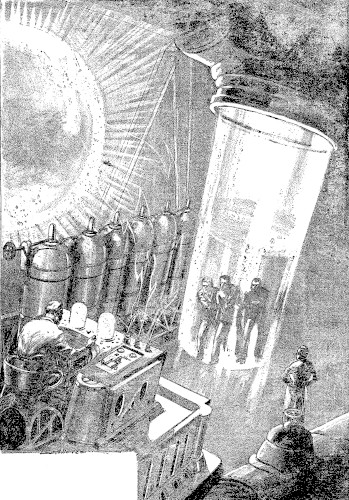
"S—O—S——S—O—S——" On the air over the whole nation the dread
letters came through. Radio stations shut down abruptly, every
broadcasting station cut off the air, and twenty million television
sets went blank after the brief announcement.
Strangely, after the letters came through, there was no message
to follow, and even more strangely, the call was heard on every
broadcasting wavelength!
Perhaps station attendants wondered at that, but they did not wonder
long, for the strong, clear signals suddenly stopped.
"The air is clear. The message of the Council of Five will be
delivered." A deep, powerful voice spoke, but no television disc
signals came, no view of the man. Every wavelength gave the signals
clearly. Every one of the still waiting radio sets resounded with the
deep voice.
"The Council of Five declares the United States no longer a republic.
The Council of Five shall hereafter rule this nation, and within the
year, the nations of earth.
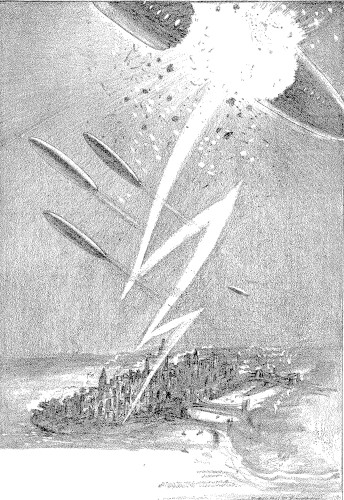
"The warships of the Council of Five will appear over New York City at
ten o'clock to-morrow. Part of the fleet will appear over Washington at
the same time. The financial and political capitals will be expected
to signify their acceptance of the Council by the lowering of the
conventional flag, and the raising of a flag whose field is bright
blue, and on which appear five white stars, one in each corner and one
in the center.
"Resistance is not advisable. The Council of Five has weapons beyond
any known to the rest of mankind.
"The Council has spoken."
The air was silent. Perhaps many that night turned off their radios as
they heard some part of an impossible play coming over the air, heard
some lines from an author's flight of fancy.
But they began to believe soon, when they heard the cries of amazement
and anger in a thousand towns and a hundred thousand villages.
Police and Army and Navy officials were busy now, intercommunicating,
attempting to locate the center of the disturbance, whence that message
came. It was hopeless. Their results were impossible. Apparently the
message had started somewhere over Florida, and its sender had moved,
during the course of the message, till it ended over south-western
Washington. The thing was impossible. They gave it up in disgust, and
perhaps in fear, and began sending orders. Troops began to move toward
New York and Washington that night. Battleships started suddenly in the
same directions. The Pacific fleet hurried toward San Francisco and
Santa Monica, Seattle, and the other great west-coast cities.
Air forces moved swiftly, and before dawn a tremendous fleet of planes
was congregated about the fields of Washington, D. C., and New York.
And high above both cities a dozen or so of the newest planes,
the radio-guided and radio-powered ships swung back and forth.
Noiseless—invisible in the blue——
Restless mobs howled and cursed sleepless all night, the troops fell to
disciplining them as they arrived, and the lights of the city blazed
till dawn. At dawn, New York and Washington time, every light went
out, every train stopped, every line of transportation was suddenly
dead. In both cities the power was gone, and across the whole nation
the electric power ceased to be. Trains stopped, subways suddenly were
motionless.
Chaos in an hour. The mobs went mad; struggling people in the subways
shrieked and howled and roared as their disposition might be. But at
the end of an hour trains began to move cautiously, only sufficient to
get the people from them safely, elevators that had left men and women
trapped one hundred, or perhaps more stories above the ground, began to
work to carry them down, never up.
The city was drawing on its giant batteries. The power batteries that
were intended for emergency came into use. There were no men in the
power plants, and no power came from other cities, from outside. Army
engineers threw in the batteries, then as battleships steamed into the
harbor, great cables from their dynamos carried a measure of power
across to the paralyzed city.
Telephones had operated, for they were maintained by the emergency
power generators, which every station contains. Radio had failed, save
the army portable apparatus, for the great stations depended on the
power lines.
The Council of Five had stricken the city, turned a howling, angry mob
of vengeful men into a paralyzed, panicky crowd, struggling to escape
something, they did not know what, that had completely disorganized
their city, left them trapped in burrows under the streets, or in
perches high above them. Here and there fires, and terrific explosions
had broken out, for the radio controlled and powered planes had come
down, uncontrolled and unpowered, when the power failed.
Further, power would not be restored, the meager output of three
battleships could not sustain the city, the tremendous batteries were
not to be wasted. And the power plants were hopelessly wrecked. A small
plant had gone first, destroyed by a sudden reversal of its phase,
and it was pumping power against the power-tide of a nation. From
transformer to generators all was wrecked. A neighboring power plant
suddenly got the double strain—it went the way of its predecessor.
Like giant snowballs ever gaining volume, plant after plant went, till
finally half a dozen of the greatest alone remained, and the power load
of the United States was thrown on them suddenly.
It would be months before effective power was available. Army engineers
were rushing about in wild anxiety. There were guns, there were planes,
but the thing they had greatest hope for had been the great, sleek
tubes that had been mounted in a dozen places about the city. Fifteen
feet long, their thick, glassy walls glowed red as the rising sun
painted them. Inside the outer tube, an inner tube of copper reached
up ten feet of the length, to end in a crystal glass tube. Great
power-elements inside the glass, and a huge bowl of copper screening
just below this juncture point told its purpose. These Harrell tubes
were new, tremendous tubes that were simply radio tubes and sending
sets in one combination, but they could handle a hundred thousand
horsepower, and all that power was reflected from that curiously
light, and ineffective-seeming copper screening, and it went out as a
beam that was absolutely deadly to any man or animal and destructive to
any piece of metal in its path.
But—to send one hundred thousand horsepower of radio energy, two
hundred and fifteen thousand horsepower of electrical energy was
needed. The three ships in the harbor could not quite supply the energy
for one of these tubes. They had planned to use a dozen. The batteries
would supply them, run them for ten minutes, perhaps. And if those
ships the Council of Five had spoken of could move as they seemed to
have moved last evening, no shell would ever catch them, only these
beams, traveling at the Ultimate Speed, the speed of light.
Commander Gilbert C. Coache gave his orders very energetically, and
very hopelessly. Secretly, he felt sure that the losses would be heavy.
Guns could not cope with any ship that could display that speed—some
rocket ship of undreamed of power.
He was very angry, and very nervous. He had been working now since the
previous morning, and working desperately since the previous evening,
when he had been given the command of the defenses of New York City.
"Power—power—damn it, that's all I want, Major. I can't do anything
if you can't give me power."
"I'm sorry sir, but the only form of electric power in the city are
the indispensable telephone generators, three-quarter-full batteries,
and the power from the ships. Boston, Philadelphia, Albany, Newark,
why every city about has batteries that would give us all the power we
need, but Lord, the damn things won't pump power through a transformer,
and these lines are all A. C. lines. I'm as anxious as you—but I can't
do anything. There've been at least six thousand nuts pestering me with
bright ideas since I came here. One man wanted us to commandeer all the
automobile batteries, and use them. But——"
"I said power!" Commander Coache hung up. He lit a cigarette, took
two puffs, and was reminded he hadn't eaten in hours. He threw it away.
He was so hungry he couldn't smoke, so tired he couldn't see straight,
and so busy he couldn't sleep. Ten o'clock. Four hours more.
He shook his head, and pushed a button for his next visitor. He jumped
as the window behind him crashed to the floor in splinters, and a
hole a foot across appeared miraculously in the plaster of the wall
opposite him. A dum-dum bullet had come through the window, and missed
him widely. The Commander dropped below the window level, and crawled
hurriedly beneath the sill of the broken window. He let out a roar to
the men outside his office.
"Who did that?" he demanded.
The Commander had been working on the second floor of an office
building in the heart of New York. Across the street, in a second
story window, a man was jumping up and down, and heaving a rifle. He
paused to direct a bullet at the Commander's window, and continued his
performance.
"Bring that man over here!" snapped the Commander. The half-dozen
officers and orderlies who had tumbled in, tumbled out, and raced
across to that other building. The Commander's personal dignity and
personal safety had been touched, also the Commander hoped that anyone,
firing at him, must be connected in some way with the Council of Five.
Three officers returned shortly, bringing a man none too gently. His
hair was mussed, his clothes much awry, but he was smiling. He was
tall, powerfully built, with a keen intelligent face.
"Hello, Commander. I met you at last," he grinned.
"Who the hell are you, and what's the idea of trying to snipe me?"
"Oh, you misunderstand me, Commander. I was merely trying to snipe your
attention. For the last three hours I have been throwing myself in the
way of Major Kendrill, but didn't succeed in seeing him. I tried here
for about half an hour, then went across the street and tried that way.
I at least attracted your attention."
The Commander glared at him. "What do you want?" he snapped.
The smile disappeared abruptly from the man's face. He was suddenly
serious, intent. "Commander, what do you want most right now?"
"Power, damn it, power to run my Harrell tubes," replied the Commander
with a groan.
"And that's what I've spent three hours trying to give you. Kendrill
didn't have time for me, he was busy talking to some nut who wanted
him to use automobile generators for power. He'd never heard of James
Atkill, and wouldn't see me, too busy with those nuts.
"Anyway, how much power do you want?"
The Commander looked at him sharply. "James Atkill. Are you he?"
"Right." The smile was back.
"I want at least four million horsepower."
"Make it five. Can you handle it, if I put it on your lines all in one
place?"
"Yes. I think so. Where do you get it, Canada?"
"No. Generate it. Come on, and call Kendrill. I'll demonstrate."
The Commander followed without a word. Three dazed officers watched him
go with the lunatic that first shot at him, then made him follow him.
The Commander followed half a block to a public hangar, where a small
cabin autogyro was parked in Atkill's name. From it, Atkill, with the
aid of two men, took a small, very heavy packing case, and a second
box of black bakelite, surmounted by a glass globe, under which burned
a flame of steady, unwinking white light. It seemed frozen flame,
motionless, undisturbed by position.
"What voltage here?" he demanded of the hangar attendant, indicating
the lights.
"One-ten."
Atkill set something, plugged a wire into the wall socket—the lights
suddenly blazed up, the lights on the streets winked once, and died
instantly. "Fuse blew out. Current going the wrong way now." But the
hangar lights still burned.
"What is that?" demanded the Commander.
"This is a Warren atomic generator. Ever hear of 'em?"
"NO—let's see, wasn't Warren that scientist that was blown up by
something he was working on?"
"Nope—he was blown up, but he was blown up by our mutual friend
Thaddeus Nestor, head of the Council of Five," replied Atkill. "I know.
He wanted me to do it for him, and I backed out. Principally because
I thought too much of Warren, and too little of Nestor. Warren's a
better man than I am I guess—or was. The man was clever to make this.
That thing is patented—the patents are in Washington, and nobody
ever took the trouble to investigate them after Warren died, except
Nestor. He bought the patents. I'm bootlegging this thing, liable to
infringement of the patent laws." Atkill grinned ingratiatingly. "Goin'
to prosecute?"
"Nestor! Council of Five! Who the hell are the others?" demanded the
Commander.
"Not that that'll do you any good, but the others are William J.
Fordham, Arthur Benholt, Thomas Ringman and one 'Burt' Hillen."
"Fordham, Benholt and Ringman—the power-men. That's why the power
plants all went up. They're in on this, eh? But who's Hillen? Never
heard of him."
"Huh—probably not. He was a secondary gang leader in New York here.
He supplied the men who run the air ships. I stole one of the ships
with the aid of Joe Keller and his gang. We had quite a shooting scrap
up-state. Nobody made any complaints, so you didn't hear. Our ship is
painted with a huge American flag, so don't fire on it when we come.
We may be able to help, you know. I would have come to the government
sooner, but I'd simply have gotten kicked out for my pains. I had to
almost assassinate you before I could see you now.
"If Nestor wins, there will be a Council of Four. Hillen and Company,
having served their purpose, will be wiped out by an ingenious little
radio-controlled gas arrangement in each ship. We stole the flagship,
and found the controls for the device in it. They'll have changed the
controls of course, but I'm going to try it when the battle starts,
anyway.
"Now if you will show me where you want this power delivered, I'll put
the generator in."
"How much power?"
"This, my dear sir, is the energy of annihilated matter. I could
produce enough energy with this small machine here to fuse New York
State in about ten seconds. I've been too busy with that captured
ship—it wasn't finished—to make weapons, but just call for all the
power you want."
"Come on. Damn Kendrill. The batteries are in the New York Edison
plant, and that's the best distributing point," said the Commander.
Half an hour later a group of men watched Atkill kindle the
release-flame on the top of a two-hundred pound block of soft, grey
iron. It burned steady and white and cold, and the meters on the wall
jumped into life. Direct current he was using, direct current that
poured into the giant batteries now, and into the mains that led across
the city. A million lights blazed suddenly into life, a thousand trains
started throbbing as the electric pumps automatically compressed air
into the tanks. A sudden hush came over the city, noise died suddenly.
The great mobs that had been struggling, shouting, panic-stricken
nearly, were filled with a sudden hope as the familiar, comforting
power came back. The meters on the walls rose to undreamt of heights,
as toasters, coffee pots, waffle irons, lights, motors, a thousand and
one things about the city came to life. And too, the giant batteries
were drinking deep of the power-flood.
A group of bewildered engineers stared at a neat black cabinet, a
rough, grey mass, and a clear, cold white flame that burned unwinking
and unmoving on the block of metal.
"Good God, man, how long can that last?" asked the army engineer
standing beside Atkill.
"That," replied Atkill with a faint smile, "will last about a century
and a half at the present rate of consumption, thanks to the genius
of the greatest physicist that ever lived, Randolph Warren. I used to
think I was good, but there are things about these generators even I
can't see the why of, and though I know there are a thousand other
things to learn, I can learn but a few. The field of absolute zero
Warren had, I can't find. A field that will extinguish that flame
before the fuel runs out Warren had, from some of his statements in the
patents, yet I can't find it.
"But that will last far longer than you will."
The men looked up at the clock by common impulse. It was fifteen
minutes of ten o'clock.
"I'll have to go," said Atkill. On the roof of the powerhouse he
entered his autogyro, and flashed away to the southwest.
The men in the power house looked at the steady white flame, at the
meters, and followed Atkill's simple instructions.
"Leave it alone," he had said, "Leave it alone, and draw all the power
you need. If I am killed, just draw on it till the fuel is gone, and
then the flame will go out automatically. Before that time you cannot
change it in the slightest."
And it would be a century and a half before that fuel was gone!