The Colonel was playing on his violin as
Betty entered the sitting-room, and what he
had chosen was the sad old air of “Love Not,
Love Not, Ye Hapless Sons of Men.” He
laid down his violin, and noticed that Betty’s
face was pale, in spite of the sharp winter
air, and that she spoke with suppressed fury
in her voice.
“Grandfather,” she said, “it is all over
between Mr. Fortescue and me. Please don’t
ask me about it. We didn’t disagree about a
trifle, but about something important. We
are perfectly friendly, and mean to keep so,
because we don’t want the people in the
county talking about us and worrying us with
questions. But it is all over, quite over.”
The Colonel started and studied Betty
closely. He knew the resolute character, the
stubborn pride, that lay beneath all of Betty’s
frivolities. She could do things as foolish as
any girl of her age, but she could suffer more
than most. The Colonel sighed as he looked
at her pale, unsmiling face, her eyes full of
angry light. He understood the sharp pain
of those who have not learned the awful
lesson of life, the haughty attitude of the
young who have never known defeat, the sufferings
of mortified pride and wounded
vanity, and, above all, he had an inward conviction
that Betty in her heart loved Fortescue.
Man-like, the Colonel was not so sure
of Fortescue, and a resentment, grim and
stern, rose within him. Until the young
officer appeared, Betty had been quite happy
and satisfied at Holly Lodge. In time, she
would have married some one in the county
perhaps, and would have led that peaceful
life on the sunny side of the wall, which only
the quiet lives know. But with Fortescue’s
appearance had come the disturbing vision
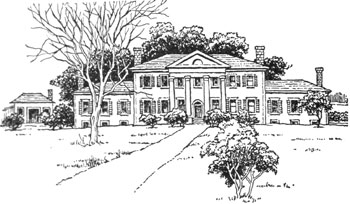
of a possible return to Rosehill, of a life in
the great outside world, going from place to
place, of the breaking of all the old ties.
Betty had asked him not to question her, but
the Colonel felt justified in asking precisely
one question.
“Elizabeth, has Mr. Fortescue acted dishonorably?”
he inquired, straightening up
his old figure, still soldierly.
“No,” replied Betty promptly. “Mr.
Fortescue couldn’t do anything dishonorable.”
“I am glad to hear it,” answered the Colonel
grimly. “If he had, I should have felt
called upon to chastise him according to the
code in which I was reared and have lived and
shall die.”
Betty’s heart was quivering, her pride was
up in arms, the whole world seemed full of
tears; but when the Colonel talked about
chastising Fortescue’s young strength, her
sense of humor overwhelmed her pain, and
she suddenly laughed a little. She did not
tell the Colonel the cause of her ripple of
laughter, and in another minute her eyes grew
sombre and her heart once more hardened
against Fortescue.
“You may be quite satisfied, Grandfather,”
she said. “All that has happened
was my own act.”
Betty turned and went out of the room.
Being Christmas time, and there being no
household tasks awaiting her, no sewing to
do, because she had planned that this Christmas time
should be one of perfect leisure,
that she might be free to entertain her great
guest, First Love, there was nothing for her
to do. She went aimlessly up to her room.
Then, suddenly, she felt a sharp headache.
Her mental suffering produced a physical
pain. She was rather glad of it, as it gave her
an excuse for keeping to her room and lying
down. The little room was flooded with
winter sunshine, and a pretty fire was smouldering
on the hearth. Betty drew the curtains,
glancing meanwhile toward Rosehill. Her
keen eyes caught sight of Fortescue crossing
the lawn rapidly. A great buzzard was
wheeling majestically over the Rosehill
house, and a group of the servants, one of the
men with a gun, was standing on the edge of
the lawn, prepared to fire at the bird. Fortescue
walked up and, taking the gun, sighted
and fired, and the buzzard fell upon the roof
of the house. This little act wrung Betty’s
heart.
“How little he cares!” she thought bitterly.
“Any trifle can distract him. Well,
it was better to find it out in time.”
Then, for the first time, Betty turned her
eyes away as the Colonel turned his away
from Rosehill. She loved the place, and deep
in her heart had grown the wish to preside
there once more, as Fortescue’s wife. It was
impossible, quite impossible, now. She could
not forget Fortescue—Betty was honest
enough with herself to know that, and honorable
enough to respect her own affection.
Love is not killed in an hour or even a day.
The great stretch of life ahead of her loomed
before Betty’s eyes as one stands on the edge
of a parched desert and thinks of the weary
journey across it. For Betty Beverley, the
coquette, was the soul of constancy. These
thoughts and many others and a racking
headache drove Betty to her bed. She threw
herself on it, with all the sunshine shut out of
her room, just as it had been shut suddenly
out of her life.
At the midday dinner, Kettle, who had
almost supplanted Uncle Cesar as butler,
came up, and, opening Betty’s door and putting
in his little woolly head, said softly:
“Miss Betty, dinner done ready.”
“I can’t come down to dinner,” answered
Betty. “Tell the Colonel that I have a bad
headache. It will be better to-night, and I am
going to the party just the same. But when
dinner is over, Kettle, you may bring me up
some tea and toast.”
Kettle had never known Betty to have an
ache or a pain since he had been established
at Holly Lodge, and the sight of her pale face,
and the weariness in her voice, frightened
him. He began to argue with Betty:
“Miss Betty, you better come down ter
dinner. Aunt Tulip, she done cook some of
the bes’ sweet ’taters you ever see in your
life, Miss Betty—got sugar on ’em, an’
butter too.”
“I don’t care for any, thank you,” said
Betty, her heart far away from sweet potatoes
with sugar and butter.
Kettle paused for a minute in order to think
of some other inducement.
“Aunt Tulip, she got a rice pudden’ wid
gre’t big raisins in it, mos’ as big as my fist,”
urged Kettle.
“No, thank you,” replied Betty absently.
But Kettle’s sympathy could not be bottled
up.
“Miss Betty,” pleaded Kettle, “lemme
go out an’ crack you up some wun’nuts,” by
which Kettle meant walnuts.
Betty’s patience was giving out.
“No, Kettle,” she said sharply. “I don’t
want anything except tea and toast, as I told
you.”
“But, Miss Betty,” persisted Kettle, edging
toward the door, “I got a big bag o’
chestnuts, an’ they mighty good roasted on
the kitchen shovel.”
Betty’s nerves and her temper could stand
no more.
“Go away, Kettle,” she cried impatiently.
“Go downstairs this minute and serve the
Colonel’s soup.”
The tone could not be mistaken, and Kettle
went out of the door as if shot out of a gun.
Once outside, however, his little faithful heart
was still torn for Betty, and he was prepared
to take great risks. He turned the door-knob
noiselessly, and, putting his round, black head
in the door, whispered:
“Miss Betty, Miss Betty, when I bring up
yo’ tea, lemme bring you up a hard b’iled
aig!”
Betty’s answer was to throw a pillow at
Kettle, who dodged it and went clattering
downstairs.
What a strange, unnatural day it was for
Betty! Here in the brilliant afternoon, when
she was wont to be her brightest and best, she
lay huddled up in her bed, racked with physical
and mental pain. Her sunny room was
dark, and her active little feet felt like lead.
The prospect of a party, the music, the dancing,
the bright interchange of looks and words
that was the wine of life to Betty’s pleasure-loving
temperament, seemed to her now a
dreadful ordeal, to be gone through with
courage, and by a stupendous effort to let no
one suspect the agony of her mind. Never
before had she felt humiliated in the presence
of any man, but she felt a sharp humiliation
at the thought that in the first encounter of
her will with Fortescue’s, she had been defeated;
whether by her own unreason or his,
was equally painful. But there was no back-down
in Betty, and she never dreamed of
staying away from the party or giving up the
fight because of an aching heart.
The old Colonel downstairs in the sitting-room
felt his heart wrung for his little Betty.
Too soon had come to her those shocks and
disappointments against which youth rebels.
The young demand happiness of life, and are
in despair when they first find they cannot
secure it.
Kettle, after having taken up Betty’s tea,
came downstairs again, and, instead of going
into the kitchen, where he belonged, came into
the sitting-room and, perching his small,
black, and miserable self upon a little cricket,
fixed his eyes upon the Colonel’s grave, gray
face, outlined against the window-pane. The
boy sat so still and silent that the Colonel at
last roused himself and asked kindly:
“What’s the matter, Kettle?”
“Ain’ nothin’ ’tall matter wid me, suh,
but sumpin’ is the matter wid Miss Betty, an’
it kinder makes me feel bad.”
The Colonel sighed; it made him feel bad,
too.
All the afternoon, Kettle sat there until it
was time to milk old Bossy, a duty which he
had monopolized for some time past. Then
there was wood and water to be brought, and
all the other duties which Aunt Tulip had devised
for him. But when they were over
Kettle crept softly upstairs and seated himself
on the top step close to Betty’s door. At
seven o’clock, Betty opened the door that she
might call down to Aunt Tulip to assist her in
getting into her gown. She almost fell over
Kettle.
“What are you doing here, Kettle?”
“Jes’ waitin’ ter see ef you don’ want
nothin’,” was Kettle’s excuse.
The boy’s inarticulate sympathy touched
Betty’s heart in the midst of her own unhappiness.
“I do want something,” she said kindly.
“I want you to tell Aunt Tulip to come here,
and to bring up some more wood, and to do
all sorts of things that nobody can do for me
except you, Kettle.”
Kettle’s black face beamed. He ran downstairs
after Aunt Tulip, and then began bringing
wood, toiling up the stairs with as much
as he could carry.
Although Betty was dressed as gaily as
usual for a party, and took as much pains
with her beautiful brown hair and the wreath
of ivy-leaves upon it, Kettle’s sharp eyes were
not deceived. Something was wrong with
Miss Betty.
When old Whitey pulled the rockaway up
to the door, Betty came down to show herself
as usual to the Colonel. The unspoken pity
in his eyes moved Betty.
“Don’t be afraid, Grandfather,” she said.
“I haven’t any more cowardice in me than
there is in you. I intend to be just as happy
to-night as ever I was, and to dance and laugh
and sing as I always do.”
And then poor Betty laughed a laugh so
forced, so full of pain, so unlike her usual
rippling laughter, that the Colonel’s heart
was wrung more than ever. But he knew
better than to offer Betty pity.
“Stiffen up, my dear,” he said. “Life is
full of disappointments. Fortescue is not the
man you took him for, that is all. Put him
out of your mind.”
“I will,” replied Betty stoutly, without
the slightest ability to keep her word in the
matter.
Driving along the hard country road in the
wintry night, Betty thought of all those things
she might do by which a headstrong, proud,
and deeply sensitive girl may inflict pain upon
herself as well as another. She would, of
course, give Fortescue back his ring that
night, and the next day there were to be returned
a few trifles other than books and
flowers that he had sent her. The ring was a
simple thing, a little ruby heart surrounded
with small pearls. She had never worn it in
public, for fear it might attract attention—people
in the country are observant of trifles.
But she loved the little ring as a symbol.
That night the party was at Red Plains,
and Betty knew she would meet the whole
county. There was no hall for dancing at
Red Plains, but the drawing-room was cleared
of furniture, and there the dancing went on.
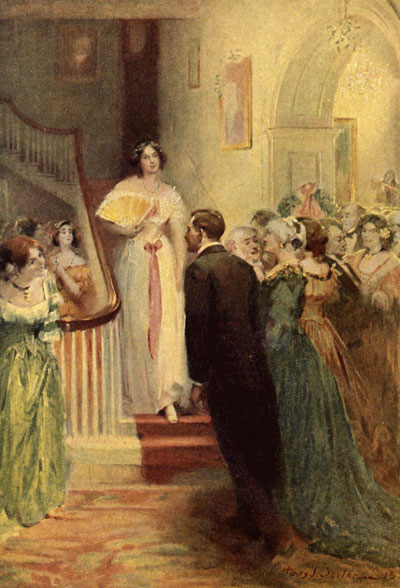
As Betty entered the drawing-room, almost
the first person she saw was Fortescue dancing
vigorously with Sally Carteret. Betty
was besieged with partners, and immediately
whirled off with one of them. When the music
stopped, she found herself close to Fortescue,
near the great fireplace in which the Christmas
fire burned. They both spoke cordially
and smiling, but as Betty withdrew her hand
from Fortescue’s grasp, she left in it the little
ring. Fortescue was exasperated, as any man
would be, by the promptness of this stab, and,
while talking gaily with Betty, dropped the
ring into the open fire, unseen by any except
her. Betty’s heart gave a great throb of pain.
She loved her little ring, and it seemed to her
an insult that Fortescue should destroy it
before her eyes.
They danced together, and talked so merrily
that no one suspected the gulf which they
themselves had dug between them, so great is
the folly, the rashness, the headlong pride, of
youth. Each had a fierce pride which prevented
them from showing their self-inflicted
wounds to the world, or making an outcry at
that dreadful, gratuitous and unnecessary
pain which the young inflict upon themselves.
As Betty danced, she thought about the poor
princess who had to walk upon burning
plough-shares. If she were a real princess,
Betty thought, she smiled bravely during her
agony.
The merriment, the dancing, the pretty
Christmas observances, that Betty had loved
so much, all seemed now to her wearisome and
joyless. She longed for the time to come
when the ball would be over, and she could be
alone, and thought with distaste of the half a
dozen parties ahead of her. This was very
much increased by the news spread abroad
that a ball was to be given at Rosehill on
Christmas Eve. Fortescue invited everybody
cordially and pleasantly to his ball, saying he
could not hope to do things as picturesquely
as they did them, but he would do his best.
Everybody had accepted his invitation with
alacrity. He had made himself popular in a
community where newcomers were usually
looked upon askant, and the prospect of Rosehill
being once more opened at Christmas time
pleased the young people immensely.
“Of course, Miss Betty, you will come,”
said Fortescue cordially, his heart hardening
against Betty as he spoke.
“Certainly, I will,” she answered, with a
brilliant smile. “I shall be glad to see Rosehill
gay once more.”
When the ball was over, in the early hours
of the morning, with the earth still wrapped in
pitch darkness, and Betty was driving home,
a faint moan escaped her lips. It was bad
enough to have to meet Fortescue constantly,
but to go to Rosehill—— She might, it is
true, deceive everybody in the county on a pretense
of illness, but she could not deceive Fortescue,
the person whom she most wished to
deceive. She would go, no matter what it
cost her.
The ball at Rosehill was a torturing thing
to Betty. By that time, as it is with the wild
hearts of youth, she had a settled and burning
resentment against Fortescue, which she concealed
from the world with pretty smiles and
gay words. Fortescue, as he said, could not
do things as the county people did, but with
well meant generosity he did everything well
at his ball so far as money could go. There
was a profusion of flowers ordered from Baltimore,
along with the conventional supper,
totally unlike what the county people had, and
a band of music beside which the fiddles of
Isaac Minkins and Uncle Cesar and the “lap
organ” paled. These novelties pleased everybody
except Betty, who walked through the
rooms where she had spent nineteen years of
her short life, and looked around her with a
supercilious smile that infuriated Fortescue.
The ball kept up late. Fortescue was an
admirable host, and his guests enjoyed themselves.
It was quite five o’clock before the
last guest had left, and during the night there
had been a fall of snow. The lights were out,
and Fortescue, in his bedroom, which had
once been Betty’s, was smoking his last cigar,
and cursing the treachery of a woman—of
Betty Beverley, who had won his brave and
honest heart, and then, through sheer unreason
and heartlessness, had cast him off.
He threw the stump of his cigar savagely into
the fire, and, going to the window which looked
toward Holly Lodge, put it up to inhale the
cold, clear air. The blackness and darkness
had given way to a pale gray, which preceded
the dawn, and by the ghostly half-light, he
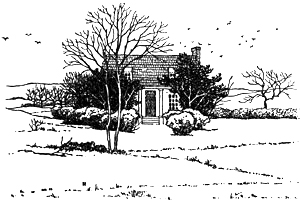
saw from the roof of Holly Lodge a great
cloud of black smoke ascend, and little
tongues of flame leaping wickedly.