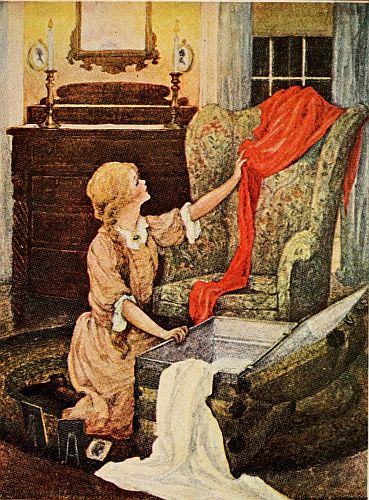
There was a great stirring about and opening
and shutting of kitchen doors early the
next morning but one. Betty had been anxious
the day before to set forth on what she
was pleased to call a long cruise in the Starlight,
but Mr. Leicester said that he must
give up the morning to his letters, and after
that came a long business talk with Aunt Barbara
in the library, where she sat before her
capacious secretary and produced some neat
packages of papers from a little red morocco
trunk which Betty had never seen before. To
say truth, Aunt Barbara was a famous business
woman and quite the superior of her nephew
in financial matters, but she deferred to him
meekly, and in fact gained some long-desired
information about a northwestern city in
which Mr. Leicester had lately been obliged
to linger for two or three days.
It was a day of clear hot sunshine and light
breeze, not in the least a good day for sailing;
but Betty was just as much disappointed to
be kept at home as if it had been, and after
breakfast she loitered about in idleness, with
a look of dark disapproval, until papa suddenly
faced about and held her before him
by her two shoulders, looking gravely into her
eyes, which fell at once.
"Don't be cross, Betty," he said quietly;
"we shall play all the better if we don't
forget our work. What is there to do first?
Where's 'Things to be Done'?"
Betty dipped into her pocket and pulled out
a bit of paper with the above heading, and
held it up to him. Papa's eyes began to
twinkle and she felt her cheeks grow red, but
good humor was restored. "1. Ask Seth to
sharpen my knife. 2. Find Aunt Mary's old
'Evenings at Home' and read her the Transmigrations
of Indur. 3. Find out what 'hedonism'
means in the dictionary. 4. Sew on papa's
buttons."
"Those were all the things I could think
of last night," explained Betty apologetically.
"I was so sleepy."
"It strikes me that the most important duty
happened to be set down last," said Mr. Leicester,
beginning to laugh. "If you will look
after the buttons, I will tell you the meaning of
'hedonism' and sharpen the jack-knife, and I
am not sure that I won't read the Transmigrations
to Aunt Mary beside, for the sake of old
times. I know where those little old brown
books are, too, unless they have been moved
from their old places. I am willing to make
a good offer, for I have hardly a button to my
back, you know. And this evening we will
have a row, if not a sail. The sky looks as
if the wind were rising, and you can ask Mary
Beck to go with us to-morrow down the river,
if you like. I am going to see young Foster
the first time I go down the street. Now
good-by until dinner-time, dear child."
"Good-by, dear papa!" and Betty ran up-stairs
two steps at a time. She had already
looked to see if there were plenty of ink in
his ink-bottle, and some water in a tiny vase
on his writing-table for the quill pens. It was
almost the only thing she had done that morning,
but it was one of her special cares when
they were together. She gathered an armful of
his clothes, and finding that Aunt Mary was
in a hospitable frame went into her room for
advice and society, and sat busily sewing by
the favorite cool western window nearly all the
morning.
In the evening, when the tide was high,
Betty and Mr. Leicester went out for a little
row by themselves, floating under some overhanging
oak-boughs and talking about things
that had happened when they were apart.
Now we come back to where we began this
chapter,—the early morning of the next day,
and Serena's and Letty's bustling in the pantry
to have a basket of luncheon ready, so that
the boating party need not lose the tide; the
boating party itself at breakfast in the dining-room;
Mary Beck in a transport of delight
sitting by her window at the other side of the
street, all ready to rush out the minute she saw
Betty appear. As for Harry Foster and Seth,
they had already gone down to the shore.
On the wide sofa in the hall was a funny old-fashioned
leather satchel with a strong strap-handle.
It seemed full to overflowing, and
beside it lay a warm shawl neatly folded, and,
not to make too long a story, Aunt Barbara's
third-best bonnet was close at hand, and these
were her provisions for spending the day on
the river. Mr. Leicester had insisted that she
should go with them, and that if she found it
tiresome there was nothing to prevent her
coming back by train from Riverport in the
afternoon. Aunt Barbara felt as if she were
being a little adventurous, and packed her
small portmanteau with a secret foreboding
that she might be kept out over night; still she
had always been very fond of boating, and had
seen almost none of it for many years, in fact
since Betty's father had been at home sometimes,
in his college vacations. There was a
fine breeze blowing already in the elms and
making the tall hollyhocks bow in the garden,
and when they reached the wharf and put
down the creaking wicker basket on the very
edge the tide was still high, and Harry Foster
had already hoisted the Starlight's sail with
one careful reef in it, and was waiting to row
them out two at a time in the tag-boat. Nelly
Foster could not go, as she and her mother
were very busy that day, but Harry's face
looked brighter than Betty had ever seen it,
and she was sure that papa must have been
very good, and, to use a favorite phrase of
his, opened a new gate for him. Mary Beck
was strangely full of fears, considering that
she was the granddaughter of a brave old
sailor; but after she was out of the unsteady
smaller boat, and had been decoyed by Betty
to the bows of the Starlight, and shown how
to stow herself away so that she hindered
neither jib nor boom, she began to enjoy herself
highly. Aunt Barbara sat under her every-day
parasol, looking quite elegant and unseaworthy,
but very happy. Harry Foster was
steering just beside her, and Mr. Leicester,
with Seth's assistance, was shaking out the
reef; for the wind was quieter just now, and
they wished to get farther down river as soon
as possible, since here, where the banks were
often high and wooded and the stream narrow,
it was gusty and uncertain sailing for so large
a boat. They slipped down fast with the
wind and tide, and passed the packet, which
had started out ahead of them. She carried
an unusual number of passengers, and was
loaded deep with early potatoes. The girls
waved their handkerchiefs and the men on
board the packet gave a cheer, while Mr.
Leicester saluted with the Starlight's flag, and
it was altogether a ceremonious occasion. Seth
said that he "guessed folks would think old
Tideshead was waking up." Of all the pleasure-boat's
company Seth was perhaps the best
satisfied. He had been in a state of torture
lest he might not be asked to make one of the
crew, and it being divulged that although of
up-country origin he had once gone to the
Georges Banks fishing with a seafaring uncle,
Mr. Leicester considerately asked for his services.
Seth had put on the great rubber-boots
and a heavy red woolen shirt that he
wore on shipboard in March weather. He
was already obliged to fan himself incessantly
with his straw hat, as they were running before
the wind, and presently, after much suffering,
made an excuse to go into the little cabin,
whence he reappeared, much abashed, in his
stocking feet and a faded calico shirt, which
had been luckily put on under the red one.
Aunt Barbara held her parasol so that it covered
her face for a few minutes, and there was
a considerate silence, until Seth mentioned
that he "had thought he knew before what it
was to be het up, but you never knew what
kind of weather 't was to be on the water."
At the next bend of the river the wind
made them much cooler, while the boat sailed
even better than before. There had been
plenty of rain, so that the shore was as green
as in June and the old farm-houses looked very
pleasant. Betty had not been so far down as
this since the day she came to Tideshead, and
was looking eagerly for certain places that
she remembered. Aunt Barbara and papa
were talking about John Paul Jones and his
famous river crew, some of whom Aunt Barbara
had known in their old age, while she
was a girl. Harry Foster was listening with
great interest. Betty and even Becky felt
proud of Harry as he steered, looking along
the river with quick, sure eyes. They did not
feel so familiar with him as usual; somehow,
he looked a good deal older since the trouble
about his father, and there was a new manliness
and dignity about him, as if he knew that
his mother and Nelly had no one but himself
to depend upon. It was plain to see that his
early burden of shame and sorrow had developed
a strong character in the lad. There was
none of the listlessness and awkward incapacity
and self-admiration that made some of
the other Tideshead boys so unattractive, but
Harry Foster had a simple way of speaking
and of doing whatever had to be done.
There was a group of wooden pails on the
boat, and a queer apparatus for dredging which
Mr. Leicester had made the afternoon before
with Seth's and Jonathan's help. They had
implored a flat-iron from Serena for one of
the weights, and she had also contributed a
tin pail, which was curiously weighted also
with small pieces of iron, so that it would sink
in a particular way. It was believed that a
certain uncommon little creature would be
found in the flats farther down the river, and
Mr. Leicester told the ship's company certain
interesting facts about its life and behavior
which made everybody eager to join the
search. "I have been meaning to hunt for it
for years," he said. "Professor Agassiz told
me about it when I was in college; but then he
always roused one's enthusiasm as no one else
could, and made whatever he was interested
in seem the one thing in the world that was of
very first importance." Betty's heart glowed
as she listened; she thought the same thing of
papa. "He was such an inspirer of others to
do good work," said Mr. Leicester, still thinking
lovingly of his great teacher.
Sometimes the river was narrow and deep
and the Starlight's course lay near the shore,
so that the children came running down to the
water's edge to see the pretty boat go by,
and envy Betty and Mary Beck in the shadow
of her great white sail. Some of them shouted
Hollo! and the two girls answered again and
again, until the little voices sounded small and
piping and were lost in the distance. Halfway
to Riverport, where the houses were a good
way from any village, it seemed as if these old
homes had remained the same for many years;
none of them had bay-windows, and the paint
was worn away by wind and weather. It was
like stepping back twenty or thirty years in
the rural history. Aunt Barbara said that
everything looked almost exactly the same
along one reach of the river as it did when she
could first remember it. The shores were
green with pines and ferns and gray with
ledges. It was salt water here, so that they
could smell the seaweed and the woods, and
could hear the song-sparrows and the children's
voices as they passed the lonely farm-houses
standing high and fog-free above the
water. From one of these they heard the
sound of women's voices singing.
"They're havin' a meetin' in there, I expect,"
explained Seth. "Yes, I hear 'Liza
Loomis's voice too. You know, Miss Leicester,
she used to live up to Tideshead and sing in
the Methodist choir. She's got a lovely voice
to sing. She's married down this way. They
like to git together in these scattered places,
but 't is more customary up where I come from
to have them neighborhood meetin's of an
afternoon." Betty watched the small gray
house with deep interest, and thought she
should like to go in. There were little children
playing about the door, as if they had
been brought and left outside to amuse themselves.
It was very touching to hear the old
hymn as they sailed by, and Aunt Barbara
and Betty's father looked at each other significantly
as they listened. "Becky, you ought to
be there to help sing," Betty whispered, as
they sat side by side, but Becky thought it was
very stupid to be having a prayer-meeting that
lovely morning.
Seth Pond had celebrated the Fourth of
July by going down to Riverport on the
packet, and he had gathered much information
about the river which he was glad to give
now for everybody's pleasure and enlightenment.
"There's a bo't layin' up in that cove that's
drowned two men," he said solemnly. "There
was a lady with 'em, but she was saved. I
understand they'd been drinking heavy."
Betty looked at the boat with awe where it
lay with the stern under water and the bows
ashore and all warped apart. "Isn't she
good for anything?" she asked.
"Nobody'll ever touch her," said Seth contemptuously,—"she's
drowned two men."
But Miss Leicester smiled, and said that it
appeared to have been their own fault.
They could see into the low ruined cabin
from the deck of the Starlight, and, after they
passed, the cabin port-hole seemed to watch
them like an eye until it was far astern.
"I suppose she will lie there until she
breaks up in a high tide, and then the women
will gather her wreck wood to burn," said
Mr. Leicester, watching the warped mast, and
Harry Foster said that no fishermen on the
river would ever touch a boat that they believed
to be unlucky. Just then they came
round a point and passed a little house close
by the water, where there were flakes for drying
fish and a collection of little weather-beaten
boxes shaped like roofs which were used to
cover the fish in wet weather. Betty thought
they looked like a village of baby-houses. At
this moment a woman darted out of the house
door, screaming to some one inside, "I've lost
Georgie and Idy both!" and off the anxious
mother hurried along the steep path to the
fish flakes, as if that were where she usually
found the runaways. Presently they heard
a child's shrill voice, and a pink pinafore
emerged from among the little roofs. Ida was
deposited angrily in the lane, while the mother
went back to hunt for the other one. It was
very droll to see and hear it all from the river,
but it was some minutes before loud shrieks
announced the adventurous Georgie's capture.
"Georgie must ha' been hull down on the
horizon," remarked Seth blandly, trying to
be very nautical, and everybody laughed; but
Betty and Mary thought the woman very
cross, when it was such a pretty place to play
out there among the bayberry, and perhaps
there were ripe blackberries. Harry Foster
said that children did mischief in pulling off
bits of the dry fish and spoiling them for market;
but there was no end of fish, and everybody
felt a sympathy for "Idy and Georgie
both" in their sad captivity.
Before long the houses were nearer together,
and even clustered in little groups close by
the river, and sometimes the Starlight passed
some schooners going up or down, or being
laden with bricks or hay or firewood at small
wharves. Then they came in sight of the
Riverport steeples, only a few miles below.
The wind was not so gusty now and blew
steadily, but it was very light, and the Starlight
moved slowly. Harry and Seth had already
hoisted a topsail, and while Mr. Leicester
steered Harry came and stood by the masts,
looking out ahead and talking with the two
girls. But Harry felt responsible for the boat,
and could not give himself up to pleasuring
until, as he said, he understood the tricks and
manners of the Starlight a little better. It
was toward noon, now, for they had come
slowly the last third of the way; and Mr.
Leicester, after a word with Aunt Barbara,
proposed that they should go ashore for a
while, for there was a beautiful piece of pine
woods close at hand, and the flats which he
was going to investigate were also within
rowing distance. So down came the sails and
alongside came the tag-boat; and Aunt Barbara
was landed first, parasol and all, and the
others followed her. The tide was running
out fast, and it was not easy to find a landing-place
along the muddy shores. Betty thought
the Starlight looked much smaller from the
shore than she seemed when they were on
board. Harry and Seth made everything trig
and came in last, leaving the cat-boat at anchor
far out.
Even after the joy of sailing it was very
pleasant ashore under the shady pines, and
Mr. Leicester found a delightfully comfortable
place for Aunt Barbara to sit in, while the
girls were near by. "What an interesting
morning we have had!" Betty heard Aunt
Barbara say. "Sailing down the river brings
to mind so many things in the past. The beginnings
of history in this part of the country
always have to do with the river. I wish that
I could remember all the stories of the early
settlements that I used to hear old people tell
in my childhood."
"See that little green farm in the middle of
the sunburnt pastures across the river," said
Mr. Leicester, who had been looking that way
intently. "Look, Betty! what a small green
spot it makes with its orchard and fields
among the woods and brown pastures, and yet
what toil has been spent there year after
year!"
Betty looked with great interest. She had
seen the green farm, but she had not thought
about it, and neither had Mary Beck, who could
not tell why she kept looking that way again
and again, and somehow could not help thinking
how good it would be to make a green place
like that by one's own life among dull and
difficult surroundings. Betty was her green
place; by and by she could do the same thing
for somebody else, perhaps.
"What a lovely place this is!" said Aunt
Barbara, still enthusiastic. "There is such
sweet air here among the pines, and I delight
in the wide outlook over the river. I begin
to feel as young as ever. I thought that I
was almost too old to enjoy myself any more,
last winter. It is such a mistake to let one's
self make great things out of little ones, as I
did, and carry life too heavily," she added.
"You must feel ever so much older inside
than you look outside," said Betty, who was in
famous spirits.
Mr. Leicester laughed with the rest, and
then looked over his shoulder with a droll expression,
as if something was causing him great
apprehension. "Aunt Barbara!" he began,
and then hid his face with his arm, as if he
were about to be well whipped.
"What mischief now?" said she.
"I have played you a trick: you are not
leaving your home and friends for one day,
but for two."
Miss Leicester looked puzzled.
"You were very good not to say that I was
foolish to carry two extra sails."
"I did think it was nonsense, Tom," he was
promptly assured, "but then I remembered that
you had only hired the boat, and thought perhaps
the sails went with it. Of course they take
up too much room in the cabin. You can't
mean that you are going on a longer voyage?"
"Tents!" shouted Betty, jumping up and
dancing about in great excitement. "Tents!
don't you see, Aunt Barbara? and we're going
to camp out." It was a very anxious moment,
for if Aunt Barbara said, "We must go home
to-night," there would be nothing to do but
obey.
"But your Aunt Mary will be worried, won't
she?" asked Miss Leicester, whose quick wit
suspected a deep-laid plot. She was already
filled with a spirit of adventure; she really
looked pleased, but was not without a sense of
responsibility.
"I thought you would like it," explained
Mr. Leicester, in a matter-of-fact way; "and
there was no need of telling you beforehand,
so that you would make your will and pay
your taxes and get in all the winter supplies
and have the minister to tea before you started.
Aunt Mary knows, and so does Serena; you
will see that Serena contemplated the situation
by the way she filled these big baskets."
"I saw that they were amused with something
that I didn't quite understand. And
Mary Beck's mother will not feel anxious?"
she asked, for a final assurance. "I never
expected to turn myself into a wild Indian at
my age, even to please foolish children like
you and Betty, but I have always wished that
I could sleep one night under the pine woods."
"You said so when we were reading Mr.
Stevenson's 'Travels with a Donkey' aloud to
Aunt Mary," Betty stated eagerly, as if the
others would find it hard to believe her grandaunt.
Somehow, a stranger would have found
it difficult to believe that Miss Leicester had
unsatisfied desires about gypsying.
Mary Beck was deeply astonished; she had
a huge admiration for her dignified neighbor
across the way, and yet it was always a little
perilous to her ease of mind and self-possession
to find herself in Miss Leicester's company.
Many a time, in the days before Betty came
to Tideshead, she had walked to and fro before
the old house hoping to be spoken to or called
in for a visit, and yet was too shy to properly
answer a kind good-morning when they met.
Aunt Barbara used to think that Becky was a
dull girl, but they were already better friends.
It took a long time to rouse Becky's enthusiasm,
but when roused it burned with steady
flame. To think that she should be camping
out with Miss Leicester!
But Mr. Leicester and Betty and Becky
were soon at work making their camp, and the
novices took their first lesson in woodcraft.
The young men, Harry Foster and Seth, came
ashore bringing the tender loaded deep with
tents and blankets, some of them from Jonathan's
carefully kept chests in the carriage-house,
and Miss Leicester wondered again how
anybody had contrived to get so many things
from the house to the boat without her knowledge.
There were two sharp hatchets, and
presently Seth and Harry were dispatched to
gather some dry wood for the fire, though
until near evening the tents need not be put
up nor the last arrangements made for sleeping.
By and by everybody could help either
to cut or carry hemlock and spruce boughs
for the beds.
Betty helped her father to roll some stones
together for a fireplace just at the edge of the
river beach, and pleased him very much by
rolling a heavy one up to the top of the heap
on a piece of board which had washed ashore,
just as she had seen farmers do in building a
stone wall. Mary Beck, in a trepidation of
delight, was helping Miss Barbara Leicester
unpack the baskets, to see what should be
eaten for dinner and what should be kept
for future meals, when Mr. Leicester called
them.
"Aunt Barbara," he proclaimed, "I am
not going to let you keep tent; you only know
how to keep house; and beside, you mustn't
do what you always do at home. Let the girls
manage dinner and you come with me, now
that the fire is started. I have thought of an
errand."
Miss Leicester meekly obeyed; she was
ready for anything, having once cast off, as
she said, all obligation to society, and with a
few parting charges to Betty about the provisions
she disappeared among the pines with
her nephew.
"Isn't it fun?" said Mary Beck, and she
put on such a comical face when Betty sedately
quoted,
"What is that, mother?
A lark, my child,"
that Betty fell into a fit of laughter, and
Becky caught it, and they were gasping for
breath before they could stop. "Oh, think
of Aunt Barbara camping out and setting
herself up for a gypsy!" said Betty. "This
is just the way papa does now and then.
I always told you so, didn't I?—only you
never know when to watch for his tricks. He
doesn't always catch me like this, I can tell
you. Think of Aunt Barbara! I hope the
dear thing will pass a good night; she isn't
a bit older than we are in her dear heart.
How will she ever have the face to walk into
church so grandly Sunday morning!" and so
the merry girls chattered on, while they spread
the cloth and Betty put a decoration of leaves
round the edge and a handful of flowers in
the middle. "You have such a way of prettifying
things," said Mary Beck; "there, the
chocolate pot is beginning to boil already."
"We ought to have some fresh water; it is
time papa came back," said Betty anxiously;
and just then appeared papa and smiling Aunt
Barbara, and a small tin pail which had to be
borrowed at a farm-house half a mile away
because it was forgotten.
The wind blew cool across the river, and
more and more boats went gliding up and
down in the channel, though the tide was very
low. Everybody was hungrier than ever, because
the sea wind is famous for helping on
an appetite, and the hot chocolate was none too
hot after all, though Aunt Barbara's bonnet
was hanging on a branch and she did not seem
to miss the shelter of it. Becky was forced
to change her opinion about cooking; she had
always disliked to have anything to do with
it; it seemed to her a thing to be ignored and
concealed in polite society, and yet Betty was
openly proud of having had a few cooking-school
lessons, and of knowing the right way
to do things. Becky suddenly began to parade
her own knowledge, and found herself of great
use to the party. Instead of being unwilling
when her mother asked for help again, she
meant to learn a great many more things. She
was overjoyed when she found a tin box of
coffee, and remembered that Betty had said it
was her father's chief delight. She would
make a good cup for him in the morning.
Betty was always saying how nice it was to
know how to do things. She never expected
to like to wash dinner dishes, but the time had
come, though a hot sun was somehow pleasanter
than a hot stove, and it had been a
gypsy dinner, with potatoes in the ashes and
buns toasted on a hot stone, and no end of
good things beside.
"We must have some oysters to roast for
our supper. I know a place just below here
where they are very salt and good," said Mr.
Leicester; "and one of you young men might
go fishing, and bring us in a string of flounders,
or anything you can get. We have breakfast
to look out for, you remember."
"Ay, ay, sir," said Harry Foster, sailor fashion,
but with uncommon heartiness. Harry
had been very quiet and care-taking on the
boat, and had not said much, either, since he
came ashore, but his eyes had been growing
brighter, and as Miss Leicester looked up at
him she was touched at the change in his face.
How boyish and almost gay he was again!
She caught his eye, and gave him a kind reassuring
little nod, as if nobody could be more
pleased to have him happy than herself.
The Starlight was now aground in the
bright green river grass and the flats were
bare for a long distance beyond, so that there
was no more boating for the present. There
were plenty of comfortable hollows to rest in
farther back on the soft carpet under the
pines, and so the dining-room nearer the shore
was abandoned and the provisions cachéd, as
Mr. Leicester called it, under an oak-tree.
Certain things had been forgotten, but just
round the point the steeples of Riverport were
in full view; and when everybody had rested
enough and the tide was creeping in, Mr.
Leicester first sent Harry out in the small boat
and his long-legged fishing-boots to get two
buckets of river mud, and after he had seated
himself beside them with his magnifying-glasses
and a paraphernalia of tools familiar
to Betty, Harry was given orders to take
Seth Pond and the two girls and go down to
Riverport shopping, as soon as the Starlight
floated again.
Harry was hovering over the scientific enterprise
and looked sorry for a minute, but it
seemed to the girls as if the tide had stopped
rising. At last they got on board by going
down the shore a little way to be taken off the
sooner from some rock. Aunt Barbara announced
that she meant to go too; indeed, she
was not tired; what had there been to tire
her? So off they all went, and left Mr. Leicester
to his investigations. It took some time
to go to Riverport, for the wind was light and
the tide against them. Everybody, and Betty
in particular, thought it great fun to make
fast to the wharf and go ashore up into the
town shopping. Aunt Barbara gayly stepped
off first, to see an old friend who lived a little
way above the business part of the town, and,
asked to be called for, as they went back, at
the friend's river gate. Harry knew it?—the
high house with the lookout on top and the
gate at the garden-foot. Betty went first
to find her early friend, the woman who kept
the bake-house, and was recognized at once
and provided with fresh buns and crisp molasses
cookies which had hardly cooled. Then
Betty and Becky walked about the narrow
streets for an hour, enjoying themselves highly
and collecting ship's stores at two or three
fruit shops; also laying in a good store of
chocolate, which Betty proclaimed to be very
nourishing. She got two pots of her favorite
orange marmalade too, in case they made toast
for supper.
"All the old ladies are looking out of their
windows, just as they were the day I was
coming to Tideshead," she said; and Becky replied
that their faces were always at just the
same pane of glass. The fences were very
high and had their tops cut in points, and over
them here and there drooped the heavy bough
of a fruit-tree or a long tendril of grapevine,
as if there were delightful gardens inside. The
sidewalks were very narrow underneath these
fences, so that Betty often walked in the street
to be alongside her companion. There were
pretty old knockers on the front doors, and
sometimes a parrot hung out under the porch,
and shouted saucily at the passers-by. Riverport
was a delightful old town. Betty was
sure that if she did not love Tideshead best
she should like to belong in Riverport, and
have a garden with a river gate, and a great
square house of three stories and a lookout on
top.
The stores were put on board, and Seth
Pond came back from researches which had
been rewarded by a half-bushel basket full of
clams. Then they swung out into the stream
again, and ever so many little boys with four
grown men on the wharf gave them a cheer.
It was great fun stopping for Aunt Barbara,
who was in the garden watching for them, and
was escorted by a charming white-haired old
gentleman who teased her a little upon her
youthful escapade, and a younger lady who
walked sedately under an antique Chinese
parasol. Betty sprang ashore to greet this
latter personage, who had lately paid a visit
to Miss Barbara at Tideshead. She was fond
of Miss Marcia Drummond.
"It seems like old times to have you going
home by boat," said Miss Marcia, kissing Aunt
Barbara good-by. "It is much pleasanter
than a car journey. Betty, my dear, you know
that your aunt is a very rash and heedless
person; I hope you will hold her in check. I
have been trying to persuade her that she will
be much safer to-night in one of our old four-posters;"
and so they said good-by merrily and
were off again, while the young people in the
boat looked back as long as they could see the
old garden with its hollyhocks and lilies, and
the two figures of the courtly old gentleman
and the lady with the parasol going up the
broad walk.
"What a good thing it was in Tom Leicester
to send his daughter to Tideshead this summer!"
said the old gentleman. "I think that
Barbara is renewing her youth. Tom is a
man of distinction, and yet keeps to his queer
wild ways. You are sure that Barbara quite
understands about our wishing them to dine
here? I think this camping business is positively
foolish conduct in a person of her age."
But Miss Marcia Drummond looked wistfully
over her shoulder at the cat-boat's lessening
sail, and wished that she too were going to
spend a night under the pines.
A little way up the river they passed the
packet boat, a little belated and heavily laden,
but moving steadily.
"Look at old Step-an'-fetch-it," said Seth.
"She spears all the little winds with that
peakéd sail o' hern. Ain't one on 'em can git
by her." They kept company for a while, until
in the broad river bay above Riverport
bridge the Starlight skimmed far ahead, like a
great white moth. Seth mentioned that folks
would think they was settin' up a navy up to
Tideshead, and just then the Starlight yawed,
and the boom threw Seth off his balance and
nearly overboard, as much to his own amusement
as the rest of the ship's company's.
Betty and Mary Beck stowed themselves
away before the mast, and wished that the
sail were longer. The sun was low, and the
light made the river and the green shores look
most beautiful. Miss Leicester suggested that
they should sail a little farther before going
in, and so they went as far as the next reach,
a mile above the camp, on the accommodating
west wind. It was a last puff before sundown,
and by the time Harry had anchored
the Starlight in deeper water than before, her
sail drooped in the perfectly still evening air.
Once on shore everybody was busy; the
spruce and hemlock boughs must be arranged
carefully for the beds and the tents pitched
over them before the August dew began to fall.
Mr. Leicester was chief of this part of camp
duty, and Miss Barbara, who seemed to enjoy
herself more every moment, was allowed by
the girls to help, just that once, about getting
supper. It was growing cool and the fire was
not unwelcome, but by and by a gentle wind
began to blow and kept away the midges.
Betty began to think that there would be nothing
left for breakfast by the time supper was
half through, but she managed to secrete part
of her cherished buns, and reflected that it
would be easy to send to Riverport for further
supplies even if breakfast were a little late.
Betty felt a certain care and responsibility
over the whole expedition, it was so delightful
to be looking after papa again; and she was
obliged to tell him that he must not touch the
river mud any more, or he would not be fit to
go through the streets of Riverport next day,
at which Mr. Leicester, though deeply attached
to his old friends in that town, looked very
distressed and unwilling.
The darkness fell fast, and the supper dishes
had to be put under some bayberry bushes until
morning. The salt air was very sweet and
fresh, and it was just warm enough and just
cool enough, as Betty said. The stars were
bright; in fact, the last few days had been
much more like June than August, and it was
what English people call Queen's weather.
Mary Beck said sagely that it must be because
Miss Leicester came, and then was quite
ashamed, dear little soul, not understanding
that nothing is so pleasant to an older woman
as to find herself interesting and companionable
to a girl. People do not always grow away
from their youth; they add to it experiences and
traits of different sorts; and it is easy sometimes
to throw off all these, and find the boy
or the girl again, eager and fresh and ready
for simple pleasures, and to make new beginnings.
Seth Pond had stolen out to the cat-boat on
some errand of his own which nobody questioned,
and now there suddenly resounded the
surprising notes of his violin. It was very
pretty to hear his familiar old tunes over the
water, and everybody respected Seth's amiable
desire to afford entertainment, even if he
failed a little now and then in time or tone.
He had mastered several old Scottish and
English airs in the book Betty had given him,
and already had become proficient in some
lively jigs and dancing tunes, as we knew at
the time of Betty's first party in the garden.
The clumsy fellow had a real gift for music.
Some stray fairy must have passed his way
and left an unexpected gift. The little audience
on the shore were ready to applaud,
and two or three boats came near, while some
young people in one began to sing "Bonny
Doon," softly, while Seth played, and, encouraged
by the applause, went on more boldly, and
took up the strain again when Seth changed
suddenly to "Lochaber no more." Miss
Leicester was overjoyed when she heard such
fresh young voices sing the plaintive old air
so readily. It had always been a great favorite
of hers, and she said so with enthusiasm.
Mary Beck was sorry that she never had
learned it, but by the time the last verse came
she began to join in as best she could.
"I'll bring thee a heart with love running o'er,
And then I'll leave thee and Lochaber no more,"
the words ended. Nobody who heard it that
summer night in the starlight by the river
shore would ever forget the old song.
"You must have influenced Seth's choice of
music," Betty's father said to Aunt Barbara,
who confessed that the droning of the violin
over cheap music was more than she could
bear at first, and she had been compelled to
suggest something in the place of "The Sweet
By-and-By" and "Golden Slippers." Luckily,
Seth seemed to abandon these without
regret.
At last the boats all disappeared into the
darkness, and the little camp was made ready
for night. The open air made every one
sleepy but Miss Barbara, who consoled herself
by thinking that if she did not sleep it
would be little matter; she had been awake
many a night in her life and felt none the
worse. But in fact the sound of rippling water
against the bank and the sea-like sound of the
pine boughs overhead sent her to sleep before
she had half time to properly enjoy them.
She and Betty declared that their thick-set
evergreen boughs and warm blankets made
the best of beds. They could see the stars
through the open end of the tent. One was so
bright that it let fall a slender golden track
of light on the river. Mary Beck thought
that she had never been so happy. Camping-out
had always been such a far-off thing, and
belonged to summer tourists and the remote
unsettled parts of country; but here she was,
close to her own home, with all the delights of
gypsy life suddenly made her own. Betty and
Betty's friends had such a way of enjoying
every-day things. Becky was learning to be
happy in simple ways she never had before.
She went to sleep too, and the stars shone on,
and late in the night the waning moon came
up, strange and red; then the dawn came
creeping into the morning sky, and one wild
creature after another, in the crevices of rocks
or branches of trees, waked and went its ways
silently or gay with song.
When Betty's eyes first opened she could
not remember where she was, for a moment.
Then she was filled with a sense of great contentment,
and lay still, looking out through
the open end of the tent across the wide still
river down which some birds were flying seaward.
It was most beautiful in that early
morning of a new day, and from beyond the
water on the opposite shore came the far
sweet sound of a woman's voice singing as
she worked, as if a long-looked-for day had
come and held great joy for her. She was
singing just as the birds sing, and Betty tried
to fancy how she looked as she went to and
fro so busily in one of the farm-houses.
Aunt Barbara did not wake until after Betty,
which was a great joy, and there was a peal
of delighted laughter from the girls when she
waked and found their bright young eyes
watching her. She complained of nothing, except
a moment of fright when she saw her
own bonnet at the top of a lopped fir which
had been stuck into the ground at the foot of
the bed, to hang her raiment on. Her wrap
had been put neatly round the tree's shoulders
by Betty, so that it looked like a queer
sort of skeleton creature with every sort of
garment on its sharp pegs of bones. Nobody
had taken the least bit of cold, and everybody
was as cheerful as possible, and so the
day began. Seth Pond had trudged off to
get some milk at one of the farm-houses, and
had lighted a fire before he went and covered
it with bits of dry turf, which served to keep
it in as well as peat. Mr. Leicester complained
that he had found the tent too warm,
and so had rolled himself in his blanket and
spent the night in the open air. Evidently he
and Harry Foster had been awake some time,
and they were having a famous talk about
one of the treasured creatures in the muddy
wooden pail. Harry had managed to learn a
great deal by spending an hour now and then
in a famous old library in Riverport, in which
Miss Leicester had given him the use of her
share; and Betty knew that her father was
delighted and surprised with the young man's
interest in his own favorite studies. She had
felt sure all summer that papa would know
just how to help Harry Foster on, and as she
watched them she could not help thinking that
she wished Harry were her brother. But then
she would no longer have entire right to papa.
"Come, Elizabeth Leicester!" said papa,
in high spirits. "I never had such a dilatory
damsel to make my first tent breakfast!" So
Betty hastened, and poked the fire nearly to
death in her desire for promptness with the
morning meal. After it was over Miss Leicester
sat in the shade with a book, while all the
rest went fishing and took a long sail seaward
beside.
That evening they went home with the tide,
in great delight, every one. Aunt Barbara
was unduly proud of her exploits and a sunburnt
nose, and the younger members of the
party were a little subdued from their first
enthusiasm by all sorts of exciting pleasures.
As for Harry Foster, the lad felt as if a door
had been kindly opened in the solid wall of
hindrance which had closed about him, and as
if he could look through now into a new life.