Betty's sole idea of a court had been gained
from a scene or two in the once-a-week Pineville
motion picture theater, and Bob had even less
knowledge. They both thought there might be a
crowd, a judge in a black gown, and some noise
and excitement.
Instead Recorder Bender unlocked the door of
a little one-story building and ushered them into
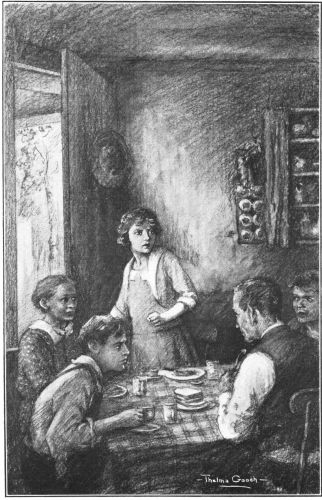
a small room furnished simply with a long table,
a few chairs, and a case of law books.
Presently two men came in, nodded to Mrs.
Bender, and conferred in whispers with Mr. Bender.
There was a scuffling step outside the door
and Mr. Peabody entered.
"Huh, there you are!" he greeted Bob. "For
all of you, I might have been hunting my horse
and wagon all night. Mighty afraid to let any
one know where you are."
"Mr. Peabody?" asked the recorder crisply,
and suddenly all his quiet friendliness was gone
and an able official with a clear, direct gaze and
a rather stern chin faced the farmer. "Sit down,
please, until we're all ready."
Mr. Peabody subsided into a chair, and the two
men went away. They were back in a few moments,
and with them they brought Wapley and
Lieson and a lad, little more than a boy, who was
evidently the truck driver.
"Close the door," directed the recorder.
"Now, Mr. Peabody, if you'll just sit here—"
he indicated a chair at one side of the table. With
a clever shifting of the group he soon had them
arranged so that Wapley, Lieson, the truck
driver, and the two men who had brought them
in were sitting on one side of the table, and Betty,
Bob, Mrs. Bender and Mr. Peabody on the other.
He himself took a seat between Betty and Mr.
Peabody.
"Now you all understand," he said pleasantly,
"that this is merely an informal hearing. We
want to learn what both sides have to say."
Mr. Peabody gave a short laugh.
"I don't see what the other side can have to
say!" he exclaimed contemptuously. "They've
been caught red-handed, stealing my chickens."
The recorder ignored this, and turned to
Lieson.
"You've worked for farmers about here in
other seasons," he said. "And, from all I can
hear, your record was all right. What made you
put yourself in line for a workhouse term?"
Lieson cleared his throat, glancing at Wapley.
"It can't be proved we was stealing," he argued
sullenly. "Them chickens was going to be sold on
commission."
"Taking 'em off at ten o'clock at night to save
'em from sunburn, wasn't you?" demanded Mr.
Peabody sarcastically. "You never was a quick
thinker, Lieson."
"Now, Lieson," struck in Mr. Bender patiently,
"that's no sort of use. Miss Gordon here
overheard your plans. We know those chickens
came from the Peabody farm, and that you and
Wapley had a bargain with Tubbs to sell them
in Petria. What I want to hear is your excuse.
It's been my experience that every one who takes
what doesn't belong to him has an excuse, good
or bad. What's yours?"
At the mention of Betty's name, Lieson and
Wapley had shot her a quick look. She made a
little gesture of helplessness, infinitely appealing.
"I'm so sorry," the expressive brown eyes told
them, "I just have to tell what I heard, if I'm
asked, but I wouldn't willingly do you harm."
Lieson threw back his head and struck the table
a sounding blow.
"I'll tell you why we took those blamed
chickens!" he cried. "You can believe it or not,
but we were going to sell 'em in Petria, and all
over and above twenty-five dollars they brought,
Peabody would have got back. He owes us that
amount. Ask him."
"It's a lie!" shouted Peabody, rising, his face
crimson. "A lie, I tell you! A lie cooked up by
a sneaking, crooked, chicken-thief to save himself!"
Lieson and Wapley were on their feet, and
Betty saw the glint of something shiny in Peabody's
hand.
"Sit down, and keep quiet!" said the recorder
levelly. "That will be about all the shouting,
please, this morning. And, Mr. Peabody, I'll
trouble you for that automatic!"
The men dropped into their chairs, and Peabody
pushed his pistol across the table. The recorder
opened a drawer and dropped the evil
little thing into it.
"Can you prove that wages are owed you by
Mr. Peabody?" he asked, as if nothing had happened.
Wapley, who had been silent all along, pulled a
dirty scrap of paper from his pocket.
"There's when we came to Bramble Farm and
when we left, and the money we've had," he said
harshly. "And when we left, it was 'cause he
wouldn't give us what was coming to us—not just
a dollar or two of it to spend in Glenside, Miss
Betty can tell you that."
"Yes," said Betty eagerly. "That was what
they quarreled about."
The recorder, who had been studying the bit
of paper, asked a question without raising his
eyes.
"What's this thirty-four cents subtracted from
this two dollars for—June twenty-fourth, it seems
to be?"
"Oh, that was when we had the machinist who
came to fix the binder stay to supper," explained
Wapley simply. "Lieson and me paid Peabody
for butter on the table that night, 'cause Edgeworth's
mighty particular about what he gets to
eat. He'd come ten miles to fix the machine, and
we wanted him to have a good meal."
Mr. Peabody turned a vivid scarlet. He did
not relish these disclosures of his domestic
economy.
"What in tarnation has that got to do with
stealing my chickens?" he demanded testily,
"Ain't you going to commit these varmints?"
The truck driver, who had been studying Mr.
Peabody with disconcerting steadiness, suddenly
announced the result of his scrutiny, apparently
not in the last in awe of the jail sentence shadow
under which he stood.
"Well, you poor, little, mean-livered, low-down,
pesky, slithering snake-in-the-grass," he
said slowly and distinctly, addressing himself to
Mr. Peabody with unflattering directness, "now I
know where I've seen your homely mug before.
You're the skunk that scattered ground glass on
that stretch of road between the crossroads and
Miller's Pond, and then laughed when I ruined
four of my good tires. I knew I'd seen you somewhere,
but I couldn't place you.
"Why, do you know, Mr. Bender," he turned
excitedly to the recorder, "that low-down coward
wouldn't put ground glass on his own road—might
get him into trouble with the authorities.
No, he goes and scatters the stuff on some other
farmer's highway, and when I lodge a complaint
against the man whose name was on the mail box
and face him in Glenside, he isn't the man I saw
laughing at all! I made a complete fool of myself.
I suppose this guy had a grudge against
some neighbor and took that way of paying it
out; and getting some motorist in Dutch, too.
These rubes hates automobiles, anyway."
"It's a lie!" retorted Mr. Peabody, but his tone
did not carry conviction. "I never scattered any
ground glass."
The recorder fluttered a batch of papers impressively.
"Well, I've two complaints that may be filed
against you," he announced decisively. "One for
uncollected wages due James Wapley and Enos
Lieson, and one charging that you willfully made
a public highway dangerous for automobile traffic.
Also, I believe, this boy, Bob Henderson, has
not been sent to school regularly."
This was a surprise to Bob, who had long ago
accepted the fact that school for him was over.
But Mr. Peabody was plainly worried.
"What you want me to do?" he whined. "I'm
willing to be fair. No man can say I'm not just."
The recorder leaned back in his chair, and his
good wife, watching, knew that he had gained his
point.
"Litigation and law-squabble," he said tranquilly,
"waste money, time, and too often defeat
the ends. Why, in this instance, don't we effect
a compromise? You, Mr. Peabody, pay these
men the money you owe them and drop the charge
of stealing; you will have your chickens back and
the knowledge that their enmity toward you is
removed. Tubbs, I'm sure, will agree to forget
the broken glass, and the schooling charge may
lapse, provided something along that line is done
for Bob this winter."
Mr. Peabody was shrewd enough to see that
he could not hope for better terms. As long as
he had the chickens to sell to Ryerson, he had no
grounds for complaint. He hated "like sin" as
Bob said, to pay the money to Wapley and Lieson,
but under the recorder's unwavering eye, he
counted out twenty-five dollars—twelve dollars
and fifty cents apiece—which the men pocketed
smilingly. A word or two of friendly admonition
from Mr. Bender, and the men were dismissed.
"I'm so glad," sighed Betty as they left the
room, "that I didn't have to say anything against
them."
"Well, are you coming along with me?" asked
Peabody, almost graciously for him. "There's a
letter there for you, Betty. From your uncle, I
calculate, since the postmark is Washington.
And my word, Bob, you don't seem in any great
hurry to get back to your chores; the sorrel must
be eating his head off in Haverford's stable."
The recorder exchanged a look with his wife.
"Mr. Peabody," he said, "I shall be detained
here an hour or so, and I don't want these young
folks to leave until I have a word with them.
Mrs. Bender will be only too glad to have you
stay for lunch with us, and I'll meet you up at the
house. My wife, Mr. Peabody."
"Pleased to meet you, Ma'am," stammered
Mr. Peabody awkwardly. "I ought to be getting
on toward home. But I suppose, if the chickens
were fed this morning, they can wait."
"I'm sure you're hungry yourself," answered
Mrs. Bender, slipping an arm about Betty. "Suppose
we walk up to the house now, Mr. Peabody,
and I'll have lunch ready by the time Mr. Bender
is free."
Betty looked back as they were leaving the
room and saw the truck driver slouched disconsolately
in a chair opposite the recorder.
"Is—is he arrested?" she whispered half-fearfully
to Mrs. Bender. Mr. Peabody and Bob
were walking on ahead.
"No, dear," was the answer. "But Mr. Bender
will doubtless give him a good raking over
the coals, which is just what he needs. Fred
Tubbs is a Laurel Grove boy, and his mother is
one of the sweetest women in town. He's always
been a little wild, and lately he's been in with all
kinds of riff-raff. Harry heard rumors that he
was trucking in shady transactions, but he never
could get hold of proof. Now he has him just
where he wants him. He'll tell Fred a few truths
and maybe knock some sense into him before he
does something that will send him to state's
prison."