II. THE FLOWERETS.
A SERIES OF STORIES ON THE COMMANDMENTS.
6 vols. In a box. $3.60.
Violet’s Idol.
Daisy’s Work.
Rose’s Temptation.
Lily’s Lesson.
Hyacinthe and her Brothers.
Pinkie and the Rabbits.
III. LITTLE SUNBEAMS.
6 vols. In a box. $6.00.
Belle Powers’ Locket.
Dora’s Motto. 16mo.
Lily Norris’ Enemy.
Jessie’s Parrot.
Mamie’s Watchword.
Nellie’s Housekeeping.
IV. KITTY AND LULU BOOKS.
6 vols. In a box. $6.00.
Toutou and Pussy.
Kitty’s Robins.
The White Rabbit.
Rudie’s Goat.
Kitty’s Visit.
Kitty’s Scrap-Book.
V. MISS ASHTON’S GIRLS.
1. Fanny’s Birthday
$1.25
2. The New Scholars
1.25
3. Rosalie’s Pet
1.25
4. Eleanor’s Visit
1.25
5. Mabel Walton
1.25
VI. HAPS AND MISHAPS.
6 vols. In a box. $7.50.
1. Little Friends
$1.25
2. The Broken Mallet
1.25
3. Blackberry Jam
1.25
4. Milly’s Whims
1.25
5. Lilies and Thistledown
1.25
6. Uncle Joe’s Thanksgiving
1.25
ROBERT CARTER AND BROTHERS, New York.
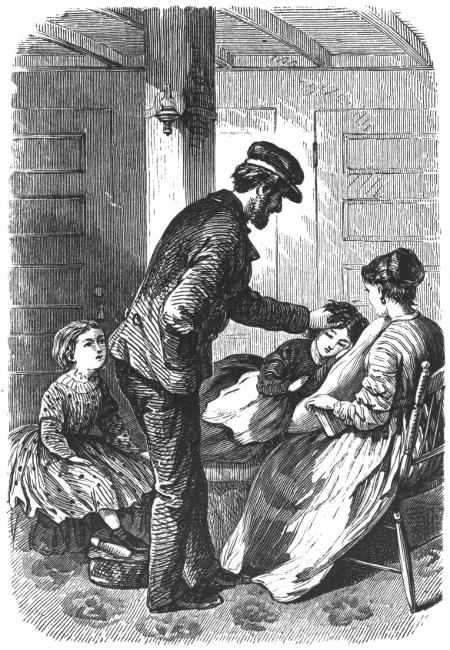
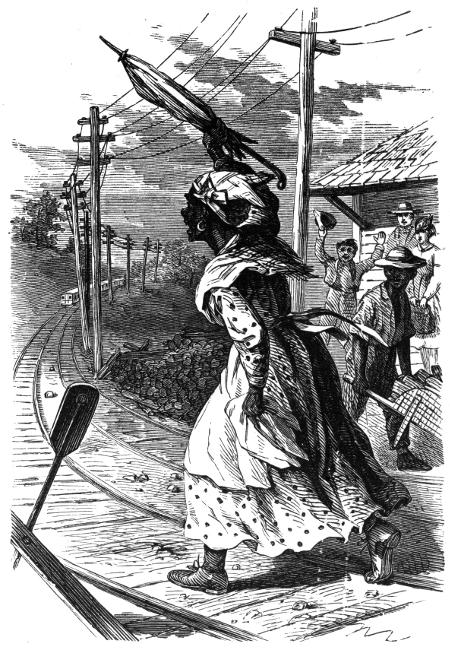
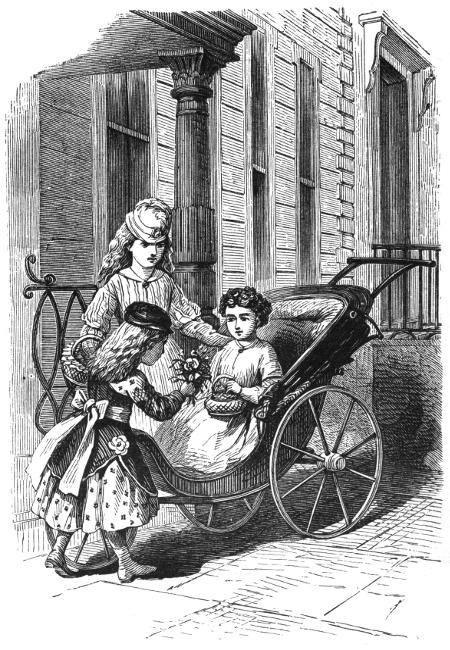
FRONTISPIECE. Bessie’s Travels.
BESSIE
ON
HER TRAVELS.
BY
JOANNA H. MATHEWS.
“Glad hearts, without reproach or blot,
Which do thy work, and know it not.”
NEW YORK.
ROBERT CARTER AND BROTHERS,
530, Broadway.
Entered according to Act of Congress, in the year 1870, by
ROBERT CARTER AND BROTHERS,
In the Clerk’s Office of the District Court of the United States for the
Southern District of New York.
CAMBRIDGE:
PRESS OF JOHN WILSON AND SON
DEDICATED
TO
LITTLE FLORENCE GUERNSEY,
AS
A SMALL TOKEN OF APPRECIATION OF HER FATHER’S LONG AND
FAITHFUL FRIENDSHIP; AND WITH THE HOPE THAT
THIS LAST MAY NOT PROVE TO HER THE
LEAST OF THE “BESSIE BOOKS.”
What a twitter and flutter and chirping
there was in the pretty nest
which Maggie and Bessie Bradford
called their own room; for there were four
little girls, who were to start together the next
day on their travels, and there was so much
to be talked over. All the new places they
were to visit, all the wonderful things they
were to see and do; and, more than all, that
sea voyage of three or four days. For none
of them but Belle had ever been to sea, and it
would be quite a new thing to all the rest.
Then there was the packing, about which
both Maggie and Bessie, especially the former,
had been greatly concerned for the last week;
for it seemed impossible to them that nurse
and Jane could make all the necessary preparations
for this important journey on the day
before that on which they were to start.
That morning Maggie’s excitement and impatience
had overflowed. Waking at a very
early hour, and finding Bessie still sleeping,
she lay a few moments thinking of all that
was to be done that day, and wondering that
the household should still be so quiet, with the
prospect of such important business before
them.
“I just expect the end of the matter will be
that every one in the house, even poor mamma,
who is not so very well yet, will have to
turn to and help to make up for their pro-cras-to-na-tion!”
said she to herself, indignantly;
“and I’ve just a great mind to begin packing
up myself, to set them a good example, and
make them ashamed of a little girl like me
taking time by the forelock so much better
than they do.”
No sooner said than done; and Maggie
scrambled out of bed and into her dressing-gown
and slippers quite forgetting to pause
and think whether or no mamma would approve
of her running about the house in such
a guise, and if she would not be giving more
trouble than help by meddling with what she
did not understand.
Upstairs she trotted to the topmost story,
where was a room which Fred called the “put-all-room,”
and which held, not only trunks
and boxes of all shapes and sizes, but a couple
of great, old-fashioned presses, and many
another article not in common daily use, and
stored there to be out of the way. The
children thought it rather a treat to go in now
and then with mamma or nurse, to rummage
there and see what they could spy out: but
none of them had ever gone there alone or
without permission; and if Maggie had taken
time to reflect, I think she would have known
that her mamma would not wish her to
do so, though she had never positively forbidden
it.
But just now the busy little head was too
full of plans for making herself useful, to take
heed of any thing else; and finding what she
had hoped for, that the door was unlocked,
she opened it, and went in. The trunks were
not piled together at one end as they usually
were, but stood singly, here and there about
the room, just as Patrick had left them the
day before, when he had examined them to
see if they were in good order; and this Maggie
observed with great satisfaction.
“It just seems as if it was fixed to be convenient
for me,” she said to herself; “and now
I can try which is the heaviest one I can pull.
I know I could not take those largest downstairs,
but I think I could one of the middlings.”
But, after various trials, she found to her
great disappointment, that she could by no
means move even one of the “middlings;”
and was at last forced to content herself with
a small black leather trunk, in which she
thought she would put some of her own
and Bessie’s clothes.
“For a pack in time saves nine,” said Maggie
to herself; “and even if it does not hold
much, this little trunk is a better beginning
than nothing.”
Having fixed upon this prize, she contrived
with some trouble to drag it from the room,
and push and pull it to the head of the stairs.
But here a new difficulty arose. She could by
no means lift the trunk and carry it down:
small as it was for the amount of packing she
wished to do, it was quite too heavy for her
little strength; and though for one moment
she thought of pushing it over the edge of the
top stair, and allowing it to slide down by its
own weight, she soon reflected this would not
do.
“For it will just go and smash itself all to
pieces, I suppose, and then make a horrid
noise to wake the people all up,” she said
again, feeling rather vexed with the innocent
trunk. “Oh! I know what I’ll do: I’ll go in
front of it and pull it down very gently, one
step at a time.”
But in spite of all the pains she took, the
trunk seemed to Maggie to make the most outrageous
noise, sliding over each stair with a
grating sound, and coming down from the
edge of one to another with a thump and a
bang, which all her efforts could not silence.
She was soon heartily sorry that she had ever
touched it; but she must go on now, for she
could not possibly pull it up again, and if she
left her hold of it, it would go tumbling headlong
to the bottom.
However, she took heart of grace again by
the time she had reached the foot of the top
flight, for no one seemed to have been disturbed;
the servants having all gone down
stairs, and the boys, who slept in the third
story, being sound sleepers. So she concluded
to go on and not have all her pains thrown
away; but she had gone only two or three
steps on the second flight, her troublesome
prize bumping after her, when she heard her
father’s voice from below.
“What are you busy with there, Patrick?”
he said. “You are disturbing Mrs. Bradford,
and will wake the children. Leave it till later
in the day.”
“O papa!” said Maggie, feeling rather
guilty, and very much mortified, “it’s not
Patrick, but me;” and as she spoke, she appeared
round the turn of the stairs, while her
attention being for the moment diverted, the
trunk slid after her with a bang which seemed
to jar the house.
“You, my daughter!” said Mr. Bradford,
coming up to where Maggie stood; “and what
are you doing here at this time in the morning?”
and he looked down in great surprise
at the small figure whose cheeks matched her
scarlet dressing-gown, and whose curls were
tossed and tumbled in the wildest confusion.
“It’s this mean old trunk, papa,” said Maggie,
pettishly; “the more I try to make it go
softly, the more it won’t, but just squeaks and
bumps all it can, the horrid thing!” and now
she gave up the trunk very willingly into her
father’s strong grasp.
“What were you doing with it?” asked
Mr. Bradford.
“Taking it downstairs, so I could pack it
with my things and Bessie’s, papa. I wanted
to take mamma by surprise to see how useful
I could be.”
“You have taken mamma rather too much
by surprise,” said her father, unable to help
smiling; “for you have wakened and startled
her. It is well to try to be useful, but one
should try to be thoughtful and considerate at
the same time, or our pains will be quite
thrown away, as yours are now. You must
go back to your bed, my daughter, and let this
trunk alone;” and lifting the trunk he carried
it to the third-story hall, Maggie looking on
with a very crestfallen feeling.
“It may stay there till we see if it is
needed,” said Mr. Bradford, soothingly, as he
saw her disturbed face; “and by and by, at the
proper time, you may ask mamma if you can
help her;” and taking the little hand which
was trembling with cold and over-exertion, he
led her back to her own room. Papa had
been very kind, and could scarcely be said to
have found fault with her; but Maggie, who
began to feel that she had been somewhat to
blame, would rather have been scolded than
hear him laugh as he did when he told mamma
how and where he had found her. She
did not hear what he said, but she knew very
well what he was talking about, and drew the
bed-clothes over her head that she might shut
out the sound of his laughter.
“It’s too bad,” she thought: “most always
when I try to be very superior, I make a mistake
and people laugh at me about it. I feel
as if I’d like to be mad at some one, but I
can’t be mad at papa, and I don’t want to be
mad at myself, ’cause I didn’t mean to do
wrong; and it’s no use to be mad at the
trunk, but I b’lieve I do feel a little provoked
at it, it has made my hands hurt, and my arms
do ache so. I’m real tired too.” And coming
to the surface for air, Maggie turned over on
her side, and presently dropped off into a
sound morning nap; so that when nurse came
to tell her she might get up, she found her
still sleeping instead of wide awake as usual,
and was bidden by Mrs. Bradford to let her
sleep as long as she would after her exertion.
Maggie was rather subdued and quiet all the
first part of the morning, and more than ever
grateful to papa, when she found that he had
not told the boys, and so given them the
opportunity to tease and laugh at her.
“I suppose you couldn’t let me help you
after my unconsiderate unusefulness this morning:
could you, mamma?” she said, when she
saw her mother gathering together the articles
Jane was to stow in the trunks.
“Well, yes: I think I can find something
for you and Bessie to do,” said mamma: “you
may take all these tapes, needles, spools, and
so forth, into your own room, and see how
neatly you can put them into this box; and all
these ribbons may go into that one.”
“Oh! thank you, mamma: I will let Bessie
do the ribbons, ’cause they are the prettiest;”
and away ran generous Maggie with her sister
to begin the pleasant task.
That done, mamma gave them leave to pack
the clothes belonging to Miss Bessie Margaret
Marian, and Miss Margaret Colonel Horace
Rush Bradford, in another box; saying that
since she did not feel as if she could do without
her own little daughters, she would not ask
them to leave the whole of their large family
behind, and thought the dolls might prove a
great diversion when they were tired, or perhaps
shut up in some hotel on a rainy day.
They were busy deciding what dresses
should be taken and what left, when Mrs. Norris
came round to see Mrs. Bradford for a few
moments, bringing Lily with her; and while
the ladies talked in one room, the little girls
chattered away in the other, Belle coming in
about the same time.
“Oh!” said Lily, “is your mamma going
to let you take your large dolls? my mamma
will only let me take a tiny, weeny one that
can go in a travelling-bag.”
“I wouldn’t take any then,” said Belle.
“I’m going to take my largest, biggest one of
all.”
“Not Belle Maggie Bessie?” questioned
Maggie.
“Yes: Belle Maggie Bessie!” repeated
Belle, in a tone of determined obstinacy and
snappishness, which showed that the subject
was a sore one with her.
“But your papa said last night that you
could not take her, ’cause such a large doll
would be too much trouble,” said Bessie.
“Well, anyhow, I’m going to: he said I
could this morning,” answered Belle.
“Then you cried and cried and bothered
him, till he said yes: I know you,” said Maggie,
reproachfully.
“I don’t care,” said Belle; but she did
care, and now was ashamed that her little
playmates should guess how she had worried
her too indulgent papa.
“You might repent yet and tell him you
won’t take her,” said Bessie.
“Yes, do, and make a Rip Van Winkle of
her,” said Maggie.
“I shan’t make her that ugly thing, and I
shall take her,” said Belle, indignantly.
“You needn’t be so cross,” said Maggie:
“Bessie and I made all our other dolls Rip
Van Winkles and William Tells, and it was
good fun. Don’t you want to see them,
Lily?”
Lily assented; and, opening a deep drawer
in the bureau, Maggie showed her all the various
dolls belonging to herself and Bessie, lying
with bandages on their eyes.
“I don’t see what you call them William
Tells and that other name for,” said Lily.
“William Tell was the man Miss Ashton told
us about, who shot an apple off his son’s
head.”
“Yes,” answered Maggie; “and we told
Harry and Fred about it, but they knew before,
and told us that the Swiss people believe
that he and his companions went fast asleep
in a cave for a great many hundred years, and
some day they would wake up and rule over
them.”
“And who was the Winkle man?” asked
Belle.
“He was another old fellow who went up
into the mountains and went to sleep for ever
so many years; and when he woke up nobody
knew him, and he did not know anybody.
Harry told us about him. I don’t see how
people can be so foolish as to sleep for so
long; but it came into my head to make our
dolls Rip Van Winkles and William Tells till
we came back, and then we wouldn’t feel as
if they were so lonely when they were asleep
all the time.”
“It’s only pretend, you know, and one can
make b’lieve about dolls even better than about
people,” said Bessie. “And it’s a great relief
to suffering to go to sleep and forget it,” she
added, as gravely as though there were no
“pretend” about it, and the dolls were real
children, feeling deeply the separation from
their little mammas.
“That’s a very nice thing to do. You do
make such nice plays, Maggie,” said Lily, admiringly.
“I shall do it with my dolls: you’d
better too, Belle.”
“Well, I don’t know; but I’m going to think
about it,” said Belle, in whose little heart
Maggie’s reproach had awakened a feeling of
remorse for the selfishness and obstinacy she
had shown about her doll. “I b’lieve Belle
Maggie Bessie is most too large. I can’t
carry her much myself, and papa did say she’d
be in everybody’s way. I guess I’ll make a
William Tell of her, if Maggie and Bessie
will let me put her with theirs.”
“Yes, we will; and you can take a doll of
moderation,” said Maggie, meaning that Belle
could take a doll of moderate size.
“Do you think you’ll be seasick on the
steamer?” asked Lily.
“Pooh! no, I shan’t. I won’t be,” said
Maggie.
“Perhaps you can’t help it,” said Belle.
“I’m sure I didn’t mean to be seasick when
I came here in the steamer, but I couldn’t help
it; and oh dear!—it’s—it is horrid.”
“Is being seasick any thing like being
homesick?” asked Bessie.
“Not exactly; but the two things very often
go together, darling,” said Aunt Bessie, laughing,
and speaking from the next room.
“Then I’m more determined than ever not
to be it,” said Maggie, meaning seasick by
“it.” “But then I couldn’t be homesick
either, when I have so many of my own home
people with me.”
But, in spite of her determination, Maggie
had privately a great dread of this same seasickness.
She could not bear to be sick; not
that she was impatient or cross when this was
the case with her, but that she thought sickness,
like sleep, was “a great waste of being
alive.” She wanted to be able to run about
and amuse herself all the time; and it was
“such fun” to go to sea, that she was very
much afraid lest any thing should interfere
with her enjoyment of it.
“They give people sour things when they
are seasick,” said Belle, who, having once suffered
in this way, thought herself entitled to
give all necessary information on the subject.
“That’s the only nice thing about it. They
gave me lots of sour oranges and lemons.”
“But Bessie and I don’t like sour things,
so that won’t make it any better for us,” said
Maggie, soberly. Nevertheless, she treasured
Belle’s remark; and not seeing her way clearly
to a private stock of oranges and lemons,
she watched her opportunity when her little
playmates were gone, and taking Patrick into
her confidence, begged him to give her “two
pickles and a whole lot of vinegar,” not to eat
herself, because mamma would not allow that,
but to be prepared, when all the rest of the
family were seasick and she had to take care
of them.
The good-natured Irishman, expressing
great admiration at the “forethought of her,”
furnished her with what she wanted; and
Maggie went off, rejoicing in her spoils.
The pickles were stowed away in the soup-tureen
belonging to her doll’s dinner-set; and
she contrived, when nurse and Jane were not
looking, to slip them into a corner of one of
the trunks. The vinegar she poured into a
vial she had also obtained from Patrick; and
as the cork did not fit very tightly, and she
feared the liquid might run out if she put it
into the trunk, she hid it in her bosom, heroically
enduring the smell of the vinegar, which
was exceedingly disagreeable to her, “for the
sake of my family,” as she told Bessie.
For Bessie’s quick little nose soon smelt out
the vinegar, which she also disliked very
much; and after several sniffs and exclamations
of disgust from her, and much wondering
as to where that “horrid, vinegarish
smell did come from,” Maggie felt forced to
tell her the secret which she had meant to
keep until they were safely on board the
steamer.
But Bessie was by no means so struck with
admiration as Patrick had been, and for once
did not think Maggie’s plan a good one; at
least not unless she could be persuaded to tell
her mamma of it.
“For you know, dear Maggie,” she said
with a doubtful shake of her head, “mamma
does not like us to keep secrets from her; and
don’t you think she will know what is best to
take?”
“Well, I don’t know,” said Maggie, unwilling
to give up her cherished plan; “maybe
she won’t think about sour things, and I’m
sure she’d be very thankful when she’s seasick,
and finds an unexpected pickle just on
hand.”
“I think she’ll like it just as well if she
knows about it before,” said Bessie. “And I
don’t believe it is quite right; and, besides, it
is such a very bad-smelling secret to have.
Tell her, and see what she will say.”
But even as they were talking, they found
that the “bad-smelling secret” had betrayed
itself; for nurse, going to finish the packing of
the trunk where the pickles were concealed,
also perceived the scent of vinegar.
“What have you been putting in here that
smells so of vinegar?” she said to Jane.
“Nothing,” was the answer. “I’ve had no
vinegar.”
“But it’s here, surely,” said nurse, sniffing
around in her turn: “it’s about this trunk,
spilled on something I suppose: that’s some of
your carelessness, Jane.” And Mammy, who
was rather apt to snub her younger helpmate,
lifted several articles in turn to her nose.
“Oh dear! I’ll have to tell: she’s scolding
poor Janey for it,” whispered Maggie, in great
dismay.
“What’s this?” exclaimed nurse, when,
having pulled out half a dozen things, she
came upon the tiny tureen. “Pickles! and the
vinegar dribbled out of them on the master’s
clean shirts. Well! that naughty Frankie!
he’s gone beyond himself in such a trick as
that. He’s been busy with your doll’s china,
Maggie, my honey; but where in the world
did he lay his mischievous hands on pickles?
I’ll just speak my mind to Patrick for leaving
them in the child’s reach. Pickles indeed!
but he’s a pickle!”
This was too much for Maggie. She could
not hear her little brother and Patrick blamed,
and she spoke out at once.
“It was not Frankie who put them there,”
she said: “it was I, and I want them to stay
there.”
“Indeed, they’ll not then,” said nurse.
“Ye know your mother never lets ye touch
them; and what a way would that be to take
them anyhow? What ails ye the day, Maggie?
I think the spirit of mischief has hold
of ye.”
Maggie was displeased in her turn, and, as
usual, was dignified and made use of all the
long words she could think of, which were
suitable to the case.
“If you interfere with my pickle arrangements,
I shall not be responsible for the seasickness,”
she said solemnly.
“Responsible for the seasickness! I should
think not,” said nurse, forgetting her vexation
in her amusement, and bursting into a hearty
laugh, in which she was joined by Jane; while
Maggie stood swelling and indignant; “responsible
for the seasickness! and what put
that into your head, my lamb, and what do
you think pickles stuffed into trunks have to
do with it?”
But Maggie was too much hurt and disappointed
to answer, and could only reply
with a nod to Bessie’s plea that she would let
her explain.
This was soon done; and nurse, sorry to see
Maggie so grieved, said,—
“The pickles would have done ye little good
packed away in the trunk which ye will not
see till we come to land again, honey; and
don’t ye fret your little soul about it, for your
mamma has provided all things needful; and I
promise you if all the rest are taken down but
yourself, ye shall play nurse to your heart’s
content, and wait on everybody. Ye did
mean to be considerate and thoughtful, I’m
sure; but it’s always best for such young
heads to take counsel of those that are wiser
and older in such things.”
Having allowed so much to be confessed,
Maggie thought she might as well make a
clean breast of the whole affair; and produced
the bottle of vinegar, with many entreaties
to be allowed to keep it. Nurse
shook her head; but Mrs. Bradford came into
the room just then, and she turned the matter
over to her.
Mamma laughed too when she heard the
story, and told Maggie to give up her pickles
and vinegar, and she would provide her with
something better; so taking both the little
girls into her own room, she delighted them
by presenting each with a beautiful morocco
satchel, just of a right size for small travellers,
and with lock and key all complete, to
say nothing of a light chain by which they
could be hung over the shoulder.
Maggie was farther consoled by a bottle of
smelling salts, one of hartshorn, and three
lemons; and this she appeared to think a
sufficient safeguard against seasickness for
all the passengers and crew of the steamer.
For the rest of the day her restless energies
found satisfaction in locking and unlocking,
arranging and rearranging this satchel and
its contents, and the busy head and fingers
were kept from farther mischief or hindering
“help.”
II. AT SEA.
“Are we at sea now, papa?” said Maggie,
holding by her father’s hand as
she jumped up and down on the
deck of the steamer; “are we really at sea?”
“Hardly at sea yet, little daughter: we are
still going down the bay. When we are fairly
at sea we shall lose sight of our own great
city, where we have left grandmamma and
the boys, and all the other dear ones.”
“Yes,” said Bessie, who was by no means
in such overflowing spirits as Maggie; “it’s
rather sorrowful to leave so many of our own
people behind us. I wish everybody could
have come with us.”
“Then we’d have no one to write to,” said
Maggie, who found consolation in all partings
in the thought of letter-writing, in which she
delighted.
“But, papa, will you tell us when we are
really and truly at sea?”
“You’ll be apt to know that without telling,
little maiden,” said a gentleman who was
passing: “we have had high winds the last
three days, and shall find it rough enough outside,
I take it;” and he passed on.
“Who’s that, papa?” asked Bessie.
“That is the captain,” said Mr. Bradford.
“What a nice face he has,” said the little
girl.
“What did he mean by ‘outside’?” asked
Maggie.
“He meant outside of the bay or harbor.
We are going now through what is called
the Narrows, then we shall pass Sandy Hook,
where the light-house is, and be fairly out at
sea.”
“And what did he mean by ‘rough’?”
asked Maggie.
“Well, he meant the waves might be rather
high, and toss and roll the ship about more
than you would find quite comfortable.”
“Oh! I shan’t mind it,” said Maggie. “It
will be fun.”
“He meant you’d be seasick,” said Belle,
with a wise shake of her head.
“I don’t believe he ever meant that,” answered
Maggie, in a tone which said she considered
the idea almost an insult. “He must
see how well and strong I look.”
“I hope you may be able to keep to your
determination, my little girl,” said her father,
smiling.
“Why, is this what people make such a fuss
about?” said Maggie, when some time after
the threatened rolling and pitching began: “I
think it is lovely. But, then, papa,” she
added presently, “perhaps it would be nicer
if you would ask that good-natured-looking
captain not to let the ship do it quite so much.
It seems to make my head so very bobbly.”
“The captain cannot help it, dear,” said
her father, looking half in pity, half in amusement,
at the face which Maggie was making
such desperate efforts to keep smiling and unconcerned.
“The waves roll the vessel about
in this way, and you know the captain does
not rule them. We must bear it as we can;
but I hope by and by you will become used to
it, and not mind it so much.”
“Oh! I don’t mind it, papa,” said Maggie,
still determined that these rolling waves
should not conquer her; “at least not so very
much, and I’m not a bit seasick; only—only—I
don’t think the sea is quite so very comfortable
to be on as the land: do you?”
Hapless little Maggie! Half an hour more,
and the “bobbly” head lay in mamma’s lap,
hands and feet hung helplessly, chattering
tongue was still, save for an occasional piteous,
“O mamma!” and the merry dancing
eyes, usually so wide-open and quick to notice
all around them, were closed as though they
never cared to lift their lids again. Even the
new satchel had lost its charm, and hung unheeded
at her side. Its cherished contents,
which she had intended to be of so much use
to others, proved of none to herself. Lemons,
smelling salts, hartshorn, and many other
remedies, were tried without success; and it
would have been hard to find a more wretched
little girl than was poor Maggie, for the next
twenty-four hours. Belle and Lily were too
ill themselves to feel at all inclined to triumph
over the failure of Maggie’s “determination;”
though I do not think they would have been
unkind enough to do so, had they been ever
so well.
As for Bessie, she made what the captain
called “a capital little sailor,” and to her fell
the part of nurse, which Maggie had intended
to fill. And never was a more gentle, tender,
thoughtful young nurse than our little “princess,”
handy and knowing enough for seven-and-twenty
instead of seven years old. Now
she was rubbing Maggie’s cold hands, now
bathing Belle’s dizzy, aching head with such
soothing fingers; now coaxing Lily to take
one of those oranges which were to work such
wonders; now amusing baby, for Mammy was
in a bad way too, and mamma’s attention was
pretty well taken up with her poor Maggie;
now showing a picture-book to some fretful
child whose mother was too ill to attend to it.
Always ready not only to do, but to see where
and how she could do, some small service for a
sufferer, she went about from one to another
like some dainty little fairy, with a mission of
healing and kindness. So long as she could
keep her feet, which was not always possible,
the rolling of the ship only troubled her by
the distress it brought to others, especially
Maggie; but all her pleasure in her beloved
sea was lost in her sympathy for her sister.
It was so strange and unusual to see Maggie
lying helpless and subdued, with no thought
or care for any thing about her, that it made
Bessie herself very miserable; and she could
scarcely believe her father’s assurances that
Maggie was not going to die, and would probably
soon feel better.
But she thought despair and misery could
go no farther upon the following morning,
when, having dressed Margaret Bessie Marion
and Margaret Colonel Horace Rush in
the new travelling suits Aunt Annie had made
for them, and combed their “real live hair,”
she brought them and placed one on each side
of Maggie, as she lay among the pile of pillows
and shawls papa had arranged for her
upon the deck.
“Maggie dear,” she said coaxingly, “would
it not comfort you a little to hold Bessie
Margaret Marion? She looks so sweet.”
“No,” moaned Maggie, without opening her
eyes: “I never want her again, Bessie, never.
You can have her.”
“Oh, no!” said Bessie, cheerily: “you’ll
want her when you feel better, and I hope that
will be pretty soon.”
“No,” said Maggie again: “I’ll never be
better. And, Bessie, I think I’d better tell
you my will. I’m too sick to write it myself,
but you can remember.”
“But you’re not going to die,” answered
Bessie, dropping the doll upon her lap and
looking at Maggie in fresh dismay.
“Yes, I feel it,” said Maggie, with a tragic
whisper and shake of her head.
“Oh, no, dear! Papa said not, and the
doctor said so too. They said people hardly
ever died of seasickness.”
“Then I’m one of the ‘hardly evers,’ Bessie,”
persisted Maggie, seeming, poor child, to
find some relief in the idea; “and I’d better
make my will, and tell you who I want my playthings
and other possessings to go to.”
Bessie did not know whether to be most
alarmed at Maggie’s words, or consoled by her
belief that her father and the doctor must
know best; and she listened in silence while
Maggie went on, speaking slowly and with
many pauses.
“You can have all my dolls, Bessie, ’cept
Josephine Matilda, and she’ll be good for
Baby, ’cause she’s Indian rubber and can’t be
broken; and mamma my prize writing-desk,
and papa my new satchel; and my doll’s tea
set, the white and gilt one for you, and the
blue one for Lily; same with the dinner-sets—only,
red for Belle—and my tin kitchen
too—oh! I can’t tell any more—oh! mamma—mamma!”
and here poor Maggie’s will
came abruptly to an end.
But things brightened towards the latter
part of that day, for they came into smoother
waters; and Maggie, as well as all the other
seasick passengers, began to feel easier.
“Hallo!” said the captain, pausing as he
came by to look at the little, pale, tired face
upon the pillows: “is this the jolly little woman
who came on board yesterday afternoon?
Why, this will not do. I shall have to take
her in hand myself, Mrs. Bradford: will you
let me turn doctor?”
“Most certainly, Captain, if you can do
any thing to relieve her. Every thing seems
to fail except time and patience, and of the
last my poor child has shown a fair sample,”
answered the anxious mother.
With a nod to Maggie, who, at the sound
of his hearty, cheery voice had half opened
her eyes to look at him, and another to Bessie,
who sat upon the edge of her sister’s couch,
he walked away; coming back after a little
while, followed by the steward carrying a small
tray. On the tray were two plates, the one
holding a crisp slice of brown toast; the other,
something which Bessie thought very uninviting,
a dry, rather black-looking herring.
“I wonder if he is going to ask Maggie to
eat that thing,” she said to herself. “Idea of
it! I know she never can do it. I’m afraid
he’s not so very nice as he looks, and that he
has very poor sense.”
But the captain asked Maggie nothing about
the herring; but, sitting down beside her, he
took the tray from the steward, and cutting
a small bit from the fish, he held it to Maggie’s
lips. Maggie turned away her head in disgust,
in which Bessie sympathized.
“Come, come,” said the captain, “every
one has to do as I say on this ship, especially
when I turn doctor.”
He did not smile, though he looked as good-natured
and pleasant as ever; and, doubtful if
he were in joke or in earnest, Maggie reluctantly
took the bit of fish from the fork, and
then a mouthful of the toast, which she swallowed
with the same martyr-like air. Another
and another followed, taken with less and less
reluctance; till at last Bessie was surprised
to see Maggie’s eyes remain open, and fix
themselves rather longingly upon the plate, as
if she wished the captain would make the intervals
shorter. He took no notice, however,
but fed her slowly, till fish and toast had both
entirely disappeared, when he said,—
“I think we shall do now. I’ll be back
in half an hour, Mrs. Bradford, to see how my
patient here is getting on,” and walked away.
“Maggie,” said Bessie, as soon as he had
gone, “wasn’t that meal very nas—, I mean
rather disagreeable?”
“Why, no,” said Maggie, “it was delicious;
and I think that captain is lovely, Bessie. He’s
the best doctor ever I saw. The next time I
come to sea—which I hope I never will again—I’ll
put herring in my satchel ’stead of
lemons. They never did me a bit of good.”
Bessie privately thought this worse than
the “pickle arrangement;” but since the captain’s
prescription had done Maggie so much
good, she had nothing more to say against it
or him; and when he came back at the promised
time it was to find his little patient beginning
to look like herself, and talking and
smiling with something of her accustomed
brightness.
This was the last of Maggie’s seasickness,
and by the next morning she was nearly as
lively and well as usual; though she now and
then fell into a fit of thought, as if she were
considering some knotty question; and she
was observed to regard Margaret Bessie
Marion with more than usual interest, and
to give her a great amount of petting and
tending. At length the question which was
weighing on her mind found words.
“Papa,” she said, “don’t lawyers know
about wills?”
“They ought to, Maggie,” answered Mr.
Bradford. “Why, you don’t want to make
yours, do you?”
“I have made it, papa,” said Maggie, with
all the gravity of a judge. “I told Bessie
about it, but I want to know if it’s against
the law to undo the things you’ve willed, if
you don’t die when you thought you were
going to.”
“Not at all,” said papa, laughing: “you
may make your will, and ‘undo it’ as often
as you please, while you are living.”
“For the people won’t be disappointed as
long as they don’t know you’ve willed them
the things,” said Maggie, meditatively. “Anyhow,
I s’pose my people would be more disappointed
to have me die, than not to have
my things.”
“They would indeed, little daughter,” said
her father, drawing her tenderly to him:
“to lose our Maggie would be to take a great
deal of sunshine out of the lives of ‘your
people.’”
“And I know Bessie don’t care for my
dollies so long as we can play with them
together: do you, Bessie?”
“Oh, no! Maggie; and if I hadn’t you, I
should never play again, but be sorrowful all
my life;” and Bessie put on an air of extreme
melancholy at the bare idea of such a possibility.
So this matter being settled to the satisfaction
of all, and Maggie feeling like her own
self once more, she and Bessie were free to
enjoy all the new pleasures about them.
They were a merry, happy party, those four
little girls, Maggie, Bessie, Belle, and Lily;
always pleasant and good-natured with one
another; never fretting or quarrelling in their
play. As for Maggie, her new friend the
captain used to call her “Little Make-the-best-of-it;”
for her sunny temper found so much
good in all things, and so many reasons why
all that was, was best.
He escorted the young quartette all over the
steamer, taking them down into the machine
rooms, where they saw the great furnaces
glowing with hot coals, and tended by strong
men in scarlet shirts, with their sleeves rolled
up to the shoulders; where the iron beam and
pistons went up and down, up and down, without
a moment’s pause or irregularity; where
each little wheel and joint went steadily on
doing its appointed work, without which the
huge machinery must have stood motionless
and useless.
The sympathies of the children, especially
those of Maggie, were greatly excited in behalf
of a man whom they saw watching the steam
dial plates at the upper end of the engine
room. There were three of these plates, the
centre one very large, the other two smaller;
and the man paced up and down the narrow
platform in front, almost without a moment’s
pause, turning his eyes every now and then to
the dials.
“What funny clocks,” said Bessie, “and
how that man watches them! Why is he so
anxious about the time?”
“Only one of them is a clock,” said the
captain; “the others are to show how much
steam we have on, and how it is working, and
if all is right.”
Bessie did not understand, and said so; and
the captain, taking her up in his arms, tried to
explain the use and working of the dials to the
little girls; but it was rather a difficult matter
for them to take in, and I do not know that he
made it very clear to them.
“But I want to know about that man,” said
Maggie: “does he have to walk here and look
at these things all the time?”
“All the time,” said Captain Brooks.
“Doesn’t he eat and sleep?” asked Belle.
“Oh! to be sure,” said the captain. “I
said he was here all the time; but I should
have said a man was here all the time; for
there is another who takes his turn while this
one rests.”
“But are you not tired sometimes?” Bessie
asked of the man, who just then came to the
end of the platform where she was.
He nodded assent as he turned, but made
no answer in words, did not even smile, being
a grum-looking man, and seeming altogether
intent on his dials.
“He’s not very polite just to nod at you
and not speak,” said Lily.
“It is against the rule of the ship for him
to talk while he is on duty, and he always
keeps the rule,” said the captain.
“Oh!” said Maggie, her pity more than
ever roused for the object of her interest:
“does he have to walk on this little bit of a
place with nothing to amuse him, and can’t
even talk? I think that is pretty hard: I never
could do it.”
“But if he were talking and chatting with
every one who came along, and thinking only
of his own amusement, he would forget his
work and have his attention taken off from
those plates which it is his business to watch
constantly,” said the captain.
“And then we’d be blown up or burnt up
or drowned or something,” said Maggie.
“Not as bad as that, I hope,” said Captain
Brooks, smiling; “but something might
readily go wrong before he perceived it.”
“It seems like watching conscience all the
time for fear we do something naughty,” said
Bessie, who had been thoughtfully regarding
the man since she last spoke. “If we forget
conscience, or don’t pay attention where it
points, we can be naughty before we know
it.”
“Just so,” said the captain, looking at her
half in amusement, half in surprise; “but tell
me, little one, do you find some moral lesson
in every thing?”
“I don’t know what ‘moral’ is, sir,” said
Bessie, demurely; “but I think that man is a
pretty good lesson to us.”
Here roguish Lily, for whom the prospect of
being “blown up or burnt up or drowned or
something,” did not seem to have any terrors,
and who had been all this time trying to distract
the watchman’s attention by shaking her
head and finger at him, flirting her pocket-handkerchief,
and giving little squeaks and
“hems,” all without any avail, suddenly astonished
him and accomplished her object, by
firing a paper pellet which hit him directly
between the eyes. The gruff old fellow only
gave her a growl in return, however, and recommenced
his pacing up and down; but Lily
went capering about in an ecstasy of delight at
her unlooked-for success, till the captain, who
could not help laughing, called her to order
with,—
“Here, here, you elf! have done with your
monkey tricks, or I shall shut you up in a cage
till we get to shore.”
“You’ve none large enough,” said laughing
Lily.
“There are plenty of hencoops on board,”
said the captain, pretending to look fierce,
“and carpenters too, to make any sized cage I
may order. You had better look out.”
“I don’t think it’s fair to tease the poor
man,” said Bessie, “he has to be so stupid all
the time, and he is so dutiful too. Let’s go
away, Captain Brooks, and not let him be
teased any more.”
So the captain took them away in search of
other novelties; but Maggie and Bessie did
not forget “the poor, stupid man,” as the latter
called him, meaning only that she thought
he passed his time in such a dull, uninteresting
manner; and they set their young wits to
work to see if they could not do him some
kindness.
“I don’t see the good of it,” said Lily.
“The captain said he was a surly old fellow,
any way, and didn’t care to talk much when
he could. I guess we’d better just let him
alone.”
“We oughtn’t to judge by appearances,”
said Maggie, gravely. “Bessie and I have
learned that.”
“But not till we’d performed some pretty
bad mistakes,” said Bessie: “so take a lesson
of us.”
“Tell us about them,” said Belle; and accordingly
Belle and Lily were much interested
in hearing of Lem and the silver cup, and of
Aunt Patty; Maggie also confessing how she
had for a long time misjudged Mrs. Jones, of
Quam Beach, because she had a disagreeable
manner.
III. LUCY.
Old ocean seemed to wish to make
amends, during the last two days of
the short voyage, for the tossing and
rolling he had given our friends during the
first. It was as smooth as a river almost,
and broke itself up into little wavelets which
seemed formed only to sparkle and catch the
sunshine. The weather was warm and summer-like,
growing more and more so the farther
south they went; and the children spent
the whole of their time on deck, even taking
their meals there: for though Maggie declared
herself “all right now,” she could not eat
when taken below, and it was “such fun” to
have breakfast, dinner, and tea, sent up to
them and eaten on deck in such impromptu
fashion, that the others were only too glad of
the excuse of bearing her company. Mamma
and Mrs. Norris preferred it too; so they had
quite a sociable, cosey time of it.
As for Bessie, she wanted “no better contentment”
than to sit watching the sea. The
sky; the waves; the white sea-gulls, which now
and then came sailing round on their snowy
wings; the other vessels they saw in the far
distance, or sometimes near at hand; the huge
porpoises which threw themselves with a sudden
leap and plunge out from the water and
back again,—each and all had their charm for
her; and, if undisturbed, she would sit for
hours, her doll clasped in her arms, gazing her
fill, and thinking her own thoughts. Happy,
peaceful thoughts they were too, if one might
judge by the expression of her sweet little face.
“How my Bessie loves the sea, does she
not?” said her father, sitting down beside her
one time when he found her thus absorbed.
“Yes, papa, dearly; but then I love the real
sea better.”
“But this is the real sea, darling.”
“But I mean the real, real sea, papa; the
true, very sea,” said the little girl.
“I do not know how you could have more
real sea than this, dear,” said her father, rather
at a loss to know what she could mean.
“We are many, many miles from land. You
can see none on any side. It is water, water,
the real true ocean, all around us, as far and
farther than our eyes can reach. You do not
mean that you would have it rough and
stormy?”
“Oh, no, papa!” Bessie answered, rather
puzzled herself how to make her meaning plain
to her father; “but I mean that kind of sea
where the waves come slowly, slowly on the
beach, all white and curly, and make that nice
sound I like so much. It does not come in this
kind of a sea.”
“Oh, ho!” said her father, “I understand.
It is the seashore you are longing for, even
more than the open sea itself. Well, perhaps
one of these days, you may be there again.”
“Oh! do you think I might be, papa? Oh,
that would be so delightful!” and she turned
her little, eager, wistful face to her father with
such a sparkle in her eye.
“I think it more than likely that such a
thing will come to pass, Bessie,” said Mr.
Bradford; but he did not tell her what a pleasant
surprise awaited her in the course of her
summer travels.
“Papa,” she said again presently, “do not
these dear little waves we have to-day make
you think of our Maggie? They seem just
like her, as if they were dancing and laughing,
and so glad and gay.”
“Yes,” said her father, pleased at the pretty
conceit of the affectionate little sister, “and
God’s sunshine, pouring down upon these
merry waves and touching them with light and
sparkle, is like the love and tenderness which
make our Maggie’s heart so gay and happy.”
“And I am a little bit of Maggie’s sunshine:
am I not, papa?” asked the sweet Bessie.
The reply came in a squeeze, half a dozen
smothering kisses, and a squeal meant to express
affection and delight, from Maggie herself,
who, coming up behind them and hearing
Bessie’s question, answered after her own peculiar
fashion.
Yes: they were both true sunbeams, these
two dear little girls: sunbeams as all children
may be, because they were happy; happy because
they were good and generous and loving;
sunbeams to one another and to all around
them, shedding light and brightness wherever
they passed.
“Bessie,” said Maggie, when she had done
hugging and kissing her sister, “I’ve made
a very surprising discovery. Do you see that
little girl sitting over there? I’ve seen her
before.”
“Yes,” answered Bessie. “She’s a kind of
errand girl and helps the stewardess. Yesterday
morning when you were so sick she
brought some ice for you; but I didn’t speak
to her, ’cause I felt so bad about you.”
“But, do you know who her father is, Bessie?”
“No,” said Bessie. “Who?”
“That man downstairs, the steam-clock
man. Isn’t that very curious?”
“Why, yes. How did you find out, Maggie?”
“Well, Belle and Lily and I were there,
while you looked at the water, and that child
came and stood by us; and she looked so
very wishful at our dolls, that I told her she
might hold Bessie Margaret Marion a little
while if she would be careful of her; and you
don’t know how pleased she seemed then; and,
Bessie, what do you think, the poor child never
had a doll in her life, ’cept only a rag one,
and she has no mother or sisters or any one
but her father; and the captain lets her live
with her father on board the steamer; and she
tries to help the stewardess and run about;
and she don’t like the sea a bit, she is so tired
of being on it most all the time; and she’s just
my age, only a year older; and Lily asked
her if her father was a cross patch to her, and
she was rather mad at that, and said no: he
was good and kind as could be, and she loved
him dearly. And so I told her Lily did not
mean to make her mad,—only we thought
perhaps she did not find him very interesting
’cause he would not talk much. But she did
not seem to like that very much either: so I
said, very quickly, that maybe the reason her
father did not talk much was because he had
so much thinking to do; and then she looked
pleased again, and said yes, that was it, but
he always talked enough to her. And then I
told her I felt so very sorry for him, ’cause he
had to walk up and down that little place,
with nothing to do but to look at those old
clock things; and I knew I never could be so
strict with my duty, for I would be sure to
laugh or talk or something.”
“And didn’t she look pleased when you said
that about her father?” asked Bessie, when
Maggie had come to the end of this long story.
“Oh, yes! And she said he did not like
to do it, but he had to make a living,” answered
Maggie.
“I’m real sorry for both of them,” said
Bessie. “You know, Maggie, we said we
would like to be kind to him if we could,
’cause he had such a stupid time; and I s’pose
he would be just as pleased if we did a kind
thing to his girl.”
“Yes,” said Maggie: “if he’s a dutiful
father, he would. I was thinking we might
give her a doll to amuse herself with.”
“Not one of ours?” said Bessie, holding
Margaret Colonel Horace fast, as if she
thought she was to be taken from her at once.
“Oh, no! We never could give up these
dolls,” said Maggie. “We love them too
much; and besides the Colonel gave them to
us, so it would never do. But then, you know,
we have some of our own money with us;
and I thought when the steamer stopped going
and we come to that part of the world that
is land again, maybe we might find a toy-store
and buy her a doll of her own.”
“Yes,” said Bessie. “Papa, do they have
stores in Savannah?”
“Plenty,” answered papa, “and doubtless
we shall find a toy-store without trouble.”
“And we may buy Lucy a doll, may we not,
papa?” said Maggie. “You see, it’s pretty
hard for a child to have no relations, or dolls,
or other advantages, except only a father.”
“Yes,” said Mr. Bradford, laughing, “if
you choose to spend your money to give pleasure
to this little girl, who is so poorly off, you
may certainly do so.”
The children were delighted with their
papa’s consent; and when Belle and Lily
heard of the plan, they begged Maggie and
Bessie to let them join in giving this pleasure
to the poor child who had so few enjoyments.
Maggie and Bessie readily agreed: and it was
settled that when they reached Savannah, one
of the first things to be done should be the
purchase of a doll for Lucy Waters; for such
was the name of the little girl.
Our four young friends were not the only
children on the steamer with whom Lucy had
something to do, as you shall hear.
“Father,” she said, as she sat upon his
knee that evening, while he was off duty,
“there are some nice little girls on board,
this trip.”
“Humph!” was all the answer she received;
for, in spite of Lucy’s assertion that her father
talked enough to her, he did not throw away
too many words, even upon her: but Lucy was
used to his way, and did not mind it, for she
knew he loved her dearly.
“There are,” she insisted. “One of them
let me take her doll, and it can turn its head;
and she let me do it, and move its arms too.
And another one was kind to me when some
other children said bad things to me. There
they are, father: don’t you see them?” and
she pointed to where Maggie and Bessie were
sitting, with their father and mother.
“Thought so,” said Waters, who was not
really surly, but only silent and unsociable.
“Why how, father! Did you know about
it?”
“No,” replied her father, “but thought like
enough it was them when you said some spoke
nice to you. Seem like kindly, loving, little
souls.”
“There are two more nice ones, that play
with ’em,” said Lucy.
“Humph!” said Waters again, “one of ’em
is a saucy mischief, I guess.”
“Oh!” said Lucy, “I know which one
you mean. They call her Lily. I didn’t like
her so much at first; but I do now, ’cause she
slapped a boy’s face who said hateful things
to me.”
If Lucy imagined her father would ask what
the boy had said, she was mistaken; for he
smoked away without a word more. But the
memory of her wrongs was too great to be
borne in silence, and presently she said,—
“Are not my clothes very nice, father?”
“Nice as I can afford, anyhow,” he answered
without taking his pipe from his lips.
“I told that boy and his sisters they were
as nice as anybody’s,” said Lucy; “but maybe
they’re not.” And taking off her bonnet, she
turned it round and round, eying it rather
mournfully. “I don’t think this kind of a hat
is so nice as those little girls’, father; nor
this long apron so nice as their short frocks.
I wonder if I couldn’t make ’em look better,
so folks wouldn’t laugh at me.”
Now, I think Waters was somewhat mistaken
when he said Lucy’s clothes were as nice
as he could afford. He had good wages, and
his little girl did not want for what was necessary
to make her neat and comfortable: but
he did not know how to dress her; and the
enormous shaker bonnet, which would have
fitted a grown woman; and long, scant apron
which came to her feet,—cost no less, perhaps
more, than the short frock and round straw
hat, which would have been more convenient
and suitable for a girl of her age.
Poor Lucy knew she looked very different
from most children of her own size; but, although
she kept herself very tidy, she did not
see how she was to remedy this difficulty. She
was a funny little figure, certainly: more so than
she was aware of; but it had never troubled
her much until this afternoon, when some
rude but well-dressed boys and girls, who
would have been very indignant if they had
been told they were not half so well-bred and
polite as the engineer’s little daughter, had
annoyed her very much.
Maggie and Bessie had noticed these children,
but, seeing how rough and boisterous
they were, had rather avoided them. But
that afternoon, while they, with Belle and
Lily, were talking to Lucy, and asking her
some questions about her homeless, seafaring
life, these boys and girls came up to them.
Not having at that moment any dispute to
settle among themselves, they were ready to
band together against any one else; and Lucy
presented a tempting mark for attack.
“Ho! you seem to have picked up a fine
acquaintance there!” said Arthur Lathrop, the
eldest of the brothers.
“She is dressed in the last fashion,” said
Charlotte, his sister, with a scornful look at
Lucy.
“Quite the style,” joined in the other boy.
“You brought your bonnet from the Paris
Exposition: did you not, ma’am?”
Poor Lucy had not the least idea what the
Paris Exposition was; but she knew very well
that these unkind children were making fun
of her, and she drew back with a hurt and
angry look.
“Couldn’t you give my sisters the pattern
of that lovely bonnet?” said Arthur.
“And of that outside toggery too,” said
William, “whatever its name is. Not being
used to such an elegant style of dress, I don’t
know what to call it.”
“You ought to be ashamed to talk so,” said
Bessie, indignantly. “She’s a nice, good, little
girl, who tries to be a help to every one; and
if her clothes are not so very pretty, she can’t
help it. It is better to have good clothes and
be bad, than to have bad clothes and be good,”
added the little girl, saying just the opposite
of what she intended.
But no one noticed her mistake. The
Lathrops were all too intent on their victim,
the other little ones too full of sympathy and
indignation, to pay much heed to a choice of
words.
“Well,” returned William, provokingly,
“don’t we say she is the most stylish, fashionable
young lady we have seen this long time.
For me, I am struck dumb with admiration.”
“To be sure,” said Charlotte, “didn’t you
say that bonnet was the latest fashion from
the Exposition?”
“Or from Noah’s ark: which is it? Pray
tell us, miss,” put in Arthur with a loud laugh.
“Let her be, you bad boys,” said Belle.
“She looks a great deal nicer than any of
you,” said Lily, too anxious to take up Lucy’s
defence to think of the exact truth of her
statement.
“Oh! of course, of course,” retorted Arthur.
“She is quite a model. I propose we
all ask our mothers to buy us just such
clothes. Don’t leave us, Miss Elegance;” and
he caught hold of poor Lucy, who had turned
to run away.
“Let her be,” said Lily.
“You’re very ungrateful,” said Maggie.
“This morning when you called the stewardess,
I saw Lucy run very quick to call her.
You ought to be ashamed all of you. You’re
as bad as the Elisha children in the Bible,
that were eaten up.”
“Are you going to let her go?” asked
Lily, with a threatening shake of her head
at the young tyrant, who still held Lucy fast.
“As soon as she tells us how many hundred
dollars she paid for this love of a bonnet,”
said Arthur, tossing off the unlucky
shaker with a jerk of his thumb and finger.
Without another word, Lily reached up her
small hand, and gave the big boy a sounding
slap upon his cheek. In his surprise, he
loosed his hold of Lucy, who quickly snatched
up her bonnet, and made good her escape.
Arthur turned fiercely upon Lily; but she
stood her ground, and not exactly caring,
bully though he was, to strike back at a girl
so much smaller than himself, he contented
himself with catching her still uplifted hand
in his, and saying,—
“How dare you do that?”
“’Cause you deserved it,” said Lily, sternly.
“And I’ve a good mind to give you another,”
said Belle.
“Children! Children!” said Mr. Powers,
who had seen from a distance that trouble
was threatening, and had come to prevent it.
“What is the matter here? Quarrelling and
striking?”
“I’m striking,” said Lily, rather proud of
having given a blow in what she considered
a just cause; “but I’m not quarrelling, sir.”
“No, papa,” said Belle. “We’re not quarrelling:
it’s only those bad, mean ones;” and
she pointed at the Lathrops with as much
scorn in her tone and manner as they had
used towards Lucy.
But these children, knowing right well that
their share in the dispute was by far the worst,
did not choose to face Mr. Powers’s inquiries,
and now scattered in all directions.
“Striking and calling names look a good deal
like quarrelling,” said Mr. Powers, smiling.
“But we had to take Lucy’s side, papa,”
said Belle; and neither she nor Lily was to be
persuaded that it was not right for the latter
to strike a blow in Lucy’s defence. Indeed,
Maggie and Bessie were rather inclined to
hold the same opinion, and all four were quite
excited over Lucy’s wrongs.
While Lucy was telling her father the story,
they were talking it over among themselves;
and knowing, in spite of their sympathy, that
she presented rather a comical figure, were
trying to think of some means by which they
might help her to dress herself more like
other children. But they did not see exactly
how it was to be done, nor did Mrs. Bradford
when they consulted her.
“I fear it would not do to offer Lucy
clothes, my darlings,” she said: “those she
wears, though odd-looking, are good and
comfortable; and her father might be offended
if we offered her any thing which seemed like
charity, or let him know that we do not think
her properly dressed.”
“Mamma,” said Bessie, gravely, “do you
think a thing is comfortable when it makes a
child laughed at?”
“Well, no, dear, perhaps not,” answered
Mrs. Bradford, smiling, “and I am very sorry
for Lucy. Mrs. Norris and I were saying
this morning that we wished we might tell
the poor child how to make herself look less
like a little old woman, but we thought it
would not do to interfere.”
“I’d wish somebody would interfere if it
was me,” said Maggie. “It must be most too
much to have a father who won’t talk, and
who has such very bad taste.”
This was said with so much emphasis, and
with such a long-drawn sigh at the end, as if
the mere thought of such misfortune were almost
too much for Maggie, that every one
laughed.
Bessie had less to say about Lucy’s troubles
than any of the others; but she thought more
of them: for we know how sensitive she herself
was to ridicule, and she could not bear to
think that Lucy might have to undergo the
same trial again.
“Mamma,” she said, coming to her mother’s
side that evening, “there are Lucy and her
father sitting at the head of those steps, and
she is showing him those queer dressing-gown
frocks of hers. Could I go and speak to
them?”
Mrs. Bradford turned to see if it was a proper
place for Bessie to go to, and then gave her
permission, thinking that her little girl might
possibly see some way to help Lucy, and trusting
to her good sense and kind heart not to say
any thing that might give offence.
“Maybe they’re not just the right shape,”
said the engineer, as Bessie came near; “but I
don’t know how you are to better them;” and
he turned over and over the two frocks, just
like the one Lucy had on, which lay across his
knee. “Maybe Dorothy would show you.”
“I don’t like to ask her,” said Lucy; or
Dorothy the stewardess, was rather sharp and
short with her.
Bessie came close.
“Would you be offended if some one tried
to be kind to Lucy?” she asked, seizing her
opportunity.
She was quite surprised to see how pleasantly
Waters smiled as he answered,—
“Not I. Those that are friends to my Lucy
are friends to me.”
“Some children laughed at her,” said Bessie,
wishing to put the case as gently as she
could.
The engineer frowned and nodded.
“I told him,” said Lucy.
“There’s no excuse for them,” continued
Bessie, looking out over the waters as if she
were talking more to herself than to the man,
“but perhaps they would not have done it, if—if—if
Lucy’s clothes were—were a little
prettier.”
“And I’ll warrant if your power was as
good as your will, you’d make them prettier
for her,” answered the engineer. “You’re a
kind little lady. Lucy was just asking me if
I could tell her how to fix up her things a bit;
but I don’t know. Old Mrs. Sims, who does
her washing and sewing, she bought them,
and I didn’t see but they were all right; but
now Lucy says they’re not, and she can’t do
’em over.”
Lucy stood listening in amazement to this
unusually long speech from her father, who
was very rarely so sociable with any one as he
now was with Bessie.
“But you wouldn’t mind if mamma was to
try and help her, would you?” Bessie asked
in a coaxing voice.
“Mind!” said the engineer, “I’d be only
too thankful, and so would my Lucy; but such
a lady as your mamma doesn’t want to bother
with a little stranger girl.”
“Oh, yes, she does!” said Bessie, eagerly,
“and mamma don’t think it a bit of bother if
she can do a kind thing for some one; and
she said she would like to fix Lucy up, ’cause
she was such a nice, tidy child. Come and
show her these, Lucy;” and without waiting for
more words, she snatched up one gown, and
taking Lucy by the hand drew her after her,
telling her to bring the other two with her.
Lucy obeyed rather timidly; but the kind
manner and words of the two ladies, Mrs.
Bradford and Mrs. Norris, soon put her at her
ease, and she became deeply interested in the
plans for putting what Bessie called “the
dressing-gown” frocks into proper shape.
There were four of them, all alike, of a
good but dull gingham, without the least shape
or fit, save what was given by a string about
the waist; very long and scant,—so scant,
that the ladies decided it would take two to
make one suitable frock. Lucy asked and
readily obtained leave from her father for this;
and Mrs. Bradford allowed the four little girls
to begin the work that very night by ripping
apart the seams.
She and Mrs. Norris went to work also
that evening; and when the steamer came
into port the following night, Lucy was made
happy by having one dress made in a manner
proper for a girl of her age; and knowing that
the second was surely promised to her by Mrs.
Bradford. Belle presented her with “the doll
of moderation,” which she had brought with
her, she and her young friends having concluded
to keep their money for another purpose
instead of buying a new one.
The day on which the vessel started on her
return voyage, Mr. Bradford and Mr. Powers
drove down with their little daughters and
Lily Norris; and the children brought Lucy
not only her own gingham frock, but also two
others, of bright, simple calico, all nicely made
up; and a straw hat with a blue ribbon upon it.
These were all their own presents, bought with
their own money, only the making having been
paid for by their mammas; so that the engineer
could find no fault with the kindness done
to his little girl by these thoughtful young
strangers.
Lucy was contented beyond measure with
her new clothes; but no words could do justice
to her satisfaction and pleasure in her doll.
What a treasure it was! What a delight in
her rather lonely little life! She talked to it,
and caressed it, slept with it in her arms at
night, kissed it the first thing in the morning,
dressed and undressed it, and learned to use
her needle in fashioning clothes for it. Her father
might be too busy to attend to her; Dorothy
might snub her; fretful, impatient passengers
send her hither and thither till she was ready
to drop from fatigue,—she had one solace and
delight that repaid her for all: the recollection
of that little china head, and the staring, blue
eyes which lay upon the pillow in her berth,
the kisses which she would run and snatch
now and then, till her time was her own once
more, and she could pet and nurse her little
treasure to her heart’s content.
And so our four little travellers have begun
their journey with a kind deed which brought
pleasure and comfort, such as they did not
dream of, into this poor, craving, young heart,
which had had so little to feed upon; and went
upon their way followed by blessings and grateful,
happy memories.
IV. AN OLD ENEMY BUT NEW FRIEND.
It was late at night when our travellers
reached Savannah, so late and so
dark that even quick-sighted, wide-awake
Maggie could see nothing about her as
they rode to the hotel, save the twinkling
street-lamps; and she was as ready as the
other children to be put to bed at once and
postpone all questions and sight-seeing until
the morning.
But you need not fear I am going to trouble
you with a long description of the beautiful,
quaint, old city, with its numberless green
squares which make it so bright and airy; its
broad avenues planted with three rows of trees,
so tall and wide-spread that their branches
have laced overhead, making lovely, leafy
arches for one to pass beneath; its roses—such
roses! the like of which we do not see
in our colder northern climate; roses, which
with us are only bushes, growing there into
trees, or running into luxuriant vines which
clothe the fronts and sides of the old-fashioned
houses, covered with a profusion of blossoms,
and filling the air with their delicious fragrance.
They were just in the perfection of
their glory when our friends arrived, and it
would be impossible to tell the delight Bessie
took in them. Her love of flowers here had
full enjoyment in these her favorites. Morning,
noon, and night, she was seen with her
little hands filled with roses,—for the family
were kept well supplied, thanks to the graceful
southern fashion of sending flowers to all newcomers
and strangers; they were twisted
among her curls and worn in her bosom, laid
beside her plate at meals, and she would even
have slept with them on her pillow, if mamma
would have allowed it.
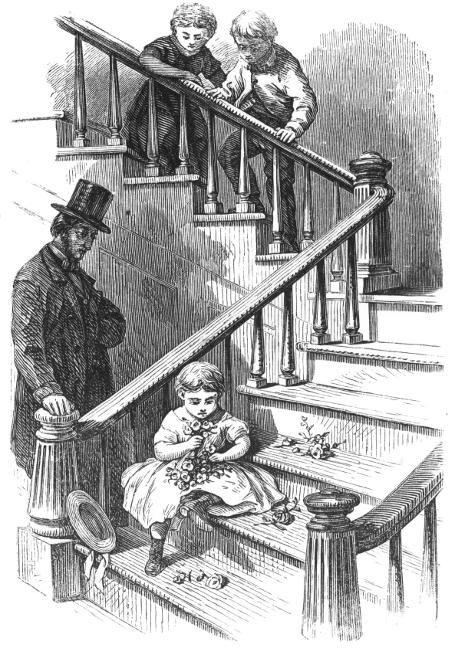
She made a pretty picture as she sat upon
the staircase of the —— House, the day after
their arrival, her lap full of red, white, and
yellow roses, which she was arranging with
no small taste and daintiness into bouquets
for her people.
Three pair of eyes were watching her,—those
of a grave-looking gentleman, who stood
at the foot of the stairs; and those of Arthur
and Charlotte Lathrop, who were peering
at her over the banisters from above. But
Bessie noticed neither until Arthur called her
attention by making a sound like a snarling
dog. Bessie started and looked up, then went
on with her work in silence.
“I say,” said Arthur, “are you making a
wreath of roses for that old Mother Hubbard
you took such a fancy to on board the steamer?”
Bessie made no answer.
“Why don’t you speak when you’re spoken
to?” said Arthur. “Did you give your tongue
to Mother Hubbard?”
“When I’m talked to politely, I always do
speak,” said the little girl.
“Oh! and we’re not polite enough to suit
you, I suppose,” said Arthur, sneeringly.
“’Tis only engineers’ daughters and the
like who are fit company for her,” joined in
Charlotte.
“We might go and take lessons from
Mother Hubbard, and then perhaps she’d like
us better,” said Arthur. “I say, Miss Bradford,
what school did you learn your manners
in, that you don’t speak when you’re spoken
to?”
Bessie remained silent again.
“Do you hear?” shouted Arthur.
“Once I heard of a school where they only
paid two cents for learning manners,” said
Bessie, demurely.
“What then?” asked Arthur.
“I should think that was the kind of a
school you had been to,” answered Bessie.
“And why, I’d like to know?”
“’Cause I shouldn’t think they could teach
much manners for two cents.”
Arthur was a clever boy with a quick sense
of humor; and he was so struck with what
he considered the wit and smartness of the
retort, that he forgot to be angry, and, instead
of making a sharp answer, broke out into a
hearty laugh.
“Pretty good that!” he said. “You’ll do
yet.”
“Pretty good, and pretty well deserved too,
my lad,” said the gentleman, who had been
standing below, coming up the stairs. “See
here, Clara, here is the Queen of the Fairies,
I believe,” and he turned around to a lady
who ran lightly up behind him.
“Queen of the Fairies, indeed,” said the
lady, with a laughing look at the little figure
before her, in its white dress and shining hair,
and lap covered with brilliant flowers: “or
Queen of the”—What she would have
said was lost, for after a pause of astonishment
she exclaimed, “Why! it is—yes, it
is Bessie Bradford—dear little Bessie!”
And regardless of her muslin dress with
its fluted flounces and ruffles, down went the
lady on the stairs before Bessie; and, greatly
to her surprise, the little girl found herself
held fast in the embrace of a supposed
stranger.
But it was no stranger, as she found when
she could free herself a little from that tight
clasp, and look in the lady’s face.
“Don’t you know me, Bessie?” asked the
lady.
“Why! it’s Miss Adams!” cried Bessie,
in as great amazement as the new-comer
herself.
“And you are a little glad to see me, are
you not?” asked the lady, seeing with pleasure
the smile and glow on Bessie’s face.
“Not a little, but very, Miss Adams,” she
replied. “I was very interested about you,
and always thought I’d like to see you again
after I heard you’d”—here she hesitated
for a word.
“Well,” said the lady.
“I can’t think of the word,” said Bessie.
“Oh, yes! reformed, that’s it,—after you’d
reformed. You know you wrote and told us
about it yourself.”
At this “Miss Adams” went off into a fit
of laughter, which sounded very natural to
Bessie’s ears; and yet there was a difference
in that and in her manner from those of the
old days at Quam Beach; something softer
and more gentle; “more as if she remembered
to be a lady, mamma,” Bessie said
afterwards.
The gentleman smiled too.
“Her words are to the point when she does
find them,” he said.
“They always were,” said the lady, giving
Bessie another kiss. “Bessie, this is the
gentleman I found to make me ‘behave myself.’
I hope you’ll find the ‘kitchen lady’
improved under his teaching.”
Bessie colored all over face and neck.
“Oh! please don’t,” she said. “I’m so
sorry I said that; but I was such a little child
then, I didn’t know any better. I wouldn’t
say such a saucy thing now for a great deal.”
“You need not be sorry about it, Bessie:
I am not.”
“Please don’t speak about it any more,
ma’am,” pleaded the child. “Couldn’t you
let bygones be bygones?”
“What do you mean by ‘bygones’?”
asked the gentleman.
“I thought it meant, sir,” said Bessie,
modestly, “when a person had done something
they were sorry for, not to say any thing
more about it.”
“Very well,” said the lady, still smiling.
“It shall be so, if you wish it, Bessie. And
now tell me how your mamma and Maggie
and all the rest are.”
“Oh! they are all very well, except mamma,
and she is better, and we are travelling to do
her good; and a great many things happened
to us, Miss Adams, since you knew us before.”
“I don’t think it has ‘happened’ to you to
grow much,” said the lady.
“Oh, yes’m!” answered Bessie. “I used
to be five, and now I’m seven; and I’ve been
to school too. We’ve all grown pretty old.
Baby can walk and talk now.”
“And how do you like my doctor?” asked
“Miss Adams,” as Bessie still called her,
glancing round at the gentleman who stood
beside her.
Bessie looked up at him, and he looked
down at her, and when their eyes met, both
smiled.
“I like him: he looks good and nice;” and
the little girl, who had already twisted a rose
or two into the bosom of the lady’s dress,
now handed two or three to the doctor in
her own graceful, gracious little way.
“What are you going to do with all those
bouquets you have tied up so tastily?” asked
Dr. Gordon.
Bessie told him whom they were for.
“And who is this for?” asked Mrs. Gordon,—for
so she told Bessie to call her,—pointing
to that which the small fingers were now arranging.
“It’s for a little girl down at the steamer,
who is rather hard off, and does not have a
nice time, and has extremely ugly clothes,”
answered Bessie. “But then if they are the
best she has, and she has no mother, no one
ought to laugh at her: ought they?”
“Certainly not: who was so unkind?”
asked Mrs. Gordon.
“Some children who didn’t behave half so
nice as she did, ma’am.”
“Ah!” said the doctor; “and was that boy
you were talking to just now one of them?”
“Why, yes, sir,” said Bessie, with some
hesitation. “But how did you know it?”
“Oh! I am a good guesser,” answered Dr.
Gordon.
“I don’t know if I ought to have said that
to him,” said Bessie, thoughtfully. “I b’lieve
I was pretty severe.”
At this Mrs. Gordon went off into another
fit of laughter; and the doctor smiled as he
answered,—
“It was pretty severe, it is true, Bessie;
but not more so than he deserved, especially
if he had been teasing some poor child who
could not defend herself.”
Bessie colored, and answered, “But I’m
afraid I did it more ’cause I was angry for
his being impolite to me than for his teasing
Lucy.”
“But tell us all about it; and did you say
the child had no mother?” said Mrs. Gordon.
In reply, Bessie told all she knew about
Lucy, omitting, however, to give any account
of the unkindness of Arthur Lathrop and his
brother and sisters to the poor child. This
was noticed by both Dr. and Mrs. Gordon,
but they pressed her no farther, seeing she
did not wish to speak of it.
“There’s another will be glad to come,”
said Mrs. Gordon, eagerly, to her husband.
“That will make five. You’ll see this engineer
and speak to him about it: won’t you,
Aleck?”
“All in good time, dear,” he answered
quietly.
Five what? Bessie wondered; and where
would Lucy be glad to come? But as she
supposed they would tell her if they wished
her to know, she asked no questions.
But her curiosity was not gratified just
then, for the doctor now said to his wife,—
“Come, Clara, we are keeping our friends
waiting. You must tell little Bessie about
your plans some other time.”
“Yes,” said Mrs. Gordon. “We have to
go to a sick friend here in the house, Bessie;
but I shall come to call on your mamma to-morrow,
and then I shall see you again and
ask her to let you come to me; for I have
something to tell you, in which I think you
will be interested.”
“Don’t you live here, ma’am?” asked
Bessie.
“Here? yes, here in Savannah, but not in
the hotel; and I want you to come to my
house. By the way, where is Maggie? I
thought you were always together.”
“Most always,” said Bessie; “but Maggie
and the other children went with Mr. Powers
and papa to see a cotton-press; and mamma
thought I was too tired, so I told Maggie she
need not mind leaving me. And now I am
glad I did not go.”
“And I am sure I am glad,” said Mrs. Gordon,
as she kissed Bessie for good-by, and
once more told her she should be sure to see
her the next day, and would arrange with her
mamma the time when she and Maggie might
come and spend the day with her.
Bessie was very anxious to know what Mrs.
Gordon could have to tell her which was to
interest her so much, and which seemed in
some way to concern Lucy Waters; but she
was a little doubtful regarding the prospect of
spending the whole day with her old enemy
“Miss Adams,” not feeling at all sure that she
would like it, or that she might not fall into
some trouble, in spite of the very evident and
pleasing change in that lady.
Maggie was not at all doubtful, and positively
declared that she would not go on any
account; and she tried to persuade Bessie to
join her in begging their mother to refuse
Mrs. Gordon’s invitation to them.
“For Bessie,” she said, “you know a ‘bird
in the hand is worth two in the bush;’ and so,
even if Miss Adams is so much better than
she used to be, it is wiser to stay away from
her, and not give her the chance of being disagreeable
if she wanted to be.”
Maggie had been much given to the use of
proverbs lately, as you will have perceived;
and if one could possibly be fitted to her purpose,
it was made to serve, as on this occasion.
But Bessie did not feel as if they had any excuse
for refusing the invitation so kindly given,
nor did mamma when she was appealed to.
“You certainly need not go if you do not
wish it, my darlings,” she said; “but do you
think it likely, Maggie, that Mrs. Gordon
would invite you to her house, and then treat
you unkindly? She must be a good deal
changed, it seems to me; and would it not
look as if you were unforgiving, if you refuse
her kindness?”
“Oh! I forgive her, mamma,” said Maggie,
“though it was my own Bessie she plagued so,
but then I thought her old habits might be too
strong for her, and break out again.”
“You forgive, but don’t forget, eh, Maggie?
Suppose you were Mrs. Gordon, how would
you like Miss Adams’ faults to be treasured
up against you, and allowed to stand in the
way when you wished to show good-will and
kindness?”
“I wouldn’t like it at all, mamma; and I
suppose it’s not very Golden Ruley for me to
say I won’t go; so, if she asks us, I’ll make up
my mind to it.”
Mrs. Gordon came the next day, according
to promise, to call on Mrs. Bradford; and invited
not only Maggie and Bessie, but also
Belle and Lily, to spend the whole of Friday
with her, promising to call for them in the
morning and bring them back at night.
But perhaps you will find it more interesting
to read Maggie’s own account of this visit,
which she wrote to Colonel Rush.
“Dear Uncle Horace,—Things are so
very surprising in this world that you never
quite know how they are going to turn out, of
which the case is at present, Miss Adams or
who was Miss Adams but now Mrs. Gordon
and you will remember her at Quam Beach but
under unpleasant circumstances to which we
will not refer but forget as well as forgive as
mamma reminded me. But you would be surprised
to see how much she is improved and
so different to what she used to be which was
greatly to be desired of all her friends and a
pleasure to all who wish her well. So seeing
she wished to make up for past offenses we
went to spend the day with her and she was
very horspitable. She came in her carriage
to take us to her house which is most handsome
with roses and flowers of many kinds of
which she brought mamma a whole lot at the
same time and invited all the big people to
dinner the next day. I think all this shows
she repents sincerely and is not the same
woman but much changed and ought to be encouraged
to keep on doing well. She has a
nice husband named Dr. Gordon, but sober
which is not his own fault if he was born so
and I pity him. And a sweet baby boy named
Aleck and crows and laughs with pleasure at
us. But I hope by no means you think we
think him so sweet as May Bessie which he
is not and May Bessie is so near to us, which
also he is not and we love her far the best.
Miss Adams was very kind to us all day, indeed
quite fond but most of all to Bessie, and
she played with us and amused us and I was
glad I did not let the devil which is a word
that is not best to write unless it is necessary
get the upper hand and make me stay away
out of revenge or being shy.
“But the most surprising and best thing of
all, Uncle Horace is what she is going to do
with some of her money. You know in those
days of which we will not speak she had a
great deal more than she knew what to do
with. Well, now she has found a good use for
some of it in a way well pleasing to God and
men. But I am too tired to write more to-day
and will finish it to-morrow—Well, to return
on this day to Miss Adams and her good works
which shows she has read her Bible which
urges to repentance of sins and prophets by it
which is a sight to make the coldest heart to
rejoice. She has a house not very far from
her own where she lives and she is going to
have six little girls there in the care of a nice,
kind lady. And these little girls are not to be
happy children with mothers to take care of
them, but orfuns or without mothers or teaching
or training in the way they should go.
For Miss Adams says she knows what it is to
be without a mother or some wise person to
guide her, and now that God has been so good
to her she wants to give a helping hand to
some little girls who would be left too much to
themselves and not properly taught. She does
not mean to have very poor children, and if
their friends wish it they may pay a little
money for them but the contrary if they do
not, and prefer charity though she does not
think it such and would like them to come
without any pay. And here they will have a
happy home and be taught to be desirable
women fit for teachers or other good things
and so it will be their own fault if they don’t
do it. And she has chosen four girls who are
to come in the fall when Miss Adams comes
back from the north because things cannot be
quite ready till then, as the lady has a sailor
son who is to go to sea which I think a hard
case for his friends to have him leave his native
land. And then the house will be ready
and the lady will go and the children will
come and Miss Adams is going to see if Lucy
Waters’ father who you know I told you
about in my last will let her come too. I
think if he does not he will be much wanting
in sence and proper behaviour, but I think he
will dont you? Miss Adams, Mrs. Gordon I
mean but I always forget to put her wedding
name says she feels so sorry for all little
motherless girls, and I am glad of it are not
you? And so is Bessie and we think the
reason Miss Adams takes so much trouble for
these little girls is because she is afraid that
if they do not have good care they may grow
up to be such women as she used to be when
we knew her before but which is not to be
mentioned in these pages and now she is quite
ashamed of it. We cannot tell just yet if
Lucy’s father will let her come, but papa and
the doctor are going to the steamer this evening
to ask him and when we know Bessie will
write and tell you all about it. And Bessie
and I have quite made up our minds to take
Miss Adams for one of our friends because we
find her most sencible and kind and so changed
from her old ways which we will not remember
if we can help it.
“And dear Uncle Horace and Aunt May we
wish you were here ’cause we are having such
a nice time and I wrote such a long letter I
am afraid you will be tired of it but such an
interesting subject my brains were quite full
and I had to and you must excuse it. We
send two kisses for May Bessie and four for
you and hope to see you once more in the
future when we come home. And we send a
great deal of love from your loving
“Maggie and Bessie.”
“P. S. Savannah is such a fine city and so
many trees and roses that it seems strange to
me that Alexander the Great and Napoleon
Bonaparte did not try to take it, being both
men who never minded their own business
but always trying to take what did not belong
to them, speshally the latter whom in my
heart I heartily despise because he never did
as he would be done by.”
V. BELLE’S HOME.
You may be sure there was not much
trouble in gaining the consent of
Lucy’s father to the plan proposed
for her welfare. He was only too glad and
thankful to feel that his motherless little
daughter would be placed where she would
have a kind and prudent eye to oversee and
guide her; and where she would have the
opportunity of growing up into a useful and
steady woman. This he knew she could not
do in the unsettled life she now led on board
ship with him, and he had long been considering
what he should do with her.
Lucy, though thankful, was not as much
pleased, and shed some bitter tears over the
prospect. The poor child wanted to learn,
and was glad to have a settled home; but she
dreaded the thought of parting from her father,
who would only be able to see her at such
times as his vessel should be at the port of
Savannah, and who was the only person whom
she had to love her. But, in a day or two
after, when she had seen Mrs. Gordon, and
heard her talk so kindly of all the pleasures
and comforts she would find in this promised
home, she became more reconciled to it, especially
as the autumn still seemed a long way
off to her, and she had all the summer to go
back and forth with her father on the sea.
So she told her troubles to her doll; and the
steady, blue eyes, which never winked or softened,
brought comfort to her, and seemed to
give her the assurance that she need not be
parted from her, even to go to her new home.
If she had not had this beloved companion, it
would have gone much harder with poor little
Lucy.
Our little girls did not see her again; but
last autumn, when they were settled once
more in their city home, after all their summer
wanderings, Mrs. Gordon wrote to them, saying
that Lucy was quite contented and happy
under her care; and that she was a very good
child, being trustworthy and obedient, and
showing a great desire to learn.
So there we will leave her, hoping that she
will, as Maggie says, “prophet by all that is
done for her and make a useful and happy
woman.” The doll went with her; and all the
other toys and amusements which were provided
for her never made her tired or forgetful
of this, her first love, or of the dear little
girls who had taken so much interest in her.
Our party did not remain long in Savannah,
for the weather was becoming warm and oppressive;
but before they went away, they all
spent a day on Mr. Powers’ plantation.
This was several miles from the city; and
starting in the morning, soon after breakfast,
they drove out in the cool of the day. Their
way lay through dense pine woods; tall, stately
pines, with long, straight trunks; shooting
upwards, without leaf or branch, for many a
foot, till they neared their height, when they
put forth their dark-green crowns, which cast
such a sombre shade below. The shade was
no objection on this warm day, and a light
breeze was stirring, which was very refreshing;
but it sounded rather mournful to Maggie and
Bessie, as it moaned through the mighty stems,
and rustled the thick, fragrant leaves overhead.
It has a strange, peculiar sound, the wind in
those dark, pine forests of the South,—a sound
rather saddening to any listener.
Maggie did not like it at all, and said so,
which rather displeased Belle, who, in her delight
at returning to her beloved Southern
home, found every thing there perfect. However,
as they drove on, both Maggie and Bessie
spied out so many objects which called forth
their surprise and admiration, that she was
presently consoled, and concluded that they
“liked her own country pretty well, after all.”
Here and there was a magnolia with its
magnificent cream-white blossoms, their delicious
perfume mingling with the fragrance of
the pines; there a group of scarlet cardinal
flowers, or a little pool bordered with bright
blue flags and spotted tiger-lilies; while
through the deep stillness of the woods came
the sweet notes of the blue-jay and mocking-bird.
Once, as they were passing over a
bridge which crossed a marsh, Maggie called
the attention of the others to two turtles, great
big fellows, larger than any the children had
ever seen at the North; “swamp turtles”
Belle said they were. They scuttled out of
the way in their clumsy fashion, diving out of
sight into the mud; and Bessie said she
thought they must be some of the unclean
animals spoken of in the Bible, since they
liked to live in such a dirty place.
The entrance to the plantation was through
an avenue of magnificent live-oaks, some of
them so large that two or three men could not
have encircled them with their outstretched
arms; and these splendid trees were studded
all over the lawn, spreading far and wide their
branches, which, unlike their neighbors the
pines, they sent out very low,—so near the
ground in fact, that even Bessie could reach
the gray Spanish moss which hung over them
in long festoons and wreaths. The children
had seen this curious moss before in the beautiful
old cemetery of Bonaventure, where the
oaks are perfectly clothed with it; and Bessie
had admired it so much, that Maggie had taken
up the idea of carrying home enough to make
“a bower” for her in their own little room.
But she thought it best to gain the consent of
her father and mother to this arrangement;
not only because it was right, but also because
nurse was rather apt to call such things “truck
and trash,” and to put them out of the way as
fast as possible. If papa and mamma said they
might have it, nurse might call it what she
pleased, but she could not throw it away.
Mr. Powers stood awaiting them on the
steps of the veranda, for he had been at the
plantation for three or four days, while Belle
and Daphne had been left in Mrs. Bradford’s
charge at the hotel; for he did not think it
best for Belle to sleep on the plantation at that
time of the year.
She shrieked with delight when she saw
him; and, in her hurry to reach him, had
nearly thrown herself from Daphne’s lap underneath
the carriage-wheels. There would
have been an end to the day’s pleasure then;
but Daphne’s hand grasped her skirts, and
saved her from a terrible death.
As it was, the whole party were startled;
and her father’s face had lost its smile of welcome,
and looked rather pale as he came down
the steps and took her in his arms.
“My pet!” he said, “always in too much
of a hurry. This would have been a sad meeting
for papa, if you had fallen; but a good God
took care of you for me.”
Belle clung about his neck and did not
speak; for whether it were the fright, or the
sight of her father, or the return to the old
home which she had left at such a sad time, or
perhaps all three, her feelings took a sudden
turn, and when Mr. Powers had brought his
friends in and welcomed them, and raised the
little face to kiss it again, he found it drowned
in tears.
“Why! my darling,” he said, “were you
so frightened?”
“I don’t know, papa,” sobbed the excitable
little thing; “but, this is home—only—only—mamma
is not in it.”
Tears, or something very like them, came to
the eyes of all, even of Mr. and Mrs. Norris,
who had never known Belle’s dead mother;
and Mr. Powers turned hastily away, and
stepped with her out on the veranda.
“Only mamma was not in it!” Ah, yes! that
was the only that made all the difference in the
world, so that home did not seem like home
any longer.
It was some few moments before either of
them were composed enough to return; and
when Mr. Powers came back he was alone,
and told Bessie that Belle wanted her to go to
her.
Bessie went out upon the veranda, which
ran on all four sides of the house, and around
the corner she found Belle curled up on a
settee where her father had placed her. She
stretched out her arms to Bessie when she saw
her, saying,—
“Bessie, I do remember mamma so much
in my home, and you are a comfit. You are
my next best comfit to papa, ever since the
first day you spoke to me in school.”
This was a pleasant thing for Bessie to hear;
but she put aside her own pleasure for the
present, and thought only of being the “comfit”
her poor little friend called her. I wonder
if there was any one among all the people who
knew her, who could have said that our dear
Bessie was not more or less of a comfort to
them.
Her sweet sympathy and gentle tenderness
soon did Belle good, and Bessie let her talk
on about her mother as long as she would.
Belle had been very bright and cheerful
lately,—thanks to the friends with whom she
had been so much thrown,—and it was a good
while since she had had a fit of longing for
her mother; but the coming to her home had
brought her great loss back to her, and just
now she could think of nothing else.
“Do you know where they put my mamma
before she went to heaven?” said Belle.
“No. Where?” answered Bessie.
“Do you see those high trees over there,
Bessie? They put her where little brother
and sister are, and ever so many grandpas and
grandmas.”
“But they didn’t put her soul there,” said
Bessie.
“No,” said Belle, “’cause that was God’s
part, and it went to him. And then she
couldn’t speak or hear me or see me, but was
all deaded away; and so they put the rest of
her over there, and put a great many flowers
over her. But that was a long, long while
ago, before I went away to the North, and I
didn’t see where they put mamma this ever so
long. Maybe the flowers are all faded. Will
you come and see, Bessie?”
“We must ask mamma or your papa first,”
said Bessie.
“They would let us,” said Belle: “it’s a
very safe place. I used to often go there when
mamma was alive, to be by little brother and
sister, and she is there now. There couldn’t
any danger come to us where mamma is:
could there, Bessie?”
“No: I guess not,” said Bessie. “I s’pose
mother-angels take care of their little children.
I’ll go with you, Belle dear, if you’re quite
sure your papa will let us.”
“I know he would, Bessie; and I’d just as
lief ask him; only then Maggie and Lily will
come too. I’d like Maggie to come, but Lily
laughs so much. I love Lily; but I don’t want
any one to laugh where my mamma is dead.”
“No,” said Bessie, with the most caressing
tenderness of tone and manner, “they shan’t;
and I’ll go, Belle.”
With their arms about one another’s necks,
the two little things ran down the piazza steps,
and the shady path, through which Belle led
the way; but as they came near the small
burying-ground, their steps grew slow and more
reverent.
It was an exquisite spot. An iron railing
enclosed it, but the rails were hidden by the
green vines which overran them, and within it
was beautifully sodded; the green broken
here and there by the white marble monuments
and slabs which marked the resting-place
of Belle’s relations. Flowers of the loveliest
kinds were blossoming over and around
them, and all showed the utmost care and loving
remembrance. Over the entrance was an
arch, also of white marble, and on the stone
were cut the words, “He giveth His beloved
sleep.”
“How sweet it is!” exclaimed Bessie, struck
at once with the lovely quiet and peace of the
place; and then she looked up and spelled out
the letters on the arch.
“Sleep! that was what mamma said: it was
only like a sleep if we loved Jesus and tried to
do what He wanted us to, and I think it must
mean Him when it says, ‘giveth His beloved
sleep.’ What dear words! are they not,
Belle?”
“Yes,” said Belle, but without paying much
attention to what Bessie was saying, for her
eye had caught sight of a new object in the
enclosure.
“See!” she went on, catching Bessie by the
arm: “there’s a stone there where they put
mamma;” and drawing Bessie with her, she
pushed open the light gate.
It swung easily back, for it was unfastened.
There were none here to intrude, no one came
here who would not guard with the greatest
love and reverence the little spot sacred to
“His beloved.”
“His beloved!” For of those who lay there,
not one but had closed their eyes in the full
faith that they should open them again upon
the brightness of His face. Truly that was
“God’s Acre.”
The “stone” which had attracted Belle’s
attention was a shaft of pure white marble
upon her mother’s grave. The centre had been
cut away so as to leave four small arches, one
on each side, and beneath there was a cross,
with the letters “I. H. S.;” before that an
open Bible, with the words, “I will not leave
you comfortless.”
The sculptor had done his work perfectly;
and the snowy marble showed in beautiful contrast
with the dark, glossy leaves of the bay
tree which spread its arms above it.
“Papa put it there, I know he did,” said
Belle, after she and Bessie had stood looking
at it in silence for a moment or two.
“Yes: I s’pose he did,” said Bessie: “let’s
see what these words are, Belle.”
By standing on tiptoe, the little ones could
manage to see the letters carved upon the
book; and Bessie read them out as she had
done those over the gateway.
“‘I will not leave you comfortless,’” Belle
repeated after her. “Why! mamma said that
herself a little while before she went to heaven.
Maybe that was why papa put it there.”
“And Jesus said it,” replied Bessie. “It’s
in the Bible, in a chapter I’ve heard very often.
Don’t you remember, Belle? It begins, ‘Let
not your heart be troubled;’ and Jesus said
it Himself. Perhaps the reason He told people
not to be troubled was He was going to
promise to comfort them when they had something
very bad to bear. It’s the best comfort
to know He loves you and will take you to
heaven to see your mamma some day: isn’t it,
Belle?”
“He will if I’m good,” passing her little
hand slowly and caressingly over the marble;
“but then I’m not always good.”
“No,” said Bessie, “not always; but mamma
said you was not near so spoiled as you used
to be. I think you’re pretty good now, Belle.”
“I slapped Daphne’s face this morning,”
whispered Belle, remorsefully.
“Oh! did you?” said Bessie. “Well, Belle,
I used to slap people sometimes, even when I
had mamma to teach me better, and there was
no excuse for me.”
“But my own mamma did teach me better,
Bessie. I slap Daphne pretty often, but she
never tells papa; and I promise myself I’ll
never do it again, and then I just do.”
“Did you ever promise Jesus and ask Him
to help you not to do it?” asked Bessie.
“No,” answered Belle. “I didn’t think of
it. I could do it now, couldn’t I?”
“Yes,” said Bessie.
They knelt down together side by side, and
Belle said in a soft but steady voice, for her
tears had now ceased,—
“Dear Jesus, I promise not to slap Daphne
any more, or not to be naughty any more if
I can help it; and you will help me to be good.
Amen.”
Then pressing her lips to the cold stone, as
if it were the warm, living cheek she had once
caressed, she said in a pleading, pathetic whisper,—
“Dear mamma, your little Belle will try to
be just as good as you would want her to be if
you were here wif her.”
Will any doubt that the “mother-angel”
heard and rejoiced over the simple promise
uttered by her little one’s trusting lips?
“Do you think it really makes Jesus glad
when I’m good?” asked Belle, when they had
risen from their knees.
“Oh! to be sure it does,” answered Bessie.
“And He did leave me some comfit: didn’t
He, Bessie? He left me papa, and He gave me
you and Maggie too; and your mamma is a
great comfit too.”
“Mamma’s the best comfort of anybody,”
said Bessie.
“Oh, no, Bessie! oh, no! Papa best—you
next.”
Bessie did not contradict her, though she
thought it a very strange opinion for Belle to
hold, and was not at all convinced herself.
“I wish papa was here to stay with me by
mamma a little while,” said Belle, presently.
“Shall I go ask him to come?” asked Bessie.
“Yes,” said Belle. “Do you know the
way?”
“Oh, yes! It’s right up that path, isn’t
it?”
Then she kissed Belle and left her, turning
back as she passed through the gate, to look
at her little playmate sitting by her mother’s
grave and leaning her head pensively against
the monument. But Belle smiled as she met
Bessie’s eye, and the little girl felt that she
had not been left quite “comfortless.” Her
own heart was very full of love and sympathy.
Bessie ran up the path till she was nearly
half way to the house, when she was brought
to a sudden stand-still by what she thought a
very alarming object. Just before her was a
large black dog, broad-chested, tall, and fierce-looking,
standing directly in the path, and
seeming as though he meant to dispute the
way.
Bessie’s heart was in her mouth and her
knees shook; but she did not scream. She
looked at the dog and he looked at her, but he
did not bark or growl. Then she found her
voice, and tried what coaxing would do.
“Nice doggie, nice little doggie,” she said
to the great creature. “Does little doggie
want Bessie to go away? Well, she will. But
then the good little fellow mustn’t bark at
Bessie and frighten her.”
Bessie had an idea that her seeming enemy
could bite as well as bark if he saw fit occasion;
but she did not think it wisest to suggest
it to him.
It must have been a hard-hearted dog, indeed,
which could have resisted that insinuating
voice and smile, and either bark or bite;
and this one did not seem inclined to do the
one or the other; but then neither did he seem
to intend to move out of the path, but stood
stock still gazing at his unwilling little companion.
Seeing that he appeared peaceable, Bessie
took courage, and, edging off upon the grass,
went a few steps forward. But as she passed
the dog, he turned and placed himself before
her, though still without any show of attacking
her.
Bessie was pretty well frightened; but she
began her wiles again, talking to him as she
would have done to Baby Annie or Flossy.
“Poor fellow! nice doggie. Bessie wouldn’t
hurt little doggie for any thing. Doggie, doggie,
doggie! He’ll let Bessie go to the house,
won’t he? Don’t he want to go and see Belle
down there?”
Now you must not think that Bessie wanted
to save herself by exposing her little friend;
for she knew that this must be Duke, the great
English blood-hound, of which Belle had often
spoken, saying how loving and good Duke
was to her, although he was fierce and unfriendly
with strangers.
But no, all coaxing proved useless: the
dog stood his ground and would not suffer her
to pass, even giving a low growl and seizing
the skirt of her dress when she tried once
more to do so.
Bessie was dreadfully frightened, and was
about to call aloud for help, when she saw Mr.
Powers coming towards her from the house.
As he came down the path, a great snake glided
from beneath some low bushes on the other
side, passed swiftly over the narrow path, and
would have been out of sight in an instant,
had not the dog, suddenly all alert, bounded
forward, seized it by the back of the neck, and
giving it a violent shake, left it lying dead.
“How is this, dear child?” said Mr. Powers,
looking from the dog and snake to the
child. “Old Ben told me he had seen you and
Belle going to the burying-ground. Where is
Belle?”
“Yes, sir, we did,” answered Bessie; “and
Belle is there now, waiting for you to come to
her mamma’s grave. I was just coming to tell
you, and that dog stopped me. He’s a pretty
naughty dog; he wouldn’t let me go on, and
he killed the poor snake that did not do a bit
of harm, but was just running away as fast as
he could.”
“Duke knew he would do harm if he but
found the chance, my child,” said Mr. Powers.
“That is a very venomous snake, and the dog’s
care may have saved you from being badly
bitten. Good Duke! brave fellow!” and Mr.
Powers patted the dog’s head. “It is years
and years since we have seen a snake of this
kind upon the plantation, and I hope it may
be long before we see another. You and Belle
have each escaped a great danger this morning,
Bessie. I am glad too that old Duke was
not bitten.”
Bessie was very grateful to Duke now, and
she too patted and caressed him. He seemed
to think himself, that he had performed a great
feat, as indeed he had; and kept looking up
at his master and thrusting his nose into his
hand as if to call for more thanks. Bessie’s
attentions he received more coolly, though he
permitted them.
“Run up to the house now, you steady little
woman,” said Mr. Powers: “your mother
is wondering where you can be, though she
said you were to be trusted not to get into
mischief. It is a good thing to have such a
character, Bessie.”
When Duke saw that Bessie and his master
were going in different directions, he seemed
to be divided in his own mind as to which one
he had better accompany. But after looking
from one to the other he seemed to decide that
Bessie needed his protection, and trotted gravely
along by her side till she reached the house,
when he turned about and raced after his
master.
Bessie went in and told her story, but so
simply and with so little fuss that her mother
had no idea of the danger she had been in,
till Mr. Powers came with Belle and told how
she, as well as Belle, had been mercifully
preserved from harm that morning.
When Belle came back with her father,
she was quite composed, and soon became
cheerful again, though she was rather more
quiet than usual all the morning.
As soon as the party were rested after their
drive, they all went out for a walk about the
place. Mr. Powers’ estate was a rice plantation,
and the children were greatly interested
in going through the mills and seeing how the
rice, so familiar to them as an article of food,
was prepared for the market. They were particularly
so, in watching the husking of the
rice. The grain was stored on the second
story of the buildings, in great boxes or bins.
There was a little sliding-door in each of these,
just above the bottom of the bin; and when
the men were ready to go to work, a trough
was placed leading from that, through a trap-door,
to a hopper on the floor below. Then
the bin door was opened, and the rice in its
brown husks slid through the trough into the
hopper beneath, and from thence into the mill,
on each side of which stood a man who turned
the arms of the mill. In this, the outer husk
was stripped from the rice; then it passed
through another wide, covered trough, into the
sifting or winnowing machine. This was a
large box with a wheel at the bottom which
turned the rice over and over. As it came to
the top, the chaff was blown away by a great
“four sided fan,” as Bessie called it, made of
four pieces of canvas stretched in different
directions, and fixed upon a roller which was
turned round by a man, and fanned away the
light husks broken from the grain on its passage
through the mill. But this was only the
outer husk; and it had to go down a third
trough into another mill, where the inner covering
was taken off; then through a second
fanning machine, from which it came out clean
and white; and lastly into a third building,
where it was led into another range of bins,
till it should be necessary to put it into the bags
and barrels in which it was sent to market.
Maggie, as usual, wanted to “help;” and
the good-natured colored men who were about
let her try her hand at just what she chose,
provided it was safe for her. Indeed, all the
children, even Belle, to whom the amusement
was not new, were greatly pleased to pull up
the sliding panels of the bins, and see the rice
come pouring down into the mill-hopper, and
to thrust their hands and arms into the white
grain, and shovel it into the bags. So entertained
were they with this business, that the
older people walked on when they had satisfied
their own curiosity, leaving the children in the
care of old Cato, who promised to see that they
came to no harm.
“We’ve done a whole lot of work, Mr. Powers,”
said Maggie, when they were called back
to the house to dinner. “I think your men
must be pretty glad we came.”
“Yes,” said Lily: “we’ve most filled two
bags and a barrel.”
“And we didn’t spill very much either,”
said Bessie, who was at that moment laboring
away with a wooden shovel, on which she contrived
to take up about two table-spoonsful of
rice.
“Capital!” said Mr. Powers: “you’ve
earned your dinner to-day, have you not?”
Whether the dinners were fairly earned or no,
the exercise had given them all good appetites,
and they were not sorry to go in and take their
seats at the well-furnished table.
VI. LETTERS.
Maggie had seized the opportunity
when Bessie was not near, to ask
Mr. Powers for the Spanish moss.
“Mr. Powers,” she said, “is not that moss
private moss?”
“Private moss? How private, Maggie?”
said the gentleman.
“I mean is it not your own to do what you
like with?”
“Certainly: if growing upon my trees and
on my grounds can make it mine, it is,
dear?”
“Then could you let me have some of it,
quite a good deal?” said Maggie, to whom
it had been a great effort to ask this; but
the thought of pleasing Bessie upheld her
courage.
“Oh! to be sure; a whole wagon-load if
you want it,” said Mr. Powers, smiling, and
without the least idea that Maggie would take
his words almost literally.
The next thing was to ask mamma’s consent
to carry it home, and this also was obtained
without difficulty; Mrs. Bradford having
no idea of the extent of Maggie’s ideas,
and supposing she only wanted a small quantity
as a curiosity.
Accordingly, Maggie took the other children
into her confidence as soon as they were all
sent out again to play under Daphne’s care.
Bessie was delighted with the plan, and kissed
and thanked her many times; and the other
two were quite ready to lend their aid.
So they all set to work to gather the moss,
Daphne, too, giving a helping hand, at her
little lady’s request; though as she saw the
great pile they heaped together, she was more
than doubtful as to the use of such exertion.
To gather it might be allowed,—it would
never be missed from the trees,—but to carry
it home was another thing.
But she let them take their own way; for
she could never bear to refuse Belle any
thing, least of all to-day, when Belle had
come and put her arms around her neck,
and laid her soft fair cheek against her old
nurse’s dark one; telling her she was “sorry
for every time she had slapped her; but she
would never do it again, for Jesus was going
to help her, and mamma would ask Him to,
she was sure.”
So if Belle had asked to dance upon
Daphne’s head, or do any other extraordinary
or unheard-of thing, I think the old woman
would have contrived in some way to grant
her darling’s wish; and she meekly stood pulling
off the long, gray, pendant mosses, and
heaping them in the little, eager, outstretched
arms which returned to her again and again.
Great was the amazement of the grown
people to see the procession which appeared,
when at last the carriages came to the door
to take them back to the city, and the children
were called to make ready.
First came a negro lad whom Maggie and
Belle had pressed into the service, showing
his two rows of white teeth, and rolling up
his eyes with enjoyment of the fun; while
he pushed before him a small hand-cart filled
with the precious material, which was to
make such a lovely “Bessie’s Bower” of the
familiar little room far away at the North;
next Bessie and Belle trotting along, half
hidden beneath the moss which Maggie had
heaped in their arms and around their necks;
then followed Maggie herself, and Lily, toiling
away at a large wheelbarrow piled with
the spoil; old Daphne bringing up the rear,
also carrying her share and looking rather
sheepish.
“Here’s ‘Birnam wood come to Dunsinane,’”
said Mr. Bradford, laughing, as he first
perceived the approaching show. “What are
the little ones about? Some freak of Maggie’s,
doubtless. What a busy, contriving
little head it is. What is all that for, Maggie?”
as the children came within hearing.
“To take home to New York to make a
bower for Bessie in our room, papa. Mamma
gave us leave, and Mr. Powers said we might
take all we wanted,” answered Maggie, not in
the least doubting that she was quite secure
with both these safe-guards.
“Dearest child!” said Mrs. Bradford when
she could speak for laughing. “I never supposed
you had any idea of taking such a
quantity.”
“I told you I wanted quite a good deal,
mamma,” answered Maggie, beginning to
quake for the success of her plan, when she
saw how astonished and amused the grown
people were.
Poor Maggie! So many of her fine plans
had come to grief lately, and still she must
always be forming new ones.
“And how do you propose carrying all this
home, Maggie?” asked Mr. Bradford.
“Oh! Belle says there are boxes under all
the seats of the carriage, papa; and we can
carry it to the hotel in these. And then I
thought maybe you could find some way to
send it home in the steamer, when Mr. Powers
sends the sweet potatoes and things to grandmamma.”
“And if there’s too much to go into the
carriage boxes, we have a great many baskets,
and we will lend Maggie some,” said Belle.
“And we are all going to carry some on
our laps, we are anxious for Bessie to
have her bower,” said Lily.
“I’d like it very much, mamma,” pleaded
Bessie, last of all.
“My dear children,” said Mrs. Bradford,
“I am sorry to disappoint you; but it would
be impossible to carry all that moss home.
Not the half of it could go in the carriage,
even if we all made ourselves uncomfortable
for the sake of carrying it; and you would
soon grow tired of such a bower.”
“But it is useful as well as ornamental,
mamma,” said Maggie, with an air as if this
quite settled the matter in her favor; “for
Belle says the poor people here make beds
of it, and if we ever do grow tired of it we
could give it to some poor person, and they
might be very glad of it.”
“And I never will be tired of it, mamma,
even when I’m grown up, Maggie made
it,” said Bessie.
“My darlings,” said mamma, “it is impossible.
You may carry home a basket full
if you will, but I could not allow your room
to be filled with it, and it would be too much
trouble to pack such a quantity, and send it
to New York. You must rest content with
a little, dear Maggie. There are a great
many reasons why your plan will not do,
though it was kind in you to think of pleasing
Bessie; but we will find some other way of
doing that.”
Maggie’s disappointment was very great, as
was that of all the little girls; but when
mamma said a thing, it was to be; and Maggie
knew she would never deprive them of
any pleasure that was best for them to have.
So she tried to bear it as cheerfully as she
might, though there were tears in her eyes,
and she gave a sigh which seemed to come
from her very shoes, as she dropped the arm
of the wheelbarrow.
“I’m afraid you would have to call your
room the ‘Spider’s Bower,’ if you decked it
with that moss, Maggie,” said Mr. Powers;
“for those insects are very fond of it, and will
gather where it is.”
“Ugh!” said Maggie; and the Spanish
moss at once lost half its charm for her, for
she had a great dislike to spiders.
Seeing that she bore her disappointment so
well, Mr. Bradford took an opportunity of
telling Maggie a secret, which went a great
way towards consoling her. But she had
some time to wait before this secret bore
fruit; and as we are not going back with
Maggie and Bessie to their city home, perhaps
you would like to know what it was.
In the autumn when their travels were
ended, and they reached home, where a great
deal of papering and painting had been done
during their absence, they found their own
little room decked forth with the most enchanting
wall-paper that ever was seen. On
a pearl-colored ground ran a vine of green
leaves, and bright berries, and here and there,
perched upon the stems, or hovering over and
pecking at the berries, were the most brilliant
colored birds. Never was seen a prettier
paper, or one more suited to a little girls’
room; and both Maggie and Bessie were
quite satisfied with such a “bower” as it
made of their cosey little nook; and the
Spanish moss, well beaten and shaken, to destroy
all spiders who might have found a retreat
therein, was consigned to the boys’ play-room
in the top story of the house. Though
by that time it had lost its first novelty and
charm, both Maggie and Bessie still had a
clinging to it, as a memento of their pleasant
visit to Belle’s beautiful Southern home.
Maggie was still farther consoled that evening
when they reached the city, by finding two
letters awaiting her, and one for Bessie. Maggie’s
were from Uncle Ruthven and Fred, and
Bessie’s was from Harry.
You shall have them all. Uncle Ruthven
says,—
“I cannot tell you, dear little Maggie, how
much we all miss you and darling Princess.
I do not like to go to your house and find no
smiling faces looking out of the window, or
running to the front door, or head of the stairs
when Uncle Ruthven comes. So I do not go
very often; only now and then to see that all
is going right during your absence. I hear
nothing from the William Tells and Rip Van
Winkles, and therefore conclude they are still
enjoying their long nap.
“Our house is quite gay, however, what with
the three boys, Flossy, and Marygold, all of
whom are flourishing.
“Flossy was very mopish for a day or two
after you left; and kept himself hidden under
sofas and behind curtains, in a most melancholy
manner, refusing to play, and eating
very little. He is in better spirits now, however,
though not as frisky as usual; and Harry
and Fred take him out every day for a walk;
but when they come towards home, he always
insists on turning into your street; and when
they take him up and bring him to our house,
he falls into low spirits again, and retires into
private life until the next meal-time.
“Marygold is well, and sings away as merrily
as he did in your own room at home. Aunt
Annie wanted to put him in the conservatory
with the other birds, but grandmamma said,
no: he must hang in the bow-window of her
own sitting-room; for since she could not
have you, she must have something which belonged
to you about her. So there he swings
and sings, reminding us constantly of our
Maggie and Bessie so far away.
“As for Frankie, he is as mischievous and
roguish as ever, and pretty saucy into the bargain.
He seems very much afraid that grandmamma
will think she is to take his mamma’s
place altogether; and every morning when he
comes down to breakfast, enters the room
with,—
“‘Damma, I’ll stay wis oo, and mind oo des
dis one more day. Den I do back my mamma’s
house and mind her.’
“If grandmamma tells him to do or not to
do any thing, he says: ‘Yes, I’ll mind oo dis
once; but oo’re not my mamma.’
“‘But she is my mamma, and I make all little
boys mind her,’ I said to him this morning.
“He looked gravely at me for a moment,
and then said, ‘Den be a dood boy ouself, and
den I will see ’bout it.’
“The rogue gave us a good fright yesterday.
I was writing letters in the library,
when he came in, and asked if he might stay
with me. I gave him leave, provided he was
quiet; and for a wonder, he was so; standing
for some time looking out of the window, till
he saw a poor drunken man go by, when he
turned to me and said,—
“‘When tipseys walk, they run.’
“After that he came down, and I gave him
the great book of animals you know so well,
with which he amused himself for some time,
telling the animals about the ‘poor tipseys.’
He was very sweet and good, and being much
engaged with my letters, I did not pay much
attention to him. But, after a time, I looked
around to see if he was in mischief, and he
was nowhere to be seen.
“The book lay open on the floor, and one or
two toys beside it, but no Frankie. The door
stood open, and thinking he must have slipped
out, I went in search of him. He was not to
be found. Grandmamma, your two aunts, and
all the servants were soon alarmed, and joined
in the search, but all in vain; and we were
just about sending to mamma’s house, to see
if he had run away there, when Aunt Bessie
saw a little fat hand peeping out of the almost
closed door of one of the bookcases. She ran
and pulled it open, and there lay our lost boy,
fast asleep. He had crept in among the papers
and pamphlets, and, drawing the door nearly
to, had fallen asleep without meaning to, in
his quiet nook. He woke to find us all looking
at him, and was very angry at himself
for going to sleep; exclaiming, ‘I des b’lieve
I went to seep, and I tates no more naps in
de daytime. I ’samed of myself.’
“Harry and Fred are going to write to you,
so I will leave them to speak for themselves.
We are all well here, and last evening had the
great pleasure of reading the letters you and
Bessie wrote to the Colonel and Mrs. Rush,
and which they kindly brought around to us.
“Write to me soon, and tell all your adventures
to your affectionate uncle,
“Ruthven Stanton.”
Harry’s letter to Bessie came next, and ran
thus:—
“Precious Pet Princess,—It seems to
me as if it were two months instead of two
weeks since you went away, and I can’t tell
you how I want to see you. But it is all
right, for I know you are having first-rate
times, and dear mamma is getting ever so
much good. We’re not having such a bad
time either, though it’s not like having you all
home. Uncle Ruthven is a first-rate fellow to
stay with, I can tell you, and when we have
finished our lessons, he always has some fun
on hand for us. So we don’t have time to
feel very lonely. But I am glad for your sakes
that you and Mag were not left behind, for
you would have felt worse about it than Fred
and I do.
“Last Saturday we all went to Riverside, we
boys on our ponies, of course, and had a famous
day. Uncle John has a new boat, and
he and Uncle Ruthven rowed us across the
river,—they let Fred and me take an oar by
turns, too,—and we went up the Palisades.
Isn’t there a splendid view up there, though?
You can see ever and ever so far. There
were lots of Bob Whites about, and we heard
them all round us, and we came upon two fellows
with dogs and guns hunting them. I
hope they didn’t have much luck, the old
rascals!
“Haven’t we had a time this afternoon?
I don’t know just how it happened, but I think
Master Marygold must have opened the door
of his cage himself,—for we have seen him
pecking away at the catch several times lately;
and Uncle Ruthven, only this morning, told
Jane to twist a piece of wire round it when
she cleaned the cage. But Jane forgot it, and
so this afternoon Frankie came running in saying,
‘Marydold’s few away;’ and sure enough
the cage was empty and no Marygold to be
seen. But after awhile we heard a saucy
‘cheep,’ and there, on the top of grandpapa’s
picture, sat my gentleman as independent as
you please; and, before we had time to shut the
window, out he flew into the yard. Weren’t
we in a way though, thinking what you and
Maggie would say to come home and find him
lost. He hopped around for a while, flying
off every time any one went near him, and at
last flew clear away over the neighbors’ gardens,
and we gave him up for lost.
“Grandmamma put his cage outside, hoping
he would grow homesick and come back.
And sure enough; for she was taking a nap
in her bow-window about sunset, when she
was waked by a ‘cheep, cheep,’ and there
was Marygold hopping about on her work-table,
and asking pardon for his naughtiness
as plainly as any bird could. She brought his
cage, and in he popped, glad enough to be at
home. So he’s all safe once more, and his
cage made secure, so he can’t try that dodge
again.
“You know Colonel Rush has taken a house
at Newport for the summer, and he wants us
all to come there when we get through with
our other wanderings. Won’t it be jolly?
Then you know we are to spend October at
dear, old Chalecoo; so you will have change
enough for one six months. What travelled
young ladies you and Maggie will be!
“I think I have written the most correct
and proper letter in the world, and hope your
dear little highness will not find any ‘unproper
impressions,’ as you once said when Fred used
some slang word; and that it will altogether
suit your notions. Lots of love and kisses to
all from
“Your loving brother,
“Harry.”
Here is Fred’s letter to Maggie.
“Dear old Midget,—Don’t I wish you
were here that I might give you a good squeeze
and hear you call out, ‘O Fred! you are
cur-r-rushing me!’ I’ll play the bear in the
matter of hugs, when I do get you back,—that
is certain. By the way, there’s a mean chap
leading a poor, old, black bear about the
streets here, making him dance, and scrape a
fiddle, and other jigs of that kind. It is not
a bit of fun to see the poor, poky, old thing
perform, and he must have been beaten ever
so much before he could be taught. You can
see that by the way he is frightened when his
master lifts his stick. It’s a mean shame, so
it is. Don’t you say so, Mag?
“What jolly times you are having! so are
we for the matter of that. Uncle Ruthven is a
regular brick,—though I always knew that,—and
so are grandmamma and the colonel, and
all the rest. School breaks up the twentieth of
June, and then, hurrah! for the country. Uncle
John has invited Tom Norris to go with us
to Riverside, and stay all the time that we stay.
First-rate in him, wasn’t it? Tom is the jolliest
good boy I ever saw: you never catch
him in the least thing that isn’t just up to the
right, and yet he’s the best company and merriest
fellow in the world. He keeps me out
of a heap of mischief, many a time, dear, old
chap! that’s so, I know. Dear, old, steady-going
Hal! he often wonders at my tantrums,
I know; but he’s good too, and it is awful
hard work to keep out of scrapes in school
when you’ve a quick temper like mine, and
not too much thought. I’ll tell you a secret,
Mag: I believe it has helped me a good deal
to see you and Queen Bess take so much pains
to cure yourselves of those two very faults,—you,
with your carelessness, and Bessie, with
her passionate temper. I thought it was a
shame if you two little girls did it, that a great
fellow like me shouldn’t. And for that reason
I’m going to let you tell dear mamma some
thing that will make her dear eyes dance.
Mr. Peters called me to him this morning,—and
I thought for sure I must be in some row,
though I didn’t see what,—and he said he
wanted to tell me that no boy in the school
had improved in character, or taken so much
pains with his faults, as I had during the last
year. I don’t want to be puffed up, but didn’t
I feel some pumpkins; but I could most have
cried that mamma wasn’t home for me to tell
the good news to. However, when I went
home, there sat grandmamma, the dear, precious,
old soul, so sweet and good and loving;
so I just pitched into her and gave her the
news, and a tight squeeze into the bargain.
She was as pleased as could be, but then she
isn’t mamma; so just you tell the darling
mother, and bid her shut her eyes, and do you
give her a good choke for me, just as I do,
Ducky-Daddles! and see if she don’t gasp out,
‘Oh, my dear boy!’ and you write it to me,
Mag. And tell papa, Mr. Peters told me if I
turned out such a man as my father,—a true
Christian, a perfect gentleman, and a thorough
scholar,—no one could ask more for me. I
never expect to be all that, but it’s something
to have one’s father spoken of that way, and,
Mag, do you believe, I just bawled. And old
Peters—I’ll never call him that again if I remember,
only it comes so handy—asked me
to go of a little errand for him. I knew that
it was just that he knew I didn’t want to go
back to the school-room with red eyes, and I
was all right again before I came back. He’s
a jolly old soul, if he is strict. But I just tell
you, you and her royal highness can take some
of the credit to yourselves; for I know you have
helped me without meaning it. And Uncle
Ruthven is as pleased as any thing, and he
said he had seen it himself, and he had meant
to give me a handsome pony for taking pains
with myself; but as papa had given me one
when he gave Hal a watch just before you
went away, he would let me say what the
present should be.
“And so, Midget, I told him I should like
him to give you and Bess the pony between
you; and he said I had better take a couple
of days to think it over, and he would give
me leave to change my mind. I suppose he
thinks I’ll slink out of it; but I shan’t, so you
two may just count on a pony of your own.
I guess there’ll be a side-saddle too, for Uncle
Ruth don’t do things by halves. I’m awfully
sleepy, and anybody but you would be tired of
this long letter.
“Your loving brother,
“Frederick Talbot Bradford, Esq.”
Maggie answered her Uncle Ruthven’s letter
the very next morning in these words:—
“Dear Uncle Ruthven,—Whenever I
think of the pleasure of writing to my absent
friends who are away from me in distant lands
I am always very thankful that I am not a
quadrewped or other animal which has only
legs and no arms to write with. And if it had,
no brains or ideas, but only instinct which is
not enough to write with. So I thank God He
gave me a sencible soul which thinks, and
arms and also pen, ink, and paper. And also
pencils for Bessie has to print with them, and
also friends which we can write to, for if I was
an orfun and had no friends I would be badly of
and very lonesome and my ideas of no use.
So I think every one ought to be very grateful
for these things (if they have them) and if
they have not let them say God knows best;
and I think it is the duty of the human race
to make use of these things and to write long
letters to all their friends, for it is such a
pleasure to have letters and to answer them.
And I am going to write you the longest letter
I ever wrote in my life, because the Bible
says, ‘Whatsoever ye would that men should
do unto you, do ye also unto them.’
“But, dear Uncle Ruthven, we have had
no adventures to tell you about. I mean real
real adventures; except only one which was
most terrible to hear and was that Bessie met
a snake that was poisonous and nearly bit her,
but a good dog of Mr. Powrs would not let
her go on, and so she did not come in the way
of the snake which was a wonderful blessing
or she might have died. And then I would
have been like the king Miss Ashton told us
about, whose son was drowned and he never
smiled again nor would I if my Bessie came
to such a sad end but would be unhappy all
the days of my existence and never laugh at
the funniest thing that could happen. And I
pray our Father in Heaven that my Bessie will
not die while I am alive even to go to Heaven
for I would miss her so very, very much. But
I will not write any more of this most unhappy
thing or else my beloved uncle you will say
‘what a sad, stupid letter Maggie has written
to me,’ and I would not wish any one to take
the liberty of saying such a thing about me.
“Belle’s home which is named Oakdale is
a place most beautiful to behold with such
large oak trees that make the most pleasant of
shades and magnolias and vines of jessamine
and other sweet smells most delicious to the
nose. I do wish there was a nicer name to
call a nose, it don’t sound nice in a letter.
And such lots and heaps of rice, enough for a
million dinner and breakfasts I should think
but I hope I shall never be in the necessity to
eat it for I hate rice. But Bessie likes it very
much so I am glad it grows for her and others.
And we had such fun playing with it and working
too for we helped the men a great deal.
Now you need not laugh Uncle Ruthven nor
the boys either if you let them read this letter,
for the men said we did and if you had seen
the great bag we filled you would know it. It
was real funny to see the rice run down the
wooden gutters into the hoppers. Isn’t that
a queer name?
“Papa said such a funny thing. He said
he knew a hopper that would not be of much
use in that mill because it always shut its
mouth whenever any rice came near it, and he
meant me. It made us all laugh so. The
next day after to-morrow we are going to take
adieu of Savannah and all the kind people we
have come to know; and of Miss Adams and
the doctor; and most of all of Mr. and
Mrs. Norris and Lily. Lily cries about it and
wants to stay with us but her parents have to
stay in this place for a short time and to go
home by the steamer, and I am glad and thankful
such is not my fate to be seasick again.
Oh! Uncle Ruthven! it is awful! and you
can’t help it if you make up your mind ever
so much. But we go by land which is much
better than the sea to travel on and shall visit
many places and see many surprising things
which I shall advertise you of when I know
them myself.
“Bessie and I think we never heard of any
thing so kind and generous as Fred to say he
wanted you to give us a pony for his present
and never no never again will I say Fred
teases, no not if he plages me ever so much.
But I think he does not plage so much as he
used to. Mamma was so pleased about him
and is at this present moment writing to him.
It is a very charming thing to have sencible
and religious parents and I suppose also it
must be so for the parents to have their children
improve and be as sencible and good as is
in their natures. But it is not in mine to be
so good as Bessie and I despair of it for it is
not in me. The other day a lady was talking
to Bessie and I heard her say afterwards,
‘That child is a little angel.’ I suppose she
meant like an angel which would be far better
for her to say as it is always best to say
just what you mean but I thank her for the
complement to my Bessie and think she must
be a woman of sense.
“Harry wrote to Mamma and said something
that hurt my feelings. He said I wrote
very nice letters but they were so full of moral
reflextions and centiment that he almost killed
himself laughing. Now I know he didn’t
almost kill himself and Miss Ashton never
taught us reflextions and centiment and I don’t
know what they mean and I wouldn’t do such
a thing as to put them in my letters. I don’t
think Harry is very kind to say that and make
fun of me. But don’t you tell any one I said
so for you know I tell you all my secrets dear
Uncle Ruthven and maybe Harry would think
I was cross.
“Please give my love to every body I know
if I do love them and if I don’t my complements
and most of all to all my own people.
It took me two days to write all this letter
which I hope will give satisfaction from your
affectionate beloved
“Maggie.”
Last of all here is a little letter which Bessie
wrote to her grandmamma,—
“Dear darling Granmamma,—Your Bessie
is going to send a letter to you to tell you
how I love you but I cant rite such nice
leters as Maggie. Dont Maggie make nice
leters and she said she would help me but
I toled her I wanted to make it all myself
so you would kno how much I love you.
Please dear Granmamma to rite me an answer
to my leter and I hope you will keep alife till
we come home or if you are not dear Manma
will cry and all the rest of us two. I saw a
carf in a cart with all its legs tied and it mad
me sorry and I wish it was mine to let it luse.
Baby is so sweet and she has a new trik that
is so cuning. All the time she pulls off her
shoes and soks and Mamma don’t want her to
so Nursey says shame shame when she does
it and when baby sees any one else do it now
she always calls shame and she saw a gentelman
in the parlor who did not kno how to be
very polite and he sat with his slipper hanging
on his toe and Baby pointed her finger at
him and called out very loud Oh shame shame
and every boddy lafed it was so funny. Every
day I am more and more glad for dear Manma
feels so much better and it makes such a joy
in my hart that I can’t tell it but you kno it
don’t you dear Granmanma for you are her
own mother and you love her just like she
loves me. I am too tired to make it any
longer and I love you and my solger and all
my peple and I send them kisses.
“Good by dear Granmanma
“Your little pet
“Bessie.”
VII. A “REAL, REAL ADVENTURE.”
They were all in the railway train
bound for ——; that is, Mr. and Mrs.
Bradford, with their three little girls
and nurse, Mr. Powers, Belle, and old Daphne.
Maggie, Bessie, and Belle, with their dolls,
had two whole seats to themselves, one having
been turned so as to face the other, and
give them what Bessie called a “nice, cunning
travelling-house.” Here they had established
themselves in great comfort, papa and
mamma being just behind; while Mr. Powers,
and the two nurses with Baby, were seated
on the opposite side of the car.
And here, by and by, seeing the nice play
that was going on, did Miss Baby think it best
to betake herself and her own doll, named Peter
Bartholomew. This gentleman with the long
name, which had been given to him by Fred,
was made entirely of worsted, face, cap, coat,
and pants, all knit of the brightest colors, and
could be knocked about or thrown from any
height without damage to his head or limbs.
So for this reason he had come travelling with
Baby Annie, as her dolls were apt to receive
some hard knocks and severe falls, not altogether
wholesome for more brittle materials.
But Annie was not very fond of Peter Bartholomew,
and he received some pretty hard
usage at her tiny hands; so that it was well
he was not a gentleman of tender feelings, and
was able to take thumps, hard squeezes, and
scoldings with the utmost composure.
However, on this occasion she thought it
wise to praise Peter Bartholomew, by way of
persuading her sisters that his company, as
well as her own, was desirable; and, putting
her little head on one side in the most insinuating
manner, she spoke thus from nurse’s lap,—
“Baby tome too. Peter tome too. Baby
dood. Peter dood. Nice Peter. Oh, pitty
Peter!”
“Oh! isn’t she too cunning, the darling?”
said Bessie. “Let’s let her come play with
us.”
“Yes, we’ll take her in our house,” said
Belle.
So baby was taken into the enclosure, which
Maggie had made quite complete by fastening
a handkerchief from the arm of one seat to
that of the other, and calling it “the door.”
Nurse could have lifted baby at once into the
place which was offered for her; but that would
not do at all. Baby must wait till the door
was untied, and she admitted in due form.
Once there, and seated in a snug corner,
she behaved herself very well for a long time,
watching her little sisters and Belle with grave
admiration and wonder, and submitting to be
played and “pretended” with just as they
chose, only now and then insisting that they
should all “tiss Peter,” a thing which she
would by no means be induced to do herself.
But at last she took it into her head to look
out of the window, and in order to do that she
must stand upon her feet, which was not safe
to let her do without some careful hand to
guard her; and as she objected very decidedly
to returning to the other side of the car where
nurse sat, there was nothing for it but to let
nurse come to her.
Now this interfered very much with the
arrangements of the three little girls, who were
having a grand “family” play; and not one of
them was at all inclined to be so disturbed,
and there was even some pouting when nurse
said they must make room for her for a short
time.
But Maggie, Bessie, and Belle could all understand
better than Baby Annie, that in travelling
one must consider the comfort and
convenience of one’s fellow-passengers, as well
as one’s own. Baby was very little, and not
very well: they had a long day’s journey before
them, and it was necessary that she should
be indulged in a measure, and kept in a good
humor as long as possible; and Bessie was the
first to think of this.
“Now, just let me in here for a bit, my
honeys,” said nurse, as Maggie stood with her
hand on the pocket-handkerchief door, determined
to defend her “house” as long as possible.
“Baby’ll fret if I take her to the other
side when she don’t like it, and that will worry
your mother; besides it’s sunny there when
we come out of the woods. Let her look out
of your window awhile, with me to hold her,
and it will soon be her sleepy time, when ye
may have your place to yourselves.”
Now old nurse was by no means a small
woman; and the children knew that their
quarters would be very much narrowed when
she should find entrance there, and she might
have found it hard work to persuade them to
yield without interference from their father
or mother, had not Bessie bethought herself
when nurse spoke of her mother.
“Oh, yes!” she said to her sister and Belle,
“you know we came on our travels to do
mamma good, and so we mustn’t let any thing
trouble her. If we do, maybe our Father would
think we didn’t care very much that He made
her better, and that we are ungrateful. Any
thing must be choosed ’cept to worry mamma.
And baby don’t know any better; so let’s give
up to her this time, if she cries everybody
will be uncomf’able.”
“Well,” said Maggie, once more untying
the handkerchief, “I won’t be selfish.”
“Nor I,” said Belle, who had been the most
unwilling to give up her own way.
The “cunning house” was certainly far less
roomy when Mammy was seated therein; but
having made up their minds to do a kind act,
our little girls did it pleasantly and made no
fussing about it; the only thing that was said
being when Bessie remarked,—
“Nursey, it would be rather convenienter if
you were not quite so fat,” which nurse thought
a great joke, and laughed heartily, saying,—
“And there’s nobody knows that better
than your old Mammy, my pet; but just put
by your play till baby’s had her fill of looking
out, and I’ll tell ye a story.”
Nurse’s stories always found a market; and
the three little girls ranged themselves in the
seat facing her, and listened eagerly while she
told them the most marvellous of fairy tales.
Meanwhile, Baby Annie, happy and contented,
amused herself with watching the
swiftly passing objects; and Peter Bartholomew,
held by one foot, hung dangling head
downwards from the car window. How much
he enjoyed this novel mode of riding, neither he
nor his little mistress ever told, though baby
had enough to say both to herself and him
while nurse talked to the other children.
But at last Mrs. Bradford suddenly exclaimed,—
“Take care, nurse; baby has her head out!”
and Mammy, who had turned her face for a
moment from her charge, drew her in and
seated her on her lap.
“Baby must not put her head out,” said
mamma: “she’ll be hurt.”
“Peter out,” said baby.
“Why! she’s lost Peter Barfolomew,” said
Belle.
“Sure enough,” said nurse, when she had
shaken out her skirts, and looked on the floor,
without finding that gentleman.
“Bad Peter. Peter all don,” chuckled the
baby.
“Did ye throw Peter out?” asked Mammy.
Baby could not say yes; but she nodded her
little head till it seemed as if she would wag
it off, seeming to think she had done something
very praiseworthy.
“Oh, you naughty girl!” said nurse.
“No, no: baby dood; bad Peter. Peter
all don, Peter out,” said baby again, clapping
her hands, and laughing with the most self-satisfied
air.
Yes, Peter Bartholomew was “all gone,”
left far behind as the train sped on its way;
and though the children went off into merry
peals of laughter at little Annie’s bit of mischief,
Mrs. Bradford was rather sorry, since
Aunt Patty had taken such pains to make him
for her. However, the baby knew no better,
and his loss could not trouble her much.
Nurse had not finished her story, and when
the children’s mirth had subsided, she went
on with it. Having disposed of Peter Bartholomew,
and finding that she was not allowed
to put her head out, the window lost its
charms for baby, and she sat still on nurse’s
lap for a few moments, gravely regarding her
fellow-passengers, and trying to find amusement
in them.
Nor was it long before she found a new object
of interest. In the seat next to Mammy and
herself, and of course with his back towards
them as they rode backwards, was a gentleman
who wore an enormous Panama straw hat.
The older children had remarked this hat and
wondered at it, but after the first moment they
forgot both the hat and its wearer, and noticed
them no more. But I cannot say that the gentleman
had not noticed them, although he gave
no sign of doing so.
The hat by no means took baby’s fancy:
perhaps she thought it took up more than its
share of room in the world; however that may
be, she concluded to take a closer look at it,
and raised herself upon her little feet on the
cushioned seat beside Mammy. First she
looked at the hat on one side, then on the
other; then she peeped under it; then tried
to lift herself on the tips of her small toes and
peer over it; then carefully touched it with one
little finger, and finally expressed her opinion
in a loud, emphatic,
“Bad hat!”
But the owner of the offending article of
dress did not turn his head or appear to take
the slightest notice, not even when baby repeated,—
“Bad, bad hat! Off hat!”
“Sh! sh! my lamb. What’s come to ye
to-day?” said nurse.
Not the spirit of a lamb certainly, for baby
was in a contrary mood, and determined to
have her own way by one means or another;
and, finding the hat remained in its place in
spite of her orders, she seized hold of it; and,
before nurse could stop her, had snatched it
from the stranger’s head and tossed it into his
lap. Still, without turning his head or seeming
at all disturbed, the gentleman put it on again,
while baby struggled to free herself from nurse’s
hold, shouting,—
“Off hat, off! Bad hat!” again and again,
till her mother was obliged to call her to
order.
Little as she was, baby had learned to obey
when mamma spoke; but the sight of that hat
was not to be endured by any baby of taste,
and even when seated upon mamma’s lap, and
treated to a bit of sponge-cake and papa’s
watch, she could not forget it, but now and
then broke forth in a wailing tone with,—
“Oh dear! Bad hat, off hat!” till at last
the gentleman removed the hat, and submitted
to ride bareheaded till his little tormentor
should be asleep.
This was soon the case when the cause of her
trouble was out of sight; for it was, as nurse
said, “her sleepy time,”—one reason perhaps
why she was so fractious,—and she forgot hat,
watch, and cake in a sound mid-day nap.
Her two sisters and Belle thought all this
remarkably funny, and had had much ado
to stifle their laughter, so that it should not
reach the ears of the stranger with whom baby
had made so free. But in spite of their amusement,
which had been shared by more than
one of the grown people around, Bessie was
rather troubled lest mamma should be worried
by the little thing’s misbehavior and crying,
and also lest the gentleman should have been
vexed.
To tell the truth, he was rather annoyed at
the notice which all this had brought upon
him and his unfortunate hat; but his vexation
passed away the moment he heard a soft voice
at his ear, whispering,—
“Thank you very much, sir, for taking off
your hat; and will you please to s’cuse baby,
she don’t know any better than to take
a liberty. As soon as she can understand,
mamma will teach her to be polite.”
The gentleman turned his face towards her.
A pleasant, good-natured face it was, with a
merry twinkle in the eyes just now.
“Mamma is a first-rate teacher of politeness
and some other good things, I see,” he said,
smiling.
“Yes, sir; ’deed she is,” answered Bessie;
wondering what mamma had said or done
since they had been in the cars by which this
stranger could know so much; and then, thinking
her duty done, she turned away and began
her play with the other children again. After
this, all went smoothly and quietly enough till
they reached a town where they were to change
cars, and where two different railroads crossed
one another at the depot. Here they had to
wait for an hour until their train should be
ready to start; and here Mrs. Bradford
thought she might have a good rest after her
long ride.
But a fair was going on in the small town,
and the dirty little hotel was full to overflowing;
so that the only place that could be had
for Mrs. Bradford and her sleeping baby was
an eight feet square room with a hard sofa,
and two equally uninviting chairs. However,
by means of cloaks and shawls, a tolerably
comfortable resting-place was arranged for
these two; and the three children who had
no mind to be shut up in the tiny room, were
taken for a walk by Mr. Bradford and Daphne;
Mr. Powers going to call on an old friend who
lived near by.
But there was a good deal of noise, dust,
and confusion in the street, and the little girls
soon tired of it and wanted to go back to the
hotel. When they reached it, two trains were
standing at the station, and Daphne exclaimed,
pointing to the nearest,—
“Dere’s de train, Massa Bradford. S’posin’
I jis takes de little ladies into de cars. Better
for dem waitin’ dere dan in de verandy where
all dem folks is; an’ we’ll wake Miss Baby for
sure all goin’ into dat little room.”
This last was more than likely; and the
veranda where all those men were lounging
about, smoking and drinking and swearing,
was certainly no place for little ladies; and
Daphne’s idea seemed a good one to Mr.
Bradford.
“You are sure that is our train, Daphne?”
he asked.
“Sure, Massa Bradford. Ain’t I been in it
a hundred times?”
“Is this the train for ——?” asked Mr.
Bradford of a man standing beside the cars.
“All right, sir. Last car, sir,” was the
reply.
Mr. Bradford thinking himself quite sure,
helped the children and Daphne into the car,
found them good places, and looking at his
watch, said,—
“We have half an hour still. Keep these
seats for the rest of our party, and I will bring
them all soon. You are right, Daphne: it is
more comfortable here than in the hotel.”
Then he went away; and for a few moments
the children were well amused, watching all
the bustle around the station, and now and
then dipping rosy little fingers into a basket
of delicious strawberries just given to Daphne
by a friend whom she had met. The old
woman’s pleasure in the splendid fruit, was
to see her young mistress and her little friends
enjoy it, and she encouraged them to eat as
long as they would.
But presently a steam whistle sounded, and
she looked about her uneasily, saying,—
“’Pears like this train ain’t maybe right,
after all. I go see ’bout him, Miss Belle. Jes
you sit still one minute.”
If Daphne had not been so engaged in feeding
her young charge, she would have known
that this was the second time the whistle had
sounded; and she was terribly startled when
just as she set her foot upon the ground in
order to seek Mr. Bradford and make all sure,
it was blown again, there was a call of “all
aboard,” and before the bewildered old woman
had collected her senses, the train steamed
out of the station. Had she instantly made
known her trouble to those about her, it might
not even then have been too late; but instead
of that she rushed after the cars, gesticulating
and beckoning with an umbrella which was
the pride of her heart, and which she always
carried, and crying aloud,—
“Hi there! Hi! Hold on dem cars; hold
on till I get my chillen. Hi! Hi!”
The people about thought her crazy, and
laughed and cheered as she tore after the fast
receding train; but to poor old Daphne it was
no joke, and as it turned a curve in the road
and was lost to sight, she dropped her umbrella
and stood still wringing her hands, and
crying,—
“Oh, de chillen, de chillen! Oh, my little
Miss Belle! what I gone and done, and what
dey faders say?”
But we must leave Daphne, and go in the
cars with our three little girls.
For the first few moments they did not
understand it, and even after the cars were
in rapid motion, looked about them expecting
to see their parents and nurses come in. The
truth came first to Maggie, and her poor little
heart almost stood still with terror and dismay.
“And papa and mamma, and all our people?”
cried Bessie in a terrified voice.
Then Maggie broke forth.
“Oh, we’re gone off with! They’re left
behind! What shall we do? Oh! what shall
we do? There’s nobody to take care of us:
we’re gone off with.”
Belle immediately set up the most violent
screams; and Maggie and Bessie were as much
distressed, though they did not cry as loudly.
The people around them soon understood
the cause of their trouble: indeed Maggie’s
exclamations left no room for doubt, that
they were really “gone off with;” though it
was some time before either of the three
could speak coherently enough to say how it
had happened. In fact the poor little things
hardly knew themselves: all they could tell
was that Daphne had thought they were in
the wrong train, had gone to see, and before
she came back they were speeding away, they
knew not where, without their natural protectors,
and in the midst of perfect strangers.
Bessie was the first to collect herself
enough to make the story understood, though
even then, her tears would hardly let her
speak to the group of curious and sympathizing
people, who gathered around the three
as they clung weeping together.
“And now we’re quite, quite lost; and
there’s no policeman to help us,” she sobbed;
“and what will mamma do?”
“Poor little dears,” said a lady, pressing
forward, and laying her hand soothingly on
the little, pitiful, upturned face. “Don’t cry
so, my children: you’ll be taken back in
some way to your parents.”
“I’m all papa has,” gasped Belle: “he
can’t do wifout me.”
“Please let us get out,” moaned Maggie:
“we could run back to where our papa and
mamma are.”
“The train must be put back,” said one
of the by-standers, and he went to find the
conductor, and see what could be done; while
the lady who had spoken to the children sat
down beside them and tried to quiet them
with assurances that their parents would
certainly find them again.
“But dear mamma will be so frightened
and worried, and it’s so bad for her,” said
Bessie; her first thought always that tender
care for her mother.
The story had spread through the train; and
people were coming in from the other cars to
look at the three little waifs, who, all by themselves,
were each instant being taken farther
from their friends; and Belle, looking up as
the door was opened afresh, spied a familiar
object.
“Oh! there’s the ‘bad hat’ man!” she
cried, glad to see any thing on which she had
ever laid her eyes before, even though it
might be that ugly hat with the strange face
beneath it.
At the same moment there came in also
the conductor, and the gentleman who had
gone to find him; and now the children felt
a faint hope that there might be some way
out of this trouble.
But the conductor was surly, and absolutely
refused to put back,—which indeed would
have been hardly safe,—or to stop the train
and let out the children, as was proposed by
some person, and pleaded for by the little
ones themselves.
And here the “bad hat” man put in his
word.
“That would never do,” he said; “those
little things could not possibly walk back to
——, and no conveyance could be found along
here. They must come on to the next station,
and there we will see what can be done.”
Down went the three heads and up went
Belle’s voice again at these unwelcome words;
but the “bad hat” had a kind heart beneath
it, and the wearer at once set himself to
comfort the forlorn children.
“Come, come, take heart,” he said cheerily.
“Now let us see how soon we shall get back
to papa and mamma. It will not take us
more than one hour or so, to reach the next
station, and then—well, to be sure, we’ll
have to wait awhile there for the up-train,”—he
did not think it best to say it would be
more than four hours,—“but we’ll telegraph
them and let them know you are all safe, and
will be with them before long.”
“Do you know the children sir?” asked
a lady.
“Well, no, madam, and they don’t know
me; but they know my hat pretty well, and I
think that is ground for an acquaintance.
It’s a broad one, anyhow, is it not?” he said
with a nod at Belle, “and we’re going to take
advantage of it.”
“It’s a great while for poor mamma to wait
for us, and she’ll be very frightened,” said
Bessie, wiping the tears from her eyes, though
they were immediately filled again. “I s’pose
she’ll think we’re never coming back to her.”
“Not a bit of it,” said “Bad Hat:” “she’ll
think you’ll find some one to look after you
and bring you back; and how delighted she’ll
be to see you safe after such an adventure.”
At this last word all the children pricked
up their ears, especially Maggie. She, being
the most timid of the three, had been the
most broken down by terror, and had, until
now, remained in the very depths of despair.
But it was really almost a consolation to hear
this called “an adventure,” and to remember
that here was a subject for the most interesting
of letters, provided they ever again reached
home and friends, and had the opportunity of
writing such. She was still rather doubtful
how this was to be brought about, in spite of
Mr. “Bad Hat’s” assurances.
“Why! so it is an adventure,” said Bessie;
“and Maggie said she wished we’d have some
great adventure, but she didn’t mean this kind
of a one; did you, Maggie?”
“No, indeed I didn’t,” sobbed Maggie.
“But you can write a letter about it,” said
Belle, catching her breath between almost
every two words; “and it will be so interesting:
all the people you know will want to read
it.”
Belle, as well as Bessie, had the greatest admiration
for Maggie’s letters, and thought them
the most marvellous works of genius.
“Of course they will,” said the gentleman,
whom our little strays were already beginning
to look upon as a friend. “And so, Maggie
writes letters, does she? I wish she would
write one to me one of these days.”
“But she don’t know your name,” said
Bessie.
“Well, perhaps she might find out. I am
not ashamed of it. But I think this little
lady has found a name for me. When I came
in the car I heard her say, ‘There’s the bad
hat man.’ Now suppose Maggie writes a letter
and directs it to the ‘bad hat man,’ do you
think it would reach me?”
“Yes, I fink it would,” said Belle with
emphasis, and eyeing the hat with a look
which seemed to add, “there’s no possibility
of mistaking that hat.”
So, in pleasant, cheerful talk, the friendly
stranger tried to beguile the way, and help
the little ones to bear their troubles; and he
partly succeeded, though now and then a heavy
sigh, or a murmured “Are we most at the
next station?” or “Oh, mamma!” showed
that they were not forgotten. The other people,
who had gathered round in pitying sympathy,
saw that they had fallen into good
hands, and went back to their seats, leaving
them to his care.
“But what shall we do now?” asked Maggie,
in new alarm, as they at last approached
the longed-for station where they were to leave
this train, and at least feel that they were to
be borne no farther from their friends. “I
don’t know about the streets.”
Now it was rather a strange, but a very
good thing that, timid as Maggie was, she
seldom lost her presence of mind; and, however
frightened she might be, could still think
what was best to do for herself and others.
You will remember how she thought of her own
sash and Bessie’s, as a means for saving Aunt
Bessie’s life when she fell over the precipice
at Chalecoo. So now feeling as if the care of
Bessie and Belle rather fell upon her, since she
was the oldest of the three, she tried to collect
her thoughts and plan how she should act.
But it was all useless, this was such a new and
untried place, and so many dangers and difficulties
seemed to beset her, that she could not
see her way out of them. But her fears were
speedily set at rest.
“Oh! you are only going to do as I tell
you,” said their new friend. “I shall see
you safe in your parents’ hands.”
“Will you, sir?” cried Maggie joyfully,
and slipped her hand into his, in her great
relief.
“Are you going to get out here?” asked
Bessie, as the train slackened its speed.
“Yes: you did not think I would leave you
to shift for yourselves?”
“Do you live here?” asked Belle.
“No: I live down in Florida,” was the answer.
“And are you going to get out here just to
take care of us?” asked Bessie.
He smiled and nodded assent.
“You are very good, sir,” said Bessie. “Is
it just as convenient as not for you?”
“Well, no,” he returned. “I cannot say
it is; but then I heard a little girl say, this
morning, that ‘any thing was to be choosed
before mamma should be worried,’ so after
that I think I must do all I can to relieve
mamma’s anxiety, and get you back to her as
soon as possible.”
So Bessie’s thoughtfulness and care for her
dear mother was reaping its own reward.
VIII. OLD JOE.
R Station was not much of a place.
There were only about half a dozen
houses, as many barns, and one store,
which was part of the little station-house.
And there was no telegraph; but when our
little girls and their protector left the train,
another gentleman promised to send a message
to their parents from the next stopping-place.
There was not much to entertain the children,
even had they been in a mood to be
amused; and the hours dragged very wearily.
The kind gentleman would have taken them
for a walk in the pleasant pine woods, but they
were so fearful lest they should miss the up
train, which was to carry them back to their
mother and father, that they could not be
induced to lose sight of the railroad track.
Maggie and Belle could be persuaded to do
nothing but sit on the low bank at the side of
the road, and look up and down the long line
of rail for the train, which was still so far
away. Bessie, naturally more trusting and
less timid than the others, had more confidence
in their new friend and what he told
her; but she would not leave her sister and
Belle, and, moreover, was too tired to do more
than wait with what patience she might. So
the “bad hat” let them do as they would,
furnishing them with some dinner, for which
they had little appetite, and telling them droll
stories, which could not draw forth more
than faint smiles. But at last Bessie found
something to interest her.
There was an old colored man working
around the station, cutting wood, drawing water,
and so forth, and he cast many a pitying
glance toward the sorrowful little strangers.
Nor did he content himself with looking; for,
having finished his work for the time, he
walked away into the woods, and soon came
back with a large leaf full of wood-strawberries,
and a bunch of scarlet cardinal flowers
and yellow jasmine, which he offered to them.
Bessie took them, and, after thanking him
prettily, divided them with Maggie and Belle;
then, out of her own share, arranged a little
bouquet for Mr. Travers; for that, the “bad
hat man” had said was his name.
“How pale and tired you look, my little
girl!” he said as she fastened it in his button-hole:
“suppose you lie down and take a sleep?
It would be well if the others would do it
too.”
They all thought they could not possibly do
such a thing, “the train might go by” while
they were asleep; but when Mr. Travers proposed
that he should spread his railway rug
under the shade of the pine-trees, where they
could not miss hearing the train, and said he
would sit beside them and wake them the
moment it was near, Bessie and Belle felt as if
they should be glad to take advantage of his
kindness. For it was true that they were all
three quite worn out with fatigue and excitement.
But Maggie was very decided in her
refusal to take a nap, saying that she “never
went to sleep except at night, when it was no
use to stay awake, there was nothing
to do.”
But when the rug was spread beneath the
trees, she took her seat upon it with the others,
leaning her back against a great pine, with
Bessie’s head in her lap. Belle, too, cuddled
close up to her; and Mr. Travers seated himself
opposite, with his book.
“I wish I had a story-book for you, Maggie,”
he said.
“It’s no matter, sir,” said Maggie, dolefully.
“I’m not in good enough spirits to read. I’d
rather think about going back.”
“Suppose you pass the time by composing
that letter you are to send home, telling of
this adventure?” said the gentleman. “Here
are a pencil, and the back of a letter, if you’ll
have them.”
Maggie brightened considerably at this suggestion,
and gratefully accepted the kind offer.
Bessie lay with her head in Maggie’s lap,
drowsily thinking how pleasant it would be
to go to sleep in this nice place, if papa and
mamma and baby were only here too. It was
so cool and quiet. No one seemed to be stirring
in the cottages or the small station; not
a sound was heard but the gentle whisper of
the breeze in the tree-tops, the chirp of the
crickets, and the varied notes of a mocking-bird
perched not far from them. Then the
spicy smell of the pines was so delicious and
balmy.
Not a human being was to be seen but their
own party, and the old negro man, who now
sat upon a wheelbarrow at a little distance,
reading what looked like a leaf or two from a
book. He seemed to read very slowly and
with great pains, pointing his finger along
from word to word, and forming the words
with his mouth, as people do who cannot read
very well; but he appeared to be very intent
over it.
“I wonder what he is reading,” said Bessie
to herself, as she sleepily watched him: “it
looks like a piece out of an old torn book.
Maybe it’s a newspaper, and they have such a
very little one this is such a very little
place, and there isn’t much to tell about. I
shouldn’t think it was very interesting here.”
The last thing she saw before she went
to sleep, was the old negro; and the first on
which her eyes opened was the white-haired
man, still sitting there, poring over his leaf, as
if he had not moved from that spot; and yet
she felt as if she had taken quite a long, refreshing
nap.
She gently turned her head, and looked at
her companions. Belle did not appear to
have moved, lying fast asleep with her cheek
on Maggie’s dress, and her hat over her
eyes, just as she had lain down. Mr. Travers
sat with his back against a tree, his arms
folded, his eyes closed, and bareheaded. Bessie
turned a little more, so that she could see
Maggie.
Why! was it possible? Yes, surely: watchful
Maggie was fast asleep too. The pine-tree
against which she leaned did not shoot up
with a straight, unbroken trunk, as they generally
do, but was a kind of twin tree, parting
into two a foot above the ground, and forming
a crook or fork. In this fork was the
“bad hat,” and on the “bad hat” lay Maggie’s
head, as peacefully as though it were
the pillow of her own pretty bed at home;
and Maggie was as sound asleep as if it were
that same familiar pillow. One dimpled hand
loosely held Mr. Travers’ pencil, and the paper
lay fluttering unheeded on the ground at
her feet. Bessie picked it up lest the breeze
should blow it away, and Maggie’s precious
thoughts be lost. But it was evident that the
letter had not made much progress, for Bessie
found only these words written:—
“Oh, dear, darling Uncle Ruthven,—Such
a horrible, dreadful adventure!”
She would not disturb any of the others,
but sat quiet a moment watching them, then
turned her eyes again towards the old negro.
“I think I’ll go speak to him,” she said to
herself. “He is a great while reading his
paper, and I s’pose he can’t make it out very
well. Maybe I could help him, and he was
very kind to us.”
She rose softly, and walked slowly towards
the old man. He looked up and smiled, saying,—
“Little Miss want for any ting ole Joe can
do for her?”
“No, thank you,” said Bessie, now feeling
rather shy of asking him if she could help
him; then after a moment’s pause she added,
“You were reading when I went to sleep, and
you are reading now.”
“Yes, little Miss,” he answered, “Joe read
most all de time when no trains on hand and
he work all done up.”
“Is it a little newspaper?” asked Bessie.
“A newspaper?” he answered, spreading
the sheet on his knee, and laying his hand
reverently upon it. “Yes, Missy, a newspaper
what habs great news in it, de best news in
de worl’,—de news how de Lord Jesus come
down to save sinners, and old Joe among
’em. Do little Miss know dat news?”
“Oh, yes!” said Bessie, simply. “I always
knew it. I’m glad you think it’s good news,
Joe, then I know you love Him.”
“Sure, Missy,” said Joe, “how I gwine for
help love Him when I knows He done such
a ting for Joe?”
Feeling on the instant a bond of sympathy
between herself and the old negro, Bessie
slipped her soft little hand into his hard,
black palm, as she said,—
“But some people who know it don’t love
Him.”
Joe shook his head sorrowfully.
“Yes, an’ I bery sorry for dem folks; but I
bery glad for Joe, and for little Miss too, for
I ’spect she love Him by de way she speak,
an’ I know de Lord love her.”
“Did you mean that was out of the Bible?”
asked Bessie, looking at the printed sheet
which she now saw was torn, scorched, and
soiled.
“Yes,” answered Joe, triumphantly, “it out
ob de Bible;” and he placed it in Bessie’s hand.
Yes, it was out of the Bible, two leaves:
one containing the second chapter of Luke,
with the account of the Saviour’s birth; the
other, part of the fifteenth and the whole of
the sixteenth of Mark, relating his death and
resurrection.
“I hab de beginnin’ an’ de end,” said Joe,
“an’ I hab some more too, some ob my Lord’s
own bressed words what He preach to His
people;” and he drew from his pocket a
single leaf, containing most of the sixth chapter
of Matthew.
“Is that all you have of the Bible?” asked
Bessie.
“Dat’s all, Missy, but dey’s a deal ob
preciousness in it: dey’s words what bears
readin’ ober and ober. To be sure, dey’s
times when I gets longin’ for more; but I jes
says, ‘Come now, old Joe, don’t be so ongrateful.
Ef de Lord had meant you to hab more
He would ha’ sent it you;’ and I tank Him
for not lettin’ dis be burn up an’ for lettin’ me
fin’ it ’fore it was blowed away by de wind.”
“Where did you find it, and how did it
come so burnt and torn?” asked Bessie.
“Foun’ it ober by Miss Sims’ house. ’Spect
she use it for her bakin’, and when de bread
done she trow it out, an’ de Lord He let old
Joe fin’ it. Bress His holy name.”
“Do you mean she baked her bread on the
leaves of the Bible?” asked Bessie, exceedingly
shocked.
“’Pears like it, Missy. I ’spect she don’t
know its wort’, poor woman!” said Joe, with
a pitying thought for the owner of the pretty,
comfortable cottage, who was so much poorer
than himself.
Bessie stood looking at him with a multitude
of feelings struggling for expression on
her sweet, wistful, little face. Indignation at
the treatment received by God’s Holy Word;
pity, respect, and tender sympathy for the old
negro,—were almost too much for her, and
her color rose, and the tears came to her eyes.
“Little Miss feel so bad ’bout it as did old
Joe,” he said, “but, Missy, dat was de Lord’s
way to help old Joe. Long time he ben
wantin’ a Bible an’ save up he money, and
hab mos’ enough; an’ one day a poor feller
come along what hab no shoes an’ hab cut
he foot awful, an’ he mus’ go on to de city
to see his chile what dyin’; an’ de Lord say
in my heart, ‘Joe, you gib dat money for
shoes for dis poor feller,’ an’ I couldn’t help
it no way, Missy, an’ I buys him de shoes
out de store. An’ he ain’t gone but little
time, an’ I walkin’ roun’ by Miss Sims’ feelin’
down in de mout’ along ob my Bible; an’ a
piece ob paper come blowin’ to my feet, an’
I picks him up, an’ ain’t he a bit out my
Lord’s book, an’ I sarch roun’ an’ fin’ noder
one. Praise de name ob de Lord what sen’
Joe such comfort till he hab more money!”
Bessie still stood silent, her heart too full
for words at the simple story of this old disciple’s
self-sacrifice. And he had only these
three leaves out of God’s precious Book, while
at home there were Bibles without number for
all who needed them. Oh! if she only had
one to give him. But here there was none,—yes,
there was too.
Just before they left home, grandmamma
had given to each of the little girls a Testament
and Psalms bound together. She thought
they might be more convenient for daily use in
travelling, than the handsomely bound Bibles
which they generally used at home; and if
they should happen to be lost would not be so
much regretted. They had been carried in
the little satchels all the way; and now, as
usual, Bessie’s satchel hung by her side. The
book was not large; but the print was good and
clear, far better than that on old Joe’s cherished
leaf, and what a world of riches it would
hold for him.
“I could give him mine,” thought Bessie,
“and he would be so glad. I don’t b’lieve
grandmamma would mind if I gave away her
present for such a reason as this; and Maggie
will let me use hers when I want to read. I
think I ought to give it to him, and I know I
would like to.”
“S’pose little miss kin read fus’ rate,” said
Joe, interrupting her thoughts.
“Mamma says I can read very nicely,” she
answered.
“Maybe she wouldn’t min’ readin’ out a
piece. Some words most too hard for Joe, but
he kin listen fus’ rate.”
Bessie drew her satchel around, and unfastened
it.
“Shall I read you some out of my own little
Testament?” she said, drawing forth the
book.
Joe’s eyes brightened.
“If Missy be so good,” he said, eagerly.
“She hab it all dere: all how de Lord Jesus
lib an die, an lib again, an’ talk for his people?”
“Yes,” said Bessie. “What would you
like me to read?”
“If Missy read where He say, ‘Let not your
heart be trouble’; an’ how He go to make a
place for dose what follers Him.”
Bessie found the fourteenth of John, and
read it carefully and distinctly, the old man
listening intently. When she came to the
fourteenth verse, he raised his hand and
said,—
“I t’ought so. I t’ought dere war a promise
like dat. Now I know sure some day He gib
me a Bible, I allers do ax it in His
name, an’ He promise allers stan’ sure.”
“Yes,” said Bessie, thoughtfully; then
added, in a tone of some self-reproach, “but,
Joe, I forgot that promise once this morning.”
“But Missy mind it now?”
“Yes,” answered Bessie. “You see we
had such a dreadful trouble, Joe, and it’s not
quite over yet. Somehow the cars took us
away without papa and mamma, and we didn’t
know where we were going, and there was no
one to take care of us. It was worse than
once when I was lost in New York; cause
that was my own country where I live, and
the policemen were there; and it seemed to
me that even our Father couldn’t help us in
such a trouble as this. But in a minute I
knew that was wrong, and I asked Him to
send us help: and right away he did; for a
kind gentleman came who we saw in the cars
before, and he is taking care of us, and will
take us back to papa and mamma. That is
the gentleman there by the tree.”
Joe nodded, as much as to say he knew, as
indeed he did; for the story of the little wayfarers
had come to his ears. Little he thought
when he first heard it, what a blessing they
had brought to him.
“And, Joe,” continued the child, “I think
maybe our Father had a purpose in letting us be
run away with, and bringing us to this place.”
“Sure, Missy,” replied the old man. “He
allers hab a purpose in what He do, an’ a good
one too; but sometimes we don’t see it,
we ain’t fait’ enough.”
“But I think I do see it now,” said Bessie,
her tiny fingers still resting on the blessed words
of Jesus’ promise. “I think He sent me here,
so I could bring you my little Testament.”
“Yes, Missy. I ’spect He did, dat’s a fac’,”
answered Joe, not taking in at once that she
meant to give him the book; “an’ dose words
done Joe a heap of good. Yes: He send you
here for read ’em to Joe.”
“But you don’t understand,” said Bessie.
“I mean He sent me here to give you the
Testament. I think He meant you to have it,
you asked it in His name. It isn’t all
the Bible: but it has all about Jesus, and a
good deal besides, and the Psalms too; and you
will love it very much, won’t you?”
“Missy don’t mean she gwine fur gib Joe
her own book?”
“Oh yes, I do,” answered Bessie. “I have
another Bible at home, and papa would give
me as many as I want, and I can read my sister’s
till we go home. I am going to give it to
you for your own, Joe.”
The old man sat for a moment speechless
with wonder and gratitude, then covered his
face with his hands.
“I t’ank de Lord fust, and you next, Missy,”
he said, when he removed them. “I t’ank
Him, and bress His name, fur sen’ his little
white dove to bring His word to ole black Joe.
Yes, yes; for sure His promise stan’ in all
place an’ all time. Missy fin’ it, an’ Joe fin’
it: de ole an’ de young, de black an’ de
white, de rich an’ de poor,—all who lub and
trust Him. He hear all, an’ do for all.”
He took the baby hand, and kissed it with
a tender reverence that was very touching to
see, but which the child in her innocence
scarcely understood.
“Shall I read some more?” she asked.
Joe thankfully assented; and she finished
the chapter, and read also the fifteenth then,
closing the book, placed it in the old black
man’s hand.
“De Lord know what’s in my heart, but I
can’t speak it out no way,” he said, as he received
it, drawing his rough coat-sleeve across
his eyes; “but, Missy, I t’ink it a great t’ing
to be de Lord’s little messenger to bring His
word to his poor ole servant, what been thirstin’
for it so long.”
Belle had wakened while Bessie was reading,
and sat up rather surprised at her little
friend’s occupation, but did not interrupt it.
“It’s just like my dear Bessie,” she said to
herself; “she’s always doing somefin’ for
somebody.”
She looked about her as she listened to the
reading; for every word came distinctly in the
deep stillness around. Maggie was asleep still,
and Mr. Travers’ eyes remained closed; but
as Belle watched his face she said to herself,—
“I guess he’s just pretending. If he was
papa, I’d go and wake him up, and tell him he
is. Maybe he finks Bessie would be too bashful
to read before him if she fought he was
awake.”
Perhaps Belle was right; for Mr. Travers
woke or seemed to wake very suddenly when
Bessie ceased reading; and, looking at his
watch, said that it was time for the train, and
they must rouse the sleeping Maggie. This
was done; and Maggie woke rather indignant
at herself for going to sleep at all, and a little
ashamed at finding all the others awake before
her.
“Why! Did you put that there, sir?” she
asked, as Mr. Travers picked up the hat which
had proved such a comfortable pillow, and put
it on his head.
“Yes,” he answered, “I thought the tree
rather a hard resting-place for that little head
in spite of the mass of curls which came between
them, so when I saw it going down I
popped in the ‘bad hat’ without your knowing
it.”
“I’m very much obliged to you, sir,” said
Maggie. “I wish I could do something for
you.”
All the children were very grateful to this
kind stranger who had taken such good care
of them, and Belle said,—
“I wish I could too. If I was big I’d ask
you when your birfday was; and I’d make you
a pair of slippers, and a pin-cushion, and a
watch-case, and every fing nice for a birfday
present.”
“And I’d help,” said Maggie.
“And I,” said Bessie.
Here was ground for Maggie to build a new
plan upon; and, in the few minutes which
passed before the train came, she had enough
to think about to keep her from feeling very
impatient for its arrival.
And there it came, rushing up the long line
of rail,—yet hardly fast enough for the little
ones who had been so long away from their
dear friends,—hailed with clapping of hands,
dancing steps, and glad exclamations: never
was a train more welcome.
The place was alive in a moment. Women
and children came out to the doors and gates
of the cottages, dogs barked, and hens
cackled. Half a dozen men, white and colored,
seemed to spring out of the ground, ready
to busy themselves on the arrival of the cars;
and old Joe drew up his wheelbarrow to the
side of the track, ready for any chance trunk
or box which might need to be wheeled away,
and bring him a few pennies. Joe was a rich
man now, to be sure, rich in the wealth which
should pave with shining gold the path he
must tread to the heavenly mansion his
Saviour had gone to prepare for him: but he
must still have a care for his few worldly
needs; and now that his one great desire had
been granted, he would yet put by something
that he might have a little to help along such
of his Lord’s work as should be given into his
hand.
His hand was shaken, not only by the three
children, but also by Mr. Travers; and they
were gone: but their coming had brought
light and gladness to old Joe; and, in his own
simple language, he “will nebber disremember
dis day while de Lord remembers me.”
There they were,—mamma, and the two
papas, baby, nurse, and Daphne,—still at the
station at ——, and watching as eagerly for
the train which was to bring back the sorely
missed darlings, as those same little darlings
were looking for the first glimpse of the
dearly loved faces of their “own people.”
What joy there was! What huggings and
kissings! some happy tears too; and as for
Mr. Travers, if he had had six arms to be
shaken instead of two, they would all have
been in use at once. There was some time
to spare before the arrival of the train
which was to carry them on the right route,
which had been missed that morning; and
it would be still longer before kind Mr.
Travers would be able to proceed on the
journey he had so generously interrupted, at
some inconvenience to himself, for the sake
of the little fellow-passengers who had so
unconsciously attracted his notice that morning.
They gathered in the small room, which
seemed large enough to hold them all now,
and Mr. Travers was thanked over and over
again, his address taken by Mr. Bradford,
and a promise drawn from him that he would
make his house his home when he should
come to New York. More than this, Maggie
privately drew from him the date of his “birfday,”
which happened to be on the twenty-fifth
of December: and you may like to know
that this “plan” of Maggie’s was successfully
carried out; and, last Christmas, Mr. Travers
received a box containing a pair of slippers
worked by Maggie, a pin-cushion by Bessie,
and a watch-case by Belle. I do not believe
that Mr. Travers thought the less of them
because there were some crooked stitches in
them,—especially in the two last,—and that
the pocket of the watch-case was so small that
by no possibility could a watch be squeezed
therein.
But he did not part from the children that
day without some token of remembrance, for
when Maggie inquired about his birthday, and
repeated,—
“I would so like to do something for
you, sir, you was so kind to us,” he
answered,—
“You can do something for me, Maggie.
Give me your little Testament, if you will;
and when I look at it, it will bring back to
me some very sweet recollections of this day.”
Dear Maggie, only too happy when she
could give or do any thing which brought
pleasure to another, readily consented, thinking
as Bessie had done, that “grandmamma
wouldn’t mind when she knew the reason;”
and the second little Testament went forth
on its mission of love and life, in the hands
of a new owner.
And pray what do you think had been
that ungrateful baby’s greeting to her little
sisters’ new friend? Nothing less than that
oft-repeated “Oh, bad hat!” But being rested
and at her ease now, she was not fretful, and
was more astonished than displeased at its
reappearance. We ought not to call her ungrateful
either. She was glad to see her
sisters, and offered plenty of “love Maggies’”
and “love Bessies’,” which meant a
tight squeeze of the little arms about the
neck; but she could not understand the distress
and anxiety their absence had occasioned
on all sides, nor did she know what care had
been bestowed upon them by the owner of the
hat.
But Mr. Travers having taken off the hat
and placed it beneath his chair, Baby made
the most of her opportunities, and, seating
herself on the carpet behind him, pulled it
forth, and turned it over and over on her lap.
Finding on a closer acquaintance that it was
not so objectionable as she had thought it, she
proceeded to try it on; and, nothing daunted
by the fact that she was nearly extinguished
by it, was, greatly to the amusement of all,
presently discovered toddling blindly about
the room, with her small head and dimpled
shoulders quite hidden; while from beneath
the hat came a muffled voice saying, in lisping
tones,—
“Nice hat! oh, nice hat! Baby on nice
hat.”
Bessie almost fell from her mother’s lap,
and Belle from her father’s knee, with laughing
at this joke, and Maggie hopped around
and squealed in an ecstasy of fun and delight;
and even the grown people could not help
laughing heartily at the little “turncoat,” as
nurse called her pet.
IX. KATE.
It would take too long to follow Maggie
and Bessie through all their
travels, or to visit all the places
visited by them, going from one to another
by easy stages, as best suited mamma; and
staying a day or two, or a week or two,
according to the amount of interest and
pleasure they found in each. Charleston and
Richmond, Virginia Springs, the famous
Natural Bridge, and many another spot, were
described in Maggie’s letters to her friends
at home; but the place of which she most
delighted to write, because there she found
the most to describe, was Washington. Here
is one of her letters from that city:—
“My beloved Uncle Horace,—I think
Washington is the most interesting city I ever
met with. It has so much to see and buildings
which are quite surprising and such a
credit to themselves and the people who built
them that I am proud of the nation to which I
belong. But the most interesting place I find
is the Pattern Office where are to be seen
thousands and thousands of things one can
never be tired of looking at. There are jewels
and beautiful birds and butterflies, and very
nasty bugs and spiders and oh! Uncle Horace
an awful spider so large with his legs out he
is as big as a dinner plate, I am thankful I do
not live in that country, for he bites too and
the people die, and I don’t see the use of spiders
but I suppose some, or God would not
have made them. And there are machines
but we children did not care much for those
and Indian things very interesting and all
kinds of curiosities and beautiful toys. But
the most interesting of all General Washington’s
furniture and his clothes. But his furniture
was very shabby and I think his grateful
country ought to make him a present of
some better and his coat—why, Uncle Horace
it was all ragged and if it was not the father
of his country’s I would say it looked like an
old beggar man’s. But please do not think I
am a traitor because I say this, for I would
not be such a thing I hope, nor a Benedict
Arnold either, I shan’t call him Mr. for he is
not good enough, and I think he was the
meanest man that ever lived not to take his
own punishment but to let poor Mr. Andre be
killed for him. And Bessie and I do think
the father of his country might have let Mr.
Andre off that once if he would promise never
to do so again and we are afraid he forgot that
time that Jesus wanted us to forgive one
another as He forgave us. Papa says he had
to make an example of Mr. Andre but I think
he would have been a better example himself
if he had showed mercy. And in the Pattern
Office are some stufed animals some very
pretty and some ugly as is in the nature of
animals to be, for we all know they did not
make themselves any more than people who
are some ugly and some very handsome and
they can’t help it. And so I don’t see why
they have animals for patterns for no man nor
woman either could make an animal but only
God, but they are interesting to see though it
must be disagreeable to stuff them.
“We saw the President and we are very
much disappointed for he looks just like
another man, not a bit better, and we did not
expect it of him but thought he would be very
grand and somehow different. I don’t care a
bit if I never see another President. I think
it is real mean. But he has a very grand
house and he lets people come in and see it
which is very kind of him, for I would not
like people I did not know to come in my
house, and pass remarks about it; but Papa
says Presidents and kings and things of that
kind have to do a great many things they do
not like very much, so I hope I will never be
a President or his wife either and if he asks
me to marry him I will certainly say no and
Bessie will too.
“There are a great many lovely toys in
the Pattern Office but I will not say I wish
they were mine because I cannot have them
so it is of no use and it might be to break the
tenth commandment. Papa says they belong
to the government, but I don’t see what the
government which is nothing but a lot of big
men wants of playthings, and I think they
would be much more use if children had them
to take pleasure in them. If they were mine
I would give the largest share to my Bessie,
and then divide them with all my children
friends and send some to the little cripples’
hospital.
“To-morrow Papa is going to take us to the
Smithsonian Institude where they say are a
great many curious and wonderful things and
lots of animals dead ones I mean from all
parts of the world. Which must be very instructif
and if I do not improve my advantages
I ought to be ashamed of myself and deserve
to be a dunce. Mamma says it is time for us
to go to bed, which I wish it was not and
I wish there was no such place as bed but
I do not tell dear Mamma so or she might
think I did not honor her and I hope I may
never be such an unnatural child. So good
night dear Uncle Horace and Aunt May and
May Bessie the same from your devoted
till death do us part friend
“Maggie.”
They did not stay long in Washington; for
the weather was growing warm and oppressive,
and our party were anxious to hurry northward,
where it was cooler and pleasanter.
We will not stop with them at Baltimore or
Philadelphia, where nothing particularly interesting
occurred; or even in their own city,
where they stopped for a few days to rest and
have a sight of all the dear home-faces, as
well as to leave all the “curiosities and wonderful
memories,” as Maggie called them, which
they had collected in their southern rambles:
but start off with them once more on their
further journeyings.
They had parted from Mr. Powers and
Belle: but Uncle Ruthven and Aunt Bessie
had joined the party, adding much to the
enjoyment of all; and they were now on their
way to beautiful Trenton and Niagara Falls.
A young lady and two gentlemen were coming
up the brass-covered staircase of the steamboat
which was carrying our friends up the
river.
“Hallo!” said one of the latter as some
small object fell at his feet. “What is this?
Who is pelting me with flowers? No: it’s not
a flower either. What is it, Mary?” and he
stooped and picked it up, turning it round and
round very gingerly, as if afraid it would fall
to pieces in his fingers. “Looks like a small
edition of that thing on your head.”
“Just what it is,” replied his sister. “It
is a doll’s hat. Ah! there is the little owner,
I suppose,” and she looked up at Bessie who
was peeping over the banisters with watchful,
earnest eyes, and holding Margaret Colonel
Horace in her arms.
“Are you the young lady who has been
pelting me with dolls’ hats, and trying to
make me think they were flowers?” asked
the young man as he came to the top of the
stairs.
“It is only one hat, and I didn’t try to
make you think it was a flower, and I didn’t
pelt you with it, and I’m only a little girl,”
answered Bessie, demurely. “It fell off my
dolly’s head; but I’m very glad you came up
just then, before any one stepped on it.”
The gentleman put the hat on the forefinger
of one hand, and twirled it slowly round with
the other, while Bessie looked on, rather
aggravated.
“Give it to her, George; aren’t you ashamed
to tease her?” said the young lady.
“What will you give me for it?” asked he.
“I’ll give you ‘thank you,’ sir,” replied the
child.
“Nothing else?”
“No, sir, nothing else,” answered Bessie,
with as much dignity as any young lady could
have worn.
He felt the silent reproof of the child’s
manner; and, ashamed of having teased her,
he handed her the little hat, saying, almost
without intending it,—
“I beg your pardon.”
“I am very much obliged to you, sir,” she
said, now smiling again. “I was ’fraid it
would be spoiled ’fore I could call some one to
pick it up.”
“Why didn’t you run down, and pick it up
yourself?” asked the young lady.
“I thought maybe mamma wouldn’t want
me to,” said Bessie, putting on her doll’s hat.
“She told me on the Savannah steamer never
to go up and down the stairs alone; and I
didn’t know if she would like me to here.”
“Here’s a match for Kate’s paragon of obedience
and straightforwardness,” said the
young lady, laughing as she turned to the
other gentleman who had not yet spoken.
“What is your name, little lady?” he
asked.
Bessie looked up at him. Where had she
seen that face before? Those sparkling black
eyes, the roguish curve of the lips, seemed very
familiar to her; and yet she was sure the gentleman
was a stranger, as the others were.
But she had a fancy that these same strangers
were making rather free with her; and
she put on her dignified air again as she
answered slowly,—
“Bessie Bradford, sir,” and turned away.
But her steps were again checked as she heard
her last questioner exclaim,—
“Why, it is Kate’s pet! The paragon herself!”
“Kate’s pet!” The old school-name so
often given to her by the older girls at Miss
Ashton’s, and now uttered by the owner of the
black eyes which seemed so familiar, made it
at once clear to her who it was. Perhaps it
was just as well that she did not know what
paragon meant: she only thought it rather an
ugly-sounding name, and at another time she
might have been displeased and thought it was
intended to tease her; but, as it flashed upon
her who he was, vexation was lost in pleased
surprise.
“Oh!” she exclaimed, in the tone she
sometimes used when she was both gratified
and astonished, and looking up at him with
flushed and sparkling face.
“Well?” said the gentleman, laughing; as
did both of his companions.
“I just believe you are Katie’s brother,”
cried the child.
“That is an accusation I cannot deny,” he
said, much amused. “Yes; I am Charlie
Maynard. But how did you know that?”
“’Cause you look a great deal like her, sir,”
answered Bessie; “and she used to talk about
you very often. She thinks you are very
nice.”
“That shows her good taste,” he said.
“She is very, very nice herself,” said the
little girl, no longer feeling as if she were
talking to a stranger; “and I am very fond
of her. But it is a great while since I have
seen her. Will you please to give her my love
when you see her, sir?”
“On one condition,” he answered; “that
you come with me now and let me show you
something. Something I think you will like
to see,” he added, seeing that she hesitated.
“I must ask mamma first,” she said. “She
only gave me leave to wait here until Uncle
Ruthven and Maggie came up.”
She ran to where her mother sat, and eagerly
asked if she might go with Katie Maynard’s
brother to “see something.” Mamma gave
permission; and, putting her hand confidingly
in that of her new acquaintance, Bessie suffered
him to lead her to the other side of the
boat.
Like what he had brought her to see! Bessie
thought so indeed, when she caught sight
of the “something;” and Margaret Colonel
Horace nearly fell from her mamma’s arms as
the latter sprang into those of Katie Maynard
herself.
Kate was as much delighted and surprised
as the child, and kissed Bessie over and over
again; while the loving little soul nestled close
to her, and looked up with eyes which left no
need for words.
Then Bessie had to be introduced to Katie’s
father and mother, who were with her; but her
brother said there was no occasion for him to
go through with this ceremony, since he and
Bessie had already made acquaintance; and he
took a good deal of credit to himself for having
guessed that the demure little damsel, who was
so careful about obeying her mamma, might
be his sister’s favorite and pet, whose name he
had so often heard. The other lady and gentleman
were friends of the Maynards, and
travelling with them; and the whole party
were, like our friends, bound for Niagara.
“And where is the honey-bee?” asked Kate,
who had heard Colonel Rush call Maggie by
that name, and from that time used it for her.
“We’ll go and bring her too.”
But Maggie,—who had by this time come upstairs,
having chosen to go down with Uncle
Ruthven to buy some papers and “see what
she could see” below, while Bessie preferred
to wait above,—Maggie was by no means to be
persuaded to join a party consisting of so many
strangers. So Kate, who was really rejoiced
to see her little schoolmates, and wanted to
talk to both, must needs accept Bessie’s invitation,
and stay with them for a while.
“For you know you’re not a bit troubled
with bashfulness,” said Bessie, innocently;
“and poor Maggie is;” a speech which made
Kate’s friends smile, and Kate herself laugh
outright.
But Bessie was mistaken; for Kate, in spite
of her laugh, was for once “a bit troubled with
bashfulness” before Mrs. Bradford. For she
had a little feeling of consciousness in the
presence of Bessie’s mother, which rose from
the recollection of the affair of the clock at
school, and the knowledge that Mrs. Bradford
had heard of it. Mrs. Ashton had told Kate
that she had thought it only right to tell Mrs.
Bradford of Bessie’s trial, and her steadfast resistance
to temptation; and Kate, who had not
seen Mrs. Bradford since the day of the giving
of the prizes, felt a little doubtful how she would
be received. But the lady’s kind and friendly
greeting soon put the young girl at her ease,
and she felt there was no need for any feeling
of embarrassment now that her own conscience
was at rest. She had a pleasant talk with the
little girls, hearing of their travels and adventures,
and telling them in return of all that
had taken place at school after they left.
The acquaintance between the young folks
brought about one between their elders, which
gave much pleasure all around; and, during
the next two or three weeks, the two parties
saw a good deal of one another.
The children took a great fancy to the
younger Mr. Maynard, Kate’s brother, as he
did to them; and even Maggie was quite
friendly with him from the time that he came
and took his place near his sister, as she sat
a little apart with Bessie on her lap, and Maggie
close beside her, talking of all that had
happened since they parted. He was very
much amused with Bessie’s quaint ways and
sayings, and with Maggie’s glowing descriptions
of all they had seen and done during
their travels; but he did not let his amusement
appear, and they talked away without restraint
before him. Now and then he would join in
the conversation, putting a question, or making
a remark, as though he were interested in
what they were saying, but not so as to embarrass
them at all; and he was so kind and
pleasant in his manner to them, that they both
speedily honored him with their “approval,”
and a place in the ranks of their friends.
Not so with Mr. Temple, Charlie Maynard’s
companion. When, after a time, he sauntered
up and joined the group, he soon put a check
upon the merry chatter of the little girls.
Not intentionally, for he had more to say to
them, and asked more questions than Mr.
Maynard himself: but it was done with a tone
and manner which they did not like; in a
half-mocking way, which irritated Bessie, and
brought on a fit of shyness with Maggie. Indeed,
the latter would not stand it long, but
moved away to her mamma.
“What is it, dear?” asked her mother,
seeing that something had disturbed her.
“That hateful man, mamma,” said Maggie,
lowering her voice that she might not be
heard by the object of her displeasure.
“Do not call names, dear,” said her mother.
“What has he done to you?”
“He talks disagreeable nonsense, mamma.”
“I thought you liked nonsense once in a
while,” said Mr. Stanton.
“Oh! it’s not nice, amusing nonsense like
yours, Uncle Ruthven. He talks compliments,
and compliments he don’t mean either. He
is horrid, and very silly, too.”
“Perhaps he thinks you like it,” said Mr.
Stanton.
“He has no business to think so,” said
Maggie, waxing more indignant. “We were
having a very nice time with Miss Kate, and
he made himself a great interruption. He
teased us about our dolls; and then he asked
us a great many ridiculous questions, and
talked a great many foolish things about Bessie’s
eyes and my hair. If it was grown ladies
he talked to that way they would say he was
impertinent, and I don’t see what children
have to stand it for. It is horrid nonsense.”
Mamma thought it horrid nonsense too. She
did not like to have such things said to her
little girls, and was glad that they were too
wise to be pleased with such foolish flattery,
which might otherwise have made them vain.
Meanwhile, Mr. Temple was continuing his
“horrid nonsense” to Bessie, in spite of more
than one reproof from Kate and her brother;
but the little “princess” received it in the
most disdainful silence, which greatly amused
not only the two last, but also the offender
himself. But at last it became more than
Bessie could bear, and she too slipped from
Kate’s hold and went back to her mother.
From this time, the children avoided Mr.
Temple as much as possible; and, if they could
help it, would not join the Maynards when he
was with them.
“What is the reason you don’t like George
Temple?” asked Kate of Bessie one day.
“I don’t know,” said Bessie, coloring: for
she did not know she had made her dislike so
plain; and she really found it difficult to put
in words the cause of her annoyance. “I
don’t know, Miss Kate; but I don’t like him.
I believe I don’t approve of young men,” she
added doubtfully, as if she were not quite sure
of the latter fact.
“But you like Charlie, don’t you?” said
Kate, smiling, “and he is a young man,
younger than Mr. Temple.”
“Yes,” answered Bessie, with an air of
deep reflection, “but—then—I b’lieve the
reason is, that Mr. Temple is not so very
gentleman as Mr. Maynard. Your brother
plays with us, and makes fun for us, but he
is just as polite as if we were big ladies; but
I think Mr. Temple is one of those people who
seem to think children don’t have feelings.
You know there is such a kind of people, Miss
Kate.”
“She knows the ring of the pure metal,”
said Kate afterwards to her mother, “and
distinguishes the true gentleman in heart and
feeling, as well, or better than her elders.
She did not mean her words for me, I am
sure; but I could not but remember that it is
not so long since I was myself one of that
“kind of people who seem to think children
don’t have feelings”;” and Kate laughed at the
recollection of Bessie’s solemn air, when she
had pronounced her opinion of Mr. Temple.
“Poor Maggie! how I used to tease her.”
“Yes, indeed, Kate,” said Mrs. Maynard,
“grown people, I fear, too often forget how
easily a child’s feelings are wounded; how
the word, the look, or laugh, which to us is a
matter of indifference, or some passing moment’s
amusement, may mortify and grieve
some sensitive little heart, and leave there a
sore spot long after we have forgotten it.”
“Yes,” said Kate, regretfully, “my conscience
is not at ease on that point. And you
may thank darling Bessie, mother, for giving
me more than one innocent lesson in consideration
and thoughtfulness for others, both
old and young. The honey-bee, too, with all
her heedlessness,—and she is naturally a careless
little thing,—leaves no sting behind her,
for she never forgets the rule which she calls,
‘doing unto others.’”
X. MAGGIE’S POEM.
“Isn’t it a nice day, Maggie?” said
Bessie, coming to her sister, who
was leaning with both arms on the
railing which guarded the upper-deck, watching
the flashing water, the magnificent mountains,
the blue sky, and all the other beauties
around and above her.
“Yes,” answered Maggie; “and we’re
having such a nice sail, except for that man.
Bessie, my head is quite full of poetry about
it.”
“Write some then,” said Bessie; “and we’ll
send it to my soldier. He’ll be so pleased.
I’ll ask papa for a pencil and some paper;”
and she made her request to her father, who
let her take his memorandum-book for the
purpose; and, furnished with this and excited
by all the beauty around, Maggie broke forth
into the following verses, the first of which
was thought remarkably fine by Bessie and
herself, as being not only extremely poetical,
but also as containing a great deal of religious
sentiment very touchingly expressed:—
“POEM ON A STEAMBOAT SAIL.
“I have so very many mercies,
I have to write them down in verses;
Because my heart in praise goes up
For such a full and heaped-up cup.
“But, ah! ’tis my unhappy fate
To see on board a man I hate:
I know I should not be so mad;
But he behaves so very bad.”
“‘Hate’ there only means ‘can’t bear,’”
said Maggie, when she had finished this last
verse and read it aloud to her sister: “but you
see ‘can’t bear’ don’t rhyme very well with
‘fate;’ and I want to put that, it is such a very
poetical word, and sounds so very grown-up-y.
I had to put that verse about Mr. Temple
for a relief to my feelings; and ‘hate’ must
be excused.”
“That first verse is lovely,” said Bessie.
“It sounds so very nice; and, besides, it is
so pious.”
“Yes,” said Maggie. “I thought I’d better
begin with a little religion and gratitude.
Besides, it was that made the poetry come
into my ideas, Bessie. I was thinking how
very good and grateful we ought to be, when
God gives us such a very beautiful world to
look at, and travel about in.”
“Yes,” said Bessie, putting her head on
one side and giving her sister a look which
expressed as much admiration and affection
as a look could do, “yes: what a very smart,
nice girl you are, Maggie!”
“You think so,” said Maggie; “but everybody
don’t.”
“That’s they don’t know any better,”
said Bessie, whose praise might have spoiled
Maggie, if the latter had been at all vain and
conceited.
“The second verse isn’t very pious,” said
Maggie, looking at it doubtfully; “but I guess
I’ll leave it in.”
“And you can explain it to Uncle Horace
when you write to him,” said Bessie. “But
make some more, Maggie: your poetry is
splendid.”
Thus encouraged, Maggie went on,—
“I look upon the blue, blue sky,
That spreads above us there on high:
Below, the water sparkles bright,
And all around the land is light.
“The sun is shining, too, above,
And whispers to us, ‘God is love!’
The moon, also, will shine to-night,
And pretty stars will twinkle bright.”
“Oh, what lovely description you do make!”
exclaimed Bessie, when Maggie read these
two verses.
“This world is all so beautiful,
We should be very grateful;
But then, you know, sometimes we’re not,
And do forget our happy lot.”
“We’ll have to read gra-te-ful to make it
come right with beautiful,” said Maggie,
“but it sounds good enough.”
“Oh! it’s perfectly lovely,” said Bessie.
“Our father and our mother dear,
Each sitting in a steamboat chair;
Aunt Bessie too, the darling dear,
And Uncle Ruthven sitting near.
“Oh! it doth make my heart rejoice
To hear each loved and pleasant voice;
And then I have my sisters sweet,
Who with kind smiles me always greet.”
“What does ‘greet’ mean?” asked Bessie.
“It means something like welcome,” answered
Maggie. “I can’t explain exactly;
but I know it is a word poetry-writers use a
great deal, and I thought I had better put it
in.”
Maggie wrote on,—
“And then I’ve lots of friends at home,
From whom just now away I roam;
I trust they’ll all be safe and sound
When I again at home am found.”
“That is enough for to-day,” said Maggie
“but I am going to make a long poem out of
it, and I’ll do some more another time. I
s’pose Niagara will be a good thing to put in
it. You know they say it is splendid.”
“What is ‘roam’?” asked Bessie, who must
always inquire the meaning of every word she
did not understand.
“To travel about. Just what we’re doing,”
answered Maggie.
“Then why don’t you say travel? I think
it’s the nicest word.”
“But it is not so uncommon,” said Maggie;
“and you know when people write poetry
they always put in all the uncommon words
they can find.”
“Do they?” said Bessie, as if she did not
quite approve of this rule.
“Yes, to be sure,” answered Maggie. “You
know prose is just common talking; but
poetry is uncommon talking, and you have to
make it sound as fine as you can, and put
words you don’t use every day.”
“Oh!” said Bessie. “Well, if you have
done, I guess we’d better give papa back his
book.”
Accordingly, the book was carried to papa,
who had not had any idea that Maggie’s poetical
fancy would carry her so far, and who was
rather surprised to see several pages scribbled
over with verses that were lined and interlined,
scratched out and written over, in a
manner which did not add to the beauty or
neatness of the book.
However, he only laughed, and taking out
his penknife carefully cut out the scribbled
leaves and gave them to the little poetess,
who rolled them up, and tying them round
with a bit of twine, stowed them away in her
satchel, till such time as she should be ready
to copy and add to them.
But she did not find leisure for this till
they had been at Niagara for two or three
days; and then, when she looked in her travelling-bag
for the precious poem, lo! it was
gone! In vain did she and Bessie take out
all the other contents from the satchel, shake
it, and feel in each corner and pocket: no
poem came to light, and great was the sorrowing
over its loss.
“Then I s’pose I’ll never hear of it again,”
said Bessie, regretfully, when mamma said
she thought Maggie must have pulled it out
with some of the other things her bag contained,
and so dropped it, unseen.
But poor Maggie was to hear of her poem
again; to hear a little too much of it.
The two parties spent a week or more at
Niagara Falls, visiting many a point of interest
and beauty,—sometimes together, sometimes
apart; now standing below the level of
the Rapids, and looking backward at their
white foaming crests drawn sharply against
the blue sky, as the mad waters went whirling
and rushing over the slope; now, in the early
morning, looking up to the top of the Great
Fall, which shone and flashed like jewels in
the rays of the sun, the gray mist curling
below, and a glorious rainbow stretching from
shore to shore; now taking the little steamer
which plies to the foot of the cataract, into
the very midst of the thick, blinding spray.
Mamma did not think it best for Bessie to go
on this expedition; but strong, hardy, little
Maggie was allowed to go, well wrapped in
water-proof, and held fast in papa’s or Uncle
Ruthven’s arms. On the whole, however,
Maggie did not enjoy this as much as she did
the other excursions. In the first place, Bessie
was not with her, and then she wanted to
laugh at the droll, miserable-looking figures
about her, but would not do so, lest she
should “hurt their feelings, when they looked
so very unhappy, and as if they wished they
had not come.”
Then again they would pass over to some
of the lovely little islands, which here and
there break the rapids above the American
Fall. Two of them, Ship and Brig Islands,
had a special interest for the children, from
their resemblance to ships under full sail.
Even Bessie, who could never be persuaded to
imagine any thing which she did not distinctly
see, noticed this, and said she felt almost
sorry for them, for it seemed as if they were
“real live ships trying to sail out of the
waters that were hurrying them away so
fast.”
Mr. Bradford and Mr. Stanton had gone
over to Goat Island one afternoon, taking the
little girls with them. Here they were lying
and sitting under the overarching trees, looking
at the Hermit’s Cascade, and listening
to the deep, never-ceasing voice of the great
cataract, when they were joined by the younger
portion of the Maynard party,—Kate and
her brother, and Mr. and Miss Temple.
Maggie and Bessie had by this time taken
Mr. Charlie Maynard into special favor, looking
upon him with eyes nearly as friendly as
those with which they regarded his sister;
and they were glad to see both him and Kate.
Miss Temple, too, a quiet, lady-like girl, they
liked very well, and did not object to her; but
they could very well have dispensed with her
brother’s society. However, he did not on
this occasion seem at first disposed to prove
teasing or troublesome, but stretched himself
upon the grass, with his head supported on
his arm and his hat half over his eyes.
But, by and by, Mr. Bradford and Mr. Stanton,
seeing an old friend at a little distance,
went to speak to him; the former telling his
little girls to remain where they were till he
returned. They were scarcely out of hearing,
when George Temple, turning lazily over so
as to face Maggie, though he still kept his
eyes shaded by his hat, said,—
“This is delightful! One could dream half
one’s life away in this enchanting place and
in such pleasant company. Have we not a
poet or poetess among us to put it all into
verse? What! no answer to the call? Then
I shall have to try my hand at it.”
“You making verses!” said his sister,
laughing, and playfully pulling the brown
locks which escaped from beneath his hat.
“You making verses! a lame style of poetry
that would be, to be sure.”
“I don’t know,” said George. “Certainly
I never appeared to have much talent that
way; but no one can tell what he may be
able to do when a fitting time arrives. I
feel on the present occasion like the gifted
authoress who says so touchingly,—
‘I have so very many mercies
I have to write them down in verses.’”
Maggie started, and looked up from the little
bunch of wild flowers she was arranging to
carry home to her mother.
Mr. Maynard and the young ladies laughed;
and Charlie said,—
“What a gem! Who is your authoress?”
“She is Anon., I believe,” said George,
sleepily. “She closes the couplet with,—
‘Because my heart in praise goes up
For such a full and heaped-up cup.’
Now I am in just such a frame of mind, and
quite agree with her when she goes on to say,—
‘This world is all so beautiful,
We should be very gra-te-ful;
But then, you know, sometimes we’re not,
And do forget our happy lot.’”
“George,” said Miss Temple, “how can you
be so foolish?” but she laughed again, and
the others, too, went on laughing and joking
him about his “nonsense;” while poor Maggie
sat,—with downcast-eyes, changing color, and
beating heart,—listening intently to every
word her tormentor uttered, and wondering
how much more pain he would put her through.
As for Bessie, she had at first heard in wondering
surprise those strangely familiar lines;
but surprise soon changed to sympathy for her
Maggie, and indignation against Mr. Temple.
Suddenly Kate turned her eyes towards the
two little faces, and the expression of both left
no room for doubt as to who was the author of
the unfortunate verses. Maggie was in an
agony of embarrassment: too well did Kate
know the signs, and remember with shame
how, not long since, she herself had found as
much amusement in them as George Temple
was probably now doing, since he was taking
so much pains to excite them. But Kate had
learned better, and had grown more thoughtful
and considerate, more careful not to give
pain to another for the sake of a little passing
enjoyment to herself. How cruel Mr. Temple’s
teasing seemed to her now, and how she
felt for Maggie!
For Bessie, too, who she saw was trying to
keep down her rising temper, she was very
sorry. She must come to the rescue in some
way.
“I might have known from the first,” she
said to herself, “that those were Maggie’s
verses. They sound just like her,—just like
her happy, grateful, little heart, always so
ready and eager to give praise and gratitude
where they are due. They are not bad for
such a child, either; but I must help her out
of this. Poor little Maggie!”
“There’s another sentiment of the talented
writer, to which I shall also say amen,” began
Mr. Temple again,—
“‘And then I’ve lots of friends at home
From whom just now away I roam;
I hope they’ll all be safe and sound
When I again at home am found.’”
“I thought you meant to try your own
powers of rhyming,” said Kate. “I am glad
you have not, for I know you could not do
nearly as well as the writer you quote; and I
am sure you have not half as feeling a heart.
But we have had enough.”
This was an unlucky speech of Kate’s; for
it gave Mr. Temple an opportunity of doing
still worse.
“A feeling heart!” he repeated: “well, I
don’t know about that; her feelings seem to
have been mixed, for she says,—
‘Alas! ’tis my unhappy fate
To see on board a man I hate:
I know I should not be so mad;
But he behaves so very bad.’
Now, I am in a much more amiable frame of
mind; for I do not see in this present company
a single person whom it is ‘my unhappy fate’
to hate. How is it with you, Maggie?”
But Maggie was overwhelmed, and could
not possibly have answered if she had wished
to do so ever so much.
“Maggie,” said Kate, seeing no way to
spare the child further confusion but by taking
her away, “you have not enough green with
those flowers. Come over there, I see some
pretty leaves, and we will gather them.”
Maggie sprang to her feet, letting the flowers
fall to the ground, and seized eagerly upon
the kind hand held out for her relief. The
tears, which she had been struggling to hold
back, flowed freely the moment she was beyond
the sound of her tormentor’s voice; but
she felt better for them and for Kate’s sympathy.
“Never mind, dear,” said Kate, soothingly.
“I know the poetry is yours, Maggie,
and it is very nice indeed; but I would not
say so before Charlie and Mary. I thought
you would not like it. George Temple could
not have written it himself, and he ought to
be ashamed to tease you so.”
“It’s too, too mean,” sobbed Maggie; “and
that man is too horrid. I didn’t really mean
I hated him; but now I most feel as if I did.”
Meanwhile Bessie, who had lingered a moment
to pick up Maggie’s flowers, was receiving
in dignified silence Mr. Temple’s questions
as he asked “what ailed her sister?”
“What is the matter, George?” said Miss
Temple, seeing something was wrong. “Are
you teasing Maggie? Are those verses hers?”
“I told you they were Anon.,” replied her
brother.
This was a little too much. It was quite
bad enough for Mr. Temple to torment Maggie
so; but that he should give the credit of those
beautiful verses to another, was more than
could be borne, and Bessie turned upon him,
saying, with the utmost severity, but without
passion,—
“They’re not. Miss Anon. didn’t write
them. My Maggie did; and you know it, and
you took them out of her bag.”
Mr. Temple laughed with the others at the
first part of the speech, but looked grave again
at its ending.
“Hallo!” he said, rousing himself from the
lazy attitude he had kept until now, “do you
know what you are saying, little lady? That
would be stealing.”
Bessie stood looking at him for a moment
in silence.
“I picked them up off the deck of the steamboat,”
said the young gentleman, a shade of
vexation crossing his face as he noted the
expression of the child’s.
With grave reproach in her great, serious
eyes, she made answer,—
“I don’t see why it’s not just the same.”
“The same as what, as stealing?”
“You knew they were not yours, sir,” answered
the child. “I don’t suppose it was
just stealing, but I think it was”—
“Well,” said Mr. Temple, seeing she hesitated.
“I had better go away,” said Bessie: “I
feel pretty saucy and I might say something
you deserved;” with which she turned away,
and ran after Kate and Maggie.
Mr. Temple looked, as he felt, uncomfortable.
The joke had proved more serious than he had
intended; and the remarks made by his two
companions, and their amusement at Bessie’s
words, did not tend to make him better pleased
with the consequences of his own conduct.
Kate added her reproaches when she returned,
after leaving Maggie and Bessie in
their father’s care, saying,—
“I had rather, for your own sake, that you
had done this thing to any other children than
those two, George. They are both so truly
just, and have such a high sense of honor,
which you have rudely shocked.”
“A child’s sense of honor,” repeated George,
rather scornfully. “I am sorry I teased them,
and had no idea Maggie would take it so
hardly; but I am not troubled in regard to my
self. A child’s opinion does not signify much.”
“It does with me,” said Kate, “and I can
tell you a story to the point, and which may
show you what a child’s sense of honor is
worth. I think they sometimes see the right
and wrong more clearly than we do.”
“You seem to have great faith in these
little friends of yours,” said Mr. Temple.
“Yes,” replied Kate, “I have reason. They
have been tried and not found wanting, as
you shall hear;” and Kate told the story of
the prize composition,—the hopes and fears
regarding it, its loss and recovery, and the
noble way in which our little girls had acted.
“Capital!” said Charlie, as she ended.
“They judge others only by the rules by which
their own conduct is guided; and there is a
wise saying in an old book we all know of,
which we would do well to remember: namely,
‘Take heed that ye offend not one of these
little ones.’ I take that to mean, not only
that we are to set a good example to them,
and that we must so act and speak as not to
confuse and disturb their ideas of right and
wrong; but also, that whoever purposely hurts
or grieves one of them, commits a sin in the
eyes of Him who gave them His special care
and blessing. Which of us could have calmly
borne ridicule thrown upon some cherished
work of our own, such as you cast, George,
on the simple verses of that shy, sensitive,
little Maggie? Poor little poetess! And I
honor Bessie, baby though she is, for the way
in which she struggled with her temper, and
removed herself from the temptation to give
way to it, and ‘say something you deserved.’
Could there have been a more severe reproof
than that?” and Mr. Maynard laughed again
at Bessie’s speech and manner, though he felt
that this had become no laughing matter.
“They have both forgiven him now,” said
Kate, dryly; “and Bessie made the excuse for
him which she usually makes for others who
do what she considers wrong, that ‘maybe
Mr. Temple had never been taught better, and
so didn’t know what was very true and honest,
or he wouldn’t have kept Maggie’s verses,
when he knew they were hers, for such a very
unkind purpose as to tease her.’ ‘And maybe
he didn’t know how very bad I felt, and
never thought much about doing unto others,’
added Maggie. I cannot believe you meant
to be as cruel as you were, George; for you
did not know how much Maggie dreads notice
drawn upon herself. You see,” she added,
playfully, “I have myself so lately learned the
lesson how much suffering such thoughtlessness
may cause another, that I feel entitled to
preach on the subject to others.”
Mr. Temple took the preaching in good part.
He had a lazy kind of good-nature which would
not allow him to take offence readily; and,
besides, he was really sorry and vexed with
himself for what he had done. Perhaps he
would have regretted it still more, had he
seen part of a letter written that afternoon by
Maggie to Colonel Rush:—
“Dear Uncle Horace,—I think there are
a kind of people in the world who seem to be
created only for a very bad business, namely,
to tease poor children and make their shyness
come back to them when they have been trying
very hard to cure themselves of it. Of
this nature is a man whose name I will not
mention, for some day you might know him
and say ‘there is the trecherous man who
was so cruel to Maggie and I will not be acquainted
with him’ which would be a punishment
I would not wish even him to bear
because I am trying to forgive him but it is
very hard. He picked up a poem I wrote on
the boat to send to you, and he kept it and
said it before me just to plage me and there
was a verse in it about him which was not at
all a compliment and oh! dear Uncle Horace
he said that too, and it was dreadful I was so
frightened. I am quite sure he knew it was
mine and Bessie is too and I don’t think it
was very honest not to give it right back do
you? but to read it which was not like what
a gentleman should do. He made believe he
thought it was nice but he did not and was
only making fun of it which was a hard distress
to bear and I think I shall never recover
it and feel as pleasant with that man as I
would wish to feel with all my fellow cretures.
Miss Kate was very nice and took me away
and she is much improved and never teases
any more and now I love her dearly; but she
never teased me so badly as that man who I
will not name and I pity Miss Temple for having
such a brother for she is a very nice young
lady and deserves better. When Harry and
Fred are young men which I wish they did
not have to be I hope they will remember this
and take pattern by Mr. Maynard and not by
M—— that other man I mean. But no more
on this melancorly subject so sad to think on
but I will tell you about Niagara Falls.
“N. B. Mr. Temple is a very good looking
young man in his appearance but I find all is
not gold that glitters.”
XI. GOOD SEED.
“My own dear Solger,—I do want to
see you so much I don’t kno wat
to do and Ant May too and May
Bessie. I did not see you ever so long and
it is such a grate wile I miss you so. But
Mamma says some day we will go to your
house in that place where you live and I will
be so glad and my Maggie too. They are
indians in Nigra Falls and they have pretty
things and we bort some for all our peple and
a baskit for Ant May and a rattel for May
Bessie and something for you that is a secret.
Plese dont tell them so they will be surprised
and Nigra Falls is so fast you cant think. I
never saw such fast water and it makes such
a noise but not so nice as the sea and I like it
best when we go on the ilans or up the river
where it is not so much noise or such hie
water to fall over. Some ilans are named the
three sisters and we call one Maggie and one
Bessie and one Annie don’t you think that is
nice. I want to see Belle so much. Belle
loves me and I love Belle and Maggie does too
and I love her more that her mama went
away to Jesus and she wants her but I know
she loves her yet and is glad when she is good.
And Belle is sweet. Don’t you love Belle?
I send you forty nine kisses and I love you
dear Uncle Horace from your pet
“Bessie.”
It would be hard to tell who took the most
pleasure in these letters from our little travellers,—those
who wrote them, or those who received
them. One thing is certain,—that they
were all carefully kept and laid away, and
some time, when they are older, Maggie and
Bessie may find some amusement in looking
over these records of their childish days. Many
a pleasant scene and circumstance will they
bring back to them, and some not so bright
perhaps; for the little ones have their trials, as
we know, and do not, I fear, forget as readily
as we grown people would believe. It is
strange we do not see that too; looking back,
as we often do, with a sort of tender pity for our
own former grieved and mortified little selves,
and remembering with such distinctness the
sharp or quick word of reproof, the thoughtless
teasing, or the loud, sudden laugh at some
innocent speech or action.
Little did Bessie think when she wrote that
last letter, how soon her wishes to see her
dear friends were to be gratified.
It had been intended to take the steamer
down Lake Ontario and the St. Lawrence to
Montreal: but on the day before that on which
our friends were to leave Niagara, there was a
severe storm which tossed and roughened the
waters of the great lake; and fearing that
Maggie might have an attack of the old enemy
she so dreaded, and knowing that fresh water
seasickness is even worse than that which
comes from the salt water, the elders of the
party decided not to take the boat down the
lake.
They therefore went by the cars to Kingston,
in Canada, and, after passing a day there,
took the boat down the river St. Lawrence;
for here Maggie had nothing to fear from her
foe. There was no part of their long journey
which the children enjoyed more than their
passage down this beautiful river, so different
from any thing they had yet seen. The Lake
of the Thousand Isles, as the entrance to the
St. Lawrence is called, full of little islets up
to the number that is named, a thousand:
some larger, and covered with graceful, feathery
trees; some so small as scarce to afford
room for some solitary tree or bush; clustering
together so as scarce to leave room for the
steamer to pass, then again separating, with a
broad, clear sheet of water between them.
Here something occurred which greatly interested
not only the children, but also the
grown people on board. As the steamer was
slowly making her way between two small
islands, the passengers saw a very exciting
chase before them. A fine stag was swimming
across the river, pursued by dogs and
two boats with men in them. The poor beast
was trying with all his strength to escape
from his cruel enemies, and the sympathies
of all the passengers were with him. The men
in the boats had no guns, but a net, which they
were trying to throw over his head; but each
time they neared him, he shot forward beyond
their reach. Maggie and Bessie were in a
state of the wildest excitement, as they watched
the innocent and beautiful creature panting
with terror and fatigue; and their elders were
hardly less so. Bessie held fast her father’s
hand, gazing with eager eyes and parted lips,
her color coming and going, her little frame
trembling with distress and indignation; and
Maggie seized upon Uncle Ruthven and danced
up and down in frantic suspense and alarm
at the danger of the poor beast. His courage
seemed giving out, and his pursuers cheered in
triumph; when, summoning up all his strength,
he suddenly turned, and, passing almost under
the bow of the steamer, made for the opposite
and nearer shore, thus gaining upon his enemies
as they took time to turn their boats; and
cleaving the water, almost like lightning, he
reached the thickly wooded bank, bounded up,
and was lost to sight among the forest trees,
and beyond the reach of his would-be destroyers.
A cheer burst from those on board, as
the noble creature disappeared in safety,—a
cheer in which Maggie joined with all her
heart, “for I couldn’t help it, and most forgot
it was rather tomboyish,” she afterwards said.
But no one found fault with her: indeed no
one could. As for Bessie, she fairly cried,
but it was only with pleasure and the feeling
of relief.
Later in the day, they were greatly interested
in seeing the shooting of the Rapids,
as the passage of the steamer over the foaming
waters is called. It was a curious sight.
The water foamed and bubbled around the
steamer, seeming as though it were eager to
draw it down; but the vessel glided on, rose
a little to the billows, plunged, rose again, and
was once more in smooth waters. There were
several of these rapids to be passed; and, although
our little girls had been rather frightened
at the first, they soon became accustomed
to it, and enjoyed the swift descent. The
crew of the steamer were all Canadians; and,
as they came to each rapid, they struck up
some cheery boat-song, which rose sweet and
clear above the roar of the waves, and put
heart and courage into the more timid ones
among the passengers.
They soon reached Montreal, where they
spent a week; and here again the opportunity
to do a kind act, and leave a blessing behind
them, came in the way of our little sisters.
They were one day passing through the long
upper hall of the hotel at which they stayed,
when they met the chamber-maid who waited
on their rooms, crying bitterly. The girl, who
was quite young, had her apron thrown over
her head, and seemed in great distress.
“What is the matter, Matilda?” asked
nurse, who was with the children.
“I’ve lost my place,” sobbed Matilda; “and
I’ve my mother and my two little brothers to
take care of. Oh! whatever will I do?”
“Why are you turned away?” asked nurse,
who thought the girl attended to her duties
very well, and was civil and obliging.
Then Matilda took down her apron, showing
her face all streaked with tears, and told her
story.
She had, it appeared, been unfortunate,—perhaps
rather careless,—and had broken one
or two articles, the loss of which had greatly
vexed the house-keeper, who had told her she
should leave her place the next time she broke
any thing. This had made her more careful;
but that morning an accident had occurred
which might have happened to any one.
Turning the corner of a corridor, with a pitcher
full of water in her hand, some one had
run against her, the pitcher was knocked from
her hold, and broken into a hundred pieces.
The house-keeper would hear of no excuse,
and bade her leave the house at once, or pay
for the pitcher.
“And I haven’t a penny,” said the girl;
“for I sent all my wages to my mother yesterday
to pay her rent, and there’s nothing for
it but I must go. And what is to become of
us all, if I don’t get another place right
away?”
Nurse tried to comfort her, by saying she
would soon find another situation; but Matilda
replied that was not so easy, and she feared
they would all suffer before she found it; and
went away, still crying bitterly. Maggie and
Bessie were very sorry for her.
“I wonder if we haven’t money enough to
pay for the pitcher, Bessie,” said Maggie.
“If we had, then maybe the house-keeper
would let her stay; and if she won’t we could
give Matilda the money to keep her mother
and brothers from starving.”
“Yes, that’s a good thought of you, Maggie,”
said Bessie; “and there’s the house-keeper
now. Let’s run and ask her quick:
may we, nursey?”
Nurse gave permission, though she did not
think the children would be successful in their
errand of kindness; and said low, either to
herself or baby, whom she carried in her
arms,—
“Eh! the little dears will do naught with
her. She’s a cross-grained creature, that
house-keeper, and as short in her way as a
snapping-turtle.”
Maggie’s courage began to fail her when
she and Bessie ran up to the house-keeper, and
heard the severe tone in which she was speaking
to another servant. It was true that her
manner and speech were apt to be rather
harsh and short in dealing with those about
her, especially to the girls who were under
her orders; but it must be said in her excuse
that she led rather a trying life, and had a
good deal to vex and trouble her.
Maggie and Bessie stood waiting behind the
house-keeper’s stout figure, till she had, as
Maggie afterwards said, “finished up her
scoldings,” when Bessie said rather timidly:—
“Mrs. Housekeeper?”
“Well, what’s wanted now?” asked the
woman, turning sharply round; but, when she
saw who was speaking to her, her face softened
and her manner changed.
Now the worst of all this poor woman’s
troubles was the long tedious sickness of her
only child, a little girl about Bessie’s age, but
not bright and happy, and able to run about
and play like our little “princess.” This
poor child had been ailing for more than six
months, sometimes suffering a great deal, and
always very weak; and her mother had not
much time to give to her, since she was
obliged to attend to her duties about the hotel
of which she had charge.
When the child was well enough, she was
put into a perambulator and taken out for
fresh air; and she had just returned from one
of these rides on the day before this, as Maggie
and Bessie came in from a drive with the
elders of their party. They had been to visit
an Indian encampment just outside the city,
and returned laden with all manner of pretty
trifles purchased for the dear ones at home,
and some for themselves.
They had each of them also a handful of
flowers given to them by some friend; and, as
they passed the sick child lying in her wagon,
and turned towards her with a look of sympathy,
Bessie saw her eyes fixed longingly on
the sweet blossoms she held.
She stopped and turning to Maggie said,—
“I think I’ll give my flowers to that sick
child, she looks as if she’d like them,” and
then going to the child she put the flowers in
her hand, and said, “Here are some flowers
for you, and I am sorry you are sick.”
“And here’s a basket for you,” said Maggie,
coming forward with her offering too; and she
gave a pretty little basket, the work of the
Indians, which she had bought for her own
use: “you can put Bessie’s flowers in it, and
it will look lovely. See, let me fix them for
you,” and in two minutes her skilful little
fingers had arranged the flowers most tastefully,
greatly to the child’s delight.
“And am I to keep the basket?” asked the
sick child.
“Oh, yes! for ever and ever if you like,”
said Maggie; “and when the flowers are faded
you can take them out and put some more
in.”
“I don’t often have flowers,” said the child;
“but I love them so: only I don’t like to
take all yours,” she added, looking at Bessie.
“Oh! she is going to have half mine,” said
Maggie; “you needn’t be troubled about that.
Good-by now,” and she and Bessie ran after
their parents, leaving the sick child brightened
and happy.
Her mother had been standing near enough
to hear and see all that had passed; and so
you will not wonder that now, when she turned
and saw Maggie and Bessie, her harsh look
and tone became gentle and pleasant.
“Oh! it’s you, you little dears,” she said.
“Now, is there ever a thing I can do for
you?”
“Yes,” said Bessie. “We are so sorry for
Matilda, and we wanted to know if you would
let us pay for the pitcher she broke if we
have money enough, and try her just once
more?”
“I like to please you,” said the woman;
“but Matilda is so careless I cannot put up
with her.”
“But it really wasn’t her fault this time,”
pleaded Bessie; “she says a man ran against
her, and knocked it out of her hand when she
was carrying it so carefully.”
“And we’ll pay for it if we have enough,”
said Maggie.
“And her mother is sick,” said Bessie; “and
you know we ought to be sorry and kind to
sick people; and you know, too, we ought to
forgive as we want to be forgiven. Couldn’t
you do it for the sick mother’s sake? And
maybe this will be a good lesson to Matilda.”
“I’ll keep her for your sake, and strive to
be more patient with her too,” said the house-keeper;
“and I think you’ll never lack for
comfort and kindness when you’re sick yourselves:
at least, not if the Lord repays what’s
done for Him, as the good book says He does.”
“And how much must we pay for the
pitcher?” asked Bessie.
“Not a penny. I don’t know as Matilda
was to blame this time, and I didn’t listen to
her story as I should, I own; but I’ve been so
put about this morning. You go your ways,
you little dears; and Matilda shall stay for
your good word.”
Now the children did not know it, but probably
the good word of the two little strangers
would have gone but little way with the angry
house-keeper, had it not been for the kindness
done to her sick child the day before; but so
it was, and so the one good thing sprang from
the other.
They left Montreal the next morning, and
then came two long days of railway travelling,
ending in Boston. Here they stayed only a
few hours, and then started afresh about six
o’clock in the evening, bound “for Narragansett
Bay,” papa said, when he was asked where
they were now going. Bessie was so thoroughly
tired that she was soon glad to nestle her
head against her father and go to sleep: a very
comfortable sleep it was too, from which she
did not wake even when she was carried from
the cars to a carriage, and from the carriage
into a certain house. Maggie, too, after refusing
similar accommodation from Uncle
Ruthven, and holding herself very upright,
and stretching her eyes very wide open, at last
gave in, and accepted the repeated offer of his
arm as a pillow.
But they both roused up at last when they
were brought into that house. Where were
they now? and whose voices were those, so
familiar and so dear, but not heard for many
weeks?
Maggie opened her eyes with a start, wide-awake
on the instant, and, immediately understanding
all, gave a shriek of delight, sprang
off the sofa where Uncle Ruthven had placed
her, and was fast about Mrs. Rush’s neck, exclaiming,—
“It’s Newport! it is Newport! and this is
Aunt May’s house, and papa has surprised us.
Oh! lovely, lovely! Bessie! Bessie! wake up,
and hear the good news.”
Bessie slowly opened her eyes at the call,
not yet understanding; but as she saw the
face that was bending over her, and knew that
here was her “own dear solger,” whom she
had so longed to see, she gave a long sigh of
intense satisfaction, and, after her usual manner
when her heart was full of love and tenderness,
let two words speak for her,—
“Uncle Horace.”
There was no surprise in the tone, only
unspeakable pleasure and affection; and she
laid her head against his shoulder with an expression
of utter content.
“This is the very best thing in all our
travels,” said Maggie. “Where is May Bessie,
Aunt May?”
“Fast asleep in her cradle, and I can’t let
you peep at her to-night,” said Mrs. Rush.
“We’ll keep that for the morning.”
Mamma said all other pleasures must be
kept for the morning, save that of following
May Bessie’s example; and Bessie, who could
scarcely keep her eyes open, even for the purpose
of looking at her beloved Colonel Rush,
was quite ready to obey; but Maggie thought
she had had sleep enough for one night, and
would like at once to make acquaintance with
all her new surroundings.
“But we are all going to rest, for it is
nearly midnight,” said the colonel; which
caused Maggie to change her mind, as she
had no fancy for staying up alone; and she
was now eager to go to sleep at once, so that
“morning might come before she knew it,”
and she went off saying,—
“I never saw children who had such heaps
and heaps of happiness as we do. I don’t
know how I’m ever going to make up enough
gratitude for it.”
Perhaps her gratitude to the kind hand
which showered so much happiness upon her
was best shown in the sunny spirit with which
she took both trials and blessings, and in her
readiness to share the latter with all whom
she met.
XII. “ HAPPY DELIGHTS. ”
“Woof! woof! woof! woof!”
Was it possible Flossie knew who
was in that pretty room where
Maggie and Bessie had been snugly tucked
away last night? Certain it is that these
sounds, accompanied by a violent scratching
at the door, as if he were in a great hurry
to have it opened, awakened our little sisters
in the morning.
“Why!” said Maggie, in great surprise,
“if that don’t sound like—why, Janie!” as
her eyes fell upon the smiling face of Jane,
looking at her over the foot-board of her bed.
“Why, Janie!” repeated Bessie in her
turn. “Who is barking?” she added, as a
fresh burst of scratching, and “woof, woof”-ing,
came from the door.
“Shall I open it and see?” asked Jane;
and she opened the door, when in rushed
Flossie, who, jumping on the bed, went into an
ecstasy of delight and welcome that fell little
short of speaking. He wriggled and twisted
and barked, and nearly wagged his tail off,
and behaved altogether as if he were half frantic.
His little mistresses almost smothered
him; but he did not object, and put his cold
nose in their faces, and wagged and wriggled
harder than ever. Never was such a delighted
little dog.
Before the children had time to ask any
questions, Frankie came running in, exclaiming,—
“Hi! Maddie and Bessie. Flossie and me
and Janie found you. All the peoples is downstairs
to brekwis.”
Maggie was dismayed. All the people down
to breakfast! and she had meant to be awake
with the first streak of daylight. Frankie had
to be squeezed and kissed of course; and then
Jane and nurse were begged to wash and dress
them as fast as possible.
“Why, what’s that noise?” asked Bessie
while nurse was busy with her. “It sounds
just like the sea.”
“The wind is high this morning,” said
nurse, who had had her orders.
“How much it sounds like my dear sea,”
said Bessie, unsuspectingly, as she glanced up
at the window and saw the branches of the
trees waving about in what was, as Mammy
said, rather a high wind. “Can’t we have
the window open, so we could hear it plainer?
I could most think it was the sea.”
“It’s cool this morning. Wait for open
windows till you’re dressed and downstairs,”
said nurse.
Bessie said no more; but she kept turning
her head and listening to the sound, which
seemed to her to be distinct from that of the
wind, and which sounded so very much like
her beloved sea.
Meanwhile, Maggie was quite taken up with
asking questions; hearing how grandmamma,
Aunt Annie, the boys, Jane, and Flossie, had
come to Newport by last night’s boat, reaching
there early in the morning, before she had
been roused from that ridiculously long sleep.
Nothing less than having the whole family
beneath their hospitable roof, would satisfy
Colonel and Mrs. Rush; and they had contrived
to carry their point.
Maggie’s “heaps of happiness” were rising
higher and higher. When they were ready,
Jane took them downstairs; but she led them
by a back corridor, and seemed to take pains to
keep them away from windows and doors which
opened upon the outside of the house. Certainly
she and nurse acted in a rather strange
and “mysterious” manner that morning. But
at last she had them safely at the door of the
breakfast room, where she left them.
The whole party were still seated round the
table, though the meal was about over when
they entered; and they were going from one
to another, offering kisses, smiles, and welcomes,
when Bessie’s eyes fell through the
open sash of a large bow-window, drawn there
by that same sound she had heard upstairs.
For an instant she stood speechless with
astonishment and delight; then, stretching
out her hands towards the window, with her
whole face lighting up, she cried,—
“It is, it is, it is the very, very sea! my
own true sea!”
Yes: there it was, the “true sea,” as she
called it, or more properly the seashore she
loved so much. Her friends watched her
for a moment with smiling interest. They
had expected to see her so pleased; and, wishing
to be present when she first beheld it, Mrs.
Rush had so arranged that she and Maggie
should be on the other side of the house on
the first morning, and nurse and Jane had
been told to keep them as much as possible
from the sight and sound of the sea.
The Colonel rose, and, taking her hand, led
her out upon the broad piazza, where she
might see the whole extent of land and water
which the magnificent view afforded.
The house stood on very high ground, overlooking
a cliff in front, which fell sheer down
to the water. To the left, was a broad, sweeping
curve of beach, on which the waves were
breaking; the long white rollers, with their
curling tops, following one another in grand
procession, and making beautiful and solemn
music as their march was ended. Away to
the right lay a wilder, but hardly a grander,
scene. Here were great, rugged rocks, among
and over which dashed and foamed the waves,
whose course they barred. Some were hidden
beneath the surface of the water, and the
feathery foam which boiled and bubbled over
their jagged faces, alone told where they lay.
Beyond, and far away, stretched the boundless
ocean, the sea Bessie so loved; the white crests
of its waves flashing and sparkling in the
glorious sunshine of that bright morning;
the blue and cloudless sky, overhead. And the
hymn which the grand old king was sounding
in Bessie’s ear, was still that she had so loved
two summers ago, the chant of praise which
bids all who can hear, “remember our Father
who made it.”
She stood holding the Colonel’s hand, gazing
and listening, as though eye and ear could
not take their fill; breakfast was unheeded,
and it was not till grandmamma reproachfully
asked if she was to be forgotten for the sea,
that Bessie could be persuaded to turn away.
Maggie, too, was delighted to be once more
at the seashore; but she had not the longing
for it that Bessie had, and all places were
about equally pleasant to her, provided she
had those she loved with her.
But now May Bessie was brought, and even
the sea was for the time forgotten in the pleasure
of seeing her and noticing how much she
had grown and improved. When a little life is
counted by months, two of these make a great
difference, and it was as long as that since
Maggie and Bessie had seen Mrs. Rush’s baby.
She was a sweet, bright, little thing; and it
might have been thought that she had seen the
children every day, so speedily did she make
friends with them. Indeed, Bessie was sure
the baby recognized them, and intended to
show she was glad to see them; and no one
cared to disturb this belief, in which she took
great satisfaction. It was funny to see the
patronizing airs which little Annie put on
towards the younger baby, and the care which
she showed for her. She called her “Dolly,”
and seemed to think it hard and strange that
she was not allowed to pull and carry her
about as she would have done a real doll.
Aunt Patty, who had taken a great fancy to
Mrs. Rush, had made several toys and pretty
things for her baby’s use, and among them
was a worsted doll, in all respects like the lost
Peter Bartholomew.
May Bessie had not the same objections to
this gentleman that little Annie had to hers,
but opened great eyes, and cooed and crowed
at him; and altogether showed more pleasure
in him than in any other plaything she possessed.
Not so Annie, when he was introduced
to her.
“See here, baby. Who is this?” said Mrs.
Bradford, wishing to see if she would recognize
it, and she held up the doll before the
eyes of her by no means gratified baby daughter.
The pet drew up her rose-bud of a mouth
into the most comical expression of astonishment
and disgust at the sight of the old object
of her dislike; for, as was quite natural,
she took it to be the very same Peter Bartholomew.
Then, taking him from her mother’s
hand, she gravely marched with him to the
hearth-rug, and, tucking him beneath it, sat
down upon it, saying, “Tit on Peter,” in a
tone of triumph, as though she thought she
had now altogether extinguished the unlucky
offender. Great was her indignation when,
later in the day, she was brought in from her
drive, and found Peter Bartholomew No. 2
had reappeared. Finding the hearth-rug was
not a safe hiding-place, she was from this
time constantly contriving ways and means
for putting him out of sight; but only to find
that he as constantly turned up again. In
vain did she throw him out of windows, and
behind doors; poke him through the banisters,
and let him fall in the hall below: tuck
him behind sofa-cushions, and squeeze him
into the smallest possible corners, with all
manner of things piled on top of him: he
still proved a source of trouble to her. The
other children found great amusement in this,
and in pretending to hunt for Peter, while
they knew very well where he was.
But on the third day they really hunted in
vain. Peter Bartholomew the second seemed
to be as thoroughly “all don,” as his namesake
who had been left on the far-away Southern
railroad; and the nurses joined in the
search with no better success. Annie seemed
to have accomplished her object this time;
and the little one herself could not be persuaded
to say where she had put him. Her
mother tried to make her tell; but the child
seemed really to have forgotten, and the matter
was allowed to rest.
However, Peter came to light at last, to
light very nearly in earnest. In Mrs. Rush’s
nursery was a large, open fireplace, where
wood was always laid ready for lighting when
a fire should be needed for the baby. One
cool morning, about a week after Peter’s disappearance,
May Bessie’s nurse lit the fire,
when Annie, who sat upon Mammy’s knee,
suddenly exclaimed, as the smoke began to
curl up the chimney,—
“Oh, dear, dear! Peter ’moke.”
“You monkey,” said nurse, “I believe
you’ve put him behind the wood;” and the
two nurses hastened to scatter the fire, when,
sure enough, Peter Bartholomew was drawn
forth, slightly scorched and smelling somewhat
of “’moke,” but otherwise unhurt. Annie
took it hard, however, and was so grieved
at his reappearance that Mrs. Rush, who was
in the nursery, said he had better be put away
while she stayed. Probably the lighting of
the fire recalled to baby’s mind where she had
put the lost Peter.
But we must go back to the first morning
of their stay at Newport. The ladies were all
rather tired with their journey and were disposed
to rest; but the children, refreshed by
a good night’s sleep, were quite ready to start
out with the gentlemen for a ramble on the
beach.
“Do you like this as well as Quam Beach?”
asked the Colonel of Bessie, as she sat beside
him on a rock, with his arm drawn close
about her, as in the old days of two summers
since: those days when she had come, a little
Heaven-sent messenger, across his path, to
guide his wandering feet into the road which
leads to Eternal Life. Was it any wonder
that, thinking of this, he looked down with a
very tender love on the dear little one, over
whose work the angels of Heaven had rejoiced?
They had both sat silent for some time, the
rest of the party having wandered to a short
distance, when the Colonel asked this question,—
“Do you like this as well as Quam Beach,
Bessie?”
“Oh, yes, sir! better,” said Bessie. “I
never did see such a lovely, lovely place as
this, or feel such nice air. It’s the best place
we went to in all our travels; and then we
have you and most all the people we love here.
I am so very contented.”
She looked so indeed, as she sat smiling and
happy, looking out over the sapphire blue
waters, and watching the white-capped waves
which broke almost at her feet.
“Yes,” said the Colonel, smiling. “I
thought it would add to your contentment to
have all your people here to meet you, if I
could bring it about.”
“Yes,” said Maggie, who came dancing up
in time to hear these last words. “It was so
very considerate of you and Aunt May. Oh!
this is the very happiest world I ever lived in.
I wish, I wish, I could live a thousand years in
it.”
“But Maggie,” said Bessie, “then you’d be
so very long away from heaven.”
“Well, yes,” said Maggie; “but then I’d
hope to go to heaven after the thousand years,
and I’d try to be very good all the time.”
“But long before the thousand years were
past, all whom you love would have gone away
to that still happier home our Lord has prepared
for us,” said the Colonel, “and then you
would be lonely and wish to follow, would you
not, Maggie?”
“Yes,” answered Maggie, a shade of
thoughtfulness coming over her sunny face.
“I’m sure I would if all my dear friends
went to heaven, and maybe some of them
wouldn’t want to live a thousand years.”
“And it’s so hard always to be good,” said
Bessie, “and sometimes even we have troubles,
and are sick, even though we are so happy
’most all the time.”
“Yes,” said Maggie, “so we do. I’m not
sick much ’cept when I have the earache: but
maybe I’d be lame and deaf and blind and
hump-backed, and all kind of things, before I
was a thousand years old; and that would be
horrid. I wouldn’t like to have a great many
troubles either; so I guess it’s better it is fixed
for me just as God chooses.”
“We may be sure of that, dear,” said the
Colonel. “God knows what is best for us,
and rules our lives for our good and His
glory.”
“I’m not sure I mind so very much about
the being naughty now and then,” said Maggie.
“I know I ought to, but I’m afraid I
don’t. I s’pose when I have so much to make
me happy I ought to be full of remorse all the
time for ever being naughty, but somehow I
can’t be. And I do have afflictions sometimes.
Oh!” she added, as the thought of
her last severe trouble came over her, “we
forgot to give Uncle Horace the things we
prepared for him. You see, Uncle Horace,
one day I found such a very nice proverb,
‘though lost to sight to memory dear;’ and
Bessie and I thought we would like to practise
it on you; so I finished up that poem I
began, and Bessie drew a picture for you, and
here is the poem,” and Maggie drew from her
pocket the poem, nicely finished and copied
out.
“Thank you very much, dear,” said the
Colonel. “I am very much pleased; but I
thought that the poem was lost, or that you
had been robbed of it.”
“Papa got it back for me,” said Maggie.
“Yes,” said Bessie; “and I was with papa
when he asked Mr. Temple for it; and I was
sorry for Mr. Temple, even though he did
tease you so, Maggie.”
“Why, papa didn’t scold him, did he?”
asked Maggie.
“No,” answered Bessie; “he only said,
‘Mr. Temple, may I trouble you for that
paper belonging to my little girl;’ but he
mannered him, and I wouldn’t like papa to
have such a manner to me, and Mr. Temple
looked ashamed. He is a very unpleasant
gentleman; but I was sorry for him.”
“But where is the picture?” asked Colonel
Rush.
“Here,” said Bessie, and in her turn she
produced a paper from her pocket and unfolded
it before the Colonel’s eyes. “It is
Adam and Eve in the garden of Eden,” she
went on to say: “here they are, and there is
the tree with the serpent on it, and there is
another with birds and squir’ls on it. The
squir’ls are eating nuts, and the birds are
pecking peaches, and they are having a nice
time.”
“This is very interesting,” said the Colonel,
not thinking it necessary to tell her that
peaches and nuts did not usually grow on the
same tree; “and what is this in the corner,
Bessie?”
“That is the bower they made for a home
to live in,” said Bessie; “and there is Adam’s
wheelbarrow and Eve’s watering-pot. I s’pose
she helped Adam take care of the garden:
don’t you, sir?”
“And this?” asked the Colonel, pointing
to another object which he had vainly been
endeavoring to make out. “It is a pigeon
house, I think.”
“Oh, no, sir!” said Bessie, rather mortified.
“It is a flag, the flag of England. I was
going to put the ’merican flag: but I thought
it would be more a compliment to you to put
your own country’s; and so I did. There’s the
lion;” and she pointed out something which
looked rather more like a spider than a lion;
feeling the while, poor little soul, rather hurt
that her compliment had not been appreciated
without explanation.
Now Maggie had had her doubts as to
whether a flag was altogether a suitable ornament
for the garden of Eden, but she had not
chosen to say so to Bessie, who had taken
great pains with her picture; and she watched
the Colonel’s face closely to see if she could
find any sign of amusement or surprise.
Not the slightest. He sat gravely smoothing
down his moustache, as Bessie explained
the picture to him, not a smile disturbing the
lines of his face, not a twinkle breaking into
those black eyes, looking only interested and
pleased; and Maggie dismissed her fears and
satisfied herself that the flag was not at all
out of place.
“This is a compliment, indeed,” said the
Colonel with the utmost gravity. “You were
very, very kind to think of it, Bessie; and
Adam and Eve were, as Maggie says, extremely
considerate to allow the flag of my country
to be planted in the garden of Eden. I must
show this to Aunt May, and shall certainly
keep it for May Bessie when she is old enough
to understand it. But see, who is coming
here?”
The children followed the direction of his
eye. Two figures were coming down the
beach,—a tall one, and a little one. Was it
possible? Yes; it really was Mr. Powers and
Belle, dear little Belle, whom Bessie had been
longing to see.
A shriek from Maggie, who went tumbling
over a rock in her haste to reach them, but
picked herself up and rushed on, regardless
of grazed knees and elbows; an exclamation,
less noisy, but quite as full of pleasure, from
Bessie,—and the three little friends had met
again. There was Frankie too, who had been
carting sea-weed, but had dropped spade and
wagon-tongue at sight of Belle, of whom he
was very fond; and then there was such a
hugging and kissing, such an interlacing of
heads and arms and feet, that it would have
been difficult to tell to which little person each
set belonged. Belle did not object to the
smothering she received; on the contrary, she
seemed to enjoy it, and Frankie soon relieved
her from his share, saying in a tone of great
importance,—
“I have bis-er-ness to ’tend to,” and
marched off to his sea-weed.
“I shall call Newport the ‘Country of Happy
Delights’ when I write about it in the
‘Complete Family,’” said Maggie. “I never
did see such a place. Did you happen here,
Belle, or did you know you were coming?”
“We happened,” said Belle, “least Daphne
and I did; but I think papa knew we
were coming when he brought us.”
“That was just the way with us,” said Bessie:
“all the big people knew we were coming;
but Maggie and I were so glad and surprised.
How long have you been here, Belle?”
“Oh! about half a year,” said Belle.
“Why, no,” said Maggie; “for it’s only a
month since we left you in New York.”
“Is it?” said Belle. “Well, we came last
Friday; and then papa brought me here to
see Aunt May. We live in the hotel; but
Aunt May says I must come over every day
and play with you. It was so lonesome wifout
you,” and Belle put an arm about the neck of
each of her little playmates, looking from one
to the other with loving, satisfied eyes. “You
see, Bessie, I grew to love you and Maggie so
much, I can’t very well stay away from you;
and so I wasn’t very patient till you came.”
“Did you know we were coming?” asked
Maggie.
“Yes, Aunt May told me I was so
homesick for you; and papa said he brought
me here so I could see you sooner. Wasn’t
it good of him?”
“Yes,” said Maggie. “Now let’s go and
have a good play. Aunt May gave us pails
and spades to play in the sand with, Belle, and
I will lend you mine.”
But there proved to be no need of this; for
Belle had been furnished with a spade and
pail of her own, and Daphne now appeared
with them; so the little girls joined Frankie.
“What are you doing, Frankie?” asked
Belle.
“Helpin’ Dod,” said Frankie.
“Why, Frankie!” said Bessie, rather
shocked: “it’s not respectful for you to say
you’re helping God. He can do every thing
Himself, without any one to help Him.”
“Well,” said Frankie, taking up another
spadeful of sea-weed and tossing it into his
wagon, “maybe so; but I dess He has too
much trouble to make so much waves, and
keep pushing dis sea-weed up all de time; so I
jest putting it a little way farder for Him,”
and away he went with another wagon-load of
sea-weed, which he was carting higher up the
beach.
The three little girls did not know whether
to laugh or not; but, presently, Maggie said,—
“I guess we need not be shocked at him.
He thinks he’s doing something right, and
we won’t disturb his mind about it. He’s such
a funny child.”
He was a droll fellow, to be sure, that
Frankie; always making odd speeches; and
like Maggie in one thing, that one never knew
which way his ideas would turn. Like Maggie,
also, he would never allow that he could
not reply to any question which might be put to
him; but, if he had not the right answer,
would contrive one which would fit the occasion
more or less well.
He now came running up to his father, who,
with the other gentlemen, had joined Colonel
Rush, and exclaimed eagerly,—
“Papa, papa, tome quit. I taught a nassy
lobster; let’s tate him to the house and eat
him.”
This was not a very inviting proposal, certainly;
but the little boy was so anxious that
some one should see his “nassy lobster,” that
Mr. Bradford and Mr. Stanton went with him;
the little girls also running to see.
The “nassy lobster” proved to be one of
those ugly shell-fish called horseshoes, which
had been left there by the tide, and which
Frankie had contrived to turn over on its
back. He was rather disgusted with his prize,
however, now that he had captured it; and, in
spite of his request that it should be taken
home and cooked, looked very scornfully at it,
and pronounced it “degusting as any sing.”
Talking of cooking his fish had put him in
mind that he was hungry, after his play in the
fresh sea-air; and now, coming back and
standing at his father’s knee, he said rather
plaintively,—
“I wish Jesus was here.”
“Why, Frankie?” asked Mr. Bradford.
“’Tause He would dive me some fish and
bread lite He did all those many people,” replied
Frankie, who had lately heard the story
of Christ feeding the multitude with the five
loaves and two fishes. He was very fond of
Bible stories, this little boy, and liked to apply
them to himself and those about him.
“Tell me about that, Frankie, while Daphne
goes to the house for some biscuits for you,”
said the Colonel; and Frankie repeated in a
droll, but still sweet and simple way, the story
of the grand miracle.
“But how was it that there was enough for
so many people when there was so little food,
Frankie?” asked Mr. Powers, wishing to hear
what the child would say.
The little fellow looked thoughtful for a moment,
and stood rubbing up his hair with his
hand; but he was not to be conquered even
by a question hard as this, and presently,
seeing a way out of his difficulty, his face
lighted up as he exclaimed,—
“Betause our Lord did not dive ’em dood
appetites. You ought to know dat yousef,
sir;” and, with this, he ran away to meet
Daphne, whom he saw coming with his wished-for
biscuits.
XIII. LITTLE ACTS OF KINDNESS; LITTLE DEEDS OF LOVE.
Aunt May’s invitation to come every
day and play with Maggie and Bessie
was never once lost sight of by Belle,
who was only too glad to accept it, and be
with her beloved little playmates as much as
possible.
It was surprising to see how much Belle
had improved during these months she had
been so much with Maggie and Bessie: no,
not surprising either to any one who knew
how much a good example can do; at least
when it shines before eyes which are willing
and ready to profit by its light.
And this was so with dear little Belle. She
was not naturally an obstinate or selfish child;
and her faults had come chiefly from the over-indulgence
of her father and Daphne, who seldom
or never contradicted her, but allowed her
to think that she must always have her own
way. She had never been taught the duty and
pleasure of yielding to others, until she was
thrown so constantly with our little girls; and
then the lesson came to her almost without
words. She could not have better teaching
than she found in the grave surprise in Bessie’s
sweet eyes when she worried her father,
and fretted herself for some forbidden pleasure,
or when she was wilful and imperious with
her devoted old nurse; or in her gentle, “You
wouldn’t tease your father when you’re his
little comfort: would you, Belle?” She could
not but learn ready obedience, generosity, and
thoughtfulness for others, when she saw them
put in daily practice even by Maggie, who had
so much natural heedlessness to struggle with;
and, almost without knowing it, she strove to
copy her little friends, and to put away the old
self-will and impatience.
“Why! how obedient and good my little
daughter is growing,” said her father, one
day, surprised at her ready submission when
he was obliged to refuse her some pleasure she
had begged for.
“’Cause Bessie says mamma and Jesus will
be glad when I’m good,” Belle answered, laying
her cheek against her father’s; “and she
said that was the best way to make you happy
too, papa. She says when we love um we try
to please um. Isn’t that true, papa?”
“Very true, my darling. Bessie is a dear
little girl, and I am glad that you remember
when she tells you what is right.”
“She does it more than she tells it, papa:
that’s why I ’member so much. It makes me
feel ’shamed when Maggie and Bessie see I am
naughty.”
“I won’t go to Aunt May’s this morning,
papa,” she said another day when her father
told her to go and be made ready.
“What! stay away from your dear Maggie
and Bessie?” said Mr. Powers. “How is
that?”
“Daphne is sick, papa: she has such a hegget”—Belle
meant headache—“she could
hardly dress me this morning, and had to lie
right down. If she has to get up again, I’m
afraid she will be more worse, so I will stay
home to-day.”
But Belle’s voice shook as she proposed this,
for it was a great sacrifice for her. Six months
since she would not have thought of denying
herself any thing for the sake of her old nurse,
and her father was both pleased and touched.
“Then papa’s unaccustomed fingers will see
what they can do,” he said, unwilling that his
little girl should lose her day’s pleasure; and,
if Belle were not quite as neatly dressed as
usual, no fault was found, and “Aunt Margaret”
soon remedied all that was wrong.
But another bit of self-denial came in Belle’s
way that day, and that she carried out.
Coming in with two or three bunches of fine
hot-house grapes,—the first of the season,—in
his hand, Colonel Rush found the children on
the piazza, playing “party” with their dolls’
teacups and saucers. Two other little girls,
the children of a neighbor, were playing with
them. He stopped and gave Maggie a bunch
to divide amongst them. They were greatly
pleased with this little treat; but Maggie and
Bessie were rather surprised to see Belle put
hers aside on one of the doll’s plates, as if
she did not intend to eat, or even play with
them.
“Are you not going to play with yours?”
asked Maggie, rather reproachfully.
Belle colored a little, and said with some
hesitation,—
“I wanted to save them.”
Belle was not like some children who would
rather enjoy a nice thing by themselves, and
the others were surprised.
Now Belle would have been ready enough to
tell Maggie and Bessie why she wanted to keep
the grapes, but she did not care to do so before
the young visitors; lest as she afterwards said,
they should think she was “proud of herself
for doing it.”
“She thinks we’ll give her some of ours,
and then she’ll eat up her own afterwards,”
said Minnie Barlow, one of the little guests.
“I don’t either,” said Belle, flushing angrily:
“I wouldn’t eat one of your old grapes,
not if you begged and begged me to.”
“No,” said Bessie, putting her arm about
Belle’s neck: “Belle never does greedy things.
I know she has a very excellent reason if she
don’t eat them. Are you sick, Belle?”
“No,” said Belle; and then she whispered
in Bessie’s ear, “but poor Daphne is sick, and
I am going to keep my grapes for her. She
likes them very much.”
“And I’ll give you mine for her too,” said
Bessie, “yours make only a few for
her when she is sick.” Then she said aloud:
“I’m going to keep my grapes too; and Maggie,
I think you’d keep yours, if you knew the
circumstance.”
“Then I will,” said Maggie; and turning
to the little strangers she added, “Bessie
knows what’s inside of my mind most as well
as I do myself; so if she tells me I would do a
thing, I just know I would.”
So Maggie, too, put by her share of the grapes,
till the company had gone, and Belle felt free
to tell what she wanted to do with them; when
she agreed that Bessie was right, and she was
quite ready to save her grapes for such a “circumstance.”
It was but a small act of self-denial
for these little girls to make out of their
abundance; but who can tell the pleasure the
gift gave to old Daphne. And verily Belle had
her reward.
“Now Heaven bress my child,” said the old
woman, when Belle offered the grapes, and
told that she and her young friends had kept
them from their play: “if she ain’t growin’
jes like her dear mamma, who was allus
thinkin’ for oders.”
Nothing could have pleased Belle more than
to be told she was like her dear mother; but
she said,—
“I didn’t used to think for ofers much,
Daphne; not till I saw Bessie do it, and Maggie
too. They taught me.”
“Never min’ who taught ye, so long as
you’re willin’ to learn,” said Daphne. “But
I say Heaven bress them dear little girls too,
as I knows it will.”
Pleased as Daphne was, she would have
been better satisfied if her little mistress had
taken back her gift for her own use; but Belle
insisted that she should eat the grapes herself,
and indeed climbed on her lap and stuffed them
one after the other into her mouth, refusing to
taste one herself.
“What is that, Uncle Horace?” asked
Maggie, one afternoon when she and Bessie
were out driving on the Avenue with Colonel
Rush, Aunt Bessie, and the boys.
The object of her interest was certainly of
a nature to excite curiosity. It was a round
building of stone, supported by eight pillars,
with open arches between. In the wall, above
the pillars, were three narrow loop-holes or
openings. It could scarcely have been told,
however, that it was built of stone; for pillars
and round walls were alike covered with beautiful
green vines, just now in all their summer
glory. It stood in the centre of a small park
or common, where children and nurses were
playing and wandering about.
“That,” said Colonel Rush, “is the old
stone mill.”
“I don’t think it looks much like a mill,”
said Bessie: “it don’t have any things to go
round.”
“Probably it had things to go round, as
you call them, once upon a time,” said the
Colonel.
“I thought it was a tower built by the early
settlers to defend themselves from the Indians,”
said Harry. “Willie Thorn told me
so.”
“Many people think so,” said the Colonel,
“and some still believe that it was built by
the Danes, hundreds of years ago.”
“Oh!” said Fred, “this is the tower Longfellow
wrote about in his ‘Skeleton in Armor,’
isn’t it, sir?”
“The very same,” said the Colonel; “but,
I believe, Fred, that it has been pretty well
proved, from old papers, that it had no such
romantic beginning, but was really and truly
a windmill.”
“Tell me about the skeleton, Fred,” said
Maggie.
So Fred told how a skeleton in armor, having
been found in a place called Fall River,
some miles from Newport, the poet, Longfellow,
had written a ballad about it; telling
how a viking, or Norwegian sailor of the
olden time, had fallen in love with the daughter
of a prince, who refused to give his child
to the roving sailor; but they had run away
together, and crossing the sea had come to
this spot, where the viking had built this
tower for his wife to live in.
“Here for my lady’s bower
Built I the lofty tower,
Which to this very hour
Stands looking seaward,”
chanted Fred, stretching out his hand with a
magnificent air towards the old tower.
“That’s nice,” said Maggie, with a satisfied
nod of her curly head. “I shall just believe
that. It’s a great deal nicer than to think it
was just a common old windmill for grinding
up corn.”
“I shan’t,” said matter-of-fact Bessie, “not
when Uncle Horace says it’s not true.”
“I don’t see that any one can be very sure
what it was,” said Maggie, determined to have
faith in the most romantic story, “and I shall
make up my mind it was the lady’s bower.
But what about the skeleton, Fred?”
“Oh! Mr. Longfellow goes on to say how
the lady died, and her husband could not
bear to live without her; so he went out into
the woods and killed himself, and the skeleton
in armor which was really found is supposed
to be his.”
“He oughtn’t to kill hisse’f. He ought to
wait till Dod killed him,” said Frankie, who
had been listening with great interest to the
story. “He could play with all these nice
chillen, if he’d ’haved hisself.”
“Yes,” said Bessie, who had received the
story with as much displeasure as she had
done that of the “Chief’s Head,” last summer,
at Chalecoo, “if God chooses people to stay
here, they ought to do it, even if they are having
very hard times.”
“So they ought, Bess,” said Fred; “but I
guess those old vikings did not care much
about playing with children. They were very
brave, daring fellows.”
“People can be brave and like children,”
said Bessie, slipping her little hand into that
of her own hero. “Uncle Horace likes children
and plays with them, and no one could
be braver than he is. And besides, Fred,
if people have very good courage, I should
think they would be brave to bear the trouble
God sends them, and not go kill themselves
out of it.”
“Well reasoned, little one,” said the Colonel,
bending his tall head to kiss her; “that
man is certainly a coward who cannot bear
what God sends to him, but takes the life his
Maker has given.”
“And I shall think it is a windmill,” said
Bessie, quite as resolved to stick to facts as
Maggie was to believe the poet’s story.
“And I shall think it the viking’s tower,
and write a story-book about it when I’m
grown up,” said Maggie. “I’ll put it down
for a subject.”
If Maggie lives to write a book on each
“subject” she has put down for that purpose,
she will be very old indeed.
Bessie said no more; for if she and Maggie
differed on something which was not important,
she never argued about it, and this
was probably one reason why they never quarrelled;
for each was content to let the other
be of her own way of thinking, so long as it
did no harm. If we could all learn that lesson
it would save many hard words and
thoughts, and the trouble which arises from
such.
They all now went back to the carriage,
which they had left for a closer view of the
old mill, and drove on to what is called the
Point, and around the north-western side of
the island, from which road they gained a
beautiful view of the harbor and bay.
“What is that over there, Uncle Horace?”
asked Fred, “it looks like an old fort.”
“Just what it is, my boy,” replied Colonel
Rush. “That point is called the ‘Dumpling
Rocks,’ and that ruin is old Fort Lewis,
or Fort Dumpling.”
“What a funny name,” said Maggie.
They now crossed the long stone causeway
which leads to Coaster’s Harbor Island; and,
as they went over this, the children were all
greatly delighted with the number of pretty
little birds which went whirling round them
on every side, darting almost under the horses’
feet, and in their very faces; passing round
and round, above and beneath the carriage.
They were sand-martins, the Colonel said, and
being disturbed by the rolling of the wheels,
were probably trying to draw attention from
their nests, which were built in the crevices
of the stones that formed the causeway.
On this island stood the poor-house which
they had come to visit; and here another
carriage, containing several of the elders of
the party, had arrived before them. Papa
was there and took the little girls out of the
carriage when it stopped.
“What a nice place for the poor people to
be in, when they don’t have any house of their
own!” said Bessie: “I s’pose they’re very
grateful for it.”
“Well, I don’t know about that,” said Maggie.
“I find poor people in this world are
not always grateful when they ought to be.
Don’t you remember Mrs. Bent, Bessie?”
“Yes, I do,” said Bessie, in a tone which
told that Mrs. Bent’s ingratitude, as she and
Maggie thought it, was not to be easily forgotten.
Indeed, the way in which Mrs. Bent
had received the gift of the hospital-bed for
her lame boy, had left a very disagreeable
impression on the minds of our two little
girls.
“But I s’pose rich people are not always so
grateful as they ought to be, either,” added
Bessie.
“No,” said Maggie, thoughtfully: “maybe
some are not, but I think we are, generally.
I think I feel my blessings, Bessie,—I think I
do, ’specially being in Newport.”
“There can be no doubt about that,” said
Uncle Ruthven, who had overheard this short
conversation, to his wife: “if ever there was
a grateful, contented, little heart it is that of
our sunny Maggie.”
Certainly a more comfortable home, or one
more beautifully situated, could scarcely have
been found for those who could furnish none
for themselves. The grown people, as well as
the children, were greatly pleased with the
order, neatness, and quiet of the whole place.
This visit having been planned, the ladies had
come provided with little parcels of tea, fruit,
and other small delicacies, as a treat for some
of the sick and old people. There were a few
toys and books also for such of the children
as had behaved well, and these things Maggie
and Bessie were allowed to present.
“I b’lieve I’ll change my mind about poor
people being grateful,” said Maggie, when
she had witnessed the pleasure these trifles
gave; “and I’m glad I can, for an ungrateful
person is ‘sharper than a serpent’s tooth,’
’specially if it’s an old woman.”
Bessie looked at her sister in great admiration,
as she always did when Maggie made
any of these fine speeches; but Harry turned
away lest she should see him laughing. For
as Maggie was so careful of other people’s
feelings, Harry felt bound not to trouble her
in that way when he could avoid it.
“The band plays at Fort Adams to-morrow
afternoon,” said the Colonel, as they drove
homeward: “who will be for a drive over
there?”
There was no want of assenting voices;
and, the next afternoon, the whole family went
over to the fort,—some driving, some on horseback,
Mr. Powers and Belle being of the party
this time.
Maggie and Bessie had never in their lives
been inside of a fort, so that this was quite an
event to them. Harry and Fred had visited
several; but they were all much smaller than
Fort Adams, which indeed is the second in
size in the country, only Fortress Monroe
being larger. Passing around the road, which
runs between the water and the immense
earthworks which rise above it, they entered
the fort beneath a stone arch, and over a
stone pavement on which the horses’ feet rang
with a loud clatter. Just without this gateway,
was the guard-house, a low stone building,
with grated door and loop-holes, where drunken
soldiers, and those who have broken the rules,
are confined. Two or three sullen-looking
men were peeping through the iron bars of
the door, for whom Bessie’s tender little heart
was much moved; but Maggie was afraid of
them, and turned her face away, though they
could not possibly have hurt her, and probably
had no will to do so.
Within the fort, the children were much
astonished at the number of enormous cannon,
and at the great black balls and shells
piled together in pyramids upon the green in
the centre, and beneath the casemates. The
side of the fort next the water was entirely
taken up with these warlike-looking arrangements;
while on the inner side were the
officers’ quarters, or little houses where they
lived, and the soldiers’ barracks and mess-rooms.
All was neat, clean, and orderly;
and, in spite of the purpose for which it was
intended, the whole place had a bright, cheerful
look. The band were playing delightful
music on the green, and the drive was filled
with gay equipages. The handsome carriages,
fine horses, and beautifully dressed ladies and
children, made it a pretty and lively scene,
and it was all so new to the children, that
each moment some exclamation of pleasure or
wonder escaped them. Some of the officers
were sauntering about, talking to their acquaintances;
and the general who commanded
the fort, being a friend of Colonel Rush, came
and asked the ladies and children to alight
from the carriages, and he would show them
over the works. They were glad to accept
his invitation, and the general took them over
the fort, and explained all that was interesting.
But in spite of the many new and curious
things she saw, in spite of the lovely music,
and the merry crowd, Bessie’s mind was full
of the “poor, naughty soldiers in the prison;”
and when her older friends were resting in the
general’s quarters, while she with the other
children stayed without and watched the gay
scene, she went quietly to Belle and said,—
“Belle, dear, don’t you feel rather bad
about those soldiers shut up in that prison
place?”
“Not when I don’t see ’em,” answered
Belle. “I guess they were pretty naughty to
be put in there.”
“May be so,” said Bessie; “but wouldn’t
you like to be kind to them?”
“No,” said Belle. “I b’lieve not. One of
them looked so cross.”
“Maybe it makes him cross to be shut up
there when the music is playing, and every
thing is so nice out here,” said Bessie. “Let’s
go and ask them if they will promise to be
good if they are let out.”
“We can’t let them out,” said Belle.
“No; but we’ll tell some one they have repented
and ask for them to be let out. You
know that soldier with a gun, that was walking
up and down there? well, I guess he’s a
kind of soldier-policeman and we’ll ask him.
The prison is just outside of that gate-hole,”
said Bessie, pointing to the archway by which
the fort was entered; “and we will be back
in a moment.”
“Shall we ask Maggie to go?” said Belle.
“No, Maggie was so frightened at
them. She is over there with Harry, looking
at those ugly black balls; so we won’t ’sturb
her, but just go by ourselves.”
So, hand in hand, the two little things ran
out under the archway, and over to the guard-house
beyond. Not unnoticed, however; for
though they were not seen by their own
friends, they were by some acquaintances,
who were driving past at the moment, and
who, fearing that they might be run over by
the constantly passing carriages, or fall into
some other mischief, told Colonel Rush’s
servants to see after the children. One of
the men called his master, and the Colonel
speedily followed the little runaways.
They made for the grated door, with what
purpose Bessie hardly knew herself, save that
there was kindness in her heart for the poor
prisoners; but, as they reached it, the guard
or “soldier-policeman,” as Bessie called him,
stopped them by crossing his musket in their
way.
Belle was frightened,—partly by this, partly
by the two or three astonished faces that
peeped at them through the bars,—and would
have drawn back, but Bessie stood her ground,
and, looking up at the guard with her innocent,
serious eyes, said,—
“We only want to speak to the poor shut-up
soldiers.”
The man shook his head.
“It’s against the rules, miss,” he said.
“But I’m not in rules,” said Bessie. “I
don’t live here you know, and I think I might
do it. If you were in prison you would like
some one to coax you to be good: wouldn’t
you?”
The soldier looked at her in astonished
silence; but his gun still barred the way.
“You’ll let them out, won’t you?” she went
on with pleading voice and eyes: “you’ll let
them out so they can come in there where
there is such sweet music, and it is all nice
and bright? I think they are sorry now.”
“Yes,” said Belle: “see that poor fellow
sitting on the floor with his head down. I’m
sure he is sorry, and will be good, and the
ofers will too.”
While the little girls were speaking, two
more soldiers had come round from the other
side of the guard-house. One of them was
the corporal; and, hearing what the children
said, he answered for the sentry.
“He can’t let them out, little ladies,” he
said: “if he did he’d be put there himself.”
As he finished speaking, Colonel Rush stood
behind the children. The corporal and the
soldiers, even the men behind the grating,
saluted the brave English officer, whom they
knew by sight, and whom they greatly admired;
for the story of his daring and courage
were known to the garrison. But the
third man, who was hardly more than a lad,
still sat with his arms folded, and his head
sunk upon his breast.
“My dear children,” said the Colonel, “this
is no place for you. What brought you
here?”
“Oh! Uncle Horace,” said Bessie, seizing
upon his hand; “won’t you ask these policemen-soldiers
to let out those poor prisoners?
We feel so badly about them.”
“My darling,” answered the Colonel, “they
cannot let out these men. They are under
arrest, and shut up here because they have
done wrong, and the guard are here to keep
them from getting out.”
“But see that poor soldier sitting down
there,” said Bessie: “he looks so sorry. Maybe,
he’s thinking of somebody of his, far
away, who will hear he has been in prison,
and feel badly about it.”
In her earnestness, she was using every
argument she could think of; but she had
innocently touched almost the only soft spot
in the man’s heart. If he was not at the
moment thinking of “somebody of his” who
was far away, her words brought the thought
of that one to his mind,—that “somebody,”
his poor young sister, who would be grieved
at his disgrace, hurt at his obstinate wrong-doing,
if it ever came to her ears.
He raised his head, and gave a quick glance
at the innocent little pleader; and a softened
look came over the hard, sullen face.
“He’s not sorry, but just sullen, little
lady,” said the corporal: “that fellow has
been in the guard-house four times in the last
week, for insubordination, and they’ll have to
try some harder measures to take it out of
him, I’m thinking. Your pity is only wasted.”
“Oh, no!” said Bessie; “for you know
Jesus said we must be sorry with people when
they are in trouble, and happy with them
when they are glad. I’m very sorry for him
and the other men too. Who can let them
out, Uncle Horace?”
“Only their officers, Bessie; and I fear they
must stay here now till their time is up: but
we will hope they will do better in future, and
not deserve punishment again. Come away
now: your mother will be anxious.”
Bessie obeyed; but both she and Belle cast
backward pitying looks at the poor prisoners.
The man they had noticed most, still sat
silent; but the other two, as well as the
soldiers without, talked with pleasure and
amusement of their pretty ways and innocent
simplicity.
But the man who had seemed to pay little
or no regard to their words was the one who
remembered them the longest, and to whom
they brought the most good. He had been
hard, obstinate, and disobedient, and, as the
corporal said, had been punished four times
during the last week. Punishment and persuasion
had alike proved useless in bringing
him to do better; but he was softened now.
He could not resist that sweet little face, the
pitying eyes and gentle tones that asked for
his release. He thought of them, and of that
“somebody of his,” all that night as he lay
upon the hard floor of the guard-house; and,
when he was set free in the morning, went to
his commanding officer whom he had disobeyed
and insulted; asked forgiveness, and
promised that he would try not to offend again.
And he kept his word, striving hard with himself
for he always felt, from this time, as if
there were two “somebodies” who would be
grieved to hear of his bad behavior and disgrace.
“Who could let them out, Uncle Horace?”
repeated Bessie as the Colonel led her and
Belle away.
“Only the officer who ordered them to be
shut up, dear,” said the Colonel.
“And couldn’t we ask him?” said Bessie.
“Not very well, dear: the rules in the
army must be strictly kept; and if these men
were let out without good reason, it would be a
bad example for the other soldiers, who might
think they would not be punished if they were
disobedient.”
“But what had that man on the floor been
doing?” asked Belle.
“I do not know, dear. Misbehaving in
some way which deserved punishment.”
“The soldier-policeman said he had been
shut up four times for—for—in—su—such
a long word I can’t remember it, Uncle Horace,
and I didn’t know what it meant,” said
Bessie.
“Insubordination?” said the Colonel.
“Yes, sir: what does it mean?”
“Disobeying orders, or being impertinent,
and so forth,” said the Colonel.
“And we’d better not ask the General to
let them come out of that dark house?” said
Belle.
“No, I think not,” said the Colonel. “They
would not have been shut up if it had not been
necessary, and we had better let the matter
rest. We can do no good by interfering.”
So thought the Colonel, believing and knowing
that discipline must be sternly kept up;
knowing nothing the while of the good which
had already been done,—of the tiny seed unconsciously
dropped upon the hard and stony
ground of an obstinate heart, but which had
brought “forth fruit meet for repentance.”
This was by no means Bessie’s last visit to
Fort Adams; but she never saw the prisoner
soldiers again, at least she did not recognize
them; but they saw and knew her, the innocent
little fairy, so she seemed to these rough
men, who had stood outside the prison bars,
pleading so pityingly for their release.
XIV. WATER-LILIES.
One great object of delight and interest
to the children was the immense
number of robins around Newport.
These pretty, saucy, little birds were constantly
to be seen hopping about the soft, velvety
lawns for which this place is famous; picking
up whatever crumbs fell in their way, or such
unwary worms and caterpillars as had ventured
forth for air and exercise; swinging on the
branches of the trees, or perched with an independent,
look-at-me sort of an air, upon the
fences and railings; shaking down showers of
diamond dew-drops from slender sprays, in
the early morning; charming all ears with
their sweet notes; welcome guests whenever
and wherever they came.
The first thing done by the children after
breakfast, was each morning to beg for crumbs
and bits of bread to feed the robins, who would
come hopping close to the piazza to receive
the welcome gift. Even Baby Annie must
throw out her share, and would hold up her
tiny little finger to keep off any one who, she
feared, would disturb the birds, saying,—
“Ss, ss, badie fy,” which meant, “Hush,
hush, birdie fly.”
Then there was the bathing in the sea, now
as formerly, such a source of pleasure to Bessie.
Maggie, too, enjoyed it, for she had lost
all fear of the waves while she was at Quam
Beach. It afforded endless amusement, too,
to Maggie, to see the droll figures presented
by the bathers when they were dressed for
their dip in the sea. Her merry, ringing laugh
provoked smiles not only from lookers-on, but
from the very wearers themselves; for there
was no rudeness or unkindness in that laugh,
and she was quite as much diverted at her
own appearance as she was at that of others.
From nine to twelve, the beach was generally
crowded with bathers; some coming from
the water, others going from the line of bathing-houses
towards it; others still, in every
color and style of dress, bobbing up and down
in the waves. There were carriages driving
back and forth over the yielding sand; many
walkers, too,—people who came only to look
at the bathers, or who were moving about after
their own bath. The beach was a merry,
lively place, where there was never a lack of
“something to do;” for the children always
brought their little pails and shovels with
them, and when their frolic in the water was
over, they would dig in the sand, or pick up
small shells. Sometimes they would watch
the clam-fishers turning over the sea-weed with
their long-pronged instruments, or sail bits of
wood and light scallop-shells down the pretty,
shallow stream of fresh water; which, running
from the pond beyond, and crossing the beach
near its upper end, mingles its pure waters
with the salt waves of the sea.
There was a story connected with this beach,
told by Mr. Bradford to his children,—a story
strange and romantic enough to satisfy even
Maggie’s love of the marvellous, yet perfectly
true.
One fine, bright morning, more than a hundred
years ago, a vessel was seen coming down
directly towards the beach, where no vessel
had ever been known to venture before. Her
sails were all set, her colors flying; and the
alarmed spectators watched her with the most
painful interest, expecting each instant to see
her dashed to pieces upon the rocks. But no:
on she came safely; past craggy points and
over hidden reefs, and struck her keel into
the soft sand of the beach. No person was
seen on board; and, when the anxious townspeople
reached her decks, the only living creature
there was a dog. A cat was found in the
cabin, where coffee was boiling, and other
preparations made for breakfast; but not a
sailor was to be seen. What became of her
crew was never known: but it was supposed,
that, finding themselves too near the rocks,
they took to the life-boat, which was missing,
and were lost; while the vessel came safely to
land, without hand or eye to guide her.
Beyond this beach, a most lovely drive, with
the ocean in view all the way, leads to Purgatory
and Paradise. The former is a great
gulf or chasm in the solid rock of the point or
bluff which separates the first from the second
beach; a dark, gloomy-looking place, from
which Maggie, Bessie, and Belle drew back in
alarm, without the least desire to look down.
Neither did they like to hear the stones which
the boys threw into the cleft, and which went
bounding with a dull sound, from side to side,
till they plunged sullenly into the dark waters
below.
Reckless Fred ventured too near the edge,
where a slip upon the short grass, or a stray
pebble would have sent him down into the
dark abyss. The Colonel drew him back with
no gentle hand, and a sharp reprimand, all of
which made the little girls still more ready to
seek a pleasanter spot.
“For,” said Maggie, in a tone of great wisdom,
“I don’t think it is at all prudent to come
into places where one can be killed with such
felicity.”
Maggie meant facility.
Paradise, as might be supposed, proved much
more attractive. This is a succession of lovely
groves and mossy glades lying below and
on the sides of a rocky hill, and as great a
contrast as can be imagined to its neighbor,
Purgatory.
But the place which the children loved the
best, and where they spent the most of their
time, was the lovely little beach lying just below
the bluff on which stood Colonel Rush’s
house. Here, too, they often bathed, instead
of driving over to the larger and more frequented
beach; and here they might be found
at almost every hour of the day. Here Bessie
would sit, forgetting her play, as she watched
the blue billows with their crests of white foam,
rolling up one after the other on the smooth
sands, and listening to the chiming sound of
the waves, the grand music of old ocean sounding
ceaselessly, and speaking to all hearts, that
will hear, of the power and goodness of the
Almighty hand which holds it in its place.
Even in bad weather, when she could not go
out, the sea afforded endless pleasure to Bessie;
for she could sit at the window watching
it, as the waves, lashed into fury by the wind,
rushed foaming and dashing over the rocks
and reefs, and sometimes even flung their
spray above the edge of the cliff on which the
house stood.
And sitting here one day, looking out from
her perch over the stormy waters, the leaping
waves, and foam-covered rocks, she was the
first to observe, and call all the family to see
a spectacle which they had long desired to
witness.
This was the famous Spouting Rock in full
play.
At a little distance from Colonel Rush’s
house was a ledge of rocks, the under side of
which has been worn into deep caverns by the
constant fretting of the waves. One of them
has an open shaft, or sort of natural chimney,
which ends on the surface of the rock. In
stormy weather, when the wind has blown for
some time in a particular direction, the sea
rushes with great power into these caverns,
and forces itself up through the spout or chimney,
often to a great height. But this does
not happen very often, and one may spend
months, perhaps years, at Newport, without
ever seeing it.
All of Mr. Bradford’s children, and indeed
the grown people of the party as well, had
been very anxious to see this singular sight;
and when Bessie, sitting by the window, and
looking over towards these rocks, saw a jet of
water forcing itself above them, she knew at
once what it was, and called out eagerly,—
“Oh, the horn is horning! it is really horning;
come and see, everybody.”
The horn spouted all that day, and the children
never tired of looking at it; and Frankie,
when he was asked if he knew what it was,
answered,—
“I dess it is Dod’s fountain,” than which
no answer could have been truer.
Not very far from Colonel Rush’s house, lay
a calm, lovely lake, called Lily Pond, separated
from the ocean only by a narrow belt of land,
and making a striking contrast to the rolling
billows of the ocean so near.
As may be supposed, the lake is named from
the number of water-lilies with which it is covered
during the season when these exquisite
flowers are in bloom. They fill the air with
their delicious fragrance; and the delicate,
pearly, white blossoms are seen by all the passers-by,
resting among their green leaves on
the surface of the water.
Bessie’s mother, and Bessie herself, were
both extremely fond of these lovely flowers;
and when Harry came in one day with two
which he had fished up from their watery bed
with some trouble to himself, great was the
rejoicing over them.
The next afternoon, Maggie and Bessie were
out driving with Mrs. Rush and Aunt Bessie,
when they came upon a boy and girl, perched
upon a fence at the side of the road, and having
a basket half-filled with water-lilies.
“Water-lilies! oh, water-lilies!” cried Bessie;
“where did they gather so many I wonder.
Could we find some for dear mamma, do you
think, Aunt May?”
“I think those children have them for sale:
we can buy some from them,” said Mrs. Rush;
and she ordered the coachman to stop.
“But we have left all our money at home,”
said Maggie, in a tone of regret.
“Well, I will buy them, and you may give
them to mamma,” said Mrs. Rush.
“But that is not at all the same, Aunt May,”
said Bessie: “it would only be pretend our
present.”
“Suppose I lend you the money. You may
give it back to me if you like, as soon as you
go home.”
So Maggie and Bessie each bought a bunch
of water-lilies from the boy and girl, who had
come down from the fence and now stood beside
the carriage, and Aunt May purchased the
rest, leaving the basket empty.
The girl tossed her basket above her head,
and, after thanking the ladies, bounded across
the road and over the fence on the other side,
making for Lily Pond as if she were after a
fresh supply. The boy followed more slowly.
“I wonder why they sell lilies,” said Maggie:
“they do not look so very poor. At least
they’re not ragged and dirty, though the girl
has a pretty ugly frock.”
“If I was poor and had to make some
money, I would choose to be a water-lily girl,”
said Bessie; “and I would try to be so polite,
and ask so nicely, that people would like to
buy of me.”
“I do not think people would be very apt to
refuse you, my lily girl,” said Aunt Bessie,
with a loving look at the sweet little face before
her, which was bent over the lovely white
blossoms, not purer than itself.
“I would like to paddle in and pick the
lilies,” said Maggie; “but I would not like
to sit on top of a fence, waiting for people to
come and buy my flowers: it must be so
stupid.”
“The boy looks as if he were better able
to do that than to pick the lilies,” said Mrs.
Rush. “He has an interesting, thoughtful
face, but looks delicate.”
“My anxiety is all upsidedown about him,”
said Maggie. “Maybe he wants money to pay
a doctor. Bessie, when we go out to walk to-morrow
morning, let’s ask nurse to come this
way, and see if we can find these children.
Maybe we could help them a little. We must
have a whole lot of charity money, for you
know we have not had much use for it on our
travels.”
Accordingly, the next morning the children
waited for Belle; and, as soon as she came,
the whole flock started with Mammy and Jane
on the road towards Lily Pond, the little girls
having taken care to be provided with money.
They found the boy and girl, not sitting on top
of the fence this time, but near the lake; the
boy lying flat upon a rock with a book in his
hand, the girl sitting beside him, busy shelling
pease.
They looked up as our party drew near, and
the girl said with a pleased look,—
“Oh! it’s the little girls who bought all the
lilies yesterday.”
“Yes, it is us,” said Maggie. “Have you
more to sell us to-day? We meant to buy a
whole lot, and have brought a basket in baby’s
wagon.”
“We haven’t picked any to-day,” said the
boy: “we don’t generally gather them till
later, when it’s time for the gentle-folks to come
riding this way; but we can get some for you
right away. In a few days, when they’re more
plenty, there’ll be lots of fellows up here after
them; but they mostly take them down to the
beach and around the town to sell.”
“We have a little pond of our own, where
there are a few,” said the girl; “but we get
most off of this one.”
“Where do you live?” asked Belle.
“Over yonder,” said the girl, pointing to
a small farm-house standing among its out-buildings
on the other side of the road.
“Now, Johnny, I’m ready.”
Johnny went a few steps off, where the bushes
grew thickly, and drew from among them two
long, hooked sticks. One of these he gave to
the girl, and kept the other in his own hand.
While they had been talking, the girl had
pulled off her shoes and stockings; and now,
to the surprise of all the children, she waded
into the water, while her brother stayed upon
the rock, without offering to follow.
Sallie, so he called her, stepped out till the
water touched her knees; and having gathered
such lilies as she could reach with her hand,
drew others towards her with the hooked stick.
The long, slender stems yielded easily; and,
as she plucked one after another, she tossed
them towards her brother, who drew them in
with his own stick.
How lovely and delicious they were, just
fresh from their watery bed, with the drops
still glittering like diamonds on the rich,
creamy-white petals! how they filled the whole
air with their fragrance!
“I think if I could carry flowers to heaven,
I would like to take these,” whispered Bessie
to Maggie and Belle, as all three hung delighted
over their prize. “They look as if
they were very large stars fallen down out of
God’s sky, to tell us how sweet every thing is
there.”
“O Bessie, you darling!” said Maggie.
“What a lovely idea! That’s good enough to
put in a book. Bessie, do you know that is
talking prose?”
“What is prose?” asked Belle.
“You know what rhyme is,” said Maggie.
“Yes,” said Belle: “it means cat and
hat, and mouse and house, and mean and
queen.”
“That’s right,” said Maggie. “Well, if
you say a nice thing in rhyme, that’s poetry;
but if you say it in unrhyme, then it’s prose.”
“Oh!” said Belle, quite satisfied with
Maggie’s explanation. “I wish I were as
smart as you two. You write poetry, Maggie;
and Bessie can talk prose: and I can’t do
either.”
“Never mind,” said Maggie, consolingly.
“Maybe you’ll be able to some day.”
“And you’re just good enough for us, any
way,” said Bessie, with an affectionate kiss to
her little friend; an example which was followed
by Maggie.
“Why don’t you go in the water, and let
your sister stay out?” said Belle to Johnny,
rather reprovingly.
Johnny, who was a gentle-looking boy,
colored a little, but answered quietly,—
“They say I ought not to wet my feet, and
I want to keep well very much.”
“Yes,” said Sallie, who had just stepped
out of the water, and was wringing out her
dripping skirts: “it don’t hurt me to go in
the water; but it’s not good for him.”
“Are you sick?” asked Bessie.
“No,” said Johnny, looking as if he thought
the little girls were blaming him in their own
minds for not taking the wetting himself, as
indeed they were.
“He’s not just sick,” said Sallie; “but he’s
not just strong, and we’re bound he shall go
to school this winter, at least for one quarter.
He’s an awful fellow for his books and learning.”
“Will one quarter make him too sick to go
any more?” asked Bessie.
“Oh! I didn’t mean that,” said Sallie, sitting
down on the rock, and spreading out her
wet feet and dress to dry in the sun; “but,
you see, we’re not sure we’ll put by enough
money even to pay for one quarter. Shall I
tell you about it?” she added, seeing her little
customers looked interested.
“Yes,” said Bessie.
“Well, as I said, Johnny’s such a fellow for
book learning, and he’s smart too; and these
two winters he’s tried hard for going to the
Common School down in the town; but it’s a
terrible long walk, and so cold; and both
years he’s been taken down sick, and had to
give it up; and the doctor told father he was
not to try it again. But there’s a young man
lives just round the turn of the road who is
learning to be a minister, and he’s ready to
teach a few boys if they pay him for it; and
father said he couldn’t afford to pay a dollar
this winter, for it’s been a bad year with him;
but he said we might keep all we could make
ourselves to pay for Johnny’s schooling; but
I don’t know as we’re likely to put by even
enough for one quarter. So that’s the reason,
you see, why I go in the water. I’m hearty,
but Johnny takes cold easy, and then he
coughs.”
“Yes, ‘one man’s meat is another man’s
poison,’” said Maggie. “Well, you’re a good
girl and a dutiful sister.”
“We’ll buy water-lilies of you every day,”
said Bessie, “so we can help along. But
we don’t come this way every day,” she added,
thoughtfully.
“We could bring them to you, if you liked,”
said Johnny. “We do take them every day
to a lady down yonder,” and he pointed in the
direction of the bluff on which Colonel Rush’s
house stood, with several others.
This was agreed upon; and the nurse, saying
they must be moving homeward, as it was
time to go to the beach and bathe, they said
good-by to Johnny and Sallie.
“I’ve a plan in my head,” said Maggie;
“but then, I’ve learned experience by a very
bad lesson, so I thought I’d better not mention
it till I’ve advised with mamma.”
Maggie’s bad lesson was this,—
One day, just before they left home for the
Southern trip, Maggie was standing on the
front stoop, waiting for her mother and Bessie,
with whom she was going out, when a poor-looking
man spoke to her. He told a most
pitiful story; and Maggie, full of sympathy,
emptied her little purse into his hand. But
this did not satisfy the beggar; and he asked
“if the little lady had not an old coat to give
a poor soldier.”
“I’ll ask mamma,” said Maggie, and off
she rushed upstairs, leaving the beggar-man
standing on the stoop by the open hall-door.
Mamma said she could not give old clothes
away, unless she was sure the man was deserving:
for she knew of many such who needed
them; and told Maggie to go back at once
and tell Patrick to shut the door, and she
would see the man when she came down.
But when Maggie reached the foot of the
stairs, the beggar was gone. So far from waiting
for the old coat, it was soon found that he
had walked off with a new one of papa’s, which
lay on the hall table.
Poor Maggie was excessively mortified, and
much distressed, not only at the loss of the
coat, but at that of her little stock of spending
money. Mamma made the last good to her;
but told her she should not do so again if
she acted without thought; and begged her
to take counsel of some older person when
she felt inclined to help those she did not
know.
So Maggie had “learned experience,” and
since that time had been careful to ask advice
before she allowed her sympathies to run too
far with her.
XV. “ OF SUCH IS THE KINGDOM OF HEAVEN. ”
They all bathed on the little beach near
home that morning; and, as soon as
they had gone back to the house,
Maggie called Bessie and Belle, and they went
together to mamma’s room to unfold Maggie’s
plan and ask her consent to it.
What a pretty room that was! Mrs. Rush
had taken a fancy to call it the “Lily Room,”
and to furnish it accordingly. The carpet was
green, and the furniture painted the same
color, and ornamented with water-lilies wherever
they could be put,—on the head and foot
boards of the bed, on each drawer of the dressing
bureaus, on the panels of the wardrobe
and the backs of the chairs, in short, wherever
there was room for them. Over the mantelpiece
hung an oil-painting of the same lovely
flowers; and now the room was filled with the
natural blossoms brought in by the little girls
that morning.
Mamma lay upon the couch,—this was
covered with chintz printed with water-lilies,
too,—resting after her salt-water bath. Her
long hair was spread over the cushions to dry;
and Maggie and Bessie were busy at it in a
moment: it was their great delight to comb it
and thread their fingers through it; and dearly
mamma loved to feel their little hands twisting
it into all manner of fantastic braids and
loops.
Maggie told her story about the water-lily
boy and girl, and then, saying that she thought
there must be a good deal of “glove money”
due the little box at home, asked her mother
if she did not think it would be a “reasonable
charity” to pay for Johnny’s schooling next
winter.
Bessie looked surprised at this; but Belle
clapped her hands, saying,—
“You’ll let me help too, won’t you?”
“But,” said Mrs. Bradford, “I thought you
were saving that money for another purpose.”
“Oh, so we were,” said Maggie, biting her
underlip; “if I didn’t forget it. What a child
I am! always forgetting one thing in another.”
“What is it?” asked Belle.
“To buy a warm cloak and a pair of better
spetacles for good Mrs. Granby, who is always
being kind to other people, and never
thinks about herself,” said Bessie.
“And I suppose it wouldn’t be fair to put
by a person we’ve known for so long for people
we’re hardly acquainted with, only through
water-lilies,” said Maggie. “Oh! I wish, I
wish, I wish I had the greatest lots of money
that ever were seen, so I could give every one
every thing they wanted.”
Maggie was always wishing for lots of money;
but it is only justice to her to say that it was
generally for the benefit of others, and not for
herself.
“Did you promise Mrs. Granby?” asked
Belle.
“No, we did not promise, not with words,”
said Bessie; “but then, we made up our minds
to do it, and we wouldn’t like not to. I think
it would seem a little like not being very true
in our hearts to Mrs. Granby.”
“Oh, dear!” said Maggie, “there are such
lots of things one wants to do; but somehow,
one can’t seem to do every thing.”
“Mamma,” said Bessie, “don’t you think
papa would like to help this boy? He has
enough of money.”
“My dear child,” said mamma, laughing:
“you must not think there is no end to papa’s
money. He has a good many people to help
now, and he cannot do for every one, you
know.”
“Well, then,” said Maggie, “we’ll tell
Uncle Ruthven and the Colonel, and see what
they will do. I don’t mean we’ll ask them to
help the lily boy; but we’ll just let them know
about him, and then leave it to their own conscience.”
“Uncle Ruthven has a good deal of conscience
about poor people; and so has Uncle
Horace too,” said Bessie.
But somehow the children could not find an
opportunity to tell their uncle and Colonel
Rush about the “lily boy.” For the next few
days there was a good deal of company coming
and going, and they did not care to talk about
it before strangers; then papa, Uncle Ruthven,
and the Colonel went off yachting, and
stayed a week.
Meanwhile, Johnny and Sallie came to the
house every morning, bringing their basket of
lilies; and when the little girls had bought as
many as they wanted for their daily gift to
their mother, Mrs. Rush and the other ladies
would purchase the remainder. So Maggie
and Bessie knew that they were helping Johnny
towards his heart’s desire in this way, even
if they had devoted their “charity money” to
another object.
Early on the morning after the gentlemen
had returned, the children had gone down to
the sands, and were playing happily together,
when Belle came on her daily visit. Belle
considered herself almost as much at home in
Mrs. Rush’s house as Maggie and Bessie did.
“You live at the Ocean House, don’t you?”
asked a little girl one day.
“Oh, no!” said Belle; “I don’t live there.
I only sleep there, and eat my breakfast
there. I live at Aunt May’s, even when it
rains, Maggie and Bessie and I can’t do
wifout oneanofer.”
She now came running swiftly over the
beach towards Maggie and Bessie; and, as
soon as she had kissed them for good-morning,
said eagerly,—
“O Maggie and Bessie! what do you fink?
It is my birfday next week, and papa told me
to choose what he should give me, and I can’t
think of any thing I want. Do you know any
thing I want?”
“Well, no,” said Maggie. “I think you
have about every thing a sensible child could
want. I can’t remember a single thing; and
that is rather a bad business not to have some
thing you want for your birthday present. I
think, after all, maybe it is a better economy
not to have all you want; but to save up your
wishes, so you can think of something when
any person tells you to choose a present.”
Maggie said this with her wiseacre air, and
Belle and Bessie listened with solemn admiration,
believing it to be a speech containing a
great deal of wisdom; nor, indeed, do I know
that they were far wrong.
“How much is your father going to cost for
your present?” asked Bessie.
“I asked him that,” said Belle; “and he
said that ’pended on what I wanted. He said
if it was a locket or necklace, or any thing that
would keep till I was a big girl, he would not
mind giving a good deal of money for it,
he had to give me a present from mamma and
himself too; but if it was only a toy I could
break or be tired of in a little while, it would
not be right to frow away much money on it.
That is just what he said. I ’member it very
well. But I don’t want a locket or those
kind of things, there’s a whole lot
of my own mamma’s pretty things I can have
when I’m a big girl. Papa is keeping them
for me, and I like those best. And I can’t
think of a toy, not one;” and Belle looked
quite melancholy over her want of wants.
“Yes,” said Maggie again, “I b’lieve you
have every thing in the world a child could
want.”
“Not my mamma,” said Belle, with the
touch of sadness which always came over her
when she thought or spoke of her dead mother.
“Dear Belle,” said Maggie, tenderly. “But
then God gives us our mammas; and I only
meant things that earth people could give
you.”
“And, Belle, darling,” said Bessie, “your
mamma is yours yet, even if she has gone to
Jesus! It is only that she is more of Jesus’s,
and He is more of hers now she is in His home
with Him.”
Belle wiped away the tears which had gathered
in her eyes; and then, with Bessie’s arm
about her neck, and Maggie holding her
hand, sat gazing up into the cloudless, blue
sky, almost as if she expected to see the face
of her “angel-mother” looking down with
tender love upon her.
They all three sat silent for a few moments.
The waves—they were hardly more than wavelets,
on this still, calm day—came up with their
gentle murmur upon the beach; and there was
a sort of golden haze upon the sea, and far off
on the horizon, telling, perhaps, of a coming
fog later in the day: but the sky was clear
above them now, and all was bright and fair
around.
The quiet and the peace stole into all three
little hearts,—God’s peace, which He gives to
those who love and trust in Him, and who
strive to do His work, and bear His will, with
simple faith that He knows best, and will order
all things right.
Old Daphne and Jane, each with her work,
sat at a little distance, but did not interfere
with the children more than to see they did
not run into any danger; and were occupied
with their own conversation, the burden
of which, on Daphne’s side, was the extreme
loveliness and sweetness of her young mistress;
while each story that she told of Belle’s
goodness and smartness was immediately
matched with one from Jane of the wisdom
and droll sayings of her particular young
charge. Each bird sang loud in praise of her
own nestling; but the little birds themselves
neither heard nor heeded.
“Belle,” said Bessie, after a little, “a
thought came into my mind just now; no, not
into my mind either. I guess it was into my
heart, it was such a thought of love.”
“What was it?” asked Belle, looking as if
all thoughts of love were in her heart towards
the dear Bessie.
“About your mamma,” said Bessie. “You
know your papa said he had to give you a
present from her. I just thought if maybe
you wouldn’t like to have her present something
that by and by would be fit to go back to
heaven like a jewel for our Father.”
“Yes, I would,” answered Belle, to whom
the oft-repeated, oft-referred-to story was nearly
as familiar and as dear as it was to Maggie
and Bessie. “Yes, I would; but what thing
could I ask for that would be like that? If
you want any thing or Maggie, I’ll ask papa
for it, and give it to you, liever than to have it
myself, you’re so dear and good to me.
I would, Bessie.”
“Oh, no, Belle!” said Bessie. “I never
would hint you to give me a thing. Mamma
says that is not a nice thing to do; and I was
thinking of something better than that, something
that would be a great, great help to
some one, and last a great, great while, maybe
for ever.”
“Well,” said Belle, “why don’t you tell
me what it is? You know I don’t have a great
deal of think in me to find out how to do good
for ofers; but I b’lieve I have some do in me
when I know how.”
“Yes, you have,” said Maggie, “and some
day you’ll learn how to think for yourself.
You see you have not been quite so much
brought up to it as we have. That’s the mercy
of having such a papa and mamma as ours.”
“Well,” said Belle rather hurt, “my papa is
very such too, and I’d rafer have him than any
papa.”
“Oh, yes!” said Maggie quickly, seeing
that she had made a mistake, and hastening
to heal the wound she had unintentionally
given; “to be sure you would, and I didn’t
mean the least discompliment to your papa,
Belle; but you know he has had a great deal
of trouble, and so has not had time to teach
you so much as our papa and mamma have
taught us.”
“Yes, I know it,” said Belle, quite satisfied
with this apology; “but tell me now, Bessie, I
can’t think what you mean.”
“Water-lily boy,” said Bessie, willing to
give Belle the credit of thinking out the matter
for herself.
Belle looked puzzled.
“Lily boy, Johnny, school,” said Bessie,
helping her along.
“Oh!” said Belle, as Bessie’s meaning
came to her, “do you mean I could ask papa
to give the money for Johnny to go to school
next winter?”
“Yes, dear,” said Bessie; “and it’s
partly your mamma’s present it would seem
as if you and she were doing good together,
and as if the help for Johnny came from
heaven.”
“Bessie! oh, you precious love!” burst
forth Maggie. “You need never say another
word about my having good ideas. If I have
ideas about compositions and things, you have
a great deal better ones about living. I never
did see such a child as you are,—no, never;
and I hope I never will: one of such a kind
as you are is quite enough for me;” and Maggie,
after gazing at her sister with an air of
the most intense pride and satisfaction, threw
her arms about her neck and kissed her.
“Don’t you think that is lovely, Belle?” she
said; “and don’t you want to do it?”
But little Belle sat silent for a moment, her
eyes raised again towards her dear mother’s
home, her hands clasped, and a gentle, happy
smile on her lips.
Then she spoke, with that same, soft smile,
and with a peaceful light in her eyes.
“I was just saying a little prayer inside of
my mouf,” she said, “to ask Jesus to make
papa feel like doing it, so dear mamma and I
can do some work for Him togefer. And
papa will be helping too, all fee of us togefer,”
added the dear little thing, to whom
no thought could bring more happiness than
the one that mamma in heaven, waiting for
papa and Belle, would know and be glad when
she tried to please Jesus and to do His work.
“I shall tell your papa Johnny is an honest
boy,” said Maggie. “You know we know he
is, that day when the lilies were six
cents a bunch, and he had no pennies change
for the ten cents I gave him, he would not
keep it, but pulled four lilies out of another
bunch to make it even with me. I told him
he could keep it all, too.”
“I guess he is a pretty good boy,” said
Bessie. “Sallie says he is.”
“I’ll tell papa all about him,” said Belle,
which she did as her father drove home
with her that evening in the starlight. The
fog which the morning haze had foretold had
lasted but a few hours, and all was now again
fair and clear.
“Has my pet thought of what she wants
me to give her on her birthday?” said Mr.
Powers.
“Yes, papa.”
“Ah! Maggie and Bessie helped you to it,
I suppose. I thought they would,” said Mr.
Powers.
“Papa,” said Belle, leaning her head upon
her father’s breast, and gazing upward at the
stars, “if a present comes from mamma, it
must come from heaven, and so it ought to be
somefing very, very good: don’t you think
so?”
“It shall be what my darling pleases, if papa
can bring it about,” said Mr. Powers, drawing
her closer to him as she sat upon his knee.
“The fought of it came from heaven, I
know papa,” Belle went on. “Bessie gave it to
me; and I am sure Jesus gave it to her.”
“What is it, dearest?” asked her father.
So Belle told her father of the “lily boy”
and his desire to go to school, and of what
she wanted for her birthday gift from him and
dear mamma.
“And you would really rather I should do
this than to have any thing for yourself, my
little girl?” said he.
“Yes, papa, really, really I would; and
then you know, papa, if the present comes
from mamma and you, it will be as if she and
me and you did a little work for Jesus, all fee
togefer,” and she put up her little soft hand
caressingly against his mouth.
He took it in his and kissed it, but no more
was said for a little while, as they drove slowly
home in the still summer night.
“Will you promise, papa?” said Belle at last.
“Yes, darling, I will promise; that is, you
shall send the boy to school if I find he is
steady and good, and his parents are deserving
people.”
“And if not, papa?” questioned his little
daughter, fearful lest this plan, which seemed
to bring her nearer to her mother, should fail
her at the last.
“If not, or if I find any reason why this
thing is not wise, I will set aside the sum of
money it would have taken, and we will soon
find some way in which mamma’s gift may
do work for Jesus.”
Belle was satisfied.
“I am so glad my darling is learning to be
unselfish, and to take thought for others,”
continued Mr. Powers.
“It’s all Maggie’s and Bessie’s fault, papa,
all their fault. It never came to me, myself;
but they taught me how. And it makes me
want to be good when I see them good, even
when they don’t tell me a word.”
“Yes,” said her father: “I think it has
been a great blessing to you to know Maggie
and Bessie.”
“They’re the best of all my blessings, ’cept
only you, papa. I’m a great, great deal happier
since I knew them, and I guess gooder
too. I don’t slap Daphne now; and I don’t
fret so much when you tell me a thing can’t
not: do I papa?”
“No, my darling,” said her father: “my
little Belle is becoming very good and obedient,
and I see she takes pains with her quick
temper too.”
Mr. Powers felt as if he could not bear to
part from his darling that night, and when
Daphne had undressed her and laid her in her
bed, he went and sat beside her, and held her
little hand.
“Put out the light, and leave the window
open, papa,” she pleaded; “so we can look
up at dear mamma’s home. See how bright
the stars are. Bessie says the water-lilies are
like the stars come down here, so we can
think the stars are heaven’s lilies; but they
do not fade like the lilies; do they, papa?”
She rambled on half sleepily, without waiting
for an answer. “And Jesus never fades, nor
the angels He takes up to His heaven. Papa,
I’ll try to be like a little water-lily, and then
when Jesus has done wif me on earf, He
will gafer me up to His home where mamma
is.”
So she talked on about mamma and Jesus
and heaven till sleep came, and she forgot
alike the joys and sorrows of her young life.
But her father sat there, long after she fell
asleep, and thought with more pleasure than
any thing had given him since his wife’s
death, of the work which “all fee togefer”
might do for Jesus. And as he remembered
the many mercies which God had still left to
him, especially the blessing of this loving
little child, he took shame to himself that he
had allowed his own great grief to make him
forget the wants and troubles of others; and
he resolved that on each Christmas and birthday,
from this time forth, Belle’s gift from her
“mamma in heaven,” should be the means of
doing good to some one who needed it.
He was as good as his word respecting the
water-lily boy; and the very next day went to
work to find if Johnny Howe and his parents
were worthy of the help his little daughter
wished to offer them.
All was satisfactory. Johnny’s parents
proved to be industrious, deserving people,
with whom the world had gone rather hardly
for the last year or two. Johnny himself, a
bright boy, eager to learn, and who made the
most of all his opportunities. His father and
mother thankfully accepted the offer Mr.
Powers made to provide for his education as
long as they should need such help; and dear
little Belle was made happy in this “birfday
present.”
Belle’s were not the only young eyes which
gazed upward at the starry sky that night with
sweet thoughts of the heaven beyond.
Maggie and Bessie had gone out with Colonel
Rush to see Mr. Powers and Belle drive
away; and the evening was so soft, and warm
and lovely, that after they had gone the Colonel
sat down upon the steps of the piazza to
enjoy it, with one of his pets on either side of
him.
It was very quiet: only two sounds broke
the stillness; the ceaseless song of the sea,—very
low and gentle it was to-night,—and
mingling with it came the sweet tones of Mrs.
Rush’s voice, as she sang her baby to sleep in
one of the upper rooms. They all sat listening
to the two hymns; so different, yet with
no discord between them; the music of the
one blending so perfectly with the music of
the other.
For a moment the sweet singer above
paused; then, unconscious of the listening
ears below, began,—
“I was a wandering sheep.”
It carried the Colonel back, back to that
time, now nearly two years since, when on
just such a night as this, with those same
mingling voices sounding in his ears, peace
and rest had flowed in on his troubled soul;
when striving to reach the light pointed out
by the beloved little messenger beside him,
he had laid hold upon the cross, and felt
its brightness all about him. Its rays had
beamed clearly for him ever since; for he
knew from whence they shone, and that they
should never fail him.
The baby slept, and the young mother’s
voice ceased as she laid it in its cradle: but
its father sat on, with the music still sounding
in his heart; and, as if the holy spell were
on them too, his little companions sat as
motionless and silent,—Maggie leaning on his
knee, Bessie with her hand nestled in his, her
head laid lovingly against his arm.
Suddenly, some one threw back a blind from
the library-window, and a stream of light was
thrown from within upon the sunny, brown
curls which lay against the Colonel’s shoulder.
He looked down at her.
“Bessie, what were you thinking of, darling?”
he asked, as he saw the wistful face
and earnest eyes, which seemed as if they saw
beyond the stars.
“A good many things, Uncle Horace,”
answered the little one. “I thought about
Belle, and how glad her mamma must be to
see how hard she tries to be good, and I know
it is hard for Belle to be good sometimes; and
about heaven and Jesus. And then I thought
about our travels, and how good our Father in
heaven has been to us, and how I wished I
could do something very much for Him; and
then—and then—Uncle Horace, I don’t
know what made me, I think it was the sound
of the waves—I thought about one night at
Quam Beach, when I lay awake a great while,
and looked out at the stars and heard the
waves making just such a soft sound—and—and—I
was saying a good many little prayers
about you, Uncle Horace: it was the night
before the next morning when you told me
you had found Jesus, and was going to be His
soldier.”
There was no answer in words; but his arm
found its way around her, and clasped her
closer, and when the brave soldier could
steady his voice, it was to Maggie he spoke.
“And what was my honey-bee thinking of,
to keep her so quiet?”
“I was thinking of our travels too, Uncle
Horace,” answered Maggie; “but not in such
a very superior manner as Bessie. I was thinking
what a lovely time we have had all these
months; and now how glad I am that papa
and mamma have come to decision to stay in
Newport till it is time to go home in the
autumn. I like Chalecoo; but I’d rather
stay in this lovely place than to go anywhere
else. And now our travels are done.”
“For the present, yes,” said the Colonel;
“but we have all still one road to keep,
one journey to go, dear Maggie: that journey
that shall end at last in our Father’s
house.”
“Yes,” said Maggie, with grave sweetness:
“the narrow road, where the golden letters
and the silver thread shall guide us, and
where our Brother will help us where it is too
hard for us to go alone.”
“And where our Father has let us find a
few jewels for Him, I b’lieve,” chimed in Bessie’s
soft voice. “I hope we may find some
more, but He knows best.”
“‘They that seek shall find,’ if they search
by the light of God’s Holy Word,” said the
Colonel, laying a loving hand on each little
head; “but we may not know what treasures
are ours, till the day when he shall make up
His jewels.”
And now go forth on your travels, my Maggie
and Bessie, followed by the earnest prayer
that you may be the means of drawing other
little pilgrims to journey beside the green
pastures and still waters of the way of salvation,
led by the hand of the gentle Shepherd,
who has said, “Suffer little children to come
unto me;” and who will guide them at last
to that perfect home, prepared for such as are
of “the kingdom of heaven.”
ROBERT CARTER & BROTHERS’ NEW BOOKS.
530 Broadway, New-York.
NOBODY. A story by the author of the “Wide, Wide
World.” 12mo. $1.75
“Her style is felicitous, her humor delicate, her pathos sincere. If we must
have novels, commend us to such a story as “Nobody,” which leaves in the lips
of the reader a taste of sweetness, and upon his breath an odor of fragrance.”—Morning
Star.
UNIFORM WITH AND BY THE SAME AUTHOR.
1. MY DESIRE. A Story. 12mo. $1.75
2. THE END OF A COIL. A Story. 12mo. 1.75
3. THE LETTER OF CREDIT. A Story. 12mo. 1.75
BY THE SAME AUTHOR.
The Say and Do Series. 6 vols. $7.50
Story of Small Beginnings. 4 vols. 5.00
King’s People. 5 vols. 7.00
Stories of Vinegar Hill. 3 vols. 3.00
Ellen Montgomery’s Bookshelf. 5 vols. 5.00
THE OLD HELMET.2.25
MELBOURNE HOUSE.2.00
Pine Needles. 1.50
Fifteen; or, Lydia’s Happenings. By Mrs. Jennie M.
Drinkwater Conklin. 12mo. 1.50
BY THE SAME AUTHOR.
Tessa Wadsworth’s Discipline. 12mo. $1.50
Rue’s Helps. 12mo. 1.50
Electa. A Story. 12mo. 1.50
Under the Shield. A Tale. By M. E. Winchester. 12mo. 1.50
The Red and White. An Historical Tale. By Emily Sarah
Holt. 12mo. 1.50
At Ye Grene Griffin. By Emily Sarah Holt. 16mo. 1.00
BY THE SAME AUTHOR.
Isoult Barry. 12mo. $1.50
Robin Tremayne. 12mo. 1.50
The Well in the Desert. 16mo. 1.25
Ashcliffe Hall. 16mo. 1.25
Verena. A Tale. 12mo. 1.50
The White Rose of Langley. 12mo. 1.50
Imogen. 12mo. 1.50
Clare Avery. 12mo. 1.50
Lettice Eden. 12mo. 1.50
For the Master’s Sake. 16mo. 1.00
Margery’s Son. 12mo. 1.50
Lady Sybil’s Choice. 12mo. 1.50
The Maiden’s Lodge. 12mo. 1.25
Earl Hubert’s Daughter. 12mo. 1.50
Joyce Morrell’s Harvest. 12mo. 1.50
Decima’s Promise. By Agnes Giberne. 1.25
Twilight Talks; or, Early Lessons on Things about us.
By Agnes Giberne. 16mo. .75
Jacob Witherby; or, The Need of Patience. By Agnes
Giberne. 16mo. .60
BY THE SAME AUTHOR.
The World’s Foundations; or, Geology for Beginners. Illus. 12mo. 1.50
Sweetbriar; or, Doings in Priorsthorpe Manor. 12mo. 1.50
Through the Linn. 16mo. 1.25
Aimee. A Tale of James II. 16mo. $1.50
The Day Star; or, Gospel Stories. 1.25
The Curate’s Home. 16mo. 1.25
Floss Silverthorne. 16mo. 1.25
Coulyng Castle. 16mo. 1.50
Muriel Bertram. 16mo. 1.50
The Sun, Moon, and Stars. 12mo. 1.50
Duties and Duties. 16mo. 1.25
Nearer to Jesus. Memorials of Robert Walter Fergus.
By his mother. With an introduction by Rev. J. Oswald
Dykes, D. D. .75
Little Bullets and Seven Perils Passed by A. L. O. E.
16mo. Illustrated. 1.00
The Wondrous Sickle. By A. L. O. E. 16mo. .75
Cared For. By C. E. Bowen. 18mo. .50
The Orphan Wanderers. Containing “Cared For” and
“How a Farthing made a Fortune.” Illus. 16mo. 1.00
Heroic Adventure. Chapters in recent Exploration and
Discovery. Illustrated. 12mo.
Only a Cousin. By Catharine Shaw. 1.25
Lonely Jack and his Friend. By Emily Brodie. 1.25
Seeketh Not Her Own. By M. Sitwell. 1.25
Cripple Jess, the Hop-Picker’s Daughter.1.00
Jill and Jack. A Story of To-Day. 1.00
A Little Wild Flower..60
Bennie, the King’s Little Servant..50
The Story of a Shell. By the Rev. J.R. Macduff, D.D.
Rex and Regina. By Mrs. Marshall. 1.50
BY THE SAME AUTHOR.
Dew Drops and Diamonds. $1.50
Stories of Cathedral Cities. 1.50
Ruby and Pearl. 1.25
Framilode Hall. .50
Stellafont Abbey. 1.00
Between the Cliffs. 1.00
The Primrose Series. 6 vols. 3.00
The Violet and Lily Series. 6 vols. 3.00
Chip of the Old Block. .50
Little Brothers and Sisters. 1.25
Matthew Frost. 1.00
BITS FROM BLINKBONNY; or, Bell o’ the Manse.
12mo. 6 illustrations. 1.50
THE CHURCH IN THE HOUSE; or, Lessons on Acts.
New Edition. 12mo. (In Dec.). 1.50
THE HUMAN MIND. A Treatise on Mental Philosophy.
By Edward John Hamilton, D. D. 8vo. 3.00
MOSES AND THE PROPHETS. A Review of Robertson
Smith and Kuenen. By Professor Green, of Princeton.
12mo. 1.50
GOD’S LIGHT ON DARK CLOUDS. By Theodore
L. Cuyler, D. D. Very neat. Limp. .75
BY THE SAME AUTHOR.
From the Nile to Norway.$1.50
Thought Hives. With Portrait. 1.50
Pointed Papers. 12mo. 1.50
The Empty Crib. 24mo. Gilt. 1.00
Stray Arrows. 18mo. .60
Cedar Christian. 18mo. .75
Hugh Miller’s Works.
The 12 volumes in 6. Neat cloth. 9.00
“Was there ever a more delightful style than that in which his works are
written? His essays wed the elegance of Addison with the strength of Carlyle.”—Rev.
Dr. W. M. Taylor.
GLEAMS FROM THE SICK CHAMBER. Macduff. .75
MANIFESTO OF THE KING. An Exposition of the
Sermon on the Mount. By Rev. J. Oswald Dykes, D. D. 2.00
SERMONS. By J. Oswald Dykes, D. D. 12mo. 1.50
COVENANT NAMES AND PRIVILEGES. A series
of Discourses. By the Rev. Richard Newton, D. D. Portrait. 1.50
BY THE SAME AUTHOR.
The Jewel Case. 6 vols. 7.50
The Wonder Case. 6 vols. 7.50
Rays from the Sun of Righteousness.1.25
The King in His Beauty.1.25
Pebbles from the Brook.1.25
New and Cheap Editions.
MORNING BY MORNING. Daily Readings. By Rev.
C. H. Spurgeon. 12mo. $1.00
“We have carefully read this book, and we say, advisedly, that we know not
where to look for another such store of rich experimental religion within the same
compass.”—Freeman.
EVENING BY EVENING; or, Readings at Eventide.
By Rev. C. H. Spurgeon. 12mo. 1.00
TYPES AND EMBLEMS. By the Rev. C. H. Spurgeon.
12mo. 1.00
JOHN PLOUGHMAN’S TALK. By the Rev. C. H.
Spurgeon. 16mo. .75
GLEANINGS AMONG THE SHEAVES. By the
Rev. C. H. Spurgeon. 18mo.
THE PROGRESS OF DOCTRINE IN THE NEW
TESTAMENT. By Bernard. 12mo. 1.25
*D’AUBIGNE’S REFORMATION IN THE SIXTEENTH
CENTURY. 5 vols. in one. 8vo. 1.00
KRUMMACHER’S SUFFERING SAVIOUR. 12mo. 1.00
MACDUFF’S SUNSETS ON THE HEBREW
MOUNTAINS. 12mo. 1.00
MACDUFF’S FAMILY PRAYERS. 16mo. Reduced to 1.00
PRIME’S FORTY YEARS IN THE TURKISH
EMPIRE. Life of Goodell. 12mo. 1.50
Dorothy Cope. Containing the “Old Looking-Glass” and
the “Broken Looking-Glass.” By Miss Charlesworth.
12mo. 1.50
The Claremont Series. By A. L. O. E. 10 vols. 16mo.
In a box. 8.50
By Macduff. Limp, red edges, 50 cents. Gilt edges, 60 cents.
Superfine paper, red line edition, round corners, gilt edges, $1.00.
In full calf, gilt edges, $2.50.
MORNING AND NIGHT WATCHES.
By Macduff. Limp, red edges, 50 cents. Gilt edges, 60 cents.
Superfine paper, red line edition, round corners, gilt edges, $1.00.
In full calf, gilt edges, $2.50.
MIND AND WORDS AND MORNING AND NIGHT
WATCHES. In One Volume.
Red line edition, gilt edges, $1.50. Full calf, gilt edges, $3.50.
HANNAH MORE’S PRIVATE DEVOTION.
32mo. Limp, red edges, 50 cents. Gilt edges, 60 cents.
DICKSON (REV. ALEXANDER, D.D.)
All about Jesus.2.00
Beauty for Ashes.2.00
“His book is a ‘bundle of myrrh,’ and will be specially enjoyed by those who
are in trouble.”—Rev. Dr. W. M. Taylor.
“Luscious as a honeycomb with sweetness drawn from God’s word.”—Rev. Dr.
Cuyler.
THE BEST COMMENTARY.
*MATTHEW HENRY’S COMMENTARY ON THE
BIBLE. 5 vols., quarto, sheep, $20.00. In cloth. 15.00
Another edition, 9 volumes, 8vo, cloth. 20.00
Rev. C. H. Spurgeon says: “First among the mighty for general usefulness
we are bound to mention the man whose name is a household word—Matthew
Henry.”
Rev. Dr. Wm. M. Taylor says: “Among the valuable homiletical commentaries
is Matthew Henry’s, which sparkles with jewels of wisdom and incisive
humor.”
Rev. T. L. Cuyler, D. D., says: “Next to wife and children has lain near the
minister’s heart the pored-over and prayed-over copy of his Matthew Henry, king
of all Bible explorers yet.”
Rev. Dr. Archibald Alexander says: “Taking it as a whole, and as adapted
to every class of readers, this Commentary may be said to combine more excellence
than any other work of the kind that was ever written in any language.”
GUIDE TO FAMILY DEVOTION. By the Rev. Alexander
Fletcher, D. D. Royal quarto, with 10 steel plates (half morocco,
$7.50; Turkey morocco, $12), cloth, gilt, and gilt edges, $5.00.
“The more we look over the volume the more we admire it, and the more
heartily feel to commend it to families and devout Christians. It is emphatically a
book of devotion, from the standpoint of an intelligent, broad-minded Christian
minister, who has here expressed many of the deepest emotions and wants of the
soul. The selections of Scripture and the hymns are all admirably adapted to
increase devotion; and the prayers are such as can but aid the suppliant, even
when not uttered from his precise standpoint, and are especially valuable to many
heads of families who find it difficult to frame words for themselves in conducting
family worship.”—Journal and Messenger.
“Those who are engaged in teaching others will find in them a treasury, full of
edifying and instructive suggestions.”—Episcopal Register.
KITTO’S BIBLE ILLUSTRATIONS. 8 vols., 12mo,
in a box, with complete index. 7.00
“I cannot lose this opportunity of recommending, in the strongest language
and most emphatic manner I can command, this invaluable series of books. I
believe for the elucidation of the historic parts of Scripture, there is nothing comparable
with them in the English or any other language.”—J. A. James.