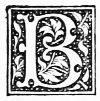
 illie seemed amazingly cheered up
and amused by his visit, and told
eagerly of all he had heard and noticed,
with a gay ring in his voice which delighted
his mother. It was not so with Jennie,
although she had come home with her hands
full of toys and picture-books, the gifts of
the kind little girls she had been to see. She
seemed dull, and her mother thought she was
tired of play and the excitement of seeing so
much that was new and strange to her. But
Mrs. Richards soon found it was worse than
this.
illie seemed amazingly cheered up
and amused by his visit, and told
eagerly of all he had heard and noticed,
with a gay ring in his voice which delighted
his mother. It was not so with Jennie,
although she had come home with her hands
full of toys and picture-books, the gifts of
the kind little girls she had been to see. She
seemed dull, and her mother thought she was
tired of play and the excitement of seeing so
much that was new and strange to her. But
Mrs. Richards soon found it was worse than
this.
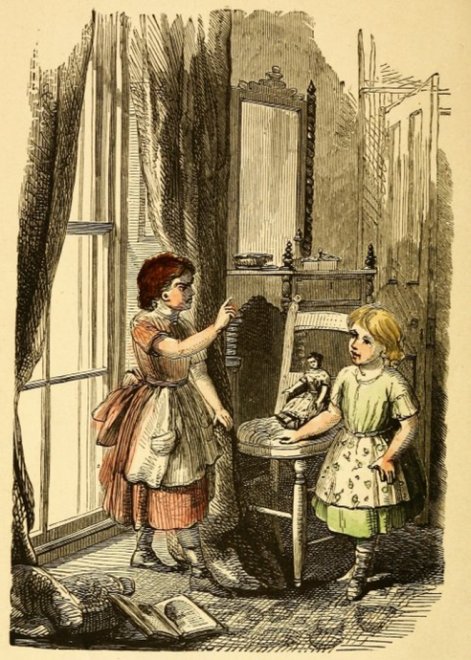
"I don't see why I can't keep this frock
on," said Jennie, fretfully, as Mrs. Granby
began to unfasten her dress, which was kept
for Sundays and holidays.
"Surely, you don't want to go knocking
round here, playing and working in your best
frock!" said Mrs. Granby. "What would it
look like?"
"The other one is torn," answered Jennie,
pouting, and twisting herself out of Mrs.
Granby's hold.
"Didn't I mend it as nice as a new pin?"
said Mrs. Granby, showing a patch nicely put
in during Jennie's absence.
"It's all faded and ugly," grumbled Jennie.
"I don't see why I can't be dressed as
nice as other folks."
"That means you want to be dressed like
little Miss Bradfords," answered Mrs. Granby.
"And the reason why you ain't is because
your folks can't afford it, my dearie. Don't
you think your mother and me would like to
see you rigged out like them, if we had the
way to do it? To be sure we would. But
you see we can't do more than keep you
clean and whole; so there's no use wishin'."
Jennie said no more, but submitted to have
the old dress put on; but the pleasant look
did not come back to her face.
Anything like sulkiness or ill-temper from
Jennie was so unusual that the other children
listened in surprise; but her mother saw very
plainly what was the matter, and hoping it
would wear off, thought it best to take no
notice of it at present.
The dress fastened, Jennie went slowly and
unwillingly about her task of putting away
her own and her brother's clothes; not doing
so in her usual neat and orderly manner but
folding them carelessly and tumbling them
into the drawers in a very heedless fashion.
Mrs. Granby saw this, but she, too, let it pass,
thinking she would put things to rights when
Jennie was in bed.
Pretty soon Tommy came to Mrs. Granby
with some long story told in the curious jargon
of which she could not understand one word.
"What does he say, Jennie?" she asked.
"I don't know," answered Jennie, crossly.
"I sha'n't be troubled to talk for him all the
time. He is big enough to talk for himself,
and he just may do it."
"Jennie, Jennie," said her mother, in a
grieved tone.
Jennie began to cry.
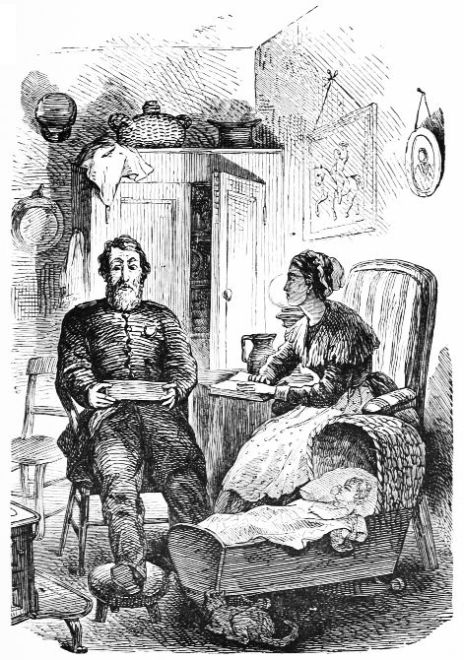
"Come here," said Mrs. Richards, thinking
a little soothing would be better than fault-finding.
"The baby is asleep; come and fix
the cradle so I can put her in it."
The cradle was Jennie's especial charge,
and she never suffered any one else to arrange
it; but now she pulled the clothes and pillows
about as if they had done something to offend
her.
"Our baby is just as good as Mrs. Bradford's,"
she muttered, as her mother laid the
infant in the cradle.
"I guess we think she is the nicest baby going,"
said Mrs. Richards, cheerfully; "and
it's likely Mrs. Bradford thinks the same of
hers."
"I don't see why Mrs. Bradford's baby has
to have a better cradle than ours," muttered
Jennie. "Hers is all white muslin and pink,
fixed up so pretty, and ours is old and
shabby."
"And I don't believe Mrs. Bradford's baby
has a quilt made for her by her own little sister,"
answered the mother.
"And it has such pretty frocks, all work
and tucks and nice ribbons," said Jennie, determined
not to be coaxed out of her envy
and ill-humor, "and our baby has to do with
just a plain old slip with not a bit of trimming.
'Taint fair; it's real mean!"
"Jennie, Jennie," said her mother again,
"I am sorry I let you go, if it was only to
come home envious and jealous after the
pretty things you've seen."
"But haven't we just as good a right to have
them as anybody else?" sobbed Jennie, with
her head in her mother's lap.
"Not since the Lord has not seen fit to give
them to us," answered Mrs. Richards. "We
haven't a right to anything. All he gives us
is of his goodness; nor have we a right to fret
because he has made other folks better off
than us. All the good things and riches are
his to do with as he sees best; and if one has
a larger portion than another, he has his own
reasons for it, which is not for us to quarrel
with. And of all others, I wouldn't have you
envious of Mrs. Bradford's family that have
done so much for us."
"Yes," put in Mrs. Granby, with her
cheery voice; "them's the ones that ought to
be rich that don't spend all their money on
themselves, that makes it do for the comfort
of others that's not as well off, and for the
glory of Him that gives it. Now, if it had
been you or me, Jennie, that had so much
given to us, maybe we'd have been selfish
and stingy like; so the Lord saw it wasn't
best for us."
"I don't think anything could have made
you selfish or stingy, Janet Granby," said Mrs.
Richards, looking gratefully at her friend.
"It is a small share of this world's goods that
has fallen to you, but your neighbors get the
best of what does come to you."
"Then there's some other reason why it
wouldn't be good for me," said Mrs. Granby;
"I'm safe in believin' that, and it ain't goin'
to do for us to be frettin' and pinin' after
what we haven't got, when the Almighty has
just been heapin' so much on us. And talkin'
of that, Jennie, you wipe your eyes, honey,
and come along to the kitchen with me;
there's a basket Mrs. Bradford gave me to unpack.
She said it had some few things for
Willie, to strengthen him up a bit before his
eyes were done. And don't let the father
come in and find you in the dumps; that
would never do. So cheer up and come
along till we see what we can find."
Jennie raised her head, wiped her eyes, and
followed Mrs. Granby, who, good, trusting soul,
soon talked her into good-humor and content
again.
Meanwhile, Maggie and Bessie were very
full of the wonderful discovery of the afternoon,
and could scarcely be satisfied without
asking Aunt Patty if it could really be she
who had been to the policeman's house and
carried the money to pay his debts; also,
paid Dr. Dawson for the operation on Willie's
eyes. But as mamma had forbidden this, and
told them that they were not to speak of it
to others, they were obliged to be content with
talking of it between themselves. If it were
actually Aunt Patty who had done this, they
should look upon her with very new feelings.
They had heard from others that she could do
very generous and noble actions; but it was
one thing to hear of them, as if they were
some half-forgotten story of the past, and another
to see them done before their very eyes.
Aunt Patty was not rich. What she gave to
others, she must deny to herself, and they
knew this must have cost her a great deal.
She had given up the grove, on which she
had set her heart, that she might be able to
help the family in whom they were so
interested,—people of whom she knew nothing but
what she had heard from them. If she had
really been so generous, so self-sacrificing,
they thought they could forgive almost any
amount of crossness and meddling.
"For, after all, they're only the corners,"
said Maggie, "and maybe when she tried to
bear the policeman's burden, and felt bad about
the grove, that made her burden heavier, and
so squeezed out her corners a little more, and
they scratched her neighbors, who ought not
to mind if that was the reason. But I do
wish we could really know; don't you, Bessie?"
Putting all things together, there did not
seem much reason to doubt it. The policeman's
children were positive that Mrs. Lawrence
was the very lady who had been to their
house, and Aunt Patty had been out on two
successive days at such hours as answered to
the time when the mysterious old lady had
visited first them, and then Dr. Dawson.
Papa and Uncle Ruthven came home on
the evening of the next day, having made
arrangements that satisfied every one for
the summer among the mountains. Porter's
house, with its addition and new conveniences,
was just the place for the party, and
would even afford two or three extra rooms,
in case their friends from Riverside wished to
join them. The children were delighted as
their father spoke of the wide, roomy old hall,
where they might play on a rainy day, of the
spacious, comfortable rooms and long piazza;
as he told how beautiful the lake looked even
in this early spring weather, and of the grand
old rocks and thick woods which would soon
be covered with their green summer dress.
Still Bessie gave a little sigh after her beloved
sea. The old homestead and Aunt Patty's
cottage were about four miles from the lake,
just a pleasant afternoon's drive; and at the
homestead itself, where lived Mr. Bradford's
cousin, the two gentlemen had passed the
night. Cousin Alexander had been very glad
to hear that his relations were coming to pass
the summer at Chalecoo Lake, and his four
boys promised themselves all manner of pleasure
in showing their city cousins the wonders
of the neighborhood.
"It all looks just as it used to when I was
a boy," said Mr. Bradford. "There is no
change in the place, only in the people." He
said it with a half-sigh, but the children did
not notice it as they pleased themselves with
the thought of going over the old place where
papa had lived when he was a boy.
"I went to the spot where the old barn was
burned down, Aunt Patty," he said. "No
signs of the ruins are to be seen, as you know;
but as I stood there, the whole scene came
back to me as freshly as if it had happened
yesterday;" and he extended his hand to
Aunt Patty as he spoke.
The old lady laid her own within his, and
the grasp he gave it told her that years and
change had not done away with the grateful
memory of her long past services. She was
pleased and touched, and being in such a
mood, did not hesitate to express the pleasure
she, too, felt at the thought of having them all
near her for some months.
About half-way between the homestead and
the Lake House, Mr. Bradford and Mr. Stanton
had found board for Mrs. Richards and her
boy. It was at the house of an old farmer
who well remembered Mr. Bradford, and who
said he was pleased to do anything to oblige
him, though the gentlemen thought that the
old man was quite as well satisfied with the
idea of the eight dollars a week he had
promised in payment. And this was to come
from Maggie's and Bessie's store, which had
been carefully left in mamma's hand till
such time as it should be needed. All this
was most satisfactory to our little girls; and
when it should be known that the operation
on Willie's eyes had been successful, they
were to go to Mrs. Richards and tell her what
had been done for her boy's farther good.
Mrs. Bradford told her husband that night
of all that had taken place during his absence,
and he quite agreed with her that it was without
doubt Aunt Patty herself who had been
the policeman's benefactor.
"I am not at all surprised," he said,
"though I own that this did not occur to me,
even when Richards described the old lady.
It is just like Aunt Patty to do a thing in
this way; and her very secrecy and her unwillingness
to confess why she would not
have the grove, or what she intended to do
with the money, convinced me that she was
sacrificing herself for the good of some other
person or persons."
Then Mr. Bradford told his wife that Aunt
Patty meant to go home in about ten days,
and should Willie's sight be restored before
she went, he hoped to be able to persuade her
to confess that she had had a share in bringing
about this great happiness. He was very
anxious that his children should be quite certain
of this, as he thought it would go far
to destroy their old prejudice, and to cause
kind feelings and respect to take the place of
their former fear and dislike.
Mrs. Bradford said that good had been done
already by the thought that it was probably
Aunt Patty who had been so generous, and
that the little ones were now quite as ready to
believe all that was kind and pleasant of the
old lady as they had been to believe all that
was bad but two days since. She told how
they had come to her that morning, Maggie
saying, "Mamma, Bessie and I wish to give
Aunt Patty something to show we have more
approval of her than we used to have; so I
am going to make a needle-book and Bessie a
pin-cushion, and put them in her work-basket
without saying anything about them."
They had been very busy all the morning
contriving and putting together their little
gifts without any help from older people, and
when they were finished, had placed them in
Aunt Patty's basket, hanging around in order
to enjoy her surprise and pleasure when she
should find them there.
But the poor little things were disappointed,
they could scarcely tell why. If it had been
mamma or Aunt Bessie who had received
their presents, there would have been a great
time when they were discovered. There would
have been exclamations of admiration and delight
and much wondering as to who could
have placed them there,—"some good fairy
perhaps who knew that these were the very
things that were wanted," and such speeches,
all of which Maggie and Bessie would have enjoyed
highly, and at last it would be asked if
they could possibly have made them, and
then would have come thanks and kisses.
But nothing of this kind came from Aunt
Patty. She could not enter into other people's
feelings so easily as those who had been
unselfish and thoughtful for others all their
lives; and though she was much gratified by
these little tokens from the children, she did
not show half the pleasure she felt; perhaps
she really did not know how. True she thanked
them, and said she should keep the needle-book
and pin-cushion as long as she lived; but
she expressed no surprise, and did not praise
the work with which they had taken so much
pains.
"What is this trash in my basket?" she
said, when she discovered them. "Children,
here are some of your baby-rags."
"Aunt Patty," said Mrs. Bradford, quickly,
"they are intended for you; the children have
been at work over them all the morning."
"Oh!" said Mrs. Lawrence, changing her
tone. "I did not understand. I am sure I
thank you very much, my dears; and when
you come to see me this summer, I shall show
you how to do far better than this. I have a
quantity of scraps and trimmings of all kinds,
of which you can make very pretty things."
This was intended to be kind; but the
promise for the future did not make up for
the disappointment of the present; and the
children turned from her with a feeling that
their pains had been almost thrown away.
"Mamma," Bessie had said afterwards, "do
you think Aunt Patty was very grateful for
our presents?"
"Yes, dear, I think she was," said mamma,
"and I think she meant to show it in her own
way."
"But, mamma, do you think that was a
nice way? You would not have said that to
any one, and I felt as if I wanted to cry a
little."
Mamma had seen that her darlings were
both hurt, and she felt very sorry for them,
but she thought it best to make light of it, so
said, cheerfully, "I am quite sure Aunt Patty
was gratified, pussy, and that whenever she
looks at your presents, she will think with pleasure
of the kind little hands that made them."
"When I am big, and some one gives me
something I have pleasure in, I'll try to show
the pleasure in a nice way," said Maggie.
"Then you must not forget to do it while
you are young," said mamma. "Let this
show you how necessary it is to learn pleasant
habits of speaking and acting while you are
young."
"Yes," said Maggie, with a long sigh, "and
Aunt Patty ought to be excused. I suppose,
since she was not brought up in the way
she should go when she was young, she ought
to be expected to depart from it when she is
old. We must just make the best of it when
she don't know any better, and take example
of her."
"Yes," said mamma, rather amused at the
way in which Maggie had put into words the
very thought that was in her own mind; "let
us make the best of everything, and be always
ready to believe the best of those about us."
All this Mrs. Bradford told to her husband,
and agreed with him that it was better not to
endeavor to find out anything more till the
trial on Willie's eyes was over.
Maggie's new volume of "The Complete
Family" was begun the next day in these
words: "Once there was a man who lived in
his home in the mountains, and who always
listened very modestly to everything that was
said to him, so his wife used to say a great
deal to him. And one day she said, 'My
dear, Mr. and Mrs. Happy, with all their family,
and a great lot of their best friends, are
coming to live with us this summer, and they
are used to having a very nice time, so we
must do all we can to make them comfortable,
or maybe they will say, "Pooh, this is
not a nice place at all. Let us go to the sea
again. These are very horrid people!"' And
the man said, 'By all means, my dear; and
we will give them all they want, and let them
look at the mountains just as much as they
choose. But I do not think they will say unkind
words even if you are a little disagreeable,
but will make the best of you, and think
you can't help it.' Which was quite true, for
M. Happy and B. Happy had a good lesson
the man did not know about, and had made a
mistake; and sometimes when people seem
dreadfully hateful, they are very nice,—I
mean very good,—so it's not of great consequence
if they are not so nice as some people,
and they ought not to be judged, for maybe
they have a burden. And M. Happy made
two mistakes; one about Mrs. Jones, and the
other about that other one mamma don't want
me to write about. So this book will be about
how they went to the mountains and had a
lovely time. I guess we will."
Rather more than a week had gone by.
Willie Richards lay on his bed in a darkened
room, languid and weak, his eyes bandaged,
his face paler than ever, but still cheerful and
patient. It was five days since the operation
had been performed, but Willie had not yet
seen the light, nor was it certain that he
would ever do so, though the doctor hoped
and believed that all had gone well. They
had given the boy chloroform at the time, and
then bound his eyes before he had recovered
his senses. But on this day the bandage was
to be taken off for the first, and then they
should know. His mother sat beside him
holding his thin, worn hand in hers.
"Willie," she said, "the doctor is to be
here presently, and he will take the bandage
from your eyes."
"And will I see then, mother?"
"If God pleases, dear. But, Willie, if he
does not see fit to give you back your sight,
could you bear it, and try to think that it is
his will, and he knows best?"
Willie drew a long, heavy breath, and was
silent a moment, grasping his mother's fingers
till the pressure almost pained her; then he
said, low, and with a quiver in his voice, "I
would try, mother; but it would be 'most too
hard after all. If it could be just for a little
while, just so I could see your dear face for a
few moments, then I would try to say, 'Thy
will be done.'"
"However it is, we must say that, my boy;
but, please the Lord, we shall yet praise him
for his great goodness in giving you back
your poor, dear eyes."
As she spoke, the door opened, and her husband
put his head in.
"Here's the doctor, Mary," he said, with a
voice that shook, in spite of his efforts to keep
it steady; and then he came in, followed by
the doctor and Mrs. Granby.
The latter, by the doctor's orders, opened
the window so as to let in a little softened
light, and after a few cheerful words the doctor
unfastened the bandage, and uncovered
the long sightless eyes. Willie was resting in
his mother's arms with his head back against
her shoulder, and she knew that he had
turned it so that her face might be the first
object his eyes rested on.
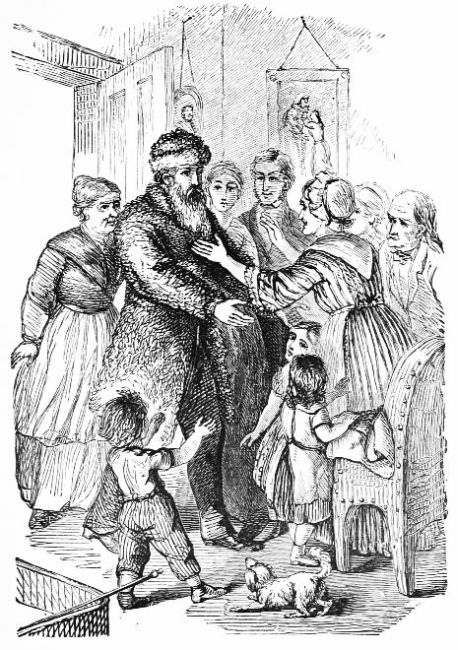
It was done; and, with a little glad cry, the
boy threw up his arms about his mother's
neck.
"What is it, Willie?" asked his father,
scarcely daring to trust his voice to speak.
"I saw it! I saw it!" said the boy.
"Saw what, sonny?" asked his father,
wishing to be sure that the child could really
distinguish objects.
"I saw mother's face, her dear, dear face;
and I see you, too, father. Oh, God is so
good! I will be such a good boy all my life.
Oh, will I never have to fret to see mother's
face again?"
"Ahem!" said the doctor, turning to a
table and beginning to measure some drops
into a glass, while Mrs. Granby stood crying
for joy at the other end of the room. "If
you're not to, you must keep more quiet than
this, my boy; it will not do for you to grow
excited. Here, take this."
"Who's that?" asked Willie, as the strange
face met his gaze.
"Ho, ho!" said the doctor. "Are you going
to lose your ears now you have found
your eyes? I thought you knew all our
voices, my fine fellow."
"Oh, yes," said Willie, "I know now;
it's the doctor. Doctor, was I just as patient
as you wanted me to be?"
"First-rate," answered the doctor; "but
you must have a little more patience yet. I'll
leave the bandage off, but we will not have
quite so much light just now, Mrs. Granby."
Willie begged for one look at Auntie
Granby, and then Jennie was called, that he
might have a peep at her, after which he was
content to take the medicine and lie down,
still holding his mother's hand, and now and
then putting up his fingers with a wistful
smile to touch the dearly loved face he could
still see bending over him in the dim light.
That evening the policeman went up to
Mr. Bradford's. He was asked to walk into
the parlor, where sat Mr. Bradford and Aunt
Patty, while old nurse was just taking Maggie
and Bessie off to bed.
"Oh, here is our policeman!" said Bessie;
and she ran up to him, holding out her hand.
"How is your Willie?"
"That's just what I came to tell you, dear.
I made bold to step up and let you know
about Willie, sir," he said, turning to Mr.
Bradford.
"And what is the news?" asked the gentleman.
"The best, sir. The Lord has crowned all
his mercies to us by giving us back our boy's
sight."
"And has Willie seen his mother's face?"
asked Bessie, eagerly.
"Yes, that he has. He took care that
should be the first thing his eyes opened on;
and it just seems as if he could not get his
full of looking at it. He always was a mother
boy, my Willie, but more than ever so since
his blindness."
"How is he?" asked Mr. Bradford.
"Doing nicely, sir. Rather weakish yet;
but when he can bear the light, and get out
into the fresh air, it will do him good; and I
hope he'll come round after a spell, now that
his mind is at ease, and he's had a sight of
that he'd set his heart on, even if we can't
just follow out the doctor's orders."
Bessie felt as if she could keep her secret
no longer. "May I, papa,—may I?" she
asked.
Papa understood her, and nodded assent.
"But you can follow the doctor's orders,"
said she, turning again to the policeman, "and
Willie can have all the fresh air he needs,—fresh
mountain air, he and his mother. And
Maggie and I are to pay it out of the money
that Uncle Ruthven gave us for the eye doctor
whom the"—here Bessie looked half doubtfully
towards Aunt Patty—"the old lady
paid. And now, you see, it's a great deal
nicer, 'cause if she hadn't, then, maybe, Willie
couldn't go to the country."
Bessie talked so fast that Richards did not
understand at first, and her father had to explain.
The man was quite overcome.
"It's too much, sir, it's too much," he
said, in a husky voice, twisting his cap round
and round in his hands. "It was the last
thing was wanting, and I feel as if I had nothing
to say. There ain't no words to tell what
I feel. I can only say may the Lord bless you
and yours, and grant you all your desires in
such measure as he has done to me."
Mr. Bradford then told what arrangements
had been made, in order to give Richards time
to recover himself. The policeman thought
all these delightful, and said he knew his wife
and boy would feel that they could never be
thankful and happy enough.
"And to think that all this has come out of
that little one being brought up to the station
that day, sir; it's past belief almost," he said.
"So good has been brought out of evil,"
said Mr. Bradford.
As soon as the policeman had gone, Maggie
and Bessie ran up-stairs to tell their mother
the good news, leaving papa and Aunt Patty
alone together. Mr. Bradford then turned to
the old lady, and laying his hand gently on
her shoulder, said,—
"Aunt Patty, you have laid up your treasure
where moth and rust do not corrupt; but
surely it is bearing interest on earth."
"How? Why? What do you mean,
Henry?" said Mrs. Lawrence, with a little
start.
"Come, confess, Aunt Patty," he said;
"acknowledge that it is to you this good fellow
who has just left us owes his freedom
from debt, his child's eyesight, his release
from cares which were almost too much
even for his hopeful spirit; acknowledge
that you have generously sacrificed a long-cherished
desire, given up the fruits of much
saving and self-denial, to make those happy in
whom you could have had no interest save as
creatures and children of one common Father.
We all know it. The policeman's children
recognized you, and told my little ones. Why
will you not openly share with us the pleasure
we must all feel at the blind boy's restoration
to sight? Did you not see dear Bessie's wistful
look at you as she bade you good-night?
These little ones cannot understand why there
should be any reason to hide such kindness as
you have shown to these people, or why you
should refuse to show an interest you really
feel. It is true that we are told not to let our
left hand, know that which is done by our
right hand; but are we not also commanded
so to let our light shine before men that they
may see our good works and glorify our Father
in heaven? And can we do so, or truly
show our love to him, if we hide the services
rendered for his sake behind a mask of coldness
and reserve? My dear aunt, for his
sake, for your own, for the sake of the affection
and confidence which I wish my children
to feel for you, and which I believe you wish
to gain, let me satisfy them that it was really
you who did this thing."
The old lady hesitated for a moment longer,
and then she broke down in a burst of humility
and penitence such as Mr. Bradford had
never expected to see from her. She told him
how she had heard them all talking of the policeman
and his troubles, and how much she
had wished that she was able to help him;
how she had thought that the desire to have
the grove was only a fancy, right in itself perhaps,
but not to be indulged if she could better
spend the money for the good of others;
and how, without taking much time to consider
the matter, she had decided to give it up.
Then she had half regretted it, but would not
confess to herself or others that she did so, and
so, feeling irritable and not at ease with herself,
had been impatient and angry at the least
thing which seemed to oppose her plans. The
children, she said, had shamed her by their
greater patience and submission under the
disappointment she had so unintentionally
brought upon them, and now she felt that the
ill-temper she had shown had brought reproach
on the Master whom she really wished
to serve, and destroyed the little influence she
had been able to gain with the children.
Mr. Bradford told her he thought she was
mistaken here, and if the children could only
be quite certain that it was she who had
proved such a good friend to the policeman's
family, they would forget all else in their
pleasure at her kindness and sympathy.
So Mrs. Lawrence told him to do as he
thought best; and she found it was as he said;
for when Maggie and Bessie came down in the
morning, full of joy at the happiness which
had come to Willie and his parents, they ran
at once to Aunt Patty, and Bessie, putting
her little arms about her neck, whispered,—
"Dear Aunt Patty, we're so much obliged
to you about Willie, and if we had only
known it was you, we wouldn't have felt so
bad about it. Now we only feel glad, and
don't you feel glad, too, when you know how
happy they all are?"
Then Maggie sidled up, and slipping her
hand into Aunt Patty's, said,—
"Aunt Patty, please to forgive me for saying
naughty things about you when I didn't
know you was the queer old lady."
Aunt Patty was quite ready to exchange
forgiveness; and for the two remaining days
of her stay, it seemed as if her little nieces
could not do enough to show how pleased and
grateful they were; and when she left them,
they could tell her with truth how glad they
were that they were to see her soon again in
her own home.
And if you are not tired of Maggie and
Bessie, you may some time learn how they
spent their summer among the mountains.
Transcriber's note:
The transcriber modified the original book cover by adding
the title of the book and places this image in the
public domain.