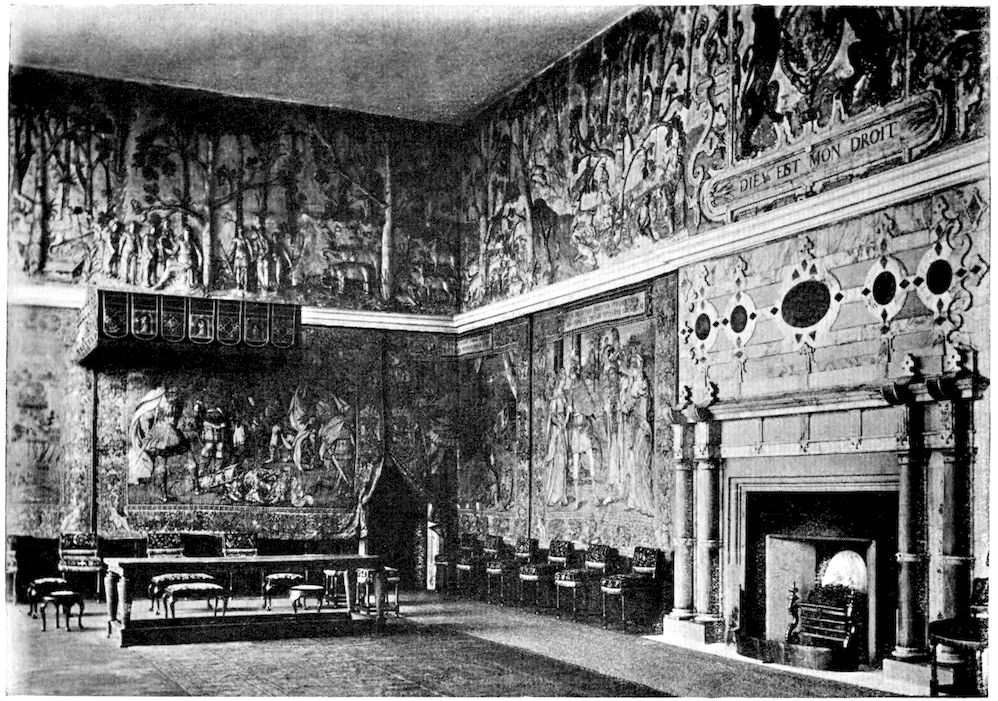
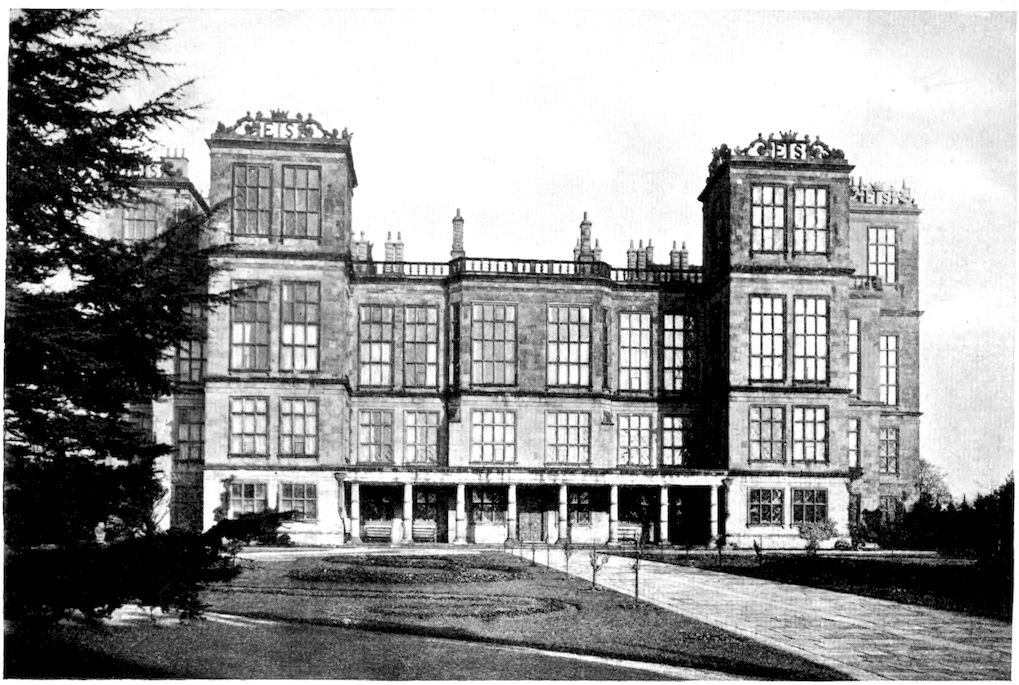
The cover image was created by the transcriber and is placed in the public domain.
BESS OF HARDWICK
AND HER CIRCLE
BY THE SAME AUTHOR
A LADY OF THE REGENCY
JOURNEYMAN LOVE
THE APPRENTICE
TALES OF RYE TOWN
THE LABOURER’S COMEDY
THE ENCHANTED GARDEN
THE EASY-GO-LUCKIES
THE STAIRWAY OF HONOUR
HAPPINESS
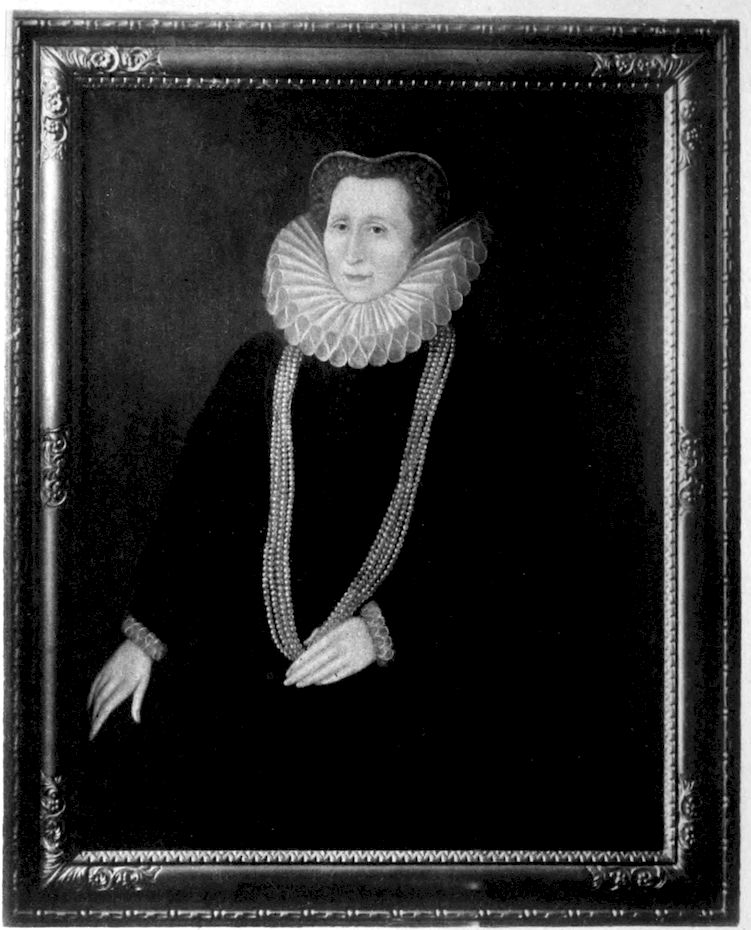
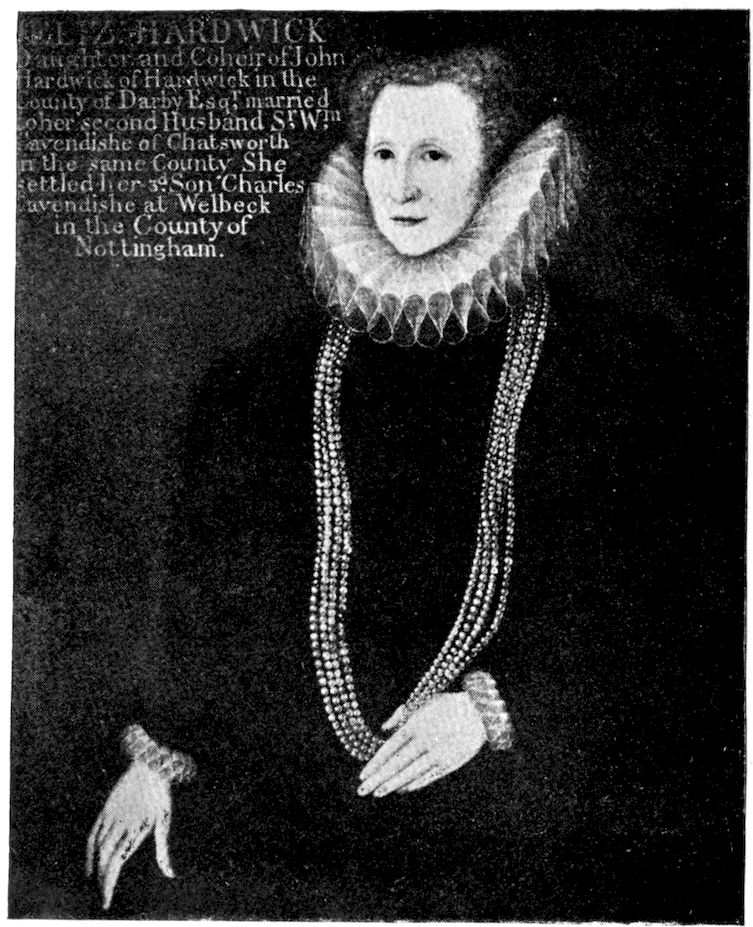
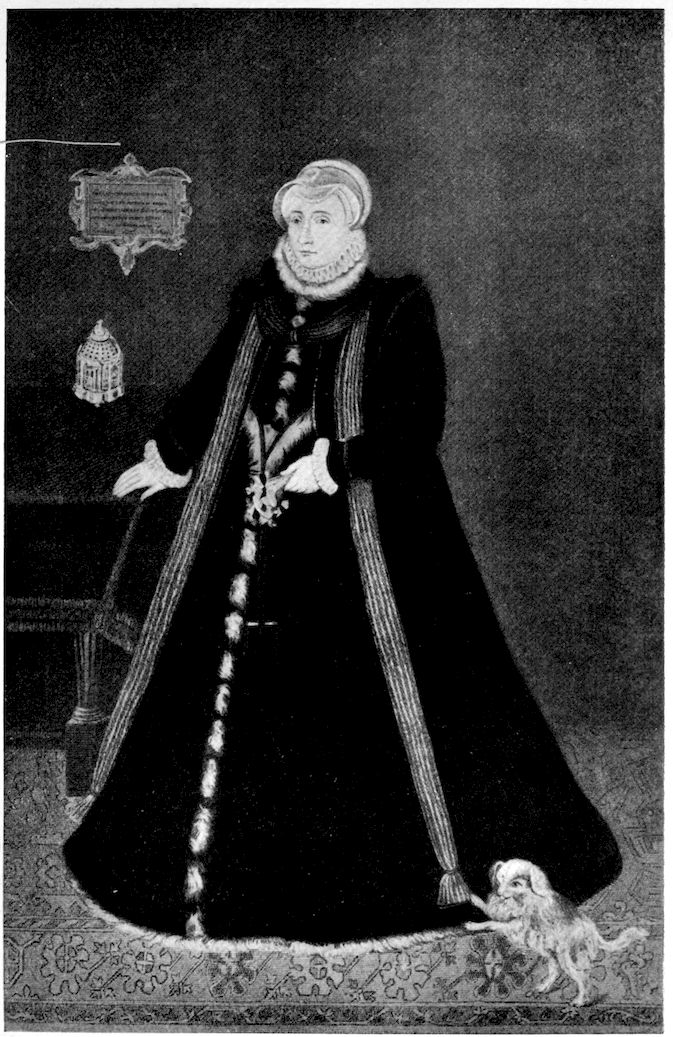
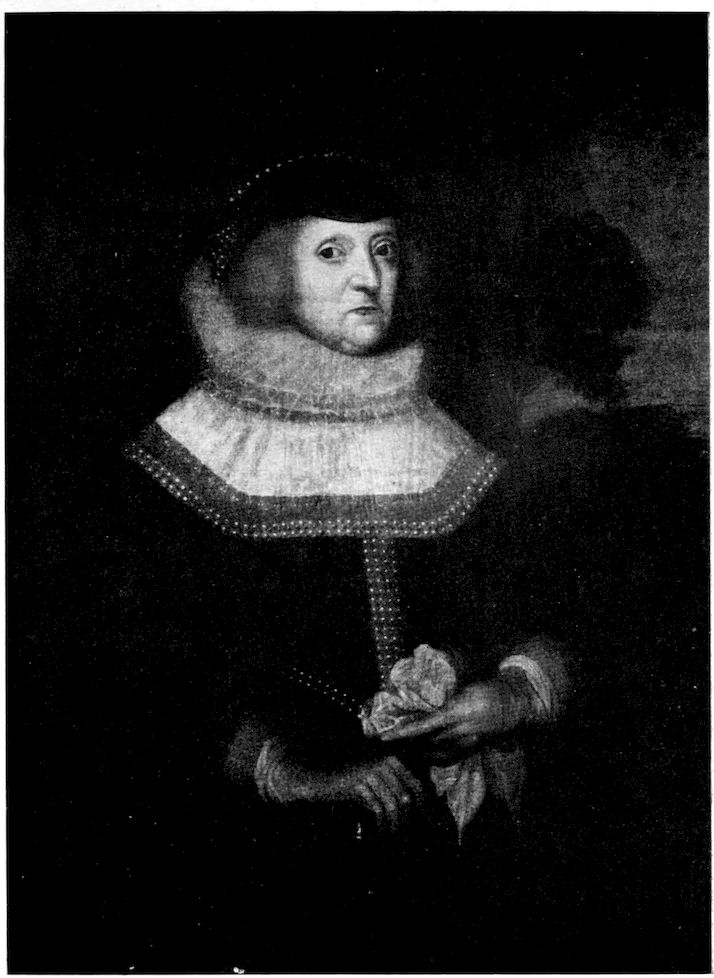
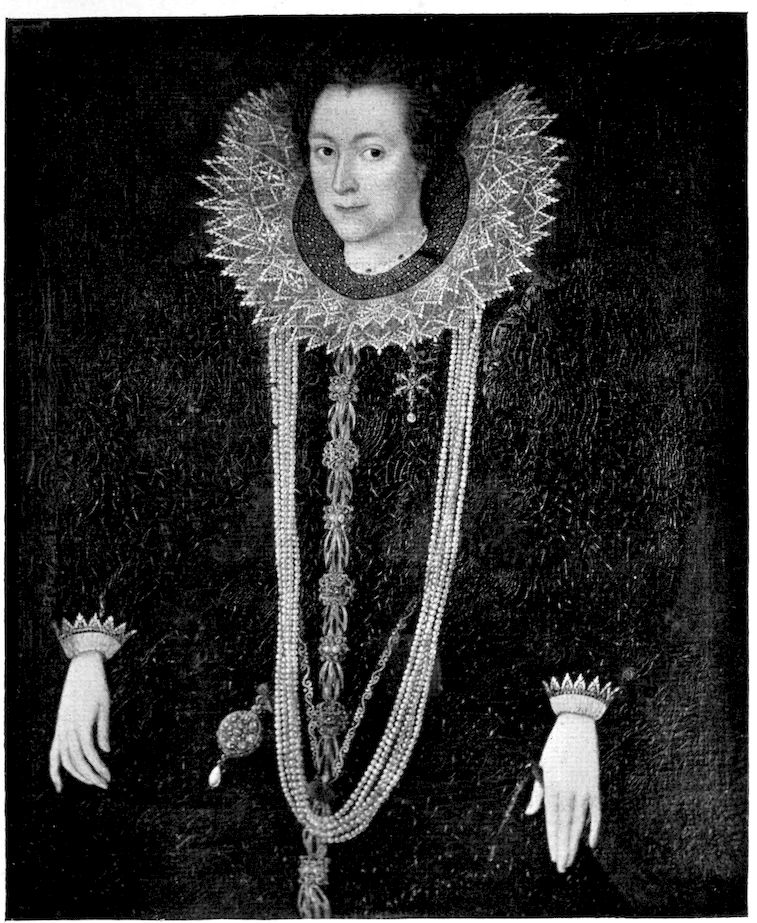
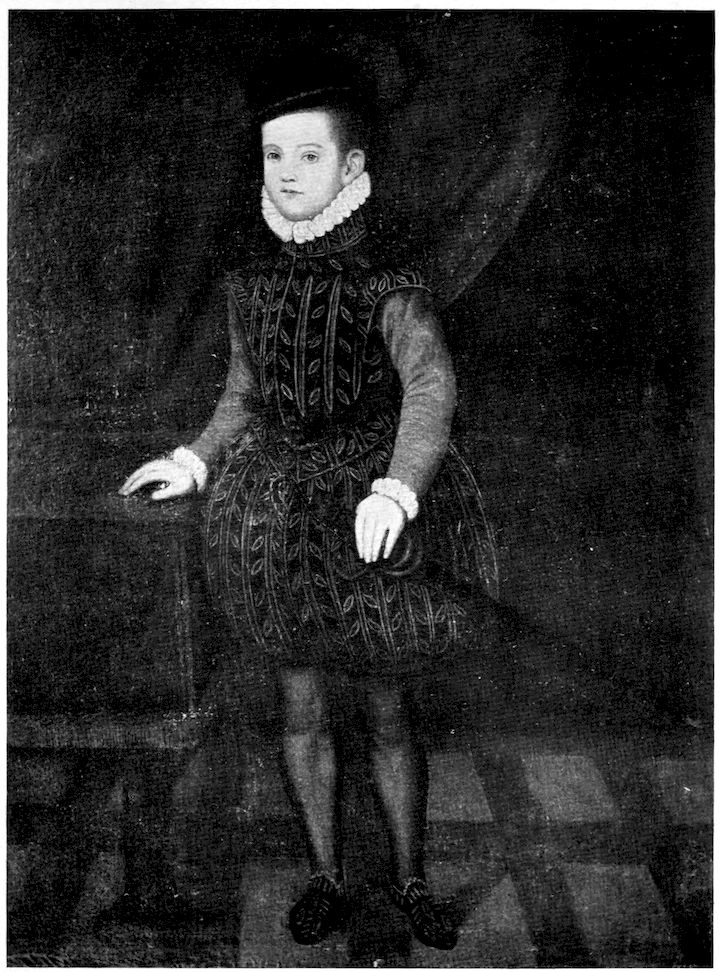
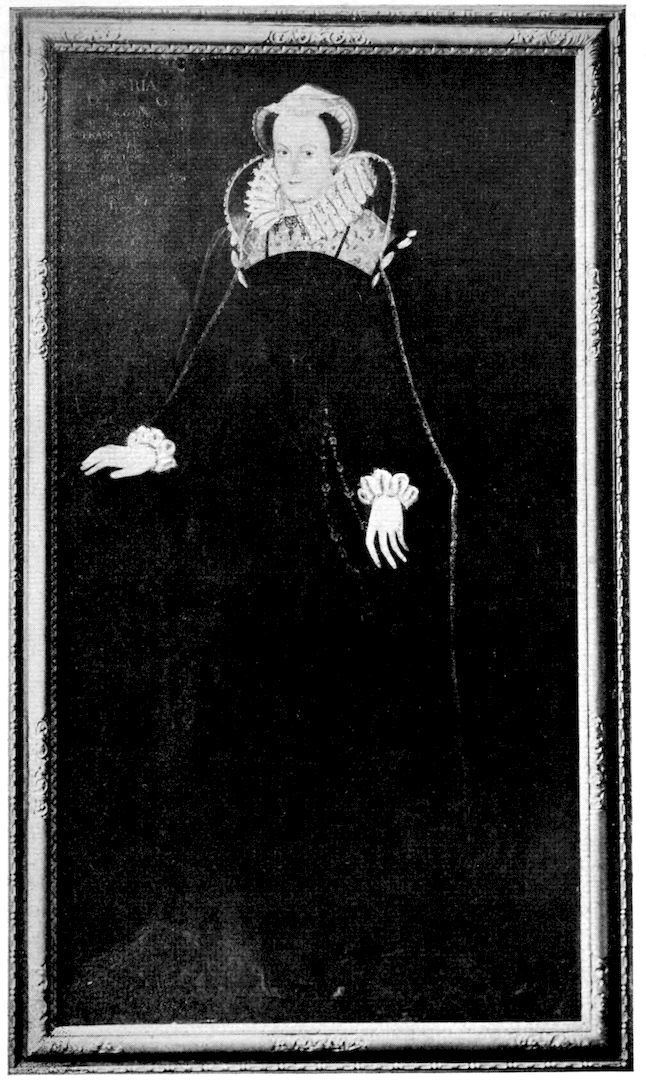
Photo by Richard Keene Ltd. Derby, after the painting at Hardwick Hall.
Elizabeth, Countess of Shrewsbury.
BY
MAUD STEPNEY RAWSON
WITH THIRTY-EIGHT ILLUSTRATIONS
INCLUDING A PHOTOGRAVURE FRONTISPIECE
London: HUTCHINSON & CO.
Paternoster Row ❧ 1910
TO MY HUSBAND
v
To you belongs, for many a reason, this, my first
essay in history, which I have carried to its end
with many misgivings, but with much delight in the
matter itself.
The orthodox may be affronted at two brief incursions
into fiction which they will find in it. Let them skip
these judiciously, magisterially. For my own part, I
needed consolation at times for certain hard and bitter
facts of the history. Therefore, since the way was
sometimes long, and the wind, in my imagination, very
cold—as it whistled in and out of the ruins of those
manors and castles where the Scots Queen and her married
gaolers dwelt, or as it drove the snow across the
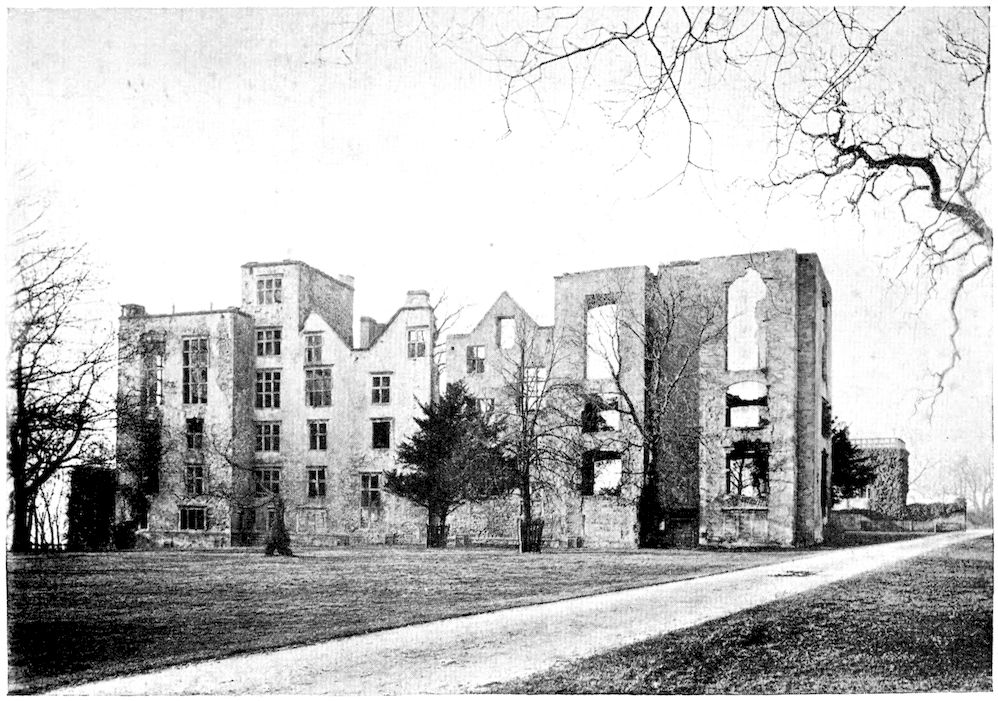
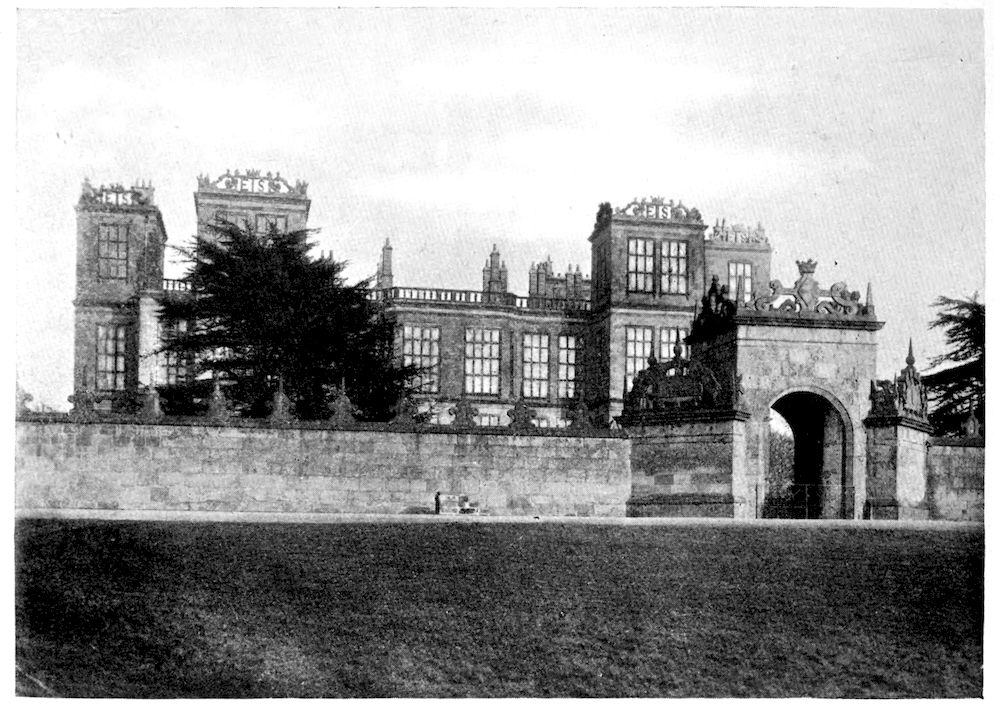
splendid grey façade of Hardwick (to say nothing of
the draughts of the sombre, public research libraries)—I
first drew my Countess down from her picture-frame
to marshal her household, and then lured her child and
her child’s lover after her to gladden your road and
mine.
And so I give you—besides all the thoughts which
have gone to every scrap of writing I have ever done—these
last, which curl and stiffen and again uncoil
themselves about this hungry woman of Elizabethan
vidays. Into her life and much-abused toil, we, who
have neither gold nor heirs for whom to store it, can
look together in love and pity.
Thus even while we rejoice over our diminutive
home, may we never forget to give thanks to the spirit
of those who built the great houses which nourish the
little ones, and who, in place of the “scarlet blossom of
pain” that grows at great door and little, shall give to
us in the end the perfect English rose.
M. S. R.
Little Orchard,
Streatley,
Berks.
AUTHOR’S NOTE
vii
All complete letters herein quoted have been put into modern
spelling. These, with the exception of one or two fragments
and when the source is not otherwise indicated, have been
selected from the transcripts in Lodge’s Illustrations of British
History, from the originals amongst the Talbot, Howard, and
Cecil MSS.
The Author gratefully acknowledges the special permission
of his Grace the Duke of Devonshire to include in this work
reproductions of many of the fine pictures at Hardwick Hall,
as well as a number of views of that noble building.
Among the hills and dales of Derbyshire, that great
county of august estates, there came into the world
in the year 1520 a certain baby girl. Her father, John
Hardwick of Hardwick House, and her mother Elizabeth,
daughter of Thomas Leake of Hasland, in the
same county, christened the child Elizabeth, naturally
enough after her mother. Like the great Queen of
England to whom she was senior, and with whom in
after years she had so much traffic of a highly dramatic
kind, this Elizabeth has come down to posterity under
the shorter name of Bess.
Derbyshire, always a great county, was specially important
in her day. Far from London and Court it
seemed like a little England within England. Its great
families wove its life step by step, its varied landscape,
its heights and dales rendered it an important strategical
centre in the event of rebellion, and the roughness and
slough of pack-road and cart-road made even local expeditions
affairs of moment. The little red-haired baby
girl inherited from her native soil, from her race, and
2from the neighbours about her all that sense of county
importance, that desire to found, establish and endow a
great family with great estates which her life developed
to so remarkable a degree. That consciousness of county
importance was inevitable in those days when families
gave their names not only to their mansions, but to the
hamlets or village which clustered round them. Bess of
Hardwick was brought up amongst them all—the Hardwicks
of Hardwick, the Barleys of Barley (or Barlow), the
Pinchbecks of Pinchbeck, the Blackwalls of Blackwall, the
Leakes, and the Leches. Not all of them were so very
opulent. The Hardwicks, though not rich, were of
honourable standing as county gentry, and the Barleys
and Leakes were of the same social rank. John Hardwick
could not afford to give his daughters large dowries,
and consequently when my Lady Zouche, her aunt, took
Bess into her household in London the parents were
probably glad enough to embrace such a social chance
for her. Up to this time she led naturally the life of
the ordinary young gentlewoman of tender years, said
her prayers, learnt to sew and embroider, and had seen
something of the ordering of a household and the disposal
of country produce, while she heard and treasured
up such scraps of news as filtered through to her family
and neighbours by letters and travellers who came to
the houses about her, or such rumours as were bruited
in the county town. She was but twelve years old
when she made her entry at once into my Lady Zouche’s
house and into history. We are told that she had
reddish hair and small eyes, but no picture of her remains
to give any idea of her appearance at this moment
when she left her childhood behind her. Physique she
must always have had, and with it tenacity and tact in
furthering her own prospects. She was of the type in
which the art of “getting on” is innate. London and
my Lady Zouche’s excellent social position gave her
her first chance.
3There is almost a touch of Becky Sharp in the way
that this young girl, dowerless save for the forty marks of
dot allotted by John Hardwick to each of his daughters,
settled down in that household. There came to London
one of her Derbyshire neighbours—a youth of the
Barley or Barlow family, named Robert. Under Lady
Zouche’s roof he fell sick and the little niece helped to
tend him. Whether he also fell in love, whether
Mistress Hardwick the mother was minded to “settle”
one at least of her girls early, or whether Lady Zouche
was of a strong match-making tendency does not appear.
But a marriage between the niece and the guest was
arranged and quickly carried through. A strange
pitiful affair it must have been—that London wedding
between the red-haired child and the sickly young man—a
ceremony trailing after it a sorry hope of happiness
in the midst of physicking and nostrums, weakness and
watching, until the death of the bridegroom before the
bride had reached her fourteenth year. His death left
no apparent gap in my Lady Zouche’s household and
no mark upon history. But it bestowed on the child-wife
the dignity of widowhood, and such importance,
plus her forty marks, as attached to any property that
Robert Barlow left her. The Barlows were not wealthy.
Some of them in after years were in sore straits for
a living. The State Papers show the existence of
piteous letters from a certain Jane Barlow who writes in
January, 1583, to her father, Alexander Barlow, “from
a foreign land.” She is in extreme want, forced to
4borrow money to carry on her “business,” and assures
him that the meanest servant he has “liveth in far
better condition than she.” There is nothing to show
that the Barlows applied to their relation “Bess” in
after years for help. Such property as there was passed
to her, and she travelled out of their ken into richer
circles.
In 1547, at the age of twenty-seven, a woman in the
height of her powers and the perfection of her womanhood,
with considerable knowledge of the world and a
tremendous store of physical and mental vitality, she
secured a second husband and a man of considerable
means—Sir William Cavendish. He was the second
son of Thomas Cavendish, and his family, like that of
Bess, took its name from its hamlet or manor. Says
the pompous Bishop Kennet of those days: “The
Cavendishes, like other great Families of greatest
Antiquity derived a Name from their Place of Habitation.
A younger branch of the Germons, famous in
Norfolk and Essex, settled at Cavendish in Suffolk, and
from that Seat and Estate were soon distinguished by
that Sirname.” Thomas Cavendish, like the father of
Bess, was “a well-to-do but undistinguished Squire,”
but his sons made names for themselves.
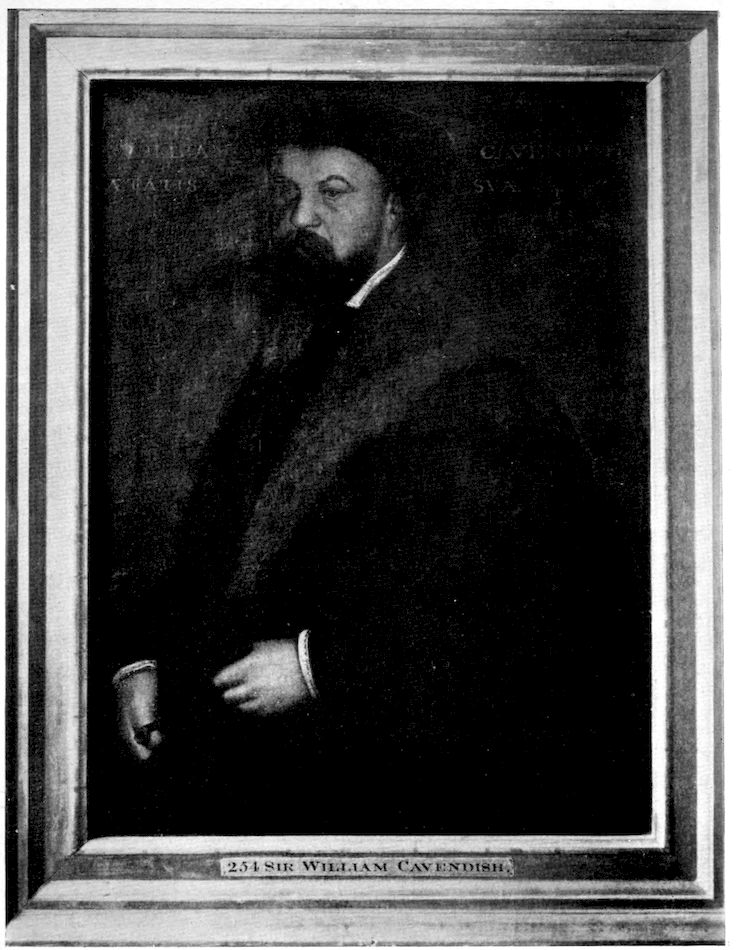
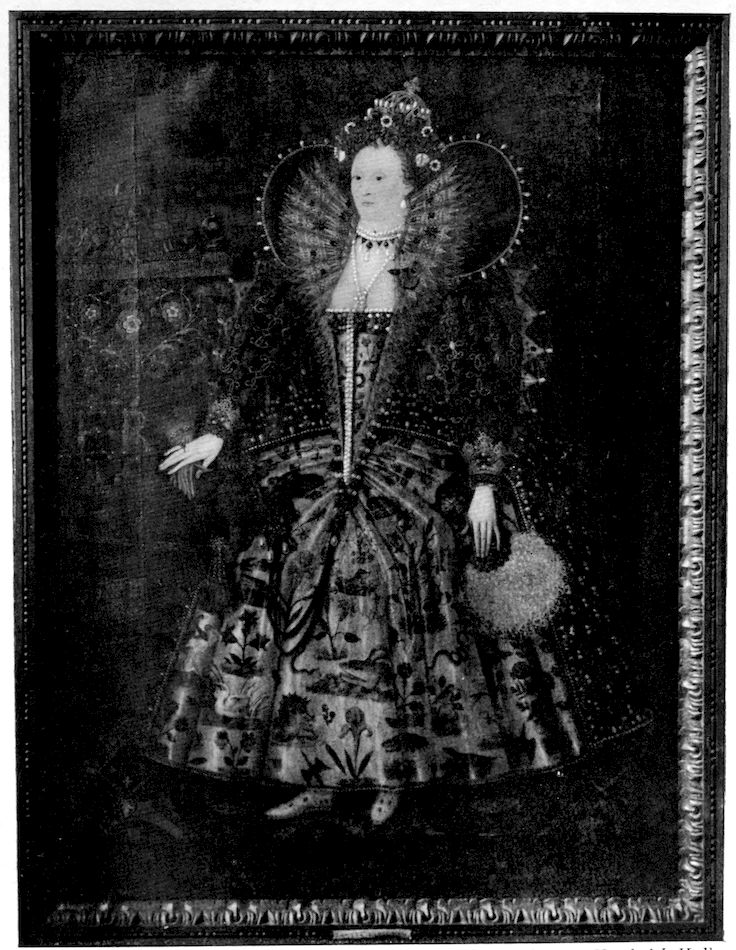
From a photo by Richard Keene, Ltd., Derby, after the painting at Hardwick Hall By permission of his Grace the Duke of Devonshire
5In 1539 his son William was appointed one of the
auditors of the Court of Augmentation. This Court,
of which one at least of the members had been employed
as a commissioner for the surrender of religious
houses, was ostensibly founded to ensure the increase
of the royal exchequer to such a point as would enable
the sovereign duly to establish and strengthen the
defences of the realm. Within a year Mr. Cavendish
had so well played his cards and acquitted himself that
he received from Henry VIII a grant of Church property—the
lordships and manors of Northawe, Cuffley,
and Childewicke in Hertfordshire. In 1548, the year
after his marriage, he was further rewarded not only
by the post of “Treasurer of the Chamber to the
King” which, we are assured, was “a place of great
trust and honour,” but the knighthood which brought his
third wife the title that raised her above the majority
of her fellow-gentlewomen. He did not bring her a
virgin heart, for he had been twice married and twice
a widower without male heir. But he conferred on her
important social position, a great deal of land—additional
prizes fell to his share in the way of lesser glebe
properties, abbeys, and rectories, because his appointment
in the royal exchequer kept him au courant of the
places which were being given or going cheap in the
market—and she in her turn brought him the sons he
doubtless so greatly desired.
Never surely did a couple settle down so whole-heartedly
or so harmoniously to the founding of a
family, to the increase and consolidation of their patrimony.
As to the first—their offspring—Sir William
made a proud and careful list in writing, being, as
Collins[1] says, “A learned and exact Person.” He had
in all sixteen children, eight of whom were borne to
him by “this beautiful and discreet Lady,” as Collins
describes Bess Cavendish.
The fact that his second wife’s name was also Elizabeth
has at times given rise to misstatements with
regard to the place and date of his third marriage, but
he was careful to record this: “I was married to
Elizabeth Hardwick, my third wife, in Leicestershire,
6at Brodgate, my Lord Marquess’s[2] House, the 20th of
August, in the first yeare of King Ed. the 6, at 2 of
the Clock after midnight.”
Of the eight children of this marriage six survived.
The others were Temperance, “my 10 childe and the
second by the same woman,” and Lucrece the youngest.
The surviving daughters were Frances Cavendish, the
eldest, married to Sir Henry Pierrepoint, of Holme
Pierrepoint, Notts; Elizabeth Cavendish, who espoused
Charles Stuart, Earl of Lennox; and Mary,
the youngest girl, who became the wife of Gilbert
Talbot. Of the three sons, the eldest, Henry Cavendish,
who settled later at Tutbury Castle, married Lady
Grace Talbot; William Cavendish, who wedded successively
Anne, daughter of Henry Kighley, of Kighley,
and Elizabeth, daughter of Sir Edward Boughton,
and to whom his adoring mother left Chatsworth; and
Charles. Frances Cavendish by her marriage became
the ancestress of the Earls and Dukes of Kingston, and
(through a female heiress) of the Earls Manvers, inheritors
of the Pierrepoint property. Her brother
Henry, though he died young, was the ancestor of the
Barons Waterpark; while William, duly knighted in
time, was the first Earl of Devonshire and progenitor
of that great ducal house. Mary, though her
husband was but a younger son of the Talbot race,
became eventually Countess of Shrewsbury on his
unexpected accession to the title; while Charles,
besides a knighthood, secured as bride one of the twin
heiresses of the Barony of Ogle, by which means the
possessions of Welbeck Abbey and other great estates
were insured to the Cavendishes. All these matters,
however, belong to the future. The present was all-important
to the welfare of Sir William and his lady.
A fast growing family must be provided for, and
scattered estates meant waste of cost and labour. The
clear, keen eyes of the newly-wedded Bess looked far
into the future. She did not care for the notion of
separation from her own lands and the unwieldy business
of dealing with her husband’s estates in different
parts of the South of England. At the time of their
marriage he had sold the aforesaid manors in Hertfordshire,
Lincolnshire, Cardigan, and Cornwall, in favour
of others in Derbyshire, Nottingham, and Stafford.
The county instinct of his wife asserted itself. Her
heart was in Derbyshire where her own dowry was concentrated.
She desired the transfer of her bridegroom’s
interests and property thither. Her resolution and her
vitality naturally carried the day, and Sir William sold
all the rest of his southern estates and settled with her
in a manor which had originally been built by her old
county friends the Leeches (or Leches) of Leech—Chatsworth.
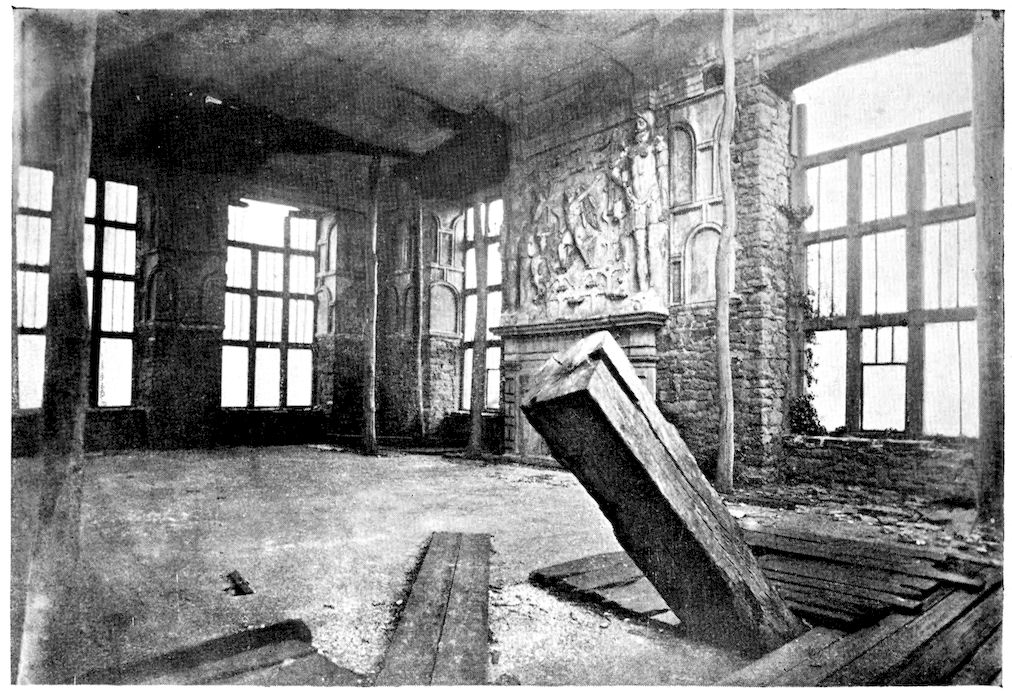
Photo by Richard Keene, Ltd., Derby
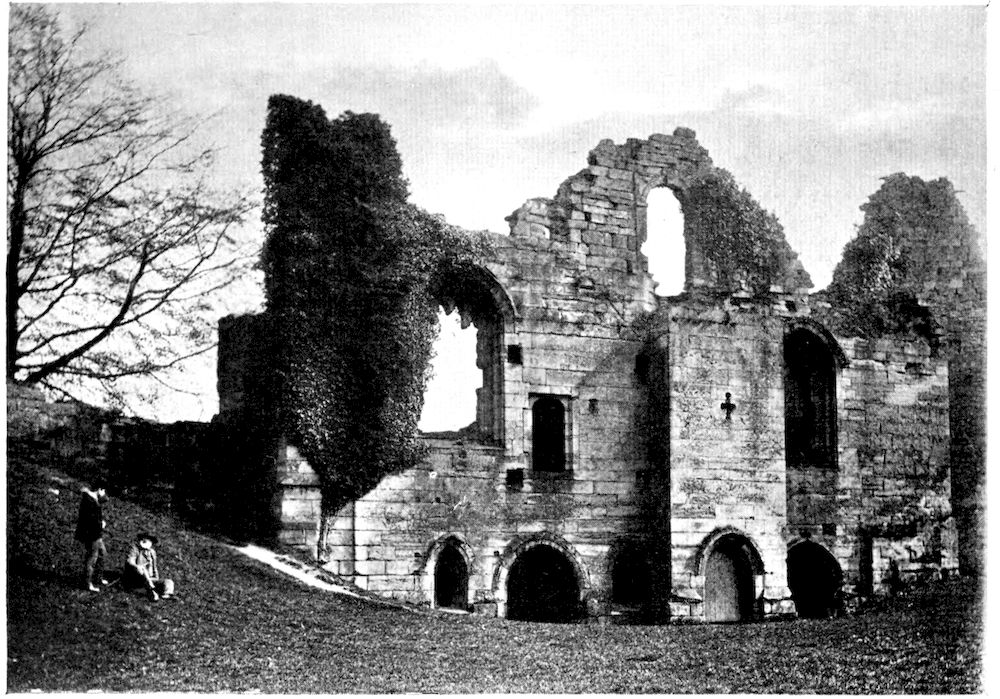
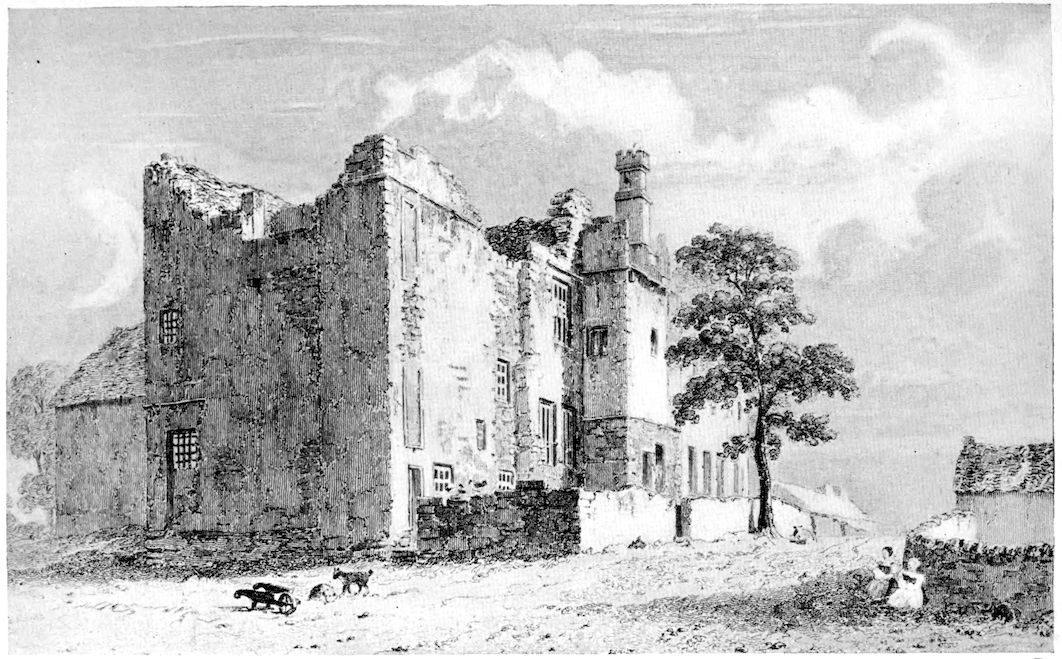
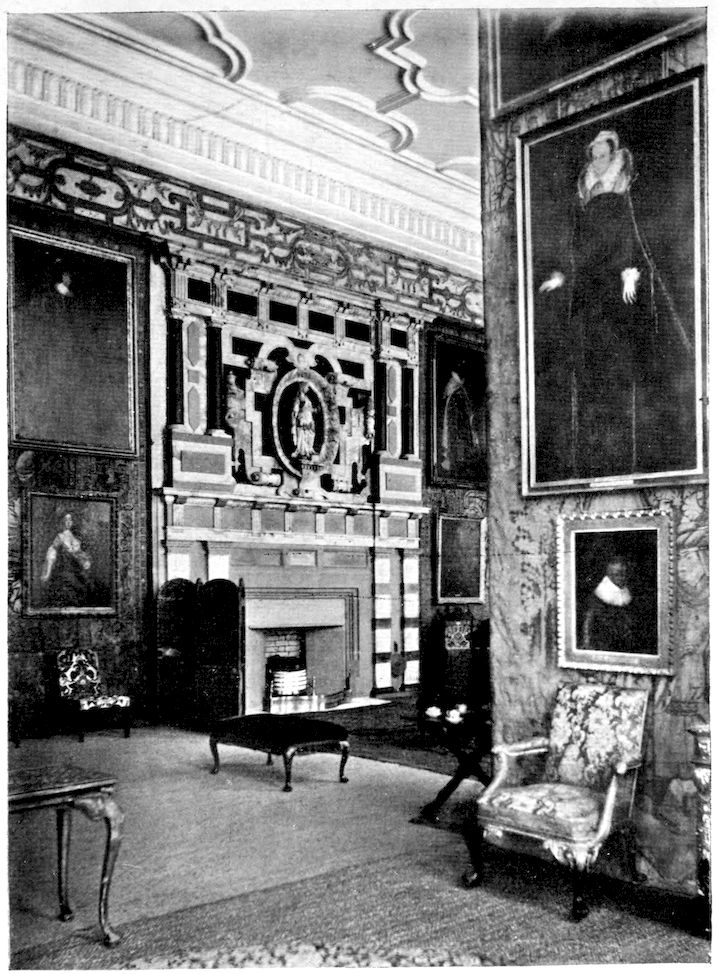
HARDWICK OLD HALL: THE GIANTS CHAMBER
(So called from the two colossal figures, dubbed Gog and Magog, in raised plaster-work over the fireplace)
7Gradually her great hobby asserted itself—the desire
to build—and this constructive energy, as her story
will show, went hand in hand with her master passion,
the love of power and possession, to the end of her
days. The mansion of the Leeches did not please her.
It must be rebuilt for the glory of the Cavendishes.
Her knight yielded to the wish. They set about the
work quickly, living meanwhile, one supposes, in the
original mansion. Hardwick Hall, it will be remembered,
was not yet hers. John Hardwick, her father,
had passed away in the nineteenth year of Henry VIII.
That reign was at an end, and the reign of Edward VI
8drawing to its close. Hardwick House eventually
became the portion of the red-haired daughter, some
say through the will of her brother, who apparently
died without heir. But for the moment the Cavendishes
needed a fine house for domesticity on a large scale and
old Chatsworth did not suffice them. Elizabeth Cavendish
had plenty to do in founding her family. These
were great and busy times for the great lady. Shoulder
to shoulder husband and wife worked at their building,
at their estate, at the management of their tenants,
their parks and palings, their farms and holdings. The
red-haired girl was in her element as matron and comptroller
and lady bountiful. Fortune smiled on her
enterprise, and when the crown of Edward VI descended
to Mary of England, Sir William Cavendish still held
securely his valuable post in the Exchequer.
It is a fine English picture as one looks upon it, this
married life of the Cavendishes—knight and lady
amongst their babies, enlarging their county circle,
increasing their county honours, holding intercourse
with Court and capital, with market and county town.
Here is a letter on domestic matters from Sir William
to his lady showing his trust in her management of
their joint affairs:—
“To Bess Cavendish,
“My Wife.
“Good Bess, having forgotten to write in my letters
that you should pay Otewelle Alayne eight pounds
for certain oats that we have bought of him over and
above twelve that I have paid to him in hand, I heartily
pray you for that he is desirous to receive the rest at
London to pay him upon the sight hereof. You know
9my store and therefore I have appointed him to have
it at your hands. And thus fare you well. From
Chatsworth the XIIIth of April.
W. C.”
And here is a characteristic letter from his good lady
during her absence from home in 1552 to her man of
affairs, in which she soundly takes him to task for
discourtesy to her “sister Jane,” orders beer to be
brewed against her own return, and issues commands
for building and repairs:—
“Francis, I have spoken with your master for the
deals or boards that you wrote to me of; and he
is content that you shall take some for your necessity
by the appointment of Neusante, so that you take such
as will do him no service about his building at Chatsworth.
I pray you look well to all things at Chatsworth
till my aunt’s coming home, which I hope shall be
shortly, and in the meantime cause Broushawe to look
to the smithy and all other things at Penteridge. Let
the weaver make beer for me forthwith, for my own
drinking and your master’s; and see that I have good
store of it, for if I lack either good beer or good charcoal
or wood I will blame nobody so much as I will do
you. Cause the floor in my bedchamber to be made
even, either with plaster, clay, or lime: and all the
windows where the glass is broken to be mended: and
all the chambers to be made as close and warm as you
can. I hear that my sister Jane cannot have things that
is needful for her to have amongst you: If it be true,
you lack a great of honesty as well as discretion to deny
her anything that she hath a mind to, being in my
house; and then assure yourself I cannot like it to
have my sister so used. Like as I would not have any
10superfluity or waste of anything, so likewise would
I have her to have that which is needful and necessary.
At my coming home I shall know more, and then I
will think as I shall have cause. I would have you
give to my midwife from me, and from my boy Willie
and to my nurse from me and my boy, as hereafter
followeth: first to the midwife from me ten shillings,
and from Willie five shillings: to the nurse from me
five shillings, and from my boy three shillings and four
pence: so that in the whole you must give to them
twenty-three shillings and four pence. Make my
sister privy to it, and then pay it to them forthwith. If
you have no other money, take so much of the rent at
Penteridge. Tell my sister Jane that I will give my
daughter something at my coming home: and praying
you not to fail to see all things done accordingly, I bid
you farewell. From London the 14th of November.
“Your Mistress,
“Elizabeth Cavendish.
“Tell James Crompe that I have received the five
pounds and nine shillings that he sent me by Hugh
Alsope.
“to my servant Francis Whitfield,
give this at Chatsworth.”
CHAPTER II THE MISTRESS BUILDER
11
Upon this scene of household importance and
intimate family life, making, if not for happiness
in the fullest sense of the word, at any rate for prosperity
and success, fell for a second time upon the
married life of Bess Hardwick the great shadow. Sir
William Cavendish, so accomplished in business, so
doughty a husband, so excellent a host, died in 1557.
His wife made a note of the event in her own hand:—
“Memorandum, that Sir William Cavendish, Knight,
my most dear and well beloved husband, departed this
present life on Monday, being the 25th day of October,
betwixt the hours of 8 and 9 of the same day at
Night, in the year of our Lord God 1557, the dominical
Letter then C. On whose soul I most humbly beseech
the Lord to have mercy, and to rid me and
his poor children out of our great misery.
“Elizabeth Cavendish.”
This was probably the greatest grief of her life, and
all her after energies were spent in furthering the
welfare of her Cavendish children.
Now followed a period of widowhood, during which
no substantial or interesting episodes bring the lady’s
name to the front. But she did not lose her hold over
society and the Court. Nor did she lay aside her wise,
12worldly habits. She was still the grand dame—dispenser
of charities, recipient of Court letters, mistress
of masons and woodmen and grooms, resting securely
upon her hoard like the dragon in German legend,
assuring herself and the world, “I lie and possess, and
would slumber.” But hers was not the nature to be
quiescent very long. And she had incentive enough
to action. She had six children to further in the
world. Daughters must be married, sons must be
brought into the charmed circle of the Queen, to run
the gauntlet of suspicions, favours, and coldnesses from
her and bear the jealousy and competition of others
till the right opportunity came for advancement. Moreover,
there was Chatsworth to complete—alone. At
thirty-seven, gifted with excellent good looks, an indomitable
will, and a constitution robust and healthy,
it was not the moment for such a woman to permit
either her schemes or her zest in life to collapse. So
she keeps to her road, moving no doubt daily between
the old Chatsworth and the new, the beloved fabric
which for her was at once the mausoleum of her greatest
happiness, the eloquent witness of her aspirations
for her children, and a lasting memorial of her Cavendish
ambitions. So one beholds her working onward,
building for the future, impatient no doubt of the
present. Fully accustomed now to take command of
her life and affairs, she controls every item of the
building of her new house. One can picture her easily
enough walking or driving to and fro, while she issues
commands for the felling of wood, signs orders for the
selling of coals and stone, for the transplantation of
trees, the manufacture of hangings, the transport of
Derbyshire marbles, the employment of artificers in
13mosaic, and plaster and wood. She had built six
Cavendishes, bone of her bone, flesh of her flesh, and
now she was building a great and perfect house for
them and theirs. In it she would reign, so long as
she lived, supreme. One pictures her again and again—a
vigorous, vital woman, in proper and dignified
weeds, with shrewd and genial face in which the lines
of intrigue and sorrow had not yet deepened, moving
amongst her army of workmen, fully conscious of the
country life about her, though possibly not playing for
a while a very active part in it. But the old zest of
living, the old desire of the world, the joys of which
she had tasted only at brief intervals during the babyhood
of her six children, were ineradicable. She had
acres and gold, she needed a helpmeet more than many
women. No country gentleman of sufficient importance
presented himself for whom she would think it
worth while to give up the pretty delight of being
addressed as “my lady.” In this dilemma Fate brought
her face to face with Sir William St. Lo.
He was of excellent birth, and, like her second
husband, a widower. His family was, of course, originally
Norman. State papers show that a Margaret de
St. Low or Laudo parted with certain rights in Cornish
property in the reign of Henry III. By the seventeenth
century the family seems to have concentrated in
Gloucestershire, where it held the manor of Tormarton,
twenty-two miles south of the county town.
“Livery” of this manor, we read, was granted to
William St. Loe by Elizabeth.
William and his brother John had fought bravely in
Ireland against Desmond. In 1536 the former—the
family name is spelt variously as Seyntlow, Seyntloe,
14and Santclo—is mentioned in despatches. There is a
vivid glimpse in various letters of an attack on the
castle of “Carreke Ogunell.”[3] Says Lord Leonard
Grey, writing to Henry VIII in England, “It was taken
by assault by William Seyntloe and his men before
scaling ladders could arrive.” But the writer is not
quite sure if the success was due to “hope of fame or
lack of victuals, for a halfpenny loaf was worth 12d., but
there was none to be sold.” The castle has marble walls
thirteen feet thick. It is the strongest Lord Leonard
has ever seen. An Englishman could take it at a rush,
in spite of the fact that besides being set in a fine moat,
“in an island of fresh water,” the place was guarded
with watch towers of hewn marble. But Lord Leonard
does not think that any Irishman could have built it!
Later there is mutiny and rumour of sore disruption
in the English-Irish army. Young Captain St. Loe’s
men forgather with discontented spirits, and the whole
of his stalwart retinue of three hundred, “men of high
courage and activity,” revolts so badly that, though he
and his captains are cleared of all blame, it is necessary
to “bend the ordnance” on the mutineers and proceed
against them in “battle array.” Little wonder that the
men, henchmen and yeomen, doubtless, of Gloucestershire,
hated the campaign. Even Lord Leonard himself
shared the destitution of the privates and was pinched
for the lack of a loaf. “And so,” he goes on after his
comment on the price of bread, “I among others lay in
my harness, without any bed, almost famished with
hunger, wet, and cold.”
Fortune and personality carried William St. Loe onward.
In the forties of the sixteenth century he appears
15as seneschal of Waterford, and complains bitterly of the
way in which he is hampered in office by the Lord
Chancellor in Ireland. The contention of his official
companions, however, as given in a letter to the Court,
describes him as “a good warrior, but unfit to administer
justice.” Military disorder is stated to be the result,
and if the complainants only “had the disposal of the
farms Seyntlow now has” things would be very different.
It is suggested that he is turning into a regular freebooter....
And so on.
However this may be, we find the gentleman in 1557
not only safely established in England, but holding important
Court posts with high-sounding titles. He is
at once Grand Butler of England and captain of the
Queen’s Guard. In these capacities Bess Hardwick, as
Lady Cavendish, must have already met him. Had she
not married him and had he lived long enough, she
might have been committed to his tender mercies and
guardianship in a very different sense. But at present
her genius for intrigue only threw her into the apparently
pleasant fetters of marriage. This “Grand
Botelier,” this dashing swashbuckler who now rode at
the head of the royal guards, and was in constant touch
with the governor of the Tower, with the interior of
which building she made acquaintance later, took her as
his second wife. The whole thing seems to have been
most amicable, affectionate, and excellent—amicable and
affectionate on his part, excellent from her point of view.
It did not interfere with his important duties; it did
not necessarily nail her to the Court. Above all, it did
not interfere with her building. Indeed, it gave her the
more heart to it because the good captain would now
assume by her side the duties of Derbyshire host.
16Moreover, he could help her materially in her building.
She did not need his advice about architecture of course.
But she saw that she could draw under her hand the
dues of his manor in Gloucestershire for the glory of
the Cavendishes and the surer foundation of her own
comfort. The fine dashing soldier had children. Yet
this was no serious block in her way. She might
arrange it all, while leaving them not destitute but
dependent on her wise financial dispositions. The marriage
was duly solemnised and gave satisfaction. The
Queen approved of my Lady St. Loe, and the more so
because the latter did not wish to monopolise her bridegroom.
There was enough at the Derbyshire estate to
amuse her, and Sir William’s letters to her kept her
advised of things “about” the Queen’s Majesty. Scottish
affairs were brewing hotly. Elizabeth was but
newly a queen. There were processions and enactments,
enquiries, and excursions at Court. Bess Hardwick
held the post of Lady of the Bedchamber, and
naturally took the keenest interest in all that went on.
Except through letters, reliable news did not filter at
all to the wilds of the Peak and its lovely dales. But
Sir William loved her and appreciated her deeply. In
his affectionate letters he identifies her quaintly and
sweetly with her house. “My honest, sweet Chatsworth”
is one of the expressions. Elsewhere she is
“My own, more dearer to me than I am to myself,”
and in another letter he has seized her enthusiasm for
management and construction, for he calls her “My own
good servant and chief overseer.”
Occasionally Bess wanted her “grand botelier” to
herself, and it must have been hard for Sir William to
tear himself away from the rich security and ease of
the house. One of his letters from Court shows that he
is in trouble with his Queen for delayed return.
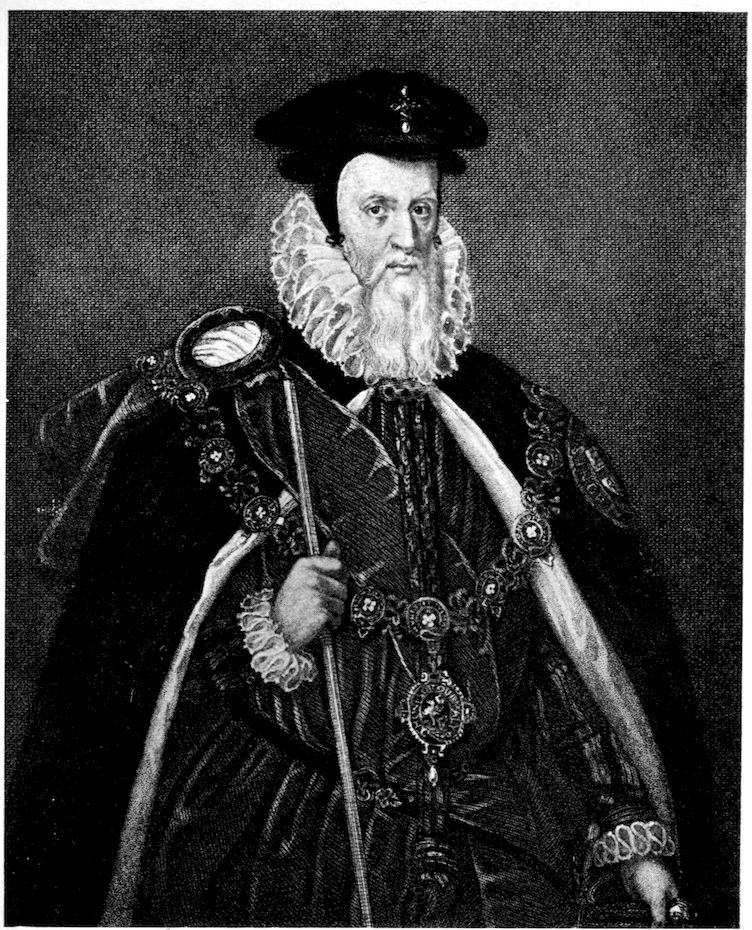
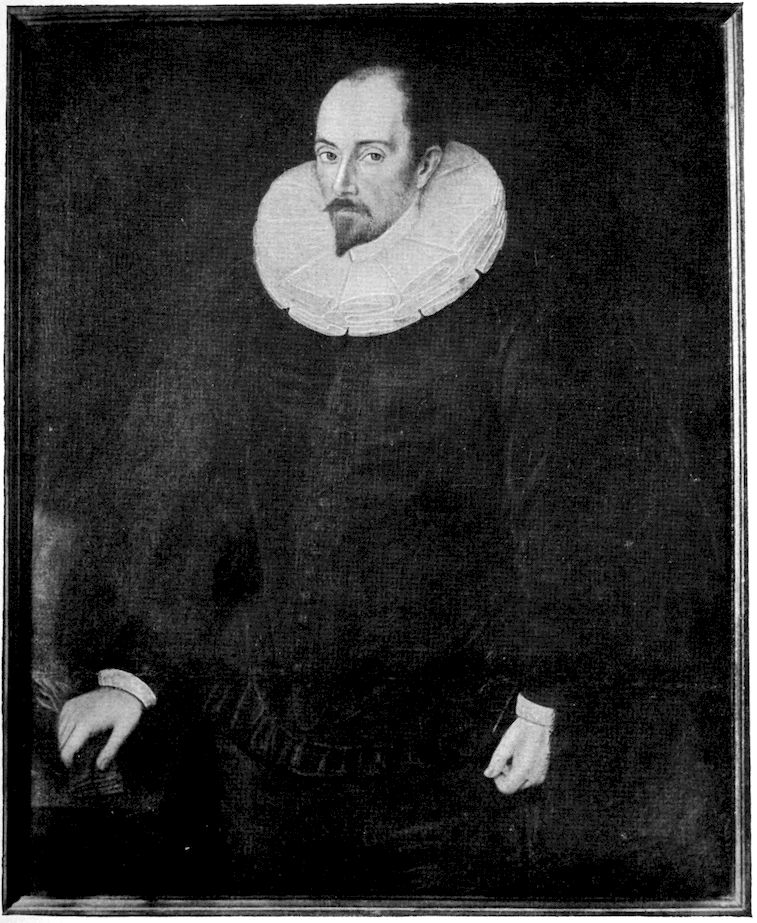
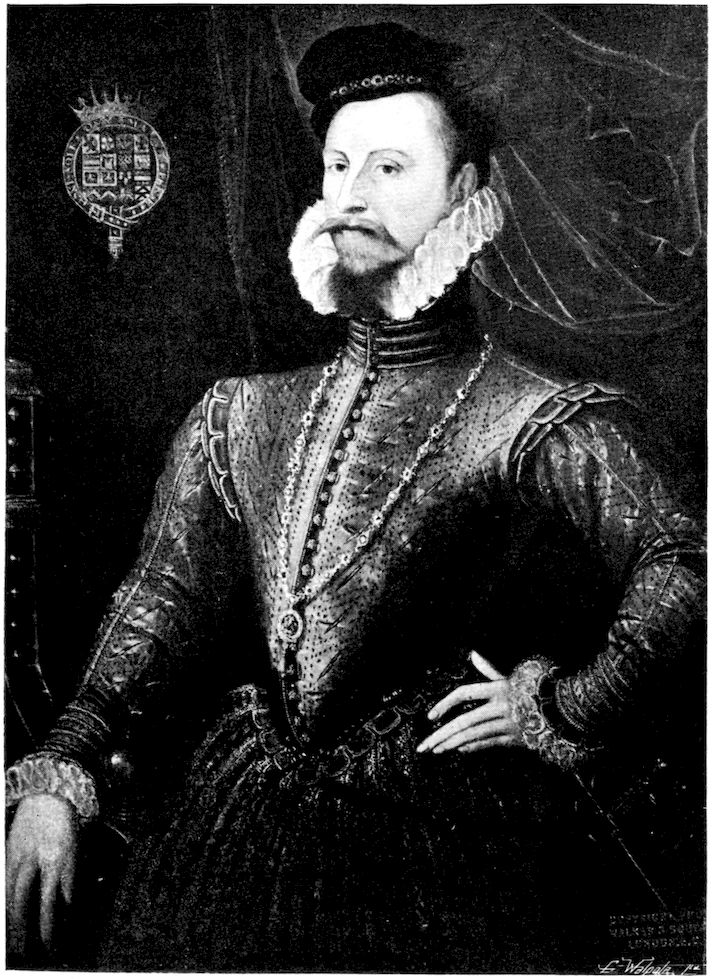
Photo by Richard Keene, Ltd., Derby, from the picture at Hardwick Hall By permission of his Grace the Duke of Devonshire
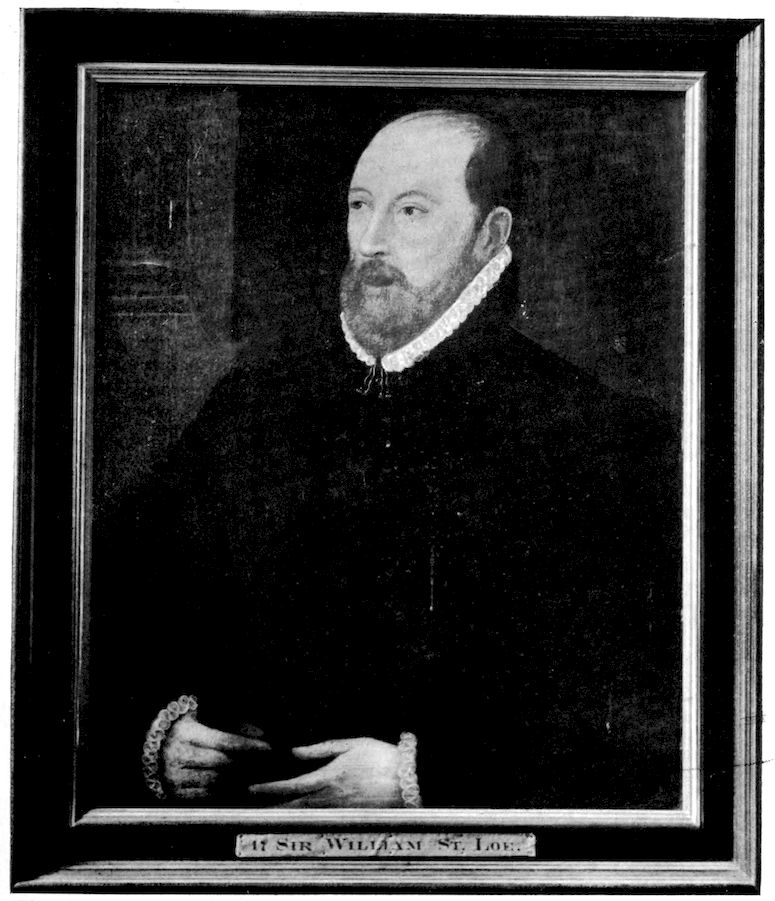
SIR WILLIAM ST. LOE
17“She hath found great fault with my long absence,
saying she would talk with me farther and that she would
well chide me. Whereunto I answered, that when her
highness understood the truth and the cause she would
not be offended. Whereunto she says, ‘Very well, very
well’; howbeit, hand of hers I did not kisse.”
A portrait which hangs in the great gallery at Hardwick
shows the writer of the following letters (quoted in
Hunter’s Hallamshire) in his habit as he lived—a kindly
fellow, but at this period not a man of power.
Sir William Saint-Loe to Lady Saint-Loe.
“My own, more dearer to me than I am to myself,
thou shalt understand that it is no small fear nor grief
unto me of thy well doing that I should presently see
what I do, not only for that my continual nightly dreams
beside my absence hath troubled me, but also chiefly for
that Hugh Alsope cannot satisfy me in what estate thou
nor thine is, whom I regard more than I do William
Seyntlo. Therefore I pray thee, as thou dost love me,
let me shortly hear from thee, for the quieting of my
unquieted mind, how thine own sweet self with all thine
doeth; trusting shortly to be amongst you. All thy
friends here saluteth thee. Harry Skipwith desired me
to make thee and no other privy that he is sure of mistress
Nell, with whom he is by this time. He hath sent
ten thousand thanks unto thyself for the same: she hath
opened all things unto him. To-morrow Sir Richard
Sackville and I ride to London together; on Saturday
next we return hither again. The queen yesterday, her
18own self riding upon the way, craved my horse; unto
whom I gave him, receiving openly for the same many
goodly words. Thus wishing myself with thyself, I bid
thee, my own good servant and chief overseer of my
works, most heartily farewell: by thine who is wholly
and only thine, yea and for all thine while life lasteth.
From Windsor the fourth of September by thy right
worshipful master and most honest husband master Sir
“William Seyntlo, esquire.
“Commend me to my mother and to all my brothers
and sisters, not forgetting Frank with the rest of my
children and thine. The Amnar[4] saluteth thee and
sayeth no gentleman’s children in England shall be
better welcome nor better looked unto than our boys.
Once again, farewell good honest sweet.
“Myself or Greyves shall be the next messenger.
“To my own dear wife at
Chatsworth deliver this.”
Sir William Saint-Loe to Lady Saint-Loe.
“My hap is evil, my time worse spent; for that
my reward as yet is nothing more than fair words with
the like promises. Take all in good part; and if I
should understand the contrary, it would trouble me
more than my pen shall express. I have leave to come
and wait upon thee, I and my brother Clement, with two
or three good fellows more: [we] had been with thee by
this day if it had not been for our —— matter, the which
I will not leave over rawly. I will forbear the answering
of all particularities in thy last letter written unto me,
for that God willing I will this next week be the
19messenger myself. Master Man came home the night
before the date hereof. He putteth me in great hope of
the matter you know of. Thus trusting that God provideth
for us all things for the best, I end; committing
thee and all thine which are mine unto his blessed will
and ordinance. Farewell, my own sweet Bess. From
Master Man’s house in Redcross Street, the 12th of
October, by him who dareth not so near his coming
home to term thee as thou art: yet thine
“William Seyntlo.
“My cousin Clarke saluteth thee, who was by me at
the writing hereof.
“To my own good wife at
Chatsworth deliver this.
In this letter he complains of the heavy charge for his
hired Court apparel.
Sir William Saint-Loe to Lady Saint-Loe.
“My honest sweet Chatsworth: I like the weekly
price of my hired court stuff so evil that upon Thursday
next I will send it home again, at which day the week
endeth. I pray you cause such stuff as Mowsall left
packed in a sheet to be brought hither by the next carrier:
there be hand towels and other things therein that
I must occupy when I shall lie at Whitehall. My men
hath neither shirt nor any other thing to shift them
until that come. Trust none of your men to ride any
[of] your housed horses, but only James Cromp or
William Marchington; but neither of them without
good cause serve speedily to be done. For nags there
be enough about the house to serve other purposes.
One handful of oats to every one of the geldings at a
20watering will be sufficient so they be not laboured. You
must cause some[one] to oversee the horsekeeper for
that he is very well learned in loitering.
“The Queen hath found great fault with my long
absence saying that she would talk with me farther, and
that she would well chide me. Whereunto I answered
that when her highness understood the truth and the
cause she would not be offended. Whereunto she said
‘Very well, very well.’ Howbeit hand of hers I did
not kisse.
“The Lord Keeper hath promised me faithfully to be
at both days’ hearing; and that if either law or conscience
be on my side I shall have it to my contentment.
Vaughan is come unto town, but not yet Bagott. Stevens
and we shall go through on Friday night next, at which
time his brother will be here, who hath disbursed seven
hundred of the twelve hundred pounds. I have an
extreme pain in my teeth since Sunday dinner. Thus
with aching teeth I end, praying the living [God] to
preserve thee and all thine. Written at London, against
my will where I am if other ways our matters might
well be ended, this 24th of October:
“Your loving husband with aching heart until we meet,
“William Seyntlo.
“If you think good, lease your fishing in Dove unto
Agard. We are the losers of suffering it as we have done.
“To my loving wife at Chatsworth
give this with speed.”
This next letter is from Sir George Pierrepoint in
gratitude of her kindly offices. His family was afterwards
closely connected with that of Bess of Hardwick,
for her eldest daughter married Sir Henry Pierrepoint.
21Sir George Pierrepoint to Lady Saint-Loe.
“Right worshipful and very good Lady: after my
heartiest manner I commend me to your Ladyship:
even so pray you I may be to good Mr. Seyntloe:
most heartily thanking you both for your great pains
taken with me at Holme, accepting everything (though it
were never so rudely handled) in such gentle way as you
did; which doth and will cause me to love you the
better while I live if I were able to do you other
pleasure or service; and the rather because I understand
your Ladyship hath not forgotten my suit to you at your
going away as specially to make Mr. Sackville and Mr.
Attorney my friends in the matter between Mr. Whalley
and me, wherein he doeth me plain wrong (as I take it
is my conscience) only to reap trouble and unquiet me.
But I trust so much in God’s help, and partly by your
Ladyship’s good means, and continuance of your goodness
towards me, that he shall not overthrow me in my
righteous cause. And touching such communication as
was between us as at Holme, if your Ladyship and the
gentlewoman your daughter like or be upon sight as
well as I and my wife like the young gentlewoman, I
will not shrink from it I said or promised; by the grace
of God who preserve your Ladyship and my Master
your husband long together in wealth, health and prosperity
to his pleasure, and your gentle heart’s desire.
From my poor house at Woodhouse the 4th of November
1561, by the rude lusty hands of your good Ladyship’s
assuredly always to command.
“George Pierrepoint.
“To the right worshipful and my
singular good Lady, my Lady
Sentloo at London this be delivered.”
22This other letter is highly typical for the good lady’s
literary style and her attitude towards her employees.
It is to James Crompe, her man of affairs.
“Crompe, I do understand by your letters that
Wortly saith he will depart at our Ladyday next. I
will that you shall have him bound in an obligation to
avoid[5] at the same day, for sure I will trust no more to
his promise. And when he doth tell you that he is any
penny behind for work done to Mr. Cavendish or me,
he doth lie like a false knave: for I am most sure he did
never make anything for me but two vanes to stand
upon the house. I do very well like your sending
sawyers to Pentrege and Medoplecke, for that will
further my works: and so I pray you in any other thing
that will be a help to my building, let it be done. And
for Thomas Mason, if you can hear where he is, I would
very gladly he were at Chatsworth. I will let you know
by my next letter what work Thomas Mason shall begin
at first, when he doth come. And as for the other
mason which Sir James told you of, if he will not apply
his work, you know that he is not the man for me; and
the mason’s work which I have to do is not much, and
Thomas Mason will very well oversee that work. I
perceive Sir James is much misliked for his religion;
but I think his wisdom is such that he will make small
account of that matter. I would have you tell my aunt
Lenecker that I would have the little garden which is by
the new house made a garden this year. I care not
whether she bestow any great cost thereof; but to sow
it with all kinds of herbs and flowers and some pieces of
it with mallows. I have sent you by this carrier three
23bundles of garden seeds all written with William Marchington’s
hand; and by the next you shall know how to
use them in every point.
“From the Court the 8th of March,
“Your mistress,
“E. Seyntlo.”
The “Aunt Lenecker” (more correctly known as
Lynacre) was a Leake and sister of Lady St. Loe’s
mother. She seems to have lived for some years with her
niece, possibly since her first widowhood.
Nothing very exciting happened to the St. Loe couple
in their short married life. When not at Court they paid
visits, were entertained, or entertained their own visitors,
as scraps of correspondence show. They must have had
traffic already with the great family of Talbot—which,
besides Sheffield Castle, owned so many large seats in
Derby and Nottingham—and both of them naturally
held intercourse with “Mr. Secretary Walsingham”
and “Mr. Treasurer Cecil.”
When Sir William St. Loe died—tolerably soon, alas!—Bess
Hardwick had gone far with her building, social
and actual. Her third widowhood found her richer,
bolder, better known at Court, and able to play her
part in an ever-widening circle of the powerful and
prosperous.
Such a lady would naturally make enemies. In 1567
she was slandered by Henry Jackson, an ex-scholar of
Merton College, Oxford, the tutor of her children.
Instantly the matter went to the Council, and the
Council wrote in September to the Archbishop of
Canterbury. “Lady St. Loo, widow, having retained
as schoolmaster Henry Jackson ... is disturbed by
scandalous reports raised against her family by him;
24you are to examine the matter thoroughly and speedily
with the assistance of the Solicitor-General Mr. Oseley
and Mr. Peter Osborne or other Ecclesiastical Commissioners,
that the lady’s good name may be preserved;
if he has unjustly defamed her he is to be severely
punished,” runs the digest of the draft in the State MS.
And immediately upon the conclusion of the examination
the Queen herself intervenes on behalf of
the lady “who has long served with credit in our
Court,” and forthwith she commands the punishment
of the wicked clerk: “extreme punishment, corporal or
otherwise, openly or private, and that speedily.”
Besides the danger of slander there was the trap of
intrigue. Up to the present Bess Hardwick had kept
clear of mischief, but, native curiosity apart, she could
not, as Lady of the Bedchamber, help being often the
recipient of the secrets of her friends. The romantic
love story of Lady Catherine Grey, who held a similar
Court post to herself, brought her into a tight place.
For the benefit of those who do not recall the tale it
shall be set forth again here.
The Lady Catherine was the sister of Lady Jane
Grey. By a curious combination of circumstances—the
exclusion given by the will of Henry VIII to the posterity
of Margaret of Scotland, the publication of the
will of Edward VI, and the non-repeal of certain Acts
of Parliament—it was judged that the right to the
crown rested with the House of Suffolk. To this great
house Lady Catherine was the heir. She was formally
contracted in extreme youth to Lord Herbert, the son
of the Earl of Pembroke. But the wise Earl, in dread
of the acute complications which such a marriage might
entail, arranged for a divorce. This probably affected
25the lady but little. She was young, she was attractive
and romantic, she could meet cavaliers enough and to
spare in the immediate circle of the Queen. But, as
all the world knows, her Majesty, while she kept
a dozen men languishing about her, was very loth to
have any of her ladies wed. Love affairs must be
very secret, lest the parties incurred her disfavour and
the loss of benefits. As for Lady Catherine, her birth,
as has been shown, rendered her a mark for all manner
of suspicion. At Court she was the close companion
of Lady Jane Seymour, daughter of the Duke of Somerset.
This Lady Jane had a brother, no less than the
Earl of Hertford. What more inevitable than a love affair
between him and Catherine? There were sorrows enough
in the background of her history, slavery enough—despite
pageant and hunting and the comings and goings
of great persons from foreign courts—to endure at the
hands of the energetic, alert, excitable, witty, jealous
royal mistress. Little by little the love story wove itself
in the manner of every love tale. A community of interest,
a series of assemblies which passed in array
her Majesty’s ladies before the eyes of her gentlemen,
little incidents which brought out the personalities of
the two, mere propinquity, a look here and a word there,
did their work. The two were soon secretly plighted,
with the Lady Jane to share and shield their dear secret.
Many anxious moments must have gone to their
councils. To declare their troth would only be a signal
for their instant separation. The same result would
arise if they humbly asked the royal permission to be
betrothed. To marry and fly would only savour of
deep State conspiracy. To marry and bide quietly and
then face the astonished and scandalous world with an
26air of “Indeed, and it is true. So part us you shall
not. And, moreover, ’tis our affair. Wherefore, fling
your mud elsewhere!” seemed the wisest way in the
end, and also followed the line of least resistance.
One morning—surely as crisp and heartening a day
as could be desired for such a purpose—the Queen’s
Majesty went to Eltham in Kent to hunt. My Lady
Jane and my Lady Catherine stayed behind. When all
was quiet they left the Palace (Westminster) “by the
stairs at the orchard” and strolled quietly “along the
sands.” Those sands led to the Earl of Hertford’s
house in “Chanon Row.” He was waiting for his
lady; he did not even leave her to call the priest.
That was the Lady Jane’s errand. There is something
very delightful about this incident, and the steady
chaperon’s part undertaken by the Earl’s sister. The
priest came, the wedding took place. After the brief
ceremony there could not be much dalliance or entertainment.
It was not yet the time to give the
secret to the world. The ladies must reach the Palace
again before hue and cry could be raised. They did
not go back by “the sands,” probably because the tide
had risen. They went back by boat. The Earl did not
accompany them. But he led his bride and his sister to
the boat which waited for them at the foot of the water-stairs
of his house. He assisted them in—it must have
been very hard to let go the hand of the woman so
newly pledged to him—and the shallop went quietly on
its way and delivered its fair passengers at the Palace
stairs without exciting comment. A little later the two
ladies were demurely seated at dinner “in Master
Comptroller’s chamber.” Probably neither of them
played that evening much of a table part.
27The bride was left to bear the onus of the affair.
After a few stolen meetings the Earl went to France.
And presently the world began to point and stare. The
report grew, but no one seemed able to credit it. At
the close of August, 1561, the Earl’s mother wrote to
Cecil mentioning the rumour, denying all knowledge of
it, and hoped that the wilfulness of her unruly child,
Hertford, would not diminish the Queen’s favour. On
the same date Sir Edward Warner, Lieutenant of the
Tower, wrote to the Queen stating that he had questioned
Lady Catherine as to her “love practices,” but
she would confess nothing. It is said that Lady St. Loe
burst into tears when Lady Catherine made confession
to her. Probably the older woman knew what was in
store for them both. The royal warrant to Sir Edward
Warner not only required him to “examine the
Lady Catherine very straightly how many hath been
privy to love between her and the Lord of Hertford
from the beginning,” but continues: “Ye shall also
send to Alderman Lodge, secretly, for St. Low and shall
put her in awe of divers matters confessed by the Lady
Catherine; and so also deal with her that she may confess
to you all her knowledge in the same matters. It
is certain that there hath been great practices and purposes;
and since the death of the Lady Jane[6] she hath
been most privy. And as ye shall see occasion, so ye
may keep St. Low two or three nights, more or less,
and let her be returned to Lodge’s or kept still with
you, as ye shall think meet.”
After poor Lady Catherine took Lady Loe into her
confidence, she made frantic application for help to
Lord Robert Dudley—not yet Earl of Leicester—so
28high in the Queen’s good graces. In this there is sheer
drama as well as pathos—this confession and piteous
appeal from the young and comely lady of quality,
whose only fault was that she had married for love,
to the handsome, pampered, arrogant cavalier, the
Queen’s darling. Lady Hertford went to his very
chamber in Court to implore him to stand between her
parlous state as prospective mother and the Queen’s
anger. Yet nothing in such contingencies could divert
Elizabeth’s fury, or make her act in a humane
fashion. Lord Hertford was summoned to England to
undergo trial with his wife, and very soon both were
committed separately to the Tower. But before this
could be done the farce of a public enquiry had to
be played. A commission was ordained, pompously
headed by no less a person than Archbishop Parker.
The accused were requested to produce, within a given
time, witnesses of their marriage. That they failed to
do this is extraordinary. The priest seems to have
disappeared, and Lady Jane Seymour appeared unable
to find him or to assist in furnishing the required evidence.
But as this couple could not satisfy the Commission
in time they were sentenced to be imprisoned
during the Queen’s pleasure. “Displeasure” would be
the correct word. For Elizabeth knew little but vanity
and vexation of spirit at this period. The very word
marriage must have been a red rag to her. With the
strong vitality and virility of her father warring within
her against the heritage of the feminine instincts of her
mother, Anne Boleyn, with countless suitors and innumerable
flatterers to encourage and keep at bay
alternately, with one eye fixed on Mary of Scotland and
another on the “devildoms of Spain,” her life just now
29was a constant turmoil. Her whole entourage was
forced to share in it. She would not decide upon a
consort to help her; she belittled the estate of marriage
one day and dallied with it the next. No wonder that
poor Mr. Treasurer Cecil wrote as he did on the eve of
the New Year of 1564. Schemes matrimonial whirled
round him like the winter snow. Elizabeth was being
wooed by a French monarch and an Austrian Emperor
at the same moment; the Lennox family and Mary of
Scotland were working to achieve the marriage of the
latter with Darnley, and the Lady Mary Grey, fired no
doubt by her sister’s intrigue and sick of loneliness,
had actually surreptitiously married John Keys, the
Serjeant Porter to the Queen. Meanwhile the Earl
and Countess of Hertford were in the Tower. In
addition, the Queen was putting up her beloved
Dudley, now Earl of Leicester, to oppose Darnley as a
possible consort for Scottish Mary. Shrewd old Cecil
shows, however, that she is only half-hearted about it:
“I see the qn Mty very desyroos to have my L. of
Lecester placed in this high degree to be the Scottish
Queen’s husband, but whan it commeth to the conditions
which are demanded I see her then remiss of her
earnestness.”[7]
He concludes wearily enough:—
“This also I see in the Qn Maty, a sufficient contentation
to be moved to marry abrood, and if it is so may [it]
plese Almighty God, to leade by the hand some mete
person to come and lay hand on her to her contentation,
I cold than wish my self more helth to endure my yeres
somewhat longar to enjoye such a world here as I trust
30wold follow: otherwise I assure yow, as now thyngs
hang in desperation, I have no comfort to lyve.”
My Lady St. Loe, as confidante, was forced to weather
the storm and endure reprimand. The married lovers,
meanwhile, dragged out their days in durance. Their
son was born in the Tower. In vain they languished,
pined, and implored the intercession of friends. In
1562 the Earl was allowed a little more ease. Husband
and wife managed to meet again. Another child
was born to them, and my Lord was duly fined fifteen
thousand pounds by the Star Chamber, for this event
was construed into a new State offence. In 1563 the
dreaded plague caused Elizabeth to remove her poor
love-birds from the Tower. Lady Catherine went to
the house of her uncle, Sir John Grey, in Essex, and
he was roused to uttermost compassion and distress
by her wretched mental and physical condition. It
was in mid-Lent that he wrote to Cecil emphatically
and ironically:—
“It is a great while me thinkethe, Cousin Cecile,
since I sent unto you, in my neices behalf, albeit I
knowe, (opportunitie so servinge) you are not unmindful
of her miserable and compfortlesse estate. For who
wantinge the Princes favor, maye compt himselfe to
live in any Realme? And because this time of all others
hathe ben compted a time of mercie and forgevenes I
cannot but recommende her woefull liffe unto you. In
faithe I wolde I were the Queen’s confessor this Lent,
that I might joine her in penaunce to forgive and forget;
or otherwise able to steppe into the pulpett to tell her
Highness, that God will not forgive her, unleast she
frelye forgeve all the worlde.”
31This letter is worth quoting because it shows the
prevailing attitude of the Elizabethan courtier. No one
who lacked the favour of the sovereign could be accounted
as one living. Lady Catherine, once under
that heavy cloud of disfavour, never emerged, but died
broken and miserable within six years of her unhappy
marriage. Wherefore Lady St. Loe had chance enough
to learn her lesson, and was fortunate in that her share
of the affair was visited only by a cross-examination
and warning. She was not at all the sort of woman to
brook being left out in the cold. She was too wise, of
course, ever to have engulfed herself in a marriage
of this sort, but in such a case, had she not managed to
divert Elizabeth’s anger by some master stroke of wit
and diplomacy, she would certainly not have languished
of “woofull griefe” nor starved herself to death, like
Lady Catherine, for sorrow.
At such a time and in face of the fresh hubbub
caused at Court by the marriage of Lady Mary Grey
(“an unhappy chance and monstruoos,” comments Cecil,
in a letter to the English Ambassador in France), the
peace and security of Chatsworth offered themselves as
a happy refuge against all complications. There is
a grotesque humour in Cecil’s use of that word monstrous,
for Lady Mary was almost a dwarf, and Keys,
whom Cecil calls “the biggest gentleman in this Court,”
had secured his post of Serjeant Porter owing to his
magnificent size and height. He was twice Lady
Mary’s age, and was a widower with several children.
The Queen clapped him in the Fleet, and condemned
Lady Mary to confinement in the houses of successive
friends. The pair never met after their hasty
wedding.
32Thus, on all sides, Court was a place of “dispeace,”
while in Derbyshire Lady St. Loe had good neighbours,
people of quality and substance, and was safe
within her parks and palings. She did not share
her royal mistress’s distrust of matrimony, for she
was free to choose her next lord, and there was no
reason why she should remain a widow longer than
she could help.
It is not to be suggested for a moment that she had
no suitors and that she was not the subject of all kinds
of matrimonial gossip. One Fowler (subsequently
committed to the Tower in connection with the discovery
of suspicious papers) opines in his “notes” that
“either Lord Darcy or Sir John Thynne are to marry
my Lady St. Loe, and not Harry Cobham.” Doubtless
the Cobham match would have pleased her well, and
she would have been quite in her element in the place
which afforded a seat and a surname to that noble and
splendid family upon whom the evil days of Jacobean
confiscation and the betrayal of Sir Walter Raleigh had
not yet fallen. A sister of Lord Cobham was married
to Mr. Secretary Cecil, “and the match would have
been advantageous, but possibly my Lady, with her
deep insight into character, divined that the gentleman
was not of the steady stuff which makes for worldly
security.” Moreover the best matches are by no means
to be found near the Court, and close at hand, in the
same county, lived one greater than the Cobhams, a
man whom many a maid and every widow would be
proud to espouse. He was a widower, an earl, the
owner of seven seats, bearer of a high government
post, and he came of a long line of distinguished
soldiers. Lady St. Loe went to work wisely. She had
33the assistance of her dear gossip and contemporary,
Lady Cobham. No one could have acted the go-between
more discreetly. Before long the fashionable world
had something to talk about in the announcement of the
fourth marriage of Bess Hardwick.
CHAPTER III “A GREAT GENTLEMAN”
34
The fourth husband of “Building Bess” was no
less a person than George Talbot, sixth Earl of
Shrewsbury. Though the name does not appear in the
great roll of the prominent soldiers at the battle of
Hastings, the first Talbot—then Talebot—of whom
anything noteworthy is recorded, won the first title, a
barony, for his family at the close of the career of
William the First. Thenceforward the Talbots march
magnificently through the history of England—great
gentlemen, castellans, commanders, governors, judges,
lords-lieutenant. They wielded authority in Wales,
fought in France, Scotland, Ireland, Castile, occasionally
fell under suspicion of conspiracy, and emerged
without hurt. Once and once only was their pride
humbled in the dust, when the hitherto invincible tactics
of John Talbot, the greatest general of his day, the
chief glory of all the Talbots before and since, were
overcome by the generalship of the Maid of Orleans.
It must have hit the great general very hard to find
himself in prison on French soil for three long years at
the hands of a woman. Neither force nor strategy
freed him, but mere money. He had married a rich
wife—heiress to all “Hallamshire,”[8] including the castle
35of Sheffield. In 1432 he agreed to pay a large ransom,
and hurried back to England, bursting with purpose
and revenge. Instantly he raised a fresh force, rejoined
the English army in France, and fought with such
terrible and triumphant results that his name, like that
of Bonaparte, figured for generations as a bogy with
which to scare fractious children. It was this tremendous
campaign which won for his race the great
earldom of Shrewsbury.
George, the sixth earl, the great gentleman now dealt
with, inherited all the administrative qualities of his
ancestors, though he was less intimately associated with
war than his father Francis. It was well also that his
duties should have been to a greater extent civil and
defensive than military and aggressive. For he had
stepped into a great inheritance, and his burdens, as
householder and county magnate, were stupendous.
The manors and castles of Worksop, Welbeck, Bolsover,
Sheffield, Tutbury, Wingfield, and Rufford were all his.
He came into his own in 1560. The greatest gift he
received in that year was the Garter which the Queen
bestowed on him. Five years later he was appointed
Lord-Lieutenant of the counties of York, Nottingham,
and Derby. Subsequently the post of High Steward
in the place of the unhappy fifth Duke of Norfolk was
36added to his honours. In the third year of his lieutenancy
the affair with Bess Hardwick was in full swing.
From both sides it was a reasonable and profitable
alliance. He was a widower with sons and daughters
who needed mothering. Her children needed a father.
There was wealth enough to provide for all. Yet
possibly family dissensions might arise amongst the
young folk. But against this risk my lady had devised
a splendid scheme of protection—the intermarriage of
some of the children. They were but children, the
two couples—Gilbert Talbot, the fifteen-year-old second
son of the Lord-Lieutenant and Mary Cavendish, and
the bride’s son Henry Cavendish, to whom Grace Talbot,
the Earl’s daughter, was given as wife.
The aforesaid childish marriages were settled and
carried through forthwith. Shortly afterwards the
wedding of their elders took place with due magnificence,
while the bride, besides her Cavendish and
Barlow properties, brought to her fourth husband the
Gloucestershire estate of St. Loe.
If the Cavendish epoch had been one of security and
happiness, the Shrewsbury epoch promised to be one of
sheer brilliance and delight. It is true there were one
or two dissentient voices. Said a certain John Hall,
under subsequent examination upon his arrest for
Scottish conspiracy, that, though he served as a gentleman
of the Earl’s household for some years, he so misliked
my Lord’s marriage with this wife, as divers
others of his friends did, that he resigned his post.
Yet the Queen and her circle approved. That was the
main thing. The following letter from a kinsman at
Court emphasises the fact:—[9]
37“May it please you to understand that Mr. Wingfield
hath delivered your venison to the Queen’s Majesty
with my lord’s most humble commission, and your
Ladyship with humble thanks from both your honours
for her great goodness.
“[I] assure your Ladyship of my faith, her Majesty
did talk one long hour with Mr. Wingfield of my Lord
and you so carefully, that, as God is my judge, I think
your honours have no friend living that could have
more consideration, nor more show love and great
affection. In the end she asked when my Lady meant
to come to the Court: he answered he knew not: then
said she, ‘I am assured if she might have her own will
she would not be long before she would see me.’ Then
said, ‘I have been glad to see my Lady Saint-Loe, but
now more desirous to see my Lady Shrewsbury.’ ‘I
hope,’ said she, ‘my Lady hath known my good opinion
of her; and thus much I assure you, there is no Lady
in this land that I better love and like.’ Mr. Batleman
can more at large declare unto your honour. And so
with most humble commendations to my very good
Lord, I wish to you both as the Queen’s Majesty doth
desire; and so take my leave in humble wise. From
St. John’s the 21st of October.
“Your honours to command,
“E. Wingfield.”
There was certainly nothing whatever in this marriage
to upset Elizabeth’s plans. Indeed, it really paved the
way for her schemes and made it easier for her to
utilise not only the Earl’s wealth, his authority and
position, but all his country seats in turn for the greater
security of her life and throne.
38My Lady Shrewsbury was forty-eight, my Lord had
been but eight years an Earl. Time had not yet
marked on his face the lines of anxiety and care which
the next twenty-three years were to bring him. He
was at the zenith of his career, and the Queen hinted
mysteriously that ere long she would show him still
more emphatic proofs of her trust and affection in so
splendid a servitor. It is in a very happy and devoted
vein that he writes love letters from Court just after
marriage to his second bride, in which he addresses her
as “sweet none.”[10]
It is regrettable that these letters to his “none” are
not more numerous. Otherwise the Earl’s correspondence
all his life was enormous, and the masses of
letters which mirror contemporary history and his duties
in connection with them are nearly all comprised in
that rich heritage of manuscript known as the Talbot
Papers. Cecil is his constant correspondent. As Lord-Lieutenant
of three such great counties he would
naturally be kept au courant of great happenings. Is
there fear of French invasion? Immediately the Lords
of the Privy Council send him instructions. He is
to organise companies of demi-lances, to find horses
for them—“a good strong and well-set gelding and
a man on his back meet to wear a corselet and shoot
a dagge” runs the specification. Did her Majesty
receive “letters out of Spain”? Copies of the same
were sent to the Earl “to the intent that you may
thereby see what the humour and disposition of those
parties [i.e. the King of Spain and his emissary]
tend unto.” Did France goad Mary of Scotland into
that unforgettable offence—the adoption of the English
royal arms? Then also must his lordship be acquainted
with the fact and its immense possibilities. Presently
active Scottish hostility seemed imminent, and
the letter which travelled to my Lord from Berwick
to bid him have all his men in readiness to move
to the Border is cumbrously and theatrically endorsed
“Haste, haste, haste, haste, post haste with all possible
haste.”
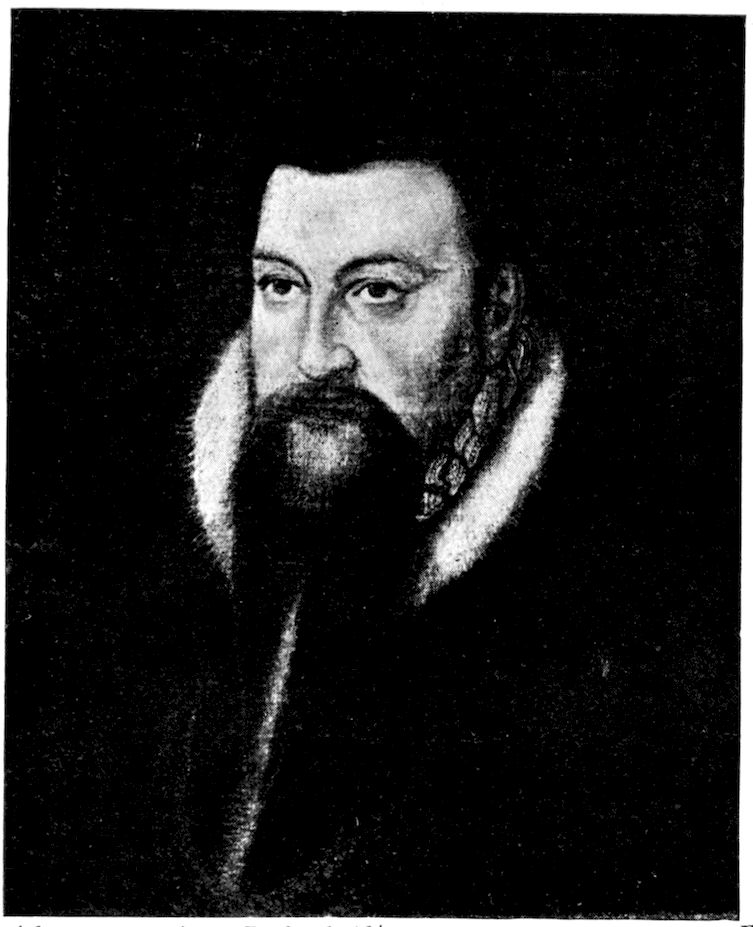
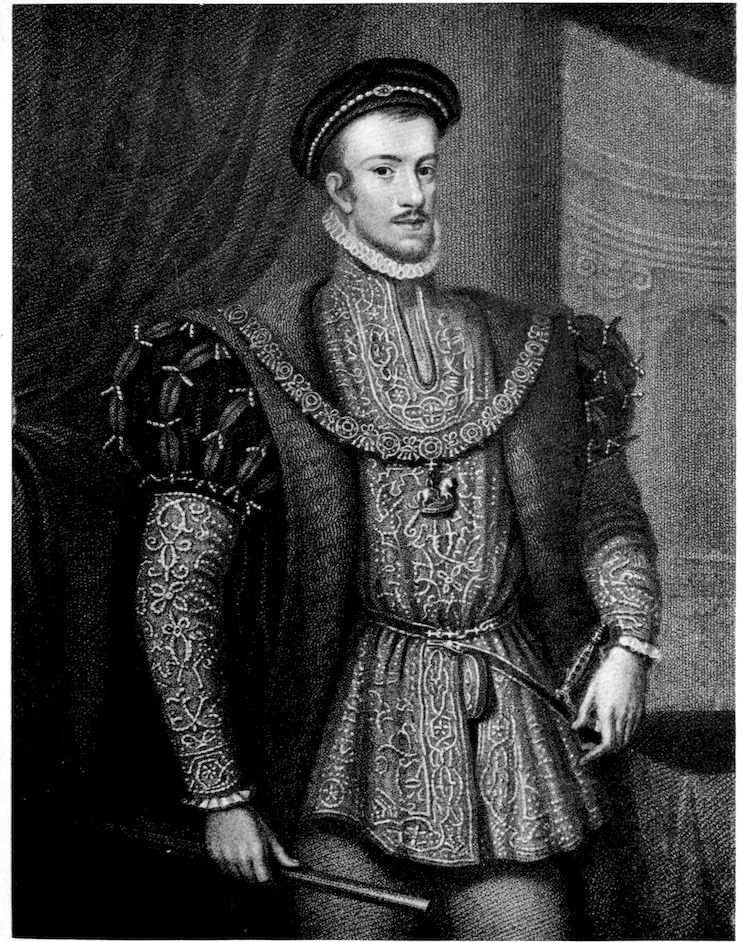
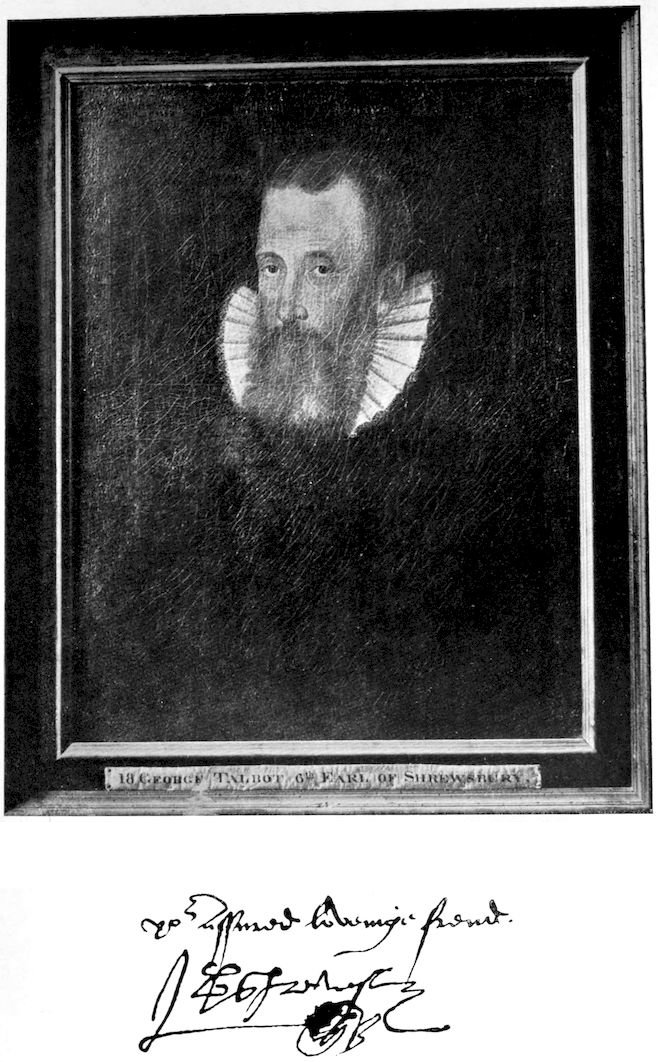
After a portrait at Rufford Abbey
GEORGE TALBOT, EARL OF SHREWSBURY
After a portrait in the possession of the Duke of Portland
39The marriage of Mary and Darnley, the exciting
news of the force raised by the rebellious Earls of
Moray and Arran against their Queen immediately
after the ceremony, the perilous position of Mary betwixt
her enemies—between Moray’s force on one
side, secretly encouraged by Elizabeth, and Elizabeth’s
forces, supplemented by two thousand Irish and the
Earl of Argyle’s company, on the other—the details
of field-pieces and “harquebusses,” all these events
and matters passed in review under the eyes of the
splendid and cautious Earl of Shrewsbury. Scarcely
a day went by but some important paper or letter, official
or private, was put into his hands. At every turn
he was helping to “make history,” while he was a keen
spectator of the Scottish drama up to the point when
Mary fled out of her own country to implore the aid
and protection of her sister sovereign.
It is now that the plot—Elizabeth’s plot which she
had kept up her sleeve—begins to peep out. The first
authentic news of it apparently went to the other
Elizabeth, the newly made Countess of Shrewsbury,
in the following letter from the English Court. The
signature is torn off, but the correspondent has weighty
news to tell, in spite of his deprecatory attitude towards
mere rumours:—
40“My most humble duty remembered unto your
honourable good Ladyship. If it were not for my
bounden duty’s sake I would be loth to write, because
there is so small certainty in occurrences, but (seeing
I am bound to write) it is but small that I see with
my own eyes that is worth writing, and therefore I
am forced to supply by that I do hear; which I write
as I hear by credible report, otherwise I should not
write at all, and therefore if I do err it is pardonable.
The news is here that my Lord your husband is sworn
of the Privy Council; and that the Scottish Queen is
on her journey to Tutbury, something against her will,
and will be under my Lord’s custody there.”
The rest of the letter is perhaps worth quoting,
because it gives a picture of public events and suggests
such a spacious background for the present life of Bess
Hardwick. It deals with the war now beginning
between Spain and the Netherlands, owing to the barbarous
treatment of the latter by the Duke of Alva,
and the commotion occasioned by it in France.
“The report is that the Duke of Alva hath for the
lack of money disarmed the most part of his army;
and they are not paid for that is past; but rob and
steal, and much molest the country. And being divers
garrisons at Maestricht of the Walloons the Duke sent
to discharge them and sent Spaniards in their place,
who have shut the gates of the Spaniards and refuse
to deliver the town before they are paid their due....
In France there is a great stir to let the Prince of
Condé to join with the Prince of Orange, so that the
King divides his force, the Duke of Anjou to stop the
passage of the Prince of Condé, etc., etc.”
41The letter ends with intimate details:—
“And so eftsoons Jesus preserve you and send my
cousin Frances a good hour and your honour a glad
grandmother.
“Scribbled at London ... January, 1568.”
Evidently this “Frances” is the eldest daughter of
the Countess, who married Sir Henry Pierrepoint, and
whose child is awaited.
Matters as regards the Earl of Shrewsbury did not
move so fast as one would expect. It was not till June
of 1568 that the final orders reached the Earl to make
ready his “castle” of Tutbury for the reception of his
romantic royal prisoner. Mary was now at Carlisle,
and the part which the Earl was to play in her entourage
as suggested in contemporary letters has more
the character of that of a prominent cavalier in a
princely retinue than that of a military gaoler. The
description in the French ambassador’s letter reads
well:—
“A castle named Tutbury, which is only one
hundred miles from here”—London—“and is a very
beautiful place as they say, especially for hunting, in
which, whenever it takes place, the Earl of Shrewsbury,
who has a portion of his estate in that neighbourhood,
is ordered to give her his company, along with
other Lords and gentlemen thereabout.”
The Queen was feeling her way, slowly sounding
the Shrewsburys’ relatives, careful always to assert her
appreciation not only of lord, but of lady. My Lord
came to Court, and still her Majesty beat about the
bush.
42The following letters[11] from the Earl belong to this
epoch of the lives of the newly wedded pair:—
“My dear none, being here arrived at Wingfield late
yesternight from Rofford, though very weary in toiling
about, yet thinking you would be desirous to hear
from me, scribbled these few lines to let you understand
that I was in health and wished you anights with
me. I picked out a very good time, for since my
coming from home I never had letters but these this
morning from Gilbert, which I send you. I mind
to-morrow, God willing, to be with you at Chatsworth:
and in the meantime as occurrences [befall] to me you
shall be partaker of them. I thank you, sweet none,
for your baked capon, and chiefest of all for remembering
of me. It will be late to-morrow before my coming
to Chatsworth, seven or eight of the clock at the
soonest: and so farewell, my true one.
“This 28th June.
“Your faithful husband,
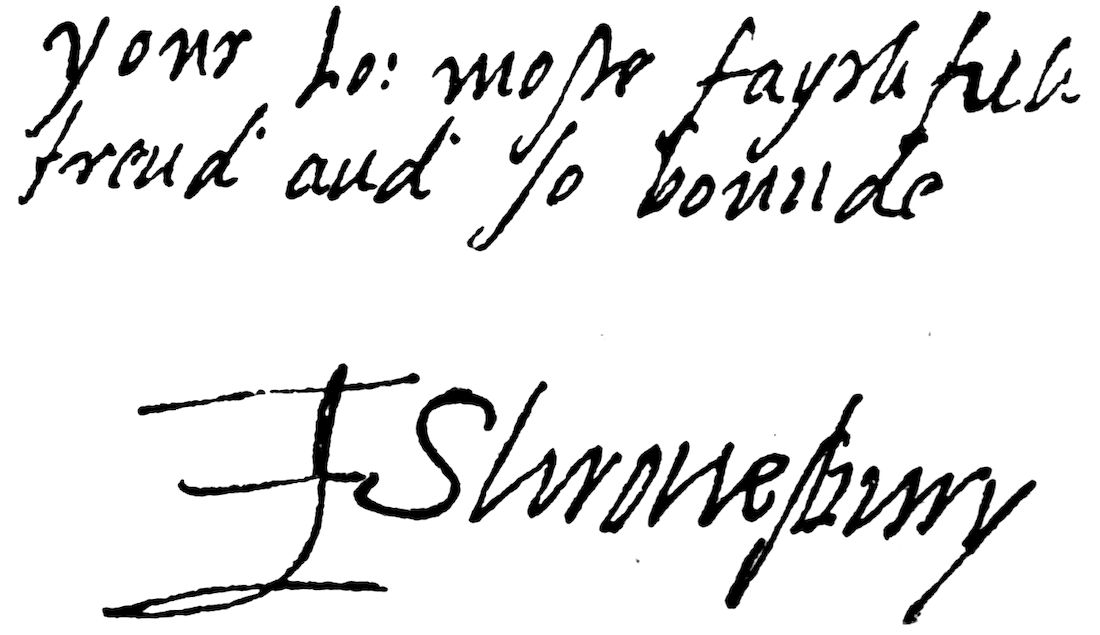
“G. Shrewsbury.”
“My dear none, having received your letter of the
first of December which came in very good time, else
had I sent one of these few remaining with me to have
brought me word of your health, which I doubted of
for that I heard not from you of all this time till now,
which drove me in dumps, but now relieved again
by your writing unto me. I thank you, sweet none, for
your puddings and venison. The puddings have I
bestowed in this wise: [a] dozen to my Lady Cobham,
and as many to my L. Steward and unto my L. of
Leicester: and the rest I have reserved to myself to
43eat in my chamber. The venison is yet at London,
but I have sent for it hither.
“I perceive Ned Talbot hath been sick, and [is] now
past danger. I thank God I have such a none that is
so careful over me and mine. God send me soon home
to possess my greatest joy: if you think it is you, you
are not deceived.
“I will not forget to deal with the Master of the
Rolls for young Knifton. He seems to be much my
friend, and is now in dealing between Denenge and me,
for the lease of Abbot Stake, agreed upon by me and
Tamworth he should so do. He holds it at a thousand
marks: and the Master of the Rolls hath driven it
to five hundred pounds, which methinks too much for
such a lease, yet because it lies so, as I am informed,
amongst Gilbert’s lands, I have made my steward to
offer four hundred pounds, and to get [delay] till the
next term, because I would have your advice therein.
And for that I live in hope to be with you before you
can return answer again, you shall understand that this
present Monday in the morning finding the Queen in
the garden at good leisure, I gave her Majesty thanks
that she had so little regard to the clamorous people
of Bolsover[12] in my absence. She declared unto me
what evil speech was against me, my nearness and state
in housekeeping, and as much as was told her, which
she now believes with as good words as I could wish,
declaring that ere it were long I should well perceive
she did so trust me as she did few. She would not tell
me therein, but [I] doubt [not] it was about the custody
of the Scottish Queen. Here is private speech that Gates
and Vaughan should make suit to have her, but this day
44I perceive it is altered. I think before Sunday these
matters will come to some pass, that we shall know
how long our abode shall be, but howsoever it falls out,
I will not fail but be with you before Christmas, or
else you shall come to me.
“The plague is dispersed far abroad in London, so
that the Queen keeps her Christmas here, and goeth not
to Greenwich as it was meant. My Lady Cobham, your
dear friend, wishes your presence here: she loves you
well. I tell her I have the cause to love her best, for
that she wished me so well to speed as I did: and as the
pen writes so the heart thinks, that of all earthly joys
that hath happened unto me, I thank God chiefest for
you: for with you I have all joy and contentation of
mind, and without you death is more pleasant to me
than life if I thought I should long be from you: and
therefore, good wife, do as I will do, hope shortly of
our meeting, and farewell, dear sweet none. From
Hampton Court this Monday at midnight, for it is
every night so late before I go to my bed, being at play
in the privy chamber at Premiro, where I have lost
almost a hundred pounds, and lacked my sleep.
“Your faithful husband till death,
“G. Shrewsbury.
“Wife, tell my daughter Maule that I am not pleased
with her that she hath not written to me with her sister:
yet will I not forget her and the rest, and pray God to
bless them all.
“To my wife the Countess of Shrewsbury at Tutbury
give this.”
The daughter “Maule” here named is evidently
Mary. Besides Gilbert and Grace Talbot, married as
45stated to the Cavendish daughter and son of Lady
Shrewsbury, the Earl’s children were Francis, the eldest
(who married Anne Herbert, daughter of William Earl
of Pembroke, and did not inherit, since he died in
1582); Mary, who married Sir George Saville, Kt.;
Catherine, who married Henry Earl of Pembroke;
Edward, who married Jane (elder daughter of Cuthbert
Lord Ogle, co-heiress with the wife of Charles Cavendish),
and succeeded to his father’s title, after Gilbert,
as eighth earl; and Henry Talbot, who married Elizabeth,
daughter of Sir William Rayner, and left two
daughters.
The next letter from the Earl gives the Queen’s
important decision:—
“My dear none, I have received your letter of the
8th of December, wherein appeareth your desire for my
soon coming. What my desire is thereunto, I refer the
same to your construsion.[13] If I so judge of time,
methinks time longer since my coming hither without
you, my only joy, than I did since I married you: such
is faithful affection, which I never tasted so deeply of
before. This day or to-morrow we shall know great
likelihood of our despatch. I think it will be Christmas
Even before I shall arrive at Tutbury. Things fall out
very evil against the Scots’ Queen. What she shall do
yet is not resolved of.
“As it chances, I am glad that I am here: for if I
were not I were like to have most part of my leases
granted over my head: there is such suit for leases in
reversion of the Duchy. My park that I have in keeping
called Morley Park is granted in reversion for thirty
46years, wherein I have made some stir. My good neighbour
hath a promise of it, and if I can get it put in I am
about to get a friend of mine to put the forest of the
Peak in his book. I have offered a thousand pounds for
a lease in reversion for thirty years. I must pay Denege
five hundred and forty-one for his lease of Stoke. How
money will be had for these matters assure you I know
not. I will make such means to Mr. Mildmay for the
stay of Tutbury tithe, as I will not be prevented: for it
is high time, for there was never such striving and
prancing for leases in reversion as be now at this
present.
“My L. Steward hath been sick and in danger, but
now well. My L. Sheffield is departed this life; and
my L. Paget just after. Your black man is in health.
“Your faithful husband till my end,
“G. Shrewsbury.
“From the Court this Monday the 13th of December.
Now it is certain the Scots’ Queen comes to Tutbury to
my charge. In what order I cannot ascertain you.
“To my wife the Countess of Shrewsbury
at Tutbury give this.”
It was not till just the close of 1568 that Shrewsbury
was certain of his new duty and in a position to write
that triumphant postscript. Within a month, in the
beginning of the New Year, he had taken over from
Sir Francis Knollys the task which was to prove so
engrossing, stupendous, so provocative of every imaginable
complication, official and domestic.
Imagine the excitement of my Lady at such a juncture!
She knew the Scottish Queen only by hearsay, and her
curiosity must have been kept at boiling pitch while her
47heart swelled with importance in the anticipation of the
additional chatelaine’s duties thrust upon her by the
august guest. She had known what it was to deal with
a princess in captivity, for she had been acquainted
with Elizabeth before her accession. The present
matter was far more vital, more portentous. The
Queen who rode wearily from Bolton Castle to Sheffield
and thence to Tutbury must be humoured as Queen,
served as queens are served, but a network of rules
were being prepared, not only for her own retinue and
the household, but for earl and lady.
The Earl, foreseeing all such domestic complications,
had asked the Council for directions as to the treatment
of his prisoner. “Remembrances for my L. of Shrewsbury”
stands at the head of notes, in his handwriting,
all duly numbered. Of these No. 5 reads, “For my
wife’s access unto her, if she send for her.”
To this the reply in Cecil’s handwriting is, “The
Queen of Scots may see the Countess, if she is sick, or
for any other necessary cause, but rarely. No other
gentlewoman must be allowed access to her.” The
remainder of the rules are strict enough, and the
pleasant country-house picture drawn by the French
Ambassador, De la Forest, in the letter quoted, is rudely
effaced by these details. Shrewsbury is to be well fortified
by an array of facts against the Scottish Queen,
lest her pleading should win his sympathies and her
captive condition arouse his indignation too deeply.
How the regulations at every turn reveal Elizabeth of
England—at once autocratic and apprehensive of her
own importance, at once trustful and suspicious! The
document is so vital a part of the household appanage
of the Shrewsburys from this moment until the close of
48their wardership that it is worth quoting in the concise
form in which, partly in the original and partly as
abstract, it is given in Leader’s admirable Mary Queen
of Scots in Captivity.
“A memorial of certain thinges imparted by the
Q. Matie to the erle of Shrewsbery, for the causes
following. Gyven at Hampton Courte, the xxvjth
day of January 1568, the xjth year of her Mates
reign. The Q. has chosen him in consequence of his
approved loyalty and faithfulness, and the ancient state
and blood from which he is descended, to have the
custody of the Queen of Scots.
“The Earl is to treat her, being a Queen, of the
Queen Elizabeth’s blood, with the reverence and honour
meet for a person of his state and calling and for her
degree. He must ask Lord Scrope and the Vice
Chamberlain [Knollys] about the ceremonies used by
them towards her, that ‘she may not find herself to be
in the usage of herself abused, nor by this removing to
have her State amended.’
“Whatever honour he gives her he must take care that
by no pretence she finds any means to gain any rule
over him to practise for her escape. She must have no
opportunity either to escape nor yet to practise with
anyone to help her to escape. He doubtless knows how
important it is to the Queen’s honour and reputation
and quietness that Mary does not depart without the
Queen’s assent. No persons must be in conference with
her except those already placed about her as her ordinary
servants, and those who have special licence from
the Queen. The latter for no longer time than is mentioned
in the licence.
“If any persons coming to visit the Earl or anyone
49in his household, proffer to come to her presence, or to
have conference with any belonging to her, or if she
invites them to come to her presence in the house or
abroad, under colour of hunting, or other pastime, he
shall warn them to forbear, and if needful use his
authority to make them desist, and send their names to
the Queen.
“Persons coming out of Scotland to see her, if of
degrees above that of servants, or if noted to be busy
men and practicers, must be remitted to the Queen for
licence. If they are mean servants or persons coming
only to have relief of her, he shall not be so straight
towards them as to give her occasion to say she is kept
a prisoner, and yet he must understand their errands
and not suffer them to abide where she shall be, or
to hover about the country.
“He must make a view of all her ordinary servants
when he first takes the charge, and cause a household
roll to be made of those necessary and of those who
were with her at Bolton. With the advice of the Vice
Chamberlain, he must reduce the number, omitting
those who are superfluous and who are fit rather for
practices than service.... Her diet must be kept at
the former rate, and payments made by the clerk who was
sent for that purpose from the Queen’s household. He
(my Lord Shrewsbury) must consult the Vice Chamberlain
as to the watching of the house, as he knows her
condition and the disposition of those about her.
The Queen intended her first to be placed at Tutbury
Castle but as the house is not fit, if she is nearer the
Earl’s house of Sheffield than Tutbury, she shall remain
there till further orders. If she is at Tutbury, it is left
to the Earl’s discretion to allow her to remain, or to
50remove her to Sheffield or any other of the Earl’s
houses.
“Because it is thought that she will try to make the
Earl think her cause worthy of favour, and that she is not
well used in being restrained from liberty, the Queen
has ordered, that beside the knowledge which the Earl
has of the presumptions produced against her for the
murder of her husband, and her unlawful marriage with
the principal murderer Bothwell, he shall also be
informed of other particulars too long to write here,
that he may answer her and her favourers. He may
say, as of himself, that if she is known to utter any
speeches touching the Queen’s honour or doings, it may
be an occasion to publish all her actions, which once
being done cannot be revoked, but many things must
follow to her prejudice.
“The Earl will be allowed wages for 40 persons at
6d. a day, to be used at his discretion.”
As a matter of fact the house at Tutbury was
certainly “not fit” for the reception of any guest. The
Shrewsburys made application to the Queen for hangings
and necessaries in the way of furniture; and these
were promised. But they did not arrive. Mary was
growing obstreperous and visited all her misery and
annoyance on her present gaoler, Sir Francis Knollys.
He, poor man, was in despair, with his wife dying, and
his piteous requests for discharge from duty unheeded
by Elizabeth. No wonder he wrote at last to say that
he would take the matter into his own hands, “and
as sure as God is in heaven, repair to Court, and suffer
any punishment that may be laid upon him, rather than
continue in such employment.”
51And still the much-needed furniture was not in its
place. At last my Lady Shrewsbury, no doubt in
desperation, took down such hangings as there were
at Sheffield, and with the help of the borrowed details
set to work to prepare Tutbury. A supplementary
instalment of household articles from Court helped to
complete the necessaries. The journey from Bolton
began on January 25th, in morose, biting weather. It
brought Mary of Scotland to the single gate in the wall
surrounding Tutbury on the afternoon of February 4th,
a Friday. The position of this place was fair enough in
the beautiful valley of the Dove, but it was not all the
French Ambassador imagined it, and my lady and her
household were sore put to it to make it habitable.
The scene of commotion and bustle must have palpitated
with drama. With messengers bringing letters
and the rumours and counter-rumours which filtered
through from the country folk the ten days of Queen
Mary’s journey southward must have been a period
of extraordinary tension for all immediately concerned.
The condition of that busy, expectant household at
Tutbury under my Lady’s command is best suggested
in the imaginary dialogue overleaf.
CHAPTER IV HUBBUB
52
Scene: The presence chamber of Tutbury Castle on a raw day
of February, 1569. A casement flapping in the wind.
Crimson velvet drapery lies on the floor, and two women
squat there, stitching at it. Beyond, through an open door,
a suite of smaller rooms full of furniture.
First Sewing Woman. You tug too much of the velvet
over to you, Mary. Let be, and be content with your
share.
Second Sewing Woman. I only desire to help you,
Richardyne. I scarcely can hold my needle for the cold.
1st S.W. Then shut the window, you fool.
2nd S.W. Nay, fool I am not, though I be younger
than you. For I did not set the window open. It was
the cook. Call him to fasten it.
1st S.W. The cook indeed! His part is to bake and
stew, not hang out of the casements.
2nd S.W. Will there be a great feast, do you think,
when this Queen comes?
1st S.W. There will be feasts every night.
2nd S.W. Lord! how happy it will be! They say
she loves dancing.
1st S.W. Who told you this?
2nd S.W. The post that brought my Lord’s letter
from Bolton. He knew, for he spoke like a Scottish
man.
531st S.W. Now I see why the fiddler has come from
Chatsworth.
2nd S.W. Yes, to make music he has come. He
begged my Lady so sore to keep him here that she
promised the poor wretch at last——
1st S.W. There he is, playing down by the kitchen.
2nd S.W. He is coming here. [Gets up hastily and
trips over the velvet. Enter a youth with branches of laurel
and ivy. He puts them on a table, and is about to retire
when the fiddler enters playing and bowing.]
The Youth. What do you here, old scraping John?
Fiddler. More than you, fellow of discord, with idle
arms.
The Youth [angrily]. They are only waiting to pound
thee.
Fiddler. I am my Lord’s servant more than you. He
has many boys like you who can stand and stare, but
only one who can fiddle.
The Youth [advancing]. Look to thyself. Thy catgut
will not shield thee much.
Fiddler [from behind the table]. Help, help, Master
Crompe!
The Women [rising and flinging the velvet over the chair].
Help, help—porter, cook, men, all of you!
1st S.W. [to the youth]. Boy, do not brawl in the
presence chamber.
2nd S.W. No, no, it is foolish. We each must work
to-day that we may dance another day. And how can
we dance if you break the fiddler’s head?
The Youth [furious]. He is a lewd fellow, smooth and
gentle to you wenches, but a liar——
Fiddler. Master Crompe. He calls me a liar. [Enter
the Steward, Crompe.]
54Crompe. Stop your bellowing, all. You, Fiddler—drown
the chatter with your music, if music you must
make. Her Ladyship comes. You—boy, go to the
bed-chambers above and help to carry down the napery
which she will give you. Oh! there is more to accomplish
than any hands can do. The stables are not yet
ready, two of the scullions are drunk and must go, the
carpenters are short of wood for the mending of the
walls of my Lord’s guardroom, the roof of the dining-hall
leaks, and the roll of canvas for the wall behind the
dais, which is mossy and wet, has not come from France.
[Goes out shaking his head.]
2nd S.W. [mimicking him]. Lord, oh, Lord! the sky
will tumble on our heads.
1st S.W. Get back to work, girl. These velvets are
for the Scots Queen’s bedroom.
2nd S.W. Is that true? I will stitch hard if—Master
Fiddler will play.
Fiddler. All work, not forgetting the business of eating,
goes better to music. [Begins to play, walking up
and down the room.]
2nd S.W. [laughing]. I cannot sew. There is an itch
in my ankles.
1st S.W. Fudge!
2nd S.W. Do you think it is the plague that I have?
Fiddler. It means that you must dance and not sew.
[2nd S.W., jumping up, gathers up her petticoats, and
prances in time. The Fiddler plays on, and the youth,
entering with napery, thrusts it on to the large table and
joins the dance.]
2nd S.W. Faster, Master Fiddler, till feet are as hot
as toasts.
55[In the middle of it, with a jingle of keys and a rustle of
skirts, enter my Lady of Shrewsbury with a long roll
of paper in her hands.]
Bess [in the doorway]. Is this how my command is
obeyed?
[The music dies away with a trickle, the dancers fall back
against the wall.]
1st S.W. [rises and curtsies]. Richardyne’s feet were
cold, my Lady, and she danced to save them from blains.
Bess [drily]. A mess of mustard were the quicker way,
I think, to cure that. [To the youth.] And you—have
you also frozen toes?
Youth. Y—yes, my Lady.
Bess. Then go and keep watch outside the castle gate
in the wind. That will warm you quick enow. You
can play Jumping Joan all the while and nobody to stop
you. But so soon as you see a light upon the hill it is
the signal that the Queen has passed the woods and is
close. [Exit Youth.] [To the Fiddler.] Remember—you—you
must not intrude if you are to be suffered here.
You must stay in the kitchens till you are wanted.
Fiddler. My Lady, I went looking for you and thought
to find you here to know my duties.
Bess. Like enough! Make no noise till you are
ordered. [He turns to go.] Stop! What tunes can
you play?
Fiddler. A hundred and more—“The Derby Ram,”
“The Nun’s Green Rangers,” “The Unconscionable
Bachelors,” “The Derby Hero,” “The Bakewell”——
Bess. Silence! I do not desire to listen to your
dictionary. How do you call the air you played but
now?
56Fiddler. The title I know not, my Lady, but the song
of it begins—
You have a lodging in my heart
For which you pay no rent.
Bess. Marry, and you chose that to greet the Queen?
Fiddler. It is for you to choose, my Lady.
Bess. Go to, go to. Back to the kitchens with your
fiddle. I will choose later. [Enter Master Crompe.]
Crompe, Crompe, did you hear what he said—the name
of his tune?
Crompe. Yes, my Lady.
Bess. He is an impudent fellow, Crompe.
Crompe. Innocent I trust, my Lady.
Bess. There was a wink in his eye, Crompe. [Stamps
her foot.] “You have a lodging in my heart”—forsooth!—“For
which you pay no rent!” Mark that, Crompe.
It mislikes me much. He should play that to my
Lord Treasurer at Court. An’ the next letter gives no
surety of that I will no more tear down my tapestries
to furnish a prison-house.
Crompe [soothingly]. My Lord has her Majesty’s promise
in writing that the furnishments shall be sent.
And for the present we can make shift.
Bess. Well, well, time passes and nothing is finished.
[Seats herself at the table.] Bring me the ink, good
Crompe, that I may check the appointments in the
Scots Queen’s chambers. [Crompe goes out.] Crompe,
Crompe, who has littered this room with this green
stuff?
1st S.W. I heard Mistress Elizabeth Cavendish command
the branches to be gathered for garlands.
Bess. Garlands?
2nd S.W. For the Queen’s welcome.
57Bess. Idleness and foolery. Garlands! [Catches sight
of her daughter Elizabeth in the doorway.] Bet, why do
you bring confusion into my plans?
Elizabeth. Lady mother, there were no flowers. I
have sought in the lanes, and there is no joy in them.
And so I would twine the laurels and ivy into chains
and see the leaves shine in the firelight.
Bess [sharply]. No time for garlands. There will be
chains enough truly. Go, fetch me this green stuff
away. Throw it out of the window, Crompe. Bet,
fetch your needle and mend me yonder cushion.
[Goes to door and calls.] Mrs. Glasse! Wenches! [Women
come running. Mrs. Glasse, the housekeeper, follows with a
bundle of linen.]
Bess. Listen to me, all of you. Here is my Lord’s
tale of the things which must be ready. As I read
so do you answer, Mrs. Glasse. Thirty pallets must be
ready.
Mrs. Glasse. Only twenty have mattresses, my Lady.
Bess. Have you not five feather-beds, woman?
Mrs. G. Only three, my Lady. The two others have
been taken for the captain of the soldiers that is coming.
Bess. By whose order?
Mrs. G. I know not.
Bess. Take them away instantly and put instead the
old mattress from the old state-couch. The other five
must make shift without mattresses.
Mrs. G. My Lady, there are not pillows for more
than fifteen beds.
Bess. But yesterday I gave you out ten new ones.
Mrs. G. We still lack fifteen, save your Ladyship will
allow those of chaff to be used.
Bess. Use anything, all you can lay hands upon.
58Lord, Lord! all my substance is swallowed, and still
you cry “More pillows!” Beshrew me if you do not
eat pillows. Alice, are the ewers and basins in place?
Alice. Yes, m’lady, though one is cracked and two
were broken early this morning by my Lord’s hound,
which sprang through the window, so that I dropped
them in my fright.
Bess. Lord! these people eat ewers as fast as pillows!
Take away the cracked one and put brass ewers for the
other two. No, stay. Leave the cracked one. They
say this Queen’s folk have a crazy fancy for little dogs
and darlings. If we place them new pitchers, they will
only break those also.
Alice. Little French dogs...? Oh, they will be
sport!
Bess. Hold thy idiot’s tongue. Pray Heaven they do
not bring monkeys also, like Lady Catherine Grey[14] when
she went to the Tower. Kate, where is the Queen’s
coverlet? [Girls bring it forward.] There is an ugly
darn in it. It shall be hidden with some gold lace.
Fetch my Lord’s old riding-cloak and rip the galloon
quickly from it. Do not use the broad, but the narrow.
It will seem well enough. To work, to work!
[Re-enter Crompe.]
Crompe. The cook and his fellows be ready, my Lady.
Bess. Let him come. [Enter a procession of kitchen men
with dishes.]
59Bess [reading from the roll before her]. A pair of capons
stuffed with chestnuts.
Cook. The garnishing has yet to be done, my Lady.
Bess. A brisket of pork.
Cook. Boy—bring it round.
[A cook’s boy parades with the dish.]
Bess. Six carp—these should be served hot.
Cook. My Lady, they simmer slowly.
Bess [reading]. A roast of beef.
[Two boys parade it and pass on.]
Bess [going on with the list, while the dishes are presented
in turn.]
Hare with little jellies.
Plover trussed and stuffed.
Wheaten cakes.
A mess of furmity.
A heron stewed. You dolts, this should be heated!
Cook. My Lady, my Lady—the ovens will heat it again
quickly. I brought it hither that your Ladyship should
taste the sauce. [Presents a spoon. Bess tastes.]
Bess. I mislike the onion. And for a Queen, there
is too much aniseed. Mark that if the dish goes untouched.
Cook. My Lady, they say this Queen will bring her
own tasting-gentleman.
Bess. Surely, yes, surely. Who will she not bring?
Her tasting-gentleman to see she is not poisoned by
you, Master Cook. Swallow the insult and say your
prayers and be sparing of your herbs in future. You
were always too set upon aniseed, and ’tis fit only for
the colic, to my thinking. Get on, get on with your
60dishes.... H’m! the pasties ... here is only one of
liver. I told Crompe to command two ... two of
liver and two of apples. [The pasties are presented.]
Bess. Fifty loaves.
Cook. Thirty-eight are here.
Bess [angrily]. Always something lacking, it seems.
A plague, you fellows! Understand me, Cook, if the
castle goes hungry you shall go more hungry, and your
purse still more. Briskets, sallets, eggs, cheeses—where
are they? Crompe, here—take you the bill, and if
anything lacks you know who shall first go supperless.
Not the Queen, and not your master and lady. Nor
the Queen’s folk either. But you, Crompe—do you
hear me? You!
Crompe [agitated]. Yes, my Lady. Indeed, my Lady....
I have made provision to your order ... for
twenty persons.
Bess. Twenty? And I have told you forty....
Crompe. Thirty beds said Mrs. Glasse.
Bess. Mrs. Glasse knows nothing. Dare you scream
ever to me of Mrs. Glasse, Crompe? [More quietly.]
Listen, listen. The Queen brings five gentlemen—hungry
riding gentlemen; six gentlewomen—weary
riding women. God help us for their airs and graces,
their wants and their want-nots! And the gentlemen
must have their men. God help us again! Three in
number these men. And the gentlewomen will bring
two wives to wait on them, and there will be fourteen
servitors, three cooks. Crompe, cease that arithmetic
of your fingers, for it incenses me!—Four boys, ten
wenches and children——
Crompe [aghast, counting on his fingers behind his back].
’Tis forty-eight without the children, my Lady.
61Bess. Well, well, can I not add two and two as well
as you, Crompe? Does it help me if you stand there
with a mouth like a porringer?
Crompe. But the children, my Lady!
Bess. And the horses, Crompe!
Crompe. Then there will be grooms also.
Bess. Oil your wits, Crompe, and think of the grooms.
Man alive! if you stand in that spot the world will take
you for a root of mandragora, to be torn out, howling,
by dogs! Stir, stir! Do somewhat, or, if you cannot
of yourself, remember you have a mistress, my good
fool! [Rustles out into the corridor.]
Crompe [aside]. Who should ever forget it?
2nd S.W. [jumping up, points through the casement]. See,
there is something. A boy runs ... ’tis a post. My
Lady, my Lady.
[Re-enter Lady Shrewsbury.]
2nd S.W. My Lady ... there is a fire lighted on
that hill, and a boy comes running.
Bess. Then the Frenchwoman is upon us. For God’s
sake leave your stitching, and mend the rest with
pins and nails as you best can! The carpenter shall
aid you. To the Queen’s bedchamber—quick, quick!
[Drives them in front of her.] Crompe, you follow....
No—go to the stables, the kitchens. Tell the men to
bring more coals and bigger logs.... [Exeunt.... Her
voice pursues the servants down the corridors.] Pile high
the fires! Higher! More logs! Have the torches
ready! Pile high the fires!
CHAPTER V MAKE-BELIEVE
62
All the mighty fuss and preparation aforesaid sufficed
only to make Tutbury barely habitable. The airy,
pleasant impressions of the French Ambassador were
literally castles in the air compared with the fastness
itself to which Mary of Scotland travelled. To begin
with, her retinue numbered sixty persons, and Heaven
knows where they all slept that first night. Mary’s own
rooms were small enough, and she complained bitterly of
them and of the condition of the whole building. Here
is her description in a subsequent letter:—
“I am in a walled enclosure, on the top of a hill,
exposed to all the winds and inclemencies of heaven.
Within the said enclosure, resembling that of the wood
of Vincennes, there is a very old hunting lodge, built of
timber and plaster, cracked in all parts, the plaster adhering
nowhere to the woodwork and broken in numberless
places; the said lodge distant three fathoms or thereabouts
from the walls, and situated so low that the rampart
of earth which is behind the wall is on a level with
the highest point of the building, so that the sun can
never shine upon it on that side, nor any fresh air come
to it; for which reason it is so damp, that you cannot
put any piece of furniture in that part without its being
in four days completely covered with mould. I leave
you to think how this must act upon the human body;
63and, in short, the greater part of it is rather a dungeon
for base and abject criminals than the habitation fit for a
person of my quality, or even of a much lower....
The only apartments that I have for my own person
consist—and for the truth of this I can appeal to all those
that have been here—of two little rooms, so excessively
cold, especially at night, that, but for the ramparts and
entrenchments of curtains and tapestry which I have
had made, it would not be possible for me to stay in
them in the daytime; and out of those who have sat up
with me at night during my illnesses, scarcely one has
escaped without fluxion, cold, or some disorder.”
As for the gay hunting parties which had been anticipated,
the only exercise allowed her was in a palisaded
vegetable patch called by courtesy a garden.
The first fortnight of that time must have placed a
severe strain on the temper and endurance of the
autocratic chatelaine. She was not to have access to the
royal prisoner, she must obey the orders of her gaoler-husband,
himself constantly on tenter-hooks lest his
cranky abode should suffer sudden attack from Mary’s
friends, lest sickness should attack her, or quarrels be
brewed between her motley household and his own.
My Lady Bess—for once—must keep herself well in
the background and still contrive provision for that
big household. Doubtless it was she who backed the
Earl in his determination to secure at once an understanding
with the English Queen as to the household
expenditure of the prisoner. He put in a claim for
£500 as a preliminary, and a weekly allowance of £52
was arranged. Whether he received it remains to be
seen. Mary was not yet entirely a prisoner. That is
64to say she did not realise herself as one. Her sister-queen
was too crafty to permit that. Shrewsbury, who
found Mary calm and, at the outset, bearing household
inconveniences cheerfully—hopeful that they were but
temporary—gave her a little leash here and there. She
evidently insisted on seeing Bess Shrewsbury. “The
Queen continueth daily resort unto my wife’s chamber,
where, with the Lady Leviston and Mrs. Seaton, she
useth to sit working with the needle, in which she much
delighteth, and in devising of works; and her talk is
altogether of indifferent and trifling matters without
ministering any sign of secret dealing and practice.” So
wrote my Lord gaoler to reassure all at Court who might
suspect him of insufficient strictness. The fact is, a
long and detailed letter to Sir William Cecil from
Nicholas White, the first visitor of importance who had
spoken at length with Mary at Tutbury, had sounded
the alarm. “If I,” says this gentleman, “might give
advice there should be very few subjects in this land
have access to or conference with this lady. For, beside
that she is a goodly personage ... she hath withal an
alluring grace, a pretty Scottish accent, and a searching
wit crowned with mildness. Fame might move some to
relieve her, and glory joined to gain might stir others to
adventure much for her sake. Then joy is a lively
infective sense, and carrieth many persuasions to the
heart which ruleth all the rest. Mine own affection by
seeing the Queen’s majesty, our sovereign, is doubled,
and thereby I guess what sight might work in others.”
This was the impression she made on a young and
gallant courtier loyal enough to Elizabeth. Here, again,
she is in the form of a veritable problem as viewed by
her first warder, Knollys, who delivered her into Shrewsbury’s charge. Knollys also pours out his impressions
to Cecil:—
Photo by Richard Keene, Ltd., Derby, from the picture at Hardwick Hall By permission of his Grace the Duke of Devonshire
MARY QUEEN OF SCOTS
65“This lady and princess is a notable woman; she
seemeth to regard no ceremonious honour beside the
acknowledging of her estate regal; she sheweth a disposition
to speak much, to be bold, to be pleasant, and
to be very familiar. She sheweth a great desire to be
avenged of her enemies, she sheweth a readiness to
expose herself to all perils in hope of victory, she
delighteth much to hear of hardiness and valiancy,
commending by name all approved hardy men of her
country, although they be her enemies, and she concealeth
no cowardice even in her friends. The thing
that most she thirsteth after is victory, and it seemeth
to be indifferent to her to have her enemies diminished
either by the sword of her friends, or by the liberal
promises and rewards of her purse, or by division and
quarrels raised among themselves: so that for victory’s
sake pain and peril seemeth pleasant unto her: and in
respect of victory, wealth and all things seemeth to her
contemptible and vile. Now what is to be done with
such a lady and a princess, or whether such a princess
and lady to be nourished in one’s bosom? or whether
it be good to halt and dissemble with such a lady I refer
to your judgment.”
Photo by Richard Keene, Ltd., Derby
MARY QUEEN OF SCOTS’ APARTMENTS AND DUNGEONS AT TUTBURY
It did not take Shrewsbury and his lady long to
realise what they had undertaken to nourish in their
bosom. The great thing was to distract her with light
and little things. Of these she had sufficient at first to
prevent her from much brooding in the intervals of
writing her vivid and endless letters to France, to
Scotland, to Burghley, and to the English Queen.
66Gentleman visitors being practically taboo, there remained
only the Countess of Shrewsbury as a set-off
from Mary’s own ladies. These were few—Mrs.
Bruce and Lady Livingston, who was ailing, while
of the “four Maries,” whose beauty and grace helped
to weave the romantic legend of the vanished Court at
Holyrood, there remained in the royal service but one,
Mary Seton. Her Queen took a special interest in
her, and was very dependent on her. Mary Seton
surely knew her mistress through and through. Her
post must at times have been one of great risk and
mental torture. She was constantly in personal attendance,
dealing with the Queen’s wardrobe and dressing
her hair—for in this, history says, she was as clever as
any skilled perruquier. Mary at first scarcely had a
rag to cover her. Two bits of black velvet and some
darned underclothing had been doled out to her, by
Elizabeth, on her arrival in England. Much scorn and
merriment they surely caused in the Scotch Queen’s
closet! Clothing to wrap her, hangings—that veritable
“rampart” of tapestries of which Mary spoke
in the letter quoted—were necessary for her existence,
and she would have her environment gracious and
artistic even if the tapestries were of sacking. With
the aid, no doubt, of Bess the chatelaine, some appearance
of regality was contrived and maintained—so the
letters of the day show—as best might be. The Shrewsburys
had no objection to that. Everyone entered
apparently on the surface into the little game of make-believe
which “this Queen here” (as she is constantly
described in letters from the houses in which she was
immured) played throughout the fifteen years of her
life under the Earl’s roof. For Mary was ever an
67arch-romanticist. This sense of romance constituted
two-thirds of her attraction. Both Queens were playing
waiting games, but Mary was determined to play
hers effectively in spite of all conditions. And thus we
have that vivid picture of her pretence court carried
on under the eye of Bess Shrewsbury. The Scots
Queen, seated on her dais under her canopy bearing
the elusive legend “En ma fin est mon commencement,”
issued her orders touching her household, received
eagerly all scraps of news which filtered through
to her and any visitors that were permitted. But the
more interesting part was that of the Earl’s lady, who
stood as the social barrier between the outer world, so
full of stirring incident, and the mock court indoors.
How much to tell her Scottish majesty and how little,
what gossip to retail and what to suppress, was no light
task for a talkative, energetic lady, who knew the ins
and outs not only of the English Court but the character
of its mistress. Mary was always good company.
Elizabeth gave her subjects plenty to talk about. One
wonders, in the light of a certain letter which Mary
afterwards wrote to the Queen, how far[15] Bess Shrewsbury
allowed her tongue at this juncture to trip out of
sheer vivacity and desire to please her prisoner-guest.
Just now, however, it is too early to imagine intrigue
in this direction. The women could safely discuss
clothes and the new fashion of doing the hair. Mary
Seton was acknowledged to be the best “busker of hair
in any country,” “and every other day she had a new
device of head-dressing, without any cost, and yet
setteth forth a woman gaily well.” Mary loved her
68wigs, her headdresses, embroidery, her little pets,
and the contriving of presents of needlework. With
these Bess could sympathise. On occasion she wanted
French silks, and when Mary wrote to France a list of
goods which she desired, she would send for a length of
silk for my Lady, and a friendly transaction took place
between the two. Truly a charming relationship! And
all the time Mary was not too bored, for she was
writing love letters to her new suitor—the Duke of
Norfolk.
Let us take in the political situation for a moment.
It was the spring of 1569—just two years since the
murder of Darnley, since when Mary had the impression
of a procession of violent events to wipe out of
her mind. Events since that horrible night had travelled
at a wild speed. Her abasement before Bothwell, her
desperate game of bluff—that is to say, her mad marriage
with him, in spite of the opposition of all her friends,
while she yet wore her discreet mourning for the
wretched Darnley—her sudden awakening to bare realities,
and the shock of the knowledge that she had given
herself wholly to a mere adventurer, and a brutal one at
that—these were some of the sinister facts over which,
in this solitude and stillness of her English life, she had
time enough to brood. Then came the final revelation
of the almost wholesale perfidy of her Scottish noblemen,
and the three weeks of her ghastly third honeymoon,
which amounted to nothing but a preliminary
imprisonment, ending in the gross insults of the populace,
which drove her distracted on her way to the
fortress of Lochleven. The detection and flight of
Bothwell, her Scottish imprisonment, her escape and
her flight to England—all these were part of the crimson
69pageant from which she had emerged, shattered in body,
soul-worn, to face the problem of her life. Her baby
boy was far from her in the hands of her brother and
worst enemy, Earl Moray, the traitor to whom the
power of Elizabeth gave approval as regent. But Moray
himself had executed a volte-face. For his own purposes
he now assumed a highly moral and affectionate tone
towards his kinswoman. He advised this, her fourth
marriage, on the score that it was the best chance of
wiping out the stigma which clung to her in connection
with her passion for Bothwell and her illegal union with
him. “Take a suitable and godly person to be your
spouse and you will at once assume a very high place in
my excellent esteem” was practically his attitude. Mary
knew his power. Was not the villain in constant intercourse
with Cecil, Elizabeth’s right hand? She knew
also that marriage was the only way out of prison and
back to her throne. Three husbands had failed her.
Even Moray conceded that she “had been troubled
in times past with children, young, proud fools, and
furious men”—the anæmic Francis II, Darnley, and
Bothwell. As a woman she could attract any man she
chose. And the Duke of Norfolk was one of the
premier gentlemen of England, inclined to espouse
her faith, and had powerful friends among the nobles
near the Border. The plan was exciting. France
and Spain must back her up in it. It was very
difficult to send and receive letters. No wonder that
the strain of this secret, with the bad weather and the
difficulties under which the Tutbury household laboured
of securing sufficient provisions and sufficient fuel to
warm the cranky building, resulted in the illness of the
prisoner.
70After much letter-writing there came from Court the
permission for removal for which the Earl and Mary
longed. The household was to take up its abode now
at Wingfield Manor. Away went my Lady ahead to put
up the curtains and see to the carpets and pallets and
other upholstery, and a week or two later away went the
cavalcade after her. Her chatelaine’s art and dexterity
had freer play here. Wingfield Manor, in its ruins,
suggests a house of grace, comfort, and importance, well
proportioned, and soundly built in a stately manner.
Even Mary, aware of its tolerably fortified nature,
its guardroom and dungeons, its massive keep and
earthworks, conscious of the nightly sentinels under her
windows, could call it “a fair palace.” And my Lady
was surely in her element. It was not exactly the rich
domestic peace, the family life for which she or her
husband had bargained. They were forced to isolate
themselves from their children to a great extent, lest the
comings and goings connected with their own family
should entice strangers or messengers of doubtful character.
But the eyes of England were upon the Earl and
his lady. Where Mary was there abounded romance,
intrigue, and mystery. Spain, France, Scotland, all were
watchful, waiting for the least news. And possibly the
Queen’s command and the distinction conferred on the
Shrewsburys carried them far along the painful task on
which they had embarked. There is no doubt that Bess
had a better time of it in the bargain than her lord.
The ultimate responsibility was his. Moreover, his was
a nature conscientious almost to a morbid degree. He
was forced to receive attacks without and within and to
keep his head cool. He must report himself in long
letters to Mr. Treasurer, he must bear with the complaints and entreaties of his captive. Mary was not so
much of a prisoner that she could not rush to his suite
of rooms and upbraid the authority by which her Scottish
messengers were detained and her letters examined.
Her abuse and lamentation, defiance and tears were
shared alike by husband and wife. In reporting all this
in detail to the Court, he insists upon the necessity of
his wife’s co-operation. In the same breath he makes it
piteously clear that the matter is not one for diversion
or satisfaction to either of them. In this picture he
draws of their joint life in such letters, Tutbury or
Wingfield shelters not one prisoner, but three. The
royal lady is scarcely a moment out of their sight or
hearing. The only advantage of her constant invasion
of my Lady’s chamber is that the latter may watch her
the more closely and report more minutely upon her
looks and words.
71Already by this time the Shrewsburys could enter
into the feelings of Sir Francis Knollys when he longed
to shake off his irksome duties. Had the Earl foreseen
the extent of the burden thrust upon him he
would have followed the example of his comrade-in-arms
and begged for instant release. All he could and
did do, however, was to endure, while protesting his
loyalty.
There was excitement enough in store for everyone
when Mary’s adviser, the Bishop of Ross, was actually
permitted to join the Wingfield household. This was
the signal for the crowding of Scottish folk to the
vicinity. These came constantly to pay their court
to Mary, thereby increasing all the domestic complications
of Earl and lady, to say nothing of the added
cost in catering and stabling entailed by such “traffic.”
72Nor did it help them that Mary should fall ill. After
delays two physicians were sent from Court, and besides
insisting upon a thorough ventilation and cleaning of
her apartments they advised her removal to yet another
of the family mansions.
This time it was to Chatsworth that the cavalcade
travelled. The busy Countess had not yet completed
her great scheme of building. Yet a part of the then
“new house” was sufficiently completed for use, and
though there was as yet no stately presence chamber
here, nor ballroom, nor great dining-hall, as at Wingfield,
the surroundings were sylvan and reassuring,
and the little raised and moated garden where Mary
would take the air was far more agreeable than the
tangled garden patch at Tutbury. In May the change
to the meadows by the Derwent must have been delicious.
By June 1st the visit was ended and away
went the cortège again, my Lady Bess included, back to
Wingfield. The Earl, for the first time since Mary’s
arrival, took a few days’ leave of absence and again
went to Chatsworth. This brief absence immediately
gave rise to trouble and suspicious reports. While
struggling with indisposition he hurried back, and had
just time to report that all was well at Wingfield when
ague and fever laid him low. His wife took command
of the situation. His condition was so critical that
she wrote to Cecil asking that some arrangement “for
this charge” should be made in case he should grow
worse. Cecil took action at once, but before any
change in the command at Wingfield could be made
the Earl was recovering, and his wife wrote to reassure
the Queen, through Cecil, and put in a word for her
own loyalty:—
73“Of my duty in all respects, God, that is my witness
of my doings and meanings, will defend me, I trust,
against the evil that malice would unto me. No enemy
would I willingly refuse to be my judge in this case,
that hath power to think and speak truly, but most
heartily do I thank you for your right friendly admonition,
knowing that I cannot too much remember
my duty, like as I would be no less sorry if I were
not persuaded that you did write only of good will,
without all cause of suspicion. I have hitherto found
you to be my singular good friend, and so I trust
you will continue, which God grant I may requite to
my desire.”
Poor Shrewsbury did not recover quickly. He
suffered mentally as much as bodily all through this
summer of 1569, and begged a few days’ grace to visit
the baths at Buxton. This was withheld and delayed,
and, in despair, he went without permission. Immediately
the Queen was told of it and instructed Burghley
to pounce on him in a letter. Naturally he hurried
home full of abject apology, and, though he found the
household at Wingfield tranquil, was much annoyed at
the insanitary state of the manor in consequence of the
number of people in and about it. A little crowd of
no less than two hundred and fifty persons now constituted
the entourage of prisoner, Earl, and Countess.
In order to wipe off all undesirables, he recommended
another change of domicile—this time to his estate of
Sheffield.
The Earl possessed two manors here—the Lodge or
Manor on the hill, and the Castle in the valley above
the meadows—now built over—where the Dun and
74Sheaf joined their waters. This move was regarded as
a most excellent method for change and expansion.
Both houses were habitable, there was good fishing, and
plenty of ground for exercise without going out of
bounds. Nothing was lacking now to hasten the departure
save the royal permission.
CHAPTER VI PLOT AND COUNTERPLOT
75
The move to Sheffield was now abandoned because
of the desperate excitement aroused in Elizabeth’s
mind by the disclosure of the love affair which was
brewing between Mary and the Duke of Norfolk.
This matter for some time was not entirely a secret.
A certain number of influential English nobles agreed
with those of Scotland that such a marriage would be an
excellent solution of the entire Scottish question. Even
Leicester himself, adored of Elizabeth, joined his opinion
to theirs. And these gentlemen had drawn up a proposal
to Mary of which one clause runs, “Whether,
touching her marriage with the Duke of Norfolk which
had been moved to her by the Earl of Moray and
Lidington, she would wholly refer herself to the Queen’s
Majesty and therein do as she would have her and as
her Majesty did like thereof—willing that all things
should be done for her Majesty’s surety, which might
be best advised by the whole Council.”
Her reply to this document, especially to the clause
quoted, was clear, dignified, and highly emphatic. She
did not doubt the English Queen’s good faith, nor the
friendship of her nobles, nor the goodwill and liking
of the Duke. She adroitly declared that she never
regarded marriage as a mere means to recover power
and position, saying, “I assure you that if either men
76or money to have reduced my rebels to their due obedience
could have ticed me I could have been provided
of a husband ere now. But I ... did never give
ear to any such offer.” She fully calculated what she
would lose by this marriage in regard to all her “friends
beyond the seas.” The Duke of Alva was trying to
secure her co-operation in the invasion of England.
She was coquetting with the Duke of Anjou. She was
writing to Rome. By the document she had signed she
laid aside all future schemes, while she could still
nourish the secret hope that, once restored to the
Scottish throne in place of her baby son, she would,
in default of Elizabeth’s marriage, inherit the throne
of England. The whole matter was now on such a
broad and amicable footing that apparently nothing was
wanting but the longed-for “Bless you, my children”
from the lips of Elizabeth.
By September this dream was rudely dispelled.
Norfolk was summoned to Court, roundly abused—Elizabeth,
as one of her courtiers writes of her, could
“storme passinglie”—and poor Shrewsbury received
a severe snub. The Queen practically declared him
a useless gaoler: “I have found no reliance on my
Lord Shrewsbury in the hour of my need, for all the
fine speeches he made me formerly, yet I can in no
wise depend on his promise.” Therefore she added
two guards—the Earl of Huntingdon and Viscount
Hereford.
More household complications, more goings and
comings, more trouble for Earl and Countess! Afflicted
with chronic gout and irritated in every direction,
Shrewsbury decided to make for Tutbury again. A
tactless royal order addressed to Huntingdon (whom
77Mary also hated) over the head of Shrewsbury bred
fresh discomfort and annoyance in the Castle. Things
were, however, gradually smoothed over. The jealousy
between Mary’s gaolers was allayed on the one hand
by the news that the Queen’s apprehensions were
justified by the disappearance of the Duke of Norfolk
from Court, while the alarm of Mary was increased
fourfold by the cross-questioning to which she was
subjected and the news of the sudden arrest of her
ducal lover.
These were dramatic days which Bess of Shrewsbury
witnessed. Letters were intercepted, coffers suddenly
searched in the Scots Queen’s apartments, there were
incursions of men with “pistolets,” constant dismissals
of the Queen’s people, sudden dismissal, even, of the
Countess’s own servants. But the gaps at the board
were immediately filled by Huntingdon and his retinue,
for whom the Shrewsburys were expected to provide
without any increase of allowance, on the score that
the present numbers of the household did not exceed
those at Wingfield and elsewhere. The irony of this,
added to the suggestions that the Earl had been too
kind to his prisoner, and that his request to be allowed
to deal as before with Mary without the assistance of
any other officer, sprang from some person or persons
“too much affectionated to her,” created havoc in
Shrewsbury’s mind. Of course he visited his anger
on his colleague Huntingdon in the form of morose
hints. In that atmosphere of wholesale suspicion he
could not speak out except in a letter to head-quarters.
He knew that Elizabeth’s sinister expressions implied
suspicions of his Countess. It is difficult to understand
exactly what this lady was “after,” in the vulgar
78phrase, at this moment. For Mary, with whom she
had hitherto been on excellent terms, now distrusted
her also. She expressed this distrust tout au plat,
as she would say, to Walsingham in October, and told
him not to attach any credit “to the schemes and
accusations of the Countess who is now with you.”
Apparently my Lady had left for the Court, and was
there making good her case and her husband’s. As
likely as not she was furiously jealous of the authority
wrested from her husband in favour of Huntingdon,
and overwrought, like everyone else, by the acute
tension of the situation. Henceforward in the correspondence
with Cecil sturdy disclaimers of treason
on the part of Earl and lady are always cropping up.
The following is from Shrewsbury to Cecil, October,
1569:—
“Sir,—I have received your letter, thinking myself
beholden unto you for your friendly care over me.
I hear to my grief that suspicion is had of over much
goodwill borne by my wife to this Queen and of untrue
dealing by my men. For my wife thus must I say,
she hath not otherwise dealt with that Queen than
I have been privy unto and that I have had liking
of, and by my appointment hath so dealt that I have
been the more able to discharge the trust committed
unto me. And if she for her dutiful dealing to her
Majesty and true meaning to me should be suspected
that I am sure hath so well deserved, she and I might
think ourselves fortunate. And where I perceive her
Majesty is let to understand that by my wife’s persuasion
I am the more desirous to continue this charge,
I speak it afore God she hath been in hand with me
as far as she durst and more than I thought well of
79since my sickness to procure my discharge. I am
not to ...[16] by her otherwise than I think well of.”
From the close of this year till the execution of the
Duke of Norfolk in 1572 the history of George Talbot
and Bess Hardwick is bound up with the story of the
tissue of conspiracies which wound itself about Mary.
The Norfolk plot, with which Mary was to be drawn
out of prison, was a stout rope woven of many strands;
the net which Cecil constructed for his prey was close-meshed
and wide-spreading. There were constant
alarums and excursions for the Earl and his people.
He succeeded in getting rid of Huntingdon, but he
was incessantly in fear of a rising of the northern
nobles to whom Norfolk had appealed for their armed
support; and when this fear was realised and the
armed Earls arrived within fifty odd miles of Tutbury
a hasty removal was necessary. Coventry was the
only place which suggested itself until the hostile
demonstration fizzled out and Tutbury could be regained.
The new year found the household re-established
there. While Mary, in poor health, acted as though
she had no inkling of conspiracy, while the Duke
of Norfolk and the Bishop of Ross, her adviser,
were in the Tower, miniature plots again disturbed
the tenor of existence, and for once the Earl was
permitted to choose his own road, and to remove his
captive with bag and baggage to Chatsworth.
This was a pleasanter place than Tutbury for the
inditing of love letters, as Mary found. But her Duke
was a broken reed. He wanted to leave the Tower, and
80to Elizabeth he vowed he would not marry her rival.
The summer passed on and the conditions of imprisonment
at Chatsworth fluctuated from “straitness” to indulgence
according to the suspicions of Elizabeth and
the reports of those who were jealous spies of the Earl’s
slightest actions. Things assumed a more hopeful aspect
in spite of the discovery of another minor plot to free
Mary by letting her down from one of the windows of
the Countess’s spacious and elegant house—still unfinished.
Elizabeth about this time actually contemplated
Mary’s freedom and her re-establishment as
a sovereign; whereupon a treaty to this end was carefully
discussed!
Negotiations came to such a pass that Mr. Treasurer
himself was empowered to travel to Chatsworth and
confer with the prisoner. He took his wife with him,
and between business and pleasure the visit passed off
well. Cecil wrote a long and complimentary “leaving
letter” on behalf of himself and his wife, chiefly interesting
in this connection because it indicates how Lady
Shrewsbury played her part as hostess.
“We have fully satisfied her Majesty with the painful
and trusty behaviour of my Lady your wife in
giving good regard to the surety of the said Queen;
wherein her Majesty surely seemed to us to be very
glad, and used many good words, both of your Lordship’s
fidelity towards herself, and of the love that she
thought my Lady did bear to her.... And thus I
humbly take my leave of your Lordship and my Lady,
to whom my wife hath written to give her thanks for
certain tokens whereof I understood nothing afore she
told me of them; and sorry I am my Lady should have
bestowed such things as my wife cannot recompense as
she would, but with her hearty goodwill and service,
which shall always be ready to her favour and mine also:
assuring yourself that to my uttermost I will be to your
Lordship and to my Lady as sure in good will as any
poor friend you have.”
From an engraving by W. T. Ryall, after the painting by Mark Gerard
81Like all the schemes of Elizabeth the aforesaid treaty
hung fire. Suspense and disappointment had their
usual result upon Mary. Once more she fell ill. Had
she died on their hands Earl and Countess would have
been open to the worst suspicions. They found themselves
always out of pocket in regard to her maintenance;
they were themselves, obviously, more or less prisoners
in their own house; they had begged to be released from
“this charge.” In an age when poisonings were rife
and assassinations common they would have been suspected
by all parties of all sorts of foul play. Mary’s
loyal gentleman, John Beton, the prægustator, must
have had enough to do at this time in tasting the dishes
for the daily menus. Shrewsbury meanwhile kept a
sharp look-out and at once suggested change of air.
Mary, in spite of the pain in her side, symptom of a
chronic malady, and one which always attacked her when
she was the least out of health, was only too ready to
move. This time the destination was Sheffield—the
castle.
Matters grew worse and worse in regard to the
captive in spite of all these precautions. Down came
the Bishop of Ross—now set at liberty—and the Court
physician, while all the world knew that for this illness
there was but one cure—liberty. Only intrigue kept
Mary alive at the close of 1570. The rest of the
82spring and summer of 1571 witnessed her return to the
proposals to the Duke of Norfolk, the co-operation of
Ridolfi, the preparations by her Scottish partisans, the
crystallisation of the plan of invasion by Philip of
Spain. The whole toil of this great enterprise was
nullified by the curiosity of a mere merchant, an innocent
messenger chosen to carry a bag of money
destined to further the plot. He mistrusted the contents,
carried the bag to head-quarters, and inside were
the incriminating letters which led to the second imprisonment
of Norfolk and the gradual unravelling of
the conspiracy. During the lengthy process of examining
the many people involved there were uneasy
moments for all sorts and conditions of men. It was
a most uncomfortable time for the Shrewsburys. It
was open to any of their dismissed servants who were
arrested to inculpate their former employers, and the
latter were probably prepared for such contingencies.
Yet a letter like the following would descend upon
the Countess somewhat like a bombshell. The man
Lascelles mentioned in it was an ex-servant under
arrest, and when threatened with torture pleaded guilty
to the charge, giving as excuse that what he did was
known to the Countess.
“It may please your Ladyship,
“Where of late Bryan and Hersey Lascelles
having been before my Lords of her Majesty’s Council,
it appeareth directly by the letters both of the Queen
of Scots and of the Duke of Norfolk also, that Hersey,
as he confessess also himself has been a dealer sometimes
with the Queen there by the means of his brother’s
being in service there; and yet that his dealing was not
83without knowledge of your Ladyship, to the end, as he
says, that the same might always be known. I have
thought good to advertise your Ladyship thereof, and
withal to pray you to let me understand the truth of
such matter as your Ladyship doth know of the said
Hersey Lascelles’ dealings from time to time as particularly
as your Ladyship can remember. And so I take
my leave of your Ladyship.
“From London, the 13th of October, 1571.
“Your Ladyship’s at commandment,
“W. Burghley.
“To the right honourable and my very good Lady,
the Countess of Shrewsbury. Haste, haste, haste.”
A nice letter to receive on a serene autumn day!
Carefully worded and dignified though it is, it opens
up vistas of suspicion and treachery. The Countess
was away, and her lord had to bear the first brunt of it
alone. Perhaps this was just as well, as it gave him a
chance of clearing their honour independently. For,
of course, he recognised in it an urgent official document.
The reading must have cost him a bad quarter
of an hour. There was no time to be lost in again
asserting his wife’s integrity. A few seconds of miserable
suspense would possibly ensue ere his trust and
loyalty conquered all fears, and he sat down to write
first to his wife, enclosing the letter from Court, and
then to tell Burleigh that some serious misconstruction
must have been placed on the fact that he always empowered
his lady to interest herself in such persons as
Lascelles and his doings, the better to keep her spouse
apprised of Mary’s plots: “I willed my wife to deal
with him and others to whom the Queen bears familiar
84countenance, so as the better to learn her intentions.”
To this he adds a diplomatic postscript, assuring Burleigh
that this letter is penned independently of any
collusion with his wife.
The Countess, fenced in by consciousness of innocence,
backed by the sense of possession, and seated in
the heart of her own pleasant estate, rich now in the
burnished glory of autumn, writes en grande dame from
Chatsworth on October 22nd:—
“Your letters touching Henry Lassells came to my
hands after my husband had answered them. I doubt
not you are persuaded of my dutiful service, but lest
you should think any lack of goodwill to answer, I
thought it meet to advertise you of my whole doings in
the matters.
“As soon as I had intelligence that this Lassells had
some familiar talk with the Queen of Scotland, and
that my Lord thereupon had laid watch to his doings,
this Lassells belike suspecting of my knowledge thereof,
desired that he might offer unto me some special matter
touching that Queen, with great desire that I should in
no wise utter it, for, saith he, she hath most earnestly
warned me not to tell you of all creatures. I then
hoping to hear of some practice, answered him that he
might assure himself not only to be harmless, but to be
well rewarded also at the Queen Majesty’s hands, and
of my Lord, if he would plainly and truly show of her
doings and devices, meet to be known. Then he told
me with many words that she pretended great goodwill
unto him, and of good liking of him, and that she
would make him a lord, but, saith he, I will never be
false to the Queen’s Majesty, nor to my Lord, my master.
85Further than this I could not learn of him. Then I
warned him to remember his duty and to beware of her,
and that she sought to abuse him, and that I knew for
certain that she did hate him. He said then that he
would take heed, and advertise me of all that he could
learn. After this he came to me again, and told me of
her familiar talk as before, and of no further matter,
saving that he said that he told her how he marvelled
that she could love the Duke,[17] having so foul a face, and
that she answered that she could like him well enough,
because he was wise. Then I warned him again more
earnestly than I did before, and told him of her hatred
towards him. Then he seemed to credit me. Albeit a
while after he desired me by his letters to certify him
how I knew she hated him, for, saith he, if she so do
she is the falsest woman living. Then my Lord and I
perceiving his mind so fondly occupied on her and
knowing him to be both vain and glorious, and that he
was more like to be made an instrument to work harm
than to do good, my Lord despatched him out of service,
as he hath divers others upon suspicion at sundry times.
This came to my knowledge about Candlemas, next
after the Northern rebellion, and he was put away about
Easter following. I never knew of any dealing between
the Queen and the Duke of Norfolk, either by Lassells
or anyone else. If I had I trust you think I would
have discovered it.”
It is not surprising that the Earl’s wife kept aloof
for a while and preferred Chatsworth just now.
Sheffield was a regular dungeon: the Scottish Queen
was only allowed to take an airing on the leads. No
86domestic cheerfulness was possible, no social intercourse,
and every letter sent or received was a source of
anxiety.
Both for the sake of social decency and because of
the necessity to impress the always scandalous world
with her conjugal devotion, the Countess however
returned presently to the fortress and took up her
share of the daily burden of wardenship.
Her presence was more than ever necessary now.
The Duke of Norfolk’s trial was fixed for a date early
in the New Year, and the Earl’s assistance thereat was
indispensable, for he was made Lord High Steward of
England in the place of the arraigned nobleman. The
command at Sheffield was therefore temporarily assigned,
not to Huntingdon this time, but to Sir Ralph Sadler.
He arrived, the Earl left for London, and Bess Shrewsbury
remained to keep a hand upon the situation and
play her own cards. She did this incessantly till her
husband’s return. Circumstances gave her most excellent
opportunities for making a good impression on
Sadler. It was her business to walk on those leads
of the now vanished castle with the prisoner and to
carry her daily such news as it was considered well to
communicate. There was very little variety in the
days. When the weather was bad Mary kept to her
rooms. When it improved she took her airing, but
had not much refreshment for her eyes. There was
little to do on the leads but stroll to and fro, gazing
at Sheffield Lodge on the hill, or at the water and
meadows below. And for the ear there was nothing
beyond music on the virginals to charm it, no sounds
to distract the country silence, except the opening and
closing of the castle gates, and the roll of the drum
at six o’clock morning and evening, when the watches
were set and the password given.
From the picture in the possession of the Duke of Norfolk
87To all who are students of the latter years of Mary’s
life the letters of Sir Ralph Sadler, written during this
time, must be familiar. His whole attention is naturally
concentrated on the interesting captive, but here and
there we get side glimpses of Lady Shrewsbury and her
power as a kind of self-ordained lady of the bedchamber
to Mary.
The news of Norfolk’s death sentence was not long
in coming. The Earl of Shrewsbury himself had to
pronounce it with true and bitter tears, and Cecil,
now Lord Burghley, at once wrote to Sheffield.
A fact so important must be communicated to Mary
at once. It was due to her both as Norfolk’s accomplice
and as a prisoner of quality. It was highly
important that the effect of it on her should be gauged
and duly reported. For this sweet errand the Countess
was chosen. A previous announcement had, however,
reached her, and took the wind out of the Countess’s
sails. What a situation! She found the Queen “all
bewept and mourning,” and had the doubtful taste to
ask “what ailed her.” Mary, with great dignity and
pathos, replied that she was sure that the Countess
must already know the cause and would sympathise,
and she expressed further her intense grief lest anything
she had written to Elizabeth on behalf of Norfolk
had brought him and her other friends to such a pass.
The Countess had common sense, and her rejoinder was
logical and undoubtedly correct, but she need not have
hit quite so hard as in her reply, quoted by Sadler.
For a woman of imagination—and imagination of a
practical kind Bess Shrewsbury certainly possessed—it
88was a cruel answer, and not the least part of the
cruelty was the scathing condemnation of one who
she knew might have been Mary’s husband. It seems
to have crushed Mary. She could bear no further
discussion of the matter, and withdrew into herself to
nurse her sorrow. “And so like a true lover she
remaineth, still mourning for her love,” wrote Sadler,
much touched by her attitude. This letter of his is
graphic enough to be quoted in full:—
“Please it, your Lordship,
“The posts whether they work or play have
their hire, and therefore I spare not their labour though
I have none other occasion than to advertise your L.
that all is well here concerning this charge, and that
yesterday I received your letters of the 17th of this
present (for which I most heartily thank your L.),
together with a brief discourse of the Duke’s arraignment
and condemnation, which I forthwith imparted
unto my Lady of Shrewsbury to the end she might take
occasion to make this Queen understand of the same;
and also I gave it out to the gentlemen in this House
both what number of the Nobility did pass upon his
trial, and also that his offences and treasons were such,
and so manifestly and plainly proved, that all the noble
men did not only detest the same, but also without any
manner of scruple objected by common consent everyone
of them did pronounce him guilty. Which, being
put abroad here in the house after this sort, was
brought unto the knowledge of this Queen by some
of her folk which heard it, before my Lady came unto
her, for the which this Queen wept very bitterly, so
that my Lady found her all to be wept and mourning,
89and asking her what she ailed, she answered that she
was sure my Lady could not be ignorant of the
cause, and that she could not but be much grieved,
to understand of the trouble of her friends, which
she knew did fare the worse for her sake, for sure
she was that the Duke fared the worse for that which
she of late had written to the Q. Majesty; and said
further that he was unjustly condemned, protesting
that as far as ever she could perceive by him or for
anything she knew he was a true man to the Queen her
sister: but being answered by my Lady that as she
might be sure that whatsoever she had written to the
Q. Majesty could do the Duke neither good nor harm
touching his condemnation, so if his offences and
treasons had not been great and plainly proved against
him those noble men which passed upon his trial would
not for all the good on earth have condemned him.
She thereupon with mourning there became silent, and
had no will to talk any more of the matter, and so like
a true lover she remaineth still mourning for her love.
God, I trust, will put it into the Queen Majesty’s heart
so to provide for herself that such true lovers may
receive such rewards and fruits of their love as they
have justly deserved at her Majesty’s hands.
“All the last week this Queen did not once look out
of her chamber, hearing that the Duke stood upon
his arraignment and trial, and being troubled by all
likelihood by a guilty conscience and fear to hear of such
news as she hath now received. And my presence
is such a trouble unto her that unless she come out
of her chamber I come little at her, but my Lady is
seldom from her, and for my part I have not since
my coming hither so behaved myself towards her as
90might justly give her occasion to have any such misliking
of me: though indeed I would not rejoice at all
of it, if she had any better liking. But though she
like not of me yet I am sure this good lady and all the
gentlemen and others of this house do like well enough
of me: which doth well appear by their courteous and
gentle entertainment of me and mine. My Lord hath
a costly guest of me, for I and my men and 36 horses
of mine do all lie and feed here at his charge, and
therefore the sooner he come home the better for him.
Trusting his L. be now on the way and therefore
I forbear to write to him. But if he be there, it may
please you to tell him that all is well here, and that my
Lady and I do long to see his L. here. And as
I doubt not she would most gladly have him here, so
I am sure she cannot long for him more than I do,
looking hourly to hear some good news from your
L. of my return. And so I beseech Almighty God
to preserve and keep you in long life and health, and to
increase you in honour and virtue. From Sheffield
Castle the 21st of January at night 1571. With the
rude hands of
“Your L. to command as your own
“R. Sadler.
“To the right honourable and my very good lord,
my Lord of Burghley, of the Queen Majesty’s
Privy Council.”
91Never was the contrast between the two principal
ladies in Sheffield Castle so marked as at this moment.
Mary mourns for Norfolk, for the ruin of her hopes,
for the treaty of freedom which now can never be
carried through. Bess sails about the castle aware
of everything at Court and at home; the posts bring
her affectionate letters from the Earl, while her children
and his flourish under their respective tutors. Chatsworth
is still a-building, and she signs orders for stone
and wood and coal and fodder. She was a good hostess
to Sadler, and when he relinquished his duties gladly
enough in February, upon the Earl’s return, he was
positive that Lady Shrewsbury was deserving of great
commendation and “condign thanks” for the manner in
which she filled her important position. She was very
much of a personage, and her correspondence exhibits
very few of the traits usually described as “feminine,”
while her friends fully estimated her influence and her
interest in the larger events. The following lengthy
letter gives the complexity of the political situation, and
though of course it belongs to a date previous to the
execution of Norfolk, is placed here as an illustration
of the stirring times in which the great lady lived and the
events which had happened during the first year or two
of her fourth marriage. It is unsigned, and is evidently
from some connection or possibly a gentleman of the
Shrewsbury household, who is keeping his ears and
eyes wide open at Court:—
“To the Countess of Shrewsbury,
“My most humble duty remembered unto your
honourable good lord. May it please the same to
understand that I have sent you herein enclosed the
articles of peace concluded and proclaimed through all
France, in French, because they are not at this hour to
be had in English (which are translated and in printing),
and if the peace be kept, the Protestants be indifferently
well. The great sitting is done at Norwich; and, as I
92do hear credibly, that Appleyard, Throgmorton, Redman,
and another are condemned to be hung, drawn,
and quartered; and Hobart and two more are condemned
to perpetual imprisonment, with the loss of
all their goods and lands during their lives. The four
condemned for high treason, and the other for reconcilement.
They were charged of these four points: the
destruction of the Queen’s person; the imprisonment
of my Lord Keeper, my Lord of Leicester, Secretary
Cecil; the setting at liberty out of the Tower the Duke
of Norfolk; and the banishment of all strangers; and
it fell out in their examination that they would have imprisoned
Sir Christopher Haydon and Sir William Butts,
the Queen’s Lieutenants. None of them could excuse
themselves of any of the four points, saving Appleyard
said he meant nothing towards the Queen’s person; for
that he meant to have had them to a banquet, and to
have betrayed them all, and to have won credit thereby
with the Queen. Throgmorton was mute, and would
say nothing till he was condemned, who then said,
‘They are full merry now that will be as sorry within
these few days.’ Mr. Bell was attorney for Mr.
Gerrard, he being one of the Judges, and Mr. Bell
alleged against Appleyard that he was consenting to the
treason before; alleging one Parker’s words, that was
brought prisoner with Dr. Storey out of Flanders, that
Parker heard of the treason before Nallard came over
to the Duke of Alva. And there stood one Bacon by
that heard Parker say so: my Lord offered a book to
Bacon for to swear: ‘O, my Lord,’ said Appleyard,
‘will you condemn me of his oath that is registered for
a knave in the Book of Martyrs?’
“They had set out a proclamation, and had four
93prophecies; one was touching the wantonness of the
Court, and the other touching this land to be conquered
by the Scots; and two more that I cannot remember.
There were many in trouble for speaking of seditious
words. Thomas Cecil said that the Duke of Norfolk
was not of that religion as he was accounted to be:
and that his cousin Cecil was the Queen’s darling, who
was the cause of the Duke of Norfolk’s imprisonment,
with such like; who is put off to the next assize.
Anthony Middleton said, ‘My Lord Morley is gone to
set the Duke of Alva into Yarmouth, and if William
Keat had not accused me, Throgmorton, and the rest
we had had a hot harvest; but if the Duke of Norfolk
be alive, they all dare not put them to death.’ Metcalf
said that he would help the Duke of Alva into Yarmouth,
and to wash his hands in the Protestants’ blood.
Marsham said that my Lord of Leicester had two
children by the Queen: and for that he is condemned
to lose both his ears, or else pay £100 presently.
Chiplain said he hoped to see the Duke of Norfolk to
be King before Michaelmas next, who doth interpret
that he meant, not to be King of England, but to be
King of Scotland.
“Mr. Bell and Mr. Solicitor said both to this effect
to the prisoners—‘What mad fellows were ye, being
all rank Papists, to make the Duke of Norfolk your
patron that is as good a Protestant as any is in England:
and, being wicked traitors, to hope of his help
to your wicked intents and purposes, that is as true
and as faithful a subject as any that is in this land,
saving only that the Queen is minded to imprison him
for his contempt.’ Doctor Storey is at Mr. Archdeacon
Watts’ house, in custody, besides Powels.
94Thurlby, late Bishop of Ely, died this last week at
Lambeth.
“The Spanish Queen is arrived in the Low Countries,
and will embark as soon as may be. The Emperor is
setting forward his other daughter towards Metz to be
married to the French King. It is written, by letters
of the 28th of the last, from Venice, that the Turk has
landed in Cyprus 100,000 men, or more, and has besieged
two great cities within that kingdom, Nicocia
and Famagosta. At one assault at Famagosta they lost
12,000 men; upon the which repulse the Begler Bey of
Natolia, the General of the Turk’s army, wrote to the
great Turk, his master, that he thought it was invincible.
He answered that, if they did not win it before they
came, they should be put to the sword at their return
home. The Turk has sent another army by land against
the Venetians, into Dalmatia, and are besieging Zara
with 20,000 footmen and 20,000 horsemen, and divers
towns they have taken, as Spalator, Elisa, Eleba, and
Nona, with great spoil and bloodshed: and it is written
that the Turk’s several armies are above 200,000 men
against the Venetians. The men first sent by the
Venetians fell so into diseases by the way as they were
fain to prepare new men, which is thought will hardly
come to do any good in Cyprus. A man may see what
account is to be made of these worldly things, as to see
in a small time the third state of Christendom, in
security, power, and wealth, to be in danger of utter
overthrow in one year.
“They say my Lord of Leicester hath many workmen
at Kenilworth to make his house strong, and doth furnish
it with armour, ammunition, and all necessaries for
defence. And thus Jesus have my Lord, and your Ladyship,
95and my friends in his tuition, to God’s pleasure.—Scribbled
at London, the last of August, 1570.
“Your good Ladyship’s ever to command during life.
“To the right honourable Countess of Shrewsbury
at Chatsworth, or where.”
Life fell once more into its old groove. No large
conspiracy could be feared yet, in spite of Elizabeth’s
postponement of Norfolk’s execution. But there remained
always the undercurrent of lesser “practices.”
Earl and Lady had their hands always full with detective
work of this kind. Priests and conjurers, pedlars,
porters, and even schoolmasters formed the roll of suspects.
Scouts were always at work following their
movements, hanging about taverns to hear gossip which
might betray their doings, and searchers were employed
to pounce upon any scrap of written stuff which might
prove valuable “copy.” Some of the most emphatic
witnesses against Mary—her own letters of conspiracy—were
actually found hidden under a stone on a bit of
waste ground. The messenger charged with them durst
not carry them further at that moment and before he
could remove them they were discovered. It was about
this time that she was given permission to take her airing
further than the leads and to walk out in the open.
The snow lay on the ground and soaked her to the
ankles, but she bore it cheerfully, and one wonders if she
had knowledge of those hidden letters and whether she
nourished a wild hope of finding them in their niche and
setting them safely on their way. Secret and sinister
were the warnings which Earl and Lady shared in that
long cold spring at Sheffield. All travellers from across
the Border were duly catalogued by the northern
96authorities and word passed from mouth to mouth of
their appearance and activities. This was the sort of
despatch which reached the castle: “A certain boy
should come lately out of England with letters to the
castle of Edinburgh and is to return back again within
three or four days.... It were not amiss that my Lord
of Shrewsbury had warning of him. His letters be
secured in the buttons and seams of his coat. His coat
is of black English frieze, he hath a cut on his left cheek,
from his eye down, by the which he may be well known.”
All the dodges of such envoys—from the stitching of
letters into linings and the hiding of a written message
under the setting of a jewel to the use of bags with
double bottoms where despatches could be kept “safe
from wet and fretting” and sight—were known to the
Shrewsburys. An evening spent in the kitchens and
guardroom, an hour or so of conference with my Lady
would open to reader and writer alike a world of sensational
gossip “palpitating with actuality.” The captive
Queen’s precarious health was a constant subject of discussion.
Shrewsbury’s letters were bound to be full of
it. Mary, who once more began to bombard Elizabeth
with letters, suggested a trial of Buxton waters. She
also busied herself anew with embroidery, contrived
gifts for the Queen, and sent her a large consignment of
French stuffs and silks. When packages of this kind
arrived from France the Earl was always on the look-out.
So careful was he in regard to his wife’s share in
such parcels that he would not let her receive and pay
for such goods until he had first communicated the
exact details of the transaction to his royal mistress.
Neither French taffetas nor little embroidered caps
could alter the decision of the Privy Council and reverse
97the position of the axe in regard to the Duke of
Norfolk. His death took place in the glory of the
early summer of 1572. Mary mourned and her health
grew worse and worse. Yet, just when change was
planned for her, and the castle had reached a condition
almost too insanitary to endure, the news came of the
massacre of St. Bartholomew. “These French tragedies
and ending of unlucky marriage with blood and vile
murders cannot be expressed with tongue to declare the
cruelties.... These fires may be doubted that their
flames may come both hither and into Scotland, for such
cruelties have large scopes.... All men now cry out
of your prisoner,” wrote Burghley to the Earl under
supreme agitation. To which the latter replies later,
“These are to advertise you that the Queen remains
still within these four walls, in safe keeping.” The
woods and wolds, he explains, are being scoured by his
spies, and the number of the guard is increased by
thirty. Clang of gate, clash of steel, roll of drum—the
household music of the Shrewsburys knew nothing
more harmonious than these noises. At stated intervals
we hear the old burthen of sturdy self-vindication
in such letters as the following to Burghley:—
“My very good Lord,
“I heartily thank your good Lordship for seeking
to satisfy her Majesty in some doubts she might
conceive of me and my wife, upon information given
to her Majesty; your Lordship therein doeth the part
of a faithful friend; so I have always trusted, and you
shall receive no dishonour thereby. My services and
fidelity to her Majesty are such as I am persuaded with
assured hope that her Majesty, having proofs enough
thereof, condemneth those who so untruly surmise,
98against my wife first, and now myself, either of us
undutiful dealing with this Queen or myself of any
carelessness in regard my charge. As before I crave
trial of whosoever is here noted of any indirect dealing
with this Queen, so do I again require at your Lordship’s
hands to be amenable to her Majesty for due
proof and punishment, as they merit, that her Majesty
might be fully satisfied and quiet. And for my riding
abroad sometimes (not far from my charge) in respect of
my health only; it has been well known to your Lordship
from the first beginning of my charge, and it is
true I always gave order first for safe keeping of her
with a sure and stronger guard, both within my house
and further off, than when myself was with her. I
trusted none in my absence but those I had tried; true
and faithful servants unto me, and like subjects to her
Majesty. I thank God my account of this weighty
charge is ready, to her Majesty’s contentation. No
information nor surmise can make me shrink. Nevertheless,
henceforth her Majesty’s commandment for
my continual attendance upon this lady shall be obeyed,
as her Majesty shall not mislike thereof; and even so,
my Lord, I say to that part of your letters wherein
a motion is made to me; that (as in all my services
hitherto) I had, nor seek, written contentment nor will,
than shall stand her Majesty’s pleasure or her best
service. And so, wishing to your Lordship as well as
to myself, I take my leave.
“At Sheffield this 9th of December, 1572.
“Your Lordship’s ever-assured friend,
“G. Shrewsbury.
“I have presumed to write to the Queen’s Majesty
to the same effect as to your Lordship.”
CHAPTER VII FAMILY LETTERS
99
The following letters carry on the story of the
Shrewsburys in domestic and official detail for the
next year. The second stepson of Bess was by this
time not only a married man, but a member of Parliament
and a courtier. He and his eldest stepbrother
and brother-in-law, Henry Cavendish, represented their
own county. His brother, Francis Talbot, the Earl’s heir,
who was also at Court, had been entrusted with diplomatic
duties, and had already managed to get into mischief.
Neither he nor Gilbert, who survived him, ever
took such an important social or official position as that
achieved by their father and stepmother. But in youth
they were about the Court, and they held their parents
in proper awe. Their occasional letters imply a strong
sense of family duty and kinship in little things as in
great. The first letter touches on a purely domestic
matter. It is curious that, seeing his wife was his stepmother’s
eldest daughter, Gilbert should not have
referred to the Countess for advice and approval.
“My Lord,—My brother told me of the letter your
Lordship sent him for the putting away of Morgan and
Marven; and said he rejoiced that your Lordship would
so plainly direct and command him what to do, and he
trusteth hereafter to please your Lordship in all his
100doings; whereunto, according to my duty, I prayed him
to have care above all manner of things, and advised him
to keep secret your Lordship’s directions.
“I have found out a sober maiden to wait on my
wife, if it shall please your Lordship. She was servant
unto Mrs. Southwell, now Lord Paget’s wife, who is
an evil husband, and will not suffer any that waited on
his wife before he married her to continue with her. As
it behoves me, I have been very inquisitive of the woman,
and have heard very well of her behaviour; and truly I
do repose in her to be very modest and well given, and
such a one as I trust your Lordship shall not mislike;
but if it be so that she shall not be thought meet for
my wife, she will willingly repair hither again. Her
name is Marget Butler; she is almost twenty-seven
years old. Mr. Bateman[18] hath known her long, and
thinketh very well of her: she is not very beautiful, but
very cleanly in doing of anything chiefly about a sick
body, to dress anything fit for them. I humbly pray
your Lordship to send me word whether I shall make
shift to send her down presently, for she is very desirous
not to spend her time idly. Thus, most humbly desiring
your Lordship’s daily blessing, with my wonted and
continual prayer for your Lordship’s preservation in all
honour and health, long to continue, I end.
“At the Court this Monday, the 25th of May, 1573.
“Your Lordship’s most humble and obedient son,
“Gilbert Talbot.”
Photo by Richard Keene, Ltd., Derby, from the picture at Hardwick Hall By permission of his Grace the Duke of Devonshire
101The next letter is largely given up to gossip, and
places the Earl of Leicester, who constantly writes wise
and appreciative letters to the Shrewsburys, in the gay,
vivid light in which he is best known to posterity. It is
exhaustive, and touches on all the reports the writer can
gather as to public criticism of Shrewsbury as gaoler,
besides making allusion to the Earl’s financial difficulties.
“My most humble duty remembered, right honourable,
my singular good Lord and father; because of
the convenience of the bearer hereof, I have thought
good to advertise your Lordship of the estate of some
here at the Court, as near as I have learned by my daily
experience. My Lord Treasurer, even after the old
manner, dealeth with matters of the State only, and
beareth himself very uprightly. My Lord Leicester is
very much with her Majesty, and she shows the same
great, good affection that she was wont; of late he has
endeavoured to please her more than heretofore. There
are two sisters now in the Court that are very far in love
with him, as they have been long—my Lady Sheffield
and Frances Howard;[19] they (of like striving who shall
love him better) are at great wars together, and the
Queen thinketh not well of them and not the better of
him; by this means there are spies over him. My
Lord of Sussex goes with the tide, and helps to back
others; but his own credit is sober, considering his
estate; he is very diligent in his office, and takes great
pains. My Lord of Oxford is lately grown into great
credit; for the Queen’s Majesty delighteth more in his
personage and his dancing and valiantness than any
other. I think Sussex doth back him all that he can;
if it were not for his fickle head he would pass any of
them shortly. My Lady Burghley unwisely has declared
herself, as it were, jealous, which is come to the
102Queen’s ear; whereat she has been not a little offended
with her, but now she is reconciled again. At all these
love matters my Lord Treasurer winketh, and will not
meddle anyway. Hatton is sick still; it is thought he
will very hardly recover his disease, for it is doubted it
is in his kidneys; the Queen goeth almost every day to
see how he doth. Now are there devices (chiefly by
Leicester, as I suppose, and not without Burleigh’s
knowledge) to make Mr. Edward Dyer as great as ever
was Hatton; for now, in this time of Hatton’s sickness,
the time is convenient. It is brought thus to pass:
Dyer lately was sick of a consumption, in great danger;
and, as your Lordship knows, he has been in displeasure
these two years, it was made the Queen believe that his
sickness came because of the continuance of her displeasure
towards him, so that unless she would forgive him
he was like not to recover, and hereupon her Majesty
has forgiven him and sent unto him a very comfortable
message; now he is recovered again, and this is the
beginning of the device. These things I learn of such
young fellows as myself. Two days since Dr. Wilson told
me he heard say that your Lordship, with your charge,
was removed to Sheffield Lodge, and asked me whether
it was so or not: I answered I heard so also; that you
were gone thither of force till the castle could be
cleansed. And, further, he wished to know whether
your Lordship did so by the consent of the Council, or
not: I said I knew not that, but I was certain your
Lordship did it on good ground. I earnestly desired
him, of all friendship, to tell me whether he had heard
anything to the contrary; which he sware he never
did, but asked because, he said, once that Lady should
have been conveyed from that house. Then I told him
103what great heed and care you had to her safe-keeping;
especially being there that good numbers of men, continually
armed, watched her day and night, and both
under her windows, over her chamber, and of every
side her; so that, unless she could transform herself to
a flea or a mouse, it was impossible that she should
escape. At that time Mr. Wilson showed me some
part of the confession of one (but who he was, or when
he did confess it, he would in no wise tell me), that that
fellow should say he knew the Queen of Scots hated
your Lordship deadly because of your religion, being an
earnest Protestant; and all the Talbots else in England,
being all Papists, she esteemeth of them very well; and
this fellow did believe verily all we Talbots did love her
better in our hearts than the Queen’s Majesty: this
Mr. Wilson said he showed me because I should see
what knavery there is in some men to accuse. He
charged me of all love that I should keep this secret,
which I promised; and, notwithstanding, considering
he would not tell me who this fellow was, I willed a
friend of mine, one Mr. Francis Southwell, who is very
great with him, to know, amongst other talk, who he
had last in examination; and I understood that this was
the examination of one at the last session of Parliament,
and not since, but I cannot learn yet what he was. Mr.
Walsingham is this day come hither to the Court; it is
thought he shall be made Secretary. Sir Thomas Smith
and he both together shall exercise that office. He hath
not yet told any news; he hath had no time yet for
being returned home; as soon as I hear any your Lordship
shall have them sent. Roulsden hath written to
your Lordship as he saith, by this bearer; he trusteth
to your Lordship’s satisfaction. I have been very importunate
104of him for the present payment of his debt to
your Lordship. He cannot anyways make shift for
money unless he sell land, which he vows to do rather
than to purchase your Lordship’s displeasure. I
have moved my Lord Treasurer two sundry times as
your Lordship commanded me for the mustering within
your Lordship’s offices. The first time he willed me to
come to him some other time, and he would give me an
answer, because then he had to write to Berwick in
haste; this he told me before I half told him what I
meant. The second time, which was on Saturday last,
my Lord Leicester came unto him as I was talking; but
to-morrow, God willing, I will not fail to move him
thoroughly. For other matters I leave your Lordship
to the bearer himself. And so, most humbly desiring
your Lordship’s daily blessing, with my wonted
prayer for the continuance of your Lordship’s honour,
and health long to continue, I end, this 11th of May,
1573.
“Your Lordship’s most humble and obedient son,
“Gilbert Talbot.”
This letter is packed with suggestions of Court intrigue.
Hatton—afterwards Sir Christopher Hatton—it
will be remembered, was one of the many young
courtiers whose polish, culture, and elegant dancing
excited Elizabeth’s romantic interest. He rose from
the post of Gentleman of the Privy Chamber to the
captaincy of the Guard, and, by way of the successive
posts of Vice-Chamberlain and Privy Councillor,
reached the Chancellorship and received a Garter.
Edward Dyer, Hatton’s rival, matched him to some
extent in honours, for he too was subsequently
105knighted and invested with the Garter. As for the
Dr. Wilson named, he afterwards became a Secretary
of State, while the Earl of Oxford, who is shown as
trying to outdo all other courtiers in favour, was a
son-in-law of Lord Burghley. He was an adherent
of the fifth Duke of Norfolk, and when Burghley refused
to intercede for the Duke’s life, the Earl vowed
that he would revenge himself on his father-in-law by
destroying the happiness of his daughter. This he
achieved satisfactorily, and when she died of a broken
heart he finished his work of destruction by dissipating
the whole of his fortune. The jealousy of “my Lady
Burghley,” named in the above letter, evidently refers
to the torture which his wife suffered while he was
paying addresses to the Queen.
In the midst of this motley Court group one discerns
the figure of Burghley himself, a pillar of discretion,
while unable to shield his own daughter from distress
and scandal.
We see that the Earl of Leicester was a person to be
cultivated so long as his love affairs did not incur the
Queen’s anger, and so long, in fact, as the love-making
was not on his side. It must have been with a chuckle
of satisfaction that the Earl received a letter from the
favourite about this time, in which he specially commends
the behaviour of the young Talbots and records
the Queen’s high approval of them. All this was very
soothing to their parents. The political situation was
less acute. Many traitors were dead, and the banner of
Mary of Scotland lay in the dust. Her chief stronghold
had fallen. France was in very bad odour, though
the memory of the horror of the Bartholomew Massacre
was beginning to fade from English minds. Spain had
106enough to do with her affairs in the Netherlands.
Elizabeth could afford to dance, practise on the virginals,
play off one of her Court lovers against another,
and invent nicknames for them. Domestic happiness
and a merrier aspect of things came also nearer to the
Talbots. My Lady absented herself for a while, and
the Earl writes to her as of old like a lover, and tells
her of his dangers and longings:—
“My dear none,—Of all joys I have under God
the greatest is yourself: to think that I possess so
faithful, and one that I know loves me so dearly, is
all and the greatest comfort that this earth can give.
Therefore God give me grace to be thankful to Him for
His goodness showed unto me, a vile sinner.
“And where you advise in your letter you willed me
to ...[20] which I did that I should not be ...[20] to this
lady nothing of the matter: my stomach was so full, I
asked her in quick manner, where she writ any letters
to any her friends that I would stand in her title. She
affirms in her honour she hath not. But howsoever it
is she hath written therein, I may safely answer I make
small account thereof.
“I thank you, my sweetheart, that you are so willing
to come when I will. Therefore, dear heart, send
me word how I might send for you; and till I have
your company I shall think long, my only joy: and
therefore appoint a day, and in the meantime I shall
content me with your will, and long daily for your
coming. I your letters study very well; and I like
them so well they could not be amended: and I have
sent them up to Gilbert. I have written to him how
107happy he is to have such a mother as you are. Farewell,
only joy. This Tuesday evening.
The next letter, from one of her own boys, is one
which Bess evidently sent on to her “juwell” of a
husband:—
Henry Cavendish to the Countess of Shrewsbury.
“May it please your honour, I thought it good to
let your La. understand of a misfortune that happened
in my house. On Thursday night last at supper two
of my men fell out about some trifling words, and to
all their fellows’ judgment that heard their jangling
we made good friends again, and went and lay together
that night, for they had been bedfellows of long before,
and loved one another very well, as everybody took
it in the house. On Friday morning, very early, by
break of day, they went forth, by name Swenerto and
Langeford, with two swords apiece, as the sequel after
showed; and in the fields fought together, and in fight
Swenerto slew Langeford, to my great grief both for
the sudden death of the one and for the utter
destruction of the other, whom I loved very well.
Good Madam, let it not trouble you anything; we
are mortal, and born to many and strange adventures;
and therefore must temper our minds to bear such
burdens as shall be by God laid on our shoulders.
My greatest grief, and so I judge it will be some
trouble to your La. that it should happen in my house.
Alas! mada, what could I do with it: altogether right
108sorrowful for it, and it hath troubled and vexed me,
more than in reason it should have done a wise man.
I would to God I could forget that there never had
been any such matter. Upon the fight done I sent
for Mr. Adderley, and used his counsel in all things.
Swenerto fled presently and is pursued, but not yet
heard of. Thus humbly craving your La. daily
blessing I end, more than sad to trouble your La.
thus long with this sorrowful matter. Tut: this
present Saturday.
“Your La. most bounden, humble, and obedient son,
“Henry Cavendish.
“To my lady.
“Return this.”
“My ‘juwell,’ this Saturday at night I received this
letter, much to my grief for the mishap. Yet was
ever like that Swenerto should commit some great
fault; he was a vain, lewd fellow. Farewell, my dear
heart.
“Your faithful wife,
“E. Shrewsbury.”
The Earl writes again, impatient for his wife’s
return:—
“My dear none,—I see how careful you are of my
health, which if I were sick would relieve me again.
I received a letter from Gilbert sent by Nykle Clark.
You may see the time approaching near that a new
alarm will be given me. When you have read his
letter I pray you to write to me again, for I mind of
Monday to write by Antony Barlow; he will be glad of
the pursuivantship if he can get it: he shall have my
good will therein. If you will write up ... he may
109safely deliver it, therefore I pray you fail not, but send
me your advice concerning this matter. Farewell, my
only joy. This Saturday I pray you keep promise;
you said you would be with me within a fortnight
at the furthest; therefore let me hear from you when
I shall send for your horses, my sweetheart.
“Your faithful husband and assured,
“G. Shrewsbury.”
At the beginning of the year following, 1574, the
Earl indites a very touching and dignified little New
Year letter to the son in whom he always seems to take
the most interest—Gilbert:—
“I have received your letter of New Year’s Eve, and
this New Year’s day I begin to use my pen first to yourself
wishing you to use yourself this New Year and many
years after to God’s glory and fear of Him, and to live
in that credit your ancestors have hitherto done, and so
doing, as I hope you will, be faithful, loyal, and serviceable
to the Queen’s Majesty, my Sovereign, who to me,
under God, is King of Kings and Lord of Lords. Your
New Year’s gift shall be I will supply all your needful
wants; and so long as I see that carefulness, duty, and
love you bear me which hitherto I see in you, my purse
and all that I have shall be as free to you as to myself.[22]
Time is so short and I have so many come to me with
New Year’s gifts I can write no more, but thank you for
your perfumed doublet you sent me: and so praying
God to bless you.
“Sheffield Castle this New Year’s Day 1574.
“Your loving father,
“G. Shrewsbury.”
110The whole tone of the letter is one of domestic
security, and one has a vivid glimpse of the New Year
celebrations and the flow of gifts. These étrennes were
important affairs. A good courtier always paid this dole
to his queen under the guise of a handsome gift, while
the nobles and country gentry in their turn were the
recipients from their tenants and friends of heterogeneous
articles varying from capons, wine, and foodstuffs
to gloves, clothes, or furniture.
No one in that great and rich family group, so full
of promise, had any notion of the events which would
call down upon the Countess the wrath of the Queen,
or the fresh accusations which would be hurled against
the Earl.
Life just now was as easy as Shrewsbury could
ever hope to find it. He had managed to satisfy his
prisoner and give her plenty of change. She was in the
autumn of 1573 transferred to Chatsworth, en route for
Buxton. Ultimately, by dint of scouring the place of
strangers and preventing access to the springs of any
save specified persons—a thing the more easy of accomplishment
since the waters were the property of Shrewsbury’s
family—it was made possible to give her five
weeks here. After this came a stay at Chatsworth and
then the return to Sheffield.
Freedom from outside attacks did not last very long.
Before the spring had fairly set in Elizabeth and Burghley
were once more on the warpath against the Shrewsburys.
Never was George Talbot sure of his Queen’s
trust. It must be remembered here that at the close of
1572 she had deliberately written thus by Burghley:
“The Queen’s Majesty has in very good part accepted
your last letter to herself, and has willed me to ascertain
111your Lordship that she doth no wise alter her
former good opinion of your approved fidelity and of
the care you have of such service as is committed to
you, the same being such as none can in her land compare
with the trust committed to your Lordship, and yet
she would have your Lordship, as she says, not to mislike
that when she hath occasion to doubt or fear foreign
practices reaching hither into her realm, even to the
charge which your Lordship hath, she do warn you
thereof; and, in so doing, not to imagine that she
findeth such informations to proceed from any mistrust
that she hath of your Lordship, no more than she would
have if you were her son or brother. This she wills
me to write effectually to your Lordship ... with my
most hearty commendations to your Lordship and
my good Lady.”
In spite of this the least thing afforded Elizabeth an
excuse for a nagging letter to Sheffield Castle. On this
occasion the matter was innocent enough. Gilbert’s
young wife expected her first child, and it was not surprising
that my Lord and Lady should prefer that the
event should take place under their roof. Yet the
Queen thought it necessary to worry them with mistrust,
forcibly expressed. Shrewsbury replies to Burghley:
“The mislike her Majesty ... of my son Gilbert’s
wife brought to bed in my house, as cause of women
and strangers repair hither, makes me heartily sorry;
nevertheless, the midwife excepted, none such have, or
do at any time, come within her sight; and at the first,
to avoid such resort, I myself with two of my children
christened the child. What intelligence passeth for this
Queen to and from my house I do not know; but trust
her Majesty shall find my service while I live both true
112and faithful. Yet be you assured, my Lord, this lady
will not stay to put in practice, or make enquiry by all
means she can devise, and ask me no leave, so long as
such access of her people is permitted unto her....
My Lord, where there hath been often bruits of this
Lady’s escape from me, the 26th of February last there
came an earthquake, which so sunk chiefly her chamber
as I doubted more her falling than her going, she was so
afraid. But God be thanked she is forthcoming, and
grant it may be a forewarning unto her. It hath been
at the same time in sundry places. No hurt was done
and the same continued a very small time. God grant
us all grace to fear Him.”
That the very Derbyshire ground which bore him
should fail his feet while his Queen’s faith in him fell
away seems adding insult to injury. For some time
past he appears to have been torn between the longing
to rid himself of a now intolerable responsibility and the
fear of misconstruction to which his retirement from his
post would expose him. “The truth is, my good Lord,”
as he is driven at last to say to Burghley, “if it so
stand with the Queen Majesty’s pleasure I could be
right well contented to be discharged ... and think
myself therewith most happy, if I could see how the
same might be without any blemish to my honour and
estimation.” He begs that Burghley “will have respect
that such consideration may be had of my service as
shall make it manifest to the world how well her
Majesty accepteth the same. My Lord Scroop, and
others, were not unconsidered of for their short time of
service.” And so in this condition of mind he waits for
Burghley’s advice. He would have done better to risk
the Queen’s displeasure and to lay down his gaoler’s
113warrant on the plea of illness, even if in those days
medical certificates were not so easy to procure and
might not have been so potent. As for disfavour at
Court, he could, as a strong and powerful private gentleman,
take up his stand and keep up his vast property,
though Elizabeth might wreak her annoyance on the
young Cavendishes and Talbots. Had he summed up
the courage to decide the matter after his own heart he
would have lost nothing in the world’s esteem, been far
better off in pocket, and possibly the barque of the
Shrewsburys would have escaped the shoals and rocks of
domestic bickerings, which in later middle-life led to
such woeful wreckage of the vessel and the magnificent
family crew.
George Talbot did not foresee all this. He was not
an imaginative man. He was a typical Government
official, precise, sententious, cautious, faithful, anxious,
hypersensitive. One imagines that his countess—who
was not in the least au fond the typical discreet wife of a
high official—spent a good deal of time goading him to
revolt. He has admitted in a previous letter that she
was not at all anxious for him to continue with his
present duties. Of course, it was the business of
Burghley to keep him at them. Shrewsbury was the
most useful of all English nobles in this respect. All
the conditions about him suited the Queen’s purposes in
every way. The way in which she and Burghley put
him off with fair promises and bamboozled him with
vague promises of reward makes one gasp. As to
current outlay—the £52 per week allowed him for this
by the Council was far too little—one of the most
ingenious suggestions Elizabeth ever made was that
Mary should “defray her own charges with her dowry
114of France.” Shrewsbury adds: “She seemed not to
dislike thereof at all, but rather desirous ... so she
asked me in what sort and with what manner of liberty
she should be permitted to same.” He urges that these
details should be settled at once. “Assure yourself if
the liberty and manner thereof content her as well as the
motion, she will easily assent to it; and so I wish it, as
may be without peril otherwise; and for the charges in
safe-keeping her, I have found them greater many ways
than some have accounted for, and than I have made
show of, or grieved at; for in service of her Majesty I
can think my whole patrimony well bestowed.”
How the wary official, loyal and somewhat crushed,
speaks in that last sentence! How irritating to his Bess
with her superabundant business instinct and her ambitions
for her family! He was ever on the watch, his
conscience agog. She was continually “on the make,”
seeking the quickest road to family aggrandisement
which was compatible with decency.
The following letter belongs to this period, and shows
Gilbert Talbot back in London. He had been previously
there in communication with Court officials apropos
of the accusations brought originally against his father
and subsequently against himself by an ex-chaplain of
the Earl, named Corker, in combination with another
priest called Haworth. The letter roused the whole
family. The Earl literally lashes out. It remains as
the chief evidence of the first published imputations
against the Earl’s honour. It evidently embodies the
attitude of wife as well as husband. This is a very
important point because of the dissension which arose
later on this very question.
115“To the right honourable my very good Lord,
my Lord Burghley, Lord Treasurer of England.
“Your Lordship’s friendly letters I accept in as
friendly ways as I know to be meant to me. For
Corker’s proceedings against my son Gilbert, I partly
understand of his false accusation; which, in my conscience,
is utterly untrue and thereupon I dare gage my
life. The reprobate’s beginning was against me and
now turned to Gilbert. His wicked speeches of me
cannot be hid; I have them of his own hand, cast
abroad in London, and bruited throughout this realm,
and known to her Majesty’s Council. Her Majesty
hath not heard of him ill of me, so it pleaseth her
Majesty to signify unto me by her own gracious letters,
which I must believe, notwithstanding his dealing against
me is otherwise so notoriously known that if he escape
sharp and open punishment dishonour will redound to
me. This practice hath a further meaning than the
varlets know of.... For mine own part I have
never thought to allow any title, nor will, otherwise
than as shall please her Majesty to appoint.... How
can it be supposed that I should be disposed to favour
this Queen for her claim to succeed the Queen’s
Majesty? My dealing towards her hath shown the
contrary. I know her to be a Stranger, a Papist, and
my enemy; what hope can I have of good of her,
either for me or my country? I see I am by my own
friends brought in jealousy, wherefore I wish with all
my heart that I were honourably read, without note or
blemish, to the world of any want in me.”
Though the Earl’s enemy was satisfactorily condemned
116to the pillory and the Fleet, the scandal
proved many-headed, and again the poor official (accused,
among other things, of being as much of a credulous
fool as a knave in regard to Mary of Scotland) thunders
protest.
“Wherefore as touching that lewd fellow, who hath
not only sought by unlawful libels extant, so much as
in him lay, to deface my dutiful heart and loyalty, but
also the rooting up of my house, utter overthrow and
destruction of my lineal posterity, I neither hold him
a subject nor yet account him worthy the name of a
man, which with a watery submission can appease so
rigorous a storm;[23] no, if loss of my life, which he hath
pretended would have fully contented him, I could
better have been satisfied than with these, his unspeakable
vilenesses.... I might be thought hard-hearted
if, for Christianity’s sake, I should not freely forgive
as cause shall require, and desire God to make him a
better member, being so perilous a caterpillar in the
Commonwealth. For I have not the man anywise in
contempt, it is his iniquity and Judas dealing that I
only hate.”
In other words, “Reptile! But I forgive thee.”
It is almost a parallel to the anecdote of a certain little
girl with an over-stern nurse of gloomy religious tendencies,
to whom the child, waking alone in the dark,
called, “Nurse, nurse, come, come! I dreamed that
the devil was here tempting me to call you a duffer—but
I resisted the temptation!”
117The Corker affair, of course, provided fresh food
for the imaginings and reports of Mary’s adversaries.
People thought that it would necessarily mean the
removal of Mary into fresh custody. Mary herself
dreaded this. She did not love Shrewsbury, but she
believed her life to be safe with him, though she may
not have entirely trusted his wife. She heard that
poison was to be used against her, and that there was
a suggestion at Court “to make overtures to the
Countess of Shrewsbury.” She was assured that if
anyone poisoned her without Elizabeth’s knowledge,
the latter “would be very much obliged to them for
relieving her of so great a trouble.”
There is nothing on the Countess’s side to corroborate
this wild statement. This horrible fear, however,
was so implanted in Mary’s mind that she sent
to France for “some genuine terra sigillata, as antidote.”
But she did not apply to her sinister mother-in-law
Catherine De Medici. “Ask M. the Cardinal
my uncle,” she writes, “or if he has none, rather than
have recourse to the Queen my mother-in-law, or to
the King, send a bit of fine unicorn’s horn, as I am in
great want of it.”
The year 1574 travelled onward without realisation
of her fears. The “caterpillar,” Corker, had not prevailed
in the overthrow of the Earl’s house or of his
“lineal posterity,” and Gilbert Talbot in this little note
writes affectionately enough to his stepmother:—[24]
“My most humble duty remembered unto your
good Ladyship, to fulfil your La. commandment, and
in discharge of my duty by writing, rather than for any
118matter of importance that I can learn, I herewith
trouble your La. Her Majesty stirreth little abroad,
and since the stay of the navy to sea here hath been all
things very quiet.... I have written to my Lord of the
bruit which is here of his being sick again, which I
nothing doubt but it is utterly untrue: howbeit, because
I never heard from my L. nor your La. since I came
up, I cannot choose but be somewhat troubled, and yet
I consider the like hath been often reported most falsely
and without cause, as I beseech God this be. My
Lady Cobbam asketh daily how your La. doth, and
yesterday prayed me, the next time I wrote, to do her
very hearty commendation unto your La., saying openly
she remaineth unto your La. as she was wont, as unto
her dearest friend. My La. Lenox hath not been at
the Court since I came. On Wednesday next I trust
(God willing) to go hence towards Goodrich; and
shortly after to be at Sheffield. And so most humbly
craving your La. blessing with my wonted prayer, for
your honour and most perfect health long to continue.
From the Court at Greenwich this 27th June, 1573.
“Your La. most humble and obedient son,
“Gilbert Talbot.
“To my Lady.
“I received a letter from my Lord since this letter
was sealed, and then I had no time by this messenger
to write again unto your La. which came in a comfortable
season unto me.”
CHAPTER VIII A CERTAIN JOURNEY
119
It was now the autumn of the year 1574. The
Shrewsburys had for the time being come triumphantly
out of official complications, and despite
their grave responsibilities lived as comfortably as
might be, though they were often separated, because
the wife, at any rate, had other duties besides that of
gaolership. What social life was permitted to them by
the restraint entailed by this charge could obviously be
enjoyed only by the Countess, and even she must have
found it difficult to meet her cronies, get her children
married and provided for, and keep a firm hand on
domestic expenditure at the various houses she owned.
The guarding of Mary of Scotland certainly had its
interesting, romantic side, and this to some extent was
a set-off against the greyer side of the business and its
financial disadvantages. Just now the chances of Mary
were at their lowest. Bothwell was dying in exile,[25] the
Duke of Norfolk had shed his blood vainly for her,
Charles Darnley, “The Young Fool,” as Mr. Lang
most justly calls him, though dead, with all his vanity,
treachery, and vice, could still harm her cause, more
latterly perhaps through the popular stigma which attached
to her than by the hatred of his relatives, the
120family of Lennox. His family, sorely chastened by
Elizabeth for his marriage with Mary, was, since his
death, held in less odium at the English Court, though
it did not suit the Queen’s gracious meanness to raise
it out of poverty. Elizabeth and Darnley’s mother,
poor soul—Countess of Lennox, née the Lady Margaret
Douglas—had buried the hatchet after the boy’s
death. For the benefit of those who forget her story—or
ignore it—a word as to this lady:—
121The daughter of Queen Margaret of Scotland (a
Tudor, and sister of Henry VIII) and of the Earl of
Angus, a mere boy, she was born in a wild moment of
flight over the border into England. The very castle
into which her mother crept after the long journey on
horseback was immediately besieged. Thereafter the
child Margaret became a bone of contention between
her divorced parents—as history tells. After three
years of babyhood in the shelter of her royal uncle’s
English Court she spent her youth in France and Scotland,
often latterly a wanderer from castle to castle,
abhorred by her mother the Scots Queen because of
her devotion to her outlawed father. For years she
had neither house nor pin-money, but was dependent
always upon such hospitality and shelter as her father’s
friends would yield her in their Northern fortresses.
Though her mother never forgave her for her defection,
the fortunes of the girl—beautiful and of imposing
personality—mended and brought her at last into the
sunshine of Tudor favours. Henry VIII had compassion
on his niece and made her playmate of Princess
Mary, at which time she so won his affections that he
settled an annuity upon her and her father. Subsequently
she was first lady-in-waiting to Anne Boleyn,
and was installed as one of the household of the baby
Princess Elizabeth. While Katherine of Aragon was
being divorced and the star of Anne Boleyn waxed and
waned she witnessed strange moments, and watched the
violent changes by which her uncle declared now this
one and now that one of his daughters illegitimate.
Her own fortunes, even as a princess of the blood
royal, were—in spite of her uncle’s genial expressions—nothing
too secure, and marriage and a dowry were
still dreams of the future. Possibly the King’s erotic
irregularities allowed him no time for the love affairs
of others, but at any rate he manifestly did not, like
some of his successors, intend to doom his lady wards
to perpetual virginity. When Lady Margaret showed
favour to Lord Thomas Howard, kinsman of the
Queen (Boleyn), Henry seemed to have winked at the
courtship. So soon, however, as he killed his second
consort and degraded her baby girl to the ranks of
the illegitimate, matters assumed a very different colour.
For the Lady Margaret Douglas was now the nearest
heir to the throne. He married immediately, but no
heir was speedily born. Meanwhile the Lady Margaret’s
love affair grew and culminated in a formal if
secret contract—that is to say a solemn betrothal, in
every respect binding. Henry regarded this as a
double offence. His blood niece, his heir apparent,
had contracted herself without his permission; moreover
she had pledged herself to a near relative of the
abhorred Boleyn. He behaved in his proper, kingly,
melodramatic way, sent man and maid to the Tower,
speedily convicted them of high treason, and sentence
of death followed. The execution of this, as usual,
was delayed. The State document condemning both
122is, as all the world knows, one of the most disgracefully
illegal concoctions ever produced by the
blundering rage of a ruler and the hypocrisy of his
ministers. In addition it furnished the precedent for
the gross interference of that ruler’s daughter, Elizabeth,
in like cases. In addition to proving the Lady
Margaret guilty of treason, it professed to prove her
illegitimacy also, and so cleared the way for Henry’s
future whims. The unhappy Lord Thomas, after a
year or two, succumbed to close confinement and
sorrow and died in the Tower. His lady was removed
to Sion House Court, near London, one of the few
religious houses upon which her uncle found it convenient
to smile because it could play a most useful
part in his affairs as a polite place of detention for
ladies of quality who drooped under his displeasure.
The birth of his prince—Edward VI—made him relent
towards his niece, and she came about the Court once
more, though her old penchant for the house of
Howard, of which a second member—nephew of her
betrothed—now wooed her, thrust her into shadow
again. This was probably a harder blow than the
first, though she was not this time shivering under
the fear of the axe. For she had been fully restored
to her old place; she had once more taken part in
that melodramatic domestic merry-go-round of Henry’s
consorts. She was first lady to the new royal Anne
of Cleves, she had apartments assigned to her at
Hampton Court, and she was “first lady” again to
Anne’s successor, Katherine Howard. A weary period
of detention at Sion House followed—sharply ended
because the King now wished to shut up Katherine
Howard there. So Lady Margaret was moved on
123to the care of the Duke of Norfolk on the East
coast. The third Katherine whom Henry wooed—the
widowed Parr—put an end to this banishment,
and by her tact and kindness reconciliations took place
all round in the royal house. Lady Margaret played
bridesmaid and lady-in-waiting once more, and her
uncle began to bestir himself about her marriage. The
man she wedded at the age of thirty-two after so much
tossing and chasing, imprisonment and poverty, was
the very Matthew, Earl of Lennox, whose claim to
the Scots Crown had by James V of Scotland, on the
death of his two sons, been preferred against those
of the Earl of Arran. Both earls were kinsmen of
James, and because of their high ambitions were
engaged in undying feud. The birth of a royal Scots
heir, in Mary, reduced both lords to the same level,
but did not diminish the pertinacity of Lennox, who
returned from France to England with the design of
wedding Mary’s mother, Mary of Lorraine, as soon
as her widowhood pointed her out as eligible. He
was a handsome fellow and perfected in the graces
of courts after his long apprenticeship in France, but
he did not have his way, and emissaries from England
schemed to throw Lady Margaret Douglas in his path.
England was eager that he should serve her purposes.
As consort of Mary of Lorraine and financed by France
he would be the worst enemy of England. With Lady
Margaret England dangled before him a good dowry.
The marriage, adorned by the blessing of Henry VIII,
took place with great éclat in 1544, and the King
flourished his sanction in a speech including the important
declaration, “in case his own issue failed he
should be right glad if heirs of her body succeeded
124to the crown.” Nevertheless, though her husband
was promised the regency of Scotland, and she was
awarded residence in a royal palace (Stepney), she did
not retain the King’s favour. Quarrels ensued;
whether brewed by the spies in her own household
in London or in Yorkshire (where she established
herself in order to be nearer her husband, engaged
in Border invasions), or by her act does not appear.
Just before Henry died the breach was complete, and
in spite of her having given birth to three legitimate
Tudor heirs, of whom Henry Darnley was the second,
her rights and those of her offspring from the regal
succession in England were wiped out.
With a strength, as of Antæus, the much-buffeted
lady overrode trouble and travelled to London with
her child Henry, now the eldest (her first-born died
in infancy), to pay her respects to her cousin, the
new King, Edward VI. How she faced the situation
is a marvel. Her husband’s Border cruelties had
made him unpopular, and she was coldly looked upon.
Her position for some years was most equivocal, since,
in spite of her close relationship to the queen dowager
of Scotland, she could not present to this lady, her
sister-in-law, her husband Earl Lennox, traitor to
Scotland, or her sons, in whom the Tudor blood was
tainted by that of Lennox. She lived, however, in
stately fashion in Yorkshire, followed eagerly the ritual
of the Romish Church, and educated her children in it.
Quarrels with her father Angus, discussions as to the
disposal of his property, the birth of her eighth child,
and the impaired health of her lord engrossed her now
sufficiently. Then came another subtle and sudden
change of fortunes with the death of Edward VI,
125the abortive scheme on behalf of Lady Jane Grey, and
the sudden triumph of the claims of Princess Mary over
those of her younger sister Elizabeth.
During the reign of Mary of England Lady Lennox
passed into calmer waters. She did not abuse her
opportunities, but the Queen’s favour did not make
Margaret or her children heirs designate to Mary’s
crown.
Exit Mary, enter Elizabeth, and with Elizabeth a
short time of prosperity! Matthew Lennox secured
eventually his regency in Scotland, and his wife was in
waiting upon Elizabeth at Windsor. She must have
felt like a bat emerging from a cellar after the constant
misfortunes and rebuffs of the past. Disfavour, dispeace
were, however, always her portion, and very soon
closed in upon her. This time the occasion of disturbance
was France. Its king died. Mary of Scotland
became queen consort. Lady Lennox saw a rich chance
of using influence so puissant for reinstating her husband
and herself in Scotland. She sent one messenger
of congratulation and again another. This seems to
have been Henry Darnley, now her eldest son, who
was just fifteen. Thus did she begin to lay the train
of circumstances which exploded in the horrors of the
night of Kirk-o’-Field. From this till the actual Darnley
marriage it was the Lady Lennox even more than her
husband who invited intrigue. She, like other keen
aristocratic plotters of the day, employed not only
codes, emissaries, and spies, but conjurors. Little she
guessed at the eavesdroppers who lurked in the corners
of her great house at Settrington, and of the spies whom
the Earl of Leicester and Lord Burghley employed to
catch every suspicious word and record every private
126interview within her walls. One fine day the Queen’s
officers invaded and seized her household, conjurors
included, and she and her family were summoned sharply
to Court. A sorry journey that, though not the first
piece of pitiful travelling she had done. Servants,
children, lord and lady reached the capital, and were
disposed of in various quarters. The Lennoxes were
ordered to their own apartments in Westminster Palace,
while some of their retinue were put into the old Gate
House prison close by. How young Lord Darnley
managed to evade watching and quietly lose himself in
London is a mystery. This did not make things easier
for his parents, who were instantly punished by separation
and imprisonment, he in the Tower, and she to
strait keeping under the roof of Sir Richard and Lady
Sackville, the Queen’s cousins, at Sheen. Lady Lennox’s
religion and the unjust suggestion that she had been
responsible for the harsh treatment, by the late Queen,
of her sister Elizabeth, seemed to aggravate the case
of both prisoners. After sickness, pleadings, and indignation,
husband and wife were permitted to share
confinement at Sheen. It would have been best for
them if they had been kept there indefinitely. How
Elizabeth ever came to free them in the midst of her
suspicions and fears in regard to the marriage of Mary
of Scotland is extraordinary. That she should actually
have been prevailed upon to give the Earl and his eldest
son a passport into Scotland is still more so. With
the Darnley marriage began Lady Lennox’s long incarceration
in the Tower itself—a more pitiful imprisonment
than any she had experienced. Her children were
far from her; her husband and eldest son were too
wise to risk their fate by obeying Elizabeth’s absurd
127order to return to Court. Freedom came hand in hand
with the terrible news of Darnley’s murder. What
could the woman do but break forth into loud complaints
and passionate accusation in the royal presence?
Was it strange that, worn with imprisonment, the
beauty of her prime gone, her face disfigured with
many sorrows, her dignity and royal blood degraded,
she should address a petition begging the Queen to
commit Mary to trial and secure the speedy execution
of justice? Elizabeth would not have her hand forced.
“It was not becoming,” said she, “to fix a charge so
heinous upon the princess and her kinswoman without
producing the clearest evidence.” She would not
actually accuse, but she would not clear her enemy.
Thus there was reason enough for Elizabeth’s later
clemency towards the Lennoxes. It suited the purpose
of queen and prisoner that they should now join issue
against the murderess, “the hure,” against “Bothwell’s
wench.” It suited Lennox well that he should be installed
guardian of the future James I, and Lady Lennox,
as his grandmother, was now accorded a far more important
position than she could have taken had her
daughter-in-law been above suspicion. It is true that
financially she was never unembarrassed. A mansion
at Hackney, formerly the property of the ruined family
of Percy, was awarded to her as a residence, but it does
not seem to have been much of a home, or at least, her
manner of living there seems to have been anything
but luxurious. She does not appear to have been much
at Court. Gilbert Talbot alludes to her in a letter
already quoted, and written in this summer of 1574:
“My Lady of Lennox hath not been at the Court since
I came.” Up to the present her attitude towards Mary
128was unchanged. When Lord and Lady Burghley visited
Chatsworth in 1570, Margaret Lennox thought it necessary
to flog a dead horse and add by letter her exhortations
to the warnings of Elizabeth that Mr. Secretary
should be on his guard against the wiles of Mary. Even
Margaret—a woman—knew the force of the personal
equation in this case. She is careful to add: “Not for
any fear you should be won, which as her Majesty tells
me she did speak to you at your departing, but to let you
understand how her Majesty hath had some talks with
me touching my Lord.... Her Majesty says that
Queen works many ways—I answered her Majesty was
a good lady to her and better I thought than any other
prince would have been if they were in her case, for she
staid publishing abroad her wickedness which was manifestly
known.” In the self-same summer from Chatsworth
Mary, the daughter-in-law, writes to her. The
content and tone of the letters is pitiful enough.
“Madame,—If the wrong and false reports of
enemies well known as traitors to you, alas! too much
trusted by me, by your advice, had not so far stirred
you against my innocence (and I must say against all
kindness) that you have not only as it were condemned
me wrongfully, but cherished, as your words and deeds
have testified to all the world, a manifest misliking
against your own blood, I would not have omitted
this long ago duty in writing to you, excusing me for
those untrue reports made of me, but hoping with
God’s grace and time to have my innocence confirmed,
as I trust it is already, even to the most indifferent
persons. I thought best not to trouble you for a time
till now another matter is moved that toucheth us both,
129which is the transporting of your little son, and my
only child, to the which I were never so willing, yet I
would be glad to have your advice therein, as in all
other things touching him. I have borne him, and God
knoweth with what danger to him and to me, and of
you he is descended. So I mean not to forget my duty
to you in showing therein any unkindness to you notwithstanding
how unkindly you have dealt with me, but
will love you as my aunt and respect you as my mother-in-law.
And if it please you to know further of my
mind, in that and all things betwixt us, my ambassador,
the Bishop of Ross, shall be ready to confer with you.
“And so after my hearty commendations, remitting
you to the said ambassador and your better consideration,
I commit you to the protection of Almighty God,
whom I pray to preserve you, and my brother Charles,
and cause you to know my part better than you do—By
your loving daughter-in-law.
This letter was delivered to Lady Lennox in the
Queen’s presence some months after it was written, and
Elizabeth was still at work defaming the writer to her
mother-in-law. That was during the close of 1570.
In 1574 their relations were in no wise altered. Lady
Lennox evidently still believed her son’s wife guilty,
while she pathetically insisted upon her rights as the
grandmother of a king. In this capacity she applied
to the Queen for a safe-conduct to her northern house
of Settrington—now restored to her—whither she wished
to repair with her son Charles because she had been
informed of a plot to carry off her royal grandson and
130bring him to England. This seems to have been a
rather well-worn excuse and was mistrusted by Elizabeth,
who about this time began to entertain doubts of her
lady’s real attitude towards the imprisoned “dowager of
Scotland.” She and Lady Shrewsbury were old acquaintances
at Court. The latter heard of the projected long
journey, and invited the party to break it at one of the
Shrewsbury “places.” Chatsworth offered itself as
most suitable, but she was right in her surmise that
this choice would only appear in a suspicious light to
Elizabeth, who anticipated it in the admonition she bestowed
on Lady Lennox before her departure. Her
Ladyship showed a fine indignation at such a suggestion,
but one wonders whether this was not merely a piece of
“bluff,” for the complicity of Mary had been repeatedly
denied by Bothwell and by other Scottish lords implicated
in the dark business at Kirk-o’-Field. At any
rate this northern journey gave colour to all kinds of
imputations. It was suggested that Lady Lennox’s
ultimate aim was simply a visit of tender enquiry and
that she was bound actually for Scotland to assure
herself of the welfare of the boy James. It was
thought, again, that she herself would kidnap the child
and bring him into England for her own purposes or for
those of her daughter-in-law. At all events she had
her way and started. Lady Shrewsbury also knew that
Chatsworth was much too near Sheffield Castle to allow
of the reception of this guest without literally disobeying
orders from Court. She decided, therefore,
upon Rufford Abbey as the most suitable place. Unhappily
the scheme which lay behind this hospitality has
not descended to posterity in the form of letters. But
gradually the motives underlying the invitation show
131themselves clearly enough. Lady Shrewsbury had still
one unmarried daughter for whom she was exerting
herself to find a good match. She had her eye upon a
certain young Bertie, a son of the Duchess of Suffolk
by a second marriage. This affair could not be accomplished,
and she therefore worked upon the Duchess’s
sympathy so as to secure her co-operation in a new
direction. Lady Lennox and her son Charles on their
journey halted first at the gates of the Duchess’s house.
Six miles away was Rufford, where Lady Shrewsbury had
taken her daughter and made all ready for goodly entertainment.
To the Duchess’s house she sent a messenger,
and backed up the invitation by a personal visit.
Lady Lennox accepted the invitation, and with her son,
coach, baggage-carts, mules, and attendants arrived at
the Abbey. Previous to this there must surely have
taken place an interesting three-cornered interview between
the three great ladies. Though the Duchess of
Suffolk may have been genuinely interested in helping
to find a husband for wistful young Elizabeth Cavendish,
one cannot acquit her of a certain malice. Her part in
the transaction wears a very innocent air. Nothing
happened under her roof for which she could be called
to book by the Queen. At the same time she was a hot
Protestant and could not have felt any very great
sympathy for the Lady Lennox, nor for Lady Shrewsbury,
who, as regards mere creed, must always have been
a religious opportunist.
At Rufford Lady Lennox fell ill. There was excuse
enough after the exposure to cold and flood in the
uncertain autumn weather during which she undertook
her journey. She was forced to keep her room. Nothing
could have fallen out more happily to assist the
132plot of the hostess. Her hands were occupied with
her friend’s ailments. Their children must amuse one
another. In five days the close companionship between
Charles and Elizabeth could not but grow, fostered by
the cleverness of the girl’s mother. Free to go and
come in gardens and woodland, young and lithe, eager
to escape from rules and duties and tutors, to forget
sad things—Elizabeth Cavendish, the grim details of
Sheffield Castle, its alarums and excursions, Charles
Stuart, the tragedies of his family—they wooed each
other readily. Glimpses of their courtship are visualised
for the reader in imaginary dialogue following.
CHAPTER IX LOVE AND THE WOODMAN
133
Scene: A parlour in Rufford Abbey, October, 1574. Elizabeth
Cavendish bending over her embroidery frame. The
Countess of Shrewsbury seated writing.
A man’s voice [calling outside the window]. Mistress!
Mistress Elizabeth! Come out!
[Elizabeth Cavendish starts, rises, looks at her mother.
Countess [apparently stern]. Say that I have set you a
task. Now do not go to the window!
Elizabeth [checking herself half-way to the window]. Nay,
my Lord, I cannot come indeed. [Drops her voice.] Oh!
mother, if it were one of the grooms or only my
brother!
Countess. Little fool! It is the voice of Lennox.
Mark you—play him wisely.
Lennox [calling again]. Mistress, there is no “cannot”
when the sun calls!
Elizabeth. My Lord, lady mother says she ... needs
me.
Lennox. It is not true. She is brewing a hot posset
for my mother. I saw her shoulders in the buttery.
Countess [her shoulders shaking]. Oho! it was Mrs.
Glasse he saw. I gave her once an old gown of mine
to wear.
Elizabeth [moving to the window]. No, no, my Lord,
she says it was Mrs. Gl.... [The Countess springs up,
134catches her sharply by the wrist, and gives her a little rap
with her fan.]
Countess. S-s-t! Let him think I am not here. Play
him, play him!
Lennox. What is that you say, mistress?
Elizabeth [embarrassed and miserable]. Nothing....
[Lennox throws his cap in at the window. It falls at
her feet.]
Countess. Girl, do not touch it.
Lennox. Oh, mistress, how the sun calls! It has
called my cap. Some magic has given wings to it and
it is gone.
Elizabeth. It is here!
Countess. Hush! Not yet—not yet.
[Enter at back a maid with a bowl of posset.]
Lennox. Mistress, is my cap flown in at your window
perchance?
[The maid with the posset giggles, and receives a frown
and a box on the ear for her pains.]
Maid. Will your la’ship’s grace be pleased to taste?
Countess. Nay, nay, I cannot abide tansy, but it is
good for the joints and for rheumy distillations, and
will serve the Lady Margaret finely. Go you and wait
for me at her door with the bowl.
Lennox. Elizabeth, I know you have my cap. Without
it I cannot walk abroad. The wind is cool.
Elizabeth [softly]. Oh, mother, he will have the
rheum too!
Countess. Then shall he stay longer and be well
nursed and physicked also.
Lennox. Bring me my cap, fair mistress.
135Bess [in Elizabeth’s voice]. Come and fetch it, my Lord.
Lennox. That I will, if you will come out with me.
But not till you promise.
Bess [to Elizabeth]. Say no—say no.
Elizabeth. I cannot, because ... because ... I
have much work to do, enough for ... many days.
Lennox. It can tarry, lady. In two days I shall be
over the Border.
Elizabeth [agonised]. Oh, mother!
Bess [in the feigned voice]. Not without your cap, I
trust, my Lord.
Lennox. What if you give it me back?
Elizabeth [in tears]. Mother, why does he not come
to fetch it?
Bess. Sh-sh. I scolded him well but half an hour
ago, and bid him leave you alone and keep out of my
parlour.
Elizabeth [with dignity]. Nay, lady mother, he shall
have his cap. [Picks it up.]
Bess [taking it from her]. He shall, young impudence,
but he shall fetch it. Play him, Bet, play him well,
and if he should ask you go into the meadows ...
say “Yes.” But not in haste, mark you!
Elizabeth [on her knees, clinging to her mother’s gown].
Lady mother ... I mislike it....
Bess [disengaging herself]. “It,” “it”? What is “it”?
He is a pretty young man, and his blood runs high
like Darnley’s. But God be thanked ’tis a wiser fool
than his brother. Now remember to carry yourself as
a Cavendish should. Be cautious! Make no false
step. I go to cosset and posset the mother. S’death,
I would I were in your shoes, Bet, to run into the
woods instead of tiptoe round a sick-chamber.
136Elizabeth [springing up]. May I indeed go into the
woods?
Elizabeth [half runs to the window with the cap, stops,
smiles]. My Lord!
Lennox. Are you alone, mistress?
Elizabeth. Yes.... No....
Lennox. Who is there?
Elizabeth. Your cap! [Looks laughing out of the
window.]
Lennox. Coming, coming! [A minute later he bursts
open the door and greets her, walks to the embroidery frame,
pushes it into a corner, and holds out his hand.] Into the
sun, Elizabeth.
Elizabeth [shyly]. I have not my hood, my Lord.
Lennox. Charles, Elizabeth!
Elizabeth. Charles ... my Lord.
Lennox. Into the woods, my Lady. What matters
your hood? The sun cannot fire your hair if you wear
a hood! [Draws her down the stairway. At the foot of it
she slips her hand from his, and they pass demurely across the
courtyard and out into the meadows, talking of light and little
things. From time to time Lennox sings snatches of song. The
larks trill overhead. They plunge into the woods.]
Elizabeth. Oh, Charles, I feel as though I had grown
lark’s wings ... like your cap.
Lennox. No, no. If you would grow into a bird,
then I shall needs become a fowler.
Elizabeth. Nay, you shall have wings too.
Lennox. Why have we not wings, Elizabeth?
Elizabeth [looking up into the sky between the branches].
God is wise, Charles. And we have the beautiful warm
137earth and all the flowers to joy us. Meseems it is more
comfortable to talk upon the earth than in the branches....
And to build our mansions on the earth, too.
Charles....
Lennox. Mansions? I hate them. Great chambers
in which one must shiver in cold state because one is
poor, great chairs in which one must sit very straight
and look wise, great windows where the snow and rain
beat and trickle in, or little ones which bar the sun.
In Scotland they are like that, little and narrow in the
great castles. I hate them.
Elizabeth [proudly]. In England we have great windows
secure against storms. You should see my
mother’s house at Hardwick, Charles. It has high
windows. And so fair the house. And she says she
will build one there still greater and fairer.
Lennox. But I desire no great house. You are little,
I am not great.... I want a little house, a bower....
Elizabeth. My Lord....
Lennox [with his arm about her]. A bower with you,
which I would build out of the trees, my own self, like
the knight who loved the lady.
Elizabeth. Ah? Who was she?
Lennox. A lady, like you, Elizabeth, and not much
taller, so I take it. I read of her in a little book. See ... here it is. [Pulls a volume out of the bosom of his
jerkin.] My brother Darnley gave it me once. It is a
love tale, all in French, and very curious.
Elizabeth. Read it to me, Charles.
Lennox. Sweetheart, I cannot read it all because the
words are so strange, but my brother writ portions of
the rightful meanings on the margins.... Come ...
let us sit.... [He draws her to a place under the trees.]
138Elizabeth. Charles ... I am afraid....
Lennox. Not with me....
Elizabeth. There are woodmen.... They go to
and fro.
Lennox. What of that? There are woodmen in the
story—many. [Opens the book.]
Elizabeth. Listen, I hear their axes—chip, chop.
They are cutting into pieces the lovely trees they felled
in the spring. It is very sad.
Lennox. Dear, you are sweetly foolish. They cannot
hurt you.
Elizabeth [sadly]. So do they cut down the happy trees.
Lennox. Happy to be cut down to build bowers for
you and me.... Listen.... [Turns over the leaves.]
She was a fairy maiden.
Elizabeth [shocked]. Oh! Then she said no prayers.
Lennox. Her foster-father took her from the fairies,
and what prayers she missed she learnt at the feet of
love.
Elizabeth. Where did she first see her lover...?
Lennox. How can I tell? He loved her from the
beginning ... as I love you.
Elizabeth.... The beginning?
Lennox. Two days ago.
Elizabeth [starting up]. A woodman comes. [He pulls
her down again.]
Lennox. How can I tell the story if you run away?
Elizabeth. Indeed ... I love to listen.
Lennox [goes on rapidly]. Well ... thus was it. These
two loved ... oh, terribly! And the father of the
knight, a great count, parted them, since the boy would
not go fight against his country’s enemies except he wedded
the lady ... and the Count bid her foster-father shut
139her in a prison so that she should weave no spells about
him more.
Elizabeth. This is too sad a story. [Wipes her eyes.]
Lennox. It was a very fair prison in a great castle,
dearest.... And she quickly escaped from it by her art.
Elizabeth. Good, good!
Lennox. But her love knew not where she went....
And he said to his father, “If I trounce your foes in
battle, let me but kiss my lady.” To which the lord
said “Yes.” But he kept not his word, and put the
knight in prison when he came home bruised and weary
after battle.
Elizabeth. Alack!
Lennox. But she—she found the prison and sang
through the window, and cut her hair to throw into the
chamber that he might remember her.
Elizabeth [slyly]. Like your cap, but just now, Charles.
Lennox. Yes, yes.... And they called courage to
one another till the soldiers came and she hid for fear
they should kill her.... And then she walked far
till she came to a great wood.... [A woodman passes
with his axe.]
Elizabeth. There is the axe, again. It minds me of—of
death, Charles!
Lennox. Dearest, it is only a foolish axe to chop your
lady mother’s fuel.
Elizabeth. And how did the knight find his lady?
Lennox. When the Count deemed the fairy lady
gone for ever he let his son the knight come out of the
tower where he was, and feasted him. But the lady
dwelt in the woods and he knew it not.
Elizabeth [indignant]. He stayed to feast while she
wandered in a strange wood?
140Lennox. He stayed but little. And when he could
he took his horse and rode out and came to five roads
which met.... Stay ... my brother writ of these
cross-roads. It is a pretty conceit he made. The one
was called “The World,” and another “The Wars,” a
third was “Power,” and the fourth ... see, can you
read this?
Elizabeth. “Riches.” And the next word is “Poverty.”
Lennox. There he waited—perplexed.
Elizabeth. Quick, quick! Which did he choose?
Lennox. Faith, he tried them all save “Poverty.”...
Yet when he would travel down one or the other her
voice called him back, and his horse stood like stone till
the knight trembled in the twilight and feared she was
all a fairy and no woman, but mocked him. And then
from his bosom there fell a sheaf of her hair. When
he stooped to gather it, it grew into a fine chain, the end
whereof he could not see, and it closed about his
wrist like a bracelet and drew him to the road called
“Poverty.”
Elizabeth. Then, surely, he rode fast?
Lennox. Horse and man were exceeding glad—so
says the book ... because of the noble road which
opened before them.... And the moon and the sun
shone together upon them till at last they were come to
a little house of boughs twined with lilies.... Over
the door was written, “Her Heart and My Desire” ...
and there he found his lady, singing fairy songs because
she knew that he was faithful.... [Closes the book and
bends over her.]
Elizabeth [softly]. And there they stayed surely a
little while.
Lennox.... To the end of the world....
141Elizabeth.... But the woodman came by with his
axe to cut down the bower.
Lennox. Not in this tale.
Elizabeth. The lilies faded.
Lennox. They were fadeless.
Elizabeth. They grew old ... and ... could not
feel the sun....
Lennox. Never, never.
Elizabeth. I would it were true, Charles. [The sound
of the axe again interrupts them. There is laughter from
men, who pass and repass and point out the lovers to each
other.] There! They have seen us—the rude woodmen.
We have no bower any more. [Hurries away
from the tree.]
Lennox [in pursuit]. What mean you by this “woodman”...?
Elizabeth [holding out her hands for protection]. I mean
there ... is no for ever.... They died, and the lilies
and the branches died. Let us go home ... Charles,
hide me ... from the woodman!
Lennox. Always, always! Elizabeth, stay with me.
Do not ever go from me. You ... you shall never
die!
[He puts his cloak about her and they walk, closely knit, through
the meadows till they reach the Abbey. At the gates
they slip apart and go in demurely as before. The
Countess looks through a window on to the court over
which they pass.]
Countess. Bet, come instantly to your chamber!
Lennox [saluting]. My Lady, she cannot leave me.
For so has she promised.
Countess. Lord, Lord! What have you done?
Elizabeth. Lady mother, I ...
142Countess. Come in, come in, you sad fools. Every
scullion will hear you. [The three meet on the staircase and
the Countess motions them austerely into the parlour.]
Countess [to Lennox]. I bid you stay far from
Elizabeth.
Elizabeth. Oh, mother, make no more feints. He
loves me. If he goes from me ... [Her voice breaks.]
Lennox. My Lady, she will go to the Border with me
and into the world.
Countess [with a cry of dismay]. So, so.... “He
loves me.”... “I will go over the Border.”... And
how shall a poor woman permit such naughty contrivings!
Elizabeth. Mother.... We are not naughty. I
did not know he loved me till ... till we spoke of a
story.... And then ... it was very sweet, mother ... till the woodmen came.... And I was frightened
and ran, and ... Charles bid me come home....
He says the woodman ... [Turns to Lennox for protection.]
Countess [with a cry of anger]. The woodmen. What
is this of the woodmen?
Elizabeth. They mocked, and....
Countess. Lord, Lord!... What is to be done now...?
You should both be whipped. The woodmen to
see you kissing and cozening under the trees? The
woodmen? And you a Cavendish! Stay you here till
I have told the Lady Lennox. Oh, oh, oh! that I
should have such a tale for her....
[At the sound of her voice Lady Lennox, roused, comes down the
corridor in her bedgown.]
Countess. My Lady!
Lennox. Mother....
143Lady Lennox.... I was affrighted. I thought you
wept, my Lady.
Countess. Matter for weeping, in truth. [Points to
Elizabeth and Lennox, who stand together.]
Lady Lennox. But ... how? [Sinks into a chair.]
Countess [vehemently].... My Lady, ... these
naughty children have carried themselves no better than
a pair of turtle-doves; and all in the woods.... And
the whole world knows it. My very woodmen ...
low fellows ... laughed!... Your son plots to carry
my Elizabeth over the Border an if she were a truss of
hay! And she, the wretch, too, content to be bundled
that way ... any way ... so long as it be on his
road! Oh! my Lady, help us all, lest shame fall on
my house.
Lennox [defiant]. No shame to love well, my Lady.
Are there no priests? And this an Abbey!
Lady Lennox. Boy, go you to your room and leave
me talk with my Lady here.
Lennox. I go with Elizabeth to the gallery. When
you call, mother, we will come.... [Kisses her hand
and goes out with Elizabeth.]
Lady Lennox. A priest! There is time enough....
Countess. How do I know if they will not fly like
birds together if we say them “Nay”?
Lady Lennox.... The saints forbid!...
Countess [quickly]. The boy is wild ... for love
makes wildlings of men.... It is the only word of
wisdom he has said ... that of the priest.
Lady Lennox. Great Heaven!...
Countess. Young fools.... Yet, if we part them ... shall not our consciences give us everlasting
punishment?
144Lady Lennox. True, true.... The girl is very
gentle, my Lady.... There is a look in her eye that....
And he is very ripe for love. [The Countess punctuates
her speeches with sympathetic gestures.] And I have
seen much sorrow, and the House of Lennox dies ...
with Charles.
Countess. Come ... let us not talk of death ...
but look properly upon this matter and devise, instead
of funerals, weddings. Come, my sweet friend, dear
Lady ... to your chamber.... Rest, and let us
comfort one another.... Come! [She supports Lady
Lennox out of the room.]
CHAPTER X AFTERMATH
145
There was, as the two mothers agreed, but one
way out of it all—a speedy marriage. No time
to invite the blessing of the bride’s stepfather, no
time for signing of deeds, or for collecting bride-gear,
or for endowing boy and girl with house and lands.
These things would as well be done afterwards as now,
and a pompous family wedding in the Shrewsbury
household would just now have been attended with all
sorts of difficulties. Without more ado the matter was
settled, and the actual wedding seems to have taken
place at Rufford in the presence of only a very few
persons. Indeed, in the words of one historian, the
pair “married almost as soon as Lady Lennox was able
to leave her bedroom.” It has been suggested by the
same writer that the two dowagers, in aiding and
abetting the marriage, were at cross purposes. It is
certain that Lady Shrewsbury had met her match in
character, purpose, and ability in intrigue. She could
not have been able to persuade Margaret Lennox in the
affair against her will and conscience. Henderson
elaborates the suggestion thus: “The motive of Lady
Lennox was probably reconciliation with the Queen of
Scots, through the new connection formed with the
Shrewsburys. If Elizabeth died—and there was a
general impression that she would not live long—Mary
146might very possibly succeed her; and though Lady
Lennox thought it prudent to assert to Elizabeth that
she never could have dealings with the Queen of Scots,
since, being flesh and blood, she could not forget the
murder of her child, yet she did not wish to debar
herself from all further favour from the possible Queen
of England, who was also the mother of her grandchild
(i.e. James of Scotland). As for Mary, nothing could
suit her better than a reconciliation with Lady Lennox,
since it would mean the renewal of support from many
Catholics who had been estranged from her by the circumstances
attending the death of Darnley. In any
case, whatever Mary’s part in the accomplishment of the
marriage, and whether any understanding was then
arrived at by her with Lady Lennox or not, Mary, after
the death of Lady Lennox in 1578, affirmed that she
had been reconciled to her for five or six years, and that
Lady Lennox sent her letters expressing regret at the
wrong she had done her in the accusations she had been
induced to make against her, at the instance of Elizabeth
and her Council.”[28]
This is, however, a part of future history. The facts
show that Mary seems to have had no hand in the
marriage, and we cannot imagine that after carefully
balancing all possibilities Lady Shrewsbury would have
invited her interest. The whole thing would have been
revealed and exaggerated by spies, and thus assume the
form of a very serious plot. Lady Lennox certainly
trusted to Elizabeth’s credence in her old enmity
against her daughter-in-law to clear her from blame.
Lady Shrewsbury doubtless pretended to herself that
147she could not be justly accused of a grab at royal rights,
on behalf of her family, since Scotland had already its
King and it was open to England to name a successor.
La Mothe Fénélon, the French Ambassador, feared
that the Lennox intimacy would estrange the Shrewsburys
from Mary, and so make her case harder. The
very contrary happened, as the correspondence reveals.
For the moment we are concerned with the days
immediately following that sudden ceremony at Rufford.
Details of the itinerary of the bridal pair are
not forthcoming, neither does it appear where the older
Lady Lennox went after her momentous visit, nor
whether young Elizabeth and her husband took shelter
with her mother or his. News of the event did not
reach the Queen till fully a month later. Instantly she
scented treason. Here was a chance for her to behave
once more after the pattern of her autocratic father.
She belaboured the Earl of Shrewsbury, and despatched
to both dowagers and the bride and bridegroom a
summons to Court.
Lord Shrewsbury, who in these days scarcely ever
put pen to paper except to expostulate, explain, and
apologise, wrote three separate letters on the subject—to
the Queen, to Burghley, and to Lord Leicester. It
will suffice to quote the two first:—
“May it please your excellent Majesty,
“The commandment your Majesty once gave
me, that I should sometimes write to you, although I
had little to write of, boldeneth me thus to presume,
rather to avoid blame of negligence than dare tarry
long for any matter worthy your Majesty’s hearing;
only this I may write; it is greatly to my comfort to
148hear your Majesty passed your progress in perfect
health and so do continue. I pray to Almighty God
to hold it many years, and long after my days ended;
so shall your people find themselves most happy.
“This Lady, my charge, is safe at your Majesty’s
commandment.
“And, may it further please your Majesty, I understood
of late your Majesty’s displeasure is sought
against my wife, for marriage of her daughter to my
Lady Lennox’s son. I must confess to your Majesty,
as true it is, it was dealt in suddenly, and without my
knowledge; but as I dare undertake and ensure to your
Majesty, for my wife, she, finding her daughter disappointed
of young Barté, where she hoped that the
other young gentleman was inclined to love with a few
days’ acquaintance, did her best to further her daughter
in this match; without having therein any other intent
or respect than with reverend duty towards your
Majesty she ought. I wrote of this matter to my
Lord Leicester a good while ago at great length. I
hid nothing from him that I knew was done about the
same, and thought not meet to trouble your Majesty
therewith, because I took it to be of no such importance
as to write of, until now that I am urged by
such as I see will not forbear to devise and speak what
may procure any suspicion, or doubtfulness of my service
here. But as I have always found your Majesty
my good and gracious Sovereign, so do I comfort myself
that your wisdom can find out right well what
causes move them thereunto, and therefore am not
afraid of any doubtful opinion, or displeasure to remain
with your Majesty of me, or of my wife, whom your
highness and your council have many ways tried in
149times of most danger. We never had any thought or
respect but as your Majesty’s most true and faithful
servants; and so do truly serve and faithfully love and
honour your Majesty, ever praying to Almighty God
for your Majesty, as we are in duty bounden.
“Sheffield, 2nd of December, 1574.”
The other letter is headed:—
“To My Lord Tre....,
“My very good Lord, for that I am advertised
the late marriage of my wife’s daughter is not well
taken in the Court, and thereupon are some conjectures
more than well, brought to her Majesty’s ears, in ill
part against my wife; I have a little touched the same
in my letters now to her Majesty, referring further
knowledge thereof to letters I sent my Lord of Leicester
a good while since, wherein I made a long discourse
of that matter; and if your Lordship meet with anything
thereof that concerns my wife or me, and sounds
in ill part against us, let me crave of your Lordship so
much favour as to speak your knowledge and opinion
of us both. No man is able to say so much as your
Lordship of our service because you have so carefully
searched it, with great respect to the safe keeping of my
charge. So I take leave of your Lordship.
“Sheffield, 2nd December, 1574.”
These letters did not help matters in the slightest.
The two Countesses were obliged to go to Court for
chastisement, and apparently Bess Shrewsbury repaired
thither before any interview could be secured with her
husband. Nor have any letters from her been found
to show whether she was awestruck or defiant, though
150correspondence must have passed between wife and husband
upon a matter so urgent.
The fateful northern journey took place about October
9th. Queen Elizabeth’s summons was dated November
17th, and reached the delinquents within a few days.
Lady Lennox, who, in her royal capacity and as mother
of the bridegroom, may legally be regarded as the
prime offender, followed Lord Shrewsbury’s example
of explanation and expostulation. She, too, wrote
promptly to Lords Burghley and Leicester:—[29]
“My very good Lord,
“Assuring myself of your friendship I will use
but few words at this present, other than to let you
understand of my wearisome journey and the heavy
burden of the Queen’s Majesty’s displeasure, which I
know well I have not deserved, together with a letter
of small comfort that I received from my Lord of
Leicester, which being of your Lordship read, I shall
desire to be returned to me again. I also send unto your
Lordship, here enclosed, the copy of my letter now sent
to my Lord of Leicester; and I beseech you to use
your friendship towards me as you see time. Thus
with my hearty commendations, I commit you to
Almighty God, whom I beseech to send you long life to
your heart’s desire. Huntingdon this 3 of December.
“Your Lordship’s assured loving friend,
“Margaret Lennox.
“To the Right Honourable my very good Lord and
friend, the Lord-Treasurer of England.”
It is unfortunate that one of the enclosures, the letter
151from Leicester, is not to be found, for it would have
been interesting to read that gentleman for once in a
mood that was not suave and reassuring.
The letter to Leicester gives a graphic description of
her uncomfortable journey across flooded country:—[30]
“Huntingdon, December 3, 1574.
“My very good Lord,—The great unquietness and
trouble that I have had with passing these dangerous
waters, which hath many times enforced me to leave
my way, which hath been some hindrance to me that
hitherto I have not answered your Lordship’s letters
chiefly on that point wherein your Lordship, with other
my friends (as your Lordship says) seems ignorant how
to answer for me. And being forced to stay this present
Friday in Huntingdon, somewhat to refresh myself,
and my overlaboured mules, that are both crooked and
lame with their extreme labour by the way, I thought
good to lay open to your Lordship, in these few lines,
what I have to say for me, touching my going to Rufford
to my Lady of Shrewsbury, both being thereunto
very earnestly requested, and the place not one mile
distant out of my way. Yea, and a much fairer way, as
is well to be proved; and my Lady meeting me herself
upon the way, I could not refuse, it being near XXX
miles from Sheffield. And as it was well known to all
the country thereabouts that great provision was there
made both for my Lady of Suffolk and me—who friendly
brought me on the way to Grantham, and so departed
home again, neither she nor I knowing any such thing
till the morning after I came to Newark. And so I
152meant simply and well, so did I least mistrust that my
doings should be taken in evil part, for, at my coming
from her Majesty, I perceived she misliked of my Lady of
Suffolk being at Chatsworth, I asked her Majesty if I
were bidden thither, for that had been my wonted way
before if I might go. She prayed me not, lest it should
be thought I should agree with the Queen of Scots.
And I asked her Majesty, if she could think so, for I
was made of flesh and blood, and could never forget the
murder of my child. And she said, ‘Marry, by her
faith she could not think so that ever I could forget it,
for if I would I were a devil.’ Now, my Lord, for that
hasty marriage of my son, Charles, after that he had
entangled himself so that he could have none other, I
refer the same to your Lordship’s good consideration,
whether it was not most fitly for me to marry them, he
being mine only son and comfort that is left me. And
your Lordship can bear me witness how desirous I have
been to have had a match for him other than this. And
the Queen’s Majesty, much to my comfort, to that end
gave me good words at my departure.”
There were other letters from her repeating the statements
about her careful avoidance of Chatsworth and
Sheffield, the helpless position in which she was placed
by “the sudden affection” of her son, and begging for
the Queen’s compassion “on my widowed estate, being
aged and of many cares.”
She reached Court on December 12th, and was accorded
such a reception that La Mothe Fénélon thought
it worth while to include, in his despatches to France,
her fears and apprehensions. He records her dread of
her old prison, the Tower, and her hope that she may
153escape at least that indignity through the influence of
good friends. She went meekly to her house at Hackney,
with Charles and Elizabeth Lennox, who had
scarcely learnt the meaning of the word honeymoon.
There the three, forbidden to leave the precincts of the
house, spent a joyless Christmas, while, in lieu of a
royal festival greeting, Christmas Eve brought them
Elizabeth’s orders that they were to have intercourse
only with such persons as were named by the Privy
Council. Immediately after Christmas the door of the
Tower gaped and swallowed the Lennox dowager. To
the Tower also, it seems, was sent her confederate. The
comments of Bess of Shrewsbury have not been chronicled.
But she probably remembered keenly enough the
days when as “Sentlow” she had the sense to keep out
of any active participation in the marriage of Lady
Catherine Grey. Her thoughts in retrospect could not
have been very pleasant, and genuine fears for the fate
of her young and easily-led daughter must have jostled
fears for her own skin.
As for Lady Lennox, her sensations were still more
poignant. “Thrice have I been cast into prison,” said
she, “not for matters of treason, but for love matters.
First, when Thomas Howard, son to Thomas first Duke
of Norfolk, was in love with myself; then for the love
of Henry Darnley, my son, to Queen Mary of Scotland;
and lastly for the love of Charles, my younger son, to
Elizabeth Cavendish.”
It was just after Christmas that Lord Shrewsbury
again bestirred himself and applied to Burghley, though
he ostensibly does it less on behalf of his wife than of
Lady Lennox.
154“My very good Lord,
“Upon my Lady Lennox’s earnest request, as to
your Lordship I am sure shall appear, I have written to
my Lords of the Council all I can find out of her behaviour
towards this Queen and dealing when she was
in these north parts; and if some disallowed of my
writing (as I look they will, because they would have
it thought that I should have enough to do to answer
for myself) let such ...[31] reprove, or find any ...[31]
respect to her Majesty in me or my wife is sought for,
and then there is some cause to reprehend me, and for
them to call out against me as they do. I take that
Lady Lennox be a subject in all respects worthy the
Queen’s Majesty’s favour, and for the duty I bear to her
Majesty I am bound, methinks, to commend her so as
I find her; yea, and to intreat you, and all of my Lords
of the Council for her, to save her from blemish, if no
offence can be found in her towards her Majesty. I do
not nor can find the marriage of that Lady’s son to my
wife’s daughter can any way be taken with indifferent
judgment, be any offence or contemptuous to her
Majesty; and then, methinks, that benefit any subject
may by law claim might be permitted to any of mine
as well. But I must be plain with your Lordship. It
is not the marriage matter nor the hatred some bear to
my Lady Lennox, my wife, or to me, that makes this
great ado and occupies heads with so many devices.
It is a greater matter; which I leave to conjecture,
not doubting but your Lordship’s wisdom hath foreseen
it, and thereof had due consideration, as always
you have been most careful for it.
155“I have no more to trouble your Lordship withal,
but that I would not have her Majesty think, if I could
see any cause to imagine any intent of liking or insinuation
with this Queen the rather to grow by this
marriage, or any other inconvenience might come
thereby to her Majesty, that I could or would bear
with it, or hide it from her Majesty, for that Lady’s
sake, or for my wife, or any other cause else; for
besides the faith I bear her Majesty, with a singular
love I look not by any means but by her Majesty only
to be made better than I am; nor by any change to hold
that I have—so take my leave of your Lordship.
“Sheffield Castle (where my charge is safe), the 27th
of December, 1574.
“Your Lordship’s assured friend to my power,
“G. Shrewsbury.”
This letter is dignified, slightly defiant—claiming
common justice for his people, as “any subject” may
do—and doggedly loyal. He is no opportunist, and
for any improvement in his fortunes he looks to Elizabeth
only. He has acted whole-heartedly and with a
single mind. He has tendered to the Lords of the
Council all possible details which would assist in clearing
Lady Lennox from imputations in regard to co-operation
with Mary of Scotland. He fully recognises
that this is the “greater matter” which “occupies
heads with so many devices” and wherein lies the crux
of the affair. He knew that a long official enquiry was
inevitable. This took the form of a special Court under
the Earl of Huntingdon, whom Mary of Scots and the
Earl alike detested. The choice of him as grand inquisitor
must have been the more galling just now,
156because reports were rife that this rash marriage had
finally decided the Queen to supersede Lord Shrewsbury
as incapable and unworthy of her reliance. Such
rumours were always a part of her policy. She knew
perfectly well who was most useful to her, and she was
not going to relax her grip upon Shrewsbury, his endurance,
his loyalty, his houses, and his income.
Lord Huntingdon’s enquiry went forward, and both
ladies were ultimately acquitted of “large treasons.”
If the gaoler-soldier Earl did not give his wife a sound
verbal drubbing for endangering the peace of his whole
house in so gratuitous a fashion it would be strange.
From the very first, in spite of his assurances to the
Queen, he must have scented his lady’s ambition with
regard to any possible semi-royal offspring of the
Rufford marriage. The matter weighed on him greatly
in after life. One can only assume that his Bess at this
period lost her sense of perspective, and that in one
sense her noted long-headedness deserted her. The
enquiry over, the principal offenders, crushed and
humble (Lady Lennox at all events seemed so), retired
to their homes. It is mentioned that the royal order
giving Lady Shrewsbury her freedom included permission
for her to repair to the baths at Buxton, a change
of air which must have been extremely salutary after
the poor ventilation of the Tower of London, even
under the less rigorous conditions accorded to prisoners
of quality.
By the middle of May, Lady Lennox was once more
at her Hackney house. A visit to Buxton waters for
her was out of the question, both as regards policy and
expense. At Hackney she rested, very much out of the
world and very poor, with her gentle little daughter-in-law
157and son, who spent the first year of their married
life in a tolerably morose atmosphere of suspicion and
unpopularity. They had, of course, a few visitors.
Gilbert Talbot, who seems always to have been the
spokesman of the family, and to have kept in touch
with its various members, records the impression made
by the Lennoxes on a certain “Mr. Tyndall,” who
subsequently carried letters down to Derbyshire to the
mother of Elizabeth Lennox:—
“This bearer, Mr. Tyndall, was at Hackney, where
he found them there well. And I trust very shortly that
the dregs of all misconstruction will be wiped away, that
their abode there after this sort will be altered.”
This means that the inmates were socially taboo and
were still kept “within bounds.”
In July of the same year there is a most pathetic
little letter from the girl-wife Elizabeth, by this time
in a fair way to produce an heir for the perishing house
of Lennox. She makes no allusion to the fact in this
piteous and formal little note to the mother who used
her for family purposes much in the same way as she
used a stone for the building of her other “workes.”
The cause of the displeasure which the writer seeks
to disarm is inexplainable. Elizabeth Cavendish was
exactly the opposite in character to her mother, or her
mother’s eldest daughter Mary, wife of Gilbert Talbot.
The latter—of whom more presently—was a hot-tempered,
vindictive, energetic creature, with plenty
of intelligence. Elizabeth Cavendish was gentle, unassuming,
tender-hearted. She would certainly take
the line of least resistance. This is the letter:—[32]
158“My humble duty remembered: beseeching your
L. of your daily blessings: presuming of your motherlike
affection towards me your child that trust I have
not so evilly deserved as your La. hath made show,
by your letters to others, which maketh me doubtful
that your La. hath been informed some great untruth
of me or else I had well hoped that for some small
trifle I should not have continued in your displeasure
so long a time. And I might be so bold as to crave
at your La. hands that it would please you to extreme[33]
such false bruits as your La. hath heard reported of
me as lightly as you have done when othere were in
the like case, I should think myself much the more
bound to your La. I beseech you make my hearty commendations
to my aunt. I take my leave in humble wise.
“Hackney, 25th of July.
“Your La. humble and Obedient daughter,
“E. Lenox.
“To the right honourable the Countess
of Shrewsbury my very good mother.”
At all events, the mother’s displeasure must have
melted upon the birth of her Lennox grandchild.
Unhappily for the ambitious Bess, this was not a son
but a girl, christened Arabella, who was afterwards to
play her part in just such a tragi-comedy of ambition,
Court pageant, and luckless marriage as befell her grandmother
Margaret Lennox, and the Ladies Catherine and
Mary Grey. Had the child been a boy Queen Elizabeth
might have been less inclined to clemency. Her sex,
her helplessness, the poverty of her father’s house, and
the dangerous and delicate condition of his health were
159all inducements to the Queen’s compassion, and also
rendered the babe a useful item in the plans of the
“Mistress Builder.” Her birth, of course, brought
the Shrewsburys into an oddly contradictory relationship
towards Mary of Scotland, who always showed the
tenderest interest in the child. It must also have
assisted to complete the better understanding between
Darnley’s mother and widow. Already they had drawn
closer in a mutual dread lest, since the assassination
of the old Earl of Lennox, the evil practices of the
present Regent, Lord Morton, should injure the young
James of Scotland. Lady Lennox’s letter to Mary
from Hackney, dated November 10th, 1575, makes
their reconciliation very clear:—
“It may please your Majesty, I have received your
letters and mind both by your letters and otherwise,
much to my comfort specially perceiving what jealous
natural care your Majesty hath of our sweet and peerless
jewel in Scotland. I have been as fearful and as
careful as your Majesty of him, so that the wicked
governor should not have power to do harm to his
person, whom God preserve from his enemies. I
beseech your Majesty fear not, but trust in God
all shall be well. The treachery of your traitors is
evidently no better than before. I shall always play
my part to your Majesty’s content so as may tend to
both our comforts. And now I must yield your
Majesty my most humble thanks for your good remembrance
and bounty to our little daughter, her who
some day may serve your highness. Almighty God
grant unto your Majesty a long and happy life.
“Your Majesty’s most humble and
loving mother and aunt,
“Margaret Lennox.”
160The “little daughter” is surely the young Elizabeth
Lennox (née Cavendish), who adds this postscript to the
letter:—
“I most humbly thank your Majesty that it pleased
you to remember me, your poor servant, both with
a token and in my La. Gr.’s letter,[34] which is not little
to my comfort. I can but wish and pray God for your
Majesty’s long and happy estate.... I may do your
Majesty better service, which I think long to do, and
shall always be as ready thereto as any servant your
Majesty hath, according as by duty I am bound. I
beseech your highness to pardon these rude lines, and
accept the good heart of the writer, who loves and
honours your Majesty unfeignedly.
“Your Majesty’s most humble and lowly servant
through life,
“E. Lennox.”
Now the above convincing and pathetic letter of the
dowager Lady Lennox, it seems, never reached Mary;
but fortunately for Mary’s reputation and as proof of
the accord between her and her mother-in-law with
regard to the marriage and other matters, has been
preserved.
Two years later, 1577, Queen and mother-in-law
were toiling to get the Scottish prince away from the
“wicked governor,” and Mary says of Lady Lennox,
“I praise God that she becomes daily more sensible
of the faithlessness and evil intentions of those whom
she previously assisted with her name against me.”
CHAPTER XI VARIOUS OCCURRENCES
161
The Shrewsbury pair started the year 1575 in
different fashion. She was in the Tower and not
at all in a happy mood. He also in a fortress—Sheffield—but
as warder and not prisoner, and more unhappy,
because in the larger things he was always the more
conscientious, yet bestirred himself to send a diplomatic
present of rich gold plate to Lord Burghley, and was himself
in the usual manner the recipient of bounties from
his friends and tenants. Burghley acknowledges the
present and his indebtedness in highly satisfactory terms
to the master of Sheffield Castle:—
“And now, my Lord, I find such continuance or
rather increase, of your good will to me, by your costly
gift of plate this new year, as you may account me
greatly in your debt and yet ready with my heart and
service to acquit you. I humbly therefore pray your
Lordship to make proof of my good will where my
power may answer the same, and I trust you shall find
the best disposed debtor that your Lordship hath to
acquit my debt.”
Lodge prints immediately before this letter from the
Lord Treasurer a fragment (also from the Talbot manuscripts)
in which Lord Shrewsbury lays his financial
162case emphatically before the Queen, and there is no
doubt that his appeal and the present of gold plate
to her Lord Treasurer were incidents closely related:—
“Your Majesty was minded to allow me for the
keeping of this Lady but £30 a week. When I received
her into my charge at your Majesty’s hands, I understood
very well it was a most dangerous service, and
thought overhard to perform, without some great mischief
to himself at least, and as it seemed most hard and
fearful to others and every man shrunk from it, so
much the gladder was I to take it upon me, thereby to
make appear to your Majesty my zealous mind to serve
you in place of greatest peril; and I thought it was the
best proof your Majesty could make of me. I demanded
not great allowance, nor did stick for anything as all
men used to do. My Lords of your Council, upon
good deliberation, assigned by your Majesty’s commandment,
a portion of £52 every week (less by the half
than your Majesty paid before she came to me) which
I took, and would not in that doubtful time have
refused your Majesty’s service of trust so committed to
me, if my lands and life had lain thereon; and how
I have passed my service, and accomplished your trust
committed to me, with quiet, surety——”
That sudden break in the appeal, whatever its cause,
has its own dramatic force.
As regards Court matters, a long letter from Francis
Talbot, the eldest son, who apparently wrote so rarely,
belongs to the beginning of this year. It gives a picture
of Queen Elizabeth in a mood of anxiety, depression,
and perplexity in regard to foreign politics, especially
touching the all-important decision as to whether or not
163she should accept the offer of the suzerainty of the
Netherland States:—
“Her Majesty is troubled with these causes which
maketh her very melancholy; and seemeth greatly to be
out of quiet. What shall be done in these matters as
yet is unknown, but here are ambassadors of all sides
who labour greatly one against another.”
To this year also belongs a kindly letter—this time
on purely family matters—from the wife of Francis
Talbot, Lady Ann, née Herbert, daughter of William,
Earl Pembroke, to the Countess of Shrewsbury. In
this the forthcoming “prograce” is mentioned, and the
visit of Queen Elizabeth to the then Countess of Pembroke,
her sister-in-law, née Catherine Talbot, and
married to Henry, Earl Pembroke:—
“Good Madame, I am to crave pardon for not writing
to my Lord’s man Harry Grace. The cause I willed
him to declare to your La. which was the extremity that
my sister of Pembroke was in at that time; which hath
continued till Thursday last. Since that day she hath
been out of her swooning, but not able to stand or
go. Her greatest grief is now want of sleep, and not
able to away with the sight of meat; but considering her
estate before we think ourselves happy of this change,
hoping that better will follow shortly. The Queen
Majesty hath been here with her twice; very late both
times. The last time it was ten of the clock at night ere
her Majesty went hence, being so great a mist as there
were divers of the barges and boats that waited for
her lost their ways, and landed in wrong places, but
thanks be to God her Majesty came well home without
164cold or fear. For the holding of the progress I am sure
your La. heareth; for my part I can write no certainty,
but as I am in all other matters, as I have always
professed and as duty doth bind me, ready at your La.
command; and in anything I may show it either at this
time or when occasion serveth, if I be not as willing
thereto as any child of your own, then let me be
condemned according to my deserts; otherwise I humbly
crave your La. good opinion of me not to decrease,
remembering your La. commandment heretofore, to
write to you as often as I could, which now in this
place I shall have better means than I have had in the
country, and thereupon presuming to lengthen my
letter upon any occasion, although I count this of my
sister very evil news, yet considering her recovery,
I hope my long scribbling will the less trouble your La.
And so with my most humble duty of my Lord and
your La. I humbly take my leave. From Baynards
Castle the 8th of May.
“Your La. assured loving daughter to command,
“Anne Talbot.
“My sister of Pembroke hath willed to remember
her humble duty to my Lord and you, with desire
of his daily blessing. As soon as she is able she will do
it herself.
“To the right honourable and my assured good Lady
and mother, the Countess of Shrewsbury.”
That “my sister Pembroke” recovered from her
swoonings and her convalescence is stated at the close
of a long letter from Gilbert Talbot, in February, to
both his parents.
During the whole of the spring the Earl’s correspondence
165was large. Sir Francis Walsingham and
others kept him informed of all State events and
possibilities which could affect politics. In a paper
which the Earl endorses “Occurrences, from Mr.
Secretary Walsingham” is contained the news of the
disappearance from the French Court of Henry of
Navarre, the overtures made to him by the French
King, the gradual increase of his adherents among the
Protestants, the multifarious schemes of the Duke of
Guise, and all the details which made for civil war.
The belief in magic seems to have had sufficient hold
upon a statesman like Walsingham to induce him to
include a note such as this:—
“There is secret report, and that very constantly
affirmed by men of credit, that a day or two before
the King of Navarre departed, it happened the Duke
of Guise and him to play at dice, upon a very smooth
board, in the King’s cabinet; and that, after they had
done, there appeared suddenly upon the board certain
great and round drops of blood that astonished them
marvellously, finding no cause in the blood of the
world, but, as it were, a very prodigy.”
Another letter of this year is very interesting, as
it shows the indefatigable Lady Shrewsbury once more
at her match-making, and once again seeking to ally
her family with one which could most assist it at Court—the
family of Lord Burghley. Lord Shrewsbury’s
letter making the proposal as suggested by his wife
is not forthcoming, but Lord Burghley’s reply is full
and detailed, and breathes caution in every word.
His excuses for declining the offer are quite reasonable.
At the same time he must have had sufficient
166insight into her Ladyship’s masterful character to
strengthen his refusal. He accentuates his fear of the
Queen’s distrust by instancing the absurd reports
circulated about him when he merely went to Buxton
to drink the waters, and he concludes with a quaintly
sententious condemnation of “human learning” in
wishing well to the boy whom he did not desire for
his son-in-law.
“My very good Lord,—My most hearty and due
commendations done, I cannot sufficiently express in
words the inward hearty affection that I conceive by
your Lordship’s friendly offer of the marriage of
your younger son; and that in such a friendly sort,
by your own letter, and as your Lordship writes, the
same proceeding of yourself. Now, my Lord, as I
think myself much beholden to you for this your
Lordship’s kindness, and manifest argument of a faithful
goodwill, so must I pray your Lordship to accept mine
answer, with assured opinion of my continuance in the
same towards your Lordship. There are specially
two causes why I do not in plain terms consent by
way of conclusion hereto; the one, for that my daughter
is but young in years; and upon some reasonable
respects, I have determined (notwithstanding I have
been very honourably offered matches) not to treat
of marrying her, if I may live so long, until she
be above fifteen or sixteen, and if I were of more
likelihood myself to live longer than I look to do,
she should not, with my liking, be married before
she were near eighteen or twenty. The second cause
why I differ to yield to conclusion with your Lordship
is grounded upon such a consideration as, if it were
167not truly to satisfy your Lordship, and to avoid a
just offence which your Lordship might conceive of
my forbearing, I would not by writing or message
utter, but only by speech to your Lordship’s self.
My Lord, it is over true and over much against
reason that upon my being at Buxton last, advantage
was sought by some that loved me not to confirm
in her Majesty a former conceit which had been
laboured to put into her head, that I was of late
become friendly to the Queen of Scots, and that I
had no disposition to encounter her practices; and
now at my being at Buxton, her Majesty did directly
conceive that my being there was, by means of your
Lordship and my Lady, to enter into intelligence
with the Queen of Scots; and hereof at my return
to her Majesty’s presence I had very sharp reproofs
for my going to Buxton with plain charging of me
for favouring the Queen of Scots; and that in so
earnest a sort I never looked for, knowing my integrity
to her Majesty; but especially knowing how contrariously
the Queen of Scots conceived of me for
many things past to the offence of the Queen of Scots.
And yet, true it is, I never indeed gave just cause by
any private affection of my own, or for myself, to
offend the Queen of Scots; but whatsoever I did
was for the services of mine own sovereign Lady
and Queen, which if it were yet again to be done
I would do. And though I know myself subject to
contrary workings of displeasure yet will I not, for
remedy of any of them both, decline from the duty
I owe to God and my sovereign Queen; for I know
and do understand, that I am in this contrary sort
maliciously depraved, and yet in secret sort; on the
168one part, and that of long time, that I am the most
dangerous enemy and evil willer to the Queen of
Scots; on the other side that I am also a secret well
willer to her and her title, and that I have made my
party good with her. Now, my Lord, no man can
make both these true together; but it sufficeth such
as like not me in doing my duty to deprave me, and
yet in such sort is done in darkness, as I cannot get
opportunity to convince them in the light. In all
these crossings, my good Lord, I appeal to God who
knoweth, yea (I thank him infinitely), who directeth
my thoughts to intend principally the service and
honour of God, and jointly with it the surety and
greatness of my sovereign Lady the Queen’s Majesty;
and for any other respect but it may tend to those
two, I appeal to God to punish me if I have any.
As for the Queen of Scots, truly I have no spot of
evil meaning to her. Neither do I mean to deal with
any titles to the Crown. If she shall intend any evil
to the Queen’s Majesty, my sovereign, for her sake
I must and will mean to impeach her; and therein
I may be her unfriend, or worse.
“Well now, my good Lord, your Lordship seeth I
have made a long digression from my answer, but
I trust your Lordship can consider what moveth me
thus to digress. Surely it behoveth me not only to
live uprightly, but to avoid all probable arguments that
may be gathered to render me suspected to her Majesty
whom I serve with all dutifulness and sincerity; and
therefore I gather this, that if it were understood that
there were a communication or a purpose of marriage
between your Lordship’s son and my daughter I am
sure there would be an advantage sought to increase
169these former suspicions. Considering the young years
of our two children ... if the matter were fully
agreed betwixt us, the parents, the marriage could not
take effect, I think it best to refer the motion in silence,
and yet so to order it with ourselves that, when time
shall hereafter be more convenient, we may (and then
also with less cause of vain suspicion) renew it. And
in the meantime I must confess myself much bounden
to your Lordship ... wishing your Lordship’s son all
the good education may be meet to teach him to fear
God, love your Lordship, his natural father, and to
know his friends; without any curiosity of human
learning, which, without the fear of God, I see doeth
great hurt to all youth in this time and age. My Lord,
I pray you bear with me scribbling, which I think your
Lordship shall hardly read, and yet I would not use my
man’s hand in such a matter as this.
“From Hampton Court, 24th December, 1575.
“Your Lordship’s most assured commandment,
“W. Burghley.”
The boy in question was Edward Talbot, the Earl’s
fourth son. His matrimonial chances did not suffer by
this just refusal, for in after years he married one of the
twin heiresses of Lord Ogle of Northumberland, and
eventually, after the death of his two elder brothers,
succeeded to his father’s earldom.
A single bill of items of the Earl’s expenditure
in the year 1575 amounting to £300 is of a nature
which shows how many and extensive were the purchases
justifying his constant appeals to the Treasury.
All these items he had to import from France by special
messenger. Hogshead after hogshead of French wine
was required for Mary’s use. Her household drank
170it in preference to the heavier English brew of ale.
Moreover, she was accustomed to use it for her bath,
especially when indisposed. Buckram and canvas,
damask and sheeting, vinegar and live quails (“with
cages for the said quails”), paper and hempseed, “comfitures
and other sugar-works,” and even “fourteen
pounds of sleyed silk for my Lady, being of all colours,”
go to this long bill of goods from Rouen.
My Lady meanwhile was properly reinstated in the
English Queen’s confidence. It would please Bess
Shrewsbury well to know that this letter from the Earl
of Leicester, written early in 1576 to her husband, has
come down to posterity:—
“My Lord,—For that this bearer is so well known and
trusted of you I will leave to trouble you with any long
letters, and do commit the more to his report, for that
he is well able to satisfy your Lordship fully of all
things here. And, touching one part of your letter sent
lately to me, about the access of my Lady, your wife, to
the Queen there, I find the Queen’s Majesty well pleased
that she may repair at all times, and not forbear the
company of that Queen, having not only very good
opinion of my Lady’s wisdom and discretion, but thinks
how convenient it is for that Queen to be accompanied
and pass the time rather with my Lady than meaner
persons. I doubt not but your Lordship shall hear in
like sort also from her Majesty touching the same, and
yet I may well signify thus much, as from herself, to
your Lordship. The rest I commend to this bearer,
and your Lordship, with my good Lady, to the Almighty.
In haste, this first of May.
“Your Lordship’s assured kinsman,
“R. Leicester.”
171Soon after, in June, Lord Shrewsbury, at Buxton
with his “charge,” asks that he may remove her, not to
Tutbury as suggested, but back to Sheffield Lodge.
There was a “bruit” that Lord Leicester was going to
Buxton for the waters, and it was necessary, seeing that
his going would probably attract others in the world of
fashion, not to allow Mary to linger at the baths. A
letter from Gilbert Talbot, in July, 1576, full of the
usual delightful chit-chat about Queen and Court, mentions
the Buxton expedition in connection with the
magnificent Leicester:—
“My duty most humbly remembered, right honourable
my singular good Lord and father. Since my
coming hither to the Court there hath been sundry
determinations of her Majesty’s progress this summer.
Yesterday it was set down that she would go to Grafton[35]
and Northampton, Leicester, and to Ashby, my
Lord Huntingdon’s house, and there to have remained
twenty-one days, to the end the water of Buxton might
have been daily brought thither for my Lord of
Leicester, or any other, to have used; but late yesternight
this purpose altered, and now at this present her
Majesty thinketh to go no further than Grafton; howbeit
there is no certainty, for these two or three
days it hath changed every five hours. The physicians
have fully resolved that wheresoever my Lord Leicester
be he must drink and use Buxton water twenty days
together. My Lady Essex and my Lady Sussex will be
shortly at Buxton, and my Lady Norris shortly after;
I cannot learn of any others that come from hence.
“This day Mr. Secretary Walsingham has gotten the
172Bill signed for the S. Q.’s diet, and to-morrow early it
shall be sent to the Exchequer, that as soon as possible
we may receive the money, which shall be disposed
according to your Lordship’s commandment in payment
of all your debts here.
“I have bespoken two pair of little flagons, for there
are none ready made, and I fear they will not be
finished before my departure hence. I have seen many
fair hangings, and your Lordship may have all prices,
either two shillings a stick or seven groats, three, four,
five, or six shillings the stick, even as your Lordship
will bestow; but there is of five shillings the stick that
is very fair. But unless your Lordship send up a
measure of what depth and breadth you would have
them, surely they will not be to your Lordship’s liking;
for the most of them are very shallow, and I have seen
none that I think deep enough for a guest chamber, but
for lodgings.
“I have had some talk with my Lord of Leicester
since my coming, whom I find most assuredly well
affected towards your Lordship and yours. I never
knew man in my life more joyful for their friend than
he at my Lady’s noble and wise government of herself
at her late being here; saying that he heartily thanked
God of so good a friend and kinsman of your Lordship,
and that you are matched with so noble and good a
wife. I saw the Queen’s Majesty yesternight in the
garden; but for that she was talking with my Lord
Hunsden, she spake nothing to me, but looked very
earnestly on me. I hear her Majesty conceiveth somewhat
better of me than heretofore;[36] and my Lord
173of Leicester doubteth not in time to bring all well
again.
“I can learn no certain news worthy to write to your
Lordship’s Secretary. William Winter hath not yet
sent my resolute answer from the Flushingers and Prince
of Orange touching our merchants’ ships and goods;
for other matters of France. I know Mr. Secretary
Walsingham’s wonted manner is to send your Lordship’s
occurrents that come thence. Mr. Secretary Smith
lieth still in hard case at his house in Essex, and, as I
hear, this day or to-morrow setteth towards the baths
in Somersetshire; the use of his tongue is clean taken
from him that he cannot be understood, such is the
continuance of the rheum that distilleth from his head
downwards.
“Thus, not knowing wherewith else to trouble your
Lordship, I most humbly beseech your blessing, with
my wonted prayer for your Lordship’s long continuance
in all honour, and most perfect health.
“From the Court this Friday at night, the 6th of
July, 1576.
“Your Lordship’s most humble and
obedient loving son,
“Gilbert Talbot.”
Otherwise the family affairs of the Shrewsburys were
engrossing enough. The Lennox baby, born at Chatsworth,
had, as stated, altered their domestic and social
world considerably. My Lady was now the grandmother
of a possible queen, a creature having equal
right on her father’s side to the crowns of Scotland and
England. It was very important that while Lady
Shrewsbury still kept up towards the child’s aunt,
174Mary, a show of friendliness, she should curry favour
on every occasion with the English Queen, who supported
the rule of young James of Scotland. It
was a nice and delicate game to play, and must have
pleased her well. It was not likely now that Mary
would ever come into power. Still, strange things
happened. If Elizabeth died suddenly Mary might
have her day at last, and every act of the Shrewsburys
towards her in her captivity would be weighed in her
judgment and awards as soon as she was in the seat of
government. The two women had hitherto grown
very friendly. All manner of confidences must have
passed between them, and my Lady’s alert ears had
supplied her quick tongue with many a bit of scandal
which she could retail for the amusement of the royal
“guest.”
From this period, however, she would practise greater
caution. She had recently steered clear of great danger,
and was toiling hard for the Queen’s smiles. It was
well known that those who favoured and fêted Lord
Leicester fêted the Queen in proxy. The visit of
Leicester to Buxton in 1576 presented itself therefore
as a great social chance.
CHAPTER XII MY LORD LEICESTER’S CURE
175
My Lord of Leicester was to have his cure. The
physicians insisted upon it. It is chronicled in
Gilbert Talbot’s letter with all the importance which
would attend the bulletins of the health of a king. The
Queen never resented a fuss of this kind made over her
pampered darling. In his stuffed and padded Court
costume, his feathered head-dress, and his jewels one
cannot detect in him one of the virile qualities which so
dominated her imagination. His treacheries were winked
at, his vices condoned, even the people who accused him
most violently of the murder of his first wife, Amy
Robsart, when in perplexity crawled to his feet, either
literally like poor Lady Catherine Grey, or in abject
letters like Lady Lennox, who was one of his bitterest
accusers and who had suffered under the spies he sent
into her very house. Let us for a few moments recall
the growth of this personage, this veritable bay-tree.
He was just Robert Dudley, a younger son, the fifth of
a ruined family lying under attainder—the Dukes of
Northumberland. Mary of England restored him to
his title, and drew him out of nonentity and poverty
by appointing him Master of the Ordnance at the
siege of S. Quentin. As soldier and courtier he certainly
came into contact with the Princess Elizabeth,
whose visits to Court were finally forced upon her
176unwilling sister. Elizabeth had scarcely been on the
throne a few months before she indulged with much
too evident relief in flirtations with him, as a counterblast
to the incessant negotiations with the ambassadors
of her successive foreign suitors. She coquetted with
him in her boat, she kept his portrait in a secret cabinet,
she showed off her learning, her airs and graces before
him, she danced with him, and when she formally
created him Earl of Leicester she “could not refrain
from putting her hand in his neck, smilingly tickling
him.” This honour, by the way, it will be remembered,
she pretended to confer on him in order that his rank
should fit him for marriage with Mary Queen of Scots,
and so avoid the dangers and difficulties to England
which would arise from her marriage with Darnley.
There never was a pretence so thin. Elizabeth made a
great show of her willingness to bestow on another her
“brother and best friend, whom she would have married
herself had she minded to take a husband.” Since she
had decided to die a virgin she held that such a procedure
in regard to Leicester would “free her mind of
all fears and suspicions to be offended by any usurpation
before her death, being assured that he was so
loving and trusty that he would never suffer any such
thing to be attempted in her time.” While she openly
advertised Leicester as her favourite, she dangled him
as a prize over the head of her chief enemy. She
always loved playing with fire, and it is well that this
time she did not burn her fingers, for Leicester was the
complete courtier and could not decide between the
two queens. In his eyes Mary had as much chance of
ruling England as his present mistress. Mary did not
at the beginning of her career in Scotland appear very
177anxious for his wooing. All this helped Elizabeth.
Creighton clearly takes the view that the latter promoted
the Darnley marriage by the very pushing of
Leicester’s claims. Whether or not he was personally
commendable to Mary, it was greatly to his disadvantage,
that, as creature of Elizabeth, he should be thrust
upon her enemy.
Just at that period Leicester’s familiarity towards the
Queen touched gross impudence. We see him in the
royal tennis-court pausing in a match against the premier
peer of England, the Duke of Norfolk, to wipe his face
with the handkerchief quickly filched from the Queen’s
hand as she sat amongst the onlookers. The Duke
raged, offered violence, and, unfortunately for royal
dignity, Elizabeth’s manner showed that she took the
part of Leicester. She had already bestowed on him
while a commoner the Garter. The Order of St. Michael
was his next honour, and he was soon created Master of
the Horse, Steward of the Household, Chancellor of
Oxford, Ranger of the Forests south of Trent, and,
later on, Captain-General of the English forces in the
Netherlands. When age and his last illness brooded
over him his queen planned for him a last dazzling post—a
new creation—in the Lieutenancy of England and
Ireland. Despite the scandals attached to his three
marriages,[37] he maintained his place in the eyes of
178Elizabeth, and only in after years seriously earned her
displeasure. He had the rare art of “keeping on the
right side” of Lord Burghley, between whom and himself
a sort of armed neutrality existed, except when
mutual advantage found them acting heartily in concert.
Leicester, as all his history shows, was, like
Buckingham, a gay dog, a ladies’ man. Pretty women
hovered about him at Court—vide the letter from Gilbert
Talbot under date May 11, 1573, quoted in full in a
previous chapter—he had to keep them at peace not to
give offence. He could play with their love, enjoy it,
go to utmost lengths, so long as the Queen believed
that in his heart no other woman could take her place.
He entertained largely, he lived and dressed as befitted
his position. It was above all highly important that
he should keep his health in order, preserve the elegant
lines of his soldier’s figure, and defer as long as possible
the days when he would, in his own phrase, “grow
high-coloured and red-faced.”
When he was ordered to Buxton it was imperative
that he should be properly received and housed, and not
lodged in the low wooden sheds which were used by
the ordinary public during their “cure,” and where their
fare seems to have consisted of “oat cakes, with a viand
which the hosts called mutton, but which the guests
strongly suspected to be dog.”
Photo by Emery Walker, after the picture in the National Portrait Gallery
179Buxton waters, under the patronage of St. Anne “of
Buckstone” and St. Andrew of Burton, were beset for
many years before this with poor crippled pilgrims, who
left symbols of their gratitude in the various shrines of
the place in the way of crutches and candles. When the
Cromwell of Henry VIII wiped England of popery
these testimonials were all demolished, and he “locked
up and sealed the baths and wells ...” pending the
royal permission “to wash” therein. This, however,
did not prevent the Earl of Shrewsbury from building
a suitable house for patients, and it is thus described by
a physician of the day:—
“Joyninge to the chiefe sprynge betweene the river
and the bathe is a very goodly house, four square, four
stories hye, so well compacte with houses and offices
underneath, and above and round about, with a great
chamber, and other goodly lodgings to the number of
thirty, that it is and will be a bewty to beholde; and
very notable for the honourable and worshipful that
shall need to repair thither, as also for others.
“Yea, and the porest shall have lodgings and beds
hard by for their uses only. The bathes also so beautified
with seats round; defended from the ambyent air; and
chimneys for fyre to ayre your garments in the bathes
side, and other necessaries most decent.”
Prices for baths varied according to the social position
of the patient! An archbishop seems to head the
scale with a compulsory payment of £5, while a yeoman
only paid twelvepence, and was entitled to as long
a cure as the Primate. Lord Leicester, coming in the
category of Earls, was charged twenty shillings. One
half of the fee went to the doctor in command, the rest
towards a fund for the cure of the poorest cripples.
The aforesaid house, which four times sheltered both
Mary of Scotland and once at least Lord Leicester, is
180now gone; in place of it is a hotel, and there is no
trace of the “pleasant warm bowling-green planted
about with large sycamore trees.” This, according to
another authority, was part of its garden, and it was
Gilbert Talbot’s duty to entertain his father’s dazzling
guest and the Queen’s favourite in this pleasant spot.
During the week of this memorable visit the young
man never lost an opportunity of furthering his
family’s cause and of sounding influential persons at
all seasons. He, like others, had constant recourse to
Leicester, both by word of mouth and pen. The letter
which follows[38] is a typical epistle of the kind which
is scattered through the society correspondence of the
day.
We see by this that Gilbert was actually at “Buckstones”
doing the honours of his father’s house there
to any distinguished guests, while the Earl, his father,
was nailed to his post at Sheffield, and the Countess
presumably busying herself with the killing of the fatted
calf at Chatsworth in readiness to honour Leicester on
his going southward.
She must have hailed this epistle with huge satisfaction,
since it definitely announces the Earl’s presence
at Buxton with his intention of accepting her invitation
to Chatsworth, and at the same time assures her
of his good offices on behalf of young Lady Lennox.
Poor Elizabeth Cavendish was by this time a widow,[39]
almost penniless, and appealing to the Queen for financial
support on behalf of the baby Lady Arabella. The
letter is addressed to both of Gilbert’s parents:—
181“My duty, etc,—This morning early I delivered your
L.’s packet to my L. of Leicester, who, upon reading
thereof, said he would write to your L. by a post that
is here, and willed me to send away your lackey. I
asked him how long he thought to tarry here, and
prayed him to tarry as long as might be. And he said
he knew not whether to go to Chatsworth on Tuesday
or Wednesday or Thursday come seven nights, but one
of those three days without fail. There came some score
of fowl here on Saturday, which served here very well
yesterday, and will do this three or four days. Sir Hugh
Chamley sent hither to my L. of Leicester a very fat
beef, which my L. of Leicester bade me go down to
see, and to take him to use as I listed; but I told him
I was sure your L. would be angry if I took him; yet
for all this, he would force me to take him; and so I kept
him here in the town till I know your L.’s pleasure
what shall be done with him; he would serve very
well for Chatsworth. Bayley thinketh that they will
tarry two or three days at Chatsworth. There is no
word yet come from my L. of Huntington and my La.
whether they will meet my L. of Leicester at Chatsworth
or not; if they do (as he hath written very
earnestly to them) I think he will not come to Ashby,
but go the next way to Killingworth and there tarry but
two or three days only. My L. of Rutland, by reason
of the foul afternoon yesterday, lay here all the last
night in the chamber where Sir Henry Lea lodged. I
showed the letter of my La. Lennox, your daughter, to
my L. of Leicester, who said that he thought it were far
better for him to defer her suit to her Majesty till his
own coming to the Court than otherwise to write to her
before; for that he thinketh her Majesty will suppose
182his letter, if he should write, were but at your La.’s
request, and so by another letter would straight answer
it again, and so it do no great good; but at his meeting
your La. he will (he saith) advise in what sort your
La. shall write to the Queen Majesty, which he will
carry unto her, and then be as earnest a solicitor
therein as ever he was for anything in his life, and he
doubteth not to prevail to your La. contention. To-morrow
my L. of Leicester meaneth to go to Sir Peres
a Leyes to meet with my L. of Derby, if the weather
be any whit fair. And thus most humbly craving your
Lo.’s blessing with my wonted prayer for your long
continuance in all honour and most perfect health and
long life I cease. At Buxton in haste this present
Monday before noon.
“Your Lo.’s most humble and obedient son,
“G. Talbot.
“The Lords do pray your L. to remember their case
(of) knives.”[40]
From a photo by Richard Keene, Ltd., Derby, after the picture at Hardwick Hall By permission of his Grace the Duke of Devonshire
183There is no further comment from him on the subject
of this visit, but later letters will show that it went
off smoothly and resulted in benefit to the patient. As
for his visit to Chatsworth it appears to have been a
triumphant success. Many things were talked out
between host, hostess, and guest in the few days of his
sojourn. They had many experiences in common—to
wit, the insane jealousy and suspicions of their
Sovereign. But on this occasion their meeting hatched
no unpleasant results in this respect. The Queen herself wrote to thank them for their good entertainment
of her valued friend. And hereby hangs a little comedy,
a mystery. Two letters, evidently of the same date,
were dictated by the Queen. The skittish original in
the handwriting of Sir Francis Walsingham was not
sent. A sedate version of it was the one which the
Shrewsburys opened. This is among the Talbot manuscripts.
The lively edition remains in the Record Office
among the Mary Queen of Scots MSS. for the amusement
of posterity. Opinions differ as to the mood in
which Elizabeth wrote it.[41] It has been suggested that
it was done in a flippant ironical spirit; it has also been
taken as a symptom of wild elation born of Elizabeth’s
belief that her marriage with Lord Leicester would
really be achieved. It seems most likely that she
certainly dashed it off in a flippant mood, with the
intention of chaffing the serious apprehensive High
Steward of England and his wife, and that Lord
Burghley, or Walsingham, advised her to desist and to
allow a copy to be made, excluding the “larky” passages.
This is what she sent:—
“The Queen to the Earl and Countess of Shrewsbury.
“By the Queen.
“Your most assured loving cousin and sovereign,
Elizabeth R.
“Our very good Cousins,
“Being given to understand from our cousin of
Leicester how honourably he was received by you our
184cousin the Countess at Chatsworth, and his diet by you
both discharged at Buxtons, but also presented with
a very rare present, we should do him great wrong
(holding him in that place of favour we do) in case we
should not let you understand in what thankful sort
we accept the same at your hands, not as done unto
him, but to our own self, reputing him as another ourself;
and, therefore, ye may assure yourselves, that we
taking upon us the debt not as his but as our own, will
take care accordingly to discharge the same in such
honourable sort as so well-deserving creditors as ye are
shall never have cause to think ye have met with an
ungrateful debtor. In this acknowledgment of new
debts we may not forget our old debt, the same being
as great as a sovereign can owe to a subject; when
through your loyal and most careful looking to this
charge committed to you, both we and our realm enjoy
a peaceable government, the best good hope that to any
prince on earth can befall: This good hap, then, growing
from you, ye might think yourselves most unhappy if you
served such a prince as should not be as ready graciously
to consider of it as thankfully to acknowledge the same,
whereof ye may make full account, to your comfort
when time shall serve. Given under our signet in our
manor of Greenwich, the 25th day of June, 1577, and
in the 19th year of our reign.”
This is what Elizabeth, a sovereign of nineteen years’
standing, a woman over forty years of age, wanted to
send:—
“Being given to understand from our cousin of
Leicester how honourably he was lately received and
used by you, our Cousin the Countess of Chatsworth,
185and how his diet is by you both discharged at Buxtons,
we should do him great wrong (holding him in that
place of favour we do) in case we should not let you
understand in how thankful sort we accept the same
at both your hands—which we do not acknowledge to
be done unto him but unto ourselves; and therefore
do mean to take upon us the debt and to acknowledge
you both as creditors, so you can be content to accept
us for debtor, wherein is the danger unless you cut off
some part of the large allowance of diet you give him,
lest otherwise the debt thereby may grow to be so great
as we shall not be able to discharge the same, and so
become bankrupt, and therefore we think it meet for
the saving of our credit to prescribe unto you a proportion
of diet which we mean in no case you shall
exceed, and that is to allow him by the day of his meat
two ounces of flesh referring the quality to yourselves,
so as you exceed not the quantity; and for his drink
one-twentieth of a pint of wine to comfort his stomach
and as much of St. Anne’s sacred water as he lusteth
to drink. On festival days, as is fit for a man of his
quality, we can be content you shall enlarge his diet
by allowing unto him for his dinner the shoulder of
a wren, and for his supper a leg of the same, besides
his ordinary ounces. The like proportion we mean
you shall allow unto our brother of Warwick,[42] saying
that we think it meet, in respect that his body is more
replete than his brother’s, that the wren’s leg allowed
at supper on festival days be abated; for that light
suppers agreeth but with the rules of physic. This
186order our meaning is you shall inviolably observe, and
so you may right well assure yourselves of a most
thankful debtor to so well-deserving creditors.”
This letter is endorsed “M. of her Mates Ires to the
Earl and Countess of Shrewsbury, of thanks for the
good usage of my L. of Lec.”
Indeed, it was well that it was not sent. From one
point of view it reads suspiciously like a skit devised
by Elizabeth on the statements periodically sent her by
Lord Shrewsbury with regard to the “diet” of the
Queen of Scots, and the number of courses and dishes
allowed her on festival days.
The Earl writes presently to the Queen in his wife’s
name, on this, his own, and other matters. His tone is
artful, astute, and conventional:—
“May it please your most excellent Majesty,
“The comfortable letters I lately received, of
your own blessed handwriting, made me by oft looking
on them, think my happiness more than any service
(were it never so perfect) could merit; and myself more
bounden to your Highness for the same than by writing
I can express. And as it pleased your Majesty to write
with assured confidence you have in my fidelity, and
safe keeping of this lady, doubting nothing but lest
her fair speech deceive me, so I am sure, although it
please your Majesty to warn[43] me of her, yet doth your
wisdom see well enough by my many years’ service past
any inclination to her was never further, nor otherwise
than of her Majesty’s service....
187“Nor have I cause to trust her. Were her speech
fair or crabbed my only respect hath been, is still, and
so shall continue, to the duty I owe unto your Majesty....
I have her forthcoming at your Majesty’s commandment....
“And may it now further please your Majesty to
license my wife and me humbly to acknowledge ourselves
the more bound to your Majesty, as well as for the
comfortable message Mr. Julio brought us lately from
your Majesty, as that it pleased your Majesty to vouchsafe
our rude and gross entertainment of our devout
friend, my kinsman, my Lord of Leicester; which
although in respect of our duties to your Majesty
and the great goodwill we bear to him, is not so well
as it ought to be, yet are we sure it contenteth
him, and displeaseth not your Majesty, that he is the
welcomed friend to us of all others. My wife also bids
me yield her humble thanks to your Majesty ... and
now (since we can do no more, nor your Highness
have no more of us than our true and faithful hearts
and service, wherein we will spend our lives and all we
have, if your Majesty command it) we pray to God
for your most excellent Majesty, as we are bounden.
Sheffield, 4th of July, 1577.
“Your Majesty’s most humble, faithful servant,
“George Shrewsbury.”
In this year, whether or no the weather specially tended
to develop rheumatism or aggravate it, there seems to
have been a positive rush of great persons to Buxton.
A fortnight later Lord Burghley wrote to inform the
Shrewsburys of his expedition to the baths and, like
others, to beg for hospitality.
188“I am now thoroughly licensed by her Majesty to
come thither with as much speed as my old crazed
body will suffer me. And, because I doubt your Lordship
is and shall be pressed with many other like suits
for your favour, to have the use of some lodgings there,
I am bold at the present to send this my letter by post”—that
is to say, by special messenger. He goes on:
“I am to have in my company but Mr. Roger Manners
and my son, Thomas Cecil, for whom I am also to
interest your Lordship to procure them, by your commandment,
some lodging as your Lordship shall please.”
The Earl of Sussex who preferred a doughty cure,
drinking as much as three pints a day, made tender
enquiries as to the result of the water on the Lord
Treasurer. As to its effects on Lord Leicester, one
can judge best by this letter from a friend to the
Shrewsburys—Richard Topclyffe, a tremendous Protestant,
by the way, and hunter of “mass-mongers and
recusants,” to the Countess. He reassures her fully as
to the health of the guest who had just quitted Chatsworth,
quotes Leicester’s promise to further her welfare
and that of her young stepsons, Henry and Edward
Talbot, his kinsmen:—
“We did yesternight come to Ricote, my Lo.
Norris’s, where late did arrive the Countesses of Bedford
and Cumberland and the Earl of Cumberland, the Lord
Wharton and his wife. The fat Earl[44] cometh this day,
my L. of Leicester being departed towards the Court,
to Sir Thomas Gresham’s, thirty-three miles hence
(whereby you may perceive of his health), only a little
189troubled with a boil drawing to a head in the calf of
the leg, which maketh him use his litter. The Countess
kept him long waiting, asking if Buxton sent sound
men halting home. But I never did hear him commend
the place, nor the entertainment half so much: and did
sware that he wished he had tarried three weeks longer
with his charge ... but, saith he, it hath, and would
have cost my friends deeply. His L. wished her
Majesty would progress to Grafton and Killingworth,
which condition he would see Buxton this summer
again. But the next year is threatened that journey.
I can send your La. no more unpleasant news but
that his Lo. hath said with me in vows that he will
be as tender over your Lord and yourself, and both
yours, as over his own health: and my Lo. is very
careful over his two young cousins, Mr. Ed. and Mr.
Hen., to have them placed at Oxford, wishing that he
may find of his kindred to work his goodwill upon, as
he hath done hitherto on many unthankful persons.
Good madam, further you my good Lo., your husband’s
disposition that way for your son Charles.... And
therewith I end; in very humble sort. The 9th of
July, 1577.
Everything as regards the Talbot and Cavendish
family was going well—merrily as a marriage-bell, so
far as “Bess” was concerned. The widowhood of her
youngest daughter, Lady Lennox, did not affect her.
It was only one more tool to her hand in scheming for
the Queen’s favour, the Queen’s largesse, and in balancing
190any foolish and unwise notions which the Countess
might have previously entertained in regard to Queen
Mary’s cause.
Mary, it may be recalled here, had had more than
one chance of marriage with Lord Leicester. He had,
so to speak, meandered in and out of her affairs, now as
suitor, now as go-between. As recently as 1574, three
years previous to his Buxton visit, he seems for the
second time to have entertained thoughts of making her
an offer of marriage, whereas previously he had used
his influence on behalf of the Duke of Norfolk’s wooing,
and again with a view to averting his condemnation.
In 1574 Mary was so firmly impressed with his attitude
towards her that she advised her relations in France to
pave the way for friendly overtures with a gift to
Leicester. She was also about this time very anxious
to refurbish her wardrobe, and took a great interest in
securing brilliant and becoming materials and millinery
of the kind most in vogue: “Send by and by Jean de
Compiègne,” she writes, “and let him bring me patterns
of dresses and samples of cloth of gold and silver and
silk, the most beautiful and rare that are worn at Court,
to learn my pleasure about them. Order Poissy to
make me a couple of headdresses, with a crown of gold
and silver, such as they have formerly made for me;
and tell Breton to remember his promise, and obtain for
me from Italy the newest fashions in headdresses, and
veils and ribbons, with gold and silver....” There
was no blindness about the way she regarded the possibility
of such a marriage. She held that Leicester’s
motives were anything but romantic or altruistic. But
if so powerful a suitor could be secured, and above all
seduced from allegiance to Elizabeth, Mary had no
191objection to the match. Her letters to France are full
of allusions to him:—[46]
“Leicester talks over M. de La Mothe to persuade
him that he is wholly for me, and endeavours to gain
over Walsingham my mortal enemy to this effect.”
And again: “M. de La Mothe advises me to entreat
that my cousin of Guise, my grandmother and yours,
will write some civil letters to Leicester, thanking him
for his courtesy to me, as if he had done much for me,
and by the same medium send him some handsome
present, which will do me much good. He takes great
delight in furniture; if you send him some crystal cup
in your name, and allow me to pay for it, or some fine
Turkey carpet, or such like as you may think most fitting,
it will perhaps save me this winter, and will make
him much ashamed, or suspected by his mistress, and
all will assist me. For he intends to make me speak of
marriage or die, as it is said, so that either he or his
brother may have to do with this crown. I beseech you
try if such small device can save me and I shall entertain
him with the other, at a distance.”
How this letter reveals her impulse for romance,
her pathetic, dogged attempts to believe herself all-powerful!
Leicester, naturally, was far too cautious to take the
tremendous risk involved, and contented himself with
keeping at a distance and in exchanging polite and
friendly letters with the Shrewsburys, such as the one
quoted on page 170. He was an adept at this kind of
sugary testimonial. Certainly no finer instance could
192be given in support of the dignity, virtue, and innocence
of an intriguing and busy lady from the pen of an
arch-courtier—a man accused of wife-murder, seduction,
poisoning, and political treachery.
CHAPTER XIII THE DIVIDED WAY
193
Seeing that my Lady of Shrewsbury had triumphantly
surmounted one of the greatest dangers
she had ever drawn upon herself and hers, one can
safely assume that after the foregoing letter she was in
a tolerably prancing and jovial temper. Socially she
really was for the moment a much more important
item to be reckoned with than Mary Queen of Scots
herself. All the difficulties of the past two years had
only served to bring her into closer touch with both
queens. Meantime she was a rich and honoured lady
with a great many irons in the fire, and her wants and
requirements were legion. She still wanted ale and wood
and stone, she could not spend all her valuable time
dancing attendance upon Mary, or sharing the dull semi-military
routine of Sheffield Castle and Sheffield Lodge.
She went to her beloved Chatsworth, and husband and
wife exchanged letters. Here is a wistful appreciation
from him:—
“My Sweetheart,—Your true and faithful zeal you
bear me is more comfortable to me than anything I can
think upon, and I give God thanks daily for his benefits
he hath bestowed on me, and greatest cause I have to
give him thanks that he hath sent me you in my old
years to comfort me withal. Your coming I shall think
194long for, and shall send on Friday your litter horses
and on Saturday morning I will send my folks, because
Friday they will be desirous to be at Rotherham Fair.
“It appears by my sister Wingfield’s letter there is
bruit of this Queen’s going from me. I thank you for
sending it me, which I return again, and will not
show it till you may speak it yourself what you hear;
and I have sent you John Knifton’s letter, that Lord
brought me, that you may perceive what is [? bruited]
of the young King. I thank you for your fat capon and
it shall be baked, and kept cold and untouched until my
sweetheart come; guess you who it is. I have sent
you a cock that was given to me, which is all the
dainties I have here.
“I have written to Sellars to send every week a
quarter of rye for this ten weeks, which will be as
much as I know will be had there, and ten quarters
of barley, which will be all that I can spare you. Farewell,
my sweet true none and faithful wife.
Here is a letter from her to him, brisk, tart, affectionate
all at once:—
“My dear heart,
“I have sent your letters again and thank you
for them; they require no answer; but when you write
remember to thank him for them. If you cannot get
my timber carried I must be without it though I greatly
want it; but if it would please you to command Hebert
or any other, to move your tenants to bring it, I ken
195they will not deny to do it. I pray you let me know if
I shall have the ton of iron. If you cannot spare it
I must make shift to get it elsewhere, for I may not
now want it. You promised to send me money afore
this time to buy oxen, but I see, out of sight out of
mind with you.
“My son Gilbert has been very ill in his bed ever
since he came from Sheffield: I think it is his old
disease; he is now, I thank God, somewhat better and
she very well. I will send you the bill of my wood
stuff: I pray you let it be sent to Joseph, that he may
be sure to receive all. I thank you for taking order for
the carriage of it in Hardwick; if you would command,
your waggoner might bring it thither: I think it would
be safest carried. Here is neither malt nor hops. The
malt come last is so very ill and stinking, as Hawkes
thinks none of my workmen will drink it. Show this
letter to my friend and then return it. I think you will
take no discharge at Zouch’s hands nor the rest. You
may work still in despite of them; the law is on your
side.[48] It cannot be but that you shall have the Queen’s
consent to remove hither; therefore if you would have
things in readiness for your provision, you might the
sooner come. Come either before Midsummer or not
this year; for any provision you have yet you might
have come as well as at Easter as at this day. Here is
yet no manner of provision more than a little drink,
which makes me to think you mind not to come. God
send my jewel health.
“Your faithful wife
“E. Shrewsbury.”
196“Saturday morn.
“I have sent you lettuce for that you love them;
and every second day some is sent to your charge and
you. I have nothing else to send. Let me hear how
you, your charge and love do, and commend me I pray
you. It were well you sent four or five pieces of the
great hangings that they might be put up; and some
carpets. I wish you would have things in that readiness
that you might come either three or four days after you
hear from Court. Write to Baldwin to call on my Lord
Treasurer for answer of your letters.”
The expression in the postscript “your charge and
love” has been variously interpreted by historians. It
is utterly inconceivable that, as suggested, Lady Shrewsbury
should have indicated Mary Queen of Scots by
the last word. Had she wished to bring an accusation
of this kind against her husband she would not immediately
add her desire that he should join her as soon as
possible. It is not unlikely that this perplexing sentence
should run, “Let me hear how you, your charge, and
(our) love do,” the “love” probably signifying a child
or grandchild then with the Earl. Similarly the words
“God send my jewel health” may apply to the same
child, for in after years she uses this term of endearment
almost exclusively in speaking of her precious
grandchild, Arabella Stuart. Her peremptory request
for “great hangings and carpets” is rather interesting,
because a previous family letter, not yet included, gives
a picture of the Earl’s parsimony in these details. This
occurs as early as two years before the date of the above
letters; and two long epistles from Gilbert to his stepmother
show, first, how the long strain of his duties was
197telling upon the Earl, and, secondly, the unfavourable
contrast produced on the minds of their children by the
manner in which they were treated respectively by father
and mother.
Gilbert, at Sheffield in 1575, describes the atmosphere
of the house as utterly uncongenial. He is longing to
be away and to have his own home. Lady Shrewsbury
was away, probably at Chatsworth.[49]
“My L. is continually pestered with his wonted business,
and is very often in exceeding choler of slight
occasion; a great grief to them that loves him to see
him hurt himself so much. He now speaketh nothing
of my going to house, and I fear would be contented
with silence to pass it over; but I have great hope in
your La. at your coming, and in all my life I never
longed for anything so much as to be from hence;
truly, Madame, I rather wish myself a ploughman than
here to continue.”
Her Ladyship came and went, but does not seem to
have had much effect in softening her lord. Soon afterwards
Gilbert writes again, oppressed by his father’s lack
of lavishness in regard to the fitting out of his son’s
home—an attitude which he compares unfavourably with
the generous methods of the stepmother.[50]
“Madame, where it hath pleased your La. to bestow
on us a great deal of furniture towards house we can
but by our prayers for your La. show ourselves dutiful
as well for this as all other your La. continual benefits
towards us, whereof we can never fail so long as it
shall please God to continue His grace towards us. Presently
198after your La., departure from hence my Lord
appointed him of the wardrobe to deliver us the tester
and curtains of the old green and red bed of velvet and
satin that your La. did see; and the cloth bed tester
and curtains we now lie in, and two very old counterpanes
of tapestry; and forbad him to deliver the bed of
cloth of gold and tawny velvet that your La. saw. That
which your La. hath given us is more worth than all
that is at Goodrich,[51] or here of my Lord’s bestowing.
On Wednesday my Lord went hence. Cooks brought
in a piece of housewife’s cloth nothing dearer than
twelve pence the yard, and so was holden; which Cooks
told my Lord would very well serve my wife to make
sheets, bore cloths and such like: which my L. at the
very first yielded unto, and bade him carry it to
Stele to measure, into the outer chamber, and he said he
thought it very dear of that price, and thereupon my L.
refused to buy it.... Thus I beseech your La. most
humbly of your blessing to your little fellow[52] and myself
who is very well, thanks be to God....
“Sheffield, this Friday, 13th of October, 1575.”
Here for the first time is the beginning of real dissension
in the family. The Earl’s own son murmurs
against him, and the wife, being the daughter of her
husband’s stepmother, would naturally share his resentment
towards the soldierly official towards whom she
stood in such a very delicate double relationship. The
young couple are placed in a very difficult position
henceforth between Earl and Countess, and their letters
show the growing jealousy of her absence and her independence
in the Earl’s mind. The postscript strikes a
tenderer note in the allusion to the childish days of the
“lyttell fellow”—George, son and heir of Gilbert and
Mary Talbot—and his awe of his “Lady Danmode”
(Grandmother).
Photo by Richard Keene, Ltd., Derby, after the painting at Hardwick Hall By permission of his Grace the Duke of Devonshire
199“My duty, most humble rem. R. Ho., my most
singular good La. This day my Lo. intendeth to go
to Worsopp; to-morrow to Rufford; and on Saturday
hither again. He was not so inquisitive of me touching
your La. since my last being at Chatsworth, as he was
the time before; only he hath asked me many times
when I thought your La. would be here: whereto I
have answered sometimes that your La. was so ill at ease
with the rheumatism as you knew not when God would
make you able; other times, that I thought when your
La. were well, you would desire to stay for some months
if he would give you leave; for you assuredly thought
my Lo. was better pleased with your absence than presence.
Whereunto he replied very earnestly the contrary
in such manner as he hath done heretofore when I
have told him the like. I found occasion to tell him
that your La. meant not to hold Owen as your groom
any longer, since it was his pleasure to be so offended
with him: howbeit (I said) your La. told me that you
knew not what offence he had committed, nor other by
him at all than that he was a simple, true man, and that
you would be glad to understand something to lay to
his charge when you should turn him out of your
service. But he answered no other than that it was
his will for divers causes which he would not utter.
Further, I said your La. told me you meant to take
200some wise fellow as your groom that should not be so
simple as Owen was, but one who had been in service
heretofore and knew what were fit and belonged to him
to do in that service. Quoth he: ‘I believe she will
take none of my putting to her.’ Since that time he
gave no occasion of speech of your La., and indeed I
have not been very much with him these four or five
days, for he had much business with others. He is
nothing so merry in my judgment as he was the last
week; but I assure your La. I know not any cause at
all. No other thing I know worthy of your La. knowledge
at this present. Therefore, with most humble
desire of your La. blessings to me and mine, and our
prayer for your La. continuance in all honour, most
perfect health and felicity, I cease.
“Sheffield, this present Thursday, 1st August, 1577.
“Your La. most humble and obedient
loving children,
“Gilbert Talbot, M. Talbot.
“George is very well, I thank God: he drinketh
every day to La. Grandmother, rideth to her often, but
yet within the Court; and if he have any spice, I tell
him La. Grandmother is come and will see him; which
he then will either quickly hide or quickly eat, and then
asks where La. Danmode is.”
Here it is very distinctly set forth, the growing distrust,
the little suspicions nursed by husband and wife:
“He was not so inquisitive of me touching your Ladyship.”
“He asked me divers times when I thought
your Ladyship would be here.” “You assuredly thought
that my Lord was better pleased with your absence than
presence.” And in expressing his mother’s willingness
201to send away one of her grooms, since her lord was so
offended with him, though she would gladly know of
some offence to allege in giving the man his dismissal,
he shows that my Lord still is mistrustful. “She’ll
take no groom that I recommend to her” is his morose
comment.
Another long letter from Gilbert the go-between gives
the quarrel a more serious colour. Apparently it is
the absurd old matter of household tapestries which
is the immediate bone of contention. In vulgar phrase,
there seems to have been a regular “row” over some
embroiderers—upholsterer’s men as they would now be
called—at Sheffield Lodge, who had been turned adrift
instead of being carefully housed while at their work.
The Earl’s steward, one Dickenson, evidently acted
against express orders in his zeal to keep at a distance
all persons who were not actually of the household and
who might convey letters or messages to the captive.
The Earl had expressed himself forcibly and the Countess
could not forget his words. But she had not restrained
her tongue either, and he had retorted that she scolded
“like one that came from the Bank.” He does not
like the groom, Owen (alluded to in the letter just
quoted), and couples him with the embroiderer’s men.
But the thing which most hurts him is that his wife
should have left Sheffield, whither he is bound from
Bolsover, the very day he arrives. He cannot forgive
it, in spite of her suggestion that he should combine
some business he has to transact in the Peak district
with a visit to her at Chatsworth. He is, moreover,
morbidly sensitive about the whole position, and thinks
that his wife’s departure will make a very bad impression
upon his household. Gilbert pleads her love
202and devotion, and draws a vivid picture of her distress.
The Earl melts; he concedes her love; he reiterates
all he has done for her, all he has “bestowed.” And
lastly he curses her building projects which take her
so constantly away from him.
From a photo by Richard Keene, Ltd., Derby, after the picture at Hardwick Hall By permission of his Grace the Duke of Devonshire
203“My duty most humbly remembered. I trust your
La. will pardon me in writing plainly and truly, although
it be both bluntly and tediously. I met my L. at
Bolsover yesterday about one of the clock, who at the
very first was rather desirous to hear from hence than
to enquire of Killingworth. Quoth he, ‘Gilbert, what
talk had my wife with you?’ ‘Marry, my L.,’ quoth I,
‘it hath pleased her to talk with me once or twice since
my coming, but the matter she most spoke of is no small
discomfort for me to understand.’ Then he was very
desirous and bade me tell him what. I began: ‘Truly,
Sir, with as grieved a mind as ever I saw woman in my
life, she told me your L. was vehemently offended with
her, in such sort, and with so many words and shows in
your anger of evil will towards her, as thereby your L.
said you could not but seem doubtful that all his wonted
love and affection is clean turned to the contrary; for
your L. further said, you had given him no cause at all
to be offended.’ You hearing that your embroiderers
were kept out of the Lodge from their beds by John
Dickenson’s command said to my L. these words in the
morning, ‘Now did you give command that the embroiderers
should be kept out of the Lodge?’ and my
L. answered ‘No.’ ‘Then,’ quoth your La., ‘they
were kept from their beds there yesternight; and he
that did so said John Dickenson had given that express
command.’ Which my L. said was a lie. And he said
it was utterly untrue. And so I would have gone on
to have told the rest; how your La. willed him to
enquire whether they were not in this manner kept
out or no: but his proceeding into vehement choler
and hard speeches he cut me off, saying it was to no
purposs to hear any recital of this matter, for if he
listed he said he could remember cruel speeches your La.
used to him, ‘which were such as,’ quoth he, ‘I was
forced to tell her, she scolded like one that came from
the Bank.[53] Then, Gilbert,’ said he, ‘judge whether I
had cause or not. Well,’ quoth he, ‘I will speak no
more of this matter: but she hath such a sort of varlets
about her as never ceaseth carrying tales’; and then
uttered cruel words against Owen chiefly and the embroiderers,
over long to trouble your La. with. So
being alighted from his horse all this while, said, ‘Let
us get up and be gone; and I shall have enough to do
when I come home.’ Then quoth I, ‘I think my La.
be at Chatsworth by this time.’ ‘What!’ quoth he,
‘is she gone from Sheffield?’ I answered, ‘By nine of
the clock.’ Whereupon he seemed to marvel greatly,
and said, ‘Is her malice such that she would not tarry
one night for my coming?’ I answered that your La.
told me that he was contented at your first coming you
should go as yesterday: which he swore he never heard
of. ‘Then,’ quoth I, ‘my La. further told me that
when your L. was contented for her departure that day,
he said that he had business in the Peake and would
shortly come thither, and lie at Chatsworth.’ Quoth
he, ‘Her going away thus giveth me small cause to
come to Chatsworth,’ but answered not whether he
said so or not. But I assure your La. before God,
204he was and is greatly offended with your going hence
yesterday.
“After he had seen all his grounds about Bolsover,
and was coming into the way homewards, he began with
me again saying that all the house might discern your
Ladyship’s stomach against him by your departure
before his coming. I answered beside what I said
before, that your La. said you had very great and earnest
business as well at Chatsworth for your things there,
as to deal with certain freeholders for Sir Thomas
Stanhope, but he allowed not any reason or cause, but
was exceeding angry for the same. Whereupon I spake
at large which I beseech your La. to pardon my tediousness
in repeating thereof, or at least the most thereof.
Quoth I, ‘I pray your L. give leave to tell you plainly
what I gathered by my Lady. I see she is so grieved and
vexed in mind as I protest to God I never saw any
woman more in my life; and after she told me how
without any cause at all your L. uttered most cruel and
bitter speeches against her, when she all the while never
uttered any undutiful word, and had particularly imparted
the whole matter, she plainly declared unto me
that she thought your L. heart was withdrawn from
her, and all your affection and love to hate and evil
will’: saying that you took it as your cross that so
contrary to your deservings he adjudged of you,
applinge[54] the manifold shows which you so indefinitely
have made proof; and so forgot no earnest protestations
that your La. pleased to utter to me of your dear
affection and love to him both in health and sickness,
taking it upon your soul that you wished his griefs were
on yourself to disburden and quit him of [them].
205“And quoth I, ‘My L., when she told me of this her
dear love towards you, and now how your L. hath
requited her, she was in such perplexity as I never saw
woman’: and concluded, that your La. speech was that
now you know he thought himself most happy when
you were absent from, and most unhappy when you
were with him. And this, I assure your La., he heeded;
and although I cannot say his very word was that he had
injured and wronged you, yet both by his countenance
and words it plainly showed the same, and [he] answered,
‘I know,’ quoth he, ‘her love hath been great to me:
and mine hath been and is as great to her: for what can
a man do more for his wife than I have done and daily
do for her?’ And so reckoned at large, your La. may
think with the most, what he hath given and bestowed.
Whereunto I could not otherwise reply than thus.
Quoth I, ‘My L., she were to blame if she considered
not these things: but I gather plainly by her speech to
me that she thinketh notwithstanding that your heart is
hardened against her, as I have once or twice already
told your Lordship, and that you love them that love
not her, and believe those about you which hateth her.’
And at your departure I said that your La. told me
that you verily thought my L. was gladder of your
absence than presence. Wherein, I assure your La., he
deeply protested the contrary: and said, ‘Gilbert, you
know the contrary; and how often I have cursed the
buildings at Chatsworth for want of her company: but
[quoth he] you see she careth not for my company by
going away. I would not have done so to her....’
But after this he talked not much; but I know it pinched
him, and on my conscience I think so; but what effects
will follow God knoweth.
206“I will write again to your La. what I find by him
this day; for yesternight having not talked with any
but myself, I know that his heart desireth reconciliation
if he wist which way to bring it to pass. Living
God grant it, and make his heart turn to your comfort
in all things.
“To-morrow he will send me to Derby about Sir
Thomas Stanhope’s matter. I most humbly beseech
your La. blessing to me and mine. George rejoiced so
greatly yesternight at my L. coming home, as I could
not have believed if I had not seen it. Sunday at nine
of the clock. For God’s sake, Madame, pardon my
very tedious and evil favoured scribbling.
“Your La. most humble and obedient loving son,
“Gilbert Talbot.”
“The hasty letter from Sir John Constable was to
advertise that there are two Scots that travel with linen
cloths to sell, that gave letters of importance to this
Queen: one of them is brother to Curle. My L.
Huntington’s letter was refusal of land that my L.
offered him to sell.”
“What effects will follow God knoweth!” Certainly
1577 was an unhappy year for the house of Shrewsbury.
“This world,” as Lord Leicester says in one of his
letters to the great Earl, “is wholly given to reports and
bruits of all sorts.” And these conjugal bickerings, as
the Earl foresaw, would beget reports which, added to the
“bruits” he had to face almost daily anent his prisoner,
would certainly crush him and his wife. For the
present the latter rumours were reviving in such force
that he could not stop to think of his private affairs.
In his letter to his wife—the first letter quoted in this
207chapter—he had alluded to one of these “bruits,” and
his apprehensions naturally made him greatly desire the
companionship of his Bess.
These rumours were no laughing matter. Affairs
in the Netherlands were now complicating England’s
foreign policy, and the rumour of the wooing of Mary
of Scotland by the gallant Don John of Austria caused
all sorts of suspicions of her release. For this audacious
and foolhardy soldier had projected a programme of
exploits which included the subjugation of the Low
Countries, the conquest of England, and, through
Mary, the sovereignty over it and the restoration of the
Romish faith. My Lord Treasurer promptly indited
the following to Mary’s gaoler:—
“My very good Lord,
“I cannot but continue my thanks for all your
liberal courtesies, praying your Lordship to assure
yourself of my poor but yet assured friendship while I
live. At my coming to the Court I found such alarm
by news directly written from France, and from the
Low Countries, of the Queen of Scots’ escape, either
already made or very shortly to be attempted, as (surely
knowing, as I did, your circumspection in keeping of
her, and hearing all things in that country about you
very quiet, and free from such dangers) I was bold to
make small account of the news, although her Majesty,
and the Council here, were therewith perplexed. And
though time doth try these news for anything already
done false, yet the noise thereof, and the doubt that her
Majesty halts for secret hidden practices, to be wrought
rather by corruption of some of yours whom you shall
trust than by open force, moveth her Majesty to warn
208your Lordship, as she said she would write to your
Lordship that you continue, or rather increase, your
vigilancy ...; and as I think your Lordship hath
carried your charge to Chatsworth, so I think that house
a very meet bourn for good preservation thereof;
having no town of resort where any ambushes ...
may lie.”
Shrewsbury had removed Mary to Chatsworth during
the late summer of 1577, and his motive in applying
for leave to do so was apparently not unmixed with an
earnest desire for that “reconciliation” at which Gilbert
hinted. There was, besides, a very potent reason for
the rapprochement of husband and wife. On Gilbert and
Mary Talbot great sorrow had fallen. The adored
baby son George, the “lytell fellow,” died suddenly.
The Earl tells it to Burghley. He writes from Sheffield
briefly, incoherently. The loss hits him very hard, and
he acknowledges that this child is his best beloved, the
Queen’s Majesty only excepted. In fear of the effect
of the blow upon his excitable wife he suggests that
Burghley’s reply and condolences should be addressed
to her, and so help to “rule” and control her.
“My very good Lord,—When it pleased God of
His goodness yesternight a little before supper to visit
suddenly my dearest jewel under God next to my
Sovereign, with mortality of sickness, and that it hath
pleased God of his goodness to take that sweet babe
from me, he surely was a toward child. I thought it
rather by myself than by common report you should
understand it from me, that though it nips me near, yet
the fear I have of God and the dutiful care to discharge
209my duty and trust my mistress puts me in, makes me
now that he is gone to put away needless care and to
look about me that I am put in trust withal—and, my
Lord, because I doubt my wife will show more folly than
need requires, I pray your Lordship write your letter to
her, which I hope will greatly rule her. So wishing to
your Lordship perfect health, I take my leave. Sheffield,
12th of August, 1577.
To Walsingham the Earl also announces this news,
adding, “Howbeit, I do not willingly obey unto His
will who took him, who only lent him me, without
grudging thereat; but my wife (although she acknowledge
no less) is not so well able to rule her passions,
and hath driven herself into such case by her continual
weeping, as it likes to breed in her further inconvenience.”
Wherefore he is particularly anxious to join her
at Chatsworth, and begs that the Queen shall be “moved”
for the requisite permission.
This visit was ended by the beginning of November,
when Queen Mary was once more bundled back to
Sheffield. At this time she seems to have been on the
best of terms with Earl and Countess, and ready to do
them every kindness in her power. For instance, she
sent to France for a bed for them. But as this was not
at the moment acceptable she mentions in a letter her
intention to “fulfil my promise by another bed of finer
stuff.” It came to her knowledge that they required
half a dozen great hall candlesticks such as those “made
at Crotelles,” whereupon she sent for “the largest,
210richest, and best made.” These were to be sent among
articles ordered by her servants, “so that they may create
no suspicion.”
It is sometimes hard to distinguish from her bribes
the presents Mary made out of sheer generosity.
CHAPTER XIV “BRUITS”
211
In a letter quoted in the previous chapter Lord
Burghley had told Lord Shrewsbury that the Queen
herself would write to him on the subject of the new-old
rumours about Mary’s escape. Elizabeth, of course,
did write, and very seriously, about these reports “from
sundry places beyond the sea,” and in that letter
(of September, 1577) she gave her servant full powers
to use his own discretion in making things secure. But
by the spring of 1578 she was not quite so sure of him.
The mischief-making at Court had done its usual work.
The Queen was very cruelly placed always between two
parties—Mary’s friends and Mary’s enemies. To all, as
her courtiers, she must preserve a certain show of grace
and unswerving discretion, holding always the balance
between the Argus-eyed alertness of the first and the
many-winged suspicions of the last. These suspicions
were often grossly exaggerated. There were some at
least who desired the prisoner’s freedom, but not her
usurpation of the English throne and a third religious
revolution. On the other hand, there were men, who,
though powerful under Elizabeth, could quickly have
transferred their allegiance to the other sovereign.
Again, at all hours “posts” from various ports could
bring in secret information under the excellently inclusive
system organised by Elizabeth’s chief adviser.
212Tugged this way and that in her fears for the stability
of the kingdom, and at times driven to a pitch of intense
alarm, the Queen’s confidence in the capacity of the
Earl at Sheffield varied according to the tales poured
into her ear.
A crisis of this kind had been slowly brewing since
the autumn, till in the opening of this year it was
actually decided to remove Mary to Leicestershire, and
place her under the roof and guard of Lord Huntingdon.
Everything was arranged, even down to the despatch
of the usual warnings to the surrounding officials of the
counties through which the Scots Queen must pass.
And then—the usual hitch. Shrewsbury, of course,
scented trouble and disgrace, and before definite orders
could reach him as to the change, he wrote to the
Queen: “To answer somewhat,” he rightly says, “in
this letter is part of my duty, lest my silence should
breed suspicion.” And no wonder! For “I am informed
that there are reports ... that I am too much
at the devotion of this lady, and so the less to be
trusted, and that it was considered better to dispose her
elsewhere out of my custody, to my dishonour and
disgrace.” He pleads stoutly, as always, for the recognition
of his single-heartedness and loyalty. He
desires only “to be acquitted of blame by the Queen’s
own goodness.” He challenges her equity and good
faith: “I presume with your favour not to excuse
myself, but to be cleared thereof by your own just
judgment.”
He points out that had he desired to espouse
Mary’s cause he might have done so far earlier in the
day:—
“When her liberty was sought, and her case pleaded
213with sword in hand, herself in force enough as she
supposed to achieve her highest enterprise, if any hope
had been to her of my inclination that way I might
have had an office at her hand with little reward as the
greatest traitor they had, and been offered golden mountains.”
But even Mary, as he points out, knows her
ground, and would not attempt to approach him: “She
was without hope of me and durst reveal nothing to
me.” He hates the notion of any upheaval in the
realm: “A change bringeth nothing but destruction
of him that desireth it.”
The Queen, after her usual custom after writing a
letter of admonition, softened it down by a kind and
rather contradictory little message, to which he alludes
in a postscript: “Thanks for your gracious messages by
my son Gylbard, among others, that I should not credit
bruits, but you would be careful of me.” Elizabeth also
included gracious messages to his “daughter Lynox and
her child,” the which, he assured the Queen, were a
great comfort to Lady Shrewsbury.
For the rest, how could the poor fellow help believing
“bruits”? This kind of gracious royal message
was very well in its way, but he must have
known that it amounted to nothing. There arose,
as he was well aware, other kinds of rumours concerning
him and his which were much less mendacious,
though they were probably grossly increased by scandalmongers.
Family correspondence has proved how strained were
the conjugal relations of Earl and Countess, and how
a barrier beginning, seemingly, with a foundation no
less tangible than an armful of tapestries (but subsequently
214solidified by the sheer masonry of Chatsworth)
had grown up between them. All matters of private
dispute were complicated by their own difficulties in
regard to the tenants of their various estates and any
neighbours with whom they were on bad terms. Little
by little the fact that the house of Shrewsbury was not
at peace with itself must penetrate to the greater world.
Servants carried the news into the county. If my Lord
blazed and my Lady retorted fiercely and shrilly, matters
could not be kept within four walls. And so, though
it belongs to a year later than the crisis which now
brooded, a very long letter is here inserted because
it is so pertinent to the affairs of the Talbots and
Cavendishes. Without going needlessly into business
details here, it must be explained that all the disputes
with tenants, etc., to which the letter alludes, were
calculated from the Queen’s point of view to disaffect
the people in the immediate neighbourhood of the Earl,
and give them ground for opposing him and furthering
the cause of Mary merely out of spiteful motives.
Certain tenants complained, it seems, that they had
been turned out of properties leased to them by the
Earl, and actually carried the matter up to the Lords
of the Council for their arbitration. The Lords took
no violent action in the matter, while the Earl denied
the charges, and brought countercharge of ill-treatment.
Eventually, after correspondence and discussion, the
Council discharged the complainants without punishment
beyond a little admonition; and after due examination
of the man Higgenbotham mentioned in this letter,
decided that his offence was exaggerated, and recommended
him to the Earl’s clemency. Eventually the
unfortunate Earl had to give in and reinstate his restive
215men of Glossopdale in their farms, so that his own
popularity might be assured in order to serve the
purposes of his Queen.
The letter from Gilbert is addressed to “My Lord,
my Father”:—
“My duty most humbly remembered, right honourable
my singular good Lord and father. Your letters,
sent by my lacquey of the 10th of this May, I received
the 13th, at which time my Lord of Leicester was at
Wanstead where he yet remains, and therefore I
presently delivered your Lordship’s to the Queen’s
Majesty to Mr. Secretary Walsingham, to be delivered
by him, the weather being wet and rainy and therefore
no hope that her Majesty would walk or come abroad,
so as I might deliver it myself. But whilst I stood by
he read your Lordship’s letter to himself, the which he
liked very well; and said that he perceived thereby
that your Lordship meant to deal well with your
tenants, whereof he was very glad, for that he knew
also that it would very well content her Majesty; but
very little more speech he had with me at that time,
and, since, I hear that he has delivered your Lordship’s
letter to her Majesty, the which she also has taken in
very good part. The other letter, to my Lord Leicester,
I sent forthwith to him to Wanstead, but he returns
not till to-morrow, having been there all this week;
and I hear nothing from him thereof. I likewise
delivered your Lordship’s letter to my Lord Treasurer,
who liked it very well; and said that he was very glad
that your Lordship took his plain dealing with you in
his letter in so good part. And thus this tragedy I
hope is at an end, until the coming up of Higgenbotham,
216with such proofs as your Lordship shall send
against him.
“We have had no little ado with these unreasonable
people of Ashford, whereof this bearer can inform your
Lordship at length; but now they are all returned back
again, and none of those letters that were sent up to
the Council, or any other concerning that matter, were
delivered, but sent down to my Lady again; yet it was
thought good that I should make my Lord of Leicester
privy to the coming of these persons; the which I did
the same day that they came to town; and, when I had
told him at length how the case stood, he agreed with
me that it was a plain practice;[56] yet, nevertheless wished
that (if by any means possible) we should stay them
from complaining; saying, in general words, that if
they were not stayed, there would fall out greater inconvenience
both to your Lordship and my Lady than
you were aware of, how false and untrue soever their
complaints were. But, before that, he enquired of the
town where they dwelt, which when I had described to
him, he well remembered, and that he had angled and
fished at the end of that town; and said that he thought
it belonged wholly to my Lady; and asked whether
your Lordship did meddle therewith or not. I
answered him that your Lordship had wholly left it
to my Lady, to use at her pleasure, and was not privy
that her Ladyship dealt therewith. ‘Well,’ quoth he,
‘but for all that assure yourself that whosoever set
these varlets and the others on, had no less evil meaning
towards my Lord than my Lady; for there is no
difference made, neither in the Queen’s opinion nor any
others but whatsoever concerns one of them, touches
217them both alike; and yet,’ quoth he, ‘I never heard
of any practice for the removing of my Lordship’s
charge, but, amongst other things, this was ever one:
that there was no good agreement betwixt my Lord and
my Lady: and that it was informed, both to the Queen
and others, that there was a secret division between
your doings, and,’ quoth he, ‘if it were known I
verily believe the same has now been informed, and it
is not long since I heard it, when I am assured that
there never was any such thing; but,’ quoth he, ‘by
the Eternal God, if they could ever bring the Queen to
believe it that there were jars betwixt them, she would
be in such a fear as it would sooner be the cause of the
removing of my Lordship’s charge than any other
thing; for I think verily,’ quoth he, ‘she could never
sleep quietly after, as long as that Queen remained with
them’; and, next to this it troubles the Queen most
when she hears that you are not so well beloved of
your tenants as she would wish, which was the cause
of her late earnest letter, ‘the which,’ quoth he, ‘I
could not stay if my life had lain thereon. Well,’
quoth he, ‘I am glad all these former matters are so
well satisfied; and, to conclude,’ quoth he, ‘I pray God
that my Lord and Lady have none but faithful and true
servants about them, and that none of them do, by
indirect means, cause it to be informed sometimes
hither that there are mislikes or disagreements betwixt
them when there are none at all.’ I leave to write unto
your Lordship my answers to many of these his Lordship’s
speeches, for they would be too long; and your
Lordship may think that either I answered according to
my duty, and to the truth, or else I forgot myself overmuch.
All this speech I had with him before he went
218to Wanstead, which is five days since. The secret
opinion is now that the matter of Monseigneur’s[57]
coming and especially the marriage, is grown very
cold, and Simier like shortly to go over; and yet I
know a man may take a thousand pounds in this town,
to be bound to pay double so much when Monseigneur
comes into England and treble so much when he
marries the Queen’s Majesty, and if he neither do the
one nor the other, to gain the thousand pound clear.
This is all the news that I hear. And thus, my wife
and I, most humbly beseeching your Lordship’s daily
blessings, with our wonted prayer, upon our knees, for
your long continuance in all honour, most perfect
health, and long long life, I cease.
“At your Lordship’s little house near Charing Cross,
this present Friday, late at night, 15th of May, 1579.
“Your Lordship’s most humble and
obedient loving son,
“Gilbert Talbot.
“I wish it would please your Lordship to remember
my Lord Chancellor with some gift. It would be very
well bestowed.”
Thus, because of the possibility of larger treasons,
the warder of Mary of Scotland and his family must
needs swallow their private grievances, forgive their
truculent tenants, and appear wreathed with smiles.
They must maintain their estate, in spite of their
increasing liabilities and the churlishness of the Royal
219Exchequer, and above all they must keep my Lord
Treasurer well supplied with douceurs.
Why they did not sell a portion of their vast
inheritance at this juncture in order to make matters
comfortable one cannot understand. In London the
Earl’s creditors were pressing him, and he was too
conscientious to let the matter stand longer than
avoidable.
A new responsibility was about to be thrust on
the Talbots in securing the hereditary rights of their
grandchild Arabella. For the Dowager Lady Lennox
died in this year quite suddenly at her house at
Hackney. It was odd that the guest who last saw
her was the man whom she had accused of slaying
his wife, and whose treachery she had once denounced.
Lord Leicester went down to talk business with her
at Hackney, relating, no doubt, to the sorry state
of her financial affairs, and stayed to dine with her.
Just after he left she was taken violently ill, and died
two days later. What she had to bequeath—and
Heaven knows it was little enough—in the way of
jewels she left to Arabella Stuart. With the death
of her son, Lennox, the ties which bound her to
life practically disappeared, and she succumbed at
the age of sixty-seven to a disease which must have
been aggravated by the terrible misfortunes of her
extraordinary life. Her own dowry of Scottish lands
made her no return because of the war-bound condition
of her native country; the sons who owned
the estates conferred on her husband by Henry VIII
were all dead. Her land in Yorkshire passed from
her with the death, one presumes, of her last son,
and her fatherless granddaughter was, as Strickland
220says, “heiress to nought but sorrow and a royal pedigree.”
It was evident that a push must be made to protect
the rights of the child. Queen Mary herself sent for
the old lady’s jewels on behalf of her little niece, but
on the other hand she urged her son’s guardians to
put forward his claims. This was not with a view
to destroying the chances of Arabella, but merely to
assert his family rights, lest he should be regarded
as a foreigner. A counterblast to this was the action
of Elizabeth, who took the child under her protection.
This fulfilled the heart’s desire of Elizabeth Shrewsbury.
Yet it did not avail her much. The right to do as
he chose with the earldom was by young James,
under the influence of his nobles, claimed for Scotland,
and he was made to grant the earldom to the
Bishop of Caithness, a man advanced in years and
without heir, chosen purposely for present convenience
until another Stuart—Esmé Stuart, Lord d’Aubigny,
should claim it. Lord and Lady Shrewsbury wrote
in deprecation to Lord Leicester on the subject, entreating
Elizabeth’s intervention:[58] “Unless the Queen
will write in most earnest sort to the King of Scotland
on her little ward’s behalf ... we cannot but be in
some despair.... The Bishop of Caithness ... is
an old sickly man without a child; and I think it
is done that D’Aubigny, being in France and the next
heir male, should succeed him. My wife says that
the old Lord Lennox told her long ago of D’Aubigny’s
seeking to prevent the infant.”
Subsequently Mary declined to open any negotiations
with Esmé Stuart in her own affairs, both because she
221did not trust him and because she was desirous not
to give offence to “our right well-beloved cousin,
Elizabeth, Countess of Shrewsbury.” This is proof
enough that her first move in regard to the matter had
been one of pure policy and was to be regarded as quite
apart from her private sentiments. It were well if she
had never sent the recommendation.
Other rumours of the moment gathered special force,
and were perhaps of more importance to the nation at
large than was the possible escape of Mary. They were
rumours of the Queen’s marriage. Anjou’s wooing was
a long business. It lasted over nine years. Elizabeth
was just now revelling in rather a skittish mood in spite
of the wild “bruits” about her health. It was said that
she was threatened with epilepsy; at all events she
could enjoy herself, and receive fantastic love letters,
while she shortened the leash by which she held Mary,
and docked her of any semblance of liberty. It did not
seem to depress the Virgin Queen that her royal suitor
was only twenty. She always pretended great coyness
towards all gentlemen, and there is an odd touch in the
way she scolded Gilbert Talbot for inadvertently gazing
upon her in her early morning deshabille as she stood at
a casement.
“On May Day I saw her Majesty, and it pleased her
to speak to me very graciously. In the morning about
eight o’clock I happened to walk in the Tiltyard, under
the gallery where her Majesty used to stand to see the
running at tilt; where by chance she was, and looking
out of the window, my eye was full towards her, she
showed to be greatly ashamed thereof, for that she was
unready, and in her night stuff; so when she saw me
222after dinner, as she went to walk, she gave me a great fillip
on the forehead, and told my Lord Chamberlain, who
was the next to her, how I had seen her that morning,
and how much ashamed she was. And, after, I presented
unto her the remembrance of your Lordship’s and my
Ladyship’s bounden duty and service; and said that you
both thought yourselves most bounden to her for her
most gracious dealing towards your daughter my Lady
of Lennox; and that you assuredly trusted in the continuance
of her favourable goodness to her and her
daughter. And she answered that she always found
you more thankful than she gave cause....”
That last sentence rings with ironical truth. As they
read it Earl and Countess might well merge their differences
and smile unanimously—a somewhat bitter smile!
CHAPTER XV RUTH AND JOYUSITIE
223
The dashing suitor of Mary of Scotland, Don John
of Austria, was dead. Her rival was on the edge
of a marriage with a son of Mary’s stoutest champion—France.
It was a bad moment for the prisoner. It
was not a pleasant time for the Talbots. Life at Sheffield
could be varied only by letters from Gilbert, though
his parents must to some extent have been cheered by
the prospect of his speedily having another heir. His
wife was attended by no less a person than the famous
physician of my Lord of Leicester, a certain Mr. Julio,
who seems, on all accounts, to have known a great deal
too much about the unholy drugs which the Medici found
so useful, though his skill as a physician could not be
gainsaid. Gilbert Talbot at least seems flourishing.
He is free to come and go; he is quite a “citizen of
the world.” He executes commissions for his family,
his purchases are practical, and he is thoughtful for his
stepmother’s needs. “There are two Friesland horses,”
he writes, “of a reasonable price for their goodness;
I have promised the fellow for them £33; I think
them especial good for my Ladyship’s coach; I will
send them down.” He despatches constant reports of
his wife’s health, and of the repairs and decorations
which he is superintending in “Shrewsbury House,”
otherwise the Earl’s house in “Broad Street” from
224which Gilbert writes. A special ceiling was being designed
for this, the building was to be newly glazed,
and the family coat-of-arms inserted in the windows in
stained glass. In a postscript he heralds a private letter
from the Queen to Lady Shrewsbury, which is not
forthcoming. “My Lord, my brother[59] tarrieth only
for her Majesty’s letter to my Lady, which, she saith,
she will write in her own hand, so as nobody shall be
acquainted with a word therein till my Lady receive it.
I have not seen her look better a great while, neither
better disposed; the living God continue it.”
The composition of this young gentleman is always
rather vague and his punctuation hazy. He means, of
course, that it is the Queen who is in such good health
and humour. She was very busy puzzling everyone
over her projected marriage, and sketching Court entertainments
in connection with it. Even while she felt
the gravity of such a step she would dally with it,
thrust away apparently all but the lighter side of things.
She kept her Privy Council sitting “from eight o’clock
in the morning until dinner-time; and presently after
dinner, and an hour’s conference with her Majesty’s
Council again, and so till supper-time.” All this strain
was induced, Gilbert assures the household at Sheffield,
by “the matter of Monsigneur coming here, his entertainment
here, and what demands are to be made unto
him in the treaty of marriage ...; and I can assure
your Lordship it is verily thought this marriage will
come to pass of a great sort of wise men; yet nevertheless
there are divers others like Sr. Thomas of Jude
who would not believe till he had both seen and felt.
225It is said that Monseigneur will certainly be here in
May next.... It is said that he will be accompanied
with three dukes, ten earls, and a hundred other gentlemen.”
The suitor came—but more or less secretly—and departed.
It was not till nearly a year later that the cat-and-mouse
game which Elizabeth played with him approached
a crisis in the shape of a splendid pageant at Whitehall,
which she organised to dazzle the French Ambassador,
and to give the impression that this affair was really to
be accomplished. Gay times those—with Sir Philip
Sidney’s art and grace to lead the pomps and ceremonies!
Everyone of importance was invited. “Her
talk,”[60] says a contemporary of Elizabeth, “was of
tournaments and balls; her one desire was that the
fairest ladies in England should grace her Court. The
Lords were bidden to bring their families to London
that there might be the bustle of constant gaiety. The
merchants were ordered to sell their silks, velvets, and
cloth of gold at a reduction of a quarter of the ordinary
price that more should be induced to buy, and so
enhance the general splendour.”
Alack for the Shrewsburys! No gay invitation
appears to have summoned them from the wilds of
their county to witness the famous pageant and the
battle of flowers and perfumes waged this year in the
tiltyard at Whitehall, or applaud the splendid chariot
of “my Lady Desire” and her four gallant sons, of
whom Sir Philip Sidney personated one.
Such happiness and all that which Mary of Scotland,
in a letter, termed “joyusitie” was a thing apart from
existence at Sheffield, and she, who loved all such
226fantastical gaieties, who knew as much as any of them
of love practices and flowery games, who could play
even with peasant folk like a child, looked wistfully
forth upon the world from the leads of her castle-prison
or from the meadows close to the Lodge, its neighbour.
From 1579 to 1581 her affairs and those of the Talbots
are full of small events, things which kept them alert,
yet brought but little result. The Earl was watched
closely by Elizabeth. He could not even leave home
for two days without sharp reprimand, although he
never absented himself for an hour without knowing
that his prisoner was absolutely secure, while his
servants kept him carefully informed of her condition.
One of them, for example, by name George Skargelle,
a constant eye-witness of the Shrewsbury tragi-comedy,
not only reports upon the prisoner, but scours the
immediate neighbourhood to see what is going on:
“May yt plese your honner to understand that your L’
house is quyet and well, God be pressed; and the
Quene is sarvet wth. her vetteles and wille plesed for
thes II dayes.” He goes to the Castle gardens “to see
what stir there was of your Lordship’s follkes” and
found certain fellows playing at dice, while in the town
of Sheffield he discovered other gamblers at cards.
After this he breaks a lance in speech with his master’s
truculent “bad tenants of Glossopdale,” whom he so
mistrusted that he gave information of their presence to
the men at the bridges and the watches, and to the
owners of the houses where the travellers lodged. The
Queen heard of the Earl’s absence (for there were
always people ready to report the least movement of so
notable a county resident), and belaboured him in a
letter. He begged her to allow him to come to Court
227and justify himself. For many reasons he longed to do
this. He was weary of writing endless letters to her
and to the Treasury. His personal debts weighed on
his conscience, and his enemies were always trying to
make out that he could not be in any need of supplies
because of his large estates. Big houses are big thieves,
and what with his large double family and the costs
entailed by his position, even his trade projects—he was
among other things an owner of lead and exporter of it—did
not keep him in sufficient ready money to maintain
all his houses and fulfil his landlord’s liabilities as
he would have wished. He was not personally an extravagant
man, and displays none of the magnificent
tastes of his wife in regard to his house and person. He
declared that his creditors should be satisfied rather than
he should use expensive household articles. “I would
have you buy me glasses to drink in,” he wrote in 1580
to his servant Baldwin. “Send me word what old plate
yields the ounce, for I will not leave me a cup to drink
in, but I will see the next term my creditors paid.” He
may have made a special point of this in order that
Baldwin should use the statement as a pathetic plea when
making application to the Treasury for payments due to
his master, the main reason the Earl had for keeping his
representative in London. He had felt deeply the false
reports of his income spread about by local detractors,
who were probably also responsible for the statement
that he was now keeping his prisoner on short commons.
His sensations and those of the Countess on hearing
of this from Lord Leicester can well be imagined. The
statement had been handed on to him by the French
Ambassador in London, and Leicester told him it would
“much mislike her Majesty.”
228The accusation runs: “That your Lordship doth of
late keep the Scotch Queen very barely of her diet,
insomuch as on Easter day last she had both so few
dishes and so bad meat in them as it was too bad to see
it; and that she finding fault thereat your Lordship
should answer that you were cut off your allowance, and
therefore could yield her no better.”
And yet Shrewsbury could forgive the Queen’s suspicions
and, tolerably happy in the birth of a granddaughter,
despite the fact that a male heir to Gilbert
would have rejoiced him far more, instructed his son
Francis to present for him a New Year’s present to
Elizabeth.
Simultaneously no time was lost, no trouble grudged
in worrying Burghley, “her Majesty’s housewife” as
the Earl rather ironically terms him in one letter, with
regard to a settlement of the everlasting claim for “this
Queen’s diet.” Indeed, one can only imagine that this
word “diet,” by which the cost of the board of the
Scottish Mary is always signified in succeeding correspondence,
must have held in the Earl’s mind and
heart the same place as the name of Calais in the mind
of Mary of England. Robert Beale, a clerk of the Privy
Council and personal friend of the Shrewsburys, did his
best for them, but despite his kindly despatches—one of
which has a pretty allusion to “my little Lady Favour,”
evidently Lady Arabella Stuart—payment was tardy.
Even the scanty allowance originally decided upon had
been deliberately reduced by royal order. For the
hundredth time he tackled anew the official “housewife”
with the words: “I have made suit to her Highness for
some recompense, in which I do find so cold comfort
that I am near driven to despair to obtain anything.”
229Elsewhere he speaks pathetically of “the cark and care”
which is his portion. “My riches they talk of are in other
men’s purses,” he complains bitterly; “God knows I
make many shifts to keep me out of debt and to help
my children, which are heavy burdens though comfortable,
so long as they do well. I can say no more, but I
have spies near about me and know them well.”
At last, in the August of 1582, in sheer despair of
obtaining satisfaction, and sick of employing intermediaries,
he wrote to the Queen:—
“May it please your most excellent Majesty,
“Having then ten years been secluded from
your most gracious sight and happy presence, which
more grieveth me than any travel or discommodity that
I have suffered in this charge that it hath pleased your
Majesty to put me in trust withal, I have taken the
boldness most humbly to beseech your Majesty that it
may please the same to license me for a fortnight’s
journey towards your Majesty’s royal person; to the
end you may by myself receive a true account of my
said charge, and thereby know what my deservings are.
Wherein, if I may (as I desire most earnestly) satisfy
your Majesty, it shall be unto me a great encouragement
to continue the most faithful duty and careful
service that I owe unto your Majesty, and shall yield to
my life’s end.”
This permission was in a fair way to be granted as
far as letters could show, and the good, timid, dogged
Earl made all arrangements, settled the stages of his
journey, ordered bedding and lodging, and planned his
retinue: “I think my company will be twenty gentlemen
and twenty yeomen, besides their men and my
230horsekeepers.” He only waited for his journey till
Chesterfield Fair was over and the crowds of suspicious
loafers dispersed. But he waited far too long. The
plague had seized London and had increased apace; he
dreaded the cold journey south in the autumn storms;
he dreaded an aggravated attack from “the enemy”—gout.
Simultaneously with this disappointment came sharper
sorrow—the death of Francis Talbot. The event presented
itself to Lord Leicester as worthy of one of
those flowery, humbugging, sententious, idiotic letters
of which he wrote so many in his crowded life. This
unscrupulous idler, living on the fat of the land and
overheaped with gifts and favours, presents a very odd
picture as he conjures an afflicted, upright, and overburdened
contemporary to count up his blessings:
“The Lord hath blessed you many ways in this
world, and not least with the blessing of children for
your posterity.” This from a fellow who could disown
his legitimate son by denying a lawful marriage with
the mother! And again: “He that hath sent you
many might have given you fewer, and He that took
away this might also take away the rest. Be thankful
to Him for all His doings, my good Lord, and take all
in that good part which you ought; be you wholly His,
and seek His kingdom, for it far surpasses all worldly
kingdoms.” This from the shrewd sycophant who was
waiting day after day to be announced as consort of the
Queen of England!
To return on our paces a little. The health of
Queen Mary was extremely unsatisfactory. From 1579
right on through the eighties she addressed letter after
letter of piteous entreaties for freedom to Elizabeth,
231and to the ambassador Mauvissière. Sometimes, for
weeks at a time, she could not leave her bed owing to
the pain in her side. Sometimes the hardly won permission
to go to Buxton would revive her spirits. On
one occasion she fell backwards from her horse just as
she was mounting, and injured herself severely. Sometimes
she was kept closely guarded at Buxton, and
on others she would be allowed to see something of
the country close to it. In 1577 she was so ailing
that she made her will. But she would revive to write
endless spirited letters, to plead incessantly and indignantly
against the way in which her French dowry, the
only income she now had, was being dissipated and
misappropriated in France, and to make eager preparations
for hunting expeditions, to few of which,
as she confessed, she expected Lord Shrewsbury
would give his consent. At the end of 1581 she was so
worn out by secret suspense in regard to her fate, by
constraint, and by lack of air and exercise—the simple
remedies which in years past had helped her to conquer
all bodily ills—that for once her courage left her. She
begged for special doctors other than those who ordinarily
attended her. She worked herself into an
agony over the position of her son, and finally begged
that the Queen would send assistance to her “as that
she might not be cast away for want of such help of
physicians and things as she needed.”
Robert Beale, already mentioned in his connection
with the Privy Council, who was really sent down at
this juncture to Sheffield to investigate the political
relationship between Mary and her son, found the
household in a depressing condition. Lord Shrewsbury
had a bad attack of gout, and though the Countess was
232not described as ill, her frame of mind cannot have
been very cheerful. Everyone seems to have poured
out his woes in Beale’s ears, while he stuck to his
purpose, and tried to secure a definite answer as to
whether or no Mary would formally yield the Scottish
crown to her son. A clear answer from her he never
had. She was ill, hysterical, and, to his thinking and
that of the Earl, full of trickery. They believed that
she asked for a special physician from London because
it might give her a chance of carrying out some scheme
to her advantage in connection with the Duke of
Alençon, who was expected in England. One night
when she sent specially for Beale he arrived to find the
room in sudden darkness, and Mary in bed, with the
dim shadowy figures of her chamberwomen hovering
about her. Among those shadowy ladies in the bedchamber
was still the devoted Mary Seton, to whom
had come some years previously ruth which her mistress
also shared. Not only had the loyal prægustator,
John Beton, died in the earlier days of the long imprisonment,
but his brother and successor in the post,
Andrew, had passed away. With Andrew, who courted
her passionately, the Seton had at last fallen in love.
The only barrier to their union was a most inexplicable
vow of celibacy which the girl had taken. With the
approval of his brother, Archbishop Beton, and the
encouragement of his royal mistress, the gallant Andrew
overcame his lady’s dread of the married estate, and
undertook to secure papal dispensation from her vow.
It was on his journey back from Rome to Sheffield that
he died.
Beale, as aforesaid, found himself nonplussed by the
gloom of the Queen’s apartments; and as for talking
233business it was impossible, for she received him with
sobs.
Because of “her weeping and her women in the
dark I brake off,” he wrote to Walsingham. He went
away and reported this uncanny interview to the Earl,
who sent his lady to her. Mary was asleep or shamming,
and all Lady Shrewsbury could do was to chat
vaguely with Mary Seton about “the suddenness of
her sickness.” Later on the same careful enquiries
were made by the Countess, whose shrewd deduction
was, “I have known her worse and recover again.”
Her Ladyship was, if not head nurse on these occasions,
certainly official inspectress, and Beale reported that
whether Mary was dangerously ill or not she was
obliged to use medicine and poultices, at which he
had himself sniffed inquisitively, and which Lady
Shrewsbury had seen applied.
Presently there was a decided improvement in the
condition of the invalid, and Elizabeth allowed Mary’s
carriage to be sent to her so that she might drive
within the limits of the Sheffield manor estate, whose
circumference in those days, as Leader assures us, was
eight miles, and covered an expanse of 2461 acres.
Mary could not yet avail herself of this distraction, so
sore and feeble was her weakened body. Yet at all times
and seasons she was extraordinarily sensitive to the
joys and sorrows of persons in her environment. The
birth of Gilbert’s daughter already mentioned was just
such an occasion for her goodness and generosity. She
stood godmother to the child and sent to France for
presents. These family occurrences complicated the
Earl’s business considerably, and he took great precautions
on this occasion that the event should not come to
234pass under the same roof as that which held his captive.
At the end of the letter, in which he instructs Baldwin
to make certain payments to his daughter-in-law’s
nurse, he says: “I am removed to the castle, and
most quiet when I have the fewest women here, and
am best able to discharge the trust reposed in me.”
He had still further occasion for this attitude, for
another blow fell upon his family. Young Lady
Lennox died. As usual it was the Earl who made the
formal announcement of the loss at Court, for his wife
was, as on a previous occasion, too distraught to collect
her wits.
“My very good Lords,
“It hath pleased God to call to His mercy
out of this transitory world my daughter Lennox,
this present Sunday, being the 21st of January,
about three of the clock in the morning. Both
towards God and the world she made a most
godly and good end, and was in most perfect memory
all the time of her sickness even to the last hour.
Sundry times did she make her most earnest and
humble prayer to the Almighty for her Majesty’s most
happy estate and the long and prosperous continuance
thereof, and as one most infinitely bound to her Highness,
humbly and lowly beseeched Her Majesty to have
pity upon her poor orphan Arabella Stewart, and as at
all times heretofore both the mother and poor daughter
were most infinitely bound to her Highness, so her
assured trust was that Her Majesty would continue the
same accustomed goodness and bounty to the poor child
she left, and of this her suit and humble petition my
said daughter Lennox, by her last will and testament,
235requireth both your Lordships, to whom she found and
acknowledged herself always most bound in her name,
most lowly to make this humble petition to Her
Majesty and to present with all humility unto Her
Majesty a poor remembrance (delivered by my daughter’s
own hands) which very shortly will be sent, with my
daughter’s most humble prayer for her Highness’ most
happy estate, and most lowly beseeching her Highness in
such sort to accept thereof as it pleased the Almighty
to receive the poor widow’s mite.
“My wife taketh my daughter Lennox’s death so
grievously that she neither doth nor can think of anything
but of lamenting and weeping. I thought it my
part to signify to both your Lordships in what sort God
hath called her to his mercy, which I beseech you make
known to Her Majesty and thus with my very hearty
commendations to both your good Lordships I cease.
The death of her daughter Elizabeth Lennox proved
a heavy blow to Bess Shrewsbury. At first she did
not realise the full force of it. Everything possible had
been done to secure puissant support and interest for
Elizabeth and her child Arabella immediately on the
death of her husband and mother-in-law.
The will executed by Queen Mary in 1577 specially
named Arabella Stuart as heiress to her father’s earldom,
in the clause: “Je faitz don à Arbelle, ma niepce, du
compté de Lennox, tenu par feu son père, et commande
a mon filz comme mon heritier et successeur, d’obeyr en
cest endroict à ma volonté.”
Further, the young widow herself had found courage
to address Lord Burghley:—
“I can but yield unto your Lordship most hearty
thanks for your continual goodness towards me and my
little one, and specially for your Lordship’s late good
dealing with the Scots Ambassador for my poor child’s
right, for which, as also sundry otherwise we are for ever
bound to your Lordship whom I beseech still to further
that cause as to your Lordship may seem best.
“I can assure your Lordship that the Earldom of
Lennox was granted by Act of Parliament to my Lord
my late husband and the heirs of his body, so that they
237should offer great wrong in seeking to take it from
Arbella, which I trust by your Lordships’ good means
will be prevented, being of your mere goodness for
justice sake so well disposed thereto. For all which
your Lordship’s goodness as I am bound I rest in heart
more thankful than I can anyway express.
“I take my leave of your Lordship, whom I pray
God long to preserve.
Again, immediately on the death of the old Lady
Lennox Mary had executed this warrant dated Sept. 19,
1579, appointing any heirloom jewels to Arabella:—
“To all people be it knowne that we Marie be the
grace of God Quene of Scotland, dowagier of Fraunce
doo will and require Thomas Fowller soole executor to
our dearest mother in lawe and aunt, the lady Margret
countess of Lennox deceased, to deliver into the hands
and cowstody of our right well belowed cousines Elizabeth
contess of Shrewsbury all and every such juells,
as the sayd Lady Margaret before her death delivered
and committed in charge to the said Thomas Fowller
for the use of the lady Arbella Stewart her graund chyld
if God send her lyf till fowrten yeres of age; if not
then, for the use of our deare and only sonne the prince
of Scotland. In witness that this is owre will and
desire to the sayd Fowller we have gewen the present
under our owne hand at Shefild Manor, the XIX off
238September the year of our lord M.D. threscore and
nyntenth, and of our regne the thretty sixth.”[63]
In addition Mary wrote at this time to “Monsieur
de Glasgo” one of her Archbishops, in such a manner
as shows her sincere attitude towards the Lennox succession.
This letter embodies the important fact of the
interposition of Queen Elizabeth, while the warrant
just quoted awards the care of the jewels not to the
mother but the maternal grandmother of the Stuart
heiress.
“The Countess of Lennox, my mother-in-law died
about a month ago, and the Q. of Ed. has taken into
her care her ladyship’s grand daughter (Arabella S.). I
desire those who are about my son to make instances in
his name for this succession, not for any desire I have
that he should actually succeed to it, but rather to testify
that neither he nor I ought to be reputed or treated as
foreigners in England who are both born within the
same isle.
“This good lady was, thank God, in very good correspondence
with me these 5 or 6 years bygone, and has
confessed to me by sundry letters under her hand,
which I carefully preserve, the injury she did me by the
unjust pursuits wh. she allowed to go against me in her
name, thro’ bad information, but principally, she said
thro’ the express orders of the Q. of Ed. and the persuasions
of her council, who took much solicitude that
we might never come to good understanding together.
But as soon as she came to know of my innocence, she
desisted from any further suit against me.”[64]
239Lady Shrewsbury may or may not have felt the
support of Mary ineffectual, but she must have hoped
everything from Elizabeth, and to Lord Burghley’s
condolences wrote thus:—
“My honourable good Lord, your Lordship hath
heard by my Lo. how it hath pleased God to visit me;
but in what sort soever his pleasure is to lay his
heavy hand on us we must take it thankfully. It is
good reason his holy will should be obeyed. My
honourable good Lord I shall not need here to make
long recital to your Lo. how that in all my greatest
matters I have been singularly bound to your Lo. for
your Lo. good and especial favour to me, and how
much your Lo. did bind me, the poor woman that is
gone, and my Arbella, at our last meeting at Court,
neither the mother during her life, nor can I ever forget,
but most thankfully acknowledge it; and so I am well
assured will the young babe when her riper years will
suffer her to know her best friends. And now my good
Lo. I hope her Majesty upon my most humble suit will
let that portion which her Majesty bestowed on my
daughter and jewel Arbella, remain wholly to the child
for her better education. Her servants that are to look
to her, her masters that are to train her up in all good
learning and virtue, will require no small charges;
wherefore my earnest request to your Lo. is so to recommend
this my humble suit to her Majesty as it may
soonest and easiest take effect; and I beseech your Lo.
to give my son William Cavendish leave to attend on
your Lo. about this matter. And so referring myself,
my sweet jewel Arbella, and the whole matter to your
honourable and friendly consideration, I take my leave
240of your Lo. to pardon me for that I am not able to
write to your Lo. with my own hand. Sheffield this
28th January.
Meanwhile the young King of Scotland took his own
way, and Esmé Stuart stepped eventually into the shoes
of the newly appointed Lord Lennox—the old Bishop
of Caithness aforesaid—as intended by the nobles who
surrounded the Scottish throne.
There was from the standpoint of King James
sufficient excuse for this device. Esmé was the nephew
of the late Lord Lennox, Arabella’s grandfather, and a
close kinsman of the young King. He had courtly
training, culture, and diplomacy in his favour. He was
nine years older than the little sovereign, and he came
to Scotland from France as the accredited though secret
representative of Rome and the Guises, to win Scotland
at one stroke back to its alliance with France and its
obedience to the Pope. He made his presence felt
quickly enough and the first-fruits of his coming was
the seizure and execution of Lord Morton—erstwhile
Regent, and creature of Elizabeth—as a prominent
agent in the murder of Lord Darnley. Here for the
moment we leave Esmé Stuart, in Creighton’s concentrated
phrase, as “master of Scotland ... the English
party practically destroyed.”
Meanwhile, all the Countess of Shrewsbury could
do was to write abject letters to Elizabeth asking her
to execute an order by which a settled allowance should
be conferred on Arabella.
241The Countess could obviously now have nourished
no hopes of utilising Mary’s influence. The Earl was
in receipt of all outside information in regard to Scotland
and the English Court. It was patent that no
help for Mary could come from James, well primed
since his cradle by the lords who hated his mother.
Bess Shrewsbury’s glorious dream of a throne for
Arabella stared at her now as a somewhat sickly vision.
The only hopes for the child were from an influential
marriage. That Arabella’s grandmother did confide her
dream to Mary is evident from the very curious revelations
which the latter makes in subsequent letters, when
the Countess, once so friendly and communicative, if at
times brusque and inquisitorial, had turned against her
to the extent of grave “scandilation,” in the language
of those days.
This business of Arabella Stuart’s future marks a
crisis in the Shrewsbury household. It was like the tap
given to a very vivid and complex kaleidoscope, for it
suddenly brought the relationship of the three important
personages—Earl, Countess, and Scottish Queen—into
new juxtaposition, and the true colour of the desires
of the Countess shone out more vividly for the changed
order of things. To the mere onlooker the matter is
not made clear till much later. Only those immediately
concerned were aware of her gradual change of front,
especially towards her husband, and it was not yet that
the full result of this apparent volte face could be perceived.
In order to understand how marked was this
change events must be anticipated by a year or two, and
attention given to an extraordinary letter from Queen
Mary which betrays all sorts of unauthorised intercourse
between herself and Lady Shrewsbury. This
242letter, penned by an always fanciful and extremely excitable
woman, is of course, an exaggeration of the
Countess’s opportunism. Yet, there has evidently been
a gradual cessation of the friendly intimacy between the
two women, and a sufficient revelation of the Countess’s
mind to give Mary occasion to flare out to such a correspondent
as the ambassador Mauvissière. In this
letter, of the year 1584, she speaks fiercely of the
treachery of Lady Shrewsbury—“La fausseté de mon
honorable hostesse”—which she wishes made clear to
Elizabeth: “Rien n’a jamais aliené la susdite de moy
que la vaine espérance par elle conçue de faire tomber
cette couronne sur la teste d’Arbella sa petite-fille,
mesmement par son mariage avec le fils du comte de
Leicester, divers tokens estant passez entre les enfants
nourris en cette persuasion, et leurs peintures envoyées
d’une part et l’aultre.” She goes on to say that but
for this imaginary hope—“une telle imagination”—of
making one of her race royal the countess would never
have so turned away from Mary—“ne se fult jamais
divertye de moy”—for, the writer continues:[66] “she
was so bound to me, and regardless of any other duty
or regard, so affectionate towards me that, had I been
her own queen, she could not have done more for me;
and as a proof of this say to the Queen, pretending
that you heard it from Mrs. Seton last summer when
she went to France, that I had the sure promise of the
said countess that if at any time my life were in danger,
or if I were to be removed from here, she would give me
the means of escape, and that she herself would easily
elude danger and punishment in respect to this; that
she made her son Charles Cavendish swear to me in her
243presence that he would reside in London on purpose
to serve me and warn me of all which passed at the
Court, and that he would actually keep two good strong
geldings specially to let me have speedy intelligence
of the death of the Queen, who was ill at the time;
and that he thought to be able to do this.... Thereupon
the said countess and her sons used every possible
persuasion to prove to me the danger to which I was
exposed in the hands of the Earl of Shrewsbury, who
would deliver me into the hands of my enemies or
allow me to be surprised by them, in such a manner
that, without the friendship of the said countess, I was
in very bad case. To begin with you need only put
forward these two little examples, by which the Queen
can judge what has gone to make up the warp and woof[67]
of the intercourse during the past years between myself
and the said countess, whom, if I wished, I could place
in a terrible position by giving the names of those
persons who, by her express order, have brought me
letters in cypher, which she has delivered to me with
her own hand. It will be sufficient for you to tell the
Queen that you heard these particulars from the said
Mrs. Seton, and that you are positive that if it pleased
her to make skilful enquiry into the misconduct of the
said countess, I could disclose other features of greater
importance which would cause considerable discomfort
to others about her. Contrive, if possible, that she[68]
shall keep the matter secret without ever naming who
had been induced to reveal these things by devotion
to her welfare, that in short she may recognise what
244faith she can place in the said countess, who in your
opinion could be won over to my cause, if I thought
well, by a present of two thousand crowns.
“You have afforded me peculiar satisfaction by sending
copies of my letters ... into France and Scotland,
by which the truth of these rumours may be known,
rumours which I am certain only proceed from the said
countess and her son Charles; but since the witnesses
by whom I can prove my case are afraid to incur the
displeasure of the Queen, I am constrained to bide
until I can find others to assist at a public explanation
and reparation.
“Sheffield, 1584, March 21.”
This letter flies like a thunderbolt across the Shrewsbury
heaven. The lady’s ambition, according to her
enemy, acknowledges no bounds, is no respecter of
persons. Mary she not only casts aside like an old
glove, but she assumes a triumphant, hostile attitude
towards her. Through Lord Leicester’s heir, Arabella
will ensure the favour of the English throne, while
other means will be used to secure the Scottish throne
itself for the child. Portraits and “divers tokens”
have passed between the children. Bess is as sure of
her power now as she was in the days when she boasted
that she could both assist Mary to escape and herself
elude retribution. Robust, rich, prosperous, swelled
with her dreams, she counts herself unassailable. Her
mood of excitement tempts her, however, further than
her caution. Mary has spoken to Mauvissière of
“rumours,” reports so serious that they have reached
even to Scotland and France. She is sure that the
Countess and her son Charles, once her sworn servants,
245are the source of these. A letter, which must be quoted
in full here, written six months later to Mauvissière,
makes the substance of these rumours perfectly clear.
If the correspondence already quoted come like a
thunderbolt, this next letter conveys a shock even
greater. There is one really extraordinary passage in
the first letter which, though it concerns the Earl, does
not prepare the onlooker for the scandalous matter of
the second epistle. This passage is the one in which
his wife has the audacity, according to Mary, to warn
the latter against the Earl. What is the psychological
process which forces such a statement from the shrewd,
worldly-wise woman whose fortunes, socially, are
entirely bound to those of her husband? What can
it be but blind jealousy arising from consciousness
of their opposite natures and from the hostility of sex?
The intrigues with Mary, the opportunism, the blatant
ambition—these are comprehensible. Was it all true?
In the light of later letters from Mary all such statements
must be regarded very sceptically. Division
there certainly was in the great household: scolding and
bitterness, a great weariness of heart, a series of sordid
misunderstandings. If in a wild reckless mood the
emotional, powerful spirit of Bess Shrewsbury had
escaped control, and she had uttered the ghost of such
a warning as that quoted, it must have sprung from
nothing but the blind hatred of Mary and jealousy of
her husband, the last having its source in her fierce
consciousness of an utter clash of temperaments. Her
opportunism, her immense ambitions are conceivable;
even, to a certain degree, the longing to intrigue with
Mary. They are comprehensible if one estimates the
Countess’s nature as one in which the love of domination,
246the quick sense of advantage, and the keen perception
of the melodrama of life were combined. The
Earl’s nature was the very opposite. To him she must
have acted latterly like a goad, while his obstinacy
maddened her. His dogged patience under unwilling
service, his bitter and almost stupid resignation under
the meanness and suspicion of his Queen, his caution
and method, his intense sensitiveness to any unjust
criticism, his horror of plots, his dread of any unauthorised
move, be it ever so trifling, formed a granite
barrier to his wife’s independent, self-concentrated, restless
spirit. Her pugnacity tussled with his resolution,
and discord ensued.
She whom Elizabeth darkly called “The Daughter
of Debate,” the captive Queen—was suddenly become
as much of a thorn in the side of husband and wife
as in that of their sovereign. Wheresoever Mary
was there stalked complexity. This of itself, given
the intricacies of her Stuart nature and her extraordinary
life and circumstances, was sufficient. But that
the Countess should have piled complexity upon complexity
in such a way as to wreck her own household
reduces the observer to stupefaction. By the second
letter to Mauvissière it is seen that she was at Court.
The mere fact of her presence there seems to rouse
Mary to a sort of fury at her own helplessness. This
letter is even more detailed, more excited than the one
just quoted:—
“Wingfield, October 18, 1584.
“No reply having come from the Queen of England
concerning the treaty proposed between her, me, and
my son, and not having received any news from you
for six weeks I cannot but doubt that this delay has
247been purposed to give time and advantage to the
Countess of Shrewsbury, in order that she may play
her game and trouble those on every side possible,
to escape the just punishment of her fault and treason,
and to give the lie to the Queen her sovereign, to
the malicious reports, so harmful to me. I would
make, with all affection possible, the request from
myself, and in the name of Monsieur, my good brother,
and the noblemen, my relations in France, that you
will give a satisfactory and clear explanation to the
Queen of England and those of her Council of the
false and scandalous rumours that everybody knows
have been invented and spread abroad by the Countess
of my intercourse with the Count of Shrewsbury. I
beg you to proceed with all haste in a public examination
or at least before the Council, and in your
presence particularly, of her and her two sons, Charles
and William Cavendish, whether they will confirm or
refute the rumours and language they have previously
maintained, that in the cause of reason and justice
they may be punished as an example, there being no
subject so poor, vile, and abject in this kingdom to
whom common justice can be denied. Such satisfaction
would be granted to the meanest subject, how
much more to one of my blood and rank, and so
closely related to the Queen. But here I am, bound
hand and foot, and, I might say, almost tongue-tied.
I can do nothing for myself to avenge this atrocious
and wicked calumny. May it please you to remember
the definite promise made to me by the Queen, which
I have mentioned before in four or five letters to you,
that she had always hated the liberty and insolence,
so largely encouraged in this corrupt age in the slander
248of Kings and primates, and that she would do all in
her power to repress this evil. I will give her the
names of the guilty originators of this scandal, and
in proof of her words she will be obliged to execute
a rigorous and exemplary punishment upon them. I
name to her now the Countess of Shrewsbury and
her son Charles especially, to convict them of this
unhappy slander. If not, I ask but their own servants
and those of the Count usually in the house should
be put on their oath to God, and their allegiance to
the Queen, and examined, for I know too well that
some of them otherwise would never have the chance
of giving witness, and the Countess would maintain
her rumours were truth. One of her servants has
told me that she has caused this scandal to be spread
in divers parts of the kingdom, and that they have
heard her in the room of the Count reproaching him
similarly. And to come to particulars, for some
months at Chatsworth there was staying one of the
grooms of Lord Talbot specially to enquire concerning
this. He has nothing to say of me under the
name of the Lady of Bath. I cannot but think the
Countess has power to silence her friends, who would
otherwise be too convincing witnesses of the falsehood
of their rumours against the Queen, her sovereign,
so that she will do wisely not to force me to rouse
the witnesses, for if I demand justice on them, and
am refused, I will produce, before all the princes of
Christendom, by articles signed by my own hand, an
account of the honourable proceedings of this lady,
as much against the Queen as against me, against
whom she had formerly spread this rumour. I will
give a declaration of the time, persons, and all friends,
249so necessary that it will not be pleasing to those who
are constant in condemning. And in the wrongs
that she has done them, if there are any of them to
support her and to countenance those injuries which
I have received from her, or if in such a case there
is a question of my honour, it will always be to me
more than earthly life. It may be after so long and
painful captivity I am constrained and obliged to put
before the public anything which may offend them
or do harm. In that it is for them to remedy and
obviate by giving me reparation and satisfaction for
scandals and impostures. God grant that at the end
I may find true what the Countess has formerly told
me, that the more she could show herself my enemy,
and work against me, she would be so much the more
welcome and more favoured at Court.
The scandalous rumours suggesting a liaison between
Mary of Scotland and Shrewsbury seem to have been on
foot some two years previous to this letter, and were
naturally combined with the suggestion of his connivance
in her plans for escape and his vilification of his
Queen. There is a long, tedious, pitiful letter from the
Earl on the subject under the date of October 18th,
1582, addressed, of course, to Lord Burghley. The
“scandilation” is not mentioned as such, but the other
allegations are strictly denied. Shrewsbury reminds his
friend that on the last occasion on which he saw
Elizabeth and “enjoyed the comfort of her private
speech” she did “most graciously promise that she
would never condemn” him without calling for his self-justification.
250He begs for a hearing now. He adds:
“Among the rest of my false accusations, your Honour
knoweth that I have been touched with some undutiful
respects touching the Queen of Scots; but I am very
well able to prove that she hath shewed herself an
enemy unto me, and to my fortune; and that I trust
will sufficiently clear me.” The letter is dated from
Handsworth, the little manor which appears to have
been the only place in this and after years in which
the harassed man could possess his soul in quiet and
dignity.
CHAPTER XVII THE COIL THICKENS — Gilbert and Mary Talbott to the Countess of Shrewsbury (1583).
251
That last plaint of George Talbot was in 1582.
Previous to this the curious letters quoted from
Gilbert Talbot give a pretty graphic notion of the acute
irritation between his parents. They still sometimes
acted in concert. In 1583 (February 7th) both of them
wrote simultaneously to Burghley to desire his good
offices in appeasing the Queen anent the marriage of the
Countess’s nephew, John Wingfield, to the Countess
of Kent. By 1584 the affair seems to have developed
into a very unequal family feud of five to two. As in a
game of “oranges and lemons” Bess Shrewsbury, already
backed by her sons Charles and William Cavendish,
seems to have tugged not only her daughter Mary over
to her side, but also Mary’s husband. He is no longer
Gilbert the go-between, but the declared champion of
his stepmother against his own father and his stepmother’s
eldest son Henry Cavendish. Family affairs
are certainly in a shockingly ungodly condition. William
Cavendish is trying to screw his stepfather over a matter
of £1800, and the quarrel between the Countess and
Earl is so serious that the matter has passed into the
hands of the Master of the Rolls and the Lord Chief
Justice, who take opposite sides. The Countess has
named her husband as “traytor” at Court, and he is
resolved to go and exonerate himself. His secret
252malady is betrayed to Gilbert by a family servant named
Steele, whose confidences can only help to complicate
matters. He has long conversations with Queen Mary’s
secretary, Curle, and seems to have access to all her
retinue and to know the attitude of every member
of the Earl’s household towards Gilbert. The only
redeeming feature is the steadfast loyalty of Henry
Cavendish—heir to a portion of the Rufford and Langeford
estates—to his stepfather. Gilbert adroitly urges
his own poverty and his wife’s “necessite,” but is sharply
silenced. Shrewsbury is very jealous of his heir’s long
absence at the hated Chatsworth, but at the same time
promises to defray the fees of the physician attending
Mary—the redoubtable Mary Talbot.
This lady is the true outcome of her mother. Bess
Shrewsbury was accustomed to speak of her many
building enterprises as her “workes.” One of her
most pathetically characteristic “workes” was Mary
Talbot. Later on in regard to Arabella Stuart’s career
history shows how the mother’s intriguing match-making
tactics repeated themselves in the daughter.
For the moment it is her pertinacity, her love of possessions,
her hot uncontrolled temper, and her vindictiveness
which concern us.
Again we must anticipate by some years and include
here as explanatory and pertinent an episode which displays
the violence and bitterness of Mary Talbot’s
nature.
Between the Stanhopes of Nottingham and the
Cavendishes there was a deadly feud in the course of
which blood was shed on both sides. In the height
of this strife Mary Talbot (by that time Countess of
Shrewsbury) sent the following deadly message to Sir
Thomas Stanhope of Shelford. It was not written, but
delivered by two messengers, and the message has come
down to posterity in this form, as quoted in Johnson’s
Extracts from Norfolk Papers:—
Photo by Richard Keene, Ltd., Derby, from the picture at Hardwick Hall By permission of his Grace the Duke of Devonshire
253“My Lady hath commanded me to say this much to
you. That though you be more wretched, vile, and
miserable than any creature living; and, for your
wickedness, become more ugly in shape than the vilest
toad in the world; and one to whom none of reputation
would vouchsafe to send any message; yet she
hath thought good to send thus much to you—that
she be contented you should live (and doth noways
wish your death) but to this end—that all the plagues
and miseries that may befall any man may light upon
such a caitiff as you are; and that you should live to
have all your friends forsake you; and without your
great repentance, which she looketh not for, because
your life hath been so bad, you will be damned perpetually
in hell fire.” The chronicler goes on to say
that the heralds added many other opprobrious and
hateful words, which could not be remembered, because
the bearer would deliver it but once, as he said he was
commanded, but said if he had failed in anything, it
was in speaking it more mildly and not in terms of such
disdain as he was commanded.
It was this free-tongued, easily infuriated nature with
which the Earl had to cope in addition to his wife’s
excitability and financial ambitions, his son’s cry of
“Give, give!” the suspicions of his Queen, the lies and
slanders of his enemies, and the intrigues of his captivating
captive. The wonder is that he could be even
so generous, affectionate, and level-headed as the following
254letter shows; that he could forgive Gilbert, and laugh
with my Lord of Rutland, who seems to have visited
Shrewsbury solely to pour balm on his friend’s wounds
and put him in a happier frame of mind, so that at
Gilbert’s coming the difficulties of a business discussion
about the disposal of Welbeck—at which place the
Countess eventually established her son Charles Cavendish,
and concerning which she appears to have had
important financial transactions with her husband—was
made easy. Owing to the guest’s bonhomie, father and
son are placed on a footing which enables them to discuss
things composedly, and Gilbert is informed of the
false reports of his father’s attitude towards Mary
Talbot.
“My bounden duty, duty, etc.—On Friday at night
my L. sent to me to be with him the next morning
early. I came to Worsop about 9 o’clock, and found
the two earls together, but saw them not till dinner was
on the table. After ordinary greeting at the board, my
L. speaking of Welbeck, my L. of Rutland said he was
sure my L. would pay for it, and ‘so,’ quoth he, ‘you
promised me yesternight,’ which my L. denied; ‘but,’
said my L., ‘your L. was exceeding earnest with me
so to do’; whereat they were both very merry; and he
still was earnest with my L. therein, but he laughed it
off. After dinner my L. called me to him in his
chamber, and told me a long tale of the cause of his
meeting with that Lord; the effect in substance was to
continue friendship with him; and recited many reasons
255that he had to trust him better than any nobleman;
and said that I had like cause to do so, both in respect
of kindred, and that he loveth me exceeding well; and
sware by God he was never more earnestly dealt with
than he had been by him since his coming, for me;
both to be good to me in present and hereafter; and
bade me take knowledge thereof and give him thanks,
and that in any case I should go to Newark to him.
And before had ended all that it seemed he would have
said, he was called away by the other being ready to go
down to horse. So when I came out I briefly gave him
thanks for what my L. had told me; and he wished he
were able to do me any pleasure, desired me to come to
Newark, and he would tell me more, and none living
be better welcome; and so we parted. Then I rode
some part of my L. way with him. He told me that
the cause he would not have me carry my wife to
London was, for that he thought your La. would go
up to London, and then would my wife join with you
in exclaiming against him, and so make him to judge
the worse of me, with much to that effect. I alleged
the necessity of my wife’s estate; how ill I could live
here without any provisions; but he cut me off, saying
he looked hourly for leave to go up, and after he had
been there himself, I might carry her if I would, and if
I did before, he could not think I loved him; and for
her health, he said physicians might be sent for, though
he bare the charges; and would not suffer me to speak
a word more thereof, but bade me now do it if I would.
Then he told me that Lewis being at Newark, Hercules
Foliambe told him that he heard my L. had commanded
me to put away my wife; and called Lewis, and he
affirmed it, and so my L. willed me to charge Foliambe
256therewith and make him bring out his author. Then he
told me that the matters were hard between your La.
and him; that Sir W. M. and the Master of the Rolls
were wholly on your side, and would have set down an
order clean against him; but that the Lord Chief
Justice would not thereto consent, but stuck to him as
friendly as ever man did. He would honour and love
him for it whilst he lived; and that the order was deferred
till Thursday last; and that this last week he had
found out and sent up all the pay books written by
Ryc. Cooke, of all manner of conveyances whatsoever,
whereby it appeared that Knifton and Cooke dealt the
most treacherously with him that ever any men had
done; but recited not wherein, saying that he hath not
Hardwick and the West country lands without impeachment
of waste, as he would be sworn his meaning
was. Further that W. Cavendish he said was not
ashamed to demand £1800 for [it] and made such a
matter of it, as was never heard; whereof he spake so
out of purpose, as it were in vain to write it. Then
commended H. Cavendish exceedingly for maintaining
his honour, which he said he should fare the better for;
and told that divers noble men had of late answered for
him very stoutly, especially the Earl of Cumberland.
Then told that Bentall, hearing how evil he was spoken
of at London, and for that your La. had called him
traitor, he desired leave to go up, either to be cleared or
condemned, and that he hath written by him to my L.
Treasurer and my L. of Leicester that he might be
thoroughly tried, and have as he had deserved. As for
his knowledge of him, he wrote he had found him the
truest and most faithful servant that he ever had. He
said Bentall rather chose to go up of himself than to be
257sent for; and that he had been twice examined before
my L. Treasurer and my L. of Leicester, and had sped
well, and so would do he hoped. These are all the
special points that I can remember he spoke of. I began
many times to tell him my griefs, and to open my estate,
but he would not suffer me to speak, but said he loved
me best of all his children, and that I had never given
him cause of offence but in tarrying so long at Chatsworth;
which thing he also would not suffer me to
answer, but said it was past, and he would not hear
more thereof. When I was parted with my L. I met
Style[70] with the stuff. The secret he told me of the
estate of my L. body was that swelling which he said
he thought none but himself did know, but when I told
him where it was, he marvelled that I knew it. He
told me that Bentall persuaded my L. that he was able
to do him such service above as he never had done him,
and to discover the secrets of all things, especially by his
brother that serves my L. of Leicester; but Steele said
he verily thought he should be laid up in prison. He
said he talked with Curle all the day before he went,
and all that morning, but I could get out no particular
thing of him besides his continual familiarity with all
the Scots. He said there is not any about my L.
but Stringer but seeketh my undoing.
“I am in hope to meet Mr. Serjante Roods at
Winkfield. Herein is enclosed a note for your La.
to read. The remainder of Rufford and Langford is
assuredly [rested] in my brother H. Cavendish, as the
other lands that are unrevocable are.
“I desire to know whether your La. thinketh that
her Majesty will be offended with my going to Newark
258to that Earl or not, considering what speeches she used
to me of him. If it be not in that respect, I think it
is very necessary I go thither, seeing that he hath used
so good offices for me to my L. My L. said to one
that my L. of Leicester was Bentall’s great friend.
God prosper your La. in all things. We most humbly
beseech your La. blessing to us all.
“G. Talbott.Mary Talbott.”
It is patent which way the wind blows, and how the
Earl is regarded by his principal antagonists. There is
open war; his words are repeated, his moves watched,
and he is simply become a fine grape to be squeezed for
their advantage.
259Things were brewing to a head, and in 1584 Chatsworth,
the beautiful, the detested of the Earl, was
literally besieged by him. It must be recalled here
that his wife had already divided her own two houses
amongst her two elder sons. On Henry, as eldest
Cavendish she had bestowed Chatsworth; on William,
her best beloved, her own Hardwick. For Charles,
her youngest, as instanced, she had other plans, namely,
Welbeck. Now Henry had married the Earl’s daughter,
Lady Grace. The quarrel naturally concentrated itself
on Chatsworth, which, through Grace, was shared by
the Talbot side of the family. The Earl refused to be
done out of certain rights in this property. His lady,
irritated by the fact that Henry was on the Earl’s side,
bore down upon the house, dismantled it, and sent the
greater part of the contents to Hardwick, while Charles
and William Cavendish practically manned the empty
building. Up rode the Earl with his gentlemen and
servants to demand admittance, and was, according to
his own statements,[71] resisted by William “with halberd
in hand and pistol under his girdle.” The whole
position was naturally rendered more and more painful
by this undignified occurrence, and all parties concerned
were foolishly guilty of wanton waste of a good
summer’s day. Meanwhile the Countess was practically
without a suitable house, since she could now
share none of her husband’s lordly residences. Here
follows a tragic and unforgettable letter from the Earl,
almost alone, as it were with his back against a wall.
He writes not to Burghley this time, but to Lord
Leicester. Ostensibly the letter is one of condolence.
Leicester’s son by Lettice Knollys died in babyhood
in July of this year, at the time when the Earl and
his retinue hammered at the doors of Chatsworth. It
was open to Shrewsbury to requite his friend’s sanctimonious
epistle, previously quoted, on the death of
Francis Talbot by just such another. The soldier
Earl, however, is of different stuff from the courtier.
His heart cannot dissemble, and the occasion becomes
an excuse for bitter confidences, elicited evidently by
a letter from Leicester which informs him of the blow
and makes kindly allusion, possibly admonitory, to
Gilbert Talbot, who himself had lost an only son and
heir.
“My good Lord,
“For that I perceive your Lordship takes God’s
handiwork thankfully, and for the best, doubt not but
God will increase you with many good children, which
I wish with all my heart. And where it pleases you
to put me in mind of Gilbert Talbot, as though I
260should remember his case by my own, truly, my Lord,
they greatly vary. For my son, I never dissuaded him
from loving his wife, though he hath said he must
either forsake me, or hate his wife, this he gives out,
which is false and untrue. This I think is his duty;
that, seeing I have forbad him for coming to my wicked
and malicious wife, who hath set me at naught in his
own hearing, that contrary to my commandment, hath
both gone and sent unto her daily by his wife’s persuasion,
yea and hath both written and carried letters
to no mean personages in my wife’s behalf. These ill
dealings would he have salved by indirect reports, for
in my life did I never seek their separation; for the
best ways I have to content myself is to think it is
his wife’s wicked persuasion and her mother’s together,
for I think neither barrel better herring of them both.
This my misliking to them both argues not that I
would have my son make so hard a construction of me
that I would have him hate his wife, though I do
detest her mother. But to be plain, he shall either
leave his indirect dealings with my wife, seeing I take
her as my professed enemy, or else indeed will I do
that to him I would be loth, seeing I have heretofore
loved him so well; for he is the principal means and
countenance she has, as he uses the matter, which is
unfit; yet will I not be so unnatural in deeds as he
reports in words, which is that I should put from him
the principal things belonging to the Earldom. He
hath been a costly child to me, which I think well
bestowed if he come here again in time. He takes
the way to spoil himself with having his wife at
London; therefore if you love him, persuade him to
come down with his wife and settle himself in the
261country; for otherwise, during his abode with his wife
at London, I will take the £200 I give him yearly
besides alienating my good will from him, ... If he allege it be her Majesty’s pleasure
to command him to wait, let his wife come home,
as more fit it is for her.
“The assurance of your Lordship’s faithful friendship
towards me hath, by so many years’ growth, taken
so deep root as it cannot now fade nor decay,
neither any new friendship take my faithful goodwill
away, as time and occasion shall try; and so hoping
your Lordship will be satisfied without further doubt
or scruple therein, I commend your Lordship to the
discretion of the Almighty.”
This letter is not signed by Shrewsbury, but simply
endorsed: “The copy of my letter of 8th Aug., 1584,”
which fixes the date.
That the dignified George Talbot should stoop to
such a slang expression as “neither barrel better herring”
in regard to his once adored and brilliant
Countess shows the complete wreckage of all their joy,
their high comradeship, their mutual reverence.
Into the same confessional, the ear of the astute
Treasurer, Bess Shrewsbury poured out her side, writing
from Hardwick on August 2nd: her husband was
using her very hardly, he sought to take Chatsworth
from her, he had induced her son Henry to deal most
unnaturally with her, wherefore she hoped that Burghley
would remonstrate, as his letters would do more with
the Earl than those of any other living person, etc. etc.
A little over a fortnight after, the Earl, who had already
given his version of the Chatsworth affair, placed details
262of the “insolent behaviour” of William Cavendish
before the Privy Council. The State Papers show that
the Council took prompt action here, but to their reply
informing the Earl of the committal of William to
prison, and expressing their opinion that it was not
meet that a man of his mean quality should use himself
in a contemptuous sort against one of his Lordship’s
station and quality, they add a clause stating that the
Queen desired that “he should suffer the Cavendishes
to enjoy their own lands unmolested.”
To all this quarrel over possessions, which reads for
all the world like a prolonged act out of a new version
of the ancient drama All-for-Money, was added the
distasteful business of the now flourishing scandal about
Queen Mary and the Earl. Doubtless his wife and
stepsons were ready to bite out their tongues by the
time the scandal they apparently fostered of his intimacy
with Mary of Scots was generally known. Though their
nerves were less sensitive they could not but see that
the affair was passing beyond their control and that
only harm could ensue. The time was approaching
when they must be publicly called to account. Meanwhile
lesser persons were already being interrogated.
The actual details of the slander are located in the
extract from a letter in diary[72] form written by the
Recorder of London, William Fletewood, to Lord
Burghley:—
“Thursdaie,[73] the next daie after, we kept the generall
sessions at Westminster Hall for Middlesex. Surelie it was
263very great! We satt the whole daie and the next after
also at Fynsburie. At this sessions one Cople and one
Baldwen my Lord of Shrewsburie’s gent. required me
that they might be suffered to indict one Walmesley of
Islyngton an Inn-holder for scandilation of my Lord their
master. They shewed me two papers. The first was under
the clerk of the council’s hand of my Lord’s purgation,
in the which your good Lordship’s speeches are specially
set downn. The second paper was the examinations of
divers witnesses taken by Mr. Harris; the effect of all
which was that Walmesley should tell his guests openlie
at the table that the Erle of Shrowsbury had gotten the
Scottish Quene with child, and that he knew where the
child was christened, and it was alleged that he should
further adde that my Lord should never go home
agayne, with lyke wordes, etc. An indictement was
then drawne by the clerk of the peace the which I
thought not good to have published, or[74] that the evidence
should be given openlie, and therefore I caused
the jurie to go to a chamber, where I was, and heard the
evidence given, amongst whom one Merideth Hammer,
a doctor of divinitie and Vicar of Islyngton was a
witnes, who had dealt as lewdlie towards my Lord
in speeches as did the other, viz. Walmeslye. This
doctor regardeth not an oathe. Surelie he is a very bad
man: but in the end the indictement was indorsed Billa
Vera.”
Of course this true bill was satisfactory in one sense.
At the same time mud sticks, and the publicity of such
a case always helps to arouse wider interest in the possible
rumours. Both Queen Mary and the Earl were
264rampant and eager for a proper official enquiry. She
even sent a message to Elizabeth on the subject when in
committee with an emissary of the Queen in regard to
other matters. This talk was duly noted down and is
included among the Marian MSS.:—
“She thanked her Majesty for the promise to punish
the authors of the slanders against her; Toplif [Topcliff]
was one, and Charles Candish another; the Countess
of Shrewsbury did not bear her that goodwill
which the Queen supposed, ‘who with her divers times
laughed at such reports, and now did accuse her. It
touched his Lordship as well as her, wherefore she
trusted as a nobleman he would regard his house.’
She wished this to be signified to the Lord Treasurer,
Leicester, and Walsingham, desiring their favour in this
suit.”
It is interesting and piquant to find that Mary’s
suspicions should alight upon that egregious Papist-baiter
Topcliffe, but this pompous gentleman does not
appear to have been successfully impugned in this case.
Otherwise Mary eventually had her will. The Earl at
last succeeded in obtaining permission to go to Court
to clear himself, and to relinquish finally his heavy
duty. Indeed, he was soon formally delivered from his
charge, but the change of officers did not take place
immediately. Some time elapsed before formalities and
details were carried through, and he and his prisoner
paid in July, 1584, their last visit in company to Buxton.
There Mary wrote her famous Latin couplet with
a diamond on a window-pane:—
Buxtona quae calidae celebraris nomine Lymphae,
Forte mihi post hac non adennda, Vale.
265The permission for which the Earl longed came in
August, and his successor was Sir Ralph Sadler, who
has previously figured in this record. It was not an
easy transfer. The poor Earl’s departure was complicated
by the business of transferring his prisoner to
Wingfield Manor from Sheffield. There were delay and
trouble, so that the cavalcade did not leave till early in
September, and it was not till the 7th of that month,
after fifteen years of hard service, that he was a free
man.
CHAPTER XVIII “FACE TO FACE”
266
A free man, a free agent! But at what a price
was Shrewsbury free!
His honour was undermined by his own family, his
fortunes impaired by his Queen’s penuriousness, his
prime was past, his best given in return for apparently
naught. Even the gratitude of his captive—and she
never seems to have been regardless of such leniency as
he was permitted to show her—had it been emphatically
expressed, would have been no real reward to him, for
it would only have placed him under suspicion. He
had but one testimonial to his credit—the fact that in
the midst of Mary’s dangers and terrors she felt that
she was safer in his keeping “than in that of any other.”
His farewell to her cannot have been anything but a
strained and painful matter, with the hateful barrier of
“scandilation” to mar the dignity and courtesy of it on
both sides. She wished him to convey her letters to
Elizabeth. He declined, and her new gaoler sent them
with his official correspondence. Thus parted, after the
strange intimacy of fifteen years, Mary of Scotland and
George Talbot. When they met again it was as principal
actors in the “tragedy of Fotheringay” in the
autumn of 1586.
The Earl travelled to London with his retinue of
gentlemen and grooms—a business of four to five days.
267Face to face he and his sovereign stood at last and the
second formal step in the scandal affair was taken.
He was “very graciously used by her Majesty,” who
showed herself “very desirous to comprehend the controversies
between him and the lady, his wife.” Walsingham,
commenting on this, writes that he feared this
reconciliation would “not be performed over easily.”
Elizabeth kept her promise and set to work at once.
The Lords of the Council were summoned to testify to
his loyalty, uprightness, and honour, and he was called to
face them and receive their magnificent and pompous declaration,
“a memorable testimonial by Queen Elizabeth
and the Lords of the Council as to the discharge of his
duty faithfully, and trust in the custody of the Queen
of Scots.” It is not necessary to quote the whole document
here. The actual domestic scandal is only touched
very vaguely in it thus:—
“And if in some trifles, and private matters of small
moment, not appertaining to the Queen’s Majesty, his
Lordship thought that his honour and reputation had
been touched by the evil reports of any, he was required
to think that the same was common to them and others
as well as to himself in this world, howbeit, if any
person could be particularly charged by his Lordship,
it was reason that he should be called to answer the
same; and, therefore, his Lordship was desired to
assure himself of this their Lordships’ good and
honourable opinion concerning his Lordship, and so to
sit down as a person that was very meet for the company,
then to serve her Majesty and the realm; and so, therewith,
he took his place in Council according to his
degree and office.”
268Thus did their Lordships pour oil on the bruises of
their battered colleague. But he needed more than
words. The pain was too deep to be healed by that
bland reminder of the general prevalence of false witnesses
in the world. The phrase “if any person could
be particularly charged ... it was reason that he
should be called to answer the same” is far more
curative. Two such persons had been dealt with. But
his lady was not to escape. Beale, his good friend, took
a serious view of the situation. “I have dealt with the
Earl,” he wrote to Walsingham, “touching his son, and
find him well affected towards him save that he says he
is ruled by his wife, who is directed by her mother. I
think his hatred for her will hardly be appeased, as he
thinks the slanders and other information made to her
Majesty have proceeded from her.”
Both Mary and Shrewsbury were to have their full
satisfaction. Mary was from the first most explicit, and,
not content with her excited outpourings to the French
Ambassador, herself wrote to Elizabeth at this date from
Wingfield Manor after Shrewsbury and she had parted.
She alludes in this letter to Elizabeth’s “honourable
promise.” She declares that she will never desist from
her demands for satisfaction until her reputation is
formally cleared in regard to the Countess’s slanders.
It is a final challenge which Elizabeth could not in
decency resist.
In December of this year Bess Shrewsbury with
William and Charles were called to their account before
the Lords of the Council. Full satisfaction was received—of
a kind. There could be nothing very triumphant
about it from Mary’s point of view. There was really
none of that magnificent abasement of her trio of enemies
269which she painted subsequently to a correspondent in
one of her letters after her removal to Chartly. This is
her version:—
“The Countess of Shrewsbury (I thank God) hath
been tried and found to her shame, in her attempt
against me, the same woman indeed that many have had
opinion that she was, and at the request of my secretary
Nau, he being at the Queen of England’s Court in the
month of December, ’84, the said lady upon her knees,
in presence of the Queen of England and some principals
of her Council, denied to her the shameful bruits
by herself spread abroad against me.”[75]
As a matter of fact, the accused three unanimously
asserted total ignorance of the entire scandal and its
possible sources alike, and their declaration made before
the Privy Council was solemnly recorded, and is included
in the mass of State documents, while an exact copy of
it is among the Talbot papers. It is not a very interesting
or savoury little document, but highly important
to George Talbot and his heirs as a second certificate of
merit. It covers exactly the same ground as the extract
quoted from Fletewood’s “dyarium.” At its conclusion,
after testifying boldly to the dignity and honour of
Mary, the mother and sons offer to uphold the truth of
their wholesale disclaimer against any person whomsoever,
whenever the occasion should arise. Thus, though
posterity is afforded that vision of their abject position
“on their knees in the royal presence” as stated by
Mary, the attitude, contrasted with their denial, is
rather that of reverent dignity than of sheer abasement.
270Thus was the honour of the Talbots saved, but at
such cost and after such a pitiful process of the public
washing of family linen that it does very little real credit
to the parties concerned. The poor Earl could only
point to his Queen’s testimonial and console himself by
thinking on his family doggerel:—
The Talbot true that is,
And still hath so remaynde,
Lost never noblenesse
By princke of spot distaynde:
On such a fixed fayth
This trustie Talbot stayth.
For there is no real honour left to a house divided
against itself. The quarrel of man and wife had become
the property of the world. Matters must be patched up
somehow with the aid of friends and Court officials.
Everything, to the eye, was now put on a highly respectable
basis. The bland disclaimer by the Cavendishes
paved the way at any rate for a more decent family
relationship.
For the fourth time in her life Bess Hardwick had
faced and surmounted a great danger. As Lady St.
Loe she had laid herself in some way open to back-biters,
had triumphantly quashed them, and had escaped
being deeply involved in the affair of Lady Catherine
Grey; as Lady Shrewsbury she had braved the wrath of
Elizabeth over the Lennox marriage, and now triumphed
over Mary and the Earl. Upon this last occasion she
emerged with a slate at least superficially clean.
Superficially. The thing extorts your admiration after
the reading of Mary’s detailed accusations. But there is
yet one more letter which Mary planned to send hurtling
271towards the Court. It is a bomb more deadly than
any of the rest, and had it found its mark even the
indomitable Lady Shrewsbury might have been annihilated—would
certainly have been hopelessly discountenanced.
It is the production known to all students of
this historical period as “The Scandal Letter,” here
translated with the exception of passages which are best
in the original French. Again, full allowance must be
made here for the overwrought condition of the writer.
This letter tallies with the spirit of the letters on the
same subject already seen. Moreover, it is on all sides
adjudged by experts to be a genuine document in
Mary’s own hand. This epistle, which in itself formed
a safety-valve for the tumult of the writer’s brain, either
was not despatched and was afterwards found among
her papers, or may have been intercepted in full flight—possibly
by Burghley, for it rests to this day among the
Hatfield MSS. Events show that it can never have
reached Elizabeth. The publication of such pernicious
matter could not have done any good or have diverted
in any way Elizabeth’s disapproval from her prisoner.
Nor could it have altered Mary’s fate. If there be, as
one cannot but think, a certain basis of truth in it—the
Countess had a lively tongue, as the world knows—the
road by which this lady travelled between 1578 and
1584 must have literally overhung a ghastly social
precipice.
“In accordance with what I promised you and
have ever since desired, I must—though with regret
that such matters should be called in question, still
272without passion and from motives of true sincerity, as
I call God to witness—declare to you that what the
Countess of Shrewsbury has said of you to me is as
nearly as possible as follows. I assure you I treated
the greater part of her statements, while rebuking the
said lady for thinking and speaking so licentiously of
you, as matters in which I had no belief, either then or
now, knowing the nature of the Countess and the spirit
which animated her against you.
“Premièrement, qu-un, auquel elle disoit que vous
aviez faict promesse de mariage devant une dame de
votre chambre, avait couché infinies foys avvesques
vous, avecque toute la licence et privaulté qui se peut
user entre mari et femme; mais qu’indubitablement
vous n’estiez pas comme les aultres femmes, et pour
ce respect c’estoit follie a tous ceulz qu-affectoient
vostre mariage avec M. le duc d’Anjou, d’aultant qu’il
ne se pourrait accomplir, et que vous ne vouldriez
jamais perdre la liberté de vous fayre fayre l’amour
et avoir vostre plésir tousjours avecques nouveaulx
amoureulx, regrettant, ce disoit elle, que vous ne
vous contentiez de maister Haton et un aultre de ce
royaulme: mays que, pour l’honneur du pays, il lui
fashoit le plus que vous aviez non seulement engagé
vostre honneur avecques un étranger nommé Simier,
l’alant trouver la nuit dans la chambre d’une dame, que
la dicte comtesse blamoit fort a ceste occasion là, où
vous le baisiez et usiez avec lui de diverses privautez
deshonestes; mays aussi lui revelliez les segrets du
royaulme, trahisant vos propres conseillers avex luy.
Que vous vous esties desportée de la mesme dissolution
avvec le Duc son maystre, qui vous avoit esté trouver
une nuit à la porte de vostre chambre, où vous l’aviez
273rencontré avvec vostre seulle chemise et manteau de
nuit, et que par après vous l’aviez laissé entrer, et qu’il
demeura avecques vous près de troys heures.
“As for the aforenamed Hatton [it was said] that you
literally pursued him, displaying your love for him so
publicly that he was obliged to withdraw, that you gave
Killigrew[77] a box on the ear because he did not bring
back Hatton when sent in pursuit, the latter having left
your presence in anger because of insulting remarks
you had made about some gold buttons on his coat.
[The Countess said] that she had worked to achieve the
marriage of the said Hatton with the late Countess of
Lennox, her daughter, but that he would not listen to
the proposal for fear of you. Again, that even the
Earl of Oxford durst not live with his wife lest he
should lose the advantages which he hoped to receive
for making love to you, that you were lavish towards
all such persons and to all who were engaged in similar
intrigues; for example, that you gave a person of the
Bedchamber, named George, a pension of £300 for
bringing you the news of the return of Hatton; that
towards all other persons you were very thankless and
stingy, and that there were but three or four in your
kingdom whom you had ever benefited. The Countess,
in fits of laughter, advised me to place my son among
the ranks of your lovers as a thing which would do
me good service and would entirely disable the Duke,
whose affair, if allowed to continue, would be very
prejudicial to me. And when I replied that such an
act would be interpreted as sheer mockery, she answered
274that you were so vain, and had such a good opinion
of your beauty—as if you were a sort of goddess from
heaven—that she wagered she could easily make you
take the matter seriously and would put my son in the
way of carrying it through.
“[She said] that you were so fond of exaggerated
adulation, such as the assurance that no one dared to
look full into your face, since it shone like the sun,
that she and other ladies at Court were obliged to
employ similar forms of flattery; that on her last
appearance before you she and the late Countess of
Lennox scarcely ventured to interchange glances for
fear of bursting into laughter over the way in which
they were openly mocking you. She begged me on
her return to scold her daughter because she could not
persuade her to do likewise; and as for your daughter
Talbot she was assured that she would never fail to
sneer at you. The said Lady Talbot, immediately upon
her return, after she had made her obeisance to you and
taken the oath as one of your servants, related it to me
as a mere empty pretence, and begged me to receive a
similar act of homage, one which she felt, however, more
deeply and rendered absolutely to me. This for a long
time I refused, but in the end, disarmed by her tears,
I let her yield it to me, she declaring that she would
not for worlds be in personal attendance upon you, for
fear lest if you were angry you would treat her as you
did her Cousin Skedmur (whose finger you broke, pretending
to those at Court that it was caused by the fall
of a chandelier), or as you did another, who while waiting
on you at table received a great cut on the hand
from a knife from you. In a word, from these latter
details and the rumours of common gossip you can see
275that you are made game of and mimicked by your
ladies as if they were at a play, and even by my women
also, though, when I perceived it, I swear to you that I
forbade my women to have anything to do with the
matter.
“In addition the said Countess once informed me that
you wanted to induce Rolson[78] to make love to me and
attempt to dishonour me, either literally or by scandalous
rumours, and that he had instructions to this effect from
your own lips; that Ruxby came here about eight years
ago to make an attempt on my life after being received
by you personally, and that you told him to do all that
Walsingham should command and direct.
“That when the Countess was promoting the marriage
of her son Charles with one of Lord Paget’s nieces,
while you on the other hand wanted to secure her by the
exercise of your unlimited and absolute prerogative for
a member of the Knollys family, she had raised an
outcry against you and declared it was pure tyranny that
you should want to carry off all the heiresses of the
country according to your own fancy, and that you had
disgracefully abused the said Paget, but that in the end
the nobility of the kingdom would not stand it, even
if you appealed to other than those whom she knew
well.
“Il y a environ quatre ou sinq ans que, vous estant
malade et moy aussy au mesme temps, elle me dit que
vostre mal provenoit de la closture une fistulle que
276vous aviez dans une jambe: et que son doubte, venant
à perdre vos moys, vous mourriez bientost.
“In this she rejoiced on the strength of a vain notion
she has long cherished, based on the predictions of one
named John Lenton, and upon an old book which foretold
your death by violence and the accession of another
queen, whom she interpreted to be me. She merely
regretted that according to this book it was predicted
that the queen who was to succeed you would only
reign three years and would die, like you, a violent
death. All this was actually represented in a picture
in the book, the contents of the last page of which she
would never disclose to me.
“She knows that I always looked upon all this as
pure nonsense, but she did her utmost to ingratiate herself
with me and even to ensure the marriage of my son
with my niece Arbella.
“In conclusion I once more swear to you on my
faith and honour that all this is perfectly true, and that
where your honour is concerned it was never my intention
to wrong you by revealing it, and that it should
never be known through me, who hold it all to be very
false. If I may have an hour’s speech with you I will
give more particulars of the names, times, places, and
other circumstances to prove to you the truth of this
and other things, which I reserve until fully assured
of your friendship. This I desire more than ever.
Further, if I can this time secure it you will find no
relative, friend, nor even subject more loyal and
affectionate than myself. For God’s sake, believe the
assurance of one who will and can serve you.
“From my bed, forcing my arm and my sufferings to
satisfy and obey you.
“Marie R.”
277This letter, of course, is concentrated venom. Mary
could embroider with her pen as well as with her clever
needle. She could entwine and order her imaginings
with magnificent effect. She had heaps of fantasy and
romance and could employ them more than puckishly.
The document is a tour de force of craft and power. Its
double aim is unerring. With this one poisoned shaft
the writer seeks to destroy the security of the two
Elizabeths—so similar in their autocratic natures, their
vitality and joy in intrigue. A fiendish delight lurks
behind every suggestion aimed at the person and
amours of Elizabeth. Even these, taking into account
the ghastly suspense of her imprisonment and the
wreckage of her mental balance, might be forgiven to
Mary. But the statement suggesting Elizabeth’s betrayal
of her State secrets to a mere envoy like the Frenchman
Simier, while admitting him to the grossest intimacy,
is too wickedly sane in its vindictiveness to be forgivable.
In her most impulsive, most overwrought
moments Lady Shrewsbury would never have dared to
suggest a thing so base or so impossible. The letter
condemns itself throughout, and undermines the truth
of many of the previous wild complaints by Mary of the
Countess’s words and deeds. Naturally, every breath
of scandal attaching to the Queen’s intercourse with the
innumerable persons of the opposite sex with whom
her position brought her into contact was treasured and
retailed in all directions, and exaggerated versions of
every incident would, of course, be transmitted to Mary.
To achieve such a letter she had only to collect the titbits,
put them into the mouth of one she hated, profess
to expose all the rottenness of Elizabeth’s so-called
friends, and serve up the whole gallimaufry with a crowning
278bonne bouche in the assertion of her own innocence,
truth, and loyalty. The Arch-Tempter guided her pen
in this hour, and that last plea of weakness and despair,
“de mon lit, forçant mon bras et mes douleurs pour
vous satis fayre et obéir,” is scarcely convincing. The
devil was assuredly in it, and she must have saved up all
her energy for such a production. Don Bernardino de
Mendoza, when alluding in a letter of 1585 to the
release of Shrewsbury from his task and his retirement
to his estates, declared that he thanked the Queen for
delivering him from two devils, the Scottish Queen
and his wife:—
“El conde de Shreubury ha partido para ir en Darbissier
siendo lugartheniente de dos condados de Darbi
y Stafford. Besso los manos a la Regna de Inglaterra,
diziendole, hazello por havelle librado de dos diablos,
que heran la Regna de Scozia y su muger.”
This is probably a partial exaggeration. Of course
Elizabeth could not free him from his wife. It was her
pleasurable business to bring them together again. A
lengthy matter and badly begun!
CHAPTER XIX HAMMER AND TONGS — THE QUEEN’S ORDER. — Sir Henry Lee to Lord Talbot. — The Earl of Shrewsbury to Sir Henry Lee.
279
There is no other title possible for the condition
of things with which this chapter deals. That
public vindication of the Earl, it will be remembered,
was in 1584, coupled with his wife’s formal disclaimer
of the scandal circulated about him. Still there is nothing
to heal the estrangement, and the Earl, hearing
disturbing reports, writes to Lord Burghley from his
country seclusion in the autumn of the following year,
1585:—
“My noble good Lord,
“Since my coming into the country, my wife and
her children have not ceased to inform her Majesty,
most slanderously of me, that I have broken her Highness’s
order; and at length they have obtained her
gracious letters, and Mr. Secretary’s to me, the which I
have answered, and sent up my servant Christopher
Copley with them; praying your Lordship that he may,
with your favour, attend on you, and acquaint you
thoroughly from time to time with my causes, and that
it would please you to further him with your advice and
continuance of your good favour. My Lord, she makes
all means she can to be with me, and her children have
her living, whereunto I will never agree, for if I have
the one, I will have the other, which was thought reasonable
280by the Lord Chancellor, and the Lord of Leicester;
but by her letters she desires to come to me herself,
but speaks no word of her living.[79] I have been much
troubled with her, and almost never quiet to satisfy her
greedy appetite for money, to pay for her purchases to
set up her children; besides the danger I have lived in,
to be compassed daily with those that most maliciously
hated me, that if I were out of the way, presently they
might be in my place. It were better we lived as we
do, for in truth, I cannot away with her children, but
have them in jealousy; for till Francis Talbot’s death,
she and her children sought my favour, but since those
times they have sought for themselves and never for
me. Thus, with my hearty commendations, I commit
your good Lordship to the tuition of the Almighty.
“Sheffield, this twenty-third of October, 1585.
“Your Lordship’s most faithful friend,
“G. Shrewsbury.”
“My noble good Lord,
“Finding you so honest and constant a friend to
me, I have been willing, and yet doubtful to trouble
you with my gouty fist, unless I had matters of some
importance, knowing your Lordship so troubled with
her Majesty’s affairs; but now, perceiving what untrue
surmises have and are daily invented by my wife and
her children of me, and I think will be during their
lives, I am therefore to request your Lordship thus
much; if they shall exclaim of me from time to time
without cause as they do, considering how manifestly
they have disproved in all their accounts, that they may
make trial of their complaints against me before they are
heard; and so shall her Majesty and her Council be less
281troubled with these untrue surmises, and by the Grace
of God, my doings and dealings have and shall be such
as I wish, my wife and her imps, who I know to be
mortal enemies, might daily see into my doings which I
took for no less but they will do their best. So, wishing
your Lordship health as my own, I take my leave.
“Sheffield, this ninth of November, 1585.
“Your Lordship’s most faithful ever assured friend,
“G. Shrewsbury.”
The word “imp” in Elizabethan times really only
implied “offshoot” and “offspring” and was used also
in an agricultural sense. But the application of it here
is maliciously grotesque to the modern sense. The
word strikes one oddly also in the epitaph of the son of
Leicester, the baby Lord Denbigh, described on his
tomb as “this noble imp.”
On November 9th from Sheffield Castle Shrewsbury
reopens his formal campaign, and the real tussle in
London begins. Lord Leicester, his good friend, is no
longer on the spot, owing to his absence in the Netherlands.
In the long letter to this Lord, quoted hereafter,
though belonging to a date slightly previous, it will be
seen that mention is made of the Queen’s preliminary
arbitration in the quarrel. The main points showing
the fluctuations of this strife are set forth in the State
documents, and the whole of Vol. CCVII is devoted to
them, showing that the years 1586–7 are given up to a
regular formal ballyragging on both sides. On the
31st of January, 1586, the Earl is found appealing to
Walsingham, requiring that his wife should be ordered
to make public retractation of her slanderous speeches
about him. (This evidently refers to fresh backbiting,
282for as regards the great scandal already named matters
had been thrashed out long since.) He adds that he
must bend his mind to trouble though his years do
otherwise move him; meanwhile he has brought a suit
against Charles Cavendish and Henry Beresford, accusing
them of the same slander. The Queen intervenes
and requests him to stay the suits. Shrewsbury, however,
persists on the score of the statute “De scandalis
magnatum.”[80] The Cavendishes on their side pleaded
for the abandonment of the two suits just named and for
the impartial examination of witnesses. Evidence is
next included by Shrewsbury’s servants of the prejudicial
statements of Beresford, while the Cavendishes employed
a servant of the Countess to attest the great partiality
with which the examination of Beresford was conducted,
to the disadvantage of the Countess’ case. Upon this the
Queen sent to Sir Charles Cavendish for details of the
exact state of affairs between his mother and stepfather.
These he submitted to Walsingham in March. On
May the 12th the Queen wrote to the Earl expressing
her earnest desire that all controversies between him and
his lady and her younger sons should cease, and by her
mediation be brought to some good end and accord.
She reminded him that his years required repose,
especially of the mind, and stated that she enclosed an
order for the settlement of the dispute, the result of
her conference with the Lord Chancellor, the Earl
of Leicester, and the Treasurer and Chief Secretary of
State.
Lady Shrewsbury meanwhile objected strongly to all
the Earl’s proceedings, accused him of displacing certain
283of her tenants, and assured the Queen that he
refused to restrain the slander suits. This is a fragment
of her many complaints, and is endorsed:—
“Objections used by the Countess to the Earl of Shrewsbury’s answers, who has not obeyed the Queen’s last letter.
“To all these answers drawn by my Lord’s learned
counsel, as may appear, who never want words to answer
whatsoever:—
“I allege that for her Majesty’s order I must appeal
to her own gracious remembrance, which particularly
was expressed by her last letter to my Lord, though not
obeyed. And (I) do avow on my whole credit with her
Majesty for ever that the things he hath entered to is
worth nine hundred pounds a year, and that he hath
repaid but eight and fifty pound of near two thousand
pounds, which in that (case?) would have been to my
sons and me. That he displaceth sundry tenants, and as
myself allegeth meaneth to continue the suits.
“In all these things I most humbly beseech speedy
redress if they be true, and discredit and her Majesty’s
disfavour if they be found untrue.
“May, 1586.”
On June 15th Shrewsbury, writing to Walsingham,
begged him to favour his suit against the Countess, and
asked that the Queen should banish her from Court,
adding that he was ashamed to think of his choice of
such a creature, and piteously entreated Walsingham to
persuade his son Gilbert Talbot to leave “that wicked
woman’s company.”
The action went through against Beresford, for the
284next item in the State record is a note upon the York
Assizes in June. At the same time the Countess petitioned
the Council denying the charges of the Earl
that she had ever maintained her servant Beresford
against him. Next follows an important note by Charles
Cavendish on the force and effect of the Queen’s order
which was intended to produce a united reconciliation
and cohabitation.
The Earl was by this time slowly coming to terms,
but he required that Henry Cavendish should be reinstated
in Chatsworth and assured of certain lands,
while his debts, it was stipulated, were to be paid by
the Countess. The Countess and her two sons, on the
other hand, stated that they had been much out of
pocket for three years by the Earl’s aggressive proceedings,
and begged for redress.
Into this hotchpotch are flung notes of the yearly
allowances which the Earl gave his Countess when they
were together, of the amount of rent paid by certain
tenants, and all other disputes about the jointures of
the Countess, leases, houses, lands, and other property
settled upon various members of the family by father
and mother. Not a single scrap of personal or real
estate seems to have been forgotten. The unhappy couple
tussled especially hard over their plate. In the Hatfield
MSS. catalogue the inquisitive will find a full list of the
articles. They include “a podinger” (of which the dish
seems to be in my Lady’s hands, while her Lord retains
the lid), a “great silver salt having many little ones
within it to be drawn out,” one “George,” enamelled
white and set with diamonds, costing £38, “a cup of
assay,” gilt “talbots,” ewers, plates, standing-pots, bowls,
candlesticks, trenchers, “parcel gilt and double gilt.”
285Then there was the same pull-devil pull-baker business
over household linen, mattresses, and hangings—those
hangings which were always such a cause of bother to
the couple all through their fifteen years of menage in
connection with their troublesome prisoner-guest. The
demands of the Earl on his part infuriate his wife, and
there is a scornful and sarcastic entry in the Hatfield
MSS., endorsed by Burghley, to the effect that “the
parcels above demanded by the Earl are things of small
value and mere trifles for so great and rich a nobleman
to bestow on his wife in nineteen years.” The Countess
then reminds him of her share in the way of gifts:
“the Earl hath received of her at several times, pots,
flagons, dishes, porringers, warming-pans, boiling-pot,
a charger or voider of silver, with many other things
she now remembereth not. Besides, better than £1000
of linen consumed by him, being carried to sundry of
his houses to serve his Lordship’s turn. And with his
often being at Chatsworth with his charge and most of
his stuff there spoiled.”
In addition, she quotes an annual contribution of 30
to 40 mattresses, 20 quilts, etc. etc.
All these absurd and pitiful obstacles made the Queen’s
order for cohabitation very distasteful, and in July the
Earl lashed out in an important and emphatic letter to
Court. His wife had of her own will left him, and he
did not see why he should receive her under his roof
now simply because she offered to come. “It appeareth,”
goes on the statement, “by her words and deeds she
doth deadly hate him, and hath called him knave, fool,
and beast to his face, and hath mocked and mowed
at him.” Here follow two letters from the contending
parties. Her Ladyship had written to my Lord on
286August 4th, 1586, to which he sends the long reply
quoted. She again writes on August 11th.
Earl of Shrewsbury to his Countess.
“Wife, in the three first lines of your last letter dated
Thursday, 4 August, 1586, you hold yourself importunate
for demanding my plate and other things, part
whereof, in the same letter you confess, which at your
being with me you desired to have, and the residue of
the plate and hangings you pass over in silence, for
which I take light occasion to be displeased with you by
writing (as you say) and demand this question of me—What
new offence is committed since her Majesty
reconciled us? To the first part of your letter I answer
that there is no creature more happy and more fortunate
than you have been for when you were defamed and to
the world a byword, when you were St. Loo’s widow, I
covered those imperfections (by my intermarriage) with
you and brought you to all the honour you have, and to
the most of that wealth you now enjoy. Therefore,
you have cause to think yourself happier than others,
for I know not what she is within this realm that may
compare with you either in living or goods; and yet
you cannot be contented. The reconciliation that her
Majesty moved betwixt us was—that I should take a
probation of your good behaviour toward me for a
year, and send you to Wingfield upon my charges, to
which I yielded (being much pressed by her Highness)
with these conditions: that I should not bed nor board
with you; those servants that were now about you, I
would put from you and put others to you; your
children, nor Gilbert Talbot, nor his wife should come
at you whilst you were with me; your living I would
287have, and my goods (which you and William Cavendish
had taken) I would have restored. Yet you still
pressed her Majesty further, that you might come to
me at my house to Chelsea, which I granted, and at your
coming I told you that you were welcome upon the
Queen’s commandment, but though you were cleared in
her Majesty’s sight for all offences, yet I had not cleared
you, nor could trust you till you did confess that
you had offended me. Nor can I be contented to
accept of you, if you do not this in writing and upon
your knees and before such as her Majesty shall
appoint. It was promised that I should find you
obedient unto me in all points. I thought it unfit
that there should be suits betwixt your children and
me, if I should accept of you, which made me to try
you, and demand my plate of you, etc. What greater
disobedience could you shew unto me than deny me
that which is my own? You will hardly suffer me
to be master of any of yours, when you cannot be
pleased to restore me mine own. Is it fit that you
should gage my plate and mine arms upon it? Can
you do me greater dishonour? You say that, if your
estate were able, you would not stand with me upon
such toys. You never esteemed how largely you
cut quarters out of my cloth; but you have carried
always this mind towards me, that, if you once got
anything of me, you cannot be contented to restore
it again. As (if you remember) you borrowed £1000
of me, etc., and gave me your bill for it; I was not
ignorant that I could not recover any money by it,
but it is a witness that you had the money and yet
you never paid it me again. As touching her
Majesty’s order for your living, she pronounced the
288same at Greenwich, and ordered me £500 a year
and divers other things which they thought fit, and
we assented to be set down in the draft of the books,
as may appear. And as touching this, that if I did
at any time receive you and cohabit with you, the
Lords thought it reasonable—and you assented to it—that
I should have your living during the time
of our cohabitation, and hereupon I refer myself to
their opinions. Marry, this difference there was,
that if you disliked to cohabit and dwell with me,
then your sons to have your living, upon a signification
to be made, the form whereof could not be
agreed upon, as may appear. Your children’s names
were used only for this cause, because you were not
capable yourself, but they were thought meetest to
deal for you, till I liked to take you to me. And
I think their commission extended to it, or else you
would not have laboured their great pains which they
took in it, and they would have been glad then that
I should have taken you and your living also, which
your children desired not, if I could have agreed to
it. I am sorry to spend all these words with you,
but assure yourself this shall be the last time that
I will write much to you in the matter or trouble
myself; and likewise, if you intend to come to me,
advise yourself in these points before remembered,
that I will have you to confess that you have offended
me, and are heartily sorry for it, in writing, and upon
your knees (without either if or and). Your living
you shall bring with you to maintain you with, and
to pay such debts as is expressed in the consideration
of the deed. For neither by the said deed, nor yet
by her Majesty’s order, it was meant that your sons
289should have your living, which appertaineth to me,
being my enemies, and have sought my defamation
and destruction of my house, and I to have you without
that which the laws giveth me. My goods you
shall restore me before we come together. And, if
you cannot be content to do this I protest before God,
I will never have you come upon me, whatever shall
[happen]. I could allege many causes why you have thus
disobediently behaved yourself against me. One chief
cause was when I had made you my sole executrix
you persuaded me to make a lease in trust to two
of your friends for threescore years, minding thereby
to have the benefit thereof by the executorship. You
caused me in my extremity of sickness to pass my
lands by deed enrolled—to your friends—in bargain
and sale, and the indenture which did lease the houses
was not enrolled, so that if I had then died, the same
might have been embezzled, and so my posterity for
that land in the case of St. Loo. But, when I perceived
in what danger I stood, I put you out of my
will, and have since started to remedy those my great
imperfections that I was not able to benefit my children
nor recompense my servants. At length it came to
your ear, though there were not many that knew it,
and then you began to play your part, and hath used
me ever since in such despiteful sort as I was not able
to bear or abide it: and this is one of the causes that
you deal with me in this wise as you do, and not such
causes as you allege to her Majesty of my dislike of
you. All offences done by you are esteemed nothing
as was the offence of Henry Beresford, that was found
guilty of such slanderous speeches that he had spoken
of me, that, if they had been true, as they be most
290false, had overthrown me and my house. Also, in
regard to your confederacy with him and his son, I
cannot but remember that the young fellow should
swear he never spoke any such speeches by me as
was laid in my action which, till it was discovered,
moved great favour towards Beresford, and had like
both to have abused both her Majesty and Mr.
Secretary, and clearly to have dishonoured me (as
Mr. Secretary informed me). This I take to be a
grievous offence done unto me. I thought good not
to omit this, but to put you in remembrance thereof,
what great favour you have showed him, and was
very unfit to have been supported by you, when the
case did touch me so near, which I look for at your
hands that you will confess.
“And thus I end.
“From Chelsea the 5th of August, 1586.”
Endorsed: “The copy of my Lord’s letter to the
Countess his wife, V. August, 1586.”
The Countess of Shrewsbury to the Earl.
“My Lord, I hold myself most unfortunate that
upon so slight occasion it pleaseth you to write
in this form to me: for what new offence is committed
since her Majesty reconciled us? If the denial
of the plate be the only cause, why then, my Lord,
the true affirmation thereof in my letter is more
than my words, neither such a trifle I hoped could
have wrought so unkind effects; and were my state
able I would not stand upon such toys as those you
speak of. Touching my son’s living, that is no new
cause, for it was long ago moved by you, and could
291never be consented to by us, in respect of the reasons in
my last letter alleged.... My Lord, I know not how
justly you can term me insatiable in my desire of gaining,
for my losses have been so great, with my charges,
that makes me desire honestly to discharge my debt
with my children’s lands, which you have no need of, and
will not in my time discharge them though we should
live on nothing; and I am greedy of nobody’s lands,
but would keep the rest, which by all law, order, and
conscience they ought to possess. Neither my case and
fortune hath been to maintain my miseries with untruths,
for receiving daily manifest discourtesies I need
not blush to speak truly.
“I assure you, my Lord, my meaning is not to
molest or grieve you with demanding, neither I trust
it can be thought greediness to demand nothing, for
I desire no more than her Majesty’s order giveth, and
wish your happy days to be many and good....
“Touching the postscript, my desire hath been so
great to be with you and save your long delays, that
made me be an humble suitor to her Majesty to be
earnest with you, but not as you write.
“For the other that I labour your stay, I assure you,
my Lord, I did not, but yet would be very glad that all
were perfected here and then to go down with you, and
hoped also ere this we should have been on our way into
the country.
“So, beseeching Almighty God to make you better
conceive of me, I end, wishing myself, without offence,
with you,
“Your obedient faithful wife,
“Elizabeth Shrewsbury.
“Richmond, this Thursday.”
292Like a pedal note through the long jangle runs the
Queen’s order, upon which Sir Charles Cavendish comments
more than once. The main part of it, of course,
deals with the disposal of property, the outcome of the
affair being that the couple should travel down to
the country together, and the lands belonging to the
Cavendishes revert to them. A footnote to one copy
of the order says that the meaning of this is not to
take away anything in the way of concessions already
arranged, but only “to better the Countess’s part.”
Elizabeth was accused of partiality by the Earl. Her
own attitude towards him had been rather like that
of some of his children, for she had always made use
of his possessions to suit her own purpose without any
intention of repayment. It is possible that from the
innate stinginess of her disposition she may have resented
the fashion in which he coupled accusations
against his wife’s rapacity with his sore, justifiable complaint
that Mary’s imprisonment had impoverished him.
In a letter to Lord Leicester he can no longer control
his feelings against the Queen. Though written in
1585, it is quoted here as being pertinent.
Bitter and rambling, it is in reply to one from
Leicester, which shows plainly that the Queen, as arbitrator,
has thrown her weight into the balance with the
Countess. The document is quoted by Lodge from
a rough copy endorsed “The Earl of Shrewsbury’s
answer to the Earl of Leicester’s letter ... ultimo
Aprilis, 1585,” and is therefore unsigned.
“My good Lord,
“Since her Majesty hath declared her mind in
the matter betwixt me and my wife, and doubts not but
293in every respect I will observe it as her Highness hath
set it down and that the Lord Chancellor should take
order with me for the accomplishment thereof, well
weighing her Majesty’s hard censure of me and my
causes; since my coming to Chelsea, I have not been
well, nor able to return my answer by your Lordship’s
servant so speedily as I would, but have now thought
good to send this bearer, my servant, Christopher
Copley, unto your Lordship with this answer; that as
her Majesty doth demand and look for at my hands
faith and due obedience, as is the duty of every good
subject to spend lands and life in the defence of her
Majesty’s person and realm, which I and my ancestors
have done and am ready at her Majesty’s commandment,
so, for the maintenance of my honour and
credit, do I claim and demand of her Majesty justice
and benefit of her Majesty’s laws, never denied by her
Majesty nor by any of her noble progenitors, to any of
the meanest of her subjects before this; yet not doubting
but that her Majesty will have better consideration
of me and my cause when she hath thoroughly weighed
of it; and that if she (for all my careful and faithful
service, to my great charges above my allowance in the
keeping of that Lady for sixteen years last past: with
the extraordinary charges and expense of her Majesty’s
commissioners sent down, as of Sir Walter Mildmay,
Mr. Beale, and Sir Ralph Sadler, and others, their
horse and men, for so long time as they continued with
me), will bestow nothing on me yet I even thought she
would have left me with what her Majesty’s laws had
given me. Since that her Majesty hath set down this
hard sentence against me, to my perpetual infamy and
dishonour, to be ruled and overrun by my wife, so bad
294and wicked a woman, yet her Majesty shall see that I
will obey her commandment, though no curse or plague
in the earth could be more grievous to me. These
offers of my wife’s enclosed in your letters I think
them very unfit to be offered to me. It is too much to
make me my wife’s prisoner, and set me down the
demesnes of Chatsworth, without the house and other
lands leased, which is but a pension in money. I think
it stands with reason that I should choose the £500 by
year ordered by her Majesty where I like best, according
to the rate William Cavendish delivered to my
Lord Chancellor; or else I shall think myself doubly
wronged, which I am sure her Majesty will not offer
unto me. And thus I commit your Lordship to the
tuition of the Almighty.”
The last sentence is entirely ironical after the preceding
outburst. Leicester was not the man to take
spiritual counsel or to bestir himself to his own disadvantage.
He was essentially a “trimmer,” and the
guardianship of the Almighty was only a matter of
speech for him. He seems to have remained fairly
neutral after this, to judge from what Henry Talbot
writes from London on the 6th of August to his
father:—
“All your Lordship’s affairs here are well; and your
wife doth exclaim against my Lord Leicester, because,
as she saith, he hath not been so good as his promise.
Her Majesty, praise to God, is well, and marvelleth
she can hear nothing from your Lordship, and she
useth the best speeches that may be of your Lordship.”
To this letter there is a delightful postscript giving a
295suggestive and greedy message from one of Shrewsbury’s
friends:—
“My Lord Mayor hath his humble duty remembered
unto your Lordship, and says he hopes your Lordship’s
bucks are fat this summer.”
So did all the world sponge upon the once wealthy
George Talbot.
Another letter from Henry Talbot is a sort of amplification
of the attitudes of his Queen and wife, and
though he could not but be flattered by that of the
first there was everything to torture him acutely in her
professions after the treatment he had received:—
“May it please your Honour to be advertised that
I came from Court upon the 20th of this present where
I left all things very well, and her Majesty saith she
doth marvel greatly that she hath received but one letter
from your Lordship since your going down. Moreover
she herself told me that she marvelled she heard
no oftener from you, whom it pleased to term her love,
declaring further what care she had of your health, and
what a trouble your sickness was unto her; whereunto
I answered that your Lordship’s chiefest comfort, and
speedy recovery of your health, proceeded from her
Majesty’s so gracious favour and countenance bestowed
upon you; whereat her Majesty smiled, saying, “Talbot,
I have not yet shewed unto him that favour which
hereafter we mean to do.””
Words, words! This was the coin in which Elizabeth
paid the faithful among her subjects, her kinsmen
included. But to resume the letter: “As touching
your wife’s causes, she lieth still in Chancery Lane, and
296doth give out that she meaneth to continue there and
not to go into the country. My Lord, my brother’s wife,
and her brother, the Knight”—meaning Sir Charles
Cavendish—“do attend very diligently at Court, and
little respect there is had of them; nevertheless they
cease not to follow, to the end the world may say they
are in credit.”
The nearest approach to a final and reasonable settlement
was suggested by the Earl’s proposal to settle
£1500 a year on his wife, with Chatsworth House and
other lands, under certain conditions, a document which
raised a good deal of discussion on both sides. Out of
this cauldron of anger, misery, and sordidness emerged
at last once more the royal order, final and distinct:
The Earl was to receive his wife, and take probation
of her obedience for one year, and if she proved forgetful
of her duty was to place her in her house at
Chatsworth. Rents and assurance of lands were also
clearly set forth, and it was ordained that all actions for
plate, jewels, and hangings were to be stayed.
The Countess had the last word on this, for her
practical instinct prompted her instantly to request that
her Majesty should appoint someone to be an eye-witness
“in house” with the Earl and herself. Further,
she begged that she might not, failing their final agreement,
be confined to Chatsworth House only, and
besought her Majesty “to conclude her honourable and
godly work” as speedily as possible.
Early in August, 1586, the Queen passed this final
order of reconciliation. Assured of the willingness of
the couple to cease their strife, she summoned them to
her presence, and “in many good words showed herself
very glad thereof, and the Earl and Countess in good
297sort departed together very comfortably.” Wingfield
was their destination, and was named in the original
order drawn up already in March.
“An order pronounced by her Majesty between the
Earl of Shrewsbury and the Countess his wife in the
presence of the Secretary (Walsingham).
“That the said Earl shall give present order for the
conveying of the said Countess to some one of his principal
manor houses in Derbyshire, furnished for her to
remain in, with liberty to go either to Chatsworth or
Hardwick, and to return to the Earl’s house at her
pleasure.
“That the said Earl shall allow to the said Countess
towards the defraying of the charges of household £300
and fuel until he shall yield to cohabitation, and doth
also promise in respect of her Majesty’s mediation
further gratuity of yearly provision for the maintenance
of her said house.
“That the said Earl shall appoint four or five of his
own men to attend upon the said Countess and shall
pay them their wages.
“The said Earl promiseth her Majesty to resort sometimes
to the house where the said Countess shall lie, as
also to send for the said Countess upon notice given of
her desire to some other house where he himself shall
remain, and in case she shall so behave herself toward
him as one that by good and dutiful ways [?] will
do her best endeavour to recover his former good
opinion and love, then it is to be hoped that continual
cohabitation will follow, which her Majesty greatly
desires.”
298All this looks highly promising. It arouses glowing
hopes in the minds of the onlookers that after many
toils and dangers, social and political, such a man and
such a woman, born to eminence and possessed of great
qualities, will enjoy many happy years together, quit of
their old intolerable burden, the care of “the Daughter
of Debate.” Such a letter as this from the faithful
Gilbert Dickenson, which welcomes my Lord home to
his manor and his acres, telling of the folk who gather
to greet him, and of the fatted calf in preparation, completes
the picture:—
“May it please your Lo. to understand that divers
honest men have heard of your Lo. coming home and
would have come to meet your Lo. but that I have
stayed them till I hear further of your Lo. pleasure;
and there is such running from house to house to tell
that your Lo. did lie at Wingfield all night and everyone
preparing to meet your L.
“Your Lo. should come into the country with such
love as never did man in England, which is a greater
comfort to us than any worldly riches, and for sheep,
oxen, and lambs shall not be wanting nor anything which
can be got, God willing.”
Alack for love and hope! Only two months after
this stately cavalcade of Earl and Lady travelled home,
the Countess addressed the Treasurer again. She had
sore complaints to make of her husband.
“My singular good Lord,” she wrote, “I most
humbly and heartily thank your Lo. for your letter
sent by my son William Cavendish. It is my greatest
comfort that it pleaseth your Lo. to have care of me,
else grief and displeasure would have ended my days.
299Since my coming into the country my Lo. my husband
hath come to his home Wingfield, where I most remain,
not past three times; more I have not seen him; he
stayed not over a day at a time at his being here.... Since
my coming down, he hath allowed me gross provisions
as beef, mutton, and corn to serve my house, but now
not long since he hath sent me word that he will not
allow me any further and doth withdraw all his provision,
not suffering me to have sufficient fire.”[81] She goes on
to say that if all were as her Majesty desired and
assured her, namely, that she might be always with her
husband, she would not need such allowances of provision,
etc. etc.
This attitude of the Earl strikes one as a little petty
at this juncture. He had, after all, large estates and
many houses, and there was no need to starve his lady
out of Wingfield, even if their characters and moods
were finally and utterly incompatible.
All through these years 1586–7 he was still worried
by Gilbert’s affairs. The letters which follow explain
themselves.
The first is a denunciation of Gilbert’s extravagant
wife:—
“Son Gilbert,
“I thank you for your pains taken in certifying
me of those your sundry news, being the very same in
effect that I heard of the day before I received your
letter. For answer thereto, you shall understand my
meaning towards you is as good as it was at that our
departure you put me in mind of; but for any help
about the payment of your debts I do advise you
300altogether to rely on yourself, and the best discharge
you shall be able to make thereof, than any ways upon
me; who, least my silence in that behalf, and at this
time, might breathe some hope agreeable to your conceived
opinion, do in sadness, as you did in jest, return
you a short answer for your long warning; willing you
either to provide for yourself, as you may, or else be
disappointed; for during my life, I would not have you
to expect any more at my hands than I have already
allowed you, whereof I know you might live well, and
clear from danger of any, as I did, if you had that
governance over your wife, as her pomp and court-like
manner of life were some deal assuaged. And, for
mine own part, and your good, I do wish you had
but half so much to relieve your necessities as she and
her mother have spent in seeking, through malice, mine
overthrow and dishonour, and I in defending my just
cause against them: by means of whose evil dealings,
together with other bargains wherein I have entangled
myself of late, I am not able either to help you, or
store myself for any other purpose I shall take in hand
these twelve months. Thus praying God to bless you,
I bid you farewell.
“Sheffield Lodge, the 17th of June, 1587.
“Your loving father,
“G. Shrewsbury.”
The next is from the newest mediator between Talbot
and Cavendish, Sir Henry Lee, a long-winded but
delightful personage of romantic and fantastic temperament.
Lodge assures us that he was “bred from
infancy in Courts and camps,” and that this induced
him not only to take a leading part in tilts and tournaments,
301but led to his assumption of the “self-created
title of Champion of the Queen,” and that he made a
vow to present himself in the tiltyard in that character
on the 27th of November in every year, till disabled by
age. This vow he kept, and upon his retirement at the
age of sixty installed as his successor the Earl of
Cumberland in the presence of Queen and Court,
“offering his armour at her Majesty’s feet, and clothing
himself in a black velvet coat and cap.”
“Sir,
“On Monday last I received your letter; on
Thursday I went to Sheffield, my Lord, your father’s,
where I found him much amended, after his physic, of
the gout, which took him at Brierly, and troubled him
until then. My being there made him much better
disposed, of whom I received many sundry kindnesses
and more favours than I have or ever may deserve.
Acknowledgment is small requital, but that I do and
will, to him, yourself, and yours, in as sundry ways as
by my wit, will, and fortune I may. Dinner done, and
all rising saving his Lordship and my poor self, I told
him I had written to you, according to his liberty given
me upon such talk as his Lordship had last with me
at Worksop; that I received an answer which then I
presented unto him. I left him alone; Mr. Henry
Talbot, Roger Portington, your very good friend, with
myself, standing at the window, where I, that knew the
sundry contents of the letter, might see any alteration
in himself, as they that stood by imagined by his sighs,
guessed according to their humours. Your letter perused
(and well marked, as it did well appear unto me
302by his speeches immediately after), rising from the
board, with more colour in his cheeks than ordinary,
he led me by the hand into his withdrawing chamber,
where he told me he did well perceive the contents
of your letter; that you had been long a disobedient
child to him; that you joined and practiced against
him, and with such as sought his overthrow, and consequently
your own undoing, and the espials and parties
you had in his house did show your care to be more
for that he had himself; but, withal, he knew you
had many good parts, but those overruled by others
that should be better governed by yourself. More
regard, he says, to your old father, would do well; who
has been ever loving unto you and must be requited
with more love and obedience, or else (by his divination)
your credit will slowly increase. He is glad, as he says,
that you live in those parts (but he speaks ironia) where
some good may be learned, but more to be shunned;
yet all well where grace is, so you are able to go
through withal; but for the feeding of such vain time
and superfluous excess as should do best for yourself to
diminish, he is not able, he says, and I fear will never
be willing, to maintain. He reckoned how many had
been in hand with him for the payment of your debts;
my Lord Treasurer and others. His answer was that,
through the wilfulness of him, who shunned his advice,
and the imperfections of others, his undoing should not
grow, that they themselves might have cause to pity
him in his age, through his folly and their persuasions.
There, my Lord, he told that three thousand pounds
nearly went out of his living to his children, and many
other sums to small purpose to remember. He confessed
he sent you such a letter as you write of, and
303written by a man of his, but altogether by his direction.
But he was old, lame of the gout, and now no more able
to write himself. He spake much of your inconstancy in
your friendships, and especially to my Lord of Leicester;
sometimes, as you favoured, there was not such; and
laboured himself to rely more upon him, altogether
misliking such humours as favoured and disfavoured in
such sort, and in so short a time; but, for himself,
he would fly such variety, and perform his friendship
and faith. Truly, my Lord, he used many of these
speeches before I interrupted him, and good reason I
had to forbear, for he spoke not without grief, as I
guess, and passion, I am sure; therefore [I] thought best
to stay until the storm was somewhat overblown. At the
last I besought him to tell me whether these old grievances
were not remitted upon conference between yourselves;
and whether your abode there was not with his
good allowance, that you should procure yourself to be
joined with him in his offices; further, that you should,
by good means, procure some honourable office for
your better understanding. All this he did not deny,
but, touching his discourse, I think not fit to set it down,
my messenger is so uncertain, and my meaning to do
good, if I may, but no hurt. He is old and unwieldy
and deceived by such he trusteth, and you shun to
assist him, and therefore will let out all; but that I
believe not. I found one thing in your letter: I said
that I feared, and made me sorry; that your favouring
so much your own credit, and finding so small means
to answer your creditors, you might fall into some hard
course; and, before these words were all out of my
mouth, he said, ‘Yea, marry, some desperation.’
Therefore I took hold: ‘Good my Lord, license me
304to speak with your favour, that speak nothing by
practice again, but through a dutiful mind to you, now
in years, and for yours, by course of nature likely to
succeed you. If he should, as you have termed it, take
any desperate way, pass into those parts which this
doubtful time brings, to many dangers, and especially to
our nation, were not this peril great, and, by presumption,
not to be recovered? You cannot be ignorant,
for all your mislike, what a son you have; esteemed
of the highest, favoured of the best, and the best judgments,
and how much he differs from other men’s sons
of your own conditions; so much your love, care, and
regard should be the more by how much your loss
were more (to be balanced by reason) than all the rest
put together. Your country may and will challenge a
part and party in him, as a wise man, fit and able to
serve it. You yet find not what a Lord Talbot you
have; but if he should by any extraordinary accident
be taken from you, and not to be recovered, yourself,
with your grief, would accompany your white hair to
your end with a grave full of cares; and who doth
sooner enter into desperation than great wits accompanied
with mighty and honourable hearts, which hardly
can away with want, but never with discredit?’ This,
my Lord, sunk somewhat into him. He confessed
much of this. He mused long, and spake little: he
stayed, standing long, without complaining of his legs
(by reason he was earnest) one hour and a half at the
least before we parted. So, in many doubts, I left him,
minding to send such letters as you required, to Welbeck
and thence to be sent to you: wherewith I took
my leave.
“I will never take upon me to advise you. You see
305now what passed, and upon what grounds; therefore
resolve, upon temperate blood and good judgment, and
free advice, for the time present: remembering both love
and duty, and that you deal with a kind man. I wish
a sudden journey, at the least to see him; he must
needs take it well, and I know your age may endure it;
your friends desire it, and I among the rest (to see you
ere I go from these parts) that loveth you, whose being
here with my Lady, would have made this country to
me far otherwise than it is, and my abode much longer
than it is like to be. I have troubled you long. The
news is that my Lady Talbot, the widow, and your
sister my Lady Mary, with my Lady Manners, as I take
it came to Sheffield this night past. I think my Lord
will to Hatfield the next week that cometh, or the week
following, with such company as he hath, but the
certainty I know not: but whether he go there, or no,
I wish you would haste to meet him. My brother,
Mr. Portington, Mr. Lascelles, with myself, and
Mr. Fawley, recommendeth our love and service to
your good Lordship. I beseech you let me be remembered
humbly unto my Lady, and to good Sir
Charles Candishe and his family, wishing them both the
best happiness.
“From Lettwell, the 13th of August, 1587.
“Your Lordship’s poor and faithful friend ever,
“Henry Lee.”
“Good Sir Henry Lee,
“I have perused that enclosed letter you sent me
within yours, and do account you most faithful and
forward to do good where you profess friendship.
306Neither can the eloquence of the one, nor the earnest
desire of the other, persuade me to do otherwise in that
matter than I have already, upon good consideration,
determined. My son compares my words with his own
conceits, and means to save his credit as shall content
me, but when he sealeth I will assure. I proposed to
leave him in better case than my father left me, and if I
give him so much as I cannot withhold, I am not in his
debt. I forgave him all his faults, but I promised him
not that I would trust him. He can bring the honour
of his house now to make for his purpose, but he
remembereth not how he went about to dishonour it.
He laboured not to make sure my Lord of Leicester of
their side that went about to accuse his father of treason.
He did not countenance his wife and her mother against
me in all their bad actions. His deceits never moved
me to be displeased. Well, if they did, I pronounce
forgiveness thereof to his friend, as I have done before
unto him. He knoweth whereof his grief grew; let
him henceforth avoid the occasions. He says he is not
overruled by his wife, but attributes that to my speeches:
but I say, if he be not he will quickly recover, and live
better of his annuity than I could do when I bare his
name, with less allowance. Yet (notwithstanding his
doubtful words of your welcome hither, in respect you
have moved me for his good) I beseech you come ten
times for every one past; assuring you that the most
eloquent orator in England can do no more with me than
you have, till I perceive a new course. Thus, with my
hearty commendations, I bid you farewell.
“Sheffield, September 6th, 1587.
“Your loving friend,
“G. Shrewsbury.”
307The long letter from Sir Henry Lee gives a pathetic
and vivid portrait of the old Government official who
feels himself at last like a worn-out tool, unloved, unnecessary
to the world—save when his position as a
premier peer required him to raise levies for the
defence and contest of Ireland, or county matters called
him from retirement in his military and judicial capacity.
To the very end he was a prompt official, and his
family motto, “Prest d’Accomplir,” his watchword.
In 1586 he was still among those who receive urgent
orders to arm and prepare bodies of Derbyshire fighting
men, and must give his attention to the most absurd
details of uniform, such as the “convenient hose and
doublet, and a cassock of motley ... either sea-green
colour or russet,” noted among the regulations issued
by his fellows of the Privy Council.
These things are, however, only flashes in the pan.
He is getting old. All the world was growing old, and
all his contemporaries, in the phrase of the day, were
“a little thing sickish.” The intrepid and laborious
Walsingham is described as being “troubled with his
old diseases: the tympany and carnosity,” and so is
absent from Court. Letters still flowed in to the Earl,
news of the Netherlands campaign, from the now
depressed Lord Leicester, the Governor, news of the
Queen’s movements, of Spain, of the legal strife of his
contemporaries and friends. They are only sticks and
straws flung into the deep and turgid current of his
lonely, embittered life.
It was in the midst of such disputes as these that the
summons had come to him from Fotheringay.
CHAPTER XX FADING GLORIES — The Bishop of Lichfield and Coventry to the Earl of Shrewsbury.
308
His own household and many of his tenants were
faithful to the Earl Marshal. Fortunately he had
not at the moment much leisure for private broodings.
The Babington conspiracy had churned up the old
alarms about Mary, the Royal Commission for her trial
was being appointed, and, though he was fortunately
able to plead illness as an excuse for once more repairing
to London to take his seat in this important meeting
of the Council, he was obliged by letter to Burghley to
assert his willingness to add his name to the decree of
the Privy Council in regard to Mary’s sentence, at
the same time enclosing his seal and giving the Lord
Treasurer full authority to sign for him. Did he at
the moment of writing recall that broidered motto
which must have flashed at him many times from the
dais which his prisoner contrived for herself in her
imprisonment: “En ma fin est mon commencement”?
If so, the pride and pathos of it must have struck home
terribly. For he too was nearing his end. He too had
naught but sorrow in his heir, and though Gilbert,
Edward, and Henry Talbot still lived to carry on his
name, it could not be in a very hopeful spirit that he
thought upon the continuance of his line so long as
he apprehended the renewal of family strife and could
not forgive or love again his high-handed lady.
309Many things had happened to Mary since they parted,
notably the failure of the last great conspiracy for her
freedom. Of all these he was fully informed, and sums
up her affairs in a single phrase in the ensuing letter:—
“To the Right Honourable my verie good Lord the Lord Burghley, Lord Thresorer of England.
“My noble good Lord,
“I have received your Lordship’s letters both of
the 12th November and the 14th of the same, whereby
I find myself greatly beholden unto your Lordship for
your good remembrance of me, with the proceeding of
the foul matters of the Scots Queen; sentence whereof,
I understand by your Lordship, is given and confirmed,
and for execution to be had accordingly. I perceive it
now resteth in her Majesty’s hands; for my own part
I pray that God may so inspire her heart to take that
course as may be for her Majesty’s own safety; the
which I trust her Majesty’s grave wisdom will wisely
foresee; which in my consent cannot be without speedy
execution.
“And thus wishing to your good Lordship as to
myself, do bid you right heartily farewell. Your Lordship’s
assuredly,
“Shrewsbury.
“Orton Longville, this 17th November, 1586.”
In spite of illness, Shrewsbury could not escape the
wretched responsibility of assisting at the tragedy of
Fotheringay. There he was forced, on February 8th,
1587, to stand upon the high stage, seven feet square
and five feet high, to receive Mary as she mounted it to
her death. “At the two upper corners were two stools
310set,” runs the record,[82] “one for the Earl of Shrewsbury,
another for the Earl of Kent; directly between the said
stools was placed a block one foot high, covered with
black, and before that stood a little cushioned stool for
the Queen to sit on while her apparel was taken off....
Being come into the hall, she stayed and with a smiling
countenance asked Shrewsbury why none of her own
servants were suffered to be present. He answered that
the Queen, his mistress, had so commanded. ‘Alas,’
quoth she, ‘far meaner persons than myself have not
been denied so small a favour, and I hope the Queen’s
Majesty will not deal so hardly with me.’ ‘Madam,’
quoth Shrewsbury, ‘it is so appointed to avoid two
inconveniences: the one that it is likely your people will
shriek and make some fearful noise in the time of your
execution, and so both trouble you and us, or else press
with some disorder to get of your blood and keep it for
a relic, and minister offence that way.’ ‘My Lord,’
she answered, ‘I pray you for my better quietness of
mind let me have some of my servants about me, and I
will give you my word that they shall not offend in any
sort.’ Upon which promise two of her women and five
of her men were sent for, who coming into the hall and
seeing the place of execution prepared and their sovereign
mistress expecting death, they began to cry out in
most woeful and pitiful sort; wherewith she held up
her hand, willing them for her sake to forbear and be
silent, ‘for,’ quoth she, ‘I have passed my word to
these lords that you shall be quiet and not offend them.’
And presently there appeared in them a wonderful show
of subjection and loyal obedience as to their natural
prince, whom even at the instant of death they honoured
with all reverence and duty. For though their breasts
were seen to rise and swell as if their wounded hearts
would have burst in sunder, yet did they, to their double
grief, forbear their outward plaints to accomplish her
pleasure.
311“As soon as she was upon the stage there came to her
a heretic called Doctor Fletcher, Dean of Peterborough,
and told her how the Queen his sovereign, moved with an
unspeakable care of her soul, had sent him to instruct
and comfort her in the true words of God. At which
she somewhat turned her face towards him, saying, ‘Mr.
Doctor, I will have nothing to do with you nor your
doctrine’; and forthwith kneeled down before the block
and began her meditations in most godly manner.
Then the doctor entered also into a form of new-fashioned
prayers; but the better to prevent the hearing
of him, she raised her voice, and prayed so loud, as he
could not be understood. The Earl of Shrewsbury then
spoke to her and told her that he would pray with her
and for her. ‘My Lord,’ quoth she, ‘if you will pray
for me I thank you; but, in so doing, pray secretly by
yourself, for we will not pray together.’ Her meditations
ended, she arose up and kissed her two gentlewomen,
and bowed her body towards her men, and
charged them to remember her to her sweet son, to
whom she sent her blessing, with promise to pray for
him in heaven; and lastly to salute her friends, and so
took her last farewell of her poor servants.
“The executioners then began, after their rough and
rude manner, to disrobe her, and while they were so
doing, she looked upon the noblemen, and smilingly
said, ‘Now truly, my Lords, I never had two such
grooms waiting on me before!’ Then, being ready
312for the block, one of her women took forth a handkerchief
of cambric—all wrought over with gold needlework—and
tied it about her face; which done, Fletcher
willed her to die in the true faith of Christ. Quoth
she: ‘I believe firmly to be saved by the passion and
blood of Jesus Christ, and therein also I believe according
to the faith of the Ancient Catholic Church of Rome,
and therefore I shed my blood.’”
After this the Earl went home, evidently to Sheffield,
with time enough to brood once more upon his sickness
and his troubles. In 1587 he was certainly at Wingfield
with his wife—at least for a brief space—for he wrote
to inform Burghley of the fact in obedience to her
Majesty’s request. But he was still thoroughly suspicious
and distrustful of her attitude. On one occasion,
as it seems by the following letter from Nicholas Kynnersley,
my Lady had just left Wingfield when my Lord
sent his man Gilbert Dickenson to enquire her movements.
The letter which puts the magnificent pair in
such a pitiful light is relieved by a gracious allusion
to little Arabella, left behind at Wingfield, apparently
in Kynnersley’s charge:—
“The night after John was come with my letter
Elizabeth told me that Gilbert Dickenson came to her
in the [bakehouse] and asked if your Ho. were here; and
she answered ‘No.’ And he asked when you went
away, and she said ‘Yesterday.’ He asked when you
would come again; she answered ‘Shortly as she
thought.’ And late at night there came a boy from
Sheffield in a green coat, and talked with them in the
stable, and said he must go very early in the morning to
Sheffield again. What the meaning of these questions
313and the lackey coming so late and going so early in the
morning, I know not, except it be to bring me Lo.
words of your absence here, and so that he might come
upon you sudden and find you away. So I leave it to
your Ho. wisdom to consider of it as you think best;
but I think good you were there. Mr. Knifton rode
by to-day to Sheffield as I was told, and called not
as I ... told which I marvel of. My La. Arbella at
eight of the clock this night was merry, and eats her
meat well; but she went not to the school these six days;
therefore I would be glad of your La. coming, if there
were no other matter but that. So I beseech the
Almighty preserve your La. in health, and send you
soon a good and comfortable end of all your great
troubles and griefs.
“Wingfield, this Tuesday, the 5th of November, at
8 of the clock at night, 1588.
“Your Ho. most dutyful bound obedient servant,
“Nicholas Kinnslay.
“To the right Ho. my singular good La. and Mistress
the Countess of Salop give this with speed.”[83]
While this “singular good lady” was still busy trying
to induce the Earl to live with her “in house,” he had
sundry official business to transact. In 1588 he was
hard at work “routing recusants,” egging on the
Sheffield Commissioners appointed to that duty, and
certifying himself and the Queen of the military
efficiency of the counties under his lieutenancy—for
the Spanish fleet hovered ever round the English coast.
More “seminary priests” did he rout, and used his
energy in inducing folk to go to the Established Church,
314offering his old “lame body” for the Queen’s service,
since “her quarrel should make him young again.”
Within a few months of his death he is mentioned in
State records as having successfully pounced upon a
certain papistical Lady Foljambe and committed her to
polite imprisonment in the house of her relative.
This next letter from Gilbert and Mary Talbot to
their mother shows entire devotion to her at this difficult
period, and is happily free from the old tale-bearing
and espionage of previous years:—
“Our bounden duty most humbly remembered. In
like humbleness we render your La. thanks for your
letter; the last though not the least of your infinite goodnesses
towards us and ours. We are safely come hither
to Dunstable (we thank God) this Shrove Monday at
night; and for that the foul way is past, we think best
to return your La. letter again from hence.
“Such news as on the Queen’s highways we have
met with, your La. shall now understand. First that
her Majesty (royally in person) was at the parliament
house the first day of this parliament; where Serjeant
Snagge was admitted for the Speaker of the lower
house. My Lord of Derby is Lord Steward during
this session. That yesterday one told a man of mine
that as yet nothing of any moment hath been touched
in the lower house, neither any expectation that any
great matters will be handled, but it will shortly end.
That a day or two before the parliament began, the
Lord Chancellor and the Lord Treasurer, with one or
two more of the privy council, and Mr. Attorney and
Mr. Solicitor were with the Earl of Arundel in the
Tower; since which time there hath been no such
315speech of his arraignment, as there was before. This
is all the Queen’s highways hath afforded us of news.
Yet further we hear that all your Ladyship’s ...[84] are
very well. And thus in haste, most humbly beseeching
your La. blessing to us and all ours who pray evermore
to the most highest to grant unto your La. all contentment
with long life, we humbly cease, till our next letter,
which shall not be long.
“Your La. most humble and obedient loving children,
“Gilb. Talbott. Mary Talbott.
“We have desired your La. letter men to bring a letter
to your La. from Beskewood, where Mrs. Markham’s
earnest entreaty made us to leave her till the return
thereof. I beseech the Almighty to send your La.
my La. Arball and the rest of your La.’s a most happy
long life.
“To my Lady.”
The date of this is 1589. Shrewsbury by this time
has lapsed into retirement. He falls finally into old
age. Elizabeth’s boasting promise that she would give
him still greater proof of her trust he would be justified
in receiving with a sardonic grunt. Of what use were
her favours to him now? She, well into her fifties,
could dance, sing, ride, pester her ladies, and flirt with
her gentlemen. “The Queen,” writes a friend of the
Talbots in 1589, “is so well as I assure you: six or
seven gallyards in a morning, besides music and
singing, is her ordinary exercise.” This is just a year
after the death of her adored Leicester, immediately
upon his return from his governorship of the Netherlands,
316which he had so hated. The days of his departure
for that task were the days of Elizabeth’s disfavour.
“My Lord,” he wrote pathetically to Shrewsbury in
1585, “no man feeleth comfort but they that have
cause of griefe, and no men have so much neede of
reliefe and comfort as those that go in these doubtful
services. I pray you, my Lord, help us to be kept in
comfort, for that we wyll hazard our lyfe for it.”
Shrewsbury and his Countess could echo that cry
from the depths of their hearts, for they too were
of the company of those “that go in ... doubtful
services.”
Thus Leicester, the splendid lover, was dead—of a
fever caught on his way home to Kenilworth. Elizabeth
still danced, still had zest and appetite for masque and
ceremonial. But Shrewsbury and Burghley, after they
had written their stately condolences to the Queen,
corresponded with one another about health matters.
In 1589 the former sends a pathetic old man’s gift to
his friend of ointment for his joints and “a small rug”
to wrap about his legs “at times convenient,” while a
flask of fine “oyle of roses” was in these days more
necessary than ale to the once stalwart Earl Marshal of
England.
From time to time Burghley sends to his friend the
State news, with suppressed allusions here and there to
his illnesses and sorrows. Lady Burghley was dead,
and though her husband was able to write in his old
dignified fashion of affairs at Court, he avoids all its
recreations. “The Queen is at Barn Elms, but this
night I will attend her at Westminster, for I am no
man meet for feastings,” runs a pathetic postscript from
him.
Photo by Richard Keene, Ltd., Derby, from the painting by Zucchero at Hardwick Hall By permission of his Grace the Duke of Devonshire
317To Elizabeth, Shrewsbury had played the part which
she assigned to one of her lovers, the Duke of Anjou,
to whom she wrote apropos of his persistency that she
should never cease to love and esteem him as the dog
which, being often chastised, returns to its master:
“comme le chien qui estant souvent batu retourne a son
maitre.” To her lovers she could say such things with
impunity, to her servants she only implied them. Her
beaten yet steadfast hound, Shrewsbury, true to his
family’s emblem of the faithful “Talbot dog,” lay
chiefly in these days at his small manor of Handsworth
pouring out his soul in letters. There seem to be
none available from his wife during his last years,
though she was to the end truly anxious to be on
happier terms with him, and made every possible effort
to achieve this. Once more Elizabeth used her good
offices with the honest intent to restore him to happiness.
In what was practically the last private letter she
ever wrote him, despatched in December, 1589, she
addressed him as “her very good old man,” was anxious
for news of his health, particularly at this inclement
season, sympathised with his gout, and begged him to
permit his wife sometimes to have access to him according
to her long-cherished wish. He seems to have
brooded heavily, as of yore—to a conscience so tender
the brooding nature is often a sorry twin brother—and
to have discussed the matter without any happy result.
About this time he wrote to his intimate friend the
Bishop of Lichfield on the subject. The Bishop’s views
are set forth in his reply. His view of the married
estate is a highly morose one. Yet he begs the Earl,
for decency’s sake, to patch up the quarrel finally.
318
“Right honourable, my singular good Lord,
“I am bold according to my promise, to put
you in remembrance of some matters already passed
between us in talk. It is an old saying, and as true as
old, a thing well begun is half ended. It pleased your
good Lordship, at my late being with you, to confer
with me about divers points touching the good estate
of this our shire, whereof yourself, next under her
Majesty, is the chief governor; and I hope, as you
then begun them in good time, so very shortly they
will be brought to very good perfection....
Thus much for those common affairs we had in
conference; now the chief and last matter that we
talked of, and a matter indeed both in conscience chiefly
to be regarded of you, and in duty still to be urged
and called upon by me, was the good and godly reconciliation
of you together, I mean my Lordship and my
Lady your wife. I humbly thank your good Lordship
you were content then to take my motion in good part,
and to account it for a good piece of mine office and
charge to travel in such cases, as indeed it is, and therefore,
I trust you will be as willing now to see me write
as you were then to hear me speak in that matter; and
the more, because I speak and write as well of mere love
and goodwill to yourself, as for any respect also of discharging
my duty unto God; and yet, also, you must
think chiefly and principally that I speak and write to
discharge my duty to God, and must take all that I do
to proceed, not as from a common friend and hanger-on,
but as from a special ghostly father, stirred up of God
319purposely, as I hope, to do good unto you both by my
ghostly advice. My honourable good Lord, I cannot
see but that it must needs rest as a great clog to your
conscience, if you consider the matter as it is, and will
weigh the case according to the rule of God’s word: I
say I cannot see but that it must needs rest and remain
a great clog and burthen to your conscience to live
asunder from the Countess your wife, without her own
good liking and consent thereto; for, as I have told
you heretofore, it is the plain doctrine of Saint Paul that
the one should not defraud the other of due benevolence
nor of mutual comfort and company, but with the
agreement of both parties, and that also but for a time,
and only to give yourselves to fasting and prayer. This
is the doctrine of Saint Paul, and this doctrine Christ
Himself confirmed in the Gospel when He forbiddeth all
men to put away their wives unless for adultery, a thing
never suspected in my Lady your wife. I could bring
forth many authorities and examples both of the Holy
Scriptures and other, profane writers, to prove that
such kind of separations have always been holden unlawful
and ungodly, not only among the people of God,
but also among the heathen themselves that never knew
God; and I could likewise show what fearful judgments
of God have followed such unlawful separations,
and what great plagues have fallen upon not only the
offenders themselves, but also upon their houses and
children, and all their posterity after them; but I shall
not need to use any such discourse to your Lordship,
because so wise, so grave, so well disposed as indeed
you are of yourself if other evil counsellors did not
draw you to the contrary; who also shall not want
their part in the play, for, as the proverb saith, so
320experience proveth the same to be true, consilium malum
consultori pessimum, evil counsel falleth out worst to the
counsel giver.
“But some will say in your Lordship’s behalf that
the Countess is a sharp and bitter shrew, and therefore
like enough to shorten your life if she should keep you
company. Indeed, my good Lord, I have heard some
say so, but if shrewdness or sharpness may be a just
cause of separation between a man and wife, I think
few men in England would keep their wives long; for
it is a common jest, yet true in some sense, that there
is but one shrew in all the world and every man hath
her; and so every man might be rid of his wife that
would be rid of a shrew. My honourable good Lord,
I doubt not but your great wisdom and experience hath
taught you to bear some time with the woman as with
the weaker vessel; and yet, for the speeches I have
had with her Ladyship in that behalf, I durst pawn all
my credit unto your Lordship (and, if need be, also
bind myself in any great bond), she will so bridle herself
that way, beyond the course of other women, that she
will rather bear with your Lordship, than look to be
borne withal; and yet to be borne withal sometimes
is not amiss for the best and wisest and patientest of
us all. But peradventure some of your friends will
object greater matter against her; as that she hath
sought to overthrow your whole house; but those that
say so I think are not your Lordship’s friends, but
rather her Ladyship’s enemies, and their speech carrieth
no resemblance of truth; for how can it be likely that
she should seek or wish the overthrow of you or your
house, when not only, being your wife, your prosperity
must needs profit her very much, but also, having
321joined her house with your house in marriage, your
long life and honourable state must needs glad her
heart to the uttermost; if not for your own sake, yet
for the issue of both your bodies, whom she loveth,
I dare say, as her own life, and would not see by her
goodwill to fall into any decay, either of honour or any
other good state of life or livings; although, also, I
dare say she wisheth all good unto you for your own
sake, as well as theirs, or else she would not be so
desirous of your life and company as she is. And
therefore, I beseech your Lordship remove all such
conceits far from you as are beaten into your head by
evil counsellors, and rather think this unlawful separation
to be a stain to your house, and a danger to your
life; for that God, indeed, is not well pleased with
it, Who will visit with death or sickness all that live
not after His laws, as of late yourself had some little
touch or taste given you of it by those or the nearest
friends of those whom you most trusted about you.
For my own part, I wish your Lordship all good, even
from my heart; both long life and honourable state,
with all increase of honour, and joy and comfort in the
Lord to your own heart’s desire; but yet both I and
you, and all of us that are God’s children, must think
that such visitations are sent us of God to call us home,
and if we despise them when they are sent, He will
lay greater upon us. Thus I am bold, my good Lord,
both in the fear of God and in goodwill towards yourself,
to discharge the duty of your well-willing ghostly
father, and if your Lordship accept it well, as I hope
you will, I beseech you let me understand it by a line
or two, that I may give God thanks for it; if not,
I have done my part; the success I leave to God;
322and rest yours, notwithstanding, in what I may, and
so I humbly take my leave of your good Lordship.
“From Eccleshall, the 12th of October, 1590.
“Your Lordship’s in all duty to command,
“W. Coven. and Lich.”
It is not necessary to lay stress on the sheer fatuity
and unwisdom of three-fourths of such a letter. But
the gross injustice of it has never been fully appreciated
by historians. In the first place, Bess of Hardwick was
not a mere shrew—as has been amply set forth. She
was a woman of great capabilities, and superabundant
driving power which, insufficiently controlled, ended in
a blindness to any point of view but her own, and so
caused her to utter under provocation, stress, and disappointment
hard and foolish things which the Earl
could not forget. The estrangement had certainly gone
too far for peace. The time for such things as a renewal
of trust and love between the two was past.
Within a month or two—in the January of 1591—the
Earl died. Gossip—wise after the event—declared that
with his last breath he groaned over the possibilities
of disaster which would descend upon his family through
his wife’s schemes for Arabella.
In the previous year the great Walsingham, worn out
by stress of affairs and labour, succumbed also—to his
“tympany and carnosity.”
And, since the world and his wife must be amused,
and the Queen needed distraction from heavy cares of
State, she went forth to be entertained at a public fête
a day after the death of her much-enduring “good old
man.”
To the last he could not forget the great slander.
323Even his tomb witnesses, in his own words, to his virtue.
He must have brooded carefully over this epitaph and
the memorial which bears it in Sheffield Church. All
allusion to his second wife is omitted, and in regard to
the scandal he urges the fact of his official presence at the
execution of Mary as the surest proof of the innocence
of his relations with her. All he asked of his posterity
was that upon his death the date should be added to the
tomb. This they omitted to do.
CHAPTER XXI HEIR AND DOWAGER — The Countess of Shrewsbury to Lord Burghley: representing her care of the Lady Arabella. [86]
324
A family circle made up of ingredients so pugnacious
could scarcely be expected to act unanimously
when it came to a question of the division of
property after the Earl’s death. Instantly the fragments
in the Talbot kaleidoscope rearranged themselves. It
was my Lady who now fought practically single-handed,
and the new Earl, Gilbert, and her own child Mary
were against her. They fought, as usual, in letters, and
confided largely in their friends. Gilbert and Mary
in one of their previous letters had called upon the
Almighty “speedily to grant your Ladyship all contentment
with long life.” When this new family feud
began they must have regretted that wish. Had they
foreseen that they had to encounter her strong will and
keen business instinct for the space of another seventeen
years they might possibly have compromised matters
more quickly. The fact is Gilbert and Mary were
innately pugnacious. It is written in their faces as
they look down from the walls of the great picture-gallery
of Hardwick. Neither face is unrefined, both
are shrewd, and Mary’s, at any rate, has, added to a
touch of scorn, a certain humorous sparkle. Neither,
however, possesses the dignity of the parents. Mary
has not her mother’s good features and innately aristocratic
325air. Gilbert lacks the breadth and steadiness
expressed by the Earl.
Gilbert had taken his place now as seventh Earl,
received the usual pompous letters of condolence from
Lord Burghley and others, and was duly admitted to
the order of the Garter. His notions of earldom
expressed themselves chiefly in a gorgeous style of
living which (in Hunter’s opinion) “alone earned for
him the title of the great and glorious Earl of Shrewsbury,”
irrespective of either intellectual or official distinction.
Naturally his wife with her “pomp and court-like
ways” was in full accord with him, and the renewal
of the “All-for-Money” family fray was inevitable.
In addition to his strife with the old Countess, he
fought with Henry Talbot his younger brother, with
Lady Talbot the widow of his elder brother Francis,
with his own mother’s people the Manners family,
with a prominent neighbour Sir Richard Wortley of
Wortley, and, as aforesaid, with the Stanhopes of Nottinghamshire,
to whom his wife despatched the violent
message of hatred quoted in a previous chapter. It
stands to reason also that he could not live at peace
with his tenantry. As an ordinary man he does not
seem to have been mentally vigorous enough, as a man
of the world not sufficiently master of his hates and
prejudices to come to an understanding with them. It
was, after all, the most difficult task of his Lordship, and
one for which his Court and town experiences had not
fitted him in the least. Most pitiful of all was his
deadly feud with his brother Edward. As Gilbert’s
letters show, this arose entirely out of the dissensions
over property, though Edward and Henry, appointed as
executors of their father’s will, were wise enough to
326decline the task and allow it to devolve on to the
experienced shoulders of their splendid stepmother.
This feud between Edward and Gilbert flourished
wickedly. There is no need to bore the reader with
the insertion of the pages of truculent correspondence
which ensued. Gilbert eventually challenged the other
to a duel, and Edward firmly declined to fight his own
flesh and blood. From the ancient chivalric standpoint
this may look like a lack of virility. But to fight would
have been the height of unwisdom for two young,
well-born men, fathers of families, and in circumstances
that would have been wholly preposterous except
for their absurd expenditure. It is this very refusal of
Edward Talbot which causes one to discount the current
story—set forth with the support of arguments,
probabilities, and reasons in the Harleian MSS.—to the
intent that Edward conspired, in Medici fashion, with
Gilbert’s own physician, Dr. Wood, against Gilbert’s
life, the medium chosen for the murder being a subtly
poisoned pair of perfumed gloves.
Thus it was as well for the whole family that my
Lady came to the fore again and wrestled with Gilbert,
for he had flattery enough from some of his friends to
feed his vanity in his new position. The garrulous
Richard Topcliffe covered several pages in a letter expressing
gladness that it had pleased God to set the heir
in the seat of his noble ancestors. “At such an alteration
of a house as now hath chanced by your father’s
death, there is ever great expecting towards the rising
of the sun.” It is an absurd, toadying letter, of which
the only sincere part is the writer’s definition of it at
the close as “my tedious dream.” Of such letters
Gilbert received his share, like his father, and was
327flooded with all sorts of other correspondence—official,
semi-official, and private. He assumes his father’s office
in the lieutenancy of three counties, issues his orders
for armament. He meant excellently well no doubt,
but was not in the worldly sense a success. He could
never, like his father, have borne the Queen’s heavy
burdens from sheer devotion to a patriotic ideal and
from horror of incurring her disfavour. His disputes
with his tenantry so overpowered him that he was forced
to refer the matter to the Queen. Her opinion was
against him and on the side of the tenants. Meanwhile
the Stanhope quarrel became a regular county
affair, and, as Hunter puts it, “was pursued by both
parties with such precipitation and violence that it was
rendered impossible for the neighbouring gentry to preserve
neutrality.” It is not surprising that five years
after his father’s death he was thoroughly out of favour.
Yet Elizabeth could be very kind to his children. One
of her gentleman ushers, his friend, Richard Brakenbury,
writing from Court, sent him in a letter to
Rufford a pretty picture of the way she fondled his
little girl:—
“If I should write how much her Majesty this day
did make of the little lady your daughter, with often
kissing (which her Majesty seldom useth to any) and
then amending her dressing with pins, and still carrying
her with her Majesty in her own barge, and so into
the Privy Council lodgings, and so homeward from the
running, you would scarce believe me. Her Majesty
said (as true it is) that she is very like my Lady her
grandmother. She behaved herself with such modesty
as I pray God she may possess at twenty years old.”
328Indirectly the magnificent Dowager could only be
gratified by such favours. Her main energies now
were given to “pushing” Arabella in the great world.
Incidentally also it was her affair to go on building,
building, that she might live and flourish. Constructive
imagination of a certain kind she undoubtedly had.
She loved grandeur, comfort, and domestic beauty,
and could conceive and plan their achievement. She
was led to her building by her sense of importance,
coupled with the praiseworthy desire to establish her
offspring in a fine house, and so increase their social
advantages. That was the beginning, and her practical
imagination aided her. But rumour says that it is
not by the golden light of imagination that she was
helped to expand and continue her enterprises, but
by the glare of morbid superstition. Some soothsayer
she met—history does not say at what period
of her life—told her that so long as she went on
building she would never die. All hard-headed as
she was she has not escaped the imputation of credence
in fortune-telling, for she went on building to the end.
Moreover, there is the more excuse for her superstition,
since, as we know, crystal-gazers and conjurers with
their charmed plates of gold, their phials and symbols,
came and went in the country and about the English
and foreign courts. It is more than possible that
such persons, though included in Shrewsbury’s roll
of “practicers” and suspects, occasionally found their
way into my Lady’s parlour in Chatsworth or Hardwick.
There is behind this old soothsayer’s story a
deeper meaning. She built that she might exist, but
in her building she truly lived, for in her strongly
constructive instinct all her higher faculties, in their
329finest, their Aristotelian sense, found their outlet, while
her heart realised a certain happiness.
By this time she was just seventy, and still in full
vigour, though tolerably scarred and embittered in
heart and soul. Through Arabella and her second
son William, both of whom she really seems to have
adored, she had still a great hold upon life. It was
her main business now to fight old age, face her fourth
widowhood resolutely, live in comfort, and provide
for those she loved or who were in any sense dependent
on her.
Arabella cannot, of course, have had a particularly
joyous or smooth childhood under the sway of that
keen, tempestuous temperament, but at any rate she
imbibed and inherited an enormous amount of vitality.
She was too young to be overcast by the pitiful, short-lived
love story of her parents, and her grandmother
brought her up jealously and in an atmosphere of state
which helped to single her out from the other grandchildren
of the family and from the family circle. A
letter from the Countess, written when Arabella was
but a baby, may be included here:—
“The Countess of Shrewsbury to Lord Burghley, respecting
the assignment of an Income to the Lady Arabella.A.D.
1582.[85]
“After my very hearty commendations to your good
Lo. where it pleased the Queen’s Majesty my most
gracious Sovereign, upon my humble suit to grant unto
my late daughter Lennox four hundred pounds, and to
that her dear and only daughter Arbella two hundred
330pounds yearly for their better maintenance, assigned
out of part of the land of her inheritance: whereof
the four hundred pounds is now at her Majesty’s disposition
by the death of my daughter Lennox, whom
it pleased God (I doubt not in mercy for her good, but
to my no small grief, in her best time) to take out of
this world, whom I cannot yet remember but with a
sorrowful troubled mind. I am now, my good L., to
be an humble suitor to the Queen’s Majesty that it
may please her to confirm that grant of the whole six
hundred pounds yearly for the education of my dearest
jewel Arbella, wherein I assuredly trust to her Majesty’s
most gracious goodness, who never denied me any suit,
but by her most bountiful and gracious favours every
way hath so much bound me as I can never think
myself able to discharge my duty in all faithful service
to her Majesty. I wish not to leave after I shall
willingly fail in any part thereof to the best of my
power. And as I know your L. hath special care for
the ordering of her Majesty’s revenues and of her
estate every way, so trust I you will consider of the
poor infant’s case, who under her Majesty is to appeal
only unto your Lo. for succour in all her distresses;
who, I trust, cannot dislike of this my suit on her
behalf, considering the charges incident to her bringing
up. For although she were ever where her mother was
during her life, yet can I not now like she should be
here nor in any place else where I may not sometimes
see her and daily hear of her, and therefore charged
with keeping house where she must be with such as
is fit for her standing, of whom I have special care, not
only such as a natural mother hath of her best beloved
child, but much more greater in respect how she is in
blood to her Majesty: albeit one of the poorest as
depending wholly on her Majesty’s gracious bounty and
goodness, and being now upon seven years, and very
apt to learn, and able to conceive what shall be taught
her. The charge will so increase as I doubt not her
Majesty will well conceive the six hundred pounds
yearly to be little enough, which as your Lo. knoweth
is but so much in money, for that the lands be in lease,
and no further commodity to be looked for during
these few years of the child’s minority. All which I
trust your L. will consider and say to her Majesty what
you think thereof; and so most heartily wish your L.
well to do.
From a photo by Richard Keene, Ltd., Derby, after the painting at Hardwick Hall By permission of his Grace the Duke of Devonshire
“To the right honourable and my very good Lord
the Lord Burghley, L. Treasurer of England.”
To this Arabella, aged seven, adds her pretty French
postscript:—
“Je prieray Dieu Monsr. vous donner en parfaicte
en entiere santé, tout heureux et bon succes, et seray
tousjours preste a vous faire tout honneur et service.
“Arbella Steward.”
The new Hardwick, the present hall, was not actually
finished till seven years after the Earl’s death, and there
and at the older house the Dowager and the semi-royal
grandchild spent many years together. The former
was, as has been instanced, busy betimes with making
matches for the child. After the disappointment about
332Lord Leicester’s little son, the old ambitious spirit
flares up gloriously in the proposal that Arabella, who
was just ten years old, should marry James of Scotland.
She was suggested by Walsingham, presumably at the
Queen’s desire, as an alternative bride to a Danish
princess. James was not inclined to make up his mind
at the moment, and in the following year another bridegroom
was suggested—Rainutio, son of the Duke
of Parma. Since the Duke was suspected of laying
claim to the English throne, these negotiations were
carried on secretly, not so secretly, however, that they
escaped the knowledge of Burghley. State papers show
that he was well aware that a servant of Sir Edward
Stafford was employed “from beyond the sea, to practise
with” Arabella about this marriage. “He was sent
once before for her picture, and has been thrice to
England this year,” is the conclusion of the secret
information sent to Court. It is likely that the picture
named might be a copy of one of the two hanging
now in the great gallery at Hardwick Hall. Both are
deeply interesting, and one, in which she is shown as
a little, dignified, grandly dressed child of two holding
a gay stiff doll, is very moving. The other, of which
the original seems to be at Welbeck, shows her “in her
hair,” in the old phrase. Part of her hair is drawn over
a puff above her forehead and adorned with a drop
jewel, and the rest hangs down fine and straight like
a soft veil behind her shoulders. Her dress is white,
with sleeves either of ermine or white velvet with black
spots; her gold fan has a dull red cord, and a girdle
of jewels is about her waist. On either side of her
hangs a portrait of James VI as a little boy. In one
he carries a hawk—symbol of the passion for sport which
seems to have been, save for his obstinacy, his only
strong point; in the other he is in correct fashionable
dress and plumed cap, and wears a tiny sword—symbol
of the courage he never possessed, and forerunner of the
full-grown weapon which he could carry with swagger,
but dared not use on his mother’s behalf. Even as his
little presence hedges Arabella in this gallery on both
sides, so in life his position dominated hers most cruelly
in years to come.
Photo by Richard Keene, Ltd., Derby, from the picture at Hardwick Hall By permission of his Grace the Duke of Devonshire
333The proposed marriage alluded to, which set abroad
all manner of fears of conspiracy in connection with
Arabella in 1592, caused Lord Burghley to write warnings
to the Countess. All the old caution and authority
show in her reply:—
“My honourable good Lord,—I received your Lordship’s
letter on Wednesday towards night, being the
20th of this September, by a servant of Mr. John
Talbott, of Ireland. My good Lord, I was at the first
much troubled to think that so wicked and mischievous
practices should be devised to entrap my poor Arbell
and me, but I put my trust in the Almighty, and will
use such diligent care as I doubt not but to prevent
whatsoever shall be attempted by any wicked persons
against the poor child. I am most bound to her
Majesty that it pleased her to appoint your Lordship
to give me knowledge of this wicked practice, and I
humbly thank your Lordship for advertising it: if any
such like hereinafter be discovered I pray your Lordship
334I may be forewarned. I will not have any unknown or
suspected person to come to my house. Upon the least
suspicion that may happen here, anyway, I shall give
advertisement to your Lordship. I have little resort to
me: my house is furnished with sufficient company:
Arbell walks not late, at such time as she shall take the
air, it shall be near the house, and well attended on:
she goeth not to anybody’s house at all: I see her
almost every hour in the day: she lieth in my bedchamber.
If I can be more precise than I have been I
will be. I am bound in nature to be careful for Arbell:
I find her loving and dutiful to me, yet her own good
and safety is not dearer to me, nor more by me
regarded than to accomplish her Majesty’s pleasure, and
that which I think may be for her service. I would
rather wish many deaths than to see this or any such
like wicked attempt to prevail.
“About a year since, there was one Harrison, a seminary,
that lay at his brother’s house about a mile from
Hardwick, whom I thought then to have caused to
be apprehended, and to have sent him up; but found
he had licence for a time. Notwithstanding, the
seminary, soon after, went from his brother’s, finding
how much I was discontented with his lying so near
me. Since my coming now into the country, I had
some intelligence that the same seminary was come
again to his brother’s house: my son William Cavendish
went thither of a sudden to make search for
him, but could not find him. I write this much to
your Lordship that if any such traitorous and naughty
persons (through her Majesty’s clemency) be suffered
to go abroad, that they may not harbour near my
houses Wingfield, Hardwick, or Chatsworth in Derbyshire:
335they are the most likely instruments to put a
bad matter in execution.
“One Morley, who hath attended on Arbell, and
read to her for the space of three years and a half,
showed to be much discontented since my return into
the country, in saying he had lived in hope to have
some annuity granted him by Arbell out of her lands
during his life, or some lease of grounds to the value
of forty pounds a year, alleging that he was so much
damaged by leaving the University, and now saw that
if she were willing, yet not of ability, to make him any
such assurance. I understanding by divers that Morley
was so much discontented, and withal of late having
some cause to be doubtful of his forwardness in religion
(though I cannot charge him with papistry), took occasion
to part with him. After he was gone from my
house, and all his stuff carried from hence, the next
day he returned again, very importunate to serve without
standing upon any recompense, which made me more
suspicious, and the more willing to part with him. I
have no other in my house who will supply Morley’s
place very well for the time. I will have those that
shall be sufficient in learning, honest, and well disposed
so near as I can.
“I am forced to use the hand of my son William
Cavendish, not being able to write so much myself for
fear of bringing great pain to my head. He only is
privy to your Lordship’s letter, and neither Arbell nor
any other living, nor shall be.
“I beseech your Lordship I may be directed from
you as occasion shall fall out. To the uttermost of
my understanding, I have and will be careful. I beseech
the Almighty to send your Lordship a long and
336happy life, and so I will commit your Lordship to His
protection. From my house at Hardwick the 21st of
September, 1592.
The death of Mary Queen of Scots was the signal
for the Countess to insure that Arabella should be
as near the Court as possible. She was kept hard at her
lessons, but, though the various members of the family
were at variance over property, the Dowager was far too
wise to spoil the girl’s prospects by forbidding her intercourse
with her “Court-like” aunt, Gilbert’s Mary. As
regards the young Shrewsbury pair she was, of course,
at once a possible stumbling-block and a possible stepping-stone
to their advantage. Her parentage gave her
social precedence, and though her present worldly status
was not very great, she might at any time, by an important
marriage, assume a position far above them and
be regarded as a source of Court favours. In fact, both
sides of the complicated family co-operated to help her
on in the world.
Already at the age of thirteen she was introduced to
the Court. Her young uncle, Sir Charles Cavendish,
writes of it with great appreciation: “My Lady Arbell,
has been once to Court. Her Majesty spoke twice to
her ... she dined in the presence, but my Lord
Treasurer had her to supper; and at dinner, I dining
with her, and sitting over against him, he asked me
whether I came with my niece. I said I came with her:
then he spake openly, and directed his speech to Sir
338Walter Rawley, greatly in her recommendation, as that
she had the French, the Italian, played of instruments,
dances, and writ very fair; wished she were fifteen years
old, and with that rounded Mr. Rawley in the ear, who
answered it would be a happy thing.... My Lady
Arbelle and the rest are very well, and it is wonderful
how she profiteth in her book, and believe she will dance
with exceeding good grace, and can behave herself with
great proportion to everyone in their degree.”[87]
Old Lady Shrewsbury worked hard for Arabella and
played for Elizabeth’s favour now more than ever, with
a keen hope of seeing the girl named as her Majesty’s
successor. James of Scotland was, of course, playing a
similar game, and while he pressed the Queen in regard
to the succession, up to the point of making her angry,
he kept on good terms with Arabella, to whom he
wrote now and then an affectionate, cousinly letter.
His tactics were practical, for he now proposed as her
bridegroom Esmé Stuart, a piece of diplomacy on
which, under the magnificent guise of her restoration
to her own title of Lennox, he must have prided himself
enormously. This offer was declined; a shortsighted
refusal, as it proved both in the future and in
the present, for matters in regard to Elizabeth’s favour
did not prosper. Old age and bitterness made her
resentful and increased her hydra-headed suspicion. It
was always so easy for any ill-minded person to raise
a papistical scare and accuse Arabella—whose aunt, the
young Countess, was notoriously in favour of the proscribed
priesthood—as being the heart and soul of every
such plot.
Yet the Dowager Countess still laboured on. We
339find Arabella sending the Queen a “rare New Year
gift,” to which her Majesty’s return was acknowledged
by a confidential correspondent as a very poor one.
The Queen, however, in discussion with the writer
announced her intention to be kind and promised to be
“very careful of Arabella.” Again this was a case of
“Words, words!”
It was in 1592 that Arabella refused Esmé Stuart.
In 1596 no less a person than the French King discussed
her as a possible bride for the Dauphin. Meanwhile
she, who was in no sense an intrigante, and seems to
have inherited all the simplicity of her mother, with
the energy and the joie de vivre of her grandmother, was
in no way concerned in the wretched schemes attributed
to her by wild gossip. She was more desirous of love
and companionship than of place and glory, and of
a decent competence than the splendour of courts. In
her twenty-eighth year (1603) she attempted to make
her own choice. It was a curious one as regards discrepancy
in age. She sought to betroth herself to a boy
fifteen years old, young William Seymour. This was
no less than the grandson of that same unhappy Earl
Hertford who had wedded poor Lady Catherine Grey.
The whole affair would be puzzling if it were not for
the fact that Arabella’s thoughts were turned in this
direction by the fact that he, like herself, was partly of
royal blood. At the same time, he was not hampered
by the possession of a crown, and with all the attendant
difficulties and dangers of a royal marriage. The matter
did not go very far, for the bare suggestion of such
a thing aroused the most absurd excitement in the
Queen’s mind. Arabella was at once arrested.
Elizabeth, it will be remembered, was already dying
340by inches in the cold spring of 1603. The accusation
that Arabella’s action killed her has no ground whatsoever;
but it was an unfortunate moment to incur
royal displeasure. Naturally when the question of
succession came up finally and Elizabeth was asked
if she could contemplate young William Seymour’s
father, Lord Beauchamp, as her heir, the old irritation
against the Hertford marriage flared up in that memorable
dying retort of hers: “I will have no rascal’s son
in my place.”
Bitterly indeed must Bess Shrewsbury have raved at
Hardwick against the unjust fate which caused the
fortunes of her “juwell” to decline so miserably at this
critical moment. The succession of James was thereby
assured, and when it became fact was a bitter pill for
Talbot and Cavendish to swallow. By this time the
good Burghley was dead, and his son, Sir Robert Cecil,
undertook to mediate for Arabella with James. She
was for the moment removed to polite imprisonment in
the country, whence she wrote breezy and innocent letters
to her family, notably to her step-uncle, Edward Talbot,
in which she disclaims her guilt in a somewhat veiled
and fantastic manner. “Noble gentleman,” runs one
sentence, “I am as unjustly accused of contriving a
comedy as you in my conscience a tragedy.”
While she awaited the King’s pleasure James was
making his first royal progress, and Gilbert Shrewsbury
had the honour of entertaining him magnificently at
Worksop Manor, which must have made the Dowager
fearfully jealous. Cecil set to work as soon as possible
on his protégée’s behalf, and, seeing that she presented
no problem of political danger, eventually procured her
liberty—that is, with certain reservations. He undertook that she should reside with the Marchioness of
Northampton at Sheen.
From an engraving by Walker, after a drawing by Malton
341All this while the Countess Dowager kept well in the
background. Arabella, she knew, was of an age to
manage her own affairs, and could deal shrewdly and
promptly with Cecil in regard to her maintenance by the
King in her right as one of royal blood. She managed
this difficult situation so well that she was presently
taken into the bosom of the Court. This happy event
was gracefully achieved thus. The arrival in England
of the Queen-Consort some months after her husband
was the cause for further display on the part of both
Cavendishes and Talbots. Bess Shrewsbury planned
a great reception for Anne of Denmark at Chatsworth,
and tendered the invitation through Arabella. It was
declined, and it has been suggested that the royal
motive for this was the unhappy association of the
great hostess with the mother of James. Though the
mere fact of the Countess’s former position of assistant-gaoler
may not have sufficed, memories of strife and
“scandilation” would certainly stick in the memory
of those who surrounded James, and their advice could
scarcely favour the invitation. Arabella was, however,
authorised to go to Welbeck to assist her uncle, Sir
Charles Cavendish, to receive Anne. At the same
time she was to be introduced to the young Princess,
to whom she was appointed State governess. Earl
Gilbert’s house was once more honoured, and his wife
and he incited to impoverish themselves anew for their
second magnificent royal entertainment in the year of
the accession.
At Welbeck Sir Charles Cavendish vied with his
half-brother and contrived an elaborate sylvan pageant
342in which Arabella figured as Diana. Poor Diana! At
twenty-seven she could personate with zest the chaste,
invincible, tireless goddess. Could she have foreseen
that rôle assigned to her for life by the criminal selfishness
of James, she would have forsworn all courts in
that hour, and preferred the groves in which she and
William Seymour would willingly have walked in years
to come, hand in hand, poor and happy.
So—as in Elizabeth’s day—the girl, spirited, cultured,
good, and warm-hearted, danced herself into the heart
of Queen Anne, and above all into that of the young
Elizabeth, whom she charmed instantly. Away went
Arabella now to Court in the new Queen’s train, and
thenceforward appeared constantly in the company of
her clever, tart, intriguing Shrewsbury aunt. Her
uncle Gilbert kept a steady eye on her. For she was
lively, brilliant; not beautiful, but of great magnetic
attraction. Withal, she was quick of tongue, and he
feared lest she should slip into indiscretion of speech
and give advantage to back-biters at Court.
343She escaped at least one danger this autumn—infection
from the plague. In spite of all her duties and
dangers she was in close touch with her relatives.
Naturally there were difficult moments. Now she displeases
her tremendous grandmother, and now her
pugnacious aunt. Again and again she tries to act as
go-between, and at odd times secures favours for one
or the other—a barony for William Cavendish, a
bride for his son. At intervals she visited her grandmother,
but generally with a view to making peace
between Gilbert and the hostess of Hardwick. To
him she wrote in a very touching manner after a visit
to the old lady: “I found so good hope of my grandmother’s good inclination to a good and reasonable
reconciliation betwixt herself and her divided family
that I could not forbear to impart to your Lordship
with all speed. Therefore I beseech you, put on such
a Christian and honourable mind as becometh you to
bear to a lady so near to you and yours as my grandmother
is. And think you cannot devise to do me
greater honour and contentment than to let me be the
only mediator, moderator, and peacemaker betwixt you
and her. You know I have cause only to be partial on
your side, so many kindnesses and favours I have received
from you, and so many unkindnesses and disgraces
have I received from the other party. Yet will
I not be restrained from chiding you (as great a lord as
you are) if I find you either not willing to be asken to
this good notion or to proceed in it as I shall think
reasonably.... If I be not sufficient for this treaty
never think me such as can add strength and honour to
your family.”
Such matters were hard for both sides, and one’s
sympathy inclines to the ageing, fighting, building
Dowager. “Your unkindness sticks sore in her teeth,”
wrote one of Gilbert’s informants. To Gilbert, however,
she managed to maintain a proud front, and busied
herself about a fresh building enterprise.
This project was partly the outcome of her extraordinary
pugnacity. Her neighbour, Sir Francis Leake,
had designed and was building in the county a fine
house, Sutton, which rivalled Hardwick in magnificence.
Invidious comparisons were evidently drawn, and she
declared scornfully that she would build as good a house
“for owls” as he for men. The mansion she built was
therefore called Owlcotes, and was not far from Hardwick.
344The first year of Arabella’s royal post was certainly
one fraught with peril, for it closed with the trial of Sir
Walter Raleigh, accused, as all will remember, of plotting
to dethrone James in favour of Arabella. Even
Henry Cavendish was suspected of complicity. It is
not necessary here to go into the details which proved
Arabella’s innocence. It was quickly proved and her
Court life went on as before, gaily, with masques,
drawing-rooms, ballets, and even the nursery games in
which it pleased the ladies of the Danish Anne to
indulge.
At the close of her second year at Court (1605)
another proposal, this time from the King of Poland,
reached Arabella and was refused. She does not yet
seem to have tired of the frivolous and exhausting
life, though her letters—whimsical, affectionate, quaintly
sententious, often highly graphic—are shortened at times,
and, though loyal, she complains roundly of “this everlasting
hunting.” For in their passion for sport King
and Queen dragged their courtiers hither and thither,
and the latter were often miserably housed and served
during these expeditions.
From a photo by Richard Keene, Ltd., Derby, after the painting at Hardwick Hall By permission of his Grace the Duke of Devonshire
345The Dowager at Hardwick was well informed of
Court affairs, for she paid a handsome retaining fee to
no less a person than the Dean of the Chapel Royal in
order that he should keep her well posted. In this
year (1605) she was taken seriously ill and summoned
Arabella. The girl was evidently afraid of her, for she
took precautions to insure welcome in the shape of a
letter from the King himself, desiring the Countess to
receive her granddaughter with kindness and bounty.
This incensed the old lady a good deal. Though she
was now more or less like a sleeping dragon guarding
her hoard, as in the Norse legend, she could still rouse
herself to snarl in a letter. She did not write to the
King direct, but devised an epistle to the Dean, in which
she emphatically declared her astonishment at the royal
message. This he was ordered to show to the King.
“It was very strange to her,” she said, “that my Lady
Arabella should come to her with a recommendation as
either doubting of her entertainment or desiring to
come to her from whom she had desired so earnestly
to come away. That for her part she thought she had
sufficiently expressed her good meaning and kindness to
her that had purchased her seven hundred pounds by
year land of inheritance, and given her as much money
as would buy a hundred pound by year more. And
though for her part she had done very well for her
according to her poor ability, yet she should always be
welcome to her, though she had divers grandchildren
that stood more in need than she, and much the more
welcome in respect of the King’s recommendation; she
had bestowed on Arabella a cup of gold worth a hundred
pound, and three hundred pound in money which deserved
thankfulness very well, considering her poor
ability.”
James could afford to laugh at such a communication,
which fortunately did not prejudice Arabella in his eyes.
Her return to Court was not long delayed, for her
grandmother recovered, and the Court lady was once
more free to stand godmother to royal babies, play,
hunt, and dance, and suffer perpetual financial embarrassment
owing to the ridiculous expenditure to which
courtiers of both sexes were put in making royal gifts
and providing the costly, fantastic costumes which the
successive masques entailed.
346It was during the production of the famous “Masque
of Beauty,” written for Twelfth Night, and produced in
honour of the visit of the King of Denmark, that Bess
Shrewsbury sank into her last illness. For this masque
Arabella, it is recorded, appeared in jewels and robes
worth more than £100,000. From such scenes of
colour and luxuriance she was called to that stately,
lonely deathbed at Hardwick.
Of the Countess’s danger her relatives were fully
aware, and the various family partisans took good care
to be on the look-out for any hostile movements with
regard to property from their opponents. The following
extract from one of Gilbert’s letters to Henry
Cavendish gives an ugly little picture of the situation.
The date is January 4th, 1607:—
“When I was at Hardwick she did eat very little,
and not able to walk the length of the chamber betwixt
two, but grew so ill at it as you might plainly discern it.
On New Year’s Eve, when my wife sent her New Year’s
gift, the messenger told us she looked pretty well and
spoke heartily; but my Lady wrote that she was worse
than when we last saw her, and Mrs. Digby sent a secret
message that her Ladyship was so ill that she could not
be from her day nor night. I heard that direction is
given to some at Wortley to be in readiness to drive
away all the sheep and cattle at Ewden instantly upon
her Ladyship’s death.
“These being the reasons that move me thus to
advise you, consider how like it is that when she is
thought to be in danger your good brother will think it
time to work with you to that effect, and—God forgive
me if I judge amiss—I verily think that, till of late, he
hath been in some hope to have seen your end before
hers, by reason of your sickliness and discontentment of
mind. To conclude, I wish and advise you to take no
hold of any offer that shall be made unto you, etc.
347“You have not been forgot to my Lady, neither for
yourself nor for Chatsworth, but we have forborne to
write you thereof, knowing that one of your brother’s
principallest means to keep us all so divided one from
another, etc.”
“Your good brother” is certainly William Cavendish,
of whom the whole family were wildly jealous, and
who planned to seize certain cattle belonging to the
Countess, in advance of his brothers, so soon as she had
drawn her last breath.
Very few details are extant of the death of the great
Bess. Grateful pensioners she had, and certainly some
devoted servants. Her intimate friends were few, and
nearly all her contemporaries predeceased her. We
come across nothing more interesting as a bare record of
her death than the following entry in Simpson’s National
Records of Derby for 1607:—
“The old Countess of Shrewsbury died about Candlemas
this year, whose funeral was about Holy Thursday.
A great frost this year. The witches of Bakewell
hanged.”
So into limbo this contemptuous entry dismisses a
great lady. Pouf! Out with the candles! The frost
is over; some women have been hung at Bakewell; an
old lady is dead.
To the end she never ceased her doughty and defiant
game with stone, wood, and mortar. While her “home
348for owls” was in erection there came that same “great
frost” named in the old Derby chronicle. Naturally the
mortar at “Owlcotes” froze. The masons could do
nothing. Instantly she issued orders that it was to be
thawed with boiling water. This was unavailing, and
the order came to use ale also, in the hope that the
thicker fluid might prevent crystallisation. About this
there is the true Elizabethan touch. But even ale,
poured out like water, failed, and my Lady went out—with
the holy candles.
How Arabella—faithful, loyal, vital, intense—danced,
toiled, and loved—to her doom; how energetic, ambitious
Mary Shrewsbury, like her mother before her,
enjoyed imprisonment in the Tower because of her
match-making intrigues; how William Cavendish became
not only an earl, but one of the first colonists in
Virginia and Bermuda; how Henry Cavendish died of
his “sickliness and discontentment of mind”; how
Henry Talbot, also, passed away before he could share
the splendour or the thriftlessness of his race; how
Charles Cavendish made Bolsover Castle a fit guesthouse
for the King, for whom his son prepared a famous
masque and banquet; how Gilbert Shrewsbury, his
presence-chamber crowded with spongers and creditors,
pawned his plate and jewels, and how his younger
brother and chief enemy, Edward Talbot, became eighth
Earl in his stead, belong to an epoch which escapes the
limit of this survey.
It is universally conceded by our nation that the
French have a sense of the theatre which we shall
never possess. The only set-off we can produce is a
pre-eminent “sense of the house.” In France this has
to a great extent died out. In French and in most
continental cities the greater number of people live like
pigeons in large cotes. It is the tendency of all towns,
though in England the notion takes hold slowly. In
the country the sense of the house is as strong as ever,
with this change—that it is the day of the little house.
Of the great house in its perfect sense as a home there
are but few happy instances. It is the day of little
things—little books, little songs, little pictures, little
buildings, little frequent journeys, little incomes, and
little sports. Above all, the little incomes! Little
incomes laugh defiance at great houses. For great
houses, as aforesaid, are great thieves. Bess and her
Lord knew it, in the end, to their sorrow. Slowly
English men and women have come to realise this, and
not to aspire enviously to great houses. That notion
was long a-dying, that obsession of the great house.
Its long decline meant assuredly much that was tragic,
wounding, self-torturing. Oh! those mistaken, ostentatious
shams and pomposities of the early Victorian days
350when many a kindly, highly cultured, hypersensitive
group of persons dwelt the lives of immured cabbages!
And all this because of false pride, because of a penury
they deliberately huddled round them, like a coward,
who flings his cloak over his head so that he may not
see even the opportunity for the courage which must
go to the changed order of things.
And so the little incomes of to-day—the day of the
triumph of the exploitation of limited resources—laugh
at the great houses because the first have been forced to
learn that trick of defiance side by side with the bitter
lesson of monetary limitations which they share with
the last. Yet behind their defiance is a great admiration
of the big mansions. And behind the admiration, if
they but guessed it, a great sense of indebtedness. For
it is the little incomes, and not the little houses, which
laugh at great mansions. Is it not by virtue of the past
life and compassion of the great houses that the little
ones achieve their beauty in miniature, and, lastly,
their sweet appropriateness to the usages of modern
life? The great house begat these little ones of to-day—no
hovels, but decent homes—which spring up all
over England and Scotland and Ireland—in the hollows
or heights of downs, in richly watered places, on ridges,
by the fringes of woods, upon the sea flank—creeping
up almost impudently to the very skirts of the great
“places” which have passed into the traditions of history.
Some of these remain to us as dazzling show places,
some few are also emphatically homes. Whether applied
in the present to this most beautiful and intimate
purpose or not, all the great mansions of Elizabeth
Lady Shrewsbury were most truly intended for sweet
daily uses. Two principal houses had she of her
351own—Hardwick and Chatsworth. Eight more George
Talbot brought her—Wingfield, Sheffield, Rufford, Welbeck,
Worksop, Tutbury, Bolsover. One smaller place
he cherished for his old age, a little country house at
Handsworth in the same county, and one more, as
already explained, she in her old age founded—Owlcotes
or Oldcotes—besides beginning the rebuilding of Bolsover
Castle. Great houses indeed! Four of them,
in especial, were widely sung and praised. How runs
the curious old rhyme?
It is curious that Chatsworth, so famous in history,
has no part in the rhyme. Save for an old engraving
of it in the new, the present Chatsworth, no trace of the
fabric of the second mansion, the house planned by
William Cavendish the first, exists; and in the grounds
no relic is to be found belonging to the date of Queen
Mary’s imprisonment except a scrap of ivied ruin known
as her “bower.”
What is the fate of the rest of the long list? Wingfield
is an exquisite ruined fragment. The relic of
that which was once Sheffield Castle is only to be found
thickly embedded among the workshops and factories of a
great smoke-belching town; and the whole property has
passed to the dukedom of Norfolk.
353Oldcotes, as we know, Bess Hardwick never finished,
nor Bolsover, for that last duty fell upon her son, Sir
Charles Cavendish, who “cleared away the loose cement
and tottering stones and began to lay the foundation of
the newe house at Bolsover,” only finished by his son,
Marquis of Newcastle. Strangely enough, it is not this—the
beautiful Elizabethan mansion, which witnessed
now glorious pageants and now civil war—that remains
for habitation, but a portion of the original stronghold.
Says one descriptive writer: “The figure of Hercules,
supporting the balcony over the principal doorway, is
an appropriate symbol of the Castle’s strength. The
fortress is habitable, and makes a very unconventional
and picturesque residence, with its pillar parlour ornamented
with old-fashioned devices; its noble Star
Chamber lined with sombre portraits of the twelve
Cæsars and ceilinged with blue and gold to represent
the firmament at night; and its quaint bed-chambers,
two of which are covered with pictures indicative of
Heaven and Hades ... pictures ... of angels reclining
on clouds, or wandering in delightful glades;
and of angels of darkness, hideous ... and writhing
in torment.” The which, says this chronicler, so
affected the conscience of one inhabitant that he
effaced them—“took a lime brush and ruthlessly
wiped out both sinners and saints.” The ruin near
this building must have stood finely “on the grand
terrace to the south” in its heyday when the elasticity
of good Bolsover steel spears and buckles was a household
word in England.
Tutbury Castle lies a ruin by the Dove, unregretted,
well detested by all who were ever immured there.
Welbeck—how true to the rhyme!—lasts and “will
last”—“day bright,” a “saddle,” a place to “ride in,”
a great “parish,” a home for use, for “good keepinge,”—in
a word, an institution for posterity to wonder at.
Such also is Rufford, one of the few great buildings which
have escaped fire. Among the list of the disestablished
monasteries it passed into the hands of the Talbots, who
made good use of its Elizabethan gallery and its state
chambers. On the other hand, the original manor house
of Worksop—“the wise,” the “pallas,” the “throne,”
was burnt down in 1761, was “decaide” very soon.
Bolser the “maid” as aforesaid is now grown very
354grey, but is still lovely, the more wonderful in its
isolation because of the ugly little new town below it.
Welbeck “the wife” flourishes, has grown, is much
increased.
Hardwick the “matron” endures. In her “hugeness,”
in her character of spacious court and hall, in her
seclusion and peace, her well-being, her riches and
comfort, well warmed with the sun of prosperity, as at
“high noone”—in her rôle as “chest,” as storehouse of
unassailable fortunes, as a place “to thrive in,” Hardwick
is the chiefest of all these houses, because, saving
the church of All Saints at Derby, with the monument
Bess Shrewsbury erected in it to herself, and the almshouses
in the same town, it is the only thing of all her
“workes” upon which her sole impress remains. Into
this grey stone house, which bears her maiden name,
has passed her extraordinary and very fine “sense of the
home,” and the doggerel just quoted adds to that almost
a portrait of herself. Time was when she wore stiff
outstanding dresses, encrusted with network of jewels or
bordered and lined with fur, like others who visited
Court or the weddings and pageants of her circle. In
the principal portrait of her, the one which hangs in the
centre of the Cavendish group in the glorious Hardwick
gallery—a stretch of 170 feet, of which the walls carry
nearly two hundred portraits—she is, however, presented
just in the character of matron and widow. Her
child-bearing days were over, her schemes were many.
One cannot read the rhymes quoted without feeling
that when Hardwick is named in the jingle she herself
passes in and out of the string of words, which in itself
is like a ladies’ chain in a country dance. She is in
black velvet with a rich quadruple necklace of pearls.
Her chest, with gold and documents and household
“stuff,” goes with her; we hear the jingle of her
household keys, her ringing, authoritative voice, meet the
glance of those clear, keen eyes, and follow the line of
the thin, sensitive mouth, which could help that far-seeing
brain of hers so much. That mouth could
flatter, but it could also speak with terrible sharpness;
it could repeat a good joke, a spicy scandal, or quiver
with grief; it could say tender things—“my juwell and
love, my dearest harte”—and it could bargain finely.
“Hardwick is hard,” says the rhyme, and her lips seem
to tighten to that phrase. She could certainly be both
terribly hard and tender.
Photo by Richard Keene, Ltd., Derby
PICTURE GALLERY, HARDWICK HALL
(Showing the fireplace and a portrait of Mary Queen of Scots)
355There is another smaller portrait of her, in her
Countess’s coronet and an ermine tippet, which is
rather more gracious in expression than the stiff, beruffed,
matronly picture above mentioned. Close about
her are her husbands—all save Barlow. Most comfortable
of these is Sir William Cavendish, sturdy, bearded,
and well-liking, in his furred robe and flat cap. Close
by, and matching the figure of Arabella Stuart in sheer
pathos, is that of the quiet, childless Grace Talbot,
whom Fate so soon made the widow of the much-travelled
Henry Cavendish. It is that of a dumpy
little woman in black, holding in one hand a single pale
eglantine—the flower of the Cavendishes. Her reddish-brown
hair, her pale lips, a spinet of which the under
portion of the open lid is faintly decorated with red-winged
cherubs, and a dark green table-cloth, are the
only scraps of colour in the sombre scheme. Her
psalter, with diamond notation, lies open at the words
“Sois moy seigneur ma garde et mon appuy, Car en
toy gist toute mon esperance.”
356In the same group one finds Burghley, rosy, astute,
richly clad, a prince of dignitaries, than whom no statesman
ever had richer experience of men and things, of
power and place, of sovereigns and the royal caprice,
who on the eve of death could still write to his first-born,
over the trembling signature of “Your anguished
father,” the words “Serve God by serving of the
Queen, for all other service is indeed bondage to the
devil.”
Very warm and full of life is the portrait of William
Cavendish the younger, the Countess’s favourite son.
To him in his right as first Earl and ancestor of the
Dukes of Devonshire belongs, after his mother, the
whole of this glorious gallery, typical of this magnificent
house.
From a photo by Richard Keene, Ltd., Derby, after the picture by P. Oudry at Hardwick Hall, by permission of his Grace the Duke of Devonshire
357The end wall is given up to the portraits of the three
English Queens. In the centre is Elizabeth, magnificent
and monstrous, the clothes hiding the woman, the
whole art of portraiture merged in the painter’s dogged
intent to reproduce every detail of her jewels, her lace,
and the birds, beasts, and reptiles with which her enormous,
billowing dress is embroidered. On her right
stands Queen Anne, very dull, complacent, and richly
attired; on her left Queen Mary, solemn, handsomely
robed, dignified. An opposite wall bears the other
often-painted Mary, the Arch-Enigma, she whose
personality, to my thinking, is so much more subtle
and dominant than that of her magnificent English
sisters. This is the famous Mary of Oudry’s brush,
graceful, simple, subtle, the face diaphanous and elusive.
There is an odd likeness between the motto she chose
for her dais and that which the baby Arabella bears on
the jewel pendent from her necklace: “Pour parvenir
j’endure” is the legend. And both women bear witness
to that determination in their faces, in their tragic fates.
That and the old “En ma fin est mon commencement”
ring in your ears as you turn from the gallery and from the
beautiful presence-chamber with its wonderful coloured
plaster frieze to the little bedroom dedicated to the
relics of the Scots Mary. The curtains she embroidered,
the coverings for the chairs, the tapestry,
the very bed in which she slept and tossed and wept,
are all proudly cherished. Mary never stayed at Hardwick,
pace Horace Walpole, nor possibly ever saw it.
Nor was she ever housed at the old Hardwick, which
stands now like a ghostly, ruined parent of the newer
building, at right angles to it. The old house served
“Building Bess” not only as model for her new hall,
but furnished her, it is said, with actual material. It
was, for those days, a good model that she took, and its
high and countless windows made it hygienically a great
improvement upon the gloom of Tutbury and Sheffield.
No trace of superstition or pettiness has gone to the
building, begun soon after she acquired the house—either
by purchase or by legacy from her brother James
Hardwick—some years before the death of her fourth
husband, and completed seven years or so after it—that
is in 1597. At first, says tradition, she seems to have
intended to make her home at the older house and
reserve the new one for ceremonial and entertainment,
“as if she had a mind to preserve her Cradle and set it
by her Bed of State.” The stones of that “Cradle”
she eventually took for the “Bed,” and into that
bed she literally wove all that was best of herself.
Of mere personal feminine vanity she expresses little,
of personal importance much. She was fond of
358her crest, and the modelled stags of her own
family are devised to flatter her duly in an inscription
(in the great drawing-room) to the intent
that noble as is the stag, in all its animal perfection, its
nobility is enhanced by bearing the arms of the Countess.
She doted also on her initials. They are worked into
the stone scrolling which adorns her four towers, into
the main gateway, and into the low wall which flanks
the square garden where you enter. They are repeated
in the flower-beds. She must have loved signing her
name also, for scarcely a scrap, it seems, of the household
accounts concerning her buildings exists but bears
evidence of her minute scrutiny. Here is her signature
as it appears often repeated under such items as “thre
ponde hyght pence,” or at the close of a letter thus:—
The Hardwick wages-book between New Year, 1576,
and the close of December, 1580, with the list of her men—stone-breakers,
gardeners, moss-gatherers, thatchers,
wall-builders, ditchers—was made up by her once a
fortnight and signed. Inside the house too are her
initials, with the arms of her father, the stags and the
roses of the Hardwicks, and into a famous inlaid table
(brought, it is said, by her son Henry from the East)
is woven the cryptic poetical motto of her father’s
family:—
This legend is to be faintly traced in the interior of
the ruined old hall. With the exception of the Shrewsbury
coronet and the initials, you find very little suggestion
of the Talbots. Everywhere the arms of
Hardwick predominate in panel, fireplace, and lock.
They strike the eye the instant you enter the house by
the great entrance-hall. Large and magnificent, they
are set forth on the right wall: in heraldic language,
“a saltire engrailed azure; on a chief of the second
three cinquefoils of the field,” set in a lozenge-shaped
shield and bearing the aforesaid coronet. The supporters
are two “stags proper, each gorged with a
chaplet of roses, argent, between two bars azure.”
To these supporters the lady had no right because
her family had none. But she assumed them, turning
to account the stag of her family crest. Her
son William adopted a variation of this, and in the
Devonshire arms of to-day we again find the wreathed
stags proper, while the shield bears three harts’ heads.
In the Mary Queen of Scots bedroom you will find
in plaster work again the Hardwick arms, but also
those of Cavendish and of the Countess’s mother,
Elizabeth Leake. Needless to say, the house is built
in the grand manner. The great entrance-hall runs
to the height of two stories, and besides its panelling
and old furniture has screens of tapestry. Just
off the stairway on the left is the curious little chapel
shut off from the landing by an open-work oak
360screen. Close by is a state bedroom, and adjoining
it is a fine dining-room, whence a minstrels’ gallery
leads to the wainscoted and tapestried drawing-room.
The splendid presence-chamber, sixty-five feet long,
thirty-three wide, and twenty-six high, is another remarkable
feature, and besides its pictures and tapestry
has the famous ancient frieze, already mentioned, in
coloured plaster relief representing the Court of Diana.
The choice of theme was, no doubt, out of compliment
to the Queen, for her initials and arms are in
this room substituted for those of the Countess, who,
in spite of her dreams, never had the delight of receiving
Elizabeth here.
In regard to the sheer details of furniture and
tapestries the guide-books have sufficiently noted such
items, and this is not the place for an inventory. But
in the household lists, carefully catalogued and cherished,
are noted “silver cloath of tissue and cloath of gold,
velvet of sundry colours, needlework twelve feet deep,
one piece of the picture of Faith and her contrary
Mahomet, another piece with Temperance and her
contrary Sardynapales.” And there are others “wrought
with Flowers and slipps of Needlework,” while a “white
Spanish rugg,” great chairs and little chairs, French
stools, “a little desk of mother o’ pearl, a purple sarcanet
quilt,” are duly noted, in addition to carpets and hangings
galore storied with myth and legend. Good rich
things over which to fight when it was a case of family
quarrels! Many of these and the other famous tapestries
with which the lovely house is crammed are being wisely
guarded, and, where possible, delicately repaired, while
taste and gracious sympathy with every object are
turning the Hall into a place which is a perfect museum
with the added grace of a house. The very ring—attached
to the foot of the Countess’s writing-table—through
which she slipped the leash of her dog, is still
preserved.
361Set high upon a fine hill in the centre of a park, encircled
with rolling country, and facing east and west,
the great, old windows of Hardwick look out above
colonnades upon a new world. At no great distance
are mines like those which have spoiled Bolsover
and Worksop. The masons still labour at the stonework
of Hardwick, for storms have worn the elaborate
scrolling of those four proud towers, and the flagged
pathway from gate to house-door is pitted and hollowed
by frost and rain and the feet of generations. And
still it stands, a monument and a living record of one
who knew in her strange, active life much grief
and much joy, who loved flattery and self-assertion
and the struggle for individual development, and yet
could write in letters of stone over the door of her
presence-chamber: “The conclusion of all thinges is
to feare God and keepe His commaundements.”
She had the great secret of living almost to the last
in the “high noone” of her desires. When the western
sun bathes her façade she lives again, walks again upon
her terrace and under her colonnades. And with her
goes that great procession, pathetic and vital, of her
“workes”—her children, her friends, her buildings,
her household gods, her intrigues, her dazzling dreams,
her bargains—and all of them seem to have a part in the
music of that duet of notions ever running in her
head—“of bricks and mortar to yield grandeur, of
human beings to yield wealth.”
She has been turned into ridicule by Horace Walpole,
362whose flippant vulgarity nevertheless acknowledged her
magnificence. She was called shrew by a pompous
bishop, but she had too much brain for a shrew. She
could certainly scold—“like one from the banke”—but
so could her royal mistress. In these two Elizabeths
there is, after one allows for the difference in their actual
circumstances, a strange likeness. Both were violent
natures; both, in spite of their extraordinary sense of
dignity, had a strong dash of the hoyden. Both had
immense vitality, relished life intensely, loved to play
with schemes. Both were obstinate, affectionate, vindictive,
pugnacious, essentially women of their era, a
type to which Elizabeth herself set the measure and
called the tune. While the sum of all sorrow is
the same, their sorrows differed in detail. Elizabeth
of England, called to the immense sacrifice of her
womanhood for England, fell back in private on
petty vanities, and had her reward in the love of the
larger public of her day and in the enlightened
homage of posterity to her sacrifice and her statesmanship.
Elizabeth Shrewsbury justly refused to sacrifice herself
to the official burdens put upon her earl, unjustly
refused to go shares with him in their common responsibilities,
and so in her the “combat for the individual”
ran to exaggeration, with its harvest of sheer
bitterness and errors. In body and soul she represented
that spirit of individualism set in an epoch
of intrigue, sensation, change, uncertainty, wide and
violent contrast, in days of large treasons and international
piracy, of high feeding and large ideas, of
scented gloves, masks, doublets, and ill-managed
kitchen heaps, of plot and counter-plot, of Court splendour
and national drama.
363Tobie Matthew, Archbishop of York, preached a fine
funeral sermon upon this “costly Countess,” in which
she was likened to the ideal virtuous woman of Solomon,
while Hunter, on the other hand, ironically suggests
that Massinger based his character of Sir Giles Overreach
upon her. Lodge has termed her violent,
treacherous, tyrannical. Such in many ways was the
nature of England’s Elizabeth. Yet both women were
makers and builders, often blind, always resourceful,
achieving immense results in their several capacities.
And since the royal symbol of the one is the stately
Tudor rose, so also shall the lovely “redolent aeglantyne”
of the motto of the other entwine and weave
through the ages the memory of all that was finest in
the amazing Lady of Hardwick. With that sweet
savour—regarding it as the final evaporation of her
complex, rampant, thorny, vital nature—let all harsher
thoughts of her now be chased away.
8. According to Leland, “Halamshire beginneth a ii. mile from
Rotheram. Sheffield iii miles from Rotheram, wher the lord of
Shreusbyre’s castle, the chefe market towne of Halamshire. And
Halamshire goeth one way vi or vii miles above Sheffield by west, yet as
I here say, another way the next village to Sheffield is in Derbyshire.
Al Halamshire go to the seesions of York and is counted as a membre of
Yorkshire. Aeglesfield and Bradfeld ii townelettes or villages long to
one paroche chirche. So by this meanes (as I was enstructed) ther be
but iii paroches in Halamshire that is of name, and a great Chapelle.”
Hunter sums up these three parishes as Sheffield, Ecclesfield, and
Hansworth, with the chapelry of Bradfield.
14. When Lady Catherine Grey was imprisoned in the Tower for her
secret marriage with the Earl of Hertford she took amongst her belongings
some pet monkeys. These played havoc with the hangings, not
in first-rate condition, with which, by Elizabeth’s order, the cheerlessness
of her prison apartments was mitigated.
15. The famous scandal-letter about the Countess of Shrewsbury from
Mary to Elizabeth, to which reference follows later.
35. The Queen had a small palace here, in Northamptonshire.
36. Gilbert Talbot had apparently fallen out of favour. The matter is,
however, so unimportant that no explanation remains of it.
37. His three wives were: Amy or Anne, daughter and heir to Sir
John Robsart; Douglas, daughter of William Lord Howard of Effingham
and widow of John Lord Sheffield, by whom he had one son, Sir
Robert Dudley; and Lettice Knollys, daughter of Sir Francis Knollys
and widow of Walter Earl of Essex. Amy Robsart died suddenly at
Kenilworth, and he did not even attend her funeral; Lady Sheffield he
repudiated because of his passion for Lettice Knollys, whose death took
place under suspicious circumstances. He declared his son by Lady Sheffield to be illegitimate, and she, though married to him, was so frightened
by his attempt to remove her by poison, in order that he might wed the
widowed Countess of Essex, that, though legally bound to him, she
became the wife of Sir Edward Stafford, of Grafton.
39. Her husband died of consumption within two years of the hasty
and romantic wedding at Rufford Abbey.
40. Hallamshire knives, or “whittles,” were famous, and the Earl often
sent gifts of sets to his friends in these early days of the development of
Sheffield cutlery.
41. Creighton takes the view that this was Elizabeth’s elaborate method
of flogging the couple at Chatsworth for luring Leicester to Chatsworth,
and that she highly disapproved of the visit.
42. Ambrose Earl of Warwick, to whom Lord Leicester bequeathed
his estates, only making his own son, Robert Dudley, heir in the second
place.
43. In sending her thanks for Leicester’s entertainment Elizabeth apparently
despatched also to Shrewsbury a separate letter embodying her old
suspicious fears.
44. Could this be the Earl of Warwick, who, as suggested in Elizabeth’s
skittish letter just quoted, had been invited to Chatsworth with Lord Leicester?
57. The Duke of Anjou, Elizabeth’s new suitor, whom she called her
“Frogg,” while his ambassador, Simier, who so nearly, in his own
opinion, secured for his master the bride of his ambitions, was known at
Court as the “Monkey.”
77. Killigrew was a deadly enemy of Mary, for he had been sent in
1572 to Scotland by Elizabeth to propose the demand by the Scots of
the surrender of Mary on condition that she should be executed.
78. Rolson was a gentleman pensioner of Elizabeth who betrayed his
father, one of the conspirators who engaged in 1570 with the sons of the
Earl of Derby in a plot to convey Mary out of Chatsworth through
a window. She mentioned him four years later in a letter to “Monsieur
de Glasgo” with the greatest abhorrence, both as filial traitor and as author
of a design to poison her.