MR. CROSBIE'S GRIEVANCES.
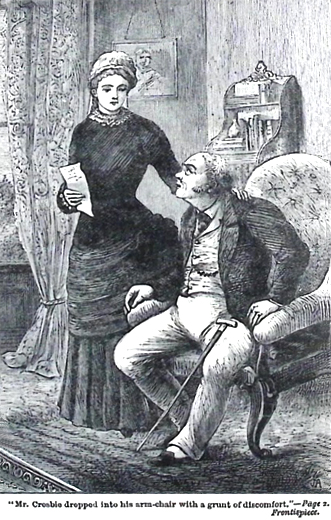
"IT'S always the way—always—invariably," grumbled Mr. Crosbie. "I never
yet knew the woman who had a single grain of consideration for anybody
in the world except herself."
Mr. Crosbie was not commonly visible before eleven o'clock in the day,
but on this particular morning he had actually come down to eight
o'clock breakfast. Certain ideas were alive in his brain, which he
particularly desired to discuss with his niece; and behold, of all
perverse and unreasonable things to do, Millicent Cumming had wilfully
selected that particular morning for remaining in bed with a severe
cold. No wonder Mr. Crosbie was irate with the whole sex.
"Just exactly like Millicent. She does everything by contraries. If
I had advised her not to get up, nothing on earth would have induced
her to stay in her room. Well, well, well—I am an old man now, and I
can't expect to get my own way any longer. I must look to be shelved, I
suppose,—make way for the rising generation. It's the way of the world.
Just a degree short of heathen customs—smother the old folks in mud or
bury them alive, as soon as they are past being useful. Hey? 'That's'
it," quoth Mr. Crosbie fiercely.
"I shouldn't think so, grandpapa. Mother didn't know you would be down."
"Might have guessed it, if she wasn't a woman. But women never do
put two and two together. Why, there are all sorts of things I want
to settle with her this morning. All sorts of things," repeated Mr.
Crosbie indignantly, "and nobody but you two within reach. Absurd!
Marian taking herself off, too, nobody knows where, just when she
is most wanted. The world is coming to a stand-still. I don't know
how anything is to get done. Well, I told your mother she would make
herself ill, and she has nobody but herself to thank. There's nothing
on earth like the wilfulness of a woman. Tell her she'll catch a cold
in a draught, and she'll go and stand in it for half an hour, just to
prove her independence. Well, I suppose we're to have no breakfast this
morning."
"Escott always makes it when mother is not down," the other lad said
cheerfully. "You'll find it all right, grandpa."
"More likely to find it all wrong. Get on, then."
The two boys looked highly amused in a quiet way. They were remarkably
alike, to a stranger's observation; and remarkably unlike, to their
mother's. Of good height for their fourteen years, they were formed
much on the same model as to slimness and uprightness, and much on the
same plan as to refined straight features blue eyes, and neatly-clipped
fair hair.
"Pretty boys," people sometimes called them, and the term was not
inappropriate. They had the look of thorough "home boys," thorough
"mother's boys," with none of the loutishness of the ordinary
schoolboy, yet without any suspicion of girlishness. Millicent Cumming
was turning out two thorough little gentlemen, but she had the greatest
horror of seeing them develop into "mollies" or "milksops." They were
as good as daughters to her in tenderness and in thoughtful care
for her comfort, and they by no means disliked to hear her say so;
nevertheless, they excelled in boyish exercises, and she was proud
of the fact. Ivor was the stronger in build and the healthier in
colouring. He had the rights of the elder brother. Escott, the younger
twin, was slightly smaller in make, thinner and paler. If either of
the two "had" a faint touch of girlishness about him, despite all his
mother's efforts to the contrary, it was Escott.
He seemed quite at home with the teapot; measured out the tea with a
quick and ready hand, poured in the due amount of hot water, placed the
sheltering cosy in position, and finally remarked,—
"Mother has prayers next."
"Teach your grandfather to suck eggs," muttered Mr. Crosbie. "Well,
ring me the bell, and get me the Bible. Where is your mother reading?"
"In the Old Testament, grandpapa, because you read the New in the
evening."
The boys found the place for him, and took their seats, frank and
contented in manner both of them, not the least ashamed of the part
they were acting.
Prayers over, breakfast followed, and a gay meal it proved. Mr. Crosbie
grumbled on for a while, and then was drawn into a conversation which
soon induced peals of merriment. Mr. Crosbie was a very boy himself in
laughter, and took his full share in the manufacture of jokes. Escott
presently rushed upstairs three steps at a time, to ask after his
mother, and returned more slowly.
"Her chest was very bad, and he and Ivor were to start in good time,
and ask the doctor to call. Mother didn't think she must come down."
"Always so," muttered Mr. Crosbie, and he made his way back to the
study, to sit there in high dudgeon, nursing his wrongs.
About three hours later, Diana Fenwick came tripping in.
"So Millie is ill," she said, as Mr. Crosbie saluted her with an
injured air. "What has she been doing to herself?"
"Some folly or other; a more imprudent woman never breathed," growled
Mr. Crosbie. "Always told her she would do for herself some day.
Shouldn't wonder if she has now."
"Poor Millie!" Diana said, with a touch of younger-sisterly patronage.
"Those gentle soft creatures are just the ones who always 'will' have
their own way."
"Gentle soft creatures! She!" Mr. Crosbie fairly stamped. "She's one of
ten thousand, Diana. There isn't another woman living her equal. 'You'
don't know what she is."
"Oh, of course she is very good and all that,—a sort of semi-angelic
being," said Diana lightly. "Millie and I never did really suit
one another. But, dear uncle, don't be vexed. I am not saying
anything unkind of her. How could I? She is a dear good creature, of
course—nobody doubts it. Smith tells me that the doctor orders quiet,
so she won't admit me. Talking makes Millie cough, she says."
"Smith is a very good judge,—an excellent woman," said Mr. Crosbie.
"Only I particularly wanted to consult Millicent about something."
"So do I. Everybody wants to consult Millie," said Mr. Crosbie, finding
satisfaction in the thought.
"However, I need not complain, having 'you' at hand," pursued Diana,
suddenly assuming her sweetest air. "Now, dear uncle, pray tell me what
you would advise me to do; tell me how you would act in my position."
"Why, I would obey the doctor, my dear, and keep out of the room," said
Mr. Crosbie, mollified, as he always was, by his niece's engaging ways,
though he did not really believe in them.
"I don't mean that. I was just going to explain, dear uncle. I was
not thinking of poor dear Millie. Of course, there is nothing to be
done but to leave her quiet. Marian might have been of use in her
room, but Marian has chosen to flit, and really my hands are more than
full—'more' than full. I feel quite overwhelmed with the responsibility
of the charge I have assumed."
"Look so!" muttered Mr. Crosbie.
"Ah, that is unkind." And her blue eyes really did fill with tears. "It
is my way to keep up and be cheerful, and people never will believe
what I feel." Diana spoke droopingly. "That is not like you, dear
uncle."
"Well, well, go on," said Mr. Crosbie, in a gentle tone.
"The children arrived last night." Diana sighed heavily.
"The little orphans! Just what I wanted to hear about," said Mr.
Crosbie, with a sudden air of briskness. "You have acted very well,
very well indeed, I must say, Diana, in giving them a home."
"Oh, I am so glad you say so. Then at least I have 'your'
approval—whatever the results may be. But, indeed, I knew you could
not look on the matter from any other point of view,—with you feeling
heart. Poor little things! Nothing remained but Parish help, if I had
not been willing to take them in, so how 'could' I hesitate? At the
worst, I can but divide my last crust with them."
This was going a little too far. Mr. Crosbie gave vent to a "Humph!"
"Of course I speak metaphorically," she said, aware of her mistake. "I
don't quite expect to come to my last crust yet. Still I shall have to
be very careful and economical. I must come to dear Millie for hints.
But at the present moment I have another perplexity. I am terribly at a
loss how to manage."
"Hey? What? Measles? Whooping-cough?" exclaimed the old gentleman,
with an alarmed gesture; for he had a morbid horror of infection, not
unusual at the age of seventy.
"No, nothing of that sort. O no, indeed. But the two are such a
contrast—it is quite distressing. The youngest is all I could wish—a
sweet little creature, one to be loved at first sight. I shall find
the greatest happiness in her companionship. It will be the solace of
my loneliness. But the other,—really she is a most unfortunate little
being. I don't know what to do with her."
"Physical deformity?" asked Mr. Crosbie.
"No, no."
"Mental incapacity? You don't mean to say she is an idiot?"
"O no; but such a fearful temper and headstrong will. Nobody can
control her. Poor little Pearl seems positively to shrink from being
left alone with Beryl. And the old servant showed nothing but relief at
being quit of the charge."
"Dear me; that's bad."
"I really don't know what to do. If Marian were to be at home, things
might be different, though even then—But you see, dear uncle, after all
I have gone through—" and Diana looked pathetic,—"I have not spirit to
cope with such a nature. The child would wear me out completely. Her
will must be broken by proper discipline."
"Broken? Nay, nay! Bent, if you will."
"True, uncle; I spoke hastily. But the bending is beyond my power."
"Well, yes; training children is not precisely your 'forte,' I should
imagine."
"It is not, indeed. I am only too conscious of my own deficiencies.
Beryl ought to have a good education, to prepare her for making her
way by and by. She has not even the elements of a good education now,
for she has evidently resisted all attempts of her last governess to
teach her. She can read, to be sure, but her writing and spelling are
atrocious. And as for the catechism, Mrs. Dixon has been struggling for
three years to make her learn it, without success. What am I to do?"
"Get a good governess," said Mr. Crosbie.
"I thought of that. But the two sisters would be together still; and
Beryl's influence must be so bad for little Pearl. Besides, the child
seems under a sort of incubus in Beryl's presence—afraid to move or
speak naturally. She is quite a different being when I have her alone.
And I should come in for all the battles. I really have not health or
spirit to act umpire."
"Why, then, I don't see that you have any alternative but to send Beryl
to school," said Mr. Crosbie.
"Do you really think so?" asked Diana.
Little dreamt Mr. Crosbie that she had meant him to say this all along,
and had step by step led him to the utterance.
"You do not think it would appear unkind to separate the two? Of course
it is for their good, and children don't distress themselves long about
partings. In fact, I imagine that the relief would be greater than the
pain, so far as poor little Pearl is concerned. If you advise a school—"
"I don't see what else you are to do," repeated Mr. Crosbie.
"Thank you so much. It is the greatest relief to my mind. Of course
there is the question of the additional expense,—no light matter with
my limited income. Still, if it is plainly my duty—"
Mr. Crosbie was silent.
"I know of a school in Bath. It is a long way off, but the terms are
very reasonable, and it would not be necessary to have her home more
than once a year, perhaps. Mrs. Brigstock shows quite a gift for
managing troublesome pupils, I am told. And she has some children whose
parents are abroad, and who remain with her all the year round; so I
might at any time arrange for Beryl to stay there through the holidays,
if it seemed advisable. That might be an advantage. Of course the pull
upon my purse will be exceedingly heavy."
"Well, well, I don't mind promising a mite of aid, just for a short
time,—till Beryl is seventeen, we'll say. Twenty pounds a year towards
her schooling,—a five-pound note quarterly, Di, and mind you don't ask
me for a penny more."
"Dear uncle, 'how' generous!" sighed Diana. "'Ask' you! As if I could!
That will indeed be help."
After which, she went home, pausing at a linen-draper's on her way, to
order materials for two new frocks for Pearl.
On arrival, she found Pearl crying in the dining-room, and Beryl
wearing what Diana called "her sullen look." Reasons for the tears were
difficult to get at, beyond a general assertion that "Beryl was so
unkind."
Beryl attempted no self-defence, beyond one unhappy "I'm 'not,' Pearl."
Diana flung some indignant reproaches at Beryl, kissed and comforted
Pearl, and sat down to write two letters. One was to Mrs. Brigstock,
asking whether she could receive a pupil, and how soon. The other was
to Marian, and contained the information that "Uncle Josiah advised
Beryl being sent to school, entirely of his own accord; so of course
that settled the matter."
"I am going to take Pearl for a drive with me," Mrs. Fenwick said,
after early dinner. "Crying has made her look quite pale, poor child.
There is not room in the chaise for you both, so you must amuse
yourself at home, Beryl. Pray, do not get into any mischief."
Beryl said nothing. She had not spoken many words all day, beyond a few
burning reproaches to Pearl for her fickleness, when the two were alone
together. Pearl had immediately taken refuge in tears, thereby driving
Beryl to the refuge of silence.
The little hired chaise drove off, with Pearl seated, affectionate
and happy, beside her new friend. The driver was a boy on a very
small coach-box, and there was ample room for two grown people in the
chaise. A second child might no doubt have been squeezed in; but Mrs.
Fenwick objected to crowding. So Beryl remained behind, alone and very
forlorn. She did not in the least know what to do with herself. The two
servants were in the kitchen regions, shut off by a door, and the rest
of the house was empty and silent. Beryl had always had Pearl for her
companion, and solitude was quite a new experience in her life. She
felt it keenly.
For a while she stood listlessly at the dining-room window, gazing
out at the little garden, bounded by the back wall of a second garden
which lay beyond. It was not an enlivening look-out, and Beryl did not
find herself enlivened. She had in her heart a kind of dull emptiness,
like that of the house, mingled with a more active feeling of dislike
towards everything and everybody around her—everybody except Pearl. She
would never dislike Pearl. Beryl did not love very readily, but once
to love was always to love with her, and this was a fine point in her
character. Pearl might cease to love Beryl, but Beryl would never cease
to love Pearl. That only made her present pain the more severe.
Growing tired of inaction, Beryl presently wandered into the
drawing-room, a pretty room, overcrowded with easy-chairs, tiny tables,
and ornamental knick-knacks. Beryl paced aimlessly about, peering at
brackets, admiring a Swiss châlet under a glass shade, gazing at an
Indian elephant of carved ivory, and finding certainly some relief to
her own mind in the slight occupation.
Suddenly she became conscious of a restraining twitch, and on looking
down she found that her feet were entangled in a length of grey
worsted, wound also about her dress. She had evidently dragged it with
her unconsciously in some of her peregrinations, for the grey threads
were twisted in complex fashion among chairs and tables. Beryl was
rather amused, and she speedily tracked the wandering worsted to its
source in a large work-basket belonging to Miss Crosbie. Seizing the
ball, she began eagerly to wind it up, with divers tugs at the loose
lines, not so careful in kind as they should have been.
Alas! The worsted in its travels had taken a turn round a small carved
table, on which stood a valuable vase of Sèvres china. Mrs. Fenwick was
unused to children in the house, or such a vase had never stood on such
a table. One more turn of the ball, and crash came table and vase to
the ground together; the table broken, the vase smashed.
Beryl's enjoyment died out instantly. She looked round in dismay, her
heart beating wildly. The china lay scattered over the carpet. What
"would" Mrs. Fenwick say? Beryl shuddered, and walked from the room,
not daring to touch the worsted again.
In the passage, she found herself face to face with two pleasant boys,
just in the act of familiarly entering by the front door, with the air
of people at home. They shook hands with her, as a matter of course,
and she submitted, bewildered still.
"You are Beryl Fordyce, are you not?" one of the two said frankly.
"We've just seen Aunt Di and your little sister, and they told us you
were alone—at least Escott asked. You have heard of us, of course. I'm
Ivor, and this is Escott."
"Mother is ill, but we knew she would like us to come and see after
you," added Escott, "Ivor and I mean to get her some primroses—it's our
half-holiday, you know, and there's a splendid lot of flowers in the
wood. And Aunt Di says she does not care if you like to come with us.
Would you?"
Like to go primrosing! Beryl's whole face glowed. The broken vase
disappeared utterly from her memory. She dashed upstairs for hat and
jacket, the boys shouting injunctions from below to "mind and put on
good thick boots, for the woods were awfully swampy in parts."
A ramble followed, the like of which Beryl had never known in her
life. Through lanes and fields, over hedges and ditches, in dust and
in mud, did the two boys escort their companion. Beryl was wild with
delight. She fell down in mud, and tore her dress, and scratched
herself with thorns, and cared not a whit for it all. Cheeks flushed,
hair disordered, hat awry, dress soiled,—herself eager, excited, noisy,
almost ready to shriek with joy,—Beryl had a rare afternoon!
The boys were very good to the little stranger. They did not admire
her, as they had admired the sweet and graceful little Pearl, seated
in the chaise beside their aunt. Beryl was not exactly according to
their notions of what a girl ought to be. But it was pleasant to see
her abounding enjoyment; and they exchanged a good many glances, alike
satisfied and amused.
Beryl did not in the least know which of the two she liked best;
indeed, she could hardly distinguish the one from the other for a
while. But when they were not far from home, on their return, Ivor bade
her good-bye and disappeared down a lane, while Escott undertook to see
her back to her own door.
"Ivor has some work to do, and that's a shorter cut," he said.
"It has been such a 'lovely' afternoon," sighed Beryl. "I wish Pearl
was with us."
"She wouldn't be up to such a scramble, perhaps. I say, Beryl, what a
little beauty she is!"
Escott did not intend it, but those words were the first shadow on
Beryl's sunshiny walk. He was astonished at the sudden change in her
face.
"Why, you are not jealous, are you?" he said. "You don't mind Pearl
being pretty?"
"No—I don't think so," Beryl said slowly. "I'm not the very least
pretty, am I?"
Escott gave her an involuntary glance, and truth forbade such an answer
as he would fain have given.
"No; I know I'm not," Beryl said, shaking her untidy head. "And I never
shall be."
"Everybody can't be pretty. That doesn't matter, so long as people are
nice and pleasant," Escott replied.
"But I'm 'not' nice or pleasant," said Beryl hopelessly. "And Dixon
said I was so ugly that nobody could ever like me."
"I don't see that at all," said Escott slowly, somewhat perplexed. For
down in his heart, he knew that he was not very much taken with Beryl
Fordyce—he could not have told why, though he would have indignantly
repudiated such a cause as mere outside plainness. "We don't like one
another for looks."
If Beryl had not the gift of fascinating other people, she had to some
extent the gift of reading other people's thoughts. She stood still in
the dusty road, with her arms full of delicate primroses, and her eyes
fixed upon him.
"But you and Ivor don't like me," she said.
"Nonsense, Beryl," Escott said, with an uneasy little laugh. "Rubbish.
Here, let me carry some of your flowers."
"I know you don't," she replied. "I am sure you don't."
"I don't really know you yet," said Escott, with adroit courtesy. "You
have been as merry and good-tempered as possible all the afternoon."
"But you liked Pearl the very moment you saw her?"
"Of course I thought her awfully pretty," the boy said, with some
adroitness again.
"That wasn't all. You 'liked' her," said Beryl resolutely, her face
crimsoning. "And you've only been kind to me because you think you
ought."
Escott was fairly at a loss for an answer.
Beryl turned away from him and hurried homewards, dropping some of
her flowers by the way, and dropping one or two tears with them, not
unknown to Escott.
He was puzzled how to deal with her. And after leaving her on the
doorstep of Mrs. Fenwick's house, he went home to detail to his mother
what had passed.
"She's the oddest child, mother," he said. "But really, she isn't very
taking, and what is a fellow to say?"
"Poor little girl!" Millicent said compassionately. "It is not natural
to have such thoughts at her age. There must have been something
unhappy in her bringing up."