We are apt to look to the Old World exclusively
for startling contrasts between fashion
and splendor on the one hand, and squalid
wretchedness and crime on the other. With
an air of complacency, we speak of our
great and happy republic, as affording a retreat
for the homeless, and a refuge for the
oppressed. Yet, in the face of all this, it
would be difficult to find in any European
city a more thoroughly vicious district than
that of the Five Points in New York.
Few, doubtless, of the fashionable crowds
who daily promenade Broadway, have ever
penetrated its recesses,—few but would
shrink in dismay from horrors of which they
had not even dreamed, if they should do so.
But it is not our purpose to moralize upon
that which has already begun to attract the
attention, and inspire the exertions, of philanthropic
hearts and hands. That task we
leave to abler pens. Enough that we have
hinted at the character of the locality in
which our story takes its rise.
One of the worst recesses of this notorious
district enjoys the singularly euphonious
name of “Cow Bay.” The entrance to it
is a filthy arched passage-way, round which
are crowded miserable tenements; so miserable,
that the scanty sunlight, which finds
its way through the dirt-begrimed windows,
seems to shrink away, as if it were
more than half ashamed of the company it
is in. In front of these houses, you may
see men whose faces betray no evidence of
intelligence or virtue; women whose miserable
and woe-begone expression, perchance
loud voice and angry vituperation, attest that
from them all that renders the sex attractive
has for ever departed; children—and this
is the saddest sight of all—dirty and
sickly, and who are children only in size
and in years; for upon their hearts the
happy influences of genuine childhood have
never fallen. For them, alas! life is a rough
pathway, paved with flinty stones, which
pierce their feet at every step.
A tall man, with a shambling gait, and
hat drawn over his eyes, walked swiftly
through the arched passage-way above alluded
to, and, muttering an imprecation
upon a child who got in his way, entered
one of the houses, whose front door stood
invitingly open, and, groping his way up the
staircase, which was quite obscure, although
it was mid-day, opened a door at the head
of the staircase, and entered.
It was such a room as the appearance of
the house might lead one to expect. It was,
however, furnished more ambitiously; as at
least one-half the floor was covered with a
rag carpet, and the scanty furniture was
arranged with rather more taste than might
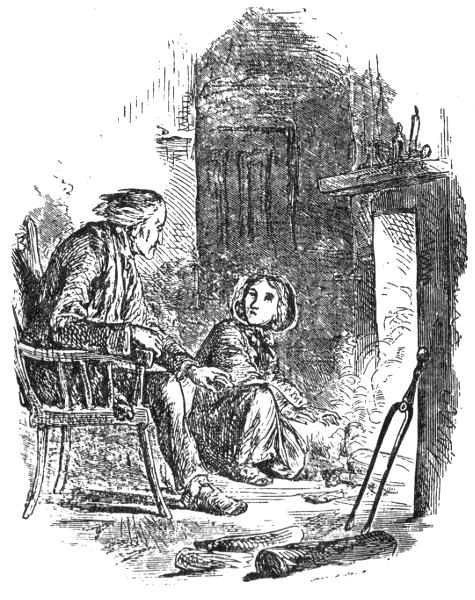
have been anticipated. By the window sat
a girl of twelve, sewing. Between her and
the children who were playing outside there
was a wide contrast. She was perfectly
clean and neat in her attire; and her face,
though pale,—as it might well be, shut up
as she was in a noisome quarter of a great
city, with no chance to breathe the fresh country
air, or roam at will through green fields,—was
unusually winning and attractive.
The man we have referred to threw himself
with an air of weariness on a chair
near the door, and muttered ungraciously,—
“Why haven’t you got dinner ready?
I’m hungry.”
“Is it time?” asked the child, springing
from her seat quickly, as if afraid of having
neglected her duty.
“Time enough,” returned the man; “for
I’ve been at work this morning, and have
got an appetite like a wolf. Besides, I want
you to be through soon; for I shall send you
out shopping this afternoon. Has any one
been in to see me this forenoon, Helen?”
“No,” said Helen (for that was her
name).
“Good. I don’t care to have visitors.”
Helen quickly brought out, from a closet
hard by, a plate of cold meat, some cold
vegetables, and a plate of bread and butter.
The man drew his chair to the table, and
during the next quarter of an hour, in
which he was so busily occupied with satisfying
his appetite that he had no time for
any thing else, said not a word to the child,
who, on her part, was too much accustomed
to his manner to utter a word.
At length, having accomplished his task
in a manner so satisfactory that very little
remained on the table, he drew his chair
away, and motioned the child to take her
place at it.
“Take your place and eat, Helen,” said
he, a little less gruffly than before; “and,
while you are eating, I will tell you of a
little plan I have formed for you.”
“How do you like living here?” he resumed
when she had seated herself.
She looked into his face, as if to know
whether it would do to express her real
opinion. His face was not so forbidding
as it appeared at times, and she ventured to
say,—
“I—I think there are some places which
I should like better.”
“No doubt, no doubt, Helen. I think I
have known pleasanter places myself. But
where do you think you should like to live
best; that is, supposing you could live
wherever you chose?”
“Oh!” said the child, her eyes brightening,
and her whole face glowing with excitement,
“I should like, above all things, to
live in the country, where I could run about
the fields, and hear the birds sing, and—and⸺ Oh!
the country is so beautiful!
I think I lived there once,—did I not,
uncle?”
“Yes, Helen; but it is a good while ago.
How would you like to live there once
more?”
“May I? Can I? Will you let me?”
asked the child, eagerly.
“Perhaps so. But it will depend on
whether you will be good, and try to please
me.”
“Oh! I will do whatever you say.”
“Well, that sounds well. Then I’ll tell
you what my plans are, and where it is that
you are to go.”
So saying, he drew from his pocket a
copy of the “New York Tribune,” and
read aloud the following advertisement:—
“Wanted, by a family a few miles distant from the
city, a young girl, of from twelve to fourteen, to serve
as nursery-maid and companion for two young children.
Address
“P. H. Gregory.”
“There,” said the reader, laying down
his paper, “is a situation which will just
suit you. You like children; and pretty
much all you will have to do will be to
attend to them. Then Mr. Gregory lives in
a beautiful place. He is a rich man, and
can afford it. Would you like to go?”
“Above all things,” said Helen, eagerly
(for to her the prospect of a release from the
dismal place in which she lived was most
pleasing).
“And you wouldn’t miss me, your affectionate
uncle?” said the man, with a peculiar
expression.
The child’s eyes fell. She blamed herself
frequently for not holding in higher regard
the only relative of whom she knew any
thing: yet so ungenial was his nature, and
so harsh and forbidding was he nearly
always, that it would have been singular
if he had inspired affection in any one.
So it happened, that, in the joy of the anticipated
change, she had not for a moment
thought of the separation which it must
occasion between herself and her uncle.
“Of course,” she said, timidly, “I shall
be sorry to leave you”——
“You needn’t say any thing more, child,”
was the reply. “I don’t profess any particular
affection for you, and I don’t believe
you feel any for me; and you may be sure
I shouldn’t have proposed this removal to
you if I had not some object of my own
in it. Would you like to know what that
is?”
“Yes,” she said, hesitatingly.
“Well, I will tell you; because it is necessary
that you should fully understand,
before you go, on what conditions I allow
you to do so. But, if you dare to impart to
a breathing soul a hint of what I tell you, I
will seek you out, and—well, no matter,”
he continued, seeing that his threat made
her turn pale. “You must know that this
Mr. Gregory, with whom I am going to
place you, once cheated me out of a large
sum of money, which I cannot hope to regain,
except by stratagem. Now, I want you
to get in there, and I will then give you
instructions how to manage. They keep a
large amount of valuable plate in the lower
part of the house. It will be comparatively
easy for you, when you are once there, to
render me essential service by opening the
front door to me, so that I may be able to
secure it without detection; and then”——
“But,” said the girl, shrinking in dismay
from this proposition, “would not that be
robbery?”
“Robbery? Pooh, child! Didn’t I tell
you that he had cheated me out of twice the
value of the plate? And, as I can’t get my
pay in any other way, it’s perfectly proper
to get it in that.”
Helen was no casuist. She had never
had any one to teach her right principles;
but she had an instinctive feeling that this
was wrong. She wished to remonstrate, but
dared not. Her uncle saw her embarrassment,
and guessed its cause. He rose from
his seat, and stood sternly confronting her.
“Helen Armstrong,” said he, in a compressed
voice, “unless you promise me
faithfully to perform the part I have assigned
you, I will bind you out to Brady
Tim, the grocer.”
This Brady Tim was a repulsive character,
and kept a grocery of the lowest kind
nearly opposite the rooms occupied by the
girl and her uncle. He was a complete
tyrant, and would often beat his children
in the most unmerciful manner. Their
shrieks, which she was often doomed to
hear, would always make her blood run
cold, and inspired her with an inconceivable
dread of the man who occasioned them.
This her uncle well understood; and he
was well aware that no threat which he
could utter would make so deep an impression
upon the child’s mind.
“You have your choice,” said he. “Shall
I tell Brady Tim that you will come to-morrow
morning? or will you go to Mr.
Gregory’s?”
“I will go,” said the child, overawed.
“And you will follow my directions?”
“Yes.”
“Then preparations must instantly be
made. I shall have to buy you a few
things to have you go looking decently.
Have you got a good bonnet?”
“Only my old one, and that is bent every
way.”
“Well, I will get you a new one. You
will also want a shawl and some gloves. As
you are to be a companion to the children,
it will be a recommendation if you go
looking neat and comfortable. It won’t
take long to purchase them; and whatever
else you need I can send you afterwards.
Wait a moment, and I will be ready to
accompany you.”
He went into the inner room, and quickly
emerged, completely metamorphosed in his
personal appearance by a white wig and
whiskers, and a staff, on which he leaned
heavily. The girl looked at him in astonishment.
“What sort of a grandfather do you
think I shall make?” said he, laughing.
“I shall go out with you to Mr. Gregory’s;
and I have no doubt, that, in consideration
of my gray hairs, they will be induced to
take my grand-daughter into their service.”
So saying, he left the room, accompanied
by the child, who had improved the interval
in smoothing her hair, over which she placed
an ugly straw bonnet, which, however, was
shortly to be displaced by one of a prettier
pattern. Their purchases completed, they
stepped into an omnibus, which would convey
them within half a mile of Mr. Gregory’s.
A few miles distant from the city was a
tasteful brown cottage, having a piazza on
all sides, and surrounded by a carefully
trained hedge. This was the summer retreat
of P. H. Gregory, a New York
merchant.
It was a warm day in June. Two children,
a boy and girl, respectively of six and
eight years, were playing in the yard, when
they espied through the hedge an old man,
with hair and whiskers white as the driven
snow, accompanied by a young girl, toiling,
apparently with great difficulty, towards the
house, notwithstanding the assistance he
derived from a stout cane, on which he
leaned heavily.
Attracted by the sight, they ran into the
house, calling on their mother to look out
and see. She had scarcely done so, when,
to her surprise, she found that the pair had
entered the gate, and were coming towards
the house.
“Is Mrs. Gregory within?” asked the
old man of the servant who answered the
bell.
Mrs. Gregory anticipated the reply by
coming forward.
“Poor old man!” said she, compassionately
(for the attire which Armstrong had
donned for the occasion was singularly
threadbare, and evinced the lowest depth
of destitution),—“poor old man! what can
I do for you?”
“I have brought my grand-daughter with
me, good lady,” said the old man, feebly,
“in answer to your advertisement. She’s a
good girl, and I wish I could keep her with
me; but the times are hard, and it costs a
sight to live; and so I’ve been thinking the
best thing I could do is to get her a good
place, and a good mistress, as I am sure you
would be to her, madam.”
Mrs. Gregory’s sympathies were enlisted
in the child’s favor by this artful address, as
well as by her own modest and downcast
look. She was not aware, however, that
not a little of her confusion arose from the
dissimulation in which she was compelled
to take a part.
“What is your grand-daughter’s name?”
asked Mrs. Gregory. “She seems young.”
“She is only twelve; but she’s capable,—very
capable. When her poor grandmother
was sick for nearly a year before
she died,”—and Armstrong wiped his
eyes with his ragged sleeve at the sorrowful
thought,—“Helen took the whole care of
her and of me; and no one could find a better
nurse.”
“It must have been a great care to you,
Helen,” said Mrs. Gregory, kindly.
Helen had been so much taken aback by
the last fabrication respecting a grandmother
of whom she had never heard, that she was
barely able to say, in a low voice,—
“Yes, ma’am.”
“But you will never regret it, my child,”
said the lady. “God will not fail to reward
good children. So your name is Helen?”
“Yes, ma’am.”
“I like the name. I had a child of that
name once. Were she living, she would be
about your age. But”—and the lady
sighed deeply—“she disappeared one day,
and we never could find any trace of her.”
Had Mrs. Gregory been an attentive observer,
she would have seen a gleam of
intelligence pass over the old man’s face
at this moment; but she was too much
absorbed by her sad thoughts.
“I think,” said she, after a pause, “that
I will engage you, Helen, although you are
rather young for my purpose. When can
you come?”
“She is ready now,” said her grandfather.
“I can send her the rest of her clothes.”
“Very well. Then you may come in,
and take off your things.”
“Come, Helen, and give a parting kiss to
your poor old grandfather. He will be very
lonely without you, my dear child; but he
knows that he has left you with a kind lady,
who will care for you.”
Helen advanced to her grandfather’s embrace
with very little alacrity. As he pressed
his lips lightly to her cheek, he whispered,
so that she only could hear,—
“Keep your eyes open;” and then added
aloud, “Be a good girl, Helen, and mind
the kind lady who has engaged you, in all
respects. Remember all the lessons I have
taught you; and do not forget,” he continued,
with a meaning look, “what I told
you before I came away.”
Helen replied faintly in the affirmative.
Mrs. Gregory attributed her evident embarrassment
to the fact that she was about
to leave her only relative to go among
strangers; and she resolved in her heart to
lighten, as well as she might, the sorrow of
the child.
“I will bring your clothes to-morrow,
my dear grand-daughter,” said Armstrong,
as he rose slowly from his chair, and, resuming
his cane, walked feebly from the
house.
As soon, however, as he was fully out of
sight, he straightened his bowed form, and
walked rapidly onward till overtaken by a
passing omnibus, which he entered, and was
soon carried back to the city.
Helen was not long in making the acquaintance
of Ellen and Frank Gregory, the
children of her employer, over whom she
was expected thenceforth to have oversight.
Those who have always lived in the country,
or to whom frequent visits have made
it familiar, can hardly appreciate the depth
of enjoyment which it brought to a child,
who, like Helen, had been confined for
years in the most noisome portion of a great
city. To her, the most common objects
seemed invested with an interest altogether
new; and she plucked with as much eagerness
the dandelions and buttercups which
covered the greensward in profusion as if
they had been the rarest exotics. There
is a freemasonry in children which does
away with formal introductions and the barriers
of etiquette. When, two hours after
her companion’s departure, Helen and the
children came bounding in, flushed with
exercise, Mrs. Gregory had an opportunity
to observe—what before had escaped her
notice—that Helen was more than ordinarily
pretty. Something there was in her
expression that seemed to strike the chords
of memory; but Mrs. Gregory dismissed it
as only a chance resemblance.
“Helen,” said she, calling the child to
her side, “have you always lived in the
city?”
“For a long time, madam. I cannot remember
ever to have lived anywhere else.”
“And do you like it as well as the country?”
“I do not like it at all,—it is so dark
and dirty and close. The sun does not
shine there as it does here; and I could
not run out into the fields, but all day long
I had to sit alone.”
“Alone? Wasn’t your grandfather with
you?”
“Yes,” said Helen, casting down her
eyes. “He would come home to meals;
but he had to attend to his business.”
“He seems too old and infirm to be able
to do much,” said Mrs. Gregory, compassionately.
Helen was about to disclaim the age and
infirmity, when the thought of the near relation
in which Armstrong stood to her
came over her mind in time, and she only
answered, “Yes, ma’am.”
“How long since your grandmother
died?”
This, too, was an embarrassing question
for Helen; but the necessity of saying
something prompted her to reply, “A good
while.”
Perceiving, though she could not conjecture
why, that her questions confused Helen,
Mrs. Gregory desisted.
It was about four o’clock on the succeeding
afternoon that Mrs. Gregory, who was
sitting at the window, detected the bent
form of the assumed old man slowly making
his way up the hill.
“Your grandfather is coming,” said she
to Helen, who sat beside her.
Helen tried to look as joyful as the
approach of her only relative might be
expected to make her; but the thought of
the deception which she was even then
practising towards a family who were showing
her great kindness, and the still greater
wrong which she was required to do them,
made it a difficult task for one no better
versed in dissimulation.
Mrs. Gregory noticed it no further than
to form the opinion that she was a little odd
in her manners.
As Helen expected, Armstrong requested
her to walk a little apart with him; and
then, dropping at once the whining tone he
had assumed, inquired, quickly and peremptorily,—
“Well, what have you discovered?”
“Nothing,” said Helen, timidly, and as
if deprecating his anger.
“Nothing?” he echoed, his eyes lighting
with indignation. “What am I to
understand by that?
“Come, child,” said he, softening his
tone, as he saw that she was terrified by
his roughness, “I don’t mean you any
harm; but the fact is, I have placed you
here to help me, and help me you must,
otherwise I shall be compelled to carry
you back to live with me in New York.
Perhaps you would like to go?”
“Oh, no, no!” said Helen. “Don’t
carry me back! Let me stay here!”
“Well, so I will, if you behave well.
Now, tell me truly, have you no idea where
they keep the silver? I know they have a
large quantity of it.”
Helen reluctantly admitted, that, although
she did not know, she could form an idea.
“Where?” asked Armstrong, eagerly.
“In the pantry, at the west corner of the
house.”
“Humph! And do they lock the door
at night?”
“Yes; but the key remains in the lock.”
“So far, so good. Does any one sleep in
the lower part of the house?”
“No one.”
“Better still.”
A moment afterwards, Armstrong added,
a new thought striking him,—
“I have not seen any dog near the house.
Do they keep any?”
“No.”
“That is lucky. A determined dog is
sometimes a troublesome customer. I recollect,
one night, Dick Hargrave and I had
planned a little expedition of this kind, when
it was all broken up by a cursed bull-dog,
who rushed out upon us as if he would tear
us to pieces; and, to tell the truth, he did
tear Dick’s coat off his back.”
Helen listened in dismay; for it revealed
to her what she had not known,—that her
uncle had been implicated in affairs of a
similar kind before. It will be remembered
that Armstrong, in proposing to her
to co-operate with him, had used the pretext
that Mr. Gregory had cheated him, and that
he was resolved to repay himself. This,
Helen had believed at the time; but his
present unguarded remarks led her to entertain
strong doubts of its truth. Her strong
natural dislike for the duplicity and treachery
required at her hands determined her,
in spite of her habitual timidity and fear of
her companion, to venture a remonstrance.
This, however, she delayed till he should
make a specific demand upon her.
He resumed: “I don’t know but there’s
a pretty good chance of success. To-night
is Tuesday night. I can’t very well get
ready before Friday. On that night, you
must contrive, in some manner,—taking
care to incur no suspicion,—to come
down stairs and unlock the front door. I
shall be on hand at one o’clock. Be very
particular about the time; for what I do
must be done quickly.”
“But, uncle, wouldn’t that be robbery?”
“Robbery! Didn’t I tell you that old
Gregory had cheated me out of more than
the sum I shall take?”
“But they have treated me kindly; and
it makes me feel ashamed to know that I
am trying to injure them, uncle”——
“Don’t call me uncle again! I’m no
uncle of yours,” said Armstrong, roughly.
Noticing the child’s look of surprise, he
added, “There, the murder is out! I had
intended to treat you as a niece; but you
don’t deserve it. It is time to talk to you in
a different strain. I declare to you, Helen,
that, unless you comply with my command,
I will make you repent it most bitterly. Do
you hear?”
“Yes,” said Helen, terrified no less by
his looks than his words.
“Then take care that you remember:
Friday night, at one. And now, as we
understand each other, that is all that is
necessary.”
They returned to the house in silence.
Armstrong, with a hypocritical whine,
thanked Mrs. Gregory for her kindness to
his dear grand-daughter, who, he was glad
to find, seemed so contented and happy in
her new position.
“You will pardon an old man’s tears,”
said he, drawing his hand across his eyes;
“but she is all that is left to me now.”
“What a good old man!” thought Mrs.
Gregory, as she hastened to assure him that
whatever she could do to add to the comfort
of his grand-daughter would cheerfully be
done.
As for Helen, she was astonished and confused
at what she had discovered. She had
always been led to believe that Armstrong
was her uncle, and had more than once
reproached herself for the dislike she could
not help entertaining for him. Now he had
himself disclaimed the relationship; and
Helen was left to conjecture fruitlessly who
and what she was.
We must carry the reader back some nine
or ten years. In front of a pleasant country
residence, a child of three years sat on
the grass, plucking the flowers that grew
at her feet, and then tossing them from her.
Ever and anon she would utter a cry of
childish delight, as a gaudily-painted butterfly
flew past her, and would stretch out
her little hands to arrest its flight; but the
wanderer of the air found no difficulty in
eluding the tiny hands of the child.
At length, as if weary of her pastime,
she rose from her grassy seat, and tottled
towards the open gate, out of which she
passed, and strayed along the path by the
roadside, pausing where fancy prompted.
Her disappearance had not been noted by
those in the house, partly because their attention
was occupied by a tall, swarthy
woman, with fierce black eyes, who was at
that moment asking, or rather demanding,
alms of the mistress of the house.
“We are not in the habit,” said the latter,
“of giving money; but whatever food you
may require will be cheerfully given.”
“I don’t want any food,” said the woman,
abruptly. “You talk as if victuals was the
only thing one could need. I have had
something to eat already. I want money,
I tell you.”
“Then why don’t you work for it?”
asked the lady, somewhat offended at the
boldness of her speech.
“Because I don’t see why I should work
my life out while others are living in plenty.
There are plenty of fine ladies who wouldn’t
lift their fingers if it was to save a life. Am
I not as good as they? Why, then, should
they fare any better than I?”
“That I do not pretend to say. I only
know that he is most happy who strives to
content himself with that station in which
the Almighty has placed him.”
“Oh! it is all very well for those to talk
of being contented who have every thing to
make them so. Very praiseworthy it is,
to be sure!” said the woman, laughing
scornfully.
The violence of her language increased to
such an extent, that Mrs. Gregory—for it
was she—found it necessary to order her
to leave the house. She did so, but not
without many imprecations. As she strode
along with hasty steps, she espied by the
roadside a little girl, holding in her hand a
flower that she had just plucked.
“Isn’t it pitty?” said the child, holding
it up.
A thought struck the woman, and she
arrested her steps.
“Where do you live, little girl?” she
asked, softening her voice as much as practicable,
so as not to alarm the child.
“I live there,” said the little girl, pointing
to the house the woman had just quitted.
“Yes, yes,” muttered the latter to herself;
“you’re the child of that proud lady
that refused me what I asked. Perhaps she
may repent it.”
“Would you like to go with me?” she
asked, turning once more to the child. “I
will show you where there are flowers a
great deal prettier.”
“Yes,” said the unsuspecting child, gaining
her feet, and placing her hand in the
woman’s.
Was there no magic in the soft touch of
that little hand that could turn away that
bad woman from her wicked purpose?
Alas! when the heart becomes familiar
with crime, all the gentler parts of the
nature become hard and callous.
“Would you like to have me take you in
my arms, and then we should get there
quicker?” said the woman, who knew it
would not do to accommodate herself to the
child’s slow pace.
The latter made no resistance; and, with
the little girl in her arms, the woman walked
swiftly along. She soon turned aside from
the street, for fear of attracting a degree of
observation,—which, under present circumstances,
would be embarrassing to her,—and
took her way, by a less frequented
road, to the city.
The child soon became restless, and
wished to go home. The woman assured
her that she was carrying her there. Before
long, the regular motion of walking acted
as a sedative upon the child, and she fell
asleep. Her bearer made the most of this
opportunity, and walked with quickened
steps towards her haunt—for home she had
none—in the great city, which she had already
entered. Some whom she met gazed
with curious eyes at the woman and her
burden, and could not help noting the contrast
between the two in dress: but no one
felt called upon to interfere; and so she
reached her destination.
The next day saw Helen—for this the
woman discovered to be the child’s name—stripped
of her tasteful attire, and clothed
in a ragged and dirty dress, suited to the
company into which she had fallen. At the
same time, her abundant curls were cut off
close to her head, principally to render more
difficult the chance of recognition.
The woman found Helen of essential service
in her line. Though disfigured by her
uncouth dress and the loss of her curls,
her beauty was sufficiently striking to draw
many a coin from compassionate strangers,
which would not otherwise have been obtained.
This little episode completed, we
resume the main thread of our narrative.
Notwithstanding the kind treatment which
Helen received in her new home, she did not
seem happy. Although the companions
among which she had been thrown had
not been of a nature to give her very elevated
ideas of moral rectitude, something
within told her that the act required of
her would be one of the basest ingratitude.
The more she thought of it, the more her
heart recoiled from it. Yet so accustomed
was she to obey the man Armstrong without
question,—not so much from affection as
from fear and a sense of duty,—that she
had hardly admitted to herself the possibility
of refusing to comply with his demands.
Now, however, that he had himself confessed
that no relationship existed between
them, the force of the latter consideration
was not a little weakened; and, as fear decreases
in the absence of those who inspire
it, she began now to consider in what way
she could contrive to avoid it.
Circumstances occurred before the dreaded
Friday night which served to hasten her
decision. On the day previous, while roaming
through the fields with Ellen and Frank
Gregory, in jumping hastily from a stone
wall, her foot turned, and her ankle was
severely sprained. The pain was so violent
that she nearly fainted, and was quite unable
to make her way to the house, which
was some quarter of a mile distant. The
children were exceedingly frightened, and,
returning in breathless haste, gave an immediate
alarm.
Two men were speedily obtained, who,
constructing a soft litter, conveyed Helen to
the house, without occasioning her much
additional pain. A physician was at once
summoned. Meanwhile, Helen was put
to bed, where she received every attention.
Mrs. Gregory had a warm heart, which suffering
in any form was sure to reach; and,
had Helen been her own child, she could
not have been more tenderly cared for.
The physician decided that it was nothing
very serious; though he recommended, as a
necessary precaution, that the injured member
should not be used for a fortnight or
more, lest inflammation might ensue.
Helen did not hear him pronounce this
sentence. When, however, she was informed
of it by Mrs. Gregory, after his
departure, her mind at once reverted to
the fact that it would be an insuperable
obstacle to her performing the part assigned
her. Actuated by the relief which the
thought brought to her, and without thinking
of the manner in which it would be
construed, she involuntarily exclaimed,—
“Oh! I am so glad!”
“Glad!” exclaimed Mrs. Gregory, in astonishment.
“What can you mean? You
surely cannot mean that you are glad you
will be confined to the house by sickness?”
Helen was embarrassed. She knew she
could not explain herself without telling
all; and that she had not yet determined
upon. At length she said,—
“Because it will prevent me from doing
something that I did not want to do.”
“But why did you not want to do it?”
asked Mrs. Gregory.
“Because I do not think it would have
been right.”
“Then why would you have done it at
all, even if you had been well enough, if it
was wrong?” asked Mrs. Gregory, more
puzzled than ever.
“Because I was afraid to refuse,” said
Helen, in a low tone.
“It was nothing that I required of you, I
am sure,” said her mistress.
“No.”
“It surely could not be that your grandfather
would require of you any thing improper?”
Helen was silent.
“Then it is so. My dear child,” pursued
the lady, kindly, “I have lived longer than
you, and naturally have more knowledge of
the world. I need not say that I have every
disposition to befriend you, not only for your
own sake, but for the sake of my own little
Helen, who, had she remained to me, would
have been about your age. Will you not,
then, confide in me so far as to inform me
what it was that your grandfather required
of you?”
Helen considered a moment, and then,
with a rapidity of decision which sometimes
comes after long and anxious thought, decided
to communicate every thing.
“I will tell you every thing,” she said,
“if you will promise that no harm shall
come to the man who brought me here.”
“Your grandfather?”
“Will you promise?” asked Helen, anxiously.
“Yes, Helen,” said Mrs. Gregory:
“though I cannot conceive what is to be
the nature of your revelation, I will promise
that no harm shall befall your grandfather.”
“You are so good and kind,” said the
child, “that I can trust to what you say.
Then I will tell you, first of all, that the
one who came with me is not my grandfather.”
“Not your grandfather?” echoed Mrs.
Gregory, in surprise.
“No. He is not even an old man. He
only dressed himself up so when he came
here.”
“And what made him do that?”
“Because he thought you would pity
him, and be more ready to take me.”
“Is he any relation to you?”
“I thought he was my uncle,” returned
Helen, “until he came here last time. Then
he told me that he was no relation.”
“Where are your relations?”
“I don’t know,” said Helen, thoughtfully.
“I suppose I must have had some
once; but I can’t remember any thing about
them. I have lived with my—I mean
Mr. Armstrong, ever since I can recollect.”
“And what was it he wanted you to
do? Why was he so anxious to have you
come here?”
“Because⸺ You mustn’t blame me,”
said Helen, earnestly, lifting her eyes to
Mrs. Gregory’s face; “for it made me very
unhappy to think of doing it. But he
wanted me to leave the door open to-morrow
night, so that he could get in and
carry off the silver.”
“Is it possible?” exclaimed Mrs. Gregory.
“And he wished to implicate you in
such a crime?”
“Yes, ma’am,” said Helen. “He told
me that was what he wanted me to come
here for; and then I didn’t want to come at
all. But he threatened me if I did not.
Then, when he was here last time, I tried
to persuade him to give up his design; but
he wouldn’t listen to me, and I didn’t dare
to say any thing more.”
“You said, Helen,” remarked Mrs. Gregory,
“that you never knew about your
relations. Can’t you remember any thing
that happened when you was a little
child?”
“No,” said Helen, “not much; but I
think I must have lived in the country
once, though I can’t remember when.
There was an old woman, very cross, that
I used to be with before Mr. Armstrong
took me. She used to beat me sometimes.”
“How did she look?” said the lady,
feeling a strange interest—for which she
found it difficult to account—in the child’s
story.
“She was very tall; and she used to look
at me—oh! so fiercely!”
“And is there nothing, no little keepsake,
that you have, to remind you of those
childish days?”
“Yes,” said Helen, “there was one. It
was an ivory ring that I have always carried
around with me. The tall woman tried to
take it away from me one day; but I cried
so that she let me keep it.”
“Have you got it with you?” asked Mrs.
Gregory, in great agitation.
“Yes,” said Helen, surprised at the
strange effect this communication appeared
to have upon her mistress. “I always carry
it in the pocket of my dress.”
Mrs. Gregory, with trembling hands,
sought the receptacle indicated, and drew
out an ivory ring, on which were inscribed
the letters “H. G.” Without a word, she
sprang to the bed, clasped the bewildered
Helen to her bosom, and exclaimed, tearfully,—
“It is as I thought! You are my child!—my
long-lost Helen!”
When her emotion had in some measure
subsided, she made Helen acquainted with
the circumstances mentioned in the previous
chapter, and also informed her that the ring,
which had served as the happy means of
restoring a long-lost child to her parent,
was the gift of a brother of hers, who had
inscribed upon it “H. G.,” as the initials
of Helen’s name, and that the child had it
with her on the day of her disappearance.
The happiness of Helen in being restored
to her mother, and the joy of the children
on ascertaining that the one whom they had
learned to love so well, already, was their
own sister, may better be imagined than
described.
One leaf remains to be added to this chronicle.
It relates to Armstrong, hitherto the
guardian of Helen. Although the latter had
received at his hands so little for which she
had occasion to be thankful, she could not
reconcile herself to the idea of his being
imprisoned. We cannot look with indifference
upon the punishment of one with
whom we have been intimately associated,
however well deserved it may be.
As Armstrong had no intimation of the
check which his projects had received, and
as he was convinced that Helen’s fear of
him would lead her to carry out his commands,
he stealthily approached the house
the following evening, as he had intended.
The door had been purposely left unlocked;
but, in the room adjoining, four stout men
had been stationed, who at once seized upon
the unsuspecting burglar, and, in spite of
his violent struggles, bound him. Thus
secured, Mr. Gregory, who was one of the
four, explained to him in what manner his
crime had been defeated, and added,—
“Although you have been detected in
crime, and richly deserve the penalty which
the offended law affixes to it, I have been
induced by Helen to afford you a chance of
escaping. I will furnish you a ticket entitling
you to a passage in the next California
steamer, and will not reveal your guilty
attempt, if you will engage to leave the
country immediately. Should you fail to
go, I shall feel released from the promise I
have made to Helen, and at once cause you
to be arrested.”
It is needless to say that Armstrong at
once accepted these terms; and the next
steamer bound to the Pacific bore him a
passenger.
As for Helen, the cloud which shadowed
her earlier years has quite disappeared; and
in the affection of the home circle, to which
her many good qualities endear her, she
finds all that can make life pleasant and
agreeable.