“Well,” exclaimed Bert, drawing a long
breath as he rose from his cramped position
beside the “Red Scout,” “this machine is
in as good condition as I know how to put it,
and if nothing happens I guess we can show you
fellows some speed this afternoon.”
It was the morning of the long wished-for race
and Bert was addressing an excited group of
boys, who were holding wrenches, oil cans, and
such other appliances as he might need in putting
the finishing touches on the pampered machine.
The whole camp was in a ferment of excitement
and expectancy, and many were the heartfelt
wishes for Bert’s success.
To these boys it seemed the most important
thing on earth that their machine should win, and
it is safe to say that if Bert had wanted to remove
a piece of black grease from the car and
had not a cloth handy, any one of them would
have sacrificed his best handkerchief without a
moment’s hesitation, and been glad to do it.
Fortunately, such a contingency did not arise,
however, and finally the last nut had been
tightened and the last fine adjustment made, and
everything was ready for the start.
The race was scheduled to start at two o’clock,
but as the boys had to walk to the track, and
this necessitated a long detour around the lake,
they started almost immediately after breakfast,
so as to get there in plenty of time.
The boys in the two rival camps were not
the only persons interested in the race by any
means. News of it had leaked out over the
surrounding countryside during the week between
the completion of arrangements and the actual
race, and now there promised to be a goodly attendance
of farmers and their families.
Considerable interest was taken in the camp
by the kindly country folk, and now the boys
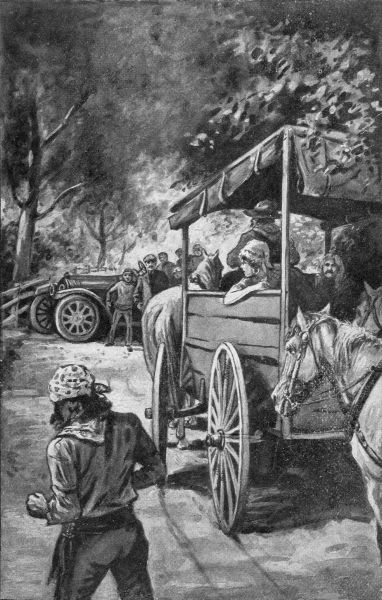
were surprised at the number of carriages and
farm wagons, full of jolly youngsters, that they
met on their march.
Every one they met shouted cheery greetings
to them, which they returned with interest. It
made them very happy to see the interest taken
in them by the farmers, and the very evident
good will expressed by them. They didn’t take
the trouble to figure out the reason for this, but
it was not very hard to find. The fact is, the
boys were so manly and well-behaved that they
won their way into all hearts.
Many a time they had seen the boys stop
their machine rather than frighten a skittish
horse, and more than one weary farmer had
been given a lift on his way home from some distant
field.
So, as has been said, the boys were greeted
with expressions of good will on every side as
they marched along, and it made them realize,
perhaps more than anything else could, that it
paid to live a manly, upright life.
Meanwhile, back in camp Mr. Hollis, Bert,
and Dick, were having a final discussion before
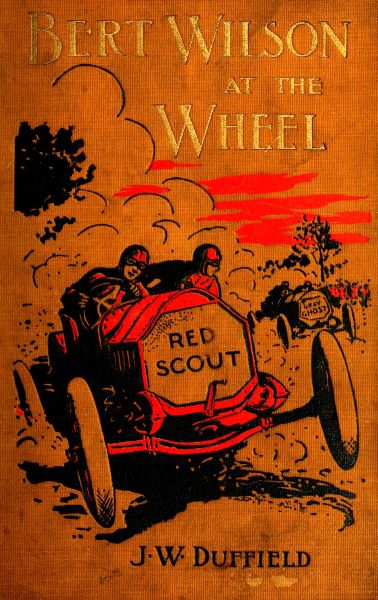
leaving for the rival camp in the “Red Scout.”
It had been decided that Dick was to ride with
Bert in the race, and give him any help that he
might need.
The other boys had been bitterly disappointed,
especially Tom, who had counted right along on
going.
“It only seems fair that I should go,” he had
contended. “Bert and I have always been special
pals, and I wanted to share any risk he is
going to take.”
But Mr. Hollis was firm as a rock, as he well
knew how to be when he thought circumstances
required it of him.
“I’m a little bit uneasy about the race, anyway,”
he explained, “and as long as somebody
has to take chances I want it to be some boy who
is old enough to be responsible for his own
actions. I know nobody could fill the place better
than you, my boy, but I am sure that when
you think over what I have said you will agree
with me in my decision,” and Tom had to admit
to himself that, as usual, Mr. Hollis was right.
But now the time had come to leave for the
rival camp, and Mr. Hollis and Tom climbed
into the tonneau, while Bert and Dick occupied
the two front seats.
Soon they had started, and as they went along
Bert gave Dick his last instruction. “Remember,”
said he, “that when we take the turns you
must lean as far toward the inside of the track
as you can. This may not seem to help much in
keeping those inside wheels on the ground, but
every little thing like that does help, and I think
that we will have to do everything we know how
to beat that ‘Gray Ghost’ of theirs. That car is
no slouch, as the saying goes, and Ralph Quinby
knows his business.”
“All right, Bert,” replied Dick, “I’ll try to
remember all the things you have told me. I
really believe,” he continued, laughing, “that I
have forgotten more about automobiles in the
last week than I ever knew before. I never had
any idea that there was so much to know about
a car, and you certainly have got it down to perfection.”
Bert was pleased at this evidently sincere
tribute from Dick, and could not prevent a slight
flush of pleasure from mounting to his face.
“Well, Dick,” he remarked after a moment,
“all I’ve got to say is that if such a trio as
you and I and the old ‘Red Scout’ can’t win
that race, there must be something the matter
with the universe, that’s all.”
The rival camp all felt as confident as did Mr.
Hollis’ troop, however, and to the impartial observer
it would certainly have seemed as though
there was little to choose between the autos and
their crews.
By this time they had come in sight of the old
race track, and were astonished, and, it must be
confessed, somewhat confused at the sight that
met their eyes. There was an old rickety grand
stand along one side of the course, and this was
literally packed with a bright-colored mass of humanity.
Even scattered around the infield
there were quite a few farm wagons, with their
complement of folks out for a holiday.
“Say,” said Dick to Bert in a low tone, “I
didn’t count on having an audience like this.
They’ll guy the life out of us if we lose.”
“Well,” said Bert, who by this time had recovered
from his first astonishment, “that’s all
the more reason why we should win. We simply
can’t let ourselves be beaten now, that’s all there
is about it.”
But there was no time for further speculation,
as Mr. Hollis was seen approaching them, and
it was evident the race must soon begin.
Bert ran the “Red Scout” around to a small shed
in back of the grandstand, and he and Dick made
their final preparations. These consisted in taking
off the hood, or bonnet, altogether, and removing
the exhaust pipes from the motor. As
Bert had already explained to Dick, this was
done to eliminate any back pressure from the
exhaust gases. Under ordinary conditions, this
makes such a small difference in the power of a
car that it can hardly be said to count, but in a
race every ounce of power is required. This is
done on every racing car, and that is why the
explosions make such loud, sharp reports when
the car is in action.
It need hardly be said that every boy in Mr.
Hollis’s troop, except poor Fred, was present,
and many were the anxious looks cast at Bert and
Dick to see, if possible, how they felt about the
outcome of the race. Both had been trained to
have control of their feelings, however, and so
outwardly they appeared to be very calm.
This was far from being the real state of their
feelings, and both felt as though their hearts had
suddenly become too large and were trying to get
out between their ribs. They realized that it
was not only their own reputation that would
suffer if they were defeated, but the whole camp
was involved. What would Mr. Hollis think of
them if the other boys were victorious? What
would the boys who had such blind confidence
in them and the “Red Scout” do or say if the
“Gray Ghost” won?
Such thoughts were demoralizing, however,
and neither Bert nor Dick entertained them any
longer than they could help. Into both their
faces came that stern, resolved look that all the
boys had seen at times and come to love, and in
the minds of Tom and the others all doubts as
to the final result vanished.
Meanwhile, Mr. Thompson’s troop had been
giving the “Gray Ghost” its final touches, and
now, at the sound of a mellow whistle, both Bert
and Ralph cranked their motors.
None of the boys had ever heard the unmuffled
exhaust of a racing car before, and at the
savage roar that now issued from both cars all
the boys fell back several steps with scared faces.
As soon as they realized that the gasoline tank
had not exploded, nor any other equally awful
thing occurred, they came forward and tried to
ask questions, but in the confined shed they could
hardly hear the sound of their own voices.
Slowly the fire-spitting monsters were backed
out of the shed, and their respective drivers
swung them around and on to the track. They
were greeted by a wave of cheering both from
the boys and from the assembled farmers, and
more than one burly countryman who had come
to the “kids’ racket” under protest was seen to
sit up straight and open his eyes wide.
No doubt many of them had expected to see a
rather tame affair, and in fact few of them had
ever seen an automobile race, or knew the tremendous
speed of which a good car was capable,
or realized the cool head and steady nerves required
to control the condensed power of forty
horses traveling at a speed of close to a mile a
minute.
However, they were soon to experience a few
of the thrills attendant on such an occasion. The
two leaders had been holding a consultation,
and now they approached the vibrating, eager
cars.
Mr. Hollis was forced to shout to make himself
heard above the din of the exhausts. “It is
understood,” he said, “that this race is to be run
from a standing start, and is to be for a distance
of ten miles, or ten laps around the track. The
cars must line up on the tape that we have
stretched in front of the grandstand, and at the
report of my pistol they are to start, each driver
getting away as best he can. We have drawn
lots for the choice of position, and the ‘Gray
Ghost’ won, and is to have the inside position.
Mr. Thompson and I will act as judges. Is that
perfectly clear?” to Bert and Ralph.
“Yes, sir,” they both responded, and proceeded
to manœuvre their cars into the appointed
positions.
Mr. Hollis and Mr. Thompson took their
places in the grandstand, part of which the boys
had been directed to reserve for them.
By this time the cars were in position, each
one with its front wheels resting on the strip of
white tape. The “Gray Ghost” had a decided
advantage to start with, as it is evident that in
any race the car that has the inside position, that
is, the part of the track nearest to the center of
the field, has a slightly lesser distance to travel
than the car on the outside, and in a close race
every few feet count.
But now there was a breathless hush over the
grandstand, and all eyes were on Mr. Hollis’s
hand, holding the pistol aloft. Bert and Ralph
were bent over their levers, every muscle tense,
and nerves stretched to the breaking point.
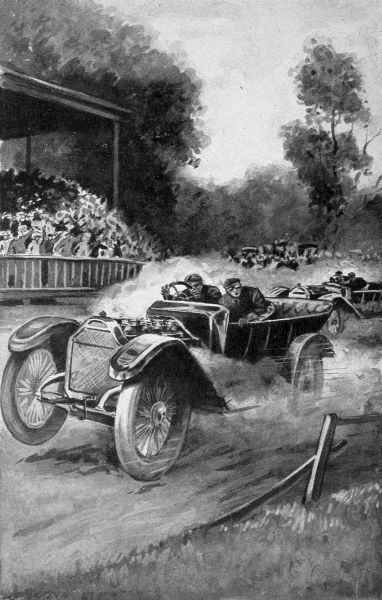
Crack! went the pistol. With a mighty roar,
and the blue flames spitting from the exhaust
ports, the two great machines bounded forward,
and almost with one movement Bert changed the
gears from first to second, from second to high.
At every change the willing car leaped ahead
with ever-increasing momentum, and Bert felt a
wild thrill run through his body as he realized
the vast force beneath him, subject only to his
control.
The “Gray Ghost” had made almost as good
a start, however, and now, although the “Red
Scout” had a slight lead, the inside position
began to tell, and the “Gray Ghost” gained a
trifle.
Dick, who had been looking back over his
shoulder, now turned to Bert and yelled excitedly
in his ear, “Sock it to her, Bert! Give her
the gas! They’re gaining on us!”
They had now covered the first lap, and the
speedometer hand on the “Red Scout’s” dashboard
registered a speed of fifty miles an hour.
Bert knew he could do better than that, but remembered
Mr. Hollis’s instructions not to take
any unnecessary chances. The machine was
working beautifully, and a wave of pride surged
over him as he thought that this was largely due
to the care and work he had bestowed upon it.
But now the “Gray Ghost” was ranging
alongside—ahead—
“Give her a pump full of oil, Dick,” yelled
Bert to his friend, and opened the throttle a
trifle wider.
The machine answered like a thing of life.
The wind whistled in their ears, the track seemed
a mere gray blur racing away behind them, and
the mighty speed song of the ravening motor was
like music in their ears.
Faster and faster they flew, the two cars keeping
pace side by side, and the speedometer hand
creeping up—up.
Fifty-two, fifty-three, fifty-six! it registered,
and the flying cars seemed barely to touch the
ground. On the straight stretch in front of the
grandstand they gathered such speed that at the
turns the rear wheels skidded, throwing up showers
of dirt, and the drivers were forced to slow
down a little or the machines would surely have
collided.
Up to that time neither car had a decided advantage,
but now they had covered the eighth
lap, and both crews realized that the time had
arrived to call on the racing engines for their
final and greatest effort.
The crowds in the stands were yelling like
maniacs, as each car in turn pushed its nose
ahead of the other. But Bert and Dick heard
nothing but the terrific roar of the racing cars.
Their pulses beat like trip-hammers; their eyes
were starting from their heads. They felt rather
than saw that the “Gray Ghost” was gaining—gaining
only a little, inch by inch, but gaining.
Now it had come abreast; now it was slowly but
surely forging ahead. It looked as though the
“Red Scout” had “shot its bolt,” and its partisans
in the grandstand groaned in an agony of
apprehension that was fast becoming despair,
while their rivals danced up and down and
shrieked encouragement to their gray champion.
Now they were on the last lap, and suddenly
Bert leaned forward and advanced his spark to
the limit. It was do or die. His heart exulted
as he felt the splendid car leap forward. He
took a firmer grip on the wheel and threw the
throttle wide open. His mysterious “sixth
sense” had told him that he had something in
reserve, and now the “Red Scout” justified his
judgment. It leaped, it flew. It collared the
“Ghost” just as they turned into the stretch, and
tore down the course, the explosions of its motor
blending together in one deafening volley of defiance
as it drew away from its rival. Across the
line it flew like a rocket, the pistol cracked, and—the
race was won!
Both cars made another circuit of the track
before they were able to stop, and then drew
up in front of the grandstand.
Immediately the crowd surged down, and in a
moment the two contestants were surrounded by
a frenzied mob of shouting and hat-throwing
boys, and almost equally excited, if less demonstrative,
country people.
Mr. Hollis pressed forward and grasped the
hands of Bert and Dick, one in each of his.
“You did nobly, boys,” he exclaimed, but there
was a catch in his voice, and his face looked gray
and drawn, “you did great work, but I would
not consent to your racing again for all the
money in the world. It is altogether too dangerous.”
But by this time the defeated boys belonging
to Mr. Thompson’s troop had recovered a little
from their chagrin, and now elbowed their way
through the crowd, headed by their leader and
Ralph Quinby.
Like the clean-cut and manly fellow that he
was, Ralph walked up and shook hands with Bert
and Dick in turn.
“Well,” he said, “you fellows certainly put up
a great race, and we have nothing more to say.
It was simply a case of the best car winning,
that’s all.”
Bert appreciated his manly spirit, and replied,
“It was simply a matter of the ‘Red Scout’
having a little more speed. If we exchanged
cars, you would win and we would lose. You
gave us a hard tussle up to the last second.”
All the other boys showed the same feeling as
had Ralph, and both parties separated with mutual
expressions of esteem and good will.
All the members of Mr. Hollis’s troop that
could do so crowded into the “Red Scout,” and
various good-natured farmers volunteered to
make room in their capacious wagons and take
the rest home. Room was even found for Don,
who had been an excited spectator of the race
and was now regarded by the jubilant boys as
their mascot.
“It’s little enough to do at that,” remarked
one husky agriculturist. “I’d be willing to cart
the whole outfit over and back a dozen times for
the sake of seeing another race like that. I wish
old Dobbin could hike along like them things.”
And in this he expressed the general sentiment
of the crowd.
As they traveled campward through the cool
twilight the boys shouted and sang, and in a
thousand other noisy but harmless ways found a
vent for their overflowing enthusiasm.
Bert and Dick were the heroes of the day, as
they well deserved to be. The race was run
again at least a hundred times, and by the time
they struck camp they had quieted down to some
extent. Their beloved car had, of course,
reached camp ahead of them, and now, as they
alighted and caught sight of Bert and Dick, their
enthusiasm flamed up again, and cheer after
cheer resounded through the silent woods.
At last they cooled down sufficiently to go to
bed, but it was a long time before they finally
got to sleep. Bert and Dick shook hands before
parting to go to their different tents. For a few
seconds they looked into each other’s eyes, and
the grip of their hands tightened before they
finally separated and said good night. For when
two good comrades meet danger face to face and
win out, a new and never-to-be-forgotten bond is
riveted between them that lasts through life.
It was a wildly hilarious group of campers who
sat down to a piping hot breakfast the next morning.
Some, indeed, had hardly slept at all, so
great was their rejoicing at the “Red Scout’s”
glorious victory. They had won and the much-vaunted
“Gray Ghost” had had to “take their
dust.” What if it were their last day in camp?
As Jim, who was famous for mixing his figures
of speech, said, “The camp, anyway, was breaking
up in a blaze of glory.” Every exciting detail
of the great struggle was rehearsed and enlarged
upon, times without number. They crowded
round the splendid car and praised it and patted
it as though it were alive and could understand
how proud they were of its victory.
And Bert! If he had been anything but the
fine, manly fellow he was, he would have been
utterly spoiled by the plaudits heaped upon him.
He had been their hero before; now he was their
idol. His skill, his judgment, his nerve, were
dwelt upon to the exclusion of everything else;
but he modestly disclaimed any credit and put it
all up to the car. “This is the fellow that did
it all,” he said, patting the great machine affectionately.
“Yes,” quoted Dick,
“‘This is the steed that saved the day,
By carrying Sheridan into the fight
From Winchester, twenty miles away,’
but all the same,” he went on, “the steed saved
the day because Sheridan was on his back, and
the ‘Red Scout’ saved the day because Bert
Wilson was at the wheel.” And to this the whole
camp gave a thundering chorus of assent.
And Bert was at the wheel that afternoon,
when, after “three times three” given for the
“Red Scout” and its driver, the noble car stood
panting, crowded to the guards with as many as
could tumble in, ready to lead the way to the
station where they were to take the train to the
city.
“I tell you, Tom,” he said, as he grasped the
wheel and the great car sprang forward, “I
never expect to have so much pleasure and excitement
in my life as I have had this summer.”
But Bert was mistaken. A broader field and
greater triumphs lay before him—exploits that
would tax every ounce of brain and muscle; victory
snatched from defeat amid the applause of
excited thousands. How he met the test and won
his fight will be told in the next volume, “Bert
Wilson’s Fadeaway Ball.”
THE END
THE BERT WILSON SERIES
By J. W. DUFFIELD
An excellent series of stories for boys, full of outdoor
life and adventures, athletic sports, etc.
Wholesome, clean and instructive.
BERT WILSON AT THE WHEEL
An absorbing story of automobile exploits, abounding in
stirring experiences and exciting adventures.
BERT WILSON’S FADEAWAY BALL
How a baseball pennant was won by the masterly pitching
of the young Freshman recruit is told in crisp, snappy
fashion, with a wealth of thrilling detail that will delight
the lovers of the great national game.
BERT WILSON, WIRELESS OPERATOR
Perils of storm and shipwreck, head-hunters and pirates,
are woven into a romance of compelling power that chains
the attention at once and holds it to the end.
BERT WILSON, MARATHON WINNER
How the pick of the world’s athletes struggled for
supremacy and how the representative of the Stars and
Stripes carried off the crowning victory at the great
Olympic games.
Others in preparation
12mo, cloth, with four illustrations in each, by
H. G. Richards.
Price each, 60 cents.
SULLY AND KLEINTEICH—NEW YORK
THE BERT WILSON SERIES
By J. W. DUFFIELD
THE FOLLOWING TITLES ARE
IN PREPARATION
BERT WILSON AT PANAMA
A host of thrilling adventures is woven into this stirring
story of the young American who thwarts by his quick wit
and determined courage a plot to destroy the great canal.
Brimming with interest from cover to cover.
BERT WILSON’S TWIN-CYLINDER RACER
A motor-cycle romance of speed and daring that will stir
the blood and make the heart beat faster. How sheer pluck
that refused to be downed won out against foul play and
tremendous odds.
BERT WILSON ON THE GRIDIRON
The “never-say-die” spirit of college football that makes
it such a glorious game sparkles on every page. A gripping
story of “bucking the line” and “going round the ends,”
culminating in the great run down the field in the last minute
of play that snatched victory from defeat.
BERT WILSON IN THE ROCKIES
Full of life and spirit, dash and danger in the wild regions
of the West. The picturesque figures of the frontier—greasers
and grizzlies, rustlers and road agents—appear in adventures
that make one throb and tingle with excitement.
12mo, cloth, with four illustrations in each, by
H. G. Richards.
Price each, 60 cents.
SULLY AND KLEINTEICH—NEW YORK
Publications of Sully and Kleinteich
THE “HOW” BOOKS
HOW TO MAKE THINGS
By Archibald Williams
Author of “How It is Done,” “How It is Made,” “How It Works.”
This is just the book for the active youth who has got beyond the period when he
asks, “How is it done?” and now wishes to do it himself. The book is very fully
illustrated with useful diagrams drawn exactly to scale.
12mo. Cloth, 450 pages, with numerous illustrations and diagrams.
Price $1.20 net
HOW IT IS DONE
OR, VICTORIES OF THE ENGINEER
By Archibald Williams
Author of “How It is Made,” “How It Works,” “How To Make Things.”
Describing in simple language how the great engineering achievements in all parts
of the world have been accomplished. It is a book brimful of interest for everybody,
and especially to the younger generation with a turn for engineering in any of its
many branches.
12 mo. Cloth. 450 pages, with 268 illustrations and diagrams.
Price $1.20 net
HOW IT IS MADE
By Archibald Williams
Author of “How It Works,” “How It is Done,” “How To Make Things.”
Describing in simple language how various machines and many articles in common
use are manufactured from the raw material.
12mo. Cloth. 474 pages, with numerous illustrations and diagrams.
Price $1.20 net
HOW IT WORKS
By Archibald Williams
Author of “How It is Done,” “How To Make Things,” “How It is Made.”
It deals in simple language with Steam, Electricity, Light, Heat, Sound, Hydraulics,
Optics, etc., and with their application to apparatus in common use.
12mo. Cloth. 461 pages, with illustrations and diagrams.
Price $1.20 net
HOW IT FLIES
OR, THE CONQUEST OF THE AIR
By Richard Ferris, B. S., C. E.
The story of man’s endeavors to fly and of the inventions by which he has
succeeded.
12mo. Cloth. 476 pages, with numerous illustrations and diagrams.
Price $1.20 net
THE GATEWAY SERIES
GATEWAY TO CHAUCER
Stories told by EMILY UNDERDOWN, from the Canterbury
Tales of GEOFFREY CHAUCER. With 16 colored plates and
numerous marginal illustrations after drawings by Anne Anderson.
THE GATEWAY TO SPENSER
Tales, retold by EMILY UNDERDOWN, from “The Faerie
Queene” of EDMUND SPENSER. With 16 colored plates and
numerous marginal illustrations from drawings by F. G. PAPÉ.
THE GATEWAY TO ROMANCE
Tales retold by EMILY UNDERDOWN, from “The Earthly
Paradise,” by WILLIAM MORRIS. With 16 colored plates and
many other illustrations.
THE GATEWAY TO TENNYSON
Tales and extracts from the poet’s works, with an introduction
by MRS. ANDREW LANG. With 16 colored illustrations from
drawings by NORMAN LITTLE.
THE GATEWAY TO SHAKESPEARE
Containing a life of Shakespeare, by MRS. ANDREW LANG,
a selection from the plays, and from “Lamb’s Tales.” With 16
colored plates and many other illustrations.
THE SUNSHINE
AND SHADOW SERIES
In the Service of the King, and
Other Stories
In the Heart of the Forest
After Long Years, and Other Stories
These books translated from the German by
Sophia A. Miller and Anes M. Dunne.
| 16mo. |
Illustrated. Each $.75 |
The ethical stories in the Sunshine and
Shadow Series have been translated from the
German with the view of instilling into the minds
of youthful readers such truths as will help materially
toward building a character that will
withstand the trials and temptations of life.
It is conceded by educators that ethics presented
in the lecture form fails of its purpose;
therefore the writers have presented this subject
in the form most appealing to children—the
story.
THE BOOK OF GOLDEN DEEDS.
By CHARLOTTE M. YONGE. With 16 full page colored
illustrations, 12 full-page illustrations in black and white (photo
engravings) and marginal illustrations all through the book.
TALES OF THE GODS AND HEROES.
By SIR G. W. COX, M. A. With sixteen colored plates from
drawings by JAMES FRIPP.
CONTENTS
The Sorrow of Demeter — The Sleep of Endymion — Niobe and Leto — Orpheus
and Eurydice — Phryxus and Helle — Cadmus and Europa — Odysseus and Polyphemus — Odysseus
and Circe — Odysseus and the Seirens — Odysseus and Nausicaa — The
Story of Arion — The Treasures of Rhampsnitus — Cephalos and Procris — Daphne — The
Delian Apollo — The Pythian Apolli — The Vengeance of Apollo — The
Toils of Heracles — Althaea and the Burning Brand — Phaethon — Io and Prometheus — Briareos — Arethusa — Tyro — Poseidon
and Athene — Ariadne — Narcissus — Medeia — Cyrene — Bellerophon — Iphigeneia — Hector
and Andromache — Sarpedon — Memnon — Oenone — The
Lotos-Eaters — The Cattle of Helios — Odysseus and
Calypso — Atys and Adrastos.
LIVES OF GREAT MEN,
TOLD BY GREAT MEN
Edited by RICHARD WILSON. With 31 full-page illustrations
in color.
| Quarto. Cloth. 448 pp. |
Net $2.00 |
CONTENTS
Alexander the Great — Alfred the Great — The Black Prince — The Story of William
Wallace — Sir Thomas More — Francisco Pizarro — Sir Richard Grenville — Sir
Francis Drake — Sir Phillip Sidney — John Hampden — Oliver Cromwell — John Bunyan — Benjamin
Franklin’s Boyhood — Dr. Johnson — Oliver Goldsmith — Flora
Macdonald — The Boyhood of James Watt — Robert Burns — Charles Lamb — William
Wordsworth — The Boyhood of Turner — George Borrow — The Boyhood of George
Stephenson.
THE STORY OF HEATHER
By MAY WYNNE
12mo. Cloth, 6 colored illustrations. Price, net $1.00
This is the autobiography of a pony, simply told for young children, and full of action and
interest. The volume is excellently illustrated in color by Dorothy Pope, and attractively
presented in cloth cover.
EXMOOR STAR
The Autobiography of a Pony
By A. E. BONSER
12mo. Cloth. Illustrated. Price, net 50c; postpaid 55c.
The sympathy of children in the humane treatment of animals will be enlisted by this
charming story. They see how cruel our thoughtlessness and lack of attention to the needs
of our dumb servants often are. They will share the views of this bright little pony in regard
to man’s attitude to animals. The story is fascinating and as circus performer or polo
pony, Star is a most interesting character. After many strange experiences he saves the
lives of twelve people, receives a medal from the Royal Humane Society and retires from
public life. The story is not marred by a sad ending. The book is fully illustrated.
A BOOK OF BIRDS AND BEASTS
OR
THE LAW OF KINDNESS
134 pages and 32 colored illustrations
Price, net $1.00
It is full of interesting stories, all about animals and their doings, and of such a character
that no child who reads them will ever dream of being unkind to bird, beast, fish, or insect;
for when people get to know God’s creatures and their wonderful ways, they learn how to
leave them alone and to watch them patiently, just because they are so well worth watching.
THE OLD FAIRY TALES
189 pages and 32 colored illustrations
Price, net $1.00
A book of Fairy Tales for Boys and Girls containing; The Three Bears — Brother and
Sister — Little Red Riding-Hood — Hansel and Grethel — The Golden Goose — The Magic
Key — Little One Eye, Little Two Eyes, and Little Three Eyes — The Story of Catskin — Cinderella,
or, The Little Glass Slipper — The Frog-Prince — The Sleeping Beauty in the
Wood — The Iron Stove — Shemus and the Little People — Prince Curly Chin — Queen Mab
and Oberon — The Merry Tricks of Tom Thumb — Prince Cherry — Little Snowdrop — The
Goose Girl — The Fairies of the Caldon-Low.
THE WONDERS OF THE WORLD
Formerly published under the title of
“The World by the Fireside.”
By MARY and ELIZABETH KIRBY. Crown.
8 vo. Cloth. Hundreds of illustrations. Price $1.50
This volume brings the world, that is so full of wonders,
to our own fireside.
The book is embellished with pictures of the various
scenes and objects described, in order to make it more
attractive.
THE WONDERS OF THE SEA
Formerly published under the title of
“The Sea and Its Wonders.”
By MARY and ELIZABETH KIRBY. Crown.
8 vo. Cloth. Hundreds of illustrations. Price $1.50
Wonders abound in the Ocean. It is a world in itself,
and is subject to its own laws.
“In this great and wide sea are creeping things innumerable,
both small and great.”
The various chapters are amply illustrated with drawings
taken from life, and on which the utmost care has
been bestowed.
Sully and Kleinteich—New York
THE
BOOK OF INDOOR
AND
OUTDOOR GAMES
BY
MRS. BURTON KINGSLAND
With suggestions for entertainments. Illustrated.
A veritable encyclopaedia of games, pastimes,
and entertainment.
CONTENTS
Games of Thought, Wit and Memory — Progressive
Games — Card Games — Children’s
Games — Children’s Singing Games — Games for
Sunday Evenings — Catches and Riddles — Fortune
Telling — Mesmerism — Children’s Parties — Special
Dinners, Dances and Luncheons — Tableaux — Wedding
Anniversaries.
“Without touching on the side of profit-yielding
occupations, and with more stress laid down
upon the social side of life, this book will prove
a real treasure for those lacking in invention, and
will bring delight to many a dull or rainy day.”
—The Dial
Sully and Kleinteich—New York
The Golden River Series
Bound in cloth 16mo. With a colored panel
Illustration on front cover—title stamped in gold
| Alice’s Adventures in Wonderland. |
8 |
colored |
illustrations. |
| Anderson’s Fairy Tales. (Ugly Duckling.) |
4 |
colored |
illustrations. |
| Water Babies. |
4 |
” |
” |
| The King of the Golden River. |
8 |
” |
” |
| Arabian Nights. |
5 |
” |
” |
| Gulliver in Lilliput. |
4 |
” |
” |
| Don Quixote. |
4 |
” |
” |
| Stories from Hiawatha. |
6 |
” |
” |
| Tanglewood Tales. |
4 |
” |
” |
| John Halifax’s Boyhood. |
4 |
” |
” |
| Tales of a Grandfather. |
6 |
” |
” |
| David and Emily. |
6 |
” |
” |
| Nell and Her Grandfather. |
4 |
” |
” |
| Stories from Spenser. |
8 |
” |
” |
| Rose and the Ring. |
4 |
” |
” |
| Knights of the Grail. |
8 |
” |
” |
| Sir Thomas Thumb. |
8 |
” |
” |
| Linden Leaf. |
8 |
” |
” |
| Undine. |
8 |
” |
” |
| Maggie and Tom Tulliver. |
4 |
” |
” |
| Children of the Old Testament. |
6 |
” |
” |
| Children of the New Testament. |
6 |
” |
” |
| Six Gifts. |
6 |
” |
” |
| Kingsley’s Heroes. |
4 |
” |
” |
| Adventures of Ulysses. |
6 |
” |
” |
| Golden Deeds. |
6 |
” |
” |
| Stories from Tennyson. |
6 |
” |
” |
| Tales from Shakespeare. |
6 |
” |
” |
| Stories from Chaucer. |
4 |
” |
” |
| Cox’s Greek Heroes. |
4 |
” |
” |
SULLY & KLEINTEICH—NEW YORK
Transcriber’s Notes:
Except for the frontispiece, illustrations have been moved to follow
the text that they illustrate, so the page number of the illustration
may not match the page number in the List of Illustrations.
Punctuation and spelling inaccuracies were silently corrected,
except as noted below.
Colon (:) punctuation has been retained as in original.
Normalized variations of Red Scout and Gray Ghost to ‘Red Scout’
and ‘Gray Ghost’ within quoted speech and “Red Scout” and
“Gray Ghost” in all other cases.
Archaic and variable spelling has been preserved.
Variations in hyphenation and compound words have been preserved.
Spaced dashes used in some back matter for better wrapping of text.