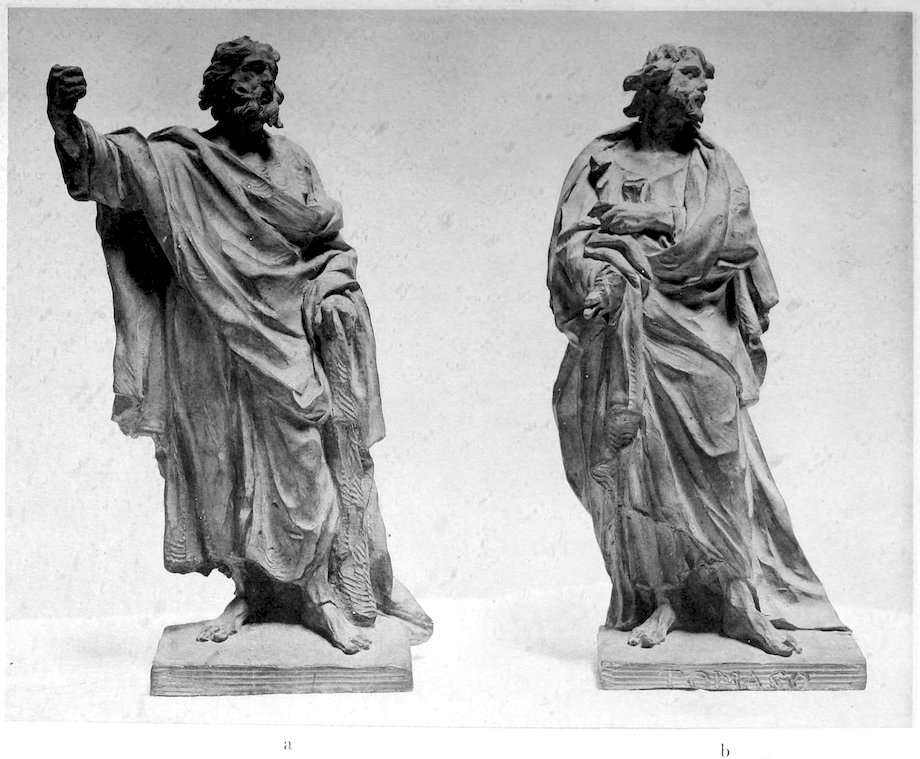
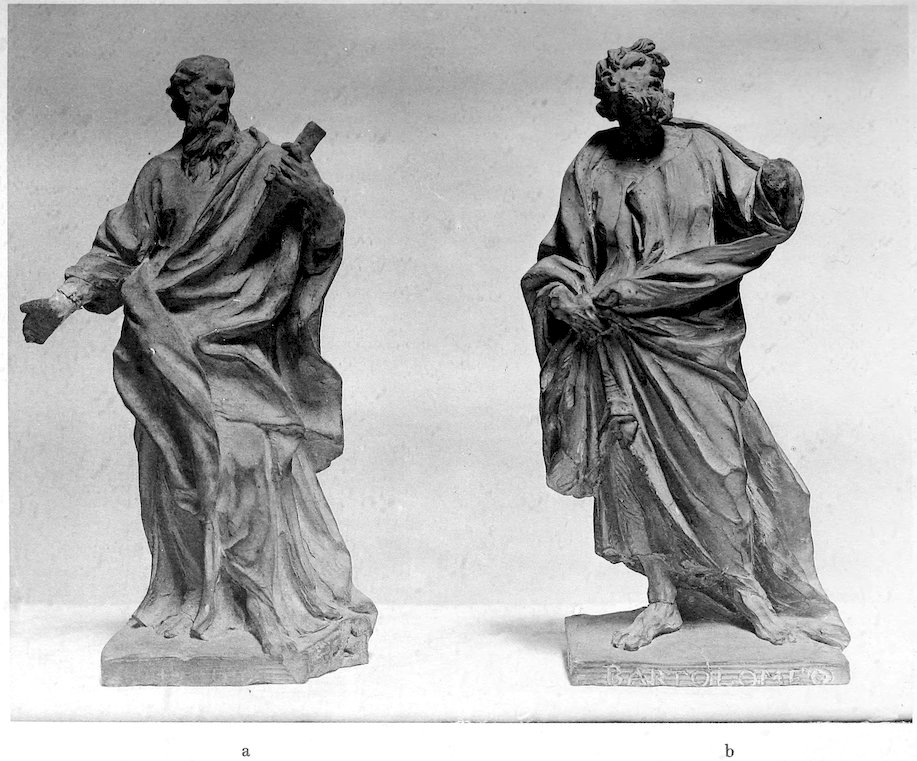
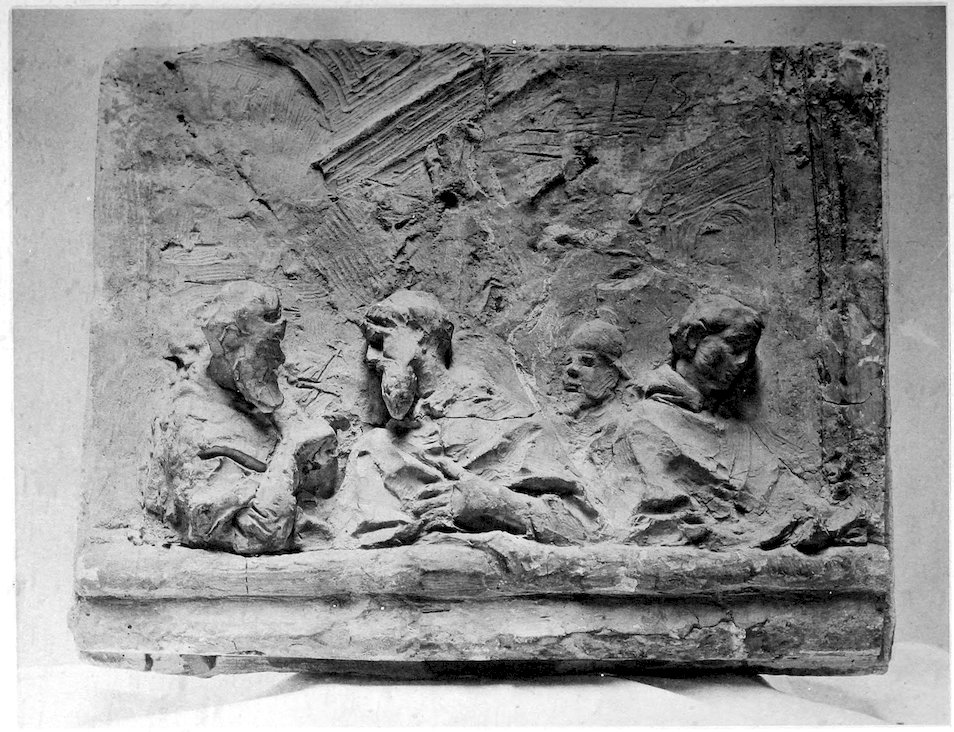
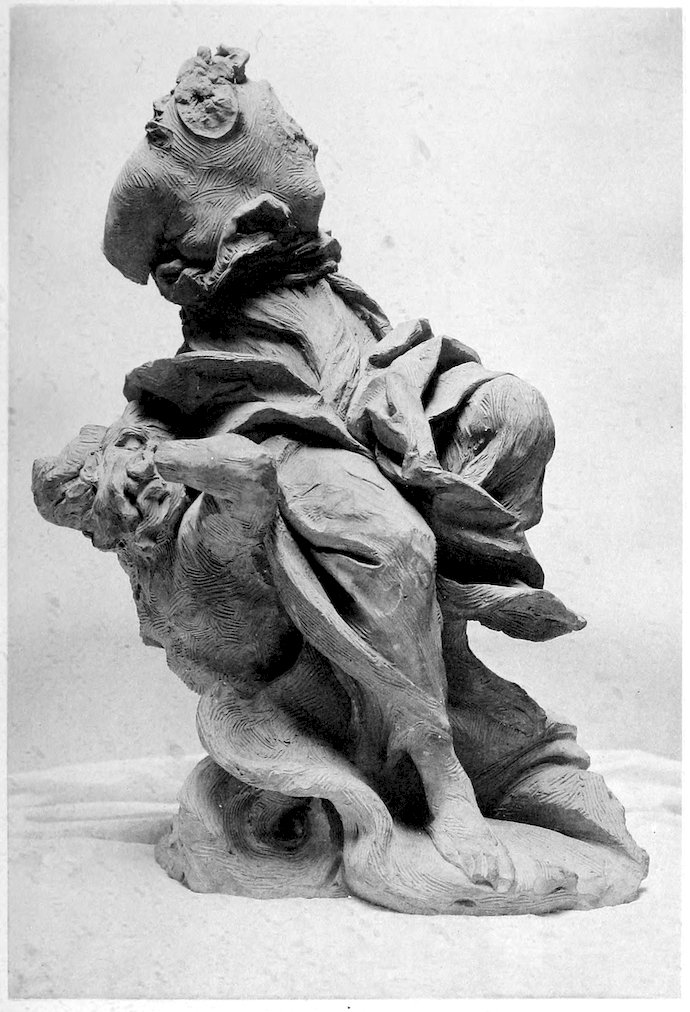
3
During the last hundred years there has come a great
change in the feeling of most people towards the art of the
different epochs of the Renaissance. Whereas our grandfathers
and our great-grandfathers held Carracci and Guido
and others of the same time in high esteem, we are now
taught that these later men are of little value or interest in
comparison with the artists of the fifteenth century, and even
the most halting and stuttering “Primitive” is held of more
worth than the more able masters of the seventeenth century.
This change is natural enough, but betokens a lack of true
understanding of the purpose and powers of the fine arts.
The altered mental attitude in religious matters which renders
most people incapable of feeling the appeal of the mystical
fervour of the seventeenth century explains in a measure
why the earlier work is preferred; and added to this is the
effect of the development of archæological training which has
given rise to an interest in the mere search for origins—a
search that has done infinite harm in blinding the eyes of
students to the fact that, for the world at large, it is far more
important to see whither life is carrying us than from what
slow, groping, and inexplicable protoplasm and haphazard
chance it sprung. The teachers of our universities go on
in their dull round, like Dervishes, repeating that the Parthenon
4was the most perfect expression of Greek art, and there
are those who cannot see the beauty of the silver vases from
Boscoreale because they choose to call them Roman. Without
doubt there are many sound reasons for the purely archæological
study of classic art, and recently a small but perceptive
band of scholars has raised Roman art from the
ignorant neglect into which it had fallen and given it the
proper position due to any such able expression of great ideas;
this justifies the hope that the worth of the later Italian
schools will become once more manifest, not again to be forgotten.
The idea that the art of any civilized people rises by a
steady and constantly more perfect progression to one glorious
peak of perfection and then falls by rapid and recurring
blunders to a waste of meaningless effort is, I believe, due to
the too frequent mistake of considering the monuments of
the arts as separate entities and as self-ordained rather than
as indices of vital currents of thought and life. The English
dictionary is not synonymous with English literature. Nor
does the will-o’-the-wisp phrase “art for art’s sake” mean
that each work of art is a unique and inexplicable phenomenon.
Its true meaning is that the artist, be he poet or sculptor or
musician—no matter what form his art takes—finds the only
adequate expression of himself in the forms and under the
governance of the laws of the art which he follows. By so
far as he follows these laws is his work intelligible to other
men; by so far as he finds new combinations for the forms
and new adaptations of the laws to meet the new circumstances
of ever changing life is he original and great. When
Shakespeare or Keats wrote a sonnet the verses were not produced
by them merely for the sake of using a certain complicated
formula of fourteen lines to make certain statements,
nor when Pheidias carved the Athena or Praxiteles the Hermes
was it merely with the idea of reproducing the human form in
stone.
5Had such been the motive of these poets and sculptors
their results would have had small value; but each one of
them had something to say that he could best express in
the form chosen, some feeling towards life he wished to
share with others, and in this outgiving he steadily sought
to perfect the form that held his idea. The care he lavished
on the verse and marble so that the expression of this thought
might be the completest possible and truest to his idea, the
delight in making his chosen art conform to the laws of
language or of gravity, while at the same time it held the
thought as a nest holds an egg, that was art for art’s sake, and
a very different matter from mere technical dexterity.
All the arts are alike means of conveying ideas from
brain to brain and from the past and forgotten generations to
those not yet thought of. No one school ever told the whole
truth, but only that part of it maybe which local circumstances
enable it to see. Each of them, from the earliest which faded
away before recorded time, to the latest which looks eagerly
forward to to-morrow with the hope of new accomplishment
and absorption in new truths discovered, is but as the searchlight
casting its sharp-defined ray through the immeasurable
dark. The flames of Priam’s pyre crimsoning the night which
hung over the “topless towers” were not marked on the Argive
hills, but the message was flashed hither and yon over the
star-tracked sea, raising now hopes now fears, till at Mycenæ
6no answering flame was lit, but instead the young Phœnix was
born.
And as no one school can answer all the questions, so
no one single pundit can tell all the truth even of his own
school. In each honest, unshamming workman there is something
of truth, something others long ago thrilled to or that
others yet to come may also feel, something that he knows
with a clarity and conviction not to be equalled by any other.
In a sense he does express his time, but neither the artist nor
any man else is merely the product of his time, and the truly
great ones go ahead of it, following the gleam of the divine
spark which each man is born with to shelter in his heart as
best he may. If it keep alight, by God’s grace, his life becomes
in truth art for art’s sake, and he is one of the successful runners
in the torch race across the great divide of life that separates
the hopeless past from the hopeful future.
Of such there are many to spur on the weary and to guide
the strayed back to the beacon path. In every man who has
appealed to the masses, whose ears have rung and whose heart
has swelled with the loud cries of “well done,” there is, be
sure, something of the ultimate divine truth—some no mockery—some
sincerity which heated in the fires of his
soul and beaten with long pain and trouble on the anvil of his
heart, shall be, if we can grasp it, a treasure undiminishing so
long as we have breath to live.
Such an one was Giovanni Lorenzo Bernini, whose life was
almost coterminous with the seventeenth century (1598–1680).
Honoured during life by three courts, and at that
time court patronage was a very different thing to what it is
now, he has of late been treated with a disregard which is
7unjustified, and has been blamed for faults which were not his.
These false judgments can be traced back to the envy of some
of his contemporaries, who on the one hand accused him of
ignorance of the mechanics of his art and of stupidity of design,
and on the other, oftentimes, did their best to copy him. But
it gives us pause when we consider that notwithstanding the
forces of jealousy backed by powerful influence that were
brought to bear on him he remained in the eyes of artistic
Italy during his sixty and more working years the “Michael
Angelo of the seicento.” And this estimate of him, if we lay
aside preconceived notions and formulas handed down to us
by our parents, and look at his work with our own eyes and
study it in the light of our own knowledge, will turn out to
be the right one. Only the rash and heedless dare say of
one who acquired such admiration in his own day that his
work was poor and unworthy. And yet this is what is said.
His style is said to be extravagant and artificial and his violent
material effects are said to show that he was unable to express
thought. Even the group of Apollo and Daphne is held to
exhibit his ignorance of the proper domain of sculpture. It
seems to me more likely that the judgment of the artists and
critics of the seventeenth century is apt to be the correct one.
What would be artificial in an artist to-day was not so in
Bernini, but was, if we could see it and free our hearts from the
bonds of tradition, the most honest and simplest expression of
a genius who had a new message for those who would take the
trouble to understand. Frequently his work is criticised for
not conforming to the “severe laws” of good sculpture and
in this criticism lies the common fallacy of letting personal
taste usurp the place of critical judgment. There are, of
8course, laws of gravity, and of stress or strain to which a sculptor
must conform because they are in the nature of the material
he uses, just as there are optical laws which the painter
should know; but there are no laws to fix what the artist
may or may not represent or the forms which he should give
to his representations. Personal taste is very well in its place,
but it is not criticism; and severe laws are good training for
our powers, but dependence on them leads to stagnation and
not to discovery. Because the stage-coach follows the old
gray road is it artificial of the aeroplane to soar through the
trackless ether? Probably most critics, when they speak of
severe laws as fixed and irrevocable, have in mind those followed
by the Greeks of the fifth century B.C.—surely of no
later time, for what of the violent material effects of Pergamon?
But suppose portraits of the present-day business
kings were carved according to the one-time valid classic
laws? Strangely unlike the subject would such portraits be!
There is nothing ultimately right in severity nor ultimately
wrong in violence. The money-changers were not led from
the temple by a ribbon round their necks. The pioneer and
path breaker must be violent. This was Bernini’s work and
purpose, and it is no more reasonable to blame him for the insincerity
and stupidity of his followers than to blame Columbus
for lynch law. As of many another, Bernini’s fame has
been dimmed by the follies and shams of his would-be imitators.
Many tried to imitate and surpass him, but it was not
to be done. He had the quality of genius which is more than
the power of taking infinite pains. That his pupils had, but
they merely exaggerated the form of the outer husk of his
work till it lost all semblance of truth and became nothing
but untruth and error. In him was the divine spark, the light
of which showed new worlds for sculpture to work in and the
heat of which moulded his material into the eternal forms of
beauty.
9The study of Bernini is established on very strong foundations,
and the misinterpretation of his aims is inexcusable;
for we have sure records of every kind concerning him. From
his surprising youth to his busy old age we can trace his progress
and the development of his powers. Of all his numerous
works scarcely one is lost, and such as have disappeared are of
no importance whatever in comparison with what remains.
The full account of his life was written by two contemporaries,
one of them his son, and this is amplified by many letters and
other papers—accounts of payments for his work, stories of
his doings, plans for work sometimes never undertaken and
other times finally accomplished by himself or his pupils,
that have been turned up into the light after long sleep in
Italian archives.[1] It is all before us, and each chapter of his
life can be recalled from the Elysian fields. We grow eager
with the same hopes, we feel despondent at the same broken
faith and pledges, we grow interested in the same companionships,
we rest after the same magnificent accomplishments,
and to the end we are keen in search of new worlds to open up.
Even the look of him we know; what the appearance was
as he moved among the Popes and Kings, the Cardinals and
Princes of Europe. What it was for a man they saw we too
can see. What it was of a heart he felt dragging him on with
10engine throbs we can guess when our amazed eyes rest on the
Saint Theresa, the bust of Louis XIV, or the throne in St.
Peter’s. A strongly built, dark man, his thick hair whitening
in old age, but the quick eye never losing its brilliancy and
piercing glance. Of simple fashion in dress, as the pictures
and drawings by himself and others show him, for all his love
of rich stuffs and floating draperies. A ready and pleasant
wit made him the best of company, though at times withdrawn
into himself by some mystical absorption. For just as the
great religious leaders, so the great artists are at times lifted
by some ecstasy away from actual surrounding fact and lost
in worlds only visible to their inner eye, and though visible
never to be told of. At other times his spirits broke forth
in irrepressible gaiety which though it might form itself as
satire was never malevolent. Generous to a fault, and always
ready to lift up a friend, he was implacable towards his enemies,
and rightly showed them no mercy. He had the strength
to be a good hater,—not feebly excusing hypocrisy and meanness
because the hypocrite was weak or knew no better, but
hating, not the poor miserable individual, but his qualities,
and, to the best of his own power, destroying them. Proud
and self-confident, but willing to answer questions or to explain
what might seem faults. A lonely man; one with many acquaintances
but few friends. Too sincere not to be shocked
by the heartless brutishness of the woman he loved, too honest
a workman not to be hurt by the attacks of envy, but never
losing heart, always following his ideal and seeking to eternize
the beautiful visions of his bright soul.
There are many portraits of him, some done with pencil
or pen or graver, others more elaborate oil paintings. They
11are the work of his friends, or done by himself, and show him
at various periods of life from young manhood to old age.
Naturally they vary in many ways, but the variance is for
the most part in the details of the outer shell of the man. The
thick dark locks of the youth give place to the thin gray hairs
of the old man; the full cheeks grow sunken and wrinkles
frame the piercing eyes; but in all the portraits certain characteristics
remain constant. A pencil drawing in the Galleria
Nazionale in Rome is the best of the youthful portraits.[2] It is
by himself, done when he was some twenty years old. It
shows a finely shaped head with thick, waving hair. The face
is strongly modelled, and all the features noticeable; the nose
large and slightly bent, the chin square and strong. Lips full
and sensitive, but vigorous. Most noticeable of all are the
eyes, large and dark, set rather deeply under heavy brows,
looking straightly and sadly but imperturbably on the world.
A face of power yet of sweetness. A man to ask after and to
watch what he will do in this world. Rather older we see
him in two drawings in the private collection of Prince Chigi
in Rome.[3] Life was testing him severely we know, but the
eyes are still steady, are still bright with the inner light that
was leading him on, and the mouth is still sweet and undrawn.
Of about the same time, or a little later maybe, is the oil
portrait supposed to be by himself (though for this there is
little proof), in the Uffizi.[4] No change yet in the character
except in a strengthening and making permanent the good
qualities of his youth. The man has found himself. Many
years go by before we again see him face to face.
12In the Gallery of St. Luke[5] and in the possession of Count
Andreozzi in Rome[6] are portraits of him in his last years, and
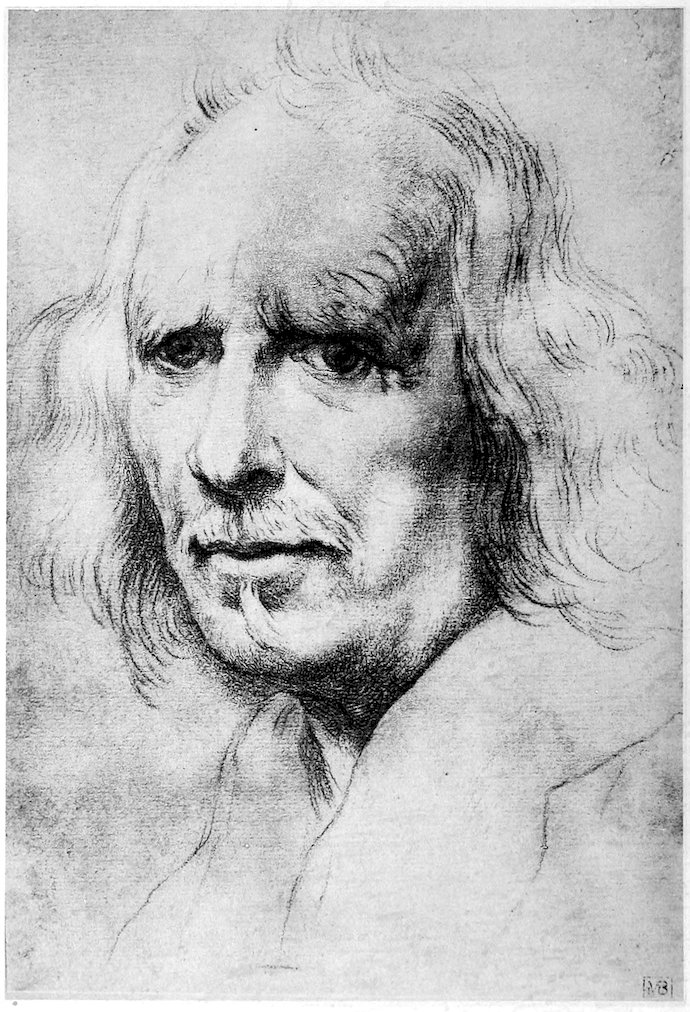
a very fine pencil drawing by himself in the Brandegee Collection
(Plate I). All his works were completed, his visits to the
courts of Europe were over, he is the “Michael Angelo of the
seicento,” and yet he is just as simple in his dress and pose
as ever. Obviously a great man whose ideals were so much
greater to him than what he had accomplished that no possible
flattery could disturb the balance of his mental poise. One
change there is in the face more to be remarked than the
higher forehead and the fuller chin. The eyes are still bright
and level, the mouth still as soft and strong, but the sadness
of expression has gone. Had he realized, I wonder, that soon
all the sorrows of life would be hidden and lost under the
gray church floor? Though the glad light of the sun no
longer shone upon his life his face is bright with a mystical
light as of the ranging stars which for countless thousands
of years have guided the feet of man.[7]
It may be thought that I have given a fanciful interpretation
13to the change that came in his face from youth to old age,
but it can be shown that some such thoughts as I have suggested
moved him. About 1650, at a time when his enemies
had attacked his work in St. Peter’s and caused him great financial
damage and still greater hurt to his natural and proper
pride, the idea came to him to carve an allegory that should
show the ages what his feeling towards his critics, towards
art and towards life truly was. Allegories in painting or
sculpture are usually, owing to the fixed limitations of these
arts, unintelligible, but no artist ever lived who could have
done as well as Bernini in making clear his idea with the material
he used. Even if we did not have his own words about
this group his thought would be seen, for his amazing command
of technique and his knowledge of statics made it possible for
him to combine figures with a freedom rarely equalled, and
thereby to express himself with an ease and fulness beyond
the powers of most sculptors of any time. Only one of the
two figures which were to form the group was ever finished,
but there is a sepia sketch showing the whole composition.
In it we see the winged figure of Time hovering above a
beautiful woman from whose nude body he lifts a mantle. She
is Truth; in her hand she holds an image of the Sun darting
bright rays in all directions. This group meant much to him;
was perhaps the most personal and truly expressive work he
ever made, and till his death he kept it by him. In his will
he says that not without reason has he kept this statue of
Truth unveiled by Time which he wishes to remain for ever
in the possession of his descendants who, as they look on it,
may remember that the most lovely of the virtues is Truth
and that if one works under her guidance Time in the end
14reveals her. Are the “severe laws” of the ancients any more
severe than this rule Bernini held before himself and wished
his descendants never to forget, and is it sensible because at
first sight his work seems strange and unaccountable to
damn it with such words as “fantastic” or “baroque”?
The group was never finished, but in a dirty courtyard off
the Corso in Rome, neglected as only the Italians know how
to neglect such things till some outsider stirs their jaded appreciation
to new interest, is the Discovered Truth. Time on
hasty wings flies by, but as Bernini knew, Truth stays always,
heedless of neglect, the fixed pole for all those who set their
aim beyond the bounds within which their earthly eyes would
prison them. And knowing this, it came to pass that his
old face was lit with a peaceful smile as he came to the evening
of life.
Bernini’s work is of unusual variety, but the best of it falls
into four classes. There are the wonderful groups illustrating
old world myths that he produced in the full joy of life in his
youth; there are the amazing religious monuments in which
he embodied with unrivalled skill the mystical intensity of
the religion whose chief priests he served; there are the superbly
joyous settings for fountains which though the waters
might dry up and cease to flow will still, so long as the stone
lasts, echo their murmuring music; and there are the long series
of magnificent busts on which he was employed from his very
earliest days to his latest. He was besides author, painter,
illustrator, and architect. I have no intention of cataloguing
the long series of work his never idle hand produced, but wish
merely to point out some of the forgotten beauties that he
brought into being. In a measure, it is possible to trace the
15source of his inspiration and in lesser degree to foresee its
outcome.
His father, Pietro, a Florentine, was a sculptor of no mean
power before him. His mother was of Naples, and in that
southern, passionate city Gian Lorenzo was born in 1598 and
there he passed his first years. Some day another Mendel
may be able to establish what were the forces of Florentine
and Neapolitan blood that lay dormant in his young brain,
but for us is no such certainty, and we can only guess at the
effect of the father’s artistic occupations and the mother’s
quick blood. In 1604, when the boy was but six years old,
his father moved to Rome, the city his son was destined to
impress with his genius as no city but Athens has ever been
impressed by a single artist. Working at first for his father,
he was only fourteen years old when he drew to himself the
attention of all the connoscenti by two busts which, as Annibale
Carracci said, any artist after years of work might have
been proud to make. The admiration Bernini won for these
works, to which I shall return, led, as was the good habit
of those days, to the patronage of the Borghese pope, Paul V.
In the Borghese villa, the ruined grandeur of which is still
the chief pride of Rome, the young Bernini was surrounded
by beautiful antique marbles, some of which he was called
upon to restore. This familiarity with ancient sculpture,
and this subjection in the task of restoration of his own spirit
to that of classic masters, had a very marked effect on him—an
effect which in its deepest sense lasted throughout his long
life, though its more obvious and visible manifestation soon
waned and faded away. That is to say, while his work at all
times showed a perfect comprehension of some of the fundamental
16laws of the material out of which sculpture is formed,
laws that were first clearly expounded by the Greeks, it is
only in a few of his earliest, and for a youth miraculous,
works that he shows a tendency to imitate classic form.
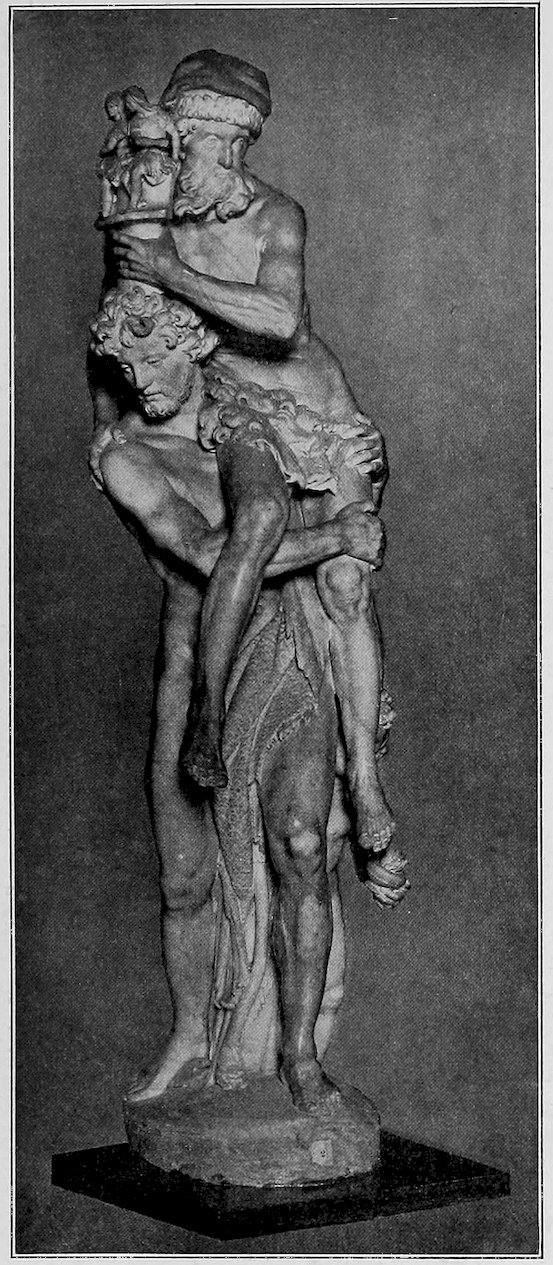
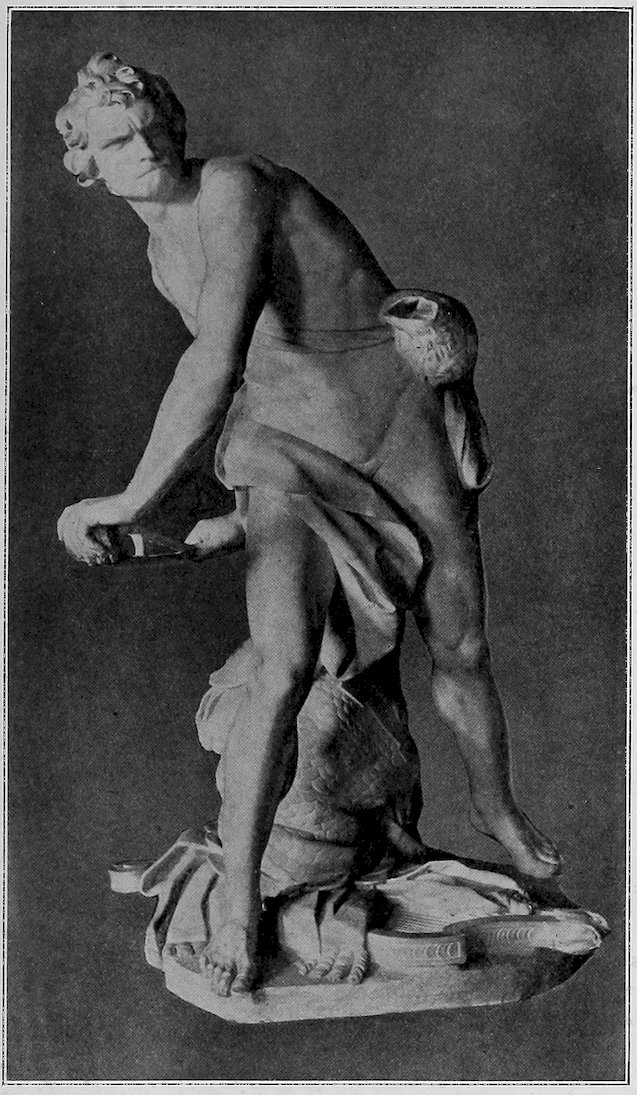
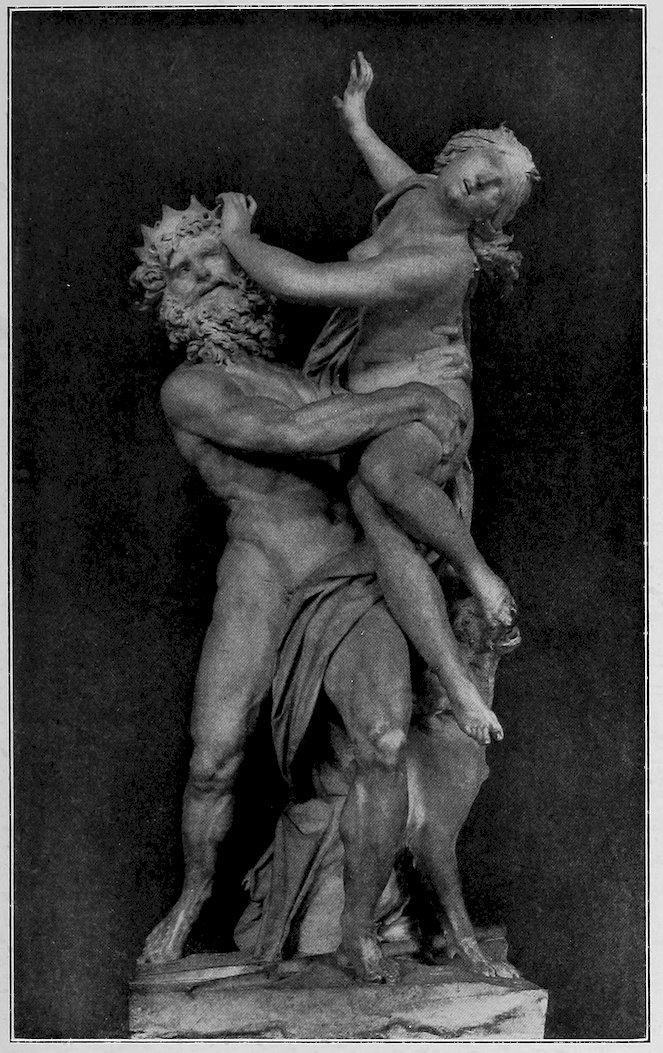
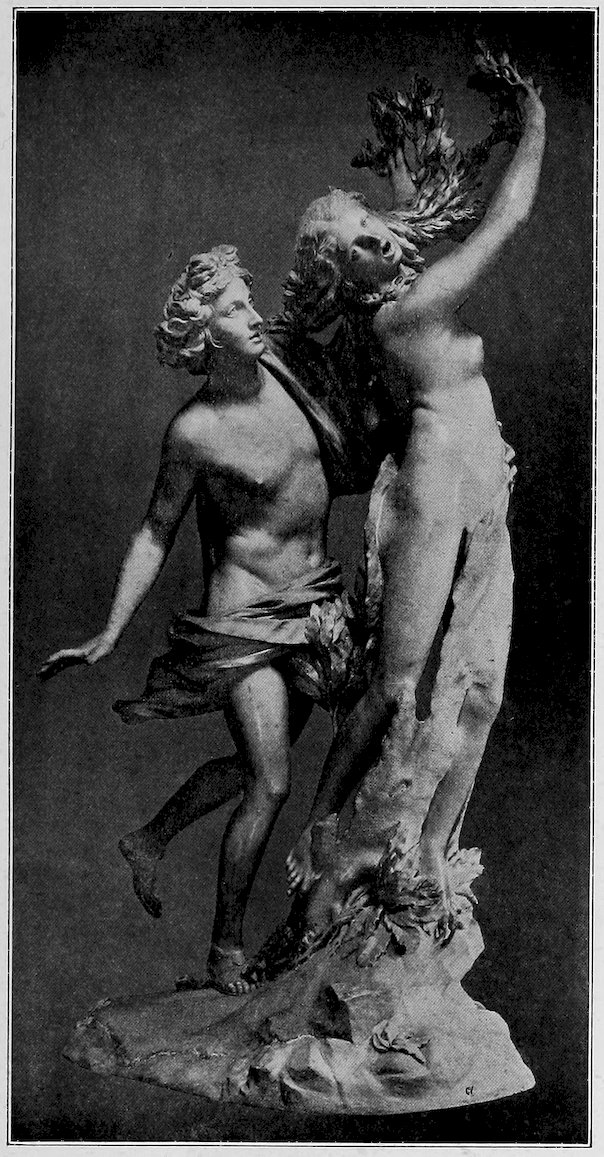
Four wonderful works were produced for the Borghese
family. The Æneas and Anchises (Plate III), the David
(Plate IV), the Rape of Proserpina (Plate V), and the exquisite
group of Apollo and Daphne (Plate VI). All these were
finished when he was only twenty-seven. Realizing this,
the comparison of him with Michael Angelo no longer seems
exaggerated, but one sees further that no such comparison can
perform the ordinary service of all such juxtapositions, which
is to afford a scale of better or worse, for the two masters
are supreme, each in his own individual and original way,
and incomparable.
Opinion may easily differ in regard to the first three of the
works just mentioned. To me the Æneas is the least pleasing
and the David the least successful artistically. The faults
of both may be in part due to the fact that in each case Bernini’s
imagination was to a certain degree hampered by work
of other men which he seems to have set himself to surpass,
and even though it may be granted that he did surpass his
models, he would have done better, as in the Proserpina and
Daphne, to let his own genius lead him whither it would and
ignore other suggestion. The models I refer to are, in the
case of the Æneas, the Christ by Michael Angelo in Santa
Maria sopra Minerva and for the David the Borghese Warrior
now in the Louvre, both works of small merit.[8] The reason
17the Æneas seems to me unpleasing is because of the weakness
and unheroic look of the faces and figures, but others may not
feel this, and the skill of the group is undoubted. The lack
of success in the David is due to a slight failure in understanding
the Greek motive that Bernini was copying. Whether
or not he had in mind the Borghese Warrior as he carved this
figure is a matter of slight importance. He was in any case
representing a single figure in a position of strongly marked
action, a problem that Myron magnificently solved in the
Discobolus. The Borghese Warrior is by no means so successful.
The David would rival the Discobolus had Bernini
not made one mistake. The figure is turned to the wrong
side. As he stands, the right arm drawn back, the left hand
holding the stone in the sling in front of the body, the sling
must fall loose and dead, the body must again be flung forward
and the right arm swung upwards before the youth can
get the momentum to hurl the stone at his enemy. Had
Bernini turned the figure the other way with the left hand
behind and the right in front of the body, this sense of ineffectiveness
in the pose would not have existed, and the whole
body would have been tensely set at the moment of rest between
the action of drawing back for the aim and the instantaneously
following motion of the cast.[9]
Though such slight criticism may be passed on these
two works, the other two, the Proserpina and Daphne are not
open to any similar attack. They are magnificent, and compel
18admiration even from those whose training would tend to
limit their preferences to work of another type. Never was
the spirit of the two stories more fully understood or more
adequately rendered. Never was marble managed in more
masterful fashion and given such flux and flow of life. One’s
breath catches as one looks, for it seems no longer a work of
art before one’s eyes, but life itself. There is the dark, passionate
rape of Proserpine, her splendid soft body shrinking
and twisting in the grasp of the undeniable, compelling God
of the underworld. There is the sweet, sad loss of Daphne,
her exquisite springtime figure fading and changing into the
rustling silver leaves in fright at the too hasty claim of her
lover. Her face is still lovely, though the wide eyes and open
mouth show her fear, but is there nothing in her fear of loss
of her dear pursuer? And what of him? Not to be thought
of as Olympian brother to the cruel, forceful Pluto. His
face and action betoken the tenderness that would save the
woman he loves from the heartless folly she would thoughtlessly
commit. In the one group the storm and rush of passion;
in the other the tender restraint of love. Both purely
Greek and classic, and both carved with such consummate
mastery that we forget the marble and see only the dark Tartarean
glow and hear only the whispering of the sad leaves.
The perfection of technique displayed in the works of
Bernini’s youthful years is obvious to anyone with the slightest
knowledge of sculpture. His knowledge of anatomy must
have been almost instinctive, while he used the chisel with an
ease that few painters could rival with a brush. His understanding,
too, of balance and composition and of the forms the
marble could be given was a revelation, and infinitely enlarged
19the field of sculpture. As a mere group, the Daphne has never
been surpassed, and Bernini himself recognised that, at least
from the point of view of technique, none of his later works
were any more marvellous. The spirit and character, however,
of the later work are very different. It is worth noting that
his method of production differs greatly from that of his
predecessors. Hundreds of sepia drawings by him still exist
which show the fertility of his invention and the labour he
spent in getting the best design for his works. There are also
many terra cotta models for his statues, and in all of these we
see a directness in the way he approached his subject that differentiates
him from the forerunners in the art. Among the
Greeks, among the painters at least, it was not uncommon to
think of the body and the drapery as separate and to draw
or model the first entirely nude and then afterwards to put
drapery over it. This habit was common enough during the
Renaissance, and the studies of such men as Dürer and Leonardo
show that it was not confined to the lesser men whose
lack of skill and knowledge was helped by such double process.
But among all the hundreds of sketches on paper and models
in terra-cotta that are left us of Bernini’s work there is scarcely
a trace of this method of procedure. He visualized each work
in endless different ways, making rapid but most skilful studies
of them all, but he saw the figure each time completed. The
figures and drapery and setting were one indivisible whole to
him, and his uncommon knowledge of anatomy, and the rare
clearness of his mental vision, made it possible for him when
the final form of the work was fixed upon to work at it from the
outside inwards, and not, as in something built of blocks, from
the inside outwards. And while his sketches differ in this
20regard from those of most other artists, the variety of them,
especially the very numerous ones for the same monument,
show the pitch of excellence to which art had arrived, for
these sketches are no longer the record of the artist’s search
to learn how, but of his eager search how best. Not that Bernini
was unique in this. The fertility of invention of such
men as Domenico Tiepolo is as that of a tree putting forth
leaves, but no other artist illustrates these qualities and
methods more completely and masterfully than our Gian
Lorenzo.
I have mentioned above the originality displayed by men
such as Michael Angelo and Bernini. Many another name
could be added to these two, but it is not of men I wish to
speak, but of this quality of originality, this crucible from
which the old is drawn forth new, this Spring season of the
mind which clothes the old, dry stumps with fresh life. The
word is so often misused about the artists of to-day that its
real significance is lost and true originality is too often imitated
by a cheaper, rottener stuff. Every one of us is original
in some degree. No one, unless he be mentally dead, sees or
feels or believes as his father or grandfathers did before him.
It may be the old belief was more correct and the old eyes were
sharper than the new. Only the purblind and myopic think
that all the early stages were wrong and that the solitary
Present is alone right. Were this so, how hopelessly wrong
this same Present would soon be! What a hideous precipice
of error would this life’s painful course appear! As in life,
so it is in Art, and all artists are original who are genuine and
honest, who are spurred on only by their ideals and their love
for their work—who give up worshipping the xoana and
21idols of a past day. It may be suggested that there is little
difference, or perhaps even none, between one’s own ideal
and any other suggested to us by some wrought image, whether
in stone or verse is no matter. But there is. There is the
difference of life. The light of one is of the dying embers, but
the light of the other is of the rising Sun which shows the path
we follow till our feet grow slower and slower, till at the last
they halt and stop fixed. While the idol remains but the
symbol of the ideal it is right. When it becomes the God it is
wrong, or when doubt has cut its roots and sapped its strength
and we pay it service merely because to do so has become an
easy habit. So it is we come to see that the originality of
these artists was not mere novelty, but was truthfulness. It
represents their beliefs, and what you believe you believe for
yourself alone. It shows us what their real, sure-founded
and enduring hopes and aims were. Mere novelty cannot be
believed in because it is accidental. It has neither root nor
promise of flower. It is the mirage of the salt desert, and it is
this mere queerness, mere strain, mere novelty which is too
often mistaken for originality. It is the paradox masquerading
as the True Word. Just as this world whirls like a “fretful
midge” through space, ever in the same track, a recurring
course, but gradually unperceived moves elsewhither,
so do the great artists revolve, and impelled not by their own
wilfulness but by the power of the divine spark within them,
slowly move forward. And among that splendid company is
Bernini.
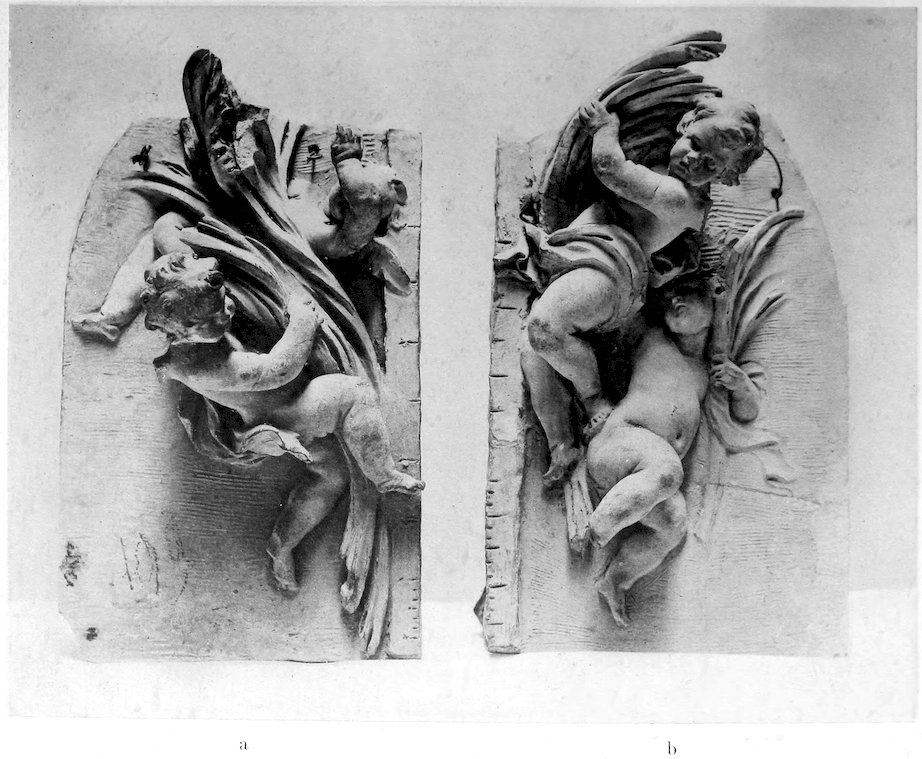
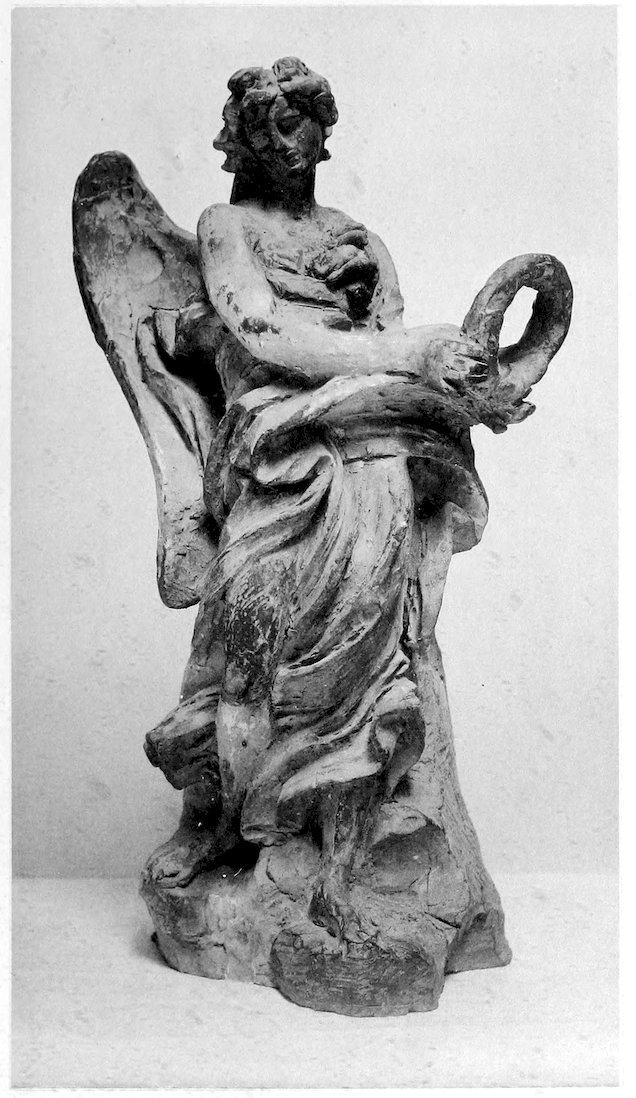
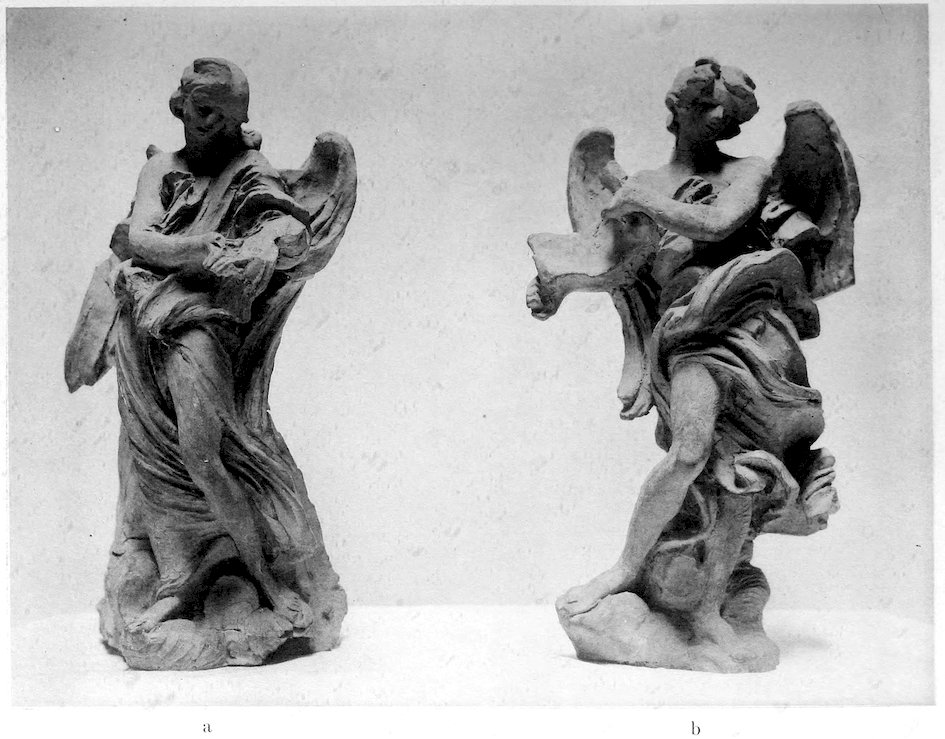
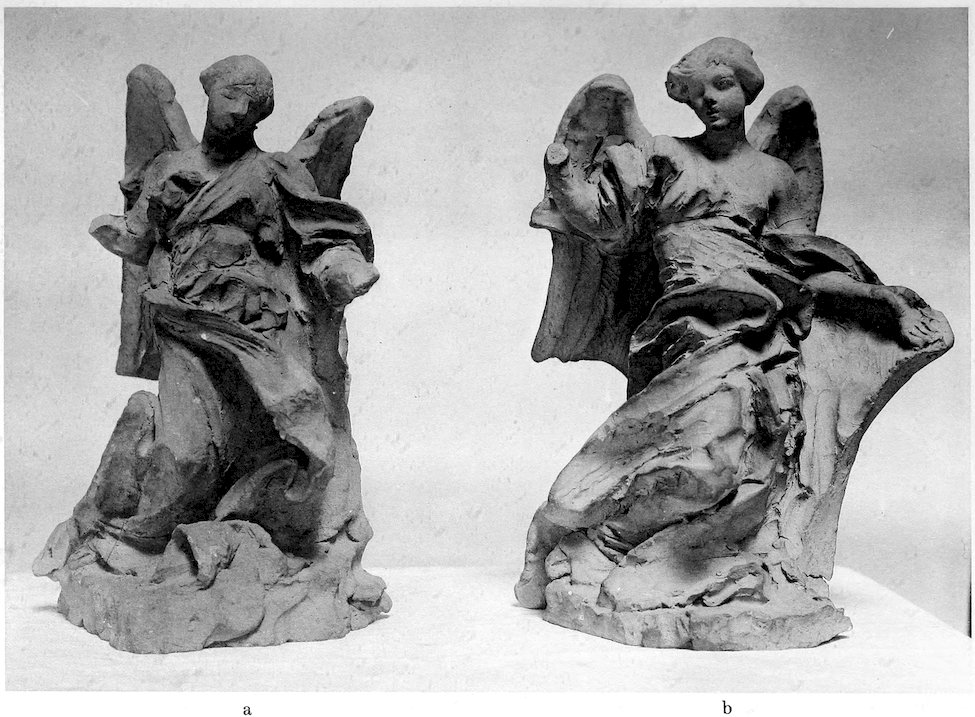
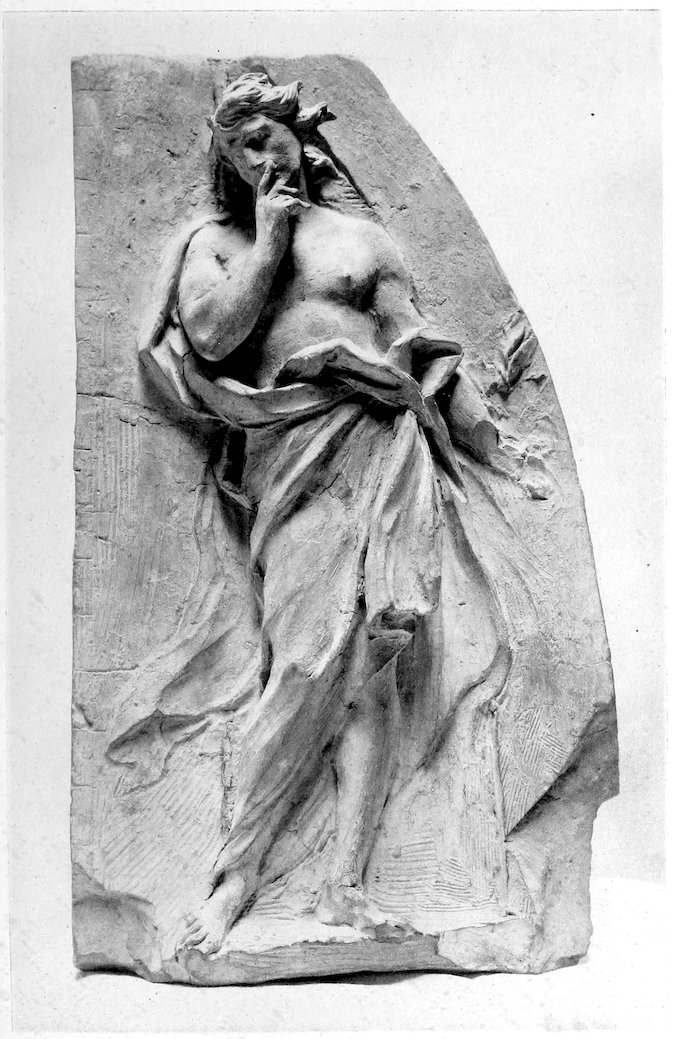
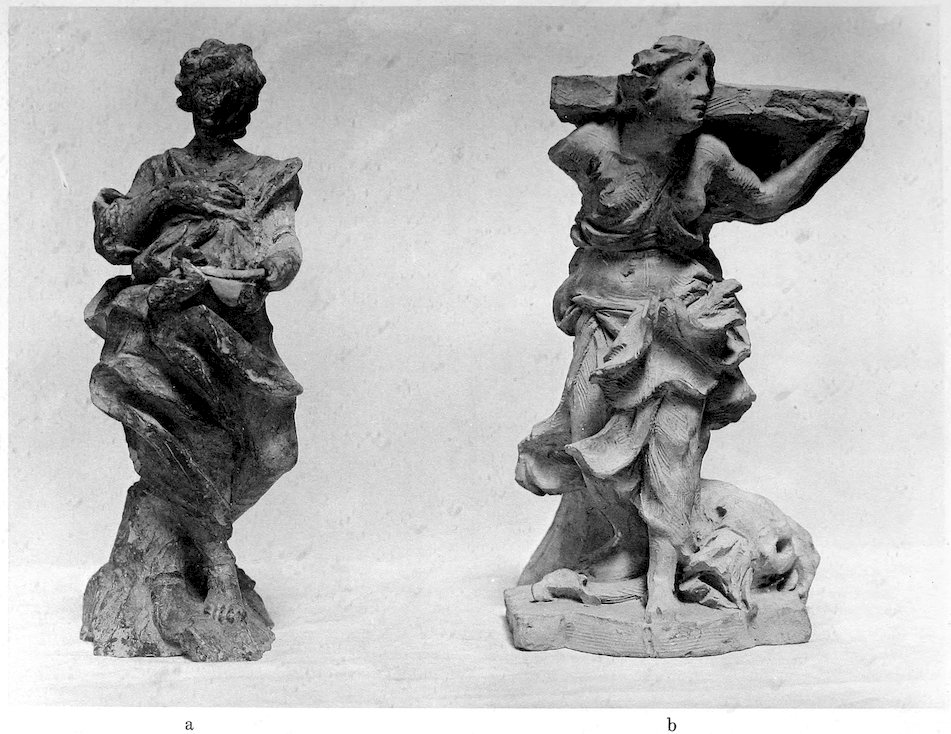
The terra cotta studies in the Brandegee Collection[10] illustrate
clearly Bernini’s originality and the power to which
22I have referred above, of seeing his visions in their completeness
without having to painfully build them up. I do not
mean to imply that each separate detail of his works was the
same in his first vision of them as in their finished form. He
worked at them assiduously, and perfected them with the
greatest patience and care, but when they came into his mind
they rose before him like ghosts from the tomb—vague but
entire.
It is noteworthy that most of these models are of angels, and
as such represent the religious work by which Bernini is best
known, and on which he was most often employed after his
youth was past. By the time he was twenty-five years old
he had been employed by three Popes, and before his death
five others sought his aid and depended largely on his genius
in their endeavours to beautify Rome and to render their
own fame imperishable. These undertakings were of very
various character, but the greater number of them, such as
statues of Saints, decoration of chapels, altars and tabernacles,
grave monuments of Popes and prelates, were done
with religious purpose and may be called his ecclesiastical
work. It is superb in its mastery, magnificent in effect, and
while utterly different from anything that had been done before,
gives the impression of complete and perfect sincerity.
Though unlike earlier work and though the religion that inspired
and made it possible has changed so that never again
will an artist be able to give similar expression to his ideals,
still there is no ground for considering it merely curious and
the expression of insincerity or passing error. Anything that
affected so many thousands of men, which they found beautiful
and satisfying to their souls, must be in a measure true,
must have in it some portion of ultimate wisdom. Silence or
contempt towards it, any feeling but of sympathy with it,
shows not a better knowledge but a duller understanding.
23During the sixteenth century a great change had come about
in the way men looked at life. Discoveries were made of all
sorts; on land for men’s feet to follow or in mathematics and
philosophy for their souls to reach up to. Old dogmas became
untenable and the roofs with which men had sheltered their
heads became scaffolding on which they planted their feet.
It was a time of revolution—the revolution of the wheel of
life which advances as it turns. I have called attention to
the fact that the artists in their search for the fullest possible
expression of their thought often threw off dozens of designs
for a single work before finding the one most adequate. Technique
no longer hampered them in the slightest way, and they
readily changed their mode in accordance with new views, no
longer blindly following the old guides. The work of Titian
is one of the most obvious illustrations of this. In his youth
he followed, like the Indian, the steps of his leaders, but as he
aged, he broke from them more and more, till at the end
he arrived in a world his teachers could never have imagined.
Bernini had a similar experience.
One of the commonest complaints brought against Bernini
is that he introduced the habit of decorating the archivolts
or domed roofs of the churches with figures of angels fluttering
about like great white birds, and in this complaint no distinction
is made between the idea that underlay this scheme of
decoration and the inappropriate and exaggerated use of it
made often by his imitators. From the earliest times of the
Renaissance, this scheme had been used. Bernini did not
24invent it. The Gothic portals and towers of France are
crowded with figures of saints and kings, of angels and demons.
In orderly ranks they guard the gates or singly spring
into mid air from the balconies. In Italy the shepherds of
the people stood in pulpits which rested on the strong shoulders
of Christ’s soldiers or on the steady wings of the heavenly
host, while high o’erhead (as in the Portinari Chapel in S.
Eustorgio, Milan), a ring of winged figures, hand holding hand,
danced and sang, and down the long aisles and in the dark
chapels every sleeper in his stony bed was guarded by the
faithful spirits.
Why then find fault with Bernini and think he erred in
doing what all the world found good? If Bernini is mistaken
in putting marble figures above our heads, why excuse Correggio
for the circling swarms with which he covered the
church domes, or Michael Angelo for the cataract of figures
with which he covered the Sistine Chapel? All such work
must be considered for its suggestion, not from the point of
view of its actual substance. Why, if the conventional and
halting work of the nameless early artists is good, should the
masterly work of Bernini be considered bad? Only because
the modern world thinks it foolish to believe in anthropomorphic
angels and having no belief, has lost the power of
understanding symbols. And also the antagonism Bernini’s
work arouses is due to the fad for the primitive and incomplete.
The very lack of power that every early artist tried to rid
himself of is now thought to be his chief value and grace, and
as in the daily press a missing word puzzle attracts more attention
than a sonnet so the halting early work finds more
admirers than the later perfect art.
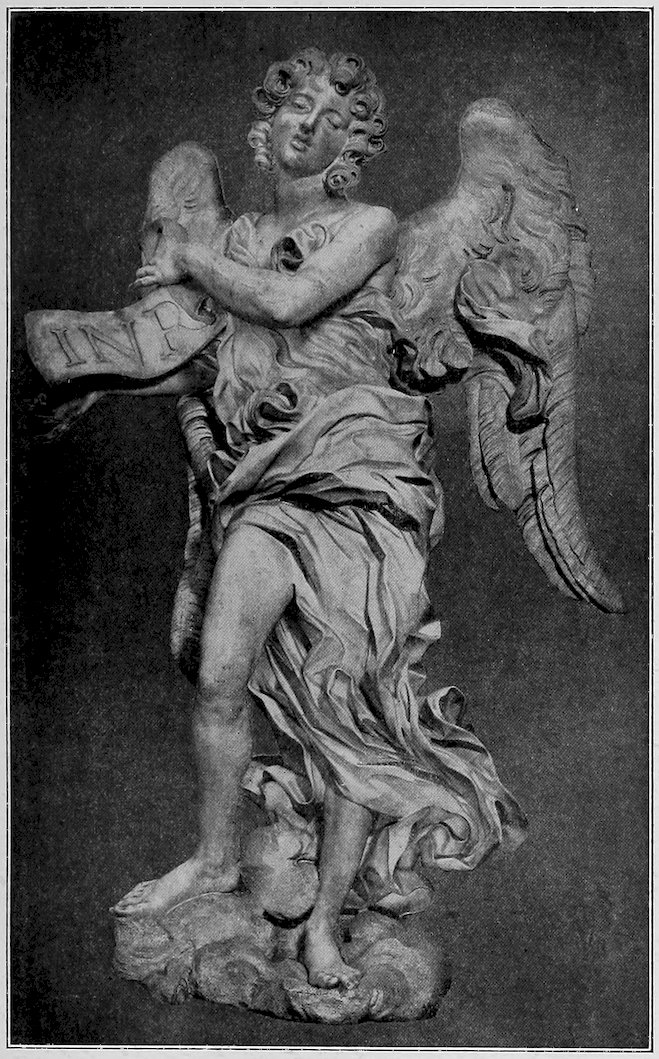
25Perfect as they are, there is something more than anthropomorphism
in Bernini’s angels. Earlier artists, even the
best of the Florentines, when representing these heavenly
messengers, almost always make them so solid and human that
the wings are utterly inadequate, or else they suggest the body
by a thin and shapeless swirl of drapery topped by a perfectly
substantial head. In either case the result is unsatisfactory,
for though the figures conform to the usual idea of angels as
effeminate human forms with wings, the chief impression they
make is of inconsistent and impossible anatomical combinations.
They fail just as the archaic Greek centaurs with human
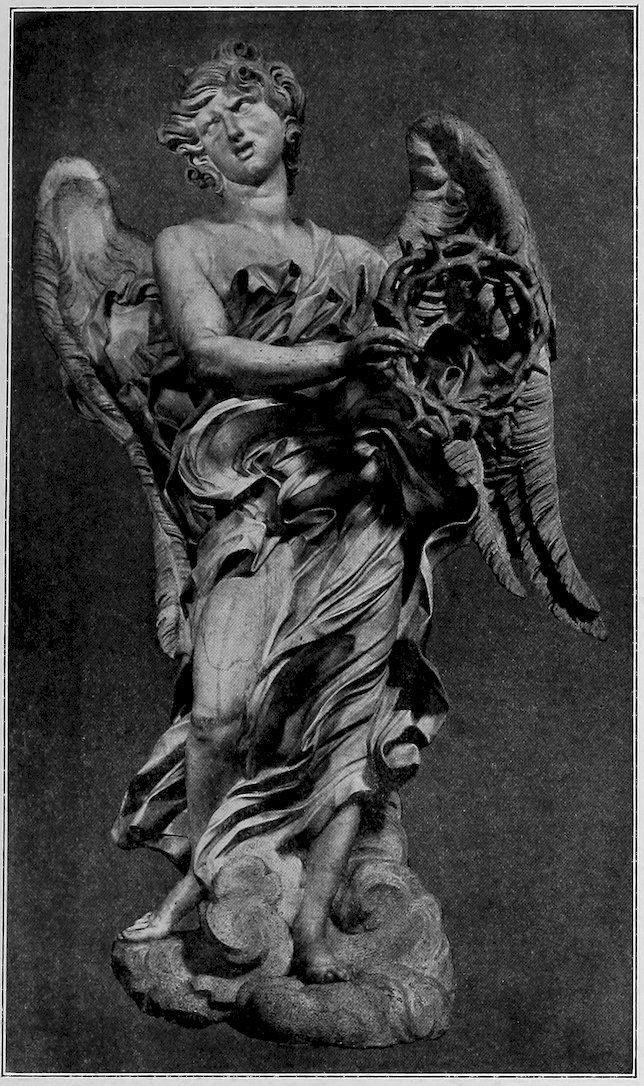
feet fail. When one looks at Bernini’s angels, the two done
in his youth for the altar of Sant’ Agostino, or the two for
instance which he carved in later years for the Ponte Sant’
Angelo, but which were considered too beautiful to be exposed
in the open air and are now sheltered in Sant’ Andrea delle
Fratte (Plates VII, VIII), or at the one which kneels on the
left hand of the Ciborio in the Cappella del Sacramento in Saint
Peter’s, one has no sense of unreality. The bodies are human
in form, but spiritual in their lightness and grace. The wings
are strong and large, and yet so feathery as to seem almost
transparent. The drapery falls and clings to and fits the
body as a cloud might, and the face and action express a perfect
and soul-filling adoration that finds expression in tireless
worship and unending song of praise. These are the true
“sexless souls, ideal quires.”
This same strong religious feeling is shown with equal
certainty in other figures by Bernini which are better known
than his angels. These are the figures of saints which he
26made in his middle and later years. The earliest of them,
that of Santa Bibiana, done in 1626, when he was still a young
man, shows in the arrangement and pose of the figure the
influence of the antique. The technique exhibits the same
magnificent ease and the same power of reproducing the
various qualities of drapery and flesh and hair that we saw
before in the Borghese groups, and there is in the face and
gesture the expression of self-effacement in religious ecstasy
that is the most noticeable quality of the later figures of this
kind. As he grows older, these two characteristics of technical
differentiation of surface and of ecstatic expression altered.
While he lost no atom of technical power he tended to lay less
stress on the appearance of the mere surface of his figures and
to pay more attention to and show forth more clearly their
mental condition. In doing this he brought into being figures
as truly representative of the religion of his time as those of
Michael Angelo or any other sculptor of any epoch.
Religious emotion must always call forth strong feeling,
but the strength is sometimes shown in terms of apparent
restraint, at others it shows itself in violent action. Athena
Parthenos is as emotional as the Santa Theresa and Savonarola,
and Luther is as violent as the Crusaders. The seventeenth
century was a time when men thought it no shame to
show their feelings. The Puritans showed them as clearly as
the Italians, though in a less pleasant form. If to-day it is
difficult to realize and sympathize with the sentiment shown
in Bernini’s Sant’ Andrea, or Daniel, or Maria di Magdala, it is not because of our superiority, but rather because we have
lost a very precious sense and power of spiritual levitation.
Look at the Habakkuk. Is it not a splendid presentation of
27the prophet who was burdened with the grievance which he
beheld, who saw for so long the righteous compassed about by
a “bitter and hasty” race that he felt the Lord would never
respond to his cry? But even as he complains the visible answer
of the Lord appears, and the Angel with playful tenderness
pulls at his hair so that his face is upturned to the light
of Heaven, not any longer dark with earth’s despair, as he bids
him write the vision of the Lord’s judgment that shall not
tarry—write it so that he may run who readeth. And
Habakkuk still points to the iniquity that blackens the world
and the angel points to the inevitably approaching woe. It
is superbly original. It is deeply felt.
The St. Jerome in the Duomo at Siena is another very
striking figure; if it seems to most observers unpleasant,
this is mainly because it does not conform to the conventional
and uncharacteristic way they are accustomed to see Jerome
represented. As a subject for artists he has been treated far
more often by painters than by sculptors, and in the paintings
the mere beauty of colour and of surroundings adds charms
which are uncharacteristic of, and distract from, the real
interest of the figure. When carved by Bernini, there is
nothing but the figure to consider—whether it be suggestive
of the real man as we know him by his writings or not. Probably
most people if asked what image the name of the saint
brought to their minds would recall the print by Dürer or
some painting such as that by Catena in the National Gallery.
But splendid as the print and the painting are, it is only by a
pleasant fiction and by refusing to regard the truth that they
can be thought to represent in any way the Saint as he was
among men. They show a very gentle old man in the neatest
28and quietest of surroundings, peacefully writing his comments
on the scriptures.
It can hardly be supposed that his contemporaries regarded
Jerome primarily as a peaceful and abstracted scholar. Surely
Bernini did not, but instead shows us the unhappy wanderer
and ascetic monk. Scholarship was only one phase, and
among the people with whom he lived scarcely the most important
phase of St. Jerome’s life. To his contemporaries he
showed himself chiefly as an acrid controversialist taking a
leading part in the “strife of tongues.” Unhappy in his
Pannonian home, he spent a restless youth wandering over
Europe, but instead of peace found only momentary forgetfulness
in pleasures, the remembrance of which brought deep
sorrow in his later years. Then he turned to asceticism and
sought by living as an anchorite in the desert to conform
himself to the teachings of his Lord. But the degradation of
such a life, the unnatural and disgusting view it took of the
image of his Maker and the temple of his soul, the morbid introspection
and sterility of selfish self-mortification, brought
him trouble and pain, not calm, till, at last, an old man, he
died in Bethlehem thoroughly disheartened with the iniquity
of the world and the horrors resultant on the destruction of
Rome by the barbarians.
Such is the man Bernini sets before us. The battered, wayworn
feet; the strong, coarse body; the ragged, unkempt
hair show the life he led. The face bending with closed eyes
dreamily over the figure of the crucified Christ betrays his
holy, misdirected zeal. What he was, and what he stood for,
could not be shown more clearly than our sculptor has shown it
here.
29Equally fine, and in certain ways more beautiful, is the
statue of Daniel in the lions’ den, which Bernini made in
1656 for Cardinal Chigi, who placed it with the Habakkuk in
Santa Maria del Popolo. The youthful and splendidly built
figure rests on one knee, his hands upraised in attitude of
prayer, his head bent back with eyes wide open gazing upwards.
From one shoulder, beside his body and over his legs,
falls in wind-blown folds a single heavy mantle. A great
lion crouches behind him, licking his foot. In its perfect
physical beauty, in its not over-emphasised anatomy and in
its entirely successful composition, by which great movement
is given the appearance of completeness and stability, the
figure is more closely allied to Bernini’s earlier works than to
the mystical passionate figures such as the Jerome or Mary of
Magdala or others of this period. It is unnecessary to dwell
on the beauty of the figure and the technical skill it displays,
for these can be seen by anyone whose eye and hand have been
trained at all.
There is one less obvious point, however, to which I wish
to draw attention, for it is as good an example as could be of
what I have mentioned above. I refer to the way the legs
show through the heavy drapery that covers them. The
mantle does actually clothe the leg. It is not a mere addition.
It takes its shape and movement from the leg beneath it.
The one cannot be thought of without the other. Were the
statue destroyed, and did only the right hip or left knee
remain, one would instantly recognise what parts of the figure
these were. But classic though the figure is in general appearance—it
might almost be one of the Niobids—the
feeling of absolute ecstatic faith is very clearly given in the
30upturned face and the reaching arms.[11] Now there have been
times—great and noble times—when men did believe that
God would send angels to shut the mouths of lions, and when
men felt no fear, but only a carefree trust in His help if true
innocency could be found in them.
Such work is not baroque, nor decadent, nor over-emotional,
as it is commonly and thoughtlessly said to be, but it is a
very adequate and convincing representation of a powerful
and uplifting spiritual condition. It is just as fine as the
graver and more sombre figures of Greece, or as the sad and
ponderous figures of Michael Angelo.
Of all the figures of this period in Bernini’s development the
most famous is the Saint Theresa (Plate IX). It is hopeless to
express in words the great beauty of this figure. This can no
more be done than the full perfection of any great poem can be
rendered in a translation. The work is perfect in itself, and
what of this kind can be shown in sculpture is here expressed
with complete and ultimate adequacy. That most people
are startled and shocked when they first see the figure is due
to the fact that they do not think of what the scene really
means, and they are not accustomed to seeing scenes of divine
significance treated with perfect simplicity and pure faith.
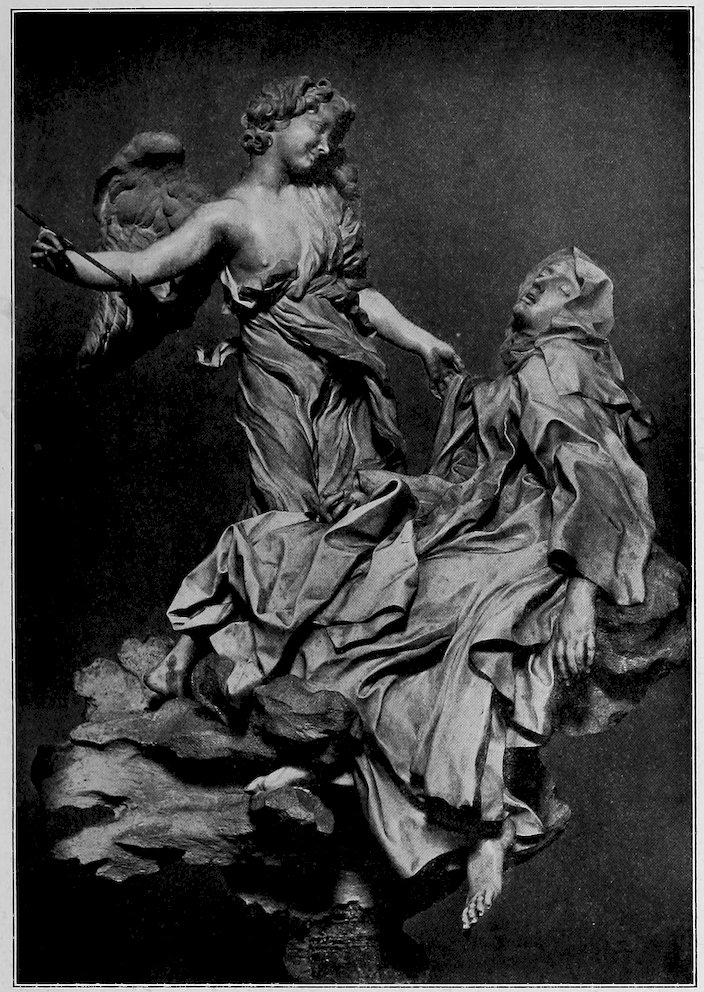
Not that such scenes ought not to be so treated, but few
are the artists who feel deeply enough or whose technique is
finished enough to enable them to represent a scene of this
sort so clearly and beautifully. As a result, the artist falls
back on forms which have been repeated so often that they
have become conventional and no longer can give the beholder
31the full impression of their meaning. No one is offended on
seeing the Son of God bleeding on the cross around which
surges a host of idle spectators, or at seeing Him in the manger
before which all the nobles of Florence kneel in various theatric
attitudes. But Saint Theresa is a figure new to them, and
to have her shown in the crisis of her ecstasy with other figures
looking on from the walls of the chapel, offends their “sense
of propriety” and seems “paradoxical,” “perfervid” and “inconsequent.”[12]
Were this a fair criticism, a large number of the most
beautiful works of Christian art would fall under the same
condemnation. Far more paradoxical than Bernini’s figure
are the representations of the Marriage of Saint Catharine,
and they are quite as unpleasing if thought of in their literal
sense. As for the figures looking at the Saint from the “opera
boxes” at the sides of the chapel, it must be remembered that
at this time most of the drama in Italy was founded on religious
subjects, and such dramatic representation made a
very deep appeal to men’s minds. The critics who find the
Saint Theresa in bad taste do not hesitate to form part of the
audience when Christ’s Passion is played among the hills of
Oberammergau, and they will no longer be afraid to render
Bernini the homage that is his due when they cease lazily to
measure his work by conservative standards. The glory of a
comet is not measured by the Eddystone Light nor a miracle
by the conventions of ordinary society.
One other point concerning this statue remains to be considered.
A recent critic[13] says that “there are many ecstasies,
32and Bernini has chosen something that borders closely on
the most displeasing.” In this he expresses a common opinion,
based, I believe, on a misconception, and on ugly, puritanical
prudishness. Possibly there are many ecstasies, but religious
ecstasy, the ecstasy of the Saint in joining herself to the
spiritual existence of Christ, and the pure and natural ecstasy
of love when self is lost in the future of the race, are as nearly
as possible identical. The Venus de Medici is far more displeasing
than the Saint Theresa.
In one portion of the group Bernini certainly did fail, and
in a way that is surprising. Usually his figures of angels are
successful, but the one standing over Saint Theresa is assuredly
very bad. Its figure is unconvincing, and its face, with tilted
nose and silly smile, is more that of a Greek paniskos than of
a heavenly messenger. But notwithstanding this blemish, no
work by Michael Angelo or any other sculptor ever made the
beholder forget so completely the substance out of which it is
carved, and think only of the scene represented as Bernini has
done here. He has given the softness of life to the snow-white
stone. His hand and mind worked in perfect accord and
produced a work unrivalled in technique and of very great
beauty.
Another statue of similar character is the Beata Albertona.
It is a little less delicate in treatment and more emphatic in
expression than the Saint Theresa, but is, none the less, of very
great beauty and power.
Were a man’s failures as worth study as his successes, I
could mention works by Bernini which are distinctly bad.
The Maria di Magdala is one. Though full of feeling, the
figure of the Saint is coarse and clumsy. But though a man’s
33defeats show, of course, the principles for which he stood, his
victories are more worth considering and are the fairest test
of him. A very false estimate of Michael Angelo would result
if one considered the Rondanini Pietà, the David, or the
Christ in Santa Maria sopra Minerva as of equal importance
with his other works.
It was not only in works in marble that Bernini showed his
power as a sculptor. He handled dark, impressive bronze
with the same complete understanding of its qualities and
possibilities that he showed in carving the gleaming Carrara
marble. Such a work as the Baldacchino in St. Peter’s is
beyond any words to praise. It is enormous, but not clumsy,
and sumptuous without being ornate. The most stupendous
of his bronze works is not, however, the Baldacchino, but the
Throne, the Cattedra in the apse of St. Peter’s. It was in 1657,
during the pontificate of Alexander VII, that Bernini was
ordered to carry out his design for this work, and eight years
later it was finished and uncovered to the admiration of all
Rome.
This monument is too well known to need detailed description
here, but it is well here to recall its purpose, which was
not for actual ceremonial use by the Popes, but to serve as a
frame, or strong-box, for the ancient chair of carved ivory on
which tradition said, and the whole Catholic world then believed,
St. Peter had himself sat. There in the heart of the
greatest Christian Church, raised above the soiling earth,
high in air for the thronging worshippers to behold, was to be
the visible and material sign of infallibility. Bernini alone
had the feeling that made him capable of such a task. Four
magnificent figures of Doctors of the Church support the
34chair—two of the Western church, Saint Augustine and
Saint Ambrose, and two of the Eastern, Saint Chrysostom and
Saint Athanasius. Stately great figures; on their outstretched
hands they hold the Throne with the ease that comes of perfect
faith, raising it up even as sixteen hundred years before
the Apostles had raised up this earth for the glory of God.
In all these religious works by Bernini there is beside the
expression of the faith that begot them the expression of a
decorative sense, something dramatic. He delighted in movement
and expression for the mere sake of beauty of active
form, and this feeling of joy in life, in the spirit of movement,
whether in Nature or in Man, Bernini reproduced in a series
of works which by themselves would make him unique among
all sculptors and which give Rome a distinction and character
far more decisive than her ruins or palaces and set her alone
and apart from all other cities. These are the fountains.
The list of fountains is of amazing length. The Barcaccia
in the Piazza di Spagna, one in the Villa Mattei, one in the
Vatican Gardens, another in the Barberini Gardens, the
Triton in the Piazza Barberini; the lovely shell which used
to be on the corner of the Via Sistina, but has been destroyed
to make way for modern improvements so called; in the
courtyard of the Palazzo Antamoro, in the Piazza Navona,
and the broad pool of the Fountain of Trevi. They have the
infinite variety and infinite pleasantness of Nature herself.
By the side of the placid pool whence the ciociaras draw the
water for their flowers, or where the sparkling stream of the
Triton shoots heavenward from the gray pavements like a
white crocus from the frosty ground in Spring; where the
Nile, the Ganges, the Plata and the Danube pour forth their
35incessant floods, or where Neptune shepherds his foaming
steeds over the rocks as they dash down into the pool that if
we once drink from our hearts evermore yearn for the Eternal
City—by each and all of his fountains our ears are filled with
the pleasant voices of the waters and our eyes with the sight
of the nymphs and nereids who gambolled among the watercourses
when the world was young.
What the secret of their charm? No one ever understood
the artistic value of water as Bernini did. No one else ever
held in check the full stream and gave it back again the ripples,
and spurts and sudden rushes of its upper course and of its
source. The angels must have washed his spirit in the fountain
of eternal youth to enable him to express the joy which
flowed through his veins in the undying music of the waves,
moulding and combining them to his intention as a musician
makes the rough strings of his instrument sing of the life
that lies hidden in them till his knowing touch gives them
voice.[14]
I have spoken of the groups representing classic myths,
of the innumerable statues motived by religion and of the
fountains, but even this huge mass of work does not come near
completing the list of Bernini’s output. The numerous portraits
remain to be considered. Some, such as the Constantine
in St. Peter’s, were ideal, but most were of his patrons
and friends and were of very varied types. There were colossal
equestrian statues, ordinary busts, full-length figures
and groups for tombs, and they show that he possessed just
36as great skill in direct portraiture as in more purely imaginative
work.
To carve or paint a successful portrait, two powers are
absolutely essential to the artist. On the one hand he must
have the sympathy that will enable him to comprehend the
sitter’s character, and to see what lines and expressions of the
face express that character most clearly; on the other he must
have the power of suppressing his own individuality and of
lending his hand and eye, as it were, to the sitter to make the
portrait himself. If the artist lacks sympathy, he will produce
a work which may be correct in all detail of colour, line
and modelling, but it will only be a sort of mask; if he lacks
the power of self-suppression, the work will be unlike the sitter,
even though true in detail, because it will show not his character,
but that of the artist. Bernini illustrates these points
with perfect precision, and as a result his portraits are unsurpassed
by those of any other artist of the Renaissance and are
far finer than the quaint efforts of the earlier sculptors which
many students of art admire with the enthusiasm of decadence
and a fatuous misunderstanding of both the value of art
and the aim of the artist.
Just as it was fortunate for Turner that in his early years he
was forced to draw with painstaking accuracy, so was Fate kind
to the young Bernini in giving him to do, when he was but fourteen
or fifteen years old, the portraits of two well-known Prelates.
Success in these meant fame and an assured future for
the boy. Like every genius he must have felt, with perfect
simplicity, with no conceit, his power; but what must have
been his feelings of tremulous satisfaction when, the busts unveiled,
the crowd of Cardinals and Prelates who were gathered
37to see his work, broke into enthusiastic applause? The cheering
words of those long since silent voices echo again in our hearts
as we look at these busts of the Bishop Santoni and of Monsignor
Montoya, for two more perfect portraits can hardly be
found.
A mere child made them; a boy whom one could more
easily think of playing at marbles in the sunlit street; but
instead his playground is the Temple of the Lord and his toys
the souls of men. The mere knowledge of anatomy and the
technical skill they show is most unusual for one so young, but
what shall be said of the spiritual insight of the artist who
carved these two bowed heads with their sweet, strong, grave
faces? The excellence of the ancient Greek, in certain forms
of sculpture, has given us his name as an adjective to express
one kind of superlative merit and these two busts can, with
perfect accuracy, be called Greek. They are as like as can
be to the bronze bust by some unknown Grecian sculptor
which in the Museo dei Conservatori bears the name of Brutus.
As in his other work, so in the making of portraits Bernini
soon broke away from traditional methods and gave his own
spirit full sway. This is evident in the bust of Costanza
Buonavelli, his mistress, which is one of the treasures of the
National Museum in Florence. It is not only the technical
skill with which he gave the different qualities of the pleated
dress, the round soft neck and cheeks and the blown tresses
of waving hair that make this portrait so remarkable, but
beyond this one sees in it the artist’s own human love for the
actual woman and his delight in her as a suggestion of a beautiful
work of art. This bust is unique among his works, for the
woman who inspired it then, with thoughtless animal selfishness,
38killed the inspiration she had begotten. The bust is
the tombstone for the most sensitive part of Bernini’s heart.
Among the other busts of his early years are one of his
great patron Paul V (Borghese) and two of his steadfast friend
Cardinal Scipio Borghese.[15] They are all of them noteworthy,
but the finest is the first one he made of the Cardinal. In
this the growth of Bernini’s dramatic feeling is very plain and
is shown in a technical way which he repeated many times
thereafter. It is this. He carves not alone the head and a
small portion of the breast, but he gives the whole upper part
of the torso and arms and skilfully suggests by the turn and
position of this part the action of the whole body, so that as
one looks at this bust of Scipio Borghese, one has the feeling
of seeing not his head alone but his whole figure. The wonderful
realism with which Bernini has rendered the crinkly
silk cape and the rolling flesh of the fat face with the lips just
parted as though the burly Cardinal were whistling for breath
is obvious to the most casual observation; but realistic though
the bust is, Bernini was skilful enough to give chief emphasis
to the character of the sitter so that the impression that one
takes away with one is not of the external appearance of the
figure so much as of his nature and quality as a man. In many
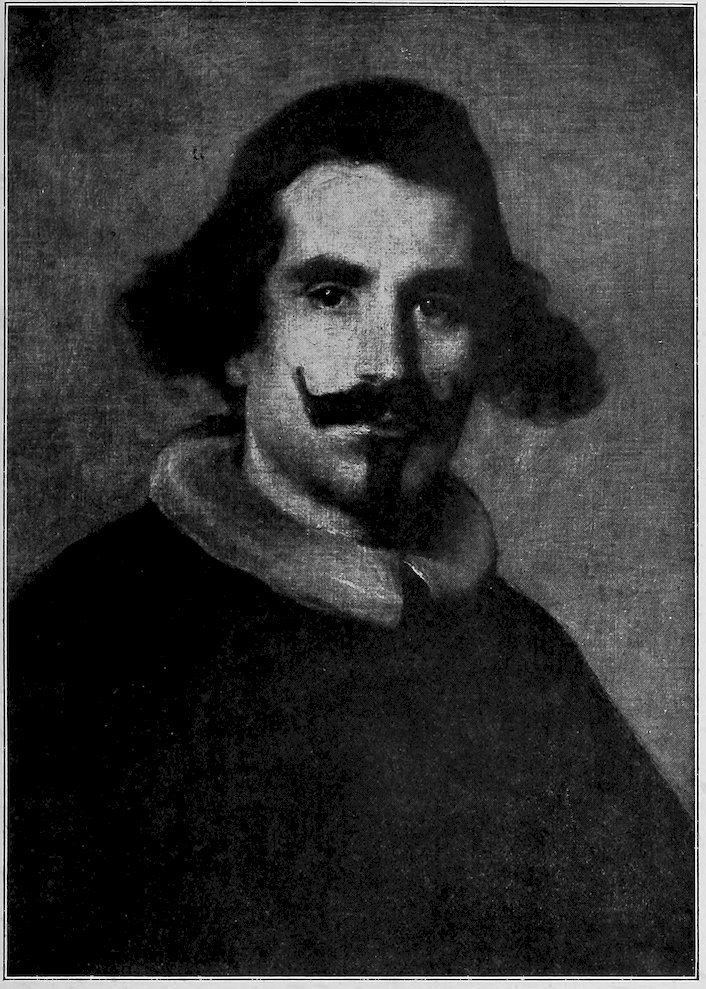
ways it closely resembles the portrait of Pope Innocent by
Velasquez.
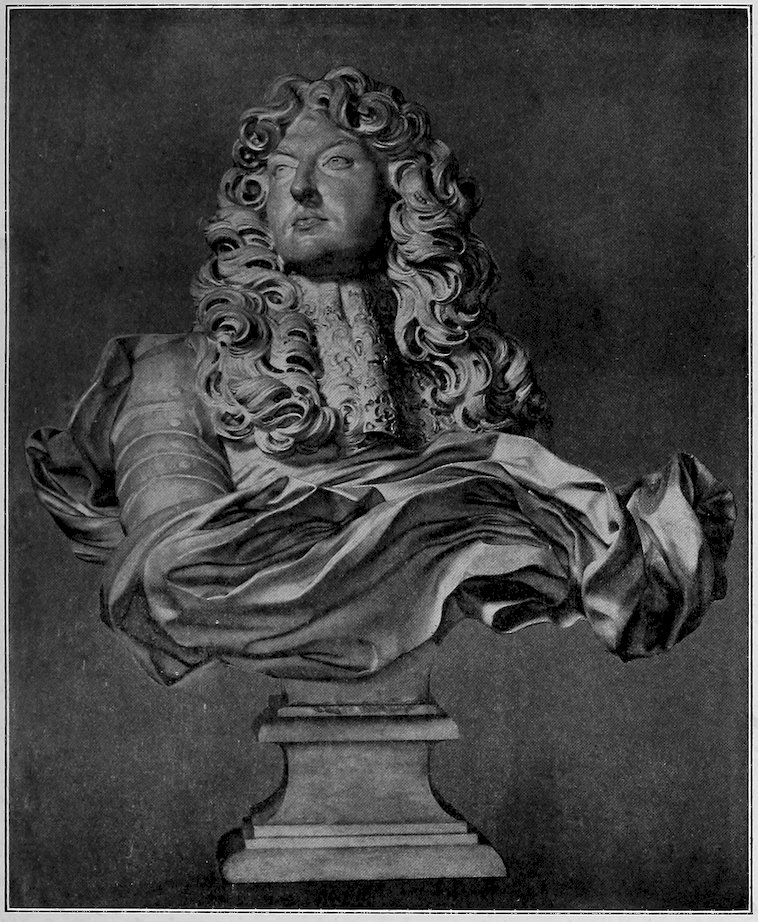
Other portraits are to be seen not only in Rome, but in
Modena, at Versailles and even at Windsor; for, as Bernini’s
fame spread, the great people all sought him and even Louis
XIV and Charles I were delighted to have the artist give them
39that immortality which neither their deeds nor position could
assure them. One of the quieter and less dramatic works is
the beautiful bust of Monsignor Francesco Barberini. It is
realistic like the Cardinal Borghese, but the realism is made
subordinate to a higher aim and only used to emphasise the
ideal character of the work.
Numerous as are these effigies by Bernini of Popes and lesser
men, there are two which stand out above all the rest as unsurpassed
in art and as combining and illustrating more fully
than any others the character of the time, of the sitter and of
the artist which, all together, made them possible. They are
of Francis I of Este, now in Modena, and of Louis XIV (Plate
X), at Versailles. The first was made in 1651, the second during
Bernini’s visit to Paris in 1665. Only Bernini was capable
of representing these two proud princes in all their splendour
of ornamental wig, and lace and armour. It demanded technique
such as his to make anything but a great lump of
complex and ugly form out of such settings for the head as
these; and he succeeded, to the unquestioned admiration of
all time.
That was an epoch when men liked theatrical display of
all sorts, when what in these colder days seems exaggerated
expression was natural and pleasing to people. Bernini knew
and understood this, had often himself been employed in
writing plays or arranging stage scenery, and has represented
the two rulers just as they delighted to show and think of
themselves, adorned with all that was rich and splendid,
haughty and disdainful as was the nature of those endowed
with the divine right of Kings. Even more than in the case
of the portrait of Cardinal Borghese do these two busts seem to
40make us see the whole figure and yet they have an appearance
of lightness that is most surprising. Not to be made again
such busts—nor such men. Democracy, and a belief in
equality as absurd as that in Kingship was overweening, have
snuffed out all such pretensions, and have snuffed out the art
too. But thanks to Bernini we have the record of them. We
see them in their moment of splendid satisfaction and self-confidence,
and made beautiful through mere enjoyment of
their bubble reputation.
The final value of portraiture is that it should be characteristic
of the person depicted. No matter how great the skill
shown in giving Napoleon the appearance of a Greek athlete
or Washington that of Olympian Zeus, such works are only
folly and waste. Bernini made no such mistake, but with
deep insight and unrivalled skill proved himself one of the
greatest portraitists of all time.
I have spoken of Bernini’s versatility. I have considered
in some detail the sculpture by which he is best remembered.
Of his painting not much is left, and what remains is naturally
not of any great value as art. Still less is left of his work as
an organiser of plays and arranger of processions or carnival
displays. A few drawings and engravings and some slight
accounts by contemporaries give us an idea of this work of
his, but it was the occupation of his more idle hours and is
of little moment. Of his architectural work a good deal is
still to be seen, though in many instances later workmen have
added to or altered the original structure, which was almost
always skilful and big in conception, though occasionally he
made a mistake, as when he put the towers—asses’ ears his
contemporaries called them—on the Pantheon.
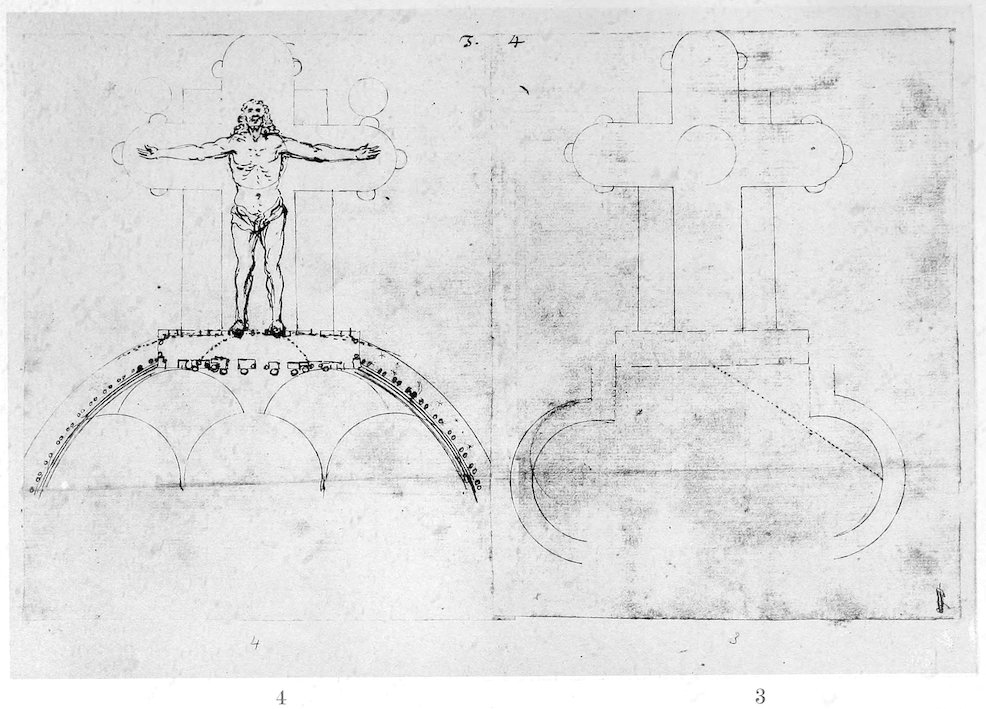
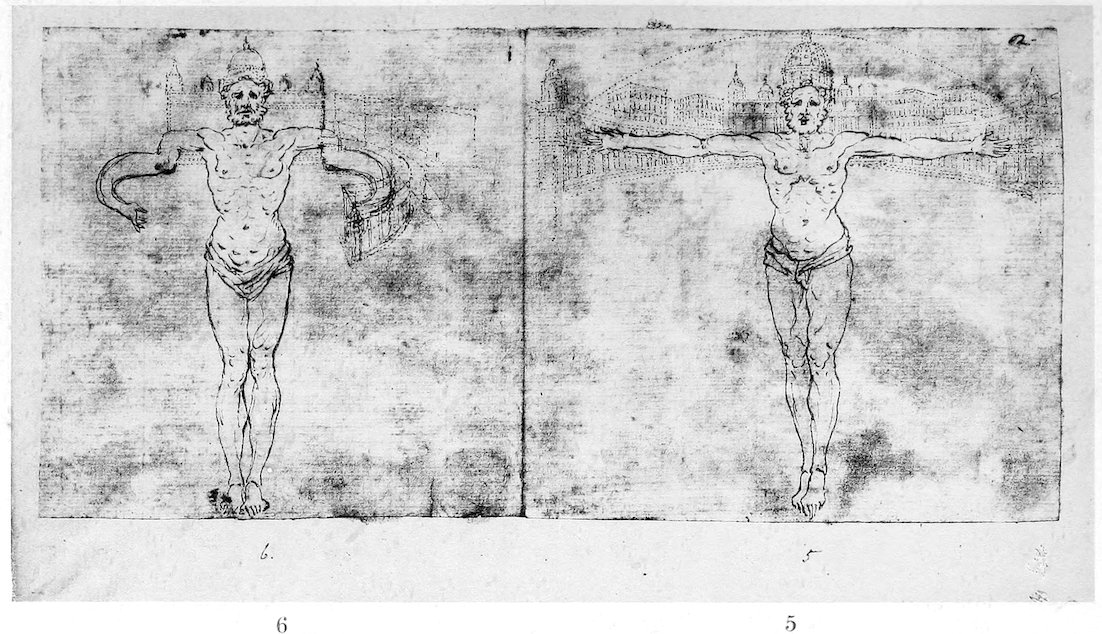
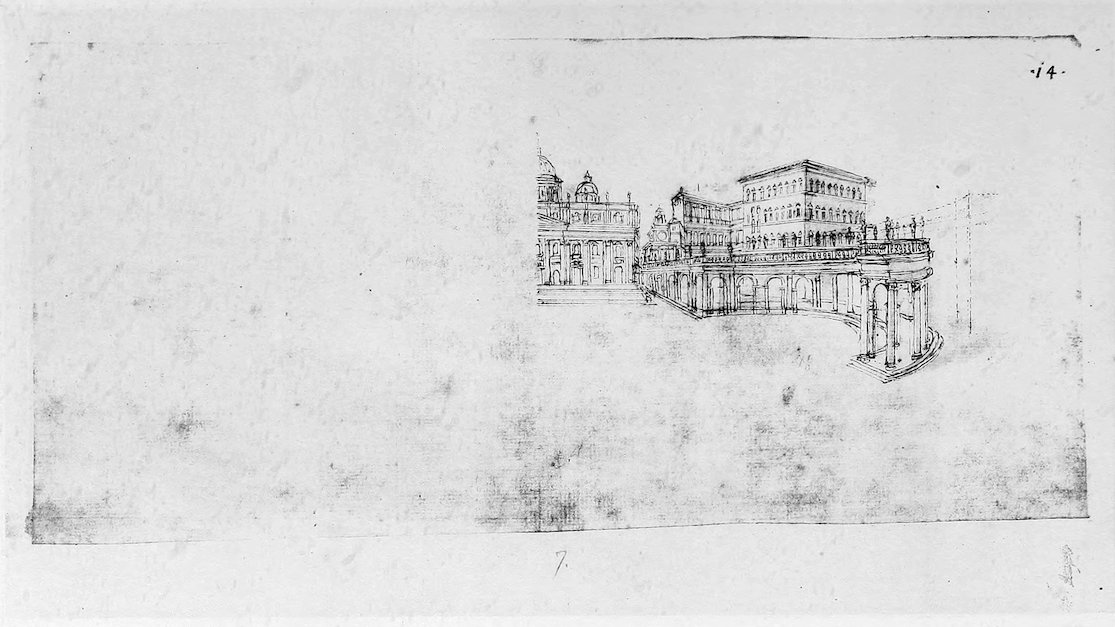
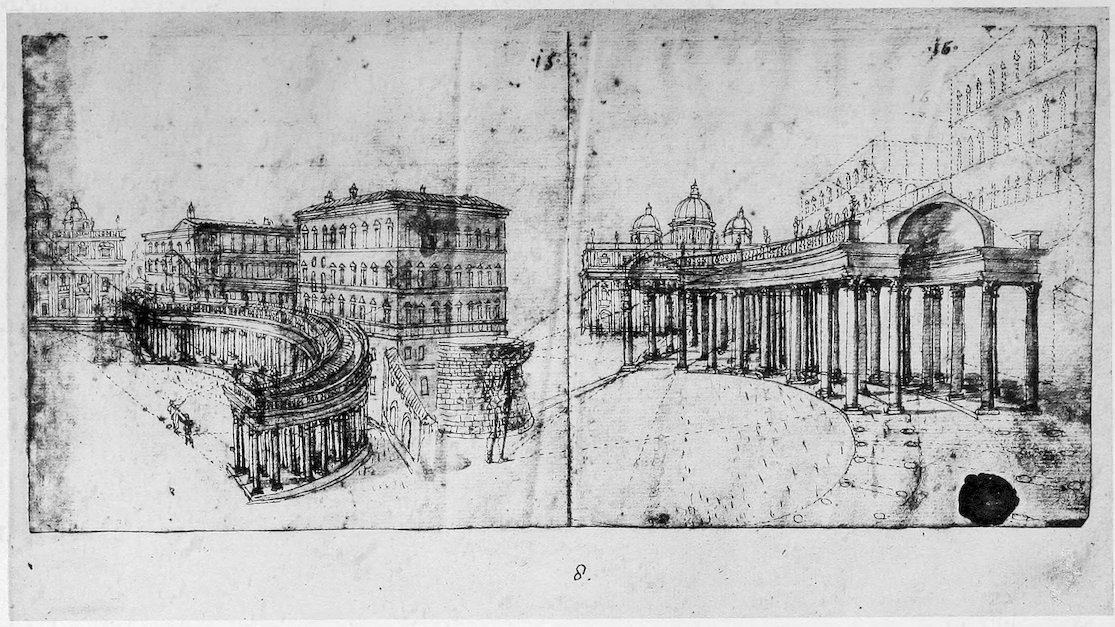
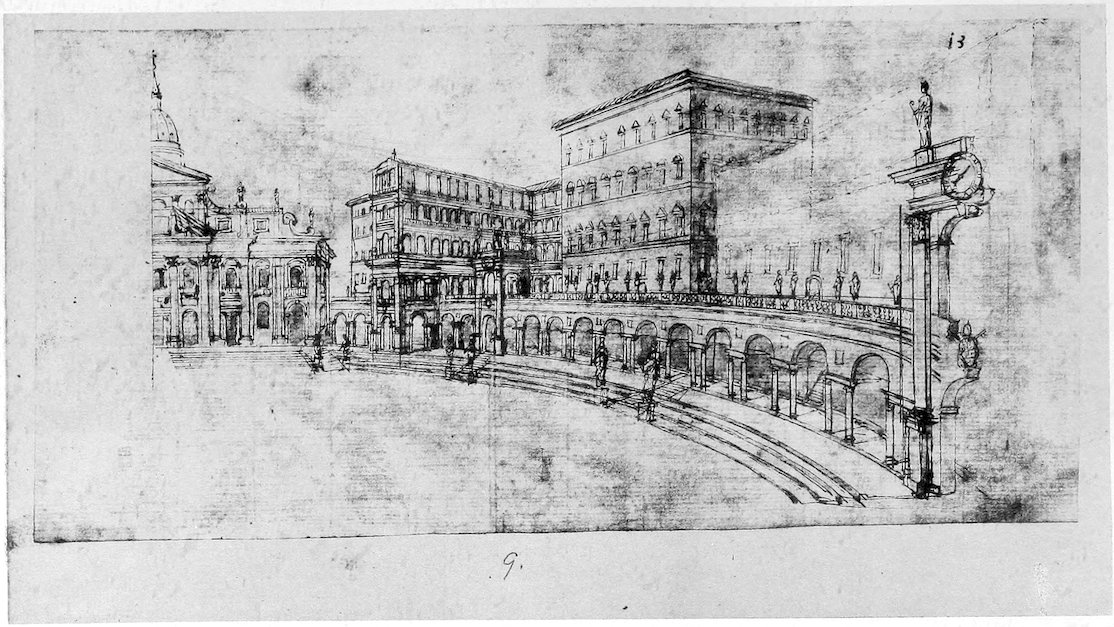
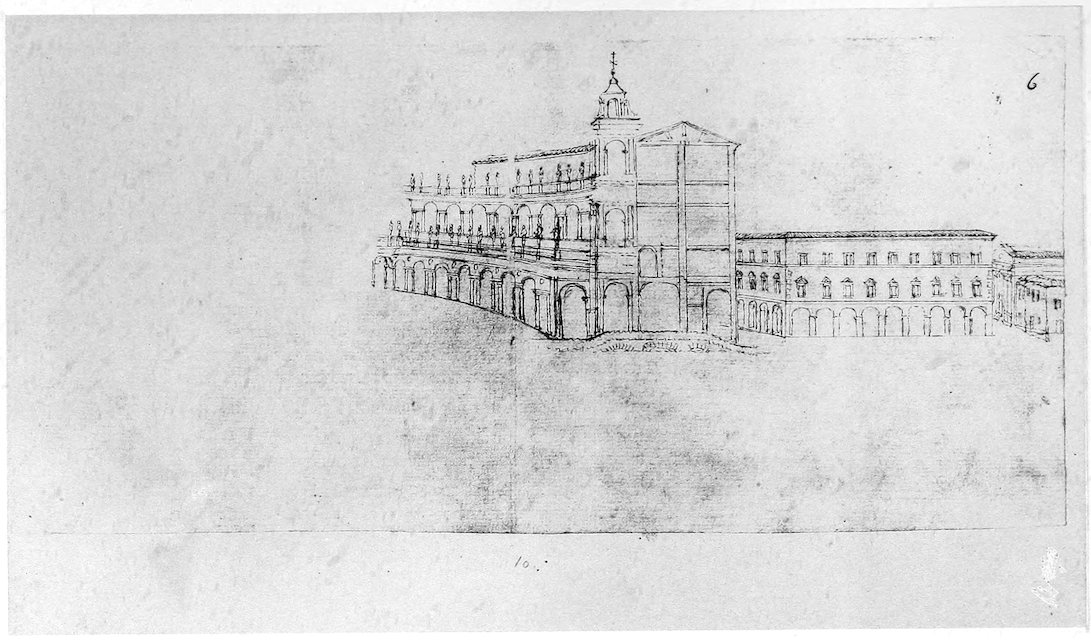
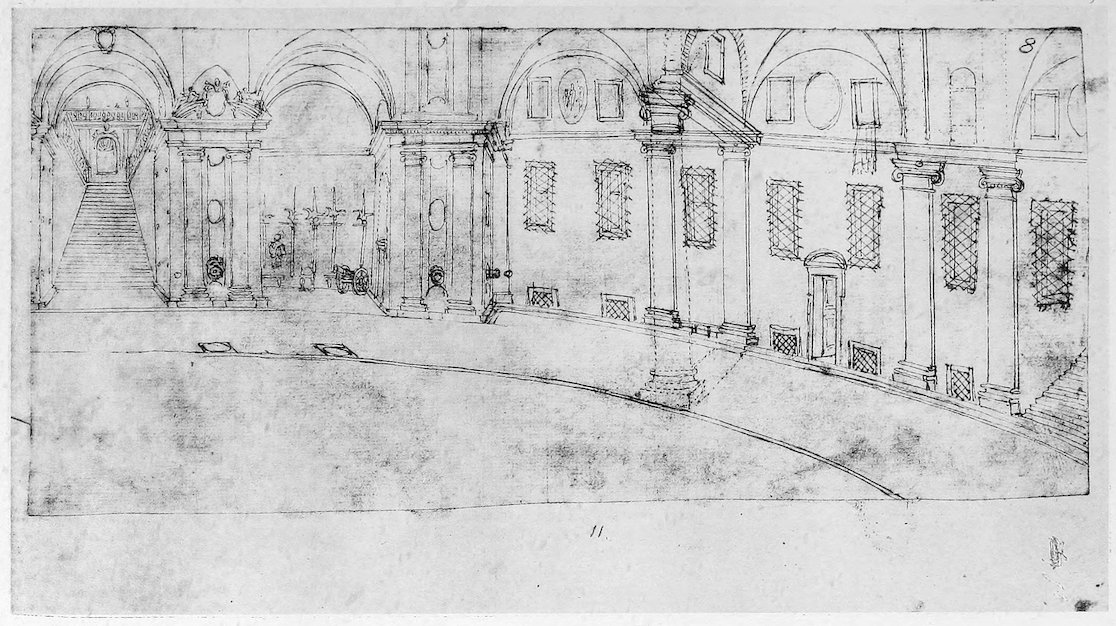
41The structure by which Bernini is best known is the double
colonnade of the Piazza of St. Peter’s. Of this his original
sketch book still exists.[16] It is an intensely interesting record
of the different schemes and plans which Bernini worked at till
in the end he produced the splendid simple and grand design
which gives Rome the finest public square in the world.
There are several sheets of drawings in the book, some showing
Leonardesque studies of the relations between the proportions
of the human figure and those of architecture, others show
views down the Borgo from the church or looking up towards
St. Peter’s with plans for the rearrangement of the district,
and some are views and designs of various types of colonnade
showing deep study of their perspective appearance. But
of all these sketches, there is one of far greater interest than
all the others, for it shows that insight into the deeper meaning
of things which made Bernini the supreme genius he was
(Plate XXX).
On this sheet are two similar drawings showing St. Peter’s and
the colonnade. Over these, as though they formed the head
and arms of a cross, is drawn a bearded figure, his head crowned
by the dome of the church, his arms outstretched on the colonnades
and with his feet crossed slightly one above the other
and resting just where, at the beginning of the Borgo, Bernini
intended, as another of the sketches makes plain, to put a
building. There can be no doubt, after seeing this drawing,
that Bernini’s intention was to make the Piazza symbolic of
42Christ and the Crucifixion. Evidently not a mere builder
of houses this man Gian Lorenzo Bernini, but somehow, and
somewhence, he has got a poet’s vision and he makes his mark
in the world not merely by moulded clay and shaped stones,
but by shaping men’s hearts and moulding their ideas.
Such was Bernini, one of the great artists of the world.
It is true that he was revolutionary, but he destroyed not
through ignorance or envy. He destroyed merely that he
might then create. The arts in his day were strangled by
academic rules and had become cold and lifeless. The intensity
with which he felt things gave him strength to break
these bonds and to make sculpture once more a means of
conveying living thoughts and emotions. He was like the
butterfly which tears away the stiff-plated chrysalis before
it can spread its wings in the free air. It is useless to try to
explain his technical skill; he was born with it, just as others
are born with a keen sense of colour or a musical ear, but it is
certain that without it he could never have carved such figures
as the Saint Theresa or the portrait of Fonseca[17] which show
intense emotion brought on by loss of all sense of self in the
contemplation of the mystical meaning of the Passion. Such
feeling could not be shown by restrained action and quiet
faces. Much movement was necessary and the works are
successful and beautiful because the feeling shown is perfectly
simple and natural and not forced and put on for the sake of
effect.
Bernini’s technical power made him, however, a bad master
for others to imitate. Not that the work of his followers is
any more inane than that of the copiers of Michael Angelo
43or of those of any other great man, but his peculiarities were
such as are at least superficially easy to see. Where he quite
easily and simply distinguished between the appearance of
silk or flesh, his imitators wasted their energies on elaborate
arrangements, the only object of which was to show technical
dexterity. Where he carved figures that are racked and torn
with feeling, the imitators gave forms that are contorted and
as unemotional as gymnasts. But he is not to be blamed for
their work. By no means was he one of the blind leading
the blind. He was the seer, the prophet, by odd chance honoured
in his own home, whose visions were so believed by
his followers that they vainly tried to see the like. What
their eyes strained towards and failed to see, his heart yearned
for and gained. To them praise was a prize to win, to him it
was a spur to renewed effort and further advance. He had
faults, as who has not, but they were due to his being a pathbreaker
and having to find out for himself ways to carve and
show figures such as no sculptor before him had ever dreamed
of; they were not the faults of ignorance or stupidity. If it
be well for us that we judge not lest we be judged, so too is it
well, should we judge Bernini or other men, to judge not what
there is in him of weakness or failure, but what there may be
of noble intention and high endeavour. Doing this we shall
see that Bernini, working always with bowed heart, but with
uplifted spirit, broke down the middle wall of partition between
art and life.
44
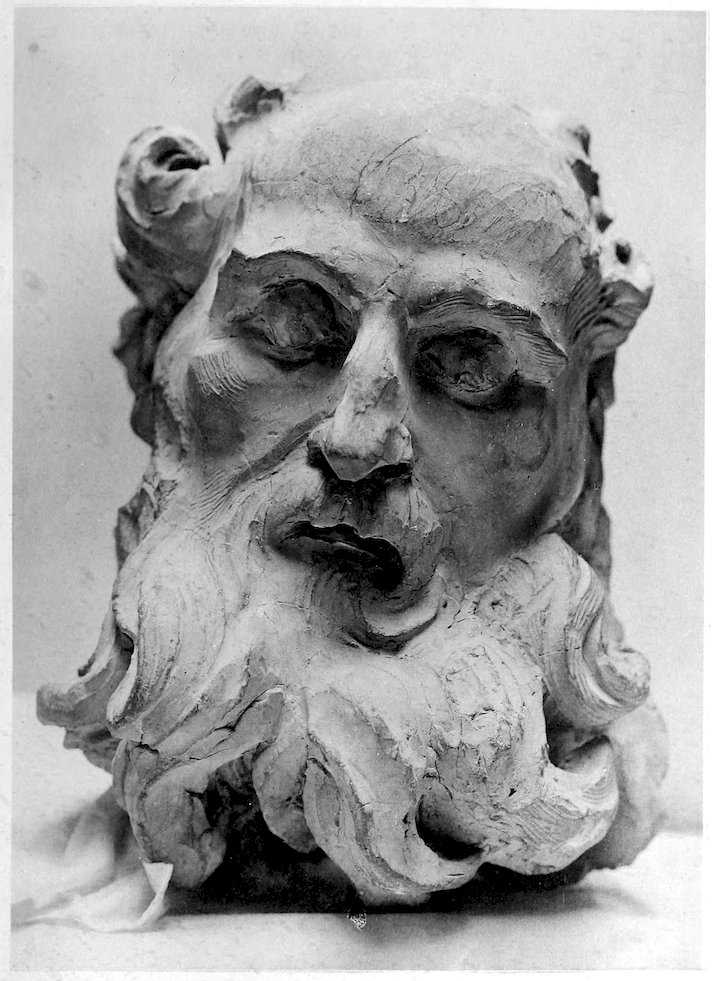
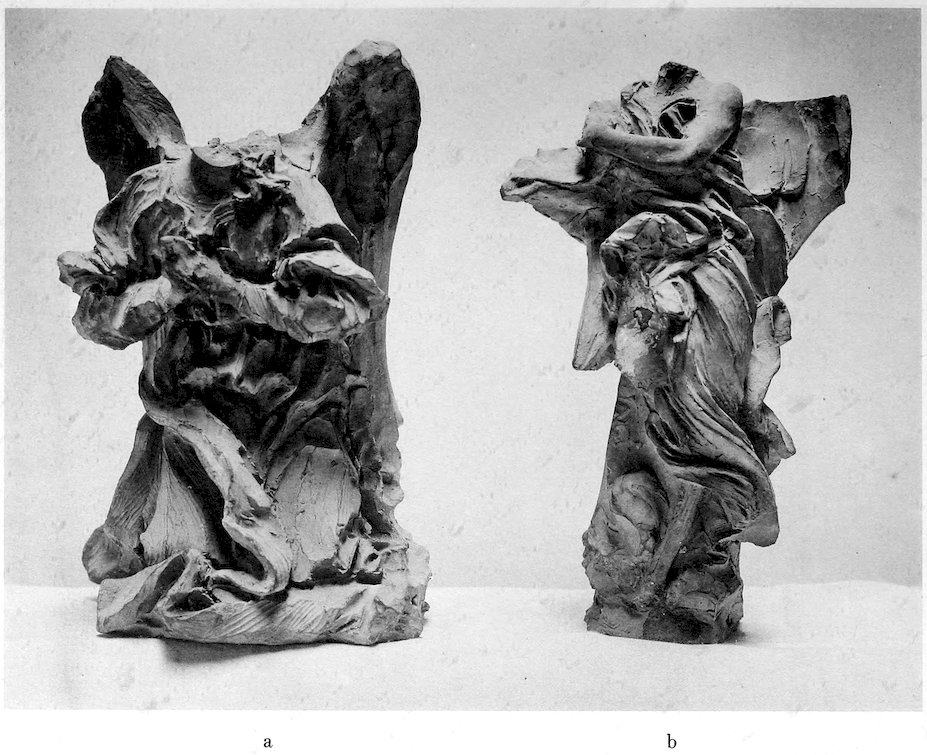
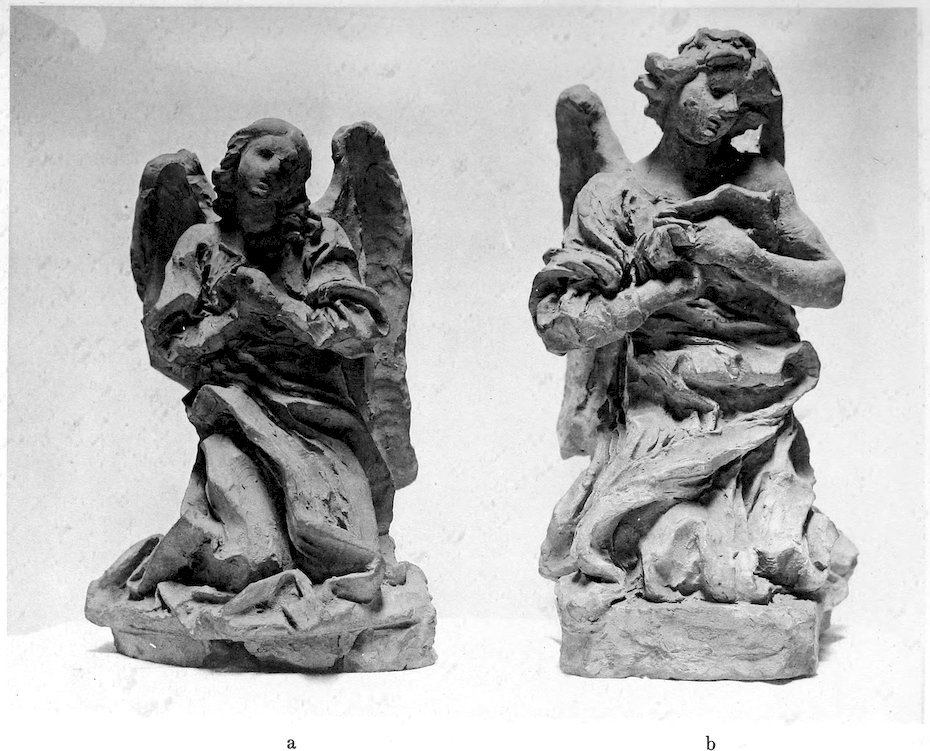
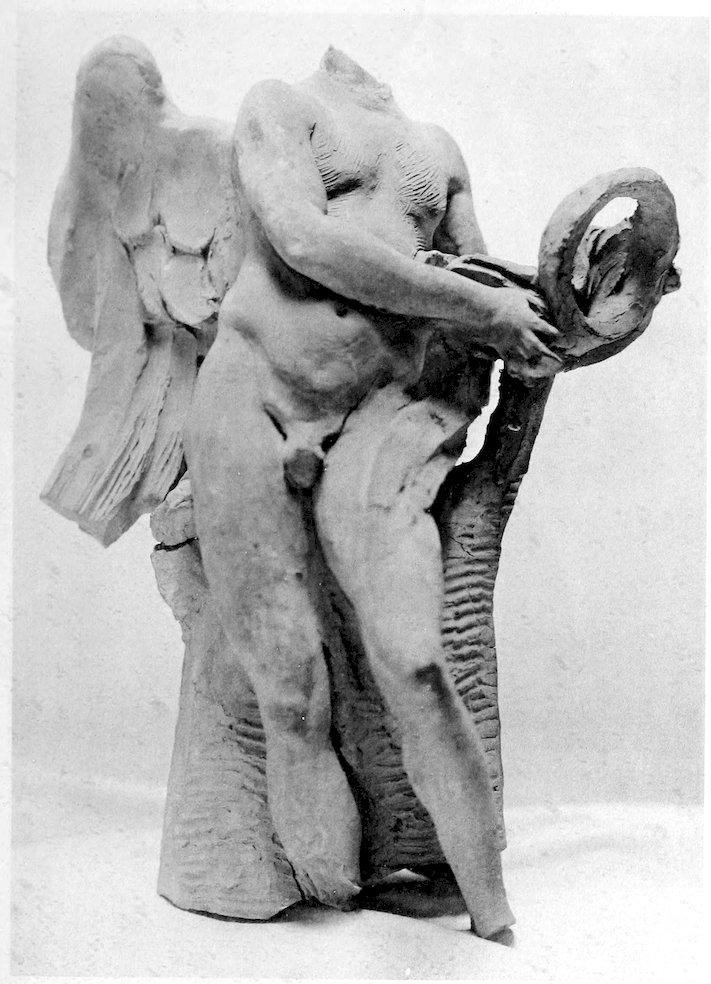
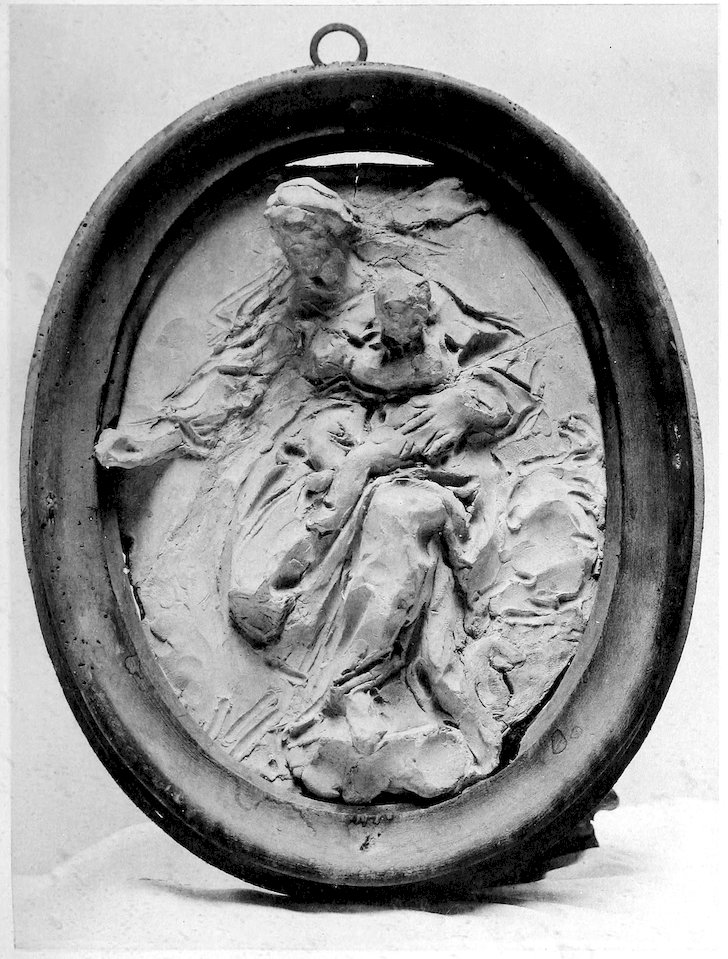
The clay models by Bernini, descriptions of which follow,
form one of the most interesting artistic records left us of
the sculpture of the Renaissance. Drawings made by the
painters of that period to serve as studies for their pictures
are not uncommon, but the sketch-models made by the
sculptors are rare.
This is because sculptors carved the marble without any
previous models, as Michael Angelo frequently did, or else
that the models, being cumbrous and of material that was
easily destroyed, have, in the course of years, been got rid of
either intentionally or by accident. It may seem strange to
suggest that the clay of which the sculptors may have made
their studies is more liable to destruction than the paper
used by the painters, but it must be remembered that while
nothing is more durable than baked clay, air-dried clay is
extremely perishable. Wax was also used by the sculptors
for their preliminary sketches, but this, owing to expense,
could never have served for work of any great size or quantity;
and even if less apt to complete disintegration than
unbaked clay, it is very liable to injury.
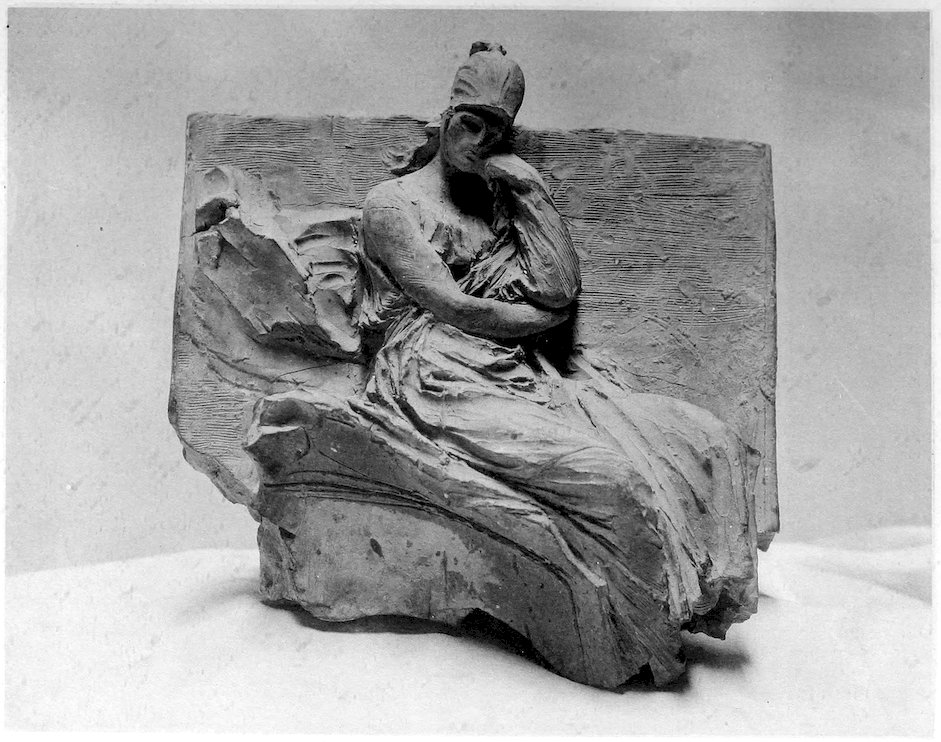
What precisely was the origin of this collection of Bernini’s
models we cannot tell; but it is our great good fortune that
when they were made there was some one, perhaps one of
45Bernini’s pupils, who cared for them and saw to their being
properly dried or baked so that they have preserved their
pristine freshness. It is also extremely fortunate that their
present owner realized their great beauty and extreme interest
and added them to the artistic treasures stored in America,
where they will serve in the ages to come to show students
and sculptors a clear reflection of the mind of one of the
world’s greatest artists.
In the Museum at Berlin are other models by Bernini, but
there is, so far as I know, no other collection, either public
or private, that approaches the Brandegee Collection in number,
variety or excellence of these works. In America I know
of but one other model purporting to be by Bernini. It is
in the Morgan collection and represents Pope Urban VIII,
but it does not show a single touch by the master; it is an
imitation, copied from the statue in the Campidoglio at
Rome. In the collection of the late Mme. Edouard Aynard,
sold in Paris, December 1–4, 1913, were two terra-cotta models
of angels (lot 307) “attribuées au chevalier Bernin, d’après
les originaux du port Sant Ange, à Rome,” and one equestrian
statuette in the same material (lot 308), said to be the “esquisse
originale de la statue en marbre de Louis XIV, dans
le parc de Versailles, par le chevalier Bernin.” The two
angels are certainly not by Bernini; the portrait may be.
From the artistic point of view these models are of the
highest importance, for they show with startling clearness
the great fertility of invention which characterized Bernini
and the vivid way in which he visualized the creations of his
brain. There is not a trace of effort in them, there is not a
sign of rubbing out or doing over, but each group or figure
46was obviously seen by him with the sharpness of a dream
and reproduced by his skilful fingers in the fresh clay while
the impulse and uplift of the vision was still on him.
The knowledge of the purely technical side of the art of
sculpture which the models reveal is magnificent. The way,
for instance, in which the various planes are treated in the
oval relief of the Virgin and Child (Plate XXVI) is as subtle
as, and very similar to, that of the reliefs on the ancient
vases from Arezzo, while the relation of draped portions
of the figures to the parts left nude, and the manner in which
the body beneath gives life and meaning to the covering
drapery, is as fine as any work by Pheidias.
But the most fascinating and interesting characteristic
of these terra-cotta figures is that one sees in every least
portion of them how Bernini’s fingers, trained by long years
of hard practice, played over the wet clay like wavering flame
and moulded the dead material to enduring forms of beauty.
Once more the old mythology comes true, and Pygmalion,
taking the rough material offered him by Mother Earth, fondled
it, and, warming it with the fires of his brain, gave it back the
life that lies asleep till the lover’s kiss wakes it once again.
No. 1.—Plate XI
Seated female figure in high relief, wearing helmet, and heavily draped;
the left cheek rests on the back of the raised left hand. Feet missing.
For the tablet in memory of Carlo Barberini in Santa Maria d’Aracoeli,
Rome.
Width 10 inches.
No. 2.—Plate XII
Figure of Longinus, in St. Peter’s. In the round, and gilded.
Height 20¾ inches.
47
No. 3.—Plate XIII, a
Two putti, for the decoration of the piers in St. Peter’s. High relief.
The scale of measurement is scratched on the right edge. The wings are
broken from the lower figure.
Height 11⅛ inches.
No. 4.—Plate XIII, b
Another two putti, also for St. Peter’s. The scale of measurement is
scratched on the left edge. The wings are broken from the upper figure.
Height 11⅜ inches.
Nos. 5, 6, 7, 8.—Plates XIV, XV
Four heavily draped bearded male Saints, for the Ciborio in the Cappella
del Sacramento in St. Peter’s.
The figures stand on thin, square plinths, one of which (Height 10⅜
inches; Plate XIV, a) is unmarked, but on the other three are the names
Bartolomeo (Height 10¼ inches; Plate XV, b), Tomaso (Height 10⅜ inches;
Plate XIV, b), and Filippo (Height 10 inches; Plate XV, a).
The heads of all four are turned to the left, and the figures rest their
weight on the right leg. The left arm of the Bartolomeo is gone, but was
outstretched; the others all stretch out their right arm.
No. 9.—Plate XVI
Bas-relief with half-figures of four men, and traces of architectural background.
For the side wall of the Cappella Borghese in Santa Maria della Vittoria,
Rome.
Width 17¼ inches.
No. 10.—Plate XVII
Half figure of a Triton holding a draped woman on his shoulders.
For a fountain. The head and arms of the woman are gone.
Height 19½ inches.
No. 11.—Plate XVIII
Front part of the head of a bearded man.
For the Saint Jerome in the Cappella Chigi in the Duomo of Siena.
Height 13½ inches.
No. 12.—Plate XIX, a
Model (head missing) for the kneeling Angel on the left of the Ciborio
in the Cappella del Sacramento, St. Peter’s.
Height 11 inches.
48
No. 13.—Plate XX, a
Another model for the same figure. Tip of right wing missing.
Height 11¼ inches.
No. 14.—Plate XX, b
Angel on the right of the Ciborio in the Cappella del Sacramento.
Other models for these two Angels are mentioned by Fraschetti (p. 394),
who also suggests that this angel on the right is not by Bernini, but “perhaps
by Paolo Bernini, touched up by his father.”
I do not feel tempted to agree with this idea of Signor Fraschetti; there
is no doubt whatever that this model of the right-hand angel is by Gian
Lorenzo himself. Height 13⅛ inches.
No. 15.—Plate XXI
Nude figure of an Angel holding the Crown of Thorns. The head and
feet are gone. The weight rests on the right leg.
Sant’ Andrea delle Fratte, Rome.
Height 13¼ inches.
No. 16.—Plate XXII
Angel holding the Crown of Thorns.
This is the final model of the figure in Sant’ Andrea delle Fratte.
The action of the legs is the reverse of that in 15. Height 17½ inches.
No. 17.—Plate XXIII, a
Model for the Angel holding the Scroll. The tips of the wings are missing.
In Sant’ Andrea delle Fratte.
Height 11¾ inches.
No. 18.—Plate XIX, b
Another model for the same figure as No. 17; lacks the right leg, the
head and most of the wings.
Height 11⅛ inches.
No. 19.—Plate XXIV, a
Angel, perhaps for the ecstasy of Saint Theresa in Santa Maria della
Vittoria, Rome. Right hand missing.
Height 11½ inches.
No. 20.—Plate XXIII, b
Angel, draped, right leg bare, turning to the left. Part of right wing
missing.
Height 11½ inches.
49
No. 21.—Plate XXIV, b
Angel, draped, kneeling, head turned to right, right arm (hand missing)
raised, left arm with open hand stretching downwards and outwards.
Height 11¾ inches.
No. 22.—Plate XXV
Standing male figure, in high relief. Drapery hangs from the right
shoulder, leaving torso bare but covering the legs with heavy folds. The
left arm hangs down, and there was a palm branch in the now missing
hand. The right arm is bent up with the hand over the chin. The head
bends down and to the right. The figure rests its weight on the left leg.
The right side of the plaque is curved; the left side is straight, and on it
is scratched a scale of measurements.
Height 16⅝ inches.
No. 23.—Plate XXVI
Oval bas-relief of the Virgin seated and looking down to right while
holding the Child in her lap. High relief.
Very sketchy, but the most masterly of all these models.
Height 11 inches.
No. 24.—Plate XXVII, b
Draped, standing female figure. She bends forward, turning to the
left with arms (right arm missing) raised to support a slab that rests across
her shoulders. The weight rests on the left leg. At her feet suggestion
of a cuirass.
Study for the base of some monument such as the obelisk in the Piazza
della Minerva. (Cf. Fraschetti, pp. 300–303.)
Height 8½ inches.
No. 25.—Plate XXVII, a
Standing angel, heavily draped; the left knee is bent sharply backwards.
The right arm is bent across the breast, the left arm (forearm missing)
bent across the body lower down. The wings are missing.
Height 8⅝ inches.
No. 26
The Magdalen kneeling, and grasping the foot of the Cross.
This figure is not by Bernini, and shows clearly the difference between
the work of a master and that of an imitator.
Height 10 inches.
No. 27
Study of a hand.
Length 8 inches.
50
The pen and ink sketches by Bernini for the construction
and adornment of the piazza in front of the Vatican, together
with the surrounding buildings, deserve to be more widely
known than they are at present.[18] Any details regarding the
history and growth of this part of Rome are of the deepest
interest to those who study the intellectual development
of mankind. Did we possess any record of the reasons why
Pericles and his advisers placed the temples and other buildings
on the Acropolis of Athens just as they did, we should
have a clearer understanding of the character and ideals of
Athens than we now have. So a study of these drawings by
Bernini will show very distinctly that the present form of
the piazza is due to no mere thoughtless and haphazard erection
of colonnades and fountains, but is the result of a deeply
considered plan and illustrative of a very large idea.
The drawings are carefully done with pen and ink on fourteen
sheets of paper which were numbered by some old-time
owner. These sheets have had the edges trimmed. Ten are,
with slight variations, 14 by 6¾ inches. The others are, as
will be noted later, of different sizes. All, however, judging
by the paper and method of drawing, belong unquestionably
to the same series. The drawings were mounted and bound
together by the previous owner.
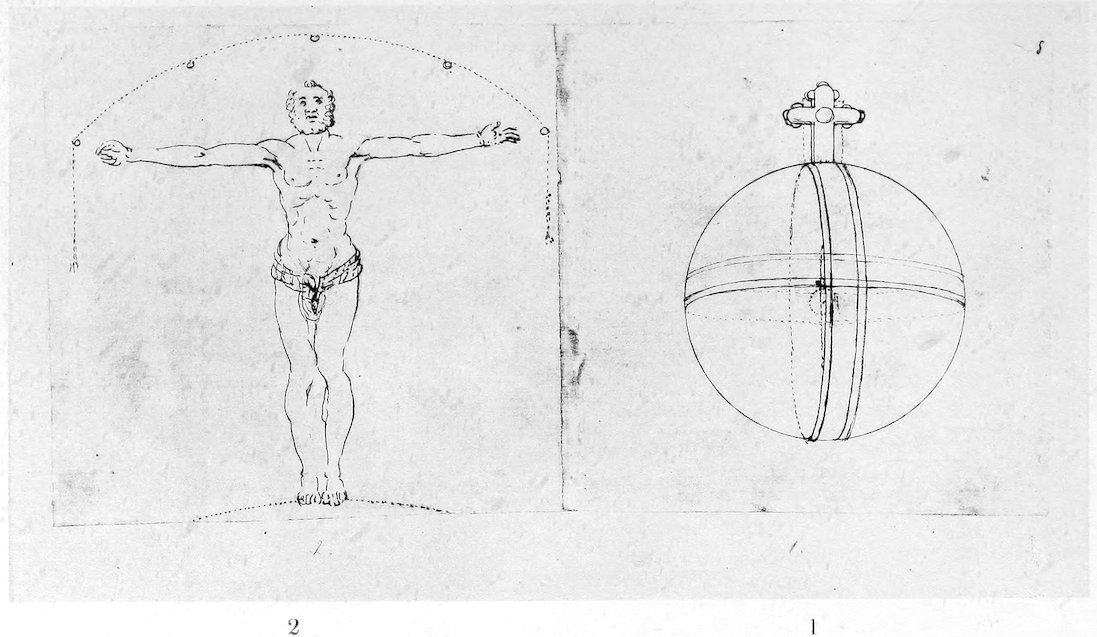
51The history of the drawings can only be guessed at. In
this connection the following facts are to be noted. Bernini
was officially appointed architect of the Fabbrica of St. Peter’s
in 1680. After him Luigi Vanvitelli was head architect.
With Vanvitelli there worked Andrea-Vici. In 1817 Vici
left by his will to his friend the sculptor Canova drawings by
Bernini representing the burial of the Countess Matilda,
and Louis XIV on horseback. This legacy shows Vici to
have owned original drawings by Bernini, and it is not improbable
they had been given him by Vanvitelli. By the
same will Vici left to his grandson Busiri his name and his
studio, with all the original drawings by various masters
therein contained. Consequently it is not a rash hypothesis
that these drawings of the piazza came from Vanvitelli to
Vici, and so to Busiri-Vici. Finally they were sold at auction
in Rome in 1903. They are now in the Brandegee Collection.
No. 1.—Plate XXVIII
This drawing shows the Orb; the Christian symbol of the world, surmounted
by a cross.
The cross with the head and arms ending in curves like apses suggests
the plan of a church, and the following drawings show clearly that the
Orb and Cross were the fundamental idea in Bernini’s mind when he
planned the piazza.
No. 2.—Plate XXVIII
This is on a square piece of paper, similar in size to No. 1, and at present
mounted on the same sheet at the left of No. 1. It shows the figure of
a bearded man with arms outstretched as though on a cross. A curved
dotted line stretches from hand to hand over the head and drops about an
inch perpendicularly below each hand. This dotted line is a suggestion of
the existing colonnades.
52That the figure is thought of as being on a cross is borne out by sketches
that follow and also by the dot in the palm of the left hand which possibly
represents a nail.
The sharp, broken lines with which the figure is drawn are characteristic
of Bernini.
No. 3.—Plate XXIX
An outline plan of the church with the colonnades in front. It is to
be noted the latter start at the corners of the façade of the church and
project a short distance parallel to the main axis before curving to each
side.
Size 6½ × 8¾ inches.
No. 4.—Plate XXIX
Similar to No. 3, but in greater detail. The figure of a bearded man
represented within the plan of the church in the attitude of crucifixion.
In the left arm of the colonnade is drawn the sun and in the right arm the
moon and stars.
This is pasted in the book at the left of No. 3.
Size 6⅝ × 8¾ inches.
No. 5.—Plate XXX
This shows the same crucified figure as before. Over the head and
below each hand is the dotted line seen in No. 2. Behind the head and
arms is drawn with dots the elevation of St. Peter’s, the Vatican and the
colonnades.
No. 6.—Plate XXX
Similar figure to the preceding, but with the arms contorted so as to
follow the straight portion of the colonnade (shown in No. 3) before following
the curve. Behind the head the dotted outline of St. Peter’s and
behind the figure’s left arm the colonnade and Vatican buildings laid in
with dots and a few lines.
No. 5 is at the right of No. 6, and the size of the sheet is 14 × 6¾
inches.
It should be noted that the figure is so placed in these two drawings
that the dome of the church suggests a bishop’s mitre.
No. 7.—Plate XXXI
Outline elevation of the north half of the façade of St. Peter’s and the
north colonnade, rising behind which is shown the Vatican Palace.
On the left half of the sheet are faint pencil lines showing the south
side of the colonnade and façade.
The sky is touched in with bluish white.
Size 14¼ × 6½ inches.
53No. 8.—Plate XXXII
Two drawings of the north colonnade. These are similar to the preceding,
but more elaborate (with shadows washed in in gray), as shown
by dotted lines drawn to the eyes of outlined figures from various points.
We find here the architect’s intention regarding the view from different
positions.
Size 14⅜ × 6¾ inches.
On the back of the sheet is a sketch of the door of St. Peter’s with the
balcony where the Pope used to appear. I do not feel sure that this is by
Bernini. There is also another sheet with a more detailed drawing of this
door.
No. 9.—Plate XXXIII
Similar to No. 8, but still more elaborate and larger; there is only one
drawing on the sheet.
In this design Bernini has altered the line of the colonnade. Instead
of having, as in the preceding drawing, a straight portion projecting from
the church, he has here drawn the colonnade in one large curve from the
church outwards, putting an elaborate entrance to the Vatican Palace
near the church. This entrance would have led to the Cortile di San
Damaso.
Size 14 × 6⅝ inches.
No. 10.—Plate XXXIV
Slight outline sketch of the outer end of the north arm of the colonnade,
which is here made two-storied.
Size 13⅝ × 6⅜ inches.
No. 11.—Plate XXXV
Interior of inner end of north arm of colonnade, showing the stairway
as it exists at present. Size 14½ × 6⅜ inches.
No. 12.—Plate XXXVI
Two sketches; one showing the plan, the other the elevation, of the
Cortile di San Damaso.
Size 13⅝ × 6⅝ inches.
No. 13.—Plate XXXVII
View of the façade of St. Peter’s with both colonnades, which are two-storied.
The sky is touched in with bluish white.
The buildings of the Vatican are also shown,—those on the right exist,
those on the left are imaginary.
Size 14⅝ × 6¾ inches.
54
No. 14.—Plate XXXVIII
View looking east from the front of St. Peter’s.
On each side are the ends of the colonnades; they are in two stories,
that on the right crowned with low clock-towers similar to the “asses’
ears” once placed by Bernini on the Pantheon.
Beyond the piazza is the Borgo much reconstructed and made symmetrical.
In the distance the Castel Sant’ Angelo.
Size 14⅜ × 6⅝ inches.
No. 15.—Plate XXXIX
Two sketches in pen, washed with sepia, of the Borgo, looking towards
St. Peter’s.
These show different methods of treating the north arm of the colonnade.
The one on the right shows the colonnade closing the view up the Borgo,
the other shows an opening carrying the eye beyond and between St. Peter’s
and the Vatican.
Size 14½ × 6½ inches.
The buildings shown exist in much the same form to-day. Even the
fountain still serves.
No. 16.—Plate XL
Plan of the piazza showing how it was intended to symbolize the orb
of the world suggested on No. 1.
In this sketch we see the circle within which is a dotted square. Within
the square is a figure with arms and legs outstretched along the diagonals.
At the top is written over a faint pencil outline of the church (perhaps
not original) San Pietro. At the bottom is written twice Piazza Rusticucci
and on a piece of paper pasted on is the plan of a building shown in No. 14,—one
of the buildings intended for the reconstructed Borgo.
On the right and left of the figure are indicated the Porta Angelica and
the Porta Cavalleggieri.
The dotted square within the circle is divided into quarters in which is
written Asia, Europa, America, Affrica.
Size 7¾ × 8⅝ inches.
These are the plans showing Bernini’s ideas regarding the Piazza of
St. Peter’s. From a study of them we see how the circular piazza itself
was intended to represent the world at large, while the colonnade symbolized
the arms of the Cross. Crowning all was the great Church, founded
by Him whose arms could embrace the whole earth, and from whose doors
should stream to every quarter the promise of hope and love for which He
died.
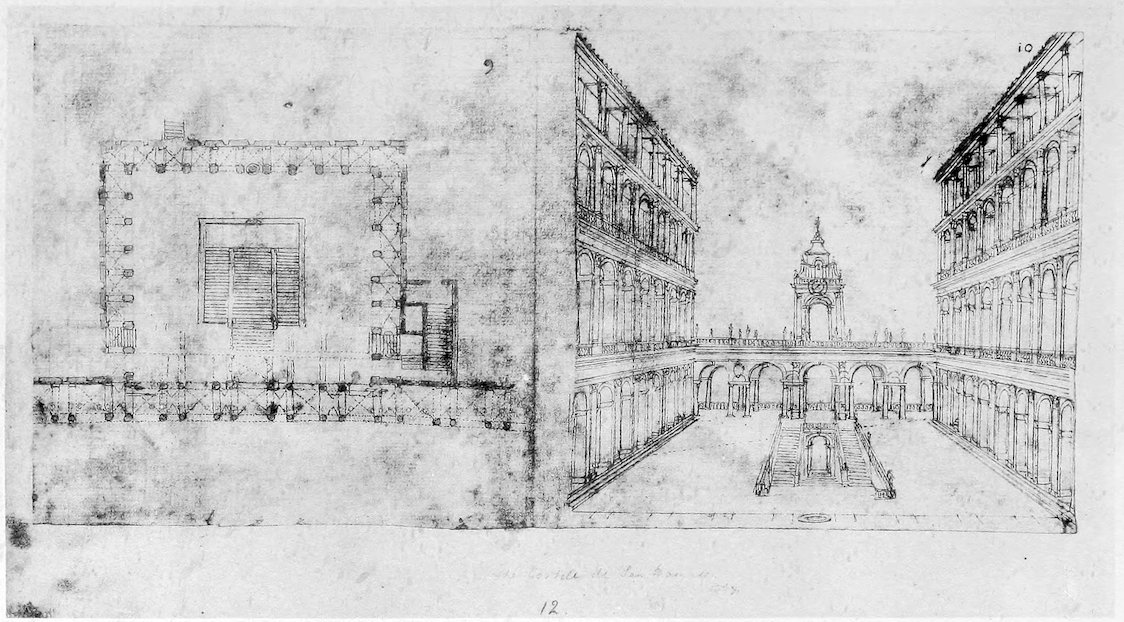
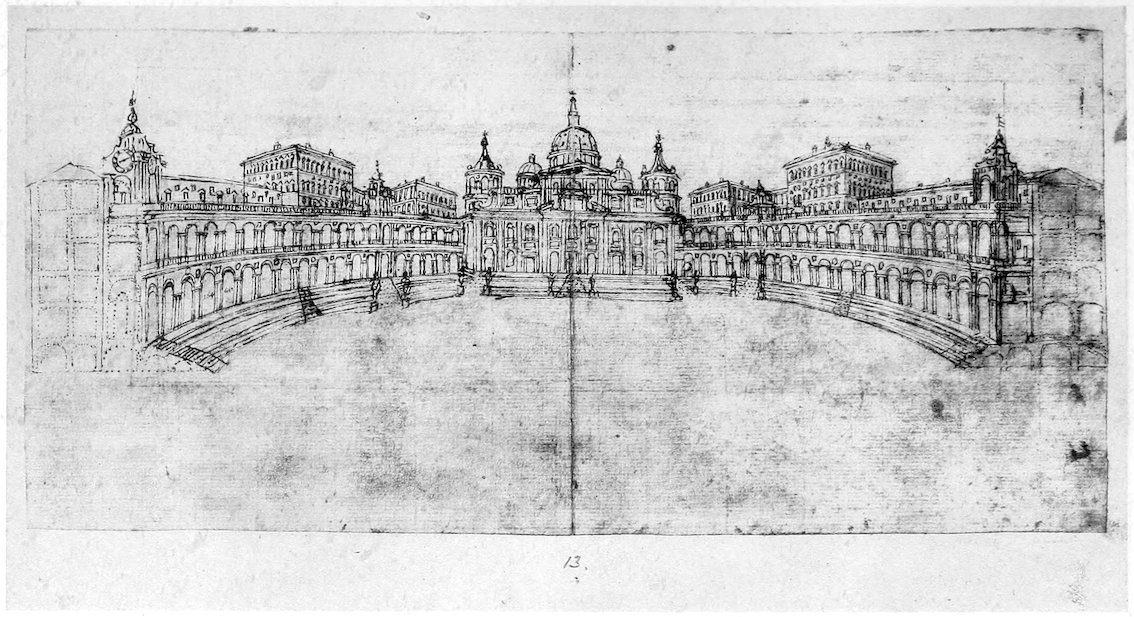
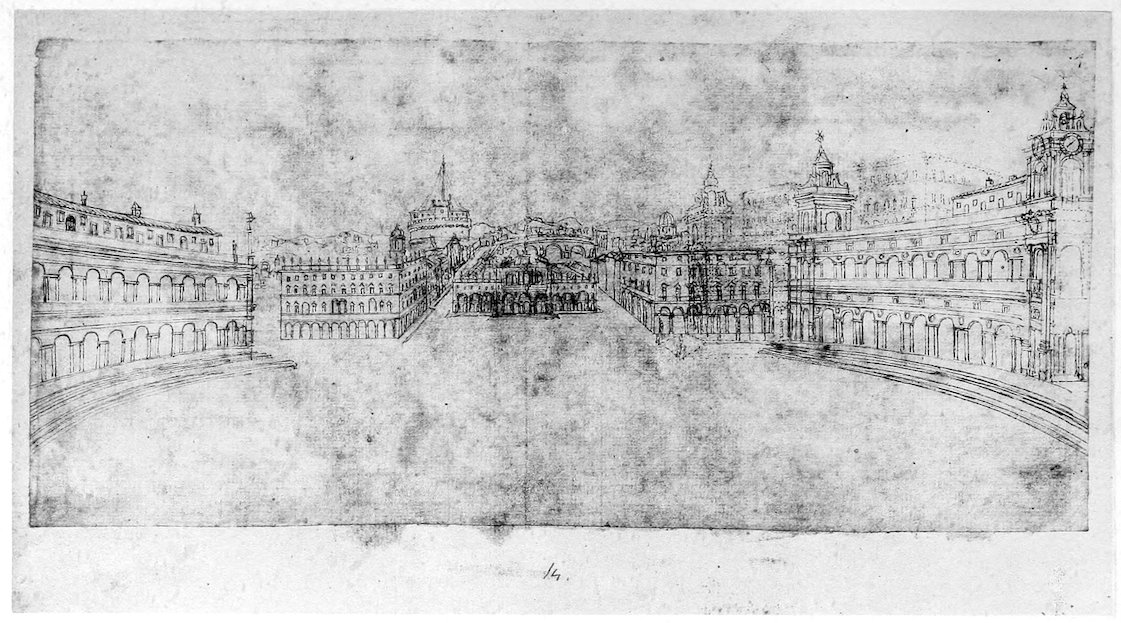
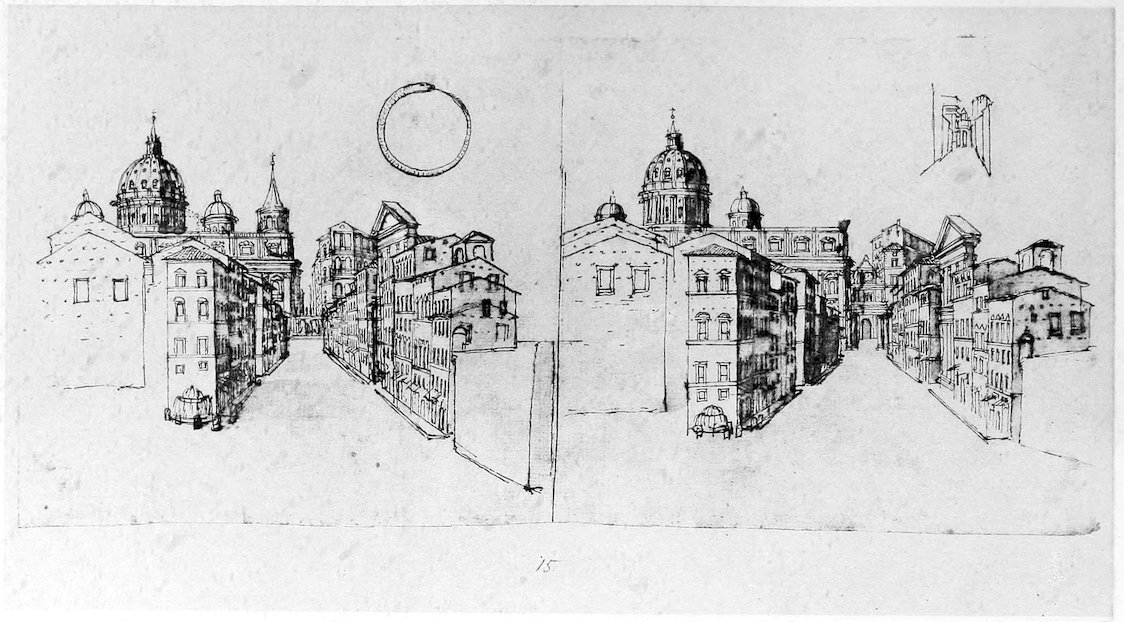
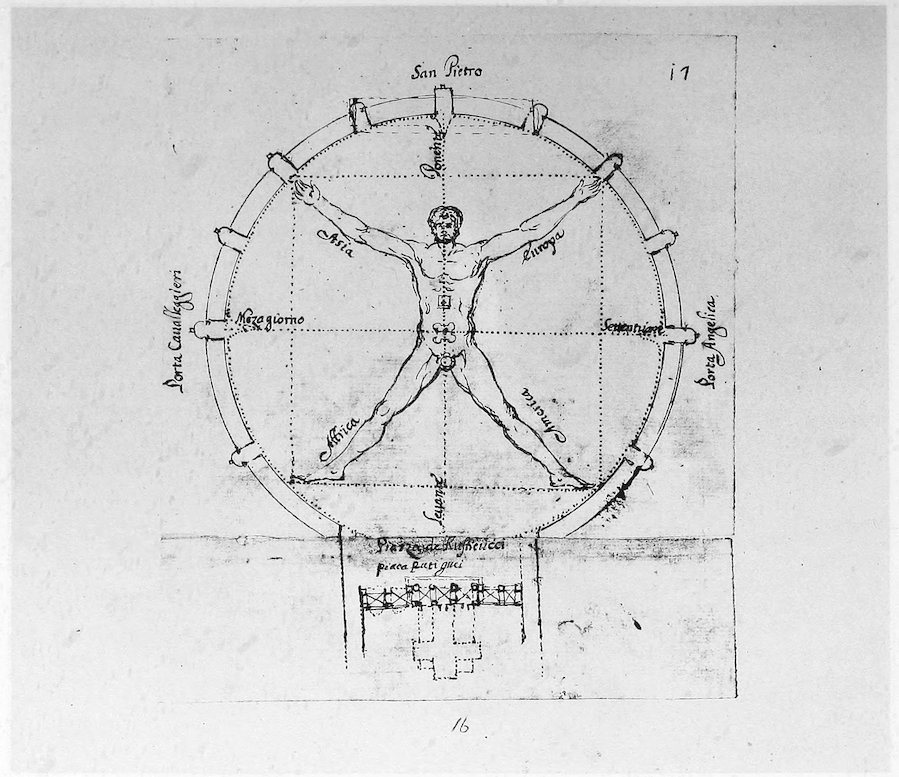
ASPECTS OF THE ART OF SCULPTURE — I. THE ART OF PORTRAITURE — II. PHEIDIAS AND MICHAEL ANGELO — III. A HEAD OF ATHENA FROM CYRENE
55
57
All students have noticed the similarity in style between
certain Egyptian portraits and other works by ancient Roman
as well as Florentine artists, and the resemblance in style that
exists between Greek and Venetian portraits. Also there is
a marked dissimilarity between the Egyptian-Roman-Florentine
Group on the one hand and the Greek-Venetian Group
on the other; and these two facts suggest the conclusion that
the art of portraiture consists in something more than the
mere photographic imitation in stone, or with paint, of the
human face or figure. Were such imitation the essential
factor in the art the only differences in portraits of different
epochs would be those of ethnographic character. The special
characteristics of portraiture as of the other arts at any given
period are the result of the intellectual and material condition
of the people to whom the artist belongs. Style, that is the
distinguishing quality of the work of art, the quality which
differentiates it from a work of another period or race, is the
result, largely unconscious, of the relation of the artist to life
and its effect upon him. The material, the means by which he
gives expression to his endeavour at creation or representation,
is of minor importance.
The Sheik-el-Beled (Plates XLI, XLII) and the bust of
Scipio so called (Plate XLIII) might almost be portraits of
brothers; and the family is increased by a little Egyptian head
58in the museum in Venice, and by some of the men immortalised
by Donatello. So too Pericles as we see him in the bust by
Kresilas seems separated by but a narrow margin from Giorgione’s
Knight of Malta. And yet in blood, traditions, circumstances
and hopes these men were the poles asunder.
How then is this likeness of certain portraits to one another
to be explained unless by the existence of some connection
dependent on the temper of the artist?
There is still another curious likeness and another difference
to be noted among the carved and painted portraits of various
epochs and schools. While the head of Corbulo is unlike that
of Pericles in the æsthetic impression it gives, and that of
Angelo Doni by Raphael also is æsthetically unlike the Duke
of Norfolk by Titian, still the carved heads have a common
bond as have also the painted ones.[19] They do not make the
two broad groups into which I have, for the sake of making
plain a general idea, divided portraits æsthetically similar,
but they make plain when understood that painted portraits
are necessarily different from carved ones—different in more
than the mere fact that one is round and the other flat. The
difference springs deep down from what is possible to attain
by either art. The sculptor of the Pericles and the painter
of the Norfolk both set before us the grave, elegant and
stately face of a bearded man in middle life. Neither artist
distracts our attention by bravura or technique or by realistic
emphasis of detail. Though stylistically similar, these works
still do not impress our minds in the same way. The following
pages will be clearer if I say at once that this differing
mental impression arises because in busts our attention is
drawn chiefly to the mouth while in painted portraits it is
turned on the eyes. This is due to the special laws of the
technique by which the works are produced; given a painter
and sculptor with the same point of view and the same mental
tendencies, the portraits produced by them, even of the same
person, though evidently expressing the same intellectual qualities
both of artist and of sitter, are in modes of expression
and certain external aspects necessarily unlike. In pursuing
this investigation and in discussing the existence and nature
of the various laws the governance of which I have suggested,
the history of the rise and spread of portraiture must
be kept in mind.
59Before the intention of the maker of portraits can be comprehended
the motives that lead to the desire of the public
or of private individuals to possess such work must be understood.
In the main they are two,—one religious and one
historic; to these may be added a third, that of sentiment
and friendship. The religious cause is best illustrated by
Egyptian statues, of which a large proportion were made
to be placed in tombs. These are the earliest portraits of
western origin which exist in sufficient numbers to afford a
sound basis of criticism. The well-known dependence, in that
country, of these works on religious prescriptions needs hardly
more than passing mention. That the soul of dead mortals
might, returning to this earth and to the tomb, find its accustomed
corporeal dwelling place, portrait statues of the
deceased were placed in the sepulchral chamber.
Holding this belief, it was only natural that the sculptors
often made statues life-size, and as closely resembling
60the dead original as possible, in order that the soul might
find a shelter exactly similar to its original living one. Had
they not been so made, the soul would have been troubled in
its search. Work such as this was of course expensive and
the mass of the people had to content themselves with smaller
and less elaborate figures or with mere glazed figurines.
But the more rare elaborate works show the ideal and serve
as a sure guide in studying the conceptions and hopes of this
or any people—just as the gold treasure from Mycenæ is of
much greater value than all the terra-cotta vases in showing
the life and thoughts of the time.
Other portraits of Pharaohs and their queens, of priests
and generals, were carved on temple walls or set up to commemorate
striking events, and these also were made realistic
because of the egotistic idea that called them into being. Unless
the person portrayed was carved realistically the commemorative
value of the monument was lessened. These
religious and commemorative ideas influenced the sculptors
in their choice of material. Both the desire to make an enduring
image of the dead for the sake of the soul that might
return and the wish to make the memory of the person as
enduring as possible led the sculptors to make use of the hardest
stones; stones such as do not lend themselves to sculpture
and such as are never used where the art develops in accordance
with cultivated taste rather than special demand.[20] But
though exactness of likeness was tirelessly sought for by the
Egyptians (I refer of course to the earlier epochs before the
influx of Greek or Roman ideas), it was not attained with the
same success as in later days by the Romans and Florentines.
61This failure was in part due to the use of unyielding material,
such as granite and basalt. Successful representation, in
such stone, of the finer details of facial form, was practically
impossible, and furthermore, owing to the dark and variegated
colour of these stones, would have been scarcely noticeable
could it have been attained. Hence the sculptors were led to
practise a certain broadness of treatment that makes their
work seem, to careless observation, like the Greek; but
though one of the chief charms of Greek work is broadness, it is
the outcome of very different causes and, if carefully studied,
is seen to produce a very different effect from that of Egyptian
work.[21]
Any phenomenon is due to mixed causes, and it must
not be supposed that the use of hard materials alone led to
breadth of treatment. The conventional position of the
figures in Egyptian art (due in large measure to various non-æsthetic
causes) was suited better by a broad and conventionalised
treatment of the face than by more particular niceness
in the rendering of its detail.[22] Religious feeling led to the
placing of quietly posed statues in the tombs, and as regards
62the figures of the great rulers whose word was law, attitudes
expressive of the calm that results from absolute power were
best fitted to express the current beliefs. These attitudes were
also restrained in consequence of the refractory nature of the
stones used.
It is interesting to consider what would have been the development
of sculpture in Egypt had the art been freed from the
necessity of conforming to the demands of religion and contemporary
history. One searches in vain among the masses of
Egyptian sculpture for the expression of the individual sculptor’s
emotions. We do not even know the names of the sculptors.
They were not noted by their contemporaries nor did interest
in their work lead them to sign it. Sculpture in that antique
land was not a fine art in the sense of being chosen by men of
special tastes and feeling to express the enjoyment felt by
them in certain forms. It was a highly developed handicraft,
a technique pursued by rule. As illustrative of the character,
the life and the thought of the people portrayed it is allied to
Roman work rather than to Greek.
Religion is seen to influence portraiture in another way.
Many pictures, the subjects of which are religious, by Botticelli,
Ghirlandaio and others, are filled with portraits, but these
are essential to the composition, and are thought of as figures
first, as portraits afterwards. But there are many sacred
pictures of the Renaissance in which, with varying degrees
of simplicity and frankness, a portrait of the donor of the
painting is inserted not as an essential part of the composition
but because of the desire of the donor to secure lasting recognition
of the fact that he had fulfilled his religious vows and
duties. It was an accepted proof of respectability in this
63world and might possibly help in the next. Neither in Egypt
nor in this class of pictures of the Renaissance are the works
thought of primarily from the point of view of being artistic
reproductions of the human face, but they are means to an end.
They are in fact symbols. Work of this sort is so rare in
Greek or Roman art that it may be considered as practically
non-existent.[23]
The personal portrait, the portrait made for the sake of
gratifying the self-esteem of the person represented, is well
exhibited in Egyptian work in the bas-reliefs illustrating the
conquests of the Pharaohs and in the colossal statues erected
in a spirit of pride and self-glorification such as was exhibited
again by the Romans. Such portraits as these are a certain
indication of the all but universal desire for glory and fame.
They are an expression of the same confident spirit that leads
the owners of great buildings to carve their names over the
entrance and are produced in large numbers only during periods
when individuals seek eagerly for personal recognition.
Such periods occur when large stores of money are possessed
by private persons; then religious beliefs grow faint, in men’s
if not in women’s[24] minds, and the quiet and enduring appreciation
of a few objects gives way to the excited pursuit of constant
novelty in enjoyment. Consequently instead of being
content with philosophic moderation men attribute an untrue
value to mere possession, and, since money can buy many
64material things, come to the false conclusion that he who
has the most is to be ranked among the world’s greatest
sons.
But the qualities needful for amassing riches are by no means
rare and in the main are correlated with lack of interest in the
Past and with undeveloped imagination. Hence ignorant
of, or at least not sympathetic with, the more subtle but more
effective types of men who work not with money but with
personal character, the wealthy naturally come to think of
themselves as individually interesting and important, and in
consequence their portraits are made in every shape and size.
Such works cannot, as regards the person portrayed, be of
much interest, and are usually ugly, because the lives and occupations
of people invariably affect the forms and expressions
of their faces. The exceptions to this rule are the portraits
of such men as Lorenzo dei Medici, or others of our own day
who use their inherited or acquired wealth in the patronage of
the arts and sciences—who use their powers indirectly for
the cultivation of ideals.
Such portraits as these are of varying character. They may
be public, put up, that is, by a grateful and flattering people
to commemorate a ruler or chief citizen, as in the case of
Gattamalata in Padua and Colleone in Venice; or they may
be of purely private interest and intended only for the eyes of
the successive generations of the family to which the person
depicted belongs. But public or private, in the one case as
in the other, the desire for them being due to personal regard
and love of fame, an accuracy in the reproduction of feature
is sought that distinguishes them clearly from portraits
made with other less worldly motives.
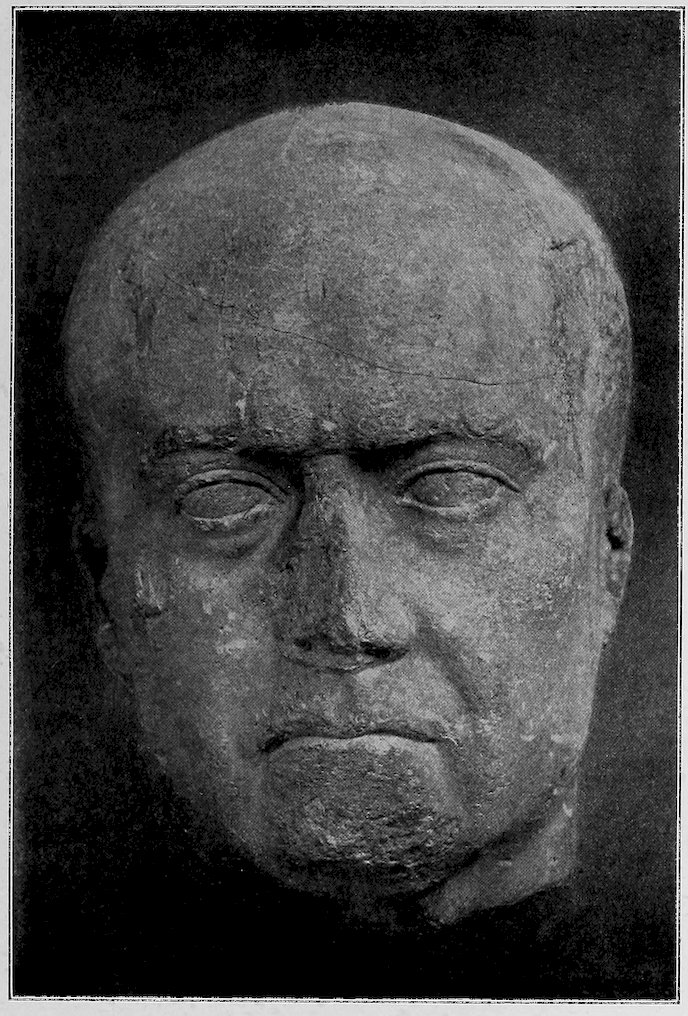
65It is known of course that this desire for fame stirred the
hearts of oriental potentates long centuries before the beginning
of connected history. But in that classic part of the
ancient world with which we are intimately related, it does not
become specially noticeable till the time of Alexander. It
was an active factor in life during the existence of the Roman
world, and again in the Renaissance. One of the phenomena
most indicative of this aspiration is the character of the monuments
placed on graves, and particularly the inscriptions on
such stones. On the Greek grave stones we find often enough
the name of the deceased but rarely if ever any intimate notice
of his life. On Roman and Renaissance monuments, on the
other hand, the length of life, and the honorific offices held, are
all given with wearisomely full detail.
Portraits made for friendship’s sake are uncommon and do
not, I believe, occur before the time of the Renaissance.
Then one hears of friends sending their portraits to one another.
In Rome a somewhat similar custom was practised to
a certain extent, as is shown by the portraits on rings and
cameos. Such work, meant as it was for personal adornment,
must have been, at least in part, inspired by the tender regard
of friend for friend. But it seems not to have been a common
custom in the ancient world; just why it would be hard to
tell, for no more inviolable friendships have ever been known
than those told of in ancient history and drama, nor more
tender feeling than is expressed in many of the inscriptions
on ancient tombstones. Perhaps it was that the house
architecture of those days was but little adapted to the displaying
of such objects, and the collection by private individuals
of things was but little practised except in Rome, and
66even there collectors were comparatively few. However
this may be, the fact remains that the portraits of the
ancient world were in the main religious or commemorative,
and the idea of friendship being maintained or strengthened
by the possession of the dumb semblance of absent dear
ones seems to have grown and spread with the Christian
religion.
At first sight it appears as if there were three ways of making
portraits—the sculptor’s, the painter’s, and the writer’s.
It is not however in any true sense a portrait that a writer
sets before us. This is beyond his power to accomplish. He
is unable, that is, to give various readers such impression of
the look and carriage of the person described that they can inevitably
recognise him in the passing crowd. Continuous
and sequent events may be described by words, but they cannot
show instantaneously isolated images. Masters of style
can call up visions to the mind by well-selected epithets, but
such visions are typical rather than actual; and they are
of scenes of considerable scope, or of actions of dramatic
quality, rather than accurate images of facial form and expression
such as in the only true sense of the word, can be
called portraits.
So far as art in the sense of reproduction is concerned, it is
evident that language can be used for description, for suggestions
of moods and general conditions, but not for showing
in a sharp and quickly defined manner a given scene or object
at a given moment. When Shelley speaks of
The obscene ravens, clamorous o’er the dead;
The vultures to the conqueror’s banner true
Who feed where Desolation first has fed,
And whose wings rain contagion,—
67he calls to mind most vividly conditions consequent on war,
but before no two readers of the lines will the same visions
rise. To see such horrors as Shelley writes of, presented so
that all beholders will regard them in the same way, we must
turn to such a work as Turner’s Rizpah.[25]
The Greeks, it is interesting to note in this connection, recognised
this limitation of the power of words and rarely tried
to delineate the actors in their poetry and drama by other
means than the description of traits of character. It may be
said that the Greeks also did not attempt landscape in their
writing. True, but we have every reason to know that the
Greek mind was not interested seriously in beauties of landscape,
while we know that it was deeply concerned with the
characters and actions of individuals. Landscape was not
studied by the Greeks as an end in itself, whereas portraiture
was. Hence the absence of an attempt at portraiture in their
literature by other means than description of character is the
natural result of their mental tendencies. Such description
can of course be accomplished by language with greater certainty
than by sculpture or painting. It can give such an
impression of the nature of a person that there is no more
room for doubt concerning the qualities that constitute that
nature than there is concerning the colour of eyes that have
been put on canvas by some painter. Take any example
and it will appear that when an author tries to stir the imagination
to form an image of a character, he does it mainly by
describing carefully his nature rather than his personal appearance,
68and when he attempts to do more than this, he suggests
inevitably a different vision to every reader. Shakespeare’s
sonnets are sufficient evidence of the truth of these
statements.
I should not wish to imply that writers, even the greatest of
them, do not sometimes attempt to depict persons by elaborate
descriptions, but a comparison of any two illustrated editions
of an author will show my contention to be correct. The inefficiency
of the means and the inadequacy of the result has
been recognised by the masters of literature. And it needs
but to compare a word portrait with a painted one of the same
person to be convinced of the painter’s greater power in this
work. Take Shelley’s lines describing the crazed musician:
There the poor wretch was sitting mournfully
Near a piano, his pale fingers twined
One with the other, and the ooze and wind
Rushed through an open casement, and did sway
His hair, and starred it with the brackish spray;
His head was leaning on a music book,
And he was muttering, and his lean limbs shook;
His lips were pressed against a folded leaf
In hue too beautiful for health, and grief
Smiled in their motions as they lay apart—
As one who wrought from his own fervid heart
The eloquence of passion, soon he raised
His sad meek face and eyes lustrous and glazed
And spoke—sometimes as one who wrote and thought
His words might move some heart that heeded not
If sent to distant lands.—
As a portrait the failure of these verses lies in the fact that
the attention of the reader is hurried on from point to point
like a storm-driven bird and never allowed to rest. Look, for
half the time it takes to read the lines, at Titian’s Concert, and
you have a much more definite image of a musician. It is
69just because of this unrest of the attention, due to continued
introduction of some new feature of importance, that poets
and writers of prose are much more successful when they endeavour
to reproduce a landscape, for it is a natural tendency,
as we look at any scene of nature, for the eyes to wander over
the hills and far away. They cannot seize the essential
points instantaneously and they cannot apprehend the interrelation
of the details as when they look at a person’s face and
figure.
Sometimes the poet—it is generally a poet, for the epithets
that poets use are apt to be more carefully chosen and so
have greater graphic force than those of prose writers—seems
to succeed in portraiture, but if you will consider closely, it
will be seen that the success is fictitious. It is due to our
having a ready-formed picture of the character of the person
described which is suited by the poet’s words, as in Browning’s
lines:
You know we French stormed Ratisbon,
A mile or so away
On a little mound Napoleon stood
On our storming day
With neck outthrust, you fancy how,
Legs wide, arms locked behind,
As if to balance the prone brow
Oppressive with its mind.
But to one who had never seen a picture of Napoleon what
image would these lines give? Or, take Lowell’s lines on
Lincoln. Not a word in them concerning the outward appearance
of the Martyr Chief; but the attempt, successful to
the uttermost, is made to impress on the reader’s mind what
there was of him to think of, not to look at:
Wise, steadfast in the strength of God and true.
70These epithets offer no suggestion that can be visualised, nor
is there when we note
... that sure mind’s unfaltering skill
And supple tempered will
That bent like perfect steel to spring again and thrust.
And then finally, to sum up:
Here was a type of the true elder race,
And one of Plutarch’s men talked with us face to face.
Vivid and eloquent as all this is, it offers no picture of the tall,
gaunt President. It is but a suggestion of mental conditions.
It does not show the deep-set eyes, sorrowful with the sorrows
of two races, or the firm mouth lined with the humour that
helped him to bear his burden of care. Plutarch himself does
not show us Cæsar, or Pericles, or Demosthenes or any other
worthy, as the sculptors do.
Possibly it might be suggested that in such poems as those
quoted the writer had no intention of giving a suggestion of
the outer husk that hides the inner man; but there is one class
of poems—the love lyrics—in which the passion-driven bard
would surely, could it be accomplished, give the immortality
of portraiture to the beloved. But those “dear dead women,”
the ever-renewing Spring brood of Sappho, Chloris, Lesbia,
Lalage and Doris, are but the vague dwellers of dreamland.
Sometimes they are dark and sometimes fair; they have cheeks
that shame the rose, and eyes whose glance overwhelms as
does the bolt of Jove; their brows are white as driven snow,
and a nest for little loves is in their bosom—but can we ever
be sure that we recognise from such description each particular
Lesbia as, waiting and watching at the corner, we hopefully
murmur “She comes, she’s here, she’s past”? Such
71words as these form a portrait only for that one love-stung
heart that beats the overtone to the note of Lesbia’s
footfall.
No, the writer cannot, in any adequate sense, place before
us portraits.
Literature being excluded as a means of portraiture, it
remains to consider sculpture and painting. In order to
understand why painted and carved portraits showing similar
types with equal distinctness and emphasis produce very
different effects on the observer and hold his attention in
different ways, study must be made of the different results
possible to attain by these arts. If these general propositions
in regard to the two arts be true, the demands and characteristics
of portraiture will become plainer.
The fundamental distinction between sculpture and painting
lies in the fact that the former concerns itself not always, but
primarily, with light and shadow and fully modelled forms, while
the latter deals chiefly with colour. Furthermore, painting
works in two dimensions, while sculpture exercises herself
with three. Hence, figures in positions that are much contorted
or groups that are complexly organised in retreating
planes are unsuitable subjects for a painter, inasmuch as he
cannot represent them clearly except at the expense of infinite
labour. If the sculptor, on the other hand, chooses
such subjects, he is not hampered by the difficulties that
block the painter’s path. His finished work can be looked at
from all sides, and he is not liable to the painter’s risk that his
final effect may, perhaps, be ruined by a misuse of light and
shade or by faulty drawing and perspective.
The advantage, however, is not altogether on one side. The
72sculptor has this other difficulty to contend with, that the
appearance of his work will change with every change of light.
The painter can fix whatever light he pleases on his canvas.
As the appearance of the sculptured work will vary with the
light, the sculptor can attain but partial success in the representation
of figures or scenes in which much active emotion
is shown in the faces. But in such scenes as these a painter’s
power can well be shown, since, owing to his ability to paint
any power of light (except, of course, direct sunlight), and his
power of placing the various figures of a group in various
lights, and by means of varied tints and lights being able to
bring sharply into notice any expression of the face, he can
well depict most violent emotion. It will be found, I think,
that the sculpture which is most successful deals with groups
or figures whose meaning is made clear by action and by the
form of the body as a whole, and the paintings that are most
successful are those in which effects of chiaroscuro, colour and
facial expression are the most satisfactory method for making
the figure intelligible. Several facts which will be readily
acknowledged show the truth of this statement. For instance,
Veronese, Rubens, Tintoretto, Velasquez when painting scenes
the interest of which depends on the individual figures appearing
in them (not such scenes as Paradise, Hell or battles
where the interest is in the masses and spaces), compose them
mainly in one plane. Also if single heads be taken from pictures
and from sculptured groups, it will usually be found that
the former give a fuller impression of the artist’s intention
than the latter.
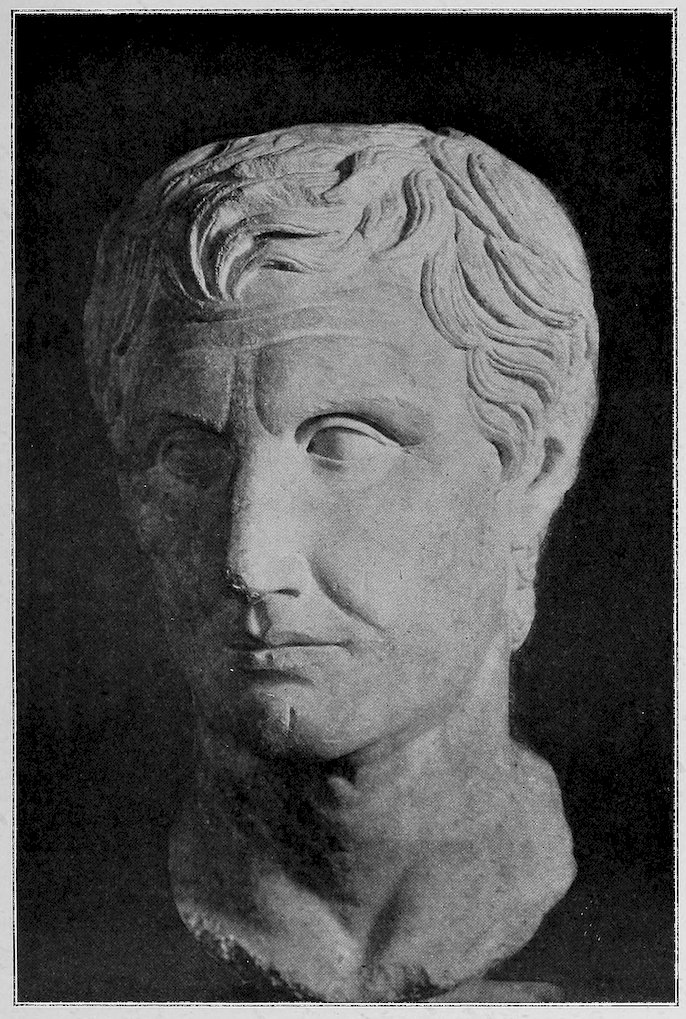
Every rule has exceptions and among Michael Angelo’s
sculptures are works in which he sought to reproduce effects
73of light and shade and expression that if given by painting
would have been more successful because the latter would
have expressed the artist’s intention more clearly; and in
certain of his paintings he attempted effects of form that
could be given more satisfactorily by sculpture. Done by any
less a genius than Michael Angelo, such work would be either
ineffective or laboured. Done by him one can but marvel
at his mastery over the sister arts that enabled him to approach
so closely to the effects proper to the one while using the means
offered by the other. But such success as he attained does not
prove soundness in the principles that led him to make the
attempt. A tour de force is but the attempt to attain a result
by means other than the best. It may be successful, but it
must be unsatisfactory. It is unreal, impractical; it is a
form of jugglery!
To see how similar scenes are treated in the two arts, compare
the group of Niobe and her Children with the Massacre
of the Innocents as painted by the Renaissance artists.[26] In
such comparison trivial details must not be too much regarded,
for of the Niobe group there consists but one incomplete set
of copies of the original figures and of the Massacre of the
Innocents each one of us probably considers a different artist’s
conception of the scene most effective. But the general
impression given by Niobe and her children is that of bodies
driven into violent motion by fright, what might be called
frightened motion; the figures are rushing from one spot to
another in search of safety; they bend and cower in terror of
74the peril. They are the incarnation of dread of physical
suffering. The impression of the Massacre of the Innocents
is one of faces contorted by horror. The action of the bodies
is of less concern. The attention is drawn to the eyes, the
mouths, the hands, the three chief outlets of mental feeling.
The sufferers in the scene are moved by the horror of unjustifiable
slaughter. They are the incarnation of anger, revolt
and despair induced by the sight of pitiless massacre.
In portraiture the painter and sculptor are drawn together
because the greatest interest of the work is centred in the
face, which is the clearest index of thoughts and emotions.
Both sculptors and painters even when making figures of life
size are limited in portraiture to seeking their chief effects in
the treatment of the face. But though so far working in
common, the painter and sculptor still have different aims;
for that part of the head the expression of which can be more
strongly accented and more completely reproduced by the
use of colour and a chosen shade and light, is the eyes; while
that part the expression of which can be most adequately
rendered by modelling is the mouth. This is the reason why
portraits similar in style, such as those above mentioned, the
bust of Pericles, and the painting of the Duke of Norfolk,
attract our attention in different ways. In the bust the most
noticeable feature is the firm but sensitive mouth, in the painting
it is the steady, but vivid, eye.
Mindful of these conditions that govern the art of portraiture
we find it easy to see how the artists of various epochs
have conformed to them. This may seem to be putting the
cart before the horse; to be fitting the facts to the theory.
But it is not so,—it is merely searching for proof of a working
hypothesis. The theory was suggested by the phenomena
and it will be seen to explain these phenomena.
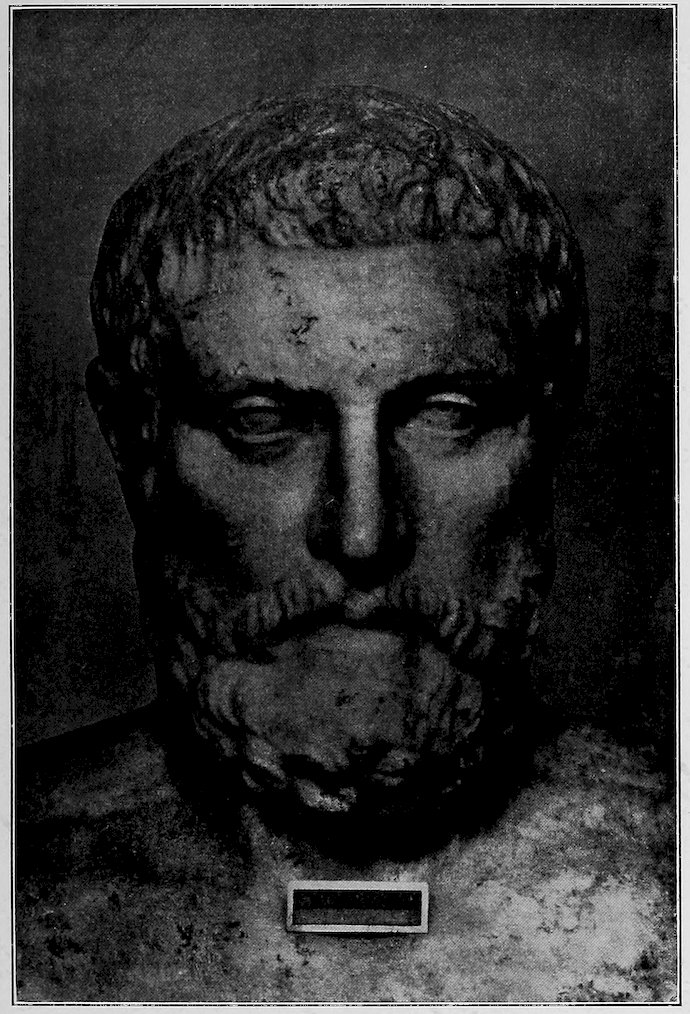
75The study of Greek sculpture is at present seriously hampered
by statements and beliefs concerning it which arose
at a time when its place in the history of art was very inaccurately
understood. These have been repeated so often that
they are frequently accepted without being critically weighed
in the light of recent knowledge. It is a unique and very
perfect art, but the causes and qualities of its perfection are
sometimes misunderstood. Justifiable admiration has out-weighed
the critical faculties. It is generally thought to be
more imaginative and ideal than is in fact the case. The
quality of realism is not usually attributed to such a work as
the portrait bust of Pericles. And yet this bust is quite as
realistic, though not so prosaic, as that of the Roman general
Corbulo. I mention these two because they are very generally
known; but many others such as the Demosthenes, Sophocles,
Cæsar, Caligula would do equally well. The word realism is
reserved too much for those works in which the artist has
represented the forms that would be first noticed by the casual
observer and, in this limited sense, the Corbulo is far more
realistic than the Pericles; but realism is just as truly displayed
in works in which the forms, while reproducing those of
the model, may perhaps not be the most obvious ones and
though the juxtaposition of them be not their most common
combination. In this sense the Pericles is as realistic as the
Corbulo. Greek realism in portraits deals chiefly with faces
and figures in repose; Roman realism deals in the main with
faces and figures in action.
It is noteworthy that portraiture was a late development of
76sculpture in Greece. We know, for instance, of no contemporary
portraits of Solon or Peisistratus, and there exist in
museums and private collections extremely few busts or statues
of the period preceding the middle of the fifth century
B.C., that have the character of portraits. One reason of this
doubtless was the feeling that the success which brought fame
in its train was due more to the Gods than to the individual.
The individual was an accident in the exhibition of beneficent
power by the Gods, and consequently, so far as form and feature
are concerned, was of no special interest. Furthermore,
there was the feeling that the fame of individuals was due to
and a part of the fame of the whole state; hence the individual
was not apt to overestimate his own value nor to be thought of
by his neighbours with any such feeling of special respect as is
expected by, and often granted to, those who are “self-made.”
Over and above these causes was another which must
have been largely responsible for the late development of
portraiture and for its character when it began to be common.
This was the Hellenic love of beauty. Divided though the
Greeks were into numerous states, they were held together
by bonds of language, tradition, religion and politics. But
the bond that united them more strongly than all others, even
than their hatred of barbarians, was their love of beauty.
“Beauty the first of all things” says Isocrates “in majesty and
honour and divineness. Nothing devoid of beauty is prized.
The admiration of virtue itself comes to this, that, of all manifestations
of life, virtue is the most beautiful.” The consequence
of this feeling was to make the individual and imperfect
man uninteresting to the artist while the general and typical
figure became his supreme aim. When at last in the fifth century
77B.C. portraiture became more frequent than it had previously
been, the perfect portrait was the one which gave most
completely the impression of the general character of the man
and not the one which gave the most vivid and striking representation
of the separate features of his face.
Curiously enough the first portrait we hear of in Greece
was a caricature of the poet Hipponax by Bupalos and Athenis,
artists of the sixth century B.C. While caricature was attempted
as early as this, as is shown by the drama, by terra-cotta
figurines and by vases such as those from the sanctuary
of the Kabeiroi in Bœotia, it may be questioned whether such
a portrait of Hipponax ever existed. The details of the story,
such as the suicide of the artists owing to the satirical attacks
of the poet, are scarcely credible, and if we remember the very
strange and unlifelike appearance of archaic art it seems not
improbable that the story arose in the attempt to explain
some rude statue the true intention of which had been long
forgotten or had not been clearly indicated. Even were it
certain that such a caricature did once exist, the knowledge
would be of no great interest, because caricatures are but a
debased form of art. They are only the exaggeration of accidental
physical peculiarities. If the traces of a warped or ill-developed
character show in the face or figure, the representation
of them may be made a caricature, but almost all
so-called caricatures show not oddities of character but deformities
of person. It is in literature, in the works of Molière
or Shakespeare, rather than in sculpture or painting, that we
find true caricatures. Not that they do not exist in the plastic
arts, but the literary art lends itself more readily than the
others to this mode of representation.
78Whatever the actual facts regarding the reported portrait
of Hipponax may have been, it is not till about the first quarter
of the fifth century (circ. 500–475) that we have undoubted
evidence of portraiture. To that time belongs the bust of a
bearded man wearing a helmet, in the Glyptothek in Munich.
A replica of this work exists in the collection of Barrone Barracco
in Rome. These two heads may well be copies of a
statue of some victor in the games. As is known, portrait
statues were allowed only to thrice victorious athletes, and
they were erected not so much as an honour to the victor
as to keep fresh the memory of one who had thrice been
cherished by the Gods. But this rule governing the making
of statues of athletes clearly shows what deep significance
a statue was considered to express and the secondary
importance to the Greek mind of keeping a record of personal
appearance. Whether of a victor or not, the bust referred to
belongs to the early period of development of the technique
of sculpture, before it had been perfectly mastered, when the
artist was able to represent not what he wanted to but what
he was able to. Hence it is conventional; so much so that
were it not for the helmet and the absence of any attribute of
Divinity we could hardly be sure that it was intended as a
portrait.
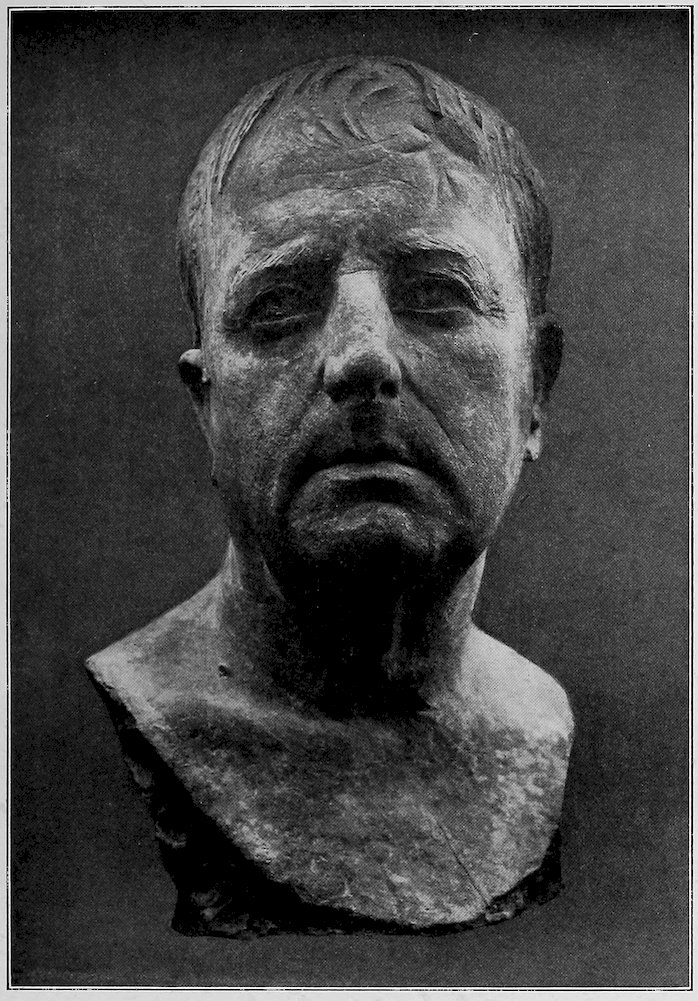
Probably the best known example of portraiture produced
during the period when the technique of sculpture was thoroughly
understood and mastered, is the head of Pericles by
Kresilas to which I have already made reference (Plate XLIV).
It is a work of special importance owing to the interest attaching
to the character of Pericles, but more particularly from the
artistic point of view; and fortunately there exist several
79careful copies of it. These make us sure what its artistic
character was,[27] and furthermore Pliny has handed down to us
an estimate of the original work by a critic of the ancient
world. This critic expressed concisely and epigrammatically
the intention that is manifest in all Greek work of the best
time, in saying that the bust of Pericles by Kresilas shows how
art can make a noble man still nobler.[28] Now this can only
be said of the best Greek and Italian work. And all work, no
matter where or by whom produced, if wrought in the spirit
which was shown more by Greek sculptors and Venetian
painters than by other artists, may be described by such words.
Such a criticism could not be made of most Roman or Florentine
work. It can only be said of work in which the attempt
is successfully made to suggest a perfected type by the improvement
of an individual example, not of work the intention of
which is to represent the individual example as the embodiment
of special peculiarities with indifference as to their
excellence or defects.
The method adopted by Kresilas is not difficult to analyse.
The character of Pericles was a rare and happy mixture of
calmness, foresight, perseverance and sensitiveness. His
power of understanding men and conditions, together with his
quiet and steady pursuit of his aims, is shown by the course
of his political policy. His sensitiveness is made clear by his
80unselfish ambitions, by his delight in works of the fine arts and
by his chivalrous conduct towards Aspasia, whom general
opinion, not confined to the ancient world, would have allowed
him to disregard and forget, when for the sake of giving
offence to him the populace attacked her character. Such was
the man whom Kresilas had to portray, and with high artistic
perception he chose his means.
Kresilas, we can well understand, might have shown us Pericles
the warrior, or Pericles the orator, or Pericles the lover of
philosophy and the arts, and in doing so might have given a more
striking impression of one or more of the special qualities by
which his contemporaries were impressed. Instead of this he
succeeded in setting before us the complex of all these qualities,
and many more, that formed Pericles the man. The helmet
lifted back from the face reminds us of his military career but
does not force this on our attention.[29] The expression of the
face is not in the least dreamy but is thoughtful and grave;
an expression which, considering his life and friends, must
have been habitual when he was in repose. It should not be
forgotten that the attitudes assumed by the body when at
rest show the presence or lack of inborn grace and dignity,
and the expression of the face when in repose is an index to
the mental nature. The expression of the eyes is open; the
gaze is steady; the brow is undisturbed. The impression
given by the eyes is of clear, highly developed intelligence.
In the mouth which, as pointed out above, is the most indicative
81single feature in portrait sculpture, may be seen
even more markedly than in the eyes, the man’s character. It
is a very noticeable mouth, with full and softly modelled lips,
lips such as usually suggest a weak and sensuous character.
But this mouth is neither insignificant nor weak. Its great
sensitiveness passes into firmness in the closure of the lips and
the strong jaw, and shows itself not as that of an ungoverned
and libitudinous nature, but of a reserved and, in the best
way, sensitive quality. It is a mouth that implies vigour
but not self-will; the mouth of a very sensitive and appreciative,
but not a sensual man.
Besides the character of eyes and mouth, the treatment of
the whole head must be studied in order to understand what
the critic meant when he wrote that this work made a noble
man still nobler. The treatment is broad. The minor and
accidental details are disregarded that the general effect may
be clearer. The curling hair of head and beard, for instance,
is not tossed about in disordered masses, as so often in later
works, but is conventionalised. The artist realised that he
could not imitate hair, and consequently sought for the best
graphic symbol by which to suggest curls. In the modelling
of the face he chose an expression of quietness and not one
of any fitful, momentary emotion; and by not representing
any slight irregularities of surface or structure, he emphasised
and made more inevitably noticeable that expression which
was most completely indicative of the man’s essential nature.
He has given us not alone Pericles the leader of the state, nor
Pericles the patron of the fine arts, nor Pericles the impassioned
orator, but the Pericles of history, the embodiment of
all the best qualities bred in Athens.
82It must not be thought that the Pericles head alone exhibits
the qualities of both artist and sitter which I have
attempted to suggest. In their various ways the portraits of
Sophocles, Euripides, Demosthenes, the so-called Menander
(Plate XLV), Periander (Plate XLVI) and many another
famous Greek show similar æsthetic feeling.
It was but a short time after the death of Pericles that the
intellectual conditions of Greece underwent a great change.
Beliefs that, heretofore, had been universally held by the
Greeks began to be questioned, and the conditions of state-craft
passed into a new phase. The rise and fall of the Macedonian
power was of lasting effect on the Greek character.
Alexander exhibits the type, which became common again
in the Renaissance, of the selfish despot who maintained his
power by having the money to maintain his personal influence.
His thoughts were set chiefly on his own personal glory as
expressed in his empire. He tried, but unsuccessfully, to
make his court the centre of the artistic life of the day. He
was not a patron of the arts but of artists. To Lysippus
alone was granted the right to carve his portrait. No natural
development of the arts was possible under such conditions.
The granting of such a monopoly to Lysippus shows that
Alexander was merely interested in producing on posterity
a good effect so far as his portraits could help him to do so.
Copies of some of these portraits exist. They are fine in many
ways and, to a high degree, lifelike, but they and other similar
works of the epoch lack the quietness and repose of the works
of earlier times. There is a melodramatic feeling in the looser
treatment of the hair, and, oftentimes, an attempt to give a
superhuman expression to the face.
83These qualities, as critics have often noticed, are to be
found in all the forms of art of the time, so far as we now
have the means of judging. Even in architecture there is
a noticeable change. Stone is not laid so carefully, the cutting
of details is coarser and mouldings are heavier; masses
are less finely proportioned and the effects of light and shade
are made more definite and striking. The miniature portraits
on gems and coins show the same characteristics as the
large busts, and the mere fact of putting portraits of contemporary
rulers on the coinage shows that the relation of the
individual to the state had changed and that, on the one
hand, the desire for personal fame was spreading over the
world—a desire which became still more marked in the Roman
and Renaissance epochs; while on the other the worship
of rulers, introduced from the Orient, had firmly entrenched
itself. In fact, these Hellenistic portraits are not simple.
While the technique is still Greek, there is something else in
them than the desire of the artist to show the sitter as he appeared
to his contemporaries, even in a rightly idealised
manner,—they manifest the desire of the sitter to be admired.
The tendencies of the time were all towards exactness of
representation of existing forms, and this was soon attained.
Perhaps it would have been reached even sooner had it not
been for certain interests which held the sculptors partially
to the old-time aims. One such conservative influence is
shown in the work of Silanion, who became famous for his
portraits of persons dead long before his day. Such work, if
it was to satisfy a large public, and this was what it aimed at
and succeeded in doing, had to be of a broad, general and unemphasized
character, for the nature and appearance of persons
84known only by tradition is necessarily more vaguely and
variously observed, less easily and surely grasped, than that
of the living. Hence, if Silanion had made portraits that suggested
strongly what seemed to him the most vital characteristic
of the person represented, he would probably have
found that many of his contemporaries considered some very
different characteristic the most essential. To please the
many it was needful for his work to embody only those ideas
that were generally accepted. Such work cannot be realistic
in the sense of attracting attention to detailed peculiarities.
Greek portraiture became rapidly more and more prosaically
realistic. But even in its last stages, when Greek
artists were still employed by Greek patrons, the realism is
generally restrained. The old conventionalism and typifying
of the model is gone, and there is greater frankness in the
rendering of special peculiarities of hair or skin; but the
work is generally quiet and dignified, calm in expression and
reposeful in action. The artist puts before us not the type and
idea suggested by the man, nor, except in special cases, the
man’s own desire regarding his appearance, but the real daily
aspect of the man, dressed up not at all, treated in accordance
with the essential rules of sculpture as a fine art.
That there were, however, some artists who amused themselves
and a thoughtless public with portraits that were vulgarly
realistic—realistic, that is, in the representation of
ugly and unessential details—is shown by what we know of
Demetrius of Alopeke. He is noted solely for his successful
rendering of ugliness. But there was too much cultivated
taste in what remained of the Greek world, and too much vigour
and good sense in the growing Roman world, for such work to
become popular. To see realism developing in a strong and
healthy manner, we must turn to Rome where, though the
actual carving was done, with few exceptions probably, by
Greek workers, still the character of the work itself was controlled
by Roman ideas (Plate XLVII).
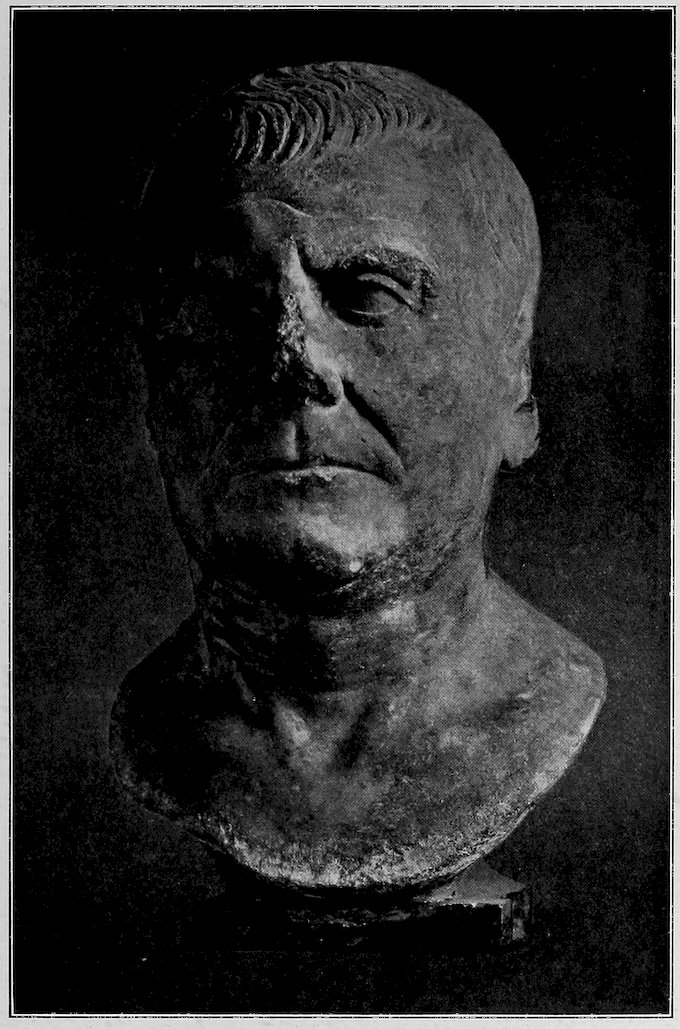
85The dry, matter of fact quality of Roman portraiture as
opposed to the more imaginative work of the Greeks, has long
been recognised. Its direct and unadorned presentation of
the human face is noted by the most careless observer and is
to most people pleasing. It makes them feel at ease; they
have the sensation of being with real people; it does not demand
of them a mental effort to analyse the appearance
before them in order to understand it. But notwithstanding
the facility with which one derives very definite, and it may
be lasting, impressions from these Roman busts, they are by
no means as simple and artless as they seem at first sight to be.
They are the product of complex influences and a highly developed
art and are as difficult to understand and properly
appreciate as are the earlier Greek ones.
We may illustrate what has been said by glancing a moment
at a portrait of an unknown old man[30] (Plate XLVIII).
This is a superb example of Roman portraiture of the time
of the Republic. It cannot lay claim to any beauty of form
or feature; it is uncompromisingly homely. Nevertheless it
has a certain fascination for the beholder. The sculptor was
a great master. The way in which he has rendered the signs
of old age in the withered neck, the irregular wrinkles of the
brow, and the uneven mouth is magnificent. It is realism of
a perfect kind, for the evidence of the wear and tear of life is
86subdued by and made minor to the splendid and enduring
vigour of the mind and character behind the cheerful old face.
What an old age! The sap may be running slow, the
body may show the blows dealt by life, but the stiff, short
hair is still thick, the head is still held upright and forward.
It is a face of a clean-living, plain-thinking man, one who had
“held both hands before the fires of life,” and seems to
scarcely suppress a smile at the thought that any one should
want the portrait of his old face.
Roman art, as a whole, was practical and uninspired, and
far from imaginative. In large measure it served either to
answer some definite practical end or to satisfy (as in the
decoration of palaces) the Roman taste for grandeur and display.
It shows the influence of a less full-hearted and unquestioning
religious inspiration than that which had such
marked effect on the early art of Greece and again in the
Renaissance. The work of all the various branches of art
produced in the Roman territory before the importation of
Greek artists was of the rudest. It was necessary to employ
Etruscans to decorate the temple of the Capitoline Jove and
until the first century before Christ the artistic product of
Rome seems to have been scanty. The energies of the people
were expended in war and colonisation. They were essentially
a commercial race. The existence of their city was derived
from and depended on their control of foreign trade. The
first necessity of such a city was to master the business of
political organisation and not to cultivate the tastes that
minister to affluence and ease. Pride of race and the acquisition
of great wealth were results of the transformation
of the small republic into the great empire, and with pride
and money came luxury, and the arts, with the desire for
portraits.
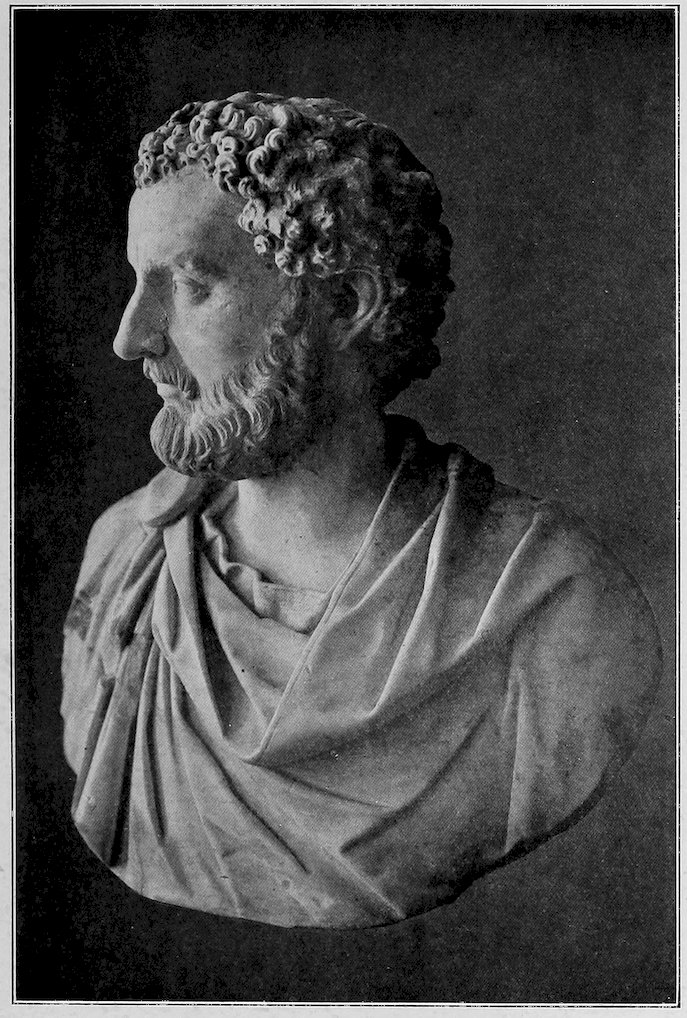
87Pliny tells of portraits made of wax, owned by the various
families, which were carried in funeral processions,—how
these were considered as belonging to the house and in case
of the sale of the latter passed with it to the new owner;
such portraits as these would, like the earlier Egyptian ones,
tend to the purest realism of external appearance. He mentions
also the muniment rooms filled with records of ancestors.
Stress was laid on the actions of the illustrious dead in order
that the ensuing generations might be stirred to ambitious
effort. Very different is this from the Grecian sinking of the
individual in the state. Roman tombstones exhibit the same
pride in great deeds and the same interest in details. They
are entirely different from the Greek grave monuments. The
Greek gives the name of the deceased, and sometimes a greeting
to the living wayfarer who may pass by and note the tomb;
or, sometimes he inscribed a plaintive verse—the expression
of a broken heart—but nothing more. How old were the
dead? What had they done? No one now can tell. Their
course was run and the restless curiosity of later ages must
remain unsatisfied. On Roman tombstones all this is very
different. They tell us the age and family of the deceased,
their occupation, what offices they had held and their age
even to days. In the cases where a portrait of the dead person
is added, it is treated in no general and typical way; but the
individual is set before us with unsparing accuracy.
This interest in the events of each individual life led to the
chief difference between Roman and Greek portrait busts.
The Roman thought of the great men of his country as the
88persons who had done such and such things rather than as the
leaders of such and such policies. Consequently, the Roman
portraits suggest activity and not repose,—action and not
thought. The idea embodied in the bust is not of a placid
and meditative but of a positive and active cast. The portraitist
seems almost always to represent his sitters at the
moment when they were accomplishing the great deed that
brought them fame. The eyes are made expressive by being
distinctly focussed, and this expression is emphasised by the
treatment of the brow, which oftentimes is more or less wrinkled
or contracted in a way that suggests vigorous, passing, mental
action. In many cases the ball of the eye is cut so as to produce
a strong shadow and thus to suggest the pupil. This also
makes the fixed look more intense, but unless the light is
exactly right it is apt to produce an unpleasant appearance.
That an artist should do this shows the desire for dramatic,
restless effects. The treatment of the lips and the part of the
face about the mouth also suggests an expression not typical
of any general trend of thought so much as of some momentary
and strong emotion. Then the way the head is set on the neck
and turns sharply to one side or the other can be understood
only by supposing that the artist represented the sitter as he
appeared when employed on some one active and characteristic
piece of work. There is, for instance, in Corbulo none of the
Greek treatment of the individual as a type, but everything
is done to make more prominent the individualities of the man.
And just as the Pericles is not alone in its class, so too the
Corbulo is matched by many others, such as the Julius Cæsar,
the Augustus, Caracalla or Antoninus Pius (Plate XLIX).
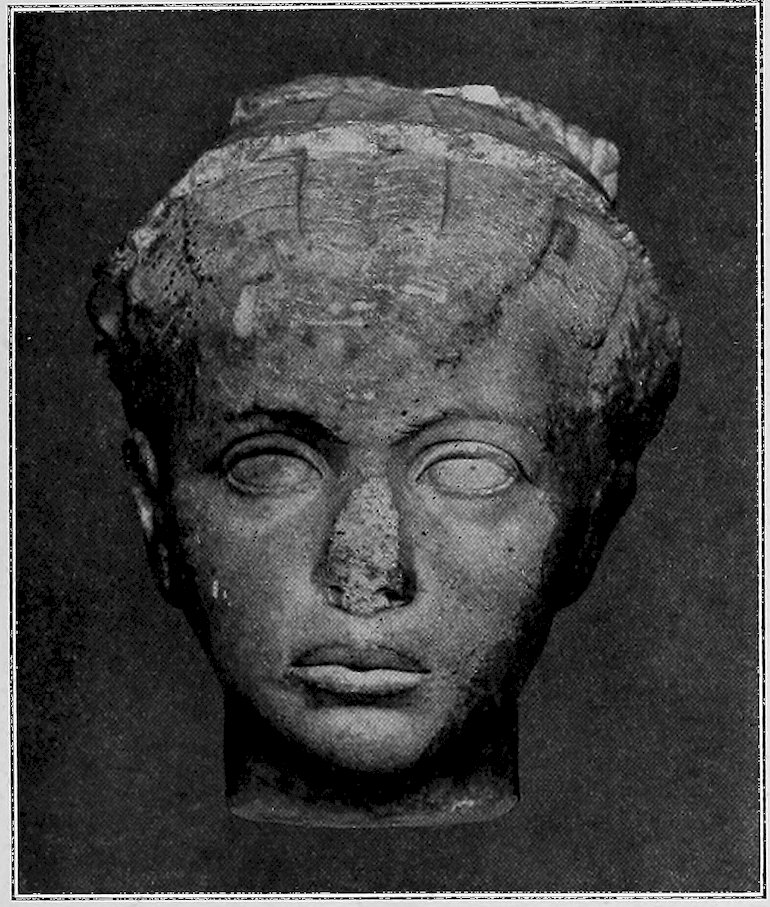
As one looks at these Roman portraits one frequently
89feels that the persons are on the point of moving. But
notwithstanding this quality of life which has led to their
being called realistic, the best of them are no more merely
superficial in their realism than the best Greek busts. Neither
class is vulgarly realistic and imitative solely in the external,
but both depend for their effect on the correct comprehension
and presentation of actual phenomena of form and facial expression.
The different effect they produce is due to the fact that
the Greek desired an expression of the inner man, the man as
he was to himself, while the Roman desired the expression
of the man as he showed himself to others. Putting the case
concisely, and remembering that such conciseness does not
express the completest truth, we may say that one was the
portrait of man as a thinker, the other of man as a doer.
In the foregoing explanation of the nature of Roman portraits,
no account has been taken of the numerous beautiful
busts of children and women that were carved by the sculptors
of the Eternal City. At first sight these seem to contradict
the contention that the almost universal intention of the
Roman sculptor was to make a portrait of a single sharply
defined phase of his sitter’s personality. They seem to be
done rather in accordance with Greek taste; but closer study
will reveal that they are not truly Greek,—that their real
nature is Roman and their seeming Grecian spirit is an illusion
due to accident and not to intention.
Busts of children or women made to show character in
action could never resemble the Roman busts of men. The
qualities that make the character of men are non-existent, or
at least undeveloped, in the child, and in the woman take another
form. The Greek by his generalising and typifying
90process which brought about the production of placid figures
was led to express chiefly those qualities which produce similar
effects in all faces. The Roman, though searching for
active expression still noted in the child as the most beautiful
and characteristic qualities, softness, roundness and breadth
of modelling, and the dignity of infantine demeanour. Hence
the Roman heads of children have a somewhat Greek look,
but in every part, as for example the hair, where stress can be
laid on accidental and purely individual appearance, this is
done (Plate L). The Greek appearance was inherent in the
object; the most suggestive symbol to express curled or
straight locks was sought, but to carve hair in all its fairness
of strand, in all its waving masses or its fantasticalities of
fashion, was not the aim of the sculptor. In Roman work the
hair is scarcely ever conventionalised in a Grecian manner but
shows the fashion of the day. Usually, the head is not symmetrically
placed, but is turned to one side or the other, implying
that the child’s attention was attracted to some special object.
The same points are to be noted in the portraits of women.
In their faces as in children’s the beauty and softness of feature
led to something like a Greek breadth of modelling, but the
hair and the action of the head are purely Roman (Plate LI).
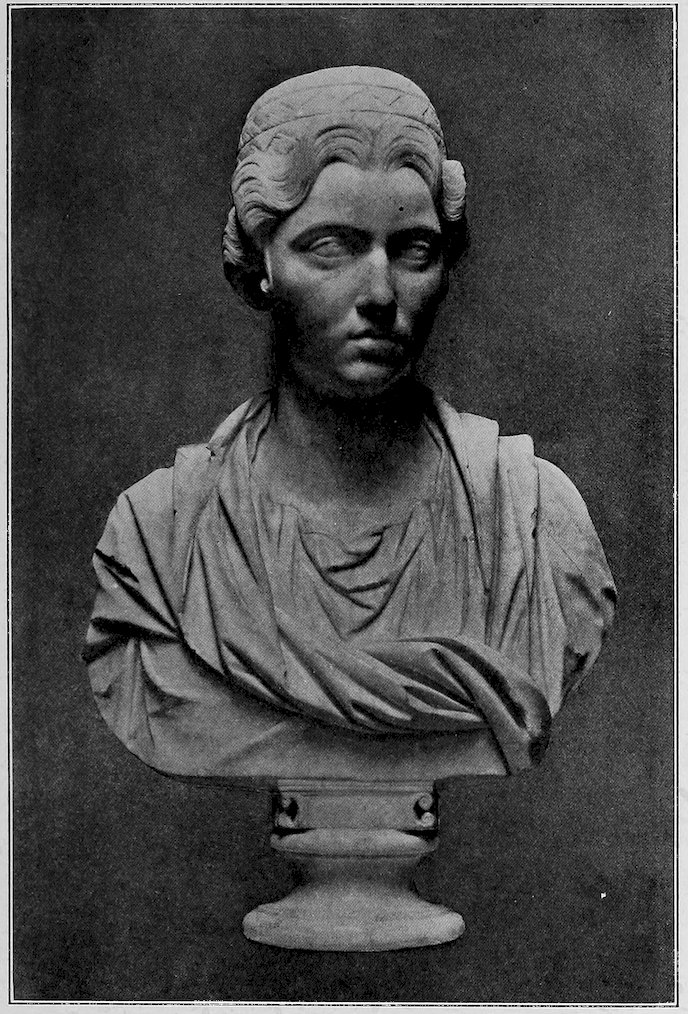
The Florentine portraits show these same characteristics.
Among them also the children and women seem at first glance
to be Grecian or Venetian in character, but, when looked at
more closely, one sees that those features which are not mere
copies of nature but which show artistic intention are not
Venetian, nor Greek, in character, but Roman. Yet another
class of Florentine monuments which are at first sight misleading
in the same way are the recumbent statues on tombs.
91In these the Greek quality of quietness and repose is very
marked and is due to the artist being called upon to represent
faces modelled by the stilling touch of death and no longer to
be thought of as showing active forces. But even in these
figures the intense actuality of feature, the lack of conventionalising
and typifying, is noticeable. In fact there is little
doubt that oftentimes the artist did his work not from sketches
of the living model but from a death mask.
If now we consider from a more general point of view this
art of portraiture and its relationship to times and peoples,
certain things become clear. Portraiture may be due, as in
Egypt, to some religious motive, but this is uncommon.
Where it develops as an art, simply for its æsthetic value,
we note that it becomes a general practice only as ideal
and imaginative work loses ground. While the Greeks never,
in a certain sense, showed much imagination in their sculpture,
it is unquestionable that towards the end of the fifth century
B.C., when portraiture becomes prominent, the idealising and
religious works decrease and deteriorate. The same truth
holds good in Italy during the Renaissance, when much more
imagination was shown than in Greece.[31] Portraiture is due to
a family interest in its own members or to a people’s interest
in an individual. It is not practised (for artists such as Silanion
are not true portraitists) by the artist to please himself.
But whatever may be the interests, private or public, that
call for portraiture, the art becomes common only in times of
centralisation, times when large fortunes, and hence great
92power, are possessed by individuals. Furthermore, no matter
who may be the persons represented (setting aside women and
children) it is not possible to carve or paint them except in
one of two ways, as an embodiment of thought, or as an
embodiment of action. The former method appealed to
Greeks and Venetians,—the latter better pleased the Romans
and Florentines. Both are realistic because both strive to
show in one way or another actually existent forms and expressions.
It depends on each man’s natural temperament
which will give him most satisfaction. Other methods are
frequently adopted in the modern struggle for originality,
but it is safe to say that they will exert little influence on the
development of art, for, while they may be clever devices,
while they make certain effective features particularly prominent,
they are still unsatisfactory because they produce at
best but a partial likeness. If it be granted that there are but
two great methods of portraiture, there is yet no reason to fear
that dulness will ensue. The interest excited by the individual
man comes from the character shown.
There are just double as many portraits, potentially, as
there are individuals, and the interest of portraiture lies in
what the artist makes us comprehend of the nature of the
man. Too often the public is deceived into thinking that
the work of handicraftsmen, with little or no power of reading
and understanding character, is to be judged as true portraiture.
Such work may be decorative in chiaroscuro, it may be
pleasant as colour; but the mere drawing of a face, even if
what is called a good likeness is produced, is not portraiture.
It is but the outer husk and dead wrapping hiding the vital
germ within.
93
Different as were the lives and works of the two sculptors
whose names are more familiar to us than those of any others,
there were, nevertheless, many circumstances of closely related
character that affected their careers. But apart from
such circumstances the consideration of even those influences
which were absolutely different in the one case and in the
other, exhibits clearly some of the broader laws of the art
practised by them both. In truth, it is the art rather than
the individual style of the sculptors that is worth study, for
the art is a language, the works but the expression of single
ideas; the one is a perpetual and constantly varying power,
the other but separate thoughts expressed.
Naturally the two interests, one that of becoming more
familiar with the products of the “fine intelligence of noble
minds,” the other the more abstract one of a more intimate
knowledge of the powers and possibilities of one of the fine
arts, are inextricably combined. The study of the two sculptors
mentioned is particularly interesting owing to the ever-increasing
production of sculpture in our own day; and owing
to various conditions in modern life, there is a close relationship
in many important matters between us and these two
masters of days long past. Therefore, whatever can be certainly
learned about them will help us to appreciate more
truly the work and workers of to-day and to-morrow. Nothing
94can help more to attain this appreciation and sympathy
than the study of the great workers of past ages, even when
they may to a casual glance seem to be of somewhat remote
interest.
The work of men such as Pheidias and Michael Angelo cannot
be considered by any serious student as in fact remote
from our time and interests. The study of the Past, particularly
that part filled by Greece, becomes every day more
and more general and the influence of the Renaissance in
Italy upon modern thought and work is seen on every hand;
here we come to the first noteworthy fact regarding these two
sculptors. It is not going too far to say that all the best
Greek sculpture, that is to say, what was produced during the
latter half of the fifth century before Christ and the fourth
century, was strongly influenced by Pheidias and that his
influence shows itself intermittently until the end of the ancient
world.
It would of course be too much to claim Pheidias as the
originator of all the qualities in sculpture which are apt, nowadays,
to be named Pheidian, but as the master who most adequately
expressed the ideals held in his time so far as sculpture
allowed of their expression, he may be used as the type; and
among the varied interests which Michael Angelo and the
other students of the Renaissance found in Greek work were
several that may properly be called Pheidian.
This influence of Greek work on the Renaissance can hardly
be over estimated. It shows itself in many ways and with
varying force,—sometimes producing direct imitation of
ancient works, then again becoming manifest in new work
done with the intention of reviving the spirit of the ancient
95world. Michael Angelo did not fall under the spell as completely
as many of his less vigorously original contemporaries,
but it was no more to be entirely avoided by him
than one of the laws of nature. Thus with the work of
the Greeks directly affecting us to-day in a very similar way
to that in which it affected the Italians in the fourteenth and
fifteenth centuries, and with the work of the later period, deeply
tinctured with the Grecian dye, also influencing us, it becomes
deeply interesting to find in what the greatest artists of the
two periods were alike and wherein they differed one from
the other.
The influence of Pheidias on the art of his race was not so
much that of the originator or inventor as it was that of the
poet, who gathering the various and unconnected beauties
that are felt by all, though less keenly than by him, binds
them together by the indefinable power of his genius and gives
back to the admiring world not separate things of beauty but
a standard of the beautiful and perfect. And this power of
genius deals with such finenesses, is so subtle, that oftentimes
it is almost beyond the power of words to make clear the manner
of its working. As the sensitiveness of the photographic
plate is greater than that of the eye, so the trained and perceptive
eye notes much that can only with difficulty be expressed
by words. The genius is felt, it thrills and vivifies
the observer, but it cannot be expounded like a problem in
mathematics.
For this reason, we must believe, the few great writers on
these matters are oftentimes scoffed at by persons whose eyes
have not been trained to see nor their hearts to understand.
Not that the scoffers can be blamed for this unhappy sterility
96of their powers, for in most cases the circumstances of life
have not been of that fortunate kind which would enable them
to acquire the finer faculties. They are only to be blamed
in so far as either through envy or stupidity they refuse to
believe that others may be endowed with power which is
lacking to them—power dependent upon long and arduous
training. It is a curious but familiar phenomenon that the
person who will not hesitate an instant to admit that the
trained rider or sportsman or oarsman can ride, shoot or row
better than he can, will energetically claim for himself as fine-seeing
an eye, or a mind as keenly interpretative, as the practised
artist or the scholar. That is, he asserts that the exercises
of the body need training, but those of eye and brain
do not, a theory manifestly absurd.
The genius of Pheidias is so ultimate in its fineness that it
needs long training before it can be properly appreciated. If
this is doubted, one has but to consider the fact, that among all
the numerous references to him and his work which are preserved
for us in ancient writers, not one mentions him, as his
elder contemporaries Myron, Pythagoras, Kalamis or many
others are mentioned, as having been the first to institute any
particular detail of carving. No new treatment of the hair,
no new way of representing the body, no special scheme of
proportion are attributed to him, and yet the absolute consensus
of opinion was that he was the unrivalled master of
them all. Fashions changed, and a new one, that of making
collections, arose, which demanded the satisfaction of individual
tastes, but Pheidias’s fame knew no eclipse.
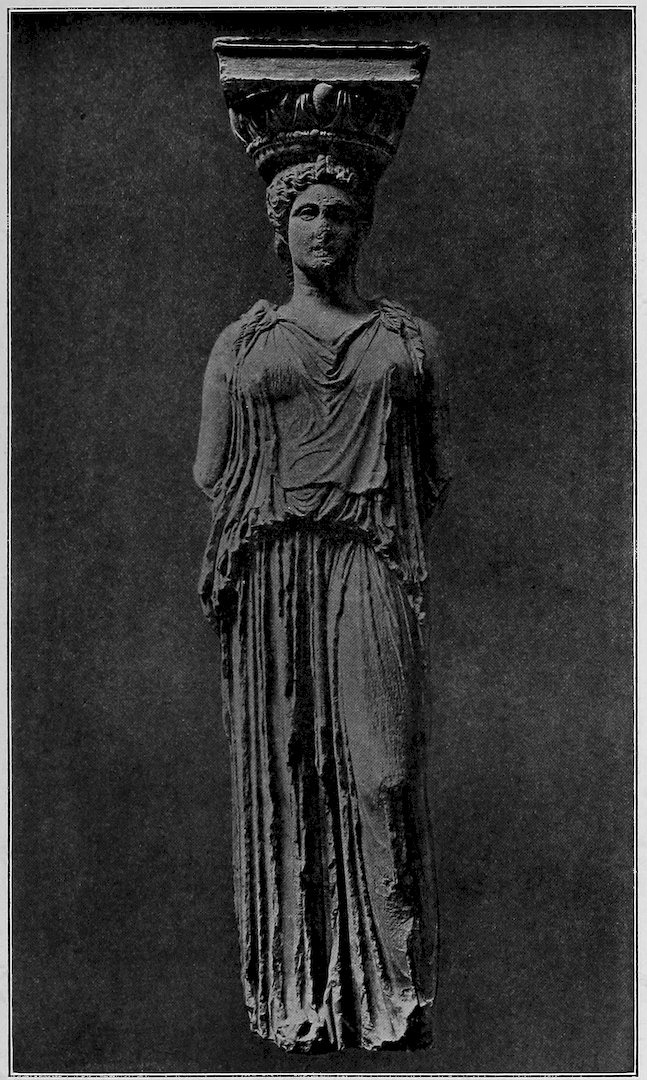
Besides this subtle quality in his genius, this weaving of the
various beautiful threads spun by others into one consummate
97stuff, there are other qualities that render his work difficult
to appreciate. One is that the ideals both of religion and
of life were very different from those of to-day, so that we have
to lay aside all preconceived notions and at first regard him as
children who wonder but do not understand. This is the
hardest task the student ever has to master, to free himself
from the bonds of the conventions, beliefs and circumstances
common to his own day and study the work of another time
with (so far as he can accomplish it) an understanding sympathy
with the conventions, beliefs and circumstances belonging
to those other days. Still a further difficulty lies
in the fact that there does not exist in the world one single
work of which we can say: this is truly and completely by
Pheidias. The marble figures from the Parthenon show his
quality in many respects clearly but these we know were
worked upon by assistants. Other works by him exist in
copies, but for the most part these copies can be shown to be
bad and should be used as evidence only with the utmost
care. Yet, notwithstanding these difficulties, the image that
we have of him is, it can scarcely be doubted, clearly defined
in the main outlines.
How different is all this in the case of Michael Angelo!
Here our embarrassment is of a character diametrically opposed
and comes from the fact that we are so burdened with
details about his life and work that the really important
matters are partially obscured by trivialities. Contemporaries
and fellow-workmen wrote his life; his letters and poems
have been preserved; documents of all sorts regarding his
works exist, and the works themselves are where they can be
easily seen.
98Beyond all these aids to our knowledge of the man we
have, again, the more vital one that the age in which he lived
is almost as well understood as our own, and many of the
greater currents of thought and action were but little different
to those of the present time. Unlike the Pheidian time, but
like to-day, his was not a period when governments deeply
believed in the protection of their Gods nor one in which the
individual was scarcely considered except as a detail of the
state, nor when portrait statues were almost unknown. Conquest
for the love of gain, and commonwealths subdued to
one will, were the rule. The truly Greek period in the development
of Italy, the time of the blossoming of Venice, of Siena,
of Florence had given way to the Alexandrian epoch. Though
the idea that the will of the masses should govern the state
was fortunately not yet formulated, the development of individualism
was well under way, and instead of men governing
their lives by general ideals they all sought to raise themselves
on the shoulders of their less fortunate brothers to enjoy a
little while the glory of a special and peculiar fame. Hence
called as he was to lend his power to the satisfaction of such
desires as these, Michael Angelo’s work was in many cases,
in those, that is, where he was working for a master other
than his own instinct, tinged with a character utterly out of
accord with that of Pheidias, and yet curiously enough even
in these works there are signs of a strong undercurrent of
feeling which would have bound him and Pheidias together as
the most sympathetic friends, thus showing that at bottom
art is not governed by circumstance of time or place.
There were however certain very important aspects in which
life as Michael Angelo saw it in Italy, and particularly in
99Florence, was curiously similar to what it was in Athens in the
fifth century B.C. The climate and general appearance of the
two countries is even now not unlike, and it must have been
much less so in the time when the hills of Greece were so forest-grown
that Pan and the nymphs could really live in comfort
there, and before modern improvements had eradicated many
of the individual peculiarities of Italy. Then too the habits
of the cultivated classes were similar. Under very different
forms the principles of education seem to have been the same.
The schooling shown in Castiglione’s Cortegiano is like that
given the Grecian youth. It was an education which comprised,
both in Greece and in Italy, music, drawing, a knowledge
of the thought and actions of past generations and a mastery
of all those exercises that conduced to self-defence or to the
more perfect development of the body. Similar training
naturally taught the men of these two worlds to see life in
very similar ways, and although the teachings of the Catholic
Church were very different from those of the Greek religion in
regard to the relations between men and women, yet life and
instinct were stronger than the holy teachings, and in this
point too the simplicity and naturalness of the Greek found
its counterpart in Italy.
It is easy to see that the power exerted by these various
influences on the art of sculpture was very great, more so even
than on the sister art of painting, for it is on the realisation
of what constitutes a fine body, on the equal simplicity of
treatment of the woman’s form and the man’s, and the knowledge
of what ideas can be best interpreted in terms of form,
that the art of sculpture depends. Art is but the translation
of emotion, and each particular art has a particular way of
100accomplishing the translation; and in this, painting and sculpture
are more closely connected than any two other arts, so
much so that sculptors in the two greatest periods—the
Greek and the Renaissance—rarely considered their work as
finished until the power of colour had been used to heighten
the effect, and often practised the two arts coincidently. But
during these two periods the limits imposed by the materials of
the various arts were clearly recognised and closely adhered
to, and in the best sculpture of the Renaissance there is no
more attempt to represent landscape or other purely colour
effects than in the Parthenon. Sometimes, however, as in
the drapery of the Moses or the modelling of the Pietà in St.
Peter’s, Michael Angelo does seem to overstep the limits of
sculpture and to seek for effects which could be more simply
and much more intelligibly given in painting than in stone;
effects that need the manifold devices of light and shade and
colour which are at the disposal of the painter rather than the
sculptor.
This is, however, a rare weakness in the works of Michael
Angelo, and one that apparently never entered those of Pheidias.
One reason for this is that the art of painting was more
completely comprehended in Italy than in Greece, and the
Italian artists, more commonly than the Grecian, practised
both arts. Hence, great painter as well as great sculptor,
endowed with a readiness of hand, such as scarcely any other
artist ever had, to reproduce whatever his mind imaged, it
is no wonder that Michael Angelo at times went beyond the
bounds of one art and seemed magically to interfuse the beauties
of both of them. It would have been a greater wonder
had he not done so. It was not a sign of his weakness so much
as of his strength, of the inability of any one art to satisfy
the artist’s desire and ideal. In this greater complexity,
which shows at times in the detail of his work, Michael Angelo
differed from Pheidias, but, almost invariably, the two artists,
while differing in their feeling for line, or gesture, or substance,
treat the human figure and its accessories in the same way.
In both one sees a distinct and necessary dwelling on the
nude.
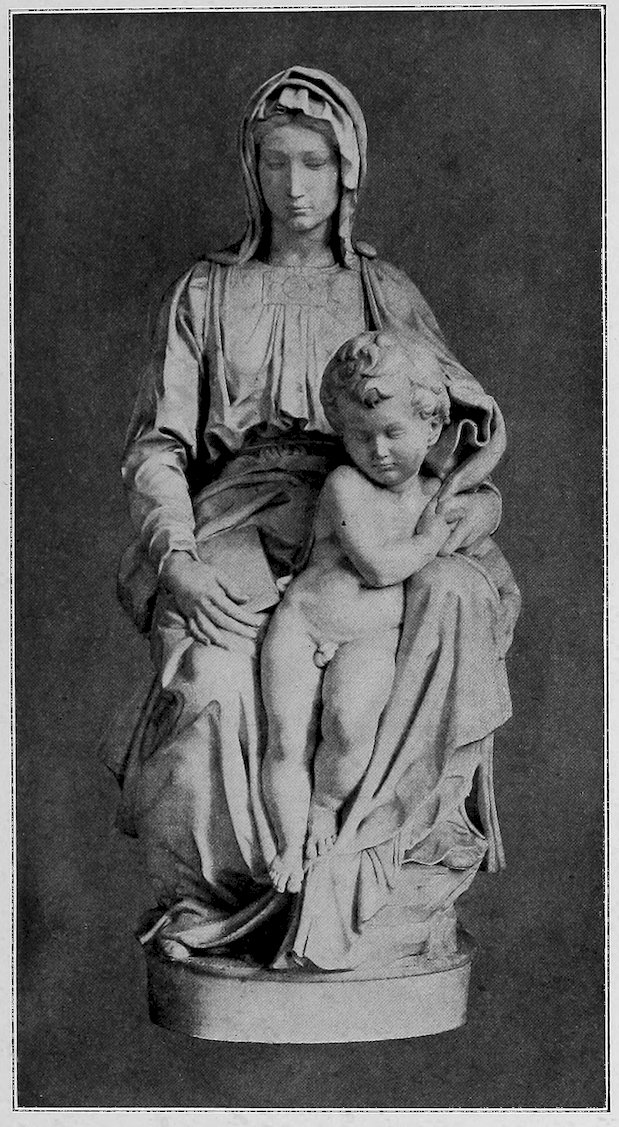
101Where the human figure is chosen as the object of a work
of art, there are but two chief means by which to represent
the emotions it contains, one the expression of the face, one the
action of the body as a whole. It is in the representation of
the face, the most palpable index of the emotions, that painting,
with its power over almost infinitesimal lights and shades,
finds fullest scope for its power, while it is in the greater lines
of the frame and the larger gestures that sculpture satisfies
herself. So it is that in the sculptural work of both Michael
Angelo and Pheidias one finds drapery treated not, as was
distinctly the case in the statues of Praxiteles, for its own
special beauty apart from the whole work, but as a means of
emphasising the beauty of the body whose details it hid.
Look at the group of three women from the western pediment
of the Parthenon, or the Lemnian Athena, or the Caryatids
of the Erechtheum (Plate LII)—for these are utterly
Pheidian in character even if not by the master himself—or
the figures on the frieze of the Parthenon (Plate LVII) or the
Hegeso relief. In all these the drapery ripples over the
shoulders and breasts, breaking in great falls around the waist
and legs to disappear and fade away in little curling waves
around the feet, not hiding the soft details of the figure
102underneath but serving rather as a frame to emphasise the
beauties and set them in true relation to the surroundings.
That there was any ethical need of hiding the figure would
have seemed the height of absurdity to the Greek or the
Italian. Out of the dark it comes and back to the dark it
goes in this Adamite condition, so why should the artist not
use it so if it serves his purpose?
Thus it has been used in all times when there was a vital
art, and such times have been distinguished for greater sanity
of thought and health of body than when art was governed
by mediæval fanaticisms. Michael Angelo’s figures are as
distinguished for this quality as are those shaped by the
Grecian chisel. His feeling for the value of the nude is so
strong that he can hardly suffer the drapery at all. The
Moses, the Madonnas, the Medici Princes are to all intents
in large measure undraped. Considered as draped figures
they distinctly lack the temperance and quiet nobility of the
Greek figures, for the reason that although his feeling towards
the relation of draped and nude parts is the same, Michael
Angelo does not attain his end in as consummate a way. He
makes too sharp a distinction between the parts that are
really draped, the parts that are but seem not to be, and the
nude. But in one point of this same nature the two artists
are completely alike. They both regarded the human figure
from the purely artistic point of view as a means to suggest
certain ideas. The religious meaning, the question as to its
sanctity or unhallowedness, no more occurred to them than to
question the advisability of warming themselves before the
fire when they were cold because there were fires in Hell.
They were completely natural.
103In regard to the lack of complexity and to the greater repose,
it may be admitted that Pheidias has the advantage over
Michael Angelo whose works, true index as they are of his
character, suffered from the time in which he lived—his
character suffered and hence his work. His was a time of
scepticism and hence of worry. The tranquillity that marked
the Greek mind was rarely found in his day. Aretino was
planting the destructive roots of modern journalism, and except,
in a way marked by strong affectation, at certain courts,
one would have had to go far to find Platonic Symposia or
Olympic gatherings. The cloudy brow of Michael Angelo
himself as well as of many of his figures is a sign how the perplexity
of the times preyed upon the sculptor and in turn
affected not only the chief motive of many of his works but
also their very details.
And, if we admit the truth, this worry and perturbation is
more natural to us than is the Greek grace and calm which, to
those who do not understand the time, seems unnatural and
forced. It was not so, however. The Greek was never
forced, but though he felt intensely, he considered that the
possession and exercise of control over emotion was as much
to be desired as the power which found expression in beating
back barbarian hordes. The tenderness of Greek friendships
is proverbial, but the whole tone of Greek tragedy is of passion
held in check,—carried in the heart rather than worn on
the face. Slaves and servants gave way to noisy grief, but
not their masters. A Greek of the Periclean age could scarcely
have understood the worn, wearied, soul-troubled look of the
Pensieroso. It was not that the Greek was unimpassioned,
but he never let his passions govern him. He guided them as
104a rider guides a restive horse—as the youths on the Parthenon
guide theirs—calming and soothing them lest the animal
become the master and break away from the chosen path.
This difference in the character of the two races was due
largely to religion, which had the most marked effect on the
work produced in the two countries. One is apt to think,
when one sees the limitless mass of churches, decorated by
painter and sculptor, in Italy, and the unending array of lesser
works of distinctly religious intent, that no art could be more
religious than that of Italy. But just as in the conduct of
individuals it is the spirit rather than the form of action that
is the true index to their character, so in art it is the feeling
the work shows, and not merely its outer form, which indicates
its true nature and value. Now not merely in the number of
religious works was Greece in the Periclean days as distinguished
as ever Italy was, but she was far more noteworthy,
in that her religion was a much more vital impulse than that
of Italy. This is certainly true of the Periclean as opposed
to the Medicean age.
In the light of present knowledge the circumstances that led
to these conditions are discernible. Like every innocent race
the Greeks had a firm belief in the Gods, beings developed in
their minds by very varied influences, and for the most part not
of a character to serve as guides to ideal conduct after the
race had once gained the capacity for using its mind in a logical
way. One or two of these beings were, however, as noble
as any such conceptions at any time. This power to use the
mind rationally was not yet a national possession when Pheidias
grew up. It was just becoming so. The development of
the mind, the strength of it, was there, but for a few decades
105circumstances turned the thoughts of the people away from
philosophic consideration to more ecstatic modes in which old
conceptions were clung to with passionate fondness and made
more beautiful, but a change of belief was the work of a following
generation.
These circumstances were chiefly a consequence of the
Persian Wars. Greece was threatened with destruction.
Athens was harried, and the glories of the Acropolis were
razed to the ground. Phœnix-like they disappeared in fire to
have an image of themselves more splendid in its youth and
vigour rise as a light to all the world. But though the barbarian
had for a moment seemed master of the situation, the
Greeks had, with the active help of the Gods, been the final
victors and it was in the service of thanks to their divine
helpers that Pheidias found his chief employment. It was
only in the very early years of the Renaissance that the Italians
experienced any such miracles as those which Pheidias’s
elder contemporaries had known—as, for instance, at the
battle of Ravenna—and the effect on them then was much the
same as it had been on the Greeks. It was the actual presence
of the Gods at critical moments that stirred the Greeks. In
Athens Athena’s snake led them to safety, at Salamis the
Aiakidoi inspired the heroes with their battlecry, and Pan
himself urged the weary messenger over the mountain passes.
The Greeks no more doubted that their victory was due to
assistance lent them by the Gods than that there had been a
war. One event was as real to them as the other, so it was
natural for them, as soon as their hearths were once more lit,
to render thanks to their Divinities by raising images of them
on all sides, that they might never forget them, and by building
106for the houses of their Gods as beautiful temples as could by
any possible means be made.
We may frankly concede that the grandeur of this work,
the generousness of it, can only be understood when one fully
grasps the fact that a Greek temple was, what the Christian’s
is not, the house of the Lord. In it but few and most private
services were performed,—no processions, no crowds of more or
less attentive worshippers, no expounding of the word, nothing
whatever of that sort. The temple was the sacred dwelling
place of the deity, and the curious no more thought of entering
it than of opening uninvited their fellow-citizen’s door. It
was a free gift to the God and not to be thought of as a source
of satisfaction to the builders except in the same way as it
pleases a lover to have his mistress accept some gift at his
hands. This feeling is repeated frequently in Pindar and in
other poets inspired by the ‘golden muse.’ So it was that,
flushed with the excitement of a great cause nobly won, the
Greeks turned the full force of their keen, glad energy to
works that showed their own greatness by manifesting with
the sharpness of full understanding the form of their ideals.
In our day, animated by so different interests and ambitions,
it is hard to sympathise with this natural idealistic work done
in Athens, and it is perhaps even harder to understand why it
was that Pheidias and the other artists were not called on to
erect portrait statues of the great leaders of the war as were
the artists of the Renaissance. There is mention of a statue
to Miltiades, and this is all. The reason becomes clear immediately
we consider well what were the fundamental principles
of conduct as taught by the poets, who were in those
days in large measure the formulators of public opinion. Pindar
is as clear-spoken about this as need be, and he but repeats
what one finds in the fragments that are preserved of Solon’s
writings and of other earlier writers. He tells us that what is
natural is best and that the deed done without the deity is
best left unspoken (Olym. IX), and again (Nem. I) that
each of us has his special power and we must earnestly endeavour
according as Nature shows the way. This is to be
the moral of our action, while that of our thought is that man
is as nothing (Nem. VI), ephemeral creature naught knowing
what he is or what he may be, nothing but a mirage-dream
(Pyth. VIII).
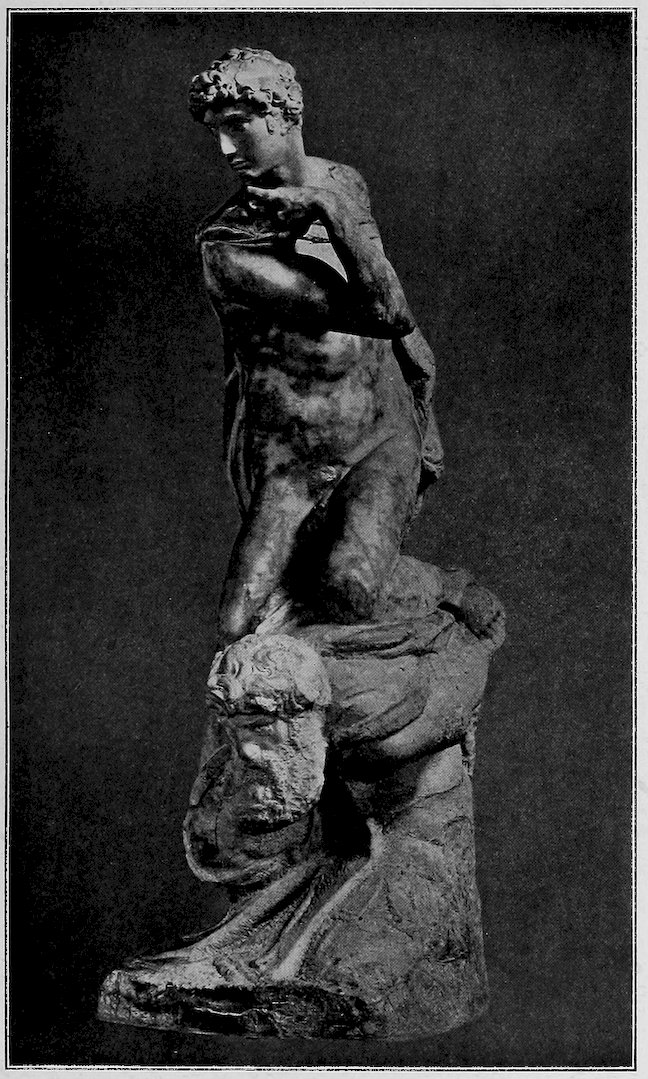
107Under the spell of such stern teaching as this it is no wonder
that Pheidias was not employed, as was Michael Angelo,
in depicting for an inquiring posterity the outer husk of the
protagonist of his day. Nor was it merely when he was called
on to decorate Athens with his accomplished powers that
Pheidias found guiding principles of this stern sort, but even
in his other great work, the Olympian Zeus, he was governed
in the same way. By the Greek, victory in the games was no
more to be aspired to without the help of the Gods than was
victory in battle, and it was not praise for the winner but gratitude
to the Gods that was mete when Nike laid the ‘golden
crown’ upon the athlete’s brow. For it is the Gods who, as
Pindar sings, guard the deep-breasted plain of Sparta and
grant success in the great games. Fame is to be sought
but it is to be the fame of honourable deeds (Pyth. VIII),
but even this is of less value than happiness and only he who
has won both has attained the acme of bliss (Pyth. I).
Such men are almost unknown, for the soul of honour is
tarnished by lust of gain (Nem. IX). Thus were the athletes
108in that “age of heroic prize-men” taught that physical power
was of value, but only as it was a stepping-stone to moral
purity. No portraits of such youths as these unless the Gods
marked them as their own with the triple crown. The deep-delved
researches of epigraphist and excavator show us how
rare was that event.
Called upon to embody for the chosen youth of Greece
their idea and image of the guardian deity who meted out
unquestioned justice to their strife, Pheidias had to depict
as it were a masculine counterpart to the Goddess who made
Athens her own. That he was as successful in the one task
as in the other is instantly apparent to one who notes the
quality of the praise bestowed upon his work by the highly
trained critics of the classic period. None speak of his figures
as they do of Myron’s, for instance, as deceiving the beholder
by their realism. There is no question as to the mastery over
the material as with Kalamis and Pythagoras,—no suggestion
of conventionalism as with Polykleitos, none of overrefinement
as with Praxiteles,—but all agree that his works
were such nobly adequate representations of the divine beings
that they added a new glory to the religion of which they were
the perfected expression.
Still another noteworthy peculiarity of this religion in its
effect on his work remains to be mentioned. Both he and
Michael Angelo had at different times now mere mortals, now
deities, to represent. In the case of the Attic master this led
to a greater unity of performance than was possible with the
Florentine. Between the dwellers on Olympus and those on
the broad-bosomed Earth there was to Pheidias’s mind only a
difference in degree, whereas to the believer in the Roman
109doctrines there was no real similarity between the heavenly
hosts and the inhabitants of this vale of tears; and where such
was suggested, it was so as a symbol, not as a representation.
To the Greek the Gods were merely his grander, nobler, more
powerful brethren, blessed with the same virtues and troubled
by similar faults, differing principally from the dwellers on
earth by usually escaping the results due to giving way to
passion. Even they were not blessed with absolute immunity
and freedom of action. Zeus himself was subject to Fate,
but in the main the Gods, at least in their outward form, were
but more beautiful men and women. Hence when called
upon to carve the most noble being whom he could imagine,
and equally when carving ideal youths and maidens on the
Parthenon, he could only carve the same forms he saw about
him every day idealised by his imagination. Whichever
branch of his art he followed trained him for the other.
That such conditions and beliefs as these were very different
from those under which Michael Angelo had to work needs
no elaborate exposition. How different they were in their
effect on the art of Pheidias and the happiness of the period
for such an artist becomes clearer the more one studies. There
is still another point to consider, however,—what might be
called a more practical one than the influences of religion, and
in this regard, too, Pheidias was the more favoured. I refer
to the political conditions of the time, and the relations of
Pheidias to his employers.
The lack of original documents makes it impossible for us
to follow the course led by Pheidias from its fortunate rise to
its unhappy close, but that in most ways he was much to be
envied by Michael Angelo cannot be questioned. Athens
110was at the height of her prosperity; freed from foreign or
internal foes, she was at liberty to pursue her ends as occasion
demanded or as consideration showed was best. It was a
time of thanksgiving and hope. No such condition of government
as this was known to Michael Angelo, nor did his country
have the advantage of being led by as high-minded a statesman,
and probably as wise a one, as ever lived. So long as
Pericles was leader of the state, Pheidias was his friend and
helper. Here was no worry for the artist, no change of master,
no blighting of cherished hopes, all which ills were suffered
by Michael Angelo; on the contrary, existence in the
midst of a most highly cultivated community—a community
moved by a common search after ideal ends, a community
which must have been a constant inspiration to the sculptor
to equal the expectations it had of him. With the rise of
mob rule brought on by the momentary successes won by
certain demagogues came the downfall of Pericles and in his
train Pheidias. But his great work was finished then. He
had nothing to fear when he laid aside his chisel, and fortunately
he was not left long to mourn the fast vanishing nobility
of his city and race. The time of calm self-confidence had
passed and the time of trouble was threatening. Only a
short time elapsed before the tide of disaster engulfed the
whole country, and if we would seek a counterpart to the
worn and restless spirit that sometimes appears in Michael
Angelo’s work, we can find it in the later Greek masters—even
Praxiteles shows traces of it. But it is not mere likenesses
we are in search of, so much as explanations and the
clarification of certain phenomena of art.
The effect of these conditions of life and thought on Pheidias
111was more strong than on other sculptors of the time because the
greater sensitiveness and impressibility of his nature rendered
him a more encompassing recipient for ideas and feelings
than most of his contemporaries. But the qualities that show
in his work with especial sharpness are found diffused throughout
all the work of the period, and there is one very noticeable
characteristic of this work which distinguishes it markedly
from the work produced by Michael Angelo’s fellow-workmen.
It is the emphasis laid on youth. Donatello, Verrocchio,
Desiderio and many others often represented youthful figures;
but the representation of youth and early manhood could
scarcely be said to distinguish the work of the Florentine from
other epochs, yet this is exactly what can be said of the product
of the early Greek and particularly the Attic School.
Look at the statues of youths and maidens, the never-fading
ghosts of past days, which the Attic chisel carved and the
Attic soil has preserved for us. Look at the young Apollos
and their not less glorious brethren, the athletes. Look at the
guardians above the temple porches—incarnations of youthful
vigour even when the bearded head or matronly form give
sign of elder years. Look at the vases “with brede of marble
men and maidens overwrought.” Finally look well at the
statues of God and Goddess—even these have youth eternal
moulded in their full, strong figures.
And it is pleasant to reflect that it is not the sculptor’s
art alone which found satisfaction in thus dwelling on the
most beautiful forms of human life, but the painters and
the poets too immortalise the entrancing splendours of the
youthful form. Greek art of this time presents us with the
indubitable evidence of a belief, rooted deep as life itself,
112that the everlasting joy of completest beauty was to be found
in the well-conditioned body of youth or maiden. What a
degradation the ascetic interpretation of the Holy Writ
brought in the art of the Renaissance! Many youthful
figures do we find there, but they were chosen as much for the
sake of the quaintness of extremely youthful forms as for the
beauty inherent in vigorous development. The place of the
fine-drawn, well-groomed figures of the Greek youths and
maidens is taken by jolly, pot-bellied babies. Over the altars
and among the graves they scramble, and up the marble
columns, to launch themselves, heedless as screaming swallows,
over the groined ceiling. From North to South and
across Italy from Sea to Sea this breed of fascinating babies
spread—their father the Church, their mother the great
human heart of the Italian race. And then, dulling the
pleasant impression that such figures make upon the mind,
we are met on all sides by haggard figures of men and women
expressive only of a bitter ardour to seek salvation by pain.
The wanness of Botticelli, the pain and trouble of Michael
Angelo, the mere ordinarily healthy look of Ghirlandaio, these
are what take the place of the deep-breasted, broad-shouldered,
strong-pulsed, magnificent Greeks—some repetition among
these latter, ’tis true, but marvellous in their vigour and constancy
and impulsiveness. Or what poets can the Medicean
time show who sing of ideals and principles in the same full-throated,
calm, incisive way as Pindar or Sophocles sang
them? We have instead a scornful wrath or playful fancy.
The deity is no longer friendly but terrible, and dainty mistresses
usurp the place of the God-compelling Aphrodite.
The momentary, not the eternal, is the interest of the day.
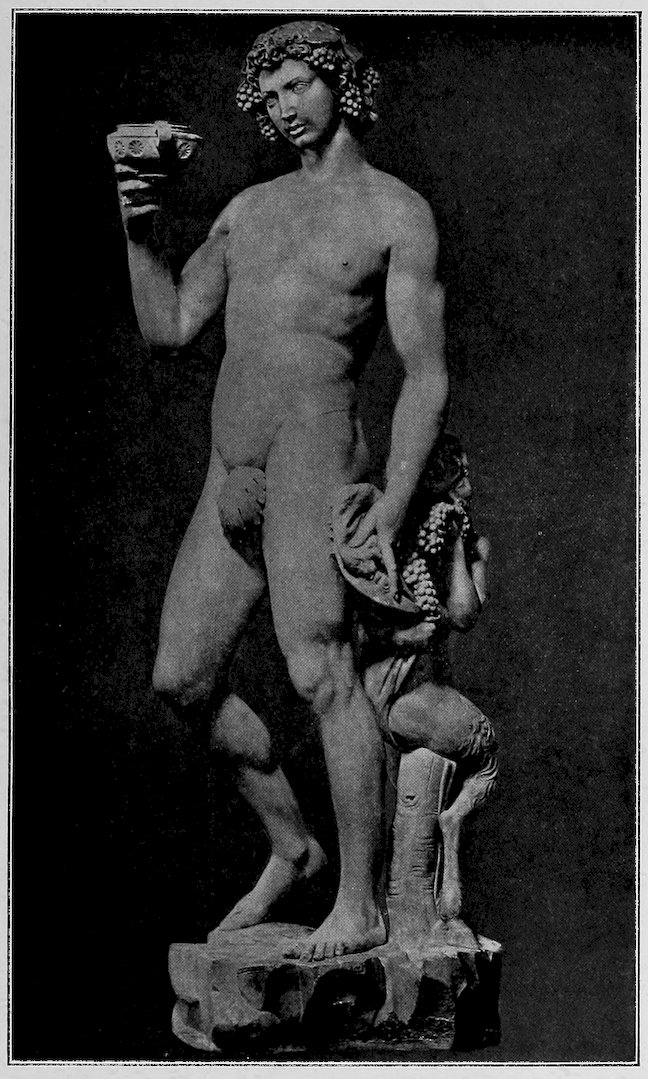
113Some there were, Greek in spirit and in deed: Dante in
part of his later work, so far as a Catholic could be. The Vita
Nuova in its heart-broken passion, the Convito in its complexity,
are purely Italian, but passages of the Divine Comedy
and the Letters might be the work of one of the Attic dramatists,
so intense are they, so cool, so assertive of the power of
right over wrong. But an artist much more Greek than Dante
and one who is often, but very mistakenly, thought to resemble
Michael Angelo, was Tintoretto. His was a Greek sense of
form, his was a Greek sense of beauty, and his was a completely
and absolutely Greek sense of what constituted true
portraiture. There were others too of this group, but they
are rare and far between; men who seem to have been born
two thousand years too late, or else just in time to save the
world from a worship of what was mentally warped and
physically unsound.
When one considers that the art of sculpture has found
its chief employment in the service of religion, it becomes
plain why living among a people whose religion led to asceticism,
even though the age was largely sceptical, Michael Angelo
should impress his work with a feeling quite opposed to that
found in the works of Pheidias. Scepticism there was in
ancient Greece too, but not strong enough to free Pheidias
entirely from the bonds of the religion to which he was from
infancy accustomed. Furthermore, a scepticism that found
much fuel for its flames in the misconduct of the Vicar of Christ
and his less powerful imitators would have a very dissimilar
effect on the mind from that which was based on true mental
development. The one was the natural sloughing of the
skin, the other the amputation of a diseased member.
114The conditions at Rome had more effect on the formation
of character in those days than anything else, and they cannot
have seemed much less rotten to Michael Angelo than
to Hildebrand five hundred years earlier. The feeling that
Christ was essentially the man of sorrows, which affected the
early artists, had passed from men’s minds, and in regard to
his comeliness there was nothing to prevent an artist working
in a Greek spirit; but employed though Michael Angelo
was by the Popes, they used him by no means always on religious
work.
And Michael Angelo also suffered, as Pheidias did not, from
having many masters. These were causes to destroy any
Pheidian-like unity in Michael Angelo’s work, but causes
much more potent to work him injury were the characters of
the men for whom he worked, prince as well as Pope. It
was, doubtless, in many respects fortunate for a young artist
to have the freedom of the court of Lorenzo de’ Medici, but
while Lorenzo might help such a man as Michael Angelo at
the beginning of his career, he was hardly the man to inspire
his more mature years. At any rate he died while Michael
Angelo was still young, and thenceforth the latter worked for
men with whom he can have had but little sympathy. Men of
great energy they were, but with the exception of Alexander
VI, in the main corrupt or stupid. To work for such men
under any circumstances must have been trying, but when
one thinks of their refusal to allow Michael Angelo to work as
he saw fit, one does not wonder that at times he was nervously
irritable.
Obviously such a life would have been trying to a man of
more ordinary clay than Michael Angelo, but to him, endowed,
115as he was, with enormous powers of mental application and
sensitive as only poets are, it must at times have been little
less than torture. He knew that the golden age of his country
had passed. He saw Florence humbled and Rome sacked.
The statesmen were men of mean ambition and the clergy
men of lax morals. Nothing could stop the degeneration.
Political reformers and saintly enthusiasts had matched themselves
against the ever-increasing debasement of Italy, and one
after another they had all been overcome. From the days of
the doubtful reforms of Crescentius or Cola da Rienzi through
the period of the passionate recalling of Christ by Francis of
Assisi to the time of bitter invective of Savonarola, reformers
had given their lives in the attempt to save their beloved
Italy from the error of her ways, and all had failed. It was
not a time for hope but for sorrow, and it needed a firm belief
in the Divine Word to save one from despair—or at least
discontent.
It is from his sonnets and letters rather than from his sculpture
that we can obtain a view of Michael Angelo’s thoughts
and feelings. Not that the latter does not show certain moods
of the artist very clearly, but, as in the Pietà, it is more ideal
than personal, more the expression of dreams than of his
actual experience. In the sonnets, on the other hand, he gives
vent to his own innermost feelings. In them we find frequent
expression of deep despair, but bitterly as he grieved for the
death of Savonarola, there is no evidence that he thereat lost
faith in humanity. It may well have been his admiration of
Vittoria Colonna that saved him from misanthropy. As his
intercourse with her was undoubtedly the purest joy and her
death the keenest sorrow of his later years, so there may have
116been some similarly sweetening influence during the summer
of his life. The knowledge of his career that we possess is
great, but it does not tell us this. It is for our purposes,
perhaps for all, better that this should be so. At least it
makes it easier to compare him with Pheidias, of whose life
we have no such details whatever.
Such were some of the general conditions affecting the point
of view of these two men. The effect they had on particular
work becomes evident with the study of the separate monuments.
One point is, to begin with, very noticeable. It is
that of the eight works by Pheidias mentioned distinctly
by ancient writers seven are representations of deities, and
the eighth of an ideal being. There can be no question that
he made other works, but that these alone were preserved by
tradition certainly affords safe grounds for the deduction that
his genius was most congenially employed and most fully
displayed in such work. In the case of Michael Angelo, while
we know of work like the statue of Julius or the Battle Cartoon
(not to mention his youthful efforts) that have nothing to do
with religion, yet his mind also turned to religious subjects
and his greatest works are entirely of this character.
Curiously enough it is when employed on subjects drawn
from the ancient world that Michael Angelo is most unlike
the great Greek. His Pietà, the Madonna of Bruges (Plate
LIII) and Victor (Plate LIV) are more Pheidian than his
Bacchus (National Museum, Florence; Plate LV) or his Eros
(South Kensington Museum; Plate LVI). These are Greek
of a kind, but they are Alexandrian rather than Pheidian.
They are as foreign to any conceptions of the fifth century as
they are to those of the Catholic Church. The drunken,
117tottering Bacchus is as different from the early conception of
the God, who was thought of almost more as the sunshine
that makes the grape than as the juice itself, as the shrinking
and self-conscious Venus of the Capitol is from the Venus of
Cnidos. In his sensuality the Bacchus is un-Pheidian and in
the humour introduced in the group by the presence of his
companion he is equally so. Humour was not lacking to
the Athenian, as the drama shows, but the fields of sculpture
and painting were not considered the proper place for its
display.
In still another point is the statue of Bacchus comparable not
to the early but to the late Greek work, and that is in the realism
of the modelling and the action of the figure. Such modelling
bears no relation to the broad treatment of Pheidias. The
latter shows no such morbidezza, nor would he have dwelt on
the repulsive unsteadiness of the pose. Whoever it was that
carved the famous Borghese Anacreon, and it was some contemporary
of Pheidias, shows us how the earlier Greek artist
felt towards drunkenness. The figure is under the influence
of his much-sung God Dionysos, but he is shown in attitude of
mental ecstasy not of physical uncontrol. What stamps the
Bacchus and the Eros (and much of his other work) as non-Greek
is a lack not exactly of beauty, but of delicacy and refinement,
of charm. But each of these characteristics that
differentiates Michael Angelo’s work from that of the Greek
stamps it as a work of the Renaissance. The pleasure in
technical excellence, the realism and the representation of
unpleasantness are all qualities that recur over and over again
in the work of this vigorous, capable, unflinching, unbelieving
period.
118Similar un-Pheidian qualities show in the figure of Eros in
London, which if not by Michael Angelo, is at least made entirely
in his spirit. The same realism of modelling is seen in
the treatment of the head and face, the same choice of an
action inexpressive of the deepest meaning of the figure. It
is still less Pheidian in the vividness and intentness of the
action and expression which are not explained by the figure
itself, but the meaning of which is left to the imagination of the
beholder to discover. Dramatic quality of this sort is rarely
found in Pheidian work. The statues carved in that time
were self-explanatory. Single figures were often represented
as intent or as full of movement as the Eros, but their action
is not motived by something outside themselves. Hence
they do not puzzle the beholder. The Anacreon, the Discobolus
need no explanation, but Michael Angelo’s Eros needs
to be grouped (at least in imagination) with some other figure
before it can be understood. It is like Myron’s Marsyas,
splendid and suggestive but incomplete.[32] Separate figures
of the Parthenon pediments are as dramatic as the Eros, but
then they form part of a group and as such their meaning was
perfectly clear.
An instance is found in one of the group of Gods on the
eastern end of the frieze of the Parthenon (Plate LVII). The
figure is commonly called Ares. He is seated forward on his
throne, and holds one raised knee between his clasped hands.
Such an attitude, so lacking in grandeur, so suggestive of restlessness,
is well suited to the fiery God of Battles and shows
how free and ungoverned by conventions Pheidias could be.
The group as a whole is a perfect expression of the power of
the master, to be simple as a child in this treatment of the
Olympians and yet never to fail to produce work of supreme
beauty.
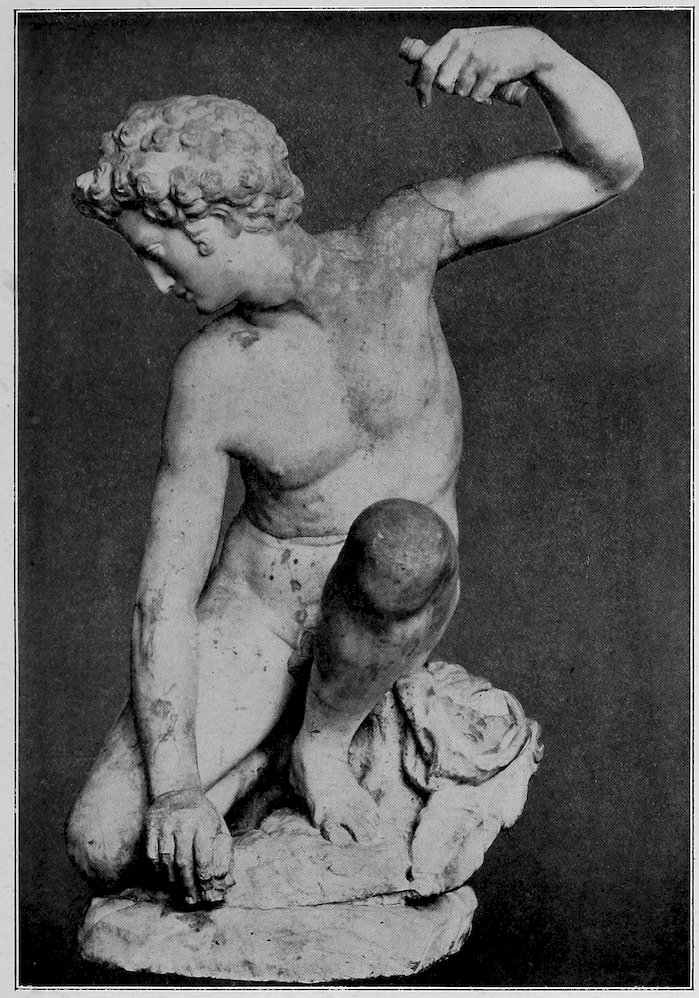
119This simplicity one notices in all Pheidian work, separating
it sharply from the later work in Greece and from most
of the work in Italy, particularly from that of Michael Angelo.
Pheidias is not in the least affected, but at the same time he is
not actualistic. Of the hundreds of figures in the full round
and in relief that decorated the Parthenon there is not one, nor
even a group, that does not seem absolutely and utterly simple
and real. And yet there is not one of them which close study
does not reveal to be a marvellous composite of actions and
forms and draperies and expressions which all bear the stamp
of idealisation (Plate LVIII). The effect of perfection that the
work conveys is due perhaps to Pheidias not having tried to
idealise in any vague or artificial way, but to his combining an
absolute dependence on Nature for his models with a capacity
of seeing, and solely representing, their essential beauties. So
while his figures are ideal in the sense that they are more
perfect than average mortals, yet they do not seem unapproachable
and unaccountable.
Now this, we may freely grant, cannot be said of Michael
Angelo’s work. His figures are simple, yet it is not the simplicity
of Nature but of Art. A passing glance may find them
equal to the Pheidian works, but a more careful study shows
that though true to Nature and possible in action, they are,
in respect to both body and attitude, improbable. They are
composed, and hence in a way untrue. The Pheidian beings
seem those of the Golden Age—perfect and unconcerned;
120while the others oftentimes seem interested in their own
perfection and desirous that it should be admired. One knows
enough of Michael Angelo to know that though self-conscious,
such thoughts were far from his mind and if, as I think, they
are to be seen in his work, it only shows that the time was
stronger than the man, for he lived in a period when affectation
was not uncommon. The grandeur of the Greek figures,
as manifest in figurines as in colossal works, is due to the
beauty dependent on a mental poise; that of the Florentine
figures is due to their size and suggestion of physical strength
and to their facial and bodily expression that imply the capacity
of untold depths of passion—quite as physical a consideration
as that of size.
Of course it may be said that the Eros is merely a study of
the human frame in a rather complicated position, but even so,
my contention that the figure is un-Pheidian still remains
true.
The strength of the action exhibited by this figure of Eros,
the tremendous play of muscle while at the same time the
figure is thought of not as in motion but as at rest, is what one
finds in very many figures painted and carved by Michael
Angelo and forms one of the most distinctive characteristics
of his work. It shows in the Slaves, in the Medici figures,
in some of the sacred groups, in lesser measure but yet distinctly
in the David and Moses, and as clearly as possible in
the paintings of the Sistine Chapel. It is due to this in large
degree that these works are so well known, for they strike the
eye of the casual and impatient sightseer and they are remembered
with much greater vividness than work of a quieter
and less excited character. In the hands of a genius like
121Michael Angelo such treatment of the human figure, and the
choice of such positions, seem natural and give no sense of
exaggeration or restlessness.
It is commonly held that genius is limited by no law, and in
so far as is meant thereby to imply that no bounds can be set
to the concepts of great minds, this is true; in the attempt to
express such concepts to others, however, the genius equally
with less endowed mortals must be limited by the laws that
govern the material in which he seeks to find expression.
The penetration of a Sophocles or a Shakespeare into the
mysteries of life can have no measure set to it, but when they
tell us their thoughts, their words are bound by the laws of
verse. No final explanation can be given for the teeming
imagination of Michael Angelo, but some of his works may
be criticised for not conforming to the laws of space or
material that govern the arts of painting and sculpture. He
sometimes shows a lack of taste.
Genius shows in every touch of Michael Angelo’s hand,
whether with brush or chisel, but at times his work is unsatisfactory
owing to its exaggeration. No admiration is too
great for specific qualities in everything he did, but it is clear
that the conception of beauty was not held by him as essential.
To Pheidias, on the other hand, it was of primal importance.
A comparison of the Parthenon pediments with the ceiling
of the Sistine Chapel may make clear my meaning. This
is not the place for fine analysis of either composition. Suffice
it to say that in each case the space has been filled by the
decoration with a perfection and adequacy that has never
been again approached, but I think it will be generally admitted
122that the chief impression of the pediments, shattered
though they are, is of beauty, while that of the ceiling is of
power. Michael Angelo tried at times to express in paint and
stone what cannot be clearly expressed in those substances.
This was what I have referred to as lack of taste. His Last
Judgment is a striking case in point. He attempted in that
work to do what Milton or Dante succeeded in doing better
with more suitable means. Even the Chief Actor in the scene
lacked the quality of grandeur which Michael Angelo seems
usually to have found no difficulty in suggesting. It is perhaps
because he felt the inadequacy of stone or paint for the
full expression of his ideas that he left so many works uncompleted.
Michael Angelo’s figures of Night and Dawn and certain
figures in the Sistine Chapel may be criticised for the exaggeration
of their pose, though how extraordinarily successful
they are can be seen by comparing them with similar figures
by Vasari or other imitators of the master, which invariably
appear to be insecure and in danger of falling. The difference
in the kind of imitators who followed Pheidias, and those who
succeeded Michael Angelo, shows well one difference in their
genius and the effect on art in general that the two men had.
Both men had numerous pupils and followers, but in the
earlier time such men served to keep Greek sculpture at its
highest level, in the later they brought on a rapid degradation
of the art in Italy. The reason for this different result is
plain. Just as most people now see nothing in Michael
Angelo’s work but strongly modelled figures and vigorous
poses, not knowing enough of his life to comprehend what
were the thoughts he desired to express, so the artists in his
123own day thought the magnificence of his work lay in its
exterior form. Imitating this they succeeded in producing
only figures with unnaturally protuberant muscles placed in
uncomfortably contorted positions. Vasari and Bandinelli
are two instances in point. The painted figures of the former
are as foolish in their assertion of would-be grandeur as is
possible to conceive, and there are few things uglier or coarser
than the group of Hercules and Cacus by the latter.
In Michael Angelo this insistence on the muscular development
of figures is an accident perhaps due to his delight (a
pure Greek delight) in mere physical strength, such as he
himself possessed, but it is not the most telling characteristic
of his work. The truly essential part of his work is the thought
which his figures embody. His followers, being men of little
originality, as is shown by their trying to assume his peculiarities,
naturally succeeded not in making work like his, but
work which in reality serves to show their dissimilarity to
their master. It was unfortunate, also, that the very qualities
which attracted them were of a nature that if misunderstood
lead to a more rapid debasement of art and life than
almost any other, for a love of mere physical strength is a
love of what allies one to the beasts of the field. Their work
unites them not so much to Michael Angelo as to the maker
of what (with the exception of the Laocoon) is probably the
ugliest and most brutal work preserved to us from antiquity—the
Farnese Hercules.
All this was very different in the case of Pheidias and his
school. In his work there was nothing superficial to catch
the eye, no peculiarity except the perfection and beauty that
one feels instantly and yet cannot, without much care,
124explain on what it depends. What was there then for other
artists to do if they felt his was perfect sculpture and they desired
to work towards it? His figures were calm and stately.
His greatness lay in his conception of the being he was called
upon to represent—in his point of view, that is. This showed
itself not in a technical skill superior to that of his fellow-workers,
for the artists then as in the Renaissance were in the
main equally skilful, but in a mass of infinitesimal details
which not so much by themselves separately as by their combination
gave his work its everlasting charm. It would not
have taken a quick-witted Greek long to realise that to produce
Pheidian works he must look at life in a Pheidian way,
and the more successful his imitations the more calm, restrained
and careful would they be. This Pheidian point of
view was such that his followers were turned toward spiritual
repose as the source of inspiration for their works rather than
toward restless activity.
The complexity of the attitudes of Michael Angelo’s figures
is scarcely more noticeable than the multiplicity of the subjects
he was called upon to produce. Life was more complicated
in his day than in that of Pheidias, and there were more
varied demands made upon the artist than in the ancient
times. While Pheidias, so far as we know, had to make works
solely for the state or for some public purpose, Michael Angelo
was forced to gratify the whim of various powerful employers.
Oftentimes such work, as for instance the Sistine Chapel, was
of public character, but more often it was not, so that in place
of striving to embody the ideals of the state whose greatest
artist he was, he had to bend and mould his genius to satisfy
the personal ambitions of his masters. The story of the
Julian tomb illustrates this sad and thwarted part of his
career. Not only was he prevented from carrying out work
already undertaken in the way which he considered best, but
also he was forced to do that for which he felt himself unprepared
by previous training and unfitted by lack of interest
in the subject.
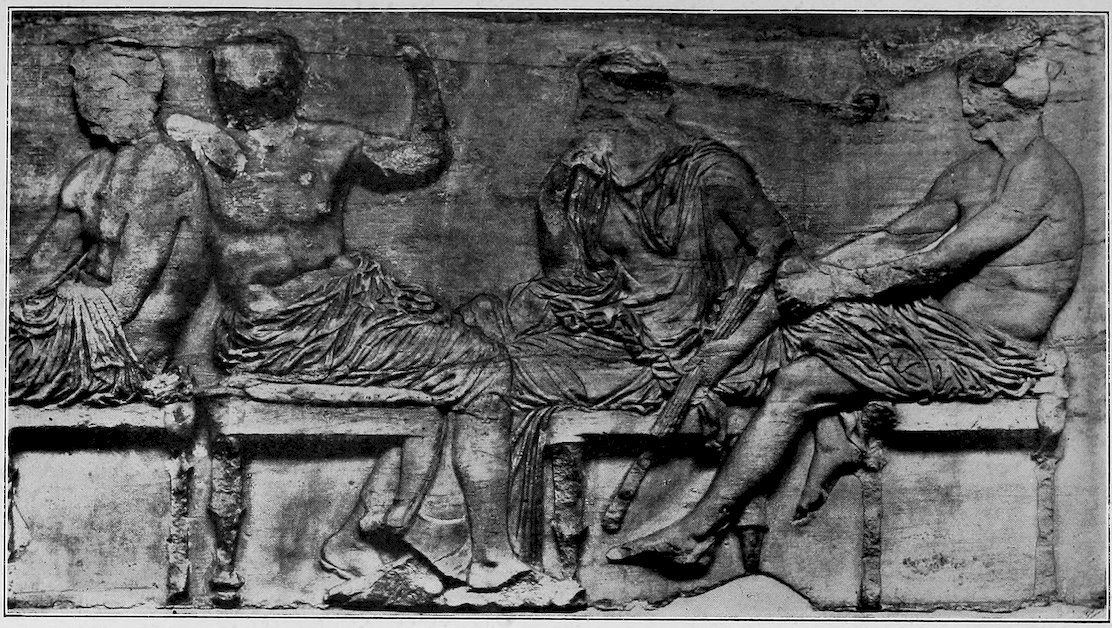
125That this was his mood at the time when, notwithstanding
his arguments, Pope Julius II compelled him, in 1508, to begin
the work in the Sistine Chapel, is known. If, when working
against his will, he produced the most wonderful bit of decorative
and architectural painting the world knows, one can
but wonder what limit his talent would have reached had he
ever carried to completion any of his great sculptural undertakings.
Just as his capacity for mingling in his figures deep
thought and powerful action shows not a greater but rather
a more varied genius than that of Pheidias, so his capacities
as painter, as architect, as engineer show that circumstances
led him to much greater variety of activity than probably
any ancient artist ever experienced. Not that this varied
activity must needs imply the possession of greater powers.
It implies merely the capacity of using an intellect highly
trained in one way for the accomplishment of purposes of
more than one kind. That is, it implies the possession by the
artist of adaptability and of common sense in its finest form,
and the possession of these qualities was not a rare characteristic
in the Renaissance. Men of all kinds showed it, but
it is most marked when it appears as part of the mental outfit
of painters and of sculptors, men who too often adopt a pose
of what they consider simplicity and lack of knowledge of the
world, as though ignorance were the stepping-stone to great
126art. This was not the condition of things in the Renaissance,
nor, so far as the little evidence we have allows us to judge, in
Greece. It created no surprise when Van Eyck and Rubens
were considered as proper persons to be entrusted with affairs
of state, nor when the military protection of his city was put
into the hands of Michael Angelo, nor when Leonardo laid out
the irrigation system of Lombardy. Life is more complicated
now and in many lines work has to be more specialised—but
this is no reason why artists should be stupid.
The fact that the talents required for painting and sculpture
are not incompatible is clearly shown by Michael Angelo’s
works. The most common criticism passed on them, and one
that is in part true, is that his sculptures are at times too pictorial
while at others his paintings are too sculptural. Certain
it is that parts of the ceiling in the Sistine Chapel look, at
first sight, more like sculptured figures than like painted
decorations. Michael Angelo was unquestionably aware of
this, and the effect was intentionally sought by him. To state
as a rule of art that work on the flat should always look flat
is a mistake. There is no law of optics or of architecture
which demands this.
The application of the laws of art must depend on the
individual practitioner.[33] In treating the figures in the Sistine
Chapel in a sculpturesque way Michael Angelo produced
a work more like the Parthenon in the perfection with which
the decoration is adapted to its position than is elsewhere to
be seen. He has used painting, that is to say, in much of his
design to suggest sculpture, which is the richer and more
suitable adjunct to most parts of architecture,[34] and thereby
produced a complex architectural work instead of producing
merely a painting which, like many of those in Venice, might
equally well be placed anywhere else.
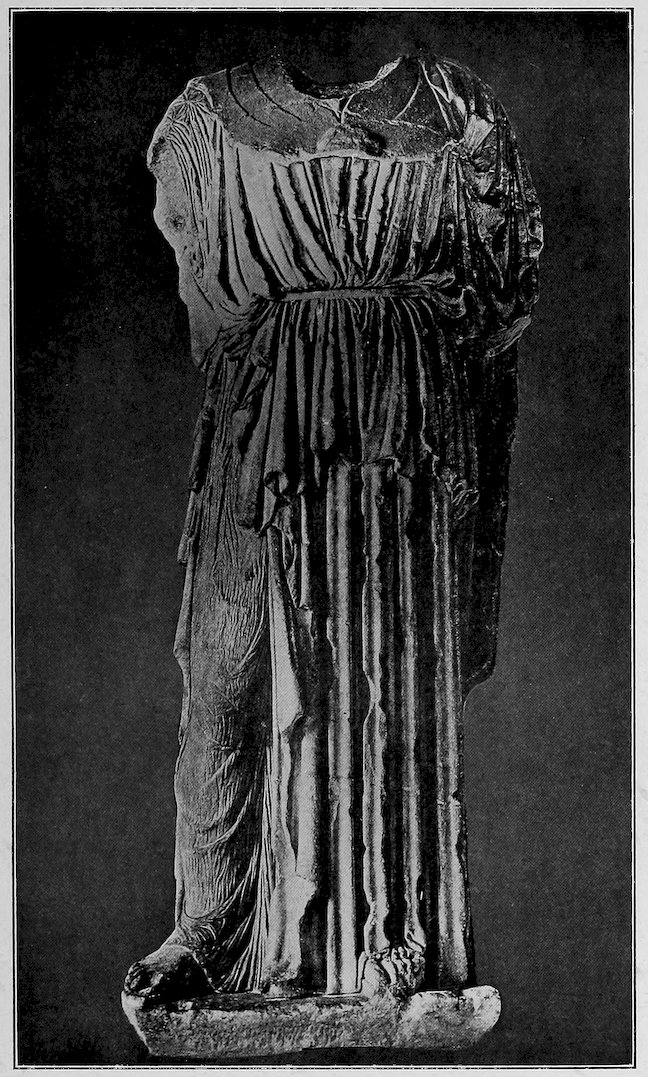
127A comparison will make the point plain. Take most modern
decoration of a similar sort and how infinitely feeble and
accidental it seems! Look at the decorations of the Pantheon
in Paris, of the Boston Public Library, and the difference may
be seen. Great painting one may see there, but not great
decoration of architectural works; and ceiling or wall paintings
are nothing else. Any one of these paintings taken from
its present position would look equally well on any other wall
large enough to hold it, or in any gallery, and would also have
equal meaning there. Not so Michael Angelo’s work. As
a whole it could be put nowhere except where it is, and if cut
in pieces each bit would cry out in its solitude and demand the
juxtaposition of the other parts. The work is as perfect a
finishing of the Chapel as though it were some natural growth.
This is equally true of the sculptures of the Parthenon. How
inconsequent and unmeaning they look when taken from their
natural place is shown in the British Museum by the Athenæum
Club and Hyde Park Gate in London.
Michael Angelo’s other paintings also have a sculpturesque
look. This is partly due to the fact that the foreground,
where atmosphere has little effect, is more studied than the
background. To him as to Pheidias the human figure was
128of the deepest interest, but its natural surroundings of little
or none, so the figures are drawn with a distinctness and
illumined with an intensity of light which make them look
more solid and material than many a painter’s work. It
does not mean that Michael Angelo failed to understand the
function of painting as a Fine Art. The true function of art
is the presentation of the ideal and this is done by the translation
of emotion. This translation of emotion, when accomplished
with the motive of giving pleasure by pleasing the
senses or elevating the mind, produces the noblest art, for this
search for pleasure is in healthy minds but the search for
beauty, and beauty is the suggestion of the ideal. This being
the general function of Art each one of the Fine Arts follows in
ways individual to itself the search after beauty in the translation
of emotion. Music is the most subtle and architecture
is the most general of the arts, and poetry the most commonly
understood, while painting and sculpture, the terms of which
are hardest to define, are the most closely related. As an art
architecture is an expression of man as a social animal. Painting
and sculpture are its proper adjuncts. Painting ought
to be merely the representation by colour of three dimensional
spaces in two dimensions, while sculpture should attempt
nothing but the rendering of forms in full or partial relief.
Each art per se has special powers, but when used as a detail
of work of another kind, its peculiarities must then be suppressed
till it is in accord with the work of which it is a portion
or detail.
Now this is exactly what Michael Angelo accomplished. It
is natural for painting, since it cannot represent figures in the
round, to lay most emphasis on the face, but when it is used
129to ornament the separate parts of an architectural work, it
must generalise its own peculiarities and use them to enrich
the architectural scheme. For in so far as painting thus used
impresses the beholder with its excellence as painting, by just
so far has the architecture become a frame for the painting
and the painting failed to be a glory added to the architecture.
Michael Angelo was a great enough genius to be able to use
painting perfectly as an additional splendour to his architecture.
You do not think of the figures or pictures on the Sistine
ceiling as separate works—in large measure the composition
is such that you cannot—so much as the finishing ornament
of the Chapel. This is because the artist did not put the
greatest amount of expression into the faces, it permeates
equally the whole body. Thus these grand creatures look like
sculpture, which is in fact, as more similar in its permanence
to architecture, the noblest means of decorating a building.
Ceilings cannot, it is true, be covered with carved figures, and
great care should be chosen in the scenes depicted on them, for
they do not offer a suitable position in which to hang pictures
that are primarily conceived as pictures. This was a common
mistake of the Venetians, who covered the ceilings of the Ducal
Palace, Santa Maria del’ Orto and countless other buildings
with elaborate paintings of subjects that have no architectural
significance and cannot be thought of as scenes taking
place in the heavens. They are in fact large easel pictures
and as such would be better seen if hung upright on the wall
than in their present position.
In the Sistine Chapel Michael Angelo showed his complete
understanding of painting as an ornament and finish to architecture,
130and in his easel paintings he manifests, if not as
complex effects as some painters, at least as full a knowledge
of what constitutes painting, from its roots of drawing and
composition to the full blossom of colour and expression.
Perhaps the most marked peculiarity of his paintings is the
lack of complex backgrounds of any sort, whether of landscape,
or drapery, or architecture. This again allies him to
the Greeks, not to those of any one age in especial, but to all,
for the most marked difference (leaving the less important
matters of medium and technique aside) between their paintings
and those of modern times is, that they did not consider
backgrounds as a part to be treated with much elaboration
or care.
The Greek painter, we know, presented his scene with only
enough suggestion of the surroundings in which the figures
stood for the beholder to understand the general character of
the spot where the action was taking place. He lavished his
care on the figures, and did nothing to distract the full attention
of the beholder from them. Michael Angelo did the same.
In so far as he rivets your whole attention to the figures on
the canvas, his painting is sculpturesque, but this word cannot
be applied to his work in the sense that he was ignorant of
the principles of painting as an art of expression. That in
his painting as in his sculpture he tended to overstep what are
generally considered the proper limits of the art is true, but
this was due rather to great knowledge than to any imperfect
understanding. At such times he was striking out into the
unknown realms of discovery and searching for new possibilities
for the arts of which he was the most accomplished master
of the time.
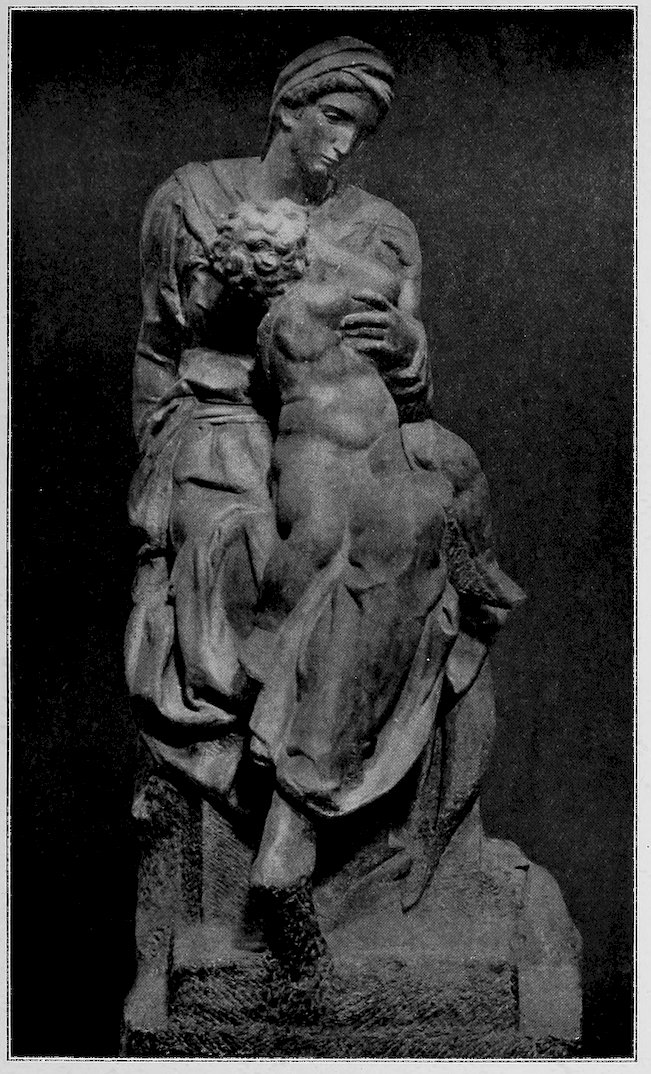
131I have tried to show how the general beliefs and ideals of
the people among whom they lived would have tended to differentiate
these two artists one from the other in certain ways
and to ally them in certain others. But different or similar,
can it be said of either: this one is the greater? I think not,
even though one recognises that Michael Angelo certainly
gave more varied expression to his genius. Neither of them
shows a more complete understanding of the arts, or embodies
a fuller realisation of the ideal in his figures, than the other.
Take for example Pheidias’s statues of Athena and Michael
Angelo’s of the Madonna. No artist could express all each
of these beings suggests in one figure, but it would be a hard task
to find anything that they did not show in one or the other
of their several presentations. We know with considerable
accuracy what was the grandeur of the Athena Parthenos, the
guardian of her chosen people, and we also know the divine
rage felt by Athena the warrior Goddess driving Poseidon
from the sacred citadel; and finally we know by literary and
probably by ocular evidence with what consummate grace
Pheidias represented Athena the ideal of Attic maidenhood.
There are many other statues of the Goddess by other artists
and from other periods but none I believe that add to the
realisation these three give us of what Athena was to the
Athenians.
In the same way Michael Angelo shows us the feeling of
his time towards the Virgin. In the figure at Bruges we see
the youthful figure—the Virgin of the Visitation. In the
partially finished group in Florence there is more trouble in
the face, the feeling expressed in the words “behold, thy
father and I have sought thee sorrowing” and “they understood
132not the saying that he spake unto them” (Plate LIX).
In the Pietà in St. Peter’s her heart is numb with grief—the
flood of sorrow that has whelmed her is
“Such a tide as moving seems asleep,
Too full for sound or foam,
When that which draws from out the boundless deep
Turns again home.”
Her figure as shown us by other lesser men seems trivial or
incomplete when these are remembered.
If one considers the larger undertakings of the two men,
the Parthenon and the Sistine Chapel, one cannot say that
either surpasses the other, though one can say with absolute
security that neither has ever been approached. In these
works they show themselves the masters of all craftsmen.
Note the way in which the composition of the Parthenon
groups suits the long, low triangular space in which they are
placed, each group, taken as a whole, being made up of numerous
lesser groups which are quite perfect by themselves and
so interwoven by means of upraised arms or turned bodies or
bits of floating drapery, that it is only after careful observation
that one sees how the artist made various parts unite
into one perfect whole. It is the acme of architectural sculpture.
It seems simple, but one searches in vain among the
pediment groups that have been made since for one that can
approach it even distantly in merit. It is this same intertwining
of simple, unforced separate parts into one grand,
living completeness that marks out the ceiling of the Sistine
Chapel as a thing apart and unequalled.
To compare the more private, perhaps more personal works,
of the two men is impossible, for the reason that nothing of
133this sort made by Pheidias has been preserved for us. There
are a few such by Michael Angelo, some from his earliest years,
as the Battle of the Centaurs, others like the David or perhaps
the Eros. From these we get a suggestion regarding the ideas
which Michael Angelo thought were to be expressed by sculpture.
The bas-relief showing the Battle of the Centaurs can,
however, scarcely be taken into consideration, for it is a work
of his mere boyhood and shows little except unusual power
for a youth and an interest, which apparently did not last,
in subjects drawn from ancient art. The man’s unconventional
and powerful nature is shown by the fact that in his
mature years he did not ever, as most contemporary painters
and sculptors did, try to copy the antique in any way. His
own mind was too active for him to adopt either the subjects
or modes of other men’s work. So, too, in the case of Pheidias,
his work does not suggest that of any predecessor, but in later
periods of Greek sculpture the figures which hark back in
some way to Pheidian originals are innumerable.
In the David, in the figures in the Medici Chapel and those
for the Julian tomb one sees the same strained look: physical
calm and great strength combined with a marked expression
of mental restlessness and trouble, undoubtedly significant
of Michael Angelo’s own feeling of weariness and
of the ‘powerful trouble’ that beset the world. Pheidias
came just at the acme of a great period. Michael Angelo, on
the other hand, felt that the light in the sky was that of the
waning day, not of the sunrise. His figures are sad; those by
Pheidias are quiet and peaceful. Society and the artist were
in harmony in the case of the Greek; they were not in accord
in the case of the Florentine.
134Every point we study brings us to the same conclusion, that
while each of these men was the supreme master of his time
and of incomparable capacity, Pheidias had less to struggle
against than Michael Angelo; and through being able to carry
out his ideas unhampered, he had a better effect on his followers
than Michael Angelo, whose works are in the main
monuments of thwarted purpose. Each sought unceasingly
to embody in his work ideals of beauty beyond the influence
of contemporary events. In the one case this was possible,
in the other not. To the Greek, contemporaneity was nothing,
to the Italian, it was all. Where Pheidias was called on to
decorate the chief public building of Athens with scenes of
war which were known only by popular tradition and which
were instinct with poetry, Michael Angelo had to depict a
battle that was a mere incident of border warfare. Each of
these men, however, enriched the world with works that are
unsurpassed, and similar work will never again be accomplished.
With the passing of the Greek world passed the ideals
that inspired Pheidias. Others came and faded away again
with Michael Angelo. Their works are immortal in the sense
that in their kind they cannot be superseded. But the arts
themselves are not immortal, for this would mean that they
could not advance and develop. It is in this power of growth
and change and adaptation that art is allied to science, and we
turn to the most recent exponent of either with the incommensurable
hope that he may have found the master key to
beautiful new worlds.
135
In the first, and, as it was destined to be, the last report
on the excavations by the Archæological Institute of America
at Cyrene,[35] I published a marble head of Athena which we found
a few inches below the surface on the top of the Acropolis.
The spot where it was found afforded no clew to its origin.
It came to light in a small room constructed probably in the
later Ptolemaic times, and had obviously fallen and been lost
to sight, by one of those inexplicable accidents familiar to all
excavators, on the spot where our picks discovered it. No
temple stood near; no trace of pedestal could be found and
no other fragment of marble came from the torn covering
of protecting earth to help answer the eager questioning
the quiet face aroused. Except for a flake off the hair, the
tip of the helmet projecting over the brow, the edge of one
ear and the point of the nose, the marble was as fresh as the
day the figure was first unveiled to the worshipping multitude.
(Plates LX, LXI.)
The perfect head alone is left us to solve the riddles the archæologist
and artist may ask. Doubtless when in the oncoming
years the Italians have the satisfaction of finishing
the work which we inaugurated and made possible, further
discoveries will dispel whatever doubts now harass our minds,
136and students, forgetful of the time and circumstances under
which we wrought, will wonder why we hesitated, why we did
not see, why the closed lips did not speak to us with as clear
a note as to them. Doubtless, but still it seems likely that
many years must elapse before others will be able to finish
our work, and in the meantime it is well to bring this lovely
bit of sculptor’s art more adequately to the attention of students
than seemed wise before the hope of continuing the
excavation was blighted by the careless hand of war.
Before studying the special characteristics of this head of
Athena and showing how, notwithstanding the very numerous
representations of the warrior Goddess which we possess, it is
entirely individual and unlike any other, we may do well to
recall certain facts regarding Cyrene as a centre of Greek life
and thought, facts that are not open to question, being proved
by historical and other positive evidence. The accounts
given by the ancient historians and poets of the foundation
and rapid rise to wealth of Cyrene were sufficient to make us
certain that the archæologist’s spade would find in plenty
those beautiful monuments of a long-since vanished spirit
which make the work of the excavator on Greek soil so entrancing
and satisfying.
Even at inaccessible Cyrene, however, we were not the
first. In the early sixties of the last century, Smith and
Porcher, two fine examples of men of English breadth of
view combined with well-trained and persistent capacity,
had brought to light a considerable number of bits of sculpture
which showed clearly that Cyrene, like every other
Greek city, had once been a kindly nurse to artists. True
though it be that these broken fragments now sheltered in the
British Museum were, with the exception of a magnificent
bronze head, of second-rate quality, still they dispelled all
doubt regarding one very important point; that is, they showed
that at Cyrene itself there were large numbers of sculptors
whose technical skill was of a high order. That there were
numerous sculptors was proved by the fact that the works
found by Smith and Porcher embraced a long stretch of
years.
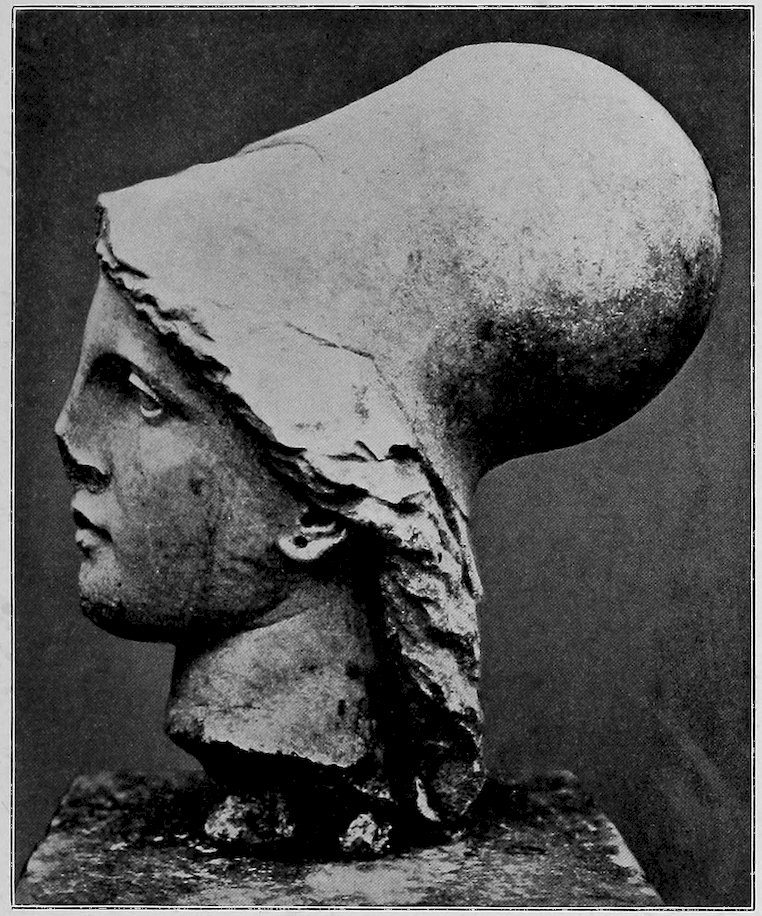
137At first sight this fact may appear little noteworthy, and
its bearing on our Athena head may not be perceived. It
takes on a fresh aspect, however, when we realise that there
is no marble to be found within hundreds of miles of Cyrene,
and, in consequence, the stone must have been imported
to the city. It might be suggested that not the
marble but the finished carvings were imported, as we know
from literary evidence was sometimes done in other parts of
the Greek world. Had the English and ourselves found only
one or two examples of supreme merit, this theory might be
tenable. No one, however, will attempt to uphold it in the
face of the numerous busts, statues, bas-reliefs, grave monuments
and inscriptions, many of which are of very little
importance, which were dug up by the Englishmen and ourselves.
Portrait busts alone show that Cyrene had her own
sculptors who, even though they lacked the advantage their
confrères of many Greek cities had in near-by quarries, managed
to overcome the difficulties Nature put in their way and
struggled to a mastery of their chosen art. The bearing of
this on the Athena will become manifest as we go further into
the study of the subject.
If only another Pausanias, one might suggest, had gone sightseeing
138and note-taking along the surprising shores of Libya,
our work of interpretation had been far simpler. But though
we are not helped by such written evidence, we can still discover
the essential qualities and meanings of these sculptures,
and the diggers who in years to come drive our trenches deeper
into the ground will find nothing more unexpected than the
Athena, for she is the drifted seaweed that proves the still
invisible land. In fact, I for one am glad we have no Pausanias
to dull the edge of our wits with his bald and often
erroneous statements. He has helped much in making it
possible to draw up chronological tables and schedules of
all sorts regarding the development of Greek sculpture,
yet had he never written, the true understanding of the art,
the comprehension of the forces that moulded it from the
days of its early promising effort through its bloom of unchallenged
perfection on to its phosphorescent decay, would have
been not less full and possibly even more intelligent than it
is to-day. Pausanias and others of his kind have handed
down many names which mean, in truth, no more to us than
the titles “master this” or “master that” of the mediæval
German school of painting. Such facts and data are of
infinitely little importance. Even without them the razor-sharp
critical powers of a Heinrich Brunn or an Adolf Furtwaengler
(before he gave up his energy to acrimonious and
petty dispute) were not to be denied and without any fictitious
aid of names would have interpreted Greek art to us. That
there are always blind souls who, when they see the Hermes
of Praxiteles, think it Roman, and consider the Maiden of
Anzio a work of the time of the Antonines, and who find other
blind souls to follow them, does not delay the Brunns and
139Furtwaenglers when they make their rare appearance in the
world of scholarship.
Thus with no help or suggestion derived from information
given us by ancient travellers we start on our study of the
Athena with the knowledge that the technique of the art
of sculpture was so well understood, and the practice of it
so common, at Cyrene, that we need not, unless forced by internal
evidence, look elsewhere for the nameless sculptor who
carved this masterpiece. The result will show that all the
internal evidence is in favour of its Cyrenean origin.
Since, then, sculpture was at Cyrene, as everywhere else
in the Greek world, one of the common modes of expression,
it remains for us to study the influences to which it was
subjected. We meet here the strange phenomenon that the
millennial-old civilisation of Egypt exerted apparently no influence
whatever on the young Greek town to the west. That
towards the end of the latter’s career, when she had fallen
under Ptolemaic control, she should be unaffected by Egyptian
thought is not surprising, for Egypt herself had at that time
submitted to the spell of Greece, and the true Egyptian art
must have seemed to the fellahin who then cultivated the
Nile valley almost as strange as it does to us. If, however,
the often-expressed theory, supposed to be borne out by
certain statues found on the Acropolis of Athens and elsewhere,
that the archaic sculptors of the Greek mainland were
more or less governed by Egyptian ideals, be true, then it is
odd that even the most archaic art of Cyrene, represented by
statuettes of the sixth century B.C., does not exhibit a similar
tendency. But this belief in the Egyptian influence on the
artists of Greece is based, it seems to me, on unsound evidence.
140There are obviously two, and only two, chief points to consider,
if one would fully understand a work of art. One is its
outer form, the other what it is trying to express; for even the
childish and misdirected efforts of the “Futurists” are an
endeavour to express something—how futile these efforts
are is shown by the fact that were it not for the titles given
the works by the Futurists themselves no one, no matter how
capable an artist or how mystical a dreamer, could possibly
guess what they were intended to represent. The works
show an even greater confusion of mind than that of Father
Castel who in the early part of the eighteenth century attempted
to make instruments which he called clavecin des
couleurs and clavecin des odeurs, instruments intended to produce
by means of changing colours and perfumes the same
effects as music.
Now one thing in very truth Greek art never was, either
in poetry, sculpture, painting, or in any other form: it
was never confused, but had always perfect lucidity. In
sculpture, for instance, the composition of the groups and
figures, though often displaying an intricacy almost as great
as that of a knot by Leonardo, is never anything but clear
to the trained eye. To understand the value of this quality
one need only look at the work of Rodin, which, no matter
what elements of greatness it may be thought to have, certainly
has not one slightest atom of Greek quality. Besides
the evil of confusion another failure sculpture may show is the
stagnation of formalism. This is one of the most noticeable
features of Egyptian art. Notwithstanding the wonderful
technical dexterity of the workers in that land, hieratic influences
were too strong for them and their natural impulses
141were shackled by the bonds of dogma. This blight, too, the
Greeks avoided. What then is the ground for maintaining that
their early art was influenced by Egypt? That the early sculptors
may have learnt many technical processes from Egyptians
I would neither deny nor affirm. They may even have had
Egyptian teachers, just as later the Romans had Grecian ones,
but that does not mean that Greek art was of necessity
moulded in accordance with Egyptian feelings and ideals.
True it is that there are certain Greek statues which resemble
in pose and stiffness certain Egyptian statues, but there
is a fundamental difference between the two groups. The
pose is an accident and can be duplicated in work from other
parts of the world. The fundamental difference is that the
stiffness of the Greek work does not represent the formalism
of Egypt, but it is due to the awkwardness of inexperience.
Take, for instance, the “Aunts” found on the Athenian
Acropolis. They are by an unpractised, stiff hand and in that
sense they are formal; but they are far more, delightfully
spontaneous. Such work would have been inconceivable to
an Egyptian and would have seemed to him irreligious and
indecent. It is not to be thought that Greek art even in its
period of fullest bloom was not formal; it was. It was the
wonderful talent of the Greek clearly to understand the laws
proper to the various arts, but he was always spontaneous and
original, and his work exhibits formality but not formalism.
These qualities are seen in the earliest work found at Cyrene,
the terra-cottas already mentioned. That they should
be so manifested is but another proof of the amazing force and
individuality of the Greek mind. Any other race would almost
surely have felt the influence of Egypt. Her territory joined
142that of Cyrene on the eastern border and the land between
the city and the Nile offered no barriers of mountains or
desert to hinder easy and comparatively rapid communication,
yet the outer form and inner content of these early Cyrenean
figures is completely and unmistakably Greek. That traders
passed back and forth from one region to the other cannot
be doubted. Caravans plodded their slow way from the
sacred fountain to the mysterious river, coastwise boats skirted
the inhospitable shore even as they do to-day. The Greek,
then as now the costermonger of the Mediterranean, made
his money, but he kept his individuality. Throughout the
centuries, until at last spiritual aloofness was trampled down
by a ruder and more powerful race, at Cyrene as completely
as at Athens, the Greek maintained his own standards and
beliefs. As the clumsy terra-cottas, wrought not very long
after the first settlers were guided to the spring which made
a great city possible, show this, so also does the Athena.
Individual she is, and unique, but she is pure Greek. The
reasons for some part of her individuality will become clear
as we study her still further.
We see, then, that the Athena is a work expressing with unveiled
distinctness the Greek spirit, and also that there is no
reason to suppose that the sculptor was other than Cyrenean;
it remains to find out at what date the figure was carved.
Often a mere fragment like this exhibits some detail that
makes it easy to fix the date of its origin with considerable
accuracy. In this case the question is complicated by both
technical points and general considerations. Had this head
been found in Greece itself or in any part of the Greek portion
of Asia Minor, the history of which is well known and the
143art of which has been laid bare by the archæologist, we should
have various well-established criteria by which to test and
estimate the head. But the definite historical records of
Cyrene are very scanty, and though what is probably in general
a fairly accurate idea of the development of the city can
be built up from the verses of poets, the accounts of historians
and other sources of various kinds, still there is little to help
us date a single work of art. There is, however, no reason
to suppose that the deeper currents which gave the course
to the life of Cyrene were very different from those which
guided the life of other colonies. Pindar’s odes alone would
serve to show that the African city was in pretty constant
relation with the mother country. Hence it is safe to assume
that the arts developed in Cyrene very much as they did
elsewhere in the Greek world.
At the present time surely enough is known of the
various parts of that world to make us realise that all advance
did not spring from Greece herself. Though the Greek spirit
was bound to express itself in similar forms wherever Greeks
settled, still sometimes one region, sometimes another, was
in the lead. Hence any chronological scale as applied to art
must be elastic, and one must not give way to the temptation
to judge every new find by the standards set by the artists
of Greece herself. Provincialism and archaism often take
similar external forms. So, too, it is a general law that colonies
develop more rapidly than the country from which
they spring. A rapid development may be brought about
also by geographical and climatic conditions in places which,
at first sight, do not appear to be conducive to the advancement
of art.
144In years to come it will be proved beyond a doubt, I believe,
that Cyrene was such a place. Her distance from the regions
in which we are accustomed to think of the Greeks as working
out their destiny saved her from the wastage of those wars
which it is hard to regret because they have given us immortal
pictures of Greek courage and devotion. What her relations
with the native powers were we do not yet know, but had
they led to any such struggles as made the pride of Athens
and the other cities of the mother country, surely some echo
would have reached our ears. So we may think of Cyrene
as waxing fat from the moment when the first settlers, after
their long wanderings to find a habitable spot, climbed the
rocky hillsides and quenched their thirst at the spring which
with its bright arms still holds a small settlement. It is for
these general considerations of easy colonial growth, and freedom
from external distractions, that I think the Athena can
be safely dated rather earlier than we should be tempted to
date her had she been found, let us say, in Athens or Sparta.
The technical point which I mentioned as making it difficult
to date the head, is the helmet. It is of the Corinthian
type, but there is nothing in its general shape or details of
form by which a date can be fixed. Furthermore, it covers
the head so completely that only a few waving locks of hair
over each ear and the heavy braid resting on the nape of the
neck are visible. This concealment of the hair takes away in
large measure one of the most helpful methods of dating
statuary.
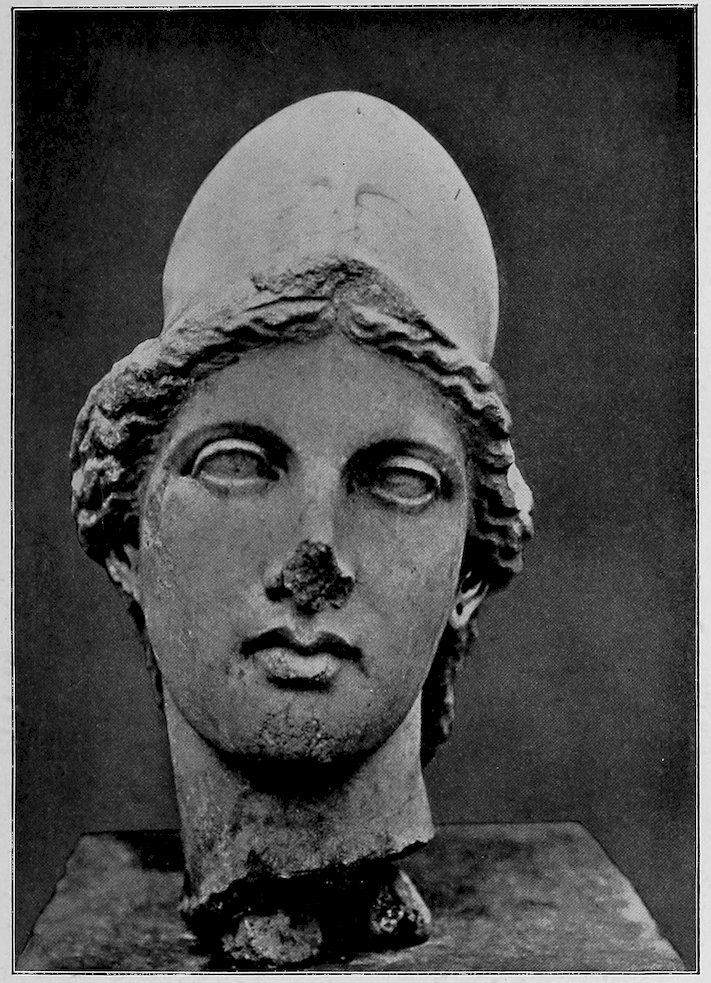
In the case of female figures, nevertheless, the treatment of the
hair is less helpful, perhaps, than in statues of the rougher sex
because in the former the more severe and orderly dressing
145of the bound locks gave less chance for individuality of treatment
than did the crisp and wind-tossed curls of youths and
men; still, even in the women’s figures the hair very often
betrays the date of the sculptor. Few though the tresses
are which escape the stern covering of Athena’s helmet, they
are sufficient to help us in our elusive pursuit. The general
method in which the hair is arranged, parted over the brow
and drawn closely back above the ears to a knot or short
doubled up braid at the back, is one that suffered but little
change during several centuries. In the archaic time the
locks fell more loosely behind, while in the fourth century
they were more knotted, but these slight variations occur now
and again throughout the whole period of great Greek art
and were due more to individual fancy of artist or model than
to the stifling rules of fashion.
But though we must finally conclude that the mode of wearing
the hair does not assist us, as the cut of the dress most
certainly would have done had we been fortunate enough to
find the body of the statue, still the tresses between the temple
and the ear have a quality of their own which points to a definite
time. They suggest the loose waving form of life with
noteworthy success. The sculptor belonged to a period when
the special nature of marble was thoroughly understood.
The period had passed when bronze and marble were treated
in almost identical fashion, and the time had come when sculptors
could manage various materials with complete understanding
and were enabled to reproduce surfaces or substances
in the way best suited to malleable metal or to friable
stone.
The most perfect example of this understanding of substance
146which we possess, and one that has never been surpassed,
is the head of Hermes by Praxiteles made in the first
half of the fourth century before Christ. The hair of the
Athena is handled in much the same way. The locks and
strands are not sharply outlined and separated one from another
but flow from brow to neck in subtly broken masses
among which the light plays in and out as softly as in nature.
This naturalistic treatment became common after it had once
been arrived at, but the tendency after the end of the fourth
century was to try for purer realism. This could not be
attained by greater skill in modelling and carving but only
by polishing or engraving the surface. The Athena exhibits
neither of these signs of decadence but the surface still shows
that lovely dusty softness which is characteristic of the best
work of the late fifth and early fourth centuries, a softness
which would not have been imperceptible and lacking in
effect even when the figure was tinted with colour, as, probably,
all Greek sculpture was.
It is not only the hair which suggests the date of the early
fourth century as the time when the Athena was made. The
broad chin, projecting well away from the neck, a chin that
would be heavy, were it not for the exquisiteness of its outline,
which seems to have the living force of a coiled steel
spring, is such as was common in the fifth and early fourth
centuries. So, too, are the broad set, wide opened eyes overhung
by the long low curve of the brow. Not a sign in these
of the sentimentally dreaming eyes with their melting lower
lids which we associate with the work of the imitators and
followers of Praxiteles; not a trace of the furrowed brow and
the eye gleaming, like a live coal, from the deep shadowed
147socket such as we see in the work of Scopas and the superb
masters of Pergamon.
In discussing such a fragment as this Athena it cannot be too
clearly remembered that the sculptor, like the poet, does but
express his own day, and if Praxiteles was delicate and sentimental
or Scopas forceful and passionate, it was because
these were characteristic qualities of their periods. These
are, furthermore, exactly the qualities one would expect at
a time when old standards were beginning to be doubted and
the future offered nothing so substantial to take their place.
The same phenomenon is seen in the seventeenth century
of our era. In both periods thoughtful people either clung to
a sentimental repetition of old ideas which no longer had life-giving
and creative force, but were loved and dwelt on for
the sake of old association, or else they were driven to a passionate
striving after new and dimly seen hopes and ideals.
Sentimental dreaming took the place of good hope and assurance
while mystical passion took that of intelligent piety.
In the face of the Athena there is seen no sign of a troubled
spirit, she is calm and steadfast with the strength of perfect
self-poise, which could hardly be, were she sprung from a later
time than the early fourth century.
It has been insisted that there is in this head no trace
of sentimentality, and it may be thought that I have failed to
notice, or to give due weight to, the curious pose, drooping
over slightly to one side. This is one of the most noticeable
points about the head, but, to my mind, it expresses a feeling
common in the fifth and early fourth centuries and is not
motived in the slightest degree by the later sentimentality.
In the old man seated on the ground in the Olympia pediment,
148in the Mourning Athena at Athens, in most of the grave
steles of the late fifth and early fourth centuries, in the portrait
bust of Pericles, is to be seen, in the pose and expression
of the figures, the expression of a deep sentiment of combined
gravity and tenderness. Again and again this sentiment is
expressed by the great dramatists in words that ring down
the centuries like distant bells. It is the recognition of
suffering and sorrow but also of the self-control that meets
them undismayed. When the Greeks lost their faith, at the
same time they lost this control. In the Demeter of Cnidos
and the portrait of Mausolus there are unmistakable signs
of lack of control,—in the former the startled pose, and in the
latter the look of distress plainly visible in the fine and vigorous
face. The Athena resembles the Pericles and the grave
steles in this respect. The head leans over as though bent by
the wind (a position which emphasises the exquisite shape of
the neck), but in the steady, quiet eyes and in the sensitive
closed lips one sees plainly that simple directness that distinguished
the Greeks of the period to which I attribute this
head, from all the other peoples who have inhabited this
earth.
I have just mentioned the mouth of the figure, and this is
the feature to which I referred before as showing, possibly,
the effect of local circumstance on the sculptor. It is a very
noticeable mouth; large with unusually full and richly modelled
lips—lips that could send the battle cry echoing across
the scarred and rock-strewn hills or could whisper like the
brook beneath the rosy-plumed oleanders. In shape it is
by no means a typical Greek mouth, but has a trace of the
fuller form common to the Libyans with whom the Cyreneans
149were in constant and close intercourse. While it is true that
history fails to note a single case of an individual of pure
black blood accomplishing anything of note except in a military
way, such do often possess great beauty of form and
feature, and this fact has been seized upon by the sculptor
of the Athena. With great skill he has softened the somewhat
savage shape and given it the lines that are consequent
upon a higher civilization.
We have come now to the end of our study of this bit of
sculpture. It could be compared indefinitely with other
heads, and the similarities or differences could be pointed out.
Little would result, however, from such comparisons. What
is needed is more sculpture from the same region with which
to study the Athena. But till this is forthcoming, we are left
to the general conclusions derived from this single example.
These conclusions are that the Athena was carved by some as
yet unknown artist at Cyrene in the first half of the fourth
century B.C. and that the work differs from the Greek work we
are accustomed to in showing local characteristics both in
special features and in method. This may seem to be of small
importance and the head to be unworthy so elaborate a discussion;
such would be the case were we to think of it merely
as an archæological remnant of a forgotten city and time.
But this head is more than a mere bit of flotsam. It is not
a dead and meaningless fragment, but has still the suggestive
and creative power of any true work of art. This vitality
and artistic veracity are shown by the extreme clearness with
which it illustrates two of the fundamental characteristics
of the Greek genius—humanism and directness.
The simplicity and directness of the Greek showed itself
150in all he did or made. He never attributed human emotions
to nature and never bound himself with dogmatic conventions.
For these reasons he was never sentimental and never
dry or false. He saw ugliness, moral as well as material, in
the world around him, but recognising that it in no way added
to happiness, he did not wallow in it and proclaim himself a
“realist.” When he came to consider religion he was straightforward
in his treatment of the Gods as he was with himself.
They were but a superior race born from the same great mother
Earth (Pindar, Nem. VI. 1). Athena, the Goddess, is but a
woman and nothing more. He saw beautiful women in the
cities where he dwelt and in form of their physical perfection
he represented the bright-eyed Goddess. He sought no imaginary
qualities, he attempted to express no hazy, mystical
dreams but finding beauty in mankind, he was satisfied to reproduce
it so well as might be.
Ordinary everyday life was the chief interest of the thoughtful
Greek. He had the same circumstances of existence around
him as we have to-day, and knew just as much of the origin
or the end of it all. Life, death and the passing show of time
were his schoolmasters as they are ours, and from them he
learnt humanism. He thought of the world not as a blind accident
nor as a mystical promise but merely as the setting for
man and hence the conduct of life became his chief interest.
The Greek sought for all means whereby he might avoid the
pitfalls of youth, secure the comforts of well-rounded growth
and minimise the weaknesses and griefs of old age. To
attain this ideal certain things were seen to be necessary,
and from Solon, who considered that the man was happy
who had health, good fortune, good looks and children, to
151Aristotle, who (Rhet. 1360 b, 14) gave the same definition in a
more amplified form, the ideal did not alter. Even to-day
there is but one part of this that seems strange to us. That
is the stress laid on personal beauty. Good fortune, health,
wisdom, children and particularly wealth go to form the
general ideal of the modern world, but there can be only few
who would admit that the desire for physical beauty was part
and parcel of their ideal. The Greek on the other hand
frankly desired it almost more than anything else and showed
his perfectly simple and entirely pleasant belief in its value
by his games and by many a story which he told as illustrative
of enduring truths. One of these tales has a bearing on the
Athena of Cyrene. It is that of Peisistratus, who in order to
become ruler of Athens came there accompanied by a beautiful
woman in regard to whom he told the credulous citizens
that she was the Goddess Athena herself.
Thus we see that it is due to no mere partiality for the pleasing
form on the part of the unknown sculptor that this head
from Cyrene is beautiful, but because his brain and hand were
guided by ideals that were second nature to him. As we grow
familiar with the head, the loveliness of every feature, the sharp
insistence on sweet feminine beauty make one wish destruction
might fall on the vague and dreamy and contorted realisms with
which many of the modern artists would attract our attention.
The calm and steadfast eyes look at us across the centuries
and question our mysticism. The straightforward, immediate,
perfect humanity gives us pause in our mad search for
novelty, and should we conclude that this is perfect art, though
we may lose the sympathy of our contemporaries, we shall
win the companionship of those whose laurels are immortal.