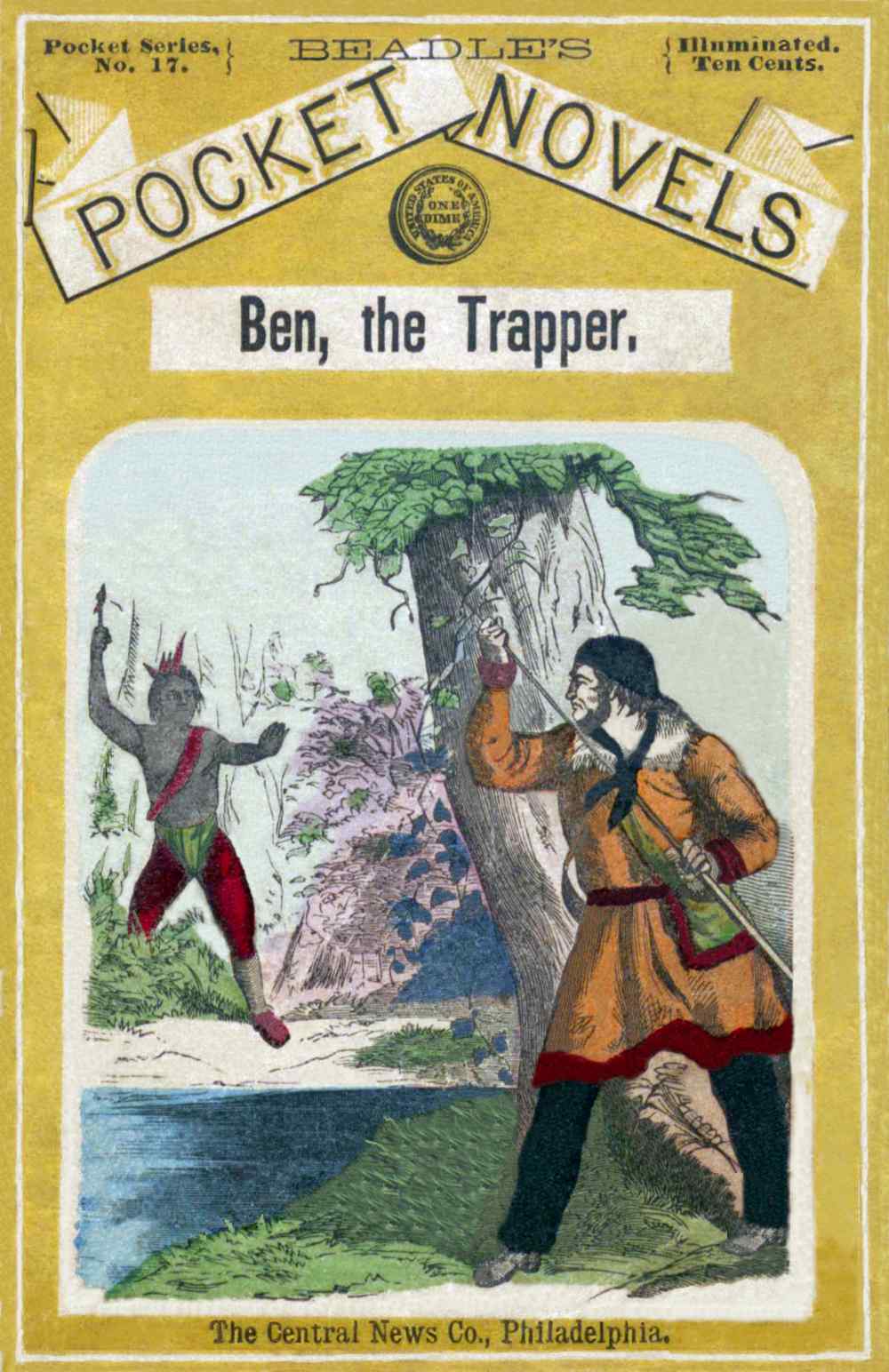
In a deep defile among the Black Hills, far out on the
western plains, three men had made a camp. They were of
that wonderful race who have done more to develop the resources
of the western world than any other, the trappers of
the North-west. Their great aid in this cause has never been
allowed by us as a people. We hear of great discoveries of
gold, or of a new pass through the mountains, and in the discovery
lose sight of the agent, who, in nine cases out of ten,
is one of the class of whom this book is written. Their wandering,
perilous life is full of hardships, of which we have no
conception. The cold of winter, the savage foe, the yet more
savage employees of the Hudson Bay Company, the grizzly
bear, the snow-slide, all these are their enemies. They toil
hard to pluck from the hand of stern old winter a precarious
livelihood, happy in the possession of a few traps, a rifle, ammunition,
and a blanket. With these they lead as happy
lives as any, and as useful as most. Hundreds of tales of individual
daring have been told of these men, and yet the truth
is not half known. Their creed is simple as that of the border
chiefs of Scotland:
“That they should take who have the power,
And they should keep who can!”
To hate an Indian, or an employee of the Hudson Bay Company.
It was in the days when the rivalry between the
American Fur Company and the Hudson Bay was at its height,
and the rancor between them equaled that of Whig
and Tory during the Revolution. Each claimed the country,
and many a bleaching skeleton on the western streams remains
to this day, attesting the fact that the men fought for the right
of possession to the last.
The men in the pass were types of different nationalities.
One, a tall, supple, wiry old fellow, dressed in a greasy buckskin
hunting-shirt and leggings, with moccasins of moose-hide,
showed himself to be a lifelong rover of the hills and
plains. He was piling brush on the fire, and smoking placidly,
puffing the smoke from his nose in clouds. His face
was a study, covered though it was by a beard of nearly seven
months’ growth. It showed the character of the man. Brave
to a fault, an unrelenting foe, a steadfast friend—one on whom
great reliance could be placed in time of need. His rifle,
carefully covered with a buckskin sheath, was propped against
a rock near at hand. A huge knife hung in his belt, by the
side of a shot-pouch and powder-flask.
The man on his right hand was a Frenchman—a keen-eyed,
vivacious fellow, dressed very much like his companion,
and armed, in addition to the knife and rifle, with a pair of
handsome pistols. His name was Jules Damand, and he had
been a voyageur, trained to the business at Saint Ann’s, on
the St. Lawrence.
The third was a Dutchman! A simple glance at his broad,
stolid face told his nationality. He was a stout fellow, of
tremendous girth, with a smiling blue eye, an expressionless
face while in repose, and a foot that looked much like a young
trunk. He was smoking placidly, and suffering his companions
to attend to the fire, and cook the food hanging over it.
The last duty was the Frenchman’s, who, like nearly all the
men of his nation, had a theory in regard to cookery which
he was always ready to explain by example.
“Look here, Jan,” said the first-named trapper, “why don’t
ye lend a hand at takin’ care of the fire?”
“So help me, as I never know I vas vanted to help you
mit de fire,” said Jan. “I vas sit here, mit mine shmoke-pipe,
unt I vas dinking auver the times ven I vas in Yarmany.
Yaw; dat is vat I dinks.”
“I s’pose it’s considerable of a kentry,” said the old trapper.
“Consider’ble mit a coonthry! Mein Cott! Dere is no
such coonthry mit all the earth. Vat! Ish dere any vere
you kin find such vine ash ve have dere? Now I dells you.
Ven you coes to St. Louis, you vas co to Yawcob Post’s saloon
av you vants goot Rhine vine. Dere ish goot many
blaces mit St. Louis vere dey says dey keeps goot Rhine vine.
Put I dells you dat ish no more ash von lie! Dere ish no
more ash your blaces in dat town vere you can get goot vine,
unt mein frent Yawcob’s ish von, I dells you drue.”
“It’s mighty poor stuff to drink,” said the trapper. “Fer
me now, when I drink, I take a little good rye whisky.
That’s good enough fer me.”
“Boor shtuff! Penn Miffin, av it vash not dat I know you
too vell, I vould hit you mit your nose av you says dat vonce
more. I dells you dere ish nottings so goot ash Rhine
vine.”
“Yes, for a Dutchman,” said Ben.
“But you ish voolin’. Dere, I seen you laff. Don’t say
dat no more,” said Jan.
“What does ye think about it, Jule?” said Ben, looking at
the Frenchman.
“That it is very bad drink,” said the Frenchman. “Peste!
The first time I drank it, it was so sour I thought it would
make me turn myself inside out to get rid of it. The Rhine
grape is very bad. In la belle France they make wine that
is good.”
“Vy den you ask him?” blustered Jan. “Vat ish he
more ash a Vrenchman? Unt I ask you now, aff you vas
dell me, vat ish de goot over a man vat eats vrogs? So help
me gracious, dey is no more goot to eat dan snakes. Unt dey
ish p’ison.”
“I reckon yer wrong, Jan,” said the trapper. “They do
say thet snakes ain’t very bad eatin’ when a chap is hard druv’.
I don’t say I want to try ’em, but ef I c’u’d ’a’ got snakes
the time I cum nigh to starvin’ up yer in the Black Hills,
durn my hide ef I wouldn’t hev eat snakes or any thing else.
I kem of a queer race. I ken eat any thing, and lick my
weight in wildcats. I’m death on grizzlys. I ken wipe out
an Injun as fur as I ken see him, and I calculate thet’s a good
ways.”
“You talks a goot deal mit yer mout,” said Jan. “Put
aff a man says to me dat snakes unt frogs is goot to eat, den
I dinks he ish no more ash von vool. Aff ever I get vere I
can no more get nottings to eat, so help me gracious ash I vill
not eat snakes unt vrogs, aff day vash to come to me in hundreds
unt t’ousands, ready cooked, unt beg me on dere knees
to eat dem.”
“Did you ever see a snake on his knees, Jan?” said Ben.
“Yaw! Ven you poke dem mit a stick, dey gits up on
dere tails. Dat’s de vay dey vould do ven dey vash ask me
to eat dem. Unt I vash say, No, py tam!”
The Frenchman said nothing, but stooped to stir some
soup in an iron pan placed on the coals, glancing up at the
Dutchman with a queer smile as he did so. The blood of
the Teuton was up, and he dropped off into low mutterings,
like distant thunder, until a fresh grievance caused him to
break out again. He found this grievance in Ben Miffins’ manner
of smoking.
“Dere,” he said, “shpose you look at dat, eh? Ven a
man ash ought to know petter, unt ve know ash he knows
petter, shmokes hish pipe drue hish nose, like dat, he ish von
tam vool. See him. Puff! puff! puff! like a shteampoat
mit a vire in her pelly. Now I dells you dat ish not the vay
to shmoke.”
“It’s my way,” said Ben. “Look yer, Dutchy, ef ye don’t
like my way of smokin’, does ye know what ye ken do? Ye
ken take the back track to the forts.”
“Vy don’t you shmoke like a Christian den?” grunted Jan.
“’Cause I don’t want to. Never told ye how I learned to
smoke this yer way, did I? No? I’ll tell ye then. When
I was quite a young man I was taken by the Crows. Durn
’em ef they didn’t keep me among ’em more then three years.
Made me a chief, and what not. Wal, they all smoke this
yer way, and I took it up. Don’t rile me up, Dutchy. I’m
the Big Buffalo of the Crow nation. Rile me, and I light on
ye pooty heavy. Smooth me down and I’m ile; but slick
me the wrong way and I’m a p’ison critter. Look out fer
me when I flop my wings and crow.”
“Look at the hills,” said Jan, prudently changing the course
of the conversation. “Vat you dinks ven I dells you I’ve
seen hills all made up mit ice, unt dey so pig ash dese hills,
eh?”
“I should think your story was like the hills,” said
Jules.
“How vash dat?”
“Made up mit a lie,” said the Frenchman, laughing and
turning again to his soup.
“Den you ish von tam vool,” said Jan, in a rage. “It ish
no more as vive years since I cooms from Yarmany mit a
backet. I vas very pad ven I cooms avay. I vish I vash
stay at home. Put it vash near spring ven I cooms avay,
unt the vind drive us up north. Unt den cooms von of dese
hills made up mit ice.”
“It’s true,” said Ben. “I’ve seen ’em myself off the mouth
of the Columby. They call ’em icebergs.”
“Dat’s it. Dat’s the name!” said Jan. “Vell, I stands on
the deck mit the packet, unt I sees it coom. I goes to the
captain unt I dells him America has proke loose, unt vash
cooming down on the sheep, unt would sink her. He laugh
at me, unt said it vash an iceberg. Unt I vatched it very
close, unt py unt py it tipped oop, unt turned auver, unt I
dinks we ish gone. But it not strike the sheep.”
“Lucky fer you,” said Ben.
“Vat vash you dink auver an iceberg ash vash so pig ash
it vash tip auver on the sheep, unt sink the sheep. Now I
ask you not for to pelieve all dis unless you vash a mind to.
You must do ash you blease. Put dis is vat I sees myself.
Vat is your opinion mit dese tam icebergs?”
“Oh, they say that they break away from the hills up north
and float down yer. That’s all I know.”
“Yaw. Put vat makes dem tip auver? Dat ish vat I
vants to know.”
“How kin I tell?”
“Vell, I dells you my opinion mit dese tam ole icebergs.
Dey ish very pig. Put, vat vas you dink mit a vale (whale)
ash vas so pig as he vash go unther an iceberg, unt lift the
iceberg oop on his pack, unt tip her auver on the sheep, unt
sink the sheep. Dat ish my opinion mit dese tipping icebergs.”
“Ye don’t mean to tell me thet you think a whale goes
under an iceberg and tips it over?”
“Yaw. De vale goes unther the iceberg, unt lifts it oop on
his pack, and tips it auver on de sheep. Dat ish vat I
dinks.”
“He couldn’t do it,” said Ben. “Darn it. I’ve seen icebergs,
and I’ve seen whales, but I never seen a whale big
enough to do thet, nor you either.”
“I shpose you dinks dish ish von lie. All right. You may
dink vat you blease, put dis is vat I sees myself. I ton’t care
nottings now vat you dinks, only ven a man vill not pelieve
goot sense ven he hears him, he is von very much vool. Vat
you got in the pan, Shule?”
“Soup,” said Jules.
“Vat you makes him off?”
“Grouse,” said Jules, smiling.
“Ven he ish reaty, let us have somet’ings to eat. I ish
hoongry. Vy does ve coom here pefore it ish dime to set our
traps, Penn?”
“I’ll tell ye. Ef we ain’t on hand ’arly, all the places will
be taken up. And I know a place whar we kin make our
fortun’s, sure. I’ve got a beaver-dam thet beats the world.
But come, Jule, I’m like Dutchy. I want something to eat.
Ef it’s ready, dish it up.”
Each man had a tin cup among his other property, and
Jules filled three of them from the pan on the fire. For a
few moments nothing was heard but the clicking of spoons and
smacking of lips over the savory mess, for Jules was a good
cook. Jan shoveled down the contents of his cup first, and
held it out for more.
“Like it?” said Jules.
“Goot!” said Jan, smacking his lips again. “Pest I ever
eats. Gif me more of it.”
Jules filled the cup again, and then replenished his own
and that of Ben Miffin, who was not far behind the others in
disposing of the food. At last Jan was satisfied, and drawing
his hand across his mouth slowly, he proceeded to fill his pipe
for a smoke.
Jules cleared away the pan, put another stick of wood
on the fire, and got away from the reach of the ponderous
hand of the Dutchman, and then said:
“I s’pose you know what you have been eating, Jan?”
There was very little, except in the accent of the young man, to
show that he was a Frenchman, and the occasional use of the
pronoun “him” in the place of “it.”
“Didn’t you say it vash grouse?” said Jan. “’Twas goot,
anyvay.”
“Yer mighty right,” said Ben. “’Twas the best grub I’ve
had fer a long time. But ’twa’n’t no grouse. I knew it as
soon as I put it in my mouth. Ye gev me some once before,
ye remember.”
“It’s a pity Jan don’t like it. I think it’s durned
good.”
“Vat I peen eating?” cried Jan, in great alarm. “Off you
vash not dell me now, dis very dime, vat it vas, I vill raise my
hand oop unt let it fall on your cophf (cope), unt it vill kill
you!”
“It was something you said to-day you would not eat if
you were starving.”
“Snakes!” screamed Jan, starting to his feet, with both
hands pressed on his stomach.
“No, not so bad as that,” said Jules. “It was frog
soup.”
Jan sat down again to consider over the matter. For full
five minutes he neither moved nor spoke, but sat with his head
resting on his hand. At last he looked up.
“Pring me dat pan,” he said.
Ben reached over to where the pan stood and handed it to
him. He took up his spoon and devoured all that was left,
not deigning a word to the repeated demands of Jules that he
should leave a little for him. His jaws never ceased their
action until he had deposited the whole in his cavernous
stomach.
“Dere,” he said. “I veels petter. Unt so dat ish vrog,
eh?”
“I should think so,” said Jules. “You old cormorant!”
“Vat ish dat?”
“A bird that eats every thing he can get his claws on,”
said Jules. “Why didn’t you leave some?”
“I vas brought oop to love mine neighbor ash myself. I
dinks it ish not right to eat vrogs. Put I dink so mooch
more off my neighbor dat I vill not leaf vrog soup vor a
demptation.”
“Sacrifice yourself for the public good, you old hog?” said
Jules.
“Yaw. Dat ish drue. I sees dat if I does not eat him
you vould do it, unt I dink so mooch off mine frent dat I vould
not leaf it. Dat ish all apout it.”
“Do you mean to eat any more if I make him?” demanded
Jules.
“Yaw. Venever you makes vrog soup I vill not leaf any
of him vor you. Dat ish vat I dinks apout it.”
“Perhaps you’ll get a good chance,” said the Frenchman.
“And perhaps you won’t. But you’ve finished it. Perhaps
you will go out with me and catch some more of
them.”
“Nein!” said Jan.
“Why not? You eat them fast enough.”
“Yaw. I alvays eat dem fast enough. I know vat ish
goot for mine frent, unt I dinks vrog soup very pad vor
him.”
“That’s enough,” said Ben. “You’ve taught Jan to eat
frogs, and he has taught you that if a Dutchman is slow, he
is sure, and that you can’t fool him wuth a cent. Scatter the
brands and pick up your dunnage. It’s time to be on the
way.”
“How far is it?” said Jules.
“A matter of five miles or so,” said the trapper. “But
we’ll get our pay for the long journey we’ve made ef we ar’
a little footsore at the end. Come on!”
They shouldered their pieces and strode off into the hills,
the Dutchman sauntering in the rear, leading his horse by the
bridle.
CHAPTER II. THE GRIZZLY BEAR.
Ben Miffin strode on in advance of both the others, leading
his horse, loaded with camp utensils, by the bridle. This
man was known far and wide upon the prairies, as a skillful
trapper, a bold hunter, and an Indian fighter of great renown.
He had one quality which was his own, in common with many
of his class—of boasting of his exploits. Perhaps this trait
was a part of his frontier education, learned from the Indians.
At any rate Ben exhibited the strange anomaly of a
boaster who was at the same time a brave man. The scars
upon his body were taken in many a bloody fight along the
Yellowstone, by the Platte, on the Washington, and in the
Sierras. His step was free and firm in spite of his fifty-five
years, and the gray hairs sprinkled in his heavy beard and
mustache.
The road lay through a growth of scattered pines, such as
grow upon the Black Hills, and among others a few specimens
of the nut-pine, known only in the West. Ben stooped to
pick up one of the cones, and as he was tearing off the husk
to get at the seed he heard a sound which caused him to drop
the cone and seize his rifle. The sound was a grunt resembling
the grunt of a hog, and looking up, he saw, a few feet
from him, an enormous grizzly bear, standing with his head
cocked on one side in a knowing manner, regarding the trio
in a way which seemed to say that he hesitated to decide
which of the three would make the best meal. There is no
living mountaineer who does not fear the grizzly bear. Their
strength and ferocity can not be fairly stated. Ben knew the
danger he had to encounter, and was ready to meet it like a
man. The Frenchman aimed his rifle at the animal, but dropped
it again at the stern signal of Ben Miffin’s hand, who
never removed his keen eyes from those of the fierce animal.
Cooper says in “The Pioneers,” “There is something in the
front of the image of his Creator that daunts the hearts of the
inferior beings of creation.” And the great student of nature
was right. No one knew better than Ben Miffin the
power of the human eye, and his never quailed.
“Let me shoot,” whispered Jules.
“For your life, don’t!” muttered Ben. “Hold yer charge
tell I give ye the word, and then let him hev it.”
“I can shoot him while he stands still,” replied Jules.
“Mind me,” was the reply. “Keep yer eye on the brute
all the time. ’Tain’t no use to fire; his hide is like a sheet
of iron. Bullets flatten ag’in’ it like paper-balls. Darn my
hide ef they don’t. He’s got his eye on my hoss; he kain’t
hev it, mind ye.”
All this was said almost in a whisper. The bear had not
moved, but was standing in the same place, shifting his head
to and fro to get away from the eye of the intrepid man. Ben
knew his advantage, but between keeping his young
companion from firing, and watching the bear, he had
his hands full. At last the bear rose slowly on his hind legs,
and opening his jaws, uttered a terrific growl, at the same
time showing a set of long, white teeth, at the sight of which
poor Jan, who was crouching behind a rock, uttered a yell of
terror.
“Keep still, you durned fool,” said Ben, without turning his
head. “You’ll bring him on us ef you show the white feather
thet thar way.”
Still he kept the eye of the bear. The brute lowered himself
upon all fours and suddenly began to retreat. He had
not gone ten paces, however, when he turned again and rose
upon his hind feet, repeating the menacing growl which he
had uttered before.
“Och! Mein Cott!” muttered Jan. “Our vader vich art—goot
saints, vat teet’! Dere ish no more as fivifty teet’ in
hees jaw. I dinks I ish mooch ’fraid.”
The bear again dropped on all fours and turned his head up
the rocks. But Miffin, who had restrained himself well until
now, jerked his rifle to his shoulder and fired. The ball had
hardly left the barrel when the savage brute, with a broken
fore shoulder, came down the slope on three legs, with growls
which made the blood of the Dutchman run cold in his veins,
and wish himself safely back in fatherland. But he took up
the gun he had brought with him from the Rhine, a gun on
the pattern of the roer of southern Africa, and with his heart
in his throat awaited the onset. Jules Damand fired one ineffectual
shot at the savage brute, and then drew his pistols.
Ben Miffin saw that he had brought this on the party,
and that he was the one to be sacrificed, if any. He drew
his knife and was about to close with the bear, when the
Frenchman dragged him away.
“Climb a tree,” he said. “Take your gun with you.”
Each darted at a low pine, and scrambled up as soon as
possible, just in time to escape the fury of the brute. He
reared himself on his hind legs at the foot of the tree occupied
by the trapper, and glared at him seated comfortably in the
lower branches. The mouth of the bear was open, and the
white foam dropping from the red tongue. He lowered his
head and licked the blood from his wounded shoulder. The
taste of blood made him more savage, and he gnawed at the
tree with his white teeth.
“Where are you, Jan?” cried Ben, not seeing the Dutchman
anywhere. “Have you got to a tree?”
“Nein!” replied Jan from behind his rock, “dere ish no
dree here. I ish kilt! I ish eaten oop mit a pear! Ach
mein Cott! vy you don’t shoot ’im? Vire mit de gun at
’im. Dere ish no hope vor boor Jan Schneider, dat ish drue;
so help me der saints!”
“Keep yer mouth shet,” replied Ben. “The b’ar
may miss ye. But ef he noses ye out, dig fer a tree, that’s
all.”
The bear evidently suspected the presence of some one
else, though he had only seen the two he had treed. He
began to nose about the ground, making toward the horses.
But they fled at his approach, and he stopped a little way
from the rock where Jan was hidden and began to snuff the
air. He then advanced toward the rock.
“Look out thar!” cried Ben; “he noses ye now. Climb
up on the rock.”
Jan scrambled to the top of the rock, still clinging to his
gun. The grizzly reared his ponderous bulk against the rock
and saw his enemy. The growl he uttered caused cold
shivers to begin at the top of the Dutchman’s head and
chase one another down his back and into his boots. The only
hope he had was in the gun. He thrust it forward and was
about to fire, when his bearship lifted his paw and gave it a
playful tap, which knocked it out of the poor fellow’s hand,
and sent it flying down the other side of the rock. But Jan
caught it by the stock and pulled it back. The bear began
to climb up the rock, but moved with difficulty, for one leg
was useless to him, and every movement was accompanied by
a growl of pain. Ben Miffin had by this time loaded his rifle,
but the body of Jan was directly between him and the bear,
and he dared not fire. The gun of the Dutchman was loaded
with a handful of buckshot. As the bear came nearer he
lifted the wonderful weapon and pulled trigger. A noise like
the report of a small cannon followed, and Jan was knocked
headlong from his perch, falling on his head and shoulders
nearly ten feet away. He was up in an instant, running for
a tree, fearing to feel the claws of the bear in his back at
every step. He reached the tree, tugged his weight up to the
branches and uttered a shout of joy. He was safe for the
present.
“How does ye feel?” said Ben from his tree.
“You’s nice man to shtand py a frent!” said Jan, in high
dudgeon. “You’s goot feller. I dinks I cooms out here goot
many dimes more mit you. Off auver a man is a good fiter,
he vas fite den mit der pear. You’s a coward, Penn
Miffin.”
“Yer safe in yer tree, or durn me ef I wouldn’t giv’ ye
the darndest lickin’ ye ever got in all yer life. I would, by
gravy. Does ye think a man like me is gwine to stand thet
thar? I reckon not. I ruther calculate ye’ve barked up the
wrong tree. Jest wait tell I git down, and I’ll chop ye inter
kindlin’ wood. Thet’s as good as ef I swore to it.”
“Where is the bear?” said Jules. “I can’t see him.”
“No? Mebbe the Dutchman knocked him over with that
blunderbuss of his’n—the darndest weepon! It’s got a muzzle
like thet thar little cannon they’ve got at the Mackinaw.
Mountain howt’zer they called it. Look sharp again, Jule;
kain’t ye see him now?”
“Yes, Ben; he lies under the rock, with his head on his
paws. He keeps very quiet.”
“Mebbe he’s shammin’,” said Ben. “Don’t ye go
too nigh the durned critter. It’d be jest like him to git up
and go fer ye the minnit yer feet teched the ground.
Jan?”
“Vat?”
“Git down outer that tree and go an’ prick him with yer
knife. Ef he don’t git up then we may safely conclude he’s
a dead b’ar.”
“I ain’t a vool!” said Jan. “I don’t vant nottings
more to do mit te pears. You go you’self unt brick him.”
“All right,” said Ben, “I’ll do it; and if he is a dead b’ar,
I’ll take his sculp.”
“Dake him all,” said Jan. “I not vants him. Der
duyvel! He ish von plack peast. I vash scared mit
him.”
Ben got down from the tree and crept cautiously toward the
rock, keeping it between himself and the bear. He reached
it and drew himself carefully up the side. He found the
gun lying on the rock where Jan had dropped it, and then,
creeping forward, he looked down upon the grizzly. The
first look was enough, and he hailed his companions with a
shout.
“Safe?” said Jules.
“Dead as a hammer,” replied Ben.
Jules slid down from his tree and hastened to join his companion.
The grizzly lay where he fell, and they could see
that the heavy charge of the roer had passed into the ear of
the dead brute, and blown a passage completely through his
head.
“Vell, vat you dinks?” said Jan, still in his tree. “If
youse vool me, unt dat pear ish not deat, I gits mad ash ter
tuyvel.”
“Dead enough,” said Ben; “it’s all your durned luck.
Come down and see him.”
Jan slowly left his tree, and came toward them in a hesitating
manner, not yet satisfied that the savage was sufficiently
dead to be safe. But even he was satisfied when he saw the
hole the charge had made.
“Dere,” he said, “vat vas I dell you ven you laugh at mine
gun. Dat ish goot gun; more ash petter ash goot. It kill
dish pear. All right. Vy den you not kill him mit der little
gun, eh?”
“Could do it, ef I had a chaince ter put the barrel clost to
his head,” said Ben.
“Yaw. Vy you not do it, den?” said Jan. “Nobotty
dinks you dare do it. I vash not ’vraid, I vash not clime a
dree all pecause off a little pear like dat. I kills him mineself.”
“Ye run fast enough after ye shot yer blunderbuss,” said
Ben. “But that ain’t it. Let’s git our hosses back again. I
kin git mine easy enough.”
“How?” said Jules.
“This way,” replied Ben, raising his fingers to his lips. A
loud, clear whistle rung through the hills. Directly after they
heard the swift beat of coming hoofs, and the three horses appeared
in view, led by the horse of Miffin. He advanced and
seized his property, and the faithful animal laid his head
against his master, whinnying his gladness. Ben stood a
moment stroking his shining mane and his small, shapely
head. The horse was a model of his kind—of the mustang
breed so much in use upon the prairies. Of middle size, a
pure white, with small head, deep chest and long body, with
keen eyes and the light step of the deer. There is no better
breed of horses in the world.
“Yes, yes, old boy,” said the trapper; “ye are one thet
will always come at my whistle, no matter when I sound
it.”
“Where did you get him?” said Jules, coming up, with the
bridle of his own horse across his arm.
“From the Crows,” said Ben. “They are my friends yit.
I’ll never need one on the prairies. I go back to them onc’t
in a while and they always make a feast.”
“The horse is a beauty,” said Jules, glancing at
him.
“He hasn’t his ekal on the prairies,” replied Ben. “Look fer
him whar ye may, ye won’t find a hoss to go as far and do as
much and do it as quick as Diamond. I’ll say thet fer him.
I’ve got him to thank fer a life saved from the Blackfeet
before now. But them days is done. I’m gettin’ to be an
old man now. I feel it in my bones.”
“Old!” replied Jules. “I’d like to find your match now in
this section.”
“That’s easy enough to do,” said Ben; “not but thet the
time hez been when I was as spry a young chap as ye’d find
atween the three Buttes and the Massasipp. I tell ye true,
I’ve seen the time I could lick any thing on the prairie.
I couldn’t do it now. I’m gittin’ too powerful weak, that’s
the reason, and good enough reason, too. I c’u’d lift a buffler
onc’t; I kain’t do it now. But I’m no chicken to-day.”
“Say,” said Jan, “vat you do mit my pear?”
“Leave him here now,” said Ben. “To-morrow I reckon
we’ll come back and take him into camp.”
“Vat you do mit him?” queried Jan.
“Eat him, of course. Never hed any bear-steak, I guess.
I calculate you’ll say it’s mighty refreshing fodder, once you
git any of it.”
“Eat a pear! Vy, dat ish worser dan to eat vrog,” said
Jan.
“No, not so bad,” said Ben, “only the frogs taste the best.
I judge you can’t beat them very easy.”
“All right,” said Jan. “I eats any t’ing now; I eat a pear.
I says nottings. Pring him vere Jule cook him, unt py tam,
I eat him. Dat’s all.”
“We’ll teach ye something about frontier life by the time
we git done with ye,” said Ben. “I ruther guess thet ye
will see the time when a baked Injun won’t be a bad dish fer
ye.”
“Paked Injun! Vat; you eat dem?”
“I reckon ther’ pooty good fodder too, when you ain’t got
nothin’ else to feed on,” replied Ben, coolly.
“I dells you vat,” said Jan, getting angry again, “ven I
cooms to dis coontry I dinks it must be goot coontry, but
now I dinks it is no more petter ash a Feejee Island. I
vill not eat paked Injun. ’Tish no good; dat ish vat I
dinks.”
“Ye don’t know any thing about it,” said Ben. “After
ye’v’ been on the prairie a while ye will git over thet and not
be half so squeamish. Jest lose yer sculp onc’t, and ye’ll be
ready to eat an Injun raw.”
“Stop dat. I veel very pad. I dinks dere is no Injun
here.”
“Mebbe not. Mebbe the prairie down thar ain’t the’r old
stamping-ground, and mebbe it is. Anyhow, I’ve got my
opinion, and I’ll bet ye my fust beaver ag’in’ yours thet we see
Injuns in less then a week.”
“I not likes Injuns.”
“Nuther do I. I calculate ther’s a good many of jest the
same opinion on the prairies. They don’t like the sculpin’
process. I know a man thet hez been sculped and is as
lively as a cricket now. More’n thet, he hez put forty
notches in his rifle-butt sence the Blackfeet took his
sculp.”
“Vat’s dat fer?”
“He makes a notch fer every red nigger he wipes out. But
I hear the dam, boys, and there’s our campin’-ground.”
CHAPTER III. THE MOUNTAIN DEVIL.
They had hardly passed forward a dozen steps, when they
were startled by a sudden cry, which resembled nothing
earthly. At the same moment came the shout of a masculine
voice, evidently in peril. The sounds, coming so suddenly
upon their ears, startled poor Jan immensely, and he drew
back with a look of horror, but Ben ran hastily forward in
the direction of the sound, followed more slowly by the Frenchman.
They reached a level spot of ground between the cliffs
where they widened enough to leave perhaps an acre of ground
inclosed, and upon this spot of ground two men were struggling
for life or death. One was a young man in the garb of
a mountaineer, who had fallen upon one knee and with his
hand clasped about the body of his foe, was plying his knife
with desperate energy.
The other was a being clad in skins, a savage, hairy, fearful
creature, which could not be called a man. This ferocious
creature had no weapon but a short club, with which it fought
with desperate courage, warding off the strokes of the knife,
and giving fearful blows in exchange. The nails of this horrible
assailant were like the claws of a panther. The teeth
protruded over the lower lip, white and savage. As it fought
it uttered the cry which had welcomed the entrance of the
trappers to the glen. A little way off, a young girl stood with
clasped hands, in an agony of terror. Ben had no time to
look at her then, but, drawing his rifle to his shoulder, he fired
at the grizzly demon, which seemed to have the best of it, and
had the satisfaction of seeing the arm which lifted the club
over the head of his opponent, drop palsied at his side.
The brute uttered the same ferocious cry which had attracted
their attention in the first instance, and turning, it darted
up the face of the cliff near at hand, at a place where human
foot had never trod. Jules fired at him, but without effect,
and he passed over the cliff and disappeared from view, gnashing
his teeth and howling like a wounded wolf. Ben ran to
the assistance of the young man, who had sunk bleeding to
the earth, and raised him in his arms. The girl came forward
at the same moment, with a look of tender sympathy
in her face which could not be misunderstood.
“How do you feel, Bentley?” she said. “Are you badly
hurt?”
“I hope not,” replied the young man.
The next moment he fainted from loss of blood, and while
they used every measure in their power to aid him and stanch
the flow of blood, Ben had time to look at the girl. She was
a lady-like woman, with a sweet face, a calm, bold eye, and
a trim figure. Her dress was that of the better class of
western emigrants, though travel-stained and torn. The young
man called Bentley was wounded in a dozen places by the
sharp nails of his late assailant, and badly beaten about the
head with the heavy club. They raised him in their arms
and carried him forward. In a moment more they turned an
angle in the path and reached their camping-ground. They
gathered a quantity of pine branches and threw their blankets
on it and laid the wounded man upon it. Ben had some rude
knowledge of surgery, a knowledge which stood him in good
stead now. He went away and came back directly, holding
in his hands a small heap of leaves. These he placed upon
a flat stone and quickly reduced them to a pumice, which he
applied to the wounds of the young stranger. By this time
he had recovered his senses, and though yet faint from loss of
blood, he understood his situation and the care which was being
taken for his recovery.
The girl had followed them without a word. There was
something in the face of Trapper Ben which inspired confidence
in him. No woman could look in his face and feel the
least fear of him after it. A good, brave old man, knowing
his work, and doing it.
When every thing which could be done for the comfort of
the wounded man had been accomplished, Jules Damand built
a fire, and began to fry some venison-steaks, which he found
in his saddlebags. There is a natural taste for the fine arts
in cookery which seems to be characteristic of the French
people, and Jules was no exception to the rule. To see him
at work upon a venison-joint would make the mouth of an
epicure water. And though Jan was no epicure, he was
dreadfully hungry after his tackle with the bear, and watched
the process of cooking with a sense of unsatisfied longing
which pleased Ben exceedingly.
“Yer hungry, old man?” he said.
“Hoongry? You pet. I’m yoost as hungry ash nefer vas.
Vy you vait so long, Shules? Sh’pose you hurry pefore I die
mit hunger.”
“Not I. You will find that it is impossible to hurry meat.
It must cook just long enough, or it will not be fit for pigs.
You must not expect me to slight my cookery now, when
there is a lady in the case.”
“Oh, coom, coom. Don’t keep him dere no more. I more
hoongry efery minnit.”
Jules shook his head, and continued his work of turning
the steaks with an air of interest in the occupation which only a
Frenchman can feel in such labor. At last his work was
done, and taking some of the venison on a piece of bark, he
approached the young lady, and handed it to her with the
look of a marquis offering refreshment to a duchess. And,
indeed, the graces of Monsieur Jules Damand upon this occasion
would have done credit to any rank in life.
“Yoost look at him,” whispered Jan, his sides shaking with
subdued laughter. “You t’ink he shentleman, ven I nefer
sees such a vool vile I lifs.”
“Oh, let him be, Jan. Yer mad because you can’t show
off before a gal the way he kin. Don’t deny it, ye know it’s
true,” said Ben.
“I nefer dells a man he lie,” said Jan, coolly, “put ven I
lie I dalks yoost ash you pees dalkin’ now. Vat you dink of
dat, eh?”
The young lady took the food offered her by the Frenchman,
with a smile and bow, and ate with a keen appetite.
The others helped themselves, and even the wounded man
disposed of a goodly quantity of the savory meat. When
they had finished, Jules cleared the table by the summary
process of throwing the bark into the river, and they drew
up beside the fire upon which Ben threw more wood.
“Ef it wouldn’t be askin’ too much, young lady, I’d like
to know how you kem here. It ain’t often we see young an’
handsome gals out in the Black Hills.”
“You have a right to know, after what you have done for
us,” she answered, in a sweet voice.
“Now don’t ye begin thet ’ar way,” said Ben. “I won’t
stand it. We ain’t done nothin’.”
“You saved us from that terrible creature.”
“Psho! What signifies pullin’ a trigger? Thet ain’t no
trouble to a man thet’s used to lookin’ through the double
sights. Tell yer story, and never ye mind us. We mout hev
the will to do ye good, mebbe, s’posin’ we got a chaince.
What’s yer name?”
“My name is Millicent Carter,” she answered. “My companion’s
name is Bentley Morris. We had been part of a
party of emigrants on their way to the Far West. I suppose
it is the old story to you. We were attacked by Indians in
the night, and we are all that they left to tell the story.”
“Der Sherusalem!” cried Jan, with a look of horror. “I
hate Injuns.”
“It was the durned Blackfeet, I’ll bet a farm in Nebraska,”
said Ben. “What? Not one of all the comp’ny left but
you two?”
“We alone. By the aid of the strong arm of my friend,
I escaped from that scene of blood and death, at which my
heart sickens even now. You will understand that but for
him, I should have been one of the victims.”
“Millicent!” said the wounded man.
“Be silent, Bentley. It was your bravery which saved me.
You came back in the midst of the fray, when you might
have escaped alone.”
“He’s a brave lad,” said Ben. “Ef he denies it I won’t
believe him, for he’s got it in his eye. Now, don’t you say a
word. Go on, miss.”
“It was many weary miles from this, and we were footsore
and weary before we came so far. We reached the entrance
to this place and came in to find a secure asylum for the
night. As we passed on I thought I heard footsteps following
us and told Bentley. He had heard them, too, and was
uneasy. We kept on our course until we reached the place
where you found us, and where Bentley determined to pass
the night. It might have been an hour after, and he was
gathering some sticks with which to make a little fire, for I
was cold and wet, when that terrible creature appeared on the
rocks overhead, uttering its fearful cry. If I live to be old
and gray, that horrible vision will never leave me. I see it
plainly now.”
“B’ar up, miss; don’t be afraid. Yer safe enough now,”
said Ben.
“Put vat if dat tuyvel vas to coom pack ag’in, Penn?”
said Jan, looking uneasily over his shoulder. “I pees afraid
mit him now.”
“He’d better not. Let him try it on ef he wants to git his
gruel. I’m ekal to any low-lived squab of thing like that, I
reckon. Don’t you be afraid, miss. Thar ain’t no danger.”
“It is childish in me to fear now,” she said, “when I have
such able protectors. There, the feeling is gone; I put implicit
confidence in you.”
“Thet’s right. You might do wuss then to trust old Ben
Miffin. That’s my name, miss. Trapper Ben, they call me
sometimes. This is Jules Damand. He’ll stand by you, an’
cook all the vittles. This is Jan Schneider. He ain’t much
to look at, but he killed a grizzly a little while ago, with that
weepon he calls a roer. Don’t it roar when it goes off? I
guess not!”
“It ish goot gun,” said Jan. “Don’t you make fun off
me now, Penn Miffin.”
“Who’s makin’ fun of ye? I ain’t. I’m tellin’ the lady
you’re goin’ to stand by her, and shoot that durned critter ef
it comes back here.”
“Do you know what that thing could be called, sir?” said
the girl; “it surely can not be a man.”
“Don’t say sir to me. I’m old Ben Miffin. Please to call
me by my name.”
“If you like it?”
“You bet I like it. I ain’t ashamed of my handle, not a
bit. It’s a good one, an’ I cum by it honest—the way I cum
by all my traps. I fight fa’r for every thing, even with a
durned low-lived swab of a Hudson Bay man, an’ anybody
knows they ain’t human. Ye asked me what that critter was.
I tell ye fa’r, I don’t know. I’ve seen it onc’t before. Some
of the boys hez seen it too, an’ they don’t know. It’s a quar
sort of critter. Ef I hed my say about it, I sh’u’d think it
war half man an’ half wolf. It’s mean enough.”
“It does not talk; but you noticed that it was clothed in
skins.”
“I seen that. It’s a quar critter, I must say. The boys
call it the Mountain Devil. It’s a good name. It’s lucky for
the thing that I fired in a hurry; and then the youngster was
so much in the way I dassen’t fire at any thing but the arm.
I hit that.”
“It saved my life,” said young Morris. “I had no strength
to ward off another blow; I felt that my time had come.”
“So you mought well think. It ain’t one man but a dozen
hez gone under, time and ag’in, here in the Black Hills.
Whatever it is, it hates a man like death. Don’t you talk too
much, young ’un; it mought hurt ye.”
“These scratches are nothing,” replied Morris. “I shall
be well in a day or two.”
“Look around ye and see how ye like the place ye’ve got
to live in till we go to the States.”
CHAPTER IV. THE TRAPPING-GROUND.
The stream on which they halted was one of the tributaries
of the Missouri, the Cache la Poudre, which flowed through
the passes of the Black Hills not more than forty miles from
Fort Laramie. From the place where they stood, they could
see the peaks of the three brothers, the Buttes, raising their
heads on high. Mount Laramie loomed up in the distance
and at their feet the river poured on down the mountain-pass.
Near the place where they stood, that sagacious animal, the
beaver, had dammed the stream and made themselves homes.
The round tops of the little huts rose above the water, and
knowing heads were peeping out at the strange intruders.
In all probability, no other feet than those of Ben Miffin
had ever trod the banks of the stream, if we except the Indian
hunters. The entrance was narrow and crooked, and
once in, the eternal rocks seemed to rise on every hand, inaccessible
to mortal feet. Low growths of pine and the creeping
forms of the cactus were the only vegetation. The silence was
unbroken by a single sound. Ben looked at his companions
in triumph. They had met him in St. Louis, and he had
thought proper to reveal to them his discovery and make them
partners in his toils. He was not avaricious, and he found
them with no wealth except their weapons, eager to try his
trapping-ground. He wished to better their condition, and
had taken this way to do it. Personally, he knew nothing
of them or their antecedents. But they had appealed to his
sympathies in their destitution, and no man ever appealed to
him in vain. He had a large heart, open always to the cry
of the needy. In another sphere he would have been a philanthropist.
In his own, he was only a true-hearted, simple
man, with only one object, and that to live out his simple life
as the Maker whom in his rough way he reverenced, would
have him. Jan had told him wonderful tales of the prowess
he had shown in hunting in southern Africa, where he had
been when a young man. It only required a little of the
rough experience of the prairie to show him that he was not
the mighty Nimrod he had made himself out to be. But, Ben
cared nothing for this, and was pleased with the eccentricities
of the Dutchman.
“Thar,” said the trapper; “ain’t thet a sight fur sore eyes?
Thar’s peltries enough in this yer stream to make us rich all
summer.”
“Vat ish dem?” said Jan, pointing to the beaver-houses;
“who live dere?”
“Injuns!” said Ben.
“Vat!” said Jan, leaping from the earth. “Vy den you
cooms here? Vy den you no stay at home mit yourself unt
not pring me out here vere dey lifs?”
“Ye never seen a beaver hut, I reckon,” said Ben. “Ye
wouldn’t believe me when I tell ye thet them houses ar’ the
work of beasts.”
“Who puild dem houses, den?”
“Beavers,” said Ben. “S’arch creation through, and I
reckon ye won’t find any beast thet ken beat them. They’re
carpenters, masons, and engineers; an’ they know the’r trade
too.”
“Penn Miffin, you ish no more ash von liar. Vy you dry
to fool me? How dem peavers coot down trees, eh?”
“With the’r teeth. A lot of ’em git at a tree thet stands
close to the bank, and gnaw away at it till it falls over. Then
they work away with sticks an’ stones to make the’r dam, an’
when thet is done they build the’r houses. You’d better believe
they ain’t got the’r ekal anywhere in the ’arth. I’ll tell
ye lots more about ’em, miss.”
“Thank you,” said Millicent.
“Vell, you cooms here to catch dem? Dey too smart,”
said Jan.
“They are pooty smart, thet’s a fact,” said Ben. “But we
manage to get the upper hand of ’em somehow. But thet’s
neither here nor thar. Let’s make a cabin. The gal must
hev a place to live in. Ye ken use an ax, can’t ye?”
“Yaw,” said Jan.
They had hoppled their horses and allowed them to stray
at will about the inclosure, after the traps and furniture had
been removed. Leaving their new friends together, each of
the men attacked a pine about a foot through at the butt, and
soon cut enough logs for their hut. Both Ben and Jules were
old hands at this kind of work, and Jan, when he understood
what was required of him, did good service. The logs were
cut down, squared slightly, notched at the ends, and in a few
hours they began to lay the first in their places. By the time
it was dark they had raised the walls four feet from the
ground.
“Knock off fur the night,” said Ben. “Let’s hev something
more to eat.”
“Yaw,” said Jan, “dat ish coot. I pees so mooch hungry
as nefer.”
“Ye’ve worked well, old man,” said Ben. “I say thet fur
ye. Come, Jule, try yer hand at the cookery ag’in. Don’t
make too much fire. Git dry wood. These yer pine branches
make too much smoke unless the’r dry. Go up thar by the
rocks. Thar’s an old pine cut down thar, and it will make a
good fire. I cut it down when I were here before, miss.”
“Vy you ’vraid of too mooch vire, Penn?” asked Jan, looking
doubtfully around.
“Ye don’t know the Blackfeet as well as I do, or ye wouldn’t
ask the question,” said Ben. “Wet wood makes too
much of a smoke, and a Blackfoot brave could see a smoke as
fur off as ye could see a mountain.”
“Vell, vat ef he does?”
“Then he would come and sculp ye by the light of yer
fire, ef he didn’t make up his mind to roast ye a little fust.
Ther’ a pizen, sneakin’, murderin’ set, an’ would make no more
of takin’ the sculp of a Dutchman, then I would of skinnin’
a beaver. Thet’s all.”
“Dey very near?” said Jan, looking fearful. “Vy you stay
here?”
“We didn’t come out yer to play,” said Ben; “an’ the
Blackfoot thet gits my sculp will hev to fight fer it. I’ve a
likin’ fer my own ha’r. It growd thar, an’ thar it’s got to
stay until things git so mixed up thet I kain’t raise a hand
to fight fer it. I’m goin’ to make this yer place a fort before
long.”
“How you do dat, Penn?”
“Never mind. I’ve no doubt the Blackfeet will nose us
out ’fore we quit, an’ when they do, we’ve got to fight. I
count you good fer three Injuns. I’m good fer ten, and Jule
will wipe out eight. So you see they must bring down
twenty-two to hev any left to do the sculpin’.”
“Jule ain’t goot for mooch. I can vip him so easy ash
notting ever vas. I kills oct Injuns, unt he kills dree. Dat’s
it.”
“I’ll eat the Injun when you kill him,” said Jules. “You’ll
run from the first one you see.”
“Me run vrom an Injun. No, py der saints, I kill auvery
one I see, same ash I kills de pear. You prave mans, you two.
Climb oop trees, unt leave poor Dutchman all alone. Yaw;
dat ish no goot.”
“See yer, Dutchy. I want you to go back to the bear and
bring him in. I’m afraid the wolves will git at him ef we
leave him thar. You wouldn’t have the wolves eat up your
bear, would you?”
“I not got time to go pack,” said Jan. “I so hoongry,
pesides I’m very tired.”
“Yer skeered. Thet’s what’s the matter with ye, Dutchy.
Yer skeered half to death. Ye wouldn’t no more go back to
thet b’ar then ye would fly. I ain’t quite so sure he’s
dead, anyhow. Isn’t thet him comin’ down the hill yonder?”
Jan leaped up, clasped the trunk of a tree with both hands,
and began to climb with might and main, while the others
rolled over and over on the ground, bursting with laughter.
By the time he reached the first branch he had collected sufficient
fortitude to look about him, and could see no such
fearful monster as he imagined coming down upon him. The
truth dawned upon him that he was the victim of a sell, and
he slid down again in great wrath.
“You’s the wust liar, Penn Miffin, in dis coontry. Auvery
Yankee can lie goot deal, put you can lie more as dat. Dere
vas no pear.”
“Wasn’t ther’? It must hev been the rock I seen and I
thought it was a b’ar, sure as shootin’. But ye was skeered
that time; ye kain’t say ye wa’n’t.”
“Kin, too! Wasn’t scared a bit, Penn Miffin.”
“Ye wasn’t? What made ye climb the tree, then?” said
Ben.
“Pecause I can not see no pear on the ground, unt I climbs
oop the tree to look vor him, unt ven I gits dere, I can see no
pear. Den I knows dere vas no pear, unt dat you vas no more
ash von liar like auvery Yankee.”
Ben laughed heartily and turned his attention to the food
which the Frenchman was cooking over the blaze. He had
built his fire with all the care of the frontierman. First, the
light leaves were ignited, then some small twigs, which would
burn without smoke, were added, and when these had kindled
into flame, larger sticks were laid on, and the fire was now
blazing merrily, though still without much smoke.
“Thet’s the sort of fire to fool a Blackfoot,” said Ben.
“Ah, many and many’s the brave fellow hez gone under fer
the want of a little care. Now, I don’t know thet ther’s an
Injun within twenty mile of us, but I always go to work as ef
they were all around, as they may be fer all we know, and
most likely ar’.”
“What makes ye think so, Ben?” said Jules.
“’Cause it’s the last of the huntin’ season, an’ the braves
are out for buffler. Thet’s my reason. Then, ag’in, ye kain’t
depend on a Blackfoot; ther’ a treacherous, hoss-stealin’ set.
Mind I tell ye.”
“The Crows are just as bad.”
“No they ain’t. Anyhow, they won’t be to us while I’m
hyar. You see they ain’t forgot the’r old chief yet. I calculate
I’ve got a wife among ’em som’ers.”
“Don’t you know where she is?”
“Kain’t say thet I do. When I was in the Crow village
last, and thet’s three years ago, she were thar. Ther’s a young
chief takes care of her on my account, seein’ he ain’t got no
father or mother, an’ she sort of adopted him. So I reckon
she rubs along right peart. She orter, anyhow. Prehaps I
couldn’t appreciate the woman. I didn’t, anyhow.”
“Didn’t you like her?” said Jules.
“No, I didn’t relish her much, thet’s a fact. Ye see she
had a tongue of her own, and a mighty sharp tongue it were
too—the wust you ever see. She never stopped her clack from
mornin’ tell night. I wouldn’t hev minded it so much ef she
had only taken a rest onc’t in a while, but she didn’t. It
seems to me now, thet the durned critter thought ef she
let her tongue rest a minnit, she couldn’t start it
ag’in.”
“What did you do?”
“Do! What any man orter do when he kain’t save himself
no other way.”
“What was that?”
“Heeled it ez hard ez I c’u’d go. I reckon that was pooty
lively too.”
“Vat vas your vrow’s name?” said Jan.
“Does ye want her, Jan? Ef ye do, take her, with my
blessin’. The truth is, yer gettin’ too fat, and ef ye hed to
stand her jaw only a month ye’d git worked down to yer fitin’-weight
pooty sudden, that’s all.”
“I don’t vant her,” said Jan.
“Don’t refuse on account of any feelin’ on my part,” said
Ben. “Don’t be bashful nuther. Or, ef it suits ye better,
I’ll sell her to ye. I’ll sell her cheap too. Give me thet
huntin’-knife of yourn an’ she’s yer own. Thet’s fair, I’m
sure.”
“Don’t vant her,” persisted Jan. “S’pose she dead, unt
I puy her? Den I lose mine goot knife all vor nottings.”
“Ef she’s dead, may she rest easy in her grave. But I
don’t think she would, any way. I’ve got my opinion, an’ I
think she’d never rest in any grave. They won’t hev her
in the other world nuther. She’d worrit them to death, mind
ye.”
“Vy don’t you dells me vat pe her name, Penn?” said
Jan.
“Hill-a-leah, the Green Snake. Lovely name, ain’t
it?”
“Goot cracious. Dat ain’t a vooman’s name?”
“Ain’t it? Prehaps yer right. I doubt ef she’s a woman
myself. Anyhow, I’ve got my opinion and I reckon she’s got
a devil in her. I hearn a preacher down to the fort tell of a
woman thet hed seven devils in her, an’ thet the good man
cast ’em out. Now, ef any one woman hed seven such lively
devils in her ez the Green Snake hez, then she must hev
been a healthy female, thet’s all. How gits on the grub,
Jule?”
“Near done, Ben. In five minutes.”
“All right. Soon as convenient I’ll worry down a piece of
thet venison. I’d like to make a trade with Jan fer this wife
of mine. She ain’t no use to me, an’ I think she’d be just the
woman for Jan.”
“I dells you again, I don’t vant no voomans ash vas hev
such names ash Hill-a-baloo,” added Jan. “Schnake—Creen
Schnake! Der Himmel, dat ish dreadful! Don’t you talk
mit me no more ’pout her. I rather gifs you de knife dan
marry a voomans like that.”
“Wal, I’m sorry we kain’t make a trade,” said Ben, regretfully;
“raally sorry. I’d like to sell her to some likely man
thet would set store by her, an’ not run away from her in less
than two months. I wouldn’t risk a cent thet any man could
keep his nat’ral senses an’ stay with her longer then that, unless
he was sorter seasoned to it, same as I was. I’d ’a’ been
a chief among the Crows now, ef it hadn’t been fer thet.”
“Is that the reason you left, eh?” said Jules.
“Ye bet ye! I liked it there fust rate. They never made
me go out on the’r war-parties unless I hed a mind to, though
I went out offen enough, fer thet matter. Ye see, I’m down
on Blackfeet fer more reasons then one; an’ the Crows are the
nat’ral inemies of them critters. I’d like to extarminate the
hull cussed race of them, durn the’r picters!”
“What makes you hate the Blackfeet so?” said Jules.
“I’ll tell yer. ’Tain’t less’n ten years ago I was trappin’
on the north branch of the Platte with a comrade of mine,
a likely chap as you ever see, Jim Johnson was his name, and
the best-hearted feller in Oregon. We made a heap of pelts,
ye bet, an’ was countin’ on a lively time at the forts the next
winter. Jim hed a gal thar, an’ was allus lettin’ on how happy
he’d be when he c’u’d see her ag’in. He never did, poor feller.
I’d been out to see after my traps, gone nigh on to half
a day, mout be, an’ was comin’ home with a load of pelts, fo’
we hed been lucky all through, an’ when I got to the cabin
we’d built, thar he lay, with his head split like an egg-shell,
an’ sculped. I looked around an’ found Blackfoot signs everywhar,
durn the’r hides. I know them, an’ I’ll make them pay
fer it some day. I promised him then, as he lay thar, thet I’d
avenge him on the Blackfeet. Mout be I’ve done it; mout
be I didn’t. Anyhow I’ve got my opinion, an’ I’ll back it thet
the Blackfeet are sorry they killed Jim Johnson.”
“Do you know who the men are that killed him?” asked
Jules.
“Yes. Thar’s only two of them on the’r feet to-day, an’
they ar’ bound to go under ef ever they meet Ben Miffin, or
else he goes under—and he don’t think he will.”
“Who are they?”
“One’s a big Blackfoot brave they call Whirling Breeze, an’
the other a white-livered cuss who claims to be a white man.
Precious little civilized blood he’s got in his veins, an’ that he’s
got is mighty mean. He’s a renegade, an’ I tell ye a renegade
is the worst of all God’s creatures.”
“What’s his name?”
“Will Markman. They call him by some Indian name.
The worst of it is, his white blood shows more then the Indian,
an’ he is ez handsome a feller ez you ever see. But he’s got
a cruel heart in his breast. God pity him if I ever meet
him.”
“Is he a chief?”
“Yes; they like to git a white man on the’r side. He lays
round yer som’ers, an’ does the dirty work of the Blackfeet.
That’s his way, durn him. Why, ye never did see another
sech critter in yer born days—the wust ye ever saw, I tell ye.
Makes no more of takin’ a sculp then I do of skinnin’ a buffler.
What ar’ ye tryin’ to do now, Jan?”
The Teuton was craning his neck, looking anxiously up the
hill.
“I dinks I sees a Plackfeet,” replied the other. “He pees
on the hillside yonder.”
“Pshaw, Jan; ’tain’t no sech thing—leastways, I kain’t see
no sech critter myself. I guess ye didn’t see nobody.”
“Did too, Penn Miffin. Who’s a liar? I sees him over
dere py dat bine tree. He vas a pig fellows, bretty near so
pig ash a house. I never sees anypody so pig ash he vas. I
dinks he pe some shiant.”
“Where was he?” said Ben, anxiously.
“Over yonder, mit der dree. I sees him. I dinks aff ye
dakes yer gun unt coes to him unt kills him, mebbe it vould
pe goot plans.”
“Hadn’t you better go yourself?” said the Frenchman, maliciously.
“I dinks I hain’t got time,” said Jan, quickly. “How can
I go ven I can not dell vether dere pe anybotty dere? Penn
coes mit himself.”
“That’s enuff foolin’,” said Ben. “Jan didn’t see no Injun,
I hope. But we are tired with a long journey. Jule,
let us fix some sort of place for the gal. I don’t like thet she
sh’u’d hev to rough it like us men.”
“You are too kind to me,” said Millicent. “How can I
ever thank you?”
“Never mind; you ain’t got no call to thank me ez I knows
on. I ain’t gone round gittin’ sech things ez thanks this year.
Wait till I ask ’em. Jule, you come yer.”
They had a good supply of extra blankets; these were
brought in, and by the aid of two of them, they curtained off
a recess in one corner of the unfinished building, in which they
laid the other blankets, and, apologizing in a homely but heartfelt
way for their lack of good accommodations, they allowed
Millicent to retire.
It was in the middle of the night when a strange alarm occurred.
Jules, who was very tired, had taken upon himself
the post of sentry for the first part of the night, and had
stationed himself just outside the building, sitting down at the
foot of a tree. The hours crept slowly by, and he dropped
off into a doze. All at once he awakened to find himself
prostrate upon the ground, with some heavy body lying on his
breast which pressed him close to the soil. By the ghostly
moonlight he made out his assailant to be the creature which
they had met that day. It was making no attempt to harm him,
but simply lying upon his breast, its long, heavy hands toying
with his throat.
Jules Damand was a cool, hardy fellow, and had been in
danger before now. But, there was something so frightful in
the load upon his breast, that for a moment his heart failed
him. He lay silent, and put out his hand toward a pistol by
slow degrees.
The strange thing uttered, now and then, a low, chuckling
laugh, horrible to hear. Ben, who lay near the door of the
cabin, heard the sound and stirred uneasily in his sleep. Jules,
silent as the grave, allowed his hand to slide along the ground
toward the pistol-butt. Even the slight motion he made annoyed
the savage brute, and he uttered a sort of low snarl.
Jules stopped and waited for him to become quiet. He was
in an uncomfortable position, flat upon his back, with his right
arm lying under the body of the assailant, who grinned and
chattered at him, and scratched at his throat with his long
nails in a playful manner.
“Sacré!” muttered Jules. “If I could only get my right
arm free.”
He found that impossible; the whole weight of the hairy
body lay upon it and fixed it like a rock. Jules again began
to feel for his pistol, and laid his hand upon it, when the hairy
palm of the Mountain Devil suddenly closed upon it. There
seemed to be something in the touch of the cold steel which
roused his hate, for he darted his long nails into the face of
the trapper, and left bleeding furrows from brow to chin. At
the same time Jules managed to get the pistol partly free, and
made a shot at him in the dark.
The creature had some powers of memory; he knew that
the ball which had pierced his arm that morning had been accompanied
by a sound like the crack of the pistol, and he
sprung away for a little distance, and stood licking the blood
from another wound in his arm. The report of the pistol had
roused everybody, and they came out in great haste, Ben leading
the way with his rifle in his hand. At the sight of him
the wild creature bounded away, and hurried up the mountain
side. It was plain that he remembered Ben as the man who
had injured him in the morning. He snarled and screamed
as he disappeared from view, while Jan stood with chattering
teeth and shaking limbs, glaring after the form which was disappearing
behind the hills.
“Ach, mein Gott! Dere he ish again. Now you mine vat
I says. Dat ish ter tuyvel. Don’ you co to say ash it vas
not. Dat ish ter tuyvel, unt no mistake. My prains are all
hurly-purly. I mos’ deat mit fright.”
“Shet up. Don’t ye see the lady?” said Ben. “Sorry to
call ye out of yer sleep, miss, but our friend of this mornin’
hez paid us a visit. See how the black brute has marked
Jules.”
“So he has. This is terrible. I can not do any thing to
help you, Mr. Damand?”
“No,” said Jules. “I shall do very well. They are only
scratches.”
“Very painful ones, I fear.”
“A little. They will soon go away. I shall be satisfied
if they do not leave deep scars. You had better retire again.
It served me right. I should have kept better watch, when I
had such treasures to guard.”
“Can I be of no service?”
“No. Not the least. Thank you.”
She retired again, and Ben found some of the plants which
he had used for Bentley’s wounds that morning, and made a
salve for Jules’ face. When this was done, he sent the
Frenchman into the house, and took his place as guard, half
hoping that the brute would come back, and give him a shot.
Twice during the night he heard its eldritch screams, far off in
the hills, but it did not come back. Ben stood on his guard,
however, until the night passed, and the gray light of morning
appeared in the sky.
CHAPTER V. TREED BY A BUFFALO.
The people in the roofless cabin had slept soundly, after
the visit of the wild thing known as the Mountain Devil.
Millicent came out, blooming like a mountain rose, and drew
from the old trapper a compliment on her personal appearance,
which brought new roses to her cheeks. To the surprise
of every one, Bentley also appeared.
“You git back to yer nest!” shouted Ben. “Don’t you
s’pose I ain’t got no better business than to be a nuss to you?
You’ll get a relapse ef you don’t take keer.”
“No fear of that, old man,” said Bentley, addressing the
trapper in the free and easy style peculiar to the plains.
“Don’t be troubled. I never felt better in my life. That
blood-letting, together with the venison you cook, has done
me a world of good. I shall punish your provisions tremendously.”
“Waal, as ter that, ye’ve got a rifle of yer own. I reckin
ye kin keep yerself in grub. How does ye shoot?”
“Pretty well,” said Bentley. “Nothing to brag of, you
know, but enough to swear by.”
“Thet thing tried Jule another hack last night. Ye orter
see his face. It looks ez ef a hoss an’ wagin had drew right
over it.”
“It is a malicious thing.”
“You bet. It clawed Jule up spiteful, and don’t make no
more of a rifle-ball then you or I would of a flea-bite. Must
be powerful tough.”
“Powervul!” cried Jan. “Ach, goot cracious! I sees him
mineself, unt he vash so pig ash a mountain. I vash scart
mit him.”
“You had good reason to be,” said the young man. “Now,
boys, let us get to work. You must teach us what to do,
Ben.”
“All right,” ejaculated Ben. “I’m the boss, then. I’ll
give you work enough.”
The first thing was to finish their cabin and set some traps.
Ben taught Jan and Bentley how to commence, and was
pleased to find them apt at the business. Jan did not lack for
intelligence and his wits were sharpening by contact with the
keen trapper and the volatile Frenchman. The latter needed
very little instruction, for he had received his education in the
cold region of British America, under the fostering care of
the Hudson Bay Company, then in its glory, but suffering
from the enterprise of the North-west Company, which had
sprung up about this time under the lead of the enterprising
German, Jacob Astor. But, Ben Miffin could never submit
to be a hanger-on to any company, and his trapping was done
on his own hook. The ground he had chosen for his labors
was new. As has been said, no other white man’s foot had
trod it before.
When the hut was completed they built a cache to hold their
furs and food. This was necessary. The wolves were numerous
and ravenous, and would strip any trap of its contents
in a moment. This last labor completed, they started
out on a hunt, leaving Bentley in charge of the camp, and of
Millicent. An hour’s ride brought them to the level prairie,
dotted here and there by low clumps of trees. Ben paused,
and his quick eye swept the vast plain from side to side. At
last his eye brightened and he stretched out his right hand to
the east.
“Buffler!” he said.
They followed the direction of his finger, but Jan could
see nothing.
“I dinks dat ish von lie, Penn. I does not see von puffalo.”
“Course ye don’t,” said Ben, contemptuously. “’Tain’t to
be expected ye kin, nohow. Does ye see them black spots,
close down to the edge of the prairie, over yonder?”
“Yaw; I sees dem,” replied Jan.
“Oh, ye do. Waal, them’s buffler.”
“Ish dey goot to eat?”
“Good! Ye bet yer bottom dollar on that ar’, ye may. I
calculate thar ain’t nothin’ in creation to ekal a buffler-hump;
no, nothin’. Why, the juices squeeze out’n it when ye set
yer teeth in it, like ile. Oh, it’s good. Ye bet I like it. Anyhow,
I’ve got my opinion, and I’ll risk a beaver-pelt ye never
tasted anythin’ half so good. So, thar!”
“I dinks I likes him pooty good,” said Jan. “Vell, den,
ve coes unt kills him pymepye, pooty soon, unt cooks him
hump. Vat him hump pe, Penn?”
“The first cut off the horns,” said Jules.
“I dinks dat ish von lie,” said Jan, coolly. “Dat ish too
tough. I not talks mit you, Shule. I asks Penn.”
“I guess ye’ll find out what a buffler-hump is before ye’ve
been long on the prairie. But, see hyar. It don’t taste half
so good unless ye kill it yerself. So ye must try to kill one.
I’ve always said ye’d got good stuff in ye, ef we could only
bring it out, an’ I reckon we kin do it; eh, Jule?”
“Yes,” said Jules. “We’ll put him through.”
“I don’t vant no voolin’,” said Jan, in considerable trepidation.
“I not likes dat. ’Tis not goot. S’pose you dells
me right how to kill him, all right. S’pose you don’t, den I
licks you, Shule. Yaw; dat ish vat I does.”
“No quarrelin’,” said Ben. “I won’t hev it. The fust
one thet gits to fightin’, I’ll fetch him a lick over the jaw
thet’ll make him sick; I will, by gravy. Now look out.”
In obedience to his signal, the party put themselves in motion,
riding at a careful pace toward the black spots, which the
experienced eye of the trapper had detected. A light wind was
blowing in their faces.
“We’ve got the wind of ’em,” said Ben. “They kain’t
smell us.”
There was a small growth of timber between them and the
buffaloes, of not more than a dozen trees. Keeping this in
line with them, they were enabled to get within three or four
hundred yards of the herd, and peeping out from the trees,
they could count them. The herd was small, consisting only
of five, headed by a giant bull, whose patriarchal
head was slightly elevated, as if he snuffed danger in the air.
“The cunnin’ animile thinks somebody is around,” whispered
Ben. “Oh, what a beauty. But the cows ar’ the best
to eat. Is yer gun loaded, Jan?”
“Yaw,” replied Jan.
“Then git ready. When I give the word, foller me. Ar’
ye ready, Jule?”
“Yes,” said Jules, from between his set teeth.
“Then go it!” cried Ben.
The three horses bounded from the thicket, and before the
animals were fairly awake to their danger, the horsemen were
upon them. Ben drew his never failing rifle to his shoulder
and let fly. The fattest cow in the herd dropped on her
knees, and then rolled slowly over on her side, dead! Jules
was equally fortunate, prostrating another by a lucky shot in
the brain. Jan, sitting on his horse, endeavored to fire, but,
his animal was restive, and he could not get aim.
“Git down!” cried Ben.
Jan, who had begun to learn to obey the old trapper implicitly,
leaped down at the word, and pointed his gun at the
bull. He fired, and, as usual, found himself rolled in the
dust. His horse bounded away leaving him helpless.
The charge of buckshot had struck the buffalo in the forehead,
and he staggered to his knees. Jan sprung forward
with a shout of joy. But this joy was speedily changed to
grief, for the animal, which was only stunned, staggered to his
feet, and shaking his head, charged the Dutchman, who ran
for dear life.
In watching the motions of a buffalo, it is quite a natural
supposition that he can not run fast. This is a mistake. In
spite of his unwieldy bulk, he can get over the ground
at a good pace, as poor Jan found to his cost. Running was
not at all in his line, but he exerted himself to the utmost,
and bolted over the prairie at a pace which astonished himself.
But he could hear the buffalo lumbering on in the rear,
and was conscious that he gained at every stride. At last he
reached a tree; but it was too large for him to climb, and the
animal was close at his heels. He got the body of the tree
between him and his adversary, and the next moment, mad
with anger, the brute plunged against it with a shock which
startled Jan immensely.
“Goot Lord!” he ejaculated. “Der plack puffalo ish very
mat!”
Recoiling from the shock, the buffalo began to chase Jan
around the tree. Though large of body, Jan had a decided
advantage over his adversary in this sort of a chase, for he
could run round close to the body of the tree, while the huge
brute was forced to make a circuit. It was simply a question
of wind. If the buffalo could run longer than Jan, he would
be overtaken and trampled to death, and there seemed a strong
probability that such was to be the case. It was a ludicrous
sight, in spite of the danger the Dutchman was in, to
see him whip round the tree, the flap of his hunting-shirt
streaming in the wind, followed by the buffalo, with erected tail,
flashing eye, and lowered head. Jan cast longing glances at
the little clump of trees a few rods away. If he only could
get to them far enough in advance of the buffalo to climb
one, he might be safe. But the distance, though short to the
eye, was a great deal of ground to go over followed by an
infuriated buffalo bull, Jan thought. But he could not hold
out much longer and it must be tried. Away he went at
his best speed, the buffalo making half the circuit of the
tree before he could turn. By this time Jan had gained a
hundred feet, and this was every thing to him. Even this was
hardly enough, and though he got to the tree and began to
climb, the buffalo bumped against it before he had gained the
lowest limb, nearly shaking him from his perch.
The animal drew back, cast a single glance of his vicious
eye at the Dutchman, who had just laid his hand upon the
lowest limb, and then!—
Bump!
Jan clasped the tree with all his strength, but his feet were
swaying in the air above the head of his enemy. In the
mean time he was shouting at the top of his voice all sorts
of ludicrous appeals for aid from his companions. Ben’s rifle
had been loaded long ago, but he dared not use it while they
were running round the tree, not knowing but that he might
injure Jan in some way. Jules made no effort to aid him.
The moment he reached the tree, Ben rushed to the rescue,
calling Jules to follow, who did so, his face wrinkled with
laughter.
Bump!
“Vy you no cooms here?” screamed Jan. “Vy you no
shoot dis ugly pig? I can’t holt on mooch longer.”
Bump!
“Dere he pe ag’in,” screamed Jan. “Help! help! Ach,
mein cracious! Ven I cooms out here to shoot puffaloes ag’in
den I ish von vool, dat ish all. Ach! gootness! Shoot! Vy
don’t you shoot!”
Ben’s rifle cracked; the buffalo tottered like a tower shaken
by an earthquake, then fell to the ground. Jules sent up peal
after peal of laughter.
“Vat you laugh at?” said Jan, looking down from the
tree.
“At you, you great blunderhead,” replied Jules.
“Vy you laugh at me?”
“Because I like to see a Dutchman run.”
“Ish he teat?” said Jan, looking at Ben.
“Dead as a pickled fish,” said Ben. “You may come
down.”
Jan slid down from the tree, walked slowly to the place
where Jules sat on his horse, picked him off solemnly, and cast
him down like an untimely fig. The whole thing was done
in such a deliberate manner that Ben did not suppose any
such action intended, and before he had time to think, the
Frenchman was down, and Jan’s big foot placed upon his
breast.
“What do ye mean?” shouted Ben. “Let him up, ye durned
fool.”
“Vell, vat makes him laff at me ven I pe chase py a puffalo?”
said Jan. “I dink I dells him somet’ings. Lie dere vile
I spoke mit you du or drie dimes.”
“Take your foot from my breast!” said Jules, fiercely.
“You cursed Dutchman, I will kill you. Let me up!”
“You keep still little dimes,” answered Jan, coolly. “I
dinks ven a mans laff at anuder, he mus’ have a shance to
ask him vy he does it. Dat ish vat I dinks.”
“Jan,” cried Ben, sternly.
“Vat you expects?”
“Let him up.”
Jan removed his foot from the breast of the prostrate man
and Jules rose to his feet. His first movement was to draw a
knife, and rush at the immovable figure of the Dutchman.
So sudden was the attack that nothing on the part of the assailed
party could have saved him, but Ben suddenly threw
up his rifle, separating them. So strong was his arm, that
while holding the rifle extended, the rush of the Frenchman,
excited though he was, could not bend it in the
least.
“Keep back!” said Ben, “or I’ll be into you with somethin’
sharper than a toothpick. What do ye want?”
“I’ll have his heart’s blood!” hissed Jules. “He has insulted
me.”
“Come, it’s about an even thing. You made game of
him, ye know. Then don’t make any durned fuss about it.
I ain’t goin’ to stand it. Shake hands. Jan didn’t mean
any thing.”
“I vas mat,” said Jan. “I’m sorry I did it now. Put vat
makes him laff at me?”
“Thar; he apologized. He says he’s sorry. He kain’t say
no fairer then that, kin he? Shake hands, Jule. Durn me ef
I’m goin’ to hev a man with me thet holds a grudge like thet
thar. Shake hands!”
“He needn’t aff he don’t vants to,” added Jan. “I
ain’t ’fraid of him anyway. Put I pe villing to make vrents.”
Jules sullenly extended his hand.
“I’d never do it if it was not for Ben,” he said. “He’s
been kind to me. But if you ever lay a hand on me again I
will kill you.”
“No growlin’,” said Ben. “Durn it, kain’t a man know
enough to make up with a feller and hev no back talk? Come;
hyar’s lots of work. We’ve got to cut up these buffler. Use
yer knife on thet, not on a human.”
“Shall we cut up the old one here?” said Jules, throwing
off the appearance of anger, although his cheeks glowed yet.
“No. I reckon we won’t want any of him but the hump
and marrer-bones. It’s jest as Jan says. It’s his buffler anyhow.”
“Mine!” ejaculated Jan.
“Yes, yours. Didn’t ye bring him hyar yerself, say? Of
course he’s yer own. I’ll show ye how to git his hump.
Durn me ef ye don’t take up the business of takin’ the pelt
off a critter right handy.”
“I vas a putcher,” said Jan.
“Oh, that’s the reason. Wal, ye jest take the hide off’n
this yer beast, an’ we’ll go out an’ ’tend to the others. When
ye git it off, holler to me, an’ I’ll show ye how to git the hump
an’ marrer-bones.”
They left him and proceeded to the place where the other
animals had fallen. Soon they were busily engaged in stripping
the skins from the game, and cutting it up for the convenience
of carriage, as Ben well knew how. In the mean
time Jan worked away quietly, taking off the skin in a way
which none but a professional could do, and singing in a low
tone. As he stooped over, something fell at his feet. He
picked it up. It was an arrow, stained red on one side, and
the other scoured white as snow. Jan stood with the missile
in his hand, looking this way and that, not knowing whence
it had come. The shape was peculiar: the head was double,
and of polished steel, flattened as thin as a knife-blade, and
as flexible. Jan went to the edge of the woods and called
Ben. He started at the sight of the weapon, snatching it out
of the Dutchman’s hand and looking at it with an intentness
which the others could not understand.
CHAPTER VI. THE MESSAGE.
Jules and Jan waited for the trapper to speak. They knew
by the expression of his face that the arrow meant something
more than any ordinary shaft.
“What does it mean?” at length asked Jules.
“Ye don’t understand Injun signs. Look at the color—one
half red, the other half white. That’s clear Injun. It
says ez plain ez a man could speak, ‘Git out of this an’ we
won’t hurt ye. Stay hyar an’ blood must flow.’”
“How do you know that?” said Jan. “I don’t see nottings
like that on the arrow.”
“Course ye don’t. Wal, I does. That red half of the arrer
means war. The white half sez thet they don’t car’ to
kill us, an’ ef we go away quietly it’ll be all right. But ef
we stay, they’ll kill us. Whar did ye stand when the arrer
fell, Jan?”
“I vas skinning te puffalo.”
“Yes, so ye was. Wal, thet’s all right, I guess. The chap
is hid som’ers about yer, an’ I’m gwine to hev him out. Scatter
an’ s’arch the woods.”
Jan did not like the idea of going alone through the woods,
and he followed close on the heels of Ben.
“Git away,” said Ben. “None of thet. I want ye to git
used to takin’ car’ of yerself an’ ye must do it. I said scatter!”
Jan reluctantly went away and began to search. Ben glided
from tree to tree, bending forward like a hound on the trail.
He found at last a place where a moccasined foot had trod.
The footmark was small and delicate.
“A gal or boy, by gracious!” said Ben. “Look sharp;
I’ve found him.”
The others rushed to his side. The trapper stood at the
root of a tree which in some way had been torn up by the
roots, leaving a cavity below. Before this cavity Ben stooped
and looked in. A single glance showed him an Indian boy,
crouching in the darkest corner.
“Come out hyar,” he said.
The boy did not move, and Ben addressed him in the Indian
tongue, telling him to come out and fear nothing. The
lad obeyed, and stood before them, in his simple Indian garb,
a blanket thrown over his buckskin shirt. His moccasined
feet were small as a girl’s. For an Indian, he had a fine,
bold face, and his black eyes gleamed with a half-scornful
light.
“What do you want here?” said Ben, in the Blackfoot
language.
“The sons of the Blackfeet go where they will,” said the
boy, calmly, toying with the bow which he held in his hand.
“Who dares question them in their own land?”
“The son of a chief stands before me,” said Ben. “I can
see that at once. No one questions the son of a chief as to
his right. But we are out upon the prairie and in danger.
The brave youth can see that.”
“It is true,” said the boy. “My brother is in danger; it
is well that he sees it, for when we know that danger is nigh
we can avoid it, and pass away. My brother has seen the
arrow?”
“Yes.”
“His head is getting gray; he knows the custom of the
Blackfeet. They know that he is a just man, though he has
killed some of their people. Good—they give him a chance.
They let him go in peace when and where he will, so that he
trouble the hills no more with his traps and rifle.”
“Listen,” said Ben, unconsciously adopting the language
of an Indian while speaking in that tongue. “I have been
a chief of the Crows for a long time; my head has grown
gray among them; they taught me not to fear what man can
do. Why should we fly from the face of the Blackfoot
braves?”
“My father is very brave,” said the boy. “But what can
he do against so many? What nation is like the Blackfeet?
What chiefs are like theirs? They are many, they are strong.
Their horses speed like the wind. Their hearts are very
strong. There are three white men; they can fight well, but
the braves will sweep them from the earth, when they come in
anger.”
“We do not fear,” said Ben. “We have come to take
beaver and we must do it.”
“The white men are wrong,” said the boy, stamping fiercely.
“They think to drive the Indians from the land their fathers
left them. I have heard of great tribes in the east, by the
big water, who have been driven out and have perished one
by one, until they have no longer a name or a place among
the people. But it shall not be so with the Blackfeet.”
“They must do as they will,” said Ben. “We will not
go.”
“Be warned. If you do not go, look for the blood-red
arrow.”
“We shall expect it. Tell the chiefs that the Strong Buffalo
said so old a head as yours has no business on the shoulders
of a boy. Go. You will be a chief.”
The boy straightened himself up proudly and turned away.
But Jules seized him by the arm.
“He must not go,” he said.
“What ye gwine to do about it?” said Ben. “Let go his
arm. The fust thing ye know ye’ll git us into some kind of
trouble with yer durned nonsense.”
“He must not go, I say,” replied Jules, angrily. “Our
lives are in danger.”
“Ye ain’t helpin’ us by techin’ the boy,” said Ben. “Let
him go.”
“I will not,” was the reply.
“Ye won’t, eh?” cried Ben, throwing up his rifle. “Then
I’ll bet my life I make daylight shine through yer karkidge
in about half a minute. Drop yer hold.”
Jules obeyed sullenly, and the boy, turning a grateful look
at the trapper, darted across the prairie. Jules turned to the
trapper with a lowering brow.
“You have had your way, it seems. We will see what will
come of it. But let me tell you one thing: do not point your
rifle at me again, or something may happen to you.”
“Don’t git up on yer ear about it. I ain’t goin’ to hev no
bloodshed thet kin be helped, I ain’t. S’pose ye’d ’a’ killed
this boy—and a brave young feller he is too—what good
would ’a’ come of it? ’Twould ’a’ brought them down on us
all the sooner, thet’s all. So don’t say nothing to me.”
They finished cutting up the buffalo and returned to camp,
walking by their horses’ sides, with the skins containing the
choicest portions of the meat slung over their saddles. They
found the camp as they had left it, and at once built a
fire.
“I don’t reckon it will do much good to be very careful
now, sence the Injuns knows whar we ar’. But, ther’s one
thing we kin do: we kin make our hut stronger, an’ ef they
git our sculps they’ll hev to fight for ’em. We’ve got a strong
party, an’ we don’t go back fer no man; no, we don’t.”
“If we were alone we might do well,” said Jules. “But,
this ignorant Dutchman—”
“Vat sort of a Doochman?” roared Jan. “You say dat
again unt I valls on you unt smash you all mit little bieces
so pig ash my thumb.”
“Do be silent, Jan,” said Millicent. “Do I understand
that you have a fear of danger, Ben?”
“’Tain’t nothin’ new. It’s allers dangerous on the prairie,”
said Ben. “Never you mind, little ’un. We’ll take keer of
ye.”
“I am not afraid, but, I should like to know what the
danger is.”
“Blackfeet,” said Ben. “We met one while huntin’ buffler.”
“Off you have anyt’ing to say to me, Shule Damant,” said
Jan, breaking in on the conversation at this point, “I shall pe
glad to have you do it. Put, ton’t sit dere unt look ash if
you would like to eat me. I wouldn’t sit goot on your stomach.”
“I do not forget that you insulted me by placing your foot
upon my breast this morning. You had better be silent.”
“Am I frait mit you, Shule? No. I ish not, I dells you
blain. Off you like to pe frents mit me dat ish goot. Off
you ton’t like it, vat do I care? Take your own vay.”
“I’ll give one of you a back-handed wipe in a minnit!”
roared Ben. “Shet up, both of you. Jan, we have got to go
and skin the bear you shot yesterday.”
“Who kilt ter pear, Penn Miffin?” cried Jan. “Vas it
Shule? Vas it you? or vas it a pig Doochman named Jan
Schneider, eh? Vell, I coes mit you off you like.”
“I should like to see a bear before he is cut up,” said Millicent.
“Would you? Then you shall take Jule’s hoss, and ride
with us. I’ll take mine, ’cause I like to ride, and Jan may
take his because I want it to bring home the meat. You two
stay and watch the camp.”
The three rode out of the camp together. When out of
sight of the Frenchman, Ben beckoned Jan close to him.
“Why did ye tumble Jules over this morning, Jan?”
“Vell, he keeps sayin’, Doochmans, Doochmans, Doochmans,
till I vas tire of hear him. Sh’pose I t’rows him town
on his pack, den he knows ash I vill shtand no nonsense mit
him no more. I pees not a vool.”
“I’m jubous you’ve made him yer innimy,” said Ben. “I
don’t like that. I don’t want no quarrelin’ in my camp.
When I take chaps out with me they must be the right kind
of men, and not too hash in their ways. Now I don’t reckon
it’ll hurt ye much to show him ye ain’t afraid of him.”
“You are speaking of your companion,” said Millicent.
“Do you know that I am afraid of him? He has looked at
me in a way I do not understand. Did your friend quarrel
with him this morning?”
“Yes. Now ther’s one thing more atween Jan and me.
It looks as ef we’d got to tramp the prairie together fer a
long time. Now any man thet travels alongside of old Trapping
Ben, must hev the right sort of pluck. Don’t ye see
thar’s always danger in the life of a free trapper?”
“I nefer dinks dere vas so mooch, Penn. Off I dinks so,
I would not coom.”
“All right. Hyar ye ar’ an’ hyar ye’ve got ter stay this
season. Now I’ve noticed thet when they b’ar ye right down
to it ye kin fight ez well ez the best man among ’em. But,
ye’r’ apt to shirk danger ef ye hev time to think an’ see it
comin’. Now, thet ain’t the way with a free trapper. They
don’t like to fight, nuther will they shirk danger, nor go a
step out of the way to git cl’ar of it.”
“Yaw. Dat ish vat I dinks. You likes to vite. Now I
vould sooner run den fight, if I can.”
Millicent laughed at this naive confession on the part of the
Dutchman, whose face was the very picture of truth.
“I’ll cure ye of that before I quit ye, my boy,” ejaculated
Ben. “Take my word for it. I ain’t goin’ to hev no cowardly
cuss in my camp. Now ef we meet an Injun, what ar’
ye goin’ to do?”
“I dinks I vould run avay so hard ash efer I can,” said
Jan, with refreshing candor. “I not likes Plackfeet no more
ash hogs.”
Again the merry laughter of Millicent rung through the
pass. Old Ben looked at her with a fatherly smile.
“You’d run away, would ye? Now, don’t ye ever go to
do it. Fer ef ye do, ez sure ez a gun you git it right through
the back. I won’t hev no skulkin’. It’s no wonder the gal
laughs at you. But hyar’s our b’ar.”
The leaves had rattled down during the night, and drifted
so that the body of the animal was completely covered. Ben
brushed them away with his hand and exposed the huge body
to view. Millicent had never seen a grizzly bear, and it was
something so terrible that she could not repress a cry. The
wound which the roer had made was exposed to view. Indeed,
the top of the head was completely blown off.
“Dere!” cried Jan, in high good humor. “I kills dat pear
mit mine roer.”
“It was a bold thing to do.”
“Vell, I dinks off I vas not kill dat pear, ter pear vould
kill me,” said Jan. “So I kills ter pear.”
“That showed great discretion on your part,” laughed Millicent.
“But, what is the sound that seems to come from
below?”
Ben stopped pulling at the body of the bear and listened.
There was a pattering sound, like drops of falling rain, and
then the pass below them was filled with a moving mass, and
that mass was a pack of prairie-wolves, coming on at
“Their long gallop, which can tire
The hounds’ deep hate or the hunter’s fire.”
A pack of wolves, mad with hunger. There is nothing
more fearful to a trapper. They know too well the vindictive
fury with which the black brutes pursue and drag down their
prey.
“Togs?” queried Jan.
“Wolves!” shouted Ben. “Heel it, Jan! Git up a tree
as lively as you kin. I wouldn’t give a beaver-pelt fer yer
life ef ye don’t, and ez fer the b’ar—umph! Run for it.
Turn the hosses loose.”
Snatching Millicent from the horse, he put her into the
branches of a low pine and ordered her to clamber higher.
She obeyed without a word, and he took another tree close at
hand. The horses ran toward the camp.
Jan needed no second bidding, but ran away, with a face
which betokened his earnest hate of the animal in question.
Wolves! He had heard their ominous howl near his house
on the borders of the Black Forest many a time. The ferocity
of the animal is wonderful. Jan knew that well. He
recognized the lolling tongue, the white teeth. He had heard
his father tell of peasants taken in the forest, far from home
and dragged down, screaming in vain for aid. Next day their
friends would find their bones whitening in the sun’s rays.
The pack uttered fierce yells at the sight of the man, and
rushed at him. But Jan got to a tree in season, taking his
gun with him. Down came the pack, snarling, snapping at
each other, and scattering the leaves on either side. In a moment
they surrounded the trees in which the trappers had
taken shelter, leaping up against them, gnashing their white
teeth and clawing at the bark. Millicent uttered a cry of
terror.
“I dinks I puilds a ’ouse in a dree,” said Jan, despairingly.
“I has peen drove to a dree more ash dree times sence I
cooms here. I dinks dat it vas von coonthry vere dey lifs in
der drees.”
“Ye oughter be glad ye’ve got a tree so nigh,” said Ben.
“The durned animiles would ’a’ tore ye to pieces in half a minnit
more. Thar! They’ve found yer b’ar. Don’t holler,
gal. They kain’t get at ye.”
A dozen fierce jaws were tearing at the rough hide of the
grizzly, and others struggling to get a taste of the coveted
flesh. Jan was in a rage. His “pear,” the trophy of his
valor, the beast he had killed with his own hand, to be devoured
before his eyes by a pack of hungry wolves! He
was in a towering passion.
“I dinks dat pymepye I gets down unt kills auvery volf in
dat flock. Look! See how dey shpile my pear! I kills dat
pear myself.”
“I’m satisfied thet ’tain’t our hide the’r’ a-tearin’,” said Ben.
“Thet’s all right. Let ’em eat. Then mebbe they won’t be
so hungry for us. I guess we may ez well drop a few of them
while we’ve got the light.”
He raised his rifle and was about to fire, but a second
thought caused him to lower it. “No, ’twon’t do to make
them any madder then they ar’, or the obstinate brutes will
stay hyar a week but they’ll hev us. Durn a wolf, anyhow.
What do they want to chase us for jest now?”
“Shpose I shoots my cun at dem vunce,” said Jan. “I
shoots fiviff or sax mit one dime. Look; I shoots dat vun over
dere.”
Jan leaned forward and fired.
The charge flew among the wolves about the body of the
bear, wounding several of them more or less. At the same
time the branch upon which the Dutchman was sitting broke,
and he fell to the ground. The wolves fell back at first, but,
seeing only one man, rushed at him on every side.
The German then showed that he was brave enough, if
need be. The heavy gun was swung above his head, and
the iron-bound butt descended on his foes with mighty force.
The first brute fell with a crushed skull. Ben Miffin was not
the man to see a comrade in danger and not come to his aid.
He sprung down, scattering the cowardly creatures right and
left.
The diversion enabled Jan to get back to the tree. Ben
made a last rush at the wolves and then climbed to his perch
again, leaving a portion of the flap of his hunting-shirt in
the jaws of the foremost brute.
“Git a stronger limb this time,” said Ben. “Don’t fall
ag’in; ef ye do, durned ef I’ll help ye.”
The pack now recommenced the struggle for the possession
of the bear. Here and there an old or weak wolf was being
throttled and torn in pieces by his comrades.
“A hungry lot,” muttered Ben. “I wish they’d clear out.
I don’t want to stay up hyar all night, an’ I ain’t goin’ to.
Come sassies, git done yer meal an’ clear out.”
“Penn,” said Jan in a slightly tremulous voice, “can volfs
climb drees?”
“Climb trees, ye durned fool! Of course they kin. If they
was in any hurry for ye they’d ’a’ been up thet thar tree
half an hour ago. Oh, I reckon yer cat’s-meat now. Say yer
prayers, ef ye’ve got any. I think ye’d better, anyhow. It’s
the last chaince ye’ll hev.”
“Don’t talk dat vay, Penn,” said Jan. “Vy you likes to
scare a poor Doochman all to bieces? I dells you I don’t like
volfs. Dey ish got long teeth like nails. I dinks dey pe very
hoongry. Vell, shpose I gits to St. Louis once more, I
goes pack to Yarmany mit a backet. I not shtays
here.”
“I judge ye won’t git back to St. Louis,” said Ben.
“Them chaps don’t look much ez ef they meant to let ye, do
they? I judge not. Anyway, I’ve got my opinion, and
I’ll back it, thet they begin to gnaw ye in just ten minnits
by the sun. They make short work of a Dutchman.”
“Don’t I know you, Penn Miffin? Don’t I know you so
vell ash never vas? Dey can’t climb no more as a pig.
You’s a liar, unt you knows you pe a liar. I never sees
a vorse vun.”
“Jest wait a bit, my lad,” said Ben. “I’ll come to you by
and by.”
“I’d rather pe licked py a man dan swallowed py a
volfs,” whimpered Jan. “I fights dem, anyway. I pees
not afraid of dem no more ash you. Coom; vy you no
shoots?”
“Shet up!” said Ben. “Somebody is coming. Hark!”
CHAPTER VII. INDIANS!
As he spoke, the wolves scattered right and left, and ran in
terror up the gullies at the sides of the pass. The men in the
trees remained still as death, one from terror, the other from
caution.
There was good reason for the hasty fight of the wolves
and the silence of the men hidden in the trees. A band of
savages were coming down the mountain pass, admirably
mounted, dressed in the gaudy style of the Indian warrior,
with flaming feathers and beaded garments. Each poised in
his right hand a long buffalo-lance, which they managed to
carry gracefully, without appearing to incumber them. Some
of them bore a small shield of buffalo-hide, but most of them
rather depended upon their own activity than this slight defense.
In front of the band rode a tall chief in a rich costume,
with a belt of worked wampum thrown over his shoulder
and buckled about his waist. He eschewed the lance,
and carried instead a beautiful rifle. His figure was commanding,
and he had a noble head, a nose cut like Cæsar’s,
and a firm mouth. His eye was black and piercing. His
hair long and dropping on his shoulders. By his side, armed
in every respect like the elder, rode the boy who had been
taken prisoner by the trapper on the prairie and threatened
by Jules.
The party might have contained a hundred in all, and a
single glance convinced the trapper that they were Blackfeet.
They pulled up at the skeleton of the bear, uttering cries
of surprise, for, of all animals, they think the grizzly bear
the fiercest, and most to be feared. They dismounted and
examined the body. The head had been untouched by the
wolves, and the gaping wound was revealed.
They crowded together about the body, chattering loudly,
putting their hands into the wound, and evidently wondering
what weapon could have inflicted it. Even the chief descended
and looked at the body.
“They have great guns at the big wigwam which make a
hole like this,” said he gravely. “This is a white man’s
work. It is not a rifle.”
“Can a white man carry a great gun on his back?” said
another Indian, in the dress of a chief. “I can not understand.
Some medicine-man has taken the life of the big bear
of the hills. It is no common gun.”
“Wah-be-o-win says well. All the white men are great
medicine. My race pass away before them like trees before
their axes. But Whirling Breeze will not live long enough
to see the work done. While he is alive, there will be war
between his people and the white men.”
“Why should we not make peace?” said a chief who had
not spoken before. “Why should we fight against those who
are stronger? I have been to the forts and I have been to
the towns by the big water. They have talking-houses which
make them flour, and guns and powder. They took me into
these talking-houses, and showed me what was done. Why
not be friends with them, since they be stronger than
we?”
“Peace, Red Arm,” said Whirling Breeze, angrily. “The
Blackfeet shall never bow the knee to the white men. They
will die one by one, but they will never yield to the destroyer.”
“Let us find those who have done this,” said the chief,
Wah-be-o-win. “We will take their scalps as a beginning.”
Whirling Breeze gave a signal, and all the braves bounded
into the saddle and rode away down the pass.
Ben stretched out his head and watched them anxiously.
There were two passes through the hills, and if the Indians
would only take the wrong one it would give the whites a
chance to run down and apprise their comrades of the danger.
A moment of breathless suspense, and the party turned into
the pass leading to the hunter’s camp.
“It’s all up,” said Ben. “Poor Jule is done fer, an’ that
young chap Bentley. Come down, Jan. We must get out of
the way as soon as possible. The durned thieves won’t be
long gutting the concern.”
The old trapper helped Millicent from the tree. Jan came
down in great haste and followed Ben’s lead. He turned into
the second pass before mentioned, and hurried down it half a
mile. No concealment of the trail was attempted; but at
last they reached a place where there was a break in the
rocky sides of the cañon, and up this went the men, with their
guns at a “right shoulder shift,” using one hand to assist them
in climbing. Ben looked back once at Jan. All traces of
fear had left his face, and his compressed lips told of a steadfast
determination. Ben nodded, and muttered to himself.
Millicent followed them bravely, pale, but evidently not from
fear.
“He’ll do; I’ll cure him,” muttered Ben, “an’ the gal is
good grit, too.”
The pass grew steeper. They slung the guns over their
shoulders by the straps, and used both hands in dragging
themselves up the ascent. They had to stop now and then to
assist Millicent. Jan was puffing like a grampus. Millicent
could hardly see why Ben had taken this course. From the
spot where they stood they had a complete view of the valley
and its occupants. It was already crowded by the Indian
band, who were running about at will, peeping into the cabin,
overturning camp-utensils and snapping the springs of some
spare traps which had been left in the cabin. Ben looked in
vain for the Frenchman. He had hidden somewhere on the
first approach of the savages, and a number of them were
scattered up and down, searching for him. It was clear they
knew all about the camp, and the number of its occupants.
Bentley was nowhere in sight, and Millicent began to
hope.
“They don’t seem to t’ar things much, as yit,” said Ben.
“I expect to see the dry bones rattle pretty soon. They kain’t
help but burn us out. It’s in the’r natur’s, the condemned
critters. I wisht I hed about a hundred Crows here, I’d make
the feathers fly in thet thar company, I would. Durn a Blackfoot!”
“Vare pe Shule gone, Penn?” said Jan. “I not see ’im
noveres. Unt vere ish Pentley?”
“No more I don’t know, Dutchy. They’ve got into kiver
som’ers. But they’ll nose them out, ye see ef they don’t. A
Blackfoot is wuss then a hound on a cold scent. Lordy!
they ain’t got no chaince! An’ fer my part, I don’t see whar
they kin hev hid themselves. Thar ain’t no hole thet I
know on.”
“Vat ish de Injun doin’ mit de hoss?” demanded Jan.
“Shpose dey shteal ’im?”
“Steal him! They’d steal the cents off’n a dead Dutchman’s
eyes. Ye don’t know Blackfeet. I do. They ain’t
wuth a cuss. I wouldn’t take the offer to buy out the hull
tribe, ef I c’u’d git ’em for a beaver-skin. Not the hull tribe.
The’r’ in a state of gineral cussidness thet is alarmin’. I
kain’t go a cent on ’em. An’ ef they take that hoss, I’ll extarminate
the hull tribe. Don’t look skeered, miss. I reckon
the young man is safe hid.”
“I dinks it would pe petter to keep avay,” said Jan. “I
don’t dink it vould pe right to fite mit a dribe. I dinks dey
vip us.”
“Don’t ye believe it! I consider myself capable of cleanin’
out the entire tribe. I kin do it every time. I kin do it jest
ez easy. What’s a little tribe of Injuns to a white human of
my mental and moral caliber. I’m ez good ez a dozen missionaries,
I am. A missionary talks to ’em a while, an’ they
listen tell they git tired, an’ then take his sculp. They’d take
it before, only they kain’t understand a word he sez, an’ it
don’t hurt ’em. Now I cum of a strong family, an’ that
kind of moral suasion ain’t my best holt. I don’t reason with
’em thet way.”
“How you do it, Penn?”
“I put a ball right through the’r karkidges, an’ then I kin
reason with ’em to great advantage. They understand what
I mean.”
“Vat ef he pe deat, Penn?”
“That’s the beauty of my style. He kain’t resist the line
of argyment I hev adopted. He appreciates its force, I allow.
Don’t ye see?”
“Yaw. Kill him unt den talks mit him. Dat ish goot
vay! I does him myself, pymepye, ven I kills an Injun.”
“I reckon ye’ll hev a chaince, one of these days. What
ar’ they prowlin’ roun’ thet beaver-dam fur? The’r’ after my
traps, the sneakin’ varmints. It’ll bother ’em some to git ’em,
anyhow; I’m ruther good at hidin’ traps. But I’ll mark every
Injun in the party, an’ one of these yer days we’ll hev a settlement.
Keep out of sight. Ef they see us, they’ll never
rest tell they git us. Lay low!”
“All right, Penn. I dakes care. I no likes to fight
mit dem unless I have to; put vat I dinks ish dis: Aff’n’
man ash vas vant to lif so long vat he can, vill not vite vor
his life, ven he haf to do it, den he vas vun pig vool. I not
like to vite. I pees not a vitin’ character. Put off dey
cooms, I kills all of dem vat I can. Dat ish drue vat I dells
you.”
“Thet’s the right kind of talk, old man,” said Ben. “I
like thet. It sounds like a man. Don’t rush into danger,
but don’t dodge it. Thet’s the way to talk it. Thet’s the way
to be sensible. Kin ye see any thing of Jule yit?”
“I don’t see him noveres,” replied Jan.
“I kain’t think whar he’s hid, or what them buggers ar’
pokin’ round thet dam fer. He kain’t be thar, kin he? Ain’t
one of them Injuns goin’ into the water?”
“More ash vun of ’em,” said Jan. “More ash a tozen, I
dinks.”
It was true. A number of the Indians had gone into the
shallow stream, and were wading toward the dam, approaching
the beaver-hut nearest the shore. One of them approached
the opening and climbed up on the dam. Another
followed, and they commenced taking off the top of the hut.
Beavers do their work well, and it was the work of some
moments. At last the top was removed, and they stooped together
and dragged something out. Was it a beaver? No;
but Jules Damand, who had ensconced himself in the hut as
a hiding-place.
They passed on to the next hut, and in like manner dragged
out Bentley Morris, who had taken refuge there. It was
with the deepest sorrow that the party on the mountain saw
their ill-fated companions dragged from their places of refuge,
amid the exultant yells of the savages, and conducted to the
shore. They made no struggle; indeed, any resistance would
have been useless against such a force.
“They are taken. Oh, gracious heaven, they are taken.
What will be their fate?” cried Millicent.
“I kain’t tell,” said Ben. “They may kill ’em, but I don’t
think it. Jule has got the wust chance, fer he tried to kill
the boy.”
“Poor Shule,” said Jan. “I pees sorry I gits mat mit him
unt wrastle him town on his pack.”
“The least they kin hope fer is to be pris’ners of the Blackfeet
fer years. Poor lads. I’d give anything to set ’em free.
But, what kin I do; what kin I do?”
The prisoners were dragged out into the open space and
questioned angrily. Whirling Breeze stood in front of them
for a while, and then, taking Jules by the shoulder, he led him
into the cabin.
“He’s tryin’ to git him to tell whar we ar’ hid,” said Ben,
chuckling hugely. “He’ll make a good deal out’n Jule, I
reckon. Take keer not to show yerself, gal, it won’t do. Ef
they catch sight of a woman, they’ll foller her till doom’sday
but they’ll ketch her. But we’ve got things our own way.
Ef Jule knew he wouldn’t tell, and as he don’t know whar
we ar’, he kain’t tell. So we ar’ safe two ways, don’t ye see?”
Shortly after, Jules and Whirling Breeze came out of the
cabin, the Indian excited and gesticulating violently. The
sound of his voice even reached the rock on which the watchers
stood. But, they could not distinguish his words. At
last they bound the prisoners, and placed them on horses.
This done, the entire band trooped away.
In a few moments all was still, and nothing remained to
show that a visit had been made but the two broken beaver-huts,
a few scattered beads, with here and there a broken
shaft, a feather, or a worn moccasin. To the surprise of the
trapper, his horse, which had run back to the camp when the
wolves attacked them, was left at liberty as well as the Dutchman’s.
Millicent had sunk down upon her knees, her face
buried in her hands. The man who had saved her from
deadly peril, who had placed his own life in jeopardy to save
hers, who had kept up his courage and hers in starvation and
fatigue, and had taken deep wounds in her behalf, was a prisoner
in the hands of a bloodthirsty enemy!
She never knew her love till now.
“It’s hard, gal,” said Ben, sadly. “I agree to that. But
it happens often out hyar on the plains. I’m sorry. But we
couldn’t help it.”
“He was a brave man,” she said, sobbing. “He saved my
life twice, and now he is gone.”
“Don’t you give it up. Thar ain’t no use of thet. Pshaw!
He may git away. He’s a bright young chap, and he may
get cl’ar. Let’s hope so. Blame it, he hez got a good
chaince. Let’s go back to camp. Ar’ you goin’ with me, or
will you stay hyar, Jan?”
“I coes mit you, Penn.”
“That’s right. Stick by me. You scratch my back an’ I’ll
scratch your back. I know what they’ll do with Jule. He
will hev a four-ounce ring in his nose, and be painted red,
yaller and green. I wouldn’t mind thet ef they won’t kill
him. I’ve wore the chief’s paint myself, and it ain’t so bad
to be chief in a tribe, and I judge he’ll be a chief ef he don’t
make ’em too mad at him.”
They began to descend into the camp from the spot where
they stood. It was difficult, more so than on the other side,
and needed a quick eye and hand to accomplish the descent
without the greatest danger. A fall would have been certain
death. They took Millicent between them, and aided her
down the perilous path, the strength and skill of Ben standing
them both in good stead in a hundred ways before they
accomplished the distance. The loose slate slipped under
their feet, and it was with a feeling of heartfelt satisfaction
that he saw his two companions safe on the solid earth below.
“Well done, miss; well done, old boy; I knew ye hed the
right sort of stuff in ye. This climbin’ about among the rocks
is my best holt, an’ ye kept even with me. Thar ain’t many
could do it, an’ I may safely say no woman’s foot ever trod
what yours did to-day, miss. It’s somethin’ to be proud of,
an’ I’m raally proud of comin’ down thar. Now then, put
yer best foot foremost, an’ let’s see what damage the brutes
hev done in the camp.”
“You objected to my calling you sir the other day,” said
Millicent. “I must quarrel with you now, father Ben. My
name is Milly.”
“Psho, now!” responded Ben, with a delighted look. “Ye
don’t mean to call the old man by that name, do ye?”
“Yes; all my hope is in you now; you must call me
Milly.”
“Yer a sweet gal, Milly; the man thet couldn’t fight fer
ye don’t desarve the name of man nohow. Now look yer:
I’m goin’ ter save yer young man—you see ef I don’t! I’ll
save him or lay my bones by the Powder river; thet’s ez good
ez swore to.”
“If you could save him, father Ben, I should love you always,
dearly.”
“You would? And ye called me father Ben? All right.
We’ll see ef thar ain’t suthin’ yit in old Ben Miffin.”
They hurried to the hut and entered; every thing was in
confusion, and it was some time before they could collect the
scattered articles sufficiently to see that not one had been removed.
Every thing remained intact, to the utter surprise of
Ben, who knew that Blackfeet are born thieves. In all his experience,
he had never known them to enter a camp and leave
any thing which could possibly be taken away; and there
were many little articles, such as traps, blankets, knives,
hatchets, and the like, much coveted by the Indians, lying
about in every direction, untouched. Ben looked about him
in amazement.
“I’ve seen a good many things in my time, strange things
too, but this beats all natur’,” he said.
“Vat beats?” said Jan.
“They ain’t stole a thing; they’ve even left our hosses.”
“I dinks dese pe coot Injuns,” said Jan, with a grin.
“Good! Git out! Don’t be pokin’ fun at a chap in yer
old age. The world is comin’ to an end; don’t say it ain’t;
I know better. I went down to Selkirk last summer, an’ thar
was a chap thar preachin’ thet the accounts of the world would
be brung to a close jest about this time; an’ the durned critter
was right—a Millerite, they called him.”
“I know vat dey pe; dey sits on a stone in der mill, mit
dere little chisels, unt go chip, chip, chip on der stones; dat
ish vat a Mill’rite pe.”
“Ye git out! ’tain’t no sech thing; this hyar critter was a
preacher. He was a long-haired, lanky chap, with jaws ez
long ez my knife. I didn’t believe him then; I do now.
Blame me ef I ever hern tell of sech a thing. Come hyar,
Diamond.”
The white horse, which had been straying at will about the
cañon, came at his call, and rubbed his beautiful head against
the trapper’s shoulder. The old man returned the caress by
gently stroking the silken mane and putting it back from the
ears of the noble animal.
“I kin forgive ’em a good deal, seein’ they left ye to me,”
said Ben. “Ef they’d taken ye away, old hoss, I’d ’a’ gone
for ’em in a way thet would hev set ’em back sev’ral files, the
durned critters.”
“Penn,” said Jan, “somepoty’s a-coomin’.”
“Whar?” said Ben.
“Listen, unt you hear ’em. A horse is valking dis vay.”
“Git to kiver then. Into the hut; it’s the only place.
Blame my cats ef they ain’t comin’ back.”
They plunged hastily into the cabin and barred the door.
This done, they went to the side looking toward the entrance
to the cañon and watched. They could hear the hoofs of the
coming horse, and make out that he was advancing slowly.
At last the head of the horse appeared in view, then the rider,
and they saw who it was. Jules Damand! His hands and
feet were tied, and he could urge his horse forward only very
slowly. Both the men started out eagerly to meet him, followed
by Millicent. They cut his bonds and assisted him to
alight.
“Ve t’ought you vas teat,” said Jan.
“I thought you war gobbled,” said Ben.
“So I was,” said Jules, coolly, with a sidelong look at the
face of Millicent. “But you see I have escaped.”
His manner was constrained, and he tried to avoid the eyes
of his companions. To their questioning he made answer
that the Indians had ridden out upon the prairie, and soon
after entered a defile in the hills—a dark and narrow pass.
In this pass he managed to make his escape, leaving Bentley
in the hands of the enemy.
“Couldn’t you ’a’ managed to cut his bonds loose, or least
ways to give him a wink somehow?”
“No, I couldn’t,” said he, rather sulkily. “You don’t seem
over glad I got away.”
“And glad we ar’ to see ye, though ye didn’t bring the
young man with ye. It does my heart good to see ye. I
gave ye up fer a goner. Lordy! when Whirling Breeze gits
his claw on a white man, he ain’t got much chaince, unless
the Injuns take a shine to him ez the Crows did to me. Did
ye hear why they didn’t take our traps?”
“Something which the boy said; he is a son of Whirling
Breeze.”
“I thought so; they ar’ alike ez picters. I’m glad I did
the boy a good turn. I kain’t git it through me how Whirling
Breeze ever let them traps alone. And the hosses! Who
ever hern tell of an Injun leavin’ a hoss he could steal jest ez
well ez not?”
“Never mind the boy; I will remember him to his cost,”
said Jules.
“Where did you leave them?”
“About five miles to the east.”
“Then the pass they went into lies south of the big hills,
don’t it?”
“Yes.”
“Then I know whar they mean to camp,” said Ben, “and
thar’s goin’ to be the only place whar I stand a chaince of
gettin’ that boy out’n the hands of the durned Blackfeet. It’s
got to be did, if old Ben Miffin kin cipher it down. I don’t
know thet I’d do it fer his sake, but fer the gal.”
“You seem to take a great deal of interest in her, don’t
you?” said Jules, with a half-sneer which Ben did not at all
like.
“To be sure; don’t you?”
Jules Damand laughed in a strange way, which by no means
pleased Ben. Indeed, there was something in his conduct
lately different from the frank and open manner which had
won the sympathy of the old trapper, in St. Louis. Even the
stolid German observed the change.
Millicent drew the Frenchman aside as soon as she could
do so.
“Was Bentley down-hearted? Did he despair?” she
asked.
“Who? Do you call him by his first name? What is he
that you should take so much interest in him?”
“He is my very dear friend. You do not answer my question.”
She spoke in rather a haughty tone.
“He was down-hearted indeed, and with good reason. He
is either going to a hopeless captivity or certain death, and he
lacks the spirit to escape, as I did.”
“Sir!”
“Well, what now?”
“No man dare say to me that Bentley Morris fears to attempt
any thing a man may do. You shall not traduce him.
I believe that you hate him, though I can not imagine the
cause.”
Damand slowly left her, with a savage gleam in his eyes.
CHAPTER VIII. SHOWING HIS COLORS.
Next morning Ben was on his feet early, and mounting
the white horse, he went away alone, leaving Millicent in the
care of the Dutchman and Jules. He whispered in the ear of
the young girl that he would either bring her lover back to
her, or leave his bones upon the prairie. She had the utmost
confidence in him, and felt a certain elation at heart as she
saw that the brave old man was determined on the enterprise.
Jan, who was fast learning to trust in him, wished to go too,
but the old trapper would not allow it, and resolutely ordered
the Dutchman to return, which he did, with several Dutch expletives,
not proper to enter in this book.
Left with these rough men in camp, Millicent had not the
slightest fear. She knew that the Dutchman, in his rude
way, was her knight, ready to defend her from insult of any
kind.
“I am afraid that father Ben will get into danger on my account,”
she said.
“Oh, Penn ish not afrait,” said Jan, looking at her with a
broad smile, as she sat down upon a stump near him. “Penn
so prave ash nefer vas.”
At this moment Jules, who had been leaning against the
doorpost of the cabin, apparently in deep thought, came up
and whispered in her ear.
“What do you want?” she said, without turning her
head.
“I wish to speak to you for a moment,” he replied, in the
same tone.
She rose and followed him to the river side, where she sat
down on a fallen log and he took a position a few feet away,
regarding her earnestly.
“You wonder what I can have to say to you,” he said. “In
the first place, give me your promise not to reveal it to a living
soul. It applies to this Bentley Morris.”
Without thought, never dreaming that the purport of what
he had to say could in any way apply to her, she gave the required
promise.
“You must know that I am a man whom the bad fortune
of life has pressed to the earth. Time was when my family
stood high in rank and wealth. That time has gone by, and
step by step I have been forced down, until I own not a foot
of land in all the world. What of that? I am Jules Damand
yet, and will carve out a way to fortune with my own
right arm.”
“I am sorry for you,” she said. “Is this what you have to
say? I hope you may succeed.”
“It is the prelude only,” he answered. “I wish to make
you understand that, though you find me a poor voyageur
and trapper, I am still equal in rank to yourself.”
She was silent now. A woman of quick wit, she saw at
once toward what he tended, and knew no way to stop him.
She was not astonished when he went on:
“I love you, and wish to make you my wife.”
She was on her guard immediately.
“You do me too much honor, Mr. Damand. It seems to
me that the few days we have been acquainted are hardly sufficient
to warrant you in taking this step. You will excuse
me.”
“Not without an answer.”
“It seems to me there is but one answer. I must decline
your proposal,” she answered, firmly.
“I supposed as much. That is nothing. I am prepared
for any thing. What if I tell you I have a way of compelling
you to accede to my demand?”
“If you were to tell me so, I think I should say you told
a falsehood.”
“Then I should feel called upon to prove my words true.
In the first place, then, you have a sort of feeling for the
young person known as Bentley Morris. What if I were
to tell you that his fate depends in a great measure upon
you?”
“How can that be? He is in the hands of the Blackfeet.”
“I am aware of it. Yet I am ready to attest upon oath
that I have the power of freeing him from captivity, or at
least of saving him from death. I am rather inclined
to the opinion that they will roast him. I should be sorry to
have that done, really, as I have nothing against the young
gentleman, except the penchant you have for him, which is
not his fault, poor fellow. Be merciful. Save him from this
dreadful fate.”
“You are a wretch. I suspected you all along, and
now I am sure of it. You are in league with the Indians.”
“Ah; you have great penetration.”
“When father Ben returns I will inform him of this.”
“You forget. You are pledged not to say a word. Remember
that.”
“You entrapped me into a promise which I ought to break,”
she answered.
“Yet you dare not. I tell you that the fate of your lover
hangs upon my life. I am not likely to give you up readily.
I repeat that I love you. A Frenchman loves in a moment,
and forever. Beware what you do, and above all, keep
silent.”
She knew that she was in his power. He laughed lightly,
and laid his hand upon her shoulder. All the passion in her
nature was aroused, and she struck him in the face with the
flat of her hand. He stepped back a pace and put his hand
to a knife instinctively. A flush of blood rushed into his face.
Jan, from where he was sitting, saw the action, and rushing
forward, thrust his heavy body between them to shake his
ponderous fist under the nose of Jules, who recoiled at the
sight.
“She struck me,” he cried, angrily. “I will make you
repent that blow so bitterly that you will wish you had
never been born, rather than have raised your hand against
me.”
“You drove me to do it,” she answered.
“Vat you say mit her, Shules Tamant?” demanded Jan,
his fist vibrating to and fro in front of the Roman nose of
Damand. “Yoost you shpeaks now, vile I dalks mit you. I
vants to know yoost all apout it. Off you say a vord mit her
vat ish not goot, I vill preak you in so many ash vorty t’ousand
bieces.”
“I will make daylight shine through your body in a moment
if you do not take care,” said Damand. “Get out of my
way.”
“I von’t! I shtays here yoost so long ash I haf a mind
to. Now yoost you look here. You’s a vool, you is. I nefer
sees such a vool in all mine life. Auver a man knows any
t’ing he know petter ash to talk mit a vooman, unt put a hant
to a knife.”
“Stand aside,” roared Jules, whipping out his knife. “It
will be better for you.”
Jan instantly knocked him down in spite of his knife, and
tied his hands and feet. When he recovered from the blow
Jan had conveyed him into the cabin and shut the door.
He writhed about in his bonds.
“Jan!” he bawled. No answer. “Jan Schneider!”
A silence like the grave. After he had roared himself
hoarse Jan thrust his head in at the door and said
quietly:
“Vas you callin’ me?”
“Of course I was.”
“Berhaps you ton’t know I’ve got a hantle to mine name,
Mister Shules Tamant? Beeples call me Mynheer Jan
Schneider.”
“Come here. I want you to untie these straps.”
“Hein?” cried Jan, in astonishment.
“I want you to let me go.”
“Geh zum tuyfel! Ven I lets you co, I vas a very pig
vool. Yon t’ink you coom rount here unt haf eferyt’ing your
own vay? I dells you goot ash you can nix do nottings
like dat. Ven Penn coomes pack, mebbe ve t’row you in der
vasser.”
“Oh, but this is more than a joke, Jan. Untie me.
This has gone far enough. I did not intend to use the
knife.”
“No more den I intent to use mine vist. Unt I did intent
to use him goot. How your ear veel pout dis dime of ter day,
Shule?”
“Will you, or will you not, release me from these
bonds?”
“I vill not, unless you bromise to peg der bardon auver der
young lady.”
“I’ll never do that.”
“All right. Den shtay vere you pe until Penn coomes
pack.”
“I’ll beg her pardon.”
“Vell. Den you must yoost peg my bardon,” said Jan.
“Yours. Sacré! I will never do that, at any rate,” roared
Jules.
“Goot! Den shtay vere you pe. I don’t vant to let you co.”
“I’ll do any thing you ask.”
Jan went away and was gone for a few moments. Then
he came back and set the Frenchman at liberty. He at
once hurried to the place where he had left his arms.
They were nowhere to be found, and Jan, a perfect arsenal of
pistols and knives, was pacing up and down near by, talking
with Millicent.
“Where are my arms?” roared Jules.
“Arms? Vy, dere dey pe, py your sides, hanging vrom
your shoulters. Vere else vould dey pe?”
“Where is my rifle, you scoundrel?”
“Your rifle. Oh, vy didn’t you ask vor it? I pees ’vraid
he gets preak, so I puts him avay.”
“You have my pistols and knife in your belt; give them
up directly.”
“Mr. Damand,” said Millicent, advancing, “we have decided
to retain your arms until the return of Ben.”
“In other words, you mean to keep me sort of prisoner
in this place?”
“Precisely.”
“I will not endure it.”
“You must; there is no other course open to you. Jan
will not hesitate to shoot you if you attempt to go away. I
am satisfied that you would throw obstacles in the way of
Ben’s rescue of Bentley. You must be quiet.”
“I must, eh? The time will come when you shall repent
this. I loved you dearly; I wanted to make you my wife.
You scorned my love; you shall feel my hate.”
“I fear you not.”
“Look here, Shule: vas you vool enough to dalk love mit
der young lady? I vill preak you all in bieces. You’s der
vust vool I efer sees in all mine life. I dells you as I dinks
yoost so. Oh, mein cracious, vat a vool you must pe!”
The Frenchman looked as if he would like to commit murder
if he had the weapons in his hands. But, fate was against
him.
“You have every thing your own way now,” he said; “let
it pass; I will remain a prisoner.”
“We are going this afternoon to the top of the hill to see
if father Ben is in sight.”
“I will remain here.”
“No, you will accompany us; we do not propose that you
shall have an opportunity to look for your arms, and turn the
tables on us.”
Jules ground his teeth, but there was nothing for him but
obedience. Shaking his head, he went back into the cabin,
while Jan looked after the traps which were near at hand,
and took out the beaver which he found there. He did not
go far away, however. Late in the afternoon they mounted
the hill to look out upon the prairie. Jan forced his prisoner
to go in front, and they reached the summit, whence Millicent
cast a sweeping glance over the broad plain. As she did so,
she saw Bentley, mounted on the white horse of the trapper,
pushing him forward at his best speed toward the little stream
which ran through the prairie. The horse rose to the leap
with all his might and landed safely on the other side. Not
far behind him came Ben Miffin, at full speed, with two Indians
close at his heels.
CHAPTER IX. MIFFIN’S LEAP.
The trapper had not been long in finding the Indians.
They were merely a hunting party who had come out upon
the plains for buffalo, and who had turned aside for the purpose
of rooting out the men who had dared to invade their
hunting-grounds. The arrow had been sent, the warning
given, and there was nothing for them to do but to destroy
the insolent intruders.
The trapper approached the Indian camp warily. It was
pitched upon the wooded prairie, not far from one of those
growths of timber which rise like oases in the desert, in the
prairie country. Ben tied his horse in a thick clump a quarter
of a mile away from the camp, and crept cautiously forward,
like a born scout as he was. Silent as death, not even
stirring a leaf, his moccasined feet passed on, until the woods
hid him from view. But for the fact that a high peak intervened
between the hill on which Millicent took her station to
watch, and the ground upon which the camp stood, she
might have seen the entire transaction.
The moment he had entered the woods he felt safer. Pressing
forward to the extreme verge of the thicket, he climbed
a tree, from which he had a view of the encampment. It was
about noon, and the Indians were in great commotion. Nearly
every warrior was gathered about Whirling Breeze, who was
haranguing them in a loud voice. Some portions of the
speech Ben could comprehend.
“Be not impatient, warriors of the Blackfeet. Have faith
in the chief. These white men shall be given into our hands.
There is a maiden among them fairer than snow; she shall
dwell in the lodges of my people. Warriors and chiefs, it is
well that some of the white men should come among us.
They have many arts, of which we know nothing, by the
power of which the Indians are fading away, as the snow
melts when the sun is high. He shall teach us these things.
When we know them, we can meet the white men with their
own weapons, and sweep them away. Let us wait the good
time.” Who the “he” here referred to, Ben could not for
his life comprehend.
He looked about him for Bentley Morris. He was standing
near the center of the camp, bound to a small tree. Ben
began to despair. How was it possible, alone and unaided,
to free him from the hands of the enemy?
Some time he sat in the tree. Indians passed and repassed.
Several of them stood for a few minutes beneath the tree, and
conversed in low tones. Ben was in doubt. Was it possible
that Jules Damand had turned traitor? His heart sunk at
the thought that he had left Millicent under such a guard.
No, impossible that Jules could play false. He had no motive
for treachery—he could gain nothing, but would lose
every thing, by desertion. So the honest old hunter disposed
of that suspicion.
There were several young squaws in the camp, as is generally
the case with a hunting-party. Their not unmusical
voices could be heard calling to each other and singing
snatches of Indian songs.
A greater tumult arose. Looking to the east, Ben was conscious
that a dark mass was beginning to show itself upon the
prairie, miles away. This dark mass was no strange sight to
Ben Miffin. He had seen it a hundred times before on these
limitless prairies. A herd of buffalo, driven forward by the
scouts of the Indian band, who had been beating the prairie
for game.
The greatest excitement immediately ensued in the Indian
camp. Half the warriors vaulted upon their horses’ backs
without orders; the rest, more orderly, waited the movements
of the chief. Whirling Breeze threw himself into the saddle
and led the way at a gallop. Not a warrior remained in the
camp, with the exception of the pair who guarded the prisoner.
Even these ran out of the camp, and followed the herd
with their eyes, burning to be among them. The women had
gone out after the warriors as fast as they could run, leaving
the camp deserted for a moment. This moment was not lost
by Ben Miffin. Slipping from his perch, he ran to the tree,
cut the bonds upon the arms of the prisoner, and they ran
together to the shelter of the trees. If they had gained them
unseen, the escape might have been unnoticed for some time.
But, an old woman, who had remained in the camp, caught
sight of them as they ran, and raised a yell that might have
done credit to a good-sized panther. This cry accelerated the
fugitives’ speed, and they reached the place where the white
horse was tied.
“Git up,” said Ben.
“What will you do?”
Miffin never answered a word, but, throwing his rifle to the
“trail,” ran off at a speed which awakened the admiration of
the young man. As he hesitated, an arrow whizzed near
his head. Looking back, he saw his late guards coming up at
a run, while the man who had fired at him was fitting another
shaft to the bow. Bentley leaped into the saddle, and followed
Ben, who had by this time gained several hundred yards.
He laughed as he saw the guards were after them. He had
no fear of any thing they could do to him unless others came
to their aid.
“Keep your hoss at a trot, boy. Not too fast; keep alongside.
You ain’t got no weepons. Hyar’s a pistol. ’Tain’t a
bad thing fer clust quarters, but blame ’em when ye hev to
fire mor’n ten feet. They don’t work; you take my word fer
it, they don’t work. Them Injuns are good runners. The
head one’s the best. We’ve got to cross the stream. Kin ye
do it?”
“The horse can swim it.”
“Better jump it. Turn his head down-stream and go yer
best now. Never mind me. I’m game enough to take keer
of myself. You bet on that. Ride hard. ’Bout half-a-dozen
rods below thar’s a narrer place. I ain’t got time to
turn.”
It was at this moment that Millicent arrived at the crest of
the mountain and saw them on the plain. She saw that the
only danger was to the brave old man, who had given up
his horse to save his young friend. One of the savages had
turned off in chase of Bentley. The other followed close on
the heels of Ben, whirling his hatchet in the air. Half a
mile in the rear, coming up at the utmost speed of their fast
horses, the girl saw at least a dozen savages, riding to the aid
of the guards.
Ben was running directly for the little stream which meandered
through the prairie. Millicent thought him doomed.
His rifle was not loaded. Would he turn upon the bank of
the stream and meet the Indians? The pace at which they
were going was tremendous. The Indians knew him well,
and those in the rear redoubled their efforts to come up with
him. A wild yell of triumph broke from every throat as
they saw him approach the stream. He comprehended his
desperate situation now and had made up his mind as to his
course. In times like these men do things which in their
calmer moments seem impossible. He never slackened his
speed as he approached the deep watercourse, and gathering
all his powers for the effort, and grasping the rifle which had
served him faithfully in many a bloody fray, he bounded into
the air, and landed safe and sure upon the other bank! The
place where he leaped was in the midst of a growth of
prairie-timber, and by the side of a tree. As he turned, rifle
in hand, his headmost pursuer, who had not been able to check
his headlong speed, appeared upon the other bank, his countenance
expressing the utmost surprise, as he gazed upon the
wide space over which Ben had leaped. Throwing up his
hands in astonishment, he shouted in the best English he could
muster:
“Good jump! Big Buffalo make very big jump!”
“Yes, durn yer dirty face. Now git afore I bore a hole in
ye! I don’t keer to hurt ye, but ef ye ain’t out’n this afore
I load this yer rifle, good-by.”
The Indian saw his danger. The dreaded rifle was not yet
loaded, and turning, he plied his heels in a way which did
credit to his powers of locomotion. Millicent, from her station
on the hill, could hardly refrain from laughing aloud as
she saw the Indian run. Jan was in ecstasies. While Ben
was on the other side of the stream he kept up a running fire
of pitying phrases and encouraging words. When the trapper
leaped the stream he performed a war-dance with great
spirit upon the mountain top.
“Yoost look at dat, you Vrenchmans. Dat’s mine vrent,
Penn. See him shump! Shumps like a vrog, same vat you
eats. Ach! Ho, ho, ha! See dat Injun run. Hein?
Trouble coom after you soon, Mister Injun. Oh, Shules, how
could you pe so pad ash to durn against such a mans ash
Penn?”
“Who said I turned against him? It is got up between
you and this woman. I’ll ask the old man when he comes
in if I am to be insulted by every one and make no return.
You old bully, I’ll cut your heart out.”
“You shut oop. I ain’t a vool. Vat you dakes der knife
to me vor? Vat vor you dries to make love to der vooman?
Vat you vant mit a gun ven I let you co? No, Shules, you
pad egg.”
“I’ll let you know, for one, whether I am to be insulted
or not. Ben will set it right. He wrongs no man.”
“That is true,” said Millicent. “Be content to let the matter
rest. Or stay. They are now coming up the mountain
and the Indians will not dare to follow them into the pass.
They know that they are desperate men. If I promise to
say nothing to them of your conduct, will you promise to refrain
from the like in future?”
“The Dutchman would tell.”
“Not if I ask him not,” said Millicent, smiling on the German.
“No, py der saints! I nefer says nottings, put I keep oop
a good deal of t’inking all de dimes.”
“Do you promise, Mr. Damand?”
“I must. I can’t afford to have Ben against me.”
“Then it is a bargain. See that you keep your part, Jan,”
said Millicent.
“Oh, I keeps my pargains,” said Jan. “Off it’s a pad one,
I can nix help it. I makes pad pargains sometimes, ven I
can not help him. Let us co down to Penn. I very sorry
to keep any t’ing vrom Penn. He goot chap. You no dells
der young feller?”
Millicent flushed crimson. The acute German had found
out that she loved Bentley Morris.
“Why should I tell him, Jan?”
“Vy? I don’t know. Only ven you pe his vrow, pimepye,
pooty soon, den you dells him eferyt’ings. Yaw.”
Jan chuckled hugely at her confusion, and walked behind
the rest all the way down the mountain, that he might enjoy
a laugh by himself. They came to the level plain just at the
point where the pass entered the valley, and there waited for
the coming of the others. As they waited, they heard the
crack of a rifle in the ravine below, followed by a shout from
Ben.
“Run to their aid,” cried Millicent. “Why do you hesitate?”
They hurried on to the assistance of the trapper, and
found him standing in the mouth of the pass, rifle in hand,
disputing the further advance of the party of Indians, who
had by this time crossed the stream, and were parleying with
him.
“My brother will let his red friends come. They wish to
smoke a pipe with him,” said the leading Indian.
“I am not in a smoking mood to-day,” said Ben. “You
clear out. I’ve made a camp hyar, an’ hyar I mean to
stay.”
“My brother is welcome to the home of the Blackfeet.
But, why has he come among us, and stolen our prisoners?”
“None of your puisiness,” roared Jan, taking a position by
the side of Ben so suddenly, that even the iron-nerved trapper
started. “Vat you vant here?”
“Ah-ha! Ar’ you thar, old Bologna?” laughed the trapper.
“I’m teachin’ ye how to do it, then. Ha, Jule, you here too?
Whar is the little ’un? Whar is she?”
“Here,” said Millicent, in her clear, sweet voice, stepping
to the front. “I could not keep away, while you were all
in danger. And I brought Bentley his rifle. He needs a
weapon.”
Something in her manner as she gave the weapon into the
owner’s hand, told Jules that this indeed was her lover. He
turned pallid as a corpse, and ground his teeth fiercely, but
said not a word. That was useless now. He hoped that his
day of triumph was not far off.
“Now, sons of the Blackfeet,” said Ben, raising his voice,
“ye kin see what kind of a chaince ye’ve got ag’in’ us, with
them bows, arrers and spears. I reckon ye mout ez well give
it up.”
The Indians drew together and held a conference. This
over, they turned their horses’ heads and galloped away to
the east. One by one the horses splashed through the river,
and they were gone across the broad prairie, toward their camp.
“Penn,” said Jan Schneider, extending his hand, “I’m
glad you shumps dat rifer. I pees afrait you gone dere.”
“So was I, Jan, when I see how wide it was. Let’s go an’
measure it. I’m proud of that jump.”
They went back to the stream and measured the distance,
and found it to be just twenty-three feet. And the river was
nearly as deep.
“Swanzey-dree feet!” roared Jan. “Dere! Some of you
peat dat!”
“I can’t,” said Bentley. “What did that Indian say when
you jumped? I heard him roar something after you.”
“He said, ‘Good jump; Big Buffalo’—that’s me—‘make
very big jump,’” said Ben. “By thunder, he made me laugh
so I couldn’t have shot at him. An’ didn’t he light out when
I begun to load?”
“’Twas a great jump,” said Bentley. “You ought to be
proud of it. What shall we do now?”
“Better git back to camp. I don’t allow no Injun to drive
me out until I git ready.”
The party went back over the rocky way, and Damand
saw, with silent rage, that it was upon the arm of Bentley
the maid leaned, and his words which pleased her most. But
he waited his time, satisfied that his turn must come. They
set to work and collected the scattered articles, which in the
late trouble had got into confusion. The traps were in a bad
way, and many of them needed resetting. The four men
went the rounds that day and got every thing in order, and
brought in a number of fine skins.
“These are valuable skins,” said Bentley. “I have been
in the fur trade myself, and I never saw better beaver.”
“They ain’t been thinned out much,” replied Ben. “All
the old uns ar’ hyar yit. It makes a big difference.”
“I know it does. What a pity we must be driven away
so soon.”
“Ef it wa’n’t for the gal, we’d stay hyar and brass it out.
But, while we’ve got weak ’uns like that with us, it makes a
man cowardly. So we must git back ez soon ez we kin.
Onc’t she is safe to the forts, I’m comin’ back, fer one.”
“I would not, if I were you,” said Jules. “It is dangerous.”
“Who keers for a little danger? Any man kin git into
danger ef he wants to. It’s the spice of life, danger is. Go
out fer that trap, Jules, I’m a little stiff after my run. I ain’t
ez strong ez I used to be.”
“You can run faster than any man in the party now,” said
Bentley. “And who among us is able to jump twenty-three
feet?”
“The old man ain’t dead yit,” replied Ben, grinning.
“He’ll do a power of work afore he goes under. Yes, he
will; you bet on it. An’ as for the durned Injuns, they may
drive us away now, but we’ll come back. And to-morrer
we’ve got to build a raft. ’Twon’t do to be taken unawares.
Hurry up!”
CHAPTER X. THE SUCK.
The river upon which these scenes are laid, was a narrow
stream, sometimes flowing smoothly over a sandy bottom, and
at others leaping downward with all the force of a mountain-torrent.
The water, dropping over a beaver dam, fell upon a
sloping bed and rushed downward with impetuous fury. The
currents drew together in the center after leaving the falls,
forming what is known in the Far West as a “Suck.” The
current was full of rocks at this point, against which the water
rushed in ungovernable rage, with a strength hardly to be resisted.
On the morning succeeding the escape of Ben and
young Morris, they began to build a raft.
The events of the past few days satisfied Ben that they
might be attacked at any time, and he wished to provide a
way of escape. Just at the foot of the waterfall was a growth
of light pine suitable for his purpose. Calling on the others
for assistance, all set to work upon the float. The logs were
slightly squared, and bound together with tough green withes
after a manner much in vogue among the trappers. It was
the work of half a day, and as they had little else to do, they
gave much care to it. The raft finally was finished and fastened
to the shore by a lariat. Ben looked at the structure in
some pride.
“Did anybody ever go down the river here, father Ben?”
said Millicent.
“Not often, little gal,” said Ben. “It’s an awful perilous
undertakin’, an’ we won’t do it unless we’re driv’ so close we
kain’t help it. It’s best to be prepared allers. Leastways I
think so.”
“Will that raft hold us all?” asked Millicent.
“You git on’t, Jan, an’ try.”
Jan stepped carefully on the float. Ben stood close to the
shore, watching the effect of his weight upon the structure.
Jules stood just behind the trapper. Millicent was nearer the
river. Bentley had gone into the hut for something they
needed.
“Jump up an’ down on it,” said Ben.
Jan did as he was requested. The next moment there was
a loud crack, as of a hawser parting under a heavy strain, and
the craft was whirling down the current, out of reach of the
men on the shore. Ben darted into the water and made an
ineffectual attempt to grasp it, but it was already beyond the
utmost stretch of his arm. To their horror they saw their
comrade drifting hopelessly down the stream. They looked
downward; as far as the eye could reach, the river was hopelessly
churned into foam, and gray rocks reared their heads
above the water, threatening death to any unfortunate wretch
thrown upon them. The bluffs stood out bold and high on
either side, and buried the river in from mortal view. In every
eddy by the side of these bluffs, the cunning beavers had
made their lodges, satisfied that they were safe from their inveterate
enemies, the trappers. The Dutchman saw nothing
of this; he only saw the foaming river, the brown ledges, and
the ragged rocks.
From the spot where the raft started, the eddy swept him
directly across the stream in the direction of a serrated ledge,
which threatened instant destruction. Seated on the narrow
craft, grasping it with both hands and ever looking toward the
other shore, the unfortunate man set up a cry for help, which
pierced brave old Ben to the very heart. He began to throw
off his hunting-shirt. Just as he stood, half naked, on the
bank, the raft struck the ledge against which it was drifting.
Such was the momentum which it had acquired, that it sent
Jan flying from the logs, striking the water many feet away.
“Alas, alas!” cried Millicent, “he is gone!”
“Not yit,” said Ben; “I’m hyar.”
The current swept Jan further down, and he struck the
rocks again; but this time he grasped a jutting ledge, found
a place for his feet, and shouted for help at the top of his voice.
“I’m comin’, ole chap,” responded Ben in return. “Look
out! Foller me, Jule.”
He plunged into the stream, while Jules remained standing
on the bank. The trapper sunk from view in a moment.
Taking advantage of the undertow, he swam toward the other
shore. He had learned from the Indians the trick of swimming
under water, and did it well. For a few moments nothing
was heard but the splash of the water and the shouts
of poor Jan, who imagined himself forsaken in the bleak
world. All at once he beheld the water separate close by his
side, and from the swift current Ben Miffin sprung into view,
dashing the water from his eyes with one hand as he laid
the other on the rocks to keep himself from floating downward.
“How ar’ ye?” he said, coolly. “Rayther a cold berth,
this.”
“Ve never gets out of dis no more, Penn,” said Jan, despairingly.
“I pees very mooch ’vraid ve gone dis dimes.
Vy den you pring me to dis miser’ble coonthry?”
“It’s good enough fer the natyves,” said Ben. “Shet up yer
meat-trap. Let me do the talkin’; I’ll hev enough of it, I
reckon.”
“Dalking’s no use,” replied the poor fellow. “Vat I vants
ish to pe sure I can get out from dis. An’ dis ish vat I dinks:
ve vill never get out from dis no more vile ve lifs, so help me
ash I pelieve dis ish drue. Dere ish no more hope vor poor
Jan Schneider. He ish deat unt drownded mit vasser. Ach!
Mein Gott! Phew!”
“Jest you open yer mouth ag’in, an’ I’ll give ye a smash
right squar’ in the meat-trap. Now mind what I tell ye: I
ain’t goin’ to hev two head bosses in this yer business—you
bet I ain’t. Now listen to me, an’ hold yer row. Kin ye
swim?”
“Like a hoondred pounts off iron,” said Jan. “Gootness
cracious!”
“Thet’s bad. I never did see a Dutchman thet knowed
any thing. Ye durned anatomy! Well, ef I let ye git on
my shoulders, will ye promise not to ketch me round the
neck?”
“Yaw; I bromise anyt’ings, so ash I does not pe drownded
mit vasser.”
“Very good. Then when I give ye the word, lay yer hands
on my shoulders an’ kick out with both feet. Kin ye do it?”
“I kicks like ter duyvel.”
Ben loosened his hold on the rock, and let himself float
down to the speaker. When all was ready, Jan laid his
brawny hands upon the shoulders of the trapper, and he
pushed out from the shelving bank. Jan immediately began
to flourish his heels like the paddles of an ocean steamer,
leaving a broad trail of foam behind him. Indeed, so vehement
were his efforts, that he buried the head of the swimmer
under the water, and Ben was compelled to call on him to desist.
But when he fell a dead weight upon the shoulders of
the trapper, the drag became fearful even for his iron strength
to sustain.
They were by this time in the midst of the powerful current,
where the “suck” formed a vortex so strong that when
within twenty feet of the shore it seized them and hurried
them away from the safety so nearly gained. In vain the
trapper struggled against it and called to Jules for help.
But the Frenchman seemed to have lost all control of himself.
Instead of following the trapper he remained on the
bank, running wildly up and down, making no effort to assist
either of them. But Bentley was coming down from the hut
at full speed. “Help! help!” cried Ben, in a sinking voice.
He had got out of the suck by this time, but faced it again
bravely. The current had been gradually sweeping them
downward. They reached a place where a pine had fallen
to the ground and was lying in the water. Ben, striking out
desperately, felt the sunken branches strike his leg.
“Kick, Jan, kick!” he shouted, with all the power of his
lungs. “Kick fer yer life.”
Jan lashed out desperately, and though the head and shoulders
of the trapper were buried by the effort, he managed to
grasp the limb of the fallen tree.
“Easy, Jan; keep cool,” he said.
Jan ceased plunging, and Ben slowly hauled away on the
slender limb, going up it hand over hand, as sailors do. If
it should break! He looked below and saw the jagged rocks
and the high walls of stone on both sides of the cañon. To
drift lower down was certain death.
He felt the limb bend in his grasp, but it held firmly, and
at last he laid his strong hand on a stouter one. As he did
so, he allowed the shout of joy which had been pent up in
his breast so long to escape in an exultant cry. Jan took it
up and made the rocks fairly ring.
It was easy work now. In a moment more their feet trod
the unyielding soil of the bottom of the stream, and they
clambered to the shore. Ben ran to the place where his
clothes lay, and got into them without delay.
“There! I feel better,” he said, as the last garment was
donned. “I kain’t say I like the other style of costume in
the winter. ’Tain’t voluminous enuff. Fer summer, now, a
light an’ airy rig like thet ar’ would be jest the thing; but it
won’t do fer the Black Hills; oh no.”
“I dinks ve petter haf a vire,” said Jan, with rattling teeth.
“It ish very cold here.”
“Yer mighty right,” rejoined Ben. “Say, Jule, kain’t ye
do thet much fer us?”
Jules walked away slowly and began to gather the materials
for a fire; but he walked lazily, and Jan turned in to help
him, dripping as he was. Ben looked at the Frenchman in
considerable astonishment. A change seemed to have come
over him since his capture by the Indian band. His eye had
a sullen light; his looks were downcast, and his whole appearance
that of a man who was wholly actuated by some
bad passion.
“Blowed ef I kin make out what’s the matter with Jule,”
muttered Ben. “He’s got trouble on his mind, somehow.”
“Come here, father Ben,” said Millicent at this moment.
“I have something to show you.”
He turned, and walked to the place where she stood, near
where the raft had been lying. The broken withe by which
it had been tied still hung to the trunk of the pine. Millicent
lifted this and showed it to him.
“Do you see nothing strange in this?” she said. A glance
at it was sufficient to show that it had not been broken in
any ordinary way. It was cut clean through by some sharp
instrument. He looked about him. Jules was still lazily
working at the fire.
“Mebbe thar’s somethin’ on the tree or the rocks that did
it,” he whispered.
“If there is we can find it,” said Millicent; “you had better
try.”
He searched the trunk of the tree and the rocks near at
hand, to find any thing which could by any possibility have
cut the rope. He looked in vain. The trunk was wonderfully
smooth and the rocks out of reach. There was but one
supposition then. Some one had cut the withe.
“Ye don’t mean to tell me that Jules c’u’d hev the heart to
do that?” said Ben.
“I do not like to suspect anybody, but I believe from my
heart that it was he. I have good reason to fear him, and so
have you.”
Ben turned toward the Frenchman. He had at last collected
material for a fire, and Jan had kindled them into a
blaze, over which he was crouching, while Jules stood watching
him with a sullen and dissatisfied air.
“Come here, Jules,” said Ben. “I have something to tell ye.”
Jules looked as if he would like to refuse.
“What do you want?” he said, moving slowly and sullenly
toward the trapper.
Millicent had left the old man, and was talking with Bentley
by the river side.
“Come hyar,” repeated Ben, in an authoritative tone of voice.
Jules paused irresolutely and looked the speaker over from
head to foot.
“Come hyar, I say,” repeated Ben. “Hev a man got to
w’ar his tongue out a-tellin’ of ye to move?”
Jules followed him reluctantly aside, and they stood together
near the wall of the hut, not far from Jan, who was
intently engaged in drying his clothing. The Frenchman did
not like the expression of the old trapper’s face. It showed a
determination to understand the matter.
“Ye hang back like a twelve-year-old gal, ye do,” said the
old trapper. “What’s the matter with ye, anyhow? I want
ter ask ye a question or two. I asked ye to foller me
when Jan got adrift. Why didn’t ye?”
“Where would you have been if the tree-top had not lain in
the water? Battered to pieces on the rocks below the fall.
I wasn’t going to try it, you’d better believe. I warned you
to come back.”
“That’s all right,” said Ben. “I ain’t hard-hearted enough
to force a man to do any thing he’s afraid of. But look yer.
Do you see this withe? Who cut it?”
He held up to view the severed strand, showing where it
had been cut. So sudden was the question, and so unexpected,
that the Frenchman stammered and turned deadly pale. There
could be no doubt as to his guilt.
“I never touched—”
“Take keer! Don’t lie to me! I ask ye as a friend to
keep a straight tongue. I expect ye to try it on, but it’s no
use. So don’t lie. Don’t I know ye? Didn’t ye stand behind
me when ye cut the withe? Wasn’t it cut through and
through? I ain’t quite a fool, nuther be you. So shut up.
You cut it yerself, jist to git rid of the Dutchman, I s’pose,
because of yer old grudge ag’in’ him.”
Jules covered his confusion by a laugh. He thought best
to turn it off in that way.
“Well, Ben, I did cut the withe; but it was a joke, just to
give that Dutchman a big scare. I had no idea the raft would
get away.”
“A joke. I cum pooty nigh makin’ it the dearest jest you
ever hearn of.”
“You don’t suppose I meant any thing in earnest,” said
Jules, cringingly.
“It don’t matter so much what I think,” said Ben. “I
believe Jan has a v’ice in the matter, an’ I reckon he’d say if
it wa’n’t in earnest it was the roughest joke on him ever
hern of. Anyhow, I’ve got my opinion, and I’ll back it for
ten mills, U. S. currency, that he licks you out of your boots
when he hears about this nice little joke. Ef he don’t lick
ye, he’s a fool.”
“He dare not lay the weight of a finger upon me in anger,”
said Jules, fiercely. “He has done it more than once. Let
him beware of the next time.”
“I’ve had a hint before to-day thet all ain’t right. I begin
to suspect ye grevious. I won’t say anything about that now.
About Jan first; he ain’t a bit afraid of you, Jan ain’t. Now
let me give you a piece of advice. I don’t want to hev any
words with you. Jest let the Dutchman alone. He’s clumsy,
mebbe, but he’s got the makin’ of a man in him, and he’s
good-hearted, an’ I won’t hev him abused. Thet’s about the
way the thing stands now, nigh as I kin git at it.”
“You seem to have taken to him all at once,” muttered Jules.
“He’s honest; thet’s one reason; I like honesty in any one.
An’ I give ye fa’r warnin’, next time ye dar’ to do a mean
thing to him, I’ll walk into ye like chalk. D’ye h’ar what I
say? Understand me, too. I won’t hev no man in my
company that won’t give the others a fair show. And ye’ve
been hard on thet poor feller ever sense he cum hyar with us.
Now stop it.”
“Is it any thing to you?”
“Ye bet it is. Ef it ain’t I’ll make it so mind thet.”
CHAPTER XI. THE QUICKSAND.
They set to work at once and built another raft. After it
was done, Jules mounted and rode away to the east. At any
other time, Ben would have questioned him with regard to his
absence. But Millicent gave him a sign which he understood,
and he let him go without a word. The moment he was
gone she came to the old trapper and revealed to him enough
to excite Ben’s anger and scorn of the treacherous rascal.
“Don’t say a word to him. I gave my promise to remain
silent about it while he remained quiet. He has broken his
pledge, but do not let him know that we suspect him.”
“The gal is right,” said Ben. “Don’t let him know. But
we kin watch the devil clust; an’ when he gives us a chaince,
down with him.”
“You will do nothing rashly, I hope. Remember, much
depends on that.”
“I can’t keep my hands off him,” responded Bentley.
They had just prepared dinner when Jules returned, coming,
not up the river, but out of the pass to the east.
Ben looked at his face as he came in and saw that it was
moody. He said nothing, but made a place for him at the
fire so that he might have the benefit of the warmth. Jules
did not immediately take advantage of this, but busied himself
in removing the blanket from his horse, and turning him
loose. When this was done, he came slowly toward the fire
and sat down.
“Whar have ye been?” asked Ben.
“Up the east pass. I thought, this morning, that I sighted
a moose-herd, and I’ve been out scouting round, thinking
I might possibly find some of the critters. I struck their
tracks at the bottom of the second cañon, and not long after
came upon the herd. There was only three of them in all,
and pretty well south they have got, too. But if we can kill
one, it will give us good fodder for a week to come.”
“Moose down hyar? That’s mighty uncommon, I tell ye.
Their grounds is at least five hundred miles to the north of
this. I’d like to go with ye, but I don’t think I kin, I’ve got
so much to do. S’pose ye go out with Jan? Mebbe ye’ll
git one of them.”
“All right,” said Jules, eagerly. “What do you say, Jan?
Will you go?”
“I coes mit you,” said Jan. “I likes to shoot von vat you
call him—moose.”
They started out directly after eating their dinner, leaving
the rest at the camp. Jan carried the tremendous weapon
which already had done such fearful execution. Jules had
his rifle. They kept their horses until they had reached the
mouth of the pass down which Jan, Ben and Millicent had
turned to get upon the mountain, on the day when the Indians
came to the camp. Here they picketed the animals and went
forward on foot, with great caution. As they emerged from
the pass they had a view of the small valley. It was like
their own camp, nearly circular in form, with the river in
front and the mountains on the other three sides. There
might have been sixty acres of flat land in the valley, and on
the other side, close down to the water’s edge, three moose
were feeding. Along the western base of the mountains ran
a long strip of timber, and into this the trappers at once
plunged, keeping the wind in their faces, for the keen-scented
animals would have detected them in a moment if they had
come up on the other side. The distance from the woods to
the game was not more than a hundred yards, and Jules prepared
to fire. As he dropped on one knee and laid his rifle
across a low limb, the leading moose raised his stately head
and looked about him, as if scenting danger. Jan had followed
the example of the Frenchman, and his roer was lying
across a branch, pointed at the second of the two animals.
As the moose looked up, both pieces exploded. To the utter
surprise of Jules, the one he fired at bounded away unhurt,
while Jan’s dropped upon the ground, staining it with his flowing
life-blood. Jan ran hastily toward the wounded beast,
while Jules watched him with a malevolent eye. He knew
the danger into which the honest Dutchman ran in approaching
a wounded moose, but did not warn him. A hundred
feet from the body of the game Jan’s feet suddenly sunk
beneath him, and he fell as if an iron hand had seized his
ankles and held him down.
“Coom here, Shules,” he shouted. “I pe got in der mut.
Coom here unt help me out!”
Jules walked slowly to the end of the quagmire, about ten
feet from the imprisoned Dutchman. All the evil in the
man’s heart showed itself at that moment. All that was bad,
all that was cruel, imprinted deep lines on his face, which
gleamed savagely in the sun-rays.
“You are in trouble, friend Jan?” he said, coolly.
“Help me out!” cried Jan.
“Keep quiet,” said Jules. “Do you remember the day out
yonder on the prairie, when you threw me down and planted
your elephant foot upon my breast? Ah, I see you have not
forgotten. You remember it with pleasure. I have not forgotten
it either, and I swore, sooner or later, to have my revenge.
You aided that girl against me, and for that I’ll be
doubly revenged.”
“I’m sinkin’ deeper all de dimes!” cried Jan. “Coom,
Shules, pe a goot veller unt help me out. Vat’s de use of
voolin’? I bunch your heat ven I does get out, off ye leave
me here any more.”
“Perhaps you don’t know where you are?” said Jules.
“Then I will tell you. There are places in these hills which
we call quicksands. A man falls into one and from that moment,
unless help is near, he is doomed. Even his struggles
tell against him. Deeper and deeper he sinks in the slimy
sand. The iron hands upon his ankles drag him down every
moment. He sinks to his knees in the slime. He throws
himself down. That is useless and will hasten his death.
He struggles up again. He sinks to his thighs.”
“Mein Cott!” moaned Jan.
“You begin to comprehend. You see now what my revenge
will be. You have sunk to your knees. The efforts
you make to pull up one leg sink the other deeper. Your
ponderous weight sinks you very fast. By-and-by you will
be up to your neck; then your mouth will be covered; and
when you begin to choke, I will sit by and laugh.”
Jan was sinking slowly, his face turned toward his executioner,
who sat grimly down by the side of the quicksand,
and waited for the end. The Dutchman made no effort to
break down his stubborn resolve. A single glance at his set
face was enough to show that all entreaties would be useless.
In that hour when the true spirit of man comes to the surface,
it was plain that Jan’s fears were rather the result of a life
fraught with little danger, than cowardice; and if he failed
to look danger bravely in the face at first, it was because it
came to him in a new form. But now, his face was steady,
and though his lips moved, it was in saying the prayers he
had heard in faderland, and which he had learned at his old
mother’s knee. The cold quicksand had risen above his
thighs, and yet Jan seemed unmoved. Such calmness exasperated
his enemy. He had expected to hear the Dutchman
cry aloud for mercy; to beg him to help him; to humble
himself for pity; but Jan did not think of that. His face
was pale, but there was a kind of smile upon it.
“Cry for mercy!” shouted Jules, tauntingly. “Beg for your
life!”
“No, Shules; off you have any pity in your heart, unt
care enough for me to forget vat I did, unt save me, I vould
pe glad. Put I don’t ask any t’ings from you.”
“You will die like a dog.”
“Never,” replied Jan. “Like a man whose fader died in
battle vor te sake of his dear faderland. Sit py unt see me
tie. It vill pe a man’s deat!”
Jules assailed him with a storm of vituperation, to which
Jan made no answer.
At this moment there came a great shout of surprise and
anger, and they saw Ben Miffin running toward them at full
speed with a hatchet in his hand. Jules caught up his rifle
and began to load it hastily, but Ben was too quick for him,
and he clubbed the weapon and stood upon his guard. But
his defense was vain against the wiry old trapper, who broke
down his guard and prostrated him by a blow on the head.
Before a minute had passed, his arms were buckled behind
him by means of a belt, and his legs served in the same
way.
“Quick, Penn, quick!” shouted Jan.
“Keep cool, my boy! I’ll save ye yit,” cried Ben. “Keep
yer arms clear of the mud.”
He whistled for his horse, which he had tied in the pass.
A loud neigh answered him, and directly they heard the sound
of hoofs. Diamond had broken his lariat and was coming at
full speed. Catching sight of his master, he bounded to his
side. Ben took the broken lariat from the saddle-bow and
formed a slip-noose, which he threw to Jan.
“Put that under yer arms an’ draw it taut,” said Ben.
Jan obeyed. By this time Jules had recovered from the
effects of the blow, and lay watching their movements anxiously.
When the noose was under Jan’s arms, Ben instructed
him how to pass a stick through it, so that it would not
draw too tightly around his body. The loose end of the
lariat he fastened to the saddle-bow. The horse stood quietly
waiting, as if he comprehended fully what was expected of
him.
“Be ready, Jan,” said the trapper, “an’ if the strain is too
much, sing out. Now then, Diamond, pull!”
The horse did not jerk, but pulled steadily. Jan set his
teeth, for the strain was fearful. For a moment he was stationary,
then he felt his body rise a little from the clinging
sand.
“That started ye,” said Ben, joyfully. “Whoa, Diamond.
Can ye stand it?”
“Yaw, yaw, pull away,” cried Jan, in an eager tone. “I
shtands any t’ings so dat I gits out vrom dis blace.”
“Pull, Diamond,” said Ben.
The horse drew away on the lariat, and to the intense joy
of both, the body of the Dutchman was pulled high up on
the hard ground. For a moment Jan lay panting, and the
next he sprung up and grasped the trapper by both hands.
“T’ank you, Penn. I don’t say much, but I dinks a great
deal. I nefer forgets vile I lifs.”
“Pshaw,” said Ben. “Thank the hoss; he did the
work.”
The intelligent animal turned his head to look at them, as
if conscious that they were talking of him, and bent forward
that he might receive the caresses which Jan showered upon
him. For awhile they thought nothing of the man who lay
at their feet, until Jan’s eye fell upon him as he lay there, his
black eyes twinkling with rage and apprehension.
“Dere he lies, dat villains!” said Jan. “He gets me in
der mut, unt den he von’t help me out.”
“I was jubous he’d do something of the kind,” said Ben.
“I wa’n’t fur away. Thet’s what I let him go with ye fur,
jest to try him. I’m sorry I did it now. Ain’t he a sweet
specimen for a human?”
He stooped and loosened the strap on the legs of the
Frenchman.
“Git up!” he said.
Jules Damand rose slowly, with his eyes continually fixed
upon the earth.
“Nice kind of man, ain’t ye?” said Ben. “What ye got to
say fer yerself?”
“Nothing,” replied Jules.
“Nothing?”
“Not a word. Do with me as you choose. If you had
staid away ten minutes longer, the work would have been
complete.”
“Ye cold-blooded scoundrel! I’m sorry I ever broke
bread with the like of ye. A mean-sperited skunk! I’d
sarve ye right ef I sent a bullet through yer skull. Wouldn’t
I now?”
“Do it, then.”
“I leave it with Jan. Ef he says kill ye, why, yer no better
then a dead man. Ye owe yer life to him, an’ ef he choses
to take it, thar’s no law among free trappers to save ye. Anyway,
I won’t help ye. Jan!”
“Vell?”
“Hyar’s a pistol. It’s loaded with a ball. This skunk
ain’t fit to live. Trapper law will bar ye out in shootin’ him
through the head. He is in yer hands.”
Jan took the pistol, cocked it, and placed it close to the
head of the Frenchman. A deathlike stillness reigned in the
place. The face of Jules was utterly colorless, but he did
not speak a word. He knew that his life was forfeited by the
stern laws of the trappers, and that nothing could save him,
if the man whose life he had placed in such deadly peril
chose to claim that forfeit. But his proud spirit would not
permit him to speak a word. He looked straight into the
muzzle of the threatening weapon, his lips white as ashes.
“Fire!” he whispered at length.
Jan dropped his hand.
“Remember that this is the second time he has nearly
killed ye,” said Ben. “He cut the raft loose the other day.”
“Vat?” cried Jan.
“Yes,” replied Damand. “I did that. Fire away.”
Again Jan raised the weapon and again that deathlike
silence fell upon the scene. But Jan could not do it. Such
an act was not in his nature. He uncocked the weapon and
handed it back to Ben.
“I can’t do it,” he said. “He nearly kills me, deux, swi
dimes, put I nefer kills a man mit his hands tied. Let him
go.”
“Walk before us,” said Ben, sternly. “Don’t try to escape.”
Jules obeyed sullenly, although glad of any respite.
“Holt on,” said Jan. “Dere ish my moose vat I kills.”
“We ain’t got time to ’tend to him now. Lead my hoss.
I want to watch this beauty.”
They went back to the horses. Jules was put upon his
own and his feet bound with a lariat. Jan rode in front.
Ben brought up the rear, with his pistol ready, in case the
fellow tried to get away. He made no such attempt. In
this order they reached the camp. Here Ben tied the horse
of the Frenchman to a tree and opened the cache. The beaver
skins they had taken were bound up in bundles of twenty
each. Ben laid them out in three equal piles. When this
was done he untied Jules and made him dismount. Millicent
and Bentley looked on in silence.
“Ar’ them divided fa’r?” said Ben.
“Yes,” said Jules.
“Then take either pile ye like and git.”
“I don’t want them,” said Jules. “Give me my horse and
gun and let me go.”
“Do just ez ye chose. Thar they ar’. Ef ye don’t
want ’em, it’s all right. We kin find a use for ’em.”
“I won’t take the skins.”
“All right. Thar’s yer hoss an’ thar’s yer gun. Take
them an’ git, and mind, ef ye turn up against us yer a dead
man. I lets ye go now because none here wants yer life or
yer company, but yer a dead man ef ye ever crosses my track.
I have spoken—so be off with you!”
Jules obeyed. Without a word he rode away and the
hills soon hid him from their sight.
CHAPTER XII. THROUGH THE SNARE.
The three men began to complete their raft, working with all
their power. In a few hours the work was done, and they
were ready to go down the river at a moment’s warning.
Then Ben set to work upon another cache for his skins,
which it would be impossible to take with him. He chose
a place within the cañon through which the river ran, and
here he laid the skins. His brow was sad. The old man
had been deceived in regard to a comrade, and he was
grieved.
“Do not grieve for a bad man,” said the girl, observing his
sadness. “He is not worth a single pang.”
“True enough, gal. An’ yit, I thought the lad a true one.
I did indeed. But, let him go; the time will come when he’ll
be sorry in his heart fer what he’s done.”
When all was ready, they pushed the raft down to the very
mouth of the cañon and there embarked. The horses were
abandoned. Ben took his station in front of the raft. Bentley
and Jan took the sides, each armed with a long pole. Millicent
crouched in the center, beside the pile of provisions
which the forethought of the trapper had induced him to
bring.
A perilous path lay before them. The stream ran dark
and swift between huge bowlders of gray rock, rearing their
heads in the air. Without the skill of Trapper Ben their
lives were not worth a moment’s purchase. At first they
were in the power of the “suck,” which drew them rapidly
toward the other bank, and threatened to dash them on the
place where the other raft was beaten to pieces. But the
quick eye of Ben saw the peril and averted it. As the raft
dashed down upon the wall a skillful push of the long
pole sent it whirling down the stream, while the other men
stood aghast, and Millicent also covered her face with her
hands.
When she looked up, the present peril was over and they
were dashing down the dark channel at a breakneck speed.
There was a wild, triumphant look in the eyes of the old
hunter, as he guided the raft on its course.
“Hurray, boys; now we ar’ goin’,” he shouted, “Don’t
be skeered, little gal. I’ll take ye safe through, or bu’st things
a-trying. Durn a Frenchman. Does he think he kin overreach
me? Hey! look out fer that rock, Bentley. That’s
right. You’d make a good raftsman in time. Look sharp,
Jan. Thar’s a rock loomin’ up on your side. Give it a sly
tap. That’s it. Well done. Ef we onc’t git on the level, it
will be all right. I’ve got an idee. Stand steady, boys.
The wust time is comin’. You kain’t help me much. Bentley,
go astern and when that brown rock is just abeam of us,
sock that pole ag’inst it, and push ez hard ez you kin. Now
mind you do it.”
“Ay, ay,” said Bentley, going to the stern. “Give me
the word.”
They were now approaching a place where a fall in the
bed of the stream made a rapid, in which the water was
churned into dazzling foam—a terrible sight to the eyes of
those not accustomed to the terrors of the western plains.
Naturally brave, Millicent could not help a shudder as she
saw the danger upon which they were rushing headlong. But
a glance at that old man standing upright in the bow of the
raft, stern and calm, grimly confident in himself, restored her
courage.
Down into that wild waste of wreathing foam rushed the
raft. A rock was on the right hand, one on the left, and she
seemed rushing directly upon destruction in front. But, all
at once, the head of the raft swung round, and showed clear
water in front, perhaps ten feet in width, into which they
rushed. The spray flew high overhead and for a moment
blinded them. The next moment they passed out of their
danger, and lay rising and falling in the more tranquil water
just above another beaver-dam, in the midst of the
cañon.
“Aha,” said Ben. “Hyar we be. It’ll trouble Injuns to
nose us out hyar. They’ll git round lively ef they do.”
The raft floated on, and struck against the little dam.
Using his pole, Ben pushed it along close to the edge of the
dam and gained the shore, where he helped Millicent from
the raft, and secured it.
“Dat ish goot,” said Jan. “More ash petter ash goot. De
ret Blackfeet nefer finds us here. Von’t tey pe mat!” and
the Dutchman laughed loudly. “Vat you do now, Penn?”
“Do? I’m going fur help. I kin git it too. I seen Crow
signs when I were out on the prairie after you, Bentley, and I
think an old friend of mine, Falling Oak they call him, is out
on the plains. Ef I kin find him, I’ll make ye safe, ef ye dar’
to stay.”
“I am willing,” said Millicent.
“And I,” said Bentley.
“I’d rudder go mit Penn, put if he say shtay here, I does
it,” cried Jan.
“Then I say stay hyar. They may need ye. Ef the wust
comes, push out yer raft an’ make fer the plains. Ye mout
git off thet way. Ef so be I’m above ground, I won’t be two
days gone. I’ve left ye meat enough to last a week, ef ye
don’t go too heavy on it. Good-by, gal. Ef I don’t come
back and ye git away, remember the old man sometimes,
won’t ye?”
Millicent threw her arms about his neck, and kissed him
as she might have kissed her father. The face of the old
man worked for a moment, and then the undaunted one was
sniveling.
“Thar, git away. Ye’ve made a baby of me at last. I
knew ye would. Now let me go. Good-by, boys. Whatever
happens, take keer of the little gal. Be sure of that.”
He sprung upon the dam and crossed to the other side.
They saw him clamber up the distant side of the mountain,
and turn to wave his hand in token of farewell. Then he
passed over the crest and was lost to sight.
A strange feeling fell upon them then. A feeling of loneliness,
a sense of insecurity, and all felt how much they had
learned to love and trust Trapper Ben. Jan felt his loss most
of all, and went aside, where he cast himself down on the
ground and put his arm before his eyes.
The others did not care to stay the tide of the honest Dutchman’s
sorrow, and a half-hour passed in unbroken silence,
when suddenly Millicent cried:
“Look there, look there!”
Above them, on a ledge of rocks, stood the strange creature
which had haunted them since their entrance into the hills.
Jan ran for his roer, but Bentley seized him and would not let
him fire. But, at the sight of the gun, the monster sprung
away and concealed himself behind a rock, from which he
peeped out at them, dodging back when the gun was presented.
“Don’t you dare to fire,” said Bentley. “You do not
know what danger you may bring down upon us by the act.”
Jan yielded reluctantly, and laid aside the gun. The moment
he did so the creature, with its fierce laugh, sprung up
the cliff and disappeared.
“Thank heaven he is gone,” said Millicent. “That monster
gives me more uneasiness than the Indians and Jules Damand
to boot. Something within tells me that the villain will yet
give us trouble. Oh, if he should get me, by any means, in his
power!” And she visibly shuddered.
“One of us must stand guard,” said Bentley. “We have
more dangers than this to fear.”
“So you have,” yelled a voice on the cliff above. “Beware!”
They looked up, long enough to see the malicious face of
Jules Damand looking down upon them. It was only a passing
glimpse, for he disappeared immediately.
“Just as I feared,” said Millicent with a sigh. “That villain
will not let us rest.”
“He knew that we would take to the river, and followed
along the crest until he saw us land. There goes his rifle; he
is firing at something.”
The report of the rifle was followed by the cry of the
Mountain Devil. Then they heard the sound of feet upon the
ledge above, and shortly after Jules Damand appeared upon the
ridge, closely pursued by the wild thing. The Frenchman had
a knife in his hand, and as he reached the level rock overhanging
the stream, and saw that he could run no further, he
turned at bay, and was ready to fight for his life. The Mountain
Devil held in his hand the barrel of the rifle which he
had wrenched from the hand of Jules, and the stock of which
he had shattered on the rocks.
“Shall we help him, Jan?”
“Yaw,” said Jan. “Den we tie him oop.”
They began to clamber up the rocks, while Millicent stood,
with bated breath, watching the combat on the ledge. The
monster was raining a storm of blows upon the head of the
Frenchman; but he had closed and grasped it by the shaggy
hair upon its breast, so that the blows were not at the full
sweep of the arm. Already the keen knife had been plunged
thrice to the hilt in the body of the monster, when it threw
down the rifle barrel, and caught Jules Damand in its long arms.
Millicent uttered a scream which rung through the hills, for
she saw that the man was doomed. The monster had got his
death-wound, but still the strength he possessed was too much
for Jules Damand, even though fighting with the energy of
despair. He saw the heads of Bentley and Jan appear above
the ledge, and knew that they would be too late, for the monster
had forced him back to the extreme edge of the chasm,
two hundred feet above the torrent below.
As the feet of Bentley reached the rock he caught a glimpse
of the agonized face of Damand, whose paleness was terrible.
He gasped for breath and made one struggle. It was his last;
for the next moment, with a demoniac laugh, the huge body of
the Mountain Devil shot out into the air, bearing in its arms
the form of Damand. Millicent saw them strike the water,
and ran to the spot. A crimson stain told where they had
gone down, and a white hand and arm could be seen struggling
faintly in the flood. She seized it, and with a strength
which was unnatural dragged Jules Damand out of the water.
He had only time to gasp out a prayer for forgiveness, and
die.
They buried him that day under the shadow of the ledge.
The body of the Mountain Devil was also raised, and they
laid it on the shore. Then they saw that it was in the form
of a man of gigantic size, whose uncouth aspect might have
been gained by companionship with beasts. They buried
him too, and waited for Ben.
He came back next day, triumphant, but would tell them
nothing. “Come along,” he said, and they followed with
implicit faith up the ledge. The day was nearly spent when
they reached their old camp, but Ben caught the horses and
made his companions mount. Jules had left his horse, which
had found its way back to the camp. Bentley took it. Ben
gave up his own good beast to Millicent, and walked by its
side. They reached the mouth of the pass, and Ben called
them to a halt, and pointed out upon the prairie. There they
saw the band of Whirling Breeze encamped, apparently in
the greatest security.
“Load yer weepons, boys,” said Ben. “Leave the gal
hyar. I’m goin’ to fire my rifle. When I do, watch the spur
of the mountain yonder, an’ then foller me.”
They obeyed him. Ben raised his rifle and fired in the
air. Obedient to the signal, two hundred warriors, armed to
the teeth, emerged from their covert and charged the astonished
Blackfeet. Ben sprung into his saddle and rode forward
to aid his friends. He came too late. The band of
Whirling Breeze was scattered, and he only escaped by the
speed of his horse. Ben arrived in time to sequestrate two
fine mustangs, and compliment the Crow chief upon the neatness
and dispatch of the action.
The party proposed to return to the forts. The chief and
fifty chosen warriors rode with them. Among the prisoners
Ben found the son of Whirling Breeze, and asked the chief
for him. The request was granted, and the young warrior
was set at liberty and returned to his friends.
“Chief,” said Ben, when he had heard the story of the
death of the Mountain Devil, “do ye know what that was?”
“Half-breed,” said the chief. “Mad. Lived in the Black
Hills many years. Glad he dead. Kill many warriors.”
“It was a madman, then,” said Bentley. “I thought so.”
A few miles from the first fort the Indians left them. They
reached the fort in safety. Here the old man and Jan bade
them good-by, but not until he had seen Bentley and Millicent
married by the fort chaplain. The parting was painful,
and the young bride was deeply affected. But it was over at
last, and Millicent, hand in hand with her husband, watched
their retiring forms as they passed over the prairie, toward the
distant hills.
When Bentley Morris was older, and children were growing
up about his knees, in the strong young State of which
he was a leading man, he often told the tale of those perilous
times, with Trapper Ben and Jan Schneider, in the camp in
the Black Hills.
And once a year a letter, strange in orthography and composition,
comes from the two trappers. Jan is still with Ben,
and will be to the last.
THE END.
Transcriber’s Notes
The Table of Contents at the beginning of the book was created by
the transcriber.
Minor punctuation and spelling errors have been silently corrected
and, except for those changes noted below, all misspellings in the
text, especially in dialogue, and inconsistent or archaic usage,
have been retained.
Page 9: “the Hudson Bay was at its hight” changed to “the Hudson Bay was at its height”.
Page 43: “headed by a giant bull, whose patriarchial” changed to “headed by a giant bull, whose patriarchal”.