IT was a pleasant sight to walk through the newly-mown meadow on the
afternoon of the haymaking feast. You might have looked in vain for an
unhappy face. Smiling contentment beamed on the countenances of the
parents, joyous mirth on those of the children, and a peaceful tranquil
happiness on the old men and women of the village, whose children and
grandchildren sat around them. The owner of all those fair acres was
there too, vying with his wife and family in kind attention to the
comfort of the guests, and with a word of friendly sympathy for all.
"There is that scattereth, and yet increaseth," says Solomon; and every
one entrusted with riches who makes a good use of the dangerous gift,
and dispenses liberally abroad to his poorer neighbours, receives a
hundredfold into his bosom, in the pure and unalloyed happiness he
feels. Truly, "it is more blessed to give than to receive;" and, to
take a purely selfish view of the great duty of Christian charity,
they little know what they lose who shut up their talents in their
strong box, and wilfully close their eyes, and ears, and hearts, to the
sorrows and wants of their fellow-creatures.
The village pastor, too, was there; a silver-headed, reverend-looking
man, who had faithfully laboured to lead the way to that bright land to
which he was hastening. He had opened the proceedings by a few simple,
earnest words, setting before his hearers the gratitude they ought all
to feel to God who had "visited the earth," and made it so fruitful.
He spoke of all harvest times as seasons which might be sanctified to
them all, and leave them, he hoped, better than it had found them, by
bringing more closely to the hearts of all the comforting truth that
"God's never-failing providence ordereth all things both in heaven and
earth."
Then a harvest hymn was sung, in which young and old joined heartily;
after which the tea commenced.
Well does our sweet poet Cowper speak of tea as "the cup that cheers
but not inebriates;" and it must be a source of great pleasure to all
interested in the well-being of the working classes, to find that the
"Monster tea" is fast becoming quite an institution in England, and
that by substituting it for the dinner which used formerly to celebrate
the harvest home, it puts out of the way all danger arising from that
subtle enemy, strong drink, which has done, and still does, so much
mischief, and which casts its dark shadow over so many cottage homes.
The wives and children too can join in the tea party, which is a great
advantage; and thus the social domestic virtues are cultivated.
After a considerable amount of cold beef and bread, and plum cake,
and good tea had disappeared, the games commenced for the younger
members of the party, the elder ones looking on, and talking over their
youthful feats at such merry-makings. During the afternoon, a number of
ladies and gentlemen who resided in the neighbourhood, came to see the
village festival, and joined heartily in the sports which were going on.
As to the children themselves, never was there a merrier set of little
beings. They ran races for toys and fruit; the bigger boys jumped in
sacks, to the great amusement of the spectators, and all was innocent
glee and merriment.
Ben Holt had won a race, for which a beautiful ball was to be given
as a prize by one of the visitors present. And as he came forward to
receive the ball, he recognized the face of the lady who had been so
kind to him on his journey. Ben had improved so much in appearance that
his kind friend had not known him before. But now, as he came near to
where she stood, something in his face struck her as familiar, and she
looked hard at him. Ben coloured and smiled.
"I really did not know you at first, Ben," she said; "country air has
done wonders for you indeed! How is your mother now? Is she quite well?"
"Quite well, thank you, ma'am, and she is here too," said Ben,
gleefully, pointing to a form on which Mrs. Holt was sitting with her
sister-in-law, Mrs. Hunt.
Ben ran off again to his companions, and the lady, whose name was Mrs.
Murray, went up to Mrs. Holt and spoke very kindly in praise of Ben,
and of how much credit there was due to her for having brought him up
so well, and told her how pleased she had been with his manner and
whole behaviour the day they travelled together. You may be sure this
praise of her child was very sweet to Mrs. Holt. If children could only
know the happiness they cause their parents when they strive to act
properly, and the inexpressible misery they inflict when they pursue a
different course, it would make them more careful about their conduct.
Mrs. Murray was niece to Mr. Harvey, the pastor of the village. And
that gentleman came and spoke to Ben and his mother, telling the former
that he remembered his mother when she was no bigger than Ben was then,
and that he had always found her one of the best and most attentive of
his Sunday scholars.
"You never can be too thankful to God for giving you a good mother,
Ben," said the kind clergyman; "you little know what you might have
become otherwise."
Ben thought of poor Tom Wade, and felt the truth of what Mr. Harvey
said.
The happiest day must come to a close; and after many hours' enjoyment,
the party separated, after having sung "God save the Queen" so lustily
that the meadows echoed with the sound of their voices. Then they all
wended their way to their peaceful homes, without one regretful feeling
to embitter the remembrance of the haymaking feast. Would that all
village merry-makings might have a like termination!
William Hunt made the same proposal to his sister, respecting her
son, that he had done to Ben himself. He offered to relieve her from
any future expense concerning him, and to bring him up with his own
children. Mrs. Holt thanked her brother most warmly for his kindness,
but said she would leave the decision entirely to Ben.
"You know I would never leave you, mother," said Ben, after he had a
second time gratefully refused his uncle's generous offer.
"Then we must say no more about it, Mary," said Will Hunt to his
sister, "but you must both of you manage to come down and see us every
summer for a bit."
Mrs. Holt stayed nearly a month in her old home. She had brought some
shop work with her, so that she was still earning something, as, after
the first day or two, she used to sit at needlework the greater part of
every morning. Her own health had greatly improved under the influence
of her native air, and when she and Ben bade farewell to their good
friends, and returned to London, they both felt that they had laid in
a good stock of health and strength, which, with God's blessing, would
enable them to get bravely through the winter.
And so it did. Mrs. Holt had plenty of work, and what is more, plenty
of health to get through it, and Ben attended school regularly, and
made great progress.
The following summer they paid another visit, although not so long a
one, to the cottage by the wood-side, and then came another winter
which passed pleasantly away and left them in health, and doing
tolerably well. In the spring that followed, Ben was twelve years old,
and he began seriously to think of getting something to do. He could
read and write remarkably well, and was very quick at figures. But
unfortunately, he was small for his age, and his mother feared that
would be considerably against him. Mrs. Holt had no friends in London
to whom she could apply; for Mr. Marland, the worthy schoolmaster, had
left long ago, to live in the country.
Ben was thinking over the matter one day as he was returning home from
taking some work to the shop for his mother. When passing through a
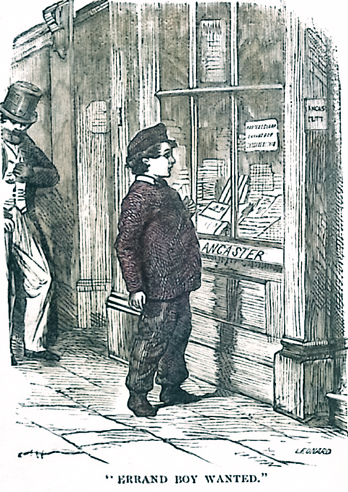
street in which there were a great many booksellers' shops, he read the
following notice in one of the windows:
"AN EXPERIENCED
ERRAND BOY WANTED.
Inquire within."
Ben did not quite understand the meaning of the word "experienced," but
he thought to himself he should do very well for an errand boy, and he
summoned up courage to go into the shop. There was no one in the part
that was near the door. But at the farther end, there was a sort of
little counting-house lighted by a skylight in the roof, and Ben could
see the heads of two or three people who were sitting writing at very
high desks.
He hardly liked to go and disturb them, and felt more than half
inclined to go out of the shop again. But a favourite saying of his
mother recurred to him,—
"A bad action is the only thing we need ever be afraid of."
And he walked up the long shop towards the little counting-house at the
end, feeling that he was not doing anything wrong, but was only anxious
to earn an honest living. He walked so quietly, and made so little
noise, that no one heard him approach. He stood still for a moment, and
then gave a modest little tap on the counter.
"What do you want?" said a gruff voice, the owner of which still kept
on writing, and never so much as raised his eyes from the desk.
"If you please, sir, there is an errand boy wanted here, isn't there?"
"Umph, yes," and a pair of very industrious eyes peered down upon Ben.
"How old are you?"
"Twelve, sir."
"What situations have you held?"
"Please, sir, I have never been in one at all yet; but I have been to
school, and I can read and write, and—"
"That's enough; it is a pity you could not read that we wanted 'an
experienced errand boy,' and not one who knows nothing."
"Do you not think I will do then, sir?" asked Ben, in a sad tone. "I
would do my best."
"And that would be but bad, I reckon; no, you won't do."
Ben felt quite disheartened, and was about to turn round and retrace
his steps down the long shop when one of the other heads looked down on
him with a sharp glance. This head was covered with very grey hair, and
a pair of spectacles was pushed high up on the forehead.
"Where do you live, my boy, and what is your name?"
The voice was rather stern, but much less harsh than the former one.
"My name is Ben Holt, sir, and I live in White Horse Alley, No. 2,
three pair back."
There was a noise in the little counting-house like the pushing back of
a stool, and then the grey-headed gentleman came out into the shop, and
looked attentively at Ben.
The two clerks in the counting-house left off writing, and both gazed
into the shop to see what their master wanted with the boy; for the old
gentleman in spectacles was the master of the shop, and the man with
the harsh voice was only the foreman.
"Did you ever see me before, Ben Holt?"
Ben looked at the speaker: but although there was something in his
face and in the tone of his voice that seemed familiar, he could not
recollect whether he had seen him before or not.
"Then my memory is better than yours, youngster, and it is lucky for
you that it is. Did you ever pick up a humming-top, Ben?"
"Oh, sir, I recollect you now; you are the kind gentleman who saved me
from being taken up by the policeman."
"The same," said the old gentleman, with a smile; "and do you remember
my saying to you, that you would live to find the value of the good
name you then began to earn for yourself?"
"Yes, sir," said Ben, "I remember it all."
"Well, my boy, I should like to prove to you the truth of my words. We
want an errand boy, one who has had some experience if possible. You
have had none, you say—that is against you certainly; but I weigh your
good name against your inexperience, and feel inclined to try you. At
all events, I will call and talk it over with your mother some time
to-day or to-morrow. Tell her she may expect me."
Ben scarcely knew how to express his thanks; his little heart was very
full.
But the gentleman seemed to understand it all, and went back into his
counting-house.
And then Ben soon found his way into the street, and ran home as fast
as he could.
Mr. Lancaster, the bookseller, called according to promise, and had a
long conversation with Ben's mother, the result of which was that he
agreed to take Ben for a month on trial, at five shillings a week.
"We want a boy whom we can trust, Mrs. Holt," continued Mr. Lancaster.
"And although it would have been a great advantage if Ben had been
more experienced, and had known town well, still I am quite willing to
waive that point, in consideration of his good character. It is a great
thing for a boy to begin life as you are doing, with a good name,"
said he, turning to Ben, who was standing by, with a face radiant
with happiness. "And I wish you to feel that it is so; it will be the
greatest possible incentive to your future good conduct. What do you
say to beginning work to-morrow? Are you ready?"
Ben was quite ready, and entered on his new duties the very next day.
His good character had preceded him, and he found that the foreman and
shopmen all treated him with considerate kindness. Mr. Lancaster had
told them that Ben was an honest, trustworthy lad; and although he was
but an errand boy, they felt that respect for him which good conduct is
always sure to inspire.
Ben had to work very, very hard, and walk many miles every day.
Often, when he got home at night, his legs would ache so much that
he could have cried with the pain. But he was a brave boy, and bore
it all without a murmur, and his mother never knew what he suffered.
Before the month had expired, however, he had become accustomed to the
exercise, and his legs no longer pained him, whilst being so much in
the open air was rather good for him than otherwise. He gave his master
so much satisfaction during the month's trial that at the expiration of
the time, he was regularly engaged by Mr. Lancaster.
The shopmen too, liked Ben, who was always ready to oblige them, and
was so civil and good-tempered that they never heard him complain. He
became such a favourite with them that they frequently gave him a good
meal when they were having their own dinner or tea. All this was a
great help, and Ben regularly carried home his five shillings to his
mother on Saturday night.
Mrs. Holt, after buying him what clothes he required, put the remainder
into the savings' bank, to make a little fund for her boy, should an
opportunity occur at any future time of binding him to some good trade.
Mr. Lancaster was a very rich man, and had a beautiful country house
near London. He used to go down to it every night, and come into
business every morning. And two or three times during the summer, he
made it a practice to invite his shopmen by turns to go down to his
country house on Saturday night after business was over, and spend a
pleasant Sunday in the country.
Ben and his mother also spent two happy Sundays at Oakfield—that was
the name of the place—for Mr. Lancaster thought a little fresh air
would do the poor hard-working needlewoman good. There was a small
farm-house on his property, and in it were two bed-rooms always kept
expressly for the accommodation of his humble guests, and they were
very seldom empty during the summer months. Many a sick child belonging
to some of his London workpeople has recovered health and strength by
a week or two in the pure country air at Oakfield; and many a delicate
wife and mother, unable to afford the expense of change of air, has
been restored to her family after a fortnight's rest and good living
at the farm-house at Oakfield. No wonder that Mr. Lancaster's name was
spoken with blessings by all who knew him.
Mr. Lancaster soon discovered that Ben was fond of reading, and he lent
him instructive and entertaining books for him to read when at home.
So Ben's education did not cease because he had left school and was
earning his living. Every boy can improve himself greatly by devoting
an hour or two each evening to reading and writing. Such profitable
occupation is far better than idly lounging away the time, as many boys
do when they go home from work.
And so time passed on, until Ben was nearly fifteen years old, when Mr.
Lancaster offered to take him as a counter lad in place of one who had
lately left. This was a great rise for Ben; he had now eight shillings
a week, and many opportunities of improving himself. He had grown very
much the last two years, and was no longer small for his age, and he
had been enabled to preserve his good name amidst all the numberless
temptations of a London errand boy's life. But then he had not trusted
in his own strength to keep him from falling, and that was the secret
of his success.
"Hold Thou me up, and I shall be safe," was Ben's constant daily prayer
to the throne of grace.
And God heard the prayer, and answered it.
Ben's only care was about his mother. Her health had been failing
for some months; and although she never complained, but worked on as
industriously as usual, Ben saw that she became thinner and paler
every day. And it was not now on account of not having sufficient
nourishment, for Ben had insisted on her using part of his wages, and
she had plenty of good food. Still she did not get strong. She had
spent a fortnight at Oakfield Farm, and whilst there, her strength
seemed to return. But immediately on her return to White Horse Alley it
failed again, and Ben became seriously uneasy.
"I want to talk to you about your mother, Ben," said Mr. Lancaster one
morning.
Ben turned pale. His master then had likewise noticed the change in her
looks; if so, she must be very ill.
"She is not looking well, lately."
"No, indeed, sir," said Ben, the tears starting to his eyes.
"She ought to live in the country."
"She could not manage that, sir, on account of working for the shop."
"I have been thinking about the matter, Ben," said his master; "and I
have a proposal to make to her. You know the little ivy-covered lodge
at the entrance to my grounds? Well, I want some one to live in it, and
answer the gate. If your mother would like it, she shall have the lodge
rent free and five shillings a week, for I suppose you would be wanting
to spend your Sundays at Oakfield then?"
Ben wept, and seized his kind master's hand, but he could not speak a
word.
"There, there, set off home and consult her at once, boy, and let me
know before I leave business this evening."
"How can I thank you sufficiently, sir?" said poor Mrs. Holt, about an
hour afterwards, when she had accompanied Ben back to his master's shop.
"You owe me no thanks, Mrs. Holt. I want a steady, trustworthy person
to keep my lodge, and I know you to be such. You must thank your own
and your son's 'good name,' and above all that God who has enabled you
to make yourself respected."
In less than a fortnight, Mrs. Holt was happily settled in the pretty
ivy-covered lodge, and Ben was taken by his master to live at the shop
in London. Every Saturday evening, he walked down to Oakfield to spend
Sunday with his mother, whose health was soon completely restored. Ben
continued to rise in his master's esteem, and soon began to attend
an evening school where he learned bookkeeping. He did this by Mr.
Lancaster's advice, and before he was twenty, became one of the junior
clerks in the business, and used to sit perched up on one of those high
stools on which the foreman sat on that memorable day, nearly eight
years before, when Ben had so timidly walked up the long shop.
————————————————————————————————————————
Pardon & Sons, Printers, Paternoster Row, London.