BEN BRUCE:
SCENES IN THE LIFE OF A BOWERY NEWSBOY.
“Come here, you, sir!”
These words were spoken in a stern voice by
Jacob Winter, and emphasized by a heavy frown.
The speaker was rather an undersized man, with
a rugged, weather-beaten face. He had seen but
fifty years, though his wrinkles and bowed
shoulders indicated ten more.
The boy addressed had a bright, intelligent face
and a fearless look. Ben Bruce detected the
danger signals in the tone and face of his stepfather,
but without a sign of hesitation he walked
up to the farmer, and responded, “Here I am,
sir.”
The man seemed aching to lay hold of the fearless
boy, but something in his steadfast look appeared
to deter him.
“Ain’t you ashamed of yourself, sir?” exploded
Jacob Winters.
“Please let me know what I am to be ashamed
of, Mr. Winter.”
“Ez if you didn’t know,” ejaculated Jacob.
“I don’t know.”
“Then I’ll tell you. Yesterday when I was
away drivin’ your mother to the sewin’ circle two
tramps came to the door, and you took it upon
yourself to give ’em a loaf of bread and a pint of
milk. Deny it if you dare!”
“I don’t deny it,” answered Ben boldly.
“You don’t!”
“No, why should I?”
“That’s the way my substance is wasted on the
shiftless and undeservin’!”
“Mr. Winter, the two tramps, as you call them,
were hungry, thin, and miserable. The man
looked as if he had just got up from a fit of sickness.
The boy was about ten and looked pale and
famished. Wouldn’t you have given them something
if you had been in my place?”
“No, I wouldn’t,” snarled Jacob.
“Then it seems to me you are the one that
ought to feel ashamed.”
“What? what?” gasped Jacob, aghast.
“You dare to stand there, Benjamin Bruce, and
tell me to my face that I’d ought to be ashamed.
You a mere boy, and I your stepfather!”
“I can’t help it if you are my stepfather. I’m
sorry enough for it. If my mother had taken my
advice she wouldn’t have married you.”
“Wuss and wuss!” ejaculated Jacob. “I
didn’t know you was such a bad boy. You’ll
come to the gallows some day, see if you
don’t!”
“Look here, Mr. Winter; you call yourself a
Christian, don’t you?”
“Of course I do. I’ve been a member of the
church for nine and thirty years.”
“And you believe in the Bible, don’t you?”
“I won’t answer your impudent question.”
“Yet,” continued Ben, “you blame me for
feeding the hungry.”
“You fed ’em with my provisions,” snarled
Jacob.
“Well, I’ll make it up to you. I’ll go without
my supper.”
“You’ve a mighty independent way of talkin’,
Benjamin Bruce, you that I feed and clothe.”
“I do work enough to pay for my keeping, Mr.
Winter. Besides, you forget that you have got
my mother’s money, which if she hadn’t married
you would have been part mine.”
Jacob Winter winced. It was true that Mrs.
Bruce had brought him two thousand dollars,
which he had coolly deposited to his own account
in a savings bank.
“That ain’t any of your business,” he said.
“Now go out and feed the cows, and mind you
don’t throw away any of my substance agin on
beggars.”
Ben left the room without a reply, but his lip
curled, for he thoroughly despised his stepfather
for his meanness.
On the way to the barn he fell in with his
mother, who was returning from the village.
“What’s the matter, Ben?” she said, for she
saw signs of disturbance in her son’s face.
“I have had a little conversation with Mr.
Winter.”
“Did he—scold you?”
“Yes, because I gave some bread and milk to
two poor people who called at the door yesterday.
Mother, if there’s a mean man in the world, it is
Jacob Winter.”
“Hush, Ben! Don’t speak so of your stepfather.”
“Mother, why did you marry him? Why did
you make him my stepfather?”
Mrs. Winter looked troubled.
“I—I thought it was for the best, Ben,” she
faltered. “We had so little, and he was rich.”
“Then you didn’t marry him from affection?”
“No, no; he understood that.”
“I am glad of that, mother. You made a mistake.”
“It may be so, but I must make the best of it.”
“We could have got along on what money you
had and what I could earn, and we should have
been far happier by ourselves, mother.”
“Don’t say any more. The past cannot be
recalled.”
“You mustn’t blame me if I don’t stay here
very long, mother. I can’t stand Mr. Winter and
his mean, tyrannical ways.”
“Oh, Ben, you wouldn’t go away and leave
me?”
“If I do it will only be that I may get on in
the world, and offer you a better home than you
have now.”
“But you are only a boy, only fifteen years old.
You must stay here till you have got an education.
You have graduated from the grammar
school, and are now ready for the high school.”
“I don’t think Mr. Winter will allow me to
go.”
“Why do you say that?”
“Because Albert Graham heard Mr. Winter
tell his father that he thought I had education
enough, and he was going to keep me at home to
work on the farm.”
“Are you sure of that?” asked Mrs. Winter
in agitation.
“Yes; I know Albert wouldn’t say so if it
wasn’t so.”
“But he promised me when we married that
you should have a good education.”
“He doesn’t always keep his promises.”
“If he hadn’t agreed to this I wouldn’t have
married him.”
“Then I wish he hadn’t agreed to it. You will
see that I am right. Next Monday the high
school will begin its term.”
“Why don’t you go and fodder the cows, as I
told you?” came in a shrill voice from an open
window.
Mother and son looked toward it and saw the
frowning face of Jacob Winter peering out.
“I was talking to my mother,” answered Ben.
“You’d better wait till you have more time,”
growled the farmer.
Ben did not reply, but went on his way to the
barn, while Mrs. Winter entered the house.
“Mrs. Winter,” said her husband fretfully,
“that boy of yours is gettin’ very impudent and
sassy.”
“I hadn’t observed it,” she answered coldly.
“You’re his mother, and you think he’s an
angel.”
“There are no angels in this house, Mr.
Winter,” said his wife significantly.
“Is that meant as a personal reflection on me,
Mrs. Winter?”
“No more than on myself.”
“Well, well, I am glad you didn’t mean any
offense. But I’m serious about Ben. I’ve left
him in your hands too long. I’m goin’ to manage
him myself now.”
“Then, Mr. Winter, I have one thing to say.
Ben is not a bad boy, but he has spirit, and if you
undertake to drive him he will be sure to rebel.”
“You needn’t worry about that, Mrs. W. He
ain’t nothing but a boy, and if I can’t manage
him I’ll give up.”
“He may be nothing but a boy, but he has his
rights. You must bear in mind your promise to
me before we married.”
“What promise do you refer to, Mrs. W.?”
“That he should have an education.”
“Well, ain’t he been to school ever since, and
now he’s gradooated.”
“At the grammar school. He is now ready
for the high school.”
“He ain’t a-goin’ to the high school.”
“Do you mean that, Mr. Winter?” said his
wife with an angry flush upon her cheek.
“Certainly I do. He’s got to work on the
farm. He knows all he need to. He’s as well
eddicated as I am.”
“I admit that, but——”
“Say no more, Mrs. W. I’ve put my foot
down, and the thing is settled. He shan’t go to
the high school.”
CHAPTER II. BEN WITNESSES AN EXPLOSION.
After attending to his chores, Ben decided to
take a walk—not in the direction of the village,
but away from it. A quarter of a mile to the
westward there was a river with a rapid current
which had yielded Ben plenty of enjoyment in
the way of fishing and boating.
Across from shore to shore was a dam, by means
of which the water was made available for a factory
for the manufacture of leather board. The
superintendent of this factory, a Mr. Foster, was
one of Ben’s special friends.
Ben overtook the superintendent sauntering
along beside the river.
“How are you, Ben?” said the superintendent
kindly.
“Very well, thank you, Mr. Foster.”
“You are going to the high school next term,
I suppose.”
“I expected to do so, but I am likely to be disappointed.”
“How is that?”
“My stepfather, Jacob Winter, is not in favor
of my going.”
“What is his reason?”
“I suppose he wants me to work on the farm.”
“And you don’t like farming?”
“No. I hope you won’t think I don’t like work,
Mr. Foster, for I enjoy nothing better; but to
work on a farm, and especially under Mr. Winter,
would be very disagreeable to me.”
“How would you like to work in the factory?”
“Much better than on the farm, but I will say
frankly that I have not secured the education
which I desire, and I shall be much disappointed
if I can’t go to the high school.”
“You were always fond of study, Ben. My
boys don’t care much for it. Well, I suppose
tastes differ. Have you ever thought of your
future?”
“I have thought of it a good deal. A good
many things will be open to me if I am well educated,
which would otherwise be closed to me.”
“I see, and I understand why you want a better
education.”
“I am not likely to get it, however. If the
choice lies between working on a farm and working
in your factory, I will work for you if I can
get the chance. The wages I got would hire a
boy to work on the farm, and there are boys who
would be willing to do it.”
“We employ about thirty at present, but I
could make room for a boy of your age and ability.
What pay would you want?”
“It is for you to fix that.”
“I might give you five dollars a week to begin
with.”
“That would be satisfactory. Would I be preparing
myself for higher work?”
“Yes, I would put you in the way of that.”
“I would certainly rather work for you than
for Mr. Winter.”
“I am to consider that a compliment, I suppose?”
“Yes, but not much of a one. Any one would
be better than Jacob Winter.”
“Man proposes, but God disposes.” Even
while they were talking unseen forces were at
work which were to defeat all their plans. Suddenly,
as they stood on the river bank, a strange
rumbling noise was heard, and before their astonished
eyes there rose into the air fragments of
wood mingled with stones and dirt, like a volcanic
eruption.
“Good Heavens!” exclaimed the superintendent
in great excitement, “the dam has been undermined
and blown up!”
“But how?”
“It must be by dynamite or giant powder.”
“But who could have done it?”
“I dismissed two workmen two weeks since.
They must have done it from revenge.”
“And what will be the consequence?”
“The factory must shut down till the dam is
rebuilt.”
“And then ends my hopes of employment
under you?”
“I am sorry to say—yes.”
“I wish that were all the harm likely to come
of it. Will it take long to repair the dam?”
“A good while, I fear.”
“At any rate, one thing I am resolved upon.
I won’t work for Mr. Winter. I will run away
first.”
Ben’s face assumed a look of resolution as he
left the superintendent and wended his way back
to the farmhouse.
CHAPTER III. MR. WINTER’S SAVINGS BANK.
There was very little conversation at the supper
table after Ben had told the story of the explosion.
Mrs. Winter was indignant at her husband’s
breaking his promise to her that Ben should
receive a thorough education. She had not yet
had an opportunity to tell Ben, but she did so
after the meal, when Mr. Winter had gone out to
visit a neighbor.
“Ben,” she said, “you are not to go to the
high school.”
“Who says so, mother?”
“Mr. Winter.”
“Does he give any reason?”
“He says you have had education enough, that
you are as well educated as himself.”
“Did he say educated?” asked Ben with a
twinkle in his eye.
“Well, he said ‘eddicated,’” responded his
mother with a faint smile.
“So, I suppose. He is right there. I should
be very sorry if I hadn’t as much education as he.
He cares more for money than books, and always
did.”
“I am very sorry, Ben.”
“So am I. I need education to help me succeed
in life. I suppose he expects me to stay at
home and help him on the farm.”
“So he says.”
“Then,” said Ben quietly, “he will be disappointed.”
“But Ben, what can you do?”
“I can leave home and seek my fortune elsewhere.”
Mrs. Winter looked very sober.
“I don’t believe you know what you are undertaking,
Ben,” she said. “You will have a hard
time.”
“I expect to—at first.”
“Besides Mr. Winter won’t let you go, I am
afraid.”
“He can’t stop me. I would rather stay at
home if he would let me go to the high school.”
“I don’t think I can persuade him to do
that.”
“Then, mother, I must leave you.”
“Don’t go without letting me know.”
“I won’t, mother, I will let him know too. I
am not going to run away. I’ll give him fair
warning of my intention. Now, mother, if you’ll
excuse me I’ll go over and tell Albert Graham
about my plans.”
Albert lived not more than half a mile away.
He was about as old as Ben, but at least two
inches shorter. The two were great chums. To
him Ben communicated his purpose.
“Where do you talk of going?” asked Albert.
“To New York.”
“Ain’t you afraid to go alone to such a big
city?”
“No; why should I be?”
“There are a good many bad people there, I’ve
heard.”
“And still more good people. I think I shall
have a better chance in a large city than in the
country.”
“How far away is New York?”
“It is a little more than two hundred miles
from Boston.”
“And we are fifty miles from Boston. Won’t
it cost a good deal to go there?”
“No; there is a rivalry between the steamboat
lines and the fare has been put down to one
dollar.”
This statement, which may surprise some of my
readers, was strictly correct. For a short time,
some years ago, it was possible to travel between
these two cities for this small sum.
“It will cost a dollar and a quarter to get to
Boston from here.”
“I know it.”
“Are you well provided with money, Ben?”
“Not very.”
“Then I tell you what I’ll do. I’ll lend you
five dollars.”
“But how do you happen to have as much,
Albert?”
“You know I rode as a jockey at the last agricultural
fair. I was to get ten dollars if I succeeded
in winning the race, and you know I did
win.”
“Yes, I know.”
“So I can lend you the money as well as not.”
“You are a good fellow, Albert, but I don’t
think I ought to take the money.”
“Oh, you can pay it back—with interest, if
you insist upon it.”
“Thank you, Albert. I won’t refuse so kind
an offer. My mother would let me have the
money, but she was foolish enough when she
married to give all she had to Mr. Winter, and
now he doles her out a quarter at a time, and she
has to ask for that. You won’t hardly believe me,
Albert, but she hasn’t had a new dress for a
year.”
“I can believe it fast enough. Jacob Winter
is the meanest man I ever heard of, and everybody
in town says so. I don’t blame you at all for
leaving him. Won’t you be sorry to be away
from your mother?”
“I can’t tell you how much I shall miss her,
Albert,” answered Ben, gravely, “but I hope to
provide her a better home some day. I can’t do
it by staying here. You must go over and see
her some time, Albert.”
“So I will. Of course you will write to
me.”
“Yes, if I have any good news.”
“By the way, Ben, how much money did your
mother have?”
“Two thousand dollars.”
“And she handed it all over to old Winter?
Excuse my speaking so disrespectfully of your
stepfather.”
“That won’t worry me any.”
“I suppose Mr. Winter is worth a good deal of
money?”
“I suppose so, but I don’t want any of it. I
only wish mother had back what she brought him
and could go with me to New York.”
“By the way, Ben, have you any idea what Mr.
Winter does with his money?”
“I suppose he puts it in the banks. I never
thought much about the matter.”
“Probably he does put some there, but I heard
that he was rather afraid of banks. Some years
ago a savings bank failed and he lost fifty dollars,
so I heard.”
“That accounts for it.”
“Accounts for what?”
“For what I am going to tell you. Last
Wednesday evening I was crossing the four-acre
lot—a part of Mr. Winter’s farm—when I saw him
coming across the field with a box in his hand.
It was rather dark, so he could not see me very
well, for you know he is short-sighted.
“I had a curiosity to find out what he was going
to do, so I followed him. Oh, I forgot to say
that he had a spade in his hand. Well, when he
got to the big oak tree about the center of the
place he halted. There was a smaller tree near
by, and I hid behind it so I could see what he
was doing.”
“What did he do?” asked Ben, who was by
this time intensely interested.
“He began to dig, and kept on till he had dug
a hole about two feet deep. Then he took the
box and put it down in the hole and covered it
up with dirt. After finishing he got a little
brushwood and laid it down careless like over the
spot so as to hide the dirt, and then went away,
without knowing that any one had seen him.”
“What do you think was in the box, Albert?”
asked Ben, in excitement.
“Money,” answered Albert, sententiously.
“It may have been gold or silver or bills. I
didn’t see the contents of the box and so of course
I can’t tell.”
“It seems to me he was very foolish to put his
money there.”
“So I think, but he was scared by the failure
of the savings bank and was afraid to trust them
any more.”
“The money would be safer in any savings
bank than in a hole where anybody could dig it
up.”
“That’s the way I feel about it. I wonder if
that is the only hiding place he has for his gold.”
“Albert, when it gets a little darker suppose
we go out to see the place. I feel some curiosity
on the subject.”
“All right, Ben, I’ll go. Just go round to the
store with me. I have a few things to buy for
mother. Then we’ll start across the fields.”
“All right.”
When they reached Albert’s house from the
store it was too early for their expedition. So
Albert proposed a game of checkers. They played
two, and when the second was completed the
church clock pealed out the hour of nine.
“We must go at once or it will be too late,”
said Ben.
“It isn’t very far.”
They went out of the house and struck across
the fields.
“This is just about the hour I came last
Wednesday evening,” said Albert.
They neared the tree, when suddenly Albert
uttered an exclamation:
“By gracious, Ben,” he said, clutching his
companion by the arm, “if there isn’t old Winter
coming again. He hasn’t got a box, but he has a
spade in his hand. I wonder what he’s up to now.
Come with me, and we’ll get behind the other
tree and watch. Don’t cough or make any noise.
We don’t want him to see us.”
CHAPTER IV. AN EXCITING ENCOUNTER.
From their place of concealment the two boys
watched attentively. They were rather mystified
as to Mr. Winter’s intentions. It occurred to
them, however, that he might have in his pocket
some gold coins to add to the hoard underneath.
At any rate he began to dig, occasionally pausing
to rest, for he was not very robust, and the
labor of digging affected his back.
At last he reached the box, and getting down
on his knees, pulled it out of the hole.
He raised the cover and began to count the
contents. These contents consisted entirely of
gold pieces.
In a low voice, which, however, was audible to the boys, he counted
“Ninety-six,
ninety-seven, ninety-eight, ninety-nine.”
Then in an alarmed tone he added: “There’s
one short. There ought to be a hundred, making
five hundred dollars—can any one have found
the box and taken one out? I’ll count again.”
Once more he counted, and this time he made
full number, much to his relief.
Then from his vest-pocket he drew out two
more gold pieces and added them to the pile.
“That makes a hundred and two,” he said in
a tone of satisfaction.
He was preparing to replace the box in its place
of concealment when something unexpected happened.
An ill-looking fellow, a tramp in appearance,
who had crept up without being observed either
by Mr. Winter or the boys, suddenly sprang out
from behind a large tree, and throwing himself
upon the old farmer tried to pull the box from
him.
“Gimme that money, old man!” he cried in a
hoarse voice, “or I’ll kill ye!”
Jacob Winter uttered a cry of dismay, but he
clung to the box.
“Go away!” he gasped. “It’s my money.
I’ll have yer arrested.”
“Go ahead and do it, but I’ll take the money
first.”
The fellow’s fierce face was distinctly seen by
the boys. He was a man of about thirty, with a
coarse sensual look and blotched skin, the result,
doubtless, of intemperate habits.
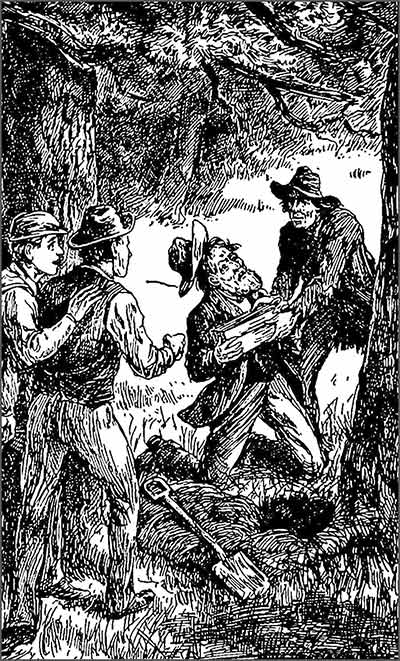
An ill-looking fellow suddenly sprang out from behind a tree and throwing
himself upon the old farmer, tried to pull the box from him.—Page 22.
Ben Bruce.
“Go away, you robber!” ejaculated the farmer,
clinging to his treasure with the energy of
despair.
He was evidently more afraid of losing
that than of receiving bodily injury, though the
wicked eyes of his assailant might well have
inspired physical apprehension.
The conflict was unequal. Mr. Winter was
probably sixty years of age, while his assailant
was only half that, and was a larger man in
every way.
“Look here, old man,” said the tramp, angered
by the farmer’s resistance, “you’d better
give up your money or you’ll get hurt!”
“I’ll send you to jail!” shrieked Jacob Winter.
“Maybe you will, if I don’t get away too
quick,” laughed the tramp.
“Aren’t you ashamed to rob a poor old
man?”
“Oh, I guess you’ve got some more money.
You won’t die in the poorhouse.”
By this time the man had got the box into his
hands, and now prepared to walk off with it.
“Help! help!” shrieked the farmer.
The tramp laughed.
“There ain’t no help near,” he said. “Go
home and go to bed, and thank your lucky stars
I didn’t brain ye.”
The two boys had listened in a fever of excitement.
Neither liked Jacob Winter, but all their
sympathies were with him. There was something
coarse and repulsive about the tramp, and
they could not bear to have him succeed.
“Are we going to stand this, Albert?” whispered
Ben.
“No.”
“Stand by me, and I’ll do what I can.”
Ben had already espied the spade, and had made
up his mind what he would do with it.
He sprang out from behind the tree, dashed
forward and seized the implement without being
heard by the tramp. With a look toward Albert,
whose help he expected to need, he made another
rush forward and fetched the unsuspecting robber
a blow upon the back of his head.
Though it was a boy’s blow it was a heavy
one, and with a cry of dismay the tramp dropped
the box and raised his hand to the injured
spot. Albert ran up, seized the box, and darted
back.
“Wha—what’s all this?” exclaimed the tramp,
turning back.
Knowing nothing of the presence
of the boys he was under the impression that the old man had
made the attack. He saw Jacob Winter looking
as much amazed as he felt himself. Then observing
the two boys, he quickly comprehended what
had taken place.
“Why you young cubs!” he cried, his face
looking fiercer and more threatening, “you must
be crazy. I’ll kill ye both.”
He sprang towards Albert Graham, for it was
Albert who held the box of treasure, and was
about to make an attack upon him. But he failed
to take account of Ben, who was still armed with
the dangerous spade.
Now Ben’s blood was up, and he was ready to
carry on hostilities. He had no intention of
deserting his young comrade.
He rushed up and dealt the tramp another blow,
heavier than the first, that literally laid him out.
He sank to the ground stunned, and temporarily
lost consciousness.
“Now, Mr. Winter,” said Ben, who seemed
naturally to take command, “take the box and
go to the house as quick as you can. I have
stunned the robber, but he’ll come to in a short
time and then we shall be in danger. Albert,
come with us.”
Jacob Winter said nothing, but it was clear
that he considered the advice good. He grasped
the box and started for home on a half run,
followed by the two boys. Not a word was said
till they reached the farmyard.
Then as he stopped to wipe the perspiration from
his face, he ejaculated, “Boys, this is terrible.”
“So it is,” said Ben, “but we’ve saved the
money.”
“Do you think you—you killed him?” asked
Jacob, with a shudder.
“No, I only stunned him. If I hadn’t we’d
have all been in danger.”
“He’s an awful man—looks as if he’d escaped
from State’s prison.”
“If he hasn’t he’s likely to go there. It’s
lucky we were there or you’d have lost your
money.”
“How did you happen to be there?” asked the
farmer, beginning to be curious.
“You see Albert and I were taking a walk. He
was going to see me part way home.”
“You weren’t spying on me, were you?” asked
Jacob in a tone of suspicion. “It kind of looks
like that.”
“No matter what it looks like, Mr. Winter, it
was lucky for you that we were around. That’s
all I’ve got to say.”
“Well, mebbe it was; mebbe it was.”
“But, Mr. Winter, don’t you think it’s risky
putting your money in such a place? Some one
would be sure to find it sooner or later.”
“I won’t put it there again,” muttered Jacob.
“Do you—see anythin’ of that man? Your
eyes are better than mine.”
“No, I don’t see him. I don’t believe he would
dare to follow us as far as the house.”
“I’ll go and report him to the constable first
thing to-morrow mornin’. I don’t feel safe with
such a man ’round. It’s gettin’ late, Ben. We’d
better be gettin’ to bed.”
“Albert, won’t you sleep with me to-night?
I don’t like to have you go home alone. You
might meet the tramp.”
“Yes, I guess I’ll stay, Ben. Mother won’t
be frightened. She’ll know I stayed with
you.”
“Yes, Albert, you can stay,” said Jacob with
unusual complaisance. “If—if that terrible
man comes in the night there’ll be three of us to
meet him.”
Usually Mr. Winter did not make any effort
to be agreeable to Ben’s friends, and under ordinary
circumstances he would have objected to
Ben’s having a boy stay with him, but fear had
softened his asperities and made him more amiable
than usual.
“Mr. Winter, will you let me take the gun
up to my room?” asked Ben.
“Do you know how to fire it?”
“Yes, sir.”
On several occasions when Mr. Winter was
away from home Ben had gone out gunning, and
in this way had learned how to manage firearms.
The farmer, however, did not ask any uncomfortable
or disagreeable questions, but asked,
“What do you want with the gun, Ben?”
“I thought the robber might come here in
the middle of the night, and I could fire at him
out of the window.”
“I don’t know as it’s prudent, Ben.”
“If you would rather fire at him yourself,
Mr. Winter, of course I won’t ask for the gun.”
“No, no,” said Jacob hastily, “you can take
it if you want to. But be keerful, be keerful!”
So Ben took the gun and carried it up to the
attic chamber where he and Albert were to sleep.
“Is it loaded, Ben?” asked Albert.
“Yes, it’s loaded with bird shot. I don’t want
to kill the man, but I’ll give him a scare.”
CHAPTER V. A MIDNIGHT CALL.
Probably no more astonished man lived than
the tramp when his consciousness returned and
he found himself lying on his back under the
big oak tree. He lifted himself on his elbow and
tried to remember what had happened.
“Something struck me,” he said. “What was
it and who did it?”
Even in his half-dazed state it never occurred
to him to think of Jacob Winter as his assailant.
“Ha! I remember now. It was the boys,”
he said after an effort of memory. “They’ve
got twice as much pluck as the old man. But
I’d like to smash ’em for all that. They’ve
stepped in between me and a good bit of money.
But I’ll have it yet.”
The tramp rose to his feet and began to take
an inventory of his bodily disabilities. His head
ached and felt sore, and there was a bruise where
he had been hit by the shovel. His limbs were all
right, however.
“I wonder how long I’ve been lying here,” he
thought, “and where that gold is?”
He was not long in deciding that the farmer
had carried the pieces home. He knew where
this was, for he had been lurking about the
town for a couple of days, and had made inquiries.
“I’d like to get it yet,” he said to himself. “I
might break into the house and carry it off.”
The more he thought of this the better the plan
pleased him. Without knowing positively he
thought it probable that Jacob Winter was the
only man in the house, and for his prowess he
felt absolute contempt.
“I’ll scare him out of his seven senses,” the
tramp concluded with an amused smile. “The
man is about as brave as a mouse.”
Of course it would not be prudent to make the
visit he meditated just yet. Towards twelve
o’clock there would be more chance of finding
everybody asleep.
Now let us go back to the attic room where
Ben and Albert Graham were snugly ensconced
in bed.
“I wonder whether he’ll come,” said Albert.
“That is uncertain,” returned Ben, “but if he
does we must be ready for him.”
“The trouble is, I’m terribly sleepy. He might
come and rummage all over the house without my
hearing him.”
“Then I’ll tell you what we’d better do. Do
you think you can stay awake for an hour?”
“Yes; I can if I set out to.”
“Then we’ll take turns sleeping. I’ll go to
sleep now, and when an hour has passed you
wake me up, and then I’ll keep watch. There’s
a clock in the room, and there are some matches
on the washstand in a box, so that you will know
when to call me.”
“All right! Can you go to sleep right off?”
“Yes; it won’t take many minutes.”
In less than five minutes Ben’s quiet breathing
was sufficient evidence that he was in the
land of dreams. Albert made a determined effort
and managed to keep awake till he thought
an hour must have been passed.
He got up, lit a match, and found that Ben
had been asleep an hour and a quarter in place
of an hour.
“What’s the matter? Is it morning?” asked
Ben drowsily when Albert shook him.
“No; but your time is out, and I want to take
a nap. You remember you are to watch for
the robber.”
“All right!” said Ben, now broad awake.
“Did I sleep an hour?”
“An hour and a quarter.”
“Is that so? It doesn’t seem more than five
minutes.”
“Do you think you can keep awake now,
Ben?”
“Yes; I can keep awake till midnight. If
he doesn’t come by that time he won’t come at
all. Then we can sleep, both of us, with an easy
mind.”
Ben had stipulated to sleep first because he felt
that the attack would be more likely to come after
half-past ten, when his vigil commenced, and he
preferred to deal directly with the robber himself.
After Albert was asleep he got up and examined
the gun to see if it was all right. Somehow he did
not feel sleepy at all now. He rather hoped his
acquaintance of the fields would come, for he was
a boy who was fond of excitement and adventure.
It would be a man against a boy, or rather
against two boys, for Ben did not count on much
help from his stepfather, but he did not feel afraid.
As Ben is my hero, I am rather pleased to say
that, though not foolhardy, he possessed a good
share of courage.
He lay in bed listening for any noise, but an
hour passed before his attention was roused.
Then a little sound as of something touching the
house enlisted his attention.
He got out of bed and went to the window. It
may be remarked that his room was directly
over that occupied by his stepfather. “By
gracious!” he exclaimed under his breath, “I
am just in time.”
A ladder was leaning against the house, and
half way up he saw his antagonist of the fields.
The ladder was so placed that the unauthorized
intruder could enter Mr. Winter’s chamber
through the open window.
“There’s no time to be lost!” thought Ben.
“I’ll get the gun.”
CHAPTER VI. A DISAPPOINTED BURGLAR.
Ben hesitated whether to address the burglar
or not before firing the gun. Certainly the
intruder had no claim to a warning, but Ben
decided to be generous and give him the chance
to retire in good order.
Accordingly, half leaning out of the window,
he called out: “What do you want here?”
The burglar was startled, but looking up and
seeing only a boy, he took courage, and his
native impudence asserted itself.
“Say, kid,” he responded, “where does the
old man sleep?”
“That is none of your business,” answered Ben
manfully.
“You’d better look out, or I’ll give you a lesson.
I know well enough. He sleeps in that room.”
“What do you want with him?”
“I want that gold. I am sure it is in his
chamber.”
“Go right down that ladder, or you’ll be
sorry.”
“I’ll throw you out of that window when I get
into the house.”
“I have given you warning. Will you go?”
“No, I won’t. What do you take me for?
You’re the most impudent kid I ever met.”
Ben wasted no more words upon the intruder,
but, thrusting the muzzle of the gun out of the
window, fired.
The birdshot took effect in the burglar’s face
and neck, and with a cry of surprise and dismay
he lost his grip and dropped to the ground,
upsetting the ladder in his fall.
At the sound of the discharge Albert awoke, as
did also Jacob Winter in the room below.
“What’s up, Ben?” cried Albert in excitement,
jumping out of bed.
“I am,” answered Ben coolly, “and now you
appear to be.”
“I mean what has happened?”
“I’ve shot a burglar.”
Albert rushed to the window and looked down.
So did Jacob Winter, who was frightened almost
out of his wits.
In a tremor of curiosity and alarm he thrust
his head out of the window, and asked, “Who’s
there?”
It was an unfortunate movement for him. The
burglar had risen from the ground, mad through
and through, and eager for revenge.
He intended first to wreak his vengeance upon
Ben, but seeing Mr. Winter’s protruding head,
changed his mind. He picked up a stone and fired
with only too accurate aim.
The stone hit Jacob Winter in the ear, and the
unhappy farmer, with a terrified cry, fell back
from the window and lay down on the floor.
“What’s the matter, Mr. Winter?” asked his
wife.
“I’m killed!” answered the farmer in agonizing
tones, clapping his hand to his injured organ.
“The tramp has shot me.”
He was too bewildered to observe that the
burglar had no weapon, and really believed for
the moment that he had been shot.
Mrs. Winter hastily lit the kerosene lamp and
went to the help of her husband.
“Where were you hit?” she asked.
“Here!” answered her husband in a hollow voice.
“The bullet must have gone to my brain.”
“What’s this?” she asked, picking up a
pebble. “This isn’t a bullet.”
“What is it?” he asked.
“Its only a pebble,” she answered. “You
have been hit with a stone.”
“It almost killed me,” said Jacob, but he felt
reassured.
“Who did it?”
“It’s that tramp, the man that tried to steal
my gold.”
At this moment there was a knock at the
door.
“There he is!” cried Jacob in fresh alarm.
“He’s got into the house and is forcing his way
into the chamber.”
“The door is bolted,” said his wife, “but I
don’t think it can be the robber.”
But Jacob Winter could not so readily give
up the idea.
“Go away, you, sir!” he called out in quavering
tones. “Go away or I’ll have you arrested.”
“It’s only I, Mr. Winter,” said a young voice
outside.
“It’s Ben.”
Feeling relieved, Mr. Winter himself opened
the door.
“Did you fire the gun, Ben?” he asked.
“Yes, Mr. Winter. The robber had the ladder
up against the house, and was going to get into
your window.”
“Where is he now? This is terrible!” groaned
the farmer.
“I peppered him with the gun, and I guess he’s
gone off.”
“He fired a rock at me. He ought to have fired
it at you. I wasn’t the one that shot him.”
“Is this the rock?” asked Ben, picking up the
pebble with a smile.
“Yes.”
“It ain’t very large.”
“Neither is a bullet, but it hurts me awfully.
Are you sure that man’s gone?”
“I’ll go to the window and see.”
Ben went to the open window and looked out.
By the partial light he could see the baffled
burglar in full retreat several hundred feet
distant.
“He’s gone, Mr. Winter. That is, he’s going.”
“He may come back. Where is the ladder?”
“Outside on the ground where it fell.”
“He may come back and try to climb up again.
You’d better go out and take it to the barn.”
“But the man might come back and hurt Ben,”
said Mrs. Winter anxiously.
“Don’t be afraid, mother. I’ll take the gun
with me, and Albert will come and help me.”
“Yes, yes, go, there’s a good boy!” said Jacob,
who was afraid his wife might expect him to go
himself. The very thought made him shudder.
Ben smiled a little at his stepfather’s evident
alarm, but had no thought of refusing the
service asked of him. Indeed he wanted to go
out.
“Come down, Albert!” he called at the foot
of the attic stairs. “I want you to help me take
away the ladder.”
“I’ll be down in a jiffy,” said Albert.
The two boys descended the stairs and went out
into the yard. They picked up the ladder and
carried it to the barn, in which they placed it.
“This is a regular lark!” said Albert. “I
wouldn’t have missed it for a dollar. How
does Mr. Winter take it?”
“He’s scared out of his wits.”
“It’s lucky there were two able-bodied men
on hand,” said Albert with a comical look, “or
the house would have been robbed. Has Mr.
Winter got the gold in his room?”
“Yes; I saw the box standing in one corner.”
“It’s lucky for us we ain’t rich. We needn’t
be afraid of burglars.”
At the breakfast table Mrs. Winter said, “I
do hope, Mr. Winter, you’ll take that gold to the
bank. We don’t want any more midnight
callers.”
“So I will,” answered her husband, with unwonted
meekness, “but—but suppose the robber
should stop me on the way.”
The savings bank was in the next town.
“Take me with you, Mr. Winter,” suggested
Ben. “I guess you and I will be more than
a match for the robber.”
“I don’t know but I will, Ben,” said Jacob,
relieved at the suggestion. “Of course you are
only a boy, but——”
“I can hold the horse while you are fighting
the robber,” put in Ben, his eyes twinkling with
suppressed fun.
“That’s so,” said Jacob, coughing, but he
looked a little alarmed at the suggestion.
“Shall I take the gun with me?”
“Well, perhaps you may as well. What will
you carry the gold in?”
“There’s an empty butter keg in the shed,”
said Mrs. Winter.
“We’ll put the money in that, and people
will think it’s a keg of butter,” remarked
Ben.
“That’s a good plan. Be sure to load the gun
before you set out.”
“I’ve attended to that already, Mr. Winter.”
Soon after breakfast the buggy came around to
the door and Ben and his stepfather got in, the
latter carrying the keg with its important contents.
They reached the next town, only five miles
away, and drove at once to the savings bank.
“I don’t know as the bank is safe,” said Jacob
Winter, “but it’s better to have my money here
than where robbers can get at it.”
“I agree with you, Mr. Winter.”
The money was handed to the receiving teller
of the savings bank, and Jacob received a bank
book, which he put into his pocket with a sigh of
relief. In the bank Ben picked up a copy of a
Boston daily paper, and read the following paragraph:
The low price of tickets to New York since the last cut of
the steamboat lines has greatly increased the volume of travel.
There are few who cannot afford the journey, now that the
fare has been reduced to one dollar.
“Only one dollar to New York!” thought Ben.
“Now is my time to go, if ever!”
CHAPTER VII. BEN FORMS A SUDDEN DETERMINATION.
Jacob Winter felt, though he hardly liked
to confess it, that but for Ben he would have
been the loser of five hundred dollars. He was
not a liberal man, but he determined to make some
acknowledgment of his stepson’s services.
Accordingly, when he had returned from the
savings bank, he drew a twenty-five cent piece
from his pocket and handed it to Ben with the
remark: “Benjamin, you have behaved very
well. Here is a quarter for you. Be keerful not
to spend it foolishly.”
Ben was considerably surprised. It was the
first gift he ever remembered to have received
from his stepfather, and he hardly knew whether
to be amused or grateful.
If he accepted it, he knew that Mr. Winter
would feel that he had squared up his obligations.
But Ben preferred to leave the matter open. So
he quickly decided not to accept the money.
“Thank you, Mr. Winter,” he said, “but I
would rather not take it.”
“You refuse money!” exclaimed Jacob in
amazement.
“Yes, sir. I only did my duty.”
“I guess you’d better take it. Quarters don’t
grow on every bush.”
“They don’t for me, Mr. Winter,” said Ben
smiling. “I’m just as much obliged, but I would
rather not take any money for what I’ve done.
It was good fun.”
“Good fun!” ejaculated his stepfather. “It
isn’t my idea of fun to have a ruffian try to rob
me.”
“Well, he didn’t make much out of his attempt.
I don’t care for the money, Mr. Winter, but I’ll
ask something else instead.”
“What is it?” asked Jacob cautiously.
“I want to leave the farm and go to New York.”
“Go to New York! You—a mere boy! What
do you want to go to New York for?”
“I want to get work.”
“There’s plenty of work here, Benjamin.”
“I know there is, but it isn’t the kind I like.
I should never be a successful farmer.”
“It wasn’t exactly the farmin’ business I meant
to put you to.”
“What then?” asked Ben, whose turn it was
to be surprised.
“Silas Flack has made an offer to take you and
teach you the shoemakin’ business. I did at first
think of havin’ you work on the farm, but I guess
you might as well learn the shoemakin’?”
“When did he make the offer, Mr. Winter?”
“Day afore yesterday.”
“And why didn’t you speak to me about it
before?”
“You’re too young to know what’s good for
yourself.”
“But I have no wish to learn shoemaking.”
“Boys like you don’t seem to realize that they
must earn their livin’.”
“I am ready to earn my living, but I want to
have something to say about the way I am to
earn it. I intend to make my living in New
York.”
“I can’t let you go. I’ve given my word to
Silas Flack.”
Ben was exasperated, but they had reached the
farm, and he concluded to take a short time to
think over his stepfather’s proposal. One thing
he determined upon, and that was to see Mr.
Flack and find out what negotiations had passed
between the shoemaker and Mr. Winter.
In the middle of the afternoon, being sent on an
errand, he went a little out of his way to visit
Silas Flack’s shop. It was a tiny place, for Silas
did business only in a small way. Entering the
shop he began:
“Good day, Mr. Flack.”
“Good day, Ben,” answered the shoemaker,
resting his eye approvingly on Ben’s sturdy frame
and bright, honest face.
“I called to see what proposal you made to Mr.
Winter about me,” said Ben abruptly. “You
promised to teach me the business, didn’t you?”
“Yes; I agreed to take you till you were twenty-one.”
“And Mr. Winter thought favorable of it, did
he?”
“Yes; he said you might come.”
“What benefit is Mr. Winter to get out of it?”
asked Ben.
“How old be you now?”
“Fifteen.”
“Well, I agreed to take care of you till you
were twenty-one, and pay him fifty dollars a year
over and above for your services. Seems to me
that’s a fair offer.”
“Oho!” thought Ben, “now I understand.
It’s the fifty dollars a year that Jacob Winter is
after. Money is his idol, and he expects to make
about three hundred dollars out of me.”
“Did Mr. Winter tell you I would come?” he
asked after a pause.
“Yes; he said it struck him favorable.”
“But I don’t like the business, Mr. Flack.”
“That’s only a boy’s idee. You may as well
make your livin’ that way as any other.”
“When did Mr. Winter say I could begin?”
“The first week in September.”
“That’s the time the high school commences.
I was expecting to attend there.”
“Jacob Winter thinks you’ve got eddication
enough. You’ve got as much as he or I.”
“Didn’t you ever think you would like to know
more than you do, Mr. Flack?”
“What’s the good? I know enough for my
business, and I’m gen’rally respected in town.
I’ve been selec’man once, and I’m overseer of the
poor now.”
Ben smiled. He saw that Mr. Flack was well
satisfied with his success in life, but he felt within
himself yearnings and aspirations which probably
were unknown to the shoemaker.
“Well, good day, Mr. Flack!” he said after a
brief pause.
“Good day, Ben! I guess you and me will get
along well. I’ve heard that you are good to
work, and I’ll do the right thing by you. Besides
what I promised your stepfather, I’ll give you a
new suit of clothes when you are twenty-one, and
after that you can get good wages, as much as a
dollar-fifty per day likely.”
“I’ll think over what you have said, Mr. Flack,”
said Ben gravely.
He turned and left the shop. He felt that he
had reached an important point in his life. He
resented the utter selfishness which actuated his
stepfather in thus mapping out his future life,
dooming him to an uncongenial occupation for the
paltry sum of fifty dollars a year paid to himself.
Had Jacob Winter been a poor man, there
would have been some excuse for his course, but
he was far from being poor. There were no very
rich men in Wrayburn, but he was one of the
most prominent in the amount of his worldly
possessions.
Moreover, he had managed to get into his
possession the two thousand dollars belonging to
his mother. And it was for a paltry fifty dollars
a year that Ben was to be deprived of the advantages
of a high-school education.
“It’s a shame!” he cried hotly.
“What’s a shame, Ben?”
Turning around Ben recognized in the speaker
his friend, Albert Graham.
“Was I speaking aloud?” Ben asked.
“Yes, and with considerable emphasis. What
is it all about?”
“I find my precious stepfather has agreed to
bind me apprentice to Silas Flack, the shoemaker,
in consideration of fifty dollars a year paid to him
annually till I am twenty-one.”
“You don’t mean it, Ben?”
“Yes, it’s true. Mr. Winter told me himself,
though he didn’t speak of the fifty dollars. That
was told me by Mr. Flack.”
“I don’t wonder you call it a shame,” said
Albert warmly.
“That is why Mr. Winter isn’t willing to have
me attend the high school; that wouldn’t bring
him in any money.”
“I see. Have you told your mother about it
yet?”
“No, but I shall as soon as I go home.”
“Then you are to grow up a shoemaker, Ben?”
“Not much,” exclaimed Ben decidedly. “Mr.
Winter hasn’t got my consent.”
“What will you do?”
“Go to New York.”
“Won’t he try to stop you?”
“Perhaps so,” said Ben quietly, “but I shall go
all the same.”
“Well, I can’t blame you, Ben. You weren’t
cut out for a shoemaker.”
“Nor for a farmer either. I feel that I must
take the responsibility into my own hands.”
“When are you going to start and what are
your plans?”
“I shall start as soon as I can. I find that I
can go to New York from Boston for a dollar,
and I shall never have any better chance.”
“You will take the five dollars I offered you,
Ben?”
“Yes, Albert, as a loan, and thank you for your
friendly aid. If ever I can do you a favor I will.”
In reply Albert held out his hand, and the two
boys interchanged a hearty grasp.
“Well, Ben, you have my best wishes, you
know that. You will be sure to write me?”
“Yes, Albert. I will write to you and to my
mother.”
Ben had a conference with his mother and
obtained her consent to his plan. She was as
angry as he at the cold-blooded selfishness of her
husband.
“I don’t know whether it’s best or not, Ben,”
she said, “but there seems to be no other way.
I begin to see my folly now in marrying Jacob
Winter.”
“In a few years, mother, I hope you can leave
him and come to live with me.”
The next morning when Mr. Winter went up to
Ben’s attic chamber to call him, he found that
the bird had flown.
CHAPTER VIII. BEN ARRIVES IN BOSTON.
Jacob Winter came bounding down-stairs
angry and bewildered. He sought out his wife
in the kitchen.
“What has become of Ben?” he demanded
abruptly.
Mrs. Winter turned and surveyed her husband
calmly.
“Why do you ask?” she inquired.
“Because I went up to call him just now and
found that his bed had not been slept in. Do
you think he went over to sleep with Albert
Graham?”
“He said nothing to me about going.”
“If he went without leave I will give him a
sound thrashing.”
“Threats are cheap, Mr. Winter,” said his wife
with something of contempt in her voice.
“What do you think has become of the boy,
Mrs. W.?”
“Probably he has gone away.”
“But where?”
“He found out yesterday that you had apprenticed
him without his permission to Silas Flack.”
“He found out because I told him so.”
“Very well, he has no taste for shoemaking.”
“Or for any other kind of work.”
“That is not true, Mr. Winter, and you know
it. Ben is industrious, but he wants to be consulted
about his occupation.”
“Why, isn’t shoemaking a good business?”
“It is—for some, but Ben doesn’t like it.
What put it into your mind to select that business
for Ben?”
“I thought he would make a good living at
it.”
“And that was all?”
“Wasn’t that enough?”
“Ben learned that you intended to make money
out of him. Mr. Flack was to pay you fifty
dollars a year for his services, and this you intended
to put into your own pocket. That was
your object in making the arrangement.”
“I only did what I had a right to do. But you
haven’t told me where the boy is.”
“I don’t know, but he had some idea of going
to New York.”
“Did he tell you this?”
“Yes.”
“Then why didn’t you tell me?”
“Because I thought the boy had enough to
contend against without his mother turning
against him.”
“It seems to me you have very peculiar ideas
of the duties of a wife, Mrs. W.”
“And you have strange notions of your duty
to your stepson.”
“Will you tell me when Ben left the house and
what route he took?”
“I can’t answer either question.”
“I’ll find out in spite of you and bring him
back,” said Jacob angrily. “Did you give him
any money to go away with?”
“I am not likely to have much money to give
to any one. However I gave him two dollars.”
“So you connived at his escape? You ought
to be ashamed of yourself, Mrs. W.”
“My conscience is clear. I will only say that
had you treated Ben as he had a right to expect,
he would not have left the house.”
“Perhaps, Mrs. W., you will favor me with
your idea of how he ought to have been treated,”
said Mr. Winter, with what he thought to be
withering sarcasm.
“I will. You should have let him go to the
high school.”
“Anything more?”
“And given him better clothes. He does not
dress as well as boys of much smaller means.”
“I don’t mean to pamper him, or dress him in
purple and fine linen, Mrs. Winter. He has left
a good home and will probably repent it in dust
and ashes before many weeks are over. Is breakfast
ready?”
“It will be ready in five minutes.”
“I want to start in pursuit of Ben as soon as
possible. I feel that I have a responsibility about
the boy, if you don’t, Mrs. Winter.”
Mrs. Winter smiled. She understood very
well why her husband wanted to recover Ben.
The fifty dollars a year promised by Mr. Flack
he was not willing to surrender if there was any
possible chance of securing it.
Mr. Winter harnessed up and drove to the
nearest railroad station, five miles away, but he
saw nothing of the fugitive. Ben had taken the
five o’clock train, having slept with his friend
Albert Graham the night before.
On the way home Mr. Winter met Albert, and
knowing the intimacy between the two boys, he
stopped his horse and inquired: “When did you
see Ben last?”
“Early this morning,” answered Albert.
“You did, hey? Where did you see him?”
“He slept at my house last night.”
“Is he there now?”
“No, sir.”
“Where is he then?”
“I guess he must be in Boston now.”
“In Boston?” repeated the farmer. “Why,
why, how could he get there so quick?”
“He meant to take the five o’clock train from
Grafton.”
“He’s a fool! He can’t get any further than
Boston. He only had two dollars with him.”
“Is that all?” asked Albert significantly.
“Yes; his mother gave him two dollars, and
that wouldn’t much more than get him to Boston.”
Albert did not contradict his statement, but he
happened to know that Ben had five dollars more
lent by himself.
“Did Ben tell you he was going to run away?”
said Jacob, returning to the charge.
“Yes, sir.”
“Why didn’t you come and tell me?”
“What do you take me for?” asked Albert
scornfully. “Do you think I would betray my
friend?”
“I see you are in league with him,” returned
Jacob angrily. “I ain’t sure but I can have
you arrested for aidin’ and abettin’ him in his
unlawful doin’s.”
“Go ahead and do it if you think best,” said
Albert, in no way frightened.
“I’ll see about it. I’ll consult with Lawyer
Cole, and you may spend the night in jail.”
Albert took no particular notice of this threat,
and did not borrow any trouble on account
of it.
Meanwhile the boy who had created such a
commotion in the Winter household had reached
Boston. He had never before been so far from
home, and it must be confessed that, as he stepped
from the car and followed the rest of the passengers
into the front part of the Boston and
Albany station, he felt a sense of loneliness,
mingled with apprehension.
Had he done wisely in leaving his country home
to seek the crowded city? He could not tell, but
just for a moment his heart sank within him,
and he almost wished himself back in Wrayburn.
But the feeling soon passed away, and as he
stepped out of the depot, and, following the crowd,
walked on to Washington Street, he became more
cheerful and hopeful.
On the way he passed a small restaurant.
There was a bill of fare displayed at the door.
The prices seemed reasonable, and he decided to
enter.
He had got up very early, walked about five
miles to the station, and though he had been
provided by Albert with a couple of slices of
bread and butter, he felt very hungry.
He went into the restaurant and scanning the
bill of fare, called for a plate of baked beans and
a cup of coffee. They were brought, and he
partook of them with great relish.
The cost was only fifteen cents. He would have
liked to order more, but he felt that he must
husband his money, as he did not know when he
would obtain employment.
He reached Washington Street, and walked
down it looking in at the shop windows. There
were comparatively few people out, as it was still
early, but to Ben’s rural eyes there seemed to be
a crowd. He passed the Adams House, and
when he reached Winter Street, he glanced up it
and saw a vista of green grass and sturdy old
trees, that reminded him of the country.
“What is that field over there?” he asked of a
young man at his side.
“That is the common,” answered the other
with a smile.
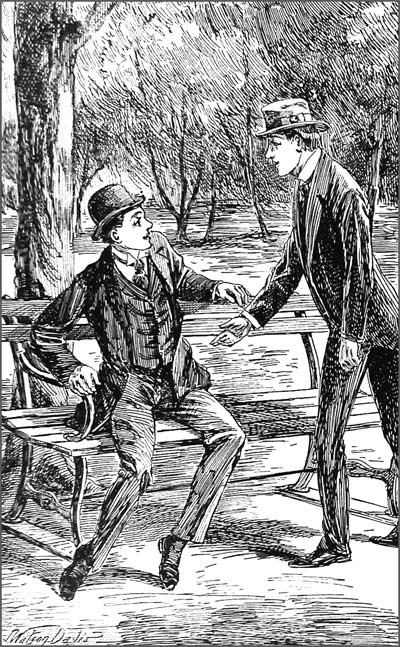
Ben hurried and pushed on till he reached the
famous square. Passing between some posts he
found himself on the mall, and seated himself on
a long bench under the trees.
He looked with interest at the passers-by. It
was a bright and animated spectacle. It was a
glimpse of the world quite unlike any with which
Ben had been acquainted hitherto.
“I wish somebody was with me,” he said to
himself.
As if in answer to his wish a boy rather older
than himself stopped in front of the bench and
greeted him in a surprised voice. “Why, Ben,
how came you here?”
Looking up he recognized his cousin Adelbert
Bruce, who lived, as he remembered, in a town
not far from Boston.
“Adelbert!” exclaimed Ben joyfully, rising
and grasping his cousin’s hand. “I never
thought of seeing you.”
“I have come to Boston to buy some clothes,”
said Adelbert, “but what brings you here?”
“I have left home,” answered Ben.
“But why?”
“Wait till you have a stepfather, and then
you will know.”
“Are you trying to find a place in Boston?”
“No; I am going to New York.”
“You don’t mean it! Do you know any one
there?”
“No.”
“Then I should think you would be afraid to
go.”
“I have to go somewhere. Mr. Winter would
have apprenticed me to a shoemaker if I had
stayed in Wrayburn.”
“Did your mother know you were going to
leave home?”
“Yes; I wouldn’t go without telling her.”
Adelbert sat down by Ben and the two talked
earnestly. All at once they became sensible of
a commotion, then of men, women and children
running by them in excitement, the more timid
uttering cries of alarm.
“What’s the matter?” asked Ben.
“It’s a mad dog,” answered his cousin, turning
pale, “and he’s coming our way!”
CHAPTER IX. BEN BECOMES A HERO.
The two boys rose from the bench, fully appreciating
the danger to which they were exposed,
and uncertain what it was safest to do. The dog
was of medium size, weighing perhaps forty
pounds.
It was foaming at the mouth and might well
inspire alarm. As is customary in such cases, it
followed a straight course, turning neither to the
right nor the left.
“We are safe,” said Ben, “if we stay where
we are.”
Directly in front of the dog was a gentleman
of middle age holding by the hand a small boy of
ten. Among the flying crowd this pair seemed
most exposed to peril. The man’s face was pale,
for he felt the dangerous position in which they
stood.
“Hurry, Paul, hurry!” he cried.
“I can’t run any faster, papa!” said the little
boy, gasping for breath.
Two legs are no match for four, and the dog was
within six feet of the boy, whom it had selected
as its victim.
To Adelbert’s surprise, Ben sprang forward
and made a dash for the dog. He had pulled off
his sack-coat, and just as the dog was about to
fasten his teeth in Paul’s leg, he threw the coat
over the animal’s head and held it tight.
But the dog struggled so powerfully that Ben
was in peril. Help came when it was needed.
A mechanic, strong and muscular, rushed to
his assistance, and between them they held the
dog firmly muzzled till a policeman arrived, and
drawing a revolver shot the frantic animal
through the head.
With a hoarse cry the dog stretched himself
out in the agonies of death.
“Your little boy has been saved from a
terrible death,” said a bystander to Paul’s
father.
The latter breathed a deep sigh of relief. He
turned his eyes in the direction of Ben, who was
holding up his coat and gazing at it with a rueful
look.
“It is spoiled,” said Adelbert. “You can
never wear it again.”
“And it is my only one,” rejoined Ben.
He felt a touch upon his arm, and turning, saw
that it was the little boy’s father who had thus
called his attention.
“My dear boy,” he said, in a tone of deep emotion,
“how can I thank you for what you have
done? By your bravery you have in all probability
saved my son from a terrible death.”
“I am so glad,” was Ben’s reply. “When I
saw his danger I couldn’t help trying to save him.
Any one would have done it,” he added modestly.
“No one did it but you,” said the father significantly.
“What is your name?”
“Ben Bruce.”
“Do you live in Boston?”
“No, sir; I am on my way to New York.”
“Are you—excuse my asking—in limited circumstances?”
“I have to make my own way,” answered
Ben. “I am going to New York to seek my fortune.”
“And this boy with you—is he your brother?”
“No,” answered Adelbert, “I am Ben’s cousin,
and proud of the relationship,” he added. “I
didn’t think Ben had so much pluck.”
“I think I heard you say that this was your
only coat.”
“Yes, sir,” answered Ben shyly.
“You can never wear it any more. The least
I can do is to replace it. Are you acquainted in
Boston?”
“No, sir, but Adelbert is.”
“Do you know where to find the clothing house
of A. Shuman?” asked the gentleman, addressing
Adelbert.
“Yes, sir; I am going there myself to buy a
suit of clothes.”
“Then take your cousin with you and help him
select a suit.”
“But, sir, I only lost my coat.”
“I certainly can do no less than buy you a complete
suit. Then I shall hope to have the pleasure
of entertaining you both at dinner at my house in
Mt. Vernon Street. We dine at two o’clock.
Wait a minute and I will give you an order on
Mr. Shuman for a suit.”
He tore a leaf from his memorandum book and
wrote upon it these words:
“Allow the bearer to select clothing to the
amount of thirty-five dollars, and charge the same
to my account.
“Franklin Wentworth.”
“Please read this,” he said to Ben.
“Isn’t that a great deal to spend for a suit,
sir?” asked Ben.
“Yes; I advise you to use only part of it for a
suit, and buy other articles such as you need to
make up the balance. I dare say you can make
use of other things.”
“Thank you sir. You are quite right.”
“I will bid you good morning now, and will
expect to see you at dinner. Here is my card.”
“Franklin Wentworth,” repeated Adelbert,
looking at the latter. “He is a broker in State
Street, and is considered a rich man. You are
in luck, Ben. The folks will be
su’prised
when they hear that I have taken dinner at his house.”
“What shall I do with this coat, Adelbert?”
asked Ben.
“Give it to me,” said a ragged boy, who overheard
the question.
“But it is spoiled. It has the dog’s saliva on
it.”
“Mother will clean it for me. It’s better than
any I have got.”
“You are welcome to it,” said Ben, “but be
careful to clean it thoroughly.”
“Yes, I will,” and the boy walked away with
a pleased expression.
“I’d like to get a new suit at once, Del,” said
Ben. “I feel queer walking in Boston without
a coat.”
“We’ll go down Bromfield Street to Washington.
That will bring us out very near Shuman’s.”
The two boys walked down to Washington
Street, Ben attracting attention from the crowd,
some of whom knew that he was the boy who had
helped capture the mad dog. They crossed the
street and entered the large, handsome store of
A. Shuman & Co. In the windows was a fine
display of fashionable clothing.
One of the salesmen stepped up and met the
two boys, his curiosity a little excited by Ben’s
appearance.
Ben showed the memorandum.
“My coat was spoiled by an accident,” he said,
“but I guess I can get a better one here.”
“I think we shall be able to fit you out.”
Ben finally selected a stylish suit for twenty-five
dollars, and invested the remaining ten dollars
in underclothing and an extra pair of
trousers.
“Will you have the clothes sent home?” asked
the salesman.
“I should like to take off the clothes I have on
and put on the whole new suit.”
“Very well.”
“I will take the rest in a bundle,” went on Ben.
“I am only passing through Boston, and have
no place to send it to.”
“It will be rather awkward to carry the bundle
around,” said Adelbert.
“We will keep it here for you subject to your
order,” interposed the salesman. “When will
you call for it?”
“About half-past four,” suggested Adelbert.
“My cousin is going to New York by the Fall
River boat.”
“Very good.”
In ten minutes Ben left the store looking very
much better than when he entered it, so far as
clothing was concerned. He had hardly reached
the street when a brisk-looking young man
stepped up to him.
“I beg your pardon,” he said, “but are you
the boy who tackled the mad dog on the Common
twenty minutes since?”
“Yes, sir,” answered Ben, rather surprised.
“I thought so. I am a reporter of the Boston
Globe. Please step around to the office with me,
and help me fix up an account of it for our
paper.”
“Really, Ben, you are getting to be a prominent
character,” said Adelbert, laughing.
“It seems so,” answered Ben.
Both boys walked to the Globe office not far
away, and Ben was asked several questions,
which he answered promptly.
“Thank you,” said the young man. “Now,
if you have no objection, I will take you out and
have your picture taken.”
“What for?” asked Ben, puzzled.
“To reproduce in our evening edition.”
“You mean to put my picture in the paper?”
asked Ben, almost frightened.
“Yes; the young people will like to see it.”
“Oh, have it taken, Ben,” said Adelbert, “I
will take one home to Natick, and won’t the folks
be surprised!”
So Ben submitted. He felt that it was quite
the most wonderful day in his life.
CHAPTER X. BEN DINES IN MT. VERNON STREET.
As there was considerable time to be filled up,
Ben went about the city under the guidance of
Adelbert, and got a fair idea of it. Never before
having been in any city, he was quite impressed
with the size of Boston.
“I suppose New York is still larger,” he said
to his cousin.
“So I hear, but I have never been there.”
“It will seem strange to me living in so large
a place.”
“Large places seem to agree with you. This
is your first day in Boston, and you have already
made thirty-five dollars.”
“I don’t expect to follow it up with such luck.”
“Probably not. If you could make that sum
once a week you would do better than most boys
of your age.”
A little before two o’clock the boys rang the
bell at Mr. Wentworth’s house on Mt. Vernon
Street.
The door was opened by a well-dressed serving-man,
who greeted them with a smile, and relieved
them of any embarrassment by saying, “Please
follow me. You are expected.”
He led the way up-stairs to a handsome apartment,
which appeared to be fitted up as a sitting-room
and library.
“Be seated, please.”
They sat down and had begun to examine some
of the books on the table, when an attractive
lady entered the room, leading by the hand little
Paul.
“Which of you boys saved the life of my little
boy?” she asked with emotion.
“My cousin Ben,” answered Adelbert.
She grasped Ben’s hand warmly, saying, “I
shall never forget the service you have done me,
my brave boy.”
Ben blushed and felt uncomfortable, for he was
modest and did not think he deserved such a
warm tribute.
“Won’t you come and sit by me, Paul?” he
asked, for he was fond of little boys.
Paul went up at once and sat beside him on the
sofa.
“Were you very much afraid?” asked Ben.
“Wasn’t I just? I thought the dog was going
to bite me. Were you frightened?”
“I was at first, but I forgot all about it when
I saw your danger.”
“This wasn’t the coat you threw over the dog’s
head?”
“No; I gave that to a boy who asked for it.”
“You wouldn’t want to wear it again?”
“No. It would always make me think of the
mad dog.”
“Have you got any little brothers?”
“No; I wish I had. I should like a little
brother like you.”
“Do you live in the city?” asked Mrs. Wentworth
of Adelbert.
“No; I live about eighteen miles from here,
in the country.”
“Does your cousin live with you?”
“No; I have not seen him for four years. He
is on his way to New York.”
“I hope he will prosper. He deserves to
do so.”
Just then Mr. Wentworth entered and dinner
was announced.
“I will sit by Ben,” said Paul, who by this
time felt quite at home with his preserver.
“You seem to have won Paul’s heart,” remarked
Mrs. Wentworth with a smile.
Of course the dinner was excellent and well
served. It must be confessed that both boys
were very hungry and did full justice to it.
When the last course was served Mr. Wentworth
rose from the table.
“You must excuse me, young gentlemen,” he
said, “but I have a business appointment at a
quarter past three and I have barely time to meet
it. Don’t hurry, however; Mrs. Wentworth
and Paul will entertain you. Before going let
me say,” he was addressing Ben now, “if ever
you get into trouble or need a friend don’t hesitate
to write to me. And now good-by, and good
luck.”
“Thank you, sir,” said Ben gratefully. The
boys remained twenty minutes longer, and then
rose to go.
“Wait a minute,” said Mrs. Wentworth.
“Come with me, Paul.”
The two left the room, but immediately returned.
Paul held in his hand a silver hunting
watch with a neat chain attached to it.
“This is for you, Ben,” he said.
Ben looked surprised and pleased. He had always
wanted a watch.
“Yes,” said Mrs. Wentworth, “you are to
consider this a gift from Paul. I hope it will do
you good service.”
“I thank you and him very much,” said Ben
gratefully. “Paul, you must let me kiss you.”
The little boy threw his arms around the
neck of his new friend and kissed him warmly.
“You must come and see me again,” he said.
“I hope to do so some time.”
The two boys left the house, much pleased with
their visit.
“This is a lucky day for you, Ben,” said Adelbert.
“I hope your luck will continue.”
“I feel a good deal better than I did yesterday
at this time,” responded Ben. “What nice
people they are!”
“Yes, but I am sure you will find plenty more
such in New York. You must write to me,
Ben.”
“Yes, I will be sure to do so.”
“And look out for pickpockets when you are
on the boat. Don’t let them steal your watch.”
“It seems odd to have anything worth stealing,
Del.”
“It would have been a good while before your
stepfather gave you a watch.”
“Yes; he is about as mean a man as I ever
met. Mother made a great mistake in marrying
him. When I am able I shall ask her to
leave him and come to live with me.”
“Why can’t you go up to Natick to-night with
me, and stay over till to-morrow?”
“I feel in a hurry to reach New York and see
what I can do there. I am anxious to know how
I am going to make out.”
“Then I will excuse you this time. Perhaps
you can come and see me next year.”
“If I am lucky I may be able to do so.”
At half-past four they went to Shuman’s and
Ben got his bundle. Adelbert also made choice
of a suit, but one not so expensive as Ben’s. “I
can’t afford to go high as you did, Ben,” he said.
On their way to the depot they met a newsboy
who called out. “Evenin’ papers! Record and
Globe! All about the mad dog!”
This attracted Adelbert’s attention.
“Why, it’s about you, Ben,” he said. “Give
me the Globe.”
“And me, too,” added Ben.
They hastily opened it, and Ben flushed with
pleasure to see his picture staring at him from
the fourth page. There was quite a full account
of the capture of the dog, and Ben was highly
praised for his bravery and presence of mind.
“Does the Globe go to Wrayburn?” asked
Adelbert.
“Yes, but Mr. Winter doesn’t take it.”
“He will hear of it. I should like to be present
when he reads the account and sees your picture.”
“So should I. He won’t know anything of
the presents I received.”
Though the Fall River train did not start till
six the boys reached the Old Colony station at
half-past five, and then Adelbert left his cousin,
as he wished to take a train to his country home.
When the train was ready Ben, with his bundle
in his hand, joined the moving crowd of passengers
and entered the cars.
The low rate of fare increased the crowd considerably,
and it was evident that the steamer
would be well filled. Ben had some difficulty in
finding a seat, and there were quite a number
standing in each of the cars that composed the
train.
In an hour and a half the brakeman put his
head in and announced “Fall River!”
All the passengers got out, Ben among them,
and made their way to the mammoth steamer
waiting to convey them to New York.
Every stateroom was taken, and every berth,
so that Ben found he should have to sit up. He
was not alone, however, for there was a considerable
number in the same predicament. He did
not know what to do with his bundle till one of
the passengers directed him to the baggage-room
on the lower deck. He carried his package
thither and received a check in return, which he
put into his pocket. Then he went up-stairs
again.
Presently he felt hungry, and learning that
supper could be had below, he went down-stairs.
He had to wait a considerable time before there
was a vacant seat at the tables and he was allowed
to enter. The prices he found higher than
at the restaurant where he had taken breakfast,
but then it must be stated that the quality of the
food provided was much better.
Ben made as economical a supper as he could,
ordering a cup of coffee and some boiled eggs.
When he had finished he still felt hungry, but he
reflected that his finances were limited, and refrained
from ordering more, but partook heartily
of the bread which was liberally supplied.
He was wandering about the boat after supper,
when, happening to go down to the main deck,
he saw a commonly dressed man smoking a clay
pipe.
There was something familiar in the fellow’s
look.
“Where have I seen that face before?” Ben
asked himself.
CHAPTER XI. BEN HAS A NARROW ESCAPE.
At first Ben was puzzled, but all at once it
flashed upon him that the man was the one who
had tried to rob his stepfather and afterward to
enter the house. He could see in his face some
of the fine bird shot which had entered it when
he fired the old musket at him.
Now it often happens that a fixed and steady
gaze will in some strange manner be felt by the
person observed. At any rate, in this instance
Tom Tidd at first looked uneasy, then turning
returned Ben’s look. He, too, was struck by
something familiar in the boy’s face, but his new
clothes made recognition more difficult.
“What are you starin’ at, kid?” he growled.
“Did you address me, sir?” asked Ben.
“Yes, I did. Do you think you’ll know me
next time?”
“Perhaps so,” answered Ben.
“Where do you hang out, any way?”
“On this boat at present.”
“Where are you going?”
“To New York.”
“I’m blamed if you don’t look like a young
rascal that peppered me with bird shot two or
three nights ago.”
“How did that happen? Did the gun go off
by accident?”
“No, he meant it, confound him!”
“I don’t wonder you don’t like my looks if that
is the case.”
“Well, I guess you ain’t him. If you was
I’d——”
Here the conversation dropped, and Tom Tidd
returned to his pipe, while Ben, congratulating
himself that his unpleasant neighbor’s suspicions
had not been confirmed, walked away to another
part of the boat.
At ten o’clock Ben settled himself as comfortably
as he could for the night. It might have
been the excitement that prevented his sleeping
well. At any rate he woke up from a troubled
nap about midnight, and finding the atmosphere
rather close, decided to go on deck for a breath
of fresh air.
Walking along the starboard side of the
steamer in a narrow passage lined with staterooms,
his attention was attracted to a shambling
figure looking into one of the rooms with his head
protruding through the open window.
Instantly Ben stopped in excited attention. As
the man withdrew his head for an instant and
showed his side face, Ben saw that it was his
country acquaintance Tom Tidd, and he understood
at once that his object was robbery.
While he was standing irresolute Tom thrust
in his hand, and drew out the vest of the sleeping
passenger, from the pocket of which he proceeded
to draw out a gold watch with a chain
attached.
Without thinking of the imprudence of the
step, Ben ran forward, and seizing the thief by the
arm, cried in a tone of authority, “Drop that!”
Tom Tidd whirled round instantly, naturally
startled, as one might well be detected in such an
act.
“Oh, it’s you, you young rascal!” he exclaimed
in a furious tone. “I’ll give you a lesson.”
He seized Ben in a vise-like-grip, and lifting
him from the deck, prepared to throw him overboard.
Ben’s heart failed him, as he saw the
seething waters into which he would probably be
thrown. He struggled to release himself, and
gained a temporary advantage, slipping eel-like
from the grasp of the burglar.
By a happy inspiration he snatched a whistle
from his pocket and blew a loud blast following
it up by loud cries of “Help! Murder!”
“You’re too late,” hissed the burglar, making
another effort to throw the boy overboard.
He lifted him above the rail and held him there
suspended. Ben gave himself up for lost.
It is hard to tell how many thoughts came into
his mind in the few seconds in which he felt himself
at the mercy of the burly ruffian. It seemed
likely that his career would then and there be cut
off, in which case this story would never have
been written.
But help was at hand. The door of the stateroom
was thrown open, and the occupant, a
strong, muscular man, weighing at least two
hundred pounds, entered upon the scene.
Quickly comprehending the situation, he
grasped Tom Tidd in his powerful arms, tore Ben
from his clutches, and then demanded sternly,
“What does all this mean?”
“This man was going to throw me into the
water,” gasped Ben.
“And you deserved it, too,” growled the discomfited
burglar.
“What had you done?” asked the passenger,
addressing himself to Ben.
“He was getting into your stateroom through
the window,” exclaimed Ben. “He had hold of
your vest when I came up and tackled him.”
“Is this so? Where, then, is the vest?”
“He must have dropped it on the floor inside
the stateroom.”
“Go in and see if it’s there.”
“Lemme go!” exclaimed Tom Tidd, trying to
wriggle out of the grasp of the muscular passenger.
“Not yet, my friend! I haven’t done with you.”
“I’ll throw you into the Sound.”
“You may do it if you can. I haven’t belonged
to the Manhattan Athletic Club for the last five
years for nothing.”
“I’ve found the vest,” said Ben from inside the
stateroom.
“Is the watch in it?”
“Yes, sir.”
“Good! that watch cost me five hundred dollars
in Geneva.”
Tom Tidd groaned inwardly. What a chance
he had lost!
“Now go and call some one. This fellow
must be secured.”
“Let me go!” pleaded Tidd, becoming alarmed.
“I won’t try to enter your stateroom again.”
“I don’t mean that you shall have the chance.”
“Let me go!” continued the burglar fiercely,
making a hard struggle to get free.
“Can’t think of it, my fine fellow. For the sake
of the community I shall see that you are secured.”
Meanwhile, Ben had run into the saloon and
returned with two men—one an employee of the
boat. Help came none too soon.
Tom Tidd had managed to thrust his hand into
his pocket, drawing out a large jackknife, which
he was trying to open. Had he done so it might
have fared ill with his captor.
Ben was the first to see the knife.
“Take his knife away!” he exclaimed in excitement.
The two men threw themselves upon the ruffian
and managed to deprive him of his ugly weapon,
throwing it into the water. Then some strong
cord was obtained, and the fellow, in spite of his
struggles, was tied securely.
“You are the cause of all this!” he exclaimed,
glaring at Ben. “Now tell me who you are.
Haven’t I met you before?”
“Yes,” answered Ben.
“Where?”
“When I last saw you I was looking out of a
third story window at midnight.”
“By gum, I thought so. And it was you that
peppered me with bird shot.”
“Yes; but I wouldn’t have done so if I hadn’t
felt obliged to.”
“And to think I’ve been foiled twice by a kid!”
exclaimed Tom Tidd with an expression of disgust.
“I’ll get even with you yet.”
“What does he mean?” asked Grant Griswold,
the occupant of the stateroom.
Ben explained.
“Evidently the man is a confirmed rogue.
How did you happen to be on deck so late?”
“It was close in the saloon and I came up to
get a breath of fresh air.”
“Luckily for me. Have you a stateroom?”
“No, sir.”
“Then, if you like, occupy mine. There is an
upper berth at your service.”
“Thank you sir. I will accept your invitation.”
“I won’t talk any more with you now, but in
the morning I will ask you to breakfast with me,
and you can tell me more about yourself. I suppose
as my caller is now secured it won’t hurt to
keep my window open.”
The rest of the night was uneventful. Both
Ben and his new friend slept soundly, and only
waked up when the steamer was passing under
Brooklyn Bridge.
“Are you awake, my young friend?” asked Mr.
Griswold, after he had performed his ablutions.
“Yes,” answered Ben, rubbing his eyes.
“And do you know where you are?” went on
his companion, smiling.
“No, sir.”
“We are near the pier in New York and I advise
you to get up and prepare for landing.”
“That won’t take long, sir, as I didn’t undress.”
Ben secured his bundle and the two left the
steamer. Ben looked about curiously.
“Are you expecting any one to meet you,
Ben?” asked Mr. Griswold, who had inquired
the name of his young roommate.
“No, sir; I know no one in New York.”
“We will go up to the Astor House to breakfast.”
Ben had heard of the Astor House, but had no
particular idea with regard to it. At the suggestion
of his new friend his bundle was left in
the package room of the hotel and they went up-stairs
into the dining-saloon. Two gentlemen
at a neighboring table recognized Mr. Griswold,
and looked rather curiously at Ben.
CHAPTER XII. A NEW ACQUAINTANCE.
“I say, Griswold,” said a gentleman seated at a
neighboring table, “is that your son?”
Grant Griswold smiled.
“Hardly,” he said. “Ben, how old are you?”
“Nearly sixteen.”
“And I am only thirty-two, so that hypothesis
lacks probability. We are only recent acquaintances,
or, let me say, friends, but I hope our
friendship will continue.”
“Thank you, sir,” said Ben. “I hope so too.”
As the meal progressed Mr. Griswold questioned
Ben as to his plans.
“I want to make a living,” said Ben, “but I
know so little about the city that I can’t tell yet
which will be the best way.”
“I would look out for something for you, but
unfortunately I sail for Europe next Saturday,
to be gone for three months. Have you any
friends in New York?”
“No, sir.”
“You will need a recommendation, and I will
write you one before I leave town. I haven’t
known you long, but what I have seen of you
gives me confidence in your good qualities. By
the way, I shall need some one to help me pack,
and I will keep you with me till I start for Europe.
It will only be three days, but that will
give you a chance to look about you, and will
enable you to say you have been in my employ.”
“You are very kind, Mr. Griswold,” said Ben
gratefully. “I didn’t expect to meet such a
friend so soon.”
After breakfast Ben, accompanying Mr. Griswold,
went up-town to a large building on lower
Fifth Avenue, where Mr. Griswold rented a suite
of rooms.
“You will occupy the small bedroom adjoining
mine,” said Griswold, “and I will set you to
work while I go out and make a few calls.”
During the day Ben was sent on several errands,
and though a stranger to the city he managed to
acquit himself creditably, making inquiries about
locations when he was at fault.
Three days later he went to see his patron off on
the Etruria.
Mr. Griswold handed him a ten-dollar bill and
bade him good-by.
“I wish you good luck, Ben,” he said. “Be
sure to call on me when I return.”
Ben waited on the dock till the floating hotel
was fairly under way, and then turned away,
feeling very lonely. He could hardly realize that
the friend whom he so much regretted had been
utterly unknown to him four days previous.
Now he had no one to lean upon. He must rely
wholly upon himself.
Two things must be done at once. He must
find a room and employment. He had taken
down two or three names of lodging-houses from
the New York Herald, which Mr. Griswold took
in every morning. One of them was on West
Twelfth Street. He took a car and went up there.
The door was opened by a woman of ample proportions,
who regarded Ben with a critical eye.
“Well, young man?” she said in a tone of
business-like inquiry.
“I want to hire a room,” said Ben.
“Will you occupy it alone?”
“Yes, madam.”
“Do you wish a large or a small room?”
“I want a low-priced room.”
“That means a small room.”
“I have no objection to a large room if the
price is low,” said Ben, smiling.
“No doubt. Well, follow me up-stairs.”
Mrs. Robinson was stout and unwieldy, and
seemed to find it difficult to go up-stairs. At
the head of the second flight she threw open the
door of a small hall bedroom very plainly furnished.
“You can have that room for two dollars a
week,” she said.
“It is very small,” remarked Ben doubtfully.
“It is as good as you can expect for two dollars.
I can give you a fine square room for five
dollars.”
“That is more than I can afford to pay. I
think I will take this room for a short time and
see how I like it.”
“Are you in any business?”
“I am looking for a place.”
Mrs. Robinson’s face changed slightly.
“I require the first week in advance,” she said
significantly.
“Very well.”
Ben took out his pocketbook and tendered her a
ten-dollar bill, the one he had just received from
Mr. Griswold.
Mrs. Robinson, seeing the denomination of
the bill, regarded Ben with increased respect.
“I am afraid I can’t change a ten,” she said.
“I believe I have a two here,” returned Ben,
exploring his wallet.
“Very well. I will write you a receipt. What
is your name?”
“Ben—that is, Benjamin Bruce.”
“I think we shall get along very well, Mr.
Bruce,” said the landlady graciously. “I hope
you will have success in getting a place.”
“Thank you.”
“Do you wish to sleep here to-night?”
Ben answered in the affirmative, and Mrs.
Robinson gave him a latch-key.
“That will let you in at any time, but I hope
you are a steady young man and don’t keep very
late hours.”
“I don’t expect to,” answered Ben, with a
smile.
“I had a young man in this room last spring
who annoyed me very much by coming home
drunk and disturbing the house in his efforts to
get up-stairs.”
“I don’t expect to trouble you in that way,”
said Ben. “I don’t know many people in the
city” (he didn’t like to say “any,” though he
might have done so truthfully), “and shall not
be tempted to keep late hours.”
It did not take long for Ben to establish himself
in his new room. He went out and took a
walk on Broadway.
He thought he would defer looking for a place
till the next morning. He stayed out several
hours, and then feeling fatigued, went back to
the lodging-house.
He lay down on the bed in his clothes, but had
hardly been there ten minutes when there was a
knock on his door.
Ben was rather surprised at having a caller so
soon, but he turned his face to the door and said,
“Come in!”
A young man, apparently about twenty-five,
entered. He had long black hair, and a broad,
high forehead.
“Excuse me,” he said, “but you are a new
lodger.”
“Yes, sir.”
“Let me introduce myself then. My name is
Sylvanus Snodgrass, and I occupy the small
room across the hall.”
“I am glad to see you, Mr. Snodgrass. Won’t
you sit down? You will excuse my sitting on
the bed as I have but one chair.”
“It is the same in my room. May I ask your
name?”
“Ben Bruce.”
“Excuse me, but are you literary?”
“Not at all,” answered Ben, rather surprised.
“You have a good name for an author, both
names beginning with the same letter.”
“Are you literary, Mr. Snodgrass?”
“Yes,” answered the young man complacently.
“Do you ever read the Weekly Bugle, a literary
paper?”
“I don’t think I have.”
“I am having a serial story run through it.
It is called ‘The Ragpicker’s Curse.’”
Ben was not much of a judge of literature, but
it didn’t seem to him that this title suggested a
high order of literary merit.
“Did it take you long to write it?” he asked.
“I wrote it in four weeks. It is in forty
chapters. I was greatly enthused when I wrote
it.”
“Were you?”
“I was so much interested that one day I wrote
eight hours on a stretch, and then fainted away.”
Mr. Snodgrass mentioned this little circumstance
in a very complacent tone.
“The literary life is a very absorbing one,” he
continued. “When I have finished a story I am
simply exhausted.”
“I hope it pays well,” said Ben.
“Not as it should, Mr. Bruce, not as it should.
But money is not everything. I hope to acquire
fame, to live in the hearts of future generations,”
and the young man’s pale cheeks flushed.
Ben doubted whether such stories as “The
Ragpicker’s Curse” would be likely to win enduring
fame for the author, but out of consideration
for the feelings of Mr. Snodgrass he kept silent
on this point.
“I hear that Howells makes a good deal of
money by his novels,” he said.
“Howells!” repeated Mr. Snodgrass scornfully.
“He couldn’t write a story for the Weekly
Bugle. There isn’t excitement enough in his productions.”
“Still, I think I should like to be in his shoes.”
“Oh, no doubt there is some merit in his
stories,” said Sylvanus Snodgrass condescendingly,
“but I don’t admire them for my part.
They lack snap and fire.”
“Probably he couldn’t write a story like ‘The
Ragpicker’s Curse.’”
“I won’t express any opinion on that subject,”
said Mr. Snodgrass modestly. “If you ever feel
inclined to write a story, Mr. Bruce, I shall be
glad to introduce you to our editor.”
“Thank you, Mr. Snodgrass, you are very kind.”
“Oh, don’t mention it, Mr. Bruce. I know
what it is to struggle and I like to help young
writers. By the way, have you had supper?”
“Not yet.”
“Suppose we go out together. I like company
when I eat.”
Ben accepted the suggestion. Lonely as he felt
he welcomed the companionship even of Sylvanus
Snodgrass. He put on his hat, and they walked
down-stairs together.
CHAPTER XIII. BEN IS INTRODUCED TO A POET.
Mr. Snodgrass led the way to a small restaurant
two or three streets distant, and the two
went in and seated themselves at a table covered
with a cloth of far from immaculate whiteness.
Taking up the bill of fare, Ben was pleased to
find that the prices were very moderate.
“Do you often come here, Mr. Snodgrass?” he
asked.
“Yes, except when I have occasion to be down
town. Then I go into a restaurant on Park
Row.”
“The only place I ever heard mentioned before
I came here is Delmonico’s.”
“Yes,” answered Mr. Snodgrass. “Del keeps
a fine place, but I seldom go there. In a small
place like this you are more apt to meet men and
women of brains. One evening I met here Gloriana
Podd, the great poetess. Of course you have
heard of her?”
“I am not sure that I have.”
“She writes for several of the popular weeklies,
and I am told that her poems are sometimes copied
in the London papers. I am surprised that you
haven’t heard of her.”
“My stepfather didn’t take any weekly papers.
He thought too much of his money.”
“Then I presume you had never heard of me.”
Ben acknowledged that he had not.
“You were evidently buried in the country.
Now that you are in a great metropolis you will
live—and learn.”
“I hope so.”
“Of course I will do all I can for you. I will
introduce you to our editor at any time.”
“Thank you, but I will wait a little. I think
he would not care to meet a boy.”
“Any friend of mine would be welcome, Mr.
Bruce. But here comes the waiter. What will
you have?”
“Give your order first, Mr. Snodgrass.”
“A plate of corned beef hash and a cup of
coffee,” said Mr. Snodgrass.
“You may bring me some fried eggs and a cup
of tea,” added Ben.
The hash was brought and with it a few slices
of bread and a square of pale butter. The hash
did not look very inviting, but the novelist partook
of it with evident relish.
“I think I will take a piece of pie,” he said, as
the last mouthful of hash disappeared, “Ralph
Waldo Emerson ate pie at every meal. Of course
you have heard of Emerson.”
“Yes; did he write for the Bugle?” asked Ben
with a smile.
“No; our readers prefer romance. It may
seem presumptuous in me to say so, but I really
believe they enjoy my productions better than the
essays of Emerson.”
“I have no doubt of it. I hope, Mr. Snodgrass,
you will give me a chance to read some of your
stories.”
“I will with pleasure. I have several of them
in weekly numbers of the Bugle.”
Ben, too, ventured upon a piece of pie. He did
not wholly enjoy the dishes provided at the restaurant.
He felt that he should have preferred
his mother’s cooking. The charges, however, were
moderate. Only twenty cents for each person.
Mr. Snodgrass rose from the table and took up
his check.
Then he thrust his hand into his pockets, and
after a little his face wore an air of perplexity.
“I really believe I haven’t any money with
me,” he said. “I must have left it in the pockets
of my other trousers. Awkward, isn’t it?”
“I will advance you the money, Mr. Snodgrass,”
said Ben.
“Thank you,” rejoined the novelist with an air
of relief. “You shall soon have it back. The
publisher of the Bugle is owing me a balance of
ten dollars on my serial, and that I shall probably
collect to-morrow. I shall be glad to reimburse
you.”
“No hurry, Mr. Snodgrass!”
“You are very kind, Mr. Bruce. I am really
delighted to have made your acquaintance.”
“Thank you. Were you always an author,
Mr. Snodgrass?”
“I was a schoolboy once,” said the novelist
facetiously.
“Of course, but when were you old enough to
go to work?”
“I used to work at Macy’s, but I felt it was
drudgery. It was poor business for a man of intellect
and imagination. I wrote a few short
stories for the weeklies, and one day, having a
little difference with my employer, I resigned,
and boldly threw myself upon literature as an
avocation.”
“How long ago was that?”
“Almost a year since.”
“And have you got along pretty well?”
“I have had to live a life of self-denial, but I
am working for the future. Some day I mean
to make the name of Sylvanus Snodgrass renowned.
What will my old friends at Macy’s
say then?”
“They will congratulate you, I should think.”
Mr. Snodgrass shook his head.
“No, they will be jealous of my fame,” he said.
“Some of them even now turn up their noses at
me. They have no soul above the goods they sell.
They do not realize that my stories are read all
over the United States. An old schoolmate of
mine in San Francisco wrote me last week that he
read everything I wrote.”
“That must be very gratifying,” remarked
Ben.
“It is, Mr. Bruce. I hope you may be induced
to try your hand at a story.”
“I will think of it after I have a place.”
“I shall be glad to give you points and read
your productions critically. Have you had any
place yet?”
“I was for a short time in the employ of Mr.
Grant Griswold, living on Fifth Avenue, but he
sailed for Europe this morning.”
“So you are out of a place.”
“At present, yes.”
“Suppose we walk up to Union Square and
take a seat on one of the benches.”
“Very well.”
They found an unoccupied bench and sat down.
Presently a rather short young man with dark
hair and a small mustache approached.
Mr. Snodgrass pointed him out.
“That is Cornelius Clyde, the poet,” he said.
“Indeed!”
“Would you like to be introduced?”
“I have no objection.”
“It is a great privilege to know Clyde,” said
Mr. Snodgrass, who thought Ben spoke too indifferently.
“How are you, Mr. Clyde?”
“I am well, thanks,” rejoined the poet.
“Won’t you sit down? I should like to introduce
you to my friend, Ben Bruce.”
“I am glad to meet you, Mr. Bruce. Are you
one of us?”
“I am not a writer.”
“Ah, it’s a pity.”
“I shall try to draw Mr. Bruce into our circle,”
said Sylvanus. “I have offered to introduce a
story, if he will write one, to the notice of our
editor.”
“Story? Ah yes,” said the poet condescendingly.
“Do you ever write verse, Mr. Bruce?”
“I have never tried. I don’t think I could.”
“Of course it is much more difficult than to
write stories.”
“Have you written anything new lately,
Clyde?” asked Mr. Snodgrass.
“I have just sent one to the office of the
Weekly Tomahawk. I would have sent it to the
Atlantic Monthly, but that magazine is run by a
clique, and no outsider stands any chance of getting
in.”
“That is too bad!” said Sylvanus Snodgrass
sympathizingly.
“But I shall yet succeed,” went on the poet,
earnestly. “The time will come when they will
apply to me, and ask me to name my own terms.”
“I hope so, I am sure. I experience the same
difficulty. I offered a serial story to the Century
three months ago, but it was respectfully declined.
What do you think of that?”
“I should have expected it,” answered Clyde.
Mr. Snodgrass looked at the poet to see whether
the words contained any hidden meaning, but he
was apparently satisfied that no slight was intended,
and began to discuss writers and publishers
with Mr. Clyde. The names introduced
were unknown to Ben, and he was not, therefore,
very much interested.
“I hear that Gloriana Podd is to bring out a
new volume of poems soon,” said Snodgrass.
“I wonder you don’t do the same.”
“Has she found a publisher to take the risk?”
“No; it is printed at her own expense.”
“So I supposed. Now I object to that. I shall
wait till some publisher asks the privilege of
bringing me out in book form.”
Presently the poet rose.
“I have a poem to finish ere I sleep,” he said.
“Good night to you both.”
“Good night.”
“Is writing poetry Mr. Clyde’s only business?”
asked Ben.
“Well no, not exactly. He couldn’t live on it,
you know. He works in a down-town barber
shop, but he has his evenings to himself.”
“I should think that would be disagreeable
business for a poet,” said Ben in surprise.
“It is not wholly congenial, but he tells me
that when he is shaving or cutting hair the most
beautiful poetic fancies come to him at times.
Then when Saturday night arrives and he pockets
his salary, he feels repaid. It is hard for a poet
or a romancer when he cannot pay his board.”
“I should think so,” returned Ben.
Just as they parted for the night Mr. Snodgrass
observed casually, “I am going to ask a little
favor of you, Mr. Bruce.”
“What is it?” asked Ben cautiously.
“I am owing Mrs. Robinson for a week’s room
rent. It should have been paid yesterday. If
you could kindly lend me two dollars till to-morrow
afternoon I will go in and pay her to-night.”
“It is quite out of the question, Mr. Snodgrass,”
said Ben decidedly. “I have but a little
money, and don’t know when I shall get a place.”
“It is immaterial!” returned Snodgrass. “I
thought it possible you could oblige me. Good
night!”
“Good night!”
Ben began to think he had better avoid too
great intimacy with Sylvanus Snodgrass.
CHAPTER XIV. THINGS AT WRAYBURN.
While Ben is considering how he can find
employment, we will go back to Wrayburn.
Jacob Winter felt very sorry over Ben’s running
away. His stepson was a strong boy and
would have been of considerable service on the
farm even if Mr. Flack had not agreed to take
him. But what troubled Jacob most was the
fifty dollars a year which the shoemaker had
agreed to pay him.
Then, too, he felt that Ben had defied his
authority, and had come out victorious. It was
not pleasant to be worsted by a boy.
He felt obliged to go round to Silas Flack’s
shop and inform him of what had happened.
The shoemaker looked up when the farmer entered
the store.
“Good morning, Mr. Winter. How are you
this morning?”
“Tollable, but I’ve had something to vex me.”
“What’s that?”
“Ben has gone away.”
“Gone away? Where?”
“He’s run away, I expect.”
“What’s he run away for?”
“Well, he didn’t like the idee of goin’ to work
in a shoe-shop.”
“He was over here and had a talk with me
yesterday. He didn’t seem to like the idee, but
I thought it was only a boy’s notion. You don’t
mean to say he’s run away on that account?”
“When I went up this mornin’ to call him I
couldn’t find any trace of him.”
“Hadn’t the bed been slept in?”
“No.”
“Then he must have gone away last night.”
“He went over and slept with the Graham
boy. He tells me that Ben got up early this
mornin’ and walked over to the railroad and took
the cars for Boston.”
“Did he have any money with him?”
“He had two dollars given him by his mother.”
“Did she know he was going to run away?”
“Well, she surmised it, and she upholds the
boy in it. She wanted him to go to the high
school.”
“That was all foolishness. He knows as much
as you or I now and maybe more.”
“Yes, I’ve done my duty by Ben in givin’ him
an eddication. What’s enough for you and me is
enough for him.”
“That’s so. Well, how about our engagement?”
“It’ll be carried out,” said Jacob firmly. “I’ll
get the boy back, but it may be a leetle later than
I calculated.”
“What steps have you taken? Did you say
he went to Boston?”
“Yes.”
“Shall you go to Boston and bring him back?”
“Well, I might not find him easy, and it costs
money to travel. But I expect he’ll be comin’
back himself. Two dollars won’t last him very
long, and he’ll be glad enough to come home.”
“Will he have money enough to get back?”
“He may have to foot it, but it will do him
good. He ought to suffer a little for his foolishness.
Just keep the place open for him, Silas,
and I’ll see that he comes as soon as he gets back.”
“All right, Mr. Winter. I always thought Ben
was smart even if he is a bit headstrong, and I’d
be glad to have him with me.”
Mr. Winter left the shoemaker’s somewhat
encouraged. The place was still open to Ben,
and he had not yet lost the fifty dollars a year
which he was to receive by contract.
“We’ll see if a boy’s goin’ to get the best of
me,” he soliloquized, nodding his head emphatically.
“Ben’s got his mother on his side, but
when Jacob Winter puts down his foot that
settles it.”
The next morning, as Mrs. Winter was at work
in the kitchen, there was a knock at the side door.
Opening it she found her caller to be a man well
known about the village, Jonathan Smith by
name. He was elderly and a bachelor, and acted
as janitor of one of the churches.
“How are you, Jonathan?” she said.
“I’m so’s to be round, Mrs. Winter. I hear your
boy Ben has gone away.”
“Yes, he has gone to Boston.”
“I suppose you ain’t heerd of him since he went
away?”
“No; have you any news of him?” asked Mrs.
Winter, detecting some significance in Jonathan’s
tone.
“Yes,” answered Jonathan complacently, and
he began to open a copy of the Boston Globe,
considerably to Mrs. Winter’s surprise. What
could Ben have to do with the Globe?
Opening the paper Jonathan pointed out Ben’s
picture, saying, “What do you say to that?”
“Why, it’s Ben!” exclaimed Mrs. Winter in
surprise and agitation. “What’s happened?
Has he met with any accident?”
“No; he’s saved a boy from being bit by a
mad dog. You just read it, and it’ll tell you
all about it.”
Mrs. Winter did read it, and she felt proud of
Ben’s bravery.
“It’s kind of smart of Ben gettin’ into the
paper,” remarked Jonathan.
“Can you leave me the paper, Jonathan?”
“Yes, I reckon so. I know where I can get
another.”
“Let me pay you for it, and come in and
eat a piece of mince pie. I’ve got one fresh-baked.
You were kind to bring me round the
paper.”
“You see Ben always treated me well. Some
of the boys plague me, but he never did.”
About an hour later Mr. Winter came into
the house. He was rather cross, for he had been
doing some chores which would have fallen to
Ben had he been home.
“I wish I had Ben here,” he said in a grumbling
tone. “Like as not, he’s sufferin’ for his
foolishness. I shouldn’t wonder if he was hungry
and wished himself home. What can a boy like
that do in Boston?”
“He seems to have done himself credit there,
Mr. Winter.”
“What?” demanded Jacob. “You hain’t
heard from him, have you?”
“Only through the paper.”
“What do you mean by that, Mrs. W.? Is
there anything about Ben in the paper?”
“Look at that, Mr. Winter.”
Jacob Winter put on his glasses, and stared
open-mouthed at Ben’s picture in the Globe.
“Well, that beats all!” he exclaimed.
“I guess a boy like that can make his way,”
said the mother proudly.
Mr. Winter read carefully the account of Ben
and his exploit, and hardly knew what to say.
“He won’t have to fight a mad dog every day,”
he observed at length.
“No, I hope not,” returned the mother fervently,
“but it shows he’s brave. I think this
man will prove a friend to him.”
Jacob Winter went out to the barn in a thoughtful
mood. He began to think it less likely that
Ben would “foot it back” to Wrayburn. But
none the less he wished him back. Such a boy
would eventually be a source of profit to him.
The next day Albert Graham came to the house.
“I’ve had a letter from Ben,” he said.
“Is it possible? Where did he write from?”
asked Mrs. Winter eagerly.
“From New York. Here it is.”
Mrs. Winter read the letter eagerly. It ran as
follows:
“Dear Albert:
“You see I have got to New York safe and
sound. I had a little adventure in Boston which
got into the Boston Globe. I know your folks
take that paper, so I need not say any more
about it, except that Mr. Wentworth, whose boy
I saved from being bitten by a mad dog, treated
me very kindly and generously. As my coat was
spoiled he gave me an order on a tailor for a new
suit, and told me to spare no expense. My suit
cost twenty-five dollars, so you can judge that it
is a fine one. The coat I had on when I left home
was old and shabby, and I was glad to give it up.
A poor boy asked me for it, and I gave it to him.
“That was not all. When the thing happened
my cousin Adelbert was with me. Mr. Wentworth
invited us both to dinner at his house on
Mt. Vernon Street. He lives in a fine house, and
we had a tip-top dinner. You see I was pretty
well paid.
“But that was not all. A new silver watch and
chain was given to me before I left the house, and
I was told that I must consider that a present
from Paul, the little boy. You just ought to
see me, Albert, in my new clothes and with my
silver watch. Mr. Winter would open his eyes if
he should see me. I haven’t any reason to be
sorry yet that I left home.
“Now about coming to New York. On the boat
I came across the burglar that tried to rob Mr.
Winter, and I caught him robbing a gentleman’s
stateroom. I was in time to give the alarm.
The gentleman is a Mr. Griswold, a member of
an athletic club in New York. He has taken me
into his employ for three or four days till he starts
for Europe. I wish he were going to stay in the
city, for I think he would give me a permanent
place. However, I have fared so well already
that I guess I can get along. Please let mother
read this letter. I write you, for I am afraid
Mr. Winter might intercept any letter I wrote to
her. I will write her soon and send it to your care.
Mr. Griswold has just come in and I must close.
“Your affectionate friend,
“Ben.”
“Isn’t Ben having splendid luck, Mrs. Winter?”
said Albert.
“Yes, and I have reason to feel thankful.”
When Mr. Winter came in and suggested that
Ben was probably “footin’ it home,” his wife only
smiled.
CHAPTER XV. BEN GETS EMPLOYMENT.
Though Ben was well dressed and had a watch,
his stock of money was small. Every day diminished
this, and matters began to look serious.
He made application at various places for employment,
but generally found some one ahead
of him. He was, however, offered one place at
two dollars and a half a week, and another at
three dollars, but neither of these sums would
pay his expenses, and if he accepted he would be
prevented from securing a more remunerative
post.
After paying in advance the third week’s rent
for his room, Ben found that he had but a dollar
and thirty-seven cents left.
“Haven’t you found a place yet?” asked the
landlady.
“Not yet,” answered Ben soberly, “but I hope
to obtain one this week.”
“I hope you will, I’m sure, for I am a poor
widow, and though I should hate to send you
away I must look out for my own interest.”
“I can’t blame you for that, Mrs. Robinson.”
“There’s Mr. Snodgrass don’t pay me regular.
He’s owing me for two weeks, and it’s inconvenient.
Still he has work, and I’ll be paid some
time. Couldn’t he get you something to do
where he works?”
“I am afraid I couldn’t write stories,” said
Ben, smiling.
“Is that what he does? I thought it was
copying.”
Sylvanus Snodgrass would have felt deeply
hurt had he supposed that any one took him—a
famous author—for a copyist.
“I will try to get something to do this week,”
went on Ben. “At any rate I don’t want to
keep the room longer than I can pay for it.”
Two days later the dollar was gone and but
thirty-seven cents remained. Though cheerful
and sanguine naturally, poor Ben felt despondent.
“I will take any employment that offers,” he
said to himself, as he left the house at an early
hour.
He directed his steps eastward, and soon found
himself on the Bowery.
He had not yet eaten breakfast. He was in
search of a restaurant where the prices would not
be too great for his limited means. At last he
found one, where plates of meat were advertised
for ten cents, baked beans five cents, and coffee
or tea three cents.
He entered and seating himself at a table ordered
a cup of coffee and some beans. With the
latter were brought two triangular slices of bread
and a small pat of butter that was probably oleomargarine.
This made his meal ticket eight
cents, which certainly could not be regarded as
extravagant.
When he was paying for his breakfast something
led him to inquire of the proprietor, who
acted as his own cashier, if he knew of any place
he could get.
“Do you want work?” asked the restaurant
keeper, eying Ben with some surprise.
“Yes, sir.”
“How is that? You’ve got good clothes, and
have a watch.”
“That is true, but I have only a very little
money.”
“Do you mind what you do?”
“No,” answered Ben desperately, “I am willing
to do anything.”
“Then maybe I can offer you a job.”
Ben wondered what it could be. Perhaps he
was to be offered the position of waiter. He did
not think he should like this, and doubted whether
he could safely carry a pile of dishes without
endangering their safety and soiling his clothes.
“What is it?” he asked.
“You can stand at the door and distribute
some of my bills.”
This was distinctly better than waiting in the
restaurant.
“What will you pay?”
“Well, I’ll give you three meals a day.”
Considering the character of the meals Ben
felt that this would not be quite satisfactory.
He could probably live better on three dollars a
week.
“I think I ought to have more than that,” he
said.
“It’s easy work,” rejoined the proprietor persuasively.
“But I shall need a little money.”
Finally Ben succeeded in making a bargain for
his meals and twenty-five cents a day, payable
at seven o’clock when his duties would close.
This was not much, and he could not tell where
he could get enough to pay his weekly rent, but
in the low state of his finances he did not feel
justified in refusing the offer.
“All right,” he said, “I’ll try it for a while.”
“Don’t give to everybody—only to those who
are likely to come in and eat. I had a boy working
for me last week who gave circulars to five-year
old kids, and I had to run up a big printing
bill to keep him supplied. I only gave him his
meals, but he was a ragged boy, and you are so
well dressed that it will give tone to my establishment.”
Ben felt glad that his good clothes were likely
to increase his earnings. He took his stand outside
the restaurant and began to distribute circulars.
Evidently he created a favorable impression,
for several persons of a grade higher than the
ordinary frequenters of the restaurant took the
bills and entered, considerably to the satisfaction
of the watchful landlord. But they were not
all satisfied.
“I say, Johnny,” said a florid-looking man, as
he left the eating house, “I don’t think much of
your hotel. I thought from your looks it was
something away up. Do you eat there?”
“Yes, sir.”
“Then I don’t admire your taste. Are you
the landlord’s son?”
“No, sir.”
“You needn’t expect me to go in again.”
“No, sir, I won’t. I am sorry you were not
pleased.”
“I shall have to go somewhere else and get a
decent meal.”
“I wish I could,” thought Ben.
At twelve o’clock Ben felt hungry. His breakfast
had been scanty and did not seem to have
staying power.
“Can I have my dinner now?” he asked as he
entered the restaurant.
“Yes.”
Ben sat down at a table and looked over the
bill of fare. Among the items was “Roast
Chicken—25 cents.”
“You may bring me roast chicken and a cup
of coffee,” he told the waiter.
The latter went up to the proprietor and spoke
to him in a low voice. Then he returned.
“The boss says you can have any ten cent
plate of meat,” he said. “He never gives roast
chicken to his help.”
“Don’t you get it?”
“No.”
Ben felt disappointed. Hungry as he was he
felt the need of a good dinner.
“You can bring me the chicken,” he said,
“and I will pay ten cents extra. Will that
do?”
“Yes; that will be satisfactory.”
The chicken was hardly as good as would have
been given at a high-priced restaurant. In fact
it was rather tough, but then Ben’s teeth were
good, and hungry as he was he enjoyed it.
He found that he was entitled to a piece of
pudding or pie, and accordingly ordered a plate
of apple pudding.
After finishing his meal he felt better. He resumed
his place at the door, and half an hour
later was greeted by a familiar voice. Looking
up he met the astonished gaze of Sylvanus Snodgrass.
“What does this mean, Bruce?” he asked.
Ben felt rather embarrassed, for it was not a
business that he was proud of.
“It means that I have found work,” he said.
“Distributing bills for a beanery,” said the
romancer.
“That’s about it.”
“Well, let me see one of the bills.”
Ben handed him one.
“Seems cheap,” said Sylvanus, “and suits my
purse, for I’m pretty short to-day. Can you recommend
it?”
“I can recommend the prices,” said Ben.
“Well, I’ll risk it. I would rather eat at Delmonico’s,
but I have no credit there, and I must
e’en take up with a restaurant of a lower grade.”
Mr. Snodgrass entered the place and emerged
therefrom in twenty minutes.
“How did you like it?” asked Ben.
“I have eaten at worse places, but not much
worse,” answered the “novelist.” “I say, Bruce,
if you have any influence with the boss, ask him
to supply a better article of butter, I’m not stuck
on oleo.”
“I am afraid I haven’t much influence with
the ‘boss,’ as you call him.”
“You might hint to him that I am the great
Sylvanus Snodgrass—perhaps he reads the Bugle—and
he may treat me better than the rest of his
customers.”
“I am afraid he is not literary, Mr. Snodgrass.”
“Very likely. He doesn’t look intellectual.
But Bruce, I am surprised that you should take
such a place.”
“You wouldn’t be su’prised
if you knew how little money there is in my purse.”
“I was about to strike you for half a dollar.
I suppose it wouldn’t be any use.”
“No, it wouldn’t. I haven’t as much money
as that. Perhaps Mr. Clyde would oblige you.”
“I owe him fifty already. I hate to speak ill
of Cornelius, but he is close. He doesn’t understand
the obligations of friendship. Well, ta, ta!
I will see you to-night.”
CHAPTER XVI. BEN VISITS MR. SIMPSON.
Ben kept at work for the remainder of the
week, but felt far from satisfied with his position
and pay. He found that his three meals a day
included only the cheapest and least desirable
dishes, and having the hearty appetite of a healthy
boy he felt obliged to supplement them by ordering
extra food at his own expense.
So it happened that at the week’s end he had
but forty cents coming to him. Another week’s
rent was due, and this was all he had to meet it.
“What shall I do?” he asked Mr. Snodgrass,
in perplexity.
“Haven’t you got something to hock?” asked
the writer.
“What do you mean by ‘hock?’” asked Ben.
“Pawn, of course. Where were you educated?”
“I never heard the word ‘hock’ before. I
know the meaning of pawn.”
“There’s your watch, now. You might hock
that.”
“I wouldn’t like to part with it. It was a present.”
“Bless your soul, nobody likes to pawn his
valuables, but everybody has to do it some time.
Did you ever notice that I don’t carry a watch?”
“You have a chain.”
“Yes, but that is all. Sometimes people ask
me what time it is, and I answer that my watch
isn’t going. So I keep up the illusion. The
funniest thing is that a pickpocket tried one day
to relieve me of my watch. When he pulled out
the chain and found nothing attached to it he
looked foolish, I tell you.”
“I should think he would,” said Ben, laughing.
“But where is your watch?”
“It’s reposing in Simpson’s safe, my dear boy.”
“But who is Simpson?”
“Never heard of Simpson?” ejaculated Sylvanus,
arching his eyebrows. “Why, he’s the
poor man’s friend; that is, they are, for there’s
more than one of them. The particular Simpson
I mean has an office half way down the
Bowery.”
“Would he lend me something on my watch?”
“Of course he would. Let me look at it.”
Ben submitted the watch to Mr. Snodgrass for
examination.
“That’s a good watch,” said the author. “It
probably cost eighteen or twenty dollars. You
could possibly get five dollars on it.”
“No more?”
“Yes, if you want to sell it; but you are only
hocking it.”
“How long can I have to redeem it?”
“A year. The first six months you pay three
per cent. a month interest.”
“Three per cent. a month!” ejaculated Ben in
dismay.
“Of course. You don’t suppose pawnbrokers
carry on business for fun, do you?”
“But that seems a good deal to pay.”
“The second six months you only pay two per
cent. monthly.”
“That is a good deal, too.”
“Well, you don’t have to hock it, you know.”
“Yes, I must,” said Ben with a sigh. “I
must pay my rent.”
“Then I’ll go down to Simpson’s with you,”
said Snodgrass briskly. “I know the ropes.”
“Thank you. I shouldn’t like to go alone.”
“No; you wouldn’t know how to manage.
Come along.”
The two friends walked to Simpson’s, neither
having any spare money to pay car fare. They
entered the loan office and waited their turn, for
several were ahead of them.
An old Irish woman was haggling for a larger
loan on a worn and dirty shawl.
“Sure it’s very little you’re givin’ me,” she
protested. “What will I do with a quarter?”
“We don’t want it, any way. You’d better
take it somewhere else.”
“Give me the money, then.”
The next person was a slender dude, who had a
silk umbrella to offer.
“A dollar,” said the clerk.
“Aw, that’s vewry little, don’t you know,”
drawled the young man. “It was bought at
Tiffany’s, it was, ’pon me honah.”
“That is all we can give.”
“Then I must wesign myself to the sacrifice.
Pass
over the spondulicks.”
The next person was a young lady with spectacles
and wearing a look of Bostonian culture.
She had a broad flat parcel in her hand.
“What will you loan me on this?” she asked.
“What is it?”
“It is a novel in manuscript. I should like a
hundred dollars, please.”
The clerk looked at her sharply as if questioning
her sanity.
“A hundred dollars!” he repeated.
“Yes; I expect to get five hundred for it.
Surely a fifth of that sum is not too much to
ask.”
“We have no use for such articles.”
“If you would kindly read the first few chapters,
sir, I think you would see that it had a marked
value. Probably I shall redeem it in a few days.”
“Better take it to a publisher and obtain an
advance on it. It is out of our line.”
“I wouldn’t mind paying a little extra interest
on the loan,” said the young lady, persuasively.
“Couldn’t think of it. Next!”
“I only wish I could hock some of my old manuscript
stories,” whispered Mr. Snodgrass to Ben.
“I’d write some expressly for the purpose.”
“What can I do for you, young man?” asked
the clerk, turning to Ben.
“What will you give me on this watch?” said
Ben.
The clerk scanned it briefly and asked in return,
“How much do you want?”
“Eight dollars,” answered Ben, following the
advice of his companion.
“I will give you five.”
“All right,” said Ben.
A ticket was quickly made out, and Ben left
the office with that and a five-dollar bill in his
hand.
“You are in luck,” said Sylvanus, when they
reached the street. “I wasn’t sure they would
give you five on it.”
“I shall miss it,” returned Ben seriously. “I
don’t know when I can redeem it.”
“Oh, don’t borrow trouble! Mine is in for
two fifty, and has been in for ten months. I
should have to pay about three and a half to get
it out.”
“It’s an expensive way of getting money.”
“So it is, but money is money when you want
it. Now I have a proposition to make.”
“What is it?”
“Let us go the theater. There’s a good play
on at the People’s. A dollar will buy two seats.”
“Then you expect me to pay for both tickets?”
asked Ben.
“Yes; I’ll treat another evening.”
“I can’t afford it. I have only five dollars and
am not earning a living. I must hoard every
penny.”
“Oh, trust to luck!” said Mr. Snodgrass easily.
“Something will turn up before that money is
spent.”
“It may, but there is no certainty.”
“At any rate let us go in and get an ice cream.”
“No, Mr. Snodgrass, I must be very economical.”
“You ought to have a little amusement now
and then,” urged the author, not concealing his
disappointment.
“So I will when I can afford it.”
Mr. Snodgrass endeavored to shake Ben’s determination,
but without success, for Ben was
prudent and felt that he had no money to spare.
On his return he paid a week’s room rent to
Mrs. Robinson. This left him three dollars for a
reserve fund.
“I wish I knew how I was coming out,” he reflected
anxiously. “I should hate awfully to
fail. What would Mr. Winter say? He would
gloat over it. Any way I can never go back to
him. I would rather black boots.”
Once or twice that employment had suggested
itself to Ben, but he had never looked upon it
with favor. It was an honest business, though a
lowly one, but he felt it was unsuited to one of
his education and advantages.
Selling papers seemed a shade higher and more
respectable, and he decided to inquire into the
pay.
One afternoon, as he bought a paper of a newsboy,
he asked, “How does selling papers
pay?”
Tommy Hooper, the boy addressed, answered,
“I make about seventy-five cents a day, but I
have to hustle.”
Seventy-five cents a day! That would be
four dollars and a half a week, or deducting
two dollars for rent he would have two dollars
and a half for his work, and he felt that on that
sum he could live as well as he did now, since
he knew of a place where he could buy a ticket
good for three dollars’ worth of meals for two dollars
and a half.
“Was you goin’ into the business?” asked
Tom.
“I don’t know but I may.”
“I don’t b’lieve you’d like it.”
“Why not?”
“You’ve got too good clothes on.”
“What difference does that make?”
“I don’t know of no newsboy dressed like you.”
“It wouldn’t prevent my selling papers, would
it?”
“No.”
“Then I wish you’d give me a few points. I
think I will try it.”
“Ain’t you workin’
now?”
“Yes.”
“What are you doin’?”
Ben explained.
“Are you goin’ to give up your place?”
“Yes, if I find that I can sell papers.”
“Then I’ll tell you what I’ll do. I’ll change
work with you. You give me a recommend to
your boss, and you can take my business. I’ve
got a small route. I serve about half a dozen
families with papers.”
After some negotiation this plan was carried
out, and Tom Hooper was accepted at the restaurant
as Ben’s successor.
CHAPTER XVII. RIVALS IN BUSINESS.
Just at first Ben failed to make the money that
he expected. There is a way to sell papers as
there is to do any other kind of business, and it
took a little time to learn.
But Ben meant to succeed and in the end he did.
The first day he cleared but forty-five cents, the
second, sixty-four, the third, seventy, and the
fourth, eighty cents.
His good clothes attracted attention, not only
on the part of customers, but also from other boys
in the same kind of business.
This was especially the case with two boys who
sold papers near Ben. These boys, whose names
were Patsy Blake and Mike Parley, eyed Ben
askance, and both took a violent prejudice against
him, not only because he was a new comer, but
also on account of his wearing clothes better than
they could afford. This dislike was intensified
when Ben began to be successful.
“Patsy,” said Mike, “did you take notice of
that dude that’s sellin’ papers near Houston
Street?”
“Yes, Patsy, the one that’s dressed like a Fifth
Avenue swell.”
“Yes, he’s the one.”
“Don’t he put on style, though? I never dressed
like him.”
“Thrue for you, Mike, nor I either.”
As Patsy was dressed in a ragged suit two or
three sizes too large for him, and Mike’s suit was
correspondingly small and equally shabby, the
speakers were unquestionably right.
“Do you know his name, Mike?”
“I’ve heern him called Ben. I don’t know de
udder name.”
“Any way, it’s a mane thing to take the
bread out of the mouths of poor boys like you
an’ me.”
“So it is, Patsy. Do you know him?”
“I went up to him last evenin’, and asked him
for the loan of a cigarette, and what do you think
he said?”
“What was it?”
“He said he never smoked cigarettes.”
“Likely he had some in his pocket.”
“Or else he smokes cigars.”
“Any way he wouldn’t give me one. I asked
him would he go to Tony Pastor’s wid me, and
he said he had an engagement.”
“I say, Mike, he looks down on the likes of us.
What shall we do about it?”
“Lick him,” said Mike sententiously.
“We’ll give him a warnin’ to go somewhere
else and not cut into our trade.”
“I’m with you, Patsy.”
“When will we do it?”
“Now.”
“Come on, then.”
Ben had just sold a paper when he saw the two
boys approaching. It did not occur to him that
they had any hostile intent till they stopped
opposite and accosted him.
“I say, Fifth Averner, how’s business?”
“Do you mean me?” asked Ben.
“Yes, we means you.”
“It is pretty fair.”
“How much yer made to-day?”
“About sixty cents.”
“And I’ve made only forty.”
“And I forty-two.”
“I am sorry you haven’t done better,” said Ben
sincerely.
“Oh, yes, much ye’re sorry,” returned Patsy
jeeringly.
“Why shouldn’t I be? You work hard, and I
shall be glad to have you succeed.”
“Hear him talk, Mike.”
“It’s you that keeps us from earnin’ money.”
“How is that?”
“Because you get away with our trade. It’s
a shame, so it is, to take the bread out’n our
mouths.”
“You’re mistaken, boys. I only want my share
of success.”
“You’ve got away two of my customers. I
seed ’em buyin’ papers of you yest’erday afternoon.”
“I can’t tell your customers. When a man
wants to buy a paper of me of course I sell to him.
Isn’t that right?”
“No, it isn’t.”
“Well, what do you want me to do? I suppose
you came here for some purpose.”
“We want you to go away from dis corner.
You can go on Broadway, and den you won’t interfere
wid me and Patsy.”
“But I may interfere with some other boys.”
“Dat’s nothing to us. Dis is your last day
here. To-morrer you must sell somewhere else.”
Ben was a boy of spirit, and he did not fancy
being ordered away by rival newsboys. He felt
that he had just as much right to sell papers on
the Bowery as any one else, and he did not propose
to submit to dictation.
“Well, what do you say?” asked Mike.
“Wouldn’t it be just as well,” suggested Ben
composedly, “for you and your friend to leave
the Bowery?”
“Hear till him, Patsy. Get onto his cheek!”
“It seems to me, boys, that you would do
better to attend to business. I’ve sold four papers
while you have been talking to me.”
“We’re givin’ you a warnin’! Now, what yer
goin’ to do about it?”
“I’m going to stay where I am,” said Ben
firmly. “I have as much right to be here as
you.”
“It’s mane business for a boy like you to rob
poor boys of their customers.”
“You talk about poor boys,” retorted Ben,
“I’m a poor boy myself.”
“You look like it, wid them clothes!” said
Patsy, with withering sarcasm.
“I wear good clothes, I admit, but they were
given me by a gentleman in Boston. It was a
piece of good luck. I haven’t any more money
than either of you. I have to live on what I
make.”
This statement the two newsboys did not
believe, and their looks showed that they did
not.
“Me and Patsy are in earnest,” went on Mike.
“You’ve got to keep away from this corner.”
“And what if I don’t?”
“Den we’ll lick you.”
By this time Ben’s spirit was roused.
“You can do it now if you want to,” he said
defiantly.
The challenge was accepted. Mike dropped his
papers and aimed a blow at Ben. It was returned
in good earnest, and then Patsy sailed in.
Ben now proceeded to business. There was for
about a minute a lively tussle, during which it
was hard to tell which was uppermost and which
underneath. But at the end of the first round
the two invaders were lying on their backs, Patsy
with a bloody nose, and Mike with a black eye,
while Ben stood erect with a flushed face and
somewhat disordered clothing, a victor.
Just then a policeman rounded the corner, and
hastened to the scene of conflict.
“What’s all this?” he asked.
“Only a little scrap,” said Ben.
“The two boys jumped on this one,” put in a
bystander, “and tried to lick him.”
Ben now proceeded to business, and at the end of the first round Patsy had
a bloody nose, and Mike a black eye.—Page 134.
Ben Bruce.
The policeman was disposed to take the side of
Ben as the best dressed.
“Do you want to complain of them?” he asked,
turning to Ben.
“No,” answered Ben, “they are friends of
mine. We were having a little fun.”
“If they try it again I’ll have some fun with
them,” said the officer. “Now get up and go
along with you.”
Patsy and Mike got up, looking rather sheepish.
But Ben’s conduct impressed them favorably.
But for him they would probably have been
arrested and held for disorderly conduct.
“I say,” said Patsy, “you’re a brick, even if
you do wear good clothes. You saved us from
the cop, you did. Here’s my hand.”
Ben took it unhesitatingly, though it stood in
decided need of washing.
“Here’s mine too,” added Mike. “You know
how to fight, you do.”
“But you won’t make me fight any more, will
you?” said Ben, smiling, as he shook Mike’s
hand cordially.
“No, we won’t. You can stay here and sell
papers as long as you like, and if anybody lays
for you just call on me and Patsy.”
“I will,” said Ben. “I will look upon you as
my friends.”
“I suppose that is ‘conquering a peace,’”
he
reflected as the two newsboys left the scene of
the conflict.
“I say, you fought well,” said a tall, well
dressed man, who had watched the fight with
interest. “What was up?”
“They warned me not to sell papers here.
They said I was interfering with them.”
“And you wouldn’t have it? Good! I admire
your pluck. How many papers have you got
left?”
“Eight.”
“Here, give them to me.”
“But they are all the same.”
“Never mind! I want to help you along.
Here’s a quarter. Never mind the change.”
“Thank you, sir.”
“How long have you been at this business?”
“Four days.”
“Does it pay?”
“Better than the business I left.”
“What is that?”
“Distributing circulars for a restaurant.”
“Well, that’s satisfactory. Would you like to
work in the evening also?”
“Yes, sir; I should like to increase my income.”
“Then come round to the People’s Theater
with me. They are bringing out a piece of mine
where a newsboy is introduced. I guess you can
play the part.”
“I’ll try,” said Ben.
There was a halo of romance about the theater
to Ben’s eyes, and he felt that he should be proud
of treading the boards in even so humble a rôle
as that of newsboy.
“Come along, then! I will introduce you to
the manager. The play is to be produced for the
first time to-morrow evening. We thought we
had a boy engaged, but he hasn’t shown up and
we can’t wait for him.”
CHAPTER XVIII. REHEARSING.
Ben’s companion led the way through the stage
door into the green-room. He appeared to be
known, for he was at once admitted by the door-keeper.
“Is the manager in?” asked the author.
“Yes, Mr. Wilkins.”
“There he is,” he added, as a pleasant-looking
gentleman emerged from the wings.
“Halloa, Wilkins,” said the manager. “How
shall we manage about the boy?”
“I have brought you one,” replied Wilkins,
calling attention to Ben.
“Do you know him? Will he do?”
“I think he will.”
“What’s your name, young man?”
“Ben Bruce.”
“Ha! A good stage name. Have you ever
acted?”
“No, sir, except at exhibitions.”
“Are you easily frightened? Can you face a
crowd?”
“I am not bashful,” answered Ben with a
smile.
“Then come here for rehearsal to-morrow at
two o’clock. Mr. Wilkins, you can furnish him
with his part.”
“All right, sir. I’ll take him in charge.”
The manager, who seemed to be a very busy
man, noted down Ben’s name and hurried to
another part of the stage.
“Well, Ben, it is all settled,” said the dramatic
author. “I want you to do yourself credit,
and help on the success of my piece. You have
no engagement for the rest of the day and evening,
have you?”
“No, sir.”
“Then come home and take supper with me.
This evening I will train you in your part.”
“I shall be glad to have you do so.”
“I live on Lexington Avenue near Thirtieth
Street. We are a quiet family. My mother and
I make the whole of it.”
Ben submitted himself to the guidance of his
companion, and taking a Third Avenue horse-car
soon arrived at Thirtieth Street, where they
struck off for Lexington Avenue. The house was
a plain one, three stories in height, but looked
home-like and comfortable.
“I’ll take you up to my den, where I do my
work,” said Mr. Wilkins. “It is my chamber
as well and you will find arrangements for washing.
Then I will go down and let my mother
know that I have invited a young actor to
supper.”
Ben laughed. It seemed a good joke to him to
be referred to as a young actor.
In fifteen minutes Mr. Wilkins returned. He
found that Ben had availed himself of the interval
to make his toilet.
“Have you written many plays, Mr. Wilkins?”
asked Ben.
“No. This is only the third. I do some literary
work for papers and magazines, but plays, if
successful, pay much better. You see I have a few
books here. You may like to look them over.”
There were book shelves near the writing desk,
containing a miscellaneous assortment of books,
perhaps three hundred in number.
“You like reading, Ben?”
“Yes, sir, very much.”
“You are welcome to borrow books from my
library, such as it is.”
“Thank you; I should like to do so. I ought
to tell you,” he added smiling, “that I have the
privilege of living in the same house with an
author.”
“Indeed! Who is it?”
“Sylvanus Snodgrass.”
“I don’t think I know him.”
“He writes novelettes for the Weekly Bugle.”
“I am afraid I am not familiar with the
authors who write for that publication. What
is your friend’s best known story?”
“I think he prides himself most on ‘The Ragpicker’s
Curse.’”
Mr. Wilkins smiled.
“I suppose it is hardly in the style of Howells,”
he said.
“No; Mr. Snodgrass is confident that Howells
could not write such a story.”
“I have no doubt he is correct. But there is
the supper bell. Let us go down.”
A neatly-dressed old lady was already seated
behind the tea-urn.
“Mother,” said Mr. Wilkins, “let me introduce
my young friend, Benjamin Bruce.”
“I am glad to see thee, Benjamin,” said Mrs.
Wilkinson, with a kindly smile.
“Thank you,” said Ben, feeling drawn to the
kindly old lady.
“My mother was brought up a Quaker,” explained
Mr. Wilkinson, “and keeps up the
Quaker speech. I have fallen away from it, but
I have a great respect for my mother’s church,
or rather meeting.”
“Thee is very young for an actor, Benjamin,”
said Mrs. Wilkins.
“Yes,” answered Ben, “but I can hardly call
myself an actor yet. Your son is going to make
me one.”
“I am afraid thee is ill advised, John,” said the
old lady. “An actor’s life is full of temptation.”
“True, mother, but Ben is a good boy, and I
am sure he will resist temptation.”
“I hope so indeed, John.”
“My mother is hardly reconciled to my writing
plays, Ben,” remarked John Wilkins. “I cannot
induce her to go to the theater and see my
piece.”
“I judge not others,” said Mrs. Wilkins, “but
I have never been to the playhouse, and I am too
old to change.”
“Still you will wish me success, mother!”
“I always wish thee success in all things good,
John.”
“Then I hope the play will prove a good one.”
The supper was plain but palatable. Ben
relished the hot tea, the buttered toast, the cold
meat, and preserves, and ate heartily. It was in
refreshing contrast to the cheap restaurant on
the Bowery where he had been eating lately.
When supper was over Mr. Wilkins rose from
the table.
“Now for business, Ben,” he said. “We must
see what preparations we can make for to-morrow
evening.”
He handed Ben a small manuscript book when
they reached the study.
“This is your part,” he said. “Before each
speech you will see a few words. That is the cue.
They are the concluding words of the previous
speaker.”
The little book contained ten pages, but nearly
half of it was taken up by the cues.
“It is a disadvantage to you not to know the
other parts and the general drift of the story, but
these I can give you some idea of.”
Two hours were devoted to coaching Ben in his
rôle. He was a quick student and had always
been fond of public speaking. Also he had taken
part at home in various little plays at Sunday-school
and other entertainments, and Mr. Wilkins
was much gratified by the rapidity with which
he seemed to master his part.
“There, Ben, I think that will do,” he said
when the clock struck nine. “You have done
a good evening’s work, and I think you will
make a good impression at rehearsal. Will you
meet me at the stage door at two o’clock, or let
us say, a little earlier?”
“I will be there twenty minutes before the
time, Mr. Wilkins.”
“By the way, Ben, I forgot to say that you
will be paid at least fifteen dollars a week, or possibly
more.”
Fifteen dollars a week! It quite took away
Ben’s breath. Even a single week at that
rate of remuneration would set him on his
feet.
“That is more than I earn at selling papers,”
he said with a smile.
“So I suppose. I think it will be better for
you to give up selling papers on the street while
you are an actor.”
“I can hire Tom Hooper to sell for me. He
took my place at the restaurant, but he has got
tired of it already.”
“That would be a good idea.”
The next morning Ben met Tom Hooper on
the Bowery and proposed to him to take his
place for a time.
“Why?” asked Tom. “Are you goin’ out of
de business?”
“Not exactly. I am going to sell papers every
evening at the People’s Theater.”
“At de theayter? Where?”
“On the stage.”
“Will you be let?” asked Tom, puzzled.
“I am going to play the part of the newsboy
in the new play.”
“You don’t say!” ejaculated
Tom, opening his eyes wide. “Be you an actor?”
“I am going to try it.”
“I’ll go and see you.”
“Don’t come the first evening, Tom. I don’t
know how I shall get along.”
“Then I’ll come the second evening.”
“I shan’t mind that so much. But I must be
going to rehearsal.”
Ben acquitted himself at rehearsal very well, so
well that the manager patted him on the shoulder
and said, “You’ll do, my son!” and Mr.
Wilkins shook his hand cordially.
“You did fine, Ben,” he exclaimed.
“Thanks to your training, Mr. Wilkins.”
“And to your own talent.”
CHAPTER XIX. BEN MAKES HIS DÉBUT.
“Where are you going this evening, Ben?”
asked Sylvanus Snodgrass of his young friend.
Ben did not care to have Sylvanus Snodgrass for
an auditor the first evening and he answered evasively,
“I have an engagement with a friend.”
“Do I know him? Who is he?”
“A Mr. Wilkins, living on Lexington Avenue.”
“May I come too?” asked Snodgrass, who was
by no means bashful.
“I don’t feel at liberty to invite you, Mr. Snodgrass.”
“I don’t seem to see anything of you lately,”
grumbled Sylvanus. “You were away last
evening.”
“Yes, I was with Mr. Wilkins.”
“He seems to have cut me out,” said Mr. Snodgrass,
displaying some jealousy.
“It is because I have a little business with
him,” explained Ben.
“Ha! business? What kind of business?”
“I may be able to tell you to-morrow.”
“It seems there is a mystery,” said the novelist,
not half pleased.
“It won’t be a mystery long.”
Ben managed to slip away unobserved, for he
feared that Mr. Snodgrass might be disposed to
follow him. He arrived at the theater in good
season, and there on the large poster in front of
the building it gave him a peculiar sensation to
see in the list of characters in the play—
Jed, the newsboy, Ben Bruce.
“I wonder if any one will see my name and
know who it is,” he asked himself.
“Hallo, Ben!”
Turning, Ben saw Patsy Blake looking over his
shoulder.
“Are you goin’ into de teayter?” asked Patsy.
“Yes,” answered Ben, smiling.
“I’d like to go if I had the price of a ticket.”
An impulse led Ben to say, “I’ll pay your
way in, Patsy,” and he handed his newsboy rival
twenty-five cents.
“Bully for you! Will we sit together?”
“I can’t very well. I shall be on the stage.”
“What!” exclaimed Patsy.
“Do you see that name?” asked Ben, pointing
to the poster.
“Are you goin’ to act?” inquired Patsy, awe-stricken.
“Yes.”
“How did you get the chance?”
“The manager hired me. The boy who was
to act didn’t show up.”
“I didn’t know you was smart enough to act,”
said Patsy, eyeing Ben curiously.
“I don’t know whether I am or not, but I am
going to try.”
“Won’t Mike be su’prised. I wish he could
go.”
At this very moment Mike Farley came up,
and Patsy enjoyed his astonishment when the
great news was imparted to him that the boy
they had been fighting with the day before was
going to act on the stage.
Ben gave him a quarter also, and felt sure of
two friendly auditors.
“I must go now, boys,” he said. “It is time
to get ready.”
“Who’d have thought Ben was an actor!”
ejaculated Mike. “I wish I was in his shoes.”
“So do I.”
“P’raps he’ll give you an’ me a chance, Patsy.”
“You couldn’t act, Mike Farley.”
“I kin act as well as you, Patsy Blake.”
Hostilities seemed imminent, but fortunately a
mutual friend came up and they were averted.
Ben had to dress for his part. His ordinary
suit was thought to be too good for a poor newsboy,
and one was supplied by the management
not much better than those worn by Patsy and
Mike.
Ben was destined to have another auditor
known to him. Mr. Snodgrass, finding that his
evening was likely to be a lonely one, suddenly
decided to go to the theater. On looking over the
evening announcements, he was led to think that
he would enjoy “The Belle of the Bowery,” at
the People’s Theater.
Mr. Snodgrass was not always in funds, but he
had received two dollars and a half that day from
the Weekly Bugle for a column sketch, and he felt
that he was justified in attending the play. He
accordingly purchased a fifty-cent ticket, which
gave him a seat in the balcony.
“I’d have taken Ben if he hadn’t gone off
with that Mr. Wilkins,” said Sylvanus to himself.
“I suppose he can’t afford to buy a
ticket.”
Soon the curtain rose. There was a street
scene, in which the characters were an old man
from the country and a tough. There was a little
altercation, and the countryman seemed likely
to get the worst of it, when a newsboy ran in
from the wings and sprang to his defense.
At the first words of the boy Mr. Snodgrass
craned his head forward in amazement. The
voice seemed very familiar. Was it—could it
be Ben? A few words more, and he was forced
to admit that it was.
“Well, I’ll be blowed!” he ejaculated.
I am afraid that these words were hardly in
keeping with the character of a distinguished romancer,
but they were actually used by Sylvanus
Snodgrass.
It is needless to say that Mr. Snodgrass followed
the play with the utmost attention, particularly
when Ben was on the stage. Before the curtain
fell on the last act he saw reason to feel proud of
his friend and fellow-lodger, for Ben scored an
unqualified success. He was perfectly at his
ease, and threw himself earnestly into the part.
He was not aware of the presence of Mr. Snodgrass,
but he looked up to the gallery and saw
Patsy and Mike applauding vociferously.
Toward the end of the third act enthusiasm
was created by a bouquet which was thrown from
one of the orchestra seats, evidently intended for
Ben.
“Take it up and bow!” whispered the actor
nearest him.
Ben was quick to accept the suggestion. He
stooped and lifting the bouquet, bowed gracefully
in the direction whence it had been thrown.
This brought out a volley of applause.
Mr. Snodgrass felt proud of his connection
with the hero of the evening.
“I know that boy,” he whispered to his next
neighbor.
“Do you indeed? He is smart.”
“Yes; we are very intimate friends. He occupies
a room in the same house with me.”
Patsy and Mike also were pleased with Ben’s
success. They led the applause in the gallery,
and were by no means backward in their expressions
of satisfaction.
“I say, Mike, he’s a corker,” said Patsy.
“That’s so.”
“I wished I could act like him.”
“Do you know him?” asked Dick Flanagan.
“Yes, I know him as well as I know you. He
paid my ticket in.”
“And mine too,” added Mike.
“I’d like to know him,” said Dick enviously.
“I’ll give you an introduce some time,” rejoined
Patsy.
The curtain fell at the end of the last act, and
Mr. Wilkins, the anxious author, realized with
gratification that the play was a success. He
went round to the stage door, and entering gave
Ben’s hand a hearty shake.
“You did yourself proud, my boy!” he said.
“I am glad you were pleased,” returned Ben
modestly.
Others, too, offered their congratulations, including
Mr. Thornton, who played the leading
part.
“You are one of us, Ben,” he said, as he shook
hands with the boy. “I confess I was afraid
when I heard that you had never been on the
stage before, but I soon found that there was no
reason for apprehension.”
“Thank you, Mr. Thornton,” said Ben, most
gratified.
“I congratulate you, Mr. Wilkins, on the success
of your play,” said Ben, turning to his friend
and patron.
“You helped bring it about. A good deal
depended on your part being well played.”
When Ben emerged from the theater he found
Mr. Snodgrass waiting for him.
“Why didn’t you tell me, Ben?” asked the
novelist reproachfully.
“Were you here?” asked Ben, surprised.
“Yes.”
“Who told you I was to appear?”
“No one. I didn’t know anything about it till
you appeared on the stage. I was so surprised
that you might have knocked me down with a
feather. You never told me that you were an
actor.”
“I didn’t know it myself. This is my first
appearance on any stage.”
“You don’t mean to say that you never acted
before?”
“Only at school exhibitions and such like.”
“Then you’re a born genius, and I am proud
of you.”
“Thank you, Mr. Snodgrass.”
“And who is Mr. Wilkins—the gentleman you
spoke of?”
“He is the author of the piece. He engaged
me to act the newsboy’s part.”
“And why didn’t you let me know?”
“Because I didn’t know how I was coming out.
I shouldn’t like to have had my friend see me
fail.”
“There is no such word as fail—for you, Ben.”
“I hope so.”
As Ben reached the Bowery he espied his two
humble friends, Patsy and Mike, eyeing him
wistfully.
“How are you, Patsy? How are you, Mike?”
he said, offering his hand, to the great pride of
the newsboys. “How did you like the play?”
“It was tip-top, and so was you,” answered
Patsy enthusiastically.
“I saw you up in the gallery,” said Ben.
“Did you now?” asked the delighted Mike.
“Didn’t I tell you I knowed him, boys?” he
added, turning to two or three friends when Ben
had passed on.
CHAPTER XX. BEN’S LETTER HOME.
Ben slept later than usual the next morning.
He was awakened by his neighbor, Mr. Snodgrass,
who entered his room, his face glowing
with excitement. In his hand he held a morning
paper.
“Ben, you’re famous!” he exclaimed.
“Am I?” asked Ben, drowsily.
“Yes; look at this paragraph in the Herald.
Or, stay. I’ll read it.”
He read as follows:
“At the People’s Theater last evening a new
play was produced, ‘The Belle of the Bowery,’
by the well-known dramatist, Mr. John Wilkins.
It is a local play, and was received very favorably.
It is well put on the stage, and on the whole was
well played. Mr. William Thornton acquitted
himself well, as usual, and Jed the Newsboy, was
remarkably well played by Ben Bruce. We have
seldom seen so young an actor who gave so much
promise of future achievements.”
“That is very complimentary,” said Ben, whose
face flushed with natural pleasure.
“I should say so. You have achieved fame at
one bound. The time may come, and that soon,
when your name will be as well known as mine.”
Ben was tempted to smile at the harmless
vanity of his companion, but he appreciated his
friendly feelings, and thanked him for his favorable
opinion.
Ben dressed himself and went out to breakfast
with Mr. Snodgrass. On the way he bought the
Sun and World, both of which spoke well of his
acting.
At the end of the first week Ben was notified
that his salary was ready. It was handed to him
in an envelope. He opened it and to his delight
found that it contained five bills of five dollars
each. The manager appreciated the hit his
young recruit had made.
“Twenty-five dollars!” he exclaimed in astonishment.
“Is it possible that I have earned as
much as this in a single week!
“Now,” he thought, “I can return Albert
Graham the five dollars he lent me.”
He went into the reading-room of an uptown
hotel, and sitting down at the table wrote the
following letter.
“Dear Albert:
“You will find inclosed a five-dollar bill which
is sent in return for your very kind loan. Don’t
think I am pinching myself, as I have twenty
dollars left in my pocketbook. Just at present
I am doing remarkably well, but I have seen
some anxious days since I left Wrayburn. I
wouldn’t advise any boy to leave home unless he
has as good reasons as I, or has a good prospect
ahead. I must tell you that before I got steady
work I was reduced to thirty-seven cents, and
knew that in two days I had to meet a rent bill
of two dollars. I fully expected to be turned out
into the streets, for my landlady, though kind-hearted
is poor, and could not afford to keep me
unless I paid my rent regularly.
“You will be interested to hear what I am working
at. Well, for a time I sold papers on the
Bowery, clearing about seventy-five cents a day.
But my first situation was distributing circulars,
or rather bills of fare for a cheap restaurant on
the same street. I was paid chiefly in meals, and
such meals! Often and often I wished myself at
my mother’s table, or at yours, where I could get
good wholesome food. But I had a chance to
change my business. You will hardly believe me
when I tell you that I am acting at the People’s
Theater. I am taking the part of a newsboy.
How well I succeed you can judge from two or
three newspaper clippings I send you. I don’t
know how long my present employment will last.
I hope a good while, for I am much better paid
than I could hope to be in any other line of
business.
“Now how are things going on in Wrayburn?
Do you often see my mother? Please show her
this letter and the newspaper clippings. Give her
my love, but you needn’t trouble yourself to give
any such message to my stepfather, to whom I
owe no debt of gratitude.
“How I wish you could walk into my room and
have an old-fashioned chat. Have you ridden at
any races lately? If you have I hope you were
successful. Write soon to
“Your true friend,
“Ben Bruce.”
Albert Graham no sooner received this letter
than he went over to see Mrs. Winter. Jacob
Winter had gone to a neighboring town on an
errand, and Albert was glad to find Ben’s mother
at home alone.
“You have heard from Ben,” exclaimed Mrs.
Winter, noticing his bright face.
“Yes, Mrs. Winter.”
“How is he? Is he getting on comfortably?
Last night I dreamed that the poor boy was penniless
and suffering for food.”
“Dreams go by contraries, you know. The
letter contained five dollars which he sent me in
payment for the money I lent him when he went
away.”
“Then he must be doing well!” said Mrs.
Winter gladly.
“He writes that he has twenty dollars left in
his pocketbook.”
“What in the world can he be doing?”
“Read his letter and you will see.”
Mrs. Winter read the letter eagerly. Her face
showed the surprise she felt.
“Ben acting in a theater!” she exclaimed.
“It hardly seems possible.”
“Read these newspaper clippings and you will
see that he is acting well.”
Mrs. Winter read the notices, and her eyes
lighted up with gladness and pride.
“I shall feel much happier now,” she said.
“I have been worrying about Ben, and fancying
that he might be suffering.”
“Ben is smart. He will make his way.”
When Jacob Winter came home he said to
his wife, “Have you heard from that boy of
yours?”
“Not directly. Albert Graham had a letter.”
“Beggin’ for money as like as not. I wonder
he got money enough for postage.”
Mrs. Winter made no reply.
“If you write to him you can tell him I’ll take
him back if he’ll promise to obey me in all things
and work stiddy.”
“Yes, I’ll tell him, but I don’t think he’ll come.”
“Then he’s a fool. He can’t make his expenses
in York.”
“Will you pay his expenses back to Wrayburn,
Mr. Winter?”
“No,” answered Jacob cautiously. “I couldn’t
do that. Why, it would cost six or seven dollars.”
“Then how is he to come back?”
“He can foot it, and beg his victuals on the
way,” suggested Mr. Winter.
“Ben would be too proud to do that,” said his
mother promptly.
“That’s what’s the matter with him,” exclaimed
Jacob. “He’s too proud. He had a
good home here, but he got uppish and must try
his luck outside. You mark my words Mrs. W.,
he’ll see his folly, and that before very long.”
If Mrs. Winter had not read Ben’s letter to
Albert Graham she might have felt troubled by
these words, but as it was she remained calm and
composed.
The fact was that Jacob Winter was beginning
to miss Ben. The latter had done a great many
chores, and attended to many little duties about the
farm, which now devolved upon his stepfather.
Mr. Winter had thought of hiring a boy, but
found that none could be induced to work for
him at the wages he was willing to pay. In this
emergency he thought of Ben, who he was persuaded
was in a state of distress, but much as he
desired to get him back he was not willing to
advance the money for his traveling expenses.
The next morning he chanced to fall in with
Albert Graham.
“I hear you’ve had a letter from Ben,” said the
farmer, halting his horse.
“Yes, sir.”
“Where did he write from?”
“From New York.”
“Did he say how he was doin’?”
“He didn’t complain any.”
“What is he doin’?”
“He has been selling papers on the Bowery.”
“That’s a mis’rable business. Like as not he
doesn’t make over twenty-five cents a day.”
“I think he must make more than that.”
“Did he say he was sorry he left a good
home?”
“No, he didn’t say so.”
“He’s too proud, I reckon. When you write
him tell him that if he’ll come home and apologize
for runnin’ away I’ll take him back.”
“I’ll tell him, Mr. Winter.”
“Here he had enough to eat, and likely he
don’t get it where he is. Have you got his letter
with you?”
“No, sir.”
“I’d like to read it.”
“Ben wouldn’t want me to show it.”
“Sho! are there any secrets in it?”
“You see Ben writes confidentially to me, Mr.
Winter.”
“I s’pose he wouldn’t like to have me know
what hard times he has had. Well, you write
him what I tole you.”
“All right, sir, but suppose he hasn’t got money
enough to bring him home?”
“Tell him to foot it. He’s young and strong.
He can stop at houses on the way, and ask for
somethin’ to eat.”
“Wouldn’t it be better for you to send him
five dollars to bring him back?”
“No, Albert Graham, I ain’t such a fool. He
would keep the money, and stay where he is.”
“There goes a mean man!” soliloquized Albert,
as Jacob whipped up his old gray horse and
rode away. “Ben won’t be in any hurry to come
back to him.”
But Ben’s smooth waters were not to be of
long continuance, as the next chapter will show.
CHAPTER XXI. BEN MEETS WITH A LOSS.
Ben lost no time in calling at Simpson’s and redeeming
his watch. He felt very fortunate in
recovering it so soon.
Mr. Snodgrass dropped a hint that he should
be glad to have Ben redeem his watch too, but
the young actor did not feel that his prosperity
was sure to be permanent, and ignored the suggestion.
In fact his engagement continued but
four weeks, as at the end of that time Mr. Wilkins’s
play had to give place to another attraction
at the People’s Theater.
“I hope, Ben,” said Mr. Wilkins, “that the
piece may go on the road soon, but just at present
we have not been able to find a capitalist
willing to advance the necessary sum. If a new
company is organized I shall try to get your old
part for you.”
“Thank you, Mr. Wilkins. Of course I should
like it. But the four weeks I have played have
been of great service to me. Besides paying a
debt and getting my watch out of pawn, I have
been able to save up sixty dollars, which are
safely deposited in the Union Dime Savings
Bank.”
“That is good. And what do you propose to
do, Ben?”
“I shall go back to my old business.”
“Selling papers on the Bowery?”
“Yes.”
“It must be slow after being a popular favorite
on the stage.”
“It will be, but I don’t want to be idle.”
“Perhaps you are right. I will be on the look-out
for you, and if I find something more congenial
I will inform you at once.”
Ben did find it slow work following his old
business. He missed the nightly applause, and
the pleasant consciousness that he was earning
three times his necessary expenses.
But it was agreeable to think that he had some
money in the savings bank to fall back upon.
Mr. Snodgrass urged him to use a part of it, and
even hinted that he should be glad to borrow ten
dollars, but Ben knew the novelist too well to
feel that it would be a safe investment.
It was about this time that a young man of
twenty took an unoccupied room at Mrs. Robinson’s
house. He professed to be earning twelve
dollars a week in a counting house on Pearl
Street as assistant bookkeeper.
He was dressed in quite a pretentious style, and
had a large stock of flashy neckties. He had seen
Ben on the stage at the People’s Theater, and this
led him to cultivate his acquaintance.
“You must have saved up a lot of money while
you were acting,” he said one day.
“A little, Mr. Grayson,” Ben admitted. “I
have sixty dollars in the Union Dime Savings
Bank.”
“Humph! I don’t think much of savings
banks.”
“What do you consider better?”
“I’ve got a friend doing business in Wall Street.
Give it to me and I’ll get him to buy a few shares
of stock for you on a margin.”
“I think I would prefer to leave the money
where it is.”
“All you will get there is a paltry four per
cent.”
“The interest doesn’t amount to much, to be
sure, but the money is safe.”
George Grayson did not press the matter, but
invited Ben out to play pool at a place on Sixth
Avenue.
“I never played the game,” said Ben.
“No matter; you’ll pick it up directly.”
“But I can’t afford to play it.”
“It only costs five cents.”
Knowing nothing of the game, Ben accepted
this as true, and curiosity led him to accompany
his new acquaintance.
“I’ll coach you,” said Grayson.
They made choice of tables and commenced
playing. Two other young men, friends of Grayson,
joined them.
The game occupied only about ten minutes.
Ben succeeded in pocketing one ball, and naturally
stood last.
“Well, Ben, you’re beaten!” said Grayson.
“The rule is to pay at the end of each game.”
Ben took a nickel from his pocket and handed
it to the attendant.
“What’s this for?” he asked.
“My friend told me that the game cost five
cents.”
“Yes, five cents a cue.”
“Well, I only used one cue.”
“Come, young feller, no fooling! There were
four played, and as you were beaten you pay for
the whole. Fifteen cents more.”
“That’s straight, Ben,” said Grayson.
“But you told me it would be only five cents.”
“Don’t argue the matter or all the boys will be
laughing at you.”
Ben saw that he had been deceived, but took
the advice of his tricky companion.
“Now for another game!” said Grayson.
“You can count me out,” said Ben.
“What! Does it worry you so much to get
beaten?” sneered his companion.
“No, but I can’t afford to play.”
“You say that with sixty dollars in the bank!”
“I shouldn’t have it there long, if I played pool
every evening.”
Grayson whispered some words in the ear of the
next player and he laughed rather derisively. Ben
thought he caught the word “miser.” At any
rate he had had enough of pool playing, and soon
after left the hall.
He did not feel very cordial towards Grayson,
but the latter made friendly advances, and as he
said no more about pool Ben gradually admitted
him to companionship.
Two or three times he asked Grayson the street
and number of the business firm which employed
him, but only received an evasive answer.
There came a dull time, so far as news was
concerned, and Ben found that the sale of papers
fell off, so that he was no longer able to earn
seventy-five cents a day. This was the very
smallest sum on which he could live even with
the strictest economy, and, reluctant as he was
to do it, he found that he must draw some money
from the savings bank.
During Ben’s career as an actor he had increased
his stock of underclothing, and, having only a
gripsack, had invested in a small sized trunk,
which he found much more convenient.
In the tray of this trunk he had placed his
savings bank book. He opened the trunk and
looked confidently for the book. But to his
surprise it was not to be found.
“Perhaps I put it in the lower part of the
trunk,” he said to himself, though he felt sure it
had been in the tray. He continued his search,
but it proved to be vain.
Ben sat down before the open trunk and tried
to recall all the incidents connected with the last
time of opening it. But the more he thought the
more puzzled he became.
Then it flashed upon him that the book might
have been stolen. He went at once to the room
of his literary friend, Sylvanus Snodgrass, and
told him of his discovery.
“It has been stolen!” said Sylvanus instantly.
“I introduced an incident like this into my last
serial story for the Bugle.”
“But who could have stolen it?” asked Ben,
perplexed. “The servant wouldn’t do it I am
sure.”
“No, she is an honest Swedish
girl. She wouldn’t be capable of it.”
“I agree with you, but some one must have
taken it from the trunk.”
“Of course! Let me think,” and the novelist
leaned his head on his hand and wrinkled up his
forehead in the throes of mental speculation.
“I have it!” he exclaimed suddenly.
“What! the bank book!”
“No; I begin to understand the mystery.”
Ben regarded him patiently. He knew that
Sylvanus would soon impart to him his suspicions.
“Last evening I took a walk with Grayson,”
said the novelist. “I noticed a new and handsome
ring upon his finger. I asked him where it
came from. He said, ‘It was given me by a
friend,’ but he spoke hesitatingly. ‘It must have
cost as much as ten dollars,’ I said. ‘Fifteen!’
he answered. ‘That is, I saw a ring like it in a
shop window for fifteen dollars.’
“Depend upon it, Ben, that ring was bought
with your money, and George Grayson opened
your trunk and stole your bank book.”
“I don’t like to think so,” said Ben, troubled.
“I feel sure of it.”
“What would you advise me to do?”
“Go to the bank, give notice of your loss, and
find out whether any money has been drawn from
the bank on your account.”
This seemed to be sensible advice, and Ben
acted upon it the next morning. Mr. Snodgrass
accompanied him to the banking house at the
junction of Broadway and Sixth Avenue at Thirty-second
Street.
Ben went up to one of the windows—the one
where the paying teller pays over the money—and
gave notice of the loss of his book—giving the
number.
“When did you see the book last?” asked the
official.
“Wednesday.”
“And to-day is Friday.”
“I should like to know if any money has been
drawn on it?” asked Ben.
The books were referred to, and the answer
came, “Forty dollars were drawn day before
yesterday. Didn’t you sign the order?”
“No.”
The receipt was looked up, and the signature
examined.
“Isn’t that your signature?”
“No, sir.”
“Then it must have been imitated. The resemblance
is very close.”
Ben was forced to admit that it was.
At this moment Sylvanus, who had been looking out of the front window,
came up and said
hurriedly,
“Grayson is coming, and he has a bank book in his hand.”
CHAPTER XXII. GEORGE GRAYSON COMES TO GRIEF.
Ben quickly informed the paying teller of the
new arrival, and he and Snodgrass took a position
on the left hand side of the main entrance,
where there was a chance of their escaping observation.
Grayson entered the bank with a jaunty step
and walked up to the window of the paying
teller. He did not stop to write a check for the
sum he wished to withdraw, the check being
already drawn and inclosed in the book.
According to custom he passed in the book and
waited for the money.
The teller eyed him attentively, but did not do
so in a manner to excite suspicion.
Opening the book he said, “You drew forty
dollars yesterday.”
“Yes,” answered Grayson composedly, “I
thought that would be all I should need, but I
am making a little investment, and have drawn
fifteen dollars more.”
“Very well.”
The paying teller took the book and went to the
ledger, ostensibly to compare the signature with
that on the check. At the same time he whispered
to a young employee, who immediately left the
bank to summon a policeman.
George Grayson kept his place at the window,
looking more cool and unconcerned than he would
had he known what was going on.
Somehow there seemed to be a good deal of
delay in getting the money. The paying teller
occupied a considerable time in turning over the
pages of the ledger.
Apparently he had selected the wrong book,
for he then went to another and began to examine
that. Now and then he turned his eyes to the
front entrance.
Grayson suspected nothing at first, but after a
while it occurred to him to wonder why he had
to wait so long, especially as two other persons
had come into the bank and were standing behind
him waiting for their turn.
Thus far he had not discovered Ben and his
friend the novelist, but chancing to turn his head
after a time he caught sight of the two.
Then he understood.
“I must bolt,” he said to himself, and leaving
his place he hurried to the door. But he met the
boy coming up the steps with a policeman.
The boy spoke a word to the officer, who sprang
forward and grasped Grayson by the arm.
“What do you mean?” demanded Grayson
haughtily, assuming a look of virtuous innocence.
“Come back into the bank with me,” said the
policeman, “and you will learn.”
“I am in great haste,” replied Grayson, trying
to shake off the officer’s hand.
“Not so fast, my friend,” said the officer.
“This is an outrage,” blustered Grayson. “I
have committed no wrong.”
“In that case you won’t be detained long.
Come in.”
Grayson, much against his will, had to obey.
By this time the bank official had come out in
front of the partition.
“This man has forged a draft on the account
of another person,” he said.
“Is the owner of the book here?”
The teller indicated Ben.
“This is a conspiracy,” blustered Grayson, but
he was slow in meeting Ben’s eye.
“Is your name Ben Bruce?” demanded the teller.
“Ye-es,” answered Grayson in a tone of hesitation.
“That’s a lie,” broke in Sylvanus. “He has
always represented himself as George Grayson.”
“I will take him to the station house,” said the
officer, “and depend on you to appear as prosecutor.”
These words were addressed to Ben.
Grayson’s face changed. He felt that he was
in a tight place.
“Look here, Bruce,” he said insinuatingly,
“can’t we fix this thing? I’ve got a ring here
that I paid twelve dollars for, and I have a few
dollars in my pocket. I’ll give you them, and
agree to pay the balance as soon as possible if
you’ll let me go.”
“Shall I be allowed to do this?” asked Ben,
who felt disposed to be lenient.
“It is too late,” said the officer. “I will
trouble you to come to the station-house with me
to make known the charge.”
Ben did so, and matters took their course.
After some delay he received back the savings-bank
book with the ring and about ten dollars.
George Grayson was sentenced to a term of imprisonment.
Ben pitied him and would gladly have spared
him this, but the law was inexorable.
Grayson tried to shake off the officer’s hand. “Not so fast, my friend,” said
the officer.—Page 175.
Ben Bruce.
CHAPTER XXIII. A STRANGE ADVENTURE.
The summer passed slowly. Business was unusually
dull even for this time of the year, and
Ben’s earnings were proportionately small. Week
by week he was obliged to draw from his fund in
the savings bank until he had less than five dollars
to his credit there.
He had not written to his mother or to Albert
Graham for a considerable time, not having any
good news to communicate.
How was he coming out? That was the question
which he anxiously asked himself without
obtaining any satisfactory answer. He began to
think that he might feel compelled to pawn his
watch once more, with a very remote chance of
redeeming it.
It was about this time that he had a surprising
adventure. He was selling papers at ten o’clock
in the morning when suddenly a lady, handsomely
dressed, stopped opposite him and regarded
him attentively.
“Will you have a morning paper, ma’am?”
asked Ben.
“Yes, I will buy all you have,” was the unexpected
answer.
“There are twenty-five cents’ worth,” said Ben,
counting them over. It occurred to him that the
lady was a philanthropist, who took this way of
helping him.
“Here is a dollar. Never mind the change.”
“Thank you. You are very kind. Will you
take the papers, or shall I carry them for you?”
“Never mind! Leave them in that doorway,
or give them to some other newsboy. I want to
employ you for a time.”
Tom Hooper happened to be passing, and Ben,
considerably to Tom’s surprise, went up to him
and handed him his
papers.
“You can have these papers, Tom. They are
a present from this lady.”
Tom accepted them with pleasure, for he felt
sure of disposing of
at
least a part of them.
“Now,” said Ben. “I am at your service,
madam.”
“Please call a cab.”
Ben complied with the lady’s request.
“Help me in,” she went on, “and get in yourself.”
As the coachman closed the door she said,
“Drive to the Fifth Avenue Hotel.”
The mysterious lady sat on the back seat and
signed to Ben to place himself opposite to her.
It began to look queer to Ben. If the lady intended
to employ him, it seemed odd that she
should treat him on such equal terms. However,
Ben was discreet, and feeling that he would know
in time forebore to ask questions.
The cab stopped at the side door, or lady’s entrance.
“You may follow me,” said the lady as she
paid and dismissed the cab driver.
Ben followed the lady up-stairs to a room on the
second floor.
The lady opened the door and entered.
“Now sit down,” she said, “and we will have
a little conversation.”
Ben seated himself in a large arm-chair and
waited for developments. The lady sat down
opposite him.
“Are you a good actor?” she asked.
“I acted a few weeks at the People’s Theater
on the Bowery,” answered Ben.
It was the lady’s turn to look surprised.
“Is it possible?” she exclaimed. “You—a
newsboy now—have been an actor?”
“Yes, madam.”
“I am glad of it. But how do you happen,
after such an engagement, to be reduced to selling
papers in the street?”
“The play had to give place to another, and I
lost my engagement. I had to live and took up
selling papers for want of something better.”
“I want you to play a part in a drama of real
life.”
“At what theater, madam?”
“At no theater. You are to personate my son.
You are to call me mother, and your name will
be Edwin Harcourt.”
“But, madam, will any harm come of it?”
“None whatever. You will be aiding the cause
of justice.”
“Then I am willing.”
“I have taken the adjoining bedroom for you:
go in and put on the suit of clothes you will find
on the bed. Brush your hair carefully, and try
to do me credit.”
Ben smiled.
“I will try to do so,” he said.
“Of course I shall see that you are well paid.”
“I have no doubt on that point. But——”
“Ask no more questions now. Dress yourself
quickly, as we have a call to make.”
CHAPTER XXIV. BEN PLAYS A PART.
The suit which Ben had put on was of fine imported
cloth, and evidently expensive.
It fitted marvelously well as Ben could see for
himself. It was better than the suit he had purchased
in Boston, and which was now half worn.
When he was dressed he stepped into the adjoining
room.
Mrs. Harcourt regarded him with evident
satisfaction.
“The suit fits you admirably,” she said. “It
is very becoming.”
“That is what I don’t understand,” said Ben.
“How could you select a suit for me before you
knew me?”
The lady smiled.
“Suppose I say that I looked for a boy to match
the suit? It shows that I have a correct eye,
does it not?”
“Yes, madam.”
Ben had still to submit to a critical inspection.
“Your shoes need polishing,” the lady said.
“Go down below and get a shine. You will find
a bootblack in the lower part of the hotel. Have
you change?”
“Yes, madam.”
“Say ‘yes, mother.’ It is as well that you
should get used to the name.”
“But I have a mother. Won’t it do as well
to call you aunt?”
“No; bear in mind that you are acting. On
the stage people are husbands and wives, mothers
and sons, for the occasion only.”
“All right. I will look upon you as a stage
mother then.”
“Yes, but the illusion must be kept—during
our engagement.”
“I will remember.”
“Now go down-stairs and come back with better
looking shoes.”
Ben went below and had his shoes blacked.
When the operation was ended he went up-stairs.
He found Mrs. Harcourt dressed for the street.
“Ring the bell, Edwin,” she said, “or rather
go down yourself and order a cab.”
Ben started a little at the unfamiliar name.
Then he smiled as he reflected that he was playing
a part.
“All right, mother,” he said.
“Good, Edwin. I see you are working into
your part.”
In five minutes they were rattling up Fifth
Avenue in a cab. The driver, who had his instructions,
turned into East
Fifty-seventh Street,
and paused in front of a handsome brown stone
house.
“Is Mr. Anderson in?” asked the lady.
“Yes, ma’am, but he isn’t feeling well. I
don’t know if he can see you.”
“Nonsense!” exclaimed the lady sharply.
“Tell him his niece, Maria Harcourt, has just
arrived from Europe and wishes to see him.”
“Very well, ma’am,” said the girl, overawed,
“I’ll tell him.”
She went up-stairs and quickly returned, saying,
“He will see you.”
“Of course he will. Edwin, you may stay here
until I return, unless you are sent for.”
“All right, mother.”
Ben was about to omit the designation
“Mother,” but a quick glance from Mrs. Harcourt
showed that she expected him to use it.
We will follow Mrs. Harcourt up-stairs.
In a room fitted up as a library, sat, or rather
reclined, in an easy-chair, an old man evidently
quite feeble. He essayed to rise, but Mrs. Harcourt
moving forward rapidly prevented him.
“No, Uncle Henry,” she said, “don’t get up.”
She bent forward and just touched his chin
with her lips.
“I am glad to see you, Mamie,” he said.
“Have you just returned from Europe?”
“Yes, uncle.”
“Have you brought the boy with you?”
“Yes, uncle; he is down-stairs.”
“Didn’t I hear that he was sick with typhoid
fever somewhere in—in——”
“Geneva. Yes, uncle, my poor Edwin was
very sick, but fortunately he recovered and is
now the picture of health.”
“Basil was under the impression that he was
dead.”
“It was for the interest of Basil to report so,
Uncle Henry.”
“I don’t think he had any reason to misrepresent,
Maria.”
“If Edwin should die, Basil’s income would be
increased by five thousand dollars, and the Mordaunts
would profit also.”
“True, but——”
“Well, we won’t discuss the matter. I will
try to think as well of him as I can. The fact is,
however, that Edwin is alive and well. If you
will give me an order on your bankers for the
last six months’ income I shall be glad.”
“Can I not see the boy?”
“Certainly, Uncle Henry, but promise me not
to keep him long, as I have to take him to get
some clothes.”
“Very well, Maria. I only wish to see him.
I don’t feel well enough for a prolonged interview.”
“First, then, Uncle Henry, write me a letter
to your bankers, asking them to pay the boy’s income
now due, and you may as well tell them to
remit regularly without further instructions, as I
don’t want to trouble you every time.”
“Very well, Maria.”
When this business was over, Mrs. Harcourt
went down-stairs, where she found Ben waiting
patiently for her return.
“Are you tired of waiting, Edwin?” she said
playfully.
“Oh no.”
“No, what?”
“Mother,” said Ben a little awkwardly. He
had not yet accustomed himself to his new part.
“Now, Edwin, listen attentively to what I say.
I am going to take you up-stairs to see an old
gentleman, an uncle of mine, in fact, who is,
between ourselves, rather feeble in intellect.
Whatever he asks you answer in such a way as
to humor him, otherwise he will become violent.
For instance he may ask you about traveling in
Europe, perhaps about being sick. Fall into his
humor, and don’t let him suspect that you think
him queer.”
“All right—mother.”
“Remember, I trust to your discretion.”
“I will do as well as I can. What is the name
of the gentleman?”
“Mr. Anderson. I call him my uncle Henry.
Now follow me.”
Ben followed Mrs. Harcourt up the broad
staircase, and into the presence of the frail old
gentleman. Mr. Anderson looked up as they
entered the room and signed for Ben to approach.
“Come here, my boy,” he said. “I have but
little eyesight left. I need to have you near me.”
Ben approached and stood beside the easy-chair.
“Why, you are looking fine,” said the old man
in some surprise. “You don’t look as if you
had been sick.”
“No, sir.”
“You feel perfectly well, then, in spite of your
recent sickness?”
“Yes, sir.”
“I am very glad. And you enjoyed traveling?”
“Yes, sir.”
“You are very well grown. I did not expect
to find you so large.”
“He has grown rapidly, Uncle Henry,” said
Mrs. Harcourt.
“Basil would be glad to see you. He thought
you were dead!”
“He looks very much alive, doesn’t he, Uncle
Henry?”
“Yes, yes. And so you enjoyed Europe, did
you, Edwin?”
“Yes, sir.”
Ben felt a little awkward as he said this, but
he remembered that the old gentleman was feeble-minded
and felt that he was justified in humoring
the delusion.
“Won’t you stay to lunch, Maria?” asked Mr.
Anderson.
“I am sorry we can’t do so, uncle, but Edwin
and I have some calls to make.”
“Where are you staying?”
“At the Fifth Avenue Hotel.”
“I should be glad to have you stay here. The
house is large enough.”
“I wouldn’t for the world interfere with your
quiet ways, uncle. Remember that you are an
invalid, and need to have things quiet around
you. Edwin is a boy of a lively temperament,
and he will feel more comfortable at the hotel.”
“No doubt you are right, Maria. Shall you
stay long in the city?”
“My plans are not formed yet, Uncle Henry,
but I will apprise you of them when I have made
up my mind. And now I must really say good
morning.”
“Good morning, Maria. Good morning, Edwin.”
Ben shook the old man’s hand, and followed
Mrs. Harcourt out of the room.
“Well?” said the lady interrogatively. “What
do you think of him?”
“He didn’t seem to me feeble-minded.”
“Probably not. He was unduly quiet. He
has strange delusions, however. Last night he
fancied himself to be Christopher Columbus. I
don’t know if he has got over it yet.”
“He seems to be a very pleasant old man.”
“Yes, he was in a pleasant mood. Perhaps
when you next see him it may be different. Now
let us go to the carriage. I am going to Wall
Street.”
CHAPTER XXV. THE MYSTERY DEEPENS.
The cab stopped in front of a handsome office
building on Wall Street.
Mrs. Harcourt dismissed it.
“I shall have some other calls to make, Edwin,”
she said, “and won’t take a carriage till I am
through. Now let us go up-stairs.
“Remember,” she said, as they were ascending
the stairway, “we are for the present mother
and son.”
“I’ll remember.”
“Should anything be said to you answer as
briefly as possible.”
“Very well.”
Ben felt puzzled. He did not at all comprehend
what was going on, but concluded that it
was all “in the play.”
Mrs. Harcourt opened the door of a large office
and entered. Several clerks were working behind
a counter or partitioned wall, which separated
the inner from the outer office.
A young man came forward and said politely,
“What can I do for you, madam?”
“Is Mr. Stormleigh in?”
“Yes, madam.”
“Give him my card.”
“Certainly.”
He returned presently with an invitation to
Mrs. Harcourt to follow him.
“Stay here, Edwin, till I return or send for
you,” she said, and Ben seated himself in a chair
near the window.
In the inner office sat a pleasant-looking man
of fifty.
“I am glad to see you, Mrs. Harcourt,” he said
rising. “Let me see, how long is it since we
met?”
“Five years.”
“Indeed. You look as young as ever.”
“I am afraid you are a flatterer, Mr. Stormleigh.”
“Your son——” began Mr. Stormleigh in a
tone of hesitation.
“My son is in the outer office.”
“What? I heard a rumor that he was dead.”
“And that was probably the reason you did
not send me the last quarterly income due to me
as his guardian?”
“Yes. Of course, if he were dead, it would no
longer be due.”
“Thank Providence, the dear boy is in the best
of health.”
“I am heartily glad of it. And you brought
him with you?”
“Yes.”
“May I see him?”
“I will call him.”
Ben was summoned, and Mr. Stormleigh regarded
him with evident approval.
“Really, Mrs. Harcourt, you have reason to
feel proud of such a fine-looking boy.”
“Have I not? Edwin, shake hands with Mr.
Stormleigh. He is an old friend of mine, besides
being your trustee.”
“Well, my boy, how old are you?”
“Sixteen.”
Mrs. Harcourt looked relieved. The age tallied
exactly.
“And now, Edwin,” said the lady, “I won’t
detain you. You may go down at once to the
Fifth Avenue Hotel and await me there. Or, if
you want two hours for yourself, meet me at the
end of that time at my room. I am not sure
whether you have any money. Here is a
ten-dollar
bill.”
“Thank you—mother.”
Mrs. Harcourt remained fifteen minutes longer,
receiving a large check from Mr. Stormleigh,
which she deposited to her credit in the Park
National Bank.
“What are your plans, my dear Mrs. Harcourt?”
asked the banker. “Shall you remain
in America?”
“I am not sure. I may go back to Europe,
taking Edwin with me.”
“Is he at school?”
“I shall probably place him at school, but my
plans are not fully formed.”
“He does not appear to have any resemblance
to the late Mr. Harcourt.”
“Boys often change in looks as they get older.”
“True.”
“And you have not seen Edwin for several
years.”
“And then I only had a glimpse of him.”
“Well, I must really go. I have no doubt you
have important business, so that you will be glad
to get rid of me.”
“I confess that I am quite busy this morning.
Call again, however, when you have an opportunity.”
Meanwhile Ben went down-stairs, more and
more mystified. He thought Mrs. Harcourt a
very mysterious character.
She had treated him handsomely, however.
He had on an elegant suit and a ten-dollar bill in
his pocket. His life seemed to be entirely changed.
In the morning he had been a Bowery newsboy;
now he was boarding at the Fifth Avenue
Hotel. That reminded him that he must give
notice to his landlady that he would not sleep in
his room at present.
“But how long will this last?” he asked himself.
If only a week he might as well keep the room,
as the price was so small, and he was in funds.
Having no urgent business, he decided to walk
up Broadway.
He sauntered along, looking in at shop windows,
and experienced the pleasure of feeling that
for the present, at least, he need feel no pecuniary
anxieties.
About the corner of Bleecker Street he came
near running into his friend, the eminent novelist,
Mr. Sylvanus Snodgrass.
“How are you, Mr. Snodgrass?” he said.
Sylvanus
turned, and at the sight of Ben in his
elegant new suit he opened wide his astonished
eyes.
“Is it you, Ben?” he exclaimed.
“No doubt of it, Mr. Snodgrass.”
“When did you obtain that elegant suit? How
comes it that you are arrayed in purple and fine
linen? I didn’t imagine selling newspapers on
the Bowery paid so well.”
“It doesn’t. This suit was a present.”
“Which one of the Vanderbilts gave it to you?”
“It is a gift from a lady.”
“Is she mashed on you?”
“The lady must be over forty. She has adopted
me for the time being. I am to call her mother.”
“Doesn’t she want another son?” asked Sylvanus.
“I am afraid you would be too old.”
“Where does she live?”
“Where I do—at the Fifth Avenue Hotel.”
“You are joking, Ben.”
“Not at all. I wish you would tell Mrs. Robinson
that I shall not sleep at home to-night, but
will keep my room for the present, as I don’t know
how long the arrangement will last.”
“Then you are really staying at the Fifth
Avenue?”
“I expect to dine there. My new patroness is
in Wall Street, but will be back by two o’clock.”
“Do you receive a salary?”
“I don’t know what arrangements I shall
make. I received this this morning,” and Ben
displayed the ten-dollar bill.
“Is it genuine?” asked the novelist.
“It looks all right, doesn’t it?”
“I wish it were mine. I have a story at the
Bugle office, but I have not as yet received any payment
on it. I won’t tell you how little I have
in my pocketbook, but I can hardly afford to
provide myself with a lunch, and unluckily I am
very hungry.”
“So am I, Mr. Snodgrass, and I can hardly
wait till I reach the hotel. I will invite you in
with me to lunch at the Sinclair House.”
They had by this time reached the corner of
Eighth Street, the location of a hotel well known
to fastidious eaters.
Ben ate only moderately, but Mr. Snodgrass,
who had not for a long time patronized a restaurant
of so high a grade, made an ample meal.
“That does me good,” he said with a sigh of
satisfaction as they passed into the street. “I
wish I could dine here every day.”
“When your genius is recognized like that of
Mr. Howells,” suggested Ben, “you may be able
to do so.”
“It is strange, the infatuation about Howells,”
said Sylvanus. “I am sure my stories are quite
as interesting as his.”
“No doubt they suit the readers of the Bugle
better.”
“You are right, and yet he gets his thousands
of dollars for a novel, while I—but——”
“Better days may be in store for you, Mr.
Snodgrass.”
Ben took a walk with his literary friend, and at
the end of the two hours reached the hotel just
as Mrs. Harcourt drove up in a cab.
“I am quite tired, Edwin,” she said, as Ben
helped her out, “but I have done a good morning’s
work. Go up-stairs and brush your hair, and we
will go in to lunch.”
When lunch was over she said: “Of course you
are not provided with suitable underclothing.
Go and buy a supply, and stop somewhere and
purchase a steamer trunk. Don’t buy any cheap
articles, but spare no expense. As my son you
must be suitably dressed. Here are seventy-five
dollars. Use it as far as it will go, and if necessary
you can complete your purchases to-morrow.
Have everything sent to Edwin Harcourt, Fifth
Avenue Hotel.”
“Thank you. You are very kind,” said Ben,
who felt quite overwhelmed.
“That is all right, Edwin. By the way, it is
only fair that I should make you an allowance.
I will begin next Monday morning. You shall
have fifteen dollars a week. That is only for
spending money. Clothing and all necessary articles
will be paid for separately.”
Ben tried to thank her, but she appeared to
think it unnecessary.
“All that is understood, my son,” she said.
“Now I must dismiss you, as I am fatigued, and
shall lie down to rest. There is another entrance
to your room. They will give you the key in the
office.”
“When do you wish me to return?”
“We will dine at seven. If you are not too
tired, you can make your purchases this afternoon.”
“I wonder whether this is all a dream,” thought
the mystified Ben. “If it is I shall be sorry to
wake up.”
He drew the roll of bills from his pocket, and
this gave him an assurance that it was no dream,
but a very fortunate reality.
CHAPTER XXVI. BEN’S STRANGE PROSPERITY.
Ben had been long enough in the city to know
where to go for his purchases. He laid in a great
stock of underclothing of excellent quality, and
bought a steamer trunk, as instructed by Mrs.
Harcourt.
All the articles were sent to the hotel, and in
the evening he packed the trunk. He did not
understand why he was bidden to buy a steamer
trunk, as those of the ordinary kind were more
capacious.
The next morning after breakfast Mrs. Harcourt
said suddenly, “Where do your friends
live? In the city?”
“No; in the country.”
“Have you parents?”
“Yes, a mother and a stepfather.”
“Where do they live?”
“In Wrayburn.”
“Where is that?”
“In New Hampshire, near the Massachusetts
line.”
“Do you write to your mother?”
“Yes.”
“Have you written since you met me?”
“No.”
“Then I wish to caution you not to mention
our mutual arrangements.”
“Perhaps you had better tell me what to
write,” suggested Ben.
“A good thought. You may say that you
have fallen in with a lady who is disposed to befriend
you, and who will provide for you for the
present.”
“I will do so.”
“Don’t mention any names, however.”
“Very well.”
Ben would like to have asked why, but did
not feel at liberty to do so.
“Are we going to stay here—in New York?”
he asked.
“Not long. I can’t tell how long.”
“How am I to spend my time while I am
here?”
“As you please. I only exact that you shall
be here at meals. Of course I don’t want you to
get into any scrapes.”
“I can promise that,” said Ben earnestly.
“I believe you. You look like a steady boy.”
“Do you wish me to go anywhere with you
this morning?”
“No; you can do as you please.”
“Thank you.”
“By the way, you bought the underclothing
yesterday?”
“Yes.”
“I will look at it to see if I approve your
choice.”
Mrs. Harcourt looked over the trunk, and expressed
her satisfaction.
“It is quite right,” she said. “I was afraid you
would not buy articles of good quality. Your
present position is very different from that in
which I found you, and I wish you to adapt yourself
to it.”
Ben went out, and when walking through
Union Square he met Mr. Wilkins, the dramatic
author.
“Is that you, Ben?” asked Wilkins in astonishment.
“I believe so, Mr. Wilkins,” smiled Ben.
“I can hardly believe my eyes. When I last
saw you, you were selling papers on the Bowery.
Now you look like a young prince. Is it possible
you have found the business so profitable?”
“No, Mr. Wilkins, I have had a stroke of luck.”
“That is easy to see, but of what kind?”
“I have been adopted—for a time at least—by
a rich lady.”
“How did that happen?”
“She saw me selling papers on the Bowery
only yesterday morning, bought them all, took me
to the Fifth Avenue Hotel, and gave me the suit
I am wearing besides a trunk full of underwear.
I am boarding there with her.”
“That is wonderful. Would it do for me to
call?”
“I think not. She wishes me to pass as her
son, and doesn’t wish me to say much about our
arrangements.”
“What plans has she for you?”
“I don’t know yet, but I think we shall leave
the city soon.”
“I am glad you are able to give up selling
papers. I hoped my play would be brought out by
this time, but there is a hitch somewhere. I
should have offered you your old part.”
“And I should have been glad to accept it, but
I don’t think I should feel at liberty to do so under
present circumstances.”
It occurred to Ben that he would visit Prospect
Park in Brooklyn. Though he had spent some
months in New York he had only twice crossed
the ferry to the large city across the East River.
He entered one of the Fulton Ferry boats, and
pushed through to the second cabin.
Crouching in the corner was a boy about
a year younger than himself, whose sad face and
listless air indicated that he was in some trouble.
A second glance enabled Ben to identify him as a
brother newsboy with whom he had a slight
acquaintance.
“Is it you, Frank?” he said, taking a seat beside
the boy.
Frank Mordaunt gave him a puzzled look.
“I don’t remember you,” he said slowly.
“And yet we have sold papers together,” said
Ben with a smile. “Don’t you remember Ben
Bruce?”
“Are you Ben?” said the boy, eyeing Ben’s
fine suit in amazement.
“Yes, Frank.”
“Where’d you get that suit?”
“The fact is, Frank, I have fallen in with a
rich lady, who has adopted me.”
“When did all this happen?”
“Yesterday morning.”
“Then you don’t sell papers any more?”
“No; I am staying at the Fifth Avenue Hotel.”
“You’re in luck, then?”
“And you look out of luck,” said Ben.
“You are right there. My mother is to be
turned out of her rooms to-morrow unless I can
raise five dollars to pay the rent.”
“Where do you live?”
“In Brooklyn.”
“Have you only a mother?”
“I have a little brother besides. His name is
Alvin. He is nine years old.”
“And are you the only one of the family that
is earning any money?”
“No; my mother takes in sewing, but she can
earn but little. I’ll tell you how we fell behind.
I was sick of a cold two weeks since, and for a
week I earned nothing.”
“I remember missing you.”
“So that we were not able to save up money
for the rent.”
“Won’t your landlord wait?”
“No; he is a hard man. Besides, there is
another family wanting our rooms, and ready to
move in when we move out. But for that he
would perhaps wait for us.”
“It is pretty hard luck.”
“That’s so. You see we can’t go in anywhere
else unless we have the rent money in advance.
So I don’t know what we shall do.”
“I do.”
Frank Mordaunt looked at Ben inquiringly.
“I am going to supply you with the money.
It is five dollars, isn’t it?”
“Do you mean it?” said Frank hopefully.
By way of answer Ben drew from his pocket a
five-dollar bill and handed it to Frank.
“But, Ben, can you spare this?”
“Yes, easily. The lady who has adopted me
gave me ten dollars yesterday, and says I shall
have a weekly allowance of fifteen dollars just
for spending money. All my bills will be paid
separately.”
“It will be a godsend to us, Ben. How kind
you are!”
“I ought to be, as I have been so favored myself.
I hope you will see better days before long.”
“It may be so. My mother may some day inherit
a large sum, in case a cousin of mine dies.
I would rather he would live, but a small part of
what we would then have would make us happy
now.”
“Give me your
address, Frank, and I may write to you when I am away from the city.”
“Here it is.”
“I will remember it. Here, take another
dollar; I can spare it, and you may need it.”
On the Brooklyn side the two boys separated.
Ben would have been very much surprised had he
known that Frank, the poor newsboy whom he
had befriended, was the nephew of Mrs. Harcourt,
his wealthy patroness.
CHAPTER XXVII. MRS. HARCOURT’S SUDDEN RESOLUTION.
“Edwin,” said Mrs. Harcourt at breakfast two
days later, “you remember the old gentleman at
whose house we called the first day you were
with me?”
“Mr. Anderson? Yes.”
“We are invited to dine there to-day.”
“At what time do you wish to start?”
“I shall not take you. You would find it very
tedious, and embarrassing also if my uncle should
have one of his insane attacks.”
“Very well; I am satisfied to do as you wish.”
“I should prefer to stay away myself but I
have no good excuse. You had better make an
excursion somewhere as my uncle may insist on
sending to the hotel for you.”
“Very well, I will go to Staten Island. I have
never been there.”
In due time Mrs. Harcourt found herself at her
uncle’s residence, and was ushered into his presence.
The old man received her cordially, but appeared
to be looking for some one else.
“Where is the boy?” he asked. “Where is
Edwin?”
“You must excuse him, uncle. He had
a headache, and I sent him on an excursion.”
The old man leaned back in apparent disappointment.
“I am sorry,” he said feebly. “The sight of
him with youth, and his bright face, cheered me
up. I wished to see him again.”
“I am really very sorry, uncle.”
“Don’t you think he will come by and by?”
“He may. If he gets rid of his headache.”
“I don’t know why it was that we thought
him dead. Basil thought so.”
“Such unfounded rumors get currency, uncle;
I should not have been surprised if I had been reported
dead.”
“I hope that will not be for a long time. You
look very well.”
“Yes, I am in excellent health, I am glad to
say. By the way, where is Basil?”
“He is in Chicago, but I had a letter from him
yesterday in which he says he will be here next
Monday.”
“Does he know I am in the city?” asked Mrs.
Harcourt abruptly.
“I wrote him so. He is much pleased
to hear that Edwin is alive and well, and is
anxious to see him.”
Mrs. Harcourt’s face changed, but her uncle
was short-sighted and he did not observe it.
“I shall be glad to see Basil,” she said in a constrained
tone. “When did you say he would be
here?”
“Next Monday.”
“That will come soon.”
“Yes; I shall feel very glad to have Basil back.
He is a great deal of company for me. He is
always kind, always considerate.”
“So he is, uncle.”
Those were Mrs. Harcourt’s words, but there
was a sneer upon her face which her uncle did
not see.
“You had better keep him with you, uncle,”
she said.
“I wish I could have you both with me.”
“I am devoted to Edwin, you know. I am
anxious to have him well educated.”
“And is that why you have remained in Europe
so long?”
“Yes.”
“I suppose he can speak both French and
German?”
“Yes.”
“If Basil were here he would like to converse
with the boy in French.”
“Does Basil speak French?” asked Mrs. Harcourt,
in a tone of something like dismay.
“Yes; he has been taking conversational
lessons for two years. He could read before.”
“What was this for?”
“French is always useful, and he had the
time.”
“Yes; I suppose he doesn’t do much law business.”
“He has a small income, and will have more,
so that he is in a measure independent of his profession.”
“He will have more if my Edwin dies. I hope
he is not counting upon that. If he does I shall
hate him.”
“How can you do Basil such injustice? I was
not alluding to that. I referred to his expectations
from me.”
“That is different. In the course of nature he
will survive you.”
“Yes, and by many years, I hope. I shall not
forget Edwin either. There is something very
winning about your son, Maria. Even if there
were no ties of blood I think I should like
him.”
Mrs. Harcourt smiled—a peculiar smile.
“You are very kind, uncle,” she said, “but
Edwin is very well provided for. He has an income
of ten thousand dollars.”
“True! I hope he will live long to enjoy it.”
“By the way, where are the Mordaunts? They
and Basil would inherit my boy’s property if he
should unfortunately die.”
“I don’t know. I wish I could get track of
them.”
“Where were they when you last heard of
them?”
“Living in Springfield, Illinois.”
“How were their circumstances?”
“They were comfortably situated, but had no
means, I believe, outside of Mr. Mordaunt’s income
as a salesman. Basil wrote to a friend in
Springfield to inquire after them, but he could
not find them.”
“Probably if they were poor they would let
you know,” suggested Mrs. Harcourt with a sneer.
“No; Mrs. Mordaunt was always proud, and I
fear would suffer in silence rather than let their
wants be known.”
About an hour after dinner Mrs. Harcourt
signified her intention of returning to the
hotel.
“Don’t hurry, Maria,” said Mr. Anderson.
“I have some things that require my attention.
I will call again soon.”
“When Basil returns I shall send for you and
the boy to dine with me. Mind, you must bring
the boy then at any rate.”
“Oh, yes, without fail. And so Basil will be
here next Monday?”
“Yes, that is when I expect him.”
Mrs. Harcourt went back to the hotel in a disturbed
state of mind.
“Basil must not meet Edwin,” she said in a
tone of decision. “He would penetrate the imposture.
It is not safe for me to stay in New
York. I must leave the city, and that before
Basil returns. Where shall I go?”
Mrs. Harcourt was a woman of energy and decision.
She ordered a cab and drove to the offices of the
Cunard steamer.
“What steamer sails next Saturday?” she
asked.
“The Etruria.”
“Have you any staterooms left?”
“They were all taken, but this morning we
had two returned.”
“I will take them.”
“What names, please?”
“Mrs. M. Harcourt and Edwin Harcourt.”
“Very good.”
“At what hour will it be necessary to embark?”
“At nine in the morning.”
Mrs. Harcourt bowed.
“We will be on hand.”
She smiled a satisfied smile as she left the
office.
“I don’t think Basil Wentworth will follow us
to Europe,” she reflected. “It would be dangerous
to have him and Edwin meet. By the help of
this boy, whose appearance does me credit, I shall
still be able to retain his ten thousand dollars a
year. I should be a fool to give it up.”
Meanwhile Ben had made his visit to Staten
Island. Near the Astor House he had met Frank
Mordaunt selling papers.
“Good morning, Frank,” he said. “I hope it
all came out right—about the rent, I mean.”
“Yes, Ben, thanks to your kindness—mother
felt very happy when I took in the money and
she knew there would be no need to move. She
wants you to come over to supper some evening,
if you won’t mind our poor accommodations.”
“Don’t
forget,
Frank, that I am a poor boy
myself, or was till I fell in with the lady that is
taking care of me.”
“What is her name, Ben?”
“Harcourt.”
Frank started.
“We have relations of that name,” he said.
“This lady is rich.”
“So is the one I refer to. However, I suppose
it is a common name.”
It was now Thursday.
On Friday afternoon, Mrs. Harcourt said, “I
want you to pack up this evening, Edwin. We
leave this hotel to-morrow morning early.”
“Where do we go—mother?”
“I won’t tell you now, Edwin,” said Mrs.
Harcourt playfully. “I want it to be a surprise.”
The next morning the cab called at an early
hour, and Ben and his patroness got in. Mrs. Harcourt
instructed the driver where to go in a low
voice. The door was closed, and they rattled down
town through Eighth Avenue.
At length they reached the pier, and with some
difficulty threaded their way through the crowd
of vehicles. The stately steamer was already
alive with passengers and their friends.
“What steamer is that!” asked Ben in excitement.
“It is the Etruria, and in an hour we shall be
on our way to Europe,” answered Mrs. Harcourt
composedly.
CHAPTER XXVIII. BEN MAKES SOME TITLED FRIENDS.
Ben’s astonishment on discovering that he was
starting for Europe was extreme. His pleasure
was as great.
He had at times fancied that he should like
to cross the Atlantic, and visit the countries and
cities of which he had heard so much, but it had
never entered his imagination as likely to happen.
He was surprised that Mrs. Harcourt had said
nothing of her intention, but he was ready to
accept things as they were, and his spirits rose in
glad anticipation of the delightful experiences
that awaited him.
“You look surprised,” said his patroness, after
communicating the startling news.
“Yes, mother, I am indeed surprised.”
“Are you sorry?”
“No; I think it will be delightful,” said Ben
enthusiastically.
Mrs. Harcourt looked pleased. It was important
that Ben should be satisfied with the arrangements
that were made for him.
“Are we going to stay long in Europe?” asked
Ben.
“You ask me a question which I cannot answer.
My plans I make as I go along.”
“Excuse my asking. Of course I am satisfied.”
On a large steamer like the Etruria it is expensive
to occupy a whole room. Ben found that
he had a roommate in the person of a young
Englishman about nineteen years old. He had
a pleasant, good-humored face, that invited confidence.
“So we are to be together,” he said. “Well,
I am glad of it.”
“Thank you.”
“I feared some disagreeable person would be
put with me. I would much rather have a boy.
If you don’t mind let me know your name.”
Ben was about to give his real name, but
thought in time.
“Edwin Harcourt.”
“And are you alone?”
“No; my mother is on board.
“You have not told me your name,” suggested
Ben.
“True; there is my card.”
Ben looked at the card, on which he read the
name—
Hon. Cyril Augustus Bentley.
“Honorable!” he repeated, puzzled.
Young Bentley smiled.
“You are an American, and you don’t understand,”
he said. “I am the younger son of the
Earl of Bentley, and I have a title, but while in
America I don’t want to have it known. It
seemed to set up a barrier between me and young
fellows of my age. Besides, you Americans don’t
believe in titles.”
“Is your father on board?” asked Ben.
“Yes, my father and mother both. That is
why I require a separate stateroom.”
“I suppose you are Lord Cyril,” said Ben, who
had read some English novels.
“No, indeed. Call me Cyril and I will call
you Edwin.”
As he spoke his face was lighted up by such a
pleasant smile that Ben was very much drawn
towards him.
“I shall be glad to feel on such friendly terms,”
said Ben.
“Then let us be sworn friends. Have you engaged
your place at the table?”
“No. This is my first voyage, and I don’t
know the customs of the ship.”
“Then let me engage seats for us both.
I want you next to me. Will your mother
mind?”
“I don’t think so, but I will speak to her.”
“Do go, and at once, for there is no time to be
lost.”
Ben went to Mrs. Harcourt’s stateroom.
“My roommate wants me to sit beside him at
the table,” he said. “Do you mind?”
“Who is your roommate?”
“There is his card. He is a younger son of the
Earl of Bentley.”
Mrs. Harcourt was agreeably surprised.
“Is it possible?” she asked. “I heard when
I engaged passage that the Earl and Countess of
Bentley would be on the list of passengers. How
old is this son?”
“Nineteen. He seems to have taken a liking
to me.”
“By all means, sit beside him if he desires it,”
said Mrs. Harcourt graciously. “I am glad you
have so desirable a roommate. You must introduce
me some time to-day.”
“I will; I am sure you will like him.”
Mrs. Harcourt was one of that numerous class
of Americans who are impressed by a title, and
she congratulated herself that her newly-found
protégé was likely to bring her into acquaintance
with the privileged classes.
“My mother is quite willing,” said Ben on his
return. “She wishes me to introduce you to her.”
“I shall be delighted, I am sure. She is awfully
kind to give you up to me.”
“I am very glad she has, Cyril.”
“We will take care of each other if we are
seasick.”
During the day Ben led up his new friend to
Mrs. Harcourt.
“Mother,” he said, “let me introduce my
roommate, Cyril Bentley.”
“My dear Edwin, you forget his title.”
“At my request, Mrs. Harcourt. I am ever
so much obliged to you for letting Edwin sit by
me.”
“I am delighted, my lord——”
“No, don’t call me that.”
“Shall I call you Cyril, too?” smiled the delighted
Mrs. Harcourt.
“Yes, if you will. Will you excuse me now,
as Edwin and I are going to play shuffleboard?”
“Certainly, but I hope to see you again.”
“Oh, we shall meet often.”
Later on Cyril introduced Ben to the Earl and
Countess. The earl was rather roughly dressed,
as he had been on a visit to the Rocky Mountain
region. Both he and the countess were pleased
with Ben’s appearance, and greeted him with
kindly cordiality.
“You don’t often meet handsomer boys than
Cyril and his young American friend,” he said to
the Countess. “I am very well pleased that
Cyril has found such a pleasant companion.”
The next day, much to her gratification, Mrs.
Harcourt was introduced by Cyril to his father
and mother. In rather a fulsome way she expressed
her pleasure at the intimacy of Cyril with
Edwin.
“You have reason to be proud of your son, Mrs.
Harcourt,” said the Earl politely. “He is a fine-looking
boy.”
“Thank you, my lord. You are indeed very
kind.”
“Shall you remain in England any length of
time?” asked the Countess.
“I may spend a month in London, Lady
Bentley.”
“Then,” said the Earl, “let me ask on behalf
of Cyril that you will allow your son to spend a
week at Bentley Hall.”
Mrs. Harcourt would have enjoyed being herself
invited, but the invitation to Ben was the
next thing to it, as he was supposed to be her
son.
“Thank you for the invitation, my lord,” she
said. “I am sure Edwin will enjoy visiting
you.”
Ben’s evident intimacy with Cyril (for the two
were quite inseparable) made him an object of
attention among the other passengers, who paid
court to him as a stepping-stone to acquaintance
with the earl and his son.
One day a passenger, a New York merchant,
said carelessly to Ben, “Do you know there is a
striking resemblance between you and a boy who
played last season in the People’s Theater on the
Bowery?”
“Indeed!” said Ben. “What was his name?”
“I don’t remember. Mrs. Vincent, do you remember
the name of that young actor?”
“It was Ben Bruce,” answered his wife.
“I shall hope to see him act some time,” said
Ben, smiling.
“And I too,” added Cyril Bentley.
“Wouldn’t you like just as well to see me act,
Cyril?” asked Ben.
“Yes, if you can act.”
“I can try.”
“You may have a chance to do so. We shall
have some theatricals at the Hall while you are
there.”
“I am afraid I am something of a humbug,”
thought Ben. “I wonder if Cyril would think
any the less of me if he knew that I had been a
newsboy on the Bowery.”
CHAPTER XXIX. THE MORDAUNT FAMILY.
Leaving Ben for a time we will go back to
Brooklyn and make the reader better acquainted
with the family of Frank Mordaunt, the newsboy
whom Ben had so generously assisted.
Mrs. Mordaunt and her two boys occupied an
upper tenement in one of the obscure streets of
Brooklyn, about a mile from Fulton Ferry.
Frank’s earnings were their chief dependence, as
needlework is poorly paid, especially when it is
done for one of the cheap clothing houses.
At seven o’clock Frank came home from New
York, where he had been selling evening papers.
“How much did you make, Frank?” asked
Alvin, meeting his older brother on the sidewalk.
“Forty-six cents. I didn’t do as well as usual.”
“I wish mother would let me sell papers, too.”
“You are only nine years old, Alvin.”
“I am old enough to sell papers.”
“It is a poor business, Alvin. I hope you will
never have to do it.”
By this time Frank had ascended the stairs and
had entered the humble room occupied by his
mother.
“Frank, will you go to the baker’s and get a
loaf of bread?”
“Let me go!” said Alvin.
“Very well! Here are ten cents. Now come
back directly.”
“Rent day is near at hand,” said Mrs. Mordaunt
anxiously.
“Yes, mother, I think we shall be ready.”
“I went to the clothing store to-day, Frank,
and they told me that business was dull and they
might not have any more for me to do for about
four weeks.”
“Oh, well, we’ll try to get along, mother,” said
Frank, with forced cheerfulness.
“It is such a contrast to our former way of
living,” said his mother sadly.
“True. If father had not made such unwise
investments we should manage very comfortably.”
“Doubtless he acted for the best, as he viewed
it.”
“Don’t think I am blaming him, mother. But
I’ll tell you what is tantalizing. We are heirs to
a property of—how much is it?”
“Your cousin Edwin has ten thousand dollars
a year. Should he die, this is to be divided between
Basil Wentworth and our family.”
“I wouldn’t for the world have Edwin die, but
if during his life he would give us one thousand
dollars, or even half that sum, how much it
would lighten our cares.”
“Yes, Frank,” sighed Mrs. Mordaunt.
“Do you know where Basil is?”
“He may be in New York.”
“And you have an uncle who is rich?”
“Yes; Henry Anderson.”
“They cannot know how poor we are.”
“No, Frank. I shrink from letting them know.
I don’t want to be considered a beggar.”
“Nor I, mother. Yet if I were in their places
and had poor relations, I am sure I should want
to relieve them.”
“Yes, Frank, but all are not alike. I am afraid
we shall receive little outside aid.”
Three days later the landlord called for the
rent. In spite of all they could do they had been
unable to make up the necessary amount. It was
a dollar short.
“Mr. Grubb,” said Mrs. Mordaunt, in a tone of
apology, “I can pay you within a dollar. If you
will kindly——”
“That won’t do, Mrs. Mordaunt,” said the
landlord gruffly. “It seems to me all my tenants
are short this month.”
“I am very sorry, but Frank will call at your
office by the middle of next week, and give you
the balance.”
“But why don’t you pay it now, that is what
I want to know.”
“For the simple reason that I have not got it,
Mr. Grubb.”
“Then you ought to have it. You appear to
be very independent, Mrs. Mordaunt.”
“I don’t know what you infer that from. I
feel very far from independent, I can assure you.”
“That doesn’t pay my rent.”
“I will do as I promised, Mr. Grubb.”
“And I will give you just twenty-four hours
to pay the extra dollar in. I don’t relish being
imposed upon.”
And the landlord, after receiving what the
widow had to pay, left the room in a huff, slamming
the door behind him.
Frank had listened to the colloquy in silent
indignation.
“I should like to pitch the man down-stairs,”
he said.
“You must neither do nor say anything rash,
my son. Remember we may need to ask his forbearance
to-morrow. I am afraid we can’t get
together the dollar he requires by that time.”
At this moment the postman’s whistle was
heard below.
“Go down, Alvin, and see if there is a letter
for us,” said his mother.
Alvin returned in a minute with an envelope
in his hand.
“It has a funny stamp on it,” he said.
“Is the letter for me?”
“No; it is for Frank.”
“And mailed in London? It must be from
Ben Bruce,” said Frank with interest.
He opened the letter, when two pieces of paper
slipped out and fell to the floor.
Alvin picked them up.
“What is this?” he asked. “See what funny
pieces of paper.”
“They are Bank of England pound notes,”
said Mrs. Mordaunt joyfully.
“Are they money? What funny money?”
“The two are worth ten dollars. Heaven be
thanked! It relieves us from our present
troubles. What does Ben say?”
This was the letter which Frank read aloud.
It was dated at Morley’s Hotel.
“Dear Frank:
“Well, I have been in London now for three
days, and I am beginning to enjoy myself. My
patroness, or adopted mother, as I am instructed
to call her, is very kind and provides me liberally
with pocket money. I will slip into this letter
two one-pound notes, which I think you will find
a use for. Don’t think too much of it. All my
wants are supplied, and I can spare it just as well
as not. I haven’t forgotten though I am living in
luxury now, that I have been a poor newsboy on
the Bowery, and at times haven’t known where
my next rent money was coming from.
“You will expect me to tell you something about
my voyage. Well, it was a very pleasant one,
and I wasn’t seasick at all. You will be very much
su’prised
when I tell you that a young fellow
that shared my stateroom with me is the
younger son of an English earl—the Earl of
Bentley. His name is Cyril Augustus Bentley.
I must tell you also that I became very well acquainted
with the Earl and Countess, who were
also on board, and who appeared to form quite a
liking for me. I am even invited to visit them
at Bentley Hall, and go in about a week and a
half. Cyril was urgent to have me come, and his
parents seemed entirely willing to invite me. I
presume I shall meet a good many people of title
there, but I shan’t forget that I am an American
boy, and have reason to feel proud of my birth.
I feel quite as much at home with the Earl as I
would with an American gentleman, and more
so than I would with some.
“Of course my adopted mother is quite proud of
the attention I am receiving from Cyril’s family,
and I fancy she would have liked to receive an
invitation herself. But for some reason the invitation
was limited to me—I think it is on that
account that my allowance has been increased,
and that’s why I am able to send you the two
pounds.
“I sometimes ask myself whether it is really Ben
Bruce, the Bowery newsboy, who is about to be
a guest in an earl’s family. I am sure that in
my case truth is more wonderful than romance.
I sometimes wander back in thought to my country
home, and my miserly old stepfather, Jacob
Winter, who wanted to bind me apprentice to a
shoemaker. I don’t think he would believe it if
I should write about the people I am associating
with.
“I don’t know how long my prosperity is going to
last, but I shall try to save a little money, so that,
if I am suddenly cast upon the world, I may have
a little fund to draw from. I must tell you that
I have had presented to me an elegant gold watch,
for which my patroness paid fifty pounds in a
crack jeweler’s store in Regent Street. The plain
silver watch I have laid by, and when I go back
to America I shall ask your acceptance of it, as
I believe you have no watch.
“Well, it is getting late, and I am tired. I hope
this letter will reach you safely, on account of
the remittance. After finishing this letter I
must write a few lines to Cyril.
“Your sincere friend,
“Ben Bruce.”
“Ben is a trump, mother,” said Frank, his
face aglow.
“He’s a friend worth having. Now we can
await Mr. Grubb’s call without anxiety.”
CHAPTER XXX. BEN’S PROGRESS.
Basil Wentworth returned home at the time
set. He had been accustomed to occupy a room
at the house of his uncle, and he repaired there at
once.
When the first greetings were over, he said, “I
am anxious to meet Maria and Edwin.”
“I have just received a note from the Fifth
Avenue Hotel which I will show you. It should
have reached me on Saturday.”
It ran thus:
“Dear Uncle:
“I have just received news from England that
obliges me to sail thither at once with Edwin. I am
disappointed, as it will prevent my meeting Basil,
who you told me is expected on Monday. Please
remember me kindly to him, and tell him that I
may be able to return to America in a few months,
in which case I shall of course see him. I should
be very lonely if it were not for Edwin, though I
may place him at school. I am glad to say that
he has fully recovered from his illness, and as
you can testify from seeing him, he is now the
picture of health.
“I will write you from England.
“Your affectionate niece,
“Maria Harcourt.”
Basil read this letter attentively.
“Maria’s departure seems very sudden,” he said.
“Yes.”
“Did she mention any affairs that were likely
to call her away?”
“No.”
“How often did you see Edwin?”
“She brought him here once. Then I invited
them both to dinner, but Maria only came. She
said Edwin had a headache.”
“What were your impressions of the boy?”
“He was a fine, attractive lad.”
“And looked in perfect health?”
“I never saw a healthier-looking boy.”
“I am greatly disappointed at not meeting
him. It is strange that we should have heard of
his death,” said Basil thoughtfully. “Did Maria
speak of his sickness?”
“Yes, she said he was very ill, but after his
recovery had been better than ever before.”
“I’m truly glad to hear it.”
“You are a good man, Basil. The boy’s death
would increase your income by five thousand
dollars.”
“I would rather live on one thousand than
have that young life cut off.”
“I believe you, Basil.”
“Maria couldn’t have been in New York more
than a week.”
“About a week, I should think.”
“By the way, I wonder what has become of the
Mordaunts? Considering the fact that they are
so nearly related to us, we ought to know more
about them.”
“I have no idea where they are. As you
ascertained they have left their western home,
but where they have gone I cannot imagine.”
“If Edwin Harcourt had really died, it would
have been necessary to find them, as they would
have been joint heirs with me of my young
cousin’s property. I hope at least they are comfortable.”
“I think Mr. Mordaunt left a little property.”
Some weeks later when Basil came home in the
afternoon, his uncle said:
“Well, I have had a letter from Maria.”
“Indeed! what did she say?”
“You can read the letter. There’s one passage
that will surprise you.”
It was this:
“And now, Uncle Henry, I have great news to
tell you. Where do you think Edwin is? He is
the guest of the Earl of Bentley, and staying at
his country house, Bentley Hall. You must know
that the Earl and his family were our fellow-passengers
on the Etruria, and Lord Cyril Bentley
occupied the same stateroom with Edwin. The
young nobleman took a great fancy to my boy,
and so did the Earl and Countess. They were inseparable
companions, that is Edwin and Cyril,
and when we reached England Edwin was invited
very cordially to visit Bentley Hall. Of
course I made him accept, though it will delay
my educational plans for him somewhat. But it
will be quite a feather in his cap to get into such
high society.
“Edwin seems to have done himself credit
there. He consented to take part in some private
theatricals, and this is what the Morning Post of
yesterday says: ‘Among the guests of the Earl
and Countess of Bentley is a young American boy,
Edwin Harcourt, who has quite distinguished himself
by his success in private theatricals. We
understand that he belongs to a family of high
social position in America, but should circumstances
ever make it necessary, he could doubtless
win success as an actor.’”
“That is quite gratifying, and surprising also,”
said Basil. “Edwin, as I remember him, was
quite a retiring boy, and the last one that I should
have supposed would make a success as an
actor.”
“Boys grow and develop wonderfully,” returned
Mr. Anderson. “I can imagine that
Maria is pleased. She was always ambitious.”
“I don’t know but we are entitled to feel
pleased also at the success of our young relative.
It makes me regret all the more that I did not
meet him.”
In due time Mrs. Harcourt received letters from
Basil and also from her uncle, congratulating her
on Edwin’s success.
She read them with a smile of exultation.
“All is working well,” she said. “This unknown
boy whom I picked up in the Bowery is
turning out to be a star of the first magnitude.
I am bound to say that he is doing me more credit
than my own poor boy would have done. While
I can make my relations and trustees believe that
he is really my own son, I shall be entitled to
draw on his behalf the annual sum of ten thousand
dollars, which would otherwise go to Basil and
the Mordaunts. How will it all come out? I
don’t know, but with moderate prudence, and
especially if I can keep Basil and the boy apart,
it may last for years.”
When Ben returned from Bentley Hall Mrs.
Harcourt received him with an unusual warmth
of manner.
“I am proud of you, Edwin,” she said. “You
have reflected great credit on me as well as yourself.
Where did you learn to act?”
“I acted for four weeks at the People’s Theater
on the Bowery.”
“Indeed! In what character?”
“As Ted the Newsboy.”
“I see. Do you think any one who saw you
on the stage at that time will be likely to recognize
you, if he meets you here?”
“No, I don’t think so. You see,” Ben continued,
with a smile, “I am very differently
dressed.”
“True. Dress makes a great change.”
“Besides, I pass under a different name.”
“Yes. Let me see, what is your real name?”
“Ben Bruce.”
“Oh, yes! And you say your mother lives in
the country?”
“Yes, in a small New Hampshire town.”
Mrs. Harcourt seemed pleased to hear this.
“Perhaps you would like to hear my plans,”
she said after a pause.
“Yes, mother.”
“I expect to winter in Paris. And, by the
way, Edwin, I suppose you know nothing of the
French language.”
“No.”
“I shall get you a teacher at once, and wish
you to go about the city also—indeed I shall arrange
to have you go with him, in order that you
may learn to speak French as soon as possible.”
“I should be glad to speak French. I will
study hard.”
“That is well. That will gratify me.”
Of course Mrs. Harcourt’s chief idea was to
enable Ben, should he ever meet Basil, to hold a
conversation with him in French, so that there
should be no suspicion that Ben was not what she
represented him.
Ben thoroughly enjoyed his winter in Paris.
He seemed to have a special taste for languages,
for he picked up French with remarkable rapidity,
and made some progress in German.
“Your son is one marvel, Madam Harcourt,”
said Professor Fromont, Ben’s instructor. “I
nevaire have had a pupil more quick.”
“He speaks French a great deal better than I
do, professor.”
“That is not strange, madam. Young pupils
always learn much faster than their elders.”
“And I, being an old woman, can hardly expect
to keep up with my boy.”
“Old!” repeated the polite professor, holding
up his hands. “Madam hardly looks twenty-five.”
“But as my son is sixteen, I must be rather
more than that,” said Mrs. Harcourt, well pleased
at the compliment, nevertheless.
It was in April that Ben had a surprise. He
was coming out of the Gallery of the Louvre
when he met face to face John Wilkins, the
dramatic author, in whose play he had first won
success as an actor.
CHAPTER XXXI. UNWELCOME NEWS.
“Ben Bruce!” exclaimed Wilkins in surprise
and delight.
“I am glad to meet you, Mr. Wilkins,” said
Ben, shaking his hand cordially.
“I had lost sight of you. I did not know you
were abroad.”
“I have been several months in Paris,” said Ben.
“But how in the world were you able to come?
You didn’t make a fortune by selling papers, I
take it.”
“I must tell you that I have been adopted by a
wealthy lady, and my name is changed to Edwin
Harcourt. Mrs. Harcourt wants my past life
forgotten, so I will ask you not to allude to it,
nor to call me Ben Bruce. I am not ashamed of
it myself, but as Mrs. Harcourt has been kind to
me, I don’t wish to annoy her.”
“I understand, Ben, or rather Edwin. I congratulate
you on the brilliant change in your
fortunes. Why, you are dressed like a prince.”
“Mrs. Harcourt is particular about my appearance.
But, Mr. Wilkins, what brings you across
the water?”
“I came to London, hoping to have my last
play brought out at some English theater, but
thus far I have met with no success. If I could
cast you for your old part, I should have some
hope.”
“Thank you, Mr. Wilkins.”
“I suppose you have not played any in England?”
“Only in private theatricals. Last October I
appeared at Bentley Hall.”
“How in the world did you get a chance to
appear there?”
“I was a guest at the Hall. The Honorable
Cyril Bentley is my intimate friend.”
“Well,” ejaculated Wilkins, “the way you
have got on is something wonderful. Where are
you living?”
“At the Grand Hotel. I will invite you to
come and see me if you will be careful to call
me by my new name. And, by the way, I
believe the Earl has considerable influence among
theater managers. I will give you a letter to him
when you go back to England.”
“I should like nothing better. But I can’t get
over my wonder, Ben—I beg pardon—at the idea
of your hobnobbing with an English earl.”
“I know other noblemen also,” said Ben with
a smile. “They are very kind and agreeable,
but I like an American gentleman just as
well.”
The next day Mr. Wilkins called upon Ben at
the hotel and was introduced to Mrs. Harcourt.
As he was circumspect and made no embarrassing
allusions to Ben’s New York experiences, he was
courteously received and made a favorable impression.
A French gentleman also called, and Wilkins
was considerably impressed by hearing Ben converse
with him in his own language with easy
fluency.
“I hope you had a pleasant voyage, Mr.
Wilkins,” said Mrs. Harcourt.
“Very much so, thank you,” replied the dramatist.
“Was the weather good?”
“Not all the time, but I was not seasick. Besides,
we had quite an agreeable passenger list.”
“Of course that would make a great difference.”
“I was especially pleased with a gentleman
from New York—Mr. Basil Wentworth.”
Mrs. Harcourt’s ready smile froze upon her face.
“Basil Wentworth?” she ejaculated.
“Yes, madam. Is he an acquaintance of
yours?”
“Yes, I know him,” answered Mrs. Harcourt
slowly. Then she continued after a pause.
“When did you arrive?”
“A week since. My business was in London,
but as I have never before been abroad I could
not resist the temptation of running over to
Paris.”
“Naturally,” she answered, but her attention
seemed to be wandering. “Do you know where
Mr. Wentworth is now?”
“He is still in London, I believe.”
“Did he mention,” she continued with studied
carelessness, “what business brought him over?”
“I concluded that he came to see Europe. He
mentioned one day that this was his first European
trip.”
“Very likely. Did he expect to come to
Paris?”
“Yes; but he is seeing London and its environs
first. I think he has a friend or relative
over here somewhere, and hopes to meet him or
her.”
The smiling suavity which Mrs. Harcourt
showed in the early part of the conversation was
gone. It seemed as if some anxiety were disturbing
her.
But she felt that she had already said more
about this Mr. Wentworth than was prudent, and
dropped the subject.
Mr. Wilkins extended his call to half an hour
and then rose to go.
“I would ask you to call again, Mr. Wilkins,”
said Mrs. Harcourt, “but I am not sure how long
we shall remain in Paris.”
“Thank you, but my time is up, and I shall
leave for London this evening.”
“Where are you staying, Mr. Wilkins?” asked
Ben.
“At the Hotel Wagram.”
“I will send round to you the letter to the
Earl of Bentley.”
“What letter do you mean, Edwin?” asked
Mrs. Harcourt.
“Mr. Wilkins wishes to produce one of his
plays in London, and I thought the Earl might be
of some service to him. You don’t object to my
writing?”
“Oh, not at all. The Earl thinks a great deal
of you,” she added with an inflection of pride in
her voice.
“By the way, Edwin,” said Mrs. Harcourt
after her visitor was gone, “does this Mr. Wilkins
know something of your past history?”
“Yes, mother.”
“Then request him not to speak of it to any one.
I am perhaps foolishly sensitive, but I don’t wish
any one to suspect that you are not my real son.”
“Your wishes shall be respected, mother.”
When Mrs. Harcourt was alone she said to herself:
“The danger I have anticipated is at hand.
How fortunate that I know of Basil’s arrival in
Europe. He must not meet me or Edwin. He is
sharp, and the meeting may lead to an exposure
of my clever scheme. There is no help for it.
Edwin and I must leave here at once.”
The next morning Mrs. Harcourt left Paris
suddenly, not letting Ben know where they were
bound.
Two days later Basil Wentworth, who had
made inquiries in London and obtained directions,
reached Paris and presented himself at the Grand
Hotel, fully expecting to see his cousin.
“Mrs. Harcourt?” said the concierge. “She
has gone away.”
“She has gone away! Gone away?” repeated
Basil in surprise. “When did she start?”
“Two days since—on Tuesday.”
“Where did she go?”
“Pardon, monsieur. I do not know.”
“Did she leave no address, to forward her
letters to?”
“No, monsieur.”
“Did her departure seem to be sudden? I
mean had she been planning to go away at that
time?”
“No, monsieur. I never heard her speak of
it.”
“And the young man—her son—did she take
him with her?”
“Oh, yes, monsieur. Monsieur Edwin is always
with her.”
“He is a—pleasant boy? Do you like him?”
“Oh, yes, monsieur. Every one likes Monsieur
Edwin. He is tres gentil.”
“Does he speak French?”
“Oh, yes, he speaks French extremely well—and
German, too, but I do not know German. I
cannot tell whether he speaks it well—not so well,
I mean, as French. He speaks French better
than madam, his mother.”
Basil could not explain why he asked these last
questions, but no doubt there was a momentary
suspicion in his mind that the boy with Mrs. Harcourt
was not his cousin. The fact that the boy,
according to the testimony of the concierge, was
able to speak French and German, was calculated
to dissipate any suspicions he might have entertained.
Had Basil known that Mrs. Harcourt was aware
of his being in Europe, the suspicions would have
been revived, but this he did not know, as he did
not meet Wilkins the dramatist again.
Unable to get any clew to Mrs. Harcourt’s
whereabouts, Basil was compelled to leave Paris
unsatisfied. He left a note with his cousin’s
bankers, in which he wrote: “I regret very
much that I am obliged to return to America
without seeing you and Edwin, but in the state
of my uncle’s health I cannot stay longer. I
came over on a little business, but that was soon
accomplished, and I wished incidentally to see you—some
time, perhaps, I may be more fortunate.
Now I can only say good-by.”
When some time later Mrs. Harcourt received
this letter at Geneva she breathed a sigh of relief.
“The danger is over!” she ejaculated. “Thank
heaven!”
CHAPTER XXXII. JACOB WINTER.
Leaving Ben for a time, we go back to his old
home to inquire how his mother and stepfather
were faring. Mr. Winter seemed to grow meaner
as he grew older. His wife often asked herself
how she could have been so foolish as to marry
him. All she had gained by it was a home for
herself, but her clothing she was obliged to purchase
at her own expense.
One day Mr. Winter went to her with a smile
upon his face. Some one had handed him a copy
of a New York paper in which an account was
given of the robbery of an employer by a boy
named Bruce.
“You see now what your model boy has come
to,” he said triumphantly.
Mrs. Winter read the paragraph carefully.
“That boy isn’t Ben,” she said decisively.
“Oh, no,” sneered Jacob Winter, “of course it
isn’t Ben.”
“Certainly not. Don’t you see that the age of
this Bruce is given at nineteen.”
“No doubt that is a mistake. Mistakes are
often made about ages. Besides Ben is tall
and well grown, and could easily pass for nineteen.”
“Ben isn’t filling any such position as that
mentioned.”
“How do you know? When did you hear from
him last?”
“Four weeks ago.”
“A good deal may happen in four weeks, Mrs.
Winter.”
“That is true, but you won’t make me believe
Ben has taken money.”
“None so blind as those that won’t see. I knew
no good would ever come to Ben when he ran
away from a good home.”
“I shan’t borrow any trouble, Mr. Winter.
You always were ready to believe anything bad
of Ben.”
“Just wait and see, Mrs. W. You’ll find out
that I am right, before long.”
And Mr. Winter with a smile of superiority
left the kitchen and went out to the barn.
He had hardly gone out when Albert Graham
came into the house.
“How do you do, Mrs. Winter?” he said.
“Have just heard from Ben.”
“Have you? Oh, I am so glad. Look at this
paragraph, Albert, and tell me if it is true.”
Albert read attentively the paragraph about the
young defaulter.
He said indignantly: “You don’t think that
was Ben, do you, Mrs. Winter.”
“No, I didn’t think so, but Mr. Winter insists
that it was Ben.”
“Then Mr. Winter is mistaken. How could
Ben steal money in New York when he is in
England?”
“What!” ejaculated Mrs. Winter, dropping
her rolling-pin on the floor in her surprise.
“Look at that letter, Mrs. Winter! You see
it is mailed in London.”
“Ben in London!” exclaimed the astonished
mother. “How did it happen?”
“I will read you the letter:
“You will be as much surprised to hear that I
am in London, as I was when I found myself on
board the Etruria, and was told by Mrs. Harcourt,
my patroness, that we were bound for a
voyage across the Atlantic. She has traveled a
good deal in Europe, but her start seems very
sudden. Well, we had a fine, smooth voyage,
which I very much enjoyed. I must tell you that
my most intimate friend on board was the son of
an Earl, and furthermore that I am invited to
make a visit to Bentley Hall, the seat of the Earl.
When you get this letter I expect to be the guest
of the Earl. I might feel awkward, like a cat in a
strange garret, as the saying is, but for my being
so intimate with Cyril. When I used to read
the stories of high life in England in some of the
New York story-papers, I never imagined that it
would be my lot to become acquainted with any of
the English aristocracy, but it has come about.
“I wish you could see me, Albert. I am
dressed in the style, I assure you, for Mrs. Harcourt,
who considers me her adopted son, wishes
me to do her credit. Still, Albert, I am the same
boy at heart that I have always been, and nothing
would please me more than to spend an evening
at your house and play checkers. I believe you
beat me the last game we played together. It
may interest you to know that I played a game
on board ship with the Earl of Bentley, and I am
glad to say that I won. I don’t think his lordship
plays as good a game as you.
“Please show this letter to my mother, and say
that I will soon write her under cover to you.
“Your affectionate friend,
“Ben Bruce.”
“There, Mrs. Winter, what do you say to
that?” asked Albert.
“Ben is getting on wonderfully,” said his
mother. “I can hardly believe it. It seems like
a romance.”
“At any rate it shows that Ben couldn’t have
been stealing in New York.”
“I am thankful for that, though I did not for
a moment believe it possible.”
At supper time Mrs. Winter seemed so bright
and cheerful that her husband was not only
surprised but annoyed.
“It seems to me, Mrs. W.,” he said, “that you
are unusually chipper, considerin’ that Ben has
got into such a scrape.”
“I told you, Mr. Winter, that I had no faith in
the story—that is, applied to Ben.”
“You say that, but I have no doubt that you
believe it.”
“I have positive proof that Ben did not steal
any money in New York.”
“Oho, you have positive proof, have you?”
sneered Jacob. “S’posin’ you tell me what your
proof is.”
“I will, with pleasure. Ben is not in New York.”
“Isn’t in New York, hey? Likely he isn’t.
He is probably in Sing Sing.”
“Ben is not in this country.”
“What? Did he escape and go to Canada?”
“No; he is in England.”
Jacob Winter paused as he was raising a cup
of tea to his mouth, and stared at his wife with
open mouth.
“Say that again,” he ejaculated.
“Ben is in England.”
“How do you know?”
“Albert Graham has been over here and told
me.”
“That Graham boy has probably lied.”
“He has received a letter from Ben mailed in
London.”
“I won’t believe it till I see the letter.”
“Then I will show you the letter,” and Mrs.
Winter drew it from the pocket of her dress.
Jacob Winter put on his spectacles and read the
letter slowly, for he was not much of a scholar.
“Do you believe that, Mrs. W.?” he asked
when he had finished and laid it down on the
tea-table.
“Yes. Why shouldn’t I?”
“I don’t believe it. It ain’t probable.”
“I agree with you, Mr. Winter, that it is
very strange. Still it is possible, and as Ben has
written it I believe it.”
“If you want my opinion of it I’ll give it to
you right now. I believe it’s about the biggest
lie I ever read or heard of.”
“Ben doesn’t lie, Mr. Winter.”
“Oh, no, of course not. Well, there’s your
letter. When you write to him send my respects
to the Earl, whatever his name is,” and Mr. Winter
laughed heartily at what he thought to be a very
witty remark.
But Mrs. Winter’s mind was greatly relieved.
She fully believed in the truth of Ben’s statements,
and was glad to think that he was so happily
situated.
That evening Mr. Winter had a call from a
nephew, a man of about thirty-five, who had been
a rolling stone ever since he had reached the age
of discretion. Mr. Winter received him coldly,
as he was apprehensive that Ezra would be asking
him for money.
“How have you been a-doin’, Ezra?” he asked
cautiously.
“I’ve been doing finely, Uncle Jacob,” replied
Ezra in an airy manner.
“You don’t say so,” returned Jacob, considerably
surprised. “What kind of a business be
you in?”
“Mining business, Uncle Jacob.”
“You ain’t diggin’ for gold, be you?”
“No; but I am the agent of some Western
mines. I have an office in New York. How
much money do you think I made last month?”
“I couldn’t say.”
“Six hundred dollars.”
“Do tell! How’d you make it?”
“By selling mining shares. I get a commission.
But what I made wasn’t a circumstance to
what some of my customers made. Why, one
man bought five hundred shares of stock of me,
and in three weeks the stock went up four dollars
a share. That’s two thousand dollars.”
“You don’t say? Was the stock high priced?”
“Only four dollars a share. It just doubled.”
This was the beginning of a conversation which
finally ended in Jacob Winter’s giving his nephew
an order to buy a thousand dollars’ worth of
shares in the Muddy Gulch Mining Company of
Nevada. The purchase represented five hundred
shares at two dollars a share.
“You think it’s safe, Ezra?” asked Jacob
anxiously.
“Uncle Jacob, you’ll double your money in
three months, perhaps in one. Give me a power
of attorney and I’ll sell for you at the top of the
market.”
CHAPTER XXXIII. A STARTLING INCIDENT.
Though Mrs. Harcourt could have gone back
to Paris with safety after Basil’s return to New
York, she decided to remain in Geneva, and did
so through the winter. She engaged teachers for
Ben, who devoted several hours daily to study.
He fully appreciated the advantages which he
had been unable to secure in Wrayburn, and not
knowing how long they might last, made the
most of them.
He sometimes asked himself why Mrs. Harcourt
lavished so much expense upon him, and,
indeed, why she cared to have him with her; for
though always kind, she never showed any affection
for him. But he was content to accept
what she chose to bestow, and though he did
not love her, he felt sincerely grateful.
At the hotel he became acquainted with some
American visitors, among them General Flint,
of Iowa. The general was a typical Western
man, of rough and ready manners, but a warm
heart. He seemed to be especially interested in
Ben, and invited him on several excursions, including
one to the Mer de Glace. Mrs. Harcourt
had been there in a previous year, and did not
care to join the party.
“Edwin,” he said one day, “it’s a great pity
you are not a poor boy.”
“Why?” asked Ben, smiling.
“Because you would make your way. You
have grit.”
“I am glad you judge so favorably of me,
General Flint.”
Ben did not venture to tell his companion that
he was really a poor boy, as Mrs. Harcourt would
have been displeased to have it known that he
was not really her son.
“Were you a poor boy?” asked Ben, after a
pause.
“Yes. At your age I had to hustle for a living.”
“You seem to have succeeded.”
“Yes,” answered the general complacently.
“I don’t like to boast, but I suppose I may be
worth not far from half a million dollars.”
“I think I could live on the income of that,”
said Ben with a smile. “If you don’t mind telling
me, how did you make your money?”
“I made the first thousand dollars in the
woods; in fact, as a woodchopper. Then I bought
a considerable tract of woodland, agreeing to pay
on instalments. I hired men to help me clear it,
and became quite a lumber king. I have large
tracts of land now, which yield me a handsome
revenue. I shouldn’t like to go through those
early days of hard work again.”
“I can hardly imagine you chopping down
trees, General Flint.”
“Perhaps not, Edwin, but I could do it still,”
and the general straightened up his tall and slender
form. “Why, I’m only fifty-five, and there is
Gladstone, who is at least twenty years older,
makes nothing of going out before breakfast and
cutting down a tree. Do you remember your
father, Edwin?”
“Yes,” answered Ben briefly, for he felt that
they were getting on dangerous ground.
“Your mother seems to be pretty well fixed.”
“Yes.”
“No doubt she’s as well off as I am,” suggested
the general, who was not without his share of
American curiosity.
“She never speaks to me of her property,” said
Ben, “but we always travel in first-class style
and put up at the best hotels.”
“So that I am afraid you will never have to
hustle for yourself.”
Ben smiled.
“I don’t know. Stranger things have happened,”
he answered.
“Well, if it comes, you’ll always have a friend
in Obed Flint.
“Do you think your mother would favor a
second marriage?” asked the general, after a
pause.
Ben regarded his companion with surprise, but
he had such a matter-of-fact manner that he
concluded he must be in earnest, strange as the
question was.
“I don’t know,” he answered. “I never heard
her express herself on the subject.”
“You see, I am alone in the world. I was
married at twenty-two, but my wife died before
I was twenty-five, leaving neither chick nor
child. So I have remained unmarried. I have
sometimes thought I should like to build a fine
house in Davenport (that’s where I live) and have
a stylish woman at the head of it. Now, your
mother is very stylish; she would do me credit.
But perhaps you would object to her marrying
again?”
“I should have no right to object, General Flint.”
“I don’t know about that. As an only son
you might think it was some business of yours.
But I’ll say one thing, Edwin—I shouldn’t want
any of her money. I should be perfectly willing
that she should leave it all to you.”
“If my mother were to marry again, I would
as soon have her marry you, as any one.”
“Thank you, my boy,” and the old general
clasped the hand of his young companion. “I
don’t know as I shall do anything about it, but
if I see the way clear, I may propose.”
About a week later, to Mrs. Harcourt’s intense
astonishment, General Flint made her a matrimonial
offer.
“I don’t want any of your money, ma’am,” he
said bluntly. “You can save it all for the boy.
I’ve got a good fortune myself, and I mean to
live in fine style.”
“Thank you, General Flint,” said the widow.
“I own that I am surprised, for I had no idea you
had thought of me in any such connection. I
hope,” she added smiling, “it won’t be a very
serious blow to your happiness if I say that I
should rather remain a widow.”
“No, ma’am, I can’t say it will. When a
man is over fifty his heart gets a little tough.
Still I may say that I admire you very much and
look upon you as a very stylish woman. I should
like to introduce you to my friends as Mrs. General
Flint.”
“Thank you, general. In refusing your proposal
I don’t mind assuring you that I am not
likely to marry any one else.”
“That’s something. Then you have no personal
objection to me?”
“Not at all. I feel very friendly to you. May
I ask how you happened to think of marrying
me?”
“Well, I took a notion to your son, Edwin,
first, and then it was natural that I should think
of his mother.”
“Then I am indebted to Edwin for your offer,
general?” said Mrs. Harcourt, smiling.
“Well, yes, in a measure. He’s a very fine boy.”
“But you don’t find that he resembles me?”
“No, I can’t see much resemblance.”
“I don’t think there is much.”
“Probably he resembles his father.”
“Very probably. I am not a judge on that
point.”
Mrs. Harcourt’s refusal did not alter the
friendly relations between Ben and the general.
They continued to spend considerable time together.
Mrs. Harcourt was so familiar with
Switzerland that she did not care to go on many
excursions, while he enjoyed them. So he and
General Flint were often companions, and the
latter extended his stay in Geneva considerably
beyond his original intention.
One day in early June on returning rather late
in the afternoon from an Alpine jaunt of three
days, Ben was received by the servant who admitted
him with a grave look.
“Madame, your mother, is very sick, Monsieur
Edwin,” he said.
Ben was startled.
“What is the matter?”
“She has had a shock, I think the doctor said.”
“Can I see her?”
“Yes, she wishes to see you.”
Ben hastened to Mrs. Harcourt’s chamber. She
was lying on the bed, looking pale, with the
drawn face that suggests a paralytic stroke.
“I am very sorry to see you in this state,
mother,” said Ben, in a tone of sympathy.
“When were you attacked?”
“Yesterday,” said Mrs. Harcourt, speaking
with difficulty.
“Are you feeling better now?”
“No, Edwin. I have a presentiment that I shall
never be any better.”
“Oh, don’t say that!” exclaimed Ben, really
grieved, for the thought of all the benefits he had
received from this woman, upon whom he had no
claim, gave rise to a strong feeling of gratitude.
“I don’t think I am mistaken. I don’t think
I shall live long. It is necessary that I should
give you some directions in case of the worst.
You see my desk upon the table?”
“Yes.”
“If I am taken away, open it and you will find
a sealed letter addressed to yourself. You will
read it at once, for it contains my instructions to
you.”
“I will do so, mother.”
For a week Mrs. Harcourt lingered. She
seemed to like to have Ben with her, and he
showed the devotion of a real son. But on the
eighth day she died very suddenly of heart failure,
and Ben found himself alone in a strange land
with a heavy responsibility laid upon him.
CHAPTER XXXIV. MRS. HARCOURT’S LETTER.
It was certainly a trying position in which Ben
was placed. He was only a boy of sixteen, and
he found a man’s responsibility thrown upon him.
In this juncture General Flint came to his assistance
and practically took charge of the funeral
arrangements.
According to instructions Ben opened the desk
of his patroness, and found the sealed letter which
he opened. It had been written since Mrs. Harcourt
came to Geneva.
There were parts of it that surprised Ben not a
little. The material portions are given below.
“Though I am in perfect health, so far as I
know, there is a presentiment on my mind that I
shall not live long. Should any sudden end come
it is absolutely necessary that you should have an
explanation of my selecting you as my companion
and adopted son. I hope that what I may have
to say will not entirely destroy your regard for
me.
“My own son, Edwin, for whom you are
named, died about a year since and his body lies
in Lausanne. I will not dwell upon my grief
for the death of my only son. That will be understood.
But apart from this his death brought
me pecuniary embarrassment. He received by
the will of his grandfather an income of ten
thousand dollars a year, which was at my disposal.
For myself, I am comparatively poor. I
have about forty thousand dollars, but the income
of this would not be adequate to keep up the style
and rate of expenditure to which I have been accustomed.
I was tempted therefore to conceal
the poor boy’s death. I sailed for New York,
and on the Bowery I met you. You were of the
right age and bore a sufficient resemblance to
Edwin to enable me to carry on the imposture
which I planned. You know how I attached
you to myself, and dressed you so that you
might pass for my son. There was danger of
discovery. For this reason, though I carried
you with me to the house of my uncle, I only
made one call, and relied upon his short-sightedness
not to discover the deception. As he might
ask you some embarrassing questions, I warned
you that his mind was affected, so that they
might not give rise to any suspicions in your
mind, for I feared that you would not consent to
play the part I designed for you if you thought it
would be aiding and abetting fraud.
“The person whom I feared most was my
cousin Basil Wentworth. He was not short-sighted,
and he might very possibly remember
my son Edwin, though he had not seen him for
several years. Of course I was delighted to find
that he was in Chicago. But suddenly, while
dining at my uncle’s table, I was informed that
in a few days he would be back in New York. I
decided at once to go back to Europe, and lest
you should object I said nothing to you about my
plan till we were on the Etruria. After the
steamer was under way I felt relieved. The
danger was passed.
“On learning to know you better I found that
I had made a fortunate selection. You had the
looks and bearing of a gentleman and won the
favor of all, even those of high position, as in the
case of the Earl of Bentley and his family. I was
proud of your social successes, since it reflected
credit on me, who was supposed to be your
mother.
“You remember how suddenly I left Paris. It
was because I heard that Basil was in London,
and likely any day to run over to Paris. He
would undoubtedly ask you questions which
would reveal the deception which I had practised.
I came to Geneva, and finding it an agreeable
residence I have remained here.
“Now let me tell you whom I have wronged.
The income of my poor boy was, at his death, to
to be divided equally between Basil Wentworth
and a cousin who married a man named Mordaunt,
and was at last accounts residing in Illinois.”
Ben started in surprise. He remembered that
Frank Mordaunt had told him of his former residence
in Illinois.
“Can it be possible,” he asked himself, “that
Frank’s family will inherit five thousand dollars
income when this deception is made known? I
heartily hope so. It would relieve them from all
anxiety.”
Ben was of a generous disposition, and the
thought of his own loss did not occur to him.
“Should I be taken away, in which case and
only then, this letter will fall into your hands, I
desire as far as possible to repair the great wrong
which I have done. I therefore ask you to telegraph
at once to Basil Wentworth that I am dead,
and request him, if possible, to come immediately
to Europe, as you are too young to meet the responsibility
which would fall upon you. It is my
desire that the money due to Basil and the Mordaunts
should be given to them, and the year’s
income which has been paid to me for you should
be paid over by my bankers. I have a will in the
hands of John Munroe & Co., the Paris bankers,
and upon the receipt of an order it will be delivered
to Basil, whom I have designated as my
executor.
“And now, Edwin, as I have learned to call
you, I will close this letter. I have made it
as definite as possible. During the time you have
been with me I have formed an attachment to
you. I earnestly hope that you may live long
and prosper, and that you will never regret meeting
with the mother of Edwin Harcourt.”
There was a certain pathos about this letter,
and the tears rose to Ben’s eyes. He could not
realize that the woman with whom he had been
constantly associated for nearly a year, was really
dead and that he would see her no more.
“I suppose we ought to telegraph to Mrs. Harcourt’s
relatives,” said Ben, referring to General
Flint.
“That seems to me the best thing to do, Ben.
Do you know where they live?”
“Both in New York, and both in the same
house. Mr. Anderson is the uncle of Mr. Wentworth.”
In the desk Edwin found nearly a thousand
dollars, so that he was provided with money to
pay Mrs. Harcourt’s funeral expenses.
“If there had been any difficulty, Edwin, I
would have seen you through,” said his friend
General Flint. “And that reminds me, your
adopted mother says nothing of any provision for
you.”
“No,” said Ben.
“What will you do if you are left out in the
cold?”
“I have about one hundred and fifty dollars saved
up from my allowance, which has been liberal.”
“That won’t go far.”
“No; but I won’t borrow trouble.”
“There is no occasion to do so. You have a
friend in Obed Flint.”
“Thank you,” said Ben gratefully. “If I need
a friend there is no one I would sooner apply to
than you.”
This was the form of telegram which Ben sent
to Basil Wentworth:
“Mrs. Harcourt is dead. Will you come on?
She instructed me to send for you.”
This telegram, after some consideration, Ben
signed “Edwin” as he could not explain that he
had no claim to this name. The explanation
would come later on.
He received an answer the same day. It ran
thus:
“Edwin Harcourt:
“I will sail by the next steamer. Accept my
sympathy.
“Basil Wentworth.”
“You have done all you could, Edwin,” said
the general. “There is nothing to do but to
wait till Mr. Wentworth arrives.”
“Will you stay also?” asked Ben anxiously.
“Yes, my boy. General Obed Flint is not the
man to desert a friend when he needs him as
much as you do.”
Ben also wrote a letter to Frank Mordaunt.
“If you are nearly related to Mrs. Harcourt,”
he said, “I think you must be the heir to her son,
who died more than a year since. Mr. Basil
Wentworth, who is joint heir with you, is on his
way to Europe, and will communicate with you.
He had lost all traces of your family, but I think
myself fortunate in being able to put him on your
track. Hereafter, Frank, you will have no
money troubles, and no one will rejoice more
over your good fortune than your friend Ben
Bruce.”
CHAPTER XXXV. BASIL WENTWORTH REACHES GENEVA.
Ten days later a servant came to Ben’s room
with a card.
It bore the name of Basil Wentworth.
“Show the gentleman up,” he said.
As Basil entered the room, his face wore a look
of sympathy.
“My dear Edwin,” he said, “I cannot tell you
how much I sympathize with you in your sudden
bereavement.”
He surveyed Ben with interest and curiosity
and was forced to admit that he was a most
attractive boy.
“You, at any rate look the picture of health,”
he said.
“Yes, Mr. Wentworth, but you are under a
mistake. My name is not Edwin Harcourt, but
Ben Bruce.”
“Where then is Edwin?” asked Basil in great
surprise.
“He died over a year since. Mrs. Harcourt
seems to have adopted me in his place.”
“But in that case,” and Basil stopped short,
for he did not like to speak ill of the dead.
“I know what you would say, Mr. Wentworth,
but if any wrong has been done it will be repaired.
I have a letter here written by Mrs. Harcourt,
which I opened after her death. It will explain
all.”
Basil Wentworth read the letter in silence.
“So far as I am concerned,” he said, “I freely
forgive my cousin the deception. Of course you
had no suspicion of the real state of things.”
“No, Mr. Wentworth. I certainly should not
have consented to keep my friend Frank Mordaunt
and his family out of the money that justly
belongs to him.”
“Do you know where the Mordaunts are living?”
asked Basil eagerly.
“Yes; they live in Brooklyn, and are very
poor. Frank sells papers for a living, but you
know that this is a very poor dependence.”
“But I thought that they had some property.”
“It was lost, by speculation, I think.”
“I will at once send them a hundred dollars, to
tide them over till the income which belongs to
them comes into their hands.”
“I wish you would, Mr. Wentworth,” said Ben
earnestly. “They stand in great need of it.”
“But Edwin, or rather Ben, you don’t speak
of yourself. My cousin’s death will be a serious
loss to you.”
“Yes, but I think I shall get along.”
“You are young and hopeful. Do you think
Mrs. Harcourt has provided for you?”
“I know nothing about that. Her will, as she
writes, is in the hands of her bankers in Paris.
She has appointed you her executor.”
“I will be your friend, Ben. I am sure that
you have been strictly honorable in this matter.”
“I am rich in friends,” said Ben smiling.
“General Flint, an American, is in the hotel, and
he has been of great service to me in arranging
for the funeral.”
“Were you provided with money sufficient to
defray the expenses?”
“Yes; Mrs. Harcourt supplied me with all that
was needful.”
“Will you be ready to accompany me to Paris
to-morrow? It is desirable that I should have
your testimony as to my poor cousin’s death.”
“Yes, Mr. Wentworth, I am at your disposal.”
When General Flint learned that Ben was
about to leave Geneva for Paris, he decided to go
too.
“I should feel lonely without you, my lad,” he
said. “Besides, you may need a friend.”
“I think Mr. Wentworth will be my friend,
but I hope to have your friendship also.”
This was the letter that Basil Wentworth
wrote to his uncle:
“My dear Uncle:
“I have reached Geneva and found that it was
indeed true about my poor cousin’s death. I have
also had a great surprise. Edwin died more than
a year since, and the boy who came to your house
with Maria was only an adopted son whom she
had put in his place. The boy is a fine, manly
fellow, and had no idea that he was being used to
defeat the ends of justice. So far as I remember
Edwin, this boy is much his superior, and I should
be pleased to feel that he was a relative. Perhaps
Maria has provided for him by will. She left a
letter which he opened after her death, which revealed
to him for the first time the object of his
adoption. And now comes something truly remarkable.
This Ben Bruce, for that is his real
name, is well acquainted with the Mordaunts,
who are living in Brooklyn, and he speaks very
highly of Frank, a boy of his own age, who has
been reduced to selling papers for a living. I
don’t know why his mother has steadfastly kept
aloof from her relatives in New York, but I think
it is on account of her pride. I have sent them a
hundred dollars to tide them over till they come
into possession of the income which will now fall
to them.
“I shall stay as brief a time in Paris as I can,
and will then sail for New York with Ben. I
mean to help him if he is not provided for in my
cousin’s will.”
On arriving in Paris Basil Wentworth went at
once to the banking house of John Munroe & Co.
and gave notice of Mrs. Harcourt’s death. The
will was handed to him, and he opened it. He
read it through attentively and then turned to
Ben.
“Ben,” he said, “you are left the sole heir to
Mrs. Harcourt’s property.”
Ben looked the surprise which he felt.
“I had no idea of this,” he said. “Will it
be right for me to accept it, not being a relative?”
“Mrs. Harcourt’s relatives are well provided
for. They inherit Edwin’s income, which was
ten thousand dollars a year. I am sure that no
one will object to your inheritance. I must tell
you, however, that my poor cousin was by no
means rich. Probably she will not leave more
than forty thousand dollars.”
“That seems a great deal to me, but she wished
the last year’s income which she received wrongfully
for her son to be repaid.”
“That will make ten thousand dollars. My
share of that will be half, and I will excuse you
from paying it. The half that goes to the Mordaunts
may be repaid.”
“I shall be glad, Mr. Wentworth, if you will
act as my guardian. You have shown yourself
such a generous friend that I am sure I could
make no better selection.”
“My dear boy,” said Basil warmly, “I will
accept the appointment, and you may be sure,
that I will protect your interests. You are a
fortunate boy.”
When General Flint was told of Ben’s good
luck, he was quite delighted.
“The only regret I have, my lad,” he said, “is
that you are now rich, and I shall not have the
pleasure of helping you.”
“I will take the will for the deed, General
Flint. I don’t think you would have allowed me
to suffer.”
“Not much, my boy. I hope you will come
out to Iowa next year and make a visit. I shall
be glad to show you something of the great
West.”
“I will come, general. I shall not soon forget
your kindness to me when I needed a friend.”
Basil’s letter to Frank Mordaunt arrived at a
critical moment. On account of some delay in
the mail the two letters, Ben’s and Basil Wentworth’s,
reached them the same day.
Things had gone badly with them. Frank had
been laid up for ten days by an attack of the grip,
and of course his earnings during that time were
suspended. They had no money laid aside, and
the rent was nearly due.
Frank was of a cheerful disposition, but he
could not help feeling depressed.
“I don’t know how we are coming out, Frank,”
said his mother sadly. “Life is such a struggle
that I don’t derive much pleasure from it.”
“Wait till the clouds roll by, mother,” said
Frank with forced gayety.
“They are a long time in rolling by. When did
you hear from Ben last?”
“Not for two months.”
At that moment the postman’s whistle was
heard, and Alvin ran down-stairs to meet
him.
“Two letters, mother,” he said. “They are
both for Frank.”
“Let me see the address.”
“One is in Ben’s handwriting,” said Frank,
and he tore it open.
“Good news, mother!” he exclaimed in excitement.
“Our fortune has come.”
“How’s that?”
“Edwin Harcourt died over a year since, and
we come into an income of five thousand dollars.
All your troubles are over, mother.”
“God be thanked, though I am sorry for the
poor boy’s death. From whom is your other
letter?”
By this time Frank had opened it.
To his great delight he found an order on a
New York banker for a hundred dollars.
“Look at this, mother!” he cried. “One
hundred dollars! We shall be able to pay the
rent now.”
The next morning Mr. Grubb the landlord came
in.
“I suppose you can pay the rent, widder?” he
said.
“I shall have it this afternoon, Mr. Grubb.”
“That don’t go down,” said Grubb crossly.
“Why couldn’t you have it this morning?”
“Because my son has gone to New York to
cash an order for one hundred dollars. That will
be enough to pay the rent, won’t it?”
“Is that straight, widder?” asked the landlord
incredulously.
“I am not in the habit of telling falsehoods,
Mr. Grubb,” said Mrs. Mordaunt indignantly.
“Oh, it’s all right. I’ll come around to-morrow.
I’m glad you’re so prosperous, widder.”
“I don’t think we shall care to occupy your
rooms long, Mr. Grubb.”
“I hope you haven’t taken offense, widder.
I
shall be glad to have you stay.”
“We have become rich, Mr. Grubb, and shall
want to live in more commodious rooms.”
“I have a better tenement near the Park,
ma’am.”
“We may look at it, but our plans are not
made yet.”
Mr. Grubb left the house with a greatly increased
respect for his tenants.
CHAPTER XXXVI. MR. SNODGRASS SUGGESTS AN INVESTMENT.
Ben and his guardian had a smooth and pleasant
return voyage.
“Do you need any money?” asked Basil when
they landed. “As your guardian, as well as the
executor of Mrs. Harcourt’s estate, I am ready to
meet any reasonable demands.”
“Thank you, Mr. Wentworth. I have two
hundred dollars with me, and this will answer for
the present.”
“Where do you expect to stay?”
“General Flint insists upon my being his guest
at the Fifth Avenue Hotel for a week. When he
goes back to Iowa I shall find a home in a private
house.”
The first evening of his return Ben called at
Mrs. Robinson’s lodging house to see his literary
friend Sylvanus Snodgrass.
The novelist was sincerely glad to see him.
“Welcome home, Ben!” he said. “I have
missed you a great deal. And how is the lady
who took you to Europe with her?”
“She is dead, Mr. Snodgrass,” replied Ben
gravely.
“And you are thrown upon the world again?
Do you propose to go back to your old business?”
“No,” answered Ben with a smile. “I don’t
think it will be necessary.”
“Did the lady provide for you?”
“She left me nearly forty thousand dollars.”
“Why, you are rich!” exclaimed Sylvanus.
“It is truly a romance in real life. Would you
be willing to have me weave your story into a
serial for the Weekly Bugle?”
“I would a little rather not,” answered Ben.
“Mrs. Harcourt has relatives, and it might not
be agreeable for them.”
“Of course I won’t without your permission.
Have you thought how you will invest your
money?”
“No; I shall leave that to my guardian, Mr.
Basil Wentworth.”
“I could suggest an investment that would
double, nay treble your fortune in five years.”
“What is it?” asked Ben.
“Start a literary weekly, after the style of the
Bugle. That paper
pays
immensely.”
“But I don’t know anything about the publication
of weekly papers.”
“I do. Listen, Ben,” said the novelist with
enthusiasm. “You could count upon my assistance
and co-operation. I would assume the
editorship, and agree to have a story from my
pen running constantly. Gloriana Podd would,
I am sure, be glad to write for us. I know just
what the public want, and between ourselves, I
think the editor of the Bugle is often at fault. If
it was in my hands I would make a good deal
more out of it.”
“I am afraid, Mr. Snodgrass, I should hardly
favor such an investment, and I am sure my
guardian would not. He says he can invest the
money so as to earn five per cent.”
“What’s five per cent.?” asked Sylvanus scornfully.
“Five per cent. on my legacy will make nearly
two thousand dollars a year.”
“That is good, of course. I wish I had it, but
you might make a good deal more by following
my advice.”
“I don’t believe in going into any business
which I don’t understand, Mr. Snodgrass. I hope
you have been prosperous while I have been
away.”
“Well, I can’t complain. I retain my popularity
with American readers, but the publishers
don’t appreciate me as they should. I recently
asked the publisher of the Bugle if he wouldn’t
give me twenty-five dollars more for my serials,
but he declined. He intimated,” continued Mr.
Snodgrass with tragic scorn, “that he could get
along without me, and could easily supply my
place. Did you ever hear of such ingratitude?”
“I am afraid he doesn’t appreciate you, Mr.
Snodgrass.”
“No, Ben, he doesn’t. I furnish the brains and
he furnishes the capital. That’s about the way
the matter stands.”
“You get enough to do?”
“Well, yes, but the prices are so low, and it
costs a good deal to live in New York, even in the
humble style which I keep up. I am owing Mrs.
Robinson for two weeks’ rent, and I think she is
getting uneasy.”
“How much does it amount to?”
“Six dollars.”
“Here is the money, Mr. Snodgrass. I am
glad to be of service to an old friend.”
Sylvanus Snodgrass grasped Ben’s hand and
the tears came into his eyes, for his heart was
gentle, though he dealt in the most blood-curdling
romances. In one of his stories there were
no less than fifteen murders.
“You are a true friend, Ben,” he said. “I
shall always remember your kindness.”
“Then let me give you something more to
remember. Your suit looks rather shabby. If
you will order a new one I will pay for it.”
“You overwhelm me, Ben. I own that I am
sometimes ashamed to go along the street dressed
in this unseemly garb. Those who learn who I
am must be surprised that the well-known novelist,
whose name is familiar in all parts of the
United States, should go so poorly clad. Now I
shall feel more independent and self-respecting.”
If misfortunes seldom come singly, it sometimes
happens, also, with strokes of good fortune.
The next day Mr. Snodgrass received an order for
six dime novels from a publisher of that class of
fiction, and it exhilarated him immensely.
“You see, Ben,” he said, “genius will triumph
in the end. This is an offer that I never sought.
It comes from a new publisher. The editor of the
Bugle has thought he owned me, but his tyranny
is over.”
“I hope you won’t break with him, Mr. Snodgrass.”
“No, I do not wish to injure him, but hereafter
he will not monopolize me.”
The next day, as Ben was entering the Fifth
Avenue Hotel, he met Grant Griswold, of the
Manhattan Athletic Club, under whose care he
had originally come to New York.
“How do you do, Mr. Griswold?” said Ben,
going up to his old friend and offering his hand.
Mr. Griswold looked puzzled.
“I am afraid I don’t remember you,” he said.
“Don’t you remember the boy who came to
New York on the same steamer with you?”
“Why, yes, it is Ben,” said the clubman,
looking pleased. “I have often thought of you.
And how have you prospered?”
“Famously,” answered Ben with a smile.
“Have you been in New York all the time?”
“I only recently returned from Europe. I spent
nearly a year there.”
Mr. Griswold looked surprised.
“You were hardly in a position to make a
European trip when I parted with you,” he said.
“No, but I attracted the attention of a lady
who had lost her son—a boy of my age—and she
took me in his place.”
“I see, and you are with her.”
“No; she is dead.”
“Ah, I am sorry to hear that. It will make a
great difference to you.”
“Not financially. She has provided well for
me.”
“I am glad to hear it, Ben. I took a liking to
you when I first met you. Where are you staying?”
“At this hotel for a week, with my friend,
General Flint of Iowa.”
“I am delighted to hear such good news of you,
Ben. You certainly did well to leave your
country home.”
Ben seized the first opportunity after reaching
home to write to his mother. He did not go into
details as to the fortune that had been left him,
but said that he was very comfortably fixed.
Mrs. Winter wrote in reply almost immediately.
Her letter was in part as follows:
“Mr. Winter has become more and more difficult
to get along with. Some relation of his, Ezra
Winter, induced him about a year since, to go into
mining stocks as a speculative investment.
He has been here several times from Boston,
where he has an office, and every time I think he
has induced Mr. Winter to invest more heavily.
I have no doubt the investment was unwise, and
has resulted in considerable losses. I had no confidence
in this Ezra; he looks sly and unreliable,
but he influenced Mr. Winter by promises of immense
profits. For three months Mr. Winter has
seemed very much troubled, and a week ago he
went to Boston to get some information out of
Ezra. He returned crosser and more querulous
than ever. He has begun to pinch about household
expenses, and insists upon my dispensing
with a servant, which compels me to work beyond
my strength. I realize more than ever
how unwise I was to marry Jacob Winter, but I
did so largely on your account. When you see
him you will be surprised to find how he has
aged. Ezra is at the bottom of it all. Mr. Winter
is so fond of money that his losses have
weighed upon him heavily.”
After reading this letter Ben decided that he
must make an early visit to Wrayburn to see
his mother.
CHAPTER XXXVII. FRANK MORDAUNT.
Before leaving New York for his return to his
old home, Ben took a brief trip over to Brooklyn
to see his friend Frank Mordaunt. He found the
family in a cheerful and happy mood.
Frank welcomed him heartily.
“It seems good to see you back, Ben,” he said.
“I suppose you have given up selling papers,
Frank,” returned Ben, smiling.
“Yes, ever since the wonderful news you sent,
and the letter from Mr. Wentworth inclosing one
hundred dollars. It came just in the nick of
time. We were on the point of being ejected for
not being able to pay our rent.”
“You will never have any such trouble again,
Frank. Mr. Wentworth has sent me over to
bring you to his office.”
“Is it really true that we have come into five
thousand dollars a year income?”
“There is no doubt about it,
Frank. You ought
to have come into it a year ago. I am owing you
five thousand dollars back income.”
“You!” exclaimed Frank in great surprise.
“Yes. I am the heir of Mrs. Harcourt, and I
am pledged to pay back the money which she
wrongfully received.”
“I hope you inherited a good sum, Ben.”
“Forty thousand dollars; but out of it I am to
pay your back income. It will leave me thirty-five
thousand dollars, as Mr. Basil Wentworth
has kindly refused to accept his share.”
“And we will do the same,” said Frank warmly.
“We ought to make some return for your kindness.”
“But, Frank, it is only fair that I should pay
it.”
“We can afford to give it up. Why, with five
thousand dollars a year we shall feel like millionaires.”
“And with forty thousand dollars I shall be
very rich for a Bowery newsboy.”
“It will only yield an income of two thousand
dollars a year, and we shall have five thousand.
Say no more, Ben; I will speak to my mother
and we will arrange matters with Mr. Basil
Wentworth. We can afford to be as generous
as he is.”
To anticipate a little, Mrs. Mordaunt cordially
agreed to Frank’s proposal and Ben received the
entire fortune of his benefactress without incumbrance.
On the Fulton ferryboat Frank called attention
to a boy sitting near, who was dudishly
dressed, and appeared to have a very high opinion
of himself.
“Do you see that boy, Ben?” he asked.
“Yes.”
“I know him well. He lives only a block from
us, but in a much better house. He looks down
upon me as a poor newsboy, and when he speaks
to me it is in a tone of lofty condescension.”
“What is his name?”
“Herman Brooks.”
“I suppose he belongs to a rich family.”
“His father earns an income of two thousand
dollars a year in the New York Custom House,
but as he is an only son they are able to give him
a good supply of pocket money.”
“Probably he will change his opinion of you
when he hears of your good fortune.”
“No doubt. I think I will speak to him, so that
you may have a specimen of his manners.”
Frank moved up to the seat next to Herman.
“Good morning, Herman,” he said.
“Oh, it’s you, is it?” said Herman Brooks
coldly. “How is the paper business nowadays?”
“About the same as usual, I presume, but I
am out of it.”
“Oh! I suppose you are looking for a position
in some office?”
“I may by and by. By the way, Herman, I
see you have a new bicycle?”
“Yes,” answered Herman with some interest,
for he felt quite proud of his new purchase.
“Do you mind telling me where you bought
it?”
“Perhaps you are thinking of buying one,”
said Herman, smiling in evident amusement.
“I may do so. I always thought I should like
a bicycle.”
“You can get one like mine for a hundred and
thirty-five dollars.”
“I wouldn’t mind paying that for a good
wheel.”
“You must be crazy!” ejaculated Herman,
half amused, half angry. “It is nonsense for
you, a poor newsboy, to talk of buying a bicycle
like mine.”
“I don’t know why it is, as long as I can pay
for it.”
“But you can’t pay for it. You must be
crazy, Frank Mordaunt.”
Frank smiled in evident enjoyment of the
surprise he was going to give his scornful companion.
“Probably you didn’t know of the change in
our circumstances,” he said quietly.
“What change?”
“By the death of a relative we have come into
an income of five thousand dollars a year.”
“Is this true?” asked Herman in amazement.
“Entirely so.”
Herman’s face underwent an instant change.
If there was anything for which he felt respect it
was money, and he realized that this hitherto despised
newsboy was much better off than himself.
“Accept my congratulations,” he said, with
suavity. “You are remarkably fortunate. If
you want to buy a bicycle I will go over to New
York any time and help you select one. Why
won’t you come and spend the evening with me
soon.”
“Thank you, but I didn’t suppose you would
care to entertain a newsboy.”
“You are not a newsboy now. You are a
gentleman.”
“Thank you.”
“Who is the young fellow with you?”
“Ben Bruce. He has just returned from
spending a year in Europe.”
“I should like to be introduced.”
Smiling inwardly at the sudden change in
Herman’s manner, Frank called Ben and introduced
him to Herman.
“I am glad to meet you, Mr. Bruce,” said
Herman. “How did you enjoy traveling in
Europe?”
“Very much.”
“My father has promised to take me there
some time.”
“Probably Frank and I will go together in a
year or two.”
This was a sudden thought of Ben, but it will
not be surprising if it is some time carried into
effect.
By this time the boat had reached the New
York dock, and the boys separated.
“Herman’s opinion of you has changed materially
in a short time,” said Ben, smiling.
“Yes,” answered Frank, “and it would change
back again if I should lose my fortune.”
CHAPTER XXXVIII. BEN OVERHEARS AN IMPORTANT CONVERSATION.
Two days later found Ben a passenger bound
for Boston on one of the palatial steamers of the
Fall River line.
He looked about him to see if among the eight
hundred passengers he could recognize any one.
He walked through the brilliant saloon and out
upon the open deck in the rear. There were but
few passengers outside, as the air was fresh and
chill. Ben looked about him carelessly, when his
gaze was suddenly arrested by one face.
It was not an attractive face, but quite the
reverse. There was a sly and cunning expression,
and a mean, treacherous look about the eyes that
naturally excited distrust. All this would not
have attracted Ben’s notice, who had seen many
ill-looking faces in his wanderings, but there was
something familiar in the general appearance
of the man, some resemblance to a face that he
had known. He could not tell immediately whom
the man resembled, but it came to him after a
while.
The man before him, though probably twenty-five
years younger, bore a strong resemblance to
his stepfather, Jacob Winter.
Then the thought occurred to him: “This must
be the Ezra Winter who has lured Mr. Winter
into mining speculations. If it is, he looks just
like a man who would have no scruple in swindling
him.”
Ben next examined the man who was sitting
beside the supposed Ezra Winter.
He was a man of the same type, evidently—a
man with a low forehead and small ferret-like
eyes. The two seemed to be engaged in a deeply
interesting and earnest conversation. Ben was
curious to learn what they were talking about,
and did not scruple to sit down as near them as
possible, in the hope of learning.
“Yes,” said the first man, who was really Ezra
Winter, “I have made a pretty good thing out
of the Muddy Gulch Mining Company. I got in
at bottom figures, and have sold a large number
of shares at ten times what I gave for them.”
“Is the stock worth anything, Ezra?”
“Precious little. It looks well—on paper. I
have an old uncle up in the country—in Wrayburn,
New Hampshire, who is in to the extent of
three thousand dollars. The old man is tight as a
file, but I humbugged him into thinking I was
going to double his money within a year, and by
degrees I drew him in.
“First he invested a thousand dollars after a
hundred questions. That was about a year ago.
I’ll tell you how I managed to get him in deeper.
At the end of three months I invented a ten per
cent. dividend, paying it all out of my own pocket.
It paid, for he almost immediately put in two
thousand dollars more. There haven’t been any
dividends since!”
“Isn’t he uneasy?”
“I should say so. I get a letter about every
week, asking how soon there is going to be another
dividend. A short time since the old man
came to Boston to make me a visit. It was the
first time he had been there since he was thirty
years old. I was dismayed when I saw him coming,
but I pulled myself together and gave him
exclusive news of a rich find of ore that would
carry up the price to twice what he paid for it.
“I don’t know whether I quite deceived him
or not. He wanted me to sell out half his stock,
but I told him it would be at a great sacrifice.
In fact he couldn’t get more than fifty cents a
share, but I didn’t tell him that. He suggested
asking some other broker about it, but that would
never do. I told him I would keep him apprised
of the advance in the stock, and would write him
every week. So every week I have written him
an encouraging letter, but I am afraid every day
of seeing the rusty old man enter the office.”
Ben was curious to know what these two men were talking about, so he sat
down as near as possible, in the hope of learning something.—Page 295.
Ben Bruce.
“Is he the only customer who gives you
trouble?”
“Not by any manner of means. To tell the
truth, Barlow, Boston is getting too hot to hold
me. I have made a pretty good trip to New
York, and now I am prepared to carry out an old
plan of mine.”
“How is that?”
“In the first place I have been out to Nyack to
interview a young man of more money than
brains, and I have in my pocket a check for
twenty-five hundred dollars received in return
for stock.”
“Good! You’re a sharp one, Ezra. Is it the
same old stock?”
“Yes, but the certificates are very handsome.
I have ordered some new ones. They look fine, as
I have already told you. Well, now, I have got
together about six thousand dollars, and I shall
take the next steamer for Liverpool.”
“Leaving your victims in the lurch?”
“That’s about the size of it.”
“Ezra, Ezra! I am afraid you are a trifle
unprincipled,” said his friend in gay remonstrance.
“A man must look out for himself in this world,
Barlow.”
“That’s so. You were born smart. I am
afraid I wasn’t. Don’t you want a private secretary?”
“I may some time,” answered Ezra quite
seriously. “If I do, I will think of you, Barlow.”
“How long shall you stay abroad?”
“Till this affair blows over. I may be able to
do something over there. Six thousand dollars
won’t last me forever.”
It may be imagined with what interest Ben
listened to this conversation. It revealed to him
the manner in which his stepfather had been
fleeced. Skinflint as he was, it was his love for
money that had made him a ready victim to Ezra
and his wiles.
Though he had no love for Jacob Winter, he
felt that Ezra was far more contemptible, and it
made his blood boil to think of the cold-blooded
way in which he had swindled those who had
trusted to his plausible recommendations of the
fraudulent mine which appeared to have no intrinsic
value.
The two speakers had paid no especial attention
to the boy who sat near them gazing with
apparent absorption into the waters of the
Sound.
At length Barlow noticed him and he breathed
a word of caution to Ezra.
Ezra looked round, but he did not seem
alarmed.
“Bah!” he said, “it’s only a kid.”
“‘Little pitchers have large ears,’” suggested
Barlow.
“Even if he has heard anything, he hasn’t
understood it.”
“I dare say you are right. A boy of his age
isn’t likely to know much about business.”
“It’s getting a little chilly. Let us go inside.”
“Very well!” and the two entered the main
saloon and sat down to listen to the fine music
discoursed by the band.
“What ought I to do?” Ben asked himself,
when he was left alone. “I don’t care much for
Jacob Winter, but I don’t like to see him swindled
in such a barefaced manner. If there is any
way in which I can balk the scheme I will.”
CHAPTER XXXIX. BEN CONSULTS A LAWYER.
How to foil Ezra Winter in his fraudulent
schemes Ben could not tell. Though he had
more experience than most boys of his age he was
not so familiar with villainy as some boys who
have been brought up amid different surroundings.
“I must consult some one older and wiser than
myself,” he reflected.
Arrived in Boston he grew impatient to start
for Wrayburn. It was more than a year—about
fifteen months—since he had left the quiet town,
and he felt a strong desire to see his mother. He
could have gone a
considerably
longer time without
seeing Mr. Winter—indeed he would not
have mourned much if he knew he should never
see him again.
But no boy who has a heart does not feel it throb
quicker at the thought of his mother. Ben’s
mother had always been kind, loving and indulgent,
and his recent good fortune he valued the
more because it would enable him to provide for
her more liberally than ever before, and save her
from all future anxiety and hard work.
It was not over seventy miles from Boston to
Wrayburn. It had seemed to him when he first
made the journey a long one, but he had been
such a traveler in the fifteen months that had
elapsed since that it seemed to him a very short one.
He looked about him eagerly to see if he could
see any familiar form. But no Wrayburn man
seemed to be returning from Boston. When he
was fifteen miles from Wrayburn, his heart
leaped with pleasure as a passenger with a
familiar
face entered the car.
It was Mr. John Bentham, an elderly lawyer
who lived only about half a mile from Jacob
Winter’s farmhouse, and did what law business
was required by the people in Wrayburn and the
adjoining towns.
Ben rose and went over to the lawyer’s seat.
“How do you do, Mr. Bentham?” he said.
The lawyer lifted his glasses and surveyed Ben
at first with a puzzled expression.
“Don’t you know me, Mr. Bentham? I am
Ben Bruce.”
“Why, so you are! Bless my soul how you
have grown! And where have you been this
long time?”
“Chiefly in New York and Europe.”
“In Europe? How on earth came you to go
there?”
“My expenses were paid by a lady who took
an interest in me.”
“You seem to have been born under a lucky
star. And now you are coming back to Wrayburn?”
“Yes, but not to stay. Only to see my mother.”
“Then you don’t think you would enjoy working
on the farm again?”
“I am sure I wouldn’t.”
“I hope you are sure of making a living elsewhere.
It is better to live comfortably on a
farm than to live from hand to mouth in a large
city.”
“That is true, but I am no longer a green
country boy. I am able to make my way in New
York.”
“I am glad to hear it.”
“Have you seen my mother lately, Mr. Bentham?
Is she well?”
“Your mother is not sick, but I can’t say she
is looking altogether well. She seems rather thin
and careworn. Have you heard from her lately?”
“Yes, and her letter made me anxious. She
says that Mr. Winter is getting very irritable
and hard to get along with. Of course, that
wears upon her.”
“I suspect the old man has met with losses,
and that has a bad effect on his temper.”
“I know he has, Mr. Bentham, and I want to
consult you professionally on the subject.”
“I am quite at your service, Ben,” said the
lawyer, looking rather surprised.
Ben proceeded to tell what he had heard on the
Fall River boat.
Mr. Bentham listened with interest.
“It is evident,” he said, “that your stepfather’s
unprincipled relative intends to plunder
him, and spread the proceeds of the robbery
abroad.”
“Is there any way in which he can be stopped?”
asked Ben anxiously.
“Yes, he can be arrested on Mr. Winter’s affidavit
that he believes he intends to go abroad
with property not rightfully his own. Have you
any idea how much of your stepfather’s money
he has secured?”
“Mr. Winter, besides his farm, had about five
thousand dollars in cash. I think he has managed
to get nearly all this into his hands.”
“The loss of this money would nearly kill
Jacob Winter.”
“My mother writes that he has very much
aged of late.”
“I have noticed that, but of course I did not
know the reason.”
“Then you did not know of his speculations?”
“No; he has been very secret about them.”
“Have you seen this young Ezra Winter?”
“If you describe him I will tell you.”
Ben described the man on the boat as well as he
could.
“Yes, I have seen him on two or three occasions
on his way to Mr. Winter’s house. I have not
been particularly impressed in his favor.”
“Nor has any one else, I believe.”
They were now approaching Wrayburn, and
Ben began to look out of the windows eagerly,
as the well-remembered localities came in sight.
As Mr. Bentham rose to leave the car he said,
“If your stepfather wants my assistance,” he
said, “you can notify me.”
Ben got out on the platform of the small depot,
with his gripsack in his hand. He had no sooner
set foot on the platform, when a glad voice greeted
him.
“Why, Ben, is it you come back?”
Turning he saw Albert Graham.
“Yes, Albert, your friend has got back.”
“And you are looking fine.”
“I was never better.”
“You have grown taller. I have tried to, but
I don’t think nature intended me for a six-footer.”
“How is my mother?”
“She is so as to be about, but I don’t think she
is looking as well as when you went away.”
“How have you been getting on, Albert?”
“I haven’t made a fortune, but last week I
made ten dollars by riding at the county fair.”
“Good! I don’t think I shall ever make any
money that way.”
“You will make more money in other ways.”
“Yes, Albert, I have been very fortunate.”
“I suppose you have brought home a thousand
dollars,” said Albert joking.
“A good deal more than that, Albert.”
“Honest Indian?”
“Yes, Albert, it is a sober fact. I’ll tell you
all about it later. Now I am anxious to get
home as soon as I can.”
When Ben reached the Winter farmhouse his
mother and his stepfather had sat down to
dinner. It was a plain boiled dinner, without a
pudding, for since Jacob’s losses he had begun to
pinch on the table.
In a New England farmhouse, whatever the
parsimony of the farmer the table is not often
affected.
“I ain’t got no appetite, Mrs. Winter,” said
the farmer with a querulous expression. “The
dinner don’t taste as good as usual.”
“I think the fault is in you, Mr. Winter,”
replied his wife. “Your appetite has been very
poor lately.”
“I’m on my way to the poorhouse,” said Jacob
gloomily. “Things have been going very
bad.”
“Your crops are as good as usual.”
“I can’t help it. I am poor, Mrs. Winter,
dreadfully poor.”
“Well, we will hope that luck will turn.”
At this moment the door of the kitchen where
the table was spread was thrown open, and Ben,
ruddy and glowing, stepped in.
“Why, it’s Ben!” exclaimed Mrs. Winter, her
heart overflowing with joy.
Jacob Winter stared in surprise, but said nothing
while Ben was embracing his mother.
“And how well you are looking, Ben!”
“But you have fallen off, mother. Mr. Winter,
I hope you are well.”
Jacob Winter yielded his hand reluctantly to
the boy’s proffered grasp.
“We’re very badly off,” he said querulously,
“and now you’ve came back to live on us.”
“I think I shall be able to pay my way,” said
Ben, smiling.
“I don’t believe you’ve got five dollars about
you.”
Ben drew a five-dollar bill from his pocket.
Mr. Winter looked at it longingly. The sight of
money always made him feel covetous.
“You owe me as much as that for goin’ away
suddenly, and leavin’ me in the lurch,” he said.
“Take it, then. You are welcome to it.”
With a look of satisfaction on his rugged face
Jacob drew out an immense wallet and tucked
the bill carefully away.
“You shall have your turn soon, mother,” said
Ben, smiling.
“Have you been doin’ well, Ben?” asked Jacob,
thawing a little.
“Pretty well, thank you. I can pay my way,
Mr. Winter.”
“You’d better stay at home and pay board.
I’ll take you for four dollars a week.”
“I will think it over, Mr. Winter, but I think
business will keep me in New York. Who do
you suppose came from New York on the boat
with me, Mr. Winter?”
“I ain’t good at guessin’.”
“Ezra Winter.”
Jacob half rose from the table, and his face
grew dark and stern.
“That scoundrel!” he said. “He’s robbed me
of my money.”
“He intends to sail for Europe with all the
money he can raise.”
Jacob fell back in his chair pale and dismayed.
“And I shall never see my money again!” he
murmured.
“Yes; I have consulted Mr. Bentham the lawyer,
and he will go to Boston with you and have
him arrested. He will be over in a hour to talk
the matter over.”
“I hope I’ll live long enough to see him rottin’
in jail!” said Jacob vindictively. “He’s made
me a poor man. You’re a smart boy, Ben, and I
thank you.”
CHAPTER XL. CONCLUSION.
Ezra Winter was sitting in his office in the
Sears Building in Boston. All his plans had been
perfected, and he was prepared to reap the fruit
of his rascality.
He had gathered in between six and seven thousand
dollars, and on this he calculated that he
could enjoy himself abroad for a considerable
time. Only two days more and he would sail.
While he was indulging in pleasant reflections,
there was a knock at his office door.
“Come in!” he cried.
The door opened, and Jacob Winter entered,
followed by Ben.
Ezra Winter frowned, for his uncle was the last
man he wished to see. But he reflected that he
was a simple old fellow, of whom he would easily
rid himself.
“Uncle Jacob!” he said. “What brings you
to town?”
“I want my money,” replied the old man piteously,
“I want the money you took from
me.”
“Really, Uncle Jacob, I don’t understand you.
Your money is well invested, and perfectly
safe.”
“I want it now.”
“Very good! I will sell out the stock for you,
but you will have to wait till Monday—the usual
day for selling mining stock.”
“That won’t do, Ezry. You are goin’ to Europe
on Saturday, and mean to take all my money!”
“Who says this?” asked Ezra in great surprise,
for he did not know that his plan had leaked out.
“I say it,” said Ben.
“You—a mere boy! What do you know of
me and my plans?”
“I was a passenger on the Fall River boat
Tuesday night, Mr. Ezra Winter, and I overheard
you detailing your plans to a friend. You
proposed to carry off the money of your uncle and
other customers and leave them out in the cold.”
“That’s a lie!” said Ezra hoarsely, but he was
frightened.
“It was not a lie.”
“I am not going to Europe on Saturday!”
“No, you are not, for we shall prevent you,”
said Ben firmly.
“You, a half-grown boy!” rejoined Ezra contemptuously.
“No matter what I am. Your uncle wants
his money, and must have it.”
Ezra leaned back in his chair and looked at his
visitors with an impudent smile.
“Well, he can’t have it.”
Ben went to the door and exchanged a word
with some one.
Mr. Bentham, the lawyer, entered followed by
a policeman.
“Mr. Winter,” said Bentham, “I hold a warrant
for your arrest on account of intended fraud.
I may or may not have it served, but my client
here, your uncle, must have his money, or you go
from here to the station-house.”
At last Ezra was conquered. He was a coward
at heart and he dreaded the law.
“Perhaps we can arrange this matter, gentlemen,”
he said.
In half an hour Jacob Winter left the office with
two thousand, five hundred dollars. Mr. Bentham
recommended him to accept it as the best
settlement possible.
Ezra breathed a sigh of relief. He would still
have four thousand dollars of his dishonest accumulations.
But he reckoned without his host.
As the party were leaving the office one of
Ezra’s customers saw them and his suspicions
were excited. He made some inquiries and it led
to his obtaining an order of arrest, so that Ezra,
instead of sailing for Europe on Saturday, passed
that day in a police station.
He managed to escape trial and conviction by
agreeing to surrender his ill-gotten gains, and
then disappeared from the scene. He is understood
to be in Montreal, but his days of prosperity
are gone by.
Jacob Winter went back to Wrayburn, but his
system had received a shock, and in about a year
he died. His property went to relatives, his wife
at Ben’s request declining to accept anything beyond
the two thousand dollars which she had
when she married him.
Ben went back to New York, and after a year
spent in study accepted a position in a large commercial
house, in which he may some time own
an interest.
Mr. Sylvanus Snodgrass is still electrifying
the readers of the Weekly Bugle by his startling
romances. Mr. Cornelius Clyde, the poet, still
sticks to his business as a barber, as he finds that
his poetry brings him fame, but not money. Gloriana
Podd’s name still appears in the Poet’s
Corner of weekly papers and magazines.
Ben, remembering his friends, has obtained a
good position for Albert Graham, and his cousin
Adelbert frequently visits him.
Last year Ben
went
to England and
visited his friend, Cyril Bentley, at Bentley Hall.
But he is a true American, and much as he may
like individual Englishmen he will never become
an Anglicized American.
He keeps up the most friendly relations with
Frank Mordaunt, who is now a student at Columbia
College, having a natural taste for study.
So the future looks bright for him, and those who
have read his story will agree that he really deserves
his prosperity.
THE END.
Transcriber’s Note:
The cover image has been created by the transcriber and placed
in the public domain.
Punctuation has been standardised. Spelling and hyphenation have
been retained as they appear in the original publication except
as follows:
Page iii Ben Makes His Debutchanged to Ben Makes His Début