On a certain day in the month Airu, by men of
after days styled April, a bireme was speeding
down the river Euphrates. Her swarthy Phœnician
crew were bending to the double tier of oars that
rose flashing from the tawny current; while the flute-player,
perched upon the upcurved prow, was piping
ever quicker, hastening the stroke, and at times
stopping the music to cry lustily, “Faster, and faster
yet! Thirty furlongs to Babylon now, and cool Helbon
wine in the king’s cellars!” Whereupon all
would answer with a loud, “Ha!”; and make the
bireme leap on like a very sea-horse. Under the
purple awning above the poop, others were scanning
the flying waves, and counting the little mud villages
dotting the river-banks. A monotonous landscape;—the
stream, the sky, and between only a broad green
ribbon, broken by clumps of tassel-like date palms
and the brown thatched hamlets. Four persons were
on the poop, not counting as many ebony-skinned
eunuchs who squatted silently behind their masters.
Just as the flute-player blew his quickest, a young
man of five and twenty rose from the scarlet cushions
of his cedar couch, yawned, and stretched his
muscular arms.
“So we approach Babylon?” he remarked in Chaldee,
though with a marked Persian accent. And
Hanno the ship-captain, a wiry, intelligent Phœnician
in Babylonian service, answered:—
“It is true, my Lord Darius; in another ‘double-hour’
we are inside the water-gate of Nimitti-Bel.”
The first speaker tossed his head petulantly:
“Praised be Ahura the Great, this river voyage
closes! I am utterly weary of this hill-less country.
Surely the Chaldees have forgotten that God
created green mountain slopes, and ravines, and
cloud-loved summits.”
Hanno shrugged his shoulders.
“True; yet this valley is the garden of the earth.
The Nile boasts no fairer vineyards nor greater
yield of corn-land. He who possesses here a farm
has a treasure better than a king’s. Gold is scattered;
the river yields eternal riches. Four thousand
years, the tablets tell, has the river been a
mine of things more precious than gems. And we
approach Babylon, rarest casket in all this vast
treasure-house.”
“All men praise Babylon!” quoth the Persian
lightly, yet frowning downward.
“Yes, by Astarte! I have seen India and the Tin
Isles, the chief wonders of the world. Yet my heart
beats quicker now. A hundred strokes brings us to
the first view of the mistress of cities.”
But Darius did not answer—only scowled in
silence at the foam-eddy under the flying stern. As
he stood, a stranger could have noted that his tight
leathern dress set off a figure short, but supple
as a roe’s, with the muscles of a leopard. Fire
sparkled in his steel-blue eyes; the smile on his lips,
from under his curling, fair beard, was frank and
winsome. His crisp blond hair and high forehead
were pressed by a gray felt cap, and upon his untanned
jacket hung his sole ornament, a belt of gold
chains, whence dangled a short sword in an agate
sheath. Here was a man of power, the first glance
told.
After no short silence the young man turned to
his companions. Upon one of the couches lounged
a handsome elderly nobleman, dressed in a flowing
white and purple robe, and with a felt cap like
Darius’s; on the next a lady, clad also in the loose
“Median” mantle, beneath which peeped low boots
of crimson leather. But her face and shoulders were
quite hidden by an Indian muslin veil. Without
speaking, Darius stood beside her for so long a time
that she broke the silence in their own musical
Persian:—
“My prince, you grow dumb as a mute. Does
this piping desert breeze waft all your thoughts after
it? By Mithra! Pharnaces”—with a nod to the
old nobleman—“has been a wittier travelling companion.”
And, as if to gain a better view, the lady lowered
the veil, showing a face very white, save as the blood
of health crimsoned behind it, and deep-blue eyes,
and hair bound by a gold circlet, though not more
golden than the unruly tresses it confined. The
lines of her face were soft; but despite the banter on
her lips none was in her eyes. Upon her breast
burned a single great topaz, such as only kings’
daughters wear.
There was no levity in Darius’s voice when he
answered:—
“Princess Atossa, you do well to mock me. Let
Ahura grant forgetfulness of that night in the
gardens at Ecbatana, when we stood together, and
heard the thrushes sing and the fountains tinkle,
and said that which He alone may hear. And
now we near Babylon, where Belshazzar will hail
you as his bride. In Babylon they will proclaim
you ‘Lady of the Chaldees,’ and I Darius,
son of Hystaspes, must obey Cyrus, your father—must
deliver you up, as pledge of peace betwixt
Persia and Babylon; must sit at your
marriage feast”—with a pause—“must return
to Susa, and forget Atossa, daughter of the Great
King.”
The lady drew back the veil and answered softly:
“Cyrus is King; his word is law and is right. Is
he not called ‘the father of his people’?”
“Yes, verily, more a father to his people than
to his friends,” was the bitter reply. “In my
despair when you were promised to the Babylonian
I went to him, and he professed great sorrow
for us both. But ‘he were unworthy to rule if
he set the joy of a daughter and a friend above
the peace of his kingdom.’ Then he bade me ask
any boon I wished, saving your hand; I should
have it, though it be ten satrapies. And I asked
this—‘to go as the envoy that should deliver
you to Belshazzar.’ He resisted long, saying I
made the parting more bitter; but I was steadfast.
And now”—hesitating again—“we are close to
Babylon.”
Atossa only looked away, and repeated, “Better
to have parted in Susa! We should be learning a
little how to forget.”
Darius had no answer, but Hanno, who could not
hear her, cried from the steering oar, “Look, my
lords and my lady! Babylon!” He was pointing
southward.
The river bent sharply. Just above the topmost
plumes of the palms on the promontory thus formed
hung a glitter as of fire, pendent against the cloudless
blue.
“Flame!” exclaimed Darius, shaken out of his
black mood.
“Gold!” answered Hanno, smiling; “the crest of
the queen of ziggurats, the uppermost shrine of Bel-Marduk,
the greatest temple-tower of the twenty in
Babylon.” And Darius, fresh from the splendours of
Susa, marvelled, for he knew the wondrous shining
was still a great way off.
But even without this bright day-beacon they
would have known they approached the city. The
shores were still level as the stream, but the palm-groves
grew denser. They saw great cedars and
tamarisks, blossoming shrubs, strange exotic trees in
pleasant gardens, and the splendour of wide beds of
flowers. Tiny canals drained away inland. The
villages were larger, and beyond them scattered
white-walled, rambling farm-houses. They saw
dirty-fleeced sheep and long-horned kine; and presently
Hanno pointed out a file of brown camels
swaying along the river road—a Syrian caravan,
doubtless, just safe across the great desert.
But never in her mountain home had Atossa seen
a sight like that upon the river. For the Euphrates
seemed turned to life. Clumsy barges loaded with
cattle were working with long sweeps against the
current; skiffs loaded with kitchen produce were
drifting southward; and especially huge rafts, planks
upborne by inflated skins, and carrying building-stone
and brick, were creeping down-stream towards
Babylon. In and out sculled little wicker boats,
mere baskets, water-tight, which bore a goodly cargo.
And, as the bireme swept onward, the boatman gave
many a hail of good omen. “Marduk favour you!
Samas shine on you!” While others, who guessed
the royal passenger, shouted, “Istar shed gladness
on the great lady Atossa!”
So for the moment the young Persians forgot all
cares, admiring river and land. All the time the
tower of Bel shone with growing radiance. They
could see its lower terraces. Around it other ziggurats,
nearly as high, seemed springing into being,
their cone-shaped piles of terraces glowing with the
glazed brickwork,—gold, silver, scarlet, blue,—and
about them rose masses of walls and buildings,
stretching along the southern horizon almost as far
as the eye could traverse.
Hanno stood smiling again at the wonderment of
the Persians.
“Babylon the Great!” he would cry. “Babylon
that endures forever!”
And truly Darius and Atossa thought his praise
too faint, as they saw those ramparts springing up to
heaven, worthy to be accounted the handiwork of
the gods.
“Do you say now,” asked Hanno, “that the Chaldees
have forgotten the hills? Elsewhere the gods
make the mountains; in Babylonia men vie with the
lords of heaven! You can see yonder the green
feathers of the trees in the Hanging Gardens. The
great Nebuchadnezzar once wedded Amytis the
Mede, who wept for her native uplands. In fifteen
days, such was her husband’s love and might, he
reared for her this mountain upon arches, and covered
it with every fruit and tree. And this paradise
shall be yours, O Lady Atossa!”
“Verily,” cried Darius, half bitterly, “on this
earth you will enjoy the delights of Ahura’s Garo-nmana,
‘the Abode of Song.’”
But Atossa, shuddering, answered, “Not so; in
Garo-nmana there is no such word as ‘farewell.’”
And for a moment her eyes went back to the river.
But now Hanno was thundering to his men to back
water. A crimson pennant was being dipped on the
staff before an ample country house by the river
bank, and as the Phœnicians stroked slowly backward,
a six-oared barge shot out towards the bireme.
Behind the white liveries of the rowers one could see
two figures sitting in the stern, and Hanno, with his
hawk’s eyes, cried again, “I am not deceived. The
‘civil-minister’ Daniel and the chief of the eunuchs,
Mermaza, are coming aboard, as escort of honour,
before we reach the city.”
Darius appeared puzzled. “Daniel?” he asked.
“That is not a Babylonian name.”
“You are right. His official name is Belteshazzar,
but he is by birth a Jew; one from the petty kingdom
Nebuchadnezzar destroyed. He has held very
high office in these parts. All men honour him, for
he is justice and faithfulness itself. The priests hate
him because he clings to the worship of his native
god Jehovah; but the government continues him,
old as he is, as ‘Rabsaris,’ the ‘civil-minister.’ His
popularity strengthens the dynasty.”
“And the eunuch with him?”
The captain laughed significantly. “There must
be like pretty serpents at Cyrus’s court. He was
born a Greek. Men say he is soft-voiced and soft-mannered,
yet with a brain sharp enough to outwit
Ea, god of wisdom. But he is nothing to dread;
never will dog run more obediently at your heels
than will he.”
The boat was near. The two figures in the stern
rose, and the elder hailed, “God favour you, Hanno!
Is the Lady Atossa aboard?”
“May Baal multiply your years! She is here and
the Lords Darius and Pharnaces.”
Then, while the boat drew alongside, the younger
of the strangers, who was beringed and coiffured
in half-feminine fashion, burst into a flowery oration,
praising every god and goddess for the safety
of the princess, for the sight of whose face the King
Belshazzar waited impatient as the hungering lion.
The need of clambering upon the bireme cut short
the flow of his eloquence. Darius had only good-natured
indifference for the eunuch, who was, as
Hanno said, quite one of his kind—handsome,
according to a vulgar mould, rouged, pomaded,
and dressed in a close-fitting robe of blue, skilfully
embroidered with red rosettes; gold in his ears,
gold chains about his neck, gold on his white sandals;
the whole adorned with a smile of such imperturbable
sweetness that Darius wondered if he
were a god, and so removed above mortal hate
and grief.
But the Jew was far otherwise. The Persians
saw a man of quite seventy, yet still unbowed by his
years, his hair and beard white as the wave-spray;
in his dark eyes a fire; strength, candour, and wisdom
written on his sharp Semitic features. His
dress was the plainest—a white woollen robe that
fell with hardly a fold, a simple leathern girdle,
around the feet a fringe of green tassels. He was
barefoot, his hair was neatly dressed, but he wore no
fillet. Upon his breast hung his badge of office, a
cylinder seal of carved jasper, bored through the
centre for the scarlet neck-cord.
Daniel had salaamed respectfully; Mermaza brushed
his purple fillet on the very deck. The salutations
once over, Darius began with a question:—
“And is it true, the report we heard at Sippar,
that my Lord Nabonidus, the father of my Lord
Belshazzar, has been so grievously stricken with
madness that he can never hope to be made whole,
and that his son must rule for him, as though he
were dead?”
Daniel’s answer came slowly, as if he were treading
on delicate ground. “The rumour is too true.
So it has pleased the All-Powerful. Nabonidus is
hopelessly mad, the chiefs of the Chaldeans declare.
He lies in his palace at Tema. Belshazzar has, seven
days since, as the saying is, ‘taken the hands of Bel,’
and become sole Lord of Babylon.”
“And I trust, with Ahura’s grace,” replied the
prince formally, “soon to stand before him, and in
my master’s name wish his reign all manner of prosperity.”
Then, when the ceremonies of greeting were
ended, formality fled, and the talk drifted to the
wonders of the approaching city.
“And was it your own villa that your boat left?”
asked Darius; to which the minister answered affably:
“My own. As Hanno may have told, I am by
birth a Jew; yet our God has blessed me in this
land of captivity. I possess a passing estate; it will
be a fair marriage portion to my daughter.”
“Your daughter? Does God refuse a son?” A
shiver and sigh seemed to sweep over Daniel at the
question.
“I had three sons. All perished in the conspiracy
when the young king Labashi-Marduk fell. They
are in Abraham’s bosom. Now, in my evening,
Jehovah sends me one ewe lamb, Ruth, who now
waits for me in Babylon. But alas! her mother is
dead.”
“Ahura pity you, good father,” protested the
Persian, thrilling in sympathy; “in Persia there is
no greater woe than to lack a son. You have much
to mourn.”
But the other answered steadily, “And much to
rejoice over.” Then, raising his head, he pointed forward.
“See! We are before the great water-gate
of the outer wall. The king waits in his yacht inside
the barrier. We are sighted from the walls; they
raise flags and parade the garrison in honour of the
daughter of Cyrus.”
Darius gazed not forward, but upward; for though
not yet within the fortifications, the walls of brown
brick lowered above his head like beetling mountains.
The mast of the bireme was dwarfed as it stood
against the bulwark. Steep and sheer reared the
wall; a precipice, so high that Darius could well
believe Hanno’s tale that the city folk boasted its
height two hundred cubits. At intervals square
flanking towers jutted and rose yet higher, faced with
tiles of bright blue and vermilion; and behind this
“rampart of the gods” rose a second, even loftier;
while Daniel professed that inside of this ran still a
third, not so high, yet nigh impregnable. As the
current swept them nearer they saw the water-gates,
ponderous cages of bronze, hung from the towers by
ingenious chainwork, ready to drop in a twinkling,
and seal all ingress to the “Lady of Kingdoms.”
Then, while Darius looked, suddenly the sun
flashed on the armour of many soldiers pacing the
airy parapets. He heard the bray of trumpets, the
clangor of kettle-drums, the tinkling of harps, and
soft flutes breathing; while, as the vessel sped
between the guardian towers, a great shower of
blossoms rained upon her deck, of rose, lily, scarlet
pomegranate; and a cheer out-thundered “Hail,
Atossa! Hail, Queen of Akkad! Hail, Lady of
Babylon!”
Daniel knelt at the princess’s feet. “My sovereign,”
said he, with courtly grace, “behold your city
and your slaves. We have passed the water-gate of
Nimitti-Bel; before us lies the inner barrier of
Imgur-Bel. Except Belshazzar order otherwise,
your wish is law to all Babylon and Chaldea.”
And at sight of this might and glory, Atossa forgot
for a moment her father and the love of Darius.
“Yes, by Mithra!” cried she in awe, “this city is
built, not by man, but by God Most High.”
But Daniel, while he rose, answered softly, as if to
himself, “No, not by God. Blood and violence have
builded it. And Imgur-Bel and Nimitti-Bel shall be
helpless guardians when Jehovah’s will is otherwise.”
Another shout from Hanno, and Daniel cut short
his soliloquy.
“My lady,” said the Jew, in a changed tone, “the
royal galley comes to greet us. Prepare to meet
Belshazzar.”
CHAPTER II
While Hanno’s bireme glided betwixt the
portals of Nimitti-Bel, a yet more magnificent
galley had been flying up-stream to meet her. On
the poop, where the polished teak and ivory glittered,
stood a group of officers, in array glorious as the orb
of Samas. Here stood Sirusur, the Tartan, commander
of the host; here Bilsandan, the Rabsaki,
grand vizier; here, proudest of all, Avil-Marduk,
whose gray goatskin across his shoulders proclaimed
him chief priest of Bel,[1] highest pontiff of the kingdom.
Tall, handsome men were they all, worthy
rulers of the city of cities. But at their centre was
no less a person than Belshazzar himself, sovereign
lord of “Sumer and Akkad,” as myriads hailed him.
The monarch sat while his ministers stood round
him; yet even on his gold-plated chair Belshazzar
seemed nearly as tall as they. The royal dress
differed from that of the nobles’ only as the embroideries
on the close-fitting robes blazed with more
than common splendour, and the gems on the necklet
would have drained the revenues of a petty kingdom.
Upon the carefully curled hair perched the royal tiara,
white and blue, threaded with gold, cone-shaped, but
the top slightly flattened. There was majesty and
force stamped upon his aquiline features; force—and
it might be passion—glittered in his dark eye, and
shone from the white teeth half hid by the thick
black beard. In brief, no diadem was needed to
proclaim Belshazzar lord.
Avil-Marduk, a gaunt, haughty man, with a strident
voice, was speaking to Sirusur, while the
eunuchs behind the king flapped their ostrich fans to
keep the flies away from majesty.
“I would give much,” quoth he, “to know how
long Cyrus will remain blind. We must dissemble
to the envoys; chatter peace. By Istar! I wish
the Egyptian treaty were signed! Pharaoh’s envoy
is timorous as a wild deer.”
Sirusur laughed dryly. “I have less fear. There
are two envoys—Pharnaces, an old nobleman, but
the chief is the young Prince Darius. They say his
eyes are only for hunts and arrow-heads, after these
Persian barbarians’ fashion. We will give him a
great fête, and show all courtesy. He will return
to Susa dazzled, and tell Cyrus that Belshazzar is
friendly as his own son.”
“Nevertheless,” answered Avil, cautiously, “be
guarded. The Persians forgive twelve murders
sooner than one lie. If Darius dreams we ask the
marriage treaty but to gain time for an Egyptian
alliance and war—”he broke off—“then, my gallant
Tartan, you may have chance to prove your
valour.”
Sirusur shrugged his shoulder. “The power of
Cyrus is great. Media and Lydia were both swallowed
by him; but Babylon, Bel grant, shall prove
over large in his maw!”
“The ship of the princess approaches,” announced
Bilsandan. And even Belshazzar arose as the vessel
of Hanno swept alongside. The king stepped to the
bulwarks, the purple parasol of royalty held above
his head by a ready nobleman. The nimble Phœnicians
lashed the two vessels together, and laid a railed
gangway between. Of the Persians Atossa crossed
first, followed by her eunuchs; and as she knelt at
the king’s feet, she unveiled. Her face was very
pale, but marvellously fair in the eyes of the Chaldeans,
accustomed to the darker beauty of their own
race.
Belshazzar spoke to her, his voice deep, melodious,
penetrating. “Rise, daughter of Cyrus. Istar grant
that the white rose of Persia shall bud with new
beauty in the gardens of Chaldea!”
Atossa stood with downcast eyes. “I am content
to find grace in the sight of my lord,” was all she
said. Then Darius followed, bowed himself before
the king, and delivered the good wishes of his master,
to which Belshazzar made friendly reply. After
these compliments were ended, and the Babylonians
had salaamed before Atossa, Belshazzar commanded
the Persians to sit beside him, and affably pointed
out each new building as they entered the city.
“Before us, on the left, rises the citadel of Nebuchadnezzar;
yonder flashes the brass of the great
Gate of Istar; beside the mighty ziggurat of Bel
rises that, scarce smaller, of his consort Beltis.
These brick quays on either bank extend ten furlongs,
yet do not suffice for the shipping. The high
walls to the right are of the royal palace, a city in
itself, and the forest of the Hanging Gardens is close
by. Though all the rest of Babylon were taken,”
Belshazzar spoke proudly, “a host might rage against
the palace in vain.”
Darius could only wonder and gaze. The quays
were a forest of masts. The houses that crowded
the water-front rose three and four stories high, and
were flat-roofed, walled with plastered wicker brightly
painted. The windows were very small, and all the
buildings were closely thrust together.
“By Ahura!” cried the Persian, “do your people
forget the smell of pure air?”
To which Belshazzar answered, laughing: “If one
would live in Babylon, one must pay his price. Happy
the man so rich as to possess a little garden in the
midst of the city. As you go south, you find vineyards
and country houses inside the walls.”
“Verily,” declared Darius, “better a reed hut in
the forest, and good hunting, than a thousand talents
and life in Babylon!”
The frankness and good nature of the Persian
seemed contagious. Belshazzar laughed again,
heartily.
“Now, by Marduk! you will never covet my kingdom.
Tell me, do you love to follow the lion?”
The prince’s eyes flashed fire. “What are the
joys of Ahura’s paradise without a lion hunt before
the feasting? Understand, O king, that the name
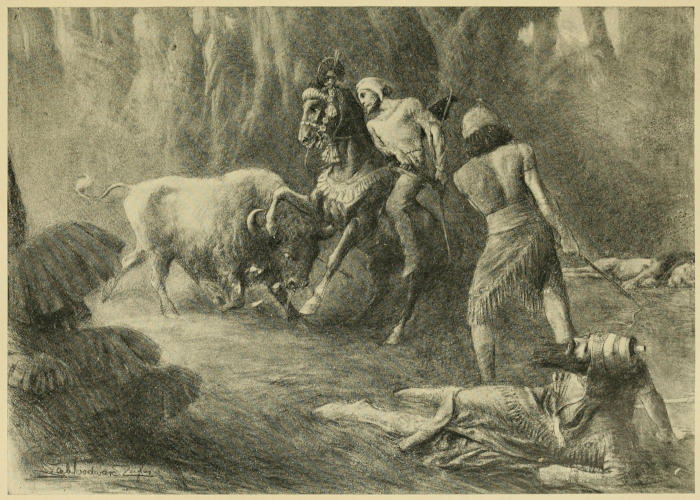
men call me by in Persia is the ‘King of the Bow,’
for I boast that I have no peer in archery.”
“Then, by Nergal, lord of the hunting,” swore the
monarch, “you shall face the fiercest lions and wild
bulls in my preserves in the marshes! And I will
learn if a Persian can conquer a king of Babylon in
the chase.”
“Excellent,” exclaimed the Persian. “Babylon and
Persia are at peace; they shall test their might on
the lord of beasts. And if I am not Cyrus’s self, next
to him there is none other of my nation that calls me
vassal.”
But now the water-gate of Imgur-Bel was passed,
and while on the left the cone of Bel-Marduk lifted
its series of diminishing terraces to a dizzy height,
on the right spread the royal palace, a vast structure,
surrounded by a dense park, and all girded by a wall.
On the river side the buildings closely abutted the
shores, rising from a lofty brick-faced embankment,
themselves of brick, but splendid with the gilding on
the battlements, with the sculptured winged bulls that
flanked the many portals, and the bright enamel upon
the brickwork. Out of the masses of walls sprang
castellated towers crowned with gaudy flags, and toward
the centre reared a ziggurat, the private temple
of the king.
For an instant Darius was at Atossa’s side as she
gazed, and no one watched them.
“This is the dwelling of Belshazzar,” said he softly,
“a great king. Joy to be his wife.” But the lady
shivered behind her veil.
“He is a great king, but they will never call him,
like Cyrus, ‘the father of his people.’”
“You will soon forget Persia, happy as mistress in
this wondrous city.”
“When I have lived ten thousand years I shall
forget—perhaps.” Then she added very softly, “I
am afraid of Belshazzar; his lips drop praise, his
heart is cold and hard as the northern ice. I shall
always dread him.”
“You wrong the king,” Darius vainly strove to
speak lightly; “the ways of Babylon are not those
of Persia. But there will come a day when you will
feel that the Chaldees are your own people. Belshazzar
is a splendid man; he will delight to honour
you.”
But Atossa only held down her head, and answered
in a whisper Darius might not hear.
They had no time for more. A vast multitude was
upon the embankment before the palace—white-robed
priests, garlanded priestesses, the glittering
body-guard, all manner of city folk. A shout of
welcome drifted over the river.
“Hail, King Belshazzar! Hail, Lady Atossa!
May your years exceed those of Khasisadra the
Ancient!” Then, amid tinkling harps, many voices
raised the hymn of praise to Marduk, the conductor
of the royal bride:—
“O merciful one among the gods,
Marduk, king of heaven and earth,
Mankind, the black-headed race,
All creatures, and the spirits of the sky,
Bow down before thee!”
The royal galley headed toward the landing.
The great orchestra of eunuchs and playing-girls
raised a prodigious din; yet all their music was
drowned by the shoutings of the people. The staid
citizens brandished their long walking-staffs, and
cheered till the heavens seemed near cracking. But
a large corps of the body-guard had cleared a portion
of the royal quay, and the party disembarked between
two files of soldiers. Close to the landing
waited the chariots—the six-spoked wheels all
glistening with the gilding, more gilding on the
panels of the body, the pole, and the harness, and
jewels and silver bells braided into the manes of the
prancing bay Elamites. For Atossa was ready a
four-wheeled coach, adorned as richly as the chariots,
drawn by two sleek gray mules, and with a closed
body, that the daughter of Cyrus might rest on her
cushions within, undisturbed by the vulgar ken.
Belshazzar ceremoniously waited upon the princess,
till Mermaza closed the door upon her. Then the
king beckoned to Darius to mount one of the chariots,
while he leaped himself into another. “To
the palace,” was the royal command; but just as
the charioteers upraised their lashes, the steeds commenced
to plunge and rear almost beyond control.
Along the brick-paved terrace tugged several
lumbering wains, for which great and small made
way. As the wagons approached, a low rumble proceeded
from them, which set all the chariot horses
prancing, and the women and timid burghers uttered
low cries and began to mutter incantations. The
eyes of Darius commenced to sparkle. The meaning
of that rumble he knew right well.
“Lions?” demanded he of his chariot-driver.
“Yes, lord,” the man answered, scarce reining the
horses, “twelve bull-lions just taken, being sent to
Kutha for the king’s preserves.”
The Persian’s nostrils dilated like a charger scenting
battle. And as if in answer to his half-breathed
prayer, lo! one of the oxen, stung by the goad and
fretted by the roarings, commenced to shake his
yoke, halting obstinately, and lifting a full-voiced
bellow. Instantly his mates answered; the lions’
thunders doubled; the wagon-train was halted.
Belshazzar called fiercely to the chief wagoner,
“Quiet instantly, or fifty stripes!”
His voice was drowned in the roar. The teams
were so near now that one could look into the cages,
and see the great beasts pent up behind the stout
wooden bars; bars that seemed all too frail at this
moment, as lion after lion, frightened and enraged by
the din of the oxen, the multitude, and his own
fellows, began to claw at the bars, digging out huge
splinters with tooth and talon, and roaring louder,
ever louder.
Belshazzar’s voice sounded now above all the
noise. “Clear away this rabble!” he was ordering
Sirusur, “Master of the Host.” “The man who
sent the lion-train this way shall face me to-night.
Silence the beasts, and get off with them!”
But not the lord of Babylon and all his guards
could still those oxen and their maddened freight.
Sirusur did as bidden. His men pushed on the
crowd with their sword-scabbards, but truth to
tell the press was so close, and the exits from the
quay so cramped, the soldiers could accomplish little.
The panic was spreading swiftly enough, however.
The goads on the oxen had only driven them into
deeper obstinacy.
“Look! In Nergal’s name, look!” cried Darius’s
charioteer; and before the prince’s half-terrified,
half-exulting eyes he saw the lion within the nearest
cage leaping to and fro, trebly maddened now by all
the growing tumult. The wagon swayed on its
wheels. The wooden bars gave a crash every
instant.
“Three more leaps and he is free!” the prince was
shouting, transported by his excitement.
“Danger! The wagon topples!” was the howl of
the people, and at last they began to give way indeed.
Sirusur, having abandoned his hopeless effort to
restore order and silence, hurried men to form before
the chariots, while others ran to aid the despairing
drivers. Late—the unruly oxen strained their
chains. Darius saw the heavy cage totter, fall—a
crash, a murk of dust, a noise that thrilled the stoutest,
hard wood giving way under harder talons and
teeth, then a roar of triumph. Out of the dust he
saw a kingly lion bounding, in all his panoply of
tawny mane. As the beast leaped, drivers and soldiers
sped back like leaves before a gale. The multitude
was shrinking, trampling.
“The lion! The lion! Loose! Escape!”
Belshazzar’s curse was heard above all else. “Take
him alive, or, by Marduk, you are all flayed!”
Some guardsmen sprang forward, but the lion, crafty
brute, did not fling himself against those breasts of
steel. There were bowmen present, but the king
stayed their arrows. “Not a shaft. Better ten
killed than have him butchered!” The soldiers
stood impotent, while the lion ran with low bounds
straight into the helpless crowd, that recoiled as at
the touch of fire. Belshazzar was in a towering rage.
“Nets and hot irons from the palace!” he thundered.
“Impalement to all if he escapes!”
The people were screaming, panic-struck; priests
were trampling down women; the noise grew indescribable.
The other lions dashed against their
cages. The brute ran like a great cat down the
lane opened through the multitude. A moment, and
he would have broken clear and ranged the streets.
But from his own side Darius heard a cry of mortal
fear.
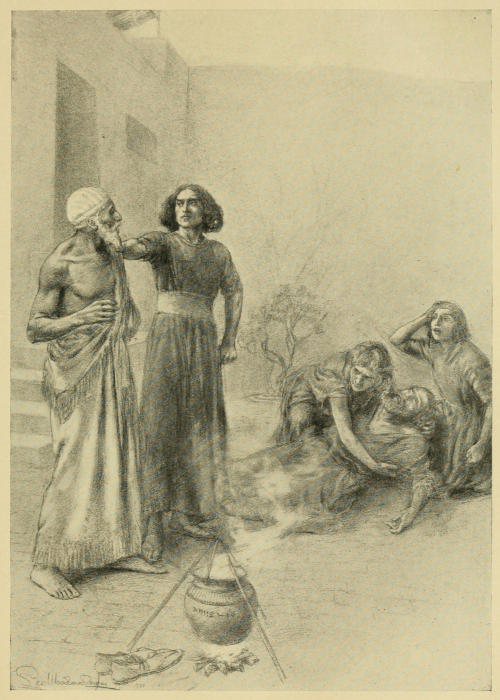
“Jehovah, have mercy! Ruth! My daughter!”
In the next chariot stood Daniel, covering his face
with his hands. The Persian glanced toward the
lion. In the centre of the lane, before the escaping
monster, stood a white-clad girl, terrified, shivering,
her eyes upon the lion, fascinated by his gaze, held
helpless as a dove before the snake. How she came
there, what fate ordained that she alone of those
thousands should be left to confront the monster, that
was no time to know. But present she was, and
before her the lion. The whole scene passed in less
time than the telling. The beast had instantly forgotten
his own perils. Keepers, soldiers, multitude,
all ignored. He seemed again in his forest—fair
prey! That was all he knew!
The lion sank low upon the earth, and crept by
little leaps nearer, nearer. The charming fire in the
eyeballs Darius saw not, but he saw the red, lolling
tongue, the bristling mane, the great tail undulating
at the tip, the paws fit to crush an ox. Daniel was
turning away his face.
“Arrows, O king! Shoot! My only one!”
pleaded he; but Belshazzar flung back, “What is a
maid beside a royal lion! Too far—no bow can
carry!”
“Darius had proved his title, ‘King of the Bow.’”
Many an archer’s fingers tightened around his
bow, but the king’s eye was on them. Not a shaft
flew. There was a moment’s silence, lions and oxen
hushed. A low moan seemed rising from the
people. The lion had covered twenty of the thirty
paces betwixt him and his prey. The maid was
quaking, yet her feet seemed turned to stone.
Belshazzar stood in his car, no god more splendid,
more merciless.
“Pity me, O king!” was Daniel’s last appeal.
He had leaped down, and grovelled as a worm before
the royal car.
“Too late,” came the answer, “only Bel’s bolt
now can save!” What joy to the king to see
those lithe limbs in the monster’s clutch! But a
great cry had broken from Darius.
“No, in the name of Ahura the merciful!”
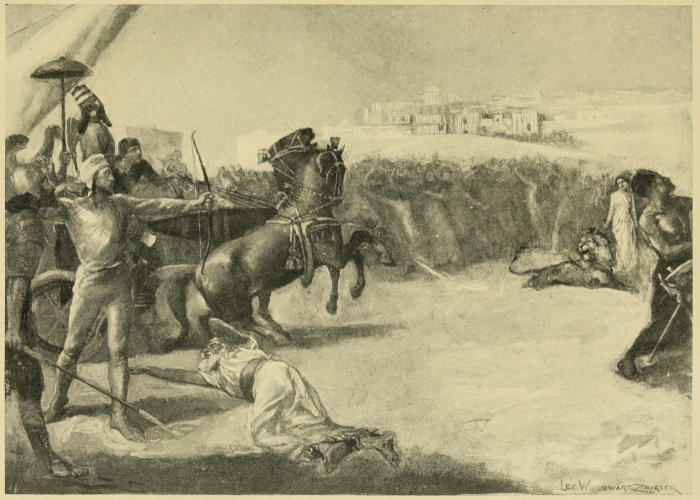
Few saw him, bounding from his chariot, pluck bow
and quiver from a soldier. The lion coiled his
limbs for the final leap; men saw his body spring
as a stone from a catapult; heard a twitter of a bow,
and right at the bound the shaft entered the shoulder,
cunningly sped. A roar of dying agony, the body
dashed upon the pavement at the girl’s feet. No second
shaft needed—a twitch, a great bestial groan.
Darius had proved his title, “King of the Bow.”
But Belshazzar, who had seen the shot but not the
archer, blazed out in blind fury, “As Marduk rules,
who shot? Impale him!”
Darius stepped beside the royal chariot; his pose
was very haughty. “My lord,” said he, “I give
proof we Persians are fair huntsmen.”
Belshazzar’s hand went to his sword-hilt, but
Darius met the flame in his eyes unflinchingly.
By a great effort the king controlled himself, but
did not risk speech. The drivers had mastered the
oxen, the lions grew still. The people were shouting
in delight, “Glory to Nergal! The Persian is
peer to the hero Gilgamesh!”
Daniel was kissing Darius’s shoes, his voice too
choked for thanks. But a young man with a forceful,
frank face, a manly form, dressed like Daniel,
very simply, came and kissed, not the shoes, but the
dust at Darius’s feet.
“For life I am your slave, O prince! You have
saved me my betrothed!” Then he ran among
the people to lead away the girl. Belshazzar ventured
to speak.
“How now, Daniel?” ignoring Darius. “By
Nergal, your wench has been the death of an African
lion! Why here? You keep her locked at
home, safe as a gold talent. I have never seen her.”
“She was with Isaiah, her betrothed. In the
crowd they were swept asunder. The king saw the
rest.”
Belshazzar was still raging.
“Yes, verily. A rare bull-lion sacrificed for a
slip of a wench like her!” Then to the eunuchs:
“Run, bring the lass to me. Rare treasure she
must prove to make her more precious than the
lion.”
Darius saw a fresh cloud on the old Jew’s face.
In a moment Isaiah and the maid were before the
king. Very young and fragile seemed the Jewess.
The blood had not returned to the smooth brown
cheeks. Her black hair was scattered in little curls,
for veil and fillet had been torn away. She looked
about with great, scared eyes, and all could see her
tremble. She started to kneel before the king, but
Belshazzar, regarding her, gave a mighty laugh.
“Good, by Istar! So this is your treasure,
Daniel? Not the Egibi bankers possess a greater,
you doubtless swear. Stand up, my maid. Bel
never made those eyes to stare upon that dusty road.
Closer. Look at me, and I vow I will forgive you
the lion. There are more in the marshes, but only
one daughter of Daniel!”
“Look up, child; his Majesty bids you,” the old
Hebrew was saying, but his face was very grave.
Ruth raised her great eyes; her lips moved, as if in
some answer, but no sound came. Belshazzar smiled
down upon her from his car. Atossa was to be his
queen, but when was a king of Babylon denied a
maid that was pleasant to his eyes? He turned to
Darius.
“Now, by every god, I thank you, Persian. I
was about to curse, but your archery saved one
beside whom Istar’s self must flush in shame. Well
are you named ‘King of the Bow.’”
Then he gazed again upon the maid. “Mermaza,”
he commanded, “put the girl in a chariot, and take
her to the palace harem. Give her dresses and
jewels like the sun. Do you, Daniel, draw five
talents from the treasury. Not enough? Ten
then. Fair payment for a daughter—ha!”
Daniel was on his knees before the king.
“Mercy! Hear me, my lord. If ever, by faithfulness
serving you and your fathers, I gather some
store of gratitude—”
Belshazzar cut him short. “Now does Anu, lord
of the air, topple down heaven? What father says
to a king, ‘Mercy. Give back my daughter’?
Oh, presumption! No more, or you forfeit the
money.”
“The money,” groaned Daniel, “the price of
my daughter? Kiss the earth, Ruth; and you,
Isaiah, entreat the king to forbear!”
Belshazzar turned his back. “Fool,” he cried,
“the money is truly forfeit! Away with her, Mermaza.
Great mercy I leave the Jew his life.”
But Darius deliberately thrust himself before the
king, and looked him in the face. “My lord,” he
said soberly, “if to any, the girl belongs to me. I
saved her and restore her to her father.”
“You beard me thus, Persian, barbarian!” broke
forth Belshazzar, again in his wrath. The prince
answered him very slowly:—
“Your Majesty, in me you see the ‘eyes and ears’
of Cyrus, lord of the Aryans. What if I report in
Susa, ‘On the day I delivered Atossa to Belshazzar,
he, before her own eyes, showed his esteem for her
by haling to his harem a maid chance sent him on
the streets’? Would such a tale knit the alliance
firmer?”
Avil-Marduk was beside the king in the chariot,
and he whispered in the royal ear, “Risk nothing.
Dismiss the maid; the eunuchs can watch for her and
secure her quietly.”
Belshazzar was again calm. His passion was
swift; he subdued it more swiftly. “Son of
Hystaspes,” said he, with easy candour, “I am a
man of sudden moods. The maid pleased me;
but, by Istar, I did not think to insult the princess.
Let the Jews go in peace, and to heal their
hurts let the treasurer weigh to each a talent.
The Jewess shall sleep safe as a goddess’s image in
the temple. I swear it, on the word of a king of
Babylon. Enough, and now to the palace.”
Darius was received with stately hospitality at
the palace. He was told the arrangements made
for Belshazzar’s bride. The king would give her
a great betrothal feast at the Hanging Gardens,
but could not wed her for one year; for before
marriage she must be taught the religious duties
of a queen of Babylon. Darius paced the open
terrace of the palace that evening. Below him
and all about lay the city of the Chaldees, fair as
a vision of heaven, with the white moon riding
above the tower of Bel. But the beauty of the
city brought no joy. Into the hands of what
manner of man had Atossa fallen? The desire of
Belshazzar to sacrifice the maiden for the beast,
followed by the outburst of carnal passion—how
unlike this king to Cyrus, whom the meanest Persian
loved! At last, when it had grown very dark,
Darius looked about him. No one was near. He
lifted his hands toward the starry sky.
“Verily this Babylon is a city of wickedness, and
most evil of all is its cruel king. But I am young.
I am strong. Belshazzar shall not possess Atossa
for one year. And in that year a brave man may
do much—much. Help Thou me, Ahura-Mazda,
Lord God of my fathers!”
CHAPTER III
Near the meeting of the great Nana-Sakipat
Street with Ai-Bur-Schabu Street stood the
banking-house of the “Sons of Egibi.” The long
bridge of floats across the river was close by, and
in and out the portals of the wide river-gate poured
a constant stream of veiled ladies, with their guardian
eunuchs, intent on shopping, of donkey boys,
carters, pedlers, and priests. Under the shade of
the great stone bull guarding one side of the entrance,
the district judge was sitting on his stool,
listening to noisy litigants; from the brass founder’s
shop opposite rose the clang of hammers; and under
his open booth descended a stairway to Nur-Samas’s
beer-house, by which many went down and few
ascended, for it was hard to recollect one’s cares
while over the drinking-pots.
The Egibis’ office, like all the other shops, was a
room open to all comers, nearly level with the way,
without door or window, but made cool by the green
awning stretched across the street in front, and
the shadow cast by the high houses opposite. In
the office many young clerks were on their stools,
each busily writing on the frames of damp clay in
their laps with a wedge-headed stylus. Itti-Marduk,
present head of this the greatest banking-house of
Babylon, was a plainly dressed, quiet-speaking man;
and only the great rubies in his earrings and the
rare Arabian pomade on his hair told that he could
hold up his head before any lord of Chaldea saving
Belshazzar himself. At this moment he was entertaining
no less a client than Avil-Marduk, the chief
priest, who came in company with his boon companion,
the priest Neriglissor, as did all the city at
one or another time, to ask an advance from the
omnipotent broker. As for Itti, he was angling
his fish after his manner, keeping up a constant
stream of polite small talk, sending out a lad to
bring perfumed water to bathe his noble guests’
feet, and yet making it plain all the while that
current rates of interest were exceedingly heavy.
“Alas!” the worthy banker was bewailing, “that
I must speak of shekels and manehs before friends,
but what with heavy remittances I must send to
agents in Erech, with the farmers all calling for
funds to pay their help for the coming season, and
a heavy loan to be placed by his Majesty to complete
the fortifications of Borsippa, I have been put to
straits to raise so much as a talent; and were you
any other than yourself, my dear high priest, I fear
I could do nothing for you.”
“Yet I swear by Samas,” protested the pontiff,
with a wry face at the loan-contract before him,
“you have enough in your caskets to build us poor
priests of Bel a new ziggurat.”
“A new ziggurat!” protested the banker; “am I
like Ea, able to see all hidden riches? I declare to
you that what with the rumour that the tribes in the
southern marshes around Teredon are restless, money
becomes as scarce as snow in midsummer. Ramman
forbid that anything come of the report! It will
wither all credit!” So at last, with many protests
from Avil, the contract was signed, and stored away
in a stout earthen jar, in the strong room of the
cellar, where lay countless jugs of account books.
And Itti, to make his guest forget that he had just
bargained to pay “twelve shekels on the maneh,”[2]
inquired genially if the recent taking of the omens
had chanced to be fortunate. He was met by blank
faces both from Avil and his chariot comrade, the
toothless old “anointer of Bel,” Neriglissor.
“The omens are direful,” began the latter, in a
horrified whisper.
“Hush!” admonished the chief priest, “a state
secret. To breathe it on the streets would send corn
to a famine price.”
The banker had pricked up his ears. “I am not
curious in matters of state; Marduk forbid! Yet
if in confidence I were told anything—”
Neriglissor was only too ready to begin. “The
Persians,” he whispered, “the Persians! Barbarous
dogs! Faugh! I sicken thinking of the strong
Median nard the daughter of Cyrus smeared on her
hair!”
Itti smiled benevolently. “What Persian can
have the delicate taste of a Babylonian? Yet you
have not told the omen.”
Neriglissor’s voice sank yet lower. “These Persians
are friends to the Jews, that race of blasphemers.
Each nation worships the same demon,
though the Jews style him Jehovah, the Persians
Ahura-Mazda. Long have the pious foreseen that
unless these unbelievers were kept out of Babylon
the gods would be angry. Yesterday this Atossa
comes to Babylon to be his Majesty’s queen. Thus
we are about to strike hands with the foes of the
gods, as if it were not enough to continue the old
scoffer Daniel in office. And this morning follows
the omen.”
Itti was bending over that not a word might
escape. Neriglissor continued, “As Iln-ciya, the
chief prophet, and I stood by the temple gate, a
band of street dogs, all unawares, strayed past, and
entered the enclosure.”
Itti started as he sat, forgot his manehs, and
began to mutter an invocation to Ramman, while
his lips twitched. “Impossible!” was all he could
gasp.
“Too true,” put in Avil, solemnly. “You know
the ancient oracle,” and he rolled out the formula:—
“‘When dogs in a court of a temple meet,
The hosts of the city face swift defeat.’
We brought the news to the king. He is all anxiety.
There will be a special council and consulting of the
oracles. We trust, by laying extra burdens on these
stubborn Jews, we can in some measure avert the
wrath of heaven. Yet this is a fearful portent, just
as his Majesty is about to marry a Persian.”
Itti was still shaking his head, when an increased
din rising from the street warned Avil that there
would be no passing at present for his chariot.
“Way! way!” a squad of spearmen were bawling,
forcing back the traffickers to either side. The
banker and his guests stared forth curiously.
“Way! way!” the shout grew louder, and behind
sounded a creaking and a rumbling. The chief priest
glanced toward the gate.
“The new stone bull,” commented he, “comes
from Karkhemish. They landed it above the
bridge; now they drag it to the old palace of
Nabupolassar, which the king is repairing.”
“Then the Jews,” remarked Itti shrewdly, “are
already being rewarded for their impiety. Has
not the labour gang been taken from their nation?”
“You are right,” said Avil, “they will fast learn
that to keep clear of forced labour they must go to
the ziggurat and the grove of Istar.”
“Strange people,” declared Itti, “so steadfast
to their helpless god!”
“If Marduk gives me life,” swore Avil, “I will
bend their stiff necks. His Majesty promises the
indulgence of former reigns shall end forever.”
The rumbling in the streets drowned further
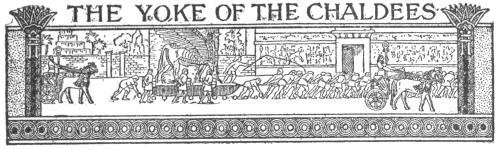
words. Long before the bull came in sight appeared
four long lines of panting men, naked save for loincloths,
dusty, sullen. Each man tugged at a short
cord, made fast in turn to one of the four heavy
cables stretching far behind them. At times the
march would come to dead halt; then every back
would bend, and at a shout from the rear the hundreds
would pull as one, and start forward with a
jerk. The laggards were spurred on by the prick
of the lances of the spearmen outside the lines, or
felt the staffs of the overseers who walked between
the cables. Young boys ran in and out with water
jars, and now and then a weary wretch would drop
from the line to gulp down a draught, and run back
to his toil. So the long snake wound down the street,
groaning, panting, cursing. Behind this thundered
the bull. The stone monster was upon a boat-shaped
sledge, itself the height of a man. Busy hands laid
rollers before it. To steady its mass, men ran beside,
holding taut the cords fixed to the tips of the
huge wings. On the front of the sledge stood the
guard’s captain, bellowing orders through a speaking
trumpet. The bull reared above him to thrice his
height. Last of all came many toiling from behind,
with heavy wooden levers.
“Ah, noble Avil,” called the guard’s captain,
familiarly, “who would say the chief priest makes
way for Igas-Ramman, captain of a fifty?”
And Avil, recognizing a friend, called back,
“Beware, or I beg your head of the king! Make
the Jews give full service.”
“They shall, by Nabu!” And Igas trumpeted,
“Faster now! Wings of eagles! Feet of hares,
or your backs smart!”
The overseers’ blows doubled, the bull swayed
as it leaped forward, but suddenly Igas cursed.
“Now, by the Maskim, foul genii of the deep, what
is this? Down again, worthless ox!”
An old man had fallen from line. Overcome by
weariness he lay on the stone slabs while the strokes
of the overseers’ staffs made him writhe. Rise he
could not. Neriglissor recognized him.
“A Jew named Abiathar, a great blasphemer of
Marduk. Ha! Smite again, again!”
Igas leaped into the throng, waving a terrific
Ethiopian whip of rhinoceros hide. At the second
blow blood reddened the flags. The Hebrew
groaned, tried vainly to rise.
“Beast,” raged Igas, swinging again, “you shall
indeed be taught not to lag!”
The great whip whisked on high, but just as it
fell, a heavy hand sent the captain sprawling.
Young Isaiah stood above the prostrate Igas, his
eyes burning with righteous wrath, his form erect.
“Coward! You will not strike twice a man of
your own age!”
The spearmen stood blinking at Isaiah in sheer
astonishment. Igas crawled to his feet; rage choked
the curses in his throat, then flowed forth a torrent
of imprecations. In his wrath he forgot even to
call for help.
“Beetle!” howled he, bounding on Isaiah. But
the Jew had caught the whip, lashed it across the
guards captain’s shoulders, and raised a smarting
welt. Then at last all leaped on the intruder, but
he laid about as seven, till a stroke of a cudgel
dashed the whip from his grasp; he was carried
off his feet, overpowered, and gripped fast. Around
the motionless bull a tumultuous crowd was swelling,
when a squad of red-robed “street-wardens”
hastened up to arrest the peace-breakers.
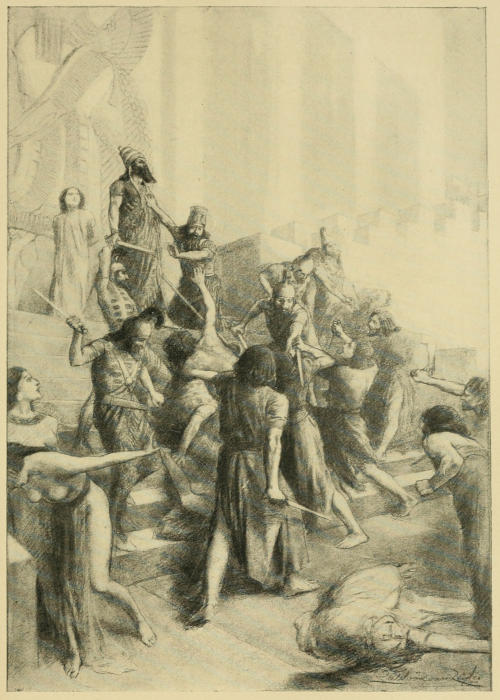
“High treason against the king!” Igas was
screeching. “His head off before sunset!” But
the police rescued Isaiah from the spearmen, and
their chief urged:—
“Softly, excellent captain, he must be tried before
the judge.”
“A Jew! A Jew!” shouted many. “Away
with him! Strike! Kill!”
The multitude seemed growing riotous, and ready
to attack the police, when a new band of runners
commenced forcing a passage.
“Way! way! for the noble Persian Darius and
the Vizier Bilsandan!” was the cry; but to the
astonishment of those in the banking-house, they
saw the young envoy leap from his chariot and
plunge before his escort into the crowd. Dashing
back the mob with sturdy blows from his scabbard,
he was in an instant beside the Jew. For a moment
few recognized him. Igas thrust at him with a
lance, a quick thrust, yet more quickly had Darius
unsheathed, and struck off the spear-head. “Treason!
Rebellion! A plot!” shouted a hundred. The
police endeavoured to arrest the new offender.
“Death to the Jews!” rang the yell, as many
hands were outstretched. But the Persian had
released Isaiah, and thrust a cudgel in his hands.
His own sword shone very bright.
“Guard my back!” commanded he, and braced
himself. The crowd cut him off from his escort.
Avil cried vainly across the deafening tumult.
“Hold, on your lives! Will you murder the
Persian envoy?”
There was a rush, a struggle; those thrust against
Darius shrank back howling, all save two, who had
tasted his short sword.
In the respite following, Bilsandan had forced
himself to the envoy’s side. Mere sight of the
vizier was enough to enforce quiet.
“Peace, dogs!” thundered Bilsandan. “Why
this tumult?”
Darius had sheathed his sword, but looked about
smiling. Joy to show these city folk the edge of
Aryan steel!
“I struck only in self-defence,” quoth he to the
vizier. “You saw the cruelty of this scorpion.
Isaiah deserves reward for avenging the old man.
I will mention the evil deed of this captain to
the king. We Persians hold that he who reveres
not the gray head will still less reverence the
crown.”
Igas was falling on his knees before Darius.
Well he knew Belshazzar would snuff out his life
so cheaply to humour the envoy of Cyrus, if only
Darius asked it. But the Persian laughed good-naturedly,
forced him to swear he would pay old
Abiathar two manehs, for salve to his stripes, and
the king should hear nothing about it. As for
Isaiah, spearmen and police were glad to leave him
at liberty. They bore the two wounded away.
Darius was about to return to the chariot in which
Bilsandan had been driving him about the city, but
gave Isaiah a last word. “By Mithra, I love you,
Jew! You are like myself, swift as a thunderbolt,
striking first and taking counsel later.”
“Jehovah bless you again, my prince!” cried the
other. “How may I repay? They would have
taken my life.”
So Darius was gone. The bull lumbered on its
way. Isaiah alone remained to help home the
wretched Abiathar. As he bargained with a carter
to take the old man to his home on the Arachtu
Canal, Avil-Marduk called from the banking-house:
“Praise Bel, Hebrew, you are not on the way to
execution! Be advised. I love men of your spirit.
Enter our service at the ziggurat, and, by Istar,
you may wear the goatskin in my place some
day!”
Isaiah held up his head haughtily. “I would
indeed enter the service of a god—not of Bel-Marduk,
but of Jehovah. I am a Jew, my lord.”
Avil smiled patronizingly. “Excellent youth,
you are too wise to think I do not set your wish
at true value. No offence, but where does Jehovah
rule to-day? Fifty years long we have used the
dishes from His temple at your village of Jerusalem,
in our own worship of Bel-Marduk. Your god is
helpless or forsakes you; no shame to forsake Him.”
Isaiah bowed respectfully. “Your lordship, we
gain little by debate,” replied he.
“Nevertheless,” quoth Avil, blandly, “I am grieved
to see a young man of your fair parts throw his
opportunities away. Be led by me; what do you
owe Jehovah? Bel-Marduk will prove a more liberal
patron. You are Jew only in name, your birth
and breeding have been in this Babylon. To her
gods you should owe your fealty. Believe me, I
speak as a friend—”
Isaiah straightened himself haughtily.
“My Lord Avil, do not think Jehovah is like
your Bel, the god of one city, of one nation. For
from the east to the gates of the sun in the west is
His government. And all the peoples are subject
unto Him, though the most part know it not.”
The high priest’s lip curled a little scornfully.
“Truly,” flew his answer, “Jehovah displays His
omnipotence in strange ways,—to let the one
nation that affects to serve Him languish in
captivity.”
“I fear many words of mine will not make your
lordship understand,” replied Isaiah; and he bowed
again and was gone. Those in the banking-house
looked at one another.
“Sad that so promising a youth must cast himself
away in fanatical devotion to his helpless god,” commented
Itti the banker. “Yet he only imitates
his father, Shadrach, the late royal minister.”
“Young as he is,” responded Avil, “he is already
a power amongst his countrymen. He has the reputation
of being a prophet of their Jehovah, and many
treat him with high respect. Nevertheless, if he is
not better counselled soon, he will find his head
in danger, unless the king stops his ears to my
warnings.”
Isaiah walked beside Abiathar as the cart rumbled
homeward. The old Jew was all groans and moans.
“Ah, woe!” he was bewailing, “is this to be the
reward of the Lord God for remembering Him, and
keeping away from the ziggurat! Stripes and forced
labour and insult! Speak as you will, good Isaiah,
you who have the civil-minister to protect you from
all harm; it is easy for you to toss out brave words.
You are passing rich; we are poor, and all the
stripes crack over our shoulders!”
“Hush!” admonished the younger Jew, severely;
“my perils are great as yours, did you but know
them. It is for our sins this trouble is visited upon
us. Our fathers have forgotten Jehovah, and is He
not now visiting their sins upon us, unto the third
and fourth generation, even as says His Law?”
“I do not know,” replied the other, moodily; “I
only know that a little oil and fruit offered now and
then to Sin or Samas would cure many aching
backs!”
Isaiah did not answer him. In truth, there was
very little to reply. He walked beside the wagon
until Abiathar was safe at his little house by the
Western Canal. Then he left him, and went in the
bitterness of his spirit to the palace of Daniel, near
the Gate of Beltis in the inner city.
Like all Babylonian gentlemen, the civil-minister
had an extensive establishment, though the exterior
was gloomy and windowless. When Isaiah had
entered the narrow gate he found himself in a spacious
court, surrounded by a two-story veranda,
upborne on palm trunks. In the court were ferns,
flowers, and a little fountain; an awning covered
the opening toward the sky. In a farther corner
maid-servants were pounding grain and sitting over
their embroidery.
Isaiah entered unceremoniously; but just at the
inner door of the farther side of the court he came
on Daniel himself, dressed in his whitest robe, and
surrounded by several servants, as if about to set
forth in his chariot.
“My father!” And the younger Hebrew fell on
his knees while the other’s hand outstretched in
blessing.
“The peace of Jehovah cover you, my son,”
declared the old man. Yet when Isaiah had risen,
he was startled at the anxiety written on the other’s
face. He knew it was no light thing that could
shake the civil-minister out of his wonted calm.
“As Jehovah lives,” adjured the younger Jew,
“what has befallen? Where are you going? You
do not commonly ride abroad in the heat of the
day.”
“I have urgent need of going to Borsippa to see
my good friend Imbi-Ilu, high priest of Nabu, on a
private matter.” The effort to speak lightly was
so evident that Isaiah’s fears were only doubled.
The minister turned to the others.
“Tell Absalom to hasten with harnessing the
chariots,” commanded Daniel. The servants took
the hint and withdrew. Their master cast a searching
glance about the courtyard, to make sure that
no others were in easy earshot.
“Listen.” His speech sank to a whisper. “I am
in sore anxiety concerning the safety of Ruth.”
“Of Ruth!” Isaiah’s grave face grew dark as
the thunder-cloud. “How? Who threatens?”
Daniel spoke yet lower. “This day I have received
a message from friends in the palace, that the
king still remembers her beauty, and desires her.
His promise to Darius was a lie, to appease the
envoy for the moment. I dare not doubt that some
attempt will be made by Mermaza, or by others of
his spawn, to carry away the girl at the first convenient
opportunity. She must not sally abroad,
however much she may desire it. I do not know
how great is the immediate danger, but there is
nought to be risked. On this account I am going
to Borsippa without delay.”
“Then as our God rewardeth evil for evil, so will
I reward the king!” Isaiah had turned livid with
his wrath. “I will slay Belshazzar with my own
hand, and then let them kill me with slow tortures.”
Daniel smiled despite his heavy heart.
“Small gain would that be to our people. The
fury of the Babylonians would grow sixfold. If
the yoke is hard to bear now, what then?”
“Yet will Belshazzar truly break his promise?”
demanded Isaiah, plucking at the last straw of hope.
“Promise?” Daniel laughed grimly. “He will
break ten thousand oaths, when they stand betwixt
him and a passion. Avil-Marduk urges him each
day to ruin me and mine, as a lesson to the rest of
our people. The Jews are to be driven like sheep
to the ziggurat, and forced to blaspheme Jehovah.
Alas! When I think of the plight of our nation,
the dangers of a few of us seem but as the first
whisperings of a mighty storm! If no succour
comes, Ruth and you and I are utterly undone;
and our people will forget its God, as He in His
just wrath seems to have forgotten them.”
“And is there no hope?” groaned Isaiah in his
despair.
Before Daniel could answer, a sweet girlish voice
sounded, singing from the upper casement, over the
court. The two men stood in silence.
“My beloved spake and said unto me,
‘Rise up, my love, my fair one, and come away.
For lo, the winter is past, the rain is over and gone:
The flowers appear on the earth;
The time of the singing of birds is come,
And the voice of the turtle is heard in our land!’”
“It is the song of Ruth,” said Daniel, as in dreamy
melancholy. “She has waited you for long. Blessed
is she; to her Jehovah thus far is kind. She does
not know her danger. The ‘Song of Songs’ is ever
in her mouth, in these days of her love. You must
go to her.”
“Let all Belshazzar’s sword-hands take her from
me!” was Isaiah’s rash boast. But then he asked
more calmly: “And why do you, my father, go to
Borsippa? You have not told.”
“To ask Imbi-Ilu if he will give sanctuary in the
temple of Nabu to Ruth, if worst comes to worst.
Bitter expedient!—a daughter of Judah sheltered in
the house of idols! Such is the only shift.”
“But Imbi could not guard her always, if the
king’s mind is fixed. And what of our nation, of
the peril of great apostasy? Ah!” Isaiah lifted his
hand toward heaven. “I am not wrong. I must
kill Belshazzar; then if we die, we die not unavenged!”
Daniel quieted him with a touch.
“Do not anger God with unholy rashness. All is
not yet lost. I have still my position as ‘civil-minister,’
and though the Babylonians may rage
against our people, they reverence me still. My
word and name are yet a power in Babylon. Even
the king will hesitate to strike me too openly. And
if the worst does come, let them know I have yet a
weapon that may shake Belshazzar on his throne.”
“What mean you? For Jehovah’s sake, declare!”
Daniel smiled sadly at the impetuosity of the
younger man.
“No, not now. Fifty years long have I served
the kings of the Chaldees, and betrayed none of
their secrets. I keep fealty as long as I may; yet
the time for casting it off may be near at hand. The
Lord grant I may not be driven thus to bay—”
“The chariot waits, my lord,” interrupted a servant.
And Daniel gathered his robe about him, to
depart.
“Remain with Ruth until I return,” was his last
injunction; “the king will hardly wax so bold as
to go to extremities to-day. But till Belshazzar lies
dead, or Jehovah creates in him a new heart, we
must not cease to guard her.”
CHAPTER IV
The chariot of the “civil-minister” clattered
away, and Isaiah stood for a long time in
gloomy revery. Ever since Nabonidus had been
thrust from power, the condition of the Hebrews had
been growing steadily more miserable. Belshazzar
was in all things guided by Avil-Marduk, and the
high pontiff’s rage against the Jehovah worship of
the exiles was nothing new. Shadrach, Isaiah’s
father, had been a fellow-minister with Daniel, but
the liberal sway of Nebuchadnezzar was long since
past. Isaiah saw himself shut out of every office, so
long as he clung to the God of his people. Amongst
his fellow-Hebrews Isaiah had passed as a prophet;
in moments of ecstasy he had poured forth burning
words,—of encouragement to the faithful, of
threatenings to the oppressor, of promised restoration
to that dear Jerusalem he had seen only in his
dreams. But at this moment the dreams seemed
shadowy indeed. The events of the day had
darkened him utterly; and, crowding upon Avil’s
scarce veiled threat, came the tidings of the king’s
unholy lusting after Ruth! The young man’s heart
was sickened. How could he sit with smiling face,
and listen to his love, and her merry nothings? The
task was seemingly impossible, when the sweet voice
sounded again from the casement. “Ah! my wandering
swallow, why linger? Up quickly! Say something
to make me glad. I am exceeding vexed with
my father.”
Merry or sad, the young man waited no second
bidding. He sped up the narrow stairway by the
side of the court, and reached the upper veranda.
Here a sort of balcony, overhanging the yard, had
been walled with curtains of blue Egyptian stuffs,
and behind had been set a tall loom, its frame half
filled with a web of bright wools, where a brilliant
rug was unfolding under skilful fingers. Two dark-eyed
Arabian girls were aiding their mistress; but
at sight of Isaiah, the red thread shook from her lap,
and she flew twittering into his arms. Then like
two birds they cooed together, their eyes talking
faster than their lips; and at last—for all things
lovely must find end—Isaiah was in his accustomed
seat, a cushioned footstool beside the loom, and there
he could sit and chatter while the broad web grew.
But Ruth was in no mood for small talk. Her
little lips were wrinkled in a pout, the cast of her
eye was sulky. And while she wrought over the
loom, her fountain of wrath was emptied.
“Were I not an obedient daughter of Israel, I
should say unholy things of my good father. Surely
Jehovah forsakes us and suffers him to wax mad!”
“Daniel mad? He has the sagest head in all
Babylon. Fie, little owlet!”
“Either he is mad or worse. There!” the red-thonged
sandals over the small feet stamped
angrily, “I will tell all, though it be a sin to
revile a parent.”
“Verily, for you to be wroth with your father
must spring from no slight cause!” protested Isaiah,
feebly attempting to smile.
“Is it not sufficient that I must be kept precious
as a finch in his cage?—never suffered to go forth
to any of the fêtes at the palace, veiled always,
when I sally abroad, and guarded as if I were a
prisoner about to make escape?”
“Old tales, Ruth,”—Isaiah strove to speak
lightly; then more gravely, “Was the last time
we sallied forth, and met the lion and the king,
so joyous that you wish it repeated daily?”
He saw her shudder, and her mouth twitched, as
he recalled that scene; but she was too thoroughly
filled with wrath even to let that memory turn her.
“Not so—let my father send fifty servants about
me, and wrap my face in twoscore veils! But now
I am made utter prisoner. Yesterday I visited the
bazaars with Gedeliah, our body-servant; and in the
jeweller’s shop of Binzurbasna by the Gate of Istar I
saw an armlet that fitted my eye as water its cup. I
had no money, but last night my father gave me more
than the price. To-day Gedeliah starts at dawn with
a letter to Kisch. Later I say, ‘Father, I will take
another servant and go and buy the armlet.’ He
makes all manner of objections to my going. ‘Let
the serving-man go; do you remain.’ ‘No,’ answered
I, ‘only Gedeliah and I can tell which is the armlet;
if I wait, it is sold.’ I beseech exceedingly, whereupon
he says, after his firm manner: ‘Peace, Ruth;
I know what is well for you. You shall not go to-day.’
Then he summons his chariot, and departs to
Borsippa. Have I no cause for anger?”
Isaiah did not reply immediately; and she returned
to the charge. “Speak,—are you so jealous
that no man may set eyes on the hem of my mantle?
Speak!” And she snapped her bright eyes before
his.
“Your father is a wise man,” began Isaiah, cautiously;
“assuredly he had reasons.”
“Which clearly you agree in?” pressed she,
sharply.
“I said not that; though, were he to tell, no doubt
they would seem sufficient.”
“He has not told them? What passed then so
slyly, when you stood together?”
Isaiah had boasted that in a city where the clever
liar was deemed the sage, he had been wont to speak
truly; but he found himself close to equivocation.
“We spoke of the increasing power of Avil. Your
father grows anxious.”
“And was not my name mentioned once, twice?”
Ruth had turned from the loom, and was looking
Isaiah in the face.
“You did wrong to eavesdrop,” he faltered, nigh
desperately, for falsehood tripped hardest off his
tongue when those soft eyes were on him.
“No answer,” she challenged, lowering her head
till her curls almost brushed his cheek. “Speak!
Why did you use my name?”
“You must have confidence in us,” began Isaiah,
putting on manly austerity, “to believe that whatever
we said was only for your good.”
A tart retort was tingling on her tongue, when a
voice from the court interrupted. “Ho! Is the
young master Isaiah above?”
It was the old porter’s call; the other responded
instantly.
“Since my Lord Daniel is away,” went on the
porter, “will my young master come down at once?
His friend, the guardsman Zerubbabel, is here, and
demands instant speech of weighty matters.”
Isaiah was down the stairs by leaps. In the court
he met a young man of about his own age, comely
and erect, dressed in the short mantle of a soldier
off duty.
“Where is my Lord Daniel?” was his quick
demand; he was breathless with running.
“Has none told? Gone to Borsippa.”
“Jehovah God have mercy!”
Isaiah caught his friend by the arm.
“Hold, Zerubbabel; gain breath, and speak to
the point. Your wits are all scattered on the road
behind!”
The guardsman took a deep breath.
“Be a man, Isaiah,” he admonished, as if speaking
sorely against his will; “I have a heavy piece of
news for you.”
“Touching Ruth?”
Zerubbabel nodded. “You have heard that the
king had designs on her. Did you know Mermaza
was to make an attempt on her this very night?”
His voice had risen, despite Isaiah’s warning
“Hush!” They heard a little cry on the balcony
above—a louder scream. Isaiah clapped his hands
to his face. “The Lord spare her now!—she has
heard it!”
The next instant Ruth was beside them. She was
trembling; her hand quivered in her lover’s while he
held it, yet it seemed as much in anger as in
dread, though her face had blanched to the whiteness
of a summer’s cloud.
“Tell me all! All! Do you think me too weak
to bear?” was her plea, turning her great eyes from
the soldier to Isaiah and back again. “What danger
waits?”
The young prophet’s voice grew very calm.
“Beloved, blessing and bane come from the Lord
God alike. He can do nothing ill. Let us listen to
Zerubbabel.”
The guardsman’s speech came falteringly,—no joy
to chase the gladness from those bright eyes.
“Daughter of Daniel, I know that your father
reproaches me for having conformed to the Babylonish
worship, and taken service on the royal guard;
but, believe me, my heart is still faithful to Jehovah.
At no small peril have I come here, to warn you.
You, O Isaiah, have not been without an inkling;
but did you know that Belshazzar has given his
royal signet to Mermaza, chief of the eunuchs, commanding
him—”
Before he could utter another word, a bitter cry
had burst from Ruth: “Would God I had been unborn,
or died while yet a speechless child, than win
the love of Belshazzar. For the love of the king is
tenfold more cruel than his hate. Slay me; slay
now, rather than let the eunuchs lay hands on me!”
So she cried in her sudden agony; and what might
Isaiah say to comfort her? She could only feel the
muscles of his arms grow hard as iron, as she leaned
against his breast.
“Fear not,” he answered, with that confidence
born of a touch and a thrill that can make the weakling
giant strong; “were Belshazzar seven times the
king he is, he shall never do you harm.”
“So be it!” quoth Zerubbabel, gravely, “yet the
proof is close at hand. It is as I said. Mermaza
has received an order, signed by the royal signet,
authorizing him to take Ruth, the daughter of
Daniel, when there may be ‘convenient opportunity’—which
is to say, when no disturbance will arise
likely to hamper Avil-Marduk and his plots.”
“How know you this?” demanded Isaiah, almost
fiercely.
“One of the eunuchs, whose life Daniel had once
begged of Nabonidus, told me. I more than fear that
my visit to this house has been observed, and will be
laid up against me.”
“And what hinders the ‘profoundly-to-be-reverenced’
chief eunuch from coming this moment, with
his Majesty’s ring and order, and carrying away the
maid perforce? Does not Belshazzar command all
the sword-hands in Babylon?” pressed Isaiah, in
cutting irony.
Zerubbabel smiled bitterly. “Even a king must
know some restraints. He has passed his word to
Darius, the Persian envoy, that the maid shall not be
touched. What if Darius heard of the kidnapping!
Would he trust Belshazzar’s professions of friendship
longer? And Daniel is popular with the city folk.
Enter his house at mid-day, and let some outcry rise,—behold!
there is a riot in the streets.”
“Therefore the attempt will be made this evening,
when all is quiet?”
Zerubbabel bowed gloomily. “You have said.”
Isaiah shot one glance at the shadow cast by the
tall “time-staff” set in the centre of the courtyard.
“It lacks three hours of sundown. There is yet
time!” he cried.
But Ruth had suddenly steadied herself, and looked
from one young man to the other. Her voice was
very shrill.
“Who am I to make you rush into peril for my
poor sake? If you hide me from the king, his fury
will turn against you, and against my father. How
can you save me? Go to Mermaza. Tell him he
may take me when he wills. I can endure all rather
than ruin those I love.”
She stood before her lover with head erect, eyes
flashing. The glory of a great sacrifice had sent the
colour crimsoning through her cheeks. If beautiful
before, how much more beautiful now, in the sight of
her betrothed! Had she counted the cost of her
word? No, doubtless; but for the moment she was
the girl no more, but the strong woman ready to dare
and to do all.
But Isaiah answered her with a sternness never
shown by him to her till now: “Peace! You know
not what you say. What profit is my life, with you
sent to a living death in Belshazzar’s impure clutch?
There is but one thing left.”
“Away! Leave me!” she implored, new agony
chasing across her face. “Is it not enough that I
should be victim? Those who cross Belshazzar’s
path are seekers for death.”
“Peace!” repeated Isaiah, and not ungently he
thrust his hand across her mouth. “Must the whole
house hear us? You, Zerubbabel, indeed, begone.
You can only add to your peril, not aid.”
The guardsman hesitated. “If I can do aught—”
he began.
“Avoid suspicion,” commanded Isaiah; “if you
learn of anything new plotted, forewarn. In so doing
you prove truest friend.”
“The Lord God keep you, dear lady,” protested
the guardsman, kissing her robe; “believe me, I am
your and your father’s friend, though men say I
bow down to Bel-Marduk.”
He had vanished; and Isaiah looked upon Ruth,
and Ruth back to Isaiah. The peril had broken
upon her so suddenly that she was yet numbed. She
had not realized all she had to fear, and the ordeal
awaiting. But if her lover realized, he proved his
anguish by act, not word.
“Ruth,” spoke he, “your father knew the king
had not forgotten you, though that the deed was
planned so soon was hid. He has ridden to Borsippa
to see if Imbi-Ilu will shelter you at the temple of
Nabu. If we await his return, it will be too late.
The shadows are falling already. You must quit
this house without delay.”
“I am ready,” she answered, but she spoke mechanically,
not knowing what she said.
Old Simeon, the porter, had approached, his honest
face all anxiety for his betters. “My mistress is in
trouble? Zerubbabel brought ill news?” he ventured,
not presuming more. But Isaiah ordered
sharply:—
“Let the closed carriage be made ready at once.”
“The closed carriage? For the mistress? My
Lord Daniel commanded—” hesitated the worthy;
but Isaiah’s tone grew peremptory. “Daniel’s commands
weigh nothing now. Were he here, he would
order the same. No questions; hasten.”
The stern ring in the young man’s voice ended all
parley. Simeon shuffled away to rouse the stable
grooms, and Isaiah turned once more to Ruth.
“Beloved, we must drive to Borsippa at once.
Take what clothes you need, nothing else. No tarrying.
Each instant is worth a talent.”
“And this house? The room of my mother?
The thousand things of my glad life—all left behind?”
The tears would come again. Ruth was weeping
now—bitterly, but not from dread of Belshazzar.
Events had raced too fast these last few moments to
leave room for the greatest griefs or fears.
“Trust that Jehovah will send you back to them,
in the fulness of His mercy. He is more pitiful
than even Daniel your father.”
She did as bidden; in the turmoil of emotions, at
least some sorrows were spared her. The maid-servants
stared at their mistress, as she flew about
her well-loved chambers. The little bundle was soon
ready,—so little! And so many girlish delights and
trinkets all left behind. Isaiah’s voice was summoning
her. The carriage was waiting in the yard.
Daniel had not taken his swift pair of black
Arabs in the chariot, and for these Isaiah thanked
his God!
Ruth darted one glance about the court—the well-known
balcony, the drapery hiding the loom, the
swallows flitting in and out of the eaves, a thousand
dear and homely things, so familiar she had forgotten
how much she loved them—one last sight; when
could she see them again?
“The servants,—my friends,—I must say farewell,”
she pleaded; but Isaiah shook his head.
“You must leave with as little commotion as possible.
The Most High grant we have not tarried too
long!” He lifted her almost perforce, and thrust
her upon the soft cushions inside the carriage. She
heard him tying the door to the wicker body, to
secure against sudden and unfriendly opening. The
only light that came to her was from the little latticed
window in the roof, through which she could
see only sky. She heard Isaiah leap upon the driver’s
platform, in front, beside Abner, one of the stoutest
and trustiest of her father’s serving-men. The
courtyard gate creaked open. The carriage rumbled
forth. “Abner,” sounded Isaiah’s voice, “if
ever you drove with speed, drive now. To Borsippa,
to the temple of Nabu!”
The lash cracked; the restless horses shot away
eagerly, the heavy carriage lumbering behind. Soon
all around them buzzed the traffic of the streets.
Onward, onward they drove, till Ruth ceased counting
the time. Then at last the truth and her
wretchedness fully dawned on her. She felt a weakness,
a misery words may not express. She laid her
head on the cushions and wept, as might a little girl.
CHAPTER V
If Bel-Marduk, “father of the gods,” reigned
supreme in his temple opposite the royal palace,
he was not without rival. Older than the “Lofty
House” of Bel rose the venerable ziggurat “E-Zida,”
the “Eternal House” of Nabu of Borsippa, “god of
wisdom.” Time was when Nabu had been the guardian
god of all Babylonia, and his priests still refused
to yield to the supplanting Bel more than a
nominal concession of supremacy. Unlike the
great city sanctuary, this temple in the quiet southern
suburb sprang out of a great grove of nodding
shade trees, girded about with pleasant gardens.
A sluggish canal crept under the shadow of the
terraces of the sacred tower, and mirrored the rambling
brick buildings and leaf-hung walks of the
temple college. For here at Borsippa was the most
famous, as well as the oldest, university in all the
fair land of the Chaldees. From time immemorial
students had listened here to lectures on
astrology, the science of omens, and the interpretation
of dreams. Vainly had Avil-Marduk striven
to raise his own temple-school to an equality with
that of Borsippa. Were not these paths beside the
canal hallowed by three thousand years of academic
tradition? Had not every famous demon-caster, for
more generations than could be told, learned his art
under the shadow of this ziggurat? Then again, while
Bel was fanatical, Nabu was tolerant. Avil moved
heaven and earth to ruin the Hebrews, while Imbi-Ilu,
pontiff of Borsippa, was Daniel’s bosom friend,
and his under priests openly declared that they
hated Bel-Marduk quite as much as they did Jehovah.
Of late the coldness between the two pontiffs
had almost turned to open hostility; the king
and court paid homage to Marduk, the city at
large sent most of their gifts to Nabu. And within
recent days Imbi-Ilu had more than once given
offence even to the king by harbouring inside the temple
precinct persons whose arrest had been urgently
commanded; Belshazzar had fumed, and muttered
threats, but Imbi was obdurate. There was the
law,—graven on two stone tablets, by King Sargon
I., a potentate three thousand years departed,—denouncing
curses upon the body, goods, kinsfolk,
and soul of the man or king who should dare to molest
a suppliant that had once passed the boundary
stones, which were set one furlong on every side of
the enclosure of Nabu. The king had raged, but
was helpless; not even the “son of Bel-Marduk,” as
he boasted himself, could abolish a privilege like
that.
But on the afternoon in question, none would
have dreamed that aught save studious repose
brooded over quiet Borsippa. The lectures were
ended. The boys in the lower school had flung
away the tablets on which they had been copying
the old dead language of the Akkadian classics.[3]
Teachers and pupils had wandered forth to enjoy
the cool of the evening. From the crest of the
great temple-tower drifted the chant of the litany to
Nabu:—
“Lord of Borsippa,
Thy command is unchangeable like the firmanent.
In the high heavens thy commandment is supreme!”
So the chant had risen for four thousand years, each
evening; so it would be repeated, unless all omens
were profitless, for as many more. Dynasties
might come and go,—the worship of Nabu endured
forever!
Upon the housetop of one of the larger buildings,
close by the gate of the wall enclosing the sacred
precinct, two men in deep discussion were seated.
The roof-tiles were covered with soft carpet, a
yellow canopy stretched overhead, there were cushioned
stools and divans—a cool and pleasant spot to
lounge and rest.
But the two were not lounging; their talk had
lasted long. The one, Daniel, had drawn his stool
close beside the couch of the other, and was speaking
earnestly.
“We have debated before, we debate again,—to
little profit. You have been a true friend, Imbi-Ilu;
the difference in our faith has never stood betwixt
us. You have done what you could to abate the
persecution of my unfortunate people,—in vain,
but I thank you.”
The high priest looked concernedly upon his
friend. He was an eagle-visaged, majestic man, who
bore his years lightly, and whose white locks sprang
out all around his forehead, like the mane of a lion.
“It is as you say,” he answered soberly, “yet I
deserve no praise. Avil-Marduk urges on Belshazzar
against the servants of Jehovah, as being
the weakest of the gods opposed to the supremacy
of Marduk. Soon he will try to crush Nabu himself.
I have acted in self-protection. But this is
old chaff; all the wheat was long since winnowed
out of it.”
“Well do I know that,” replied the Hebrew,
bitterly; “we are being pushed to bay, you Babylonians
as well as I. Avil-Marduk has made the king
entirely his tool; almost I think he seeks the throne
himself, nought less.”
Imbi nodded gloomily. “I believe you;” then,
a shade more lightly, “but you, O Daniel, are under
some greater constraint than distant anxiety for
your people. By your own god, whom I much
reverence, tell me truly, what brings you now to
Borsippa? Since you saved my life, with those of
the other wise men, because we could not reveal to
Nebuchadnezzar his dream, have we not been sworn
comrades, in good and in ill? Speak freely. Your
wish?”
“Your friendship may be indeed tested,” quoth
the other, still soberly; “the king is none too much
your friend to-day. If you grant my wish, he will
neglect no occasion against you.”
“By Nabu!” cried the pontiff, affecting carelessness
he did not feel, “you interest me. Tell it out.
But not yet.” He snapped his fingers loudly; a
white-robed servitor appeared. “This way, boy!
Bring my Lord Daniel the oldest and coolest of the
wine that came yesterday from Larsam, and a
platter of honey cakes. He has driven far, and is
weary.” Then to Daniel, “No excuses. No sorrow
is doubled by a cup from my own vineyard.”
“Another time,” remonstrated the minister. “I
have not come hither to make merry; I must be
back to Babylon with all haste.”
“Not sleep in Borsippa? Your little goddess
Ruth will not weep her sight away in your absence?”
“Ruth!” Daniel had started at the name;
but, as if there were an omen in the word, there
sounded a sudden rumbling and jarring in the brick-paved
road outside the temple precinct, the noise of
a heavy carriage at a headlong speed, the cracking
of a whip, shoutings and cursings, all rising together.
When before had a like din roused the
peaceful suburb? Imbi sprang to the parapet and
stared across in wonder.
“God of Borsippa,” he swore, “have we a chariot
charge!”
The clamour swept nearer, broken now by a yell
of keenest pain, followed by a great shout from the
younger priests and students watching from below.
“Nabu save him! The wheel has crossed his
body!”
“Eunuchs! The king’s eunuchs! They violate
the sanctuary!” bawled many more, with a scamper
of feet through the gateway.
“In Jehovah’s name, what is this!” cried Daniel,
leaping up beside Imbi; but the pontiff had just time
to clutch at his friend, as he tottered almost in a
swoon. The noise below grew sevenfold.
“Down! He has smitten Mermaza!”
Imbi was again at his post. A closed carriage
had lumbered in at the gateway, the horses panting
and steaming. The pontiff started in turn, when he
saw a young man leaping from the driver’s platform,
still clutching tightly his long whip.
“Isaiah the son of Shadrach, and lifting Ruth the
Jewess from the carriage! Why this tumult?
Some fearful deed!”
The minister had recovered and stood at the pontiff’s
side. He was again self-possessed. “Let me
know with what the Lord God has visited me,”
was all he said, and waited silently, as a breathless
young priest rushed up to his superior, never so
much as salaaming.
“Master! a frightful outrage. The royal eunuchs
have pursued these fugitives past the boundary
stones to our very gates. They attempted violence,
and now clamour without, demanding their prey!”
Imbi turned very deliberately, took his white
peaked tiara from the divan, and set it on his head.
“Gross sacrilege, indeed, Merdovah; impossible
that his Majesty should authorize such violence!”
More priests and students were howling in the
yard below: “Away with the eunuchs! To the
canal with them! Avenge the insult!”
“Master,” remonstrated the messenger, “except
you quiet the temple folk, expect a riot. They are
maddened and furious.”
Imbi leaped upon the divan beside the balcony.
“Below there, silence! What is this tumult?”
The voice of the superior produced instant stillness.
“You there, Hasba, speak for all. Why is this
carriage here, and these eunuchs?”
The priest addressed, a gaunt, athletic man,
stepped forth from the crowd of fellows clustered
around the gate.
“Why it is here, I know not, but I saw this,—the
carriage approaching at topmost speed from
Babylon, and many of the royal eunuchs pursuing
on foot, crying loudly and calling to passers-by to
aid. When they passed the boundary stone, the
carriage slackened, as being in safety; and we
looked to see the eunuchs halt. Not so,—they
impiously followed after, and two snatched at the
heads of the horses. Isaiah the Jew flogged them
with his whip. The wheel passed over one; nor did
my Lord Mermaza escape the mire. They are without
the gate and still threatening.”
“They may well threaten,” spoke Daniel, hoarsely,
at the pontiff’s side, “for the king seeks Ruth for
his harem. I came to Borsippa to ask sanctuary in
her behalf. Be your god Jehovah or Nabu, fail not
now!”
The civil-minister was very pale, but Imbi-Ilu
flashed back proudly, “If I yield to Mermaza and
his vermin, let the ‘Eternal House’ find other
master.” Then he turned again to those below.
“This is no common sacrilege. Who is this crying
so shrilly, ‘Entrance’?”
“The master of the eunuchs himself. Shall we
not buffet him to death?”
“Not so; admit him, but none other. Bring him
here upon the housetop, with Ruth the Jewess, and
Isaiah. Let them answer face to face before me.”
In a moment a bevy of priests had ushered three
persons before their superior: Isaiah, with flushed
face and eyes that still darted fire, Ruth, whose cheeks
were scarce less white than her dress, and the “very
supreme” chief eunuch. The last was sadly lacking
in dignity, for his purple-embroidered robe was rent
and mud-splashed, and across his forehead spread the
long stripe where the lash had marked him. As Ruth
and he confronted one another, she shrank in dread
behind her betrothed; but the scowls and muttered
menaces of the priests about made even the venturesome
eunuch cautious. There was an awkward
silence before Imbi spoke.
“Well, my Lord Mermaza, has it slipped your
mind that there is a certain law, old as the ziggurat,
concerning the rights of sanctuary of the precinct of
Nabu?”
Mermaza’s perpetual smile had become a very
forced grin indeed; he looked downward, without
replying.
“And is it not also true,” went on the other,
haughtily, “that whosoever transgresses the right of
the god incurs the wrath of all the host of heaven?
He is ‘devoted,’ given to Namtar the plague-demon,
and her fiends; his life forfeit, his soul cast into
Sheol. Is it not thus, my lord?”
Mermaza had recovered enough wits to attempt an
answer.
“Right, most reverend pontiff. But I seek no
fugitive criminal. In performance of my duties I
pursue one of his Majesty’s runaway slaves, who
can claim no right of sanctuary.”
“A slave of the king? Where? We will never
shelter such!” And Imbi stared about in well-affected
astonishment.
Mermaza fumbled in his bosom, and produced a
small clay cylinder, which he handed to Imbi, bestowing
at the same moment a gleeful leer upon
Ruth.
“His Majesty’s own seal—read.”
The pontiff read aloud deliberately:—
“Belshazzar, ‘King of Sumer and Akkad,’ to Mermaza,
‘Master of the Eunuchs’: You are commanded at the first convenient
season to seize, and take to the royal harem, a certain
maid, one Ruth, the daughter of Daniel the Hebrew. And
hereof do not fail, on peril of your head.”
Imbi examined the document the second time, and
handed it back to the eunuch with a salaam of ironical
reverence.
“Noble friend,” quoth he, with mock politeness,
“explain, I pray you. In what part of this warrant
does his Majesty command you to set at naught the
right of sanctuary, and commit gross sacrilege?”
But Mermaza, beneath whose veneer of urbanity
lay a hasty and arrogant temper, answered with rising
gorge:—
“This is no answer, priest; obey the king! Do
you refuse to surrender the wench? Think well
before you reply—the king’s wrath—”
“Daniel,” remarked Imbi, turning his back on the
eunuch, “is it your desire that your daughter go to
the palace?”
“By all you revere, by our bonds of friendship,
no!” The Jew started to fall on his knees, imploring.
But Imbi faced Mermaza, with a lordly gesture.
“Go back to the palace, and say that I will send
Ruth the daughter of Daniel hence, only on her father’s
personal or written command. Low indeed is
Nabu sunken if at barking of hounds of your litter
he were to turn suppliants away!”
“The slave of the king—keep her at your peril!”
threatened Mermaza, growing desperate, for his position
was anything but enviable.
“A slave? When before in the royal harem?
Where is the bill of sale from her father? Is she
not freeborn?”
“She is a Jewess,—despiser of Nabu!” cried the
eunuch, launching his last shaft. A yell of derision
from all the priests answered him.
“Friend,” answered Imbi, smoothly, “you are so
dear a companion to Avil-Marduk and he reverences
Nabu so exceedingly, that these words drop indeed
fitly from your lips.”
Mermaza swung about and faced Daniel and
Isaiah.
“I see the pontiff is mad,” he shouted, his thick
cheeks reddening. “Do you Jews hear reason. For
this resistance to the royal decree you shall both
rot in the palace dungeons unless the girl is yielded,
and that instantly.”
Ruth had started forward, outstretching her hands.
“Not that, not that, O my father! Say you are
willing. I will go.”
But Imbi-Ilu sprang between the eunuch and the
Hebrews.
“And I, high priest of Nabu of the ‘Eternal
House,’ declare that only as you take oath with all
the gods to witness, that Daniel and Isaiah shall be
in nowise molested in this matter, will I consent to
withhold a criminal charge against you of extreme
impiety and deliberate sacrilege. The crime is
notorious—twenty witnesses. Let Belshazzar himself
save you, if I sow this tale of the outrage done the
god, through Babylon.”
There was a stern menace in the pontiff’s voice
that sent all Mermaza’s bravado trickling out
through his finger-tips. The unfriendly ring of
faces about added nothing to his courage. Twice
he faltered, while speech choked in his throat. His
face was swollen with mortification at his blunder.
“Will you swear, toad?” croaked Hasba,
at his side; and Mermaza gasped out thickly, “I
will swear.”
“Good, then,” was Imbi’s dry comment; “but let
us go down to the ‘holy room’ of the temple.
There you shall lay your hands on the ark of the
god, and take your oath. I spare no precaution, in
taking a pledge of such as you.”
The priests swept their victim down the stairs.
The three Hebrews were left alone on the housetop,
looking one upon another—at first in silence;
then a great and grievous cry arose from Daniel:—
“Ah! Lord God of my fathers—must I, who
have served Thee so long, see my one child brought
to this!”
He opened his arms wide; and Ruth fled into
them, there to be locked fast. It was a moment
when Isaiah knew he might do and say nothing.
He stared vacantly across the parapet, counting
the herd of dun-brown sheep a countryman was driving
past the temple gate. The sheep would be butchered
to-morrow, but they shambled on with never
a thought save for the little patches of grass that
thrust through the chinks in the pavement. The
sheep were happy, but he, Isaiah, the young man,
whose heart was thrilled with high and holy things,
with visions of the Great King and of His awful
throne,—he was beyond words miserable! Darker,
darker grew his thoughts; but the voice of Daniel
recalled him.
“Isaiah, my weakness is passed. The Lord who
saved your father and Meshach and Abed-nego from
the flame of Nebuchadnezzar’s furnace,—He is our
refuge still. We must trust and bear. And not
bear only. There is a deed for you to do this night.
You have risked much to-day: will you face peril
yet again?”
“You know I will walk through death at your
least bidding, O my father!”
Daniel put Ruth gently away, and taking Isaiah
by the arm, led him beyond her hearing.
“I told you before, I had one last weapon against
Belshazzar; but scruples of loyalty restrained me.
After this,” with a weary smile, “all fealty truly
ends. Hearken now to each word. You must be
all resources to-night. You know the king gives
a betrothal feast in the Hanging Gardens, in honour
of the Persian princess. All the ministers and captains
are invited saving myself—sure sign of the
royal disfavour. You must contrive to enter the
Gardens after the drinking has made the guards negligent,
when you can shun discovery. After the wine
has set the feast in confusion, seek out Darius the
Persian envoy. God must aid you to have words
with him alone. You must act to-night; for though
Mermaza’s oath may delay his revenge a little, none
can tell when the stroke may fall, and we be helpless
in prison or as fugitives. Tell Darius that I, Daniel,
who know all the king’s secrets, though they think
it not, say that the treaty he makes with Belshazzar
is a snare for the feet of Cyrus. The hand of Atossa
was asked to lull him into security. Belshazzar
negotiates with Amasis the Egyptian for a league
against Persia, and Babylonish agents scatter sedition
in Media and Carmania. Belshazzar is collecting
troops and munitions. His bolt will fall as
lightning from a smiling sky.”
The younger Jew was startled indeed. “Jehovah
Omnipotent! I did not dream this, that Belshazzar’s
and Avil’s perfidy could sink so deep!”
Daniel laughed aloud at his simplicity.
“When you have my years, O Isaiah, you will
have sounded the depths of many seas of guile, and
never marvel. You are young and trustful. Alas,
that you must grow wise! But go now, before
Mermaza returns to the palace. Our persons are
safe for the moment: and Ruth can find shelter so
long as Imbi-Ilu is our friend. But for true deliverance,
Cyrus’s gratitude and the Persians’ might,—the
Persians who worship the one God like ourselves,—these
are the only hopes.”
Isaiah drove away from the temple that evening
in a strange mingling of terror, yet of hopefulness.
The warm touch of Ruth upon his cheek was still
thrilling him, the sweetness of her kiss was on his
lips. Was all lost while he was strong and free?
And with the fate of his people and of those he
loved resting upon him, where was the moment in
which to dare to dream of failure? Darius had
declared himself his friend; Darius, he felt, he
scarce knew why, was already Belshazzar’s foe.
Why might not Jehovah raise up this prince as a
second Moses, to lead His people out of their new
and more grievous bondage?
CHAPTER VI
Nightfall—the light of a thousand flambeaux
shivered over the great winged bulls
guarding the palace gateways. The bulls formed
the base of towers faced with brightly enamelled
brick, and crowned with masts whence trailed the
royal banners. In and out streamed the palace
servants—eunuchs of the harem, cooks, grooms,
chamberlains, guardsmen; sometimes a chariot thundered
through at a gallop, bearing a nobleman to
Belshazzar’s banquet. As one peered inward from
the gate, he could see the whole broad court of the
king’s house lit bright as day by cressets and bonfires.
The pictured tiles on the inner walls displayed
their lion-hunts, battles, processions, and sieges, so
that he who regarded them closely could learn all the
history of Babylon for a hundred years by a mere
circuit of the court. But Khatin, the royal executioner,
and two cronies, who sat drinking wine
between the feet of a winged bull, had little heed to
give to departed glories. Khatin was a stout muscular
giant, with thick, black hair and beard shining
with strong pomade and butter. His speech was
gruff as the bay of a hound; and the two eunuchs,
Nabua and Khanni, who divided with him the tankard
of Armenian white wine, regarded him with awe,
as being the person who might be the last to converse
with them, in case his Majesty found them
disagreeable.
“I tell you,” declared the headsman, dipping his
cup for the fifth time, “that Persian Darius is a
pretty fellow. I dearly love a man of his spirit. You
heard the story? The worthy Igas came near to
scraping my close acquaintance. By Marduk! why
was the envoy so tender-hearted as not to ask for his
head?”
“Surely,” ventured Nabua, “you have nothing
against the captain. He only flogged a dirty Jew,
and a second Jew interfered. But for Darius, this
last, Isaiah they call him, would have been the one
to speak with you.”
Khatin gave a hoarse laugh. “Jews? They are
mice. Small glory in beheading vermin. Give me
men of spirit, my dear eunuch, men of parts, like
Igas-Ramman. Ah! You cannot know the satisfaction
of feeling the sword go through a stout, stiff
neck.”
“Ugh!” grunted the others, feeling their own
heads none too firm on their shoulders; and Khanni
began soothingly, “Now, by Istar, you would never
do the last offices for a friend—for us, by example?”
The executioner burst into a braying chuckle.
“Ah! my swallows, my lambs, the more I love a
man, the more I love to be by at the end. My
father-in-law, Sadu-Rabu, dear man, must needs turn
robber; to this day I pride myself on my neatness.
‘Beloved Sadu,’ said I, ‘be content; you have my
best art for a smoother journey to the “Mountain of
the World” than the late vizier.’”
“Ugh!” grunted the two again, very unhappy;
and to turn the drift Khanni interposed, “But you
began by praising the Persian?”
“Yes, a man of fine spirit—a very pretty neck—by
Samas, an exceeding pretty neck! I wish I were
in Susa, as Cyrus’s executioner, just for the hope of
testing it; there is small chance of Belshazzar needing
me to attend to an envoy.”
“They say,” answered Nabua, “Cyrus has little
use for his headsmen. The Persians all love him;
they keep the laws, and there are no executions for
days together.”
“Then, by Allat, queen of Hades,” cried Khatin,
in disgust, “Cyrus is no king! Hark you! Some
day I will plot treason and wear the royal cap myself.
Then how many ministers will I have? Just one—an
honest headsman. A king and an executioner—the
one to begin, the other to finish—these are governors
enough for the wide world.”
But as Khatin was running on with more wisdom,
scarlet-robed torch-bearers began pouring through
the gate, with the cry, “The knee! the knee! The
king, the daughter of Cyrus, and the Persian envoy!”
The executioner and the eunuchs fell on their
knees, to make obeisance. A vast host of guardsmen,
priests, and pages came first; and Khatin asked
Khanni, “They go to the Hanging Gardens?”
“Yes; the betrothal feast for Atossa will be held
there. But they are late. Something has delayed
the chief eunuch, and all has waited for him.”
“Yet they come at last. See his Majesty and
the Persians.”
The royal party advanced, hidden by a moving
hedge of steel-clad guardsmen and the shadows of
fifty torches. Belshazzar was in his state, the
jewelled embroideries on his robes worth the plunder
of six cities. At his side in the chariot stood
Darius, no longer in native dress, but in the splendid
Median blue caftan. Men whispered that the
Persian looked none too merry, though he seemed
to be laughing at some jest from the king. Directly
behind the car came a litter—all gold relief
work and ivory—borne by eight of the Chaldee
nobles, wherein rode Atossa and Mermaza, chief
eunuch. When the torchlight flashed on her fair
hair and the rose and white of her face, there was a
loud shout of admiration from great and small, “A
goddess! Istar come to earth! The ‘Great Lady’
is amongst us!”
Whereupon Atossa leaned from the litter, crying
in her sweet, foreign Chaldee, “The Most High
bless you, good people, for your praise!” At
which there were more cheerings. But Atossa had
sunk back on the muslin pillows, and closed her
eyes to the torch-glare.
They passed down the inclined plane leading from
the palace terrace; all about, outside of the red
circle of the flambeaux, stretched the dim masses of
the foliage of the “paradise,”—the wide park
around the king’s house. Then the company came
again to a rising way, and a word from Mermaza
shook Atossa from her revery.
“Look!” Atossa saw before her, in the faint
gloaming, the columned halls of a far-reaching
temple, as it were—massive pillars curiously carved
and banded, which stretched away along long colonnades,
yoked together by heavy vaulting and arches.
Marvel enough this would have been, even in Babylon,
city of marvels, for these galleries covered a
prodigious area; but they were only the beginning
of the wonder. Above them, springing from their
roof, was a second system of like columns, and
arched above this, a third; and above this, so high
that the eye grew weary of staring upward, rare
Indian palms and stately cedars of Lebanon were
spread against a sky dyed red by a hundred great
bonfires.
“Do we mount to heaven?” cried the princess.
And Mermaza answered, smiling, “Ah, my lady,
I think the ‘Mansion of Ea’ will be scarce fairer
than the Hanging Gardens.”
The king had left his chariot, to ascend on foot;
but the litter went straight up an easy stairway—higher,
higher, till it seemed the climbing would
never end. Mermaza told how luxurious chambers
were hid in the masses of the lower colonnades; and
how a hydraulic engine was pumping unceasingly,
raising water from the Euphrates. Then, when at
last the crest was reached, suddenly the stars were
blotted out by the flaring of innumerable fresh cressets,
till the avenues of trees and the almost virgin
laurel bowers and fern-brakes glowed as if touched
by the dawning.
They had arrived, it seemed to Atossa, upon a
broad mountain summit, thickly overgrown with
trees, but with here and there a clearing. In and
out the trees were flitting white-robed figures, ghost
fashion. Scattered about where the torches glimmered
brightest, she could see the guests of the
king, the nobles of the Chaldees, the chiefs of the
priesthoods, their wives, and harem women, all in
their gayest robes, crowned with flowers and myrtle
wreaths. Out of the shadows of the groves drifted
music, now soft and sensuous, now swift and martial,
and delicate voices lifted up their song.
But the litter moved onward, through all these
leafy ways, until it halted in the open air, at a space
on the side of the gardens overlooking the river.
On north, south, and west the woods closed in, dense
as the primeval forest: but here all the ground was
carpeted with sweet grasses, and there was a clear
view eastward over the wide stretch of the city,
where the shimmer of its lights answered the twinkling
stars on high. There were bowers of wreathed
blossoms, ivy, and tamarisk; under these were spread
many small tables loaded with food and drink; and
behind each table waited a eunuch, dark, silent,
statue-like, in gaudy livery.
The king had gone on foot before the litter; now
he halted in the centre of this sky-canopied hall at
the tallest of the bowers, and they set Atossa down
beside him.
“Behold,” spoke Belshazzar; “look on these gardens,
the like of which is nowhere else in the world.
They are given to you. This shall be your feast.
These eunuchs are your slaves. We shall all eat of
your bounty.”
“The king is kind,” said the Persian, meekly.
“What have I done that he vouchsafes such favour?”
Belshazzar laughed before them all.
“Done? Who demands of Istar anything save
the brightness from her eyes and honey from her
lips?”
“True,” cried fifty at once; “there is no lady like
Atossa, like Atossa, daughter of Cyrus.”
Then Mermaza ceremoniously handed his mistress
to the high seat beside the two couches prepared for
the king and Darius.
Now, in the feast that followed, Belshazzar bore
himself as if all the world’s joy were summed up in
that one night; he drank, laughed, jested, and went
to no small lengths to make Darius as merry as he.
But though the prince paid laughter for laughter,
and played his part in the game of repartee, he
never forgot that close by sat one for whose sake he
would have braved the might of Belshazzar and all
the host of the Chaldees. And Atossa laughed with
her lips, but could not with her eyes. The Persians
dared not glance at one another. How much better
if Darius had never come on the embassy! It
would now take so long to forget!
During the feast the court poet came before
Atossa, with a great orchestra of harpers and dulcimer
players. The poet sang a marvellous song,
full of all the flowery flatteries of the East, praising
the princess:—
“O light of heaven who hast come down to dwell among men,
Thou art exalted in strength!
Mighty art thou as a hyena hunting the young lamb!
Mighty art thou as a restless lion!
Thou art Istar, maiden of the sky!
Thou art Istar, consort of the very Sun!”
So the stately poem ran, and Atossa gave its
author her thanks and a bracelet unclasped from
her own white wrist. But Mermaza, who served
her, noticed that she ate little of all the venison
and fresh-caught barbel, of the pomegranates and
grapes. And he shrewdly observed that Darius did
scarcely better. At last the viands were borne
away. Belshazzar turned to Mermaza. “Let them
bring the drinking bowls,” he commanded.
“Yes, my king,” was the answer; “and shall the
sacred vessels of the gods of the nations conquered
by my lord’s predecessors be filled, that we may
drink to the health of the princess and the glory of
Bel-Marduk?”
“Bring, then, those from the sack of Nineveh, the
spoils from the victory over Pharaoh Necho, and
from the temple at Jerusalem.”
But Atossa touched the king’s hand. “May my
lord’s handmaid speak?”
“Yes,” swore he, “though you ask the head of
the chief prince of Babylon.”
“Then do not bring the vessels sacred to the Jewish
Jehovah. For though under different names,
Persians and Jews alike worship one God.”
Avil-Marduk, close by, was frowning; but Belshazzar
answered graciously: “Is this not your own
feast? Let Jehovah’s vessels lie in their coffers.”
So the eunuchs set on the tables huge bowls of
chased silver, and into these emptied many wine-jars.
A sweet odour was wafted by the night breeze
from the perfumed paste dissolving in the liquor.
Soon the cups began to go about, and the Babylonian
nobles roared their pledges,—to Belshazzar;
to his betrothed; to Cyrus, their new ally; above
all, to Bel-Marduk, guardian of Babylon, “god of
gods, and lord of lords, through whose might their
city had waxed great for a thousand years.” Belshazzar
drank deeply; Darius only touched his goblet;
Atossa did not touch it at all.
“Ha, son of Hystaspes!” cried the king, his
spirits rising with the wine that was flushing his
temples. “You Persians have a custom to take
counsel when drunken. Strong wine is a gift from
your god, yet they wait to fill your second goblet.”
Darius drained his cup, and handed it to the
eunuch behind him.
“True, your Majesty; but the spirit of the wine
is not to be invoked lightly. On what take counsel?
War? We sealed the treaty of peace to-day.”
“Yet wine is a gift from Nabu, lord of the wise.
Woe to the despiser! Come, evening wanes; they
call the third hour of the night from Bel’s ziggurat.
One thing is left.”
Belshazzar rose from his couch. There was a
great crash of music. The drinkers were silent
instantly. The king stepped beside Atossa.
“Look, lords of the Chaldees!” rang his voice.
“This hour I proclaim Atossa, the daughter of
Cyrus, my affianced wife. One year from this hour
shall be my bridal feast. Behold the sovereign
lady of the land of Akkad!”
He lifted the blue and white mitre from his head
and placed it on the Persian’s golden hair. A great
shout reëchoed, making the dying torches shimmer.
“The queen! The queen! Hail, all hail, Atossa!”
Darius rose also. No Babylonian knew what the
words cost him. He raised his goblet:—
“To Belshazzar, son of Cyrus. May Ahura grant
him and his house prosperity for ten thousand years!”
Another shout. Avil-Marduk, leading the rest,
leaped to his feet, crying:—
“To the favour of Sin, of Samas, of Marduk upon
the house of Cyrus, and upon the noble Prince
Darius!”
The pledge was drunk amid furious cheering and
the clatter of wine-cups; and the king shouted, last
of all:—
“To the peace betwixt Persia and Babylon, may
it be firm forever!”
More applause. Mermaza was bowing before
Atossa:—
“Dread lady, the feast is at an end. All the
women will return now to the palace; but, after
our custom, the king’s nobles will sit over their
wine as long as they desire.”
Darius had not spoken to Atossa during the
entire evening. But he knew that the end had
come, and could not see her go without one word.
“My lord,” said he to Belshazzar, “I must say
farewell to the Queen of the Chaldees. Henceforth
she is Babylonian, not Persian. Into your
hands I commit her. Yet, with your permission, I
will speak with her—for the last time, before she
enters your harem.”
“Say what you will,” came the careless answer.
Darius stood beside the princess’s chair. It was
only for an instant. Why did his voice sound so
harsh and metallic? Why did Atossa seem to fear
to look him in the face?
“My lady,” said he, “I am at the end of my
commission concerning you. I shall be in Babylon
for some time upon your father’s business.
But we shall see each other no more. Farewell;
may Ahura the All-merciful grant you peace and
every joy. And before all, may you learn to forget
the name ‘Darius.’”
It was not what he had intended to say; he had
thought on these words of parting since the feast
began. Why was it his tongue would not move
obedient to his will?
Atossa raised her head, gave him one look out of
those blue Persian eyes—so blue! Was Mithra’s
light-robed azure fairer sight than they?
“And may you forget there was a maid named
Atossa, who found all Paradise in sight of you.
You are right. Time will be kind. Farewell.”
That was all she said. They had spoken in their
own native Persian, which the rest could not understand.
And if the sly Mermaza had thoughts in
secret, while he watched them, what did Darius care?
Then they took her away in the litter, after
Darius had knelt and kissed the hem of her dress.
He found himself beside the king, but ceremony
was at an end. Noblemen were wandering from
table to table, bawling to the yawning eunuchs for
more wine. Avil-Marduk came to the king and
entered into a familiar conversation on some matter
of repairing the temple at Uruk. Seeing that
nothing more was expected of him, Darius craved
the royal permission, readily granted, to wander
about the gardens.
Only a few steps carried him under the shadow
of the woods. The cries of the revellers drifted
through the thickets; a pale moon was hanging in
the sky; there was an uncertain light on the carpet
of moss and turf under the great trees. He almost
thought himself, except for the shouting, in the
heart of an untrodden wood. He wandered on
aimlessly, half in a dream. How beautiful Atossa
had been that night! He knew that the pain in
her heart was as great as that in his—and his,
how great! Would Belshazzar treat her honourably,
cherish her as “first queen” in his harem,
after the immediate need for propitiating the all-powerful
Cyrus had passed? The king had impressed
him more favourably that night than ever
before; he had shown himself affable and generous.
Doubtless his flaring passion for the Jewish Ruth
had long since vanished; but what if his desires and
impulses always mastered him thus easily?
Darius wandered onward, looking within, not
without, until he was roused by stumbling against
a brick parapet that marked the outer wall of the
gardens. He sank upon the trunk of a fallen tree—for
this strange forest had been suffered to grow
nigh wild since its creation. The noise of the
drinkers seemed to come to him from a great way
off. Despite the fact that he had touched little
wine, he felt his head becoming heavy. Bred as he
was to the life of a Persian cavalryman, able to
pillow upon the hardest steppe, the prince was close
to falling asleep and slumbering soundly. He was
drifting into semiconsciousness; the shouts, the
torchlights, were alike fading away. A moment
more and he might have slept till daybreak, if not
searched for, when a sound of crackling underbrush
startled him.
“A deer!” his first thought, the hunter’s instinct
foremost, and his hand felt mechanically for
an absent sword. In an instant he recognized
human voices—three forms approaching through
the darkness. “Drinkers,” he argued; “they leave
the rest to enjoy a bowl in secret.” And he arose
noiselessly, as one of his training could, not desiring
to interrupt such a party. Suddenly a familiar voice
sounded—Belshazzar’s.
“Darius? Where is he?”
And the voice of Mermaza replied, “Almost I can
swear he was in the party that went to the chariots
for the palace.”
“More likely asleep under the tables,” came from
a third, clearly Avil-Marduk.
“Not there,” commented the eunuch; “he was
barely civil in his drinking.”
“No matter if he is not here,” answered Belshazzar.
“Faugh! How much longer must I
juggle with this marvellous envoy? By Nergal!
his only sane talk is of hunting. I grant that he is
a fair archer.”
“Not comparable with my lord,” flattered Mermaza.
“Most headlong and unprincely,” added Avil.
“Could the king have but seen him this morning
rush into strife as a dog after a carcass.”
“Hist!” cautioned the king; “what stirs in the
thicket?”
Mermaza peered into the dark. As Darius stood,
he could have touched the eunuch; but he remained
motionless, and Avil-Marduk reassured: “Only a
harmless snake. We are more alone here than in
the palace, where every wall has ears.”
Belshazzar groped his way to the log Darius had
just quitted and seated himself. The others dutifully
remained standing.
“By Samas!” began the king, as if rejoiced to
feel himself free to speak, “we have thus far played
the game out well. Marduk grant the sky may
remain calm! What do they say in the city concerning
Nabonidus, my father?”
Avil laughed softly. “Let the king’s heart be
enlarged. My underlings tell me the people say,
‘Though the public records still run in the good
Nabonidus’s name, he is grievously stricken by the
“madness-demon”; and praised be Istar who sends
the noble Belshazzar to replace him!’”
“If the tale spreads that Nabonidus is in sound
health, shut up in Tema, what then?”
“Many things, my lord,—revolt, mutiny in the
army; but nothing shall leak. In a year you will
be firmly set upon the throne and can mock at all
rumours. Only I fear the two men we have looked
askance at for so long, Imbi-Ilu and Daniel.”
“Daniel!” exclaimed the king, as if struck by a
sudden suggestion. “I had forgotten about his
wench. She is at the harem, of course, Mermaza,—you
shall bring her to me in the morning.”
There was a long and very awkward interval before
the eunuch found courage to stammer:—
“Pardon, River of Compassion,—I, the least of
your slaves—”
“She is not at the harem?” demanded the king,
threateningly.
What followed, Darius did not well comprehend,
thanks to the darkness, and the mingling of Mermaza’s
snifflings with Belshazzar’s curses and oaths.
The Persian imagined the eunuch had fallen upon
his knees, and was almost pleading for his head. It
sufficed that substantially the full story of the fruitless
pursuit of the Jewess, and the defiance of Imbi-Ilu,
was gasped out at last. When it was finished,
Belshazzar swore madly.
“Now as Marduk lives, I will have the life of
Daniel by another day, and pluck his daughter—”
“Peace, your Majesty,” interposed Avil, abruptly.
“Will you raise all Babylon in an uproar? Believe
me, Daniel is a power, even as against you, my king.
Men may think him old, honest, unsuspecting; but
I know better. He is rich, like all his accursed race.
The city folk worship him. Imbi-Ilu can rally half
the priesthoods, as many as are jealous of Bel-Marduk,
in his behalf. And again beware; for raise a
wind that will blow into the Persian envoy’s ears
that you are seeking the maid, and when will he
trust oath of yours again? I pray all the gods he
hear nothing of Mermaza’s rash blunder this day.”
“The envoy!” grunted Belshazzar. “What does
he see and know while in Babylon? No bat is
blinder to all save his sport.”
“The king is mistaken,” admonished Avil,
smoothly, “if he thinks Darius utterly witless. I
have watched him, and I boast to be a judge of
men. When not in liquor, he is deep and crafty
beyond appearance. Do nothing to offend him till
the proper time; and as for the Jew’s daughter, let
the king wait. Mermaza can find many another as
likely maid, sold in the market for twenty shekels.”
“No, by Samas!” asserted Belshazzar, testily.
“I wish for no fowls out of that flock. Whatsoever
I once set my heart on, that will I possess,
though all the plague-demon’s sprites rage round
me. I have sworn to gain the girl, and were she
ten times less comely than she is, no power of man
shall say to the king of Babylon ‘nay.’”
Avil coughed, it seemed derisively, and spoke in
an authoritative tone wondrously disrespectful to a
crowned monarch:—
“Lord, we have many things to think of before
wasting time or sleep on a slip of a girl. When the
father is snug in the palace prison, we can give
thought to the child. Yet give me time, your
Majesty, and I will weave a net for Daniel, and
his daughter, too; but make no new attempt on her
for the present. Again I repeat, nothing to offend
the Persian.”
“Now, by Allat’s fiends!” cursed Belshazzar,
“must it be the Persian, always the Persian? I
grow weary dissembling; yet I do it well?”
“Excellently well,” soothed Avil, who felt he
might be stepping too far. “But consider once
more: touch Daniel before there is proper occasion,
or outrage the envoy, and abroad we have war with
Cyrus, and at home all Babylon buzzing about the
palace in revolt. Gently, my king, gently! Remember
that your government is not two months
old.”
“Daniel the Jew!” repeated Belshazzar; “the
Jew! I do not know why I hate that race so
utterly. They are a stiff-necked people, sticking to
their Jehovah-worship like flies at the mouth of a
wine-jar. And the Persians are like them. Oh,
that they all had one neck, that Khatin might
cut it!”
“Let the king’s liver be at peace,” began Mermaza,
comforting; but he took a step backward.
Darius, behind a shrub, had been unable to stir hand
or foot from the beginning of the conversation, for
the least sound would have betrayed. His cheeks
had flushed hot when he heard his own name spoken;
he had swelled with utter wrath when he knew that
the pledge touching Ruth had been given only to be
conveniently broken. Mermaza’s arm swung at a
careless gesture, and brushed the Persian’s face. A
shout, and Avil and Belshazzar had leaped upon the
eavesdropper before he could escape in the dark.
“Conspirators! Assassins!” Avil-Marduk was
howling. “Help, guards! The king is beset!”
But the royal wine had laid half the attendants
low with unseen arrows, and the wits of the rest
moved very slowly. There were answering cries
from the distance, torches tossing, commands thundered;
but it was nothing easy to find one’s way in
the wood. Avil had gripped the Persian round the
throat, so that for an instant he gave not one gurgle;
but when Darius once put forth his strength, the
three found they had bayed a lion indeed. With
his left fist he smote over Mermaza, so that the
eunuch went down with a groan. The chief priest
nipped fast, but the Persian tore away his fingers,
plucked him round the girdle, and flung him sprawling.
The king remained. Darius’s first impulse
was to cry aloud, but thoughts raced fast at that
moment. To betray his identity might mean ruin
for kingdoms. For an instant prince and monarch
grappled. Belshazzar’s fingers closed like talons of
steel, but Darius had not been vainly trained to
wrestle. Twice he lifted Belshazzar, and the king
clung to the ground; the third time, just as Avil-Marduk
was staggering to his feet, Belshazzar’s
foothold spun from beneath him, and he fell heavily
upon the greensward. There were shouts now,
torches coming nearer.
Darius could see them flashing on bright steel.
“Murderers!” bawled Avil. “The king is
slain!”
Darius took a great bound into the thicket, a
second, a third; then ran swiftly as a cat, and as
silently, onward in the dark. His long Median
cloak caught on a thorn bush and was whisked from
his shoulders before he realized it. To recover it
in the gloom and danger was impossible. “Ahura
grant,” ran his prayer, “none may find it and recognize!”
Many of the drinkers had staggered from
their wine and were wandering about, shouting,
“Murder! Save the king!” but their pursuit was
aimless. Yet he saw men staring at him as he ran
back toward the banqueting area. Who was this
at the royal feast without a courtly garment? None
recognized him as yet, but he knew that his condition,
if he remained, must excite speedy comment.
He was a stranger to the place, and wandered vainly
about, seeking the exit, and only running on new
groups of frightened eunuchs and tipsy guardsmen.
His position was becoming serious, when of a sudden
he was startled by a hand plucking at his elbow.
As he started, a familiar voice sounded in his
ear:—
“My lord, do you not know me? Your servant,
Isaiah the Jew. My lord is in trouble. What may
I do for you?”
The prince wasted no words. “In Ahura’s name,
lead me down from these gardens and away from all
these people before I am recognized.”
“Willingly,” came the answer. “I know this
place as well by starlight as at noonday. We are
near the private staircase by the northern wall of
the gardens.” And Isaiah led away into a winding
path between dark shrubbery. In a moment they
were at the head of a long, narrow stairway that
wound downward and was lost in the gloom below.
There were two spearmen on guard at the upper
landing, but both had long since invoked the wine-god
over-piously, and were stretched prone and helpless.
Isaiah gave them only a sniff of contempt.
He plucked a flickering flambeau from the wall,
and guided the Persian downward—a weird and
uncanny descent. Above there were shouts and
commands; and before they had put twenty stairs
betwixt them and the landing, there came a cry
from over their heads.
“Guard this exit! These swine are drunken;
the assassins may have fled this way!”
“Speed, my lord,” admonished Isaiah in a whisper.
The sound of many feet following made them
descend by bounds. Well it was that their pursuers
were deep in their cups, and they themselves were
sober. At the foot of the stairs there were two
more guards, each as prone and senseless as their
fellows on high.
“The danger is at an end, my prince,” declared
Isaiah; “they can suspect nothing now.”
He led the Persian by a second dark circuit under
the colonnades of the lowest stage of the gardens
to where they had left the carriages at the beginning
of the feast. Here none met them, though
there was still much din from the gardens. Darius
told himself that if the king of Babylon and his
lords often feasted thus, not fifty sword-hands
would be found sober if an enemy attacked the
palace on such a night. They found no chariots
waiting to bear the royal guests back to the palace.
And Isaiah remarked, with a shrug of the shoulders:—
“None expect them, my lord. Good Babylonians
drink all night.”
“All the better. Guide me back to the palace in
secret.”
So the two walked back together, and a man need
not be wise to imagine what the Persian told the
Jew, and the Jew told the Persian.
At the great gate of the palace they met more
drunken guards, and Isaiah conducted Darius to his
own chambers, where at last they found the Persians
of the prince’s suite moderately sober.
“Let us pray the one God, my friend,” were
Darius’s words at parting, “the one God we both
fear, for strength and wisdom beyond that of man.
A great work lies before us, and by His help we
will bring low the ‘Lie’ whose seat is this great
Babylon!”
CHAPTER VII
As the afternoon waned, Nur-Samas’s beer-house
buzzed louder and louder, until a stranger
might have deemed it one vast beehive. The
jolly liquor and the bouncing serving-maids about
Sadasu, the hostess, were twin lures that stole the
stamped silver out of the pouches of the most wary.
The room was large, cool, and dark. Stools were
scattered about in little groups, every seat occupied
with its toper. In the hands of each was a sizable
earthen jug that was replenished by the girls as
often as its holder snapped his fingers or clapped his
hands. Everybody was talking at once, with little
heed whether his neighbour was also talking or listening.
All were trying to barter broad jests or roaring
at them, though scarce a man or woman there
but was too tipsy to tell a straight story or understand
the point of what was told them.
When Khatin, the executioner, went down the stairway
to enjoy his afternoon tankard, he found Gudea,
the lean “demon-ejector,” and Binit, his angular
wife, who acted as hired wailer at funerals, both with
their noses deep in their cups, and they only lifted
them when Khatin drew his stool close by theirs, and
began to tell of the mysterious attack that had been
made on the king’s own person at the great feast.
“A fearful atrocity!” the headsman was bewailing;
“and the worst of it all is that no one has yet
been laid by the heels and brought to me for it.
Only two heads sheared to-day—wretched eunuchs
who fell out with the queen-mother Tavat-Hasina.
I grow sluggish for lack of work.”
“Poor Khatin!” commiserated Binit. “Yet
sympathize with Gudea; for two days he has not
cast out a single ‘sickness-demon,’ and I have only
wailed at one funeral, that of the rich old goat Isnil,
who died of sheer age. The city grows impious and
healthy. Men give up calling in an honest wizard
when sick, and trust to roots and herbs and those
horrible Egyptian doctors. The gods must grow
dreadfully angry. The Jews still refuse to worship
Bel and Nabu, despite the forced labour, and this
makes heaven yet more furious. Alas! Such evil
times!”
Khatin raised his head, with a chuckle.
“Now by all the host of heaven!” professed he,
“I think the gods must get on excellently well, even
if a few less shekels are wasted on such worthy servants
as you, my dear Binit and Gudea. They do say
that even if the gods grow furious, when one really
longs to be rid of a sickness, it is safer to trust the
Egyptian doctors than the most noted wizard in all
Babylon.”
“Khatin,” admonished Gudea, rising in his dignity,
“you call yourself my friend; understand that if you
call down the wrath of the gods by your blasphemies,
you need expect no help from me to avert their rage.”
“No offence, brother,” responded the headsman,
as soothingly as he knew how. “Here, girl, fill the
noble exorcist’s jug again, and put it on my reckoning.
A long pull now,—to the confusion of every
Jew and traducer of the gods! Ha! What a happy
life this would be, if it were all one round of quaffing
palm-wine.”
“You are very generous,” remarked Gudea,
appeased. “I swear these last skins Nur-Samas had
sent up from Sirgulla are delightfully heady. My
crown already begins to go round like a chariot
wheel. You are an excellent man, my lovely Khatin,
a most excellent man! By Marduk, I love you!”
He had pulled his stool beside that of Khatin, put
his arm around the executioner, and rocked to and
fro, displaying his affection.
Khatin likewise, feeling the liquor loosening his
tongue, began to grow confidential.
“Hist!” admonished he, “I am in a great way to
be consoled. Do you know there is a rumour around
the palace, about Daniel—”
“Daniel the ‘civil-minister,’ the great Jew?”
demanded Binit, jerking her nose out of her jug.
“The very same,” grunted Khatin, chuckling
again; “it is reported that Avil-Marduk—”
Before he could finish the sentence, which all
around had stopped drinking and talking that they
might hear, a call came down the stairway from the
street entrance.
“Where is Gudea the exorcist?” The wizard
rose, not too tipsy to answer:—
“I am he. Who are you? What do you wish?”
“I am Joram, son of Saruch, the rope merchant,”
came the reply. “My father is again torn by convulsions.
Terrible demons are rending him. Hasten!
Come and cast them out.”
Gudea put on a professional tone at once.
“Take comfort, excellent youth; you command
my best skill. Yet my time is valuable; in justice
to my wife I must ask five shekels.”
“Say ten, if only the demons never return.”
“Will you come also, my Khatin?” said Gudea,
adjusting his long robes. “You shall see my spells
accomplish that of which no Egyptian dreams. And
you, wife, hasten home, bring the incense pots,
aromatic herbs, cloves, garlic, the wool of a young
sheep, and some raw serpent’s flesh. We shall
need a powerful exorcism.” And with that Binit
went her way, while Khatin followed his friend into
the yet busy street.
The young man who had summoned them bore
indeed a Jewish name; but, as Gudea explained, he
and his father Saruch were men of true worldly wisdom.
If they still prayed to Jehovah, they had long
since cast off their native bigotry; they brought
offerings to the temples, and knew that in times of
illness one must run for the wizard. As idlers recognized
Gudea, and the whisper spread that he was
headed for Saruch’s house, a great crowd followed, for
there were few better sights than a skilful incantation.
So, with a long train of pedlers, donkey-boys,
guardsmen off duty, and their kind, the exorcist came
to the dwelling of the rich Jew, beside the quays.
The courtyard was open, and soon thronging, but
Gudea ostentatiously bade the servants to clear a
space and bring forth their master. The convulsions
were over for the moment. They laid Saruch,
ghastly pale, and scarce conscious, on the cushions
in the sunlight of the court. Gudea knelt, blew in
his nostrils and ears, and rose with a long face. To
the anxious wife and son he announced solemnly:—
“Good people, you have indeed done well to summon
me. Nothing less than the ‘Maskim,’ the
‘seven arch-fiends of the deep,’ have entered into
the worthy Saruch.” Whereupon all the jostling
crowd began to shrink and shiver, though none
cried aloud lest the demons quit Saruch and slip
down their gaping mouths. But Gudea reassured
them pompously. “Be not afraid, excellent friends.
The demons are still in Saruch, but I have muttered
an infallible spell to control them as they pass out.
They will enter no other.” The crowd pressed
again nearer.
“Alas, noble wizard,” began the wife, weeping, “can
even your skill eject the ‘Maskim’?” Gudea drew
himself up, offended.
“Were I another exorcist, perchance you might
doubt rightly. But am I not the most notable
conjurer in Babylon? Fear nothing; you shall yet
see Saruch walking before you, well and happy.”
“Nevertheless,” muttered Khatin, impiously, “it
were no harm to call an Egyptian.” But Binit had
bustled in with divers bundles, on which all cast
awesome glances. Gudea unpacked; took sundry
earthen pots, filled them with spices, struck fire,
and presently from them drifted a thick aromatic
smoke, that blew in Saruch’s face and set him
coughing.
“Back, all of you. Adore the gods!” commanded
the wizard. “I will now commence the
never failing exorcism of the Maskim.”
There was not a whisper, while the conjurer
began casting bits of wool, hair, dried flowers, and
beans into the fire, each time repeating loudly:—
“Even as the bean is cast in the fire,
Even as the fire consumes the bean;
So may Marduk, chieftain of the gods,
Drive the demons and their spell from Saruch!”
At first Gudea stood still; then, laying off his
shoes and rubbing his hands,—token of purification,—he
commenced the sacred dance about the sufferer.
In the first rounds he moved slowly, his white garments
swelling and falling as he turned, while his
watchful wife fed the fire with scraps of dry flesh,
spices, and splinters of magic woods. Gudea recited
incantation after incantation, calling on Marduk,
Istar, Ea, and every other god to aid in driving the
“seven fiends” out of Saruch’s throat. He continued,
until suddenly the sick man began to quiver
and foam at the mouth.
“The convulsion again!” moaned the sufferer’s
wife, starting forward. “Alas! my Saruch!”
“Peace, woman!” thundered Gudea, “will you
break the spell? No danger, the fiends are risen in
his neck. They struggle against coming forth, but
I compel them.” The sufferer almost rose from
his cushions; his face was black, his eyes bloodshot.
“Glory to Marduk!” howled Gudea, “the spell
works. The Maskim depart. Now, wife.” Binit
leaped to her feet with a screech that sent all the
sparrows scurrying from the eaves. Seven times
she screamed, until every ear was tingling, and all
the time Gudea danced faster, faster, in a narrow
circle about Saruch.
“Come out of him! Come out of him! Away,
away!” he yelled at each interval in the screeching.
The sick man was tottering to his feet.
“Glory to Marduk!” bawled Gudea again, “the
fiends are mastered. The final spell now, the infallible
incantation.”
And every breath was bated while he chanted, still
dancing, the age-honoured song of the “Maskim”:—
“Seven are they, they are seven!
In the deeps below they are seven;
In the crest of heaven they are seven;
In the low abyss were reared the seven;
Man or woman are none of the seven;
Whirlwinds baneful are all the seven;
Wife or child have none of the seven;
Mercy or kindness have none of the seven;
Prayers and tears hear none of the seven;
Eager for mischief are all the seven;
Sky-spirit conjure away the seven!
Earth-spirit conjure away the seven!”
A final howl from Binit. Saruch’s answer was a
groan of mortal pain; he reeled, fell.
But the wife and son had rushed to the old Jew,
and a fearful cry burst from the woman:—
“Dead! dead!” When she lifted the head, it
fell back lifeless. Almost at the same moment the
crowd was thrust aside by a heavy hand, and all saw
the stalwart form of Isaiah striding toward Gudea,
and at the Hebrew’s heels a dignified, dark-skinned
man, in a spotless white robe.
“Urtasen, the great Egyptian doctor,” whispered
one fellow to another.
Gudea was standing panting, gazing upon the dead,
the widow, and Joram. His jaw was dropped, his
eye vacant. Even his own effrontery had failed him.
Isaiah plucked him roughly by the robe.
“Make your feet wings, or I will aid you,” he
commanded. “You have truly raised the ‘Maskim’
now.”
The wizard recovered his tongue.
“Isaiah plucked him roughly by the robe.
“‘Make your feet wings, or I will aid you.’”
“Dead?” cried he, incredulously; “he is but in
a trance. He sleeps; he will awake in quiet. The
demons tore him grievously in departing, but he is
not dead.”
Urtasen had knelt by the body, examining. Now
he looked upward.
“Saruch had an incurable disease. Thoth, the
wisest god, could have scarce saved him in the end.
But this smoke and bellowing brought on a last convulsion.
With treatment he could have lived many
years. Now he will wake only at the call of Osiris.”
The widow and Joram had leaped upon Gudea.
“Imposter! Juggler!” screamed the Jewess;
“you boast to cure? Call my husband’s spirit back
from Sheol, if you may.”
In their rage they would have wrung the wizard’s
neck. Isaiah interposed. “You alone are to blame,
Joram—you, false Jew, who have forsaken the faith
of your fathers! Jehovah justly requites you. How
long have you forgotten our law forbidding dealings
with wizards and necromancers? I heard the rumour
of Saruch’s state, and hastened hither with Urtasen
to forestall this viper,”—with a glance toward
Gudea,—“but the Most High ordained that I should
come late, and you all be dealt with after your sins.”
“No more! On my father’s soul, no more!”
Joram was moaning, while his tears came fast.
“You do well to weep,” was the stern retort;
“but I have said enough. Now let these servants
of the very fiends depart.”
Gudea had recovered his composure.
“Luckless people,” began he, “it was none other
than the counter spells muttered by this Isaiah which
ruined my incantation and gave victory to the demons.
I accuse him of black magic and murder.”
But Gudea had lost all favour with the crowd. A
guffaw answered him.
“Ha, scoundrel!” yelled twenty, “do not cover
your mummery!” And Khatin added, “Verily,
friend, if any murderer needs speech with me, his
name is Gudea.”
“Out with him!” roared all the onlookers, putting
forth rough hands on Binit and her husband.
“No tumult; respect the dead!” implored Isaiah.
“And my ten shekels?” howled Gudea, struggling
in the clutch of ten men.
“Let the crows weigh them out to you,” groaned
Joram, in his agony.
“And may I not engage to wail at the funeral?”
pleaded Binit, never setting safety before business.
“Screech at your own,” admonished many at
once.
Khatin joined the rest in thrusting the necromancers
very ungently into the street.
“Good people,” said Isaiah to those yet in the
court, “this is the house of death. Let all who are
needless here go their ways.”
“You shall repent this!” belched Gudea, as they
haled him away, but none heeded him.
The servants drove the rabble from the court.
The portals clanged; the household was left to its
grief. Khatin was laughing like a jackass.
“Ah, my wise raven! Ah, my sweetly chirping
sparrow! How amiably the demons obey you!
Pity they took Saruch’s soul with them when they
flitted forth.”
“The Jew! the Jew and his sorceries!” groaned
the wizard.
The roar of the bystanders drowned his protest.
Since most had with them a heavy freight of palm-wine,
they might have dipped him in the Euphrates;
but at this moment a squad of police charged down
the street and dispersed them. Gudea, Binit, and
Khatin found themselves thrust into a side alley.
“By Nergal! my pot at Nur-Samas’s turns sour,”
cried the headsman, “yet not so sour as your smile
just now, dearest brother. That Isaiah is a pretty
fellow also, if he is a Jew! A fine neck! Pity I
missed him the other day.” He turned on his heel.
For a moment Binit’s tongue flew so fast that she
soon stopped for want of breath.
“Our conjuring vessels, the herbs, spices, charms,
amulets—all lost. Sheerest theft! Go to the
magistrate. Seize Joram, Isaiah, the widow, the—”
“Silence!” commanded her husband. “All this
talked in a crowded court? Bel forefend! I could
never exorcise another demon for a year. You are
a fool!”
“But did I not screech beautifully?”
“Sweetly as the king’s musicians, my dear one.
But how shall we be avenged on this Isaiah? All
Babylon will hear of this. Woe, woe!”
“Avil-Marduk?” suggested she.
“I do not understand you, wife,” quoth the wizard,
his wits still shaken by the rude events of the hour.
“Are you become senseless as a sick sheep?” cried
she, scornfully. “What was Khatin about to say at
the beer-house? You know the chief priest would
love nothing so much as some ground for new accusations
against the Jews. Go to him boldly. Accuse
Isaiah of murder by means of sorceries. Say he
hated Saruch because he adored our gods of Babylon.
The moment your spell begins to work, the sick man
falls dead. Isaiah appears the next instant. Clearest
proof! If Avil-Marduk can be persuaded to make
your cause his own, an accusation supported by him
will be true as an oracle; though all the city might
mock if you brought the charge alone.”
The wizard’s eyes were shining with relief and
glee, as the inspiration came to him.
“Ah! my Binit,” cried he, merrily, “happy the
day when Istar made you my wife! Not Ea himself
could counsel more craftily.”
So it befell that the wizard wended his way in the
cool of the evening northward to the precinct of Bel-Marduk,
guardian god of Babylon.
The temple of Bel was far more than a shrine
perched on the crest of a ziggurat. Its walls, outbuildings,
and priests’ houses covered many “large
acres.” It occupied a site with the river on the
west, the great “Eastern Canal” to north, and on
south and east there was ready entrance through the
towering gateways, guarded, like the king’s palace,
by stone lions and winged bulls. Here sleepy priests
on watch gave not a glance to the exorcist as he
entered. Once past, he found himself in a broad
court girdled by a façade of lofty pillars glittering
with silver plating and brilliant enamel, and behind
the columns all the walls shone with brightly glazed
bricks. Burnished bronze glistered on the doors of
the many rooms, and Gudea could just see the sheen
of jewels inside the “dark room,” the great sanctuary
at the end of the court, where was guarded the
ark of Bel, of which the portal chanced to be open.
Through a noisy crowd of priests, priests’ wives,
children, and visitors, Gudea wormed his way to the
west side of the court, till almost under the shadow
of the towering ziggurat. Here he was halted by a
serving-man guarding a private doorway.
“Hold, friend! Your business.”
Gudea made a lowly salaam.
“Excellent sir, be so gracious as to tell whether
the high priest, Avil-Marduk, my lord never-to-be-too-much-praised,
is willing to listen to one of his
slaves who craves his compassion.”
The sentinel put his hands on his hips.
“Now, by Bel himself, are you a peasant just from
the country? Does Avil have evenings to squander
on fish of your spawn? Shall I call the dogs?”
But Gudea knew his game. Down went his hand
into a little bag. Up came a silver quarter shekel.
“Not so roughly. I am an honest citizen, as expert
a wizard as you will find from Sippar to Erech. If
at any time you have need of exorcising a demon—”
here the silver changed hands, and the other replied,
three shades more affably:—
“Assuredly the chief priest’s time is not for all.
Still, I will endeavour—”
“Tell him Gudea, the exorcist, desires speech as
to certain plottings of one Isaiah, betrothed to the
daughter of the civil-minister, Daniel.”
The other vanished and returned speedily. “The
high priest will speak with you,” he announced.
Gudea was led down many darkened hallways,
until he entered a small, cool room, where a few
lamps already twinkled, where the footfalls fell dead
on heavy carpets, and all the walls were bright with
blue and white tiles picturing the long-famed combat
of Bel and the Dragon. There was very little furniture
in the room—a few armless stools, a low
table covered with writing tablets. At the extreme
end stood a high arm-chair, whereon sat Avil-Marduk
himself, for the moment idling over a cup of
wine. Old Neriglissor, who had been invited to
keep his superior company, sat at the right, on a
chair much lower; at the left squatted a negro boy,
watching the moment to rise and refill the cups.
Avil-Marduk vouched no sign of recognition until
Gudea had come and knelt before the high seat.
Then the pontiff raised his eyes.
“You say you are Gudea the exorcist?”
“Yes, noble lord,” and the wizard still knelt.
“Stand up, then. State your errand. You have
something against Isaiah the Jew?”
Gudea bowed; it was not well to risk long speeches
with the great. Avil demanded again:—
“Well, do not waste any time. What is the
complaint?”
“Lord,” came the reply, “he commits murder.”
“Murder?” Avil raised his eyebrows. Neriglissor
laid down his well-beloved wine-cup. “But
why come to me? Am I the judge? Who is dead?”
“Saruch, the rich rope merchant, by birth a Jew,
a most pious servant of the gods, especially of Bel-Marduk.”
“Ah, woe!” began Neriglissor; “he gave five
skins to us at the last feast. Excellent wine! Cruel
murder!”
“And how has this worthy servant of Bel been
butchered by Isaiah?” quoth Avil, sternly. “Is
justice denied? Where is the magistrate? Can
assassins stalk scatheless in our very streets?”
“Alas, lord! Isaiah is worse than those who slay
with dagger. What armour can repel the evil eye,
the secret incantation?”
“Ah!” Avil dropped his jaw. Gudea felt uneasily
that the high priest was very close to a smile.
“Well, how did Saruch die?”
Whereupon Gudea launched into a long and tearful
narrative of his unlucky exorcism, and how, just
as the “Maskim” were mounted to Saruch’s throat,
Isaiah appeared, and behold! the sufferer was dead.
Gudea had seldom seen or heard of a crueller taking
off; and, what was worse, it would be vast encouragement
to those stubborn Jews to continue to worship
their foul demon, Jehovah.
“You bring a sad tale, my friend,” patronized
Avil, when the wizard was ended. “It is too true
that in these days, when faith in the gods is failing
and so many noble ziggurats are sinking in ruins,
your noble art is threatened by these pestilential
Egyptians. Your tale is but too common. But this
Isaiah is no ordinary scoffer. His connection with
the civil-minister makes him trebly dangerous.”
“True, lord; and if a blasphemer like him is seen
to go harmless, where will be any piety in Babylon?
Men serve the gods through fear only. They say,
‘If we do not, trouble hastens.’ When one mocks,
yet prospers, the rest all follow after. The very
priests of Bel will starve.”
“Oh, such days of impiety!” groaned Neriglissor.
“Religion withers like an unwatered palm. When
I was a lad, no man dared buy a kid on an ‘unfortunate
day’; now—”
Avil cut him short.
“You do well to be anxious for the gods, my
Gudea; but I have other reasons for wishing the
end of these Jews. Not of Isaiah so much as of the
civil-minister.”
Avil turned to the squatting cup-bearer, and at a
motion toward the door the servant salaamed and
vanished. The chief priest’s eye suddenly fixed
itself on Gudea, and seemed to go through him like
a sharp sword.
“Now, fellow,” and Avil’s tone was low, but
piercing as his gaze, “are you a rascal of discretion?
Can you lie piously? Can you lift your hands, bidding
Marduk and Samas strike dead if you are perjuring?
Have you the nose of a dog, the teeth of a
cat, and the stealth of an adder?”
The wizard hung down his head. The priest,
with a single blow, crushed a fly that lit on his palm
and snapped:—
“Understand, you are clay in my fingers. At my
will I dash you out as this fly. Silence now, or your
wagging tongue wags your head off also.”
“Ah, lord,” answered Gudea, “Bel forbid I
should whisper one secret—”
Avil sprang to his feet and paced the room.
“Hark, you knave! I see through you as
through Phœnician glass. You will mortgage your
soul for ten shekels,—say five rather. If I take oath
from you, it will bind while your interest holds, no
longer.”
“Alas, your Excellency, enemies blast my character.”
Neriglissor raised a great laugh, crying:—
“An exorcist of honesty! Hear, Heavens!
Behold, Earth! Wonder of wonders!”
But Avil-Marduk ceased pacing.
“My dear wizard,” said he, in his oiliest manner,
“I am infinitely delighted to have a man of your
liver seek me to-night.” His voice fell to a confidential
pitch. “Great things are afoot. If certain
events befall,”—he hesitated,—“Daniel will become
a most undesirable man to remain in high
office.”
“Ah!” Gudea dropped his jaw in turn. Avil
ran on:—
“If Daniel were found to have resorted to
magic to work harm to Saruch, whom he hated for
leaving Jehovah; if many witnesses were found who
could swear ‘thus and thus the civil-minister slew
Saruch with sorceries’; I say, if such testimony
were brought against Daniel, it would be most ruinous
to his popularity. He might even be brought
to pass words with Khatin.”
“To suborn witnesses is costly,” hinted Gudea,
rising to the bait.
“Suborn?” cried Avil. “I did not speak the
word. I say, ‘If the evidence were found.’” And
then, turning suddenly, his tone lost all smoothness.
“I will give you three manehs this night. If one
month from to-day Daniel (Isaiah matters nothing)
lies in the palace dungeon, I will weigh you two
talents. If not—” The exorcist was very uneasy,
while Avil’s eyes burned through him. “If not, if
you play me false, if you fail, I will blow you out as
a lamp! A nod from me to the vizier suffices.”
Two talents were life riches, but the wizard’s
heart was thumping when he answered, “Lord,
lord, I am a poor man, my skill is small. Some
other—”
Avil cut him short again:—
“No grunting now, pig! After telling you this,
did you expect me to say: ‘Go in peace. Tell the
story to all Nana Street’? You shall do as bidden.
When the evidence is ready, silent as a tomb you
come to me, and I use you and your witnesses in my
own time and way.”
“And if I fail?” began Gudea.
“Then, by the king’s life, you fail only once! No
goad to a man’s wits like saying, ‘Do this, or visit
Allat, Queen of the Dead.’”
Avil-Marduk recalled his servant, and had the
three manehs wrapped in a napkin given to Gudea.
With many protestations and excuses the wizard
took his farewell.
“You risk all on this juggler,” declared Neriglissor
when the fellow was gone. But the chief priest
shook his head.
“I know him by rumour to be one of the cleverest
rats in Babylon. He will have enough real bricks
to build his tale with and make it credible. I have
him utterly in my power. Should he confess all to
Daniel, who would believe him against my denial?
He will not fail.”
The “anointer” cast a shrewd glance at his superior.
“You are a man of many devices. When did it
enter your head to make use of this exorcist?”
“The moment he opened his business. I had been
casting about for many days for a chance like this
against Daniel, and was at my wit’s end.”
“Therefore, if we were not priests, we should say,
‘Bel has wondrously favoured us’; but since we
are priests, we will preserve our thanksgivings—”
“To ourselves,” interposed Avil, dryly; “and
now to the other part of my business. You must
ride with me to the palace. The king will hold
council again.”
Neriglissor grew even more insinuating.
“My dear lord, was that cloak, found in the shrubbery
after the assault on his Majesty, the garment
of the Persian envoy?”
But Avil only gave a great shrug with his shoulders.
“My very good friend,” answered he, “there
are some things which if whispered to a gnat would
put even my throat in peril. But I can tell you
this: the subject of our debate this day might prove
wondrously entertaining, if overheard by the ‘exceedingly
noble’ Prince Darius.”
CHAPTER VIII
Atossa awoke the morning after the feast with
the same aching heart she had carried for
more than one weary night and day. She had probably
spoken with Darius for the last time. He had
sat beside Belshazzar, and all through the feast she
had been arraying the two men against each other,—and
the All-Seeing knew who found favour in her
partial eyes! But the deed was done, and no human
chance promised to mend it. Already Pharnaces,
the subordinate envoy, had started for Susa to inform
Cyrus of the splendour of his prospective son-in-law.
For one year Belshazzar could not actually take
Atossa as his bride, but she was none the less the
inmate of his harem. Life had hitherto been very
lovely to the Persian; the turn of destiny that sent
her to this gilded bondage had darkened her life
utterly. Love lost, kindred lost, home lost,—and
only half-known pains before! Small need to say
further; enough that, as Atossa looked forth upon
the city that day, she saw not one friendly object
that made her sense of loss less keen.
Early had come Avil-Marduk to instruct in the
mysteries of the Babylonish religion. The high
priest, from whose tongue smooth words flowed as
readily as oil from the oil-jar, exerted himself to
entertain her by recitations of the ancient poems,—how
the hero Gilgamesh was sought in love by
Istar, and having dared to repulse her, was smitten
with leprosy; and how he journeyed to Khasisadra,
the Old Man of the Sea, and by him was healed. Avil
flattered himself that he declaimed uncommonly well,
and had amused his pupil not a little. He did not
hear the ill wishes sped after him, when he salaamed
himself out of her presence.
Later Atossa was taken to a wing of the palace,
where in solitary state ruled Tavat-Hasina, daughter
of Nebuchadnezzar, and queen of the deposed Nabonidus.
There could be little friendship between
the royal ladies. Tavat’s political power as queen-mother
was still considerable; but she saw in Atossa
the rival who would in time strip her of the vestiges
of authority, and greeted the other with studied
coldness. And Atossa saw merely an elderly woman,
tricked out with wig and Egyptian rouges, fleshy
through her inactive life, supercilious and querulous
because of ennui. Their interview was as brief as
the punctilious chamberlains would allow.
The rest of the day was Atossa’s own; the king
had promised to visit her, but she had small grief
when affairs of council prevented. As the first cool
airs of the afternoon began to creep over the place,
she was pacing the roof of the harem, thoroughly out
of temper with herself and all the world. And truth
to tell, the Babylonish maids and eunuchs set to wait
on her whispered to themselves that the new queen
was no more gently disposed than her kingly consort,
and it would be only the favour of the gods that
could keep them out of Khatin’s clutch, if she was
always so unreasonable.
Therefore Atossa without difficulty scared them
from her presence, and had the harem roof to herself.
A delightful place, she would have said in
other moods: lifted up above all the earth,—only
the ziggurats higher. The city lay spread below;
she could trace the great Euphrates north and south,
until it faded to a darkling thread upon the horizon.
The roof tiles had been strewn with white sand and
gravel; there were seats, divans, flowering shrubs,
and tropical plants in huge earthen vases,—a second
hanging garden, scarcely less.
Atossa had thrice paced the length of the long
walk, when her eye caught a face timidly upraised
from the entrance. She spoke at once,
“Come up, Masistes; I did not command you to
stay away.”
A gray old eunuch shuffled up the stairs, and
knelt and fawned around her feet. The face of
Atossa had softened as she smiled down on him,
though her smile was still bitter.
“Ah! Dear old playfellow, rise up! Have I not
been your fosterling since first I could walk? When
at Susa or Ecbatana have I passed one day without
you close by to scold and grumble over me? And
now that all other friends are gone, you alone are
left; and I have learned to love none too many new
faces here, to wish to keep you quite afar.”
The honest fellow thrust his arm within hers,—a
familiarity born of lifelong comradeship.
“Ah! Little mistress, you do not right in crying
down this wondrous city. Surely, there is
naught else like it under heaven!”
“Masistes,” said Atossa, looking upon him half
playfully, half in anger, “I must have you whipped.
Since coming hither you have learned to lie.”
“I lie?” he lifted his hands in dismay. “Ahura,
Lord of Truth, forefend!”
“Nevertheless,” she answered, laughing now, “you
speak falsely, praising Babylon. From the bottom
of your soul you hate it. How do I learn this?
Because I know when you are indifferent to a thing,
you are silent; you like it, when you begin to mutter
against it under breath; but if you love it exceeding
well,—there is nothing you may say of it too ill!
But I am open, and I say to you,—and to any
who wills to hear,—this city is the abode of dævas:
dævas are all its lords, its priests, its people; and
Angra-Mainyu, arch-fiend, is little fiercer than its
king.”
“Alas! lady, such speeches make no winds pipe
sweeter!”
“Not sweeter? I only know that except I empty
my heart to some one, it will burst; and I think no
Egyptian doctor could heal that with all his cordials!”
“Come, little mistress, in five years Babylon will
have become dearer to you than Susa. What is
strange, we hate.”
“So has said Darius; but I would answer this:
When Belshazzar can love a maid above a lion, I will
try to think otherwise.”
“But at the Gardens last night was he not all
courtesy and compliment? Doubtless his manners
are not those of your august father—”
“Silence!” she commanded, truly wrathful now,
“speak not of Belshazzar and of Cyrus in one breath!
Where is the king worthy to sit beside my father?
I say nothing of his power,—but of his tenderness,
his mercy. And Belshazzar,”—some force seemed
tugging the name across her teeth,—“no doubt he
can speak glozing words; but his heart is dark, and
under the softest of his speeches you can hear the
muzzled roarings of the lion.”
The good eunuch began to whimper in sympathy,
a great tear on each cheek.
“Alas! lady, all is as you say. Yet you will not
curse Cyrus who sent you?”
Atossa’s eyes were dry; she held her head up
proudly.
“No, I may not curse. I am born a king’s
daughter,—and therefore a slave,—a slave to the
welfare of my people. Better that I should dash
my wings and beat out my little life against the
bars of this cage, than that thousands of our Aryan
sword-hands pour out their blood in war with
Babylon. I am but a maid; but I am wise enough
to know this,—king’s child and peasant have alike
one heart, and in it the same pains. Happy for the
world, if the grief of the first may spare grief to the
thousand others!”
“The world says, ‘Let the thousand suffer, that
the one may laugh.’”
Atossa threw back her head again. “Yes—so
Belshazzar would say, but not Cyrus; therefore, my
father is a great king, and Ahura prospers him.”
“Peace, little mistress,” exhorted the faithful
fellow, tenderly; “let us say no more. Verily, your
heart is emptied now!”
They paced side by side, measuring the ample
circuit of the harem roof, each striving desperately
to talk on indifferent matters. Presently they
were both startled by a slight scuffling as of feet,
in one of the small courts at the farther extremity
of the walk. They leaned across the parapet, but
the court seemed unoccupied save for a dozen white
doves who were plashing in a little fountain, prinking
their feathers, and admiring themselves in the
rippling water. Atossa tossed a bit of loose mortar
downward into the fountain. There was one whir
of wings, and the doves returned to their stations.
She was turning away, when, as if in answer to her
missile, a tiny brick was flung upon the parapet
beside her. She looked across—the court was still
empty, but the brick was covered with writing. She
read these words:—
“If the Lady Atossa is alone upon the roof of the harem,
or with those she may trust to the uttermost, let her throw
back this letter, as sign that I may mount to her. Some danger
must be faced, for the danger of Prince Darius is yet
greater.”
Atossa knew perfectly well that the stranger who
penetrated the harem of the king ran the risk of
being sawn asunder. The consequences to herself of
a stolen interview might be more than disagreeable.
But the princess was in no mood for prudent counsels.
Masistes had naught but fears. “What danger
could lurk for the sacred person of the envoy? An
insolent interloper! Summon help, and give alarm
at once.”
She would have nothing of his caution. None
could overlook the harem roof. The others had been
bidden to keep below stairs; a shout could bring
aid if there was the least need. “Danger to Darius”
whispered by a flitting breeze would have made her
open to far more desperate recourses. With a heavy
heart Masistes saw her fling the brick down beside
the fountain.
A moment of waiting, and forth from the shadow
of the wall, directly under Atossa’s station, appeared
a young man, with a companion in the armour of a
guardsman. The first stranger, without word or
hesitancy, swung himself upon the thick-stemmed
vine that twisted upward to the parapet from the
court below,—no easy feat; but he clambered upward
with an agility worthy of Darius himself, and landed
beside the lady almost before she realized he had
commenced ascending. Once mounted, he shot
about a single glance in search of some unfriendly
eye, then stared abruptly upon Masistes.
“Is this eunuch trustworthy?” he demanded, with
no courtlier greeting.
“He will die for me; is that sufficient?” answered
Atossa, still wondering, and almost off her
guard.
“So the Lord God grant!” The newcomer glided
behind a wide tamarisk bush that cut off view from
any mounting the stairs. “And the others below are
quiet?” he pressed.
“They will only come when I summon them.”
He leaned across the parapet, saying something
softly to his companion. Atossa did not know the
language, but imagined it Hebrew. When he
turned to her again, she saw he was a powerful,
handsome young man, with a manner of speech not
unlike that of Darius.
“Lady,” said he in Chaldee, “doubtless you know
me not. You were in the closed carriage when his
Highness the prince saved Ruth, my betrothed,
from the king’s lion. Prince Darius deigns to call
himself my friend; last night in some slight measure
I repaid the debt I owe. To-day I strive to pay
more, but I need your aid.”
“Good sir,” spoke Atossa, her dignity rising,
and cautious at last, “he who is Prince Darius’s
friend is mine; but I know neither your name
nor race. At best your errand here is a strange
one.”
The young man took one step nearer Atossa.
“Lady, are you so fond, concerning Belshazzar,
that you seek many tokens to vouch for him who
declares himself the foe of the king and the well-wisher
of Darius?”
Atossa became yet haughtier. “Belshazzar is my
betrothed husband. Will you revile him to my
face? Am I not mistress in this palace?”
A nod from her would have sent Masistes to summon
help; but without premonition the newcomer
held out his finger, showing a ring—on the beryl
seal a swordsman was stabbing a lioness.
“When last did your Highness see this?” he demanded,
very quietly.
“It was on Darius’s finger at the feast last night.”
And even Masistes, as he looked, stifled the cry that
was on his tongue.
“Know, O Lady Atossa,” went on the stranger,
“that Darius, son of Hystaspes, gave me this ring,
after the feast, in token of sure and abiding friendship.
Will you hear me now, wherefore I would
speak with you?”
“I will hear,” answered she, almost faintly, and
there was no colour in her cheek. But as she spoke
a voice sounded from the hall below, and the young
man shrank behind his tamarisk.
“Gracious princess, condescend to honour your
slaves by coming down to the luncheon, which is
ready.”
Atossa sprang to the stairway.
“Have I not bidden you magpies keep silence?
Do I not know when I hunger? Begone, or—”
Retreating footsteps told that the menials had not
waited for her threat. She turned to the stranger,
and faced him fairly.
“Sir,” she said directly, “I will believe you are
Darius’s friend. Say on.”
Now what Isaiah told of the adventure of Darius
with the king in the Hanging Gardens we will not
here repeat. When he had finished, when Atossa
knew the height and the depth of the Babylonians’
guile, the Jew looked for a scene of terrible agony.
He did not know the royal strength of the daughter
of Cyrus. Her white cheeks grew yet whiter, but
her only answer was, “Yet though I know all this,
what profit? Am I not prisoner here? I shall see
Darius again, at a time only Ahura the Merciful
knoweth. By your own mouth the prince is safe
and free.”
“He is free, but not safe.”
“Not safe? Belshazzar will put forth his hands
against the sacred person of an envoy? I cannot
believe this guile,—I will not!” Atossa flushed as in
the anger of despair. “The king may swear a thousand
oaths, as you say, and keep none; but to murder
an ambassador were a deed which Marduk and
Ramman, his own foul gods, would reward with swift
vengeance!”
“Lady,” said the Hebrew, gently, “whether Marduk
and Ramman may requite or not, Avil-Marduk
is the physician who can mingle drugs to soothe
the king’s conscience. Since morning those who
brought me the earlier warnings have borne me this:
The king and his council have pondered long over
the ownership of the Median cloak torn from the
shoulders of the wrestler in the gardens. They have
suspicions,—suspicions only; but if they seem well
grounded, Avil and Belshazzar are not prone to stickle
at trifles with such a stake.”
“Jew,” Atossa spoke slowly and calmly, “tell me,
in what way is the prince to be attacked? Answer
truly, as we Persians and your people call on one
truth-loving God.”
Isaiah’s answer was given in so low a tone that
Masistes heard none of it. When he finished, Atossa
asked aloud.
“And why do you not go to the prince yourself?
Why bring all this to me?”
Isaiah smiled bitterly. “Already a net of spies is
spread around Darius. This morning I found I was
more than suspected. An attempt to meet the prince
would have been the signal for my arrest. But
Zerubbabel, my good friend, stood sentry at the harem
gate, and suffered me to pass. He guards below.
The harem is accounted so inviolable, that in mere
security it is less watched. Though you may not see
Darius, have you no Persian servant who can be
trusted to warn? Who dreams that you are to be
guarded against?”
“Behold the messenger!” interposed Atossa, turning
half playfully to Masistes.
Before Isaiah could answer there were steps again
on the staircase, and there thrust itself into view of
the fulsome smile of Mermaza.
“Samas pity me!” smirked that notable, “the
‘supereminently admirable’ lady alone on the
harem roof with only two under-eunuchs for company!
Verily, she may well cry out against the
palace that supplies no more agreeable companionship!”
“Two eunuchs?” answered she, facing him with
cold dignity, and moving directly before the tamarisk,—“two?
I trust I grow blind, for by all gods,
Persian and Babylonish, if there is another of that
breed here, saving Masistes, he comes against my
express command. And I will teach these well-fed
underlings of yours that Cyrus’s daughter may fall
in love with their heads!”
Mermaza cast his eyes about, winked, and replied
suavely, that “he had thought he saw the forms of
two persons near her, but was deceived. Only
Masistes was present. The ‘blindness-demon’ had
begun to plague his sight. Only he fell at his lady’s
incomparably beautiful feet, and besought that she
would not forbid him her presence.”
Atossa moved slowly away from the tamarisk,
keeping herself carefully betwixt it and Mermaza.
“My excellent sir,” quoth she, taking care never to
lose the chamberlain’s eye, “I am most delighted to
have you here. Masistes has been telling a wondrous
tale. This morning he was crossing a court, when
behold! his hair rose in cold fright, for a groom was
leading a great lion past him, by no stouter tether
than a hound’s leash; yet the beast seemed gentle as
a little dog. Surely, the cowardly rascal was merely
affrighted by some monstrous mastiff?”
Atossa saw the worthy dart one sidling glance of
keenest scrutiny upon her, but she endured it.
“My sweet mistress,” said Mermaza, speaking
more halting than was his wont, “Masistes brings
only truth. You have not seen, then, the king’s tame
lions?”
“Assuredly not.” Atossa led the chamberlain to
the opposite parapet, and gazed across, seemingly
enraptured by the panorama of the city. In his
anxiety to seem interested he never looked behind,
where her keener ears detected the crackling branches
as of one descending.
“Then,” smiled he, “we have a new wonder to
show you. As soon as the king returns from the
hunt we will bring the lions into the harem; you
will find them harmless as cats, and vastly more
entertaining.”
“Why not to-morrow? Does the king use them for
hunting?”
“They are better than hounds. To-morrow his
Majesty takes our dear friend the ‘worshipful’ envoy
to his game preserves. The gods grant,” he continued
piously, “that no wild beast harm the prince!
‘Prudence,’ I fear, is not a Persian word. He is all
rashness.”
Atossa deliberately led him back to the other end
of the walk. The refuge behind the tamarisk was
empty, and so was the little court below.
“I have strolled here long,” asserted she suddenly;
“even the view of the city grows wearisome. Let
me go down to the luncheon.”
Mermaza was not pleased to have her end the
promenade, yet perforce consented. But when
Atossa’s petulance had chased the frightened maids
from her chamber, it was to have a moment alone
with Masistes, and to put in his hand a written slip
of papyrus.
Later in the evening he was back, and a nod told
her that the message had been safely delivered. But
Atossa slept little that night. Once the eunuch who
kept her door thought he heard some one within
speaking, and entered unbidden lest there be an
intruder. His mistress did not see him, for she was
kneeling beside her bed, and praying softly in her
Persian tongue. Before the fellow tiptoed away he
noticed that ever and anon she would shake with
sobbing.
“Marvel,” he grunted to himself, “the ‘Lady of
Sumer and Akkad’ is weeping! What can such
as she have to move to tears?”
CHAPTER IX
Darius the envoy had been assigned a spacious
suite of rooms in the old palace of Nebuchadnezzar;
he had his own guards, his own retinue of
Persian body-servants. The prince’s private chamber
was a high vaulted room, elegantly tiled, with
little windows pierced in the arching roof. During
the heat of the day the serving lads sprinkled the
brick floor with water, and, as this evaporated, there
arose a cool and refreshing vapour. All that afternoon
the prince had kept to his chamber, and appeared
to be in even less of a merry mood than had
been his wont lately. Boges, who kept the door,
was whispering to Ariæus the chamberlain that their
master must have been mightily disturbed over the
murderous attack on the king during the feast in the
Gardens.
“As Ahura lives!” protested the worthy, “there
is somewhat on his lordship’s mind. He has kept
company with his writing tablets all day.”
And it was indeed so; for though the scribe’s art
was not commonly among the accomplishments of an
Aryan nobleman, Darius had long since mastered it,
and now for a long time he had sat with his clay
frame in his lap and his stylus in hand. Boges had
ventured once the question:—
“And does my prince require me to send Artabanus
to copy down the despatches to Susa?”
“I do not,” came the answer, so curt that Boges
risked nothing more.
Presently Darius rose from his stool, and turned
to the doorkeeper.
“The time grows late,” said he; “the city gates
will soon be shut. Yet no messenger has come from
Cyrus? from Susa?”
“None, master; we have heard that the Elamite
mountain tribes are restless and stop couriers.”
“Couriers of Cyrus? Do they so desire to be
made jackal’s meat that they must stop the Great
King’s despatches? No, no, Boges—the Elamites
are not the delayers.”
“Who if not they, lord?”
“I do not know,” was the answer, in a tone that
made the servant sure his superior had lively suspicions.
“And will my lord dress for the supper Bilsandan
the vizier gives to-night?” asked Ariæus the chamberlain,
smoothly.
“Another feast! Angra-Mainyu, arch fiend, confound
them!” fumed Darius; “these Babylonians
boast many gods. In truth they have but two—the
mouth and the belly. Praised be Mithra, the king goes
hunting to-morrow, which will give some respite!”
But just as the prince was about to let Ariæus
lead him away to the bath, his eye lit on a newcomer
among the knot of attendants by the door.
His tone changed to that of good-natured banter, for
he saw his favourite body-servant, a sharp-tongued,
keen-witted Persian of about his own age.
“Ha, Ariathes! So you have been roaming about
the city once more. Tell me, is there one beer-house
in all Babylon you left unvisited? Where did
you find the most heady liquor?”
“My lord wrongs his slave,” quoth the fellow,
demurely. “See! I am quite sober.”
“By Ahura, that is true. Surely the throne of
Cyrus must totter, now a marvel like this can
befall!”
“My prince,” answered Ariathes, very respectfully,
“I have heard something that made me in
no mood for palm-wine. And I think my lord
should hear it also.” There was something in the
rascal’s eye that made Darius bid all the others
stand back, while he led Ariathes to the upper
end of the chamber, after drawing close the door-curtain.
“Well, fellow,” began he lightly, “your tales are
commonly of witching black eyes and the bottoms of
deep wine pots. What now—a strapping lass slapped
you?” But Ariathes did not smile at the sally.
“My lord,” he said, “I have quite another story.
Does the prince remember Igas-Ramman, the captain
who flogged the old Jew?”
“Assuredly. I curse myself I did not require his
head.”
“I have hatched a great friendship with him.
He has been taking me about the city. To-day we
went to the temple and grove of Istar, and the girls
who serve the goddess brought wine enough to make
us stagger till the great day. But it was too sweet
for me, and I took little; though Igas would never
cease pulling at his beaker. At last, when he seemed
well filled, he led me to the summit of the great
temple tower to have a sight of the wide city.
The tower stands by the northern wall, where Ai-bur-shabou
Street passes through the Gate of Istar,
close by the canal. There is a marvellous view
to all sides; but what made me wonder most was the
sight of many squadrons of horsemen drilling in the
open country before the Gate of Bel—ten thousand
lances, to my thinking.”
“Ha!” and Darius’s jaw dropped involuntarily.
“My lord is interested? Shall I go on?”
“Yes, by every archangel!”
“I said to Igas, ‘Brother, what are all these horsemen?
Your king is at peace. To maintain so many
cavalry will make his treasury as empty as a leaky
water-skin.’ Thereupon he began to laugh, then,
clapping his hand across my eyes, he cried, ‘Ah,
my dear Persian, your sight is too keen! Ask
no troublesome questions, for friendship’s sake.
Come, let us go back to the maids and the
wine.’”
“And you followed him?” asked Darius.
“Yes, lord; but not until I had counted the number
of the squadrons and seen that chariot brigades
were drilling with them.”
“But why should Igas try to conceal this from
you? Belshazzar is a great king. We all know
Babylon has a powerful garrison ever on duty.”
“True; but let my lord take what my bucket
drew up from Igas-Ramman’s well. He began by
vowing he would peril his head if he chirped once
about the army of his master; then straightway all
this comes out—the garrison of Babylon is being
increased, extra chariots are being built, and war
horses collected. The troops in Eridhu and Larsam
are being sent north to strengthen the frontier posts
of Sippar and Kutha. There is a great gang of labourers
at work enclosing Borsippa within the outer
defences of Babylon. Finally, the militia of the
country districts are being armed.”
“For what enemy?”
“My lord can guess better than I. When I pressed
Igas on this point, he only laughed and brayed tenfold
louder than common; but he had become
very drunken, and before long fell over upon the
bricks.”
The prince was frowning darkly.
“Ariathes,” said he, “you are a man of nimble
wit. Do you think Belshazzar is sincere in seeking
peace with Cyrus?”
The other smiled grimly.
“I am only my lord’s slave. Who am I to meddle
in the affairs of princes?”
“Well, you have a throat that will cut as quickly
as any man’s; and know this well, if you walk in
the steps of Igas-Ramman and chatter loud enough,
you will forswear palm-wine forever.”
Ariathes grinned and was about to salaam before
withdrawing, but the prince spoke again. “Look
you; we have been for days in Babylon, yet no
courier comes from Susa with despatches. What
does it mean?”
“Have I not said I am blind to affairs of state?”
“Then receive sight; for, as you love me and as
you love Cyrus, you need two wide-open eyes, as
well as a ruly tongue. Cast about and find some
means of sending a letter from Babylon without
Belshazzar or Avil-Marduk smelling it. My last
messenger travelled openly. Do you understand?”
Ariathes replied with a low bow. Darius returned
to his seat, took his writing tablet, and deliberately
mutilated the letter just completed. In its stead he
stamped a very brief message, which he did not
place in the chest by the wall, but wrapped in linen
and hid in his own bosom; for an uneasy suspicion
was beginning to haunt him that the very pictures
enamelled on the bricks could see all that befell in
this palace of Belshazzar.
“It grows late, my lord,” admonished the chamberlain,
after a discreet interval; “will you go to
the vizier’s feast?”
“I will go,” replied the master, testily, and he suffered
the servants to dress him.
As he went to the palace court to take chariot, the
inevitable multitude of palace servants and guardsmen
crowded around, bowing and scraping. The
press was so dense that the staff-bearers had no little
ado before clearing the way. Suddenly, out of the
crowd, Darius recognized a familiar face—the old
eunuch, Masistes. The two were side by side only
for an instant.
“Your lady is well?” demanded Darius, eagerly.
“She is well,” was the cautious answer, “but do
not seem to speak to me. Read this in secret. It
is from her.”
Masistes was swallowed in the throng before
Darius had time to startle.
“The chariots are ready, my lord,” Boges was
shouting.
The prince felt something like a tiny roll of
papyrus thrust up his sleeve; but he curbed his
curiosity and guarded it carefully until he was back
at his own chamber that night. Then with all precaution
he read this note, written in Atossa’s own
hand, in their native Persian:—
“Atossa, consort of Belshazzar, to the great prince Darius.
Many things hid to the world without are revealed in the king’s
harem. Do not seek to know how I learn this thing, but wait
Ahura’s good time. Beware of the royal hunt on the morrow.
Of all things beware of the king’s tame lions. For you they
may not be so tame. As you love me, return to Susa when you
may, and forget my name, as I pray Ahura I may forget yours.
I dare write no more. Masistes’ craft will bring you this.
Farewell.”
Darius sat a long time over this letter, though it
was past midnight and he must be up with the
dawn. Ariathes had just reported that he had
intrusted his master’s second despatch to an obscure
Jewish caravan merchant, who swore by his God that
he would deliver it to the commandant of Cyrus’s
nearest garrison. If the messenger proved faithful,
and eluded the watch, the king of the Aryans and
his council would be soon learning wisdom. But
what part was left to be played by Darius? Clearly
the plot was thickening. For some reason, manifestly,
Belshazzar desired him anywhere but in
Babylon. Was he suspected of being the eavesdropper
upon the king? Should he plead some
excuse and refuse to go on the hunting? Should
he humour Belshazzar’s wishes by hardly disguised
flight? The prince was a proud man—proud of his
race, his king, his own prowess. The battle spirit
was rising in him. Was he not “King of the Bow”?
Should he desert Atossa and leave her in the harem
of Belshazzar without one friend in all Babylon, saving
the eunuch Masistes? The prince, we repeat,
loved to dare first, and count the cost thereof afterward.
And that night he vowed afresh, “I will
brave all danger. With Ahura’s help I will not
turn back the width of one hair before the guile of
these ‘lovers of the lie.’”
Long before dawn, Idina-aha, master of the
hounds, had emptied his kennels of the fifty black
mastiffs who were to accompany the royal hunt;
and at gray dawn itself Darius met Belshazzar in
the central palace court. A score of trained game
beaters were mounted and ready; and what with
the escort of dog boys, guardsmen, and eunuchs, the
chariots, the lead horses, and the long mule train
with the baggage, Belshazzar drove forth with no
little army. The monarch had appeared in the best
of spirits; had looked Darius fairly in the eye when
he told the Persian that they intended to hunt the
auroch—the wild bull—whom no dog could face;
and that on this account he had with him his pride—his
three hunting lions, to whom even the wild
bull could have no terrors. When Darius saw the
brutes, huge as the beast that he had slain so memorably,
he had indeed marvelled, though not after
the manner Belshazzar imagined; and the king
laughingly vowed to him, that if the Persian should
be so fortunate as to slay an auroch, he should have
his choice of which of the lions he should take back
to Susa, excepting always “Nergal,” the royal favourite,
whom his master could not spare.
So they set forth, Belshazzar with seemingly one
end in the world—to make his fellow-huntsman
merry. They passed the great Western Gate, and
sped through the pleasant suburbs, past luxuriant
gardens, prosperous farm-houses, and innumerable
canals fringed with long arbours of trees. Now and
then they saw countrymen dragging their hand-carts
of kitchen produce to early market, two or three
tugging together. As they halted to water beside
a little village of dome-roofed huts Darius saw the
peasants ploughing in the fields, with the usual team—a
mule and a cow—and heard the ploughing
song, already thousands of years old:—
“A heifer am I,
To the mule I am yoked.
Where, where is the cart?
Go look in the grass;
It is high, it is high!”
Fields of wheat, barley, and millet waved far and
near. Darius grew weary counting the prosperous
landed estates and thriving villages. Truly Hanno
the Phœnician spoke well, the wealth of the country
of Babylon was beyond that of the mine. The corn
lands and the thrifty peasants had made possible
Imgur-Bel and Belshazzar’s kingly glory.
But at last the farms were falling wider apart.
The canals were dwindling. The land where untilled
was brilliant with spring flowers, and the wind
crossing the plain came to the travellers sweet with
all the fragrance of the unscorched verdure. The
company kept on until, beside the last of the narrowing
canals, the king cried, “Halt!” and the weary
footmen were glad to drop by the roadside, beside
the panting dogs. Then the panniers on the carrier
mules were unloaded, wine was passed about, and
food. The noon hours were spent in rest and
chatter.
Darius had gazed about him curiously.
“So far, and no signs of jungle? Only the open
plain.”
Belshazzar gave his usual answer—a laugh.
“This is not your mountainous Iran. Other gods
created Chaldea. Years ago there lay a broad stagnant
lake beyond yonder rising, nestled in a deep
hollow in the plain. The kings drained and enclosed
it, planted trees, and stocked it with game. Here
are still found the wild bulls—the aurochs—left
nowhere in all Babylonia saving here. To kill one
was the glory of the kings of old. The preserve is
many furlongs on each side. The beasts run wild,
and are fierce as in the virgin forest.”
“Ahura grant we meet them!”
The prince had spoken so naturally that Belshazzar
darted one glance at him—arrow-swift. But it
sped quickly as it came, and Darius added:—
“Yet must you hunt the bull with lions?”
“After you have once faced an auroch you will
not marvel that only the king of beasts dare bay
him.”
When Belshazzar had remounted the chariot, the
whole company were away; and once past the hillock,
Darius wondered as he saw a sweep of woodland,
trees and thickets, stretching north and south
far as the eye might reach, the whole enclosed by a
brick rampart too high for the bound of the hardiest
lion. Merely to enclose so huge an area was a task
nigh equal to building the temple-tower of Bel. At
a ponderous gate they found a company of soldiers,
who opened and saluted. Instantly the forest
closed round them. Meadow lands and farms were
lost from view. It was like traversing one furlong,
yet in that journey entering another world. The
paths were leaf-strewn and scarcely trodden. The
cypresses and cedars bowed in canopy overhead, and
with them rarer trees, native doubtless of India or
Ethiopia, but here long grown wild. There were
acacias beside the meandering streams, and tamarisk
thickets. The woods grew wilder the deeper they
penetrated.
“And how old is this strange forest?” demanded
the Persian of his Babylonish charioteer, at which
the fellow answered:—
“Esarhaddon drained and fenced it more than a
hundred and twenty years ago. Since then it grows
wild. Except for the guards and gamekeepers no
man enters the preserve on peril of his head, unless
the roving lions get before the executioner.”
The words were broken short by the rush of a
frighted creature. “Whir!” quicker than the telling
a wild ass had sped across their path: one sight
of his shining gray coat—the leaves closed after
him. Belshazzar forbade the eager grooms to unleash
the dogs.
“No hound can run down an ass, and the game
we seek is fiercer.”
So they fared onward till, in a clearing, they came
to the huts of two old foresters, who, after thanking
the gods for suffering his Majesty and his noble
guest to deign to visit their forest, reported that
they had just discovered an auroch of most marvellous
size.
“Marduk grants,” ran their tales, “that the beast
should be a monster terrible as the ‘divine bull Alu’
slain by the hero Gilgamesh. To-night he is deep
in the jungle; but if the gods favour, his Majesty
shall find him in the morning.”
Thus the camp was pitched for the night. Busy
hands brought bales of linen and tent poles from
the pack train. The royal tent—a huge ten-sided
structure—was soon ready, its dome-shaped roof
stretched above, and within was arranged a complete
set of portable furniture, including the ivory throne
mounted on wheels, which a mule had tugged all the
way from Babylon. Scarce smaller was the pavilion
set for Darius, who had brought his own Persian
servants with him. Around them the tents for men
and horses spread like a little village. At night
the king set abundant cheer and fare before his
guest, but there was no deep drinking, for sober
heads were needed in the morning. Darius bade
Boges discover how and where the tame lions were
kept, and the good fellow reported that they were
safely chained and guarded in a distant tent. The
prince contrived that no Babylonian should sleep
inside his own pavilion. He kept his bow strung
and his naked sword beside him, but nothing disturbed
till he woke in the morning.
The foresters had been out very early. They had
tracked the auroch and laid a hound on him, but he
had distanced them and had hidden in the innermost
jungle. Already half of the huntsmen had set
forth to make circuit, rout the monster from his lair,
and drive him nearer the encampment. After the
king had poured libations to Marduk and Istar he
mounted horseback and thundered away, the prince
and the remaining huntsmen flying behind him.
“And where are the tamed lions?” demanded
Darius of a Babylonian riding at his side.
“They were taken away before dawn to aid in
baying the auroch. Doubtless they are on him now.
Hark! By Nabu, they have found him!”
Through the mazes of the wood reëchoed something
deep as thunder, though seemingly very far off.
“Ha!” Belshazzar was crying, “the ox is bellowing.
They are driving him from his covert.”
“Will they force him this way?” was Darius’s
question.
“So Bel grant! But you will need no bow, son
of Hystaspes,” for the Persian was putting on a new
string. “The auroch’s hide is arrow-proof. Trust
to your short sword.”
“I do not love the sword. It is the bow of Iran
that has made us Persians a great people. It will
not fail!”
“I have warned you. You will slay no auroch
and win no lion.”
The prince answered with silence. Riding side
by side with Belshazzar, he had not suffered a word
or an act of the king to escape him; but he had not
noted how their escort in the rear had gradually
dwindled, two falling off here and three there.
“This is the spot. Let us rein and wait the auroch,”
declared Belshazzar. Darius glanced about,
barely in time to see the last of the retinue vanishing
behind the trees. He realized, suddenly as a
trap locks round its victim, that he was alone with
Belshazzar; not one telltale presence to carry report
of any strange deed that might befall. He had bidden
Boges to keep near him. Gone—diverted by
what means, Ahura the Wise alone knew. The
prince had many times looked “the Lord of Death”
in the face upon the battle-field—what soldier of
Cyrus had not? But for all that his breath came
quickly, his muscles grew rigid. Here at last was
the moment that should prove whether Atossa
warned truly, whether the king suspected who it
was that had wrestled with him in the garden. Had
the letter Ariathes had sent passed through Belshazzar’s
spies and guards in safety? The Persian
needed none to tell him the details of the plot to
take his life. Somehow, in the next few moments
he was to be murdered. His rashness as a hunter
was known in Susa. What could Cyrus say if
the Babylonian wrote, “Your envoy was reckless
and an auroch killed him”? But Darius’s thoughts
were not of himself only—the weal of Daniel, of
Atossa, of Cyrus and all his realms, hung on his own
life, perchance. Oh, the headstrong pride and folly
that had rushed him into this hazard!
But these thoughts came and went in less time
than the telling. Belshazzar was beside him,—Belshazzar,
splendid, arrogant,—and Darius knew the
king’s heart was harder than hardest marble, while
he waited the outcome of his guile. The Persian
had his bow in his hand, and his bow was his good
friend, part of himself as much as hand or eye. He
would not be slain like a snared hare while there
were so many keen shafts in his quiver. The silence
seemed growing long. Belshazzar, as if intent on
waiting the chase, said nothing. Not even a breeze
was rustling the tree-tops. The prince sat and
waited.
Presently the auroch lowed again, nearer this
time, and they could hear the distant shouts of men
and the deep baying of the mastiffs. The scene was
no strange one to Darius, but when before had he
himself been one of the hunted? A thought flashed
across him—to point his arrow at Belshazzar, bid
the king swear to send him home scatheless, or take
the shaft in his breast. But that were madness.
Belshazzar had sworn once and cast his oath to the
winds; would he remember it now, if wrung from
him by force? The Babylonian must be the first to
strike.
A new thunder through the wood shook Darius
from his despair. The bolt had not fallen. Ahura
grant it should not until he had taught these Babylonian
“fiend-worshippers” somewhat. He turned
to Belshazzar.
“Why do you wait here? Is not the hunt leaving
us?”
“What do you fear?” was the reply, with a smile
none too reassuring. “The sport is for us alone.
The rest will bring the game to us. Fie on you,
Persian, if you fear to be overmatched!”
“Not overmatched by ten aurochs!” cried the
Persian, looking fairly in the king’s eye. “But
will not the chase pass some other way?”
“The game I seek,” flew the answer, “will pass
nowhere else.”
Darius’s fingers itched to send one arrow through
that royal mantle then, and let all Babylon do its
worst. Suddenly it dawned on him that if he were
tensely strung, the king was likewise. While he
ever questioned, “How will the bolt fall?” Belshazzar’s
one thought was, “How much does the
envoy suspect?” They each would have given a
hundred talents for one peep into the heart of the
other. The thought appeared so comical to the
prince that, to Belshazzar’s wonderment, he began to
laugh; and that laugh refreshed him and strengthened
him like a draught of new wine.
“Crash!” A vast lumbering object was dashing
through the trees. They heard thickets shivering;
birds flew screaming from their nests. The noise
neared rapidly. Again the thunderous bellow—close
now, and deep. The ground shook with the
thunder, and an answering quiver ran through the
Persian. Peril or no peril, he had never before
faced an auroch, and his hunter’s instinct was strong
within him.
Belshazzar’s horse pricked his ears, snorted, and
began to rear and plunge. The king barely controlled
him. The Persian’s beast started to do likewise,
but felt the touch and press of an iron hand
and iron knees so powerful that all the spirit was
crushed out of him. Not so with Belshazzar.
“Marduk blast me,” rang his curse, “if I do not
flay Rabit for giving me this beast!” But the horse
only plunged more wildly.
One last thunder! Darius saw the saplings bowing,
the leaves shook down as a falling cloud; out
from betwixt the trees shot a beast the like of which
the prince had never beheld before. A bull, but a
bull of monster size—his horns the span of a bow,
his hide mud-brown; out of his mouth, and with
the lolling red tongue, one almost saw the live
flames breathing, with more flame in the huge balls
of his eyes. To see this took one instant. The
auroch crashed on until face to face with the two
riders, then halted in his shambling run not twenty
paces from them, dropped his horns, and lashed his
flanks with his tail. Darius wondered no more that
mastiffs did not love to bring him to bay.
The Persian’s arrow lay on the bowstring, but he
did not shoot. All the trembling had gone out of
him. As if by a new sense, he knew that there was
something stirring, creeping, in the thicket behind
him. Did his ears fail when they heard a human
whisper, low, but distinct—a whisper as of a man
urging on his hound—“Now!”
Darius did not turn his head. His horse, subdued
by his master touch, stood stock still, while the bull
glared at them. But Belshazzar was in deadly
straits. Try as he might, his beast would not
stand steady, and, with the horse plunging underneath
him, what chance to strike the bull with the
short sword? The king’s face turned livid as he
struggled.
“Shoot!” he cried, between his teeth; “shoot!”
Darius’s hand drew the arrow to its head. The
auroch shook his horns, bellowed for the last time,
and looked from Darius to Belshazzar, from Belshazzar
to Darius. Which should feel his charge? The
bull fixed his eyes on the king, gave a snort, a
bound.
“Shoot!” cried Belshazzar again. As if in echo
came a voice out of the thicket, “Back, Nergal!
Woe! The king! Do not leap! Too late!
Woe!”
And Darius swung himself in the saddle just in
time to see the tawny body of Nergal, the royal
lion, launching itself—not on the auroch, but on
him. The arrow flew to meet the lion. It was
Ahura the Great who shed on Darius the power that
sent the startled charger with a wide bound to one
side by the mighty press of a knee. The lion
leaped. His flying claws tore the leather on the
Persian’s sleeve. A mighty snarl—the beast dashed
upon the turf. The saving of Ruth had been no
shot like this. The deed was done too swiftly for
thought or fear, while all around the woods were
ringing with a fiercer conflict. The auroch had
sought his prey the moment Nergal had leaped on
his. The king had striven desperately to master his
steed, but vainly. The monster caught the horse
under his horns and tossed mount and rider in the
air. Halting in full charge, he shook his great
head and looked about. The horse was disembowelled—dying.
The king, cast upon the greensward,
was struggling to rise. He had lost his
sword. The auroch lowered his head again. Still
a foe? He would trample it out instantly!
“Help, in Marduk’s name, help!” the king was
calling.
Out from the thicket whence sprang the lion sped
a man, Idina, master of the hounds, and leaped beside
Belshazzar. A brave deed, but foolish. In his
hand was only his whip of office.
“All the Persian’s skill could not save his horse.”
“Help! the king is in peril!” was his shout to
the distant beaters. But Belshazzar might have
fared to the “World-Mountain” that day had it not
been for another. Right at the raging bull rode
the Persian, and a second shaft flew, not at the
arrow-proof hide, but into one flaming eye. The
loudest bellow of all shook the forest when the monster
charged Darius. All the Persian’s skill could
not save his horse. One horn hooked in the belly—the
scream of a dying charger, that was all. But
Darius was on foot before the bull could turn from
his triumph. His short sword was in his hand.
He met the charge of the bull on the side where
the shaft had blinded. Belshazzar saw him shun
the sweep of the terrible horns, and the onrush
of the bull drove the steel clean to the hilt in the
shoulder. Another snort, a bellow that made the
high boughs quiver, and the auroch tore away.
They heard him dash down a small tree in his
charge, a second, a third; then there was a crashing
fall, and silence.
Darius stood staring about and leaning on his
bow. Nergal, pierced to the heart, lay twitching,
though life was fled. The horses were struggling
in their last agony. Belshazzar was trying to stagger
to his feet. How long it had seemed since the
bull burst upon them!
King and envoy looked upon one another. Darius
saw Belshazzar strive twice to speak, but the words
thickened in his throat. Then the king’s eye lit on
Idina, and the royal wrath blew out on him:—
“Verily, as I am lord of Babylon, you shall be
impaled! Why not rescue sooner?”
“Lord,” replied the other, losing his wits as he
trembled, “it was as you ordered. When the prince
was confronting the auroch, I was to unleash
Nergal—”
The words were like fire upon dry straw; for
the king had forgotten all else in the thought of his
own danger.
“Nergal? By the Maskim, what is lying there on
the ground? A lion?”
“Yes, your Majesty,” said Darius, very coldly.
“When Idina unleashed him, while they stood behind
me in the thicket, he forgot the auroch to
spring at me. His claws have torn my dress. I
prefer the auroch, my king. He, at least, charges
fairly and face to face.”
The king did not risk himself to reply to Darius,
but, turning to Idina, declared icily: “Fellow, for
your cursed folly this day, I swear by every god of
Babylon, you shall be beaten to death.” Then to
Darius, in a tone equally icy: “Persian, you have
saved my life. Ask what reward you will.”
“I ask nothing,” replied the other, haughtily,
“nothing but this—to meet no more of the king’s
tamed lions.”
Before Belshazzar could answer, the foresters and
beaters were all around them. The king and envoy
spoke not a word to each other, while the gaping
hunters cried out at the hugeness of the slain
auroch, and loudly lamented their master’s misfortune.
There were more wailings over the dead
lion.
“The king’s trust in these beasts is misplaced,”
commented Darius, dryly; “Nergal was no less dangerous
than the auroch.”
The Babylonians who were wise looked at one
another slyly. The Persians following Darius soon
arrived at a tearing gallop, cursing a forester who
had said he was leading them close behind the
prince, but only brought them to a halt in a matted
jungle.
Belshazzar had to be lifted, and carried back to
the tents. His ankle was hurt, not dangerously,
but for the while he could enjoy no more hunting.
He seemed in no slight pain, and his body-servants
were rejoiced when he contented himself with ordering
Idina’s tongue to be cut out, before the luckless
“master of the hounds” was flogged to death, and
did not command the execution of any others.
Between Belshazzar and Darius there did not
pass one syllable for a very long time. A messenger
had come post-haste from Babylon. “Urgent
despatches,” he announced, “from the chief priest
to his Majesty.” That afternoon, accordingly, after
Idina had passed beyond the reach of the royal
wrath, the whole company returned with speed to
the capital.
CHAPTER X
Daniel the civil-minister had been arrested
on the charge of committing murder by sorcery.
All Babylon had rung with the news. Even
though the accusers were vouched for by Avil-Marduk
himself, the city had received the tale with
indignant incredulity. When Sirusur went with a
“hundred” of lancers to make the arrest, the
burghers would have rescued the prisoner by sheer
force, had not Daniel leaned from the chariot in
which they were bearing him to the palace, and
entreated the citizens to shed no blood. Even those
closest to the king shook their heads, and expressed
the hope that no ill would brew from the high priest’s
doings.
But Daniel had spent the night in the palace
guard-house, and the rage of the city folk had in
a measure subsided. Nevertheless, when the doors
were thrown open to the “Hall of Judgment,” the
wand-bearers had no slight ado to control the multitudes
that pressed for entrance. There on the ivory
throne sat Belshazzar, in the robes of state, splendid
as on the night of the feast in the Hanging Gardens;
behind the king stood the parasol bearer and the fan
bearers; at his right hand, in his white mantle of
office, was the high justiciar of the realm; on his left,
in resplendent scarlet livery, was Khatin, statuesque,
impassive, save as at rare intervals he stole a sly
glance at the ponderous naked sword at his side.
On the three broad steps of the throne were arrayed
the royal officials, each in due order of precedence,
they likewise in glittering array; down the walls the
sunlight flashed on the enamelled pictures, the great
cedar beams of the ceiling shone with their gilding.
The pathway to the foot of the throne was marked
by a costly rug. If Daniel was to be tried, it was
not to be without due state!
As the old Jew entered, escorted by Bilsandan
the vizier, there had occurred something that made
Avil-Marduk, as he stood at the accuser’s station
before the king’s right hand, swell with hidden
rage. Of all the huge company that thronged
the lower hall, scarce a head failed to bow in
salutation to Daniel; and not a few were bold
enough to shout a “Heaven prosper you!” after
him. “Silence! or I clear the hall!” Belshazzar
ordered angrily, and the noise ceased; but there
was no need to tell on which side was arrayed
the people.
Unmoved by all, Daniel, ushered by the vizier,
advanced to the foot of the throne, and there, as
etiquette demanded, remained kneeling, until, after
long silence, a barely perceptible nod from Belshazzar
told him to rise. Bilsandan salaamed, and
stepped beside the justiciar, at the right of the king,
leaving Daniel confronting the monarch.
More silence, and then Belshazzar began abruptly:
“Daniel, otherwise named Belteshazzar, answer:
Did you, or did you not, commit murder of late, by
spells and witchcraft?”
The Jew, who seemed as composed as the king
himself, in the face of that peering company,
answered mildly, but without the least hesitation,
“that if his Majesty pleased, he would not plead
until his accusers had stated their charges.”
“And if I do not please?” demanded the king,
ominously.
“Then, your Majesty, I shall be constrained to
recite to you the law, honoured by all your royal
predecessors since its decreeing by Khammurabi,
two thousand years ago, ‘Let no man be condemned,
except he be first accused, and his guilt proven out
of the mouths of two unperjured witnesses.’”
“Have a care, Jew! have a care!” warned Belshazzar;
“it ill becomes a leopard of your spots to
teach the law to the king of Babylon.”
“I ask only justice, your Majesty.”
“And, by Bel, you shall have it!” swore the king.
“Advance, Avil, and produce your witnesses!”
The high priest appeared before the throne, at his
back three men and a woman, who bowed themselves
most awkwardly in the presence of royalty.
“The wise Gudea,” muttered Khatin in his beard,
“and Binit his dear wife have scarcely learned
courtly graces at the beer-house of Nur-Samas.”
But, leaving his myrmidons to gape around the
hall, Avil commenced a fiery invective. If his
arguments were faulty, his epithets were strong.
Daniel, the most impudent blasphemer of Bel in
all Babylon, had, he explained, at last carried his
impiety so far as to accomplish the death of the most
excellent Saruch, simply because the latter forsook
his impotent Jewish demon, Jehovah. If the king
failed to punish the murderer, the outraged gods
would haste to blast Babylon with fire and brimstone.
“Do you still deny the accusation?” questioned
Belshazzar, when Avil concluded, and the Jew, all
unmoved by the fierce harangue, answered steadily,
“Utterly, my lord; my whole life lived in this city
denies it.”
“Present, then, your witnesses,” commanded Belshazzar
of Avil, who proceeded to hale Gudea to the
front, with a muttered injunction in his ear to “tell
a well-welded story, or the ‘Earth-Fiends’ would
have him by night!”
Therefore the exorcist, with smooth countenance
and glib tongue, rattled off the tale of the death of
Saruch, adding that if the man did not meet his end
by foul enchantment, he was willing to bare his back
for a thousand stripes.
Khatin had rolled his eyes more than once during
this recital, and did so again when Binit was thrust
forward after her husband. The good woman’s
examination was the more brief because the lardy
ointment she had smeared on her hair was so
pungent that even the king could hardly regard
her steadily. She avowed that early on the day
of the alleged murder she had sold a quantity of
magic wood and magic wax to two men whom she
identified as the remaining pair of witnesses. There
was an audible titter when she ended.
“Will you cross-examine these witnesses?” asked
the justiciar of Daniel.
“My lord,” the prisoner smiled quietly, “I can
ask these worthy people many things, but since
neither have connected me in the least with the
death of Saruch, I will only reserve my right to
examine them later.”
“Come forward, then, Tabni,” commanded Avil,
confidently; “tell the king the rest of the story,
that he may see how the testimony of the most pious
Gudea tends to convict the accused.”
A more partial judge than Belshazzar, even, might
well have looked askance at the personage who now
faced Daniel. A squalid dress, an unkempt beard,
and a single eye with a most snakelike twinkle, made
it difficult for Khatin to swallow his guffaw. Avil
examined his witness sharply, and Tabni answered
with the readiness of a well-drilled pupil. He was
a “charmer,” of a profession akin to Gudea’s, only he
made the spells which the other counteracted. He
would supply good crops, profitable investments, or
successful love-making as promptly and cheaply as
any in the city. On the day of Saruch’s death,
Daniel had summoned him very early, and told him
he needed his services to “wither” a mortal enemy.
Tabni had hesitated, and Daniel raised the fee.
Therefore, as the witness put it, since it seemed a
mere “overcasting,” with no impiety involved, he
consented, for business had been slack of late, and
one must live. He had gone with Daniel’s servant
Shaphat to buy the needful conjuring material of
Binit. Then Daniel took him, in company with
Shaphat, into a secret chamber. They made a
waxen image; named it Saruch; thrust three red-hot
needles through it; and Tabni had pronounced
the infallible spell over it,—
“We entwine you with ropes,
We catch you in a cage,
We twist you in a sling,
We drown you in filthy water,
We fling you down from a high wall.”
That afternoon Tabni heard that Saruch was dead.
He had reflected, and became convinced that he had
been privy to a fearful deed. His conscience had
troubled him, and he had conferred with Gudea, who
advised him to make a public confession.
“And will you examine this man also?” asked the
justiciar again, to which Daniel, still composedly,
made answer, “May your lordship first deign to
hear the other witness.”
“It is your right,” responded the justiciar; to
which Belshazzar added viciously, “I have sworn it,
you shall have full justice, Jew; but take notice,
your guilt is established out of the mouth of one
witness. Let a second swear to his tale, and the
case is proved. I give you this opportunity. Confess
now, and I will see if I can relax the just
penalty of the law.”
“I demand the other accuser,” answered Daniel,
almost haughtily; and Belshazzar nodded to Avil.
“Shaphat, former servant of Daniel, advance!”
commanded Avil, peremptorily.
And now there was a rustle and a flutter in the
hall indeed. “One of the minister’s servants will
betray him,—and one who is a Jew, at that!” ran
the whisper, while an ill-favoured young man was
thrust before the king. But all men noticed that
the fellow hung down his head, and would not look
the prisoner in the eye. Avil’s voice was very
stern.
“Now, Shaphat, you have heard all that the pious
‘charmer’ Tabni has said. Tell the king: Were
you not a Jewish servant in the house of Daniel,
and did you not quit his service because you grew
to love the gods of Babylon, while he worshipped
his demon Jehovah and gave himself over to vile
sorceries?”
The witness nodded, very faintly.
“You were with Tabni when he bought the magician’s
material from Binit?”
“Yes,”—the word barely audible.
“You were with him at the making of the waxen
image?”
“Yes,”—the word came still fainter.
“Now is it not your oath, taken in the name both
of the gods of Babylon and of Judea, that Daniel
pronounced the name of Saruch above the waxen
image?”
But at this instant the witness raised his head,
and Daniel looked him in the face. They saw
Shaphat’s countenance working in agony; the
words were choking in his throat: “I cannot! I
cannot!” That was all they could understand.
“Cannot what, knave?” demanded the king,
fiercely. But the wretched fellow had cast himself
before Daniel, and embraced his knees.
“O master! master!” he groaned, “I cannot lie
before your face. I was dismissed justly for my
thieving, and only in your mercy did you spare me
prison. You are guiltless; Tabni’s tale is all perjury:
I never saw him; never saw Binit; you never
had the ‘charmer’ in your house. Alas! that I
listened to Gudea, and took his money—”
“Silence, hound!” shouted Avil, flinging dignity
to every wind, and catching the luckless witness by
the scruff; “would you be cut into sandal-leather?”
But a fearful din was rising from the company.
Not only the city folk, but the courtiers, were thundering:
“Innocent! Innocent! Away with the false
witnesses!”
“Silence!” commanded the king, his countenance
darkening. “What is this, Avil? What is this witness
saying?”
“Your Majesty,” answered Avil, barely heard in
the tumult, “you see with your own eyes that
Daniel is a sorcerer. While Shaphat came forward,
he muttered magic spells to force him to utter falsehood!”
The efforts of the wand-bearers had restored stillness.
Belshazzar’s frown was still very black when
he addressed the prisoner.
“That the accused has dealing with demons, who
come to his aid, should be manifest to all men.
Speak, Daniel; even now I give you chance to show
wherefore you should not die the death.”
“I stand upon the law, your Majesty.” The Jew
seemed the soberest mortal in all that excited company.
“My past life should be a defence against
the slanders of this Tabni; and the king has heard
Shaphat and his confession. Even receiving the oath
of Tabni, only one witness swears to my guilt.”
“And let your Majesty observe,” interrupted Avil,
angrily, “that the civil-minister, being a Jew, cannot
claim the protection of the law of Babylon.”
But at this Bilsandan the vizier leaped from his
station.
“Are you mad, priest?” he cried. “Deny foreigners
our law, and all the great Egyptian and
Syrian merchants quit Babylon; our trade is
blasted!”
“And will you presume to teach me my duty to
the king?” retorted Avil, still more wrathfully.
But before the tumult could rise higher, the justiciar
stepped out before the throne.
“Live forever, O king!” spoke he, salaaming.
“Before your Majesty passes judgment, hear this
concerning the witness Tabni. Daniel has not yet
asked him, but I do ask, whether he was not the
‘charmer’ who was brought before the ‘Tribunal of
the Five Judges,’ in the past year, when Daniel sat
with me among the members? He is silent; he
dares deny nothing. No; nor dare he deny that he
was convicted first of embezzlement, then of perjury;
and that all the judges save Daniel voted ‘death,’
but the civil-minister persuaded us to mercy. We
imposed three hundred stripes. Behold the gratitude!”
The uproar was doubled now, the exertions of
the wand-bearers utterly futile. The luckless Tabni
cowered behind the chief priest, who still clamoured,
“Execute the blasphemer! No mercy to the sorcerer!”
While Bilsandan as loudly bade the priest
“make an end to his patter!” and to remember the
precept in the “Book of Maxims,” “Let the king
avenge according to the law, or swiftest destruction
waiteth upon his city.”
Yet, through all the clamour and turbulence, Belshazzar
sat upon the ivory throne, impassive, implacable.
The very sympathies of the company had
made his stony heart still harder. Was he not
king? Should any ancient law, from men of ages
forgotten, stand betwixt him and his own royal
will? At the first instant of silence his voice rang
clear:—
“Hear my judgment. Daniel is a Jew, and the
law does not cover him. His guilt is sufficiently
proved. Advance, Khatin; seize the prisoner!”
But it was not merely shoutings now that drowned
the king’s voice. Right before the monarch sprang
Sirusur, “Master of the Host.”
“Lord,” cried he, hotly, “if your Majesty desires
to put crown ministers to death on the word of such
as Tabni, let the king find another general!” And
he cast his baton of office at the royal feet; so did
the justiciar, so the “Master of the Granaries,” the
“Master of the Treasury,” and a dozen great officials
more. Khatin, the boldest of the bold, had shrunk
from fulfilling the kingly order. But while Belshazzar
sat lowering and unbending in the face of
every protest, Mermaza had thrust his way through
the angry officers, and salaamed before his master.
“Your Majesty,” spoke he, and his ever present
smile had become dimmed in truth, “I am commanded
by the queen-mother, Tavat-Hasina, to say
that she has heard with no pleasure of the accusation
against that dear servant of her father Nebuchadnezzar,
the civil-minister Daniel; that she entreats
the king her son to listen to no perjured evidence,
and she warns the minister’s accusers of her most
high displeasure.” The colour was leaving Avil’s
cheek, for Tavat was still a power to be reckoned
with. “And I am also commanded,” went on Mermaza,
more haltingly, “to say in behalf of the worshipful
Persian envoy, the Prince Darius, that Daniel
the Jew has become most dear to him, and he trusts
the king will do nothing hastily, if he desires to
retain the ambassador’s good will.”
They saw Belshazzar’s face grow even darker, saw
him lift the gold-tipped sceptre, as if to dash it in
the eunuch’s face. But fewer saw Avil’s signal to
his lord, as the priest stood close beside the dais, and
the muttered whisper, “Yield for the moment.” The
staff-bearers enforced silence at last. In profound
stillness the king announced his decision:—
“In mine own eyes the guilt of Daniel is clear as
the moon on a cloudless night; but I perceive that
many faithful servants are minded otherwise, and
that a question has arisen as to the veracity of the
witness Tabni. Let therefore the accused be remanded
to prison until his case can be more carefully
examined into. And since nothing else is
brought to my judgment seat, let the hall be
cleared.”
The assemblage dispersed. Daniel was led to the
palace prison. The king vanished in the harem.
Khatin stole away to Nur-Samas’s beer-house with
very dejected countenance,—he had not taken
Daniel’s head. Only Avil and Gudea conversed
together, but not amiably.
“Scorpion,” raged the priest, “what mean you by
playing with me thus? To pin half your tale on
a creature like Tabni, and then to have the other
witness fail!”
“Compassion! my lord,” whined Gudea. “Hardly
a man would do an ill turn by Daniel, he is so
beloved. Even Tabni and Shaphat set their prices
high.”
“And Shaphat has vanished, after having made
sport of me before all Babylon!” fumed Avil.
“Better to have Daniel at large, than in prison with
so many revilings flung after me as there were
to-day! You have failed me utterly, you and
your cursed wife. May you never darken my sight
again!”
“But your lordship recalls a small matter,” sniffed
Gudea, as unable as Binit to forget the money-bags,—“a
promise, of two talents; merely of two talents.
A trifle amongst friends—”
“And I will pay them,” swore Avil, “when Allat
has requited you in the ‘House of Torment.’ Therefore,
get you gone!”
When Gudea returned to his home that night, he
had occasion to meditate long on the ingratitude of
the mighty.
CHAPTER XI
If Gudea’s heart was sorrowful that night, so
were those of greater men than he. Avil had
never before found Belshazzar so irascible, as when
they conferred in a quiet chamber of the palace,
about sundown.
“The Jew is obstinate as an old camel!” cursed
the king. “He knows no more fear than a mad
auroch. I can do nothing with him!”
“And the king threatened?” insinuated Avil.
“Torture, impaling, flaying alive, hot furnaces,—and
all else; yet he will not give me an order on
Imbi-Ilu for his daughter.”
“Let the king’s liver find peace,” comforted Avil,
sweetly. “Daniel will not torment him long. The
feast of Bel is near, when I as chief priest may crave,
in the god’s name, one boon which you may not
refuse. If I ask then the life of Daniel, can the
queen-mother complain? You are powerless to deny
such a request.”
“Ah, well, that will end him!” snapped the king.
“I seek the daughter.”
“Patience, your Majesty.”
“No patience, I have waited long. At dawn I
will go in person to Borsippa, and demand her surrender.
If not—I will find if Nabu can make the
hides of his priests too thick for sword-blades!”
Avil shook his head. “Nothing rashly, lord.
All the people revere Nabu.”
“Let them learn the greatest god in Babylon is
its king,” Belshazzar threw up his head; “there is
too much priestly rule here for my liking.” He
looked hard at Avil, who bit his lips at the open
hint. “You failed miserably in the accusation,” continued
Belshazzar.
“I did not know Shaphat had so sore a conscience,”
confessed the pontiff, ruefully; “but once
in prison, Daniel shall find it nothing easy to learn
the way out of it.”
“And the Persian Darius grows more intolerable
every day. He has saved my life now. Would that
any other had done it!”
“And wherefore should that be an offence to my
lord. I never was sanguine the lion would succeed.
There are many ways of speeding even so great an
archer as Darius out of the world.”
“Avil,” spoke Belshazzar, eying his minister, “I
believe that the gods have set in your breast no
heart, but a block of iron; you may persuade me to
many things, but not to slay Darius until I stand in
sorer need than I stand to-day.”
“Ah! well,” answered the pontiff, smiling somewhat
uneasily, “it is all one whether he lives or
dies. My watchers are everywhere; not a letter to
or from Susa fails of interception. He is harmless
in Babylon. Let us delay the envoy as long as we
may peaceably. If he demands to be sent home and
seems to know too much, there is but one thing left.”
“To clap into prison and prepare for speedy war
with Cyrus?”
“The king has said!” bowed Avil.
“Very good,” answered Belshazzar, not without
bitterness. “I follow your wisdom; but woe to
Babylon, and woe to you, if your wisdom prove but
folly!”
The king had come to Borsippa with a “fifty” of
war chariots, and five hundred mounted lancers.
So a frightened underling reported to Imbi-Ilu,
just as that pontiff was sprinkling himself with
purifying water, before going to the great altar, to
proffer the morning “fruit-offering.”
“He demands instant entrance,” continued the
messenger, in no steady voice, “both for himself
and the soldiers who follow him.”
“Armed men in Nabu’s temple precinct!” cried
the high priest, dropping the palm branch with
which he had been sprinkling his garments. “Never
has warrior planted sandal inside our gates since
the founding of the ziggurat! Surely, your wits are
wandering.”
“Would to Nabu they were!” groaned the other;
“but hearken!”
And Imbi heard the clattering of spear-butts
against the portals.
“This is an important hour for the dignity of
Nabu,” announced he, regaining composure. “We
must at once reverence the king and defend the
honour of our god. Go, tell his Majesty that we
will admit him, as soon as I can array the corps of
priests and temple ministers in due order to receive
him with proper state.”
Then the great gong that hung by the steps to the
tower began to clang furiously. The school boys
joyously flung away their clay tablets, while their
professors hastened to don their whitest robes. The
sluggish temple servants ceased dozing on the sunny
bricks of the court, and shuffled toward the gateway,
where the long lines of priests and other
servitors of Nabu were forming.
When the entrance was at last thrown wide, and
Belshazzar’s chariot entered, the king confronted extended
files of “Necromancers,” “Libation-Pourers,”
“Dirge-Singers,” and many more sacred colleges, each
drawn up in proper order, every man in his snowy
garment and peaked tiara, with Imbi-Ilu in his pontiff’s
goatskin at their head. And at a signal from
their chief every knee was bent in salutation, while
the temple choir intoned the chant of welcome.
“Grant prosperous life,
Innumerable years,
And children uncounted,
O Nabu, most wise!
To Belshazzar our king!”
The chariot had halted in the courtyard, but the
swarms of soldiery without the gate had not begun
to enter when Imbi-Ilu stepped before the sovereign,
and salaamed almost to the bricks.
“A fortunate day, O Nabu, a fortunate day that
brings Belshazzar the heaven-loving sovereign to the
‘Eternal House’! Let the king deign to make
known his will to his servants; he knows,” the
pontiff rubbed his hands craftily, “that Nabu is poor,
his priests lack corn. Strange and young gods bewitch
the pious of Babylon.”
Belshazzar leaped from the chariot without waiting
for the grooms to set the footstool. He was
clearly striving to appear conciliatory.
“I greet you well, you, and all these other venerable
priests,” nodding to the company. “I have not
forgotten that the revenues of Nabu have diminished.
I have commanded that the treasurer deliver upon
your request a hundred gurs[4] of barley and as many
of millet, also I deed to you an estate of the crown
near Erech of fifty ‘great acres’ of corn land.”
“Blessing to the ever bountiful son of the gods!”
chorussed the company, every head bowing again.
“But I have come to make a request,” went on
Belshazzar.
“The king’s wishes are law,” smiled Imbi-Ilu.
“He desires the supplications of his servants for the
continuance of peace; be assured—”
Belshazzar raised his hand. “I crave a smaller
boon, that will not take these reverend men from
their studies. There is in this temple a damsel—”
Imbi-Ilu bowed yet again. “The king has spoken,—the
Jewess Ruth.”
“Be so good as to bring her forth immediately.
I take her back to Babylon.”
Imbi-Ilu repeated his salaam. “The king’s word
is good. We are all obedience. Where is the letter
from Daniel her father?”
“The letter?” there was a dangerous flush on Belshazzar’s
bronzed cheek; “I do not understand you,
priest.”
“Let not the king take anger,” returned the pontiff,
calmly. “Who am I so bold as to remind him
that only on command of the father can we give up
a maid entrusted to us for asylum?”
“Well,” affirmed Belshazzar, tossing his lordly
head, “your learning, of a truth, teaches that the
king is greater than the father; and it is the king
who orders now.”
There was a dead hush for a moment, every eye
fixed on Imbi. His was the next move.
“Your Majesty,” began he, firmly, “I am but the
meanest of your slaves; but as a priest it is not I that
answer you, but Nabu the Wise, making use of my
poor tongue.” And he met the haughty glance of
the king with one as haughty. “Nabu cannot suffer
you to take the maiden.”
Belshazzar tugged at the sword upon his thigh.
“No insolence,” he threatened; “I give you one
moment to consider. Give up the wench peaceably,
or my guardsmen drag her forth by force, and you
away to prison, to answer charges of gross rebellion
against my will.”
Imbi turned to Hasba, the subaltern at his side.
“Haste!” was the muttered command, “put the
Jewess in the shrine behind the god’s own image.”
Then, still boldly, he confronted Belshazzar. “Live
forever, O king! This is my answer. If the king
is bent on wickedness, let him proceed in person with
one attendant, and search our precinct. If he find
the Jewess, let him take her hence with his own hand.
Let the soldiers remain without. So shall we be
guiltless of resistance to your Majesty, and on your
own head shall be all the anger of the god for this
insult to his right of sanctuary.”
Belshazzar had unsheathed his weapon.
“I will see who is monarch in Borsippa, you,
Imbi-Ilu, or I!” sounded his menace. “Forward,
soldiers; brush these priests aside! Search the place
from pinnacle to cellar; and woe to you,” with a scowl
at the temple folk, “if you withstand.”
But Imbi-Ilu stepped before the gate, where the
escort was thronging, and the lances tossing threateningly.
“Hear, ye! Hear, ye! soldiers of Babylon!” rang
the pontiff’s voice; “ere you obey the command
of Belshazzar, hearken to the divine law, revealed
to Sargon I. in a dream sent him from Nabu, and
confirmed by the kings Sin-iddina and Sennacherib,
‘Let him who enters the precinct of the “Eternal
House” be devoted to the Maskim forever. Let his
sons perish, his daughters remain unmarried, his cattle
starve, his enemies prosper, his soul eat mud in
the “Abode of Torment.”’ You have heard the
ordinance of the god and of the king; obey you
which you list—Nabu or Belshazzar!”
And as he spoke, the lines of priests moved steadily
forward, until they formed a solid rank across the
entrance way, denying all ingress.
“Advance, men!” thundered the king; “out
swords; hew these rebels down, and make a pathway
over them, if such is their mad wish!”
But not a soldier advanced. The priests confronted
Belshazzar stolidly. Again the king commanded;
again mute disobedience. Presently Igas-Ramman
the captain took a cautious step forward and
saluted.
“Let the king’s heart find peace; in other things
the soldiers do his least bidding, but they cannot
massacre these holy priests in the god’s own
house.”
“Well, then,” cried Belshazzar, sending a glance
of burning anger through the captain, “be it so. I
think the ‘king of Sumer and Akkad’ has might
enough to hale forth a simpering Jewess. As for
you, Imbi, in due time I will teach you how foul was
the day when you made a foe of me. Who is there
who will go with me, and seek out the maiden?”
Not a captain advanced, but into the gate strode a
towering giant, Khatin. “Here am I, your Majesty,”
he announced pompously; “we go together, the
headsman and the king!”
“Good, then. Let us find this wench without
delay.”
The array of priests opened for the twain. Imbi
ceremoniously walked beside the monarch, offering
no suggestions, but courteously leading wherever the
king desired. They searched the college buildings,
the quarters of the kali, the eunuch priests, of the
zikari, the “female-recluses,” the houses of the married
priests, and the great storerooms. Their quest ended
in nothing but mortification for Belshazzar. Vainly
he threatened and commanded Imbi-Ilu. The pontiff
only protested that his lips were sealed—the guilt
of outraging the asylum must rest on Belshazzar
alone. The king was nigh to returning to the gateway
discomfited, when a whisper by Khatin made
him turn to Imbi-Ilu.
“One thing more,” he ordered. “Lead me to the
sanctuary on the crest of the tower. We have not
yet searched through that.”
“The shrine of the god!” cried the pontiff, throwing
up his hands in surprised dismay. “What is the
king saying? Do my ears deceive?”
“In no way, priest,” repeated Belshazzar, sternly;
“the sanctuary, and nowhere else.”
“Oh, my lord, my lord,” Imbi began to groan,
falling on his knees, “at least spare our temple this
outrage. Forbear—”
“Nip him close, my king,” exhorted Khatin,
gruffly. “I swear by his own god we shall find the
damsel hid under the very image.”
“No delaying, Imbi,” repeated the king, fiercely.
“Your moaning tells too well where the girl is concealed.
To the shrine immediately.”
“But my lord knows the story,” protested the
pontiff, leading to the foot of the temple stairs, with
all seeming reluctance, “how when King Ourina,
twelve hundred years since, sought to drag a suppliant
from this very sanctuary, the god smote him
with leprosy, and he went out of the temple white as
snow.”
“Or how King Samas-Nin, for merely saying in his
bedchamber that Nabu had no power to defend his
servants from the royal will, fell down speechless,
and died in three days torn by demons.”
“That was many years ago,” growled the headsman,
“and the estimable god has begun to show old
age. Up, priest, up!”
Imbi said no more. He led the two along the
lofty flights of stairs toward the upper shrine, deliberately
and slowly. As they mounted from terrace
to terrace, and the lower world began to drop away
below them, an unnatural hush seemed spreading all
about, that made even Khatin’s river of strange jests
and oaths flow sluggishly, and finally cease altogether.
Suddenly, when one terrace below the shrine,
Imbi halted, and pointed to a black stone, set in the
bricks of the parapet.
“Look, your Majesty!” he spoke, in a bated
whisper, and pointed.
“Well?” questioned Belshazzar, his own voice
husky.
“This stone marks the spot where the impious
General Naram-Sin fell down dead when by command
of King Esarhaddon he went up to arrest a fugitive
in the sanctuary.”
The king stared at the stone fixedly, saying
nothing; but Khatin gave a loud bray,—too loud, in
fact, to be unforced.
“An hundred years ago! As I said, the good Nabu
has grown many gray hairs since then. Come, your
Majesty, let others quake and gibber. The executioner
and the king are of too tough stuff to be thus
frighted.”
“Silence, impudent villain!” commanded Imbi;
“reverence the king, even if you must blaspheme the
great Nabu. Shall I lead on?”
“Lead on,” ordered Belshazzar, doggedly, but
Imbi saw that he was stealing glances out of the
corners of his eyes at Khatin, and the headsman
seemed anything but at ease. Belshazzar might be
“son of Marduk,” but it required something better
than loud-mouthed boastings to make him advance
to a deed like this without a tremor.
They had reached the topmost terrace. Below
them lay Borsippa and Babylon, spread like a fair
broidered garment. Directly at their feet was the
wide courtyard, packed with the gazing priests, and
the soldiers before the gate, all staring upward; and
Belshazzar knew that not a man of them envied him
and his deed.
Imbi halted at the silver-plated door of the sanctuary.
His voice was even lower. “At least, let the
king put off his sandals before entering the god’s
dread presence.”
Belshazzar and Khatin complied without a word.
Even before Imbi thrust in the door, the air they
breathed seemed weighted to the would-be violators.
Why did the swallows twitter so shrill? Why did
their own hearts beat so loudly?
The door creaked on its pivots. Imbi stepped to
one side. “Let the king enter,” he whispered, “but
suffer his slave to remain away from this fearful
deed.”
The two peered within. The sanctuary was absolutely
dark, save for a single bar of yellow light that
shot through an unseen opening in the vaulted roof,
and did not diffuse the gloom in the slightest. A few
jewels on the garments of the idol twinkled faintly.
Barely could they see the outline of the great image,
looming to monstrous size at the opposite extremity
of the chamber. Two steps within, their feet echoed
and reëchoed, while the darkness seemed pressing
all about them. After the brightness just quitted, no
dungeon could have been blacker. Khatin uplifted
his voice, throwing into it his last grains of courage.
“Boldly, lord. We have her instantly!” And
he took a third step, but no farther. His voice
was doubled by countless echoes, and scarcely had
they died ere a rumbling and muttering as of distant
thunder reverberated from end to end of the sanctuary.
Khatin felt an icy touch run down his spine
in a twinkling: his teeth rattled in his head. There
was a quivering at the roots of his hair, as if it were
rising.
A second muttering, and to their straining gaze the
tall idol seemed rocking on its pedestal. The whole
shrine jarred. A pale flicker of light touched the
hideous features of the image, illumining the grinning
mouth. Then the light vanished, and all the
dark seemed alive with writhing demons uncounted,
right, left, before, behind,—thronging and threatening.
Khatin’s feet were frozen under him. He
would have given his all for strength to flee away.
Suddenly out of the rumbling thunder came a voice,
slow, muffled, sepulchral.
“Woe, woe, unto Belshazzar, the impious king;
woe, woe unto Khatin, the ungodly servant. For ten
thousand years let them eat of fire; for ten thousand
years let them drink of wormwood; for ten thousand
years—”
But king and headsman had awaited no more.
Power of flight returned to each simultaneously.
They were outside the doorway in a trice; and
Belshazzar had dashed to the portal and bolted it
before Imbi might speak a word.
“Away!” gasped the king, all the while shaking
as with ague; “away, lest the god pursue us!
Back to Babylon with all haste!” He was running
down the ziggurat with leaps and bounds, Khatin
after him.
“Your Majesty leaves his sandals,” Imbi shouted,
but Belshazzar never so much as heard.
When he reached the courtyard, Belshazzar stumbled.
The chariot servants saw that his face was
ghastly white, and, fearing leprosy, dreaded at first
to help him into the car. With no explanation to
any, Belshazzar ordered that they drive at headlong
speed to the palace.
It was three days before the king showed himself
again in public, and even then all saw that his
features were haggard. Khatin had recovered more
swiftly. Amongst his cronies, and when well in
liquor, he was wont to boast that he had been all
courage, only the king commanded him to retire
just as he was dragging Ruth from behind the
image. Be that as it may, on the evening following
the attempted sacrilege, Imbi privately commended
his faithful Hasba for having done his duty so manfully
in the sanctuary during the morning.
CHAPTER XII
Now after the king for the third time had refused
the prayer of all the great merchants
of Babylon, to accept their security and release
Daniel from his prison, Ruth the Jewess declined
more and more. Zabini, the motherly wife of Imbi-Ilu,
went one day to her husband with no little concern,
and told him how the girl was daily becoming
pale and languid, her appetite was failing, she took
no interest in the songs and dances of the temple
women, and how every time a mule-cart rumbled in
the streets outside the gates, she would start and
shiver, fearing lest it was a new visit from the king
to drag her from sanctuary.
Imbi was a kind-hearted man. He directed Bel-Nuri,
the oldest and wisest of the temple doctors, to
examine the Jewess, and prescribe. The physician
did his duty carefully, and announced that the girl
suffered from “the wasting sickness,” perhaps
aggravated by an attack of formidable demons.
Ruth accordingly was duly medicined with a paste
of “white dogs’ brains,” supplemented by a most
powerful spell, which was chanted over her one
whole afternoon by Zabini and six other priests’
wives. Privately, however, Bel-Nuri had a long conference
with Imbi-Ilu.
“Nought ails the girl,” declared the doctor, “except
anxiety for her father, now mewed up in ‘The
House of Walls,’ for her betrothed, who you know
is now in hiding, and whose arrest has been ordered,
and for herself. She trembles every moment lest
the king lay hand on her; besides, as a Jewess, our
temple rites are most displeasing. She fears the
anger of her god if she continues to witness them.
We cannot change his Majesty’s purpose to imprison
Daniel, although, now that Gudea and the other
accusers have utterly vanished from sight, it is gross
persecution to hold him without cause. But assuredly
we may rid her of the last evil influence.
Send her away from Babylon and Borsippa; beyond
doubt there are some safe and pleasant hiding spots
in the country, where she will be happier.”
Imbi meditated long on this advice, and consulted
Zabini; they both agreed it were best for Ruth
that she should be sent quietly away.
Day passed into day, however, with no opportunity
presenting, and Ruth drooped yet more. All
the bloom had vanished from her cheeks. She spoke
little, slept long, yet wakened unrefreshed: therefore
it was with a very glad heart that one afternoon
Imbi-Ilu went up upon his house roof, where
the Jewess was languidly aiding Zabini at her weaving.
“Beloved child,” he announced, “I have to tell
you that Nabu’s house will shelter you no longer.
Isaiah your betrothed has communicated with me,
and desires to take you out of Borsippa this very
night.”
“Away from Babylon and Borsippa? Oh, joy!”
And it did Zabini’s heart good to see the colour
return to the Jewess’s wan face.
“But how is it to be managed?” questioned the
wife.
“I scarce know myself,” confessed Imbi; “a
strange slave lad left this sealed tablet at the temple
gate. You see it is Isaiah’s own signet, and cannot
be doubted.”
Zabini surveyed the tablet critically. “The king
may have secured the seal, or it may have been
forged by his orders,” she objected.
Imbi shook his head. “Between ourselves, I
dare not deny that his Majesty is capable of many
strange things; but his strokes are those of a lion,
not of a fox. I do not believe he would descend to
theft or forgery, especially in a matter where Avil-Marduk
does not thrust him on. For this pursuit
of the girl is against Avil’s express advice, as I am
surely informed.”
Zabini accordingly handed the tablet to Ruth,
who read:—
“Isaiah writing secretly to Imbi-Ilu by the hands of a trusty
messenger. I have heard how Ruth my betrothed is unhappy
in the temple of Nabu, and am resolved to take her to a safe,
agreeable hiding spot at a distance from Babylon. Deliver her
to-night, at the first ‘double-hour’ after sunset, to the three
persons who shall meet her by the clump of five palm trees
before the gate of your temple. They are to be trusted in all
things, and will show my signet as voucher. I will be at hand
with a closed carriage, to take her away. Farewell.”
“Isaiah’s seal!” exclaimed Ruth, joyously, recognizing
the likeness of the hero Eabani, “and the
characters are like those from his hand.”
“I have consulted with Hasba,” added Imbi, “and
we have decided it is best for you to go. Doubtless
these persons are faithful servants of your father,
though Isaiah would not mention them by name, lest
the letter should fall into unfriendly hands.”
Accordingly, the rest of the day Ruth passed in
delightful impatience. She was to be taken from
Babylon. She was to see her betrothed. She was
to be put beyond the power of the hated king.
Zabini had to urge her that this one time, at least,
she should eat heartily; for doubtless she would
have to journey the night long, and would need all
her strength. When twilight fell, Ruth had gathered
her little bundle, said farewell to Zabini and
the friendly priests’ wives, and restlessly counted the
stars as they twinkled forth one by one above the
great tower. The time seemed endless before Imbi
and Hasba conducted her stealthily through the
silently opened gate, and she quitted the refuge
that had sheltered so long and well. The five
palm trees were just visible in the thickening gloom.
Fifty paces brought her to them, and there, as promised,
were waiting three figures, the capes of their
long mantles drawn so completely across their faces
that in the starlight no features were visible. Imbi
peered about to see that there were no unfriendly
watchers.
“Your business?” he demanded of the three;
and one answered, in a husky voice that Ruth did
not in the slightest recognize:—
“We are the servants of the good Lord Daniel, and
act for his excellent friend Isaiah. Jehovah grant,”
the wish sounded exceedingly fervent, “that you
have brought our adorable young mistress with
you.”
“You answer well,” replied Imbi, “but I must see
your token.”
The speaker drew back his mantle far enough to
uncover a faint rushlight that he concealed, burning
in a small earthen jar.
“See this, then,” he answered, and held up something
in the glimmer.
“It is Isaiah’s seal,” admitted Imbi; “you are
vouched for. Take the girl and guard her well.” He
was turning to go, when some monitor prompted
him to add sharply, “And beware of faithlessness;
or, as Nabu liveth, I will make your fate no merry
one, though the king himself befriend you!”
“The Lord God of Israel forbid that we should
fail even to lay down our lives for our dear mistress!”
protested the other.
“Go with these people, Ruth,” commanded the
pontiff; “and when next we meet, may it be in happier
days for your father. And let Nabu and Jehovah,
my god and yours, protect and prosper you.”
The Jewess murmured a low farewell. The two
priests hurriedly returned to the temple gate. She
heard it closed and bolted. One of her new companions
caught her by the hand.
“Come, little lady; Isaiah is near by with the
carriage.”
But at that touch, instinct, surer than knowledge,
flashed a warning. The Jewess did not follow.
“Who are you?” she demanded, for the first time
wavering, “which of my father’s servants? Your
voices are strange.”
“Merciful Jehovah!” protested the other, tightening
his grasp at the word, “do you not know the
voice of your dear Simeon?”
“You are not Simeon,” cried the girl, startled
now in truth. “I do not understand. I will not
go with you.”
But a woman’s cracked voice piped at her elbow.
“Come, pretty gosling; the carriage is ready. No
fears; your friends provide everything!”
It needed no more to make Ruth’s lips open in
a piercing scream, a second, a third, before three
pairs of rude hands plucked her round the throat
and almost throttled her.
“Curses on you, Binit,” the first speaker was muttering,
“for croaking so soon! Off with her; the
priests are rousing!”
Force irresistible swept Ruth from her feet. She
was carried away by main strength, still struggling
feebly, and gasping out little shrieks whenever the
grip on her throat relaxed the slightest. There
was indeed need of haste, for the gate was opening,
while Imbi’s voice sounded, “Torches! After the
kidnappers!” and a great clamour was rising from the
temple compound.
The weakest animal is terrible at bay, and so was
the Jewess. Once she almost writhed out of the
arms that gripped so fast; but long before the bewildered
priests could do more than rush blindly
hither and thither in the dark, her captors had hurried
her to a closed carriage that awaited under the
shadow of the long wall of a granary. The three
flung her inside, and two leaped in after, while
the first speaker, whom the woman had addressed
as Gudea, bounded upon the driver’s stand and
lashed the horses furiously.
It was some moments before Ruth lay back on the
cushions, silent, helpless, too stricken and terrified
to shed one tear, but quaking with dry sobs of impotent
agony. The carriage flew through the night
at a terrific pace, Gudea never sparing the horses.
For a time the abductors were content to let their
prize lie quiet; then, when the distance from the ziggurat
seemed great enough to defy all pursuit, and
speech became audible, the cracked voice of Binit
sounded again.
“Now, my little lady, be reasonable. Harm you?
Binit and Gudea and their dear friend Tabni harm a
pretty dove like you? We would not ruffle a feather
for a talent of gold. Cease crying, then; listen.”
Ruth’s spasms of sobbing ended; not because she
was in the least comforted, but through utter
exhaustion.
“You are driving me to the palace, are you not?”
was her trembling question. “Are you servants of
Mermaza?”
Even in the dark she could see Binit throw up her
nose in a crackling laugh.
“Servants of Mermaza? The last person in Babylon
we wish to see at present is the ‘Master of the
Eunuchs.’ Eh, Tabni?”
“You are right, by Nergal!” snickered the
charmer.
“Where, then, are you taking me?” moaned Ruth,
in nowise reassured.
“To a river boat that waits us.”
Ruth made a desperate effort to speak calmly.
“You imagine I am handsome, and will fetch a great
price as a slave. My father is in prison, but he has
rich friends. They will pay any ransom you can
ask within reason.”
“You a slave?” howled Binit; “Istar forefend
the thought! Do you think us as heartless as
Ninkigal?”
“By any god or demon you fear, if indeed you fear
any,” implored the Jewess, “tell me, then, for what
you have seized me?”
Binit laughed and screamed again. “Verily, you
are affrighted. Why have we taken you? Because
his Majesty loves you, to be sure.”
Ruth was smitten dumb by her agony. Binit
merely grinned through the gloom, and continued:
“You are asking why we make for the river boat.
Hearken, then. From the time my pious Gudea
parted with Avil-Marduk, after most surly threats
on the high priest’s part, somewhat has seemed needful
to restore us to the king’s good graces; for since
the examination of your most noble father—” A
faint groan from the Jewess induced even Binit to
forbear, and she changed her thread of narration.
“Now, if we were to drive you straight to the
palace, what would happen? Out would bustle my
lord Mermaza, and take you from us, and away
you would vanish in the king’s harem,—while we
would be left with cold thanks and perchance a
poor gift of five shekels. But my Gudea is rightly
called ‘The Wise.’ His design is this: Tabni and
I put you on a river barge, and embark, professing
that you are my slave-maid. We take you up-stream
to a quiet village near Sippar, where Tabni
has a brother-in-law who will be hospitable. When
we are well on our way, Gudea, who remains in
Babylon, goes straight to the king. ‘Lord,’ he will
say, ‘I can get you your Jewess. She is no longer
at Borsippa.’ His Majesty questions, and Gudea will
answer, ‘Lord, I cannot tell you where the maid
is hidden, but pay me ten talents and I swear I
can produce her.’ The king rejoices to get you
thus cheaply; you will too rejoice, as soon as you
learn the sweets of being his favourite; and we rejoice,
dividing the riches. Surely, Gudea is a most
wise man!”
If a second groan from Ruth meant assent to
this assertion, Binit was rewarded. Not iron, but
ice, had entered into the young girl’s soul. She sat
on the cushions, in helpless misery, while Gudea
lashed and cursed at the horses.
“But the seal—the letter from Isaiah?” Ruth
at last plucked up courage to ask.
“Ah!” chirruped Binit, “for that we must
thank the excellent Tabni. Luck sent him a letter
from Isaiah his way; and even you must confess
that he imitated the hand cleverly, and cut a new
seal that would pass in the faint light when we
showed it to Imbi-Ilu.”
A third groan, and for a long time Ruth gave
not another sound. It was a long drive across
the breadth of Babylon, from the Borsippa suburb
on the extreme southwest, to the river. Ruth hoped
against hope that there might be a rescue. Imbi-Ilu
was not a man to sit down helpless before a fraud
like this. But as the carriage sped onward, this
tiny gleam of hope sank to a faint spark indeed.
Once, in fact, as the horses’ hoofs beat hollow
upon the bridge crossing a canal, they were suddenly
halted. It was the guard-house marking
the octroi limit to the inner city. Voices sounded
and a lantern light flashed through the wicker
body of the carriage.
“You are late,” a gruff soldier’s voice was
grumbling. “Few honest people drive at such an
hour. I must search your carriage, lest you bring
in something liable to ‘gate money.’”
Ruth started from her lethargy, opened her
lips for a scream, when, before a sound could escape,
Binit’s fingers squeezed her neck.
“Not a twitter!” murmured the wailer, hoarsely,
“though you strangle.”
“Friend,” spoke Gudea, naught abashed, “I
have nothing taxable and am in great haste.”
They heard the chink of a bit of silver, an appeased
grunt from the official, the lash whistled, and the
horses went forward with a bound. Ruth was
gasping before Binit relaxed her hold.
“Fool,” snapped the latter, “had the guard
taken you, what profit to you? Would he not have
sent you straight to the king?”
So they hastened onward, Ruth seeing nothing
of all the silent streets and market squares they
threaded. Presently they rattled over brick pavements,
and she knew they were on the quays.
Then the carriage halted with a jerk, voices sounded
again, and Gudea thrust open the door.
“Out with you,” he ordered, “the boat has
waited long, and the captain is cursing and impatient!”
“But the girl must be painted,” objected Binit.
“Haste, then. Ea knows what will befall if Imbi
raises the alarm.”
They were in the muddy courtyard of a warehouse,
the thatched lofts and storerooms rising in
the blackness on every side; two or three swarthy
boatmen were standing by in the light of a pair of
flickering torches. Binit drew her prisoner’s mantle
until it covered the face.
“Now, my gosling,” squeaked she in an ear, “one
little cry, and you feel this tingle!” And she
followed up her word by pricking the Jewess’s
neck with the tip of a very keen knife.
Ruth was silent while Binit hurried her up a
dark stairway to an upper loft, full of straw. And
there, by an uncertain rushlight, she tore off the
girl’s white dress, not neglecting to appropriate
two valuable rings on Ruth’s fingers, smeared the
Jewess’s body with a red cosmetic that gave her
the hue of a sun-tanned peasant; and finally, to
complete a transformation, which she accomplished
with a dexterity worthy of a loftier cause, threw
over her the soiled and sombre garments suitable to
a slave-girl.
“A proper serving-maid in truth, by Istar!”
asserted Binit, surveying her work, while Gudea
summoned from below, “Haste! The boat is departing.”
Binit let the cold edge of the knife touch Ruth’s
throat yet a second time. “Remember,” was her
warning, “to the boatmen you are my maid. Chatter
otherwise—” but she did not complete the promise;
the dumb, scared expression on Ruth’s face was
token that the threat had gone home.
From the warehouse Tabni and Gudea accompanied
them to the quay, where, amid a score of
dark masts and hulks, they sought a low-lying,
clumsy river barge. The exorcist aided the others
aboard, while the six boatmen were loosing the
tackling.
“We have waited two ‘double hours,’” swore the
master, “for your wife and her accursed wench.
Another half shekel, or I thrust you all ashore!”
“With gladness, good captain,” quoth Gudea,
complying, and feeling very generous with so much
of the king’s silver prospectively his own.
“And you will not promise to give the king our
treasure,” enjoined Binit, in a whisper, “for less
than ten talents, not though he rage, and talk of
calling for Khatin.”
“By Nergal, surely not! I will begin by demanding
twenty—”
His words ended with a cry. There was a splash
over the low gunwale into the sluggish water that
crept around the quay, and a wide ripple spread out
under the starlight. In a trice the three friends
began to tear their hair and howl piteously.
“Overboard!” groaned Tabni, rending his mantle.
“Lost!”
“No, madness,” exhorted the captain, coolly, “it
was only your maid that missed her balance. She
will drift beneath the quay and drown. But another
as good is only ten shekels in the market!”
“Ten talents!” shrieked Binit; and she would
have leaped in after, but the boatman dragged her
back fiercely.
“Do not rave,” he commanded; “none of you can
swim. She rises yonder a second time. Well, I
will save her for five shekels.”
“Yours! Yours! Only save!” came from the
three in a breath; while Binit threw her mantle
over her head, and screamed and moaned.
The boatman flung off his garment, plunged overboard,
and presently,—though it taxed all his art,—he
was seen plashing alongside, upbearing the Jewess.
She was unconscious when they laid her on
the deck, and it was no easy matter to revive her.
At the first gasps of returning life, Binit hastened
her down into the little stern cabin, rejoicing all the
while that, thanks to the excellence of the cosmetic,
it had not yielded to the water, and the boatman
could have discovered nothing.
“She is safe?” demanded Gudea, anxiously, when
his wife reappeared, leaving Tabni down below.
“Safe, praised be Istar; but she must hate the
king terribly to prefer suicide to his harem. How
we must watch her! And remember the price,—ten
talents, nothing less.”
“Nothing less,” assented Gudea; then he gave the
master his promised bounty, and leaped ashore.
The hawsers were cast loose; the six sturdy boatmen
thrust out their long sweeps, and worked the
barge slowly into the current, where the soft night
wind, puffing from the distant southern gulf, bellied
out the huge square sail, and the barge began crawling
northward over the black water. Soon it would
be past the river gates, and furlongs away from
Babylon. The exorcist stood watching the receding
boat for a long time, from the deserted quay.
“Ten talents,” he repeated, “are ours as surely as
Samas will rise with his sun to-morrow. Verily,
O Gudea, the gods have planted in you a most
clever heart!”
And then, being a very pious man, he vowed three
white heifers to Marduk out of gratitude for this
high favour.
CHAPTER XIII
Long after the easy heaving of the boat on the
choppy waves told that they were well on
their journey, Ruth continued to struggle and
moan.
“I swear to you,” she would cry again and again
to Binit, “I swear by the awful name of my father’s
God, that if the chance come again, I will fling myself
in the river. Death is sweet beside passing into
Belshazzar’s cruel clutch. Before the throne of the
Most High God, whose ear is open to the cry of the
innocent, I will stand and curse you!”
“Hush!” vainly exhorted Binit; “think of being
his Majesty’s favourite,—the jewels, the dresses, the
eunuchs to serve you!”
“Away with them!” groaned the Jewess; “if
indeed Belshazzar shall love me so well as to grant
me one boon, it shall be this, to ask the heads of you
two, and of Gudea.”
“Be still!” warned the wailer, producing her
knife; “the boatmen will hear you.”
But, helpless as Ruth seemed, she was not utterly
devoid of understanding. “You dare not!” she
challenged defiantly, “dare not! Will the king
give a shekel for my dead body?”
Tabni produced from his girdle a little flask of
blue Phœnician vitrium. “We must quiet her,” he
remarked grimly to Binit, “or there is trouble yet.
She must sleep.”
The captive resisted, but her guards forced down
the liquor by thrusting a blade betwixt her teeth.
The draught burned like fire on Ruth’s tongue, but,
once swallowed, she felt a fearful languor creeping
over her. Vain to resist it: her eyelids became
heavy as lead, and even the pain in her heart ceased
galling. It was not long before her heavy breathing
told that she slumbered.
“What has ailed your maid?” demanded a surly
boatman from above. “You made wondrous ado
over such a slattern!”
“Alas,” whimpered Binit, “the poor thing is tormented
by most horrible ‘sickness-fiends’; I feel
for her as for my own daughter.”
Then the good woman, having arranged with
Tabni to take turns watching their precious charge
through the night, composed herself also for slumber.
But Ruth, as she slept, had all the fair and lovely
things that had hitherto made up the gladsome
world of her guileless life, return to her. Her father,
her mother, who had become only a memory while
she was yet a little child, and Isaiah,—all were
there. Then she dreamed that some one spoke to
her, “Belshazzar the sinful lies with the dead; his
power is vanished forever.” And she walked in a
strange city, not Babylon; and Isaiah was at her
side, while all around were fair and lofty mountains.
Isaiah’s hand was in hers, she knew she was his wife,
and he said to her, “Behold Jerusalem! the city
which God gives back to us! Here is our home,
and let us be glad together!” Before them was
a stately temple, but not that of Nabu or Marduk.
Whereupon Isaiah said: “Let us enter in and give
thanks to the good Lord God.” But just as she
was passing within the gates, her whole being
quivering with rapturous joy, the sweet dream
ended; and she was lying on a rude straw pallet,
and awakening—where?...
A sudden rasping of tackling plucked her down
from paradise to the nethermost abyss. There was
a thin streak of twilight stealing through the open
hatch. Near her was stretched Tabni, snoring a
little louder than a bull. Her misery returned to
the Jewess in one awful surge; she pressed her
hands to her face. “Lord God, if indeed Thou hast
any power at all, have pity,” was her murmured
prayer, “and let me die!” But a rustle at her side
proclaimed the presence of Binit. “The little mistress,”
purred the woman, “is awaking refreshed
and happy?”
Ruth did not answer. “Be comforted,” continued
the wailer; “we shall reach our destination by noon,
and there we shall all delight to serve you. Here,
Tabni,” rousing the “charmer” with a kick, “go on
deck, bring the lady some sweet wine and the cakes
of fine barley I provided. She is faint.”
Grumbling, and rubbing his eyes, the other was
about to comply, when a frightful howl from the
deck above made captors and captive startle together.
A second howl was followed by a distant shout and
yell, then in turn by a furious clatter of the oars
upon their thole-pins.
“Marduk defend us!” cried Binit, the most
frightened of the three, “what happens? Up,
Tabni—” more words were drowned by the simultaneous
bellows of the six boatmen, “Save, O Nergal,
save!” all the time they were working their sweeps
like madmen, while the great sail came down with
a crash that made the barge quiver from stem to
stern.
Tabni thrust his head from the hatchway, cast
his single eye about in the morning half-light, then
added his voice to the yell of terror.
“Will you destroy me?” implored Binit. “What
has befallen?” But Ruth lay perfectly still; at
that moment she was thinking that no human ill
could make her condition worse.
Tabni dropped from his station, his face the colour
of a whited tile. His jaws twitched so that he could
scarce utter a syllable; then came two words, “River
thieves!”
“River thieves?” groaned Binit, leaping up as
if she had sat on an adder.
“Their boats are hard after us. Two skiffs, ten
men in each. The bargemen are straining to make
for shore. Then they will only lose the boat.
Woe! woe! If we are taken—”
A prolonged screech from Binit, who practised
her art in very earnest now, drowned out Tabni’s
own noise. In the first instant of silence the voice
of the barge captain thundered: “Up, all of you,
if you would save liberty. Fling these wine-jars
overboard, as quickly as if the Maskim were following!”
With feverish haste Binit led or rather carried the
Jewess to the deck. A glance told the whole story.
Out from the bank of gray morning mist that clung
over a stagnant lagoon near the eastern bank
were shooting two long reed boats, full of armed
men, who came straight on toward the luckless
barge. The boatmen had dropped the sail, as useless
in the morning calm, and were pulling with despairing
energy toward the western shore, in hopes
of escaping to land, where they could save their
freedom, though the barge was doomed as plunder.
“Every plague-fiend pounce on you, woman,”
was the captain’s greeting to Binit, while he sweated
over his oar; “it was waiting for you that delayed
us and gave these scorpions their chance.” And
even while he spoke, a whoop of triumph pealed
across the glassy river, and two arrows splashed
under the barge’s stern.
Yet, despite all the master’s cursings and rage,
Binit would not aid Tabni in thrusting the cargo
overboard, but simply sat on a bale, clutching tight
hold of Ruth.
“Ten talents,” the wailer was repeating, even
while her knees beat together, “ten talents, if only
I can hold you fast!”
A third arrow dug into the deck, and the boatmen
put forth their last strength. But the two
skiffs were flying three cubits to their two. Already
they could see the white teeth and wolfish bright
eyes of the bandits.
“Yield, yield as you love your lives!” bawled
many shrill voices. A new flight of arrows smote
down a rower, but at this instant the barge thumped
on a mud-bank close to the western shore, and stuck
fast.
“Save yourselves!” was the last shout of the
captain, and he with his remaining men dashed
through the shallow water, and, scrambling up the
low bank, were soon on shore, flying inland at full
speed, leaving their passengers to the mercy of fate.
“Come, little lady!” Binit commanded; but
Ruth hung perfectly limp on her arms, and Tabni
and the woman lifted her and tugged her to the shore.
“Run!” exhorted they, setting the Jewess on
her feet.
There was no time to be lost. The bandits,
leaving the barge to plunder later, paddled straight
up to the embankment, and were in pursuit in a
twinkling. “Three prizes! After them!” was the
general yell.
“Run!” commanded Binit again, when Ruth
still dragged helplessly. And at the word she
relaxed for a trifle her grasp. In an instant the
Jewess had glided out of it, and wheeled, as if in
bewildered terror, straight toward the robbers.
“Ten talents lost!” And Binit gave the loudest
screech of all her noisy life.
By instinct she and Tabni turned to recover their
prisoner, but arrows flew out to greet them, and in a
moment Binit was moaning in a heap, as a shaft
grazed her shoulder, while ten rough hands were
securing the charmer, and as many more were holding
Ruth. Then twenty tongues wagged all together,
shouting, cursing, laughing, questioning;
until, the breath of the robbers having failed, they
dragged their three captives back to the barge,
which they speedily rifled with a thoroughness born
of long experience.
Only when the first flush of victory had spent
itself did some order become apparent, and the late
kidnappers, with their victims, were ranged before an
enormous Amorite, rings in nose and ears, jewels all
over his tawdry dress, a tremendous spiked mace
flourishing in his fingers.
Binit was so frightened that she had ceased howling;
Tabni held down his head as if avoiding scrutiny;
while Ruth remained in perfect silence, as if
dumbness were her last refuge.
“Well, my brothers,” commented the leader,
surveying the three, and pulling reflectively at his
nose ring, “the gods reward us for the morning’s
toil. These good folk seem to be worth little for
ransoms, but, praised be Moloch! there are Arabian
caravan merchants in the next village ahead,
who, if they have not started for Egypt, will give
silver shekels for three such likely slaves.”
The announcement drew forth a new spasm of
screams from Binit, who cast herself at the Amorite’s
feet.
“Oh, kind, handsome, generous lord!” she entreated,
“do not sell to Egypt. See, I am wounded;
I cannot work; I shall die under the whip!”
“Now, by the Maskim,” swore the giant, “this is
the first time for long I have been ‘kind or handsome’
to man or maid!” And he with his fellows
brayed together with laughter.
“Pity us,” thrust in Tabni, stretching forth his
hands beseechingly. “I cannot labour. Alas! I am
old; soon I must make my peace with Ea, and prepare
to die.”
But as he spoke, a bandit leaped forth before the
rest. “Do you not know me, Tabni, you half-blind
coney?—Eri-Aku the Elamite, whom you drove
into this life by your false accusations of murder.
Great mercy if I do not commit murder in truth!
Give me leave, comrades—”
He brandished his sword over the quivering
charmer’s head, but his companions plucked him
back, while the leader set eyes on Ruth.
“Comely for a swart peasant maiden,” he remarked,
“but her limbs are frail as lily stems. She
cannot work.”
“Deliver her to me, noble captain,” suggested
Eri-Aku; “my hut in the marshes needs a likely
wench like her.”
The blood came tingling into the Jewess’s face,
and crimsoned almost under her reddened skin, as
the Elamite’s words and leer smote her. But the
captain shook his head.
“All captives must be sold for the good of the
band. She goes to the Arabians like the rest.”
Binit commenced to bawl out something to the
effect that this was no ordinary serving-maid, and
that the king would give for her riches untold. But
alas for the wailer’s craftiness, Ruth looked anything
but the favourite of Belshazzar, thanks to the
cosmetic; while to Binit’s signs and grimaces to her
to declare herself, she answered not one word.
“The woman raves!” declared the Amorite, and
he ordered his men to gag Binit and Tabni, and
haste away, for there was no telling how soon a
king’s bireme might be up the river, and their situation
become awkward.
Therefore three captives spent the morning very
disconsolately, paddling northward by hidden canals
and watercourses in the bandits’ skiffs. The
sun was broiling them at noon when the robbers
landed at a squalid mud village, where the Arab
caravan train was halting. Fifty odd grumbling,
dirty-brown camels were kneeling on the slough of
the little square, while their drivers adjusted the
last bales of Babylonish carpets and Indian muslins
that had just come up from the gulf. The
Amorite marched his prisoners before the master of
the troop, and the bargain was not long in making.
“These people were come by honestly?” quoth
the merchant, with one eye in his head, for he knew
his man.
“Honestly, by Moloch!” and the Amorite swore
an oath loud enough to make up for all its other
shortcomings.
“But these two,” objected the Arab, jerking a
thumb towards Binit and Tabni, “are too old for
hard toil. The risk on the desert is great. I can
spare little water. Of the three, one is sure to die.”
“Consider how cheaply you get them. The three,
and only forty shekels!”
“Not unreasonable, but they look most sluggish
for field work.”
“‘Much scourging, much labour!’” answered the
chief, “so runs the old proverb.”
“The Egyptian taskmasters remember that, by
Baal!” cried the Arab, gleefully, while he counted
out the sum; then, with a sudden glance at one of his
subordinates, a low-browed young fellow: “Verily,
what ails you, Shaphat? Have these creatures the
evil eye, that you gape at them so?”
The man addressed only shuffled away, remarking
“that he had known something about the prisoners
in Babylon, and would tell the leader later.”
The Amorite and his following went their ways,
rejoicing in the good fortune the god of gain had
sent them. The Arabs tied their new passengers
upon the backs of camels, and the caravan started;
but it did not move rapidly. First a camel went
lame, then a girth broke and let a heavy load tumble,
then a donkey broke loose and was captured with
difficulty. Night caught the caravan at a second
little village only a few furlongs above the first.
The master of the Arabs was a discerning man,
and he presently called Shaphat aside, and pointed
to the youngest prisoner,
“You act strangely, fellow,” declared the merchant;
“did you know this girl in Babylon? When
I engaged you, I understood you were a Jew, once
servant of the imprisoned minister, Daniel. To my
mind, this maid is of your own race.”
“You are right,” was the seemingly frank answer.
“She is a Jewess, and at some time I have met her
in the city; but I forget at whose house she may
have been servant. As you see, she is comely.
Treat her well, and she will bring twice the price
of the two others. And do not bind her. Who
dreams that a frail thing such as she can run away?”
“You speak well; she shall not be bound; but
cease making eyes at her. Her good looks are not
for such as you.” Whereupon Shaphat professed
himself all obedience.
That night Ruth lay alone upon a dirty truss of
straw in a village hut, while without great camels
grunted, dogs bayed the moon, and watchmen trolled
coarse ditties. First one calamity had thronged upon
her, then another, from the moment Isaiah took her
from her father’s house, only an hour ago it seemed.
She had long since passed beyond the solace of tears.
She had striven to pray. Her whispered words
seemed only to awaken echoes of mockery. Either
Jehovah was Himself a fiend, or He was helpless,
Bel-Marduk His master. Once a terrible thought
crossed her mind. She would curse Jehovah, she
would cry to Marduk, to Istar, and to Ramman; the
Babylonians called on them and prospered, why
might not she?—what good thing had Jehovah
granted, that she should love Him? But at the
suggestion all the strong forces of the Jewess’s
nature rose in rebellion within her. Should she,
the daughter of Daniel, the betrothed of Isaiah,
near and dear to two men who were perilling their
lives for the sake of Jehovah, be the one to doubt?
No, though the present ills waxed tenfold worse, if
such a thing might be! And presently, it seemed
as if out of the night a voice was speaking, and she
heard it, while an awful stillness was reigning in
her heart,—the words of the psalm of her people,
the song of David when God delivered him from
the murderous hand of Saul.
“The Lord is my rock, and my fortress and my deliverer:
My God, my strength, in whom I will trust,
My buckler and the horn of my salvation, and my high tower.
I will call upon the Lord, who is worthy to be praised,
So shall I be saved from mine enemies.
He bowed down the heavens also, and came down:
And darkness was under his feet.
He delivered me from my strong enemy, and from them that hated me.”
The voice was gone. The camp had become very
still. A wondrous peace and hope seemed to have
stolen over Ruth. She was about to let herself
drift away into the arms of sleep, knowing by her
pure, unreasoning woman’s faith, that One stronger
than father or lover was at her side to shield from
all real harm, when she heard a guarded footfall on
the earthen floor. A figure of a man darkened the
little patch of black violet that marked the door;
then he spoke:—
“Lady Ruth, dearest mistress, do you not know
me?”
It was the voice of Shaphat.
The next morning the master of the caravan and
his fellow merchants and camel drivers were scouring
all the country round about. They began at
last to give some ear to the frenzied protestations of
Binit, that the youngest captive was indeed a prize
for the king. The Jewish servant, who had hired
himself to them at Babylon, had vanished from all
sight, taking with him his fellow countrywoman and
a round little bag of money. But the merchants
could not push their search too far, for the village
bailiffs might ask them to explain how it was the
maid had passed into their possession; and if they
admitted the Amorites’ share in the matter, there
might be more disagreeable questions to answer.
Accordingly, after a bootless search through another
day, they set off across the desert, and in due time
Binit and Tabni found employers in the Sais slave-market,
who taught them the inconveniences of sloth
in Egyptian field labour.
But long before these twain had reached the end
of their wanderings, their confederate Gudea had
been started on a yet longer journey, with even
scantier prospects of return. Promptly on the
morning after the kidnapping, he had bribed his
way through the chamberlains to a private audience
with Belshazzar himself. As expected, the king
had been stormy at first, but ended by paying the
exorcist two talents as earnest money, with promise
of eight more when the girl Ruth was delivered.
Gudea promptly sent a letter up river, bidding
Tabni and Binit return with their booty in all
haste. No answer; and a second letter had no better
reply. When a third message brought nothing,
Gudea began to realize that his associates had miscarried
in some unknown manner; while the king
waxed impatient, and hinted that the earnest money
was best back in the treasury. Then Gudea, being at
his wit’s end, let all wisdom forsake him. He turned
the two talents into gold, and strove to steal out of
the city by night, hoping to save at least this fraction
of the expected booty. But the crafty gods that had
thus far prospered him, at this moment abandoned
him. He was arrested at the Gate of the Chaldees,
by command of Avil-Marduk, who had not forgotten
the affair of the trial, and was not slow in informing
Belshazzar that the exorcist had tried to cheat the
monarch himself. The case before the high justiciar
was brought to a speedy issue, for the defence
was the lamest.
“Let Gudea, the exorcist,” sounded the sentence,
“die the death by the iron sword. Let his head be
set above the Gate of Ilu, and let his body be flung
to the hyenas and ravens; so shall all men fear to
extort money deceitfully from our lord the king.”
“Hearken,” the despairing exorcist had howled,
while Khatin and two assistants pinioned him, before
haling him from the tribunal: “Am I not the most
pious wizard in Babylon? Shall I sacrifice to all the
gods for nought?”
“Off, off!” commanded the justiciar, quitting his
seat; “silence this babble!”
Gudea turned to Khatin, struggling vainly to free
his hands.
“Ah, dearest Khatin, surely you will not let me
die. Remember all the pleasant pots we have
drained together at Nur-Samas’s; remember our
pledges of friendship, and how often I have professed
that I love you!”
“And do I not love you, my precious jackal?”
said the headsman, with a snort. “Have I not
many a time said, ‘The more love I bear a man, the
more joy to see him safely ended.’ Bethink you,
sweet friend, is it not pleasanter to slip out of the
world with the delightful whir of my sword singing
in your ears, than to depart as did the lamented
Saruch, with Binit and yourself howling above
him?”
“Ah,” whimpered the exorcist, so limp now that
the others had to keep him on his legs, “it is not
the dying only, though that is most fearful; but
woe! alas! despite all my sacrifices, what will not
the gods do to me? How may I justify myself to
Ea? Allat will torture me eternally!”
“Fie, my lovely Gudea,” belched the headsman,
“what expectations for a man of your piety! Yet
be consoled; Ea sends every soul to its proper
place, and even Allat can be little less handsome
than your dearest wife, especially when Binit’s palm-wine
was heady.”
“Cursed be you! cursed with a dying man’s last
curse!” howled Gudea, all hope vanishing now, as
they dragged him away. But Khatin only answered
with his mildest chuckle: “I have heard that music
whistled by stouter asses than you, comrade. But
no grudge; I must drink a double pot to-night at
the beer-house,—one for you, one for me,—as
token of how I shall miss you.”
But Gudea’s only answers came in wordless chatterings.
And how it prospered him on the rest of his
long journey is not written, even in the wisest book.
CHAPTER XIV
On the same night that Ruth lay down to sleep
in the mud cottage, Atossa, betrothed of Belshazzar,
“queen designate of Sumer and Akkad” not
to add titles more, was pacing the leafy avenues of
the Hanging Gardens. As the summer advanced
she had been removed to the chambers beneath this
mountain forest, from the sultrier rooms of the palace.
Here, with the cool mould and the ocean of tossing
green interposed betwixt her and the parching sun,
one could almost forget that out in the dusty world
the wretched Jews of the labour gang were panting
and groaning, that all the fields about the city were
searing brown with the pitiless heat, and the canals
were creeping riverward through beds half empty.
No sensuous delight was wanting to lull the Persian
into forgetfulness of the past. Belshazzar had
spared nothing. The maids, the young eunuchs, that
served her were the handsomest, the most soft-footed
and skilful-handed that could be found in all the
slave-markets betwixt Carthage and India; the
waters that sprayed from the fountains breathed rare
essences and Sabæan nard. There were fresh flowers
sprinkled each morn in lieu of carpets, and a cool
wreath always ready; the fragrance of the petals
wafted on every wind. Each day they brought the
mistress some new dance, or some new music. And
in the evening, after the sun’s copper ball had sunk
behind the long shadows of Imgur-Bel, and the broad
Euphrates flashed in ever darkening ripples, then it
was joy to quit the lower chambers and roam over
the wondrous garden domain. There the fireflies
would flit out with their beacons from behind fern
and thicket, and the nightingale would throb and
the thrushes whistle from their safe coverts in the
trees, till the night seemed one enchantment, and
the Hanging Gardens indeed the Chaldee’s “Garden
of the Blest.”
But on this night Atossa was not watching the
stars creep out of the feathery palm trees, nor knew
she the silence when the last tired bird ceased trilling,
and hid his head behind a wing. She was
waiting for Darius.
Masistes had brought her the message, and said he
had it from Ariathes. The prince would meet her
in the Gardens at this hour, for there was something
of weight that he must tell. The dangers, said
Ariathes, had all been foreseen and provided for;
there could come no peril. As for Atossa, she
thought very little of the dangers or of anything else,
save this one fact, that speedily she would be face to
face with the man she loved.
Atossa was alone in the Gardens. To secure the
solitude had been easy. Long since her servants had
learned that the Persian desired nothing better than
to be left alone of an evening, with only the unseen
birds, the whispering trees, and the friendly stars for
her company. None wondered when she did the like
this evening. The Gardens were safe as the harem,
every ingress and exit guarded below by soldiers.
What danger to let her roam at will?
She sat upon a moss-bank, and felt for the little
cool weeds at her feet, pulling them one by one.
There was a sweet northeast wind crooning over the
Gardens, and setting all the groves to whispering.
“The breeze is from my own Iran,” she spoke aloud,
while the hidden crickets answered her; “it has
blown over Ecbatana and Susa; it has kissed the
mouth of my mother, my father; it bears their kisses
to me.” She shook her coronal of golden hair, and
let the soft breeze caress her neck. The Gardens
were growing very still. Once or twice arose a distant
chant from the river boatmen, singing as they
plied their oars. Save for that, she might have
dreamed herself a thousand furlongs removed from
human kind. As the silent night crept onward there
spread an earthy smell about, the smell of green
things growing, and the very odour made the breeze
a delight. The great trees above her head continued
their murmur,—the cadence just varied enough
by the puffing wind to make music sweeter than that
of harp or flute. She was letting the dreamy mood
possess her, when her ear caught the snap of a twig
under gentle stepping sandals. Some one had
mounted the privy staircase; a form was approaching
through the soft darkness.
Atossa sprang to her feet; she gave one little cry.
The stranger bounded toward her; and she heard
the voice and felt the touch of Darius, son of
Hystaspes....
They sat and talked together upon the cool moss,
for a long while, in tones so low that the sage old
thrush who had stirred on his bough over their two
heads gathered nothing, though he listened long.
But at last, when their minds passed down from
heaven to earth, their voices grew stronger, for their
lips were no longer so near.
“Lady mine,” spoke Darius, his strong arm still
holding fast, “do you know what Isaiah the Jew has
told me? Do you know for what end Belshazzar
brought you here?”
“Have I not heard from Isaiah’s own lips the story
of what befell in these same Gardens and of the king’s
unholy guile?”
“You know all and are yet so calm?”
She looked into his face almost defiantly.
“Because Ahura grants to you the fame of being
‘King of the Bow’ and of swinging the stoutest
sword in wide Iran, has he denied that I also should
be strong to bear? Am I not Cyrus’s own child,
and must I show these ‘lie-loving’ Chaldees only
tears and pain?”
“By Mithra, Lord of Light, I think it is I that
must gain the courage out of you, for when I hear of
your state, and the treachery with which Belshazzar
had ensnared you, I was close to weeping like a
maid, and doing deeds of madness!”
A faint sound, as of something moving, startled
her.
“What is this?” she cried, leaping from the moss-bank.
“There is danger!”
The sound, be it what it might, had vanished.
Darius peered into the gloom; black shadows, the
dim tracery of leafage, the distant sheen of the star
mist—that seemed all.
“No peril,” he protested, drawing her back to the
soft cool carpet. “Boges is on watch below; the
eunuchs proved exceeding corruptible. Naught will
be suspected.”
“So Ahura grant,” she murmured, pressing closer,
“yet I hear that spies are all about you. You are
in danger, grievous danger. Would that you were
back in Susa, were anywhere, save here,—in the
chiefest place of peril.”
Darius laughed softly. “Are you so glad to have
me vanish? I declare to you by all the host of the
holy ‘Yazatas,’ the just spirits who ever wait on God,
that where you are, were it in the foulest prison, or
parching desert, or in remotest star, there would
be my Garo-nmana, my ‘Abode of Song’!”
“Folly!” she replied, but her laugh was sweet as
the dying winds. “What am I?—a voice and a
blooming flower; to-day I am joy to you, or to
another, because my face is fair to see. To-morrow
all is past; faded like every blossom, I lie down and
die, and the world knows of me no more. But
you,” and there was pride in the light of her
smile, “there will be other tales to tell of Darius, son
of Hystaspes, long after the day when your tongue
is cold and still. And that should be your task,
doing fair deeds in the sight of men, not wasting
griefs or tears on such as me.”
But his answer was a hand upon her lips, and
he answered her: “I will not give wisdom for your
foolishness, the barter is unfair. But this I know,
concerning the Great Day when every soul must cross
the Chinvat Bridge to enter into the world hereafter
(for you have heard our Aryan tale as chanted
by the Magi), then to every man there shall come
a maiden, in beauty or foulness after his own righteousness
or guile. And she shall say to him, ‘See,
I am thine own conscience, come to meet thee, and
to dwell with thee through unending time.’ And my
prayer to Ahura the Merciful is but this, that when
my own dread ordeal comes, and my maiden looks
me in the face, her eyes and her smile may be that of
Atossa, the daughter of my king.”
“Folly!” cried she again, and again her laugh
was sweet. But then her mood grew grave. “It is
night,” she said, “the stars are circling onward; soon
they will wonder why I linger here so late, and some
will come to see if all is well. Alas! that we have
tasted of this bliss; the morsel truly is most sweet,
but it is supped and gone. Am I not Belshazzar’s
betrothed, full soon his bride? And you, what is
left save but to speed back to Susa, and tell my
father all, and how he robbed me of my joy and all
for naught?”
But Darius’s voice grew low, he tightened the
grasp upon her hand. “You speak but ill. You
shall never be Belshazzar’s bride. I, son of Hystaspes,
have so sworn, though all the Chaldees rise
to say me ‘nay’!”
“Never?” He felt Atossa thrill. “What is this
you say?”
His head was again close to hers when he answered.
“Listen, then; for as you say, I must tell all quickly.
Belshazzar asked your hand as a pledge of eternal
peace betwixt Persian and Chaldee; but to make a
pledge there must be no oath broken, and he has
broken his. You are his betrothed, but not his
bride. No law of man or God binds you to him,
nor, as the Most High gives me wit and might,
shall it ever bind! My position since returning
from the lion hunt, whereof you must have heard
the palace rumours, has been intolerable! There
is never a moment when I do not tremble for
my life. I fear every messenger of mine to Susa
is waylaid and halted. Cyrus must not be suffered
to remain blind forever. My soul loathes flight
from a foe, but what is left me?”
“And have they refused you convoy back to
Susa?” pressed Atossa.
“Not once, but many times,”—the prince’s voice
was very bitter,— “I have been to Bilsandan the
vizier, and only met smooth excuses and scarcely
veiled lies. Now the Elamite mountain tribes make
all travel dangerous; now there is such restlessness
in the gulf cities that not a soldier can be spared for
escort. And yet, to cast the vizier’s words back in
his teeth, the garrison of Babylon grows stronger
day by day, and the walls mount higher.”
“You must go back to Cyrus,” spoke she, with
beating heart; “you must tell all to my father.
But, oh!” and her woman’s voice nigh faltered,
“his wrath and the war will be most terrible.
Aryan blood and Chaldee blood, each poured out
in rivers, and my sacrifice will all be in vain. I had
one joy left me, that through my own grief I was
giving peace to my people, but now at last even this
is taken away!”
“Not so,” cried the prince, almost sternly, “for
out of Belshazzar’s cruelty and falsehood shall spring
my joy and yours also. For now you are free, and
I am free to bear you away in my flight. All is
provided, horses fleet as the desert winds, and my
Persian followers are with us to the death. Seven
days from this night you shall look on your father’s
face at Susa, Ahura prospering us—my own! Gaze
long, gaze hard, upon this city,” he pointed over
the slumbering vista of ziggurats, palaces, and the
dark river; “to-morrow at this hour you shall see
its accursed beauty no more,—except, indeed, as you
ride under its gates at the side of your father when
he enters it to conquer.”
“Ah!” she cried, his own bright hopes kindling
before her eyes, “and how may you persuade him to
give me to you?”—she broke short—“Am I wrong?
Do I not hear a noise?”
The prince rose once more; again eyes and ears
brought him nothing. “There is naught beholding us
save God’s bright stars; and are not the stars best
friends to man and maid in love? How shall I persuade
Cyrus? Did you not see how he tossed in his
mind, and how his heart was torn almost as yours or
mine, when he resolved to send you to Belshazzar?
Let him hear the tale we have to tell, the tale that
will make every ear in Iran from Media to Bactria
to tingle with hot wrath, and I know little of men,
if Cyrus prove hard of heart. Let Babylon fall, as
fall it will, and in these same Hanging Gardens—not
then your prison, but your joy—shall they
kindle the torch for our marriage feast.”
But Atossa glided out of his clasp.
“Ah!” said she, outstretching her arms in the
starlight, “your words are but as words spoken in
a vision; I feel such sweetness cannot be. You
wake dear phantoms, but they are phantoms still. I
know not why; but there is a voice that tells me
now, as it has told me long, that I must not look for
any sudden joy. I must learn to be yet stronger,
and learn to bear not only these, but new ills also.
And Susa and my father are very far away.”
“And do you doubt my boast?” he flashed, nigh
wrathfully, at her failing to warm to his own sanguine
joy.
“I doubt you?” she cried, as if scarce understanding
his words,—“you? For your least wish, how
glad a thing to die! But the power of Angra-Mainyu
is strong, and he and his fiends put forth their might
against us. Ahura will conquer, but the triumph is
delayed. Fly alone; that will be safer—and let
the sword of Cyrus be the key to my golden
prison.”
“Not save you?” reëchoed the prince, all the
might of his strong nature rising up in refusal at
her command.
“Hush! Not so loud!” warned she, and again
she started; “surely in the thicket—”
“There may be other eavesdroppers!” spoke a
voice from the covert directly behind them, and
the words were the words of Avil-Marduk.
A shout from Darius, a cry from Atossa, answered
him in the same instant.
The sword shot from the prince’s scabbard and
flashed in the starlight; one stroke, and Avil would
have uttered no more fell counsellings, but the
priest stepped deliberately forward and caught the
upraised hand before Darius could gather wits
enough to smite.
“Nothing rashly, your Highness,” was his admonition,
he himself perfectly calm. “Your life is in no
danger, and I make bold to presume that any hurt
that might befall your humble slave would meet
with no slow requital.”
And even as he spoke there emerged from his
hiding-place, or out of the ground of the garden
rather, for aught Darius could see in the gloom,
the figures of six men, a trembling torch in the
hands of one, naked swords borne by the others.
Darius stood facing them, his head thrown back
haughtily, his weapon still raised high.
“Do not think to slay me without dear payment!”
rang his despairing boast.
But Atossa had fallen on her knees, crying to the
Babylonians, “Spare him! Spare!” for her only
thought was of Darius.
“And has not Avil already told you your lives
are safe?” added a newcomer, who needed no
torch-glimmer on his eagle features to proclaim him
the king himself. “Put away your sword, son
of Hystaspes; it avails you nothing. The Lady
Atossa trembles at sight of bare steel, and well she
may!”
In the faint light they saw Darius break his
sword across his knee and dash the hilt away.
“You are right, O king,” he cried, shrill with
anger, “for her sake I must bow my neck in peace.
Only wreak the vengeance all on me. It was I
who sought this meeting, who plotted all; she had
no part, and is guiltless.”
“The noble Persian wrongs himself,” spoke Avil,
as sweetly as when he commented on his dinner;
“neither he nor the Lady Atossa arranged this
meeting in these delightful gardens. The author
is your most obedient slave.” Whereupon he
salaamed.
“You?” burst forth the prince. “What snake’s
part is this of yours? By the aid of what dæva
came you here with the king? My plans were well
laid, my servants trusty.”
“Excellently laid, and exceedingly trusty,” quoth
Avil, still perfectly cool; “alas! that Wisdom is
not ever the bedfellow of Faithfulness. It did not
need the knowledge of Ea to discover that your
Highness would love nothing fairer than an evening’s
talk with her ladyship. That being the case,
and we being greatly desirous to discover your noble
plans and the reports you were anxious to transmit
to the king’s illustrious ally, Cyrus the Persian, I
took it upon myself to make this interview in every
way most easy. It was I that arranged that the
eunuchs and guards should prove conveniently
corruptible, that nothing should hinder your easy
access to these Gardens, or interrupt your agreeable
conversation until you had unbosomed your hearts
one to another. I must confess myself deeply pained
to have to disarrange the least of your Highness’s
projects.”
“You have overheard?” questioned the prince,
controlling himself by an effort. “Be so gracious,
then, as to inform a barbarous Persian like myself
by what wings you flitted up into these Gardens.”
“By the wings of the same privy staircase soon
after your Highness ascended. You may deign to
recollect you left your Boges on watch below. It
was no grievous matter to overpower and gag without
a cry escaping. Afterward I conducted his
Majesty and these worthy guardsmen to this thicket,
whence we could hear all that passed. As Marduk
liveth! I believe we could have made more commotion
than we did, and to little harm; you two had
ears only for each other.”
“And you understand Persian, priest?” asked
Darius.
“Indifferently well,” answered Avil, modestly,—“at
least, very little that was said escaped me!”
“Then escape not this!” shouted Darius, and with
the word he flung himself bodily toward Avil-Marduk.
The pontiff gave one leap backward, and in the
darkness his foe just missed him, but fell with all
his might upon an unlucky soldier who interposed.
The man went down upon the greensward with a
rattle in his throat, as Darius smote him. But the
others instantly piled upon him, and after a desperate
and aimless struggle the Persian was plucked
from his prey. He faced Belshazzar while two
guardsmen clung tight to his terrible arms.
“Well, your Majesty,” rang his demand, “how
long is left to me to live?”
“You are safe,” answered Belshazzar, from a
distance; “you saved my life from the auroch. I
will not take yours at present.”
“So I am a prisoner, envoy of Cyrus though I
be? You refuse my demand for instant return to
Susa?”
“After what has passed here and now,” retorted
Belshazzar, grimly, “I think you will not marvel if
I dare to delay you.”
“Better the executioner, and have done!” cried
the prince, almost struggling out of his captors’
hold.
“We gain little by bartering high words, Persian,”
thundered the king, in unconcealed triumph; “you
are a prisoner. They shall give you the liberty of
your rooms, until you prove yourself disobedient to
my will.”
“Am I then a hostage?”
“You shall see. In dealing with Cyrus—”
But the king said no more, for Atossa deliberately
placed herself betwixt the two in their anger.
“Will the king hear me?”
All her courage had returned the instant she
knew Darius’s life was for the moment safe. She
was the great king’s daughter still, and she stood
before Belshazzar, fair and strong. He told himself
he had never seen man or woman more calm, more
beautiful.
“I will hearken,” was his sole answer, and Atossa
continued her speech, that came very slowly.
“Lord of the Chaldees, when my father sent me to
Babylon, I loved this man,” her eyes were on Darius,
“beyond all the Indian’s pearls,—yes, beyond
very life; but I was content to be the price paid for
the peace of my people. I was resolved to be your
true and faithful wife. But I come to find the price
paid all in vain,—to find treachery blacker than
blackest night, to learn that oaths are only to be
blown out as a rushlight, at the first convenient
season. My love gone, my joy all blasted, for
naught, the prospering of the sapient Avil’s serpent
guile, and that of his cringing master.” Avil had
winced under the flash of her eye, but now she looked
on Belshazzar. “King of Babylon, thus far have
falsehoods borne you; count up well the cost. Do
not think oath-breaking can prosper man or king
forever. Let the walls of Babylon mount yet
higher; higher still are God’s heavens whence He
looks downward, and beholds us all, and all the
secrets locked up in the heart. You can still repent.
You can send Darius to his own land, and I will yet
be to you an obedient wife. You can still regard
the oaths taken to Cyrus as sacred, and as such keep
them fast. Thus far you have done naught that
may not be undone; go no farther. But let the
prince, the inviolable envoy, guarded alike by Persian
and Chaldee gods, endure one hour of prison,
and only heaven shall judge the war. Do not think
my father is all blind. The moon cannot fall from
the sky, and no man marvel. This is the moment,
and the last when you may choose,—the moment
which we Persians say to every man is granted,—to
make choice of the Right Mind or the Wrong
Mind, the great spirits ever at strife. I do not pray
this for myself, nor for the son of Hystaspes, but
for you, O king of the Chaldees, whom I would
honour as husband if I might. To you is this word,—choose
the path, of righteousness or guile, of
peace or war,—choose!”
The king gazed on her, and she returned his
glance fearlessly. Her beauty seemed doubled in
that shimmering torchlight, her presence seemed
self-illumined, glorious. For an instant, before the
eyes of Belshazzar’s mind there passed a vision of
peace; he saw himself like the great Nebuchadnezzar,
fighting as he must, but glorying in peace and
not in war. He saw his kingdom prosperous and
glad, and Atossa beside him on the throne, his
counsellor and guide in all fair enterprise. And on
the monuments in the after days, men should grave
these words, “In the reign of Belshazzar the land
was blessed; no war raged; no mouth lacked corn.”
Fair vision! And this was truly the moment of
choice—to dismiss Darius or to imprison; should
he thrust this vision by? But at that instant some
demon or god put speech in the mouth of Avil-Marduk.
“Verily by Bel himself,” and the pontiff gave a
low and mocking laugh, “the Lady Atossa will
almost persuade his Majesty to burn his war chariots
and set his sword-hands to digging ditches!”
One laugh; did Avil know that the fate of the
“Beauty of the Chaldees” hung on that single
breath? But Belshazzar spoke now, the spell of
Atossa all broken: “Surely as Samas and Sin bear
rule in the heavens, so surely have I chosen. I
know the path. And who shall teach another way
to me?”
He made a menacing gesture in Atossa’s face.
She never quailed.
“You have indeed chosen,” said she, in icy tone;
“hereafter there is war: betwixt darkness and
light, dæva and angel, Angra-Mainyu and Ahura-Mazda,
implacable, truceless,—till the abasing of
the ‘Lie’!”
Belshazzar motioned impatiently to the soldiers.
“Let the prince be taken to his chambers as commanded,
and let the Lady Atossa go below to her
eunuchs.”
The two Persians sped one glance upon each
other—but neither spoke farewell.
CHAPTER XV
Isaiah the Jew, whose arrest had been urgently
commanded by the king, continued to defy all
the zeal of the royal officers. Truth to tell, that was
not great. More than one captain of the “Street
Wardens” had been beholden to Daniel or his late
colleague, Shadrach, for one service or another, and
were loath to bring the young Hebrew within
Khatin’s gentle mercies. Likewise, not a Jew in
Babylon, barring a few recreants, would have betrayed
the youth, who passed amongst them as a
veritable prophet of Jehovah, hardly less inspired
than Daniel himself. When a new levy of forced
labour was proclaimed, and scarce a Hebrew but had
to choose betwixt toilsome days in a broiling sun
and the offering of a little corn to Marduk, Isaiah
had gone up and down by night among their little
cottages along the Street of Kisch, exhorting, warning,
encouraging. “Endure a little longer,” was his
message, “a few more trials to prove their devotion,
and God would recall them to His mercy.”
Such was the burden of Isaiah, and to Avil-Marduk’s
discomfiture scarcely a Hebrew chose apostasy,
though the “whip-masters” had been ordered to be
trebly harsh. The pontiff gnashed his teeth and
swore by all the Anunnaki that he would yet break
this Jewish stubbornness.
“Arrest Isaiah, living or dead,” fulmined the mandate
again from the palace, but the royal thunders
spent themselves in noise. Isaiah had found a safe
refuge, the house of Dagan-Milki, a Babylonish
schoolmaster, and confessedly one of the most devoted
servants of the gods in Babylon. Once upon
a day Isaiah had saved the goodman’s only son from
the Euphrates, and now Dagan repaid the debt of
gratitude. He conducted a little day school by the
Borsippa Canal, where fifty boys and girls buzzed
from morning till night, learning their lists of syllables,
and the “Book of Fables” and the “Book of
Countries and Rivers”; for there were few parents
in Babylon that let even a daughter grow up so
ignorant that she could not sign a letter, and had to
content herself with her “nail-mark.” Dagan
announced that his scholars had grown so numerous
that he needed an assistant, to aid him to correct
their tablets. The young man he took into his family
seldom showed himself to the pupils; if he had, who
would have thought of connecting him with the
fugitive Hebrew? Dagan was such a pious man!
But a terrible day came to Isaiah when a secret messenger
of Imbi-Ilu contrived to search him out, and
he heard the story of the abduction of Ruth. Imbi
had done what he could, but to have pushed the
inquiries about her far would have brought the case
to the ears of the king, and that were sheerest madness.
Friendly eunuchs reported that no such maid
as the Jewess had been introduced into the royal
harem. Neither Isaiah nor Imbi knew what to hope
or to fear. Isaiah said little of his grief, but he went
about with a face seven years older than his wont;
and Dagan-Milki, worthy soul, was troubled for him
and had wordy comfort.
“Surely, the daughter of Daniel cannot be dead?”
“Would God I knew she had perished, spotless
and unsullied; I could then have peace! But into
the hands of what human ‘Maskim’ may she not
have fallen!” was the bitter answer.
“But be not reckless in exposing yourself,” urged
Dagan; “you will not save her by stalking about
the streets so boldly. The last time you went to
search for her, in the warehouses in the lower city
by the temple of Samas, I trembled for your head.
The stoutest wine-jar cracks at last, if carried too
often. Daniel’s plight is miserable, but yours would
be worse, if Avil-Marduk once puts the gyves on
your wrists. No Tartan or vizier will interpose himself
betwixt you and Khatin.”
“I am in the Lord God’s keeping,” retorted the
young Jew, with a swelling voice; “it is all one
whether I live or perish!”
Dagan stifled a cynical sniffle. He did not love
Jehovah more than any other Babylonian, but he
did not wish to offend his guest.
“My dear Hebrew,” he suggested, “at least put
by your prejudices enough to accept the aid the
gods will send you. Consult a necromancer. I
know Kwabta, a ‘wise woman’ by the temple of
Nergal, who keeps a familiar spirit. She can reveal
everything that has befallen your unfortunate betrothed.”
“Dagan,” warned Isaiah, sternly, “speak not of
this again, if you would be my friend. Sooner
shall the king slay me with tortures than I wilfully
break the ordinance of my God.”
Dagan said no more. Nevertheless, he went himself
privately to the witch, paid her half a shekel,
and stated the facts of the case, concealing only the
Jewess’s name. Kwabta left him in an outer room,
bidding him cover his head and mutter certain powerful
spells, while in an inner chamber she conferred
with her demon. She came back, reporting that
the question was a difficult one, but that in ten
days Dagan should have a dream, which she could
interpret for a second half-shekel, and this dream
would reveal all he desired to know. The schoolmaster
accordingly had few hopes to bring back
to Isaiah, whose mood grew blacker than ever.
Another day passed, and Dagan saw that the young
Hebrew was unwontedly preoccupied.
“I have been to Borsippa,” he explained at
length, “and talked with Imbi-Ilu. Daniel’s life
is in grievous danger. Avil-Marduk is preparing
to demand his execution on the day of the feast
of Bel, and the king will only rejoice to comply.
Nevertheless, Daniel shall be saved.”
“From the power of the king himself?” quoth
Dagan, pricking up his ears.
“From Belshazzar’s own power,” assented the
Jew, “but the manner is hid. I have another
task, however, to-night. I must see Daniel himself.
He has asked to see me.”
“Daniel himself? Daniel in prison? Are you
mad?” almost shrieked the schoolmaster.
“I was never in sounder mind. Zerubbabel, my
friend who brought the message, keeps the prison
watch to-night. The eyes of the other warders can
be closed with a little silver.”
Dagan argued and besought in vain. Away went
Isaiah soon after nightfall, and Jehovah, or some
other power who loves the bold, protected him.
He had his hour alone with Daniel.
The dungeon of the palace prison was fetid, the
straw damp, the only light that of a single shivering
candle. At sight of his friend and all but father
in chains and amid these squalid surroundings, the
younger Jew burst into tears.
“Alas! my father,” was his cry, while he knelt
for Daniel’s blessing, “what is this I see? What
does the Lord God suffer? He who has served Him
beyond all others, whose life has been naught but
holiness, in the state of the vilest felon!”
“Peace!” commanded the old man, never more
calm and majestic than now; “what is there to fear?
Did God simply go with me when I was ‘civil-minister’
of Babylon, and cannot His goodness follow
within this prison?”
“Ah! father,” protested Isaiah, “I do not doubt
God’s power, yet how can I trust His mercy? First
you, then Ruth, the guileless of the guileless, have
been brought to bitter grief,—and lo! the wicked
wax fat and prosper!”
“I know it well,” answered Daniel, his voice
unfaltering; “but all is not yet ended. I have
heard of the abduction of Ruth, of the malice
of Belshazzar and Avil-Marduk against me; yet
neither for myself nor for her have I any fear.”
“Would God you could teach me your own
trust!”
The old Jew smiled gently. “You are yet young,
and I an ancient river, close upon the sea. The
wisdom that you ask is not written in all the books
of Imbi-Ilu at Borsippa, nor can a treasure-house of
silver buy. But as you fare onward with obedient
will and open mind, you shall yet see the vision, and
shall hear the message from on high, and know that
all is well. The Chaldee’s power passes not beyond
the grave, and there are no griefs in Abraham’s
bosom.”
Isaiah lifted his head, and shook the unmanly tears
from his eyes.
“I have put by my faintness,” spake he, as if in
anger with himself; “who am I to stand as prophet
to our people, when my own faith in God grows
pale? You have sent for me, my father, on some
weighty errand, for I know you never summon
me to needless peril. Declare; I am all obedience.”
Daniel spoke with bated breath. “Dearest son,
Jehovah is speaking again to me in visions, as in
the former time. Again His command has come
upon me, and with a message which your mouth
must give.”
“I am unworthy to be the mouthpiece of God
Most High.”
Daniel smiled again. “Who of living men is
worthy? But be confident and strong; fear nothing,
and He will lead you out of all perils. Is the
Persian Darius still in prison?”
“Closely guarded, and they watch all persons that
pass out of Babylon, lest they be secret bearers of
news to Cyrus. But there is a report—”
“Of what?” asked Daniel, as eagerly as ever was
his wont.
“That Ariathes, the favourite servant of Darius,
was not arrested with the other Persians of the
prince’s suite, and there is a chance that he has fled to
Susa, bearing tidings of the outrage done the envoy.”
“Jehovah’s name be blessed, your task is made
easy!”
“My task,” cried Isaiah.
“Yours,” again Daniel’s voice sank low. “This is
what is commanded you of God: On the day of
the feast of Bel cast all fear from you. Trust in the
guardianship of Jehovah. During the festival the
customary watch will be relaxed. You know the great
tunnel beneath the Euphrates, from the palace to the
Eastern City?”
“I have been through it twice. It is treading
amongst the dead to traverse it, but I do not fear.”
“By means of it you can pass unnoticed to the
very temple of Marduk. Take your stand upon the
terrace of the ziggurat, before all the thousands when
they approach with the ark of the idol. Cry aloud
against Belshazzar, against Avil-Marduk, against the
sinful city and its evil gods. For Jehovah commands
that they shall not be cut off unwarned. Bid them
repent, and to cease the persecution of the Lord God’s
people. Nevertheless they will not hear, for they are
to be cut short in their sins. But though they rage
against you, they shall not harm you. You shall
escape. You shall go to Susa, and stand before Cyrus
the righteous king, and give him the mandate of
Jehovah, for God has summoned him to bring low
this Babylon. The words which you shall speak to
him, God will put in your mouth in due season; for
He has chosen you out of all the sons of Judah for
this high honour—the freeing of His people.”
“My father! my father!” again Isaiah fell upon
his knees, “who of all am I to do this deed? Again
I cry, ‘unworthy.’”
“And again I say to you, not righteousness, but
obedience, is demanded. Go forward with all boldness.”
“Hist!” warned Isaiah, “Zerubbabel approaches
to warn us that we must part. When shall I see you
again?”
“In His own good time,” answered the old man,
sweetly; then he laid his fettered hand on Isaiah’s
head, “the God of our fathers keep you, my son, in
His service, and teach you that nothing truly evil
may befall.”
The door opened. “The guard changes,” announced
Zerubbabel; “away, quickly, or all is
danger.”
Isaiah embraced the prisoner once, and followed
the friendly guardsman out of the palace precinct.
Then he wended his way alone back to the house of
Dagan-Milki, through the silent streets of the capital.
At the schoolmaster’s door the good man himself
confronted Isaiah with a beaming face and a voice
that trembled with agitation.
“Glory, glory to every god! Praised be Nabu
and Nergal! Compose yourself, my dear Isaiah, be
collected; do not grow excited; bless your god with
calmness—” but here the exhortations ended in a
new shout of “Praised be the name of Bel-Marduk!”
and Isaiah stared at Dagan, wondering if his kind
host had been blighted in his wits.
“I would fain rejoice!” remonstrated he, coldly,
for in his heart he was telling himself that he must
have no other joy now save the labour for his
people.
Dagan almost dragged him across the threshold,
and led through the courtyard of the little house.
“Rejoice!” he was commanding, almost angrily,
“rejoice! Do you not wish to be glad?” tugging
Isaiah behind him, as he strode feverishly forward.
“Now, as Jehovah liveth!” protested the Jew, beginning
to wax furious in turn, “shall I make merry
against my will? Wherefore this cry, ‘rejoice,’
save for one dear thing the good God will not
grant?”
“And will He not grant it?” fumed the schoolmaster,
forcing on his unwilling companion. But
while he spoke he felt Isaiah totter on his feet. By
the light of the copper lamp he carried, Dagan saw
the Jew’s face turn very pale.
“Friend,” Isaiah spoke hoarsely, “do not mock
me if you wish to live.”
“By Ramman!” swore the Babylonian, not a little
fearful, “I think you are in earnest.” He pushed in
the door of a little sleeping chamber, and waved the
lamp, sending a wan flicker around, that now hid,
now revealed, all the room.
“Behold!”
Dagan pointed downward, where a mattress was
spread upon the floor and on it the form of one sleeping.
And as they looked, there was a rustle upon the
pallet, two little hands unclasped across the breast,
while Dagan saw that again the Hebrew was trembling.
“Dagan,” commanded Isaiah, still hoarsely, “set
the light upon the floor and get you hence.” Which
injunction, the schoolmaster, being a wise as well as
a kindly man, hastened to obey.
“Shaphat,” said Isaiah, later that same night, in
another chamber of the house, “tell me the story of
your flight with the Lady Ruth, for I would not suffer
her to speak long, but bade her go back to rest.”
Whereupon a young man, who had been dozing
in a dark corner, shuffled to his feet; but he would
not look Isaiah in the eye.
“Ah, lord,” stammered the fellow, “who I am to
tell my master,—I on whose head rests untold guilt?
Who will believe, though I swear by every god?
Even these Babylonians, if they know me, will cry
‘bricks for the perjurer,’ and will pelt me in their
streets.”
“And well you say,” muttered Dagan, who stood
by,—“the servant who robbed so kind a lord as
Daniel, then conspired with that viper Gudea to
work his death. By Marduk!” and he turned to
Isaiah, “I will not trust him; no, not till cockcrow!
If he has saved the Lady Ruth, it is but to serve
some dark and hidden end. He knows your secret.
Let him never quit this house alive!”
The renegado cowered at Isaiah’s feet. “Woe!”
he groaned, “I am undone utterly; accursed on
earth, and accursed in heaven! If such is the wrath
of man, what is not God and His just and holy
anger?”
But Isaiah deliberately stooped and raised the
wretched man by the hand. “Peace, Dagan,” he
commanded, and then he looked sadly but calmly
upon the apostate. “Shaphat,” his voice was very
gentle, “I have but just stood beside Daniel, the
most righteous man in all Babylon. He is in chains
in a noisome dungeon. If God suffers him to undergo
this, what punishment is left for such as
you to endure, were we all rewarded after our ill-doings?
But were He to remember all the foul
deeds in even the most righteous, who of us shall
stand? Rise up, and speak with boldness. You
are rewarded, not of man, but of God. I will hear
and believe your story.”
“Master,” cried the penitent, the big drops on his
cheeks, “your words are precious beyond seven talents
of gold. Yet have I not sinned beyond the
Lord God’s mercy?”
“You have not if by your future deeds you atone
as in you lies. And now I am hearkening.”
Whereupon, with many groans and protests of sorrow,
Shaphat told how, after the trial, and his almost
forced exposure of Gudea’s infamy, he had rushed
away and hid himself in the vilest quarters of the
city, amongst the bargemen and sailors. Often he
meditated slaying himself, but the fear of the angry
Jehovah passed his fear even of his stinging conscience.
Daniel lay in his prison, and Shaphat knew
that up to the last moment he had been consenting
to the “civil-minister’s” misfortune. His own
scanty means were soon ended. Avil-Marduk was
his enemy, and desired his arrest. As a last recourse,
Shaphat hired himself to a band of nondescript
Arab caravan merchants, who were about to
set forth for Egypt. Perchance, he vainly argued,
he would find that the goad of memory might not
follow to the strange Nile country, and he could
commence life there afresh. But on the day after
setting forth, while the caravan halted in a village,
lo! after the manner already told, the Amorite
bandit came with his three captives, nor was
Shaphat long in recognizing.
And then began his new agony. Well he knew
that Ruth was all Binit protested,—worth her
weight in silver to any who might deliver her to
the king. And first he resolved to tell his employers
that Binit’s ragings were indeed truth, and they had
great prize. But the serpent of guile brought him
yet darker thoughts. Why should he not flee away
with the Jewess herself, deliver her to Belshazzar,
claim the royal reward, and drown his remorse in
the delights of riches? It was with this thought
uppermost that he suffered himself to drift into new
falsehoods when the leader of the caravan questioned
him as to their youngest captive. All that day he
adhered to his black purpose, and the delays which
prevented the advance of the caravan were largely
of his contriving. In the evening, as soon as the
camp grew still, he filched a bag of money from an
Arab and prepared to make off. The flight was not
difficult. Ruth obeyed him implicitly when he promised
he would conduct her back to safety. They
wandered onward toward the city until the Jewess’s
feet were so weary she could trudge no more, and
she slumbered out the remainder of the night in a
farmer’s stack, while Shaphat remained on guard to
beat off the wild dogs and jackals. In the morning
he contrived to purchase some millet bread in a
village, and they plodded southward.
“But now,” continued Shaphat, while his voice
once more was near to breaking, “I found all the
demons of the Chaldees rising up within me; for it
seemed impossible that I should refuse life riches,
and yet a voice spoke ever goading, warning, torturing,
‘Better a life of beggary and rags, than do this
deed which will cry out to God.’ But then I
answered myself, saying: ‘God is already angered
past all atoning. He can never forgive. Let me
make joy to-day, for to-morrow is only endless
gloom.’ And so I continued debating long and
bitterly, while we measured the long road. But
when we drew near to Babylon, the Lady Ruth
spoke to me, after her gentle way, ‘Good Shaphat,
what are you fearing, and why does your face become
so sad?’ Whereupon I answered her: ‘You
know I have promised to deliver you to some friend
who will keep you safely. Do you put trust in me,
seeing that I have done great wrong to my lord,
your father?’ And she looked up at me, and said,
in her innocency, little knowing all the evil that was
passing in my breast, ‘You have truly done great
ill, and on this account I will put trust in you yet
more, for I know you will not wish to anger the good
Lord God for yet a second time.’—‘Alas!’ cried I,
‘have I not so angered Him that I can never be
forgiven, though I had all the riches of the Egibi
bankers, and spent them in alms-deeds on the poor?’
But she said, and her voice was like a cool hand laid
upon my brow, ‘And wherefore should the good God
not forgive? for I know that I, since I see you truly
sorry, have forgiven, and so, surely, has my father;
and have we more of pity than Jehovah the All-Merciful?’
Then,” but here the apostate must
needs stop and weep hot tears indeed, “as I looked
down upon her, and saw how fair she was, how her
face was pure as a summer’s cloud, and her heart
guileless as a bursting flower, and when I told myself
how selling her to Belshazzar would be selling
her to worse than death, I said within my soul, ‘I
cannot do this evil deed in sight of God; no, though
I die this hour, and descend to Sheol forever, I shall
yet have this to comfort me, that I am free from this
great sin.’ For I felt as if ten thousand talents
from the king would turn to fire in my hands. All
the rest of the way to Babylon the fiends pressed
close to tempt me, but they had lost their power.
I fought them all away. I scarce knew where to
take the Lady Ruth, but I remembered that Dagan-Milki
was your friend, and unsuspected among the
Babylonians. I little thought to place her in your
keeping. When I gave her to Dagan, for a moment
my soul had peace. Nevertheless, when I saw how
even he, a Chaldee, turned the back on me, and I
thought on my great sins, my sorrows all returned,
and I have been fearfully tormented. But as
Jehovah is my judge, I have told all truly.”
He was weeping once more, but Isaiah stepped
beside him, and took him by the hand.
“The Lady Ruth is right,” he said simply; “God
is more merciful than man. You are forgiven in
His pure sight. I believe all your story.”
“Blessings upon you for the word!” cried the
penitent; “you make me your slave forever. How
may I serve you, even unto death?”
But Isaiah only smiled. “Fear not that through
me God will not find you ample chance for service.
But the present duty is rest. Sleep to-night, and
wait His commands for the morrow.”
CHAPTER XVI
Upon Ai-Bur-Shabou Street, not far from the
Northern Gate, called the Gate of Ilu, stood
the barber’s shop of Mulis-Assur. A shop, we say,
though in truth it was only an open booth, thrust
in betwixt two houses, and its sole furnishings were
two low stools, a reed carpet, a little chest for the
razors and silvered mirrors, and a brass brazier,
over which at this moment curling irons were heating
above the smouldering charcoal. Mulis-Assur
was neither the first nor the last of his kind whose
principal staple of sale was gossip. At this moment,
as the worthy man stood patting the lump of melted
butter upon the black locks of Gabarruru, the corn
merchant, who occupied one stool, his head was
turned to reply to Itti-Marduk, the banker, who was
lolling on the other stool. It was a great festival
day—the day of the procession of the patron god of
Babylon, of the “going forth of Bel-Marduk,” and
for once the broker had forgotten his jars of account
books.
“Well,” Mulis was declaring, while he lifted the
irons from the brazier, “I am the last to chatter
treason, but may the gods ward off from his Majesty
the consequences of listening to that frog Gudea’s
croakings, and casting the civil-minister into prison!
Not one man can say a fair word for the deed.”
“The more particularly,” thrust in the merchant,
“because Gudea himself has died the death not long
since. I saw the crows around his skull the last
time I passed under the gate. Jew or Chaldee, no
man ought to suffer bonds on such evidence. The
minister is no more guilty of slaying by sorcery
than you or I. A trick of Avil-Marduk, I say;
there is too much priestcraft loose in Babylon.
My head already sits overlightly on its shoulders.”
“Peace!” conjured Itti, “never will I, a loyal
and pious citizen, suffer such treason to be prated
against my betters!”
“No alarm,” answered Gabarruru, feeling that perhaps
he had gone too far, “we are all loyal and
obedient men. Daniel, at least, has been saved for
the present by the queen-mother.”
“The queen-mother saved the Jew for the moment,”
replied the barber, “but I think his neck
will last through to-day, and no longer. You know
the custom. When the ship of Bel reaches the foot
of the ziggurat, the chief priest can demand of the
king one boon, and the king cannot refuse it. You
may imagine what that boon will be.”
“The life of Daniel?”
“Nothing else, by Marduk! But I imagine there
is likely to be another part to the tale. Imbi-Ilu,
the chief priest of Nabu, is Daniel’s good friend.
Mark my words, the priests of Nabu and of Samas
and Nergal of Kisch hate Avil, and his designs to
make all their temples subordinate to his own,
more than they do the harmless Jehovah worship
of the minister. I look for a spark on the firewood
in Babylon, and strange sights this very day.”
“Ramman protect us!” muttered the banker,
uneasily. “I have put down fresh loans only last
night. I shall lose all.”
“Yes,” continued Mulis, who was happiest when
peddling bad news that did not touch himself, “we
must prepare for grievous times. Now that the
king has clapped the Persian envoy in durance, and
keeps him prisoner in his chambers at the palace,
I think we may see a war the like of which was not
since the brave days of Nebuchadnezzar. Ea, the
God of Wisdom, alone knows what it was that befell
during the royal hunt. Forth goes his Majesty and
Darius, boon companions as Gilgamesh and Eabani;
they come back eying each other like two cocks
in the farmer’s yard. The next thing we hear, the
Persian is a state prisoner. Woe, what wretched
times!”
A groan cut the barber short, for a hot curling
iron had tingled on Gabarruru’s neck.
“Nergal blast you, chattering sparrow!” was his
curse. “Must I be roasted like a stalled ox every
time I seek your shop?”
“Mercy, gentle sir,” soothed Mulis; “I was but
saying to the noble Itti, that the evil omens
which have plagued the city of late, seem too nigh
fulfilment. Piety declines, the gods are neglected—”
“Small loss!” growled the corn merchant, who
was a very impious man; “the gods are of little
use. They may be all-wise, and know each secret
we would give everything to learn, but they are
most inconveniently silent when they might serve
us. My brother spent half his estate on priests and
exorcists; much favour heaven gave him—he died
childless and poor! While I, who have not given
one of Avil’s cattle two shekels in ten years, wax
prosperous and fat!”
“Hush,” exhorted Itti, horrified, “do not blaspheme
before me! Doubtless heaven will, with one clap,
smite you down for your wickedness—”
A second touch of the iron and renewed curses
interrupted the broker. And before the conversation
resumed, into the shop came Hasba, the tall, gaunt
priest of Nabu, his costume very threadbare, and his
eyes glittering as if with ill-concealed excitement.
“Well, Hasba,” cried Mulis, pausing in his curling
for the twentieth time, “you are in a strange
robe for a festival day. Is Nabu so poor a god he
can give his priests nothing better?”
“Nabu is very poor and hungry—to-day,” responded
Hasba, with a significant cough, which
made Itti look at him very hard.
“But not yesterday or to-morrow?” pressed
Mulis, pricking his ears.
“Quietly.” Hasba’s voice sank very low. “You
are all good friends, and will leak nothing. See!”
He showed a short sword girded under his mantle.
“Istar help us!” cried the broker. “What will
happen?”
“Patience, worthy Itti. Avil-Marduk is likely
to learn strange things before nightfall. We have
sworn loyalty to Belshazzar, but not to Avil. His
Majesty loves the priest of Bel-Marduk too well.
Why is Daniel in the palace prison? Not because
he ‘kills by sorcery,’ as that scorpion Gudea charged,
nor because he is a Jew. He stands betwixt Avil
and his design to make Belshazzar his tool, to
make all the priesthoods of Babylon slaves of Bel-Marduk.
Imbi-Ilu is not a man to see the deed
done in silence. To-day we of Nabu appear in
tattered mantles that the people may see how the
king is starving us. And as for Avil, if he seeks
Daniel’s life, let both him and the king beware!”
“Ramman protect us!” muttered Itti again.
“When was ever such strife in Babylon?”
“A strange case that of Daniel’s,” commented
Mulis. “I hear that the king was very desirous
of laying his hands on his would-be son-in-law
Isaiah, who was so loud in denouncing the gods, and
more than desirous of getting the minister’s daughter
(the maid was called Ruth) for his own harem.
Yet both have escaped him, though their arrest was
ordered.”
“Vanished utterly,” replied the priest, gathering
his robe tightly, to guard against an unfriendly eye
upon the sword; but his tone and wink made
the others stare at him, then exchange knowing
glances.
“As for the young Jew,” continued Hasba, with
the air of a person who knows far more than he is
likely to tell, “he is a man of great resources, and
knows the city as a bird the way to its nest. All
the Jews reverence him as a prophet of their Jehovah,
and protect him when they can. My own master,
Imbi-Ilu, esteems him highly, notwithstanding his
absurd devotion to his native god. But the Jewess,”
Hasba’s lips curled in a very bitter smile, “she is
safe also, and Nabu grant shall remain so long, for
the man who prompted his Majesty to try to take
her by force from our temple is devoted to the
‘Maskim’ if the gods keep any power to punish sacrilege.
Better worship a thousand Jehovahs, than
do one deed like that.”
“You of Borsippa do not hate this Jewish god
so very fiercely?” remarked Mulis, shrewdly.
“He is a harmless demon. We of the temple of
Nabu only know this,—that we have no hate to
squander on any, saving Avil-Marduk and his underlings.”
“Be that as it may,” was Mulis’s answer, “Isaiah
and the maid have been in marvellously safe hiding.
The king threatens Mermaza’s head if she is not
found.”
“Then may the chief eunuch’s pate topple off
quickly!” swore Hasba. “Next to Avil we love
him the least.”
Gabarruru’s tortures were at an end at last, but
just as he was about to quit the barber’s shop, the
sudden rush of people to the street from all the
adjoining alleys, and the din of distant horns and
kettle-drums, told that the long-waited procession
was at hand. Hasba excused himself and was off,
leaving the others to meditate on his warnings and
await the issue in what peace they might. The
clangour of cymbals grew louder continually. The
street was becoming one sea of heads. By standing
on the little raised platform of the barber’s shop, it
was possible to gain a fair view up the avenue, where
one could see standards tossing, and the shimmer of
steel.
“Way! way!” rang the familiar cry at length,
and a squad of scarlet-robed wand-bearers began
forcing the people backward toward the house walls.
After this advance corps streamed the priestesses
of Istar, tall, comely women, their heads and necks
wreathed with flowers, their dresses of tinted Egyptian
gauze floating around them in bright clouds,
the transparent web falling in folds none the most
prudish. The older priestesses walked in well-drilled
files, bearing gay banners, and keeping up
an incessant clatter upon their tambourines; but
their younger sisters would break ranks, time and
again, and whirl in voluptuous dances, joining hands,
shaking out their streaming black locks, tearing off
their coronals to cast amid the admiring crowd, or
even when they saw a handsome youth, would pluck
him from the multitude by sheer force, and whirl
him with them; then, at a change in the music, all
released their captives, and marched demurely until
the spirits moved them to new madness.
So the “Maids of the Grove,” to the number of
many hundreds, passed. But when the soldiers of
the palace guard followed, each in his gayest mantle
and brightest helmet, Mulis whispered in the banker’s
ear:—
“A costly blunder, unless there is no fire under
much smoke. Look at the guard!”
“What is amiss?” demanded Itti, rubbing his
eyes.
“The troops have neither shields nor spears with
them, only their parade arms, sword, and helmet.
His Majesty may have cause to rue this blunder.”
“Ramman protect us!” implored Itti yet another
time. But now fifty squeaking pipers headed the
files of the priests of Samas from the southern city,
a notable array of handsome men, white robes, and
nodding banners. After them marched their brethren
of Sin, the moon-god; then those of Nergal
from the Kisch suburb; then the priestesses of
Nana, consort of Nabu.
Suddenly a great shout began running down the
street in advance of the next contingent.
“Hail, Nabu! Hail, son of Marduk! Hail,
Imbi-Ilu, holy priest of the god!”
“Nabu, they say, is the son of Marduk,” commented
Gabarruru, dryly. “He bears dutiful love
for his parent, if what Hasba says is true.”
“Do not blaspheme him,” implored the broker;
“he is a great god, the peer of Marduk almost. The
son has the place of honour in the father’s procession.
Pity the two must quarrel.”
“Bow down! The knee! The knee!” rang the
shout, and the multitude (all that had room) knelt
on the stone pavement, while from a distance sounded
a mighty rumbling as of clumsy wheels. Soon there
lumbered into view an enormous wain, dragged by
long cables like those for a stone bull, but no sullen
labour gang was tugging now. Many leaped from
their knees and contended with the priests who were
toiling at the ropes, for the honour of drawing the
god. Upon the wain rode Nabu’s “Ship of the
Deep,” a goodly-sized galley, fitted with a towering
mast and tackle. Upon her decks swarmed a score
of priests in lieu of crew, and perched upon the upcurved
stern was the idol of the god, a block of black
stone, human size, but with features of such ugliness
that the very fiends beholding might well have trembled.
Yet at sight of that image even Gabarruru
bowed his head, for it had been the guardian genius
of Babylon and Borsippa for more generations than
the wisest could tell.
Yet a great wail of wrath and disappointment
seemed rising from the people. “Nabu’s priests are
threadbare! Where are their robes of honour?
Where are the jewels once on the gunwales of the
ship? Where are the golden dresses of the image?”
The three in the barber’s shop rubbed their eyes.
In the crowd they saw Hasba and others, doubtless
fellow-priests, bustling about, whispering in the ear
of this burgher and of that.
Imbi-Ilu, second pontiff of the realm, the friend
of Daniel and the arch-foe of Avil, stood handsome
and erect beside the image of his god; but there was
no tiara on his head, his robe was torn and sombre.
“Marduk is robbing Nabu!” some bold spirit in
the crowd was shouting. “The priests of Bel-Marduk
grow fat; those of Nabu starve! Down with
Avil!”
But the servants of the Borsippa god marched on
in silence, each man smiling grimly when he saw
how their pitiful display was working on the crowd,
and pressing his mantle around his hidden sword.
And there were other cries at times:—
“Release Daniel! Release the good minister!
Release! Down with Avil!”
“Evil times!” muttered Itti. “While Nabonidus
was king the processions were suspended; now they
become mere occasion for tumult.”
“Well,” protested the cheerful barber, “here
comes his Majesty and the car of Bel-Marduk. We
shall soon see now.”
A new corps of musicians, new guards. A second
boat creaked past on its many wheels. High above
the noise of the crowd sounded the hymn chanted
by the choir of chosen priests and priestesses in
praise of Bel-Marduk, smiter of the great dragon.
“Look favourably upon thy dwelling-place,
Look favourably upon thy city, O Lord of quietness!
May Babylon salute thee, and thy temple,
May the city find safety under thee!”
After this choir moved the car, and, unlike
Nabu’s, it was a single blaze of colour. The four
snow-white “sacred horses” who aided to drag the
ship tossed their bridles of silver chains, and
champed on bits of pure gold. The sail and pennons
were covered with the rarest embroideries, the
gunwale glittered with precious stones—agate, onyx,
lapis-lazuli. The idol on the stern wore a robe that
was one sheen of golden lace. But Belshazzar the
king, who sat under his purple umbrella upon the
prow, scowled at Avil, his prime counsellor, who
stood beside him.
“The people give thrice as many cheers for Nabu
as for Bel. The gods reward me if I do not make
Imbi-Ilu pay the price for his mummery! To appear
with his priests in tatters, and his car all stripped of
decoration, at the moment when the procession was
about to start! He knew well I would never have
suffered his company to march, had it not meant a
riot to leave behind the car of Nabu!”
Avil deliberately cast his eyes down over the
swelling crowd, and readjusted the horn-set tiara
that crowned his head.
“The more reason for striking down Daniel, my
king. His fate will be a mighty warning to Imbi-Ilu.”
“Once you advised me to move gently with him,
yet you are bold now.”
“True; but I have set my feet on the path, and
see no danger to-day.”
“Release Daniel! Release! Release! Down with
Avil!” broke in the bolder spirits in the crowd, as
if to give the lie to the hardy pontiff.
Avil spat at them in contempt. “Stingless
drones!” commented he. “They will forget the
Jew by another Sabbath.”[5]
“I am led in all things by you,” replied Belshazzar,
in a tone that showed he nigh felt himself overpersuaded.
Avil only salaamed, and turned to pay his
respects to the Princess Atossa, whose chair was
upon the prow, close beside that of her royal lord.
“My princess sees a sight that must be rare in her
native Persia,” began he, blandly. “If my information
does not fail, the worship of the Persian Ahura
and his archangels does not demand such elaborate
processions as these.”
Atossa turned upon him haughtily, and from
under her veil shot through him a glance such as
can dart only from the eyes of a great king’s
daughter.
“Assuredly, worthy priest,” and Avil winced before
her disdainful patronage, “it is true our prophet
Zarathushtra[6] enjoins no processions where the populace
heap personal revilings on the chief of our
Magian pontiffs.”
“Down with Avil! Release Daniel! Nabu is
outraged!” buzzed from the crowd.
“Ah, my princess,” said Avil, smiling, “the king
is overkindly disposed. Could I persuade him,
these seditious fellows would soon shout otherwise.”
“His Majesty is too kindly disposed?” replied
she, removing her veil that Avil might see the unconcealed
sneer on her lips.
“His heart is a mountain of compassion,” asserted
the priest, who felt that he was being made sorry
sport of, yet would not retire from the encounter.
“But not so merciful as my Lord Avil,” interposed
Mermaza, the oily chief eunuch, glad to prod his
comrade, “for his heart is one sponge soaked with
magnanimity.”
“Marduk blast you, Mermaza!” muttered Avil
under breath.
“I trust not,” replied the smirking eunuch, “the
excellent god, my dear Avil, will need all his
powers for weightier things to-day. Hear the
people—”
“Avil conspires against Nabu! Rescue for the
good minister! Release Daniel!”
To reënforce the shouts, a brick flung by some mad
rascal in the crowd dashed against the car.
“Be persuaded, Avil,” urged Mermaza; “make
no demand for Daniel’s life.”
“Spare the Jew? Never will I yield a ‘finger
breadth.’ Having gone thus far, it is self-destruction
to turn back.”
“Nevertheless, I wish we had brought more soldiers
from the palace.”
Belshazzar was beckoning to the priest, and he
turned away, whereupon Atossa addressed Mermaza
wearily:—
“Is it far now to the temple of Marduk?”
“Not far; yet why is my mistress so tired? The
under eunuchs tell me she did not sleep. The king’s
Egyptian doctor must prepare a night draught.”
“Alas! that can profit little when I consider that
Prince Darius’s life is in danger while he is a
prisoner.”
“Danger?” Mermaza’s smile was radiant as the
moon. “Has not his Majesty pledged that he is
perfectly safe? His life is more precious than the
gems in the royal treasure chamber.”
Atossa fixed her clear eyes straight upon the eunuch,
and even he glanced away from her uneasily.
“Mermaza,” said she, very coldly, “I think it will
be better for both of us if we hide fewer black
thoughts under smooth protestations. You know
as well as I that Darius is held as a hostage, to tie
the hands of my father in requiting Belshazzar for
his dark intrigue.”
“I am only your ladyship’s slave,” the eunuch
bowed obsequiously. “Who am I to say my mistress
‘nay’?”
“And for once you speak well in very truth,”
answered she, the hot colour of anger rising at last;
“for to a man I would bow as to one mightier than
I, and to a woman I would answer wrath with wrath.
But to you, who are neither man nor maid, but only
creature, I will vouchsafe not one curse; one does
not bend the bow to slaughter gnats!”
Mermaza’s smile had become sickly indeed; but
she deliberately turned her back upon him, and kept
company with her own gloomy meditations.
She had not seen Darius since that evening hour
when they were surprised in the Hanging Gardens.
Report in the harem had it that the prince was
under close ward in his own chambers, and that all
the Persians of his suite had been arrested. All save
one: Ariathes, the crafty and the nimble, had passed
from sight as completely as if he had never been
born. Was he escaped to Susa, and had the truth
come to the mighty Cyrus’s ears? It was a faint
hope, but all that was left in the princess’s despairing
breast. The seizure of Darius, just at the instant
when the future seemed bursting fair before her,
and escape so close at hand, had almost blotted out
the sun for Atossa. It had taken all her womanly
strength and royal pride to bear up in the presence
of her oppressors. Yet at that moment she had become
possessed with one deep desire,—to see that
Babylonian mob rise and take vengeance on Avil-Marduk
and his grim master; and the howls of the
multitude sounded sweeter in her ears than all the
harping.
The great ziggurat at last! They had passed up
the “Procession Street,” the broad avenue that led
past the temple of “Istar the Foe-smiter.” There
had been howls, ever increasing, from the multitude.
Once the soldiers had charged with drawn
blades to clear the way for Bel-Marduk’s car, but
there had been no bloodshed. Avil, Mermaza, and
their royal lord breathed easier. Before them was
rising “E-Sagila,” “The Lofty House,” queen of the
temple-towers of Babylon. The seven terraces of
the great cone were all decked with flowers and
streaming banners, the parapets of the different
stages were swarming with the people, flowers were
festooned over every pinnacle and battlement.
There it uprose against the azure, a vast mountain
of brick, its lowest terrace painted white, the
second black, the third purple, the fourth blue, the
fifth vermilion, the sixth plated with silver, the seventh—the
day-beacon first hailed by the Persians—was
glittering with its sheen of gold. The bull-guarded
gates had opened wide for the ship of Marduk.
Inside the vast courtyard at the foot of the
tower had arrayed themselves all the priests and
soldiery that had preceded the car of the god. All
but those from Borsippa stood on the left of the
gateway; but the servants of Nabu, with their ship,
were arrayed silent and sombre on the right. Imbi-Ilu’s
company thus kept an ominous peace, but there
was no lack of cheering for Bel-Marduk now. Even
the disaffected multitude that had tried to attack
the procession grew hushed and quiet when it passed
within the sacred gates.
Loudly rose the well-drilled acclamations from
the thousands of gentlefolk and temple servants
perched upon the heights of the terraces above.
“Hail, Marduk! Hail, Dragon-smiter! Hail,
Belshazzar, beloved of the gods! Hail, Avil, servant
of the Guardian of Babylon!” There were
more cheers for Atossa, for the vizier, for the “commander
of the host.” Then, just as the ship of Bel-Marduk
reached the foot of the great stairway
leading to the first stage of the tower, the corps of
priests marching before the god suddenly raised a
shout that had not been heard before that day:—
“Death to the Jew! Death to Daniel the murderer!
Death! Death!”
Instantly the crowds of Avil’s underlings upon
the tower caught up the cry. But though the noise
swelled to a deafening clamour, and all the files of the
soldiers joined, Atossa heard no priest of Samas or
Sin or Nergal open his lips. They were every man
silent, like their fellows from Borsippa. And the
great multitude that had trailed into the gate at
the tail of the procession was silent also. Yet from
Avil-Marduk’s supporters, and from the throng of
courtiers about the king, the outcry continually increased.
Belshazzar, she divined, must be able
to say he sacrificed Daniel to quell the general
clamour.
Louder, ever louder, “Death to Daniel! Death to
the murderer! Extirpate the Jews!”
Atossa saw men with speaking trumpets stationed
at advantageous points to roar across the sea of
heads, and make one voice pass for twenty.
“Death to Daniel! Death to the civil-minister!”
The heads of the sacred colleges of the temple,
the chief “libation-pourer,” the chief “demon-restrainer,”
and their peers, had come to lift the idol
from its station in the car, and bear it to the summit
of the ziggurat; the king had descended from
the ship to follow them. Their feet were on the
first stair, when across their path stood Avil-Marduk,
in his hand the long white staff of his office, and
obedient to his gesture the clamorous underlings
and soldiers were silent instantly.
“Hearken, O Belshazzar, lord of Babylon and Akkad.
On the day of the great feast of Bel, when the
image of Bel is borne to the crest of the Lofty House,
is it not the right of the god—a right, and not a
boon—to demand of the king of Babylon one thing
whatsoever the god, even Bel-Marduk, may desire?”
It was so still that the thousands could hear Belshazzar’s
answer:—
“It is so, O Avil, mouthpiece of the ‘Lord of the
Lofty House.’”
“Therefore I, O Belshazzar, do demand, as a thing
not to be denied, the life of that enemy of the god,
that guilty murderer, that impious blasphemer—”
But the high priest said no more. Every eye had
turned, his own also. Directly above him, at the
head of the steps to the first terrace, had stepped
forth a young man, who beckoned to the people.
And a hundred whispered to their neighbours:—
“Isaiah! Isaiah the Jew, who prophesies for his
God, Jehovah!”
CHAPTER XVII
Isaiah was robed in spotless white. His station
at the head of the broad stairway to the lower
terrace of the temple-tower raised him full thirty
cubits above the multitude. With the myriads
packing the area below, the glittering array of the
procession at his feet, the shining crest of the ziggurat
towering above, no marvel he was the one
figure on which a thousand eyes were fastened.
And as they gazed on him, the crowds grew still.
Who was this that stayed the hands of Bel-Marduk’s
own priest, in the god’s own dwelling? Men felt
their hearts beating loudly, their breath was bated;
and each passed to each the whisper, “Either the
Jew is mad, or the spirit of some mighty god possesses
him. Let us listen.”
The king was silent, Avil-Marduk was silent, and
the chiefs of the sacred colleges, the captains of the
army. Only the spell of power passing human—every
heart was confessing—could make the high
priest’s words die on his lips, his eyes hang captive
on the compelling power sped from the eyes of the
youthful Jew.
In the profound silence Isaiah spoke. Clear and
strong his words sounded across the packed enclosure.
“Woe, woe, woe unto Babylon! Unto the great
city, the cry of whose sins is gone up to heaven!
Whose evil deeds are uncounted! Woe unto Babylon,
and woe to her base priests and baser king!”
Was it not a god that dared to revile the lord of
the Chaldees before his face? The silence was not
broken. Isaiah spoke again.
“Woe unto Belshazzar and Avil-Marduk, who
seek the blood of the innocent for their own dark
ends! Whose power is born of treachery and lies!
Who spare neither the hoary head, nor the guileless
maid! Woe unto king and priest and to all who
walk after them!”
Men saw Avil-Marduk turn away his gaze as from
a sight of ill-omen. Those near by heard him mutter
to Sirusur, commander of the host:—
“This is a madman! Pluck him down, and end
his ravings!”
But Sirusur only stood and stared dumbly, and
Avil was impotent.
“Hear ye, hear ye, men of Babylon!” thundered
the prophet. “Hitherto the spirit of Jehovah, the
Lord God, has sent me to my own people. This day
His message is to you and to your sinful king.
“Come down and sit in the dust, O virgin
daughter of Babylon! There is no throne left to
you, O daughter of the Chaldees. No more shall
you be called tender and delicate; therefore take
the millstones and grind the meal in hard labour.
Your vileness and shame shall be revealed; for I,
Jehovah, will take vengeance. I will bring the
strong races that serve me, and the king that worships
me, against you. I will abase your pride.
Therefore sit you in silence, and get you into darkness,
O daughter of the Chaldees, for never again
shall they declare you ‘Lady of Kingdoms’!”
By this time the most hardened scoffer felt his
knees beating together in dread. The rumour of evil
omens that had shaken the city of late, the suppressed
excitement of the morning, which all now
expected to end in a tumult, the sudden apparition
of this Jew, whose arrest had been diligently sought—what
more was needed to spread a trembling
among the thousands? And when Isaiah paused,
there came in answer many gasps and cries: “No
more! Woe, woe! Heaven is wroth with us, and
with our children!” But the Hebrew had not
finished.
“You have trusted in your strong walls, men of
Chaldea; in Imgur-Bel, in Nimitti-Bel; in the
breadth of your rivers. You have filled your granaries,
you have numbered your chariots, you have
gathered your captains. But I say unto you, except
you put away the oppression from your midst, except
your king spares the innocent, and turns back his
lust from the helpless, and makes end to the captivity
of the people of Jehovah—I, even the God of
gods, will mock your rage; will bring low your
pride; will make a way for your enemies through
the deep waters; will go before them; will prevail
with them, and give the empire unto another who
shall be my servant, who shall execute righteousness
toward my people, and judgment toward their
oppressor. Thus, thus is the word of Jehovah,
before whom Marduk is less than dust, and Istar
than hoarfrost beneath the sun at the noonday.”
Isaiah had ended. He swept his robe about him,
and stood silent, steadfast, neither advancing nor
trying to flee away. Whence he had come, Ea the
Wise alone might tell. There was stillness one
instant, till the first magic of his spell had passed.
Then, following the impulse already strong in their
hearts, and trebly strengthened by the Jew’s inspired
warning, most of the multitude broke into the howling
cry:—
“The gods are angry on account of Daniel!
Spare Daniel! Spare! Spare!”
The yell was the signal for the loosing of pandemonium.
Instantly, with a din redoubled by the
strange interruption, the priests of Avil resumed
their opposing clamour.
“Death to both Jews! Death! Death! Marduk
is enraged! Away with Daniel!”
The two shouts rose in one deafening babel. But
in the midst of the din the chief pontiff had made
himself heard by the king, and a “ten” of guardsmen
sped up the stairs, seized Isaiah, who had waited
them in perfect passiveness, and hurried him down
to their royal lord. Belshazzar was standing beneath
his purple parasol at the foot of the steps,
close by the car of Bel. Ramman, spreading the
hurricane clouds, was never blacker than the king’s
face when they dragged the Hebrew before him.
“Kill! kill!” that was all they could hear him
shout, striving to be heard above the increasing
din.
“In what manner?” demanded Sirusur, barely
heard, salaaming respectfully. “I wait my lord’s
command.”
“Hew off his head; let the dogs fight over his
body!” came from the king in one breath.
“Ah, Jew!” sneered Avil, during a lull; “it
would have been better to have been led by me, to
have forgotten Jehovah for Bel-Marduk. Will your
god save you now?”
“If it be His will He can indeed save me!”
flashed back Isaiah, unflinching. “When my father
Shadrach would not bow to Nebuchadnezzar’s great
statue of Bel in the plain of Dura, did he come from
the king’s furnace living or dead?”
“Fairly smitten on the very thigh,” grunted Bilsandan,
who took small pains to conceal his enmity
toward the pontiff. But Avil’s flushed face only
turned the darker, as he threatened the prisoner.
“By every god of Babylon you shall nevertheless
die a jackal’s own death!” he shouted, while Belshazzar
still thundered, “Kill! Kill!” But Sirusur
stood hesitant; for if his lord had cast off the Jew’s
spell, the general was still under it.
In his fury Belshazzar tugged at the short sword
at his side that he might become himself executioner,
when a new shout of the people finally drowned his
commands.
“Spare Daniel! Spare the good minister! Do
not anger Heaven!”
Avil’s underlings were fairly howled down at last.
“Except the king promise to spare Daniel, I look
for a riot instantly,” remonstrated Bilsandan, the
vizier, in the first instant of silence.
“Better let Babylon flow with blood, be he ten
times innocent,” blazed the wrathful king, “than I
give way to these hissing geese. Khatin ends him
to-night.”
Avil-Marduk sped to the terrace where Isaiah had
taken station, and beckoned in vain for silence.
“Away with him!” roared the crowd, led on by
Hasba, the bold priest of Nabu. “Away with the
king’s evil councillor!”
Belshazzar had mounted to his friend’s side.
“Well,” cried he, in Avil’s ear, “Allat has loosed
all her fiends! Let sword and spear quiet them!”
“So be it, my king,” answered Avil, putting on a
bold face, though quaking within.
Belshazzar turned to Sirusur, the “Master of the
Host,” “Hark you, general,” stormed the king, “this
is more than half your own doing; it was you and
Bilsandan who favoured that accursed Daniel, gained
his reprieve, and left these geese chance to hiss so
loudly. Chase them outside the temple grounds,
and that quickly, or I call you my enemy as well as
Avil’s.”
“I am your Majesty’s slave,” retorted the general,
colouring angrily, “not this man’s,” with a menacing
scowl toward Avil. “I have been Imbi-Ilu’s friend,
but while he raises hand against the king I become
his enemy.”
“Prove it, then,” enjoined Belshazzar, fiercely;
“form your men! Charge!”
“And Isaiah?” the general asked.
“Spare now. We must torture him to learn where
that wench Ruth is hidden, for she is no more at
Borsippa. Now silence this hubbub.”
A hubbub, indeed. The people were flinging dust
in the air and calling ominously for “bricks.” Just
as Sirusur had formed his men in a solid body by
the stairway, a priest of Nabu drew forth a short
sword, and the rest, with their brethren of Sin and
Samas, imitated him instantly.
“Down with Avil! Away with Avil, the king’s
evil councillor!” swelled the shout.
“Charge! Drown out this yell in blood!” commanded
Belshazzar. And with this command winging
them, the guardsmen hurled themselves on the
mob. But Mulis, the barber, had warned truly, that
the king would repent that the soldiers had marched
with only their parade swords. Charging in a solid
body upon the disorderly array opposed to them,
they had small difficulty in beating down the first
rioters they encountered; slew some, arrested others,
and drove the whole multitude—rebellious priests
and lawless city folk—backward toward the temple
gates. Flushed with their triumph, Sirusur’s
men even surrounded the ship of Nabu, and dragged
from his high car Imbi-Ilu, author of the outbreak.
“Ha, good pontiff!” the general laughed, covering
his real sympathy with Imbi-Ilu’s cause under a
mighty show of zeal, “you are not likely to find this
day’s sport cheaply bought!” And he called to two
under officers to hale the arch-malcontent before the
king.
But even as Belshazzar was foaming and threatening
over his captive, the tide of conflict turned; for,
led by Hasba, the priests of Nabu rallied to a man for
the rescue of their chief. The ranks of the soldiers
had been broken as they followed up their victory.
And once their solid array shattered, their advantage
was gone. The priests and rioters were all around
them, almost crushing them with incessant volleys
of bricks, and guardsmen as well as the mob were
now falling fast. The rioters tore down the copings
of the enclosure walls, securing an exhaustless supply
of missiles. The troops were brave. They
charged this way and that, but every time their
companies were shivered into smaller fragments,
around which the multitude rolled like the billows
of an angry sea. Sirusur was in the act of re-forming
his men to attempt a second charge, when a
brick smote his helmet, and with a great yell of triumph
the priests of Nabu leaped on him, plucked
him out of the midst of his men, and dragged him
away safe prisoner. The soldiers made one last
effort to rally, but with their leader taken, and outnumbered
ten to one, they were swept back to the
stairs of the ziggurat; and in a moment the exulting
priests of Nabu were charging after them, forcing
them upward step by step, and making straight
for the lower terrace of the tower, where the royal
party was stationed. Only when they saw Sirusur
taken had their own peril dawned fully on Belshazzar
and his suite. The riot was taking alarming proportions.
A new king might be proclaimed ere
sunset—who could say?
“Glory, glory to Nabu! to Samas! to Nergal!”
a thousand throats were yelling. “Rescue for Imbi-Ilu!
Death to Avil!”
The troops, desperate now, turned at bay halfway
up the wide staircase, and for an instant their close
array of swinging swords made the rioters recoil; but
what with the bricks’ constant pelting, no men without
armour could hold such a position long.
Avil had turned to the king. The haughty pontiff
fell on his knees, his face ashen with terror.
“They did not know the lion spirit within the king, that made him as
steeled against fear as against mercy.”
“Protection, lord! Save me! Save! They will
pluck me in pieces!” And he caught at the hem
of his master’s robe. But if any had reckoned on
Belshazzar’s quailing at that dread moment, they did
not know the lion spirit within the king, that made
him as steeled against fear as against mercy. Atossa
had never seen him more kingly, more truly the incarnation
of his arrogant, indomitable race, than
now, when he leaped upon the parapet of the terrace,
and faced that screeching, raging mob.
Three bricks brushed past him in a twinkling,
a fourth smote the purple and white tiara from his
head, but he would have heeded snowflakes more.
And at sight of him, the king, “lord of Sumer
and Akkad, who had taken the hands of Bel,”
even this foaming multitude gave back, and grew
quiet. The king spoke to them as to crouching
hounds.
“Back, imps! Do you so love Allat that you
seek quick voyaging to her? Get you gone, or by
the Anunnaki, the dread spirits, I swear the kites
shall eat you all by morning!”
A moment of hesitation and silence. “And you,
spawn of Nabu,” thundered the king, “advance
one step farther, and the head of Imbi-Ilu, your
chief demon, is flung down to you!”
Untimely boast, for Hasba instantly howled
back: “Be it so, and we of Nabu swear that Sirusur,
the general, dies when Imbi-Ilu dies. Life for life,
and death for death!” And to this all the priests
answered; “It is so! We hold Sirusur hostage
for Imbi-Ilu!”
The king gave a fearful curse. “So be it!” cried
he, in his passion, “but if the general loses an hair,
he shall be terribly avenged. Execute Imbi-Ilu
this instant!” He had leaped down from the parapet.
The bricks were flying again. He repeated
his command to Igas-Ramman, the captain now
heading the troops, but Igas had salaamed before
his lord, saying:—
“Live forever, my king! Your slaves, the guards,
will die for you; but they will throw their swords
away rather than see Sirusur, their leader, sacrificed.
We dare not touch the high priest of Borsippa.”
“Have you, too, the hearts of conies?” warned
Belshazzar. And they saw his hand go to his
sword, as if to smite Imbi with his own arm. But
the instant he had sprung from the parapet the
attack had been renewed. The troops, cowed and
ill-led, broke under the pressure, and the volleys
gave way; and in a twinkling the rioters were on
the first terrace. It was a moment of uttermost
danger for king and courtiers. The mob swept
up upon the platform in a single human wave.
“Back, my lord! back!” exhorted Igas-Ramman,
thrusting himself with a handful of men betwixt
the rioters and Belshazzar; but the king brushed
him aside.
“Where is Isaiah?” shouted the monarch, casting
about one glance. “Though I perish, let not him
escape!”
But while the words quitted his lips, a young man
in the foremost of the assailants, had bounded past
the demoralized soldiers, and in an instant loosed
the Hebrew’s bands.
“Shaphat! Shaphat the accuser of Daniel!”
howled many voices together; but rescuer and rescued
were already swallowed in the sea of writhing,
fighting forms. A moment later, the victorious
priests of Nabu had plucked their leader out of the
hands of the panic-struck guardsmen, and Imbi-Ilu
once more headed his cheering followers.
“Away with Avil-Marduk!” rang the shout, never
louder. “Fling him over the ziggurat!”
The pontiff barely saved himself by most headlong
flight up the next stairway to the second stage
of the tower. After him fled Mermaza, and many
a dignitary followed them. But there was one who
did not fly, and that was the king. Marduk, guardian
of his house, cast his shield indeed before him,
and saved him, for he was foremost in the press of
death; and more than one stout priest of Nabu and
riotous burgher howled no more after the royal
sword smote them.
Atossa had watched the first moments of the
battle with keen delight. The hated Avil and the
scarce less hated king were the assailed; their enemies
were her friends. But now that the strife was all
about her, she was whirled from her place by a
sudden rush of the rioters; an instant more and
she was in rough hands, the veil rudely torn from
her face, with ten brutal voices crying in her
ear:—
“Praise Istar! A prize! A prize! Off with
her!”
They should have guessed from her dress who she
might be; and she declared herself haughtily, but
her voice was drowned in the babel. Atossa was
feeling herself hurried down the stairway to the
temple enclosure, the whole rude scene enacted so
swiftly that she scarce knew what had befallen,
when suddenly a strong arm was thrusting aside
her excited captors.
“Fools!” a loud voice was crying, “are you bat-blind?
Release! she is no spoil for you. Wrong
her, and you bring Cyrus down on Babylon!”
The hands upon Atossa relaxed, as her captors
stared into the face of the young man who had
awed them so shortly before—Isaiah the Jew.
“She is ours,” commented the leader of the band,
little liking to let so fair a bit of spoil slip through
his fingers. “Who are you, Master Hebrew, to
give the law unto us?”
He flourished a cudgel in air, when a second
cudgel, wielded by the same young man who had
released Isaiah, smote the weapon out of his hand,
and left him disarmed and cowed. The brutish
weavers who had taken Atossa blinked at one another
in confusion.
“This way, lady,” commanded the Hebrew, taking
Atossa by the hand, “and those who lay finger on
you shall pay right dear.”
The weavers stared at him, but Shaphat’s cudgel
was waving very close to their heads. One fellow,
bolder than the rest, stretched forth a hand to seize
the Persian again, but he only earned from Isaiah a
buffet behind the ear that laid him prone on the
pavement.
“Be warned,” exhorted the Hebrew. “I am your
friend, and the king’s enemy; but as Jehovah my
God liveth, you shall not do violence to this
woman!”
“We meant no harm,” protested the leader of the
band, cowed and sullen.
“Good, then; she is safe in my hands. Go again
to the struggle, for by the Lord of Hosts, Belshazzar
is far from mastered.”
They were gone, rushed back to the conflict now
raging at the foot of the stairs to the second temple
stage, whither the king had retreated with the soldiers.
Isaiah caught a dusty robe from the bricks,
where it had lain since being rent from its owner’s
back, and threw it over Atossa.
“Cover your gay dress and your face, my lady,”
commanded he, “so none will recognize, and I will
conduct you back to the palace. This is truly
proving a day of deeds fierce and terrible.”
Many rioters stared at them, but as soon as they
recognized the prophet, they made way rapidly,
and Isaiah led on unhindered, Shaphat following
silently after, and guarding their rear.
Thanks to this half-reverence, half-dread, the two
were soon clear of the tumult within the temple
enclosure and were threading the city streets.
Here everything was nigh quiet as the grave. Sober
burghers and shopkeepers had long since barricaded
their houses and closed their booths, lest the malcontents
turn speedily from sedition to pillage.
Once Isaiah led into an alley while a chariot corps
from the Northern Citadel thundered past at headlong
speed, bearing belated succour to the hard-pressed
king.
Isaiah guided the princess westward, past the
temple of Nana, and down the great street until
they reached the river, the bridge of boats; and that
once crossed, Atossa saw before them the stately
gates of the palace, within which was her safety.
“Declare yourself fearlessly to the sentries, my
lady,” said the young prophet, “and your danger is
at an end.”
“And you?” said she, while he turned to leave
her; “where is your safety? What may I do in
reward for this peril run for me?”
The Hebrew smiled gently. “I shall be scantily
welcome in the king’s house, I fear. And in serving
you I have but repaid in part the debt I owe Prince
Darius.”
“Yet you must not go without one token. What
may I give?”
“Some talisman, then, that shall be known to all
Persians to vouch for my truth, if I say I bring word
from Babylon of you and of Darius.”
Atossa tore a gold locket from her neck. “Take
this, then,” and she held it out; “it was given me by
my father on my last birthday. It is marked with
the winged likeness of Ahura the Great. Cyrus and
all his lords will recognize.”
Isaiah and Shaphat were salaaming again to make
farewell, but Atossa had one more appeal.
“Ah! brave Jew,” spoke she, “if the one God
leads you—and He must—to let you do the deed
you have done this day, do not forget my wretchedness,
or the peril of Darius. Do you verily purpose
to stand before Cyrus my father?”
“As speedily as the Lord God shows me the way,”
assented Isaiah.
“Oh!” she cried impulsively, “am I not for the
instant free? Can I not trust you in all things?
Why may I not flee with you to the city of my
father, and see this wicked Babylon no more?”
The young Jew smiled. “Spoken like a king’s
own child, in very truth! But such things cannot
be. You cannot go where I may go, or endure what
is as naught to me; that were not trusting, but
rather tempting, God.”
“But you will tell all to Cyrus,—of myself, of
Darius, of Belshazzar and his guile. You swear
that you will conceal nothing, that my father may
dash from power this evil king of the Chaldees.”
There was a strange light on Isaiah’s face when
he answered: “Fear not, lady, Cyrus shall hear.
And think not that the one God will forget the
wickedness of these servants of stone and brass; for
I say to you, He shall turn all their guile against
themselves, and shall humble them utterly.”
“Alas! brave Jew,” Atossa cried, at parting,
“would to Ahura your faith were mine. My own
faith in Him grows weak, but my faith in you, who
can dare so much, is very strong.”
“Put no trust in me,” Isaiah replied, kissing her
mantle; “but trust much in the Spirit that moves in
me, and in every soul whose love is light and truth.”
How Belshazzar made good the tower of Bel-Marduk
that day against half of Babylon, how
soldiers came at last from the garrison cantonments
to the aid of the hard-pressed royal guard, how the
king slew his tens and surpassed all his captains in
valour—of this there is no place to tell. Save for
Belshazzar himself, the priests of Nabu and the
rioters would have stormed the ziggurat to its topmost
stage, and flung monarch and chief pontiff
upon the pavement below. But Nergal, or some
other divinity of the bold, watched over the king,
and saved him from mortal wound. The malcontents
gained the second stage of the tower after
a bitter struggle, so that the steps of the ziggurat
flowed with blood. But here their progress was
stopped. Companies of soldiers, arriving outside the
temple enclosure, threatened to cut off the retreat of
those rioters who had entered, and the troops within
turned at bay, and held their own at last. Then,
finally, the tide seemed to have turned. The valour
commenced to ooze out of the undisciplined priests
and burghers. Only one thing prevented Belshazzar
from making good all his threats, and causing the
brethren of Nabu to curse the day they had lifted
their heads against his power and the supremacy of
Bel-Marduk. Sirusur, the general, was still captive
in the malcontents’ hands. Let them be pressed too
hard, and his life was not worth a shekel. The king
raged at his captains, but they were obdurate.
“Rather than sacrifice Sirusur,” declared Bilsandan,
the vizier, bluntly, when his lord gave orders for a
final charge, “the soldiers will declare for Imbi-Ilu.
The rebels are desperate. We can ill afford a victory
that will plunge half Babylon in mourning. It will
sow ill feeling to blossom into twenty new revolts.
We dare not do it, your Majesty.”
And so the king had been persuaded. The criers
had made proclamation, and the decree had been
promptly published, that his Majesty, out of the
goodness and benevolence of his heart toward his
subjects, would proclaim amnesty to all who had
taken part in the day’s riot, from Imbi-Ilu downward.
As for Daniel, the king gave his royal word
that he should be kept in honourable custody, and
no attempt made against his life. This concession
ended the tumult. The rioters dispersed. The
priests of Nabu returned—as many as were yet
alive—to Borsippa. They were not completely
satisfied, for Avil-Marduk was still living and in
power; but a great blow had been struck at his
prestige. The lower temple of Bel had been
thoroughly sacked. Avil would have to mortgage
all the lands of his god to make good the damage,
unless the king was generous out of the treasury.
Daniel had been saved from death. Belshazzar had
been taught a lesson, likely to be remembered, that
Bel was not the only god worth conciliating. So on
the next day peace reigned in Babylon.
There had been one exception to the amnesty,
however. Whatever the secret thoughts of many,
none dared openly to express sympathy for the mad
Jewish prophet. Belshazzar had desired to make
a notable example.
The next night, as the boatmen warped their
barges into the current to drop down the river to
Erech, they heard the criers upon the quays shouting
across the water:—
“Two manehs of silver! Two manehs from the
king for the body of Isaiah the Jew, alive or dead!
Two manehs for Isaiah the Jew!”
Yet, though the silver was coveted by a host, the
gods strangely suffered their blasphemer to remain
at large, and the money to lie safe in the royal
coffers.
CHAPTER XVIII
The seventh day of the month, sacred to the
dread goddess Sapanitum, and by every calendar
pronounced an unfortunate day. The king had
been forbidden by divine law to eat cooked food,
change his dress, mount his chariot, or approach an
altar for sacrifice. As for his subjects, they dared
not, however sick, call in a physician or conjurer lest
the wrathful goddess turn the remedies into poison.
Nor had they ventured to breathe a curse against
the bitterest enemy, lest the malediction be visited
upon their own heads. It was a day of gloom and
anxiety in all Babylon.
Graver things than the calendar were troubling
Belshazzar and his ministers. Yet Khatin, the
headsman, who waited beside Neriglissor, at the
door of the king’s council-chamber, while their
betters deliberated within, seemed in an unwontedly
merry mood for so black a day.
“I profess, dear priest,” chuckled he, “his
Majesty’s humour has most happily changed since
the riot. He orders beheadings by the score, not
of whining bandits, but of stout guardsmen and fat
temple folk like yourself. By Samas! I shall need
an assistant to aid me.”
The old “anointer” looked at him out of the
corners of his eyes, and sidled away, fearful of too
close company.
“Yes,” he assented, “since the riot the king cries
‘kill!’ every time a fly hums past his ears. The
eunuchs who serve him every morning vow a goat
to Sin if they are kept safely through the day.”
Khatin was just beginning some impious remark
to the effect that “the worthy god was being over-fed
with goats’ flesh,” when Igas-Ramman the captain
burst in upon them on the run, and flew up
to the sentry guarding the council-chamber door,
almost before the two others knew his presence.
“Hold, friend!” shouted Khatin, a ponderous
hand clapping on Igas’s shoulders; “your business?
The headsman is better than the king. Give him
the news first!”
“Allat wither you!” growled Igas, writhing out
of his clutch. “Do not stop me! Such tidings for
his Majesty!”
“Speak, rascal!” Khatin was thundering, when
the door suddenly opened, and Bilsandan, the vizier,
admitted the messenger instantly, then slammed it
in the others’ faces. Those without stared at one
another for many minutes, until the door reopened
suddenly as before, and Bilsandan called for Khatin
by name.
“Your slave waits my lord’s orders,” began the
executioner, gleefully expecting the vizier was going
to ask for a head.
“Go with Igas to the chambers of Darius the Persian.
There is no time to summon a regular guard;
but on your life do not let the prince escape you.
He is active and daring. Watch him well.”
“Be he strong as Tiamat the dragon,” laughed
Khatin, gruffly, “he shall find me almighty as Bel.”
Then he strode away after Igas, wondering vainly
what this strange summons of the Persian might mean.
Since his arrest Darius had been confined in easy
captivity in the tower of the northeast angle of the
palace. The king’s eunuchs had supplied every
physical want; but he had been separated from his
suite, and allowed no communication with the outside
world. At sight of the royal signet borne by
Igas, the subaltern commanding the squad of troops
guarding the tower promptly led forth his prisoner.
Darius appeared little the worse for his imprisonment.
He bore himself haughtily, and was silent
when Khatin croaked in his ear, “that, in his opinion,
the king was about to have the envoy’s throat
sundered.” In fact, the Persian carried himself so
arrogantly, and showed his guards such supreme
contempt, that they in turn had come to feel some
little awe of a man who dared treat them thus; and
they were glad when they had marched their captive
into the council-chamber, where Khatin, to his great
delight, was bidden to remain and witness the scene
to follow.
Neither the room nor its company was large.
Belshazzar occupied an ivory chair on a low dais.
At his right hand two white-robed scribes were
ready with clay tablet and stylus to take down all
that passed. On other stools facing the dais were
seated the coterie of magnates who made up the
privy council—Avil-Marduk, Bilsandan, Mermaza,
Sirusur the general, and a few colleagues. Behind
the king stood the inevitable pair of eunuchs with
their fly-flappers. As for Darius, he had been placed
directly facing the king; and to the surprise of all
he remained standing with folded arms, without any
obeisance, during a silence that soon became awkward.
Belshazzar had heavy rings beneath his eyes, as if
he had drunk overdeeply the night before; and when
he turned to motion to Bilsandan, his hand was seen
to tremble. Seemingly, he was deeply moved. Then,
while the vizier was feeling around for words, Darius
broke forth rudely:—
“Well, your Majesty, this bullock here”—with
a nod toward Khatin—“says you desire my head.
By Mithra! I wonder that, after imprisoning Cyrus’s
envoy, you hesitate to kill him also.”
Belshazzar, by an effort, ignored the taunt, and
with uncommon smoothness answered: “Noble
prince, few have deplored more than I your nominal
imprisonment. I have summoned you here to
declare that you are shortly to be set free.”
Darius looked gravely into the king’s eyes.
“I rejoice to hear it, my lord,” said he, sternly;
“yet more would I rejoice to know how your
Majesty will account to Cyrus for this outrage
upon the person of his ambassador. A strange story,
surely, to send to Susa!”
“If the noble prince,” commenced Avil in turn,
speaking gently, as if treading on slippery ground,
“will deign to listen to his slave—”
“Ugh!” grunted the Persian, turning his back on
the pontiff, “what foul dæva told you how I was to
serve the king of the Aryans?”
“Do you speak for us all,” Belshazzar nervously
commanded Bilsandan.
“May it please the preëminently noble son of
Hystaspes,” began the vizier, also timidly, “there
has just come to Babylon a courier saying a second
embassy from Cyrus is close to Babylon, and has
sent so unfriendly a letter on before it, that we are
fain to ask my lord to explain it to us.”
“Ha!” They saw the prince’s lips curl in half-suppressed
triumph; but he demanded, “And what
proof, wretched oath-breakers, have you to lay before
me, a prisoner, that you are telling me one morsel of
the truth?”
Bilsandan flushed, but tried to keep his temper.
“Believe me, my prince, we have nothing to gain
by concealing anything. We had expected no new
embassy from Persia so quickly. Now, all unwarned,
comes Igas with tidings that Gobryas, the general of
Cyrus, is within a hundred furlongs of the city.
And doubtless if he is not persuaded to alter his
mood, as shown in his letter, we fear Cyrus, your
master—”
“Will take swiftest vengeance on Belshazzar, lord
of Babylon, and all his guileful race!” shouted the
Persian, triumphing at last. Then, with a step
straight toward the king, for he had not been fettered,
he shook a knotted fist in the royal face.
“Give me the letter, the letter,” he commanded, “or,
as Ahura reigns on high—”
So fierce was his passion that for the moment king
and council quaked before him. It was Belshazzar himself
who commanded, “Bilsandan, give him the tablet.”
So Darius was suffered to take it, and read:—
“Gobryas, servant of Cyrus, king of Persia and of the Aryans, to
Belshazzar sends greeting:—
“Know, O king, my master has sent me to inquire into the
strange tales that have come to his ears touching his former
envoys, and their treatment. Why have their couriers been
halted when bound for Susa? Why does Belshazzar negotiate
with Pharaoh Amasis, Cyrus’s foe, and gather soldiers in time
of peace? Why does he speak ‘peace’ with his lips and in his
heart weave war? I have come to demand an answer of you, O
Belshazzar; do not think to hinder my return. For if in twelve
days I come not back to Susa denying the tales of treachery,
the hosts of the Aryans are in arms. Farewell.”
Darius turned again to Belshazzar. His smile became
yet haughtier. “Your Majesty,” declared he,
“the meaning of this letter is plain as the moon on
a cloudless night. Cyrus has caught scent of your
plottings, ere their completion. Instead of Persia
being in danger, the peril confronts Babylon. Yet
doubtless the worthy Avil is ready with his serpent’s
craft. Look to him, Belshazzar, for escape from a
net of his own making!”
But the king in turn had put on his arrogancy,
and spoke back in wrath:—
“Have a care, bold Persian. You are utterly in
my power. I did not send for you to have you revile
me to my face.”
The prince only stood more proudly than before.
“Well said, my king; I am summoned here to aid
these wise Chaldeans in devising an escape through
the blasting of their own plots. I am to yield myself
a tool to Avil-Marduk and his fellow-crows. I am to
excuse my own letters of warning, and the tidings
borne by Ariathes, who it is plain escaped your spies
and guards, and reached Susa safely. I am to profess
to Gobryas and Cyrus, ‘I was mistaken. The
stories are false. Trust Belshazzar in all things!’”
It was as if he had taken the words out of the
king’s own mouth. All the council stared at him.
“And if not?” he demanded, suddenly stopping.
“If you will not,” threatened Belshazzar, blackly,
“prepare to die. We know a Persian’s word can be
trusted. Once give your pledge, you will explain
away everything—”
Darius almost shouted his reply:—
“And I know that it would be better to groan in
‘The Land of the North’[7] for years uncounted, than
to put trust in your word. From your own mouth I
know how your oaths are sworn only to be broken,
how you have prated ‘friendship’ in my ear, and all
the while plotted death. Therefore take my life. I
do not fear to cross the Chinvat Bridge, and stand
before the throne of Ahura. But rest assured,
Cyrus will wreak full vengeance!”
When Darius ended there was silence in the council,
for every man knew they had laid hands on a
monster, equally dangerous to release or to retain.
“And what, then, would my lord have us do to
preserve the peace?” faltered at length Sirusur the
commander.
“Let your king send an embassy in sackcloth to
Susa to confess his fault and declare his penitence.
Let him send to Cyrus the head of Avil-Marduk,
chief begetter of these falsehoods. Let him send me
back safely with the Princess Atossa, and present my
king with a great treasure. Finally, let him throw
down two furlongs of the city walls of Babylon, to
show he meditates no war. Do thus, and you preserve
the peace; and thus only.”
Belshazzar had risen on his throne.
“Let us have an end to this,” cried he, darkly. “I
see the prince’s wits have been blasted, or else he has
fallen in love with death. I have spared his life, because
he saved me from the auroch; but my forbearance
is near its end. Yet he shall have chance
to reflect on his madness. Hale him away, clap him
in the lower dungeon, beside that of Daniel, double-fetter,
and let him prepare to die!” Darius neither
salaamed nor gave other sign when his guards
stepped beside him to lead him away. Having delivered
himself to the council, he became silent as a
stone idol.
When the prisoner and his escort were gone, there
was yet again stillness in the council. When presently
the storm broke out, it was upon Avil.
“Cursed are we, priest,” growled Bilsandan in his
beard, “for listening to your counsels. It is you who
poured the oil on this fire. It is you that advised
the sham treaty, then browbeat the king into arresting
the envoy. Whither are we come, indeed?
The Pharaoh still holds back. Cyrus knows all,
and it will take more than smooth words to stop the
charge of his lancers!”
“We have the prince as hostage,” retorted Avil,
trying to retain his composure.
“Pliable hostage, indeed!” snarled the vizier;
“catch the lion cub, as hostage for the friendliness
of the lioness. We may cut off the prince’s head,
but such a deed is little suited to make Cyrus more
friendly. You temple folk, Avil, will be the first to
whimper when your crafty deeds return one and all
to nest on your own heads. I love wisdom, but not
the wisdom that is like to ruin all ‘Sumer and
Akkad.’”
Avil kept his temper by a manifest effort. It had
not escaped him that Belshazzar was staring at him
very fixedly, a most ominous sign of royal displeasure.
“Noble Sirusur,” spoke the priest, turning to the
general, “surely you and all the king’s sword-hands
have not waxed so unvalorous that you dread the war.
Has his Majesty only harem girls for an army?”
“The sword-hands of the Chaldees,” retorted Sirusur,
testily, “are able to fight for their king, and, if
needs be, die; but I say only truth when I tell you,
the host is in no condition to meet the Persians in
pitched battle. Madness to risk it.”
“I congratulate our lord,” flashed back Avil, “on
the heroic spirit of his gallant Tartan.”
“Aye!” shouted the “Master of the Host,” “the
taunt comes right well from such as you,—you who
have lit the blaze, and fain would see others quench
it now. I know your prowess. While I was risking
my life in that mob, all say the valiant high priest was
cowering like a cornered hare.”
But it was the king who terrified the pontiff most;
for, though Belshazzar spoke not, Avil-Marduk saw
his eye fixed on him, full of that cold menace which,
he knew well, had often preceded a curt command to
Khatin.
“You may speak, Avil,” remarked Belshazzar at
length, his tones icy as a blast of the north.
But the courage of Avil-Marduk, if not that which
might carry unblenching through the ragings of a
hostile multitude, was yet courage after its kind.
He had turned pale in the face of the furious rioters,
but he was steadfast before the hostile council and
angered king.
He rose and addressed Belshazzar almost as
haughtily as had the Persian.
“Do you well, my Lords Bilsandan and Sirusur,
to revile me?” retorted he, hotly. “Am I not a
man of peace? Is it my business to see that the
royal guard does not fly like sparrows at the yells
of an unarmed rabble? As for this coming of the
second embassy, who save Anu and Ea could know
that a letter of Darius could pass through our
watchers—so many were they—even had some
foul demon whispered the truth in the Persian’s ear?
I am not a god, your Majesty; but what human wit
has done, I have done also.”
“But human wit,” quoth Belshazzar, grimly, “has
not sufficed to avert an issue with Cyrus. What are
we to do now, my dear pontiff?”
When the king became affectionate, men said he
was not far from ordering an execution. Avil knew
his danger, but he only let his voice rise higher.
“O King Belshazzar,” cried he, “Bel-Marduk,
the sovereign and guardian god of Babylon, even he
and none other it is that has set you upon your throne
of Sumer and Akkad. Did he not clothe you with
power that he might bring all nations in subjection
unto you? That the gods of the Persians and of
the Medes should be brought low before the power
of his servants? Is Cyrus the first king who has
raised his head against Babylon? Where is Sin-shar-ishkun
the Assyrian? or Zedekiah the Jew? or
Necho the Egyptian? Gone, all of them. Their
gods have brought them no help, but Bel has fought
for his servants. And will you now, King of Babylon,
distrust the god that has protected you so long?
Will you cringe to this Ahura of the Persians, that
we may be taunted before every nation, ‘Bel of
Babylon is subject to the god of Cyrus the barbarian’?
The gods one and all forbid that Belshazzar
should do this thing! Let him be strong. The
guardians of Babylon shall yet show how much
mightier they are than the weakling spirits of the
Persians, before whom also the spiritless Jews shall
whine in vain.”
The priest paused a moment. The swift rush of
his speech had borne away all the hesitancy that had
risen in the heart of his lord. Avil knew he had
saved himself and had triumphed. He went on
boldly:—
“Trust the strong walls of Babylon, my king.
They can mock all Cyrus’s thousands. There is
yet time to assemble a great host. The warriors of
Chaldea have not all waxed cowards. Meet the
Persian fairly in the field, and if fortune there fail,
Imgur-Bel and Nimitti-Bel will not fail. There is provision
inside the walls for a siege years long. Before
many months the Aryan hosts will be dissolved for
lack of forage. Revolt will kindle in Cyrus’s provinces.
The Pharaoh will take arms. Be bold and
the gods will bless you. I speak not of myself, for
is the king of Babylon a dog that he should submit
to the commands of Cyrus or his envoys? Take my
life, if so your Majesty will, but bow the knee to the
Persian?—never!”
The king’s eyes were flashing. He had risen again
on his throne.
“And the high priest counsels well!” cried Belshazzar,
doubting no more. “We will put the
might of Bel-Marduk to the test! Bel-Marduk
against the puny god of the Persians and the Jews!
Bel-Marduk, who rules forever, against the god who
might not save Jerusalem to his servants, who shall
not now save them Susa. In Darius we have a hostage
that will make Cyrus hesitate long before taking
the field against us. Away with all fears, my
lords. I, the king, have spoken, and my word is
‘war’!”
That same day there went a letter to Gobryas, the
new Persian envoy, who had just arrived outside the
city, bidding him return to his land with all speed.
“Belshazzar,” wrote the Babylonian ministers haughtily,
“would not receive any embassy sent on so unfriendly
an errand as this. The king would make
due explanation to Cyrus for the detention of Darius;
but if Cyrus would not accept it, let him be warned
that the first hostile move on his part would be followed
by the execution of the son of Hystaspes.
And in the war that might ensue Belshazzar shunned
no issue.”
That night also an order went forth for the arrest
of Imbi-Ilu, chief priest of Nabu, on the ground that
he had violated the terms of the amnesty, and was
conspiring against the king; but the next morning
found all Babylon astir with the news that the
threatened pontiff had already escaped to the Persian
envoy outside the walls. Gobryas had taken
no risks of detention. The instant the letter of
Belshazzar reached him he had started straight
homeward, outstripping any chance of pursuit.
A second fugitive likewise fled with Gobryas. In
the second Persian embassy Isaiah had beheld the
opportunity divinely promised through Daniel; he
should stand face to face with Cyrus the Aryan, and
deliver the message of Jehovah. There was no
longer any refuge at Borsippa for Ruth, but he
counted her safe at the humble house of Dagan-Milki.
Shaphat would be her guardian, and if needs
be die, to save her from the hand of Belshazzar.
Very beautiful and strong had been the smile on the
Jewess’s face when she kissed Isaiah farewell.
“Go, beloved, go,” were the last words the young
prophet carried on his journey; “who am I to give
you care, when God has called you to His service?”
“Ah!” thought Isaiah, many times while on the
way, “if the prayers of the pure and good avail anything
with the great Lord God, I have already persuaded
the king of the Aryans.”
CHAPTER XIX
Another king, another council, another palace.
The twilight was creeping over Susa,
the city of Cyrus, over the blue Choaspes winding
southward, over the rambling town, with its shops
and bazaars, which stretched away to eastward, and
over the great mound betwixt river and city. High
above dwelling and street loomed the ramparts of
the palace fortress of the king. Complacent Babylonian
envoys might sneer under breath at the barbarism
of the decorations, but under the failing light
the palace wore a glory all its own, the like of which
was nowhere else save at its prototype in Ecbatana,
city of the Medes. The citadel was natural, but
strengthened by human art. Twenty furlongs and
more was its circuit; its sheer height rose for fifty
cubits. On its summit spread the Aryan palace.
Original in nothing save truth-speaking, the Persian
had been a borrower from many lands. A stranger
would have declared the house of Cyrus like that of
Belshazzar, yet in manner unlike it. Endless colonnades;
huge courts, unroofed save for the Tyrian
purple tapestries on great feast days; giant-winged
bulls; walls brilliant with innumerable processions
of huntsmen and spearmen, wrought in blue and
green enamel,—all these from Babylon. But Greek
chisels had given delicacy and grace to the sculptures;
the conceit of India had set the four heads
of griffins on the corners of each stately capital;
Median ostentation had plated the ceilings of many
of the chambers, as well as the cornice and parapet
without, with the pale lustre of silver, or even with
garish gold.
He who entered would have lost himself in court
after court, hall after hall, each a-swarm with its
hordes of guardsmen, eunuchs, and courtiers. His
feet would have trodden priceless Bactrian carpets;
over his head would have twinkled a thousand silver
lamps and red resinous torches. Yet had he kept
onward, he would have at last come to a door
guarded by a score of watchful “eyes of the king,”
and then, if some talisman suffered him to pass them,
have stood face to face with the lord of the Aryans.
The king was taking counsel with his peers. The
Tartar on the chillest steppe, the Brahmin by the
hoary Indus, might quake at the name of Cyrus, son
of Cambyses; but the six princes of the tribes of
Persia and of Media were suffered at all times to
speak their word to the monarch, and he must hear
them.
There was no throne in this chamber. The king
sat in a ponderous arm-chair, at the head of a long
table, his fellow-councillors ranged on lower seats
at either side. They had long since cast off ceremony.
Cyrus’s cone-shaped tiara was taller than
that of the others, the embroideries on his flowing
Median robe richer; these alone distinguished him.
There was no scribe present, nor other attendant.
After a long silence the king was again speaking.
“My friends,” Cyrus smote a fist on the table
with a buffet weighty enough to fell an ox, “you
seem to have suffered Apaosha the ‘Drought-fiend’
to dry up all your thoughts. I called you for counsel;
I meet silence and black frowns. Have you
nothing to say?” The king looked from face to
face; his own was troubled. There was care spread
upon his high, bronzed forehead, care was in the
lines of his mouth under the flowing gray beard,
care was dimming the genial lustre of his keen blue
eyes.
A man at the king’s right hand made answer, and
all heard respectfully, for he was bowed with age
and its wisdom.
“Live forever, King of the Aryans! Do not
blame us if Ahura denies us the presence of
Vohu-Manö, angel of good counsel. What is left
to say? Yet let the king know this—determine
the fate of Darius, my son, without thought for my
own private loss or grief. The honour of Persia and
of Persia’s king is more than the safety of forty sons
of mine.”
But Cyrus shook his head, replying sombrely:
“You are a true friend, Hystaspes; but understand
that the honour of Persia and of Cyrus demands to-day
that Darius should come harmless from that
snare to which I, in folly, sent him. The blame is
mine. Belshazzar has deceived me. Would to
Ahura that I alone might bear the calamity, and
not the noblest of our youth!”
But the dark-eyed Median prince, Harpagus, who
sat at the king’s left hand, broke forth hotly: “Now
as Mithra rains light from the heavens, I protest the
Babylonian will never dare to make a hair of our
prince to fall. Belshazzar and his pack of snivelling
priests and paltering corn-merchants put to death a
prince of our blood royal? The Chaldeans will love
well to see our Aryan cavalrymen eating up all their
dear farmlands like locusts! Belshazzar’s was a
coward’s threat. He will make it good—never!”
“Peace,” commanded the king. “You do even
that dæva wrong. We have Gobryas’s letter and
cannot doubt. Belshazzar has a city nigh impregnable.
His army, if not so large as our Aryan hordes,
is well drilled, valorous. His capital is provisioned
for a siege of years. Only a man who had resolved
to follow his path to the end would dare to utter this
threat.”
“True,” Hystaspes looked down, grievously tormented;
“yet for the honour of our people and
our god, there is but one answer to make to this
defiance.”
Cyrus was standing erect and confronting his
council.
“Do you, princes of Persia and Media, bid me to
sacrifice Darius, son of Hystaspes, proclaim instant
war, and send our forces over the Tigris to strike
Belshazzar! An answer,”—the king’s voice grew
hard,—“peace or war?”
Stillness for a moment, and then Harpagus was
thundering:—
“War, in the name of every archangel! Tell Belshazzar
that if Darius dies we will beat down Babylon
till she be a city for wolves and jackals.”
“And you, Hystaspes?” demanded the king.
“I have spoken,” replied the old prince, wearily.
“Not to save my own child can we cringe to Belshazzar,
that ‘Son of the Lie.’ There is no other
way.”
Cyrus was looking wistfully from one to another.
“And is there no word for peace?” he was asking,
almost eagerly. “The power of Babylon is
great. If we fail, the empire will depart from us.
On such a war we stake our all.”
“And our all truly is lost,” Harpagus replied,
nigh fiercely, “if the king of Persia crouches trembling
under a threat like this!”
“Your voices then are all for war?” was Cyrus’s
last appeal.
“For war,” was the sullen answer of many, none
looking upward. But Cyrus smote again upon the
table, making the firm oak quiver.
“But I, Cyrus, son of Cambyses, king of Persia
and all Iran, am very ill content with your counsel.
We all will be partners in Darius’s blood, if he is left
to die. I, the king, have chief blame in sending him
to Babylon, but you all were consenting. Would to
Ahura I had followed my own heart, and given him
Atossa! Of her fate in the clutch of Belshazzar I
say nothing.” It was the first time he had mentioned
his own child that day. The princes saw a
tear on the iron cheek of the conqueror of Mede and
Lydian. None answered him. The king ran on:
“Our debate ends as it began—in darkness. I will
not act on your advice to-night. Orasmasdes, the
chief Magian, shall pour libation to the great star
Tishtrya[8] and all the other heavenly powers, that
they may incline the Lord God to favour with his
wisdom. I am no ‘Father of the People,’ if, to spare
my own dignity, I suffer the bravest and choicest of
our Aryan youths to die miserably.”
The king had thrust back his chair, and motioned
to the others to rise also. They were obeying, in
moody silence, when the door was flung open, and
Phraortes, the high chamberlain, was kneeling before
Cyrus.
“Live forever, O Bulwark of the Nations! May
your slave speak?”
The monarch good-humouredly motioned to him to
say on. Phraortes arose, and punctiliously hid his
hands in his flowing sleeves—token that he meditated
no attack on the royal person.
“Your Majesty, the General Gobryas sends in
advance a young man who demands instant speech
with my lord.”
“Does he come from Babylon? Who is he?”
“He brings a letter from the general, that he is in
all things to be believed. He also bears a token from
the ever-to-be-reverenced Lady Atossa.”
“From Atossa?” They saw the king’s grip on
the arm of his chair grow hard as a vise. “Bring
him in instantly.”
Cyrus had reseated himself; the rest imitated
perforce.
A moment later Phraortes ushered before them a
young man in Babylonish dress, handsome-visaged,
but now dusty, unkempt, travel-stained. The stranger
did not cover his hands, Persian fashion, but fell
on his face and kissed the rugs at Cyrus’s feet, nor
did he arise until Cyrus bade him to fear nothing.
“Your Majesty understands Chaldee?” began the
stranger, his eyes still on the carpet.
“I understand and speak it,” was the answer.
“Do not tremble. We Persians forgive all else so
long as men speak the truth. Who are you? Not
a Babylonian?”
While the king spoke he had sped a glance keen
as a spear through the newcomer, as if searching
every recess of his soul. But the other, unconfounded,
lifted his own gaze and met Cyrus boldly
eye to eye, a glance in turn so penetrating, yet so
winsome, that half the suspicions of monarch and
princes were disarmed.
“I am no Babylonian, O king!” The young
man tossed his head proudly. “My people are the
Hebrews, whom it pleases the Omnipotent God should
suffer oppression at the hands of these servants of
speechless brass and graven marble, but who would
not exchange the Lord God of their fathers for a
thousand Belshazzars and his kingdoms. Know,
your Majesty, that my name is Isaiah, son of Shadrach,
the Jew, though born and bred in Babylon,
city of darkness. And in proof of what I may tell
you, receive this.”
He was extending something which Cyrus caught
eagerly.
“Beware,” admonished Hystaspes, in the king’s
ear, “this may be but a spy of Belshazzar.” But
the young man overheard and answered boldly:—
“I a spy of Belshazzar? May Jehovah the All-Seeing
smite me as I stand, if I speak one jot or one
tittle more or less than truth!”
Cyrus had raised his head, and looked on the
Hebrew again.
“And I believe you,” swore the king; “for as
Ahura reigns, I do not deem he could set deceit
behind so frank a face and eye. This, my lords”—he
held up the trinket—“is the locket I hung on my
daughter’s neck before you all. And now, Jew, say
on.”
And long the council sat and listened while Isaiah
unwound to them the tangled web of Belshazzar’s
and Avil’s intrigues and ill-doings—the sham marriage
treaty, the attempt on Darius’s life, the plottings
with Egypt, the preparations for war.
They had gathered much from the tale of the
fugitive Ariathes, and the hasty despatch from Gobryas;
they saw all clearly now. But when Isaiah
had finished, Cyrus asked simply:—
“One question: By what means did you gain this
locket from the Lady Atossa? Can you enter Belshazzar’s
own harem?”
Whereupon Isaiah told very modestly the manner
in which he had saved the princess during the riot;
and despite his slackness in self-praise, as he ended,
the king demanded of his lords:—
“Men of Persia, do you now believe this man?”
“Every word,” came from Harpagus, and he spoke
for all.
“How, then, shall the great king reward him?”
“Let the Jew take three talents of gold,” answered
the councillor, and Cyrus nodded approval.
“So be it. Son of Shadrach, you shall have as
Prince Harpagus has said.”
“The king jests with his servant,” and again the
Hebrew looked downward.
“Not so, on the inviolable pledge of a king of the
Aryans!”
“Your Majesty,” Isaiah spoke very rapidly, as if
to escape repentance for his boldness, “if I rescue
Prince Darius from his dungeon—what reward
then?”
The eyes of the Jew were very bright. They
could see he was hanging on the king’s every word.
Cyrus had lifted his hand in an oath.
“The man who saves Darius shall enter my treasure-house
in Ecbatana, where are stored the jewels
taken from the Assyrian by Cynaxares the Mede,
and bear thence his own weight in precious stones,
though he take rubies and diamonds only!”
They who watched Isaiah saw him sweep his hand,
as if in high disdain.
“Keep the jewels, O Cyrus!” cried he, nigh passionately.
“I have not come to sell my service like
a huckster, to bargain for gems or gold. Yet would
you truly see Darius free?”
His voice had risen almost to a menace, but the
king was not angry.
“Good, Hebrew!” Cyrus was smiling. “I did
not think riches would tempt such as you. You seek
something nobler—and by Ahura’s great name, I
declare that if you may save Darius, you may ask
anything in reason, and it is yours.”
Isaiah’s eyes glittered even brighter than before,
but his voice grew calm.
“King of the Aryans, the one God, whom you
worship under the name of Ahura-Mazda, and we as
Jehovah, has given my people now for fifty years
into the power of the idol-worshipping Chaldeans.
Fifty years long have we bowed beneath this yoke,
and besought our God that he would forget our sins,
would restore us to His mercy. Now at last the
hour comes when it shall be proved before all nations
which is the greater, Him whom we serve, or Nabu
and Marduk and Samas, the demons of the Chaldees.
For the rage of Avil-Marduk, the chief pontiff, and
of Belshazzar is gone out against my people, and the
oppression they suffer is more than most may bear.
Either my people must bow the neck, must forsake
their God, must teach their children to serve the
idols of Babylon, or you, O Cyrus, must hear
the summons of the Lord Most High, and make
the oppressed go free!”
“I? What are you saying, Jew?” The king had
leaped from his seat. They faced one another, monarch
and prophet for the instant equals.
“Sovereign of Persia,”—Isaiah bore himself as
proudly as if he were the “King of kings,”—“the
God of nations has clothed you with power, the like
of which he never shed on mortal man before, not
on Assur-bani-pal, the great Assyrian. The tribesmen
on countless plains are yours; your horsemen
He alone may number. Belshazzar, the Babylonian,
casts defiance in your teeth. You hesitate, for you
fear for Darius. Were he free, the perjurer would
already see from his walls the sky lit with the villages
blazing under the Persian torch. And it is I that
may set Darius free. Jehovah has set in me a spirit
of craft and wisdom that with His help shall not
fail. Though they seek my life in Babylon, I know
how to avoid them. Be this the reward for the
rescue of Darius: you shall call forth your myriads
and dash Belshazzar from his ill-gained throne, and
then”—brighter than ever were the Jew’s eyes now—“you
shall restore my people to their own land,
that they may rebuild their desolate Jerusalem.
This is my reward!”
Stillness, while many heard their heart-beats.
The rest saw Cyrus approach three steps toward the
Jew; the two were yet looking eye to eye.
“Hebrew,” Cyrus was striving to speak quietly,
“a great thing you propose, a great thing you ask.
How long a time will you require to return to Babylon
and do this deed?”
“In forty days I pledge my head to show you
Darius safe and free, here or in your camp. In
Babylon I have two fellow-countrymen who will
peril all to aid me.” And Isaiah thought of Zerubbabel
and of Shaphat.
“By Mithra! you speak of return to Babylon as
of returning to a feast!”
“Fairer than a feast, my lord. I return to the
fulfilment of my heart’s desire—the winning of
freedom for my people.”
“Yet though you prosper, what if we fail? We
may drive Belshazzar from the field, but the ramparts
of Babylon—”
Isaiah took the words from the king’s mouth.
“Shall lie smooth as the plain to the feet of Cyrus,
the called of Jehovah!”
Cyrus looked again, and very earnestly. “One
thing more, Hebrew—my daughter, in Belshazzar’s
harem?” His voice sank exceeding low.
“What will be her treatment? Answer me truly
this.”
“Your Majesty,” was the unfaltering reply, “even
the Babylonian is not in all things a fiend. Belshazzar
does not carry his villany so far, that if
Darius escape, he would wreak vengeance on his own
betrothed wife. I grieve for the Lady Atossa, but
the swords of the Aryans are the only talismans that
will make her lot less wretched.”
Cyrus moved another step nearer. He had raised
his hand toward heaven.
“Then in the name of Ahura, One God of All,
and the Ameshaspentas, His archangels, I swear
that if you save Darius, I will lay low Babylon and
set your people free. And you, princes of the Persians,
are my witnesses.”
When he looked downward, he saw Isaiah kneeling
before him, kissing the hem of his mantle.
“Do not fear, my king,” he was declaring; “Jehovah,
who has plucked me from so many perils, will
not fail me now, when I speed upon His service.”
But Cyrus had turned to his council.
“Men of Iran,” said he, simply, “Ahura has not
forsaken us. He has sent us Vohu-Manö, the spirit
of wise council. We need linger no more here.”
CHAPTER XX
Avil-Marduk had visited a strange place for
the chief priest,—the nethermost dungeon in
the palace guard-house, by the royal quay. Here one
could hear the river brawling against the slimy walls.
The black murk of the sunken galleries leading to
the cells had been charged with a damp and sickening
odour. The light from the slits against the ceiling
was just enough to suffer one, with eyes accustomed
to darkness, to grope his way. When the chief
warden put his key in the ponderous wooden lock of
a door, the pivots creaked and a whiff of air drifted
from within, but so stifling that for an instant the
priest recoiled.
“Who is here,” demanded he of the warden, “the
Persian or Daniel? My errand is to both.”
“The Persian, my lord. Your eyes may not see
him, but he is crouched in the farther corner. He is
dangerous. Seven men had to hold when we put on
his fetters. Shall I stay by while you speak with
him?”
“Wait within call, though I must talk alone.”
Then, raising his voice, he jeered boldly: “Ha!
noble prince, do you find the raw millet and canal
water of this guard-house daintier than the fare on
Cyrus’s tables? Be comforted; twenty-seven years
did Zedekiah, the Jewish king, languish in this very
cell. You are not likely to enjoy its hospitality so
long.”
Out of the dark came an ominous growl.
“Take care, dæva; come within reach, and
chained though I be, I can kill you!”
“I will keep a safe distance from your Highness,”
was Avil’s undisturbed reply.
“And now, son of Hystaspes,” he continued,
dropping the catlike purring from his voice, “let
us understand one another. You are utterly in our
power. By this time, at least, you will begin to
confess it.”
He heard the chains begin to rattle from the corner.
“By this time, O Prince of Treachery, you begin
to hear the roar of the Persian lion. Do you confess
it? Has the news that comes of late to Babylon
been sweet as Assyrian honey?”
Avil let a moment pass before he answered:—
“It is true that Cyrus is massing soldiers,” he
admitted.
“It is true that Kutha has surrendered, and Sirusur
the Tartan suffered a defeat. Make your toads,
these jailers, keep tighter mouths, if you would have
them leak no news to me.”
“If those turnkeys chatter, the stakes are ready
to impale them,” cursed Avil, under breath. Then,
returning to the charge boldly: “Yes, it is true, war
has blazed forth. No profit to deny. But nothing
decisive has befallen. The king leads his host into
the field in a few days. If Cyrus be the first to
attack—”
“I shall be put to death?”
“Unless you will serve our ends. Are you bent
on destruction?”
“I am in Ahura’s hands. It is His, not yours, to
give life or death.”
Avil incautiously advanced a few steps into the
darkness.
“The ‘suicide-demon’ possesses you, Persian,” he
was asserting, when with a clatter of chains the
prince bounded from his corner and dashed the
priest to the bricked floor.
“At last, adder!” snorted he, uplifting his manacled
hands, and smiting once and again.
“Rescue! Help! Murder!” bawled Avil,
helpless on his back.
Well that the jailers ran swiftly, or Bel would
have lacked a pontiff. They plucked the prince
from his victim by sheer force, and dragged Avil
away, covered with bruises. He stood, invoking
upper and nether powers to blast the Persian race
forever. They put a shorter chain on the prisoner,
but he still challenged out of his gloom.
“Closer, friend! Closer! I dearly love a fair
wrestle!”
But the priest turned away, quaking, and bade
the others open the door of the adjacent cell, for he
desired speech with that second prisoner of state,
the Hebrew Daniel.
Darius was left in his dungeon; the bolts clanked
into place, the footsteps died away. At first he
heard only the swash of the current against the oozing
bricks, and the shouts of bargemen forcing their
craft up-river. But the prince did not rage in his
fetters, as a month earlier, when first they cast him
into this “death-in-life.” Laying his ear against the
partition, he could hear voices uplifted—Avil-Marduk
in angry colloquy with Daniel, who, contrary to
Belshazzar’s pledge in the proclamation, had not
been kept in light captivity, but in heaviest durance.
Darius caught no word, but he guessed that the
priest was ill satisfied with his errand when Daniel’s
door clashed to suddenly, and Avil’s voice sounded
in the gallery:—
“Now, as Bel is lord of Babylon, we will find
straiter quarters yet for this stiff-backed pair!”
Then there were more steps, and again silence; but
presently a soft rattle at Darius’s own door, and the
prince crept toward it, as far as his chains suffered.
Some one spoke at the ample keyhole.
“Listen well, my prince, the other wardens are
all around us.”
Existence in such a prison had taught Darius to
catch every whisper.
“I hear you. You are Zerubbabel, the Jew.
Where is Isaiah?”
“He is more suspected than I; and even my fidelity
as turnkey is half in doubt. Isaiah is looking
to the locks on the tunnel. The escape must be to-night
or not at all. Shaphat is arranging to have
horses waiting beyond the gates.” Feet sounded
once more in the gallery. The speaker moved noiselessly
away. Again silence and again the voice:—
“The chief priest swears that longer parley with
you is useless. He urges the king to cast your head
into Cyrus’s camp. That would bar the last door
to peace, and spur on Babylon to resist to the
uttermost.”
“And Daniel?”
“Avil would love to slay him with you, but dare
not. News of his execution, were it to leak out,
would still raise the city in riot. But we hope to
save him with you.”
“Till when shall I wait to-night?” The words
came eagerly.
“We cannot stir before the third ‘double-hour’[9]
of the night. All is ready.”
Shouts sounded down the gallery; Zerubbabel was
gone, and Darius sat in his gloom. How many
times since he had been thrust within that cell had
he watched the bar of pale golden light, which
drifted through that chink against the ceiling, creep,
silent as the tread of a dream, across the floor! It
was his only sun-dial. Pictured in its brightness
he had seen many a sight he had told himself he
would never see more with mortal eye,—his father,
the hills of his native Iran, and Atossa, always
Atossa, fair as on the night of their meeting in
the Hanging Gardens, when for the last time he had
looked into her dear eyes.
Interminable waiting! All the hard-learned lessons
in patience, in which Darius had schooled himself
since existing in that dungeon, forgotten in an
hour! But, nevertheless, the day did wane. The
little bar of light crawled snail-like across the wet
bricks of the floor, and began to climb the reeking
wall. It mounted higher, higher, then began to
fade, and for once the Persian’s heart commanded
“go quickly,” though the ray had ofttimes been his
dear friend. The chief warden entered with eight
men, examined his captive’s chains. Intact. He
and his band with their blinding torches were gone.
Once more stillness, and only the monotonous music
of the great river fleeting seaward.
The last daylight had long vanished before Darius
heard again—how gladly!—something stirring in
the gallery without. There were a shout and a
challenge when the guards were changing, the
trample of heavy sandals, silence again, then Zerubbabel’s
voice close to the door.
“Quiet, my prince, my watch ends at midnight.
We must be all haste.”
The bolt was withdrawing noiselessly; the door
crept open; inside glided a man with a flickering
lamp that shed a red, uncertain light, leaving half
the cell veiled in its shadows. Darius started, but a
warning “Hist!” fixed him.
“Where is Isaiah?”
“In the next dungeon, releasing Daniel. The
sentries have been drugged. Now off with these
chains.”
Babylonian fetters needed no key; the bronze
circles, never locked, were simply hammered together
around wrist or ankle. Happy mortal was he who,
having felt them close upon him, could feel them
also release. The turnkey set down his lamp, drew
forth a stout iron bar. One twist of the lever freed
the Persian’s good right arm, and like an unchained
lion Darius tore his other limbs free, almost with
his empty hand. The Persian’s heart gave a great
bound as he sniffed a clear, sweet puff of night air,
while ranging the gallery. A second lamp and two
more figures came out of the gloom, but it was no
place for stately greetings.
“The noble Prince Darius!” exclaimed Isaiah,
softly, advancing from the darkness. “Jehovah be
praised!”
“And with you is my Lord Daniel?”
“Safe and free, Jehovah willing,” answered the
older Jew, stepping forward.
“Good, then,” replied the Persian. “Lead the
way, for I am helpless here. Next to Ahura, I owe
all to you, Isaiah, and to your friends!”
“Fear nothing.” And Isaiah trod forward into
the dark. “Few know the secrets of this city
and palace as do I. We must haste to the
tunnel.”
They advanced in silence. The prison seemed
empty of all life. Their feet awoke loud echoes
down shadow-veiled galleries, but nothing hostile
started forth to greet them. Presently they began
ascending stairways, and the foul stench of the dungeons
grew yet fainter.
Then a door swung open before them, and a cold
breath smote their faces. A strange form thrust
itself across their path.
“Who comes? Shaphat?” demanded Isaiah, never
off his guard.
The newcomer stared about him in the dark.
“I am he; the guards are quieted. There is no
danger. But where is my Lord Daniel? Let me
fall at his feet.”
And recognizing the older Jew, he cast himself
then and there upon his knees.
“O lord, gracious master, who was as a father to
me and whom I have requited after the manner of
demons, speak to me one word. Declare that you forgive,
for the blackness of my sin is ever before me!”
Daniel beckoned him to rise.
“You are forgiven long ago; I have heard of the
atonement made by saving Ruth, and by rescuing
Isaiah in the riot. You have sinned and have
repented. The Lord God requires nothing more.”
“Speed,” interrupted Isaiah, “we must be all
haste.”
Then without another word he led the way over
the threshold, past the ponderous prison gate, and
Darius rejoiced yet again when he found himself
beneath the glittering canopy of the stars. No
moon. Under the starlight he could see the vague
white tracery of the great palace to his left; to his
right the outlines of the ziggurats beyond the river,
trebly tall in the darkness, and before the temples
the opalescent twinkle of some wavelet of the
mighty Euphrates, where a constellation was mirrored.
Isaiah hastened northward. They saw, far
off, a form pacing the embankment above the stream.
The starlight touched something that glittered—a
soldier’s helmet. Darius heard the chanted call
pealing over the sleeping fortress:—
“The Ninib-star[10] rises. Midnight approaches.
Marduk prosper Belshazzar our lord!”
“They change sentries soon. Speed!” urged
Isaiah. And he led faster along the deserted quay.
Soon before them rose a low, square building, and
they halted.
“The entrance to the tunnel beneath the river,”
whispered Zerubbabel. “Now, if at all, let Jehovah
show His mercy. All other exits from the palace
fortress are too well watched.”
“The starlight touched something that glittered—a soldier’s helmet.”
Isaiah, who had kept his lamp pricked down to a
bare flicker under his mantle, boldly thrust in the
door. They were in a small, bricked guard-room.
Directly before them was a second door, small,
ponderous, and heavily barred. Across the threshold
lay a man in armour, but snoring in the slumbers
of the just.
“This is the passage to the great tunnel of which
I have heard so much?” asked Darius, softly. “Is
not the exit guarded?”
Isaiah shook his head. “That, too, is provided
for. The guard across the river is more lax than
here. But now we must push away this dolt and
force the door.”
Darius motioned with his hands, signifying that
one twist of his fingers around the sentinel’s neck
would speed him past mortal outcry; but when
they rolled the rascal over, his guardian god favoured
him. He grunted once, folded his hands, and fell
again to snoring. The drug had done its work.
Isaiah, Shaphat, and Zerubbabel applied themselves
to the massive door. Its bolts and bars yielded one
by one. They were about to put their strength
against it and thrust inward, when the turnkey
stepped to one side into a darkened corner. One
step, but the mending or ending of five human lives
was hanging on the planting of that foot. He trod
on something soft, something living. In a twinkling
there followed a howl, a yelp, a prodigious barking.
“Fiends of Sheol blast the cur!” swore Zerubbabel,
his iron bar clattering from palsied fingers. “All is
lost!”
Darius leaped upon the dog, caught him, strove
to throttle; but the mongrel brute writhed from
his grip, bounded to the outer door, and lifted
up his muzzle, howling. Instantly a second dog
answered, a third, a fourth, and more, till they
seemed encircled by dogs uncounted. Human voices
were beginning to swell the din.
“Alarm! To arms! Turn out the guard!”
The distant sentries were passing it one to the
other.
The five stood and stared in one another’s faces.
The hopes of the night had been utterly dashed.
What was left save death? But Darius, ever the
soldier and leader, tossed up his head, and demanded
fiercely: “Why gape and gibber here? Down the
tunnel! We can cross before they reach the exit by
bridge or boat.”
“My lord,” answered Isaiah, sadly, “below this
door, on the staircase, is machinery to the sluice,
whereby the tunnel can be flooded. We cannot
bar this entrance from within. To descend means
drowning beneath the river.”
The drunken sentinel stirred in his slumber, but
did not waken; yet the others heard the nearing
shouting. The sleepy soldiers were tumbling from
their barracks. The five heard the clangour of the
great brass gong at the palace gate. The Lord God
knew how soon a “ten” of infantry would be on the
fugitives. Darius had possessed himself of the
helpless watchman’s sword.
“By Ahura Most High!” was his desperate oath,
“it is better to mount aloft with seven foes sped on
before me, than to drown beneath the river. They
shall not take me unresisting!”
Feet approached rapidly. A new cry was rising,
“The state captives, the Persian and Daniel!
Escaped! Pursue!”
Isaiah dashed to the door of the tunnel-house and
bolted it. It would take a few moments to force.
Darius had turned to the others.
“I am a man of war, and know the look of death.
If two men were to remain in the narrow entrance
to this stairway, they could defend it long. Five
must not perish where two suffice.” He was
stripping the drunkard of helm and shield. “I and
one other will defend against pursuit, the rest flee!”
But Isaiah threw up his hands in dismay. “Folly,
my prince. Your life is worth a thousand such
as mine. I am no weakling. Shaphat shall guide
you to safety. Leave the defence to Zerubbabel
and to me!”
A thunderous beating on the door, and Igas-Ramman,
the captain, was clamouring, “Open!
Open! In the king’s name!”
Isaiah reached to pluck the sword from Darius’s
hands. “Haste!” he exhorted, but another hand
caught his.
“Folly again.” It was Daniel who cried it.
“You are all young. Life is sweet. God will give
you many days and power to do great deeds. I will
defend the entrance.”
“You?” The others were staring now in truth.
“Open! Open, or you die the death!” howled
the soldiers without; and Igas commanded fiercely:
“Beat in the door! Hew it asunder!”
The stout portal shook on its pivots, battered by
spear-butts. It could not last long.
“This shall never be!” shouted Darius, while the
deadly clamour increased. “Who will abide with
you? You are the least fit of us all.”
But at this instant Shaphat spoke forth boldly:
“If my Lord Daniel remain, he shall not remain
alone, nor shall my betters be brought to death.
Of us all, I am of least worth. I have but one life
to proffer, as sacrifice for my sins, let it be offered
now!”
“Dare you trust this man?” cried the prince,
nigh angrily, while the door leaped inward with
every stroke—“a confessed perjurer?”
But Daniel answered, with his wonted calm
majesty: “Yes, as the Lord God liveth, I can trust
him. He and I shall cover your retreat as long as
Jehovah grants us strength.”
But still the friendly rivalry went on, until
Shaphat plucked away Zerubbabel’s own sword, and
set himself boldly across the doorway. Daniel
turned to the others imploring.
“Away! away!” he prayed; “do you not see
delay only ruins each and all?” And with a marvellous
strength that white-haired man had wrung
the weapon from Darius’s grasp, and was putting
on the helmet. As he stood in the wan lamplight,
his form loomed erect, powerful. He seemed to
have cast off the weight of twenty years. Woe to
the first to meet him man to man!
“Bring a beam!” raged Igas to the soldiers.
“Shatter the door!”
“Off!” urged the minister, tears now in his eyes.
“Will you cast yourself away, Isaiah, and leave Ruth
desolate when I am taken? Will you leave the Lord
God’s purposes for you undone, my prince, by dying
here in vain? I am old. I have done His work.
I live or die by His will. I do not fear.”
Crash! Before the battering beam the door was
splintering.
“We will never leave you!” came from the young
men; but Daniel answered with a gesture of command.
It was he who was prince, not Darius.
“Go! I command it!” cried he, almost arrogantly;
“or your own blood and God’s wrath are
on you.”
The tone, the majesty of his presence, these made
his words as law. Darius’s heart cried out in
revolt, but he bowed his head and obeyed. They
thrust open the inner entrance, and a dank stairway
wound down into the darkness. They kept Zerubbabel’s lamp.
Isaiah left his for Daniel. No instant
for long partings. Isaiah strode over beside Shaphat—“You
are a true son of Judah,” said he simply.
But Shaphat only bowed his head.
“The One God spare you, my father!” came from
Darius’s trembling lips, though the fear was not
for self.
“And you, my son”—like words between Daniel
and Isaiah, and that was all. They saw the civil-minister
standing, sword in hand, across the narrow
entrance, hoary, but then, if never before, terrible.
And at his side, steadfast and unflinching, was
Shaphat, the one-time recreant.
A last crash—the beam, swung by twenty arms,
beat the outer door inward. It toppled on the
bricks. Half a score of torches tossed together
and flickered on bared blades and lance-heads. A
great yell of triumph, followed by a howl of surprise.
A last vision was branded on Darius’s memory.
He heard the clash of steel above him, the crash of
conflict. Then the stairway turned, cutting off
sight and sound, and all about was blackness.
CHAPTER XXI
The last glimmer of light from above had vanished.
The darkness, deeper than that of
deepest night, crowded about the three. The little
lamp in Isaiah’s hand shed only a tiny gleam that
made the shadows behind and before tenfold the
blacker. As they descended the air grew foul, so
that the lamp sank to a poor spark, and all were
gasping. It was like passing alive into Sheol, and
threading the avenues of the dead. No word, save
when Isaiah halted an instant and pointed to a
ponderous bronze lever set in the brickwork.
“This controls the sluice,” quoth he, in a whisper;
“we pass beneath the river soon.”
Darius had caught the lever in a giant clutch,
and twisted it in its socket; it would play less
easily now, and delay the flooding. Then the air
around them grew yet more foul, so that they were
fain to bow their heads and haste onward, catching
the purer breaths that hung along the slimy bricks
at their feet. And above him, and all around, the
Persian heard what sounded as a rushing wind—yet
not a wind, for it sang and sang, without gust
or crooning, one ceaseless, monotonous murmur, and
he knew that it was the great Euphrates speeding
above his head. No longer any stairs—their path
led right onward.
So narrow the way that they could have reached
to each wall at once with outstretched hands. But
they seldom did so, for all the bricks were slimy
with an ooze that made the flesh creep to the touch.
And Darius trod through a plashing mire, cold,
fetid, unsunned for many a long year. What monsters
lurked in the all-encircling dark? Did not the
dread “Scorpion-Men” of the Chaldees’ tales here
find dwelling? Were they not near the gates of
Ninkigal, “Lady of Torment,” of the Anunnaki, the
“Earth-Fiends”?
Once Zerubbabel, just ahead of Darius, had stumbled;
they heard a splash and clatter of some object
escaping into the dark—some vile, light-hating
creature that loved this pathway of the dead. Yet
there was no time for halting or even for trembling.
Above them the rush of the river became a
maddening torture. Every heart-beat seemed long,
every breath of the death-laden air bought with a
pang. And behind them at the mouth of the tunnel
was the old man Daniel with Shaphat,—renegade
once and hero now,—sacrificing themselves for the
fugitives. But how long might such as they hold
back Igas-Ramman and his scores? How long before
hostile hands would be wresting on that sluice
lever and this thoroughfare of the dead become a
tomb indeed?
Darius knew that Isaiah was counting the brick
piers bedded in the casement; but, though he stared
into the blackness ahead until his eyes nigh throbbed
with the pain, he met only darkness and ever more
darkness.
Once he cried aloud to Isaiah, “How many piers
are yet to pass?”
His words seemed to have awakened all the
ghosts and ghouls of this foul country. Echo pealed
upon echo, his words were multiplied a score of
times. Hidden voices flung back his question out
of murky deeps. And he thought (for what were
not his thoughts at such a moment?) that these
same tongues were answering for Isaiah: “Forever!
Forever! You must run this course forever!”
Onward and ever onward, till senses reeled and
ears were filled with a buzzing that dimmed the fearful
music of the river. Almost was Darius ready
to pray for death, if life were longer to be this.
But still Isaiah’s lamp went on before him, and still
the Persian followed, his feet obeying his instinct,
not his numbing will. The Jews wasted no breath
on speech. The journey was seeming interminable,
when Isaiah uttered a great cry of relief: “Praised
be Jehovah. The last pier is passed; we soon mount
upward!” But the words had just crossed his tongue
when the three groaned together, “Hark!” And
blended with the steady rushing of the Euphrates
swelled another rushing, as of water, splashing and
swirling rapidly in the tunnel, but far behind.
“They have opened the sluice at last,” came from
Isaiah, with awful calmness; “we must haste, and
may the Lord still speed us!”
And haste they did, human feet pacing against the
tread of the waters. They stood erect despite the
deadly air, and ran—ran, while the swirling behind
them grew to a roaring; and of a sudden the slimy
pools at their feet, through which they stumbled,
began to swell from their soles to their ankles; and
all the water, once chill, grew warm, rushing fresh
from the sun-loved current. Then all around the
air began to whistle past them in stifling blasts,
heralds of the conquering river, blowing as swift as
the waters chased them, and hurrying the fugitives
onward. The roaring behind rose to reëchoing
thunder, cavern answering to cavern, till it seemed
that all the demons of the deep were howling after
as for their prey.
The stream had risen from ankle to knee—now
higher. Isaiah stumbled; his lamp was quenched,
and all was noise and utter darkness. Darius’s
voice sounded above the swirl, his firm spirit bent at
last: “Let us make our peace with Ahura! That
only is left!” But the Jews caught him by the
hand; he saw nothing, but under foot he felt a
stairway. They were rising, rising; the waters
raved after them, loath to quit their spoil. But the
air—praised be the Merciful!—was growing sweet.
The crash of the element was dimming below. The
Jews were halting on a platform, and groping about
for a keyhole. A rattle of bolts, a creaking of the
pivot—Isaiah was withdrawing the huge wooden
key and relocking. The three trod the embankment
on the eastern side of the river. The moon
was creeping up above the tracery of the tower of
Bel-Marduk, and spreading her mellow light over
the sleeping city. For a moment it seemed still—still
as the peace of the Most High. They saw no
one, they feared no one; but each fell on his knees,
and after his own manner prayed.
Yet they had scarce risen before Isaiah was plucking
the Persian’s mantle, while Zerubbabel stretched
a finger toward the river. Gliding from the royal
quay, now hid in shadow, now clear in the glistening
moonlight, was something black, crawling,—a
huge beetle as it were upon the glancing river—a
boat and their pursuers. But Isaiah was calm as the
heavens above him.
“Fear nothing. We have by far the start. The
gates are open. My friends are ready with the
horses. Jehovah, who has saved us out of the clutch
of the great Euphrates, shall He not much more
save from the feebler wrath of man?”
“I fear nothing,” answered Darius; for after
that journey what were swords and spears for him
to dread?
“Come, then; we go the Gate of Kisch.”
The boat had crept out into the current when the
three sent a last glance across the river. A red
beacon fire was flaming on a tower of the western
palace. Soon the guard in the “Old Palace” on
the eastern bank would be stirring. But they did
not tarry for the alarm. The three followed the
length of Nana Street, silent and desolate, and for a
time heard only the soughing of the kind night wind
from the balmy west. The vision of the tower of
Bel faded into the star-mist. They crossed the
bridge of the East Canal, where no drowsy watchman
challenged them. As they passed the gates of
the temple of Beltis, a dozing soldier cried, “Your
business!” from his guard-room; but he was too
fond of his warm mat to sally into the dark and pursue
possible robbers.
The Arachtu Canal was behind them, behind them
the shops of the great merchants, the still bazaars.
Once two men sprang out of the dark before them,—street
thieves, perchance, lurking for the unwary;
but one sight in the moonlight of the stalwart shoulders
of the three, and the others vanished without a
cry. A faint light gleamed from the steps of a low
beer-house; they heard brutish laughter and more
brutish jesting as they sped onward. The tall houses
were beginning to lessen, the moonlit alleys to widen.
Another canal and another bridge, and the houses were
breaking away into vague masses of shadowy villas
and gardens. Still forward; and now behind, and
far off, came a roar and a clattering,—the sound of
horsemen at their speed,—and the sound lent wings
to their going. But Isaiah, who paced even the
prince as they ran, cried across his shoulder:—
“No peril! Jehovah is with us! See, the
walls!”
And lo! as Darius gazed upward, above him was
rising the naked height of Imgur-Bel, the black
battlements clearly outlined against the roof of
heaven.
Far above their heads, as the voice of a sky-dweller,
came once more the call of a sentry,
“The morning star rises! Sleep holds the city!
Marduk shed favour on Belshazzar the king!”
The loud noise of hoofs behind was ominous, but
Isaiah led unfaltering toward the gate. There
stood the portal, at either side a soldier in his armour,
but here also prone on the ground in sleep; and the
great bronze-plated doors were unbarred, and opened
wide enough to give passage to a man. They glided
through them without a word. Twelve paces more
and the drawbridge was cleared. Suddenly forms
rose up out of the gloom before them—five horses,
and at their heads as many men.
“Who comes?” cried a voice, and Isaiah halted.
“This, my Lord Prince,” he announced to Darius,
“is that Abiathar in whose behalf I had attacked
Igas-Ramman when you saved me. He is not ungrateful.”
Then to the others: “We are here,
Abiathar, though late. You and your friends have
not failed us; Jehovah reward you and give His
mercy!”
“And my Lord Daniel and Shaphat?” answered the
other, grieving to find three, not five.
“In the Lord God’s keeping,” was the solemn
answer; no time for more. “Save yourselves, for
all Babylon will ring with this, and rigorous search
be made.”
“Farewell!” The strange forms vanished in the
darkness. A cry was rising from the gate: “Treason!
Escaped! The guards are drugged! Pursue!”
Darius had leaped, and felt betwixt his
knees a blooded Assyrian horse. The Jews had
mounted. The three together felt the good steeds
spring under them. Down the brick-paved way they
flew, whirlwind-swift, the reins lying slack on the
manes. The portal of Nimitti-Bel, closed and
guarded only in actual siege, stood wide before
them. They saw it come and saw it vanish. Shouts
behind, and a raging gallop also; but Darius knew
a horse by a touch, and he knew the best in Belshazzar’s
stables might run long before breasting the
Assyrian that was speeding beneath him. Before
the three spread the Chaldean plain-country, lulled
by the moon into that last hush before the bursting
dawn. They heard the pursuers follow a little way,
then deeper silence. The Babylonians had found
their chase was vain. The three rode for a long
time without speech. Once Darius glanced across
his shoulder—walls, palaces, temple-towers, had sunk
to a shapeless haze. He had left “The Lady of
Kingdoms,” “The Beauty of the Chaldees.” Stars
and moon above, a soft west wind, and the sleeping
country—that was all. But a strange exhilaration
possessed the prince. He was saved; he was free;
he had still the might of his good right arm, the
keenness of his unerring eye.
“Hebrews!” he cried, tossing his head proudly,
“behold the man you have plucked back from death
unto life. Hereafter you shall learn how the son of
Hystaspes can reward his preservers and their people.
But now—” he flung his voice to the arching
heavens—“to Cyrus! to Cyrus, the avenger of all
the wronged! And then war—for the abasing of
‘The Lie,’ and the love and the joy of Atossa!”
There had come a Tartar cavalryman into Babylon,
a small wiry man on a bay horse fleet as Bel’s
lightning bolt. When he cantered up Ai-Bur-Schabu
Street and turned the head of his Scythian toward
the king’s house, a great crowd had gaped at him.
“This,” ran the whisper, “was the bearer of the last
message from Cyrus before the bursting of war!”
He had ridden straight up to the palace gate, and
flung his lance against the bronze-faced doors, turned
the head of his steed, and galloped headlong from
the city, no man molesting. Thrust on the head
of the lance was a leaf of papyrus, and they had
brought the letter to Belshazzar, after which he and
his ministers wagged their heads in long debate.
“Thus says Cyrus, King of Nations, to Belshazzar his perjured
and unfaithful slave. Your guile and your plot is known
unto me. Would you live and not die? Disband then your
armies; throw down your walls; send me your treasure, and
your choicest harem women; likewise restore unharmed my
daughter and the Prince Darius, my servant. But if you do
otherwise, behold! I will make Babylon as Nineveh, a dwelling
for starving wolves; and as for you, I will cut off your ears and
nose, and chain you forty days at my palace door, that other
perjurers may see and tremble, and after that you shall be
crucified. Farewell.”
When this was read Avil cried out to burn the last
bridge and cast Darius’s head into the Persian camp.
So would Babylon be goaded on to resistance to the
end. But the king had shaken his head. “The
prince was a hostage,”—he repeated the word
often,—“Cyrus would never dare to pass beyond
threats.” Therefore the ministers departed and
Belshazzar sought to drown his fears in wine. He
had called for Atossa to come and drink with him.
He told her brutally, as if she had not heard
it before, how the game stood betwixt him and
her father. When the colour mounted her white
cheek he brayed with laughter; when it fled he had
new jeers. To save the life of Darius, he asked her,
would she not write in her own hand to Cyrus, and
warn him to postpone the war? But Belshazzar,
who had known only the simpering women of his
seraglio, was cowed at the burst of womanly passion
he had raised. Under his blows the sparks flew
from the anvil, and that anvil was Atossa.
“I am Persian, O ‘Fiend-lover,’” and Atossa stood
before him raised to queenly height; “kings were
my ancestors, men beloved and prospered of Ahura.
When the Assyrian oppressed my people, he sank
back smitten. Where now is Crœsus the Lydian,
or Astyages the Mede, who defied Cyrus my father?
Sooner let your lions growl above my bones, than
a daughter of Cyrus make herself wax to such as
you!”
“But you have loved Darius,” the king protested,
sorely abashed; “I saw you in his arms in the
Gardens.”
“Yes,”—Atossa’s anger was becoming terrible,—“I
have loved him. But I do not love his poor body
more than his Aryan honour. To us death and life
may be a very little thing; but outrage, insult, oath-breaking—Ahura
may forgive such things, not
we!”
“Out of my sight, woman!” thundered Belshazzar;
and he had spurned her. The eunuchs
took her away. The king drank alone, draining
goblet after goblet of the most heady “Elamite”;
but though he wished it, he could not grow drunken.
His body eunuchs put him to bed. He tossed long
on the India-web pillows and the Sidonian purple.
They had bathed his feet in perfumed water at last,
and very late he fell asleep. The little group of
servants had gathered outside the door of the
chamber, squatting in silence on the tiles, each
inwardly blessing some god that he had been spared
the royal wrath that day....
Midnight. The king turned once on his pillows,
and the eunuchs’ hearts commenced quaking.
Anew he slept soundly, and they were again
rejoiced.... But what was this hasting of feet
on the stairway, this thundering summons to the
guard below not to hinder? “The king! The
king!” Sirusur the Tartan was before the eunuchs,
sword drawn, fully armed.
“Rouse his Majesty,” commanded the general,
halting his run. “Rouse instantly! Darius the
Persian is fled!”
A eunuch stood by the bedside, awoke the king,
and told him. The fellow had vowed a sheep to
Samas, but the god did not favour. The king caught
the short sword, ever ready, and smote the messenger
of ill tidings to the floor. Then he raged from
the chamber, and even Sirusur fell on his knees,
cowering, for the king’s wrath passed that of
bayed lions.
“Not I—O awarder of life! I was not guards-captain;
no blame is mine!” The general’s teeth
chattered as he spoke.
“Who commanded the watch?” came from Belshazzar,
in a voice betokening the bolt impending.
“Zikha, ‘captain of a thousand.’”
“Go you,” Belshazzar addressed Mermaza; “have
a stake made ready. Let Zikha be impaled at
dawn. And now, Sirusur, where is the fugitive?
By Istar, you deserve death likewise! Whither
fled? Is pursuit made? Speak, as you love life!”
“He fled by the tunnel, lord. The guards were
drugged. Traitors aided. Daniel fled with them
also, but he has been retaken.”
“Daniel? Namtar, the plague-fiend, destroy
him! Is the tunnel flooded?”
“Not so wrathful, lord.” Sirusur was still
trembling. “Your slaves did all in their power.
The old man Daniel remained in the entrance to
the tunnel with Shaphat, his one-time accuser; they
made desperate resistance.”
“Shaphat defend Daniel? You are mad, Sirusur.”
“Alas! no. Shaphat slew with his own hand
two men, and as Bel reigns his master fought valiantly
as Gilgamesh the hero. You will not believe
there was such might in so old an arm. We killed
Shaphat at last, and disarmed Daniel, after nearly
every man in the squad had his wound. Then
finally we were able to flood the tunnel, but I fear
too late. The Persian had a long start. The exit
is poorly guarded. The bridge is raised, so we
sent soldiers across the river by boat. Nergal
grant they nip Darius ere he pass the city gate!”
“Bring Daniel the Jew before me!” and Belshazzar’s
teeth shone white, hateful. The men
obeyed silently. The king stood in the palace
gallery, the light of one red torch touching the
blood of the slaughtered eunuch on his sword-blade.
The anger on his face was fearful. The old Jew’s
dress had been torn to shreds, his white hair fouled
by blood and mire, his left arm hung limp at his
side. Two petty officers upbore him. They
thought to hear Belshazzar cry “Slay” at first
sight; but the king reined his passion enough to
taunt bitterly:—
“Ha! is it custom to quit the king’s house with so
scant leave-taking?”
The old man shook back his bloody locks and
looked straight into Belshazzar’s rage-shot eyes.
“As you have kept faith to me and mine, so have I
to you, O king!”
“Revile me now!” Belshazzar’s sword whistled
as he brandished. Before a mere reed Daniel
might have winced not less.
“I do not revile. True servant have I been to
you and your fathers. My reward is this!” He
held up his right arm, with the red ring marked
by the fetter.
“And this”—Belshazzar swung the sword higher—“one
last mercy—death.”
But Daniel had shaken off the soldiers. He stood
erect. Some power from his eyes stayed that upraised
hand as by a spell. “No, lord of the Chaldees!
You cannot kill me, nor all your sword-hands,
for I am mightier than they.”
They heard the king laugh, but—wonder of wonders—the
weapon sank at his side.
“Sorcerer! By what magic can you make your
old neck proof?”
Belshazzar had moved two steps backward, turning
his head to escape the Hebrew’s compelling
gaze, but could not; and he watched with a fascinated,
uneasy smile.
“O king, as in former days the word of Jehovah,
One and All-powerful God, spoke through my lips
to Nebuchadnezzar the Great, so now again His
spirit comes upon me, and puts these words into my
mouth. And this is the word,”—Belshazzar was
uttering a formula against the evil eye, but he
could not look away,—“There shall come a time
when I, whom all your wrath cannot destroy, shall
stand again before you, shall declare to you the
mandate of Jehovah, and when you and with you
all the world shall know that whom He wills He
saves, whom He wills He lays low, and whoso blasphemes
Him He rewards utterly; that all may
fear the Lord God of Israel, before whom Bel-Marduk
is less than the small grains of the threshing-floor!”
Then they saw a strange thing. They saw Belshazzar,
that man of wrath, shrink back step by step
before the blood-grimed, aged Jew, until from a
long way off the king laughed again a shrill and
direful laugh: “Away with him! Back with him
to his dungeon! Keep him fast, till he longs for
death, till he knows that his puny god is helpless
before Bel-Marduk!”
But all the strength seemed passed out of Daniel.
The soldiers caught him as he fell. The king was
staring wildly from one servant to another; he was
as a man awakened from a frightful dream.
“Wine!” he demanded. “I cannot sleep. Do
you, Sirusur, pursue the Persian. Hound him
down. But wine, more wine! My head throbs!”
His gaze wandered; he in turn was tottering.
“The king is ill,” declared Mermaza, just returned;
“bear him back to his bed.”
“Allat consume you, eunuch!” Belshazzar
buffeted him in the face. Then the royal gaze lit
again on Daniel.
“Off! Off! What hinders that I kill you?
All your babbling is folly. You shall cry to your
Jehovah many times, and cry in vain!”
The aged prisoner shook off the soldiers; once
more he stood fast. “Remember the prophecy,
King of Babylon! Remember! You shall with
your own lips summon me; with your own tongue
pray to me; with your own hands stretch forth imploring
me to speak the mandate of the God you
now blaspheme!”
“Silence, dotard!” Belshazzar smote the captive
on the mouth. Then again the king reeled, and
did not resist when Mermaza caught him. The
eunuchs carried him to bed. A frightened page
roused the Egyptian court physician. “Raging
fever,” quoth that wise man gravely, and ordered
“poultices of lotus leaves, well soaked in lizards’
blood and in the fat of sucking pigs’ ears.” Before
long the king was in violent delirium; his servants
had to hold him on his bed, while he made the chamber
ring as he cursed them. But one word was
uppermost in the royal mind as he raved—“Jehovah,
Jehovah!” When he repeated the word he
would foam in hate. “Let me master Cyrus; let
me conquer in the war, and I swear by every god
and every fiend it shall be safer in Babylon to do
murder by open day than to whisper the name of
that foul spirit before me!”
Avil-Marduk smiled grimly when the next morning
they told him of the king’s oath, taken in madness.
“Ah, well,” declared the pontiff, “happy for pure
religion if his Majesty keeps this pious frame of
mind when heaven gives back health. Yet he did
ill when he spared Daniel. The Jew will be harmless
in only one prison—the grave!”
But long since Daniel had been thrust back into
a dungeon, scarcely less noisome than that which he
had quitted. Ten armed men stood by when they
replaced the fetters, all fearful of some withering
spell; and the sentries pacing the galleries mumbled
incantations to Nineb and to Ilu, shuddering
every time they caught a glitter from the terrible
Hebrew’s eye.
CHAPTER XXII
The Persian army lay in the plain before the
captured Kutha. Far as the eye might reach,
it touched only avenues of black camel’s-hair tents,
sprinkled with the gaudier red and blue of the
princes’ pavilions. The gloaming was at hand, the
first stars budding; all around myriad red sparks
were twinkling forth—the camp-fires of the host of
the Aryans. Over their drink the stout Median
footmen and Scythian horse-archers were roaring
out pledges—“Confusion to Belshazzar and destruction
to his city!” For if there was one thing the
hearts of the soldiers lusted after, it was to see the
walls of Imgur and Nimitti-Bel. But the army had
waited inactive for days, and save for petty skirmishings
had scarcely sped an arrow. “Negotiations,”
grumbled some wiseacres; and others would answer,
“The Father (meaning no one less than their
august king) will not cast away all hopes of saving
Prince Darius.” Whereupon comrades would shake
their heads gloomily, “We shall see the prince, in
this world—never!” Then the banter, even of
veterans, would lag, for Darius was the darling
of the army.
So throughout the black tents. And in that village
of pavilions, of guardsmen and grooms and
chamberlains, where the king found lodging, there
was no common gloom that night. For Cyrus sat
alone in the innermost tent, and refused all drink
and food. This was the fortieth night, on which
Isaiah had promised to return with Darius, and
naught had been seen or heard of the Jew since he
had quitted Susa. Atrobanes, “the bearer of the
royal handkerchief,” and the attendant with whom
Cyrus was most familiar, had ventured once to enter
the tent, and light the tall silver candelabra. There
was the master on the high ivory throne, looking
straight before him upon the rugs, combing his
flowing beard with his right hand, while his left
gripped hard on the jewelled hilt at his side.
“Lord,” Atrobanes had ventured, kneeling, “the
feast in the banqueting tent is ready. The Princes
Harpagus and Gobryas and the other captains have
come, for you deigned to command that they should
eat meat with you this evening.”
No answer. Cyrus was still looking straight
before.
“Live forever, O king,” began Atrobanes again.
An angry exclamation cut him short. For Cyrus to
be in wrath was so unwonted that the attendant
trembled.
“Live forever? Are you mad? Is life so
utterly sweet, that one may never long to lay it
down?”
“Mercy, lord of all goodness; mercy!” protested
the shivering servant.
“By Mithra, you are frightened.” Cyrus laughed
softly; it seemed more in melancholy than in mirth.
“I meant nothing; I scarce knew that you were
here. What is your wish?”
“Will the king condescend to be present at the
feast appointed for to-night to the captains of the
army?”
A weary sigh, and more silence. Then Cyrus
replied, almost bitterly, “Would to Ahura I had not
ordered it! How can I sit over wine this night?
Yet I must not dishonour the princes. Go to the
high steward and say that I can touch no food,
though I thank him for his pains. Yet say that
when the evening advances, and the wine is brought,
I will come and sit with the captains.”
“And the king requires nothing for himself?”
“Only this—that you leave me.”
Atrobanes kissed the cushioned footstool at his
master’s feet, and vanished behind the heavy draperies.
There was profound stillness, save for the
vague hum of the busy camp and the clatter of plate
and dishes many hands were bearing to the banqueting
tent. The king sat for a long time motionless,
the grip on the sword-hilt ever tightening. Then,
letting the weapon rest, he fumbled in his bosom,
drew forth a locket, and gazed on it as on treasure
untold. “The locket of Atossa. It has been close
against her own pure breast.” He pressed it to his
lips, once, twice, thrust it back in his mantle, slipped
from the high seat, and began treading to and fro,
his feet noiseless on the carpets.
“Live forever, O king, O lord of all goodness!
Live forever!” As he repeated the words he was
smiling, but not with mirth. “Praised be the All-Merciful,
these flatteries are but flatteries, nothing
more!”
Voices sounded at the tent door.
“I come to report to the king from Artaphernes,
commander of the skirmishers.”
“Unless you have definite news, his Majesty is
not to be troubled.”
“Wait, then; I have only to declare that our
scouts bring in nothing.”
The pacings of the king grew swift and feverish.
“Nothing, nothing; well, it was to be expected.
Are you waxed so old, Cyrus, son of Cambyses, that
you will pin your faith on an open face and a ready
tongue? The Jew spoke fair, but is like all men of
every race saving our own—a liar. If he but come
within my power after betraying thus—”
There was a javelin standing against a tent-pole;
the king grasped and almost poised it. But the
royal mood shifted; Cyrus replaced the weapon, and
ran on, communing with himself darkly:—
“I am lord of a million sword-hands; at my word
nations sink down in ruin. Men worship me as being
a god on earth. Holy Ahura, when Thou madest
me king, why did I not cease to be a man; why
could I not cease loving, losing, longing? The garment
of life is woven of the same stuff, whether for
the vilest slave or the lord of the Aryans. I have
godlike powers, but I am miserable!”
A noise without—the sentries passing the watchword
for the night, as they changed the guard,
“Vengeance for Darius!” Again the king touched
the javelin.
“Of course the Jew failed, and that without playing
falsely. His project was a mad one. Darius
has long since died under Belshazzar’s torments.
Died; ay, and by Mithra the dæva-smiter, the
watchword shall not prove vain! Men call me
merciful; but to the son of Nabonidus and all his
perjured brood, Angra-Mainyu, the arch-fiend, and
his demons shall seem more compassionate than I.
But ah! though I slay all Babylon, I may not
breathe life into one form once stilled, nor woo back
a loved spirit with all the rubies of Ecbatana!”
Again a voice at the tent door, and Cyrus, recognizing,
commanded, “Enter.”
Hystaspes passed within. The prince was in his
coat of shining scale armour, for years had not made
him too feeble to keep the saddle. The short Persian
spear was in his hand, the sword dangled at his
thigh. The king attempted to brighten before his
friend, and threw out boldly:—
“Well, comrade, has not the country been scoured,
and all the farms so well sacked, that a man of your
hale years need ride with the skirmishers?”
The other laughed, though none too heartily.
“The young hotbloods who lead your Majesty’s
cavalry troops are all valour and no prudence. An
older eye is needed to see that Sirusur with his Babylonish
chariots does not dash down on us unawares,
and fling us, man and beast, into the Tigris.”
“Caution, always caution,” answered the king,
with an impatient gesture, when the other attempted
to salaam. “Come, you have no longing for the feast.
Let tables be brought here. I have only promised
to appear at the banquet when they serve the wine.”
“Your Majesty is thrice kind; a thousand pardons,
but for some reason I cannot eat. Perhaps I
have ridden too long; as you say, I grow old.”
But the king plucked him nigh roughly by the
shoulder.
“No, you cannot eat, nor can I. Away with
merry lips, when they speak from grieving hearts.
Darius, your son, is not here. We were fools to
trust the Jew, who has either failed or dealt falsely.
Yet we must eat, must eat heartily—you and I—and
all.”
“Does the king command that I feast against my
will?”
“Yes; for if Darius is dead, Belshazzar lives, and
all the asps of his guilty kind. And we need all
our strength for a vengeance, the fame whereof shall
last as long as Mithra’s car glows in the heavens.”
“Ah! lord, not so bitterly. I am the father, yet
I can bow to Ahura’s will!”
“But I, the king, who sent Darius forth, and sped
him to his death, find like submission hard. For the
king shall answer on the Great Day for the blood of
all his people!”
“I do not blame your Majesty.”
“Nor does any man.” Cyrus smote his own
breast. “The voice that blames is here.”
But as he spoke a strange sound was spreading in
the camp, a roaring as of wind, though very far
away.
“An alarm!” and Hystaspes started from the
tent.
“Alarm? No such outcry; the soldiers are at
some sport.”
Yet still the sound was rising—was swelling
nearer; and now they caught, as it seemed, the
clamour of countless voices.
“Alarm surely! I must seek my post!” Again
Hystaspes started from the tent; but the king
gripped his arm with so tight a clutch that it
brought almost pain.
“Hystaspes,”—Cyrus spoke in a hoarse whisper,—“this
sound—comes it from men or from angels—is
a shout of joy, not of fear!”
“‘Here is only the king; within your father waits.’”
Then they stood side by side, those strong men,
and listened; for a mighty tumult was swelling
through the camp, passing onward, nearer, nearer,
rising and falling like the wind-driven billow bounding
across the deep. Now the distant encampment
of the Tartar Sacæans was thundering, now the Bactrians
and the Medes; closer now, it had reached
the Persians, the core of the army, and the “Immortals,”
the royal life-guards, were tossing on the cry.
Then through the cheering the two heard something
else—riders galloping fiercely; and words came at
last, the shout of the captains and lords about the
tent of the king.
“The prince! The prince! Glory to Ahura!”
The high chamberlain had entered. When he
salaamed he stumbled. His ready tongue spoke
thickly.
“Font of all goodness,” he began; but Cyrus did
not hear. Straight through the door strode the
king, and into the throng of officers in the tent
without. They parted to either hand at sight of
him, like sand before the desert gale. Inside the
pavilion itself a score of joyous hands were plucking
from his steaming beast a young man, who started,
tattered, dust-covered as he was, to kneel before the
sovereign. Started: but Cyrus beckoned him on,
and spoke before them all:—
“Here is only the king; within your father waits.”
So Darius was gone, with no man following him.
Then two more newcomers were led forward, and
bowed themselves to Cyrus, who saw that they were
Isaiah and a stranger, though clearly a Jew also.
“Lord,” Isaiah was saying, “behold my pledge
fulfilled. This is the fortieth night, and your eyes
see Darius.”
But Cyrus would hear no more.
“Stand up, son of Shadrach, for the pledge is
indeed made good. Look on this man, captains of
the Aryans; honour him as you would honour your
king, for he has brought joy out of anguish, brought
life out of death. Take him away, Hydarnes,”—with
a nod to the “master of the royal dresses,”—“clothe
him in a robe of state; give him the wine
and dainties you would give to me; in the morning
put the kingly tiara upon his head, mount him upon
my sacred Nisæan charger, and lead him through the
host, proclaiming to all men, ‘This is the Jew who
is honoured by Cyrus!’”
“Hail! all hail, Isaiah, justly honoured of the
Great King!”
So thundered an hundred; yet when there was
stillness, Isaiah answered humbly, yet boldly, “Lord,
I despise not your gifts and your honours; but it was
not for even this that Zerubbabel, my comrade, and I
plucked the prince out of the dungeon and the clutch
of Belshazzar.”
Cyrus shook his stately head and smiled.
“Ah! good Jew,” spoke he, “do you think the
promises of the Persians are pledges graven on
water? Fear not that your people will find the
king of the Aryans aught but a father and a friend.
But enough—you have ridden hard and far; rest
for to-night shall be the first reward. Lead them
away, Hydarnes, and give this other, Zerubbabel, ten
talents also.”
But Isaiah did not follow the chamberlain.
“Your Majesty,”—he fell on one knee,—“I
bring you not Prince Darius only. I bring you
this.”
He drew from his girdle and proffered a tiny clay
cylinder, scarce the thickness of two fingers. The
king grasped it, eagerly as the drowning clutch
after the float. They saw him read, and lo, a marvellous
thing! the eyes of the master of half the
nations were bright with tears. Thus ran the
letter:—
“Atossa in Babylon, to Cyrus, lord of the Aryans:
“I know that you must be first the king and then the father.
Yet when you sent me from Susa, did you send me to this—to
loathsome bondage, to be queen in name only, to be the toy of
a man of wrath and guile, and the pledge of a peace sworn only
to be broken? Come to me, my father, for I am of your own
proud blood. Let other kings’ daughters learn a master’s yoke;
a child of yours must be the mistress, or must die. Heaven
favouring, the noble Isaiah will save Darius, whom I love; but
I, who cannot fly, can only pray for the hour when the swords
of my people shall flash within this accursed city. Yet save
speedily; for the time grows near when I shall be Belshazzar’s
bride in very deed. Farewell.”
“Did you penetrate the harem of Belshazzar?”
asked Cyrus, his voice unsteady.
“Yes, your Majesty; I have seen the most gracious
princess. Belshazzar triumphs in holding the
child of his arch-enemy captive. To force her to
his bridal will be his joy. And in three months he
will celebrate another feast—the wedding one year
from the betrothal.”
“Then in three months Babylon is to be taken?”
“The king has said. Belshazzar will risk little in
the field. He boasts his walls will mock your
armies seven years, and yet be strong.”
“And you say that he boasts well?” urged Cyrus,
shrewdly.
“Lord, I only know that speaking from human
wisdom, there may be doors to Babylon Belshazzar
little dreams of; and speaking from the voice
within”—Isaiah’s own voice rose, and he swept his
hand proudly—“the promise of Jehovah is yet
strong,—‘I, who have prospered so far, and saved
from so many perils, will still favour even to the
end.’”
“And favour He will!” cried the king, as in a
great gladness; “three months for the might of the
Aryans to master the ‘fiend-servers’ and their mute
brick and stone! Let Ahura lay on us a harder
task!”
Then the chamberlains took the Jews away, and
forth from the inner tent returned Darius, who knelt
now at Cyrus’s feet.
“Rise up,” the king commanded; “you also need
food and sleep. And in the morning—”
“What in the morning, lord?” cried the prince,
now standing.
“In the morning you shall ride at the head of the
van. But you have won the right to crave a boon—and
ask it, whatsoever you will.”
“My king,”—Darius’s voice was trembling,—“you
well know what I would ask.”
Whereupon Cyrus only smiled once more, and
lifted his hand as in an oath.
“By the light of Ahura I swear it, that when we
have conquered Babylon and plucked Atossa from
the dæva’s clutch, you shall ask for her in marriage,
and I will not say you nay.”
Three nights later the burghers of Babylon, when
they mounted their house roofs, as was their wont in
the cool of the evening, saw a light that stilled the
bravest boasters. East, west, and north the horizon
glowed with a redness which shone ever brighter,
ever nearer, till it climbed the heavens. Rising
smoke was blotting out the stars. Men spoke together
in whispers, as they stared and shuddered at
the brightness: “The host of Cyrus. All the
country villages are burning. Marduk be praised,
the walls are yet strong!”
At next morn the city folk saw a sight yet more
terrible. The plains were covered with innumerable
black tents and pavilions, and horsemen more
than the sands of the sea. The king of the Aryans
was at hand, and with him all the might of the far
East. Imgur-Bel and Nimitti-Bel were put to proof
at last.
CHAPTER XXIII
Three months nearly had the host of the Persians
lain under the walls of the capital. They
had ravaged far and wide, had driven the country
folk by thousands inside the defences; the thriving
villages were become one blackened waste. But still
the great Euphrates brawled through the massy
water gates; still the battlements loomed unapproachable
above the besiegers’ heads! What had
Belshazzar and his city to fear? The battering ram?
Let Cyrus first bridge the network of protecting
canals, drain the moats, drive the archers from the
walls, and establish his enginery, and then he might
beat for months on those mountains of brick and
accomplish nothing. Did he trust to starvation?
There was corn enough, yes, and daintier fare, to let
Babylon hold off famine three long years; and besides,
the gardens and orchards within the long circuit
of the walls could in themselves supply a
multitude. After the first fright was passed the
Babylonians had ceased to tremble and gibber, when
they thought of the foe without the gates. Trade
was resumed in the bazaars; the scholars returned
to their schools; the rope-walks, the carpet factories,
and the brass foundries were again busy. Merchants
counted impatiently the days when the interrupted
caravan trade with Egypt and Syria might recommence.
Plentiful stories were afloat that Cyrus was
having vast difficulty in feeding the myriad mouths
in his army; that the Persian generals were at strife
amongst themselves; that revolt in Media and Carmania
might send the invader home discomfited at
any moment. Therefore the worthy city folk had
advised one another “patience”; and behold, to-day,
their waiting was rewarded! A royal crier was
parading the length of Nana Street, and his proclamation
was heard even above the plaudits of the
crowds:—
“Rejoice! Rejoice, men of Babylon, city favoured
by Marduk! Last night the noble Sirusur, ‘Master
of the host,’ made a sortie from the Gate of Borsippa,
and smote the Persian barbarians utterly, slaying
hundreds, and taking many of their great princes
captive. This morning Cyrus, the impious blasphemer
of our gods, being utterly discomfited by
the valour of his Majesty’s army,—his generals
deserting him, and his kingdoms of Media and Bactria
having rebelled against his tyranny,—is raising
the siege in all haste. His power is destroyed forever.
Glory, glory to Bel-Marduk, to Istar, to Samas, whose
favour is over Babylon! Rejoice! Rejoice!”
“Glory to Marduk! Glory to Belshazzar, favoured
son of the almighty god!”
So the thousands had hailed the glad tidings, and
rushed with one accord to the walls, to make sure
of the news. Even so; the black tents of the besiegers
were disappearing. Already the pavilion of
Cyrus had vanished behind the plains; the retreat
bore almost evidence of a rout.
“Follow after! Destroy them utterly!” advised
the younger and bolder captains about the exultant
king, while he surveyed the welcome scene from the
Gate of the Chaldees. But Sirusur, the victor of
the sortie, who next to Belshazzar’s self had won
most glory in the defence, only observed, with the
prudent wisdom of the all-knowing Ea:—
“Leave them alone, your Majesty; the barbarians
are at strife among themselves: they will soon turn
their swords on one another, and so fight for us.
Our army is weary with the siege, grant it some
reward before we take the field to conquer Cyrus’s
provinces. Proclaim a great feast of thanksgiving
throughout Babylon.”
“And is it not one year to-morrow night,” demanded
the king, nothing loath, “since I betrothed
Atossa, the daughter of Cyrus?”
“Even so, your Majesty,” quoth Bilsandan the
vizier, at the other elbow.
Belshazzar clapped his hands in right kingly glee.
“Praised be every god! Do you proclaim a feast
over the city for to-morrow and to-morrow night.
Let Babylon be one house of mirth, for it shall be
her king’s triumph and wedding-night together. Prepare
the palace for a banquet such as no king before—no,
not Nebuchadnezzar the Great—set for his
lords and captains; there I will drink wine before all
Babylon, and show forth the daughter of Cyrus,
whom I take to wife.”
Therefore for a second time the crier had fared
through the streets, and all Babylon gave itself over
to merriment.
None did so with a gladder heart than Itti-Marduk
the great banker. That evening, when he sat with
Neriglissor on his house roof, the excellent man
was in a state of enviable content. Two days before
he had sold out a huge granary of corn at half a
shekel on the homer[11] above the price it would now
fetch, the siege being over; and when Neriglissor
had examined the entrails of three white geese, to
see if his friend ought to risk a very profitable loan,
the omens had been most happy—the livers so white,
the hearts so very large, that some great advantage
was foretokened, unless all faith in augury was bootless.
Therefore from business they had passed to
small talk.
“Happy evening for Babylon,” Neriglissor was
saying; “I did not think Cyrus would give us the
back so readily.”
“Or that Sirusur the general would prove so valiant,
if the flying rumours had been true.”
“Rumours?” demanded the old priest; “in Bel’s
name, what rumours?”
“Are you so ignorant at the temple, as not to know
the talk of the city?”
“Will you slaughter me, by not telling?”
The banker grew confidential.
“My dearest Neriglissor, surely you know that
there have been many tales afoot lately that, since the
day of the great riot, and that scene in his Majesty’s
council where Sirusur the general and your own lord,
Avil-Marduk, passed such bitter words, the two have
been as cold friends as a lamb and a desert hyena. I
have heard no less than two tales, one of which is
proved false,—the gods know concerning the other,
not I.”
“Well, tell them: I am tortured by curiosity.”
“The first is that Sirusur the Tartan and Bilsandan
the vizier fear the hostility of Avil and his
influence over Belshazzar so much, that, rather than
see him wax in power, they prefer to open the gates
to Cyrus.”
“A lie! Sirusur’s valour in the sortie proved it
so.”
Itti let his head come yet closer to the priest’s as
they sat together; his gaze was shrewd and penetrating.
“And is this a lie also?—that Avil-Marduk, the
worshipful priest of Bel, would not be greatly displeased
if some hap of fate were to set him on the
throne of Nebuchadnezzar? By Samas, you are
startled!”
Neriglissor was smiling uneasily. “Have you the
eyes of Nergal, dear Itti? Well, you are a good
friend, and know the meaning of that hard word
‘silence.’ His Majesty is childless, thus far; he is
the last of his line; if by some dispensation of heaven,—which
Ramman forefend,—if Avil-Marduk were
to be summoned to the throne—”
The banker broke the other short with a dry
chuckle. “Ah! then I did not hear old-wives tales
merely. Sirusur and Bilsandan would have good
cause for quaking with Avil wearing the purple cap.
But the king weds the Persian,—there may be an
heir.”
Neriglissor rolled one eye in his head. “Many
things can befall before an heir is born to his
Majesty.”
“Ha!” laughed the other, “so be it, if trade is not
disturbed, and Avil-Marduk remembers that he yet
owes me twelve talents, be he king or priest.”
So the gossip ran in the town, and in the palace
there was one continuous carnival. Belshazzar sat
on his throne in the great audience hall; two tame
lions crouched at right and left, but he, in his kingly
majesty looked the noblest lion of them all. Before
him had come the captains of thousands and of hundreds,
to pay obeisance and listen to the royal words of
praise, or even receive some crowning mark of good
will—a chain of gold hung round their necks by the
monarch’s own hand.
Then, next to Belshazzar, all paid court to Avil-Marduk,
who stood more modestly in a corner of the
great hall, while the noblest of the princes salaamed
to him, and wished him “a thousand sons and a thousand
daughters;” for it was hardly more an hour
of triumph for the king than for Avil. His policy of
mingled caution and boldness had been completely
vindicated. His influence in the royal council would
be supreme. Never had Babylon stood so clearly
in the zenith of glory. And now that the power of
Cyrus seemed broken, to what bounds might not
the dominions of the Chaldee reach? And Avil-Marduk
was saying within his crafty heart, “The
city may ascribe the triumph to Belshazzar if they
will, the wise will confess it won by me.” Only one
thing marred the high priest’s bliss. Sirusur the Tartan
and Bilsandan the vizier gave no compliments,
only dark frowns, when they passed him; and Avil
spoke again within himself of a certain ambition that
boded little good for general or minister, or even
king.
But the hopes and fears of his underlings had
little place in the heart of Belshazzar that day, when
he dismissed the levee, and his parasol and fan
bearers followed him into the harem of the palace.
Hardly had Igas-Ramman the guards-captain departed
after reporting that the last of the Persian
host had vanished in such haste as to leave much
valuable armour and camp furniture, when Mermaza
came before the king with a tale that made his
smooth face beam with complacent mirth.
“Let the king’s heart be enlarged, his liver exalted.
Know, my lord, Marduk sends no fair thing singly.
May your slave speak?”
“Say on.” The king was smiling, too, for he saw
Mermaza had some wondrous good fortune to relate.
“Lord,” quoth Mermaza, smirking, “have you forgotten
the daughter of Daniel?”
“Forgotten? By Istar, am I like to forget those
stars, her eyes? or how her accursed father has hidden
her, despite all search?”
“Wrong, my king.” Mermaza brushed his stiffly
pomatumed curls on the leopard’s skin at Belshazzar’s
feet. “I and my eunuchs have discovered. A shy
partridge, but she is snared.”
“Nabu prosper you, fellow! How did you secure
her? When? Where?”
Mermaza’s smile grew yet more honeyed. “Lord,
your slave can tell the story quickly. Daniel hid
the maid with his friend Imbi-Ilu at Borsippa; but
when that traitor fled to Cyrus, he gave the maid into
the keeping of one Dagan-Milki, a schoolmaster who
owed Daniel some debt of gratitude. To-day in the
rejoicings one of the older scholars, well laden with
palm-beer, chattered somewhat in the ears of Ili-Kamma,
the slyest rat amongst all my eunuchs. Said
the lad, ‘Our master has a strange maid in his family,
and her manner is thus and thus.’ Ili comes to me;
together we go to the school and house of Dagan-Milki.
And behold! Dagan lies in the inner
prison, and Ruth, the daughter of Daniel, waits now
the good pleasure of Belshazzar, the ever victorious
king!”
Belshazzar gave a laugh that almost set Mermaza
to trembling; for it was safer sometimes to hear the
roar of uncaged lions, than such burst of royal mirth.
But the eunuch had naught to fear.
“I thank you, rascal; by every god I thank you!
Truly, Marduk sends all things good at once; let
him keep back some now, that his later store may not
be exhausted. Where is the maid?”
“Already here in the harem. I have commanded
that she be dressed in a manner pleasing to your
Majesty.”
“And she has lost none of her beauty—she is
fair as on that day when Darius (curses light on the
Persian!) beguiled me into letting her slip through
my grasp?”
“She has lost nothing; nay, rather, in one year
her bud has blown to full blossom; she is doubly
fair.”
“Again I give you thanks. Lead me to her.”
But the king paused an instant: “One thing also,—command
that Atossa be brought to me, when I am
with the Jewess in the harem.”
Atossa had been on the palace roof that afternoon,
where she had spent many a long hour during the
siege,—gazing toward the lowering walls, and praying
for the moment so long delayed, when Aryan steel
should be flashing on the summits of those ramparts.
And now Mermaza had come to her, declaring:
“Rejoice, my lady! for all Babylon rejoices. Cyrus
raises his siege; his host melts away like snow in the
springtime!”
Then Atossa had stared hard at the eunuch, wasting
no tears on such as him. “Another lie, serpent!
Earth will turn to fire ere the host of the Aryans
turn the back from a war once begun.”
“Nevertheless,” answered Mermaza, with an unusually
lowly salaam, “you will find your slave’s
words do not err.”
Full soon the shouts of gladness and the tidings
that the under servants brought into the palace told
the Persian that Mermaza had indeed spoken well;
and right on the heels of this great bitterness trod a
summons from Belshazzar to appear before him without
delay. A fearful outburst rewarded the eunuch
who brought it.
“Get you gone! Tell Belshazzar that Atossa will
love to see your Chaldean ‘Maskim’ more gladly
than him.”
“Lord,” explained the myrmidon, who knew how
to soften tart messages to the king, “the Lady Atossa
is much indisposed; she prays to see you later.”
“Much indisposed!” roared Belshazzar, clapping
his thigh. “Yes, by Nergal, she and all her race
need more than an Egyptian doctor’s physic for their
ills! Bring her hither, by force if needs be!”
No disobeying this; Atossa was brought to the
king. She found Belshazzar in one of the cool,
softly lighted, high-vaulted chambers of the harem;
he was lolling on the crimson cushions of his couch,
in one hand his constant companion of late—a wine-cup.
But what Atossa was swiftest to see was a
young girl seated on a footstool at his right elbow,—a
slender, graceful thing, but shivering, and glancing
furtively this way and that like some trapped creature
watching for escape. Only the flutter of the
fans of the inevitable corps of attendants broke the
silence, when Atossa was led before the king. She
made no motion or sound; only looked straight before
her, with stern, glassy eyes, as if seeing all, yet
seeing nothing.
Belshazzar raised himself and tilted the goblet to
his lips.
“Your health, my queen; may it be happier than
that of your valorous father.”
The hot colour in Atossa’s cheeks was the king’s
sole answer; he drained, and thrust back the cup into
the ever watchful cup-bearer’s hands.
“Lady,” began he again, a trifle more soberly,
“you have fought against the bridle, but the Chaldee’s
curb is too strong. To-morrow you become
indeed my wife. One year in Babylon is time enough
to forget Susa. You are of us now.”
“I Babylonish?” demanded Atossa, and in the
last word there was a whole weight of scorn. But
Belshazzar only let his eyes half close in easy good
humour.
“You are a comely maid, even though Cyrus be
your father. I do not repent his sending you to
Babylon; for Istar’s self might stand beside you, and
flush with shame. Be you who you may, you shall
become my ‘first queen’; and if you are but reasonable,
you will find your least wish a law to the
Chaldees, no sorry thing even to a princess of the
Aryans. Not so?”
“So I am to be first queen?” spoke Atossa, pointing
with a finger; “but this woman—who is she?”
Belshazzar pinched the smooth arm of the maid at
his side.
“Look up, my queen! The lady does not remember
the day when her marvellous archer friend Darius
saved you from the lion. Never since then have my
soul’s eyes lost sight of you, my flower, though your
father hid so carefully; and I have plucked you
at last! The Persian is the lily, and you shall be the
rose in my sweet nosegay!”
Atossa caught the girl roughly under the chin, and
looked into her face. “Excellent taste, my king,”
she taunted; “so this is the maid who is to divide
honours with me. Is her father the Pharaoh, or Nadab
the boatman?”
The girl shuddered out of Atossa’s grasp.
“You forget,” quoth Belshazzar, ogling from one
woman to the other; “her father is no boatman, by
Nergal! though, like your own, scarce now on good
terms with the god of good fortune. He is Daniel,
the one time civil-minister.”
All the anger vanished from Atossa’s face instantly.
“Were you not Ruth, who was betrothed to Isaiah
the Jew?” asked she of the girl, who only nodded
dumbly, for fear had stolen her power of speech.
“And what does the king require of her?” spoke
the Persian, almost haughtily; “possessing me, does
he not possess enough?”
“Fie!” answered he; “because I keep the swiftest
Elamite bay in my stables, must I own no other
charger? You need not fear her as a rival in power.
You shall be queen, and she?—” he lifted the dark
curls on the Jewess’s soft neck, “we shall find her
place when some lucky god gives back to her her
tongue.”
Ruth cringed and shivered under the touch; more
than ever she seemed the dumb, netted creature.
But Atossa took her by the hand.
“Your Majesty,” said she, more mildly than before,
but losing none of her lofty tone of command,
“surely you have made merry enough with your two
slaves for to-day. Let me take the daughter of
Daniel with me, to my chambers.”
“Let the king so favour his handmaiden.” It was
the first word Ruth had spoken. And Belshazzar
declared, with another great laugh:—
“So be it. Go your ways. Teach this wench
speech, Atossa, and I thank you. But one last command,—let
the Jewess be present at the feast of
triumph; for if you are to shine as Istar, the other
great goddess, Beltis, must not fail.”
Once in the private chambers of Atossa, Ruth cast
herself on the tiles at the princess’s feet and burst
into a flood of tears.
“O lady! if you have any power indeed, give
one favour, a speedy death, and end my pain! Better
black Sheol than to hear again the voice of
Belshazzar!”
But the Persian, stronger and maturer, raised her
up, and held her head against her own breast.
“Peace, peace. Lamentation binds up no broken
hearts, else would mine have ceased its grieving long
ago.”
“Ah! merciful mistress,” cried the Jewess, falling
again on her knees, “forgive your slave; what
freedom is this that I have shown before your face?
Forgive—”
“I forgive nothing; there is naught to be forgiven,”
answered Atossa, with a wan smile. “We
are equals in the wretchedness of our lot. Whether
your plight or mine is worse, Ahura knows, not we.”
“Ah! God is weak,” groaned the Jewess, “else
why has Belshazzar thus been suffered to blaspheme
Him and to prosper? The king has hounded my
lover from the city, has flung my father into a dungeon,
and soon will take his life. Just before you
came to us, Belshazzar said unto me, ‘Forget your
Jewish god, my pretty, for I will teach the nations
how helpless is the demon the Hebrews and Persians
serve.’ Once I was strong, once I bade Isaiah risk
all for our God, and count nothing for Him too dear.
But now,—I am not of kingly blood, as you, O
lady,—I can only know that to all seeming Marduk
has conquered Jehovah.”
Atossa pointed from the window, beyond the green
foliage of the “paradise” about the palace, beyond
the ziggurats and the towering walls.
“How can these things be? I do not know.
Ahura-Mazda is all-wise and all-good. That should
suffice, were we but perfect as His ‘Ameshaspentas.’
But this I know: beyond those walls are Cyrus and
Darius and Isaiah; and while those three live, let
these Babylonish swine grunt their boastings, I know
that hope is not ended.”
“But Cyrus departs. His princes disobey him, and
turn against him.”
Atossa pointed again toward the window. “Cyrus
departs? Little you know my father, or the princes
of the Persians, and our Aryan fealty. Other kings
have cried ‘victory’ when they warred with Cyrus—but
those kings, where are they?”
“Then you still hope?” almost implored the
Jewess.
“Yes, because Ahura still sends Mithra the ‘fiend-smiter,’
into the heavens, pledge of His favour; and
because Cyrus, lord of the Aryans, is Cyrus still; and
Darius, son of Hystaspes, is Darius still.”
“Yes, lady,” cried Ruth, still quivering, “hope
is sweet; but I have long hoped, and hoped in vain;
and it grows hard. To-morrow is the feast, and after
the feast Belshazzar will possess us utterly.”
“The time truly is short”—Atossa’s eyes, for the
first time that day shone with tears; “yet if Ahura
willeth, one last moment shall yet bring low this
Babylon and its most evil king.”
“But we?”
Atossa shook her head impatiently.
“We are only women, made to trust and bear.
We can only wait his will.”
CHAPTER XXIV
Nightfall again; and again a feast at the
same hour when one year earlier Belshazzar had
given a banquet to the daughter of Cyrus and proclaimed
her his prospective bride. At early dawn all
Babylonians had awakened to eat, drink, and make
merry. Every beer-house had reëchoed with drunken
revel. No business in the bazaars, no priests chanting
their litanies on the temple-towers. The great
merchants had thrown open their doors to the most
distant friends, who were welcome to enter and quaff
a deep-bellied flagon. By noon half Babylon was in
drink: drunken sailors roaring along the quays,
drunken priestesses at their orgies with tipsy youths
in the groves of Istar, drunken soldiers splashing
their liquor as they stood guard on walls and gates.
Cyrus was gone. The siege was at an end. What
need of watch and ward? One would have thought
the city had forgotten Marduk and Samas, to adore
the one god, Wine!
As the first twilight spread, the multitudes commenced
to surge through the open gates of the palace.
Long before the proper feast was prepared the royal
stewards had brought skins of the rarest vintage
from the palace cellars, and emptied them into the
great silver mixing-bowls which stood in every corner
of the vast courts, with a busy eunuch by each,
handing forth goblets to great and small—for all
Babylon could call itself Belshazzar’s guest that
night. The walls of the courts had been hung with
gay stuffs curiously embroidered; over each of the
courts rippled a vast awning of Sidonian purple, hung
by a clever system of pulleys, making the huge
space one banqueting chamber. And under this
canopy, as everywhere else in the king’s house,—save
the inner harem,—jostled the shouting, rioting
multitude, maddened with drink: ass-drivers, gardeners,
artisans, women, children even, pressing
around the eunuchs and stretching forth eager hands
for the goblets, with only a single cry: “Wine!
Wine! More! More!”
In and out through this human whirlpool ploughed
Khatin the giant headsman; other pates might whirl
with the cheer, not his, though none had seen the
bottom of more cups that night than he.
“One year to-night,” the executioner was braying,
“since the betrothal feast; you recall your dear
friend Khanni was with us then. Pity his Majesty
bade me end his services four months since!”
“Peace; speak not of it!” groaned the eunuch
Nabua, who dragged, very tipsy, on Khatin’s
arm.
“Silence, then, if you wish. Well, to-morrow I
trust to say farewell to those Persian noblemen taken
in the sally—stout lads, all of them!”
“But Darius has slid through your clutch,” hiccoughed
Nabua, snatching a honey-cake from a table,
grasping and swallowing almost as one act.
“Darius? Yes, all the gods have won a grudge
from me by that. But I shall be repaid. Avil-Marduk
will have a free course against the Jews now.
I doubt not to chaffer with that surly oaf, old Daniel,
before another Sabbath.”
“Sure of this?”
“So Mermaza whispered in my ear to-day. Imbi-Ilu
is no longer in the city, to raise riots in the Jew’s
behalf. Avil has sworn Daniel’s death. Not even
his Majesty could save him, if he wished.”
“The procession! The king! Way! Way!”
bawled many. “To the great court!” Hardly did
Khatin with all his might win an entrance to this
huge enclosure, so vast was the crowd. Where save
in Babylon was a like banqueting space! One hundred
and fifty cubits long, one hundred broad; walls
to the height of five men; the pictured walls of enamelled
brick, the castellated and gilded parapet above;
the great purple awning on high; the giant winged
bulls at the many entrances,—this was the scene that
glowed under the light of six score silver lamps hung
from the awning, and as many resinous, red torches
flaring in the sockets on the wall.
Straight across the lower half of the court stretched
a rope barrier, cutting off the vulgar herd. Above, a
bevy of eunuchs were making the last arrangements
for the feast, setting innumerable chairs and stools
beside the low tables, or hanging a great bower of
dark cypress above the high couch on the dais at the
end, where Belshazzar would take his wine, viewing
and viewed by all.
Suddenly the brawl even of drunken voices was
hushed.
“Hark! The king and all his captains!”
Nearer and nearer was approaching the clangour of
cymbals and of kettle-drums; then out of the din
burst the wailing of flutes and the blare of the war-horns.
A louder crash,—fifty harps and zithers were
joining. Into the court came filing two long lines of
spearmen in silvered armour, who swept the multitude
to right and left, then halted, leaving a long lane for
the royal procession. After the soldiers marched the
musicians, handsome men, each wearing the tall,
peaked mitre of his guild: and after these a company
at sight whereof every onlooker craned his neck, and
a loud “ah!” arose.
“The Persian prisoners,” grunted Khatin in Nabua’s
ear; “to-night they shall see his Majesty’s triumph.
To-morrow they shall die. Hah! They
strut haughtily enough!” Then he howled aloud as
the captives came nearer, “Fine plunder, my merry
sirs, are you finding in Babylon; sad your dear lord
Cyrus is not near you now!”
But the pinioned Persians were led straight forward.
Cords had been fastened to rings in their lips,
by which their guards could drag them. Around the
necks of many dangled unsightly objects—the heads
of comrades whose bodies had fallen into the Chaldees’
hands. A thousand jeers flew around them;
but no Persian repaid with so much as a shake of the
head or a curse. Even the most drunken of all that
throng felt a small mite of respect, if not of pity, for
these men, who showed their foes that where an Aryan
could not conquer, he at least knew how to die.
Silently they were arrayed inside the barriers, to
await the royal pleasure. And now all forgot them,
as, with more musicians accompanying into the court,
marched the priests of Bel-Marduk, bearing glaring
flambeaux. The ruddy light flickered on the white
dresses and sleek goatskins of the priests, and their
mitres set with bullocks’ horns. The company ranged
itself before the soldiers, that the king might pass up
a lighted way. Loudly now rose their triumph song—for
was this not the night of Bel-Marduk’s own
victory?
“O Ruler Eternal! O Lord of all being!
Smiter of the foes of Belshazzar thy servant:
Who stillest the ragings of Cyrus the Persian:
Hast broken his spear, hast shattered his quiver:
Confounding his god and the vile Jewish demon:
We praise thee, and with us all Babylon worships!”
The chant ended with a terrific clap of cymbals
and thunder of drums. Then the wonted
cry was spreading: “The knee! the knee! Hail!
Hail! Belshazzar!” Soldiers again: the chosen
sword-hands of the guard, the golden scales of the
armour flashing: scarlet pennons trailing from every
spear-head. Behind them on a lofty litter rode Belshazzar
the king,—never more kingly than now,
never arrayed before in costlier robes and tiara. And
at sight of him a great shout rose spontaneously from
the multitude.
“A god and not a man! Marduk appears on
earth! Happy Babylon—your king was begotten
in heaven!”
Belshazzar looked neither to one side nor the other,
the faces of the stone bulls more mobile than his.
“The king was indeed half god—what part had the
son of Marduk with the life of vulgar men!” so his
thought ran.
Under the firm steps of twelve great noblemen
moved the litter. Right behind was a second, not
so high, yet lofty also, and she that rode therein
exposed to common sight. And now there was a
titter here, a taunt there, and yonder silence.
“The daughter of Cyrus!” “Joyful day for her!”
“Away with the chalk-white Persian!”
White indeed was Atossa, but Belshazzar gave the
multitude no less heed than she. Where better to
show her Aryan pride and courage, than before these
dæva-worshippers!
“Fie, Persian wench!” hissed the tipsy Nabua,
“your eyes turn green as a cat’s with rage!” But
a great hand clapped ungently upon his mouth.
“Peace, fool,” Khatin whispered hoarsely. “Persian
or Chaldee, I know a true man or a true maid.
Where is the Babylonish hussy who could bear herself
in Susa thus?”
Three more litters, bearing Tavat-Hasina, the
stately queen-mother, Avil-Marduk, and the Jewess
Ruth. Both women, like Atossa, shone with jewels
that twinkled under every torch; but Avil was clad
in perfectly plain robes and fillet,—strange contrast
to the gay-robed company about. He met the
gaze of the multitude with his wonted stare and
smile, arrogant almost as his royal betters. But
the Jewess was quaking like aspen behind her purple
and crimson. She said nothing; but her great eyes
were wandering all about, well telling the terror that
had sunk too deep for tear or cry.
Then behind the litters came the lords and captains
of the Chaldees, two by two, and more gilded armour,
gem-crusted helmets, brilliant mantles and surcoats;
stately men all, who had anew given their
Babylon the proud title of “Lady of Kingdoms,”
for they were the first warriors before whom Cyrus,
the terrible Aryan, had turned away in defeat.
Belshazzar had stretched himself on the high
couch, the ladies and pontiff took the chairs set at
his side, the captains were seating themselves below
at the many small tables. Yet the king’s eyes
wandered about, inquiringly. “Where is Sirusur
the general?”
Whereupon Bilsandan the vizier approached with
a profound salaam.
“River of Omnipotence! the Tartan asks me to
beseech that he be pardoned. He lies unwell in his
own house; much service and the reopening of an
old wound drive him to his bed.”
“Lord,” quoth Avil, sotto voce, to his master,
“Sirusur was anything but ill this noon. To my
mind—”
But Bilsandan interrupted nigh testily: “Priest,
you sniff for treason as a hound for a hare! Is it
conspiracy for the king’s generals to be stricken with
the sickness-demon?”
“Nevertheless,” objected the priest, “let a messenger
be sent to Sirusur’s palace—”
But the vizier sneered boldly: “My dear pontiff,
not one ‘double-hour’ since I saw him on his bed,
with five wizards from your own temple preparing
incantations over him. Shall we not rather vow
three steers that he come from their clutches
safely?”
“Samas protect Sirusur from the ‘five fiends,’”
laughed the king. “I mourn his absence, but he is
forgiven. Enough delay! Let the feast begin.”
Instantly, as by magic, the tapestries upon the
walls were brushed aside, revealing doorways,
whence a long procession of eunuchs filed into the
hall, each bearing a silver dish or basket; and soon
fish and flesh of every manner were piled upon the
dishes of the king’s guests. Nor were the throngs
below the rope barriers forgotten; here, too, food
was served until man and child could take no more.
The music rose and fell in swaying rhythm and
cadence; and now and again the choir of Bel would
burst into their song of praise to god and king,
raising their pæan louder, louder, until the canopies
quivered:—
“Bel-Marduk, sovereign of archers,
Bel-Marduk, spoiler of cities,
Bel-Marduk, lord of all gods,
Bel-Marduk, who rulest forever;
Thee, thee we praise!”
After the carp and pigeons had vanished, lo!
amid shout and creaking, four flower-wreathed cars
were wheeled into the court, each groaning with the
weight of a roasted ox. Then the company—as if
they had starved before—fell to feasting with true
glutton’s zest. From time to time Belshazzar would
deign to command Mermaza to bear to this or that
captain a morsel of meat carved from the king’s own
plate,—a rare mark of favour to the happy soldier
thus commended.
So at first the feasters devoured in silence; then
when even the hunger of the mighty men of the
Chaldees began abating, the talk ran swiftly. Vainly
Belshazzar strove to force the Jewess into speech.
The Persian answered the king only curtly. Then
at last he stretched forth his mighty hands, plucked
Ruth by the arm, and drew her close to his couch.
“Hail, daughter of Cyrus! do you not hate your
rival?” cried he.
But Atossa only answered, though the flush on
her cheek grew crimson:—
“I pity the lord of the Chaldees.”
“Pity?” Belshazzar stared at the Persian.
“Yes, verily! What save pity for a king who uses
his power more to torture helpless women than to
perform right kingly deeds?”
Belshazzar thrust the Jewess away with a curse.
“Allat possess you, girl! Why is your touch so
icy cold?” Then fiercely to Atossa, “Speak out,
Persian; what mean you?”
“Mean?” Atossa leaned forward from her own
seat, and met his angry glare unflinchingly; she
spoke in a whisper, yet a whisper that could be
heard for far around: “I say that if it were Cyrus
who had won the victory you boast, he would not be
lolling over a stalled ox and wine, but in the field,
grinding to dust his fleeing enemies. But I speak as
a Persian barbarian—the Chaldees are wiser. Their
watchmen drink and sleep snug to-night, knowing
that the Aryan’s power is broken utterly.”
Belshazzar gave a laugh so loud that every feaster
kept silence before the king. “Bravely sped are
your arrows, lady! I praise you! Were your race
as valiant with the sword as you with your tongue,
scarce would we be feasting here. Yet look on those
captives yonder, choicest princes of Cyrus’s host.
Where is his power if he suffer such to be taken?”
“Beware to boast; the Persian memories are
long. They will not forget revenge in a year or a
generation.”
“Long truly if they would wait the crumbling of
Imgur-Bel and Nimitti-Bel!” But here the king
halted, for Bilsandan approached his couch once
more.
“May the king’s liver increase, his heart find
rest!” saluted the vizier. “I crave his compassion.
A messenger from my palace: my youngest daughter
lies grievously ill—a sudden torment sent by the
‘Maskim.’ Be gracious, and suffer me to quit the
feast.”
Belshazzar frowned. “You and Sirusur both away?
I like it little. Yet go; I can refuse no boon to-night.”
But the vizier had another request. “Lord, these
Persian captives are a doleful sight at so gay a feast.
Command that they be taken away.”
The king nodded carelessly. Bilsandan whispered
to the prisoners’ guards and was gone; a moment
later the captives were removed also, followed by the
hoots of many. Mermaza, who was serving the royal
party, laid his head beside Avil’s for an instant.
“First the general and then the vizier. Strange!
I would stake five wine-skins these excuses are lies!”
“I believe you,” was the guarded answer; “but
what mischief can hatch to-night? Yet I mourn
that the king dismissed Bilsandan so readily.”
“Ha!” interrupted Belshazzar; “enough of fowl
and oxen; bring on the wine. Wine, the true gift of
the gods, is the crowning of the feast!”
The music crashed again. The nimble eunuchs
cleared away the viands in a trice, and as quickly
brought in the great mixing-bowls of chased gold
and silver. One huge tankard of perfumed Damascus
they set beside the king; and Avil, taking a
jewelled cup, stood pouring libation and praying
loudly: “Grant, O Istar, O Nabu, O Bel, mighty
deities whose power is over Babylon, that Belshazzar
your servant may reign ten thousand years. Let his
foes stumble, their weapons break, their bodies grow
fruit for his sword. And so will we offer you sacrifice
forever!”
Then on one knee Mermaza passed to Belshazzar
another cup; and the monarch raised it with the cry:
“Away with the ‘care-demon’ and his kind this
night. This is the time appointed by Nabu for glee.
When has Babylon shaken off a foe like Cyrus the
Persian? Drink, men of Babylon, drink to the
present glory and the coming triumphs of your
king!”
“Wine! Wine!” from every captain and sword-hand;
and the goblets went back to the waiting
eunuchs in a twinkling.
Atossa had never seen Belshazzar so riotous before.
He seemed to have let the mad spirit of the hour
gain utter possession of him.
“Drink!” he shouted again, “drink! He is
traitor who does not measure seven goblets.” Then,
turning to Atossa, he thrust his own cup into her
hand. “I have been cruel, lady,”—his voice sank
into hoarse soothing,—“cruel, because hitherto you
have been Persian. But to-night you are become
Babylonish by becoming my wife. We strike hands
in a truce. Peace is better than war. Bel-Marduk
is your god now, not Ahura the helpless. Are
you not ‘Queen of Sumer and Akkad’? Ask whatever
you will, if in reason, and I will not refuse.
But drink you with the rest,—drink to the triumphs
yet to be won by Belshazzar your husband,
whose glories are all yours.”
Mechanically Atossa tasted; put the goblet away.
But Belshazzar still in his mood ran on: “Yes, you
are a great king’s daughter, and worthy to be my
wife, though Persian born. As for this Jewess
here,” with a leer at Ruth, “she shall learn to love
me, when her father and his cursed god are all
forgot. The fiends blast me; why can I not drive
the thought of that drivelling Hebrew from my
mind? To-morrow Khatin ends him, or I am no
king.”
But to the threat and curse neither Ruth nor
Atossa answered, for the iron had long since entered
deep into their souls.
Already the first set of mixing-bowls were emptied;
the eunuchs bustled in with others. The
rounded bottoms of the silver goblets, making it
impossible to lay them down, forced rapid drinking.
Avil sat and quaffed in silence; but once or twice
paused to cast sinister glances toward the vacant seat
of Bilsandan. “A care, good vizier,” spoke he to
his own heart, “beware; the time is not far when I
will brush you and the general from my path, as
I served Daniel and Imbi-Ilu; and then if aught
of mortal fate befell the king—”
But these forecastings were broken by the entrance
of a great corps of harem girls, clothed in gauzy
dresses of all the tints of the rainbow. While the
harps tinkled softly they came before the king, to
the space cleared at the foot of the dais, and sped
about in sensuous dances, raven locks flying, smooth
brown limbs twinkling, while they wove their figures.
And again and again their delicate voices joined with
the priests’ in the great chorus to Bel, bestower of
all Babylon’s bright glory:—
“Bel-Marduk, who rulest forever,
Thee, thee we praise!”
The music throbbed faster and faster, the players
breaking into ever madder melodies, as though their
music was answering to the mounting and throbbing
of the wine. Belshazzar had sunk back on his couch
in contented revery, scarce watching the dancers.
What king of the Chaldees before him had opened
his reign with a fairer triumph? Already to Belshazzar’s
vision the artists were portraying upon
the palace walls, in imperishable stone and enamel,
the mighty deeds of the all-victorious son of Nabonidus.
Already before the king’s mind Media,
Armenia, Egypt, and farthest Tartary lay conquered.
Nay, the barbarous tribes of the Greeks beside
their distant sea should learn to pay tribute to the
monarch of “Babylon the Great.” But the king’s
dreaming ended when Avil touched his elbow and
whispered in his ear. And at the next interval in
the dances Belshazzar had a command for the chief
of the eunuchs:—
“Hasten. Bring us the captured vessels, sacred
to the gods of the nations I and the great kings my
fathers have put to shame. For we will drink from
them to the deities whose favour is upon Babylon.”
An expected order, and quickly obeyed. The
eunuchs put in the hands of the captains, the harem
girls, and the musicians, innumerable fresh goblets
of gold and silver, of many and curious patterns.
But to Belshazzar Mermaza bore three golden drinking-cups,
each huge and crusted with jewels. Then
the king took the first and raised himself from the
couch before the vast throng. What with his tiara,
his own fair stature, and his lofty seat, he seemed
a god indeed.
“Again, lords of the Chaldees!” he commanded,
“drink again! I hold the goblet used by Pharaoh
Necho, in worship of Ammon-Ra, his god. Nebuchadnezzar
took it in the great battle of Karkhemish.
Where is the power of Ammon against our Babylonish
gods?” Belshazzar held the glittering goblet on
high. “Rise, Ammon, god of Egypt, rise! Thou art
mocked! Display thy power!” Perfect silence,
and the king shouted again, “Drink then with me,
since Ammon lies helpless, a pledge to our great
Istar, ‘the Lady of Battles’!”
“Hail! Hail to Istar!” from a thousand, and
they drank the pledge.
A second goblet was in Belshazzar’s hand; and
again he called: “Look—a vessel taken from the
temple of Assur in Nineveh, when our fathers sacked
the city. Rise, Assur,—rise, god of Assyria! Thou
art mocked.—Helpless also—drink therefore again,
a pledge to our Samas, ‘the Glory of the Heavens’!”
“Hail to Samas, the undying sun god!” was the
tumultuous answer. But the king had not ended.
“Look, warriors and princes! I hold the goblet
taken from Jerusalem, from the temple of the
impotent demon the shambling Jews and flying
Persians fear. When did Jehovah save Zedekiah
the Hebrew out of the Chaldee’s power? And how
now shall Cyrus, who cries to him under the name
of Ahura, find deliverance from my hands? For
Cyrus has turned away ashamed, his vassals fail
him, his god is helpless, his power is broken!
Victorious war is before your king, and empire never
won before!”
“Victory! Victory to Belshazzar, the favoured of
Marduk!” so the vast company cried; and the king
yet a third time uplifted a goblet.
“Rise, Jehovah, or Ahura,—whatever be thy
name,—rise; thou art mocked!” Again the pause
and stillness, then the shout of the king: “Rise, rise!
thou who art boasted all-powerful. I defy thee, I
laugh thee to scorn.” The great cup was nearing his
lips. “For the third and last pledge, men of Babylon—to
Bel-Marduk, whose power waxeth forever;
who shall be praised a thousand ages after the Persians’
and Hebrews’ god is forgotten! To Bel-Marduk,
lord of lords, and god of gods, drink!”
But as every man lifted his own wine-cup, and the
shout of the pledge was on his tongue, there was
suddenly a silence. The goblet fell from the royal
fingers. They saw terror flash across the king’s
face as he looked upward; and each beheld something
moving against the plastered wall....
“They saw terror flash across the king’s face as he looked upward.”
CHAPTER XXV
Since first dusk the army of Cyrus had been in
motion: the horse-archers of Tartary, the Hindoo
infantry, the Persian lancers. The army marched
in silence, no kettle-drums thundering, no war-horns
blaring, the commands sent softly down the long
line, from officer to officer. When the last bars of
light had flickered out in the west, there had come a
halt; bread and wine were passed among the men,
the horses were watered in a canal: and Orasmasdes,
chief of the Magians, shook incense into the portable
altar carried beside the king, and offered prayer.
Softly yet clearly rose the song in praise of Mithra,
the great minister of Ahura-Mazda:—
“His chariot is borne onward by Holiness.
The law of Ahura shall open the way for him;
At his right hand speeds Obedience the holy,
At his left hand flies powerful Justice,
Behind him drives lie-smiting Fire!”
When the chant was finished the General Gobryas
rode up beside the royal chariot.
“Lord of the Aryans, what shall be the battle-cry
to-night?”
And Cyrus, leaning from the car, made answer,
“Give this battle-cry to the host, as it shall enter
Babylon,—‘For Ahura, for Atossa!’”
The officer bowed, vanished in the deepening gloom.
Cyrus turned to his charioteer. “Forward!” he
commanded softly.
The reins shook over the white Nisæans. As the
chariot moved onward, the thousands made haste to
follow. Once Atrobanes, the “handkerchief-bearer,”
who cantered beside his lord, ventured remonstrance.
“Will not your Majesty take your litter? My
lord is not so young as once. If he drive all night,
he will grow weary.”
Cyrus stood erect upon the car, taller seemingly
than ever.
“Peace, good friend; the king of the Aryans has
at least the strength to ride when his children are
marching, and with such a prize before!”
“True,” quoth the other, as he rode beside, “even
your Majesty does not often stretch forth his hands
to take a Babylon.”
“Do you think I ride for Babylon this night?”
demanded the king, almost angrily.
But Atrobanes did not reply; he knew the guerdon
of all the deeds that night would not be “The Lady
of Kingdoms” but the Lady Atossa.
So onward in the darkness, the trailing host
keeping wondrously still. They had wound wisps
of hay around shield and scabbard and over the
horses’ hoofs to deaden all noise. As the night
advanced, the sense of awe sank deeper. Even the
beasts gave no whinny; only as one clapped an ear
close to the earth would he have caught the jar and
rhythm of many men marching. The sky along one
horizon was just beginning to overcast and hide a
few stars. Soldier muttered to soldier, “There will
be a storm,—lightning and thunder.” But for the
hour all the elements kept silence, with no wind
creeping across the plain or lifting the lifeless pennons.
Cyrus had ridden long without speaking, when
the muffled canter of two horsemen sounded, approaching
from ahead. A moment later Darius and
Isaiah were reining beside the monarch’s car.
“You meet nothing? no alarm? no watchers?”
asked the king in a whisper.
“None, lord,” answered Darius; “we rode to the
shadow of the outer wall; there was no sentry to
challenge us.”
“The stillness may be ominous,” remarked Cyrus,
shrewdly—“a pretended carelessness to lure us under
the walls, when Belshazzar can fling wide his sally-ports
and dash on us with his thousands. And you
did grievous wrong in perilling your lives so near.”
“Am I not a Persian too, your Majesty?” answered
the prince in his pride; “have I not learned to dare
and to do from you and from none other?”
“True,” they knew Cyrus was smiling, “but Belshazzar
may nevertheless have set a trap.”
“Then the Babylonians’ guile is deeper yet,” replied
Darius; “you do not see, my lord, in the darkness,
who it is Isaiah has mounted behind him.”
“A deserter from Babylon?”
“Imbi-Ilu, the exiled pontiff of Borsippa, just come
from the city. Let him speak for himself.”
The chariot halted, while a figure leaped to the
ground from behind the Jew, and salaamed before
the king.
“May every god shine on your Majesty,” Imbi
reported; “at no small peril your slave disguised
himself as commanded and entered Babylon. He
has communicated with Bilsandan the vizier, and Sirusur
the Tartan. They accept your Majesty’s promises,
and rejoice to become your servants,—the more because
Avil-Marduk works hourly on Belshazzar to
gain their ruin. The guards on the gates have been
withdrawn by Sirusur, the rest of the garrison is nigh
drunken to a man. My priests at Borsippa swear
they will not fail.”
“The garrison drunken? Is Belshazzar mad;
does he think my power shattered so utterly?” asked
Cyrus, marvelling.
“Be that as it may, my king,” interposed Isaiah,
“while we awaited Imbi-Ilu under the walls, we
heard from within nothing else than the sound of
music and of revelling. The Chaldees are not Persians.
Their god is the wine-cup, if the truth be
told. Jehovah has caught them in their wickedness.
He has led them into the net prepared by His servants.”
“So be it,” remarked Cyrus; then to the priest
he hinted sternly, “Your friends will do well to keep
troth. Let there be treachery in this, and I swear
by your gods and by mine, I will lift your head from
your shoulders!”
The Babylonian was not discomposed. “And I
accept the warning; if I or my priests of Nabu
play false, do to me as you will. But if Babylon is
taken—”
“You shall not fail in your reward,” declared
Cyrus, “on the word of a Persian king; I renew my
promise of the high priesthood of Bel-Marduk in
Avil’s stead.”
“Forward then,” urged the Chaldee; “let the king
possess his city.”
The charioteer made the lash whistle, the car whirled
forward. The shadow of the great walls was above
them now; speed, not silence, demanded; the guards
about the king pricked with the spur to keep beside.
Darius spoke again to Cyrus:—
“Lord, Imbi-Ilu tells us that at midnight Belshazzar
quits his bridal feast.”
Cyrus shot a glance up at the heavens, where the
advancing clouds had not yet quenched all the starlight.
“By the movement of the stars, it lacks three hours
of midnight,” he answered.
“We must therefore take all Babylon in three
hours. Away with prudence; haste, oh, haste!”
cried the prince.
But Cyrus spoke back to him, “If so Ahura willeth,
in three twinklings of an eye we could yet save
Atossa!”
But, notwithstanding, they heard the king’s great
voice swell out in a shout that was music in the ears
of all the army.
“Forward, men of Iran!”
It was the word that let the hounds slip from the
leash, that uncaged the lion. Directly above their
heads was the beetling rampart; they saw the glassy
shimmer of the broad canal under the vanishing stars,
and they heard—from within the vast bulwark, even
as Isaiah had said—the sound of mirth and of harping.
The footmen burst into a run, every horseman
pricked deeper, while one shout, though in many
tongues, echoed against the fortress.
“The Father! The Father! Let us die for Cyrus
our king!”
Then the battlements surely quivered while a
second shout smote them, “For Ahura, for Atossa!”
The echoes died; no battle-cry from behind the
walls pealed in answer. The column was skirting
the southern rampart, when yet another messenger
flew up beside the king.
“I come from the Princes Harpagus and Hystaspes;
their troopers are in station before the northern
city. They attack as soon as the uproar proclaims
that the king is assaulting.”
No answer from Cyrus, for the van was beside the
water-gate of the great canal of Borsippa. The
column perforce had halted. The last stars had fled.
It was very dark. The walls above seemed barriers
lifted to the very gates of heaven; undefended, might
not Belshazzar’s city mock its mightiest foe? The
canal was creeping through the dark cage-work of
the bronze water-gate. For an instant was stillness,
while king and soldier waited; and then, all vaguely,
they saw the great fabric of metal rising, crawling
like a sluggish monster from its slimy bed. Unseen
chains and pulleys strained, grated; the gate rose
higher; now the canal coursed freely under, now it
was lifted to the height of a mounted man. Close
under the wall lay a causeway, wide enough for a
single cavalryman to enter. Nimitti-Bel was unsealed!
Out of the darkness appeared figures and flickering
torches.
“Live forever, O king,” spoke Sirusur the betrayer,
“the city is sunken in mirth and drunkenness. Forward
boldly—you will dash the wine-cup from Belshazzar’s
own hand.”
Cyrus started to descend from the chariot.
“A horse,” he commanded abruptly; “there is no
space for the car to enter.”
But at his words one cry of protest arose from
Darius and all the officers, “The king will not himself
enter the city!”
“Not enter?” Cyrus’s voice became stern and
high. “Am I not king? To whom may I give
account?”
None stirred to obey him. Moments were rubies;
the monarch was swelling with anger.
“Have I not commanded? I can yet be terrible
to the disobedient. I am still the ‘Giver of Breath’
to all Iran!”
But the others stood mute and motionless. The
preciousness of the hour made Cyrus blind to all save
his desires. He bounded from the car, and snatched
a mounted officer with a giant’s clutch.
“Down! Your horse!” he commanded thickly.
The man was helpless in that grasp, but suddenly a
dozen hands were put forth upon the king himself.
“Lord,” said Gobryas, the senior general present,
“we cannot suffer this thing. Your Majesty must
remain without the gates till your slaves have mastered
the city.”
The king struggled to be free.
“Must? Not even you may use that word to me.
As Ahura liveth, you shall die for this madness.”
But the others did not release him.
“Lord,” repeated Gobryas, “when your Majesty
wills, I bow my neck to the stroke; but till then, I
love the ‘Light of the Aryans’ too well to see it
quenched, even at its wish.”
“But I implore you—” protested the king, for
commands were useless.
And Gobryas answered, “We love the king too
well even to heed his prayers.”
Cyrus gave one bitter groan, but he remounted the
chariot and said no more.
“Advance,” entreated Sirusur; “every instant
gives Belshazzar chance to take alarm, and my work
is undone!”
“We will enter,” spoke Darius; and in the faint
torchlight they saw Cyrus bow his head. Then
every officer bent low in the saddle, saluting the
king. The host behind was fretting and wondering
at the strange delay. But once more the king’s command
rang out strong. “Forward, my children!
And swiftly—your father prays it!”
“For Ahura, for Atossa!”
So thundered Darius, and as all the rest rolled on
the cry, he sent his steed at headlong gallop straight
through the narrow portal; after him Isaiah, after
him the choicest of the Aryan cavalry. Within
the gate the priests of Nabu met them with more
horses and torches to guide them on their way; for
the Borsippa folk’s hatred of Avil-Marduk passed
their dread of the Persian. Darius glanced over his
shoulder,—the gate had been forced wide open,
the sword-hands and lancers of his people were
pouring in by tens, by hundreds. The gate of
Imgur-Bel opened wide for them. Let Belshazzar
defend his inner barrier as he might, the strongest
were lost him. The night was darker yet, the
storm was rumbling nearer. But far away, down
the long vista of Nana Street shone a dull redness
against an inky sky—the torches and bonfires of
the palace, where the Lord of the Chaldees sat at
feast.
Darius pressed the spur until his good beast almost
screamed with the pain.
“The City of the Lie is ours!” he cried to Isaiah,
who flew beside him, while a thousand raged close
behind. “Ours! And Belshazzar is ours!—and
Atossa!”
CHAPTER XXVI
There on the wall the letters glowed, right under
the torch-holder; glowed like ruddy fire, the
whole dread inscription spreading in one long, terrible
line under the eyes of king and nobles. While Belshazzar
looked, his bronzed cheeks turned ashen. The
awful hand had vanished the instant the sentence
was written,—gone—whither? The lord of the
Chaldees gazed upon his servants, and they—back at
their master, while none spoke. But the letters did
not vanish; their steadfast light burned calmly on.
Then came another fearful deed; for Belshazzar
caught the golden cup that had fallen from his hand,
and dashed it against the wall. A great square of
the plaster fell, but lo! the letters were burning still.
Then new silence, while every man heard the beatings
of his heart and thought on his unholy deeds.
But the stillness could not last forever. Belshazzar
broke it. The pallor was still on his face, his knees
smote together, his voice quivered; but he was
kinglier than the rest, even in his fear,—he at
least was brave enough for speech.
“Ho! captains of Babylon! Why do we gape like
purblind sheep? A notable miracle from the gods!
Some new favour, no doubt, vouchsafed by Marduk!”
No one answered; all strength had fled from the
stoutest sword-hand. Belshazzar’s voice rose to a
sterner pitch, as he faced the array of priests.
“What mean these letters? They are not the
characters of the Chaldee. Their meaning? Here
are learned men, wise in every tongue. Translate to
us!”
Still no answer; and the king’s wrath now mastered
all his fears.
“Fools!” his hand was on his sword-hilt; “Marduk
has not added to the miracle by smiting all
dumb.” He confronted the “chief of the omen-revealers,”
who stood close to the dais.
“Here, Gamilu, this falls within your duties. Look
on the writing. Interpret without delay; or, as
Marduk is god, another has your office!”
Gamilu, a venerable pontiff, lifted his head, and
stared at the inscription. He mumbled inaudibly,
but the royal eye was on him. With vain show of
confidence he commenced:—
“Live forever, lord of the Chaldees! A fortunate
sign, on a doubly fortunate day! This is the word
which Bel, the sovereign god, has sent to his dearly
loved son, the ever victorious king, Belshazzar—”
But here he stopped, bravado failing. Thrice he
muttered wildly, then grew still. The king’s rage
was terrible. “Juggler! you shall learn to mock
me. Nabu destroy me too, if you are living at dawn!”
The luckless man fell on his knees, tearing his
beard: his one groan was, “Mercy.” Belshazzar
heeded little. “You other priests,—you the chief
‘demon-ejector,’—do you speak! The meaning?”
A second wretch cast himself before the king.
“Pity, Ocean of Generosity, pity! I do not
know.”
The king wasted no curse. “You, Kalduin, ‘master
of the star-gazers,’ who boast to be wisest astrologer
in Babylon,—look on the writing. I declare that if
you, or any other, can read these letters, and make
known to me the interpretation, he shall be clothed
in scarlet, and a chain of gold put about his neck,
and he shall be third ruler of the kingdom, next to
Avil and myself.”
But Kalduin also fell on his knees, groaning and
moaning. Belshazzar turned to Avil-Marduk, who
had not spoken since the apparition, and who was
still exceeding pale. “Avil!” the accent of the king
was icy chill, “if you are truly the mouthpiece of
your god, prove your power. Interpret!”
Then came a wondrous thing, even on that night
of wonders. For the chief priest, to whom Babylon
had cringed as almost to the king, cowered on the
rugs by the royal couch. “Lord! Lord!” he
moaned in fear, “I know not. I cannot tell. Mercy!
Spare!”
Belshazzar shook his kingly head as might a desert
lion, he alone steadfast, while a thousand were
trembling.
“And is there no man in all Babylon who can read
this writing?” was his thunder.
There was a rustling beside him. From her chair
the aged queen-mother, Tavat-Hasina, leaned forward.
“Your Majesty,” she whispered, from pale lips, “live
forever. Let not your thoughts trouble you. There
is a man in your kingdom in whom is the spirit of
the holy gods.”
“What man?” demanded Belshazzar. Every eye
was on the queen, who continued:—
“In the days of your father, light and understanding
like the wisdom of the gods were found in him;
and King Nebuchadnezzar made him master of
the magicians and soothsayers, because an excellent
knowledge and interpretation of dreams and dissolving
of doubts was found in him.”
“Ay! The man! His name!” The king snatched
her wrist roughly. Many voices reëchoed, “The
man! His name! Send for him! Send!”
The queen-mother looked steadily into Belshazzar’s
eyes.
“The name of the man is Daniel, whom the king
called Belteshazzar; now let Daniel be called, and he
will show the interpretation.”
But the words were like fire thrust into the king’s
face. He recoiled from her; the ashen gray came
back to his cheeks. “Not Daniel! I will never see
him! I have sworn it! Not he! Not he!”
So cried the king. But from all the captains rose
one clamour:—
“Send for Daniel! He is the only hope. He
alone can reveal. Send! Send!”
Avil found courage to rise and whisper in the
royal ear, “Let all Babylon burn, ere the king craves
one boon of this villanous Jew!”
“Never! I will not send,” cried Belshazzar. But
as he saw again that burning line, he grew yet paler.
“Daniel! Daniel! We are lost if the writing is
longer hid! Send for the Jew!”
The captains were waxing mutinous. Scabbards
clattered. Would the feast end in rebellion? Belshazzar
addressed Mermaza. “Eunuch, go to the
innermost prison and bring Daniel hither without
delay.”
“Hold!” cried Avil, at the top of his voice; “what
god can speak through his lips? Is the king of
Babylon sunk so low—”
“Read and interpret yourself, priest,” bawled an
old officer; and from fifty fellows rose the yell:
“Away with Avil-Marduk. It is he who angers
heaven!”
“Shall I go, lord?” questioned Mermaza, and Belshazzar
only nodded his head.
Then there was silence once more, while monarch
and servants watched those letters burning on the
wall. Presently—after how long!—there were
feet heard in the outer court, the clanking of chains;
then right into the glare and glitter came Mermaza,
followed by two soldiers; and betwixt these an old
man, squalid, unkempt, clothed in rags, the fetters
still on wrist and ankle. But at sight of him a hundred
knelt to worship.
“Help us, noble Jew! Make known the writing,
that we may obey heaven, and may not die!” One
and all cried it. But Daniel heeded nothing until
he stood before the king.
As Belshazzar rose from his couch to speak, a cry
broke forth from Ruth. “My father! My father!
Help me! Save me!” Almost she would have
flown to his arms, but he outstretched a manacled
hand, beckoning away.
“Not now, daughter. On another errand have I
come.” Then to the king, “Your Majesty, I am
here.”
Belshazzar tried vainly to meet the piercing eye
of the Jew. His own voice was metallic, while he
groped for words.
“Are you that Daniel, of the captive Hebrews,
whom Nebuchadnezzar brought out of Judea?”
Where were the king’s wits fled, that he asked this
of the man so long known and hated? A stately nod
was his reply.
“I have heard that the spirit of the gods is in you,
and light and understanding and excellent wisdom.
And now the wise men and astrologers have been
brought to read this writing, and to interpret, but
they could not. And I have heard that you can
make interpretations and dissolve doubts.” The
king’s voice faltered; he would have given a thousand
talents not to be driven to speak the rest.
“Now, if you are able to read the writing, and make
known the interpretation, you shall be clothed in
scarlet, and have a chain of gold about your neck,
and be the third ruler of the kingdom.”
No response: Daniel looked straight upon Belshazzar,
and again Belshazzar strove to shun the
captive’s gaze.
“Will you not speak?” demanded the king.
“Speak! or you are beaten to death!”
Was it triumph or pity that lighted the old Jew’s
face? “Death? My times are in mightier hands
than yours, O king. Answer truly—will you have
me speak? For this is not the word of Bel.”
All saw Avil leap up, as if in creature fear; but
Belshazzar at least faced Daniel steadily, with all
save his eyes.
“Answer me truly—be it good or ill. But
answer!”
The king stretched forth his hands to the Jew,
imploring. The prophecy was fulfilled; Belshazzar
the king supplicated Daniel the captive! The old
man’s form straightened; he swept his gaze around
that company, every eye obedient to his. His voice
was low, yet in that silence each whisper swelled to
loudness.
“Let your gifts be for another, O king; give your
rewards to another, but I will read the writing to the
king, and make known the interpretation.”
Then he told the tale all Babylon knew so well,
how when the mighty Nebuchadnezzar hardened his
heart in kingly pride, madness smote him, and made
him no better than the beasts, till after living seven
years thus humbled, he came to himself, and knew that
the Most High was above all kings. And by the time
the tale was ended the silence was so great, that even
the sputtering torches were loud to hear. Daniel
stood directly before the dais; the chains rattled as he
stretched forth a finger, and pointed into the king’s
face.
“But you, O Belshazzar, have not humbled your
heart, though you knew all this; but have lifted
yourself up against the Lord of Heaven; and they
have brought the vessels of His house before you,
and you, and your lords, and your women have drunk
wine in them; and you have praised the gods of silver,
of gold, of brass, iron, wood, and stone, which see
not, nor hear, nor know; and the God in whose hand
your breath is, and whose are all your ways, you
have not glorified. Then was the hand sent from
Him, and this writing was written.”
The finger pointed toward the glowing characters
upon the wall. “And this is the writing that was
written: ‘Mene, Mene, Tekel, Upharsin.’ And this is
the interpretation: ‘Mene’—God has numbered your
kingdom and finished it. ‘Tekel’—you are weighed
in the balances and are found wanting. ‘Upharsin’
which is otherwise ‘Peres’—your kingdom is divided
and given to the Medes and the Persians.”...
... A fearful cry was rising; captains were on
their faces, groaning to Samas, to Istar, to Ramman:
“Save! Save from the wrath of Jehovah!” The
workings of Belshazzar’s features were terrible
to behold. Thrice he strove to speak,—his lips
moved dumbly. Then, as the king looked, lo!
another wonder. The fiery words were gone, and
only the shattered plaster showed where they had
burned. “Woe! Woe!” all were moaning; but
the vanishing of the letters gave back to Avil his
courage. He leaned over, whispering to the king.
In an instant Belshazzar uttered a hideous laugh.
“Good! By Istar, the Jew has me fairly on the
hip! Clever jugglery, I swear, to contrive a trick
that could chase the blood from the cheeks of the
stoutest captains of the Chaldees! Show me the
conjurer; I will pardon and reward. A clever jest,
my princes, a clever jest.”
The shout died away in profound silence. The
king grasped a goblet once more. “By Nabu, the
jest is so well played, you still wander for wits.
Daniel must have reward. Ho! Mermaza; the robe
of honour and the chain of gold. Off with these rags
and fetters. Behold in Daniel the third prince of
the kingdom. Set a new seat on the dais. A health
to his Highness!” He drained the cup, then in a
darker tone, directly at the Hebrew: “This is the
promised reward. But when at midnight I quit the
feast, if your prophecy is not fulfilled, you die the perjurer’s
death, for mocking thus your king.”
Daniel answered nothing. The eunuchs pried off
his fetters, put on him the robe and the golden chain.
They set him in a chair beside Belshazzar, offering
a jewelled goblet. He took it, tasting only once.
Avil had risen, in vain effort to fuse the company
with the same mad merriment affected by himself and
the king.
“I congratulate Prince Daniel, my colleague in
government! Another health to him, and to our
‘ever-to-be-adored’ Queen Atossa. Strike up, harpers;
raise the triumph hymn to Bel once more.”
With reluctant fingers the musicians smote harp
and zither, the choir of priests and maidens lifted
quavering voices,—sang a few measures,—the weak
notes died away into ghastly stillness. Every eye
crept furtively up to the square of shattered plaster.
Then, as if in desperation, and bound to hide his mastering
fears, a “captain of a hundred” motioned to a
eunuch.
“Wine, fellow, wine, heady enough to chase these
black imps away! Let us drink ourselves to sleep,
and forget the portent by the morning.”
“Wine!” echoed all, “more wine! Surely the
Jew has lied. Forget him!”
The revels were resumed. The torches flared above
the king of the Chaldees and all his lords draining
their liquor,—beaker on beaker,—in one mad, vain
hope—to drown out their own dark thoughts.
The fiery apparition had vanished from the plaster
only to glow before the uncertain vision of each and
all. Soon rose drunken laughter, more fearful than
any scream or moaning.
Avil at least kept sober. Once he turned to Mermaza.
“What are these flashes? The lamps cast shadow.
And this rumbling?”
“A storm approaches, though still far off.”
“Foul omen at this season!” answered Avil, and
under breath—scoffer that he was—he muttered a
spell against the “rain-fiends.”
Atossa sat on her own high seat, watching, waiting,
wondering. One can hardly say whether she had
hopes or fears. She had not spoken since the miracle.
What followed she remembered as she would
recall a dim memory of long ago. Daniel was sitting
by her side. Once she ventured, despite Belshazzar’s
frown, to speak to him.
“My father, the spirit of the holy Ahura is on
you. Tell me, shall we be saved, you, and Ruth
and I, from the power of these ‘Lovers of
Night’?”
And Daniel, calm, unblenching, sober, amid a
hundred gibbering drunkards, answered with a confidence
not of this world: “My child, we shall be
saved. Doubt it not; but whether we be saved in
this body, or depart to see Jehovah’s face, He knoweth,
not I. But His will is ever good.”
The king interrupted boisterously, with unveiled
mockery:—
“Give wisdom, noble Daniel. Shall I rebuild the
walls of Uruk or spend the money on new canals at
Sippar?”
The Hebrew made the king wince once more, as
he looked on him,
“Lord of Babylon, think no more on walls and
cities. Think of your past deeds. Think of the Just
Spirit before whom you must stand.”
“Verily, Jew,” sneered Avil, “you will play your
mad game to the end.”
“To the end,” was all the answer; but neither
king nor pontiff made mock of Daniel again.
Deeper the drinking, madder the revelling. From
the outer palace rose the laughter of soldiers and
the city folk. The priests of Bel at length gathered
courage from their wine. They roared out their
hymn, and the dancing girls caught up red torches,—brandishing,
shrieking, dancing, one lurid whirl
of uncaged demons. The officers put forth their
hands time and again for the beakers which the
eunuchs could not fill too fast. In the reaction after
the portent, the scene became an orgy. The king’s
cheek was flushed, his voice was loud and high.
Tavat, the queen-mother, quitted the feast; and
Atossa would have given all she possessed—how
little!—to be suffered to follow. She had hardly
tasted the cups pressed on her. She was utterly
weary. The gold and jewels on her head seemed an
intolerable weight. Oh, to be away,—to have that
scene blotted out, even by death’s long slumber!
Her head fell forward. Ahura was kind. Did
she sleep? Suddenly Belshazzar’s voice aroused
her.
“Midnight, the feast ends; and you, O Jew, have
lost!”
The king was standing. The lamps were smoking
low; the noise of the feasters failing, as the wine
accomplished its work. The tipsy priests had
quavered out their last triumph song:—
“Bel-Marduk, who rulest forever,
Thee, thee we praise!”
Belshazzar addressed Mermaza. “Eunuch, deliver
Daniel the Jew to Khatin for instant death.
His mummery turns to his own ruin. Now truly let
his weak god save!”
Even as he spoke there was a strange clamour rising
in the palace without: a headlong gallop, a shouting,
not of mirth but of alarm. None yet heeded.
“Your Majesty,” Daniel was answering steadily,
“suffer me only this: let me embrace my daughter
Ruth.”
The king nodded. “Be brief, for you have vexed
me long!” Then, turning to Atossa: “Ah! lady,
Queen,—at last! to the harem! you are my wife!”
Atossa knew she was being taken by the hand;
she saw all things dimly as through darkened glass.
Nearer the gallop without, louder the shouting, and
through it and behind a jar and a crashing,—not of
the elements surely! Daniel had clasped Ruth to
his breast. His words were heard only by her
and by Another. The king gestured impatiently.
“Enough! Away!—” But no more; there was a
panic cry at the portal, the howl of fifty voices in
dismay; and right into the great hall, over the priceless
carpets, through that revelling throng, spurred
a rider in armour, two arrows sticking in target, blood
on crest, blood streaming from the great wound in
the horse’s side. Up to the very dais he thundered;
and there, in sight of all, the beast staggered, fell,
while Igas-Ramman, the captain, struggled from beneath
and stood before the king.
“All is lost, lord of the Chaldees!” and then he
gasped for breath. But already in the outer palace
was a fearful shout. “Arms! Rescue! The foe!”
Belshazzar tottered as he stood, caught the arm of
the throne. His face was not ashen, but black as the
clouds on high. “What is this, fool?” he called.
And Igas answered, “O king, Sirusur and Bilsandan
are traitors. The retreat of Cyrus was a ruse. By
night his host has returned. Imbi-Ilu, the exile,
has tampered with the priests of Nabu, and they
have opened the Borsippa water-gate. Sirusur has
withdrawn the garrisons from the chief defences;
Bilsandan has released the Persian prisoners and
with them overpowered the guard at the Northern
Citadel. Prince Darius is speeding to the palace.”
“And you, where did you fight?” demanded the king.
“We made shift to defend an inner gate. Treachery
is all about. We were attacked in the rear. I
fled with the tidings. The Persians carry all before
them,—hear!” and hear they did; “the foe will come
and none to stay!”
“None shall stay? Twenty thousand men of war
in Babylon, and Belshazzar be snared as a bird in his
own palace?” The king drew his sword, flinging
far the scabbard.
“Up, princes of the Chaldees, up!” he trumpeted,
above the shriekings all around. “All is not lost!
We will still prove the Jew the liar! Whosoever
dares, follow me! All Babylon is not turned traitor.
We will make our streets the Persian’s grave!”
Yet while he cried it a second messenger panted
into the great hall.
“The outer defences of the palace are forced, O
king! The foe are everywhere!”
But Belshazzar leaped down from the dais, and
sped about one lightning glance.
“Here, Khatin, stand by these women and this
Jew! See that they do not flee. I will yet live to
teach them fear.”
A crash without made the casements shiver. Belshazzar
sprang forward. “At them, men of Babylon;
all is not yet lost!”
And, spurred by his example, the feasters rushed
after. The cups lay on the tables, the lamps flickered
overhead, the storm wind was shaking the
broad canopy, but Atossa knew only one thing—the
raging din that ever swelled louder. Then a
second crash, mightier than the first; and out of it
a shout in her own tongue of Iran.
“For Ahura, for Atossa!”
The battle-cry of the Persians—and Atossa knew
that Darius, son of Hystaspes, was not far away.
CHAPTER XXVII
Oh, the terror, the blind terror, which possessed
the guilty, lustful city that night! the stupid
guards staggering from their wine-pots; the priests,
crazed with the lees, shrieking to Istar, to Bel, to
Ramman, their strengthless hands catching at useless
weapons. What drunken courage might do
then was done. But of what avail? For treachery
was everywhere. The citadel was betrayed; Imgur-Bel
and Nimitti-Bel betrayed. The giant-built walls
frowned down, but the massy gates were wide open,—and
through them streamed the foe. Right down
the length of broad Nana Street, under the shadow
of the ziggurats and the great warehouses, had charged
the Persian cuirassiers, the finest cavalry in all the
East. Through the Gate of Istar poured Harpagus
and the Median chivalry; through the Gate of the
Chaldees swept Hystaspes with the “Immortals,”
Cyrus’s own life-guard, the stoutest spearmen in
wide Iran. They met files of tipsy sword-hands,
men who fought without order, without commanders.
The howls of the slaves and women were on every
hand. The light of burning houses brightened the
invaders’ pathway; and so the Aryan host fought
onward, brushing resistance from its way as the
torrent sweeps on the pebbles, all ranks straining
toward one point, the palace; for the hour of
reckoning had come to the “City of the Lie.”
Atossa sat upon the dais, looking upon the scene
below. The great hall was still around her,—still
the pictured walls, with the shadows darkening upon
their enamels, as the lamps and torches burned lower.
The tables were there, and the remnants of the feast;
the floor was strewn with torn garlands and trampled
roses,—but the company, the wanton dancing women,
the sleek eunuchs, the lordly priests, the yet more
lordly captains, where were they? Fled,—all save
the last,—to the innermost palace, there to moan,
while the noise of the avenger was nearing.
Atossa arose, shook herself, stared once more about
the hall. At the foot of the dais lay the dead
charger. On a seat at her side sat Ruth, her head
bowed on her hands, her lithe form quivering with
fear. Beside his daughter was the old Hebrew, calm,
steadfast, seemingly passionless, looking straight
before, as if his sight could pass through wall and
battlement, beholding the far-off peace of the upper
heavens. But in the outer palace what was not
befalling? Never before had Atossa heard the
clangour of men at war; but she was a great king’s
daughter. Should the child of Cyrus fear when her
own people knocked at the gate thus loudly? The
awful roar grew louder each instant. Louder the
Aryan war-cry, “For Ahura, for Atossa!” And
still the despairing shout was answering, “Save, O
Marduk, save!” For the Babylonish lion, though at
his death, must die as a lion.
As the din surged in and out like some raging
sea, the princess heard her own name alone shouted.
Dared she believe she knew the voice?
“Atossa? Atossa?”
Then a new crash that drowned all else, and the
whirl of a thousand feet. Men and women, cursing,
howling, were rushing back into the hall. In an
instant the empty scene became a chaos of forms, all
the gibbering palace folk fleeing thither.
“Lost! The gate is carried! The palace is
taken!”
So cried those not frenzied past all speech. But
Atossa heard with an awful gladness. This was the
hour of her triumph; the destroyers were the servants
of her father, their leader the man she loved. Let,
then, the Babylonian hounds whine and cringe at
doom. What cared she?
But the end had not yet come. Another voice was
thundering in the Chaldee, Belshazzar’s voice:—
“Rally again! All is not yet lost. We will
defend the palace room by room!”
“Forward, sons of Iran!” sped back the answer;
and a shout followed it at the very entrance of the
hall.
“For Ahura, for Atossa!”
“Darius!” cried Atossa, “Darius! Here am I!”
Her scream was drowned in the chaos of battle.
And then for the first time fear smote the princess.
Outside those doors fought the son of Hystaspes,
perilling himself in the press,—and for her sake.
She could contain herself no more.
“Darius,” she shrieked again, “I come! Save!”
She leaped from the dais; in her madness she
would have plunged into the riot below, when a
heavy hand fell on her; she struggled, was helpless.
Above her towered Khatin.
“It is commanded, lady,” quoth the headsman,
gruffly, “that you abide here, till the king order
otherwise.”
“Fool!” she cried, shrinking at his impure touch,
“do you seek death? A moment more and your life
is in my power. Release, and you shall live.”
“Ah, my bright-eyed rabbit,” answered he, dryly,
unmoved by all the terrors about, “I have sent too
many better men than I to the ‘world-mountain’ to
dread myself the journey thither. All the Chaldees
have not turned traitor, nor have I. Wait.”
He forced her back upon her seat, and stood guard
beside her. Drunk or sober, the nobles of Babylon
proved their lordly birth that night. Twice Atossa’s
heart sank when a triumphant cry rang through the
palace:—
“Glory to Marduk! Drive them forth! Victory!”
But each time the Persians swept back to the
charge; and still the clamour rose. Well that all
the death was hid from Atossa, or, king’s daughter
though she was, her woman’s heart would have
broken. How long might this last? The swarm of
frenzied palace folk was growing denser. They
sprang upon the dais, threatening Atossa, in their
witless fear, but gave back at sight of Khatin’s bared
sword-blade. Then forth rushed a single man, Avil-Marduk,
his face blanched, his teeth a-chatter, and
cast himself at Daniel’s feet.
“Save, generous lord! Save me from death!
For you are merciful, and the Persians will hear
you! Beseech your Jehovah that He may not let
me die!”
Before the Jew could answer Khatin dragged the
suppliant from his knees. “Peace, babbler; if Marduk
is a great god, let him save; if not, die like a
man. But take not even life from one you have reviled,
like the God of Daniel!”
“But I am sinful, unfit to stand before Ea and his
awful throne. I shall die in my iniquity!”
“I only know you are no fitter to live than to die,”
answered the implacable headsman; and he cast the
priest headlong from the dais. Ruth had lifted her
head, and stared about vacantly, till her gaze lit on
the Persian. Then she flung herself into the arms of
Atossa.
“Ah! lady,” she cried, the hot tears falling fast,
“I see all as in a frightful dream! When will this
tumult end? I can bear no more!”
But Atossa answered in her queenly pride:—
“Peace, Jewess, be strong. For this is the hour
for which we cried to Ahura together. He is trampling
down the ‘People of the Lie,’ and this sound
arises from the men we love.”
But as she spoke the mob below swayed with new
terror. For a third time the great palace quaked.
The door was again darkened by many men—and in
their midst they saw the king....
Belshazzar was covered with blood, whether his
own or the foeman’s, who might say? His mantle
was in tatters, the tiara smitten from his head, on
his arm a shivered shield. The king staggered, then
the sight of Atossa upon the dais seemed to dart new
power through his veins. He steadied, swept his
weapon around in command to the officers who
pressed by.
“Rally again!” cried the king; “we have still
thousands around the walls and throughout the city.
Prolong the defence till dawn, and we may yet conquer!”
His majesty and presence stayed the panic-stricken
captains, who had been streaming past him
into the wide hall.
The king surveyed the room one instant.
“We can defend this hall until the garrison may
rally. There is still hope; drive forth this rabble,
and barricade the doors!”
The guardsmen swept the eunuchs and women
from the hall. They fled, the thunders of the gale,
now at its height, drowning their moanings. Ever
and anon the dying torches cast shadow while the
lightnings glared. Then came the crash of the hail
and rain, beating down the canopy, quenching half
the lights, and adding gloom to terror. All this in
less time than the telling. Belshazzar himself aided
in piling the tables and couches in heaps against all
the doors save one, through which the Chaldees were
sullenly retreating, marking their pathway by the
Persian dead. Once again Atossa leaped from her
seat; despite her brave words to Ruth, more of this
chaos would strike her mad. She slipped from the
grasp of Khatin, and flew toward the entrance. For
the instant all were too intent on their fearful tasks
to heed.
“Darius! I come!” cried she, in her Persian,
and a shout without was answering, when a clutch,
mighty as Khatin’s, halted her. She was in Belshazzar’s
own hands.
“Back, girl! I am still the king, and I command!”
But Atossa struggled desperately. “Away! Take
me away!” rang her plea. “Slay this instant if you
will, but I can bear no more!”
“Take her to the dais,” shouted the king to two
guardsmen; “watch her preciously; her life is dearer
to us now than gold.”
The two had need of their strength, but she was
thrust again to her hated station. This time cords
were knotted around her arms, and she was held fast.
She looked to Daniel. There he sat, serene and
silent, the only calm object in that scene of furies.
“Father,” she moaned, “pray to Khatin, to any,
that they strike once, and let me die! All the dævas
are loose and drive me mad!”
“Peace, my child,” he spoke mildly, yet amid all
that storm she heard him; “we shall full soon know
what is the will of God!”
But she had started despite the bands. The last
Babylonians had been brushed from the portal, a rush
of feet, a battle-cry the loudest of the night; and
right in the entrance, sword in hand and looking
upon Atossa, was the son of Hystaspes, at his side
Isaiah, at his back the stoutest veterans of Cyrus the
conqueror.
There was silence for an instant, while the foes
glared on one another. Then the Babylonish officers
by sheer force drew their king behind them, and
formed in close array before the dais. The last
stand!
“Stand fast, Chaldees!” rang the voice of Igas-Ramman;
“let them touch the king only across our
bodies. While he lives Babylon is not truly lost.”
The Persians were entering slowly, grimly. Their
prey was in their clutch; they were too old in war to
let him slip by untimely triumph. The rain beat
down in one continuous roar, amid ceaseless peals of
thunder. Yet despite the elements they heard the
clamour of distant conflict; at the temple of Bel, at the
palace of Nabupolassar, the fight was still desperate.
“While your Majesty lives,” muttered Igas in the
royal ear, “there may be yet rally and rescue. Let
us fight to the end.”
Darius had advanced from his company, halfway
across the hall, as if he alone would walk upon
the swords of the Chaldees. He addressed the
king.
“Live forever, Lord of Babylon! Live forever.
I have bayed a fairer game, this night, than an aurochs
or a lion; but I have brought him to the net at last.
Too noble, truly, to slay. Let him be wise; he will
find my master merciful.”
“Yield to Cyrus? Let the dogs eat first our
bodies!” so cried Igas, and all the Babylonians yelled
like answer.
Darius did not retire. “We Persians honour kings,
though once our foes. Crœsus the Lydian is Cyrus’s
friend. Be wise,—Bel your god may not save you.
Craft and strength alike have failed. Yield on fair
quarter. Do not sacrifice these gallant men—”
But he ended swiftly, for the king had leaped
upon the dais, and his voice sounded amid the
thunder. “Look! with all your eyes look, Persians!
Behold the daughter of Cyrus.” Atossa had been
upborne upon his strong arms and those of Khatin,
and stood upon the royal couch before the gaze of all.
And at sight of her a tremor thrilled through the
Persians.
“The princess in Belshazzar’s clutch! Woe!
Ahura deliver!” groaned many a grizzled sword-hand,
who had slain his man that night; but the king
swept on: “I say to you, that as the first arrow
flies, or sword-stroke falls, the blade enters the breast
of the child of Cyrus. Get you gone, and that
instantly, if you would not see her die!”
They saw the steel glancing in Khatin’s hand, no
idle threat. And for a moment longer, Persian and
Chaldee looked on one another, while the storm
screamed its wild music. But now Atossa spoke, her
voice clear as Belshazzar’s:—
“And I, daughter of your king, command that you
hold back in nothing for my sake. For to an Aryan
maid of pure heart death is no great thing, when
she knows behind it speeds the vengeance.”
“Not so! We may not!” moaned Persian to Persian;
and Darius sprang back among his men.
“Lord,” cried a captain from the rear, “the garrison
is rallying. A little longer, and many companies
come to Belshazzar’s aid. We may yet be
undone!”
Darius had flung away his target; his hands had
snatched something—a quiver, a bow. He leaped
before them all, while Belshazzar’s voice again was
rising:—
“Back, Persians; or as Bel is god of Babylon, the
maid dies, and you are her murderers!” He sprang
down from beside her, leaving Khatin standing.
But the prince drew the shaft to the head, and sent
his eye along the arrow. Did he level at Atossa’s
own breast? So thought she, with all the others, and
her cry rang shrilly:—
“Shoot! In Ahura’s great name, shoot! Death at
your hands is sweet!”
They saw her close her eyes, and strong men
turned away their faces. One deed to slay a peer,
in heat of battle; another, to see a lover strike down
his bride! But Belshazzar, looking on his foe, was
startled,—he had seen him shoot before.
“Strike!” he commanded Khatin, “swiftly!”
They saw the long blade move, and heard the whiz
of the arrow. Right through the headsman’s wrist
sped the shaft, just as the stroke fell. The sword
turned in impotent fingers, and fell upon the floor.
And still Atossa stood.
She trembled, moved, made to spring from her
station: but Darius’s voice in turn was thunder:—
“Move not! There alone is safety, where I cover
you! And now—on them, men of Iran!”
There, lifted up above them all, remained Atossa,
the arrow of the “King of the Bow” upon her, and
no Chaldee so lustful after death as to leap beside
her, and to strike.
The Persians had sprung upon their prey and never
relaxed their death grip; but the Babylonians ringed
round their king with a living wall, and fought in
silence, for all was near the end. Then the rush of
numbers forced the defenders away from the dais.
Atossa saw the arrow of Darius sink, saw him bounding
forward, but saw no more; for in mercy sense
forsook her,—she felt two strong arms, and then
for long lay motionless as the dead.
The prince laid her upon the royal couch at the
extremity of the dais; beside her he set Ruth, who
had long since ceased crying, through very weight
of fear. Back to the combat then, and the last
agony of the king, when from under the shivered
tables crawled one who groaned, and kissed his feet—Avil-Marduk.
Darius spurned him; the next
instant two tall Medians were hauling the wretch
away—a noble spectacle he would be for triumphing
Ecbatana, before they crucified. But a nobler
spoil remained. Darius flung himself upon the
Chaldee nobles. Igas-Ramman was down, and
Khatin, whose left arm had smitten many a foe
while his right hung helpless. The king still fought,
ten swords seeking his life, and he parrying all,—none
of his conqueror race more royal than he in this
his hour of doom. Suddenly the desperate defenders
turned at bay, and charged their foes with a mad
fury that made even the stoutest Aryans give
ground. One final lull, in which they heard the
beating of the rain. Then right betwixt raging
Persian and raging Chaldee sprang a figure,—an
old man in hoary majesty, Daniel the Jew.
“Peace!” and for that instant every man hearkened.
“Your god is helpless, O Belshazzar, your
idol mute. Your power is sped, but bow to the will
of the Most High. He will still pity the penitent.
Do not cast your life away.”
But at the word the king lifted his last javelin.
“Be this my answer to your god!”
The missile brushed the white lock on the old
man’s forehead, and fell harmless.
The Babylonians retreated sullenly to the wall,
set their backs against it. Then, with death in the
face of each, with the shattered plaster frowning
down on them, those men who had fought so long
and well to save their king and city, raised their
song,—the pæan of the vanquished, to the god
whose power that night had passed:—
“Bel-Marduk, sovereign of archers,
Bel-Marduk, spoiler of cities,
Bel-Marduk, lord of all gods,
Bel-Marduk, who rulest forever,
Thee, thee we praise!”
At the last note the Persians closed around them,
and each Chaldee as he stood fought to the end, selling
his life full dear; but about the king the strife
raged fiercest, for Darius had commanded, “Slay not!
Take living!” Long after the last of his servants
had sped from the fury of man, Belshazzar beat back
all who pressed him. The spirit of his fallen god
seemed to possess the king; he fought with Bel’s
own power. But the sword was beaten from his
grasp. Twenty hands stretched out to seize him;
he buffeted all away, leaped to one side, and, before
any could hinder, drew the dagger from his
girdle and sheathed it in his own breast. He staggered.
Isaiah upbore him. The king saw in whose
arms he was, then his eyes went up to the shivered
plaster. The Hebrew felt a spasm of agony pass
through Belshazzar’s frame.
“Bel is dead!” he cried, his voice never louder.
“Bel is dead! O God of the Jews, Thou hast
conquered!”
Then came a dazzling bolt. The wide canopy fell.
The rush of rain drowned every torch, and all was
blackness.
Darius groped his way beside Belshazzar, and
spread his mantle across the king’s face to shield it
from the rain.
“Cruel and ‘Lover of the Lie,’” spoke the prince,
“he was yet a brave man and a king; therefore let
us do the dead all honour!”
Soon the great court was empty, the victors gone,
the vanquished cold and still. But till dawn the
tempest held its carnival above the towers of the
palace. And the winds had one cry, the beat of
the rain one burden, to those who were wise to hear,
a burden heavy with long years of wrong:—
“Babylon the Great is fallen, is fallen, is fallen!
The Lady of Kingdoms is fallen, is fallen, is fallen!
She will oppress the weak no more, will slay the
innocent no more, will blaspheme God no more!
Fallen is Babylon, the Chaldees’ crown and glory.”
In a greater Book than this is written how Cyrus
the Persian made good his vow to Isaiah, and restored
the Hebrews to their own land, raising Jerusalem out
of her dust and ashes. Elsewhere also is told how
Darius and Atossa fared together onward until the
son of Hystaspes sat on Cyrus’s own throne and
gave law to all the nations. And to Isaiah Jehovah
granted that he should become a mighty prophet
among his people, and see rapt visions of the
“King-who-was-to-be.” But as for Babylon the
Great, the traveller who wanders through the desert
beside the brimming Euphrates looks upon the
mounds of sand and of rubbish, then thinks on the
word of the Hebrew poet and prophet of long ago:—
“And Babylon, the glory of the kingdoms,
Shall be as when God overthrew Sodom and Gomorrah.
It shall never be inhabited,
Neither shall the Arabian pitch tent there;
Neither shall shepherds make their fold there;
But wild beasts of the desert shall lie there,
And owls shall dwell there,
And satyrs shall dance there,
And wild beasts of the islands
Shall cry in their desolate houses;
Her days shall not be prolonged.”
FOOTNOTES
[1] The chief god of Babylon, properly named Bel-Marduk, was
often called indifferently simply Bel or Marduk.
The author has not been unmindful that certain record
tablets give a narrative of the capture of Babylon, in some
points differing from the Bible account in the Book of Daniel.
The reasons for preferring the latter to the profane narrative
are too many to be discussed here; but it is not improper to
point out that the “Chronicle Tablets” were written with a
political end to serve,—to soothe the feelings of the conquered
Babylonians, by representing that Babylon surrendered voluntarily
to Cyrus. This is hardly likely; but it is very probable
that the city was taken by treachery among the priests and not
by assault.
I have ventured to give the name of Isaiah to the great
“Prophet of the Captivity,” whose writings are found in the
last half of our present “Book of Isaiah.” It has been well
conjectured that his name was also Isaiah, which resulted in
the combining of the two independent prophecies into one
book.
(according to Sayce)
Shekel
$ 0.75
Maneh
45.00
Talent (silver)
2700.00
Gold was worth ten times as much as silver, weight for weight.