It is not easy to say how far a great
painter reflects his time and how far he
influences it. Tradition and surroundings
must needs count for much, but their exact
value is not easy to estimate. Indeed the
influence of a man is often strongest upon
the generations that succeed to his own, for
no hints are left of the doubts and difficulties
that beset the master. The attitude of
the Venetians towards art in the fifteenth
century, when Gian Bellini started his work,
differed from that of the Florentines by
reason of the splendid isolation of Venice.
The State was a law to herself; she instituted
her own customs, she ruled her
own life. Her wars had less effect than
her commercial victories upon those of her
citizens who turned their thoughts towards
art, the stress and strife beyond her boundaries
left her artists comparatively untouched.
The wider significance of the
Renaissance hardly reached her, her people
were not only pleasure-loving, but self-centred.
Happily, Jacopo Bellini was by
way of being a traveller and his experiences
were not lost upon his children. He knew
Florence and worked in the city at a time
when her great men were beginning to
rise in all their lasting glory, he may have
seen Brunelleschi himself at work upon the
Duomo. He knew Padua, where the tradition
of Giotto was very strong, though that
great master himself had long passed away,
and so he brought to the art he practised
in his own city something of the technique
of the new movement, as well as the very
definite touch of the pagan sentiment that
was to be developed in all its beauty by his
son’s pupils Titian and Giorgione. The
effect of his travels, limited though they
were, was very lasting, and though Gian
Bellini did not see life as his father had seen
it, his work paved the way for the masters
whose work was in some aspects greater
than his. In his early days Venice had no
very distinctive art. What there was seems
to have been ecclesiastical in thought and
extremely formal in design. It was the appeal
of the clericals to a people who could
neither write nor read, but although a State
may erect boundaries and may devote itself
to the enjoyment of prosperity, those who
care for the claims of art cannot escape
altogether from the forces that are at work
in surrounding cities. One of the chief
forces at work in Northern Italy was the
revival of learning that seems to have
marched side by side with the discovery of
personal beauty. The Church had kept
beauty in the background, the Renaissance
brought it to the canvas of every artist.
Bellini turned the discovery of personal
beauty to the service of the Madonna.
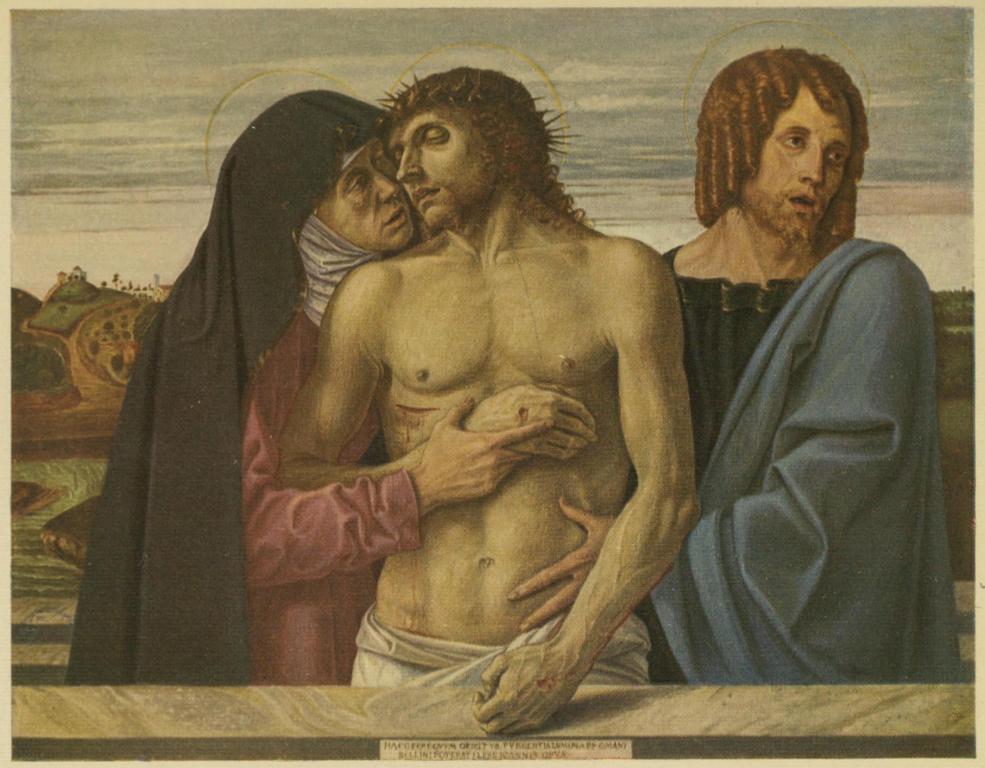
PLATE V.—PIETA
This fine example of the master’s art may be seen at the
Brera Gallery in Milan.
Students of the life of Fra Angelico know
that a Dominican preacher exercised a very
great effect upon the painter’s life, and was
responsible for sending him, at a very early
age, to the great Convent of the Dominicans
at Fiesole. There he was received as a
brother, and from the shelter of the cloister
he gave his art message to the world, his
story being preserved to us at the same
time because the progress of the Dominicans
was recorded. A few years later Giovanni
Bellini, then a boy newly in his teens, would
seem to have fallen under a very similar
influence. He was not fourteen when St.
Bernardino came to Padua and preached
the doctrine of godliness and Jew-baiting
to a people who were not ill-disposed towards
asceticism. In the fifteenth century
a boy of fourteen was a man. The Pope
made Cardinals of lads who were still younger
and many, who have left their names written
large in Italian history, were married when
they were fifteen. Gian Bellini would have
been assisting his father in the decoration
of the Gattemelata Chapel of Padua at
the time and there is no doubt that St.
Bernardino’s addresses impressed him very
deeply. To be sure he did not go into a
religious house after the fashion of Fra
Angelico, but he turned his thoughts towards
religion, and for the rest of his long life his
brush was kept almost exclusively for the
service of sacred art. The tendencies towards
paganism that his father is known
to have shown held no attraction for him.
He sought to express the beauty of the
New Testament stories, and it is hard to
find throughout all Italy an artist whose
achievements in that direction can vie
with his, for Gian Bellini brought sensuous
beauty and rare qualities of emotion to
canvas for the first time in the history of
painting.
In those early days of the middle century
there were two acknowledged leaders of
painting in the world that young Bellini
knew. The first was his father, who is said
to have studied in the studios of Gentile da
Fabriano (1370 to 1450), and that of Pisanello
who was born somewhere about the same
time as da Fabriano, and died a year later.
It is worth noting that Jacopo Bellini called
one of his sons Gentile after his earliest
master, though whether Gentile or Giovanni
was the elder son remains uncertain. Mr.
Roger Fry, who writes with great authority
upon the subject, is of opinion that Gian
may have been a natural son of Jacopo, and
in those days when Popes had “nephews” in
abundance, and the marriage vow was more
honoured in the breach than the observance,
very little stigma attached to illegitimacy.
The other great painter of Gian Bellini’s
time was the Paduan painter Squarcione,
who presided over a large and flourishing
school in his native city, and did work that
was quite as good as that of his contemporaries.
He adopted as his son a lad from
Padua or Mantua named Andrea Mantegna,
who was destined to take such high rank
among the painters of the Venetian
School.
Although Padua and Venice were in a
sense rivals, there seems to have been a
very friendly understanding for many years
between Squarcione and Jacopo Bellini, so
that Gian and Gentile were able to watch
the progress of the Paduan master and his
pupils, and to decide for themselves how
much they would accept, and what they
would reject of the teaching. In early years
these influences must have been of great
value to the painter, but happily they were
not destined to be lasting, for when Gian’s
sister married Andrea Mantegna, Squarcione
quarrelled with his adopted son, and the
intimacy with the Bellini family came to an
end. This is as it should have been in the
best interests of Gian Bellini’s art, for when
he returned to Venice and settled down
there permanently, he was able to follow his
own ideas, and free himself from what was
bad in the influence of the stiff, formal, and
lifeless school of Padua.
Venice must have been a remarkable city
in those years. To-day it stimulates the
imagination as few cities in Europe can do,
then it must have been one of the wonders
of the world. There are some striking
accounts of the city written in the latter
part of the fifteenth century, and though
space does not permit any quotation at
length, one brief paragraph will not be out
of place. Philippe de Comines, envoy of
Charles VIII., came to Venice in 1494, and
recalled his impressions of that city in his
memoirs. “I was taken along the High
Street,” he writes, “they call it the Grand
Canal, and it is very broad, galleys cross it;
and it is the fairest street, I believe, that may
be in the whole world, and fitted with the
best houses; the ancient ones are painted,
and most have a great piece of porphyry
and serpentine on the front. It is the most
triumphant city I have ever seen, and doth
most honour to ambassadors and strangers.
It doth most wisely govern itself,
and the service of God is most solemnly
performed. Though the Venetians have
many faults, I believe God has them in
remembrance for the reverence they pay
in the service of His Church.” This brief
tribute to the charm of Venice is of special
value because it helps us to understand why
the Venetians were not strenuous seekers
after knowledge, why their painters did no
more than paint, and why their response to
the humanities was so small. It explains
the decorative quality of Bellini’s pictures,
the splendour of their colours. Pageantry
and ceremonial were the great desires of
Venetian life, the man who could add to
the lustre of a State procession along the
splendid water-way of the Grand Canal
was more to them than the scholar who
had written a treatise that moved the more
learned Florentines to admiration. Life was
so full of pleasure, so varied in its appeals,
that the Venetians could not spare time, or
even develop the will to study. They had
raised the old cry “panem et circenses” and,
in the days of Gian Bellini, there was no
lack of either. History is full of records
that reveal other nations in a similar light,
philosophers have drawn the inevitable conclusions—and
the trend of life is no wise
altered.
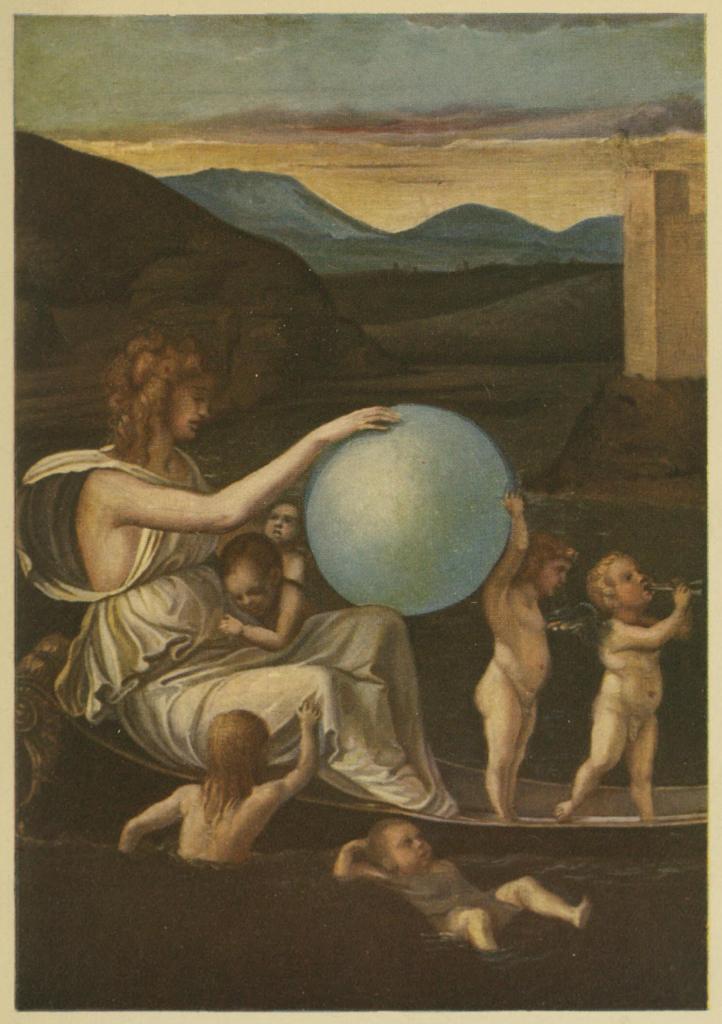
PLATE VI.—ALLEGORY: THE BARQUE OF LOVE
This is one of a little series of panel pictures by Bellini that
may be seen in the Academy at Venice. The others depict Evil,
Fate, Luxury, and Zeal, and Prudence. This picture is sometimes
called “Venus ruling the World,” but such a title seems rather
foreign to the painter’s own attitude.
Under Bellini, painting lost the conventions
that had been regarded as correct or
inevitable in Squarcione’s studio, and Gian’s
pictures bear the same relation to those of
the Paduan, and his pupil, as Newman’s
writing bears to bad eighteenth-century
English prose. But despite all developments
in the technique of his art, Gian Bellini’s
painting remained quite constant to the
mood that St. Bernardino had induced.
Doubtless, had his gifts been of another kind,
he would have entered the Church, he would
have dreamed dreams and seen visions that
would not have found such world-wide expression
while, being an artist, inheriting
artistic traditions from his father, living in
the centre of the small world of Venetian
and Paduan painters, he expressed his
beautiful emotions in fashion that has not
weakened its claim upon us in more than
four hundred years. The glamour of Venetian
life, the extraordinary beauty of the
city that was his home, the splendour and
the pageants that were part of a Venetian
life, the intensity of the colour that surrounded
him on all sides—some of it belonging
to Venice by right, and even more,
brought to her shores by the ceaseless traffic
of the sea—all these things developed and
deepened the emotion that was to find so
exquisite an expression from his brush. To
him, as to Fra Angelico, faith was a real and
living thing, and like the great monk who
died at ripe age while he was yet a boy,
Gian Bellini became a lover of the world in
its most picturesque aspect, accepting without
hesitation the traditional explanation of
its creation.
Naturally enough his appeal to the artist
is founded upon a dozen considerations,
mostly technical, his appeal to the layman
is direct and spontaneous. A countryman
who has never seen a studio can respond to
the exquisite beauty of Bellini’s Virgins and
Children, can feel the charm of the sunshine
that fills the air and lights sea and land,
can recognise the infinite glamour of the
roads that wind away into the mysterious
distance of the background, can enjoy the
rich, almost sensuous, colouring. Perhaps
had Bellini taken the vows, a great part of
these beauties would have been lost, the
infinite variety of lovely women and children
could hardly have been secured. As a
Venetian, and a pleasure lover, he could
not have responded, as Fra Angelico did,
to the restricted life and rigid discipline
of a religious order.
It was not easy for Gian Bellini to
devote himself entirely to sacred subjects
if he wished to earn a living by his brush,
because his father had stood outside the
Church. In those days, too, the best churchwork
was in the hands of one family, the
Vivarini, whose monopoly was hardly likely
to be disturbed by an artist who could
show no better credentials than a connection,
legitimate or illegitimate, with a painter
whose feeling was distinctly pagan. Jacopo
Bellini, for all that he was a most admired
artist, had no claims upon the Church, and
does not seem to have received many commissions
from it. Various wealthy societies
in Venice had been accustomed to employ
him to decorate their halls with work that,
as we have said before, has been lost, and
their guilds or scuole would doubtless have
given Gian all the work he wished to do
had he been satisfied to do it.
He could not choose for himself. St.
Bernardino had chosen for him in those
years when his mind was most impressionable.
Gian Bellini’s hand was doubtless
to be seen in Padua where he assisted
his father, and his earliest independent
work is to be found in the Casa Correr
at Venice, where one finds a “Transfiguration,” a
“Crucifixion,” and two “Pietas.”
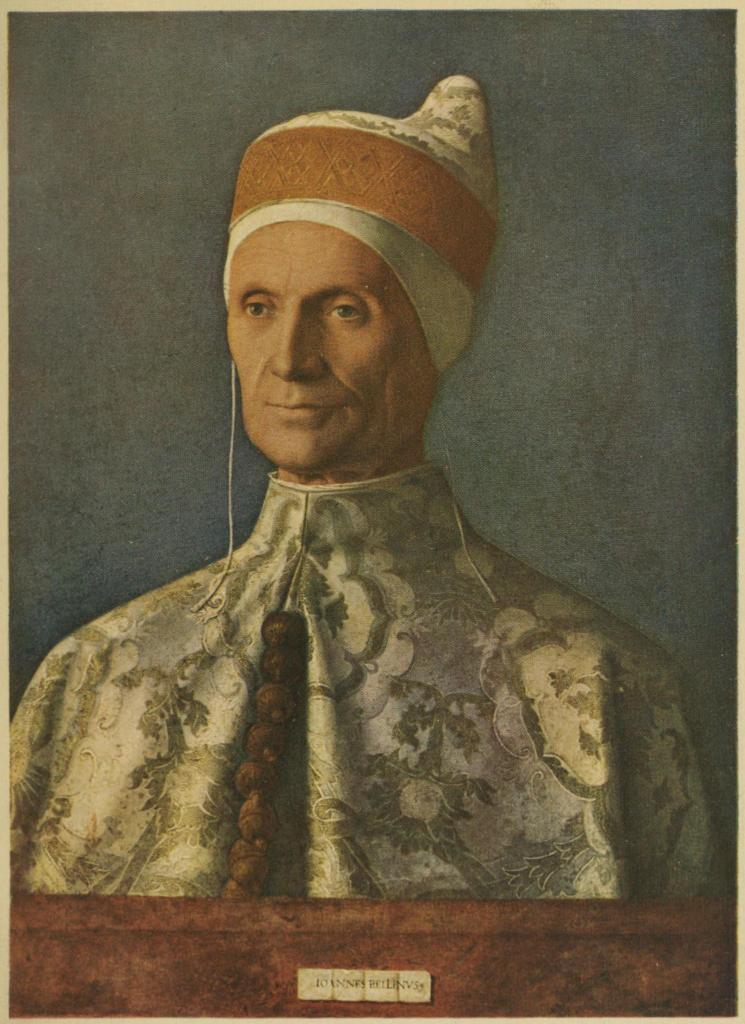
He painted portraits, one from our own
National Gallery is to be seen here. This is
a picture of the Doge, Leonardo Loredano,
who held office from 1501 to 1521.
The early pictures reveal Bellini at the
parting of the ways. His figures have many
of the defects of the School of Padua. His
knowledge of anatomy is decidedly small,
he lacks confidence in himself, and yet it
is not difficult to recognise that the painter
is moving into a new country, that his
presentation of sacred subjects is developing
on lines that must add considerably to
their artistic value and to the permanence
of their appeal.
An amusing story is told of the way in
which young Bellini acquired his knowledge
of oil painting. He is said to have
assumed the dress of a Venetian nobleman,
and to have gone to the studio of a popular
artist of the time, under pretext of having
his portrait painted. While the artist, one
Antonello of Messina, was busily engaged
upon his portrait, Bellini is said to have
watched the process very carefully and to
have secured the much needed lesson. It is
more than likely that the story is untrue, but
it has obtained a large measure of credence.
His first big altar-piece is said to have
been done for the altar of St. Catherine of
Sienna, and after one or two other church
paintings had been accomplished, Giovanni
was commissioned to decorate the great
Council Hall of Venice with historical
paintings. But it is well to remember that
altar painting never ceased to interest him,
his greatest achievements having been accomplished
for churches. There are few
things in art more beautiful than Gian
Bellini’s altar-pieces. Ruskin has paid a
special tribute to the “Virgin and Four
Saints” in the church dedicated to St.
Zaccaria, father of the Baptist. He says
that the Zaccaria altar-piece, and the one
in the Frari, by the same master, are the
two finest pictures in the world. Of the big
works, however, nothing remains, Gentile
being the only one of the family who is represented
to-day by pictures painted on a very
large scale. Vasari tells us that Gian painted
four pictures in fulfilment of a commission,
one representing the Pope Alexander III.
receiving Frederic Barbarossa after the
abjuration of the Schism of 1177, the next
showing the Pope saying Mass in San Marco,
another representing his Holiness
in the act of presenting a canopy to the
Doge, and the last in which the Pontiff is
presented with eight standards and eight
silver trumpets by clergy assembled outside
the gates of Rome. These subjects or some
of them had been painted by one Gueriento
of Verona when Marco Corner was Doge.
Petrarch had written the inscriptions for
them, but they had faded, and in later years
Tintoretto painted his “Paradiso” over the
damaged frescoes. There is a story to the
effect that Giovanni and Gentile Bellini had
promised the councillors that their pictures
should last two hundred years; as a matter
of fact, they would seem to have been
destroyed by fire within half that period.
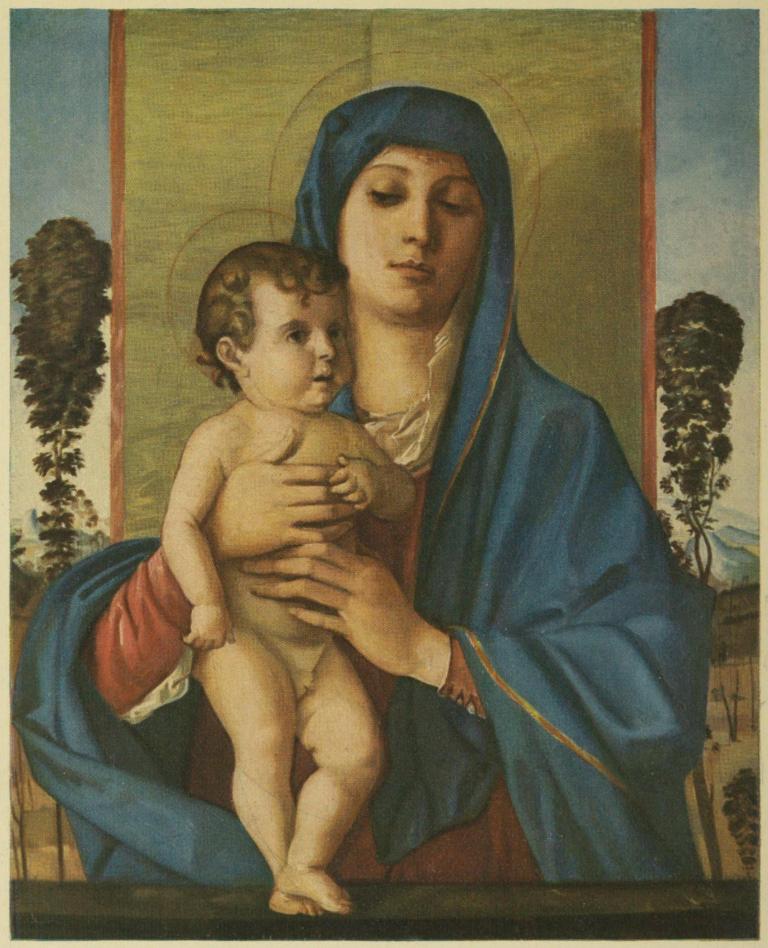
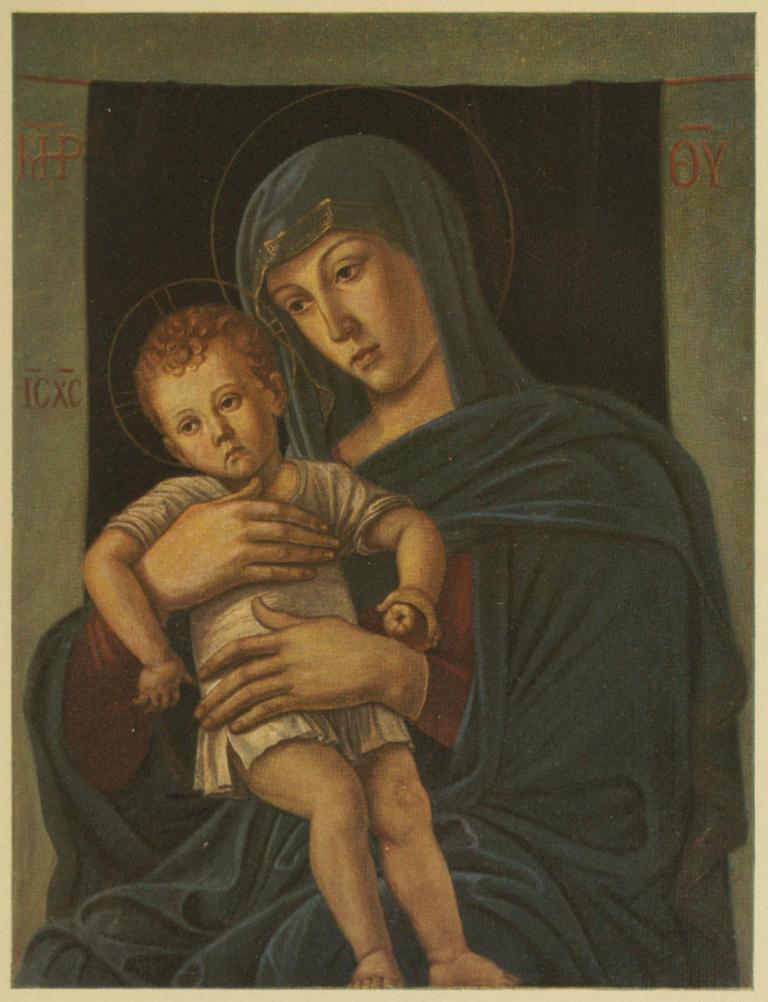
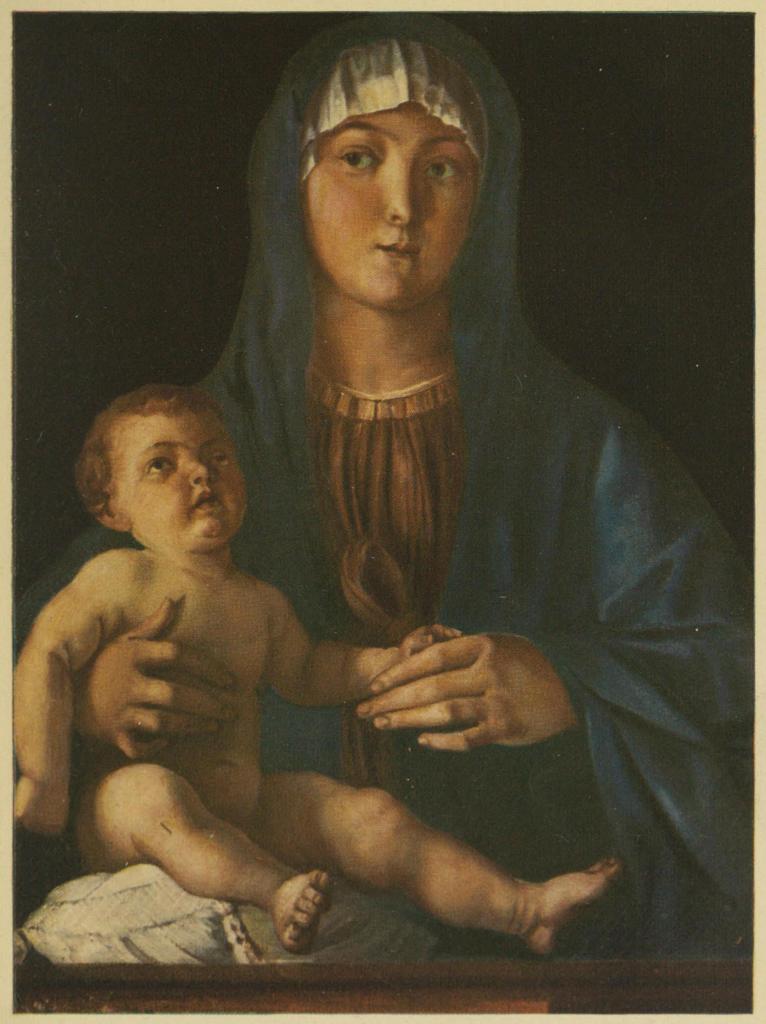
PLATE VII.—MADONNA AND CHILD
This picture shows the centre figures of a very famous painting
by Bellini in the Academy at Venice in which the Madonna and
Child are seen between St. Catherine and St. Mary Magdalen.
The faces most delightfully painted are full of spiritual grace and
the colouring is exquisite.
The style of the picture commissioned
makes its own significant commentary upon
the times. It was always considered advisable
to stir in the Venetians appreciation for
State ceremonial, which encouraged so much
of the pageantry associated with Venetian
life and, even if Giovanni Bellini had no
keen taste for such work, he could not
refuse a commission that would establish
his name among his fellow countrymen.
To-day the Sala del Maggior Consiglio
holds pictures by Titian, Paul Veronese,
and other artists who followed closely upon
Gian Bellini’s era.