BELGIAN ARMY NOTICES ON THE OUTLASTING WAR SITES
Transcriber’s Note:
New original cover art included with this eBook is granted to the public domain.


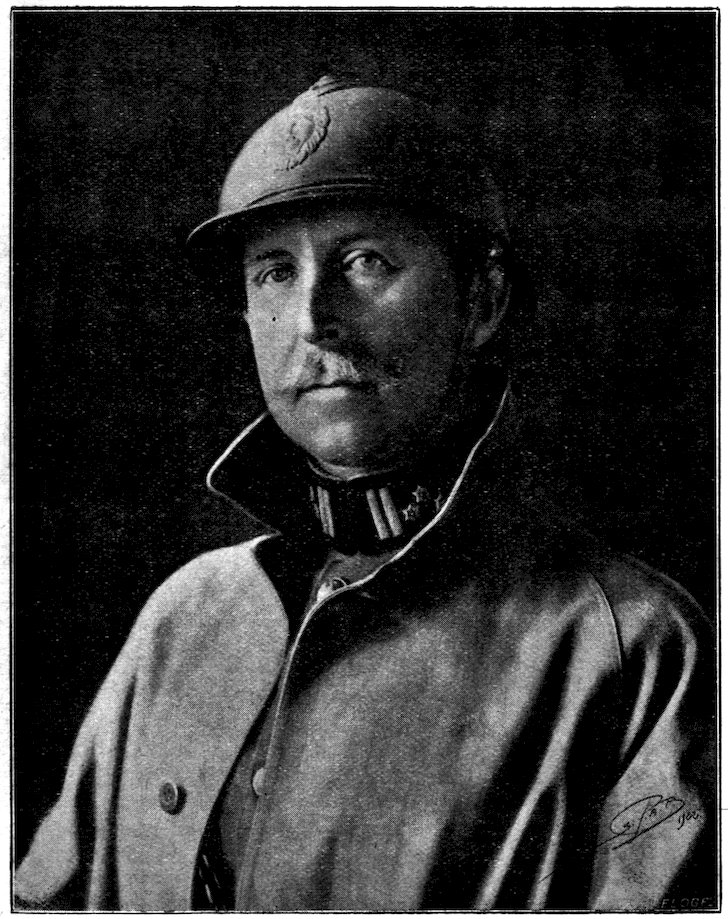
H. M. THE KING ALBERT OF BELGIUM.
OFFICIAL LIST OF THE OUTLASTING WAR SITES.
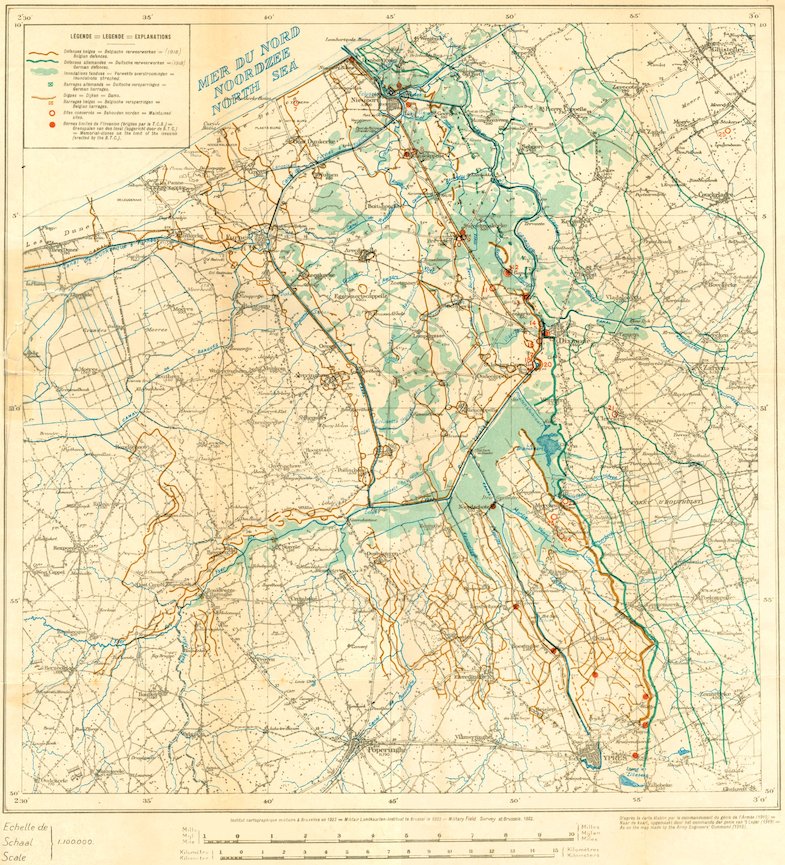
The figures of the list are connected with those printed on the 1/100.000 map included with this booklet, as well as with those of the following notices.
| Pages. | ||
|---|---|---|
| 1. | German battery “Wilhelm II” at Knocke on sea | 7 |
| 2. | German guns on the pier of Zeebrugge | 10 |
| 3. | German battery “Deutschland” at Breedene | 14 |
| 4. | German battery “Tirpitz” at Ostend | 15 |
| 5. | German admiralty Headquarters at Middelkerke | 19 |
| 6. | The Great Redan at Nieuport | 19 |
| 7. | “Karnak” battery at Oost-dunkerke | 23 |
| 8. | Levelcrossing guard shelter at Ramscappelle with machine-gun pit | 24 |
| 9. | Machine-gun pit in front of the Pervyse railway station | 26 |
| 10. | Observation-post of the Pervyse railway station | 26 |
| 11. | Battalion commander’s Headquarters at Km. 4.400 of the Dixmude-Nieuport railway | 30 |
| 12. | Foot of the Oud-Stuyvekenskerke tower with neighbouring shelter | 30 |
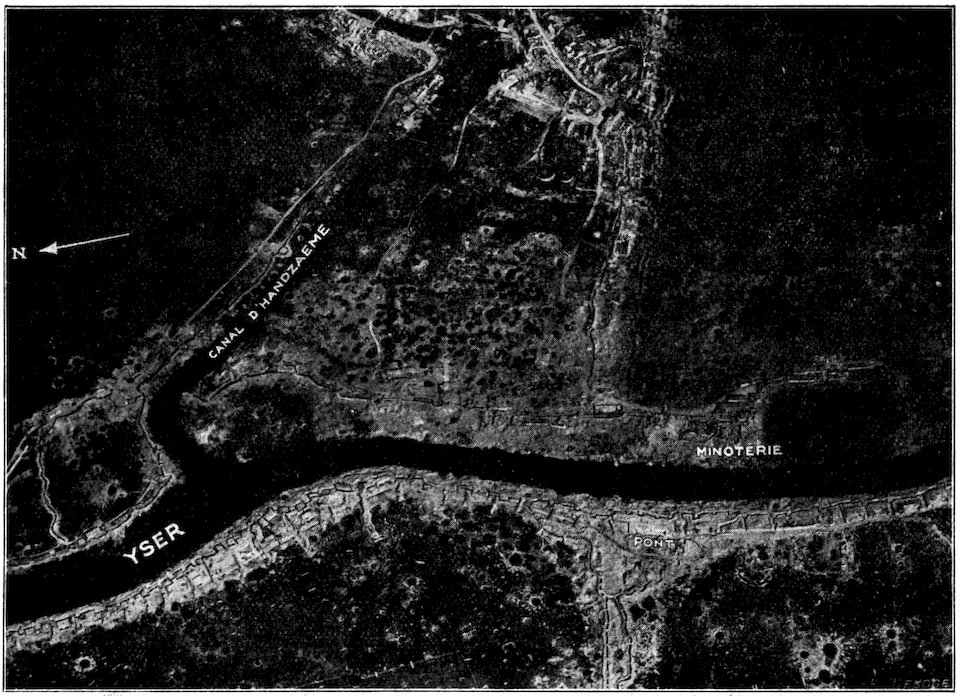
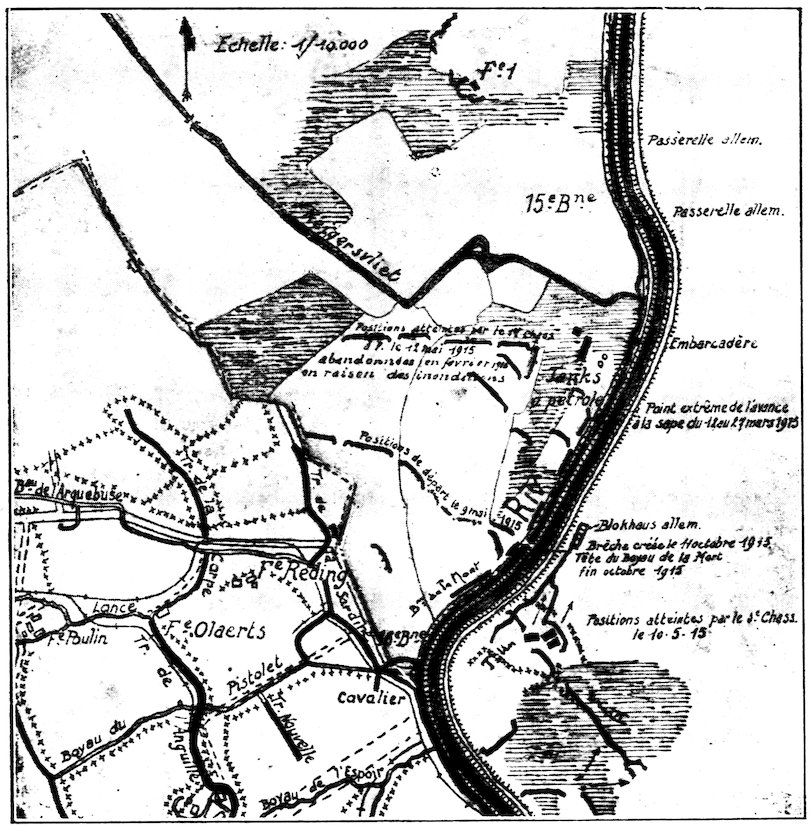
| 13. | The trench called “Boyau de la mort” (Death Trench) and the breastwork called “Ouvrage du cavalier”. German saphead on the left bank of the Yser river and concrete dug-out on the righthand river bank (km. 16) | 34 |
| 14. | Company commander’s post near the Yserdam, at Dixmude in front of the canal of Handzaeme (lefthand bank) | 42 |
| 15. | Mill of Dixmude and series of German pillboxes on the righthand Yser-bank, up to the railway line | 44 |
| 16. | Concrete dug-out south of the railway bridge at Dixmude (lefthand bank) | 42 |
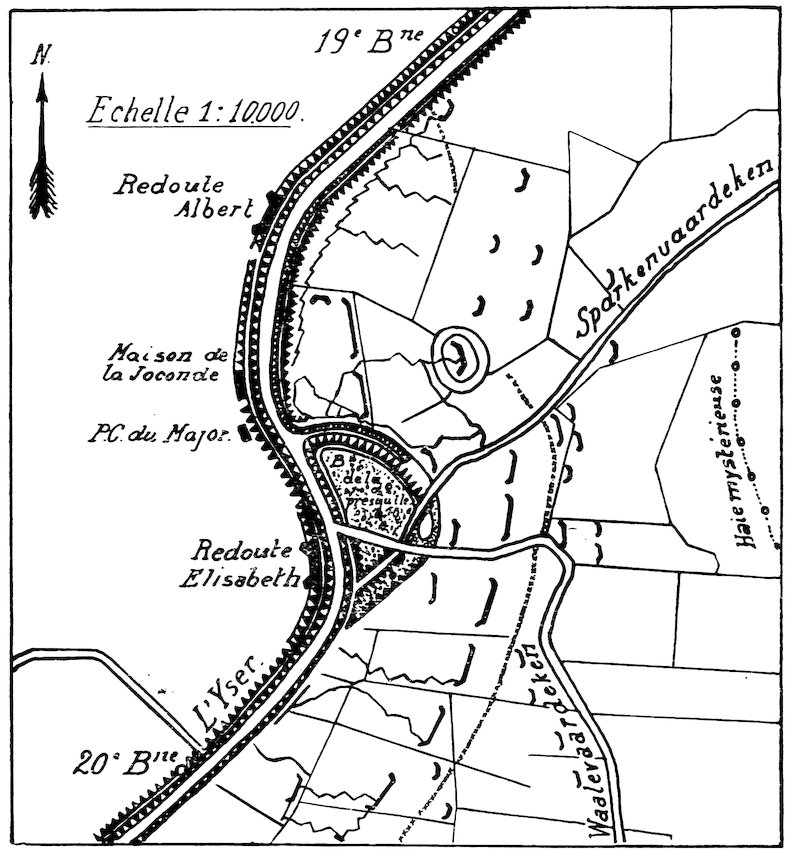
| 17. | Albert and Elisabeth redoubts between kilom. 19 and 20 of the Yser river (lefthand bank) | 53 |
| 18. | The “Joconde’s” dwelling, kilom. 19.500 of the Yser river (left bank) | 53 |
| 619. | Battalion commander’s Headquarters at kilom. 19.500 of Yser river (lefthand bank) | 53 |
| 20. | Bridge-head at kilom. 19.500 and “Presqu´île” wood (righthand bank) | 54 |
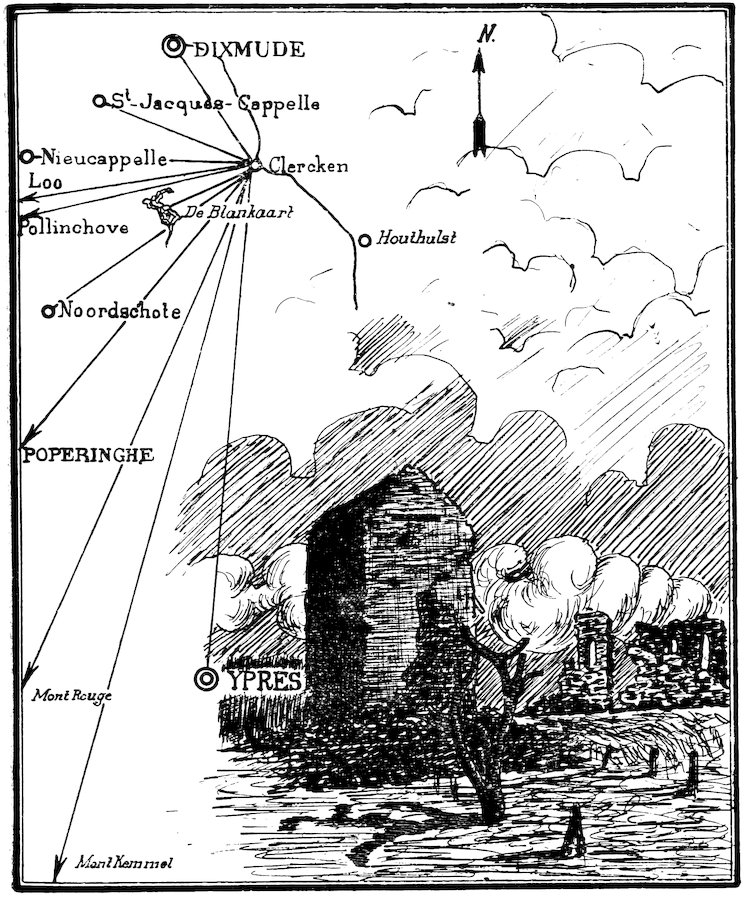
| 21. | Observation-post near the church of Clercken | 58 |
| 22. | “Grand-Père” concrete dug-out north of Kippe, kilom. 12.500 of the Dixmude-Yper road | 60 |
| 23. | “Castel Britannia” south of Kippe, kilom. 12.500 of the Dixmude-Ypres road | 60 |
| 24. | Hoekske (spot where three german guns stuck in the mud) | 60 |
| 25. | German gun of Leugenboom, at Couckelaere | 65 |
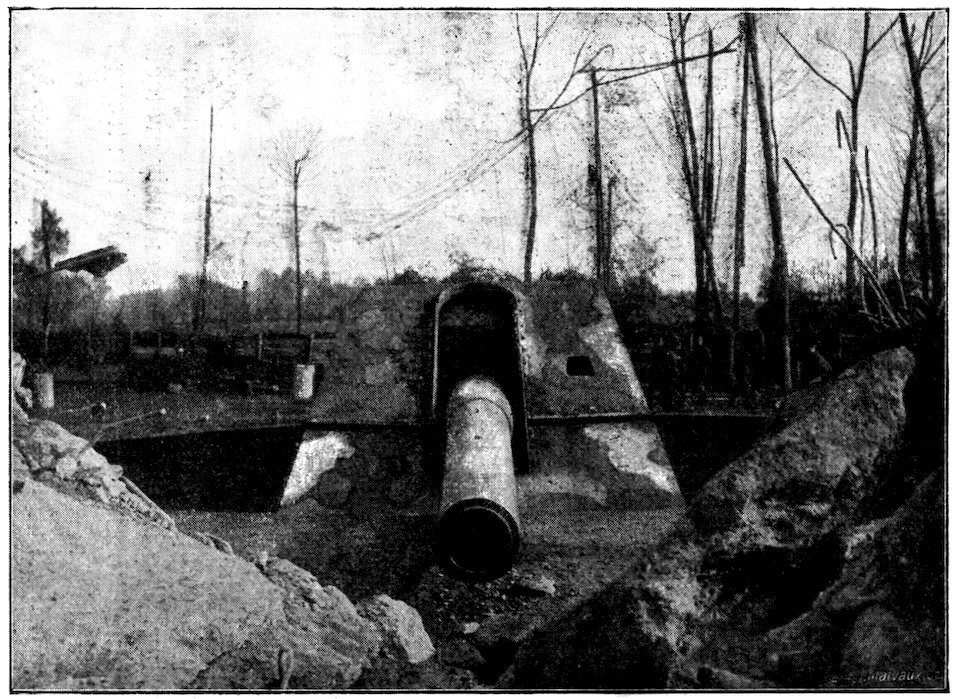
1.—German battery “Kaiser Wilhelm II” at Knocke on Sea.
Before going into the description of the war sites along the Belgian sea-coast, it is important to cast a general glance on the defences established there by the Germans.
Admiral Schröder was given the task of the organization of the sea-front. To do so he had at his disposal: the German Marine Army Corps, a coast artillery altogether powerful in number as well as in the caliber of the guns, a flotilla of patrolers, torpedo-boats, destroyers, submarines and a few squadrons of aeroplanes and seaplanes.
In a few months time Belgian coast, thus strongly and thoroughly organized was to be looked upon as a real up to date fortress. The power of the defences was mainly concentrated round Zeebrugge and Ostend,—the two german war outlets of the naval basis Bruges,—also between Lombartzijde and Middelkerke,—where both territorial and seafronts were hinged,—and finally at Knocke and East of that locality, for the protection of the river Schelde’s estuary.
The pivot of the coast defences was to be incumbent on the artillery acting in close cooperation with the land and sea-forces. The artillery was to engage at long range all 8the allied boats and to keep them under a constant crossfire, while they were endeavouring to proceed towards the coast. For that purpose, about sixty batteries, thirty five of which of the heaviest type were placed either along or at the rear of the sandhills.
In fact, the guns of very high caliber were distributed behind the belt of dunes; their tactical duty was to keep off the coast all boats which would try to carry out long range bombardments. As those batteries could not from their emplacements use direct fire, being unable to see the targets, observation-posts with good field of view on the sea—for fire registering—were found necessary. Herein lies the reason of the construction of the numerous concrete ones, some of them still remaining hidden along the downs.
As far as the smaller guns are concerned, these were dug in along the dunes and were performing direct fire to prevent against raids, attempts of landing or bottling the harbours.
Against eventual landings, the defences also comprised a series of mine barrages, screens of nettings for submarines, hindering the access of the shore. Redoubts manned by infantry troops were staking out an almost uninterrupted line of trenches which were running along the beach, right up to the Dutch frontiers.
Machine-guns and field guns were utilized for flanking the strand and for anti-aircraft action.
The German defence of the Belgian coast was completed by high sea forces.
The organization of the maritime defences was only seriously taken in hand in 1915. The “Boat-detachement” composed of trawlers, mine sweepers, tow boats and barges, was formed up in February that year. Small types of torpedo-boats and submarines were sent dismounted, and conveyed by railway up to the dock-yards created at Bruges, Ostend, and later on at Hoboken, where those 9units were mounted. They formed with a certain number of other units which came directly by sea, a flotilla of submarines and one of torpedo-boats. Motor trawlers were on the watch far out in the sea.
In 1916, the naval forces anchored in the Flanders base were considerably increased in number, but it was particularly in the year 1917 that the Germans multiplied their submarines, thus turning the harbours of Ostend and Zeebrugge into real haunts. Shelters were built to protect them against air raids and the numerous bombardments carried out by the British Fleet.
At Zeebrugge, the shelters were established along the mole and in the tidal basins south of the locks and in the Bruges canal.
At Ostend, the flotillas were berthed in the wharfs and the darses. The submarines were sheltered alongside the marine docks.
The year 1917 saw the submarine warfare ruthlessly carried out and the enemy’s torpedo-boats raided the British and French coast.
In the early 1918, during the dismal winter nights, the foe undertook several offensive reconnoitrings up to the British Channel. These were to be their last deeds.
Doggedly determined to bring an end to the U boats’ boundless crimes, the British Admiralty tackled the plan for the bottling up of the two Belgian harbours. It was thus that were performed the most astounding operations, which took the enemy unaware, pinning him down in Zeebrugge and almost paralysing him in Ostend.
“Kaiser Wilhelm II battery” constitutes one of the typical kind of heavy battery erected by the Germans along the North-Sea.
10Armement: Four 12 inch marine guns, firing at 38 kilomètres (23½ miles) a shell weighing more than 400 kilos, needing a charge of 103 kilos.
The tube was 17 meters 25 cms long.
Gun crew: 5 officers and 360 other ranks.
Observation-posts: especially in Knocke’s Kursaal and on the down 23 near Duinbergen.
Ammunition supply: was done by railway.
Historical account: the battery was armed in July 1916 but did only fire during our Flanders offensive in 1918.
It fired the last time on the 18th October at about 3 p. m. and the next day the battery was taken by our troops.
2.—Germans Guns upon the jetty of Zeebrugge. — British Raid against Zeebrugge.
We will not study the guns, but we feel compelled to bring back to memory, one of the most striking naval operations of the Great War.
Loathing the countless crimes of the foe’s submarine warfare, Admiral Sir Jellicoe, the newly promoted First Sea Lord, brought forward a scheme for the bottling up of Zeebrugge and Ostend, the two outlets of the German Naval basis Bruges.
The operations, though of the boldest character, was agreed upon and attempted on April 22d 1918, eve of St Georges’ day, patron of England. Admiral Sir Roger Keyes was entrusted with the glorious mission.
Five old Cruisers loaded with ferro-concrete, with on board a crew mainly composed of volunteers were to carry that mission through. Three of these cruisers, namely: H. M. S. Thetis, Intrepid, and Iphigenia were bound for 11Zeebrugge; H. M. S. Brilliant and Sirius for Ostend. A flotilla composed of destroyers, submarines, several steam barges and motor trawlers had to cooperate in the action.
The attack against Zeebrugge seeming the more difficult of the two had to be shouldered by the old cruiser H. M. S. Vindictive and the two Liverpool carriers Iris and Daffodil. These units were to undertake a daring diversion in dashing for the pier.
It was 5 o’clock p. m. when the fleet was concentrated at about 63 miles off the coast and from thither directed towards the two goals. While a wind due North East was carrying forward a thick smoke screen produced by fume boats, the fleet sailed forth without raising the enemy’s attention.
Unfortunately, at a few cable’s lengths from the ports the wind suddenly swerved due South-West, cleaning away the smoke cloud, disclosing at once the “Gallant British Fleet”. It was then 11.56 p. m. Like lightenings, all the guns and machine-guns, raised as though by magic power, roared their rapid rounds.
In front of Ostend, the lights guiding the boats towards the coast were hit by shellfire and put out of action. Unable to be driven, the attack failed. H. M. S. Sirius and H. M. S. Brilliant were sunk at 3 kilomètres East of the harbour’s entrance[1].
1. The operation against Ostend was successfully carried out during the night of the 9th to 10th May. H. M. S. Vindictive managed to place herself athwart in the entrance of the harbour and there was blown up.
In front of Zeebrugge, in spite of the infernal artillery and machine-gun fire, sweeping the mole, H. M. S. Vindictive, under captain A. F. B. Carpenter, helped by the Daffodil and Iris managed to land his men. That diversion brought the whole fire and the enemy’s attention up to the mole, thus clearing the way to the blockships. Machine-gun nests and a part of the enemy’s organizations were 12destroyed or set on fire. Little damage was done, which after all was merely accessory.
During that time, H. M. S. Thetis was nearing the channel. She succeeded to cross the mine-barrage but unluckily her propeller got entangled in the nets of the defences, rendering all manœuvres impossible whatever. The commander was then forced to blow her up after that the crew had been taken on board of the trawlers. Her position after all greatly helped the rapid sanding up of the harbour.
H. M. S. Intrepid and Iphigenia which followed H. M. S. Thetis up, overran all the obstacles and managed to enter the canal. They placed themselves athwart in order to block entirely the entrance up. It is then, when freed from their crews that were embarked on board of the trawlers, that their captains exploded charges.
It was while these manœuvres were on, that Lieutenant Richard D. Sandford drove his submarine,—the C3—, below the bays of the pier and there blew her up, making a breach thirty meters long, thus isolating the jetty from the coast. This last deed was to be the master piece of the gallant expedition. The explosion had been tremendous.
As soon as the three cruisers loaded with concrete had been sunk, H. M. S. Vindictive re-embarked her crew and the whole little “British Main” turned back “Homeward-Bound”. The men of the Vindictive were then taken on board of the admiral’s boat, the Warwick.
There is one point which must be kept in mind, that is that during the whole of these operations, the powerful defences, switched on Zeebrugge, were thundering death from every gun, from every rifle and machine-gun, and, under that tornado of fire the battle area was no else but real hell!
The next day, the aerial photographs proved the wonderful results attained by the expedition, results which were far beyond the most optimistical previsions. In regard to this wonderful achievement and the temerity needed to carry it through, the casualties have shown relatively light. From out of the 1780 officers and other ranks who took part in the raid, 176 were killed, 412 wounded and 49 missing.
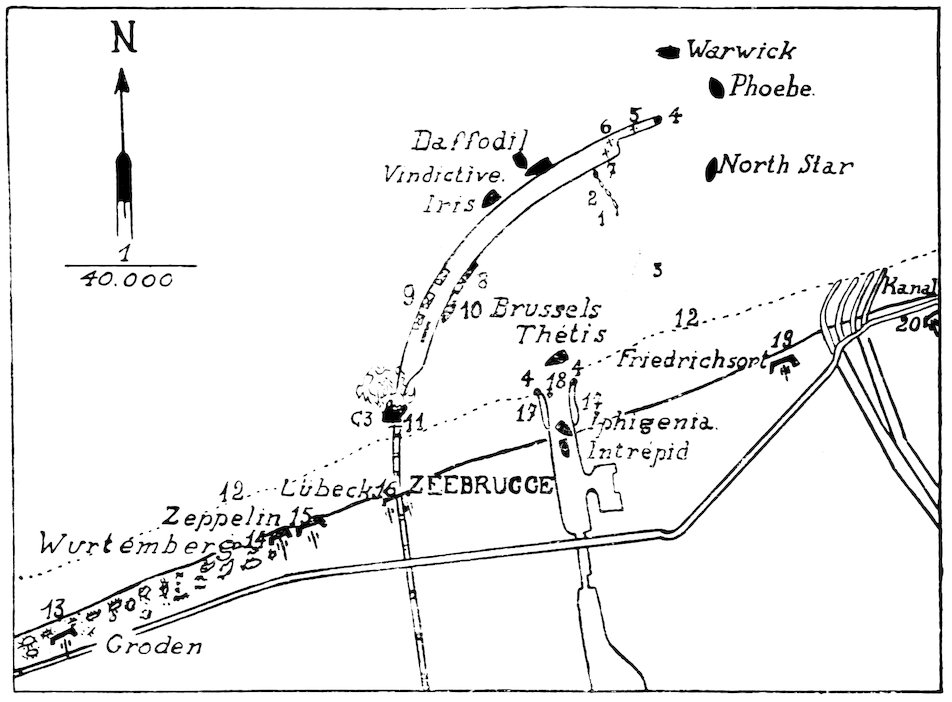
The Blocking of Zeebrugge by the British Navy during the night of April 22d to 23d 1918.
| 1. | Rhine barges anchored in line (forming boom). |
| 2. | One pounder quick firing gun (pom-pom). |
| 3. | Nettings of the defence. |
| 4. | Lighthouse. |
| 5. | Mole batteries. |
| 6. | |
| 7. | |
| 8. | Shelter for submarines. |
| 9. | Aeroplanes sheds. |
| 10. | S. S. Brussels. |
| 11. | Breach caused by the explosion of the submarine C3. |
| 12. | Extreme line of the flood. |
| 13. | Groden battery. |
| 14. | Wurtemberg battery. |
| 15. | Zeppelin battery. |
| 16. | Lübeck battery. |
| 17. | Pier. |
| 18. | Channel-entrance. |
| 19. | Friedrichsort battery. |
| 20. | Kanal battery. |
14As far as the boats losses are concerned, only the destroyer North Star and two motor boats went down.
This raid is the most striking instance of military valour and devotion to duty. We feel as though we must emphasize the glorious conduct of the British sailors and the best way is for us to oppose the straight forwardness of the British sailormen to the sly and underhanded methods of the Germans, who only feel apt to sink, without being seen, defenceless boats, thus bringing death on to harmless people.
3.—German battery “Deutschland” at Breedene.
The battery “Deutschland” is situated near the Jacobinessen farm.
Armement: Four 15 inch guns firing at 55 kilometers a shell 2 meters long.
The charge was contained in a brass shell case.
The tube was 17 meters 10 cm. long.
Gun crew: Each gun was attended by 150 men, in other words the whole battery was 8 officers and 600 all ranks strong.
Observation-posts: The main observation-post (concrete) was built in Albert’s Parc; auxiliary posts were connected to it by phones, such was the case for the one of the hotel Belle-Vue at Wenduyne, and the other called “Fulda” at Mariakerke.
Ammunition supply: was done by railway.
Historical account: The construction of the Deutschland battery was done piece by piece and began in the early part of September 1915.
15Belgian labour was requisitioned for that work, with Russian prisoners of war, the hands employed for that battery amounted to seven hundred that toiled months on end for it.
The battery’s activity culminated in 1918, specially in May, going increasingly from the 1st of June up to the 15th, 16th, 17th of October 1918. After the last fire which occurred on the morning of the 17th of October the German disabled the guns and left them few hours later, the battery was then captured by our boys, on their way for victory.
4.—German Battery “Tirpitz” at Ostend.
Armement: Four 12 inch guns, firing at a range of 35 kilometers a shell weighing 375 kilos needing a charge of 103 kilos.
The tube was 12 meters 90 cms long.
Gun crew: 5 officers and 400 other ranks.
Observation-posts: One at Mariakerke on the roof of the asylum, the other in the dunes.
Ammunition supply was also done by railway.
Historical account: The guns of this battery had been ordered to Krupp, by the Belgian Army, in view to complete the armement of fortified position of Antwerp. At the outbreak of the war the German Government kept hold of them and used them for their coast defences in Belgium.
The battery was in position West of Ostend close by Hamilton Farm. The first rounds date from September the 7th 1915. Only two guns opened fire at that time and during one of the firing a barrel of one of them burst causing the death of twelve gunners; that tube was afterwards replaced by another.
On January the 24th 1916, the “Tirpitz” battery fired a hundred shells on the Church of Nieuport and on the 16old Templers’s Tower, last vestige of the first convent of that order, which dated from the XIIth century. That destruction must have proved very satisfactory to the German commanders, for, in recognition of that gallant deed, iron crosses were awarded to 10 gunners of the battery.
The four guns fired for the first time in battery fire in July the 16th 1916. The allied counter-battery work was fairly active, mainly in 1917 and 1918. The pivot of that counter-battery fire was formed of French 12 inch guns, mounted on railway; these were firing from round Coxyde.
On July 16th 1917 the French gunners were rather successful, several of the guns servants were killed, shelters were destroyed, and the men were scattered. The guns themselves were hit by shell splinters. The top of the gun pits were then strengthened with a bursting layer thick of one meter of concrete, and the battery resumed its action on the 22d of the same month.
In order to deceive our observers, a dummy battery was erected by the German at about 2 kilometers away from the real emplacement, in the direction of Wilskerke. Two old Belgian mortars of the 1862 type, brought from Liége, and, four dummy guns made of wood were forming the battery. Each time Tirpitz was firing a shot, the dummy was exploding three successive charges, thus giving the impression of four rounds.
Another trick used by the enemy was, that whenever the counter-battery was on, the crew was blowing up huge fougases thus preventing the registering of the fire.
The last fire occured on the 15th of October 1918, and the battery was then destroyed.
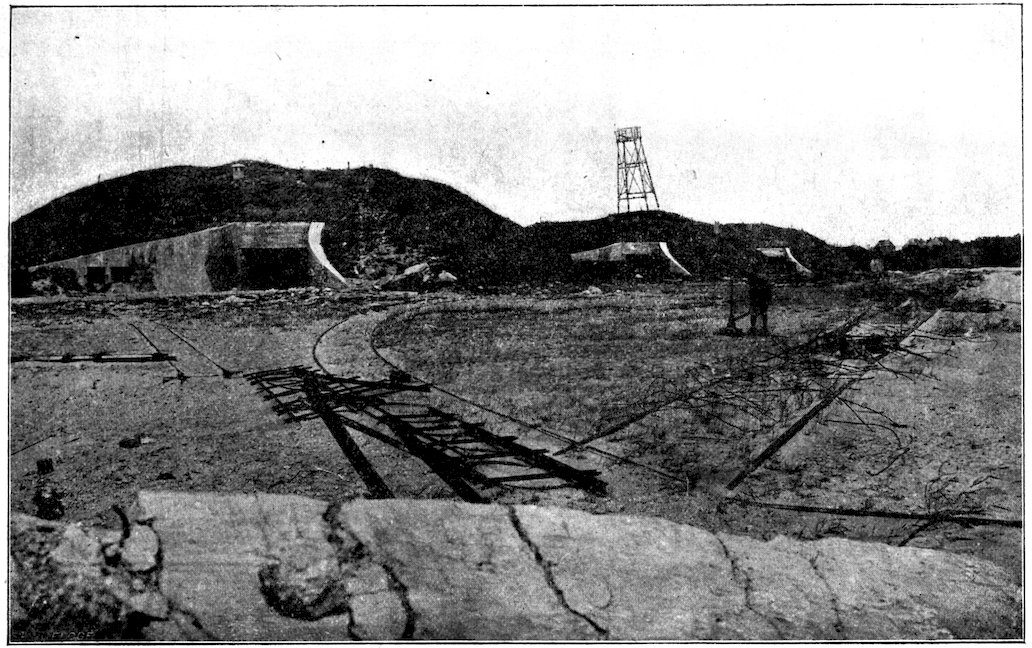
Knocke on Sea.—German Battery Wilhelm II.
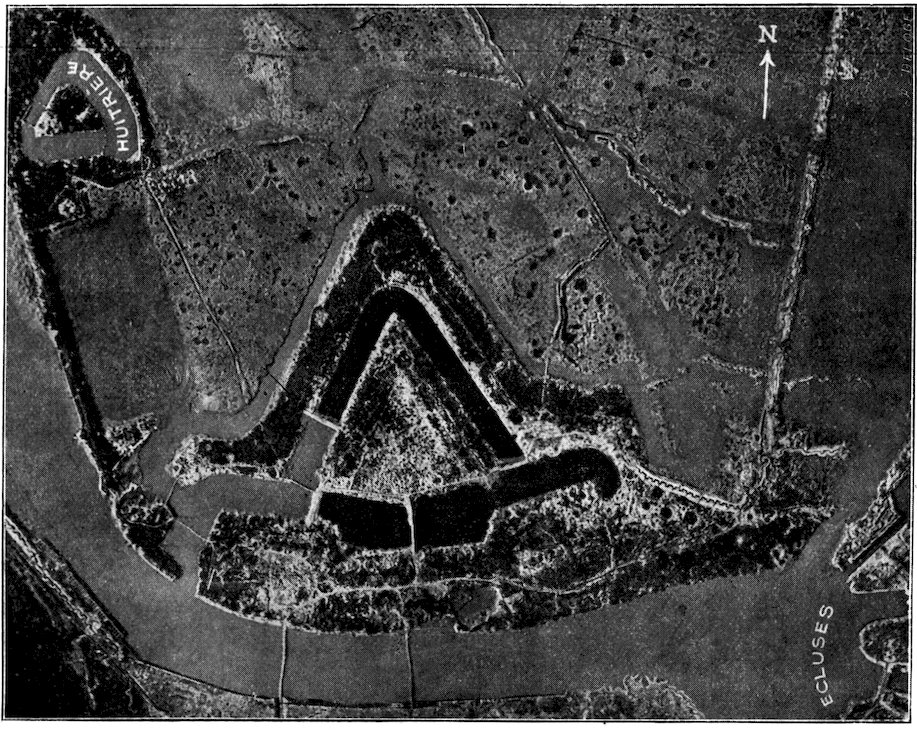
Nieuport.—Aerial photo of the Main Redan (August 10th 1918).
5.—German Admiralty Headquarters at Middelkerke.
If the material employed for the coast defences was of the first quality, the German took the same care for the fitting up of the position held by the naval infantry, which disposed of strong and numerous dug-outs, skilfully camouflaged, in other word they formed magnificent battle posts.
The Admiralty Headquarters at Middelkerke is a wonderful display of luxury and it emphasises their taste for comfort.
Nothing was left uncared for; in case of alarm the admiral could easily act in complete quiétude. He had his staff well at hand, his liaisons thoroughly assured and could deliver his orders and instruction with the maximum efficiency.
6.—The “Great Redan” at Nieuport.
From the old fortified position of Nieuport, the part situated North of the harbour solely remained after the dismantling had been decided by the Belgian State, in 1859.
Unproperly called during the war “Great Redan” that work—if one wants to be accurate—is formed of a non reveted horne work which must have belonged to the old fortification of Nieuport rebuilt in 1793, and preceded with a half moon work constructed after 1815.
The whole place, in fact, had to be reconstructed following the Vauban system, with the funds accordingly allotted by the Paris treaty of 1815.
The abandonment of those remains of fortifications since 1859 had evidently reduced them to mere ruins, when the battle of the Yser was fought in 1914. If the 20“Great Redan” was not utilized during the battle as firing line, at least it afforded a magnificent place of arms, to shelter the reserve troops for the defence of the “Little Bridge-head of Nieuport”.
The latter place also known as the “Bridge-head of Palingbrug” extended itself from the right bank of the channel, at the hight of the old lighthouse to the brickwork (Plasschendaele canal) passing by the kilometer 14.500 of the Nieuport Westende road.
It is from the evening of the 20th of October 1914 onward that the defence clung to that position.
To spare his men, Lieutenant General Dossin was contrived to flood the “Groot Noord Nieuwland Polder” up, by letting in the seawater in to the creek of Nieuwendamme, the dikes of which had been previously pierced. This inundation was stretched in the evening of the 21st of October.
After the epic fights at Lombarzyde and Groot Bamburg-Farm, in which heroism was lavishly displayed by our men, during the day and night of the 22nd, the French troops under General Grossetti came at dawn on the 23rd to relieve the Belgian troops in Nieuport.
They were to resume the offensive movement the Belgian troops had started, but the foe having pierced the line at Saint-Georges and Tervaete, compelled the staff to withdraw the troops from Nieuport to take position on the bridge-head of Palingbrug, in order to dispose of a maximum of reserve to be arrayed on the threatened front and also to draft the counter-attacks which were more and more urging.
On the evening of the 26th, Colonel Claudon, commanding the French troops at Palingbrug, judging his contingent too weak to hold on that position, retired on the left bank of the Channel, in doing so he gave up the bridge-head, the Great Redan, the five bridges and the locks, in one word that retreat meant the abandonment of the key of the whole hydrographic system of the region.
21Fortunately, the enemy not only worn out but much more concerned with the center of his front of attack, did not venture to keep in touch with the troops at Nieuport and failed to notice the leaving of the right bank of the river Yser, of which he might have so easely drawn advantage. The German, perhaps still believing in the existence of the fortress of Nieuport, did not attack.
Up to the 3d of November 1914 the Palingbrug was left abandoned. Though, it is during that period of time that the inundation was stretched. A first attempt took place on the morning of the 27th of October, but was a failure, it is only at 5 a. m. on the 28th that we managed to open and keep it so during the incoming tide, the old lock of Furnes.
The inroad of water through that lock having been reckoned unsufficient, the Belgian G.H.Q. decided to make use of the Noordvaart lock, but the latter was since the evening of the 26th right in “No man’s land”, position which rendered the operation most dangerous.
Under the protection of 40 cyclists carabiniers who had to cross over in walking on the Furnes lock gates (the bridge having been blown up, by order of Colonel Claudon after the retreat of the 26th), Captain Umé, of the Royal Engineers successfully managed to open the locks of Noordvaart. The following nights the operations were renewed and gradually the sheet of water rose and rose. Awestruck by that mystery, the enemy, fortunately realised it but too late.
At last, on the 3d of November, while the Yser battle had proved a victory, all along the Belgian line, reconnaissances were carried out in front of the advanced posts.
On November the 4th, detachment of the 2d Army Division occupied again the bridge-head of Palingbrug and the 22Redan, which we pledge our word was never tred on by German heels.
A few time afterwards an offensive movement took place and was undertaken by the Franco-Belgian troops, that operation forced the enemy to give up the channel North of the “Geleïde”. The front was then fixed on a position baptized “The Main bridge-head of Nieuport” on a line parallel to the channel and at about 600 meters East of the latter, running round the Western side of Lombartzyde and prolonging itself almost parallel to Plasschendaele canal up to the Boterdijk.
That front never knew any alterations till July 1917.
The 10th of July 1917, at about 8 o’clock p. m., after a regular bombardment of more than 10 hours duration, all along the Nieuport sector, the enemy rushed the positions held, only since a few days, by the British Infantry. The fight lasted the whole night long and after the most bloody hand to hand fights, the attackers succeeded to enter the British trenches between the beach and the Geleïde and throwing the occupants in the channel, those who swam across escaped from death or capture.
From up the 11 July onward the Nieuport front was running along the channel right up to Geleïde river, where it was hinged to the primitive front, which determined attacks had successfully brought to its original point.
Later the “Redan” and its surrounding area were subjected to almost daily bombardments, which soon gave them a bloody fame.
The powder-mill of the old work, thanks to the superimposed vaults, which were forming its ceiling, managed to resist to all kind of German shells, which made it deserve the nickname of Rubber house. It was occupied during the operations both as battle headquarters and as advanced dressing station.
23In March 1918, the Belgian front had to be stretched out, in order to relieve allied divisions. To avoid the weakening of our resistance, our front having been thus considerably lengthened and the occupation having become very thin, the G. H. Q. decided to stretch a further inundation which allowed to gain up several outposts.
At Nieuport, the Redan became the front line. It was hooked North by the “huitrière” (oyster-pond), fronting the West bank of the channel, and South at “Dupuis and de Luc” trench.
Those three points d’appui formed an important point of resistance: they were covering the locks. They were garrisoned by a battalion; its duty was to hold at all costs and it did it.
At last, the Belgian offensive was launched from up the southern part of our front on the 28th of September 1918. North of Dixmude our troops remained momentarily waiting and the position of Nieuport had still to suffer severe bombardments. But the last occupants of the Redan stood them up lightly, only anxiously waiting their turn to rush victoriously over the parapet. The kick off was given on the 17th of October and the very same day they were able to admire with a legitimate pride the magnificent enemy artillery, which had made them suffer so much and that the Germans had left them, the guns still loaded.
7.—Karnak battery at Oost-Dunkerke.
English battery composed of two 9.2 inches, guns. That battery was situated at about 1 kilometer East of Oost-Dunkerke and at 200 meters South of Oost-Dunkerke bath and Nieuport bath road.
Its interest lies in the reason of its having been constructed underneath the great dunes, from that emplacement 24the battery drew the three fold advantages in regard to camouflage, protection and mainly in creating great difficulties to the German counter-battery; indeed the latter was deprived of any aiming point whatever, and the shell craters were rapidly leveled up by the sand.
Karnak battery, which was manned by British gunners had been placed under the Orders of the O. C. of the Nieuport sector, who utilized it for momentous counter-battery and destruction fires.
8.—Levelcrossing guard shelter at Ramscappelle with machine-gun-pit.
Ramscappelle was the only point West of the Nieuport-Dixmude railway line that ever was trod on by the invader. After the taking of St-Georges on October 24th 1914, the foe in order to widen his success rushed on the 26th for the Noordvaart and compelled our troops after a night of fierce struggle to withdraw on the railway track, on which they clung without much difficulty up to the 29th of October.
During the evening of the 29th, two attempts of the enemy against the railway line facing Ramscappelle failed. The 30th, at 4.45 a. m. a new trial was again pinned down. And finally round 5.30 a. m. after a terrific artillery preparation, a last and more powerful attack than the previous ones, forced the resistance at a point South of the halt of Ramscappelle, the enemy linked himself on the railway line which he now enfilades and thus proceeding northward, reached the village.
The 5th and 6th line Regiments, which had battled with the finest determination, withdrew and took a strong position at the Koolhofbrug and Jockveld farm from whither they managed to prevent the enemy to emerge from out the village, thus stemming the rush for good and all.
25Lieutenant General Dossin, in command of the 2d Army Division, ordered the counter-strike to be organized at once. Accordingly at the beginning of the afternoon a force composed of four French Battalions and five Belgian ones plus a machine-gun company, and, with in support two Belgian and two French battalions, went slowly forward, encircled the village altogether northward, westward and southward. When that move had been completed, the assault was launched; it was then 7 o’clock p. m.
The group of houses on the southern side of the wind mill and the wind mill itself were carried out at the first jump, thanks to the fighting spirit of the men and also to the efficient artillery fire of No 26th Belgian Field Battery, which, in spite of a hurricane of machine-gun bullets had been brought as far forward as the Pelican bridge.
The fighting ground being of a very close nature permitted but a very slow progression of the wings. But nothing daunted, the attack however reached the nearer outskirts of the village, bar the eastern side of the brook, called Ramscapelleleed excepted.
The night was spent in carrying out violent musketry fire, and to goad the enemy several reconnaissances were pushed in the village while a section of a French and Belgian bridging company was erecting a foot bridge on the Ramscappelleleed. The artillery kept hammering the enemy’s defences into ruins.
At dawn of the 31th of October, the german resistance weakened and a general attack carries the village up bringing in one jump the assaulting troops right up the railway line, scattering the remaining defenders and pushing them back toward the river Yser.
The german fled, leaving their dead and wounded behind them, they also abandoned in the inundation the two famous “Minenwerfer”, which only seven days ago had annihilated a whole Belgian battalion, which was defending the Yser crossing at the Union Bridge.
26During the whole war, the Nieuport-Dixmude railway line formed in the “Ramscappelle sector”, the main line of resistance. When the water had retired a little, the sector was guarded by two main-guards i. e. Rijkenhoek and Beverdijk, particularly famous as kick off points for the numerous attacks and raids of our troops against the Violette and Terstille farms.
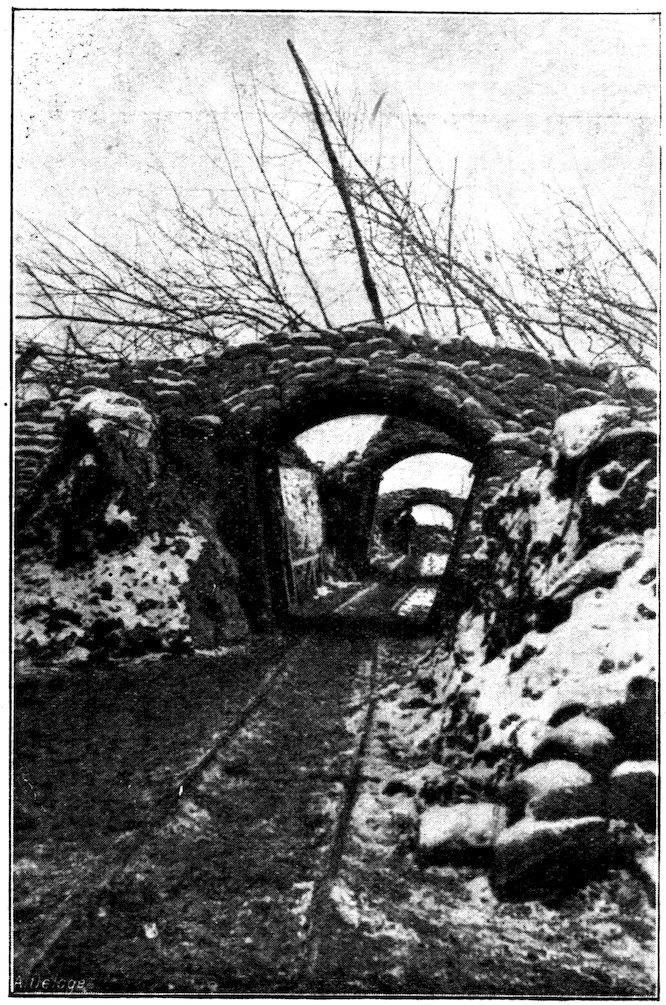
That line offered numerous and well constructed shelters affording to our men relatively comfortable dwellings. Here and there, at places offering good field of fire or permitting to sweep main-traffic passages concrete machine pits (such as the one at the station) were built. In the hut of the railway guard an artillery observation-post was also constructed.
10.—Observation-post at the Pervyse railway station.
From up the 26th of October 1914, date at which our troops were compelled to leave the Beverdijk, the Dixmude railway track outlined in front of Pervyse our first front line.
On the 30th of October meanwhile the foe was rushing for Ramscappelle he hurled detachments against the Pervyse station. That attack miserably failed under the violent rifle firing of the 1st Battalion of the 12th line Regiment which had been swiftly reinforced by few sections of the 2d Bat.
The assailants fled seeking refuge in the houses bordering the Schoore road opposite the railway station, where they were made prisoner in the course of the day. The rest managed to retire back to their former position but had to fight their way through the inundation in order to rally their line.
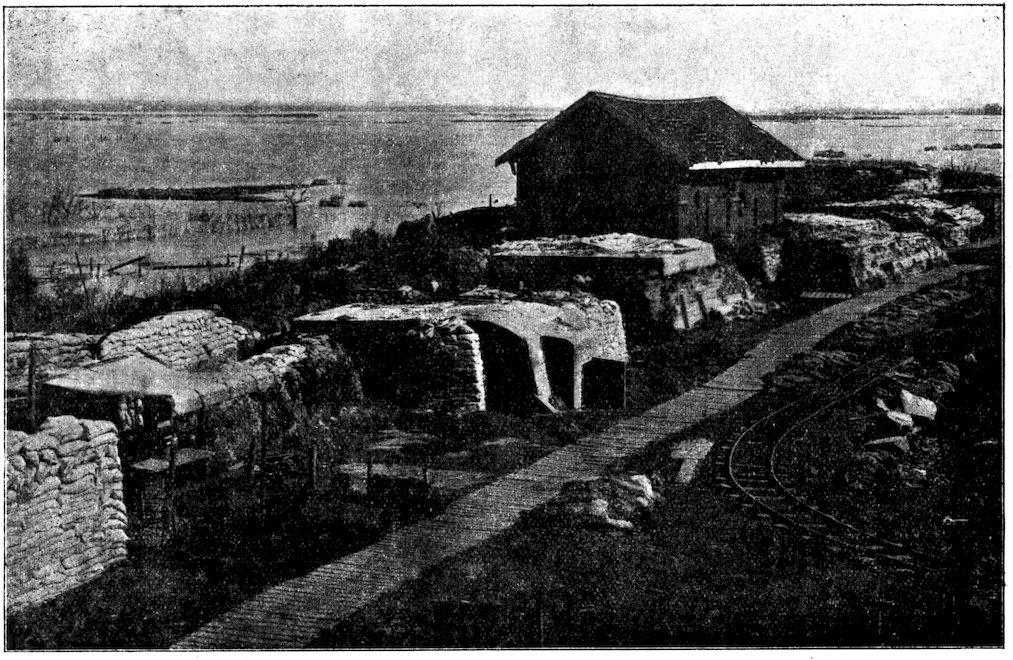
Pervyse.—The inundation facing the railway station (September 1916).
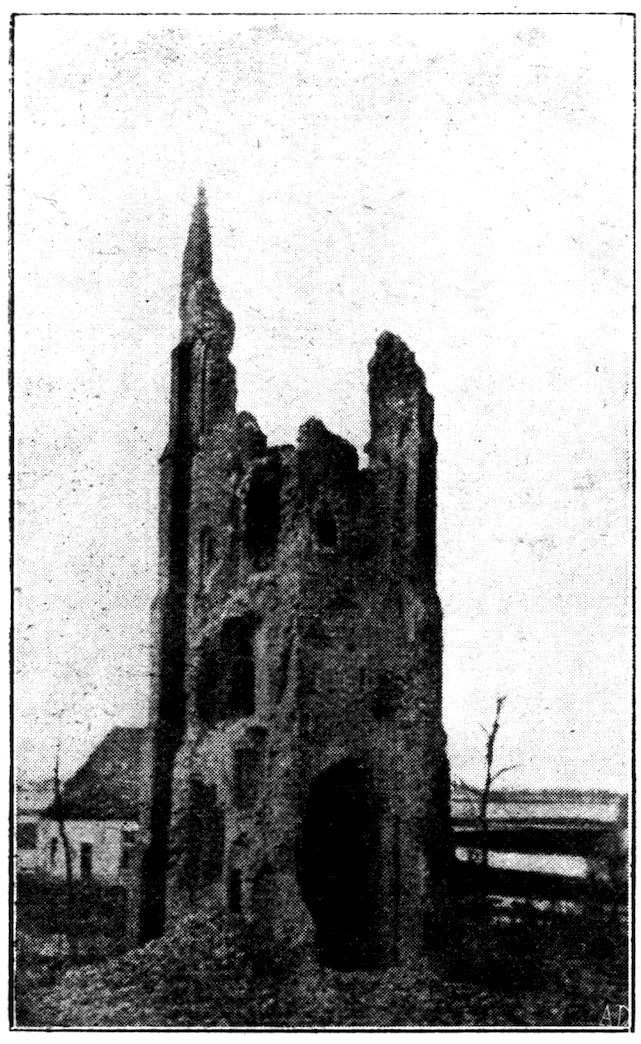
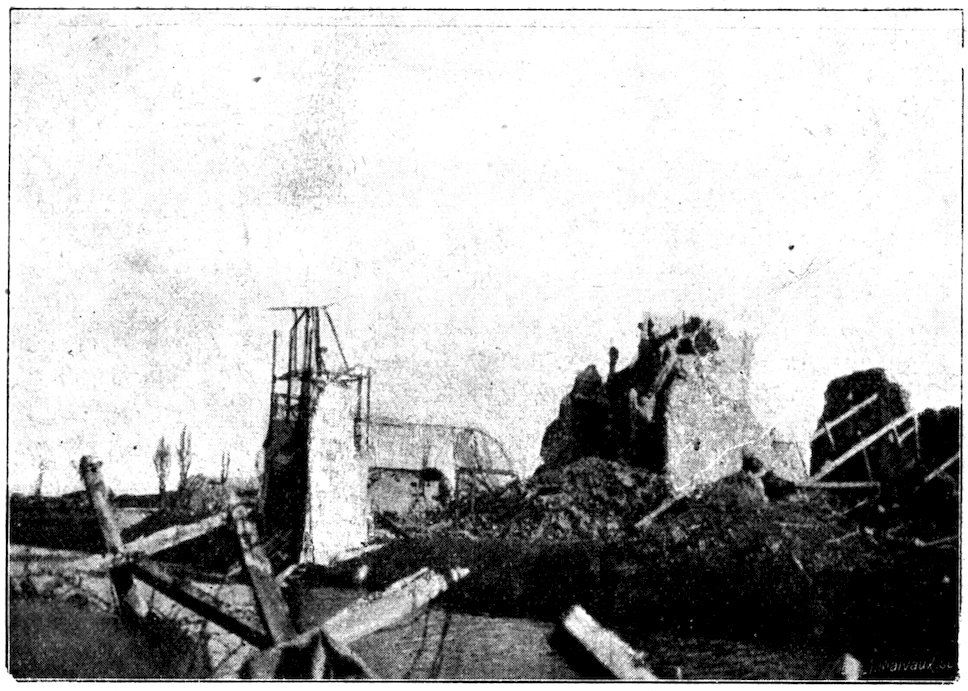
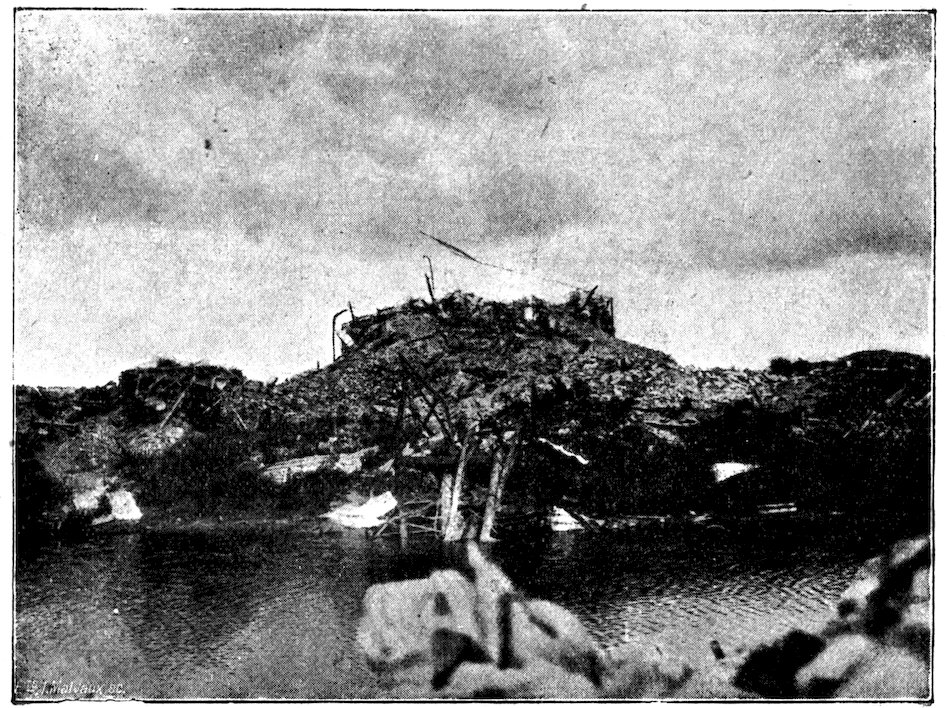
Oud-Stuyvekenskerke.—The Tower (November 1914).
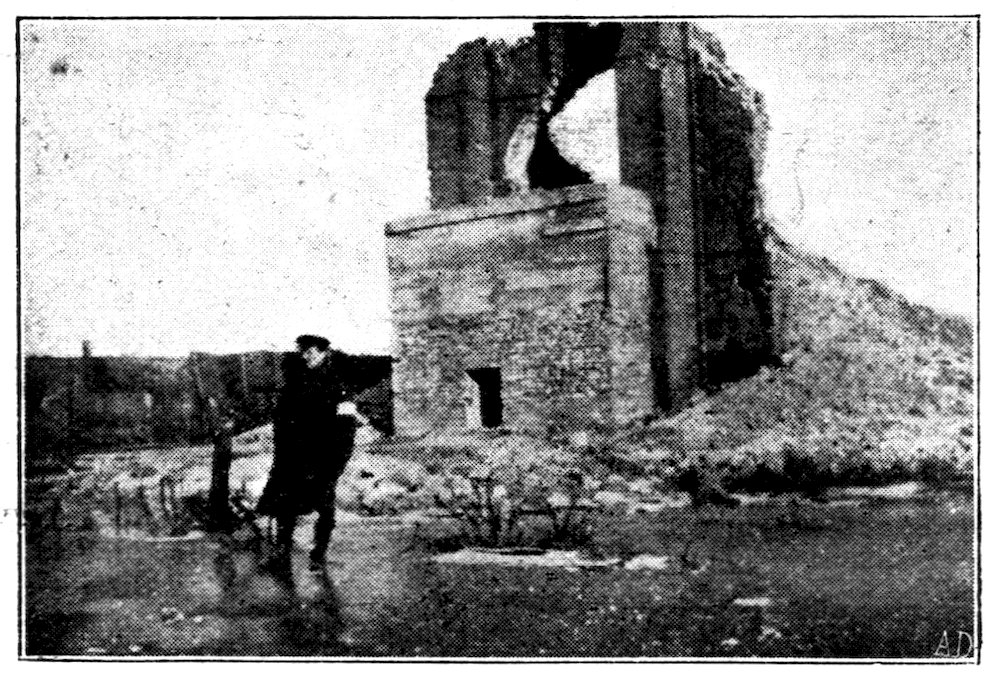
Oud-Stuyvekenskerke.—The Tower (February 1917).
29The above assault was to be the only one the first line of Pervyse ever had to grapple with.
The main-guard of Schilderbrug with its advanced posts, (one outlook post on the road and two sentry posts on the water with the intermediate ones) gave the troops a sufficient security to allow the men, in spite of the rafale fires which from time to time poured upon the line, to say: “It is fine in Pervyse”.
The line was organized since the early days of its occupation, then was gradually improved to become during the last years of war a model of stabilized trench warfare area.
Even the station itself, where an artillery observation-post had been constructed, was wedged in a powerful stronghold whose solid concrete shelters for machine-guns were forming the bastions.
One of the above mentioned machine-gun pits, that of the south eastern angle may still be seen and will give a thorough idea of the organization.
The observation-post of the railway station, one of the main O. P. s. of the Belgian front, had a vast field of view and was provided with visual apparatus of the highest precision.
It was connected in 1917, by means of two telephone wires with alternative courses, to Dunkirk signalling post and that, in order to warn the city of the firing intended for her by the Leugenboom gun.
The report of the monster, perceived at Pervyse was at once communicated to Dunkirk where the receiving station was to alert the town by means of the powerful steam-whistles or other such alarm signals.
11.—Battalion commander’s Headquarters at Km. 4.400 of the Nieuport-Dixmude railway line.
That concrete dug-out served as battle Headquarters to the major commanding the Oud-Stuyvekenskerke subsector. It was of that type adopted for such shelters prompted along the railway line.
These emplacements were generally constructed in the years 1916 and 1917 to take the place of the far less resisting ones whose walls as well as roofings were formed by beams and logs in juxtaposition. The roof had been rendered waterproof by means of tarred board, while a more or less thick layer of bags filled with concrete rendered them safe against small shells.
These which replaced them, some of which are still remaining such that of kilom. 4.400, were very well conceived. They often contained several different rooms, the number of which were varying according the need of the sector: major’s orderly room, major’s and adjutant’s lodging, visual signalling and very-light posts, telephone central, etc....