RACE BETTERMENT THROUGH HEREDITY
Most of us have heard in one form or another the fairy story of the youth
on adventure bent, who was captured by the giant and under dire penalty in
case of failure was set the task of sweeping out the giant’s stable before
sundown. The peculiarity of this stable, it will be recalled, was that, as
fast as the refuse was swept out at the door an even greater quantity
poured in through the windows so that the sweeper, just in proportion to
his zeal, became more and more encumbered with his burden.
A Questionable Form of Charity.—Though we smile at the childishness of
this legend, are we not as a civilized people attempting through our
charities a feat parallel to that of this unfortunate youth? We foster and
favor our social wastage with the inevitable result that it runs riot
under our sheltering hand and deluges us with an ever accumulating flood
of its like. For are we not constantly building more asylums, sanitaria
and prisons, to preserve more unfit, to produce more defectives, to
require still greater numbers of asylums, sanitaria and prisons, to
preserve more unfit, and so on in unending progression?
At nearly every period of history there have been certain individuals who
have seen the necessity of a state eliminating its supply of defectives.
Past Protests.—For instance, we find the importance of this strongly
urged by Plato. After pointing out the fact that the shepherd, in order to
maintain the standard of his flocks, bred only from the best individuals,
as did likewise the huntsman with his dogs and horses, and the fancier
with his various pets, Plato went on to show the danger to the state of
allowing the constantly increasing body of defectives and degenerates to
multiply their kind. Repeated expression of the same idea has occurred
from time to time during the succeeding centuries.
Little heed was paid to these remonstrances, however, with the result that
is known to us all. To-day, “the glory that was Greece and the grandeur
that was Rome” is still sung by the poet, but the original nations
themselves have long since passed into the night.
An Increasing Flood of Defectives.—Strive to ignore the unpleasant facts
as we may, we have to admit that the same problem of what the human
harvest shall be is with us in grave form to-day. The alarming phase of
the situation, however, lies in the fact that we are facing an ever
increasing flood of social wastage.
But why this increase of defectives? It can not be attributed to
oppression, to grinding poverty, or to decline in attention to our sick
and needy, for never was prosperity greater, never were charities more
flourishing, never such activity in the search for palliatives and cures.
The simple fact is that we are breeding our defectives. The human harvest
like the grain harvest is based fundamentally on heritage. And to get a
better crop of human beings, we must, as with other crops, weed out bad
strains.
To whatever source of information we turn the facts are essentially the
same. Abroad we find that in England, for example, the ratio of defectives
to normals more than doubled between 1764 and 1896. At home, from the
investigation of Davenport and Weeks we learn that in the state of New
Jersey the number of epileptics doubles every thirty years. And other
investigators estimate that the fecundity of mental defectives in general
is about twice as great as that of the average of our population. In a
recent report of the New York State Board of Charities we read, “There are
about thirty thousand feeble-minded persons in the state of New York, of
whom four thousand are intermittently sequestered while twenty-six
thousand who are a menace to society are at liberty and may produce the
unfit.” And a passage from the last Massachusetts report reads as follows:
“We have been obliged to refuse a very large number of applicants for the
admission of feeble-minded women—many of whom have given birth to one or
more children. The prolific progeny of these women almost without
exception are public charges from the date of their birth.”
How fertile defective types may be is shown by a passage in one of Doctor
Wilmarth’s papers which runs as follows: “One feeble-minded woman, now
removed from this state, had by different men eighteen children in
nineteen years, she alleges.” In a letter Doctor Wilmarth tells me that
the birth of the twenty-third child of this woman has just been
announced! In one English workhouse Potts reports sixteen feeble-minded
women who have produced one hundred sixteen mentally defective children,
and Branthwaite ninety-two female habitual drunkards who have had eight
hundred fifty babies. If we include the two million individuals cared for
annually in various institutional homes, hospitals and dispensaries as
dependents, the estimated total of insane, feeble-minded, epileptic, deaf
and dumb, criminals, juvenile delinquents, paupers and other dependents in
the United States in 1910 was approximately three million, or one in every
thirty of our population! With the higher fertility of certain of these
classes and with only a small percentage under custodial care where will
it all end? Is it not time for us to waken from our lethargy and stem this
tide of national deterioration?
Natural Elimination of Defectives Done Away With.—With our improved
methods of sanitation and care of the sick, the pauper and the defective,
these classes have been freed from the stress of an environment that under
natural conditions would have resulted in their premature death and
consequent infertility. Or in the terminology of the biologist, we have
done away with the factor of natural selection, the factor which in
state of nature keeps all races purged of the unfit, the ill-adapted. With
this restraining, and purifying influence removed, however, the weakling,
the defective, may arrive at maturity and commingle his blood with that of
the strong, with the inevitable result that the general vigor of the
progeny from generation to generation is sapped and progressively
undermined. Thus we are confronted by the stubborn fact that through
present humanitarian methods we are driving the race toward decadence.
Why Not Prevent Our Social Maladies?—Now there is no reasonable person, I
think, who will not admit that the motives underlying our modern
altruistic practises are the noblest fruitage of our slow upward struggle
from the brute to man. As humane beings, we can not cast aside these
principles and return to the painful and pitiless method of nature which
would leave the sick and the defective alone to perish miserably; the
sacrifice would be too great.
Is there then no escape from this dilemma? To this query the modern
student of heredity answers yes; let us but add more wisdom to our charity
and the enigma is solved. We need no sacrifice of pity but rather an
expansion of it. Let us but extend our vision from immediate suffering to
the prospective suffering of the countless unborn descendants of our
present unfit and ask ourselves the question, why should they be born? Why
not prevent our social maladies instead of waiting to cure them? This is
the province of eugenics.
Eugenics Defined.—The term Eugenics was coined in 1883 by Francis Galton
in his book entitled Inquiries Into Human Faculties, and we may
therefore look to him for a satisfactory definition. He says, “Eugenics is
the study of the agencies under social control, that may improve or impair
the racial qualities of future generations, either physically or
mentally.” And again, “I take Eugenics very seriously, feeling that its
principles ought to become one of the dominant motives in a civilized
nation, much as if they were one of its religious tenets.... Man is gifted
with pity and other kindly feelings, but he also has the power of
preventing many kinds of suffering. I conceive it to fall well within his
province to replace natural selection by other processes that are more
merciful and not less effective. This is precisely the aim of Eugenics.
Its first object is to check the birth-rate of the unfit instead of
allowing them to come into being, though doomed in large numbers to perish
prematurely. The second object is the improvement of the race by
furthering the productivity of the fit, by early marriages and the
healthful rearing of their children.”
Improved Environment Alone Will Not Cure Racial Degeneracy.—While many an
enthusiastic humanitarian is laboring under the assumption that if we can
improve external conditions human deficiencies will disappear, the student
of heredity realizes that this is in large part a delusion unless we can
secure an accompanying improvement in intrinsic qualities of the human
species itself through the suitable mating of individuals. Just as the
intelligent farmer to-day demands selected seed as well as good soil and
proper cultivation, so one with the facts of heredity at hand would, as he
views social problems, urge the fundamental importance of having selected
stock with which to start. No shifts or shapings of environment will ever
enable men to “gather grapes of thorns or figs of thistles.”
Heredity and Environment.—To wrangle over the question of which is the
more important, heredity or environment, is about as idle a proceeding as
to argue which is the more important, the stomach or something to put in
the stomach. Man would soon come to grief without either. So, too, the
question of human development is not one of heredity alone nor of
environment alone; both are necessary and must work hand in hand. Dormant
capacities must have proper environment to call them forth, but on the
other hand no kind of environment can evoke responses if some degree of
aptitude is not present.
Professor Thorndike undertook experiments with groups of school children
of high and of low initial ability respectively to determine whether equal
opportunity or equal special training would produce an equalizing effect
in easily alterable traits such as rapidity in addition and the like.
Without exception he found that at the end of such experiments, although
both groups had improved, the superior individuals were farther ahead than
ever, that equality of opportunity and training had widened rather than
narrowed the gap between the two classes. Others who have made special
studies on the causes of individual differences have come to the same
conclusion; namely, that individuals differ widely by original nature and
that similarity in conditions of nurture and training will not avail in
deleting these differences.
Galton and others, from extensive studies based on English sources, have
shown that notable achievements have run in certain families to a degree
that is inexplicable on the basis of opportunity alone; it can be fully
accounted for only by attributing much to superior inborn capacity. Doctor
Woods has shown much the same thing for certain families in America.
Schuster and Elderton have proved that there is a high degree of
similarity in scholastic standing between fathers and sons in Oxford.
Professor Pearson’s measurements of mental characters in brothers and
sisters while at school show a high degree of innate resemblance in many
cases and certain cases of decided contrast. Where contrasts exist in
certain families they remain unreduced in spite of the similarity of
environment, thus proving that environment is less operative in the final
intellectual establishment of such individuals than are their inborn
aptitudes. Even in twins, as both Galton and Thorndike have shown, there
is no tendency for similar education, home life and the like to render
those originally different any more similar with advancing years.
Professor Karl Pearson has done more perhaps than any other individual
toward attempting actually to measure the relative strength of heredity
and environment. Numerous statistical measurements lead him to conclude
that it is a conservative estimate to regard heredity as at least five or
ten times as important as environment in the development of the
individual. A vigorous defense by him of this position will be found in
Biometrika for April, 1914.
Inter-Racial Marriage.—Some of the dangers of racial deterioration which
threaten us because of our laxity regarding immigration have already been
indicated. It is high time that we give this whole question the most
serious consideration of which we are capable. From the rate at which
immigrants are increasing it is obvious that our very life-blood is at
stake. For our own protection we must face the question of what types or
races should be ruled out. Aside from the dangers which lie in the
defective or unsuccessful types already discussed in Chapter IX, many
students of heredity feel that there is great hazard in the mongrelizing
of distinctly unrelated races no matter how superior the original strains
may be. Unfortunately there is a great lack of reliable data on this
point. The mulatto of our own country, the Eurasians in India and the
mixed races of South America are, according to the testimony of many
observers, eloquent arguments against such hybridization. Agassiz remarked
on this point as follows:
“Let any one who doubts the evil of the mixture of races and who is
inclined from mistaken philanthropy to break down all barriers between
them come to Brazil. He can not deny the deterioration consequent upon
the amalgamation of races, more wide-spread here than in any other
country in the world, and which is rapidly effacing the best qualities
of the white man, the Indian, and the negro, leaving a mongrel
nondescript type deficient in physical and mental energy.”
Of the American mulatto one not infrequently meets with the assertion that
he is on the average inferior mentally, morally and physically to either
the white or the negro race. Thus Doctor J. B. Taylor[17] states that,
“It is demonstrated by well-attested facts that these hybrids of black and
white are vastly more susceptible to certain infections; their moral as
well as physical stamina is lower than that of either original race.”
Others would deny that conclusive evidence to this effect exists. However,
it is certain that under existing social conditions in our own country
only the most worthless and vicious of the white race will tend in any
considerable numbers to mate with the negro and the result can not but
mean deterioration on the whole for either race.
There is certainly not one iota of evidence that the crossing of any two
widely different human races will yield superior offspring in any respect
and there are many indications that such intermixture lowers the average
of the population. Our evidence derived from plant and animal breeding is
also against pronounced crosses. The inferiority of the mongrel is
universally recognized. No sane farmer, for example, would seek to improve
his Jerseys or his Herefords by crossing one with the other. It is true
that in pure breeds of plants and animals we sometimes venture on a cross
to introduce some new desirable character but we follow up such mixture by
a rigid selection in which is eliminated all but the rare individuals
having the desired characteristics, and we continue this elimination
generation after generation to fix our characters again. It is obvious
that no such selection as this would be possible among the progeny of
human crosses.
It clearly becomes our duty then to determine as accurately as possible
the degree of non-relationship between races it is inadvisable to
transcend in inter-racial marriages. We are certainly taking great risks
in accepting in any considerable numbers those races we can not assimilate
to advantage into our own stock.
War.—The deteriorating effect of war on national physique and vigor has
been so frequently cited by eugenists[18] and is so obvious as scarcely to
require further comment. It should be pointed out, however, that where, as
is the case at present in Great Britain, armies are assembled from
volunteers, instead of by conscription, there is the greatest danger from
the eugenic standpoint, since not only physical but moral qualities are
involved. For it is the brave, the generous, the individual with a high
sense of duty who goes forward to the slaughter leaving the cowardly, the
selfish or the indifferent to father the race. With the awful deadliness
of modern warfare upon exhibition before our very eyes to-day, the extreme
seriousness of such selective action must be evident to every thoughtful
person.
Human Conservation.—We talk much in recent years of conservation; but
what are our forests and frontiers, our minerals and our waterways,
compared with our national health and life-blood? No farmer would think of
setting aside a diseased or physically defective animal for breeding
purposes, yet the same man together with the majority of mankind is wholly
oblivious to similar faults when it comes to the mating of human beings.
But is it not as important to look to fitness in man as in Poland China
hogs or Holstein cows? Certainly the various strains are as marked and
breed as true in the human family as in our live stock. Why face
complacently in our own families what we would not tolerate in our
piggery?
From the expenditure of comparatively small sums in studying the
inheritance of various qualities in wheat, corn and other grain,
improvements based on the laws of genetics have been secured which are
enormously increasing our agricultural output and thereby adding to our
national wealth. But if it costs relatively little to discover and
conserve millions of dollars’ worth of hereditary qualities in our plants
and animals, what are we to think of ourselves, an intelligent people who,
knowing that “every good tree bringeth forth good fruit, but a corrupt
tree bringeth forth evil fruit,” still go on placidly permitting the
production of defectives and delinquents? Can we continue to drink the
sluggish blood of the pauper and the imbecile into our veins and hope to
escape unscathed?
We are all familiar with the fate of Babylon, Assyria, Persia, Egypt and
Rome. Why not America? Certainly we have no pledge of special immunity
from Divine Powers. If so, what then is the meaning of our 366 hospitals
for insane which cost us annually $21,000,000; our 63 institutions for
feeble-minded costing us over $5,000,000; our 1,300 prisons maintained at
a cost of more than $13,000,000; our 1,500 hospitals whose annual
maintenance requires at least $30,000,000; our 115 schools or homes for
deaf and dumb; our 2,500 almshouses with an annual expense account of
$20,000,000 and our 1,200 refuge homes costing annually several millions
of dollars more? To say that we spend annually over $100,000,000 on the
custody of insane, feeble-minded, paupers, epileptics, deaf, blind and
other charges is expressing the situation very conservatively.
Kindness in the Long Run.—There is no one I think who will not admit that
the sympathy and charity of the human heart are its noblest virtues. But
we must face the problem of what is kindness in the long run. Havelock
Ellis well says, “The superficially sympathetic man flings a coin to the
beggar; the more deeply sympathetic man builds an almshouse for him so
that he need no longer beg; but perhaps the most radically sympathetic of
all is the man who arranges that the beggar shall not be born.”
What shall we do?
The Problem Has Two Phases.—For an intelligent consideration of the
problem one must recognize at the outset that it has two distinct phases;
namely, (1) a selective union of the fittest, or in other words, a
conscious attempt to breed a superior race; and (2) the elimination of the
obviously unfit by preventing their reproduction, with the purpose of
purifying the present race. It is evident at a glance that these are two
essentially distinct problems although the practise of either method could
result in racial improvement. The first is sometimes spoken of as
positive or constructive eugenics, the second as negative or
restrictive eugenics.
Constructive Eugenics Must Be Based on Education.—As to the first phase,
direct selection for superiority, the campaign must, in the very nature of
things, be one of education. With the necessary knowledge of the facts in
mind, the awakening conscience of the individual together with an
enlightened public opinion will form the safest guide. Increasing popular
comprehension of the inevitable nature of human inheritance must engender
a sense of responsibility as to the positive eugenic fitness of a
contemplated marriage. The growth of this sentiment will doubtless be
slow, and properly so, for as yet we have but half-lights on what are the
most desirable types of humanity. No one can say what the highest type of
man should be, but almost any one can readily pick out types which
certainly should not be.
Inferior Increasing More Rapidly Than Superior Stocks.—Modern eugenists,
although realizing that the constructive phase is of great importance, are
making no attempt to map out any fixed mode of procedure for it beyond
pointing out the desirability of larger families among the better classes.
The need for individuals of superior physical, mental and moral qualities
to multiply is so obvious as scarcely to require comment. Yet the fact is
that judging from all appearances these are the very ones who have the
lowest birth-rate. Eugenics is mainly concerned with the relative rates of
increase of the various classes, not with mere fertility in itself. And
the actual increase must be measured in terms of the extent to which
birth-rate exceeds death-rate. If a high birth-rate is accompanied by a
high death-rate then it is not especially significant in increasing a
given class as a whole. All available evidence points to the fact that
to-day the lower strata of society are far outbreeding the middle and
higher, with an almost negligible difference in death-rate, and just in
the measure that these lower strata are innately inferior just in that
degree must the race deteriorate. The seriousness of the whole situation
as it exists to-day hinges, therefore, on the extent to which the lower
strata are inferior to those above them.
An Unselected Population May Contain Much Valuable Material.—In
evaluating these lower strata a matter of very great importance is whether
the population is a selected or an unselected one. If the population has
been long resident in a given region and has had fairly good opportunity
for education then we will find in the lower reaches a larger percentage
of sedimentation made up of the worthless and inferior stocks. If,
however, a continual fomentation and geographical shifting of the
population is in progress as in parts of America, or if adequate
educational opportunities are lacking, as in some parts of Russia, the
poor and less well-to-do classes may contain, no one can tell how much,
relatively valuable stock.
Forel remarks on this point as follows:
“If we compare the nature of delinquents, abandoned children,
vagabonds, etc., in a country where little or nothing has been done
for the people (Russia, Galicia, Vienna, etc.), with that of the same
individuals in Switzerland, for example, where much has already been
done for the poor, we find this result: In Switzerland, these
individuals are nearly all tainted with alcoholism, or pathological
heredity; they consist of alcoholics, incorrigibles, and congenital
decadents, and education can do little for them because nearly all
those who have a better hereditary foundation have been able to earn
their living by honest work. In Russia, Galicia, and even in Vienna,
we are, on the contrary, astonished to see how many honest natures
there are among the disinherited when they are provided with work and
education.”
The Lack of Criteria for Judging Fitness.—Barring the untold hordes of
actual defectives who have gravitated into this lower stratum, there are
few positive criteria by which we can measure the real fitness of the
remainder. Before we can set out on a campaign of positive eugenics we
must have some standard by which to steer, and it would be a rash advocate
indeed who would assert that class distinction alone, or even success as
measured by public opinion to-day should be our whole criterion of
fitness. Shall we measure fitness in terms of how successfully one can
acquire worldly goods, or in other words, by the property test, or what
shall be our standard?
The College Graduate.—Many of our modern critiques of the birth-rate
situation make much of the fact that our college graduates as a group are
scarcely reproducing themselves. According to Davenport, Bryn Mawr College
between 1888 and 1913 has graduated 1,193 bachelors of arts, but these
women have produced up to January, 1913, only 263 girls to take their
place in the next generation. He also points out that statistics on some
of the graduate classes of Harvard of twenty years ago or earlier show
that they are little more than maintaining themselves; thus one class of
328 graduates twenty years later had produced 195 sons, and in another
case a class of 278 individuals had produced, twenty-five years later, 141
sons. Relatively similar statistics can be cited for other eastern
colleges.
All such cases of college graduates cited as especially deplorable
declines in birth-rate are based on the assumption that these individuals
are a particularly superior stock.[19] But one might question this premise
as a generalization. It may or may not be true. Are they superior or have
they had mainly a combination of luck and incentive, luck in that their
parents had sufficient means, acquired possibly through their own
superiority, possibly not, to send them to college, and incentive derived
from a fortunate environment which awakened a desire in them—or in their
parents for them—for college education? Is the woolly-witted son of
opulence, so abundant in our colleges to-day, who is boosted through by
hook or by crook, of superior eugenical value to the alert eager boy—and
his name is legion—destined for economic reasons to go to work at or
before the completion of his high-school course, perhaps because of the
very fact of an unlimited fecundity in his own family which necessitates
his help for the general support?
When one first learns of the declining birth-rate among college women and
men he feels appalled, but immediately the question flashes up, if this is
the superior stock, and up to date it has died out or is dying out
rapidly, whence then this ever augmenting rush of young folk who fairly
deluge our universities and colleges to-day? Does it not rather point to
the fact that in our own country at least, the man who will and can take
a college education successfully is not so much the product of breeding
from college men, but of a prosperity which leaves a sufficient surplus in
the family exchequer to enable sons and daughters to go to college, and is
it not reasonable to suppose that there is yet an abundant stock back of
these who similarly await but the golden touch of opportunity? When we
consider such men as Carlyle, Lincoln and a host of others who were not
the sons of collegians, although we may be university pedigreed ourselves
we can not but feel doubtful of the validity of a premise which takes a
college stock unqualifiedly as having any considerable monopoly of innate
superiority. After all, college can mean little more than opportunity, and
the obtaining of such opportunity in this world of economic maladjustments
and accidents of social position is too largely a matter of chance, at
least in America, to stamp the possessors of these advantages, on this
criterion alone, as of inborn superiority. Undoubtedly much that is
intrinsically good now slumbers in the lower strata of society because of
lack of favorable environment to call forth the latent possibilities.
Native Ability, Independence and Energy Eugenically Desirable.—Although
we can not sift out with certainty the superior from the inferior in our
normal population by the property test or the educational standard alone,
it is undoubtedly true that, on the whole, native ability, independence
and energy are present to a higher degree in our well-to-do and prosperous
families than in the stocks which merely hold their own or which
gradually decline, and there is no gainsaying the fact that in so far as
the lower classes are where they are through actual deficiency—and there
are enormous numbers in this category—they threaten our very existence as
a race. It is imperative that the great middle class in particular
establish in some way a selective birth-rate, by increased fertility on
their own part, and diminished fecundity on the part of inferior stocks,
which will offset or more than offset the disproportionate increase of the
socially unfit.
Four Children to Each Marriage Required to Maintain a Stock.—It is
estimated that under present conditions an average of at least four
children should be born to each marriage if a stock is to maintain its
numbers undiminished. Some of our most valuable strains are falling far
short of this average. In a statistical table on the relative fertility of
different stocks, prepared by Pearson, we find the mentally defective,
criminal, deaf-mute and degenerate stocks heading the list with averages
ranging from five to seven children per family, while the American
graduate (based on Harvard statistics) and the English intellectual types
average less than two children per marriage. While the death-rate is
higher in the undesirable classes mentioned, it is by no means enough
higher to compensate for the difference in birth-rates. Thus while certain
very desirable types are not maintaining themselves genetically, other
extremely undesirable ones are rapidly more than replacing themselves.
Investigations made by Heron in London show that this condition as regards
English desirables did not exist sixty years ago; then the richer a
community was in professional men and well-to-do families, the higher was
the birth-rate.
Factors Contributing to Low Birth-Rate in Desirable Strains.—Most
students of the subject believe that the fecundity of much of the best
blood in our country has reached such a low ebb as to threaten the whole
fabric of our commonwealth. How to correct this is the pressing problem to
which no one has found a solution. However much one may deplore it the
fact remains that always in the history of the civilized world with the
rise of material conditions in any class of a population there has come an
accompanying limitation of child-birth. Explain this as we may in modern
times—whether as an awakened individualism which looks only to the
immediate interest of the individual as against the ultimate interest of
the race, or a desire for luxuries or for a better opportunity for smaller
numbers of children, or as a determined effort of the wage earner to
better his conditions, or to the feminist movement with its accompaniment
of a greater personal freedom of married women and the recognition of the
fact that marriage and child-bearing are often bars to employment, or to
general increasing pressure of economic burdens—in brief whatever the
cause or causes, there is no denying the fact of a diminishing birth-rate
among our abler men and women. Moreover, no amount of coaxing, cajoling or
dire prophecy seems to avail in altering the conditions. Various partial
remedies, many of them of questionable practicability, have been proposed,
but so far there has been no far-reaching effort made to put any of them
into effect. It has been suggested that society return to the simple life
so that our young folk may marry earlier and live more easily on limited
means, but so far few volunteers have appeared to lead the procession.
While there is no doubt that present economic conditions tend to penalize
parenthood, the simple life will not return for the mere asking. It has
been pointed out that the father is in unfair competition with the
bachelor and is also unfairly taxed in comparison, and some would
therefore tax unmarried men more heavily. Others would pay a direct bounty
on reproduction, but it is probable that such rewards would merely
stimulate families of the lower types to increased fruitfulness. And so
one panacea after another may be weighed and found wanting.
The Educated Public Must Be Made to Realize the Situation.—It seems
probable that the most success will be met with through the slow and
unspectacular methods of education. The necessity of the situation must be
driven home so that it becomes part and parcel of the collective
intelligence of the educated public. Different ideals of life will have to
be established in the young. If knowledge of the facts of heredity is
thoroughly disseminated among the people and ideals regarding parenthood
are fostered, then much will have been accomplished by the psychic power
of suggestion alone toward the end desired.
Utilization of Family Pride as a Basis for Constructive Eugenics.—There
are few more powerful incentives to make the best of one’s abilities, or
few greater deterrents from vice than family pride; and there is no
reason why this same sentiment may not be aroused in behalf of unborn
generations. The sentiment of caste or aristocracy in some form is well
nigh universal in mankind. The family of Mr. A came over in the Mayflower
and is therefore worlds above the family of Mr. B, who arrived fifty years
later. Mr. X’s income is $5,000 a year, Mr. Y’s only $1,500. The poor
family in the front suite of the tenement regards itself as far superior
to the one in the rear. Among criminals the professional house-breaker
feels himself to be of higher caste than the sneak-thief, and in turn is
surpassed by the bank-burglar. Even in the insane asylum the feeling is
rampant. With such a wide-spread tendency for a foundation the creation of
a sentiment of eugenic aristocracy is by no means a visionary undertaking.
The Tendency for Like to Marry Like.—Even now there is a decided though
unconscious tendency for like to marry like and thus create particular
strains. We have lines, for instance, which produce notably families of
scholars, others which yield mainly statesmen, and still other strains of
inventors, of financiers, of naval men, of soldiers, and of actors
respectively. And there is little doubt that people, with the facts of
inheritance of ability once before them, will be led to act more or less
in accordance with their knowledge. On the other hand, due apparently to
the same unconscious tendency for like to marry like, we find produced
criminalistic, feeble-minded, deaf-mute and tubercular stocks. The first
type of family is often termed aristogenic and the second or defective
type, cacogenic.
Public Opinion as an Incentive to Action.—Much of our social conduct is
the result of the pressure of public opinion, yet so accustomed are we to
this that we ordinarily do not feel it as a hardship. There is little
doubt that similarly the more wholesome attitude toward parenthood
advocated by the eugenist would be taken as a matter of course, once the
idea became prevalent. It would come to be one of those socially
preconceived ideas which are as much actualities and which become
unconscious guides to action no less certainly than do the more obvious
personal habits of the individual. And just in the degree that we as a
race get the “feeling” that intellect, morals and skill are highly
desirable attributes in marriage selection, just in that degree will one’s
affections in their earlier stages gravitate toward individuals who
possess such qualities in high degree. In the main, those stocks which
have shown by ancestral as well as personal achievement their superiority
will tend to insure most certainly a continuation of this superiority in
offspring.
Choosing a Marriage Mate Means Choosing a Parent.—Although marriages, as
all young folks know, are made in Heaven, it is interesting to see what a
vast number of these foreordained matches coincide with propinquity in
college, in church, or in the same social set. Moreover, children are born
here on earth. The one thing of all things that the eugenist desires is
for these young folk to get a clear-eyed vision of the fact that in
choosing a marriage mate they are also choosing the future father or
mother of their children with all that this implies.
The Best Eugenic Marriage Also a Love Match.—A few recent writers, who
show an utter misconception of what the aim of modern eugenics is, have
raised the cry of give us the old-fashioned love match instead of the
eugenic marriage, as if the eugenist’s ideal of moral cleanliness, freedom
from transmissible physical taints or mental enfeeblement, and an attitude
of special approval toward marriages which bring together individuals of
more than average mental or spiritual endowment, had anything in it that
was inimical to love. No one better than he realizes the sordid depths to
which marital relations devoid of mutual affection and regard must reach.
Certainly there is nothing in the eugenic ideal when its full import is
understood that can shock the sensibilities of the most delicate-minded.
Indeed it is people of fine susceptibilities who will be the first to feel
repugnance toward a marriage which means mental or physical deterioration
of their own blood.
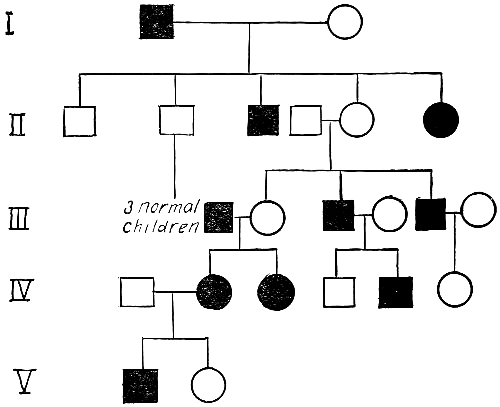
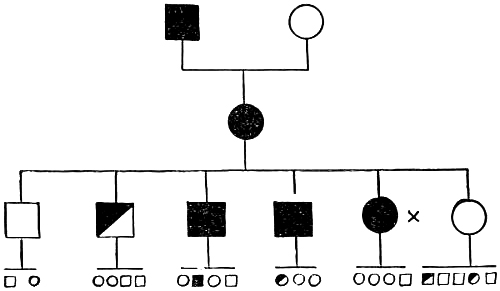
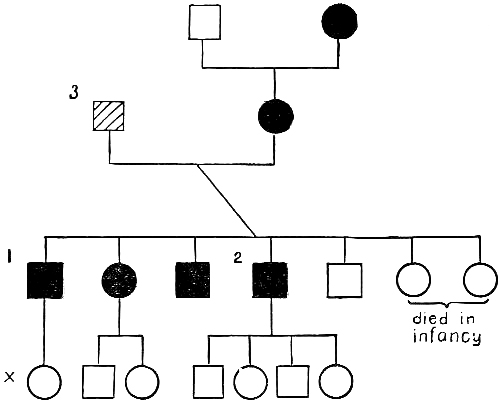
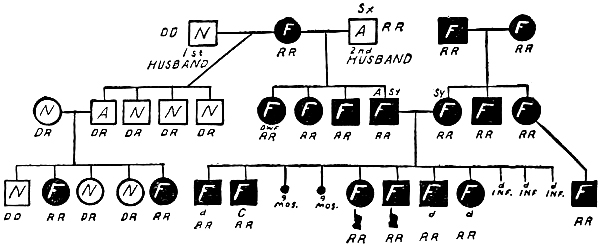
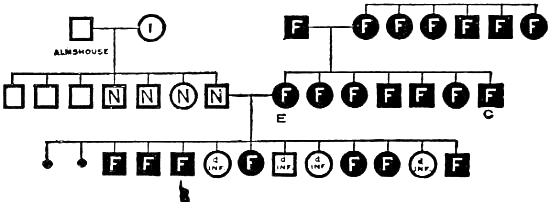
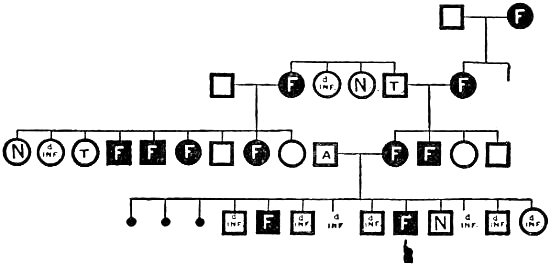
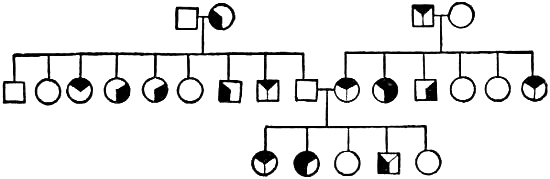
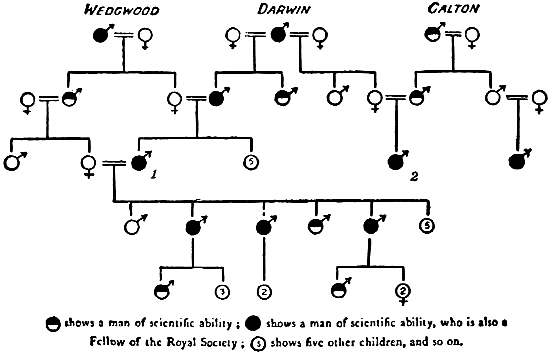
Good Traits No Less Than Bad Ones Inherited.—An inspection of such charts
as those shown in Figs. 37, 38 and 39, pp. 313, 314, 316—and an abundance
of such encouraging records may now be found—reassures us in our
convictions that good traits are no less inheritable than bad ones. And
what any healthy, mentally well-endowed person may be depriving the world
of if he or she declines to enter into a fruitful marriage can not be
better exemplified than in the following excerpt from Davenport:
“Many a man at the opening of his life work vows, as Judge John Lowell
of the middle of the eighteenth century did, as he was being graduated
from Harvard College, that he will never marry. But nature was too
strong for John Lowell and he married three times, and among his
descendants was the director of a great astronomical observatory, the
president of Harvard College, a principal founder and promoter of the
Massachusetts General Hospital and the Boston Atheneum; the founder of
the city of Lowell and its cotton mills; the founder of the Lowell
Institute at Boston; the beloved General Charles Russell Lowell and
his brother, James, both of whom fell in the Civil War, and James
Russell Lowell, poet, professor and ambassador; besides brilliant
lawyers and men entrusted with large interests as executors of
estates. Do you think John Lowell would have taken that vow could he
have foreseen the future?”
Fig. 37
Pedigree of family with artistic (dark upper section), literary (dark
right section) and musical (dark left section) ability (from Davenport).
The Elimination of the Grossly Unfit Urgent.—But even if, under present
conditions of partial knowledge and lack of an adequate standard, the
constructive phase of eugenics must be left in the main to the awakening
conscience of the individual as humanity improves in general
enlightenment, the second phase, the elimination of the grossly unfit is
one of the greatest social obligations that confronts us to-day. For if
there is an alarming amount of mental impairment in civilized nations, and
if the problems of pauperism, inebriety, prostitution and criminality are
closely interwoven with the problems of mental unsoundness, as we have
every reason to believe from available data, then any means which will
operate toward securing normally functioning brains will at the same time
operate toward diminishing, defects and delinquencies. And inasmuch as a
considerable proportion of defects, both mental and physical, are
inheritable, it is obvious that if we can diminish the number of children
born into the world with defective brains or bodies we have made a long
stride in the right direction.
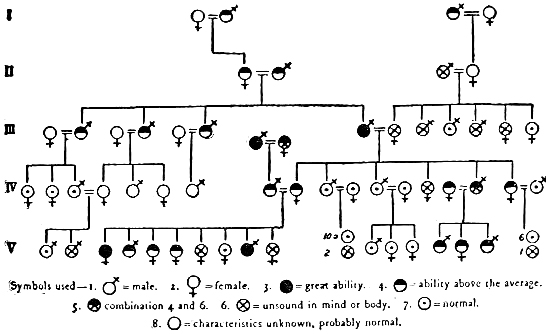
Fig. 38
Inheritance of ability (from Kellicott after Whetham).
Suggested Remedies.—But how go about it? Various schemes have been
proposed, of which the chief are as follows:
1. Laws restricting marriage.
2. Systems of mating with the purpose of covering up and gradually
diluting out defective traits.
3. Segregation during the reproductive period.
4. Sterilization.
5. Education in the principles of eugenics.
Inefficacy of Laws Which Forbid Marriage of Mental Defectives.—The utter
inefficacy of the first proposition, namely the enactment of laws
restricting marriage, at least as regards the socially unfit whose
condition is based on impaired mentality, has been demonstrated time and
again. If they are forbidden marriage, they merely have children without
getting married. Most states have laws to prevent the marriage of such
individuals but these laws are almost wholly ineffective in preventing
procreation on their part. We might as well recognize once for all that in
such cases nothing short of close custodial care or sterilization will
accomplish the end desired.
As to the second proposition, systems of mating with the purpose of
covering up and gradually diluting out defective traits, this has been
shown to be possible with certain types of defectives. Whether it is
desirable or not is a different question.
Fig. 39
Inheritance of ability (chart condensed and incomplete) in three markedly
able families (from Kellicott after Whetham):
1, Charles Darwin; 2, his cousin, Francis Galton, founder of the modern
eugenic movement.
Systems of Mating Impracticable in the Main.—By systems of mating, it
should be said, is not meant the arbitrary marrying of two individuals
willy-nilly, but rather it is the prevention from marriage of two
individuals having similar defects. In general the facts at our command
indicate that in the majority of cases the offspring from a marriage of an
insane, feeble-minded or epileptic person with a normal individual free
from all neuropathic taints are normal or at most show but slight effects
of the taint. But what normal individual would knowingly marry into such a
stock? With few exceptions such traits where inheritable are apparently
negative, that is, not represented by some positive abnormal factor but
due to the lack of some element or elements necessary to the proper
working of the normal brain. In the offspring of such a union the
necessary missing factors are supplied by the normal parent. Or in
Mendelian phraseology, the defective traits are recessive and are
dominated by the normality of the other parent. Such offspring, however,
while apparently normal of body are not normal of germ-plasm, inasmuch as
half of their germ-cells will carry the abnormality of the defective
parent as earlier explained (page 119) under Mendelism. We have already
seen (page 119) how by continually marrying into strong strains the
liability to recessive defect can be diluted out until the descendants are
no more likely to have defective children than are members of our ordinary
population. If, however, as is estimated in Bulletin No. 5 of the
Eugenics Record Office, about thirty per cent. of our general population
already carry recessive neuropathic taints, it certainly is a hazardous
proceeding to attempt thus to breed out nervous defects unless one is
absolutely sure of the normality of the strain into which it is proposed
to marry. The great difficulty is in determining whether or not there is a
defective ancestry in a given stock. We have at present no criteria for
identifying normal individuals who have defective germ-plasm. As a
practical test, however, if no defect has appeared in the stock for three
or four generations back, the marriage would be relatively as safe as are
the marriages of our average population to-day.
Corrective Mating Presupposes Knowledge of Eugenics.—But such a scheme of
corrective mating presupposes a relatively high degree of intelligence and
judgment on the part of the participants, and this is just what we do not
have and in the nature of things can not get, in the types of
feeble-minded, epileptic and degenerate strains we are striving to
eliminate. All our evidence shows that when unrestricted there is a marked
tendency for feeble-minded to mate with feeble-minded, degenerate with
degenerate. About sixteen per cent. of the feeble-minded, in fact, come
from consanguineous marriages. If we try to legislate them into specific
types of marriage then we encounter the same futility pointed out under
our discussion of restrictive legislation, they will produce offspring
without the formality of marriage.
In certain cases of insanity and in other than neuropathic defects one can
see how the system might be inaugurated with greater prospects of success,
but even then a knowledge of the principles of eugenics would be necessary
to the participants, or in other words we could only accomplish our end
through our fifth proposition, education.
Segregation Has Many Advocates.—As to the third proposition, segregation
during the reproductive period, this seems to have a larger number of
advocates than any other coercive measure. While on theoretical grounds it
is plausible enough, when we face the actual putting of the method into
practise we are confronted by the fact that tremendous sums of money would
be required to sequestrate and maintain colonies or industrial refuges.
When one realizes that no state now provides for more than a small
minority of its defectives, and knowing also of the pressure that must be
brought to bear on legislatures to secure sufficient funds to provide for
these cases of extremest urgency, one can not be overly optimistic about
the practicability of extensive sequestration.
E. R. Johnstone, the superintendent of a large training school for
feeble-minded in New Jersey, points out that no state in the Union is
providing for many more than one-tenth of her feeble-minded and
epileptics. If his estimate is true, to place in institutions, treat and
train all its feeble-minded and epileptics would even now almost swamp any
state treasury. But what will it be in the future if we permit this
unrestricted nine-tenths to go on and multiply their kind?
Leaving out of account the enormous sums spent in private charities even
now from one-fifth to one-seventh the total public expenditures of almost
any one of our states is going to maintain its defectives, dependents and
criminals. From the 1912 report of the secretary of state, in the state of
Wisconsin, for instance, I learn that of the total expenses for 1912,
sixteen per cent. was for charitable and penal institutions. The situation
is even worse in some other states. Think of it! Think what a large total
of expense it becomes! And the expense is far secondary from the
humanitarian standpoint to the misery involved.
In the Survey of May 24, 1913, we find Mr. Hastings H. Hart, Director of
the Department of Child Helping of the Russell Sage Foundation, proposing
very specifically “a working program for the extinction of the defective
delinquent,” which involves segregation during the reproductive period. He
gives the number of feeble-minded under public care as 20,000 in
institutions for the feeble-minded, 16,000 in almshouses, 5,000 in
hospitals for the insane, and 26,000 in prisons and reformatories, or a
total of 67,000 already under custodial care. And he asserts that as
nearly as can be judged, this is one-third of the feeble-minded persons in
the United States.
Between this estimate that one-third of our feeble-minded are in
institutions and Doctor Johnstone’s that we are not providing for many
more than one-tenth of our feeble-minded and epileptic, there is a wide
discrepancy, but I know of no accurate data[20] whereby the matter can be
settled definitely. One point of difference may be that Doctor Johnstone
specifically includes epileptics and another may be one of definition of
feeble-minded. However, supposing that we could get them all into
institutions, institutional care at present by no means also implies
prevention of propagation. It is not an unusual history of feeble-minded
women in our county poor-houses that they alternate between periods of
housework in some family and periods of residence in the almshouse, the
return to the latter being only too often to bear an additional child.
Not a few students of the problem, however, advocate a rigid segregation
as the only reasonable preventive measure, no matter what the expense.
They point out that the cost is mounting up higher each year and that we
are only increasing it ultimately by procrastination. They urge, moreover,
that when counting the cost of the segregation of the feeble-minded we
should bear in mind also that we are reducing the expenses of our other
charity and penal institutions, since much of degeneracy, pauperism and
petty criminality centers in mental enfeeblement. Some believe that
colonies can be established which are in considerable measure
self-supporting. Doctor Johnstone, for instance, although his estimates of
the number of feeble-minded and epileptic is one of the highest, sketches
out in a recent paper (in Pediatrics, August, 1912) a plan which he
considers feasible.
But what assurance have we that we can prevent the production of
defectives by segregation? In reply may be cited a recent experiment on an
extensive scale. Cretinism is a condition due to disease of the thyroid
glands. It is characterized by goiter, marked deformities and imbecility.
It is hereditary and has been very prevalent in certain valleys of
southern Switzerland and northern Italy. Cretin mated with cretin and
consequently a large new supply was constantly produced. In recent years
in certain communities the sexes have been segregated (see Eugenic
Review, 1910, Jordan) with the result that in such places cretinism has
about disappeared.
Coming now to the fourth solution proposed, namely, sterilization,[21] let
us consider some of its alleged advantages and disadvantages.
Sterilization.—First of all, since there is some considerable popular
misunderstanding on the subject, it should be made plain that by
sterilization is not necessarily, nor in fact generally, meant
asexualization, or the removal of the reproductive glands. On the
contrary, in the male, sterilization is ordinarily accomplished by an
operation known as vasectomy, in which a small piece of each sperm duct
is removed. Such reports on it as I have found indicate that it is a
comparatively simple minor operation which involves no special
inconvenience or hardship on the subject beyond the deprivation of
offspring. In fact, according to Doctor Sharp’s report, in the majority of
cases where it has been put into practise the patient has usually
submitted voluntarily after having the details of the situation explained
to him and has often advised fellow delinquents to do likewise.
Even should later developments show that a mistake had been made, in all
probability the matter could be remedied by a second operation in which
the cut ends of the ducts can be reunited. This has been accomplished
experimentally in dogs, and furthermore, in men rendered sterile by
occlusion of the duct through inflammatory diseases, the sterility has
been remedied by removing the blocked area and reuniting the ends of the
duct on either side.
In women the corresponding operation—a section of the oviduct—is termed
salpingectomy. Here, however, the operation is a more serious one as it
usually involves opening the abdominal cavity and the accompanying hazard
of infection, a danger sufficiently great that it is safe to say that the
operation will be resorted to more rarely than vasectomy in man.
As a Eugenic Measure.—Sterilization as a eugenic measure has many
advocates and perhaps more opponents; and among the latter, it must be
said, are many competent and thoughtful students of the subject who
recognize existing conditions and deplore their continuance as much as any
one. They maintain that while we may have to come to it as a last resort,
we are yet too ignorant of the actual effects of the operation, or are too
little informed on the inheritability of the specific traits we are trying
to eradicate, to launch forth on so radical a program. We must not forget
that when we put sterilization into effect we are going to have to deal
with individual cases, not general averages.
To What Conditions Applicable.—And just here, it seems to me, is the crux
of the situation. When confronted by the defective individual, in a
practical case, just what criteria are we going to use to determine
whether this particular individual should be sterilized or not? Nearly all
of the twelve states which have sterilization laws specify insanity,
feeble-mindedness, epilepsy and criminality.
In Insanity.—When it comes to insanity I strongly suspect that those who
have the selection of the examining board will have difficulty in finding
an alienist who is willing to take the responsibility of deciding on just
which insane individuals shall be operated on and which not. For among the
insane there are so many kinds and degrees of mental unsoundness, and
these are of such varying and as yet unknown eugenical significance, that
a positive decision is frequently out of the question. Of the twenty-seven
or more recognized forms of insanity who knows with any considerable
degree of certainty which are heritable, which not? Shall we treat all
manic-depressives alike? Shall we treat them as, for instance, we would
those suffering from dementia precox? Who will take the responsibility of
answering positively? Again, what shall we do in cases of paresis, or
general paralysis of the insane, an affliction which probably invariably
has syphilis as its antecedent? Yet it constitutes one of the commonest
forms of insanity found in asylums. Doctor George H. Kirby, director of
Clinical Psychiatry, Manhattan State Hospital, says that with one
exception there are more admissions of paretics to Manhattan State
Hospital than sufferers from any other form of mental disorder. He
continues, “We find that when either the father or the mother suffers from
paresis that many other members of the family may be infected with
syphilis, and furthermore, we find that a surprisingly large number of
children in these families are feeble-minded, nervous, or in other ways
abnormal.” But here, it is clear, the patient has done the damage before
he reached the hospital, nor was it paresis as such that did the harm but
the syphilitic infection of which paresis itself was but the outcome.
Certainly the one fact which stands out conspicuously when we face most
concrete cases, is that at present we need more urgently than
sterilization laws for the insane, exhaustive studies of the
inheritability of specific mental infirmities that we may know with some
degree of certainty which warrant sterilization.
Yet on the other hand one of the most disquieting facts that confronts us
to-day is the large number of patients who are on parole from our
hospitals for the insane, subject to recall. What shall we do with them?
Shall we submit them to the tremendous hardship of still remaining under
custodial care although to all intents and purposes sane, or shall we make
their release contingent upon their submission to vasectomy or
salpingectomy?
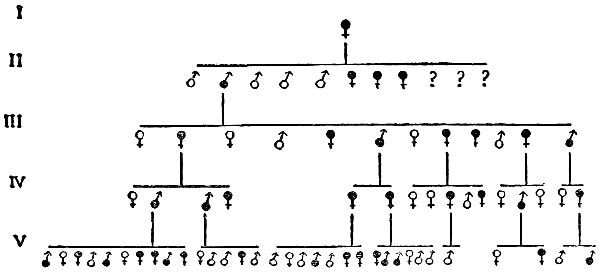
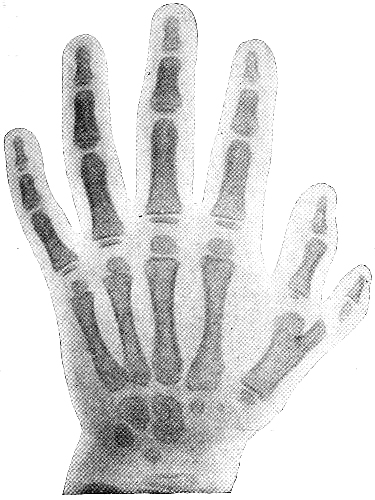
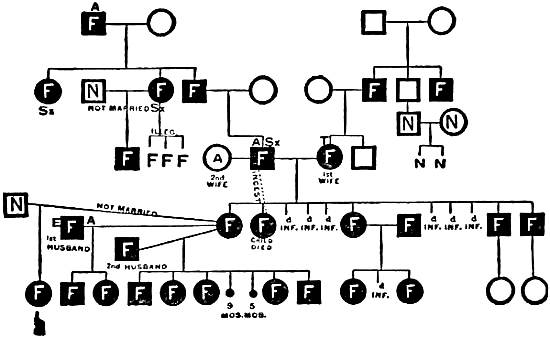
In a few cases such as Huntington’s chorea (Figs. 26, 27, pp. 114, 115) we
can proceed with a fair degree of assurance, for we know that this
dreadful malady is transmitted as a positive trait and that in all
probability half of the children of an afflicted individual will inherit
the defect. Such patients, if they ever rally sufficiently temporarily to
leave the hospital, or where encountered outside the hospital should
certainly be restrained from procreation. It is questionable if even their
children, though apparently normal, should be allowed to have offspring,
for usually the disorder does not manifest itself until middle life and
then it is too late to try to prevent its transmission since the affected
individual has already probably married and had children. But Huntington’s
chorea is a comparatively rare form of insanity, and one of only a few
about which our knowledge as regards its transmissibility is fairly
satisfactory.
In Feeble-Mindedness.—When we come to institutions for the feeble-minded,
however, there seems to be much more unanimity of opinion among
physicians in charge of such institutions that sterilization would be an
effective and satisfactory disposition to make of many cases, if we are to
release the patients in question from custody. Unquestionably in cases of
imbecility it is easier than in insanities to pass conclusive judgment on
the inheritability of the condition in a large class of cases. Practically
all are agreed that either permanent custodial care through the
reproductive period or sterilization should be enforced. Some maintain
that such individuals should remain permanently in institutions anyway and
that therefore to sterilize them is needless, while others urge that if
sterilized many capable of making their own living could be freed and
allowed to do so.
According to Goddard the feeble-minded woman is about three times as
likely to find a mate as a feeble-minded man, hence it would seem to be of
much greater importance to sterilize the woman than the man.
Again it might be urged with much justification, that even though
sterilized, the feeble-minded individual because of lack of self-control
will transgress sexually and will thus certainly become a menace to
society in the spread of venereal diseases. If Mr. Hart’s estimate is
anywhere near correct, that there are 60,000 feeble-minded women in the
United States of child-bearing age, and that 13,000 are already in
custody, then the task of getting all women of this class into custody is
not so insurmountable as would at first appear.
In Cases of Epilepsy.—As to epilepsy, I find a very decided difference of
opinion among physicians. Some consider it, on account of its apparently
strong inheritability, together with the shocking crimes perpetrated by
epileptic criminal types, one of the most serious menaces, while others
point out that we know nothing of the real cause of epilepsy, that there
are all degrees and shades, that it is probably referable to different
causes in different cases and that no one is able to say what the
offspring of any given epileptic will be.
As to criminal types, here again we face the difficulty of deciding any
particular case. Let us suppose that twenty-five per cent. of criminals
are mental defectives, how shall we sift them out from the seventy-five
per cent. who are supposed to be eugenically normal? Doubtless in many of
the twenty-five per cent. class, the indications of defective mentality
are sufficiently evident to prevent mistakes, but a considerable number of
uncertain status must also remain near the border-line.
Sterilization Laws.—Although twelve of our states already have
sterilization laws, only two, Indiana and California, seem to have made
any active attempt to enforce them. The situation is too new yet in
Wisconsin, Michigan and Pennsylvania for these states to have shown what
they intend to do. Although the Indiana law says, “it shall be compulsory
for each and every institution” to maintain the practise, it has fallen
into disuse since 1911, presumably because the governor believed the law
unconstitutional. It is of interest to see the motive underlying the law
in various states. In the majority it is purely eugenic. In Connecticut it
is mainly eugenic though partly therapeutic. In California it is
apparently in part therapeutic, since it is stated as being for the
physical, mental or moral benefit of inmates of various state
institutions, and in part punitive and eugenic, since individuals twice
committed for sexual offenses or three times for other crimes are subject
to the operation.
In Washington and Nevada the object is purely punitive, the persons
specified being habitual criminals and persons adjudged guilty of carnal
abuse of female persons under ten years of age, or of rape. In these
states also the court orders the operation instead of leaving it to the
decision of a board of medical experts.
Social Dangers in Vasectomy.—It has been urged against vasectomy that it
will work untold harm because it relieves of the responsibility of a
probable parentage. This argument does not appeal to one as very weighty
as far as the imbecile or other degenerate is concerned, because one of
the very traits characteristic of such individuals is lack of any sense of
responsibility. By this same token, however, we have a very good argument
for sequestration as against sterilization, for the degenerate, even
though sterilized, will not be restrained sexually and will be likely to
disseminate venereal diseases or commit rape. Furthermore, there will be
the temptation to sterilize and liberate certain types that would
otherwise have been kept permanently in custody.
Our Present Knowledge Insufficient.—When all is said and done, after we
take into account the meagerness of our present knowledge on the subject,
it is not to be wondered at that many thoughtful students of a
conservative turn of mind, feel that any considerable practise of
sterilization is premature. The problem has so many phases, and despite
occasional bits of positive knowledge, we are yet in such a sea of
ignorance regarding it, that in no field is the good Friar Laurence’s
admonition of “wisely and slow; they stumble that run fast,” needed more
at present than it is here.
There is little doubt that in theory the feeble-minded and similar
defectives should be sent to institutions and kept there, but the
important practical question is, can this be done? We can have no final
answer until it is tried. While the initial expense would undoubtedly be
great, if we could keep our defectives from propagation for a single
generation we could very materially lessen their numbers and in succeeding
generations the expenses of their care would rapidly diminish.
The one crying need that stands out most prominently in this whole field
is that of careful investigation of individual cases and specific types of
malady, together with an accurate census of conditions as a whole. Our
knowledge of individual malign heredities is too meager to carry us very
far at present. When we have found after adequate investigation in just
which specific types of defects heredity is an important factor—and we
shall undoubtedly find it to be one in many cases—then we can proceed
confidently with sterilization, if it will prove to be more practical and
desirable than sequestration.
Sterilization Laws on Trial.—It will be of great interest and instruction
to see how extensively, in the various states which have recently passed
sterilization laws, the experts selected will find it expedient to carry
on sterilization, and what criteria they will use in deciding on
individual cases. That sterilization can be put into effect is
indisputable, as may be seen from the fact that several hundred operations
have been performed in Indiana. If the board on whom the decision depends
happens to be one which feels that many people are likely to distress
themselves unduly over the border-line cases, and overlook the fact that
there is always a goodly residue with which to proceed without great risk
of mistake, then we may expect to see a vigorous campaign inaugurated, and
those of us who are still undecided in the matter will have an opportunity
of learning more certainly the merits or the failings of the scheme.
Certain married degenerate types would seem to be the ones most urgently
demanding attention. Having already begotten several defective children
and with nothing else in prospect but the production of the same kind, it
is difficult to see from any standpoint why a vasectomy on the male would
not be a merciful act. There are not a few such families where the father
is periodically in the hands of the law and yet not in permanent
restraint. Once in custody his release could be made contingent on
vasectomy.
An Educated Public Sentiment the Most Valuable Eugenic Agent.—Coming now
to the last proposition, education of the public in the principles of
eugenics, this is the method calculated to be of more far-reaching service
than any other, in the negative as well as in the positive phases of
eugenics. Education is necessary before we can have effective restrictive
measures for the mentally incompetent established and enforced, and it is
also a prerequisite to intelligent procedure on the part of normal
individuals in considering their own fitness for marriage.
Of greatest importance in preventing undesirable marriages, as far as
people of normal intelligence is concerned, will be the sentiment of
disapproval which will arise on the part of society itself when it becomes
really convinced that certain marriages are inimical to social welfare.
Public opinion is, in fact, one of the most potent influences in marital
affairs, simply because refusal to abide by the dictates of the community
means social ostracism.
That social disapproval of certain unions can become a very real factor in
preventing such marriage is evinced on all sides by the numerous barriers
to marriage already in existence based on race, religious sect or social
status. Even in our much vaunted democracies one is looked down on who
marries “beneath” his or her social set. This sentiment of taboo, so
readily and often so senselessly cultivated in our present human society,
will inevitably spring up in consequence of a wide-spread knowledge of the
facts of human heredity. It is to such a growth, to the establishment of a
disapproval which is the product of its own sentiments rather than to
legislative enactments, that society must look for the greatest
furtherance of the eugenic program.
Necessary as legal restraint is in certain cases, it must obviously be
restricted to only the most glaring defects. Moreover, legislation can not
run far in advance of public opinion.
The Question of Personal Liberty.—It must be admitted that there is a
reluctance on the part of many even thoughtful individuals to the
application of methods which savor in any way of restraint. An objection
not infrequently urged by such persons against the application of certain
eugenic principles is that they demand an unwarranted curtailment of
personal liberty.
To those who hoist the flag of personal liberty, it may fairly be asked,
how much personal liberty does the syphilitic accord his doomed and
suffering wife and children, or how much personal liberty is the portion
of the offspring of feeble-minded parents? Or, what quota of personal
liberty will accrue to the ill-fated descendants of the epileptic, the
habitual drunkard or criminal, the gross moral pervert, the congenially
deaf and dumb, or to even the progeny which may result from the union of
two well-established tubercular strains?
We do not hesitate to send the pick of our stalwart healthy manhood to war
to be slaughtered by the thousands and tens of thousands when an affront
is offered to an abstraction which we term our national honor, and,
sublimely unconscious of the irony of it all, we throw ourselves into a
well-nigh hysterical frenzy of protest when it is proposed to stop the
breeding of defectives by infringing to a certain extent on their personal
liberties.
Society has already found it necessary to suppress certain individuals
and yet we hear little complaint about loss of personal liberty in such
cases. But if it is necessary to restrain the man who would steal a purse
or a horse, is it not still more urgent to restrain one who would poison
the blood of a whole family or even of an entire stock for generations?
Surely there can be but one answer; society owes it to itself as a matter
of self-preservation to enforce the restraint of persons infected with
certain types of disease and of individuals possessing highly undesirable
inheritable traits, so that perpetuation of such defects is impossible.
Education of Women in Eugenics Needed.—One of the most crying needs of
the present is the awakening and educating of women to the significance of
the known facts. For they are perhaps the greatest sufferers, and once
informed, as a mere matter of safety if for no other reason, they will see
the necessity of demanding a clean bill of health on the part of their
prospective mates. Furthermore in the last analysis woman is the decisive
factor in race betterment, for it is she who says the final yea or nay
which decides marriage and thus determines in large measure the qualities
which will be possessed by her children. Above all, young women must come
to realize that the fast or dissipated young man, no matter how
interestingly or romantically he may be depicted by the writer of fiction,
is in reality unsound physically, and is an actual and serious danger to
his future wife and children.
Much Yet to Be Done.—But plain as is our duty regarding the application
of facts already known, when we consider that the student of heredity has
made only a beginning, it is equally evident that he must be urged on in
his quest for new facts, and the establishment of new principles. There is
imperative need to carry on proper experiments with plants and animals, to
collect necessary data regarding man, and for what is scarcely less
important, the publication of the facts already acquired so that the
public may be guided aright.
Just at present it is of the utmost importance to secure more trustworthy
statistics in order that we may intelligently go about instituting
suitable restrictive measures for undesirable human strains. We must know
the exact number and kinds of feeble-minded, epileptic and insane in our
population, and we must have more insight into the personal status and
pedigrees of our delinquents and criminals. For purposes of rational
procedure such information is indispensable. Much can be done by
hospitals, “homes” and penal institutions by determining and recording
more accurately all obtainable facts regarding the ancestry of their
charges. Moreover, in such states as Wisconsin, where the state hospitals
for the insane have each an “after-care-agent,” the duties of such
officers might well include the collection of more adequate data regarding
the hereditary aspects of their patient’s condition. And lastly, if in
every census, whether state or national, it were made an important part of
the work to secure accurate vital statistics, particularly as they pertain
to human heredity, the contribution toward enabling us ultimately to
purge the blood of our nation of certain forms of suffering, degeneracy
and crime would be inestimably great.
A Working Program.—And now after reviewing at some length various aspects
of man’s hereditary and congenital endowment, the important question
arises as to whether it is possible, with the knowledge at present
available, to go ahead with a practical program which will insure to the
child of the future its right of rights, that of being well-born. When
one considers the matter it is evident that much can be done at once. Most
of the needs set forth in the preceding paragraph can clearly be met in a
fair degree by instituting the procedures indicated.
One of the obvious duties in a restrictive way that confronts us right at
the start is the care and control of the feeble-minded and of the
defective delinquent in such a way as to prevent procreation. Much help
can be given also through intelligent agitation for the establishment of
colonies for epileptics and the higher grades of feeble-minded which can
be made in considerable measure self-supporting. A given colony must, of
course, be for one sex alone. Much can be done, furthermore, by putting
into operation, both in and out of institutions, effective systems of
registering births and deaths together with accompanying facts which may
prove of eugenical significance.
Again, we should more surely identify and exclude undesirable immigrants
and also undertake thoroughgoing investigations to determine which races
we can not profitably assimilate into our own blood.
Physicians should pay more attention to the hereditary and congenital
aspects of their cases and make it more a matter of conscience than they
do at present to advise patients with regard to marriage. Prenuptial
medical inspection should become the custom, if not by law at least as a
voluntary procedure. Every parent must come to realize the grave risk to
which he is subjecting his daughter if a guarantee of physical fitness,
even more than assurance of financial standing or social position, is not
forthcoming from her prospective mate.
Wholly apart from the field of heredity though in a realm intimately
concerned with the birthright of the child, much practical good can be
accomplished by pondering the facts and the fictions of prenatal influence
and in the light of the knowledge thus gained, seeing that while foolish
and unnecessary worries are abolished, the conditions of health, nutrition
and occupation surrounding the expectant mother are the best obtainable.
It is the sacred duty of every individual, moreover, to see that the
maximal possibilities of his own germ-plasm are not lowered by vicious or
unwholesome living.
As individuals we can cultivate a greater sense of responsibility
regarding marriage and parenthood in those for whose training we are
responsible. We can study this whole subject conscientiously, keep pace
with new knowledge and see that other people are likewise informed. In
showing an enlightened interest in the ideals of eugenics and a
sympathetic approval of wholesome marriages, a sentiment toward parenthood
will gradually arise which will make it seem more desirable to many worthy
people than it does at present. If we are of good stock ourselves we
should recognize that it is highly desirable that we give to the race at
least four children. On the other hand, if we come from a strain which is
eugenically undesirable we should with equal conscientiousness refrain
from contributing to human misery. For where serious obstacles to a union
exist, renunciation is certainly a higher manifestation of love than is
consummation of a marriage which will result in untold misery to the
object of the affections. As a matter of fact, with adequate preliminary
knowledge as to what actually constitutes a serious drawback to marriage,
where such really exists and is recognized by the associated individuals,
love of the kind that leads to marriage is not likely to arise.
As has been suggested by various students of eugenics, it is even at
present perhaps not infeasible for earnest individuals to start in a quiet
way local centers for the keeping and filing of accurate records of their
family traits for the future use of their descendants. Such groups,
voluntary though they be, would soon acquire a degree of distinction that
would make other people of good endowments wish to join in and go on
record as eugenically desirable.
Lastly, it should not be forgotten that good traits are inherited as
certainly as bad ones. Moreover, in the realm of human conduct, even
though the fundamental features of behavior are based on an inherited
organization, man is not always driven by an inexorable linkage of
inherited neutral units into only one line of conduct, since more or less
capacity for alternative action is also inherited. It is the personal
duty of every member of society to aid in affording the opportunity and
providing the proper stimuli to insure that out of the many possibilities
of behavior which exist in the young at birth, those forms are realized
which are best worth while to the individual and to society. And while we
recognize that improved environment alone can not correct human
deficiencies we must nevertheless not relax our efforts to get cleaner
foods, cleaner surroundings, cleaner politics and cleaner hearts.
Why go on alleviating various kinds of misery that might equally well be
prevented? When one squarely faces the issue, surely the absurdity of our
present practises can not but be evident to even the most thoughtless.
Which Shall It Be?—As a matter of social evolution, human homes
originated in the necessity of an abiding place for the nurture and
training of the young past their first period of helplessness. Well in the
foreground of the mental picture which arises when we hear the very word
home, are children. What shall the home of the future be with regard to
its most important assets, the children? Shall we as a people continue to
be confronted at every turn by the dull countenance of the imbecile, the
inevitable product of a bad parental mating; or the feeble body and the
clouded intellect of the child sprung from a parentage of polluted blood;
or the furtive cunning of the born criminal, the will-less mind of the
bred degenerate, or the shiftless spawn of the pauper? Or shall it be a
type with laughing face, with bounding muscles, with unclouded brain,
overflowing with health and happiness—in short, the well-born child?
The answer is in our own hands. The fate of many future generations is
ours to determine and we are false to our trusteeship if we evade the
responsibility clearly laid before us. How conscientiously we heed known
facts, how actively we acquaint ourselves with new facts, and how
effectively we execute the obvious duties demanded by these facts, will
give us the answer.
THE END