JOHN'S FIRST PARTY
It turned out that John did not go after
all to Cynthia Rudd's party, having broken
through the ice on the river when he was
skating that day, and, as the boy who pulled
him out said, "come within an inch of his
life." But he took care not to tumble into
anything that should keep him from the
next party, which was given with due formality
by Melinda Mayhew.
John had been many a time to the house
of Deacon Mayhew, and never with any
hesitation, even if he knew that both the
deacon's daughters—Melinda and Sophronia—were
at home. The only fear he had
felt was of the deacon's big dog, who always
surlily watched him as he came up the tanbark
walk, and made a rush at him if he
showed the least sign of wavering. But
upon the night of the party his courage
vanished, and he thought he would rather
face all the dogs in town than knock at the
front door.
The parlor was lighted up, and as John
stood on the broad flagging before the
front door, by the lilac-bush, he could hear
the sound of voices—girls' voices—which
set his heart in a flutter. He could face
the whole district school of girls without
flinching,—he didn't mind 'em in the
meeting-house in their Sunday best; but
he began to be conscious that now he was
passing to a new sphere, where the girls are
supreme and superior, and he began to feel
for the first time that he was an awkward
boy. The girl takes to society as naturally
as a duckling does to the placid pond, but
with a semblance of sly timidity; the boy
plunges in with a great splash, and hides
his shy awkwardness in noise and commotion.
When John entered, the company had
nearly all come. He knew them every one,
and yet there was something about them
strange and unfamiliar. They were all a
little afraid of each other, as people are apt
to be when they are well dressed and met
together for social purposes in the country.
To be at a real party was a novel thing for
most of them, and put a constraint upon
them which they could not at once overcome.
Perhaps it was because they were
in the awful parlor, that carpeted room of
haircloth furniture, which was so seldom
opened. Upon the wall hung two certificates
framed in black,—one certifying
that, by the payment of fifty dollars, Deacon
Mayhew was a life member of the
American Tract Society; and the other
that, by a like outlay of bread cast upon
the waters, his wife was a life member of
the A. B. C. F. M., a portion of the alphabet
which has an awful significance to all
New England childhood. These certificates
are a sort of receipt in full for charity, and
are a constant and consoling reminder to
the farmer that he has discharged his religious
duties.
There was a fire on the broad hearth,
and that, with the tallow candles on the
mantelpiece, made quite an illumination in
the room, and enabled the boys, who were
mostly on one side of the room, to see the
girls, who were on the other, quite plainly.
How sweet and demure the girls looked, to
be sure! Every boy was thinking if his
hair was slick, and feeling the full embarrassment
of his entrance into fashionable
life. It was queer that these children, who
were so free everywhere else, should be so
constrained now, and not know what to do
with themselves. The shooting of a spark
out upon the carpet was a great relief, and
was accompanied by a deal of scrambling
to throw it back into the fire, and caused
much giggling. It was only gradually that
the formality was at all broken, and the
young people got together and found their
tongues.
John at length found himself with Cynthia
Rudd, to his great delight and considerable
embarrassment, for Cynthia, who
was older than John, never looked so
pretty. To his surprise he had nothing to
say to her. They had always found plenty
to talk about before, but now nothing that
he could think of seemed worth saying at a
party.
"It is a pleasant evening," said John.
"It is quite so," replied Cynthia.
"Did you come in a cutter?" asked
John, anxiously.
"No; I walked on the crust, and it was
perfectly lovely walking," said Cynthia, in
a burst of confidence.
"Was it slippery?" continued John.
"Not very."
John hoped it would be slippery—very—when
he walked home with Cynthia, as
he determined to do, but he did not dare to
say so, and the conversation ran aground
again. John thought about his dog and his
sled and his yoke of steers, but he didn't
see any way to bring them into conversation.
Had she read the "Swiss Family
Robinson"? Only a little ways. John said
it was splendid, and he would lend it to her,
for which she thanked him, and said, with
such a sweet expression, she should be so
glad to have it from him. That was encouraging.
And then John asked Cynthia if she had
seen Sally Hawkes since the husking at
their house, when Sally found so many red
ears; and didn't she think she was a real
pretty girl?
"Yes, she was right pretty;" and Cynthia
guessed that Sally knew it pretty well.
But did John like the color of her eyes?
No; John didn't like the color of her
eyes exactly.
"Her mouth would be well enough if
she didn't laugh so much and show her
teeth."
John said her mouth was her worst feature.
"Oh no," said Cynthia, warmly; "her
mouth is better than her nose."
John didn't know but it was better than
her nose, and he should like her looks better
if her hair wasn't so dreadful black.
But Cynthia, who could afford to be generous
now, said she liked black hair, and
she wished hers was dark. Whereupon
John protested that he liked light hair—auburn
hair—of all things.
And Cynthia said that Sally was a dear,
good girl, and she didn't believe one word
of the story that she only really found one
red ear at the husking that night, and hid
that and kept pulling it out as if it were a
new one.
And so the conversation, once started,
went on as briskly as possible about the
paring-bee and the spelling-school, and the
new singing-master who was coming, and
how Jack Thompson had gone to Northampton
to be a clerk in a store, and how
Elvira Reddington, in the geography class
at school, was asked what was the capital of
Massachusetts, and had answered "Northampton,"
and all the school laughed. John
enjoyed the conversation amazingly, and he
half wished that he and Cynthia were the
whole of the party.
But the party had meantime got into
operation, and the formality was broken up
when the boys and girls had ventured out
of the parlor into the more comfortable living-room,
with its easy-chairs and everyday
things, and even gone so far as to penetrate
the kitchen in their frolic. As soon as
they forgot they were a party, they began
to enjoy themselves.
But the real pleasure only began with
the games. The party was nothing without
the games, and indeed it was made for
the games. Very likely it was one of the
timid girls who proposed to play something,
and when the ice was once broken, the
whole company went into the business enthusiastically.
There was no dancing. We
should hope not. Not in the deacon's
house; not with the deacon's daughters,
nor anywhere in this good Puritanic society.
Dancing was a sin in itself, and no
one could tell what it would lead to. But
there was no reason why the boys and girls
shouldn't come together and kiss each
other during a whole evening occasionally.
Kissing was a sign of peace, and was not at
all like taking hold of hands and skipping
about to the scraping of a wicked fiddle.
In the games there was a great deal of
clasping hands, of going round in a circle,
of passing under each other's elevated
arms, of singing about my true love, and
the end was kisses distributed with more
or less partiality according to the rules of
the play; but, thank Heaven, there was no
fiddler. John liked it all, and was quite
brave about paying all the forfeits imposed
on him, even to the kissing all the girls in
the room; but he thought he could have
amended that by kissing a few of them a
good many times instead of kissing them
all once.
But John was destined to have a damper
put upon his enjoyment. They were playing
a most fascinating game, in which they
all stand in a circle and sing a philandering
song, except one who is in the centre of
the ring and holds a cushion. At a certain
word in the song, the one in the centre
throws the cushion at the feet of some one
in the ring, indicating thereby the choice
of a mate, and then the two sweetly kneel
upon the cushion, like two meek angels,
and—and so forth. Then the chosen one
takes the cushion and the delightful play
goes on. It is very easy, as it will be seen,
to learn how to play it. Cynthia was holding
the cushion, and at the fatal word she
threw it down,—not before John, but in
front of Ephraim Leggett. And they two
kneeled, and so forth. John was astounded.
He had never conceived of such perfidy in
the female heart. He felt like wiping
Ephraim off the face of the earth, only
Ephraim was older and bigger than he.
When it came his turn at length—thanks
to a plain little girl for whose admiration he
didn't care a straw—he threw the cushion
down before Melinda Mayhew with all the
devotion he could muster, and a dagger
look at Cynthia. And Cynthia's perfidious
smile only enraged him the more. John
felt wronged, and worked himself up to
pass a wretched evening.
When supper came he never went near
Cynthia, and busied himself in carrying different
kinds of pie and cake, and red apples
and cider, to the girls he liked the least.
He shunned Cynthia, and when he was accidentally
near her, and she asked him if
he would get her a glass of cider, he rudely
told her—like a goose as he was—that
she had better ask Ephraim. That seemed
to him very smart; but he got more and
more miserable, and began to feel that he
was making himself ridiculous.
Girls have a great deal more good sense
in such matters than boys. Cynthia went
to John, at length, and asked him simply
what the matter was. John blushed, and
said that nothing was the matter. Cynthia
said that it wouldn't do for two people
always to be together at a party; and so
they made up, and John obtained permission
to "see" Cynthia home.
GOING HOME WITH CYNTHIA
It was after half past nine when the
great festivities at the Deacon's broke up,
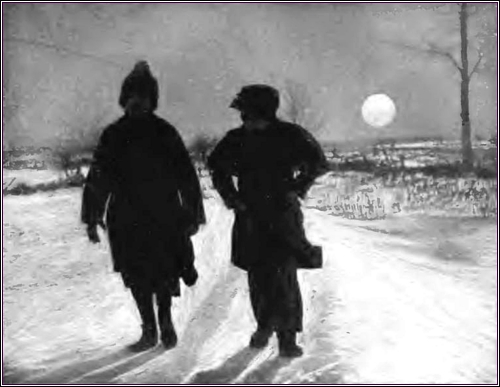
and John walked home with Cynthia over
the shining crust and under the stars. It
was mostly a silent walk, for this was also
an occasion when it is difficult to find anything
fit to say. And John was thinking
all the way how he should bid Cynthia goodnight;
whether it would do and whether it
wouldn't do, this not being a game, and no
forfeits attaching to it. When they reached
the gate there was an awkward little pause.
John said the stars were uncommonly bright.
Cynthia did not deny it, but waited a minute
and then turned abruptly away, with
"Good-night, John!"
"Good-night, Cynthia!"
And the party was over, and Cynthia
was gone, and John went home in a kind
of dissatisfaction with himself.
It was long before he could go to sleep
for thinking of the new world opened to
him, and imagining how he would act under
a hundred different circumstances, and what
he would say, and what Cynthia would say;
but a dream at length came, and led him
away to a great city and a brilliant house;
and while he was there he heard a loud
rapping on the under floor, and saw that it
was daylight.