It was a cold November afternoon. The guns of the fortress of St. Peter
and St. Paul in St. Petersburg were thundering their last salute to
Alexander III., whose remains were being lowered into the grave by the
Palace Grenadiers, whilst all the bells of the great city were tolling
mournfully a solemn farewell. Round the open vault his family were
kneeling, taking a last glimpse of the coffin as it slowly disappeared
from their sight. Sobs were heard from the widow and her children;
heartrending sobs, which merged into the low chant of the clergy, and
added poignancy to the scene.
Beside the grave the new Emperor was standing, a slight, small figure,
with indecision in his movements and a hunted, anxious expression in his
blue eyes. When the last rites were over he escorted the widowed Empress
to her carriage, which was awaiting her at a side entrance of the
cathedral, and then, after another look at the tomb which was being
closed, he went out of the church through the front door. He was alone,
and for a few seconds paused on the steps, as if dazed by the light
outside, after the half-darkness of the church.
As he appeared upon the threshold the troops massed on the large square
inside the fortress lowered their colours before him for the first time
since the day of his accession to the Throne of Russia, and for the
first time, also, the band played the National Anthem. The Army saluted
its new Chief, welcomed the new Sovereign. The reign of Nicholas II. was
beginning amidst manifestations of sympathy such as rarely had been
witnessed in the Empire over the destinies of which he was called upon
to preside.
People pitied him for his youth, his inexperience, and for those tragic
events so closely preceding his wedding. They pitied, too, his young
bride, whose advent into her new country was taking place at such a
mournful time. All these circumstances increased the general sympathy,
so that when he entered upon his new duties and responsibilities he
found everybody ready and willing to help him and anxious to make him
forget that the pealing of his wedding bells was mingled with the sounds
of tolling for the death of his father.
When, a few days later, the nuptials of Nicholas II. with the Empress
Alexandra Feodorovna were celebrated in the Winter Palace, a sympathetic
crowd again gathered in the vast halls of that historic residence. All
were eager to see the young bride, whose arrival had been preceded by
the reputation which she had acquired in her former country, of being
not only a clever woman, but also one possessing a high moral standard
and a strong character. One had heard she was kind, humane, cultivated
in the extreme, and imbued with all the humanitarian ideas for which all
the children and grandchildren of Queen Victoria had been so remarkable.
Moreover, she belonged to that House of Hesse which had already given
one Empress to Russia, in the person of the grandmother of Nicholas II.
The bride had further claim on the interest of the Russians from the
fact that she was the sister of a princess who had succeeded in making
herself extremely popular in the country—the Grand Duchess Elizabeth
Feodorovna, the consort of the Grand Duke Sergius. All these
circumstances put together would have been sufficient to ensure the
sympathies of the country, even if the personal appearance of Princess
Alix had not been such as to command them, and her extreme beauty only
added to the interest with which she was welcomed.
On the morning of that memorable November 26th which was to see the
Princess Alix of Hesse united to Nicholas II., the Winter Palace early
began to fill. The ceremony was fixed to take place at eleven o’clock,
but long before ten had struck people poured into the residence of the
Tsars. Representatives of all the different classes of society which
constituted the Empire were gathered within the Palace. One could see
deputations from the Army, the Navy; from the merchant and the
industrial classes, as well as from the rural population; from the
Cossack army and from the Asiatic populations owning allegiance to the
Romanoffs. One could witness the curious spectacle of the diamond tiara
of some Court beauty beside the caftan of some peasant, and the gold
embroidered uniform of a chamberlain or other high official contrasting
by its gorgeousness with the dark and plain tunic of a village mayor, or
the neatly attired officer of the reserve forces.
All necks were stretched to catch a glimpse of the Imperial procession
proceeding to the chapel, and a feverish excitement reigned amidst this
motley assemblage gathered together to see a spectacle which never
before had been witnessed in Russia—that of the marriage of a Reigning
Sovereign.
There was a long wait, and people already began to ask themselves
whether something had not happened to stop the ceremony, as twelve
o’clock struck, and still no sign of the bridal procession was to be
seen. The occasion was so exceptional that etiquette was for once
disregarded, and discussions eagerly went on as to the future of the
marriage about to be celebrated when the sounds of the prayers for the
dead over the remains of Alexander III. had hardly died away.
At last the thumping of a stick was heard—that of the Master of
Ceremonies, who heralded the approach of the procession. First appeared
various servants and officials of the Household. Then, amidst a hushed
silence and an intense emotion that brought tears to the eyes of many an
old servant and follower of the dynasty of the Romanoffs, one saw the
bridal couple advance.
Nicholas II. was dressed in the red uniform of his Hussar regiment, with
the white dolman slung across his shoulder. He still wore the epaulets
of a colonel of the Army. He had refused to assume the insignias of a
higher rank, saying that he would prefer to keep those that had been
conferred upon him by his father. He was leading his future Consort,
whose cheeks burned with excitement, and whose trembling hand rested
timidly in the one with which he was conducting her to the church.
“How beautiful she is!”
That exclamation followed her all along her path, and it is true that
her appearance was positively magnificent as she stood there in her
bridal array of silver cloth and old lace. Her unusual height helped her
to bear the weight of her dress and set off its splendour in its best
light. Her mouth quivered a little, and this relieved the habitual hard
expression that was the one defect of an otherwise perfectly beautiful
face, the straight, classic features of which reminded one of an antique
Greek statue. The glow upon her cheeks only added to the loveliness of
her countenance, and her eyes, modestly lowered, gave to her whole
figure a maidenly shyness that made it wonderfully attractive. She had
upon her head the diamond crown which all the Russian Grand Duchesses
wear at their marriage service, and from it descended a long white lace
veil, kept in its place by a few sprays of orange blossom and myrtle.
Her dress was of silver tissue, and from her shoulders descended a long
mantle of gold brocade lined with ermine, the train of which was carried
by eight high officials of the Court. That mantle had been the object of
many a discussion. Usually the Grand Duchesses of Russia wear on their
wedding day a mantle of crimson velvet, but here it was the bride of an
Emperor, and it was thought that some distinction ought to be made,
although there was no precedent for such an event. At last it was
decided to make the mantle of gold brocade, but not to embroider it with
the black eagles that adorn the Imperial mantle assumed by Sovereigns at
their Coronation.
Alexandra Feodorovna wore also, on her neck and the bodice of her dress,
the Crown diamonds which only the Consorts of Sovereigns have the right
to assume.
Behind the bridal pair came the Empress Dowager Marie Feodorovna, who,
always brave, had made this great effort to appear at her son’s wedding.
She was leaning on the arm of her father, the old King of Denmark. She
firmly stepped on the path of duty, ever mindful of her obligations as a
Sovereign; but her red eyes, and weary, despairing, tired look, told the
inward struggle which she was enduring. The King was bending tenderly
over her; it was a touching sight to see this old man trying to uphold
the courage of his afflicted child, and to sustain her in her great
sorrow.
After the Empress and her father came a long file of foreign Royalties,
foremost among whom were the Queen of Greece and the Prince and Princess
of Wales. The future King Edward of England had been most active during
the weeks that had elapsed since the death of Alexander III. He had
taken the direction of all the arrangements concerning the wedding of
his nephew the Tsar. It was he who had insisted upon its being
celebrated at once before the mourning for the late Emperor was at an
end. It was he who had taken the part of guardian towards his niece the
Princess Alix; and it was he—so it was whispered, at least—who had
tried to inculcate in Nicholas II. the principles which ought to govern
a Sovereign who wants to go with the age and not to keep an old regime
which even in Russia had grown out of date.
It was said that owing to his efforts the old and traditional enmity
which had divided the Russian and English Courts was to come to an end,
and that friendly relations between them would be the result of this
marriage which was going to unite the nephew of the Princess of Wales
with the granddaughter of the Queen of England.
The members of the Imperial Family walked after the foreign Princes and
Princesses, and the long procession was closed by the maids of honour of
the Empress and the other Court ladies. Immediately behind the bridal
couple were also to be seen the Minister of the Imperial Household in
attendance on his Sovereign, and the Mistress of the Robes of the young
Empress, the Princess Mary Galitzine, who was to become one of the most
important personages of the new regime.
At the entrance to the chapel the Metropolitan of St. Petersburg and the
members of the higher clergy were waiting for the procession. Holy water
was presented to the Emperor and to his bride, and then the marriage
ceremony began.
The chapel of the Winter Palace is quite small, and it would have been
impossible for all the people assembled there to enter; but one after
another those present peeped into it, just to see how things were going
on, and always reported to the less fortunate ones that the bride was
keeping her lovely head bowed down, and that, notwithstanding the
emotion under which she was seen to be labouring, she kept quite calm,
and made her responses in a firm though low voice. The bridegroom
appeared more agitated, and had to be prompted by the priest. The
Empress Marie was quite broken down by grief, and sobbed bitterly during
the ceremony. When it was over she folded her son in her arms in one
long and tender embrace, and also kissed most affectionately her new
daughter-in-law. Then all the Royal and Imperial personages present came
and offered their congratulations to the newly married couple, after
which mass was celebrated, the procession re-formed and proceeded once
more through the State rooms of the palace to the private apartments,
where lunch was served for the bride and bridegroom and their family.
It was then known why the marriage ceremony had been delayed. It seems
that an over-zealous police official had not allowed the coiffeur who
was to fix the crown on the hair of the Imperial bride to enter the
Winter Palace on account of his having forgotten to provide himself with
the necessary entrance card. The unfortunate man protested and implored
to be allowed to pass, but it was of no avail; and whilst he was
discussing and protesting, Alexandra Feodorovna was sitting before her
dressing-table, wondering what had happened and what she was going to do
if he did not turn up.
At last he was discovered by one of the valets of the Emperor. But a
whole hour had been lost, and it was past twelve o’clock when at last
the bride was ready and able to proceed to church.
After lunch the Dowager Empress was the first one to leave the Winter
Palace for Anitchkov, where the young people were to reside with her
until their own apartments were ready to receive them. Half an hour
later Nicholas II. and his bride entered a State carriage, drawn by six
white horses. An immense and enthusiastic crowd cheered them as they
emerged from the gates of the Winter Palace on the way to Anitchkov. The
Empress kept bowing repeatedly, but she was so nervous that she appeared
to move her head mechanically, and her eyes were filled with tears which
she tried hard to restrain. It seemed as if she only then realised the
weight of the duties and responsibilities which were henceforward to
rest upon her shoulders, and, too, as if she shrank from them. Anxiety
was in her countenance, her smile had lost its sweetness, but
nevertheless her mien more than anything else, gave one the impression
of a great dignity, and she certainly seemed fitted for the high
position which had become hers.
The Sovereigns proceeded to the Kazan Cathedral, where they worshipped
at the shrine of the Virgin, who is one of the patron saints of St.
Petersburg. Next, they passed before the Roman Catholic church which is
situated on the Nevski Prospekt, where they found standing on its
threshold the Catholic Archbishop with his pastoral cross raised before
him. The Emperor ordered the carriage to stop, and he accepted with
reverence the wishes expressed for his happiness and that of his newly
wedded Consort. That interview created a precedent, for never before had
the Imperial House publicly acknowledged the existence of another
religion than the orthodox one in Russia. It was freely commented upon
at the time and taken as an indication of tolerance in the religious
opinions of the new monarch.
A few minutes later the doors of the Anitchkov Palace were opened to the
newly wedded couple. At the head of the staircase, waiting to welcome
them, stood the Dowager Empress, still clothed in her white gown. She
pressed to her heart her Imperial son and her new daughter-in-law, and
tenderly conducted them to the rooms prepared for them, which were those
the Emperor had occupied as a boy. They were quite small, and hardly
fitted to be the residence of a mighty Sovereign; but, such as they
were, the young couple settled in them, and there they spent the first
months of their wedded life. There began the new existence of Alexandra
Feodorovna; there commenced her career as an Empress, and there she
became acquainted with her first sorrows and her first joys as a wife.
When the present Tsar of All the Russias ascended the Throne he was
absolutely unknown to the public. Unfortunately, he is almost as unknown
at the present day, although nearly twenty years have elapsed since he
succeeded his father. Nicholas II. is one of those timid, weak natures
who nevertheless like to assert themselves at certain moments in matters
utterly without importance, but which, to their eyes, appear to be vital
ones. His mind is as small as his person; he sees the biggest events go
by without being touched, or being even aware of their great or tragic
sides.
His education had been neglected, and he was brought up as befitted an
officer in the Guards, not as the heir to a mighty Empire. For a number
of years after he had emerged from his teens he was treated as a little
boy, and not allowed the least atom of independence. The Empress had
studiously kept her children in the background, and her sons hardly ever
went out of the schoolroom. When Nicholas was about fifteen he was given
a tutor in the person of General Danilovitch, a most respectable man,
but a nonentity, and not even a personage belonging to the upper ten, or
possessed of manners or education in the social sense of the word. He
was of that class of people who eat with the knife, and though he did
not communicate this peculiarity to his Imperial pupil, yet he did not
teach him those small conventions which
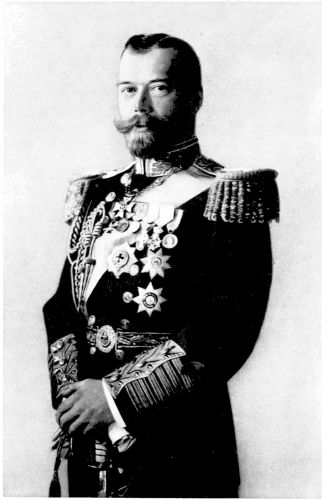
NICHOLAS II., TSAR OF RUSSIA
Photo: Boissonnas & Eggler, St. Petersburg
distinguish gentlemen born from gentlemen by reason of their official
position, which latter are but too often found in Russia.
The instruction which the young Grand Duke received differed in no way
from that given to cadets in military schools; he was taught obedience
and submission to the will of his parents, but he was not prepared for
the high position in which he found himself placed quite unexpectedly.
Such a contingency had never been catered for by those responsible for
his training.
The comparatively early age at which the Emperor Alexander III. died had
excluded, during his lifetime, any thought of the possibility of his
succession becoming open for years to come. The instruction of his
children had been conducted slowly, and instead of fostering the
development of their minds, it had been kept back as much as possible by
their teachers. The Tsarevitch lived in two small rooms—those which he
was later on to inhabit for the first months that followed upon his
marriage—in the Anitchkov Palace, and he stood always in considerable
awe of his parents, perhaps more of his mother than of his father. He
had no companions, no friends; he had no love of reading, no artistic
tastes, no interest in anything—not even in military matters.
When he was eighteen years old he entered the regiment of the Hussars of
the Guard quartered at Tsarskoye Selo, and that was his first step
towards independence. But he was not given as attendants people able to
lead him into a path such as that which usually opens before the heir to
a crown. He made some friends for himself among the youngest officers of
his regiment, and it must be owned these friends were for the most part
nonentities, with no ideas beyond that of eating and drinking and
making merry; not one of them could either advise him or be of any use
to him.
The first time he was called upon to assert himself was during his
journey round the world, after his majority. He then began to realise
the advantages of his position, though I doubt very much whether he
understood the duties which it entailed. His companions were his brother
the Grand Duke George, who, however, had to give up the journey on
account of his bad health; his cousin Prince George of Greece, and a few
officers from some crack regiments of the Guards, such as Prince
Kotchoubey, a certain Captain Volkoff, and people of the same kind, with
no recommendation except that of being nice fellows.
With all his great qualities, Alexander III. did not possess that of
knowing how to direct the education of his children, and the Empress was
similarly without this knowledge. She had been brought up in the
simplest way possible, and could not understand that the rearing of her
own sons and daughters ought to be conducted upon different lines from
those under which she had been trained. It was said at one time that
when a person of her near entourage asked her whether the time had not
come when a governess ought to be chosen for the Grand Duchess Xenia,
she replied: “But why? We had no governess when we were children.”
The result was that though masters in plenty came to instruct the
Tsarevitch and his brothers and sisters, they were nevertheless allowed
to remain without that domestic training which alone gives to future
Sovereigns, and people in high stations, the knowledge to fill their
duties in the proper way, and to meet with dignity the responsibilities
of their arduous position.
Again, lessons, though they teach something, yet do not instruct those
who receive them if they are not accompanied by an intelligent training,
and of this the Imperial children had none. They were given elementary
notions of languages and arts, but I doubt very much whether to the
present day any of them, the Sovereign not excluded, could write a
letter in French without mistakes. The love for learning was not
inculcated; reading serious books was never encouraged; the discoveries
of science were only explained as things which existed, but not as
things capable of further development. In a word, the Tsarevitch
received quite a middle-class training, and though he was afterwards
sent on a long voyage for the purpose of improving his mind and
acquainting him with the world, it is more than doubtful whether he
derived any real benefit from it.
As Grand Duke he was always timid, almost painfully so, and when by a
strong effort of will he conquered that timidity, he came out with what
he wanted to say in an almost brutal manner, which made him many
enemies, often quite unjustly. He never had any opinions of his own,
except in purely personal matters, and he has none to this day. His want
of mind makes him always endorse the judgments of the last person he
speaks to. Like every spoilt child he has no heart, not because his is a
bad nature, but because he is unable to feel any woes except his own, or
to understand any wants when he himself has none. He is jealous of his
authority, simply because he is selfish; he tries to uphold it in a
brutal manner, as in his famous speech after his accession to the
Throne, when he warned his people not to indulge in senseless dreams.
Nevertheless, he does nothing to make that authority respected, either
at home or abroad. On the contrary, when a fit of bad temper seizes upon
him he is the first one to attack the principles it should be his duty
to defend. This was manifested recently when he deprived his brother the
Grand Duke Michael of his rights. He is utterly incapable of grasping
the consequences of his own actions, does everything through impulse,
and thinks that the best argument is to knock down one’s adversaries.
The only strength he recognises is the strength of the fist, and
unfortunately this is not a strength which one respects in a century
when machinery has taken the place of the hand.
The Emperor is an exceedingly rancorous man. Instead of practising the
principle which made Louis XII. of France so famous: that of not
remembering as King the injuries he had received as Duke of Orleans, he
thinks it his duty to chastise when he can every slight to which he
considers he has been subjected either as Sovereign or as Heir to the
Throne. He likes to be feared, but unfortunately he cannot even inspire
respect, much less awe. He feels this, and not knowing how to fight
against the lack of consideration for his person, he becomes savage in
his wrath, and, though in appearance a quiet, inoffensive little man, is
capable of the utmost cruelty and hardness. He has no generous impulses,
none of that enthusiasm of youth which induces one to do generous
actions, even when they are not quite in accordance with prudence. He
lives a mechanical life, devoid of interest and indifferent to
everything that does not concern his immediate person.
People have asked themselves whether the indifference he has shown in
grave moments of his life has been affected or real. When the news was
brought to him of that terrible disaster of Tsushima, which cost Russia
her whole fleet and the loss of so many precious lives, the Emperor was
playing tennis in the park of Tsarskoye Selo. He read the telegram that
sounded the knell of so many hopes, and then quietly resumed his game,
not a muscle of his face moving. Was it stoicism, indifference, or a
strength of mind almost supernatural? The world tried to guess, but was
afraid to think that it arose from inability to understand the greatness
of the catastrophe. It is certain that no one has practised with greater
success than he has done the famous maxim of La Rochefoucauld, that “we
bear with the greatest composure the misfortunes that do not concern
us.” Nicholas II. probably thought that the misfortune which had
befallen Russia on the day of Tsushima did not concern him personally,
just as he did not realise that the catastrophe of Khodinska, which made
his Coronation so memorable, and cost the lives of nearly two thousand
people, concerned him too. On this last occasion he danced the whole of
the night following it; on the first one he went on playing tennis. The
only difference between the two lay in the kind of amusement he indulged
in.
When he found himself confronted with Revolution it never once occurred
to him that if he put his own person forward he might avert it. On that
dreadful day in January which ended in such bloodshed, he never for one
moment remembered the proud attitude of his ancestor, that other
Nicholas who, on an almost similar occasion, came out of his palace and
confronted the angry crowd, forcing the multitude, by the courage of his
attitude, to fall down upon their knees and submit. The only thought of
Nicholas II. was to flee from danger and to leave to others the task of
drowning in blood these first symptoms of rebellion.
And when, later on, he called together the representatives of the
different classes of his Empire, and inaugurated that first short-lived
Duma, he realised neither the solemnity of the act he had decided upon
nor the importance it would have in history.
I can see him, still, on that memorable day, reading his first speech in
the White Hall of the Winter Palace. One could not help remembering
Louis XVI., and thinking of that May morning when the Etats-généraux
assembled for the first time at Versailles. The same pomp characterised
both: ladies in Court trains and with diamond diadems; high officials in
braided uniforms, gold lace, and plumes in their cocked hats; and, in
their black coats, the deputies of the lower classes, those whose
efforts bring about the great crises that shake the life of nations.
Did he think of this, that mighty Tsar who, in a monotonous voice, read
his message to his people? Did he examine the faces of these men
standing before him, and try to guess whether a Mirabeau or a Vergniaud
was among them? Did the phantom of a Robespierre arise before his mind?
When the ceremony was over he remarked that some of the caftans worn by
the deputies from the rural classes were not new. It was all that had
attracted his attention.
When travelling outside Russia I have often been asked why it was that
both Nicholas II. and his Consort had made themselves so very unpopular
in Russia. I must own I have found it very difficult to reply. That they
are unpopular is unquestionable, but to explain the reason adequately
would take volumes and still not initiate the outsider into the details
of this difficult question. When the present Tsar ascended the throne he
was surrounded by universal sympathy. People who had never seen him, nor
would ever see him, were kindly disposed towards him. Great things were
expected of him, and it was hoped he would govern wisely, after the
example which his father had given to him.
Very soon, however, these hopes were dashed to the ground. The Emperor
appeared as he really was—personal in everything, shallow-minded, weak,
well-intentioned, but only in so far as it did not interfere with his
own comfort, indifferent to all the necessities of his country, and
governed entirely by his sympathies or antipathies without considering
anything else. His was a nature which would have won for him in private
life the denomination of being a “good little fellow”; but that is not
enough for a Sovereign: it brings ridicule, the last thing that ought to
dog the footsteps of a monarch.
Whilst Alexander III. was living people knew that they could rely upon
his word, that he had opinions of his own, and that, whether these were
right or wrong, they were still opinions with whom others had to count.
After he had reigned a few months everyone who came into contact with
Nicholas II. realised that he was the echo of everyone else’s opinion
except his own.
The flexibility of his mind equalled its emptiness. It was very soon
found out that he changed his ideas as often and with as many people as
he discussed them. Though he fully thought he knew what constituted his
duties as a Sovereign, yet it can be questioned whether he could have
told what they were.
The vacillation of Nicholas II. is something quite surprising, and his
ingratitude for services rendered to him sometimes astounding. When M.
Stolypin, struck by an assassin’s shot, expired after a few days of the
most horrible sufferings, the Emperor was in Kieff. Common decency would
have required him to be present at the obsequies of the Minister who had
laid down his life for him. People expected it, public feeling required
from him this manifestation of his sorrow; but the Tsar coolly left
Kieff for the Crimea, not thinking it worth while to change anything in
his plans in order to follow to his grave the statesman who, whatever
may have been his faults, still had crushed the Revolution which at one
time threatened to overturn the Throne of the Romanoff Dynasty.
After Stolypin’s death, M. Kokovtsov was appointed head of the Ministry,
and when he arrived at Livadia to discuss with his Sovereign the line of
action which he intended to take, he found Nicholas II. arranging some
prints upon the walls and watching the effect of his work. When he saw
the Prime Minister the first words that he said to him were: “Oh, I am
glad that you have arrived. You can tell me whether this picture hangs
well or not.” And during the three days which M. Kokovtsov spent in
Livadia he was unable to secure a serious conversation with his
Sovereign, the latter always putting him off and at last telling him
plainly that “he had come to Livadia to enjoy a holiday, and did not
want to be bothered with business matters, which could be put off until
he was back at Tsarskoye Selo.”
Since the day when he fled from St. Petersburg for fear of the mob who,
led by the too famous Gapon, had wanted to present a petition to him,
Nicholas II. has not inhabited the capital. He has confined himself in
his Imperial castle of Tsarskoye Selo, where his Ministers come to him
with their reports, and where he leads the life of a country gentleman
with a limited circle of friends. He often goes to dine at the mess of
the regiments quartered there, and remains with the officers late at
night, drinking champagne and indulging in the smallest of small talk.
The rest of the time he signs papers, the contents of which he mostly
does not understand; he shoots in his park; and he worships his son, and
has him brought up in the most detestable way possible, never allowing
the child to be contradicted, and insisting upon all his caprices being
satisfied at once, whatever their nature may be.
During the long winter evenings the Emperor likes to turn tables, and in
general is fond of arranging spiritualist séances with all the famous
mediums that visit St. Petersburg. At one time a particular medium was
supposed to enjoy his entire confidence, and to advise him, by means of
table-turning, in the most complicated matters of State.
The relations of Nicholas II. with the different members of his family
are like everything else that he does—subject to many and various
changes. When he ascended the Throne his mother was supposed to wield a
considerable influence over him, and though that influence is no longer
as strong as it was, yet it is certain that he would not go against the
Dowager Empress in anything she wanted to do.
At one time he very much liked his uncle, the Grand Duke Vladimir, but
after the marriage of the latter’s son, the Grand Duke Cyril, with his
cousin, the divorced Grand Duchess of Hesse, their relations underwent a
change and quarrels took place.
At present the Grand Duke Nicholas is persona grata with the
Sovereign, perhaps on account of the brutality for which he is famous.
He is also supposed to like his sisters, but these are of too little
importance to be reckoned with as serious factors in the general
situation.
No monarch has ever led such a secluded existence as the present Tsar.
Life at Court, which used to be so bright and cheerful, is now sad and
dull. Festivities there are none, except one reception on New Year’s
Day, at which the young Empress never appears, and even that did not
take place in 1913. Balls are no longer given, and foreign princes, when
they arrive upon a visit to the Russian Court, are received at one or
other of the country residences of the Sovereign. The Winter Palace,
once so animated, has taken the appearance of a lumber room, and
presents to the visitor an unkempt, forlorn, dirty, neglected sight.
No reign in Russia from the time of Peter the Great has been so
unfortunate as the present one. Calamities have followed its course from
the very beginning. The prestige of the country, which was so great when
Alexander III. died, has been seriously impaired by the failure of the
Japanese campaign and the Revolution that followed upon it. Discontent
is rife and becoming stronger every day; and though the financial
prosperity of the country has certainly increased and reached hitherto
unknown proportions, yet it has not done away with dissatisfaction.
The most curious feature of this situation is the total lack of respect
and consideration the public feels for the person of Nicholas II. and
for his family. Formerly, Grand Dukes were considered as something quite
apart from the rest of mankind, and as for the Emperor—one stood in awe
of him, whether one loved him or not. Now, no one thinks about them at
all; they simply do not exist either in the public or the social sense.
Respect has gone, and familiarity has not arrived. The presence of a
member of the Imperial Family at a ball or party is no longer considered
as an honour, and is not looked upon as a pleasure.
No misfortune has been spared to Nicholas II., and had he only
understood their importance, he would have been the most unhappy man in
the whole of his vast Empire. War has humiliated his country, revolution
has enfeebled it, bad and tainted politics have dishonoured it, the
blood of thousands of people who perished quite uselessly cries out for
revenge, the tears of other thousands of unhappy creatures who languish
in prisons or in hopeless exile appeal to Heaven for the chastisement of
those in authority who sent them to a living death. Danger surrounds
him, treason dogs his footsteps; his nation dislikes and distrusts him;
his family is hostile to him; his only brother is banished, his mother
is estranged from him, the wife of his bosom is the victim of a strange
and mysterious malady; his only son, and the successor to his Throne and
Crown, is smitten with an incurable illness. He has no friends, no
disinterested advisers, no Ministers whose popularity in the country
could add something to his own. And amid these ruins he stands alone, a
solitary figure, the more pathetic because he does not realise the
tragedy of his own fate.
When the Princess Alix of Hesse left Darmstadt for the Crimea in order
to be present at the death-bed of the Emperor Alexander III., there was
one paper in Germany that dared to print what was spoken of in secret
among many people, and to express some apprehension as to the fate that
awaited the young bride in that distant country whither she was speeding
in quest of an Imperial Crown.
Her marriage was not popular among her own country folk. The Protestant
feelings of the German people revolted against the change of religion to
which she would have to submit, and moreover there existed at that time
a terrible prejudice in Hesse against Russia and everything that was
Russian. The union which the Princess was about to contract was not
popular, and, rightly or wrongly, it was firmly believed that she was
being forced into it against her will; that, left to herself, she would
have preferred to end her days in the peace of the little Darmstadt
Court than to live among the splendours of St. Petersburg. It was this
feeling that she was about to be sacrificed to reasons of State which
inspired for her a pity that was freely expressed in the article already
referred to and which is quoted hereunder:—
“It is only with feelings of deep grief and pity that the German
people can follow during her journey to Russia the gracious and
beloved Princess Alix. I cannot banish from
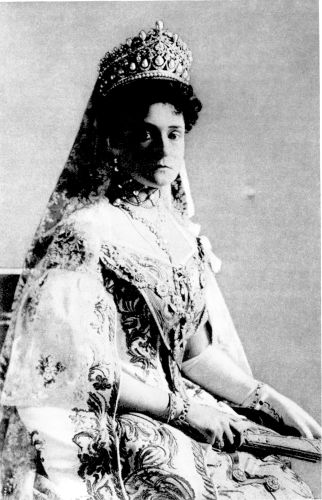
ALEXANDRA FEODOROVNA, TSARINA OF RUSSIA
Photo: Boissonnas & Eggler, St. Petersburg
my thoughts the secret forewarning that this Princess, who wept
such bitter tears when she left Darmstadt, will have a life full of
tears and bitterness on foreign soil. One need not be a prophet to
foresee what conflict of thoughts and impressions will crowd within
the heart of the august bride during these decisive weeks: Human
law requires that a young girl follows the husband of her choice
into the unknown.
“But the German people cannot consider this marriage with joy nor
with the charm of things where the heart alone is in question. The
German people cannot forget the old saying of the poet: ‘Princes
are only the slaves of their position; they must not follow the
leanings of their own hearts.’
“If we cast a glance upon the Tsar fighting against the throes of
death; upon the ‘private life’ of the bridegroom; upon the
renunciation of the evangelical faith of the Princess, a faith to
which she has belonged to this day, sincere and convinced as to its
truth—we consider that only an heroic nature can overcome all
these terrors:
“After the German people had, until the last hour, reckoned on the
rupture of this union, which cannot bring any happiness for the
bride, so far as it is possible to judge of these things in
advance, it only remains to feel ashamed that, in the country of
liberty of conscience and of convictions, one can make to political
considerations the sacrifice of one’s faith and of one’s heart.
“One would learn with a deep joy in Germany that the Princess has
found by the side of her husband real and lasting happiness. In the
meanwhile we can only indulge in wishes for her welfare, and hope
for the best in presence of this dark and uncertain future.”
Nevertheless, in spite of the wrench which she must have undergone when
parting from her country and from her family and friends, the Princess
Alix was not so sorry, after all, to be married. Her life had not been a
happy one in her home circle.
She had been left an orphan quite young, and when her father had died
she had remained with her brother, and, so to speak, had kept house for
him, spending also a good deal of her time in England with her
grandmother, Queen Victoria. This unsettled kind of life had, as was to
be expected, exercised an influence on the character of the young
Princess, who had acutely felt the subordinate position into which
events had thrust her.
When her brother, the Grand Duke of Hesse, married, she did not get on
with his consort, though the latter happened to be her own cousin, the
daughter of her uncle the Duke of Coburg.
All these circumstances had given an element of bitterness to a temper
which from nature was haughty and not pliable. Many of those
peculiarities which she developed in after life can also be ascribed to
the difficult time of her early youth. Deprived when quite a baby of a
mother’s care, there had been no elements of softness introduced into
her education, which, though carried out on strict lines, yet had not
been so well attended to as should have been the case. Strong principles
were instilled, but she was not taught that virtue must be amiable,
especially in its contact with others and in its application to the
events of existence.
The question of her marriage with the Heir to the Throne of Russia had
been mooted long before this marriage became an accomplished fact. The
Grand Duke of Hesse had even brought her on a visit to the Russian Court
when she was beginning to go out into Society, but though at the time it
was whispered that she was destined to become the bride of the
Tsarevitch, yet nothing came of this visit, which, on the contrary, left
bitter memories to the Princess Alix. She did not like the off-hand way
in which she was treated, not only by the Imperial Family but also by
St. Petersburg Society to whom she did not appeal, either by her manners
or by her personal appearance, which was not then so beautiful as it
became ultimately.
The idea of a German marriage was not popular in Russia, and it was
hoped that the future Emperor would not choose his wife from that
country. The Princess Alix was hurt at this latent animosity against
her, which she felt rather than saw, and, of course, she resented it.
When the question of her wearing the Imperial Crown of the Romanoffs
came to be seriously discussed a few years later, the idea did not
appeal to her. The brilliancy of the position did not dazzle her, and
her whole soul revolted at the thought that she would have to live in a
country which had left such unpleasant impressions on her mind.
However, the advice of Queen Victoria, who was anxious for her
granddaughter to accept the brilliant match thus offered to her, and the
fact of the strained relations existing between her and her
sister-in-law, the Grand Duchess of Hesse, with whom she was obliged to
live, combined to prevail upon her, and she finally consented to become
the bride of Nicholas Alexandrovitch.
At first it was intended to surround their nuptials with all the pomp
and festivities which usually attend such occasions. But the fatal
illness of the Emperor Alexander changed all these plans; and when the
Princess Alix arrived in Russia, alone and with the utmost speed, she
knew that she would not have to undergo the sometimes painful
apprenticeship to the position of an Empress, which normally would have
been the case, but at once would assume in her new country the position
of the first lady in the land. She felt dazed and stunned by the turn
events had taken. During the months that had elapsed since her
engagement to the Tsarevitch she had tried to infuse some affectionate
comradeship into her relations with him and to get to know him; she but
partially succeeded. Both were timid, both were embarrassed in the
position in which they found themselves placed, and both felt that
theirs was more a union of convenience than one of affection. Their
ideas were totally different, their bringing-up had been conducted on
quite different lines; but they had one point in common: an exalted
opinion of their own importance and their own capacities. This was to
constitute the best bond between them.
When the Princess Alix first reached Russia, she had the best intentions
to try to win the affections of the people who surrounded her. Her
conduct during those first trying days was perfect, but she displayed no
spontaneity in the care in which she performed what she considered to be
her duties. She did not utter one single word that could have been badly
construed; she did not overlook any of the small details of Russian
Court etiquette, and she was respectful with those relatives of her
future husband whose age and position commanded respect, whilst amiable
with the others. But she forbore to express her private opinions, and
whilst strictly polite with the people she met, she was neither frank
nor familiar. The haughtiness which she did not attempt to hide was
attributed to timidity, and, owing to the peculiarly sad circumstances
that attended her first steps in the country which was about to become
her own, the public viewed with indulgence all her actions, and were
loud in their praise of her. They repeated all the kind words she was
heard to utter; they admired the deference with which she spoke of the
Dowager Empress and the respectful attitude she assumed towards her.
When, after the funeral of Alexander III., the arrangements for the
marriage of Nicholas were discussed, and the question was broached as to
where the Emperor and his bride were to live whilst the apartments in
the Winter Palace were being got ready, the Princess Alix declared at
once that they had better stop at the Anitchkov Palace with the Empress
Mother, adding “that it was not the time when mamma ought to be left
with another empty place at her dining-table.” She cheerfully seemed to
allow her mother-in-law to keep that first place which had been hers for
so long, and in its affection and tenderness her whole demeanour towards
her was touching in the extreme.
Alas, alas! these halcyon days were not to last long. The Court mourning
for the late Tsar had not come to an end when the public began to
criticise the young Empress, and the enthusiasm of the first months
cooled down and gradually gave place to hard judgments and unpleasant
remarks. Alexandra Feodorovna had not the gift to make herself lovable
nor to inspire sympathy. She developed a harsh, cruel temper, with fits
of caprice worthy of a spoilt child. She did not like many things which
she found were usual in Russia, and she made no secret of her desire to
reform them. She contrived to offend the very people she should have
conciliated, and in consequence her actions, contrasting as they did
with those of the Dowager Empress, were severely judged and criticised.
For instance, though it is etiquette at the Russian Court for ladies to
kiss the Sovereign’s hand, Marie Feodorovna and her predecessors had
never thought of allowing them to do so, and it was only débutantes on
their presentation of whom this was required. With married ladies,
however, the Empress invariably prevented them from performing that act
of homage. But when Alexandra Feodorovna began to receive St. Petersburg
Society, she extended her hand for the traditional kiss and seemed to
impose it. She mostly granted her audiences standing and in the stiffest
manner possible, never making a distinction where she ought to have
done so. This incensed people against her, and all the dowagers who had
come out of their retirement to be presented to her upon her marriage
bitterly resented the haughty, disdainful way in which she received
them. They immediately became her enemies and never spared criticism,
which was the more unfortunate because there was much in her manner to
be criticised.
Among other unpleasant gifts the young Empress had that of calling a
spade a spade, and of giving an explanation of the reason which she
thought she had for doing such and such a thing. She determined, for
instance, to invite to her balls only ladies with unblemished
reputations, and in order to prevent any black sheep entering her
drawing-rooms she listened to every possible gossip concerning the
Society of the capital. After weighing this more or less carefully, she
had the list of invitations for the next Court ball brought to her and
scratched out with her own hand the names of all those whom she thought
fit to exclude. The result was disastrous. Only a few guests, elderly
ladies, were present. St. Petersburg was incensed, and loud in its
indignation. Indeed, the scandal assumed such proportions that at last
the Emperor decided to allow his mother to look through, as she used to
do formerly, the lists of the people invited to the Palace. The pretext
given for this action was that his wife was not yet sufficiently
acquainted with the ins and outs of the Society of the capital.
But this measure did not appease the wrath of the slighted ones; it only
added to the popularity of the Dowager Empress, and to the dislike for
her daughter-in-law, and at the next New Year’s reception at the Winter
Palace very few ladies, not obliged to do so by virtue of their official
position, were present. The young Empress was boycotted, and nothing
since has effaced that first impression which she so unfortunately
contrived to create around her person.
One must, however, say one thing. Alexandra Feodorovna has had plenty of
bad luck in her life. I shall relate one instance as an example. It is
very well known that the Empress possesses but a very imperfect
knowledge of the French language. Now French is spoken more than any
other language in St. Petersburg, and the lingual mistakes of Alexandra
Feodorovna were seized upon with avidity by her enemies and circulated
widely everywhere. One fine day a very old dowager, who by virtue of her
deceased husband’s position was one of the leaders of Society and of the
official world, decided to emerge from the retirement in which she had
lived for a great many years, and to ask for the favour of a
presentation to the young Sovereign. The latter received her standing,
as she usually did; this aroused the ire of the old lady, who was
further incensed when she saw that she was evidently expected to kiss
the hand that was by no means graciously extended to her. With such a
prelude the conversation could not be anything but stiff. At last,
seeing that all her efforts at small talk met with no success, the lady
asked the Empress whether she did not find the climate of St. Petersburg
very trying. “Yes,” replied the Sovereign, “but”—and here the phrase
must be repeated in French as it was uttered, or it would lose its
point—“l’automne dernier j’ai pu me promener tous les jours dans le
Crime.” The unfortunate creature had literally translated her phrase
from the German, in which the Crimea is called “der Krim”; but one can
imagine what laughter such an utterance, repeated all round with
alacrity, aroused, and how it was discussed and commented upon
everywhere.
On another occasion this ignorance of the French language was to lead
the Empress into trouble. One day she had to write to a certain
Ambassadress, and in doing so she made several mistakes in the spelling
of words. The recipient of the letter, who did not count kindness among
her many qualities, showed this note to several of her intimate friends,
and these, of course, carried it farther. All these things were but
trivial, and had Alexandra Feodorovna succeeded in making herself liked
they would have remained unnoticed; but under the existing circumstances
they were made the subject of every possible kind of attack. At last it
became a case of “Give a dog a bad name and hang it,” and even the
virtues of the Empress and her good qualities were turned into
opportunities to discredit her.
She was not amiable or conciliating among her immediate entourage, and
her ladies-in-waiting had to put up with a lot from her imperious temper
and her cold and disdainful manner. She did not forgive them the
slightest failing in their duties, and treated them with high disdain.
She never allowed them to sit down in her presence, even expecting them
to stand whilst reading aloud to her. They were always obliged, also, to
be ready in full dress to await her commands, no matter whether she
required their services or not.
One must be fair and say that the young Empress encountered many
difficulties in her daily life. First and foremost among them was the
subordinate position to which she found herself relegated. The Dowager
Empress was intensely popular and immensely liked, and, moreover, did
not like to play second fiddle where she had reigned for a number of
years. She thrust aside her daughter-in-law in a most unceremonious way,
and instead of drawing the latter’s attention to her mistakes she
magnified them and used them to keep hold of both authority and
position.
Being at the head of all the educational and charitable institutions in
the country, she refused to delegate the slightest part of this arduous
work to Alexandra Feodorovna, who, on her part, was eager to assert
herself in all matters relating to good works, and who, despairing of
being able to do so in an effectual manner, tried to invent means to
exercise her activity in that direction. She opened a kind of
working-room for making clothes for poor children, and began by
personally attending to the administration of this institution, calling
upon ladies belonging to the upper classes to attend the weekly reunions
of the committee, over which she presided. At first the thing took, and
the new Ouvroir, as it was called at the Winter Palace, became a
rendezvous for Society; but when the Court left the capital to settle
permanently at Tsarskoye Selo, Society took no further interest in the
charitable work. When Nicholas II. and his consort were crowned the
unpopularity of Alexandra Feodorovna was already a recognised fact, and
it came into evidence during the Moscow festivities, when the difference
between the reception she received and that accorded to her
mother-in-law could not but have impressed itself upon her, as it did
upon all those who were present on this occasion in the old capital. At
that moment the Empress, by a strong effort, might still have changed
the impression of dislike which she inspired, and which was aggravated
by the fact that instead of bringing into the world the much-hoped-for
son, that all Russia was expecting, she had given birth to a daughter.
The breach was further widened by her attitude when the Khodinsky
catastrophe took place. Had she shown some heart and commiseration for
the victims sentiment would have changed, but on the same day that it
occurred she attended a ball at the French Embassy, and danced as if
nothing had happened; and during the days which followed upon that
terrible episode she never once went to a hospital to visit the sick and
wounded. This apparent indifference, perhaps, arose from the fact that
she did not care to appear to imitate the Dowager Empress—whose first
impulse had been to rush to the bedside of the wounded—or perhaps,
also, she may have felt afraid of interfering with the directions given
by her mother-in-law. Nevertheless, it occasioned bitter comment among
the public, and she won for herself the reputation of being a heartless
woman.
It must not be supposed that this dislike was unknown to the Empress. On
the contrary, she was very well aware of it, and instead of inspiring in
her the wish to do something to allay it, it made her harder even than
she was by nature. She bitterly resented what she considered to be an
awful injustice, in view of the good intentions with which she knew she
had come to Russia. This feeling that she was misunderstood inspired her
with the proud resolution to have as little as possible to do with the
nation who had misjudged her so thoroughly, and whose prejudices against
her she was too disdainful even to attempt to dissipate.
Misfortune seemed to be her lot. Four times her hopes of giving an Heir
to the Crown were brought to naught as one girl after another was born
to her, adding to her blighted life the knowledge that in this respect
Russia was bitterly disappointed. Her relations with her husband were
affectionate, but not tender, and she never knew how to manage him, or
to develop by her sympathy the best side of his nature; her manner
towards him, also, was not what it ought to have been. She treated him
more like a naughty boy than like a monarch whose first subject she was.
In the early days of their marriage it was related that one evening,
when they had a few people to tea at Tsarskoye Selo, feeling tired and
desiring to withdraw, she turned towards the Emperor, and said to him in
English, a language always spoken in the Imperial Family, “Now come, my
boy; it is time for me to go to bed.” One may imagine the stupefaction
which this phrase caused among a people accustomed to all the rigidity
of etiquette which had always ruled the Court of St. Petersburg. They
could not understand how an Empress could forget herself so far in the
presence of others as to address the Tsar of All the Russias as “my
boy.”
All this appears at first sight insignificant, but in reality it sounded
the knell of the respect in which the monarch had been held to that day,
and it destroyed a great deal of his prestige, rousing at the same time
a furious indignation against Alexandra Feodorovna, among all the old
adherents of the autocratic regime, which, unknown to herself, she has
done so much to shatter.
The disasters of the Japanese War left a deep impression on the mind of
Alexandra Feodorovna, and added to the sadness of a naturally sad
disposition; she began to tremble, not only for the safety of her
Throne, but also for that of the son who at last, after many weary years
of waiting, was born to her in the midst of unparalleled disasters. On
that child she concentrated all her affections, and for him she trembled
constantly. Before he came into the world her nerves already had begun
to become affected. She had unfortunately allowed herself to be drawn
into a circle of people, among whom the Grand Duke Nicholas and his wife
were the most prominent, who were addicted to spiritualistic practices.
A medium became an important personage at Court, and succeeded in
imposing his influence even on the Emperor, who went so far as to
consult him on matters of State.
The Empress’s nerves are certainly not in a sound condition, and this
fact ought to be taken into consideration when thinking or speaking
about her. The horrors of the Revolution left a deep impression upon her
mind; she has no fatalism in her character, and lives in dread of seeing
her children and husband murdered. Her highly strung nature takes more
seriously even than they deserve certain circumstances which surround
her, and she has not enough command of herself to meet with courage
whatever fate lies before her. Not understanding that Sovereigns must
pay with their persons for the privileges of their position in the
world, she spends her time in imploring her husband to put himself and
his family into safety instead of urging him to come forward and to
confront whatever danger lies before him.
When it was said that the workmen of the capital were marching towards
the Winter Palace and wanted to see their Tsar, Alexandra Feodorovna
begged her husband to fly to Tsarskoye Selo for safety, and she has
never wanted to return to the capital since that fateful day.
Owing to her nervousness the breach between the Sovereign and his people
has become complete, and the estrangement that divides them has assumed
proportions that can only become wider and wider as time goes by. For
many people now the Emperor and Empress appear as very distant beings,
something like the Mikado of Japan was before the reforms effected in
that country raised it to the level of a European nation. In Society the
Imperial Family serves only as a subject of gossip and nothing else, and
it must be owned that never so much as at the present time has it given
reason for it.
More and more the Empress shows her dislike for the Society of St.
Petersburg, and whenever she can do it she flies away to the Crimea,
which is the one place she cares for. She has had a new palace built
there to replace the simple cottage where Alexander III. breathed his
last, and she spends months in it, far from everybody, but showing
herself more amiable than anywhere else to the few people privileged to
see her. There also she entertains in a quiet way, and has even been
known to give a dance for her daughters, which she witnessed from the
door of a room near the one in which the festivity took place. She did
not mix with her guests, but she looked at them, and this was already
spoken of as a surprising event, so little had she been seen before. The
great preoccupation of the Empress is her son; no child has ever been so
spoiled as has the little Grand Duke, and no child has ever been brought
up in a worse manner. Were he destined to live, it would be terrible to
contemplate the future of Russia under his guidance; as it is, one can
afford to pity him, and to pity his parents, for whom he represents so
much. But I shall have more to say on that subject later on.
Some people say that Alexandra Feodorovna is mad, and that her madness
takes an erotic direction, which accounts for the seclusion in which she
is kept, and which is given out to be of her own desire. I do not
believe in this rumour, which perhaps is circulated in order to account
for her vagaries and extravagances of behaviour; but what I do think is
that she is a woman very unfortunate in her life and in her friendships,
who, dissatisfied by nature, always yearns for the impossible.
The Imperial Family of Russia at the present day is in a position far
different from what it was before the Revolution, and even before the
accession of the present Sovereign.
Up to the death of Alexander III., Grand Dukes and Grand Duchesses were
very important personages indeed. Their presence at an entertainment
constituted a social event, and it was only at very high and lofty
houses that they condescended to attend. Now things are changed; the
Grand Dukes have lost their prestige, though they are still the subjects
of sharp criticisms on the part of the gossiping public.
The present Imperial Family is no longer so numerous as it was. All the
brothers of the late Tsar have died, with the exception of the Grand
Duke Paul, who lives for the most part abroad, at his house in Paris,
with his morganatic wife, the Countess of Hohenfelsen. At first this
marriage created an enormous stir, and the Emperor deprived his uncle of
his rank in the Army as well as of that part of his income which came
from the Imperial domain, ordering it to be paid for the benefit of his
children by his first wife, the Princess Alexandra of Greece.
Very soon after settling in Paris the Grand Duke had made for himself a
brilliant position. The Countess also was not dissatisfied at the
enforced exile. She queened it from the very first in Paris, where her
house became a rendezvous of the Russian colony, and where she could
freely see those members of the Imperial Family who came for a holiday
in the gay capital, or who had settled in it permanently, like the Grand
Duke Alexis, who, after the Japanese War, had preferred to retire to the
banks of the Seine rather than remain on those of the Neva.
The Grand Duke Alexis had another attraction there: it was his friend
Mademoiselle Balleta, a French actress. She had a very pretty house
somewhere in the vicinity of the Champs Elysées, not far from the
apartment which the Grand Duke occupied in the Avenue Gabriel. It was at
her house that Alexis Alexandrovitch spent most of his time, and it was
there he was taken ill with the attack of pneumonia that carried him off
to the grave at a relatively early age.
After the death of the Grand Duke Alexis, the Emperor relented in regard
to his brother, and the Grand Duke Paul was allowed to return to Russia
and was restored to his former rank in the Army. He did not abuse the
liberty given, and has only been seen at the Court of St. Petersburg on
rare occasions, such as the marriage of his daughter the Grand Duchess
Marie Pavlovna with Prince William of Sweden, and the celebration of the
Borodino centenary.
Strange to say, his children are on good terms with the Countess of
Hohenfelsen, whom not only do they visit but at whose house they stay
during their frequent visits to Paris. The Grand Duke Dmitry Paulovitch,
her stepson, is even credited with a great affection for her. He is a
very nice young man, and it is openly said in St. Petersburg that both
the Emperor and Empress want him to marry their eldest daughter, the
Grand Duchess Olga Nicolaievna. There have even been rumours that the
Tsar had the intention to change the order of succession to the Crown by
issuing an ukase passing it, in the event of the death of his only son,
the present Tsarevitch, to his eldest daughter and her consort, if the
Grand Duke Dmitry Paulovitch.
I do not personally believe in that last rumour. Nicholas II. would
hardly be able to enforce such a coup d’état, and from the other side
the Grand Duke Dmitry himself, if we are to pay any attention to all
that is said, is not at all inclined to wed the Grand Duchess Olga. If,
however, such an event happened, and the order of succession was
changed, serious internal troubles would be sure to take place, in which
the Imperial Family would suffer.
At present, failing the little Tsarevitch, the brother of the Emperor,
the Grand Duke Michael Alexandrovitch, would be the legitimate Heir to
the Crown. When the boy was born a special manifesto was issued by the
Emperor appointing his brother regent in the case of a minority. Until
then he had occupied the position of Heir Apparent, though he had not
been granted the title of Tsarevitch which his brother George had borne
until his death, perhaps because the Empress had objected to it, having
hopes some day of bearing a son of her own.
The Grand Duke was a meek young man, whose education had been very much
neglected, who had neither the wish to lend himself to any intrigue, nor
even the desire to do so. He was one of those indifferent beings who are
rather sorry than otherwise to be put into responsible positions, and
who, beyond all things, would like to be able to lead the quiet life of
a very rich private person. When quite young he had fallen violently in
love with Mademoiselle Kossikovsky, the lady-in-waiting of his sister
the Grand Duchess Olga Alexandrovna, who married Prince Peter of
Oldenburg. Mademoiselle Kossikovsky was not pretty but clever and
pleasant, and she gave him all her heart. The romance lasted for some
time, and the possibility. A marriage between the two came to be
seriously discussed in Society. But the Empress Marie, who would not
hear of it, interfered, and as Mademoiselle Kossikovsky did not acquire
enough influence over Michael to induce him to go against his mother’s
wishes, or those of the Emperor, the young lady had to give up her lover
and relinquish her appointment in disgrace.
Left to himself, and not knowing to whom he could confide his woes, the
miserable young man began to frequent the house of one of the officers
of the regiment in which he was serving, the Gatschina Cuirassiers. That
officer had a wife, who, though not extraordinarily pretty, was clever,
pleasant, very cultivated, and with a past, inasmuch as she had divorced
a first husband before marrying her present one. The friendship with
Michael Alexandrovitch ripened, and he confided to her all his sorrows,
and how badly he considered he had been treated in the matter of his
affection for Mademoiselle Kossikovsky. Later on their relations became
still more intimate, for the lady, having secured a second divorce,
became the wife of the Grand Duke.
The scandal was immense, especially as the event occurred just at the
time when the illness of the little Tsarevitch seemed again to open the
question of the succession to the Throne. Every means was tried to bring
about a divorce. But Michael Alexandrovitch was the soul of honour, and
declared that nothing would or could make him forsake the mother of his
children.
Then occurred an incident that struck the whole of Russia with amazement
and dismay. Nicholas II. issued a manifesto to the nation in which he
deprived his only brother of the functions of regent in the event of the
future Sovereign being a minor at the time of his succession. In
addition he sent an ukase to the Senate by which he made himself
guardian of his brother, thus reducing Michael to the condition of a
minor, and taking away from him the use and administration of his
private fortune, which was placed under the administration of the
private estates of the Sovereign.
This last measure would not have aroused criticism in public opinion,
but the act of degrading the Grand Duke to the position of a madman or
of a baby six years old was very freely commented upon. It was
absolutely against the law of the land, which does not admit such an
infringement of personal rights, and a reversion to an era of Russian
history which all its rulers in modern times had tried to induce the
country to forget.
Save a few flatterers, no one was heard to applaud this unheard-of
decision.
The Grand Duke retired with his wife to Cannes in the south of France,
and settled there as a private gentleman, calling himself M. Brassov,
which is the name of his property in the Government of Orel. It seems
that before the storm broke out he had transferred a large part of his
fortune abroad, so that he is financially able to maintain his old
position in Society. It is probable that very soon circumstances will
induce his brother to change his mind and restore him to his former
position, for it is one of the misfortunes of Nicholas II. not to
persist in any action that he takes, especially in cases where his
family is concerned.
The Grand Duke Cyril, cousin of Nicholas, stands next to Michael
Alexandrovitch in the order of succession. Cyril, who was nearly drowned
in the wreck of the Petropavlovsk, which cost the life of Admiral
Makaroff and of so many brave officers, had been for years in love with
his cousin Victoria, the daughter of the Duke of Coburg and the Grand
Duchess Marie Alexandrovna of Russia. She was married to the brother of
the Empress Alexandra Feodorovna, the Grand Duke of Hesse, and it was
during the celebration of their nuptials that her own engagement with
the Tsarevitch was officially announced to the world. This marriage of
Princess Victoria did not turn out a happy one; the tempers of the Royal
couple were not compatible; after some years of a stormy union they
parted. After the death of Queen Victoria, who had violently opposed the
idea, they were divorced. The ex-Grand Duchess of Hesse returned to her
mother’s house, and her husband married again, so that nothing
apparently existed to prevent her from doing the same; and when the
Grand Duke Cyril, after the Japanese War, asked her to become his wife,
no one wondered that she accepted him, and everyone who knew her wished
her joy.
But the Empress Alexandra was not of that number. It was freely spoken
of in Court circles that she implored the Emperor not only not to allow
the union, under the pretext that the Orthodox Church did not permit of
marriages between first cousins, but, when it became an accomplished
fact, to banish the Grand Duke Cyril from St. Petersburg and to deprive
him of his rank and fortune. The story goes on to say that the order for
banishment and confiscation was actually issued by Nicholas, but that
the Grand Duke Vladimir, who was still alive, was not a character to
stand any slight done either to him or to his children. Accordingly he
went at once to see his nephew Nicholas, and told him that he had no
right to act in the way he did, as the marriage that his cousin had
contracted was perfectly honourable, and a suitable one too, adding that
he would have liked to know what his father the Emperor Alexander II.
would have said had he heard that his own granddaughter was refused an
entry into the Russian Imperial Family, to which she belonged by the
right of birth, before even she had been married to one of its members.
In face of this outburst the Emperor at once retracted, restoring Cyril
Vladimirovitch to all his rights, only insisting on his spending some
years abroad in order to allow the scandal to blow over.
After the death of the Grand Duke Vladimir, which quickly followed his
eldest son’s marriage, the latter has returned to Russia and spends part
of each winter in St. Petersburg, together with his wife and their two
daughters. The couple are frequently seen in public places, and the
Grand Duchess, being fond of dancing and society, frequents the houses
of prominent hostesses of the capital, and has succeeded in making
herself very popular everywhere. She has also achieved the difficult
feat of remaining on very good terms with her mother-in-law, the Grand
Duchess Vladimir.
The latter, about whom I have already spoken at length, has not
considerably changed since the days of her youth. Her salon has retained
its character, and her intimate friends are still chosen among the ranks
of le monde où on s’amuse rather than among the old Russian
aristocracy, which has never taken kindly to her. After having lived
with her husband upon terms of an amicable friendship and companionship,
she has developed into an inconsolable widow, and has eagerly continued
the work that Vladimir had undertaken in his lifetime. By her own wish
she has been appointed by the Emperor to the Presidency of the Academy
of Fine Arts, and she interests herself in the artistic movements and
progress of the country. She still spends part of the year in Paris,
made much of among the Faubourg St. Germain, and not disdaining to
frequent Society in financial and foreign circles, especially the
American set that has made its home on the banks of the Seine. A little
over a decade ago, when she entered the Greek Church, she had always
assumed the rôle of champion of the Protestant faith in Russia. This is
but one instance of her erratic nature, and in directions other than her
sympathies and tastes it is displayed. She is the only Grand Duchess of
the old school left, and she certainly knows how to maintain, when it is
necessary, the dignity of her position, and is really grande dame in
her manner and her way of receiving those admitted into her presence.
Because of this she has won for herself a certain position in St.
Petersburg, and if she is not universally liked she is still considered,
and her judgments taken into account.
Besides the Grand Duke Cyril, she has one daughter, the Grand Duchess
Hélène, married to Prince Nicholas of Greece, who only visits Russia
occasionally, and two other sons. The youngest, the Grand Duke Andrew,
is unfortunately very delicate and suspected of the possession of weak
lungs, which oblige him to winter in Switzerland. The second son, the
Grand Duke Boris, has given cause for a good deal to be said about him.
At one time it is said that his conduct was the cause of such scandal
that one wondered the Emperor did nothing to put an end to it.
Of the two sisters of the Emperor the elder one, the Grand Duchess
Xenia, married her cousin, the Grand Duke Alexander Michaelovitch. They
had a very numerous family, and after the accession of the present
Emperor enjoyed great influence. The Grand Duke, clever, like all his
mother’s children, but of an intriguing disposition, managed to acquire
a considerable amount of the confidence of his brother-in-law, Nicholas
II.
Unfortunately, he did not know how to use it, and succumbed to intrigues
directed against his person. These found food in the disorder in which
everything belonging to the Navy, in which he served, was discovered to
be during the Japanese War. The Grand Duke took offence at certain
remarks directed against him, and, under the pretext that the bad state
of his health obliged him to winter abroad, he left Russia with his
family and settled in Biarritz, where he has almost continually resided
since. There he became acquainted with a certain set, in which the
American element predominated, and report says that both the Grand Duke
and his wife live in circumstances unfettered by the exigencies of
etiquette, which, although giving rise to no open scandal, nevertheless
afford much food for gossip. Neither one nor the other, it is said,
takes any trouble to hide his or her likes or dislikes, and they live
more the life of a fashionable couple than that of members of an
Imperial House.
The younger sister of the Emperor, the Grand Duchess Olga Alexandrovna,
is the most popular member of his family. She is not pretty by any
means, but pleasant, clever, amiable, good-natured, and very much in
love with gaiety in any shape or form. She was married when quite young
to Prince Peter of Oldenburg, a distant cousin. This was partly by the
wish of the Dowager Empress, who wanted to keep her daughter in Russia,
and partly was influenced by her long-standing friendship for the
Princess Eugénie, the mother of Prince Peter.
The marriage was not viewed with favour by the public. It was known that
the Prince was suffering from a chronic disease which left little hope
of ever being cured. It was also felt that the Grand Duchess, without
taking into account her own tastes or desires, was being sacrificed to
considerations of fortune and position which were bound to bring her
future unhappiness. Accordingly she was very generally pitied. But Olga
Alexandrovna is one of those natures that look out for the best in every
situation, no matter how trying it may be, and very soon she succeeded
in arranging for herself a pleasant existence in which her husband had
the rôle of a good friend and nothing else. She is the only member of
the Imperial Family who lives entirely the life of a simple mortal,
going out walking alone, paying visits to her friends, and never
troubling about the exigencies of Court etiquette. Being extremely
pleasant, she has won for herself a popularity which extends to all
classes, and her merry laugh brings joy wherever it is heard. Artistic
in her tastes, she paints most remarkably, and interests herself in all
subjects in which art is concerned. Lately, however, an ugly scandal in
connection with her has arisen; it has been whispered that, having
fallen in love with an officer she used to meet at her sister’s house,
she wanted to divorce Prince Peter. It was also said that the Emperor,
incensed at the very thought, had absolutely refused his consent to such
a step, and that consequently Olga Alexandrovna fell into disgrace both
with her mother and her brother. True or not, the facts were current
gossip in St. Petersburg lately. They did not, however, detract from the
popularity enjoyed by the young Grand Duchess.
The Grand Duke Constantine, cousin of the Tsar, lives a very quiet life,
together with his wife and their numerous children. He is generally
esteemed for his high moral character, and during his whole life has
carefully abstained from taking any part in or even expressing an
opinion on, politics or any subject concerning them. His eldest son is
married to the Princess Helena of Servia, and his daughter has wedded a
simple gentleman, Prince Bagration Moukhransky, the scion of a noble
Caucasian family, without fortune and of no position whatever. The
marriage, which was a pure love affair, is the first example of a member
of the Imperial Family allying herself to one outside the Imperial
circle, and when it took place it excited a good deal of comment.
The sons of the late Grand Duke Michael Nicolaievitch, also, do not
impose themselves on the notice of the public. The eldest, the Grand
Duke Nicholas, is an exceedingly clever man, who has written several
valuable historical books. Though having in his young days afforded food
for ill-natured gossip, with increasing age he has settled down into a
serious personage, who occupies himself in studying the rich collection
of documents which abound among the many possessions of our Imperial
Family. His second brother, the Grand Duke Michael, lives chiefly abroad
since his marriage with the Countess Torby, and another one, George, is
the husband of Princess Marie of Greece, a pleasant little person, whose
numerous frailties of conduct are rather the subject of amusement than
of criticism.
I have left for the last the most important of our Grand Dukes, Nicholas
Nicholaievitch. He is the only member of our reigning House who can
boast of being in possession of the absolute confidence of the
Sovereign. He believes that his destiny is to uphold the principle of
autocracy.
When still quite young, he had been in love with a charming woman,
Madame Bourenine; but later he married Princess Stanza, one of the
daughters of the then Prince of Montenegro. Princess Stanza was formerly
the wife of the Duke of Leuchtenberg, but the union turned out to be a
most unhappy one. Accordingly, by the influence of the Empress, it is
said, a divorce was arranged between the Leuchtenberg couple, and
Nicholas Nicholaievitch, who was very ambitious, saw the possibility,
through marriage with Princess Stanza, the favourite of the Empress, of
becoming the chief adviser of the Tsar. He became the husband of the
Empress’s favourite, and very soon afterwards a prominent personage
among the counsellers and the intimate friends of Nicholas II. He is
much given to the study of spiritualism and occultism, and is credited
with first interesting the Emperor and Empress in these directions. He
is commander-in-chief of the garrison of St. Petersburg, and in case of
another Revolution he it is who would have the task of quieting it, or
rather of crushing it. Popular belief inclines to the conclusion that,
failing to learn from the lessons of history, he cannot take into
consideration the change that the course of time brings into the life of
nations as well as of individuals. He does not realise, therefore, that
even autocracy must undergo some kind of transformation and suit itself
to modern ideas and modern times. The general feeling is that, put face
to face with a serious political complication, he would not be able to
meet it otherwise than with the help of an executioner ready to strike
all those who would not submit, or who even desired to discuss with him
the best means to solve the problem. He has worn uniform all his life,
and believes in the sword that can strike. Unfortunately, blows are no
argument.
It is to the Grand Duke Nicholas Nicholaievitch that probably the
destinies of the Empire will be entrusted by Nicholas II. in case his
son should survive him whilst still a minor.
The manifesto which deprived the Grand Duke Michael of the regency did
not provide for his eventual successor. The prevalent opinion is that
there is expectation that this important office will devolve upon
Nicholas Nicholaievitch; but manifestoes are often written for nothing.
The health of the little Tsarevitch is such that it seems more than
doubtful that he will ever reach manhood. He has no brother. The
succession to the Throne is one of those shadows that darken the horizon
of Russia. It is sure to be disputed should Nicholas II. die without a
male heir.
Six weeks after the death of Alexander III. the question of his
successor receiving congratulations from the public bodies of the Empire
on the occasion of his marriage began to be mooted.
The Minister of the Interior, at that time M. Dournovo, a man of large
proportions and stature, but not of widened vision, suggested to the
different deputations which were to be allowed to appear before the
Sovereign, that their congratulatory addresses should be accompanied by
presents and offerings. This suggestion was not kindly received by the
public, and gave rise to much grumbling. However, this feeling quickly
subsided, and the interest of the coming occasion dominated the public
mind.
The Tsar had been credited, really no one knew why, with being inclined
towards introducing more liberty in the self-government of the country,
as represented by the zemstvos, or county councils, in the various
Governments. These county councils, about which I have already spoken
when mentioning the reforms of Alexander II., had always represented the
Liberal elements in Russia, and strove hard to be allowed more
independence than the Government cared to grant.
During the Nihilist troubles the zemstvos, though they had never
definitely inclined towards any sympathy with that movement, yet still
had attempted to make themselves heard in support of changes in the
interior administration of the country.
When, however, a new reign began some members of these local councils
thought that the time had at last arrived when something might be said,
if not done, in this direction.
The news that the young Tsar had consented to receive these deputations
was hailed with delight, although, as is usual upon such occasions,
people were found to laugh at the presents which were expected to be
given. I remember that a very witty man, now dead, whose bons mots
used to enliven St. Petersburg Society, declared that the following
inscriptions ought to be written upon the golden dishes presented by the
various classes of Society represented by these deputations. He
suggested for that of the peasants, “Give us this day our daily bread”;
for that of the nobility, about the poorest class in Russia, “Forgive us
our debts towards thee”; for that of the merchants, “Lead us not into
temptation”; and for that of the different State functionaries and
employés, “And deliver us from Dournovo,” Dournovo being the Minister of
the Interior through whose initiative, as I have said, all these
presents had been subscribed for. The joke went round the town, and was
the cause of much fun.
The first deputation which the Emperor received was one composed of the
Marshals of the nobility of the various Governments. The business
proceeded smoothly, but with an air of expectancy, for all were looking
forward to what the Emperor would say when the zemstvos should be
allowed to present their homage to him and to his Consort.
The situation will be better understood when it is mentioned that the
Government of Tver had always been remarkable for its advanced ideas,
and a few over-clever individuals among its local administrators thought
that the moment had come to assert themselves. Consequently, when the
address to the Emperor came to be dealt with at a special meeting of
this zemstvo, it was drafted in a very bold, though perfectly respectful
way, and expressed the hope that under the new Sovereign the zemstvos
would be allowed to resume the rôle they had been allotted when they
were first created by the Emperor Alexander II.: that of helping the
Sovereign to govern the country well and in accordance with the
principles that had made it great—until the day should come when it
would be ripe enough for a system of government to be introduced in
which the executive power would no longer be confined to the hands of a
few. The actual text of the address may be quoted here. It is not a
document of remarkable interest save to show the mildness with which,
after all, the aspirations were expressed, which makes the outburst it
evoked the more surprising:
“May it please Your Imperial Majesty,—In these memorable days,
which see the beginning of your services in the cause of the
welfare of the Russian Nation, the zemstvo of the Government of
Tver greets you with feelings of fervent loyalty. We share your
sorrow, Gracious Sovereign, and we hope that you will find some
consolation in this sad hour, when an unexpected misfortune has
befallen you, as well as the whole of Russia, in the love of your
people as well as in the hopes and trust that the nation has put in
you; and that you will also find in those feelings a firm support
in the fulfilment of the difficult task that has been imposed upon
you by Divine Providence.
“The Russian nation has listened with gratitude to the solemn
expressions uttered by Your Imperial Majesty upon your accession to
the Throne of All the Russias. We have also shared these feelings
of gratitude, together with the rest of the nation, and we send
fervent prayers to the Almighty for the success of the important
task that lies before you, and for the fulfilment of the high aims
you have put before you, namely, the happiness and welfare of all
your faithful subjects. We allow ourselves to indulge in the hope
that on the height of the Throne the voice of the nation and the
expressions of its desires will be heard and listened to. We are
firmly convinced that the welfare of Russia will improve and
fortify itself under your rule, and that the law will henceforward
be respected and obeyed, not only by the nation alone, but also by
the representatives of the authority that rules it; because the
law, which in Russia represents the wishes of the Monarch, must
stand above the personal opinions and views of those
representatives.
“We earnestly believe that during your reign the rights of
individuals, as well as those of already existing representative
bodies, will be protected permanently and energetically.
“We expect, Gracious Sovereign, that these representative bodies
will be allowed to voice their opinions in matters in which they
are concerned, in order that the expressions of the needs and
thoughts, not only of the representatives of the administration,
but also of the whole Russian nation, might reach the Throne. We
expect, Gracious Sovereign, that under your rule Russia will
advance on the path of civilisation and progress, as well as on the
road of a peaceful development of its resources and needs. We
firmly believe that in the close union of all the elements and
classes that constitute the Russian people, who all of them are
devoted to the Throne as well as to their country, the power which
Your Majesty wields will find new sources of strength and stronger
chances of success towards the fulfilment of the high aims Your
Imperial Majesty has in view.”
As a whole, the address breathed submissive loyalty and patriotism, but
the bold passage which has been printed in italics constituted a
precedent which might well excite remark, if not suspicion. Equally, on
the other hand, had the words not been seized upon as an act of
insubordination by a narrow-minded Minister, no one might have noticed
or spoken about them except in Tver itself. A far-seeing adviser would
never have spoken of the incident to the Emperor. Instead, it was
transformed into a question of State. The unfortunate writer of the
address was dismissed with ignominy from the public service, and an
official reproof was administered to the Governor of Tver, a most
upright person, who could not possibly have prevented the address being
adopted, as he had nothing whatever to do with the deliberations of the
zemstvo, which were conducted quite independently of the Governor, who
seldom heard about the resolutions adopted until after they had become
accomplished facts. The Tver deputation were refused permission to enter
the Winter Palace, and it was stated that the Minister of the Interior
had expressed his intention to submit to His Majesty a series of
measures which in his opinion ought to be adopted in order to nip in the
bud any attempt at self-government on the part of the zemstvos.
Meanwhile January 30th had been fixed for the reception of the various
deputations, and on that day they were ushered into the Throne Room of
the Winter Palace. Very soon the Emperor entered it, accompanied by his
young wife. The latter was dressed in the deepest mourning, which at
once created an unfortunate impression among the assembly, since it is
not the custom in Russia to wear black when receiving congratulations
upon a marriage, white being the universal colour worn on such
occasions. Both took their places in front of the Throne, and the
deputations were introduced one after the other, each loaded with
splendid presents consisting of plate and other precious things. When
the reception was over, the Emperor, who, during the whole time it
lasted, had kept twisting a bit of paper that had been lying at the
bottom of his cap, turned towards the assemblage, and said the following
words:
“I am glad to see here the representatives of all the different classes
of the country, arrived to express to me their submissive and loyal
feelings. I believe in those feelings, which are inherent in every
Russian heart. But it has come to my knowledge that during the last
months there have been heard in some assemblies of the zemstvos the
voices of those who have indulged in the senseless dreams that the
zemstvos could be called to participate in the government of the
country. I want everyone to know that I will concentrate all my
strength to maintain, for the good of the whole nation, the principle of
absolute autocracy, as firmly and as strongly as did my lamented
father.”
Onlookers have told how that, in saying these words, Nicholas II. was
extremely pale and agitated, and though he began reading in a low voice,
gradually it rose to an actual scream. “He howled them at us,” said one
witness, “and in uttering the last words he made with his hand a gesture
as if uttering a threat.”
The consternation caused by these words was too intense to be described.
Though nearly twenty years have passed since that day those who were
present on so memorable an occasion still speak of it with emotion.
These words reverberated throughout Russia, thus rudely dispelling many
hopes. Loyal Russians felt not only aggrieved, but ashamed that such a
reproof should have been administered to them before foreigners, such as
Poles and Germans, of whom there were many in the various deputations.
It was felt, moreover, that none among those who had gathered in that
hall of State to offer their wishes of future happiness and welfare to
their Sovereign and to his young bride deserved to have such an epithet
hurled at their heads; for the expression to which “senseless dreams”
had been applied had only been legitimate wishes, devoid of the
slightest revolutionary character. Many felt, too, that the tone adopted
by the Emperor was derogatory to the memory of the Emperor Alexander
II., who not only had created the zemstvos in Russia, but had considered
them as his essential collaborators in the task of working for the
welfare and development of the country. However, it was said that
Nicholas himself was satisfied. Two days later he asked an official what
the public had said and thought about his speech, to which the
diplomatic reply was given, “People generally think it was a notable
feat.” “It is just what I wanted,” replied the Tsar; “I have only
expressed what are my own personal ideas.”
What result these ideas were to have later on, the history of Russia
during the last eighteen years has shown only too plainly.
It was not to be expected that the gauntlet thus thrown down would not
be taken up. The extreme Nihilist party, who had kept quiet during the
reign of Alexander III., and had seen that it could not attempt to
overthrow the Government which he gripped with such firm hands, now saw
its opportunity, and used it.
A week after the admonition of Nicholas II. to his people an open letter
to him was published by the executive committee of Geneva, the chiefs of
which returned to Russia in order to disseminate it everywhere. The
police managed to seize and confiscate about thirty thousand copies, but
nevertheless a few reached their destination, and it is certain that the
Emperor found one of them upon his writing-table. It was impossible to
find out who had put it there, and it showed that even in the shadow of
the Throne the Anarchists had servants in readiness to fulfil their
orders.
Here is the text of this remarkable document, never before disclosed
outside Russia:—
“You have spoken, and your words are at present known everywhere in
Russia; aye, in the whole of the civilised world. Until now you
were unknown, but since yesterday you have become a definite factor
in the situation of your country, about whom there is no room left
for senseless dreams. We do not know whether you understand or
realise the position which you have yourself created with your
‘firm words,’ but we believe that people whose position is not so
high as yours, or so remote from the realities of life and on that
account are able to see what is going on in Russia just now, will
easily understand what is your position and what is theirs.
“First of all, you are badly informed about these tendencies
against which you decided to raise your voice in your speech. There
has not been heard in one single assembly of any zemstvo one single
word against that autocracy which is so dear to your heart; nor has
one member of a zemstvo ever put the question on the basis upon
which you have placed it. The most advanced thinkers among them
have only insisted upon—or, rather, humbly begged—that a closer
union might be inaugurated between the Monarch and his people; for
the permission for the zemstvos to have free access to the Throne
without anyone standing between it and them; for the right of
public debate, and for the assurance that the law should always be
observed and stand above the caprices of the Administration.
“In one word, the only thing that was in question was the desire to
see fall and crumble to the ground that wall of bureaucracy and
courtierdom that has always parted the Sovereign from the Russian
nation.
“This was the desire of these people whom you, who have only just
stepped upon the Throne, inexperienced and ignorant of the national
needs, have seen fit to call ‘senseless dreams.’
“It is clear to all the intelligent elements of the Russian people
who has advised you to take this imprudent step. You are being
deceived; you are being frightened by this very gang of bureaucrats
and courtiers to whose actual autocracy not one single Russian man
or woman has ever been reconciled. You, too, have reproached the
zemstvos for the feeble cry that has escaped their lips against the
tyranny of the bureaucracy and of the police.
“You have allowed yourself to be carried so far in your ideas of
protecting that autocracy—your own—against which no one thought
of rising, that you have considered as a danger thereto the
participation of the zemstvos in the government of the country as
well as of local needs.
“Such a point of view does not correspond even to that position in
which the zemstvos have found themselves confirmed by your father’s
wishes; a position in which they appear as an indispensable organ,
and participate in the internal government of the country.
“But your unfortunate expressions are not only a mistake in the way
in which you have worded them, but appear as the definition of a
whole system of government; and Russian society will understand
quite well that on the 17-30th January it was not at all that ideal
autocracy of which you believe yourself to be the representative
that spoke through your mouth, but that omnipotent and jealous
guardian of its privileges, bureaucracy.
“This bureaucracy, which begins with the committee of Ministers and
ends with the meanest policeman, is odious to all those who desire
the extension of real autocracy, even the one that is maintained by
the present order of things. This it is that keeps the Monarch
removed from free communion with the representatives of the nation.
And your speech has proved once more that every desire on the part
of the nation to be other than slaves kissing the ground before the
Throne and bring to its notice the needs of the country—the most
urgent needs—in a submissive form, is only met with a brutal
rebuff.
“Many fundamental questions concerning the welfare of the nation
have yet to be placed upon a satisfactory basis. Questions of
moment have arisen since the great epoch of reforms initiated by
your grandfather, and these lately have come to the front more
acutely owing to the great famine which has weakened the country.
“Russian public opinion has been, and is, working hard, and with
painstaking efforts, towards the solution of these; and it is just
at such a time that, instead of words of comfort promising a real
and beneficial union between the Tsar and his people, and of an
acknowledgment from the heights of the Throne that for the future
public discussion and a strong upholding of the law will mark the
beginning of a new era in the public life of the country—the
representatives of the different classes of society, gathered
before you from all the corners of Russia, and expecting from you
help and consolation, only heard from you a new expression of your
attachment to the old system of a worn-out autocracy, and carried
away the impression of the total separation of the Tsar from his
people.
“Do believe, that even for the mildest of men, such a declaration,
ill-timed as it was, could only produce a crushing feeling of
betrayal. The 17th January has done away with that halo with which
so many Russians had crowned your young, inexperienced head. You
have laid your own hand on your popularity, and have destroyed it.
“Unfortunately, the question does not touch your popularity alone.
If in words and with deeds autocracy identifies itself with the
all-powerful bureaucracy; if its existence is only possible when
every expression of the public need is crushed, and it can live
only when surrounded by an extra guard of police, then indeed it
has outlived its time and lost the game. It has dug its own grave
with its own hands, and sooner or later, but at all events at a
none too distant period, it will fall under the weight of the real
and vital forces of the nation. You have yourself by your own words
and conduct put before society one clear question, which in itself
alone is a terrible threat to the system of autocracy. You
challenged not only the zemstvos but also the whole of Russian
society to a mortal duel, and they have now nothing left them
except to choose deliberately between a forward movement in the
cause of civilisation or a blind obedience to autocracy. Truly, you
have strengthened by your speech the detective-like proclivities of
those who see the only possibility of serving their Sovereign in
the crushing of every expression of public feeling and in disregard
of the law. You have appealed to the enthusiasm of those who are
ready to give their services to every kind of master, and who do
not give one single thought to the public welfare, finding that
tyranny serves their own narrow-minded views. But you have turned
against you all those who want to lead the country forward in the
road of progress and civilisation.
“And what will become of all those who are unable to reconcile
themselves with the concessions required from them, and with a long
and mostly hopeless struggle with the present order of things?
After your sharp reply to the most humble and lawful demands that
have been addressed to you, by what and through what means will
Russian society be able to keep in quiet submission to your will
those of its members who wish to proceed, further and further, on
that road which leads to the amelioration of the nation’s fate? Yet
this is the impression created for Russian public opinion and the
Russian people by your first words to it, and your first reply as a
Sovereign to the humble demands of its representatives.
“Without mentioning the feelings of discouragement and helplessness
of which you will very soon be convinced, your speech offended and
revolted some who, however, will soon recover from their present
depression, and will begin a peaceful, quiet, but none the less
determined struggle to obtain the liberties which they require.
“Likewise it has strengthened in others the determination to fight
to the bitter end against a hateful order of things, and to fight
it with all means they may have at their disposal and in their
power. You have been the first to begin the struggle, and it will
not be long before you find yourself entangled by it.
“St. Petersburg, January 19th, 1895.”
This letter, which sounded the first warning note of the Revolution that
was to break out ten years later, is so remarkable that I thought it as
well to transcribe it fully, as it explains in part the events which
followed.
The painful circumstances under which the nuptials of Nicholas II. and
Alexandra Feodorovna were celebrated prevented them from gathering St.
Petersburg Society around them, and getting to know it well enough to be
able to select their friends therefrom. The deep mourning for the late
Emperor obliged his successor to remain in retirement for a whole year,
and that retirement was the more complete because the newly wedded
Imperial couple had taken up their first abode with the Dowager Empress
in the Anitchkov Palace. Consequently they were deprived of a home of
their own.
It is true that in the course of the February following upon her
marriage the Court was presented to the young Empress at one solemn
reception. But this did not efface the feeling of being a stranger among
those with whom she lived, and it weighed heavily upon Alexandra
Feodorovna’s mind. She felt lost, and of course was more susceptible
than she would otherwise have been to the impressions that were given to
her by the few people she was allowed to see.
The Empress Dowager was wrapped up in her grief, and had hardly emerged
from it when her relations with her daughter-in-law became strained. Her
sister, the Grand Duchess Elizabeth, lived in Moscow, and with the other
Grand Duchesses the bride had nothing in common. Consequently she was
left almost entirely to herself in an atmosphere which was not
congenial to her tastes. She was thus thrown upon her immediate
surroundings, and became more or less intimate with her Mistress of the
Robes, the Princess Mary Galitzine.
This lady has played an important part in the life of the Empress.
The Princess Galitzine, who came from a family belonging to the merchant
class, was a remarkable woman. She had been married when a girl of
sixteen to Prince Galitzine, who was about thirty years older than
herself, but rich, in a high position, and boasting of the title of
Serene Highness, which so very few families possess in Russia. He was a
man of an easy temperament, content with everything, and living a life
of his own, in which his wife had little or even no part at all. She was
not pretty, but clever, ambitious, charming when she liked to show
herself so, and wonderfully attractive to men. She knew it, and did not
repulse the homage offered to her. Her pursuit of pleasure was so
zealous that had it not been for her husband and the influence of his
family, it was freely stated she would not have been forgiven so easily
her irregularities of conduct. She was ambitious, intriguing, and
unsparing in her criticisms. At the same time she was a faithful friend
to all who looked to her for protection and who worshipped at her
shrine.
When the question of appointing the Household of the new Empress came to
be discussed, people wondered who was to become Mistress of the Robes.
Rumour said that it would be Madame Elizabeth Narischkine, a person of
great tact, kind, generous, amiable, with no remarkable intelligence
perhaps, but possessing a perfect knowledge of the world and polite in
the extreme. Princess Kourakine, her mother, had been Mistress of the
Robes to the Empress Marie Feodorovna when she first arrived in Russia.
Madame Narischkine had been reared in the atmosphere of a Court, and
also had been lady-in-waiting to the Grand Duchess Olga Feodorovna. She
would have been an excellent guide for the young Empress, at the head of
whose Household she is to-day, and certainly if she had been chosen from
the first to occupy that position a good many of the blunders innocently
committed by Alexandra Feodorovna would have been avoided.
But the Emperor determined to give the post to a lady of independent
means rather than to one in the Court entourage. The name of the
Princess Galitzine was put forward by one of her former admirers,
wanting thus to acquit himself for past kindnesses, and Nicholas II.
appointed her, being impressed by her great name and position, by the
reputation for independence which she had contrived to win for herself,
and a certain brusquerie in her manners and speech when she expressed
her opinions.
The Princess had been a widow for some years when she was appointed
Mistress of the Robes. This gave her the opportunity to obtain an
apartment in the Winter Palace, and thus to be constantly at the beck
and call of her Imperial mistress. She began by saying that she did not
care for the brilliant position which was offered her, and that she had
only accepted it because she thought it her duty not to refuse the
benefit of her experience to the young wife of her Sovereign. In
reality, she was delighted beyond words.
She also wanted power and money, and she got both. Her finances—which
had been rather entangled when she appeared at Court—she soon set
straight; not by means of the Imperial gifts showered upon her, but
through the knowledge which she acquired and which she used with great
intelligence and savoir faire. As for power, she managed to establish
herself so firmly in the good graces of her Sovereign, that not only
was she listened to and consulted in everything, but also she was given
the highest title that can be awarded to a woman at the Russian Court,
that of Head Mistress of the Robes. This title, bien entendu,
Alexander III. had refused to confer even upon Princess Hélène
Kotchoubey, because he did not care to establish a precedent in a
function that can only be compared with that of surintendante at the
Court of the French kings, the inconveniences of which were pointed out
when it was granted to the Princesse de Lamballe, by the ill-fated Marie
Antoinette.
The Princess Galitzine had never liked the Dowager Empress, whom she had
always mercilessly criticised whenever an opportunity had occurred. She
was most anxious for Alexandra Feodorovna not to fall under the
influence of her mother-in-law, whose natural amiability of character
would have always been exercised in favour of graciousness being shown
to everybody, even the people one did not like.
Marie Michailovna, as the Mistress of the Robes was familiarly called,
had but a limited knowledge of etiquette such as it was formerly in
existence at the Russian Court. This led her into many blunders, for
which the Empress was made responsible.
The nuances, the tact, that exquisite knowledge of the world which had
distinguished Princess Kotchoubey, who was a great lady, recognised as
such everywhere, were dead letters to her successor.
The dignity, the ease without familiarity, which distinguished the
Russian Court disappeared, and Princess Galitzine introduced stiffness
where formerly magnificence reigned. She acted as if it was beneath her
to show kindness to those persons with whom she came into contact, and
did what she could to accentuate the cold way in which Society was held
at a distance by the Empress.
Her receptions were amusing to follow and to watch. Whenever someone
unknown to her presented himself or herself, although arriving from some
distant province of the Empire, the Princess Mary literally crushed them
with the few dry remarks and the way in which she caused them to feel
that they ought never to have come.
She hardly said “Good morning” to these personages, and never said
“Good-bye”; she treated them as if they had no right to exist, and yet
very often these same persons were of considerable importance in their
own districts. Thus, when they returned home they naturally related that
they had not even been accorded a polite welcome in the capital, whither
they had travelled to pay their respects to their Sovereign.
The Princess Galitzine also wielded considerable influence in political
affairs, although she never understood much about them. Nevertheless,
several people were appointed to high positions by her efforts. For
instance, of General Kouropatkine, who, it is said, was her special
protégé, she sang the praises so long and so often to Nicholas II. that
the Emperor superseded General Vannovski—who for a number of years had
been at the head of the War Office, and who was an outspoken man, and
decided that he could not do better than appoint General Kouropatkine to
that responsible position.
She also interested herself in foreign politics. Once she had a serious
altercation with Count Muravieff, just before the latter’s death,
concerning a dispatch which he wanted to send to London about his
negotiations with Japan on the Korean question. Count Muravieff,
however, though the most courteous of men, was not one to yield in
important questions, and refused to satisfy the Princess Galitzine.
When the war with its disasters had come to an end, and was followed by
the Revolution as an aftermath, the Princess Galitzine became even more
energetic than formerly. She was a warm partisan of M. Stolypin, who
owed much to her influence. They were of sympathetic temperaments,
perhaps because they both had the reputation of being able to do
everything that they wanted. Certainly Marie Michailovna never missed a
single opportunity. She was the partisan of the rigorous system being
introduced, but nevertheless welcomed the Duma when it was decided to
call one together. Gossip said that she was the echo of the wishes of
Nicholas II., simply because very often she had inspired those wishes.
Students of contemporary history hold the opinion that she discredited
the Throne, and that she raised against her Sovereigns such a storm of
hatred that it is difficult to foresee when and where it will end. She
managed to make them unpopular even in the many good deeds they did, and
she inculcated in the young Empress a feeling of suspicion against her
people which is to be feared nothing will ever drive from her mind. The
Princess Galitzine died some two or three years ago.
Madame Narischkine is a charming woman, gracious, dignified, amiable,
polite, and a great philanthropist, giving up all her spare time in the
cause of charity, and especially concentrating her activity upon the
work of attending to the physical and moral wants of the inmates of
prisons. No one knows the good she has done in that direction, and she
is so busy that even if her nature was not foreign to any kind of
intrigue she could not find the time, as every moment is employed in one
way or another. She is a grande dame in manners and appearance, though
quite small, and by no means good looking. But she is the right person
in the right place—or, at least, she would be if the influence of her
predecessor had not destroyed beforehand any effort she might feel
inclined to make in order to introduce some changes in the conduct of a
Court which now exists but in name, for the Empress has so entirely
retired from the world that it has ceased to be considered of any
importance by Society. The great mistake of allowing Court life to
decline was clearly understood by the great Marie Thérèse, who, when she
wrote to her daughter, Marie Antoinette, said: “I am glad to hear that
you are going to take up again all the official receptions of
Versailles. I know how empty and dull that kind of thing is, but,
believe me, if it is not observed, the inconveniences that result from
its neglect are far more important than the small annoyance that it
causes.”
Beyond her Mistress of the Robes, the Empress Alexandra has four
ladies-in-waiting in constant attendance upon her, who live in the
Palace. Her daughters have a governess who also wears the Imperial
cipher in diamonds on a blue ribbon, which distinguishes the maids of
honour from other ladies in Society; and then there is a German lady, a
Mademoiselle Schneider, who came with the Empress to Russia from
Darmstadt, and who is supposed to read to her aloud. The Empress has
also a secretary who attends to her business and her official letters;
but outside this limited number of persons her only other friends are
Madame Vyroubiev (who stays with her day and night, and who is in
possession of all her confidence), and a monk called Gregor Raspoutine,
upon whose counsels she places dependence but about whom rumour has been
exceedingly busy.
After the Grande maîtresse, or Mistress of the Robes, the greatest
functionary of the Imperial Court is the Minister of the Household. This
post has always been occupied by an intimate and personal friend of the
Sovereign, as for instance, Count Adlerberg under Alexander II., and
Count Worontzoff Dachkoff under his successor. The present holder,
General Baron Freedericksz, is the type par excellence of a perfect
courtier, and a gentleman in the fullest acceptation of the word.
The Baron, who began his career in the First Horse Guard regiment, is a
personage very much liked, perhaps because he has always been found to
be inoffensive. He has an imposing presence, and his long, drooping
moustache gives him the appearance of one of those musketeers whom Dumas
has immortalised in the stories of d’Artagnan. But there ends the
resemblance. He has little energy, and is without independence save that
derived from an enormous fortune. He would seldom oppose, still less
tell a displeasing truth to, his Sovereign. He has fine manners, tact,
knowledge of the world, and all the advantages of a handsome physique,
clothed in a brilliant uniform. He has no desire to play a political
rôle, being one of these happy-go-lucky fellows who thinks the world a
nice place to live in, and has no desire to see farther than that
pleasant fact.
The Master of the Imperial Household is Count Benckendorff, whom I have
already had occasion to mention. He is a gentleman who has always done
the right thing, even when it was not palatable to him. His brother is
Ambassador in London, where he is likely to remain for some time to
come.
The Military Secretary of the Emperor is General Prince Orloff, the son
of the former Ambassador in Paris and Berlin. He owes his position to
his name and fortune, but it is rumoured he is liked neither by the
Sovereign nor by his Consort. The Princess Orloff, his wife, by birth a
Princess Belosselsky and the granddaughter of the Princess Hélène
Kotchoubey, is certainly the smartest woman in St. Petersburg. She is
rather spare in figure; nevertheless she looks supremely elegant when
she enters a room, and the charm of her appearance is such that looking
at her one entirely forgets to talk to her, which perhaps is just as
well.
The Emperor has three aides-de-camp with whom he is on exceedingly
familiar terms. This friendship dates from the time when, as Heir to the
Throne, he was performing his military duties in the Preobrajensky
Regiment of the Guards. These are M. Narischkine, the son of Madame
Elizabeth Narischkine, Colonel Swetchine, and Colonel Drenteln. Nicholas
II. treats them not only with kindness, but also allows them an intimacy
which he does not permit to others, however exalted. In their company he
often attends dinners at the messes of the different regiments of the
Guards, remaining with them until the small hours of the morning, and
forgetting for a few brief moments that he is a Sovereign, in the
pleasure of listening to Bohemian girls singing their wild ballads, or
in that of sipping slowly a glass of champagne. These dinners are almost
the only recreation which Nicholas II. allows himself, and they
constitute for him a distraction unspoilt by the trammels of etiquette,
or the vigilance of masters of the ceremonies eager to remind the
Sovereign of duties which he would fain forget.
Except the people whom I have mentioned, and the officers of the
Imperial yacht, who are also more or less admitted into the intimacy of
the Imperial Family, the Emperor and the Empress have no friends, no
people with whom they can talk or discuss the events of the world. The
solitude in which they live is complete, their isolation from mankind
entire, and in view of this disastrous fact one can only wonder that the
mistakes they make are not even more serious than is the case.
About a twelvemonth after her marriage the Empress gave birth to her
first child, a daughter. The disappointment of the public was intense.
Then the Court came to St. Petersburg for the winter months, and a few
balls were given at the Winter Palace. Somehow these entertainments
lacked the enjoyment which had formerly attended them. A certain
stiffness prevailed, and the young Sovereigns did not succeed in winning
popularity among the best Society of the capital. Their unpopularity
unfortunately was only increased, as I shall show, during the Coronation
festivities which took place in the following month of May.
People who had been present at the Court festivities of Alexander III.
and his Consort, and remembered the gaiety which had then prevailed,
notwithstanding the political anxieties that overshadowed the period,
could not help remarking upon the contrast of those past days with the
solemnity and stiffness of the ceremonies that accompanied the occasion
of the Coronation of Nicholas II. When he entered Moscow in state, the
golden carriages, the pomp, the escort of chamberlains in gold uniforms,
and soldiers in their gala attire, were the same as at the Coronation of
his father. Yet there was no spontaneity in the greetings of the crowd,
no enthusiasm save that which is inseparable from such an affair.
Indeed, the only time that the hurrahs of the crowd seemed to come from
its heart was when the carriage containing the Dowager Empress appeared,
whilst a dead silence greeted her daughter-in-law. Poor Marie Feodorovna
herself was crying throughout her long journey from the Petrovsky
Palace, on the outskirts of Moscow, to the Kremlin; but her very tears
commanded the sympathy of the public—indeed, of everybody who
remembered that other day when she had been one of the two principal
personages in a like pageant.
The Coronation ceremony went off very well, save that when the Emperor
and Empress left the Cathedral of the Assumption to go round the other
churches of the Kremlin, Nicholas II., on entering the Church of the
Archangels, where the old Tsars of Moscow are buried, tottered and
nearly fell under the weight of his heavy mantle, and still heavier
crown. The sceptre dropped from his hand, and he had to be led aside and
given water to drink in order to be revived. Superstitious people
quickly saw in this faintness a presage of evil for the future. That
dropping of the sceptre which he should have held with the same firmness
that his father had grasped it, was interpreted as a sign of weakness,
not only of a physical but also of a moral character. Thus, instead of
confidence prevailing, apprehension as to the future of Russia under his
rule was already a frequent subject of public conversation.
The first days that followed upon the Coronation went off very well,
with nothing to mar the programme approved of beforehand.
Balls were given, entertainments went on with their usual routine, and
foreign princes and princesses, who had arrived from far and near to
witness the ceremony of the Coronation, were entertained and taken about
to see all the various sights of Moscow. The nobility of Russia gave
one big ball, at which the whole Court was present, and a gala
performance at the Opera was also the occasion of a gay scene. But there
was no enthusiasm, no animation, and fatigue was perhaps the most
prevalent feeling during the three weeks, which heartily bored
everybody, and of which everybody wished to see the end. Truly the only
ball that could be called a success was the one given by the Grand Duke
Sergius and his consort.
At that time the Grand Duke was Governor-General of Moscow. Personally,
he had not succeeded in making himself liked by its inhabitants, who
regretted still the rule of old Prince Dolgorouky; but the Grand Duchess
had won for herself the affection of everybody who had come into contact
with her. In St. Petersburg she had seemed dull and quiet, but when
thrown upon her own resources and obliged, so to say, to play the part
of Vicereine, she did it to perfection, and during these Coronation
festivities she showed herself the most charming of hostesses. The Grand
Duke, too, was amiable in the extreme with his guests, and at this
particular ball he reminded one, by the grace of his manner, of his
father, the late Tsar Alexander II., whom also he resembled, physically,
more than his other brothers. I remember him well on that particular
evening, when representatives from the whole world crowded in his rooms.
He had a pleasant word for each one, showed himself an attentive host,
and had none of that proud reserve with which he had been credited
whilst living in St. Petersburg.
The first unpleasant event which marred the Coronation festivities was
the death of the Archduke Charles Louis, the brother of the Emperor of
Austria. A ball was to have been given at the Austrian Embassy, for
which immense preparations had been made by the Ambassador, Prince
Liechtenstein, who had brought over to decorate the walls of the house
which he had hired for the time of the festivities all the old and
precious tapestries which were preserved as heirlooms in his family. Of
course this ball had to be countermanded.
Before recounting the crowning disaster, I should explain that it is
usual when a Russian Emperor is crowned to give a kind of popular feast
to the peasants and the poorer classes in Moscow and other parts of
Russia, whence peasant deputations are generally sent to be present at
the ceremony. This feast takes place on an open space called the
Khodinka Field, about two miles from the town. It is attended by several
hundreds of thousands of people, and constitutes a unique sight. A
pavilion is erected, from which the Sovereign looks on, and kiosks are
all round it for other spectators. Tables are spread on the lawns with
provisions for the people to eat, and various entertainments in the
shape of theatres in the open air, and things of the same kind, are
provided for their amusement. Presents also, in the shape of mugs for
men and handkerchiefs for the women, are distributed, together with
medals in commemoration of the day. Naturally, therefore, great crowds
gather on this field. Before daybreak all the roads leading to the
Khodinka are crowded with men, women, and children, all eager to be the
first on the spot. Generally troops are there to keep order, together
with strong detachments of police and every possible care is taken to
prevent any panic among such an agglomeration of people, gathered in one
spot, and all desirous of seeing their Tsar. Thus it can, readily be
imagined that even when political complications do not happen to inspire
the fear of a bomb or of some attempt to disturb the feast, those
concerned with the organisation of it would be glad when it was over.
On the June morning fixed for this popular rejoicing, crowds, as usual,
tried from the early hours, and even during the night, to force an
entrance to the field. Mounted policemen, who had received orders not to
allow access to the lawns until the arrival of the Prefect of
Police—who was to inspect all the arrangements before giving the signal
for admission, tried to repulse the mass of humanity that struggled to
enter. The police were insufficient to restrain this crowd, but
considerable enough to create a panic by forcing back upon the crowds
hastening to the festivity the multitude which had already arrived.
Women began to shout and children to scream, which added to the panic.
Soon a terrible confusion took place which it became impossible to
dissipate, the more so that by an unforgivable piece of stupidity deep
ditches had been dug in order to prevent access to the field except
through the official gates, which were guarded by policemen. The crowds,
who did not know of the existence of these trenches, fell into them, and
soon they were filled with struggling, dead, or dying human creatures,
whose screams for help filled with horror those who listened; but the
cries were soon stilled by the silence of death.
This awful scene did not last long. In one short hour innumerable bodies
lay upon the grass, and the authorities of Moscow gathered upon the
scene of the catastrophe. It was impossible to count the victims, and
all that apparently could be done was to remove them hurriedly, no
matter where or by what means. The feast had to take place,
notwithstanding the bloody scene that had preceded it. It had to take
place by Imperial order, because Nicholas II., when asked by a special
messenger sent to acquaint him with what had occurred, replied that he
did not see why the feast should be countermanded, or put off, because a
few people had been crushed by accident.
Nevertheless, in justice, the actual truth underlying this extraordinary
speech should be told. He was not advised of the extent of the
catastrophe at the moment when he was asked to make a decision. The
system surrounding a Russian Sovereign had prevented those who were
responsible for the misfortune from acknowledging its magnitude. They
attempted to make light of it, maintained that there had merely been an
accident such as seems inseparable from occasions of the kind, hoping,
doubtless, that it would be possible to conceal the number of dead and
wounded. After all, such was the idea, they were all of the poorer
class, and they would not be missed.
Consequently the trenches that had swallowed so many human lives were
hastily covered with branches and earth, so as to hide their sinister
contents. Carts were called, and in these bodies were thrown hurriedly,
anyhow, and sent off with their ghastly burden to the different
hospitals and churchyards. People driving afterwards to the feast met
these carts and were horror-struck to see arms and legs hanging out of
them from beneath cloths that had been thrown over the bodies to cover
them. It was these late-comers who first spread in Moscow the news of
the catastrophe.
But, in spite of the hurry to take them away, the number of the victims
was so considerable that it was found impossible to dispose of them all
at once. The Emperor was expected at any moment, and he could not be
allowed to see all these bodies scattered everywhere about. Soldiers
were requisitioned, and they hastily—will such fatal stupidity be
believed?—thrust the corpses under the very pavilion in which the
Sovereign was to alight and from the balcony of which he was to witness
the feast. Thus by a terrible blunder, of which he knew nothing, but for
which he was ever after bitterly reproached, Nicholas II. actually stood
for more than five hours over the dead bodies of his subjects, killed
in their endeavour to welcome him.
The details of this ghastly morning’s work became known during the
course of the same afternoon, and a feeling of intense and deep emotion
shook the whole of Society—that frivolous Court Society that was
gathered together in ancient Moscow to eat, drink, and be merry, without
one thought as to death that was hovering near. A ball was to take place
that very night at the French Embassy, and Count de Montebello, who at
that time occupied the post of Ambassador at the Russian Court, wondered
whether he should countermand it or not. But, in order to make quite
sure as to the course which he had to pursue, he sent a special
messenger to the Head Master of the Ceremonies, Count Pahlen, and asked
him what he had to do. The Count took the Emperor’s orders, and Nicholas
II. said again that he saw no reason why the ball should be postponed,
and that he would attend it.
What a ball it was! I do not remember in the whole course of my long
life, ever having been at such a lugubrious entertainment. The
catastrophe of the morning was the general subject of conversation, and
the most harrowing details were given concerning it. The only people who
appeared unmoved were the Emperor and Empress, who both, knowing nothing
of the truth, seemed quite unconcerned; so that when one of the foreign
princes present ventured to condole with Nicholas II. on this untoward
event, he quietly replied, “Yes, it is very sad; but such accidents
happen often, whenever there is a great congregation of people.”
Nicholas II., indeed, remained at the house of the Ambassador until the
end of the ball, taking part in all the dances, a thing he seldom did,
and appearing in an excellent temper. He did not seem—how could
he?—to realise the gravity of what had taken place, nor the enormity
of the hecatomb with which the solemnity of his Coronation had been made
memorable.
Marie Feodorovna had not waited one moment before hurrying to the
bedside of the poor creatures who had nearly paid with their lives for
their desire to be present at this festivity. Whilst her son and
daughter-in-law, unaware of the extent of the tragedy, were dancing and
smiling on the Count de Montebello and his wife, she was consoling the
wounded and attending to their wants. Once again she acted the part of
an angel of mercy, and once again she brought sunshine and hope to
desolate hearts and bereaved homes. The incident only served further to
estrange the people from the Emperor and Empress.
The details of the disaster of Khodinka were only made public little by
little. At first frantic efforts had been made to hide its magnitude,
but the secret could not be kept so well that it did not reach the ears
of the nation. An inquest was at last ordered. It revealed such
carelessness, such utter disregard of the most elementary precautions on
the part of the authorities, that it was believed at one time the Grand
Duke Sergius himself would have to leave his post of Governor-General of
the town of Moscow. He managed, however, to clear himself. But the head
of the police of the second capital of the Empire had to retire into
private life, and minor officials were punished more or less severely.
After which one tried to forget the sad episode, which was never more
mentioned in Court circles.
Yet the country did not forget. The shadow of blood thrown over the
reign of Nicholas II. by the catastrophe of Khodinka has never ceased to
darken it. It has seemed to foreshadow all the other calamities that
this reign was to see, and to give it that colour of misfortune which
will cling to it in history.
The consequences of the Khodinka catastrophe were more tragic even than
could have been conjectured. This terrible event had its effect among
the lower classes—the peasants in particular. They had been content
with their lot during the last years of the former reign. The event gave
ample food also for the underground work of the anarchists, who had
never given up their activity. On the contrary, the party silently
prepared its batteries. The Coronation deputations from the rural
classes returned to their homes dissatisfied with what they had seen,
and discontented with the little attention that had been paid to them.
Among these deputations were people who had been present at the
Coronation of Alexander III., and who remembered the words he had spoken
on that occasion. They had expected something of the same kind, and
their disappointment was intense. Then came that horror of Khodinka
Field. It was altogether to be regretted that it had been hushed up
instead of being made to serve as a pretext for a closer union of the
Sovereign with his subjects. His apparent indifference and icy
impassiveness in presence of this unparalleled disaster had entirely
alienated the affections of his subjects, who were unaware that when the
tragedy first took place he was misinformed as to its gravity.
Unfortunately, his absence of active sympathy with the sufferers during
the days just after the accident accentuated the feeling. Among the
upper classes some further dismay was felt as it became recognised that
the new monarch lacked firmness of character.
One early example of this temperamental weakness created an unpleasant
impression on the public. When the Siberian Railway was quite completed
the question arose in regard to the Department to which the
administration of this important line should be entrusted: should it be
administered by the Finance or the War Ministry?
At that time Count Witte was at the head of the Treasury, whilst General
Kouropatkine was in charge of the Army. Each Minister wanted to control
the railway; each had numerous eloquent arguments in support of his
view; and each had the opportunity to lay these arguments before
Nicholas II. The Emperor at first was quite of opinion that General
Kouropatkine should have the Siberian line under his control, and
accordingly granted his request. When Count Witte came to him the next
day, his report proved to the perplexed Sovereign that the Ministry of
Finance was the proper Department to which the administration of the
railway should be confided; and so his arguments prevailed, with the
consequence that the decision of the day previous was changed. But on
the following morning Kouropatkine returned, and again the scales were
turned in his favour until Witte, with new reasons, once more secured a
decision in favour of his own Department. This sort of thing, so it is
said, went on seventeen times, until at last Count Witte obtained
control of the railway by threatening to resign unless the
administration was entrusted to the Treasury Department.
The dissatisfaction earlier alluded to not only pervaded the lower and
middle classes, but also existed in Society circles, who adversely
criticised the neglect of Court life which had become a characteristic
of the new reign. The semi-seclusion in which Alexandra Feodorovna
lived, though it was not so complete as it became later on, still was
unpleasantly felt in the gay world of the Russian capital. Gradually she
was no longer missed, and her presence, when she deigned to be present
at an entertainment, was felt to be more a bore than an honour. And in
this absence of a Court, Society became lax in its manners and morals,
being certain it would never meet with praise or blame whatever it did.
Nor did the effect end here, for Society, finding no subject for gossip
in the doings and sayings incidental to the Imperial entertainments,
which had played such an important part in the winter season of St.
Petersburg, began to turn its attention elsewhere, and unfortunately
politics became the vogue.
For the first two or three years following the Coronation things went on
more or less as formerly; but later the position of matters in China
following upon the Boxer rebellion began to engross the attention of our
Foreign Office and of certain self-styled political personalities. The
Yalu affair as it developed was seized upon by the press and subjected
to comment of a character neither favourable to the Government nor to
the Imperial Family. Subsequently Russia’s relations with Japan entered
upon a new phase.
No one in Russia had believed in the Yellow Peril. One person alone had
foreseen it, and had he lived it is probable that things might have
taken a different direction. This was the head of our Foreign Office,
Count Muravieff. Unfortunately, he died suddenly at the very moment when
his talents might have found the opportunity for exercise for the
benefit of his country.
Count Muravieff was a curious personality, and he certainly deserves
more than a passing mention. He was the last Russian diplomat of the old
school, that of Nesselrode and Gortschakov, who still believed in
traditions, and who had a political system.
His career, which was very rapid at the end, dragged very slowly at
first. For many years he remained in Paris, merely as an attaché,
although he was the great favourite and personal friend of Prince
Orloff, who took him with him when he was removed to Berlin. There he
soon won for himself the good graces of Prince Bismarck, who grew to
appreciate and know him well when he filled the post of chargé
d’affaires during the long illness of his chief.
Later on he was the right hand of Count Paul Schouvaloff, who, though a
charming and clever man, a diplomat by nature, was not one by education.
Muravieff, on the contrary, was expert in all the finesses du métier,
and his consummate tact allowed him to be of the greatest use to the
Ambassador, to whose success in the German capital he contributed
largely. He was a very quiet man, reserved in appearance, but immensely
clever, sarcastic sometimes, and always delighted when he could achieve
some kind of success of which the world in general knew nothing. He
liked to be the hand in the background that pulled the strings, yet
vanity was as unknown to his nature as shrewdness was one of its
principal characteristics. He was a keen observer, and during the years
which he spent in Berlin—which at the time, owing to the immense
personality of Prince Bismarck, was the centre of the politics of the
world—he had carefully studied all the intricacies of international
politics, and had paid special attention to the personality of the
German Chancellor.
He was ambitious, and one of his great dreams was the formation of a
coalition against England, whom he considered as the traditional enemy
of Russia. He hated everything English, and later on, when he came to
lead Russia’s foreign policy, he expressed that hatred by seeking to
destroy English prestige in the Near, as well as in the Far, East,
where, his clear brain guessed, lurked the danger of the future. When
Count Schouvaloff left Berlin, Count Muravieff also said good-bye to the
German capital. He was appointed Russian Minister at the Court of
Copenhagen, a very coveted post at the time, owing to the close ties
that existed between the Royal Family of Denmark and the Imperial House
of Russia.
Whilst there he won for himself the good graces of Queen Louise, and
also the regard of the Empress Marie Feodorovna. But he was the bête
noire of Prince Lobanoff, who had succeeded M. de Giers as Minister for
Foreign Affairs in St. Petersburg, and the Prince did all he could to
put him aside and to oblige him to retire into private life.
Count Muravieff pretended not to perceive this animosity, and took all
possible care to avoid friction between himself and his chief. However,
he was not successful; indeed, it was said that the decree recalling him
from Copenhagen was ready, and about to be presented for the signature
of the Emperor, when Prince Lobanoff suddenly died and, following the
advice of his mother, Nicholas II. appointed as his successor Count
Muravieff.
In the responsible position which became his, the Count applied all his
energy to uphold Russian prestige abroad. Though he was not favourable
to the French alliance, he submitted to it, and did his best under
circumstances that were not of his choosing, but which he found himself
called upon to justify. He sought to cultivate good relations with
Germany, and one of his favourite dreams was the formation of a
Russo-German alliance directed against England. He did not live to see
it realised.
Count Muravieff’s wife had been a Princess Gagarine, the sister of
Madame Skobeleff, the consort of the “White General.” Though the
last-mentioned union had not been a happy one, the relations between the
Count and his brother-in-law had always remained cordially affectionate.
The two had the same ambitions, and though their aims might have been
different, yet they sympathised with each other and relied upon each
other’s judgments. It was this last circumstance that was in part the
cause of the animosity which divided the Minister for Foreign Affairs
and General Kouropatkine, who held the portfolio of War at that time.
General Kouropatkine had been the head of the staff of the division
commanded by Skobeleff during the Turkish War of 1877-78. In that
capacity he had done very well. The successes of his General had, in a
certain measure, influenced his career, inasmuch as they had been
attributed to the wise dispositions Kouropatkine himself had made.
Kouropatkine was a brave man and a good tactician, but one of those
people that, while very useful in a secondary position, are less
successful in actual leadership. Guided by a first-rate intelligence,
such as that of Skobeleff, Kouropatkine’s best abilities came to the
front, and as the executive of another person’s directions he was
invaluable. But he lacked not only initiative, but also the ability to
accurately balance the pros and cons of any given position in which he
found himself. This explains, not so much his mistakes during the
conduct of the Japanese War, which perhaps were unavoidable, but the
wrong appreciation he had taken of the political circumstances that led
up to it, and especially of the resources of Japan.
General Kouropatkine’s choice as War Minister had been partly due to the
personal liking of the Emperor. Kouropatkine had a certain prestige
among the Army, as indeed had all those who had served under Skobeleff.
As such his choice was bound to be popular, and though it was not
universally approved, yet, all things considered, it was welcomed by the
public.
Kouropatkine soon discovered the hidden resentment which Nicholas II.
nurtured against Japan and the Japanese nation, and he at once became a
firm partisan of an aggressive policy directed against the Government of
the Mikado.
Count Muravieff, shrewder than his colleague, on the contrary,
discouraged these tendencies, with the result that dissensions between
the two Ministers on that important subject became very sharp and did
not always end to the advantage of the Count.
One day a quarrel took place in presence of Nicholas II. between the two
men, and Muravieff insisted upon proper preparations being made in
regard to the war which he felt would be inevitable, saying that the
enemy whom it was proposed to fight was by no means so despicable as was
thought. Also that, especially considering the enormous distance between
the two countries, no precautions ought to be neglected. To this
Kouropatkine made the obvious reply that it was evident that the Count,
not having been a soldier, could not judge of the situation, since with
the facilities which the completion of the Siberian Railway would put at
the disposal of Russia, a victory of its troops was a foregone
conclusion. He added that he was so sure of what he was saying that he
would not even advise the Emperor to send the best troops so far, as
those already stationed in Siberia would be more than sufficient for the
work that had to be done.
Muravieff controlled himself with difficulty, and when he returned home
he was almost beside himself with grief and rage. He retired to his own
room, giving orders not to be disturbed, and there he was found dead a
few hours later.
General Kouropatkine thereafter found himself with a free field before
him.
A few years, however, dragged on before the war broke out. Count
Muravieff had been replaced by Count Lamsdorff, an inoffensive man, who
was the victim of a situation not of his own making. In the meanwhile,
General Kouropatkine started on that journey to Japan, whence he
returned with more illusions than ever; and in St. Petersburg, as well
as in the rest of Russia, the dissatisfaction against the existing order
of things grew and grew. Everybody felt that a change of some kind ought
to take place, that a corrective should be applied to the generally
prevailing uneasiness. People who thought themselves wise, statesmen who
believed themselves to be infallible, all combined to bring about a
catastrophe such as Russia had not known before, one that was to wound
the nation in its most sensitive spot—the disdain for that yellow race
which already had once been its master, and whose pride and power it
believed it had crushed for ever, on that far-off day when the
triumphant troops of Dmitry Donskoy had driven the Tatar hordes back to
the plains of Asia.
One man alone, Count Witte, had done all that was in his power to
prevent the outbreak of hostilities with Japan. That shrewd Minister
knew well that in the conditions in which Russia found itself at the
moment, a war, even a victorious one, would have consequences which it
was difficult to foresee. He, therefore, tried to persuade General
Kouropatkine to give up his warlike plans. But the latter, with the war
party at his back, overruled the Count. They told the Emperor that the
country’s honour was at stake, and that it was impossible to go back;
that, besides, the victory was as certain as anything could be certain
in this world; that the Army was prepared; and that at the first sight
of Russian regiments the Japanese troops would fly in disorder; that the
whole campaign would be a military promenade and nothing else. And when
at last Witte applied to the good sense of Nicholas II. and asked him
point-blank what advantages he hoped to gain by a war which might still
be avoided, and which ought to be avoided, even at some sacrifice of
pride, and amour propre, the Emperor is credited with the reply, “Why
avoid it? It is time to give some amusement to the nation” (“Il est
temps donner des distractions au pays”).
It was under that impression that the Japanese campaign began. No one
believed in its danger, but a good many people who shared the conviction
that it would end in victory for the Russian troops, were, nevertheless,
uneasy as to the consequences of a war breaking out at a time when
internal affairs were not in thorough harmony. The public mind, in
short, began to feel vaguely that dark clouds were appearing on the
horizon, and that a storm of unusual gravity was brewing which would
bring destruction along with it.
The Emperor alone remained calm and immovable, fully assured of victory,
so it was said, because the spiritualistic mediums who constituted his
most intimate society had all prophesied that he would win laurels such
as no Russian monarch had ever won before. His immediate surroundings
were jubilant also, and sculptured busts of himself were presented in
great pomp to General Kouropatkine, who had begged for permission to
lead personally the army at whose head he stood to victory and fame. The
chauvinist press exulted; the Novoie Vremia even began to anticipate
the day when festivities on a hitherto unknown scale would signalise
the return of the troops from the plains of Manchuria laden with spoils.
Some ladies who wanted to ingratiate themselves into the Imperial
favour, worked at banners and flags, destined to reward the gallant
heroes who were being sent to the front with such hurrahs and such
enthusiasm—enthusiasm which, nevertheless, did not go beyond the small
circle of people who courted the good graces of those in power. But
outside those circles the war was not popular, and the soldier sent to
fight so far away from hearth and home marched without any other feeling
than that of dread and apprehension as to the fate that awaited him in
those distant plains whither he was ordered to go. Slowly the distant
clouds which I have mentioned were getting nearer, appearing darker and
darker as they approached; indeed, trouble was at hand, and,
unfortunately, those who knew it was coming were powerless to avert it.
The Sovereign had spoken, and he had to be obeyed, even by the people
who, in the dark, were preparing the day when they should attempt to
destroy both his Person and his Throne.
After the Coronation Nicholas II. and his Consort began the usual
accession visits to foreign Courts required from them by the custom in
vogue among Sovereigns in such cases. They went to Berlin, or rather to
Breslau, the German capital being avoided by them for some particular
reason which was not disclosed, and they preferred to meet the Emperor
William and the Empress in Silesia. They also paid their respects to the
old Austrian monarch; they stayed for some days with Queen Victoria at
Balmoral; and last, but not least, they went to Paris, where they were
received with an enthusiasm such as France had not witnessed for many a
day.
Their arrival on the banks of the Seine was an official recognition of
the Republic such as no Sovereign had accorded to it until that day, and
which in Russia had been merely tolerated, but never treated on a
footing of equality by official circles. Great preparations were made in
Paris to receive the Russian Imperial pair, and certainly that visit was
the occasion of a great social triumph for the Empress. She was greatly
admired, as was to be expected, and her beauty appealed by its
perfection to the crowds, who found in her the type of what an Empress
should be—polite, though not familiar; and though, perhaps, too calm
and slightly disdainful, yet condescending and kind. She produced an
immense sensation at the Opera, and for the first time since the
long-forgotten days of the Empire, the cry of “Vive l’Impératrice!”
was heard again in the streets of Paris. As for Nicholas II., one could
see also that he was immensely pleased at the reception accorded to him.
Russia at that moment was on the eve of a great industrial development
which, unfortunately, was stopped by the war with Japan, at least for a
while, and money was wanted in consequence.
All the Ministers of the Tsar knew this—no one better than M.
Witte—and that the best means to obtain the money needed from the
French Republic was to flatter its citizens by this visit. It was a
purely sordid affair.
The extraordinary enthusiasm with which he was greeted in Paris gave
Nicholas II. a wrong impression as to the influence which he wielded, or
thought he wielded, in the European concert, and unfortunately it made
him take an unjustifiable view of the probable attitude of Europe in
regard to his relations with Japan; he fully believed that when the war
came he could count upon the support and deep admiration of Europe.
Unfortunately, too, French people—who in their turn were dupes in this
comedy of errors, just as were the Russians—had imagined that this
demonstration of friendship, coming as it did from the representative of
an autocracy that had never before condescended to shake hands with the
rulers of a republic, meant the realisation of their dreams of a
revanche and a defensive alliance against Germany.
When the Emperor and Empress returned to Russia they found discontent
rife. Things had gone from bad to worse.
Had the war not taken place, the renewed activity of the anarchists
might have required more time to develop into something tangible, but
the disasters of the Japanese campaign gave them the impulse which had
been wanting for them to become effective and formidable.
The war in itself was not popular, as I have already said. And the
enthusiasm with which it was begun was only on the surface—an
enthusiasm engineered by the numerous class of Government officials
eager to please the Sovereign. These folk fondly thought that they would
impress the Japanese as to the strength of Russia by the various
ovations with which generals were sent off to the seat of war. No one
believed the Japanese could resist; the idea was that they were
miserable little beings whose efforts at serious warfare were nothing
else but ridiculous. It was in vain that people who knew better reminded
the public that these little fellows for years had been training
themselves in the best military schools in Europe; that they had in the
space of a few short years completely remodelled their customs, their
habits, their system of government, and could now compare with Europeans
in the realms of education and capability. All these warnings were not
only disregarded but laughed at; the possibility of a defeat never
entered anyone’s mind.
In Russia no one was prepared for the dangers of the war which was begun
with such a light heart. The troops in Siberia with whom General
Kouropatkine believed he could win the campaign were not only totally
inferior in numbers, but also insufficiently equipped and clothed.
Sanitary arrangements were not thought of at all, and until the first
detachments of the Red Cross Brigade arrived on the field of action the
wounded were but scantily attended to. Commissariat also was in a state
of complete disorganisation; and as for adequate armaments, practically
none existed. As the best example of this, Port Arthur may well be
mentioned. Though on paper this fortress had been entirely rebuilt
during the previous five years, in reality the only work done had been
the digging of a few ditches and trenches, and even these were not
where they were really required.
Other abuses were rife. The commissariat, though costing enormous sums,
yet failed to supply soldiers as well as officers with the most
necessary things. The men had warm clothes in summer and no furs in
winter. Shoes were for the most part of so abominable a quality that the
infantry preferred to walk barefooted. The means of transport were such
as to cause the most dreadful tortures for the victims destined to
travel for weeks on a railway line badly built, and in carriages devoid
of the most elementary comforts. The trucks in which the army was
forwarded to Manchuria were so old that one can only wonder by what
miracle they did not fall to pieces on the road. Yet, according to the
reports presented by the War Office, everything possible had been done
to transport the troops quickly to the field of action.
The Emperor was assured that his army was ready, and that the Japanese
army was in a most weak condition, quite unprepared for a struggle of
any serious kind. It has even been maintained by some that this report
constitutes one of those crimes which no nation can ever forgive to its
author. The then War Minister had gone to Manchuria with the avowed
purpose of examining for himself what chances of success there were for
an aggressive policy on the part of Russia. He was given the utmost
freedom for his own ideas; he had been told to study carefully the
resources of Japan, its desires, and its aims. He had been well received
by the Mikado and by his Ministers, and with true Slav laziness had
believed all that he had been told, and only looked at what had been
shown to him. Warnings had not failed him; officers whose duties lay on
that distant Manchurian frontier had reported to him the enormous
preparations made by Japan, and drawn his attention to the care with
which all our armaments had been studied by competent Japanese officers.
Their misgivings had not been entertained by Kouropatkine, who upon his
return to Russia addressed a long report to the Emperor, in which, among
other things, was said:
“Japan at the present moment is reorganising its army and navy, and
proceeding very slowly with this task. Japanese officers, though
they have studied at our academy as well as in military schools in
Germany, have not mastered the various workings of European
tactics. They are still savage and untrained, and their army could
not very well at present engage in any conflict with us. It is true
that they are ambitious, and that the annexation of Korea is their
earnest desire, but they have no means of satisfying that ambition.
If we want to strike at their military or naval organisation, we
could not select a more favourable moment than the present one,
when everything is still in a state of chaos, and when Japan,
having ceased to be an Asiatic nation, is nevertheless far from
resembling a European one. As regards ourselves, we are perfectly
ready, and could in the space of thirteen days have four hundred
thousand men on the Japanese frontier, which is three times as many
as would be needed to repulse the army of our adversary. The war
would be a simple military promenade, and no necessity could even
arise of moving any of our troops from the German or Austrian
frontier or to diminish the garrisons in Poland.”
This report is one which Russia will not soon forgive. Mistakes of
tactics and strategy were not of such importance that they could not be
condoned, for there were terrible difficulties to be faced, and perhaps
no one could have done better than the responsible Minister. Yet not to
have been able to appreciate the strength of the enemy he knew he would
be called upon to fight, not to notice his preparations, not to pay
attention to the warnings which he received was a fault impossible to
justify to posterity or history, even though dozens of books be written
in the attempt. Critics consider that a Minister of War ought to have
known the condition of the army of which he was the head; and as a
responsible adviser of his Sovereign he ought, before telling him things
which it is difficult to credit that he believed himself, to have
seriously considered whether he had the right, in order to please that
Sovereign, to sacrifice the dignity of his country and the prestige of
its troops. The battle of Liao Yang was certainly a terrible misfortune;
the retreat that followed upon it was perhaps a disgraceful incident,
but it cannot be gainsaid that the initial blunder out of which all
these calamities arose was the report of General Kouropatkine.
A further calamity was that the Commander-in-Chief was not liked by the
troops in his charge, his personality did not inspire them with
enthusiasm. He had little moral authority over his troops, who were
equally indifferent to his praise or to his blame. One caustic writer
said, “He was a nonentity until the moment when he became useless.”
The quick way in which Japan took the offensive at the beginning of the
war is still fresh in people’s minds. At first this unexpected movement
with which the campaign opened, and which involved the destruction of
two war vessels, struck consternation throughout the whole of Russia.
Then a reaction came; the press tried to quieten people’s apprehensions,
and to persuade the public that this meant nothing, and that the reverse
was because war not having been yet officially declared, our officers
were not on their guard. So everyone tried to make the best of bad
circumstances, and to hope for news of a victory, a culmination in which
everybody, beginning with the Emperor, firmly believed.
Alas, victory never came; and though individual acts of courage were not
rare during these sad months, yet upon the whole no success of any
magnitude attended Russian arms. Several incidents in that disastrous
campaign struck home to the whole country, and opened its eyes to the
deplorable nature of the situation. Even St. Petersburg Society, usually
so impassive, became excited, and brilliant officers of the Guards,
moved to indignation at the turn things were taking, asked as a favour
permission to go to the front. Such permission was grudgingly granted;
people of independent opinions might then see for themselves what was
happening and make public the tragedy which was taking place in those
far-away Manchurian plains. Circumstances, however, grew too strong for
him, and finally Kouropatkine allowed these volunteers on the field of
operations, to observe the disasters which his misplaced self-confidence
had brought about.
When the Petropavlosk went down in the Pacific with its load of human
beings and the brave Admiral Makaroff, together with his staff,
consternation prevailed in St. Petersburg. The Emperor called a council
of war to deliberate over what ought to be done in order to redeem the
lost, or at least seriously impaired, prestige of the country. Someone
suggested that the best course would be to conclude peace before events
became too strong for the country, since the situation might become such
that would cause the Japanese to demand terms which would be quite
unacceptable to Russian honour and pride; but this suggestion was very
quickly overruled, and it was decided to reinforce the Manchurian army,
and to send the Baltic fleet over the seas to make a naval demonstration
before Japanese ports.
This last suggestion was made by the Emperor himself. It was received
with consternation by those who heard it, but no one dared to contradict
it. One officer alone tried to expose the dangers attending such a
resolution. His arguments were eloquent, and should have been
convincing, but he was not listened to. Nicholas II. declared that it
was his wish the fleet should start, and added that he felt convinced it
would not be called upon to fight, because the very fact of its being
sent would frighten the Japanese into asking for peace. He would not
take into consideration the fact, in the first place, that Russians are
not naturally sailors, the dangers of the voyage, the difficulty the
ships would find in coaling, and the rotten state that several of the
vessels sent on this adventurous excursion were in. He would not believe
that the men-of-war composing this famous fleet were old and no longer
seaworthy, that their armaments were singularly out of date, and that
their crews were all more or less in a condition of rebellion against
the Government, whom they accused of having been the principal cause of
the present disasters. He simply said: “I want the fleet to start, and
it must do so as quickly as possible.”
It was a sad day when this decision of the Tsar became public—sad for
Russia and sad for the men sent to die. None of the officers of that
ill-fated squadron believed he would return alive from this senseless
expedition, and the farewells exchanged with the dear ones left at home
were more than mournful. All these men knew they were about to die, and
that the months left to them would be one long agony at the thought of
the fate to meet which they were starting. And one bleak, rainy morning,
amidst tears and sobs of bereaved wives and mothers, the Baltic fleet
sailed away towards distant Tsushima. Nicholas II. had come to bid it
good-bye, as if in order to hear the famous words, “Ave, Cæsar!
morituri te salutant!”
I will not speak of the opening episodes of the war, nor of the early
battles which one after another, in sad succession, were lost by the
Russian troops. I will not even say much about the siege of Port Arthur
and the sequel, which added shameful pages to the mournful ones of its
defence and surrender. There, also, irreparable mistakes were made, and
stupidities crowded on the top of each other. Whilst the siege lasted,
people were loud in the praise of General Stössel and his bravery,
notwithstanding that it was very well known he was unequal to the
mission imposed on him. It was an open secret in St. Petersburg that it
was owing to the efforts of General Kondratenko, the head of his staff,
that the fortress had ever held out so long against the Japanese forces.
It was another open secret that the most disgraceful financial jobbery
and money-making were charged against the Commander of Port Arthur, and
in these accusations his wife was involved. It was generally believed
that they sold the milk and other provisions to the sick and wounded at
extortionate prices, and that they engaged in the most shameful bargains
in regard to the stores over which the General held authority. All this
was common talk and common knowledge, and yet the public was full of
admiration, a commanded admiration, for General Stössel and the brave
defence which he made.
Perhaps this was just as well, because it would have been of no use to
attempt to blame him whilst he was in charge of a responsible post from
which it was not even possible to remove him. But then, why, when all
was over, when the legend that had accumulated round his head had
transformed him into a hero, why deny this very legend? Or, after having
covered the General with honours, allowing him even to accept foreign
distinctions such as the decoration Pour le Mérite given to him by the
German Emperor, why tear from his shoulders the epaulettes that, rightly
or wrongly, had been given to him? Why enlighten the world as to the
shameful story of that siege, and the way the defence of the town was
conducted? Why begin that counterfeit court-martial which told Europe
that instead of a hero General Stössel was a coward and a traitor?
The stupidity of such a course of action is evident even to the veriest
outsider. It would have been far better to have let the legend remain
undisturbed, to throw a veil of oblivion over what could not be changed
or mended, and not to break the hearts of those who had done their duty,
and done it well, too—the officers and soldiers composing the garrison
of Port Arthur, who found themselves mixed up in this deplorable affair,
and upon whose innocent shoulders was thrown the burden of having been
connected with a story of sordidness, cupidity, and cowardice for which
they were not responsible, but the shade of which was to darken their
lives for ever.
Only to rehabilitate them in the world’s sight do I reopen the sad and
shameful story of their betrayal and Russia’s.
There is an episode of the siege of Port Arthur which is very little
known and which deserves special mention. When the news of General
Kondratenko’s death was brought to the Commander of Port Arthur, his
first words were, “Has he left any special letters or instructions, or
have any reports been found among his papers?” It seems that the day
before he was so tragically killed, Kondratenko had had a heated
discussion with General Stössel. The latter was upholding the necessity
of a prompt surrender of the town, but the former strongly opposed the
suggestion, using many arguments, amongst which the principal was that
some of the forts still held could hold on for about three weeks longer,
and that it would be time to talk of surrender when these had fallen or
been destroyed. Stössel then said that a quantity of valuable property
was locked up in these forts, and that it would be useless to allow it
to be wasted. Now the property about which the Commander-in-Chief was so
anxious belonged almost entirely to himself and to his wife, and had
been removed for better safety to the very forts which the Chief of the
Staff proposed to sacrifice before surrendering to the enemy.
Kondratenko was known to possess a violent temper, and he turned upon
his chief, and, calling him traitor and other words of the same
character, declared that he would at once send a report to St.
Petersburg concerning this incident, and denouncing Stössel as failing
in his duty because of personal cupidity. A few hours later Kondratenko
was killed, and, as has been told, the first words of Stössel upon
hearing of it were to inquire what had become of his papers, in which he
evidently feared to find a confirmation of the threats the dead man had
made.
Kondratenko was excessively popular among the troops. He was known to be
extremely brave, and mindful of the soldiers confided to his care. His
death was deeply deplored, and it completely discouraged the garrison of
the besieged town, so that when General Stössel immediately thereafter
formally proposed to surrender, scarcely a voice was raised in
opposition, and it was felt that the sad end of this memorable siege
being inevitable, the sooner it took place the better.
One officer alone proposed to try to communicate once more with the
Commander-in-Chief, and to ask for his instructions. Upon that General
Stössel took from his portfolio a letter from General Kouropatkine,
telling him that he left him free to do what he thought best without
referring to anyone. Stössel declared that this letter was sufficient to
safeguard his responsibility, and that he took it upon himself to send
an envoy to General Nogi.
Later on, when the General was tried, a friend both of his and of
General Kouropatkine came to see him, and begged him not to produce this
letter during the trial; it was promised in return to so arrange matters
that even if he were condemned an Imperial pardon would follow upon the
verdict. What interest was involved in the concealment of this
document—which in a certain measure would have explained General
Stössel’s course of action, even if it would not have justified it—has
never been known to this day. Some people affirm that in writing thus
General Kouropatkine had for his excuse political reasons upon which it
was unnecessary to enlighten the public.
When Port Arthur had fallen it was felt that the first part of the war
was over, and that unless a decisive battle turned the tables upon the
Japanese their success was an accomplished fact. That battle was
expected with eagerness by the whole of Russia, where existed still a
vague hope that when Kouropatkine should have enough troops at his
disposal he would be able to attack the enemy successfully,
notwithstanding the unfavourable conditions in which he as well as his
army found themselves placed. Everyone urged him to attempt a supreme
effort which was to avenge all the disasters of the past. But instead,
Kouropatkine, who had now lost his nerve, continued slowly to withdraw
his forces, retiring no one knew why or whither.
He had a friend, General Gripenberg, who was in command of one of the
three army corps that were to operate simultaneously against the enemy.
That officer, however, found himself differing so entirely from the
Commander-in-Chief as to the tactics which ought to be pursued, that
Gripenberg asked Kouropatkine point-blank what object he had in avoiding
with such manifest care a battle that would at least have the advantage
of clearing the air and giving some new energy to the demoralised
troops. The latter replied that he thought that by drawing the Japanese
army into the interior of the country he would tire it, and thus by
sapping its moral render it the more easily to be beaten.
It is said that Gripenberg laughed outright at this plan, and the two
friends at once became bitter enemies. The Commander-in-Chief tried in
vain to reason with his former comrade; he implored him not to abandon
him at such a critical moment, and not to give their common foe the
satisfaction of witnessing the dissensions which divided them.
Gripenberg remained inflexible: “Once more,” he said, “I ask you, will
you or will you not change your decision and attack the Japanese?” “I
cannot do so,” replied Kouropatkine. “Then I cannot stay here, or obey
your orders, and I shall leave for St. Petersburg, and myself report to
the Emperor all that is being done here, and the incapacity of which you
give new proofs every day.” In this way the two generals parted.
Gripenberg, as he threatened, went to St. Petersburg. He saw the
Emperor, with whom he had a long talk, and was rewarded for his journey
by being appointed an aide-de-camp general to the Sovereign. It was
felt that by conferring this dignity upon him Nicholas II. was blaming
Kouropatkine for his inaction, but nevertheless no change of
Commander-in-Chief was announced as being in contemplation.
Gossip, however, became more busy than ever concerning the events that
were taking place in Manchuria, and the last hopes anybody had cherished
of a victory died away. It was felt that it would be best to conclude an
honourable peace before a crowning disaster completely wrecked the
reputation of the Russian army and of the generals in command.
Whilst the capital was busy with comments on his course of action,
General Kouropatkine at last made up his mind to attack the Japanese
forces, and did so without apparently taking the least precautions to
ensure the safety of the retreat of his army in case of a defeat.
What induced him to make this desperate attempt no one knows. Perhaps he
felt he had to justify his former inaction; perhaps, also, he thought it
better to end the suspense in which his army as well as his country
existed from day to day. At all events, he did attack the Japanese army,
and thus initiated one of the most disastrous military events of modern
times.
Everybody knows that the Russian forces were defeated; but what is not
so well known, what remains unexplained to this day, was the panic that
followed upon it, as well as the details of the subsequent retreat.
Panic seized the troops, who rushed blindly away from the enemy without
being aware whither they hastened. Their only desire was to get away
from bullets and shells; to flee from a danger which often did not exist
in the vicinity from which they retreated. A disordered troop of frantic
men dragged itself through these vast Manchurian plains in the depth of
winter, with all the horrors of cold, wind, and snow accompanying their
retreat and adding to its poignancy. In that flight no one knew friend
from foe; the soldiers, badly clad, tore from the dead bodies of the
Japanese their winter clothes and shoes, heedless of the danger that
these borrowed garments might bring to them. To understand the
significance of this it is necessary to picture the situation in the
darkness of the night, when it became impossible to distinguish friends
from foes, and when one killed everyone that one met on one’s way for
dread of being killed oneself.
Horrible scenes were enacted in that cold, frozen desert through which
the Russian troops, wearied, famished, and bereft of courage as well as
of strength, had to drag themselves. The few people who found a piece of
bread or a warm piece of clothing were sure to have it snatched from
them by ravenous, half-frozen creatures in whom despair had destroyed
every feeling of humanity; mercy existed no more; every man became a
wild beast. No orders were listened to; indeed, there was no one to give
orders. Officers as well as men had only one thought: to escape from the
terrors of cold and starvation, to forget if only for a moment that
nightmare of hopeless agony through which they had to grope their way
towards a haven which they could neither see nor even believe in.
How many days that delirium of torment lasted no one knows, because no
survivor can tell how long it took to reach a spot where could be
breathed air uncontaminated with fear or with disaster. Some found
shelter; others, with no strength left to go farther, fell on the road
and either died through being buried in the snow or being choked by the
mud of those dreadful plains, which were impassable at that time of the
year; or, still living, were devoured by birds of prey, without the
strength to resist. An officer relates that, whilst trying to rally
some of his men, he was startled by the moans of some creature in agony,
and trudging through the darkness to the spot whence these moans
proceeded he found a soldier weakly struggling with a huge vulture, who
had begun to snap at his arm and was tearing the flesh off in pieces. As
for horses, no sooner had they fallen than eagles and other birds of
prey threw themselves upon their bodies and very quickly tore every
piece of flesh from the bones. These birds were so inhumanly bold and so
sure of the quarry that was awaiting them, that they refused to be
driven away, hovering over the heads of the miserable beings who were
running for their lives. This sinister escort only added to the horror
that had already seized these poor wretches. It was worse than fighting,
worse than hearing the bullets whistling in one’s ears; far worse even
than the screaming of shell fire. It was a ghastly reminder of the
inevitable end. To listen to the noise of the great wings flapping in
every direction seemed as if the angel of death was mockingly and
mercilessly journeying with them, ready any moment to snatch up the
souls of men.
I find it utterly impossible to give an idea of all the terrible things
that occurred during this retreat of Mukden. Even the Japanese, hardened
as they were, were moved to pity by the sufferings of the Russian army,
fighting for its life under such awful conditions. As for the victims,
they became at last quite indifferent to their woes; it all seemed so
endless, so hopeless, that it was better quietly to submit, and to rely
on fate either to save or to kill as might be.
The Red Cross detachments, as usual, behaved heroically, but they also
were left with practically no other resources than their devotion to
their duty. Often it happened that the horses harnessed to the carts
that carried the wounded fell on the way, and instantly these were
seized by hungry soldiers and eaten with relish, even raw. Then the
sisters and doctors transferred their charges to other vehicles, and
often pulled these carts themselves with ropes until they could find
other animals to drag them on. Brave men who had seen other
battlefields, and were used to the horrors of war, became white-haired
and aged during those terrible days, and, when it was all over, never
cared to think of them or hear them mentioned. It was a nightmare, and
worse than a nightmare.
When at last the remnants of that army, to whom so many victories had
been promised, were gathered together, and rallied into something like
order, General Kouropatkine made up his mind to resign the position
which he held and the responsibilities which he had never been able to
understand, because he never realised their moment. He wrote to the
Emperor asking to be relieved from his command, saying that he had been
so unlucky that he feared the army had lost confidence in him. Speaking
thus, he flattered himself. The army had not lost confidence; it had
never had any in his capacity or his ability to lead it. The General’s
resignation was accepted by his Sovereign, and he was allowed to come
back to Russia to “exonerate” himself and to explain in his own way the
causes of the disasters that had accumulated upon his country and upon
himself.
An old officer, whose whole life had been spent on active
service—General Linevitch—was given the responsible post of
Commander-in-Chief. He did the best he could do under the trying and
difficult circumstances in which he found himself placed, but he could
not restore confidence. The troops—among whom the war in the abstract
had never been popular—had only one idea, and that was to return home
and to see peace concluded, no matter under what conditions.
General Linevitch at once asked for reinforcements, and during the
months that followed new troops were sent every day to Manchuria. They
went rebellious and exasperated at the idea of fighting in what they
considered to be a forlorn cause. It has often been made a reproach to
Count Witte that he concluded peace at Portsmouth at the very time when,
the army having been considerably strengthened, a renewal of the
campaign might have brought back victory to the Russian arms.
Nevertheless, all such reproaches were unmerited. The great reason that
made Count Witte sign the famous treaty was his knowledge of the
dissatisfied condition of the bulk of the army, and the conviction that
existed among all who were aware of what was actually going on in
Manchuria, that if they were ordered to march again; the troops very
probably would refuse to obey. Revolution was everywhere in the air, and
by allowing the opportunity given of obtaining more or less favourable
conditions of settlement with Japan to escape, was to incur the far
greater risk of insubordination and revolution. In that awful disaster
everything had perished, even the devotion of the soldier to his flag.
Whilst the tragedy of the Manchurian plains was going on, the Baltic
fleet, under the orders of Admiral Rozhdestvensky, was sailing towards
Vladivostok, and preparing itself to encounter the Japanese squadrons,
which they well knew were far superior to their own, both as regards
numbers and armaments. It was a sad journey; all the men who had been
sent on it, against all warnings suggested by reason and a knowledge of
the conditions under which they were being dispatched, were certain that
they would never return to their country and to those dear ones to whom
they had bade good-bye with an anguish that they dared not express. The
crews also were despondent. As for the vessels themselves, they were,
for the greater part, old ships, unfit to stand such a long voyage, and
neither armed properly nor equipped according to modern requirements. It
was a hopeless enterprise, and all concerned knew it but too well.
Nevertheless, the fleet did its duty. On that grey May morning when the
Japanese men-of-war were first encountered, it desperately prepared to
fight, and at least to try to avert the shame of falling into the
enemy’s hands. But when the first shot fell on the immensity of the sea
and shook its calm, it was as a funeral knell for thousands of lives
about to be destroyed.
Their agony did not last long. It was not like at Mukden, a struggle of
days and weeks, leaving its victims indifferent even to death. At
Tsushima a few short hours saw the end. The Russian vessels were very
quickly silenced; some were taken by the enemy, others sank in the
waves. One ship escaped, forced her way through the Japanese fleet, and
carried to Vladivostok the news of the disaster. Soon it reached Russia,
and terrible was the despair which the tidings caused. It was felt that
after this unprecedented calamity no hope was left to the country, and
that once more the yellow race, immense, implacable, was going to crush
the empire of the Tsars. Scarcely an eye was dry on that memorable day
when one heard in St. Petersburg of the new victory of the Japanese
arms, and few but were not crushed by the shame and humiliation which
the country was undergoing: a shame that nothing could redeem.
One person alone kept cool and calm; it was the Emperor who, when he was
told of the misfortune, read quietly the dispatch describing it, and
after having done so went on with the game of tennis that he had
interrupted in order to peruse it. So ran the story. Here was the whole
of Russia mourning her children, yet—the inference is inevitable—the
event was not of sufficient importance to make Nicholas II. abandon the
healthy exercise he liked to indulge in on bright summer afternoons!
Whilst the war was running its course the Emperor, in the solitude of
his palace at Tsarskoye Selo, was anxiously awaiting the day when the
Empress would again become a mother. In the years that had elapsed since
he had wedded Alexandra Feodorovna, four daughters had been born to the
Imperial couple, and their arrival into the world had been a source of
bitter disappointment to their parents. The idea that the Throne could
pass to a collateral line was a cruel grief for Nicholas II. In his
first manifesto issued to the nation, on the day of his accession, he
had proclaimed as his heir his brother, the Grand Duke George
Alexandrovitch, to whom was granted the title of “Grand Duke
Tsarevitch,” generally borne only by heirs apparent, and not
presumptive. The manifesto added that this title was only to be borne
until God “had seen fit to bless with the birth of a son” the marriage
of the Sovereign, which was then about to take place. But the years went
on, and the much-wished-for boy still had not arrived to fill with joy
his parents’ hearts. As one girl after another came to increase the
Imperial Family, people at last gave up the idea that the Empress would
ever become the mother of a male heir, and this did not add to her
popularity.
In the meantime, the Grand Duke George, whose health had always been
more or less delicate, developed acute symptoms of tuberculosis. He was
at first ordered to the South of France, whither his mother, the
Empress Marie Feodorovna, accompanied him, but he derived no benefit
from his stay.
At last he was sent to the Caucasus to try what high mountain air would
do for him. The Grand Duke liked the Caucasus, and especially the free
kind of life he was able to lead in the residence which he had built for
himself on the heights above Abbas Touman, in the vicinity of the
Kazbek. He was of a very retiring disposition, timid in the extreme, and
was never more at his ease than with his inferiors or people with whom
he need not trouble himself to stand upon ceremony. He knew that, as
Successor to the Throne, he was not looked upon with friendly eyes by a
certain section of the Court, although he had no ambition whatsoever,
and only wanted to be left alone. This made his retirement more
congenial; he felt he had more independence than he could have obtained
in St. Petersburg had he stayed there. His mother visited him
frequently, and endeavoured to persuade him to return to the capital, if
only for a few months during the summer season, but he constantly
refused, declaring he was quite happy amid the rugged beauty of the wild
surroundings. People said that he had found another attraction at Abbas
Touman, and that he was secretly married to a lady he had met there. It
is difficult to know how much truth there was in this rumour, but it is
certain that some legend, full of intangible mystery, hovered about the
Grand Duke George, and that, when talking about him, people supposed to
be well informed gravely shook their heads and said that “it was a pity,
a great pity.” They would never explain, however, why they used such
words.
But, as years went on, the public ceased to interest itself in the
doings of the Tsarevitch, until, one fine summer day, it was startled
by the news of his sudden and unexpected death.
Tragedy was not absent from it, and the end of the second son of
Alexander III. had something appalling through the extraordinary
circumstances that accompanied it. He had gone out alone for a ride on
his bicycle, as he often did in fine weather. As he did not return in
time for dinner, people began to get anxious, and his attendants started
in search of him. They met on the way an old woman, who related that she
was seeking help for an officer who had fallen on the road and evidently
hurt himself. That officer proved to be the Tsarevitch, who was found
lying on the grass, with blood oozing out of his mouth, and already
lifeless. It was related later on that he had been seized with sudden
hæmorrhage from the lungs, and had died before help could come; but the
real circumstances attending that sad end never were known, or, if
known, never told to anyone.
The attendants of the Grand Duke were severely blamed for allowing him
to go out alone on such expeditions; but they tried to excuse themselves
by saying that he refused to be accompanied by anyone in his frequent
and much enjoyed mountain excursions, and that it was next to impossible
to disobey him. True or not, the excuse was admitted, and the remains of
George Alexandrovitch were brought back with great pomp to St.
Petersburg and laid to rest in the fortress beside those of his father.
The Empress Dowager was perhaps the only person who really mourned for
him; in Court circles one felt that his death was the solution of a
difficulty which would inevitably have arisen had circumstances occurred
to dispossess him of the title of Tsarevitch. His brother, the Grand
Duke Michael, was not, however, awarded the title, but merely recognised
as heir presumptive to the Crown, without any other qualification.
This Grand Duke had been the favourite child of Alexander III., and as
such enjoyed the affection of the nation. But he, too, was of a retiring
disposition, and though he represented his brother with much dignity on
important State occasions, such as the funeral of Queen Victoria and the
Coronation of King Edward VII., it was very well known that his tastes
did not lie that way, and that he preferred home life to any kind of
festivity. He gave a proof of the direction in which his tastes lay when
he married the lady of his heart against the wishes of the present Tsar
and of the Dowager Empress. In consequence, he was deprived of his right
to a possible Regency, and even of his civil rights; moreover, the
management of his own private financial affairs and of his personal
properties were also taken away from him.
After the birth of the fourth daughter of Nicholas II., the Grand
Duchess Anastasia Nicolaievna, the Empress gave herself up entirely to
practices of a narrow devotion, mixed with superstition.
It was then that rumours arose that she favoured the visits of
spiritualistic mediums. Also a report was circulated that she went from
convent to convent and from church to church, promising golden vestments
to all the miraculous images of the Virgin, of which there are such a
considerable number in Russia, if only she were granted through their
intervention the son for whom her soul longed.
Following upon this, according to popular report, the Empress fell into
a kind of melancholia that gave at one time considerable cause for
anxiety to her medical attendants. As one misfortune after another
crowded upon the country, that melancholy took an acute shape, and it
is not to be wondered that when, after an interval of two years or
something of the kind, there appeared again in her state of health a
likelihood of her becoming a mother, the event was awaited with anxious
expectation, not only by herself but also by the Emperor.
It was about this period that the revolutionary propaganda, which
previously had only slumbered, began to show renewed activity.
Discontent had reached its height, and it is only to be wondered that
the era of political assassination under which Russia was to be
terrorised for such a number of years, and which it is to be feared is
not yet ended, did not begin sooner. Indeed, the anarchist party had
from the very beginning of the reign of Nicholas II. evinced signs of
preparation and activity, believing that it had at last some chance to
push through its programme of bloody reforms, because events had given
some colourable pretext for remonstrance.
Elsewhere I have given the actual text—never before published—of the
letter which Nicholas II. received from the Revolutionary Committee in
answer to his “senseless dreams” speech. His only feeling when he read
it was indignation at the audacity of those people who thus tried to
rule the actions of the Sovereign and to reprove them by sketching out
to him a programme of government so different from his own. He
instructed his Ministers to find out the authors of this message.
Immediately were put into requisition all the numerous political spies
that the police has at its disposal. The Universities especially were
watched, as it was well known that among the students a great percentage
of anarchists was to be found. Immediately after these measures had been
adopted an extraordinary agitation could be observed in all the higher
educational establishments, and one February afternoon and evening
manifestations of students took place on the Nevski Prospekt, in front
of the Anitchkov Palace, where the Emperor was residing with his mother
and his young wife.
At that time, however, the special service of the Okhrana, or personal
guard of the Sovereign, still existed. General Tchérévine took
energetic, though not violent, measures to put an end to the disorder,
so that it might not have time to develop itself dangerously or to
disturb—outwardly at least—the established order of things.
But after the Coronation matters changed, and the revolutionary
committees became more active. The catastrophe of the Khodinka Field was
used to attack the person of the Sovereign, and they did not spare him.
Anarchist proclamations were distributed right and left, and in reply
the police made wholesale arrests without due discrimination between the
people whom it suspected of favouring the active revolutionary
propaganda and those who were really guilty.
Among the persons who were thus imprisoned was a young girl of
extraordinary talent and beauty, who, though full of sympathy for the
cause of what she considered liberty, had, nevertheless, never been in
communication with the leaders of the anarchist party. Some forbidden
books had been found during a police search that had taken place in the
rooms which she occupied in some furnished lodgings, and this afforded
quite sufficient pretext to arrest her and transfer her to the fortress.
What took place during some six months that she spent there, separated
from everybody, and not even allowed to communicate at first with her
own father and mother, no one knows. Certainly some cruel scenes must
have been enacted, because one day, at the very time when, owing to
energetic efforts on the part of her friends, Mademoiselle Vietroff was
about to be released, she was found dead in her cell, burned to death
under the most horrible circumstances. She had had the courage to empty
over her bedclothes the oil out of a paraffin lamp that she was allowed
to have, and to set fire to them, after having laid herself down on the
bed, where she remained until the flames had done their work.
The scandal was enormous, and people wondered what could have induced
this lovely, charming, highly gifted girl, to commit such an awful
suicide. Dark things were hinted at, and terrible rumours accused the
authorities of the prison of having driven her to seek release from
suffering and shame through the only means left at her disposal.
Immediately after her funeral imposing manifestations by students took
place in front of the Kazan Cathedral, and proclamations were freely
distributed among the public relating the details of this terrible
death.
The sensation caused by it was equal to that which seized upon Russian
Society when, under the reign of Alexander II., Vera Zassoulitch fired
upon the Prefect of St. Petersburg, General Trépoff. That attempted
murder was the beginning of another phase of the revolutionary movement
which ended with the assassination of the Emperor. Mademoiselle
Vietroff’s suicide opened the later phase out of which was to burst the
Revolution which claimed so many victims in 1905.
The country did not recover its calm after that sad occurrence. Students
and Universities became more active than ever in trying to sow
discontent among the working classes, and especially in the factories,
where anarchist ideas generally find the most support. The Government,
as usual, blundered; either they did not see the danger, or saw it too
late, or, again, looked for it there where it did not exist. It
persecuted uselessly young boys led astray by their comrades, and
utterly unable to endanger public order, and it let alone the most
mischievous leaders of the movement who succeeded in removing suspicion
from themselves. The police behaved atrociously in its measures of
repression. Sure of the protection of the Tsar, the police proceeded in
the most ruthless manner to persecute every manifestation of public
opinion, when it imagined it was directed against its authority, and it
had no regard as to the personality of those whom it thought fit to
attack. Thus one day, a general in a very high position, who held the
important post of administrator of the private fortune of the Imperial
Family, Prince Viazemsky, happened to pass along the square opposite the
Kazan Cathedral whilst the police were trying to disperse some groups of
students who had assembled there for a funeral mass for one of their
comrades. He was so indignant at the brutality displayed in securing the
dispersal that he interfered in order to put an end to it. Immediately
the head of the secret service of the Okhrana complained to the Emperor,
who, without even listening to the explanations which Prince Viazemsky
wanted to offer, deprived him of his post, and ordered him to go abroad
at once, exiling him from the capital, without even allowing him to try
to clear himself.
When the war with Japan broke out it was felt that whatever might be its
end, the miseries that it would entail, even if victory came to the
Russian arms, would serve as subjects not only of discontent, but also
of encouragement to the revolutionist party. Consequently, rigorous
measures became more frequent than before. The Minister of the Interior
at the time was M. de Plehve, a man well known for his despotic
character, who had for long been at the head of the secret political
police before he became a member of the Cabinet. He was perhaps the
most intensely hated personage in Russia, and in a certain measure he
had deserved the dislike and the animosity of the public, whom he
persecuted ruthlessly whenever he thought he could detect the least
symptom of opinions not in accord with those which he advocated. During
his tenure of office people without number were exiled or imprisoned; a
good many were hanged in secret in the courtyards of the various prisons
in which they were confined; and consciences as well as individuals were
terrorised not into submission, but into silence.
But Plehve, with all his faults, at least was an honest man, a
conscientious man, and not a flatterer. He knew he was destined to be
murdered, but he would not have gone one step to escape the danger that
he felt was continually lurking over his head. He was inexorable in the
way in which he fulfilled his duties, but he would have been incapable
of telling a lie to please his Sovereign or to gain some personal
advantage. Yet his sarcastic temper and want of consideration for the
feelings of others were bound to create enemies even among his
colleagues; indeed, they did not scruple to use every means to destroy
his influence.
The Emperor considered him something like a watch-dog, whose services
and vigilance one could not do without, but whom one had no necessity to
treat decently or to admit into one’s confidence. One day, when Plehve
wanted to deal with some matter not immediately connected with his
department, Nicholas II. told him quite plainly that he ought not to
speak to him about things which concerned other people. And yet when the
offended Minister offered his resignation the Emperor refused to accept
it, giving as his reason that “He had no one at the moment who could
replace him so well at the head of the police.” “At the moment,” you
will note, to the servant of his own creation!
Plehve was very fond of knowing everything that was going on, and while
knowing perfectly well that he had any number of adversaries among those
who surrounded the Sovereign, he wished to be kept aware of everything
that was going on in the family circle of Nicholas II. Having at his
disposal all the necessary means of being well informed, it was related
that he had organised a police service at the Imperial Palace of
Tsarskoye Selo which kept him conversant with all that was being done
and said there. It was even said that he had had his telephone wires
connected with those of the private telephone of the Emperor, and could
thus listen to the latter’s conversations. This fact, so the report
continues, came to the knowledge of the Sovereign after the murder of M.
Plehve, and he was so enraged that he forgot the respect due to the
dead. He did not attend the funeral ceremonies, and it was only with the
utmost difficulty that he was persuaded to consent to a pension being
given to the widow of the deceased statesman.
Plehve was murdered under the most awful conditions. He was driving to
the Warsaw railway station on his way to Tsarskoye Selo for his weekly
report to the Tsar. When almost opposite the station a bomb was thrown
in the front of his carriage. The effect was terrible. The carriage and
its occupant were reduced to pieces, and it was with great difficulty
that some remains of torn flesh and bones were found and gathered
together to be brought home. To recognise them was impossible; nothing
remained to tell that a mighty Minister had been blown into atoms.
The news of the event was at once telephoned to Tsarskoye Selo. The only
comment which the Emperor made was that it would be necessary to send
immediately a high official to put under seal the papers of M. Plehve,
so that none should get lost or mislaid. He did not even send a message
of condolence to the widow. It was said by way of explanation that the
news of the murder must be held back from the Empress, who was on the
eve of her confinement, and whose nerves might receive a shock in
consequence, and that the Emperor did not want to leave her at such a
time.
This explanation was not believed by the general public. The Emperor,
however, did not mind what the world thought about him, or in what light
it regarded his actions. He was only thinking of the child the Empress
was expected to give birth to. Would it at last be a son, an heir to the
dynasty of the Romanoffs, or would another daughter be born to him? That
was the thought which alone engrossed him, and was the first object of
his preoccupations. The war with Japan had already begun; our first
ships had been sunk, several battles had been fought and lost, the
Petropavlovsk had gone down with its load of men, brave Admiral
Makaroff at their head; our soldiers were trudging in the dusty, hot
plains of Manchuria, suffering from the torrid heat until they should
perish from the icy cold; thousands of homes were mourning their dear
ones fallen under the bullets of the enemy; revolt was brooding in the
country, Ministers and people in high positions were daily falling under
the knives or pistols of assassins. Yet none of these things concerned
Nicholas II. so much as the yearning that God should give him a son.
At last, one August morning, it began to be rumoured in Peterhof, where
the Court was spending the summer, that a happy event was impending.
Courtiers and Ministers and ladies-in-waiting assembled in the halls of
the Palace in expectation of the announcement of the birth of the fifth
child of the Imperial pair. They did not wait very long. As the clock
struck noon a doctor entered the room and told the assemblage that at
last an Heir was born to the Throne of All the Russias.
Great was the joy in the Imperial Family, and great was the excitement
in St. Petersburg when the guns of the fortress proclaimed by three
hundred shots that the succession to the Throne of the Romanoffs was so
far assured in the direct line. But through the country as a whole the
event, which under different circumstances would have been hailed with
joy, passed almost unperceived, so much was the public mind absorbed by
the grave political events that were taking place. Russia was mourning
too many of its children to welcome with anything but indifference the
boy whose advent into the world had filled with such joy the hearts and
the lives of Nicholas II. and Alexandra Feodorovna.
I did not like to interrupt the preceding chapter by reproducing in full
the proclamation that was distributed among the public after the death
of Mademoiselle Vietroff. I shall quote it now, believing that it
constitutes an historical document worthy of remembrance in spite of the
harrowing details it contains. It is remarkable because it had certainly
a visible influence upon the subsequent events that led to the outbreak
of the Revolution in 1905. It was very often mentioned as the first
appeal of the student classes to the masses, who up to that time had not
participated in the anarchist movement; and as such it may not be devoid
of some interest for the reader.
This is the document. It was circulated, just as I reproduce it, by
thousands of copies, without any signature:
“On the 12th of February of the present year (1897) died in the
fortress of St. Peter and St. Paul, after two days of terrible
sufferings, a student of the Higher School for Women, Marie
Feodorovna Vietroff. According to the words of the Assistant Public
Prosecutor, on the 10th of February she threw the contents of a
paraffin lamp over her clothes and bedding and set fire to them
afterwards. As we therefore see, awful cases of people burning
themselves to death, among other terrible ways of committing
suicide, as the only means of escaping a doom more horrible than
death itself, are again occurring.
“The deceased lady was imprisoned not so very long ago (during the
night of the 22nd of December). She had been accused merely of
secreting illegal literature. The only punishment she could
legally have incurred, therefore, would have been to be sent beyond
the limits of the town of St. Petersburg.
“According to people who knew her well, she was a person of very
strong personality, and would not shrink from even penal servitude
in defence of her views. There was nothing in her disposition which
could have led one to think that she would have proved herself to
be such a coward as to feel frightened at the future that seemed to
lie in store for her. She was not at all of a melancholy
disposition. The letters which she wrote to her friends from her
prison, and the diary which she kept during that time, tend to
confirm that belief. It was also only latterly that the visits
which her sister had been allowed to pay had been interrupted; and
during these visits she was always very cheerful.
“What sorrow, therefore, and what despair could have led her to put
an end to her life in such a horrible way?
“She is the only one that could have replied to this momentous
question; she, or else those who were the direct cause of it. But
she has already settled her accounts with this life, and, of
course, neither the witnesses nor the instigators of her fearful
death will give a true account of the circumstances that brought it
about. It is only the few words that have escaped the lips of
fellow-prisoners of her (who since her death have been transferred
from the fortress to the house of preventive detention) which give
a faint inkling of the truth and from which we can surmise the
details of the tragedy of Marie Vietroff’s death, and of the
circumstances that drove this energetic girl to decide upon the
step which she took. We can only make shrewd guesses that this
death was but the final end to a moral tragedy of the most painful
and awful kind. Our presumptions are justified, if we take into
consideration the personality of the deceased on the one hand, and
the habits and customs in our prisons on the other. The tactics
observed by the authorities in charge of these establishments have
been sufficiently demonstrated in more than one case where
individuals have been driven to desperation, or tortured to within
an ace of death, and then sent out of prison to end their lives,
where the authorities could not be blamed for the result, thus
carefully evading the consequences that might have resulted had
their victims succumbed within prison walls.
“If, in the case of Mlle. Vietroff, the authorities could not
follow their usual tactics, it means that they must have been
directly responsible for the miserable end of the wretched
creature. If this had not been the case, why, during the two long
days that the unfortunate girl’s dying agony lasted, were her
parents, relations, and friends not informed of her fate? Why was
the mere fact of her death kept secret from them for two whole
weeks, and why were even books taken over for her in order to allow
her people to believe her to be alive? Why was the fact of her
death only revealed when the details of it began to ooze through to
the public from the tales of the prisoners who, after having shared
her captivity in the fortress for some time, had been released from
it?
“If the people to whom we have just now been alluding had no hand
in the death of Mlle. Vietroff, they would surely have advised her
family of it earlier. If they had not been the direct cause of her
suicide they would have allowed her to see her friends before she
died, to whom she might have explained the reasons which induced
her to take such a terrible resolution; and this alone would have
turned suspicion away from them.
“Nothing of the kind was done, and this points clearly the part
which the executioners of the Tsar have had in this tragedy. As if
we did not know their way of acting! As if we are so very far away
from the times when girls were beaten to death, and when they also
preferred suicide to an existence which would have been otherwise
spent in the shame of disgraceful remembrances! As if the tortures
invented by the Tsar’s janissaries were a mystery to us!
“We are convinced that only the feeling that she had been placed in
some position from which there was no escape could have driven
Mlle. Vietroff to the dreadful necessity of doing away with
herself, and to prefer suicide to a life tainted with unbearable
remembrances. We know not what was done to her by the mysterious
executioners who drove her to her death; and such a death—a death
the very mention of which sends a cold shudder through our bodies.
Such facts cannot be kept secret; they must be made public, if only
in order to avoid their recurrence; they must be proclaimed
everywhere, and in writing this letter we are deeply convinced that
thousands of people will be eager to assist at the funeral service
for the dead victim, Marie Feodorovna Vietroff!”
Thousands of people did assist at these prayers. The vast square
before the Kazan Cathedral was thronged with men and women, crying
and sobbing; and in spite of the repeated warnings of the police
the vast crowd would not disperse.
Such a manifestation, indeed, as followed upon the appeal that I
have just now reproduced had not taken place in St. Petersburg
since the troubled times which had preceded the assassination of
Alexander II. It created a deep impression on all those who chanced
to see it; it opened a new era in the history of modern Russia. It
was the forerunner of the great storm which a few short years later
nearly drove the Romanoffs from their Throne.
As can easily be imagined, the reverses which followed each other from
the very beginning of the war, were deeply reflected in the country, and
gave but too good an opportunity to all the adversaries of the
Government to try to discredit it in public opinion. After the
assassination of M. Plehve the anarchists grew bolder, and, encouraged
by success, went on with their murderous designs. Moscow, which formerly
was the centre of conservatism, had become, by a strange freak of
destiny, the bulwark of revolution. The spirit of the town had always
been independent, and adverse to the Central Government established in
St. Petersburg; but, on the other hand, it had always remained faithful
to its Tsars.
After Khodinka things altered, and distrust of the Sovereign, as well as
dislike for his Ministers and advisers, replaced the former devotion for
the person of the monarch. The Grand Duke Sergius was intensely
disliked, in spite of the great popularity of his wife. He was made the
scapegoat of the mistakes committed by others, and people often accused
him of things he had been unable to prevent as well as of those of which
he personally disapproved. His entourage, too, were in part responsible
for the hatred which the population of Moscow professed for his person.
They were for the most part composed of people absolutely devoid of
political sense, who were too weak even to flatter, but who thought
themselves strong, because they advocated the use of the stick or of
the lash as the remedy for all kind of possible evils.
The Grand Duke himself, whose intelligence was moderate, whose education
had been conducted on the principle of strict obedience to the orders of
the head of his House, and who had the great defect of believing that he
possessed principles, whereas he had only passions, did not realise the
gravity of the crisis which his country was going through. He imagined
that by hanging a few people, and exiling a good many, he would be able
to subdue the revolutionary tendencies which he was forced to recognise
were little by little taking hold, not only of the lower orders, but
also of the higher classes of Society in Moscow.
He was courageous by nature, more so than his nephew and brother-in-law,
the Emperor, and he disdained the threats which he heard every day
levelled at his person. However, at the end of the year 1904, these
threats assumed such proportions that it was deemed advisable for the
Grand Duke and his wife to remove from the palace of the
Governor-General, where they resided, to the Kremlin, and the Grand
Duchess, alarmed by all she heard, and having been told that her
presence at his side would preserve her husband from any attempt to
murder him, made a point of accompanying him wherever he went. However,
one morning she was prevented from doing so, and as if to prove that she
had been his guardian angel, it was on that very morning that Sergius
Alexandrovitch was killed.
A cross is now erected on the spot where he was blown to pieces, and
reminds the world of this dastardly crime. It is useless to repeat its
harrowing details, or to relate how his mangled remains were picked up
during three whole days (one of his fingers was found on the roof of
the Arsenal). The people who first reached the spot where the
catastrophe had occurred cannot to this day speak without a shudder of
what they saw. A stretcher was brought hurriedly, no one knows from
where, and upon it were deposited what remains it had been possible to
pick up; and whilst this was being done one saw a woman, bareheaded,
with a blue cloak thrown upon her shoulders, hurry up to the spot where
the catastrophe had taken place and throw herself upon her knees beside
the stretcher. It was the Grand Duchess Elizabeth Feodorovna, who,
hearing the noise of the explosion, had rushed to see what had happened.
Bravely she followed the soldiers, who slowly brought back the remains
of the Grand Duke to the Kremlin, and her composure in that trying
moment of her life was the admiration of all who saw it. She found the
courage to dispatch at once a telegram to the Emperor, in which she
begged him, among other things, to allow her husband to be buried in
Moscow, the town he loved so well, as she expressed herself; and she
further begged Nicholas II. not to endanger his own person by coming to
the funeral, and to grant her permission to spend the rest of her life
beside the murdered Grand Duke’s grave.
Her message relieved Nicholas II. from a great anxiety and difficulty.
He knew very well that his duty would have required him to be present at
his uncle’s obsequies, but he did not care to do so at all, and thus
expose himself to the possibility of a like fate. The request of the
Grand Duchess gave him the opportunity for which he longed, and so he
dispatched his other uncle, the Grand Duke Alexis, to Moscow, to
represent him at the funeral, and he replied to his aunt and
sister-in-law that he would follow her wishes in everything, and that
she had only to order what she wanted.
Elizabeth Feodorovna then did one thing which was bitterly criticised
afterwards, and not without reason. She insisted upon going to the
prison where her husband’s murderer was confined, to hold conversation
with him. It was said that she wanted to assure him of her forgiveness;
but, as some people remarked, taking into account that she could not
save him from the gallows, her step in visiting him seemed entirely out
of place.
There was in all her actions at that sad time an exaggeration which did
her more harm than good, and which destroyed many sympathies. However,
Moscow loved her, and perhaps felt grateful to her for her willingness
to remain in the town where her married life had been wrecked. When,
later on, she developed considerable activity, not only in the domain of
charity, but also in politics, she still kept the affection of the
inhabitants of the old capital—so much so that it is at least certain
that if ever another revolution breaks out in Moscow, the Grand Duchess
will be respected by everybody, equally with the nuns of the community
of Martha and Mary, which she has founded for the relief of the poor and
sick inhabitants of the city.
The Grand Duke Sergius Alexandrovitch was murdered in January of 1905,
and the year which began with this catastrophe was to see many more
bloody days before it came to an end. About the same time that the fifth
son of the Emperor Alexander II. met with the same fate as his father,
Port Arthur fell into the hands of the Japanese, and this loss of the
fortress on which the attention of the whole of Russia had been
concentrated for long months, put the crowning touch to the general
indignation of the public against the Government. In St. Petersburg,
especially, where factories abound, and where the workmen felt bitterly
the economical crisis, which, as a consequence of the war, was ruining
the country, the agitation assumed quite gigantic proportions. It was
felt that a revolt, if not a revolution, was imminent, and that
something had to be done to arrest its progress. The misfortune was that
no one seemed to know what was to be done.
At that time Count Witte was Minister of the Interior. Unscrupulous as
ever, clever as usual, he thought that the first step to be taken would
be to ascertain what really were the intentions of the leaders of the
anarchist movement, which lately had assumed considerable proportions
among the working classes.
The leaders of this movement had hitherto escaped the vigilance of the
police, and could not be discovered. On the other hand, it was evident
that unless the Government discovered the intentions of these leaders,
fight was impossible and no measures could be taken to check the evil.
It was then that he bethought himself of resorting to the old method of
agents provocateurs, through the help of whom he hoped to get at last
to the bottom of the vast conspiracy, the existence of which no one
denied.
Whilst he was looking around him for a man willing to take upon himself
such a part, one of his old friends in Odessa indicated to him a parish
priest, called Gapon, who, he told him, wielded a considerable influence
among the working classes of St. Petersburg, and who might be useful to
him in that respect. After some hesitation Count Witte decided to see
the priest in question, and one dark winter evening Gapon was introduced
into the presence of the Minister.
The two men understood each other at once. Few people, indeed, possess
the clear insight into human nature that has been granted to Count
Witte. As soon as he saw Gapon he judged that he was false by nature,
desirous of enjoying the luxuries of life, in the attainment of which
he would have no scruples. He was aware that Gapon had the advantage of
knowing how to talk to the masses, how to inspire them with confidence
in his person and with belief in his expressed principles. Gapon, on the
other hand, was delighted to find in Count Witte the opportunity to win
for himself the means whereby, at a later date, he could lead an easy,
pleasant, indolent life, with all the pleasures that money can afford.
The Government, headed by Witte, felt that some pretext had to be found
for measures of repression, which nothing justified so long as the
revolutionary agitation was simply increasing. They hesitated to resort
to measures of violence, which might be difficult to justify in the eyes
of Europe. The Emperor, too, was constantly urging his Ministers to put
an end to the discussions which he felt, rather than knew, were going on
everywhere in St. Petersburg and in Moscow. Witte himself felt that if
things were allowed to go on as they were the moment might easily arrive
when the agitation would reach the troops, already exasperated at the
disasters of the war, and throw them also on the side of the enemies of
the Government.
At this moment Gapon proposed to persuade the workmen of the different
factories around St. Petersburg to present a petition to the Emperor.
This petition would furnish the pretext to actively crush the
smouldering rebellion.
The news that this petition was about to be presented circulated
everywhere for days before the workmen made up their minds to go with it
to the Winter Palace. It is said that the police took care to spread a
report, in the hope of producing a general panic, that the masses were
about to rise, and to attack the Sovereign in his Palace; and following
the precedent of the Parisians during the October days which saw the
beginning of the end of the old French monarchy, to compel him to accede
to their wishes. What the masses wanted no one knew, and the wildest
rumours were afloat. Some said that the nation wanted peace to be
concluded at once, no matter under what conditions; others that it would
beg for permission to raise a popular militia to fight the Japanese;
whilst people eager to appear well informed assured their friends that
what the workmen wanted was the abdication of the Emperor and the
establishment of a Republic. Rumours without end filled the town, and
everybody belonging to the upper classes of Society trembled with panic,
and scarcely dared to come out of their houses. This universal anxiety
was carefully nursed by the agents of the Government in order to justify
the measures it meant to take to restore an order that had not yet been
disturbed.
The Empress Dowager, on the other hand, was the only person who kept
cool, and who would not give way to the terror that seemed to have taken
hold of everyone. She refused to leave the capital, and showed herself
publicly as if nothing was the matter. It was only when the Emperor sent
her a positive command to retire that she consented to leave the
Anitchkov Palace and went to her own castle of Gatschina.
Nicholas II. completely misunderstood when told about the intention of
the workmen to seek to see himself in person, and to lay before him
their wrongs and their wants. When he was informed that all the efforts
to disperse the masses about to march towards the Winter Palace had
failed, he conceived the idea that the Revolution had come, and had only
one thought: to fly from danger; and in the dead of the night a train
was hurriedly made ready, and he escaped to Tsarskoe Selo, with the
Empress and his children, without taking even the time to gather
together any of his papers, Alexandra Feodorovna, indeed, leaving
everything behind her, even to her clothes and linen.
It is certain that had anyone been found to tell the Emperor to decide
to face the crowd he would have subdued them, only by his appearance
before them. The Russian peasant has still in his heart a respect for
the person of the Tsar, and until the present reign he has considered
him like a father to whom one could always apply in case of need.
Indeed, on that January day, when the workmen and populace of the
capital marched towards the Winter Palace, not one man among this
multitude but thought he would be able to tell his Sovereign that he was
ready to give his life for him and for his dynasty. Not one of them had
any thought of rebellion, and if that thought came later on it was after
the pavement of the square in front of the Winter Palace had been dyed
red.
In the darkness of the night, before leaving his capital, Nicholas II.
called to him his uncles, the Grand Dukes Vladimir and Nicholas, the two
energetic men of the family, and asked them what they thought ought to
be done. Vladimir Alexandrovitch was for calling the troops to repulse
the turbulent masses. A person who was present at this council of war
then asked: “But if they are not turbulent, then what must one do?” The
Tsar threw a terrible glance towards the unlucky speaker and, so it is
said, replied: “If they are not turbulent, then one must treat them as
if they were so.” The two Grand Dukes bowed their heads in silence, and
at that moment the Empress ran into the room crying that the mutineers
were coming, and that they must go at once. She was holding her son in
her arms, and crying violently. Her husband threw a cloak over her
shoulders, and hurried, together with her, to the door, where their
carriage was waiting to take them to the station, saying to his uncles
as he went: “Don’t spare them; kill as many as is necessary.”
Whilst the Tsar of All the Russias was thus escaping from his capital
with his family, the workmen who were causing this panic had also spent
a sleepless night. By the representations of Gapon they had been induced
to direct their steps towards the Palace. He had explained to them that
the best person before whom they could lay their grievances was the
Emperor, their “little father,” who loved his people, and who would
surely listen to them, and do all that he could for them. They had
started on that road which for so many was to be the road of death,
singing the National Anthem, and with a large picture of the Tsar, which
they were carrying before them as a shield. Not a single obstacle met
them on the march; no police were there to prevent their advance. It
seemed as if it was agreed to let them pass, and, encouraged by the
facilities they found everywhere, they believed more than ever in the
assurances given to them by Gapon, who was marching at their head, that
they would be received by the Emperor. When the procession reached the
square before the Winter Palace, they suddenly found it to be occupied
by two regiments of Cossacks.
It is said that an officer who had followed the procession managed to
enter the Palace, where the Grand Duke Vladimir was holding his council
of war, and tried to persuade him that the best thing to do would be to
tell the multitude that the Emperor was not in town, and induce the
people to disperse. The Grand Duke would not hear of it. “Punished they
must be,” he said, and thereupon gave the order to fire.
Meanwhile the workmen, not knowing what was going on, began shouting
their desire to see the Tsar, their “little father.” No reply was given
to these appeals, no word of warning was spoken, and suddenly, before
these masses had been able to realise what was happening, the troops
took to their rifles, and laid low as many of the now frightened
creatures as they could.
It is useless to describe the panic that followed. After a few moments,
when the smoke had dissipated, the square was found to be covered with
dead bodies and wounded men, women, and children. The soldiers fired
again and again, and when the crowds, struck with terror, fled in every
direction, they were followed by mounted Cossacks, who pursued them all
along the Nevski Prospekt, killing whom they could, either with their
rifles or with their whips; and when all seemed to be over, a cannon was
fired, sweeping the whole length of the long avenue, and laying low all
who had succeeded in escaping the first charge of the cavalry.
Gapon had escaped. As the first volley was heard he managed to
disappear, hidden from friends and foes, by the care of the police for
whom he had worked so well. He escaped to Paris, where he tried to pass
as a martyr of the cause which he had betrayed. When he returned to
Russia, as everybody now knows, he was murdered; not by the order of the
Revolutionary Executive Committee, but by agents of the Government. It
was too dangerous to allow such a compromising accomplice to live.
On the evening of the day that had seen such bloody scenes enacted
within the walls of St. Petersburg, the Grand Duke Vladimir went to
Tsarskoe Selo, to report to his nephew the events that had taken place.
Nicholas II. listened in silence to the details given to him by his
uncle. When the latter had finished he is reported to have asked: “Are
you sure that you have killed enough people?”
The butchery which took place on that sad day of January, 1905, marked
the beginning of a period of unrest that is not yet at an end. It gave
the signal for a manifestation of discontent such as Russia had not
witnessed before, even during the last days of the reign of Alexander
II.; and, what is more, afforded the excuse for it, because even the
stanchest supporters of the Government were indignant at the
recklessness with which it had tried to suppress what, after all, had
not been a rebellion, but only a desire on the part of some workmen to
see their Sovereign and lay before him their real or imaginary wrongs.
It is probable that if Nicholas II. had only received these poor people
there would have been no later Revolution, and the agents
provocateurs, scattered everywhere by the police, would have failed to
arouse the masses and persuade them to a rebellion which no one wanted,
though everybody felt that a change in the methods of government must
come. But that change, it had been hoped, would be brought about
peacefully through the mutual efforts of the Tsar and his people. As it
was, the events which took place on the 22nd of January proved to the
masses that nothing could be expected voluntarily from the Sovereign;
they had to shift for themselves if they wanted any amelioration of the
system of government. The mistake which was committed on that day nearly
overthrew the Romanoff Dynasty, and it shook their Throne perhaps more
than the reverses of the war with Japan.
Gapon, nevertheless, did not lose his influence after the butchery in
front of the Winter Palace. His mysterious disappearance from among the
workmen, whose deputations he had headed when they started on their
sadly momentous journey, had been attributed to the watchfulness of his
friends, who had wanted to preserve him from the reprisals of the
police. As a consequence, when he reappeared and tried to reorganise
secret committees, and to devise new means of disseminating among the
working classes the liberal opinions he was supposed to profess, he was
received by them with great enthusiasm. He was a consummate actor, and
possessed to perfection the art of advertising himself. He contrived to
impress his victims with the idea that he was considered by the
Government to be one of its most serious and dangerous adversaries.
Whilst he was doing his best to excite the masses, and urge them to
violent measures, he was also in constant communication with M. Witte,
whom he kept informed of all that was going on among the revolutionary
secret societies, who were energetically preparing themselves for a
struggle which, it was felt everywhere, could not be delayed for any
length of time.
However, there were those among the enthusiasts who began to get
suspicious as to the facility with which Gapon eluded the vigilance of
the police. He constantly said that he was being shadowed, and so never
could afford to spend two nights under the same roof. Yet, somehow, he
contrived in a marvellous way to avoid the spies who followed him. Of
course, it might have been his luck, but then it is not often that luck
is so faithful to one person, and several leaders of the revolutionary
movement which Gapon was supposed to favour began to watch him and
follow his movements. They tried to find out what he was really doing,
and who were the people he most frequently saw. But the police, who were
shadowing Gapon the whole time, quickly noticed that he was no longer in
possession of the same degree of confidence which he had previously
enjoyed, and that the party to which he was supposed to belong began to
take important decisions without consulting him, without even his being
aware of them. M. Witte, who very soon was advised of this change in the
feelings of the anarchists in regard to Gapon, determined then to send
him abroad for some time. His mission was to find out from the leaders
of the movement in London and Paris the information he had not succeeded
in ascertaining in St. Petersburg.
Gapon was not sorry to leave Russia, as he felt that the part he had
been playing was becoming more and more difficult every day. Before
starting he contrived, nevertheless, to furnish M. Witte with some
valuable information as to the impression produced in the country by the
sad events that had made the 22nd of January such a memorable day in the
annals of Russian history; also to draw his attention to the
unpopularity of the war with Japan, as well as the widespread desire,
especially among the rural classes, to see it ended.
Count Witte was too clever not to realise the danger which threatened
the dynasty itself through the continuation of a struggle that was so
unpopular everywhere and with everybody. He had been aware—more than
any other statesman in Russia, perhaps—of the approaching peril of
revolution, and that it had been ripe for many years, only waiting an
opportunity to break out. He had had great dreams of social reforms at
one time, and these dreams he had not relinquished, though he could
very well feel that the moment had not arrived when he might attempt to
realise them. He hoped, nevertheless, that his name would be associated
in some way with a change in the system of government. Unfortunately, he
was so disliked throughout the country, and had contrived to make so
many enemies, that it was doubtful whether his best intentions would be
received with anything but mistrust and suspicion. He knew this very
well, and it was perhaps with the vague idea that it would help him to
overcome these difficulties that he consented to go to Portsmouth,
U.S.A., to represent Russia at the conferences upon which so much
depended.
When he left for America, M. Witte expected he would be able to obtain
much better conditions of peace than those to which he eventually
subscribed. He was aware that the Japanese were more or less exhausted,
and that their financial position was considerably shattered by the
enormous expenses the war occasioned. He knew also that considerable
reinforcements had been sent by Russia to Manchuria, and that the army
therefore was no longer in the inferior position in which it had found
itself under General Kouropatkine. General Linevitch, who had succeeded
him in the supreme command, was not a military genius, but was liked by
the troops, and if not able to attack the enemy, he could at least to
hold his own, and not allow his army to be dislodged from the positions
it occupied. Russia had now some chances in her favour, and this had not
been the case before.
A continuance of the struggle might, therefore, be of advantage to her,
and certainly from a military point of view it could be recommended. But
M. Witte, who was a statesman and not a soldier, looked at things with
that clear foresight which was one of his predominant qualities; and,
besides, he had at his disposal sources of information such as no one
else possessed. He knew that the army was not enthusiastic about the
war; that, on the contrary, it hoped for peace, and, if the struggle
were carried on much longer, might, indeed, refuse to march against the
Japanese. That consideration decided M. Witte to consent to conditions
which, under different circumstances, he would have refused with
indignation. He hesitated very much before he accepted the articles of
the Treaty of Portsmouth, and at the last moment nearly broke off the
negotiations. Just then, however, he received certain information from
Russia that did away with his last scruples, whereupon he concluded
peace with Japan.
The Emperor was not pleased with him, though he felt constrained to
acknowledge his services. Accordingly, on his return to Russia, M. Witte
was received with pomp, and many honours were awarded to him. The title
of Count was conferred upon him, and his wife was at last presented to
the Empress, thus realising her secret ambition ever since the day when
she married Sergius Ioulievitch. But through it all he was conscious of
the Emperor’s personal dislike. He knew that Nicholas had sent him to
combat the astuteness of the Japanese diplomatists, simply because, in
the terrible dearth of capable men from which Russia suffered, he was
the only strong man, and Nicholas II. felt obliged to acknowledge this
fact.
But even Count Witte would have failed in the difficult mission that had
been imposed upon him had the Japanese been aware of the spirit of
rebellion and dissatisfaction that undermined the feelings of loyalty of
the army. His great art lay in the amount of bluff which he displayed
during these important peace negotiations. Very often, when almost
breaking down under the weight of responsibility, he appeared to be
quite firm and perfectly decided not to yield one inch of his
pretensions; whilst in reality he was trembling at the thought of what
would occur were his words taken seriously and the Japanese proved as
obdurate as he pretended to be. He feared still more that the latter
might receive from Manchuria reports that would at once put them au
fait with what was going on in the ranks of the Russian army, about
whose real feelings he was but too well informed.
In a conversation which he had with the Emperor when he was received by
him in Tsarskoye Selo, after his return from America, Count Witte spoke
quite openly and frankly with the Sovereign, and did not hide from him
the necessity that existed for making concessions to the public mind,
and for granting certain liberties before they were imposed upon the
Crown by the will of the multitude. He drew the attention of the monarch
to the great progress which revolutionary ideas had made among the army,
and of the dissatisfaction which was fast shaking its loyalty and its
submissiveness, not only to its chiefs, but also to the person of the
Tsar himself.
Nor did he hide the danger that was lurking everywhere, ready to break
out at the first opportunity. At last he begged Nicholas II. to allow
him to draw out a programme of reforms that would meet the requirements
of the country, the granting of which would pacify public opinion, and
at least deflect its attention from the prevalent and continued attitude
of criticism it adopted, not only in regard to the Government, but also
as to the actions of the Sovereign.
The Emperor listened to Witte, consented to all his propositions, and
appeared convinced. Then, as usual, he consulted others, and was equally
convinced by them in their turn, when they told him that he ought not to
think of reforms of any kind; that concessions were fatal to the monarch
who consented to make any, and that Russia was not ripe for a
constitutional system of government.
This duel of opinion lasted some days, during which no one knew what was
going to happen. Meanwhile the excitement in the country was fast
assuming formidable proportions, and from distant Manchuria deplorable
reports continued to arrive concerning the spirit of discontent among
the troops. It was growing every day more dangerous, and foreshadowed
the peril which their return might cause to law and order throughout the
country.
The working classes, who had suffered so much from the war—which had
arrested the whole industrial system by depriving it of so many hands,
and had, furthermore, caused such misery and poverty among the families
of those who had been called upon to fight—were getting very bitter
against those in authority. Every day brought the Emperor face to face
with new and more complicated difficulties, and yet he would not make up
his mind to do anything, or to accept any of the propositions that were
laid before him. The natural hesitation and want of resolution which
were the characteristics of his temperament prevented him from coming to
a decision. On the one hand, he could not resign himself to share with a
responsible Ministry the least portion of his authority; nor, on the
other, make up his mind to appeal to the country to help him to rule it
according to the requirements of modern times. The situation grew daily
more pressing. It was impossible to keep the army away much longer in
Manchuria, now that peace had been concluded, and to bring it back
dissatisfied, among a dissatisfied populace, might be the signal for a
general rising that it might be found impossible to subdue, especially
if any number of the troops joined it.
One cannot help pitying Nicholas II. at this particular period of his
existence. He had neither enough insight to judge for himself the perils
of the situation in which circumstances had thrown him, nor sufficient
energy to make up his mind to one or other course of action. Good
intentions he certainly possessed. He had seen his father keep aloft the
flag of autocracy, and he wondered why he had not been able to do the
same, attributing his failure to the fault of his advisers, and never
suspecting that it was due to his own mistakes.
He must have suffered unspeakably during the weeks that preceded the
famous 17th of October which saw the promulgation of the manifesto
granting to Russia the shadow of a Constitution. I use the word
“shadow,” because it was never for a moment intended by the Emperor
really to fulfil that which he promised. He still retained a faint hope
that he would be able to elude the accomplishment of the reforms which
had been wrung from him by the force of circumstances. He thought that
the various local rebellions which had already broken out in various
parts of the Empire would cease as soon as the news of the concessions
which he had been obliged to promise had been duly published.
Unfortunately, events did not take the direction he had expected. Whilst
waiting for the election of that Duma which was to represent the
constitutional element in the government of the country, Russia was
passing through one of the most terrible crises in its history. Never
before had the lower orders raised their heads with such audacity and
such energy. Never before had a reign of terror, such as then shook the
vast dominions of the Romanoffs, carried such fear among all those who
belonged to the higher ranks of society. The rising was general, and
Europe does not know to this day the scenes of butchery which took place
in the provinces, where the peasants not only destroyed the houses and
the property belonging to the landlords, but also murdered those among
them who had the misfortune to fall into their hands.
Moscow, which had always been considered as the bulwark of conservatism,
was the first town to embrace the cause of revolution and to take arms
against the Government. What happened there passes the limits of
imagination. Troops were sent from St. Petersburg, among others the
Semenoffsky regiment of the Guards, to subdue the rebellion. When these
troops arrived they found barricades erected everywhere in the town, and
they had practically to storm every house separately. Deeds of horror
took place, and neither women nor children were spared on either side
during the several days that the struggle lasted. Blood flowed freely
once more, and those who remembered the catastrophe of Khodinka said
that the events that occurred in Moscow were a consequence of what had
happened on that distant June day, when the Coronation of Nicholas II.
had been celebrated by such a terrible hecatomb of his most faithful
subjects.
But though the Moscow rebellion had been crushed; though repression, and
cruel repression, had, outwardly, at least, put an end to the Revolution
which had in that eventful year 1905 shaken the whole of Russia and left
everywhere its bloody traces, the spirit of agitation that lurked in
every corner of the country had not been subdued, and Count Witte—who
was well aware of this fact—kept pressing the Emperor to fix a date for
calling together the Duma, and for the election of its members. Nicholas
II. hesitated for a long time; but at last, bending before the
necessities of the hour, he yielded, and on one fine May morning he
opened, with much pomp and solemnity in the White Hall of the Winter
Palace, the first Parliament of its kind in Russia.
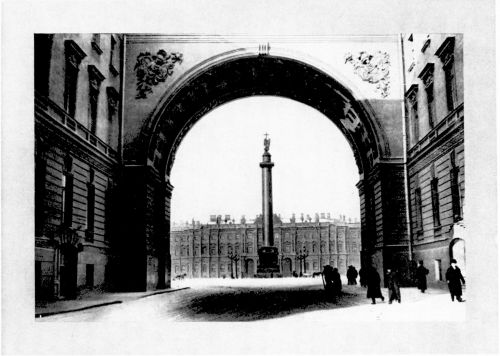
THE WINTER PALACE, ST. PETERSBURG
As seen through the Nevski Prospekt Archway
Photo: Topical
It was on a fine May morning that Louis XVI. opened the session of the
States General at Versailles. It was also on a May day that the first
Russian Duma met in St. Petersburg. More than one person noticed this
strange coincidence, and wondered whether the tragedy that had ended
with the murder of the French king was going to be enacted over again.
As at Versailles, too, in 1789, the ceremony took place with much
solemnity, and all the pomp of the Russian Court was displayed. The
Winter Palace opened its doors, and the aristocracy of St. Petersburg
assembled to witness the inauguration of an Assembly from which so much
was hoped by many people and so much was feared by others.
I shall never forget that day. I was one of the first to arrive at the
Palace, and had plenty of opportunities to watch the Assembly, and to
observe the spectators, as well as the Deputies, as they arrived one by
one and proceeded to the places assigned to them. It was the first time
that the whole of Russia, as here represented by all classes of the
nation, had assembled together in one room, and the spectacle was
curious in the extreme. One saw on one side all the great dignitaries of
the State, Ministers, and advisers of the Crown, military and civil
functionaries, Court chamberlains, and gentlemen-in-waiting, maids of
honour, high-born dames, fair women, and lovely girls—all the flower of
St. Petersburg Society, with their diamonds and their long Court trains
trailing behind them. On the other side were gathered the newly chosen
representatives of the country: landlords, advocates, merchants,
noblemen, and peasants, realising for the first time their importance
from the social as well as from the legislative point of view; men full
of illusions, others full of hatred; some believing honestly in the
possibility of doing good to their fatherland; others only dreaming of
destroying the authority under which they had lived with such
impatience. Ambitions, greed, thirst for power, desire for
revenge—everything was there, and the sight appeared portentous to the
onlooker, perhaps because all these people kept so silent and unmoved,
merely gazing before them, with eyes that looked into the future more
than at what was going on around them. It was the great hour of a
nation’s life, that which decides its ultimate fate, and though
everybody felt that it was so, yet none seemed to realise it, perhaps
because we can never understand the importance of the events in which we
are actors.
The Deputies assembled slowly, and did not seem to know very well what
they ought to do. In one corner the Clerical faction clustered in one
compact group, their long hair and flowing beards, their different
coloured cassocks, making them picturesque figures, which commanded
attention. Near by, the Peasant members, in their long caftans, some of
which were not even new, as the Emperor remarked to one of his
attendants after the ceremony was over, stared with interest at all that
they saw, and appeared as if they did not know why they were there.
Then, again, the Socialist Deputies kept whispering to each other, and
glanced with scorn at the part of the room where the ladies invited to
be present at the opening ceremony were chatting without appearing to
notice the Deputies, as they slowly filed before them. The disdain in
which these representatives of the nation were held among Court circles
was very apparent, and made one feel that the comedy which was being
enacted would very soon turn to drama and end with tragedy.
At last the stick of the Masters of Ceremonies made itself heard, and
the Emperor, with his wife and mother, followed by the Imperial Family,
entered the room. The procession which heralded his appearance reminded
one, by its splendour, of that far-distant day when he had entered
Moscow before his Coronation, also preceded and accompanied by all the
pomp of his splendid Court. But the atmosphere was different. Then the
nation had acclaimed him, now it cheered him; the cries were the same,
but the accent was different.
Nicholas II. appeared nervous; he was paler than was his wont, and he
kept twisting his white military glove. But there was no kindness in his
blue eyes. The Empress appeared as cold and disdainful as usual; she
seemed bored more than anything else, and scarcely noticed the low
salutations with which the Imperial party were greeted when they came
into the room. The Empress Dowager, on the contrary, was extremely moved
and agitated. Her eyes were red, and she kept putting up her
handkerchief as if to wipe away tears. She remained slightly behind her
son and daughter-in-law, but keenly observed the Assembly, as if trying
to read their countenances and to guess what lay behind them. From time
to time she turned towards her chamberlain-in-waiting, and asked him
some questions evidently relating to the identity of the various
Deputies. The Socialist group attracted her attention quite
particularly, and she watched it the whole time the ceremony lasted with
something akin to anxiety in her lovely dark eyes, which then wandered
towards her son, resting on him with passionate yearning and sadness.
Her countenance was perfectly dignified, and yet a whole tragedy lurked
in her figure as it bent under the blessing of the Metropolitan, who
celebrated the Divine Service with which the pageant began. When it was
over, Nicholas II. took from the hands of the Minister of the Household
the paper upon which was written the first Speech from the Throne
addressed to a Russian legislative assembly. He read it slowly at first,
a little more hurriedly towards the end, but in a determined voice that
hardly wavered as he proceeded with its contents. Whether he felt or not
the solemnity of the hour, it is impossible to tell; still less to guess
whether he was sincere in the solemn promises which he made to his
people.
Hurrahs replied to his message, and from the monarchist side of the
Assembly these cheers were the sincere expression of a real and frank
loyalty. But it was observed that the Peasant group was very moderate in
the manifestation of its feelings, and as for the Socialists, they
remained silent, though observing a respectful attitude.
The Sovereign bowed to the Assembly and retired, together with the
members of his family, proceeding to lunch in his private apartments
before returning to Tsarskoye Selo. The meal was not very cheerful,
although everybody agreed that the ceremony had gone off very well; but
Nicholas II. seemed angry at some apparent want of respect that had
struck him in the attitude of the group of Deputies belonging to the
rural classes; and he had not been impressed by the hostile aspect of
the Socialist Deputies. He expressed his regret that so many advocates
had been elected, and the hope that the choice of the President of the
Duma would be a wise one, and would fall upon a man chosen from among
the Conservative or Governmental party.
This was not to be. From the very first day it became evident that the
Duma was distinctly hostile to the Ministry as it was composed at the
time, and that it meant seriously to perform its task of participating
in the government of the country.
The President, who was elected by a large majority, was a man enjoying a
blameless reputation, and one of the most eminent of the Moscow bar, M.
Muromtsev. He had distinctly Liberal opinions, and was a personage whom
even his adversaries respected. A strong supporter of a constitutional
system of government, he meant to do his best to help its establishment
in Russia and to strengthen the authority of the Sovereign by persuading
him to share it with a responsible Ministry. He was an idealist by
temperament as well as by conviction, and he had hailed with enthusiasm
the promises of Nicholas II., whose sincerity he had never doubted for a
single moment. In a certain sense, he belonged to the party that named
itself the Octobrists, as having been called into existence by the
manifesto of October 17th, though officially he was considered to be an
advanced Liberal. He was essentially an honest man, and possessed, among
his other gifts, that of a rare eloquence, which had made him a great
power at the Bar, the more so that he had never consented to defend a
wrong cause.
Had the Emperor recognised the rare qualities of M. Muromtsev, and had
he consented to employ his great talents, it is probable that the
agitation which shook the country during the few short weeks that the
first Duma was allowed to work would have taken a different direction.
As is usual in Russia, where every new venture is welcomed with
enthusiasm until the Government has seen fit to quench it, the first
Legislative Assembly, or, at least, the members of it who belonged to
the moderate side, although Liberal in their opinions, started to work
with the best intentions. They seriously believed that their Sovereign
was frank and sincere with them, that he really meant to see to the
needs of Russia and to lead the nation in the path of order and
prosperity, with the help of its representatives, who would be better
able than his Ministers to bring to his notice all the evils which it
was essential to remove, and all the abuses that wanted remedying. It
was under such an illusion that they started their labours. Little did
they guess or think that neither the Tsar, nor those among his advisers
who enjoyed his confidence, ever intended to allow them any other
liberty or privileges beyond those of talking about things; there was
certainly no intention to allow change or modification.
The first conflict arose when the reply to the Speech from the Throne
was being discussed. It was then that the Radical elements which the
Duma contained began to make themselves heard, and to throw themselves
into the fray with all the vehemence of beginners. It must not be
forgotten that this Assembly, gathered together in such an unexpected
manner was composed mainly of men who had absolutely no experience as to
the way in which parliamentary debates ought to be conducted. Yet, eager
though they were to show what they could do, they possessed no
controlling power, nor were they able to keep their discussions within
reasonable limits. The authority which statesmen of long standing alone
can wield was entirely absent. It was natural, therefore, that confusion
should ensue. Political parties, in the sense in which they are
understood in Europe, did not exist then, and do not exist even now in
Russia, where there are only political opinions. How, therefore, could
one expect unimpassioned, or even reasonable, discussions of the
innumerable subjects which required attention from such an assemblage?
Each was desirous of making his own opinions and his own judgments
triumph over those of his neighbour.
The great pity lay in the fact that neither the Duma, the Government,
nor the Emperor would make up their minds to the fact that this first
legislative session could not be anything more than a trial of
constitutional government, such as it is understood in Europe; that
before framing laws or attempting reforms, one ought to learn how to
work. Instead of realising this truth, they all started with the idea
that a great deal could be accomplished at once, and that a Russian
Parliament ought immediately to take its place with those of other
countries, where initial blunders were already a thing of the past, and
where experience had taught that neither reforms nor laws could be
framed in a few days.
The root-error was that the Duma believed it could at once impose itself
and its decisions upon the Sovereign, whilst the latter simply wanted to
find in it an obedient executor of his own will.
This misunderstanding caused the conflict which very shortly led to
irremediable disaster.
The culmination was reached when the important question of a responsible
Ministry came to be discussed. The Duma required it; the Tsar refused to
make up his mind to it otherwise than as a mere matter of form. To
reconcile these two points of view was impossible, and it became evident
that a struggle was inevitable, which could only end in the dissolution
of the Assembly or in a coup d’état.
Strange though it may seem, yet it is certain that, had the first Duma
not been composed of such clever men, it would have fared better. As it
was, all the best elements that Russia possessed had been elected, and
these would not consent to become mere puppets in the hands of the
Government. They thought themselves able to share with it the task of
ruling the country, and they wanted at once to prove their capacities in
that respect. Had the deputies elected been more timid and less
intelligent, they would have settled quietly to learn how they ought to
work, and paved the way for their successors, who would have found the
road clear before them. Unfortunately, all the leading people, either in
the capital or in the provinces, had been selected as members either of
the Duma or of the Council of State, and these had studied social
questions too long to believe themselves unqualified to settle them.
Nicholas II. kept himself well informed as to the way in which the
debates were carried on, and instead of looking with indulgence at
certain intemperances of language, proceeding more from headstrong,
though well-meaning, ignorance than from anything else, took as personal
offences words which meant nothing but a desire on the part of these
impatient reformers to make themselves heard. He wanted the Duma to work
as if it occupied the same position as a local zemstvo, never for one
moment imagining that the Assembly could look upon itself as upon a
power in the State. This misunderstanding as to the position in which
they stood, in regard to each other, led to the conflict between the
Sovereign and the Duma, which ended in the unexpected and violent
dissolution of the latter.
That dissolution was the personal work of Nicholas II. None of his
Ministers had the courage to assume the responsibility of such a violent
measure, and Count Witte absolutely declined to have a hand in it. Even
M. Dournovo, the representative of the extreme Conservative party, and
the strong upholder of autocracy in the strictest sense of the word,
hesitated before the consequences of this decision. But the Emperor
decided upon it, and with one stroke of his pen the Duma was dissolved.
The Liberal Deputies, indignant at the measure, resolved to express
their indignation upon paper, and to publish it to the whole country.
The greater portion of the members of the Assembly then went to Viborg,
and there signed the famous manifesto which exposed their wrongs before
the world. That act was certainly an appeal to rebellion. The mistake of
this step was most serious. It gave to the Government a reason for
action, and enabled them to prevent the members of the late Duma from
proving a future hindrance to its plans. Had the Liberal members of the
Duma quietly gone home, it is more than certain that they would have
been re-elected, and could have gone on with their requests for reforms,
which would have had more chance to succeed as time went by. The
unfortunate journey to Viborg which caused the criminal proceedings
should never have been undertaken. By it they gave the Government the
opportunity they wanted. The condemnation of the Deputies to several
months of prison would not have been such a misfortune had it not had
the consequence of making them for ever ineligible as Deputies. It was
that which the Government wanted, and the Liberal party played into its
hands.
Months passed, and then a second Duma was called into existence. It
proved almost as rebellious as the first, with one great difference: it
contained neither clever men, nor men able to do serious work. The
second Duma also had a brief life, and then the Government—which in the
meantime had achieved its aim: of silencing, though not exterminating,
the elements of opposition in the nation—proceeded to the third
elections, which satisfied it so well that the third Duma lived to die a
natural death. About the fourth Duma, whose work has just begun, I
shall speak later on.
Whilst Nicholas II. was getting rid of the shadow of Parliament with
which he had endowed Russia, his Ministers were forsaking him one after
the other. The Cabinet of Count Witte had not survived the first Duma;
that of M. Gorémykin, and the one over which M. Dournovo had presided,
had also not enjoyed a very long existence. A new star had arisen on the
horizon, a new “Vrementchik,” to use the traditional word applied in
Russia to the favourite of a Sovereign, had appeared upon the political
scene. M. Stolypin was appointed Prime Minister, and he contrived to
keep that post until he was forcibly removed from it by the bullet of an
anarchist conspirator.
Peter Arkadievitch Stolypin was the son of an aide-de-camp general of
Alexander II. His father had been at one time very popular in St.
Petersburg society, and through his numerous family connections had made
a brilliant career. He was a pleasant man, a perfect gentleman in
manners, but by no means clever or bright. His most salient quality was
the perfection with which he could indulge for hours in small talk, and
it was this capacity that had made him such a welcome guest at a dinner
table or at a party.
His son, the future Prime Minister of Nicholas II., was not very well
known among the select circle of Court Society in the capital. He had
entered the public service when quite young, and had been at once sent
to the interior of the Empire, to work out his advancement step by step.
After having done so to the best of his capacity, he was appointed
Governor of the province of Samara, and whilst there had attracted the
notice of the public and of his superiors by the energetic manner in
which he had suppressed local riots. Count Witte was the first man to
whom it occurred to appoint him to a more important post. M. Stolypin,
who had only waited for a favourable opportunity to approach his
Sovereign, was delighted to be called to St. Petersburg, and when he
arrived there it was with the firm intention to do everything to win for
himself Imperial protection and Imperial favour; to show himself an
able courtier and a faithful executor of the wishes and intentions of
the master upon whom his future career depended.
He was a man of strong character, but of immense ambitions, very
personal in all his actions, and secretive in his designs.
In his provincial life he had had no hopes of ever making anything else
than an administrative career, such as Government officials generally
do, and the thought that he might be called upon to occupy an important
post in the capital had never entered his mind. When he was summoned to
St. Petersburg he was at first stunned by this unexpected piece of luck,
but very quickly recovered himself, and, being a keen observer of human
nature, no sooner had he been presented to Nicholas II. than he had
taken an estimate of that monarch’s character, and the right way to
influence it, so as to obtain for himself a leading part in his
counsels. The two men had much in common, though little real sympathy
existed between them. Stolypin was certainly more cultivated than the
Tsar; also he had more determination, and more firmness in character,
but there was lurking in the corners of his nature the same hardness,
the same tyrannical tendencies, the same want of heart. Both were
egotistical, with the difference that one thought it was his right to be
so, whilst the other only imagined that he could win this right for
himself.
Stolypin was brave, but of fatalistic temperament. He firmly believed
that he would not die before the day appointed for him to do so by fate,
and that conviction made him often appear to be reckless, whilst in
reality he was only indifferent as to a fate which he thought was
already settled by a power higher than his own. He had been told one day
in his youth by a fortune-teller that he would reach a high position,
which he would keep until his death, and, sceptical though he was on
other points, he had faith in that prediction, which was to come true in
so singular a fashion. Authoritative, selfish, merciless whenever he
feared his personal interests were threatened, he succeeded during the
years he was in power in making himself hated alike by the anarchists he
was supposed to fight and the Conservatives he was believed to protect.
The ability with which he managed to get all his opinions and all his
plans approved by the Sovereign would have been sure to win him many
enemies, even if he had not made himself so offensive everywhere.
Disdainful by nature, he had not the least regard for the feelings of
anyone, and did not respect either those of his friends or of his foes.
His high position, and the unlimited power conferred upon him by the
force of circumstances more than by anything else, had imbued him with
the conviction that he was indispensable, and that everything would be
allowed to him because there was no one to take his place.
Another man before him had enjoyed as much, and even more of the
confidence of the Tsar. It was General Trepoff, and death soon removed
that rival, who was not even a dangerous one, because he had neither the
intelligence nor the cunning that could have made him an opponent worthy
of notice by Stolypin.
Since I am mentioning General Trepoff, perhaps a few words concerning
that personage will not be out of place. Trepoff was one of the many
children of the famous General Trepoff, who had for such a long time
held the important post of Prefect of the town of St. Petersburg, under
the reign of Alexander II., and whose attempted assassination by Vera
Zassoulitch had been the first open act of warfare of the Nihilist
party. His son began his career in the first regiment of Horse Guards,
and at one time was considered one of the crack officers in the Society
of the capital. He was invited everywhere, and at last succeeded in
ingratiating himself into the good graces of the Grand Duke Paul, who
was in command of the regiment. It was the latter who had him appointed
head of the police in Moscow under his brother, the Grand Duke Sergius.
Once in Moscow young Trepoff made himself pleasant to the Grand Duchess
Elizabeth Feodorovna, and at one time public gossip was very busy with
their names. What amount of truth there lay at the bottom of all these
rumours it is impossible to say, but the fact is that it was on the
recommendation of the Grand Duchess that Colonel Trepoff, as he was at
the time, was called to the head of the Okhrana, or personal guard of
the Sovereign.
For some time his influence was very powerful, but it did not last long.
Trepoff was of an imperious disposition, but perfectly loyal to his
master. He might have been an excellent watch-dog, and, indeed,
performed the duties of one to perfection; but he was a man with limited
education, who held no opinions except those he was ordered to have. His
reign was very brief, and he did not deserve all the hatred expended
upon him, because his influence would never have been lasting. He did
not possess the qualities of an administrator, and, short-sighted as
Nicholas II. was, he still had noticed this, and would certainly have
sacrificed Trepoff to Stolypin had he been called upon to choose between
the two. Fate intervened and saved him the necessity. Trepoff died, worn
out with too much work, and perhaps also with the anxiety of his
responsible post, for which he felt himself to be unequal; and Stolypin
remained the only personage capable of leading the Government of Russia
under the weak and tottering rule of the Emperor Nicholas.
He very soon assumed the attitude of a dictator, and in doing so bluffed
a good many people into really believing that he possessed the necessary
qualities of a leader. This was not the case. Stolypin pretended to have
more determination than he really possessed.
After the dissolution of the first Duma, a measure he was the only one
to approve, and the only one gifted with sufficient courage to execute,
he became the object of the execration of all the Liberal parties in
Russia. An era of revolution began in the whole country. Even in St.
Petersburg rebellion raged, assassinations were frequent, and no one
felt himself to be in safety. The Nihilists, who once more came to the
front in the struggle which waged between Stolypin and the whole nation,
at last proceeded to extremes, and the first attempt to assassinate the
too powerful Minister took place when his summer villa on the Islands of
the Apothecaries, near St. Petersburg, was nearly destroyed, his
children wounded, and about forty-five persons killed, whilst he alone
remained untouched.
It was on that awful day that M. Stolypin showed the fatalism which was
one of the dominant traits of his character. Another man would have lost
his head, or at least given way to discouragement under the blow that
had struck his daughter and his son. Peter Arkadievitch remained
perfectly calm, outwardly at least, and he never for a single minute
thought of resigning the responsible position which he occupied. On the
contrary, he seemed to find a compensation for his private sorrows in
the authority which the dastardly attempt against his person and his
family had added to those which he already possessed. He could now
represent to the Emperor, with more force than ever, how indispensable
it was to show no mercy to all those who tried to shatter his Throne
and his power, and could obtain the assent of the Sovereign to all the
measures which he thought imperative for assuring the latter, and for
the welfare of the country.
That country was about the last subject to which Stolypin turned his
attention. Russia meant nothing to him, except in the sense that through
her he could gain honours and dignities, and advance his own welfare. He
had, it is true, Nationalist tendencies, and worked towards the
development of Nationalism in the country, which perhaps was another of
his many mistakes, and brought about the conflict that shortly before
his death arose between him and the Council of State. In this dispute
the Council refused to agree to Stolypin’s bill for the introduction of
zemstvos, or local councils, in the Polish provinces, where they had not
yet been installed. When that conflict took an acute shape, and he had
been defeated in the Upper House, Peter Arkadievitch offered his
resignation to the Emperor. This was merely a move, for he had some
secret influence with certain personages near the Throne, amongst them
the Dowager Empress, so it was said, who advised Nicholas II. to ask him
to keep office, to which he at last assented, but not without securing
conditions which strengthened his authority and made him more powerful
than ever.
The country did not approve, and even in St. Petersburg, where
individuals were rather chary of expressing their opinions, people began
openly to attack him. The fact was, that everybody was getting wearied
of this kind of Major-domo of the Palace, which Stolypin had succeeded
in becoming, and which reminded one of the old Merovingian kings and of
the dictators who had ruled under them. The personality of the Emperor
was becoming submerged in comparison with the importance that the
influence of his Prime Minister was assuming. Conservatives disliked
this effacement of the Sovereign; Liberals thought that if one had to be
ruled by an autocrat, it would be better to have a Romanoff than one of
his subjects.
Nicholas II. himself became, not perhaps jealous, but certainly
impatient, at the independence that Stolypin displayed, now that he felt
his position more secure. Once or twice he had found some orders that he
had given counteracted by dispositions made by Stolypin without
consulting his Emperor. Nicholas was not a man capable of forgiving
encroachments made upon his authority, and certainly not one to forget
them. Vindictive as he was by nature, the Emperor found the yoke that
his Prime Minister had forced him to assume heavy to bear, and though he
felt that the time had not come when he could get rid of him, yet one
can well suppose that he would have seized with pleasure an opportunity
to cover Stolypin with honours and at the same time retire him into
private life, had he only asked a second time the permission to do so.
The Minister was too observant not to notice that, though his influence
had not begun to get weakened, his person was no longer sympathetic to
the Emperor. He was, however, determined to keep his post, and to have
more distinctions showered upon him. He then tried to invent some
conspiracies against the life of the monarch, in order to prove that he
was indispensable, and that his vigilance was the best safeguard that
Nicholas II. could find against the many dangers which threatened him.
Provocative agents began once more to be sent all over the country, and
the police received energetic orders to find conspirators, no matter at
what cost. He thought that fear was the best means left at his disposal
to make his position unassailable on the part of those who tried to
shatter it. St. Petersburg Society did not take to Peter Arkadievitch.
It considered him a little in the light of an intruder, a parvenu, who
had imposed himself upon it, and forced an entrance into its rooms.
Madame Stolypin, too, was little liked, and thought lacking in
refinement. She came from a worthy family of German origin, who had
served without distinction, but with much zeal, its Sovereign, and which
belonged essentially to the middle class. Neither her manners nor her
tact made her a fit wife for a Prime Minister, and a certain spirit of
intrigue and of gossip, caused her to be disliked, rather than anything
else. She never made herself at home, or popular, among the smart
circles of the capital, where she was received, but seldom welcomed.
Nevertheless, though the Emperor began to get just a little tired of the
state of dependence in which M. Stolypin kept him, nothing of this
impatience appeared in public. He was still a favourite, and the man to
whom everybody turned whenever one was in want of a favour or of a
protection of some kind. When the Imperial Family left for the Crimea in
the autumn of the year 1911, with the intention to stop on its way in
Kieff and in order to allow the Emperor to be present at some manœuvres
in the south of Russia, M. Stolypin accompanied them, and was the
principal personage in their numerous suite. That journey was to see the
end of his ambitions and of his career, for it was during its course
that he was killed.
The murder took place at Kieff during a performance at the theatre. The
Prime Minister fell under the bullet of one of his own agents, a Jew
called Bagrov, who had been employed by the political police as a spy
for a number of years. It was with a ticket signed by Stolypin himself
that he had obtained an entrance into the theatre, and he fired at his
chief with a revolver which belonged to the Government, and which had
been given to him by one of the heads of the Okhrana or private guard of
the Emperor. Stolypin fell, or rather dropped in his chair, with just
one exclamation, “I am done for!” Nicholas II. was sitting with his
daughters in the State box, but he never made the slightest movement to
show that he was impressed by the tragical event. The crowd that filled
the theatre began to cheer him with unusual enthusiasm, which he
accepted with a slight bow in the direction of the audience, but he did
not seem to evince particular interest as to the fate of his wounded
Minister. He returned to the Palace without visiting the wounded man, or
making personal inquiry as to his condition.
At first there was some hope of saving Stolypin, though a renowned
physician, who held the post of professor at the University of Kieff, at
once told his friends that the situation was desperate, because the
liver had been perforated by the bullet. The wounded man himself had no
illusions as to his fate, and he bore the terrible sufferings which he
had to endure with great courage and fortitude, asking only from his
doctors to keep him alive until his wife and family had arrived. A great
surgeon was summoned from St. Petersburg, and everything possible was
done to ease his last days, but it was felt from the very first that a
recovery was impossible, and those who had expressed some hope had only
done so in order to spare the feelings of the dying man and of those
near to him.
The whole of Russia was aghast at the assassination of Stolypin; even
his enemies were dumb with the horror of it. Assurances and expressions
of sympathy came from every side; the person who appeared the most
unmoved was the Emperor. It was only on the third day after the attack
that he visited the dying statesman. He expressed no sympathy to the
dying man beyond some conventional inquiries and official words of
regret. It may be assumed that at heart he was neither sorry nor
perplexed as to the consequences which the event could have, and that,
if anything, he felt relieved at the solution of the problem which the
dismissal of M. Stolypin would have proved. It was certain that such an
eventuality would have arisen very soon, because the Tsar could not have
borne much longer with a man in whom he saw a rival in authority rather
than a helpmate or a faithful servant.
Stolypin lingered but a few short days after the one upon which he had
been struck. The Emperor came to his bedside just before the end, and
was received by Madame Stolypin, who used this opportunity to address a
few tactless words to the Sovereign, which he resented afterwards.
Nicholas II. only remained a few minutes with the dying man, and after
some formal expressions of grief he retired.
Stolypin died two days after this visit. His funeral was made the
occasion of great manifestations of sorrow on the part of the
Conservative, or Old Russian party, who transformed him into a martyr,
fallen for the defence of his country and of his Sovereign.
Nicholas did not consider it to be his duty to attend the funeral of his
murdered servant. He was to leave Kieff for the Crimea on the very day
upon which it took place, and it would have been easy enough to put off
this departure for a few hours. But there was no one to suggest it to
Nicholas II., who himself never thought of the opportunity which he
would have had to make himself popular had he walked behind the coffin
of his murdered Minister, and thus showed publicly that he knew how to
value the services rendered to him and how to recognise them.
This indifference contributed considerably to lessen the already very
small popularity which the Tsar enjoyed. M. Stolypin had not been liked;
many people rather rejoiced at his death, and for others it came as a
great relief; but even his many enemies felt that it ought to have
produced a terrible impression on the Emperor, before whose eyes he had
been struck. All wondered at the impassiveness the monarch displayed in
those tragical circumstances, and some asked themselves whether he had
realised their importance. It seemed strange that, after having worked
for years with the murdered man, after having made him a powerful
Minister and a personal friend, after having shared with him political
anxieties and apprehensions of all kinds, after having confided to him
the welfare of the whole vast Russian Empire, after having trusted him
above all other people and listened to him rather than to anyone else,
the greatest proof of sorrow that his assassination provoked in Nicholas
II. took the form of a considerable pension accorded to Madame Stolypin.
He gave her money, but did not think it worth while to offer her the one
supreme sign of sympathy he could have accorded—that of praying beside
the coffin of her husband. The whole of Russia was represented at the
funeral service held over the remains of Peter Arkadievitch Stolypin;
the Emperor alone was missing.
M. Stolypin was not yet dead when people began to make speculations as
to his successor. He had occupied both the office of Minister of the
Interior and that of Head of the Government. There were, therefore, two
most important Departments to provide for, and though candidates were
many, eligible people were but few. The Emperor did not like to see new
faces about him, and this added to the difficulty. Of course intrigues
went on, and ambition as well as eagerness had a considerable part in
them, because, though everybody knew the great danger that attended the
position of Prime Minister, it was nevertheless the most coveted post in
the whole of the Empire. All the colleagues of the murdered statesman
thought themselves entitled to become his successor, and each of them
had his particular circle of friends who went about declaring that their
candidate had the most chances. However, people in the know never
doubted for a single moment that Vladimir Nicolaievitch Kokovtsov was
the only man in Russia strong enough to replace M. Stolypin, and to take
upon himself the onerous duties of Premier. But whether he would consent
to leave the Treasury, at the head of which he had been for some years,
was a matter of much speculation, and this uncertainty alone prevented
the majority of St. Petersburg Society from congratulating him on his
promotion.
Doubts were very soon at an end, and when M. Kokovtsov
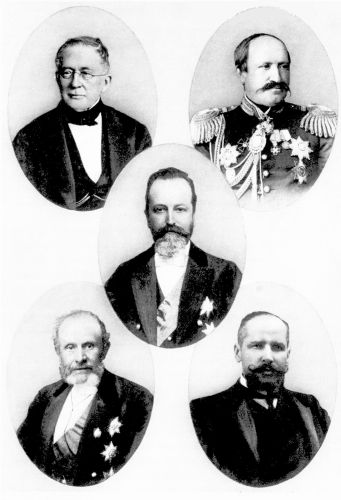
FAMOUS RUSSIAN MINISTERS |
Prince Gortschakov
M. de Giers | |
Count Ignatieff
M. Stolypin |
M. Kokovtsov |
was summoned to Livadia his nomination was a foregone conclusion.
Nevertheless, he had a surprise in store for the public, because he only
accepted the Premiership, and refused to give up the Department over
which he already presided, saying that he knew nothing about civil
administration, and would only make blunders if he took the burden of it
upon his shoulders. He recommended, therefore, to the Emperor one of his
personal friends, M. Makarov, as the man most able to fulfil the duties
connected with the direction of Home affairs.
M. Kokovtsov was a small man, with a short beard very neatly trimmed,
and a general look of tidiness in every detail of his person as well as
of his clothes. He had a pleasant face and was very affable in his ways,
but he never looked one straight in the eyes, always seeming as if he
was too much occupied with his personal appearance to think of watching
that of others. Somehow or other he gave one the impression that when he
conversed with you he was preoccupied with something he had forgotten,
and the way in which he kept his glance riveted on his coat or on his
trousers suggested the idea that these garments were dusty, and that he
was angry at his valet’s carelessness in brushing them. In a word, one
felt that he was too neat, too well groomed, too polite, too civil, and
too anxious not to forget what he ought to say or what he ought to do.
His manners seemed to have been learned only recently, and somehow one
always expected to find near him, ready to be consulted, some manual of
etiquette for beginners, with indications as to what one must do in good
society, and the errors in which one must not fall if one wants to
frequent the company of cultured people. One would have preferred to
find some hesitation or some impatience in his way of talking or
discussing, but the clear manner in which he expressed himself always
reminded one of fables, recited by children, and learned by them at
school. This is the impression created. In reality, M. Kokovtsov is
certainly a clever, intellectual, and intelligent man, cultivated, and
extremely well read. He speaks several foreign languages, of which fact
he is inordinately proud, and can hold his own everywhere, even with
gentlemen born and bred. His own origin is neither low nor high, but
essentially middle class, and he bears the stamp of having lived for a
long time with middle-class people. His early career in every respect
was a normal one; he rose step by step as years went on, and whatever
duties were imposed upon him he fulfilled exactly and thoroughly. In a
country where political men are many, he would not have been employed
otherwise than as an excellent sous ordre. In Russia, where there is
such a poverty of statesmen, he undoubtedly fills the position of one.
Vladimir Nicolaievitch is subtle by temperament, and very secretive in
all he does. He is excessively alive as to his own interests, and it is
said that he does not disdain to use his official position in order to
improve his private one. For instance, his brother was chairman of the
Kieff Voronege Railway, in which he himself possessed a considerable
number of shares. Certain financiers believe that the shares in question
would never have climbed to the high price at which they are now quoted
were it not for this combination of circumstances. Other examples of the
history of commercial concerns in which he was interested have formed
topics for gossip, to the effect that it is very much to be regretted
that he had allowed people connected with him to be suspected of using
the information he could have given to them, or the protection which it
was possible for him to afford to them, in order to enrich themselves or
to improve their positions. Cæsar’s wife enjoyed certainly a better
reputation than certain persons standing in close relationship with our
Prime Minister.
The great defect of M. Kokovtsov is that he is above everything a
financier, and this is not exactly what is required from the Head of a
Government, who ought to look at things and at facts from a higher point
of view than that of pounds, shillings, and pence, though these play
such an important part in the world.
He has had very great successes in his administration of the Russian
Exchequer, and certainly he has made for himself among European
financial and commercial circles an excellent position and reputation,
which he undoubtedly deserves. But his mind has remained for such a long
time concentrated upon purely material questions that it is not to be
wondered if other matters interest him less. Social matters have very
little attraction for him, except perhaps in the sense that the
condition of the working classes being connected with the financial one
of the country could not be neglected. But it is to be doubted whether
he has quite realised the danger that threatens not only Russia, but the
whole world, from the army of artisans and factory workmen who now know
what force they represent, and who want to take the upper hand in
everything. In giving this character sketch I do not wish to detract
from the solid qualities of the Prime Minister, nor to accuse him of
lack of political foresight. On the contrary, I am convinced that he has
made higher politics the subject of his studies, and that he has even
mastered them in a certain sense, as well as a man who has taken to them
late in life can do. His intelligence is extremely perceptive, and he is
not wanting in finesse nor in diplomatic aptitude. His suave manners
ensure him success with those with whom he has to deal, and certainly
these qualities have impressed the Emperor favourably, and won him the
confidence of his Imperial master; but nevertheless he has not proved
himself so far able to take a leading position among Russian
statesmen—I am not even thinking of foreign ones. The energy that
distinguished M. Stolypin is not one of the characteristics of his
successor, who is only firm where he can do so with impunity, and who is
not gifted with the courage or the fatalism that made Stolypin view with
such impassiveness the bullet or the knife which he was but too well
aware would strike him one day. His ambitions also lead him in quite a
different direction than that in which his predecessor travelled. M.
Kokovtsov is not of a fighting temperament or disposition. He entertains
for blood and sanguinary deeds the aversion that every clean man feels
for dirty things, and he is a great lover of his own comfort and his own
welfare. His placid temper makes him avoid every subject of dispute, and
he is more insensible, than is the case with Russians in general, to the
honours and dignities that have been showered upon him lately. Too wise
to take upon himself a risk that might endanger the reputation for
cleverness which he has succeeded in acquiring, he has managed to steer
clear of difficulties and to make others responsible for his mistakes.
His refusal to take upon himself the difficult duties of Minister of the
Interior proceeded from the clear perception he had that this post was
the one where responsibilities are the heavier and where one can the
least escape them.
No one knows whether M. Kokovtsov’s opinions are Liberal or
Conservative, so carefully has he always avoided parading his views
before the public. Some people who know him well affirm that he is an
opportunist. The fact is that he has seldom been cajoled into saying in
private anything else than what he has uttered in public.
His last speech at the opening of the present session of the Duma was
certainly a clever production, but it hardly bears analysis, because
when examined carefully its emptiness becomes immediately apparent, and
one realises that its contents are nothing but vague promises for which
neither the Government represented by him nor the Emperor can be made
responsible, so carefully have they been worded.
The Duma does not care for M. Kokovtsov, and does not appreciate the
adroitness of his mind. At the same time it does not entertain for him
the respect which, in spite of the hatred which he had inspired, it felt
for the character of M. Stolypin. And if the present Legislative
Assembly contained more independent elements, it is probable that the
opposition to the person of the Prime Minister would take a more acute
form. But the last elections have been conducted so entirely under the
influence of the Government that with the exception of the most
prominent members of the Opposition, such as M. Maklakov, M. Milioukov,
and others of the same importance, scarcely any of the Deputies whose
opinions made them the antagonists of the Cabinet were re-elected, and
the official candidates stepped into their places. This last fact was
entirely due to the clever manner in which M. Kokovtsov conducted the
election campaign, and the instructions which he gave to the Governors
of the different provinces of the Empire, as to the best way to ensure
the success of the men in whom he had confidence, and whom he hoped to
find submissive machines ready to vote according to his direction.
Nevertheless, even this Assembly, composed almost entirely of his
creatures and sycophants, became disgusted at some decisions of the
Government and voted against it upon several occasions. In Russia,
however, a Cabinet does not resign if it is in the good graces of the
Sovereign, and M. Kokovtsov never dreamed of retiring on account of the
censure of the Duma.
This does not mean that he will remain long in power. Very likely he had
hoped to be able to resign the responsible post after the tricentennial
celebrations of the Romanoff Dynasty, and as he did not then receive the
title of Count, nor the blue ribbon of St. Andrew, he is doubtless
waiting for another opportunity to arise, after which he will not be
sorry to retire into private life.
His private fortune is considerable, and he has judiciously enlarged it
during the years that he has been in office; he is clever enough to feel
that his personal influence on the Emperor is not quite the same as it
was earlier, and very likely he would prefer to retire into private life
before this fact became generally suspected. I should not therefore be
very much surprised if he left the field free to more enterprising
spirits. He will be glad to retire with the knowledge that during his
tenure of the Premiership no political crime darkened it, and that it
was not disturbed by revolution.
The fact seems clear that the Anarchist party is once more coming to the
front, and that very likely we shall soon see a new rebellion break out,
better organised than the last one, with more partisans, and with more
chances of success. The Universities, where, as usual, riots occurred
earlier than in any other centre, have lately been the scene of
tumultuous meetings, during which the students discussed the measures
adopted by the Government in regard to them and in regard to the
administration of the country. Censure votes were passed, and the
agitation was so strong that at last the police interfered, with its
usual brutality, which only aggravated the discontent of all these young
people, among whom generally are found the first elements of a rebellion
against the organised order of things.
On the other hand, in the different factories, of which so many exist in
St. Petersburg, the anarchist propaganda has also made enormous
progress; the recent strikes that have taken place prove it but too
well. Though the country is certainly more prosperous than it has ever
been, yet the growing cost of living has prevented many people from
feeling this prosperity, and discontent is more apparent than a year or
two ago.
M. Kokovtsov must be aware of this state of things, and very likely he
is just a little tired of the perpetual anxiety under which he is
obliged to work and to live. He is also not quite in accord with his
colleagues, and not able, like M. Stolypin, to impose his own will
against their intentions. His relations with M. Makarov, whom he had
recommended for the post of Minister of the Interior, did not for long
keep on an amicable footing, and the latter had to retire owing to some
differences which arose between him and the Premier. M. Kokovtsov
thought that the choice of the new Minister would be left to him, but
there a surprise awaited him. The Emperor for once wanted to appoint a
man whom he personally liked, and who had pleased him by the manner in
which he had seemed to enter into the spirit of the orders which he had
given to him. And without taking the advice of Vladimir Nicolaievitch,
he appointed in the place of M. Makarov, M. Maklakov, Governor of the
province of Tchernigov, a comparatively young man, under forty-five
years—an age at which Ministers had never before been chosen—who had
attracted his attention during his journey in the south at the time of
M. Stolypin’s assassination. M. Maklakov, whose brother is the leader of
the Opposition in the Duma, is just as Conservative in his opinions as
the latter is Liberal. Like all the members of his family, he is clever,
and some people see in him a second Stolypin. Whether this will be so
remains to be seen, and it is too early to prophesy. The man is unknown,
and of course surrounded by flatterers and jealous people. Those who see
in him the favourite of the Sovereign cringe before him, and try to make
themselves useful to him; those, on the contrary, who doubt his ability
to replace M. Kokovtsov, which rumour says will soon be necessary, do
not find words hard enough to condemn the choice that has placed him at
the head of the most important Department in the Empire.
It seems that what drew the attention of the Emperor to M. Maklakov was
the following occurrence. When Nicholas II. visited Tchernigov—it was
immediately after Mr. Stolypin had been assassinated by the Jew
Bagrov—everybody around the Sovereign was lamenting the death of the
Prime Minister, and one thought that by doing so one was pleasing the
monarch, and that by saying the loss which the country had suffered in
the person of Stolypin was irreparable, one was only giving expression
to the feelings which animated him. M. Maklakov alone remarked that
though it was terrible and sad that such a dastardly crime had put an
end to such a useful life as had been that of the late Minister’s, yet
one had no reason to fear the future, because with such a wise Sovereign
as Nicholas II., one was sure that the interests of Russia would not be
neglected, and that he would know where to look for a worthy successor
to Stolypin and where to find him. The words pleased the Tsar, and when
the retirement of M. Makarov became an accomplished fact, he called M.
Maklakov to St. Petersburg, and appointed him in his place.
M. Kokovtsov did not like this, and resented the way in which he had
been ignored. Friction between the two men has already occurred, and may
in time result in strengthening Vladimir Nicolaievitch in his decision
to retire, not from public life, but from the Premiership, in the full
glory of his success.
In such a position he would always be consulted in important matters and
questions, and could enjoy the liberty of doing what he liked. One of
the amiable weaknesses of the present Prime Minister consists in his
admiration of the fair sex. This has often occasioned severe criticism,
as it was generally felt that when one has assumed the task of ruling an
Empire like Russia, one ought to be more reserved in one’s actions, and
not allow the world to say that one is ready to forget the interests of
the country whenever a fair siren has consented to smile upon one. The
rumour has been current in St. Petersburg that one could obtain what was
wanted from M. Kokovtsov through the intervention of a lady friend.
But, with all his defects, Vladimir Nicolaievitch has done a great
service to the Empire, and that was to place his veto upon the
ridiculous enthusiasm that was engineered quite artificially in the
country for the cause of the Slav kingdoms. At one time it was feared
that these madmen would entangle Russia in a war with Turkey or with
Austria, which it is doubtful would prove to the advantage of Russia. M.
Kokovtsov alone had enough common sense to oppose his influence to that
folly, and to prevent the continuance of this senseless agitation. He
exposed to the Emperor the situation in which Russia found herself, and
the disaster that a war would entail upon her. He spoke of the state of
the finances, and of the ruin which a campaign would bring. He opened
the eyes of Nicholas II. to the condition of the country, and to the
peril that threatened the whole world were a general war of the
different States of Europe to break out. He had the tact to impose
silence on the Chauvinistic newspapers that excited the public mind not
only against the Turks, but also against the Government, which would
not allow itself to be drawn into the quarrel of the Balkan States with
the Sultan, and he contrived, together with M. Sazonov, to avoid
difficulties with Austria, and to ignore the provocations of the
Austrian press.
Of course, it is impossible to tell what the future holds in reserve,
but if only for the ability with which during the course of last winter,
amidst innumerable difficulties, M. Kokovtsov has displayed, for the
dignity with which he has repulsed the advice that was given to him by
people who spoke of the honour of the country engaged in defending the
Slavs, and by the firmness which he preserved the whole time that the
crisis lasted, he deserves the gratitude of Russia and of every sane and
well-intentioned person not only in Russia, but in the rest of Europe
also.
The present head of the Foreign Office is M. Sazonov. In the chair
occupied in former years by powerful personalities, such as were Count
Nesselrode and Prince Gortschakov, sits a small, meek, little creature,
with a figure and nose that remind one of Don Quixote as he is
represented in the drawings of Gustave Doré. His whole appearance is
insignificant, and suggests embarrassment, nervousness, insecurity as
regards his position, and uncertainty as to what he is to do or to say.
He always seems as if he wanted to ask everybody’s forgiveness for
wrongs done and duties neglected. In a word, he lends himself to
ridicule, and certainly does not suggest the idea of a Minister who
gives himself a true account of the importance or strength of the
position which he occupies.
M. Sazonov has been often laughed at, and rarely been taken seriously,
until quite recently, when his conduct has come out in a most unexpected
light, and he has shown, in the way in which he has handled the Near
Eastern question, true political and diplomatic genius. His anxiety as
to future complications in which Russia might get entangled has made him
show a quiet firmness which no one ever expected from him. It was said
once in St. Petersburg that our Foreign Minister feared the east wind,
because it might blow away his frail person. The words were cruel, and
of course were repeated everywhere, but they were not deserved. M.
Sazonov proved himself to be a very energetic little man, sure of
himself, and determined to enforce the policy to which he had made up
his mind. His nervousness served him well on this occasion, and his fear
of responsibility made him avoid all the opportunities, of which he had
but too many, of assuming any. He had a horror of war, and, considering
the many partisans that an aggressive policy has had in Russia lately,
it was a piece of good luck for the country that it did not find an echo
in the Foreign Office. Had M. Izvolsky been in possession of the chair,
it is more than likely that we would have been engaged already in a
conflict with Austria; under our actual Foreign Minister such an
eventuality is not to be dreaded. But he has common sense, and sees
clearly the situation in which Russia finds herself at the present day,
and the impossibility of being able to pursue an aggressive policy for
some time. As such he is the right man in the right place at the right
time.
M. Sazonov was appointed to his present post through the influence of M.
Stolypin, whose wife was his sister-in-law. Whilst Peter Arkadievitch
was alive his position was stronger than it is at present, when his
policy does not find itself in accord with the views of M. Kokovtsov.
But upon one point the two men are agreed, and that is on the necessity
of not giving way to the clamours of the press and of the enthusiastic
idiots who think it is Russia’s duty to waste her money and the blood of
her children in order to further the ambitions of King Ferdinand and the
other small potentates who rule in the Balkan Peninsula.
M. Sazonov has always been on good terms with the foreign diplomats
accredited to the Court of St. Petersburg. He does not believe in
quarrelling with anybody, and he always finds pleasant words to say even
to those with whom he does not agree. He nervously shakes hands with
all those whom he meets, and always accepts their invitations, and asks
them in return to sit at his hospitable board. He could not be
unpleasant, and he could not say a harsh word, even where deserved. He
rules the Foreign Office, not with an iron hand, but with a very soft
velvet glove, and is sometimes afraid of his own subordinates; does not
dare to contradict them if they show themselves arrogant, and rebukes
them only with apologetic expressions. He cannot scold, and he does not
know how to punish. But at the same time he has got passive firmness,
with which so many timid people are gifted, which makes them stick to
their decisions with a persistence that people with a firmer temperament
often do not succeed in displaying. When M. Sazonov last autumn went to
Paris and to Balmoral, people did not spare him their railleries upon
his return home. He was accused of having, like a meek lamb, acquiesced
in all the propositions which foreign Cabinets had made to him, and was
laughed at for the result of his journey, which he had pompously
announced would be peace, whilst war broke out almost upon the very day
when he reached St. Petersburg after his wanderings, compared by an
Opposition newspaper to those of the Wandering Jew. At one time the
general belief was that Russia, in spite of the opposition of the
Government, would be drawn into a war, and the wildest rumours
circulated everywhere in the country. It was said that a secret
mobilisation was taking place, and that troops were being sent to the
frontier. M. Sazonov, when questioned, declared that he knew nothing
about it, and adhered to his protestations that Russia did not want war,
and that all that the papers were saying was nothing but nonsense.
He has one great quality: people believe him. Perhaps because it is not
possible to imagine that this small, anxious, and fidgety little man can
do anything else but speak the truth. There is no guile in him, and he
has the frankness of a person who has never sinned, even in intention.
It is impossible not to think him honest, and it would be impossible for
him to act otherwise than as an honest man.
The fate of Russia is safe in his hands. Under his rule, Europe can
sleep quietly and not fear a complication coming from the Russian
Cabinet; it may remain convinced that whenever M. Sazonov can find a
loophole to escape from a perilous position he will do so. He may not be
a clever man; he certainly is not a brilliant one. Sometimes he appears
grotesque; he seems insignificant always. But he is earnest, sincere,
and will do his best to fight against those who would engage him or his
country in a policy of adventures.
Knowing the man, one cannot for one moment believe that those who
pretend that Russia is on the point of assuming a bellicose policy have
the slightest reason to say so. Russia, whilst M. Sazonov rules at the
Foreign Office, will always stick to the position of onlooker on all the
complications that shake the rest of Europe; she won’t engage in them.
Of course, things might change were he to retire and another person to
be appointed in his place, or if a new Prime Minister succeeded to M.
Kokovtsov. This last eventuality is the one to be dreaded, but even then
it is doubtful whether Russia would ever readily engage again in warlike
adventures. The severe defeat by the Japanese disgusted the whole
country, the Emperor more than anyone else. Russian foreign policy,
therefore, for some years at least, will be carried on on the principle
of allowing our neighbours to settle their disputes between themselves.
The understanding with England is based on this principle, and as for
the alliance with France, it will serve peace more than anything else,
because it will moderate the thirst for revenge on Germany which exists
there. Even the most adventurous of French Cabinets will not dare to
move when it knows that it cannot find support in St. Petersburg, and
certainly Ministers like M. Sazonov are the best men to prevent useless
complications. They talk common sense, and the motive that guides them
is love of peace.
It must not be supposed, however, that we have no turbulent elements in
our Foreign Office. Our present Ambassador in Paris is of that nature.
M. Izvolsky is one of those men whose presence alone seems to be the
signal for strife and complications out of which no exit can be found.
Wherever this brilliant diplomat has been, something has happened to
compromise his country and his chiefs. There are those who say that his
tenure as Ambassador at the Court of the Mikado was barren from the
point of view of utility, because he never even suspected the military
preparations of the Japanese, far less reported upon them.
M. Izvolsky made his career in part through his marriage with a charming
lady, the daughter of Count Toll, who for long years represented the
Russian Government at the Court of Copenhagen. Whilst there he, as well
as his family, had been intimately received by the King and Queen, and
had had plenty of opportunities to meet the late Emperor and his Consort
during their frequent stays in Denmark. The young Countess Toll had won
the favour of the Empress Marie Feodorovna, who continued to protect her
after she had married young M. Izvolsky.
As I think I have already related, the post of Copenhagen was always
very much sought after among our diplomats, owing to the opportunities
which it afforded them of seeing the Sovereigns otherwise than
formally, which was the case in St. Petersburg, and it was generally
considered to be a stepping-stone to higher dignities. When M. Izvolsky
was appointed to the head of the Foreign Office it was an open secret
that he owed it to the influence of the Empress Dowager; and it is
certain that she never wavered in the kind feelings with which she
followed the progress of his career. M. Izvolsky possesses to perfection
the art of making himself liked by those who can be useful to him.
Brilliant in conversation, gifted also with an easy pen, which allows
him to compose dispatches quickly and well, he is shallow and vain by
nature. He possesses the belief that he is a genius because he can talk.
He is not greatly liked among his colleagues, and especially those in
the Foreign Office in St. Petersburg, owing to his arrogant behaviour
and his disagreeable manners. The curt way in which he treats his
subordinates, and the deferential air with which he handles his
superiors have made him innumerable enemies. Considerable gossip has
arisen from time to time concerning his actions in regard to promotions
in the diplomatic staff during the time when these depended upon him. It
was said that rich people always had the preference, and that Madame
Izvolsky appeared with new jewels when a certain councillor was made an
ambassador. As the lady’s reputation had never been attacked, even by
the most ill-natured person, it was immediately thought and said that
the happy councillor had showed his gratitude to the husband by offering
a little present to his wife. Such things, of course, ought not to be
discussed in relation to a man in the position which M. Izvolsky
occupied, but they were very freely spoken of, as also was his
reputation in money matters.
Count Benckendorff, the Russian Ambassador in London, belongs also to
the number of happy people who owe the success of their career to a term
at Copenhagen. He had, however, more solid reasons than M. Izvolsky to
reach one of its most coveted posts. He was the son of a man who had
been one of the personal friends of the Emperor Nicholas II.; he had
married a Countess Schouvaloff; his brother was head of the Household of
the present Emperor; his family had always stood in close relations to
the Throne; his sister, the Princess Natzfeld Trachenberg, had been
Mistress of the Robes of the late Empress Frederick of Germany. He had
therefore every right to expect to become an ambassador, and his
appointment to London surprised no one, and was not even criticised by
his colleagues. He is a pleasant man, excessively well bred, with
irreproachable manners; looks rather like an Englishman. He speaks
English remarkably well, with almost no foreign accent. Not accounted a
genius, he has tact and the quality not to attempt to assume a part for
which he is not fitted. He will never try to pursue a personal line of
conduct in matters connected with politics, and will always faithfully
execute, without the least attempt to modify them, the orders he
receives. He is a grand seigneur, and as such is quite in his element
in London, where this quality is more appreciated than anywhere else,
and, moreover, he likes England and English life and English ways. It
would be a pity if private family matters, as gossip in St. Petersburg
hints, should oblige him to ask for his recall, and it would be
difficult to find a successor, although it is well known that M.
Izvolsky believes himself to be qualified for it.
Of our other ambassadors I have but very little to say. Those in Berlin,
Rome, and Madrid are what one calls in French, des diplomates de
carrière, who have risen step by step in the Service and won their
appointments by hard work. M. Kroupensky, who has recently succeeded to
Prince Dolgorouky in Rome, had been for some years Councillor of Embassy
in London, under Baron de Staal, and was extremely liked there, though
he did not go much into Society. He is a pleasant man, inoffensive, with
excellent manners, and knowing very well how to hold himself in Society,
and how to keep his place. He is a well-set-up figure in a drawing-room,
and almost as smart as his uniform is well embroidered. His nose is
long, his figure thin, his knowledge of French excellent, and of Italian
limited. His wife is Eastern by origin, and not perhaps an ideal
ambassadress, as experience of the world rather fails her; but she does
not attempt, unless absolutely necessary, to impose herself or her
manners anywhere, and remains content to be a good housekeeper and a
submissive consort to her amiable husband.
I have not seen much of M. Sverbeev, who replaced the late Count Osten
Sacken in Berlin, but I believe he is a clever though quiet man, and one
who enjoys the sympathies of all who have come in contact with him. His
predecessor was so popular at the Court of the Emperor William that he
will find it difficult to fight against the remembrance that he had left
behind him. I do not think that the Berlin Embassy, under the new
regime, will see the brilliance of former days, but very probably it
will become the scene of more formal gaieties. M. Sverbeev is a close
personal friend of M. Sazonov, whom he slightly resembles physically,
and, like his chief, he will always do the best he can to further the
cause of peace and to avoid even the semblance of a conflict.
As for Baron Budberg, who occupies the post of Madrid, he is little
known in Russia, having spent almost his whole life abroad. I have never
met him.
Any habitué of St. Petersburg Society during the two former reigns who,
after a long absence, returned to the capital of Russia would scarcely
know it again.
The change brought about in the Society of St. Petersburg since the
beginning of the present century is so enormous that it is a wonder how
it could have taken place in so short a time. The Society leaders of old
have either died or gone abroad, or have entirely retired from the
social world. Family gatherings, which used regularly to assemble on
certain days such as Christmas, New Year, or Easter, at the house of a
grandmother, aunt, or uncle, take place no longer. People prefer to go
to restaurants to hear a Roumanian orchestra, or some Bohemian singers,
rather than cluster round the family hearth. The constraint that
formerly characterised the attitude of the younger members of a family
to their elders has disappeared so entirely that one wonders how it
could ever have existed. St. Petersburg Society, which formerly could
boast of some circles entirely shut to outsiders, groups where money was
not sufficient to secure an entrance, where those who were admitted
within the precincts carefully observed certain rules of politeness, and
civility, has now become a kind of cabaret, where everyone thinks he has
the right to do what he likes, where good manners are unknown, where
even young girls are allowed to go everywhere, not only without
chaperons, but even in the company of young men whom they scarcely
know, and even go so far as to visit these same young men in their
flats, or barracks when they happen to be officers.
The decorum which formerly was carefully observed, and the somewhat
stiff but charming way in which women used to welcome even their most
intimate friends, has fled. At present politeness is unknown, formality
is no longer observed, and gossip has superseded the intellectual
conversations which were in past days one of the characteristics of that
portion of St. Petersburg Society which belonged to the upper ten
thousand.
Salons like those of the Princess Paschkievitch, of the Princess Lise
Volkhonsky, or of the Princess Hélène Kotchoubey have disappeared. Those
incomparable hostesses, whose judgments made or marred a social
reputation, whose smiles were accepted as a favour, and whose
invitations were more eagerly sought after than even Imperial ones, have
been replaced by women who have pushed themselves to the front, either
through their money or through their audacity; who gather round them
people to play bridge or to discuss the most trivial and commonplace
subjects, who have neither manners, nor charm, nor the prestige of a
high personal position independent of an official one.
Of former salons that of the Countess Kleinmichel alone is still
existent, and its mistress is as intriguing as ever, and a little less
slim, and with a little more “complexion.” Otherwise, she has not
altered, her dinners are not better; but her evening parties have still
kept their attraction for high officials and diplomats of all countries.
Bridge, however, has replaced conversation, and private theatricals the
balls of former days. As for flirting, this art, which was carried to
perfection in those old times of which I am thinking, is also extinct.
Why should one give oneself that trouble when it is so easy to obtain
all that one wants without practising it!
Small talk is a thing of the past also; now the only thing that one
hears is, “Have you been at the concours hippique?” or “Have you been
at the skating rink?” An ill-bred familiarity has replaced the courtesy
for which Russians of the higher classes were famous. Now no man dreams
of calling a lady, or even a young girl, by their family names; one says
“Mary” or “Kitty.” Young students address maids of eighteen or twenty by
their nicknames, and no one seems to wonder at this utter breach of good
manners.
Parties are dull and stiff, in spite of their utter want of decorum.
They are no longer a reunion of people belonging to the same circle, who
meet at the house of one of their number to drink a cup of tea and
discuss the events of the day. These intimate little gatherings are no
longer considered as being the right thing. They have been replaced by
dinners and parties in which hostesses try to outdo each other in the
luxury they display. That which indicates more than anything else the
emptiness of the minds of the smart set in St. Petersburg is the fact
that now no one likes to talk, and that in order to make a party
successful, one must have something to occupy those invited to it. No
longer are they able to amuse themselves by conversation. One must have
either bridge, or music, or some such attraction, else people will not
come. Formerly there were dozens of houses where you could go every
evening and take a cup of tea quietly, sometimes with two or three
people, sometimes with the hostess only, who knew how to entertain you
and to keep you talking till long past midnight. Now you will hardly
find a place where you can hope to be received without a special
invitation. Men and women are no longer sociable, though they are
dissipated, and when they meet it is to eat and to drink, though not
always to be merry.
One of the reasons for this state of things lies in the number of
outsiders who have obtained an entrance into Society. One Grand Duchess,
in particular, is largely responsible for this. Her own set is not only
fast, but vulgar, and, unfortunately, the admittance is easy. It is
sufficient to have money, to be rich enough to entertain her, to talk
slang, to go every year to Paris, and to give her money for all the
bazaars that she patronises. As her presence at a party makes it at once
a smart one, and confers an honour on her hostess, it is not to be
wondered that ladies who formerly would never have been admitted into
the cream of St. Petersburg Society have seized the opportunity that was
offered to them and consistently flattered the Grand Duchess. No one now
cares for the family antecedents of guests so long as they have an
abundance of money and can give good dinners.
Another reason why the moral and intellectual standard of St. Petersburg
Society has sunk so low lies in the fact that now no one controls its
decisions. Formerly the Court exercised a strong influence on manners
and habits. At a time when invitations to the Winter Palace decided as
to the social standing of a person, people had necessarily to be upon
their guard. Not to be invited to a ball where one had the right to be
admitted constituted a social degradation which was never removed. The
Emperor and Empress, going out into Society, and knowing its leading
members, were very well informed as to what they did, and knew how to
express their disapproval where there were reasons for so doing.
That is now a thing of the past. The Court keeps itself aloof from
Society. Balls at the Winter Palace are a thing of the past. Court
invitations belong to history; there is no one left to say who ought or
ought not to be received at places where admittance constitutes an
honour. People are left to their own inclinations, and inclinations
always take them where they are well fed, well cared for, where they
find luxury, truffles, oysters, and champagne, where there are
well-dressed women always willing to be admired, and where cards are
always laid out on the table ready for play.
There is one very remarkable thing which cannot help striking anyone who
knew St. Petersburg some twenty years ago; it is that the moral and
intellectual standard of Society has considerably fallen, while, on the
other hand, luxury has increased. Smartness is now general, whereas
formerly it was only an exception. Dowagers with caps, and high black
silk gowns, which they even wore at the balls and parties where they
chaperoned their daughters and granddaughters, have disappeared; grey
hair has become an exception; the love of dress has grown tremendously,
and the former simplicity which existed, even among very wealthy people,
has given place to arrogant display. At one time one was often invited
to dinner in a quiet way, when one sat at a table simply laid with some
fruit and bonbons, but without flowers, which were considered a great
luxury. Now you cannot be asked to eat a cutlet without large baskets of
roses being on the table; but, in nine cases out of ten, the food is a
great deal worse than when no one dreamed of such accessories. All is
for pomp and for show; the intimacy and privacy of life has gone; gone,
too, are the friends, who have been replaced by visitors—by no means
the same thing.
Another characteristic feature is the indifference which is professed in
so-called high spheres to all the moral, intellectual, and political
questions of the day. Under Alexander II. social reforms were the one
subject of interest and conversation in the salons of St. Petersburg, of
which there were many. Under Alexander III. also they were discussed,
but more among people who knew each other very well and saw each other
very often. Now, after a war and a revolution that should have awakened
anew the attention of the public as to these important problems of the
life of a nation, it has entirely left off thinking about them. The
middle classes, who look ahead towards the future and who discuss what
it will bring to them, now talk about these questions. Society, or what
goes by that name, gives all its thought to ill-natured gossip. They
read nothing except French novels of the worst kind; hardly glance at a
newspaper; and their ideas about a journey abroad are summed up in a
trip to Paris—where their whole interest centres in the music-halls and
other places of the same light character, or worse—or a journey to the
Riviera, where they gamble at Monte Carlo.
Where formerly were civilised customs, refinement of taste, chivalrous
manners, now exists an ignorance which makes one ashamed of being a
Russian. In times of old, families belonging to the aristocracy used to
pride themselves on the good education that they gave to their children.
Nothing was spared in that direction. Tutors and governesses were chosen
with the greatest care, and the familiarity of Russian men and women
with foreign languages, foreign literature, and scientific and artistic
subjects was always a matter of comment abroad. Now girls and boys are
sent to public schools and gymnasia, with the result that when they
finish their education they can hardly write without mistakes in
spelling in their own language, and they murder all other languages. But
of course this easy way of bringing up children saves the parents any
amount of trouble, and they are ready enough to find excuse for their
negligence.
In fact, Russia as it existed formerly is a thing of the past. New men,
new manners, new customs have superseded the traditions that made the
country great, and which had raised it above mere savagery. It is now
returning to its earlier state. Being an old man I can make comparisons,
and regret the passing away of the courtesy of our ancestors, the old
ladies in lace caps, sitting in rooms with bowls full of dried
rose-leaves dispensing fragrance all around; the thoughtful men who
seriously discussed important questions, and who really loved their
country, were devoted to its welfare, and lived and died according to
the old tradition, so beautifully embodied in those famous French
words:—
“Mon âme à Dieu,
Mon bras au roi,
Mon cœur aux dames,
L’honneur à moi.”
Russian aristocracy no longer exists; there are men and women bearing
great names, but that is all. St. Petersburg Society has turned into a
kind of association of people eager only for enjoyment and pleasure,
seeking always new subjects of excitement, devoid of serious thought,
and hating serious pursuits. It does not see, or perhaps does not want
to see, the growing tide of revolution and anarchism that is gaining
ground every day and preparing itself for the struggle out of which it
knows it will emerge triumphant.
Attachment to the monarchy has been replaced in some by indifference, in
many by dislike, in a great number by hatred. Nations as well as women
like to see strength in the hands of those who rule, and unfortunately
the present monarch is deficient in that respect. His weakness is so
well known that apathy has seized hold of all those who by their
intelligence, their knowledge of men and things, their honesty, and
their devotion to their duty, might have been useful to the Throne as
well as to the country. They, as well as the greater mass of the public,
have come to the conclusion that there is little that can be done for
the welfare of the masses and of the nation. Every effort to raise its
moral level has failed, because the Government is unwilling to give its
support to those who would have been ready to work in that direction.
When the phantom of Constitution under which Russia is supposed to live
to-day was promulgated, some simple souls imagined that a great step was
taken towards solving many social problems, but I do not think that
there is at present in existence a single person who still fosters that
illusion. The last elections have proved that when a Government wants to
crush every manifestation of public opinion it can do so. The present,
the fourth, Duma is composed exclusively of supporters of the Cabinet;
at least, its majority is strong enough to prevent any measure proposed
by the Opposition passing through. The Government is forced by its own
fault to submit to a state of stagnation, which, perhaps, indeed it
desired to bring about, finding it easier to do no work at all. But the
Deputies are disgusted and discouraged, and, as one of them said
recently to a reporter of one of the daily papers of St. Petersburg, he
as well as other members of the Opposition seriously think of resigning
their seats, so convinced are they that they can do nothing useful as
things stand at present.
The same discouragement prevails everywhere; no one expects or hopes
anything; everyone grows indifferent, and gives his thoughts and
attention to frivolous subjects, waiting with apathy for the cataclysm
which is bound to come. The only thing that absorbs the public mind is
how to make money quickly. Financial enterprises spring into existence
quicker than mushrooms grow in the rain; for the most part they are
attended with success, and at no time has the thirst for money been so
great and so general. It is a kind of frenzy that has seized people on
every hand, and that frenzy perhaps, unknown even to those that are
attacked with it, may be the expression of a feverish haste to get the
most they can out of a state of things which they feel cannot last much
longer.
And whilst frivolous, stupid, indifferent, smart Society is gathering
its roses while it may, under its feet grows another force, earnest,
ambitious, cruel, like all those who want to conquer; savage in its
instincts and brutal in its actions, a society composed of men who want
to brush aside all the old prejudices, all the traditions of greatness
and love of country. To them belongs the future, and with them will come
confusion, disaster, ruin, the collapse of a nation and of a monarchy.
I have already spoken of the Empress Alexandra Feodorovna, and mentioned
some of the singularities of her character. These singularities have
lately assumed a more decided aspect, and have been the subject of
comment by the public. When the Empress was quite young her shyness was
attributed to timidity; but as years went on it became evident that her
nervous system was seriously impaired. The general report was that she
was given to studying the mysteries of occult science, and that these
studies proved too much for her nerves. She saw dangers where they did
not exist, and was always fearing the catastrophes which were daily
predicted to her by spiritualists who sought their own advantage out of
her weakness. After a time she was prevailed upon to give up these
people, and she turned her mind towards religion. In this connection
gossip has had much to say about a monk called Gregor Raspoutine. He was
a travelling monk, who went about from one place to another preaching
what he called the Kingdom of Heaven. He sprang into notice when he
started a campaign with another monk, named Illiodore, who also called
himself a prophet, and who wanted to found a religion of his own. He was
the abbot of a monastery at Saratoff, where his bishop became one of his
adherents. At first Raspoutine was a follower of Illiodore, then they
became enemies, and each denounced the other.
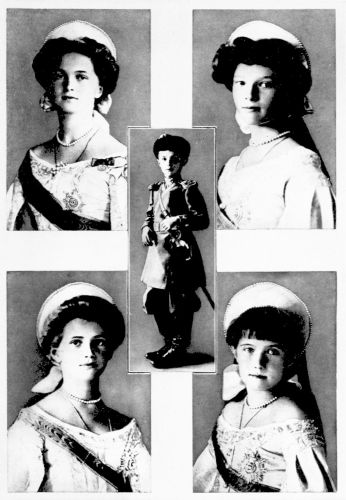
THE CHILDREN OF THE TSAR |
Grand Duchess Olga
Grand Duchess Marie |
Grand Duchess Tatiana
Grand Duchess Anastasia |
The Tsarevitch Alexis |
Photos: Boissonnas & Eggler, St. Petersburg |
Illiodore was soon
unfrocked after having spent some months as a prisoner in a monastery
far from Saratoff; but Raspoutine, in spite of his many vagaries, which
far exceeded those of Illiodore, escaped prosecution owing, it is said,
to influence in high quarters.
He was introduced to the Empress by the Grand Duchess Elizabeth her
sister, who from her convent in Moscow still exercised a great influence
over the little Court of Tsarskoye Selo. She suggested to Alexandra
Feodorovna to call to her the wandering monk, who was considered by many
people in the light of a saint, and to ask him to pray for her and for
her children—especially for the Heir to the Throne, who was the object
of her particular anxiety.
Not long after he was brought to the notice of the Empress, Raspoutine
is credited with having persuaded her that as long as he was allowed to
remain she would be safe from any danger, and her children, too, would
always remain unharmed, no matter what might occur. He managed to instil
in her the idea that it was his protection that kept the Heir to the
Throne in good health, and that if he were to be sent away from the
Palace something would happen to the child. So intimate became his
ministrations that whispers were heard, and the matter became a general
subject of conversation among the public, even in far-off provinces.
Newspapers began to make allusions to it in veiled words, and it was
severely discussed in the Duma.
M. Stolypin, who was still alive, tried to send the monk away from St.
Petersburg, but after he had been assassinated Raspoutine came back, and
his influence became stronger than ever. Nevertheless, talk became so
pointed that when the President of the third Duma, M. Rodzianko, was
received in private audience by the Emperor, he ventured to make a
remark about Raspoutine and the gossip to which his perpetual presence
at Tsarskoye Selo gave rise. Nicholas II. became immediately angry, and
told M. Rodzianko in severe terms that no one had the right to repeat
idle tales about the private life of his family.
Nevertheless Raspoutine was sent away for some time. He left the capital
for his native village in the wilds of Siberia, and for a period nothing
was heard about him. Then last autumn the Heir to the Throne fell ill at
Spala, and the Empress, who was quite frantic, cried out aloud that this
misfortune had happened because they had sent Raspoutine into exile. The
monk was recalled, and he was once more admitted into the intimacy of
the Imperial Family. He is always at Tsarskoye Selo, but his presence
there is kept secret, so that a good many people are not even aware that
he has returned. But his influence remains the same, and it is
maintained that the Empress is more convinced than ever that it was his
prayers that saved her son during his last severe illness.
A lot of rubbish has been written about the illness of the Tsarevitch,
and the most stupid tales have been circulated. The reality is sad
enough without exaggeration making it worse. The child, who has been
very delicate ever since his birth, suffers from an organic disease of
the arteries, which are liable to rupture upon the slightest provocation
and even without cause. Already, three years ago, he had to undergo an
operation, which was performed by Professor Fedoroff, one of the doctors
who treated him in the autumn of 1912. The fact was kept secret from the
public. Every effort was made to keep secret the state of health of the
little boy, and to prevent the world from guessing that it gave rise to
uneasiness if not to real anxiety. The child was worshipped by his
parents, who for ten years had been waiting for that son upon whose
existence so much depended. When at last he was born he became an idol
both for his father and for his mother, and indulged to such an extent
that it marred his temperament, converting him into a peevish,
disagreeable child. Every whim he had was gratified at once, and all his
innumerable caprices were obeyed. The result, as can be imagined, has
been disastrous.
Generally children born to exalted positions are brought up with the
utmost care as regards their moral training and their education. The
little Tsarevitch was surrounded with the utmost vigilance, but
unfortunately that vigilance was exerted only in the direction of his
health and his safety. Training he receives none, and education very
little.
The Grand Duke Alexis is now about nine years old, but up to the present
no tutor has been appointed to him. He gets a few lessons from his
mother, and once or twice a week a master comes to teach him how to read
and write; but his only attendant is a sailor, who follows him about
everywhere, and who is at the same time his nurse and his tutor and his
guardian. The man is of common birth, and though perhaps very devoted to
his charge, yet can hardly be considered as the proper trainer for a
future Sovereign. But neither the Emperor nor the Empress thinks it
necessary to give to their only son a tutor of appropriate rank or
birth.
From morning to night the Tsarevitch is told that his existence is so
precious to his parents that no caprice of his is to be allowed to pass
without being at once gratified. He is constantly impressed with his own
importance, and already knows very well his rights, though he entirely
ignores his duties. Arrogant by nature, this arrogance is fostered
instead of being corrected. No one is allowed to rebuke him, or even to
contradict him. The Tsarevitch beats his sisters, tyrannises over his
servants, and whenever anyone attempts to correct him he instantly
threatens the unfortunate person with all kind of punishments.
His entourage, as well as those of his father and mother, do nothing but
flatter him. No one seems to think of the evils such a system of
education carries along with it, nor to reflect on the fate that menaces
the Russian Empire should it ever come to be ruled by the spoilt little
boy who now is Heir to the Throne of the Romanoffs.
A few years ago an anecdote was circulated everywhere in St. Petersburg
concerning the small Tsarevitch. It seems that one morning Ministers
were waiting to be received by the Emperor at the Palace of Tsarskoye
Selo. Among them was M. Izvolsky, at that time head of the Foreign
Office. He was talking with another person seated next to him, and did
not notice the Tsarevitch, who happened to run through the room. The
latter instantly went up to M. Izvolsky, and in an imperious tone told
him that “when the Heir to the Throne crosses a room Ministers ought to
get up.” M. Izvolsky became so confused that he did not know what to do
or to say, and his confusion became still worse when, a few moments
later, the Emperor, at the end of the audience which he granted to him,
asked him what misunderstanding he had had with the Tsarevitch. M.
Izvolsky hardly found words to explain, and Nicholas II. told him then,
with evident pride, “Yes, later on you will find it harder to deal with
my son than with me.”
The incident is characteristic, as it shows that the Tsar never realised
the importance of the words spoken by his little son. A far-seeing
father would have severely rebuked the child for his insolence, and told
him that at six years old one ought to learn one’s lessons and not make
remarks to people whose age and position entitled them to respect; but
Nicholas II. was only struck with what appeared to him to be the spirit
of independence shown by the Tsarevitch.
Another anecdote was related about the Tsarevitch. It seems that he is
always very eager to be saluted by the soldiers whom he meets, and by
the regiments assembling at reviews. Now etiquette in Russia exacts that
when the Sovereign is present he only is saluted by the troops. The boy
did not like this, pride being thus rebuked, so that whenever he was
present at a parade, such as takes place at Tsarskoye Selo on the days
when a regiment celebrates its religious feast, he used to run in
advance of his father so as to be saluted before the soldiers perceived
their Sovereign. This was noticed, and upon the representations of the
Grand Duke Nicholas, who told the Emperor that the troops got so
confused at this that they did not know what they were to do, or who
they were to salute, the Tsarevitch was forbidden to leave his father’s
side.
In spite of a system of education which is only directed towards the
care of his person in the physical sense, the little Grand Duke does not
grow a healthy child. Perhaps his delicacy is in part responsible for
his peevish temper; perhaps it only proceeds from the mistaken way in
which he is being brought up. But most certainly the boy is constantly
ailing. His mother watches him day and night, and he is her only care;
doctors are seldom absent from his bedside, his father forgets
everything if his little son has an ache, but all this does not give the
Tsarevitch good health. For some years now the Imperial Family have
spent months at a time at the Crimea in the hope that the sojourn in a
mild climate will do away with the child’s weakness, and help him to
attain better health. But nothing seems to help; indeed, in the autumn
of 1912 it became impossible longer to hide from the public the state
of health of the Emperor’s only son. Even then, however, the precise
cause of his illness was not revealed, and deceptive bulletins were
published, and such mystery surrounded the illness of the little boy
that it gave rise to all kinds of silly tales which were circulated
abroad and in Russia, among people who had no means of coming into
contact with the Imperial Family or with Court Society in St.
Petersburg.
As I have said already, the truth is sad enough, because it is
considered certain that there is very little hope that the Tsarevitch
will reach manhood, and this knowledge impels heartfelt sympathy towards
his parents, who, after having longed for so many years for the birth of
this heir, now have to resign themselves to the probability that his
days are numbered.
It is in part that sad knowledge which makes the Empress so
extraordinary in her ways, and so inclined to call every possible help,
whether mystic or material, which even faintly gives the barest
possibility of saving her son. It also explains why she has become so
strange, and hates so much to see anyone, or to take part in any
festivity, even for the sake of her daughters. Of these the two eldest
ones are already grown up and lead sad lives, never being permitted to
enjoy themselves as girls of their age generally do. Rumour will have it
that the eldest, the Grand Duchess Olga, will soon be married, and one
can only hope that for once rumour does not lie.
It was a bleak and wet though not cold winter morning to which St.
Petersburg awoke on March 6th, 1913. For weeks people had talked about
what the anniversary would mean to Russia, and had been eagerly awaiting
it. For it was to commemorate the momentous events that had taken place
three centuries before, when the deputation of the Boyars of Moscow,
headed by its venerable Patriarch, had set forth for the distant town of
Kostroma, to offer the crown of the Ruriks to the young son of the two
victims of the cruel Boris Godounov, the monk Philaret Romanoff and his
wife Martha the nun, who had been thrown by Boris into cloisters whence
he had never expected to emerge. How many important events had taken
place in the history of Russia since that memorable day! and how closely
the Romanoff Dynasty had identified itself with the nation that had
called them to its head in those troubled and dark times, when it had
seemed that the country was going to fall for ever under the Polish
yoke! How many sad and terrible, how many glorious pages also had been
added to the book of its history! Truly it was an anniversary to be
rendered for ever memorable.
Had Nicholas I., his son Alexander II., or the late Tsar been alive, it
is probable that some stupendous work of charity, as well as a wide
political amnesty, would have marked that day. The public expected some
such thing to happen. It hoped that some lasting monument would be
raised by the initiative of the Sovereign, to render it for ever
memorable; that mercies should be shown, miseries relieved, tears dried,
an impulse given both to public and to private charities; something
attempted to raise the moral standard of the people by the creation of
new schools and educational establishments. In short, they expectantly
hoped that the monarch would look from the height of his Throne to where
so many needs waited to be satisfied, where so much was expected to be
done, and had to be done if Russia was to emerge from her present state
of semi-barbarism to take her place among the nations. Not only in
political and social spheres did dire need exist, but also and
especially exigent was the education of the lower classes, which at
present constitute in Russia such a dangerous element in her social
fabric, and who threaten to overturn the present order of things without
being able to replace it by anything rational.
Nevertheless, March 6th was destined to overthrow all these hopes. The
manifesto published upon that occasion disappointed everybody, even
those who benefited by it. People had expected as a certainty that a
wide political amnesty would wipe off old scores, allow old grievances
to be forgotten, and permit people to begin their lives over again. One
had hoped that on the morning of that spring day some who were living
far away in the country of eternal snow and ice would wake up to the
realisation that their exile was over, that henceforward they would be
free to return to their old homes. Another had believed that the words
of the nun Martha, when she blessed her only son on his being called to
the Throne, and wished him to reign for the peace and joy of his people,
would be remembered by her descendant, and that he, too, would wish to
bring peace to those who trusted him and his instincts of mercy. But all
these hopes, these tremulous anticipations, these flickering visions of
mercy and peace, failed of realisation.
Any Sovereign placed in such exceptional circumstances would surely have
had the impulse to do something for the nation in order to improve the
general conditions of its existence. Such thoughts may have animated
Nicholas II., but if they did they died before they were given
expression. A large gift of a few millions coming from his private purse
would have made him none the poorer, and would have brought again to him
the popularity which he had been steadfastly losing ever since the day
of his accession to the Throne of the Romanoffs. That sum, spent in
building new schools, or even hospitals in various large towns in
Russia, would have made his name and person popular all over the
country; would have brought him blessings and thanks from millions of
poor people whose needs, physical and moral, such a gift would have met.
But apparently no such idea occurred to him or to his Consort. On March
6th their only thought was to admire the decorations and the bunting
displayed in the streets of the capital; they accepted the addresses,
felicitations, and gifts of their subjects. For all the outward
expression evinced they never, even for one single moment, gave their
attention to the fact that in return for what was presented to them they
also ought to give something to those who offered them all that was in
their means to give.
The amnesty so solemnly promulgated proved to be nothing less than a
farce. All the thieves and common malefactors who were crowding the
prisons of St. Petersburg and the other towns of the Empire were set
free, but the political exiles, men of culture and the highest civic and
private virtue, were left to their sad fate, with only their sorrow and
their despairing memories.
There was one personage who had been the object of the general pity
because a feeling of honesty, unknown generally in a man placed in the
position he was in at the time of his fall and condemnation, had led him
to tell the truth about the conduct and machinations of the political
police of which he was the head. M. Lapoukhine had been followed into
his exile by the sympathy not only of those who knew him well but also
of many persons who had never seen him. It was felt that he was a victim
of a corrupt order of things, perhaps also of private revenge coming
from such high quarters that one could not even mention them. One had
fully believed that the three hundredth year of the reign of the
Romanoff Dynasty would bring him a free pardon and the right to take up
once more his place in a Society that had never excluded him from its
midst. But March 6th came and went, and nothing was heard about this
unfortunate man, and this indifference to his fate raised such a storm
of indignation everywhere that even the feelings of loyalty of many
which until then had never wavered began to be shaken in presence of
this arrant injustice.
A few days later, however, the mistake was rectified, and M. Lapoukhine
was allowed to leave Siberia; but the first impression could not be
corrected. It was felt that this act of mercy, coming as it did after
the time it was hoped for, was robbing it of its whole grandeur and
generosity. On the Jubilee Day it would have raised a universal
acclamation; a week later, it fell flat, because it appeared to have
been merely compelled by the general indignation evoked by its neglect
on an occasion when peace and pardon ought to have been in the forefront
with a strength that no circumstance and no advice from any individual
should have been able to restrain.
The only point in which the amnesty satisfied the public was its
application to all matters relating to the press and its misdeeds.
There, for the first time in the history of modern Russia, the pardons
granted were complete and without restrictions, and the satisfaction
which they provoked was absolutely sincere and heart-whole.
It is one of the misfortunes of Nicholas II. that he is so badly advised
by those who surround him.
The festivities themselves provoked no enthusiasm from the crowds. They
were damped externally by the rain, which fell in torrents during the
whole time they lasted, and morally by the disappointment provoked by
the manifesto. The streets were sumptuously decorated, the illuminations
in the town were splendid, the ball offered by the nobility of the
province of St. Petersburg to the Sovereigns was like fairyland in its
magnificence, but the nation remained indifferent. Its feelings were not
in unison with the spirit of the celebrations; it did not share with the
Imperial House the joy that House seemed to feel upon so auspicious an
occasion.
The jubilee celebrations had, however, one distinguishing feature. The
Emperor and his family came from Tsarskoye Selo, and for the first time
since the war and the revolution resided for three days in the Winter
Palace. On March 6th they drove in state to the Kazan Cathedral for a
solemn service of thanksgiving. All the wealth and rank of St.
Petersburg were assembled there to greet them. All the high
functionaries of the Empire were present. Troops were assembled and
lined the streets through which the Imperial procession passed. Their
cheers alone, however, broke the stillness of those streets, for the
populace was absent. Except a few chosen persons, police, and soldiers,
none was present from the nation, which thus tacitly declined to
participate in the festival. The Emperor himself looked grave and pale.
He drove in an open carriage, with his little son seated beside him,
and when he entered the cathedral a Cossack from the escort took the
child in his arms and carried him inside the church, where he was placed
in a chair beside his mother. The sight was inexpressibly sad, because
it proved the truth of what had been whispered ever since the autumn,
that the Heir to the Throne was still suffering from disease. The white,
pinched, small face of the boy, gazing anxiously round him at all the
sea of human beings before him, engrossed with the beauty of the
unaccustomed pageant, painfully impressed the spectators in the
cathedral, and many a mother among the ladies present sighed as she
looked at him, murmuring to herself, “Poor little fellow, what a pity,
and how sad for the parents!”
The members of the Imperial Family who had preceded the Sovereign to the
cathedral bowed profoundly as he appeared through the huge doorway. The
Patriarch of Antiochus, who had specially travelled to Russia for this
important occasion, advanced, surrounded by priests, monks, bishops, and
members of the higher clergy, whose flowing hair, long beards, golden
robes, and heavily bejewelled mitres added to the picturesqueness of the
spectacle. Everywhere one turned the eye rested on embroidered uniforms,
glittering cuirasses, ladies attired in white, lighted tapers, and ikons
shining forth in the semi-darkness of the vast cathedral, with the glory
of the diamonds and precious stones which adorned them. The choristers
intoned the anthem for the day in soft harmonies, which gradually grew
louder and louder; whilst Nicholas II. and his Consort, bending down
before the Patriarch, received from his hands the Holy Water which he
presented to them, and kissed the Cross with which he blessed them.
Then they took up their places under the crimson canopy, which had been
erected in their honour opposite the altar, and facing the miraculous
image of Our Lady of Kazan, patroness of the church and of Russia. They
stood there together, the Emperor erect, and with a glance that kept
anxiously and furtively scanning the faces of the assembly as if afraid
of meeting some secret danger lurking somewhere behind the pillars of
the edifice; the Empress robed in white, with the blue ribbon of St.
Andrew across her shoulder, sadness upon her classically beautiful
features, was immobile as a statue, save when she bent down now and then
over the arm-chair in which her little son had been placed. Standing a
little before her, on the right side of Nicholas II., was his mother,
the sweet Empress Marie, also dressed in white, with tears filling her
beautiful soft eyes, the only pathetic figure in the vast assemblage
save the child on whom so many hopes were centred, and who, by an irony
which perhaps was realised by few among the spectators, appeared to have
been brought there for the purpose of showing into what weak and frail
hands was entrusted the future of that proud Romanoff Dynasty.
The head of it remained in his place throughout the Divine Service of
thanksgiving, which was celebrated by all the bishops. He, too, bent his
knee with his subjects during the blessing with which it ended, and then
slowly he left the cathedral. As he appeared on its threshold a fleeting
ray of sun rested on his head. It reminded me of that other glorious
light that on an occasion perhaps even more solemn had hovered above the
brow of his father Alexander III. as he emerged from the golden gates of
the Church of the Assumption in Moscow, with the huge diamond crown of
his ancestors which he had just assumed resting upon it. Nearly thirty
years had gone by since that day; the mighty Tsar was lying in his
quiet grave, and nearly all those who had accompanied him on that
memorable day had also disappeared from this earthly scene. Nearly
everything had been changed, but the places and people who knew him no
more were weeping for him, even amidst the pomp of the present festival.
As I examined the pale, impassive features of his successor, I wondered
whether he gave a thought to another bleak March morning, when, still a
boy, he had waited, together with his brothers and sisters, for the
return of his parents from the Winter Palace, where they had been
summoned to see a monarch die whose Crown they were to inherit. Did he
remember, I wondered, the first words uttered by the new Sovereign when
receiving the bread and the salt with which his servants greeted him on
his entering for the first time his Anitchkov Palace as the Tsar of All
the Russias, “I will try to be a father to my people.” As the memory of
those words rang in the ears of the few among that vast company who had
heard them, what a melancholy contrast they afforded to the actual
“mercies” with which Nicholas II. had seen fit to celebrate the three
hundredth year of the accession of his Dynasty to the Throne of the
Ruriks.
As I watched the brilliant procession pass before me, I thought, too, of
that other far-away May morning which had witnessed the Coronation of
Alexander III.; of the peace and prosperity which his short reign had
brought to the vast Empire over the destinies of which he had so wisely
presided. Whither had fled that peace he had tried so hard to establish
permanently within his realms? The eighteen years that had elapsed since
his death had only brought disaster, strife, uneasiness to the nation he
had loved so well.
Whatever have been the faults of the Romanoffs, whatever mistakes they
may have made, whatever cruelties they have been responsible for, no one
can deny that they have been strong men. Fearlessly reckless sometimes,
but always sincere in their convictions and their love for their people,
never indifferent as to their fate and welfare. The present Tsar is the
first representative of their race in whom weakness and indecision find
themselves allied; the first whose existence practically counts for
nothing in the eyes of his many subjects, whom they neither respect,
fear, nor hate.
This indifference as to the importance of his person has never been more
apparent than on that wet morning of March 6th, when he left the Kazan
Cathedral to return to the Winter Palace, after having rendered his
thanks to the Almighty for the protection accorded to his ancestors as
well as to himself. The festival celebrated on that day was in no sense
a popular one, nor did it leave any definite impression. The nation was
simply interested, and perhaps in a certain degree amused, owing to the
amount of bunting displayed during the day and the number of lamps
lighted at night in honour of the occasion. Cheers of the kind these
gauds provoke were heard, it is true; but sincere enthusiasm was totally
lacking. And when, two days later, the Emperor, while attending the ball
given in his honour by the nobility of St. Petersburg, replied to the
address of welcome and loyalty with which they received him, the very
tone in which his words were uttered seemed to be utterly wanting in
firmness or conviction. True, the National Anthem was sung in reply to
the speech of the monarch, and was sung with eagerness perhaps, as one
might expect from the cultured imagination of such an assembly. But one
felt, just as much, that this eagerness was imposed by circumstances,
not that it proceeded from one of these inspirations which happen
sometimes in the life of nations and unite it in one thought and one
hope.
The words, as they solemnly called upon the Almighty to protect the
Tsar, sounded almost defiant, but by one of those strange ironies which
happen so often in life, they appeared only too appropriate to the needs
of the situation as they remain at present; for never, believe me, in
the whole history of Russia did a Sovereign more need the protection of
the Almighty than His Majesty Nicholas II., Emperor and Autocrat of All
the Russias, does now, in this nineteenth year of his sad and
unfortunate reign!
THE END
Printed by Cassell & Company, Limited, la Belle Sauvage, London, E.C.