From previous chapters of mine it is evident
that Mr. Emerson’s suggestion about hitching
your wagon to a star is fraught with
certain dangers. I had harnessed the Goldwyn
Company to that steed, and my ride had been anything
but a smooth one. Is it any wonder, indeed,
that after the various disappointments attending
my exploitation of “big names,” I began to distrust
the wisdom of my course? Gradually there grow
up within me a belief that the public was tiring of
the star and a corresponding conviction that the
emphasis of production should be placed upon the
story rather than upon the player. In the poverty
of screen drama lay, so I felt, the weakness of our
industry, and the one correction of this weakness
which suggested itself to me was a closer co-operation
between author and picture-producer.
In 1919 this idea eventuated in an organization
for which I must claim the virtue of absolute novelty.
This organisation, under the name of “The
Eminent Authors,” included such popular American
writers as Rex Beach, who assisted me in the
development of my literary fusion; Mrs. Gertrude
Atherton, Mary Roberts Rinehart, Rupert
Hughes, Basil King, Gouverneur Morris, and
Leroy Scott. Under the terms of my contract
with each individual of the group the author was
to come to Hollywood to write in direct co-operation
with the Goldwyn studios.
So great was the publicity attending this movement
for the production of more inspired screen
dramas that the Famous Players-Lasky Company
followed our lead by organising a similar literary
service. Whereas, however, we had been content
with local talent, our competitors imported their
authors from Europe. Elinor Glyn, Sir Gilbert
Parker, Edward Knoblock, Arnold Bennett—these
were the high spots in the rival camp. When you
consider that Gene Stratton-Porter and Zane Grey
had both been signed up by other California producers
and that ultimately Kathleen Norris, Rita
Weiman, and Somerset Maugham joined the cohorts
of the pen, you will see why Hollywood was
temporarily transformed from a picture colony to
a picture-book colony.
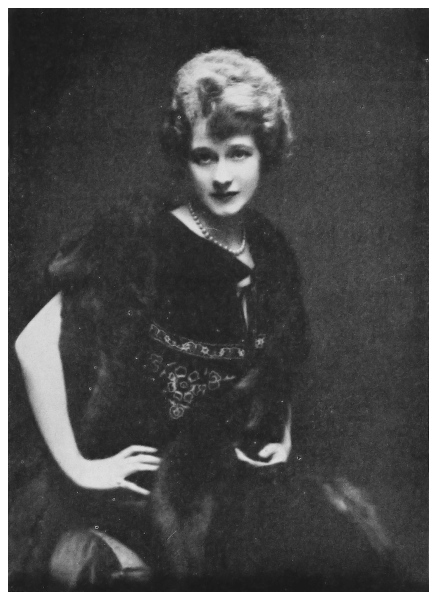
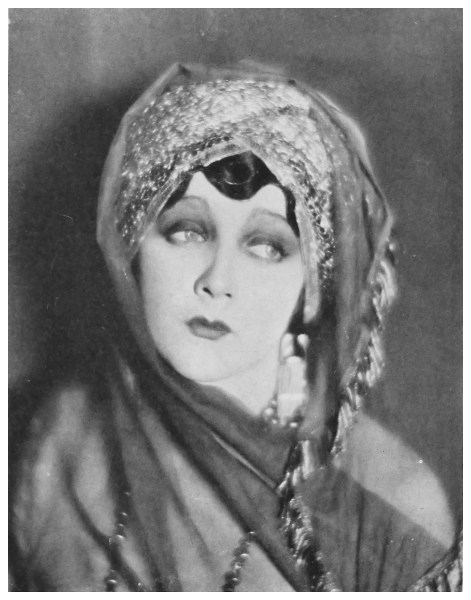
Among all the literary names which have impressed
Hollywood tradition that of Elinor Glyn
is undoubtedly the most spectacular. One evening
before dining at the Fairbanks home Douglas
took me out for a walk through his beautiful
grounds. As we came to the famous swimming-pool
I caught sight of a woman seated on one of the
stone benches and gazing pensively into the water.
The evening sun caught in reddish hair—whether
these tresses are a gift or an acquirement is often a
theme of speculation—and in girlish folds of sea-green
chiffon. And as the woman lifted her eyes
I saw that these, too, were sea-green.
“That’s Elinor Glyn,” whispered Fairbanks;
“she’s dining with us to-night.”
In a spirit of great curiosity I began my conversation
with the Circe-looking woman to whom sun
and pool and sea-green chiffon lent an atmosphere
of which she herself was perhaps not altogether
unconscious. She was exceedingly gracious and
cordial, but as she talked I could not help making
a few inward observations on her manner of speaking.
She has the trick, so I found, of convincing
you that her voice is some far-away, mysterious
visitant of which she herself supplies only a humble
and temporary instrument of escape.
For example, when she remarked, “Isn’t this pool
beautiful?” it sounded like some lonely Buddha’s
prayer echoing down through the ages from the far
heights of Tibet.
After the dinner was over our host and hostess
offered their customary method of release from “the
cares that infest the day.” Pictures were turned on,
and in this case the selection happened to be Mrs.
Glyn’s story, “Her Husband’s Trademark,” in
which Gloria Swanson took the leading rôle. I can
truthfully say that never in my life have I enjoyed
any film so heartily. This was due, not to the
character of the performance, but to the remarks
which garnished its entire unfoldment.
“See that frock,” whispered the author eagerly
as, sitting beside me, she pointed to one of Gloria’s
creations; “I designed that gown.”
Another second and she was calling attention to
the finish of a certain setting. “Do you see that?
An exact copy of my rooms in London. Do you
suppose they would have known how to arrange a
gentlewoman’s rooms if it hadn’t been for me?”
But there were other times when this robust
major of self-congratulation shifted to a minor
chord. “Ah, how terrible, how shocking!” I heard
her moan several times. “All wrong, all wrong—they’ve
ruined that scene. I might have known it.
I was away that day, you see.”
Verily that evening the “silent drama” renounced
its salient characteristic!
Apropos of this incident, it may be interesting
to learn that Mrs. Glyn took the greatest personal
interest in Miss Swanson. True, her first comment
upon this screen celebrity, a comment quoted uproariously
by many of the picture colony, indicated
that she found Gloria lacking in that subtlety which
she considered essential for the portrayal of her
heroines. If that comment was made and not
merely attributed to the author, her later attitude
to Miss Swanson would seem to reflect the joy of
any creator in the challenge offered by apparent intractability
of material. Be that as it may, I am
informed that Mrs. Glyn started in with a right
good-will upon the task of guiding the young
actress in her literary taste, her clothes, her deportment,
and her speech.
During that Summer when I first met Mrs.
Glyn I had a house on the beach in California.
Here I did a great deal of entertaining, and among
these entertainments a dinner which I gave for
Nina Wilcox Putnam represents the enthusiasm
with which Hollywood took up the game of authors.
For Elinor was only one of the many writers who
mingled that evening with the luminaries of screen
and stage. That she was not the most retiring of
her craft is a statement bound to be accepted immediately
by those familiar with her talent for
being a dinner-guest. As a matter of fact, Mrs.
Glyn is one of the greatest social assets I ever knew.
Not only may she be relied upon always to wear
the most exquisite of gowns, but her narratives and
her comments usually keep a whole roomful of
people in an uproar of mirth.
That evening I discovered that she is an ardent
believer in the transmigration of souls, and her
theories regarding the former bodily tenements of
some of the individuals present caused constant
flurries of laughter. I think her psychic inquests
began with Mrs. Kathleen Norris. For a long time
she fixed upon this celebrated author a gaze which
informed the rest of us how completely she had
retired into realms where we could never follow her.
Then abruptly, with the familiar effect of a voice
which had journeyed far, far before it chose Elinor
Glyn for its channel, she said:
“Now I know—centuries ago you were a man—strong,
valiant, resolute. I see you leading your
armies—bravely you led a forlorn hope. Perhaps
at the last they turned against you—they stabbed
you, who had brought them to the heights of
victory.”
We had hardly convalesced from this revelation
of Mrs. Norris’s masculine and unfortunate past
when the psychic Boy Scout began to turn up old
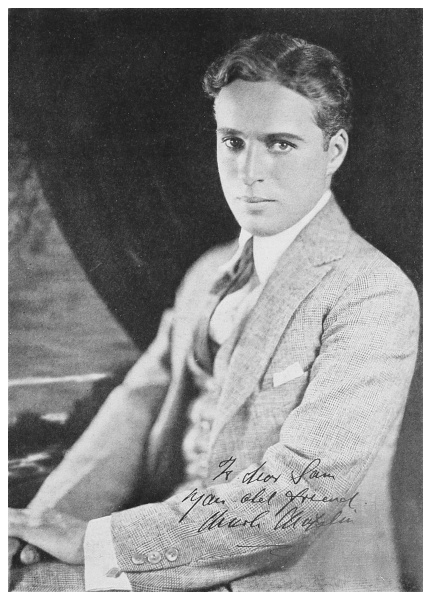
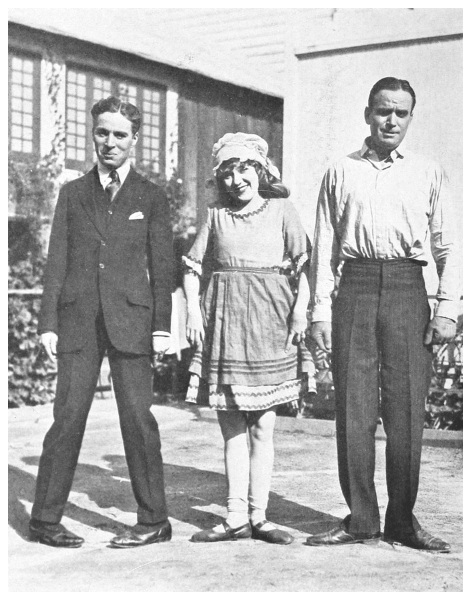
trails in Charlie Chaplin’s consciousness.
“An old, old soul,” she pronounced, emerging
from the same sort of trance which had redeemed
Mrs. Norris’s former earthly abode from the mists
of obscurity. “You—you were a princess. Thousands
of years ago you reigned over many in some
far Eastern land. You loved the music played by
your slaves on their stringed instruments, the soft
scent of flowers brought to you by the winds, the
moonlight as it fell on the oars of your galleys——”
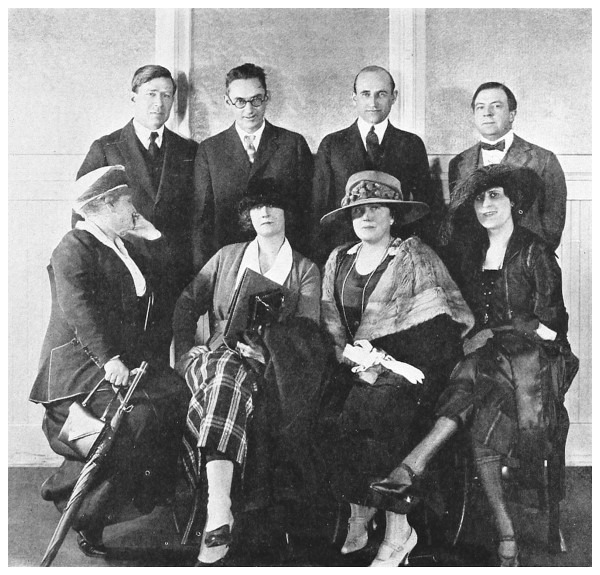
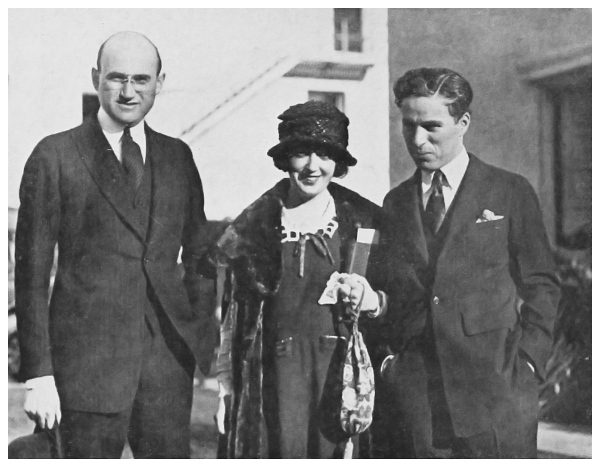
SAMUEL GOLDWYN AND SEVEN FAMOUS AUTHORS
HE WON TO THE SCREEN
Left to right standing: Leroy Scott, Gouverneur
Morris, Samuel Goldwyn, Rupert Hughes. Sitting:
Gertrude Atherton, Katharine Newlin Burt, Mary
Roberts Rinehart, and Rita Weiman.
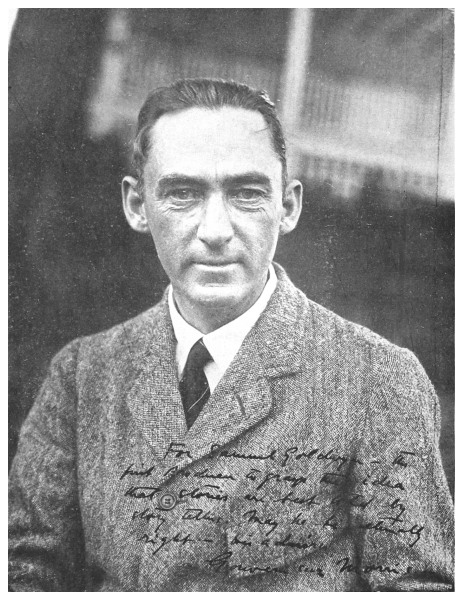
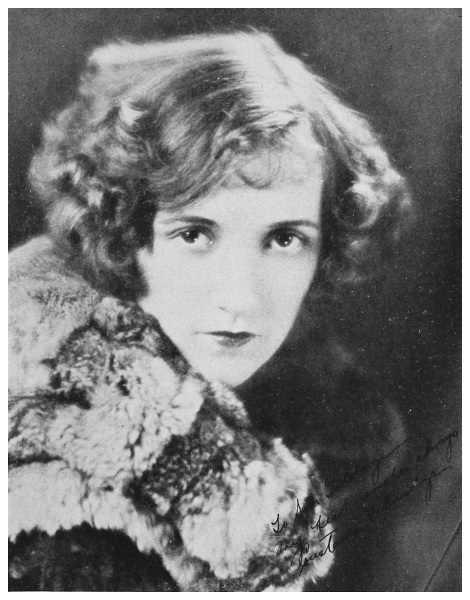
GOUVERNEUR MORRIS
One of the noted authors won to the screen by Mr.
Goldwyn.
Charlie may have had a number of similar tastes
back in that remote incarnation of his, but I don’t
think they were brought to light. For the roars of
merriment which greeted this presentment stilled
the voice of the seer. To this laughter Charlie himself
contributed most heartily. In fact, I don’t
believe any one ever laughed at Chaplin quite so
hard as Chaplin laughed that evening at Elinor
Glyn.
Regarding the introduction of these two an
amusing story is current in California. It is reported
that on this occasion Mrs. Glyn said to the
comedian, “Dear, dear, so this is Charlie Chaplin!
Do you know you don’t look nearly so funny as I
thought you would?” To this reassuring message
Chaplin is said to have responded promptly,
“Neither do you.”
To go back to my dinner. After Mrs. Glyn had
concluded her report upon previous abodes of the
ego, our conversation drifted toward the profession
engrossing our present incarnations. Pictures!
The topic was started, I believe, by Miss Elsie Ferguson,
who at that time was working with the
Famous Players-Lasky Company. To her announcement
that she did not like her leading man
of the moment, Mrs. Glyn turned a swiftly
sympathetic ear.
“My dear,” said she, “what do they know about
soul, about art, about poetry? Blind, absolutely
blind! The other day I took the loveliest young
man to see them—he had the most beautiful eyes—but
they didn’t see it—they didn’t appreciate it.”
This verdict regarding my competitors’ callousness
to the finer issues of life is not to be taken too
seriously. For Mrs. Glyn was then in the midst of
that period of disillusionment which seems almost
inevitable in the career of the author who tries to
adapt his manuscripts to the screen. Out of the
depths of my own experience I can speak of the
friction which arises among author, producer, star,
and director.
I thought that I had encountered some eminent
difficulties before I organised the Eminent Authors;
but when the Goldwyn Company introduced
this literary faction in the fold, I was to look back
on other days as being comparatively placid. This
fact does not reflect upon the personalities of those
writers whom we engaged. Socially, each one of
them is a delightful being; but when the tradition
of the pen ran athwart the tradition of the screen
I am bound to say that I suffered considerably
from the impact.
The great trouble with the usual author is that
he approaches the camera with some fixed literary
ideal and he can not compromise with the motion-picture
view-point. He does not realise that a page
of Henry James prose, leading through the finest
shades of human consciousness, is absolutely lost
on the screen, a medium which demands first of all
tangible drama, the elementary interaction between
person and person or person and circumstance.
This attitude brought many of the writers whom I
had assembled into almost immediate conflict with
our scenario department, and I was constantly
being called upon to hear the tale of woe regarding
some title that had been changed or some awfully
important situation which had either been left
out entirely or else altered in such a way as to ruin
the literary conception.
Nor did this end the difficulty. For often the
author and the star became hopelessly entangled in
similar controversies. This latter situation is deftly
suggested by Will Rogers when he says, “I was on
the lot the last year of the reign of the Eminent
Authors and, while I helped spoil none of their
stories, I made various ones for the near-Eminents
and lost the friendship of every living one of whose
stories I made. So now,” adds Will, “I have made
Washington Irving’s Ichabod Crane. I am off all
living authors’ works—me for the dead ones!”
Undoubtedly the warfare which so frequently
wages between star and author is to be attributed
many times to the inflexibility and prejudice of the
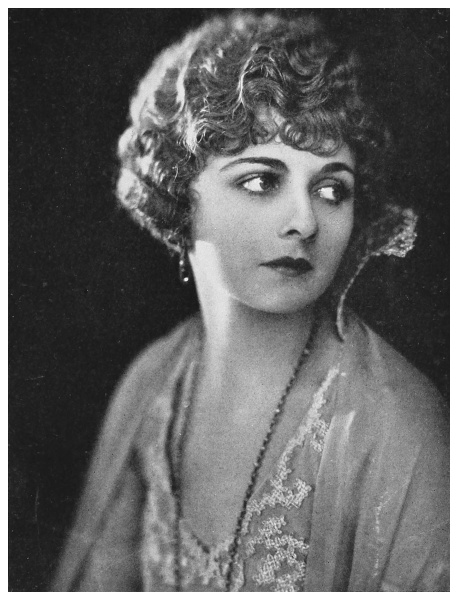
former. Thus I remember hearing Miss Rita Weiman
tell of an interchange of thought between
Nazimova and herself regarding the production of
a certain story in which the one figured as author,
the other as actress.
“I hope the time is coming,” concluded Nazimova
haughtily, “when the great actress may find great
stories.”
“Ah, yes,” rejoined Miss Weiman, “I hope, too,
the time is coming when the star may write her own
stories.”
In contrast to this attitude of the Russian actress
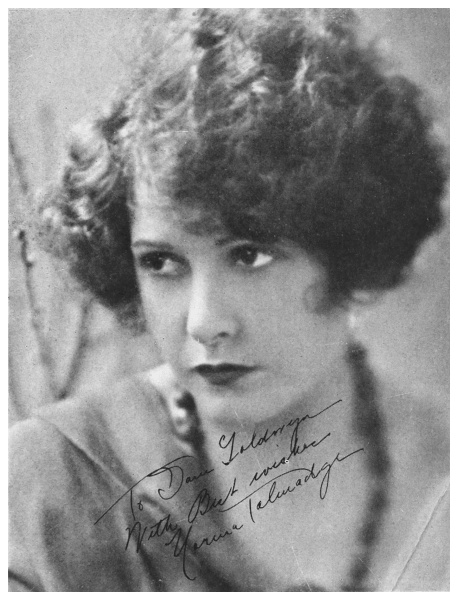
is the humility which Norma Talmadge displayed
in her interpretations of Benavente’s “The Passion
Flower.” I have been told that everybody, including
her husband and her director, advised against
the screen preservation of the drama’s tragic end.
They urged upon her the fact that the picture audience
demands a happy ending and that she would
lose thousands of dollars by adhering to the story.
By all such practical arguments she was absolutely
unaffected.
“No,” said she firmly, “this is the story of the
greatest living playwright. He knew what he
wanted to say and who am I to spoil a great man’s
story?”
Among the writers whom the Goldwyn Company
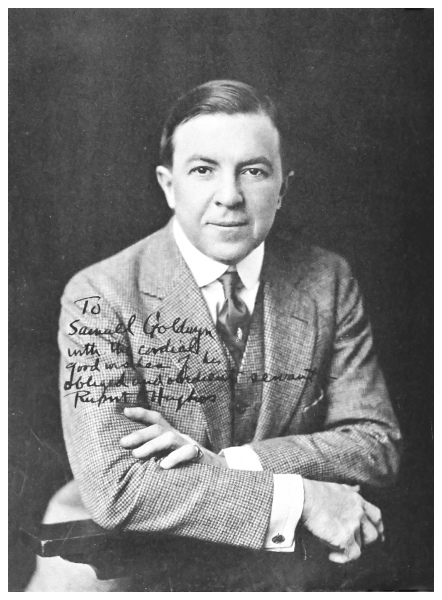
brought to Hollywood Rupert Hughes was notably
successful. His story of “The Old Nest,” grossed
our organization nearly a million dollars, and since
the production of this tale he has been actively engaged
on our lot as both author and director. For
both Mr. Hughes and his wife I feel a warmth of
friendship quite independent of the profitableness
of our business association, and some of the happiest
hours of my life have been spent in their home.
They, together with Mr. and Mrs. Rex Beach,
represent two of my most valued associations.
Mr. Hughes’s success in photoplays is to be
ascribed to his prompt recognition of the gulf between
those two channels of expression, literature
and screen, and to his determination to master both
the technicalities and spirit of the latter. In addition
to this receptiveness of mind he has a capacity
for work which I have never seen excelled. Many
times I have known him to arrive in the studio early
in the morning, direct all day, go home that evening
to work on a scenario, and then, after perhaps a
dinner or a dance, write several chapters of his new
novel.
Mrs. Glyn showed much the same zeal in her
co-operation with the Famous Players-Lasky Company.
Unlike numerous authors who have invaded
Hollywood, she was not easily diverted from the
set. So excessively did she superintend every detail
of production that “Grips” and “Props”
longed, so they say, for a more casual type of literary
lady.
“She ain’t a bit like them other authoreens we’ve
had around here,” one of the manual assistants is
reported to have grieved. “They’ll go off and leave
you alone. But she—sure an’ it’s twelve times this
day she’s had me move that one bloody bureau in
the set and still she ain’t satisfied.”
I have quoted Mrs. Glyn’s remark anent the
“beautiful young man” in whose behalf she had
made such unavailing efforts with the Famous
Players-Lasky Company. From all I have heard
this story represented with her a habitual type of
altruism. I am told that every now and then while
she was working in the studio she would approach
some good-looking chap whom perhaps she had
never seen before.
“My dear boy,” she was likely to address him,
“you’re really very charming, you know. Now I
want you to take the leading part in my new story.”
“Thank you, Mrs. Glyn,” the other would falter,
“but you see So-and-So is already cast for that
part.”
“Oh, what a shame!” would rejoin the author.
“But surely you’ll take the second part—in my
play?”
Torn between pleasure at this avidity of interest
and the pang inflicted upon any handsome actor
by the supposition that he could possibly appear in
a secondary rôle, the Adonis of the hour would
then probably retreat to some lonely grotto where
he could meditate upon the embarrassment of great
beauty.
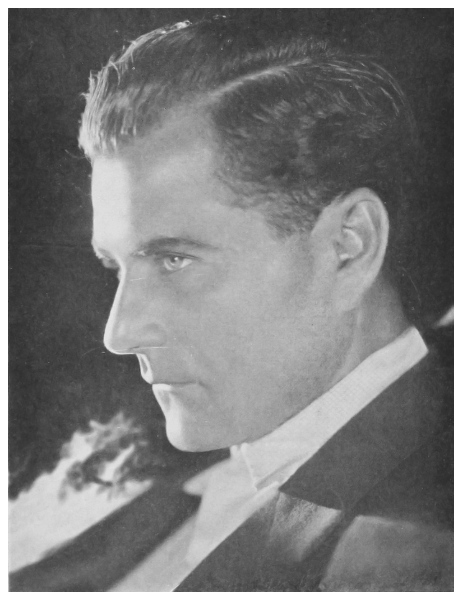
In one of the most amazing encounters of beauty
and the author, the late Wallace Reid was cast for
the leading part. Friends of Reid report that one
day while he was coming off the set he was hailed by
Mrs. Glyn.
“My dear boy”—thus she is said to have greeted
him—“you’re really very wonderful to look at.
And, besides, you know you have—It.”
“It?” Reid murmured confusedly, wondering
perhaps what his press-agents and admirers could
possible have overlooked. “What do you mean,
Mrs. Glyn?”
“Oh, that is my word. It!” she repeated in that
contralto voice which soughs through Mrs. Glyn
like the lonely wind through the pine-trees. “Don’t
you see, that one syllable expresses everything—all
the difference there is between people. You
either have It or you haven’t.”
Reid was still considering himself in this new
light of special privilege when he noticed that the
writer’s brows were puckered.
“Yes,” he heard her reflect after a moment of
such pained scrutiny, “you have It—but, ah, my
dear boy—your boots and your hair! If I could
only send you to my London bootmaker and have
some one wise cut your hair!”
Although I do not vouch for the authenticity of
this tale, I do say Mrs. Glyn’s part in it is thoroughly
consistent with several other incidents of
which I have first-hand knowledge. Does she really
mean such things or does she say them for effect?
I myself believe that she plans her personality quite
as carefully as she does her stories. When, for
instance, arrayed in the most superb evening attire
and accompanied by the handsomest man she has
been able to find in the assemblage, Mrs. Glyn
sweeps slowly through a ball-room; when she murmurs
soulfully, “Orange, orange, how I love it!
Often I sit in a room by myself and think orange.
I fill my whole soul with its beautiful, warm rays—I
drink them down into my heart—ah, orange!”—then
she is showing her supreme ability, not only
as the writer who can tell a popular tale, but as the
writer who knows how to get herself constantly
before the popular mind. I once said of her that
she was a great showman, and when she heard my
comment she was exceedingly gratified.
But underneath all this pageantry of manner is
a heart overflowing with the warmest interest in
her fellow beings. One of the waitresses at the
Hollywood Hotel, where Mrs. Glyn lived for some
time, once said to me, “Of all the people I ever
waited on Mrs. Glyn was the nicest and kindest and
most considerate. I never knew her to be cross—not
even at breakfast.”
And, after all, the only trustworthy epitaph is
composed by the person who serves us our
breakfast.
* * * * *
It was after this flock of authors had alighted in
Hollywood that M. Maurice Maeterlinck came to
America. He brought with him the pretty little
wife who had supplanted in his affections Mlle.
Georgette le Blanc. Also, a lecture. Neither of
these impedimenta prepossessed this country in his
favour. Most Americans were ranged solidly with
Mlle. le Blanc, abandoned at the peak of fame to
which she had faithfully encouraged the Belgian
author. As to his lecture, the delivery of this in
English, a language of which M. Maeterlinck knew
scarcely a word, still lives in the memory of many
New Yorkers who went to pray and stayed to
laugh.
In spite of the criticism attached to Maeterlinck’s
visit to the United States, there was so much publicity
inherent in this criticism that I felt the
Goldwyn Company might benefit through a professional
association with the distinguished foreigner.
So, arranging an interview through M.
Maeterlinck’s American manager, I had my first
talk with the visiting author in the Goldwyn’s Company’s
New York offices.
As he entered I was struck by the placidity of
that rather large face. It was round and calm as a
lake on a still August day. All our conversation
was conducted through an interpreter, and in this
manner I gathered that M. Maeterlinck viewed the
cinema with enthusiasm and was confident that he
would be able to convert his art to its uses.
“Very well, M. Maeterlinck,” responded I, “I
am anxious that we should procure exclusive rights
to your works, and I am willing to make the same
contract with you that I have previously made with
Mary Roberts Rinehart.”
The Belgian lifted his eyebrows in childlike bewilderment.
It was quite evident that the name of
our American novelist aroused no slumbering chord
of memory.
“The same then as Gertrude Atherton’s,” I
ventured.
This effort at impressiveness failed as ignobly as
my first. Indeed, mention of all the writers we
had assembled called from him only that vacant
smile, that politely groping gaze of a man being
addressed in Choctaw or Sanskrit.
It is sad but it is true that the eminence of our
Eminent Authors had never been detected by M.
Maeterlinck. He had not heard of a single name on
our list.
“Very well, then,” I surrendered at last: “I
mean I’ll give you —— thousand dollars.”
And then at last M. Maeterlinck’s face beamed
with intelligence. The dollar was one contemporary
American author with the works of which he
seemed thoroughly familiar. Indeed, I am compelled
to record that invariably in all our subsequent
intercourse the utterance of this word dollar
acted very much as a pebble thrown upon that lake-like
expanse of countenance. It created widening
circles of comprehension and cheer.
Apart from the work which we hoped M. Maeterlinck
might do for us, we featured him in a brilliant
publicity scheme. We procured a special car for
him and on this we sent him and his pretty little wife
speeding to California. The verb used here is
rather misleading. As a matter of fact, the lingering
element in his journey was the essence of our
calculation. For at every city and important town
the special train stopped and the populace was
afforded a glimpse of the celebrated author. Needless
to say, the advertising which we obtained
through the news columns of papers in visited
localities was quite overwhelming.
When M. Maeterlinck finally arrived at his destination
his train of thought proved even more
halting than the one which had brought him. From
this latter, indeed, he never landed at all—not on
the screen. His first attempt at camera material
revolved about a small boy with blue feathers and,
as I remember, a feather bed. While admitting
the importance of “trifles light as air,” the scenario
department rejected this absolutely.
“Write us a love-story, Monsieur,” suggested my
associate, Mr. Lehr, “You see for some reason or
other the fairy-story has never been popular on the
screen.”
Mr. Lehr’s information, I may interpolate, is
rooted in professional fact. The screen adaptation
of M. Maeterlinck’s most popular fairy-tale was,
for example, not a success. As for financial returns
it was certainly not the “blue bird for happiness.”
The foreign author thereupon set himself to a
less fanciful theme. This time he submitted a love-story,
but alas! the type was anything but censor-proof.
When we called his attention to this flaw he
looked at us with a pained, bewildered, almost
shocked expression.
“You ask me to write a love-story,” he remonstrated,
“and then you object because my hero or
my heroine is married. Yet how can you write
about love when you have no triangle?”
And I don’t think we were ever quite successful
in shaking him from this Continental orthodoxy.
I dare say he will always think of two parallel lines
as exceedingly provincial.
While he was in Hollywood M. Maeterlinck had
a home with a tennis-court in the rear. To this
court clings one of the most cherished memories of
Hollywood, for on it frequently appeared Mme.
Maeterlinck, and on Mme. Maeterlinck always appeared,
not a skirt, but bloomers. She is a charming
little dark thing, years younger than her husband,
this Mme. Maeterlinck. The pair seemed
always very happy together, but one day I heard
something which opened up an inevitable vista
before me. On that day the American manager of
the foreign author came to Mr. Lehr and asked him
if there was not some employment in the studio
for Mme. Maeterlinck.
“Why, no,” responded Mr. Lehr; “I can’t think
of a thing she would do.”
“Not some little job?—it really doesn’t matter
how small,” urged the other.
“But, my dear fellow, why should the wife of M.
Maeterlinck be wanting any kind of a job?” questioned
my associate, still untouched by this new
plea for Belgian relief. “Her husband is far from
poor, you know. Hasn’t he an estate and investments
abroad—those and all the royalties he is
getting? Besides, of course, he have given him an
advance on his contract with us.”
The manager shrugged and then he smiled—a
sapient smile. “To be sure. But madame—well,
there are times perhaps when she longs for a little
money of her own so she can snap her fingers at
Monsieur.”
This dialogue, taken in connection with other
phases of my association with Maeterlinck, persuades
me that this creator of reverent prose and
mystic drama is afflicted with the same economic
fixation—I borrow the term from psychoanalysis—which
manifests itself so often among those whom
some art has enriched. Screen stars and actresses,
comedians and tragedians, singers and writers—often
in thinking over those whom I have met I have
been struck by the number who would be capable
of instructing Benjamin Franklin in the ways of
thrift.
I remember that once I asked a man who had
long been associated with Ben Turpin, the widely
known cross-eyed comedian, what sort of chap
Turpin really was.
“Well,” said he laughingly, “he’s this sort of a
chap. He makes a lot of money and he keeps almost
as much. He has an unpretentious little home
manned with not more than one servant, and in the
home there is a suite of parlour furniture. It’s gilt,
I think—anyway it’s quite showy, and the Turpins
are very much concerned over its welfare. They
keep it covered up except when somebody calls, and
even then they’re not reckless. For they say that
when the door-bell rings some one always peeps
out of the window to see who is there. If it’s a
stranger, off come the furniture-coverings. But if
it’s a friend, the insurance is kept on.”
This amusing story is always linked in my mind
with the one which Will Rogers is fond of telling on
Chaplin. “A girl went riding up in the Hollywood
mountains,” says he, “and was thrown and lost for
two days. When it was thought they weren’t going
to find her, Charlie offered a reward of a thousand
dollars in all the papers. It looked at that time,
mind you, as if they weren’t going to find her. But
they did. So the people that found her offered
five hundred of the thousand to anybody that
would find Charlie.”
For me one of the most amazing revelations regarding
M. Maeterlinck concerns his indifference
to music. It was in this country and while he was
with the Goldwyn Company that he heard for the
first time a rendition of the opera “Pelléas et Mélisande.”
One of my publicity men sat near him in
his box at this performance, and he reported that
from the large placid face those ethereal strains
which Debussy wove about his own play drew not a
sign of response. It was quite evident that the
Belgian author perhaps considered Dr. Johnson
somewhat too broad-minded when he said that
music was a sound more agreeable than other noises.
When I was in England several years after the
formation of the Goldwyn Company I made a
memorable call upon another playwright whose
pen moves in a different tempo from that of
Maeterlinck. I had long been an admirer of Mr.
Bernard Shaw and, in spite of the fact that the
quality of his plays rather repudiates the suggestion
of screen adaptation, I was interested in conducting
the experiment.
Mr. and Mrs. Shaw entertained me at their London
apartment with much brilliant talk and the
inevitable tea. The playwright’s wife, a very cordial
hostess indeed, is one of those fresh-coloured,
vigorous types of womanhood which you meet at
every turn of Hyde Park. She was deeply engrossed
that day in the Irish question, and her
sympathies were brought into relief by a call from
Sir Horace Plunkett, then just returned from a
visit to the United States.
I recall that during the course of the talk Mrs.
Shaw told a story of an Irish lad sentenced to be
hanged in the Tower for his revolutionary activities.
Before his execution they came to him and
promised that if he would give the authorities information
regarding certain leaders in the movement
his life would be spared. To this the lad,
only about eighteen years of age, replied, “Gentlemen,
you are wasting your time and mine.”
Mrs. Shaw quoted this speech with great fire.
“How,” she concluded, “can you conquer a people
with a spirit like that?”
When we drifted away from the Irish situation
Mr. Shaw and I had a chance for a talk about
motion-pictures. To my surprise I learned then
that he was a picture enthusiast. He told me that
there were two people whose films he never missed—Charlie
Chaplin and Mary Pickford. Regarding
the former, he was especially enthusiastic. I
found, in fact, that he was as familiar with Chaplin’s
work as am I myself.
The affectionate courtesy displayed toward each
other by the playwright and his wife is bound to
impress any one familiar with some of Shaw’s
iconoclastic utterances upon the domestic situation.
Certainly the atmosphere surprised me. The pair
did not address each other as “Father” and
“Mother,” but, aside from this failure, they
seemed to be as tolerant and contented and settled
as a hardware merchant of Topeka and his wife.
Toward the latter part of the afternoon I saw
Mr. Shaw look frequently at his wrist-watch. Ultimately
he mentioned that he was due to deliver a
lecture that evening.
“And have you decided yet what you are going
to speak about?” queried Mrs. Shaw when at last
her husband rose to depart for this engagement.
“Not yet,” he retorted; “I dare say I shall decide
on the platform.”
I always think of Mr. Shaw as he looked when
he made this reply. His eyes, which are, I think,
the clearest and most living blue I ever saw, so
sparkled with merry perversity, his figure was so
erect and spare and vigorous—there was so much
spring in both face and physique—that he seemed
to me—this man past middle age—the very embodiment
of electric youth.
I suppose that he had that same expression of
merry perversity when on the following day he
told a newspaper reporter who called upon him to
learn the outcome of his conversation with me,
“Everything is all right. There is only one difference
between Mr. Goldwyn and me. Whereas he
is after art I am after money.”
Whatever the explanation, Mr. Shaw never
came to America, nor did he do any work for the
Goldwyn Company. I was no more fortunate in
the result of my call upon Mr. H. G. Wells. He,
like Mr. Shaw, had me at his home in London for
tea. Here, however, the conversation focussed, not
upon Ireland, but upon India, a direction determined
by the fact that a young East-Indian was
calling upon the author that afternoon.
The foreigner was very earnest in his expressions
of admiration for Mr. Wells’s “Outlines of
History,” and it was indeed a privilege to me, who
had just read this presentment of history, to hear
such first-hand comments by both the author and
a representative of that mellow civilisation which
Mr. Wells has compared so favourably with our
Western achievements.
During the course of this conversation the Indian
told the author that no other English writer held
so high a place in his country as the one occupied
by Mr. Wells. Although the latter must have spent
many hours of his life in listening to similar tributes,
he responded to it as gratefully as if this
were a fresh experience.
When we came to talk of pictures I suggested
to Mr. Wells that he visit California and write
some stories for our company.
“Oh,” said he, “I should like to come, for I
know I should enjoy the California sunshine and
meeting Charlie Chaplin. The only trouble with
me is that I never could write on order. I haven’t
been able to do it for magazines or publishers and
I should certainly fail abjectly when it came to
doing it for the screen.”
I thereupon urged him to come to California as
my guest, look over the situation. But, although I
assured him that such a visit would leave him perfectly
free to decide whether or not he cared to
enter the picture lists, Mr. Wells did not accept
my invitation.
As I left his home that day I remembered suddenly
that twenty-five years before, I, who had
just been entertained by the most celebrated of
the younger English novelists, had wandered without
home and without money through these very
London streets. There was no self-congratulation
in that swift contrast of present and future, but
there was a deep wonder at the mysterious flux of
life.
Another feeling dominated this wonder. It was
my gratitude to the work which has so shaped and
coloured my destiny. To motion-pictures I owe all
the wide range of contacts which have made up to
me for a boyhood handicapped by so many unfavourable
circumstances. To it I owe also the
greatest blessing which can befall any one of us—an
impersonal interest so vivid and compelling that
it survives any personal grief or maladjustment.
Almost every one who has been connected with
picture-production understands the fascination
which it exerts. I always think, indeed, of the
answer which Charlie Chaplin once made to somebody
who asked him what he most wanted from
the future.
“More life,” said Chaplin promptly. “Whether
it comes through pictures or not—more life.” And
then he added half sadly, “Still I can’t think of
myself out of pictures. Whatever I do, I find myself
wondering, ‘Now, will that be good for my
work or not?’”
Although, in comparison with this great creative
artist, my own sphere is so humble, my understanding
of this one dominating interest is sufficiently
complete to justify me in applying his words to myself.
Like Chaplin, I can not think of myself out
of pictures. For to do that would be to turn my
back on the far horizon which has always called me
to it.
In the ten years since I entered that little Broadway
motion-picture theatre with its static Western
drama, its player-piano, and its far-flung peanut-shells,
giant changes have taken place. Then film-production
attracted few men and women of real
intellectual capacity. To-day we see a former
member of the United States Cabinet presiding
over its destinies. Then the motion-picture theatre
was as sporadic as it was stunted and disfigured.
To-day the smallest hamlet puts up its first motion-picture
theatre at the same time that it erects its
first church, and in the larger communities costly
edifices have followed in the wake of the costly
picture. Eight years ago the twenty thousand dollars
which the Lasky Company expended upon
“Carmen” was considered a vast sum. To-day the
Goldwyn Company is investing nearly a million in
its production of “Ben Hur.”
With the development of our industry has come
a corresponding development in the life of the country.
Motion-pictures are, in truth, the magic
travelling carpet on which those in the most remote
village may fly to distant lands, to other ages, to
realms of romance hitherto denied them. No other
agency, not even the automobile, has combated so
successfully the isolation of the rural communities.
When I think of the glow which pictures have
brought to so many lustreless lives all through the
world, I am tempted, indeed, to overlook all the
defects of the industry and to dwell only upon its
perfections.
Yet defects there certainly are. Undoubtedly
the ten years to come will do much to remove them.
My own faith in the next decade is a firm one, and
to this new era of expansion I wish to dedicate
whatever of ability, whatever of judgment I have
gained from the experiences set down in these
chapters.
THE END
 YORK