Hitherto farewell had been slightly said, with a few backward looks of
good feeling, a few civil wishes for an indefinite return. But at
Bettwys, for the first time, and perhaps also because it was—of this
vagrant expedition—so near the last, parting gave pain. Turning on the
face of a hill we looked back over the valley and across the flitting
showers to the peaks of Snowdon and Moel Siabod, a retrospect to be
remembered and thirstily to be desired in other summers. Darkly and
greenly the woods sank into every cleft, or rose with the piled-up
landscape till the cold breast of Snowdon was half hidden behind them. A
river, whose name is quite immaterial, plunged uproariously down to the
five crooked arches of Pont-y-Pair bridge in Bettwys, then, finding
itself suddenly in good society, pulled itself together and swam tense
and flat round a curve to present itself decorously to what I think we
are safe in asserting to be the river Conway. It was true that half-pay
generals and forlorn honeymoon couples haunted the bridge and hung round
the post-office, that “well-appointed conveyances” were daily braying
forth with horns the multitudinous entry of the tourist, also that the
glass was falling; none the less we should thankfully have turned the
Tommies down the hill again and remained without purpose or limit at
Bettwys. Then, indeed, might many periods have been instructively framed
around the names of the Miner’s Bridge, the Swallow Falls, and
Dolwyddelan Castle, all of which the guide-book assured us with chaste
esteem were “well worthy of a visit.” All that now remained was to turn
away from the parapet of the wooded precipice, from whose edge we were
looking back, and pace lingering forth towards Corwen.
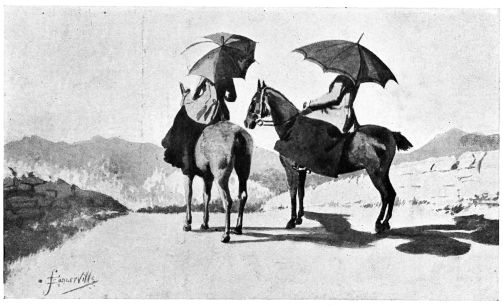
“The parapet of the wooded precipice, from whose edge we
were looking back.”
A stertorous sound began presently to be distinguishable from the hoarse
note of rushing water in the deep places of the glen: then followed a
tremor of the ground, lastly a traction-engine, advancing upon us like
Behemoth throned on mill-wheels, opulent of smoke, with a clanging
retinue of trucks. I felt in anticipation the mud ooze again through the
seams of my gloves, as it had oozed last night, but the gate of a villa
was suddenly and miraculously raised up on our left hand. Miss
O’Flannigan was off, and had opened one-half with a celerity which
suggested long practice in the hunting-field, and we burst through into
the shadow of tall evergreens, tearing out a hold-all buckle in an
encounter with the gate-post. We were startlingly confronted inside by
an old lady in a mushroom hat, carrying a spud and garden-basket, and
wearing an expression of complete and unaffected amazement, which,
considering all things, and especially the fact that Miss O’Flannigan
and I had fallen into maniac laughter, was a pardonable lapse of good
breeding. Pointing to the traction-engine, we endeavoured to explain
ourselves; but the chilly calm with which the Tommies regarded it, as it
lumbered past the gate, was so painfully at variance with our
representations, that it seemed better to retire, waving hysterical
apologies. The old lady stirred neither hand nor foot throughout the
occurrence, and for all we know may have been a rustic detail added, in
wax, by a proprietor of a realistic turn.
After this the road was quiet in the balmy quietness of summer, that is
so living a thing compared with the soulless grip of the air in winter
silences. By the dignified gradients of the coach-road we mounted slowly
through woods and glens, and then, with no less dignity and almost equal
slowness, downwards into open country, clear and kindly, with pasture,
and level roads, and a wide eastward horizon melting into blue. Behind
us the Snowdon range stood mightily on the high pedestal of
Carnarvonshire: it had never showed itself so great as now, viewed from
these Denbigh meadow-lands, while we rode to the east, with faces
turning always back to the splendid barrier across the west. It was a
lonely road, with scarcely a mark to ruffle its white dust except the
ribbed footprint of the traction-engine, that stretched like an
illimitable ladder in front of us. We met no one save two tramps who
eyed us curiously, as members of the fraternity who ought to be able to
impart useful facts about the temper of the nearest farmer’s wife, or
the quality of the skilly at the Llanberis workhouse; a little farther
on, on a long reach of road, quite remote, as it seemed, from human
habitation, we met three tall women, dressed alike in widows’ weeds, and
each pressing a pocket-handkerchief with a wide black border to the
point of a pink nose. Their eyes turned at us above these emblems of woe
with something of interest, but they did not pause, and went on, three
black blots on the white road between the glowing hedgerows; and we
marvelled if some Welsh Mormon elder had lived and died, unknown, but
obviously lamented, in these sunny solitudes.
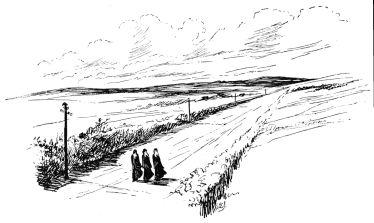
“Three tall women, dressed alike in widows’ weeds.”
Pentre Voelas and Cernioge came in their turn, with mild episode of
farmhouse and wayside inn, and manifold iterance of Rehoboths and
Salems. Cernioge, as we discovered in the buying of a post-card, is
pronounced Kernoggy. This eccentricity was, so far as we could see, its
sole claim to distinction. From the first the Tommies had established a
rule to demand nourishment at every inn they passed, and after twelve
miles studded with—for them—disappointments, we yielded to their
importunities, and paused at the glowing sign of the Saracen’s Head,
Cerrig-y-Druidion.
In the best parlour sat in perfect silence a tradesman and his wife,
middle-aged, serious, and too entirely respectable to be aware that they
were bored almost to madness. They were out on their holiday, therefore
they were enjoying themselves—and therefore the tradesman read a
month-old copy of the ‘Cyclist,’ and his wife studied the ‘Farmers’
Gazette,’ and both eyed us with ravenous, but decently furtive,
interest. For half an hour we and our safety-skirts were vouchsafed to
them, while the familiar tea, with home-made gooseberry-jam and salt
butter, was vouchsafed to us; and then the Tommies, having polished
their mangers with their usual precision, were led forth again.
It was not a good ten miles that we rode from there to Corwen, except in
the sense of good, full, statute measure. Disaster fell upon us like a
net, tangling our endeavours with inexhaustible mesh. A “dee” of my
saddle broke; consequently I had to carry the hold-all across my lap,
like a baby of monstrous size and implacable pig-headedness. Tom the
elder developed a new and much enlarged edition of his ancient
girth-gall, and in the attempt to cope with this by re-saddling, a
cushion of swelling was disclosed along his back. Miss O’Flannigan then
said she would lead him the rest of the way, and did so, until the next
milestone announced that it was four miles to Corwen, which at once
degraded the project from the sublime to the ridiculous. Not all the
Humane Society, in one throbbing merciful mass, could be absurd enough
to expect any one to walk four miles in a riding-habit, and cloth
gaiters, and the dog-days.
The cool of the evening was upon us before we at length sighted Corwen
across the pastures, and a pale after-glow, pale as the points of
gaslight that were starting up about the railway station, gleamed on the
long curve of the river Dee as we crawled across the bridge outside the
town. Corwen is a dingy, mean town, in spite of the wooded cliff at its
back, and the river at its foot, and the river meadows with their
tranquil sweetness; but on that Saturday night neither we nor the
Tommies complained of its dinginess. It had a chemist, who kept sulphate
of zinc and iodoform, and lead lotion, with which to anoint the invalid;
and it had a sedate and venerable hotel, the Owen Glendwr, in which
instantly to go to bed. Having risen thus to the occasion, Corwen may be
assured that it has not lived in vain.
Carriages, with Sunday bonnets in them, began to pass next morning,
while yet we were taking in the delicate antique absurdity of the pair
of spinets in the drawing-room, the charms of the brass finger-plates
and door-handles, the impressiveness of the low-ceiled, spotless
kitchen, with the vast fireplace, and all the strong and sound old age
of a house that has been a notable inn since the fifteenth century.
Finding that the church was immediately behind the hotel, and,
furthermore, that the service was in Welsh, we lingered a little in the
tour of brew-house and still-room, until the Venite, clear and
harmonious, came across the graves to the wide kitchen window that
leaned its sill on the churchyard grass.
Presently, when seated in the porch of the church itself, we heard again
the rich accord of Welsh voices, with all their grave and fearless
certainty, their peasant simplicity, their unblemished nationality.
Would that many Irish and English congregations, shrieking in hideous
rivalry half a bar behind the organ, could comprehend the reticence of
strength, the indwelling instinct of time, and the sense of harmony,
manifested at a Welsh country service, where the children lisp in altos,
and the farm-hand and the butcher’s boy add their tenor or bass with
modest assurance. The preacher’s voice was a fine one, and rung and
swung in that strange metrical wail of Welsh that we had heard before in
the church of Mallwydd, but it lacked something of the melancholy
passion given to that first voice by the touch of age in the tone, the
inference of sadness and misgiving. Owen Glendwr had a pew in this very
church; probably was churchwarden, and sanctified while he indulged his
predatory instincts by going round with the plate. There seemed
something significant in the fact that his dagger is carved on a stone
just outside the church: did he, we wondered, employ it as a discourager
of threepenny-bits and a stimulator to half-crowns. At all events, he is
now the next thing to a saint in Corwen, and his works any inhabitant
can tell with chapter and verse in a manner which it is not our
intention to vie with.
Among other chief tenets of Corwen morality is the necessity of seeing
Llangollen. We had, indeed, been ourselves something fired by quotations
from Wordsworth and other competent judges in the guide-book, and
yielding to the serious representations of the landlady on the subject,
we ordered a small trap in which we might thither drive ourselves and
the drab Tommy. As we sat in the embrasure of the coffee-room window,
waiting for the entrapped Tommy, we perceived a vehicle resembling a
mammoth governess-cart at the hotel door, with an old man, dressed in
what we had learned to regard as the height of Welsh religious fashion,
standing by it. His beard was long and white, his face was cross, with a
crossness that momentarily deepened as he glanced at the hotel. We
studied him with the refined observation of idleness.
“An Arch-Druid, evoluted into an elder of the straitest of the
Rehoboths,” remarked Miss O’Flannigan, easily; “his wives and daughters
had better not keep him waiting much longer, there is the flame of human
sacrifice in his eye, pleasantly blended with the confidence of their
eternal——”
At this juncture, Ellen, the coffee-room-maid, came into the room.
“If you please, ladies, the driver is waiting, and wants to know when
you will be ready.”
So we were his wives and daughters! We went forth anxiously to accept
the situation, too depressed even to wrangle as to which was which.
That no trap was available for Tommy was, in some abstruse way, known
to Ellen and explained by her at some length, the result of the day
being Sunday, as was also the attendance of the Arch-Druid. We ventured
a suggestion that we should forego the latter privilege and ourselves
drive the stolid black mare, whose massive beam barely filled the
shafts; but, with a contempt apparently too deep for words, the
Arch-Druid mounted to the prow of the governess-cart as to a pulpit,
and, manipulating the mouth of the black mare with the ceaseless,
circular action of a hurdy-gurdy grinder, started at a round pace for
Llangollen.
It was a nine-mile drive, and by the time the eighth milestone had been
passed, we began to look for some startling development of the calmly
pretty valley of the Dee, along which we had driven. Large, but by no
means stupendous, hills swelled prosperous and green on either side of
it, pine-woods thatched them warmly and liberally, the Dee was
irreproachably devious in its advance and charming in its manners, but
no climax was arrived at, nor yet was contrast lying in wait. If the
poets had spared it their fine speeches, and their compliments fledged
with suave metre, Llangollen could be appraised with a fresher eye and
admired to the utmost of its mild deserving without antagonism and
without disappointment. Also, if it is seen on the way into Wales
instead of on the way out of it, it will occupy with fitting distinction
its place in the crescendo of Welsh scenery, undiscounted by the coming
fortissimo: to be one of the last notes in a diminuendo is quite a
different thing.
Probably it was the two unparalleled persons known as the Ladies of
Llangollen who did most for its fame. They ran away from their Irish
homes to go and live there, which in itself, from our point of view,
suggests eccentricity. Perhaps it was in lifelong penance for this act
that ever after they wore riding-habits, summer and winter, indoors and
out. After a fortnight spent in riding-habits we could appreciate such
an expiation, even though the equipment we had dedicated to the Tommies
did not include powdered hair and cartwheel felt hats. Pardonable
curiosity might well have caused any traveller by the Holyhead coach who
could scrape up an introduction to climb the hill to Plas Newydd; but it
was not upon curiosity alone that the ladies relied for society. They
had the agreeability that could at will turn the sightseer into an
acquaintance, the means to weld with good dinners such acquaintanceships
into permanence; and æsthetic taste, the best part of a century ahead of
their time, that taught them to frame the grotesque romance of their
lives and appearance in antique and splendid surroundings—the leisurely
collection of many years—till the poets and other people of distinction
turned, somewhat dazed, from the marvels of silver and brass and carved
oak, and, looking over the pleasant vale of Llangollen from windows set
deep in wood-carving, pronounced it to be unique.
The sun was very hot that afternoon as we climbed on foot the steep hill
up to Plas Newydd, and it was difficult to receive with sangfroid,
either moral or physical, the intelligence that visitors were not
admitted on Sunday. All that remained was to sit exhausted on the grass,
and stare with amazement at the lacework of black carved wood spread
upon the white walls. Not a nook without a satyr head or a writhing
animal, not a doorway without its bossy pent-house, not a window without
its special pattern of lattice panes, each representing a special
acquisition, and doubtless a vast wear and tear of riding-habit. Their
work is respected, and the plain two-storey house still holds like a
casket the treasures of their finding, and stands, crusted with
ornament, as freshly white and black as when the ladies took tea in
their porch with Wordsworth or Sir Walter Scott. We hung about the small
pleasure-grounds for a little, among antique stone fonts and sundials,
and tried to find it pleasant; but the exasperation induced by a narrow
vision of strange and lovely things, half seen through a lancet-window,
would not be denied, and we presently went sulkily back to the Grapes
Hotel. The Arch-Druid was awaiting us: we saw from afar his white beard,
throned high in the governess-cart, and felt its reproof and
suitability for pulpit denunciation; his cough asserted his wrongs
indignantly outside, during an otherwise unalloyed tea in the Grapes
drawing-room; and his thoughts were, it was easy to suppose, back in the
brave old Druidic days, when he would have driven forth to meet the
tourist with scythes shining on the splinter-bar of the governess-cart,
and discouraged his vicious trifling by utilising him as a
burnt-offering.
He found, however, a poor nineteenth-century revenge in obliging the
black mare to consume, at our expense, three feeds of corn. Such, at
least, was the astonishing item in the bill; and, in a temporary lapse
from the austerity of the sacerdotal mood, he stooped to a refection
that called itself tea, and, judging by its price, must have been of
considerable extent.


