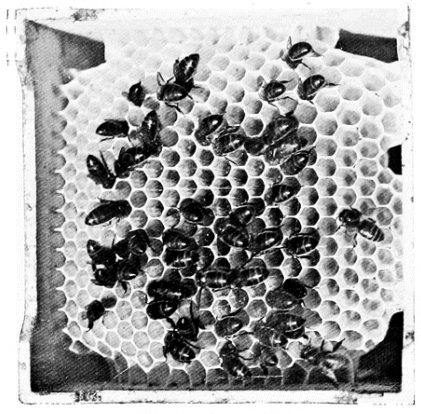
It is only in comparatively recent years that
attention has been given to bee-keeping on a
scientific basis. Aforetime there were certain
traditional methods to be followed to secure
the honey harvest, but those who practised them
knew neither the why nor wherefore. To-day,
however, thanks to the observations of our great
scientists on the life and habits of the bee, to
their patience and diligence in noting the insect's
manner of working, we are in possession
of knowledge which has enabled the practical
bee-keeper to reduce the old haphazard ways to
method, orderliness, and definite purpose.
The budding bee-keeper, as he reads one or
other of these great works on the bee and its
ways, may begin to wonder if it is not all too
wonderful for him to deal with, and if he may
ever hope to become proficient in the art and
practice of bee-keeping. Let me say, here and
now, that, given patience, perseverance, and
diligence, a measure of success is open to anyone
who brings intelligence into his work. Although
the doubts and difficulties that assail
the tyro, and the questions arising therefrom,
might raise a smile from the expert—if only as
a reminder of his own early aspirations and
efforts—yet there is no reason for despair;
though disappointments are certain to arise,
they should be accepted merely as spurs to
further effort, as steps towards the ultimate
goal of success.
Some may think—rashly—that there is nothing
new to be said or learned about the bee,
but the fact is that even scientists are still
ignorant as to the definite uses of certain of
the insect's organs, and of the origin and
remedies of some of the diseases from which
it suffers. Putting aside, therefore, the merely
commercial aspect of bee-keeping, there is still
a wide field of interest and research open for
exploration by the intelligent bee-keeper.
BEE-KEEPING FOR PROFIT
CHAPTER I General Information and Hints
The question of profit depends almost entirely
upon the knowledge, energy, and perseverance
of the bee-keeper, for, given suitable hive-accommodation
and proper attention, the bees
can generally be depended upon to do their
share of the work.
Regularity and Foresight.—All who are engaged
in productive work in conjunction with
Nature know that "there is a time for everything,"
in connection with that work, and every
advantage must be taken of that particular tide
if full benefits are to be secured at the harvest
season. Work must be done in regular rotation.
A farmer must plough his land before he can
sow his seed; the seed must be sown at a certain
time—sown in hope many months before
the harvest can be expected. The same regularity
and hopeful anticipation are necessary in
bee-keeping if full advantage is to be secured of
the honey-harvest. In the same manner, just as
farmers must make use of modern methods
and appliances to obtain the best return for the
outlay of capital and labour, so the bee-keeper
must bring into his work the practice of up-to-date
principles and labour-saving appliances
connected with bee-keeping.
The old "skep," and the happy-go-lucky
methods connected with it have given place to
the frame hive with well-defined principles to
govern and stimulate the production of its community
of workers.
To work a bar-framed hive for profit it is
first necessary that the bee-keeper should exercise
forethought and be prepared for any emergency
that may arise. He should always have
by him plenty of spare frames, foundations,
supers, and other necessities, for nothing is
more annoying than a shortage of such during
an unexpected honey-flow. It is always at
such times that his orders take longest in
fulfilment, for it is then the appliance-maker
is overwhelmed with commissions from unprepared
clients, and the delay in the delivery
of the goods means a corresponding reduction
of the bee-keeper's profits.
Watchfulness and Intelligence.—These two
qualities are essential assets to any would-be
successful bee-keeper. There is no "golden
rule," for his guidance through the year, nothing
that must be done invariably at stated
times and seasons. It is here that the novice is
puzzled and perplexed, for apparently what is
right at one time becomes wrong at another,
but it is only by experience that the guiding
knowledge is acquired. For instance, it is
useless to feed a hive with the view to increase
the brood, if the hive be queenless, or possesses
a drone-breeding queen, or a fertile worker.
And again, it is useless to put a super on a
queenless stock or a weak hive, for instead of
helping to conserve the heat of the hive one
but adds to the area for the bees to heat with
their own little bodies, with the additional risk
of chilling the brood and starving the bees.
For it should be remembered that the colder
the hive, the greater the consumption of food
by the bees.
It is well to bear in mind that the best of all
heat-producers in a hive are the bees themselves,
but to enable them satisfactorily to become so
suitable accommodation and food are absolutely
necessary.
The Queen.—One of the greatest mysteries
connected with the hive is the life history of
the queen bee, and her position in the bee community.
Each hive is, as it were, a republic
of female workers, who serve with slavish
devotion one of their number set apart from
birth for the position of supreme head of the
community. Like their sex generally throughout
Nature, they give of their best where it is
most needed. They know by their instinct
that if the queen is fed with rich food her
egg-laying capacity is stimulated, and, on the
contrary, when the honey-flow is finished, that
the supply of such food must be checked, with
a consequent reduction in the number of eggs
laid. They know that the greater the population
of the hive the greater the drain on their
honey store.
Generally speaking the life of a queen bee
extends from two to five years, at which age
she is generally exhausted, or is deposed by
the community in favour of a younger queen.
The egg from which a queen bee develops
is at the first precisely similar to that which
produces a worker, and both are fertile. It
all depends upon the kind of cell in which
the egg is deposited by the queen whether a
mere worker or a royal offspring ensues.
The queen cells are acorn shaped, and larger in
size than the others and are generally placed on
the edge of the comb. It is when the eggs are
hatched—three days after they have been placed
in the cells—that the special treatment of the
queen grub commences. It is taken charge of
by the nurses and fed with the rich food—known
as "chyle" food (see page 50), and it
is this food alone that produces the difference
between a queen and a worker bee.
When the young queen is about a week
old she will leave the hive to find a mate. As
mating can only take place when the queen and
drone are on the wing, she soars into the air
followed by the rival and eager drones. When
the mating is accomplished the queen returns
to the hive and is then capable of laying eggs,
both fertile and unfertile, at will. The drone
also returns home, but only to die: he has laid
down his life for the perpetuation of his race.
A queen that has been recently mated can be
identified by a white speck on the back near
the end of the abdomen—the organ torn
away from the drone.
Should a queen fail to be mated within six
weeks of her leaving the cell she is only capable
of laying unfertile eggs. The egg-laying
capacity of the queen, under the "chyle-food"
treatment is enormous, ranging up to 3,000
eggs per day.
When a ruling queen realises that a queen
grub is being reared in the hive, the sex-hatred
of a possible rival soon manifests itself, and were
it not for the watchful care of the workers the
young queen's career would soon be ended.
But the old queen is put virtually under arrest,
and not allowed to venture near the queen
cells. Her agitation increases until she summons
together all who are willing to follow her
and leaves the hive. This exodus of a queen
and her adherents is known as "a swarm."
(See page 44.)
The queen bee can always be distinguished
by her greater size, while the increased length
of her legs makes her still more prominent
among the workers. If it is wished to prevent
the rearing of queens in the hive, all that is
necessary is for the bee-keeper to cut out the
queen cells from the combs, and give the bees
additional room to store the food they gather.
The Worker Bee.—The normal worker bee
is an undeveloped female and a true amazon.
She is utterly indifferent to the drone, and is,
of course, unable to propagate her species. In
some cases, however, the ovaries of a worker are
so far developed that she is able to produce eggs
which are necessarily unfertile. Such a worker
is a nuisance in a modern hive worked for profit.
As we have already seen, the egg from
which the worker develops is precisely similar
to that from which a queen springs; the rôle
of worker or queen is determined by the cell
in which the egg is deposited. A grub in a
worker cell gets but little "chyle" food—it is
stopped altogether on the third day—and a
mixed diet of honey and pollen. The drone is
brought up entirely on the latter food.
As soon as a worker grub leaves the cell it
enters upon its life of labour. It is immature
at this point, and as the air-organs, or tracheæ,
are not fully developed, it cannot fly. Its first
work, therefore, is that of "nurse" to the grubs
still in the cells, and to supply the queen with
"chyle" food. About a fortnight after leaving
the cell, the young bee, if the weather be fine
and warm, will venture out of the hive to try its
wings, and on early spring days such numbers
of them may be seen sporting near the entrance
of the hive as to lead a novice to suppose that
swarming was about to take place. The bee-keeper
of experience, however, while rejoicing
at the sight, will know that the exodus is partly
due to the fact that some natural or artificial
food has entered the hive and that more
must be supplied for the needs of the inmates.
After the worker's trial flight, she proceeds
upon her duties as a food supplier to the community.
She has had some experience as a
"nurse" in handling pollen, so that at first it
seems but natural she should give most attention
to that food, and, in cleaning her body from its
clinging particles, she finds out the uses of her
several organs. In the beginning her loads of
pollen are often small, but with experience her
carrying capacity soon finds its limit. In time
she discovers nectar in the flowers, and as she
becomes less able to gather pollen she increases
her honey-collecting power. When nectar is
abundant bees will often commence their work
at sunrise and continue throughout the day until
sunset. In such a "honey-flow" the average
life of the worker from the time she leaves the
cell is seldom more than six or eight weeks,
every minute of which is given up to the
communal labour. The whole of the work
inside the hive depends upon the worker—she
is architect, builder, caretaker, nurse, sanitary
officer and the rest; there is method in everything
she does, so it is inadvisable to interfere
unnecessarily with any part of it. She objects
strongly to undue interference, to mere curiosity
of inquisitive humans. The worker bees are,
indeed, wondrous creatures: they are known to
have their feelings of friendship and dislike
almost human in their intensity; their expressions
of sorrow on the loss of their queen or
when their stores are failing are as unmistakable
as their hum of contentment when the hive is
thriving, or the buzz of anger when rudely-disturbed.
The Drone.—The drone is the male bee.
He is the progeny of an unfertilised egg laid
by the queen, or by a fertile worker. His life
is usually a short and merry one. He lives
entirely on the labour of others, and, unless
there is something radically wrong with the
hive, he is seen only during the spring and
summer months, when his services are in
requisition. When on the wing the drone is
by far the noisiest of bees, although the sound
he makes is somewhat similar to that made by
the worker when on the warpath, the note of
warning to the disturbing human, and the
trumpet call to her fellow-workers.
Owing to the peculiar structure of the drone,
mating can only take place in the air, and when
it has been accomplished the drone returns to
the hive but to die. When the honey-flow
fails the death warrant of the drones still in the
hive is issued. They are seized by the workers
and killed or ejected from the hive. To the
onlooker there is a certain amount of amusement
to watch this slaughter of the non-producers
of the community: to see a couple of
workers wrestling with the unwieldy drone,
perhaps biting off one of his wings in the effort
to disable him, before the finishing stroke is
given. When, however, a bee-keeper sees the
array of dead drones he will probably think it
would have been better for him had they been
workers—producers rather than consumers of
honey. It is, of course, greatly to the advantage
of a bee-keeper that the number of the drones
should be kept down as low as possible. This
can be done by giving the bees full sheets of
bees-wax impressed completely with the basal
forms of the natural worker cells, thus inducing
them to confine their building to those cells
only.
We have already referred to the fact that
a worker bee and a virgin queen are capable of
producing eggs. The progeny of these eggs,
however, although they may be produced in
worker cells, are drones, fully developed,
though smaller than those hatched in drone-cells.
When this state of affairs is discovered in
the hive the bee-keeper must ascertain by observation
whether it is the queen's doings, and, if
so, depose her and, if that of a fertile worker,
destroy her. As a rule a fertile worker deposits
her eggs in a scattered sort of way, but as the
cells containing them are always capped as
drone-cells—that is the cappings are raised in
a dome-like way—they are easily distinguishable
to the experienced eye.
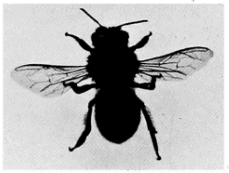
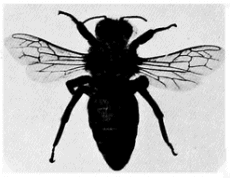
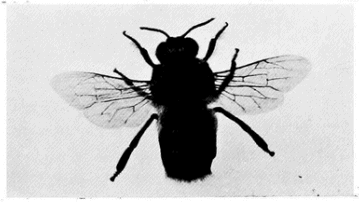
Worker Bee
Queen Bee
Drone Bee
(Magnified two diameters. Photographs by John J. Ward, F.E.S. )
Metamorphosis.—The metamorphosis, or
change of form, which occurs in the early
life history of the bee is among the most
interesting in the insect world. When the egg
is deposited by the queen, it rests on end
on the bottom of the cell and almost parallel
with the sides. At the close of the first day it
inclines to an angle of about 45°, and after two
days it falls to the floor of the cell. As a rule,
the period of incubation is three days, and the
grub is immediately taken charge of by the
nurse bees, and fed according to the kind of
cell in which it has been placed. At the end
of five or six days the grub is sealed up in its
cell to undergo the next, or pupa, stage of its
existence. Generally speaking, the queen is
ready to leave her cell on the fifteenth day,
the worker on the twenty-first, and the drone
on the twenty-fourth day from the time the egg
is laid. If the weather is cold these periods
may be extended: it is a curious fact that the
egg of an insect can often bear a greater intensity
of cold without injury than can the
developed insect.
Anatomy of the Bee.—It is advisable that
all bee-keepers should know something of the
structure of the bee, of its principal organs and
their functions. The subject is too technical
to be dealt with at length in a volume such
as this, but the following notes may be of
sufficient service to rouse interest to further
inquiry.
Tracheæ.—Bees have no lungs, but in place
of them have air-sacs, connected up by air-tubes
or tracheæ which run throughout the
body, varying in size much as do the "veins"
of a leaf, until they are minute enough to
serve the extremities of the insect, the antennae
and sting. This arrangement of the air-supplying
organs, general throughout the insect
world, may have something to do with the
hibernation, to which most are subject in a
greater or less degree, in cold weather.
The worker-bee is extremely sensitive to
cold, but the queen seems far less susceptible,
and often causes perceptible anxiety in a hive
by wandering out of the cluster in cold weather.
I know of one instance which came under
my notice where the queen was very much
alive in a hive in which all the workers were
dead, or dying from starvation in cold weather,
and although it is a recognised fact that
queens which have been injured by frost
become drone-breeders it was not so in this
case.
The Antennæ.—The antennae of the bee
must be accounted among the most marvellous
of its organs. They are made up of
a number of joints and chambers, and, though
they are conjectured to be the organs of the
senses of hearing, feeling, and smelling they
are not definitely so known to be. As in
the case of many other insects the antennæ
of the male bee are much longer than those
of the female.
The Tongue.—From the bee-keeper's point
of view the tongue of the bee is one of its
most important organs, for by means of it
the bee secures the nectar from the flowers.
When the nectar is in abundance the tongue
serves as a trunk or proboscis through which
it can be drawn, and when the supply is
scanty the spoon-like end of the proboscis
serves to lap it up. From the tongue the
nectar passes into the "honey stomach" from
which it is regurgitated and stored in the
hive.
The Legs.—The six legs of the bee serve
for manifold purposes other than walking, and
are so wonderfully adapted to them as to be
worthy of close study. They serve as hands,
as combs and brushes for cleansing purposes,
they are provided with claws which are available
for climbing rough surfaces, or for
clinging in the swarm: between the claws is
a pad which secretes a substance which enables
the bee to walk comfortably on smooth
surfaces whether upside down or normally.
On the thighs of the hind legs are the pollen
baskets in which are carried the burden
of pollen gathered from the flowers and taken
to the hive for storage.
The Eyes.—Three eyes, one simple and two
compound, form the complement for each bee.
The single eye, the smallest, is placed in the
centre of the crown of the head, and the two
compound on either side of the head. Each
compound eye consists of hundreds of facets
each of which has a perfect vision. Much
argument has been made as to the reason for
all this sight-power, but without arriving at any
satisfactory conclusion. It is certain, however,
that although the bee can move about freely
and work in the darkness of the hive, yet it
cannot see in the dark, for who among those
who have worked bees has not heard the
plaintive wail of a bee that has been overtaken
by the night before gaining its hive—and this
with the hives within easy range?
The Jaws.—The jaws are used in much
of the work of the hive—kneading wax, cutting
and reducing the combs, capping the cells,
for clearing away refuse, and particularly for
carrying dead bees from the hive. They serve
as weapons, too, for fighting, and in ejecting
the useless drones when their season is ended.
Then the jaws are used as nippers to cut the
wings of the bulky drone and so render him
helpless.
The Wings.—Each wing consists of two
parts, an arrangement which allows the bee
to close, or fold them up when she alights.
On the adjoining edge of each part is a row of
minute hooks, and when the wings are expanded
these hooks become attached and thus
provide a strong and reliable flying surface.
In addition to providing the means of flight,
the wings of the bee serve as fans for the
ventilation of the hive, a certain number of
the community, who also act as sentries, often
being engaged in such duty. Should a bee-keeper
see any of the "fanners" at work on
the alighting board at the entrance of the
hive he may know at once that the hive is
too warm, and if he be wise will open the
entrance a little wider. Should the bees
continue their ventilating work after that,
then he may surely know that something is
wrong and open the hive to investigate.
The bees do not so work without urgent
need. It may be that the stores of food are
fermenting, or that wet has penetrated to the
combs: mice may have entered the hive, or,
worst of all, foul brood may be rampant.
All these would cause bad odours, and the
bees should be helped as speedily as possible
to remove the evil.
The Sting.—This weapon of offence and
defence is usually the last in the equipment
of the bee to be used, for its discharge
generally means loss of life to its owner. To
the enemy against whom it is launched, it
becomes a source of irritation and annoyance
and sometimes of danger. The sting is
a fine lance, with incisions down one side
which act as barbs when the flesh is pierced
by it, sinking the lance deeper at each convulsion
of the stinger or the stung. So soon
as a barb is fixed it is impossible for the bee
to withdraw the sting, and in its struggle to
be free the whole of the stinging organs—including
the poison sac—are dragged from
it, and the poison enters the wound. For
this reason it is necessary that the sting
should be extracted as soon as possible,
for the longer it remains in the flesh the
greater will be the irritation. Should the
sting be inflicted near a hive it will be
wise to remove oneself from the neighbourhood
without loss of time, for it
is a well-known fact that the scent of the
sting attracts other bees and arouses their
anger against the presumed enemy of their
kind.
The best remedy for a sting from a bee is
methylated spirit, applied immediately the sting
has been extracted—though it is well to remember
that bees have an abhorrence of spirit,
so that all trace of it should be removed before
venturing near a hive, or further stings may be
induced. There are many popular remedies
for stings, such as the application of ammonia,
washing soda, the blue bag, an onion—all
of which have the same object—to
nullify the effects of the irritant poison,
of which formic acid is one of the principal
constituents.
Occasionally bees will attack fowls, although
it is more than likely in most such
cases that the fowls are the aggressors and
mistake the bees for flies, of which they are
very fond.
Stingless Bees.—There has been much
talk of breeding stingless bees, but personally
I do not think such bees are ever likely
to oust our native breeds, for what chance
could they have in fights with the armed
variety?
CHAPTER II Hives
The question of the hive is, of course, the all-important
one to the bee-keeper; upon it
depends in very large measure the success or
non-success of his enterprise. To the beginner,
especially, it is a matter for serious consideration,
one not to be dealt with in any haphazard
fashion. There are so many forms and varieties
of hive on the market to-day that the novice,
who perhaps started out with the idea that
a hive was merely "a hive—any one would
do—and the bees would accomplish the rest,"
is puzzled as to how to make a selection. As
a general recommendation in this direction I
would say, select the one that is least complicated
and easiest to clean. Simplicity in working,
combined with efficiency in its purpose, is a
sure and safe standard to apply when selecting
a hive. It is as well for the beginner to try
one or two varieties, so that he may find out
by experience which is better suited to his
particular district, and the most convenient to
manipulate. That settled, he can then adopt
for general use the one best suited to his
purpose.
The Skep Hive.—The skep hive, made of
straw, is the survival of those pre-scientific
days when bee-keeping was conducted without
method, other than providing a house for
the bees. Except that it is still used by some
who will not take the trouble to adapt themselves
to the modern methods, the skep hive
would find no mention in a book on bee-keeping
for profit. Primarily the skep was
made by our forefathers merely as a means of
securing the bees for the honey season, by
providing them with a ready-made home in
which they could prepare their combs and
store their honey. Originally it was a rough
structure of straw, bound together probably
with bramble-runners, peeled and split, and it
has developed into the form in which we
know it to-day. Its picturesqueness in the
cottage flower garden cannot be denied, neither
can its utility up to a certain point, and that
point was when the time of the ingathering
of the honey harvest arrived, for to secure the
honey the bees were destroyed. As a rule, it is
the hive that contains the best queen which
has the most honey, and as the skep that was
heaviest was always selected for clearing, it
necessarily followed that in destroying the bees
the best queens were sacrificed.
The usual plan of "taking" a skep hive
was to dig a hole about a foot deep, not quite
large enough to hold the skep. A few red
hot cinders were placed on the bottom and
on these was scattered brimstone. Then the
skep was placed over the hole and the bees
smothered by the sulphur fumes. It was a
cruel and wasteful practice and it is strange
that it should survive in these days when the
knowledge of better and more economical
methods is within reach of all.
Unless, however, disease is rampant in the
district the "skepist" is oftentimes a benefactor
to a neighbouring up-to-date apiarist by
supplying him with swarms, or "driven"
bees.
The capacity of a skep is sometimes increased
by means of an "imp" made of
straw of the same circumference as the base
of the skep on which the hive is placed.
Another method is to use bell glasses and
sections as a "super" placed over the feed-hole
of the hive.
Although it can find no place in profitable
bee-keeping—unless it be for temporarily
hiving a swarm—the skep nevertheless possesses
some advantages over the wooden hive. It is
not liable to the attacks of fungus, or rot; it
is also warmer for the bees in winter if properly
covered in severe weather, for as the
combs are fastened to the sides of the hive
they serve the purpose of a cavity wall or
dead space.
Wooden Hives.—The wooden hive now
reigns supreme in all well-regulated apiaries,
and the mechanical methods of working wood,
with their accuracy of joining, &c., from a
constructional point of view have brought
them practically to perfection. It must be
confessed, however, that wood is not the ideal
material for hive making. As we have already
suggested, it is subject to deterioration from
fungus and rot, and, even when well-seasoned,
contains a certain amount of moisture which
renders it readily liable to these evils. The
interior of a hive, too, becomes moist from
condensation, which again helps to promote
decay, a decay which in turn is favourable to
the development of disease among the bees.
As a check to the ill-effects of this moisture
some bee-keepers make a practice, when
cleaning their hives, of thoroughly scorching
the interior walls with a blow lamp.
So-called "rot preventers" are not to be
recommended for use inside the hives, for many
of them are highly injurious to the bees.
In purchasing hives it should be seen that
they are in no wise cracked or warped, that
no large knots are contained in the wood,
and that the workmanship of the joints is in
every way perfect. The roof needs to be
completely rain-proof and the eaves should
hang well over the sides so as to ensure the
rain-water being carried away from the walls
of the hive.
Size of Hive.—In the selection of a hive
the size must depend upon the bee-keeper's
own convenience, so that it is useless to lay
down any hard-and-fast rule. Many apiarists
have a regular system of moving their hives
from district to district to meet the varying
crops and honey sources, and it naturally follows
that the less cumbersome the hive in their case
the better. Personally I prefer a hive of
about eighteen inches square, outside measurement.
This may be accounted rather large
for winter requirements, but it is always a
simple matter to reduce the interior space
with a dummy.
One or two odd sized hives are convenient
to possess; they are useful in emergencies, and
the smaller sizes especially come in handy for
queen rearing purposes, or when strengthening
nucleus.
The Floorboard.—The hive bottom, or
floorboard, which includes the sloping platform
outside the hive, on which the bees alight,
should be removable for the purposes of cleaning—which
must be done thoroughly at least
twice a year. This alighting board should provide
for an entrance ¼ of an inch below the
level of the sides and back of the hive and
should slope upwards to the floorboard about 4
or 5 inches inside the hive.
When hives are moved frequently from one
district to another it is advisable to have a short
alighting board, as less space is thereby taken
up in the removal conveyance. It is an easy
matter to lengthen the board when the hive is
in position if it is found necessary. A roofing
slate makes a very good addition to a short
alighting board.
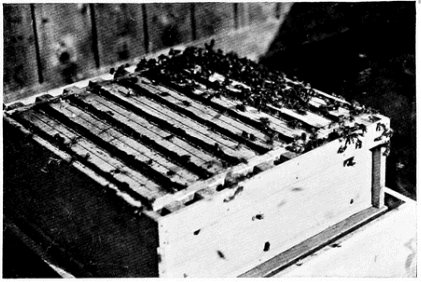
The Brood Chamber.—The brood chamber
rests on the floorboard: it is usually made with
a porched entrance from the alighting board,
but, although a porch is useful if the hive is in
an exposed situation, the bees, as a rule, will do
equally well without it. The porch, indeed,
often proves a source of trouble to young bees,
who fail to find the entrance and rush
frantically along the top of the porch in their
efforts to do so. The brood chamber usually
has two single and two double walls: on the
inner, which are lower than the outer, rest the
ends of the bar frames that contain the combs
or brood foundation. It is here that the brood
is reared and the natural life and work, of the
hive proceeds.
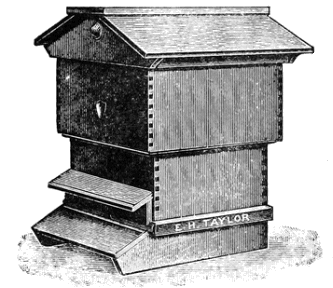
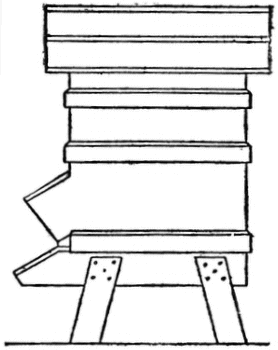
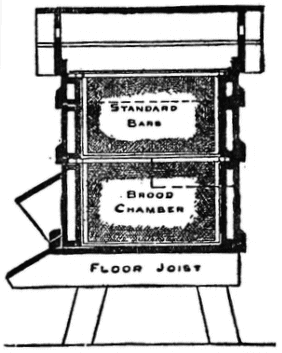
SIDE VIEW AND SECTIONAL SIDE VIEW OF A MODERN BAR-FRAME HIVE.
(This Hive has a double set of Standard Frames)
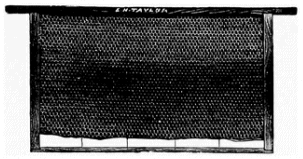
Bar Frames.—The bar frame is used as
a case or support to hold the honeycombs.
Without them it would be impossible to lift the
combs from the hive and replace them in their
proper position. It is these frames that enable
the modern bee-keeper to do so much more
than was possible with the old skep, and it has
been by their aid that so much has been learned
of the home-life of the bee.
Standard Frames.—Frames vary in size in
different countries, but the standard frame now
in general use in Great Britain is 8½ inches
high, 14 inches wide, with a top bar 17 inches
in length. The 1¼ inches at each end rest on the
top of the inner walls of the hive. The frames are
spaced the proper distance apart by metal ends
of uniform size. There are many varieties of
these "self-spacers," but those most generally
in use in England were the invention of a past-master
in apiary, the late Mr. W. B. Carr. These
"ends" slip on the terminals of the top bar.
When handling the frames, care should be
taken not to hold them by the metal ends, as
they are apt to slip off and cause disaster.
Another matter that needs attention in connection
with them is their liability to rust, and when
working for honey production the bee-keeper
should be scrupulously careful to see that
only good clean metal ends are used on the
frames.
To Hang Standard Bar Frames.—The sides
of the frame should hang at least3/16 of an inch
and at the most ¼ of an inch clear of the walls
of the hive. If the space be less than 3/16 the
bees will fasten the combs to the sides of the
hive, and if it be over ¼ of an inch they will
build combs between the frame and the hive.
The narrower space is sufficient to allow the
bees a free passage round the frames.
Some frames on the market are a little wider
than the ordinary standard. Known as "wide-shouldered
frames," no "spacers" are necessary
to keep them the proper distance apart.
Standard frames, however, can be used successfully
either in the ordinary hive, the queen-rearing
hive, or as a "super" (see page 31) if
it is worked in accordance with the instructions
given on page 73, for as they are exactly the
same in measurement they can be interchanged
with any hive. It is advisable to pin or nail
together any loose parts of frames when making
them up, for by so doing regrettable accidents
may often be avoided.
Shallow Frames.—The shallow frame is only
5½ inches high, with other dimensions similar to
the standard. They are used by most bee-keepers
in this country who work for surplus
honey. They are of a convenient size for
gathering and storing separately the various
"crops" of honey. This, of course, is a great
advantage, for it enables the bee-keeper to select
the choicest honey for exhibition, or for sale at
increased price. They are especially useful in
this direction when heather honey is the objective,
both as a body box and as a super. As
a super, indeed, they are generally recommended
to the novice in bee-keeping, as, owing
to there being less space for the bees to heat,
they are warmer than the standard frames for
this purpose. There is no question that a warm
super induces the bees to explore it, and if
food is plentiful to use it as a store or warehouse,
while, on the contrary, should the heat of the
super be lowered by a change in the outside
temperature after the bees have commenced to
store therein, they will often remove the honey
thence to the brood-chamber.
Shallow frames are also used by some bee-keepers
when working for sections in strong
hives immediately over the brood-chamber, as
this procedure usually prevents the lower case
of sections from becoming discoloured by the
heat from the brood.
Sections.—Sections are small wooden frames,
which in England are generally about 4½ inches
square, in which honey may be stored by the
bees ready for sale purposes. They are made
from the wood of the American lime tree—commonly
known as "basswood"—which is
beautifully white and easy to "work." The
sections are made all in one piece, which is cut
into shape by machinery. The sections are
placed in a rack or "crate" which usually hold
twenty-one in seven rows of three, with a divider
of tin or wood between each row, and a "bee
space" under each section.
The method of working with sections is
explained on page 94.
The Super.—The super, or lift, is the bee-keeper's
addition to the hive, in which he induces
the bees to store honey for him. It is placed
above the brood nest and supplied with frames
or sections in which the bees may work apart
from the brood. To secure that, of course, is the
duty of the bee-keeper, and in the chapter
following, the method will be dealt with.
Bee Escapes.—The "escape" is to provide
the bees with an additional exit from the hive or
super. It is fixed in a hole bored through each
end or side of the top portion of the hive, two
or three inches below the centre of the roof.
The old-fashioned cone-shaped variety is now
usually worked double, one being fixed inside
the hive and one on the outside, but they are not
altogether satisfactory, as the bees will sometimes
find their way back through them to the super.
It will also often be found when clearing supers
by this means that the bees are very slow in
escaping. A new escape, called "The Porter
Escape," with a spring has been recently invented
which allows the bees to return from the
super direct into the hive. It is fixed on a
board which is placed under the super.
The Dummy.—The dummy is a piece of
board with lugs or ends which project from the
sides, and rest on the inner walls of the hive. It
is, in fact, a movable wall which is used to reduce
the capacity of a hive. The requisite number
of frames are removed and the dummy placed in
position to cover the exposed side.
The Quilt.—Over all, is placed the quilt
which retains the heat in the hive. Most bee-keepers
have their own opinion as to the best
material to use for this purpose. American
cloth, glass, wood, carpet, horse-hair, matting,
felt, sacking, cotton, and paper all find their
advocates, and probably experience has proved
them all. It is useless, then, to be dogmatic
in favour of any. I would suggest, however,
that one of the cheapest forms of quilt is one
made of unbleached calico, for this is about
the only material that the bees do not try to
sample, or fasten to the frames.
Generally speaking it is advisable that a
hole should be made in the quilt for feeding
purposes. For this it is not necessary to cut
a piece quite out but merely to make an
incision along three sides of a square, thus
forming a flap that can be folded back when
feeding is necessary. This quilt should, of
course, be supplemented with others to secure
thorough retention of heat in the hive.
All old quilts that have any "propolis" (see
page 51) on them should be saved to pack
round crates of sections, or the propolis may
be cut off and used as a decoy in spring amongst
artificial pollen.
Queen-Rearing Hives.—There are many
varieties of "nucleus" or queen-rearing hives,
but the one I have found to give most satisfaction
holds from three to five standard frames.
These are used solely for the purpose of rearing
young queens to take the place of those worn
out by hard work or old age. The method
to be followed in this direction is given on
page 75.
Observation Hive.—This consists of a glass
case made to hold one standard frame, a shallow
frame, and a row of sections. The bees can
thus be seen at work on the combs. It is
mounted on a pivot, through which the bees
must pass to the entrance. Of course, the
"observation hive" is not intended to keep
bees in for more than a few days at a time,
and when it is in use care should be taken
not to expose the combs or the bees to the
heat of the sun.
CHAPTER III Bee-keepers' Requisites
Comb Foundation.—It is this wonderful
invention that with the bar-frame has made
bee-keeping a practical factor; without it,
indeed, the bar-frame hive would be useless
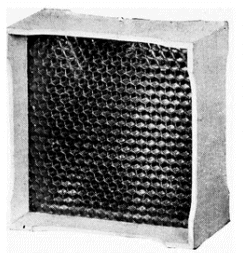
from a commercial point of view. The "comb-foundation"
is a thin sheet of bees-wax,
impressed by machinery, on both sides, with
true hexagonal, or six-sided, bases of cells,
a slight foundation for the walls being also
impressed. Thus the bees are given a start, as
it were, in their work. This foundation is
made either with "worker" or "drone" cells
and the bees will follow unfailingly the lead
thus given them in their building. It is
made in three degrees of thickness—"thin,"
"medium," and "thick"; the first for use in
sections, and the others in the brood chamber.
As a rule bee-keepers in England buy only
the worker-brood foundation, for should drones
be required they can be secured by merely
cutting away the lower part of a honey-comb,
or supplying only half a sheet of foundation in
the frames, for the bees will almost without
fail build drone cells on these.
Foundation is catalogued by all makers of
bee-keeping appliances, but it should be obtained
only from reliable sources, for one of
its essentials is that it should be made from
pure bees-wax thoroughly cleansed and sterilized.
Otherwise it may contain germs of
brood disease.
Old Foundation.—If a stock of foundation
should at any time be left in hand it is advisable
that it should be slightly warmed before it is
given for the use of the bees, for unless it
is quite pliable the bees will reject it.
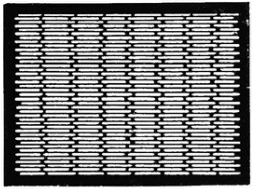
Excluder Zinc.—It is impossible to work
the bar-frame hive for profit without the aid of
excluder zinc, for it is this useful appliance
which prevents the queen from entering the
supers and spoiling the surplus honey by laying
her eggs in the comb. For the novice must
learn at once that no honey should be extracted
from combs which contain brood.
The queen excluder should completely
cover the open space above the brood nest
before the super is placed over it.
A new queen excluder is now on the market,
made of hard wires strapped together, and
the patentee claims that more workers can
pass through it than is possible with the old
type.
A Standard Frame with Drawn-out Comb
An Efficient Queen Excluder
A Frame Hive with the top removed
Feeders.—There are many varieties of feeders
in use among bee-keepers, and to attempt to
give a description of them all would occupy
far too much space. It would, moreover, be
unnecessary, for, after all, the method of feeding
is one to be decided by the bee-keeper's own
convenience and resources. Several feeders
are on the market to meet the requirements
of quick feeding; these are made either of
tin or wood and include the "float feeders"
and the Canadian pattern, both of which find
considerable favour. Another type covers the
so-called "slow feeders," in which the supply
can be regulated by turning the food vessel
round to allow a larger or smaller quantity
of food to escape at the option of the bee-keeper.
A cheap and serviceable feeder may be made
by filling a glass jam jar or pickle bottle with
syrup and stretching a piece of bleached calico
over the top and tying it securely round the
neck. The jar is then placed in an inverted
position over the feed-hole of the hive.
Should the syrup escape too quickly another
thickness of calico can be added. Glass jars
should always be used as inverted feeders
as the quantity and condition of the remaining
food can be seen at a glance.
Scrupulous cleanliness is necessary with all
feeders, or the food is liable to turn sour or
ferment.
Uncapping Knives.—Used for the purpose
of removing the cap of wax from the cells
when extracting the honey from the combs,
these knives should be made of good material
and be kept perfectly clean and bright. Blades
which discolour quickly should not be used,
and where large quantities of honey are
extracted at a time it is advisable that two
knives should be available. This enables the
process to be continuous, as one knife can be
heated—in hot water—while the other is in
use.
In using the knife it is better to give it a
sawing motion when uncapping, for by so
doing the chances of injuring the cells are considerably
lessened. It should be so arranged
that the cappings fall, as they are removed,
into a tray or dish.
The Extractor.—This is a machine which
should be included in the outfit of every bee-keeper
who is working with a view to profit.
The initial outlay may seem large, but by its
quickness and efficiency a good machine soon
pays for itself and contributes to the credit side
of the account. The extractor is usually cylindrical
in shape and contains two cages, each
sufficiently large to hold one standard frame of
comb. These cages are attached to a spindle
which runs through the centre of the machine,
and is worked either direct by a handle or by a
simple chain or cog gear at the top. A lid and
a honey tap complete the outfit. The advantages
of the extractor are many, but the chief
one is that the honey can be separated from
the combs without breaking the latter.
Hints for working the extractor are given
on page 98.
The Honey Press.—This is used to squeeze
thick or dense honey from the combs. There
are many varieties and makes on the market,
ranging in size down to that of the ordinary
potato squeezer. Those used by the larger
honey farmers work with screw pressure. The
combs are placed in a wrapping of cheese-cloth,
laid between pieces of American wire
which rest on fluted or ribbed boards, and the
pressure applied. The honey escapes by means
of the fluted guides and the wax remains as a
solid cake.
The Smoker.—This is an indispensable
article in the equipment of the bee-keeper. It
is not intended for the purpose of stifling the
bees, but on the contrary to make them good-humoured,
and, although it does not always
have the desired effect, most bee-keepers have
often proved the smoker a good friend. The
effect of the smoker when properly applied
is to cause the bees to gorge themselves with
honey, for bees, like most human beings, are
good-tempered after a hearty meal.
After the smoker has once been lighted
it should be placed on end, for should it be
laid flat the fuel will probably be extinguished.
It is always advisable when working the
smoker to have a spare cartridge handy so as to
replace the one immediately it is consumed.
Fuel for the smoker can be made from
thin corrugated strawboard, brown paper, calico,
cotton wool, or anything indeed that will
smoulder rather than burn with a flare. It is
a good plan to roll together some fast and slow
burning materials, thereby ensuring a steady
smother while it lasts. A supply of "cartridges"
of this kind should be cut and tied into lengths
ready for use when required.
Carbolic Cloths.—These are useful for
driving the bees down from the frames into the
hive, when the frames need manipulating. The
cloths are usually about 18 inches square, made
of calico, and sprinkled with one part of carbolic
acid to two parts of water. They are laid over
the tops of the frame, but care has to be taken
that the carbolic solution is not too strong, or
the bees will be driven from the hive.
When not in use, the cloths should be kept
rolled up in a tin to ensure their cleanliness
and to retain their strength.
Brushes.—Bees are very particular concerning
the kind of brushes used by the bee-keeper
to brush them from the combs, or to
gather a swarm together when it is scattered
under a bush or in a position where it is not
possible to shake them into a hive. They
have a firm objection to anything of a hairy
nature, and the very best method to rouse
them to wrath is to use a housemaid's broom
under the circumstances mentioned. It is a
certain incitement to trouble.
Most brushes sold by appliance makers are
of fibre, but one of the very best forms can
be made from montbretia leaves. The leaves,
or blades, should be cut from the plant near
the ground and the tops doubled over and
tied near the end of the stalk. The stalk end
is used as a handle, the "brush" consisting
of the intervening part. Montbretia is a
very adaptable plant and will thrive almost
anywhere with a little care.
Disinfectants.—Disinfectants play a large
part in the work of the bee-keeper, to secure
the cleanliness which is such an essential
factor to success, for the prevention of disease,
and the confounding of the many enemies of
the bees.
Carbolic Acid is the disinfectant most generally
used, probably because it is available for
other purposes. It should not be used, however,
when supers are being removed or on
any combs containing honey that is to be taken
for use. When cleaning the inside of a hive
only one part of carbolic acid should be used
to ten or even twenty parts of hot water, and
care must be taken that the hive is thoroughly
dry before combs are placed in it, or the bees
admitted.
Naphthalene and Camphor are each used for
disinfecting purposes, but more especially as
antidotes against the wax-moth and other insects
that play havoc in the hive. Two fairly large
pieces can be placed in one hive, either in the
cavities at the ends of the frames or over the
quilt.
Veils.—Some bee-keepers scoff at the
necessity for a veil for protection when handling
the bees, but there is no question that in spite
of the grotesque appearance it imparts the veil
is "a very present help in trouble" to the average
bee-keeper. Some people are fortunate enough
to be sting-proof and such can afford to smile at
those who seek, protection from a veil, but to
those who are not immune from the consequences
of the angry attentions of the bee the
veil is indispensable. Serviceable veils can be
made of Brussels or silk net, mosquito netting,
or fine wire. They can be procured in any
colour, though black is most generally adopted,
that having been found the least objectionable
to the bees, who entertain violent prejudices on
the subject of colour.
Personally, I believe that it is the human
breath to which the bees particularly object, and
I have found that if a little honey be eaten
before one opens a hive the enmity of the
bees will be neutralised to a very great extent.
A pair of gloves, with gauntlets, are absolutely
necessary to the bee-keeper's equipment,
though an admirable makeshift for the latter can
be adapted from old stocking legs. These pulled
over the sleeves of the coat, after the gloves have
been buttoned, form an efficient guard against
an exploring bee.
CHAPTER IV Bees: Their Habits and Products
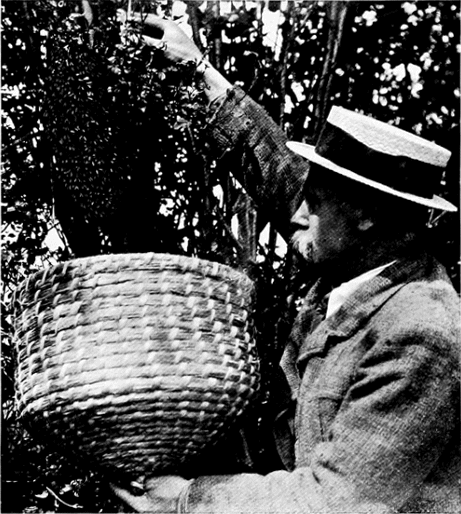
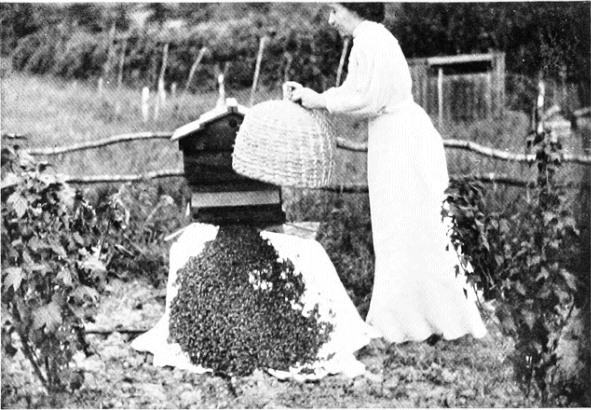
Swarming.—As already explained (pp. 7, 8) a
hive will "swarm" when an old queen finds
that other queens are being nurtured in the hive.
In such a case she calls forth as many of her
adherents as will follow her and goes out to
found a new community. Oftentimes the site
of the new home is definitely settled beforehand
in some unoccupied hive, and in such cases
scout workers will have prepared and cleansed
the hive some days in advance. The passing to
and fro of these pioneers will sometimes give
the owner of the empty hive the idea that he
has bees working there. Generally, however,
the swarm issues from the hive without any
definite objective and flies on until the queen
settles, when her retinue of workers form a
cluster around her.
As a rule it is an easy matter to tell when
the bees are swarming, for they rush pell-mell
in a tumultuous stream from the hive, and fly
round and round, and in and out, hundreds
being on the wing together, taking the appearance
of a living cloud. They are perfectly
docile and will allow the spectator to stand
among them provided they are not provoked.
Of course this is easily done: the mere getting
entangled in the hair of the onlooker is sufficient
to rouse their anger. Any symptoms
of nervousness, too, seem to become apparent
at once to the bees, and perspiration, again, is
objectionable to them. But an expert bee-handler
may lift a swarm with his hands and
suffer no ill, for so long as they are not
crushed the bees will not resent the handling.
It is seldom that a first swarm issues from
the hive other than when the weather is warm
and the sun shining. Generally it is between
9 a.m. and 4 p.m. that swarming takes place.
First swarms are usually the largest, for when
the joyful hum of the rising swarm sounds
forth many of the bees from adjoining hives
will be drawn to join the swarm and are received
in a friendly manner.
Virgin Swarms.—The bees of a swarm
will often follow a virgin queen when she
goes out to seek a mate, the bees apparently
thinking that if she is lost they will die. It is
therefore advisable that a hive which is known
to contain a virgin swarm should have the
entrance blocked up so that only one or two
bees can pass in or out at a time. This may
be widened after the queen has been mated.
The Treatment of Swarms will be found
explained on page 68.
The Scent of the Bee.—Every novice in
bee-keeping should make a point of acquiring
knowledge by practical experience on this
wonderful point in connection with bees, for
it plays a most important part in the success
of bee-keeping. Not only does each hive
diffuse a different scent from that of its
neighbour—even though the nectar may be
gathered by the bees from the same source—but
the scent of each hive may vary according
to the work that is going on within it.
Each individual bee, too, can diffuse a varying
scent to suit its circumstances. An expert
bee-keeper can generally tell from the scent
immediately he opens his hive what reception
he is likely to meet with, for even our native
bees are seldom found to be docile in the
midst or towards the end of a honey-flow.
When bees are swarming they emit quite
a distinct scent, which probably accounts for
the friendly reception accorded at that time
to bees from other hives. When a stranger
approaches a hive, or if the bees are disturbed,
it will be noticed that those on the alighting
board elevate their abdomens and fan vigorously
with their wings—with the result that
other members of the hive rush to the scene.
It is true that the sound of their wing movements
is different from that caused by the
ventilating fanning, but there is no question
that an alarm scent is emitted from the
abdomen and diffused by the vigorous movement
of the wings. In the same manner the
sting of the bee when discharged emits a
peculiar scent which has the effect of rousing
other bees to anger, as though to avenge the
death of their fellow-worker. The expert bee-keeper
well knows the scent of the sting even
though he may be immune from its effect.
It is well to note, by the way, that cross-bred
bees as a rule are very quarrelsome and
extremely sensitive, and are often dangerous
on this account, for they are very free with
their sting.
It seems evident that when a bee is
frightened she loses her distinctive scent, for
driven bees, when they have nothing to fight
for, will unite peacefully. And I have known
bees of the same hive fight among themselves
in a moment of panic, thus affording evidence
that the scent of the community has been
destroyed for the time, precluding the members
of it from recognising their fellows under the
stress of the fright.
The scent of the queen is different from that
of the workers. This can be noticed especially
in the case of a swarm, for workers will often
be seen "retrieving" the place over which the
queen has passed, even though the trail may be
broken: should they fail to find her they will
often cluster and die. Because of this it is
never advisable to handle a queen, for the bees
will notice the change of scent caused thereby
and often will kill a queen they do not own; to
stranger drones, however, they raise no objection
during a honey-flow.
Honey.—It should be clearly understood that,
contrary to the assertion of the poet, bees do
not "gather honey all the day, from every
opening flower." Honey is essentially a product
of the bee from the nectar provided by
the flowers as an inducement to the visitation of
bees and other insects—not for the benefit of
the bee but to serve the purposes of the flowers
themselves of cross-fertilisation. (See Chapter on
"Flowers and Bees," page 53.) The nectar is
assimilated by the bee and regurgitated in the
form of honey.
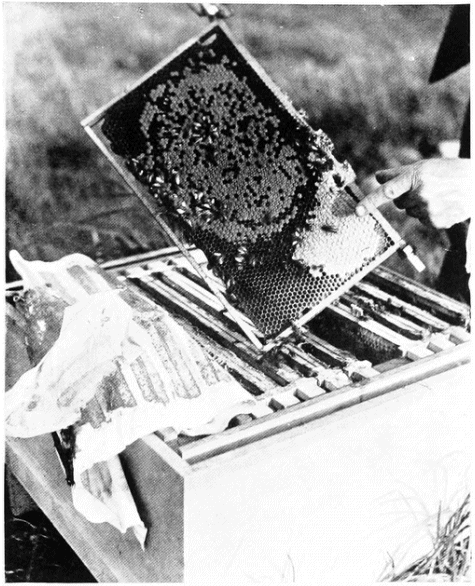
Queen on a patch of Sealed Honey
(This is a diseased frame: notice the irregularity)
Honeycomb.—The honeycomb is doubtless
one of the greatest marvels of the bee community.
In its architecture and workmanship
it forms, indeed, one of the greatest wonders
in the whole realm of nature. With its multitudinous
hexagonal cells, a honeycomb presents
a continuous source of delight; it is so constructed
that not a single atom of space is
wasted and so designed that the minimum of
material is used. Let it be remembered that
the honeycomb, primarily, is intended to serve
as a nest for the offspring of the queen—each
cell to be a separate cradle for the product
of the egg placed therein.
As a rule, as we have noted, the cells
are six-sided; the exceptions are the queen
cells—which are acorn-shaped—and the intermediate
cells which form buffers as it were
between the worker and drone cells. The
latter are always built on the outside edge of
the combs. The worker cells are the smallest,
and, although the bees hatched from new
combs are usually larger than those from old
ones, the difference is but slight. The reason
for this is that as each bee is hatched it leaves
behind in the cell the cocoon in which its
metamorphosis was accomplished, and thus
diminishes to that extent the size of the cell.
Bees-wax.—The wax of which the cells
are composed is produced from the body of
the bee itself. It forms in thin plates underneath
the abdomen, these plates being kneaded
by the jaws into the required consistency and
form. When comb-making is in progress the
bees cluster together in festoons, very similar
in appearance to a swarm. It is, of course,
an exceedingly slow process, and the modern
bee-keeper, to expedite matters in this direction,
assists the bees by giving them ready-made
foundation on which to build their cells.
Fortunately the bees have proved amenable
to this "hustling" process and are thus able
to devote a larger part of their short life to the
more remunerative work—from the bee-keeper's
point of view—of honey-producing.
Chyle Food.—As before stated, this is the
rich substance with which the queen is fed, and
the worker grub indulged in for a short period.
It is regurgitated from the chyle or second
stomach of the young or nurse bees. All
authorities agree that the power to produce
the food gradually diminishes after the insect
is a fortnight old. It follows, then, either that
the young bees have the power to withhold the
supply during a period of rest, or the power
to assimilate it is acquired by the older bees,
in proportion to their age and the ordinary food
they consume, during the period of compulsory-retirement
in winter. This semi-hibernation
period varies in length in different parts of the
country, but in some cases it must last for at
least three months, between the date when the
last eggs were laid and that when the queen
resumes egg-laying again in earnest. Chyle
food has a thick, milky-white appearance, an
acid flavour, and quickly congeals if exposed to
the air. Probably on account of its being fed
to the infant bees one of its popular names
is "pap" and another "bee's-milk."
Propolis.—This is a substance produced by
the bees from the gum which exudes from
buds and trees, or the wax given off by some
grasses. Propolis emits a wholesome smell and
is usually bitter to the taste. It is used by the
bees to plug up any holes or cracks in the walls
of the hive and to fasten the supers, lifts,
frames, and sections together, and also forms
their natural disinfectant. Although methylated
spirit is violently disliked by bees, yet
some forms of spirit varnish are very attractive
to them, probably yielding something towards
the production of propolis.
Some bees produce propolis to excess and
it then becomes a nuisance, for hives in which
such a condition exists are always more difficult
to work. The queens from these hives should
never be used for rearing purposes. It will
be found that foreign bees as a rule produce
more propolis than the native breeds. Propolis
always serves to attract bees, especially after
it has been warmed before a fire for a few
minutes; it then becomes very sticky. It is
often used to entice bees to artificial food in
early spring to stimulate brood-rearing before
natural pollen becomes abundant. This is done
by scattering artificial pollen among shavings
or chaff, and generally serves its purpose.
Old quilts plastered with propolis are used
by unscrupulous bee-keepers to attract swarms
from neighbouring hives.
CHAPTER V Flowers and Bees
In the economy of the world of flowers
the bee plays an important part, while in
return the flowers provide the wherewithal of
existence for the bee. For the mere transference
of pollen from one flower to another the plant
offers the bee a supply of nectar and a percentage
of the pollen which she is to carry
for the plant's benefit. It is the case that
most plants depend upon cross-fertilization,
and while some rely upon the wind to
carry the pollen, others, and by far the greater
number, depend upon bees and other insects
to perform the work for them. The methods
adopted by flowers to secure the visitation of
their insect friends form a fascinating study
which cannot be entered upon here, ours only
to consider the outcome, so far as the bees
are concerned, of the transaction.
Honey.—For the production of honey
there must be for the bees easily available
access to nectar producing flowers, and it
might be noted that flowers always produce
most nectar when growing under natural
conditions. It is a common error to suppose
that all sweet-scented flowers are visited by
bees; for in the gardens, roses and sweet peas
are neglected by them, and in the hedgerows
the honeysuckle is passed by—it caters for
moths only, while, on the other hand, plants
whose scent is entirely repugnant to the human
sense of smell provide attractive and happy
hunting grounds for the bee.
After the resting time of both flowers and
bees through the dark days of winter there is
a steady rotation of flowers through spring
and summer, which is brought to a close in
the autumn by the flowering of the heather.
Approximately the appearance of the flowers
of plants and trees is in the following order:
snowdrops, winter aconite, early crocuses,
"palm" willow, flowering currant, arabis,
aubrietias, Norway maple, elm, plum, cherry,
apple, pear, chestnut, sycamore, dandelion,
the berry trees, whitethorn, and lilac; these
mark the interval between winter and the full
glory of summer's bloom. The bees will
begin their labours almost as soon as the
flowers begin to show, and all through the full
spring and summer their work never ceases.
In August the heather gives them a busy time
until the autumn brings the resting season
round again.
Generally speaking the source from which
honey is gathered may be recognised by its
colour and flavour. Many flowers, indeed,
exude nectar of a similar colour to their own,
although it must be remembered that the
honey always becomes lighter as it candies
or granulates. But, approximately speaking,
it may be taken that white clover honey
should be very light in colour; sainfoin honey
should be yellow, lime a greenish yellow,
while heather honey will vary from orange
to purplish red.
The flavour of honey varies in like manner,
though it is an undoubted fact that the
weather at the time of its gathering and
storing by the bees influences it greatly. The
warmer and sunnier the day the more pronounced
the flavour of the honey.
White clover honey is esteemed the best
for table and exhibition purposes, for its purity
of colour, fineness of grain, and mild flavour.
At the other extreme is heather honey—dark
in colour, strong in flavour, and a texture so
thick that it will not "run"; so thick, indeed,
that it is impossible to extract or strain it by
the ordinary methods. As a rule it is usually
pressed from the combs.
Pollen.—The bee uses pollen for a variety
of purposes—for feeding the pupae, as food
for the older bees when honey is scarce or
the stores diminishing, and for mixing with
wax to seal the brood cells. "Bee-bread"
is therefore a good name for it, although
primarily its purpose is not to serve the bees
at all.
Of an infinite variety of colour and flavour—each
flower produces its own variety in both
particulars—the pollen gathered by the bees
is stored in the hive strictly with its own kind.
It has been found that a bee visiting, say,
clover, does not touch another kind of flower
on that "round," and so on. And each
section of the workers store their particular
pollen in particular cells.
The young worker bee is usually well
covered with hairs which serve to gather up
the pollen from the flowers visited. Leaving
a flower powdered over with it she scrapes it
from her body into the pollen baskets on
the thighs of her hind pair of legs. Discharged
at the hive, the pollen is kneaded by the
jaws and head and stored in the cells, where
it is covered with honey to preserve it. As
the bee gets older the body-hairs are gradually
worn away so that as time passes the
worker becomes a honey-gatherer almost
entirely.
CHAPTER VI Hints on Working the Bees
Position of Hives.—All hives, if possible,
should be arranged to face south, for cold and
draughts are among the deadliest foes of the
bees. Cold showers of rain or sleet in the spring
often work havoc among them so that it is well
to minimise the danger as much as possible.
In this connection it is a common sight in early
spring to see bees that have become chilled
lying on the ground near the hives, and novices
may gain experience in handling bees by
picking up these moribund specimens. They
should be lifted with one finger and thumb and
dropped into a jar which should be covered
at the top and placed before a fire. When the
bees have revived they may be liberated.
Manipulating the Bees.—Confidence is the
most necessary quality to the bee-keeper and
one, of course, that can only be acquired by
experience. One golden rule to be remembered
by the beginner is that the hive should
be approached always from the rear, and another,
that everything should be done slowly and
deliberately and never jerkily. Nothing irritates
bees more than erratic or jerky movements
on the part of those manipulating the
hives.
Until one has definitely proved immunity
from the bee-sting it is necessary that all safe-guards
should be adopted before any work is
attempted on hives of which the bees are in
possession. The veil, gloves, and gauntlets
should be donned and the trousers tied tightly
round the ankles to prevent the incursion in
that direction of any roving member of the
hive. For although bees are usually on good
terms with their owner they are subject to
varying moods, and it is well to run no unnecessary
risks.
The Smoker.—The smoker should always
be ready to hand, charged and lighted, with
matches immediately available in case the fuel
does not burn properly. As already explained,
the effect of the smoker is to cause the bees to
gorge themselves with food and so become
good-tempered. Having removed the roof of
the hive, one corner of the quilt is raised and
a little smoke blown under it. The operation
should be repeated in two or three different
places, and then an interval of two or three
minutes allowed to elapse in which the bees
may fill themselves. The quilt may then be
carefully removed, and if necessary more smoke
may be blown over the frames, but not downwards
among the bees.
When handling the frames the nearest one
at the side or back of the hive should be taken
out first, the bees that are on it shaken off, and
the frame placed safely on one side. This
allows ample space in the hive for moving
the frames about for examination and other
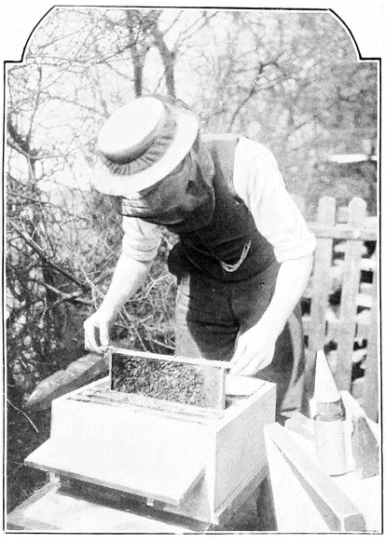
purposes without crushing the bees.
How to Handle Frames.—Frames should
never be held by the metal ends, for these are
liable to slip off and cause disaster. The frames
should always be lifted and handled near the
ends of the top bar.
A frame of comb should never be turned
horizontally, for in that position the comb is
apt to break. The proper way is to lower one
end of the frame until it is in a perpendicular
position, then swing it round half a turn and
lower the other end. The comb will then be
the wrong side up and the movement must
be continued until the comb is again in its
proper position.
Examination or other work in connection
with the hive should be completed as quickly as
possible so that the combs may not be unduly
exposed.
Spring and Autumn Cleaning.—In the
springtime—generally speaking about the
middle of April—it is necessary that the hive
should be cleaned, and, to secure "a thorough
spring clean," the bees should be transferred to
another hive that has been already cleaned. If
this is not done, the hive must be thoroughly
overhauled, and should any of the combs be
found to be in a bad condition and without any
bees on them they should be removed. If the
combs are full of brood and honey it is
necessary to expand the brood chamber as
described on page 67. In the autumn the hive
must be examined and cleaned again. All
empty combs, or those not used by the bees,
should be removed and the space thus rendered
vacant closed by a dummy. Should the hive
contain only a small quantity of food the bees
will have to be fed artificially. (See page 82.)
Weak Hives.—It is at the spring and
autumn examinations that the real state of the
hive community is discovered, and in the former
the "weak." hive is a common occurrence. It
is then that much depends upon the bee-keeper
whether his work is to be successful or not. It
is then that weak stocks must be brought up
and strengthened either by doubling or uniting
the stocks, or by feeding.
The bees from strong hives soon find out
those that are weak, and apparently act on the
principle that "to him that hath shall be
given," for they proceed to help themselves to
the depleted stores of the weak hive. They
even go to the length of forcing its occupants
to help in the removal of their stores and grant
them the privilege of joining their community
for so doing. Those that remain faithful to
the queen of the weak hive are thus reduced
to starvation. When a bee-keeper finds that a
weak hive is being raided in this manner he
should close it up entirely for a day or two.
This will often quicken the spirit of its inhabitants
and cause them to retaliate on the
raiders.
Doubling Stocks.—For this purpose an
empty hive is necessary, and it should be one
in which the frames range from the front to
the back. Placing the two weak hives on
either side of the empty one, the frame with the
bees from the right hand hive are transferred to
the right side of the new hive. A dummy is
then placed and all holes through which a
bee might crawl carefully blocked up. The
frames from the other hive are then placed in
the remaining space and the hive closed up.
Care should be taken to fasten the quilt down
firmly so that the bees cannot obtain access to
each other, for if they do they will surely fight.
For the same reason the entrances to the two
parts of the hive should be placed as far apart as
possible and a piece of wood placed along the
centre of the floorboard.
After a few weeks the bees in the two
divisions will acquire the same scent and can
be united. Should a spare queen be required
one can be removed, if not the older one
should be killed, for the bees should not be
left to adjust the matter for themselves. A
hole may be made in the dummy so that the
bees can pass from one division to the other,
and a few days after the dummy may be removed
altogether.
This procedure may be followed also in
the autumn, especially if young queens are
numerous and it is desired to save some.
Feeding Weak Stocks.—If facilities are not
to hand for thus dealing with weak stocks,
the frames not required by the bees should be
removed from the hive, the space contracted
by a dummy, and the bees fed inside the
hive. In the autumn it is advisable to give
weak hives frames of food that have been
stored and sealed by a strong hive that is
kept especially for such a purpose.
Whenever inside feeding is adopted, the
entrance aperture to the hive should be reduced
so as to keep out bodies of raiders.
The most efficient means of securing this is
to place along the entrance a piece of perforated
zinc with holes just large enough for
one bee to pass through at a time. This
prevents a rush of marauders and allows ample
ventilation in the hive.
Uniting Stocks.—This procedure is not so
common among English bee-keepers as it is
with those in other parts of the world where
the conditions are more favourable to a successful
result. The reasons are chiefly because
we can very seldom secure that the bees all
work on the same flowers, and because most
of our English bees are cross-breeds and therefore
more addicted to fighting. It is not to
be expected that a broken breed of bees will
unite peacefully with a pure breed.
Examining Frames
However, uniting is sometimes resorted to,
and the method of procedure generally adopted
in England is as follows. The hives to be
united are brought nearer to each other
gradually, not more than a yard or so at a
time, and on fine days only, when the bees are
flying about. The need for this precautionary
care is that the bees soon lose their bearings
if their hive is shifted to any great extent and
will fly about until death ensues from exhaustion;
while to enter a strange hive in mistake
for their own is equally fatal for them.
The actual process of uniting is accomplished
by taking combs alternately from each hive
and placing them in their new quarters, meanwhile
spraying bees and combs with scented
syrup, or dredging them with flour.
I should, however, recommend the novice
to "shake" or "drive" (see pp. 74, 79) each stock
before uniting them, for hunger will do more
to reconcile the bees to each other than anything
else. The driven bees should be passed
through a queen-excluder and the oldest queen,
or queens, destroyed. This will save a battle
royal in the new hive, and do much towards
uniting the two sections of bees.
Queen-rearing hives may have frames of
young bees added to them without much fear of
trouble, for as a rule young bees do not fight.
Stimulating.—Bee-keepers who are working
for honey generally stimulate the bees after the
semi-hibernation days of winter are passed, for
a period of some six or eight weeks before their
services are likely to be required for honey
gathering. This is to encourage brood-rearing
and is accomplished by feeding the bees with
syrup or artificial pollen. (See Chapter on
Feeding, p. 82.)
It must be remembered that once artificial
feeding for this purpose has been resorted to it
must be continued until the natural sources of
nectar are available to the bees, for nothing
checks the population or does more harm to
the hive than stopping the food supply when
breeding has commenced.
It should be the aim of every bee-keeper
to make himself acquainted with the order
and approximate times of blossoming of the
flowers and trees, and particularly the largest
source of nectar in his neighbourhood.
As a rule, from six to eight weeks is
required to get the hives into a profitable
condition after brood-rearing has commenced
in earnest. In some favoured places the queen
may begin to deposit eggs as early as January,
though of course, in the north and colder
districts, this is exceptional. Unless, therefore,
a bee-keeper is in an exceptionally good district,
and works for early fruit blossoms as a source
of nectar, it is to his interest to leave the bees to
themselves until the middle or end of March,
provided, of course, they are not short of food.
Choked Brood-Nest.—When feeding the
bees in spring it is necessary to spread the
brood-nest from time to time by adding a frame
of comb near the centre of it. This provides
the queen with sufficient cells in which to lay
her eggs. Should the brood-nest become
choked with honey, feeding should be stopped
and a frame or two of honey taken from the
hive and extracted, or given to hives that are
not so fortunately placed, filling up the space
with empty combs. Should the stores of honey
and pollen be plentiful, it is well to scratch the
cappings from some of the cells, though care
must be taken not to damage the cappings of
the brood cells, which will usually be found in
the centre of the frames.
Should the hive be full of frames and bees
and most of the cells along the top of the
combs be covered with clean white cappings,
a super may be introduced, the necessary
sheet of queen-excluder being placed over
the brood-nest. The super should be a warm
one with no leaky joints and fit properly over
the brood-chamber. In districts exposed to
high winds the precaution should be taken of
tacking a narrow strip of thin soft felt round
the bottom edges of the super to make it perfectly
draught proof.
CHAPTER VII Hints on Working the Bees —( Cont. )
Swarming.—One of the oldest practices associated
with bee-keeping is that of "ringing
the swarm." Immediately the swarm was
seen to issue from the hive the bee-keeper
began to create as loud a din as he could by
beating a tin or tray, and, so doing, followed
the bees in their flight. This entitled him to
claim the swarm wherever they settled, even
though it might be in a neighbour's hive.
"Ringing" is still continued, for it is the
most effectual means at command for causing
the bees to settle. The explosion of firearms,
a clap of thunder, or the roar of a blast, will
secure their doing so, and probably the most
effectual "settler" for a swarm is a shower
of rain—but none of these is at the immediate
command of the bee-keeper.
"Skepping" a Swarm
When, therefore, the swarm is seen issuing
from the hive preparations should be made
for "ringing" and following it. The noise
should not be commenced until it is certain
that the queen has come out, or she may show
no inclination to do so. Sometimes the swarm
will fly for some distance, or it may happen
to "cluster" comparatively near its former
home. In some cases trouble arises from the
fact, already stated on p. 44, that the swarm
has chosen a home in a neighbour's empty
hive. Any question of ownership can always be
settled by an examination of the combs in this
hive, for if there are no eggs or brood more
than a few hours' old the bees undoubtedly
belong to the claimant of the swarm, and he
is entitled to their possession or their value.
Should there be eggs or brood obviously deposited
in the combs earlier than the day on
which the swarm entered, then no claim can
stand, for it is certain that it is impossible for
the members of the swarm to be picked out
from those already in the hive when they
entered.
Handling the Swarm.—Should the swarm
settle in a convenient position on a branch of
a tree, it can be transferred directly to a bar-frame
hive in the following manner: The
hive, placed as nearly under the swarm as
possible, should have the entrance to the body
raised, and wedged, about an inch, and a board
placed from the ground to the alighting board;
a sheet should be spread over this board and
the ground under the swarm. The swarm
should be shaken from the branch on to the
sheet.
Should the cluster be in too awkward a
position for this to be done, a skep will have
to be brought into requisition for transferring
the swarm to their new quarters. The cluster
may be shaken into the skep by gently raising
the branch from which it is suspended and then
giving it a sharp downward movement. The
skep should be held firmly and gently turned
right side up over the sheet on to which the
bees should be shaken in front of the bar-frame
hive.
Should the bees be slow to run into the
hive, those at the rear should be given a few
gentle puffs from the smoker.
Sometimes the swarm will contain more
than one queen and consequently will split
up into several clusters. In such a case each
cluster has to be "shaken" separately. Occasionally
it becomes necessary to "shake"
a swarm two or three times if the queen is
not hived. It sometimes happens, too, that
the queen will come out again if the hive
is objectionable to her, and almost certainly
so if she be a virgin.
As a rule, though, the old queen comes
out with the first swarm, but I have known
cases in which swarming has been delayed,
when as many as five queens, including the
old one, have come out with the first swarm.
In a very strong hive a virgin queen will
sometimes come out with a first swarm, but
in such cases the swarm, as a rule, is a very
small one.
The hive used for a swarm should be
scrupulously clean and contain sufficient
frames and combs for the requirements of
the swarm. It is usual to place only one
thin quilt over the frames for the first few
days after a swarm has been given possession.
Hives containing newly placed swarms
are usually allowed to stay until the evening
of the day before they are removed, but, of
course, if the situation is an inconvenient one,
or if the hive is liable to be a nuisance to
the public, it should be taken away at once.
If allowed to remain it must be sheltered
from the rays of the sun or the heat will
cause the bees again to issue forth.
Should a swarm not be required by the
bee-keeper he must return it to the hive
whence it issued very early on the morning
following the day of swarming.
Each bee in a swarm usually carries sufficient
food to meet its requirements for one
day, so that should a bee-keeper receive a
swarm from a distance he should feed it as
soon as it arrives. All swarms should be fed
if the natural supply of nectar be scanty.
Excessive Swarming.—Where bees are given
to excessive swarming some bee-keepers
trim one of the wings of the queen to hinder
her flight,—a method also adopted to distinguish
the ages of queens: the right wing
of one year's queens being cut, and the left
of those of the following year. Of course,
the wings of a virgin queen should never be
trimmed, for mating is thereby prevented.
Swarm Preventing.—The bee-keeper who
works for surplus honey does all he can to
prevent his bees from swarming, and thus
increases both his stock of bees and supplies
of honey.
Anyone who has even but slightly studied
the ways of bees will have noticed that they
store their honey above the brood in response
to one of the wonderful instincts bestowed
upon them by nature, and it is by taking
advantage of this fact that the bee-keeper
who is working for profit assures himself of
one point of success. It is the method of
working standard frames from the brood-chamber
as a super by which each hive
is practically made into two—a queenless
colony above and a brood stock below. I
have tried pretty well all the systems used in
England and have proved this to be the
most successful in securing the purpose aimed
at. For thereby the queen is given plenty
of room in which to lay her eggs, and the
bees plenty of accommodation in which to
store their honey.
The method of working this plan is as
follows. The bees should be stimulated in
the spring and as soon as the weather is
favourable to swarming the strongest hive
should be examined. It the frames are seen
to be covered by the bees, and almost full
of brood or stores, everything is in order for
the scheme. The essential point in it is the
removal of the combs from the brood-chamber
minus the queen.
A super of the same size as the brood-chamber
should be prepared and a similar
number of frames to those already in the
brood-chamber duly fitted with empty combs
or a sheet of foundation. The first frame is
then removed from the brood-chamber, the
bees shaken from it and placed in a super.
The "shaking" should be done by holding
the frame about a foot above the hive and
giving it a sharp downward and upward jerk
to displace the bees. Needless to say, great
care is necessary in the operation, as to drop
the frame, or crush the bees, would lead to
disaster. When the second frame is removed,
an opportunity is afforded to look for the
queen, which may be identified by her larger
bulk and longer legs. Close attention must
be given to see that there are no queen cells
in the combs as they are removed, for the
presence of a queen in the super is fatal to
the scheme. All queen cells—easily identified
by their acorn shape—therefore, should be
removed from the combs.
After the third frame has been removed
the empty ones should be inserted as each
full one is transferred to the super, until the
whole interchange has been effected.
The next proceeding is to place a sheet of
queen-excluding zinc over the brood frames,
so that no possible way is open for the queen
to gain access to the super. The super is
then placed in position and covered up.
Should the combs contain any drone brood
opportunity will have to be given them to
escape after hatching, as they cannot pass
through the queen excluder. This may be
done by rolling the quilt back for about an
inch along the whole length of one side, on
a bright, sunny day. The drones will soon
find the opening and take flight.
If, after supering, the weather should be
unfavourable for the bees to gather food,
artificial feeding will have to be resorted to.
Should the scheme be carried out early in
the year and the queen be prolific, it may
be found necessary to repeat it to prevent
swarming.
It is necessary to remember that inasmuch
as the rearing of young queens and the
consequent swarming is not carried on under
this method, it is a necessity that the hives
should be re-queened every two years.
Queen Rearing.—It is better to retain one
hive for queen-rearing purposes and this
should contain the very best queen available
so as to secure a good strain of workers.
The drones, too, should be selected by
allowing no drone cells in any but the best
hives.
For the small bee-keeper who cannot spare
much time among his bees, and who only
requires half a dozen queens in a year, I
would recommend that queen-rearing should
be worked in with the standard-frame super
method described in the earlier part of this
chapter. If this course be adopted the procedure
is as follows.
The hive should be allowed to come to
swarming-point in order that queen cells maybe
formed by the bees. These should contain
eggs or larvæ before the frames are transferred
to the super, and all eggs or larvæ should be of
the same age. This is an important point, for
should one be hatched earlier than the others
it will promptly destroy all the other queen
eggs or larvae in the frame. The wisest plan
is to destroy all queen cells that are capped
and the ages of eggs or larvæ noted in accordance
with the information given on this point
on page 13.
In working this method of queen-rearing,
the frames must not be shaken, but the bees
brushed off into the hive, otherwise the contents
of the queen cells will be displaced.
The zinc excluder, of course, must be
thoroughly applied to prevent the queen
obtaining access to the super.
The super can be left until the day previous
to that on which the first young queen
is due to leave the cell. It must then be removed,
with all the bees in it, and it should
either be split up or each queen caged in its
cell.
After the super is split up, the bee-keeper
should try to procure a swarm to divide
amongst each part of the super—first running
it through a queen excluder to catch the
queen. These divisions should be given a
separate hive if possible, but if it is necessary
that they should occupy one large hive care
must be taken thoroughly to separate each
section and to have the entrances as far apart
as possible. It is advisable, too, that the entrances
should be of a different colour to
ensure the young queens entering their
own section, for should they by chance enter
another a battle is sure to ensue with fatal
results.
Re-queening the Hive.—As already stated,
the method of working the hive with standard
frames as a super necessitates re-queening every
two years. There are several ways of doing
this. One is to find the old queen and kill her,
and allow the bees to install one of the young
queens. This method, however, has many disadvantages.
First of all, there is the disturbance
to the hive in the search for the queen;
secondly, if the queen be found and killed,
there is a loss of nearly three weeks in the
height of summer when no eggs are laid in
the hive.
Another method is to allow the hive to
swarm and to return the swarm to its hive
after destroying the queen. But this plan,
too, has the disadvantage of checking the
supply of eggs.
The best method for all practical purposes
is to re-queen after the honey-flow, either with
a home-reared queen or one purchased from
a reliable breeder. The old queen, together
with any queen cells in the combs, must be
removed three or four days before the new
queen is introduced.
The easiest way to accomplish the introduction
is by means of a queen-cage. These are
usually made of wood with three compartments,
in the inner two of which the queen is
imprisoned. The other is filled with soft
candy. This cage is placed over the frames in
the hive and the queen is liberated by the bees
eating a way through the candy. By the time
this is accomplished the queen will have
acquired the scent of the hive and will be
accepted as ruler by the community.
The hive should not be disturbed for at least
four days after the introduction of the new
queen.
"Shaking" a Swarm
Driving Bees.—After the honey-flow is
ended, it becomes necessary to clear some of
the hives and unite the bees with others. The
old method of dealing with this matter was the
drastic and wasteful one of putting the hive over
the sulphur pit and wiping out the bees. The
more economical, as well as humane, method
of driving is now generally practised by the
commercial bee-keeper. Driving is often accomplished
immediately after the clover has
finished flowering, and the bees sold to the
bee-keepers in the heather districts, who are
often glad to increase their stocks in readiness
for the heather honey harvest. In other cases
the driven bees are used to strengthen weak
hives. In any case driving must be done before
the autumn unless the bee-keeper is prepared
to give the bees drawn-out combs and food
to fill them with in preparation for the winter.
When driving is to be put into operation it
is always advisable to remove the hive that is to
be driven well away from the other hives, for
the operator is far more liable to be stung by
the bees from them than by those to be driven.
An empty hive should be placed in the position
occupied by the removed one: this will serve
to attract any stragglers and prevent their flying
away.
Another empty hive will also be required
for the process, which is commenced by turning
the hive which contains the bees upside
down. Over this is placed the empty one—which
should be of the same size—and the
edge nearest the end of the longest comb is
fixed on the lower hive by means of a knitting
needle thrust through both edges. The opposite
edges of the hives should be left about
six inches apart, being secured in that position
by means of driving irons or strong pieces of
hazel sharpened and stuck into the edge of
both hives at a different angle from that of the
knitting needle at the back.
It is advisable, too, to fix a tea-cloth or
a piece of similar material, so as to prevent the
bees from running up the outside of the top
hive. The actual process of driving consists
in tapping the sides of the lower hive to which
the combs are fixed, simultaneously with the
hands. If the bees are slow to run the taps
may be given at shorter intervals, while if they
run freely the tapping may be lighter and
slower. As a rule the bees will fill themselves
with food before leaving the combs and it may
be necessary to use the smoker to dislodge the
stragglers; in this case only very slight blasts
should be administered.
Transporting Bees.—When hives are sent
any distance care must be taken that ventilation
is afforded above as well as below the bees.
The reason for this is obvious; there must be
a way for the escape of hot air which rises to
the top of the hive. This can be secured by
placing coarse linen cheese cloth or a sheet of
perforated zinc under a thin porous quilt.
All loose parts of a bar-frame hive should
be made thoroughly secure before the hive is
dispatched. Skep hives should be packed
bottom upwards in a crate.
Swarms and driven bees should be sent
away as soon as possible after swarming and
driving are completed, for, as we already have
pointed out, bees can only carry sufficient food
to meet one day's requirements.
It should be an accepted rule, therefore,
that when a hive is received from a distance
the bees should be fed immediately.
When bees are moved about regularly
from one district to another it is advisable
that the hive should be fitted with a short
alighting board and thus take up less space
in the conveyance.
CHAPTER VIII Feeding
In an erratic climate, such as that of Great
Britain, bee-keeping includes among its duties
that of bee-feeding at certain periods of the
year, if profit is to accrue. It must be remembered
that shortage of food when the
bees are active means an inroad on their
stores and a suspension of brood-rearing operations.
This applies most particularly to early
spring when successful brood-rearing is absolutely
necessary to ensure a profitable issue
to the bee-keeper. If, therefore, there is a
shortage of food then, the hive will be thrown
backward to such an extent that the bees will
have no time to gather surplus stores for the
bee-keeper's benefit. All their strength will
go to supply the necessities of brood-rearing.
The honey-flow over, with their store so small
that it serves their needs but a short time—for
much food is consumed in summer—the
bees then begin the pernicious system of robbing
other hives, and thereby causing further
trouble.
Spring Feeding.—Spring feeding, therefore,
may be looked upon as a necessity for
the bee-keeper out for profit. It is then
that the neglected hive so often succumbs
after the community has existed safely through
the winter.
I consider that outside feeding is by far the
better method in the spring. For one reason it
is always risky to disturb the bees by inside
feeding early in the year, and there is always
the certainty of admitting a draught of cold
air to the hive. Another reason in favour of
outside feeding is that it induces the bees
to take exercise, which is decidedly good for
them after the winter seclusion, and also
keeps the young bees from wandering in
search of food, and thereby running the risk
of getting lost.
The food should be placed on a shelf
at a good height from the ground, and in
a warm situation, well sheltered from cold
winds. Protection, too, is necessary for the
food; a garden light reared against the house
wall answers the purpose admirably. The
sun's rays passing through the glass will warm
the food and make it more acceptable to the
bees. Old honey in the combs is of course
the ideal food for bees, but where this is
not available artificial food must be resorted
to.
Syrup Food.—All artificial syrup food
should be made from pure refined cane sugar,
which supplies the bees with a substitute as
near to the natural food as is possible. Syrup
for spring feeding or stimulating should be
made as follows:
Cane sugar
10
lb.
Water (clean spring water preferably)
7
pints
Table Salt
1
oz.
Vinegar
1
tablespoonful
This mixture must be boiled in a clean
enamel saucepan and all scum that rises to the
surface carefully removed. Some bee-keepers
add a pinch of borax, or some naphtha beta, or
other chemicals as preventives against disease,
but unless disease be actually rife in the district
these additions are totally unnecessary, especially
in the spring of the year. Moreover they
are liable to spoil the flavour of any surplus
honey subsequently gathered by the bees.
It is only necessary to give each hive about
one pint of syrup per week, when spring
feeding is commenced, but after a few weeks
the amount must be gradually increased. The
worker bee generally leaves the cell about
21 days after the egg has been deposited by the
queen, and as the young bee cannot leave the
hive until she is a fortnight old, an increased
amount of food is required after each batch of
brood is hatched.
Artificial Pollen Food.—Many bee-keepers
use artificial pollen in springtime for stimulating
purposes. This consists of finely ground pea or
oat meal, and is sprinkled among dry shavings
or chaff in a box. A good method of attracting
bees to such supplies is to place the pollen,
etc., in an old skep hive which retains some
propolis, or to place an old quilt in the box.
In any case this food supply must be kept in
a sheltered spot as directed on page 83.
Water.—A plentiful supply of clean water
should be placed in the food shelter, for the
bees use large quantities in the brood-rearing
operations. In each gallon of water 2 oz. of
table salt should be dissolved. The water
should be placed in a glass jar which should
be covered with a saucer and then inverted.
Should the saucer be deep, some small pieces
of wood or spent tea leaves should be placed
in it to form alighting places for the bees.
Another method of supplying water is to allow
it to drip from a small barrel on to a sloping
board.
When to Stop Spring Feeding.—Artificial
feeding must be stopped as soon as the bees
are able to collect their natural supplies of
nectar and pollen. This is usually about the
time when the sycamore blooms, but in districts
where crocuses or willows are plentiful
it will be earlier.
Autumn Feeding.—It is when the honey-flow
is ended, and there is no more natural
nectar available for the bees, that feeding must
again be resorted to if the bees are to be
saved through the winter. The old method
of allowing the bees to fend for themselves
and stand the risk of starvation in the winter
is now looked upon not only as unnecessarily
cruel but absolutely wasteful. The
slight cost of feeding them is amply repaid
by the strength of the stock when spring once
more arrives.
When the bee-keepers are working up an
apiary from swarms, or driven bees, autumn
feeding is essential, for it is very seldom that
late swarms or driven bees are capable of
securing sufficient winter stores without the
assistance of the bee-keeper.
Food given in autumn should contain less
water than that given in the spring. The
reason for this needs but slight consideration.
In springtime when the days become increasingly
warmer, and the temperature of the hive
increases with the growth of the population,
the bees need thinner food. The increasing
heat of the hive would ripen thick nectar or
syrup too quickly and give the bees extra work
in collecting water with which to thin the
food for the brood. In autumn, however,
the tendency is to a falling temperature, and,
though brood may be reared, the temperature
of the external atmosphere will keep that in
the hive down to the normal.
Syrup for autumn feeding made according
to the following formula will be found to
meet all requirements:—
Cane Sugar
10
lb.
Water
5
pints
Salt
1
oz.
Vinegar
1
tablespoonful
When feeding bees for the winter all supers
of frames should be removed from the hives,
otherwise the bees are liable to form two
clusters, and it is generally the case in such
an event that one of these falls a prey to cold
when severe weather comes. The supers above
the brood-chambers should be removed before
feeding is commenced. If one is placed under
the brood-chamber to give additional air-space
the frames must be removed therefrom.
Winter Feeding.—If in winter the bees
should be short of food, a cake of candy
may be put in the hive, placing it on pieces
of wood resting on the frames. The candy
may be made in various ways. If some is
required at short notice it may be obtained
by mixing some castor sugar with a little thin
honey into a stiff paste. If time will allow of
the honey being heated so much the better,
for the candy will then keep in good condition
for some time.
A candy used by many bee-keepers for
winter feeding is made by boiling 5 lb. of
cane sugar in a quart of water for about 15
or 20 minutes. After the sugar has dissolved
and the scum has been removed, the mixture
should be allowed to boil briskly without
stirring.
In order to ascertain when it has boiled
sufficiently, a little should be taken in a spoon
and dropped into a cup of cold water. Should
it form into a soft ball on the bottom of the
cup it is ready for "dishing up"; if it mixes
with the water, the boiling must be continued.
It should be poured from the saucepan into
a tin or enamelled pan to cool. As soon as
it is cool enough for one to bear one's finger
in it, it should be stirred until it is resolved
into a stiff paste. The stirring breaks up the
coarse grains of sugar and thereby makes the
candy more acceptable to the bees.
Should the mixture, on testing, prove brittle
or stringy it is evidence of over-boiling, and
more water must be added until it boils to
the proper consistency.
A little honey may be added with advantage
after the mixture has been removed from the
fire—but not before, or the whole will boil
over and be wasted. The honey will often
prevent the candy from becoming too hard to
be of use to the bees.
When Bees Refuse Food.—There are times
when the bees will refuse to avail themselves
of food, and when such is the case it is
certain that there is a reason for it. The
bee-keeper should try to ascertain what this
may be without unnecessarily disturbing the
bees and provided that the weather is suitable
to an examination of the hive.
Starvation is often a cause of bees declining
the food, or, rather, not availing themselves of
it. Hives that have been purchased may be
so short of food that the bees are too weak, to
exert themselves to get to the food supplied.
In such cases the application of a little heat
to the hive will generally work, wonders.
It may be done by warming some common
bricks and placing them on the quilt, after
closing the entrance to the hive. Care must
be taken that the bricks are not too hot or
the combs will be melted. Such a proceeding
will sometimes revive bees that are practically
dying from starvation, so that they will take
full advantage of any food that is offered to
them. This remedy may be applied in spring
to moribund hives.
Fermenting or Granulated food in the combs
are other causes of the bees declining to take
other food. The first condition is usually
brought about through excessive moisture in
or around the hive. Honey that is gathered
in late autumn, or syrup that is supplied to the
bees, may not become sufficiently ripe in
the cells to be sealed by the bees, and fermentation
ensues.
Old Honey Stores.—If when examining the
hives in spring it should be found that there
is any considerable quantity of dark coloured
honey left over from their winter store it is
advisable to persuade the bees to use it for
brood-rearing. The cells in such combs should
be uncapped and placed near the centre of
the brood-nest. All old stores should thus
be used up if possible, otherwise they may
spoil the colour and flavour of the new
honey.
Should anything be the matter with the
hive or bees, try to rectify it; but, if the case
be hopeless, burn or otherwise destroy the
whole rather than run any risk of contamination
to other bees from disease.
CHAPTER IX How to Secure the Harvest of the Hive
As already mentioned, the use of the bar-framed
hive is now considered essential to
profitable bee-keeping, and in previous chapters
many hints have been given as to the working
of certain details connected with it.
There are, however, matters connected directly
with the gathering and harvesting of honey
which have yet to be dealt with.
The Use of Comb-Foundation.—One of
the most important items in the working of
the bar-framed hive is the comb-foundation to
which reference was made on page 35. It
is by its use that profit reaping is made possible
to the bee-keeper. Where it is intended
to work combs on the standard frame principle,
the foundation should be of the thick
"worker" kind, for if the bees are not inclined
to wax-making they will often thin
down the thick foundation to obtain the wax
with which to draw out the cells.
In placing the foundations in the frames,
particular care should be taken to see that
the latter are accurately square. The foundation
should be so placed that the angles of
the cells point to the top and bottom of the
frame, and the cells run in parallel lines
thereto.
The foundation must be fixed firmly in
the frame, and, to secure this, it is often advisable
to drive one or two fine ¾ or inch nails
through the top bar. Melted bees-wax should
then be run in the sawgate for final security.
Wiring Frames.—Many bee-keepers wire
the frames to secure a sure hold for the
foundation. Personally I do not consider it
necessary except under exceptional circumstances.
The great objection I have to it is
that the wire is bound to rust in time, more
especially the parts that are not covered with
wax, and the rust is sure to affect the flavour of
the honey. It is well known that nothing is
so detrimental to honey as contact with metal.
Should wiring be considered necessary,
there are various ways of doing it. Some are
content with two wires stretched across the
width of the frame at equal distance from the
top and bottom, and others take the wires
across the length from opposite corners. In
any case the wires must be pulled taut and
embedded in the foundation. A little implement
known as an embedder is used for the
purpose and has to be heated sufficiently to
set the wire in the wax without unduly melting
the latter.
An embedder can be made by rubbing
or grinding obliquely the point of a fairly
large nail and filing a small V-shaped groove
at the end in which the wire can run.
Hives of bees that contain frames recently
fitted with foundation should not be moved if
it can possibly be avoided, for the foundation
is apt to buckle under the heat of the hive
and may easily break away under the strain of
a sudden jerk.
Section Working.—In working with sections
for honey it is always advisable to use
the thin foundation, for if there is nothing
for the bees to start work on they will build
combs of all kinds and shapes among the sections;
many bee-keepers use drone foundation
for the purpose. With the view, too, of confining
each comb to a section, dividers (see
p. 31) are placed between each row of sections.
The use of the queen excluder, of
course, is absolutely necessary to the success
of section working.
Section fitted with Comb Foundation
Bees at work on a Section
It is often advisable when giving very
strong stocks sections to work, to place a super
of shallow frames immediately above the brood-nest,
for the heat arising therefrom will often
discolour the combs in the sections. In any
case, to avoid this risk it is better to remove
a crate of sections too soon rather than too
late, for, in addition to the discoloration risk,
it must be remembered that so long as the
combs remain in the hive the bees will continue
to add to the thickness of the cappings.
As soon, therefore, as the cappings are sufficient
to seal the cells effectually the crate
of sections should be removed.
I do not advise the use of sections unless
there is opportunity and facilities for the bees
to fill these from one source, for sections
never look well if they contain vari-coloured
honey, and certainly the mosaic-like appearance
consequent thereon is against them
commercially.
The Care of Honey-combs.—The bees
should be encouraged to draw out as many
honey-combs as possible during a slack time
in the beginning of the year. It means
feeding the bees, of course, to do this, but, as
brood-rearing is encouraged at the same time,
the feeding is to good purpose. Honey-combs
are a valuable asset of the bee-keeper—a fact
that is emphasised when we consider that it
takes from 6 to 20 pounds of nectar to produce
one pound of comb. Great care therefore
should be taken of them when not in use and
precautions taken to preserve them from the
attacks of mice, moths, and predatory insects.
In winter time they should be stored in an
old hive in a dry situation, and small pieces
of camphor or naphthalene should be placed
in the bottom of the hive and in a saucer
over the frames.
Mildew, too, has to be guarded against,
but slight attacks of it may be remedied by
placing the combs either in the warmth of the
sun or near a fire.
The Honey.—One very important fact to
remember is that no combs should be removed
from the hive until the cells have been sealed
by the bees. When the nectar is gathered and
deposited in the cells it contains a certain
proportion of water which must be evaporated
before the honey is ready to be sealed. The
bees know precisely when the moment for
sealing has arrived, so that to secure the honey
in good condition it is necessary to await this
final operation. The rule cannot be—and is
not—observed by bee-keepers who are short of
supers, for they are often obliged to remove
one from the hive, take the contents, and return
it to the hive fitted with new frames. This
method of working is unsatisfactory from every
point of view. Not only are the bees disturbed
unnecessarily, but the flavour of the
honey is not so good if taken too soon from
the hive. Moreover, it is an accepted rule
that honey should be extracted from the combs
as soon as possible after it is taken from the
hive, and if a bee-keeper is to be continually
interrupting his normal work to remove and
extract honey, he is giving himself far more
trouble than is necessary if he is properly
equipped.
It is, therefore, far better to leave the honey
in the hive until the end of the honey-flow
and deal with it as a whole.
CHAPTER X How to Secure the Harvest of the Hive —( Cont. )
Extracting Honey.—The use of an extractor
is a necessity to the bee-keeper who is working
for profit, for chief among its advantages
is that the honey can be separated from the
combs without breaking them.
Uncapping.—When uncapping the cells,
care should be taken to collect all the cappings
in a tray or basket as they are removed, and
they should be melted down as soon as possible
after the extracting is completed.
Working the Extractor.—The side of the
comb which contains most honey should be
dealt with first, and in placing the frame in the
extractor it should be seen that the bottom bar
faces the direction in which the spindle
revolves. The cells of the comb are usually
built on an angle, and the honey will be thrown
out of them quicker in this way than if they
were placed to catch the air.
Great care is needed when extracting honey
from new combs, for they are exceedingly
brittle. It is generally advisable, therefore, to
turn the handle very slowly at first, and, unless it
runs very freely, not to extract all the honey
from a comb at the first operation. By partially
emptying the one side and then reversing the
comb the pressure on it is relieved gradually
and the risk of breakage avoided. When the
greater part of the honey has been extracted,
the speed of the revolutions of the cages
can be increased without any danger to the
combs.
All honey should be extracted from the
combs as soon as possible after they are taken
from the hive, for it will run more freely then
than after it has been allowed to stand and
thicken, while its flavour will be better
retained.
When a large amount of honey has to be
extracted, the cleanest combs with the lightest
honey should first be dealt with, and before
the darker honey is taken the other should
be run through the strainer and put to ripen,
so that each kind shall be kept absolutely
separate.
Ripening Honey.—After extraction, the
honey should be placed in a suitable vessel in
a warm room to ripen. After it has stood for
a few days the surface will be seen to be
covered with a white scum—particles of wax
and pollen—which should be removed as it
forms. The honey immediately below is thin
and watery. This is due to the proportion of
water it contains, and measures must be taken
to get rid of this by evaporation, or it will
spoil the keeping property of the whole. To
seal up any of this thin honey is to ensure
fermentation and disaster.
The very best vessels in which to ripen
honey are the large earthenware cream pots
that are glazed inside. Being to a certain
extent porous they allow for the evaporation
of excessive moisture. They are, too, easy to
clean and free from any possibility of metallic
influence on the honey.
Straining Honey.—Strainers may be made
of many variable materials from wire to muslin,
according to the preference of the bee-keeper.
Personally I have found that the most serviceable
and effectual strainer material is soft linen
cheese-cloth, and I would recommend that a
good supply of it, ranging from coarse to fine
in quality, should be kept by every apiarist for
straining purposes, when broken comb has become
mixed with the honey.
When the operation is necessary and
a considerable quantity of comb has to be
removed, the following method will be found
to be both simple and effectual:
A piece of coarse cheese-cloth, about four
feet long, with the ends gathered and tied,
should be held by two persons. The honey
is poured into the middle of the cloth, under
which is the vessel into which the honey is
to drain. As the thin honey escapes, the
cloth should be gently raised and lowered
alternately at each end. This movement
causes the comb and wax to move first in one
direction and then the other and accumulate
into a ball which constantly gathers up the
particles of wax that in the ordinary way clog
the strainer. By its weight and movement, too,
it forces the honey through the cloth.
The old-fashioned strainers made from cheese-cloth
in the shape of a fool's cap were effectual,
but slower in their action than the method
I have described. They had the advantage,
of course, that they could be left to perform
their work while other matters were attended
to—an advantage to a cottage bee-keeper.
They were made by cutting a piece of cheese-cloth
square and sewing up the cross-cut to
about three parts of its length, with one of
the sides from the corner where they meet.
After the seam had been run, the edge of
the cloth was turned over and hemmed to
prevent the escape of any particles of wax
with the honey.
To Strain Dense Honey.—Most bee-keepers
have had experience of the difficulty of straining
dense honey, and most of them are agreed
that the old-fashioned method of squeezing it
through a strainer is far from satisfactory. It
is a tedious, messy process, calculated to try the
patience and temper of the mildest of men.
The alternative method, though not perfect,
is, in my opinion, far preferable. This is
of heating the honey by the water-jacket
principle to reduce its density. The great
point in it, of course, is to apply just sufficient
heat to affect the honey without melting
the wax. Great care is needed in this
respect, for if the wax melts and mixes with
the honey straining is hopeless and the sale
spoilt.
When dealing with small quantities the
vessel of honey can be placed in a pan of
boiling water on the fire. For larger quantities
the extractor, or a large milk-can—provided
it be not galvanised—may be used,
and suspended over or in a copper full
of boiling water. It is advisable, however,
not to heat more than three inches of honey
at one rime, for there is the liability of having
the honey nearest the side of the vessel hotter
sooner than that in the centre. This may be
obviated to a degree by stirring it while it
is heating. To avoid altogether the risk of
overheating it is better first to warm the honey
sufficiently for it to pass through a coarse
strainer and then repeat the operation through
a finer one.
Storing and Bottling Honey.—It is far
better to keep honey in bulk than to store it in
small bottles or jars, for there is no question
that the flavour is thereby retained to a greater
degree. It should be stored in a perfectly
dry place, for it has the property of absorbing
moisture. Especially is this shown in connection
with sections, for they generally contain
a few cells that are only partially filled or
imperfectly sealed.
Marketing Honey.—In dispatching honey
it will be found that the tin vessels supplied
by the appliance makers are the most convenient,
for they are light, and, if properly
packed in a box or crate, are not very liable
to damage. The bee-keeper who lives any
distance from the market will find it more
profitable to sell his honey in bulk rather
than to bottle it for sale, for, after buying
bottles, allowing for carriage and breakages,
the small apparent advantage vanishes.
Sections should be graded according to
the colour of the honey and weight of the
combs. Attractive cases may be obtained in
which to place them, but before being put
therein the sections must, of course, be cleaned
of all odd pieces of wax and propolis that are
generally found adhering to them when taken
from the hive.
Bees-Wax.—Bees-wax is one of the byproducts
and has a certain commercial value
for the bee-keeper. All pieces of wax, however
small, comb and foundation, should be
carefully preserved, and never wasted. They
should be stored in an air-tight tin box, to
secure them against the attentions of the wax-moth
until such time as they can be melted
down. Only comb of a very dark colour, or
such as has the cells thickly coated with
linings of cocoons, are not worth retaining
and should be burnt forthwith.
Before melting the wax, it should be sorted
approximately into light and dark varieties, and
each melted separately. Combs from the
brood-nest should also be treated separately
owing to the additional straining required by
the wax obtained from that source.
Wax extractors are made in many forms
by various makers, but for ordinary use
nothing excels the common earthenware jam
or preserve jars, provided they are sound
and free from cracks. Water should be added
to the wax before it is treated, or it will burn
in the jar.
Dark wax is saleable to tailors, and the
lighter quality to manufacturers of foundation.
CHAPTER XI Diseases of Bees
To understand thoroughly the life of the bee
as exhibited in the hive is all to the benefit
of the bee-keeper; for he will then quickly
appreciate when matters are at all wrong with
the bee communities in his care. He realises
the necessity for keeping his stocks up to
their full strength, for his knowledge tells
him that they are better in every way for
being numerically strong; they then keep
warmer, consume less food proportionately
than when the hive is weak, and give a far
better return in brood and honey.
There are many infectious diseases to
which bees are liable, most of which are due
to bacilli and yeasts or ferments, and which
receive untold assistance from inferior or fermenting
food and unclean conditions in the
hive.
These, then, are two conditions against which
the good bee-keeper is always on guard.
He is careful never to give fermenting honey,
or an excess of artificial pollen, when natural
food is scarce, and especially to bar unsuitable
food such as beet, raw or ill-conditioned sugar,
and syrup.
He is scrupulous concerning the cleanliness
of the hives, and allows no accumulations of
wax, dirt, dead bees, or the presence of
decaying matter of any kind. Most particular
is he, too, to see that the roofs are thoroughly
watertight, for he knows that any leakage is
bound to engender mildew in the quilts and
consequent fermentation in the combs. He
believes in prevention rather than cure, for he
knows that the conditions of bee life tend to
spread disease with lightning rapidity should
it once get a hold in the hive. Its hundreds
of inhabitants confined in such a small space,
each possessing air organs which penetrate
every part of its system, afford every advantage
to the spread of microbic diseases.
Should bees ever be seen vigorously fanning
at the entrances to a hive without apparent
cause, it is a sure sign there is something wrong,
and examination should be made at once.
Foul Brood.—This is the very worst scourge
to which the bees are subject. It is a disease
that attacks the brood in the cells, and, as
there are no young bees produced to take
the place of those that die, the hive is soon
decimated. The disease is easily identified,
for the whole of the cells attacked are perforated
and of a brown colour, and a most
offensive odour is produced.
The disease is probably spread by bees
from an infected hive taking refuge in others,
or by robber bees entering the infected one.
There is nothing to do when virulent foul
brood is discovered but to burn the whole
contents of the hive.
Dysentery.—This is a disease which principally
affects the older bees and is generally
caused by feeding too heavily on pollen—more
particularly in winter time when proper exercise
cannot be taken. The symptoms are a
distended abdomen, which is filled with a
yellowish brown substance that is discharged
copiously. In bad cases it is discharged on
the combs.
The best remedy is to add an ounce of
table salt to a quart or more of warm syrup
and feed the bees outside in a sheltered spot.
Isle of Wight Disease.—This is one of the
most mysterious and deadly diseases which
affect bees. Further, it attacks the hives in
winter when circumstances are all in its
favour. Large sums of money have been
spent by bee-keepers, and a vast amount of
time and thought given by pathologists in the
endeavour to trace its cause and remedy, but
hitherto without avail.
The usual symptoms are similar to those
of dysentery, with a loss of power of flight.
In attempting to fly, an affected bee falls to
the ground in a helpless condition.
As in dysentery, however, it is the older
bees that are affected; the brood and young
bees seem immune. It would seem, therefore,
that the winter feeding on pollen has something
to do with it. Probably because pollen
is more of a natural food to them, and
because their air organs are not fully developed,
the disease does not affect the young bees
through that channel.
There are many so-called remedies which
claim to be efficacious, but I have no faith
in them except in very mild cases. I fail to
see how a remedy can be administered when
a hive is attacked in mid-winter and the bees
are clustered, or when it reaches the stage
when paralysis occurs. In such a case there
is nothing to be done short of destruction.
If, however, a bee-keeper should have
reason to suspect the conditions of a hive,
and it is at all possible to feed it outside, I
would recommend that the method should be
tried, for no harm would be done and
possibly a certain amount of good. The food
given should be thinner than usual—to counteract
the effect of the farinaceous pollen food—and
contain double the ordinary amount of
salt. The hive should be cleared of any dirt,
and the floor-board washed over with a weak
solution of carbolic acid.
Should the combs become full of syrup
as the result of this feeding, take some of
them out and place them near the feeder,
replacing them with empty ones.
The outside feeding encourages the bees
to take exercise, which is all to their advantage,
but it is not permissible where there
are large numbers of hives in the district. In
such a case a quilt of open material must be
placed over the hive instead of the several
thick ones, and inside feeding adopted.
Chilled Brood.—Although this cannot in
every instance be accounted a disease, yet,
unless care be taken, there is no knowing
where an incipient case will end. The cause
is suggested by the name— the brood in the
cells becomes chilled, and the effect is death.
As a rule, when this has happened the cappings
of the cells become black, and the appearance
of an affected comb is something akin to
that presented by foul brood. Whenever
a hive contains any quantity of chilled brood,
the bees should be given to another hive, and
the queen, together with the combs, destroyed,
unless the hive be a very strong one. In
such a case the worst half of the combs can
be removed and their space filled with a
dummy.
If new combs are added it will generally
be found that it is merely to afford facilities
to the spreading of the evil. It is useless to
add bees to an affected hive, for they will
immediately fly away from the danger zone.
CHAPTER XII Enemies of the Bee and Bee-keeper
Bees, and with them the bee-keeper, are
subject to annoyance and depredations from
many enemies in the natural world. Some
make direct attacks on the hive and their
contents, and others, by destroying or interfering
with the food supply of the bees, sadly
deplenish the stores for which the bees work
and on which the bee-keeper's hopes rest.
Among the former are insect-eating birds,
spiders, moths, and other insects. Prominent
in the other class are bud-eating birds and
the green fly. Thus it will be seen that in
both classes the enemies of the bees are also
those of the gardener, so that no scruples
need be felt in combating them with all the
forces at our command.
The Earwig.—Among the most tiresome
of pests is the earwig. The bar-framed hive
seems to suit its requirements in every particular,
and an opportunity is apparently never
lost by it to enter and take possession. Any
empty combs that may lie within its purview
are immediately commandeered for its own
particular purposes—even when combs are
kept for warmth in a super or section crate
on the quilt inside the hive they are not safe
from the ravages of this pest. Its eggs are
deposited in the cells and the combs rendered
useless.
One of the best traps for catching earwigs
is the old-fashioned one of a plant-pot filled
with moss and placed upside down on the
end of a stake. The pot and its contents
should be dropped into boiling water at
regular intervals of a few days.
Mice.—Both house and field mice are
included in the bee-keeper's black list. Their
raids are seldom made in summer-time, especially
if the hives are up to strength, but in
winter it is no uncommon occurrence to find
them in possession of a hive. It is probably
the sweet scent and suggestion of warmth
that first attract them to explore the hive, but
once inside they begin the work of devastation.
They are keen after the farinaceous
pollen and demolish the combs to get to
their stores.
The only effective way to prevent the
entry of mice is to place a piece of zinc
perforated with holes just large enough to
admit the passage of a bee, along the entrance
to the hive to a height of 3/16 of an inch.
Moths.—Moths of various kinds choose
the hive as a suitable place in which to deposit
their eggs, and the bee-keeper has need to
keep a sharp lookout for the first evidence of
their visitation, for, if not dealt with promptly,
disaster is sure to follow. They generally
deposit their eggs in loose bundles among
the combs, and immediately the grubs are
hatched they commence operations on the cells,
which are rendered useless by their perforations.
The sawgate of the frame is a favourite lodging
of the moth, and the skep hive, of course, is
a happy hunting ground for it.
The old-fashioned remedies—lavender
flowers and camphor—are still esteemed the
best for warding off moths, though naphthalene
and chemical solutions are without doubt
equally effective.
Ants.—The fondness of ants for sweet
things is sufficient explanation of their raids
on the hives. Where they are numerous it is
advisable to stand the legs of the hive in tins
containing paraffin oil: this is an effective
means of preventing their climbing into the
hives.
The Blind Louse.—This is a parasite fairly
common in this country, and the bees, both
hive and wild varieties, are favoured by it as
hosts. Although it is said to be harmless, it
must be treated with suspicion, and if its presence
in a hive be detected steps should be taken to
get rid of it. If tobacco smoke be blown into
the hive, the parasite will loosen its tenacious
grip and fall to the floorboard of the hive.
Its destruction is then easy. Before the floor-board
is replaced it should be washed with
hot water into which a few drops of carbolic
acid have been dropped.
Pollen Mites.—Amongst the smallest of
the insects visible to the naked eye these little
creatures work—as their name suggests—among
the pollen stored by the bees. They are
about the size of a grain of pollen and prefer
the pollen when it is damp either with honey
or water.
It is a commendable practice to keep
combs that contain pollen by themselves when
they are not in use.
Spiders.—In this country the spider is not
to be so dreaded by the bee-keeper as it is in
hotter climates. For cleanliness' sake, however,
it is well to keep the hive clear of its webs.
Green Fly.—It is the bee-keeper rather
than the bee that has cause to dislike the
green fly. To the bee, indeed, the aphis ranks
as great a friend as it does to the ant. To
both it is the excretion with which the aphis
surrounds itself that is the attraction. To the
gardener and the bee-keeper, however, it is
an abomination to be warred against by all
means at command.
The excretion of the aphis, popularly known
as "honeydew," is white when at first sprayed
out by the little creature, but after it is stored
by the bee in the comb its presence is marked
by a dark patch in the honey, and the bee-keeper
knows that the latter is spoiled. This
dark colour is attributed to a fungus generated
by the honeydew. Where large quantities of
honeydew are contained in combs the most
economical method of dealing with the latter
is to give them to the bees for drawing-out
combs, for it is practically impossible to separate
the honey, and for commercial purposes the
presence of honeydew is prejudicial.
Occasionally honey that contains honeydew
will crystallise, sometimes to look like a
sponge, and in such cases the honeydew can
be run off. If not so treated it will ferment
and permeate the candied honey.
Wasps.—When particularly numerous, wasps
become a source of anxiety to the bee-keeper,
and it is therefore to his interest to
aid in keeping their numbers down as much
as possible. The usual method is to destroy
the nests before the queens are hatched out—which
generally occurs about the middle of
September.
Snails and Slugs.—Here again the bee-keeper
and the gardener are at one in their
efforts against common enemies. It is probably
due to the trail of slime left by both
slug and snail that the bees do not care to
interfere with these intruders to the hive and
leave them to roam about at their leisure.
The practice of using old honeycombs as
bait or traps for these marauders is not to be
commended, for their fermenting contents
near the hives is in no way good, and may
lead to ill, for the bees. Where snails and
slugs are troublesome it is better to raise the
hives at least a foot from the ground and
clear away all grass and weeds in their immediate
neighbourhood, sprinkling the ground
with strong salt and water—or if the ground
is to be fallowed, dry salt may be used.
Birds.—For the most part birds are indirect
enemies of the bees, for they injure
them by injuring the buds and flowers on which
they draw for nectar. Finches and sparrows
are the worst offenders in this respect.
A bird that often makes a direct attack on
bees, however, is the blue-tit, an insect-eating
bird. When the winter is severe, and insects
rare, the blue-tit will venture to tackle bees.
Its methods afford a curious instance of the
adaptability of wild creatures to circumstances.
The general proceeding is for the blue-tit
to alight on the front of a hive and tap gently
with its beak at the entrance. The tapping
attracts the attention of the inmates, and one
is usually curious enough to investigate its
cause. The bird seizes it immediately, flies off
with it to a convenient branch, and, holding
it down with one claw, with a quick motion
abstracts the sting organs. That source of
danger removed, "little Billy Bluecap" proceeds
to peck off the head—which he likewise
discards—and to lay open the thorax, the
contents of which are all that he requires.
From this, it is evident that blue-tits have
developed an epicurean taste with regard to
bees, and, when one has acquired it, it is
astonishing the number of bees it will demolish
to satisfy its cravings.
When hives are liable to such raids, perforated
zinc, or small strips of glass, fixed on
edge across the entrance will often serve to
frighten the birds off.
Another bird that raids directly on bees
is the flycatcher, one of the migratory birds
which come here for breeding purposes. Their
usual swooping movement when catching
insects on the wing is not practised when
bees are their objective. It would seem that
they avoid bees when flying. When raiding
them, the bird alights at the back of the hive,
and rushing under the alighting board, gathers
up as many bees as he can from the ground
in front of the hive.
It is quite possible that flycatchers could
account for many a missing virgin queen.
The Toad.—Perhaps it is hardly right to
class the toad as an enemy to the bee, seeing
that the bulk of its food consists of insects
that are injurious—either directly or through
their larvae—to vegetable or plant life. But,
inasmuch as it varies its diet with bees when
they can be obtained, we have included it in
this list.
Air-organs of bee, 9, 14
Alighting board, 26, 81
Ammonia as remedy for bee-sting, 19
Antennæ of bee, uses of, 15
Ants in hives, 114
Aphis and bees, 116
Artificial pollen, 85
Autumn feeding, 87-8
Bar frame, advantages of, 28;
how to handle, in hive, 60, 74
Bar-framed hive, working for profit and, 4;
comb formation and, 35;
how to transport, 81;
essential to profit-making, 93;
how to work, 92et seq.
"Bee-bread," 56
Bee escapes, 32
Bees, as heat producers in hive, 5;
and swarming, 8, 44, 68;
metamorphosis of, 13;
anatomy of, 13-9;
sting of, 18;
and fowls, 19;
stingless, 19;
scent of, 46-7;
and comb-making, 50;
and varnish, 51;
and cross fertilisation of flowers, 53;
and honey gathering, 54-5;
and pollen, 56-7;
treatment of chilled, 58;
manipulation of, 58-9;
how to stimulate, 65;
and reserve food, 72, 81;
how to drive, 79;
how to transport, 81;
when food is declined by, 89;
diseases of, 106et seq.;
enemies of, 112et seq.
Bees-wax, how formed, 49-50, 92;
value of, 104;
how to melt and sort, 104-5
Birds and the bee-keeper, 117
Blind louse and bees, 115
Blue-bag as remedy for bee sting, 9
Blue-tit and bees, 118
Brood-chamber, 26;
when to expand, 61;
standard frames from, as super, 73
Brood-nest, choked, treatment of, 67
Brood-rearing, artificial feeding, and, 66;
time of commencement of, 66;
use of old honey stores in, 90-1
Brushes, best form of, 41
Calico, unbleached, for quilt, 33
Camphor, use of, in hives, 42, 96, 114
Canadian feeders, 37
Candy, for winter feeding, 88
Carbolic acid, use of, as disinfectant, 42
Carbolic cloths, how to use, 40-1
Carr, W. B., and "self spacers," 28, 29
Cells, queen, 6, 8, 74;
drone, cappings of, 12, 13;
shapes of, 49
Cheese-cloth as strainer, 100
Chilled brood, 110
Chyle food, 7, 9, 50-1
Cleanliness, necessity for, 38, 61, 71, 107
Comb-foundation, and drone rearing, 12;
varieties of, and how to use, 35;
how to use old, 36;
and wax-making, 50;
how to use, 92-3;
handling of hives containing, 94
Confidence, necessity for, 58
Disinfectants, 42
Doubling stocks, method of, 62
Driven bees, taking old queen from, 65
Driving, method of, 79
Drone, the, and mating, 7, 11;
life history of, 11;
how to keep down number of, 12;
period of incubation of, 13;
comb-foundation and breeding of, 35;
cells of, 49;
means of escape from super for, 74
Dummy, how used, 32, 61
Dysentery, symptoms of, and remedy for, 108
Earwig and bees, 112
Embedder, a simple, 94
Enemies of bees, 112
Excessive swarming, remedy for, 73
Excluder, zinc, 36, 74, 76
Extractor, necessity for, 38;
how to work, 98-9
Eyes of bee, 16
Fanning as a sign of trouble in hive, 17, 107
Feeders, varieties of, and how to use, 37
Feeding, circumstances in which it is useless, 5;
varieties of feeders, 37;
use of propolis in, 52;
when necessary, 61, 81;
weak stocks, 63;
inside, 64;
to encourage brood rearing, 66;
after supering from brood-chamber, 75;
necessity of, in spring, 82;
method of, in spring, 83;
syrup food, 84;
artificial pollen food, 85;
water in, 85;
when to stop, in spring, 86;
in autumn, 86;
in winter, 88;
injurious, 107;
in cases of suspected disease, 109
Fermentation in hive, 18, 90
Float-feeders, 37
Flowers and bees, 53
Flycatcher and bees, 119
Formic acid, in bee sting, 19
Fold brood, 18;
symptoms of, 107
Fuel for smoker, 40
Heather honey, shallow frames and, 30;
colour and flavour of, 55;
extraction of, 56
Hive, bees as heat producers in, 5;
bees and ventilation of, 17;
hints on selection of, 21;
the skep, 22;
disadvantages of wooden, 24;
size of, 25;
floorboard of, 26;
brood-chamber, 26;
queen-rearing, 33, 75;
observation, 34;
scent of, 46;
position of, 58;
how and when to clean, 61;
weak, 61;
for swarm, 71;
re-queening of, 75, 77;
transport of, 81;
heating when bees are starved in, 90;
dangers of fermenting food in, 90;
use of old honey-stores in, 90-1;
mice in, 18, 113
Honey, what it is, 48;
flowers and nectar for, 54;
influence of source of on colour, 55;
flavour of, 55;
formation and sealing of, 96;
extraction of, 97-9;
ripening, 99;
straining, 100-2;
storing and bottling, 103;
marketing, 103
Honeycomb, composition and purpose of, 48-9;
care of, 95,96;
removal from hive of, 96-7
Honey dew, 116
Honey press, 39
Metamorphosis of bees, 13
Methylated spirit, as remedy for bee sting, 19;
bees' objection to, 19, 51
Mice and hives, 18, 113
Mildew, in honeycombs, 96;
in quilts, 107
Modern methods, necessity for, 3
Montbretia leaves, brushes of, 41
Moths in hives, 114
Pollen, and worker bees, 10;
bees as transferrers of, 53;
how used by bees, 56;
artificial, 85
Pollen-baskets of bee, 16, 56
Pollen mites, 115
Porter escape, 32
Prevention of swarming, 72
Profit, necessities to secure, 3, 36, 38
Propolis, on old quilts, 33, 52;
what it is, 51;
excess of, 51-2;
use of, in artificial feeding, 52, 85
Scent of bees, 46et seq.
Sections, shallow frames and, 31;
how made, 31;
how to work, 94;
how to market, 104
"Self-spacers" for bar frames, 28
Shaking, a swarm, 70;
frames, 74
Shallow frames, 30
Skep hive, development of, 22;
uselessness of, in modern practice, 22;
how "taken," 23;
"imp" and super for, 23;
its immunity from fungus and rot, 24;
how to pack for transport, 81
Slow feeders, 37
Slugs and the bee-keeper, 117
Smoker, object and use of, 39-40;
how to use, 59, 80
Snails and the bee-keeper, 117
Soda as remedy for bee sting, 19
Spiders in hives, 115
Spring feeding, 83-6
Standard frames, sizes of, 28;
"ends" for, 28-9, 60;
how to hang, 29;
"wide-shouldered," 29;
as super, 29, 75;
comb foundation and, 92;
wiring, 91
Starvation, symptoms of, 89
Stimulating, process of, 65
Sting of bee, as weapon of defence, 18;
remedy for, 19;
scent of, 47;
safeguards against, 59
Stingless bees, 19
Straining honey, 100-2
Super, and queenless stock, or weak hive, 5;
for skep, 23;
standard frames as, 29;
shallow frames as, 30;
what it is, 31;
for use with choked brood-nest, 67;
of standard frames from brood-chamber as, 73;
removal of, for winter feeding, 87;
in section working, 95
Swarm, how to handle the, 45, 69;
virgin, 45;
"ringing" the, 68;
shaking the, 70;
first, 71
Swarming, cause of, 8, 44;
signs of, 44-5;
times of, 45;
scent in, 46;
excessive, 72;
prevention of, 72
Syrup food, recipes for, 84, 87