In presenting this work I have no apology to make.
After an experience with bees dating almost from childhood,
and a careful study of all works published on the
subject of bees, and the journals devoted to that particular
branch of rural affairs, I find theory, guess-work,
prejudice and selfish motives are so prevalent, as to confuse
and discourage the beginner, and finally, all who are
seeking after information by which they may make bee
keeping a source of profit, and who wish to adopt a correct
and scientific system of bee management.
In my early efforts at bee keeping, I met with many
failures and heavy losses, from being confused by the
contradictory teachings of selfish or ignorant bee keepers,
and from a lack of that personal knowledge which
experience, and a close study of the nature and habits of
bees, has now placed in my possession. After many
unsuccessful experiments, and careful investigation, and
a close study of the natural habits and instincts of bees,
I have succeeded in inventing a hive and new system of
bee management which completely changes the whole
process of bee keeping, and renders the business safe,
pleasant and profitable.
The hive and system of bee management recommended
in these pages, is entirely original with me and is not
patented. L invented the hive and plan of management
for my own use, as I am engaged in raising honey for the
market, and wish every swarm of bees I keep to produce
the greatest amount of surplus honey, and in the most convenient
and attractive marketable form. I am induced to
place this work before the public at the earnest and oft
repeated requests of friends and correspondents. The
work has been hurriedly written, as I had but little spare
time to devote to this matter, consequently sentences are
not all, perhaps, grammatically arranged. I have made
the beautiful of secondary importance to the useful. I
have endeavored, however, to make my statements so
clear as to be readily understood and comprehended by
every person of intelligence, although he may be wholly
unacquainted with bee keeping.
Every person, who has a farm or garden should keep
bees, at least one or more swarms, to furnish honey for
the use of the family. There is no greater luxury than
nice honey in clean, snow-white comb in nice glass boxes,
such as is produced by my new system of bee management.
This best of all sweets is now within reach of
every one who has a plot of ground large enough to set
a hive of bees upon.
After bees are once located in my hives but very little
expense is required to keep them in proper condition, so
that they will give a good quantity of nice box honey
every year.
Under the old methods of bee keeping, bees required
a great deal of care and attention, especially during the
summer season. And then the winters were very destructive
to them, many often losing their entire stock; or if
they were not a total loss, they were so damaged by the
winter as to be of no profit, and two severe winters in
succession were quite sure to finish them.
This was very discouraging, and many have abandoned
bee keeping, entirely discouraged.
On my plan a complete revolution is effected in bee
management, as will be shown in this work.
There is in my opinion no pursuit which offers greater
inducements than bee keeping, especially to women.
There are very many who are confined indoors nearly
the whole time, excluded from the air and sunshine, to
the great injury of their health; and after this sacrifice
they barely succeed in obtaining a livelihood. To such,
bee keeping offers great inducements, such as improved
health, and a handsome recompense for all labor performed.
I am acquainted with many who have commenced
bee keeping on my plan, who are meeting with
complete success. A lady bought a swarm of Italian bees
of me in 1874, and she writes me that from that one
she increased her stock to over twenty swarms the third
season; besides she got over one hundred pounds of
nice honey from the swarm I sent her the first season.
Here I wish to be clearly understood; I do not wish to
hold out inducements which will never be realized, for
the purpose of causing any one to commence bee keeping;
yet I believe bee keeping on correct principles
should be encouraged, until bees enough are kept to collect
all the honey now allowed to go to waste, and
which if collected by bees and stored in nice glass boxes,
would add millions of dollars to the wealth of the country.
Since the day I introduced my Controllable Hive and
New System of Bee Management to the notice of the
public, the worthless bee hive swindlers and their tools
have been boiling over with wrath against me, lying and
slandering me through the public journals, and especially
through the Bee Journals, and all because, that I, a
woman, had succeeded in inventing a bee hive and a
new system of bee management superior to anything yet
produced, and which was fast coming into use on its
merits, among bee keepers: consequently the sale of
other hives was decreasing in the same proportion. I
first perfected the hive and system of management for
my own use, with no thought of making it public; but
through the kindness of my personal friends and others
who have visited me to enquire into the new system, it
has become known from Maine to Oregon, and adopted
by many of the most intelligent bee keepers in the United
States. And in compliance with that command in the
good book which reads—"Let your light shine," I am
determined to spread the truth, regardless of all opposition
from the ignorant and selfish crowd which is constantly
attacking me.
Without egotism, I claim a thorough knowledge of
the habits and instincts of bees. Consequently I claim
a thorough knowledge of the requisites of a hive, and all
fixtures pertaining to it, as well as a knowledge required
to make bee keeping successful and profitable and all
this has been acquired in the school of experience and
practice.
Kind reader, I respectfully submit the following pages,
and ask for them a candid and unprejudiced consideration.
Read carefully and understandingly, and apply
to bee keeping, and I feel certain you will realize many
times the cost of this book in the increased profits of
your bees, managed as here directed.
The statements herein set forth are the result of many
years' practical experience with bees with a view of
making the raising of honey for market profitable, and
the general management of bees successful.
Mrs. Lizzie E. Cotton.
West Gorham, Me., Aug. 5, 1880.
Since the publication of the first edition of this work,
in 1880, and the use of the Controllable Hive for more
than twelve years, I find only a very few minor points in
the hive which can be improved. I have made a complete
revision of the hive and all fixtures, with the view
of correcting every imperfection, however slight, and I
feel certain that the hive as now arranged is perfect in
every particular.
Thanking my patrons for past favors, and respectfully
soliciting a continuance of the same, I present the third
edition of this work, and invite to it the careful and
unprejudiced consideration of every one who may read
its pages.
Mrs. Lizzie E. Cotton.
West Gorham, Me., Jan. 1, 1891.
CHAPTER I. HONEY BEES. — BREEDING.
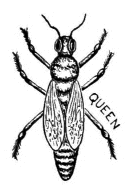
A SWARM of bees contains one Queen, thousands
of workers, and in the summer season a limited
number of drones. The queen is the only fully developed
female in the swarm. She never leaves the hive
except on two occasions—when leading a swarm, and
when but a few days old, to meet the drone, or male bee,
in the air, for the purpose of fecundation. It appears
from close observation that only one impregnation is
operative during life, as old queens have never been
known to leave the hive for that purpose.
The natural life of a queen averages from four to six
years. Queens sometimes become entirely barren before
death; at other times the eggs of old queens are found to
produce only drones. No matter whether deposited in
drone cells, or worker cells, the progeny will be drones
invariably. When drones are reared in worker cells, they
will be very much dwarfed in size, notwithstanding the
worker bees attempt to overcome the difficulty by lengthening
the worker cells to accommodate the monstrosities.
The queen has a sting yet she may be handled with
impunity, for she will not use it except when in deadly
combat with a rival queen. She receives the most
marked attention from all members of her family; deprive
a swarm of their queen, and they will, as soon as the
loss is known, manifest the greatest agitation and alarm,
and if the swarm is one just hived, and only a few
hours from the parent stock, they will all return at once
to the old home. They appear to fully realize the vast
importance of a mother, and that with no means to supply
her place they must soon perish; and to avoid their
impending fate they return to the old hive. With old
stocks deprived of their queen the result is different, as
will be shown further on. Every one who keeps bees
should strive to become familiar with the appearance of
the queen, that they may be able to recognize her at a
glance among thousands of workers, as it will often be
necessary to look her up in my new system of bee management.
In looking for the queen in full hives, she is
usually found on the brood combs, unless in opening the
hive she may have been frightened and taken refuge in
some hiding place, at the corner of the hive, at the bottom
ends of the comb-frames, or some similar hiding
place. After we become familiar with her appearance
and movements we are able to find her quite readily,
even when the hive is crowded with bees.
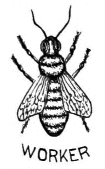
The worker bee is much smaller than the queen. On
the worker devolves all the labor of the swarm. They
collect honey, pollen or bee bread, and propolis, or bee
glue. The workers produce wax from honey, and from
the wax they build comb, in which to store the honey
and bee bread they collect, for their own use in time of
need. Wax is produced from honey, as butter is produced
from milk. Bees do not collect wax, but they
collect honey, which by a natural process in the stomach
of the bee is changed, and exudes from between the
rings of the abdomen in minute scales of wax, which is
detached by the bee and moulded into comb. The
worker bee possesses a sting, and is ever ready to make
use of it in defending home and treasure. This is a
wise provision of nature, for were it otherwise, the other
insect and animal tribes would appropriate the treasures
of the bee—honey, wax, etc., and this industrious little
insect would soon become instinct.
The worker bee possesses an instinct but little inferior
to reason in the human family. A few examples will
show their wonderful instinct: Twenty hives of bees,
placed in a row, but a few inches distant one from the
other, all of like size, shape and color; the bees to our
perception exactly alike, no difference in size, shape,
color or action;—yet every bee of this vast number
(which at some seasons of the year would amount to
more than six hundred thousand bees) in these twenty
hives knows its own hive, and if let alone will not enter
any other, except it be for the purpose of securing the
honey therein for its own use, or in other words to
plunder and rob its neighbor. There is no intercourse
between swarms; each is a separate colony governed by
a queen. If through mistake the subjects of one enter
the domain of another, a war of extermination is commenced
at once. To test this point, I changed two hives
so that they were reversed, the one occupying the place
of the other. This was done while the bees were out
collecting honey in a warm day. The first bees that
entered the hive were instantly killed, and this was kept
up until the hives were set in their proper places. The
ground in front of the hives was covered with hundreds
of dead bees. A bee is killed almost instantly by the
sting of another.
The young bee on its first excursion from the hive
does not leave its home without precaution. With a
view to a safe return, it turns its head towards its home,
rises slowly on the wing, at first describing a circle of
only a few inches in diameter, as it recedes slowly backward,
seeming to so mark every object surrounding the
hive, as to enable it to return and enter, without the
slightest danger of entering any other hive. Bees in
spring, in their first flight, mark their location in this
manner. After the location has been thus marked, the
bees leave the hive in a direct line, and return by their
way-marks with perfect accuracy and regularity.
The drone bee is a clumsy fellow. The drones are
the male bees. Where a dozen or more hives are kept,
there is no necessity for more drones than one swarm
would naturally rear, yet each one of the twelve swarms
carries out its natural proclivities, and rears a large
number of these useless consumers, not one of a thousand
of which is ever of any use. Swarms should not be permitted
to rear a large number of these non-producers.
A few are indispensable, yet we should take this matter
into our own hands. Not one drone in five thousand
ever fulfills the purpose for which it was created. Fifty
drone cells are enough for one hive, and when more than
this number are constructed (sometimes they will number
a thousand or more in a hive) cut out all but a very few,
and fit in a piece of worker comb in their place—it is more
profit to raise workers than drones. Drones leave the
hive to sport in the sunshine in large numbers, every fine
afternoon in June and July. When on the wing, they
make a very loud, coarse buzzing. They have no sting
and may be handled without the least fear.
When the honey season is over, the worker bees drive
out the drones, and a prosperous swarm will not tolerate a
drone in the hive through the winter. In September I
have seen a quarter or more of drones clustered together
near the entrance of the hive, whence they had been driven
by the bees. The workers on guard about the entrance
of the hive, would not let one pass into the hive, though
they were constantly making the attempt. As soon as
one would approach the entrance to the hive to pass in,
a half-dozen or more workers would seize him, and drag
him struggling to the edge of the platform and pitch him
off, at apparent great danger to his portly and clumsy
body.
I wish to impress strongly on the minds of all who
adopt my plan of bee management, the great importance
of cutting out drone cells, except a few in every hive.
Don't leave more than fifty, half of that number will do.
After you have once cut out the surplus drone comb and
fitted in worker comb, there is no further trouble with an
excess of drones from that hive. It takes a great deal
of honey to rear a large brood of drones, and still more
to support them in idleness two or three months.
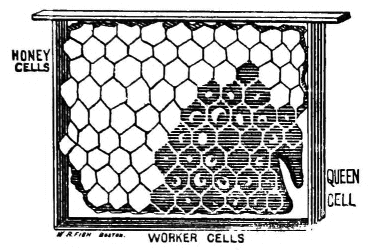
This engraving represents a section of comb in a miniature
comb frame, containing all the different cells found
in a hive. At the top are cells for storing honey. At
the extreme right, near the bottom, is a queen cell complete,
as it appears in queen raising, or in one week after
a swarm has been deprived of its queen, in a full stock
or as it is found in stocks that swarm naturally, at the
time the first swarm issues. Though often found in
different places on the comb, and often to the number of
a half-dozen or more in one stock or hive, yet its relative
position is always the same. It will always present
the same appearance, whether at the edges or on other
parts of the comb. Near the queen cells is seen the
worker cells, containing brood in all stages of growth
from the tiny egg just deposited by the queen to the full-grown
grub or young bee. Near the worker cells, at
the bottom, are the empty cells.
The natural increase of the honey bee is very imperfectly
understood by the great majority of bee keepers.
Very many suppose that young bees are raised only in
the warm summer months, and their ideas of the modus
operandi of increase are exceedingly vague. I find that
strong stocks have maturing brood nearly every month
in the year—I have found brood in stocks in December
and January.
The queen lays all the fertile eggs in the swarm, consequently
all increase is dependent on her. I say the
queen lays all the fertile eggs, because occasionally
under certain circumstances we find eggs laid by workers
but under my observation, such eggs never mature.
Egg-laying workers are known to be such, by eggs being
found in stocks that have been deprived of their queen,
and the means of rearing another. This is one of the
wonders of nature, of which no satisfactory solution has
been given. The points established as to the sex of bees
are these: The queen is a fully developed female; the
drones are fully developed males; the worker,—what is
it? The worker is said by some to be neuter. If this
last is true, how are the eggs produced? Others say
the worker is a female with generative organs not fully
developed! A pretty nice point—to credit them with
the power to produce eggs without imparting vitality
sufficient to germinate.
We will leave this knotty question, as it is of no consequence
in the practical management of bees for profit.
Suffice it then to say, the queen is the mother of the
entire family, and without a queen no swarm of bees can
long exist.
The time taken to perfect the three different kinds of
bees—queen, worker and drone—varies slightly. The
queen will mature in about sixteen days from the time
the egg is deposited in the cell. The drone and worker
each in about twenty days. This time is subject to some
variation, governed by the weather, and number of bees
in the hive, which causes the temperature of the hive to
be greater or less. A high temperature will forward,
while a low temperature will retard, the maturing of the
brood.
Swarms with healthy prolific queens increase rapidly
through the spring and summer. The queen at this
season will deposit from one thousand to fifteen hundred
eggs per day. Some writers estimate higher. To secure
so large a number of eggs, and consequent increase of
bees, we must have healthy prolific queens to start with,
and offer every available facility to encourage the desired
increase. How to do this successfully, is shown further
on.
If we wish to secure a good harvest of honey, we
must have the bees to collect it, and we must have them
at the proper time, viz: when the harvest is ready. To
do .-this, we must encourage breeding to the utmost in
early spring.
Early in the spring the queen enlarges the circle containing
the brood; perhaps, if the stock was very strong,
and everything favorable, she laid a few eggs in one or
two combs near the centre of the cluster of bees in January.
Perhaps the cells occupied at that time were less
than a dozen, all compact together in a circle, occupying
less space than the size of a half dollar. As she progresses,
this circle is enlarged, and the cells on the opposite
side of this comb are used; then the next comb and
so on, at the same time enlarging the circle, keeping the
brood compactly together, so that the bees, by clustering
around it can keep up the required warmth to forward
the brood to maturity. As the young bees hatch, the
queen proceeds with her duties of laying eggs until
every brood cell is occupied, and as fast as a bee matures
and leaves its cell, she is on hand with an egg to occupy
the vacant place. This is kept up without cessation till
swarming time, when the hive becomes crowded with
bees, then, as preparation for swarming, the queen
deposits eggs, from which the bees, by a special course
of treatment, rear queens. When they are sealed over,
as shown in the plates, the old queen leaves the hive
with the first swarm to seek a new home. In about ten
days the young queens hatch and lead out after-swarms—second,
third, etc. When swarming is over, the
strongest queen destroys the others, and reigns over the
old swarm till another swarming season. This is the
process in natural swarming; on my plan we improve
upon the process, as will be shown in the proper place.
CHAPTER II. THE CONTROLLABLE HIVE AND NEW SYSTEM OF BEE MANAGEMENT. — SWARMING CONTROLLED.
IT is now more than ten years since I invented the Controllable
Bee Hive, and New System of Bee Management.
I commenced bee keeping with the common box
hive, with no knowledge whatever of the habits of bees.
I was not long in learning that I could not make bee
keeping a success with the box hive, and I also found
that the thousand and one patent hives were no better
than, and the great majority of such hives inferior to, the
simple box hive. I found there was no practical method
of controlling the swarming propensities of bees. All
such hives would swarm or not, as seemed to suit the
caprice of the bees, which I found very perplexing.
Stocks under the old plan of management sometimes
show every indication of swarming, such as clustering
out, etc., yet they adhere pertinaciously to the old stock
through the entire summer, a peck or more of them clustering
idly on the outside of the hive, through the season;
and if one put on boxes, it is all the same, they will do
nothing. And such swarms often starve early the next
winter, after passing the summer in idleness. Other
stocks with apparently not so many bees will swarm
several times; often swarming so much as to reduce the
number of bees so low that the bee moth will effect its
destruction during the summer; there not being bees
enough to protect the combs from the attacks of this
destructive little insect. This swarming problem I found
very difficult to solve. There were so many conflicting
theories, I found I could gain no positive, reliable information
from any source, to aid me, and that I must solve
the problem by practical experiment.
Experience is a good teacher, but often a very costly
one. Some told me if I wished to prevent swarming, I
must cut out the queen cells, which the bees constructed
preparatory to swarming. This was simply impossible
with the box hive, so I constructed a hive with moveable
frames, so the bees could build their combs in the frames,
and each comb of the hive could be lifted out separately.
But when I attempted to prevent swarming by cutting
out the queen cells, I found if I was to thwart nature in
that way, I had, to say the least, a big job on my hands.
I could cut out the queen cells, but within twenty-four
hours after I had done this, the bees would have others
constructed, and be ready to swarm, and as I kept
cutting, they would keep building. They had the advantage
of numbers and position, and when I opened the
hive every day and destroyed such, to them, important
work, they were not long in declaring and proclaiming
me to be an enemy to them, and they would attack me
whenever occasion offered. I soon found that if not
impossible, it was certainly impracticable to prevent
bees swarming by cutting out the queen cells. It was
a surprise to me that this plan should be recommended
by bee keepers claiming to be well skilled in bee management.
After proving this plan of no value, I was told
if I would contract the entrances to my hives so the
queen could not pass, I could thereby successfully prevent
swarming, as the swarms would not leave without
the queen. This looked to me like a very nice operation,
to say the least, in fact, more nice than wise. However,
I determined to test the plan. I accordingly contracted
the entrance to my hives, and lo! the drones
being larger than the queen, they could not pass! So
they clustered about the entrance, and in their efforts to
get out, completely blocked up the passage, so the
workers could not pass. Yet this plan of contracting
the entrance was claimed to be protected by letters
patent of the U. S. I found this plan for preventing
swarming of no value whatever. Very many other plans
were tendered me and tested with like results. I was
all this time pushing my experiments, and learning something
from experience every day. I was determined to
arrange and construct a hive which would render bee
keeping successful and profitable, and I can say at the
present time, my labors have been rewarded with success.
I ought to go on and write out a description of all the
old methods of bee keeping, and all the patent bee hive
humbugs, with the thousand and one wow-patent hives
and fixtures, gotten up expressly to swindle bee keepers
out of their hard earnings, by a class of rascals, many of
whom never owned a swarm of bees, and who care not
one cent whether bee keeping is a success or otherwise,
if they can pocket a round sum by their fraud. Were
I to write out minutely these points, this work would
become too voluminous and extended; besides it would
be of no practical value to the bee keeper who wishes to
keep bees for profit. I will not, therefore, give such
minute descriptions of all the old systems, hives, etc.,
but will confine myself more closely to such practical
information as will be of value to the bee keeper.
How to control swarming is truly an important question.
I believe the successful controlling of swarming is the
key to success and profit in bee keeping. Now how shall
we do it. I will tell you. But first a few preliminary
words. If swarms are desired, we arrange in early
spring to have them issue in the swarming season, and
at such a time as will best suit our convenience. When
no swarms are wanted, we turn the whole force of bees
to storing surplus honey in small glass boxes, throughout
the entire season, and have no swarms, yet have the
same increase of bees that would be gained if they
swarmed. Then all the bees work at storing honey in
boxes, instead of swarming out; and to any one who has
not tested the matter, it is surprising to see the amount
of honey which a swarm of bees will store when not
allowed to swarm, and fed judiciously; ample box room
being provided, of easy access, so that all the bees have
room to work; and by this plan, we are not constantly
watching and waiting for swarms with uncertainty throughout
the entire summer, for we know with certainty, when
and where to look for swarms. In my plan, the swarming
properties of bees are effectively controlled, without
frequently disturbing or overhauling them, but by observing
rules strictly in accordance with the habits and
instincts of bees.[1]
[1] Here let me be clearly understood. I admit that bees will sometimes
swarm, with abundant room for work in their boxes. Yet I claim that on my
plan, all increase by swarming may be prevented without great trouble or
perplexity, such as has heretofore attended all attempts to bring about this
greatly to be desired object. If a person commences bee keeping, with a
certain number of swarms in Controllable Hives, and in early spring gives
the bees access to the side boxes, and later, after they commence work in
them, gives the bees access to the top boxes, giving them otherwise ordinary
care, (except to feed if desired,) but a small proportion will swarm on the average
yearly. Much the larger portion will work in the boxes without swarming
out, and give a handsome yield of surplus box honey, the yield of course
being governed by the amount of feed given them, and the yield from flowers,
etc. But if increase of stocks is preferred, rather than surplus honey—if the
bees are not given access to the boxes, but confined in their labors to the
brood section of the hive, being fed as directed, nearly every one will swarm,
and swarm early. After long experience, however, I recommend putting
on the boxes early, we shall thus, in most cases, get a greater profit than
otherwise.
If you wish your bees in Controllable Hives to swarm,
keep the partition in place at the sides of the brood
section, and the honey board over the top; or in other
words, keep the bees confined in their labors to the
central or brood section of the hive. Now, if you wish
them to swarm in any particular week of the swarming
season, ten days before, remove the old queen. [It is
well to keep her, and to do so take with her about a
pint of bees, and put them in a small miniature hive, six
or eight inches square, with moveable frames, like those
in the central part of the Controllable Hive. Keep
them shut in twenty-four hours; then give them their
liberty, and they will work the same as a large swarm
through the summer; but will not winter. If such
queens are known to be very old, it is best to destroy
them when we take them from the swarm. Keep
only young, vigorous queens!] The bees in the hive
from which you have taken the queen will in nearly
every instance construct queen cells immediately to
replace the loss of their queen. At the earliest possible
moment, they seem to sense fully their loss, and to know
that if they do not get another queen at once, their loss
is irreparable. They usually will construct a number of
cells, perhaps a half dozen or more. These will hatch in
about ten days, and then swarms will issue.[2]
[2] Should any stock fall to swarm within two weeks from the time the
queen is removed, at the end of that time, examine such stock, and if they
have no queen, they must be furnished with one. About one stock in
twenty, deprived of its queen as directed, will fail to rear queens.
If you wish to devote but little time to your bees, and
are not particular as to the time of swarming, and wish
to have but very few swarms, or perhaps none at all,
early in the spring, as soon as the bees commence their
work, put on the boxes (sides and top) and give the bees
access to them; side boxes first, top boxes later. By
this course, but a very small proportion of your stock
will swarm, (if this plan is to be practiced each year, it
will be necessary to replace the old queens with young
ones, every three or four years: if this is not done,
queens will die or become barren from old age, and consequently
loss of stocks follow; keep this point in your
mind; young, healthy, prolific queens are essential to
success,) as they will have ample room in the boxes for
their labor. Occasionally a hive treated in this way will
swarm, and if you wish to have no increase of stocks
whatever, if a swarm comes out, hive it in a light box,
and as soon as this is done, go to the hive which they
came from and smoke lightly, if the bees are cross, lift
out the comb frames from the brood section with the bees
adhering; examine each and every comb carefully, for
queen cells, and cut off all but one. Success here
depends on care and thoroughness, for if you leave more
than one cell, your bees may swarm out again in a day
or two.
After this is done, spread a sheet on the ground; set a
light box, like the one in which you have the bees, near
one side; raise the edge towards where you will shake the
bees one inch or a little more, to give the bees a chance
to enter the box. Shake the bees from the hive, by a
quick, jerking motion, upon the sheet, the most of them
some two or three feet from the box. With a large
spoon or ladle, put a few up near the box, so they will
enter, and disturb the others gently with a quill or light
brush. When they commence to enter the box, they
will set up a loud and continual humming or call, and
the bees on the sheet if lightly disturbed with the quill
or brush, will spread out and march toward the hive,
while those on the wing will alight, and join them in the
march. Now look closely for the queen and capture her.
If she is not found before the bees get into the box,
shake them out again, and go through the same process,
till you find her. As soon as you have secured the
queen, the bees in a few minutes, finding themselves destitute
of a queen, and not having the means of raising
another to take her place, will rise on the wing, and
return to the old stock from which they came, and will
not come out again, but will work in the boxes throughout
the season. I will treat of this subject of swarming
no further in this chapter. The merits of the Controllable
Hive and New System of Bee Management will be
fully shown further on in this work, and the most explicit
instructions given for rearing bees with profit.
CHAPTER III. PATENT AND NON-PATENT HIVES, BEE JOURNALS, ETC.
I HAVE learned from bitter experience, as has nearly
every one who has kept bees for any length of time,
the dishonesty, and utter disregard for truth, of a class
of speculators who prey upon the unsuspecting bee-keeper.
Patent Hives—the great majority of them—are
a curse and a hindrance to successful and profitable bee-keeping.
I have no time to describe the multitude of
worthless patent hives, and the many tricks and swindles
of the venders of the same, but I advise every bee-keeper
to consult his own interests, and have nothing to do with
them. Ninety-nine out of every hundred are a swindle.
I have tested their merits and know whereof I affirm.
I am sorry to find that many of the bee journals and
bee-keepers' associations are conducted on prejudiced
and selfish motives, and in the interest of some individual,
or company of men, for the sole purpose of making
money from the sale of some particular hive or fixture,
without regard to merit, or value to the practical bee-keeper.
All honest discussion, with a view to bring out
facts and figures to guide the inexperienced bee-keeper
in his labors is suppressed. The bee journals should
be the disseminators of useful knowledge among bee
keepers. I am sorry to find the reverse true with many
of them. After a thorough investigation, I feel it my
duty to advise bee-keepers, and those contemplating bee-keeping,
not to take all for granted that you read in the
bee journals, for if you do, you will be very likely to
soon find yourself robbed of your money, and your bees
ruined.
Very many who write for the bee journals with high
sounding words, claiming to be adepts in bee culture,
have really no practical knowledge of the nature and
habits of bees. We have supported a host of speculators
in our business, for a long time; the object of this class
has ever been, how best to secure our hard earnings, and
with no desire or effort to aid in rendering bee-keeping
more profitable and desirable. The country is full of
this class, and they always combine to crush out real
merit in anything pertaining to bee culture, brought
before the public by individual bee-keepers, who are
laboring to advance the cause by giving their experiences,
gained from hard every-day labor among bees.
For many years I have written articles on bee culture
for the leading agricultural journals and newspapers. I
have thus given much of my experience in detail, with no
thought of further reward than the satisfaction of having
contributed to aid bee-keepers in raising bees with
greater profit, believing if all would so contribute of their
practical experience with bees, great mutual benefit
might be gained, and rapid progress made in successful
and profitable bee culture. In consequence of my course
in spreading information with a view to aid the cause,
the class referred to in this chapter, and their tools are
boiling over with wrath towards me, lying, and slandering
me through the public press, and by every other
means which their depraved natures can invent; all
because I have succeeded by hard study in perfecting a
hive and a new system of bee management, which is fast
coming into general use among bee-keepers; consequently
the sale of their worthless trash is decreasing rapidly.
But I am anxious to get through with this part of my
work, and reach the practical part, where I have the
greatest confidence in my ability to give such information
as will render bee-keeping profitable and desirable.
CHAPTER IV. FEEDING. — RECEIPT FOR FEED. — FEEDING FOR EARLY SWARMS. — FEEDING FOR SURPLUS HONEY. — FEEDING FOR WINTER.
FEEDING bees when judiciously managed, is the
stepping stone to large profits from them. Bee
keepers who have heretofore attempted to feed bees have
met with poor success.
A bee keeper of my acquaintance paid fifty dollars for
a patent apparatus for feeding bees together in the open
air. The result was, soon after being fed, they commenced
fighting among themselves. The weaker stock
first fell prey to the stronger, then the stronger in turn
were attacked, and the final result was, nearly every
stock was ruined, and the plan abandoned in disgust after
the first season's trial.
Now it is plain to every intelligent person, that in
order to receive the greatest possible profit from bees,
they must be fed. There can be no question as to the
great benefit to be derived from feeding bees. The only
question is, how, when and what to feed. It is as much
a necessity to feed bees, as to feed our domestic animals,
cows, sheep, etc., or to apply manure to plants, or any
crop the farmer cultivates, to stimulate growth and
increase the product and consequent profit of the same.
We should look upon that farmer as either a fool or a
lunatic, who should furnish his domestic animals no food,
except what they obtained by grazing in the pastures
and fields, the year round. And do you think his cows,
treated thus, would yield him a large product of butter,
cheese and milk, and consequently a good profit in dollars
and cents? Do you think he would find his cows, managed
thus, so profitable as to induce him to keep cows
to any great extent? Let a farmer manage thus—take
his cows to the barn, milk them, then turn them out the
year round to graze and provide for themselves, taking
them up only to milk them, furnishing them with no
food except what they procure by grazing—how long,
think you, would such a farmer have cows to milk? Yet
this is a parallel case with the bee keeper who furnishes
his bees with no food except what they can procure by
their own industry. And is it surprising that bees
treated thus pay no profit?
Again, the farmer who should year after year plant
his corn, potatoes, etc., apply no manure, furnish no
cultivation, yet expect to succeed in farming, harvest
large crops, and get a good yearly profit in dollars and
cents, and grumble because he did not, and at last abandon
the business, asserting that there was no profit in farming,
furnishes another parallel case to the bee keeper who
lets his bees shift for themselves, and then grumble
because they pay no profit, and at last abandons the
business, asserting that there is no money in bee keeping.
It being self-evident that it is profitable to feed bees,
it now remains to show how to do it with the greatest
possible profit.
To eight pounds of coffee-crushed sugar, add two
quarts of soft water, and whites of two eggs, bring to a
boiling point over a slow fire, being very careful not to
burn it. Skim off carefully all scum or sediment that
rises, so that the feed, when cool, will be perfectly clear
and about the consistency of new honey.
The first warm days in early spring, as soon as the
bees can fly a few hours in the middle of the day, mix
corn meal with rye meal, equal parts, and set out in pans
or other shoal dishes, near the hives. The bees will
carry this to their hives in considerable quantities. It is
used as a substitute for pollen or bee bread, and is very
essential in forwarding the increase of bees in early
spring. The meal should be fed very early in spring,
for as soon as the bees can collect pollen from the natural
sources—trees, shrubs, flowers, etc., they will not
take this meal. If rye meal cannot be obtained, use
unbolted wheat flour.
If you wish early swarms, keep the bees confined in
their labors to the brood section of the hive, or in other
words, do not give them access to the boxes, and commence
as early in the spring as the bees begin to fly in
the middle of the day, and feed each stock at evening
about one-half pound of the liquid feed. Continue this
till your swarms issue, then discontinue feeding. I
would, however, recommend putting on boxes in all cases
early in spring, as we shall thus secure a more satisfactory
amount of surplus honey, and we shall, in nearly
every case, when a dozen or more swarms are kept have
a sufficient increase in number of swarms. Feeding the
bees in early spring on my plan gives them a good start
and renders them very prosperous throughout the season.
If you wish surplus honey instead of swarms, put on
your side boxes as early in the spring as the bees commence
brisk work on flowers,—as a general rule, say a
few days before fruit blossoms appear. Feed as directed
for swarms until about ten days before white clover blossoms,
then put on the top boxes, leaving room only for
feeder. Then for ten or twelve days feed them all they
will take. Feed at evening. They will at first, perhaps,
take from five to ten pounds every night. Crowd
them hard, for the object is now to get every part of the
brood section (not occupied by eggs and brood) filled
with honey; and if possible, crowd the bees into the
boxes to commence the work of comb building, so that
during the yield of honey from flowers, you can get every
ounce collected, stored in the boxes.
By early and judicious feeding, we have encouraged
breeding so that now our hives are filled, almost overflowing,
with bees, ready to gather the harvest from the
flowers as soon as they begin to yield honey.
Discontinue feeding while the yield of honey continues
in full supply from the flowers. At the close of the
yield, if you have boxes half filled or more, feed all they
will take up for a few days, or until your boxes are
finished.
In September or October feed such stocks as are short
of stores, to winter them. Each stock should have twenty
pounds of honey in the brood section to winter safely.
If they have less than that, feed until they have that
quantity, or take a frame of honey from a stock that has
some to spare, and exchange with the one that is short,
and so proceed until all have sufficient stores to winter
safely.
In no case take out frames at the close of the season,
and leave that space without a frame, or with an empty
frame. At the commencement of winter every hive
must (to winter safely) have its full number of frames
filled with comb, no matter if they are not filled with
honey (if the hive has the required number of pounds,)
but each frame must be filled, or nearly filled with comb,
or there is great danger of loss from sudden changes of
temperature through the winter.
In feeding for box honey, it often requires more than
one pound of feed to secure a pound in boxes, for the
bees consume some while storing it, and they often find
some place in the hive which, like the crowded omnibus
or street car is not so full but that additions may be
made. It would not pay to feed for box honey, were
there no yield of honey from natural sources.
The reader will bear in mind this simple fact: Bees
do not make honey, they simply collect it. Honey undergoes
no chemical change in the stomach of the bee.
Several years since, my bees had access to several
molasses hogheads, and the result was, I found pure
molasses stored in my hives, in the same comb with nice
white honey. I am satisfied that the bee does not make
honey but collects it. My feed is prepared and recommended
in view of this fact, and in perfect accord with
all points bearing upon this subject.
The feed is of the same color as the nicest, white clover
honey, and when put in boxes by the bees with the
honey collected from flowers (I have no doubt in some
instances in alternate layers in the same cell with honey
from flowers,) it cannot be distinguished, either in color
or taste, from honey wholly collected from flowers.
If at any time there is a lack in the yield from natural
sources, feed the bees all they will eat and when the flowers
yield again they are ready to store in boxes. Manage as
recommended and let the old fogies growl. Your honey
will be of superior quality and give perfect satisfaction
to your customers.
CHAPTER V. BOXES FOR SURPLUS HONEY. — CARE OF HONEY IN BOXES IN WARM WEATHER.
IN the last chapter instructions were given when to put
on boxes, but it is important to know more about this
subject, the kind of boxes to use, etc. I shall recommend
two sizes, two pound and one pound. The larger
size, with glass sides and ends, top and bottom, and corners
wood; the smaller size, all wood.
Seventy-six of the small size and thirty-eight of the
large size will fit each Controllable Hive, or part of each
size can be used on the same hive at same time. The
large boxes are just wide enough to contain two combs;
the small ones, one comb. These boxes fit the sides and
top of Controllable Hive. The bees enter the top boxes
through spaces in bottom of the box. They enter the
side boxes through spaces at the ends of the boxes.
(For a more particular description of the boxes and their
adjustment to the hives, see Drawings or a Complete
Controllable Hive.)
Before giving the bees access to the boxes, stick a
piece of comb or comb foundation in the top of each box
where you wish the combs built, a piece one or two inches
square to hold them firmly in place. Melt resin and bees
wax equal parts, dip the edges in the mixture and apply
while hot.
Honey in these boxes is very attractive, and is sought
for in the market by customers who have purchased in
this form. Honey put up in these nice boxes shows its
superior quality at a glance, and customers prefer to
purchase in such boxes with no tare deducted for weight
of box, to purchasing in the ordinary wood box with the
weight of the box deducted.
In taking these boxes from the hive,[3] when filled with
honey, in warm weather I recommend the following
method: Take the boxes off early in the morning, and
carry them to some out-building, and put them in a clean,
tight box or barrel; place the boxes in such a manner
that the openings in the boxes will be free for the passage
of the bees from them. Spread over the box or
barrel, a thin piece of cloth. The bees will leave the
boxes and collect on the under side of the cloth, which
must be turned every few minutes, until all are out,
except a few drones and very young bees; these can be
taken out with a pencil. To facilitate the removal of the
bees from the boxes, if any are obstinate about leaving,
remove the glass in the sides of the boxes, if the cover is
not fastened to it. The greater part of the bees from
these boxes will return to their hives; excepting a very
few young ones which had never before been away from
the hive; these will be lost.
[3] When the box frames or partitions are taken out in the honey season, the
bees will often, if the stock is strong, spread out over the bottom, so that in
putting the frame in, a large number will get crushed. To prevent this, get
out two pieces of wood, each about one and one-half inches wide, and one-fourth
inch thick, one eighteen inches long the other twenty-two Inches
long; one edge of the long piece bevel to a thin edge, about the shape of a
carpenter's chisel. Nail the long piece in the center to the end of the short
piece at right angles with it, with the beveled edge down, so the beveled edge
will be level with the end of the short piece; also bevel the lower end of the
short piece. When the bees are spread over the bottom of the box section,
with this instrument push them gently back to the brood section. To do this
thrust the instrument down into the box section with the beveled edge down;
taking hold of the end of the short piece or handle, work the bees gently back to
the brood section, and when close up to the combs of the hive, let it remain
to keep the bees from spreading over the bottom till you get the box frame
down in its place, then remove it, and push the box frame up close to the
brood section, so the ends of the boxes will be as near the brood combs as
the partition was when the combs were built. If this is not done, and a
large space is left, the bees will either lengthen the cells in the outer comb
of the brood section, or build a new comb between the ends of the boxes and
the outer comb of the brood section. In either case we would find it very
troublesome when we remove the boxes, and wish to put in the partition for
wintering. Be sure to put the large box frame up close to the combs of the
brood section, that is leave barely space enough for the bees to pass between
the ends of the boxes and the outer comb of the brood section.
When boxes are to be taken off, use tobacco smoke
freely, to quiet the anger of the bees. Puff smoke in at
the entrance of the hive, before you touch it, then start
the top boxes from their fastenings, giving the bees a
puff or two of smoke at every crevice about the boxes at
the top and sides.
Considerable care is necessary for the preservation of
honey in boxes removed from the hives in warm weather.
As soon as the bees are all out of the boxes, seal up all
openings to the boxes, and set them away (in the same
position they occupied in the hive, so the honey will not
leak from the cells) in a dry, dark, cool room. We
must now guard against the moth.
As in warm weather the instincts of the fly is directed
to the dead carcass, so is the moth directed to honey-comb
left without bees in the summer season, and by a
similar process is each destroyed. When the bees have
been off about ten days, or perhaps a little less if the
weather is very warm, examine closely for the first appearance
of the moth worms on the surface of the combs in
the boxes. Their presence may be known by small
thread-like webs or cocoons on the surface of the comb,
growing larger as the moth worm enlarges in growth.
If no remedy is applied, these worms will completely destroy
the beauty of the honey in the boxes in a very few
days. Watch the boxes closely, and on the first appearance
of the least sign of worms in the boxes fumigate
with burning sulphur, thus: Open the passages in the
boxes; have ready a tight, clean box; saturate some
very dry pine shavings with melted sulphur. After
placing your boxes of honey in the box, set a saucer or
plate in the box at the bottom, away from the honey
boxes, so they will not take fire. Do not use too many
shavings; if you do it will injure the honey comb in the
boxes, by giving it a green color, and imparting to it a
disagreeable taste; a half dozen shavings each four inches
long is enough. Place them in the dish and ignite
them, and cover closely, so no fumes can escape; let
them remain for a few minutes,—not more than five, less
is often sufficient; it depends something on the amount
of sulphur adhering to the shavings, as well as the size
of box, number of boxes to be fumigated, etc. With
a little practice you will manage correctly and successfully.
As soon as the boxes are fumigated, seal up
every opening carefully, and set away as before directed,
in a dry, dark, cool room. Watch the boxes for a few
days, to be sure the worms are all killed. If you find
they are not, give them another dose of the sulphur.
After the worms are all killed, and every opening to the
box sealed up, wrap each box separately in paper, and
they will be safe through the summer.
How the eggs of the moth get into the boxes, has
always puzzled bee keepers. It is hardly possible for
the moth miller to pass through a hive crowded with
bees, to deposit her eggs in the crowded boxes. How
they get there must be guess-work—that they are there
is well known to many bee keepers. I feel very confident
that the eggs are deposited there after the boxes
are taken from the hive, and while we are getting the
bees out of the boxes.
CHAPTER VI. SWARMING AND HIVING.
UNDER the old systems of bee-keeping swarming
was very imperfectly understood. And even at
the present time it is amusing to see how many old bee-keepers
manage their bees. There is a class of old
fogies, who denounce all improvements and progress in
bee-keeping, and who, year after year, move in the same
tracks in the management of their bees, asserting that
they know all about bees that is worth knowing. It is,
to say the least, amusing, to see how this class of bee-keepers
manage when their bees swarm.
In the middle of some very warm day in June or July,
the alarm, "bees swarming," is sounded. Immediately
the whole household is turned out, some beating tin pans,
some sounding horns, some shaking cow bells—anything
and everything with which to make a terrible din is
caught up in the excitement, and every member of the
household works with the sole aim of making as much
noise as possible. This is done to make the bees cluster!
If this is not done, they will leave for the woods!
I should think the poor bees would leave anyway, to
get rid of the noise and foolish whims of their owner.
But no, they dislike to leave the place of their nativity, so
in ten minutes or less from the time they leave the hive,
they settle in a cluster on some object, generally within a
half-dozen rods of the hive. And they would have done
so in this case if no noise had been made. The noise did
not affect them in the least.
Now the bees are to be hived, and we will see how it
is done in the old way.
The bees in this case have clustered on a limb of a
valuable pear tree. "Very sorry they have pitched
there," says a man of perfect knowledge in bee-keeping,'
"I dislike to injure that tree, but there is no help for
it."
But first a hive must be prepared. It is not quite
ready. (This is bad management.) It must be washed
out thoroughly on the inside with salt and water, and
rubbed over with some sweet scented herbs. A bottom
board must be got ready, etc., etc. At last the hive is
ready. Now this wise bee-keeper places a table near
where the swarm clustered, sets his hive on the table,
raises one edge four or six inches, takes his saw—Oh, it
is a pity to cut that nice limb full of fruit from the pear
tree, but it must be done, thinks this man of perfection
in bee management.
He grasps the limb firmly near the cluster of bees.
They are very cross and uneasy. They have been clustered
an hour or more, while he has been getting his
hive ready. He saws of!' the limb on which the bees are
hanging, and places it carefully, with the bees adhering,
on the table, by the side of the hive, covers all very
nicely with a clean sheet, and leaves them alone to
enter the hive. At about sunset he will place the hive
with the bees in it on the stand it is to occupy.
At the time designated (about sunset) he goes out to
his hive on the table. It has been a very hot afternoon,
and the hive was where it received the full force of the
sun's rays. He carefully raises the sheet. There is the
limb on which the bees clustered—but where are the
bees? they are not on the limb! Why, in the hive, of
course. That is where he expected to find them. He
peeps carefully under the hive to see how they are getting
along, but astonishment is depicted on his countenance
when he discovers that his hive is empty. His
bees have left for other parts beyond his knowledge.
He tries to think of some reason why the bees have gone,
and seeks to lay the blame upon the hive. "Oh!" he
says, "I guess they did not like the hive, but I guess I
shall have better luck next time."
To a progressive bee-keeper, one who has correct and
practical knowledge of the natural habits of bees, it is
very plain why they left. They were actually driven
away by mismanagement. The heat of the sun pouring
down upon them was enough of itself to drive them off.
Then placing the limb, with the cluster adhering to it, on
the table near the hive, showed lack of knowledge of the
natural habits of bees. The hive might as well have
been in the house, as placed where it was. Then an
hour or more taken to get the hive ready, gave the bees
time to send out their scouts, to look up a location of
their own, and when these scouts returned, they left
with them for a new home. I contend every swarm does
this, viz: They swarm out of the old parent stock, led
by the old queen. They cluster on some object, as a
tree, bush or vine, near the old home. Then they
immediately send out a few bees or scouts to look up a
new home. These scouts may be gone a longer or shorter
time. When they return, if they find the bees clustered
where they were when they left, they soon lead them off
to the new quarters, but if before the scouts are sent out
or before they return, the swarm is hived and placed on
the stand it is to occupy, then the swarm will not leave,
for the scouts know not where to find them, or if they
should find them, the bees would seldom leave a good
clean hive, for a home in the woods. These scouts may
often be seen playing about the place where a swarm
has clustered, for several days after the swarm has been
hived.
Had this bee-keeper placed his hive on the table, as soon
as the bees were clustered, and raised the front edge one
inch, instead of four or six inches, and then, instead of
cutting off the limb, if he had taken a basket or pan,
placed it beneath the cluster of bees, and by a sudden jar
of the limb dislodged them from it into the basket or pan,
then emptied them down in front of the hive and sprinkled
lightly with a little water, at the same time disturbing
them gently with a quill or light brush so they would
not collect around and block up the entrance except a
very few that may be flying in the air (and these will
return to the old hive) in this way getting them all into
the hive, and immediately carrying it to the stand it
was to occupy, covering it with a board to shade it from
the hot rays of the sun, or placing it in the shade of a
tree—he would have saved his bees, the damage to his
pear tree, and much perplexity.
By the old methods of managing bees, there was no
means of knowing when to expect swarms; consequently
the bees were sometimes watched all summer, in expectation
of swarms any pleasant day, as outside indications
were favorable for them; yet they would often adhere
to the old hive throughout the entire summer.
With the Controllable Hive and New System of Bee
Management, as shown in this work, swarming is brought
completely under the control of the bee-keeper. It is
well for him to understand correctly what are the requisites
and preparations for natural swarming by the bees,
when left to themselves in a natural state. They are
as follows: The bees must be obtaining honey freely,
either from flowers, or from feed supplied them. The
combs must be filled with brood in all stages of growth,
from the egg just deposited in the cell, to the perfect
bee just emerging. (And from this bee-keepers will
note what conditions are required at the time swarms
are forced, as recommended in my plan.) When this
condition of affairs is reached, the bees construct queen
cells, (that is if they decide to swarm; they will do as
they like about it, if left entirely to themselves,) from
which in about sixteen days the queen will hatch, unless
the bees should change their intentions, and decide not
to swarm, and destroy all the queen cells. Remember,
they are having it all their own way. When these cells
are sealed over and finished is the time (if everything is
favorable) when the first swarm leaves, led off by the
old queen. Some of the most reliable works on bees
have taught that the queen cells must be half finished
before the queen will deposit the egg that is to produce
the queen; but this I find by close observation is a
mistake; for if you take the queen away from a stock,
with no queen cells in any stage of formation in the hive,
the bees will rear a queen from a worker egg, deposited
in an ordinary worker cell. And who shall say they do
not do this when the queen is present? I am satisfied
they do.
Thus we see in natural swarming, with the bees left
to themselves, the old queen leaves with the first swarm
at about the time the queen cells, are sealed over and
finished, which is about eight days before the young
queens hatch.
When the young queens hatch, after-swarms (as second
and third issues, or all after the first,) will issue. Second
swarms may be expected in about eight days after the
first. This time will somewhat vary, as the hatching of
the queen sometimes depends on the weather, the number
of bees left in the old stock, etc.; a low temperature
retards the hatching, while a high temperature forwards it.
At evening of about the eighth or tenth day after the
first swarm, by putting your ear close to the hive you
will hear, very plainly every few minutes, several clear
and distinct "peeping" sounds, very sharp at times, then
hoarse and dull. This sound proceeds from the young
queens just hatched. When it is heard, look out for a
swarm the next day, though it sometimes happens that
one or two days will intervene before they will issue.
But as long as the sounds continue, be on the lookout
for swarms. This "peeping" can always be heard before
a second swarm issues, if we take the trouble to listen.
The time between second and third swarms is invariably
from one to four days. It is useless to look for after-swarms
from a stock after twenty days from the first.
They are generally all out within sixteen days from the
issue of the first swarm. I have given in another place,
under the head of "Swarming Controlled," instructions
how to manage swarming under my new system. Some
additional information I will give in this connection.
Just before swarms are expected, if there are no trees
near your hives or if there are large trees from which it
would be difficult to take a swarm of bees were they to
cluster on the branches, procure several evergreen trees,
such as spruce of fir, three or four feet high. Leave the
limbs on, excepting about a foot at the bottom. Sharpen
the trunks, so they can be set in the ground and lifted
out with ease. With a bar make large holes, about a
foot deep in front of your hives, some distant about six
feet, others from twelve to thirty feet. Set a half-dozen
or more of these trees in these holes, putting in by the
side of them a small stone or piece of wood, to hold firmly
in place, and prevent swaying by the wind. When your
swarms issue, they will be very likely to cluster on some
of these trees, when they can be conveniently gathered
in the Controllable Hive.
In hiving, if the bees have clustered on some one of
the trees set for them, place the Controllable Hive on the
stand it is to occupy, allowing the stand to project two
feet in front of the hive. Draw back the bottom board
under the brood section ten or fifteen inches, to give the
bees a good chance to enter the hive. Shade the hive
well. Now go to the tree on which your swarm is
clustered. Remove the stone or piece of wood that holds
it in place; lift the tree carefully avoiding any jar,
carry it to the hive, and hold the cluster down to the
stand and close up the hive, as near the entrance as possible.
Then give the tree a sudden jar, sufficient to dislodge
the cluster of bees. They will fall directly at the
entrance of the hive, and immediately commence to
enter. Sprinkle lightly with water, and gently disturb
those that stop about the entrance, with a quill or brush,
till all are made to enter the hive. Then slide the bottom
board forward to its place, and the work is done.
Should the bees cluster on some large tree or other
out of the way place, the manner of hiving must be
varied. Set your hive near by with a wide board in
front to keep the bees out of the grass and dirt. Arrange
the hive as before directed. If the bees are clustered
on a small limb, high above your reach, secure a basket
to a pole, and raise it directly beneath the cluster.
Dislodge the bees from their position, when they will
fall directly into the basket, which you should take down
quickly and shake the bees from it down to the entrance
of the hive and proceed as before. Keep the limb on
which they were clustered in motion for a few minutes,
to prevent their return. Should they cluster on the
body of a tree, or a large limb, where they cannot be
shaken off, set your hive near by, as before directed, and
with a handled dipper, dip them off and turn them down
in front of the hive near the entrance. Dip very carefully,
so as not to crush any of the bees. They will not
attempt to sting if you treat them well, and prove to
them that you are their friend. After you have dipped
off a portion of the bees, and got them moving into the
hive, if the queen is with them, they will all leave the
cluster and join their companions who are entering their
new home. But if the queen remains with the cluster,
as soon as those entering the hive discover that she is
not with them, they will leave the hive and rejoin the
cluster. So it is well to keep dipping as long as you
can get any of the bees, or till you are certain the bees
are leaving the cluster and entering the hive of their own
accord.
It sometimes happens in natural swarming, that when
a swarm issues, led by the old queen, which has occupied
the hive for a year or more, that she finds herself unable
to fly, and drops down in front of the hive. In this case
if left to themselves, the bees after flying about for perhaps
five or ten minutes will return to the hive whence
they came, and remain until the young queens hatch,
issuing again about the time a second swarm would have
come out, or perhaps a little earlier.
If you are on hand you can prevent the swarm
returning, but you must be lively. If you find the bees
are flying longer than usual without clustering, and
appear scattered and disorganized in their movements,
look in front of the hive from which they issue for the
queen. You will probably find her within two or three
feet of the hive. Put her in a tumbler, and cover closely
to prevent her escape. As soon as you find the bees
have commenced to return to the old hive, set it back
out of the way, and throw a sheet or some other covering
over it.[4] Then set your Controllable Hive in its place,
with the bottom board drawn back as directed in hiving
a new swarm. Set the tumbler containing the queen
over the brood section, so the confined queen can pass
down into the hive, but leaving no chance for her to
escape by any other way. The bees will then enter the
hive readily. And as soon as all are in, which will be
in a few minutes, remove the hive to a new stand and
shade as directed before. Set the old stock back in its
place.
[4] If other hires are near, on each side, it will be well to throw the covering
over them also, to prevent the swarm entering any other than the designed
hire, as they might possibly do, if the hives were only a few feet distant.
The foregoing circumstance often happens when bees
are managed on the old swarming plan, and queens that
are unable to fly are usually very old. On my plan of
management, such cases are of rare occurrence.
Natural swarms usually issue between nine o'clock in
the forenoon and one o'clock in the afternoon. Occasionally
one will issue earlier in the forenoon or later in the
afternoon; but as a general rule they make their appearance
between the hours specified.
Very early swarms hived in Controllable Hives should
have access to the boxes on one side only. In about ten
days after being hived, and as soon as the bees are well
at work in these, give them access to the other side.
Swarms that are hived late in the season will not require
boxes, until the next season, as it is necessary to have
the brood section filled, or nearly filled, before the bees
have access to the boxes.
It is important that we have the combs in the brood
section built straight in the frames, so as to be easily
lifted out separately. To secure this object, use comb
foundation as starters in each brood frame; a strip one
or two inches wide on the under side of top bar of each
brood frame its entire length, will insure straight combs.
To hold it in place, use resin and bees wax melted
together and applied warm. If no precaution is taken
in this direction, the bees will sometimes build the comb
crosswise of the brood section. As straight combs in
the brood section are very important, we should employ
every available means to aid in securing them.
It is well to keep on hand a few plain boxes, each
with four moveable frames, like those in the Controllable
Hive. If at any time a swarm comes out at the very
last of the honey season, hive them in one of these boxes.
They will probably enlarge or quite fill the four frames
with comb, and perhaps store a little honey. Then, in
the fall, put these four frames with the bees and comb,
in a Controllable Hive, and add two frames, well filled
with honey, from a stock that can spare it. In this way
you will build up a good stock for winter, whereas if you
had hived them in a full sized Controllable Hive so late
in the season, they would probably have put a little
comb in each of the six frames, but not enough to winter,
rendering it necessary for you to feed with the liquid
feed in the fall. It is better to have four frames nearly
or quite filled with comb, than to have six frames with a
very little comb in each. It sometimes happens that a
swarm of bees, which has worked well in boxes through
the entire honey season, will swarm about the time the
yield of honey ceases. If managed on the old plan, such
swarms are worthless, but by hiving them in a box with
four moveable frames as directed, they make valuable
stocks. All such swarms may be returned to the old
stock, as directed in another chapter, yet we sometimes
wish to increase the number of our stocks to the utmost,
and it is convenient to know how to make valuable stock
of these late issues. Then they can either be returned or
hived, whichever the bee-keeper thinks is most for his or
her interest.
CHAPTER VII. ANGER OF BEES. — TO SUBDUE THE ANGER OF BEES.
THE anger of bees, when once thoroughly aroused, is
much to be dreaded, as the results which follow
are often of a very serious nature. In my own case I
can handle bees with perfect impunity. They rarely
make any attempt to sting, no matter what liberties I
take with them. I always intend to be very careful, and
handle them gently, making them understand that I do
not mean to harm them. In my first efforts in handling
bees they were very apt to sting me, for the reason that
I did not understand their nature; consequently they
mistook my intentions, and often forced me to seek
shelter from their attacks. Now I seldom use any protection
when working among them. Often, in transferring
the bees and comb from the old box hive to the Controllable
Hive, I roll up my sleeves, and with no protection
whatever for the hands or face, cut out the comb
from the old hive, with the bees adhering to it and
arrange and fasten it in the new hive, without the bees
making any attempt to sting me.
I would not recommend any one to do this, until they
are so well acquainted with, and accustomed to handling
the bees, as to understand perfectly their every characteristic,
and be quite certain that they will not make an
attack. It is better to protect the face and hands from
their attacks as you will thus feel greater confidence in
yourself, and can perform all operations without fear of
stings. It is well to understand what will arouse the
anger of bees and cause them to sting. If we breathe
upon them, when they are in and about the hive or boxes
they deem it an insult, and will dash at and sting us at
once. Any sudden jar of the hive is instantly resented.
All quick, spiteful motions about the hive, such as running,
jumping, etc., are noticed, and quite sure to be
followed by a sting. The finger pointed at them with a
quick, spiteful motion when they are standing as sentinels
about the entrance of the hive, often provokes stings. If
they come buzzing around, threatening to sting, perhaps
striking your hat almost like a bullet, and should you
return the compliment by striking at them with your hand,
they will be quite sure to sting you. The better way is,
if unprotected, to hold down your head so as to protect
your face, and move away from the hive as quietly as
possible. When the bees find you are retreating, they
will not follow you far. Always remember that if one bee
stings you, others are very sure to immediately follow,
unless you retreat. I believe that bees have a language
by which they make known to each other their wants
and wishes; and I feel certain they know those who
have the care of them, and become accustomed to the
motions and appearance of those who are seen by them
daily.
The members of my family are seldom stung by the
bees, notwithstanding I sometimes have fifty hives or
more where we pass within twenty feet of them many
times a day, while the bees are flying in thousands about
each hive. In the middle of the day in the honey season
the air for many rods about the hives is full of bees. I
find my bees are much more likely to attack strangers
who come to see them, than members of the family.
I have tested every means recommended for subduing
the anger of bees, and have found tobacco smoke the
thing when rightly applied.
Have a tin-worker make you a tin tube, one inch in
diameter, six inches long, and fit stoppers of soft wood
closely in each end, two and three inches long respectively,
with a hole through each, one-fourth inch in
diameter. Fit one end of the longer stopper to hold in
the mouth. Before placing the shorter piece in the tube,
cover the inside end with wire cloth, bent a little convex,
to prevent the ashes and tobacco filling the quarter-inch
orifice. Taper the outer end of the short piece nearly
to the point. Remove the mouth-piece, and fill the tube
nearly full of tobacco (cigars are best for they burn
freely.) Dip with live embers, replace the mouth-piece
and blow the smoke from the pointed end.
With this instrument smoke may be forced among the
bees in any part of the hive or boxes. In all operations
likely to arouse the anger of the bees, as taking off and
putting on boxes, lifting out comb frames, putting on and
taking off feeder, removing the honey board, examining
the rearing boxes in queen raising, etc., smoke the hive
well. In short, use smoke freely when about to perform
any operation upon the bees. Before touching the hive
give the bees two or three smart puffs at each entrance
of the hive; then commence your operations immediately.
If the honey board is over the brood section, and your
operations are to be performed in that part of the hive,
raise the board just enough to puff in the smoke, but not
enough for the bees to come out. Give them the smoke
here freely for about one minute, before you remove the
board. They will show their submission by a loud humming
throughout the hive. When they set up this humming
noise is the time to proceed with your work. Remove
the honey board entirely, keeping the smoker at
hand ready for use, and giving them a puff of smoke
occasionally to keep them under submission.
It is best for the inexperienced bee raiser to protect
the hands and face in all operations, at least until he
feels perfect confidence in his ability to avoid irritating
the bees sufficiently to cause them to sting. To protect the
hands, wear thick woolen mittens, with very long wrists,
so they will come up over the dress or coat sleeve, thus
protecting the hands and wrists completely from stings.
To protect the face and neck, get coarse black lace, one-half
yard wide and a yard and a quarter in length.
Take three-fourths of this piece for the front breadth and
the balance for the back breadth. Seam together at the
selvedges, and gather the upper edge on an elastic cord so
as to fit closely, and draw around the crown of the hat.
When putting on the hat ready for use, leave the longer
part in front, to button beneath the coat or vest of a gentleman
or the sack of a lady. At the back the lace
tucks beneath the collar. Thus protected, we are perfectly
safe from stings, and can see as well, and perform
all operations nearly as well, as when uncovered.
The best antidote for stings is the application of water
in which salt has been dissolved—a heaping teaspoonful
of salt to a teacupful of water. Bathe the affected part
freely, and in severe cases take a swallow of the salt and
water into the stomach. Avoid rubbing or irritating the
stung part. Be sure to extract the sting immediately,
as the longer it remains, the more serious will be the
consequences.
CHAPTER VIII. THE BEE MOTH.
IN some localities the bee moth is said to be very destructive,
yet I regard the depredations of this insect
as much less to be feared than some bee-keepers suppose.
The bee moth is the agency provided by nature
for returning back to the earth the contents of any hive
when left by the bees, in the same manner that the flesh
fly is the means provided for returning to the earth the
carcass of any animal.
I do not believe that a strong, healthy stock of bees
was ever attacked and destroyed by the bee moth. The
stock must from some cause become reduced in numbers
so there are not bees enough to cover all the comb, before
the moth will make an attack. But when the comb is
unprotected, the moth follows the instinct of its nature,
and deposits her eggs in it. The bees from some cause
keep decreasing, and the moth continues depositing her
eggs in the vacated comb, until the entire comb of the
hive is a complete mass of vile worms, the progeny of the
bee moth.
About this time the bee keeper notices for the first
time (for, if he is keeping bees on the old plan, he lets
them take their own course, believing if he meddles with
them, they will "run out") that something is wrong with
that hive. So he examines them and finds the combs a
mass of webs, with hundreds of moth millers among the
combs, and the combs themselves filled with vile worms.
"Ah!" he says, "the bee moth has destroyed that swarm
of bees;" when in fact the moth had no more to do with
bringing about the loss than the maggots, found in the
carcass of a nice lamb destroyed by dogs, had to do with
destroying the life of the animal. "Oh," says some wise
bee-keeper, "I know better than that for I have seen the
bee moth flying about my hives and trying to get in."
Very well; I have seen the flesh fly circling about live
animals, but think you there was any danger from them
as long as the animal was in health? Not a bit. Neither
is there any danger from the bee moth, if you keep your
stocks of bees strong and healthy. But if you have weak
or diseased stocks, or have honey in boxes in warm weather
unprotected by the bees, look out for the bee moth.
Fumigate with sulphur all combs taken from hives in
warm weather; immediately after which, seal up closely
in well-made hives or boxes, to prevent access by the
moth miller. All combs taken out late in the fall, and
kept through the winter in a place where they will be
liable to freeze, may be sealed up so the moth cannot
gain access to them, and the contents will keep safely
through the next summer. Freezing destroys the vitality
of the moth eggs. Fumigating with sulphur as directed
in "Care of Box Honey in Warm Weather," will destroy
the moth worms, and prevent damage to the combs, if
they receive attention within a few days after the eggs
are hatched; but if the worms are suffered to remain for
any considerable length of time, the combs will be badly
damaged, if not entirely ruined. In protecting honey or
empty comb from the bee moth in warm weather, every
bee keeper should recollect that eternal vigilance is the
price of success! With the Controllable Hive and New
System of Bee Management the true condition of stocks
is known at all times. The stocks are very populous in
July and August, which is the time the bee moth is most
numerous about the hives. I never had a stock damaged
by the bee moth since I adopted my present system of bee
management.
CHAPTER IX. ROBBING.
LOSS of stocks by robbing shows carelessness, or
lack of knowledge as to the proper care of bees.
Not one strong, healthy stock of bees in a thousand will
be robbed, if proper precaution is taken. During a
copious yield of honey there is very little danger of robbing.
When there is a slack in the yield, the bees will
search about for plunder, and if a weak stock is found
they will be very likely to attack it.
It is the duty of every intelligent bee keeper to know
the condition of his stocks at all times, and if from any
cause he has a weak stock, be sure to ascertain the cause
of their weakness, and if they are healthy stocks contract
the entrances, in accordance with the number of bees to
pass. But if they are found to be diseased, remove
them. The bee, like the human race, is much better
able to defend itself against the attacks of an enemy when
there is but one avenue of approach than if there are
several.
No refuse honey should be placed in the open air,
accessible to all the bees alike, as this would be very
likely to create a desire to plunder, and incite robbing.
Never, when a stock is being robbed, change it from
one stand to another a few rods distant, to prevent robbing;
for this is a very great injury to the stock, as all
the bees that have marked the location (at the season
when robbing will most likely occur,) will return to the
old stand, and be lost. The best remedy, or rather preventative
against robbing, is to contract the entrances
to the hive. After bees have once commenced robbing,
and have been successful in capturing and plundering
one stock, they will, as soon as they have secured the
honey from that one, attack some other with great impetuosity.
Success in plundering renders them very courageous;
but if you have contracted the entrances as
directed, they will be very likely to meet their match,
and learn a good lesson. A little punishment is necessary
to teach them their proper place.
I knew one of these old wise-heads—such a one as
spoken of in the chapter on "Swarming and Hiving"—to
use his familiar logic: "What he didn't know about
bees wasn't worth knowing. He didn't want any book
larnin' to know how to keep bees; he had allers kept
'em, and his father before him." Well, this Mr. Wiseman
found, or thought he had found, that his neighbor's
bees were robbing his stock. "Zounds!" says he "I'll
fix 'em!" So he goes early in the morning, before the
bees are flying, and confines his stock, which he thought
was being robbed, by nailing a piece of board closely
over each entrance to the hive, so no bees could pass in
or out. About sunrise, or a little later, the robber bees
begin to collect on the front of his hive, seeking to gain
access. He waits until a quart or more have collected,
and then he takes two or three quarts of boiling water,
and dashes it upon them. This he continues through
that day, and the next, at intervals, as often as there
are any bees collected on the front of his hive. During
this time he has killed more than a half bushel of bees.
The third day he opens his hive, but to his great surprise,
no bees appear, and on examination he finds the
bees all dead. They had suffocated. Want of air, and
the boiling water on the hive, had destroyed them. And
to crown all, and to make his loss still more severe, he
found it was his bees that were engaged in plundering
his stock, and his neighbor's bees had nothing to do with
it. The vast number of bees slaughtered with the hot
water, so reduced in numbers several of his stocks, that
they never recovered, but fell prey to the moth-miller
that season. And that was the way he "fixed 'em."
There are so many whims and false notions about bees,
that great care should be exercised in adopting plans
recommended by inexperienced bee keepers, or that
class who claim to know everything about bees, yet by
their practice show that they know very little.
There is one other plan, aside from contracting the
entrance, which will prove successful, but which is a
little more trouble to apply. If you find a stock is being
robbed, look them over, and be sure that they have a
fertile, healthy queen. If the queen is found to be all
right, but with few bees, take from this hive two comb
frames filled with comb, with no eggs or brood, and go
to a populous stock and exchange these two combs for
two others filled with brood. Select such as have most
of the brood sealed over, as you want that which will
hatch the quickest. Put these two combs in the hive
that is being robbed, fasten up the stock by putting wire
cloth over the entrances, giving them air, yet preventing
the passage of bees.[5] When you put in the two frames
with brood, if you find but little honey in the hive—not
enough to last the bees a month or more—put in one
frame containing honey. Put on the feeder and carry
the hive to a dark and quiet room, and fill the feeder
with pure, soft water. Let the bees remain in this room
four days; then about one hour before sunset, set them
on the old stand, giving them their liberty, with the
entrances to the hive contracted—the lower entrance
closed entirely and the upper one half closed. Intelligent
bee keepers will readily understand why this plan
should prove a success. First, the bees that hatch from
the brood comb given the weak stock, will be a great
encouragement to the few bees in the hive; and in a
very few days they will aid in defending the hive against
the attacks of robbers. Again—removing the hive from
the stand seems to disorganize the robbers, for after they
have visited the stand for several days, and find no plunder,
they will give up the search in that direction.
[5] It is well to confine the bees when a large number of robbers are
inside—a larger number if possible than the swarm itself, for being confined a few
days, they will make that hive their home, and aid in defending its stores
against other robbers with as much energy as the bees of the original swarm.
Before taking the trouble to remove a hive as here
directed, care should be taken to be certain that the
bees are being robbed. You can be sure whether it is
your own bees or others that are robbing, by sprinkling
them with flour as they come from the hive which you
suspect is being robbed, and watching your other hives,
to see if those you have marked enter them, being very
careful that you are not deceived by the dust from some
species of blossoms, which adhere to the body of the bee,
and might be mistaken for the flour.
Bees when plundering a stock will often keep at their
work until dark, some of them being unable to find their
hive by reason of the darkness. Honest workers are not
found abroad at that time, and by the way, this is a very
good test of robbing. In concluding this chapter, I advise
again: Know the condition of your stocks at all times.
If any have too few bees, contract the entrances in
accordance with that number of bees to pass. Preventative
is much better than cure in this case.
CHAPTER X. PROFITS OF BEE KEEPING.
TWENTY-FIVE years ago, and even at the present
time, by the ordinary methods of bee-keeping, if
a profit of five dollars from one hive of bees in one
season was gained, it was considered "good luck." You
know there is no system in the ordinary methods of bee-keeping.
It is either "good luck" or "bad luck;"—all
"luck" and "chance," anyway.
In one year they get five dollars profit from a stock
of bees; the next honey season they get nothing, and
the bees all die in the winter; or perhaps they will survive
that winter, and the next season swarm, and fly
away to the woods; or perhaps refuse to swarm, and fly
away to the woods; or perhaps refuse to swarm, and
remain idly clustered on the front of the hive throughout
the entire honey season, and die for want of food before
the winter is half gone.
Bee keeping by the ordinary methods is a very precarious
and uncertain occupation. The profits are small
at best, and losses large and frequent.
With my Controllable Hive and common sense System
of Bee Management (as described in this work,) founded
on correct and scientific principles, bee keeping is
reduced to a science. There is no "luck," no "guess-work,"
no "chance," about it. There can be no loss in
bee-keeping without a cause; there can be no gain without
a full and correct understanding of the natural habits
and requirements of bees. A correct knowledge of the
subject insures success.
I will now present a few statements, exhibiting the
practical results which follow the use of my Controllable
Hive and New System of Bee Management, and showing
the great contrast in profits and general success in the
care of bees.
In the season of 1870, one of my hives of native bees
yielded two hundred and fifty-three pounds of surplus
honey, in glass boxes, from the 20th of May to the 1st
of July. In 1875 one hive yielded three hundred and
eighty pounds of surplus honey in glass boxes during the
season. This was the largest yield I ever had, and shows
what is possible by liberal feeding with a thrifty stock of
bees, giving them every facility, with a view of securing
the largest possible amount of surplus box honey. In
this case, I selected in early spring, the very best stock
I could find, and pushed it as hard as possible throughout
the entire spring, summer and early fall. My success
exceeded even my most sanguine expectations. As
it may serve to fix others in producing large yields of
honey, I will describe minutely the method pursued to
secure this large and extraordinary yield.
Very early in the spring I selected the most populous
stock in my possession. It was ruled by a young and
exceedingly prolific Hybrid queen, a mixture of Italian
and Native blood. I commenced early in the spring to
feed this stock lightly but regularly, every day at evening.
I fed about one-half pound of feed per day, until
a few days before the flowers were in bloom profusely.
This was done to encourage breeding. Very early in
the spring they were fed corn and rye meal, as directed
in this work.
For a few days before the flowers were blooming profusely,
I fed liberally—in fact, gave them all I could
possibly induce them to take up; the object being to get
the store comb in the body of the hive, not occupied with
brood, completely filled with honey. The glass boxes
twenty-six in number (with the Feeder,) each holding
about four and one-half pounds of honey, were arranged
in connection with the hive (sides and tops,) several
weeks prior to the appearance of the flowers, that the
bees might become accustomed to them, and the more
readily enter them and commence work. When I
ceased feeding (which was on the appearance of the
flowers yielding a good supply of honey,) the boxes were
filled with bees, and comb-building had commenced.
The hive was at this time filled to overflowing with bees,
and the combs had brood in all stages of growth, from
the egg to the perfect bee. I had taken the precaution
to cut out nearly all the drone comb, and fit in its place
worker comb, so I had but very few drones to consume
the honey. I had also arranged so as to have no increase
by swarming, but to have all the bees employed storing
surplus honey in the boxes throughout the season.
As fast as the boxes were filled, they were removed
and empty ones substituted in their place. I never saw
bees work with such determined industry, early and late,
and in all kinds of weather. When honey failed at the
end of the season, there was a set of boxes on the hive
partially filled. I immediately gave the bees feed until
these two were finished. I found, on weighing the product
of this hive in the fall, that they had given me a
fraction over three hundred and eighty pounds of surplus
honey in boxes. This honey I sold at thirty-five
cents a pound, a little over one hundred and thirty-three
dollars, for surplus honey sold from this one stock.
Reader, go thou and do likewise.
I had one stock of bees which occupied the same
stand winter and summer, for six years, and during that
time they swarmed but once, and from it I sold every
year over fifty dollars' worth of surplus honey in glass
boxes. A neighbor several times offered me fifty dollars
for this stock, early in the spring before the bees commenced
their labors.
In 1874, I purchased a swarm of bees in an old box
hive. They had not paid their owner a dollar in profit
for years. Some seasons they would swarm and fly
away to the woods; in other seasons they would remain
clustered on the front of the hive through the entire
season, refusing to swarm, or enter the two small boxes
covered with a cap on top of the hive. I transferred
the bees from this hive to the Controllable Hive, and
they gave me a profit of over forty dollars the first
year.
I sold my honey in 1874 for from thirty-three to thirty-five
dollars per hundred gross weight—that is, no tare
deducted for the weight of the box.
In the season of 1880 one stock in a Controllable
Hive, in the month of June, without being fed or having
extra care, yielded seventy-two pounds of surplus
honey in boxes. Another treated in the same manner,
yielded over eighty pounds of surplus in the same time.
Another new swarm, since the first week in June, filled
the brood frames with honey, and produced thirty-eight
pounds of surplus honey in glass boxes (filling eight boxes
as full as they could be crowded,) and gave me a large
swarm the last week in June.
When box honey brings from thirty-three to thirty-five
cents a pound, gross weight, my usual yearly average
is a little over fifty dollars clean profit from the sale of
box honey, from each stock of bees I keep. I intend to
keep about twelve stocks each season. I sometimes have
a much greater number; yet it is my purpose to keep
only this number each season, for the production of surplus
honey, swarms, etc. My average yield of surplus
box honey is about two hundred pounds (perhaps a trifle
less) from each hive of bees that I keep, during each
season, when swarming is prevented and each stock
liberally fed.
I will here give the testimony of a few of the many
who have adopted the plan of bee management recommended
in this work. I should give the name and post-office
address of each, were it not for the fact that they
would receive so many letters of inquiry, as to make it
very disagreeable to them. I have the original and
complete letters in my possession, and such letters I am
prepared to show at any time. My object in presenting
this testimony here, is to show that the system of bee
management recommended herein is not only successful
with me, but with all intelligent bee-keepers as well.
A gentlemen from Vermont writes me under date of
September 15, 1879, as follows: "I take this opportunity
of informing you of the experience I have had with the
bee hive received from you. About the 10th of May I
transferred a swarm of bees from a box hive to the Controllable
Hive. I transferred all the brood combs, and
about eight or ten pounds of honey. I fed them until
flowers were plenty, which encouraged them to build
rapidly. About the 25th of May I put in surplus boxes
on the sides, which they soon entered, and went to work.
The middle of June I put boxes on top, as the bees
showed symptoms of swarming. By the 10th of July the
side boxes were nearly all filled, and the bees were at
work in the top boxes. July 15th I took off sixteen of
the twenty side boxes, well filled and capped, and placed
empty ones in their places. August 6th, I took six of
the ten boxes off the top, well filled. Then the dry
weather set in, and the bees came to a stand still (thinking
the honey season over,) but the bass wood revived
it for a short time, enabling them to fill up the boxes
pretty full. I obtained in all from this swarm twenty-eight
boxes weighing one hundred and ten pounds. I
shall have ten hives made this winter for use the coming
spring."
A gentleman writes from New York, under date of
April 2d, 1879: "I have received your hive, which
meets my ideas of what a bee hive should be. It contains
all that is required in a bee hive, or in other words it is
just the thing I have been wanting. I have been using
the Quinby hive, so called, but I am now going to keep
bees in earnest on your plan. I have the fullest confidence
of success with your hive and plan of management.
Your plan for wintering is a good one, on scientific principles,
and the arrangement for feeding and surplus
honey can't be beat."
A gentleman writes from New Hampshire, under date
of April 26th, 1879: "I have tested your hive, and my
bees have done first-rate. I believe the hive is just
what it is represented. One strong reason why I think
so much of your hive is, there were not a dozen bees
died in the hive last winter, while three of my first
swarms in other hives all died—some of them with fifty
pounds of honey in the hive. I have lost some winters
as many as fifteen or twenty swarms. I have now tested
your hive to my satisfaction, and I do not believe bees
will die in it, if your instructions for wintering are carried
out. I think your hive is what every bee keeper should
have to make a success of bee keeping."
A gentleman from Missouri, under date of May 1st,
1879: "Your bee hive I like very much. I put in the
swarm last season. They did much better than any
swarm I had in the American hive. I took away more
surplus honey than from any of the others. I can
recommend the Controllable Hive to all bee keepers.
This spring I have put up fourteen more Controllable
Hives and shall use no other hive in the future."
A lady bought a swarm of Italian bees of me in 1874,
and from that one stock she increased to over twenty the
third season, besides obtaining over one hundred pounds
of nice surplus honey from the swarm I sent her in the
first season.
Here I desire to be clearly understood. I do not
wish to hold out inducements which will never be realized,
for the purpose of causing any one to commence bee
keeping with unreasonable expectations of profit. There
is labor and care required to bring success in any enterprise;
and usually the greater the care and labor
bestowed on any business, the greater the reward in
profits. Bees give ample return for each little care and
attention bestowed upon them; and if neglected and
permitted to go uncared for, there is corresponding loss.
I believe that bee-keeping on correct and scientific principles
should be encouraged, until bees enough are kept
to collect the honey now allowed to go to waste, and
which if collected would add millions of dollars to the
wealth of the country.
The statements of large yields of honey here presented
show what it is possible to do; yet no reasonable person
would commence bee keeping with the expectation of
realizing, on each of a dozen or more stocks kept, the
large yields above specified. Some stocks will pay a
much greater profit than others. And it is only under
the most favorable circumstances, with our very best
stocks, that we secure the results here named, such as
three hundred and eighty pounds of box honey from one
stock in a season. This serves to illustrate what may
be derived (but not what we may reasonably expect)
from each stock, where a dozen or more stocks are kept.
Two hundred pounds from each stock on the average is
about right. And this last is only secured with good
care and attention, perseverance and labor, judiciously
applied to the work.
The question is often asked: "How many stocks of
bees can be kept in one place on your plan?" This
depends on the number of honey yielding plants and
flowers. Some localities furnish a much greater number
than others. In some localities, fifty stocks would do
well, and pay yearly a handsome profit; in others it
would not be profitable to keep half as many. I am in
a place said to be very unfavorable to bee-keeping. I
find twelve stocks about the right number for me to maintain.
Bees will go seven miles or more to collect honey
but the shorter the distance, the more honey will be collected
in a season; consequently the greater profit will
follow.
It can only be learned by practical test how many
stocks of bees may be profitably kept in any locality.
Commence with a few, and increase the number moderately,
until you find you have as many as you wish to
keep, or as many as the locality will support, with good
profit, when managed judiciously.
CHAPTER XI. CHANGING OLD QUEENS FOR YOUNG ONES.
ON my plan of bee management, if a stock does not
change its queen for three years in succession,
the fourth season the old queen should be taken away,
if she shows the least sign of failing, and a young laying
queen substituted in her place. It often happens, if the
queen in a stock dies or becomes seriously injured, that
the bees will, of their own accord, rear another to take
her place. But if her failure has been gradual, the bees
may not have the means to do so, when she at last fails
entirely, for the reason that she may cease laying, for
several days or weeks previously to her death, in which
case it would be impossible for the bees, without assistance,
to rear another queen to take her place. They
must have an egg not over five days old, from which to
rear a queen. The great necessity of close observation,
in order to keep each stock always supplied with a healthy
prolific queen, cannot be impressed too strongly on the
mind of every bee keeper. Be sure not to neglect this
very important point in successful and profitable beekeeping.
But very few seem to know the average duration of
life of the honey bee. The average term of life of the
worker is only a few months—not more than from two to
four—a great many do not live out half that time. So
it will be seen that it is only by keeping healthy and prolific
queens in each stock that we can have populous
stocks, such as will pay a good profit.
In my experiments I have in several instances taken
from a vigorous and very populous stock their queen, and
at the same time deprived them of the means of rearing
another. This was done in the honey season. In such
cases the bees kept on with their labor, though with visible
reluctance and an appearance of discouragement,
the number of bees decreasing very rapidly, and in from
two to three months nearly all had disappeared, not more
than two or three hundred remaining, where there had
been from thirty thousand to fifty thousand all in a prospering
condition.
Other instances have come under my observation,
clearly showing that the life of the worker honey bee is
only of a few months duration. One case in fact will
show: I removed the native queen from a very strong
stock of native or black bees, in the honey season and
introduced an Italian queen, in order to change the stock
from native to Italian. The reader will readily understand
that every egg deposited by the Italian queen after
her introduction, will produce the Italian variety, the
workers of which are entirely distinct in color from the
natives. In a few days after the introduction of the
Italian queen I found the natives were disappearing, and
soon after the Italians began to appear. The change
was very rapid. In about two months not a native or
black bee could be found about the hive—all were
Italians. The natives had gradually decreased, until all
had disappeared, showing conclusively that they had
died in the same ratio that they would have passed away
from a stock naturally. During the winter season, as
the bee is in a dormant state for the greater part of the
time, they are given a longer lease of life.
When it is discovered that a stock has a barren queen
or has lost its queen, or from any cause she has ceased
to be prolific (and in consequence the bees are dwindling
away,) take means immediately to substitute a prolific
and healthy queen in her place, and at the same time
re-enforce the stock, by taking one or more frames filled
with hatching brood from a populous stock, and exchanging
for those destitute of brood. In this manner the bees
will be increased so as to insure safety for a few days,
after which the stock, having been furnished with a prolific,
healthy queen, will regain their former prosperity
and vigor.
The queen being the mother of the entire swarm, and
consequently all increase being dependent on her, every
intelligent bee-keeper will readily understand that in
order to succeed he must be sure that each stock has a
prolific queen.
CHAPTER XII. REARING AND INTRODUCING QUEENS.
IN commencing to rear queens, you will first want
some small rearing boxes, or miniature hives, about
four and one-half inches wide, by eight inches long, and
five inches deep, inside measurement. Use inch board
for the hives. Make for each hive three moveable comb
frames,[6] suspended the same as in the brood section of
the Controllable Hive. Make the under side of the top
bar flat, instead of triangular, as in the large comb
frames. Take a piece of old comb, and cut to fill each
one of the small frames. Take from a pint to a quart
of bees in a populous stock (in the height of the breeding
season this will do harm) without the queen. Confine
the bees in a light box, in the top of which there is an
inch hole, closed to confine them to the box, for if not confined
they would return to the old stock, as the queen is not
with them. Having secured your bees in the box, go to a
stock and lift out a comb containing eggs, just deposited.
They may be known by their appearance. They are but a
tiny speck at the bottom of the cell, about one-sixteenth of
an inch In length, slightly curved and perfectly white in
color. They remain in this form two or three days, at the
end of which time they change to the form of a grub or maggot.
After this change it is a risk to depend on them for
queen raising, so be sure to secure for your purpose eggs.
Cut from the brood comb a piece about two inches long
and one-half inch wide, using a very sharp, thin knife,
so as not to mutilate the comb. Cut out a piece from
the center comb of the miniature hive, and fit in its place
the piece containing the eggs. The middle of a warm
day is the best time to do this work. It is best to have
one of the comb frames of the miniature hives filled with
honey, to furnish food for the bees for a few days.
[6] This frame is shown In the engraving, representing the different kinds of
cells, in Chapter I.
As soon as you have fitted the piece containing the
eggs in its place in the miniature hive, put on a close-fitting
cover. Do not nail it as you will want to look at
it every few days. Close the entrances to the miniature
hive, so no bees can escape. Now open the hole in the
top of the box in which the bees are confined, and set
the miniature hive containing the eggs over it quickly,
allowing no bees to escape. The bees will then pass from
the box up into the miniature hive, cluster on the comb
containing the eggs, and immediately commence the
rearing of queens from the eggs thus furnished them.
Keep the bees confined to the miniature hive for about
thirty-six hours, Give them their liberty at first about
one hour before sunset. If you do not confine them for
the time stated, they will return to the hive from which
you took them, but if so confined, they will forget their
old home, and adhere to the miniature hive, the same as
an ordinary swarm hived in the usual way. They will
rear queens from the eggs given them by constructing
queen cells, so arranged as to take in one of the eggs
in the piece of comb furnished them often constructing
three or more cells. In about six days, open the miniature
hive, and you will find these cells nearly or quite
finished. Occasionally a case occurs where they do not
rear queens when thus furnished with the means, but
such cases are rare. If you find each one made separate
you can, if you choose, with a sharp, thin knife, cut out
all the cells but one, and give them to other rearing
boxes not supplied with eggs, or which have failed to
rear queens from the eggs furnished them. If you leave
all the cells in the miniature hive as constructed, the
first queen that hatches will destroy all the others. She
will visit each cell, gnaw an opening in the side, curve
her abdomen and insert her sting into the opening, and
sting the rival queen to death while yet in her cradle.
The worker bees will then enlarge the opening, and drag
out the lifeless body. The victorious queen now reigns
over the little colony, the same as in a large and natural
swarm.
In from three to five days after hatching if the weather
is fine, the young queen will leave the miniature hive,
and take a flight in the open air, to meet the drone for
the purpose of fecundation. If successful, she will commence
to lay in about two days. She may then be
introduced to a full stock at any time desired. Recollect
it will be useless to rear queens where there are no
drones.
When stocks are liberally fed early in the season,
drones will appear correspondingly early. And if from a
stock well supplied with drones, you remove the queen,
the workers will not destroy the drones in that hive
until they have obtained another fertile laying queen.
With this idea in view, viz:—early and liberal feeding
to produce drones early, and depriving a popular stock
(well supplied with drones) of its queen the last of the
season, we can have drones sufficient for our purpose
from early spring until late in the fall.
I have in several instances, for the purpose of securing
drones very early in the spring, deprived a populous
stock, containing a large number of drones, of its queen,
very late in the fall, and wintered them queenless. In
this manner the drones were permitted by the bees to
remain and winter with the swarm. Early in the spring
they were re-enforced with hatching brood from popular
stocks, but were permitted to rear no queens, in order
that the drones might be preserved. As soon as drones
appeared in the other stocks, this stock was furnished
with a laying queen and it was as prosperous as the
best.
By this plan drones may be kept through the winter,
if their services are required very early in the spring,
before we can raise them from the best stocks by judicious
feeding, which very rarely can be done. The bees
for rearing queens are usually obtained from populous
hives, such as will hardly miss a pint or quart from their
numbers, great care being exercised not to remove the
queen. The best time to get the bees is in the middle
of the day. Go to a stock and first find the queen. Set
the comb she is on to one side. Put your light box (prepared
as before described with a hole in the top) on a
sheet near by, with one edge raised an inch. Take one
or more combs from the hive (being careful not to get
the one with the queen,) and shake the bees from them
down beside the box, which they will readily enter.
When you have bees enough in the box, close it so none
can escape. You now have the bees ready to put in the
miniature hive, as before directed.
I think I have given such instruction as will enable
any one, after a little practice, to rear queens successfully.[7]
I will follow it with such information as will
insure success in introducing queens into full stocks of
bees.
[7] By taking brood for rearing queens only from such stocks as exhibit the
greatest industry, mildness of disposition, vigor in withstanding the cold
etc., I find I am able to greatly improve the desirable qualities of my bees
from year to year. This systematic course of treatment has produced swarms
possessing very valuable characteristics. It is surprising to note the difference
in profits and ease of management, between bees that have always been
left to take their own course, and such as have had their most desirable traits
cultivated and improved to the greatest possible extent for a term of years.
The difference is almost as marked as between the savage in native wilds
and the most intelligent and highly educated member of society.
Here let me caution bee keepers never to attempt to
introduce a queen into a full stock of bees, until she has
begun to lay. A young queen, not fecundated, will be
destroyed in nine cases out of ten, in spite of every precaution.
Before introducing a queen, the old queen in
the stock, if any exists, must be taken away. Make
your search for her in the middle of the day, as at that
time most of the workers are away. Use but very little
smoke, and that only at the entrance, as the bees should
remain spread over the combs as evenly as possible. If
you use much smoke, they will rush to the bottom and
the corners of the hive, and it is very likely the queen
might seek a hiding-place with the others, where you
could not find her. If not disturbed, the queen will be
found in the comb among the bees. When ready to proceed,
having smoked them lightly at the entrances, (a puff
at each entrance is sufficient,) lift out the comb carefully,
avoiding any jar, and look them over for the queen. It
is said the Italian queens are more readily found than the
natives, but I could never see any difference. Hold the
frame up in front of your face, so as to have a good view,
and look each comb over carefully, till you find the
queen. When found remove her. Always return the
combs so they will occupy the same position as before.
As soon as the queen is removed, and the bees are
aware of their loss, they will usually commence to rear
another queen from the worker eggs to take her place.
To make a sure thing of it, they often start to produce a
half dozen or more.
In six days after removing the queen, smoke the bees
well, to get the combs as clear of them as possible. Do
this in the middle of the day. When you have driven
the most of the bees from the comb to the bottom and
into the corners of the hive, lift out the combs, and
look sharply for queen cells, (success depends on thorough
work here.) With a sharp knife cut out and destroy
every such cell that is finished or commenced. Don't
leave any part of a queen cell in the hive, for the bees
will not accept a strange queen if they have the means
of raising one of their own. Having destroyed every
queen cell, finished or unfinished, return the combs to
the hive; but before putting the honey board over the
brood section, cut a hole in it a little smaller than the
top of a tumbler. Cover this hole with a light piece of
board, simply laid on, (not nailed, for you will need to
remove it without ajar.) Then put the honey board in
its place over the brood section.
Let the hive remain until near sunset, for the bees to
get quiet, and to learn that they are without a queen and
without the means of rearing another. Just before sunset
take the queen you propose to introduce, and with
her a score or more of workers, and put them in a
tumbler with a piece of wire cloth over the top to keep
them in. (To get her from the miniature hive, where
she was reared, to the tumbler, take it to a close room,
before a window, so if she takes wing, she may alight
there.) Go to the hive into which she is to be introduced,
and remove the cap, avoiding any jar that may
irritate the bees. Take off the board over the hole in
the honey board and turn the tumbler containing the
queen bottom up over it, keeping the wire cloth between
the queen in the tumbler and the bees in the hive.
Replace the cap to the hive, and let the queen and her
attendant bees remain in the tumbler, in communication
with the bees in the hive through the wire cloth, until
the next day, near sunset. Then take a teaspoonful of
honey, go to the hive, and remove the cap, this time with
the greatest possible care, as the slightest jar will
endanger success. Raise the tumbler carefully from off
the queen, and with the honey smear her completely over,
then turn the wire cloth over carefully, and let the
queen and her attendant bees down through the hole in
the honey board, among the bees of the hive. Replace
the cap as quietly as possible, and the work is done. In
about one week examine the combs of this hive for eggs,
and if they are found, you can consider your work
crowned with success. If no eggs are discovered, you
must go over the ground again. But be sure there are
no eggs in the combs before you repeat the work.
This plan of introducing queens, is the most successful
of any I have ever tested. It rarely fails. When a laying
queen is removed from one of the miniature hives,
the bees will usually rear queens from the eggs left when
the queen is removed.
CHAPTER XIII. SOURCES OF HONEY.
THE sources from which bees collect honey are
various and almost innumerable. Almost every
flower, tree, plant, shrub and vine, in field, forest, pasture
and garden yield honey to some extent. White clover
is, perhaps, the greatest source of honey in the New
England and Middle States, it being found in a greater
or less extent in almost every field and pasture. South
and West there is, in many localities, a profusion of wild
flowers, producing considerable quantities of honey. In
some sections buckwheat affords a rich harvest. Basswood
yields a very nice quality of honey, and in sections
where it abounds, great quantities are collected from
it. Fruit blossoms—apple, pear, peach and all the different
varieties of plums, cherries, etc., are very important
sources of honey.
Pollen is the first material gathered by the bees in
early spring. Several varieties of alder, willow, red
maple, etc., produce pollen in great abundance. Raspberry,
blackberry, catnip, dandelion, etc., all contribute
largely of honey in their season. Corn and most kinds
of grain furnish pollen in abundance late in the season.
Mustard and sweet clover are great favorites with the
busy bee, yielding the most beautiful honey, clear as
crystal and white as snow. The sugar maple produces
honey of excellent quality, and where forests of this tree
abound, large quantities of honey are stored, while it is
in blossom in early spring.[8] Locust, whitewood, mignonette,
golden rod, sumach, etc., all produce honey.
When we take into consideration the fact that the bee
will go seven miles or more to collect his sweets, it is
easy to understand that a certain number of swarms will
succeed in almost any locality even without feeding.
To make this still more clear, we have only to take into
account the vast number of honey yielding flowers, trees,
plants, shrubs, etc., within a circle of fourteen miles in
diameter, the hives occupying the centre, and the bees
flying to collect honey seven miles in every direction
from the hive. Those who have not tested the matter,
will be likely to dispute the statement, that a bee will go
seven miles to gather honey. But on this point I am
able to offer ample proof, to establish, beyond a reasonable
doubt, the fact that the Italian bee will go that distance.
The proof I offer is this: The first Italian bees
brought into the New England States, I had the honor
of receiving. The Italian bees being entirely distinct
from the native or black bees in color or size, I determined
to avail myself of the opportunity offered to satisfy
myself on the long-disputed question—"How far will a
bee go to collect honey?" I therefore made close and
repeated examinations, at different times during the
honey season, and it was no uncommon occurrence, to
find the Italian workers seven miles from their hives.
As there were no Italian bees except mine within hundreds
of miles, I considered this positive proof that this
variety will travel seven miles from its hive in its search
for honey-producing flowers. As the native or black bee
is, to some extent, found in all parts of the country, it is
impossible to prove conclusively the distance they will
go from the hive; yet my observations give very strong
evidence that they journey five miles or more after honey.
[8] Climate and soil are so variable, it is impossible to give the sources of
honey so as to apply minutely to every locality. I shall strive to designate
the principal sources. The bee keeper will very soon learn from experience
and observation, what are the principal sources of honey in that particular
locality. Many different flowers, trees and shrubs are found in one section
yielding honey profusely which do not exist in another.
When the distance a bee will go for honey is so well
established, and having found from repeated tests that
the flowers, when yielding honey, may be visited many
times each day by the bee, and yield at each visit a
bountiful supply, we can form some idea of the vast
amount of honey now permitted to go to waste, which
might be collected by bees, stored in nice boxes, and
thus add wealth and enjoyment to the human family.
The question is often asked, "Which is best for bees,
a wet or dry season?" I think either extreme of very
wet or very dry season is bad. A warm, medium wet
spring, followed by a summer of light and frequent
showers, will usually give a good yield of honey; while
a cold wet, or a cold dry spring, followed by a dry or
very wet summer, produces a light crop of honey from
flowers.
The bee keeper sometimes finds his bees idle, when the
flowers are in bloom in profusion, the sun shining brightly,
and to the superficial observer, everything indicating
honey in abundance. And yet the bees are dormant,
and scarcely one flying about the hives, notwithstanding
the hives and boxes are full of them. The truth of the
matter is, there is no honey in the flowers, although they
are in full bloom. The air is dry and clear. Suddenly
there is a change, the atmosphere becomes moist and
charged with electricity, with occasionally light showers.
Immediately all is activity about the hives. The greatest
show of industry is manifested; scores of workers,
and in some cases a hundred, coming into each hive
every minute, loaded with honey, many of them so
heavily weighted that they fall to the ground before they
reach the hive, where they rest a moment, and then try
again, usually succeeding in entering with their load. I
have seen a change, as here described, brought about in
a half-hour's time in the middle of the day, viz: The
bees pass from an idle, almost an entirely dormant state,
to the greatest activity and industry. And all because
a change in the atmosphere had caused the flowers to
secrete honey. The question arises—How did the bees
know at that particular hour there was a change, and
that the flowers, which a few minutes before were destitute
of honey, were now bountifully supplied? I answer,
the bee was aware of the change almost the moment it
took place. The bee is very sensitive to all atmospheric
changes. A case in point will show this: The bees are
collecting honey abroad in the fields. The day is warm
and balmy. Suddenly there is the appearance of a
shower, and distant thunder is heard. Immediately the
bees come rushing in from the fields, in clouds. They
cover the entire front of their hives, in their eagerness
to gain a shelter from the approaching rain. Again, if
the morning is cloudy and dark, with every appearance
of rain, and you find the bees leaving their hives for the
fields, you may be quite certain that rain is not near,
and may expect soon to see the sun break forth and the
clouds disperse. If on the other hand there is an
appearance of rain, and the bees are quiet in their hives,
it is quite sure to rain in a very short time. How wonderful
are the workings of nature. How great the
sagacity of the little, busy bee. Who dares say that
this wonderful little insect does not possess the power
of reasoning? But I am digressing from the subject.
Bees, in their journeys to collect honey, seldom visit
more than one species of flower, plant or shrub at one
excursion; and this is a wise provision of nature, for
were it otherwise, and any and all species visited promiscuously,
the vegetable world would be thrown into
chaos, by the fertilizing dust of one species being imparted
to another, through the medium of the bee.
Pollen as fast as collected is deposited in little basket-like
cavities on the inside of the bee's posterior legs. It
is packed in little pellets, varying in size from that of a
pin's head to a small pea. In color it is usually yellow,
but sometimes green or red. Hundreds of bees may be
seen entering the hives, with pollen, at almost any time
in the honey season, particularly in the morning before
the dew is off the grass. It is easier for the bees to
collect it at this time, as the moisture causes it the more
readily to adhere to the cavities of the legs. Honey
when collected is deposited in the stomach of the bee, in
which it is borne to the hive, and there deposited in cells
in the comb. The bee has the power of raising this
honey from its stomach, in the same manner that all
ruminating animals raise the cud.
Some have contended that bees cause an injury to all
kinds of fruit, such as apples, peaches, plums, etc., by
taking away the substance and sweetness, in the form of
honey, which otherwise would be absorbed, and eaten
with the fruit. This is a great mistake. The provisions
of nature are wise in this respect as in all others. There
is the strongest evidence to prove that honey, once
secreted in the cups of the tiny blossoms, never returns
to the flower or fruit, but evaporates and passes into the
air. Who, in passing an apple or peach orchard in full
bloom, has not noticed the delicious fragrance, which is
undoubtedly honey, which has evaporated from the
myriads of blossoms. It is very plain to the close
observer that nature has placed in the cups of flowers
this honey, expressly as food for the honey bee, and that
it is in harmony with all her great and wonderful works.
CHAPTER XIV. LOCATION OF HIVES.
IN locating your hives, place them on the south side of
buildings, or a close board fence facing south, southeast
or south-west. If possible, locate in the shade of
trees, where they will be shaded from the sun from nine
o'clock in the forenoon until one in the afternoon, or a
little later. If no trees afford shade, arrange a roof over
each hive, which shall shade the entire hive, and especially
the front, in the summer season. But in spring and
fall it is better to let the bees have the full benefit of
the sun's rays shining directly upon the hive. Construct
a separate stand for each hive, as follows: Cut boards
about three feet long, and joists three by six inches
square (two pieces of the latter two feet long;) nail the
ends of the boards to these pieces, so as to form a stand
when placed on the ground, three feet long, two feet wide
and six inches high. This gives a free circulation of air
beneath the stand. Set your hive on this stand, the
rear of the hive even with the rear of the stand, which
leaves the stand projecting a foot or more in front, making
an admirable place for the bees to alight before entering
the hive. Set your stands three feet apart, and
make them perfectly level before placing your hive upon
them.
Place an alighting board in front of each hive. Get
a board about eighteen inches wide and two feet long.
Nail on some cleats at each end, to prevent warping.
Rest one edge of this board on the ground, the other
edge on the end of the platform in front of the hive.
By this arrangement many bees will be saved in early
spring which would otherwise be lost. By the old plan
of setting the hives two or three feet high, with no
alighting board, and a free draught of wind beneath, the
loss of bees was very great, especially in the early spring
months, on chilly afternoons following a very warm forenoon.
The bees, returning loaded with pollen, are
unable to reach a hive placed so high, and are blown to
the earth by the hundreds, and becoming chilled, die.
The death of a few bees is a great loss in early spring,
for they are required in keeping up the animal heat in
the hive to forward breeding.
The location of bees as here recommended will be
found greatly superior to any other, for other reasons
than those mentioned, and which are too numerous to
herein specify.
Every one who commences bee-keeping should ever
remember, that bees always mark the location of their
hives. The young bee the first time it leaves the hive
invariably does this. The same is true with all swarms,
in the first flight in early spring, after being dormant in
the hive through the winter months.
In marking the location, the bee comes from the hive,
and at the entrance, rises on the wing. Turning its
head toward the hive, it recedes in circles, backward, at
first describing a circle so small as to be scarcely perceptible,
but enlarging as the distance from the hive is
increased. They thus take into view all objects surrounding
the hive, so that they are able to return to
their own hives without difficulty. After one or two
excursions begun in this manner, the bee leaves the hive
in a direct line for the fields, without taking any further
precaution whatever, and returns by its knowledge
of the objects in the vicinity of the hives, without difficulty.
Notwithstanding there might be a hundred hives
standing in a line, with only a few inches space between
each, and all of the same color and appearance, if left
to itself no bee would enter the hive of its neighbor,
although there might be hundreds of thousands of the
busy workers from all the hives, flying promiscuously
about in the air. Each bee knows its own hive perfectly,
and if from any accident it enters its neighbor's house,
immediate death is usually the result; or possibly it may
escape, after being roughly handled, and made to understand
that it is trespassing, on forbidden ground.
Some bee keepers, with little knowledge of their occupation,
often remove a hive of bees several rods, in the
working season. The result is, all the bees that had
marked the location (and all the old bees had done this)
are lost. They would continue to leave the hive in a
direct line, after its removal, not taking the precaution
to mark the location, as they were unaware of the change,
and when they were ready to return they would return
to the former place.
Bees may be safely moved a dozen miles or more, at
any time, as this takes them beyond their knowledge of
country; but in such cases set the hives six feet apart
at least. If this precaution is not taken and the hives
are set close together, the bees will rush from the hives
on being let out, not knowing the location has been
changed, and when they return, many will enter the
wrong hive, and be slaughtered without mercy.
Therefore let stocks be placed, early in the spring
before they have marked the situation of the stands they
are to occupy for the summer, and not change them after
the bees have commenced their labors—at least change
them no less distance than twelve miles.
CHAPTER XV. WINTERING BEES. — HOW TO WINTER BEES IN CONTROLLABLE HIVES.
THE subject of wintering bees is of the greatest
importance, and one which is generally very
imperfectly understood, if we may judge from the large
number of swarms lost every winter and spring. There
are many methods recommended as "the best" for wintering
bees. One will tell you to keep them cold;
another to keep them warm. One will say, put them in
the cellar; another, bury them in the ground; another,
put them in the attic. Is it any wonder that the beginner
becomes confused and disgusted at so much conflicting
advice? That bees have been wintered safely by any
and all of these old plans I shall not dispute. But I am
certain that neither plan will, alone, prove successful in
the majority of cases.
By all the methods heretofore recommended, a large
number of bees die from each stock, during the winter;
so reducing them in numbers that it takes nearly the
entire summer for them to regain in numbers what they
have lost; while a very large number of stocks are lost
entirely.
It will be readily understood that the greater the
number of bees in a hive in early spring, the more
warmth will be generated; consequently the more rapidly
will the brood mature and the bees increase in numbers.
It is of the greatest importance to have strong stocks in
early spring. This is one of the strong points of the new
system of management, taught in this book.
In nearly all the hives now in use, there is no proper
ventilation, consequently the honey in such hives becomes
sour, the comb mouldy, and the bees diseased. It is
impossible, in our variable climate, to winter bees successfully
for any number of years, with any degree of
certainty, in the great majority of the ordinary hives.
Some, who have met with heavy losses in winter, have
taken the ground that the loss was caused by a poor
quality of honey, stored by the bees in a wet season, or
a large yield late in the fall. But this is a great mistake.
Bees will not collect and store honey not suited to their
use as food; they make no mistakes on this point.
I might discuss in detail all the different methods of
wintering bees, and show the great losses attending each,
with causes, etc., but by so doing I should consume more
space than I can give in this work. I shall therefore
confine my remarks to ordinary conditions of bees in
winter, and the requisites to insure uniform success in
wintering.
In the winter, bees cluster as closely together as
circumstances admit, and the severity of the cold
demands. The more severe the cold, the closer they
cluster together, in order the better to keep up the animal
heat necessary to maintain life.
By all the old methods, the cluster of bees is divided
by the sheets of comb, which is a great hindrance to
successful wintering. In such cases the bees cannot
cluster compactly together, but are spread out between
the different sheets of comb. In the Controllable Hive,
and on the plan of wintering here recommended, the bees
in very cold weather cluster in the space between the
wire cloth of the ventilator and the top of the frames of
the brood section. They are here able to keep up the
required amount of animal heat, as they can cluster compactly,
without anything to separate them.
By the ordinary plan, in sudden turns or very cold
weather, the bees between the outer combs are often
frozen to death. "Oh!" says some one, "that's all hum-bug;
you can't freeze a bee." Certainly you can. To
satisfy yourself of this, after a very cold turn of weather
look under your box hives, if you have them, or any
patent hive having a loose bottom board to admit of an
examination, and see if you do not find hundreds of bees
which have fallen dead from the outside combs. I have
examined hundreds of stocks and found them as here
described. If you don't believe a bee will freeze, take
out a dozen from a hive in a severely cold spell of
weather in mid-winter, confine them in a box, and set
them out doors, letting them remain only one night. See
if they are not dead beyond resuscitation the next morning.
This notion that bees will not freeze, is a great mistake,
and has led to some very foolish experiments in
wintering them.
A swarm of bees of average size, put in proper condition
for winter, will not freeze; but from this it does
not follow that a bee is proof against the greatest possible
degree of cold. When bees are prepared for winter as
herein directed, they will, as before stated, cluster compactly
together. And as the cold increases, the cluster
will contract, in accordance with the increasing of the
cold, and consequently no loss of bees occurs.
Another great cause of loss in winter is improper ventilation,
or no ventilation at all. Every swarm of
bees throws off a considerable amount of moisture
from their bodies. In very cold weather, if the hive
is not properly ventilated, this moisture collects on
the combs at the sides and top of the hives in the form
of frost and ice. In moderate weather this frost and ice
melts and runs down into the hive, completely saturating
the bees, and then, if a sudden change to extremely cold
weather takes place, all are destroyed by freezing; or if
they chance to survive the winter, the moisture causes
the combs to mould, the honey becomes sour, and thin like
water, rendering it unsuitable food for the bee, and bringing
on diseases—dysentery, bee cholera, foul brood, etc.,
and in a short time the bees are all destroyed. Thousands
of good swarms are lost every winter by improper management,
and from being kept in hives not suitable for
wintering. I give directions for wintering on my plan,
in Controllable Hives, and I feel confident, if directions
are carefully followed, that many stocks will be saved
annually, which otherwise would have perished.
Bees are wintered in Controllable Hives on their
summer stands, by my plan, without loss, by maintaining
an even temperature in the brood section, and disposing
of all moisture or perspiration thrown off by the bees in
cold weather. I have never lost a swarm of bees in Controllable
Hives in the winter. I attempt to winter none
except strong healthy stocks. I have no mouldy combs,
no sour honey. The combs are kept perfectly dry, and
the hives in a healthy condition. I do not lose a teacupful
of bees, on the average, from each of my hives during
the winter.
To winter in Controllable Hives, prepare as follows:
At the commencement of steady cold weather, which, in
the New England States, is usually near the close of
November, put the bees in condition to winter, by
entirely closing the upper entrance to the hive, and the
lower one shut up about one-half.[9] Take out the box
frames at the sides of the brood section, and put the
moveable partitions in place. Remove the boxes and
feeder, or honey board (whichever is in place,) from over
the brood section. Place the ventilator over the brood
section, so the lower edge of the ventilator, at the sides,
will rest on the upper edge of the moveable partitions, on
each side of the brood section. Secure it in place by
means of a screw at each end.[10] Pack the sides of the
hive (that part occupied by the side boxes in summer)
closely with very line hay or straw. Pack the cap as
full of the same matter as it can be crowded. Then put
the thickness of one or two inches over the ventilator,
filling up evenly, so when the cap is placed over the
upper part, the cap and sides will be compactly filled.
There must be no spaces left unfilled, the object being to
secure an even temperature in the brood section, and
absorb all moisture thrown off by the bees; and to do
this successfully, the cap and sides must be closely
packed throughout. When you have the cap and sides
well packed, replace the cap, and the work is done.
Shade the front of the hives during the winter months.
No matter if the snow drifts over the hive so as to completely
bury it from sight, let it remain;—your bees are
safe.
[9] To secure a slight upward draught of air, to carry of the moisture arising
from the bees, make a hole a half-inch in diameter in front and rear of the
cap, in the center, close to the top or roof boards. (And here let me say, the
roof boards, or boards covering the cap, should project about an inch, as they
can be more firmly nailed, and make better joints; for driving rains must not
be allowed to penetrate to the inside of the hive.) The inside of each hole
should be covered with wire cloth, to keep out insects, etc.
[10] To make the ventilator, get out four pieces one inch square; nail them
together making a frame large enough to cover the brood section of Hive.
Cover this frame with wire screen, meshes too fine to admit the passage of
the bees.
A neighbor of mine had fifteen stocks in Controllable
Hives completely buried in snow over six feet deep, and
the crust formed over them so it would bear a horse.
They remained under the snow, from January until April
when they thawed out, and every stock was found to be
in first-class order.
When there is only a small quantity of snow about the
hive, say only enough to cover the lower entrance, and
there should come a very warm spell of weather, which
would bring the bees out, be sure to clear away the snow
so they need not be kept back by it. But it will take an exceedingly
warm day in winter to rouse the bees from their
dormant state in the Controllable Hive and bring them out
for a turn in the open air. If the air is warm enough to
induce them to come out, it is always warm enough for
them to fly briskly. In this respect there is a great contrast
between my hive and others. With other hives, an
hour's warm sun will bring out the bees in winter, when
the air is cold, and the consequence is, they fall into the
snow, and perish by hundreds. In this way stocks are
often reduced in numbers until all are lost. The dysentery
generally attacks such stocks (brought on by the
sudden changes in temperature in the hive.) and hastens
their destruction, by causing them to leave the hive,
when they would not do so, if in a healthy condition.
Bees when wintered in Controllable Hives as directed,
will come out in the spring, strong in numbers, and in a
healthy condition—in great contrast to the weak and
diseased stocks which have been wintered in the ordinary
manner. I have perfect confidence in the method of
wintering here recommended, for I have had it in practical
use for many years, and have never lost a stock, notwithstanding
some winters have been very destructive to
bees in this section, some, who practice the old methods,
losing their entire stocks. I learn from my correspondents
in all parts of the United States that there is a
great loss of bees in winter; so great in fact as to discourage
many from attempting to engage in apiculture.
My plan of wintering is very simple, and commends
itself to every intelligent person. In a few words it may
be expressed thus: The brood section is secured against
the effects of sudden changes in the weather (this keeps
the bees dormant throughout the winter season, which is
as nature designed,) and provides for the absorption of
all moisture and perspiration arising from the bees while
in a dormant state. These two points are the foundation
of successful wintering.
CHAPTER XVI. TRANSFERRING BEES.
AS some of my readers may have bees in ordinary
hives, which they would like to transfer to the
Controllable Hive, I will devote a chapter to Transferring.
If you have bees in a box or patent hive, or any of the
thousand and one bee hive humbugs, which are of little
or no profit, and cause you much trouble and perplexity
in swarming time, and frequent and heavy losses in winter,
you can move them into Controllable Hives—comb,
honey and bees together—and manage them on the plan
here recommended, and they will winter well, come out
strong and healthy in the spring, and cause comparatively
no trouble in swarming time, yielding you a good profit
yearly.
The best time to transfer is as early in spring as the
weather becomes warm enough to keep the bees active
every day, which in the New England States is usually
in April. It is a good time to transfer about twenty-four
days after the first swarm issues from a stock as at that
time there is but little brood, and usually but few bees.
October is a very good time to transfer, but not as good
as either of the times before mentioned. Great care is
required to prevent robbing, and also to have the comb
frames all filled with combs, and in good position for the
bees to winter. As cold weather is so close at hand, the
bees will have but little time to arrange for winter.
For transferring, construct the Controllable Hive as
directed, with exception of the comb frames. Make
several holes one-fourth inch in diameter through the top,
bottom and ends of frames, and a like number of sharp
wooden pins about two inches long to fit these holes.
Early in the morning before the bees begin to fly, prepare
your smoker, go to the hive you propose to transfer, and
before you touch it, smoke the bees at the entrances
moderately, giving them two or three puffs, waiting about
a minute and giving them two or three more. Then stop
the entrances, so no bees can escape. Take the hive from
the stand and carry it to some out-building, so the bees
from the other hives will not trouble you, and get a taste
of the honey thereby inciting them to robbery. Turn
the hive bottom up, and with two sticks each about a half-inch
in diameter and twelve inches long, strike the hive
lightly half a dozen times, and then wait for two or three
minutes. Then with the sticks on each side of the hive,
drum briskly (but lightly so as not to break the comb,)
for about five minutes. Then puff smoke under the bottom
board on all sides. Much of this preliminary work
is for the purpose of confusing the bees, and inducing
them to fill themselves with honey from the cells of the
hive, as a bee gorged with honey will never volunteer an
attack for the purpose of stinging. The bees are now
ready to be transferred. You will need some one to assist
you, and it will be necessary for you to put on your articles
of protection, and keep your smoker in readiness for
use, as occasionally a swarm is hard to subdue, though
the great majority of them are perfectly docile after the
treatment recommended. But we are to "beard the lion
in his den," and to be forewarned is to be forearmed.
The bees usually manifest their submission by a loud
humming noise. If after you commence operations (before
you get the side of the hive off) they show a disposition
to be cross, replace the bottom board, close the
entrances, if open, and give the insects a good smoking,
at the entrances, and by raising the bottom board enough
to introduce the smoke; give them the smoke freely for
several minutes. Then again remove the bottom board.
(These directions apply to the common box hive. If
hives of a different pattern are operated upon, vary the
operation to conform to the requirements of the case,
applying the same principles.) Then with a chisel and
hammer remove one side of the hive (the side to which
the bees have attached the least comb,) and with a thin,
sharp table-knife, cut the edges of the comb from the
sides of the hive. It is well to have a table or stand
near by, with a cloth folded in several thicknesses, on
which to lay the sheets of comb with the bees adhering,
if necessary. The cloth prevents crushing. Cut out a
comb from the hive with the bees adhering, and cut off
the edges, if required, so it will fit the new frame closely
at the top and bottom. No matter if it does not go the
whole length of the frame from front to rear, as the bees
will finish it.[11] Have the comb occupy the same position,
relatively, in the new hive, that it did in the old. When
the comb is in place in the frame, secure it by putting
the wooden pins through the holes in the frames into the
combs, and having fastened it firmly in place by means
of the pins, place it in the Controllable Hive in its proper
position.
[11] But very few hives are large enough for their combs to fill the moveable
comb frames of the Controllable Hive.
Thus proceed, till all of the frames of the Controllable
Hive are filled, or the comb in the old hive is exhausted.
In transferring, very old, black combs should be discarded,
even if you do not have your new hive more
than half full. Get all the bees, if possible, in the new
hive, and when you set it on the stand, close the lower
entrance entirely, and let the upper one remain only
one-half open, for a few days, until the bees get well
located in their new home. Be careful not to crush any
of the bees, and take special care not to injure the
queen.
As you will probably complete the operation of transferring
at about the time that bees will be flying briskly
about the other hives, it will be better to put wire cloth
over the entrances, to confine the bees you have transferred,
and let them remain in the out-building until
about an hour before sunset; then set them on the stand
and give them their liberty. Keeping them shut up for
the time named, gives them a chance to take up the
honey which runs from the transferred combs, and which
might, if the bees were carried immediately to the stand,
incite robbing.
Transferring is by no means so formidable an operation
as at first appears. I have transferred a very large
number of swarms from the old box hives, without protection
for hands or face, and now the bees seldom show
any disposition to sting. Yet I would advise beginners
to protect themselves, until by practice they become
familiar with the work.[12] "Practice makes perfect" is an
old and true saying, and it applies to all operations with
bees, I assure you. In my first attempts at this work I
thought I must be protected, and I would not for the
world proceed without a protector, and that of the most
invulnerable kind. Now, having had much practice, I
feel no necessity for any covering whatever. I trust I
have made my method of transferring perfectly plain, so
that all who wish may avail themselves of its advantages.
[12] To protect the hands use thick woolen mittens. To such as wish, I will
furnish a veil, so constructed as to protect face and neck, price one dollar
by mail. When thus protected the most timid can proceed with any work
required among the bees without fear of stings.
CHAPTER XVII. ITALIAN BEES.
THE Italian bee is a native of the Alps, and was first
imported to this country about the year 1860.
The Italian being a native of mountainous regions and a
high latitude, they were reported to be extremely hardy
and vigorous. Those who were first to obtain them, were
unanimous in their praise of the Italian bee, and fully
agreed that it was superior to our native or black bee in
very many respects. The good reputation which preceded
the introduction of the bee to this country, by time
and experience in their care, has been fully vindicated.
The pure Italian bees are superior to the natives in the
following characteristics: They are more hardy and
vigorous, withstanding our severe winters, with ordinary
care, better than the natives; they are more industrious
than the native bee, being very active in storing honey
in cool, windy, or cloudy weather, such as keeps the
native bees quiet in the hive.
The pure Italian, being large and more vigorous than
the natives, go greater distances to collect honey, and
as they are larger, they carry more at a time, and being
swifter of flight than the natives, they go the same distance
in much quicker time. Then, too, the pure Italian
bee is very beautiful, nearly the entire body being of a
golden color, so that some of its admirers have given it
the name of "golden bee." It is very mild in disposition,
seldom offering to sting unless unreasonably irritated.
They show great activity in protecting their hives from
the bee moth, even when weak in numbers. They also
show the same trait in defending their stores from the
attacks of robber bees. When the native bees have
come buzzing around a hive of Italians in search of plunder,
I have seen an Italian dart from the hive like a
bullet, and seizing a native, while on the wing, bear him
to earth and dispatch him with a sting. This feat I
never saw a native bee accomplish. Being larger than
the natives they are able to reach the honey in the red
clover, and many other flowers not accessible to our common
bees, which makes an essential difference in the
amount of honey collected.
Rev. L. L. Langstroth says of the Italian bees: "They
gather more than twice as much honey in the same localities,
in the same time, as the swarms of native bees."
I consider the pure Italian bee a valuable and very
desirable acquisition. I have furnished several of my
lady friends with full colonies of them in Controllable
Hives, and they have expressed themselves as very much
pleased with their gentle disposition and great beauty.
I think the points of superiority here designated will
be found in the pure Italian bee. Very many who have
purchased bees purporting to be Italians, have been
grossly deceived, having received simply a native swarm
of bees, the queen of which, a pure native, had been
impregnated by a drone having a slight tinge of Italian
blood; such stock was but very little, if any, better than
a pure native swarm.
I find I can make an improvement, even in the pure
Italian stock, by selecting queens for rearing to supply
my full stocks, and with eggs and drones, from such
stocks as show the superior characteristics in the fullest
degree. This course persevered in for a term of years
will show marked results in the improvements of the
desirable points of superiority found in the Italian bees.
I take great pride in my Italian bees. I believe they
are as beautiful specimens of this variety as it is possible
to produce, and possessing the characteristics of superiority
of the Italians in the fullest degree. The points
which I strive to cultivate and develop fully, are: Industry,
mildness of disposition, beauty of color, vigor of
constitution, etc.
In the spring of 1885 I selected from one hundred
and forty swarms of Italian bees, eight swarms of average
size. Each had a vigorous and prolific queen. I selected
them with a view of increasing them to the fullest extent,
by swarming on my plan, and securing as many good
swarms for wintering as possible. I commenced feeding
early but lightly. The entire cost of feeding the eight
swarms did not exceed seventy-five cents per swarm, or
six dollars for all. The first of November I had increased
them to thirty-three swarms all in good condition to winter,
and had taken from them over three hundred pounds
of honey in glass boxes.
I have given in brief my views of the Italian bee, as I
receive many letters of inquiry in regard to them. I
base my statement on practical experience. I would
advise all who wish to procure the Italian bees, to exercise
great care in selecting them and purchase only of those
who are known to have pure stocks, for the best is the
cheapest in the end, no matter if the first cost seems
high. If the worth of the money is in the bees, the
higher the price paid, the better you will be satisfied.
But do not pay even a low price for inferior stock, for
you will not be satisfied.[13]
[13] Spring being the best time to start bee-keeping on my plan, I am usually
able to supply my friends with first-class swarms of Italian bees in spring of
each year. I send out none but the very best, such as I can warrant First-Class
in every respect.
I will give the results of keeping the pure Italian bees
on my plan as reported by persons who have purchased
this variety from me:
A gentleman in Vermont purchased of me, in the
spring of 1881, a swarm of Italian bees in a Controllable
Hive. He commenced feeding early, with the view of
increasing his stocks by new swarms, preferring an
increase of stocks rather than surplus honey for that
season. The result was an increase of five swarms, all
in good condition for winter, and also over seventy pounds
of honey in glass boxes.
Another, a lady in Kansas, obtained sixty pounds of
box honey from a swarm of Italians, which she obtained
from me late in the spring of 1882.
A lady in Illinois purchased of me, in the spring of
1880, a swarm of Italian bees in a Controllable Hive.
The first season she got one nice, large swarm and a
good yield of box honey. The second season (1881,)
she had two swarms to commence with, and obtained
four new swarms from that two, and about five hundred
pounds of nice honey in glass boxes. In 1882 she had
increased her stocks to ten, and reported that she was
meeting with perfect success.
A gentleman in Rhode Island purchased of me a swarm
of Italians in the spring of 1883. They gave him in
June and July of that year, two fine young swarms, and
eighty pounds of honey in glass boxes.
In the spring of 1882, a gentleman in Maine purchased
a swarm of Italian Bees of me, and that season they gave
him five large swarms. They were managed with a view
of securing as many swarms as possible, as the gentleman
wished an increase of swarms rather than surplus
honey.
Every one who has a place to set a hive of bees, would
derive great pleasure, as well as profit, in keeping Italian
bees in Controllable Hives. They are so docile, so very
industrious and so beautiful in color, that one finds
real pleasure in their care.
Some of my friends claim that the honey collected by
the Italian is of better flavor and a nicer quality generally,
than that collected by the common bees; and
this may be the case in some localities, where there are
certain varieties of flowers accessible to the Italians, but
not accessible to the natives, the latter being smaller;
yet in my location I see no difference in the quality of
the honey collected by the two varieties, but a great
difference in favor of the Italians, in the quantity collected.
But I do claim that by my New System of Bee Keeping,
the surplus honey is greatly superior to that obtained
by the old methods, both by the Italian and common bees,
for this reason:
By the ordinary methods of bee keeping, the bees require
the best part of the honey season to fill up the brood
combs of their hives, or in other words to store a supply
for their own use, but on my plan we feed the bees nearly
all they need for their own use, then we get nearly all
they collect from natural sources in the boxes. So we
get the cream of the honey stored in boxes—the very
best.
CHAPTER XVIII. COMB FOUNDATION AND HONEY EXTRACTORS. — HONEY EXTRACTORS.
COMB foundation, or artificial comb is one of the
greatest inventions of modern times. By its use
the production of honey is greatly increased. To obtain
the most satisfactory results from the use of comb foundation,
we must use that which is manufactured from pure
bees-wax. There is much foundation offered to bee-keepers
that is wholly unfit for use, the material used in
its manufacture being tallow which is very much disliked
by the bees.
Twenty-five years ago it was thought impossible to
successfully imitate the bee in the construction of honey
comb, but invention has triumphed in this, as in many
other improvements deemed impossible. We now have
honey comb manufactured by skillful workmen, so closely
resembling that made by bees, that it seems the bees
cannot detect any difference. I have always studied to
give my bees every possible advantage, and I find that
comb foundation, used in conjunction with my system of
feeding, secures very large yields of surplus honey—much
greater than I could otherwise secure. I also find
comb foundation of great importance in furnishing encouragement
to the bees when placed in the brood section
of the Controllable Hive. The bees work with
greater vigor; besides, with comb foundation we can
secure all straight comb. I can confidently recommend
the use of comb foundation. It will give perfect satisfaction.
Use none but the very best. That with flat
bottom cells, and high, sharp side walls, measuring about
ten or twelve square feet to the pound, is best for surplus
boxes. That for brood frames should measure from
six to eight square feet to the pound.
In the first edition of this work, I said nothing about
honey extractors, for the reason that I could say no good
of them at that time; and thought perhaps time might
show that they could be used with profit by the bee-keeper.
I find, after a careful study of the uses of the
honey extractor, that it cannot be used to advantage and
profit by the great majority of bee-keepers, myself among
the number.
I am sorry to say this, for I shall tread heavily on the
corns of some one who have money invested in the manufacture
of extractors, and such will be ready to consign
me to everlasting punishment, for not recommending the
use of honey extractors; but I propose to give an honest,
unprejudiced opinion, based upon facts as they have
come under my own observation, and time and experience
will prove whether I am correct or otherwise. And
right here I will venture the prediction, that in less than
twenty years it will be impossible to find a honey extractor,
as now used. As they are a hindrance to
profitable and successful bee culture, they must ere long
give way in the light of reason and progress, as their
faults and pernicious effects become better known.
I will give some of the most prominent objections to
the use of the honey extractor. I shall not attempt to
enumerate all, as it would take more space than I can
devote to the subject:
First, the use of the extractor renders the bees cross
and irritable to the greatest possible degree. And is it
any wonder? The use of the extractor requires that the
bees be shaken and brushed from the combs, every two
or three days throughout the honey season. Any one
who is acquainted with the nature and habits of bees, knows
that such a course would in a short time render them so
furious that it would be dangerous to go among them.
My bees are kind and never sting me voluntarily; but
were I to abuse them thus, they would soon decide that
I was their enemy, and would sting me to death at the
first opportunity. And who would blame them? Certainly
not the dealers in honey extractors, patent bee
hives and the like. I don't want to shake and brush my
bees out of their combs, every two or three days through
June and July, for the sake of obtaining two or three
hundred pounds of extracted honey, which everybody
will call a counterfeit as soon as it is put in the market;
and which at best will not bring over twenty or thirty
dollars; when I can just as well, and with much less
trouble, have the same honey in combs in nice boxes,
that every one will know is just what it purports to be,
and which will sell readily for seventy dollars or more.
In removing the combs for extraction, great care is required,
or the queen will be lost, the brood damaged,
combs broken in handling, and robbing incited. It is an
established fact in bee keeping, that if bees are frequently
disturbed in the honey season, they will work but
little, but will remain idle about the hive, to protect
themselves, rather than fly abroad to collect honey; and
if this one point is admitted, it ought to be sufficient to
drive the honey extractor out of use.
I am aware that we have very large yields of extracted
honey reported, but let us accept such reports with caution,
remembering that extracted honey is easily counterfeited,
and dishonesty is abroad in the land.
Now, if the objections which I offer to the use of the
extractor are real (and I maintain that they are, together
with many others not mentioned,) are they not sufficient
to banish the extractor from the apiary of every one who
wishes to keep bees for pleasure and profit.
But to go a little farther and compare prices—for the
past two or three years, extracted honey has sold for six,
eight and ten cents per pound, rarely for twelve; and slow,
hard sale all the way along; while comb honey in nice
boxes (such as are used in the Controllable Hive) has
sold readily for from twenty-five to thirty-five cents per
pound, and frequently as high as forty cents. Some may
not see clearly why there is this difference in price.
It is expressed in one word: counterfeit. Extracted
honey can be easily counterfeited; comb honey cannot.
There is much in the market bearing the name of extracted
honey, not one drop of which is the product of bees. I
have frequently seen this counterfeit in the market, nicely
sealed up in the glass tumblers and labelled "Pure
Honey," and to make the deception complete, a small
piece of honey comb, about an inch square, was seen
in each tumbler. No doubt the comb was empty when
it was put in; but it seemed to delude many into the
belief that the article was pure honey, when not one drop
was ever produced by bees.
My advice to bee-keepers is, don't use an extractor,
but place your honey in the market in nice boxes, such
as are used with the Controllable Hive; and my word
for it, results will please you.
THE successful management and care of bees requires
forethought and preparation for all labor and care
bestowed on them, if we desire to bestow it at the proper
time, and in the most judicious manner. I have in this
chapter given only brief hints as to the work to be performed.
Such of my readers as are located in a climate
essentially differing from that of the New England States,
will perceive the necessity of varying their management
to correspond with the difference in climate, etc.
I shall repeat some of the statements already made, in
order to impress them more thoroughly upon the bee-keeper.
The object of this chapter is to bring to the
mind of the bee-keeper the more important duties required
in the successful use of the system recommended
in this work.
We will commence with January as it is the first month
in the year.
In this month construct hives, honey boxes, etc.
Give the new hives a good coat of paint. They will last
longer, and as they are to remain out of doors the year
around, it is very essential that they be preserved against
the weather. A good, heavy coat of paint, spread over
good lumber, will prevent cracking and warping. Employ
the time, in this month of comparative leisure, in getting
everything in readiness for the approaching honey
season.
February like January is not a busy month with bees
in the Northern States, neither do they require much
care. If not finished last month, continue the work of
January by making hives, honey boxes, and all fixtures
required in the management of the bees in the coming
season. In some sections bees will fly briskly the last
of the month. Clear away the snow from the front of
the hives at that time. Set out meal food for the bees,
provided they fly briskly.
At the commencement of this month, clear the snow
away from the front of the hives; raise the hives up on
blocks at the corners, remove the bottom board under the
brood section, and brush out all accumulations, which
might invite the bee moth to deposit her eggs, if suffered
to remain through the summer. This accomplished, set
the hive back in its place. The first day that the bees
fly, set out the meal as heretofore directed. Commence
to feed liquid food as early as the bees will take it. Feed
regularly every day, or every other day, at evening.
When you commence to feed, remove the packing from
the cap, and also take off the ventilator. The space
over the comb frames not covered with the feeder, cover
with a small honey board. Let the packing remain at
the sides until you have put on the side boxes, or until
some time in May, as it keeps the brood chamber warm,
which is essential in forwarding breeding. Open a small
portion of the upper entrance (about one-third) and
keep the passage open at the bottom, the same as during
the winter.
Early in April—the first warm, sunny day—examine
your stocks, and see if they have fertile, laying queens.
If the queen is all right, there will be eggs and brood in
the brood cells. Don't keep the hives open any longer
than is necessary, as the cold air might chill the brood.
At this time, if some stocks have a large amount of
honey in the combs of the brood section, exchange such
with some stock that has but little; as it is a disadvantage
to have too much sealed honey in the brood combs
in the spring. It sometimes happens that all the brood
combs will be filled with sealed honey nearly down to
the bottom, leaving but a very small place on two or three
combs near the bottom for breeding purposes. In such
cases, take out two or three combs, and exchange with
other stocks having empty combs, leaving in each such
as have brood and eggs, in every stock. Don't take out
any bees. In this manner equalize your stocks, and all
will be benefited. If any stocks are found queenless, or
with diseased or worthless queens, take means to furnish
them with a fertile, laying queen, as soon as possible.
In the meantime, keep the entrances to such hives contracted
very small, so but very few bees can pass at one
time, to prevent attacks from robbers. Queenless stocks,
or those which have diseased or drone-laying queens,
will not resist an attack from robber bees with as much
vigor as a stock having a fertile and prolific queen. .
If surplus honey is our object the coming season,
early in this month put on the boxes at the sides, and
the last of the month, or as soon as the bees commence
work in the side boxes, put on the top boxes, except at
the place occupied by the feeder. It may be well to
feed liberally for about ten days before fruit blossoms
appear, in order to get the bees at work in the boxes.
You can judge what is best. If the stocks are backward
in breeding, the comb not filled with eggs and brood in
nearly every part, it will be best to defer liberal feeding
until a little later. You should have the brood combs
filled with brood and eggs before liberal feeding is begun,
else the bees will fill with honey what should be filled
with eggs and brood; and thus the number of bees will
be reduced from what there would be if the queen deposited
eggs in all the cells. You want all the bees possible
to gather the honey harvest of June, July, August
and September.
If you want swarms, put on boxes early and continue
feeding, and you can have swarms and a good crop of
surplus honey also.
About the time fruit blossoms appear, or a little before,
open both entrances to their full extent, in all strong
and healthy stocks.
This is the month for swarms. It is also the month,
in most localities, when the best quality of box honey is
collected. If you have arranged for swarms to appear
this month, have everything in readiness for them. If
you are arranging for surplus honey, remove the boxes
as fast as filled, and replace with empty ones. Hive the
swarms as soon as clustered. Be sure not to let them
remain in the hot sun for any length of time. Have
your hives all ready. This month is a good time to rear
queens in the miniature hives. Keep the grass and
weeds about the hives cut down. They harbor the moth
miller, when suffered to grow about the hives.
Continue to take off boxes as fast as filled. Keep a
sharp lookout that the moth worms do not get in and injure
the honey in the boxes which you have removed. If
the supply of honey fails when the boxes are only partially
filled, feed the bees liberally, until the boxes are
finished. Do this as soon as honey fails, as the bees
will store faster in boxes if fed as soon as the natural
supply of honey ceases. It will be well to put on a few
boxes—say, one side to each new swarm which has
been hived early; and also on old stocks that swarmed
early. Put the boxes on one side first; then if the
bees go to work in them, put in the other side.
If you have a market near home, the surplus honey in
boxes will sell very well the last of this month, before
honey is brought from away; but if you are to ship a
great distance, the weather will be too warm in this
month. Keep a close watch that the boxes you have
taken off do not get wormy. Eternal vigilance is the
price of success.
Keep boxes on your hives through this month and next
for surplus honey. Keep down the grass and weeds
from about the hives.
In some localities September gives a very good yield
of honey. I recollect one season in particular, since I
adopted my present system of bee management, when
the yield of box honey in September was very remarkable.
Some of my hives of bees filled their full sets of
boxes almost entirely in a few days. I think that it was
in considerably less than two weeks, that they finished
them up, and they had only a slight start—a few small
pieces of comb in some of the boxes, and in the others
none at all.
Feed at the last of the month to complete all partially
filled boxes, and at the very last of the month, or first of
October, feed such swarms as may be deficient of stores
for winter, if you prefer to do this rather than to equalize
by exchange of comb frames, as directed in another
place. If you decide to thus equalize, do it the last of
October or the first of November.
At the commencement of this month, continue to feed
such stocks, if any, as are short of honey, yet are supplied
with a good amount of comb in which to store honey.
As the yield of honey from flowers closes this month at
its end remove all boxes from the hives. Such as are
partially filled with comb or honey may be set in a cold,
dry place, and remain for use another year. If placed
where they will freeze, and then sealed up carefully so
the moth miller cannot get in, they will be in good condition
when wanted next season. Boxes that have comb
about a third full or even less, are finished very quickly
by the bees. Be sure to keep all such boxes for the
next season. You probably have a few queens in your
miniature hives. Look over your stocks, and if any are
found queenless, or with diseased queens, give them a
new and prolific one.
The first of November, if not already done, exchange
comb frames, from stocks deficient in stores to winter,
with such as can spare a frame of honey. Do this until
all have stores sufficient for winter. Twenty pounds of
honey will render them safe until you begin to feed in
the spring. From the middle to the last of November is
usually the time to prepare the hives for winter, by packing
with hay or straw as directed in another place. This
should not be done until a few days before steady cold
weather sets in. Care should be exercised not to put it
off until it is too cold; neither should it be done too
early. Be sure to pack thoroughly. Success in wintering
depends in a great degree upon thorough work in
packing the hives.
In this month procure your lumber and all material
for making hives, boxes, etc., to be worked up during
the winter. If there are small villages or large cities
near by, you will find this month a good time to market
your honey, if you have any on hand. With a little
effort you can have ready customers for your goods, or
at least a portion of it. Honey in glass boxes is in such
nice shape, that any one who likes a fine article, will pay
a liberal price for it, after they have once tested its
quality. In a few years you will have established a
trade with ready customers, near home, at remunerative
prices.
CHAPTER XX. CONCLUSION.
WE often hear this question asked: "Are bees
profitable?" and the replies given are various,
contradictory and amusing, varying in accordance with
the honesty, experience, skill and success of the bee-keeper.
Such as have attempted bee keeping with the
old fashioned, square box hives, under the old system of
management based on fire and brimstone, will say there
is no profit in bees, and that you must not molest them
at all; if you do, "they will run out, and you will lose
your luck."
There is another class, who have adopted all the
extravagant fancies of the patent bee hive venders, paying
large sums of money for hives worse than useless,
with what are claimed to be patent fixtures—expecting
a sudden fortune as the result, and found the whole thing
a fraud. Perhaps they have been duped in this way a
half-dozen times or more, and always with the same
result. This class will tell you emphatically, that everything
pertaining to bees is a humbug and a cheat—no
money in them, etc.
In presenting the statements made in this work, I am
not blinded or influenced by any selfish motive, in condemning
or recommending any one system of bee management
or hive. I only wish to present facts, and do
what little I can to make bee-keeping safe and profitable
to all who engage in it. There is much written on the
subject of bees—their habits and management, construction
of hives, etc., which is mere guess-work. A great
deal is written, too, for no other than selfish or prejudiced
motives. What is wanted is practical instructions on the
subject—such instruction and statements as are based on
experience, and will stand the test of application, when
brought into active every day use.
The real, practical experience of the bee keeper, who
has devoted many years to the work, and will tell what
has come under his or her personal observation, is worth
much more than the finest spun theory of the most learned
and talented theorist; or in other words, mere conjecture
is a poor and uncertain guide in bee keeping. It is an
old but true saying that "Practice makes Perfect." In
no business will this saying apply more closely or with
greater force than to bee keeping.
That bees are profitable when rightly managed, I
think I have shown in this little work; and that they can
be of no profit, as often managed, I think is equally
made clear.
The natural habits of bees have not been sufficiently
understood by the majority of bee keepers. This has
rendered them an easy prey to the many speculators in
bee hives of peculiar shape and construction, who are
constantly urging their claims to possessing great knowledge
of bees, when perhaps they never saw a bee; and
care not one straw for the advancement of successful bee
culture. I find, with the great majority of hives now in
use, there are many obstacles to successful and profitable
bee keeping. There is too little room for storing box
honey in them. Boxes are often difficult of access to
the bees, so that they manifest much reluctance about
entering them, often clustering on the outside of the hive
through the honey season, when they should be at work
in the boxes. Then, too, the boxes are usually too large,
which renders the honey unsaleable. Honey in large
boxes often contain cells of brood, and bee bread, or pollen,
interspersed among the honey cells, which are a great
damage to it, rendering it very unsaleable. Boxes each
holding from one to two pounds, is the proper size. A
swarm of bees in a hive with thirty-eight of these two
pound boxes, or seventy-six one pound, judiciously
arranged, will fill them nearly as quickly as they would
half the number, as the bees have ample room to work
without crowding.
There are a vast number of bee keepers who now have
bees which are of no profit to them, but instead are only
a perplexity and trouble. If such would manage their
bees on correct and scientific principles, in accordance
with their natural habits and instincts, with judicious
care and attention bestowed at the right time, and in the
proper manner, using a hive constructed in accordance
with those principles, they would be surprised at the
results which would follow.
To succeed with bees, we should recollect that personal
experience is the best guide; and next to this is the
instruction of those engaged in the business, who prove
by the results which follow their management, that they
make bee culture profitable. In commencing bee keeping
if you purchase bees, use great care in doing so. Buy
none but strong, healthy stocks. If you purchase in box
hives or patent hives, you will be very likely, if not acquainted
with bees, or unless purchasing of some reliable
person, to get diseased stocks; and again, a person who
keeps bees by the ordinary methods, is very likely to
have diseased stocks which he thinks are all right. So,
great care is necessary in buying your outfit to commence
bee keeping. Diseased stocks are dear at any price.
You want the very best to start with, if you can possibly
get them. Be sure and get such stocks as have young
queens, for if the stock has a queen four years old or
more, (and they are likely to be that old in box or patent
hives, under ordinary management,) such a queen is liable
to fail at any time, and loss of stock follows.
In commencing to keep bees, if possible start with good,
strong, healthy stocks, in the right kind of a hive; then
you will have no difficulty in changing them. But if this
cannot possibly be done, be sure to start with strong,
healthy stocks. If you must take second-class hives, of
this class the plain moveable comb and box hives are best.
But be sure to let the patent hives entirely alone; they
are a curse to the bee keeper; If you get your bees in
second-class hives, transfer them to Controllable Hives,
or as fast as they swarm put them in Controllable Hives.
In this way you will soon have your bees in shape to pay
you a good profit.
When you begin keeping bees, study closely their
natural habits and requirements. Give them such care
and attention as your judgment and present knowledge
teach they require. Persevere, and ultimate success is
certain.
Every one who attains success with bees, will find that
there is something more to be done, than simply to stand
with folded hands, with the expectation that a fortune
must inevitably follow. Know the precise condition of
your bees at all times—whether they are weak or strong,
whether they are without a queen, or whether the queen
has become so old as to have passed her usefulness.
After a period of years queens become barren, and unless
they are removed, and a young queen substituted, the
bees will rapidly decline in numbers, and all disappear
from the hive in a few weeks or months.
It cannot be too strongly urged upon the beginner, this
great necessity of securing strong, healthy stocks to begin
with; and if possible get them in the Controllable Hives.
All who do not fully understand the management and
nature of bees, would save themselves much trouble and
perplexity, by procuring, to begin with, one or more
healthy colonies in the Controllable Hives. Your chances
of success in the end, and your profits of the first season,
are greater from one swarm in the hive, than from six in
second-class hives. If you purchase bees in inferior
hives, you will need to exercise great care that they are
not diseased. There is not one box or patent hive in
fifty (as ordinarily managed) but that is diseased. They
are either badly infested with the bee moth, have old,
mouldy, black combs, an old and diseased queen, or are
in some way diseased. No matter how low the price paid
for such stock, they will be found expensive. Be sure
to get none but the best to commence with; they are the
cheapest in the end.
I might illustrate this with many cases that have come
under my observation. One or two I will mention: A
gentleman in Connecticut ordered of me a swarm of
Italian bees in the Controllable Hive, in the spring of
1880, for which he paid me twenty dollars. He wrote
me in June that they were doing finely, and that he
never saw bees work so well—they were at work in all
the boxes, some of them being nearly filled with honey,
and all the combs being filled with bees at work storing;
and from appearances he should get a large amount of
surplus box honey from them.
Another gentleman wrote me, about the same time,
asking my price for a swarm of Italian bees, and when
informed that it was twenty dollars, he wrote me that as
he could get the Italian bees nearer his home for ten
dollars, he would not order of me, but would invest his
twenty dollars and get two swarms instead of one. He
has since written me that one of the swarms for which he
paid ten dollars he had lost outright, leaving him only a
mass of moth worms in old and mouldy black combs.
The other has proved to be queenless, and has caused
him more trouble and perplexity than it is worth, to say
the least. There is now not over a pint of bees in the
hive, but he has put in a queen and hopes to save them
from total loss.
I know of another case where a gentleman bought six
swarms of bees in box hives. They were very heavy and
he thought of course they were all right. He knew
nothing of the diseases of bees, and supposed if they
were heavy, and had honey enough, that was all that
was necessary. He bought them in the fall at a very
low price, and was much elated over his purchase. Five
of the six swarms died during the winter, and the remaining
one came out in the spring so weak as to be of no
profit whatever the next season; and the next winter
that also died. It is better to start with strong healthy
stock, even if price seems high, poor, weak stocks are
dear at any price.
It is an established fact that to succeed well with bees
they must be kept in hives suited to their habits and
requirements, and with the view of rendering them
profitable. Such is the Controllable Hive. And they
must be managed on principles in accordance with
nature's laws, and the instincts and habits of the honey
bee. Such is the new system recommended in this book—
Bee
Keeping Reduced to a Science; no "luck,"
no "guess-work," no "chance" about it.
Trusting that this little work may be the means of
greatly increasing the profits of bees, I bring it to a close.
MRS. LIZZIE E. COTTON.
PRICE LIST. — ITALIAN BEES.
As some of my customers reside in localities where
lumber and labor is scarce and high in price, and some
perhaps may wish to obtain my Italian Bees, I add this
price list and have made arrangements to supply such.
I will furnish the material for Controllable Hives,
Boxes and all fixtures (except glass) got out ready to put
together for Sixty Dollars per dozen, Thirty Dollars per
one-half dozen.
This price includes all the material and fixtures
securely packed and shipped as freight at lowest rates
of transportation to any part of the United States or
Canada.
All parts of hives, boxes, etc., are got out of good Pine
Lumber by machinery with steam power. Any piece or
part of a hive will fit the corresponding part of any other
Controllable Hive. One dozen hives got out in this way
and put together makes every part of the dozen hives interchangeable
one with the other. Thus brood frames, glass
honey boxes, feeders, honey boards, box frames, etc.,
etc., may be taken from one hive and put into another,
and will fit well. This is a very important point in managing
the bees, and is seldom attained to perfection when
the material for hives is got out and put together by an
ordinary carpenter.
A person of average skill with tools will take the material
for hives as I furnish it, and put together ready for
receiving the bees, one dozen Controllable Hives in
one day.
Order your material early so as to get your hives
and boxes ready for the bees before the hurry of
spring work.
To any one who has the book "Bee Keeping for
Profit" I will forward, for Eight Dollars, to any part
of the country, one complete Controllable Hive, well
finished and painted, with the six brood frames containing
comb foundation, and with seventy-six one pound
boxes or in place of them, thirty-eight two pound boxes,
(or part of each as customers may prefer) each box supplied
with comb foundation ready for the bees to commence
work, feeder in place on the hive as used for
feeding; the hive all ready to receive a swarm of bees.
If copy of Book is to be included with the complete
hives, price will be Nine Dollars.
I will furnish six full swarms of Italian Bees, each
in Controllable Hive; the brood section (six moveable
comb frames) filled with comb, honey, eggs and hatching
brood well supplied with bees; a healthy prolific queen;
everything ready for work; full swarms, strong and
healthy; first class in every respect, with full set of
boxes (the two sizes) in place on the hive each box containing
comb ready for the bees to fill with honey;
feeder on each ready for feeding. I will furnish the
six swarms as described, for One Hundred Dollars.
I will furnish one swarm of Italian Bees in Controllable
Hive with boxes, feeder and all fixtures required
for Twenty Dollars.
Spring is the best time to commence Bee Keeping on
my plan.
No one need be prevented from obtaining these bees
no matter how great the distance they reside from me.
I guarantee safe delivery at any express office.
In ordering anything of me if you do not receive
what you order, write, for I warrant everything ordered
to reach purchasers and be as here represented.
Send money at my risk by Draft, on any City Bank,
Registered Letter to West Gorham, Maine. Express
Money Order or Post Office Money Order drawn on
Gorham, Maine. (Please do not send a Money Order
drawn on West Gorham, for that is not a Money Order
office.)
Address all letters to Mrs. Lizzie B. Cotton, West
Gorham, Cumberland County, Maine.
Transcriber Note
Minor typos corrected. The cover images were compiled from
images made available by THe Internet Archive and placed in the Public
Domain.