The Venture was left in Plymouth Sound, under charge of Master
Culpepper, and her treasure safely stored. She was docked, and would
be clean careened before she could put to sea again. Beauvallet stayed
some three nights in Plymouth, where he found a sea-faring crony or
two, heard what news was abroad, and saw to the bestowal of his ship.
He took horse then, with Joshua Dimmock in attendance, and a hired man
following hard upon them with led sumpters, and made for Alreston, in
Hampshire, where he might reasonably expect to find his brother.
My Lord Beauvallet had other dwellings beside this, but of all
this manor of Alreston saw him the most. There was a grim hold in
Cambridgeshire, built nearly two hundred years ago by the founder
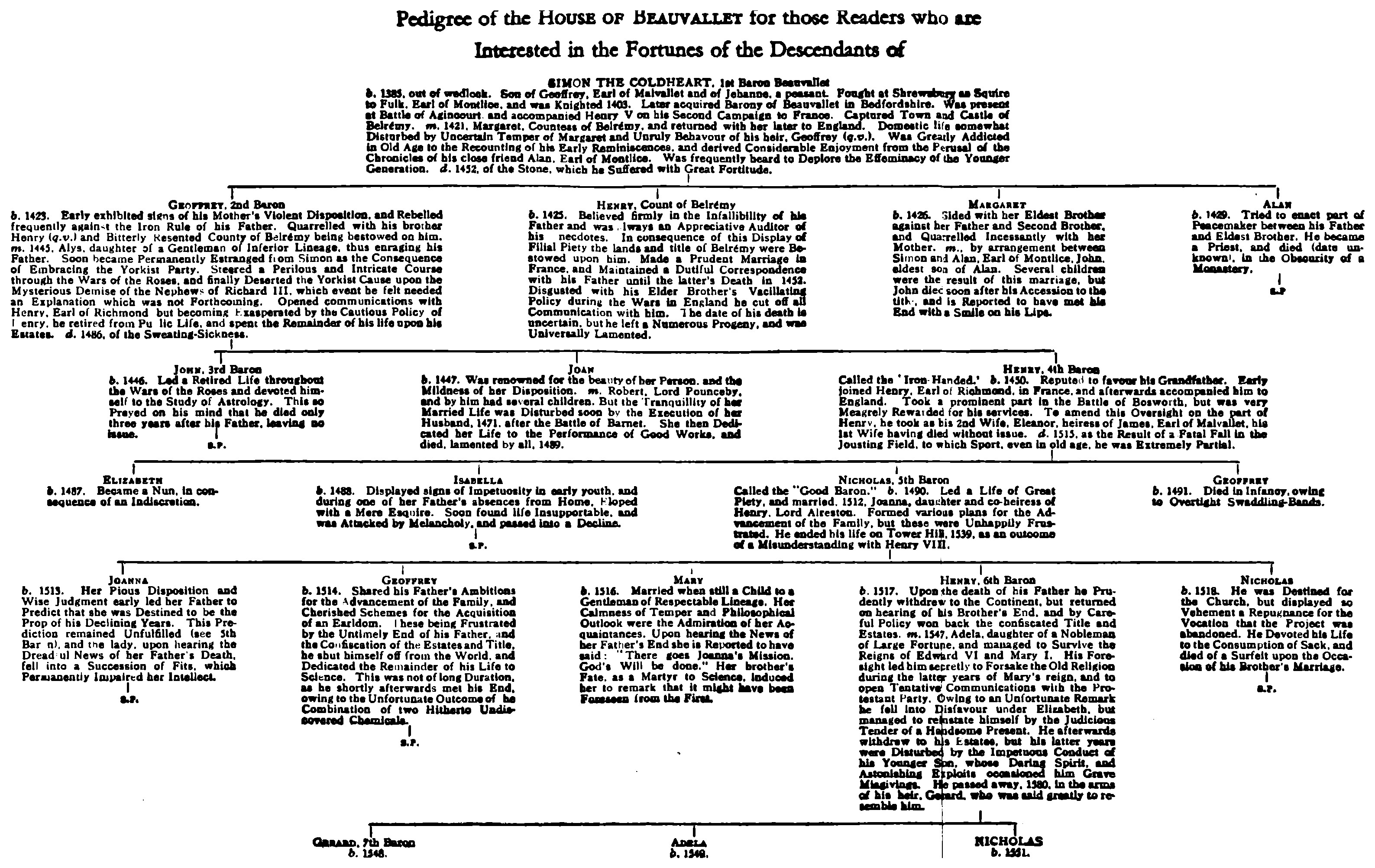
of the house, Simon, First Baron Beauvallet. A left-handed scion of
the old house of Malvallet, Simon cleaved for himself a new name
and a new title. Under King Henry V he saw much fighting in France,
and when those wars were done, came riding back into Cambridgeshire
with a French bride, a countess in her own right, holding lands and
a stronghold in Normandy. You might read of this first Beauvallet's
mighty deeds in the dreamy chronicles of his close friend, Alan, Earl
of Montlice, who occupied the latter years of his life with the writing
of his reminiscences. It is a diffuse work, something poetical in tone,
but contains much of interest.
Since the days of the Iron Baron the family fortunes had fluctuated.
The French County was lost to the English branch very early, for
Simon, finding himself continually at loggerheads with his first-born,
bestowed it upon his second son, Henry, who was thus the founder of the
present French house.
Geoffrey, the second baron, survived the Wars of the Roses, but left
the barony considerably impoverished by his vacillations. His heir,
Henry, took to wife Margaret, heiress of Malvallet, by which wise
alliance the two families were made one. His successors all laid
schemes for the family's advancement, but the times were troublous, and
it was not always possible to steer a safe course through the varying
politics of the day. Thus in this year, 1586, although the house of
Beauvallet had by dint of careful marriages planted its roots in many
great houses, and become one of the wealthiest in the land, the present
holder of the title was still only a baron, as his ancestor had been
before him.
This Seventh Baron, Gerard, a solid man, had built the new house
at Alreston, a noble mansion of red brick, with oak timberings. My
lady, a frail dame, complained of the cruel temper of the climate in
Cambridgeshire, and was urgent in her gentle way, to be gone from an
ancient castle full of draughts and damp and gloomy corners. My lord,
inheriting much of his great ancestor's rugged nature, had a fondness
for this mediæval hold, and saw in the use of oak for house-building
a sign of the decadence of the age. He was, so they said, a hard man,
with a will of iron, but there was a joint in his armour. My lady had
her way, and there arose in milder Hampshire, on lands that had come as
part of the dowry of Gerard's grandmother, a stately Tudor mansion, set
in fair gardens, surrounded by its stables, its farmsteads, and its
rolling acres of pasturage. It was seen that my lord for all his hardy
notions had pride in the magnificence of the building. He might speak
slightingly of an age of luxury, but he adorned his house with every
trapping of wealth, used the despised oak for his panelling, and had
all carved and painted to the admiration of his neighbours.
Thither rode Nicholas, on a bright spring day, and came in sight of
the square gatehouse, after an absence of over a year. The gates stood
wide, and showed a broad avenue stretching ahead, with rolling lawns to
flank it, and the high gables of the manor beyond. Sir Nicholas reined
in, and sent a shout echoing through the archway. The gate-keeper
came out, no sooner saw who called than he hurried forward, beaming a
welcome. "Eh, but it could be none other! Master Nick!"
Beauvallet stretched down a hand in careless good nature. "Well, old
Samson? How does my brother?"
"Well, master, well, and my lady too," Samson told him, and bent the
knee to kiss his hand. "Are you come home for aye at last, sir? The
place misses you!"
There was a shrug of the shoulder and a shake of the head. "Nay, nay,
the place needs but my brother."
"A just lord," Samson agreed. "But there is never a man on Beauvallet
land would not be glad to welcome Sir Nicholas home."
"Oh, flatterer!" Beauvallet mocked. "What have I ever done for the
land?"
"It is not that, master." Samson shook his head, and would have said
more.
But Sir Nicholas laughed it aside, waved his hand, and rode on under
the arch.
A flight of broad stone steps led up from the neat drive to the terrace
and the great doorway. There were clipped yews in tubs, and in the
stonework above the door the Beauvallet arms were set in a stone
shield. Leaded windows reared up slim and stately to either side, built
out in rounded bays, with scrolls beneath them of stonework set against
the warmer brick. The roof was tiled red, with tall chimney-stacks to
either end, and round attic windows set between the many gables. The
door stood open to let in the spring sunshine.
Sir Nicholas swung himself lightly down from the saddle, tossed the
bridle to Joshua, and went bounding up the steps. Like a boy he set
his hollowed hands to form a trumpet for his mouth, and called: "Holà,
there! What, none to cry Nick welcome?"
In a moment heads peeped from upper windows. There was a stir amongst
the serving maids, a whisper of: "Sir Nicholas is home!" and much
preening of stuff gowns and patting of prim coifs. Sir Nicholas might
be counted on to give a hearty buss to the prettiest, ignoring my
lady's murmured protests.
Portly Master Dawson, steward for many years, heard the shout in his
buttery, and made haste to come out into the sunlight. A couple of
lackeys hurried at his heels, and Dame Margery, urgent to be the first
to greet her nursling. She pushed past Master Dawson as he reached the
door, dived under his arm without ceremony, a little wrinkled woman in
a close white cap. "My cosset!" cried Dame Margery. "My lamb! Is it my
babe indeed?"
"Indeed and indeed!" Sir Nicholas said, laughing, and opened his arms
to her. He caught her up in a great hug while she fondled and scolded
all in one breath. He was a good-for-naught, a rough, sudden fellow
to snatch up an old woman thus! Eh, but he was brown! She dared swear
he was grown; but his cheek was thin: she misgave her he was in poor
health. Ah, he was a sad wastrel to be so long gone, and to come home
but to laugh at his poor nurse! She must pat him, stroke his hands,
feel the thickness of his short cloak. A fine cloth, by her faith! all
tricked out with points and tassels of gold! Oh, spendthrift! Take
heed, take heed! Could he not see my lord coming to greet him?
My lord came sedately out from the house in a gown of camlet trimmed
with vair, with a close cap set upon his head, and a gold chain about
his neck. My lord wore a cathedral beard like a churchman. He was fair
where Nicholas was dark; his eyes were blue, but lacked the sparkle
that was in his brother's eyes. He was a tall man of imposing mien, had
a grave countenance and a stately gait. "Well, Nick!" he said, with
the glimmer of a smile. "My lady heard a shouting and commotion, and
straightway saith Nick must be home. How is it with you, lad?"
The brothers embraced. "As you see me, Gerard. And you?"
"Well, enough. A tertian fever troubled me in February, but it is
happily passed."
"He must needs go into Cambridgeshire to that damp, unhealthy castle,"
sighed a mournful voice. "I knew what would come of it. I foretold an
ague from the start. Dear Nicholas, give you good den."
Nicholas turned to greet my Lady Beauvallet, kissed her hand right
dutifully, and so came to her lips. "Do I see you well, sister?"
"Nick!" She blushed faintly and shook her finger at him. "Ever the
same swift way! Nay, the hard winter—harder than any I remember,
was it not, my lord?—tried me sorely. At the New Year I had the
sweating-sickness. Then, at Candlemas, an ague seized me, and was like
to have carried me off, methought."
"But the spring comes, and you grow strong with it," suggested Nicholas.
She looked doubtful. "Indeed, Nicholas, I trust it may be found so, but
I have the frailest health, as you know."
Gerard broke in upon this lamentation. "I see you bring home that
ruffler," he said, and nodded to where Joshua stood in parley with the
lackeys. "Have ye schooled him yet?"
"Devil a bit, brother. Joshua! Here, rogue, come pay your duty to my
lord!" He put an arm round my lady's waist and swept her into the
house. "Have in with you, Kate. The snip of the wind is like to lay you
low of a second ague."
My lady went with him protesting. "Nick, Nick, so hardy still? Not a
second ague, I assure you, but more like the seventh, for, indeed, no
sooner am I raised from one than another comes to strike me down. Come
into the hall, brother. There should be a fire there, and they will
bring wine for you. Or there is some March beer of two years tunning.
Dawson! Dawson, bring—oh, he is gone! Well, come in, Nicholas; you
will be chilled from your ride."
They went through the screens to the Great Hall. This was a noble
apartment with the roof high over their heads crossed and re-crossed
with oaken timbers. Tall windows were set all round the walls at a
height above a man's head. Between them the walls were covered with
panels of linen-fold. A dais was set at one end, in the bay of the
front windows, with a long table upon it and benches around. A great
fireplace stood in one wall, with logs burning in it. Above the lofty
mantelpiece, supported by pilasters, my lord's quarterings hung.
Rushes, with rosemary strewed amongst them, covered the floor; there
was a settle on either side of the fireplace, and some carved and
panel-backed chairs ranged neatly along the wall.
My lady sat down on one side of the fire, and since her monstrous
farthingale seemed to occupy most of the settle, Sir Nicholas went to
the other. "Yes, sit down, dear Nicholas," she said. "Dawson will be
here anon, and my lord too, I dare swear."
Sir Nicholas loosed the cloak from about his shoulders and tossed it
aside. It fell over one of the chairs against the wall, and Margery,
peeping round a corner of the screens, frowned to see the fine thing
so rudely used. My lady caught sight of that puckered face and smiled
kindly. "Come you in, Margery. You will say it is a good day that sees
Sir Nicholas come riding home."
"Good indeed, my lady." Margery dropped a curtsey. "But a feckless,
heedless boy! Ah, is there never one to school him?" She picked up the
cloak and folded it carefully. "Tut, the brave hat upon the floor!
Two feathers in it, i'faith!" She looked a fond reproof at such
extravagance. "Heed old Margery, my cosset, and get ye a wife!"
"What need?" Sir Nicholas asked, and disposed his graceful limbs at
ease along the settle. "What need while I still have Margery to scold,
and a fair sister to shake her head at me?"
"Oh, Nicholas, for shame!" my lady said. "I shake my head? Though,
indeed, ye often deserve that I should. Ah, my lord, in good time! Here
is your brother says we scold, poor Margery and I."
My lord came to sit beside Nicholas on the settle. "Dawson is gone to
fetch the March beer for you, Nick. He is sure it is what you need." He
smiled. "It is a rare thing, faith, to see the house turned upside down
for a graceless rogue that heeds naught that concerns it."
Sir Nicholas threw back his head, and laughed. "The old tale! I irk you
sorely, Gerard, alack!"
"Nay, nay." My lord looked on him with some kindness. "So ye be come
home now to stay...."
"Patience, Gerard, patience!" Nicholas said mischievously.
Dawson came in preceding a lackey, bearing the famous beer upon a
salver. "Sir, at your pleasure!"
"In good sooth!" Sir Nicholas stretched out a hand for the tankard.
"Give you my word I have yearned often for this. My lady, I drink to
your better health."
"Ah!" sighed my lady, and shook her head.
My lord took the second tankard. "You will wish to hear news of my Lady
Stanbury," he said. "I had a letter from her lord last Friday se'n
night, telling me she had been brought to bed of a fair son."
"What, a son at last?" quoth Sir Nicholas, tossing off the rest of
his beer. "Marry, I lost count of poor Adela's daughters long since!
Dawson, another tankard, man, to drink my nephew's health!" He looked
at Gerard. "How doth my sister? Who stands sponsor?"
"Well, very well. I am asked to stand, with my lady, and another. Ye
should journey into Worcester to visit them; Adela would be glad of it.
You will not have heard that our cousin Arnold is wedded to Groshawk's
second daughter? A fair match, no more than fair. The elder girl
favoured her mother too much for Arnold, so I heard."
Talk ran awhile on family matters; my lady went away presently to see
to the preparation of the heir's chamber, and Nicholas must needs be
off to the stables to greet old servants, and inspect new horses. My
lord went with him, willingly enough.
"There's a Barbary horse might suit you," said he. "Ye shall try his
paces. I bought him last Michaelmas, but he is scarce up to my weight,
I believe. He should please you: a fiery, impatient brute." He linked
arms with Nicholas, and made his brother curb his hasty steps to match
his own. "Gently, lad! What's your hurry?"
"None. What hawks do you keep now? What sport?"
"Fair, fair. I was out with my neighbour Selby last Thursday. I let
fly my tassel-gentle at a pheasant, discovered in a brake. A rare bird
that! I had her from Stanbury when he was here over Twelfth Night; ye
shall see her anon. Selby found a mallard, whistled off his falcon.
Down she came, twice missed, but recovered it at a long flight...."
They talked of hawking, and of venery, and of the management of the
estate. When they came slowly back to the house the sun was sinking
behind it in a red glow. Master Dawson met them with a warning of
supper. Sir Nicholas' baggage had arrived, and was safely bestowed in
his chamber. Sir Nicholas went up the wide stairs two at a time, and
found Joshua laying out a doublet and hose of slashed mochado, with
netherstocks of carnation silk, and a clean stiff ruff.
A great bed with a canopy of carved wood supported at all four corners
by pillars in the form of caryatides, stood out into the room. It had
hangings of worked damask, and a Venice-valance. A bow-fronted chest
of walnut inlaid with cherrywood stood at the foot of it; there was an
armoire in one corner, a second chest bearing upon it a basin and ewer
of pewter ware, painted cloths upon the walls, and a thrown-chair by
the window. Sir Nicholas flung himself down in this, and stretched his
legs out before him. "Off with my boots, Joshua. Where's the casket I
bade ye cherish?"
"Safe, master; I will bring it on the instant." Joshua knelt, and
tugged at the muddied boots. "All goeth merrily at home, sir, as we
see. 'What now,' quoth Master Dawson—he grows somewhat fat on good
living, mark you—'What now, do ye stay in England, Master Dimmock?'
This is to pry into our affairs, master. I made him a short answer,
never fear me. 'It's not for me,' quoth I, 'to divulge what plans Sir
Nicholas hath in mind.' He stood abashed."
"I warrant me!" Sir Nicholas said mockingly. "A rare, politic answer,
my Joshua. Pray, what are my plans?"
Joshua arose with the second boot in his hand. "Nay, sir, ye have
not favoured me with them yet," he said with unabated cheerfulness.
"But it was not fit that I should say as much to that fat steward. A
swag-bellied, pompous ass, I make bold to say. Yet, master, and I do
not speak without reflection, it might suit us well to remain snug at
home now."
Sir Nicholas stood up, his fingers busy with the untying of his points.
"Further, rogue, it might suit us better to be gone again just so soon
as the Venture is ready to put to sea."
Joshua's face fell. "Is it so indeed, master?"
The glancing blue eyes looked down at him a moment. "Rest you snug at
home. Do I constrain you? I am off on a wild adventure this time."
"The more reason to take me along," said Joshua severely. "If you are
to be off again I shall certainly accompany you." He picked up the
doublet from the bed, and frowned a stern reproof. "This is to jest,
sir. I shall be at hand to keep a watch over our interests. I do not
say that I had not as lief be at home, but I shall without doubt go
where you go, for that is clearly my fate."
"Like Ruth," said Sir Nicholas flippantly.
In a little while he was descending the stairs again, very brave in
his doublet of the French cut, with the high wings to the shoulders,
and the embroidered sleeves. He had a fine leg, set off to advantage
in stockings of carnation silk, with rosettes to the garters below his
knees. The little neat ruff made no more than a stiff cup for his face;
my Lord Beauvallet, favouring a wider fashion, called it Italianate,
and looked severely.
My lord and his lady were found in the winter-parlour, where supper
was spread upon a draw-table. Sir Nicholas came in upon them, splendid
in his rich trappings, and set a small casket before my lady. "Spain
pays toll to beauty, Kate," he said, and looked wickedly under his
lashes at Gerard's disapproving countenance.
My lady knew very well what she might expect to find in the casket,
but chose to dissemble. "Why, Nicholas, what do you bring me?" she
wondered, raising her watchett-blue eyes to his face.
"A poor gewgaw, no more. There is a length of China silk in my baggage
you might make into a gown, or some such thing."
My lady had opened the casket, and clasped her hands in breathless
ecstasy. "Oh, Nick! Rubies!" she gasped, and almost reverently drew
forth a long chain set with the precious stones. She held it in her
hands, and looked doubtfully at Gerard. "See, my lord! Nicholas makes
me a noble present."
"Ay," said my lord glumly. "Jewels filched from some Spanish hold."
My lady sighed, and put the chain down. "Should I not wear it, dear
sir?"
"Tush!" Nicholas said bracingly, and caught up the chain from the
table, and cast it about my lady's thin neck. "I've other such toys for
the Queen. I warrant you she will wear them. Heed him not."
"I am sure," said my lady, plucking up courage, "that what the Queen's
Grace does not disdain to wear I need not."
Gerard sat down in the high-backed chair at the head of the table. "You
will do as you please, madam," he said deeply.
Supper was eaten in silence, as was customary, but when the green goose
had been taken away, and sweetmeats were on the table, and Hippocras
set before my lord, conversation began again. My lord dipped his
fingers in a gilt basin handed to him by a lackey liveried in blue, and
spoke more genially. "Well, Nick, ye say naught of your designs. Have
you come home to stay?"
"Confess, brother, you are more at ease when I am abroad!" Nicholas
rallied him, and poured Hippocras into the delicate glass of Venetian
ware before him.
Gerard permitted a smile to break his gravity. "Nay, acquit me, I do
not gainsay, though, ye are a mad, roystering lad."
"Swashbuckler, ye were wont to call me."
"Well." My lord smiled more broadly.
"Oh no, I am sure he is sober enough now!" my lady said in a flutter.
"No hard words, I beg! Why he numbers some thirty-four—thirty-five
summers, surely?"
"God 'a mercy, do I so?" Sir Nicholas said, startled. He lifted his
glass, and held it up to see the light through the wine in it. He
seemed to be pondering some quaint thought; my lord saw the corners of
his mouth lift a little.
"Time to be done with all this ruffling on the high seas," my lord said.
Beauvallet shot him a quick look; there was a hidden jest in his eyes.
He returned to the contemplation of his wine.
My lady rose. "You will have much to say to one another," she said. "Ye
will find me in the gallery anon."
Beauvallet went to hold the door for her. As she passed him she put out
a hand, and smiled vaguely. "Indeed, I hope you will listen to my lord,
Nick. We should be glad to have you at home."
He carried her fingers to his lips, but would give her neither yea nor
nay. She went out, and he closed the door behind her.
My lord pushed back his chair a little way from the table, sat more at
his ease, and poured another glass of wine. "Sit ye down, Nick, sit ye
down! Let me know your mind." He observed the secret jest still in his
brother's face, and knew a feeling of some slight alarm. There was no
knowing what folly Nick might be planning.
Sir Nicholas pulled his chair round a little, sank into it, with one
leg thrown over the arm. His fingers closed round the stem of his
glass, twisting it this way and that. His other hand played gently with
his pomander.
My lord nodded and smiled. "I see you still have that trick of swinging
your pomander. As I remember it never boded good. My memory serves,
eh?" He drank his wine, and set down the glass. "Thirty-five summers!
Ay, my lady is in the right of it. Thirty-five summers and still
roaming the world. Now to what purpose, Nick?"
Beauvallet shrugged his shoulders. "Oh, to bring rubies home for Kate,"
he parried.
"It's what I don't like. I'll not conceal it from you. It's very well
for such men as Hawkins or Drake, but I would remind you, Nick, that
you stand next to me in the succession. To make the Grand Tour is well
enough—though what good ye came by from it, God knoweth!"
"Nay, brother," Sir Nicholas protested. "I learned to foin with the
point from the great Carranza himself in Toledo! Grant me that."
My lord was roused to an expression of strenuous disapproval. "A pretty
ambition, God wot! All this pricking and poking with a barbarous rapier
is an invention of the devil himself. An honest sword-and-buckler was
good enough for our fathers."
"But not good enough for us," said Beauvallet. "Yet I will engage
to worst you in an encounter with your sword-and-buckler, Gerard. I
believe I have not altogether lost the trick of it. But for delicacy,
for finesse, let me have the rapier!" He made an imaginary pass in the
air. "What, you say I learned no good upon my travels? Did I not sit at
the feet of Carranza, and after find out Marozzo himself in Venice? Ay,
he was old, I grant you, but he had some tricks still to show. Alack,
ye have no Italian! Ye should else read his Opera Nova, in the which
book he carefully explains the uses of the falso and the dritto
filo. No good, ye say? Produce me the man who can worst me with the
rapier and the dagger!"
My lord maintained an unyielding front. "Do you count such foreign
tricks a gain? What else have you to show for these years of junketting
abroad?"
"A rare Toledo blade, brother," returned Nicholas, unabashed. "A blade
tempered in the waters of the Tagus, and inscribed with the name of
Andrea Ferrara between eight crowns. Yet another such blade, from the
hand of Sahagom. What, more? Why, then, a suit of Jacobi armour you
yourself did not despise; an acquaintance with our cousins in France;
an intimate knowledge of the French, the Spanish, and the Italian
tongues—which I think ye lack——"
"The English of my forefathers sufficeth me," said my lord grimly.
"You've no ambition, Gerard," mourned Beauvallet.
"I've no vagrant spirit," said my lord tartly. "Will you never be
still? I pass over the Grand Tour; I may pass over even that mad
emprise ye set forth on with Drake——"
"A thousand thanks!" Beauvallet's eyes were alight.
"I grant you it was worth the doing," said my lord grudgingly. "Ay, a
rare feat, and all honour to you for compassing it."
"Give honour to Drake, where it is due," said Beauvallet, and lifted
his glass. "We drink his health! To Drake, the master-mariner!"
My lord drank the toast, but without enthusiasm. "It's very well, but
why ye must needs cleave so fast to this same Sir Francis passeth my
comprehension."
"Does it so?" Beauvallet said. "But then, brother, you have not sailed
the world round in his company, nor learned seacraft of him, nor faced
sack, battle and wreck at his side."
"Ye have imbibed unfit notions from him. A voyage round the world! Very
well, very well, a feat indeed, and duly we honoured it. Ye brought
home a store of riches, moreover, enough for any man. Then was the time
to call an end to this wandering fever. But did ye? Nay, ye built your
fine ship, and must needs be off again. A madness! A most damnable
folly, Nick, give me leave to say!"
Sir Nicholas bowed his raven head in mock contrition. "I cry your
pardon, good my lord!"
"Ay, and sit there as graceless as the day ye were first breeched,"
said my lord, a hint of humour in his deep voice. "Nay, Nick, I speak
advisedly. Ye have laid up a goodly treasure, as I know who husband it
for you. Treasure come by in a way I like not, but let it go. There is
the manor of Basing waiting for you any time you choose to go to it. My
lady brings me no heirs, nor is not like to. I look to you. What comes
to our house if you be slain or drowned? Get a wife, and be done with
this roystering!"
Sir Nicholas lifted his pomander to his nose. "Give me joy, brother, I
am about to get me a wife."
My lord was momentarily surprised, but he hid it quickly. "In good
time. My lady hath her eye upon a likely maid for you. We had thought
on the Lady Alison, daughter of Lord Gervais of Alfreston, but there
are others beside. Ye might go into Worcestershire for a bride. My
sister writes sundry names might please you."
Beauvallet held up his hand. His eyes were fairly brimful now with that
secret jest. "Hold, hold, Gerard! I am going to look in Spain for my
bride."
My lord set down his glass with a snap that came near to breaking it.
He stared under his projecting brows. "What's this? What new folly?"
"None, I swear. My choice is made. Give me joy, brother! I shall bring
home a bride before a year is out."
My lord sat back in his chair. "Expound me this riddle," he said
quietly. "Ye jest, I think."
"Never less. I give you a new toast." He came to his feet and lifted
his glass on high. "Doña Dominica de Rada y Sylva!"
My lord did not drink it. "A Spanish Papist?" he asked. "Do you ask me
to believe that?"
"No Papist, but a dear heretic." Sir Nicholas leaned on the
goffered-leather back of his chair. With a sinking heart my lord noted
the scarce curbed energy of him, the exultant look in his face. He
feared the worst. The worst came. "I took her and her father aboard the
Venture after the sack of the Santa Maria. More of that anon. Since
she would have it so, and since to that I pledged my word, I set them
ashore on the northern coast of Spain. But I swore I would ride into
Spain to seek her, and so I shall do, brother, never doubt me."
My lord sat still in his chair, looking up at Nicholas. His face was
set. "Nick, if this be indeed no jest——"
"God's my pity, wherefor should I jest?" Beauvallet cried impatiently.
"I am in earnest, in deadly earnest!"
"Then ye are mad indeed!" my lord said, and struck the table with his
open palm. "Mad, and should be clapped up! Fool, do ye think to ride
scatheless into Spain in these days?"
The smile flashed out; Sir Nicholas nodded. "Ay, I think to come out of
Spain with a whole skin."
My lord got up out of his chair. "Nick, Nick, what devil rides you? We
have no ambassador in Spain to-day. How should you fare?"
"Alone. The stars always fight for me, Gerard. Will you take a wager
that I do not come home with a bride on my arm?"
"Nay, have done with laughing! To what a pass has this senseless love
of danger led you? Lad, heed what I say! If ye go into Spain ye will
never come out again. The Inquisition will have you in its damnable
toils, and there is no power under the sun can save you then!"
Sir Nicholas snapped finger and thumb in the air. "A fig for the
Inquisition! Gerard, my careful Gerard, I give you Reck Not!"